®
TUMBLE ACTION WASHER
LA VADORA CON TAMBOREACClON
Table of Contents
Product Record .................................................................... 2
Tumble Action Washer Warranty .............................................. 2
Sears Maintenance Agreement ............................................... 2
IMPORTANT SAFETY INSTRUCTIONS .................................... .3
Washing Procedures................................................................ 4-5
Stain Removal ..................................................................... 6
Common Washing Problems ...................................................... 7
Care and Cleaning ............................................................... 8-9
Avoid Service Checklist ...................................................... 9-30
Espanol .................................................................... ] 3-39
Registro de producto ..................................................................... ] ]
Garantia para lavadora con tamboreacciOn ...................................... 11
Contrato de mantenimiento Sears.................................................... 11
INSTRUCCIONESIMPORTANTES
PARA LA SEGURIDAD ............................................................ 12-13
Procedimientos para el lavado.................................................... 13-14
Remover las manchas................................................................... 15
Problemas de lavado comunes ...................................................... 16
Cuidado y limpieza .................................................................... 17-18
Evitar Ilamadas de servicio ....................................................... 18-19
Servicio ............................................................................. Cubierta
Service .................................................... Back Cover
The symbol _4-_.._'_ on the product or on its packaging indicates that this El simbolo "_t_,._ en el producto o en su embalaje indica que este
product may not be treated as household waste. Instead it shall be handed producto no se puede tratar como desperdicios normales del hogar,
over to the applicable collection point for the recycling of electrical and
electronic equipment. By ensuring this product is disposed of correctly, you
will help prevent potential negative consequences for the environment and
human health, which could otherwise be caused by inappropriate waste
handling of this product. For more detailed information about recycling of
this product, please contact your local city office, your household waste
disposal service or the shop where you purchased the product,
Este producto se debe entregar al punto de recolecciOn de equipos
electricos y electrOnicos para reciclaje, AI asegurarse de que este
producto se deseche correctamente, usted ayudara a evitar posibles
consecuencias negativas para el ambiente y la salud pt]blica, Io cual
podria ocurrir si este producto no se manipula de forma adecuada,
Para obtener informaciOn mas detallada sobre el reciclaje de este
producto, pongase en contacto con la administraciOn de su ciudad,
con su servicio de desechos del hogar o con la tienda donde comprO
el producto,
Sears, Roebuck and Co., Hoffman Estates, IL 60179 U.S.A.
www, sears,com P/N134566000 (0508)
Tumble Action Washer Warranty Pedestal
Full One Year Warranty on Mechanical and Electrical Parts
For one year from the date of purchase, it this Tumble Action
Washer is installed and operated according to the instructions in the
Use and Care Guide, Operating Instructions, and Installation
Instructions, Sears will repair or replace any or its mechanical or
electrical parts if they are defective in material or workmanship,
Limited Two Year Warranty on Motor, Driven Pulley or
Motor Controller
For the second year from the date of purchase, Sears will replace
the motor, driven pulley or motor controller it they are defective in
material or workmanship, You must pay the labor cost to have them
installed,
Limited Lifetime Warranty on Stainless Steel Wash Basket
For the lifetime of the washer from the date of purchase, Sears will
replace the stainless steel wash basket it it is defective in material or
workmanship, You must pay the labor cost to have it installed,
Warranty Restriction
If this Tumble Action Washer is used for any purpose other than
Private Family Use, all warranty coverage is effective for only 90
days,
Warranty Service
Warranty service is aw_ilable by contacting your nearest Sears
Service Center in the United States,
This warranty applies only while this Tumble Action Washer is in use
in the United States,
This warranty gives you specific legal rights, and you may also have
other rights which vary from state to state.
Product Record
In the space below, record the date of purchase, model and serial
number or your product. You will find the model and serial number
printed on an identification plate located at the top, inside of the
door opening,
Model No. 417,
Serial No.
Date of Purchase
Save these instructions and your sales receipt for future reference,
This Use and Care Guide provides general operating instructions for
your washer. It also contains information about features for several
other models, Your washer may not have every feature included
here. Use the washer only as instructed in this Use and Care Guide
and the Operating Instructions included with your washer.
Instructional DVD
An instructional DVD has beer] included with your washer, It
highlights features unique to this tumble action washer and
will help you operate your washer correctly. This DVD is
especially helpful it
A pedestal accessory, ModelNo. 46262, specifically designed for this washer
may be used when elevating the washer for ease of use, Failure to use
accessories certified by the manufacturer could result in personal injury,
property damage or damage to the washer.
Readall instructions before using this appliance. This
book contains valuable information about
o Operation
• Care
Service
Keep it in a safe place.
Pedestal Option Warranty
Full One Year Warranty on Mechanical Parts
For one year from date of purchase, when this pedestal is installed with the
listed washer or dryer (see owners manual for specific model) and operated
according to the information in the Use and Care Guide, Operating
Instructions and Installation Instructions, the supplier will repair or replace
any of its mechanical parts if they are defective in workmanship or
material. Keep your bill of sale. The date of the bill establishes the warranty
period should parts be required. This written warranty gives you specific
rights. You may also have other rights which vary from state to state.
Warranty Restriction
It the pedestal is used for any other purpose than private family use or used
with any product that requires modification for installation, the warranty is
null and void,
Warranty Parts
Warranty parts are available by contacting the supplier where the pedestal
was purchased or refer to the Use and Care Guide that came with the
washer or dryer that is installed on the pedestal for contact information,
Product Record
In the space below, record the date of purchase, model and serial
number or your product. You will rind the model and serial number
printed on an identification plate located at the top, inside of the
door opening.
Model No, 417.
Serial No,
Date of Purchase
Save these instructions and your sales receipt for future reference.
Sears, Roebuck and Co., Dept. 817WA, Hoffman Estates, IL 60179
Master Protection Agreement In theU.S.A
Congratulations or] making a smart purchase, Your new Kenmore:_: appliance is designed and manufactured for years of dependable operation, But
like all products, it may require preventive maintenance or repair from time to time. That's when having a Master Protection Agreement can save you
money and aggravation.
Pumhase a Master Protection Agreement now and protect yourself from unexpected hassle and expense,
The Master Protection Agreement also helps extend the life of your new appliance. Here's what's included in the Agreement:
Expert service by our 12,000 professional repair specialists
Unlimited service and no charge for parts and labor on all covered repairs
"No lemon" guarantee replacement of your covered product it more than three product failures occur within 12 months
Product replacement if your covered product can't be fixed
Annual Preventive Maintenance Check at your request no extra charge
Fast help by phone non technical and instructional assistance on products repaired in your home, plus convenient repair scheduling
Power surge protection against electrical damage due to power fluctuations
Rental reimbursement it repair of your covered product takes longer than promised
Once you purchase the Agreement, a simple phone call is all that it takes for you to schedule service. You can call anytime day or night, or schedule
a service appointment online.
Sears has over 12,000 professional repair specialists, who have access to over 4.5 million quality parts and accessories. That's the kind of
professionalism you can count on to help prolong the life of your new purchase for years to come. Purchase your Master Protection Agreement
today! Sears Installation Service
Some limitations and exclusions apply. For Sears guaranteed professional installation of home appliances
For prices and additional information, and items like garage door openers and water heaters, in the
call 1-800-827-6655. 2 U.S.A. call 1 800 4 MY HOME(_';
Important Safety Instructions SAVE THESE INSTRUCTIONS
Your safety and the safety of others is very important.
_Ve have provided many important safety messages in the Use and (]are Guide, Operating Instructions, Installation Instructions and on
your appliance, Always read and obey all safety messages,
,_ This is the safety alert symbol, This symbol alerts you to hazards that can kill or hurt you or others, All safety messages will be precedec
gy the safety alert symbol and the word "DANGER" or "WARNING", These words mean:
You will be killed or seriously injured if you don't follow instructions,
You can be killed or seriously injured if you don't follow instructions,
/111safety messages will identify the hazard, tell you how to reduce the chance of injury, and tell you what can happen if the
instructions are not followed.
Read all instructions before using this washer.
To reduce the risk of fire, electrical shock, or injury to persons when using this washer, comply with the basic warnings
listed below.
[] Failure to comply with these warnings could result in serious personal injuries.
Prevent Fire
Do not wash items that have been previously cleaned in, soaked in, or spotted with gasoline, cleaning solvents, kerosene,
cooking oils, waxes, etc. Do not store these items on or near the washer. These substances give off vapors or chemical reactions that
could ignite or explode.
Do not put oily or greasy rags or clothing on top of the washer. These substances give off vapors that could ignite the
materials.
Do not add gasoline, cleaning solvents, or other flammable or explosive substances to the wash water. These substances
give off vapors that could ignite or explode.
Under certain conditions, hydrogen gas may be produced in a hot water system that has not been used for 2 weeks or
more. HYDROGEN GAS IS EXPLOSIVE. If the hot water system has not been used for such a period, before using the washer, turn
on all hot water faucets and let the water flow from each for several minutes. This will release any accumulated hydrogen gas.
Hydrogen gas is flammable; do not smoke or use an open flame during this time.
Do not store or use gasoline or other flammable vapors or liquids in the vicinity of this or any other appliance.
[] Failure to comply with these warnings could result in fire, explosion, serious bodily injury and/or damage to the rubber or plastic
parts of the washer.
Protect Children
Do not allow children to play on or in the washer. Close supervision of children is necessary when the washer is used
near children, As children grow, teach them the proper, safe use of all appliances,
Destroy the carton, plastic bag and other packing materials after the washer is unpacked, Children might use them for
play, Cartons covered with rugs, bedspreads or plastic sheets can become airtight chambers,
Keep laundry products out of children's reach, To prevent personal injury, observe all warnings on product labels,
Before the washer is removed from service or discarded, remove the washer door to prevent accidental entrapment,
[] Failure to comply with these warnings could result in serious personal injuries,
Prevent Injury
To prevent shock hazard and assure stability (luring operation, the washer must be installed and electrically grounded by
a qualified service person in accordance with local codes, Installation instructions are packed in the washer for installer's reference,
Refer to INSTALLATION INSTRUCTIONS for detailed grounding procedures, If the washer is moved to a new location, have it checked
and reinstalled by a qualified service person,
To prevent personal injury or damage to the washer, the electrical power cord of the washer must be plugged into a
properly grounded and polarized 3-prong outlet. The third grounding prong must never be removed. Never ground the washer
to a gas pipe. Do not use an extension cord or an adaptor plug.
Follow package directions when using laundry products. Incorrect usage can produce poisonous gas--resulting in serious
injury or death.
• Do not combine laundry products for use in 1 load unless specified on the label.
• Do not mix chlorine bleach with ammonia or acids such as vinegar.
I_t_l_To prevent serious personal injury and damage to the washer:
• A!I repairs and servicing must be performed by an authorized servicer unless specifically recommended in this Owner's
Guide. Use only authorized factory parts.
• Do not tamper with controls.
• Do not install or store the washer where it will be exposed to the weather.
• Do not install on carpet. Install washer on a solid floor. It may be necessary to reinforce the floor to prevent vibration or
movement.
To reduce the risk of electric shock, disconnect this appliance from the power supply before attempting any user
maintenance. Turning the controls to the OFF position does not disconnect this appliance from the power supply.
To prevent injury, do not reach into the washer while parts are moving. Before loading, unloading or adding items, push
in the cycle selector knob and allow the drum to coast to a complete stop before reaching inside.
[] Failure to comply with these warnings could result in serious personal injuries.
[] This washer is equipped with an electrical overload protector. The motor will stop if it becomes overheated. The washer will
automatically restart after a cool down period of up to 30 minutes, if the washer has not been manually turned off during this time.
Printed in U.S.A.
3
grounding prong from electrical power
cord. Failure to follow this warning can
cause serious injury, fire or death.
Important Safety Instructions (con tinued)
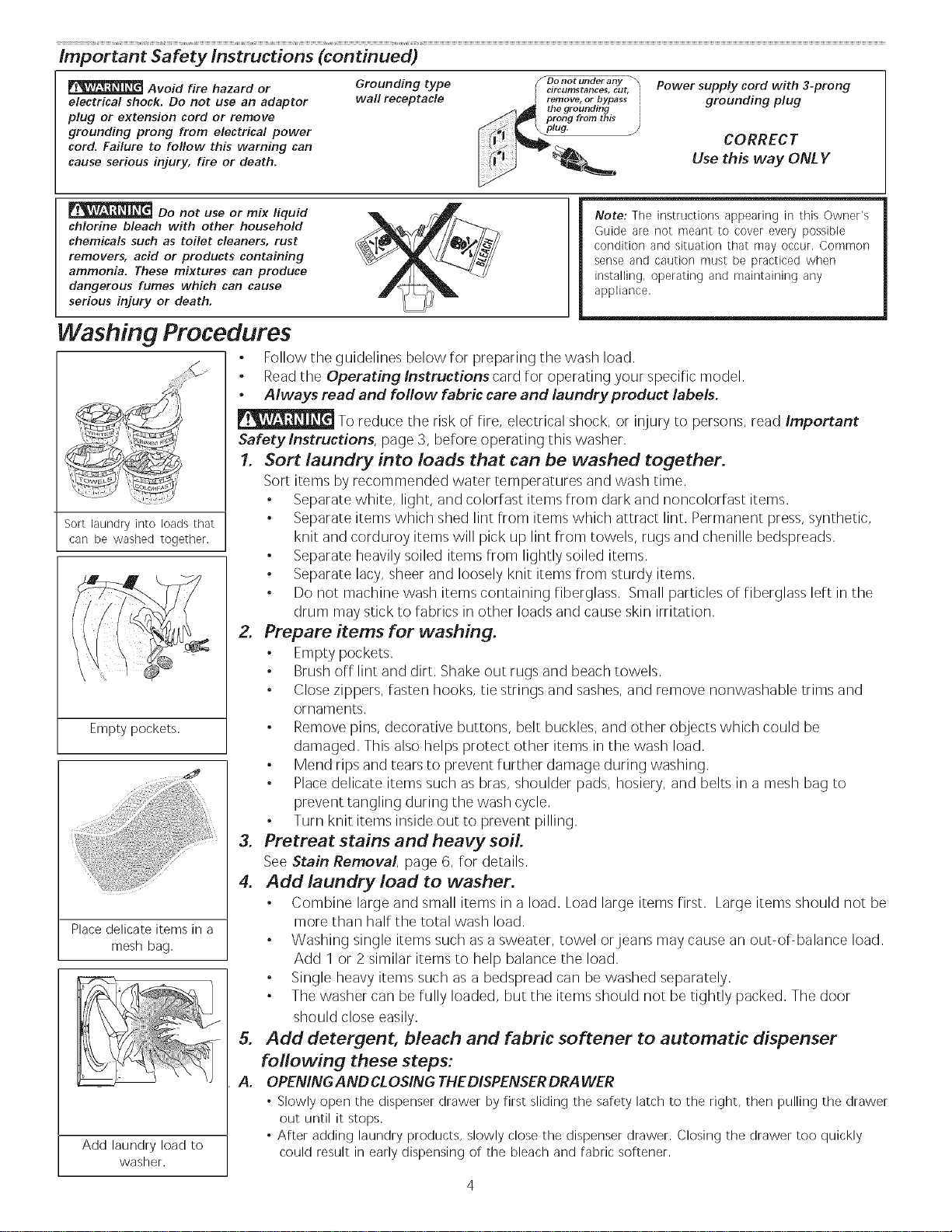
Avoid fire hazard or Grounding type S D°n°tunderany _ Power supply cord with 3-prong
circumstances, cut,
electrical shock. Do not use an adaptor wall receptacle remove, or bypass grounding plug
t e grounding
plug or extension cord or remove prong from this
lug. j C0 RRECT
Use this way ONLY
Do not use or mix liquid
chlorine bleach with other household
chemicals such as toilet cleaners, rust
removers, acid or products containing
ammonia. These mixtures can produce
dangerous fumes which can cause
serious injury or death.
Washing Procedures
Sort laundry into loads that
can be washed together,
Note: The instructions appearing in this Owner's
Guide are not meant to cover every possible
condition and situation that may occur, Common
sense and caution must be practiced when
installing, operating and maintaining any
appliance,
Add laundry load to
washer.
Place delicate items in a
mesh bag.
Empty pockets.
Follow the guidelines below for preparing the wash load.
Readthe Operating Instructions card for operating your specific model.
Always read and follow fabric care and laundry product labels.
To reduce the risk of fire, electrical shock, or it!jury to persons, read Important
Safety Instructions, page 3, before operating this washer.
1. Sort laundry into loads that can be washed together.
Sort items by recommended water ternperatures and wash time.
Separate white, light, and colorfast items from dark and noncolorfast items.
Separate items which shed lint from items which attract lint. Permanent press, synthetic,
knit and corduroy items will pick up lint from towels, rugs and chenille bedspreads.
Separate heavily soiled items from lightly soiled items.
Separate lacy, sheer and loosely knit items from sturdy items.
Do not machine wash items containing fiberglass. Small particles of fiberglass left in the
drum may stick to fabrics in other loads and cause skin irritation.
2. Prepare items for washing.
Ernpry pockets.
Brush off lint and dirt. Shake out rugs and beach towels.
Close zippers, fasten hooks, tie strings and sashes, and remove nonwashable trims and
ornaments.
Remove pins, decorative buttons, belt buckles, and other objects which could be
damaged. This also helps protect other items in the wash load.
Mend rips and tears to prevent further damage during washing.
Placedelicate items such as bras, shoulder pads, hosiery, and belts in a mesh bag to
prevent tangling during the wash cycle.
Turn knit items inside out to prevent pilling.
3. Pretreat stains and heavy soil.
See Stain Removal, page 6, for details.
4. Add laundry load to washer.
Combine large and small items in a load. Load large items first. Large items should not be
more than half the total wash load.
Washing single items such asa sweater, towel or jeans may cause an out-of-balance load.
Add 1 or 2 similar items to help balance the load.
Single heavy items such as a bedspread can be washed separately.
The washer can be fully loaded, but the items should not be tightly packed. The door
should close easily.
5. Add detergent, bleach and fabric softener to automatic dispenser
following these steps:
A. OPENINGAND CLOSING THEDISPENSERDRAWER
* Slowly open the dispenser drawer by first sliding the safety latch to the right, then pulling the drawer
out until it stops.
, After adding laundry products, slowly close the dispenser drawer. Closing the drawer too quickly
could result in early dispensing of the bleach and fabric softener.
B. DETERGENT
, Detergent is flushed from the
dispenser at the beginning of
the cycle. Either powdered or
liquid detergent can be used.
Note: Liquid detergent will
drain into the washer drum as
it is added.
. Add a low-sudsing, high-
efficiency detergent made for
front-loading washers to the
dispenser chamber. Look for this
\
Do not store or place laundry
products on top of washer at
any time. They can damage th_
finmh or controls,
D,
6. Select the cycle, temperature, spin speed, options and features according to type, size, and soil
level of each load. Start the washer.
(See Operating Instructions for your specific model.)
7. Remove items when the cycle is completed.
Place washed items in automatic dryer, line dry, or dry flat as directed by fabric care label.
Excess wrinkling, color transfer or odors may develop in items left in the washer atter the cycle
has ended.
8. General Precautions
, If the dispenser drawer is opened during operation, the washer will shut off.
Slowly close the dispenser drawer, and press START to continue cycle.
, Do not siam the washer door closed or try to force the door open when locked
DOOR LOCK light is on This could result in damage to the washer
• DO NOT leave the washer door open. An open door could entice children to hang on
the door or crawl inside the washer.
Note: If there are no small children present, leave the door ajar to
prevent odor build up and improve venting of the unit.
. To avoid damaging the washer and personal injury, DO NOT hang on or lean against the
washer door.
. Do not place detergent, bleach or fabric softener containers on top of the washer. They can
damage the finish or controls.
Note: From time to time you may see water in the bleach
and fabric softener compartments. This is a result of the
siphoning action and is part of the normal operation of
the washer.
5
As an ENERGYSTAR Partner,
Electrolux Home Products has
determined that this product
meets the ENERGY STAR*
guidelines for energy efficiency,
symbol on the detergent label. Use the cap or scoop provided by the detergent manufacturer to measure the amount
recommended.
• Color-safe bleach, water conditioner, detergent booster and enzyme products may be added to the detergent
compartment. Avoid mixing liquids and powders.
. Detergent usage may need to be adjusted for water temperature, water hardness, load size and soil level.
. For best results, avoid oversudsing.
C. LIQUIDBLEACH
-.. If desired, measure out the recommended amount of
liquid chlorine bleach (not to exceed 1/3 cup (80 mL)) and
pour it into the center compartment labeled "Liquid
Bleach" and marked with this symbol.
Fill to the mininum fill line (MIN.) for small loads. Fill
to the maximum fill line (MAX.) for large loads. Do not
exceed the maximum fill line. Overfilling can cause early
dispensing of the bleach which could result in damaged
clothes.
• Do not pour undiluted liquid chlorine bleach directly onto the load or into the drum. Fabric damage can occur.
, Do not use powdered or liquid color safe bleach in the dispenser.
FABRIC SOFTENER
• If desired, pour the recommended amount of fabric softener into the compartment labeled "Fabric Softener" and marked with
this symbol. _
. Fill to the minimum fill line (MIN.) for small loads. Fill to the maximum fill line (MAX.) for large loads. Do not exceed the maximum
fill line. Overfilling can cause early dispensing of the fabric softener which could result in stained clothes.
• Do notpour fabric softener directly on the wash load.
. Use of a fabric softener dispensing ball is not recommended in tumble action washers.
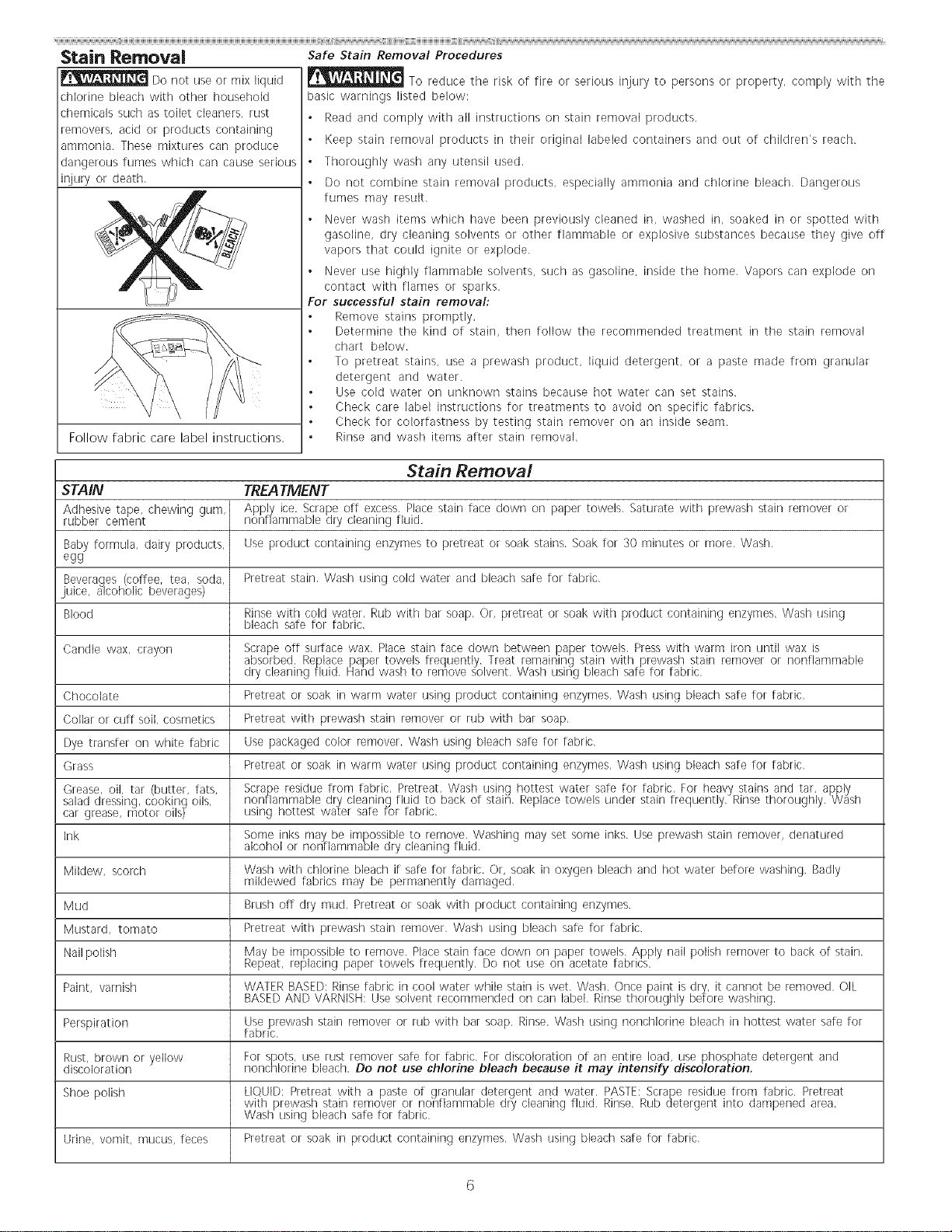
Stain Removal
Do not use or mix liquid
chlorine bleach with other household
chemicals such as toilet cleaners, rust
removers, acid or products containing
ammonia. These mixtures can produce
dangerous fumes which can cause serious
injury or death.
Follow fabric care label instructions.
Safe Stain Removal Procedures
_To reduce the risk of fire or serious injury to persons or property, comply with the
basic warnings listed below:
Read and comply with all instructions on stain removal products,
Keep stain removal products in their original labeled containers and out of children's reach.
Thoroughly wash any utensil used.
Do not combine stain removal products, especially ammonia and chlorine bleach, Dangerous
fumes may result.
Never wash items which have been previously cleaned in, washed in, soaked in or spotted with
gasoline, dry cleaning solvents or other flammable or explosive substances because they give off
vapors that could ignite or explode.
Never use highly flammable solvents, such as gasoline, inside the home, Vapors can explode on
contact with flames or sparks,
For successful stain removal:
Remove stains promptly,
Determine the kind of stain, then follow the recommended treatment in the stain removal
chart below.
To pretreat stains, use a prewash product, liquid detergent, or a paste made from granular
detergent and water.
Use cold water on unknown stains because hot water can set stains.
Check care label instructions for treatments to avoid on specific fabrics.
Check for colorfastness by testing stain remover on an inside seam,
Rinse and wash items after stain removal.
Stain Removal
STAIN TREATMENT
Adhesive tape, chewing gum, Apply ice, Scrape off excess, Place stain face down or] paper towels, Saturate with prewash stain remover or
rubber cement nonflammable dry cleaning fluid.
Baby formula, dairy products, Use product containing enzymes to pretreat or soak stains. Soak for 30 minutes or more. Wash.
egg
Beverages coffee, tear soda, Pretreat stain. Wash using cold water and bleach safe for fabric,
juice, _llcoholic beverages
Blood Rinse with cold water, Rub with bar soap, Or, pretreat or soak with product containing enzymes, Wash using
bleach safe for fabric,
Candle wax, crayon Scrape off sat[ace wax. Place stain face down between paper towels. Press with warm iron until wax is
absorbed. Replace paper towels frequently. Treat remaining stain with prewash stain remover or nonflammable
dry cleaning fluid, Hand wash to remove solvent. Wash using bleach safe for fabric,
Chocolate Pretreat or soak in warm water using product containing enzymes, Wash using bleach safe for fabric,
Collar or cuff soil, cosmetics Pretreat with prewash stain remover or rub with bar soap,
Dye trander on white fabric Use packaged color remover. Wash using bleach safe for fabric.
Grass Pretreat or soak in warm water using product containing enzymes, Wash using bleach safe for fabric,
Grease, oil, tar (butter, fats, Scrape residue from fabric. Pretreat, Wash using hottest water safe for fabric. For heavy stains and tar, apply
salad dressing, cooking oils, nonflammable dry cleaning fluid to back of staiii Replace towels under stain frequently. Rinse thoroughly. Wash
car grease, motor oilsl using hottest water safe for fabric.
Ink Some inks may be impossible to remove. Washing may set some inks, Use prewash stain remover, denatured
alcohol or nonflammable dry cleaning fluid,
Mildew, scorch Wash with chlorine bleach if safe for fabric. Or, soak in oxygen bleach and hot water before washing, Badly
mildewed fabrics may be permanently damaged.
Mud Brush off dry mud, Pretreat or soak with product containing enzymes,
Mustard, tomato Pretreat with prewash stain remover, Wash using bleach safe for fabric,
Nail polish May be impossible to remove, Place stain face down on paper towels. Apply nail polish remover to back of stain,
Repeat, replacing paper towels frequently. Do not use on acetate fabrics.
Paint, varnish WATER BASED: Rinse fabric in cool water while stain is wet. Wash. Once paint is dryr it cannot be removed, OIL
BASED AND VARNISH: Use solvent recommended on can label. Rinse thoroughly before washing.
Perspiration Use prewash stain remover or rub with bar soap, Rinse, Wash using nonchlorine bleach in hottest water safe for
fabric.
Rust, brown or yellow For spots, use rust remover safe for fabric. For discoloration of an entire load, use phosphate detergent and
discoloration nonchlorine bleach, Do not use chlorine bleach because it may intensify discoloration.
Shoe polish LIQUID: Pretreat with a paste of granular detergent and water. PASTE: Scrape residue from fabric, Pretreat
with prewash stain remover or no'nflammable dry cleaning fluid. Rinse. Rub detergent into dampened area.
Wash using bleach safe for fabric,
Urine, vomit, mucus, feces Pretreat or soak in product containing enzymes, Wash using bleach safe for fabric.
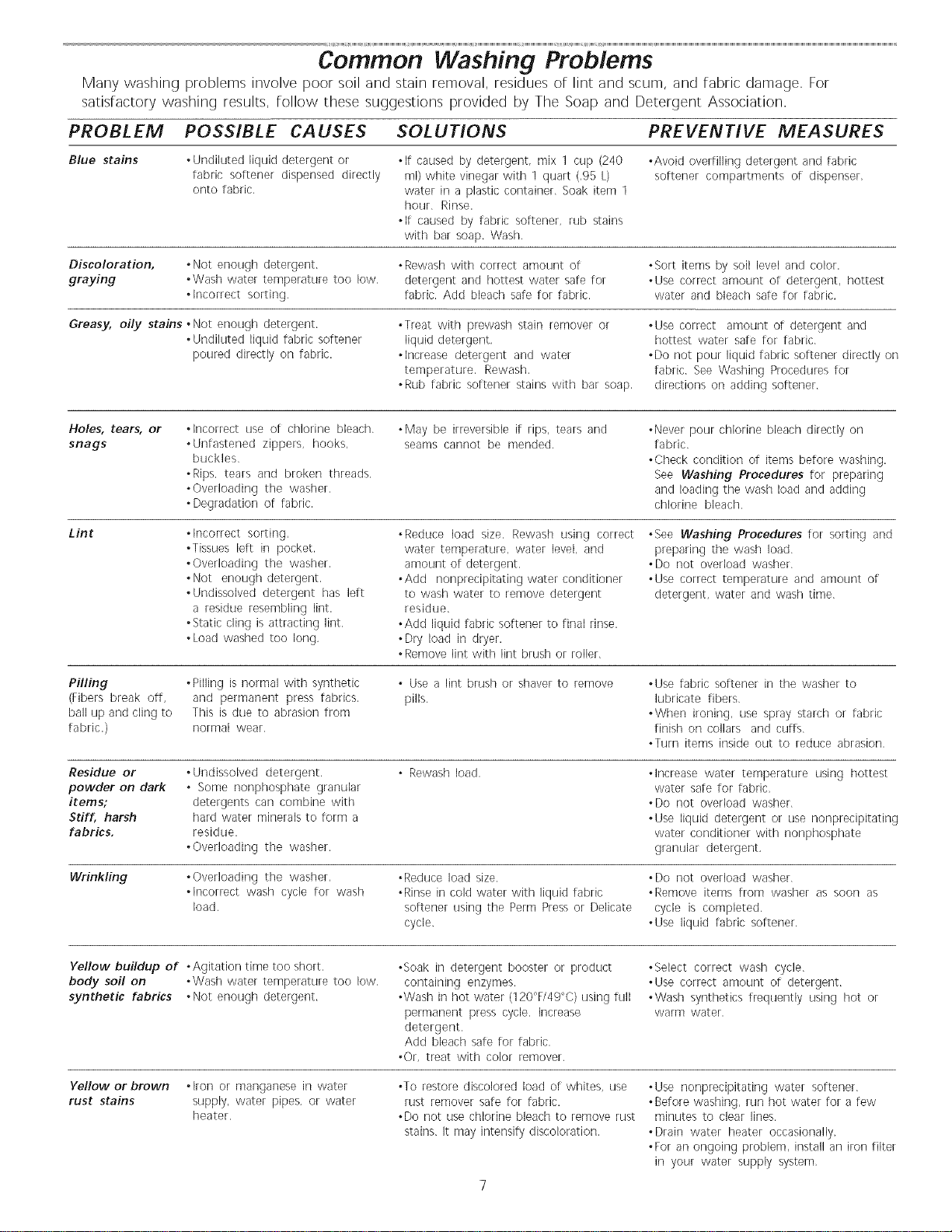
Common Washing Problems
Many washing problems involve poor soil and stain removal, residues of lint and scum, and fabric damage. For
satisfactory washing results, follow these suggestions provided by The Soap and Detergent Association.
PROBLEM POSSIBLE CAUSES SOLUTIONS PREVENTIVE MEASURES
Blue stains ,Undiluted liquid detergent or ,If caused by detergent, rrfix 1 cup (240 ,Avoid overfilling detergent and fabric
fabric softener dispensed directly ml) white vinegar with 1 quart (.95 L) softener compartments of dispenser.
onto fabric, water in a plastic container. Soak item 1
hour. Rinse.
• If caused by fabric softener, rub stains
with bar soap. Wash.
Discoloration, ,Not enough detergent. ,Rewash with correct amount of ,Sort items by soil level and color.
graying ,Wash water temperature too low. detergent and hottest water safe for ,Use correct amount of detergent, hottest
,Incorrect sorting, fabric. Add bleach safe for fabric, water and bleach safe for fabric.
Greasy, oily stains, Not enough detergent.
, Undiluted liquid fabric softener
poured directly on fabric.
• Treat with prewash stain remover or
liquid detergent.
• increase detergent and water
temperature. Rewash.
• Rub fabric softener stains with bar soap.
• Use correct amount of detergent and
hottest water safe for fabric.
• Do not pour liquid fabric softener directly on
fabric. See Washing Procedures for
directions on adding softener.
Holes, tears, or
snags
Lint
Pilling
(Fibers break off,
ball up and cling to
fabric.)
_esidue or
powder on dark
items;
Stiff, harsh
fabrics.
Wrinkling
,incorrect use of chlorine bleach.
,Unfastened zippers, hooks,
buckles.
,Rips, tears and broken threads.
,Overloading the washer.
, Degradation of fabric.
• May be irreversible if rips, tears and
seams cannot be mended.
• Never pour chlorine bleach directly on
fabric.
• Check condition of items before washing.
See Washing Procedures for preparing
and loading the wash load and adding
chlorine bleach.
, incorrect sorting.
,Tissues left in pocket.
,Overloading the washer.
,Not enough detergent.
,Undissolved detergent has left
a residue resembling lint.
,Static cling is attracting lint.
, Load washed too long.
• Reduce load size. Rewash using correct
water temperature, water level, and
amount or detergent.
• Add nonprecipitating water conditioner
to wash water to remove detergent
residue.
• Add liquid fabric softener to final rinse.
• Dry load in dryer.
• Remove lint with lint brush or roller.
• See Washing Procedures for sorting and
preparing the wash load.
• Do not overload washer.
• Use correct temperature and amount of
detergent, water and wash time.
,Pilling is normal with synthetic
and permanent press fabrics.
This is due to abrasion from
normal wear.
• Use a lint brush or shaver to remove
pills.
• Use fabric softener in the washer to
lubricate fibers.
• When ironing, use spray starch or fabric
finish on collars and cuffs.
• Turn items inside out to reduce abrasion.
, Undissolved detergent.
, Some nonphosphate granular
detergents can combine with
hard water minerals to form a
residue.
,Overloading the washer.
• Rewash load.
• increase water temperature using hottest
water sate for fabric.
• Do not overload washer.
• Use liquid detergent or use nonprecipitating
water conditioner with nonphosphate
granular detergent.
,Overloading the washer.
,incorrect wash cycle for wash
load,
• Reduce load size.
• Rinse in cold water with liquid fabric
softener using the Perm Press or Delicate
cycle.
• Do not overload washer.
• Remove items from washer as soon as
cycle is completed.
• Use liquid fabric softener.
Yellow buildup of ,Agitation time too short.
body soil on ,Wash water temperature too low.
synthetic fabrics ,Not enough detergent.
•Soak in detergent booster or product
containing enzymes.
•Wash in hot water (120°F/49°C) using full
permanent press cycle. Increase
detergent.
Add bleach safe for fabric.
,Or. treat with color remover.
• Select correct wash cycle.
• Use correct amount of detergent.
• Wash synthetics frequently using hot or
warm water.
Yellow or brown
rust stains
,iron or manganese in water
supply, water pipes, or water
heater.
•To restore discolored load of whites, use
rust remover safe for fabric.
• Do not use chlorine bleach to remove rust
stains. It may intensify discoloration.
• Use nonprecipitating water softener.
• Before washing, run hot water for a few
minutes to clear lines.
• Drain water heater occasionally.
• For an ongoing problem, install an iron filter
in your water supply system.
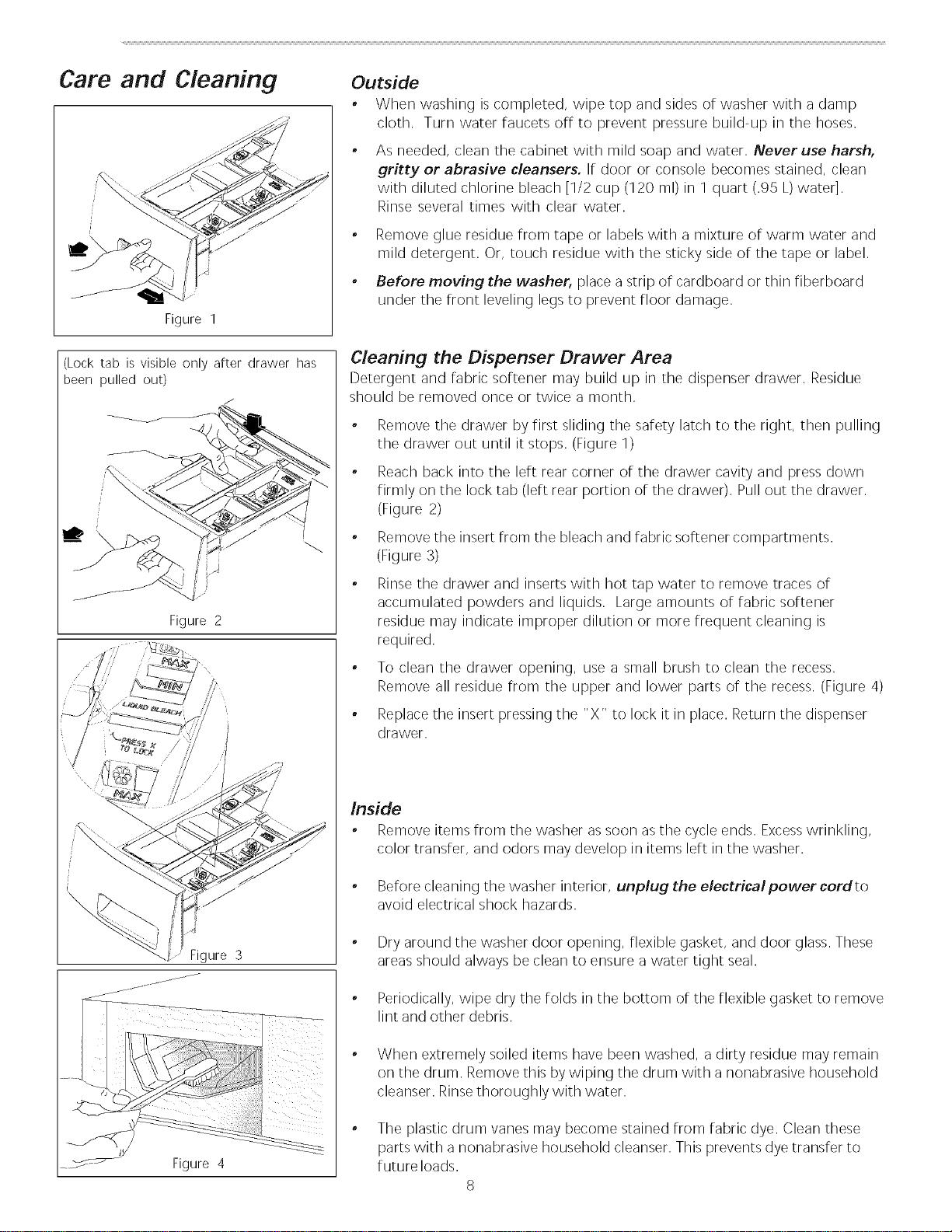
Care and Cleaning
Figure 1
(Lock tab is visible only after drawer has
been pulled out)
J
Figure 2
4
....Figure 3
Figure 4
Outside
, When washing iscompleted, wipe top and sides of washer with a damp
cloth. Turn water faucets off to prevent pressure build-up in the hoses.
, As needed, clean the cabinet with mild soap and water. Never use harsh,
gritty or abrasive cleansers. If door or console becomes stained, clean
with diluted chlorine bleach [1/2 cup (120 ml) in 1 quart (.95 L)water].
Rinse several times with clear water.
,, Remove glue residue from tape or labels with a mixture of warm water and
mild detergent. Or, touch residue with the sticky side of the tape or label.
* Before moving the washer, place a strip of cardboard or thin fiberboard
under the front leveling legs to prevent floor damage.
Cleaning the Dispenser Drawer Area
Detergent and fabric softener may build up in the dispenser drawer. Residue
should be removed once or twice a month.
,, Remove the drawer by first sliding the safety latch to the right, then pulling
the drawer out until it stops. (Figure 1)
- Reach back into the left rear corner of the drawer cavity and press down
firmly on the lock tab (left rear portion of the drawer). Pull out the drawer.
(Figure 2)
- Remove the insert from the bleach and fabric softener compartments.
(Figure 3)
- Rinse the drawer and inserts with hot tap water to remove traces of
accumulated powders and liquids. Large amounts of fabric softener
residue may indicate improper dilution or more frequent cleaning is
required.
- To clean the drawer opening, use a small brush to clean the recess.
Remove all residue from the upper and lower parts of the recess. (Figure 4)
- Replace the insert pressing the "X" to lock it in place. Return the dispenser
drawer.
Inside
,, Remove items from the washer assoot] asthe cycle ends. Excesswrinkling,
color transfer, and odors may develop in items left in the washer.
- Before cleaning the washer interior, unplug the electricalpower cordto
avoid electrical shock hazards.
,, Dry around the washer door opening, flexible gasket, and door glass. These
areasshould always be clean to ensure a water tight seal.
,, Periodically, wipe dry the folds in the bottom of the flexible gasket to remove
lint and other debris.
,, When extremely soiled items have been washed, a dirty residue may remain
on the drum. Remove this bywiping the drum with a nonabrasive household
cleanser. Rinsethoroughly with water.
The plastic drum vanes may become stained from fabric dye. Clean these
parts with a nonabrasive household cleanser. This prevents dye transfer to
future loads.
8
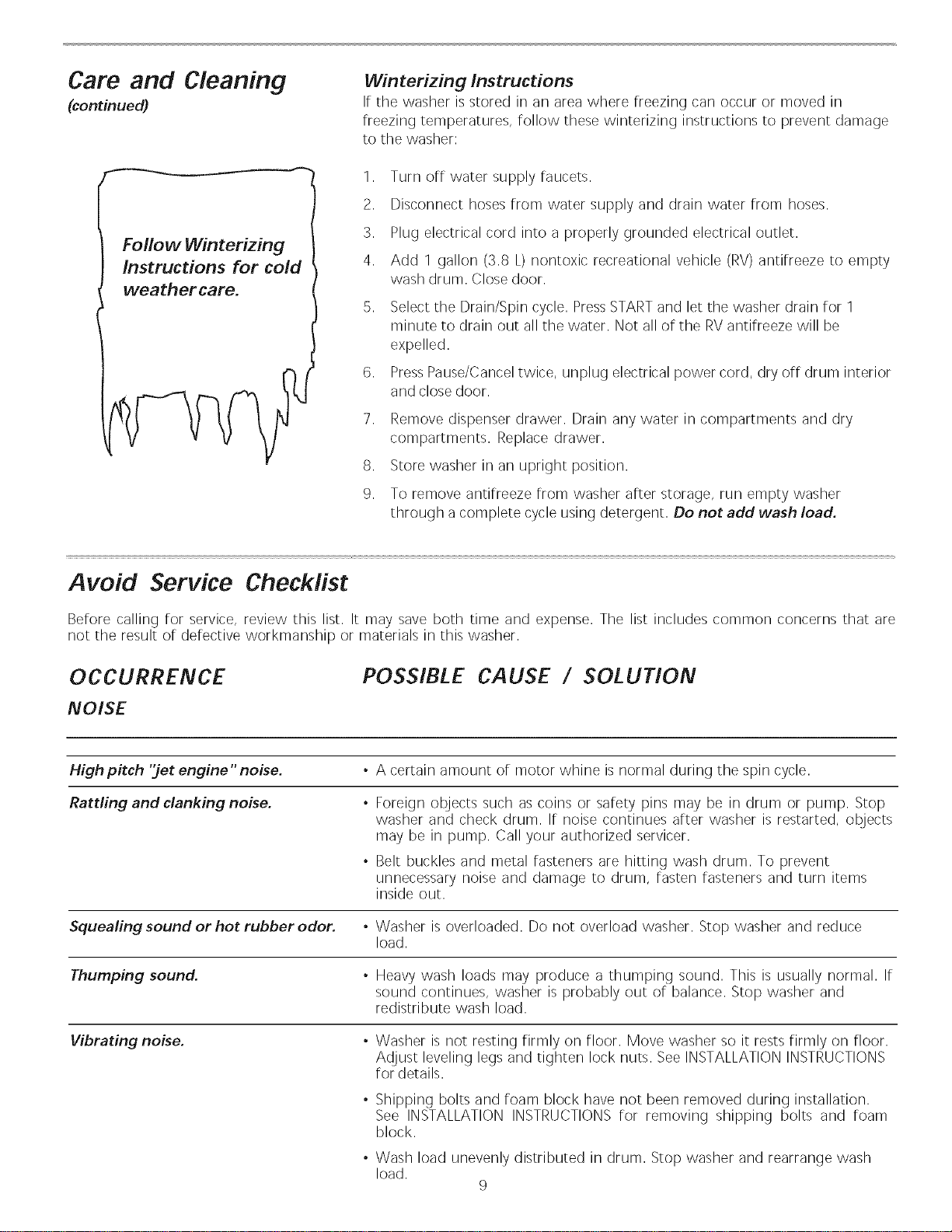
Care and Cleaning
(continued)
Win terizing Ins tructions
If the washer isstored in an area where freezing carl occur or moved in
freezing temperatures, follow these winterizing instructions to prevent damage
to the washer:
Follow Winterizing
Instructions for cold
weather care.
1. Turn off water supply faucets.
2. Disconnect hoses from water supply and drain water from hoses.
3. Plug electrical cord into a properly grounded electrical outlet.
4. Add 1 gallon (3.8 L) nontoxic recreational vehicle (RV)antifreeze to empty
wash drum. Close door.
5. Select the Drain/Spin cycle. PressSTARTand let the washer drain for 1
minute to drain out all the water. Not all of the RVantifreeze will be
expelled.
6. PressPause/Cancel twice, unplug electrical power cord, dry off drum interior
and close door.
7. Remove dispenser drawer. Drain any water in compartments and dry
compartments. Replace drawer.
8. Store washer in an upright position.
9. To remove antifreeze from washer aRer storage, run empty washer
through a complete cycle using detergent. Do not add wash load.
Avoid Service Checklist
Before calling for service, review this list. It may save both time and expense. The list includes common concerns that are
not the result of defective workmanship or materials in this washer.
OCCURRENCE POSSIBLE CAUSE / SOLUTION
NOISE
Highpitch 'Jet engine"noise. • A certain amount of motor whine is normal during the spin cycle.
Rattling and clanking noise. • Foreign objects such as coins or safety pins may be in drum or pump. Stop
washer and check drum. If noise continues after washer is restarted, objects
may be in pump. Call your authorized servicer.
• Belt buckles and metal fasteners are hitting wash drum. To prevent
unnecessary noise and damage to drum, fasten fasteners and turn items
inside out.
Squealing sound or hot rubber odor. • Washer is overloaded. Do not overload washer. Stop washer and reduce
load.
Thumping sound. • Heavy wash loads may produce a thumping sound. This is usually normal. If
sound continues, washer is probably out of balance. Stop washer and
redistribute wash load.
Vibrating noise. • Washer is not resting firmly on floor. Move washer so it rests firmly on floor.
Adjust leveling legs and tighten lock nuts. See INSTALLATIONINSTRUCTIONS
for details.
• Shipping bolts and foam block have not been removed during installation.
See INSTALLATION INSTRUCTIONSfor removing shipping bolts and foam
block.
• Wash load unevenly distributed in drum. Stop washer and rearrange wash
load.
9
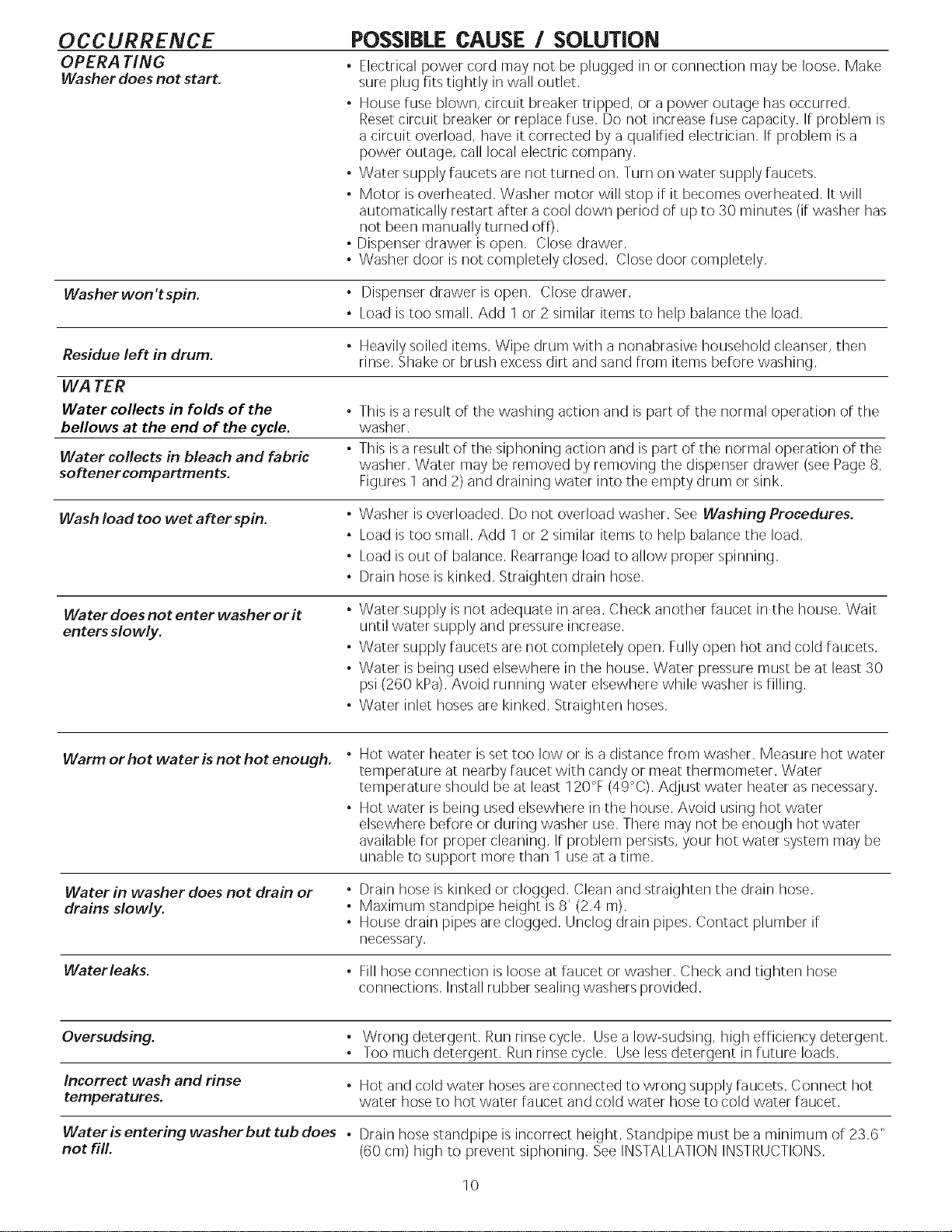
OCCURRENCE
OPERA TING
Washer does not start.
POSSIBLE CAUSE I SOLUTION
• Electrical power cord may not be plugged in or connection may be loose. Make
sure plug fits Lightly in wall outlet.
• House fuse blown, circuit breaker tripped, or a power outage hasoccurred.
Resetcircuit breaker or replace fuse. Do not increase fuse capacity. If problem is
a circuit overload, have it corrected by a qualified electrician. If problem is a
power outage, call local electric company.
• Water supply faucets are not turned on. Turn on water supply faucets.
• Motor isoverheated. Washer motor will stop if iLbecomes overheated. It will
auLomatically restart after a cool down period of up to 30 minutes (if washer has
not been manually turned off).
• Dispenser drawer is open. Close drawer.
• Washer door is not completely closed. Close door completely.
Washer won't spin. • Dispenser drawer isopen. Close drawer.
• Load istoo small. Add 1 or 2 similar items to help balance the load.
• Heavily soiled items. Wipe drum with a nonabrasive household cleanser, then
Residue left in drum. rinse. Shake or brush excess dirt and sand from items before washing.
WA TER
Water collects in folds of the • This is a result of the washing action and ispart of the normal operation of the
bellows at the end of the cycle, washer.
• This isa result of the siphoning action and is part of the normal operation of the
Water collects in bleach and fabric washer. Water may be removed by removing the dispenser drawer (seePage 8,
softenercompartments. Figures 1 and 2) and draining water into the empty drum or sink.
Wash load too wet after spin. • Washer isoverloaded. Do not overload washer. See Washing Procedures.
• Load istoo small. Add 1 or 2 similar items to help balance the load.
• Load isout of balance. Rearrange load Lo allow proper spinning.
• Drain hose is kinked. Straighten drain hose.
Water does not enter washer or it
enters slowly.
• Water supply isnot adequate in area. Check another faucet in the house. Wait
until water supply and pressure increase.
• Water supply faucets are not completely open. Fully open hot and cold faucets.
• Water isbeing used elsewhere in the house. Water pressure must be at least 30
psi (260 kPa). Avoid running water elsewhere while washer isfilling.
• Water inlet hoses are kinked. Straighten hoses.
Warm or hot water is not hot enough.
Hot water healer isset too low or isa distance from washer. Measure hot water
temperature at nearby faucet with candy or meal thermometer. Water
temperature should be aLleast 120°F (49°C). Adjust water heater asnecessary.
Hot water is being used elsewhere in the house. Avoid using hot water
elsewhere before or during washer use. There may not be enough hot water
available for proper cleaning. If problem persists, your hot water system may be
unable Losupport more than 1 use at a Lime.
Water in washer does not drain or • Drain hose is kinked or clogged. Clean and straighten the drain hose.
drains slowly. • Maximum standpipe height is8' (2.4 m).
• House drain pipes are clogged. Unclog drain pipes. Contact plumber if
necessary.
Waterleaks. • Fill hoseconnection is loose aLfaucet or washer. Check and Lighten hose
connections. Install rubber sealing washers provided.
Oversudsing. • Wrong detergent. Run rinse cycle. Usea low-sudsing, high efficiency detergent.
• Too much detergent. Run rinse cycle. Use lessdetergent in future loads.
Incorrect wash and rinse • Hot and cold water hoses are connected to wrong supply faucets. Connect hot
temperatures, water hose Lo hot water faucet and cold water hose Locold water faucet.
Water is entering washerbut tub does • Drain hose standpipe is incorrect height. Standpipe must be a minimum of 23.6"
not fill. (60 cm) high Lo prevent siphoning. See INSTALLATIONINSTRUCTIONS.
10