Gather the required tools and parts before starting installation.
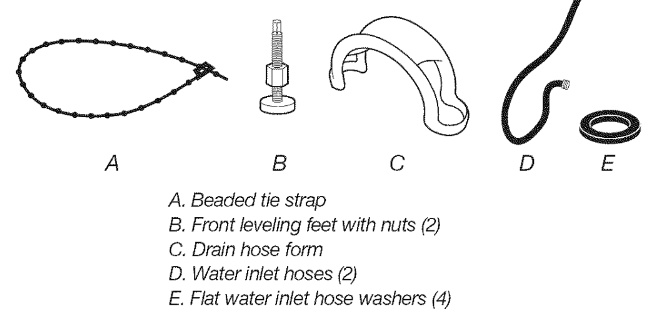
The parts supplied are in the washer basket.
Parts supplied:
Tools needed for installation:
Adjustable or open end wrench 9/16" (14 mm)
Level
Wood block
Ruler or measuring tape
Pliers that open to 1,%6" (3.95 cm)
Flashlight (optional)
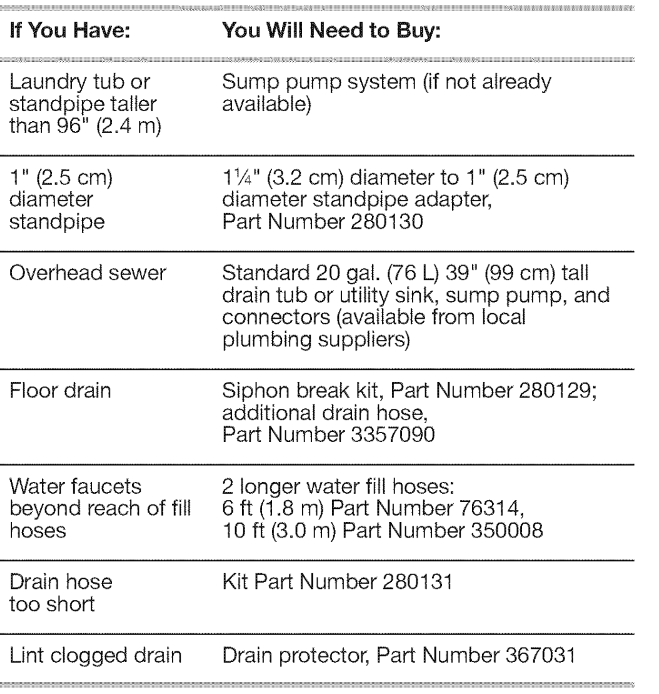
Alternate Parts
Your installation may require additional parts. Parts listed are available from your local Sears store or Sears Service Center. For further information, catl 1-800-4-MY-HOME®(1-800-469-4663).
Location Requirements
Selecting the proper location for your washer improves performance and minimizes noise and possible washer "walk".
Your washer can be installed in a basement, laundry room, closet, or recessed area. See "Drain System."
IMPORTANT: Do not install or store the washer where it will be exposed to the weather.
Proper installation is your responsibility.
You will need:
A water heater set to deliver 120°F (49°C) water to the washer.
A grounded electrical outlet located within 4 ft (1.2 m) of where the power cord is attached to the back of the washer. See "Electrical Requirements."
Hot and cold water faucets located within 3 ft (90 cm) of the hot and cold water fill valves, and water pressure of 5-100 psi kPa). Washers with triple dispensers require psi (138-690 kPa) for best performance.
A level floor with a maximum slope of 1" (2.5 cm) under entire washer. Installing the washer on carpeting is not recommended.
A sturdy floor to support the washer weight (washer, water, and load) of 315 Ibs (143 kgs).
Do not store or operate your washer in temperatures at or below 32°F (0°C). Some water can remain in the washer and can cause damage in tow temperatures. See "Washer Care" in the Washer User Instructions for winterizing information.
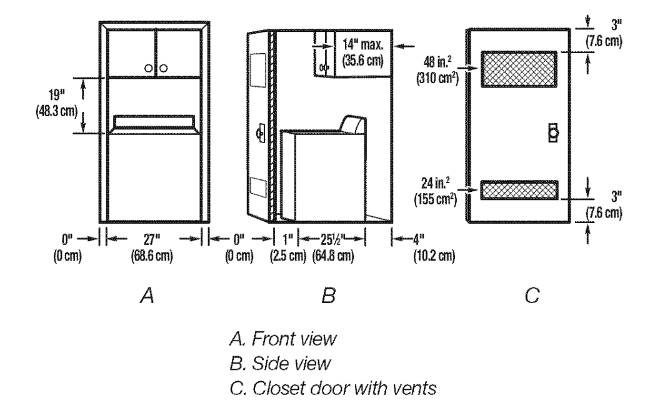
Recessed area or closet installation
The dimensions shown are for the recommended spacing allowed (A and B), except the closet door ventilation openings. The dimensions shown for the closet door ventilation openings (C) are the minimum required.
Additional spacing should be considered for ease of installation and servicing. m Additional clearances may be required for wall, door, and floor moldings. m Additional spacing of 1" (2.5 cm) on all sides of the washer is recommended to reduce noise transfer.
If a closet door is installed, the minimum air openings in the top and bottom of the door are required (C). Louvered doors with air openings in the top and bottom are acceptable.
Companion appliance spacing should also be considered.
Drain System
The washer can be installed using the standpipe drain system (floor or wall), the laundry tub drain system, or the floor drain system. Select the drain hose installation method you need. See "Tools and Parts."
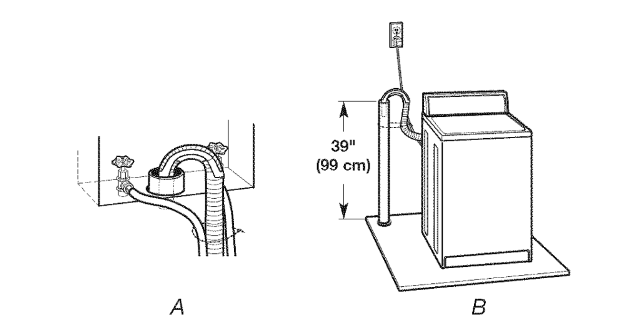
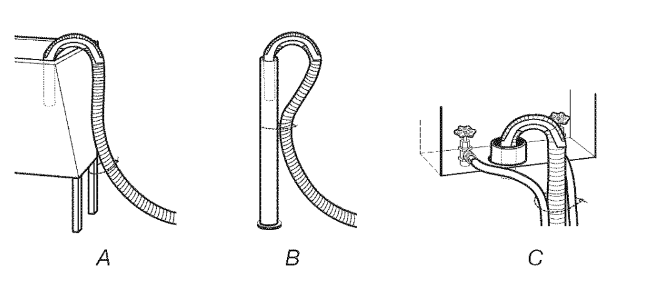
Standpipe drain system--wall or floor (views A & B)
The standpipe drain requires a minimum diameter standpipe of 2" (5 cm). The minimum carry-away capacity can be no less than 17 gal. (64 L) per minute. A I_A" (3.2 cm) diameter to 1" (2.5 cm) diameter standpipe adapter kit is available. See "Tools and Parts."
The top of the standpipe must be at least 39" (99 cm) high and no higher than 96" (244 cm) from the bottom of the washer.
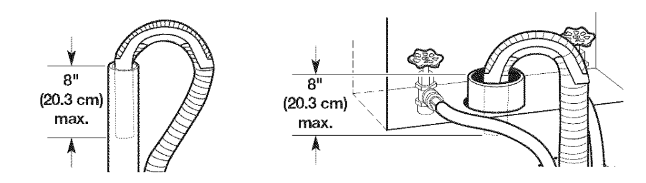
IMPORTANT: To avoid siphoning, no more than 8" (20.3 cm) of drain hose should be inside the standpipe. See "Connect drain hose."
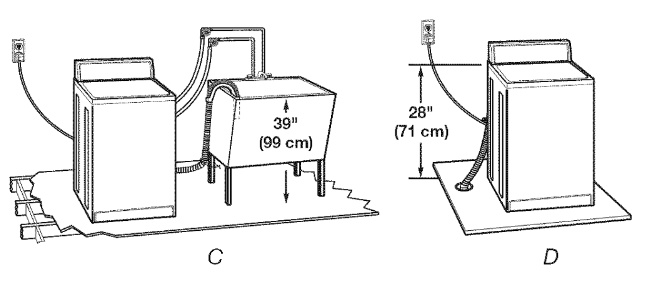
Laundry tub drain system (view C)
The laundry tub needs a minimum 20 gal. (76 L) capacity. The top of the laundry tub must be at least 39" (99 cm) above the floor and no higher than 96" (244 cm) from the bottom of the washer.
Floor drain system (view D)
The floor drain system requires a siphon break that may be purchased separately. See "Tools and Parts."
The siphon break must be a minimum of 28" (71 cm) from the bottom of the washer. Additional hoses might be needed.
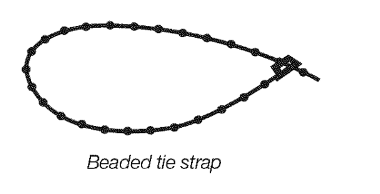
To avoid siphoning, no more than 8" (20.3 cm) of drain hose should be below the top of the wash tub. Secure drain hose with beaded tie strap.
Electrical Requirements
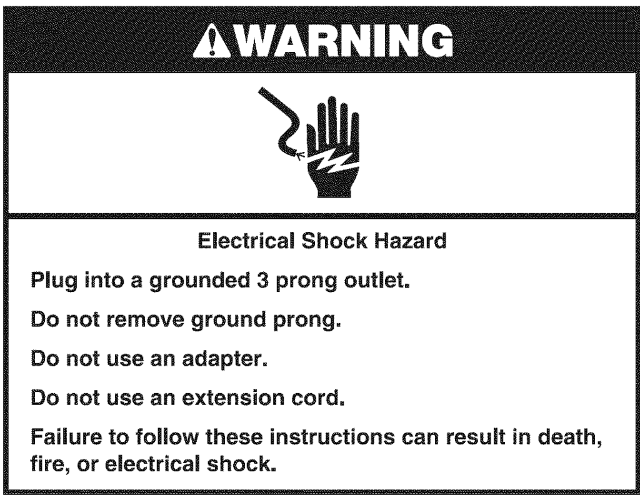
A 120 volt, 60 Hz., AC only, 15- or 20-amp, fused electrical supply is required. A time-delay fuse or circuit breaker is recommended. It is recommended that a separate circuit serving only this appliance be provided.
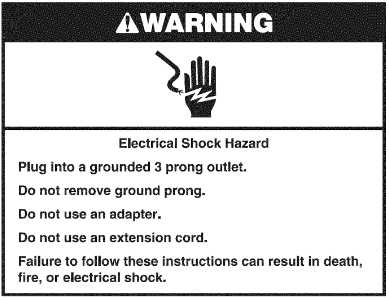
This washer is equipped with a power supply cord having a 3 prong grounding plug.
To minimize possible shock hazard, the cord must be plugged into a mating, 3 prong, grounding-type outlet, grounded in accordance with local codes and ordinances. If a mating outlet is not available, it is the personal responsibility and obligation of the customer to have the properly grounded outlet installed by a qualified electrician.
If codes permit and a separate ground wire is used, it is recommended that a qualified electrician determine that the ground path is adequate.
Do not ground to a gas pipe.
Check with a qualified electrician if you are not sure the washer is properly grounded.
Do not have a fuse in the neutral or ground circuit.
GROUNDING INSTRUCTIONS
For a grounded, cord=connected washer:
This washer must be grounded. In the event of a malfunction or breakdown, grounding will reduce the risk of electrical shock by providing a path of least resistance for electric current. This washer is equipped with a cord having an equipment=grounding conductor and a grounding plug. The plug must be plugged into an appropriate outlet that is properly installed and grounded in accordance with all local codes and ordinances.
WARNING: Improper connection of the equipment- grounding conductor can result in a risk of electric shock. Check with a qualified electrician or serviceman if you are in doubt as to whether the appliance is properly grounded.
Do not modify the plug provided with the appliance -if it will not fit the outlet, have a proper outlet installed by a qualified electrician.
For a permanently connected washer:
This washer must be connected to a grounded metal, permanent wiring system, or an equipment grounding conductor must be run with the circuit conductors and connected to the equipment-grounding terminal or lead on the appliance.
INSTALLATION INSTRUCTIONS
Before You Start
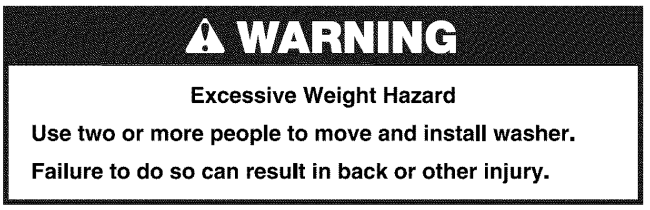
NOTE: To avoid floor damage, set the washer onto cardboard before moving across floor.
Remove Shipping Materials
Removing the shipping material is necessary for proper operation.
If the shipping material is not removed, the washer will make excessive noise.
Move the washer to within approximately 3 ft (90 cm) of its final location.
The washer must be in the upright position and not tilted before removing the shipping material.
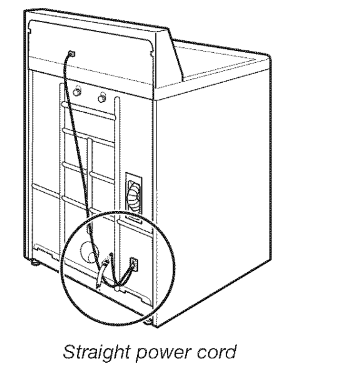
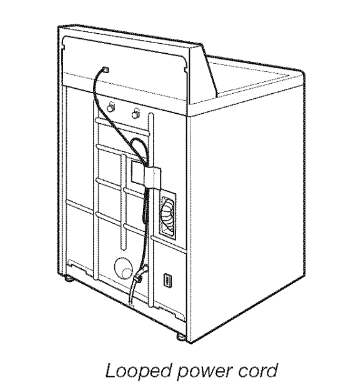
Locate the yellow shipping materials on the rear of the machine, near the bottom. Follow the steps for your particular model, either the one with the straight power cord and cord restraint or the looped power cord version.
Straight power cord
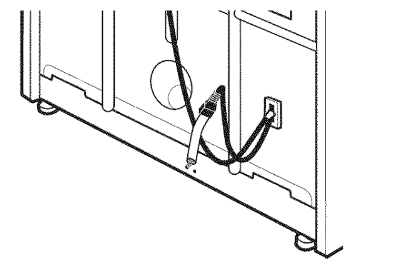
1. Remove power plug and yellow strap from machine base to release the rear beveling system.
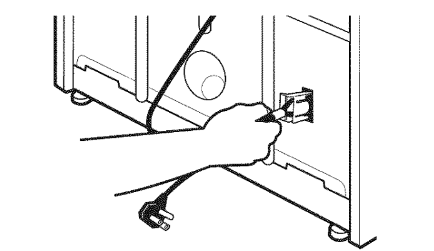
2. Firmly grasp the power cord and pull to completely remove the power cord, cord restraint, and pin from the rear panel.
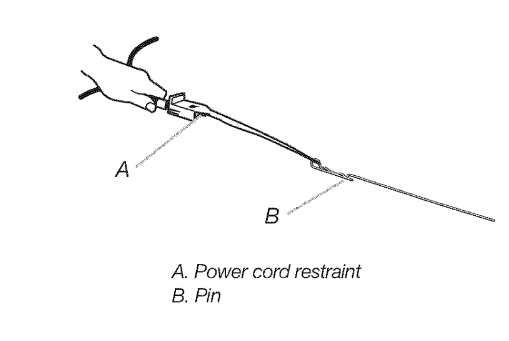
3. Confirm that the power cord restraint (A) and pin (B) are removed.
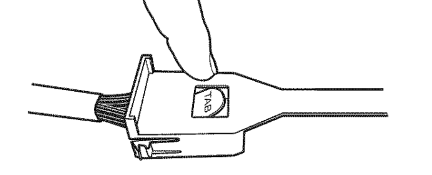
4. To remove the power cord from the cord restraint, push the power cord in, press TAB, and then pull power cord out.
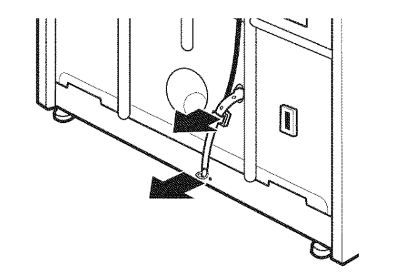
Looped power cord
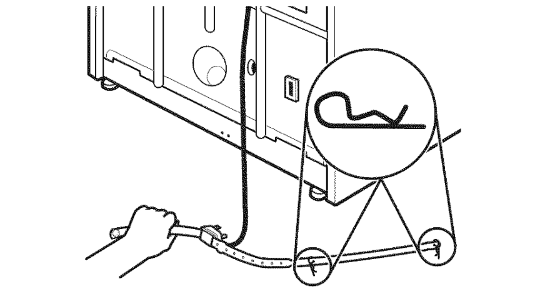
1. Firmly grasp the yellow shipping strap and pull until both ends are completely removed from washer.
2. Check that two (2) cotter pins were removed with the shipping strap.
Connect Drain Hose
Proper connection of the drain hose protects your floors from damage due to water leakage. Read and follow these instructions.
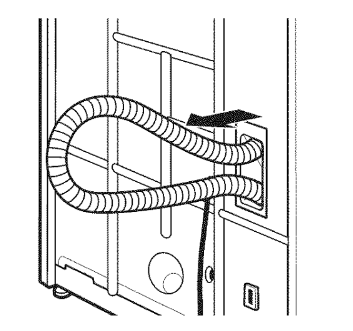
The drain hose is connected to your washer and is stored inside the washer cabinet.
Remove drain hose from washer cabinet
Gently pull the corrugated drain hose out of the washer from the top of the hose. Continue to pull the hose until the end emerges.
Do not force excess drain hose back into the rear of the washer.
Laundry tub drain or standpipe drain
Connecting the drain hose form to the corrugated drain hose
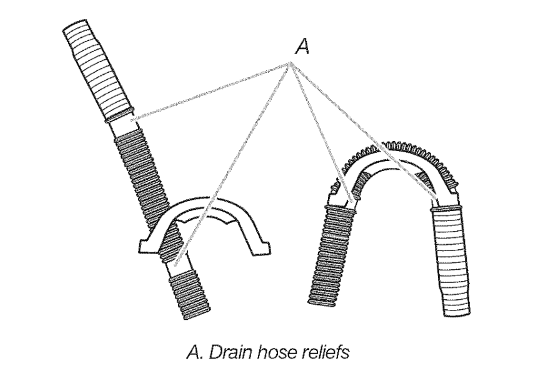
Feed end of drain hose into one end of form. Place end of drain hose form into the drain hose relief.
Bend the hose over the top of the form and feed into the other end of the form.
To avoid siphoning and to keep drain water from going back into the washer:
Do not force excess drain hose into standpipe. Hose should be secure but loose enough to provide a gap for air.
Do not lay excess hose on the bottom of the laundry tub.
IMPORTANT: To avoid siphoning, no more than 8" (20.3 cm) of drain hose should be inside the standpipe. The drain hose form must be used. Secure drain hose with beaded tie strap.
Floor drain
Do not install the drain hose form onto the corrugated drain hose.
You may need additional parts. See Floor drain under "Tools and Parts."
Connect the Inlet Hoses
The new inlet hoses supplied with this washer must be used.
Do not reuse old inlet hoses.
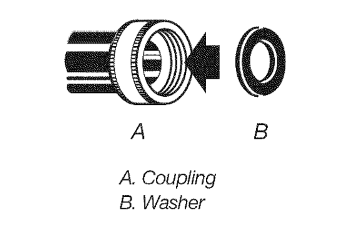
Insert new flat washers (supplied) into each end of the inlet hoses.
Firmly seat the washers in the couplings.
Connect the inlet hoses to the water faucets
Make sure the washer basket is empty.
Attach hose to the hot water faucet. Screw on coupling by hand until it is seated on the washer.
Attach hose to the cold water faucet. Screw on coupling by hand until it is seated on the washer.
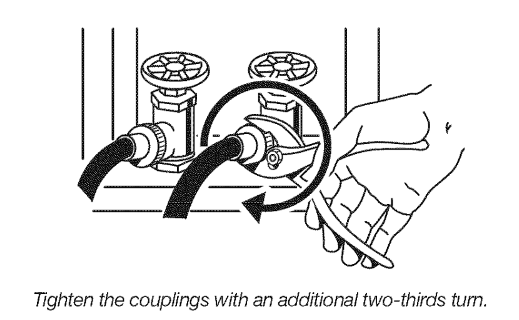
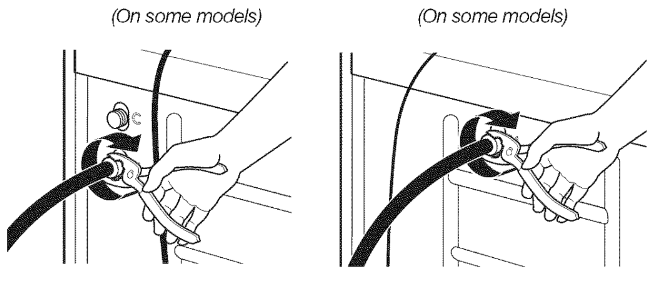
Using pliers, tighten the couplings with an additional two-thirds turn.
NOTE: Do not overtighten or use tape or sealants on the valve. Damage to the valves can result.
Clear the water lines
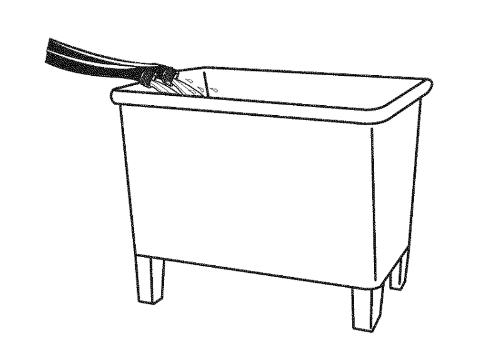
Run water through both faucets and inlet hoses, into a laundry tub, drainpipe, or bucket, to get rid of particles in the water lines that might clog the inlet valve screens.
Check the temperature of the water to make sure that the hot water hose is connected to the hot water faucet and that the cold water hose is connected to the cold water faucet.
Connect the inlet hoses to the washer
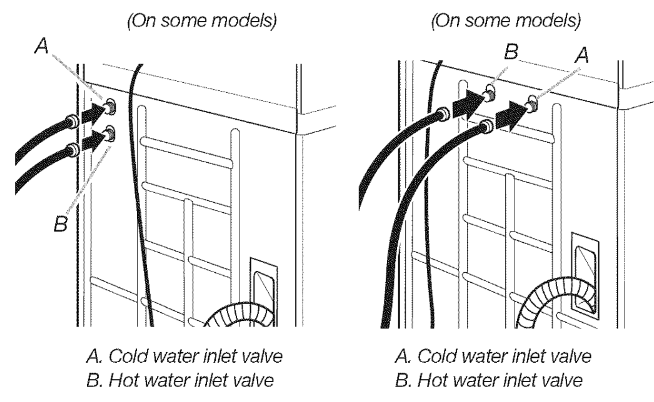
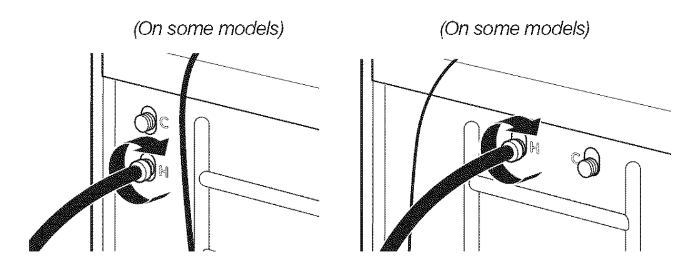
1. Attach the hot water hose to the bottom (or left-hand, on some models) inlet valve.
2. Attaching the hot water coupling first makes it easier to tighten the connection with pliers (on some models).
3. Screw on coupling by hand until it is seated on the washer.
4. Using pliers, tighten the couplings with an additional two-thirds turn.
NOTE: Do not overtighten or use tape or sealants on the valve. Damage to the valves can result.
5. Attach the cold water hose to the top (or right-hand, on some models) inlet valve.
6. Screw on coupling by hand until it is seated on the washer.
7. Using pliers, tighten the couplings with an additional two-thirds turn.
NOTE: Do not overtighten or use tape or sealants on the valve. Damage to the valves can result.
Check for leaks
Turn on the water faucets and check for leaks. A small amount of water might enter the washer. You will drain this later.
NOTE: Replace inlet hoses after 5 years of use to reduce the risk of hose failure. Record hose installation or replacement dates for future reference.
If you connect only one water hose, you must cap off the remaining water inlet port.
Periodically inspect and replace hoses if bulges, kinks, cuts, wear, or leaks are found.
Secure The Drain Hose
1. Remove the shipping material from the power cord. Drape the power cord over the console.
2. Remove any cardboard used to move the washer.
3. Wrap the drain hose to the laundry tub leg, drain standpipe, or inlet hoses with the beaded tie strap. Push fastener into the nearest hole in the beaded tie strap. See view A or B.
If the washer faucets and the drain standpipe are recessed, put the formed end of the drain hose into the standpipe. Tightly wrap the tie strap around the water inlet hoses and the drain hose. See view C.
Level the Washer
Properly leveling your washer avoids excessive noise and vibration.
Install the front leveling feet
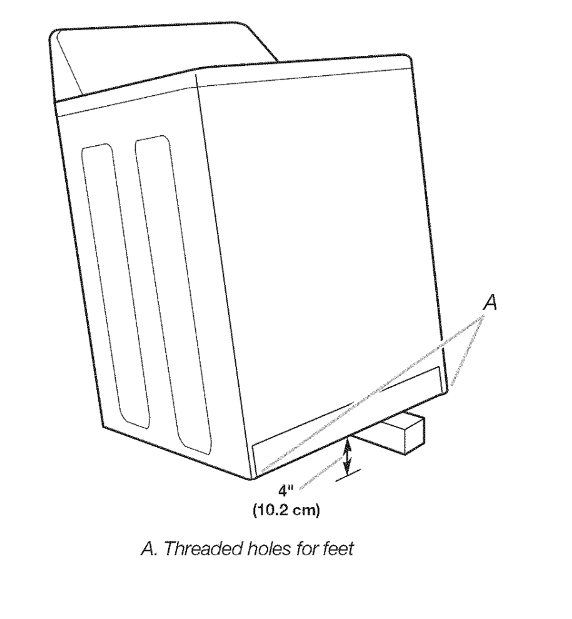
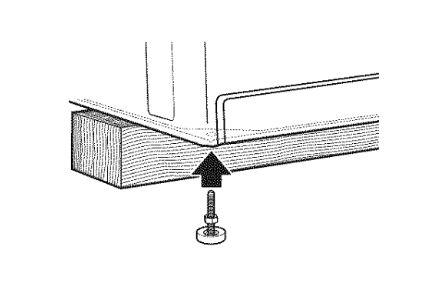
1. Prop up the front of the washer about 4" (10.2 cm) with a wood block or similar object. The block needs to support the weight of the washer.
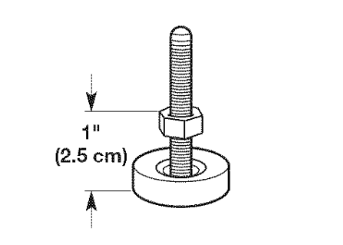
2. Screw the Iock nut onto each foot to within 1" (2.5 cm) of the foot base.
3. Screw the feet into the threaded holes at the front corner of the washer until the nuts touch the washer. Twist the feet to install.
NOTE: Do not tighten the nuts until the washer is level.
4. Tilt the washer back and remove the wood block. Gently lower the washer to the floor.
Steps in final location
1. Slide the washer to its final location.
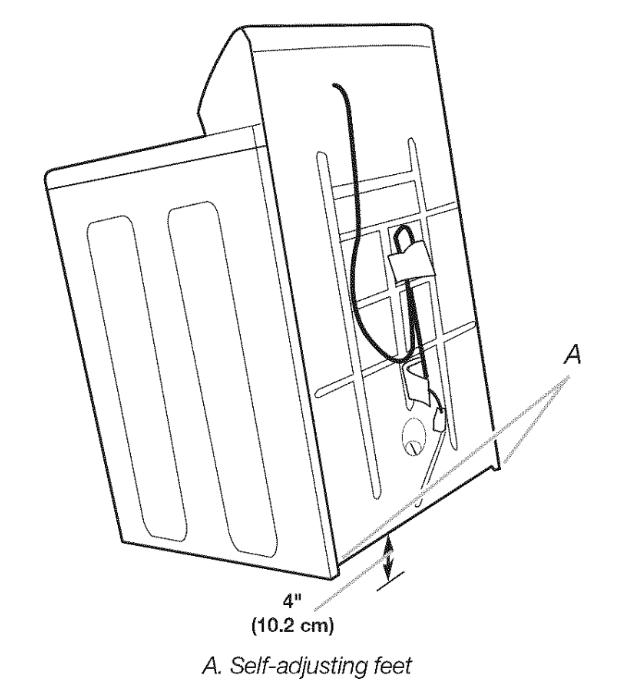
2. Tilt the washer forward until the rear of the washer is at least 4" (10.2 cm) off the floor. You may hear the self-adjusting rear feet click into place. Lower the washer to the floor.
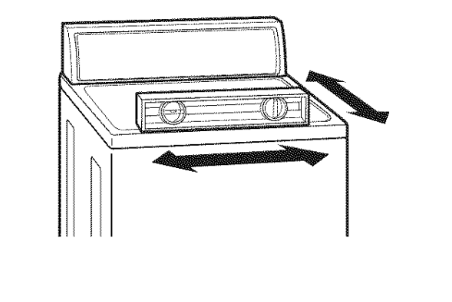
3. Check the levelness of the washer by placing a level on the top edges of the washer, first side to side, then front to back.
4. If the washer is not level, move the washer out slightly, tip back, prop up the front of the washer with the wood block and adjust the feet up or down as necessary by twisting the feet. Turn the feet clockwise to raise the washer or counterclockwise to lower the washer. Repeat steps 1 through 4 until washer is level.
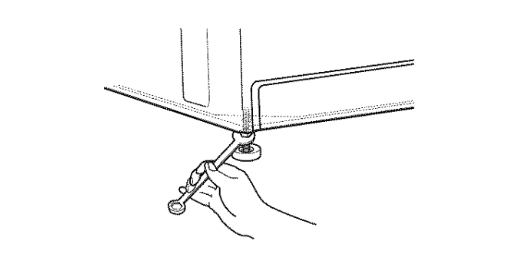
5. After the washer is in the final location and level, use a 9_6" or 14 mm open-end wrench to turn the nuts counterclockwise on the feet tightly against the washer cabinet.
IMPORTANT: If the nuts are not tight against the washer cabinet, the washer may vibrate.
Complete Installation
1. Check the electrical requirements. Be sure that you have the correct electrical supply and the recommended grounding method. See "Electrical Requirements."
2. Check that all parts are now installed. If there is an extra part, go back through the steps to see which step was skipped.
3. Check that you have all of your tools.
4. Check that the yellow shipping materials were completely removed from the lower back of the washer.
5. Dispose of/recycle all packaging materials.
6. Check that the water faucets are on.
7. Check for leaks around faucets and inlet hoses.
8. Plug into a grounded 3 prong outlet.
9. Remove the protective film on the console and any tape remaining on the washer.
10. Read "Washer Use" in the Washer User Instructions.
11. To test and to clean your washer, measure 1_of the normal recommended amount of powdered or liquid detergent and pour it into the washer basket or detergent dispenser (on some models). Close the lid. Select any cycle, and then pull the cycle control knob out to start the washer. Allow it to complete one whole cycle.