i r
Save This Manual
For Future Reference
Sears
owners
manual
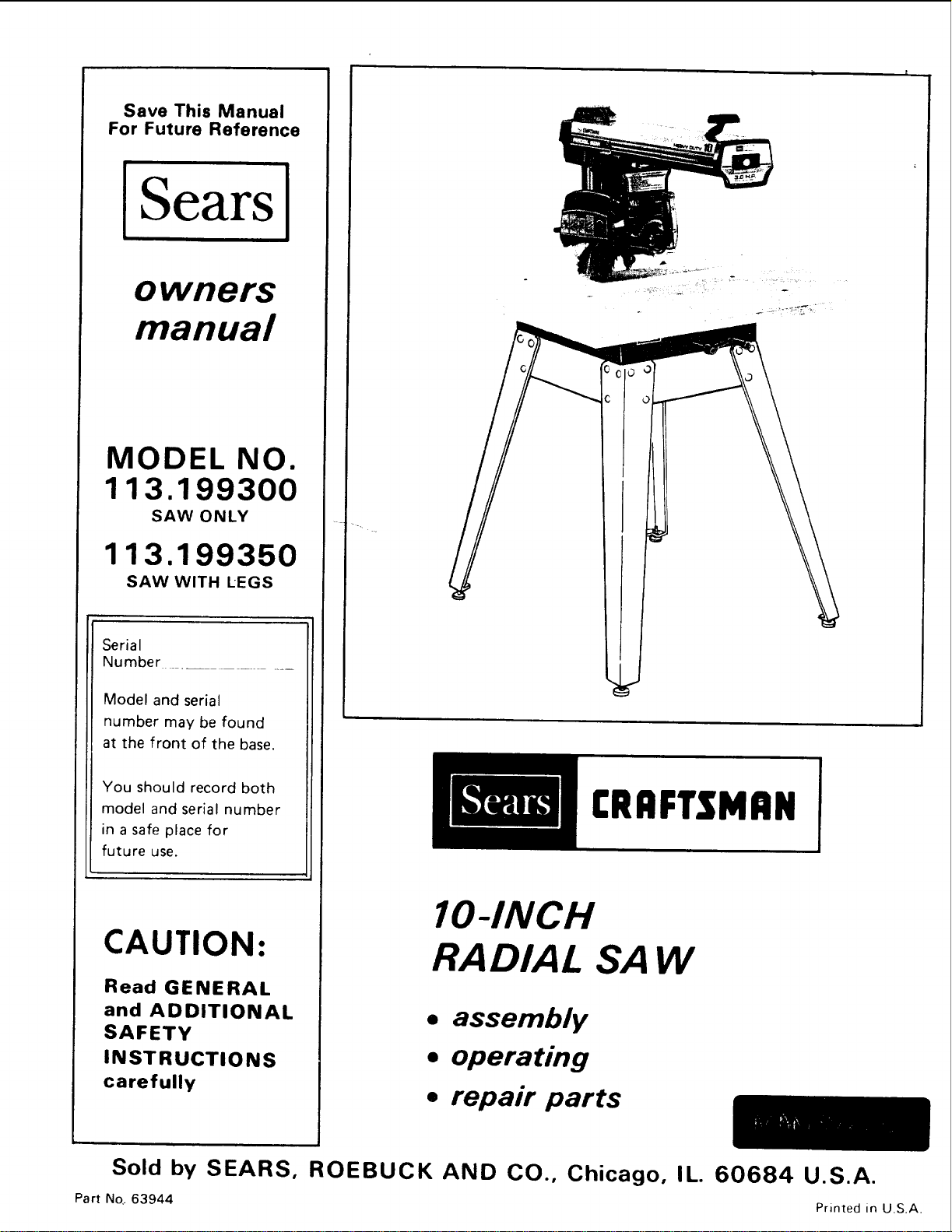
MODEL NO.
113.199300
SAW ONLY
113.199350
SAW WITH kEGS
Serial
Number ...........
Model and serial
number may be found
at the front of the base.
You should record both
model and serial number
in a safe place for
future use.
CAUTION:
Read GENERAL
and ADDITIONAL
SAFETY
INSTRUCTIONS
carefully
£RRFTSMRN
IO-INCH
RADIAL SAW
• assembly
• operating
• repair parts
Sold by SEARS, ROEBUCK AND CO., Chicago, IL. 60684 U.S.A.
Part No 63944 Printed in U.S.A.
FULL ONE YEAR WARRANTY ON CRAFTSMAN RADIAL SAW
If within one year from the date of purchase, this Craftsman Radial Saw fails due to a defect in material or
workmanship, Sears will repair it, free of charge.
WARRANTY SERVICE IS AVAILABLE BY SIMPLY CONTACTING THE NEAREST SEARS SERVICE
CENTER/DEPARTMENT THROUGHOUT THE UNITED STATES.
THIS WARRANTY APPLIES ONLY WHILE THIS PRODUCT IS IN USE IN THE UNITED STATES.
This warranty gives you specific legal rights, and you may have other rights which very from state to state.
SEARS, ROEBUCK AND CO., 698F/31A Sears Tower, Chicago, IL 60684
general safety instructions for power tools
1. KNOW YOUR POWER TOOL
Read and understand the owner's manual and labels
affixed to the tool. Learn its applications and
limitations as well as the specific potential hazards
peculiar to this tool.
2. GROUND ALL TOOLS
This tool bs equipped with an approved 3-conductor
cord and a 3-prong grounding type plug to fit the
proper grounding type receptacle. The green conductor
in the cord is the grounding wire. Never connect the
green wire to a live terminal.
3. KEEP GUARDS IN PLACE
in working order, and in proper adjustment and
alignment.
4. REMOVE ADJUSTING KEYS
AND WRENCHES
Form habit of checking to see that keys and adjusting
wrenches are removed from tool before turning it on.
5. KEEP WORK AREA CLEAN
Cluttered areas and benches invite accidents. Floor
must not be slippery due to wax or sawdust.
6. AVOID DANGEROUS ENVIRONMENT
Don't use power tools in damp or wet locations or
expose them to rain. Keep work area well lighted.
Provide adequate surrounding work space.
7. KEEP CHILDREN AWAY
All visitors should be kept a safe distance from work
area.
8. MAKE WORKSHOP KID-PROOF
- with padlocks, master switches, or by removing
starter keys.
9. DON'T FORCE TOOL
It will do the job better and safer at the rate for which
it was designed.
10. USE RIGHT TOOL
Don't force tool or attachment to do a job it was not
designed for.
11. WEAR PROPER APPAREL
Do not wear loose clothing, gloves, neckties or jewelry
(rings, wrist watches) to get caught in moving parts.
Nonslip footwear is recommended. Wear protective
hair covering to contain long hair. Roll long sleeves
above the elbow.
12. USE SAFETY GOGGLES (Head Protection)
Wear Safety goggles (must comply with ANS Z87.1) at
all times. Everyday eyeglasses only have impact
resistant lenses, they are NOT safety glasses. Also, use
face or dust mask if cutting operation is dusty, and ear
protectors (plugs or muffs) during extended periods of
operation.
13. SECURE WORK
Use clamps or a vise to hold work when practical. It's
safer than using your hand, frees both hands to operate
tool.
14. DON'T OVERREACH
Keep proper footing and balance at all times.
15.
16.
17.
18.
19.
20.
MAINTAIN TOOLS WITH CARE
Keep tools sharp and clean for best and safest
performance. Follow instructions for lubricating and
changing accessories.
DISCONNECT TOOLS
before servicing; when changing accessories such as
blades, bits, cutters, etc.
AVOID ACCIDENTAL STARTING
Make sure switch is in "OFF" position before plugging
in.
USE RECOMMENDED ACCESSORIES
Consult the owner's manual for recommended
accessories. Follow the instructions that accompany
the accessories. The use of improper accessories may
cause hazards.
NEVER STAND ON TOOL
Serious injury could occur if the tool is tipped or if the
cutting tool is accidentally contacted.
Do not store materials above or near the tool such that
it is necessary to stand on the tool to reach them.
CHECK DAMAGED PARTS
Before further use of the tool, a guard or other part that
is damaged should be carefully checked to ensure that it
will operate properly and perform its intended function.
Check for alignment of moving parts, binding of moving
parts, breakage of parts, mounting, and any other
conditions that may .affect its operation. A guard or
other part that is damaged should be properly repaired
or replaced.
21. DIRECTION OF FEED
Feed work into a blade or cutter against the direction
of rotation of the blade or cutter only.
22. NEVER LEAVE TOOL RUNNING
UNATTENDED
Turn power off. Don't leave tool until it comes to a
complete stop.
additional safety instructions for radial saws
CAUTION: Always disconnect the power cord before
removing the guard, changing the cutting tool, changing
the set-up or making adjustments. Shut off motor before
performing layout work on the saw table.
WARNING: DO NOT CONNECT POWER CORD UNTIL
THE FOLLOWING STEPS HAVE BEEN SATISFACTORILY
COMPLETED:
I. Assembly and alignment.
II. Examination and operating familiarity with ON-OFF
switch, elevation control, yoke index and lock, bevel
index and lock, carriage lock, guard clamp screw,
spreader and antikickback device, and miter index
and lock.
III. Review and understanding of all Safety Instructions
and Operating Procedures thru-out manual.
INSTALLATION
1. Set carriage lock before moving the saw.
2. Bolt the saw to the floor if it tends to slip. walk, or slide
during normal operation.
3. Mount the saw so the table is approximately 39"
above the floor.
4. Mount the saw so that arm slopes slightly downward
to the rear so the carrige will not roll forward due to
gravity.
5. If you attach any kind of table extensions over 24"
wide to either end of the saw, make sure you either
bolt the saw to the bench or floor as appropriate, or
support the outer end of the extension from the bench
or floor, as appropriate.
MINIMIZE ACCIDENT POTENTIAL
Most accidents are caused by FAILURE TO FOLLOW
setup and operating instructions:
(A) GENERAL
--Avoid awkward hand positions, where a sudden
slip could cause a hand to move intoa sawbladeor
other cutting tool. Never reach in back of or
around the cutting tool with either hand to hold
down the workpiece, or for any other reason; DO
NOT place fingers or hands in the path of the
sawblade.
-- Never saw, dado, mold, or rabbet unless the proper
•guard (complete with all its parts)is installed and
set up as instructed.
- NOTE THE FOLLOWING DANGER LABELS
WHICH APPEAR ON THE FRONT OF THE YOKE
AND GUARD:
DANGER I
| RAe ANO_NO_S_AN00WNI r SMA_,IAI 8_10e_RATING _ACHINt INJ U R Y CO
_fA_SAFf_0_LES NOT FE_O "
I_uw H()w T0 IV0tD _ICIBAC_S MATFRIA t
T_I o_OPeratiON TOOt. F _OM
If any part of this radial saw is missing or should
break, bend or fail in any way. or any electrical
component fail to perform properly, shut off power
switch, remove cord from power supply and
replace damaged, missing and/or failed parts
before resuming operation.
tF YOUR SAW MAKES AN UNFAMILIAR NOISE
OR IF IT VIBRATES EXCESSIVELY CEASE
OPERATING IMMEDIATELY UNTIL THE
SOURCE HAS BEEN LOCATED AND THE
PROBLEM CORRECTED
-- WARNING: DO NOT ALLOW FAMILIARITY
(GAINED FROM FREQUENT USE OF YOUR
SAW) TO BECOME COMMONPLACE. ALWAYS
REMEMBER THAT A CARELESS FRACTION OF
A SECOND IS SUFFICIENT TO INFLICT SEVERE
INJURY.
-- Before starting work, verify that no play exists
between the column & column support, or in the
carriage, and that arm. yoke. and bevel
locks!clamps are tight.
-- A large proportion of saw accidents is caused by
use of the wrong type blade, dull, badly set,
improperly sharpened cutting tools, by gum or
resin adhering to cutting tools, and by sawblade
misalignment out of parallel with the fence. Such
conditions can cause the material to stick, jam
(stall the saw) or "KICKBACK" at the operator.
NEVER ATTEMPT TO FREE A STALLED SAW
BLADE WITHOUT FIRST TURNING THE SAW
"OFF". tf the sawblade is stalled or jammed, shut
saw "OFF", remove workpiece, and check
sawblade squareness to table surface and to the
fence, and check for heel. Adjust as indicated.
-- CAUTION: DO NOT cycle the motor switch "ON"
and "OFF" rapidly, as this might cause the
sawblade to loosen. In the event this should ever
occur, allow the saw blade to come to a complete
stop and re-tighten the arbor nut normally, not
excessively.
-- Do not leave a long board unsupported so the
spring of the board causes it to shift on the table
Provide proper support for the workpiece, base. 4
on its size and the type of operation to be
performed. Hold the work firmly against the fence.
-- Never use a length stop on the free end or edge of
the workpiece whether crosscutting or ripping.
Never hang onto or touch the free-end of
workpiece when crosscutting, or a free piece that
is cut off while power is "ON" and/or the sawblade
is rotating. In short, the cut-off piece in any
"thru-sawing" operation must never be confined
-- it must be allowed to move laterally.
--Make sure your fingers do not contact the
terminals when installing or-removing the plug to
or from a live power source.
-- Never climb on the saw, or climb near the saw
when power is "ON". Never leave the saw with
power "ON", or before the cutting tool has come to
a complete stop. Lock the motor switch and put
away the key when leaving the saw.
-- Do not use any blade or other cutting tool marked
for an operating speed lower than 3450 RPM
Never use a cutting tool larger in diameter than the
diameter for which the saw was designed. For
greatest safety and efficiency when ripping, use
the maximum diameter blade for which the saw is
designed, since under these conditions the
spreader is nearest the blade.
-- Never turn your saw "ON" before clearing the table
or work surface of all objects (tools, scraps of
wood, etc.) except the workpiece and related feed
or support devices for the operation planned.
-- Do not perform layout, assembly, or setup work on
the table while the cutting tool is rotating
additional safety instructions for radial saws
Never perform any operation "FREE HAND". This heel or by feeding from the wrong direction (see
term means feeding the sawblade into the
wor-kpiece or feeding the workpiece into the
sawblade or other cutting without using the fence
or some other device which prevents rotating or
twisting of the workpiece during the operation.
Never "RIP" in the crosscut position. Never make a
miter cut with the arm in the 90 ° crosscut position.
Never lower a revolving cutting tool into the table
or a workpiece without first locking the Carriage
Lock Knob. Release the knob only after grasping
the Yoke Handle. Otherwise the cutting tool may
grab the table or the workpiece and be propelled
toward you.
The sawblade, dado, or other cutting too! must be
removed from the saw arbor before using the
accessory shaft (rear end of the saw motor).
NEVER operate the saw with cutting tools
(including sanding accessories) installed on both
end of the saw arbor.
Do not use fences made of chipboard -- use 3/4 in.
virgin lumber only, extending in one piece from
end to end of the saw table. The fence should
extend above-the table surface approx, two-thirds
the thickness of the workpiece (for a 1-1/2" thick
workpiece, the fence should be 1 in. high), but
never less than 3/4 in. If a thin facing is added to
the top of the table (to preserve the original table),
fabricate and install a new fence complying with
above height instructions.
(B) RIPPING
Ripping is cutting with the grain or the long way of the
board -- it is performed by pushing the workpiece
along the fence and thru the sawblade (sawblade
parallel to the fence).
1. Neyer apply the feed force to the section of the
workpiece that will become the cut-off (free)
piece. Feed force when ripping must always be
applied between the saw blade and the
fence .. use a "PUSH STICK" or "WORK
HELPERS" (see pg. 26) for rip cuts less than 6 in.
wide. Do not rip anyworkpiece that is shorter than
12 in.
2. Whenever possible, use the in-rip position -- this
provides minimum obstruction for feeding by
hand or push stick as appropriate.
3. Do not release the workpiece before operation is
complete -- push the workpiece all the way past
the rear (outfeed or exit) of the sawblade.
4. Make sure by trial before starting the cut that the
antikickback pawls will stop a kickback once it has
started Keep points of pawls SHARP!
5. CAUTION: Never reposition the Guard or
antikickback with power "ON".
6. A "KICKBACK" occurs during a rip-type
operation when a part or all of the workpiece is
thrown back violently toward the operator. It can
occur when the workpiece closes in on the rear
(outfeed side) of the sawblade (pinching), binds
betweon the fence and the sawblade (heel), or is
grabbed by the sawblade teeth (wrong-way feed)
at the outfeed side. "PINCHING" is generally
avoided by utilization of the spreader, and a sharp
sawblade of the correct type for the workpiece
being cut. "HEEL" can be avoided by maintaining
the sawblade exactly parallel to the fence.
Grabbing by the sawblade teeth can be caused by
"DANGER" warning on guard) --it can be avoided
by maintaining parallelism of sawblade to fence,
feeding into the sawblade from the nose of the
guard only, by positioning the spreader and
antikickback properly, and keeping the workpiece
down on the table and against the fence.
7. Position the nose of the guard to just clear the
workpiece, and position/adjust the antikickback
and spreader devices as instructed.
8. NEVER cut more than one piece at any time by
stacking workpieces vertically.
9. NEVER feed a workpiecethru the saw with another
piece (butting second piece against trailing edge
of piece being cut), even if of the same thickness.
Feed each workpiece individually thru the
sawblade, and completely beyond the sawblade,
before ripping the next workpiece. Use push stick
if the rip cut is less than 6" wide.
10. NEVER feed a workpiece thru the saw with
another piece (butting second piece against
trailing edge of piece being cut), even if of the
same thickness. Feed each workpiece
individually thru the sawblade, and completely
beyond the sawblade, before ripping the next
workpiece. Use push stick if the rip cut is less than
6" wide.
11. NEVER use another person as a substitute for a
table extension, or as additional support for a
workpiece that is longer or wider than the basic
saw table, or to assist in feeding or supporting or
pulling the workpiece.
12. Plastic and composition (like hardboard)
materials may be cut on our saw. However, since
these are usually quite hard and slippery, the
antikickback pawls may not stop a kickback.
Therefore, rip with the finished side down (next to
the table) and be especially attentive to following
proper set-up and cutting procedures. Do not
stand, or permit anyone else to stand, in line with a
potential kickback.
13. When sawing 1/4" or thinner materials, follow all
normal ripping procedures except set sawblade
into table top at least 1/8". DO NOT let go of or
stop feeding the workpiece between the blade and
fence until you have pushed it completely past the
antikickback pawls. Otherwise the workpiece
could get into the back of the sawblade and be
thrown violently from the saw in the direction
opposite to the feed direction. This is the same
action that would occur if the instructions of the
DANGER warning on the guard is aborted. Do not
stand, or permit anyone else to stand, in line with
the path of a workpiece that may be thrown from
the saw in this manner.
14. Position the saw so neither you, a helper, or a
casual observer is forced to stand in line with the
sawblade.
15. Use extra care when ripping wood that has a
twisted grain or is twisted or bowed -- it may rock
on the table and/or pinch the sawblade.
16. Shaping of wood with a dado head or a molding
head can be performed "top-side" (cutting tool
basically vertical and employing sawblade guard)
or "edge" (saw arbor vertical -- cutting tool
horizontal -- and employing the Accessory
molding head guard).
4
17.
18.
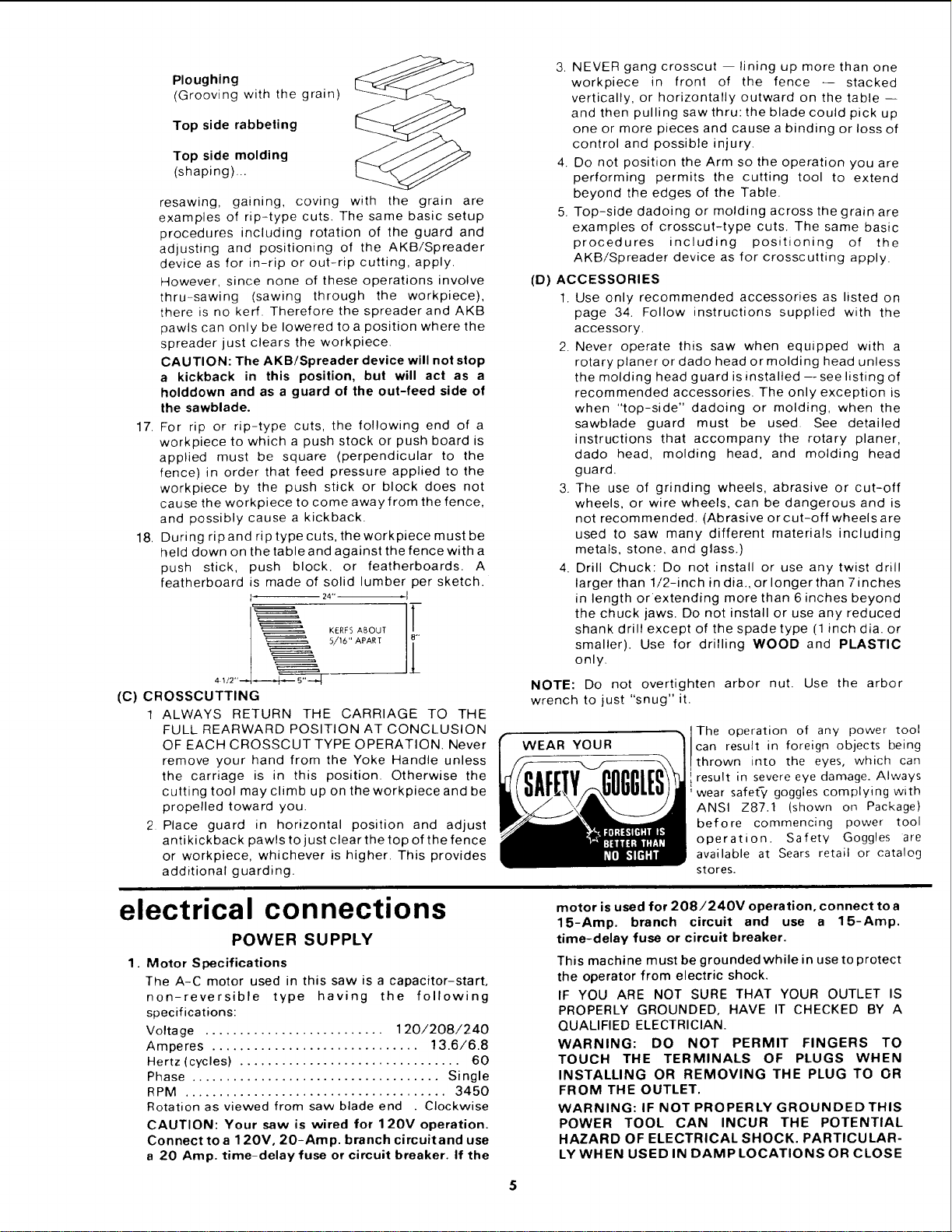
Ploughing
(Grooving with the grain)
Top side rabbeting
Top side molding
(shaping)...
resawing, gaining, coving with the grain are
examples of rip-type cuts. The same basic setup
procedures including rotation of the guard and
adjusting and positioning of the AKB/Spreader
device as for in-rip or out-rip cutting, apply.
However, since none of these operations involve
thru-sawing (sawing through the workpiece),
there is no kerf. Therefore the spreader and AKB
pawls can only be lowered to a position where the
spreader just clears the workpiece.
CAUTION: The AKB/Spreader device will not stop
a kickback in this position, but will act as a
holddown and as a guard of the out-feed side of
the sawblade.
For rip or rip-type cuts, the following end of a
workpiece to which a push stock or push board is
applied must be square (perpendicular to the
fence) in order that feed pressure applied to the
workpiece by the push stick or block does not
cause the workpiece to come away from the fence,
and possibly cause a kickback.
During rip and rip type cuts, the workpiece must be
held down on the table and against the fence with a
push stick, push block, or featherboards. A
featherboard is made of solid lumber per sketch.
I' 24" , I
KERFS ABOUT 11
5/16" APART
4 1/2"_
(C) CROSSCUTTING
1 ALWAYS RETURN THE CARRIAGE TO THE
FULL REARWARD POSITION AT CONCLUSION
OF EACH CROSSCUT TYPE OPERATION. Never
remove your hand from the Yoke Handle unless
the carriage is in this position. Otherwise the
cutting tool may climb up on the workpiece and be
propelled toward you.
2 Place guard in horizontal position and adjust
antikickback pawls to just clear the top of the fence
or workpiece, whichever is higher. This provides
additional guarding.
3. NEVER gang crosscut -- lining up more than one
workpiece in front of the fence -- stacked
vertically, or horizontally outward on the table --
and then pulling saw thru: the blade could pick up
one or more pieces and cause a binding or loss of
control and possible injury.
4. Do not position the Arm so the operation you are
performing permits the cutting tool to extend
beyond the edges of the Table.
5. Top-side dadoing or molding across the grain are
examples of crosscut-type cuts. The same basic
procedures including positioning of the
AKB/Spreader device as for crosscutting apply.
(D) ACCESSORIES
1. Use only recommended accessories as listed on
page 34. Follow instructions supplied with the
accessory.
2. Never operate this saw when equipped with a
rotary planer or dado head or molding head unless
the molding head guard is installed-- see listing of
recommended accessories. The only exception is
when "top-side" dadoing or molding, when the
sawblade guard must be used. See detailed
instructions that accompany the rotary planer,
dado head, molding head, and molding head
guard.
3. The use of grinding wheels, abrasive or cut-off
wheels, or wire wheels, can be dangerous and is
not recommended. (Abrasive or cut-off wheels are
used to saw many different materials including
metals, stone, and glass.)
4. Drill Chuck: Do not install or use any twist drill
larger than 1/2-inch in dia., or longer than 7inches
in length orextending more than 6 inches beyond
the chuck jaws. Do not install or use any reduced
shank drill except of the spade type (1 inch dia. or
smaller). Use for drilling WOOD and PLASTIC
only.
NOTE: Do not overtighten arbor nut. Use the arbor
wrench to just "snug" it.
WEAR YOUR
The operation of any power tool
can result in foreign objects being
thrown into the eyes, which can
result in severe eye damage. Always
safety goggles complying with
ANSI Z87.1 (shown on Package)
before commencing power tool
operation. Safety Goggles are
available at Sears retail or catalog
stores.
electrical connections
POWER SUPPLY
1. Motor Specifications
The A-C motor used in this saw is a capacitor-start,
non-reversible type having the following
specifications:
Voltage .......................... 120/208/240
Amperes .............................. 13.6/6.8
Hertz (cycles) ................................ 60
Phase .................................... Single
RPM ...................................... 3450
Rotation as viewed from saw blade end . Clockwise
CAUTION: Your saw is wired for 120V operation.
Connect to a 120V, 20-Amp. branch circuitand use
a 20 Amp. time-delay fuse or circuit breaker. If the
motor is used for 208/240V operation, connect to a
15-Amp. branch circuit and use a 15-Amp.
time-delay fuse or circuit breaker.
This machine must be grounded while in use to protect
the operator from electric shock.
IF YOU ARE NOT SURE THAT YOUR OUTLET IS
PROPERLY GROUNDED, HAVE IT CHECKED BY A
QUALIFIED ELECTRICIAN.
WARNING: DO NOT PERMIT FINGERS TO
TOUCH THE TERMINALS OF PLUGS WHEN
INSTALLING OR REMOVING THE PLUG TO OR
FROM THE OUTLET.
WARNING: IF NOT PROPERLY GROUNDED THIS
POWER TOOL CAN INCUR THE POTENTIAL
HAZARD OF ELECTRICAL SHOCK. PARTICULAR-
LY WHEN USED IN DAMP LOCATIONS OR CLOSE
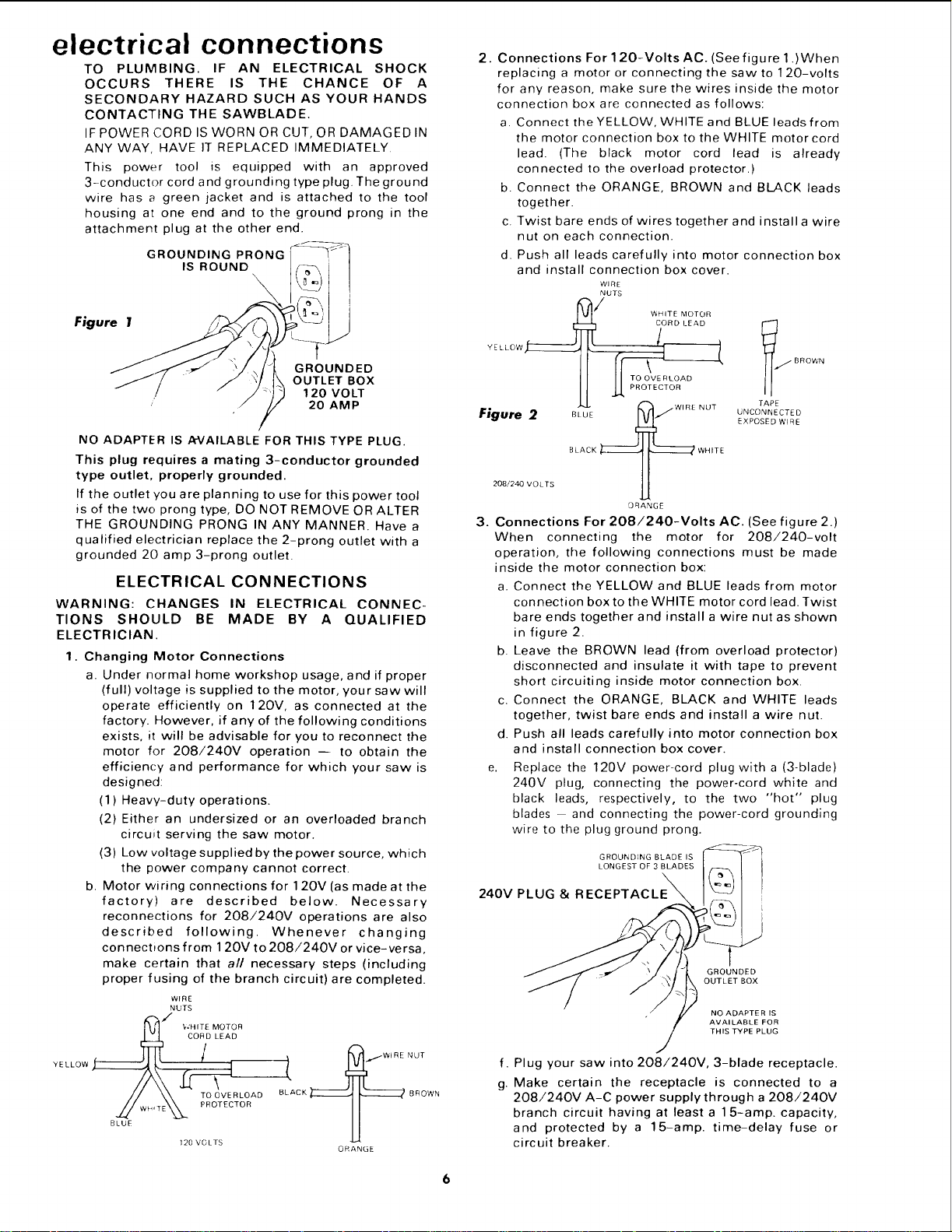
electrical connections
TO PLUMBING. IF AN ELECTRICAL SHOCK
OCCURS THERE IS THE CHANCE OF A
SECONDARY HAZARD SUCH AS YOUR HANDS
CONTACTING THE SAWBLADE.
IF POWER CORD IS WORN OR CUT, OR DAMAGED IN
ANY WAY, HAVE IT REPLACED IMMEDIATELY.
This power tool is equipped with an approved
3-conductor cord and grounding type plug. The ground
wire has a green jacket and is attached to the tool
housing at one end and to the ground prong in the
attachment plug at the other end.
GROUNDING PRONG
IS ROUND
\
Figure 1
GROUNDED
OUTLET BOX
120 VOLT
20 AMP
NO ADAPTER IS AVAILABLE FOR THIS TYPE PLUG.
This plug requires a mating 3-conductor grounded
type outlet, properly grounded.
If the outlet you are planning to use for this power tool
is of the two prong type, DO NOT REMOVE OR ALTER
THE GROUNDING PRONG IN ANY MANNER. Have a
qualified electrician replace the 2-prong outlet with a
grounded 20 amp 3-prong outlet.
ELECTRICAL CONNECTIONS
WARNING: CHANGES IN ELECTRICAL CONNEC-
TIONS SHOULD BE MADE BY A QUALIFIED
ELECTRICIAN.
1. Changing Motor Connections
a. Under normal home workshop usage, and if proper
(full) voltage is supplied to the motor, your saw will
operate efficiently on 120V, as connected at the
factory. However, if any of the following conditions
exists, it will be advisable for you to reconnect the
motor for 208/240V operation -- to obtain the
efficiency and performance for which your saw is
designed:
(1) Heavy-duty operations.
(2) Either an undersized or an overloaded branch
circuit serving the saw motor.
(3) Low voltage supplied by the power source, which
the power company cannot correct.
b. Motor wiring connections for 120V (as made at the
factory) are described below. Necessary
reconnections for 208/240V operations are also
described following. Whenever changing
connections from 120V to 208/240V or vice-versa,
make certain that all necessary steps (including
proper fusing of the branch circuit) are completed.
WIRE
NUTS
,/
CORD LEAD
NUT
YELLOW
BROWN
GRANGE
2. Connections For 120-Volts AC.(See figure 1.)When
replacing a motor or connecting the saw to 120-volts
for any reason, make sure the wires inside the motor
connection box are connected as follows:
a. Connect the YELLOW, WHITE and BLUE leads from
the motor connection box to the WHITE motor cord
lead. (The black motor cord lead is already
connected to the overload protector.)
b. Connect the ORANGE, BROWN and BLACK leads
together.
c. Twist bare ends of wires together and install a wire
nut on each connection.
d. Push all leads carefully into motor connection box
and install connection box cover.
WIRE
NUTS
::: J_ WHITE MOTO l /
CORD LEAD
/
BROWN
F o i_../.. Wl RE NUT U N coTNA_Ec T ED
EXPOSED WIRE
BLACK
WHITE
208/240 VOLTS _ --II _
ORANGE
3. Connections For 208/240-Volts AC. (See figure 2.)
When connecting the motor for 208/240-volt
operation, the following connections must be made
inside the motor connection box:
a. Connect the YELLOW and BLUE leads from motor
connection box to the WHITE motor cord lead. Twist
bare ends together and install a wire nut as shown
in figure 2.
b. Leave the BROWN lead (from overload protector)
disconnected and insulate it with tape to prevent
short circuiting inside motor connection box.
c. Connect the ORANGE, BLACK and WHITE leads
together, twist bare ends and install a wire nut.
d. Push all leads carefully into motor connection box
and install connection box cover.
e. Replace the 120V power-cord plug with a (3-blade)
240V plug, connecting the power-cord white and
black leads, respectively, to the two "hot" plug
blades - and connecting the power-cord grounding
wire to the plug ground prong.
GROUNDING BLADE IS
240V PLUG & RECEPTACLE
GROUNDED
OUTLET BOX
THIS TYPE PLUG
f. Plug your saw into 20B/240V, 3-blade receptacle.
g. Make certain the receptacle is connected to a
208/240V A-C power supply through a 208/240V
branch circuit having at least a 15-amp. capacity,
and protected by a 15-amp. time-delay fuse or
circuit breaker.
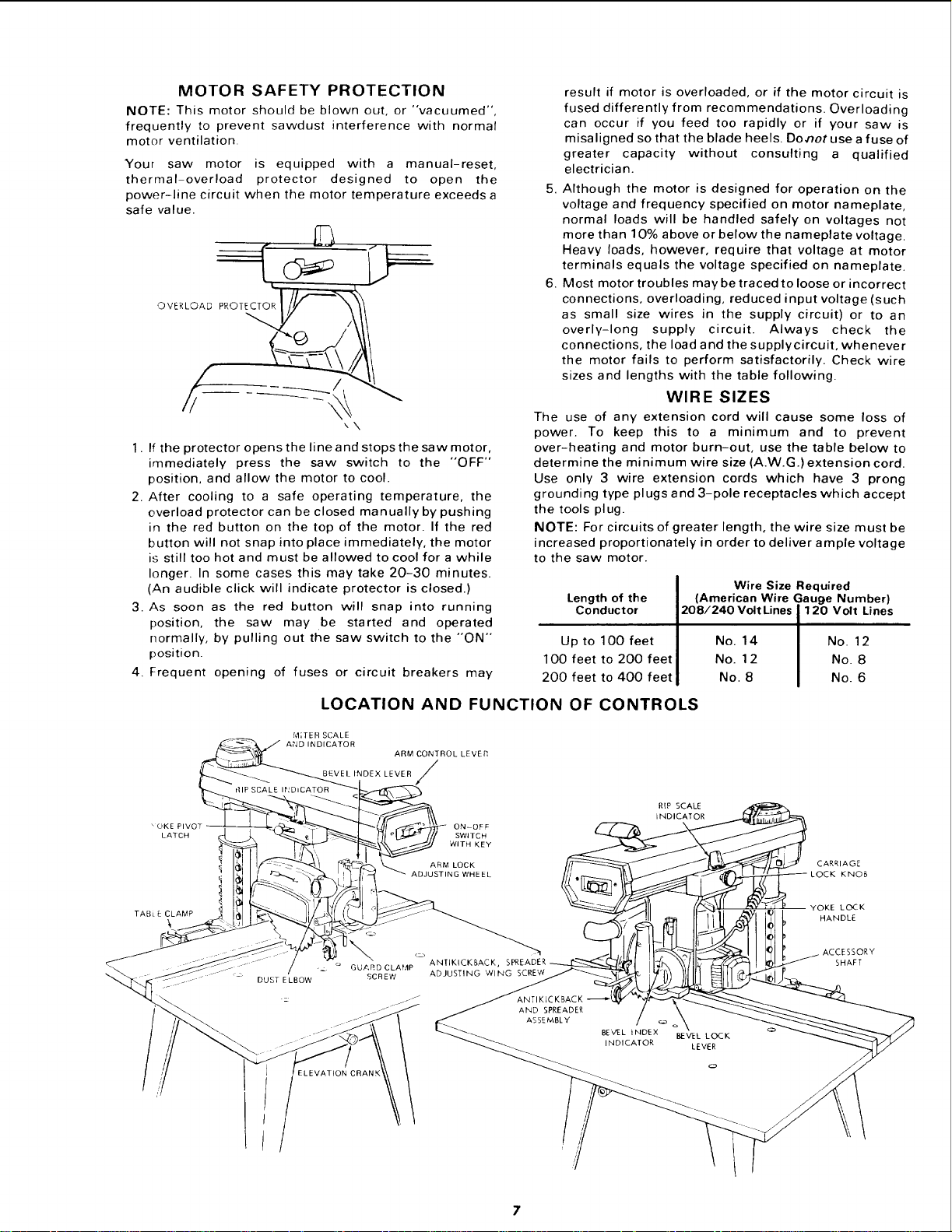
MOTOR SAFETY PROTECTION
NOTE: This motor should be blown out, or "vacuumed",
frequently to prevent sawdust interference with normal
motor ventilation.
Your saw motor is equipped with a manual-reset,
thermal-overload protector designed to open the
power-line circuit when the motor temperature exceeds a
safe value.
OVERLOAD PROTECTOR
\\
1. If the protector opens the li ne and stops the saw motor,
immediately press the saw switch to the "'OFF'"
position, and allow the motor to cool.
2. After cooling to a safe operating temperature, the
overload protector can be closed manually by pushing
in the red button on the top of the motor. If the red
button will not snap into place immediately, the motor
is still too hot and must be allowed to cool for a while
longer. In some cases this may take 20-30 minutes.
(An audible click will indicate protector is closed.)
3. As soon as the red button will snap into running
position, the saw may be started and operated
normally, by pulling out the saw switch to the "'ON"
position.
4. Frequent opening of fuses or circuit breakers may
result if motor is overloaded, or if the motor circuit is
fused differently from recommendations. Overloading
can occur if you feed too rapidly or if your saw is
misaligned so that the blade heels. Do#ot use a fuse of
greater capacity without consulting a qualified
electrician.
5. Although the motor is designed for operation on the
voltage and frequency specified on motor nameplate,
normal loads will be handled safely on voltages not
more than 10% above or below the nameplate voltage.
Heavy loads, however, require that voltage at motor
terminals equals the voltage specified on nameplate.
6. Most motor troubles may be traced to loose or incorrect
connections, overloading, reduced input voltage (such
as small size wires in the supply circuit) or to an
overly-long supply circuit. Always check the
connections, the load and the supplycircuit, whenever
the motor fails to perform satisfactorily. Check wire
sizes and lengths with the table following.
WIRE SIZES
The use of any extension cord will cause some loss of
power. To keep this to a minimum and to prevent
over-heating and motor burn-out, use the table below to
determine the minimum wire size (A.W.G.)extension cord.
Use only 3 wire extension cords which have 3 prong
grounding type plugs and 3-pole receptacles which accept
the tools plug.
NOTE: For circuits of greater length, the wire size must be
increased proportionately in order to deliver ample voltage
to the saw motor.
Wire Size Required
Length of the I (American Wire Gauge Number)
Conductor 1208/240VoltLines 120 Volt Lines
I
Up to 100 feet I No. 14 No. 12
100 feet to 200 feet I No. 12 No. 8
200 feet to 400 feet I No. 8 No. 6
LOCATION AND FUNCTION OF CONTROLS
M;TER SCALE
A;'4D INDICATOR
ARM CONTROL LEVER
LATCH
TABLE CLAMP
\
ON-OFF
SWITCH
WITH KEY
ARM LOCK
ADJUSTING WHEEL
DUST E LBOW
o GU,e, RD CLAMP ANEIKICKBACK,
SCREW ADJUSTING WING SCREW
ANTIKICKBACK
AND SPREADER
ASSEMBLY
ELEVATION CRANK
BEVEL INDEX
INDICATOR
RIP SCALE
INDICATOR
BEVEL LOCK
LEVER
CARRIAGE
LOCK KNO5
YOKE LOCK
HANDLE
ACCESSORY
SHAFT
CONTENTS
Guarantee ........................................ 2
General Safety Instructions for Power Tools ......... 2
Additional Safety Instructions for Radial Saws ....... 3
Electrical Connections .............................. 5
Assembly and Alignment ........................... 8
Unpacking and Preassembly ...................... 8
Alignment Procedures ......................... 12
assembly and alignment
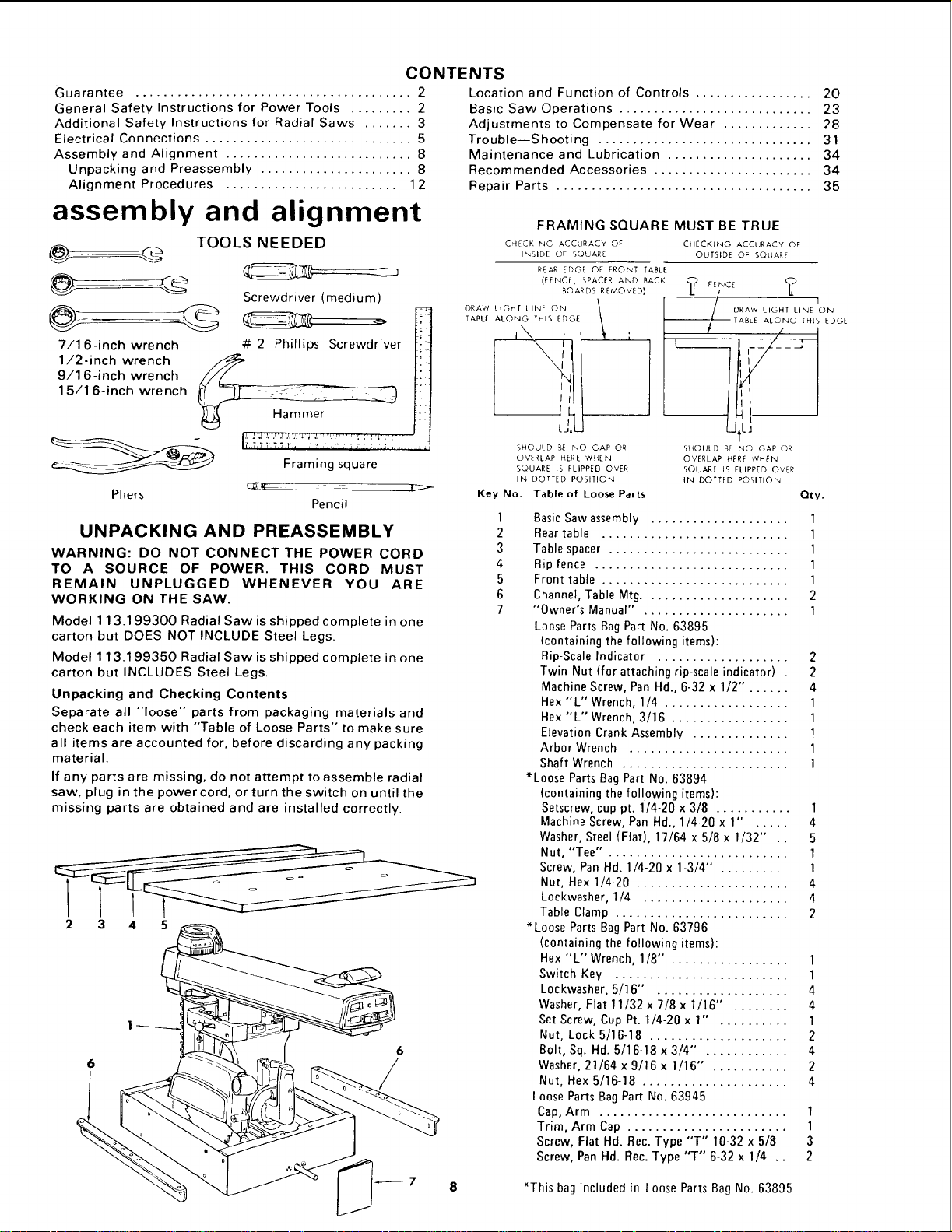
TOOLS NEEDED
..___3
7/1 6-inch wrench
1/2-inch wrench
9/1 6-inch wrench
15/1 6-inch wrench
Pliers
Screwdriver (medium)
# 2 Phillips Screwdriver
i ,i , ,i r., 1_
Framing square
Pencil
UNPACKING AND PREASSEMBLY
WARNING: DO NOT CONNECT THE POWER CORD
TO A SOURCE OF POWER. THIS CORD MUST
REMAIN UNPLUGGED WHENEVER YOU ARE
WORKING ON THE SAW.
Model 113.199300 Radial Saw is shipped complete in one
carton but DOES NOT INCLUDE Steel Legs.
Model 1 13.1 99350 Radial Saw is shipped complete in one
carton but INCLUDES Steel Legs.
Unpacking and Checking Contents
Separate all "loose" parts from packaging materials and
check each item with "Table of Loose Parts" to make sure
all items are accounted for, before discarding any packing
material.
If any parts are missing, do not attempt to assemble radial
saw, plug in the power cord, or turn the switch on until the
missing parts are obtained and are installed correctly.
2 3 4 5
Location and Function of Controls ................. 20
Basic Saw Operations ............................ 23
Adjustments to Compensate for Wear ............. 28
Trouble--Shooting ............................... 31
Maintenance and Lubrication ..................... 34
Recommended Accessories ....................... 34
Repair Parts ..................................... 35
FRAMING SQUARE MUST BE TRUE
CHECKING ACCURACY OF CiiECKLNG ACCURACY OF
INSIDE OF SQUARE OUTSIDE OF SQUARE
REAR EDGE OF FRONT TABLE
(FENCL, SPACER AND RACK (_ FENCE _[_
ROARDS -_--REI4OVED) __/__1
DR AW
LIGHT LINE ON DRAW LIGHT LINE ON
T,kBLE ALONG THIS EDGE ALONG THIS EDGE
li
SHOULD _E NO GAP OR SHOULD BE NO GAP OR
OVERLAP HERE WHEN OVERLAP HERE WHEN
SQUARE IS FLIPPED OVER SQUARE IS FLIPPED OVER
IN DOTTED POSITION IN DOTTED POSITION
Key No. Table of Loose Parts Qty.
1
2
3
4
5
6
7
Basic Saw assembly .................... 1
Rear table ........................... 1
Table spacer .......................... 1
Rip fence ............................ 1
Front table ........................... 1
Channel, Table Mtg ..................... 2
"Owner's Manual" . .................... 1
Loose Parts Bag Part No. 63895
(containing the following items):
Rip-Scale Indicator ................... 2
Twin Nut (for attaching rip-scale indicator) . 2
Machine Screw, Pan Hd., 6-32 x 1/2". ..... 4
Hex "L" Wrench, 1/4 .................. 1
Hex "L" Wrench, 3/16 ................. 1
Elevation Crank Assembly .............. !
Arbor Wrench ....................... 1
Shaft Wrench ........................ 1
*Loose Parts Bag Part No. 63894
(containing the following items):
Setscrew, cup pt. 1/4-20 x 3/8 ........... 1
Machine Screw, Pan Hd., 1/4-20 x 1" . .... 4
Washer, Steel (Flat), 17/64 x 5/8 x 1/32" .. 5
Nut, "Tee" . ......................... 1
Screw, Pan Hd. 1/4-20 x 1-3/4" . ......... 1
Nut, Hex 1/4-20 ...................... 4
Lockwasher, 1/4 ..................... 4
Table Clamp ......................... 2
*Loose Parts Bag Part No. 63796
(containing the following items):
Hex "L"Wrench, 1/8" . ................ 1
Switch Key ......................... 1
Lockwasher, 5/16" . .................. 4
Washer, Flat 11/32 x 7/8 x 1/16" . ....... 4
Set Screw, Cup Pt. 1/4-20 x 1" . ......... 1
Nut, Lock 5/16-18 .................... 2
Bolt, Sq. Hd. 5/16-18 x 3/4" . ........... 4
Washer, 21/64 x 9/16 x 1/16" . .......... 2
Nut, Hex 5/16-18 ..................... 4
Loose Parts Bag Part No. 63945
Cap, Arm ........................... 1
Trim, Arm Cap ....................... 1
Screw, Flat Hd. Rec. Type "T" 10-32 x 5/8 3
Screw, Pan Hd. Rec. Type "T" 6-32 x 1/4 .. 2
_7 8 *This bag included in Loose Parts Bag No. 63895
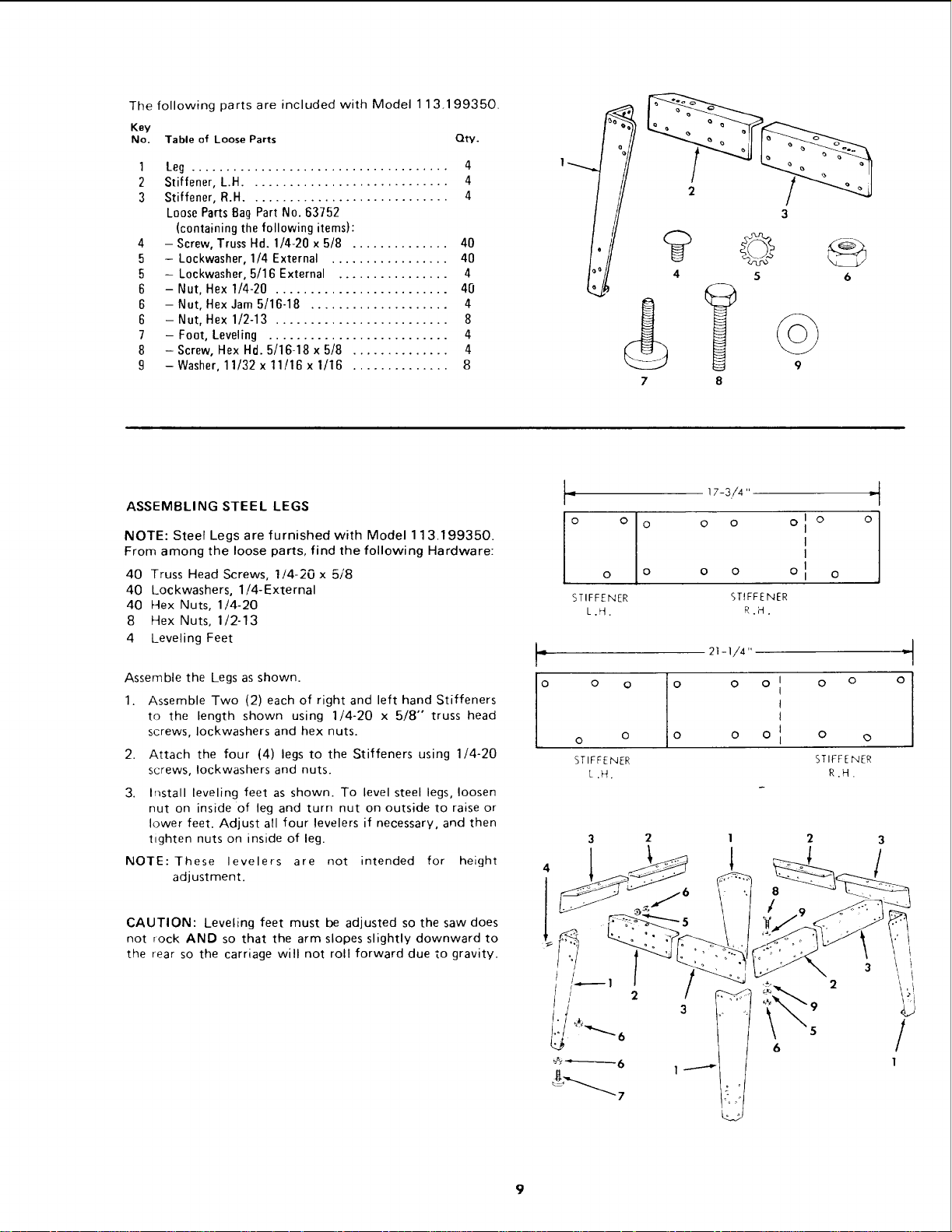
ThefollowingpartsareincludedwithModel113.199350
Key
No. Table of Loose Parts Qty.
1 Leg ..................................... 4
2 Stiffener, L.H ............................. 4
3 Stiffener, R.H ............................. 4
Loose Parts Bag Part No. 63752
(containing the following items):
4 - Screw, Truss Hd. 1/4-20 x 5/8 .............. 40
5 - Lockwasher, 1/4 External ................. 40
5 - Loekwasher, 5/16 External ................ 4
6 - Nut, Hex 1/4-20 ......................... 40
6 - Nut, Hex Jam 5/16-18 .................... 4
6 - Nut, Hex 1/2-13 ......................... 8
7 - Foot, Leveling .......................... 4
8 - Screw, Hex Hd. 5/16-18 x 5/8 .............. 4
9 - Washer, 11/32 x 11/16 x 1/16 .............. 8
J
4
©
5
8
6
ASSEMBLING STEEL LEGS
NOTE: Steel Legs are furnished with Model 113.199350.
From among the loose parts, find the following Hardware:
40 Truss Head Screws, 1/4-20 x 5/8
40 Lockwashers, 1/4-External
40 Hex Nuts, 1/4-20
8 Hex Nuts, 1/2-13
4 Leveling Feet
Assemble the Legs as shown.
1. Assemble Two (2) each of right and left hand Stiffeners
to the length shown using 1/4-20 x 5/8" truss head
screws, Iockwashers and hex nuts.
2. Attach the four (4) legs to the Stiffeners using 1/4-20
screws, Iockwashers and nuts.
3. Install leveling feet as shown. To level steel legs, loosen
nut on inside of leg and turn nut on outside to raise or
lower feet. Adjust all four levelers if necessary, and then
tighten nuts on inside of leg.
NOTE: These levelers are not intended for height
adjustment.
CAUTION: Leveling feet must be adjusted so the saw does
not rock AND so that the arm slopes slightly downward to
the rear so the carriage will not roll forward due to gravity.
I°
==l
O
O
STIFFENER
L.H.
17-3/4 "
0 0 0
o o o
STIFFENER
R.H.
0 0
0
0 0
STIFFENER
L.H.
0 0
O O
0 0 0
STIFFENER
R.H.
_J
-I
°l
_1
°l
2 3
3
/
1
assembly and alignment
REMOVE SKIDS FROM BASE
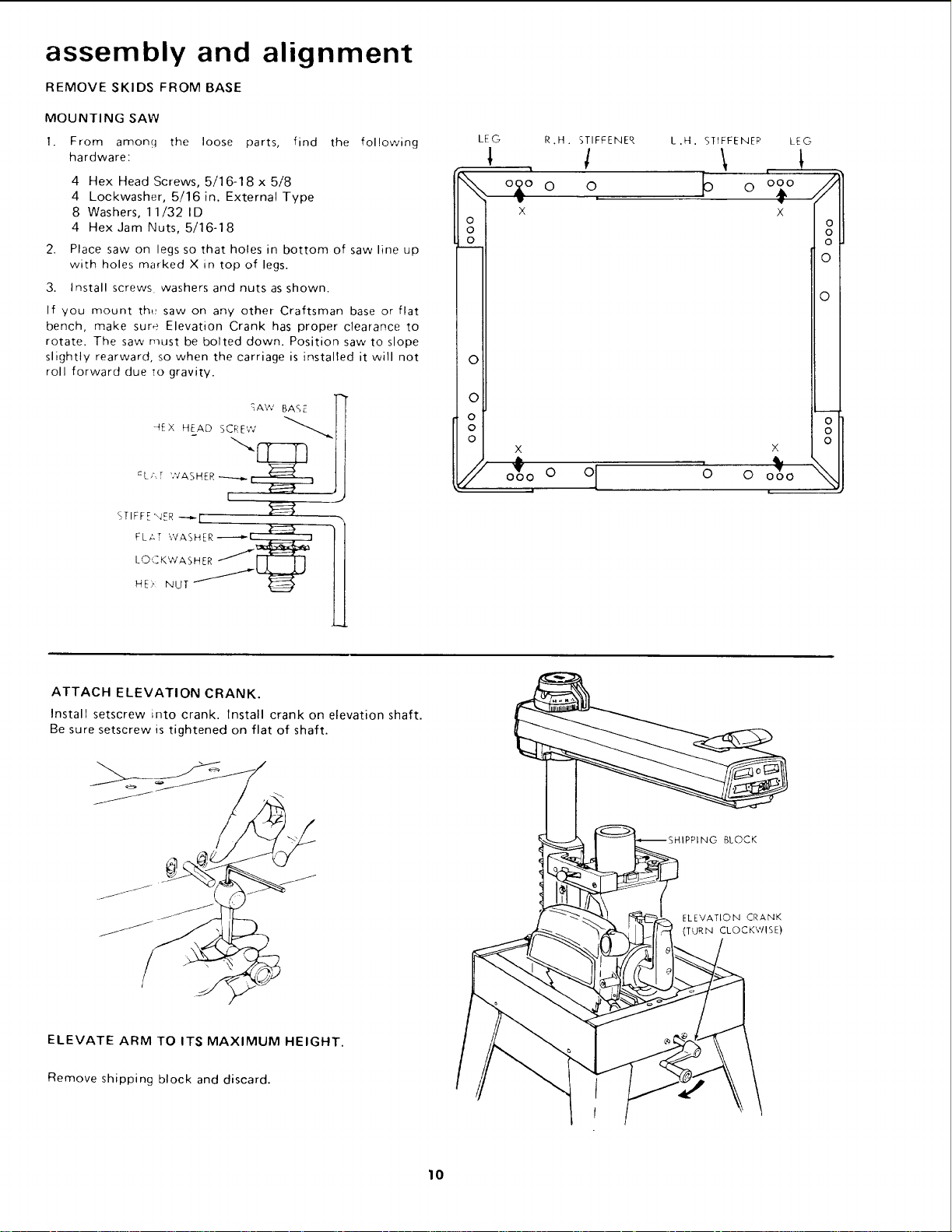
MOUNTING SAW
1. From amonq the loose parts, find the fol!owing
hardware:
2.
4 Hex Head Screws, 5/16-18 x 5/8
4 Lockwasher, 5/16 in. External Type
8 Washers, 11/32 ID
4 Hex Jam Nuts, 5/16-18
Place saw on legs so that holes in bottom of saw line up
with holes marked X in top of legs.
3. Install screws washers and nuts as shown.
If you mount tht_ saw on any other Craftsman base or flat
bench, make sure Elevation Crank has proper clearance to
rotate. The saw must be bolted down. Position saw to slope
slightly rearward, so when the carriage is installed it will not
roll forward due T,ogravity.
q,AVV BASE F
4_X HLAD SCREW "''''"_J I
Jl
c L,", r ',V A S H ER -----,_ [ _ =
I
STIFFE"qER_1 _E_
FLAT WASHER--_---_ I
LOCKWASHER /_
HE_NUT__
. (
(
(
d
LEG
1
%°
x
x
o oI
ooo.
R.H. STIFFENER L.H. STIFFENER
, J
o o 1o
b
LEG
o o_o
1,,-I
o ooo
ATTACH ELEVATION CRANK.
Install setscrew into crank. Install crank on elevation shaft.
Be sure setscrew is tightened on flat of shaft.
BLOCK
ELEVATION CRANK
(TURN CLOCKWISE)
ELEVATE ARM TO ITS MAXIMUM HEIGHT.
Remove shipping block and discard.
10
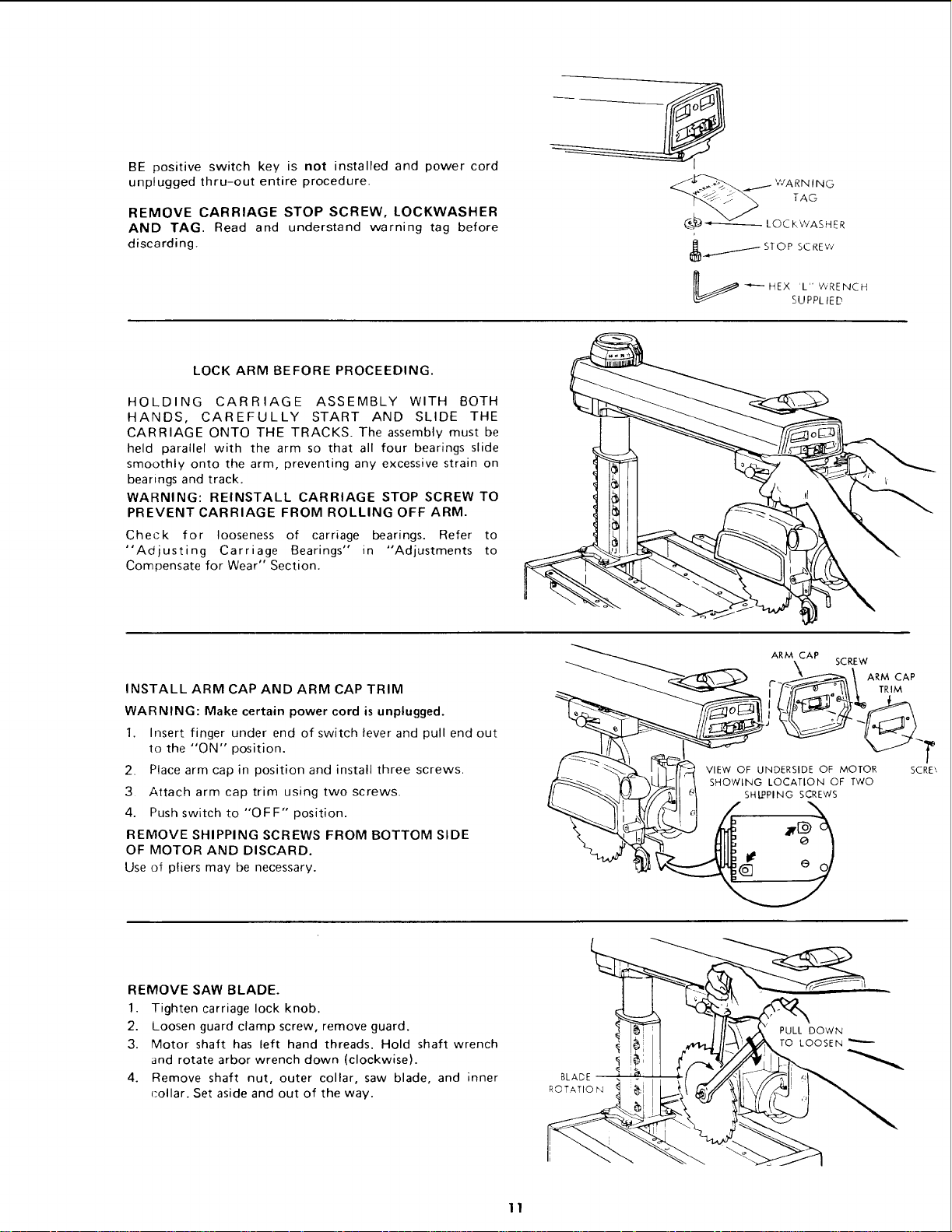
BE positive switch key is not installed and power cord
unplugged thru-out entire procedure.
REMOVE CARRIAGE STOP SCREW, LOCKWASHER
AND TAG. Read and understand warning tag before
discarding.
LOCK ARM BEFORE PROCEEDING.
HOLDING CARRIAGE ASSEMBLY WITH BOTH
HANDS, CAREFULLY START AND SLIDE THE
CARRIAGE ONTO THE TRACKS. The assembly must be
held parallel with the arm so that all four bearings slide
smoothly onto the arm, preventing any excessive strain on
bearings and track.
WARNING: REINSTALL CARRIAGE STOP SCREW TO
PREVENT CARRIAGE FROM ROLLING OFF ARM.
Check for looseness of carriage bearings. Refer to
"Adjusting Carriage Bearings" in "Adjustments to
Compensate for Wear" Section.
INSTALL ARM CAP AND ARM CAP TRIM
WARNING: Make certain power cord is unplugged.
1. Insert finger under end of switch lever and pull end out
to the "'ON" position.
2. Place arm cap in position and install three screws.
3 Attach arm cap trim using two screws.
4. Push switch to "OFF" position.
REMOVE SHIPPING SCREWS FROM BOTTOM SIDE
OF MOTOR AND DISCARD.
Use of pliers may be necessary.
ARM CAP
_ \ SCREW
__ _\ ARMCAP
F- TR,M
f__' [_ VIEW OF UNDERSIDE OF MOTOR SCRET'.
"_'-_lU_l[ \ SHOWINGLOCATIONOFTWO
tl -'_,_L,.J/'<'_kll _/ SHU_PINOSCREWS
REMOVE SAW BLADE.
1. Tighten carriage lock knob.
2. Loosen guard clamp screw, remove guard.
3. Motor shaft has left hand threads. Hold shaft wrench
and rotate arbor wrench down (clockwise).
4. Remove shaft nut, outer collar, saw blade, and inner
collar. Set aside and out of the way.
BLADE
RQTATIO N
PULL DOWN
TO LOOSEN
11
assembly and alignment
ALIGNMENT PROCEDURE
IMPORTANT:
IN ORDER TO OBTAIN MAXIMUM CUTTING
ACCURACY, THE FOLLOWING SIX STEPS
MUST BE CAREFULLY FOLLOWED.
BECOME THOROUGHLY FAMILIAR WITH
THESE STEPS SO THAT YOU CAN ALWAYS
MAINTAIN YOUR SAW IN PROPER
ALIGNMENT. THE ACCURACY OF EACH
ADJUSTMENT IS ALWAYS DEPENDENT
UPON THE A CCURA C Y OF THE PRECEDING
A DJUS TMEN T.
After following the 6 step assembly and alignment
procedure and the Basic Saw operation section refer to
Trouble Shooting section if any difficulty is experienced
when performing any sawing operation.
STEP ONE
NOTE: The following adjustment, performed properly, will
result in the work table being parallel to the arm.
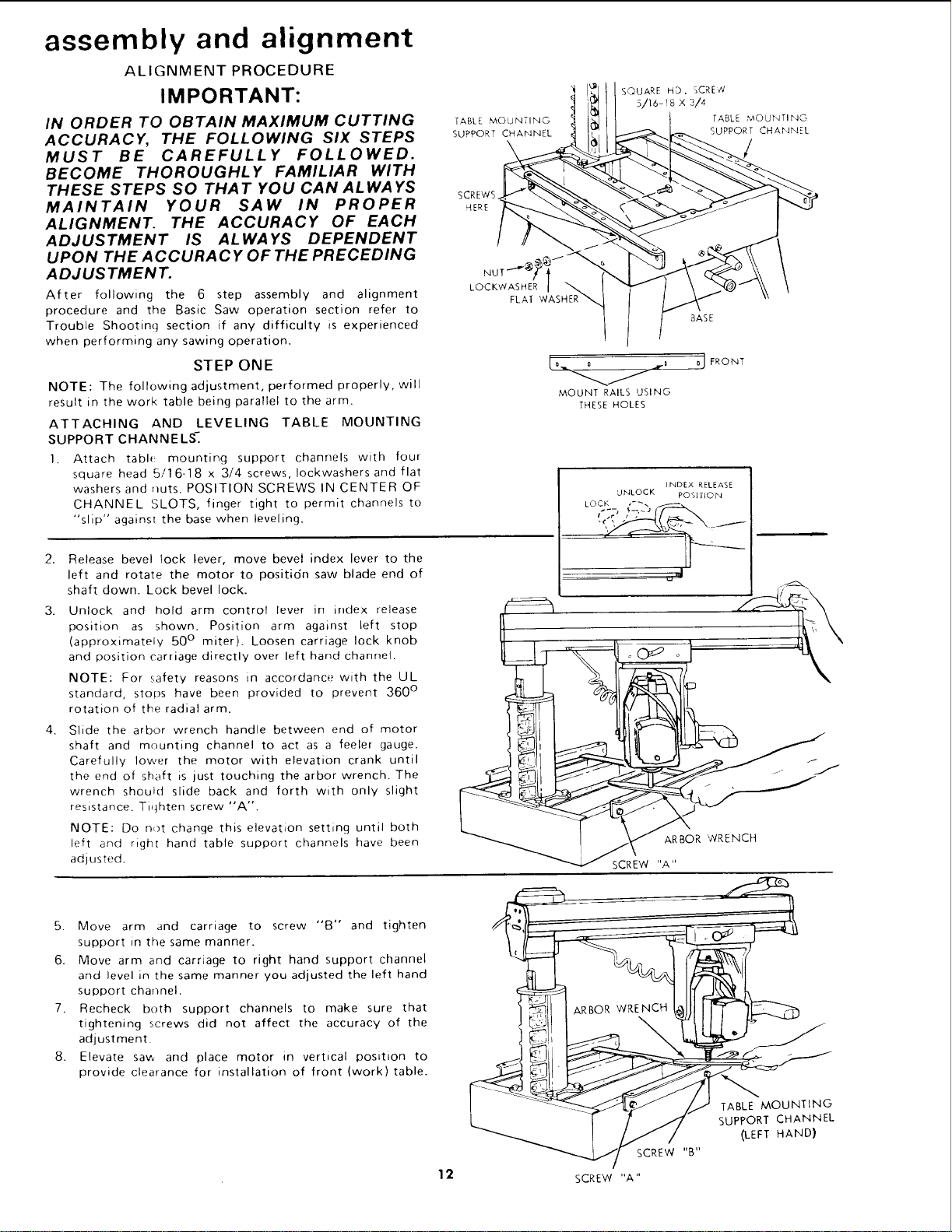
ATTACHING AND LEVELING TABLE MOUNTING
SUPPORT CHANNE LS_
1. Attach tabl_ mounting support channels with four
square head 5/1 6-18 x 3/4 screws, Iockwashers and flat
washers and nuts. POSITION SCREWS IN CENTER OF
CHANNEL SLOTS, finger tight to permit channels to
"slip" against the base when leveling.
TABLE MOU NTI N G
SUPPORT CHANNEL
\
SCREWS
HERE
NUT / t
LOCKWASHER |
FLAI WASHER
2. Release bevel lock lever, move bevel index lever to the
left and rotate the motor to positidn saw blade end of
shaft down. Lock bevel lock.
3. Unlock and hold arm control lever in index release
position as shown. Position arm against left stop
(approximately 50 ° miter). Loosen carriage lock knob
and position carriage directly over left hand channel.
NOTE: For safety reasons in accordance with the UL
standard, stops have been provided to prevent 360 °
rotation of the radial arm.
4. Slide the arbor wrench handle between end of motor
shaft and mounting channel to act as a feeler gauge.
Carefully lower the motor with elevation crank until
the end of shaft is just touching the arbor wrench. The
wrench shouid slide back and forth with only Blight
resistance. Tighten screw "A".
NOTE: Do not change this elevation setting until both
left and right hand table support channels have been
adjusted.
5 Move arm and carriage to screw "B'" and tighten
support in the same manner.
6. Move arm and carriage to right hand support channel
and level in the same manner you adjusted the left hand
support channel.
7. Recheck both support channels to make sure that
tightening screws did not affect the accuracy of the
adjustment.
8. Elevate saw and place motor in vertical position to
provide clearance for installation of front (work) table.
I SQUARE HD. SCREW
5/_6-1S X _/4
FABLE MOUNTI NO
SUPPORT CHANNEL
12
BASE
MOUNT RAILS USING
THESE HOLES
d FRONT
INDEX RELEASE
UNLOCK POSITION
LOCK ,-_
ARBOR WRENCH
SCREW "A"
NNEL
I /J / (LEFT HAND)
SCREW "A"
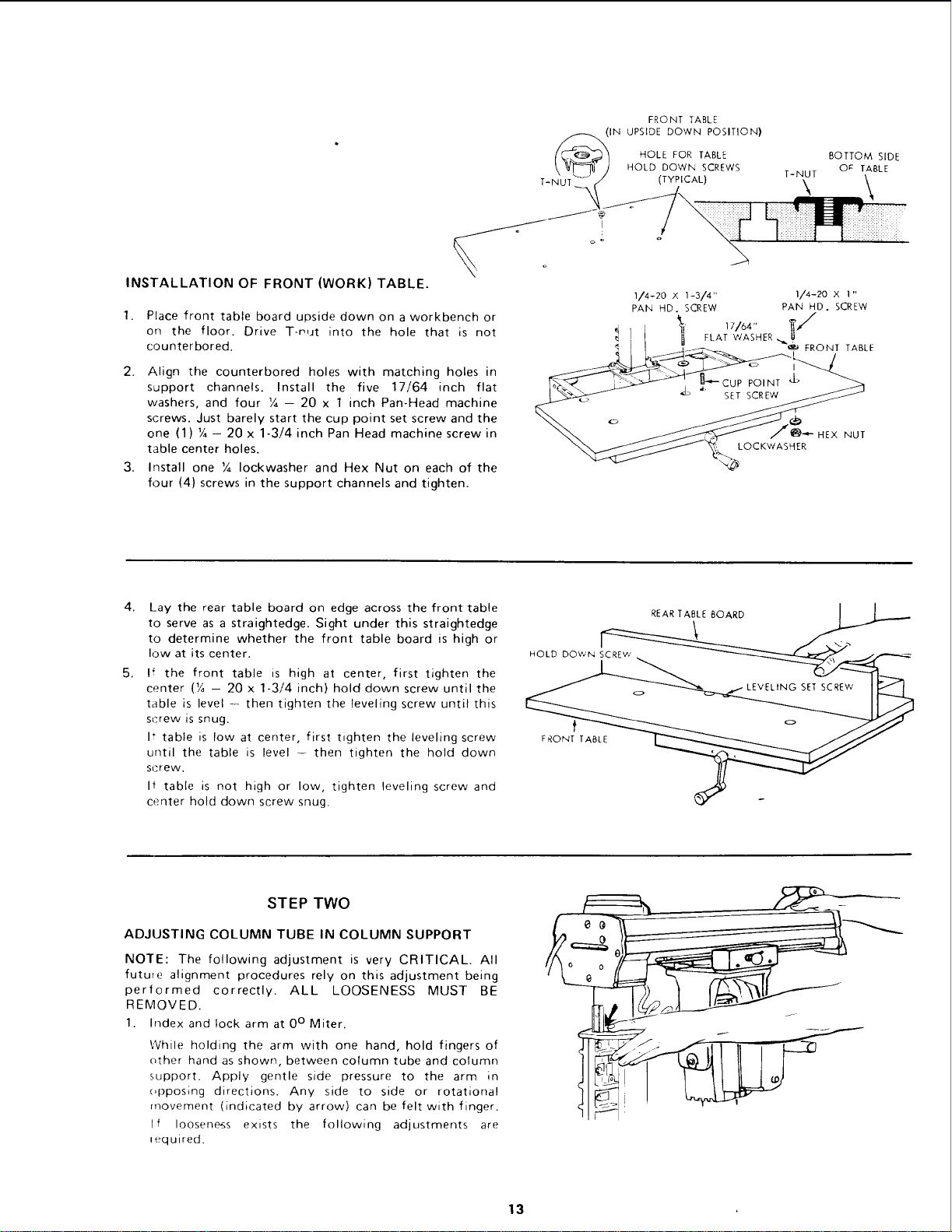
INSTALLATION OF FRONT (WORK) TABLE.
1.
Place front table board upside down on a workbench or
on the floor. Drive T-nut into the hole that is not
counterbored.
2. Align the counterbored holes with matching holes in
support channels. Install the five 17/64 inch flat
washers, and four ¼ -- 20 x 1 inch Pan-Head machine
screws. Just barely start the cup point set screw and the
one (1) 1/,_ 20 x 1-3/4 inch Pan Head machine screw in
table center holes.
3. Install one 1/_Iockwasher and Hex Nut on each of the
four (4) screws in the support channels and tighten.
FRONT TABLE
IN UPSIDE DOWN POSITION)
HOLE FOR TABLE
HOLD DOWN SCREWS
T-NUT / (TYPICAL)
I
BOTTOM SIDE
Or TABLE
T-NUT
1/4-20 X 1-3/4" 1/4-20 X 1"
PAN HD. SCREW PAN HD. SCREW
1' FLA_ 7V/6A4S'HER -- _/
e_. FRONT TABLE
_'- HEX NUT
LOCKWASHER
4,
5,
Lay the rear table board on edge across the front table
to serve as a straightedge. Sight under this straightedge
to determine whether the front table board is high or
low at its center.
I' the front table is high at center, first tighten the
center (1/__ 20 x 1-3/4 inch) hold down screw until the
table is level -- then tighten the leveling screw until this
screw is snug.
It table is low at center, first tighten the leveling screw
until the table is level - then tighten the hold down
screw.
If table is not high or low, tighten leveling screw and
center hold down screw snug.
REAR TAiLE BOARD
HOLD DOWN __ JI_"-_-
FRONT TABLE
STEP TWO
ADJUSTING COLUMN TUBE IN COLUMN SUPPORT
NOTE: The following adjustment is very CRITICAL. All
future alignment procedures rely on this adjustment being
performed correctly. ALL LOOSENESS MUST BE
REMOVED.
1. Index and lock arm at 0° Miter.
While holding the arm with one hand, hold fingers of
other hand as shown, between column tube and column
support. Apply gentle side pressure to the arm in
opposing directions. Any side to side or rotational
movement (indicated by arrow) can be felt with finger.
If Ioosene,ss exists the following adjustments are
lequired.
qLo j
13
assembly and alignment
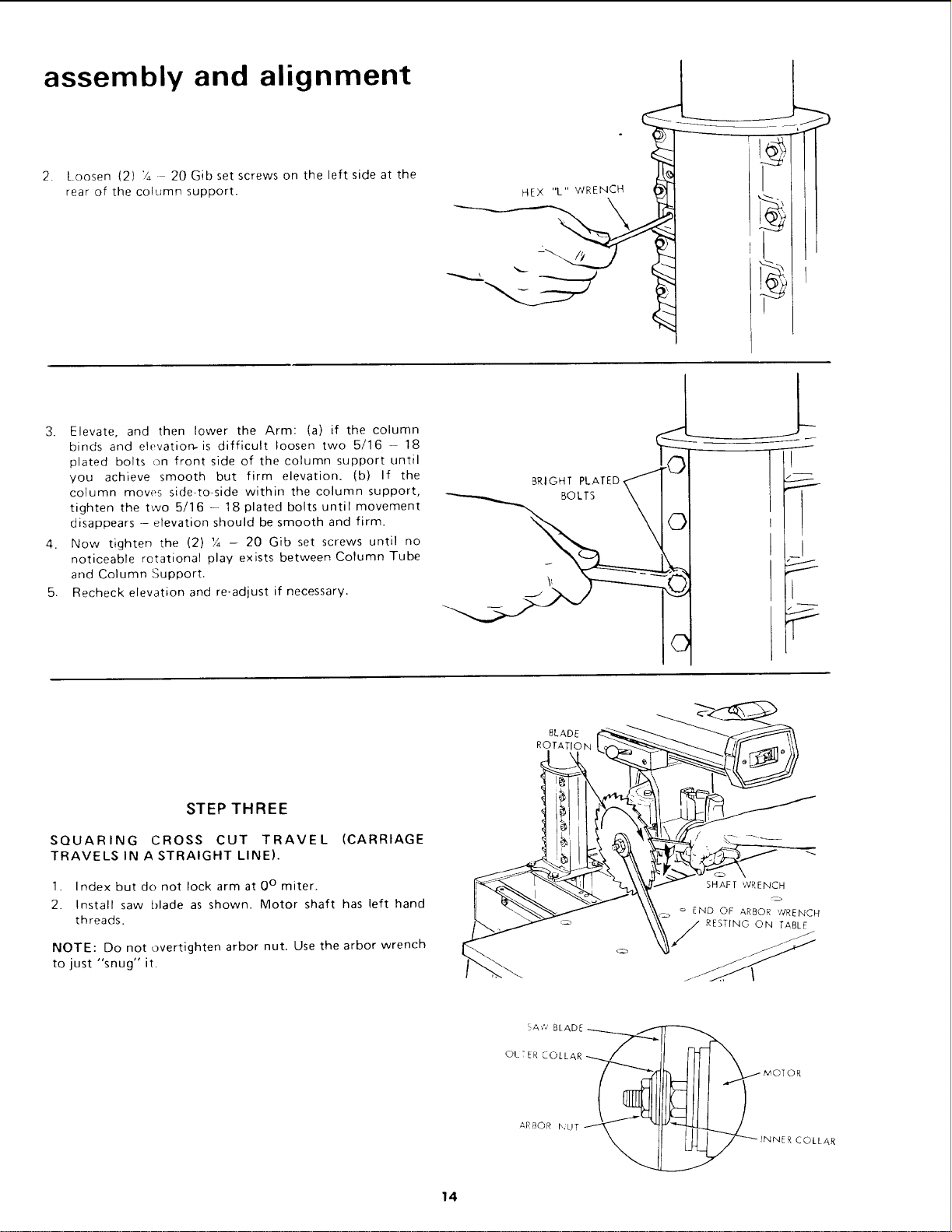
2. Loosen (2) 'J_ 20 Gib set screws on the left side at the
rear of the column support. HEX "L" WRENCH
3. Elevate, and then lower the Arm: (a)if the column
binds and elevation-is difficult loosen two 5/16 - 18
plated bolts on front side of the column support until
you achieve smooth but firm elevation. (b) If the
column moves side-to-side within the column support,
tighten the two 5/16 - 18 plated bolts until movement
disappears - elevation should be smooth and firm.
4. Now tighten the (2) 1/_ - 20 Gib set screws until no
noticeable rotational play exists between Column Tube
and Column Support.
5. Recheck elevation and re-adjust if necessary.
STEP THREE
SQUARING CROSS CUT TRAVEL (CARRIAGE
TRAVELS IN ASTRAIGHT LINE).
1. Index but do not lock arm at 0° miter.
2. Install saw blade as shown. Motor shaft has left hand
threads.
NOTE: Do not overtighten arbor nut. Use the arbor wrench
to just "snug" it.
SAW BLADE ____r_
OL TER COLLAR
ARBOR NUT _MOTOR
INNER COLLAR
14
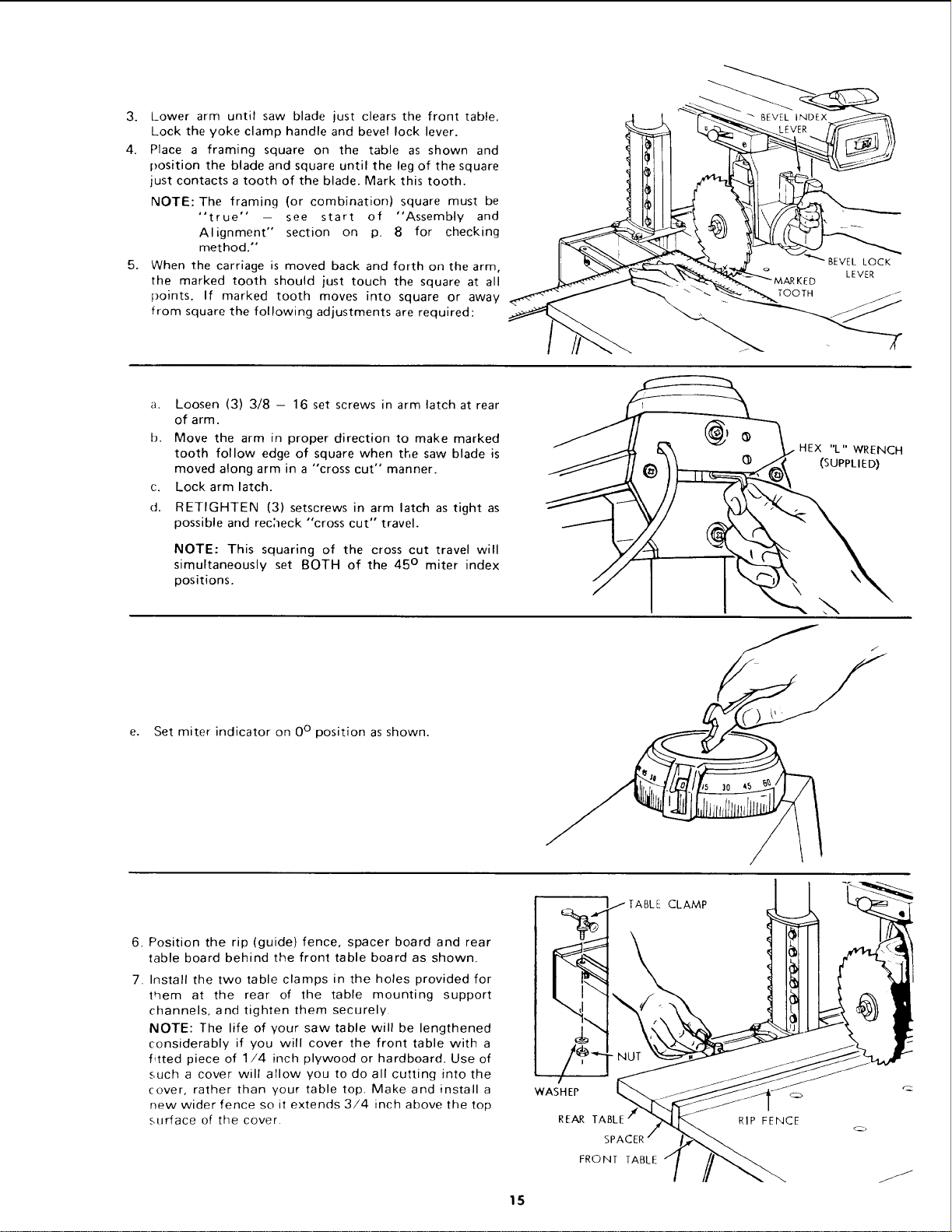
3. Lowerarmuntilsawbladejustclearsthefronttable.
Locktheyokeclamphandleandbevellocklever.
4. Placea framingsquareon thetableasshownand
positionthebladeandsquareuntilthelegofthesquare
justcontactsatoothoftheblade.Markthistooth.
NOTE:Theframing(orcombination)squaremustbe
"true" - see start of "Assemblyand
Alignment"sectionon p. 8 for checking
method.'"
5. Whenthecarriageismovedbackandforthonthearm,
themarkedtoothshouldjusttouchthesquareatall
points.If markedtoothmovesintosquareoraway
fromsquarethefollowingadjustmentsarerequired:
BEVEL LOCK
LEVER
a. Loosen (3) 3/8 - 16 set screws in arm latch at rear
of arm.
b. Move the arm in proper direction to make marked
tooth follow edge of square when the saw blade is
moved along arm in a "cross cut" manner.
c. Lock arm latch.
d. RETIGHTEN (3) setscrews in arm latch as tight as
possible and recheck "cross cut" travel.
NOTE: This squaring of the cross cut travel will
simultaneously set BOTH of the 45 ° miter index
positions.
HEX "L" WRENCH
(SUPPLIED)
e. Set miter indicator on 0° position as shown.
6. Position the rip (guide) fence, spacer board and rear
table board behind the front table board as shown.
7. Install the two table clamps in the holes provided for
them at the rear of the table mounting support
channels, and tighten them securely
NOTE: The life of your saw table will be lengthened
considerably if you will cover the front table with a
fitted piece of 1/4 inch plywood or hardboard. Use of
such a cover will allow you to do all cutting into the
cover, rather than your table top. Make and install a
new wider fence so it extends 3/4 inch above the top
surface of the cover
WASHEP
REAR
15
TABLE CLAMP
FRONT TABLE
RIP FENCE
assembly and alignment
.STEP FOUR
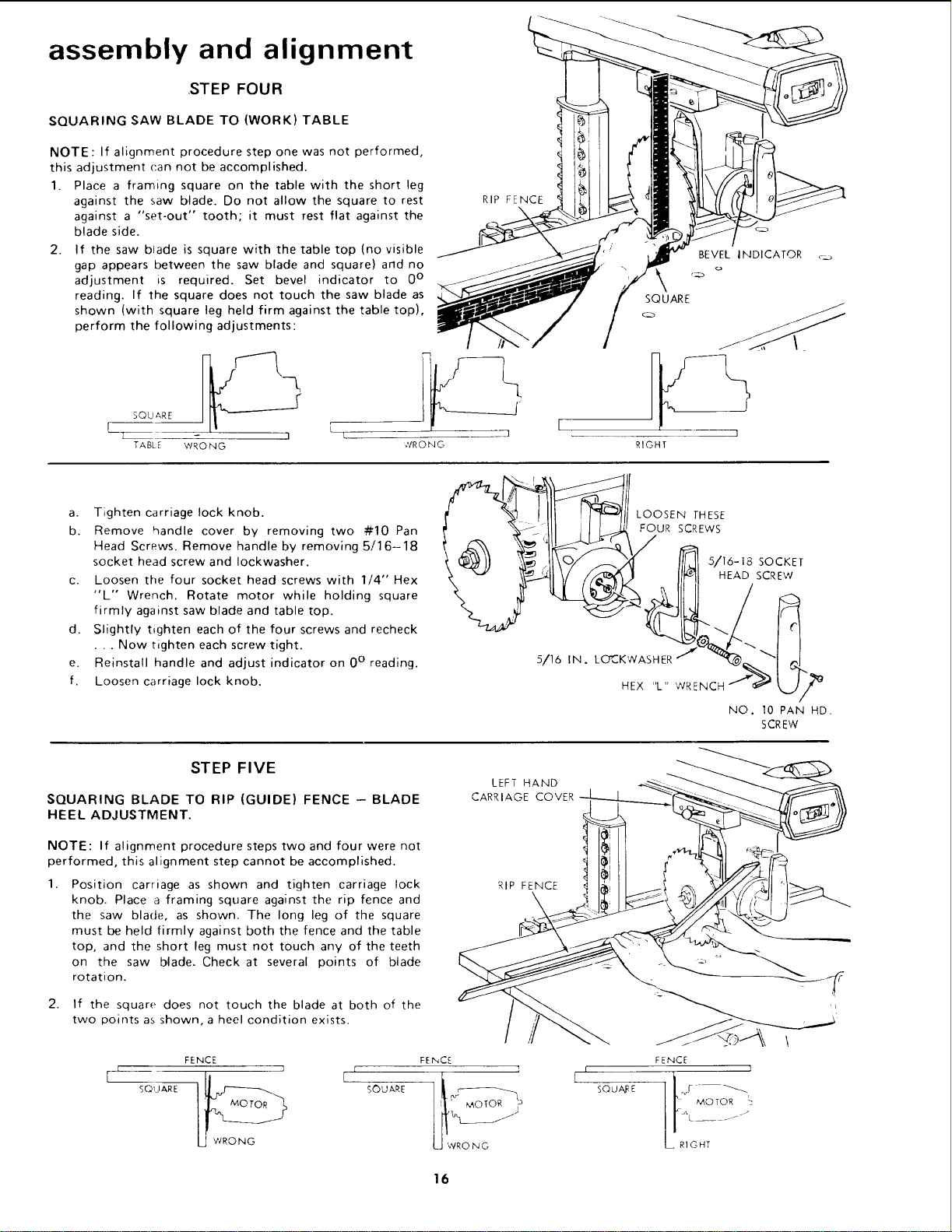
SQUARING SAW BLADE TO (WORK) TABLE
NOTE: If alignment procedure step one was not performed,
this adjustment (:an not be accomplished•
1. Place a framing square on the table with the short leg
against the saw blade• Do not allow the square to rest
against a "set-out" tooth; it must rest flat against the
blade side.
2. If the saw blade is square with the table top (no visible
gap appears between the saw blade and square) and no
adjustment is required. Set bevel indicator to 0°
reading• If the square does not touch the saw blade as
shown (with square leg held firm against the table top),
perform the following adjustments:
RIP FENCE
X
SQUARE
TABLE
- I
WRONG
I
]
¢,/RONG
SQUARE
]
RIGHT
a. Tighten carriage lock knob•
b. Remove handle cover by removing two #t0 Pan
Head Screws. Remove handle by removing 5/1 6-18
socket head screw and Iockwasher.
c. Loosen the four socket head screws with 1/4" Hex
"L'" Wrench. Rotate motor while holding square
firmly against saw blade and table top.
d. Slightly tighten each of the four screws and recheck
• . . Now tighten each screw tight.
e. Reinstall handle and adjust indicator on 0° reading.
f. Loosen carriage lock knob.
LOOSEN THESE
FOUR SCREWS
5/16-18 SOCKET
HEAD SCREW
5/16 IN. LO'CKWASHER "_
H EX I'L " '_VR E NCH
NO. 10 PAN HD.
SCREW
STEP FIVE
SQUARING BLADE TO RIP (GUIDE) FENCE - BLADE
HEEL ADJUSTMENT.
NOTE: If alignment procedure steps two and four were not
performed, this alignment step cannot be accomplished.
1. Position carriage as shown and tighten carriage lock
knob. Place a framing square against the rip fence and
the saw blade, as shown. The long leg of the square
must be held firmly against both the fence and the table
top, and the short leg must not touch any of the teeth
on the saw blade• Check at several points of blade
rotation.
2• If the square does not touch the blade at both of the
two points as shown, a heel condition exists.
LEFT HAND
CARRIAGE COVER
RIP FENCE
£
I-
SQUARE
FENCE
7
LJ WRONG
FENCE
SQUARE SQUAJ_ E
FENCE
]
I[S --_
" MOTOR
RIGHT
16
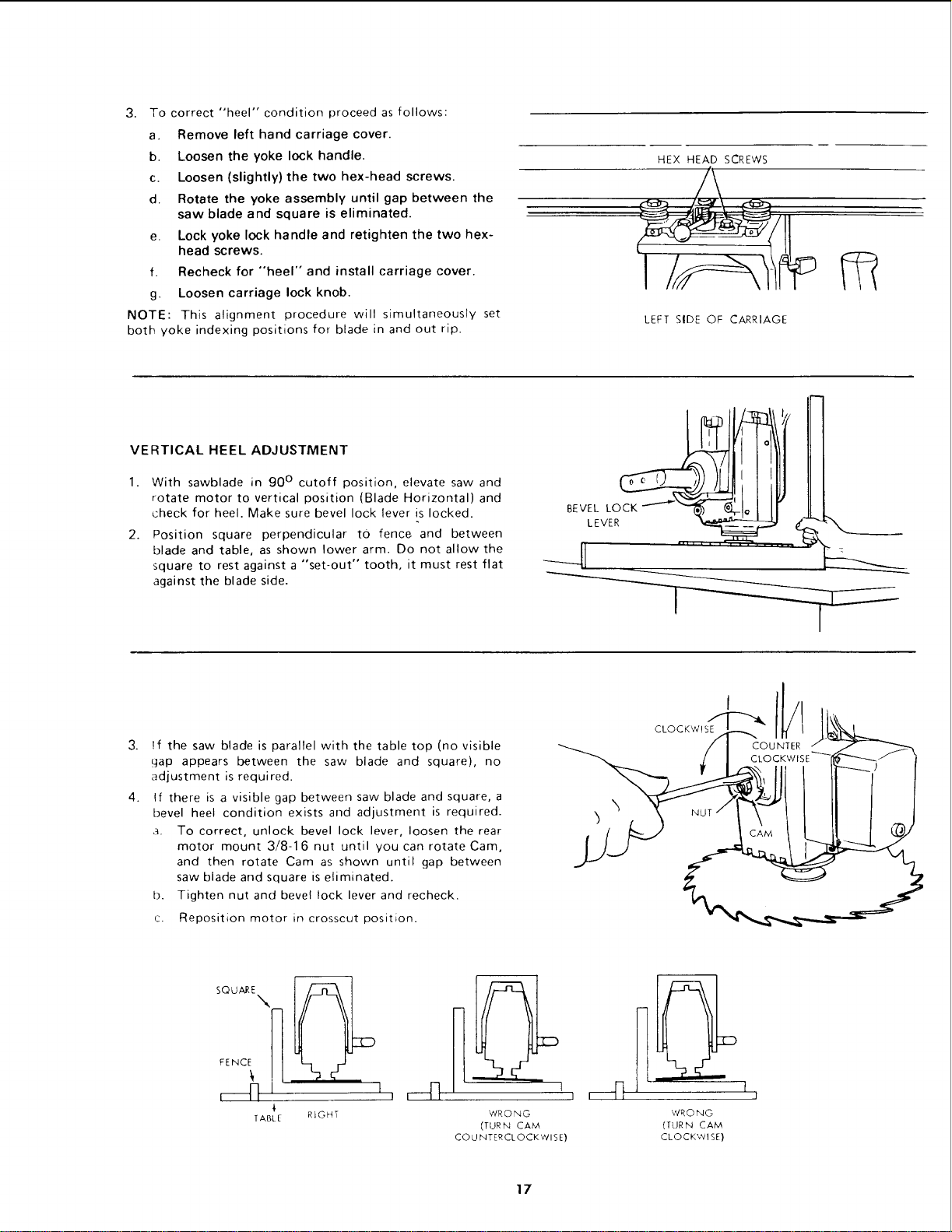
3. To correct "heel" condition proceed as follows:
a. Remove left hand carriage cover.
b. Loosen the yoke lock handle.
c. Loosen (slightly) the two hex-head screws.
d. Rotate the yoke assembly until gap between the
saw blade and square is eliminated.
e. Lock yoke lock handle and retighten the two hex-
head screws.
f. Recheck for "heel" and install carriage cover.
g. Loosen carriage lock knob.
NOTE: This alignment procedure will simultaneously set
both yoke indexing positions for blade in and out rip.
HEX HEAD SCREWS
LEFT SIDE OF CARRIAGE
VERTICAL HEEL ADJUSTMENT
1. With sawblade in 90 ° cutoff position, elevate saw and
rotate motor to vertical position (Blade Horizontal) and
check for heel. Make sure bevel lock lever is locked.
2. Position square perpendicular to fence and between
blade and table, as shown lower arm. Do not allow the
square to rest against a "set-out" tooth, it must rest flat
against the blade side.
_ ...... ....
3°
4.
!f the saw blade is parallel with the table top (no visible
gap appears between the saw blade and square), no
adjustment is required.
If there is a visible gap between saw blade and square, a
bevel heel condition exists and adjustment is required.
a. To correct, unlock bevel lock lever, loosen the rear
motor mount 3/8-16 nut until you can rotate Cam,
and then rotate Cam as shown until gap between
saw blade and square is eliminated.
b. Tighten nut and bevel lock lever and recheck.
c. Reposition motor in crosscut position.
\
FENCE_I !
TABLE RIGHT
WRONG
(TURN CAM
COUNTERCLOCKWISE)
WRO NG
(TURN CAM
CLOCKW] SE)
17
assembly and alignment
STEP SIX
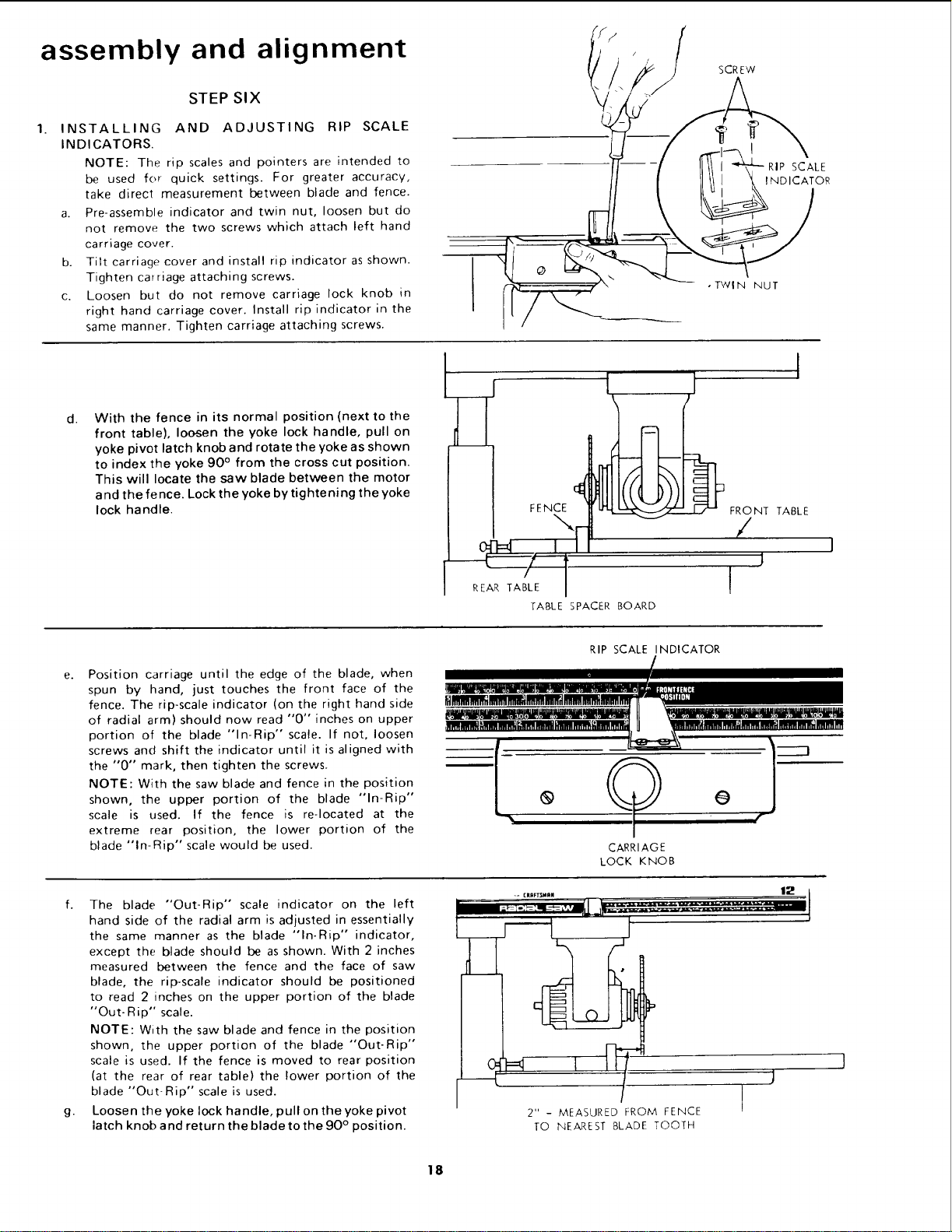
1. INSTALLING AND ADJUSTING RIP SCALE
INDICATORS.
NOTE: The rip scales and pointers are intended to
be used for quick settings. For greater accuracy,
take direct measurement between blade and fence.
a. Pre-assemble indicator and twin nut, loosen but do
not remove the two screws which attach left hand
carriage cover.
b. Tilt carriage cover and install rip indicator as shown.
Tighten car riage attaching screws.
c. Loosen but do not remove carriage lock knob in
right hand carriage cover. Install rip indicator in the
same manner. Tighten carriage attaching screws.
SCREW
• TWIN NUT
d.
With the fence in its normal position (next to the
front table), loosen the yoke lock handle, pull on
yoke pivot latch knob and rotate the yoke as shown
to index the yoke 90 ° from the cross cut position.
This will locate the saw blade between the motor
and the fence. Lock the yoke by tightening the yoke
lock handle.
_J
FENCE
h
REAR TABLE [
TABLE SPACER BOARD
RIP SCALE
INDICATOR
I
_ FRONT TABLE
/
e.
Position carriage until the edge of the blade, when
spun by hand, just touches the front face of the
fence. The rip-scale indicator (on the right hand side
of radial arm) should now read "0" inches on upper
portion of the blade "In-Rip" scale. If not, loosen
screws and shift the indicator until it is aligned with
the "0" mark, then tighten the screws.
NOTE: With the saw blade and fence in the position
shown, the upper portion of the blade "In-Rip"
scale is used. If the fence is re-located at the
extreme rear position, the lower portion of the
blade "In-Rip" scale would be used.
RIP SCALE INDICATOR
CARRIAGE
LOCK KNOB
f. The blade "Out-Rip" scale indicator on the left
hand side of the radial arm is adjusted in essentially
the same manner as the blade "In-Rip" indicator,
except the blade should be as shown. With 2 inches
measured between the fence and the face of saw
blade, the rip-scale indicator should be positioned
to read 2 inches on the upper portion of the blade
"Out- Rip" scale.
NOTE: With the saw blade and fence in the position
shown, the upper portion of the blade "'Out-Rip"
scale is used. If the fence is moved to rear position
(at the rear of rear table) the lower portion of the
blade "Out-Rip" scale is used.
g. Loosen the yoke lock handle, pull on the yoke pivot
latch knob and return the blade to the 90 ° position.
......... __ _ _ 12j
2 MEASURED FROM FENCE
TO NEAREST BLADE TOOTH
18
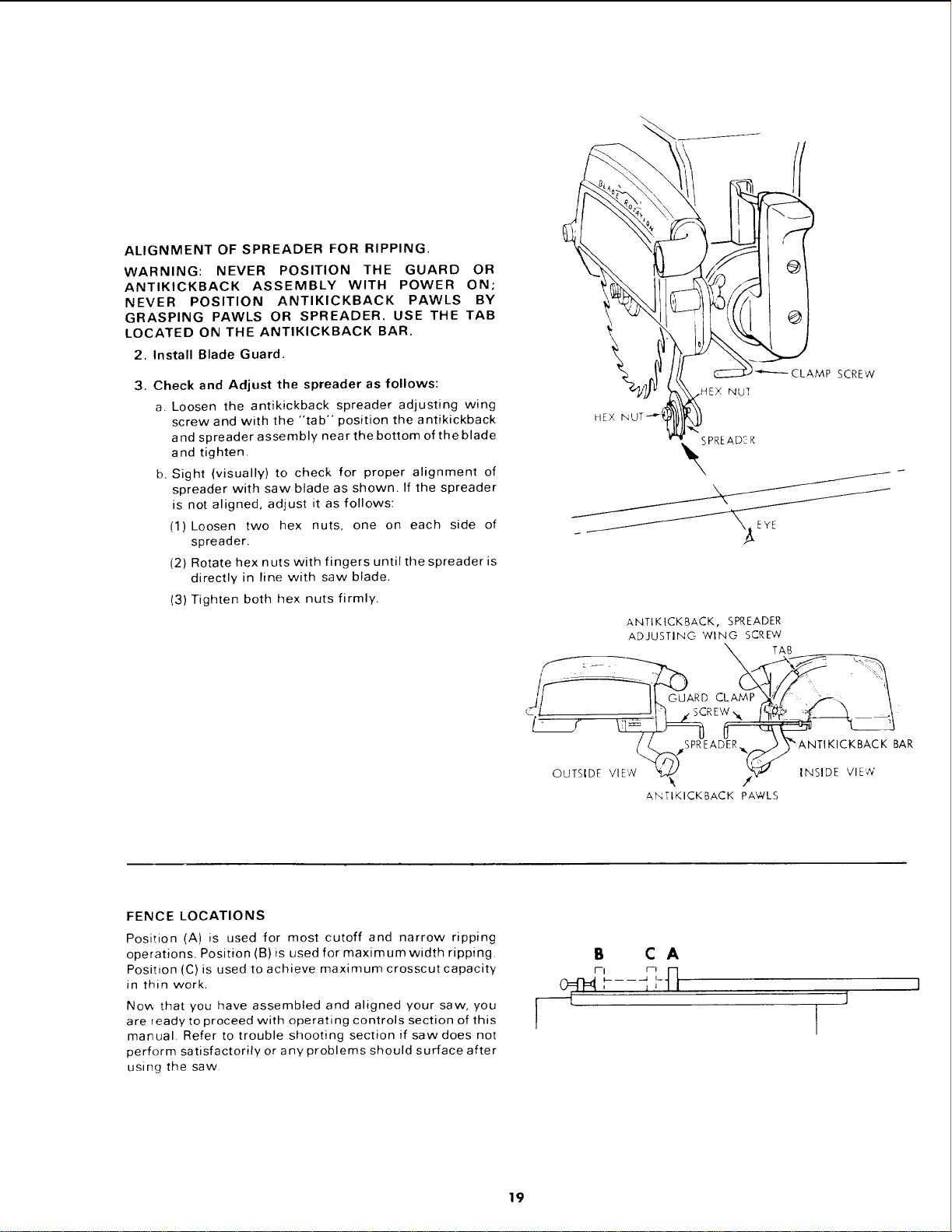
ALIGNMENT OF SPREADER FOR RIPPING.
WARNING: NEVER POSITION THE GUARD OR
ANTIKICKBACK ASSEMBLY WITH POWER ON;
NEVER POSITION ANTIKICKBACK PAWLS BY
GRASPING PAWLS OR SPREADER. USE THE TAB
LOCATED ON THE ANTIKICKBACK BAR.
2. Install Blade Guard.
3. Check and Adjust the spreader as follows:
a. Loosen the antikickback spreader adjusting wing
screw and with the "tab" position the antikickback
and spreader assembly near the bottom of the blade
and tighten.
b. Sight (visually) to check for proper alignment of
spreader with saw blade as shown. If the spreader
is not aligned, adjust it as follows:
(1) Loosen two hex nuts, one on each side of
spreader.
(2) Rotate hex nuts with fingers until the spreader is
directly in line with saw blade.
(3) Tighten both hex nuts firmly.
HEXN::-- EXNU:CLAMPSC EW
xSPREAD_-R
/__------
ANTIKICKBACK, SPREADER
ADJUSTING WING SCREW
TAB
// : _ ,
CLAMP
OUTSIDE VI EvV_ #SPREADER_"
ANTIKICKBACK PAWLS
KBACK BAR
INSIDE VIEW
FENCE LOCATIONS
Position (A) is used for most cutoff and narrow ripping
operations. Position (B) is used for maximum width ripping.
Position (C) is used to achieve maximum crosscut capacity
in thin work.
Now that you have assembled and aligned your saw, you
are ready to proceed with operating controls section of this
manual. Refer to trouble shooting section if saw does not
perform satisfactorily or any problems should surface after
using the saw.
B CA
PI n
J
19
location and function of controls
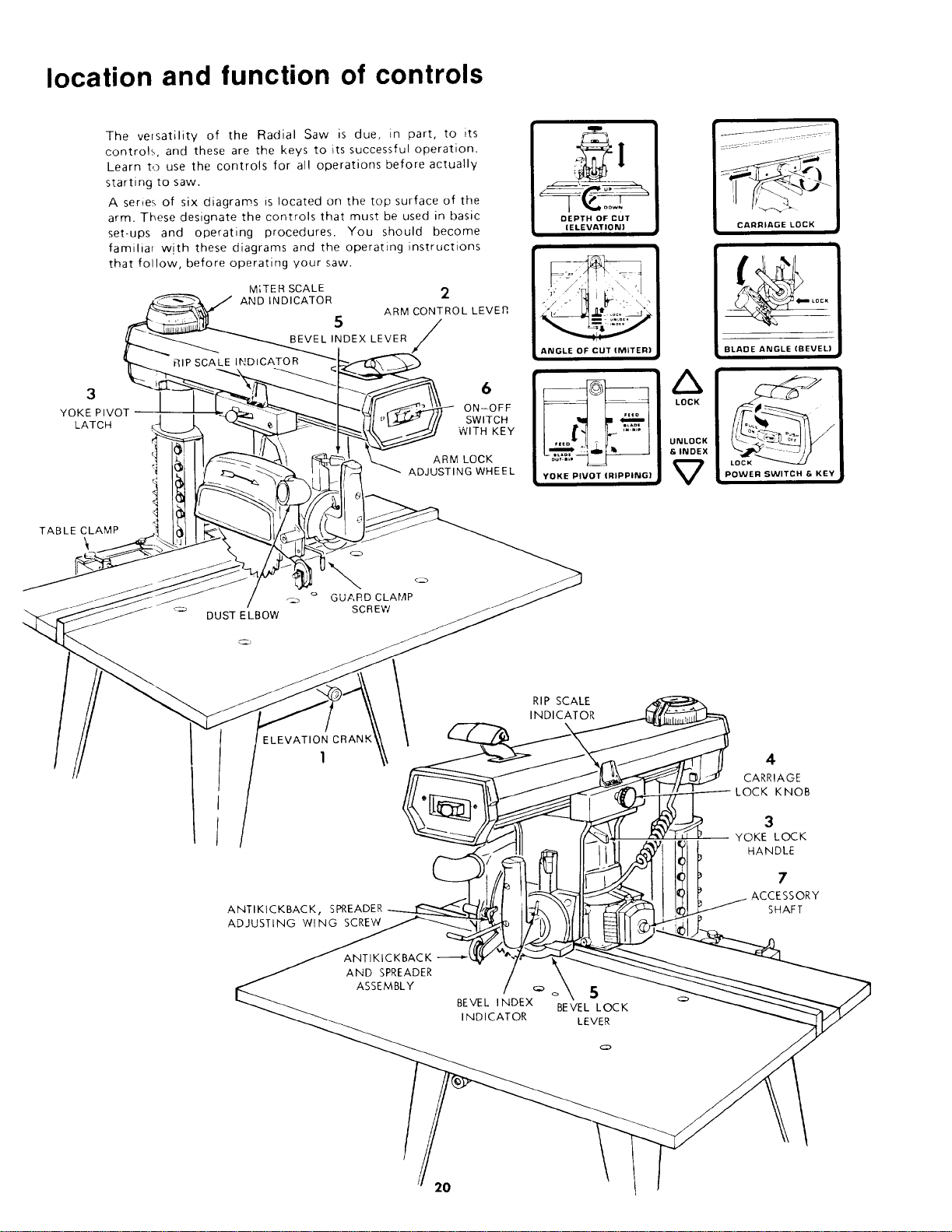
The versatility of the Radial Saw is due, in part, to its
controls, and these are the keys to its successful operation.
Learn to use the controls for all operations before actually
startin 9 to saw.
A series of six diagrams is located on the top surface of the
arm. These designate the controls that must be used in basic
set-ups and operating procedures. You should become
familiar with these diagrams and the operatcng instructions
that follow, before operating your saw.
M;TER SCALE 2
AND INDICATOR
ARM CONTROL LEVER
5
BEVEL INDEX LEVER
RIP SCALE INDICATOR
3
YOKE PIVOT
LATCH
6
ON=OFF
SWITCH
WITH KEY
ARM LOCK
ADJUSTING WHEEL
DEPTH OF CUT
(ELEVATION}
i ANGLE OF CUT (MITER} I
/
/
CARRIAGE LOCK
I I
I
BLADE ANGLE (BEVEL}
j I
YOKE PIVOT fRIPPING} POWER SWITCH & KEY
TABLE CLAMP
DUST ELBOW
GUARD CLAMP
SCREW
ELEVATION CRANK
]
ANTIKICKBACK, SPREADER
ADJUSTING WING SCREW
ANTIKICKBACK
AND SPREADER
ASSEMBLY
RIP SCALE
INDICATOR
o 5
BEVEL INDEX BEVEL LOCK
INDICATOR LEVER
4
CARRIAGE
LOCK KNOB
3
YOKE LOCK
HANDLE
7
ACCESSORY
SHAFT
20
1.
2.
3.
4,
5.
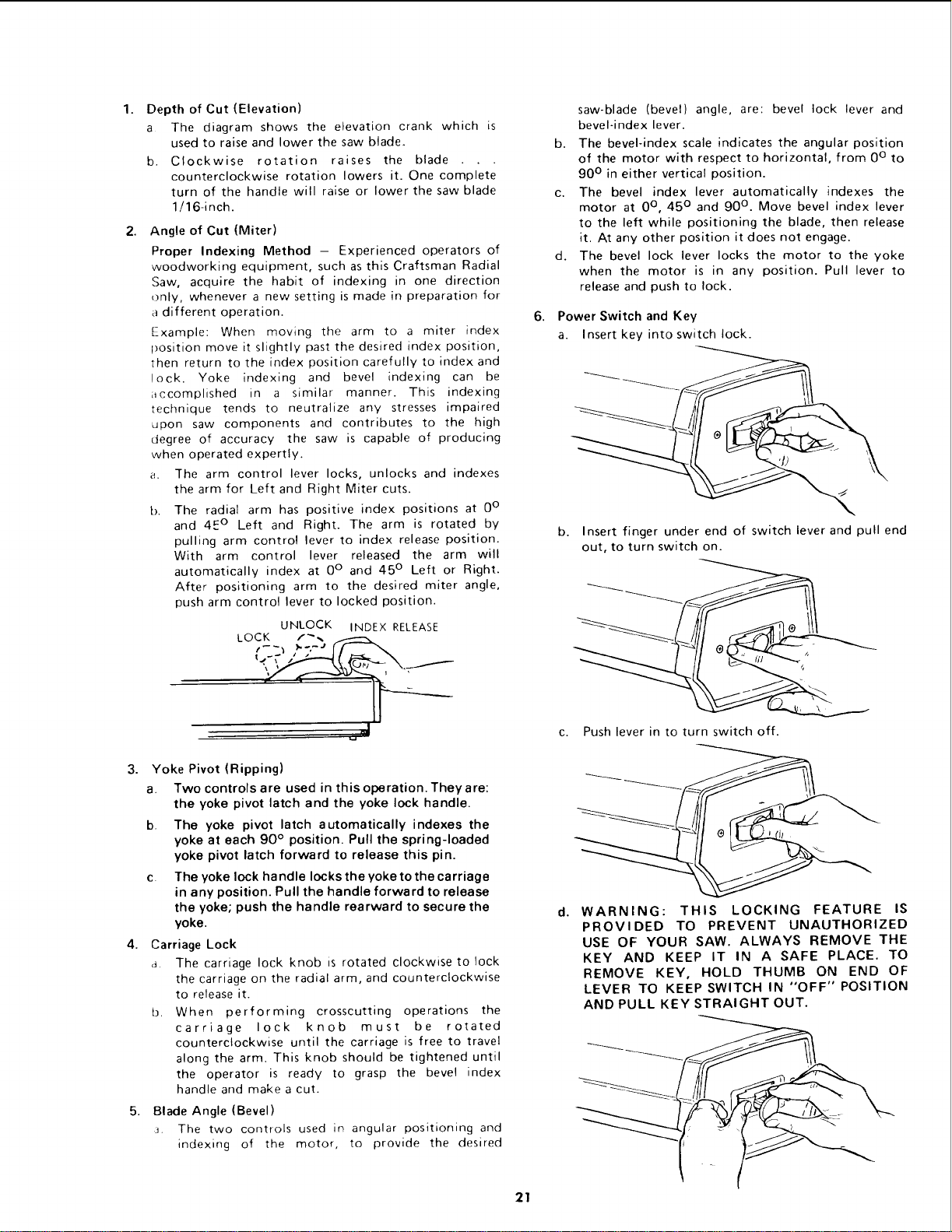
Depth of Cut (Elevation)
a The diagram shows the elevation crank which is
used to raise and lower the saw blade.
b. Clockwise rotation raises the blade
counterclockwise rotation lowers it. One complete
turn of the handle will raise or lower the saw blade
1/16-inch.
Angle of Cut (Miter)
Proper Indexing Method - Experienced operators of
woodworking equipment, such as this Craftsman Radial
Saw, acquire the habit of indexing in one direction
only, whenever a new setting is made in preparation for
a different operation.
Example: When moving the arm to a miter index
position move it slightly past the desired index position,
then return to the index position carefully to index and
lock. Yoke indexing and bevel indexing can be
accomplished in a similar manner. This indexing
technique tends to neutralize any stresses impaired
upon saw components and contributes to the high
degree of accuracy the saw is capable of producing
when operated expertly.
a. The arm control lever locks, unlocks and indexes
the arm for Left and Right Miter cuts.
b. The radial arm has positive index positions at 0°
and 4E ° Left and Right. The arm is rotated by
pulling arm control lever to index release position.
With arm control lever released the arm will
automatically index at 0° and 45 ° Left or Right.
After positioning arm to the desired miter angle,
push arm control lever to locked position.
UNLOCK INDEX RELEASE
LOCK f_,,.
Yoke Pivot (Ripping)
a. Two controls are used in this operation. They are:
the yoke pivot latch and the yoke lock handle.
b The yoke pivot latch automatically indexes the
yoke at each 90 ° position. Pull the spring-loaded
yoke pivot latch forward to release this pin.
c The yoke lock handle locks the yoke to the carriage
in any position. Pull the handle forward to release
the yoke; push the handle rearward to secure the
yoke.
Carriage Lock
d The carriage lock knob is rotated clockwise to lock
the carriage on the radial arm, and counterclockwise
to release it.
b. When performing crosscutting operations the
carriage lock knob must be rotated
counterclockwise until the carriage is free to travel
along the arm. This knob should be tightened until
the operator is ready to grasp the bevel index
handle and make a cut.
Blade Angle (Bevel)
_. The two controls used in angular positioning and
indexing of the motor, to provide the desired
6,
saw-blade (bevel) angle, are: bevel lock lever and
bevel-index lever.
b. The bevel-index scale indicates the angular position
of the motor with respect to horizontal, from 0 ° to
90 ° in either vertical position.
c. The bevel index lever automatically indexes the
motor at 0°, 45 ° and 90 ° . Move bevel index lever
to the left while positioning the blade, then release
it. At any other position it does not engage.
d. The bevel lock lever locks the motor to the yoke
when the motor is in any position. Pull lever to
release and push to lock.
Power Switch and Key
a. Insert key into switch lock.
b,
Insert finger under end of switch lever and pull end
out, to turn switch on.
c. Push lever in to turn switch off.
d° WARNING: THIS LOCKING FEATURE IS
PROVIDED TO PREVENT UNAUTHORIZED
USE OF YOUR SAW. ALWAYS REMOVE THE
KEY AND KEEP IT IN A SAFE PLACE. TO
REMOVE KEY, HOLD THUMB ON END OF
LEVER TO KEEP SWITCH IN "OFF" POSITION
AND PULL KEY STRAIGHT OUT.
21
location and function of controls
WARNING: FOR YOUR OWN SAFETY ALWAYS LOCK
THE SWITCH "OFF" WHEN SAW IS NOT IN USE,
REMOVE KEY AND KEEP IT IN A SAFE PLACE . . .
ALSO IN THE EVENT OF A POWER FAILURE (ALL
YOUR LIGHTS GO OUT) TURN SWITCH OFF, LOCK IT
AND REMOVE THE KEY. THIS WILL PREVENT THE
SAW FROM STARTING UP AGAIN WHEN THE POWER
COMES BACK ON.
7. Accessory Shaft.
Use only the following recommended accessories:
Drill chuck, Sanding drum, and Router adapter.
CAUTION: The sawblade, dado, or cutting tool must
be removed from the saw arbor before using the
accessory shaft. NEVER operate the saw with cutting
tools (including sanding accessories) installed on both
ends of the saw arbor.
BLADE GUARD & ANTIKICKBACK/SPREADER
ASSEMBLY -- Positioning for Ripping
WARNING: NEVER POSITION THE GUARD OR
ANTIKICKBACK/_JPREADER ASSEMBLY WITH
THE SAW RUNNING. NEVER POSITION THE
ANTIKICKBACK/SPREADER ASSEMBLY BY
GRASPING THE PAWLS OR SPREADER; USE THE
TAB LOCATED ON THE ANTIKICKBACK BAR.
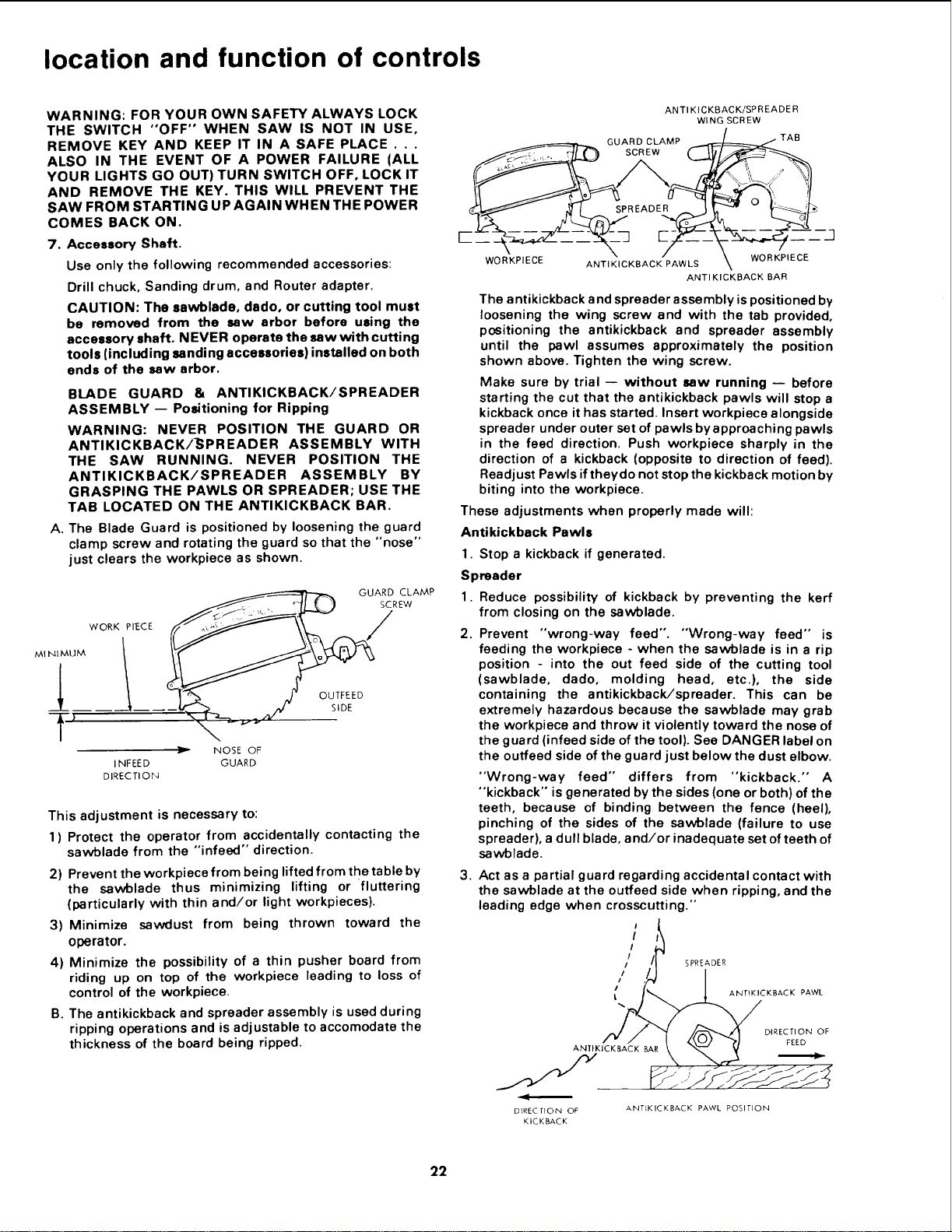
A. The Blade Guard is positioned by loosening the guard
clamp screw and rotating the guard so that the "nose"
just clears the workpiece as shown.
WORK PIECE
-f°
INFEED
DIRECTION
_% . j s,o=
NOSE OF
GUARD
This adjustment is necessary to:
1) Protect the operator from accidentally contacting the
sawblade from the "infeed" direction.
2) Prevent the workpiece from being lifted from the table by
the sawblade thus minimizing lifting or fluttering
(particularly with thin and/or light workpieces).
3) Minimize sawdust from being thrown toward the
operator.
4) Minimize the possibility of a thin pusher board from
riding up on top of the workpiece leading to loss of
control of the workpiece.
B. The antikickback and spreader assembly is used during
ripping operations and is adjustable to accomodate the
thickness of the board being ripped.
ANTI KI CKBACK/SPREADE R
WING SCREW
_ GUAF_DCLAMP _L _i TAB
SCREW
WORKPIECE ANTII<ICKBACKIPAWLS k WORKPIECE
ANTI KICKBACK BAR
The antikickback and spreader assembly ispositioned by
loosening the wing screw and with the tab provided,
positioning the antikickback and spreader assembly
until the pawl assumes approximately the position
shown above. Tighten the wing screw.
Make sure by trial -- without saw running -- before
starting the cut that the antikickback pawls will stop a
kickback once it has started. Insert workpiece alongside
spreader under outer set of pawls byapproaching pawls
in the feed direction. Push workpiece sharply in the
direction of a kickback (opposite to direction of feed).
Readjust Pawls iftheydo not stop the kickback motion by
biting into the workpiece.
These adjustments when properly made will:
Antikickback Pawls
1. Stop a kickback if generated.
Spreader
1. Reduce possibility of kickback by preventing the kerf
from closing on the sawblade.
2.
3.
Prevent "'wrong-way feed". "Wrong-way feed" is
feeding the workpiece - when the sawblade is in a rip
position - into the out feed side of the cutting tool
(sawblade, dado, molding head, etc.), the side
containing the antikickback/spreader. This can be
extremely hazardous because the sawblade may grab
the workpiece and throw it violently toward the nose of
the guard (infeed side of the tool). See DANGER label on
the ouffeed side ofthe guard just below the dust elbow.
"Wrong-way feed" differs from "kickback." A
"kickback" is generated by the sides (one or both) of the
teeth, because of binding between the fence (heel),
pinching of the sides of the sawblade (failure to use
spreader), a dull blade, and/or inadequate set of teeth of
sawblade.
Act as a partial guard regarding accidental contact with
the sawblade at the ouffeed side when ripping, and the
leading edge when crosscutting."
tI
,' /{" sP_oE_
" '/._ I
_... /'_ ; AN_,K,CKB_CKP_WL
DIRECTION OF ANTIKICKBACK PAWL POSITION
KICKBACK
22
HA VE YOU FOLLOWED ALL SIX STEPS OF
THE ALIGNMENT PROCEDURE? IF YOU
HAVE NOT FOLLOWED THEM IN THEIR
PROPER SEQUENCE, YOU CANNOT
EXPECT A CCURA TE CUTTING RESUL TS.
In addition to the proper alignment of your saw, you must
also become familiar with the following practices in order
to expect the best results.
I Edge of workpiece which is placed against fence
must be as straight as the long side of your framing
square.
2. Workpiece must be as flat as the front table board
on your saw.
3. There must be no sawdust or other wood chips
between the fence and front table board.
4. There must be no sawdust or other wood chips
underneath workpiece or between workpiece and
fence.
6.
];.
Workpiece must be held tightly against fence . . .
this is especially important when making angle cuts
because the workpiece has a tendency to move.
Always use the correct Sawblade for the Job . . .
Always keep it sharp.
When making a four sided frame:
a. The two side pieces must be exactly the same
length.
b. The top and bottom pieces must be exactly the
same length.
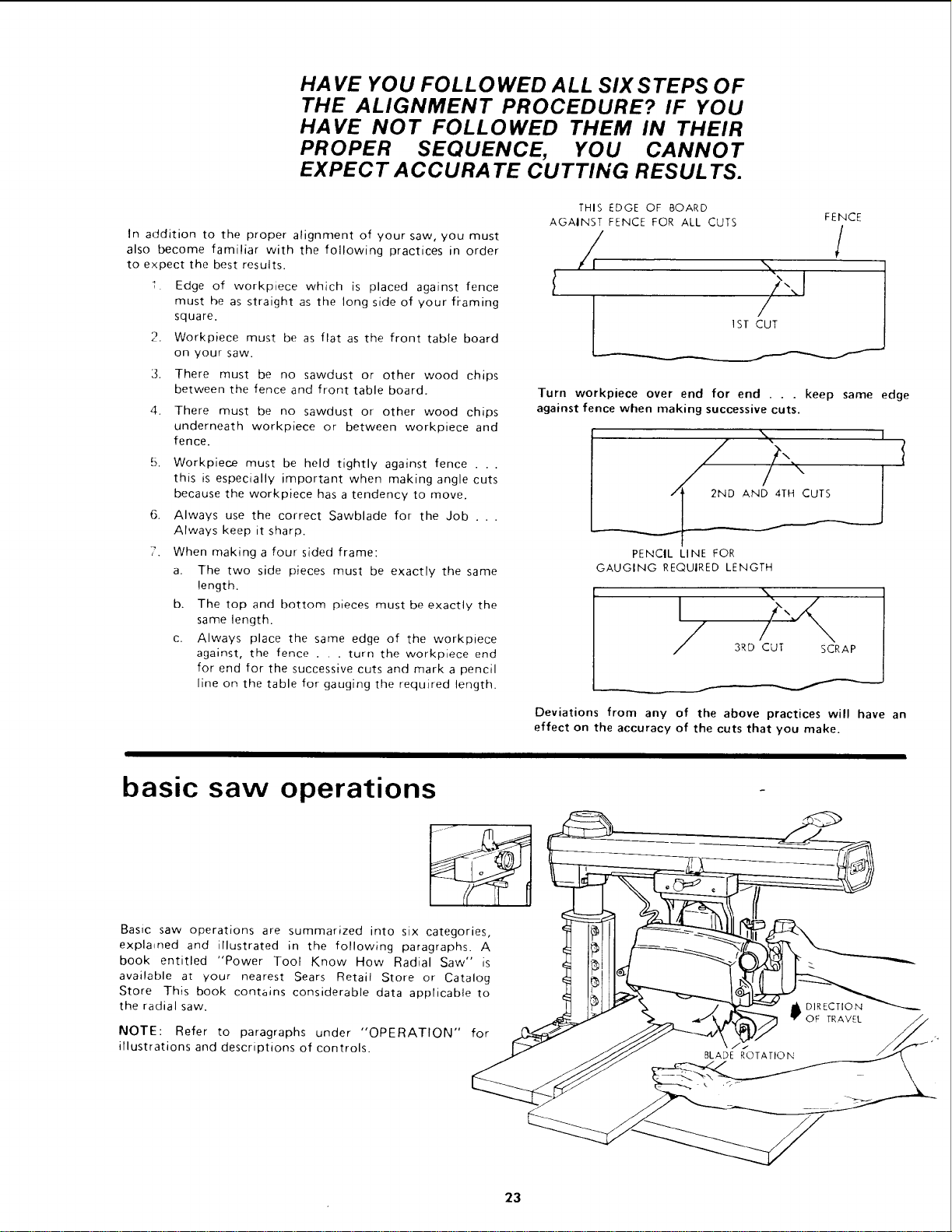
c. Always place the same edge of the workpiece
against, the fence . . . turn the workpiece end
for end for the successive cuts and mark a pencil
line on the table for gauging the required length.
THIS EDGE OF BOARD
AGAINST FENCE FOR ALL CUTS
/
FENCE
/
//-,I
1ST CUT
Turn workpiece over end for end . . . keep same edge
against fence when making successive cuts.
PENCIL LINE FOR
GAUGING REQUIRED LENGTH
f
3RD CUT SCRAP
Deviations from any of the above practices will have an
effect on the accuracy of the cuts that you make.
basic saw operations
Basic saw operations are summarized into six categories,
explained and illustrated in the following paragraphs. A
book entitled "Power Tool Know How Radial Saw" is
available at your nearest Sears Retail Store or Catalog
Store This book contains considerable data applicable to
the radial saw.
NOTE: Refer to paragraphs under "OPERATION" for
illustrations and descriptions of controls.
23
basic saw operations
REQUI REIViENTS FOR CROSSCUT
Board positioned (stationary) against rip fence (guide) and
laying flat on table top.
(OPERATIONS 1 THROUGH 4)
1,
2.
3.
4.
Arbor nut must be tight and saw blade guard installed
in horizontal position.
Arm control lever must be in locked position.
Adjust the antikickback assembly so the pawls just clear
the workpiece or the fence, whichever is higher.
Work must be held firmly against table and fence. For
workpieces thicker than the fence is high, install a
higher fence (at least workpiece thickness). Always
place the fence in the most forward position (farthest
from the column support) compatible with the
workpiece being processed and the operation being
performed. With the carriage fully retracted, the blade
must not contact-the workpiece when placed against
the fence, w_thin the stated capacities of your saw.
5. Blade should be sharp and correctly set.
6. Hands must be kept well away from saw blade.
7. Yoke lock handle must be in locked position.
8. Bevel index lever must be locked.
9. Blade should cut into the table or plywood cover not
more than 1/32 inch.
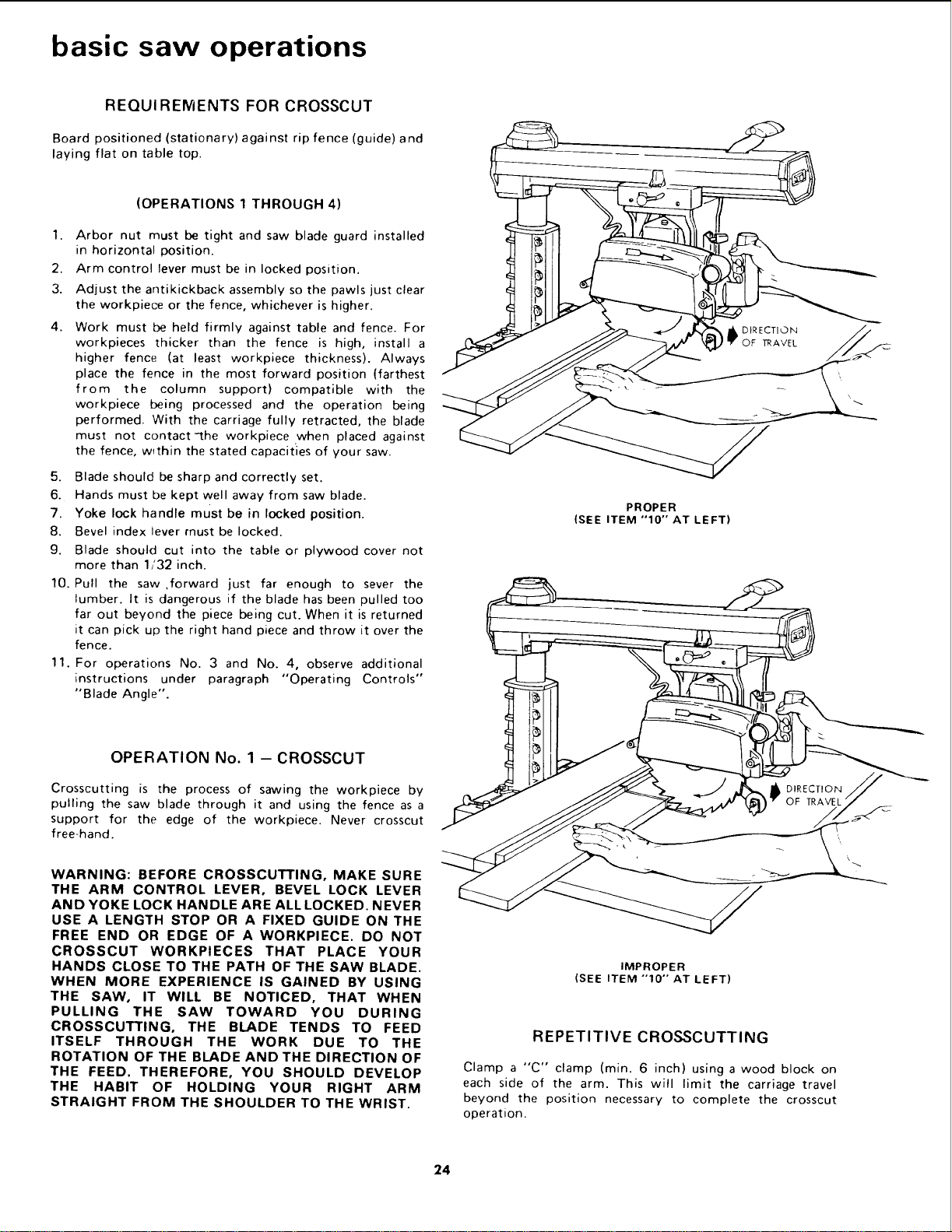
10. Pull the saw ,forward just far enough to sever the
lumber. It is dangerous if the blade has been pulled too
far out beyond the piece being cut. When it is returned
it can pick up the right hand piece and throw it over the
fence.
11. For operations No. 3 and No. 4, observe additional
instructions under paragraph "Operating Controls"
"Blade Angle".
OPERATION No. 1 - CROSSCUT
Crosscutting is the process of sawing the workpiece by
pulling the saw blade through it and using the fence as a
support for the edge of the workpiece. Never crosscut
free-hand.
WARNING: BEFORE CROSSCUTTING, MAKE SURE
THE ARM CONTROL LEVER, BEVEL LOCK LEVER
AND YOKE LOCK HANDLE ARE ALL LOCKED. NEVER
USE A LENGTH STOP OR A FIXED GUIDE ON THE
FREE END OR EDGE OF A WORKPIECE. DO NOT
CROSSCUT WORKPIECES THAT PLACE YOUR
HANDS CLOSE TO THE PATH OF THE SAW BLADE.
WHEN MORE EXPERIENCE IS GAINED BY USING
THE SAW, IT WILL BE NOTICED, THAT WHEN
PULLING THE SAW TOWARD YOU DURING
CROSSCUTTING, THE BLADE TENDS TO FEED
ITSELF THROUGH THE WORK DUE TO THE
ROTATION OF THE BLADE AND THE DIRECTION OF
THE FEED. THEREFORE, YOU SHOULD DEVELOP
THE HABIT OF HOLDING YOUR RIGHT ARM
STRAIGHT FROM THE SHOULDER TO THE WRIST.
PROPER
(SEE ITEM "10" AT LEFT)
IMPROPER
(SEE ITEM "10" AT LEFT)
REPETITIVE CROSSCUTTING
Clamp a "C" clamp (min. 6 inch) using a wood block on
each side of the arm. This will limit the carriage travel
beyond the position necessary to complete the crosscut
operation.
24
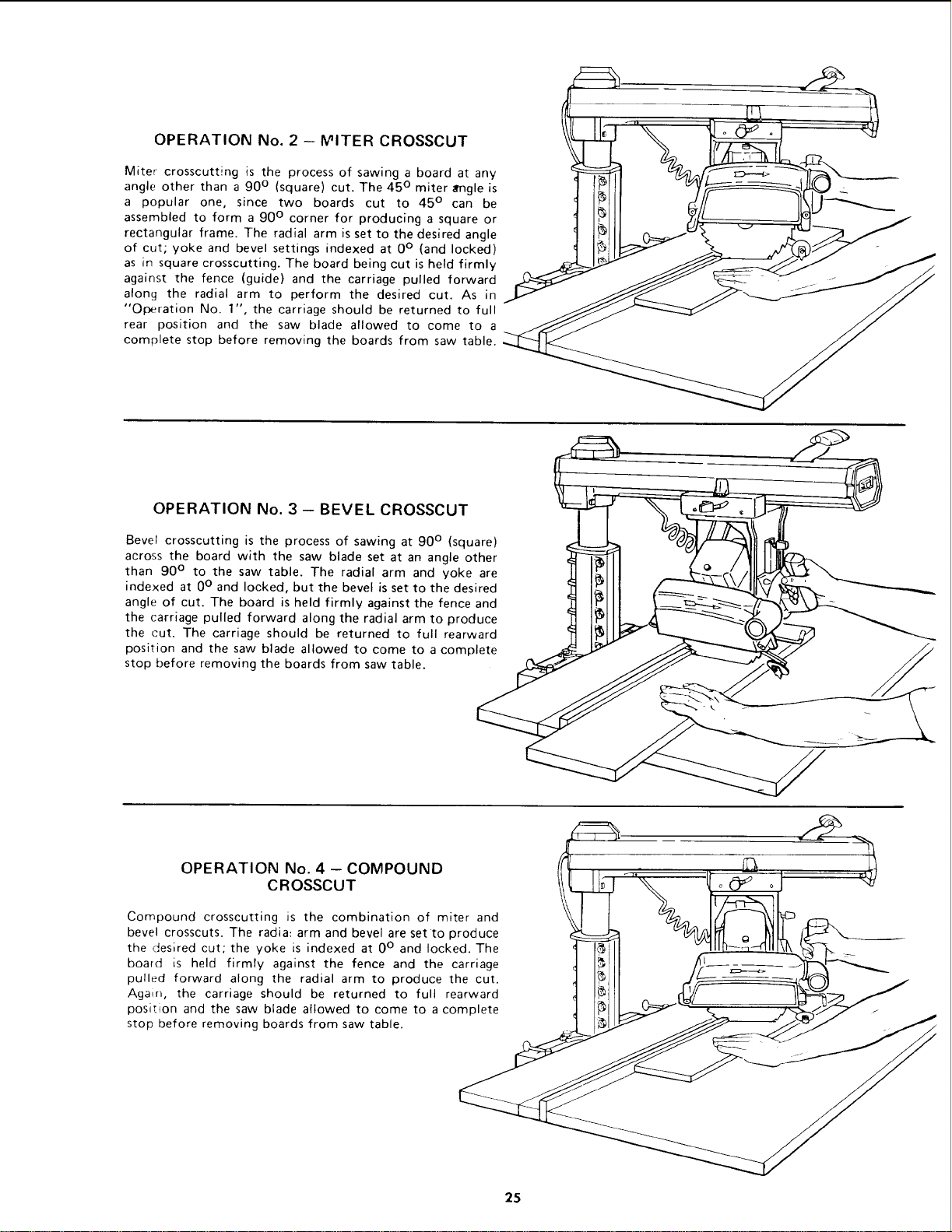
OPERATION No. 2 -- MITER CROSSCUT
Miter crosscutting is the process of sawing a board at any
angle other than a 90 ° (square) cut. The 45 ° miter angle is
a popular one, since two boards cut to 45 ° can be
assembled to form a 90 ° corner for producing a square or
rectangular frame. The radial arm is set to the desired angle
of cut; yoke and bevel settings indexed at 0° (and locked)
as in square crosscutting. The board being cut is held firmly
against the fence (guide) and the carriage pulled forward
along the radial arm to perform the desired cut. As in
"Operation No. 1", the carriage should be returned to full
rear position and the saw blade allowed to come to a
complete stop before removing the boards from saw table.
OPERATION No. 3 - BEVEL CROSSCUT
Bevel crosscutting is the process of sawing at 90 ° (square)
across the board with the saw blade set at an angle other
than 90 ° to the saw table. The radial arm and yoke are
indexed at 0° and locked, but the bevel is set to the desired
angle of cut. The board is held firmly against the fence and
the carriage pulled forward along the radial arm to produce
the cut. The carriage should be returned to full rearward
position and the saw blade allowed to come to a complete
stop before removing the boards from saw table.
OPERATION No. 4 - COMPOUND
CROSSCUT
Compound crosscutting is the combination of miter and
bevel crosscuts. The radia: arm and bevel are set to produce
the desired cut; the yoke is indexed at 0° and locked. The
board is held firmly against the fence and the carriage
pulled forward along the radial arm to produce the cut.
Again, the carriage should be returned to full rearward
posi[ion and the saw blade allowed to come to a complete
stop before removing boards from saw table.
25
basic saw operations
REQUIREMENTS WHEN RIPPING
(OPERATIONS 5 AND 6)
gLIONTLY L[££ THAN
THICKNESS OF WORKPIECE
uP TO 3/8"
PUSH STICK
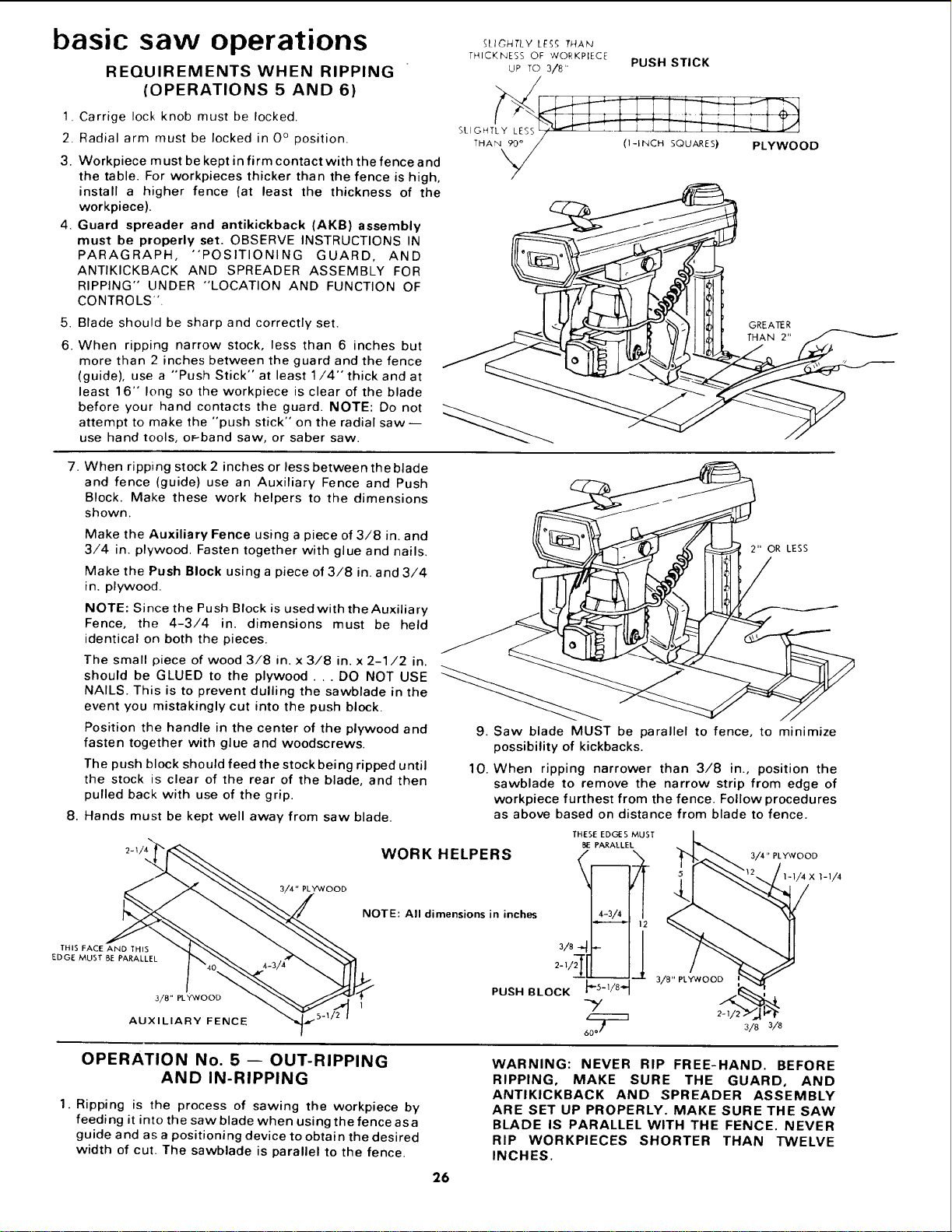
1. Carrige lock knob must be locked.
SLIGHTLY LESS
2. Radial arm must be locked in 0 ° position. THAN 9Oo fl-INCH SOUARES) PLYWOOD
3. Workpiece must be kept in firm contact with the fence and
the table. For workpieces thicker than the fence is high,
install a higher fence (at least the thickness of the
workpiece).
4. Guard spreader and antikickback (AKB) assembly
must be properly set. OBSERVE INSTRUCTIONS IN
PARAGRAPH, "POSITIONING GUARD, AND
ANTIKICKBACK AND SPREADER ASSEMBLY FOR
RIPPING" UNDER "LOCATION AND FUNCTION OF
CONTROLS".
5. Blade should be sharp and correctly set. GREATER
6. When ripping narrow stock, less than 6 inches but ___.. _/..!__A_ 2"_
more than 2 inches between the guard and the fence _ .....
(guide), use a "Push Stick" at least 1/4'" thick and at __ _'J"l_-'_J_ __
least 16" long so the workpiece is clear of the blade
before your hand contacts the guard. NOTE: Do not
attempt to make the "push stick" on the radial saw--
use hand tools, or-band saw, or saber saw.
7. When ripping stock 2 inches or less between the blade
and fence (guide) use an Auxiliary Fence and Push
Block. Make these work helpers to the dimensions
shown.
Make the Auxiliary Fence using a piece of 3/8 in. and
3/4 in. plywood. Fasten together with glue and nails.
Make the Push Block using a piece of 3/8 in. and 3/4
in. plywood.
NOTE: Since the Push Block is usedwith theAuxiliary
Fence, the 4-3/4 in. dimensions must be held
identical on both the pieces.
The small piece of wood 3/8 in. x 3/8 in. x 2-1/2 in.
should be GLUED to the plywood... DO NOT USE
NAILS. This is to prevent dulling the sawblade in the
event you mistakingly cut into the push block.
Position the handle in the center of the plywood and
fasten together with glue and woodscrews.
The push block should feed the stock being ripped until
the stock is clear of the rear of the blade, and then
pulled back with use of the grip.
8. Hands must be kept well away from saw blade.
PLYWOOD
THIS FACE AND THIS
EDGE MUST BE PARALLEL
3/8" PLYWOOD
AUXILIARY FENCE
2" OR LESS
9. Saw blade MUST be parallel to fence, to minimize
possibility of kickbacks.
10. When ripping narrower than 3/8 in., position the
sawblade to remove the narrow strip from edge of
workpiece furthest from the fence. Follow procedures
as above based on distance from blade to fence.
WORK HELPERS
NOTE: All dimensions in inches
THESE EDGES MUST
BE PARALLEL
3/8 i_
PUSH BLOCK _-5-I/8._
3/8" PLYWOOD
2-1/
3/8 3/8
OPERATION No. 5 -- OUT-RIPPING
AND IN-RIPPING
1. Ripping is the process of sawing the workpiece by
feeding it into the saw blade when using the fence as a
guide and as a positioning device to obtain the desired
width of cut. The sawblade is parallel to the fence.
WARNING: NEVER RIP FREE-HAND. BEFORE
RIPPING, MAKE SURE THE GUARD, AND
ANTIKICKBACK AND SPREADER ASSEMBLY
ARE SET UP PROPERLY. MAKE SURE THE SAW
BLADE IS PARALLEL WITH THE FENCE. NEVER
RIP WORKPIECES SHORTER THAN TWELVE
INCHES.
26
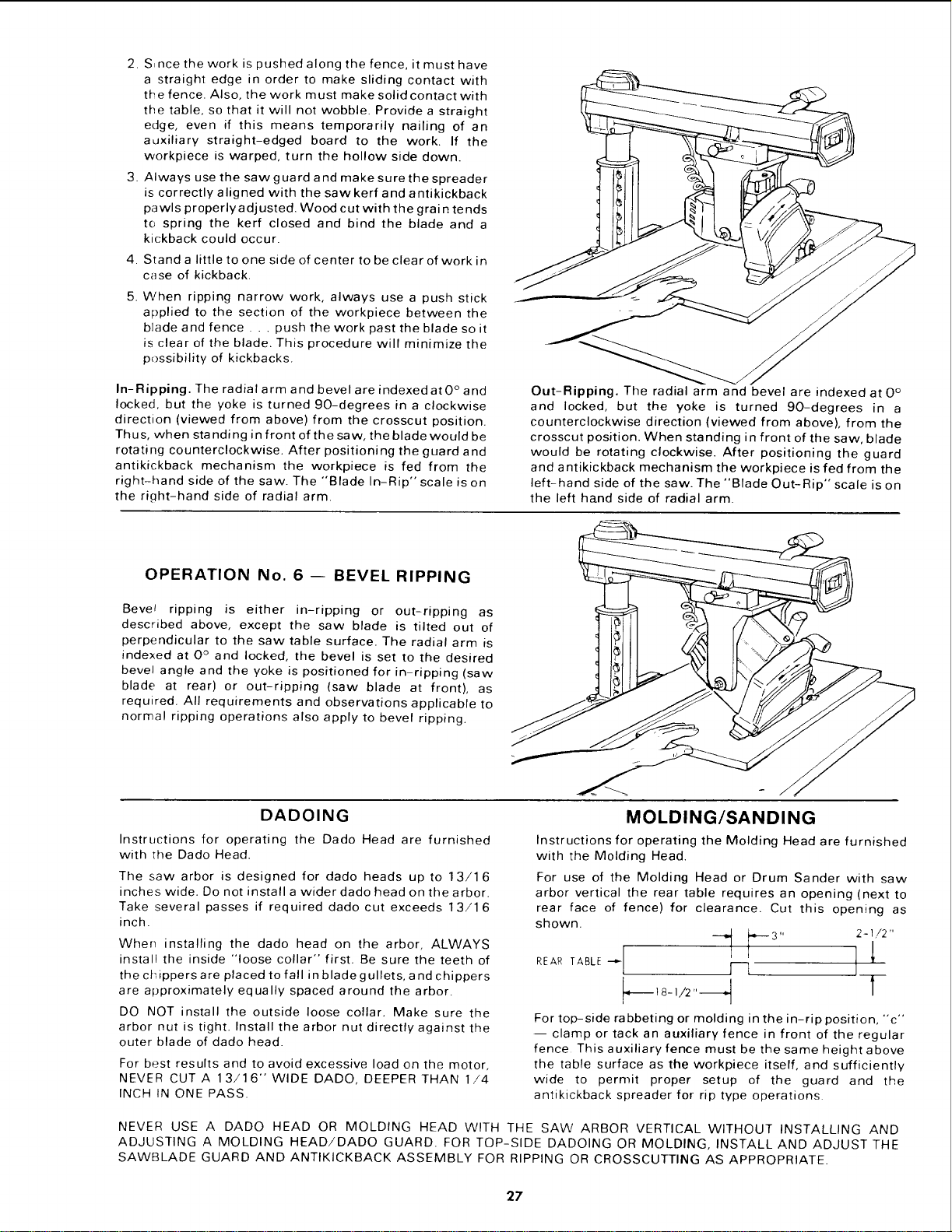
2. S,nce the work is pushed along the fence, it must have
a straight edge in order to make sliding contact with
the fence. Also, the work must make solid contact with
the table, so that it will not wobble. Provide a straight
edge, even if this means temporarily nailing of an
auxiliary straight-edged board to the work. If the
workpiece is warped, turn the hollow side down.
3. Always use the sawguard and make sure the spreader
is correctly aligned with the saw kerr and antikickback
pawls properly adj usted. Wood cut with the grain tends
to spring the kerf closed and bind the blade and a
kickback could occur.
4. Stand a little to one side of center to be clear of work in
case of kickback.
5. When ripping narrow work, always use a push stick
applied to the section of the workpiece between the
blade and fence . . . push the work past the blade so it
is clear of the blade. This procedure will minimize the
possibility of kickbacks.
In-Ripping. The radial arm and bevel are indexedatO ° and
locked, but the yoke is turned 90-degrees in a clockwise
direction (viewed from above) from the crosscut position.
Thus, when sta ndi ng in front of the saw, the blade would be
rotating counterclockwise. After positioning the guard and
antikickback mechanism the workpiece is fed from the
right-hand side of the saw. The "Blade In-Rip" scale is on
the right-hand side of radial arm.
Out-Ripping. The radial arm and bevel are indexed at 0 °
and locked, but the yoke is turned 90-degrees in a
counterclockwise direction (viewed from above), from the
crosscut position. When standing in front of the saw, blade
would be rotating clockwise. After positioning the guard
and antikickback mechanism the workpiece is fed from the
left-hand side of the saw. The "Blade Out-Rip" scale is on
the left hand side of radial arm.
OPERATION No. 6 -- BEVEL RIPPING
Bevel ripping is either in-ripping or out-ripping as
described above, except the saw blade is tilted out of
perpendicular to the saw table surface. The radial arm is
indexed at 0 ° and locked, the bevel is set to the desired
bevel angle and the yoke is positioned for in-ripping (saw
blade at rear) or out-ripping (saw blade at front), as
required. All requirements and observations applicable to
normal ripping operations also apply to bevel ripping.
DADOING
Instructions for operating the Dado Head are furnished
with the Dado Head.
The saw arbor is designed for dado heads up to 13/16
inches wide. Do not install a wider dado head on the arbor.
Take several passes if required dado cut exceeds 13/16
inch.
When installing the dado head on the arbor, ALWAYS
install the inside "loose collar" first. Be sure the teeth of
the chippers are placed to fall in blade gullets, and chippers
are approximately equally spaced around the arbor.
DO NOT install the outside loose collar. Make sure the
arbor nut is tight. Install the arbor nut directly against the
outer blade of dado head.
For best results and to avoid excessive load on the motor,
NEVER CUT A 13/16" WIDE DADO, DEEPER THAN 1/4
INCH IN ONE PASS.
MOLDING/SANDING
Instructions for operating the Molding Head are furnished
with the Molding Head.
For use of the Molding Head or Drum Sander with saw
arbor vertical the rear table requires an opening (next to
rear face of fence) for clearance. Cut this opening as
shown.
REAR TABLE--,-[ -_p3" ]_2-I/2"
For top-side rabbeting or molding in the in-rip position, "c"
I clamp or tack an auxiliary fence in front of the regular
fence This auxiliary fence must be the same height above
the table surface as the workpiece itself, and sufficiently
wide to permit proper setup of the guard and the
antikickback spreader for rip type operations.
NEVER USE A DADO HEAD OR MOLDING HEAD WITH THE SAW ARBOR VERTICAL WITHOUT INSTALLING AND
ADJUSTING A MOLDING HEADiDADO GUARD. FOR TOP-SIDE DADOING OR MOLDING, INSTALL AND ADJUST THE
SAWBLADE GUARD AND ANTIKICKBACK ASSEMBLY FOR RIPPING OR CROSSCUTTING AS APPROPRIATE.
27
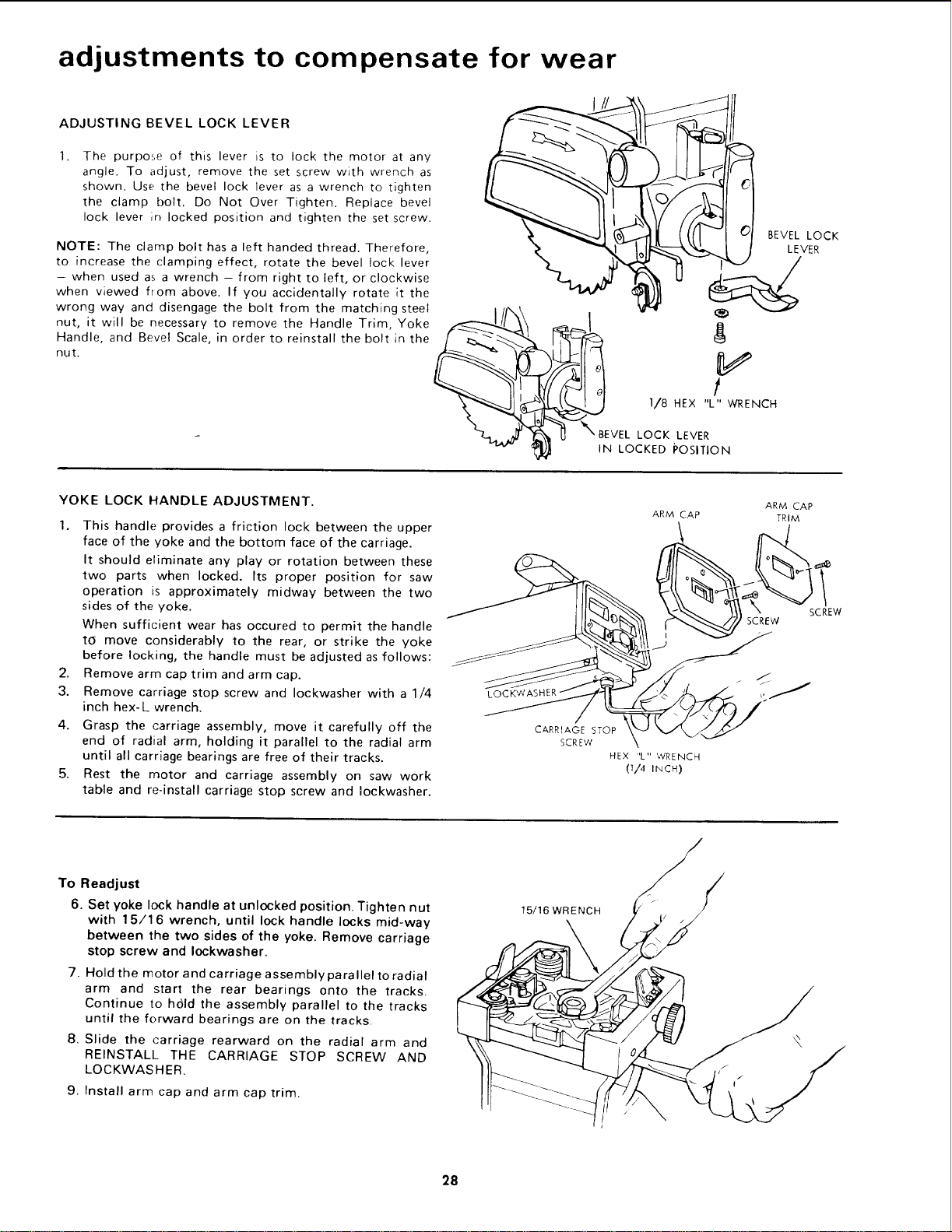
adjustments to compensate for wear
ADJUSTING BEVEL LOCK LEVER
The purpose of this lever is to lock the motor at any
angle. To adjust, remove the set screw with wrench as
shown. Use the bevel lock lever as a wrench to tighten
the clamp bolt. Do Not Over Tighten. Replace bevel
lock lever in locked position and tighten the set screw.
NOTE: The clamp bolt has a left handed thread. Therefore,
to increase the clamping effect, rotate the bevel lock lever
- when used as a wrench - from right to left, or clockwise
when viewed from above. If you accidentally rotate it the
wrong way and disengage the bolt from the matching steel
nut, it will be necessary to remove the Handle Trim, Yoke
Handle, and Bevel Scale, in order to reinstall the bolt in the
nut.
BEVELLOCK
LEVER
!
1/8 HEX "L" WRENCH
LEVER
i_OSlTIO N
YOKE LOCK HANDLE ADJUSTMENT.
1. This handle provides a friction lock between the upper
face of the yoke and the bottom face of the carriage.
It should eliminate any play or rotation between these
two parts when locked. Its proper position for saw
operation is approximately midway between the two
sides of the yoke.
When sufficient wear has occured to permit the handle
tO move considerably to the rear, or strike the yoke
before locking, the handle must be adjusted as follows:
2. Remove arm cap trim and arm cap.
3. Remove carriage stop screw and Iockwasher with a 1/4
inch hex-L wrench.
4. Grasp the carriage assembly, move it carefully off the
end of radial arm, holding it parallel to the radial arm
until all carriage bearings are free of their tracks.
5. Rest the motor and carriage assembly on saw work
table and re-install carriage stop screw and Iockwasher.
CARRIAGE STOP
SCREW
ARM CAP
ARM CAP TRIM
HEX "L" WRENCH
(1/4 INCH)
To Readjust
6. Set yoke lock handle at unlocked position. Tighten nut
with 15/1 6 wrench, until lock handle locks mid-way
between the two sides of the yoke. Remove carriage
stop screw and Iockwasher.
7. Hold the motor and carriage assemblyparallel to radial
arm and start the rear bearings onto the tracks.
Continue to h(_ld the assembly parallel to the tracks
until the forward bearings are on the tracks.
8. Slide the carriage rearward on the radial arm and
REINSTALL THE CARRIAGE STOP SCREW AND
LOCKWAS HER.
9. Install arm cap and arm cap trim.
15/16 WRENCH
/
28
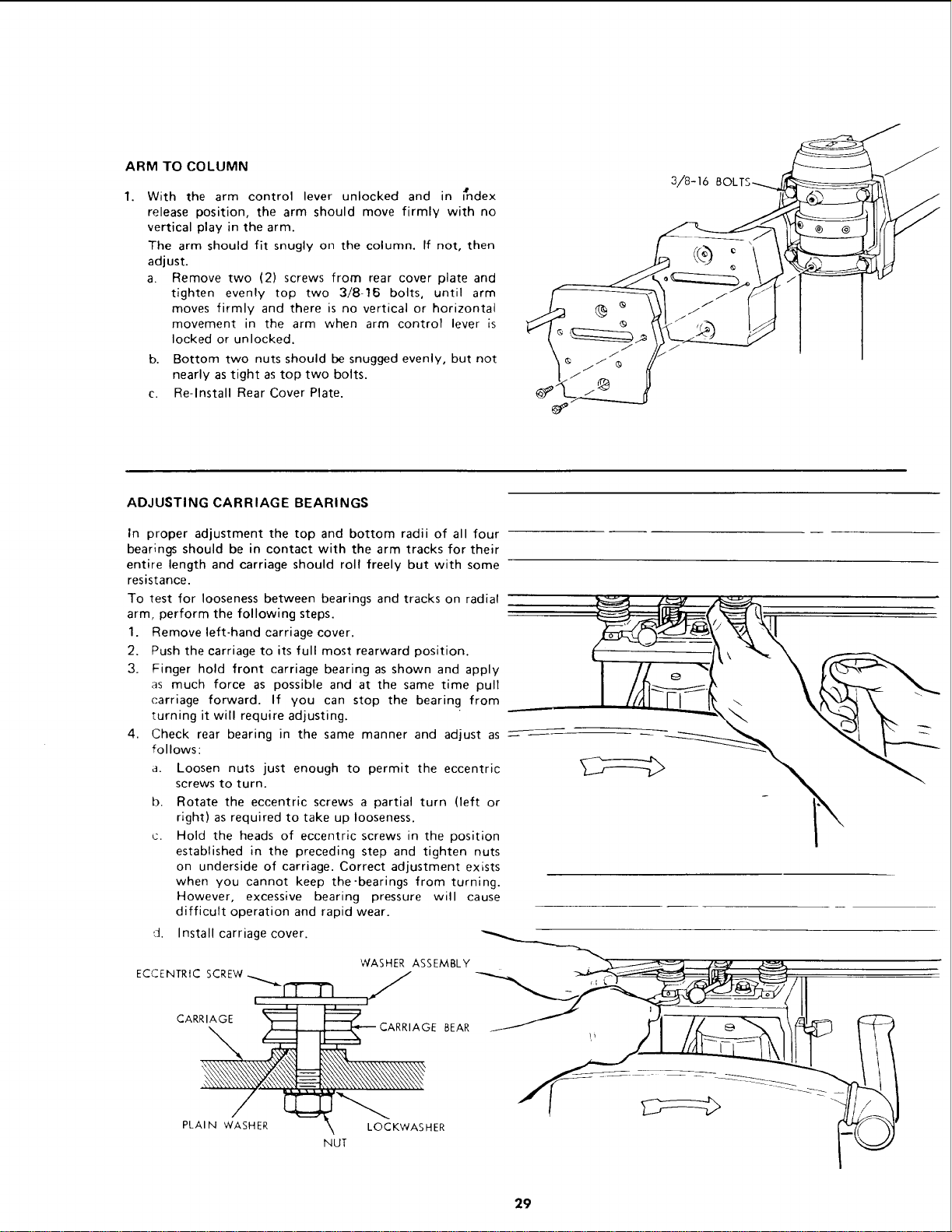
ARM TO COLUMN
1.
With the arm control lever unlocked and in irndex
release position, the arm should move firmly with no
vertical play in the arm.
The arm should fit snugly on the column. If not, then
adjust.
a. Remove two (2) screws from rear cover plate and
tighten evenly top two 3/8-16 bolts, until arm
moves firmly and there is no vertical or horizontal
movement in the arm when arm control lever is
locked or unlocked.
b. Bottom two nuts should be snugged evenly, but not
nearly as tight as top two bolts.
c. Re-lnstall Rear Cover Plate.
@ @
ADJUSTING CARRIAGE BEARINGS
In proper adjustment the top and bottom radii of all four
bearings should be in contact with the arm tracks for their
entire length and carriage should roll freely but with some
resistance.
To test for looseness between bearings and tracks on radial
arm, perform the following steps.
I. Remove left-hand carriage cover.
2. Push the carriage to its full most rearward position.
3. Finger hold front carriage bearing as shown and apply
as much force as possible and at the same time pull
carriage forward. If you can stop the bearing from
turning it will require adjusting.
4. Check rear bearing in the same manner and adjust as
follows:
a. Loosen nuts just enough to permit the eccentric
screws to turn.
b. Rotate the eccentric screws a partial turn (left or
right) as required to take up looseness.
c. Hold the heads of eccentric screws in the position
established in the preceding step and tighten nuts
on underside of carriage. Correct adjustment exists
when you cannot keep the'bearings from turning.
However, excessive bearing pressure will cause
difficult operation and rapid wear.
d. Install carriage cover.
WASHER ASSEMBLY
ECCENTRIC SCREW
CARRIAGE
CARRIAGE BEAR
PLAIN WASHER LOCKWASHER
NUT
f
29
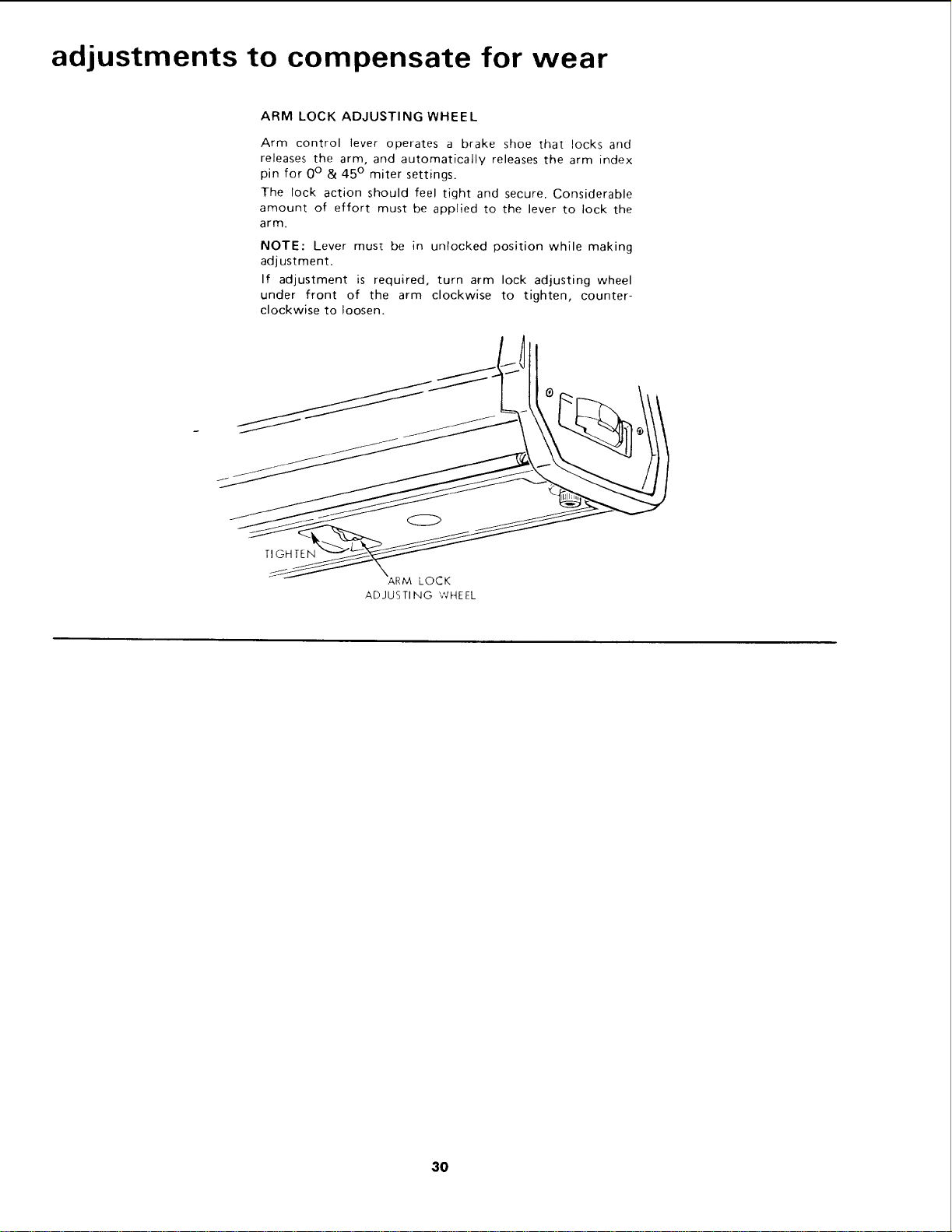
adjustments to compensate for wear
ARM LOCK ADJUSTING WHEEL
Arm control lever operates a brake shoe that locks and
releases the arm, and automatically releases the arm index
pin for 0° & 45 ° miter settings.
The lock action should feel tight and secure. Considerable
amount of effort must be applied to the lever to lock the
arm.
NOTE: Lever must be in unlocked position while making
adjustment.
If adjustment is required, turn arm lock adjusting wheel
under front of the arm clockwise to tighten, counter-
clockwise to loosen.
TIGHTEN
ARM LOCK
ADJUSTING WHEEL
3O
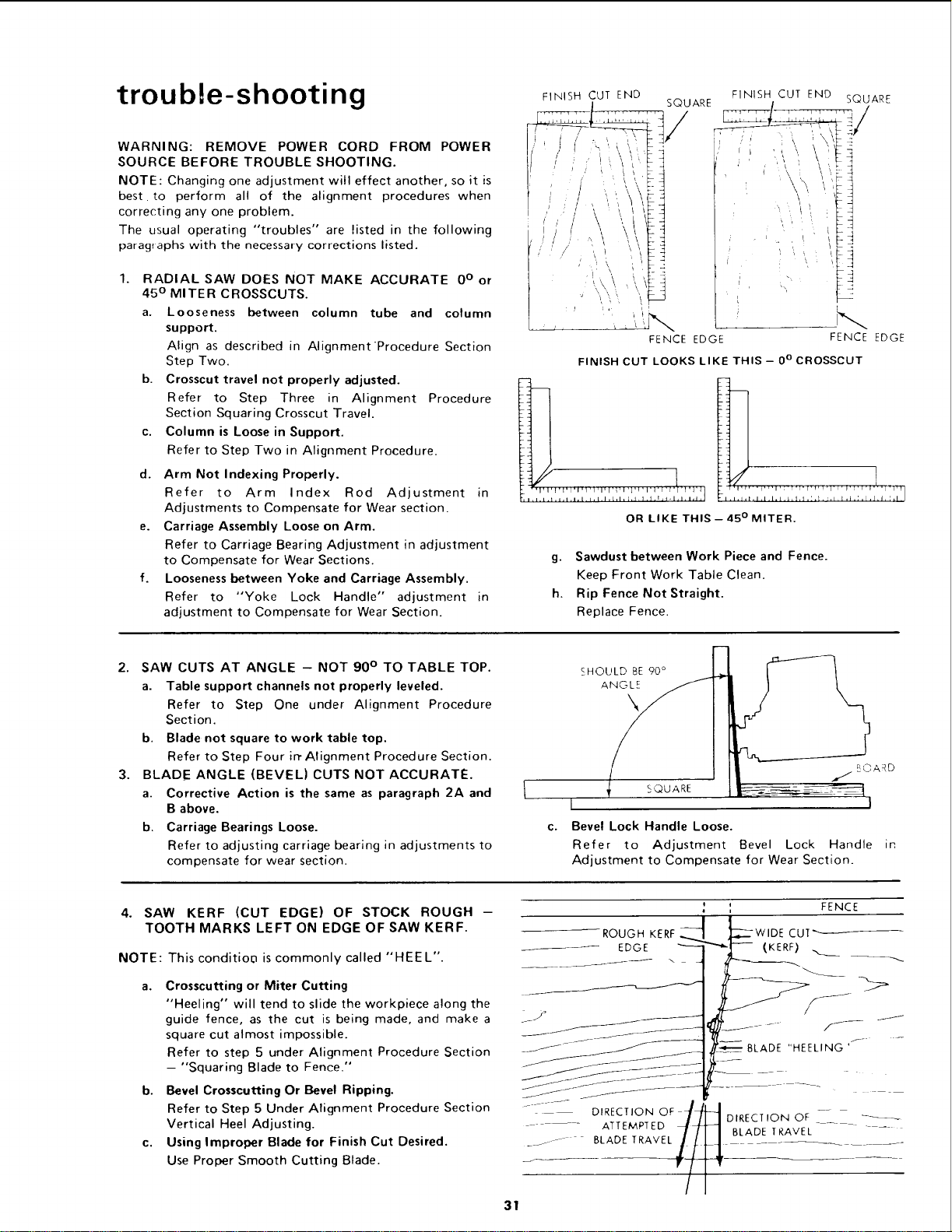
trouble-shooting
WARNING: REMOVE POWER CORD FROM POWER
SOURCE BEFORE TROUBLE SHOOTING.
NOTE: Changing one adjustment will effect another, so it is
best to perform all of the alignment procedures when
correcting any one problem.
The usual operating "troubles" are listed in the following
parag_ aphs with the necessary corrections listed.
RADIAL SAW DOES NOT MAKE ACCURATE 0°or
45 ° MITER CROSSCUTS.
a. Looseness between column tube and column
support.
Align as described in AlignmentProcedure Section
Step Two.
b. Crosscut travel not properly adjusted.
Refer to Step Three in Alignment Procedure
Section Squaring Crosscut Travel.
c. Column is Loose in Support.
Refer to Step Two in Alignment Procedure.
d. Arm Not Indexing Properly.
Refer to Arm Index Rod Adjustment in
Adjustments to Compensate for Wear section.
e. Carriage Assembly Loose on Arm.
Refer to Carriage Bearing Adjustment in adjustment
to Compensate for Wear Sections.
f. Looseness between Yoke and Carriage Assembly.
Refer to "Yoke Lock Handle" adjustment in
adjustment to Compensate for Wear Section.
4
4
J
J
J
3
FINISH CUT END
FINISH CUT LOOKS LIKE THIS -- 0 ° CROSSCUT
OR LIKE THIS-- 45 ° MITER.
g. Sawdust between Work Piece and Fence.
Keep Front Work Table Clean.
h. Rip Fence Not Straight.
Replace Fence.
2. SAW CUTS AT ANGLE - NOT 90 ° TO TABLE TOP.
a. Table support channels not properly leveled.
Refer to Step One under Alignment Procedure
Section.
b. Blade not square to work table top.
Refer to Step Four ir_Alignment Procedure Section.
3. BLADE ANGLE (BEVEL) CUTS NOT ACCURATE.
a. Corrective Action is the same as paragraph 2A and
B above.
b. Carriage Bearings Loose.
Refer to adjusting carriage bearing in adjustments to
compensate for wear section.
_HOULD BE90°
ANGLE
\
_OARD
I q_QUARE
I I
c. Bevel Lock Handle Loose.
Refer to Adjustment Bevel Lock Handle in
Adjustment to Compensate for Wear Section.
4. SAW KERF (CUT EDGE) OF STOCK ROUGH -
TOOTH MARKS LEFT ON EDGE OF SAW KERF.
NOTE:
a.
b.
c,
This conditio0 is commonly called "HEEL".
Crosscutting or Miter Cutting
"Heeling" will tend to slide the workpiece along the
guide fence, as the cut is being made, and make a
square cut almost impossible.
Refer to step 5 under Alignment Procedure Section
- "Squaring Blade to Fence."
Bevel Crosscutting Or Bevel Ripping.
Refer to Step 5 Under Alignment Procedure Section
Vertical Heel Adjusting.
Using Improper Blade for Finish Cut Desired.
Use Proper Smooth Cutting Blade.
t , FENCE
i i
ROUGH KI_RF_'-_WIDE CUT"-----
EDGE (KERF)
31
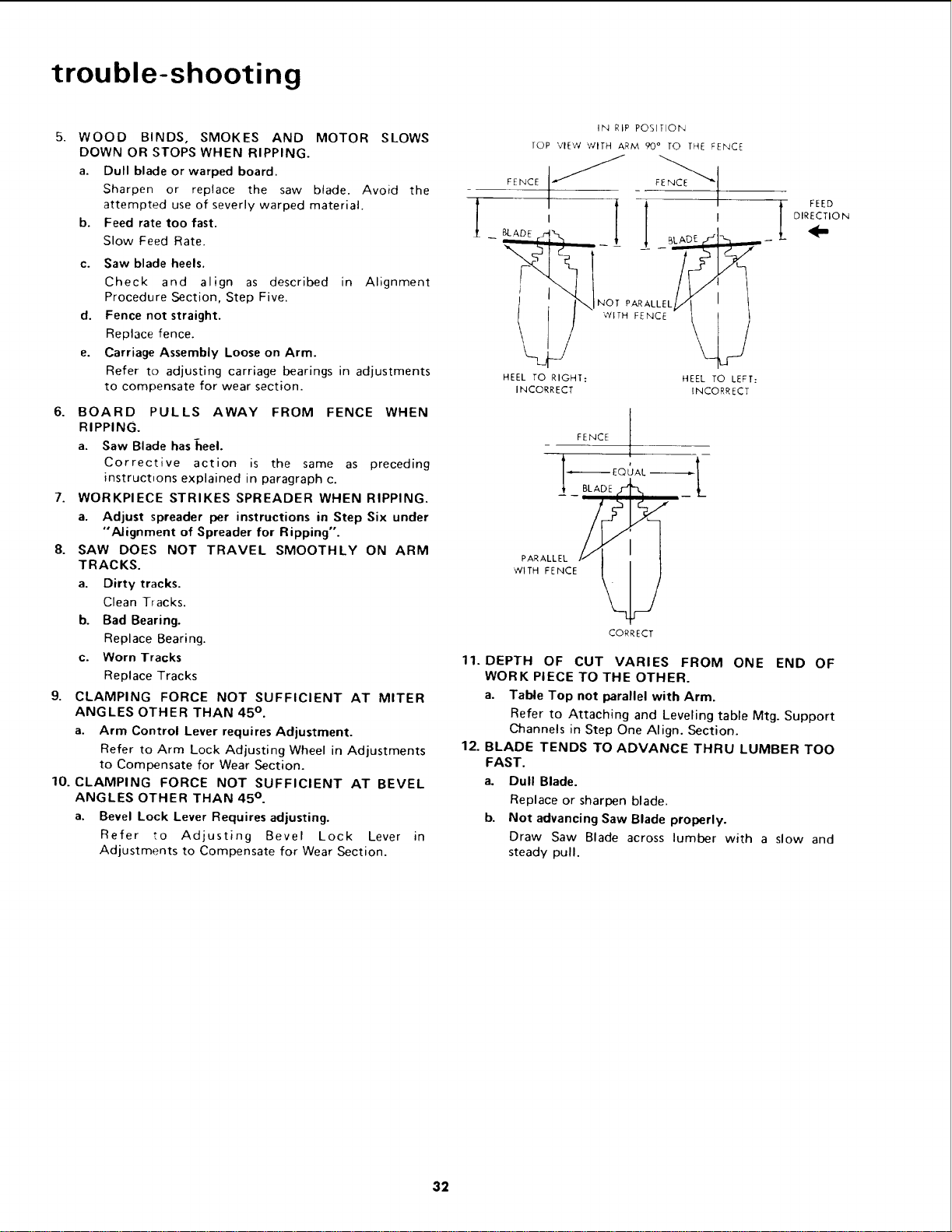
trouble-shooting
5. WOOD BINDS, SMOKES AND MOTOR SLOWS
DOWN OR STOPS WHEN RIPPING.
a. Dull blade or warped board.
Sharpen or replace the saw blade. Avoid the
attempted use of severly warped material.
b. Feed rate too fast.
Slow Feed Rate.
c. Saw blade heels.
Check and align as described in Alignment
Procedure Section, Step Five,
d. Fence not straight.
Replace fence.
e. Carriage Assembly Loose on Arm.
Refer to adjusting carriage bearings in adjustments
to compensate for wear section.
6. BOARD PULLS AWAY FROM FENCE WHEN
RIPPING.
a. Saw Blade has heel.
Corrective action is the same as preceding
instrucbons explained in paragraph c.
7. WORKPIECE STRIKES SPREADER WHEN RIPPING.
a. Adjust spreader per instructions in Step Six under
"Alignment of Spreader for Ripping".
8. SAW DOES NOT TRAVEL SMOOTHLY ON ARM
TRACKS.
a. Dirty tracks.
Clean Tracks.
b. Bad Bearing.
Replace Bearing.
c. Worn Tracks
Replace Tracks
9. CLAMPING FORCE NOT SUFFICIENT AT MITER
ANGLES OTHER THAN 45 ° .
a. Arm Control Lever requires Adjustment.
Refer to Arm Lock Adjusting Wheel in Adjustments
to Compensate for Wear Section.
10. CLAMPING FORCE NOT SUFFICIENT AT BEVEL
ANGLES OTHER THAN 45 ° .
a. Bevel Lock Lever Requires adjusting.
Refer to Adjusting Bevel Lock Lever in
Adjustments to Compensate for Wear Section.
IN RIP POSITION
TOP VIEW WITH ARM 90 ° TO THE FENCE
FENCE [ FEMCE_'_
I '
NOT PARALLEL
WITH FENCE
HEEL TO RIGHT: HEEL TO LEFT:
INCORRECT INCORRECT
t FEED
DIRECTION
FENCE
PARALLEL
WITH FENCE
CORRECT
11. DEPTH OF CUT VARIES FROM ONE END OF
WORK PIECE TO THE OTHER.
a. Table Top not parallel with Arm.
Refer to Attaching and Leveling table Mtg. Support
Channels in Step One Align. Section.
12. BLADE TENDS TO ADVANCE THRU LUMBER TOO
FAST.
a. Dull Blade.
Replace or sharpen blade.
b. Not advancing Saw Blade properly.
Draw Saw Blade across lumber with a slow and
steady pull.
32
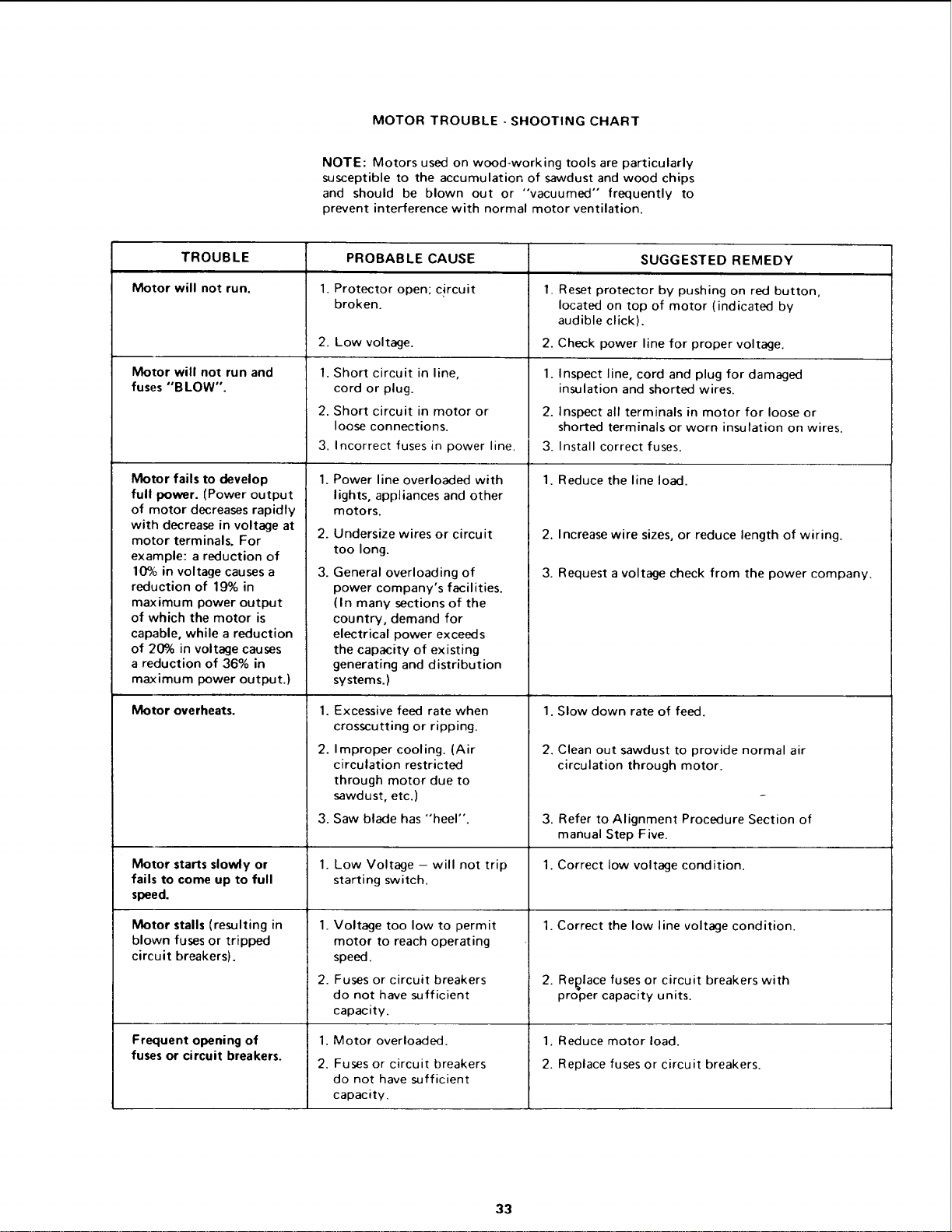
MOTOR TROUBLE - SHOOTING CHART
NOTE: Motors used on wood-working tools are particularly
susceptible to the accumulation of sawdust and wood chips
and should be blown out or "vacuumed" frequently to
prevent interference with normal motor ventilation.
TROUBLE SUGGESTED REMEDY
Motor will not run. 1. 1.
Motor will not run and
fuses "B LOW".
Motor fails to develop
full power. (Power output
of motor decreases rapidly
with decrease in voltage at
motor terminals. For
example: a reduction of
10% in voltage causes a
reduction of 19% in
maximum power output
of which the motor is
capable, while a reduction
of 20% in voltage causes
a reduction of 36% in
maximum power output.)
Motor overheats.
Motor starts slowly or
fails to come up to full
speed.
Motor stalls (resulting in
blown fuses or tripped
circuit breakers).
Frequent opening of
fuses or circuit breakers.
PROBABLE CAUSE
Protector open; circuit
broken.
2. Low voltage.
1. Short circuit in line,
cord or plug.
2. Short circuit in motor or
loose connections.
3. Incorrect fuses in power line.
1. Power line overloaded with
lights, appliances and other
motors.
2.
3.
Undersize wires or circuit
too long.
General overloading of
power company's facilities.
(In many sections of the
country, demand for
electrical power exceeds
the capacity of existing
generating and distribution
systems.)
1. Excessive feed rate when
crosscutting or ripping.
2. Improper cooling. (Air
circulation restricted
through motor due to
sawdust, etc.)
3. Saw blade has "heel".
1. Low Voltage - will not trip
starting switch.
1. Voltage too low to permit
motor to reach operating
speed.
2. Fuses or circuit breakers
do not have sufficient
capacity.
1. Motor overloaded.
2. Fuses or circuit breakers
do not have sufficient
capacity.
Reset protector by pushing on red button,
located on top of motor (indicated by
audible click).
2. Check power line for proper voltage.
1.
2.
3.
Inspect line, cord and plug for damaged
insulation and shorted wires.
Inspect all terminals in motor for loose or
shorted terminals or worn insulation on wires.
Install correct fuses.
1. Reduce the line load.
2. Increase wire sizes, or reduce length of wiring.
3. Request a voltage check from the power company.
1. Slow down rate of feed.
2. Clean out sawdust to provide normal air
circulation through motor.
3. Refer to Alignment Procedure Section of
manual Step Five.
1. Correct low voltage condition.
1. Correct the low line voltage condition.
2. Replace fuses or circuit breakers with
proper capacity units.
1. Reduce motor load.
2. Replace fuses or circuit breakers.
33
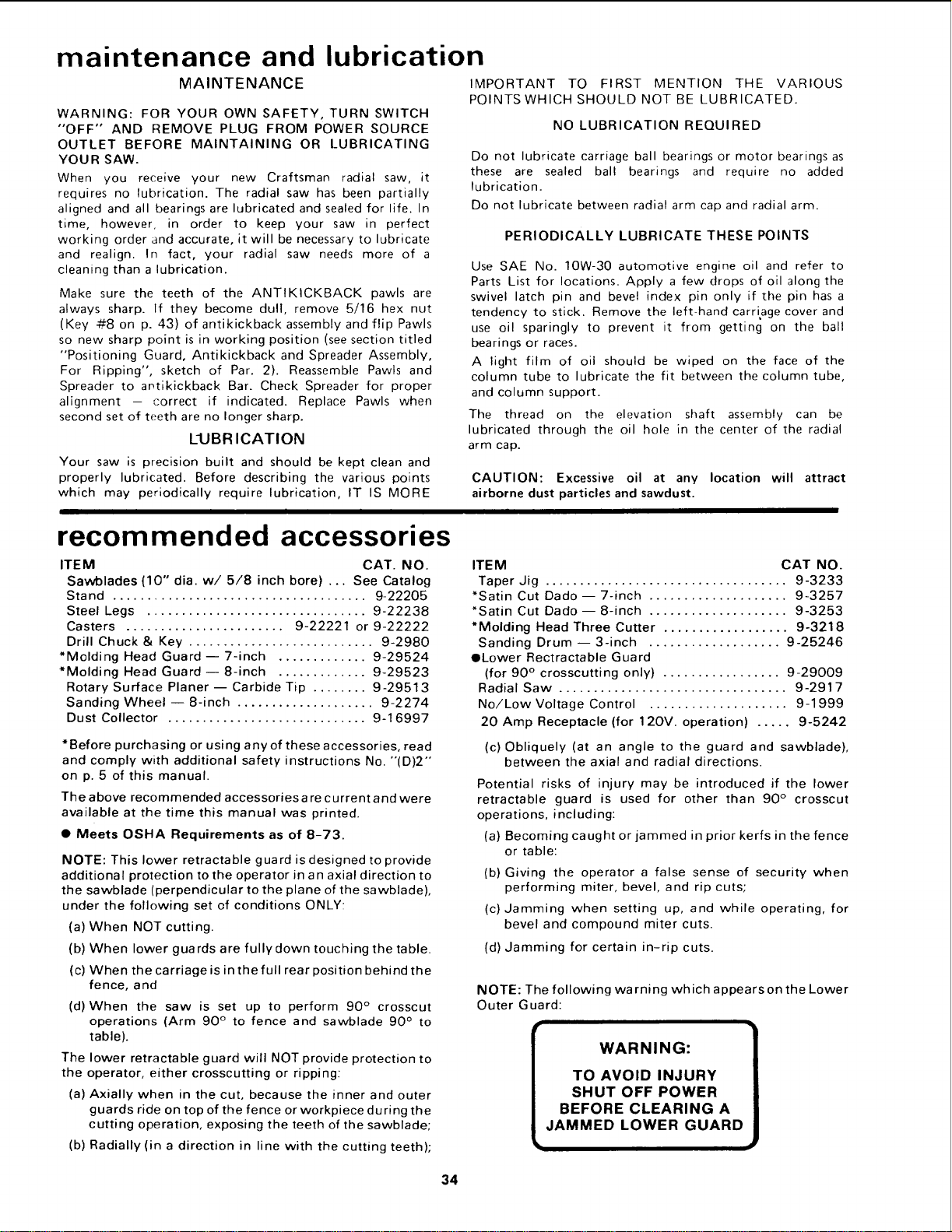
ma
intenance and
MAINTENANCE
lubrication
WARNING: FOR YOUR OWN SAFETY, TURN SWITCH
"OFF" AND REMOVE PLUG FROM POWER SOURCE
OUTLET BEFORE MAINTAINING OR LUBRICATING
YOUR SAW.
When you receive your new Craftsman radial saw, it
requires no lubrication. The radial saw has been partially
aligned and all bearings are lubricated and sealed for life. In
time, however, in order to keep your saw in perfect
working order and accurate, it will be necessary to lubricate
and realign. In fact, your radial saw needs more of a
cleaning than a lubrication.
Make sure the teeth of the ANTIKICKBACK pawls are
always sharp. If they become dull, remove 5/16 hex nut
(Key -#8 on p. 43) of antikickback assembly and flip Pawls
so new sharp point is in working position (see section titled
"Positioning Guard, Antikickback and Spreader Assembly,
For Ripping", sketch of Par. 2). Reassemble Pawls and
Spreader to antikickback Bar. Check Spreader for proper
alignment - correct if indicated. Replace Pawls when
IMPORTANT TO FIRST MENTION THE VARIOUS
POINTS WHICH SHOULD NOT BE LUBRICATED.
NO LUBRICATION REQUIRED
Do not lubricate carriage ball bearings or motor bearings as
these are sealed ball bearings and require no added
lubrication.
Do not lubricate between radial arm cap and radial arm.
PERIODICALLY LUBRICATE THESE POINTS
Use SAE No. 10W-30 automotive engine oil and refer to
Parts List for locations. Apply a few drops of oil along the
swivel latch pin and bevel index pin only if the pin has a
tendency to stick. Remove the left-hand carriage cover and
use oil sparingly to prevent it from getting on the ball
bearings or races.
A light film of oil should be wiped on the face of the
column tube to lubricate the fit between the column tube,
and column support.
second set of teeth are no longer sharp.
LUBRICATION
Your saw is precision built and should be kept clean and
properly lubricated. Before describing the various points
which may periodically require lubrication, IT IS MORE
The thread on the elevation shaft assembly can be
lubricated through the oil hole in the center of the radial
arm cap.
CAUTION: Excessive oil at any location will attract
airborne dust particles and sawdust.
recommended accessories
ITEM CAT. NO.
Sawblades (10" dia. w/5/8 inch bore) . .. See Catalog
Stand ..................................... 9-22205
Steel Legs ................................ 9-22238
Casters ....................... 9-22221 or 9-22222
Drill Chuck & Key ........................... 9-2980
*Molding Head Guard- 7-inch ............. 9-29524
*Molding Head Guard -- 8-inch ............. 9-29523
Rotary Surface Planer -- Carbide Tip ........ 9-29513
Sanding Wheel -- 8-inch .................... 9-2274
Dust Collector ............................. 9-16997
*Before purchasing or using any of these accessories, read
and comply with additional safety instructions No. "(D)2"
on p. 5 of this manual.
The above recommended accessories a re current a nd were
available at the time this manual was printed.
• Meets OSHA Requirements as of 8-73.
NOTE: This lower retractable guard is designed to provide
additional protection to the operator in a n axial direction to
the sawblade (perpendicular to the plane of the sawblade),
under the following set of conditions ONLY:
(a) When NOT cutting.
(b) When lower guards are fully down touching the table.
(c) When the carriage is in the full rear position behind the
fence, and
(d) When the saw is set up to perform 90 ° crosscut
operations (Arm 90 ° to fence and sawblade 90 ° to
table).
The lower retractable guard will NOT provide protection to
the operator, either crosscutting or ripping:
(a) Axially when in the cut, because the inner and outer
guards ride on top of the fence or workpiece during the
cutting operation, exposing the teeth of the sawblade;
(b) Radially (in a direction in line with the cutting teeth);
ITEM CAT NO.
Taper Jig ................................... 9-3233
*Satin Cut Dado -- 7-inch .................... 9-3257
*Satin Cut Dado -- 8-inch .................... 9-3253
*Molding Head Three Cutter .................. 9-3218
Sanding Drum -- 3-inch ................... 9-25246
• Lower Rectractable Guard
(for 90 ° crosscutting only) ................. 9-29009
Radial Saw ................................. 9-2917
No/Low Voltage Control .................... 9-1999
20 Amp Receptacle (for 120V. operation) ..... 9-5242
(c) Obliquely (at an angle to the guard and sawblade),
between the axial and radial directions.
Potential risks of injury may be introduced if the lower
retractable guard is used for other than 90 ° crosscut
operations, including:
(a) Becoming caught or jammed in prior kerfs in the fence
or table:
(b) Giving the operator a false sense of security when
performing miter, bevel, and rip cuts;
(c) Jamming when setting up, and while operating, for
bevel and compound miter cuts.
(d) Jamming for certain in-rip cuts.
NOTE: The following warning which appearson the Lower
Outer Guard:
WARNING:
TO AVOID INJURY
SHUT OFF POWER
BEFORE CLEARING A
JAMMED LOWER GUARD
34
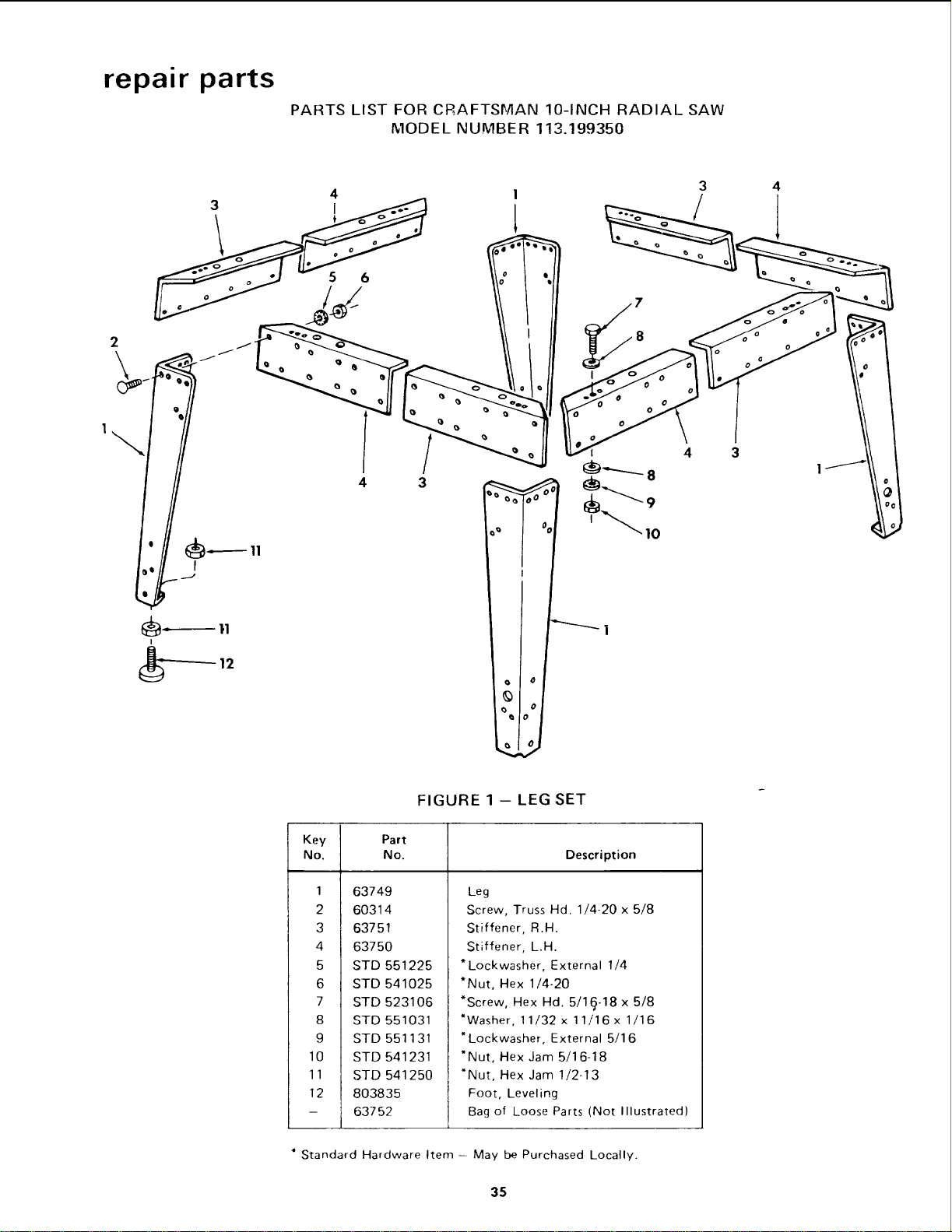
repair parts
PARTS LIST FOR CRAFTSMAN 10-INCH RADIAL SAW
MODEL NUMBER 113.199350
4
4
/
3
3 4
4
1
FIGURE 1 - LEG SET
Key Part
No. No. Description
1
2
3
4
5
6
7
8
9
10
11
12
63749
60314
63751
6375O
STD 551225
STD 541O25
STD 5231O6
STD 551031
STD 551131
STD 541231
STD 541250
803835
63752
Leg
Screw, Truss Hd. 1/4-20 x 5/8
Stiffener, R.H.
Stiffener, L.H.
*Lockwasher, External 1/4
*Nut, Hex 1/4-20
*Screw, Hex Hd. 5/1_-18 x 5/8
*Washer, !1/32 x 11/16 x 1/16
* Lockwasher, External 5/1 6
*Nut, Hex Jam 5/16-18
*Nut, Hex Jam 1/2-13
Foot, Leveling
Bag of Loose Parts (Not Illustrated)
* Standard Hardware Item - May be Purchased Locally.
35
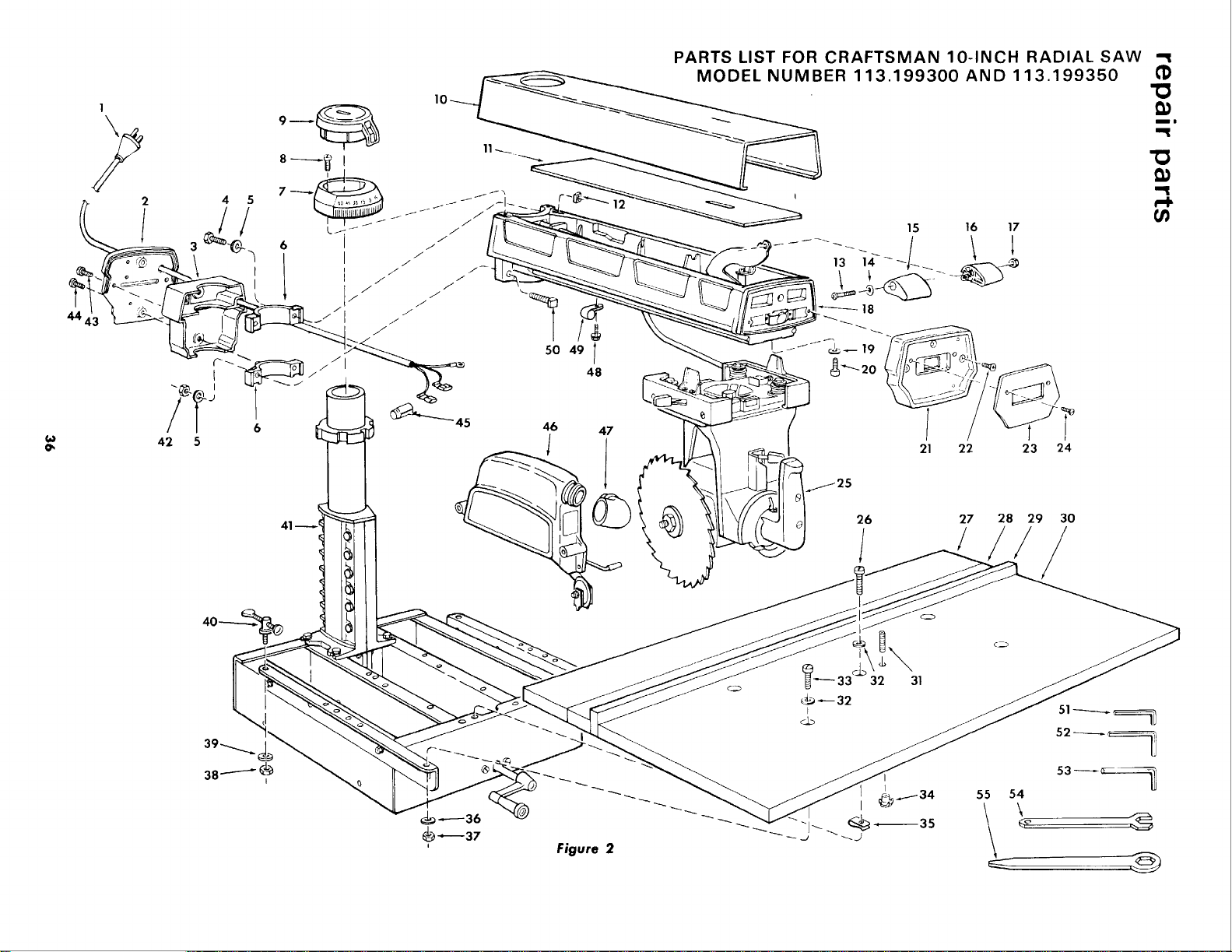
t,,,i
o,,
PARTS LIST FOR CRAFTSMAN 10-INCH RADIAL SAW '_
MODEL NUMBER 113.199300 AND 113.199350
¢D
13
46
42 5 41
21 22
27 28
23 24
29 30
/
BI
13
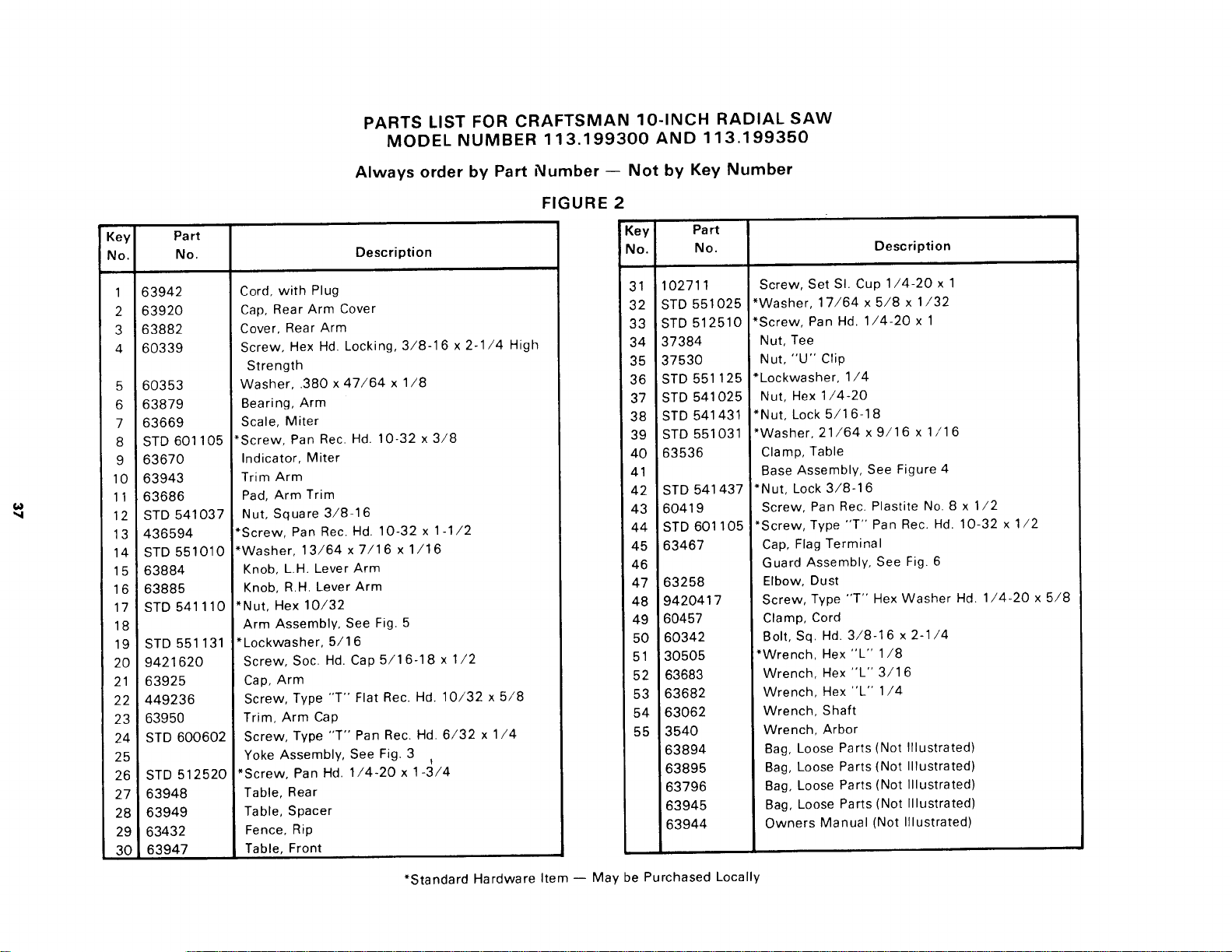
PARTS LIST FOR CRAFTSMAN 10-INCH RADIAL SAW
MODEL NUMBER 113.199300 AND 113.199350
_4
Always order by Part Number -- Not by Key Number
Key Part
No. No. Description
1
2
3
4
5
6
7
8
9
10
11
12
13
14
15
16
17
18
19
20
21
22
23
24
25
26
27
28
29
30
63942
63920
63882
60339
60353
63879
63669
STD 601105
63670
63943
63686
STD 541037
436594
STD 551010
63884
63885
STD 541110
STD 551131
9421620
63925
449236
63950
STD 600602
STD 512520
63948
63949
63432
63947
Cord, with Plug
Cap, Rear Arm Cover
Cover, Rear Arm
Screw, Hex Hd Locking, 3/8-16 x 2-1/4 High
Strength
Washer, .380 x 47/64 x 1/8
Bearing, Arm
Scale, Miter
*Screw, Pan Rec. Hd. 10-32 x 3/8
Indicator, Miter
Trim Arm
Pad, Arm Trim
Nut, Square 3/8-16
*Screw, Pan Rec. Hd. 10-32 x 1-1/2
*Washer, 13/64 x 7/16 x 1/16
Knob, L.H. Lever Arm
Knob, R.H. Lever Arm
*Nut, Hex 10/32
Arm Assembly, See Fig. 5
*Lockwasher, 5/1 6
Screw, Soc. Hd. Cap 5/16-18 x 1/2
Cap, Arm
Screw, Type "T'" Flat Rec. Hal. 10/32 x 5/8
Trim, Arm Cap
Screw, Type "T" Pan Rec. Hd. 6/32 x 1/4
Yoke Assembly, See Fig. 3
!
*Screw, Pan Hd. 1/4-20 x 1-3/4
Table, Rear
Table, Spacer
Fence, Rip
Table, Front
FIGURE 2
iKey
No.
31
32
33
34
35
36
37
38
39
4O
41
42
43
44
45
46
47
48
49
5O
51
52
53
54
55
Part
No. Description
102711
STD 551025
STD 512510
37384
37530
STD 551125
STD 541025
STD 541431
STD 551031
63536
STD 541437
60419
STD 601105
63467
63258
9420417
60457
60342
305O5
63683
63682
63062
3540
63894
63895
63796
63945
63944
Screw, Set SI. Cup 1/4-20 x 1
*Washer, 17/64 x 5/8 x 1/32
*Screw, Pan Hd. 1/4-20 x 1
Nut, Tee
Nut, "U" Clip
*Lockwasher, 1/4
Nut, Hex 1/4-20
*Nut, Lock 5/1 6-18
*Washer, 21/64 x 9/16 x 1/16
Clamp, Table
Base Assembly, See Figure 4
*Nut, Lock 3/8-16
Screw, Pan Rec. Plastite No. 8 x 1/2
*Screw, Type "T" Pan Rec. Hd. 10-32 x 1/2
Cap, Flag Terminal
Guard Assembly, See Fig. 6
Elbow, Dust
Screw, Type "T" Hex Washer Hd. 1/4-20 x 5/8
Clamp, Cord
Bolt, Sq. Hd. 3/8-16 x 2-1/4
*Wrench, Hex "'L" 1/8
Wrench, Hex "L" 3/16
Wrench, Hex "L'" 1/4
Wrench, Shaft
Wrench, Arbor
Bag, Loose Parts (Not Illustrated)
Bag, Loose Parts (Not Illustrated)
Bag, Loose Parts (Not Illustrated)
Bag, Loose Parts (Not Illustrated)
Owners Manual (Not Illustrated)
*Standard Hardware Item -- May be Purchased Locally
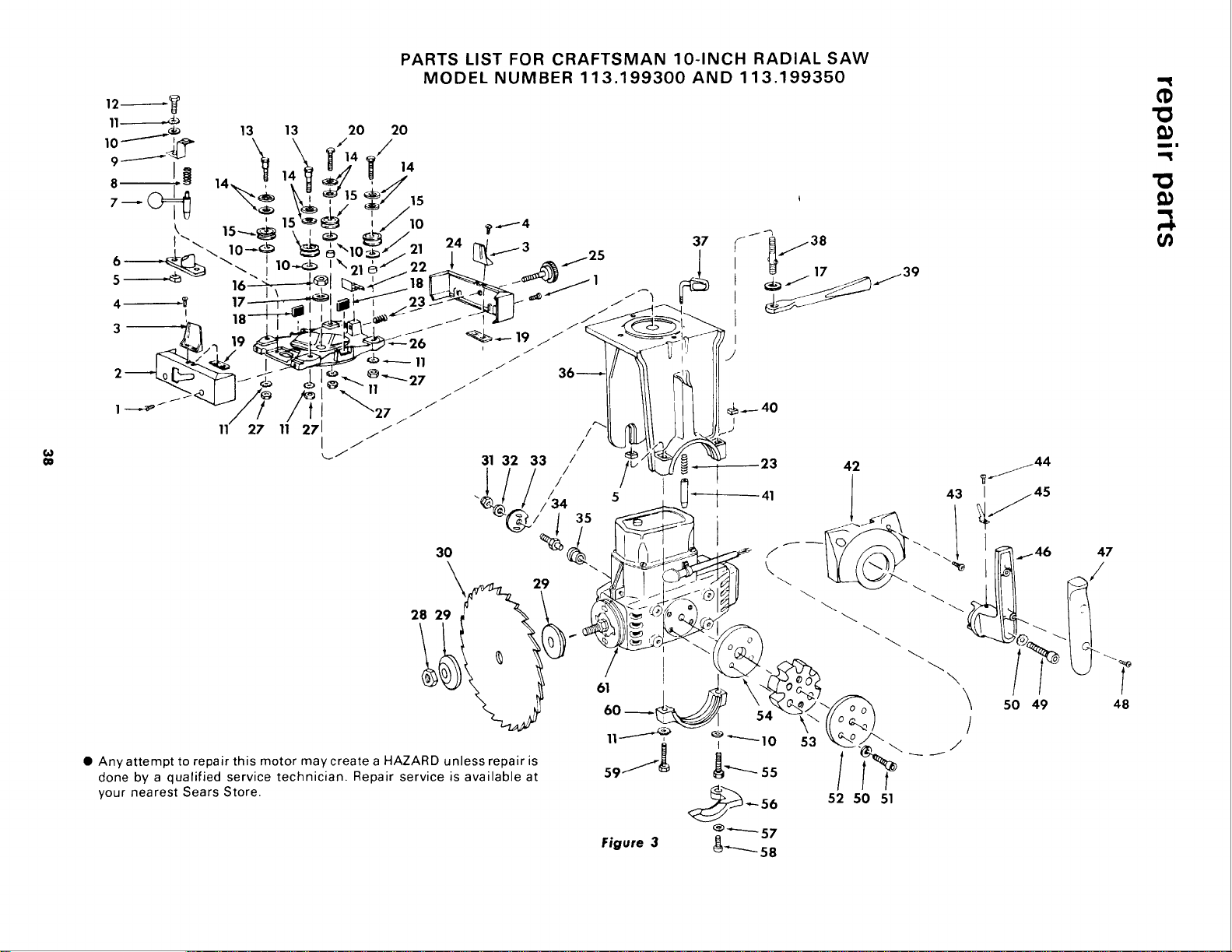
w
w
PARTS LIST FOR CRAFTSMAN 10-INCH RADIAL SAW
MODEL NUMBER 113.199300 AND 113.199350
20
/
14
• Any attempt to repair this motor may create a HAZARD unless repair is
done by a qualified service technician. Repair service is available at
your nearest Sears Store.
37
Figure 3
/It
52 50 51
43
\
\
/
/
_44
//
/
50 49
47
/
48
"0
mill
"0
€.,I,
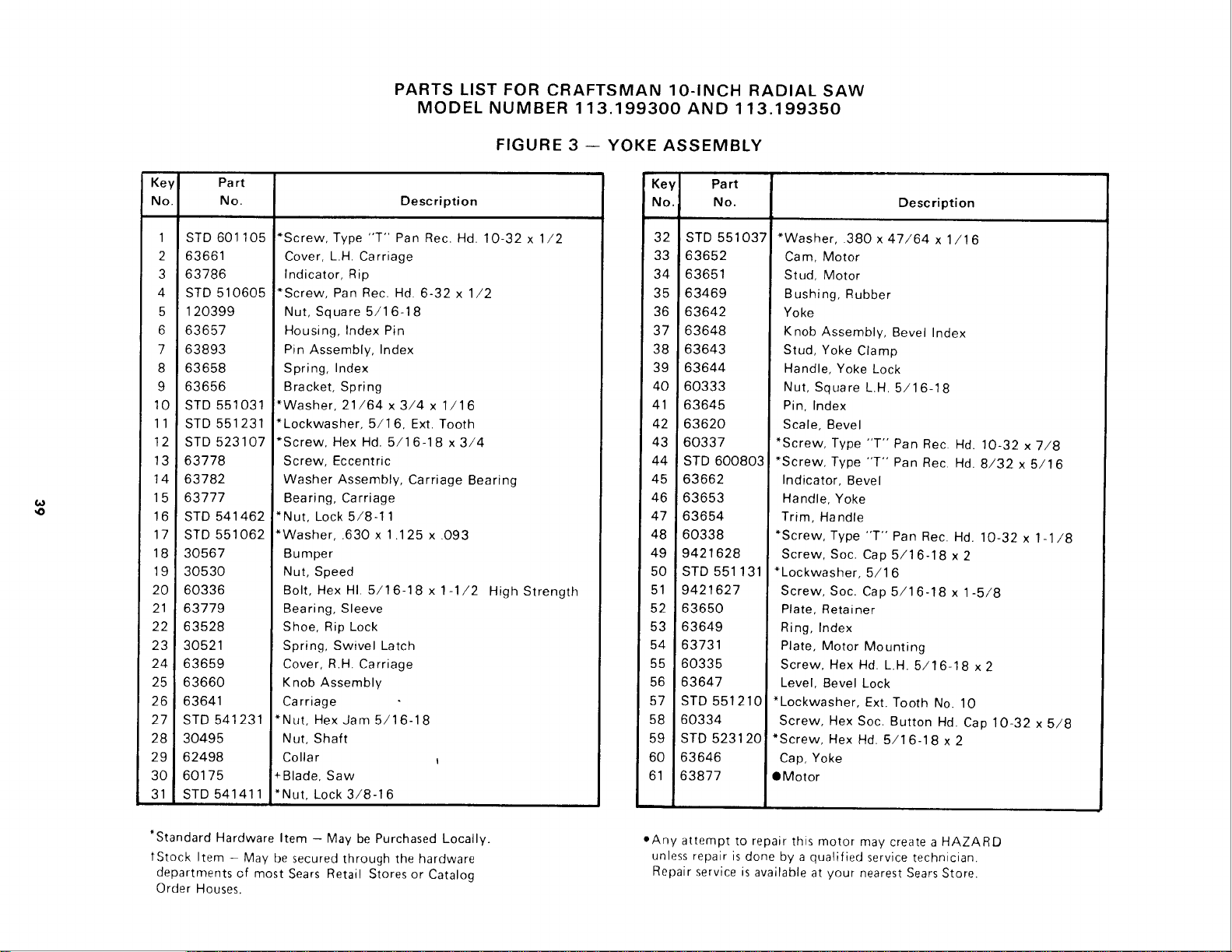
_o
PARTS LIST FOR CRAFTSMAN 10-INCH RADIAL SAW
MODEL NUMBER 113.199300 AND 113.199350
Key Part
No. No. Description
1 STD 601105
2 63661
3 63786
4 STD 510605
5 120399
6 63657
7 63893
8 63658
9 63656
10 STD 551031
11 STD 551231
12 STD 523107
13 63778
t4 63782
15 63777
16 STD 541462
17 STD 551062
18 30567
19 30530
20 60336
21 63779
22 63528
23 30521
24 63659
25 63660
26 63641
27 STD 541231
28 30495
29 62498
30 60175
31 STD 541411
FIGURE3-- YOKE ASSEMBLY
*Screw, Type "'T" Pan Rec. Hd. 10-32 x 1/2
Cover, L.H Carriage
Indicator, Rip
*Screw, Pan Rec. Hd. 6-32 x 1/2
Nut, Square 5/16-18
Housing, Index Pin
Pin Assembly, Index
Spring, Index
Bracket, Spring
*Washer, 21/64 x 3/4 x 1/16
*Lockwasher, 5/1 6, Ext. Tooth
*Screw, Hex Hd. 5/1 6-18 x 3/4
Screw, Eccentric
Washer Assembly, Carriage Bearing
Bearing, Carriage
*Nut, Lock 5/8-11
*Washer, .630 x 1.125 x .093
Bumper
Nut, Speed
Bolt, Hex HI. 5/16-18 x 1-1/2 High Strength
Bearing, Sleeve
Shoe, Rip Lock
Spring, Swivel Latch
Cover, R.H Carriage
Knob Assembly
Carriage
*Nut, Hex Jam 5/16-18
Nut, Shaft
Collar i
+Blade, Saw
*Nut, Lock 3/8-16
Keyl
No. I
32
33
34
35
36
37
38
39
40
41
42
43
44
45
46
47
48
49
50
51
52
53
54
55
56
57
58
59
60
61
Part
No.
STD 551037
63652
63651
63469
63642
63648
63643
63644
60333
63645
63620
60337
STD 600803
63662
63653
63654
60338
9421628
STD 551131
9421627
63650
63649
63731
60335
63647
STD 551210
60334
STD 523120
63646
63877
Description
*Washer, .380 x 47/64 x 1/16
Cam, Motor
Stud, Motor
Bushing, Rubber
Yoke
Knob Assembly, Bevel Index
Stud, Yoke Clamp
Handle, Yoke Lock
Nut, Square L.H. 5/16-18
Pin, Index
Scale, Bevel
*Screw, Type "T" Pan Rec. Hd. 10-32 x 7/8
*Screw, Type "T" Pan Rec. Hd. 8/32 x 5/16
Indicator, Bevel
Handle, Yoke
Trim, Handle
*Screw, Type "T" Pan Rec. Hd. 10-32 x 1-1/8
Screw, Soc. Cap 5/16-18 x 2
*Lockwasher, 5/1 6
Screw, Soc. Cap 5/16-18 x 1-5/8
Plate, Retainer
Ring, Index
Plate, Motor Mounting
Screw, Hex Hd. L.H. 5/16-18 x2
Level, Bevel Lock
*Lockwasher, Ext. Tooth No. 10
Screw, Hex Soc. Button Hd. Cap 10-32 x 5/8
*Screw, Hex Hd. 5/1 6-18 x 2
Cap, Yoke
OMotor
*Standard Hardware Item - May be Purchased Locally.
tStock Item - May be secured through the hardware
departments of most Sears Retail Stores or Catalog
Order Houses.
oAny attempt to repair this motor may create a HAZARD
unless repair is done by a qualified service technician.
Repair service is available at your nearest Sears Store.
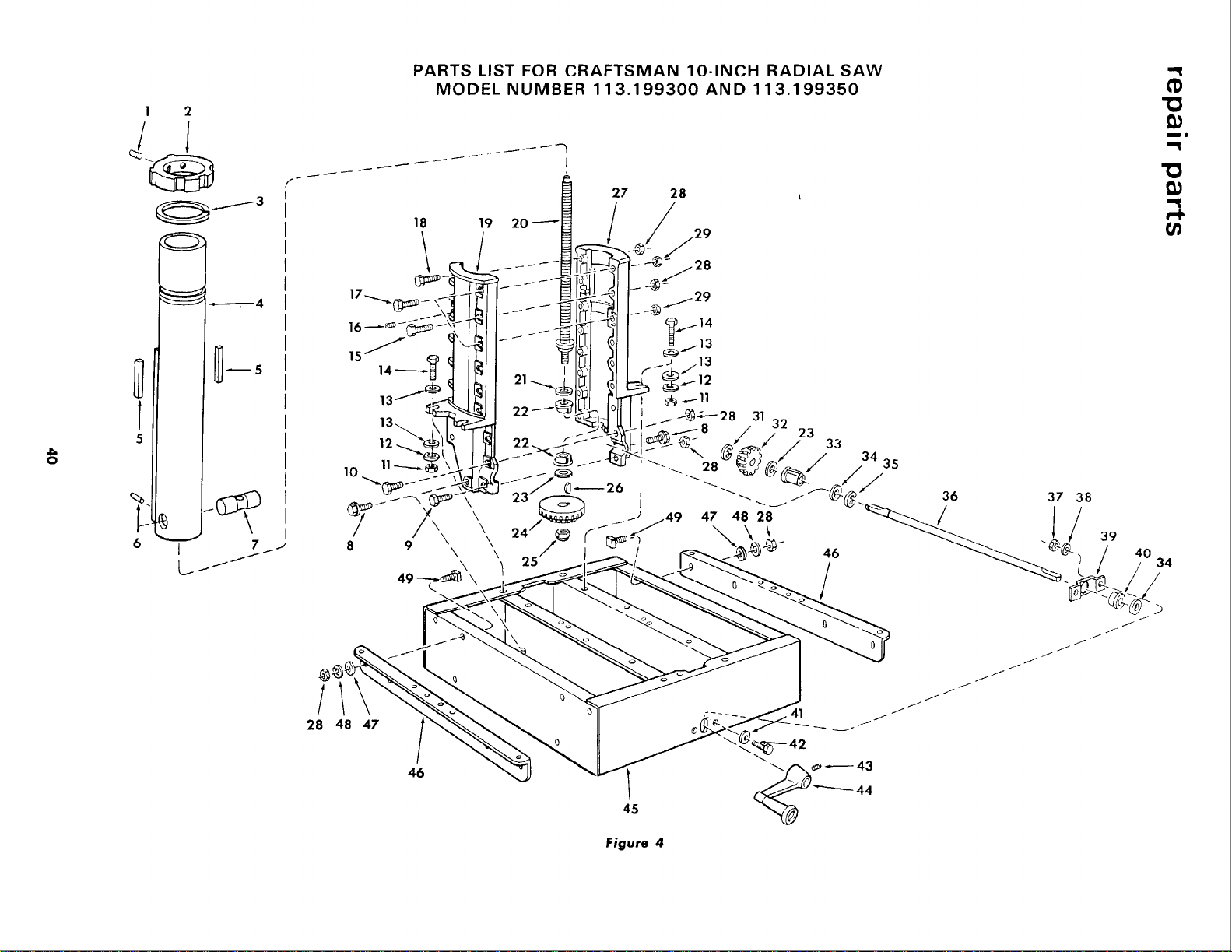
o
PARTS LIST FOR CRAFTSMAN 10-INCH RADIAL SAW
MODEL NUMBER 113.199300 AND 113.199350
"O
! 2
18 19 20 _ €./]
7 /\\ \" 24"/ '_ _ _ )_" 46 _ "I ') / 40
_ \ _ _ 4z 482e
8 49 -'-__\\/9 \ "\ 2=//_ I _._ _////4
46
45
/
28 48 47
J
J
J
J
J
J
J
J
J
J
J
J
J
J
Figure 4
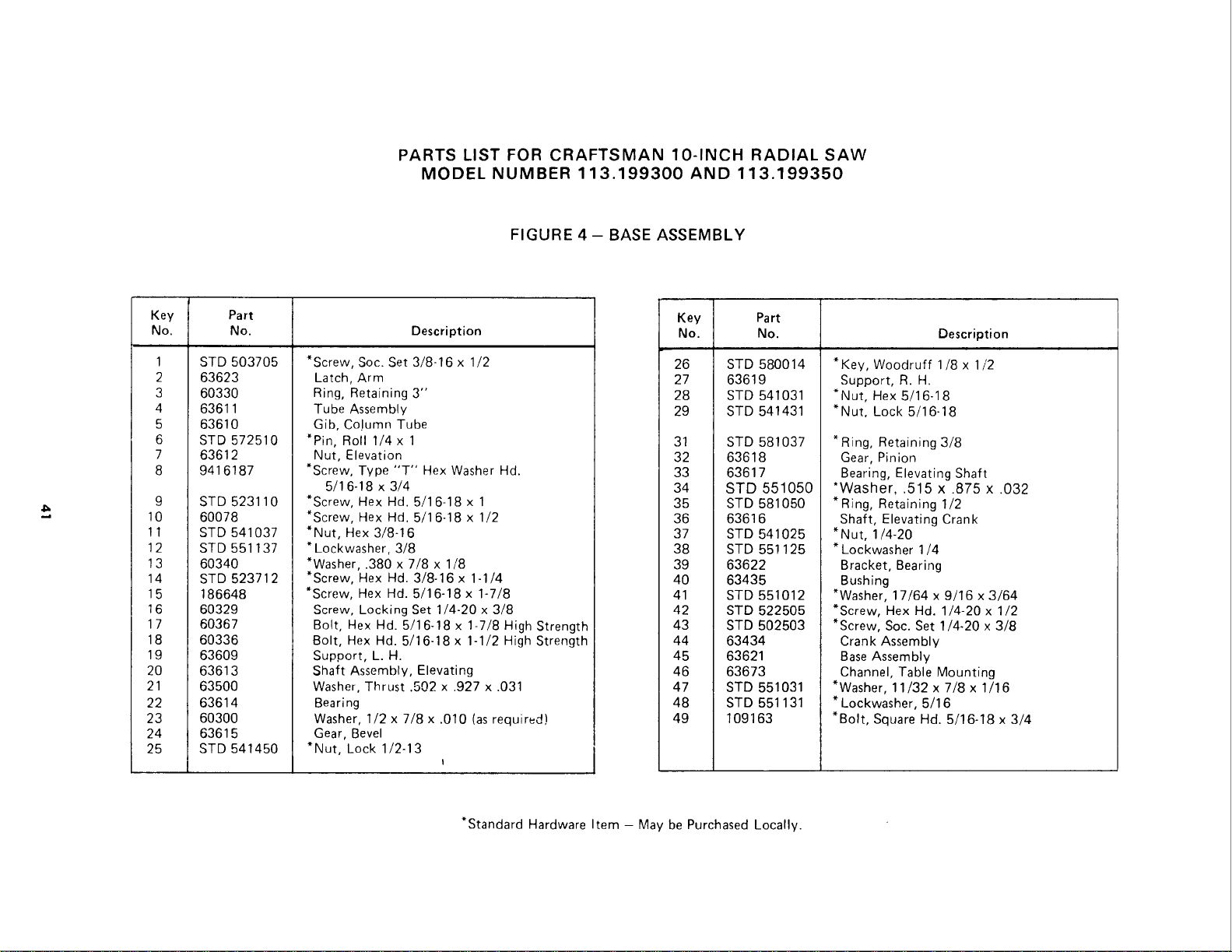
PARTS LIST FOR CRAFTSMAN 10-INCH RADIAL SAW
MODEL NUMBER 113.199300 AND 113.199350
FIGURE 4- BASE ASSEMBLY
=.,,=
Key Part
No. No. Description
1
2
3
4
5
6
7
8
9
10
!1
12
13
14
15
16
17
18
19
20
21
22
23
24
25
STD 503705
63623
60330
63611
63610
STD 572510
63612
9416187
STD 523110
60078
STD 541037
STD 551137
60340
STD 523712
186648
60329
60367
60336
63609
63613
63500
63614
60300
63615
STD 541450
*Screw, Soc. Set 3/8-16 x 1/2
Latch, Arm
Ring, Retaining 3"
Tube Assembly
Gib, Co!umn Tube
*Pin, Roll 1/4 x 1
Nut, Elevation
*Screw, Type "T" Hex Washer Hd.
5/16-18 x 3/4
*Screw, Hex Hd. 5/16-18 x 1
*Screw, Hex Hd. 5/16-18 x 1/2
*Nut, Hex 3/8-16
* Lockwasher, 3/8
*Washer, .380 x 7/8 x 1/8
*Screw, Hex Hd. 3/8-16 x 1-1/4
*Screw, Hex Hd. 5/16-18 x 1-7/8
Screw, Locking Set 1/4-20 x 3/8
Bolt, Hex Hd. 5/16-18 x 1-7/8 High Strength
Bolt, Hex Hd. 5/16-18 x 1-1/2 High Strength
Support, L. H.
Shaft Assembly, Elevating
Washer, Thrust .502 x .927 x .031
Bearing
Washer, 1/2 x 7/8 x .010 (as required)
Gear, Bevel
*Nut, Lock 1/2-13
i
Key Part
No. No. Description
26 STD 580014
27 63619
28 STD 541031
29 STD 541431
31 STD 581037
32 63618
33 63617
34 STD 551050
35 STD 581050
36 63616
37 STD 541025
38 STD 55!125
39 63622
40 63435
41 STD 551012
42 STD 522505
43 STD 502503
44 63434
45 63621
46 63673
47 STD 551031
48 STD 551131
49 109163
*Key, Woodruff 1/8 x 1/2
Support, R. H.
*Nut, Hex 5/16-18
*Nut, Lock 5/16-18
*Ring, Retaining 3/8
Gear, Pinion
Bearing, Elevating Shaft
*Washer, .515 x .875 x .032
*Ring, Retaining 1/2
Shaft, Elevating Crank
* Nut, 1/4-20
* Lockwasher 1/4
Bracket, Bearing
Bushing
*Washer, 17/64 x 9/16 x 3/64
*Screw, Hex Hd. 1/4-20 x 1/2
*Screw, Soc. Set 1/4-20 x 3/8
Crank Assembly
Base Assembly
Channel, Table Mounting
*Washer, 11/32 x 7/8 x 1/16
* Lockwasher, 5/16
*Bolt, Square Hd. 5/16-18 x 3/4
*Standard Hardware Item - May be Purchased Locally.
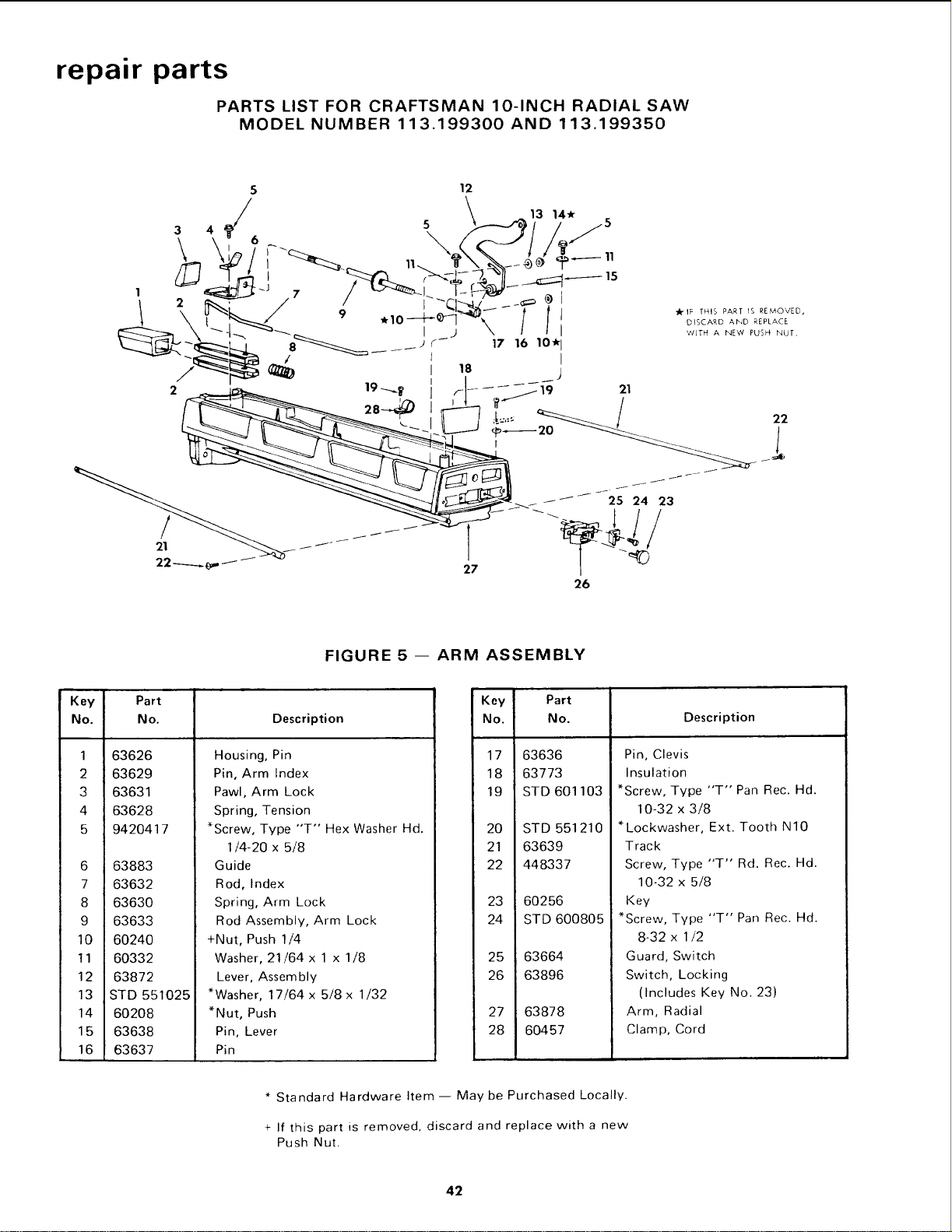
repair parts
PARTS LIST FOR CRAFTSMAN 10-INCH RADIAL SAW
MODEL NUMBER 113.199300 AND 113.199350
IrlF THIS PART IS REMOVED,
DISCARD AND REPLACE
WLTH A NEW PUSH NUT.
22
FIGURE 5-- ARM ASSEMBLY
Key Part
No. No. Description
1
2
3
4
5
6
7
8
9
10
11
12
13
14
15
16
63626
63629
63631
63628
9420417
63883
63632
63630
63633
60240
60332
j63872
!STD 551025
60208
63638
63637
Housing, Pin
Pin, Arm Index
Pawl, Arm Lock
Spring, Tension
*Screw, Type "T" Hex Washer Hd.
1/4-20 x 5/8
Guide
Rod, Index
Spring, Arm Lock
Rod Assembly, Arm Lock
+Nut, Push 1/4
Washer, 21/64 x 1 x 1/8
Lever, Assembly
*Washer, 17/64 x 5/8 x 1/32
*Nut, Push
Pin, Lever
Pin
Key
No.
17 63636
18 63773
19 STD 601103
20 STD 551210
21 63639
22 448337
23 60256
24 STD 600805
25 63664
26 63896
27 63878
28 60457
Part
No. Description
Pin, Clevis
Insulation
*Screw, Type "T" Pan Rec. Hd.
10-32 x 3/8
*Lockwasher, Ext. Tooth N10
Track
Screw, Type "T" Rd. Rec. Hd.
10-32 x 5/8
Key
*Screw, Type "T" Pan Rec. Hd.
8-32 x 1/2
Guard, Switch
Switch, Locking
(Includes Key No. 23)
Arm, Radial
Clamp, Cord
* Standard Hardware Item -- May be Purchased Locally.
+ If this part is removed, discard and replace with a new
Push Nut.
42
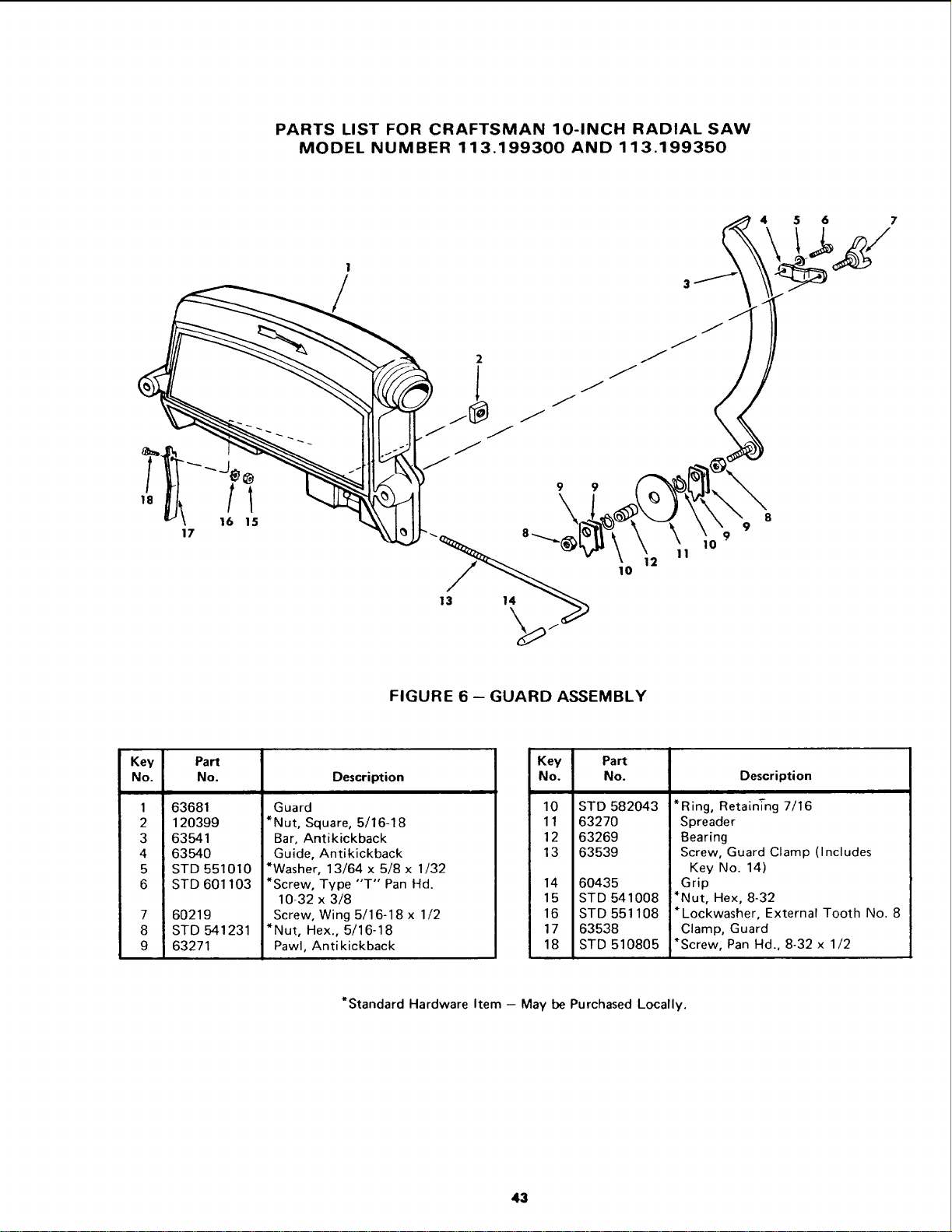
PARTS LIST FOR CRAFTSMAN 10-INCH RADIAL SAW
MODEL NUMBER 113.199300 AND 113.199350
!
/
16 15
17
13
/
lO
/
3 /
/
/
/
9
0
10 "
!1
4 5 6 7
F
FIGURE 6 - GUARD ASSEMBLY
Key
No.
1
2
3
4
5
6
7
8
9
Part
No.
63681
120399
63541
63540
STD 551010
STD 601103
60219
STD541231
63271
Description
Guard
*Nut, Square, 5/16-18
Bar, Antikickback
Guide, Antikickback
*Washer, 13/64 x 5/8 x 1/32
*Screw, Type "T" Pan Hd.
10-32 x 3/8
Screw, Wing 5/16-18 x 1/2
*Nut, Hex., 5/16-18
Pawl, Antikickback
Key Part
No. No. Description
10
11
12
13
14
15
16
17
18
STD 582043
63270
63269
63539
60435
STD 541008
STD 551108
63538
STD 510805
*Ring, RetainTng 7/16
Spreader
Bearing
Screw, Guard Clamp (Includes
Key No. 14)
Grip
*Nut, Hex, 8-32
*Lockwasher, External Tooth No. 8
Clamp, Guard
*Screw, Pan Hd., 8-32 x 1/2
*Standard Hardware Item - May be Purchased Locally.
43
S_ears
owners
manual
SERVICE
MODEL NO.
11 3.199300
SAW ONLY
113.199350
SAW WITH LEGS
HOW TO ORDER
REPAIR PARTS
10-INCH RADIALSAW
Now that you have purchased your 10-inch radial saw,
should a need ever exist for repair parts or service, simply
contact any Sears Service Center and most Sears, Roebuck
and Co. stores. Be sure to provide all pertinent facts when
you call or visit.
The model number of your 10-inch radial saw will be found
on a label attached to your saw, at the front of the base.
WHEN ORDERING REPAIR PARTS, ALWAYS GIVE THE
FOLLOWING INFORMATION:
PART NUMBER PART DESCRIPTION
MODEL NUMBER NAME OF ITEM
113.199300 IO-INCH RADIAL SAW
113.199350
All parts listed may be ordered from any Sears Service
Center and most Sears stores. If the parts you need are not
stocked locally, your order will be electronically transmitted
to a Sears Repair Parts Distribution Center for handling.
Sold by SEARS, ROEBUCK AND CO., Chicago, IL. 60684 U.S.A.
_'art No. 63944 Form No. SP4657-3 Printed in U.S.A. 4/84