I
Useand~re&boMng
Guide
\
SpacemakeP
Microwave
Oven
Safe~
instructions ....................3-5
Precautions to Avoid Possible Exposure
to Excessive Microwave Energy .............2
Operating
Instrutiions,
nps
Add 30 Seconds . . . . . . . . . . . . . . . . . . . . . . . . . . . . . . . . . . . . . . . . . . 13
Aluminum Foil ...........................4, 21,24,26
Auto
Defrost..................................................2O
Auto Defrost
Guide......................................2
1
Automatic Fan ...........................................5, 7
Auto
Roast..............................................22,
23
Auto Simmer
.................................................23
Clock.
. . . . . . . . . . . . . . . . . . . . . . . . . . . . . . . . . . . . . . . . . . . . . . . . . . . . . . . . . . . . . . . . .
8
Control
Panel...............................................8,
9
Cook . . . . . . . . . . . . . . . . . . . . . . . . . . . . . . . . . . . . . . . . . . . . . . . . . . . . . . . . . . . . . .
.
17
Cooking by Temperature ...........................1 9
Cooking by Time. . . . . . . . . . . . . . . . . . . . . . . . . . . . . . . . . . . 12, 13
Cooking Complete Reminder ...................10
Cooking Guide..
............................................27
Defrosting by Time. . . . . . . . . . . . . . . . . . . . . . . . . . . . . . . . . . . . . . 18
Defrosting Guide ..........................................26
Delayed Cooking . . . . . . . . . . . . . . . . . . . . . . . . . . . . . . . . . . . . . . . . .
.
11
Delay Start/Reminder . . . . . . . . . . . . . . . . . . . . . . . . . . . . . . . . 13
Exhaust Fan ..................................5, 9,31,32
Express Cook . . . . . . . . . . . . . . . . . . . . . . . . . . . . . . . . . . . . . . . . . . . . . . . . 13
Features . . . . . . . . . . . . . . . . . . . . . . . . . . . . . . . . . . . . . . . . . . . . . . . . . . . . . . . . .
.
10
Glossary of Microwave Terms ..................24
Heating or Reheating
Guide......................25
Hold Time. . . . . . . . . . . . . . . . . . . . . . . . . . . . . . . . . . . . . . . . . . . . . . . . . . . . . .
.
11
Kitchen Timer . . . . . . . . . . . . . . . . . . . . . . . . . . . . . . . . . . . . . . . . . . . . . . .
.
11
Microwaving
Tips...........................................6
Minute Pad
.......................................................8
Oven Shelf ......................4, 5, 10, 14,28,29
Popcorn . . . . . . . . . . . . . . . . . . . . . . . . . . . . . . . . . . . . . . . . . . . . . . . . . . . . . . . . .
.
14
Power Levels
.......2,7,8,11, 12,14, 17-20,22,25-27
Reheat . . . . . . . . . . . . . . . . . . . . . . . . . . . . . . . . . . . . . . . . . . . . . . . . . . . . . . . . . . . .
.
16
Snacks . . . . . . . . . . . . . . . . . . . . . . . . . . . . . . . . . . . . . . . . . . . . . . . . . . . .
.
14, 15
Sound Level Feature . . . . . . . . . . . . . . . . . . . . . . . . . . . . . . . . . . . 13
Temperature Probe 4,8-11, 19,22,23,29
Problem
Solver...............................33
More questions
?...call
GE Answer
Cente~
800.626.2000
Care and Cleaning ...................29-32
Exhaust
Fan............................................3
1,32
Grease Filter
..................................................3
1
Light Bulb
Replacement.............................3O
Oven Shelf
.....................................................29
Temperature Probe .....................................29
lnstallation..........................................32
Adapter Plugs . . . . . . . . . . . . . . . . . . . . . . . . . . . . . . . . . . . . . . . . . . . . . . 32
Extension Cords ...........................................32
Grounding instructions...............................32
Consumer Services ...................35
Appliance Registration ..................................2
Important Phone
Numbers........................35
Model and Serial Number Location ...........2
Warranty
........................................Back Cover
Modek.
NM240
Miuowavepowerotipti
JVM241
of
tikoven
h
850
Wn
I
4
I
GE Appliances

~LP
US
~LP
YOU...
Before using your oven,
read this guide carefully.
It is intended to help you operate
and maintain your new microwave
oven properly.
Keep it handy for answers to your
questions.
If you don’t understand something
or need more help,
all:
GE Answer Center
800.626.2000
24 hours a day
7 days a week
Write down the model and
serial numbers.
You’ll find them on a label inside
the oven.
~ese
numbem
are
dso
on the
Consumer Product Ownership
Registration Card that came with
your microwave oven. Before
sending in this
car~ please write
these numbers here:
Model Number
Serial Number
Use these numbers in any
correspondence or service calls
concerning your microwave oven.
Be sure your microwave
oven is registered.
It is
impofiant
that we know
the location of your microwave
oven should a need occur for
adjustments.
Your supplier is responsible for
registering you as the owner.
Please check with your supplier
to be sure he has done so; also
send in your Consumer Product
Ownership Registration
&d.
If you move,
or
if you are not
the
origiti
purchaser, please
write to us, stating model and
serial numbers.
~
apptiance
must be registered.
Please be certain that it is.
Write to:
GE Appliances
Range Product Service
Appliance Park
Louisville, KY 40225
If you received a
damaged oven...
Immediately contact the
derder
(or builder) that sold you the oven.
Save time
and money.
Before you request service...
-
Check the Problem Solver in the
back of this guide. It lists causes of
minor operating problems that you
can correct yourself.
Ml
these things are normal
with your microwave oven.
●
Steam or vapor escaping from
around the door.
●
Light reflection around door or
outer case.
●
Dimming oven light and change
in blower sound may occur while
operating at power levels other
than high.
●
Dull thumping sound while oven
is operating.
●
Some W-Radio interference
might be noticed while using
your microwave oven. It’s
similar to the interference
aused
by other small
appliances and does not
indicate a problem with
your oven.
PmCA~ONS
TO
AVOD
POSS~M
EXPOS-
TO
EXCESS~
M~OWA~
ENERGY
(a) Do Not Attempt to
operate
this
oven with
the door open
sinm
open~oor
operation
can
resdt
in
_
exposwe
to microwave
energy. It is important not to defeat or tamper
with the safety interlocks.
~)
Do Not
Phce
any
object between the oven
front face and the door or
Wow
sod
or cleaner
residue to accmdate on sealing
stiams.
(c)
Do Not-rate the
oven
ifit
is
damagd
It is
partidarly
important
tit
tie
oven door close
properly and
tit
there is no damage to the:
(1) door
@nt)
(2) hinges and latches
@roken
or loosened)
(3)
doorse~
andseding
s~am.
(d) me&en
Shodd
Not be
adjwtedor
repaired
by anyone except properly
qdified
servim
personnel.
2

,,,
-
Men
using electrical
applianms,
basic safety
precautions
shodd
be
followed, including the
fouowing:
A
W~NG-~ored.mtieriskof
bums, electric
shock
fire,
injury to persons
or exposure to excessive microwave energy:
●
Read and
fo~ow
the
specific
‘tPremutions
to
Avoid Possible
~sure
to Excessive
Mcrowave
Energy” on the previous page.
●
W
apphce
must
be
grounded.
~Mect
ody
to
properly grounded
outiet
See
&ounding
Mtructions
section in the back of this guide.
●
Use this
app~ce
ody
for its intended use as
described in this guide.
Do not use corrosive
chernicds
or vapors in this
apphance.
This
microwave oven is
specifidly
designed to heat
or cook
f-
and is not intended for laboratory
or
indusW
use.
●
This over-tie-range oven was designed
for
w
over ranges no wider than
O
inches.
,—
It maybe
instied
over both gas and
elwtric
cooking
quipment.
●
For best operation, plug this
appbce
into its
own electrid
outie~
to prevent
fickering
of
~~
blowing of
be
or tripping of circuit
breaker.
●
Do not mount this
app~ce
over a
SW=
or
locati
this
app~ce
ody
m accordance with
the provided
-tin
-ctions.
.
Do not cover or
bM
any openings on the
appWnee.
●
Do not store this
apphce
outdoors.
Do not
use this product near water-for example, in a wet
basemen~
near a sw
imrning
pool or near a
sti
●
This microwave oven is not approved or tested
for marine
W
●
Do not store anything
directiy
on top of the
-wave
oven
sfice
when the oven is in
operation.
●
Do not immerse power cord or plug in water.
/
●
Keep power cord away from heated surfaces.
●
Do not let power cord hangover edge of table
or counter.
●
Do not operate this
appkce
ifit
has a
damaged power cord or
plug
ifit
is not
working
propetiy,
or if it has been damaged
or dropped.
●
See
door surface cleaning instructions in the Gre
and
~eaning
swtion(s)
of your guide.
●
This
app~nce
should be serviced only by
q-cd service personnel.
Contact nearest
authotied
service
facfiity
for examination,
repti
or adjustment.
●
A
with any
appMnce,
close supervision is
necessary when used by
ctidren.
●
To reduce the risk of
fi
in the oven cavity:
—Do
not overcook food.
Wefily
attend
applian~
if paper, plastic or other combustible
materiti
are placed inside the oven to
factiitate
cooking.
—Remove wire twist-ties and
meti
han~es
from paper or
pktic
containers before
pbcing
them in the oven.
—Do
not use your microwave oven
to
dry
newspapers.
—Do
not use recycled paper products. Recycled
paper
towe@
napkins and waxed paper can
contain
meti
flecks
which may cause arcing
or
igni~
Paper products containing
nyIon
or
nylon
-ents
shodd
be avoided, as tiey
may
*O
ignite.
—Do not pop popcorn m your microwave oven
dess
in
a special microwave popcorn
amssory
or
urdess
you use popcorn labeled for use in
microwave ovens.
—Do not overcook potatoes.
~ey
could
dehydrate and catch fire, causing damage
to your oven.
—Do not operate the oven
w~e
empty to avoid
damage to the oven and the danger of
b.
H
by accident the oven
shodd
run empty a minute
or two, no harm is done. However, try to avoid
operating the oven empty at
au
tire-it saves
energy and prolongs the life of the oven.
(co-
d-page)
3

WORW
SMEW
mS~UC~ONS
(mnthued)
—Do
not use the oven for storage purposes.
Do not leave paper products, cooking
utensih
or food
in
the oven when not
in
use.
—If
materiah
inside oven should
igni@
keep
oven door
closed
turn oven off, and disconnect
power cord, or shut off power at the fuse or
circuit breaker panel.
●
Some products such as whole eggs and sealed
containe%for example, closed
jars-w~
explode and
shodd
not be heated in this
microwave oven. Such use of the microwave
oven
codd
resuk
in
injury.
●
Avoid heating baby food
in
glass jars, even with
the lid off. Make sure dl infant food
is
thoro@y
cooked. Stir food to distribute the heat
evedy.
Be
care~
to prevent
sdding
when warming
formda
or breast mfr. The container may
feeI
cooler than the
mW
rea~y
is.
~ways
test the
fibefore
feeding the baby.
.
Don’t defrost frozen beverages
in narrow
nwked
botdes
(especially carbonated beverages).
Even
if
the container is
open~
pressure can
bufld
up. This can cause the container to
burst
possibly
resuking
in injury.
●
Use
fofl
ody
as directed in this guide.
W
dinners may be
rnicrowavd
in
fofi
trays less than
3/4” him
remove the top
fofi
cover and return the
tray to the box.
men
using
fod
inthe
microwave
eve%
keep
thefoti
(other than
rnetishem
at
W
1
k~
away
tim
the sides of the oven.
●
Cootiare
may
beco&e
hot
because
of heat transferred
from
the
htited
fti
Potholders maybe needed to
han~e
the cookware.
●
Foods cooked
&
~uids
(such as pasta) may tend
toboti
over more
rapi~y
than foods containing
less moisture.
Shotid
this occur, refer to the
k
and
~eaning
section(s) for ‘instructions on how to
clean the inside of the
ovem
●
Thermometer-Do
not use a thermometer in
food you are microwaving
tiess
the thermometer
is designed or recommended for use
in
the
microwave oven.
4
●
Remove the temperature probe from
the
oven
when not using it to cook with.
E
you leave the
probe inside the oven without inserting it
in
food
or
fiqui~
and turn on microwave energy, it can
create electrical arcing
in
the oven and damage
oven
w*.
●
Plastic
cookwabPlastic
cookware designed
for microwave
coohg
is very
use~,
but should
be used
caretily.
Even microwave-safe plastic
may not be as tolerant of
overmoking
renditions
as are
@ass
or ceramic materials
and
may
soften or char if subjected to short periods of
overcooking.
k
longer exposures to overcooking,
the food
and
cookware
codd
ignite. For these
reasons: 1) Use microwave-safe plastics
ody
and
use them in strict
complian~
with the cookware
manufacturer’s recommendations. 2) Do not
subject empty cookware to microwaving.
3) Do not
permit
c~dren to use plastic
cookware without complete supervision
.
men
cooking
por~
fo~ow
the
dirwtions
exactly and always cook the
mwt
to an internal
temperature of at least
170°F.
This assures
tha~
in the remote possibility that trichina maybe
present in the
mea~
it
WW
be
~led
and meat
WW
be safe to
cab
●
Do not
boti
eggs in a microwave oven.
~e~~e
ww
bufid
up inside egg
yO&
Md
~
cause it to
burs~
possibly
rwuking
in
injury.
-
●
Foods with unbroken outer
‘skinW
~~•
such &potatoes,
sausag~,
tomatoes,
apples, chicken livers and other
giblets,
and,egg
yoh
(see previous
caution)
shoddbepiercedto
Wow
steam to escape
during
am.
‘.
●
Not
aM
p=c
wrap is suitable for use in
,’
microwave ovens.
~eck
the package for
proper use.
●
Spontaneous
bofi&Under
certain special
circnmstanx,
liquids may start to boil during or
shordy
after removal
horn
the microwave
oven
To prevent burns from splashing
Iiqui&
allow the
container to stand
in
the
oven for
30
to
~
sewn~
._
after the oven has shut
o~
.

—
.—
.
i~~~ble~’
coowg pouches and
~tfy
dosed
p~tic
bags
shotid
be
sli;
pier~
or vented
as directed by package.
Kthey
are
not
plastic
cotid
burst during or immediately after
cooting,
possibly
resdting
in injury.
Mso,
plastic storage
containers
shodd
be
at least
partitiy
uncovered
because they form a tight seal.
men
cooking
with containers
tightly
covered with plastic wrap,
remove
wvering
carefdly
and direct steam away
from hands and face.
*
.~
.,
●
Hot foods and steam
-
cause
. . . --
b-.
Be
care~
when opening
any
mntainers
of hot f@ including
popcorn bags, cooking pouches and
boxes. To prevent possible injury,
direct steam away from hands
and face.
,-.
●
Use of the
sheMaccessory.
—Remove the shelf from oven when not in use.
—Do
not store or
mk
with shelf on
floor
of oven.
Product damage may
resti~
—Use pot holders when
handing
the
she~and
cookware. They may
be
hot.
—Do not use microwave browning dish on shelf.
The
she~cotid
overheat.
—Use the
shetiordy
when cooking on 2
leveh.
—Be sure that the
she~
is positioned properly
inside the oven to prevent product damage.
Do NOT
USC
the metal
sheti
with the Popcorn
program (see the Popcorn section).
he
Efiaust
H@
. Have it Wed
=d
properly grounded by a
qtied
We~
See
the special
_tion
boo~et
pa=
with the microwave oven.
●
The
e~aust
fan
in
the oven
W
operate
automatica~y
under certain conditions
(see Automatic Fan Feature).
We
the
fan
is operating, caution is required to prevent
the starting and spreading of accidental
cootig
fires
wtie
the
exhamt
fan is in
use. For this reason:
—Never leave surface units unattended at high
heat settings.
Boilovers
cause smoking and
greasy
sp~overs
that may ignite and spread if
exhaust fan is operating. To
minirnke
automatic
fan operation, use adequate
stidcoobare
and
use high heat
otiy
when necessary.
e
—k
the event of a grease
~
smother flaming pan on surface
unit by covering pan completely
with
weti-fitting
tit
cookie
sheet
or flat tray.
<lean
the vent hood often.
Do
not
a~ow
grease
to
btid
up on the hood or the falter.
—Use care when cleaning the vent hood ~ter.
Grrosive
cleaning agents, such
as
Iye-basti
oven cleaners, may damage the falter.
—men
-g
foods are under the h@
turn the fan
o~
me
fa~
if operating, may
spread the flame.
Optional Accessories
Avaflable
at
e~a
cost
fiorn
your GE supplier.
W41
FMer
Panel
Et
(for models
~BV
and
W41B~.
MO
GM
tiOpy
~
~8~
CharCod
Ffiter
Kt
for non-vented
instigation.
~s
microwave oven is
UL
listed for
insta~ation
over electric and gas ranges.
5

IF YOU NEED SERVICE...
To obtain service, see the Consumer Services page in
the back of this guide.
We’re proud of our service and want you to be
pleased. If for some reason you are not happy with the
service you receive, here are 3 steps to follow for
further help.
FIRST, contact the people who
serviwd
your
appliance. Explain why you are not pleased. In most
roes, this will solve the problem.
NEXT, if you are still not
please~
write all the
detailfiincluding
your phone number—to:
Manager, Consumer Relations
GE Appliances
Appliance Park
buisville,
KY 40225
FINALLY, if your problem is still not resolved, write:
Major Appliance Consumer
Action Panel
20 North
Wacker
Drive
Chicago, IL 60606
MICROWA~G
mS
●
Make sure all cookware used in your microwave
●
Paper towels, waxed paper and plastic wrap
oven is
suitible for microwaving.
Most glass
can be used to cover dishes in order to retain
casseroles, cooking dishes, measuring cups, custard
moisture and prevent spattering. Be sure to vent
CUDS
,
pottew
or china dinnerware which does not
plastic wrap so steam can
eswpe.
ha;e’rnetil;c
trim or
gl=e
with a metallic sheen
can be used. Some
mokware
is labeled “suitable
for microwaving.”
●
If you are not
sure if a dish is
microwave-safe,
use this test:
Place
in the oven both
the dish you are
testing and a glass
measuring cup
filled with 1 cup of
water—set the measuring cup either in or next to the
dish. Microwave 1 minute at high.
E the dish heats,
it should not be used for microwaving. If the dish
remains cool and
ordy
the water in the cup heats,
then the dish is microwave-safe.
●
Some microwaved foods require stirring, rotating
or rearranging.
Check the Cooking Guide.
●
Steam
buflds
up pressure in foods which are
tightiy
covered by a skin or membrane.
Pierce
potatoes, egg yolks and chicken livers to prevent
bursting.
If you use a meat thermometer whale cooking, make
sure it is safe for use in microwave ovens.
6

Variable power levels add flexibility to your
microwave rooking. The power levels on your
microwave oven can be compared to the surface units
on a range. High
@ower
~vel
10) or full power is the
fastest way to cook and gives you 100% power. Each
power level gives you microwave energy a certain
percent of the time. Power
Uvel
7 is microwave
energy
7070
of the time. Power
bvel
3 is energy
30% of the time.
Rest periods (when the microwave energy cycles
o~
give time for the food to
“equaltie”
or transfer heat
to the inside of the food. An example of this is shown
with Power
~vel
>the
defrost cycle. If microwave
energy did not cycle off, the outside of the food would
cook before the inside was defrosted.
Here are some examples of uses for various
power levels:
A high setting (10) will cook faster but may need
additional attention such as frequent stirring, rotating
or turning over. Most of your cooking will be done
on High (Power
bvel
10). A lower setting will cook
more
everdy
and with less attention given to stirring
or rotating the food. Some foods may have better
flavor, texture or appearance if one of the lower
settings is used. You may wish to use a lower power
level when cooking foods that have a tendency to
boil over, such as scalloped potatoes.
POWR
LEVEL
I
BEST USES
High 10
Fish, baco~ vegetables,
boiling liquids.
I
Meal-High 7
Gende
cooking of meat and
poultry; baking casseroles
and reheating.
-
Medium 5
Slow cooking and
tendefiing
I
such as
stew~
and less
tender-
cuts of meat.
hw
3
Defrosting without cooking;
simmering;
delimte
sauces.
Warml
Keeping food warm without
overcooking; softening butter.
~is
microwave oven has an automatic fan feature to
protect it from too much heat rising from the
cooktop
or range beneath it. It
automatidly
turns on at a low
speed if it senses too much heat.
If you have turned the fan on you may find that you
cannot turn it off. This is because the automatic fan
has come onto protect the internal parts of the
microwave.
~e
fan will automatidly turn off when the
intemrd
parts are cool. It may stay on for 30 minutes or more
after the range and microwave controls have been
turned off.
7
u
YO~
TOUCH
COmOL
P~L
,
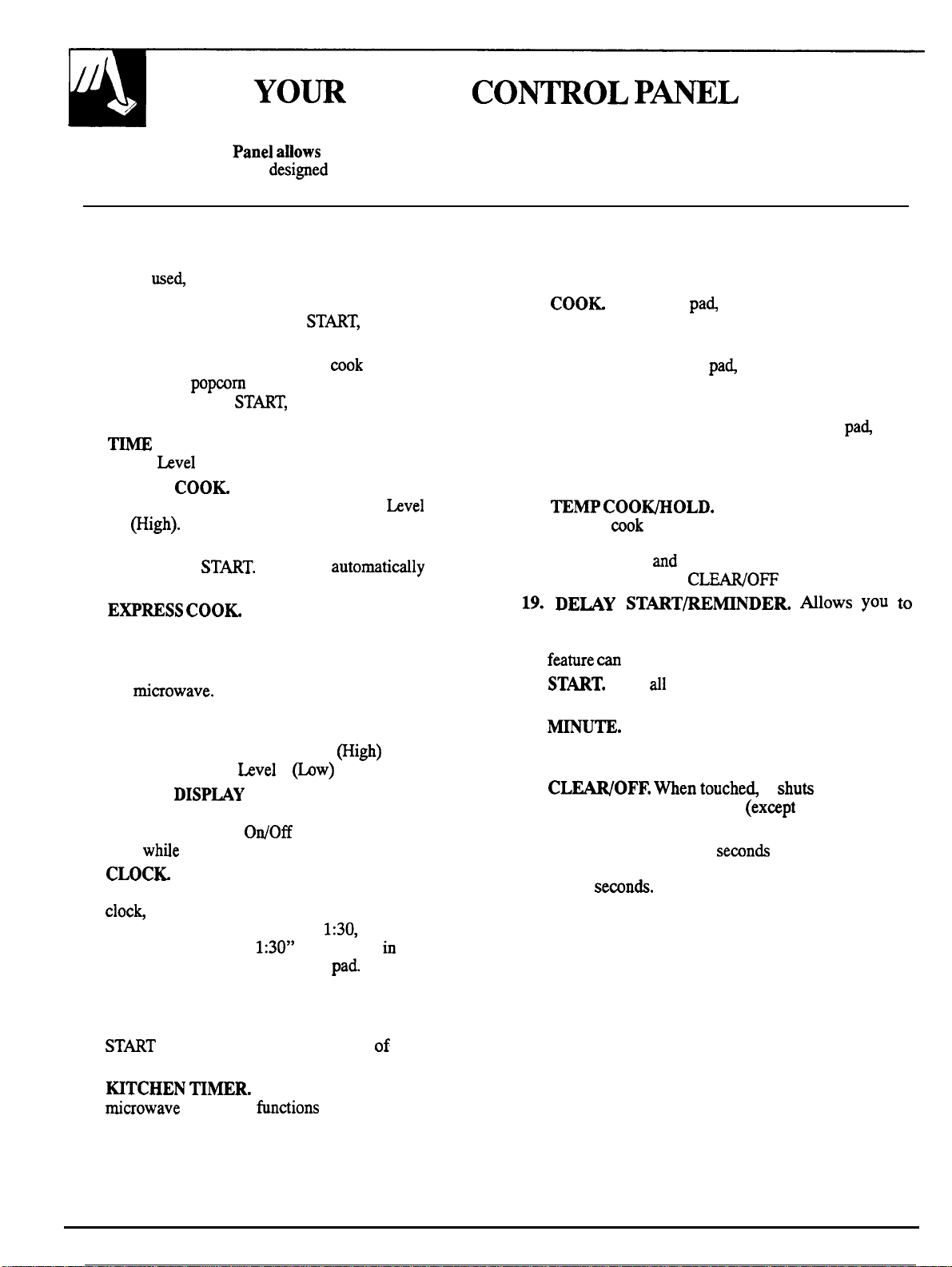
The Touch Control
Panel
allows
you to set the oven controls with
the touch of a finger.
It’s
desi~ed
to be easy to use and understand.
1. DISPLAY.
Displays time of day, time or
temperature during cooking functions, power level
being
use~
cooking mode and instructions.
2.
BEVERAGE.
Touch this pad to heat or reheat a
beverage. No need to touch
ST~T,
the oven will
start immediately.
3.
POPCORN.
Touch this pad to mok prepackaged
microwave
popeom
weighing 3.0 to 3.5 ounces.
No need to touch
STMT, the oven will start
immediately.
4.
~ME
DEFROST.
Gentle thawing at automatic
Power
Level
3 (Low).
5.
MICRO COOK
Microwave for a selected
amount of time using automatic Power
bvel
10
@i@).
6.
AUTO DEFROST.
Touch this pad and food
weight, then STMT. The oven
automatidly
sets power levels and defrosting time.
7.
E=RESS
COOK
Touch number pads 1 through
5 for 1 to 5 minutes of cooking. No need to touch
START, the oven will start immediately.
8.
NUMBER PADS.
Touch these pads to program
the
miaowave.
9.
POWER LEVEL.
Touch this pad before entering
another power level number if you want to change
from automatic Power Level 10
@igh)
for
cooking or Power
bvel
3
@w)
for defrosting.
10. CLOCK
DISP~Y
ON/OFF.
Touch the O
number pad to turn the clock display on or off.
The Clock Display
OflOff feature cannot be
used
whfie
a cooking feature is in use.
11.
CLOCK
Touch this pad to enter time of day
or check time of day while microwaving. To set
clock first touch CLOCK pad and then enter time
of day. For example, if time is
1:30,
touch number
pads 1,3 and O and”
1:30”
will appear
in
display.
Then touch START or CLOCK
pad
To reset or
change time, simply repeat above process.
12.
SOUND LEVEL.
Touch the SOUND LEVEL
pad. Touch number pad O, 1,2 or 3, then touch
ST~T
pad to change the sound level
of
the
oven beeper.
13.
~TCHEN
~MER.
This feature uses no
rniaowave energy. It
fundions
as either a kitchen
timer, as a holding period after defrost or as a
delay timer before time or temperature cooking.
14. REHEAT.
Use Reheat for quick reheating of
a variety of foods using different times and
power levels.
15.
COOK
Touch this pa~ a code number and
weight of food for quick cooking of a variety of
foods using different times and power levels.
16.
SNACKS.
Touch this pa~ a code number and
weight or quantity of food to warm a variety of
snack foods.
17.
AUTO ROAST.
Insert probe. Touch this pa~
the desired number pad for the code, then START.
The oven slow-cook meat with the automatic
preset program.
18. TEMP
COO~OLD.
Use the temperature
probe to
Wok
by using a preset temperature. Once
food reaches preset temperature, oven switches to
HOLD setting
and
maintains that temperature
until you touch the
CLwOFF
pad.
19.
DE~Y
START~mNDER.
A1OWS
YOU
to –
program your oven to begin cooking at a preset
time of day-up to a 12-hour delay. The Reminder
fea~re
m
be used like an alarm clock.
20.
ST~T.
After
dl
selections are made, touch this
pad to start the oven.
21.
~.
Use this with number pads to enter
whole minutes. For example, for 4 minutes touch
4 and MINUTE.
22.
CLwOFF.
men
touche~
it shuk off the
oven and erases all settings
(ex~pt
time of day).
23.
ADD 30 SEC.
Press this pad for 30 seconds
of cook time, to add 30
seeonds
to the cook
time as it’s counting down or for an “instant on”
for 30
sewnds.
24.
VENT FAN.
Press HI, LO or OFF for the
different fan speeds.
25.
SURFACE LIGHT.
Touch ON to turn on
the surface light. Touch NIGHT to turn on the
night light.
8

=:
;;.
~DEBE~DDo~
R&
OPCORN
BEVEWGE
REHMT
n
4
WRESS
WOK
J
d
POWER
LEVEL
n
2
MPRESSCOOK
n
5
EKPRESS
WOK
n
8
m
o
DISPUYOWFF
4
n
3
~PRESS
COOK
n
6
n
9
Od
CLWR
MINUE
~
I
I
I
r
1“
When You Plug
in
the Oven
The display panel displays “88888”, “18
POWR”
“PRObE”
Appeam
on
tie
Display:
and d] of the oven functions. After 15
semnds,
all
lights
&sappear
and “RESET” appears in the upper
●
Probe has been forgotten when Auto Roast or
Temp
Coo~old
function is being used.
portion. Touch the
CLWOm
pa4
set
the
clock
and oven is ready for use.
●
Probe is not securely seated in oven wall receptacle.
This
wfll
happen any time there is a power outage.
9
?
TT,I
f
Ill
11/
,
Ill
-
EEL
,,
——
--
H7---A
“-i
-
‘-”
-
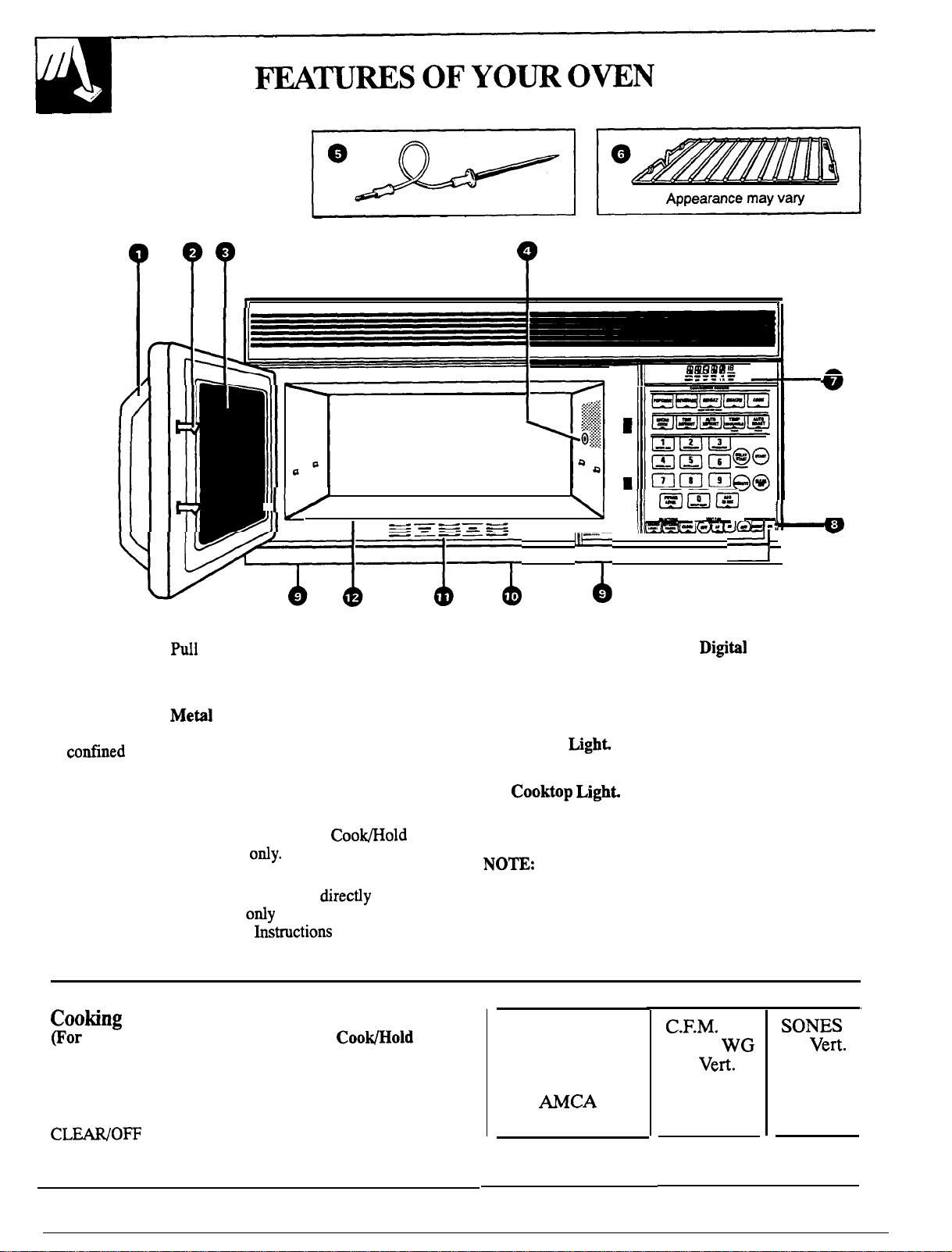
1. Door Handle.
Ptil
to open door. Door must be
securely latched for oven to operate.
2.
Door Latches.
3. Window with
Metil
Shield.
Screen allows
cooking to be viewed while keeping microwaves
cotilned in oven.
4. Receptacle for Temperature Probe. Probe must
be securely inserted into receptacle before oven
will start any temperature or Auto Roast cooking.
5. Temperature Probe. Use with Temp
CooWold
and Auto Roast functions ody.
6. Shelf. Lets you microwave several foods at once.
Food microwaves best when placed
directiy
on the
oven floor. Use this shelf
ody
when cooking foods
on two levels. (See Safety
hstructions and Oven
Shelf section for special instructions.)
7.
Touch Control Panel and Digitil Display.
For detailed information on each feature, see
Your Touch Control Panel section.
8. Hood Controls.
Vent Fan. Press HI, LO or OFF.
Surface
LighC
Press ON, NIGHT or OFF.
9. Grease Filters.
10.
Cooktop
Light
11. Automatic Cooking Guide.
12. Oven Floor.
NO~:
Rating plate, oven vent(s) and oven light are
located on the inside walls of the microwave oven.
Coobng
Complete Reminder
@or
all cooking features except Temp
Coo~old
and Auto Roast code 4)
To remind you that you have food in the oven, the
oven will display “End” and beep once a minute
until you either open the oven door or touch the
CLWOFF
pad.
10
This is to certify
that this unit has
been tested in
conformance
with
AMCA
Bulletin No. 210.
C.F.M.
at 0.10 WG
300
Vert.
300 Her.
SONES
7.2
Vert.
6.8 Her.

The Mtchen Timer
Using a Holding Time
The Mtihen
~mer
has 3 timing functions:
The
Kitchen Timer
~
dso be used to program a
●
It operates as a minute timer.
“holding time” between microwave cooking functions.
The time
ean
range from 1 second to 99 minutes and
●
It can be set to delay cooting.
99 seconds. A holding or standing time maybe found
●
It can be used as a hold setting
aftir
defrosting.
in some of your own recipes or in a cookbook.
The Kitchen Timer operates without
microwave energy.
How
to Time a 3-Minute Phone Call
Programming Delayed Cooking
Step 1:
Touch
~CHEN
TIMER pad.
To delay cooking up to 99 minutes and 99 seconds,
Step 2: Touch number pad 3 and MINUTE pad
touch either MICRO COOK
TEMP
COO~OLD
or
(for 3 minutes and no seconds).
AUTO ROAST and enter cook time, temperature or
Step 3: Touch START. Display shows time counting
code. Touch
WTCHEN
TIMER and enter number
down. The timer
signrds
when time is up.
of minutes to delay cooking.
men
delaying
Temp
Coomold
or Auto Roast cooking, be sure probe is
in food. Touch
ST~T.
Timer will count down to zero
and cooking will begin.
How
to
Detis~
Hold and Micro Cook
~t’s
say you want to defrost a frozen casserole for
15 minutes, hold for 10 minutes and then Micro Cook
for 25 minutes. Here’s how to do it:
Step 1:
Take casserole from freezer and
plaw
in oven.
m
Step 2: Touch
~ME
DEFROST pad.
H
Step 3:
Touch pads 1,5 and MINUTE for 15 minutes
defrosting time.
@efrosting
is
automatidly
set
on power level 3 but can be changed by touching
the
PO~R
LEWL
pad and the desired power
level 1-10.)
m
Step 4:
Set standing or hold time by
touching
KTCHEN TIMER pad.
(
J
A
Step 5:
Touch 1,0 and MINUTE to hold for
10 minutes.
m
Step 6:
Touch MICRO COOK.
~&R;
Step 7:
Touch 2,5
and
M~UTE
for 25 minutes of
eoo-ting
time.
o
Step 8:
Touch
ST~T.
As each function is
flAW
autornatimlly
performe~
oven display
shows instructions entered and the function.
men
time is up, the oven signals and
flashes “End.”
11

COO~G
BY
m
Micro Cook I
Micro Cook allows you to microwave for a preset
amount of time.
Power
hvel
10 @igh) is recommended for most
cooking, but you may change this for more flexibility.
See the Cooking Guide.
To become better acquainted with time cooking, make
a cup of coffee by following the steps below.
Step 1: Fill a cup
2/3 full of water,
add 1 teaspoon of
instant coffee and
stir to dissolve.
Use a cup that has
no metal decoration
and is
microwave-
safe
(refer
to
Microwaving Tips section).
Place cup in oven and close door.
m
Step 2:
Touch MICRO COOK.
1
J
A
Step 3:
Seleet
your time. Touch pad 1 and MINUTE
pad for 1 minute.
Be~use
automatic Power
Level
10 is recommended
for this cup of coffee, there is no need to change the
power level. (If Power Level 10 is not appropriate,
see “How to Change Power Level” below.)
o
Step 4:
Touch
ST~T.
HA~
Step 5:
men
time is up, the oven signals and flashes
“End.” The oven, light and fan shut off.
Step 6: Open the door.
If you interrupt Micro Cook to check the
foo~ simply
:ldse
the
doo~
and press START to resume cooking.
-
f
there is not time remaining on the timer you must
.eset
the timer to resume cooking.
How to Change Power
~vel
When Setting
Micro Cook I
1.
Press MICRO COOK
QED
2. Select cooking time.
QDm
3. Press POWER
LE~L.
mmm
4. Select desired power level 1-10.
~]~~
5. Press
ST~T.
Using the Micro Cook II Feature
The Micro Cook II feature lets you set 2 time cooking
functions within one program. This is ideal if you
want to change power levels during your cooking
operations. Here’s how to do it.
Step 1:
Place the food in the oven in a miaowave-
safe container and close the door.
m
Step 2:
Touch MICRO COOK
1
J
x“-
Step 3:
Select your first cook time. For example,
touch 2, 1 and 5 for 2 minutes and 15 seconds.
Step 4: Now is the
time to change the power level if
you don’t want full power for MICRO COOK.
press
PO~R
LE~L.
Select desired power level 1-10.)
Step 5:
Touch MICRO COOK again.
Step 6:
Set your second cook time.
Step 7:
Change the power level for MICRO
COOK. (Press POWER
LE~L.
Select desired
power level 1–10.)
The microwave oven will start and the time set for
“COOK
TME
I“
wtil
count down.
Nso,
“PO~R
10” or the power level selected for “COOK
TME
I“
will be displayed.
At the end of “COOK
~E
I“, the second power
level is displayed and the time for “COOK
~ME
II”
is shown counting down.
men
time is up, the oven signals and flashes “End.”
The oven, light and fan shut off. Open the door.
If you interrupt Micro Cook to check the
foox simply
close the door and press
ST~T
to resume cooking.
H
there is no time remaining on the timer you must
reset the timer to resume cooking.
—
—
o
Step 8:
Press
ST~T.
Sm
19

The Express Cook Feature
The Express Cook feature is a short-cut method to
To Express Cook your food or beverage:
set time for 1-5 minutes.
Touch a number pad (from 1 to 5) for 1 to 5 minutes
Bmm
of cooking at Power
hvel
10. For example, touch the
2 pad for 2 minutes of cooking time. No need to touch
amm
START, the oven will start immediately.
mmm
The oven will signal and turn off automatically when
finished.
Qma
How
to Use Delay
Stirt
The Delay Start feature allows you to program
Step 2:
Enter the time you want the oven to start.
your oven to begin cooking at a preset time of
@e
sure your microwave oven clock shows the
day—up to a 12-hour delay.
correct time of day.)
Q
Step 1:
Touch DELAY START pad.
Step 3: Enter your desired cooking program.
DEUY
Step 4:
Touch
ST~T
pad. The oven will
‘Wm
automatically start at the desired time.
How to Use Reminder
The Reminder feature can be used like an alarm
cloc~
without starting the oven.
Example: It is 7 a.m. and you must remember
to leave for a dentist appointment at 10 a.m.
Q
Step 1:
Touch DEMY START pad.
DEMY
am
Step 2:
Enter the time you want the oven to remind
you.
@e
sure your microwave oven clock shows the
correct time of day. The reminder time
ean
be set up
to 12 hours later).
Step 3:
Touch
ST~T
pad. The reminder is
now set at the time you
prograrnrneL
and will
signal you at that time
with a beeping sound
E
~
~~
\T’~
~~
/
until you open the door or touch the
CLWOFF
pad. The display
wtil
show “REM”
untfl
the oven
door is opened or
CLWOFF
is
touched
The
REMinder
time maybe displayed by touching the
DEMY
START pad.
The
time-of-day maybe
displayed by touching the CLOCK pad.
Add 30 Seconds
n
The Add 30 Seconds feature provides a
ADD
M
SEC
convenient way to extend cooking time by
30 seconds while the oven timer is
munting
down. It will add 30
seeonds
to the time
shown each time the pad is touched.
This pad may also be used as an express
cook for 30 seconds of cooking. No need
to touch START, the oven will start
immediately.
The Beeper Feature
The Beeper Feature lets you change the sound
level
of the oven beeper. To set the beeper sound level:
n
Step 1:
Touch the SOUND
Sg::
LE~L
pad.
Step 2:
Touch O for No Sount 1 for Soft, 2 for
Normrd
or 3 for
bud.
men
you touch each number pad the
oven
will
beep at the
volume
that you have selected.
Step 3:
men
you have selected your desired sound
level, touch the
ST~T
pad.
13
POPCOW
Step
2:
Open oven door and place package of
NO~:
Do NOT use the metal shelf with the
Popcorn program.
popcorn in the center of the oven floor as directed
by the package instructions. Close oven door.
I
I
The Popcorn feature is designed to be used
ody
with prepackaged microwave popcorn weighing
3.0 to 3.5 ounces.
n
Step 3: Touch POPCORN pad.
POPCORN
No need to touch
ST~T,
the oven
will start immediately.
Step 1:
Remove the outer wrapper from the
microwave popcorn.
How
to Adjust the Popcorn Program to Provide a Shorter or
bnger
Cook Time
If your favorite popcorn is not completely popped, If your favorite popmm is overcooked, there is a
there is a simple adjustment you can make. simple adjustment you can make.
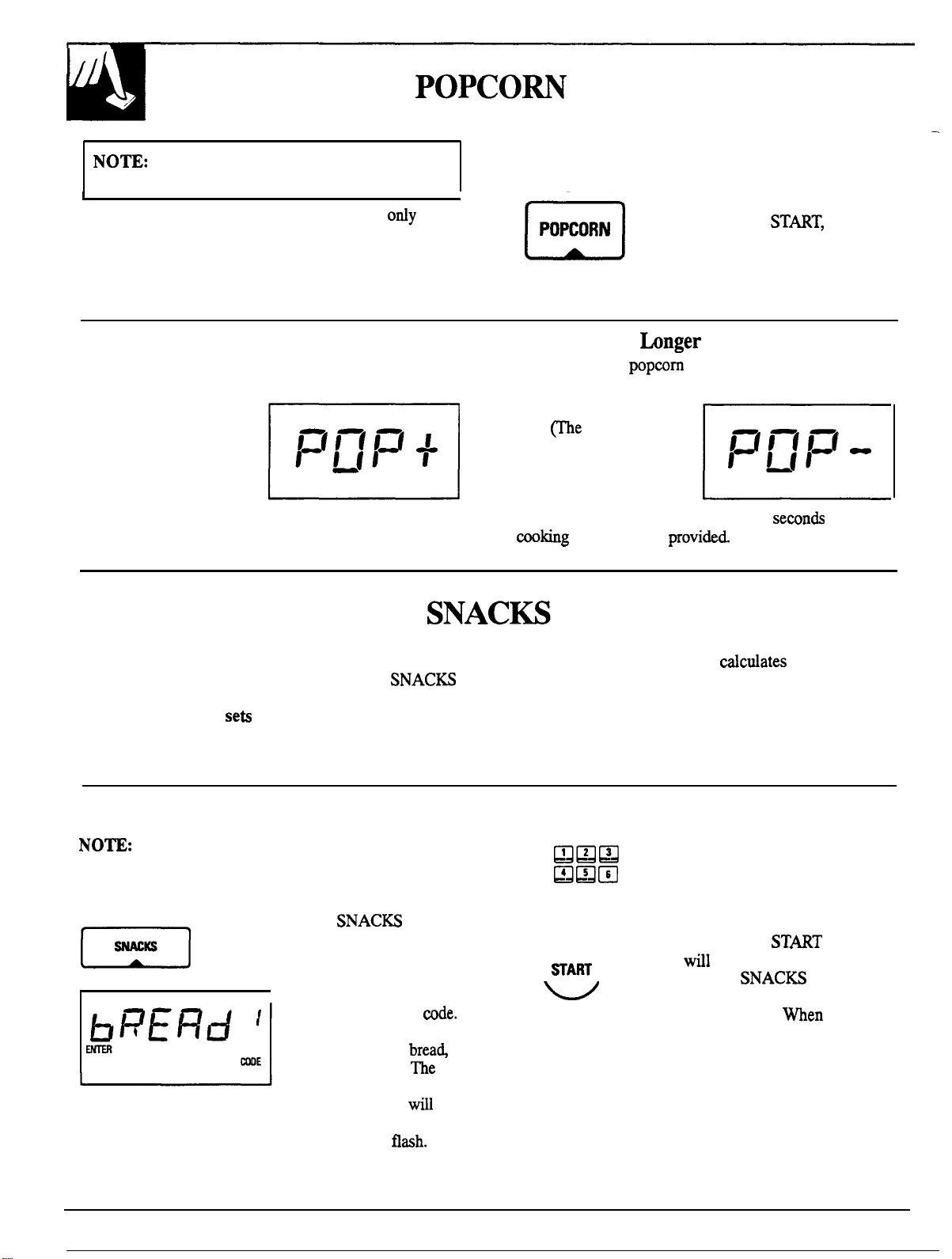
Touch the POPCORN pad.
(The oven will start
immediately.) Then touch
number pad 9. A plus sign
will appear on the display
beside the word “POP”.
E
Touch the POPCORN
131-113
+
pad.
me
oven will start
1
~[1
immediately.) Then touch
number pad 1. A minus
sign will appear on the
display beside the word
E
p\~\3
-
The plus sign indicates 20 “POP”. The minus sign indicates 20 sewnds less
seconds more cooking time is being provided.
-king
time is being
provided
The Snacks feature can be
Use the Snacks Code Guide. Touch The oven
dctiates
time and
used to warm a variety of
the
SNAC=
pad. For codes 1 to 4
changes power levels during
popular snack foods. The
enter the quantity of food. For microwaving to give even results.
oven automatically
sek
the
codes 5 and 6 enter the food
microwaving times and power
weight in ounces. Then touch the
levels for you.
START pad.
How to Use the Snacks Feature (Snacks Codes 1 to 4)
NO~:
See
the
next page on how to use Snacks
Codes 5 and 6.
QBQ
Step 1:
Remove the food from the package, place in
Wmm
the oven on microwave-safe dish and close door.
❑ mm
m
Step 2: Touch the
SNAC~
pad.
❑ ma
n
WA~
Step 3:
Touch number
pad of desired food
ade.
For example, touch
number pad 1 for
brea~
rolls and muffins.
The
code number and food
type you selected
til
appear on the display.
“ENTER” will
flash.
Step 4:
Touch number pad to
enter the quantity of food. For
example, touch 2. After 5
seconds “START” flashes on
the display.
Step 5: Touch the
STMT
pad.
Oven
wfil
begin microwaving.
Touching the
SNACN
pad
during microwaving will display
the remaining time.
Men
done,
oven displays “End”.
—
14

How to Use the
Snack
Feature (Snack Codes 5 and
Q
NO~:
See the p~vious page on how to use
Snacks Codes 1 to 4.
DDD
Step 1:
Remove the food from the package, place in
mEm
the oven on microwave-safe dish or container. Close
❑ mm
the oven door.
Dmn
~
, Step 2: Touch the SNACKS pad.
u
UART
Step
3: Touch number
pad of desired food
code. For example,
touch number pad 5
for soup. The code
number and food type
you selected will appear
on the display. “ENTER
mIG~”
will flash.
Step
4: Touch number pad
to enter food weight. For
example, touch 1 and 2 for
12 ounces. After 5 seconds
“ST~T”
flashes on
the display.
Step 5: Touch the
STMT
pad.
Oven will begin microwaving.
Touching the SNACKS pad during
microwaving will display the
remaining time.
men
done, oven
displays “End”.
SNACW
CODE
G~E
Codes 1 to 4
For warming foods with Snacks Codes 1 to 4 use the following guide:
Quantity
Food
Code
Display
Limit
(Q~
Comments
Bread, rolls,
1
bREAd
1 to 4
muffins
I
Use paper
towel
or
microwave-safe plate.
Sandwiches
2
I
SANdW
1 to 2
Use paper towel or
microwave-safe plate.
Pizza
3
PIZ
1 to 4
Use microwave-safe plate.
(leftover
slims)
Desseti-Toppings
4
TOP
1 to 4
Use microwave-safe dish.
Codes 5 and 6
For warming foods with Snacks Codes 5 and 6 use the following guide:
Weight
Food Code
Display
Limit (02)
Comments
soup
5
SOUP
8
to
40
OZ.
Use microwave-safe dish.
Cheese Dip
6
CHEEZ
4
to
16
OZ.
If container is microwaveable,
follow instructions on container;
or use microwave-safe dish.
15

The Reheat feature is designed to reheat 1 to 3
Touch just three pads to use Reheat codes 1 to 6
servings of a previously cooked food. The oven turns
to reheat many
popdar foods. See the Reheat
off automatically after a preset amount of time.
Guide below.
Reheat
To Reheat
Mom
Than One
Sening
The Reheat program makes it a snap to reheat many
Reheat codes 1 through 5 let you reheat up to three
popular foods. Choose a code number from 1 to 6 servings. To add more than one serving, just touch
(see Reheat Guide below).
number pad 2 or 3 right before touching START.
m
Step 1: Touch
REHW
pad.
The serving size may even be changed or added after
touching
ST~T.
Just touch number pad 2 or 3.
1
J
A
The word
“SERV”
Step 2: Touch a number pad from 1 to 6 to select a
food
SOUP.
o
Step
3: Touch
ST~T
pad. Oven
many servings have
~Am
will signal and turn off automatidly
been selected.
E
:;:;::ke:::::w
~~~1,’
In
when finished.
Reheat Guide
Serving
Code
Display
Ske
I
1
I
PASTA
I
1-3
2
MMS
1-3
3
VEGS
1-3
4
bEV
1-3
5
SAUCE
1-3
6
Pm
Foods Recommended
I
Pasta
I
Meats, casseroles, pizza
I
Fruits and vegetables
I
Beverages, &10 oz.
Sauces and gravies
2 to 3 foods, 4 oz. each
CA~ON:
Reheated foods may have wide variations After removing food from the oven, we
recpmmend
in temperature. Some areas may be extremely hot. that all reheated foods be stirre~ if possible, to even
out the temperature.
The Beverage program makes it simple to heat a cup
The serving size is
automatidly
set at 1, but can be
of hot chocolate or other beverage. Use a cup that has
changed by touching number pad 2 or 3 right after
no metal decoration and is microwave-safe (refer to
touching the
BEVEWGE pad. The oven will signal
the Microwaving Tips section).
and turn off automatically when finished.
m
Touch BEVERAGE pad. No need
CA~ON:
Beverages heated with the Beverage
WERME
to
touch
sT~T,
the
oven
will
Stafi
feature may be quite
ho~
Remove the container
immediately.
with care.
16

COOK
Use the Cook feature when
Use the Cook Code Guide. Touch
The oven calculates cooking
cooking a variety of microwaved
the COOK pad Touch a number
time and changes power levels
foods.
me
oven automatically
pad from 1 to 9 to select the desired
during cooking to give even
sets the cooking times and power
food group. Enter the food weight in
cooking resdts.
levels for you.
ounws,
then touch the
STMT
pad
How to Use the Cook
Featun
Step 1:
Remove the food from the package, place in
~~:
Step 4: Enter weight. For
the oven on microwave-safe dish and close door.
example, touch 1 and 8 for
~
~
Step 2: Touch the COOK pad.
&&u
nmm
18 ounces. After 5 seconds
“ST~T”
flashes on the
disDlav.
Dmn
.
.
Step
3: Touch number
pad of desired food
code. For example,
o
Step 5:
Touch the
ST~T
pad. Oven will
_AN
begin cooking. Touching the COOK pad
during cooking will display the remaining
Cook time. Oven displays “End” when
touch number pad
1
for anneal vegetables.
cooking is done.
The code number and
food type you selected
will appear on the
display.
“E~R
WIGHT’
will
flash.
Cook Code Guide
Cook
Food
Code
Canned
1
Vegetables
Frozen
2
Vegetables
Fresh
3
Vegetables
Weight
Limit
(OZ)
Comments
4
to
18
OZ.
Use microwave-safe casserole or bowl.
Cover with lid or plastic wrap.
4 to 16
OZ.
Use microwave-safe casserole or bowl.
Follow package instructions for adding water.
Cover with lid or plastic wrap.
4 to 16
OZ.
Use microwave-safe
-erole
or bowl.
Add 2 tablespoons water for each serving.
Cover with lid or plastic wrap.
8 to
@
OZ.
Pierce skin with fork. Place side
by
side on oven floor.
4 to 16
OZ.
Use oblong, square or round dish.
Cover with plastic wrap.
4 to 40 oz.
Use oblong, square or round dish.
Cover with wax paper.
8 to 48
OZ.
Use round casserole dish. Crumble meat into dish.
Cover with wax paper.
Turkey)
Bacon
8
2 to 10 oz.
hyer
strips on a plate, 4 to a layer.
Cover each layer with a paper towel.
Pizza
9
4 to 16
OZ.
Follow package instructions to prepare pizza for
(frozen
microwaving.
microwaveable)
17

Time Defrost is designed for speedy thawing of
frozen food and is one of the great advantages of
a microwave oven.
Use the Time Defrost setting to
quic~y
thaw foods
such as
brea~
rolls, vegetables, fruits and frozen
dinners. The Auto Defrost setting is preferred for
meat and poultry because the oven sets the defrosting
time and power levels for you.
●
Power level 3 is automatically set when you press
~ME
DEFROST pad, but you may change this for
more flexibility.
●
See the Defrosting Guide for defrosting help.
How to Change Power
Uvel
1.
Press
~ME
DEFROST.
2. Select defrosting time.
3. Press
POWR
LE~L.
4. Select desired power level 1-10.
5. Press START.
❑ mn
—
To become better aquainted with the defrost function,
defrost a 10 oz. package, of frozen strawberries by
following the steps below.
Step 1: Plain package of frozen strawberries in
the oven and close door. Be sure package
mntains
no metal.
m
Step 2: Touch TIME DEFROST.
TIME
DMR~T
Step
3: Select one
hdf
of the total defrosting time
recommended in the Defrosting Guide. For example,
touch 4 and MINUTE pad for 4 minutes.
o
Step
4: Touch
ST~T.
men
the cycle is
WA~
complete~
the oven signals and flashes
“En&”
then automatically shuts off.
Step 5: Turn the package over, close the door and
repeat Steps 2 and 3 to set remaining
hrdf
of
defrosting time and touch
ST~T.
Step 6:
men
the oven signals and flashes
“En&”
open the door, remove the package and separate
strawberries to finish defrosting.
Detisting
Tips
should-be
sli~
pierced
or
vente~
-R
food has partially
defroste&
as
directed by package. Plastic storage containers
should beat least partially uncovered.
●
Ftiy-size,
pre-packaged frozen dinners can be
defrosted and
rnimowaved.
U
the food is in a
fofi
container, transfer it to a microwave-safe dish.
●
For even defrosting,
some foods need
t;
be broken up or
separated
part
of
the way through
the
defiosting~ime.
●
Check the Defrosting Guide for other defrosting tips.
●
Foods that spoil
easfly,
such as
ti~
eggs, fish,
stuffings, poultry and pork should not be allowed to
sit out for more than one hour after defrosting. Room
temperature promotes the growth of harmful
baetena.
Questions and
hswem
Q. When I press
ST=T,
I hear a dull, thumping
Q. Can I defrost small items in a hurry?
noise. What is it?
A. Yes,
but they will need more frequent attention
A. This
sound is normal. It is letting you know the
than usual. Raise the power level after entering
magnetron is in operation.
the time by touching the desired power level pad.
Power Level 7 cuts the total defrosting time in
about 1/2; Power Level 10 cuts the total defrosting
time to approximately 1/3. During either, rotate or
stir food frequently.
18

Internal temperature is the best test of doneness
Temp
Coowold
takes the guesswork out of cooking,
for manv foods.
because the oven automatically switches to “Hold”
.
Use Temp
Coo~old
to cook a variety of foods to
setting after reaching the preset food temperature
the desired finished food temperature. The
Mcro
and maintains that temperature until you touch the
Cook setting is recommended for batters, doughs,
CLEWOFF pad.
frozen foods and foods which are difficult to cook
NOTE: Oven
automaticrdly
switches to “HoId”
precisely with the probe.
when preset food temperature is reached.
The Temperature Probe
The temperature probe is a food thermometer that
gauges the
intemd temperature of your food. (Its
appearance may vary from picture shown.) The probe
must be used when using Temp
Coo~old
or Auto
Roast. To use the probe properly, follow directions in
the Automatic Roasting section.
How to Temp Cook a Rolled Beef Rib Roast to Medium
Step 1:
Insert temperature probe and attach probe
Step 6:
men
160°F.
is
reache~
the oven will sound
securely in oven wall. Close the door.
and display “Hold.” The oven will then hold the
Sten
2: Touch TEMP
COO~OLD
Dad.
temperature.
1
Ste~
3: Touch 1,6 and O for
160°F.
Step 4: Touch
PO~R
LE~L
pad.
n
POWER
EVEL
o
SA~
n
Step
7: Touch
the
CLEMOFF
pad to stop
U*
the cycle.
Touch 5 for medium power.
-
Step 8: Remove probe and food from the oven.
Step 5: Touch the
ST~T
pad. If internal
temperature of the roast is less than
90°F.,
display will show “COOL”; if temperature
is
90°F.
or above, display shows
temperature counting up.
Cooking Tips
●
Use a lower power level; foods will heat more
●
Cover foods loosely for moisture control and quick
evedy though requiring more time.
even heating.
●
Be sure frozen food has been completely defrosted
●
Insert
the
probe horizontally into the center meaty
before inserting probe. Probe may break off
if
used
area not touching bone or fat. Make sure the
hande
in frozen foods.
does not touch the food or top or sides of the oven.
Questions and
hswers
Q. Why did
“PRObE”
flash on the display?
Q. Can I leave my probe in the oven if it’s not
A.
“PRObE”
will flash if you don’t seat the cable
inserted in food?
,—
end of the probe securely into the receptacle in
A. No,
if it touches the oven wall, it may damage
the oven wall or if you touch the
~MP
the oven.
COO~OLD
pad and forget to use the probe.
19

AmO
DE~OST
Auto Defrost
With the Auto Defrost
fea~re,
the oven
Use the Auto Defrost Guide. Enter the food weight in
automatically sets the defrosting times and power
pounds and tenths of a pound (see Conversion Guide
levels for you.
below). Then touch
ST~T
pad.
The oven
dcdates
defrosting time and changes
power
levels during defrosting to give even defrosting resdts.
—
How to Set Auto Defrost
Before you begin, check the guide located on the
inside front of oven when you open the
doon
It shows minimum and maximum food weights for
a variety of foods. You will need to
know
your food
weight before setting Auto Defrost.
Step 1:
Remove food from package, place in oven on
microwave-safe dish and close door.
n
Step 2: Touch AUTO DEFROST pad.
AUTO
-T
Step 3:
Enter weight. For example, touch number
pads 1 and 2 for weight of 1.2 pounds (1
poun~
3 ounces). See Conversion Guide below. After
approximately 5 seconds
“ST~T’
flashes.
o
Step
4: Touch
ST~T
pad. Display shows
~An
defrost time counting down.
Twice during defrosting,
the oven beeps 4 times
~
and
“TURn”
flashes.
the Auto Defrost Guide
for what to do at the first
E
Follow
thedirectionsin
~
~1
~~’
l-f
and second signal. Then close the door and touch
START pad.
men
defrosting time is
completec
“End” flashes
and oven beeps 4 times.
“End” remains on display
and oven beeps every minute until door is opened or
CLWOFF
pad is touched.
Stind Time
After Auto Defrosting, meat needs to stand in order to
let the inside defrost. You may take the food out of the
oven if you wish. Stand time recommendations are
given in the Auto Defrost Guide.
Conversion Guide
If the weight of food is stated in
pounds and ounces, the ounces
must be converted to tenths (.1)
of a pound.
Ounces
Pounds
1–2
.1
I
1
i
I
45
.3
&7
.4
8
.5
%10
.6
11
.7
12-13
.8
1415
.9
20

~COMMENDED
FOODS
M~.-M.
WEIGHT
FIMT SIGN& SECOND SIGN&
I
ST~D~ME
Chops
0.1 -6.0
lbs.
Turn over. Separate and shield
5 minutes
where necessary.
0.1 -6.0 lbs.
Separate.
Remove defrosted
2 minutes
pieces.
Frankfurters, Sausage
Turn over.
Remove defrosted areas
5 minutes
and break apart.
Ground Meat 0.1 -6.0 Ibs.
Beef Patties
Roast
Ribs
0.1 -6.0 lbs.
Turn over.
Separate patties.
I
5 minutes
0.1 -6.0 lbs.
0.1 -6.0 lbs.
Turn over and
shield.
I
Shield if necessary.
30 minutes
Turn over.
Remove defrosted
pieces. Shield if
necessary.
10 minutes
Steak
Stew
Turn over.
Turn over and
separate.
5
minutes
5 minutes
0.1 -6.0 lbs.
0.1- 6.0 lbs.
Separate and remove
defrosted pieces.
~ole
Chicken
0.1 -6.0
lbs.
Turn over and
shield.
Turn over.
Turn over and shield.
10 minutes;
run cold water
in cavity.
Shield where 20 minutes;
necessary.
run cold water
in cavity.
Separate and remove
5 minutes
defrosted
pie~s.
10 minutes;
run
mld
water
in cavity.
5 minutes
—
Turkey Breast
breast
side up)
CMcken
Pieces
Comish
Hens (whole)
0.1 -6.0 lbs.
0.1 -6.0 lbs.
Turn over.
0.1- 6.0 lbs.
Remove wrapper
and turn
over.
Tum
over.
Comish
Hens (split)
0.1- 6.0 lbs.
Fish Fillets 0.1 -6.0 Ibs.
Turn over.
Separate and remove
5 minutes
defrosted pieces.
Separate.
I
Separate and remove
5 minutes
defrosted
Dieces.
Shrimp,
Sdlops
0.1- 6.0 Ibs.
Whole Fish 0.1- 6.0
Ibs.
Turn over and
shield tail and
head.
Hold
under
cold running
water.
Uges
or thin areas of meat will defrost more rapidy than other areas.
M>r
first or second signal, shield warm areas with small pieces of foil.
21
—

A~O~~C
ROAS~G
Auto Roast uses the temperature probe to cook to
Just as in regular roasting, ody tender roasts should
–
the desired serving temperature.
UnNe
Temp
be roasted until specified internal temperatures are
Coowold,
which uses a single power level, Auto
reached.
bss
tender roasts should be microwaved
Roast uses up
b
3 power settings which
by time.
automaticatiy
switch during roasting, thus providing
even, tender cooking results without overcooking.
Preparing Roasts for Auto Roasting
Place tender beef
Plain pork roast
~
~
roast in cooking
bag on trivet in
&
<’
--
microwave-safe
dish. (Refer to
4
package instructions
for proper use of
<
-
~
bp
w
cooking bag.) Insert
—
I
Place meat in
probe through cooking bag
hotiontally into the
center meaty area not touching bone or fat. Make
oven with probe
tn
the
tiuht
Tnceti
/r
h
sure the hande does not touch the food or top or
sides of the oven.
WUIG
UIAU
WA
pAuu&
G-1.,
;“ta
AA
in cooking bag
and
plaw
in
microwave-safe
dish.
.-
----
. .
w---
-------
How to Roast Beef to Medium
Step 1:
Touch AUTO ROAST pad. Touch number
pad 1. Touch START. (See the Auto Roast Guide
for complete list of
rewmrnended
wales.)
theA~oR.*ST
P
NO~:
By touching
pad during cooking,
~he
meat’s
internal-
FOOO
~MP
temperature will be
mDE
displayed. (“COOL” will
be displayed until meat reaches
90°F.)
men
pad is
release~
doneness code reappears on the display.
Step
3:
After a
pre-programmed
food temperature is
reache~
oven beeps
4 times and
“HOLd”
appears on the display.
:~k?Tsi!:mesE
Step 4: Food will be
held at this temperature
I
Step
2:
men
you select
Auto Roast codes 1 or
2, the oven signals with
4 beeps and
“TURn”
flashes on the display
when it’s time to turn the
E
?~~m
I
CODE
roast over. After you turn the roast, close the door and
touch
ST~T.
@O~:
Oven
mntinues
to cook after
the signal whether or not roast is turned over.)

Auto Roast Guide
●
Pla&
meats
in
a cooking bag in microwave-safe
●
Insert probe as described in the Automatic
dish. (Refer to package instructions for proper use
Roasting section.
of cooking bag.)
Minimum End
TemD.
ApproL Time
(minutes per pound)
Hold*
Minutes
Doneness
Dispky
Food
I
Code
Beef (5 lb. max.)
Tender Roast
Medium
1
Well
2
160°F.
170°F.
15–23
B30
o
5-1o
I
Pork (5 lb. max.)
bin
Roast
2
170°F.
S30
WELL
10
Poultry (6 lb. max.)
Turkey Breast
3
~nsert
probe
hotiontally
into meatiest area.)
185”F.
1619
10-15
WELL
*Recommended standing time before serving.
Automatic
Simmer
(Auto Roast Code 4)
Toti
time includes time to bring food to 180°F., and
-
hold at that temperature
untfl
done.
Set Auto Simmer like
Auto Roast as explained
in the Automatic
Roasting section.
Display shows “SIM”
and “CODE 4.”
E
l;~
\;t
q
~DE
Oven switches to Hold
holdng at 180 F. until
you remove food and
touch
CLWOFF
pad. If stirring is
E
Iq
at180°F.,
and$ontinues
~~~~~
*
~DE
recommende~
you can restart oven by touching the
STMT
pad again. Touch
CLEWOFF
pad to turn
oven off.
Automatic
Simmer
Guide
(Auto
Roast
Code 4)
Final
Temp.
Approx.
Time~ours
Doneness
Disphy
SIM
SIM
SIM
SIM
SIM
Food
Comments
Beef
Pot
Roast
Chili
Chicken
Stewing
Broiler~ryer
HadPork
Roast
soup
StocWegetable
Split Pea
180°F.
180°F.
180°F.
180°F.
180°F.
180°F.
180°F.
5-7
5-8
4-6
34
4-6
7-10
5-7
Add enough liquid to just cover meat. If adding vegetables,
make sure they are completely covered by liquid.
Precook meat.
Pla& probe
1
inch from top surface. Stir after
3 hours, if possible.
Add 4 cups liquid. Insert probe into meatiest area of inner thigh
from below end and parallel to leg. Turn over after 1/2 of time.
Same
Drocedure
as above.
Add 4
CUDS
liQuid.
Make sure that vegetables and meat are covered by liquid. Stir
every 3 hours.
Add enough liquid to cover peas at least 2 inches. Stir after
3 hours.
z
SIM
SIM

When adapting recipes for the microwave, it is
best to start with a familiar recipe.
bowing
how
the food should look and taste will help when
adapting recipes for microwaving. Foods that
reqtire
browning or crisp, dry surfaces will
cook better in regular ovens.
●
Moist foods, such as vegetables, fruits, poultry and
seafood, microwave well.
●
Rich foods, such as bar cookies, moist cakes and
candies, are suitable for microwaving because of
their high fat and sugar content.
●
Reduce
re~ar
oven cooking times by 1/2 to
1/3.
~eck
food after minimum time to avoid
overcooking.
●
Small amounts of butter or oil
can
be used for
flavoring, but are not needed to prevent sticking.
●
Seasonings may need to be reduced. Salt meats and
vegetables after cooking.
Covering. In both regular baking and microwave
cooking, covers hold in moisture,
rdlow
for more
even heating and reduce cooking time. In regular
ovens, partial covering allows excess steam to escape.
Venting plastic wrap or covering with wax paper
serves the same purpose when microwaving.
Venting.
Mer
covering a dish with plastic wrap,
you vent the plastic wrap by turning back 1 comer
so excess steam can escape.
~ging
Food in Oven. When baking in regular
ovens, you position foods, such as
de
layers or
potatoes, so hot air can flow around them. When
microwaving, you arrange foods in a ring, so that
dl
sides are exposed to microwave energy.
Stirring. In range-top cooking, you stir foods up from
–
the bottom to heat them
everdy.
When microwaving,
you stir cooked portions from the outside to the renter.
Foods that require constant stirring will need
ordy
ouiond
stirring when microwaving.
~rning
Over. In range-top cooking, you turn over
foods, such as hamburgers, so both sides
can
directly
contact the hot pan. When microwaving, turning is
often needed during defrosting or when cooking
certain foods, such as frozen hamburgers.
Standing Time. When you cook with
re@ar
ovens,
foods such as roasts or
mkes
are allowed to stand to
finish cooking or to set. Standing time is especially
important in microwave cooking. Note that a
microwaved
de
is not placed on a
moling
rack.
Shielding. In a
re@ar
oveu you shield chicken
breasts or baked foods to prevent over-browning.
When microwaving, you use small strips of foil to
shield thin parts, such as the tips of wings and legs
on
podtry,
which would cook before larger parts.
king.
Sparh
caused by too much
metrd
in the
microwave oven or metal touching the side of the
oven or foil that is not molded to food.
Wck
Foods to Release
Mssure.
Steam builds up
pressure in foods that are
tightiy
covered by a skin or
membrane. Prick foods, such as potatoes (as you do
—
before regular oven
woking),
egg yolks and chicken
livers, to prevent bursting.
Rotating.
Occasionrdly,
repositioning a dish in the
oven helps food cook more
everdy.
To rotate 1/2@
turn the dish until the side that was to the back of the
oven is to the front. To rotate 1/4 turn, turn the dish
untd
the side that was to the back of the oven is to
the side.
Basic
Mcmwave
Gtidehes
Density of Food.
In both
re@ar
baking and
microwave cooking, dense foods, such as potatoes,
take longer to
wok
than
ligh~
porous foods, such as
rolls, bread or pieces of cake.
Round Shapes. Since microwaves penetrate foods
to about 1 inch from top, bottom and sides, round
shapes and rings cook more
evedy.
bmers
receive
more energy and may overcook. This may also
happen when cooking in a
re@ar
oven.
Delicacy. Foods with a delicate texture, such as
custards, are best cooked at lower power settings
to avoid toughening.
Natural Moisture of food affects how it cooks. Very
moist foods cook evenly because microwave energy
is attracted to water
molecdes.
Food that is uneven
in moisture should be covered or allowed to stand
so it heats
evedy.
24
Piece Size.
SA1
pieces cook faster than large ones.
Pieces that are similar in size and shape cook more
evedy.
With large pieces of foo~ reduce the power
setting for even rooking.
Shape of Food.
k
both types of cooking, thin areas
mok faster than thick areas. This can be controlled in
microwaving by placing thick pieces near the outside
edge and thin pieces in the center.
Starting Temperature. Foods taken from the freezer
or refrigerator take longer to mok than foods at room
temperature. Timings in our recipes are based on the
temperatures at which you
norrndly
store the foods.
Quantity of Food. In both types of cooking, small
amounts usually take less time than large amounts.
This is most apparent in microwave cooking, where ‘
-
time is directly related to the number of servings.
Shelf (on models so equipped). Use the shelf to heat
more than 1 dish at a time. Take the shelf out when
you are not using it.

~~G
OR
RE~~G
GU~E
NO~:
Use Power
bvel
High (10) unless otherwise noted.
1.
Directions below are for heating or reheating already-cooked
foods stored in refrigerator or at room temperature. Use
microwave-safe cookware.
4.
2. Cover most foods for fastest heating. Exceptions are some
sandwiches, griddle foods and baked items.
3. Bubbling around edges of dish is normal, since the writer is the
last to heat. Foods heated to
160°F.
to
165°F.
will provide safe,
palatable results. Adjust temperatures to suit your personal
taste.
ht
foods stand a few minutes before serving.
Be sure foods are heated throughout before serving. Steaming
or
bubbling around edges of dish does not necessarily mean
food is heated throughout.
If you use a meat thermometer while cooking, make sure
it is safe for use in microwave ovens.
Item
hount
Power Mvel
~me
Bake~
Foods
Cakq
coffee
mke,
doughnuts, sweet
mh,
1
pie~
bw
(3)
1/4 to 1/2 min.
nut or fruit bread
9
inch cake or
hw
(3)
2 to 4 min.
12
roIIs
or doughnuts
Dinner
rob
mtim
1
Medium (5)
1/4 to
1/2
min.
6 to 8 Medium (5)
1
to 2 min.
Pie:
frui~
nut or custard; 1
slicc=l/8
of 9 inch pie
1 slice
1/2 to
1
min.
(use minimum time for custard)
9 inch pie
Meal-High (7)
3 to 5 min.
Beverages
Cocoq
other* based
drinks
(6 oz. per cup)
1 to 2 cups
Meal-High (7)
2 to 4 min.
Coffee,
other water-baaed
drinks
(6 oz.
per cup)
1 to 2 cups 2 to 3 min.
Meats and Main Dishes
Chicken pieces
1 to
2
pieces
Hamburgers or
meadoaf
(4 oz.
per serving)
1
to
2
servings
Hot dogs and sausages
1 to
2
Nce
and pasta
(V3-3/4
cup per serving)
1
to 2 servings
Saucy, main dishes:
chop
suey,
spaghetti, creamed chicken,
1
to 2 servings
chili, stew, macaroni and cheese, etc. (3/4-1 cup per serving)
Stea@
chops,
rib%
meat pieces
1
to
2
servings
Meal-High (7)
Wy-sticed
meat (3
to
4 oz.
per serving)
1
to 2 servings
Meal-High (7)
Topped or mixed with sauce (2/3-3/4
cup per serving)
1 to 2 servings
Tip:
Cover saucy main dishes with plastic wrap.
over
other main dishes and meats with wax paper.
Wen
heating or reheating 3 to 4 servings of meat slices or pieces, rotate dish 1/2 turn after half of cooking time.
1
to 2 min.
1
to 2 min.
1 to
1%
min.
1 to 2 min.
2 to 4 min.
1%
to
2%
min.
1 to 2 min.
2 to 4 min.
Plate of
bftovers
Meat
plus 2 vegetables
1
plate
3 to 4 min.
Tip:
tiver
plate of food with wax paper or plastic wrap.
Sandwiches
Meat-cheese
ffig:
with 2 slices of bread
1
to 2 servings
Meal-High (7) 1 to 2 min.
Moist
m:
Sloppy
Joes,
barbecue, ham salad,
1
to 2 servings
Meal-High (7)
1 to 2 min.
etc. in bun (1/3 cup per serving)
Tip:
Use paper
towel
or napkin to cover sandwiches.
soups
~-based
(6 oz. per serving)
1 to 2 servings
Meal-High (7)
1%
to 4 min.
Water-based (6 oz.
per serving)
1
to
2
servings
1
%
to 3 min.
~p:
tiver
soups with wax paper or plastic wrap.
—.
Vegetables
hrge
pieces or whole:
asparagus spears,
mm
on the cob, etc.
1
to 2 servings
1
to 3 min.
Mashed
(In
cup per serving)
1
to
2
servings
2 to 4 min.
SmaU
piec~: peas,
beans, corn, etc. (1/2 cup per serving)
1
to 2 servings
1%
to 3 min.
~p:
Cover vegetables for most even heating.
25

DE~OST~G
G~E
1.
Food packagd in paper or plastic may be defrosted without
3. Be sure large meats are completely defrosted before
~oking.
unwrapping. If food is foil wrapped, remove foil and place food
4. When defrosted, food should be cool but softened in all areas.
in cooking dish for defrosting. Most food defrosts well using
Defrost (3). For more even defrosting of larger foods, such as
If still slightly icy, return to microwave oven very briefly, or let
beef, lamb and veal roasts, use Warm (l).
stand a few minutes.
2.
Mer
first half of defrosting time, unwrap package and check
food.
fim
food over, if necessary; break apart or separate food
if possible. Shield any warm areas with small pieces of foil.
Food
~me
Commenfi
Breads, Cakes [Power
hvel:
Defrost (3)]
B~a@ buns or row
(1 piece)
1 min.
Sweet
rok
3 to 5 min.
Rearrange after half of time.
(approx.
12 oz.)
Fish and Seafood
[Power
hvel:
Defrost (3)]
F~e~
frozen (1 lb.)
7 to 9 min.
SheK~b
small
piees
5 to 7 min.
Place block in casserole.
fim
over and breakup after first half
(1 lb.) of time.
Fruit [Power
hvel:
Defrost (3)]
Plastic
puch—1
to
2
3
to 6 min.
(10-oz. package)
Meat [Power
Uvel:
Defrost (3)]
Bacon (1
lb.)
3 to 5
min. per lb.
Place unopened package in oven.
Ut
stand 5 minut= after defrosting.
F-(1
lb.)
3 to 5 min. Place unopened package in oven. Microwave just until franks can be
separated.
ht
stand 5 minutes, if necessary, to complete defrosting.
Ground meat (1
lb.)
5 to 7 min.
Turn meat over after first half of time.
Roast:
beef, lamb, veal, pork
12 to 16 min. per lb.
Use Power Uvel Warm (l).
Steak
chops and cutlets
6 to 8 min. per lb.
Place unwrapped meat in cooking dish.
h
over after first half
of time and shield warm areas with foil.
~r
second half of time,
separate pieces with table knife.
~t
stand to
mmplete
defrosting.
Poultm
[Power
bvel:
Defrost
(3)]
Cticke-q
~roiler-fryer,
16 to 20
-
Place wrapped chicken in dish. Unwrap and turn over after first half
Cut
Up
(2%
to
3 lbs.)
of time.
Mer
second half of time, separate pieces and
place
in rooking
dish. Microwave 2 to 4 minutes more, if necessary.
Ut
stand a few
minutes to finish defrosting.
CMcke&
whole
18 to 22
Plaa
wrapped chicken in dish.
Mer
first half of time, unwap and
(2%
to 3 lbs.)
turn chicken over. Shield warm areas with foil. To complete
defrosting
run cool water in
avity
until giblets can be removed.
Cotih
hen
8
to
14
min. per lb. Place unwrapped hen in oven breast-side-up.
Tum
over after first half
of time. Run cool water in cavity until giblets
a
be removed.
~by
breast
(4 to 6 lbs.)
6 to 10 min. per
Ib.
Place unwrapped breast in microwave-safe dish breast-side-down.
Mer
first half of time, turn breast-side-up and shield warm areas with foil.
Defrost for second half of time.
bt
stand
1
to 2 hours in refrigerator
to complete defrosting.
26
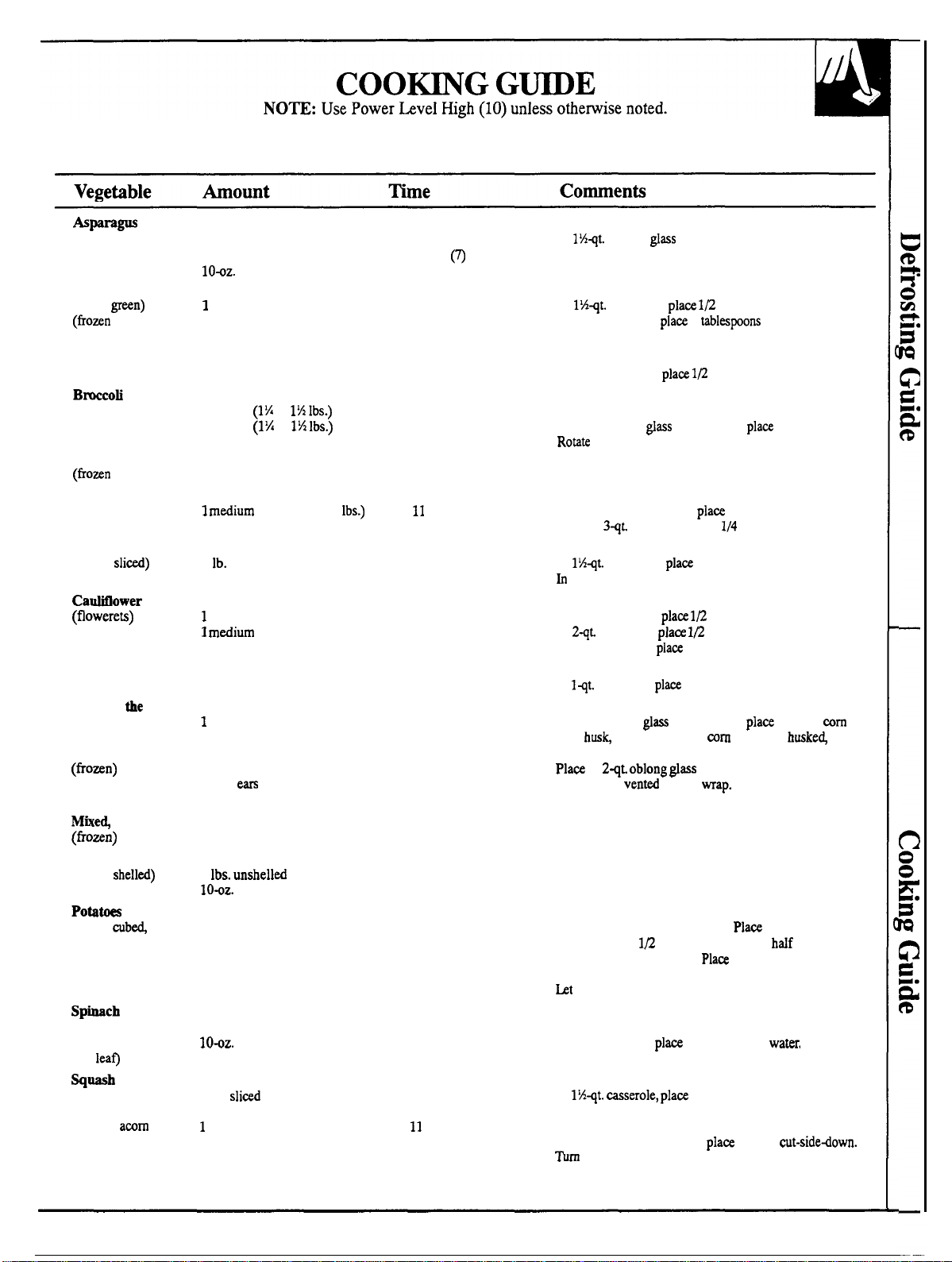
Vegetables
Aparaw
(frozen spears)
1 lb.
7 to 9 min.,
Meal-High
(~
5 to 7 min.
In
I%qt.
oblong
#ass
baking dish, place 1/4 cup water.
Rotate dish after half of time.
In lqt. casserole.
In l%qt. casserole,
plaw
12
cup water.
In l-qt. casserole,
pla~
2
tablwpoons
water.
In l-qt. casserole, place 1/4 cup water.
(frozen spears)
Beam
(fresh
grwn)
(fromn
green)
(frozen lima)
10*z. package
10 to 12 min.
6 to 8 min.
6 to 8 min.
1
lb. cut in half
10+z. package
10+z. package
Beets
(fresh, whole)
1 bunch
18 to 22 min.
In 2-qt. casserole,
plaw
12 cup water.
Bwcoh
(fresh cut)
(fresh spears)
1 bunch
(1X
to
1%
Ibs.)
1 bunch
(1%
to
1%
lbs.)
8 to 10 min.
10 to 13 min.
In 2-qt. casserole, place 1/2 cup water.
In 2-qt. oblong
#ass baking dish,
plaa
1/4 cup water.
Ro@@
dish after half of time.
In lqt. casserole.
In lqt. casserole, place 3 tablespoons water.
(frozen, chopped)
(tiozen
spears)
Cabbage
(fresh)
(wedges)
Carrots
(fresh,
slid)
(frozen)
Ca*ower
(flowerets)
(fresh, whole)
(frozen)
10+z. package
10+z. package
5 to 7 min.
5 to 7 min.
1
mdium head (about 2
Ibs.)
9
to
11
min.
8 to 10 min.
In 1%-or 2qt. casserole,
plae
1/4 cup water.
In 2- or
3qt.
casserole, place
1/4
cup water.
1
lb.
10+z. package
7 to 9 min.
5 to 7 min.
In l%qt. casserole,
pla~
1/4 cup water.
k
l-qt. casserole, place 2 tablespoons water.
In 2-qt. casserole,
pla~
12 cup water.
In
2qL
casserole,
pla~
lZ
cup water.
In lqt.
casserole,
pIaw
2 tablespoons water.
1
medium head
1
mdium head
10+z. package
10 to 14 min.
10 to 17 min.
5 to 7 min.
Corn
(frozen kernel)
10+z.
package
5 to 7 min.
In
Iqt.
casserole,
pl=
2 tablespoons water.
Corn on
tie
cob
(fresh)
1
to 5 ears
3 to 4 min.
per ear
In 2qt. oblong #ass baking dish,
plaa
corn. If
mm
is in
husk
use no water; if
com
has been
husked
add
1/4 cup water. Rearrange after half of time.
Plaw
in 2qL
oblong
#ass
baking dish.
Cover with
ventd
plastic wap. Rearrange after
half of time.
(fromn) 5 to 6 min.
3 to 4 min. per ear
1 ear
2 to 6
em
M&e@
vegetables
(tiozen) 10+z. package
5 to 7 min.
2
lbs.
unshelld
10 to 12 min.
1O-Z.
package
5 to 7 min.
4 potatoes 10 to 12 min.
(6 to 8 oz. each)
1(6 to 8 oz. each)
3 to 4 min.
In lqt. casserole, place 3 tablespoons water.
Peas
(fresh,
shelld)
(frozen)
Poti~
(fresh,
cub~
white)
(fresh, whole,
sweet or white)
In lqt. casserole, place 1/4 cup water.
In lqt. casserole, place 2 tablespoons water.
Peel and cut into 1 inch cubes.
Pla&
in 2qt.
casserole with
12
cup water. Stir after
hdf
of time.
Pierce with rooking fork.
Pla@
on paper towel
oven floor, 1 inch apart in circular arrangement
Lt
stand 5 minutes.
Sphch
(fresh)
(frozen, chopped
and
lea~
10 to 16
OZ.
5 to 7 min.
1O-Z.
package
5 to 7 min.
In 2-qt. casserole, place washed spinach.
In lqt. casserole,
pl=
3 tablespoons
water.
~uash
—
(fresh, summer
and yellow)
(winter,
amm
or butternut)
1 lb.
sli~d
5 to 7 min.
1
to 2 squash 8 to
11
min.
(about 1 lb. each)
In l%qt.
-serole,
plaw
1/4 cup water.
Cut in half and remove fibrous membranes. In 2qt.
oblong glass baking dish,
plaw
squash
cut-sidedown.
~m
cut-side-up after 4 minutes.
27
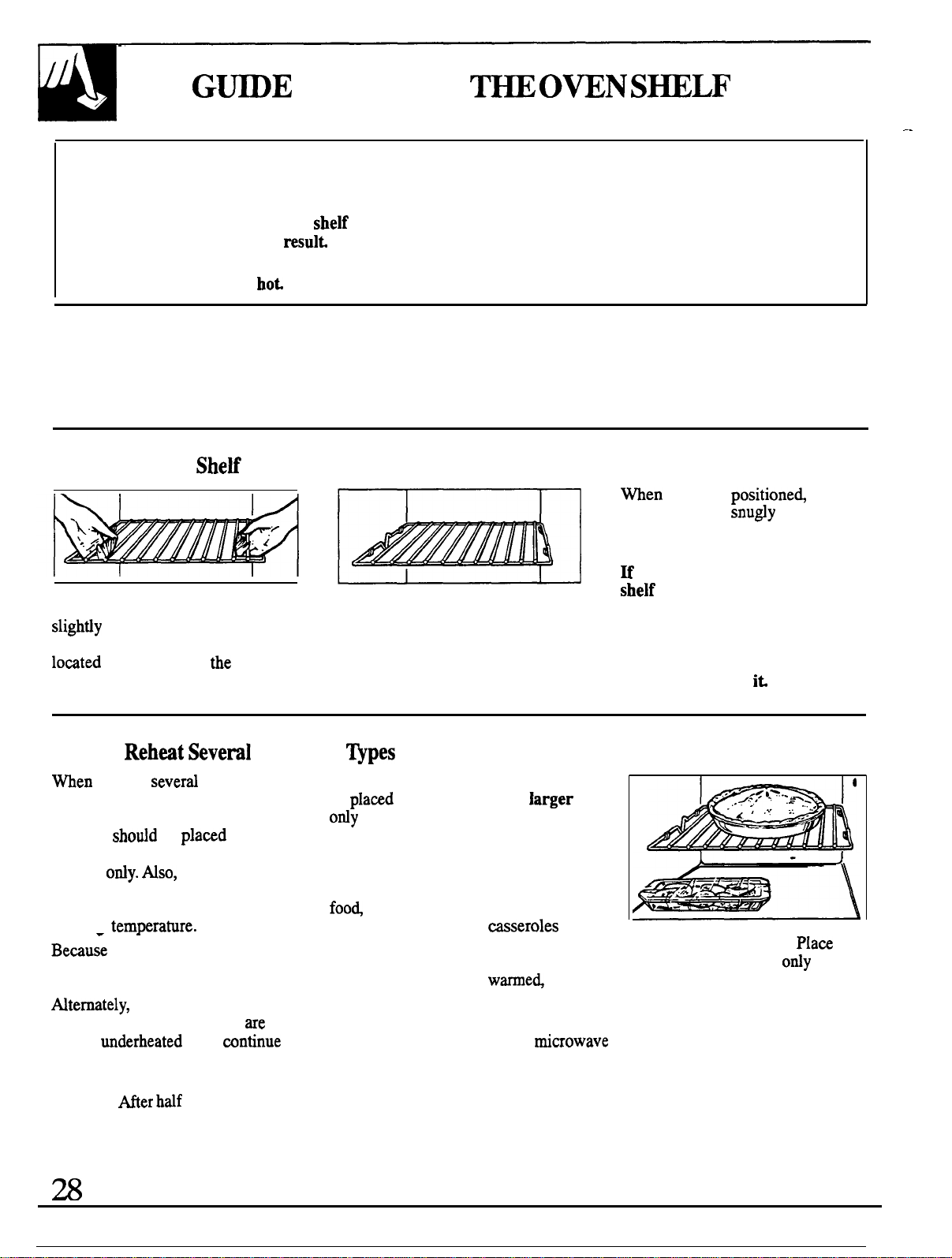
G~E
TO USE OF
~
OWN
S~LF
●
Use the shelf only when cooking food on
●
Do not store microwave browning dish on
2 levels. Food microwaves best when placed
metal shelf.
directly on the oven floor.
●
Do NOT use the shelf with the Popcorn
●
Do not store or cook with metal
shelf
on floor of
program.
oven. Product damage may result
●
Use pot holders when handling metal shelf and
cookware. They may be
hot
The
wire
shelf is specifically designed for added Batters and dough foods and also uncooked foods
capacity heating and reheating in your microwave
which need to be prepared from scratch should be
oven. Now more than one food may be heated or
cooked without the oven shelf.
reheated and ready to serve at the same time.
Positioning the
SheE
men
properly
positione&
the
shelf should fit
snu@y
in place,
be level and not touch the back
or side wall of the oven.
H
arcing occurs when using the
shelf
to cook more than one food
To position the shelf, tip the back
Next, lower the front until the shelf
at the same
time,
turn the oven
slightiy
and fit the shelf support
support guides fit onto the support
off. Make sure the shelf is not
guides onto the support guides
guides located at each side of the
touching oven walls. To prevent
lomted at each side of
the
oven
oven in the front.
arcing, remove the shelf when
in the rear.
you are not using
iL
How to
Reh~t
Seveml
Different
~pes
of Foods Together
men
heating
severrd
different types of food together,
foods which should be served hot must be
plamd
on
the oven floor, while foods which need
ody
to be
warmed
should
be
pla~d
on the shelf. This is
because microwave energy enters the oven from the
bottom
ordy.
Nso,
it is important to remember that
foods absorb microwave energy at different rates.
Rates can be affected by the size of the
foo~ and its
starting temvrature.
Place on the
floor
larger
or more dense
foods,
which
need the most
heating, such
as leftover
fried chicken,
wseroles of
--
Beause
of the varying rates, you may need to start
canned or leftover vegetables, rice or pasta.
PIa&
reheating a large or dense food a few minutes ahead
on the oven shelf those foods which need
ordy
be
of time, then add other smaller or less dense foods.
warrne~
such as bakery pies, rolls, muffins or breads.
Atemately, if one of the foods you are heating seems
Pop popcorn on the microwave oven floor
undercooked but the others
are
heated satisfactorily,
only. Use prepackaged popcorn labeled for
let the
underheated
food
wntinue
cooking.
use in
mi~owave
ovens.
Heat or reheat different types of food at High (10).
To determine heating times, add times for all foods
together.
Mer
hdf
of time, stir or rearrange foods
(do not reverse positions). Check foods (especially
those on the oven floor) after 3/4 of total time and
remove any which are done. Continue cooking others.
z
—.

Keep your oven clean and sweet-
Don’t use sharp-edged utensils
smelling.
Opening the oven door
on your oven.
The
inside and
a few minutes after cooking helps
outside oven walls can be
air out the inside. An occasional
scratched. The control panel
thorough wiping with a solution
can be damaged.
of baking soda and water keeps
BE CERTNN POWER IS OFF
the inside fresh.
BEFORE CLEANING ANY
PART OF
~IS
OVEN.
How to Clean the Inside
Walls and floor.
Some spatters can be removed
with a paper towel, others may require a damp cloth.
Remove greasy spatters with a sudsy cloth, then rinse
with a damp cloth. Do not use abrasive cleaners on
oven walls. NEVER USE A
COMMERCM
OVEN
CLEANER ON ANY PART OF YOUR
MICROWA~
OVEN.
Door (inside).
Window: Wipe up spatters daily
and wash when soiled with a damp cloth. Rinse
thoroug~y and dry.
Metal and plastic parts on door: Wipe frequently
with a damp cloth to remove
dl
soil. DO NOT USE
ABRASI~S,
SUCH AS CLEANING POWDERS
OR STEEL AND PLASTIC PADS. THEY
WLL
DAMAGE THE SURFACE.
Special noti when using Brown ‘N Sear Dish:
If
grease is present, high heat generated on bottom of
a Brown ‘N Sear dish may cause the grease to burn
onto the oven tray. This may be removed with a
cleanser such as Bon
Arni@
brand cleanser.
After using Bon
Ami”
brand cleanser, rinse and dry
thoroug~
, following instructions on can. Do not use
.J
Bon
Aml
brand cleanser on the painted surfaces such
as the walls. It may scratch the paint.
Automatic Temperature Probe. Probe is sturdy,
but care should be taken in handing. Do not twist
or bend; avoid dropping temperature probe.
Clean as soon after using as possible. To clean,
wipe with sudsy
cloth then rub
lightiy
with plastic
scouring ball if
newssary.
Rinse and dry or wash in
dishwasher.
Shelf. Your shelf accessory is designed for use in a
microwave oven
ody; do not use in a
re@ar
oven.
Do not use a browning dish with the shelf. Arcing
could occur.
Clean shelf with mild soap and water or in the
dishwasher. Do not clean in a self-cleaning oven.
How to Clean the Outside
Case. Clean the outside of your oven with soap and
damp
clotb rinse with a damp cloth and then dry.
Wipe the window clean with a damp cloth. Chrome
trim is best wiped with a damp cloth and then with
a dry towel.
Control Panel. Wipe with a damp cloth. Dry
thoroug~y.
Do not use cleaning sprays, large amounts
of soap and water, abrasives or sharp objects on the
panel-they can damage it.
Door Surface.
When cleaning surfaces of door and
oven that come together on closing the door, use
ody
rnil~
non-abrasive soaps or detergents applied with a
sponge or soft cloth.
Power Cord.
If the cord becomes
sotie&
unplug and
wash with a damp cloth. For stubborn spots, sudsy
water may be used, but be certain to rinse with a
damp cloth and dry
thoroug~y
before plugging cord
into outlet.
29

LIG~
BULB
WPMCE~m
Cooktop
LightNight
Light
To replace
combination
cooktop/night
light, first
disconnect power
at main fuse or
cimuit
breaker
panel or
pdl
plug.
REMOV:
SCRW
Remove screw on right side of light compartment
cover and lower rover until it stops.
Be sure
btibs to
be replaced are
cool before
removing. Break
the adhesive seal by
gently unscrewing
-
the bulbs.
Replam
\
with 40-watt
incandescent
bdbs
~02X4253)
available from
your GE supplier. High intensity 40-watt bulbs
(40SllN/1), which are available in supermarkets and
hardware stores, may
dso
be used for replacements.
Raise light compartment
wver
and replace screw.
Connect
electrierd
power to microwave oven.
Oven Light
To replace your
oven light, first
disconnect power at main fuse
or circuit breaker panel or
pu~
plug. Remove the top grill by
taking out the 2 screws that hold
it in place.
Next, remove the
singIe
screw
lo~ted
above door near center
of oven that secures light housing.
Replace burned-out
bdb
with
a 30-watt
inmndescent
bulb
~02X4235),
available from
your GE supplier.
Clean off the grease
and dust on
hood surfaces often. Use a solution
of warm water and detergent.
About 1 tablespoon of ammonia
may be added to the water. Take
me
not to touch the filters and
enamel surfaces with this solution;
ammonia will darken metal.
—
30

The
efiaust
hood
feature on your microwave oven is equipped with 2
CHARCOAL FILTER
metal filters which
mllect
grease.
men
the fan is operated, air is drawn
(on some models)
up through the filters. Depending on your model, it is either discharged
through the provided venting to the outside or drawn through a charcoal
filter and recirculated.
REUSABLE
GREASE FILTERS
(on all models)
Reusable Grease Filters
(on
al]
models)
The grease filters should be cleaned at least once a month.
Never
operate the microwave without the filters in place. In situations where
flaming might occur on surfaces below
hoo~ filters will stop the entry
of flames into the unit.
To
Remove Grease Filter
To Clean and Replace Grease Filter
To remove grease filter,
grasp the “finger hold”
on the filter and slide to
the rear. Then pull filter
downward and to the
front. The filter will
drop out.
To clean grease filter, soak it
and then agitate filter
in solution of hot water and detergent. Don’t use
ammonia or ammonia products because they will
darken the metal. Light brushing can be used to
remove
embedded dirt.
Rinse,
shake
and remove moisture before replacing.
To replace grease
filteq
sIide
the filter in the frame
slot on the back of the opening.
Pull
filter
upward and to the front to lock into place.
Chamoal
Filter
(on some models)
Some models are not vented to the outdoors; they
The disposable charcoal filter should be replaced
recirculate the air instead. These models are equipped
when it is noticeably dirty or discolored (usually
with a disposable charcoal filter that helps remove
after 6 to 12 months, depending on hood usage).
smoke and odors
mused
by cooking on your range.
Order Part No.
W02X9883
from your GE supplier.
DO NOT
CLW
THIS
FIL~R.
DO NOT
OPE~
YOUR HOOD WTHOUT
ML
3
FIL~RS
IN
PMCE.
(conthued
n-page)
31

~
E~UST
~m
(continued)
To Remove Charcoal
Fflter
To Install Charcoal Filter
To remove the
To install a new
charcoal filter,
filter,
remove
disconnect power
plastic and other
at main fuse or
outer wrapping
circuit breaker
from the new
panel or
pull
filter. Insert filter
plug. Remove
into top opening
the top grille by
of oven as shown.
taking off 2 screws which hold it in place. Grasp filter
It will rest at an angle on 2 side support tabs and
and slide toward front of oven. It will slide right out.
in front of right rear tab. Replace grill and secure
with 2 screws.
GROW~G
~STRUC~ONS
This appliance must be grounded. In the event of an
electri~l short circuit, grounding reduces the risk of
electric shock by providing an escape
wire
for the
electric current.
~s
appliance is equipped with a
power cord having a
~ounding wire with a grounding
plug. The plug must be plugged into an outlet that is
properly installed and grounded.
Fig.
1)
w~NING–Improper
use.fthegr~undin~
plug
can
resuk
in a risk of electric shock.
Consult a
qualified
electrician
or service
technician if
the grounding
instructions are
not completely
understoo~
or
Ensure proper ground
Rg.
1
exiWs
before use
if doubt exists as to whether the appliance is
properly grounded.
mere
a standard 2-prong wall receptacle is
encountere~
it is your personal responsibility
and obligation to have it replaced with a properly
grounded 3-prong wall receptacle.
Do not under any circumstance cut or remove the
third @ound) prong from the power cord.
Do not use an adapter
plug
with this appliance.
Do not use an extension cord with this appliance.
32

PROBLEM
POSS~LE
CAUSE
OVEN
WL
NOT
●
A fuse in your home may be blown or the circuit breaker
tripped
Repla&
fuse
or
COME ON
reset circuit breaker.
I
●
Unplug your microwave oven, then plug it back in.
●
Make sure 3-prong plug on oven is
~ly
inserted into
wa~
receptacle
CONTROL PANEL
●
Door not securely closed.
LIG~D,
YET OVEN
●
STMT pad must be touched after entering
cooting
selection.
WLL
NOT
ST~T
●
Another selection entered already
in
oven and
C-OW
pad not touched to
I
mcel
it.
●
Make sure you have entered cooking time after touching
~CRO
COOK pad.
●
~OW
pad was touched accidentally. Reset cooking program and touch
ST~T
pad
●
Make sure you have entered a temperature
after
touching TEMP
COO~OLD
pad.
●
Make sure you have entered a code number after touching AUTO ROAST pad.
‘TRObE”
APPEARS
●
Probe has been forgotten or not seated properly in oven
wan
when using Temp
ON DISPWY
Coo~old
or Auto Roast
finction.
FLOOR OF
~
OVEN
●
The
cooktop
lamp is located
directiy
below the oven
floor.
When the lamp
Is
w~
EVEN
is
o%
the heat it produces
makw
tie
oven floor get warm. This is normal.
-N
=
OVEN
W
NOT BEEN USED
N
these things are normal with your microwave oven:
●
Steam or vapor escaping from around the door.
●
Dull thumping sound while oven is operating.
●
Light reflection around door or outer case.
●
Some TV-Radio interference might be notiwd
●
Dimming oven light and change in blower sound
while using your microwave oven. It’s similar to
may occur while operating at power levels other
the interference caused by other small appliances
than high.
and does not indicate a problem with your oven.
If you need more
help...call,
toll free: GE Answer
Cente#
/ 800.626.2000 / consumer information service
33

NOTES
34
Wdll
Be There
With the purchase
ofyournew
GE appliance, receive the
assuran
ce
that ifyou ever need
~
i~o~ationor~sis~cef
iomGE,w~~be~ere.A~You
havetodoisdl–toll-free!
lwHome
Repair
Sewice
80WEXMES(80W32-273~
AGE consumer service professional will provide expert repair service,
scheduled at a time that’s convenient for you, Many GE Consumer Service
company-perated
locations offer you service today or tomorrow, or at your con-
venience
(7:00 a.m. to 7:00 p.m. weekdays, 9:00 a.m. to 2:00 p.m. Saturdays).
Our factory-trained technicians know your appliance inside and out–so most
repairs can be handled in just one visit.
GEAnswerCente~
80~62&2000
Whatever your question about any GE major appliance, GE
Anmer
Center
m
information service is available to help. Your call—and your question-will be
answered
prompdy
and courteously. And you can call any time. GE Answer
Center
m
service is open 24 hours a day, 7 days a week.
—-
—--
-—-.==—
-..
For Customer
W&
SpecialNeeds...
Upon request, GEwill provide Consumers with impaired hearing or speech who have
Braille controls for a
varie~
of GE access to a TDD or a conventional teletypewriter may
appliances, and a brochure to
cdl
80@TDKEAC
(800-83
~322)
to request
assist in planning a barrier-free information or
setice.
kitchen for persons with limited
mobility. To obtain these items,
free of charge, call 800.626.2000.
Sewice
ConPa&
80W2F2224
You can have the secure feeling that GE Consumer Service will still be there
after your
warran
ty
expires. Purchase a GE contract while your warranty is still
in effect and you’ll receive a
subs~ntial
discount. With a
multipleyear
conmct,
you’re assured of future service at today’s prices.
Pa&
andAccesories
80M2&2002
htidti
qfied
to
dee
tiekom
appb-
User
-tenanm
timcdona
mntied
h
W
boo~et
can have needed parts or accessories sent
direcdy
to
cover
promd-
ktended
to be
peflormed
byanyuaer.
their home.
me
GE parts system provides access to over
Otier+tiggene~tiodd
be
&erred
to
qfied
47,000
parm...and
all GE Genuine Renewal Parts are
Ace
-rind. Gution
muatb
=-
&
tim
fully warranted. VISA, MasterCard and Discover cards
tiproperd~may
=W
unaafe
operation.
are accepted.

1
II
YOUR GE MICROWAVE OVEN
Staple
sales slip or
cancelled
check
WARRAN~
here. Proof of original purchase date
is needed to obtain
sewice
under
warran~.
1
1
WHAT
IS COVERED
FULL ONE-YEAR
WARRAN~
~is
warranty is
emended
to
For one year
horn
date of original
the original purchaser and any
purchase, we will provide, free of
succeeding owner for products
charge,
pans
and service labor in
purchased for
ordin~
home use
your home to repair or replace
any
in the 46 mainland states, Hawaii
pafl
of the microwave oven
that
and Washington,
D.C.
In Alaska the
~~~~ecause
of a manufacturing
warranty is the same except that it is
LIMl~D
because you must pay to
ship the product to the
sewice
shop
LIM~ED
ADDmONAL
or for the
setice
technician’s travel
NINE-YEAR
WARRAN~
costs
to your home.
For the second through tenth
Al
warranty
setim
will be provided
year from date of original purchase,
by our Factory
Setice
Centers or
we will provide, free of charge, a
by our authorized Customer
Care”
replacement
magnetion
tibe
H
the
servicers during normal working
ma~netron
tube fails because of a
hours.
mafiufacturing
defect. You pay for
the
seMce
trip to your home and
Should your appliance need
setice
labor charges.
seMce,
during warranty period
or beyond, call
800GE-CARES
(800-432-273~.
WHAT IS NOT COVERED
●
Service trips to your home to teach
●
Replacement of house fuses or
you how to use the product.
resetting of
circuti
breakers.
Read
vour
Use and Care
●
Failure of the
Droduct
if it is used for
I
material.
other than
its
intended
purpose or
[f
you then have any questions
used
mmmercially.
aboti operating the product,
please
mntact
your
deder
or our
●
Damage to product
Mused
by
Consumer
Atirs
office at the
accident, fire, floods or acts of God.
address below, or call, toll free:
WAR~
IS
NOT
GE Answer
Cente~
RESPONSIBLE FOR
800.626.2000
CONSEQU~
DMGES.
consumer information service
●
Improper installation.
if you have an installation problem,
contact your dealer or installer.
You are responsible for
protiding
adequate electrical, gas,
exhausting and other
connecting
facil~ies.
Some states do not allow the exclusion or limitation of incidental or
consequenti~
damages, so the
tiove
limitation or exclusion
may not apply to you. This warranty gives you specific Iegd rights, and you may
~so
have other rights which
vary
from state to state.
To
know
what your legal rights are in your state, consult your
Iod
or state consumer affairs ofice or
your state’s Attorney General.
Warrantor: General Electric Company
If further help is needed concerning this warranty, write:
Manager<onsumer
Affairs, GE Appliances, Louisville,
R
40225
{
Part No.
164D2966P141
Pub.
No.
49-8621
11-%
CG
JVM240
JVM241
Printed
in Korea
I

