OWNER'S MANUAL
S _,A/RS
SEWING MACHINE
IMPORTANT SAFETY
INSTRUCTIONS
Your sewing machine is designed and constructed only for HOUSEHOLD use.
Read all instruction before using this sewing machine.
DA N G E R- xoreducether,skofe'ect-cshock:
1. An appliance should never be left unattended when plugged in. Always
unplug this appliance from the electric outlet immediately after using
and before cleaning.
2. Always unplug before relampmg. Replace buib with same type rated
15 Watts.
3. Do not reach for the appliance that has fallen into water. Unplug
immediately.
4. Do not place or store appliance where it can fall or be pulled into a tub
or sink. Do not place in or drop into water or other liqmd.
WAR N !NG- To reduce the risk of burns, fire, electric shock,
or injury to persons.
1. Do not allow to be used as a toy. Close attentmn _s necessary when this
appliance is used by or near children.
2. Use this appliance only for its intended use as described m this manual,
Use onty attachments recommended by the manufacturer as contained in
this manual.
3. Never operate th_s appliance if it has a damaged cord or plug, if it is not
working properly, if it has been dropped or damaged, or dropped into
water. Return the appliance to the nearest authorized dealer or service
center for examination, repair, electrical or mechamca] adjustment.
4.
5.
6.
4:
8.
9.
10.
11.
t2,
t3.
14.
15.
Never operate the appliance with any air opening blocked. Keep
ventilation openings of the sewing machine and foot controller free from
accumulation of Eint, dust, and loose cloth,
Never drop or insert any object into any opening.
Do not use outdoors.
Do not operate where aerosol (spray) products are being used or ,where
oxygen is being administered,
To disconnect, turn all controls to the off ("O") position, then remove
plug from outlet.
Do not unplug by pulling on cord. To unplug, grasp the ptug, not the
cord.
Keep fingers away from all moving parts. Special care is required
around the sewing machine needle.
Always use the proper needle plate. The wrong plate can cause the
needle to break.
Do not use bent needles.
Do not pull or push fabric while stitching.
It may deflect the needle causing it to break.
Switch the sewing machine off ('O') when making any adjustment in
the needle area, such as threading needle, changing needle, threading
bobbin, or changing presser foot, and the like.
Always unplug the sewing machine from the electrical outlet when
removing covers, lubncatmg, or when making any other adjustments
mentioned in the instruction manual.
SAVE THESE INSTRUCTIONS
SEARS, ROEBUCK AND CO.
Dear Customer:
You have just invested in a very fine zigzag sewing machine, Before using your new Kenmore machine,
please pause for a moment and carefully read this booklet which contains _nstructions on how to operate
and care for your machine.
Specific instructions are given on threading, tension adjustments, cleaning, oiling, etc. This will help you
obtain the best sewing results and avoid unnecessary service expense for conditions beyond our control.
Advice on the operation and care of your machine is always available at your nearest Sears Retail Store,
Please remember, if you have questions about your machine or need parts and service, always mention
the model number and serial number when you inquire.
Kenmore Sewing Machine
Record in space provided below the model number and seria!
number of this appliance. The model number and serial number
are located on the nomenclature plate, as identified on Page 4 of
this booklet.
Model No, 385. Serial No.
Retain these numbers for future reference.
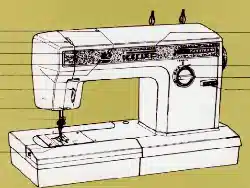
THIS MODEL IS A CENTER NEEDLE, LOW BAR SEWING MACHINE,
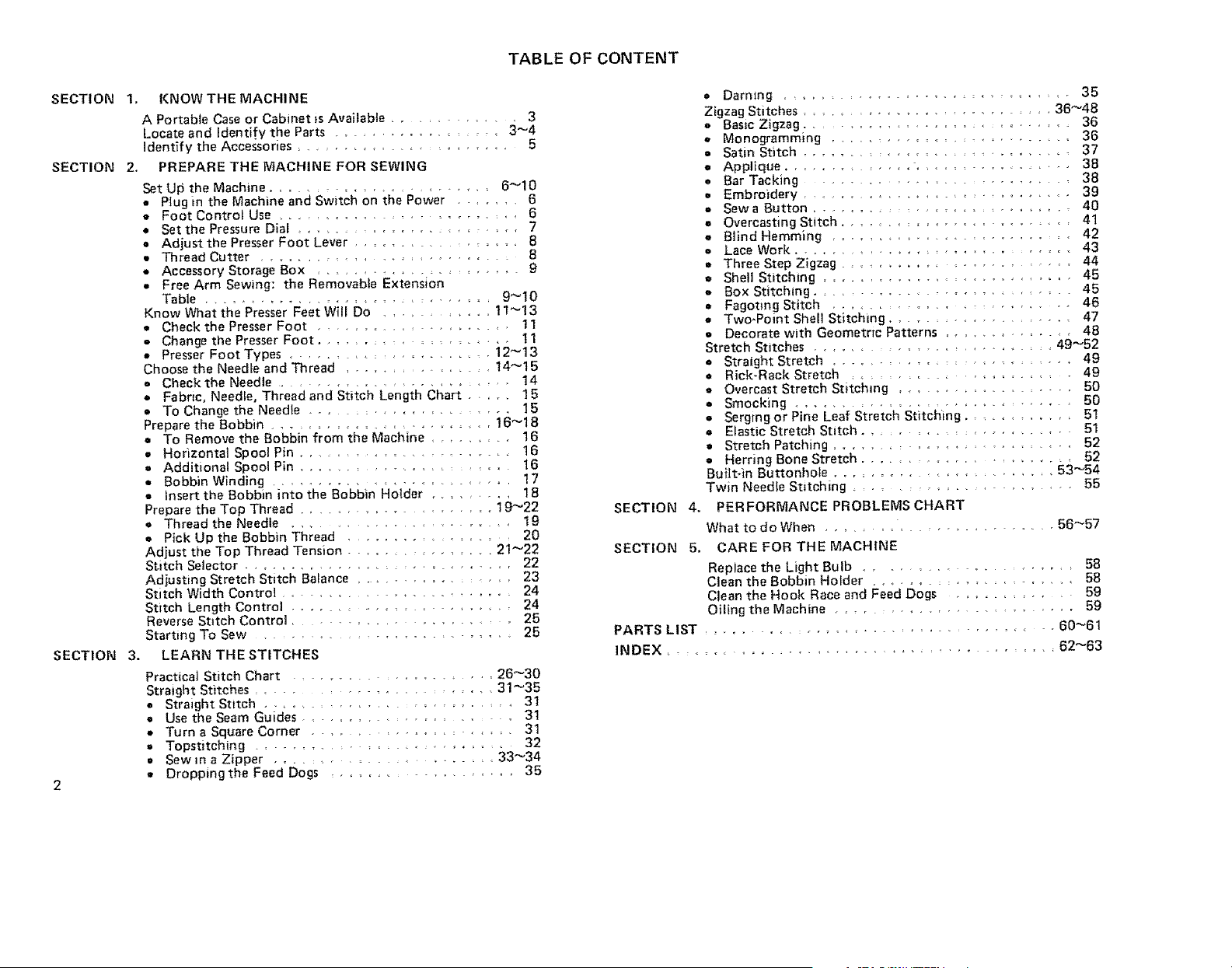
TABLE OFCONTENT
SECTION
SECTION
SECTION 3.
1. KNOW THE MACHINE
A Portable Case or Cabinet is Available ......... 3
Locate and Identify the Parts ............... 3_4
Identify the Accessories ...................... 5
2. PREPARE THE MACHINE FOR SEWING
Set UI5 the Machine ............. - ........ 6_10
• Plug in the Machine and Switch on the Power ....... 6
• Foot Control Use ........................ 6
• Setthe Pressure Dial ....................... 7
• Adjust the Presser Foot Lever ............... 8
• Thread Cutter ....................... 8
• Accessory Storage Box ..................... 9
• Free Arm Sewing: the Removable Extension
Table ............................... 9 _10
Know What the Presser Feet Will Do ............ 11_13
= Check the Presser Foot ................... 11
. Change the Presser Foot .................. 11
• Presser FootTypes ................... 12_13
Choose the Needle and Thread ............... 14_15
o Checkthe Needle ........................ 14
• Fabric, Needle, Thread and Stitch Length Chart ..... 15
• To Change the Needle ................... 15
Prepare the Bobbin ....................... 16_18
• To Remove the Bobbin from the Machine ......... 16
• Horizontal Spool Pin ..................... 16
o Additional Spool Pin ....................... t6
• Bobbin Winding ...................... 17
• Insert the Bobbin into the Bobbin Holder ........ 18
Prepare the Top Thread .................. 19_22
• Thread the Needle ................... t9
• Pick Up the Bobbin Thread ............... , 20
Adjust the Top Thread Tension ............... 21_22
Stitch Selector ............................ 22
Adjusting Stretch Stitch Balance ............... 23
Stitch Width Control ..................... 24
Stitch Length Control ..................... 24
Reverse Stitch Control ................ 25
Starting To Sew ......................... 25
LEARN THE STITCHES
Practica] Stitch Chart ................... 26_30
Straight Stitches ................... 31_35
• Straight Stitch ......................... 31
• Use the Seam Guides .................. 3t
• Turn a Square Corner ................... 31
o Topstitching ........................ 32
• Sewln a Zipper ................... 33_34
• Dropping the Feed Dogs .................. 35
• Darmng ........................... 35
Zigzag Stitches ....................... 36_48
o Basic Zigzag .............. 36
• Monogramming ....................... 36
= Satin Stitch .......................... 37
• Applique ......................... 38
• Bar Tacking ...................... 38
= Embroidery ......................... 39
,, Sew a Button ......................... 40
• Overcasting Stitch ...................... 41
• Blind Hemming ......................... 42
,, Lace Work ............................ 43
m Three Step Zigzag ....................... 44
= Shell Stitching ......................... 45
e Box Stitching ......................... 45
• Fagoting Stitch ...................... 46
• Two-PointShell Stitching ................... 47
• Decorate with Geometric Patterns ............. 48
Stretch Stitches .......................... 49_52
= Straight Stretch .......................... 49
• Rick-Rack Stretch ..................... 49
• Overcast Stretch Stitching ................. 50
• Smocking ............................ 50
• Sergfng or Pine Leaf Stretch Stitching ............ 51
• Elastic Stretch Stitch .................... 51
• Stretch Patching ...................... 52
• Herring Bone Stretch ...................... 52
Built-in Buttonhole ...................... 53_54
Twin Needle Stitching .................... 55
SECTION 4. PERFORMANCE PROBLEMS CHART
What to do When .................. 56_57
SECTION 5. CARE FOR THE MACHINE
Replace the Light Bulb ................... 58
Clean the Bobbin Holder ...................... 58
Clean the Hook Race and Feed Dogs ......... 59
Oiling the Machine ...................... 59
PARTS LIST .................................. 60_61
INDEX .................................... 62_63
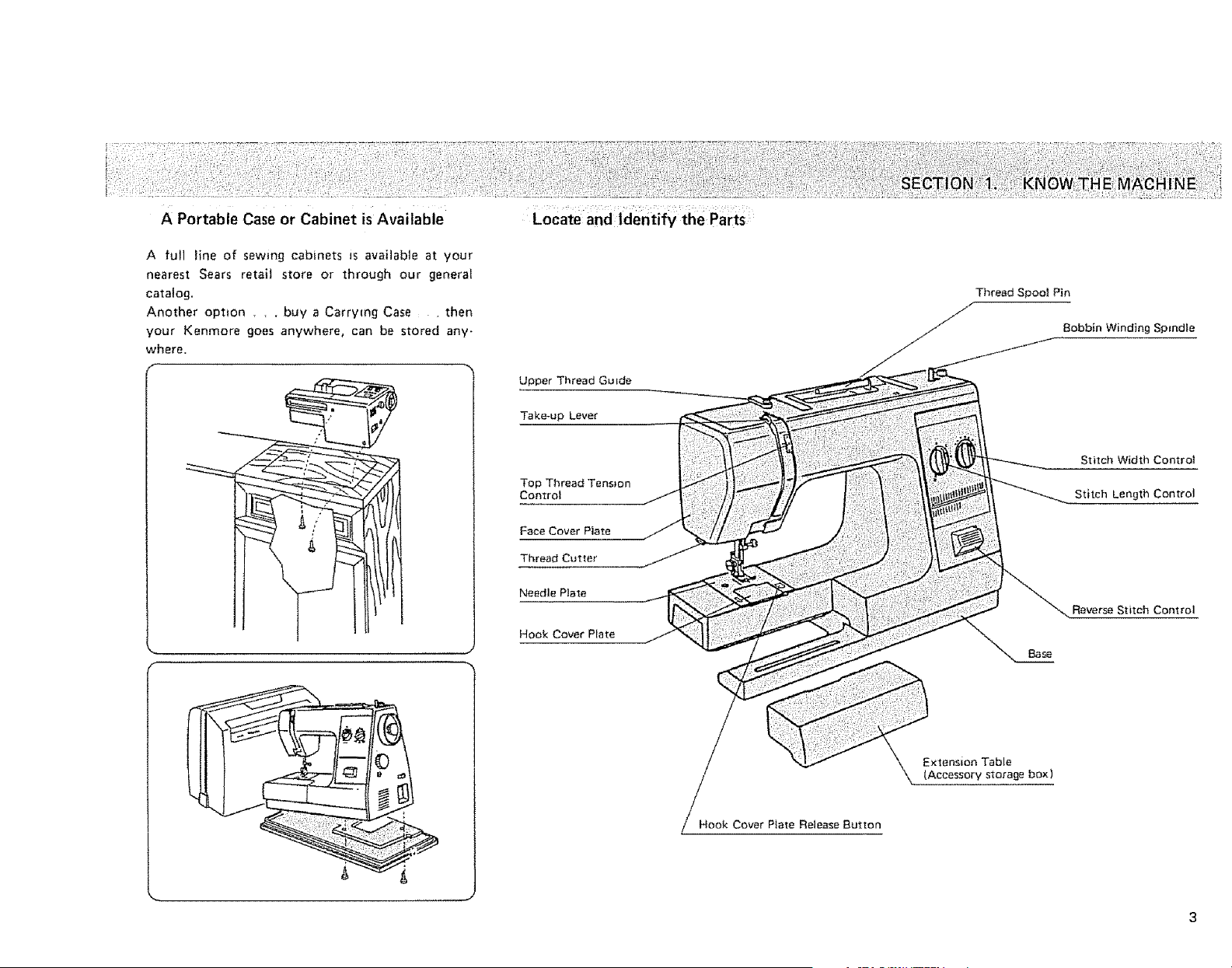
A Portable Case or Cabinet is Available
A full line of sewing cabinets Js available at your
nearest Sears retail store or through our general
catalog.
Another option _ ; , buy a Carrying Case . then
your Kenmore goes anywhere, can be stored any-
where.
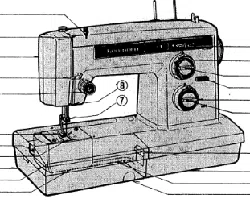
Locate
Upper Thread Guide
Take-up Lever
Top Thread Tension
Face Cover Ptate
Thread Cutter
Needle Plate
Hook Plate
Thread Spoo_ Pin
Bobbin Winding Spindle
Stitch Width Contro_
Stitch Length Control
Reverse _<
Hook Cover Plate Release Button
Extension Table
(Accessory storage box)
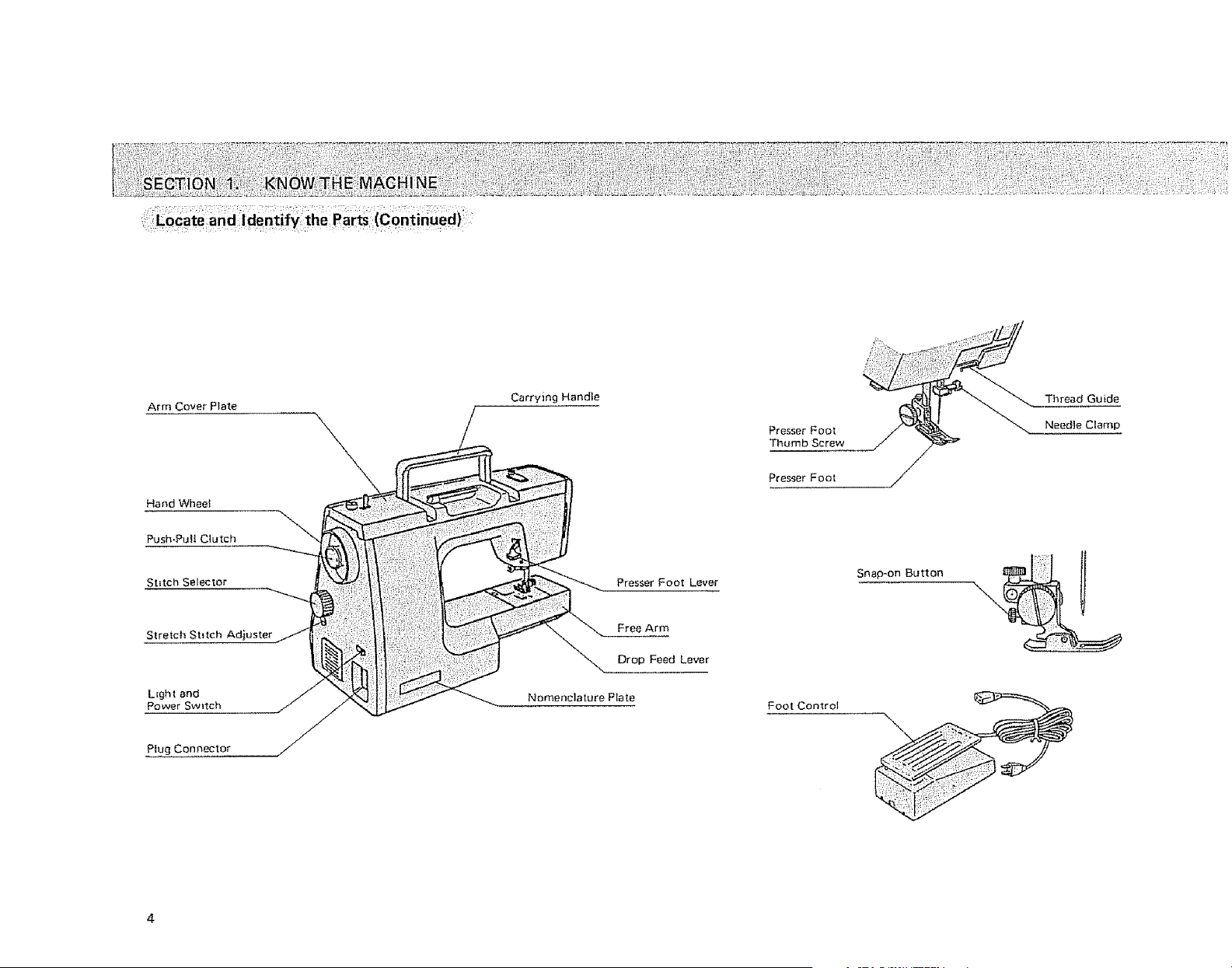
Arm Cover Plate
Hand Whee_
\
Push-Putt Ctutch
Stitch Selector
---_.4
Stretch Stitch Adjuster J
L_ght and
Power Switch
,plug Connector
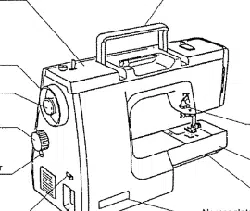
Carrying Handle
Presser Foot
Free Arm
Drop Feed Lever
Nomenclature Plate
Foot
Thumb Screw
Presser Foot
Snap-on Button
Foot Control
\
Thread Guide
Needle Clamp
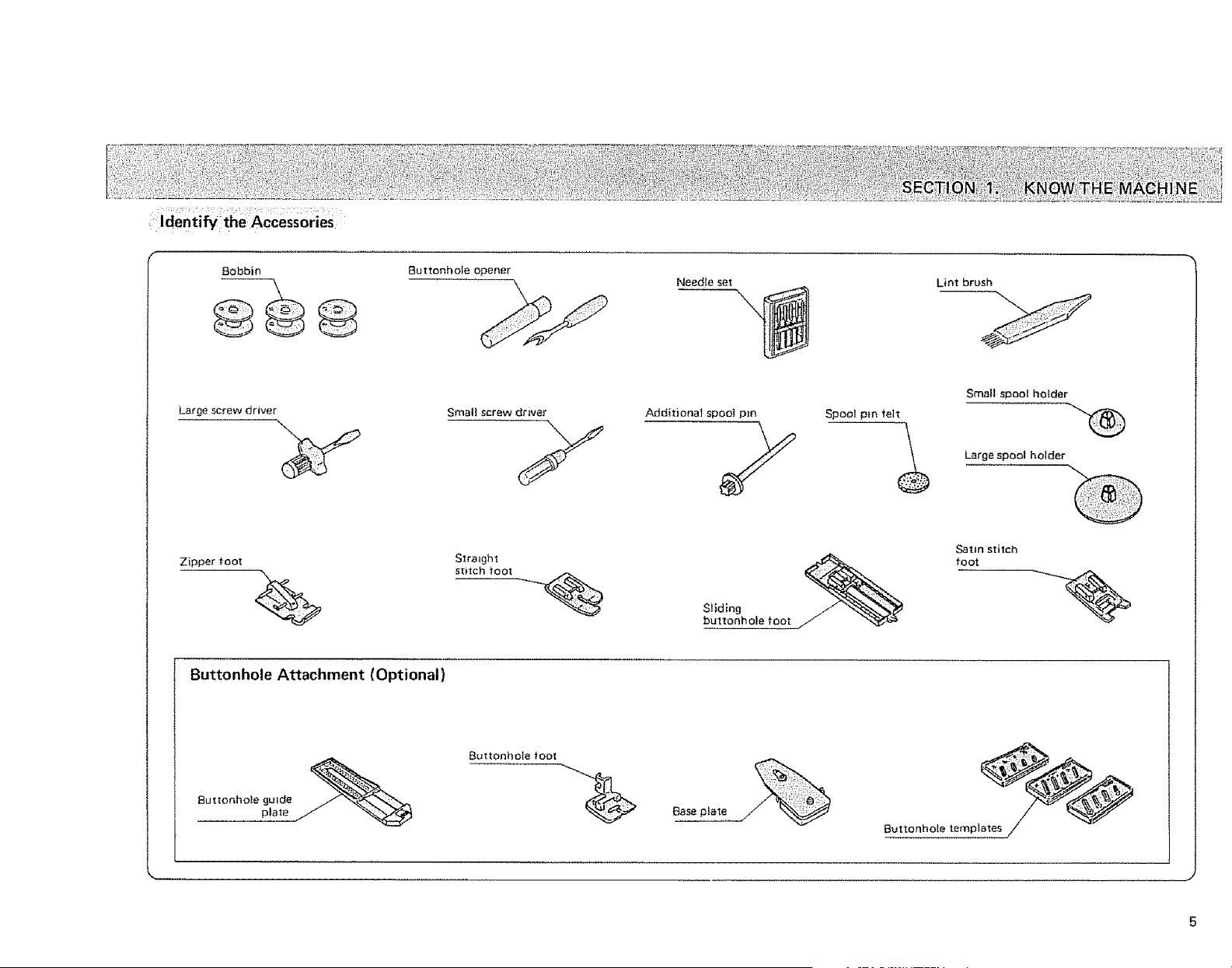
Bobbin
Buttonholeopener
Needleset
Largescrewdriver Smallscrewdriver
Additionalspoolpin
Spoolpinfelt
Smallspoolholder
Largespoolholder
Zipperfoot
Straight
stitch toot
Sliding
buttonhole foot
Satin stitch
toot
Buttonhole Attachment (Optional)
Buttonhole plategUlde
Buttonhole _ool
Buttonhole templates
J
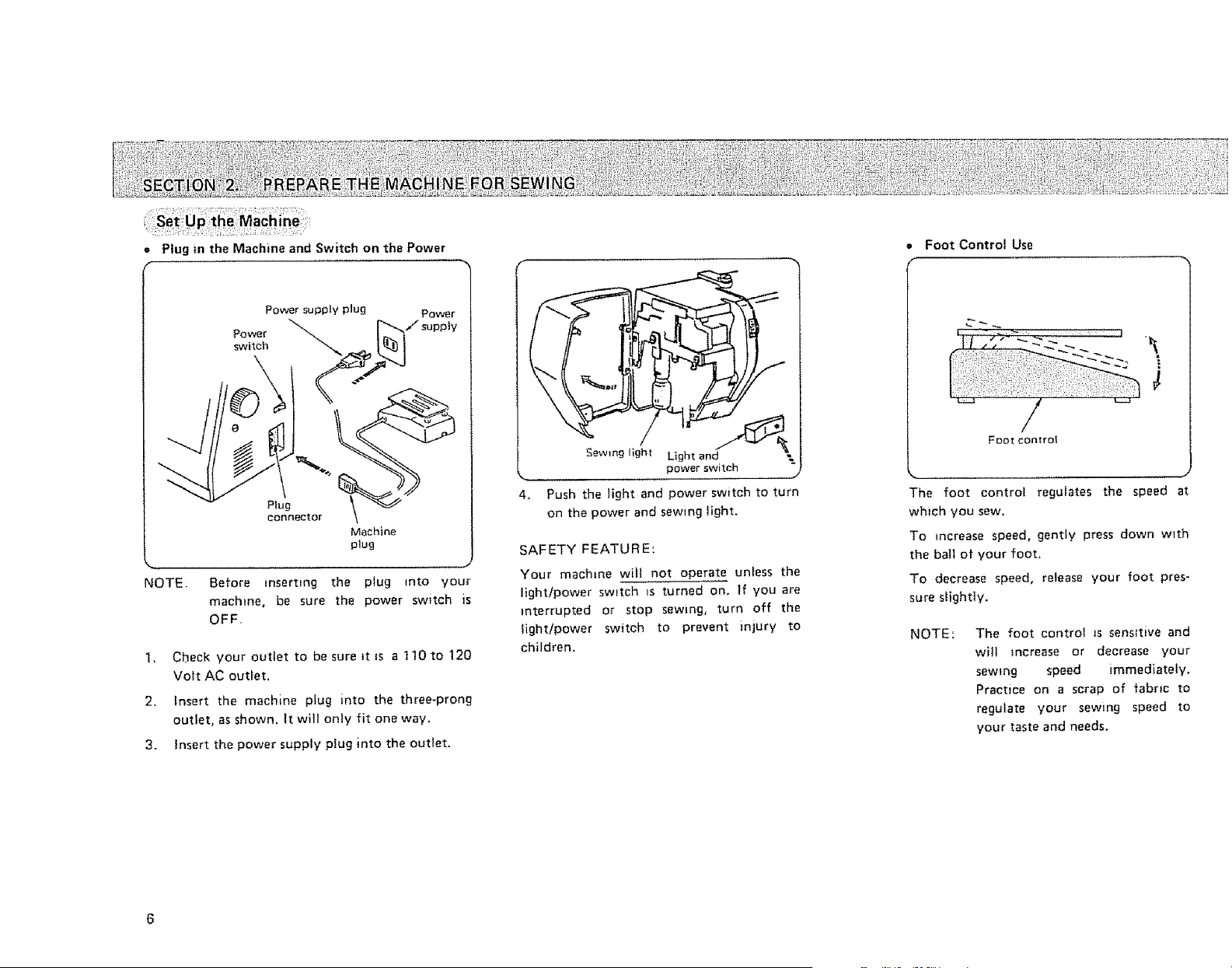
Plug in the Machine and Switch on the Power
F
NOTE :
Power supply plug
Power _
switch
Power
_" SUpply
Plug
connector
Machine
plug
Before inserting the plug into your
machine, be sure the power switch _s
OFF.
1. Check your outlet to be sure _t 3s a 110 to 120
Volt AC outlet.
2, Insert the machine plug into the three-prong
outlet, as shown. It wi]l only fit one way.
3. insert the power supply plug into the outlet.
Sewing light Light and
power switch
J
4. Push the light and power switch to turn
on the power and sewing light.
SAFETY FEATURE:
Your machine will not operate unless the
tight/power switch is turned on, tf you are
interrupted or stop sewing, turn off the
light/power switch to prevent injury to
children,
= Foot Control Use
The foot controf regulates the speed at
which you sew,
To increase speed, gently press down with
the bah of your foot.
To decrease speed, release your foot pres-
sure slight}y.
NOTE:
The foot control _s sensitive and
will increase or decrease your
sewing speed immediately.
Practice on a scrap of fabric to
regulate your sewing speed to
your taste and needs,
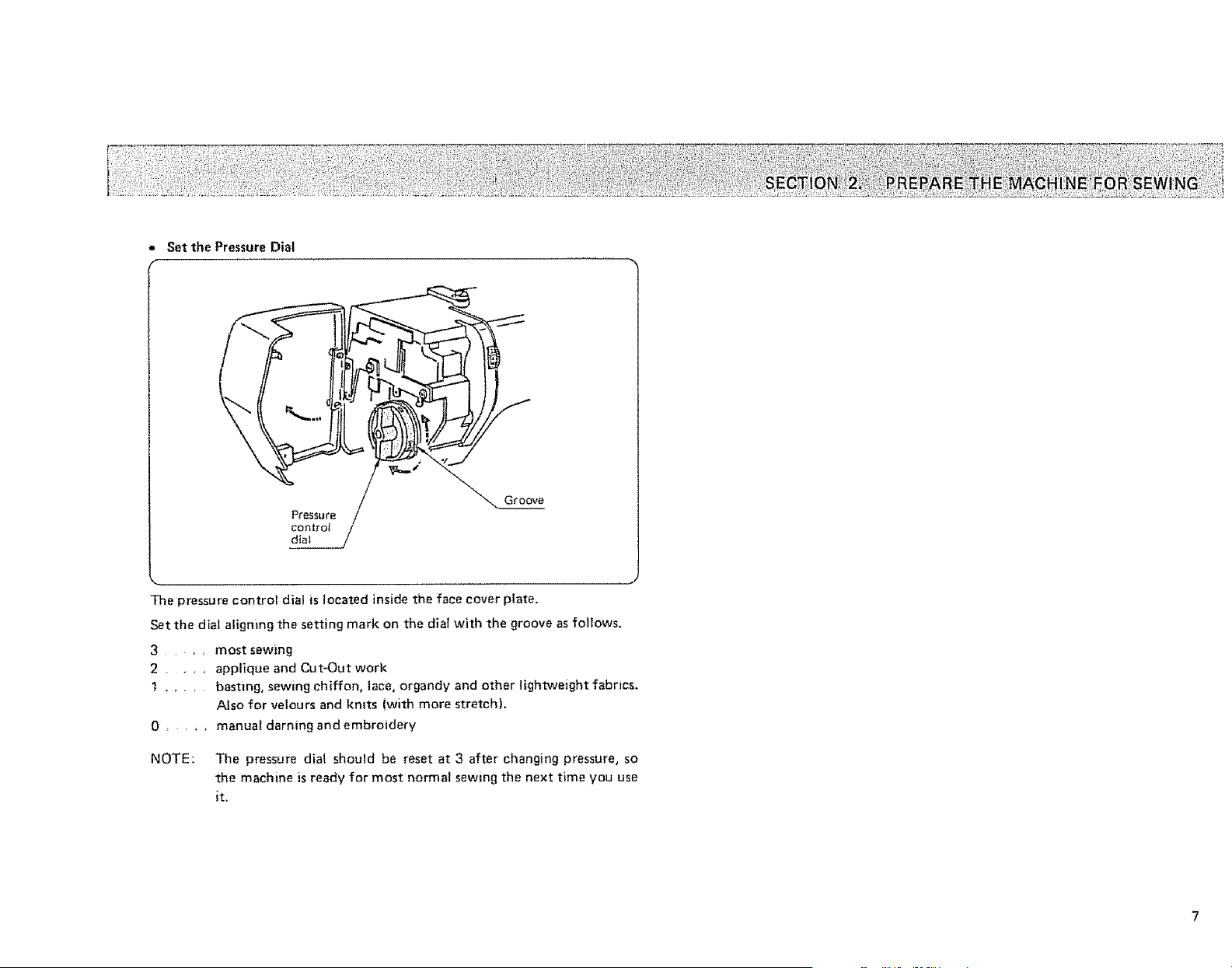
• Set the PressureDial
The pressure control dial is located inside the face cover plate.
Set the dial aligning the setting mark on the dial with the groove as follows,
3 .... most sewing
2 .... applique and Cut-Out work
1 ..... basting, sewing chiffon, lace, organdy and other lightweight fabrics.
Also for velours and knits {with more stretch).
0 ..... manual darning and embroidery
NOTE: The pressure dial should be reset at 3 after changing pressure, so
the machine is ready for most normal sewing the next time you use
it.
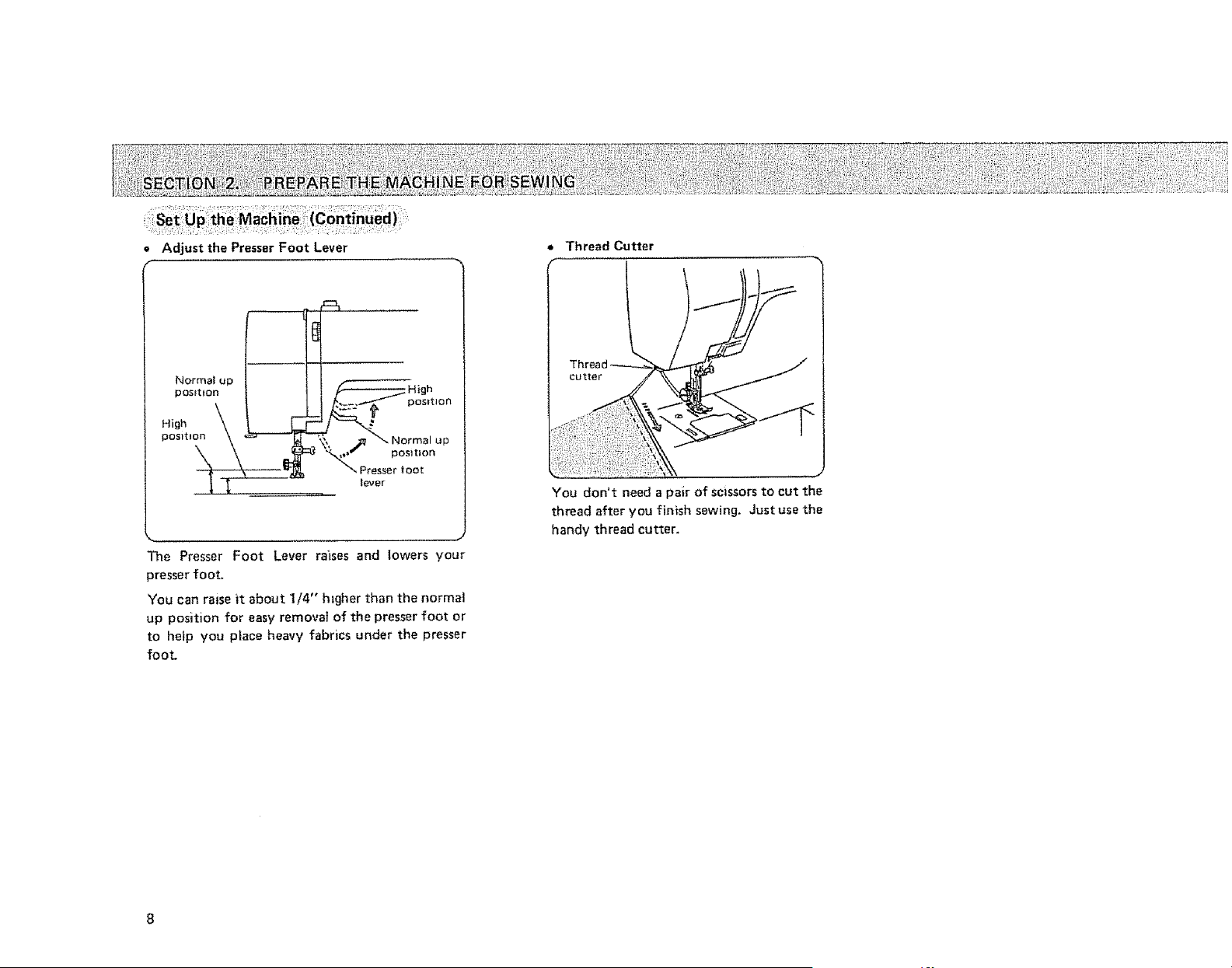
• Adjust the Presser Foot Lever
F
Normal up
pos_tlOn
position
P
positlon
lever
%..
The Presser Foot Lever rinses and lowers your
presser foot.
You can raise it about 1/4" hagher than the normal
up position for easy removal of the presser foot or
to heip you place heavy fabrics under the presser
foot.
• Thread Cutter
You don't need a pair of scissors to cut the
thread after you finish sewing. Just use the
handy thread cutter.
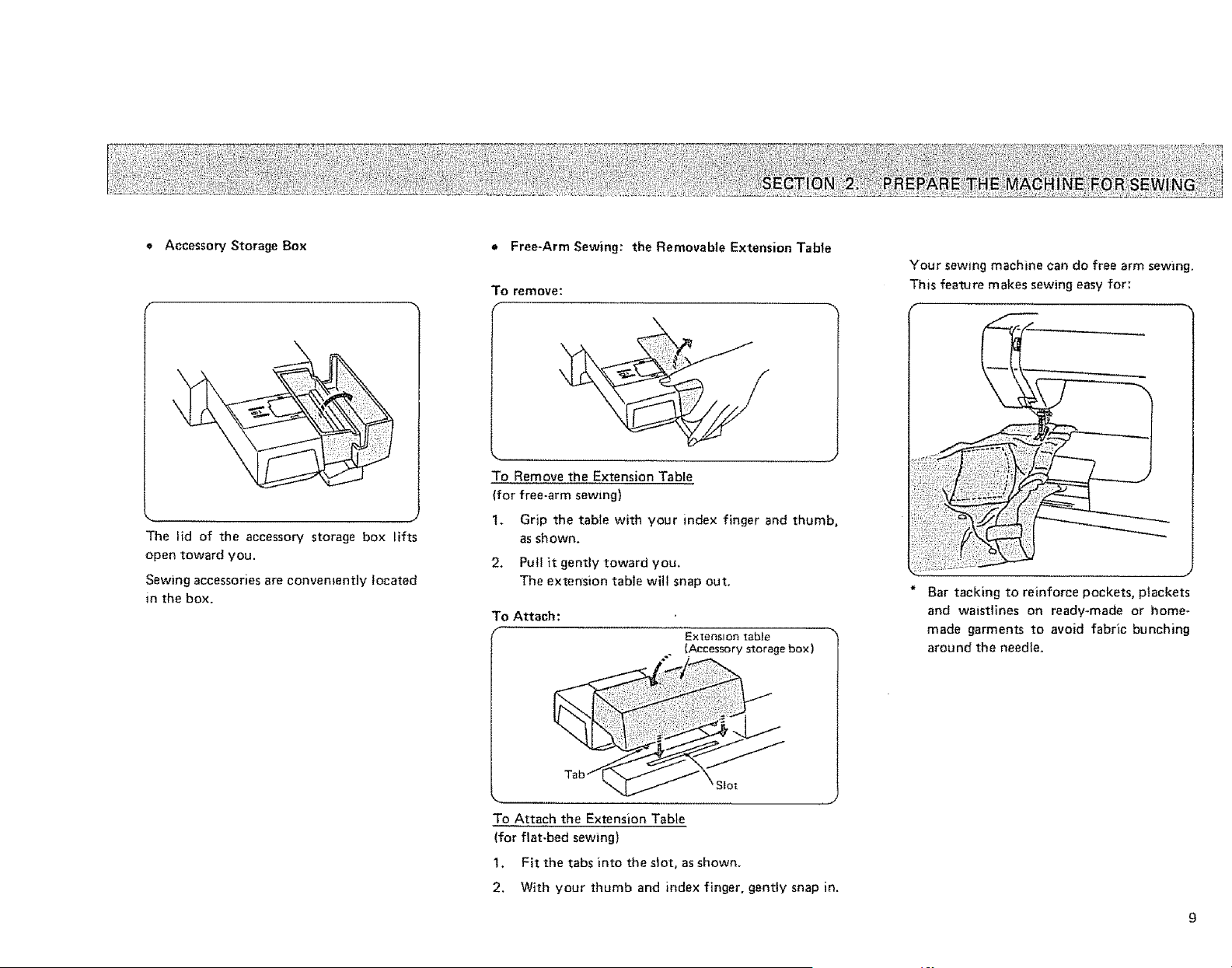
= Accessory Storage Box
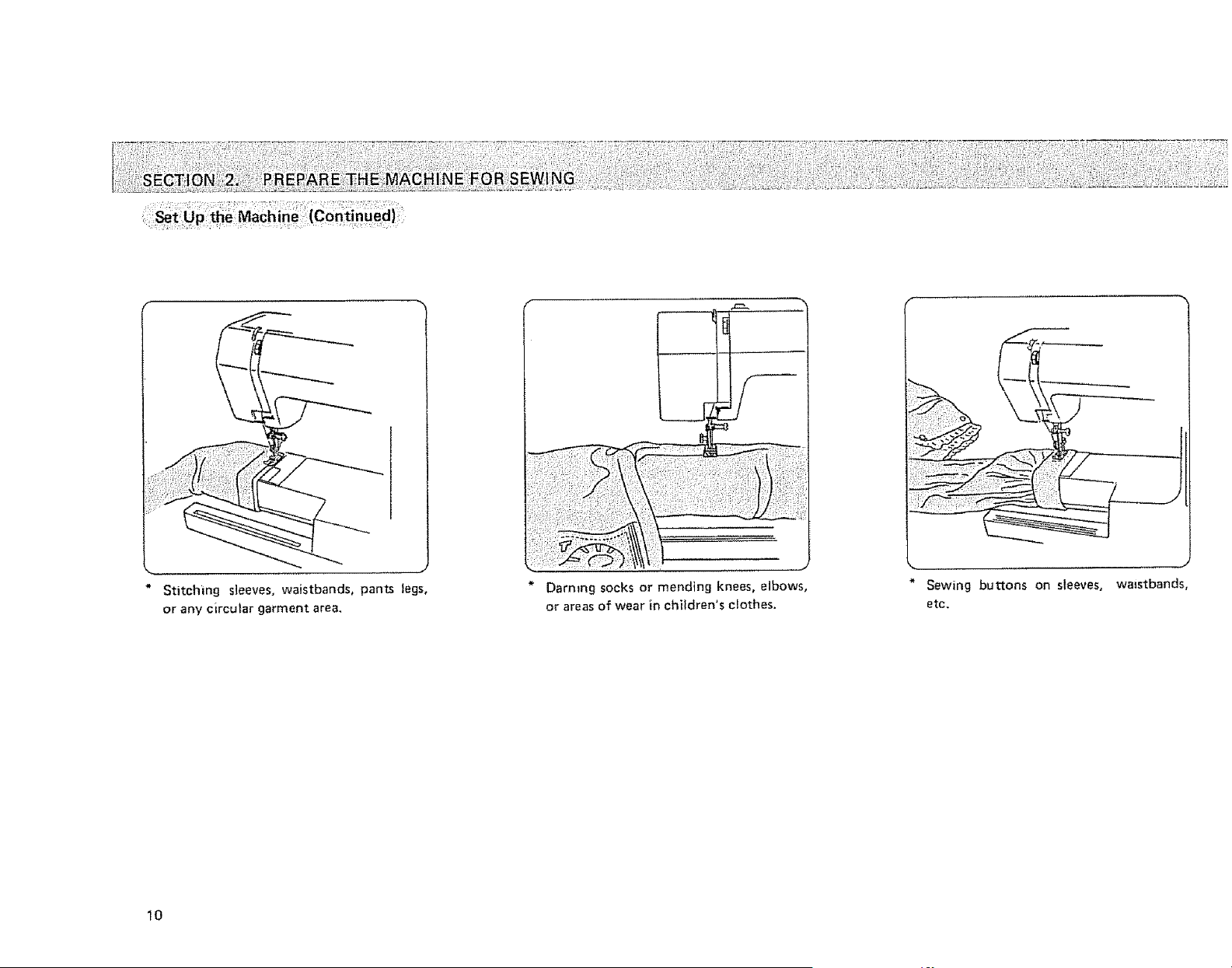
Free-Arm Sewing: the Removable Extension Table
To remove:
Your sewing machine can do free arm sewing.
This feature makes sewing easy for:
The lid of the accessory storage box lifts
open toward you.
Sewing accessories are conveniently located
in the box.
\
\
/
To Remove the Extension Table
(for free-arm sewing)
t. Grip the table with your index finger and thumb,
as shown.
2. Pull it gently toward you.
The extension table will snap out.
To Attach:
ExtenslOR table
{Accessory stor age box)
Bar tacking to reinforce pockets, plackets
and waistlines on ready-made or home-
made garments to avoid fabric bunching
around the needle.
To Attach the Extension Table
(for flat-bed sewing)
1. Fit the tabs into the slot, as shown.
2. With your thumb and index finger, gently snap in.
i
* Stitching sleeves, waistbands, pants legs,
or any circular garment area.
Darning socks or mending knees, elbows,
or areas of wear in children's clothes,
* Sewing buttons on sleeves,
etc.
waistbands,
10
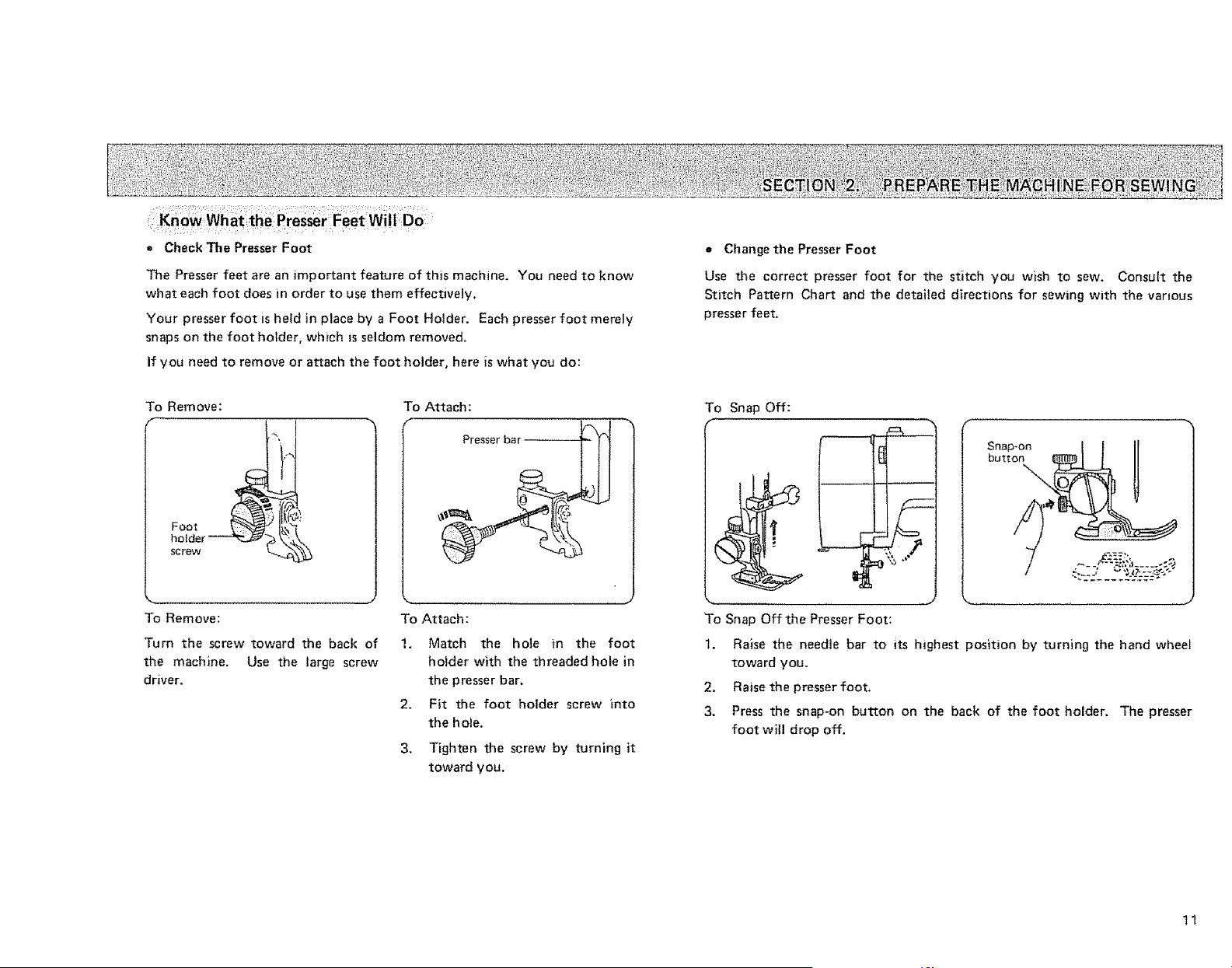
= Check The Presser Foot
The Presser feet are an important feature of this machine. You need to know
what each foot does in order to use them effectively.
Your presser foot is held in place by a Foot Holder. Each presser foot merely
snaps on the foot holder, which is seldom removed.
If you need to remove or attach the foot holder, here is what you do:
Change the Presser Foot
Use the correct presser foot for the stitch you wish to sew. Consult the
Stitch Pattern Chart and the detailed directions for sewing with the various
presser feet,
To Remove: To Attach:
Presser ba_
To Remove: To Attach:
Turn the screw toward the back of 1. Match
the machine. Use the large screw
driver.
2_
3,
the hole in the foot
holder with the threaded hole in
the presser bar.
Fit the foot holder screw into
the hole.
Tighten the screw by turning it
toward you,
To Snap Off:
=o '
To Snap Off the Presser Foot:
1.
2,
3.
Snap-on 1
button
Raise the needle bar to its highest position by turning the hand wheel
toward you.
Raise the presser foot.
Press the snap-on button on the back of the foot holder. The presser
foot will drop off.
11
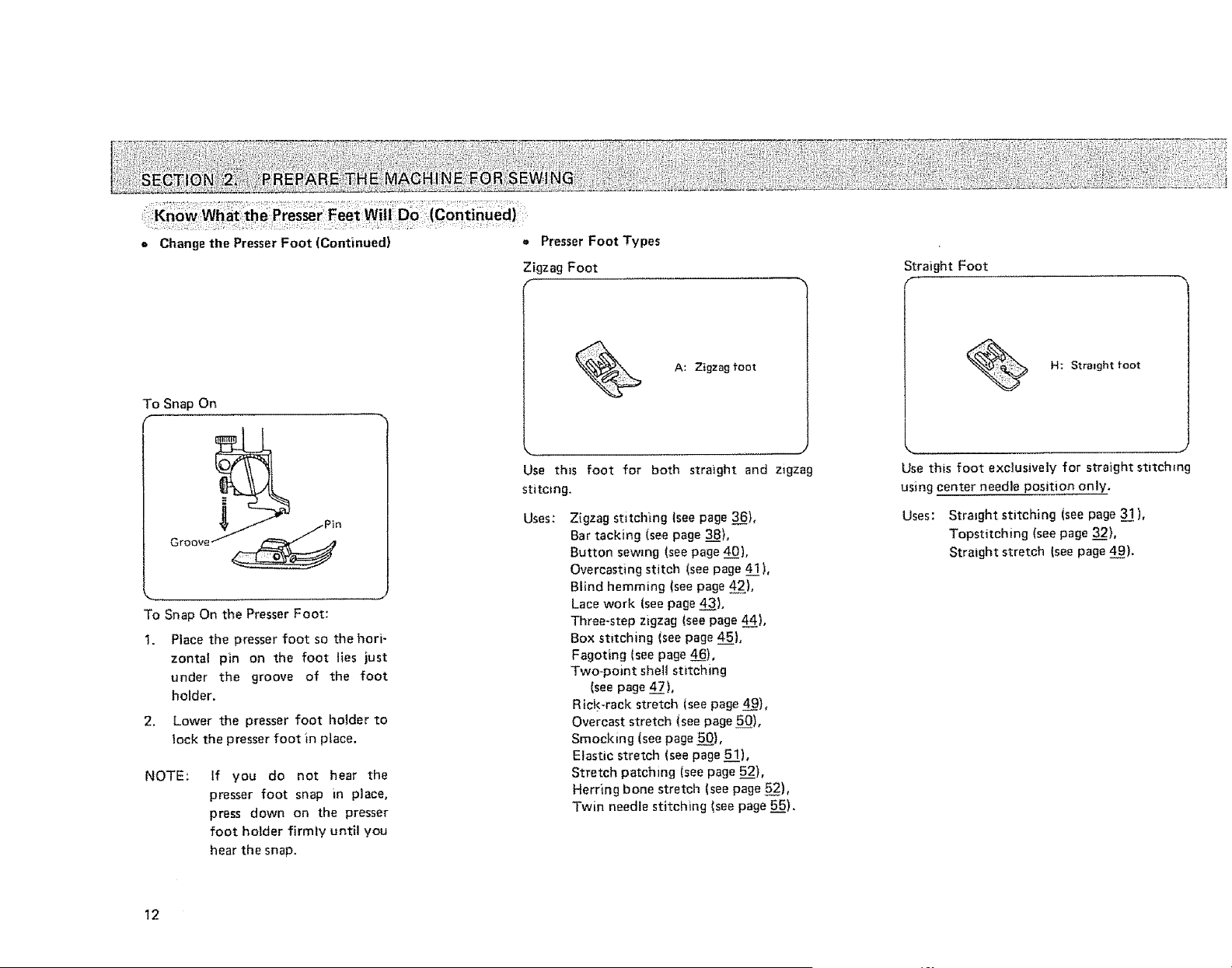
= Change the PresserFoot (Continued)
To Snap On
f
Groove _ Pi_n
To Snap On the Presser Foot:
1. Place the presser foot so the hori-
zontal pin on the foot lies just
under the groove of the foot
holder.
2. Lower the presser foot holder to
lock the presser foot in place.
NOTE:
If you do not hear the
presser foot snap in place,
press down on the presser
foot holder firmly until you
hear the snap.
Presser Foot Types
Zigzag Foot
A: Zigzag foot
Use this foot for both straight and z_gzag
stitcing.
Uses:
Zigzag stitchrag tsee page 36),
Bar tacking (see page 38),
Button sewing (see page 40),
Overcasting stitch (see page 41),
Blind hemming (see page 42),
Lace work (see page 43),
Three-step zigzag (see page 44),
Box stitching (see page 45),
Fagoting (see page 46),
Two-point shetl stitching
(see page 47),
Rick-rack stretch (see page 49),
Overcast stretch (see page 50),
Smocking (see page 50),
Elastic stretch (see page 51),
Stretch patching (see page 52),
Herring bone stretch (see page 52),
Twin needle stitching {see page 55).
Straight Foot
H: Straight foot
Use this foot exclusively for straight stitching
using center needle position oniyo
Uses: Strmght stitching (see page 31),
Topstitching (see page 32),
Straight stretch (see page 49).
t2
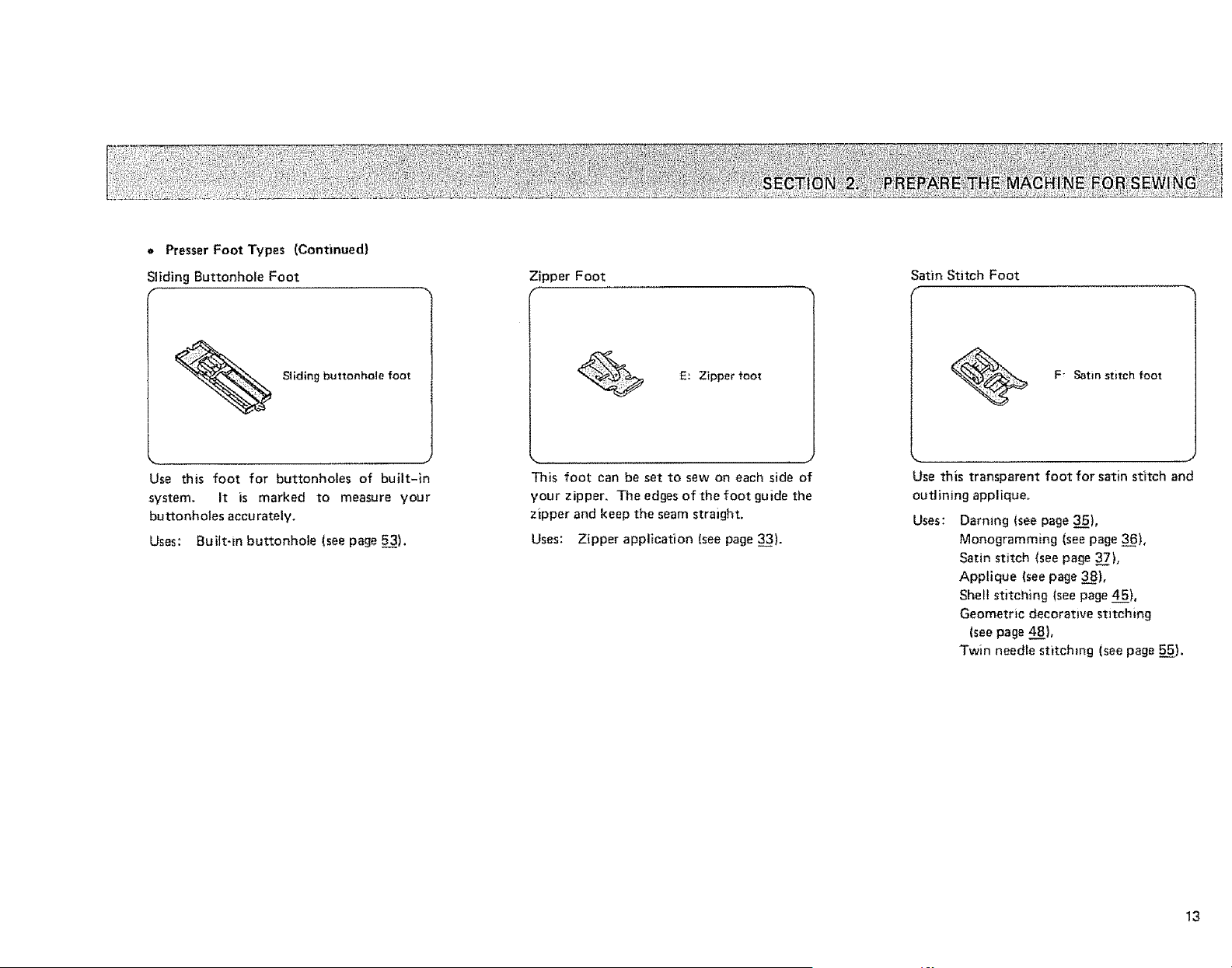
• Presser Foot Types (Continued)
Sliding Buttonhole Foot Zipper Foot
Satin Stitch Foot
Sliding buttonhole foot E: Zipper foot
F_ Satin stitch foot
Use this foot for buttonholes of built-in
system. It is marked to measure your
buttonholes accurately.
Uses: Bui]t*in buttonhole (see page 53).
This foot can be set to sew on each side of
your zipper. The edges of the foot guide the
zipper and keep the seam straight.
Uses: Zipper application (see page 33).
Use this transparent foot for satin stitch and
outlining applique+
Uses: Darning (see page 35),
Monogramming (see page 36),
Satin stitch (see page 3_7),
Applique (see page 3_B),
Shell stitching (see page 45),
Geometric decorative st+tching
(see page 48),
Twin needle stitching (see page 55).
13
:::::ZL_
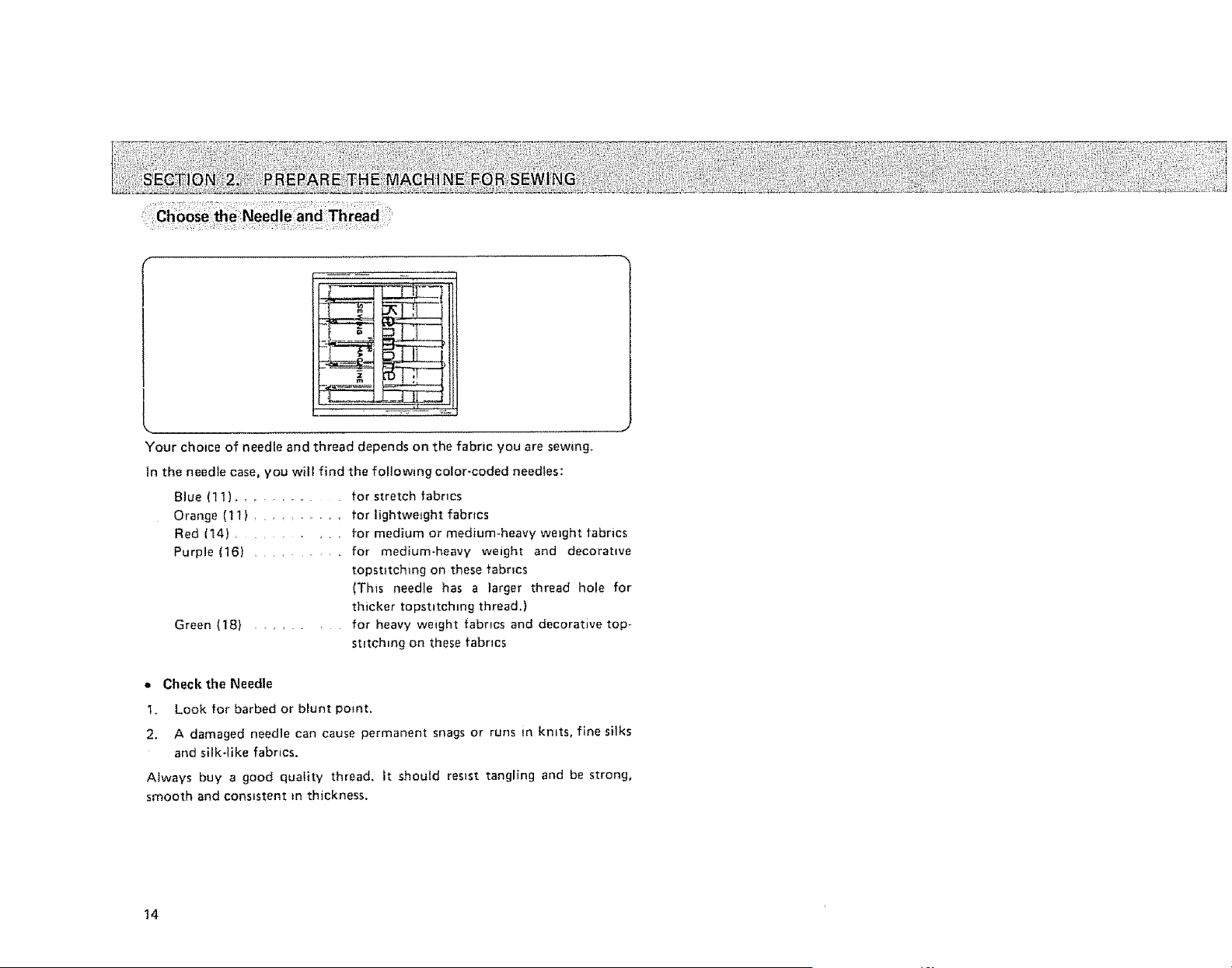
Your choice of needle and thread depends on the fabric you are sewing.
In the needle case, you will find the following color-coded needles:
Blue (11 ) ......... for stretch fabncs
Orange (11 ) ........ for lightweight fabrics
Red (14) ......... for medium or medium-heavy wmght fabrics
Purple (16) ........ for medium-heavy weight and decorative
topst_tching on these fabrics
(This needle has a larger thread hole for
thicker topstttchmg thread.)
Green (18} ..... for heavy weight fabrics and decorat}ve top-
stitching on these fabncs
• Check the Needle
_. Look for barbed or blunt point.
2. A damaged needle can cause permanent snags or runs in kmts, fine silks
and silk-like fabrics.
Always buy a good quality thread, tt should resist tangling and be strong,
smooth and consistent zn thickness.
14
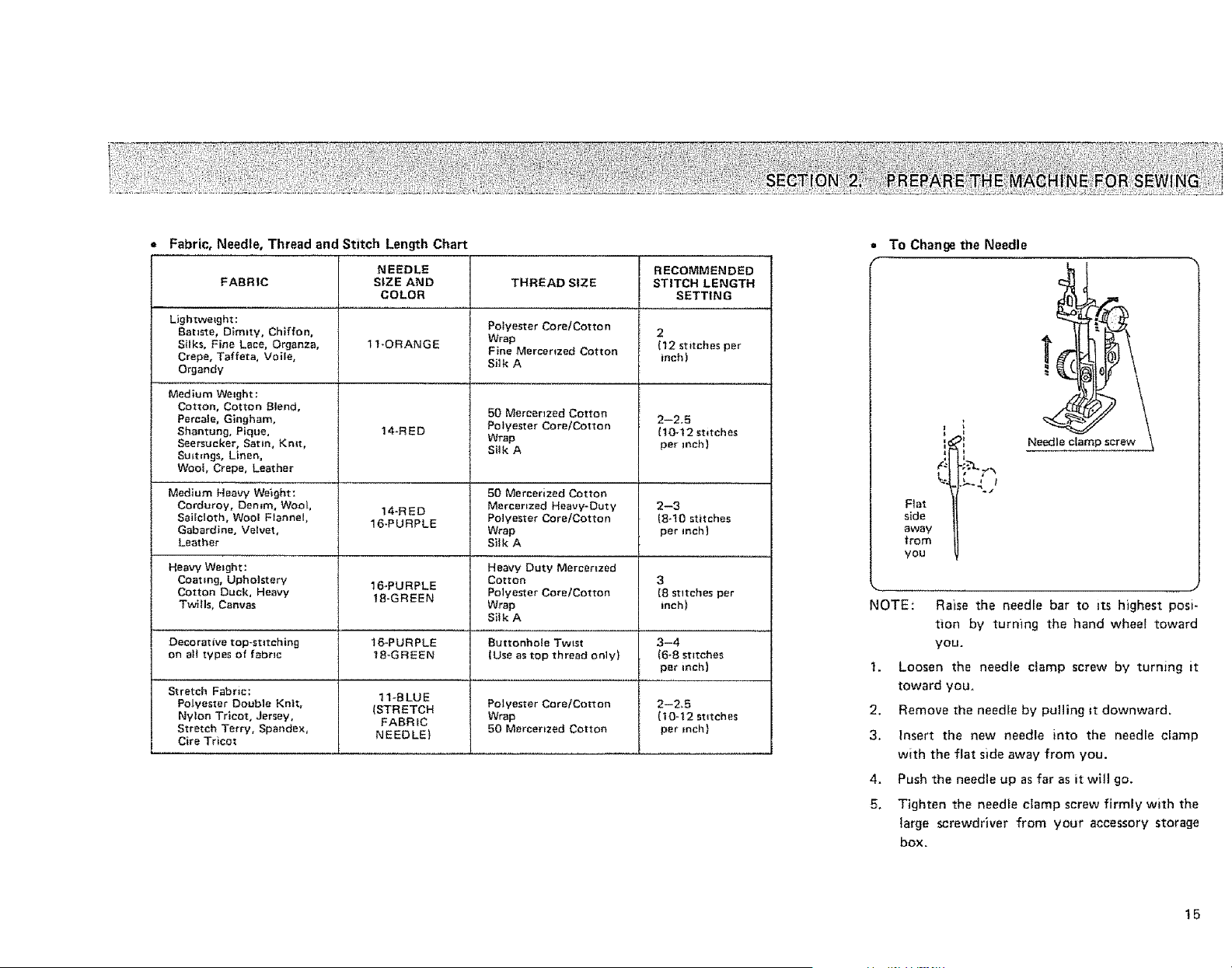
Fabric, Needle, Thread and Stitch Length Chart
N EED LE
FABRIC SIZE AND
COLOR
Lightweight:
Batiste, Dim=ty, Chiffon,
Silks, Fine Lace, Organza,
Crepe. Taffeta, Voi_e,
Organdy
Medium Weight :
Cotton, Cotton Blend,
Percale. Gingham.
Shantung. Pique,
Seersucker. Satin, Knit,
Su_tmgs. L'_nen,
Wool, Crepe, Leather
Medium Head/We'_ght:
Corduroy. Detain. Wool,
Sailcloth, Wool Flannel,
Gabardine. Velvet,
Leather
Heavy Weight:
Coat rag, Upholstery
Cotton Duck, Heavy
Tv_IIs, Canvas
Decorative top-stitching
on all types of fabrse
Stretch Fabric:
Potyester Double Knit,
Nylon Tricot. Jersey,
Stretch Terry, Spandex,
Cite Tricot
11-ORANGE
14-RED
14-RED
16-PURPLE
R ECOMMEN DED
THREAD SIZE STITCH LENGTH
SETTING
Polyester CoreiCotto n
Wrap
Fine Mercerized Cotton
Silk A
50 Mercerized Cotton
Polyester Core/Cotton
Wrap
Sitk A
50 Mercerized Cotton
Mercer=zed Heavy-Duty
Polyester Core/Cotton
Wrap
Silk A
2
(12 stitches per
inch)
2--2.5
(10-12 stitches
per inch)
2--3
{8-10 stitches
per mch)
Heavy Duty Mercerized
16-PURPLE Cotton 3
1B-GREEN Polyester Core/Cotton {8 stitches per
Wrap inch)
Sitk A
16-PURPLE Buttonhole Tw4st 3--4
18-GREEN (Use as top thread only) (6-8 stitches
per inch)
11-BLUE
(STRETCH Polyester Core/Cotton 2-2,5
FABRIC Wrap (1O- 12 stitches
NEEDLE) 50 Mercerized Cotton per inch)
To Change the Needle
!, 'i
i
4
>._, /
Ftat
side
away
from
you
NOTE:
Rinse the needle bar to 1IS highest posi-
tion by turning the hand wheel toward
you,
1. Loosen the needle clamp screw by turning it
toward you.
2. Remove the needle by pulling ;t downward,
3. Insert the new needle into the needle damp
with the flat side away from you.
4. Push the needle up as far as it will go.
5. Tighten the needle clamp screw firmly with the
large screwdriver from your accessory storage
box.
15
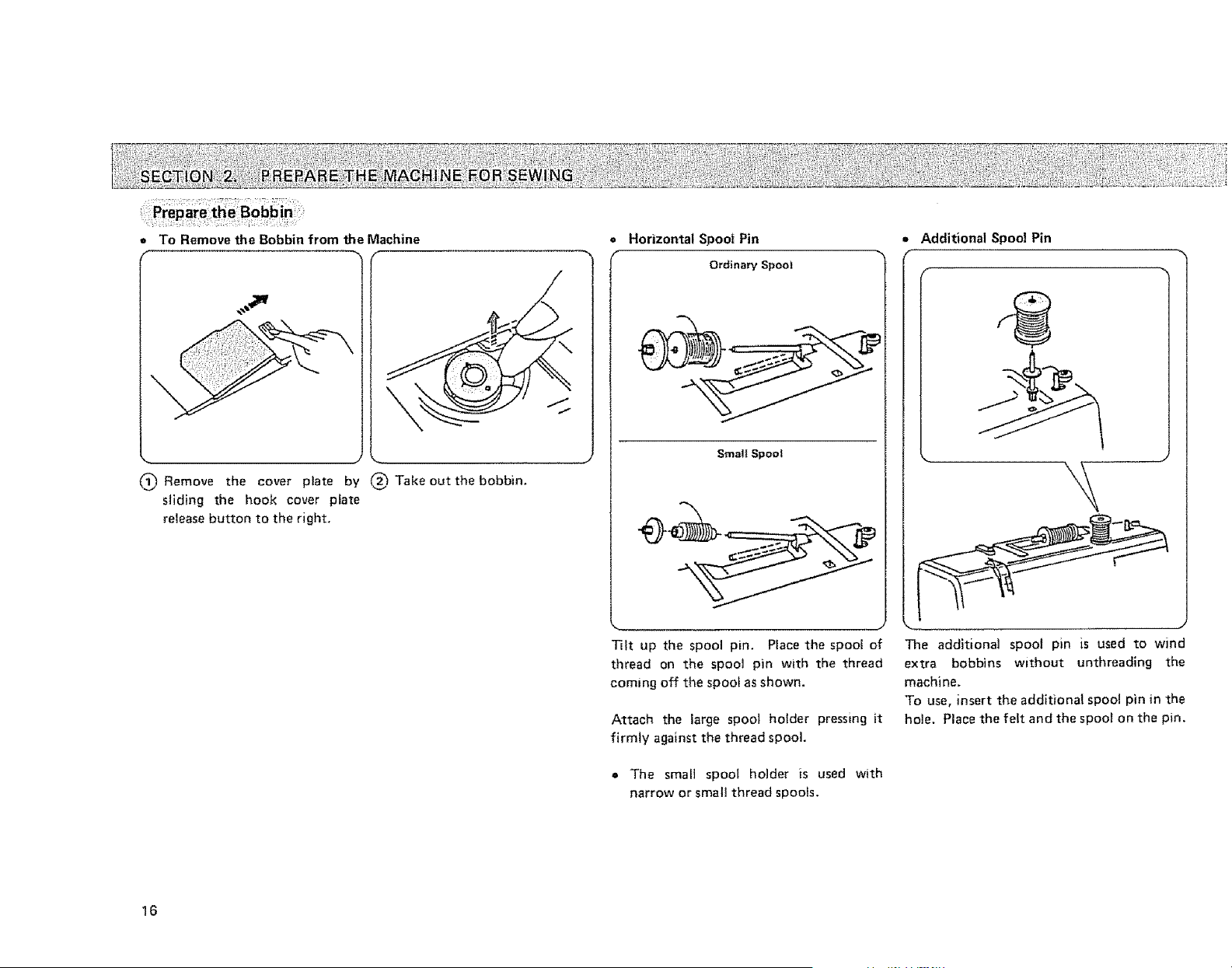
To Remove the Bobbin from the Machine
_} Remove the cover plate by _ Take out the bobbin.
sliding the hook cover plate
release button to the right.
Horizontal Spooi Pin
Ordinary Spool
Smalt Spool
Tilt up the spool pin. Place the spool of
thread on the spool pin with the thread
comMg off the spool as shown,
Attach the large spool holder pressing it
firmly against the thread spool.
o The small spool holder is used with
narrow or small thread spools.
• Additional Spool Pin
The additional spool pin is used to wind
extra bobbins without unthreading the
machine.
To use, insert the additional spool pin in the
hole. Place the felt and the spool on the pin.
16
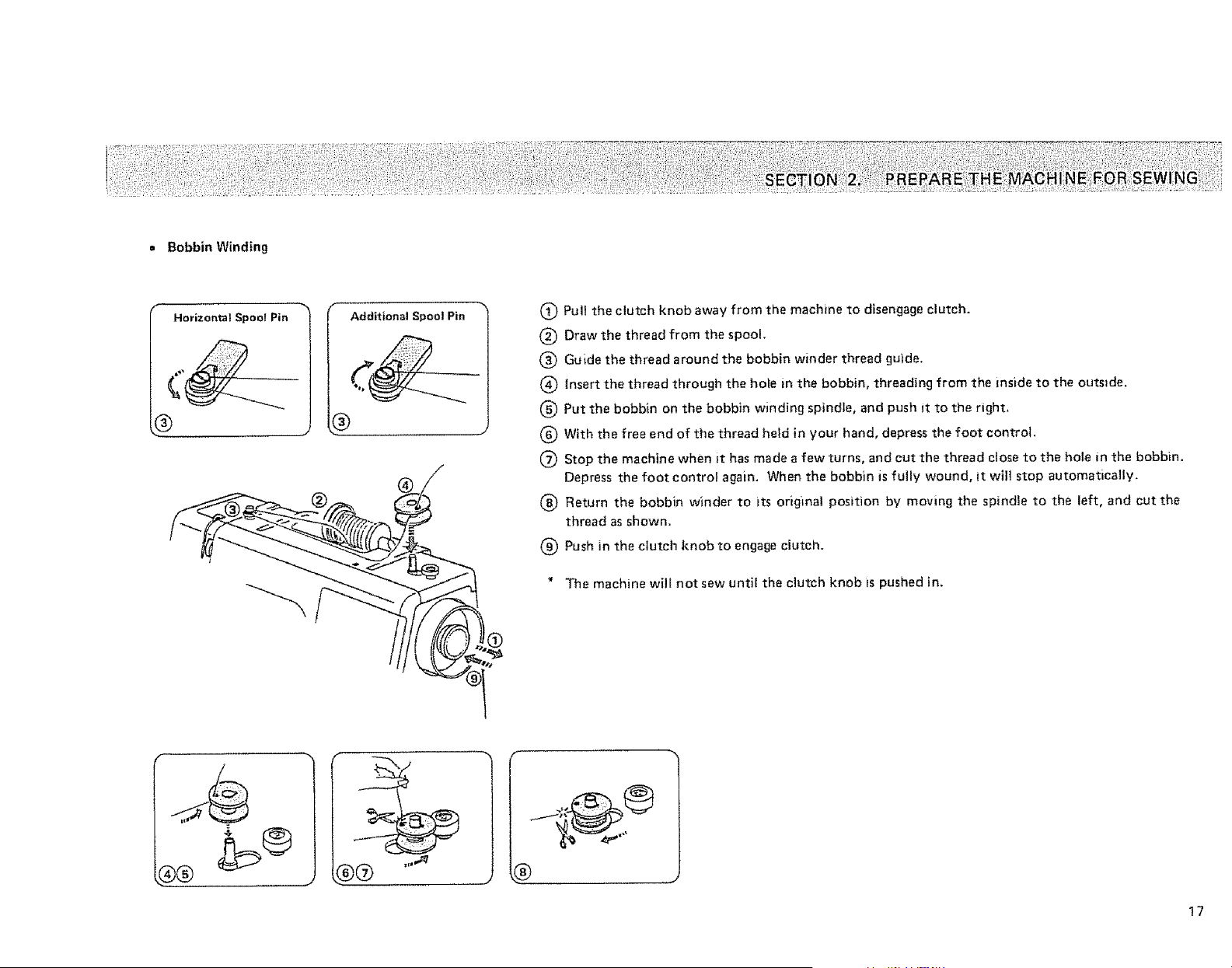
= Bobbin Winding
Horizontal Spool Pin
,J
Additional Spool Pin
_) Pull the clutch knob away from the machine to disengage clutch.
(_) Draw the thread from the spool,
(_) Guide the thread around the bobbin winder thread guide.
_) Insert the thread through the hole in the bobbin, threading from the inside to the outside.
(_ Put the bobbin on the bobbin winding spindle, and push it to the right,
(_) With the free end of the thread held Jn your hand, depress the foot control.
(_ Stop the machine when it has made a few turns, and cut the thread close to the hole in the bobbin.
Depress the foot control again. When the bobbin is fully wound, it will stop automatically.
(_) Return the bobbin winder to its original position by moving the spindle to the left, and cut the
thread as shown.
(_) Push in the clutch knob to engage clutch,
]'he machine wilf not sew until the clutch knob is pushed in.
17
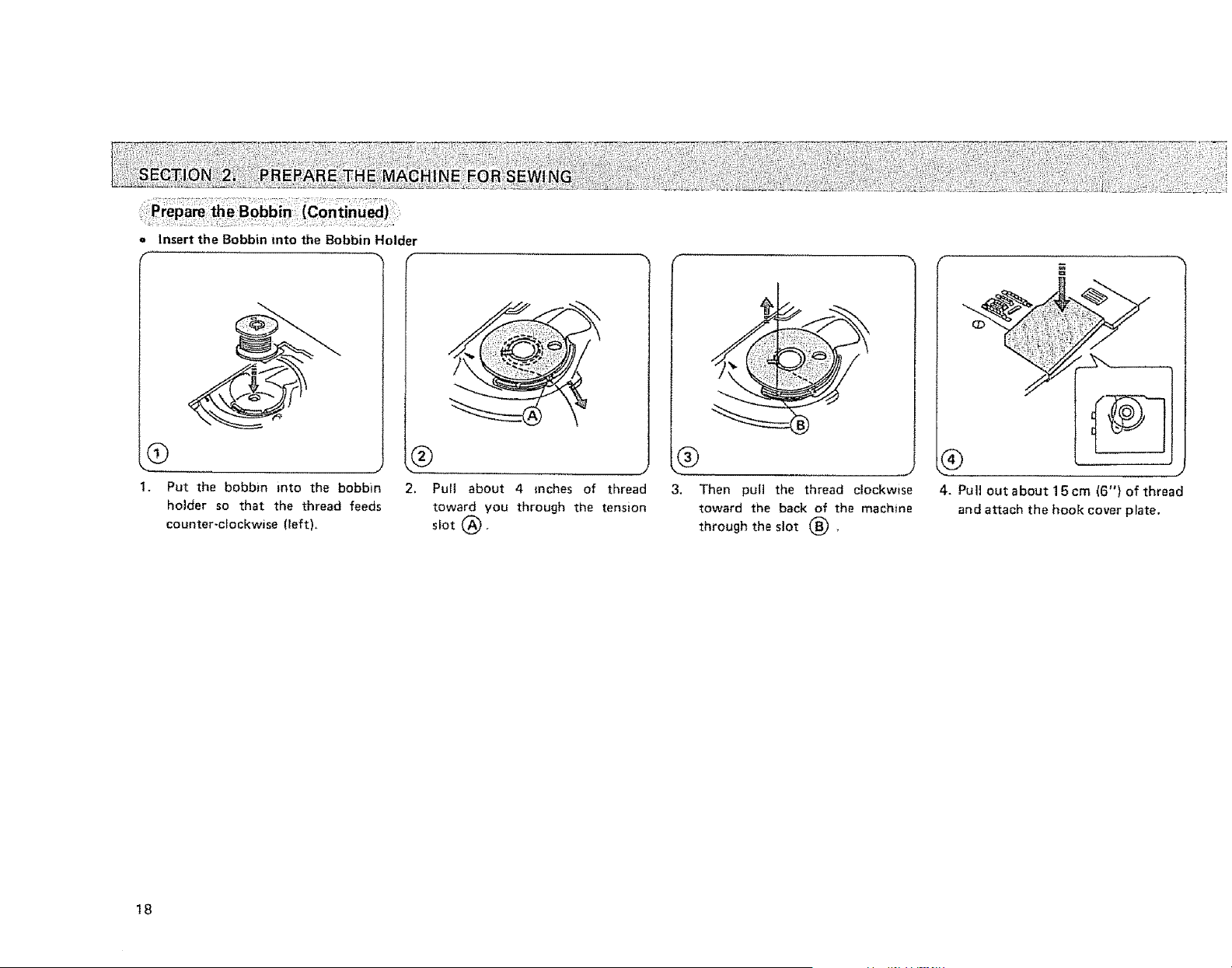
= Insert the Bobbin into the Bobbin Holder
®
1. Put the bobbin into the bobbin
holder so that the thread feeds
counter-clockwise (left)+
®
2, Pull about 4 inches of thread
toward you through the tension
slot _,
ff
3. Then puIl the thread clockwise
toward the back of the machine
through the slot (_
%.,, ,J
4, Pull out about 15 cm (6") of thread
and attach the hook cover plate.
18
Prep=' TOpThread
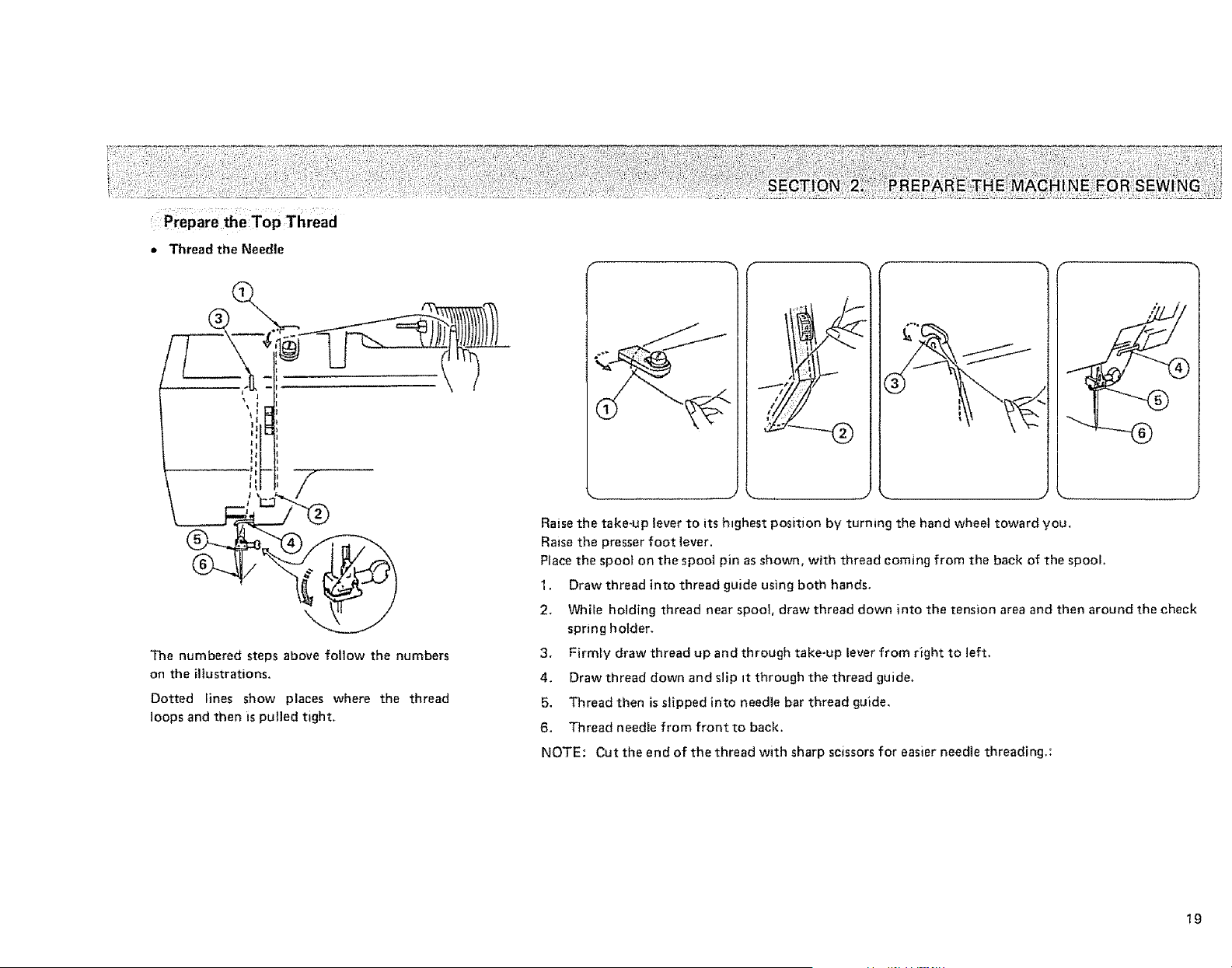
• Thread the Needle
®
The numbered steps above follow the numbers
on the illustrations.
Dotted lines show places where the thread
loops and then is pulled tight.
Raise the take*up lever to its h_ghest position by turning the hand wheel toward you.
Raise the presser foot lever.
Ptace the spook on the spool pin as shown, with thread coming from the back of the spool
1. Draw thread into thread guide using both hands.
2. While holding thread near spool, draw thread down into the tension area and then around the check
sprin g h older.
3. Firmfy draw thread up and through take-up lever from r_ght to left.
4. Draw thread down and slip it through the thread guide_
5. Thread then is slipped into needle bar thread gu'ide,
6. Thread needle from front to back.
NOTE: Cut the end of the thread with sharp scissors for easier needle threading.:
19
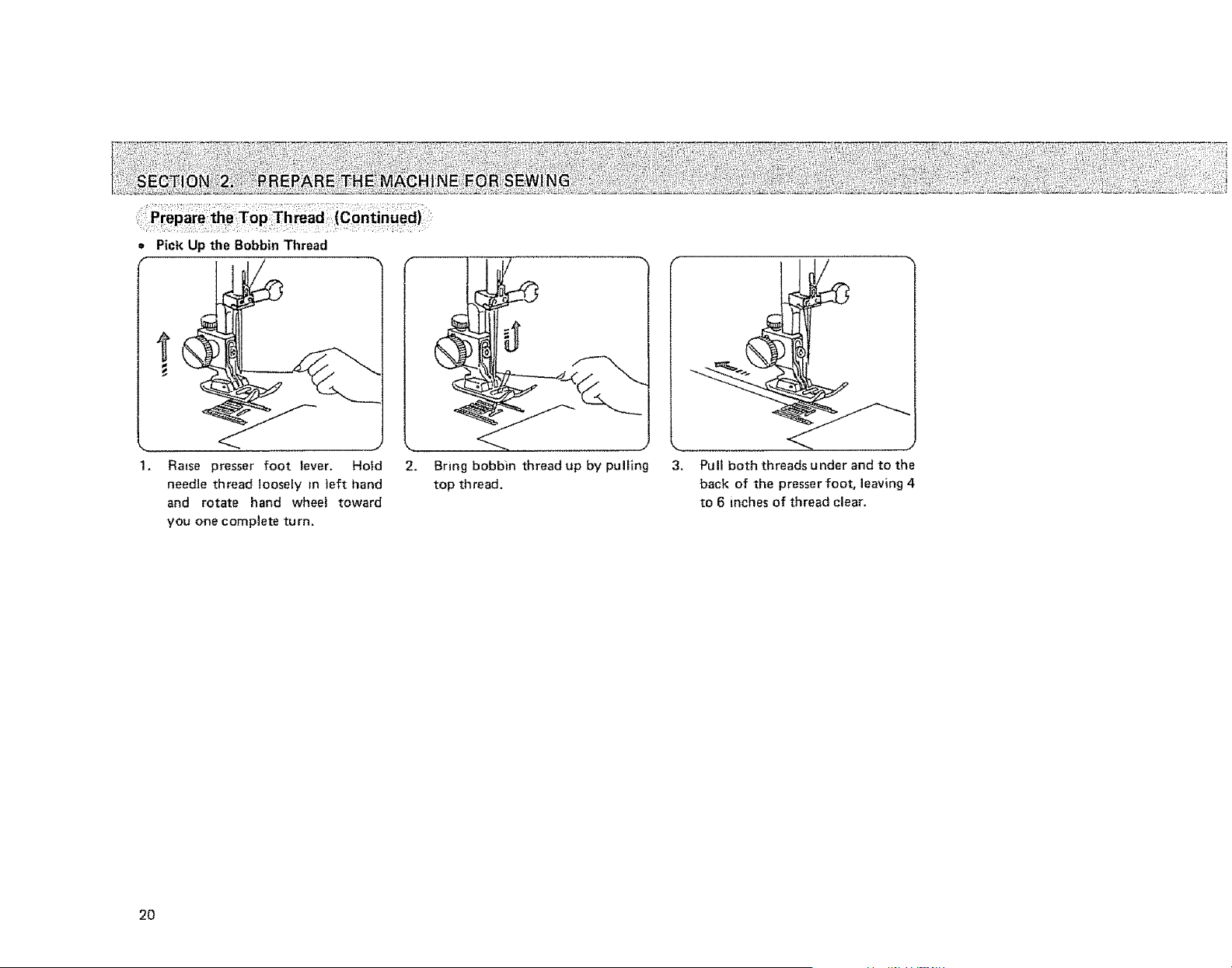
= Pick Up the Bobbin Thread
!
Ra=se presser foot lever. Ho|d
needle thread loosely tn teft hand
and rotate hand wheel toward
you one complete turn.
2.
Bring bobbin thread up by pulling
top thread.
3=
J
Pull both threads under and to the
back of the presser foot, leaving 4
to 6 inches of thread clear.
2O
Adjust the Top Thread Tension
Top side of fabric
thread
Setting mark
Loosen@
Tighten
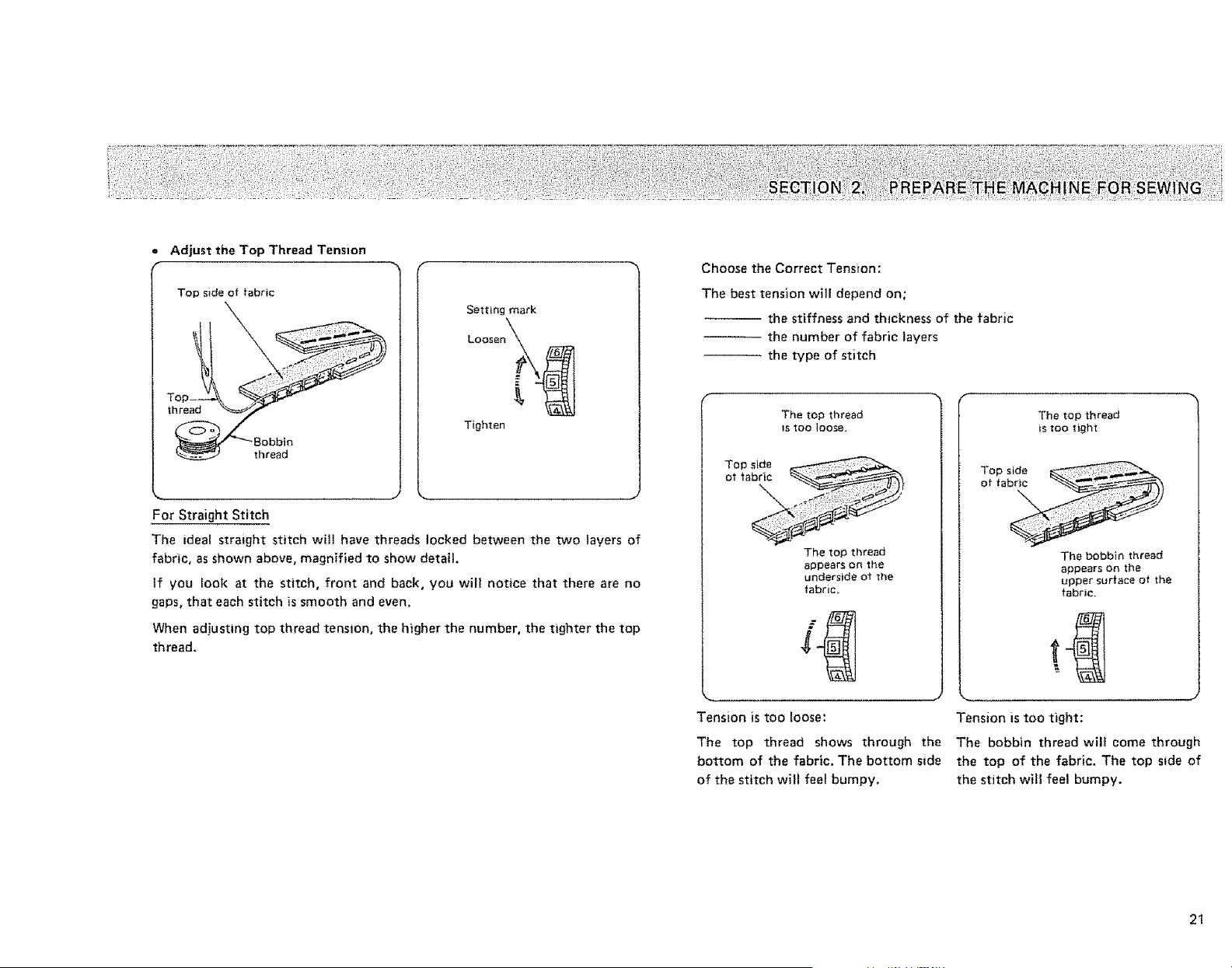
For Straight Stitch
The ideal straight stitch will have threads locked between the two layers of
fabric, as shown above, magnified to show detail,
tf you look at the stitch, front and back, you will notice that there are no
gaps, that each stitch is smooth and even.
When adjusting top thread tension, the higher the number, the tighter the top
thread.
Choose the Correct Tension:
The best tension will depend on;
the stiffness and thickness of the fabric
the number of fabric layers
---- the type of stitch
Top side
of tabrlc
The top thread
lS tO0 _oose.
The top thread
appears on the
underside o_ the
fabric_
The top thread
_s too light
Top side
of ta
The bobbin thread
appears on the
upper surface of the
fabric.
Tension is too loose:
The top thread shows through the
bottom of the fabric. The bottom side
of the stitch will feel bumpy.
Tension is too tight:
The bobbin thread wil_ come through
the top of the fabric. The top side of
the stitch will feel bumpy.
21
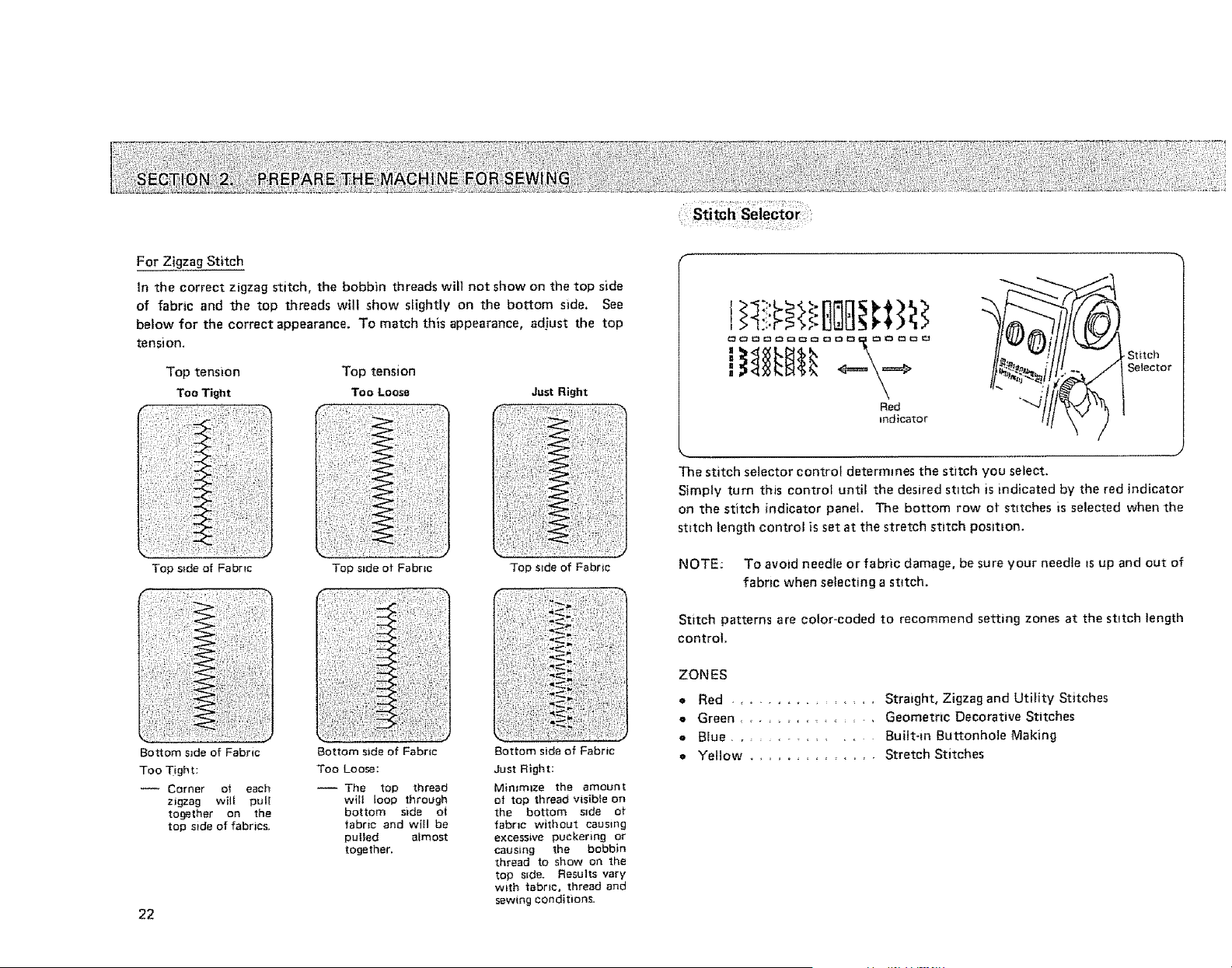
For Zigzag Stitch
In the correct zigzag stitch, the bobbin threads wilI not show on the top side
of fabric and the top threads will show slightly on the bottom side. See
below for the correct appearance. To match this appearance, adjust the top
tension.
Top tension Top tension
Too Tight Too Loose
Top s=de of Fabric
Just Right
Top s=de ot Fabric
Top side of Fabric
Bottom s_de of Fabric Bottom side of Fabric Bottom side of Fabric
Too Tight: Too Loose: Just Right:
-- Corner ol each -- The top thread Minimize the amount
zigzag will pull will loop through of top thread visible on
together on the bottom side ot the bottom slde of
top side of fabrics, fabric and will be fabric without causing
pulled almost excessive puckering or
together, causing the bobbin
thread to show on the
top s_de. Results vary
w_th _abr=c, thread and
sewing conditions,
22
\
Red
mdieator
.)
The stitch selector control determines the stitch you select.
Simply turn this control until the desired stitch is indicated by the red indicator
on the stitch indicator panel. The bottom row of stttches is selected when the
stitch length control is set at the stretch stitch posit=on.
NOTE: To avoid needle or fabric damage, be sure your needle is up and out of
fabnc when selecting a stitch.
Stitch patterns are color-coded to recommend setting zones at the stitch length
control.
ZONES
• Red ................
o Green ........... - ,
• Blue ............
• Yellow ............
Straight, Zigzag and Utility Stitches
Geometric Decorative Stitches
Built*in Buttonhole Making
Stretch Stitches
Adjusting Stretch Stitch Balance
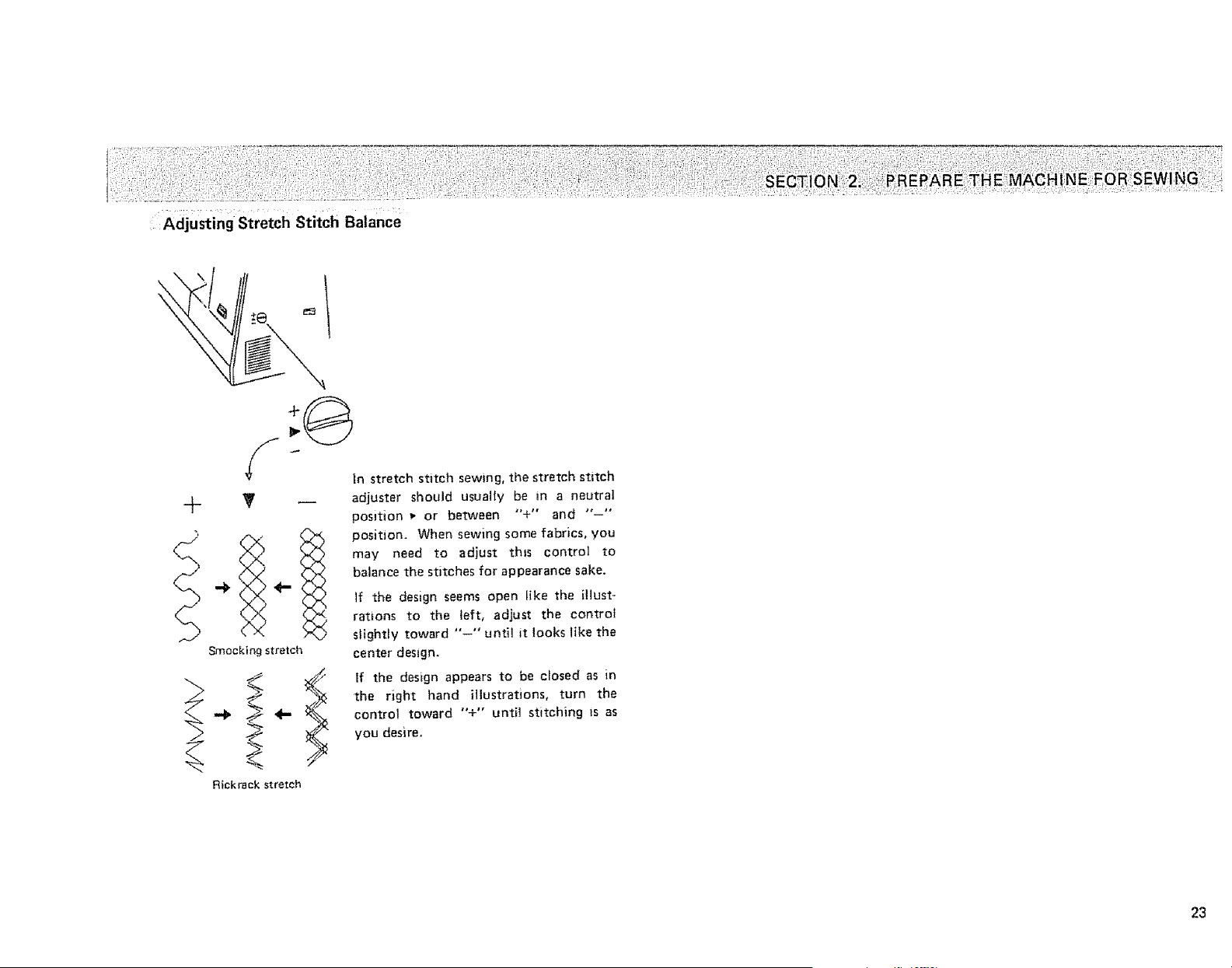
In stretch stitch sewing, the stretch stitch
+
%
Smocking stretch
Rick rack stretch
adjuster should usually be m a neutra]
position w or between "+" and "-"
position. When sewing some fabrics, you
may need to adjust this control to
balance the stitches for appearance sake.
If the design seems open {ike the illust-
rations to the left, adjust the control
slightly toward "-'" until it looks like the
center design.
If the design appears to be closed as in
the right hand illustrations, turn the
control toward "+" until stitching is as
you desire.
23
213
Stretch Stitch
i4
......J
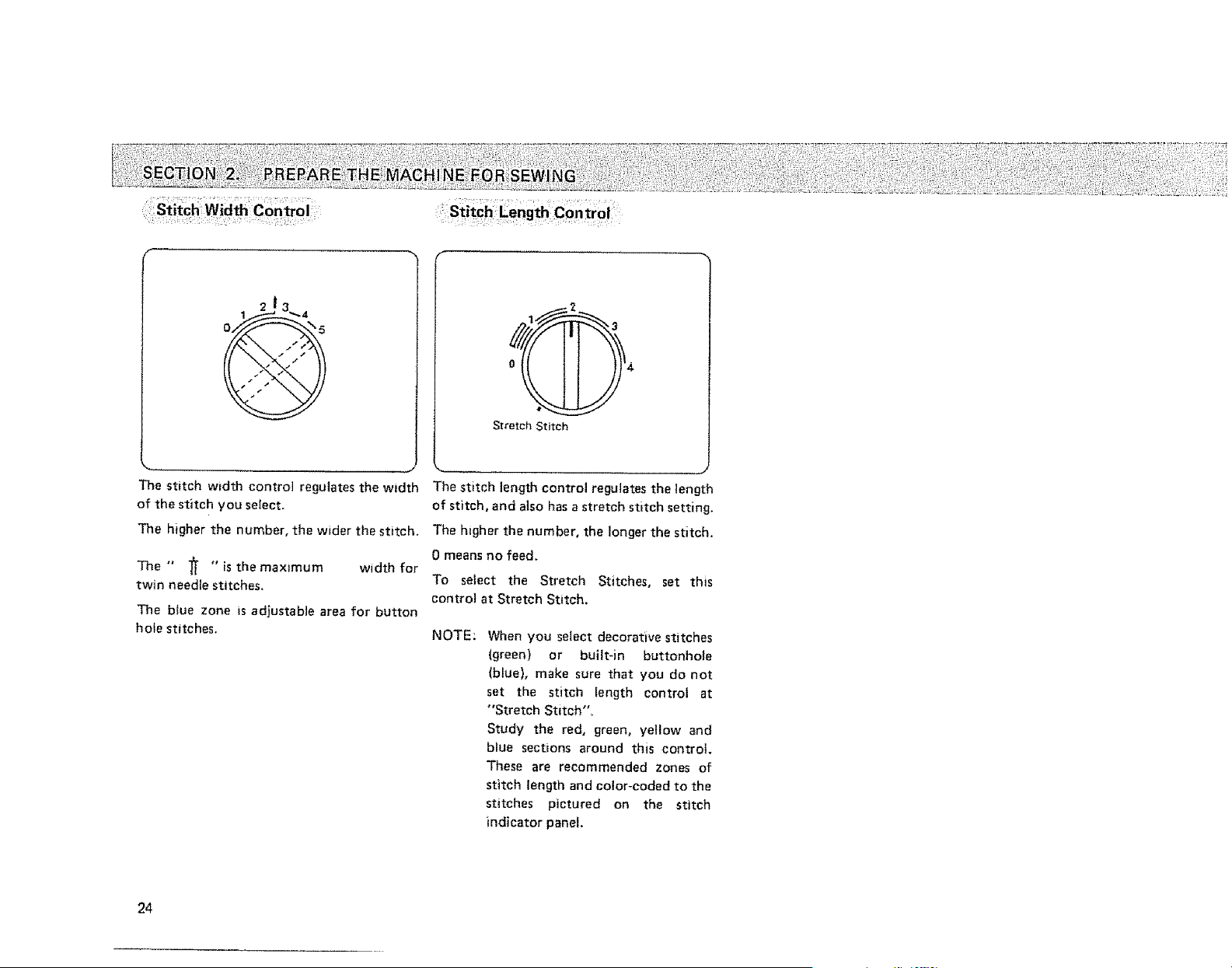
The stitch width control regulates the width
of the stitch you setect.
The higher the number, the wider the stitch.
The " "[[ " is the maximum
twin needle stitches.
width for
The blue zone is adjustable area for button
hole stitches.
The stitch length control regulates the length
of stitch, and also has a stretch stitch setting.
The higher the number, the longer the stitch.
0 means no feed.
To select the Stretch Stitches, set this
control at Stretch Stitch.
NOTE:
When you select decorative stitches
(green) or built-in buttonhole
(blue), make sure that you do not
set the stitch length control at
"Stretch Stitch"
Study the red, green, yellow and
blue sections around this control.
These are recommended zones of
stitch length and color-coded to the
stitches pictured on the stitch
indicator panel
24
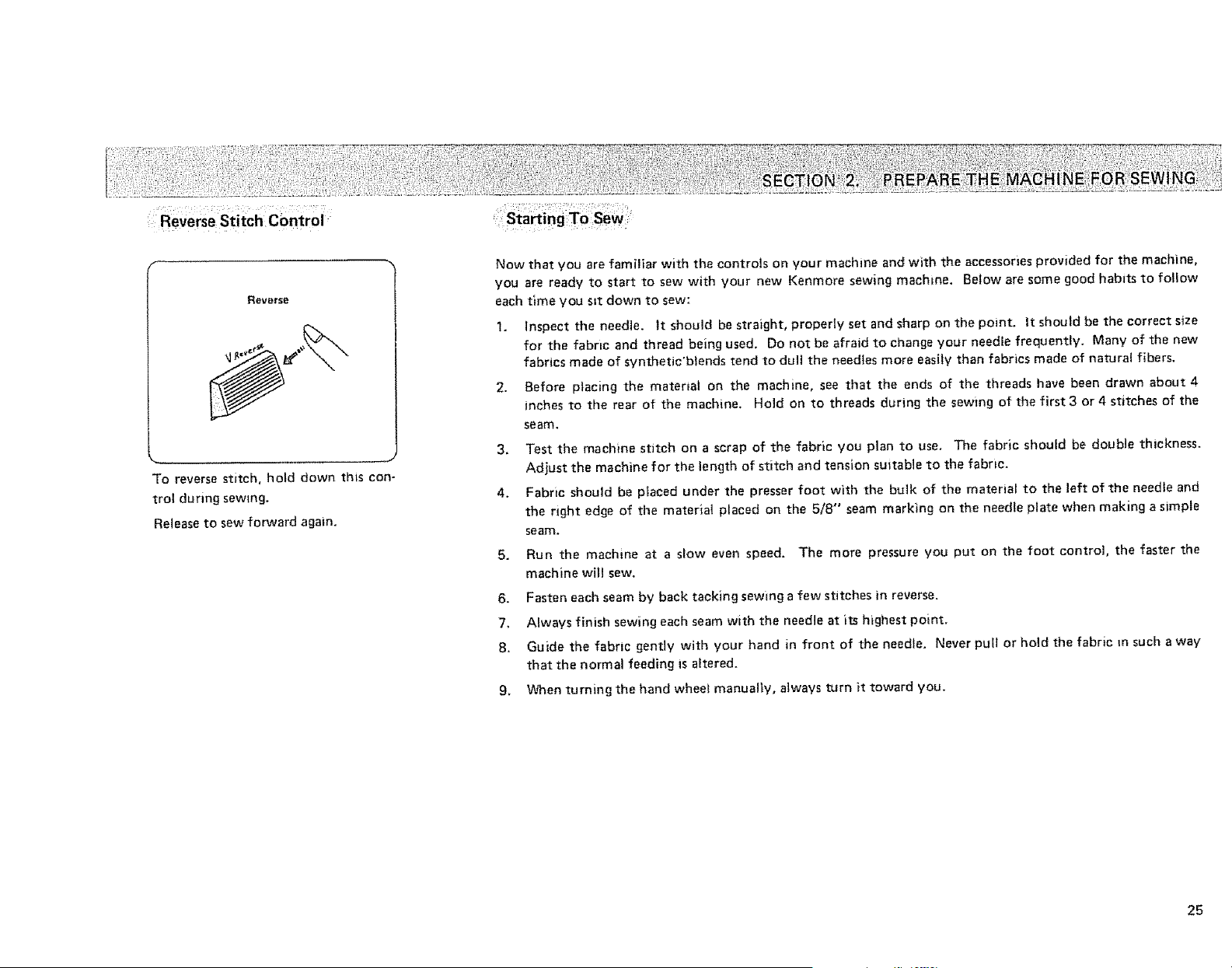
Reverse Stitch Control
To reverse stitch, hold down this con-
trol during sewing.
Release to sew forward again.
Now that you are familiar with the controls on your machine and with the accessories provided for the machine,
you are ready to start to sew with your new Kenmore sewing machine. Below are some good habits to follow
each time you sit down to sew:
1. Inspect the needle. It should be straight, properly set and sharp on the point. It should be the correct size
for the fabric and thread being used, Do not be afraid to change your needle frequently. Many of the new
fabrics made of synthetic'blends tend to dull the needles more easily than fabrics made of natural fibers,
2. Before placing the material on the machine, see that the ends of the threads have been drawn about 4
inches to the rear of the machine. Hold on to threads during the sewing of the first3 or 4 stitches of the
seam.
3, Test the machine stitch on a scrap of the fabric you plan to use, The fabric should be double thickness.
Adjust the machine for the length of stitch and tension suitable to the fabric.
4. Fabric should be placed under the presser foot with the bulk of the material to the left of the needle and
the right edge of the material placed on the 5/8"" seam marking on the needle plate when making a simple
seam.
5. Run the machine at a slow even speed. The more pressure you put on the foot control, the faster the
machine will sew.
6. Fasten each seam by back tacking sewing a few stitches in reverse.
7. Always finish sewing each seam with the needle at its highest point.
8. Guide the fabric gently with your hand in front of the needle. Never pull or hold the fabric m such a way
that the normal feeding is altered.
9, When turning the hand wheel manually, always turn it toward you.
25
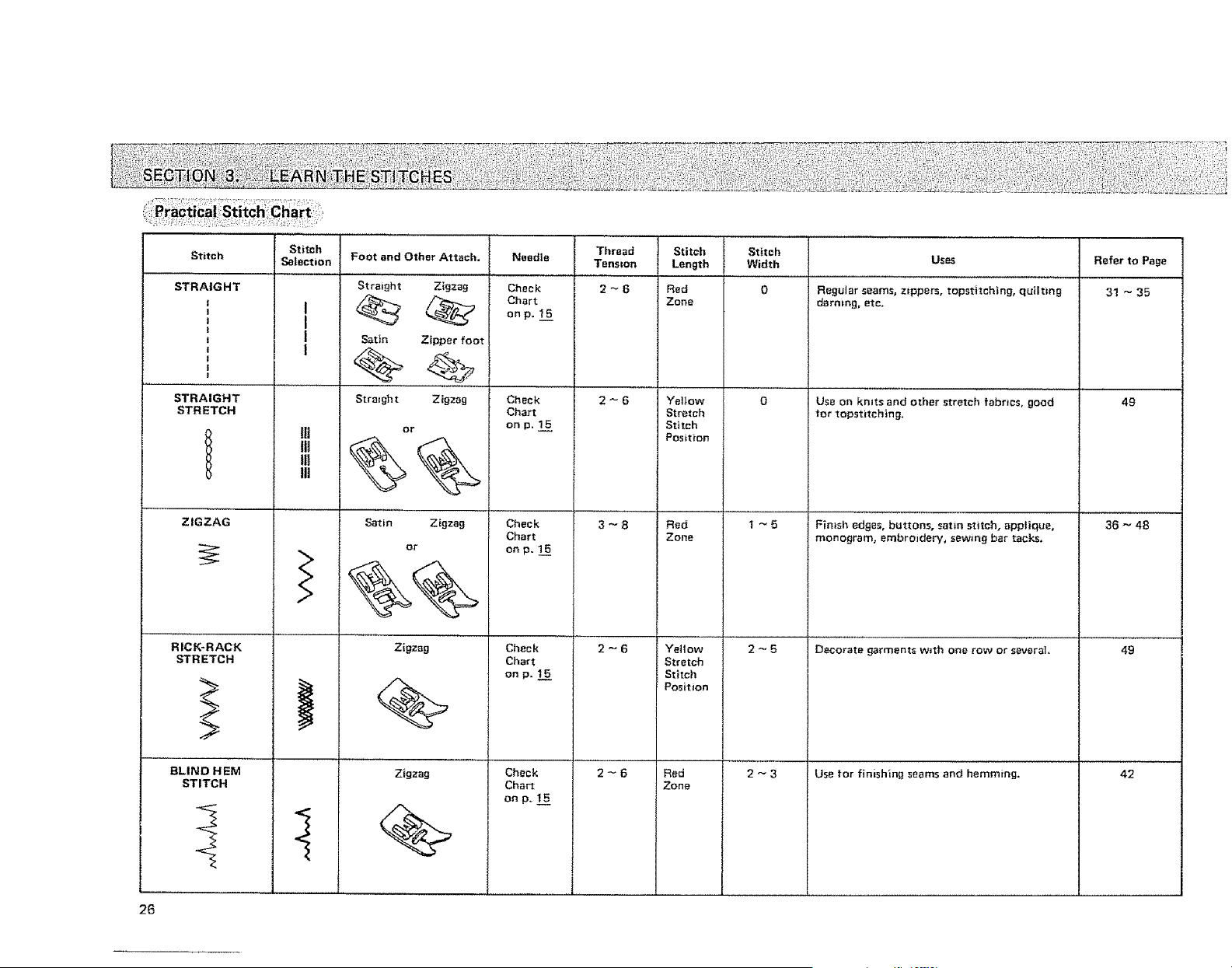
Stitch Thread Stitch Stitch
Stitch Selection Foot and Other Attach.
Tension Length Width
2 ~ S Red 0
Zone
STRAIGHT
I
J
I
t
t
1
J
STRAIGHT
STRETCH
ZIGZAG
RICK-RACK
STRETCH
BLIND HEM
STITCH
26
I
I
I
I
III
III
III
III
Straight
Satin Zipper foot
Stra=ght Zigzag
or
Satin Zigzag
or
%%
Zigzag
Zigzag
%
Needle
Zigzag Check
Charton p. 155
Cheek
Chart
on p. 1_55
Check
Chart
on p. 155
Check
Chart
onp. 15
Check
Chart
on p. 15
2_6
3_8
2-6
2_6
Yellow
Stretch
Stitch
Position
Red
Zone
Yellow
Stretch
Stitch
Position
Red
Zone
I~5
2~5
2-3
Uses Refer to Page
Regular seams, z_ppers, topstitching0 quilting 31 _ 35
darmng, etc,
Use on knits and other stretch fabrics, good 49
tot topstitching.
Finish edges, buttons, satin stitch, applique, 36 _ 48
monogram, embroidery, sewing bar tacks.
O0corategarmentsw,_honeroworsov0ra, 49
i
Use for finishing seams and hemming. 42
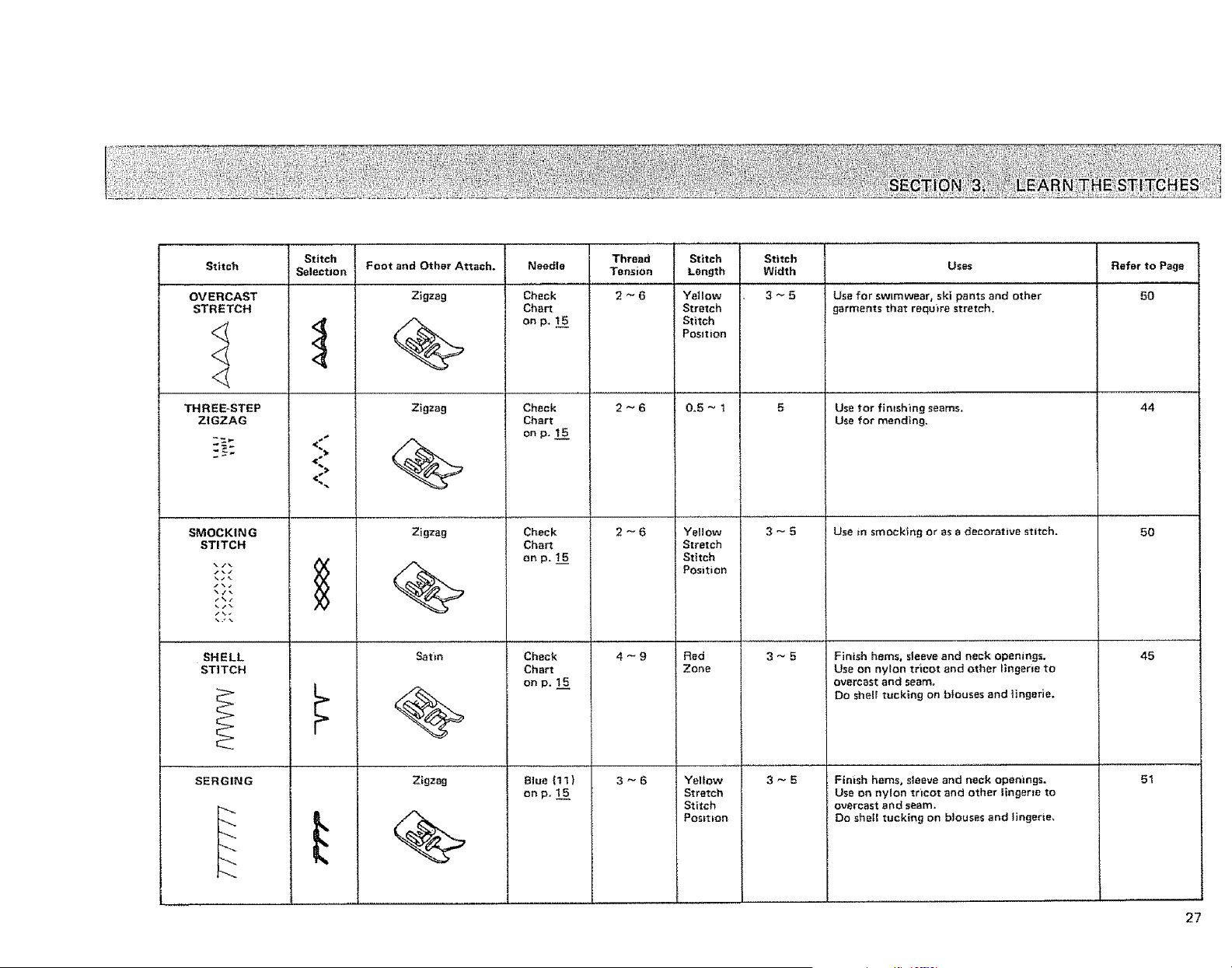
Stitch
Stitch Selection
OVERCAST
STRETCH
THREE-STEP
ZIGZAG
SMOCKING
STITCH
SHELL
STITCH
SERGING
<
<
I
Foot and Other Attach.
I Zigzag
%
Zigzag
%
Zigzag
%
Sat_n
%
Zigzag
%
Needle
Check
Chart
onp.
Check
Chart
onp. 15
Check
Chart
on p. 15
Check
Chart
onp. 15
Blue (tl}
onp. 15
Thread
Tension Refer to Page
2 ~ 6 50
2~6
2_6
4~9
3_6
Stitch
Length
Yel low
Stretch
Stitch
Position
0.5 ~ t 5
Yellow 3 _ 5
Stretch
Stitch
Position
Red 3 ~ 5
Zone
Yellow 3 _ 5
Stretch
Stitch
Pos_tton
Stitch
Width Uses
, ,, ,,,,,,,,, ,
3 _ 5 Use for sw_mwear, ski pants and other
garments that require stretch.
Use for fimsh'mg seams.
Use for mending.
Use in smockfng or as a decorative stitch.
Finish hems, sleeve and neck openings.
Use on nylon tricot and other lingerie to
overcast and seam.
Do shell tucking on blouses and lingerie.
Fimsh hems, sleeve and neck openings.
Use on nylon tricot and other lingerie to
overcast and seam.
Do shell tucking on blouses and lingerie,
44
5O
45
51
27
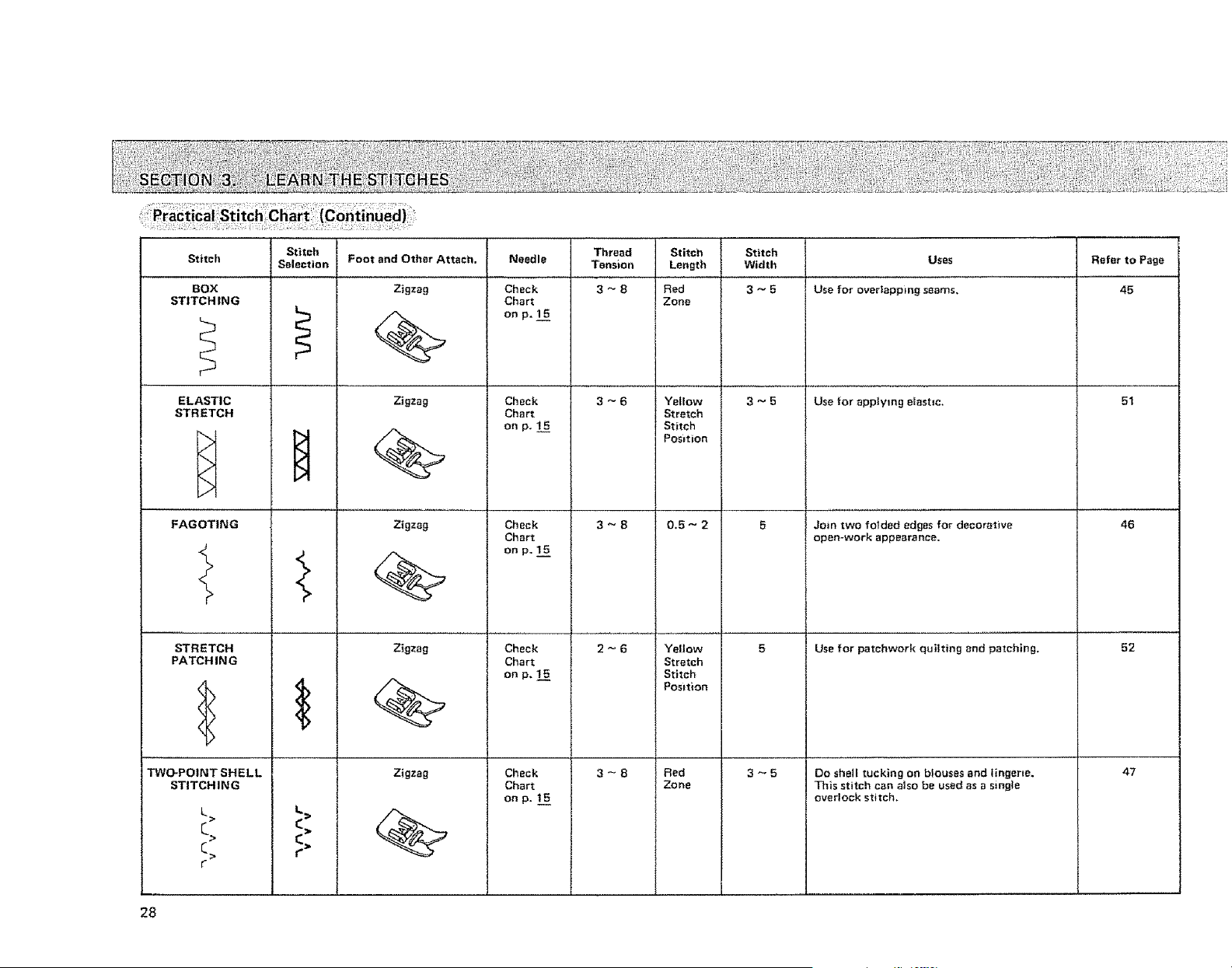
Stitch
Stitch Selection Foot and Other Attach, Uses Refer to Page
Use for overlapping seams. 45
BOX
STITCH IN G
ELASTIC
STRETCH
>
>
FAGOTING
STRETCH
PATCHING
<
<>
TWO-POINT SHELL
STITCHING
r.>
C
>
¢
ii
Thread
Needle Tension
................................ , ........... , , ,,, ,, ,
Zigzag Check 3 _ 8
Chart
(_ on p. 15
Zigzag Check 3 _ 6
Chart
Zigzag Check 3 _ 8
Chart
;_ on p. 1._55
Zigzag Check
Chart
on p. 15
%
Zigzag Check
Chart
onp. 15
%
2 _ 6 Yellow
Stretch
Stitch
Position
3 _ 8 Red
Zone
Stitch Stitch
Length Width
Red 3 _ 5
Zone
Yellow 3 _ 5
Stretch
Stitch
Position
0.5_2 5
5
3~5
Use for applying elastic,
Join two folded edges for decorative
open-work appearance.
Use for patchwork qui|ting and patching.
Do shell tucking on blouses and lingerie.
This stitch can also be used as a single
overlock stitch.
51
46
52
47
28
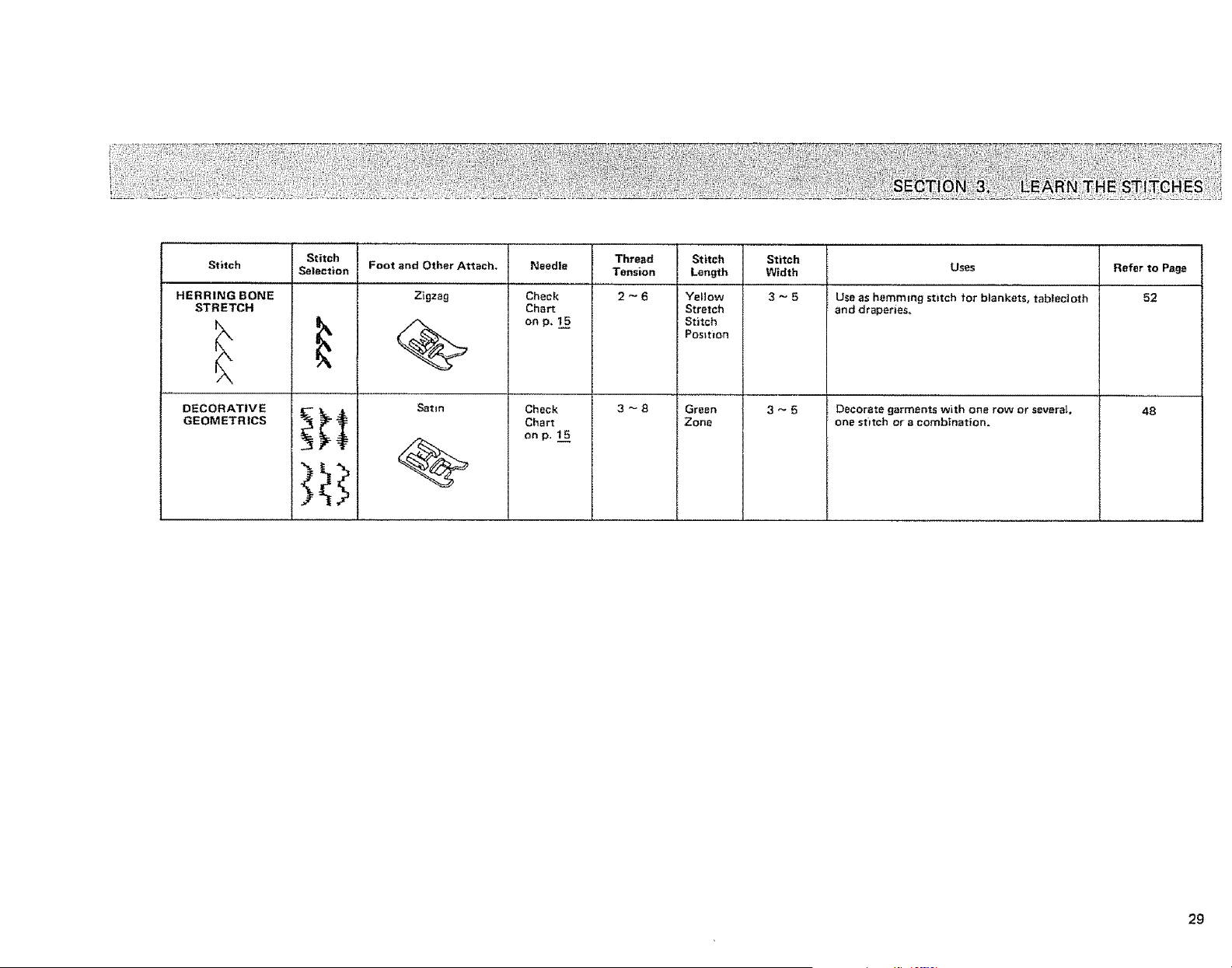
Stitch Thread Stitch Stitch
Stitch Selection Tension Length Width Uses Refer to Page
2 _ 6 3 _ 5 Use as hemming stitch for blankets, tablecloth 52
and draperies.
HERRING BONE
STRETCH
DECORATIVE
GEOMETRICS
Foot and Other Attach.
Zigzag
%
Satin
Needle
Check
Chart
onp. 15
Check
Chart
on p. I..55
3-8
Yellow
Stretch
Stitch
Position
Green
Zone
3_5 Decorate garments with one row or several,
one st;tch or a combination.
48
29
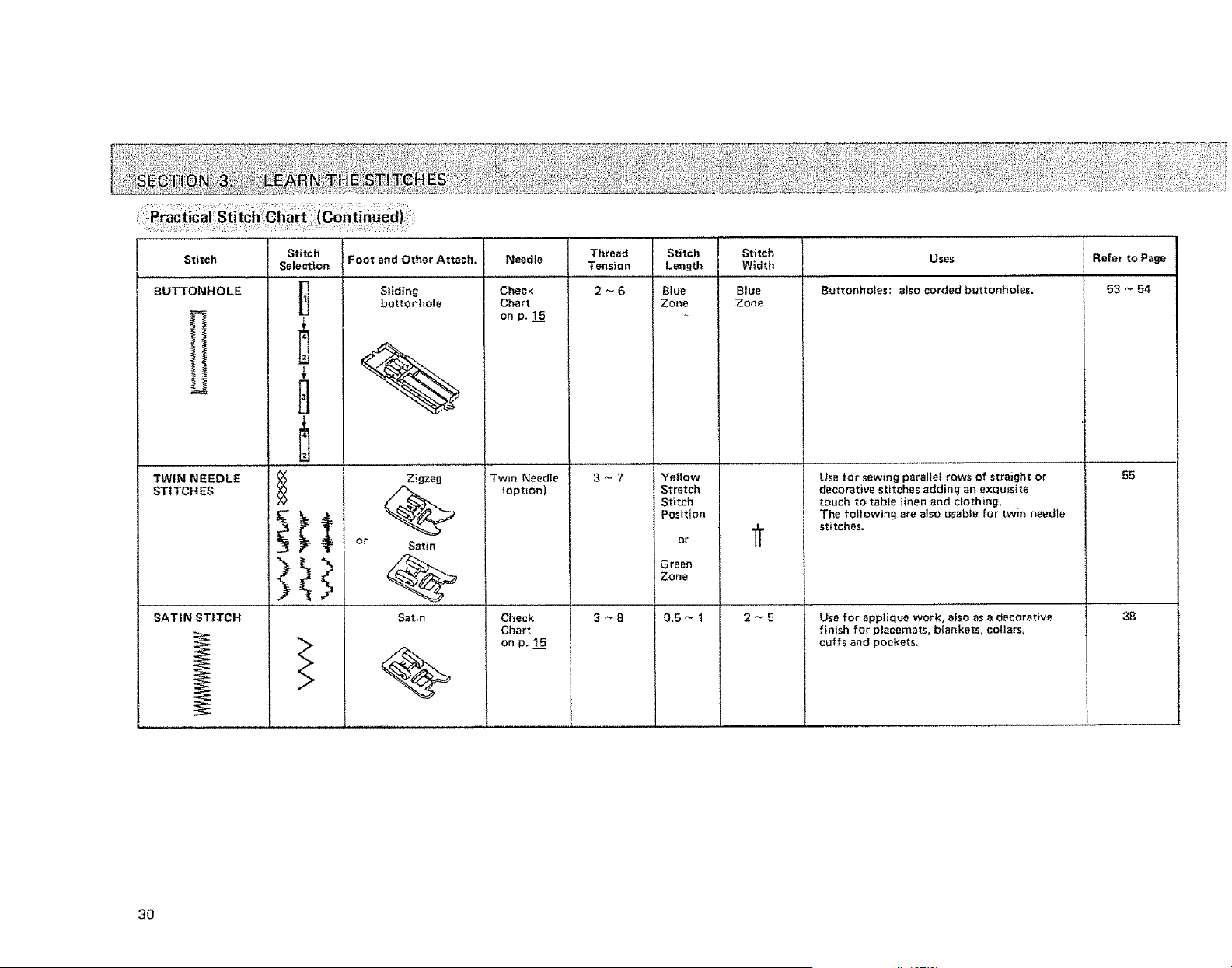
Stitch
BUTTONHOLE
J
TWIN NEEDLE
ST! TCH ES
SATIN STITCH
Stitch
Selection
Foot and Other Attach. Needle
Sliding Check
buttonhole Chart
on p. 15
%
Zigzag Twin Needle
(_ lopt_on)
or Satin
%
Satin Check
Chart
on p. 15
%
Thread
Tension
2_6
3_7
I 3~8
I StitchLength
BI ue
Zone
Yellow
Stretch
Stitch
Position
Green
Zone
0.5~ t
Stitch
Width
Blue
Zone
2~5
Uses
Buttonholes: also corded buttonholes.
Use for sewing parallel rows of straight or
decorative stitches adding an exquisite
touch to table linen and c_othing,
The following are also usable for twin needle
stitches.
Use for applique work, also as a decorative
finish for placemats, blankets, collars,
cuffs and pockets.
Refer to Page
53 ~ 54
55
38
3O
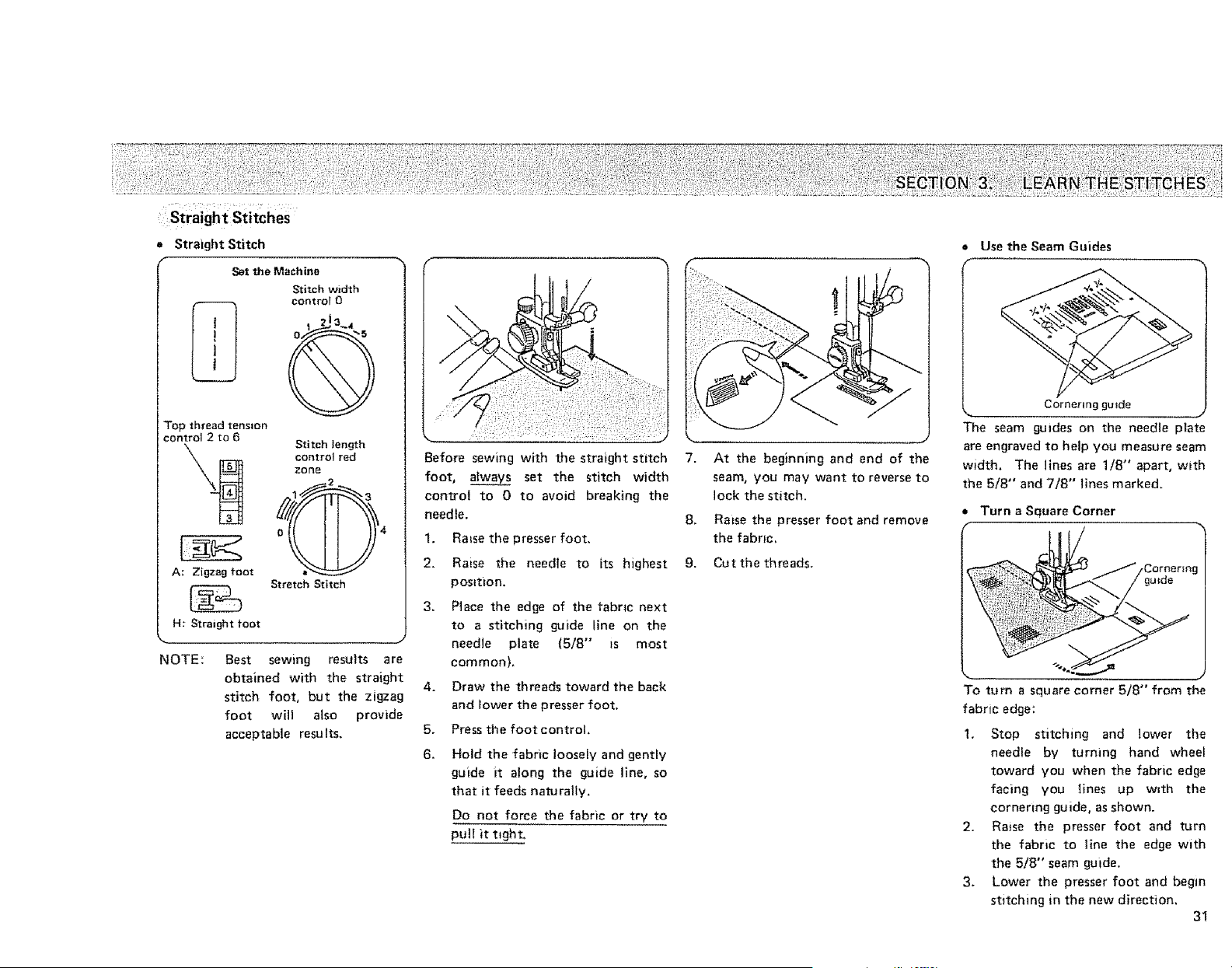
• Straight Stitch
f
Set the Machine
Stitch width
Top thread tension
control 2 to 6
A: Zigzag foot
H: Straight foot
Stitch length
control red
zone
Stretch Stitch
NOTE:
Best sewing results are
obtained with the straight
stitch foot, but the zigzag
foot will also provide
acceptable results.
I
Before sewing with the straight stitch
foot, atways set the stitch width
control to 0 to avoid breaking the
needle.
1. Raise the presser foot.
2. Raise the needle to its highest
position,
3. Place the edge of the fabric next
to a stitching guide fine on the
needle plate (5/8" _s most
common),
4. Draw the threads toward the back
and lower the presser foot,
5. Press the foot control,
8,
Hold the fabric loosely and gently
guide it along the guide line, so
that it feeds naturally,
Do not force the fabric or try to
pull it t_ght,
7,
8,
9.
At the beg}nning and end of the
seam, you may want to reverse to
lock the stitch.
Raise the presser foot and remove
the fabric,
Cut the threads.
Use the Seam Guides
Comerlng gu=de
The seam guides on the needle plate
are engraved to help you measure seam
width. The lines are 1/8" apart, with
the 5/8" and 7/8" lines marked.
* Turn a Square Corner
guide
J
To turn a square corner 5/8" from the
fabric edge:
1. Stop stitching and lower the
needle by turning hand wheel
toward you when the fabric edge
facing you lines up w_th the
cornering guide, as shown.
2. Raise the presser foot and turn
the fabric to line the edge with
the 5/8" seam guide.
3. Lower the presser foot and begin
stitching in the new direction.
3I
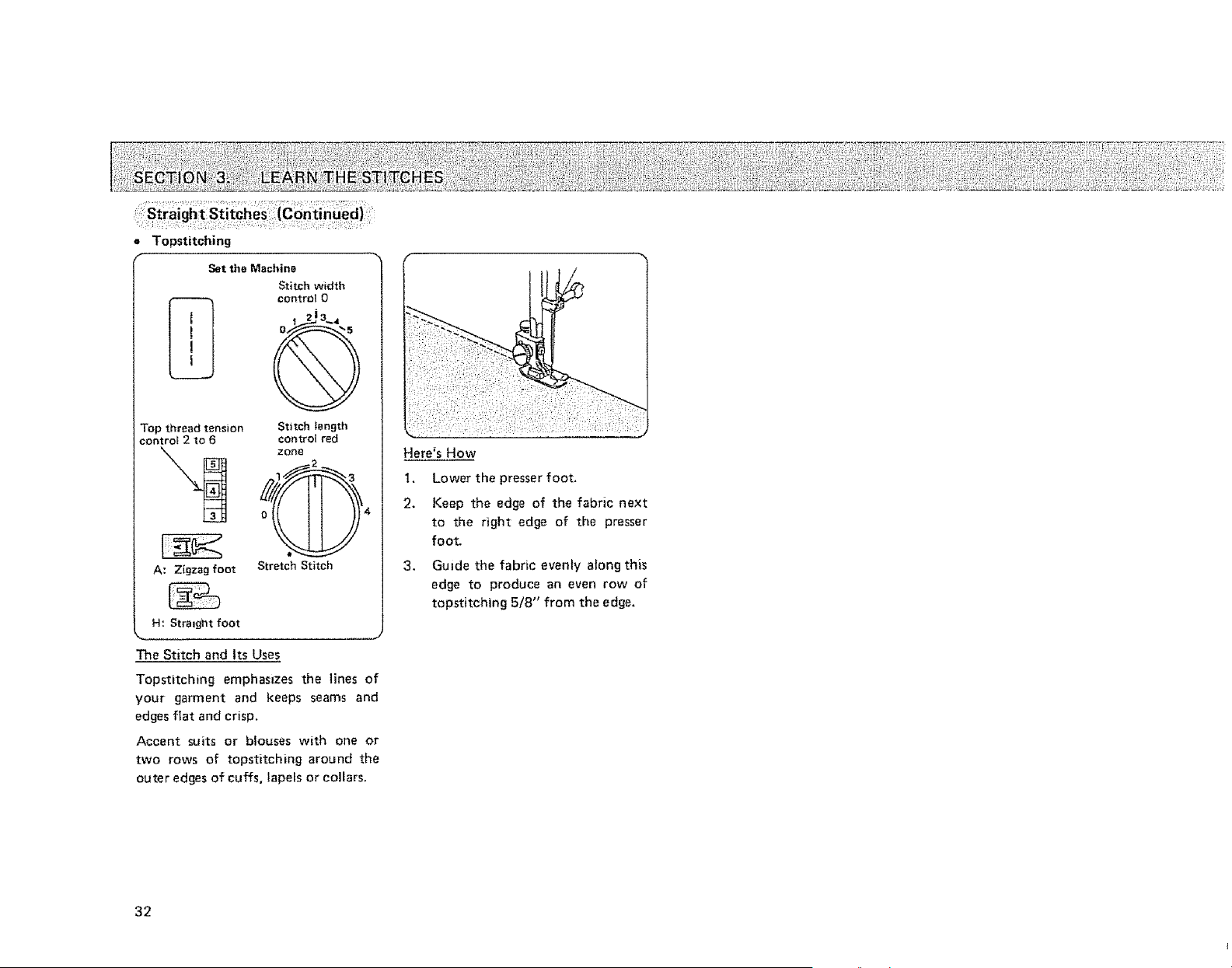
Topstitchi ng
set the Machine
Fop thread tension
controi 2 to 6
A: Zigzag foot
H: Straight foot
The Stitch and tts Uses
Stitch w_dth
control 0
G
Stitch length
control red
ZOn_
Stretch Stitch
.................,.J
Topstitching emphasizes the lines of
your garment and keeps seams and
edges flat and crisp.
Accent suits or blouses with one or
two rows of topstitching around the
outer edges of cuffs, lapels or collars.
Here's How
1,
2.
3.
Lower the presser foot.
Keep the edge of the fabric next
to the right edge of the presser
foot.
Guide the fabric evenly along this
edge to produce an even row of
topstitching 5/8" from the edge.
32
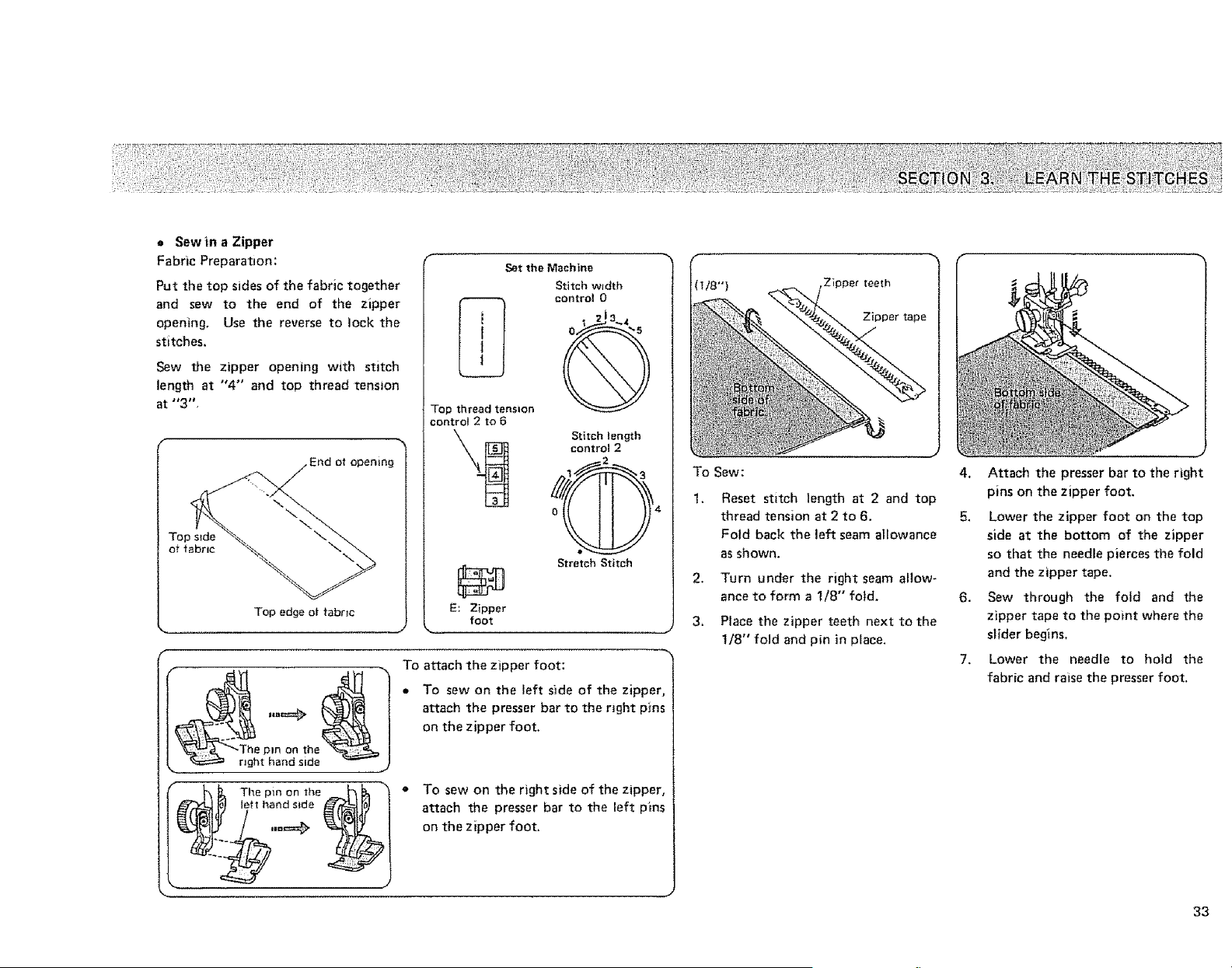
= Sew in a Zipper
Fabric Preparation:
Put the top sides of the fabric together
and sew to the end of the zipper
opening, Use the reverse to lock the
stitches.
Sew the zipper opening with stitch
length at "4" and top thread tension
at "'3".
Top side
of fabric
nd o| opemng
Top edge offabric
Fop thread tension
control 2 to 6
E: Zipper
foot
Set the Machine
Stitch w_dth
control 0
Stitch length
control 2
Stretch Stitch
_-The pin on the_
right hand side_
The pin on the
tett hand side
To attach the zipper foot:
• To sew on the left side of the zipper,
attach the presser bar to the right p_ns
on the zipper foot,
• To sew on the right side of the zipper,
attach the presser bar to the left p'ms
on the zipper foot,
I1/8")
To Sew:
1.
Zipper teeth
Reset stitch length at 2 and top
thread tension at 2 to 6.
Fold back the left seam allowance
as shown.
2, Turn under the right seam allow-
ance toforma 1/8"fold,
3, P_ace the zipper teeth next to the
1/8"fold and pin in place.
4, Attach the presser bar to the right
pins on the zipper foot,
5. Lower the zipper foot on the top
side at the bottom of the zipper
so that the needle pierces the fold
and the zipper tape.
6. Sew through the fold and the
zipper tape to the point where the
slider begins,
7. Lower the needle to hold the
fabric and raise the presser foot.
33
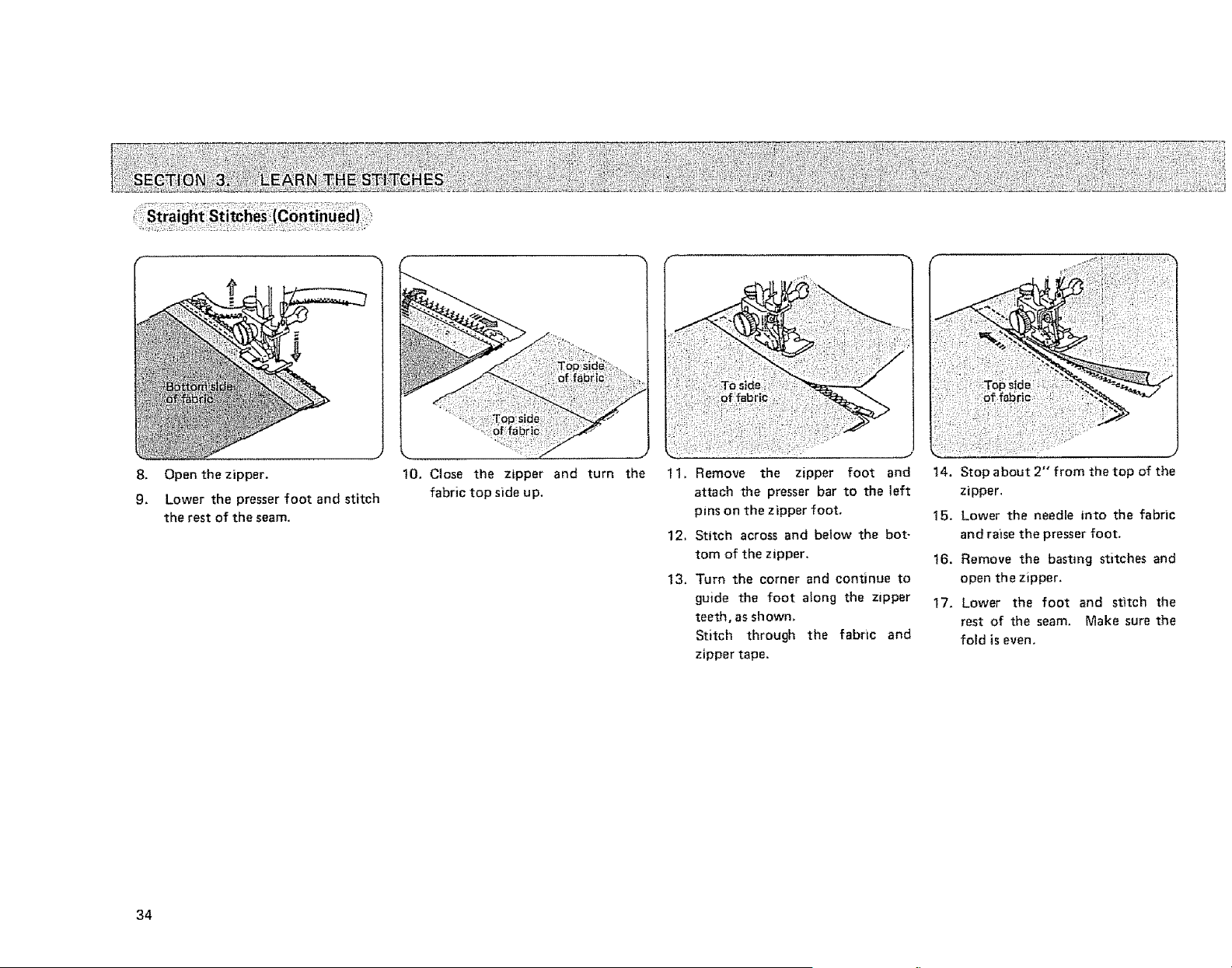
8. Open the zipper.
9. Lower the presser foot and stitch
the rest of the seam.
f
,ii a
t0. Close the zipper and turn the
fabric top side up.
....J
11. Remove the zipper foot and
attach the presser bar to the left
pros on the z_pper foot.
12, Stitch across and below the bot*
tom of the zipper.
13. Turn the corner and contmue to
guide the foot along the zipper
teeth, as shown,
Stitch through the fabrLc and
zipper tape.
J
14. Stop about 2" from the top of the
zipper.
15. Lower the needle into the fabric
and raise the presser foot.
16. Remove the basting stitches and
open the zipper.
17. Lower the foot and stitch the
rest of the seam. Make sure the
fold is even.
34
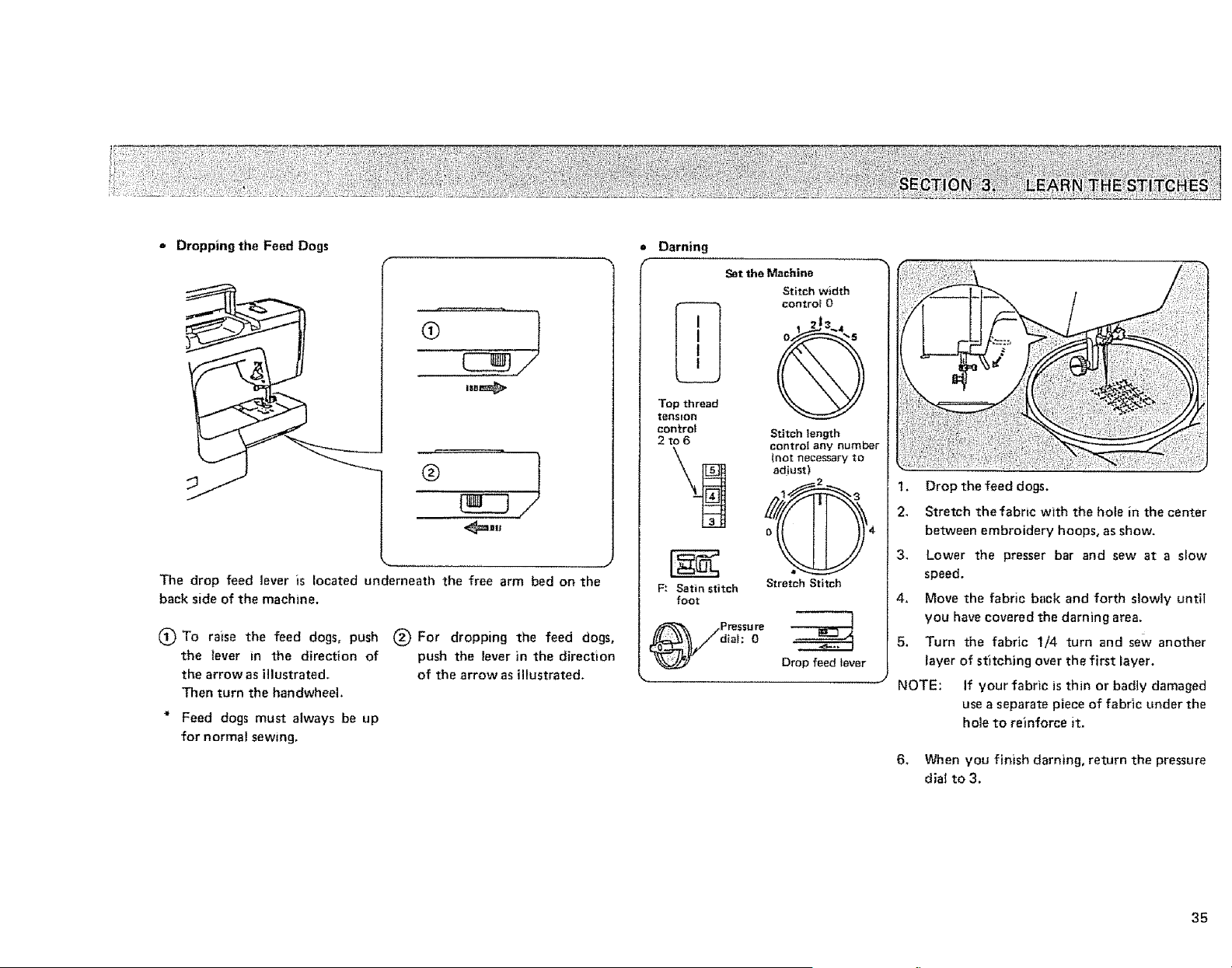
o Dropplngthe Feed Dogs
j
_nlJ
The drop feed lever is located underneath the free arm bed on the
back side of the machine.
(_ To ra=se the feed dogs, push (_) For dropping the feed dogs,
the lever in the direction of push the lever in the direction
the arrow as illustrated, of the arrow as illustrated,
Then turn the handwheel.
* Feed dogs must always be up
for normal sew=ngo
= Darning
Top thread
tensloR
control
2to6
F,_ Satin stitch
foot
Set the Machine
Stitch width
control 0
Stitch length
control any number
_not necessary _o
ediust)
2
Stretch Stitch
Drop feed lever
1.
2.
3,
4,
5.
NOTE:
Drop the feed dogs,
Stretch the fabric with the hole in the center
between embroidery hoops, as show,
Lower the presser bar and sew at a slow
speed.
Move the fabric beck and forth slowly until
you have covered the darning area,
Turn the fabric 1/4 turn and sew another
layer of stitching over the first layer.
If your fabric is thin or badly damaged
use a separate piece of fabric under the
hole to reinforce it.
6, When you finish darning, return the pressure
dial to 3.
35
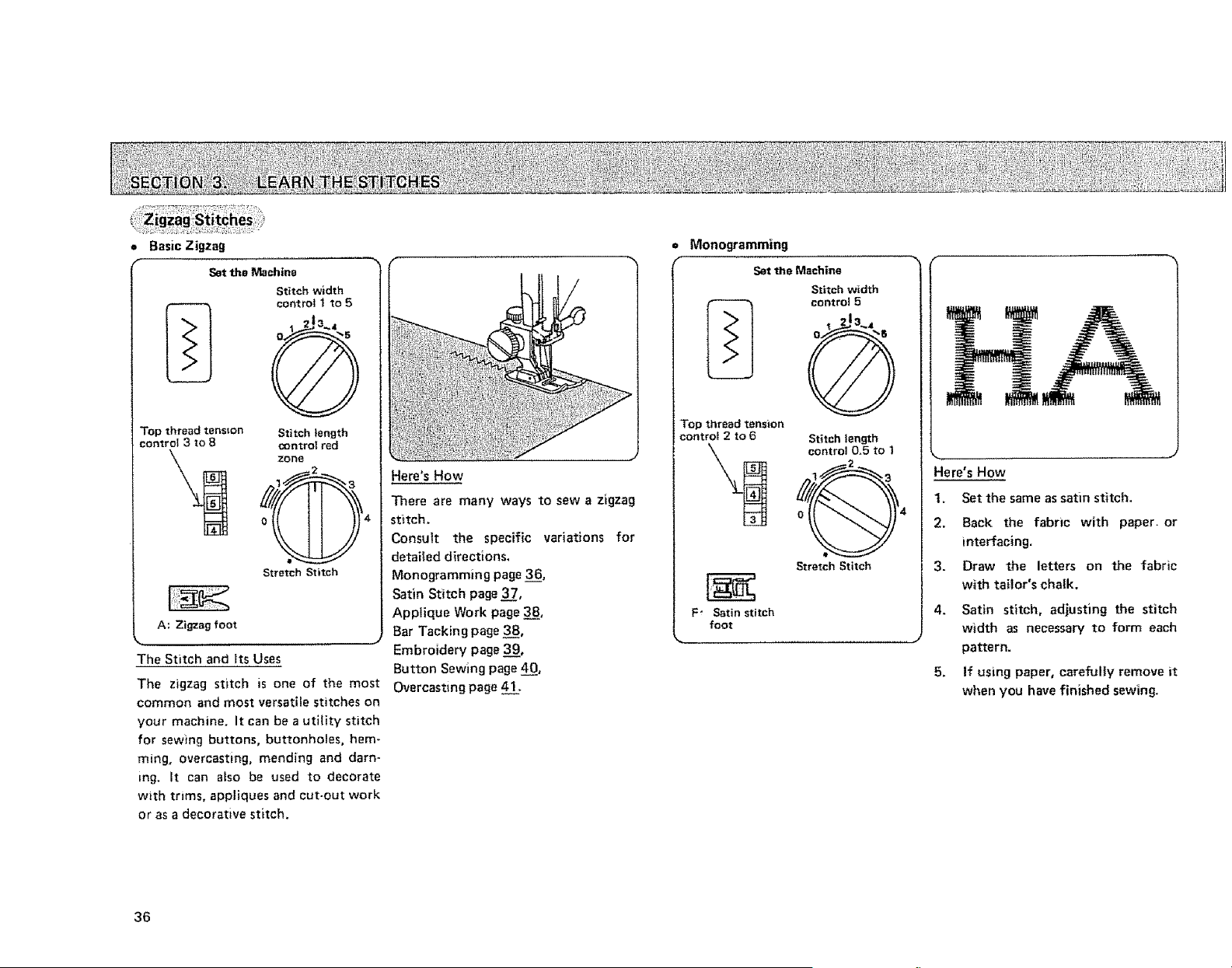
= Basic Zigzag
Set the Machine
Top thread tension
control 3 to S
Stitch width
control t to 5
Stitch length
control red
zone
Stretch Stitch
A: Zigzag foot
The Stitch and Its Uses
The zigzag stitch is one of the most
common and most versatile stitches on
your machine. It can be a utility stitch
for sew}ng buttons, buttonholes, hem-
ming, overcasting, mending and darn-
rag. it can also be used to decorate
with trims, appliques and cut-out work
or as a decorative stitch.
Here's How
There are many ways to sew a zigzag
stitch
Consult the specific variations for
detailed directions,
Monogramming page 36,
Satin Stitch page 37,
Applique Work page 38,
Bar Tacking page 38,
Embroidery page 39,
Button Sewing page 4_O0,
Overcasting page 41.
= Monogramming
Set the Machine
Stitch width
control 5
Top thread tension
control 2 to 6
F" Satin stitch
foot
Stitch length
control 0+5 to 1
Stretch Stitch
A
Here's How
1. Set the same as satin stitch.
2, Back the fabric with paper, or
interfacing.
3. Draw the letters on the fabric
with tailor's chalk.
4. Satin stitch, adjusting the stitch
width as necessary to form each
pattern.
5. if using paper, carefully remove it
when you have finished sewing.
36
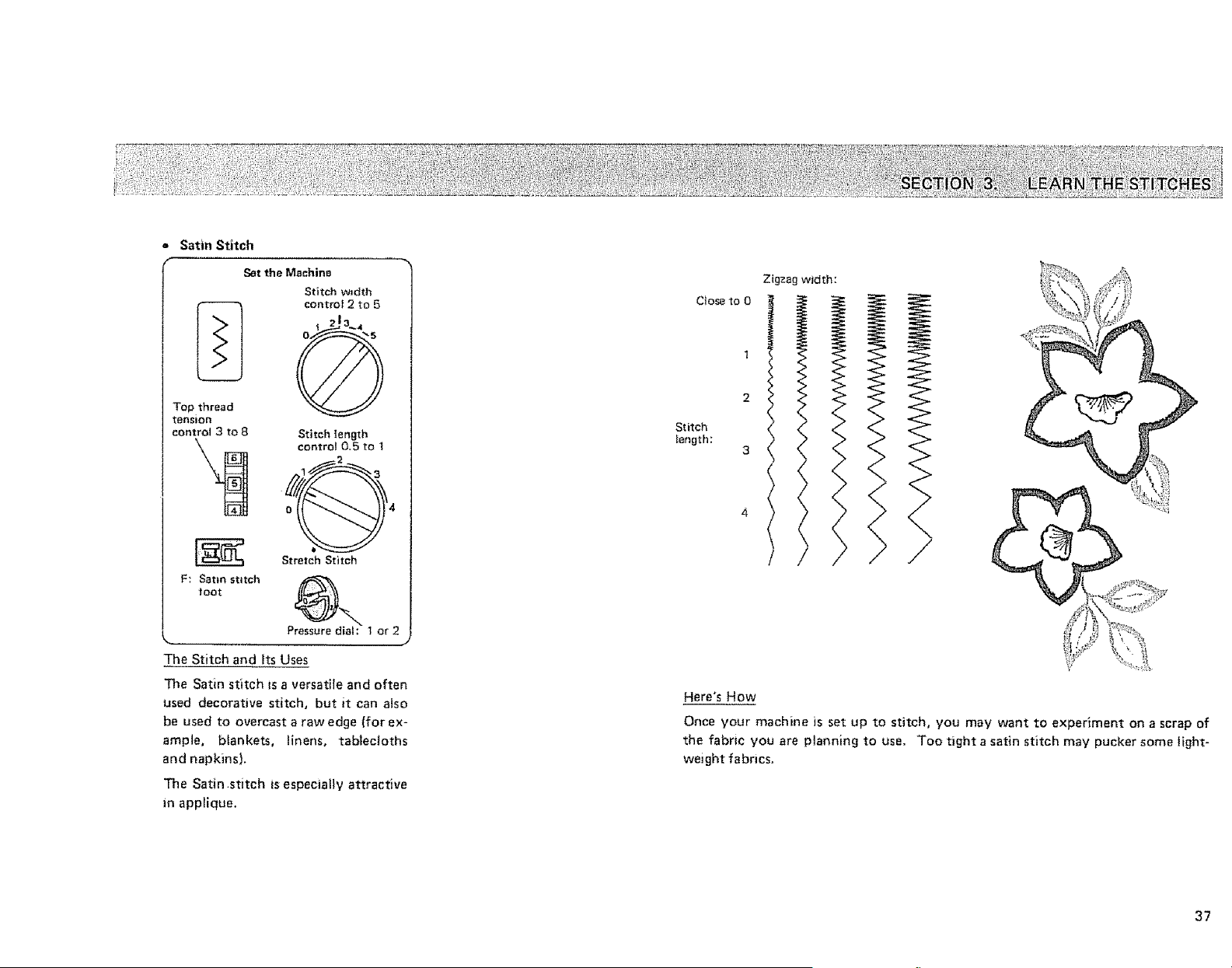
Satin Stitch
Set the Machine
Top thread
tension
control 3 to 8
Stitch w_dth
control 2 to 5
Stitch length
control 0.5 to 1
F: Satin stitch
toot
Stretch Stitch
Pressure dial": 1 or 2
The Stitch and its Uses
The Satin stitch is a versatile and often
used decorative stitch, but it can also
be used to overcast a raw edge lfor ex-
ample, blankets, linens, tab|ectoths
and napkins).
The Satin.stitch is especially attractive
in applique.
Close to 0
I
2
Stitch
length:
3
Zigzag width:
=
:>
>
\
//
Here's How
Once your machine is set up to stitch, you may want to experiment on a scrap of
the fabric you are planning to use. Too tight a satin stitch may pucker some light-
weight fabrics,
37
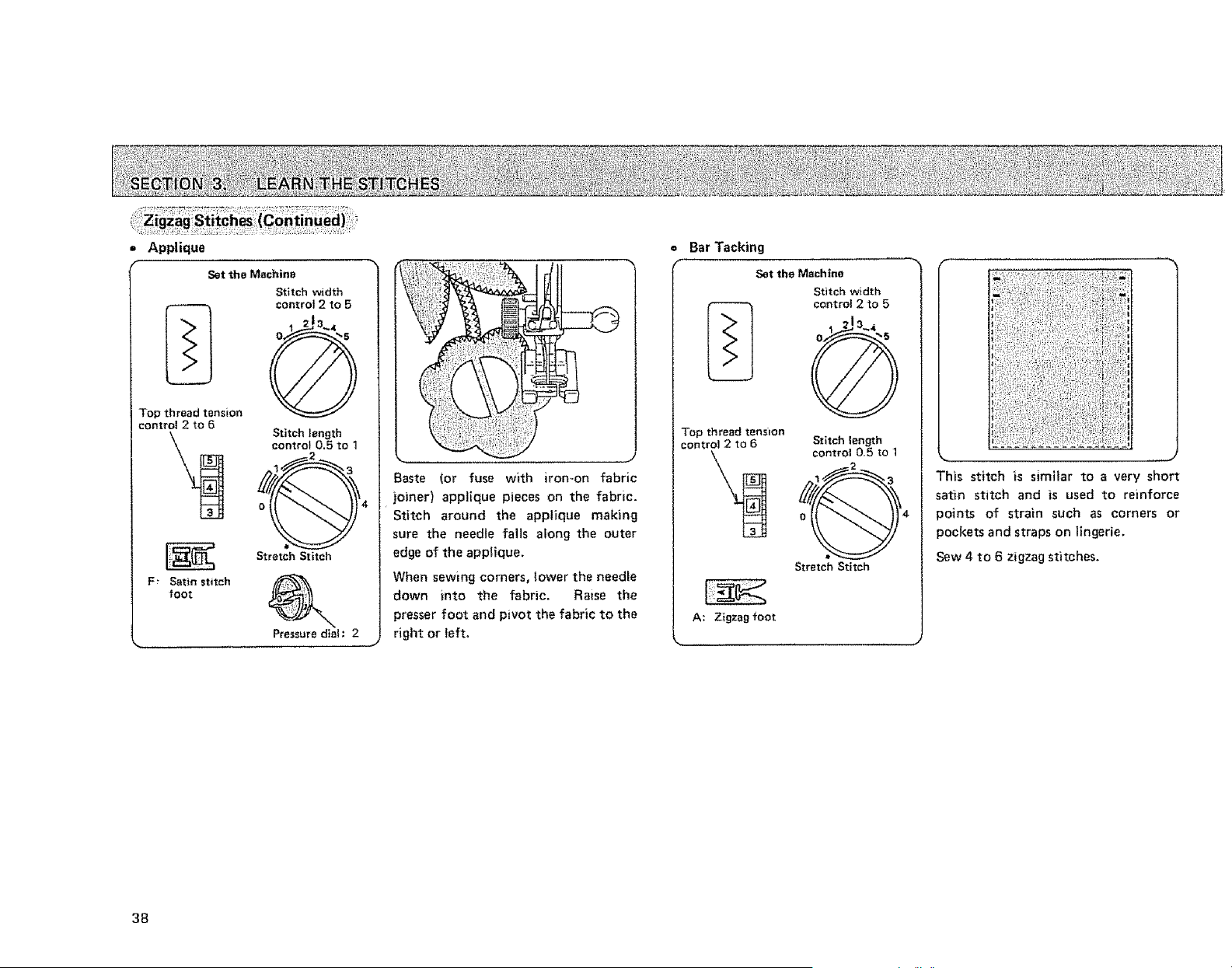
Applique
Top thread tension
control 2 to 6
F: Satin stitch
foot
Set the Machine
Stitch width
controt 2 to 5
0
Stitch length
control 0.5 to 1
2
Stretch Stitch
Pressure dial: 2
Baste (or fuse with iron-on fabric
joiner) applique pieces on the fabric.
Stitch around the applique making
sure the needle falls along the outer
edge of the applique.
When sewing corners, tower the needle
down into the fabric. Raise the
presser foot and pivot the fabric to the
right or left.
Bar Tacking
Set the Machine
Top thread tan_Jon
control 2 to 6
A: Zigzag foot
Stitch width
control 2 to 5
0
Stitch length
control 0.5 to 1
Stretch Stitch
This stitch is similar to a very short
sai(in stitch and is used to reinforce
points of strain such as corners or
pockets and straps on lingerie.
Sew 4 to 6 zigzag stitches.
38
o
f
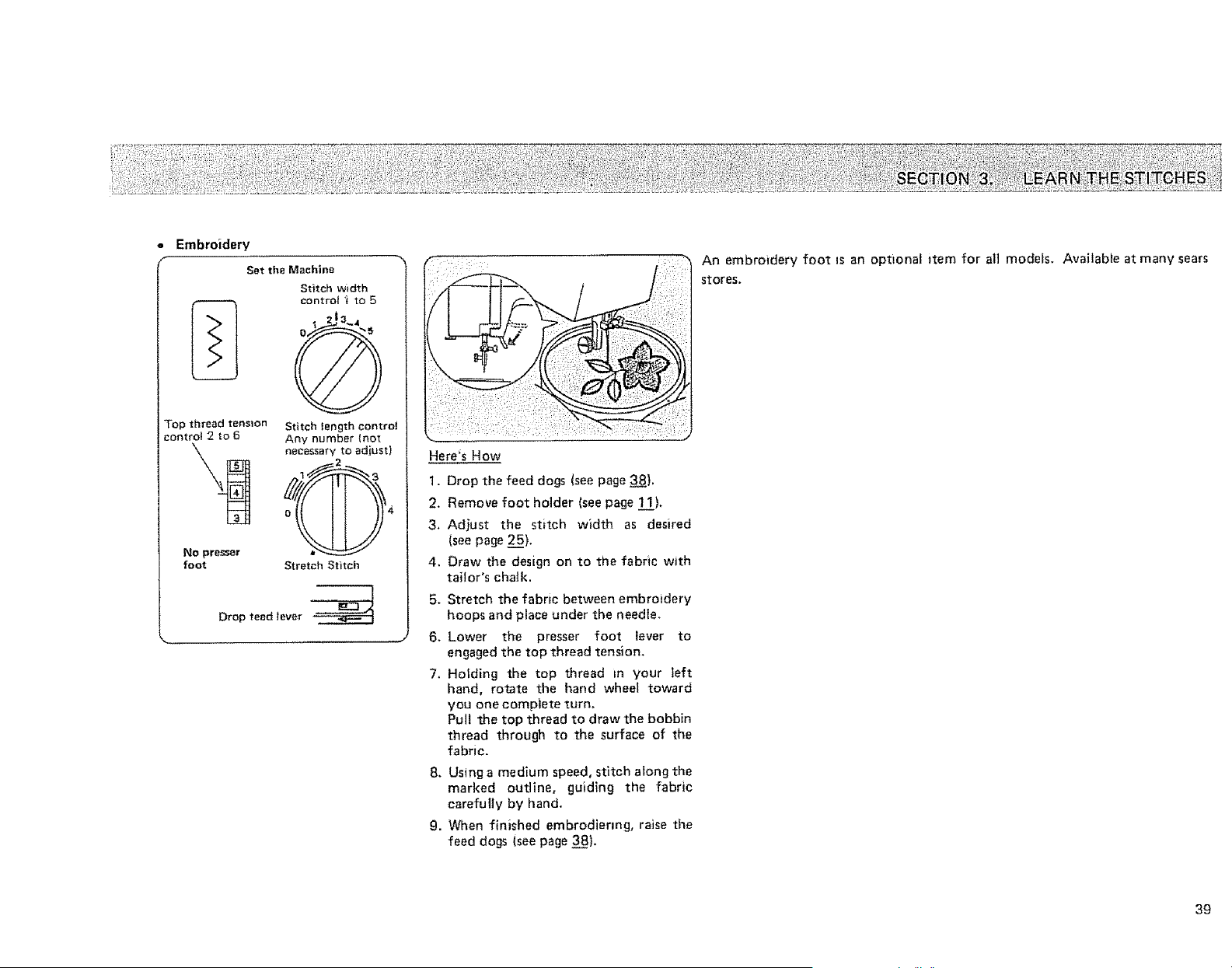
Embroidery
Set the Machine
Stitch w=dth
Top thread tension Stitch length control
control 2 [o 6 Any number {not
necessary to adiust)
No presser 0__ 4
foot Stretch Stitch
Drop teed ]ever -_
Here's How
1.
2.
3.
4.
5.
6.
7.
Drop the feed dogs (see page 38).
Remove foot hoIder (see page tl).
Adjust the stitch width as desired
(see page 25).
Draw the design on to the fabric with
tailor's chalk.
Stretch the fabric between embroidery
hoops and place under the needle.
Lower the presser foot lever to
engaged the top thread tension.
Holding the top thread m your left
hand, rotate the hand wheel toward
you one complete turn,
Pull the top thread to draw the bobbin
thread through to the surface of the
fabric.
Using a medium speed, stitch along the
marked outline, guiding the fabric
carefully by hand.
When finished embrodiermg, raise the
feed dogs (see page 38).
An embroidery foot is an optional item for all models. AvailabLe at many sears
stores.
39
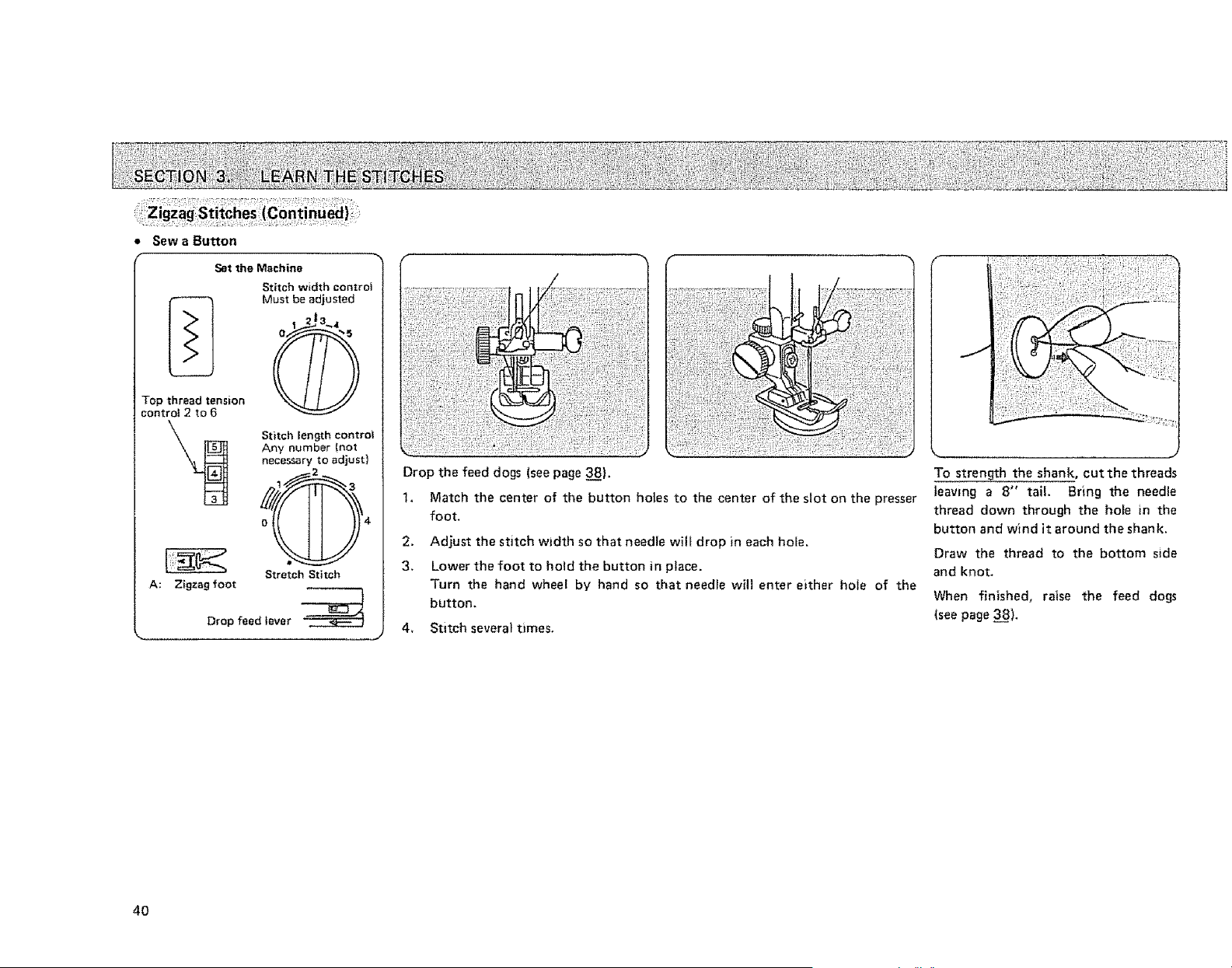
• Sew a Button
Set the Machine
Stitch width control
Top thread tension
controt 2 to 6
A:
Stitch length contro_
Any number (not
necesSary to adjust)
2
Stretch Stitch
Zigzag foot
Drop feed lever
Drop the feed dogs (see page 38),
1, Match the center of the button holes to the center of the slot on the presser
foot.
2. Adjust the stitch width so that needle will drop in each hole.
3. Lower the foot to hold the button in place.
Turn the hand wheel by hand so that needle will enter either hole of the
button.
4, Stitch several t_mes.
To strength the shank, cutthe threads
leaving a 8" tail. Bring the needle
thread down through the hole in the
button and w_nd it around the shank,
Draw the thread to the bottom side
and knot.
When finished, raise the feed dogs
(see page 38).
40
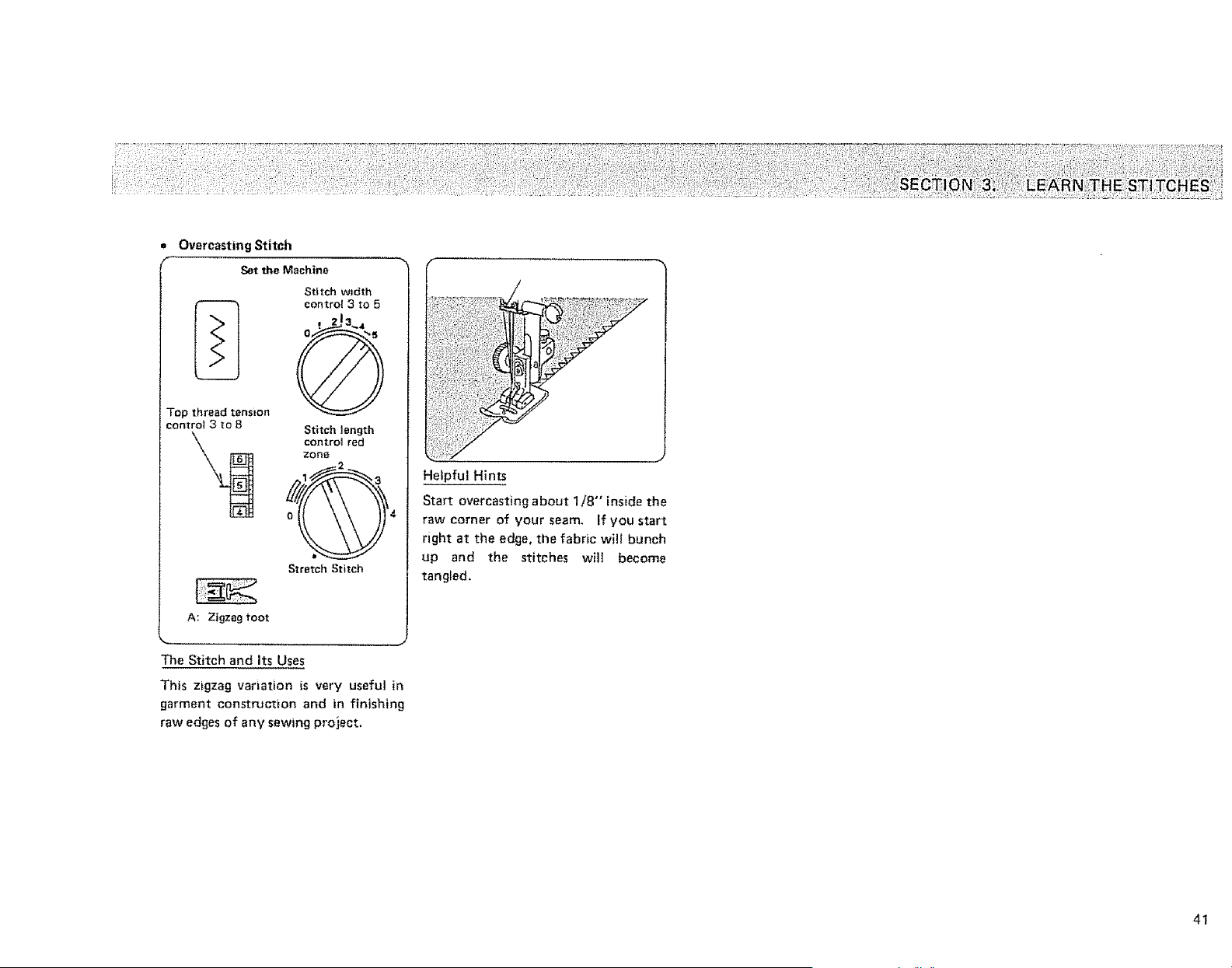
= Overcasting Stitch
Set the Machine
Stitch wldth
control 3 to 5
Top thread tension
contro] 3 to 8 Stitch length
control red
zone
2
Stretch Stitch
A: Zigzag toot
The Stitch and Its Uses
This zigzag variation is very useful in
garment construction and in finishing
raw edges of any sewing project,
Helpful Hints
Start overcasting about 1/8"" inside the
raw corner of your seam. If you start
right at the edge, the fabric will bunch
up and the stitches wil] become
tangled.
41
• Blind Hemming
Set the Machine
Stitch width
Top thread tension
eontro} 2 to 6
A: Zigzag foot
Stitch length
contro} red
zone
Stretch Stitch
Light
Wmght
FabrLc
Heavy
Weight
Fabric
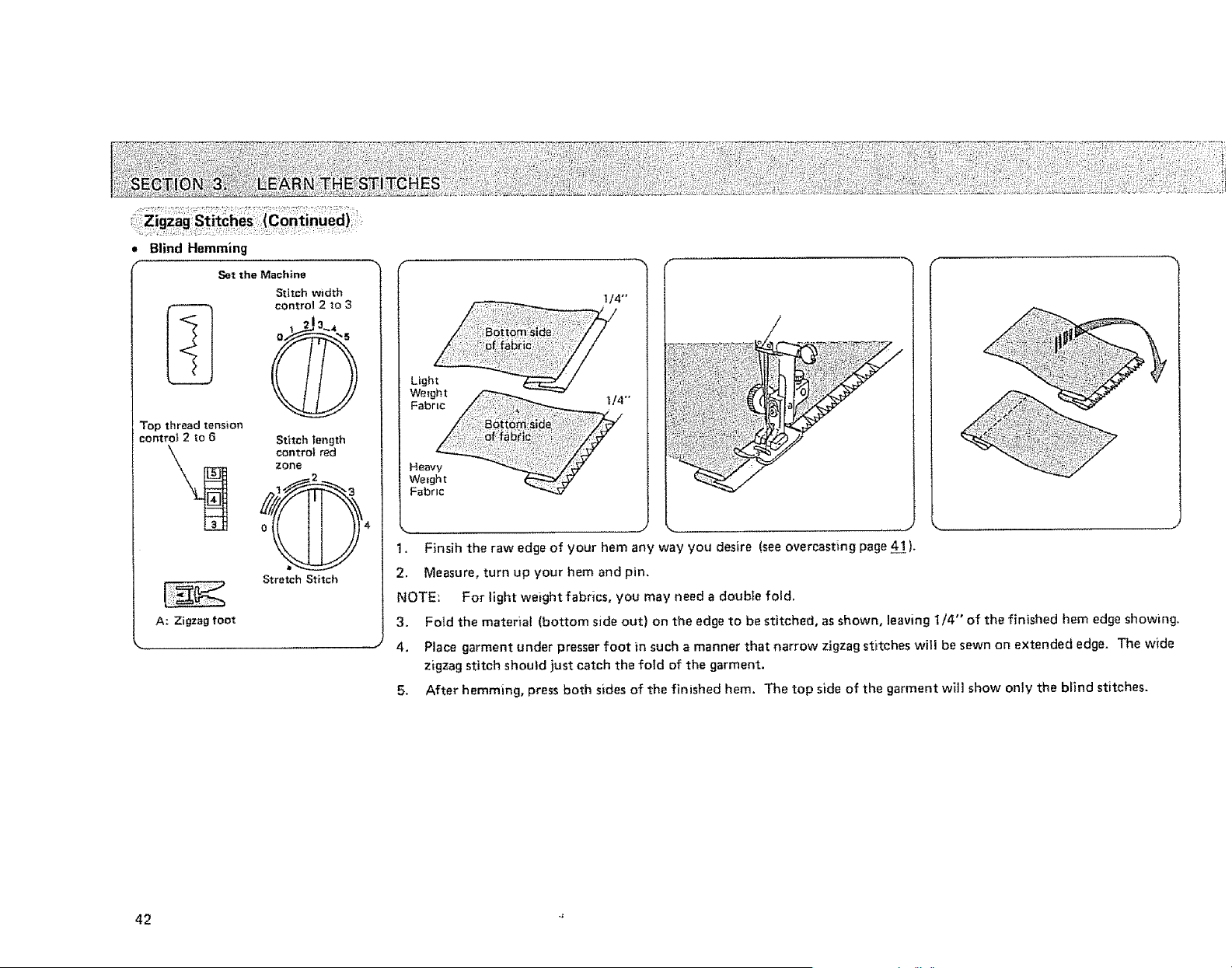
1. Finsih the raw edge of your hem any way you desire (see overcasting page 41 ).
2. Measure, turn up your hem and pin,
NOTE: For light weight fabrics, you may need a double fold.
3. Fold the material (bottom side out) on the edge to be stitched, as shown, leaving 1/4" of the finished hem edge showing.
4. Place garment under presser foot in such a manner that narrow zigzag stitches will be sewn on extended edge. The wide
zigzag stitch should just catch the fotd of the garment.
5. After hemming, press both sides of the finished hem. The top side of the garment will show only the blind stitches.
42 _'
LaceWork
Set the Machine
Stitch w=dth
Fop thread tenston
control :2to 6
A: Zigzag toot
Stitch length
con_rot !
Stretch Stitch
,,J
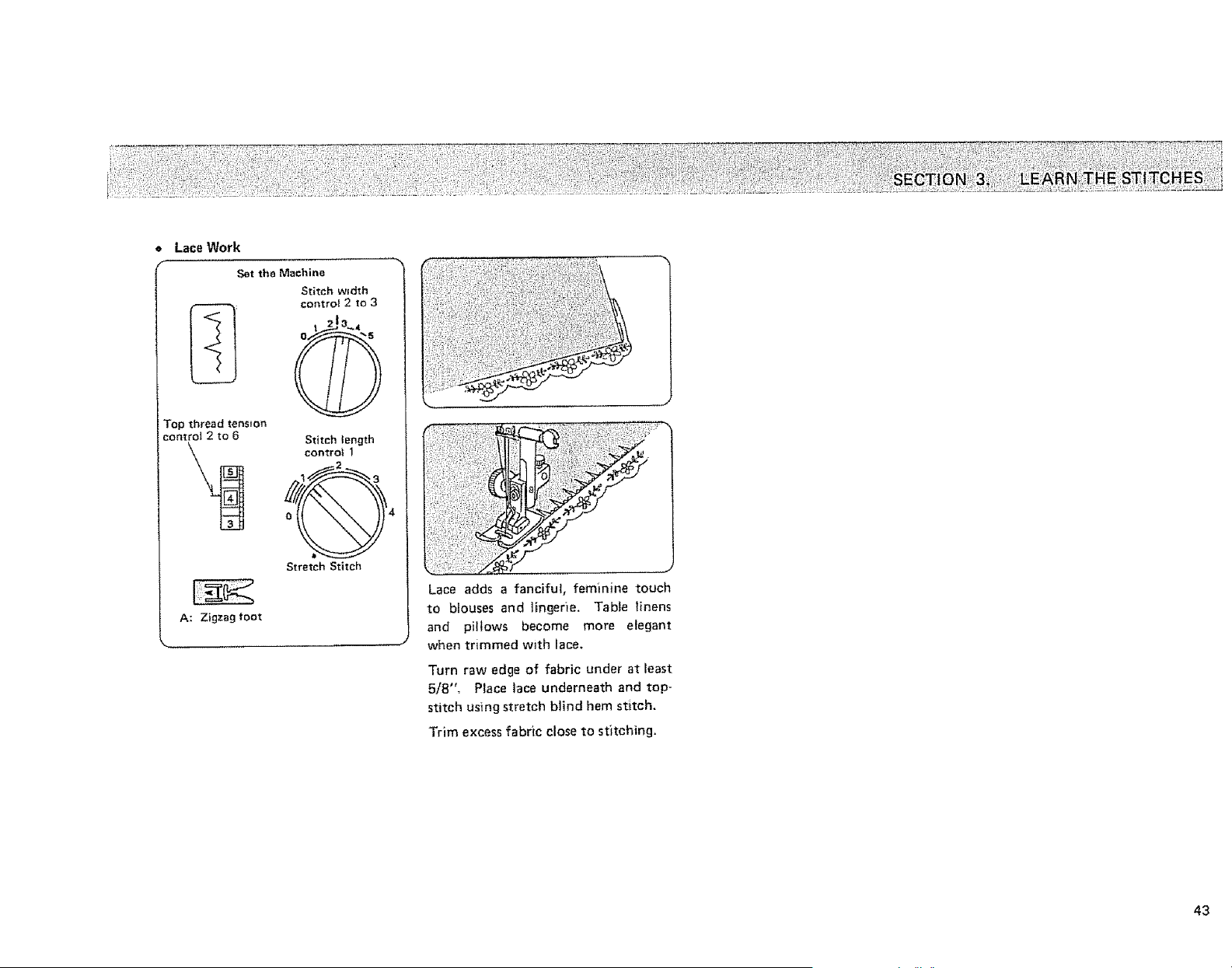
Lace adds a fanciful, feminine touch
to biouses and lingerie. Table /_nens
and pillows become more elegant
when trimmed w+th lace.
Turn raw edge of fabric under at least
5/8"+ Place lace underneath and top-
st+tch using stretch blind hem stitch.
Trim excess fabdc close to stitching.
43
Three-Step Zigzag
Set the Machine
Fop thread tension
control 2 to 6
A: Zigzag foot
Stitch w_dth
control 5
Stitch length
control 0,5 to 1
2
Stretch Stitch
%., J
The Stitch and Its Uses
The three-step zigzag is a combination
zigzag and straight stitch. You may
use the three-step zigzag evervwhere
you would use the basic zigzag stitch.
It has more strength, elasticity, and is
flatter than a regular zigzag.
The three-step zigzag stitch is especial-
ly useful for:
- mending
-- sewing patches smoothly and
securely
- repairing straight tears
- finishing seams
44
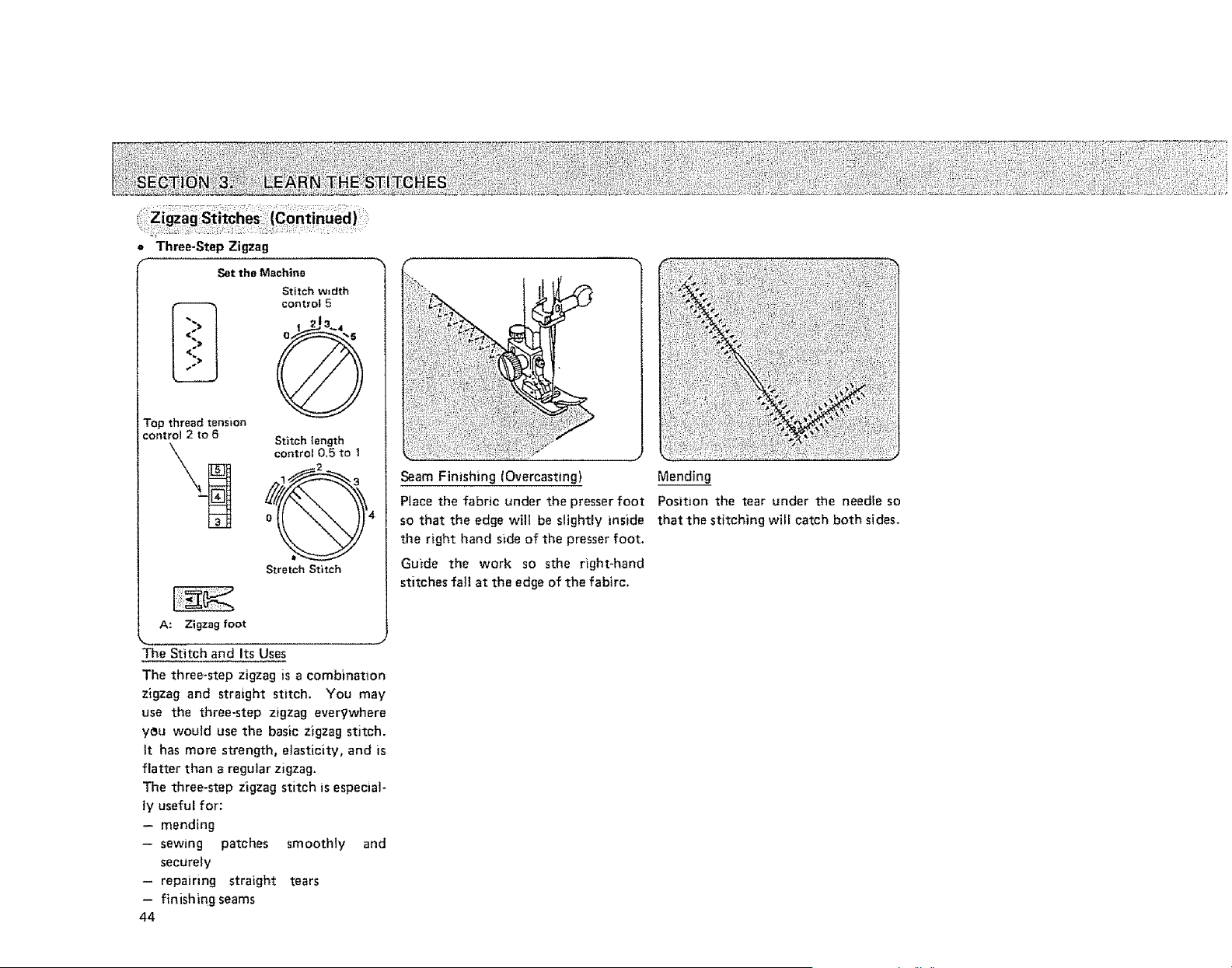
Seam Finishing !Overcasting)
Place the fabric under the presser foot
so that the edge will be slightly inside
the right hand side of the presser foot,
Guide the work so sthe right-hand
stitches fall at the edge of the fablrc.
Mending
Position the tear under the needle so
that the stitching will catch both sides,
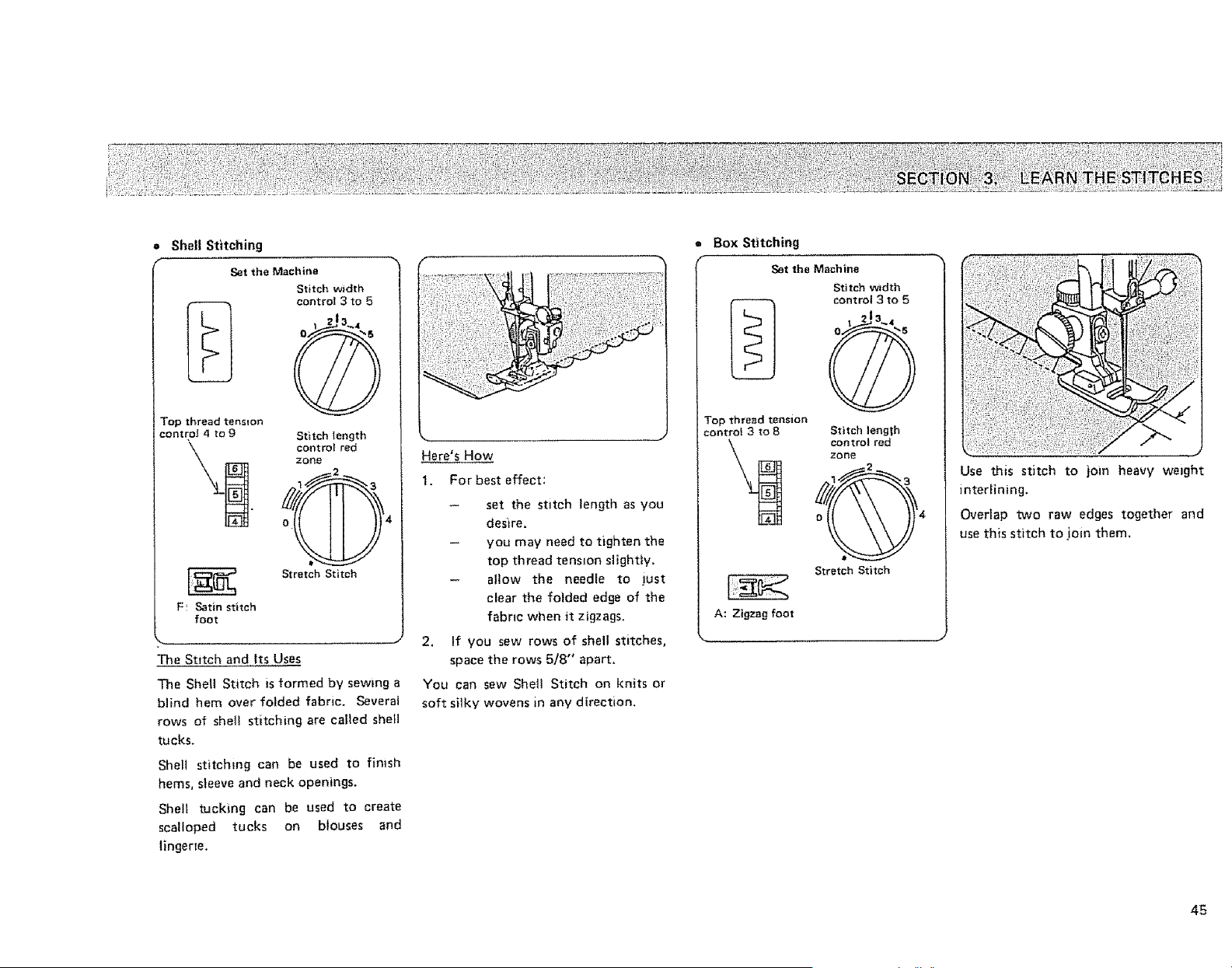
* Shelt Stitching
Set the Machine
Stitch w=dth
Top thread tension
control 4 to 9
Stitch Iength
control red
Zone
O_ 4
Stretch Stitch
F: Satin stitch
foot
The Stitch and its Uses
The Shetl Stitch is formed by sewing a
blind hem over folded fabric. Several
rows of shetl stitching are called shetl
tucks.
Shelt stitching can be used to finish
hems, sleeve and neck openings.
Shell tucking can be used to create
scalloped tucks on blouses and
lingerteo
Here's How
1. For best effect:
-- set the stitch length as you
desire.
- you may need to tighten the
top thread tension slightly.
-- allow the needle to iust
clear the folded edge of the
fabric when it zigzags.
2. If you sew rows of shell stitches,
space the rows 5/8" apart,
You can sew Shell Stitch on knits or
soft silky wovens in any direction.
Box Stitching
top thread tension
control 3 to 8
A: Zigzag foot
Set the Machine
Stitch w_dth
control 3 to 5
Stitch lenglh
control red
zon_
Stretch Stitch
....... )
Use this stitch to join heavy weight
interlining.
Overlap two raw edges together and
use this stitch to ioin them.
45
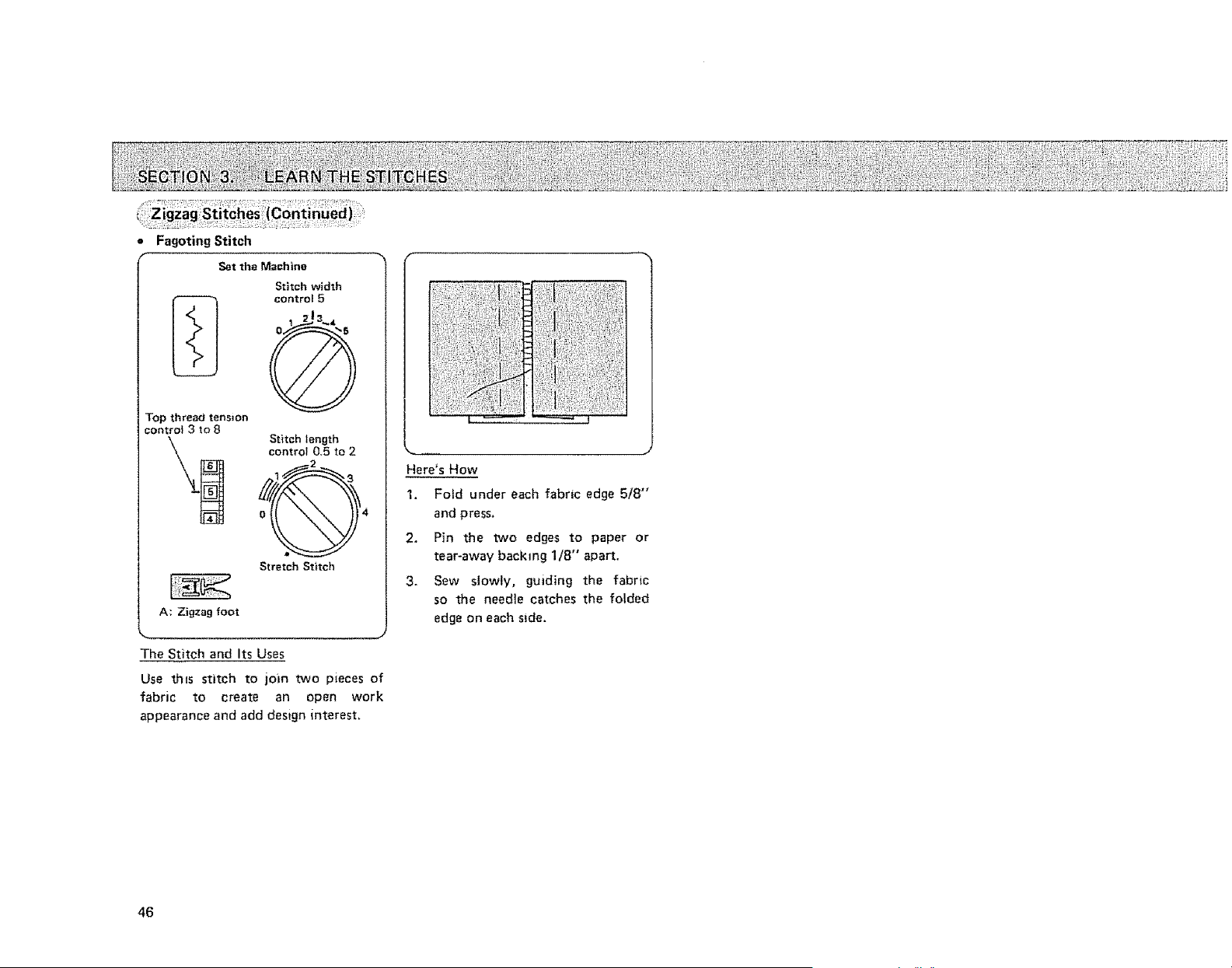
Fagoting Stitch
Set the Machine
Stitch width
control 5
G
Top thread tension
control 3 to 8
A: Zigzag foot
Stitch length
control 0.5 to 2
2
Stretch Stitch
The Stitch and Its Uses
Use this stitch to join two pieces of
fabric to create an open work
appearance and add design interest,
Here's How
1. Fold under each fabric edge 5/8"
and press,
2. Pin the two edges to paper or
tear-away backing 1/8" apart,
3. Sew slowly, guiding the fabric
so the needle catches the folded
edge on each ssde.
46
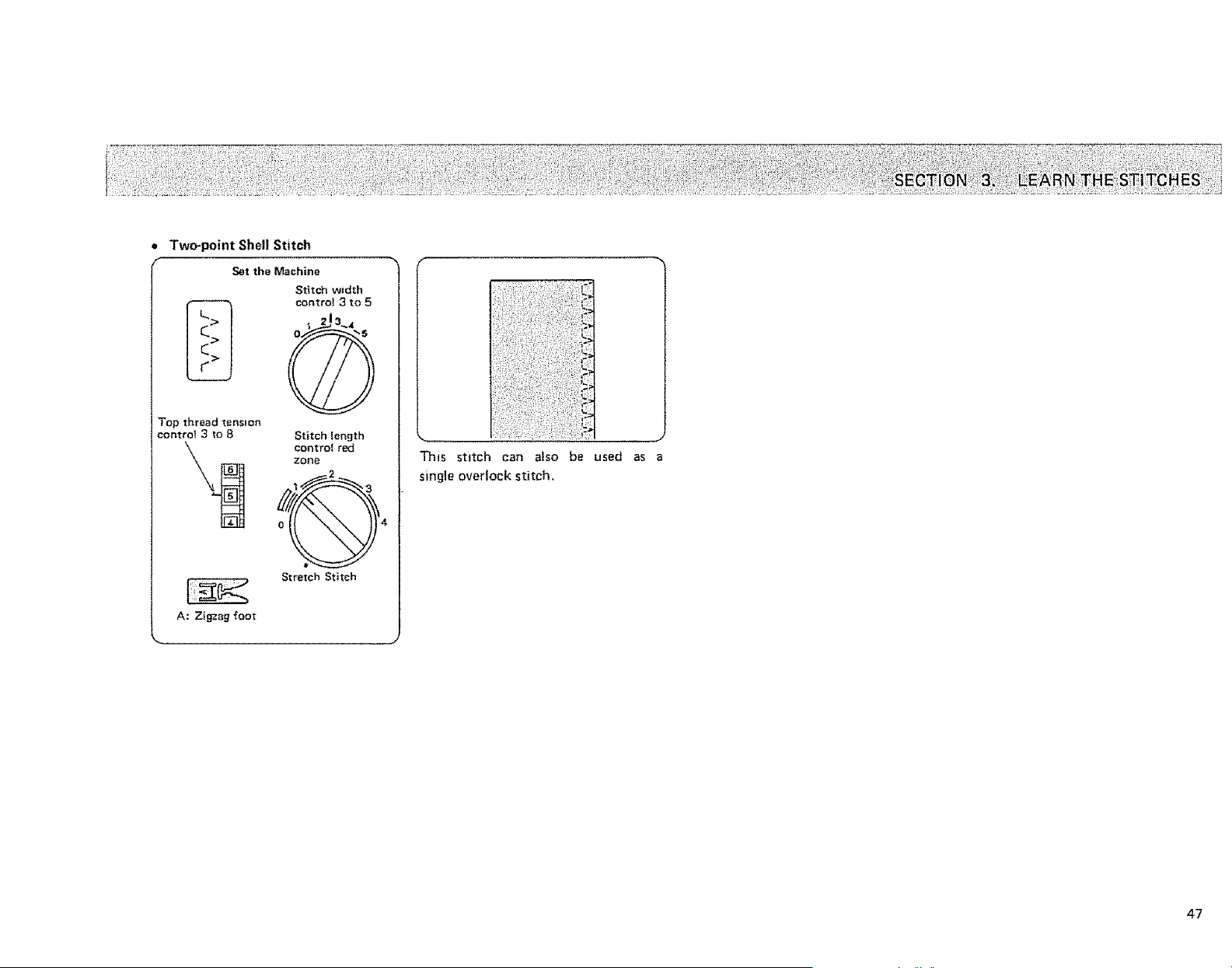
Two-point Shell Stitch
Set the Machine
Fop thread tension
control 3 to 8
Stitch w_dth
control 3 to 5
Stitch length
controi red
Zone
Stretch Stitch
This stitch can atso be used as
single overfock stitch.
47
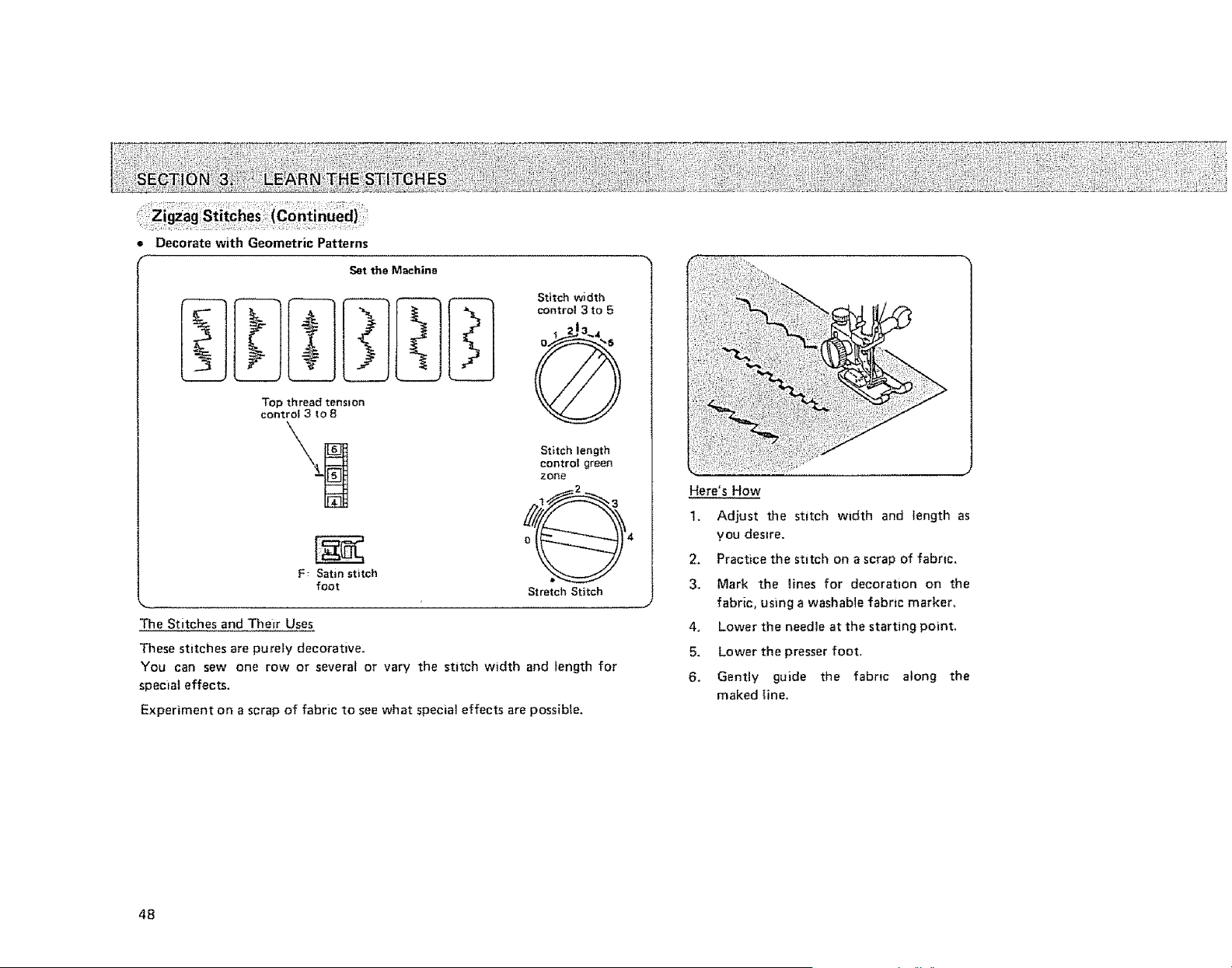
Decorate with Geometric Patterns
Set the Machine
Top thread tension
control 3 to8
F: Satin stitch
foot
Stitch width
cOntrol 3 to 5
Stitch length
contro! green
ZOne
4
Stretch Stitch
The Stitches and Thmr Uses
These stitches are purely decorative.
You can sew one row or several or vary the stitch width and fength for
special effects.
Experiment on a scrap of fabric to see what special effects are possible.
Here's How
1. Adjust the stitch width and length as
you destre.
2. Practice the stitch on a scrap of fabr}c.
3. Mark the lines for decoration on the
fabric, using a washable fabric marker.
4. Lower the needle at the starting point.
5. Lower the presser foot.
6. Gently guide the fabric along the
maked line.
48
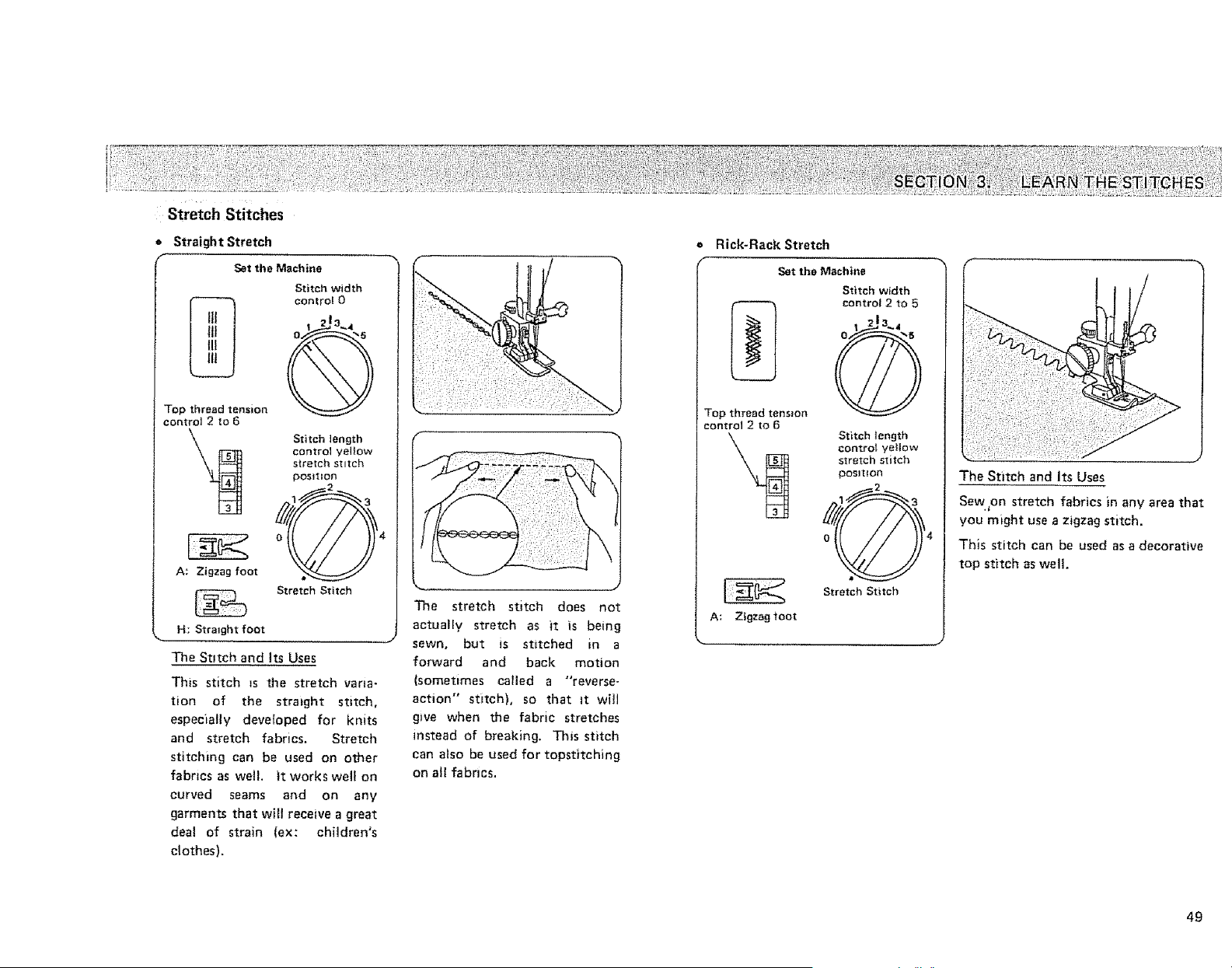
stretch Stitches
Straight Stretch
Sat the Machine
Top thread tension
control 2 to 6
Stitch width
control 0
G
Stitch length
control yellow
stretch stitch
pos_t_on
2
A; Zigzag foot
Stretch Stitch
H: Straight foot
The Stltch and its Uses
This stitch is the stretch vane-
tion of the straight stitch,
espemally developed for knits
and stretch fabrics, Stretch
stitching can be used on other
fabrics as well. tt works well on
curved seams and on any
garments that will receive a great
deal of strain (ex: children's
clothes).
The stretch stitch does not
actually stretch as _t is being
sewn, but is stitched =n a
forward and back motion
(sometimes called a "reverse-
action" st=tch), so that _t will
gwe when the fabric stretches
instead of breaking, This stitch
can also be used for topst_tching
on all fabrics.
Rick-Rack Stretch
Set the Machine
Stitch width
control 2 to 5
Top thread tension
control 2 to 6
A: Zigzag toot
Stitch length
centre| yellow
strstch stitch
position
Stretch Stitch
The Stitch and Its Uses
Sew on stretch fabrics in any area that
you might use a zigzag stitch.
This stitch can be used as a decorative
top stitch as well.
49
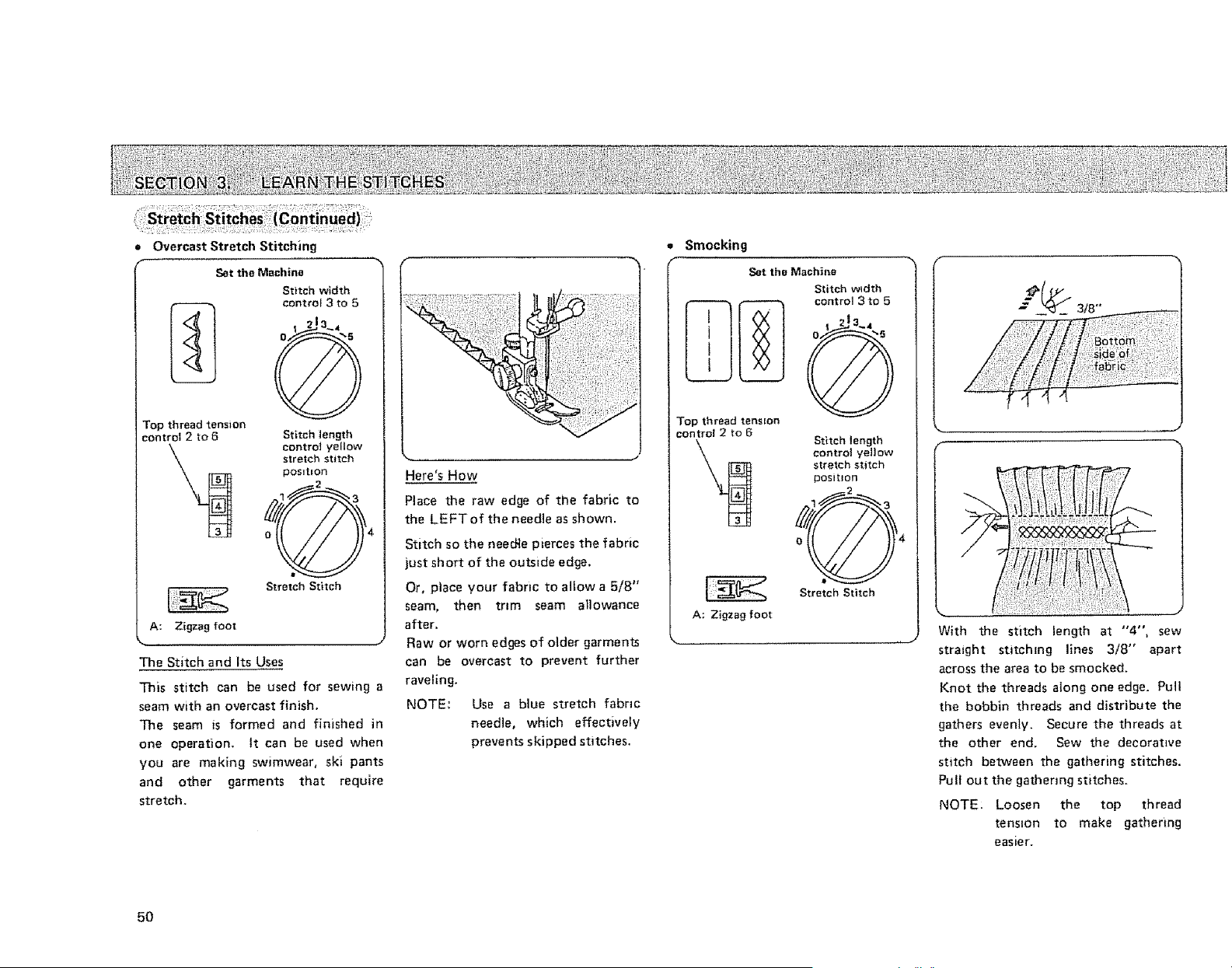
• Overcast Stretch Stitching
Top thread tension
control 2 to 6
A: Zigzag foot
Set the Machine
Stitch width
controf 3 to 5
Stitch length
contro_ yellow
stretch stitch
posit=on
Stretch Stitch
The Stitch and Its Uses
This stitch can be used for sewing a
seam with an overcast finish,
The seam is formed and finished in
one operation. It can be used when
you are making swimwear, ski pants
and other garments that require
stretch.
Here's How
Place the raw edge of the fabric to
the LEFTof the needle as shown.
Stitch so the needle pierces the fabric
just short of the outside edge.
Or, place your fabric to allow a 5/8"
seam, then tnm seam aIIowance
after.
Raw or worn edges of older garments
can be overcast to prevent further
raveling.
NOTE: Usa a blue stretch fabric
needle, which effectively
prevents skipped stitches.
Smocking
Set the Machine
Stitch w*dth
Top thread tension
control 2 to 6
A: Zigzag foot
Stitch length
control ye]Jow
stretch stitch
posit_on
Stretch Stitch
With the stitch length at "4", sew
straight stitchtng lines 3/8" apart
across the area to be smocked.
Knot the threads along one edge. Pull
the bobbin threads and distribute the
gathers evenly. Secure the threads at
the other end. Sew the decorative
stitch between the gathering stitches.
Pull out the gathering stitches.
NOTE: Loosen the top thread
tension to make gathenng
easier.
5O
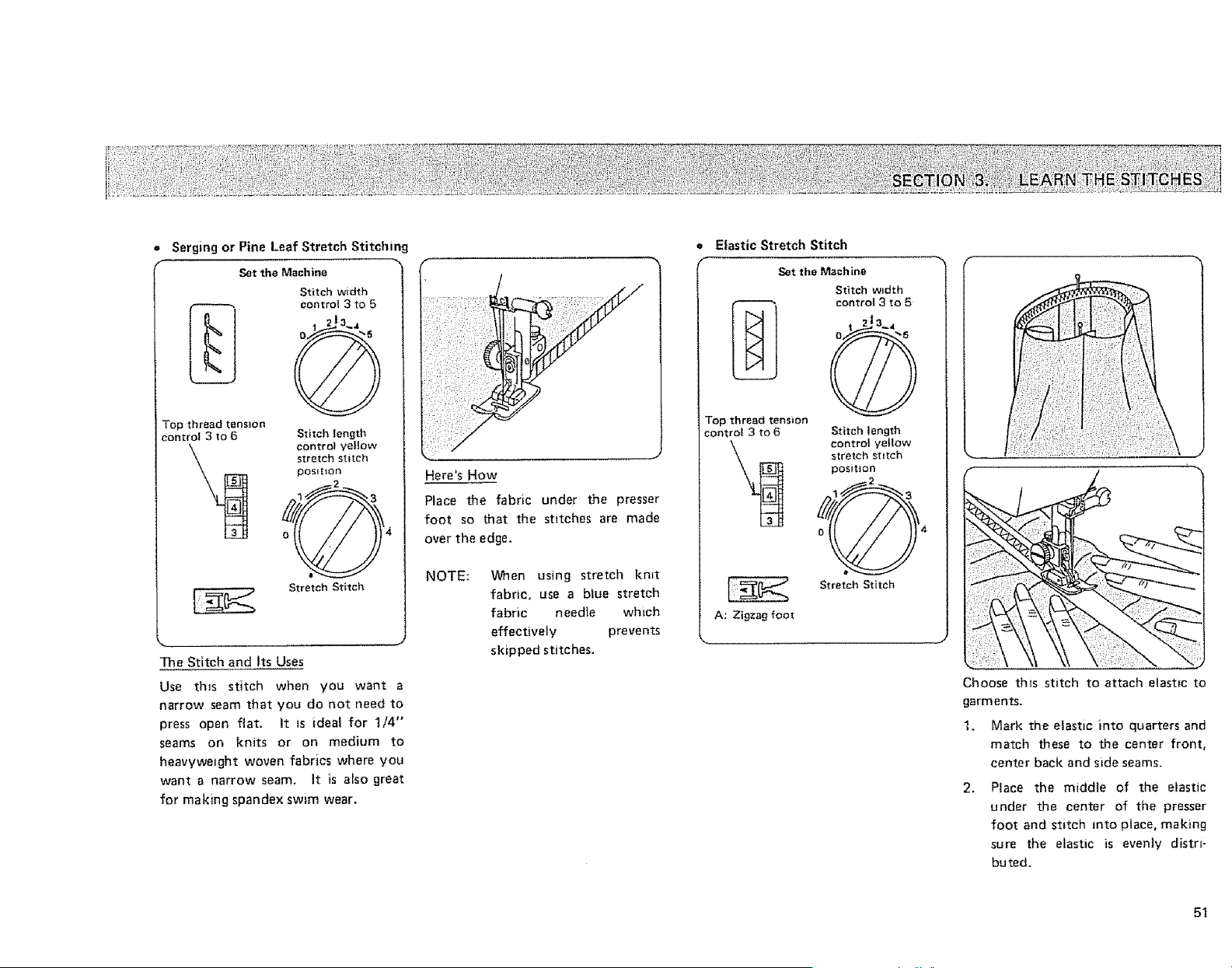
Serging or Pine Leaf Stretch Stitchin
Set the Machine
Stitch width
control 3 to 5
Top thread tension
control 3 to 6
Stitch length
control yellow
stretch stitch
position
StretCh Stitch
The Stitch and Its Uses
Use thJs stitch when you want a
narrow seam that you do not need to
press open flat. It is ideal for t/4"
seams on knits or on medium to
heavyweight woven fabrics where you
want a narrow seam. It is also great
for making spandex swim wear.
Here's How
Place the fabric under the presser
foot so that the stitches are made
overthe edge.
NOTE: When using stretch kmt
fabric, use a blue stretch
fabric needle which
effectively prevents
skipped stitches.
Elastic Stretch Stitch
Top thread tension
controf 3 to 6
A: Zigzag foot
Set the Machine
Stitch w_dth
control 3 to 5
Stitch length
control yellow
stretch stitch
position
Stretch Stitch
Choose this stitch to attach elastic to
garments.
1. Mark the elastic into quarters and
match these to the center front,
center back and side seams.
2. Place the middle of the elastic
under the center of the presser
foot and stitch into place, making
sure the e_astic is evenly distri-
buted.
5I
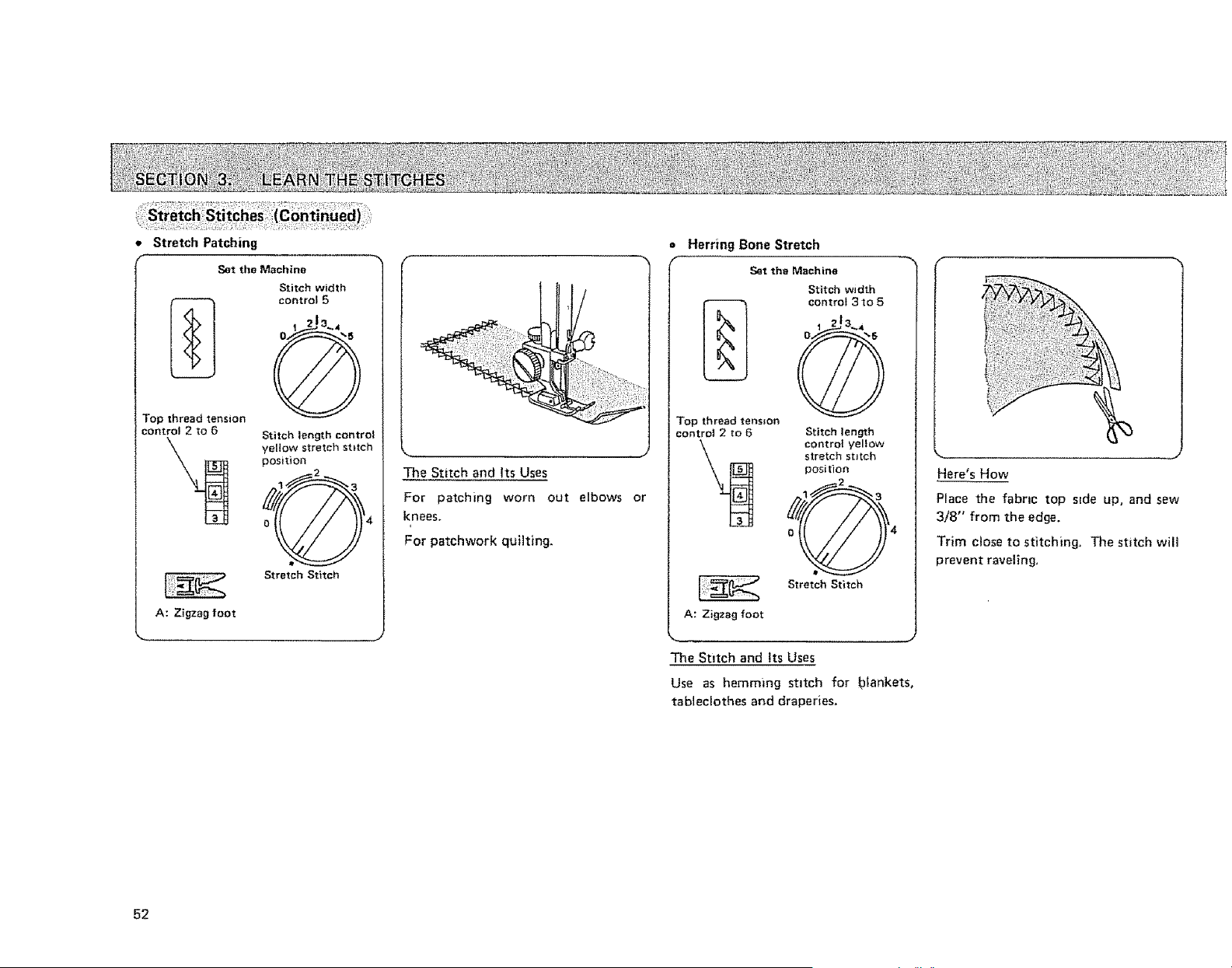
• Stretch Patching
Set the Machine
Top thread tension
control 2 to 6
A: Zigzag foot
Stitch width
control 5
Stitch length centre
yellow stretch stitch
position
Stretch Stitch
The Stitch and its Uses
For patching worn out elbows or
knees.
For patchwork quilting.
e
Herring Bone Stretch
Top thread tension
control 2 to 6
A: Zigzag foot
Set the Machine
Stitch width
control 3 to 5
Stitch length
control yellow
stretch stitch
position
2
Stretch Stitch
"]'he Stitch and Its Uses
Use as hemming stitch for blankets,
tableclothes and draperies.
Herds How
Place the fabric top side up, and sew
3/8" from the edge.
Trim close to stitching, The stitch will
prevent raveling,
52
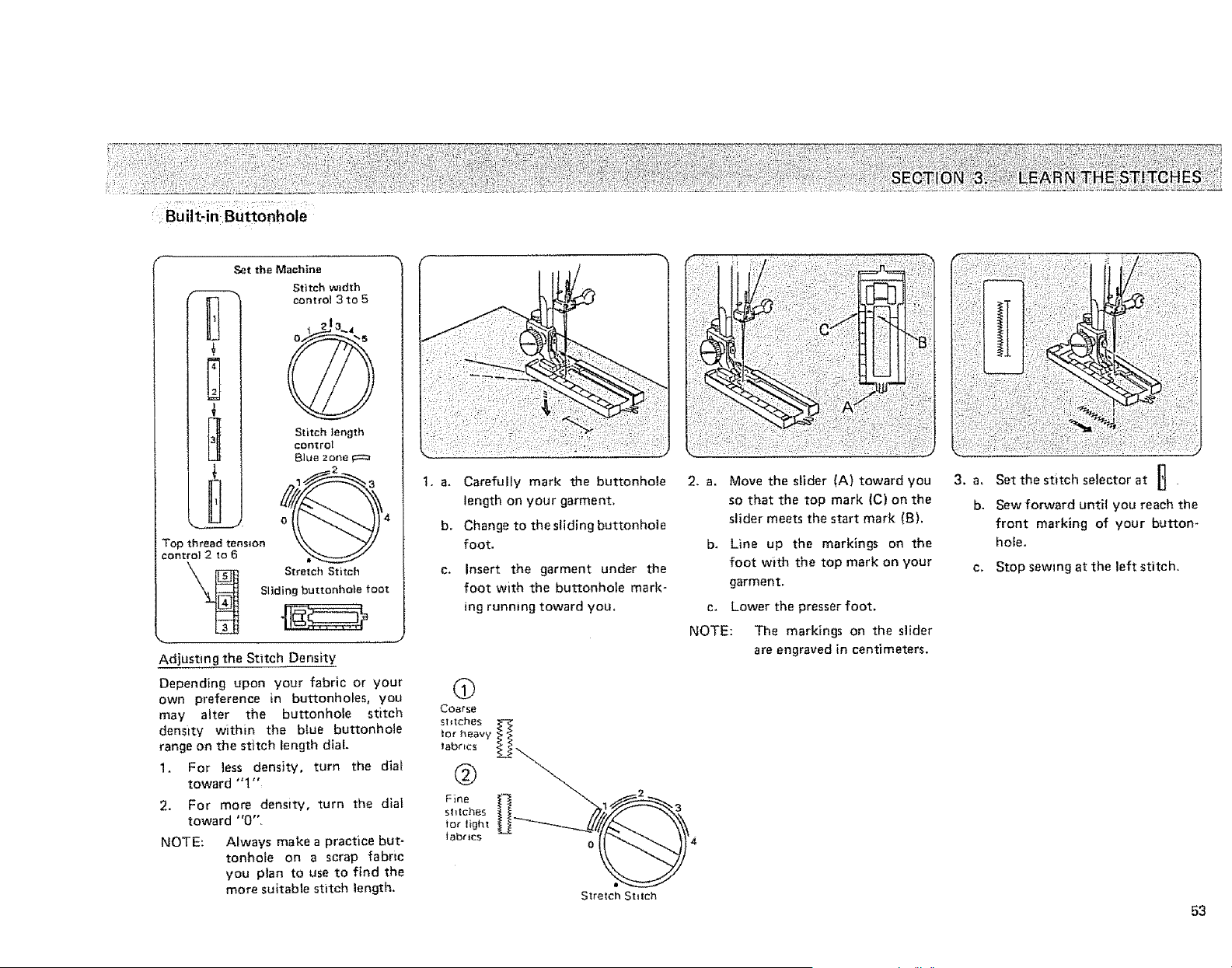
7 i: -¸¸:¸// _ _t-::!i :¸_: :':- _: ::
Built4n Buttonhole
Set the Machine
b! !
II I I
14
m i
1! I
Top thread tension
control 2 to 6
Stitch w_dth
control 3 to 5
Stitch length
control
Blue zone €:==
2
Stretch Stitch
Sliding buttonhole foot
Adjusting the Stitch Density
Depending upon your fabric or your
own preference _n buttonholes, you
may alter the buttonhole stitch
density within the blue buttonhole
range on the stitch length dial
1. For less density, turn the diat
toward "1"
2, For more density, turn the dial
toward "0".
NOTE: Always make a practice but-
tonhole on a scrap fabric
you plan to use to find the
more suitable stitch length.
1. a,
Carefully mark the buttonhole
length on your garment.
b. Change to thesliding buttonhole
foot,
c. Insert the garment under the
foot with the buttonhole mark-
ing running toward you,
S_reteh Stitch
2, a,
NOTE:
Move the slider (A) toward you
so that the top mark (C) on the
slider meets the start mark (B),
b, Line up the markings on the
foot wtth the top mark on your
garment,
c. Lower the presser foot,
The markings on the slider
are engraved in centimeters,
<
3. a,
b.
C,
Iq
Set the stitch selector at 1] .
Sew forward until you reach the
front marking of your button-
hole.
Stop sewing at the left stitch,
53
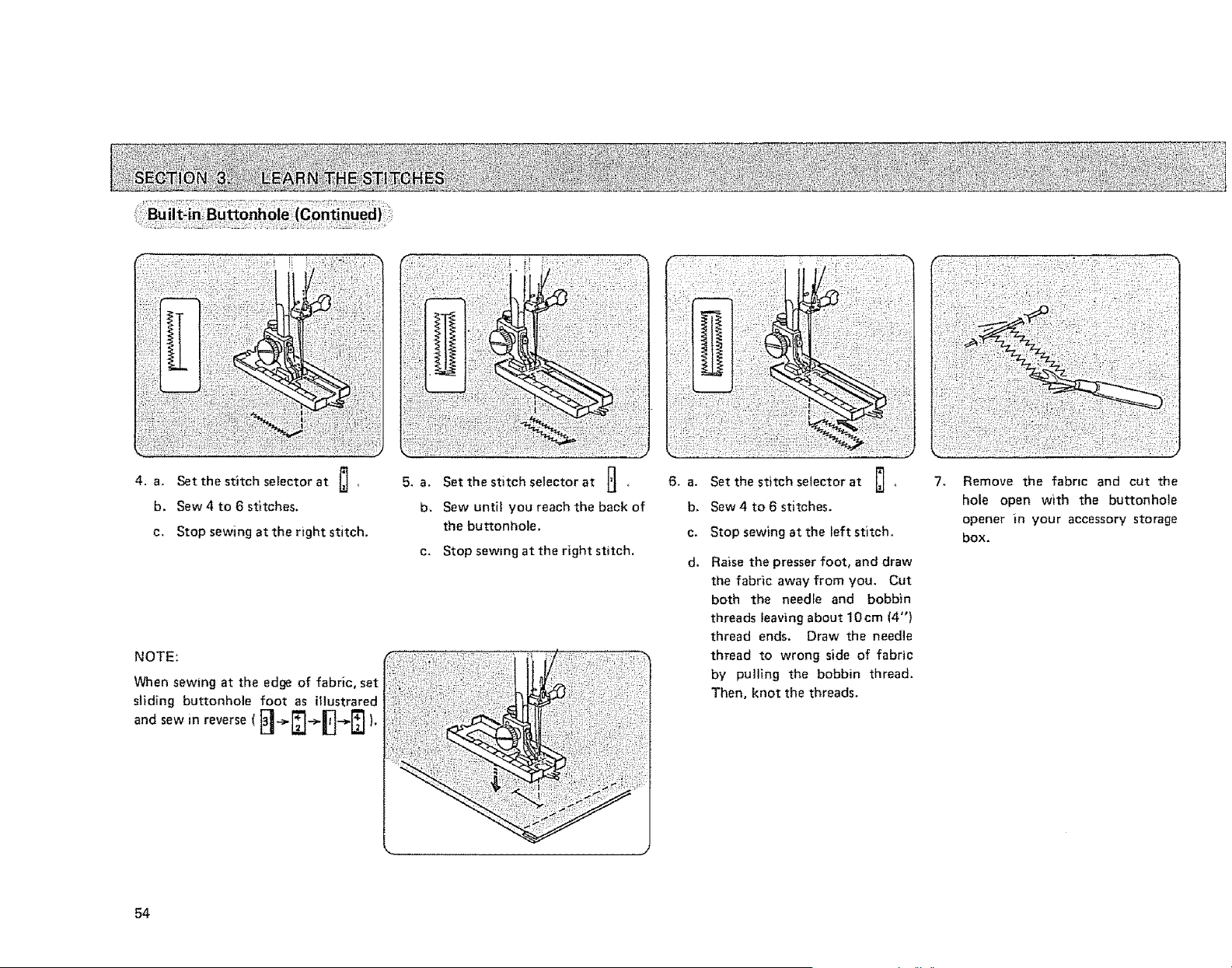
m
4. a, Set the stitch selector at _ ,
b. Sew 4 to 6 stitches.
c. Stop sewing at the right stitch,
NOTE:
When sewing at the edge of fabr}c, set
stiding buttonhole foot as iflustrared
and sew in reverse ( _-_ F_-_]-_l ).
F1
5. a, Set the stitch selector at _ . 6. a.
b, Sew until you reach the back of b,
the buttonhole.
c.
c. Stop sewing at the r_ght stitch.
d.
Set the stitch setector at [_ ,
Sew 4 to 6 stitches.
Stop sewing at the left stitch.
Raise the presser foot, and draw
the fabric away from you. Cut
both the needle and bobbin
threads leaving about lOcm (4")
thread ends. Draw the needle
thread to wrong side of fabric
by pulling the bobbin thread.
Then, knot the threads.
7. Remove the fabnc and cut the
hole open with the buttonhole
opener _n your accessory storage
box.
54
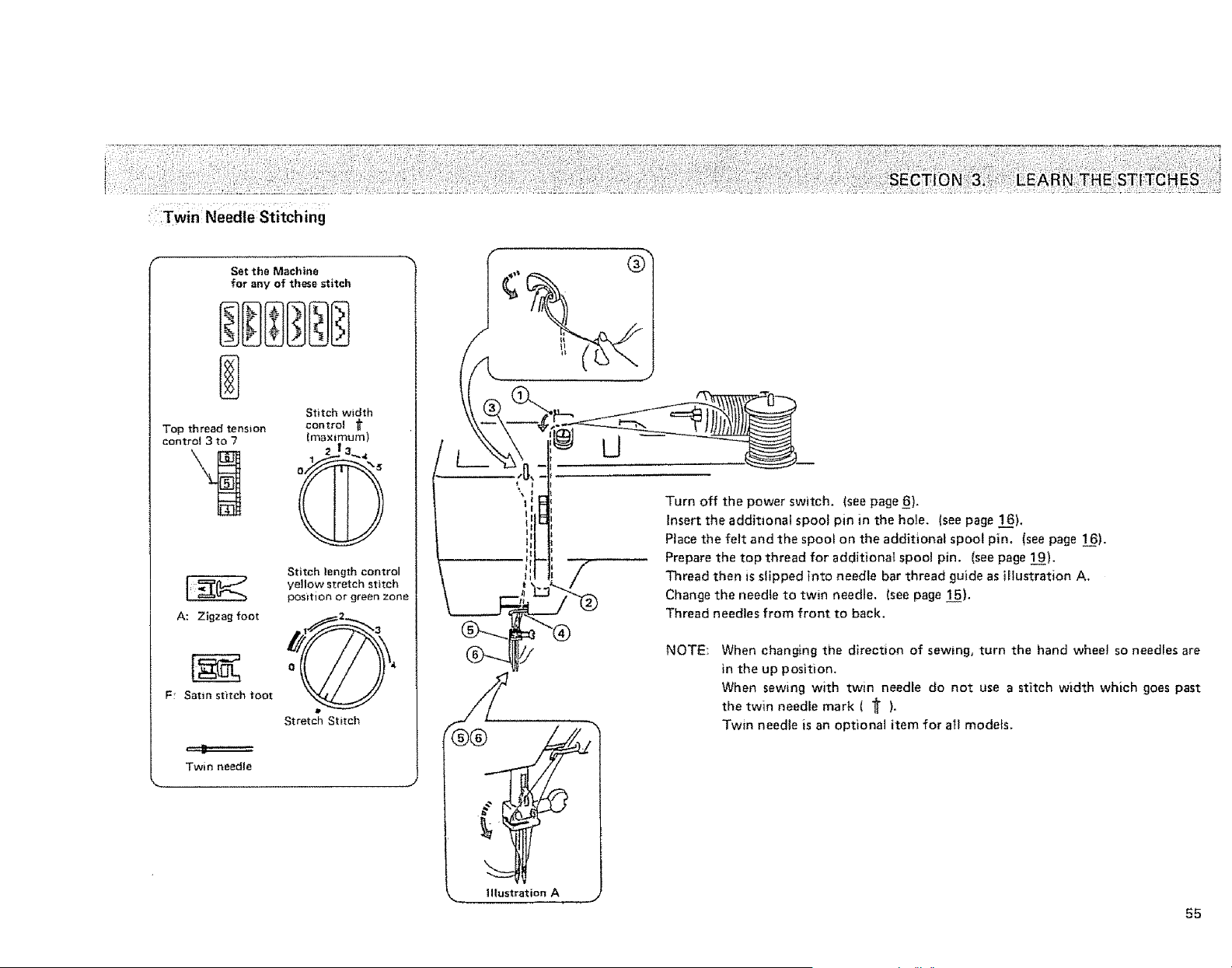
:Twin Needle Stitch ing
Set the Machine
for any of these stitch
Top thread tension
control 3 to "7
Stitch width
control
lma×imum}
1 2 f 3..4
A: Zigzag foot
F! Satin stitch toot
Stitch length control
yellow stretch stitch
positlOn or green zone
Stretch Stitch
_=t=======
Twin needle
............... J
t
"I!Itj_l__ Turn off the power switch. (see page 6).
Insert the additional spool pin in the hole. (see page 16).
;t Place the felt and the spool on the additional spool pin. {see page 1 6).
t' Prepare the top thread for additional spool pin. (see page 19}.
"11
l', Thread then is slipped into needle bar thread guide as illustration A.
\ '/-%
--_ _ Change the needle to twin needle. (see page 151.
L__(_) 2_ Thread needles from front to back.NOTE: When changing the direction of sewing, turn the hand wheel so needles are
in the up position.
When sewing with twin needle do not use a stitch width which goes past
the twin needle mark ( _ }.
Twin needle is an optional item for alt modefs.
I Ilustrat ion A
55
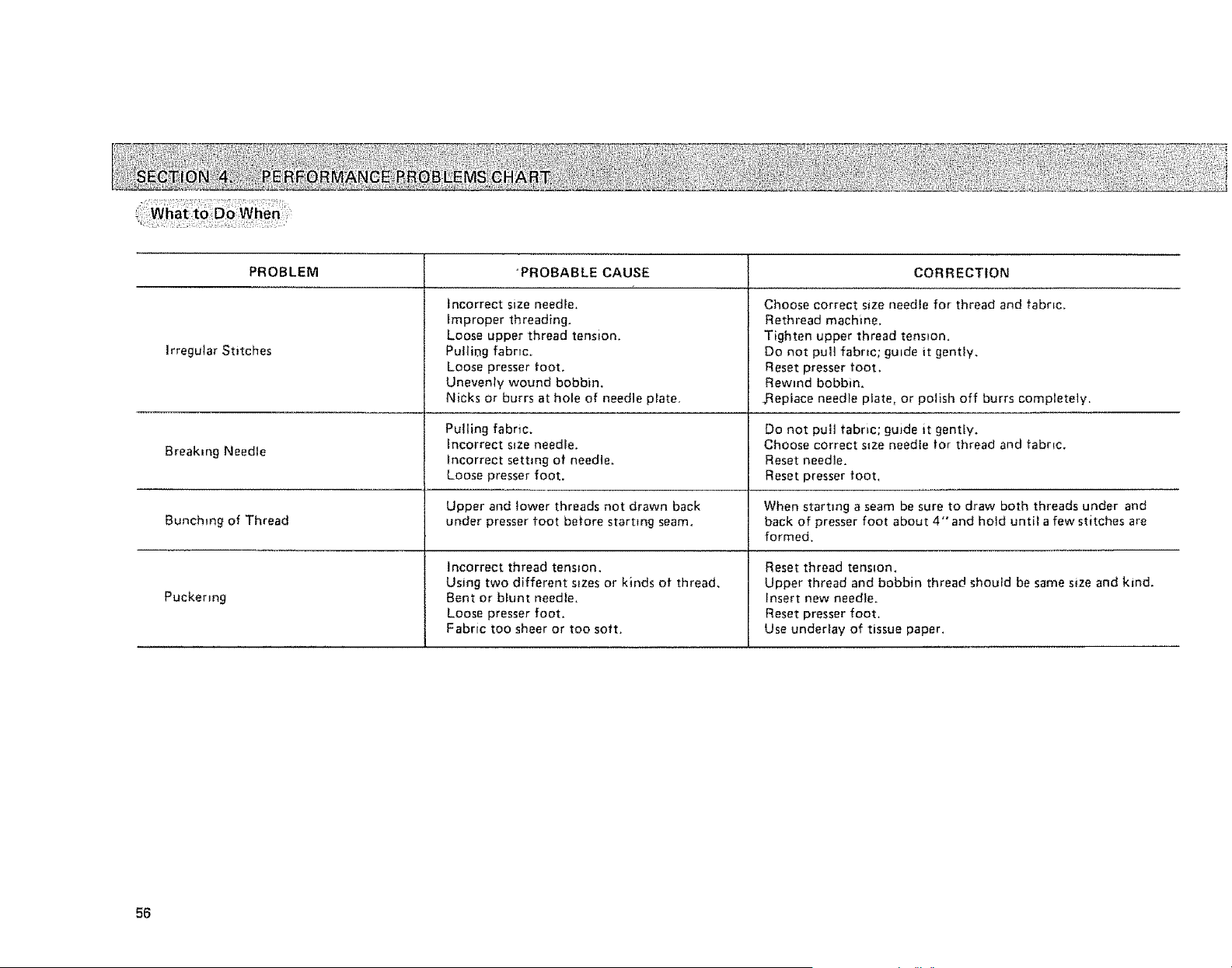
Irregular Stitches
PROBLEM
Breaking Needle
Bunching of Thread
Puckering
"PROBABLE CAUSE
Incorrect size needle.
Improper threading.
Loose upper thread tension.
Puilieg fabric.
Loose presser toot.
Unevenly wound bobbin.
Nicks or burrs at hole of needle plate.
Puiling fabric.
Incorrect s_ze needle.
_ncorrect setting of needle.
Loose presser foot.
Upper and lower threads not drawn back
under presser toot before starting seam.
Incorrect thread tension.
Using two different sizes or kinds of thread,
Bent or b_unt needle,
Loose presser foot.
Fabric too sheer or too soft.
CORRECTION
Choose correct size needle for thread and fabric.
Rethread machine.
Tighten upper thread tension.
Do not pull fabric; guide it gently,
Reset presser foot.
Rewind bobbin.
_Reptace needle plate, or polish off burrs completely.
Do not pull fabric; guide it gently.
Choose correct s_ze needle for thread and fabric.
Reset needle.
Reset presser toot.
When starting a seam be sure to draw both threads under and
back of presser foot about 4" and hold until a few stitches are
formed,
Reset thread tension.
Upper thread and bobbin thread should be same size and kind.
Insert new needle_
Reset presser foot.
Use underlay of tissue paper.
56
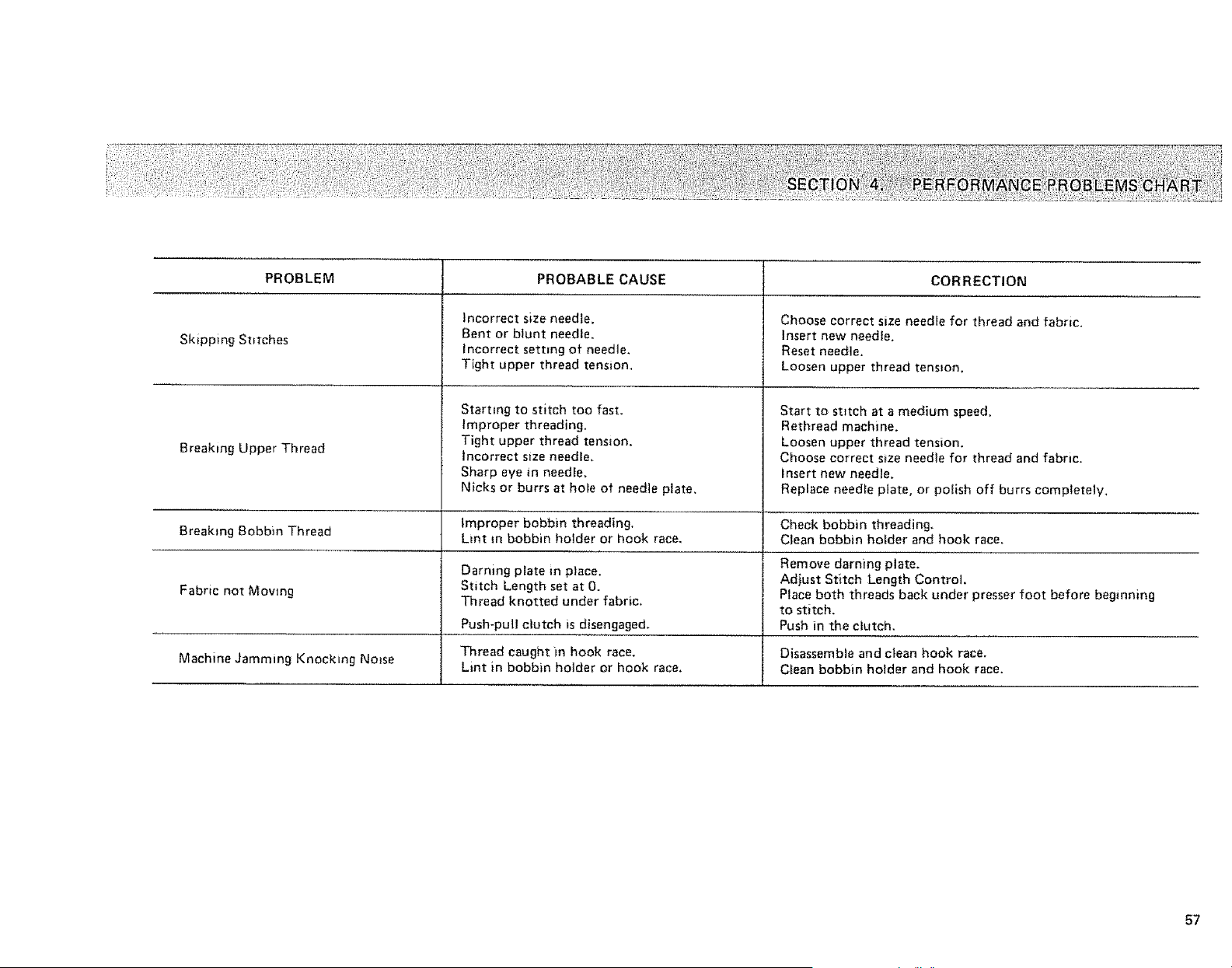
PROBLEM
Skipping Stitches
Breaking Upper Thread
PROBABLE CAUSE
Incorrect size needle.
Bent or blunt needle,
incorrect setting of needle,
Tight upper thread tension,
Starting to stitch too fast.
Improper threading.
Tight upper thread tension.
_ncorrect size needle.
Sharp eye in needle.
Nicks or burrs at ho_e of needle plate.
CORRECTION
Choose correct size needle for thread and fabric.
Insert new needle,
Reset needle.
Loosen upper thread tension.
Start to stitch at a medium speed,
Rethread machine.
Loosen upper thread tension.
Choose correct size needle for thread and fabric.
insert new needle.
Replace needle plate, or polish off burrs completely,
Improper bobbin threading. Check bobbin threading.
Breaking 8obbin Thread Lint m bobbin hotder or hook race, Clean bobbin holder and hook race.
Darning plate in place, Remove darning plate.
Fabric not Moving Stitch Length set at 0. Adiust Stitch Length Control,
Thread knotted under fabric+ Place both threads back under presser foot before beginning
to stitch.
Push-pull clutch is disengaged. Push in the clutch.
Thread caught m hook race. Disassemble and clean hook race.
Machine Jamming Knocking Noise Lint in bobbin holder or hook race, Clean bobbin holder and hook race.
57
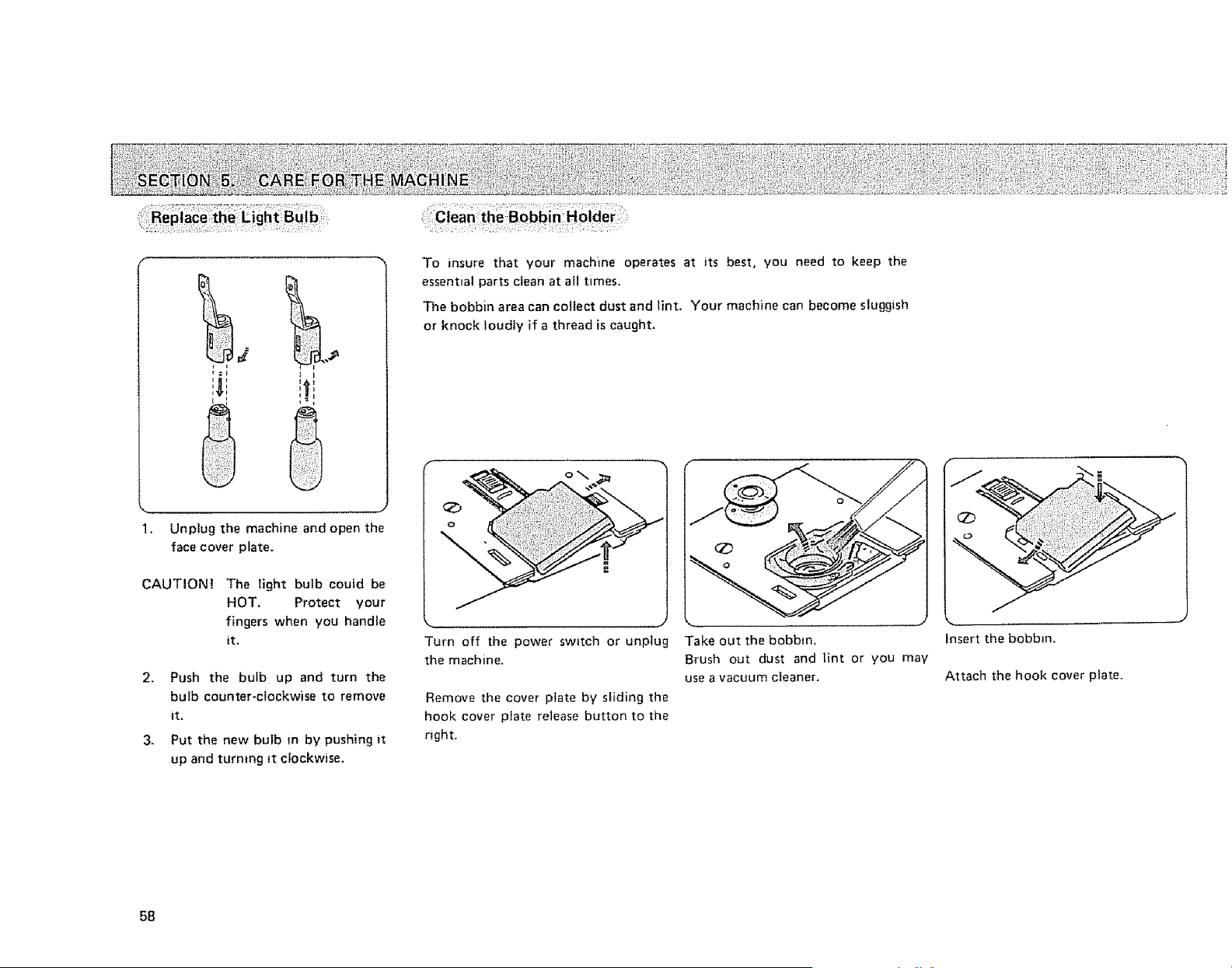
1,
'1'
'I II
Unplug the machine and open the
face cover plate.
CAUTION!
The light bulb could be
HOT. Protect your
fingers when you handle
it.
2+ Push the bulb up and turn the
bulb counter-clockwise to remove
It.
Put the new bulb in by pushing it
up and turning +t clockwise.
To insure that your mach}ne operates at its best, you need to keep the
essential parts clean at all times.
The bobbin area can collect dust and tint. Your machine can become sluggish
or knock loudly if a thread is caught.
Turn off the power sw_tch or unplug Take out the bobbm.
the machine. Brush out dust and lint or you may
use a vacuum cleaner.
Remove the cover plate by sliding the
hook cover plate release button to the
right.
Insert the bobbin.
Attach the hook cover plate.
58
!iiOiii !i e!iM ¸i eii
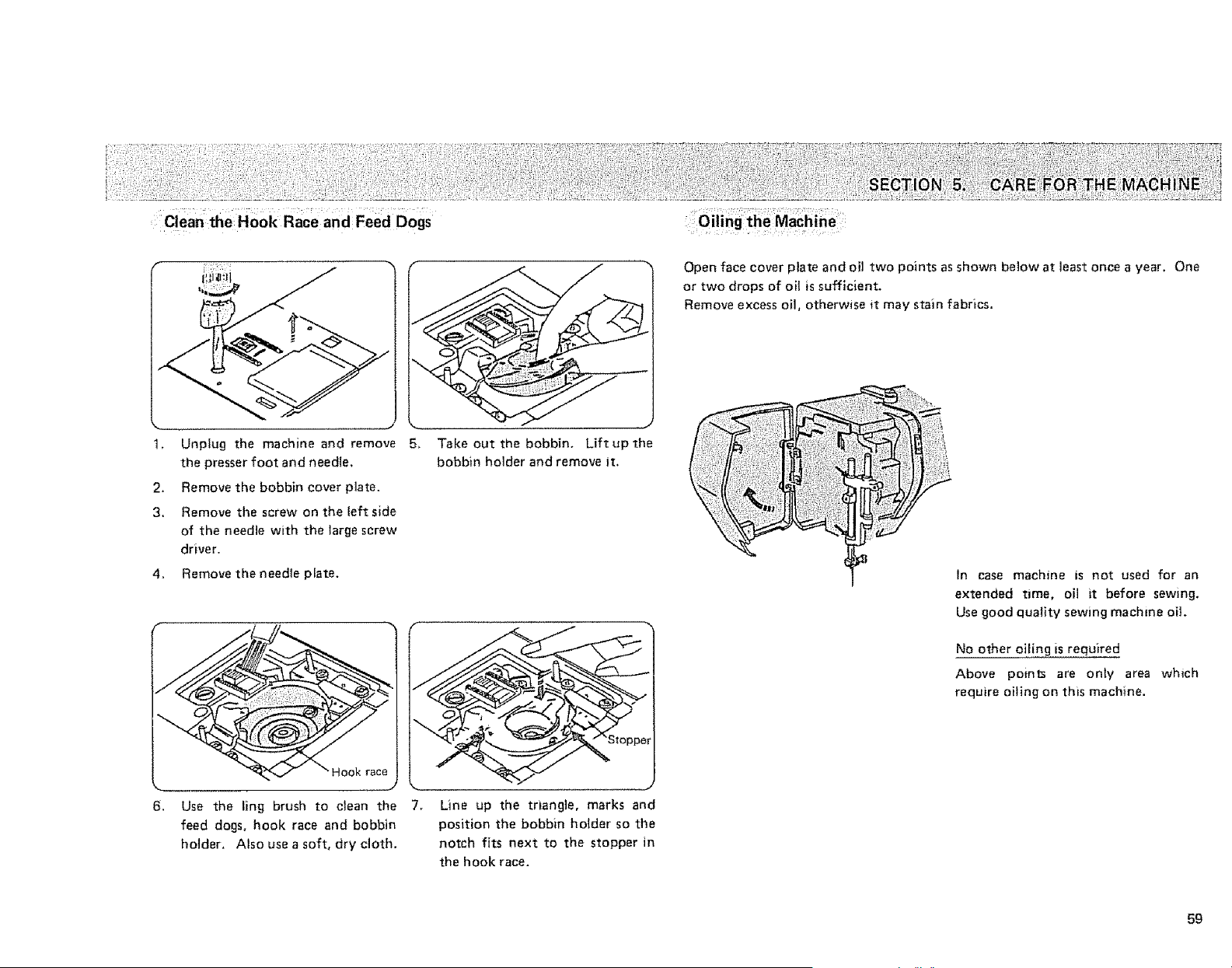
Open face cover plate and oil two points as shown below at Jeast once a year. One
or two drops of oil is sufficient.
Remove excess oil, otherwise it may stain fabrics.
1. Unplug the machine and remove
the presser foot and needle.
2. Remove the bobbin cover plate.
3. Remove the screw on the left side
of the needle with the large screw
driver.
4. Remove the needle plate.
6.
race
Use the ling brush to clean the
feed dogs. hook race and bobbin
hotder, Also use a soft, dry cloth.
5_ Take out the bobbin. Lift up the
bobbin holder and remove it.
7. Line up the triangle, marks and
position the bobbin holder so the
notch fits next to the stopper in
the hook race.
In case machine is not used for an
extended time, oil it before sewing.
Use good quality sewing machine oil.
No other oiling is required
Above points are only area which
require oiling on this machine.
59
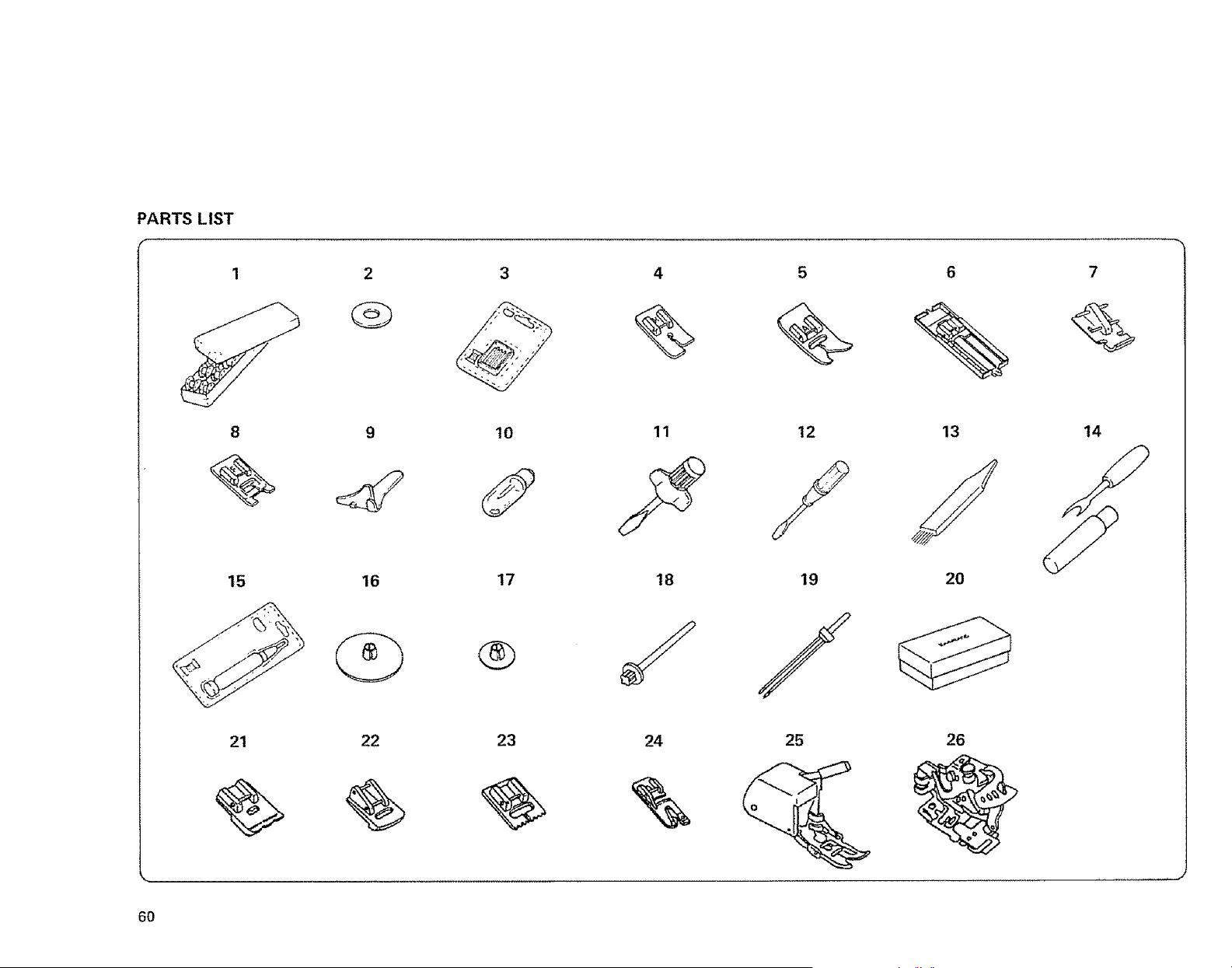
PARTSLIST
1
8
%
15
21
60
2
9
W
16
22
3
/
10
23
4
%
11
5
%
12
/
19
/
25
13
20
26
7
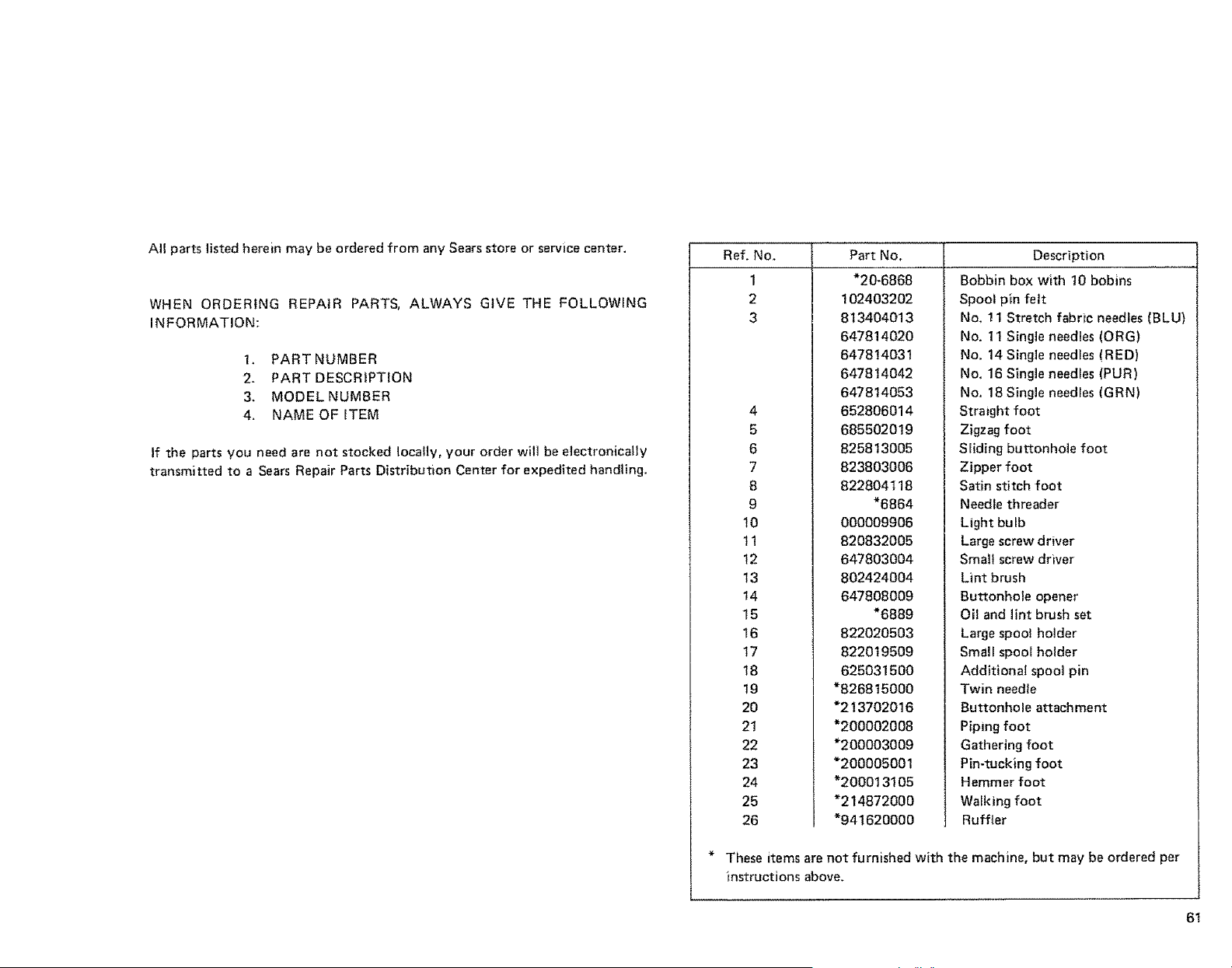
All parts listed herein may be ordered from any Sears store or service center.
WHEN ORDERING REPAIR PARTS, ALWAYS GIVE THE FOLLOWING
INFORMATION:
1. PART NUMBER
2. PARTDESCRJPT!ON
3. MODEL NUMBER
4. NAME OF ITEM
If the parts you need are not stocked locally, your order will be electronicalJy
transmitted to a Sears Repair Parts Distribution Center for expedited handling.
Ref. No.
1
2
3
4
5
6
7
8
9
10
11
12
13
14
15
16
17
18
t9
20
21
22
23
24
25
26
Part No.
"2_6868
102403202
813404013
647814020
647814031
647814042
647814053
652806014
685502019
825813005
823803008
8228O4118
*6864
000009906
820832005
647803004
802424004
647808009
*6889
822020503
822019509
625031500
*826815000
*213702016
*200002008
*200003009
*200005001
*200013105
*214872000
*941620000
Description
Bobbin box with 10 bobins
Spool pin felt
No, 11 Stretch fabrrc needles (BLU)
No. 11 Single needles {ORG)
No. 14 Sing]e needles (RED)
No, 16 Single needles (PUR)
No, 18 Single needles (GRN)
Straight foot
Zigzag foot
Sliding buttonhole foot
Zipper foot
Satin stitch foot
Needle threader
Light bulb
Large screw driver
Small screw driver
Lint brush
Buttonhole opener
Oil and lint brush set
Large spool holder
Small spool holder
Additional spool pin
Twin needle
Buttonhole attachment
Piping foot
Gathering foot
Pin-tucking foot
Hemmer foot
Walking foot
Ruffler
* These items are not furnished with the machine, but may be ordered per
"instructions above,
6t
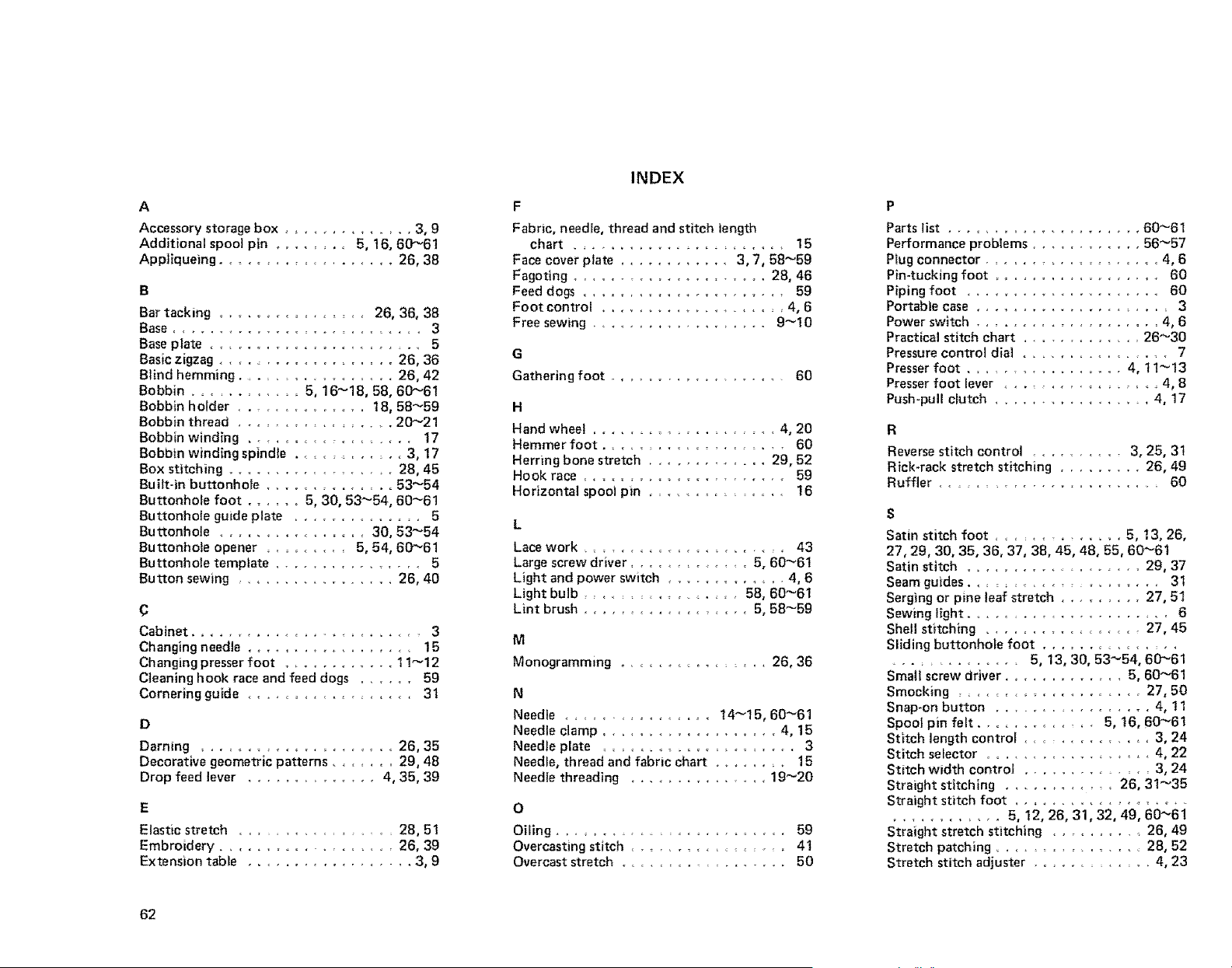
A
Accessorystoragebox............. 3,9
Additionalspoolpin ........ 5,16,60_61
Appllqueing................... 26, 38
Bar tacking ................ 26, 36° 38
Base .......................... 3
Base plate ...................... 5
Basic zigzag ................... 26, 36
Blind hemming .................. 26, 42
Bobbin ............ 5, 16_18, 58, 60_61
Bobbin holder ............. 18, 58_59
Bobbin thread .............. 20_21
Bobbin winding ................. 17
Bobbin winding spindle ............ 3, 17
Box stitching ................. 28, 45
Built-in buttonhole ............. 53_54
Buttonhole foot ...... 5, 30, 53_54, 60_61
Buttonhole guide plate .............. 5
Buttonhole ............... 30, 53_54
Buttonhole opener ......... 5, 54, 60_61
Buttonhole template ................ 5
Button sewing ................. 26, 40
¢
Cabinet ..................... 3
Changing needle ................. 15
Changing presser foot ........... 11_12
Cleaning hook race and feed dogs ...... 59
Cornering guide ................. 31
Darning .................... 26, 35
Decorative geometric patterns ....... 29, 48
Drop feed lever ............. 4, 35, 39
E
Elastic stretch ............... 28, 5t
Embroidery ................... 26, 39
Extension table ................. 3, 9
INDEX
Fabric, needle, thread and stitch length
chart ...................... 15
Face cover plate ............ 3, 7, 58_59
Fagoting ..................... 28, 46
Feed dogs ...................... 59
Foot control .................... 4, 6
Free sewing ................... 9_10
G
Gathering foot ................. 60
H
Hand wheel .................. 4, 20
Hemmer foot ................... 60
Herring bone stretch ............. 29, 52
Hook race ...................... 59
Horizontal spool pin .............. t6
Lace work ..................... 43
Large screw driver ......... 5, 60_61
Light and power switch ............. 4, 6
Light bulb .............. 58, 60_61
Lint brush ................ 5, 58_59
M
Monogramming ................ 26, 36
Needle .............. 14_15, 60_61
Needle clamp ................... 4, 15
Needle plate .................... 3
Needle, thread and fabric chart ........ 15
Needle threading ............... 19_20
Oiling .......................... 59
Overcasting stitch ............... 41
Overcast stretch ............... 50
Parts list ..................... 60~61
Performance problems ............ 56_57
Plug connector .................. 4, 6
Pin-tucklng foot ................. 60
Piping foot ..................... 60
Portable case ..................... 3
Power switch .................... 4, 6
Practical stitch chart ............ 26_30
Pressure control dial .............. 7
Presser foot ................ 4, 11_13
Presser foot lever ................ 4, 8
Push-pull clutch ................. 4, 17
R
Reverse stitch control ......... 3, 25, 31
Rick-rack stretch stitching ......... 26, 49
Ruffler ........................ 60
S
Satin stitch foot ............ 5, 13, 26,
27, 29, 30, 35, 36, 37° 38, 45, 48, 55, 60_61
Satin stitch .................. 29, 37
Seam guides .................... 3t
Serging or pine leaf stretch ......... 27, 51
Sewing light ..................... 6
Shell stitching ................. 27, 45
Sliding buttonhole foot ..............
............. 5, 13, 30, 53_54, 60_61
Small screw driver ............. 5, 60_-61
Smocking ................... 27, 50
Snap-on button ................. 4, 11
Spool pin felt ............. 5, !6, 60_61
Stitch length control .............. 3, 24
Stitch selector ................. 4, 22
Stitch width control ............ 3, 24
Straight stitching ........... 26, 31_35
Straight stitch foot ...................
............ 5.12, 26, 31,32, 49, 60~61
Straight stretch stitching ......... 26, 49
Stretch patching ................ 28, 52
Stretch stitch adjuster ............. 4, 23
62
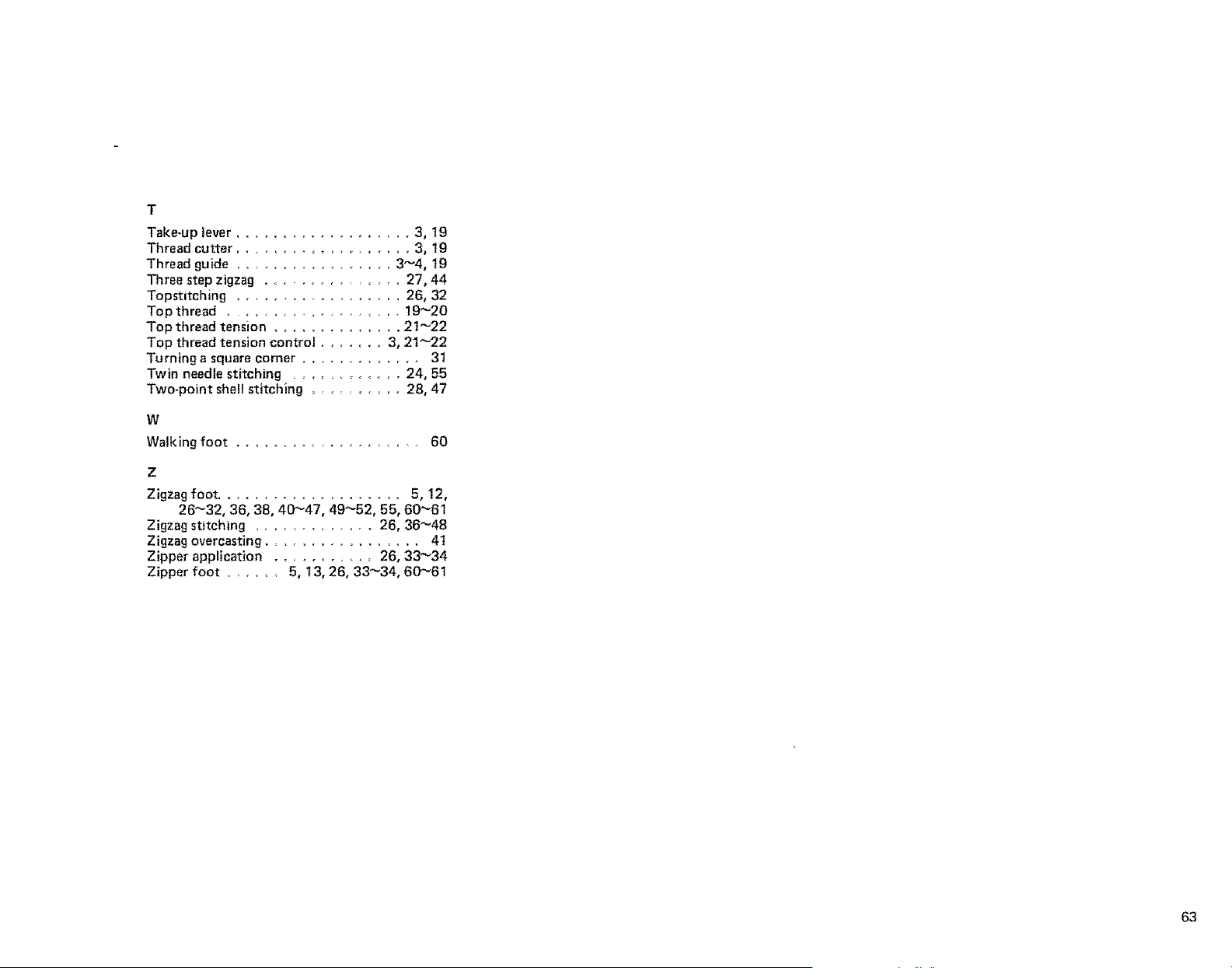
T
Take-up lever ................... 3, 19
Thread cutter ................. 3, 19
Thread guide ................ 3_4, 19
Three step zigzag ............ 27, 44
Topstitching .................. 26, 32
Top thread .............. 19_'20
Top th read tensio n .............. 2 t _22
Top thread tension control ....... 3, 21_22
Turning a square comer ............. 31
Twin needle stitching ............ 24, 55
Two-point shell stitching ......... 28, 47
W
Walking foot ................. 60
Zigzag foot. ................... 5, 12,
26~32, 36, 38, 40_47, 49_52, 55, 60_61
Zigzag stitching ........... 26, 36_48
Zigzag overcasting ................. 4t
Zipper application .......... 26, 33_34
Zipper foot ...... 5, 13, 26, 33_34, 60_6I
63
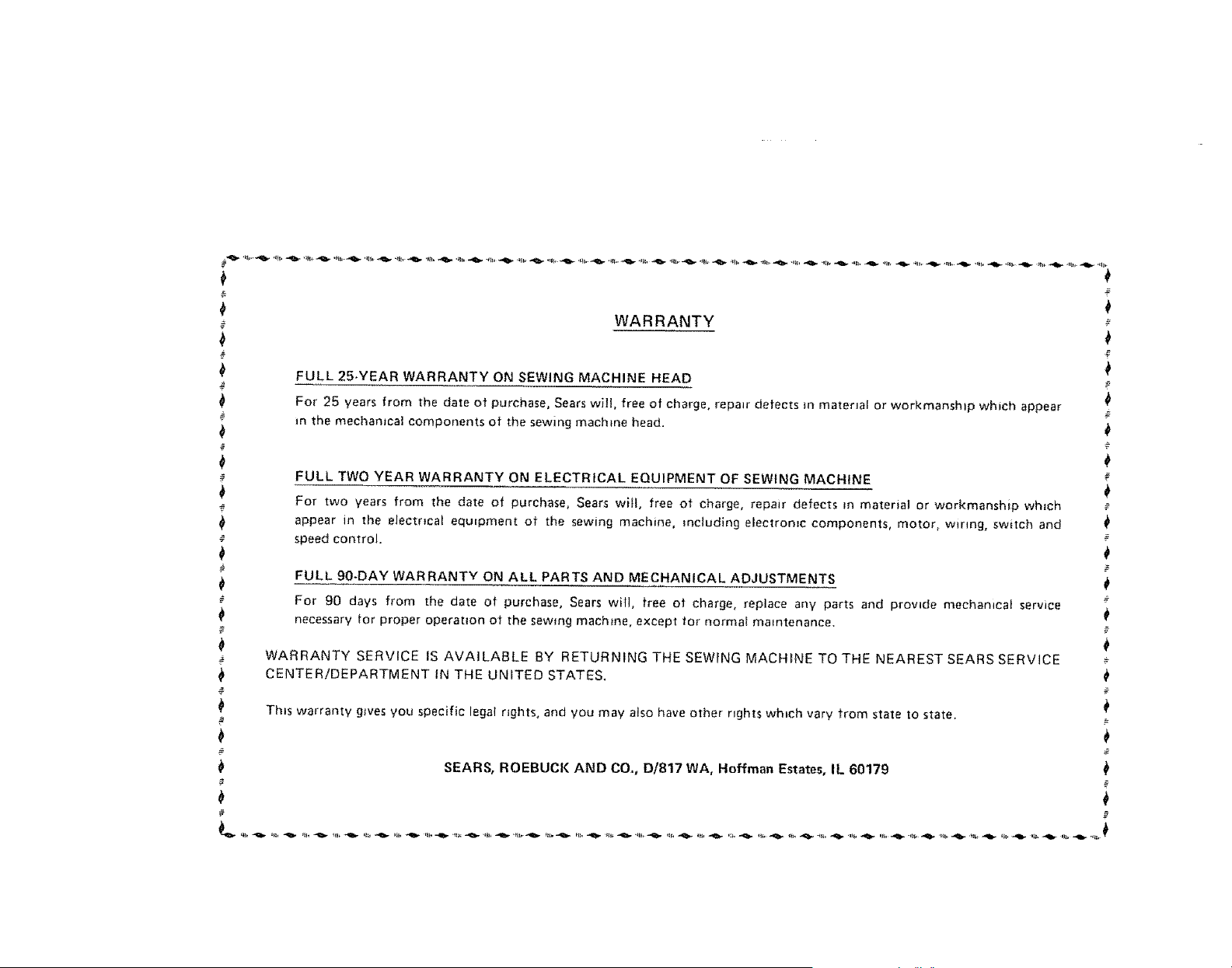
# #
WARRANTY
FULL 25-YEAR WARRANTY ON SEWING MACHINE HEAD
_1 For 25 years from the date of purchase, Sears will, free of charge, repair detects m mater_af or workmanship which appear t)
m the mechamca] components of the sewing machine head. #
# #
FULL TWO YEAR WARRANTY ON ELECTRICAL EQUIPMENT OF SEWING MACHINE
_ For two years from the date of purchase, Sears will, free of charge, repair defects m material or workmanship which
_t appear in the electrical equipment of the sewing machine, including electromc components, motor, w_rmg, switch and
# speed control.
FULL 90*DAY WARRANTY ON ALL PARTS AND MECHANICAL ADJUSTMENTS ti
# For 90 days from the date of purchase, Sears will, free of charge, replace any parts and prowde mechanical service #
necessary for proper operation ot the sewing machine, except for normal maintenance. It
WARRANTY SERVICE IS AVAILABLE BY RETURNING THE SEWING MACHINE TOTHE NEAREST SEARS SERVICE
CENTER!DEPARTMENT IN THE UNITED STATES. tl
# #
Th_s warranty g_ves you specific legal rights, and you may also have other Hghts which vary from state to state.
# .=
# #
SEARS, ROEBUCK AND CO., D/817 WA, Hoffman Estates, IL 60179
SEWING MACHINE
Now that you have purchased your Kenmore Sewing Machine, should a need ever exist for repair parts
or service, simply contact your nearest Sears Service Center. Be sure to provtde ati pertinent facts when
you call or visit.
The model number o_ your Sewing Machine will be shown on your nomenclature plate on the back of
your Sewing Machine. See page 4 for location.
WHEN ORDERING REPAIR PARTS, ALWAYS GIVE THE FOLLOWING INFORMATION:
*PART NUMBER *PART DESCRIPTION *MODEL NUMBER *NAME OF ITEM
tf the parts you need are not stocked locally, your order will be electron|cally transmitted to a Sears
Repair Parts Distribuuon Center tor handling.
SEARS, ROEBUCK AND CO., Chicago, IL60684 U,S,A.