KM8403001 EN User Manual

CONTENTS
1. SAFETY INFORMATION.................................................................................................3
2. CONDITIONS OF USE....................................................................................................5
3. SAFETY INSTRUCTIONS................................................................................................ 5
4. PRODUCT DESCRIPTION.............................................................................................. 7
5. CONTROL PANEL...........................................................................................................8
6. BEFORE FIRST USE.......................................................................................................10
7. DAILY USE......................................................................................................................10
8. MICROWAVE MODE.................................................................................................... 13
9. CLOCK FUNCTIONS.................................................................................................... 18
10. AUTOMATIC PROGRAMMES....................................................................................19
11. USING THE ACCESSORIES........................................................................................20
12. ADDITIONAL FUNCTIONS........................................................................................20
13. HINTS AND TIPS.........................................................................................................22
14. CARE AND CLEANING.............................................................................................. 40
15. TROUBLESHOOTING.................................................................................................41
16. INSTALLATION........................................................................................................... 42
17. WARRANTY ................................................................................................................ 44
FOR PERFECT RESULTS
Thank you for choosing this AEG product. We have created it to give you impeccable
performance for many years, with innovative technologies that help make life simpler
features you might not find on ordinary appliances. Please spend a few minutes
reading to get the very best from it.
Visit our website for:
Get usage advice, brochures, trouble shooter, service information:
www.aeg.com
Register your product for better service:
www.registeraeg.com
CUSTOMER CARE AND SERVICE
Always use original spare parts.
When contacting our Authorised Service Centre, ensure that you have the following
data available: Model, PNC, Serial Number.
The information can be found on the rating plate.
Warning / Caution-Safety information
General information and tips
Environmental information
Subject to change without notice.
2 www.aeg.com

1. SAFETY INFORMATION
Before the installation and use of the appliance,
carefully read the supplied instructions. The
manufacturer is not responsible if an incorrect
installation and use causes injuries and damages. Always
keep the instructions with the appliance for future
reference.
1.1 Children and vulnerable people safety
• This appliance can be used by children aged from 8
years and above and persons with reduced physical,
sensory or mental capabilities or lack of experience
and knowledge if they have been given supervision or
instruction concerning use of the appliance in a safe
way and understand the hazards involved.
• Do not let children play with the appliance.
• Keep all packaging away from children.
•
Keep children and pets away from the appliance when
it operates or when it cools down. Accessible parts are
hot.
• If the appliance has a child safety device, we
recommend you activate it.
• Cleaning and user maintenance shall not be made by
children without supervision.
• Children of less than 3 years should be kept away
unless continuously supervised.
1.2
General Safety
•
Only a qualified person must install this appliance and
replace the cable.
• Internally the appliance becomes hot when in
operation. Do not touch the heating elements that are
in the appliance. Always use oven gloves to remove or
put in accessories or ovenware.
• Before maintenance cut the power supply.
ENGLISH
3

• Ensure that the appliance is switched off before
replacing the lamp to avoid the possibility of electric
shock.
• Do not use a steam cleaner to clean the appliance.
• Do not use harsh abrasive cleaners or sharp metal
scrapers to clean the glass door since they can scratch
the surface, which may result in shattering of the glass.
• If the supply cord is damaged, it must be replaced by
the manufacturer, its Authorised Service Centre or
similarly qualified persons in order to avoid a hazard.
• Do not activate the appliance when it is empty. Metal
parts inside the cavity can create electric arcing.
• If the door or door seals are damaged, the appliance
must not be operated until it has been repaired by a
qualified person.
• Only a qualified person can carry out any service or
repair operation that involves the removal of a cover
which gives protection against exposure to microwave
energy.
• Do not heat liquids and other foods in sealed
containers. They are liable to explode.
• Only use utensils that are suitable for use in
microwave ovens.
• When heating food in plastic or paper containers,
keep an eye on the appliance due to the possibility of
ignition.
• The appliance is intended for heating food and
beverages. Drying of food or clothing and heating of
warming pads, slippers, sponges, damp cloth and
similar may lead to risk of injury, ignition or fire.
• If smoke is emitted, switch off or unplug the appliance
and keep the door closed in order to stifle any flames.
• Microwave heating of beverages can result in delayed
eruptive boiling. Care must be taken when handling
the container.
• The contents of feeding bottles and baby food jars
shall be stirred or shaken and the temperature
checked before consumption, in order to avoid burns.
www.aeg.com
4

• Eggs in their shell and whole hard-boiled eggs should
not be heated in the appliance since they may
explode, even after microwave heating has ended.
• The appliance should be cleaned regularly and any
food deposits removed.
• Failure to maintain the appliance in a clean condition
could lead to deterioration of the surface that could
adversely affect the life of the appliance and possibly
result in a hazardous situation.
2. CONDITIONS OF USE
This appliance is intended to be used in
household and similar applications such
as:
• Farm houses
• By clients in serviced apartments,
holiday apartments and other
residential type environments
3. SAFETY INSTRUCTIONS
3.1 Installation
WARNING!
Only a qualified person must
install this appliance.
• Remove all the packaging.
• Do not install or use a damaged
appliance.
• Obey the installation instruction
supplied with the appliance.
• Always be careful when you move the
appliance because it is heavy. Always
wear safety gloves.
• Do not pull the appliance by the
handle.
• Keep the minimum distance from the
other appliances and units.
• Make sure that the appliance is
installed below and adjacent safe
structures.
• The sides of the appliance must stay
adjacent to appliances or to units with
the same height.
3.2 Electrical connection
WARNING!
Risk of fire and electrical
shock.
• All electrical connections should be
made by a qualified electrician.
• The appliance must be earthed.
• Make sure that the electrical
information on the rating plate agrees
with the power supply. If not contact
an electrician.
• Always use a correctly installed
shockproof socket.
• Do not use multi-plug adapters and
extension cables.
• Make sure not to cause damage to
the mains plug and to the mains
cable. Should the mains cable need
to be replaced, this must be carried
out by our Authorised Service Centre.
• Do not let mains cables to come in
touch with the appliance door,
specially when the door is hot.
• The shock protection of live and
insulated parts must be fastened in
such a way that it cannot be removed
without tools.
• Connect the mains plug to the mains
socket only at the end of the
installation. Make sure that there is
access to the mains plug after the
installation.
• If the mains socket is loose, do not
connect the mains plug.
ENGLISH
5

• Do not pull the mains cable to
disconnect the appliance. Always pull
the mains plug.
• Use only correct isolation devices: line
protecting cut-outs, fuses (screw type
fuses removed from the holder), earth
leakage trips and contactors.
• The electrical installation must have
an isolation device which lets you
disconnect the appliance from the
mains at all poles. The isolation
device must have a contact opening
width of minimum 3 mm.
• This appliance complies with the
E.E.C. Directives.
3.3 Use
WARNING!
Risk of injury, burns and
electrical shock or explosion.
• Use this appliance in a household
only.
• Do not change the specification of
this appliance.
• Make sure that the ventilation
openings are not blocked.
• Do not let the appliance stay
unattended during operation.
• Deactivate the appliance after each
use.
• Be careful when you open the
appliance door while the appliance is
in operation. Hot air can release.
• Do not operate the appliance with
wet hands or when it has contact with
water.
• Do not apply pressure on the open
door.
• Do not use the appliance as a work
surface or as a storage surface.
• Open the appliance door carefully.
The use of ingredients with alcohol
can cause a mixture of alcohol and air.
• Do not let sparks or open flames to
come in contact with the appliance
when you open the door.
• Do not put flammable products or
items that are wet with flammable
products in, near or on the appliance.
WARNING!
Risk of damage to the
appliance.
• To prevent damage or discoloration
to the enamel:
– do not put ovenware or other
objects in the appliance directly
on the bottom.
– do not put aluminium foil directly
on the bottom of the appliance.
– do not put water directly into the
hot appliance.
– do not keep moist dishes and
food in the appliance after you
finish the cooking.
– be careful when you remove or
install the accessories.
• Discoloration of the enamel has no
effect on the performance of the
appliance. It is not a defect in the
sense of the warranty law.
• Use a deep pan for moist cakes. Fruit
juices cause stains that can be
permanent.
• This appliance is for cooking
purposes only. It must not be used for
other purposes, for example room
heating.
• Always cook with the oven door
closed.
3.4 Care and cleaning
WARNING!
Risk of injury, fire, or damage
to the appliance.
• Before maintenance, deactivate the
appliance and disconnect the mains
plug from the mains socket.
• Make sure the appliance is cold.
There is the risk that the glass panels
can break.
• Replace immediately the door glass
panels when they are damaged.
Contact the Service.
• Make sure the cavity and the door are
wiped dry after each use. Steam
produced during the operation of the
appliance condensates on cavity walls
and can cause corrosion.
• Clean regularly the appliance to
prevent the deterioration of the
surface material.
• Remaining fat or food in the
appliance can cause fire.
• Clean the appliance with a moist soft
cloth. Only use neutral detergents. Do
not use abrasive products, abrasive
www.aeg.com
6
cleaning pads, solvents or metal
objects.
• If you use an oven spray, obey the
safety instructions on the packaging.
• Do not clean the catalytic enamel (if
applicable) with any kind of
detergent.
3.5 Internal light
• The type of light bulb or halogen
lamp used for this appliance is only
for household appliances. Do not use
it for house lighting.
WARNING!
Risk of electrical shock.
• Before replacing the lamp, disconnect
the appliance from the power supply.
• Only use lamps with the same
specifications.
3.6 Disposal
WARNING!
Risk of injury or suffocation.
• Disconnect the appliance from the
mains supply.
• Cut off the mains cable and discard it.
• Remove the door catch to prevent
children and pets to get closed in the
appliance.
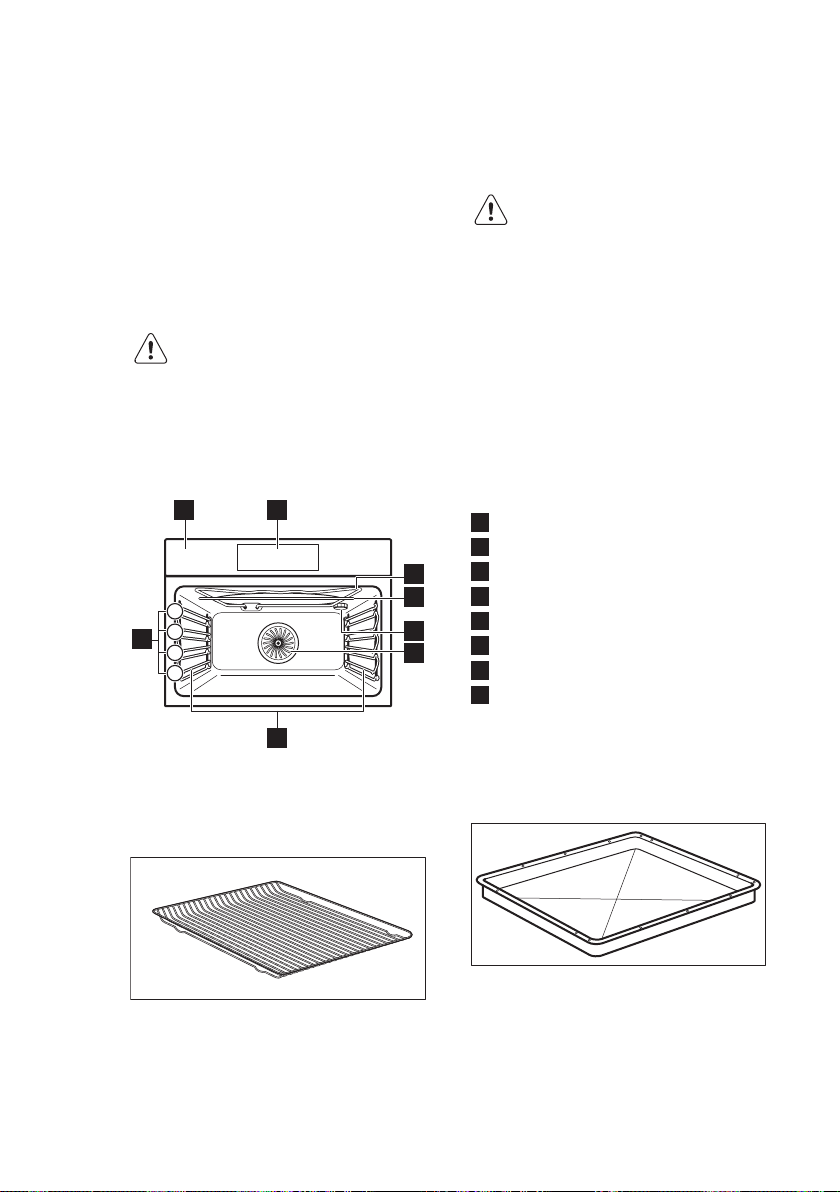
4. PRODUCT DESCRIPTION
4.1 General overview
1 2
8
4
3
1
2
3
6
4
5
7
1
Control panel
2
Electronic programmer
3
Heating element
4
Microwave generator
5
Lamp
6
Fan
7
Shelf support, removable
8
Shelf positions
4.2 Accessories
Wire shelf
For cookware, cake tins, roasts.
Baking tray
For cakes and biscuits.
ENGLISH
7
5. CONTROL PANEL
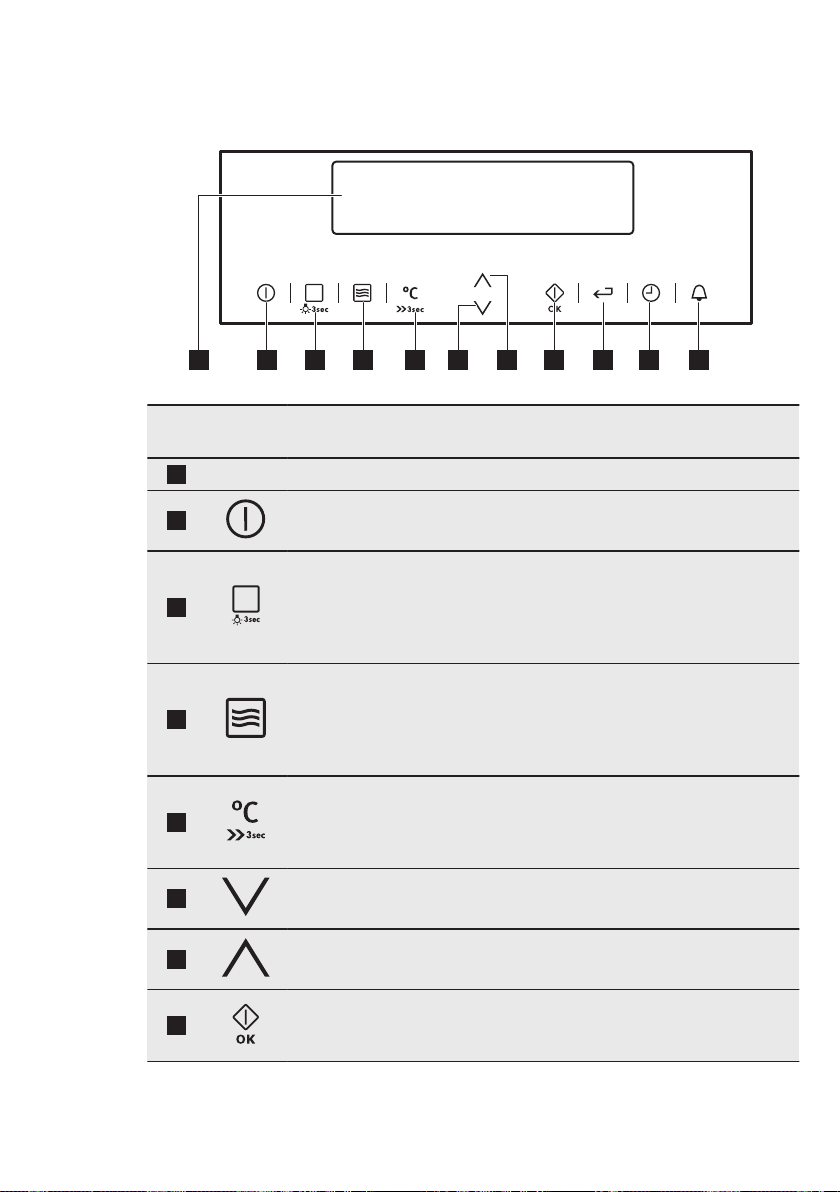
5.1 Electronic programmer
21 3 4 5 76 8 9 10 11
Use the sensor fields to operate the appliance.
Sensor
field
Function Comment
1
- Display Shows the current settings of the appliance.
2
ON / OFF To activate and deactivate the appliance.
3
Heating Functions
or Assisted Cook-
ing
To choose a heating function or a menu: Assisted
Cooking. To access the necessary function, touch
the field once or twice after you activate the appli-
ance. To activate or deactivate the light, touch the
field for 3 seconds.
4
Microwave func-
tion
To activate the Microwave function. You can use it
when the appliance is deactivated. When you use
the Microwave function with the function: Duration
for more than 7 minutes and in Combi mode, the
Microwave power cannot be more than 600 W.
5
Temperature se-
lection
To set the temperature or show the current tem-
perature in the appliance. Touch the field for 3
seconds to activate or deactivate the function:
Fast heat up.
6
Down key To move down in the menu.
7
Up key To move up in the menu.
8
OK / Microwave
Quick Start
To confirm the selection or settings. To activate
the Microwave function. You can use it when the
appliance is deactivated.
www.aeg.com8
Sensor
field
Function Comment
9
Home key To go back one level in the menu. To show the
main menu, touch the field for 3 seconds.
10
Time and addi-
tional functions
To set different functions. When a heating func-
tion operates, touch the sensor field to set the
timer or the functions: Function Lock, Favourite
Programme, Heat + Hold, Set + Go.
11
Minute Minder To set the function: Minute Minder.
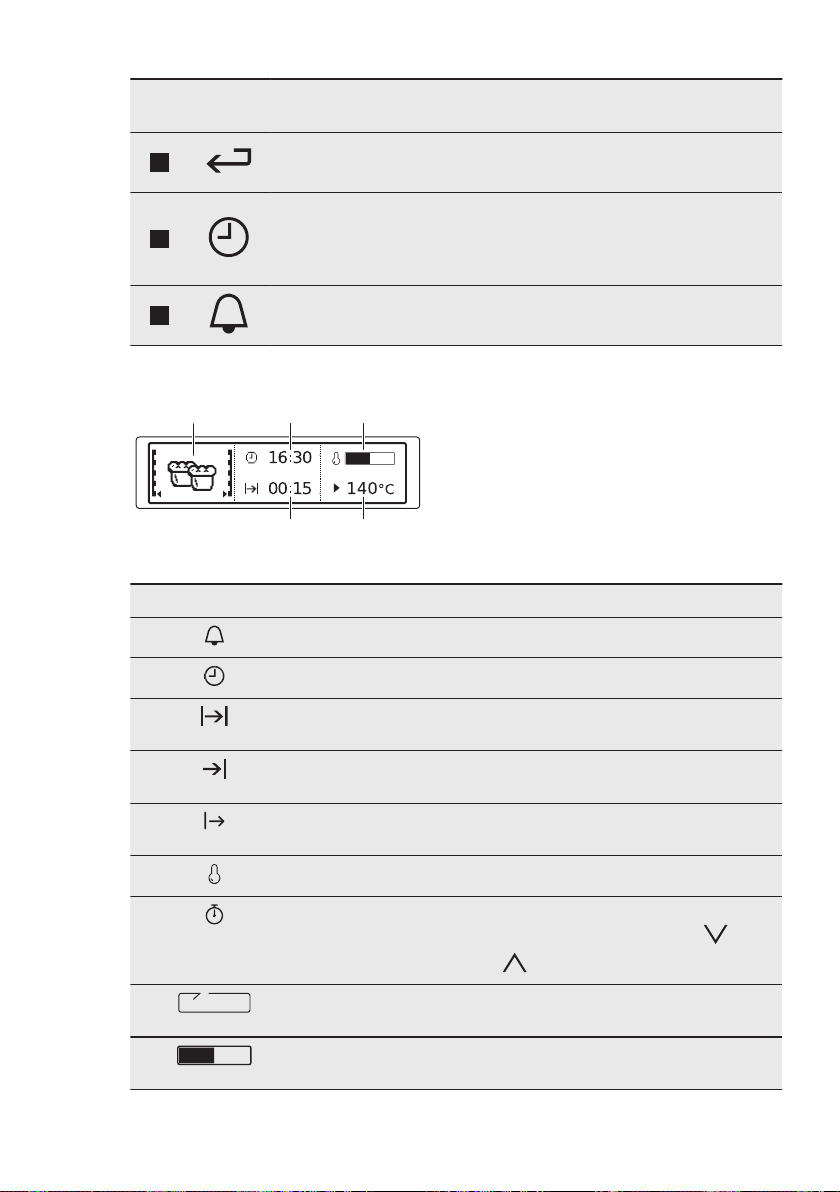
5.2 Display
A
DE
B C
A) Heating function or Microwave function
B) Time of day
C) Heat-up indicator
D) Temperature or power of the microwave
E) Duration time or end time of a function
Other indicators of the display:
Symbol Function
Minute Minder The function operates.
Time of day The display shows the current time.
Duration The display shows the necessary time
for cooking.
End Time The display shows when the cooking
time is complete.
Start Time The display shows when the heating
function must start.
Temperature The display shows the temperature.
Time Indication The display shows how long the heat-
ing function operates. Press and
at the same time to reset the time.
Calculation The appliance calculates the time for
cooking.
Heat-up Indicator The display shows the temperature in
the appliance.
ENGLISH
9
Symbol Function
Fast Heat Up Indicator The function is active. It decreases the
heat up time.
Weight Automatic The display shows that the automatic
weight system is active or that weight
can be changed.
Heat + Hold The function is active.
6. BEFORE FIRST USE
WARNING!
Refer to Safety chapters.
6.1 Initial Cleaning
Remove all accessories and removable
shelf supports from the appliance.
Refer to "Care and cleaning"
chapter.
Clean the appliance before first use.
Put the accessories and the removable
shelf supports back to their initial
position.
6.2 First Connection
When you connect the appliance to the
mains or after the power cut, you have to
set the language, the display contrast,
the display brightness and the time of
the day.
1. Press
or to set the value.
2. Press to confirm.
7. DAILY USE
WARNING!
Refer to Safety chapters.
7.1 Navigating the menus
1. Activate the appliance.
2. Press
or to select the menu
option.
3. Press to move to the submenu or
accept the setting.
At each point you can go back
to the main menu with .
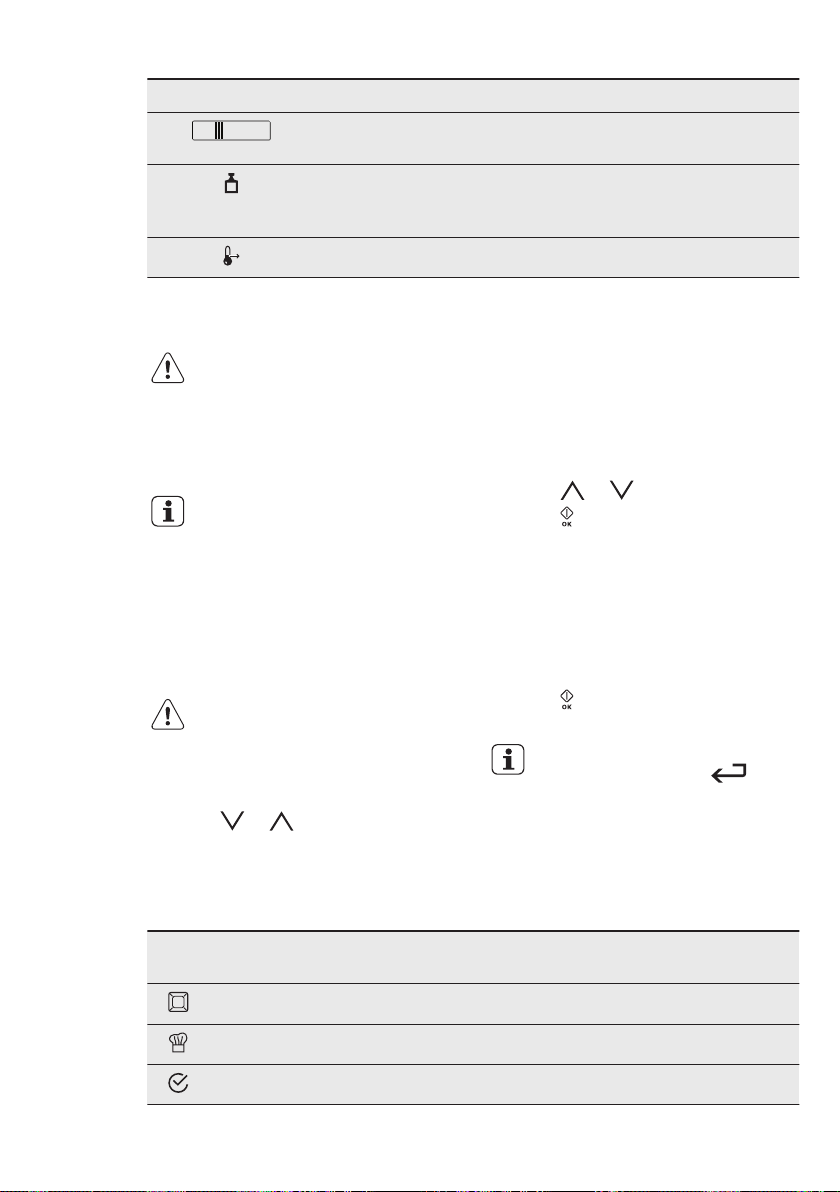
7.2 The menus in overview
Main menu
Sym-
bol
Menu item Application
Heating Functions Contains a list of heating functions.
Assisted Cooking Contains a list of automatic programmes.
Basic Settings You can use it to set other settings.
www.aeg.com10
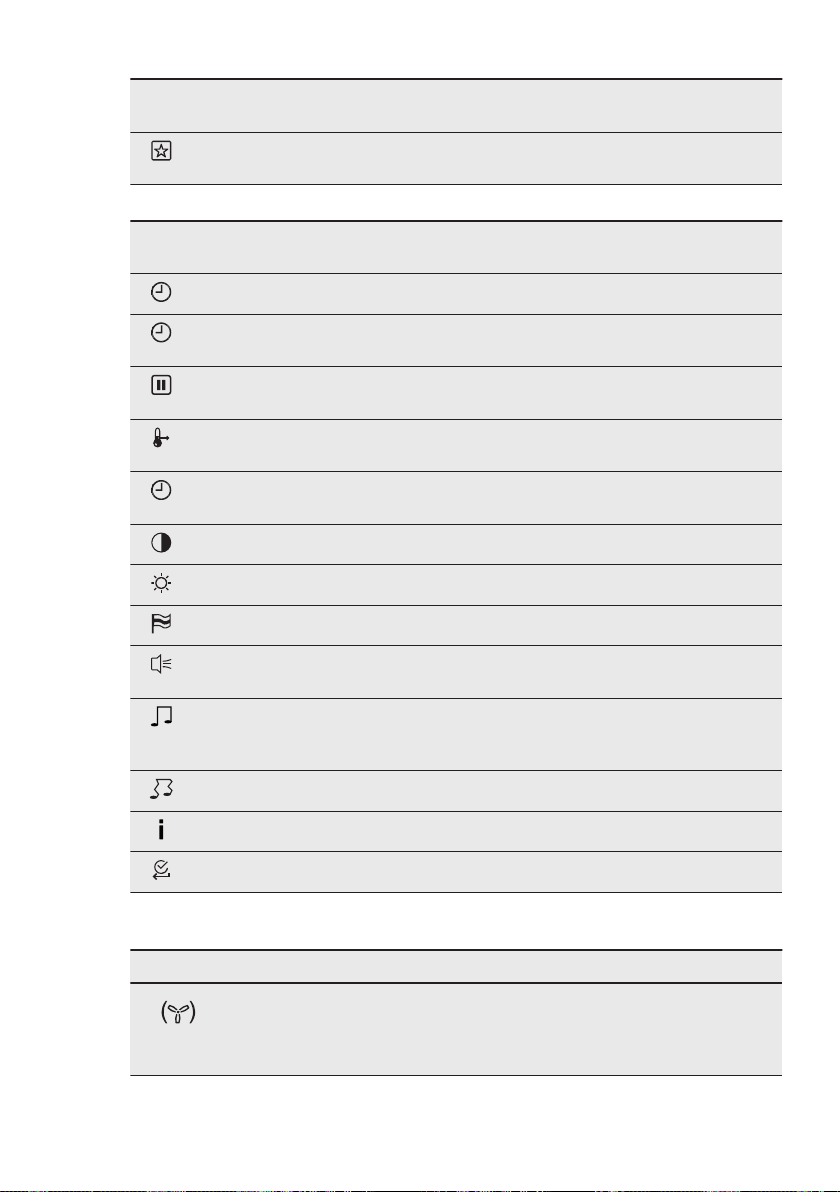
Sym-
bol
Menu item Application
Favourite Programme Contains a list of favourite cooking programmes
created by the user.
Submenu for: Basic Settings
Sym-
bol
Submenu Description
Set Time of Day Sets the current time on the clock.
Time Indication When ON, the display shows the current time
when you deactivate the appliance.
Set + Go When ON, in the Select Options window you can
choose the function: Set + Go.
Heat + Hold When ON, in the Select Options window you can
choose the function: Heat + Hold.
Extra Time Activates and deactivates the time extension
function.
Display Contrast Adjusts the display contrast by degrees.
Display Brightness Adjusts the display brightness by degrees.
Set Language Sets the language for the display.
Buzzer Volume Adjusts the volume of press-tones and signals by
degrees.
Key Tones Activates and deactivates the tone of the touch
fields. It is not possible to deactivate the tone of
the ON / OFF touch field.
Alarm/Error Tones Activates and deactivates the alarm tones.
Service Shows the software version and configuration.
Factory Settings Resets all settings to factory settings.
7.3 Heating Functions
Heating function Application
True Fan Cooking To bake on up to 2 shelf positions at the same
time and to dry food. Set the temperature 20 - 40
°C lower than for the function: Conventional
Cooking.
ENGLISH
11
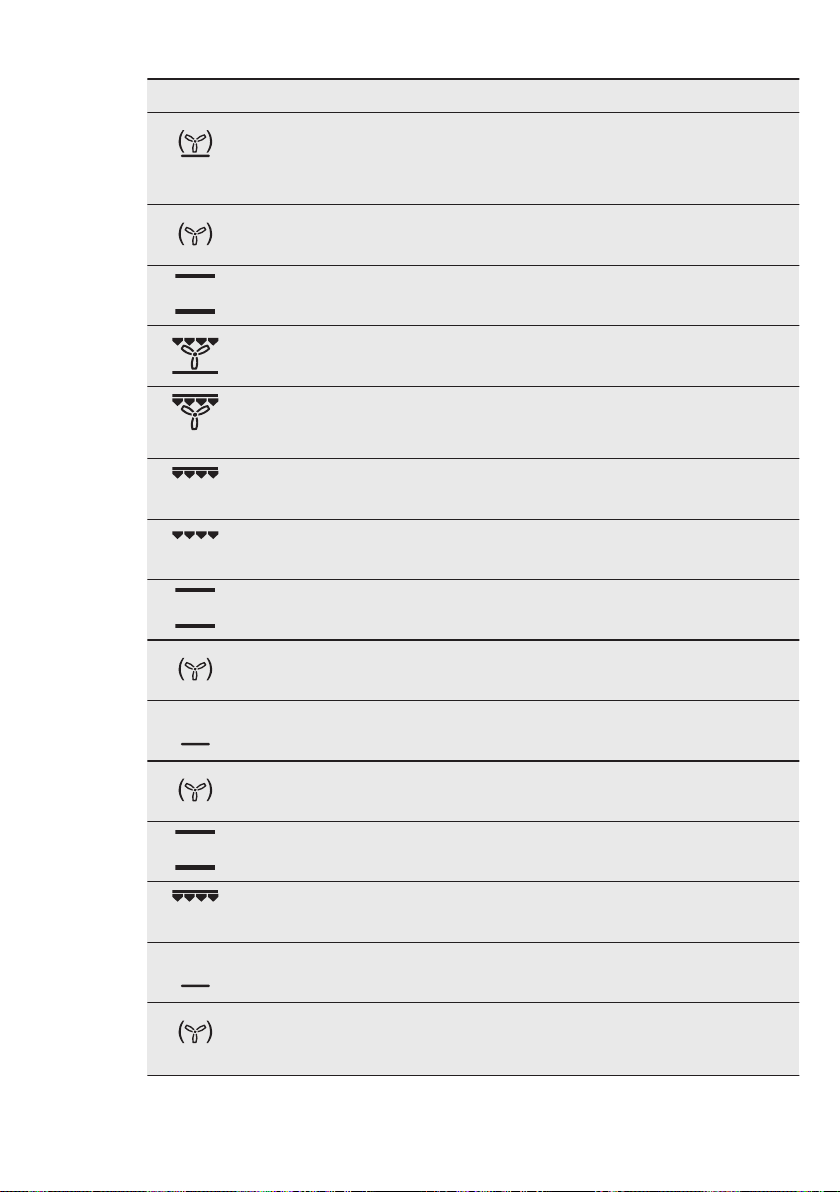
Heating function Application
Pizza Setting To bake food on 1 shelf position for a more inten-
sive browning and a crispy bottom. Set the tem-
perature 20 - 40 °C lower than for the function:
Conventional Cooking.
Slow Cooking To prepare tender, succulent roasts.
Conventional Cooking To bake and roast food on 1 shelf position.
Frozen Foods To make your convenience food like e.g. French
Fries, Wedges, spring rolls crispy.
Turbo Grilling To roast larger meat joints or poultry with bones
on 1 shelf position. Also to make gratins and to
brown.
Fast Grilling To grill flat food in large quantities and to toast
bread.
Grilling To grill flat food and to toast bread.
Keep Warm To keep food warm.
Defrost To defrost frozen food.
Bottom Heat To bake cakes with crispy bottom and to preserve
food.
Dough Proving For controlled rising of yeast dough before bak-
ing.
Bread Baking To bake bread.
Au Gratin For dishes such as lasagna or potato gratin. Also
to gratinate and brown.
Preserving To make vegetable preserves such as pickles.
Drying To dry sliced fruit (e.g. apples, plums, peaches)
and vegetables (e.g. tomatoes, zucchini, mush-
rooms).
www.aeg.com12
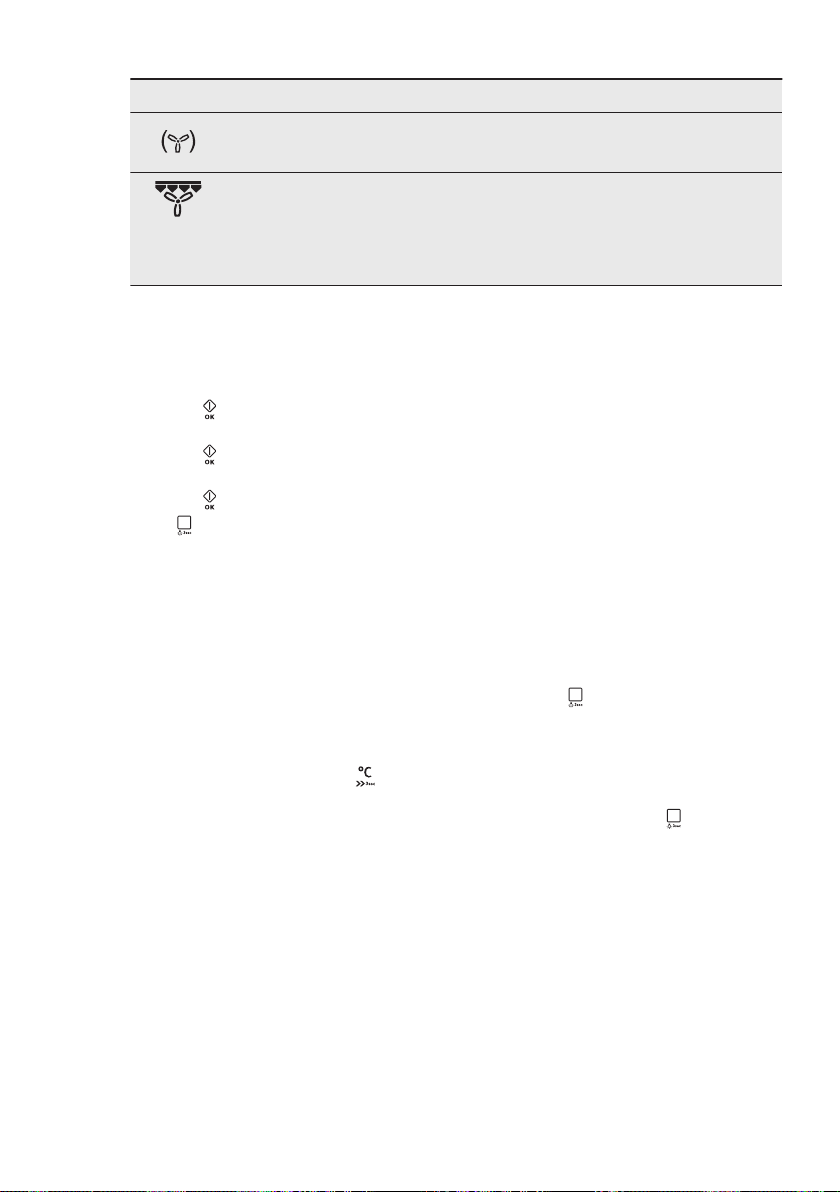
Heating function Application
Plate Warming To preheat your plate for serving.
ECO Roasting The ECO functions let you optimize the energy
consumption during cooking. It is necessary to set
the cooking time first. To get more information
about the recommended settings, refer to the
cooking tables with the equivalent function.
7.4 Activating a heating
function
1. Activate the appliance.
2. Select the menu: Heating Functions.
3. Press to confirm.
4. Set a heating function.
5. Press to confirm.
6. Set the temperature.
7. Press to confirm.
Press once or twice to go directly to
the menus: Heating Functions, Assisted
Cooking.
7.5 Heat-up indicator
When you activate a heating function,
the bar on the display comes on. The bar
shows that the temperature increases.
7.6 Fast Heat Up Indicator
This function decreases the heat-up time.
To activate the function, hold for 3
seconds. The heat-up indicator
alternates.
7.7 Residual heat
When you deactivate the appliance, the
display shows the residual heat. You can
use the heat to keep the food warm.
7.8 Energy saving
The appliance contains features which
help you save energy during everyday
cooking:
• Residual heat
– When the heating function or
programme operates, the heating
elements are deactivated 10%
earlier (the lamp and fan continue
to operate). For this feature to
operate, the cooking time must
be longer than 30 minutes or you
must use the clock functions
(Duration, End Time).
– When the appliance is off, you
can use the heat to keep food
warm. The display shows the
remaining temperature.
• Cooking with the lamp off - touch
and hold
for 3 seconds to
deactivate the lamp during cooking.
• Eco functions - refer to "Heating
Functions".
• When you use the Eco functions, the
lamp deactivates. The lamp activates
again when you touch for 3
seconds or when you open the
appliance door.
8.
MICROWAVE MODE
8.1 Microwave
Information about operation
General:
• After you deactivate the appliance, let
the food stand for some minutes.
Refer to the microwave cooking
tables: standing time.
• Remove the aluminium foil packaging,
metal containers, etc. before you
prepare the food.
Cooking:
ENGLISH
13

• If possible, cook food covered with
material suitable for use in the
microwave. Only cook food without a
cover if you want to keep a crust.
• Do not overcook the dishes by setting
the power and time too high. The
food can dry out, burn or catch fire in
some places.
• Do not use the appliance to cook
eggs in their shells and snails,
because they can burst. With fried
eggs, pierce the yolks first.
• Prick food with "skin" or "peel", such
as potatoes, tomatoes, sausages, with
a fork several times before cooking so
that the food does not burst.
• For chilled or frozen food, set a
longer cooking time.
• Dishes which contain sauce must be
stirred from time to time.
• Vegetables that have a firm structure,
such as carrots, peas or cauliflower,
must be cooked in water.
• Turn larger pieces after half the
cooking time.
• If possible, cut vegetables into similar-
sized pieces.
• Use flat, wide dishes.
• Do not use cookware made of
porcelain, ceramic or earthenware
with small holes, e. g. on handles or
unglazed bottoms. Moisture going
into the holes can cause the cookware
to crack when it is heated.
Defrosting meat, poultry, fish:
• Put the frozen, unwrapped food on a
small upturned plate with a container
below it, or on a defrosting rack or
plastic sieve so that the defrosting
liquid can run off.
• Turn the food after half the defrosting
time. If possible, divide and then
remove the pieces that have started
to defrost.
Defrosting butter, portions of gateau,
quark:
• Do not fully defrost in the appliance,
but let them defrost at room
temperature. This gives a more even
result. Fully remove all metal or
aluminium packaging or parts before
defrosting.
Defrosting fruit, vegetables:
• Do not fully defrost fruit and
vegetables, which are to be further
prepared while raw, in the appliance.
Let them defrost at room
temperature.
• You can use a higher microwave
power to cook fruit and vegetables
without defrosting them first.
Ready meals:
• Ready meals in metal packaging or
plastic trays with metal covers can
only be defrosted or heated in the
microwave if they are expressively
designated as suitable for use in the
microwave.
• You must follow the manufacturer's
instructions printed on the packaging
(e. g. remove the metal cover and
pierce the plastic film).
Tips for the microwave
Result Remedy
You cannot find details for the amount
of food prepared.
Look for similar food. Increase or shorten the
length of the cooking times according to the fol-
lowing rule: double the amount = almost double
the time, half the amount = half the time.
The food has got too dry. Set shorter cooking time or select lower micro-
wave power.
The food is still not defrosted, hot or
cooked after the time has elapsed.
Set longer cooking time or select higher micro-
wave power. Please note that taller dishes need
longer.
www.aeg.com14
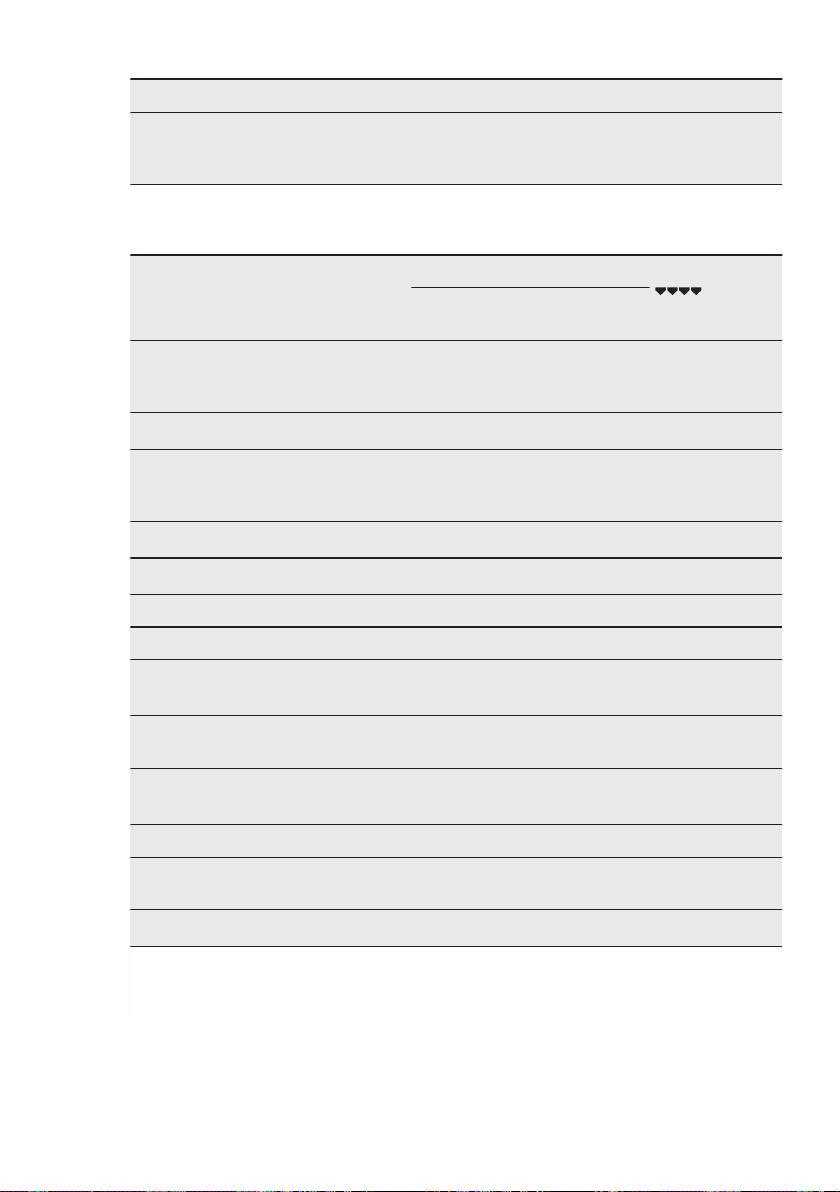
Result Remedy
After the cooking time has elapsed,
the food is overheated at the edge
but is still not ready in the middle.
Next time select a lower power and a longer
time. Stir liquids, e.g. soup, halfway through.
Suitable cookware and materials
Cookware / Material Microwave Grilling
Defrost-
ing
Heating Cooking
Ovenproof glass and porcelain (with
no metal components, e. g. Pyrex,
heat-proof glass)
X X X X
Non-ovenproof glass and porcelain
1)
X -- -- --
Glass and glass ceramic made of
ovenproof / frost-proof material (e. g.
Arcoflam), grill shelf
X X X X
Ceramic
2)
, earthenware
2)
X X X --
Heat-resistant plastic up to 200 °C
3)
X X X --
Cardboard, paper X -- -- --
Clingfilm X -- -- --
Roasting film with microwave safe clo-
sure
3)
X X X --
Roasting dishes made of metal, e. g.
enamel, cast iron
-- -- -- X
Baking tins, black lacquer or silicon-
coated
3)
-- -- -- X
Baking tray X X X X
Browning cookware, e. g. crisp pan or
crunch plate
-- X X --
Ready meals in packaging
3)
X X X X
1)
With no silver, gold, platinum or metal plating / decorations
2)
Without quartz or metal components, or glazes which contain metals
3)
You must follow the manufacturer’s instructions about the maximum temperatures.
X suitable
-- not suitable
Other things to think about…
• Food items have different shapes and
qualities. They are prepared in
different quantities. Because of this,
the necessary time and power for
defrosting, heating or cooking can
ENGLISH
15
vary. As a rough guide: double the
quantity = almost double the time.
• The microwave creates the heat
directly in the food. Because of this,
all places cannot be heated at the
same time. You must stir or turn the
heated dishes, especially with larger
quantities of food.
• The standing time is given in the
tables. Let the food stand, in the
appliance or outside it, so that the
heat is distributed more equally.
• You get better results for rice if you
use flat, wide dishes.
8.2 Microwave functions
Functions Description
Microwave Creates the heat directly in the food. Use it to heat pre-prepared
meals and drinks, to defrost meat or fruit, and to cook vegetables
and fish.
Combi Use it to operate the heating function and the microwave mode to-
gether. Use it to cook food in a shorter time and brown it at the
same time.
Quick Start Use it to activate the Microwave function with one touch of the sen-
sor field with the maximum microwave power. Operating time: 30
seconds.
8.3 Setting the Microwave
function
1. Activate the appliance.
2. Touch to activate the Microwave
function.
3. Touch . The function: Duration is
set to 30 seconds and the
microwaves starts to operate.
Each touch of adds 30
seconds to the time of the
function: Duration.
If you do not touch , the
appliance deactivates after 20
seconds.
4. Touch to set the function:
Duration. Refer to "Setting the clock
functions".
When the time of the function:
Duration is longer than 7
minutes the Microwave power
is decreased to 600 W.
The maximum setting of the
time for the function: Duration
is 90 minutes.
You can change the
microwave power (touch
and then or ) and the
function: Duration any time
when the Microwave function
operates.
5. When the set time ends, an acoustic
signal sounds for 2 minutes. The
Microwave function deactivates
automatically. Touch a sensor field to
stop the acoustic signal.
To deactivate the Microwave
function, touch .
If you touch or open the
door, the function stops. To
start it again, touch .
8.4 Setting the Combi function
1. Activate a heating function. Refer to
"Activating a heating function".
www.aeg.com
16
2. Touch and do the same steps as
when you set the Microwave
function.
Functions not available for the Combi
function: Favourite Programme, End
Time, Set + Go, Heat + Hold.
8.5 Setting the Quick Start
function
1. If necessary, touch to deactivate
the appliance.
2. Touch
to activate the Quick Start
function.
Each touch of adds 30 seconds to the
Duration time.
You can change the
microwave power (refer to
"Setting the Microwave
function").
3. Touch to set the time for the
function: Duration. Refer to "Setting
the clock functions".
8.6 Examples of cooking
applications for power settings
The data in the table is for guidance
only.
Power setting Use
• 1000 Watt
• 900 Watt
• 800 Watt
• 700 Watt
• Heating liquids
• Searing at the start of the cooking process
• Cooking vegetables
• Melting gelatine and butter
• 600 Watt
• 500 Watt
• Defrosting and heating frozen meals
• Heating one-plate meals
• Simmering stews
• Cooking egg dishes
• 400 Watt
• 300 Watt
• 200 Watt
• Continuing to cook meals
• Cooking delicate food
• Heating baby food
• Simmering rice
• Heating delicate food
• Melting cheese
• 100 Watt • Defrosting meat, fish, bread
• Defrosting cheese, cream, butter
• Defrosting fruit and cakes (gateaux)
• Raising yeast dough
• Heating up cold dishes and drinks
ENGLISH
17
9. CLOCK FUNCTIONS
9.1 Clock functions table
Clock function Application
Minute Minder To set a countdown (max. 2 h 30 min). This
function has no effect on the operation of the
appliance. You can also activate it when the
appliance is deactivated.
Use to activate the function. Press or
to set the minutes and to start.
Duration To set the length of an operation (max. 23 h
59 min).
End Time To set the switch-off time for a heating func-
tion (max. 23 h 59 min).
If you set the time for a clock function,
the time starts to count down after 5
seconds.
If you use the clock functions:
Duration, End Time, the
appliance deactivates the
heating elements after 90 % of
the set time. The appliance
uses the residual heat to
continue the cooking process
until the time ends (3 - 20
minutes).
9.2 Setting the clock functions
• Before you use the
functions: Duration, End
Time, you must set a
heating function and
temperature first. The
appliance deactivates
automatically.
• You can use the functions:
Duration and End Time at
the same time if you want
to automatically activate
and deactivate the
appliance on a given time
later.
1. Set a heating function.
2. Press again and again until the
display shows the necessary clock
function and the related symbol.
3. Press
or to set the necessary
time.
4. Press to confirm.
When the time ends, an acoustic signal
sounds. The appliance deactivates. The
display shows a message.
5. Press a sensor field to stop the
signal.
9.3 Heat + Hold
Conditions for the function:
• The set temperature is more than 80
°C.
• The function: Duration is set.
The function: Heat + Hold keeps
prepared food warm at 80 °C for 30
minutes. It activates after the baking or
roasting procedure ends.
You can activate or deactivate the
function in the menu: Basic Settings.
1. Activate the appliance.
2. Select the heating function.
3. Set the temperature above 80 °C.
4. Press
again and again until the
display shows: Heat + Hold.
5. Press to confirm.
www.aeg.com
18
When the function ends, an acoustic
signal sounds.
The function stays on if you change the
heating functions.
9.4 Extra Time
The function: Extra Time makes the
heating function continue after the end
of Duration.
Applicable to all heating
functions with Duration or
Weight Automatic.
1. When the cooking time ends, an
acoustic signal sounds. Press a
sensor field.
The display shows the message.
2. Press to activate or to
cancel.
3. Set the length of the function.
4. Press .
10. AUTOMATIC PROGRAMMES
WARNING!
Refer to Safety chapters.
10.1 Recipes online
You can find the recipes for
the automatic programmes
specified for this appliance on
our website. To find the
proper Recipe Book check the
PNC number on the rating
plate on the front frame of the
appliance cavity.
10.2 Assisted Cooking with
Recipe Automatic
This appliance has a set of recipes you
can use. The recipes are fixed and you
cannot change them.
1. Activate the appliance.
2. Select the Assisted Cooking menu.
Press
to confirm.
3. Select the category and dish. Press
to confirm.
4. Select a recipe. Press to confirm.
When you use the Manual
function, the appliance uses
the automatic settings. You
can change them as with
other functions.
10.3 Assisted Cooking with
Weight Automatic
This function automatically calculates the
roasting time. To use it, it is necessary to
input the food weight.
1. Activate the appliance.
2. Select the menu: Assisted Cooking.
Press to confirm.
3. Select the category and dish. Press
to confirm.
4. Select the function: Weight
Automatic. Press to confirm.
5. Touch or to set the food
weight. Press to confirm.
The automatic programme starts.
6. You can change the weight at any
time. Press
or to change the
weight.
7. When the time ends, an acoustic
signal sounds. Press a sensor field to
deactivate the signal.
With some programmes turn
over the food after 30
minutes. The display shows a
reminder.
ENGLISH
19
11. USING THE ACCESSORIES
WARNING!
Refer to Safety chapters.
11.1 Inserting the accessories
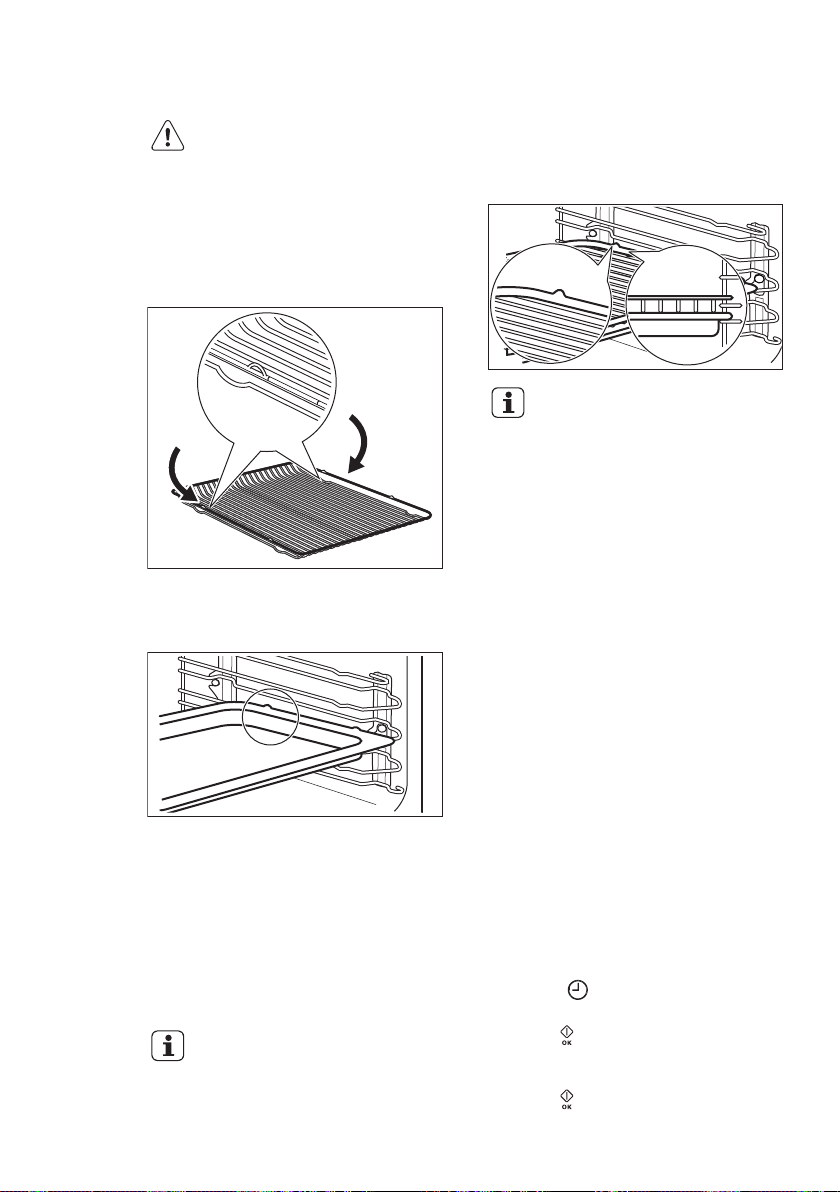
Wire shelf:
Push the shelf between the guide bars of
the shelf support and make sure that the
feet point down.
Baking tray:
Push the baking tray between the guide
bars of the shelf support.
Wire shelf and baking tray together:
Push the baking tray between the guide
bars of the shelf support and the wire
shelf on the guide bars above.
• All accessories have small
indentations at the top of
the right and left side to
increase safety. The
indentations are also anti-
tip devices.
• The high rim around the
shelf is a device which
prevents cookware from
slipping.
12. ADDITIONAL FUNCTIONS
12.1 Favourite Programme
You can save your favourite settings,
such as duration, temperature or heating
function. They are available in the menu:
Favourite Programme. You can save 20
programmes.
You cannot save Microwave
and microwave combi
functions as favourite
programmes.
Saving a programme
1. Activate the appliance.
2. Set a heating function or an
automatic programme.
3. Touch again and again until the
display shows: SAVE.
4. Press to confirm.
The display shows the first free memory
position.
5. Press to confirm.
www.aeg.com20
6. Enter the name of the programme.
The first letter flashes.
7. Touch or to change the
letter.
8. Press .
The next letter flashes.
9. Do step 7 again as necessary.
10. Press and hold to save.
You can overwrite a memory position.
When the display shows the first free
memory position, touch or and
press to overwrite an existing
programme.
You can change the name of a
programme in the menu: Edit
Programme Name.
Activating the programme
1. Activate the appliance.
2. Select the menu: Favourite
Programme.
3.
Press to confirm.
4. Select your favourite programme
name.
5. Press
to confirm.
12.2 Using the Child Lock
The Child Lock prevents an accidental
operation of the appliance.
1. Activate the appliance.
2. Touch and at the same time
until the display shows a message.
To deactivate the Child Lock function
repeat step 2.
12.3 Function Lock
This function prevents an accidental
change of the heating function. You can
activate it only when the appliance
operates.
1. Activate the appliance.
2. Set a heating function or setting.
3. Press again and again until the
display shows: Function Lock.
4. Press to confirm.
To deactivate the function, press
. The
display shows a message. Press again
and then
to confirm.
12.4
Set + Go
The function lets you set a heating
function (or a programme) and use it
later with one press of a sensor field.
1. Activate the appliance.
2. Set a heating function.
3. Press again and again until the
display shows: Duration.
4. Set the time.
5. Press again and again until the
display shows: Set + Go.
6. Press to confirm.
Press a sensor field (except for
) to
start the function: Set + Go. The set
heating function starts.
When the heating function ends, an
acoustic signal sounds.
• Function Lock is on when
the heating function
operates.
• The menu: Basic Settings
lets you activate and
deactivate the function: Set
+ Go.
12.5 Automatic Switch-off
For safety reasons the appliance
deactivates automatically after some
time if a heating function operates and
you do not change any settings.
Temperature (°C) Switch-off time (h)
30 - 115 12.5
120 - 195 8.5
200 - 230 5.5
The Automatic switch-off does
not work with the functions:
Light, End Time, Duration.
12.6 Brightness of the display
There are two modes of display
brightness:
• Night brightness - when the appliance
is deactivated, the brightness of the
ENGLISH
21
display is lower between 10 PM and 6
AM.
• Day brightness:
– when the appliance is activated.
– if you touch a sensor field during
the night brightness (apart from
ON / OFF), the display goes back
to the day brightness mode for
the next 10 seconds.
– if the appliance is deactivated and
you set the function: Minute
Minder. When the function ends,
the display goes back to the night
brightness.
12.7 Cooling fan
When the appliance operates, the
cooling fan activates automatically to
keep the surfaces of the appliance cool.
If you deactivate the appliance, the
cooling fan can continue to operate until
the appliance cools down.
13. HINTS AND TIPS
WARNING!
Refer to Safety chapters.
The temperature and baking
times in the tables are
guidelines only. They depend
on the recipes and the quality
and quantity of the
ingredients used.
13.1 Advice for special heating
functions of the oven
Keep Warm
Use this function if you want to keep
food warm.
The temperature regulates itself
automatically to 80 °C.
Plate Warming
For warming plates and dishes.
Distribute plates and dishes evenly on
the wire shelf. Move stacks around after
half of the warming time (swap top and
bottom).
The automatic temperature is 70 °C.
Recommended shelf position: 3.
Dough Proving
You can use this automatic function with
any recipe for yeast dough you like. It
gives you a good atmosphere for rising.
Put the dough into a dish that is big
enough for rising and cover it with a wet
towel or plastic foil. Insert a wire shelf on
the first shelf position and put the dish in.
Close the door and set the function:
Dough Proving. Set the necessary time.
13.2 Baking
• Your oven can bake or roast
differently to the appliance you had
before. Adapt your usual settings
(temperature, cooking times) and
shelf positions to the values in the
tables.
• The manufacturer recommends that
you use the lower temperature the
first time.
• If you cannot find the settings for a
special recipe, look for the one that is
almost the same.
• You can extend baking times by 10 –
15 minutes if you bake cakes on more
than one level.
• Cakes and pastries at different
heights do not always brown equally
at first. If this occurs, do not change
the temperature setting. The
differences equalize during the
baking procedure.
• With longer baking times, you can
deactivate the oven approximately 10
minutes before the end of the baking
time and then use the residual heat.
When you cook frozen food, the trays in
the oven can twist during baking. When
the trays become cold again, the
distortions are gone.
www.aeg.com
22
13.3 Tips on baking
Baking results Possible cause Remedy
The bottom of the cake is
not browned sufficiently.
The shelf position is incor-
rect.
Put the cake on a lower
shelf.
The cake sinks and becomes
soggy, lumpy or streaky.
The oven temperature is too
high.
The next time you bake, set
a slightly lower oven temper-
ature.
The cake sinks and becomes
soggy, lumpy or streaky.
The baking time is too short. Set a longer baking time.
You cannot decrease bak-
ing times by setting higher
temperatures.
The cake sinks and becomes
soggy, lumpy or streaky.
There is too much liquid in
the mixture.
Use less liquid. Be careful
with mixing times, especially
if you use a mixing machine.
The cake is too dry. The oven temperature is too
low.
The next time you bake, set
a higher oven temperature.
The cake is too dry. The baking time is too long. The next time you bake, set
a shorter baking time.
The cake browns unevenly. The oven temperature is too
high and the baking time is
too short.
Set a lower oven tempera-
ture and a longer baking
time.
The cake browns unevenly. The mixture is unevenly dis-
tributed.
Spread the mixture evenly
on the baking tray.
The cake is not ready in the
baking time given.
The oven temperature is too
low.
The next time you bake, set
a slightly higher oven tem-
perature.
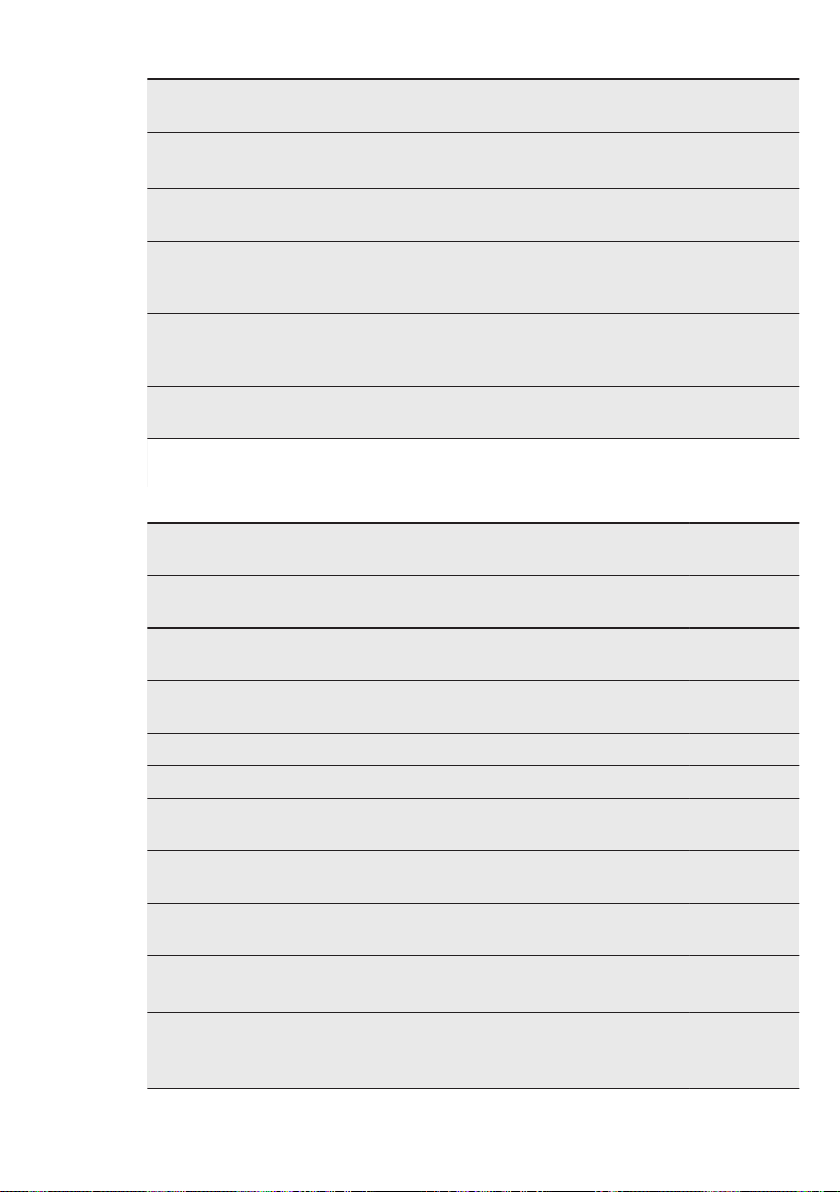
13.4 Baking on one oven level
Baking in tins
Food Function Tempera-
ture (°C)
Time (min) Shelf posi-
tion
Ring cake or brioche True Fan Cook-
ing
150 - 160 50 - 70 2
Madeira cake / Fruit
cakes
True Fan Cook-
ing
140 - 160 70 - 90 2
Sponge cake / Sponge
cake
True Fan Cook-
ing
140 - 150 35 - 50 2
Sponge cake / Sponge
cake
Conventional
Cooking
160 35 - 50 2
ENGLISH
23
Food Function Tempera-
ture (°C)
Time (min) Shelf posi-
tion
Flan base - short pas-
try
1)
True Fan Cook-
ing
170 - 180 10 - 25 2
Flan base - sponge mix-
ture
True Fan Cook-
ing
150 - 170 20 - 25 2
Apple pie / Apple pie (2
tins Ø 20 cm, diagonally
off set)
True Fan Cook-
ing
160 70 - 90 2
Apple pie / Apple pie (2
tins Ø 20 cm, diagonally
off set)
Conventional
Cooking
180 70 - 90 1
Cheesecake, tray
2)
Conventional
Cooking
160 - 170 60 - 90 1
1)
Preheat the oven.
2)
Use a deep pan.
Cakes / pastries / breads on baking trays
Food Function Tempera-
ture (°C)
Time (min) Shelf posi-
tion
Plaited bread / bread
crown
Conventional
Cooking
170 - 190 30 - 40 2
Christmas stollen
1)
Conventional
Cooking
160 - 180 50 - 70 2
Bread (rye bread)
1)
Conventional
Cooking
2
first 230 20
then 160 - 180 30 - 60
Cream puffs / Eclairs
1)
Conventional
Cooking
190 - 210 20 - 35 2
Swiss Roll
1)
Conventional
Cooking
180 - 200 10 - 20 2
Cake with crumble top-
ping (dry)
True Fan Cook-
ing
150 - 160 20 - 40 3
Buttered almond cake /
sugar cakes
1)
Conventional
Cooking
190 - 210 20 - 30 2
Fruit flans (made with
yeast dough / sponge
mixture)
2)
True Fan Cook-
ing
150 - 160 35 - 55 3
www.aeg.com24

Food Function Tempera-
ture (°C)
Time (min) Shelf posi-
tion
Fruit flans (made with
yeast dough / sponge
mixture)
2)
Conventional
Cooking
170 35 - 55 1
Fruit flans made with
short pastry
True Fan Cook-
ing
160 - 170 40 - 80 3
Yeast cakes with deli-
cate toppings (e.g.
quark, cream, custard)
1)
Conventional
Cooking
160 - 180 40 - 80 2
1)
Preheat the oven.
2)
Use a deep pan.
Biscuits
Food Function Tempera-
ture (°C)
Time (min) Shelf posi-
tion
Short pastry biscuits True Fan Cook-
ing
150 - 160 10 - 20 3
Short bread / Short
bread / Pastry Stripes
True Fan Cook-
ing
140 20 - 35 3
Short bread / Short
bread / Pastry Stripes
1)
Conventional
Cooking
160 20 - 30 2
Biscuits made with
sponge mixture
True Fan Cook-
ing
150 - 160 15 - 20 2
Pastries made with egg
white, meringues
True Fan Cook-
ing
80 - 100 120 - 150 1
Macaroons True Fan Cook-
ing
100 - 120 30 - 50 3
Biscuits made with yeast
dough
True Fan Cook-
ing
150 - 160 20 - 40 3
Puff pastries
1)
True Fan Cook-
ing
170 - 180 20 - 30 3
Rolls
1)
Conventional
Cooking
190 - 210 10 - 25 2
Small cakes / Small
cakes
1)
True Fan Cook-
ing
160 20 - 35 3
Small cakes / Small
cakes
1)
Conventional
Cooking
170 20 - 35 2
1)
Preheat the oven.
ENGLISH
25
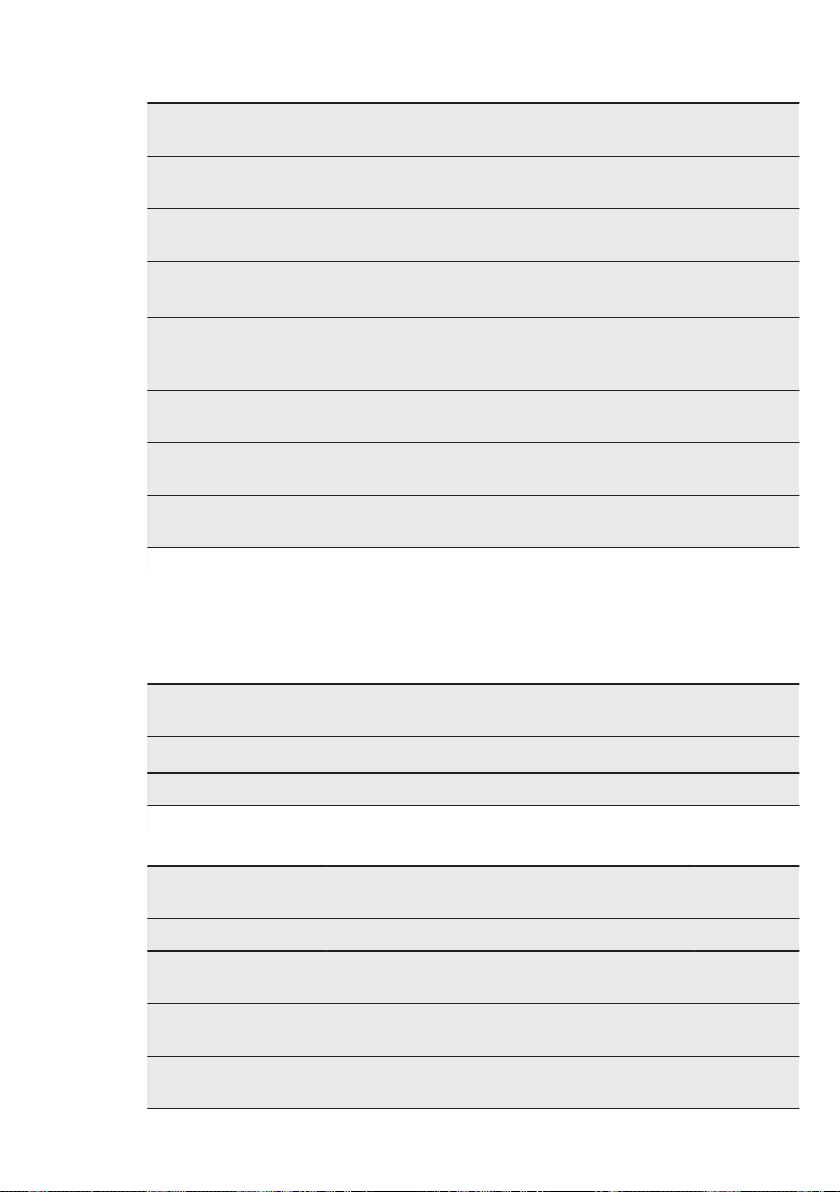
13.5 Bakes and gratins
Food Function Temperature
(°C)
Time (min) Shelf position
Pasta bake Conventional
Cooking
180 - 200 45 - 60 1
Lasagne Conventional
Cooking
180 - 200 25 - 40 1
Vegetables au
gratin
1)
Turbo Grilling 160 - 170 15 - 30 1
Baguettes top-
ped with melted
cheese
True Fan Cook-
ing
160 - 170 15 - 30 1
Sweet bakes Conventional
Cooking
180 - 200 40 - 60 1
Fish bakes Conventional
Cooking
180 - 200 30 - 60 1
Stuffed vegeta-
bles
True Fan Cook-
ing
160 - 170 30 - 60 1
1)
Preheat the oven.
13.6 Multilevel baking
Use the function: True Fan Cooking.
Cakes / pastries / breads on baking trays
Food Temperature (°C) Time (min) Shelf posi-
tion
Cream puffs / Eclairs
1)
160 - 180 25 - 45 1 / 3
Dry streusel cake 150 - 160 30 - 45 1 / 3
1)
Preheat the oven.
Biscuits / small cakes / pastries / rolls
Food Temperature (°C) Time (min) Shelf posi-
tion
Short pastry biscuits 150 - 160 20 - 40 1 / 3
Short bread / Short
bread / Pastry Stripes
140 25 - 45 1 / 3
Biscuits made with
sponge mixture
160 - 170 25 - 40 1 / 3
Pastries made with egg
white, meringues
80 - 100 130 - 170 1 / 3
www.aeg.com26
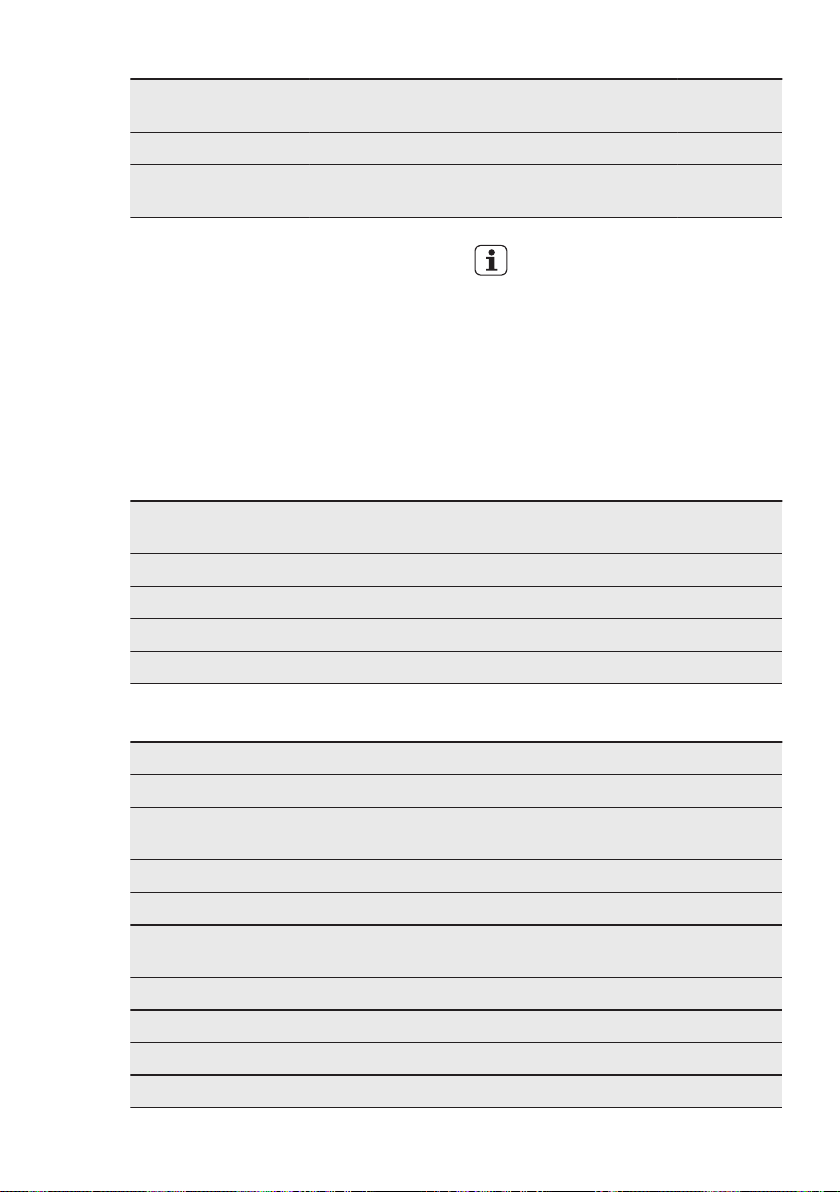
Food Temperature (°C) Time (min) Shelf posi-
tion
Macaroons 100 - 120 40 - 80 1 / 3
Biscuits made with
yeast dough
160 - 170 30 - 60 1 / 3
13.7 Slow Cooking
Use this function to prepare lean, tender
pieces of meat and fish. This function is
not applicable to such recipes as pot
roast or fatty roast pork.
In the first 10 minutes you can set an
oven temperature between 80 °C and
150 °C. The default is 90 °C. After the
temperature is set, the oven continues to
cook at 80 °C. Do not use this function
for poultry.
Always cook without a lid
when you use this function.
1. Sear the meat in a pan on the hob on
a very high setting for 1 - 2 minutes
on each side.
2. Put the meat together with the hot
roasting pan into the oven on the
wire shelf.
3. Select the function: Slow Cooking.
Food Quantity Temperature
(°C)
Time (min) Shelf posi-
tion
Roast beef 1000 - 1500 g 150 120 - 150 1
Fillet of beef 1000 - 1500 g 150 90 - 110 1
Roast veal 1000 - 1500 g 150 120 - 150 1
Steak 200 - 300 g 120 20 - 40 1
13.8 Pizza Setting
Food Temperature (°C) Time (min) Shelf position
Pizza (thin crust) 200 - 230 15 - 20 3
Pizza (with a lot of top-
ping)
180 - 200 20 - 30 3
Tarts 180 - 200 40 - 55 3
Spinach flan 160 - 180 45 - 60 3
Quiche Lorraine (Savoury
flan)
170 - 190 45 - 55 3
Swiss Flan 170 - 190 45 - 55 3
Cheesecake 140 - 160 60 - 90 3
Apple cake, covered 150 - 170 50 - 60 3
Vegetable pie 160 - 180 50 - 60 3
ENGLISH
27

Food Temperature (°C) Time (min) Shelf position
Unleavened bread 230 10 - 20 3
Puff pastry flan 160 - 180 45 - 55 3
Flammekuchen 230 12 - 20 3
Piroggen (Russian ver-
sion of calzone)
180 - 200 15 - 25 3
13.9 Roasting
• Large roasting joints can be roasted
directly in the deep pan or on the wire
shelf above the deep pan (if present).
• Roast lean meats in a roasting tin with
a lid. This will keep the meat more
succulent.
• All types of meat, that can be
browned or have crackling, can be
roasted in the roasting tin without the
lid.
• Use heat-resistant ovenware to roast
(refer to the instructions of the
manufacturer).
• You can roast large roasting joints
directly in the deep pan (if present) or
on the wire shelf above the deep pan.
• Roast lean meats in the roasting tin
with the lid. This keeps the meat more
succulent.
• All types of meat that can be browned
or have crackling can be roasted in
the roasting tin without the lid.
• We recommend that you cook meat
and fish weighing 1 kg and above in
the appliance.
• To prevent the meat juices or fat from
burning onto the pan, put some liquid
into the deep pan.
• If necessary, turn the roast (after 1/2 -
2/3 of the cooking time).
• Baste large roasts and poultry with
their juices several times during
roasting. This gives better roasting
results.
• You can deactivate the appliance
approximately 10 minutes before the
end of the roasting time, and use the
residual heat.
13.10 Roasting tables
Beef
Food Function Quantity Power
(Watts)
Tempera-
ture (°C)
Time (min) Shelf posi-
tion
Pot roast Conven-
tional
Cooking
1 - 1.5 kg 200 230 60 - 80 1
Pork
Food Func-
tion
Quantity Power
(Watts)
Tempera-
ture (°C)
Time (min) Shelf po-
sition
Shoulder,
neck, ham
joint
Turbo
Grilling
1 - 1.5 kg 200 160 - 180 50 - 70 1
Meat loaf Turbo
Grilling
750 g - 1 kg 200 160 - 170 35 - 50 1
www.aeg.com28
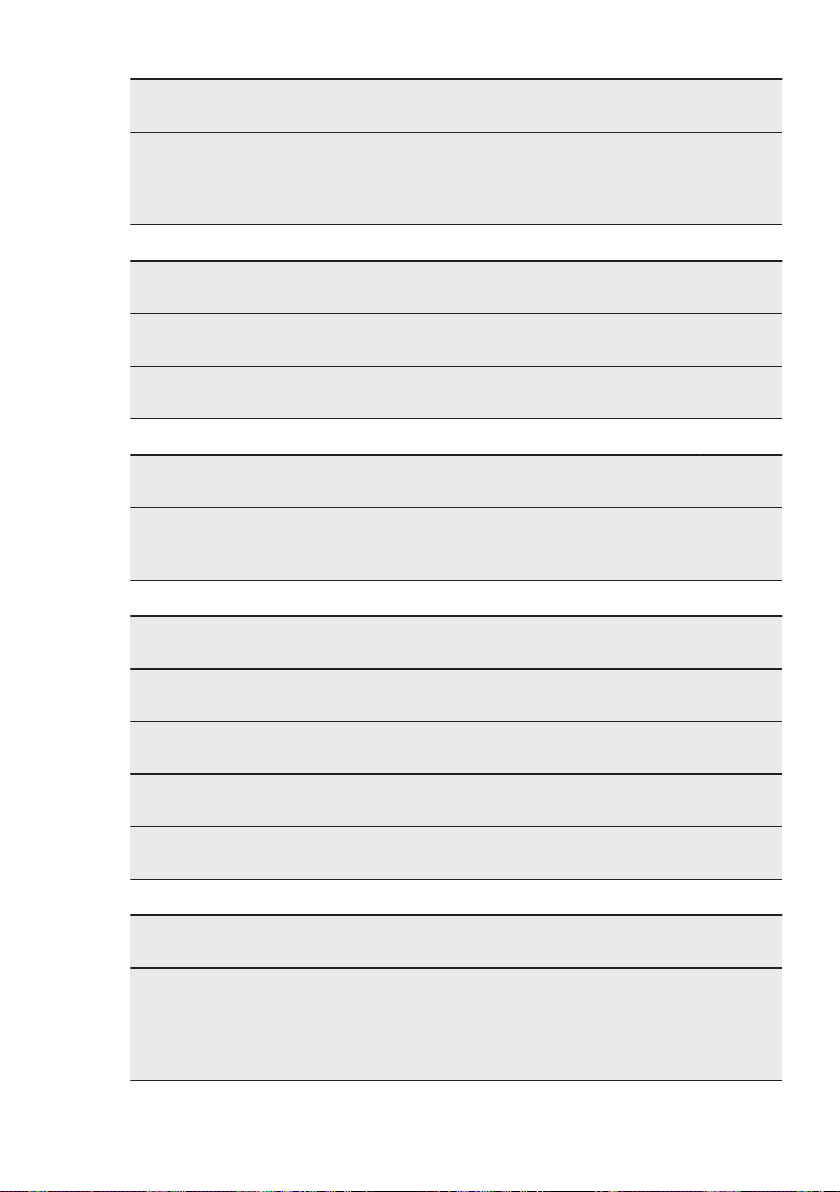
Food Func-
tion
Quantity Power
(Watts)
Tempera-
ture (°C)
Time (min) Shelf po-
sition
Pork
knuckle
(pre-
cooked)
Turbo
Grilling
750 g - 1 kg 200 150 - 170 60 - 75 1
Veal
Food Func-
tion
Quantity Power
(Watts)
Tempera-
ture (°C)
Time (min) Shelf po-
sition
Roast veal Turbo
Grilling
1 kg 200 160 - 180 50 - 70 1
Knuckle of
veal
Turbo
Grilling
1.5 - 2 kg 200 160 - 180 75 - 100 1
Lamb
Food Func-
tion
Quantity
(kg)
Power
(Watts)
Tempera-
ture (°C)
Time (min) Shelf po-
sition
Leg of
lamb, roast
lamb
Turbo
Grilling
1 - 1.5 200 150 - 170 50 - 70 1
Poultry
Food Func-
tion
Quantity Power
(Watts)
Tempera-
ture (°C)
Time (min) Shelf po-
sition
Poultry
portions
Turbo
Grilling
200 - 250 g
each
200 200 - 220 20 - 35 1
Chicken
half
Turbo
Grilling
400 - 500 g
each
200 190 - 210 25 - 40 1
Chicken
poulard
Turbo
Grilling
1 - 1.5 kg 200 190 - 210 30 - 45 1
Duck Turbo
Grilling
1.5 - 2 kg 200 180 - 200 180 - 200 1
Fish (steamed)
Food Func-
tion
Quantity
(kg)
Power
(Watts)
Tempera-
ture (°C)
Time (min) Shelf po-
sition
Whole fish Con-
vention-
al
Cook-
ing
1 - 1.5 200 210 - 220 30 - 45 1
ENGLISH
29
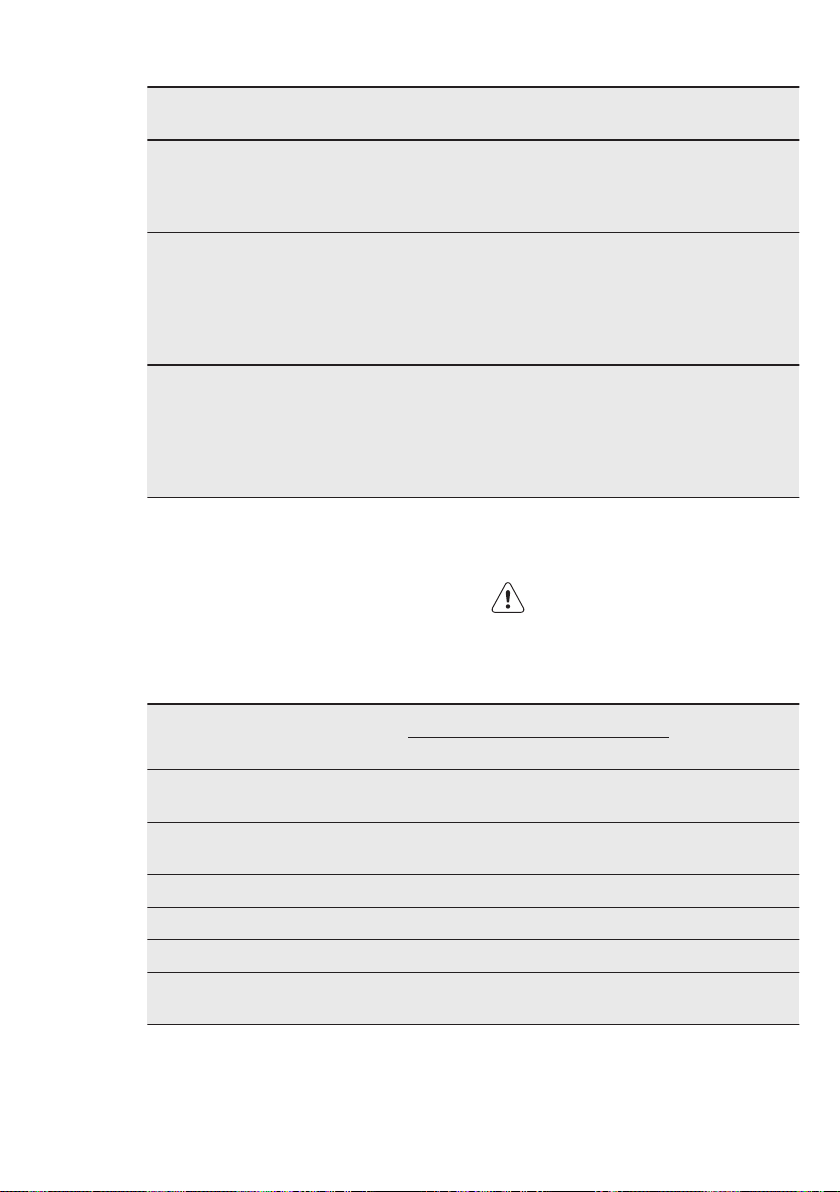
Dishes
Food Func-
tion
Quantity
(kg)
Power
(Watts)
Tempera-
ture (°C)
Time (min) Shelf po-
sition
Dishes
sweet
True
Fan
Cook-
ing
- 200 160 - 180 20 - 35 1
Savoury
dishes with
cooked in-
gredients
(noodles,
vegetables)
True
Fan
Cook-
ing
- 400 - 600 160 - 180 20 - 45 1
Savoury
dishes with
raw ingre-
dients (po-
tatoes,
vegetables)
True
Fan
Cook-
ing
- 400 - 600 160 - 180 30 - 45 2
13.11 Grilling
• Always grill with the maximum
temperature setting.
• Set the shelf into the shelf position as
recommended in the grilling table.
• Always set the pan to collect the fat
into the first shelf position.
• Grill only flat pieces of meat or fish.
• Always preheat the empty oven with
the grill functions for 5 minutes.
CAUTION!
Always grill with the oven
door closed.
Grilling
Food Temperature
(°C)
Time (min) Shelf position
1st side 2nd side
Roast beef, me-
dium
210 - 230 30 - 40 30 - 40 1
Filet of beef,
medium
230 20 - 30 20 - 30 1
Back of pork 210 - 230 30 - 40 30 - 40 1
Back of veal 210 - 230 30 - 40 30 - 40 1
Back of lamb 210 - 230 25 - 35 20 - 35 1
Whole Fish, 500
- 1000 g
210 - 230 15 - 30 15 - 30 1
www.aeg.com30

Fast Grilling
Food Time (min) Shelf position
1st side 2nd side
Burgers / Burgers 9 - 13 8 - 10 3
Pork fillet 10 - 12 6 - 10 2
Sausages 10 - 12 6 - 8 3
Fillet steaks / veal
steaks
7 - 10 6 - 8 3
Toast / Toast 1 - 3 1 - 3 3
Toast with topping 6 - 8 - 2
13.12 Frozen foods
• Remove the food packaging. Put the
food on a plate.
• Do not cover it with a bowl or a plate.
This can extend the defrost time.
Food Temperature (°C) Time (min) Shelf position
Pizza, frozen 200 - 220 15 - 25 3
Pizza American, frozen 190 - 210 20 - 25 3
Pizza, chilled 210 - 230 13 - 25 3
Pizza Snacks, frozen 180 - 200 15 - 30 3
French Fries, thin
1)
210 - 230 20 - 30 3
French Fries, thick
1)
210 - 230 25 - 35 3
Wedges / Cro-
quettes
1)
210 - 230 20 - 35 3
Hash Browns 210 - 230 20 - 30 3
Lasagne / Cannelloni,
fresh
170 - 190 35 - 45 2
Lasagne / Cannelloni,
frozen
160 - 180 40 - 60 2
Chicken Wings 190 - 210 20 - 30 3
1)
Turn 2 or 3 times during roasting.
ENGLISH
31
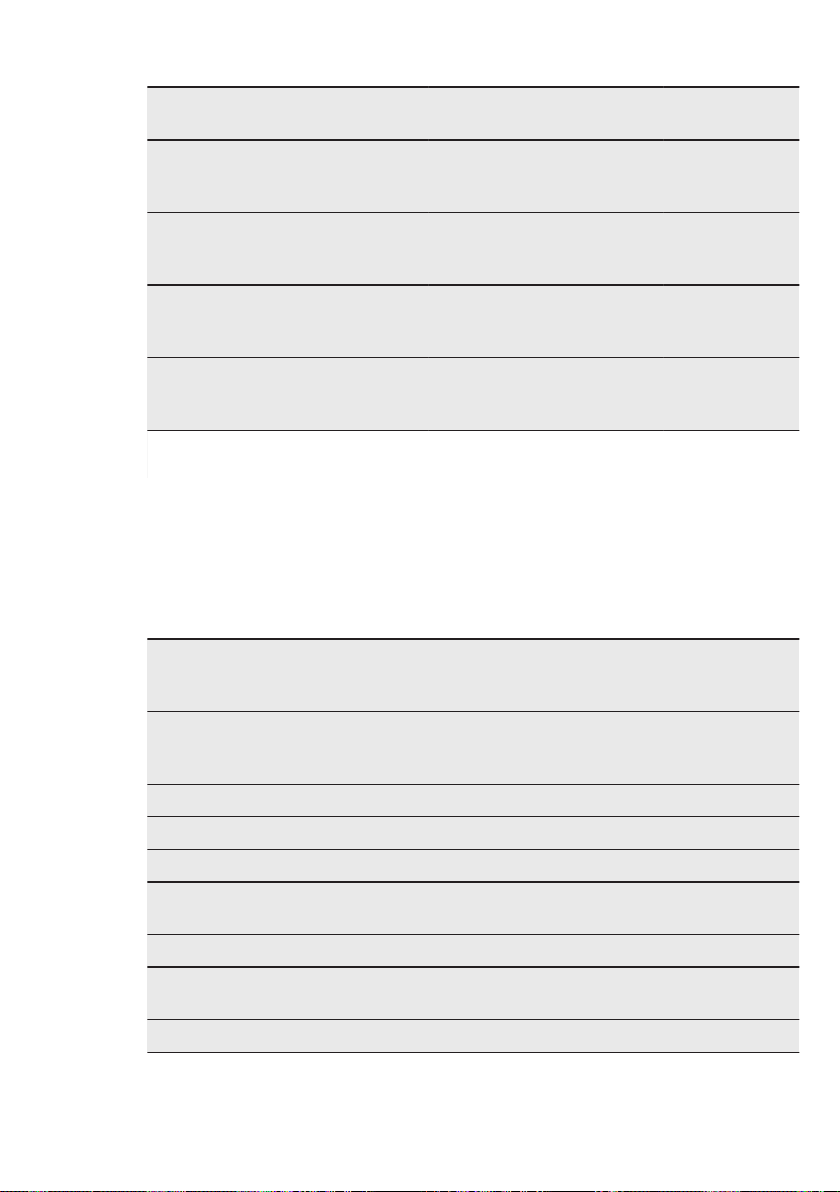
Frozen Ready Meals Table
Food Function Tempera-
ture (°C)
Time (min) Shelf position
Frozen pizza
1)
Conventional
Cooking
as per man-
ufacturer's
instructions
as per manufac-
turer's instruc-
tions
2
Chips
2)
(300 -
600 g)
Conventional
Cooking or Turbo
Grilling
200 - 220 as per manufac-
turer's instruc-
tions
2
Baguettes
1)
Conventional
Cooking
as per man-
ufacturer's
instructions
as per manufac-
turer's instruc-
tions
2
Fruit cake Conventional
Cooking
as per man-
ufacturer's
instructions
as per manufac-
turer's instruc-
tions
2
1)
Preheat the oven.
2)
Turn 2 or 3 times during cooking.
13.13 Defrost
• Remove the food packaging and put
the food on a plate.
• Use the first shelf position from the
bottom.
• Do not cover the food with a bowl or
a plate, as this can extend the defrost
time.
Food Quantity Defrosting
time (min)
Further de-
frosting time
(min)
Comments
Chicken 1 kg 100 - 140 20 - 30 Put the chicken on an upturned
saucer in a big plate. Turn halfway
through.
Meat 1 kg 100 - 140 20 - 30 Turn halfway through.
Meat 500 g 90 - 120 20 - 30 Turn halfway through.
Trout 150 g 25 - 35 10 - 15 -
Strawber-
ries
300 g 30 - 40 10 - 20 -
Butter 250 g 30 - 40 10 - 15 -
Cream 2 x 200 g 80 - 100 10 - 15 Whip the cream when still slightly
frozen in places.
Gateau 1.4 kg 60 60 -
www.aeg.com32
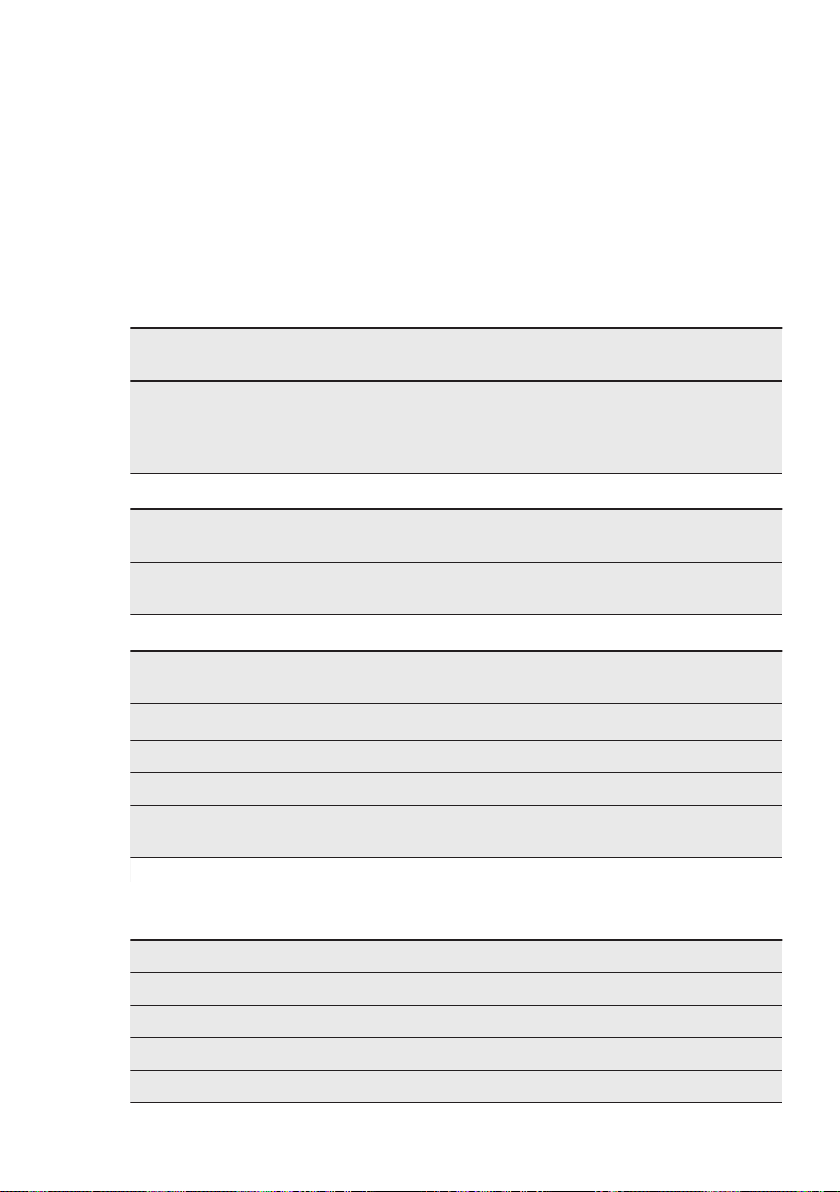
13.14 Preserving
• Use only preserve jars of the same
dimensions available on the market.
• Do not use jars with twist-off and
bayonet type lids or metal tins.
• Use the first shelf from the bottom for
this function.
• Put no more than six one-litre
preserve jars on the baking tray.
• Fill the jars equally and close with a
clamp.
• The jars cannot touch each other.
• Put approximately 1/2 litre of water
into the baking tray to give sufficient
moisture in the oven.
• When the liquid in the jars starts to
simmer (after approximately 35 - 60
minutes with one-litre jars), stop the
oven or decrease the temperature to
100 °C (see the table).
Soft fruit
Food Temperature (°C) Cooking time until
simmering (min)
Continue to cook at
100 °C (min)
Strawberries / Blue-
berries / Raspber-
ries / Ripe gooseber-
ries
160 - 170 35 - 45 -
Stone fruit
Food Temperature (°C) Cooking time until
simmering (min)
Continue to cook at
100 °C (min)
Pears / Quinces /
Plums
160 - 170 35 - 45 10 - 15
Vegetables
Food Temperature (°C) Cooking time until
simmering (min)
Continue to cook at
100 °C (min)
Carrots
1)
160 - 170 50 - 60 5 - 10
Cucumbers 160 - 170 50 - 60 -
Mixed pickles 160 - 170 50 - 60 5 - 10
Kohlrabi / Peas / As-
paragus
160 - 170 50 - 60 15 - 20
1)
Leave standing in the oven after it is deactivated.
13.15 Drying
Food Temperature (°C) Time (h) Shelf position
Beans 60 - 70 6 - 8 3
Peppers 60 - 70 5 - 6 3
Vegetables for soup 60 - 70 5 - 6 3
Mushrooms 50 - 60 6 - 8 3
ENGLISH
33

Food Temperature (°C) Time (h) Shelf position
Herbs 40 - 50 2 - 3 3
Plums 60 - 70 8 - 10 3
Apricots 60 - 70 8 - 10 3
Apple slices 60 - 70 6 - 8 3
Pears 60 - 70 6 - 9 3
13.16 Bread Baking
Preheating is not recommended.
Food Temperature (°C) Time (min) Shelf position
White Bread 180 - 200 40 - 60 2
Baguette 200 - 220 35 - 45 2
Brioche 160 - 180 40 - 60 2
Ciabatta 200 - 220 35 - 45 2
Rye Bread 180 - 200 50 - 70 2
Dark Bread 180 - 200 50 - 70 2
All Grain bread 170 - 190 60 - 90 2
13.17 Microwave cooking
tables
Defrosting meat
Food Power
(Watts)
Quantity (g) Time (min) Standing
time (min)
Comments
Whole cuts
of meat
200 500 10 - 12 10 - 15 Turn halfway
through.
Steak 200 200 3 - 5 5 - 10 Turn halfway
through, re-
move defros-
ted parts.
Mixed
minced meat
200 500 10 - 15 10 - 15 Turn halfway
through, re-
move defros-
ted parts.
www.aeg.com34
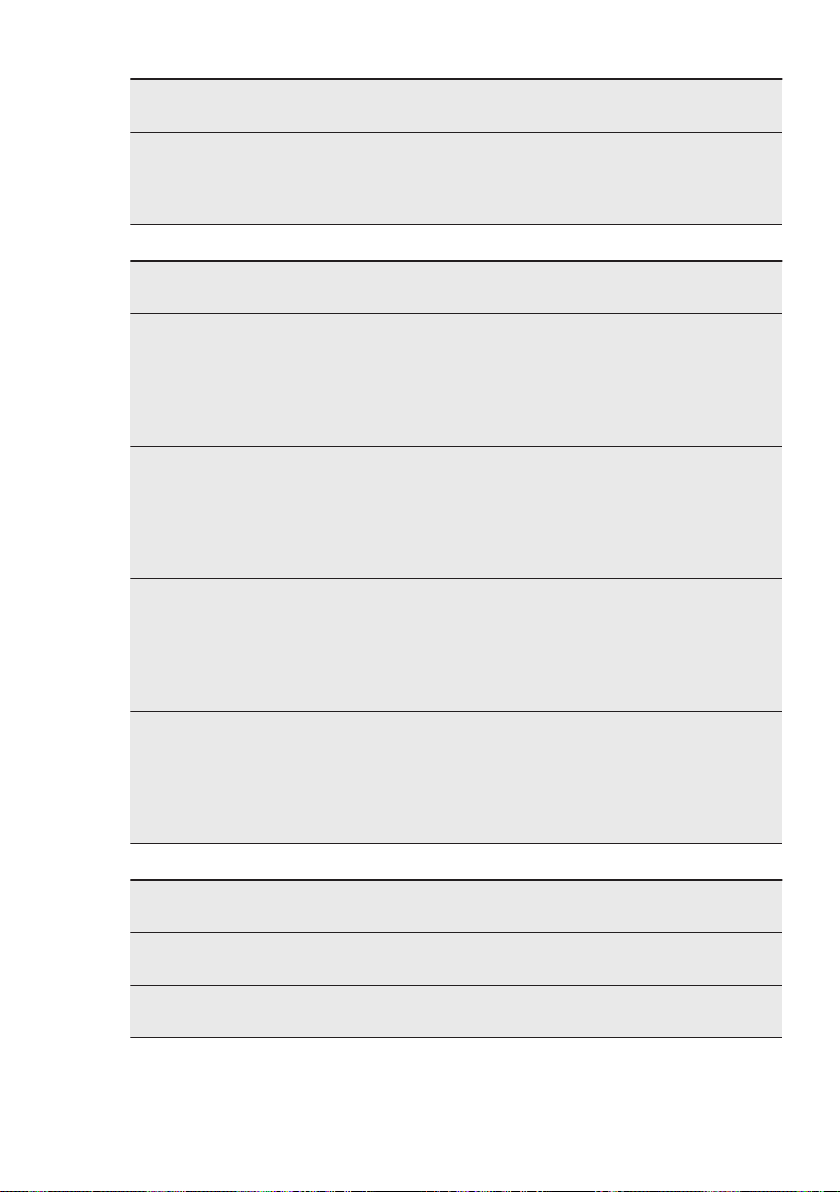
Food Power
(Watts)
Quantity (g) Time (min) Standing
time (min)
Comments
Goulash 200 500 10 - 15 10 - 15 Turn halfway
through, re-
move defros-
ted parts.
Defrosting poultry
Food Power
(Watts)
Quantity (g) Time (min) Standing
time (min)
Comments
Chicken 200 1000 25 - 30 10 - 20 Turn halfway
through, cov-
er defrosted
parts with
aluminium
foil.
Chicken
breast
200 100 - 200 3 - 5 10 - 15 Turn halfway
through, cov-
er defrosted
parts with
aluminium
foil.
Chicken
thighs
200 100 - 200 3 - 5 10 - 15 Turn halfway
through, cov-
er defrosted
parts with
aluminium
foil.
Duck 200 2000 45 - 60 20 - 30 Turn halfway
through, cov-
er defrosted
parts with
aluminium
foil.
Defrosting fish
Food Power
(Watts)
Quantity (g) Time (min) Standing
time (min)
Comments
Whole Fish 100 500 10 - 15 15 - 20 Turn halfway
through.
Fish fillets 100 500 10 - 12 15 - 20 Turn halfway
through.
ENGLISH
35
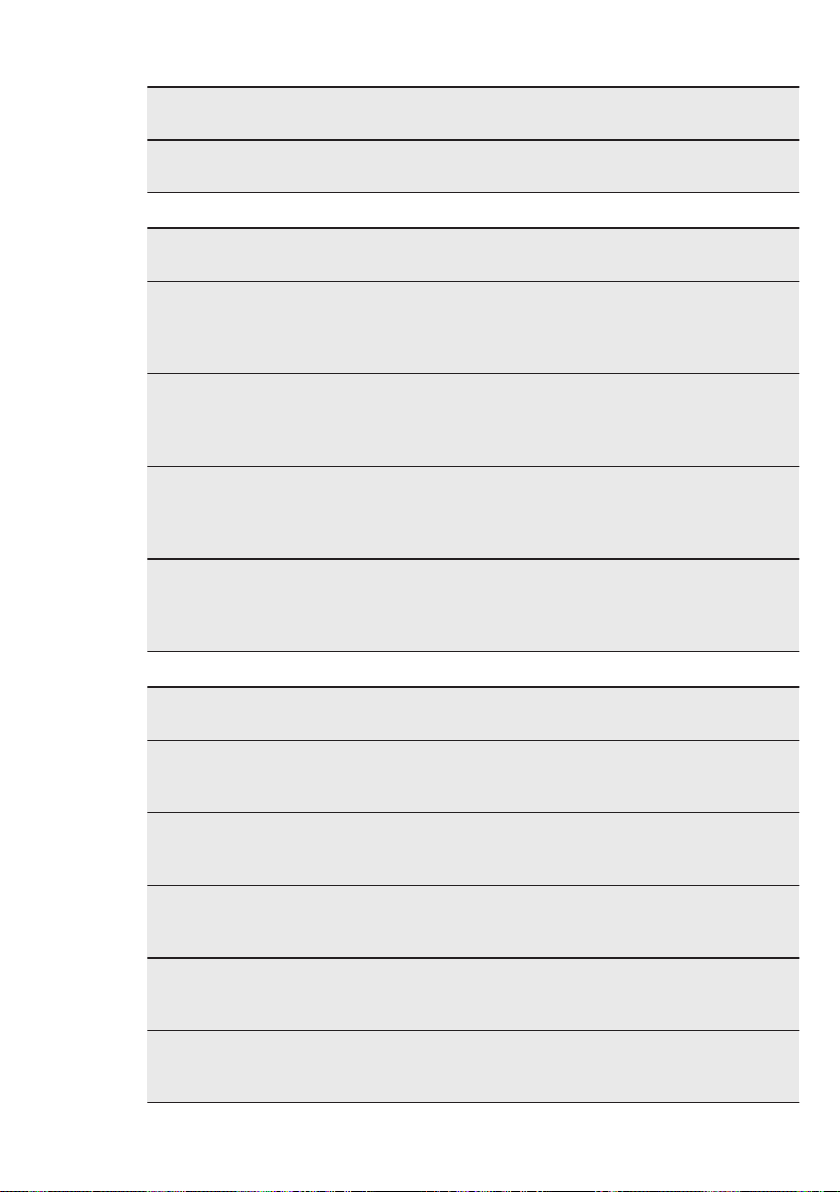
Defrosting sausage
Food Power
(Watts)
Quantity (g) Time (min) Standing
time (min)
Comments
Sliced saus-
age
100 100 2 - 4 20 - 40 Turn halfway
through.
Defrosting dairy products
Food Power
(Watts)
Quantity (g) Time (min) Standing
time (min)
Comments
Quark 100 250 10 - 15 25 - 30 Remove alu-
minium parts,
turn halfway
through.
Butter 100 250 3 - 5 15 - 20 Remove alu-
minium parts,
turn halfway
through.
Cheese 100 250 3 - 5 30 - 60 Remove alu-
minium parts,
turn halfway
through.
Cream 100 200 7 - 12 20 - 30 Remove alu-
minium top,
stir halfway
through.
Defrosting cakes / pastries
Food Power
(Watts)
Quantity Time (min) Standing
time (min)
Comments
Yeast dough 100 1 piece 2 - 3 15 - 20 Turn plate
halfway
through.
Cheesecake 100 1 piece 2 - 4 15 - 20 Turn plate
halfway
through.
Cake (ga-
teau)
100 1 piece 1 - 2 15 - 20 Turn plate
halfway
through.
Dry cake (e.
g. Pound
cake)
100 1 piece 2 - 4 15 - 20 Turn plate
halfway
through.
Fruit cake 100 1 piece 1 - 2 15 - 20 Turn plate
halfway
through.
www.aeg.com36
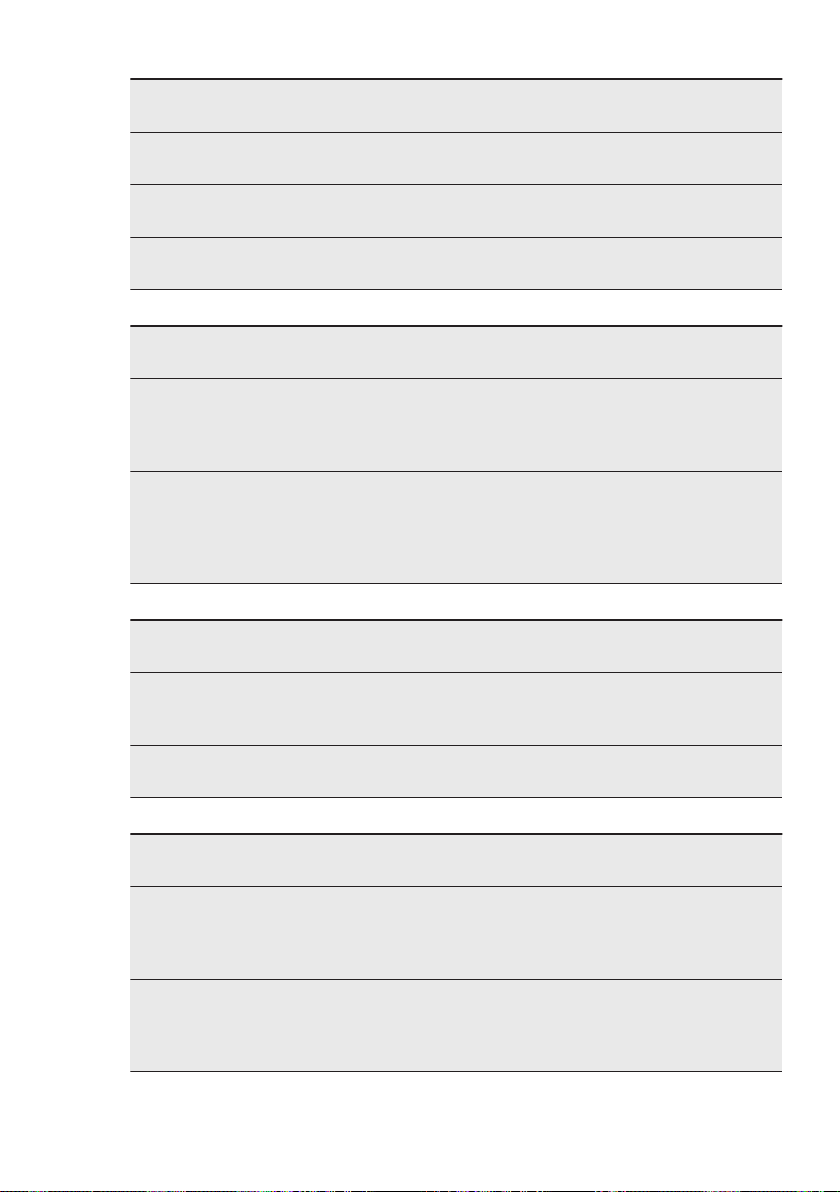
Food Power
(Watts)
Quantity Time (min) Standing
time (min)
Comments
Bread 100 1000 g 15 - 20 10 - 15 Turn halfway
through.
Sliced bread 100 500 g 8 - 12 10 - 15 Turn halfway
through.
Bread rolls 100 4 rolls 5 - 8 5 - 10 Turn halfway
through.
Defrosting fruit
Food Power
(Watts)
Quantity (g) Time (min) Standing
time (min)
Comments
Strawberries 100 300 8 - 12 10 - 15 Defrost cov-
ered, stir
halfway
through.
Plums, cher-
ries, raspber-
ries, black-
currants,
apricots
100 250 8 - 10 10 - 15 Defrost cov-
ered, stir
halfway
through.
Cooking / melting
Food Power
(Watts)
Quantity (g) Time (min) Standing
time (min)
Comments
Chocolate /
Chocolate
coating
600 150 2 - 3 - Stir halfway
through.
Butter 200 100 2 - 4 - Stir halfway
through.
Defrosting heating
Food Power
(Watts)
Quantity Time (min) Standing
time (min)
Comments
Baby food in
jars
300 200 g 2 - 3 - Stir halfway
through,
check tem-
perature.
Baby milk
(bottle, 180
ml)
1000 200 g 0:20 - 0:40 - Put spoon in-
to bottle, stir
and check
temperature.
ENGLISH
37
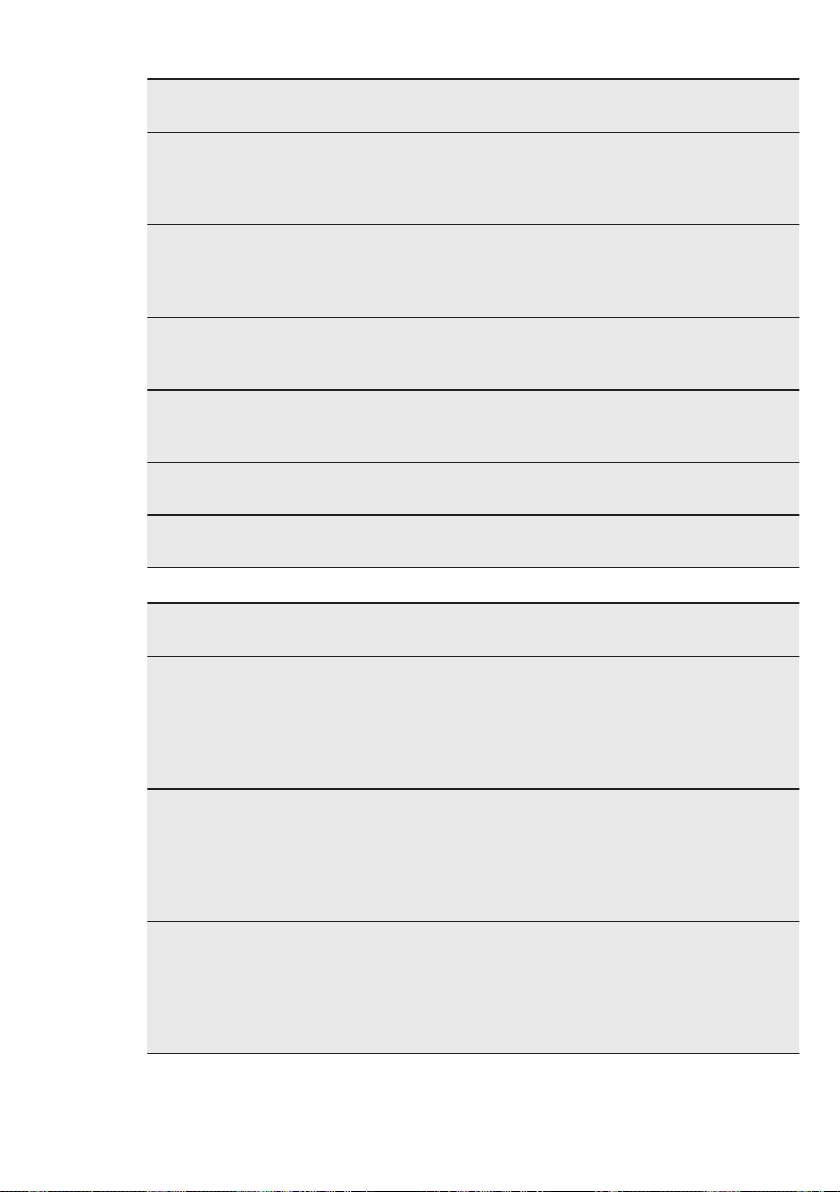
Food Power
(Watts)
Quantity Time (min) Standing
time (min)
Comments
Convenience
food
600 400 - 500 g 14 - 20 5 Remove any
aluminium
lids, turn half-
way through.
Frozen ready
meals
400 400 - 500 g 4 - 6 5 Remove any
aluminium
lids, turn half-
way through.
Milk 1000 1 cup ap-
prox. 200 ml
1:15 - 1:45 - Put spoon in
the contain-
er.
Water 1000 1 cup ap-
prox. 200 ml
1:30 - 2 - Put spoon in
the contain-
er.
Sauce 600 200 ml 1 - 2 - Stir halfway
through.
Soup 600 300 ml 2 - 4 - Stir halfway
through.
Cooking table
Food Power
(Watts)
Quantity Time (min) Standing
time (min)
Comments
Whole fish 500 500 g 8 - 10 - Cook cov-
ered, turn
container
several times
during cook-
ing.
Fish fillets 500 500 g 6 - 8 - Cook cov-
ered, turn
container
several times
during cook-
ing.
Vegetables,
short cooking
time, fresh
1)
600 500 g 12 - 16 - Add approx.
50 ml water,
cook cov-
ered, stir
halfway
through.
www.aeg.com38
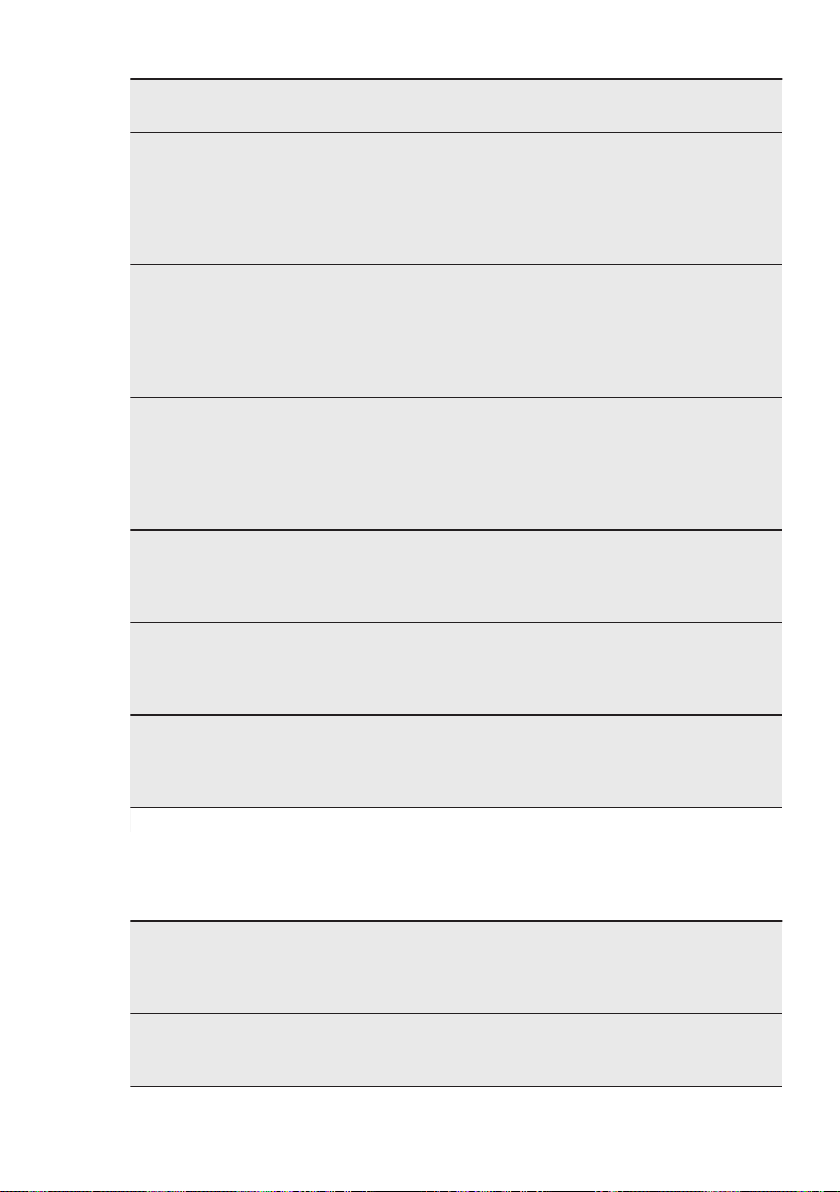
Food Power
(Watts)
Quantity Time (min) Standing
time (min)
Comments
Vegetables,
short cooking
time, frozen
1)
600 500 g 14 - 18 - Add approx.
50 ml water,
cook cov-
ered, stir
halfway
through.
Vegetables,
long cooking
time, fresh
1)
600 500 g 14 - 20 - Add approx.
50 ml water,
cook cov-
ered, stir
halfway
through.
Vegetables,
long cooking
time, frozen
1)
600 500 g 18 - 24 - Add approx.
50 ml water,
cook cov-
ered, stir
halfway
through.
Potatoes in
their jacket
1000 800 g + 600
ml
5 - 7 300 W / 15 -
20
Cook cov-
ered, stir
halfway
through.
Rice 1000 300 g + 600
ml
4 - 6 - Cook cov-
ered, stir
halfway
through.
Popcorn 1000 - 3 - 4 - Put the pop-
corn on a
plate on the
bottom level.
1)
Cook all vegetables with a cover on the container.
Combi-function table
• For selected models only.
• Use the functions: Grilling and
Microwave.
Food Ovenware Pow-
er
(Watt
s)
Tem-
pera-
ture
(°C)
Time
(min)
Shelf
posi-
tion
Comments
2 chicken
halves (2 x
600 g)
Glass dish with strainer 300 220 40 2 Turn after 20
min, standing
time 5 min.
ENGLISH
39
Food Ovenware Pow-
er
(Watt
s)
Tem-
pera-
ture
(°C)
Time
(min)
Shelf
posi-
tion
Comments
au gratin po-
tatoes (1 kg)
Gratin dish 300 200 40 2 10 min stand-
ing time.
Roast pork
neck (1100 g)
Glass dish with strainer 300 200 70 1 Turn in be-
tween, 10 min
standing time.
14. CARE AND CLEANING
WARNING!
Refer to Safety chapters.
14.1 Notes on cleaning
• Clean the front of the appliance with a
soft cloth with warm water and a
cleaning agent.
• To clean metal surfaces, use a usual
cleaning agent.
• Clean the appliance interior after
each use. Fat accumulation or other
food remains may result in a fire.
• Clean stubborn dirt with a special
oven cleaner.
• Clean all accessories after each use
and let them dry. Use a soft cloth with
warm water and a cleaning agent.
• If you have nonstick accessories, do
not clean them using aggressive
agents, sharp-edged objects or a
dishwasher. It can cause damage to
the nonstick coating.
• Dry the oven when the cavity is wet
after usage.
14.2 Removing the shelf
supports
Before maintenance, make sure that the
appliance is cool. There is a risk of burns.
To clean the appliance, remove the shelf
supports.
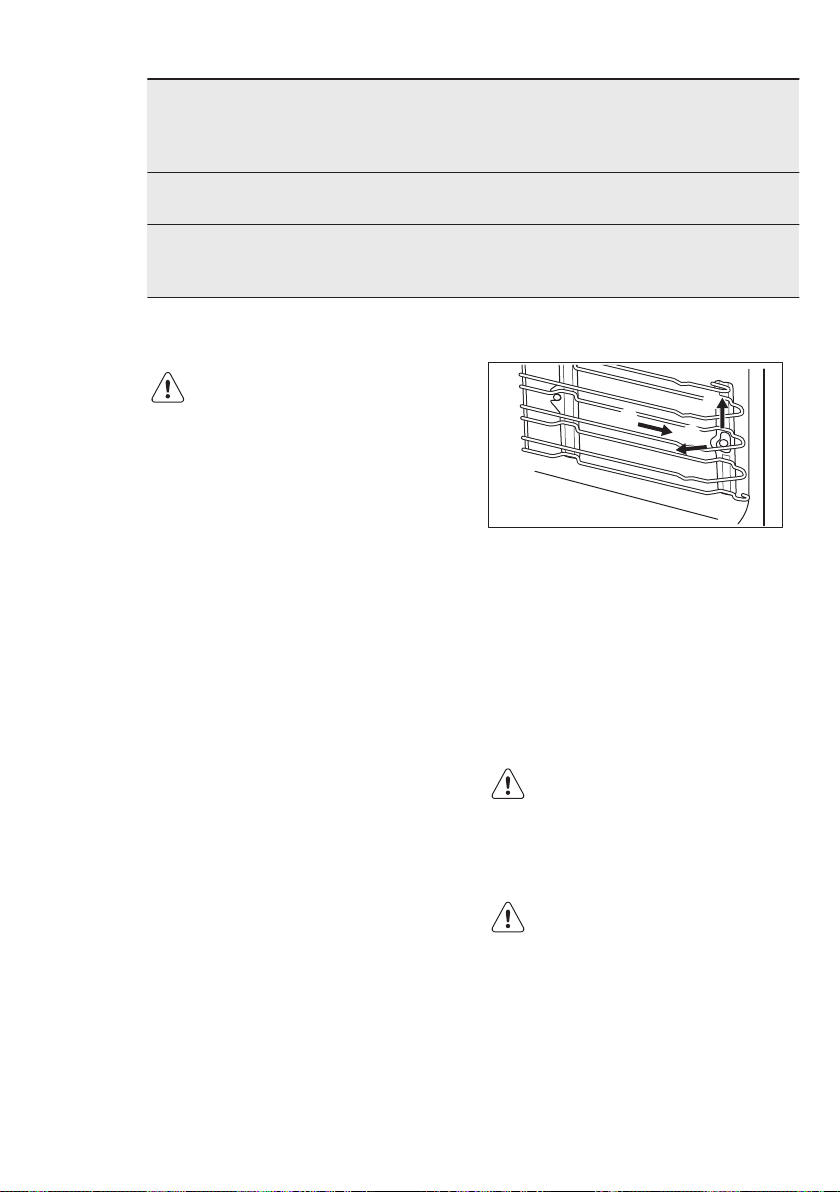
1. Pull carefully the supports up and out
of the front catch.
2
3
1
2. Pull the front end of the shelf support
away from the side wall.
3. Pull the supports out of the rear
catch.
Install the shelf supports in the opposite
sequence.
14.3 Replacing the lamp
Put a cloth on the bottom of the interior
of the appliance. It prevents damage to
the lamp glass cover and the cavity.
WARNING!
Danger of electrocution!
Disconnect the fuse before
you replace the lamp. The
lamp and the lamp glass cover
can be hot.
CAUTION!
Always hold the halogen lamp
with a cloth to prevent grease
residue from burning on the
lamp.
1. Deactivate the appliance.
2. Remove the fuses from the fuse box
or deactivate the circuit breaker.
www.aeg.com
40
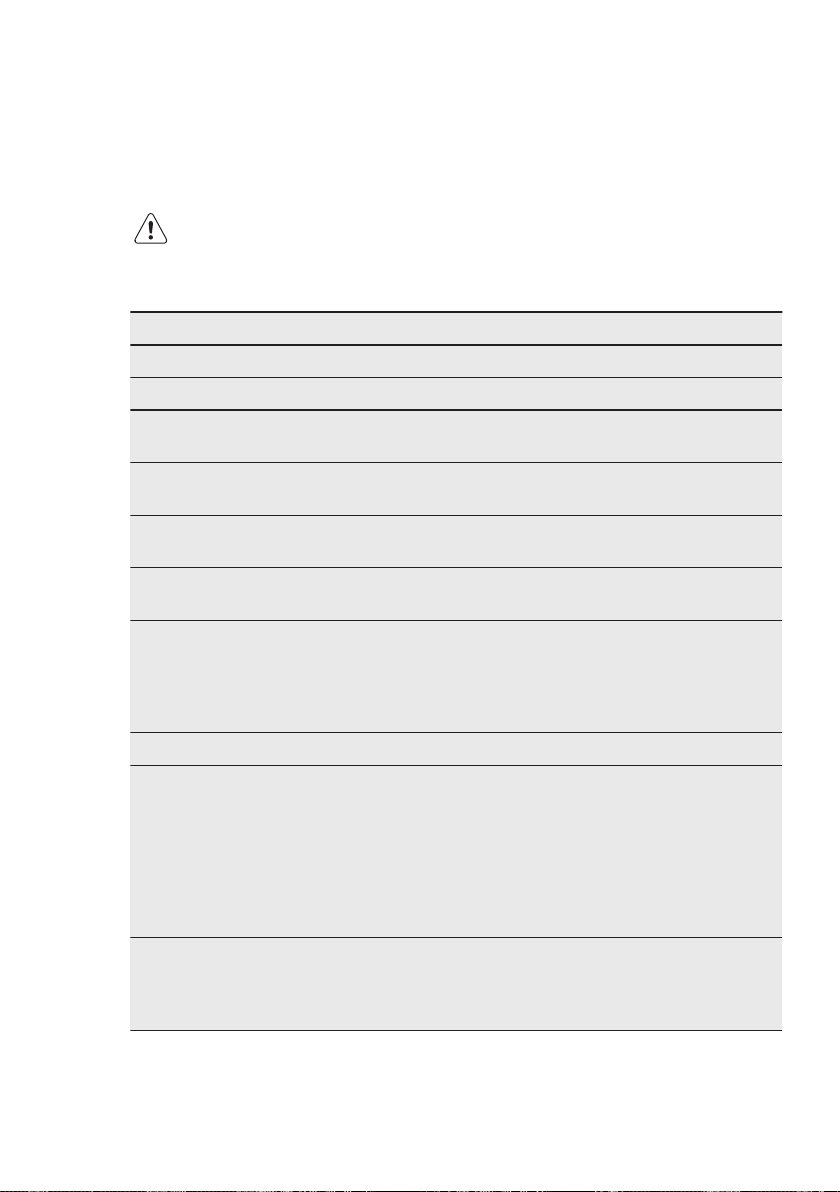
The top lamp
1. Turn the lamp glass cover
counterclockwise to remove it.
2. Clean the glass cover.
3. Replace the lamp with a suitable 300
°C heat-resistant lamp.
4. Install the glass cover.
15. TROUBLESHOOTING
WARNING!
Refer to Safety chapters.
15.1 What to do if...
Problem Possible cause Remedy
The oven does not heat up. The oven is deactivated. Activate the oven.
The oven does not heat up. The clock is not set. Set the clock.
The oven does not heat up. The necessary settings are
not set.
Make sure that the settings
are correct.
The oven does not heat up. The automatic switch-off is
activated.
Refer to "Automatic switch-
off".
The oven does not heat up. The Child Lock is on. Refer to "Using the Child
Lock".
The oven does not heat up. The door is not closed cor-
rectly.
Fully close the door.
The oven does not heat up. The fuse is released. Make sure that the fuse is
the cause of the malfunction.
If the fuse releases again
and again, contact a quali-
fied electrician.
The lamp does not operate. The lamp is defective. Replace the lamp.
The display shows an error
code that is not in this table.
There is an electrical fault. • Deactivate the oven with
the house fuse or the
safety switch in the fuse
box and activate it again.
• If the display shows the
error code again, contact
the Customer Care De-
partment.
Steam and condensation
settle on the food and in the
cavity of the oven.
You left the dish in the oven
for too long.
Do not leave the dishes in
the oven for longer than 15 -
20 minutes after the cooking
process ends.
ENGLISH
41
15.2 Service data
If you cannot find a solution to the
problem yourself, contact your dealer or
an Authorised Service Centre.
The necessary data for the service centre
is on the rating plate. The rating plate is
on the front frame of the appliance
cavity. Do not remove the rating plate
from the appliance cavity.
We recommend that you write the data here:
Model (MOD.) .........................................
Product number (PNC) .........................................
Serial number (S.N.) .........................................
16. INSTALLATION
WARNING!
Refer to Safety chapters.
16.1 Building in
The built-in unit must meet
the stability requirements of
DIN 68930.
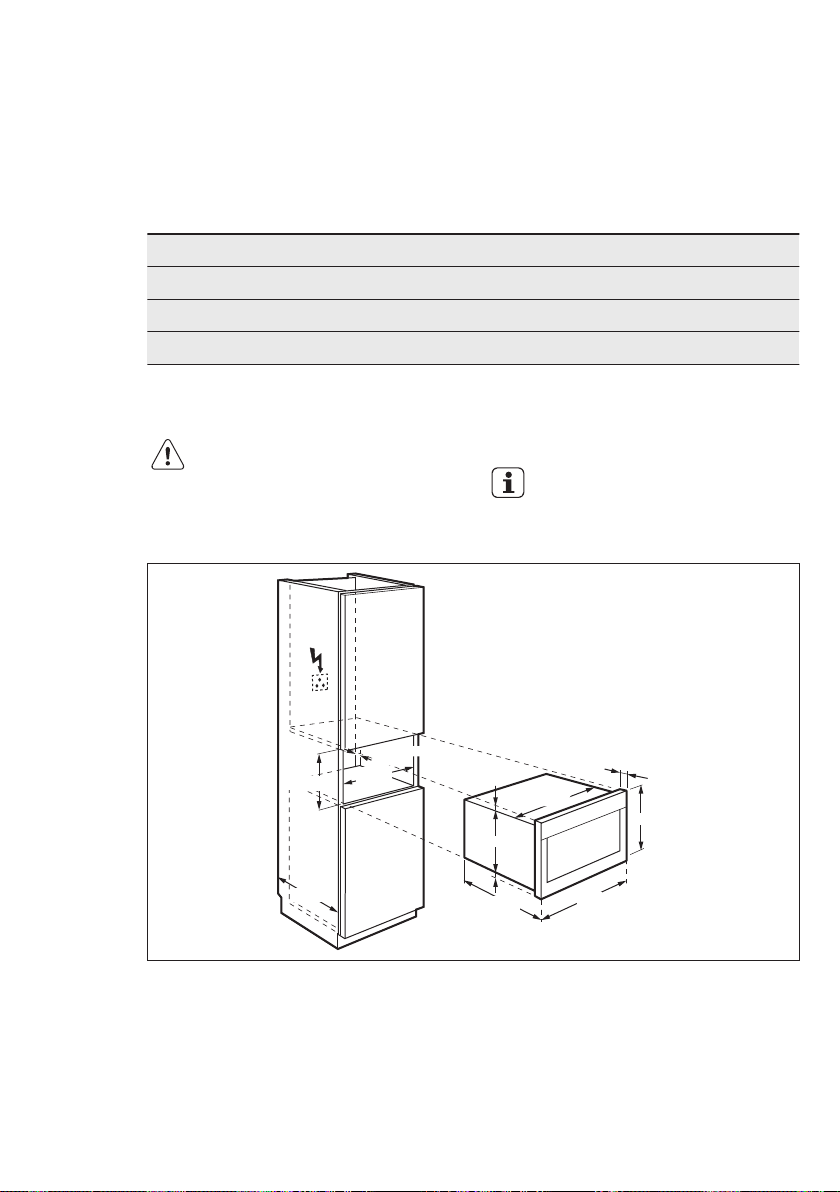
446 mm
548 mm
567 mm
594 mm
455 mm
21 mm
450 mm
min.
550 mm
min.
20 mm
min.
560 mm
4 mm
5 mm
www.aeg.com42
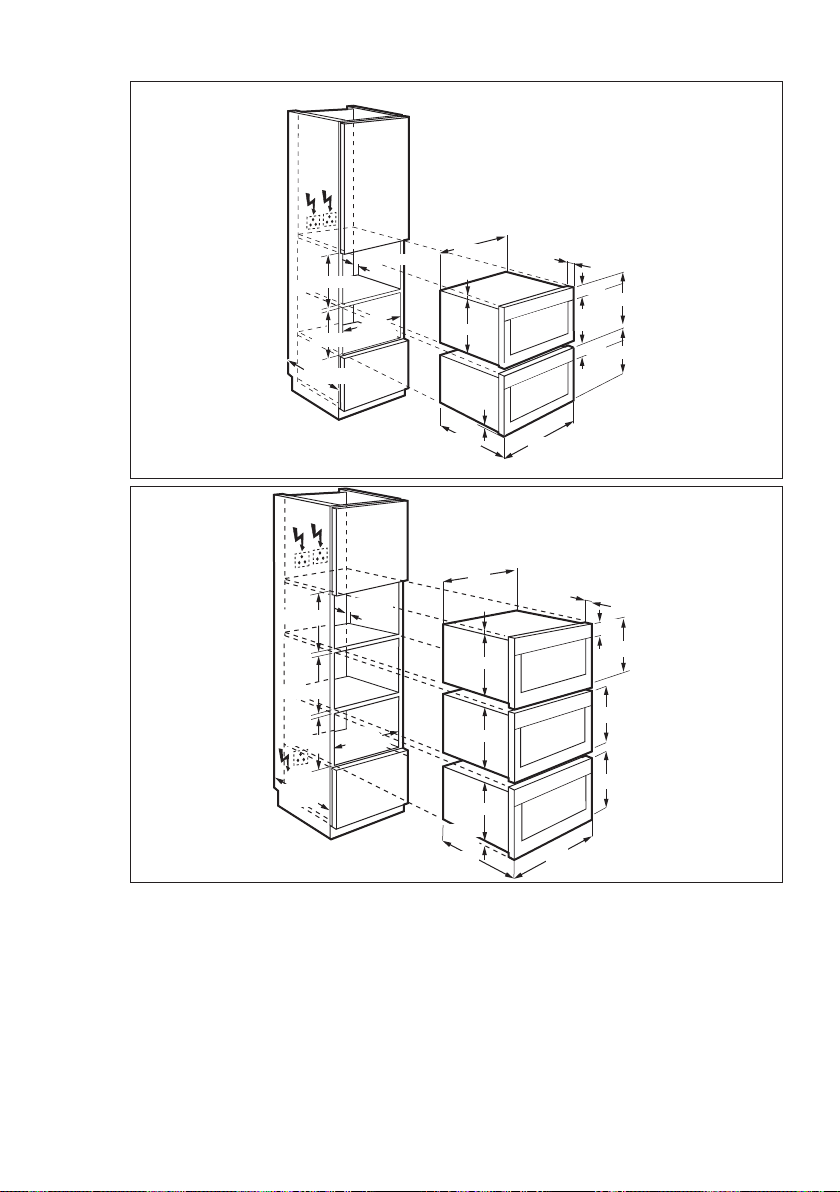
446 mm
567 mm
594 mm
455 mm
455 mm
450 mm
548 mm
min.
550 mm
450 mm
min.
560 mm
21 mm
114
mm
114
mm
5 mm
4 mm
min. 20 mm
446 mm
450 mm
450 mm
450 mm
446 mm
455 mm
455 mm
455 mm
5 mm
567 mm
594 mm
548 mm
21 mm
min.
550 mm
min.
560 mm
min.
20 mm
114
mm
4 mm
446 mm
ENGLISH
43
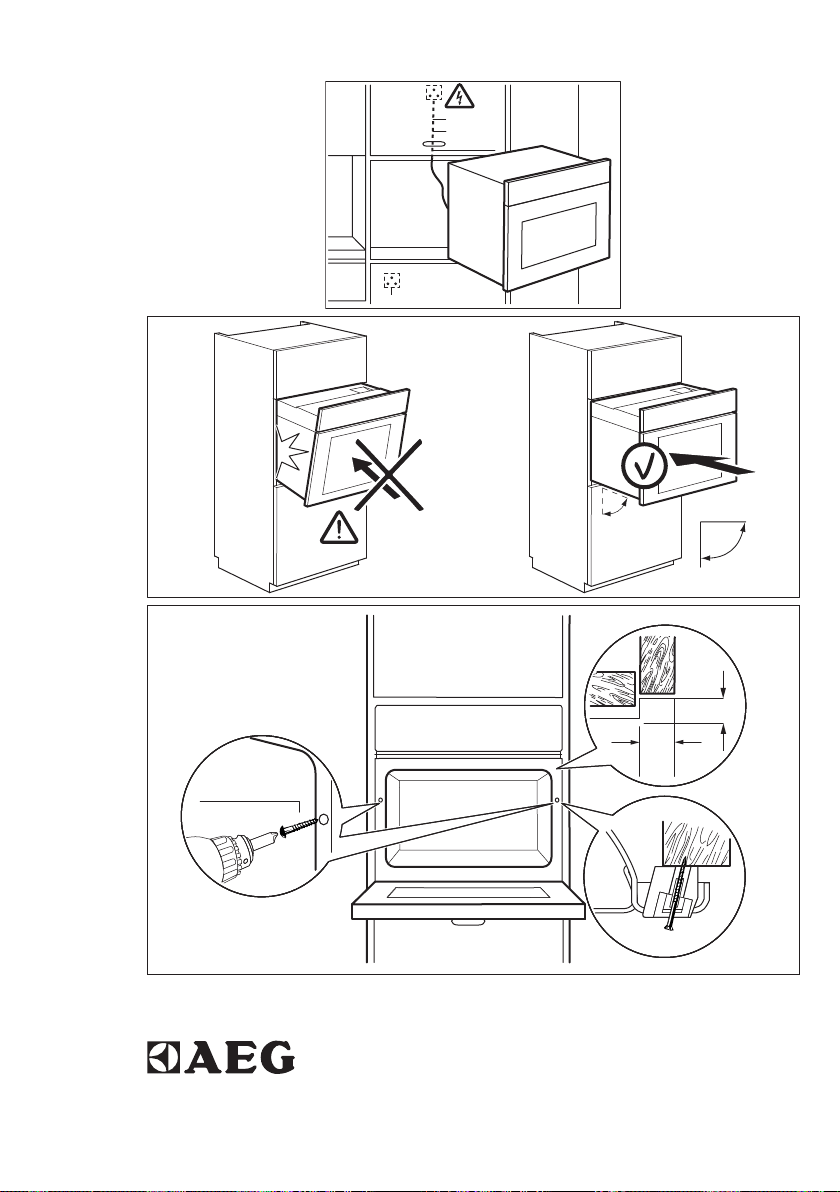
alternativ
H05VV-F
H05RR-F
min.1,60 m
90°
13 mm
20
mm
2x3,5x25
17. WARRANTY
FOR SALES IN AUSTRALIA AND NEW
ZEALAND
ALL AEG BRANDED APPLIANCES
This document sets out the terms and
conditions of the product warranties
for AEG Appliances. It is an important
document. Please keep it with your
www.aeg.com44

proof of purchase documents in a safe
place for future reference should you
require service for your Appliance.
1. In this warranty
a) ‘acceptable quality’ as referred to
in clause 10 of this warranty has
the same meaning referred to in
the ACL;
b) ‘ACL’ means Trade Practices
Amendment (Australian
Consumer Law) Act (No.2) 2010;
c) ‘Appliance’ means any AEG
product purchased by you
accompanied by this document;
d) ‘ASC’ means AEG’ authorised
serviced centres;
e) AEG is the brand controlled by
Electrolux Home Products Pty
Ltd of 163 O’Riordan Street,
Mascot, NSW 2020, ABN 51 004
762 341 in respect of Appliances
purchased in Australia and
Electrolux (NZ) Limited of 3-5
Niall Burgess Road, Mount
Wellington, in respect of
Appliances purchased in New
Zealand;
f) ‘major failure’ as referred to in
clause 10 of this warranty has the
same meaning referred to in the
ACL and includes a situation
when an Appliance cannot be
repaired or it is uneconomic for
Electrolux, at its discretion, to
repair an Appliance during the
Warranty Period;
g) ‘Warranty Period’ means:
– where the Appliance is used
for personal, domestic or
household use (i.e. normal
single family use) as set out in
the instruction manual, the
Appliance is warranted
against manufacturing defects
in Australia and New Zealand
for 60 months, following the
date of original purchase of
the Appliance;
– this Appliance is not designed
for commercial use and
therefore no warranty applies
in this case;
h) ‘you’ means the purchaser of the
Appliance not having purchased
the Appliance for re-sale, and
‘your’ has a corresponding
meaning.
2. This warranty only applies to
Appliances purchased and used in
Australia or New Zealand and is in
addition to (and does not exclude,
restrict, or modify in any way) any
non-excludable statutory warranties
in Australia or New Zealand.
3. During the Warranty Period AEG or
its ASC will, at no extra charge if your
Appliance is readily accessible for
service, without special equipment
and subject to these terms and
conditions, repair or replace any
parts which it considers to be
defective. AEG or its ASC may use
remanufactured parts to repair your
Appliance. You agree that any
replaced Appliances or parts
become the property of AEG. This
warranty does not apply to light
globes, batteries, filters or similar
perishable parts.
4. Parts and Appliances not supplied by
AEG are not covered by this
warranty.
5. You will bear the cost of
transportation, travel and delivery of
the Appliance to and from AEG or its
ASC. If you reside outside of the
service area, you will bear the cost of:
a) travel of an authorised
representative;
b) transportation and delivery of the
Appliance to and from AEG or its
ASC,
In all instances, unless the Appliance
is transported by AEG or an AEG
authorised representative, the
Appliance is transported at the
owner’s cost and risk while in transit
to and from AEG or its ASC.
6. Proof of purchase is required before
you can make a claim under this
warranty.
7. You may not make a claim under this
warranty unless the defect claimed is
due to faulty or defective parts or
workmanship. AEG is not liable in the
following situations (which are not
exhaustive):
a) the Appliance is damaged by:
– accident
– misuse or abuse, including
failure to properly maintain or
service
ENGLISH
45
– normal wear and tear
– power surges, electrical storm
damage or incorrect power
supply
– incomplete or improper
installation
– incorrect, improper or
inappropriate operation
– insect or vermin infestation
– failure to comply with any
additional instructions
supplied with the Appliance;
b) the Appliance is modified
without authority from AEG in
writing;
c) the Appliance’s serial number or
warranty seal has been removed
or defaced;
d) the Appliance was serviced or
repaired by anyone other than
AEG, an authorised repairer or
ASC.
8. This warranty, the contract to which it
relates and the relationship between
you and AEG are governed by the
law applicable where the Appliance
was purchased. Where the Appliance
was purchased in New Zealand for
business purposes the Consumer
Guarantee Act does not apply.
9. To the extent permitted by law, AEG
excludes all warranties and liabilities
(other than as contained in this
document) including liability for any
loss or damage whether direct or
indirect arising from your purchase,
use or non use of the Appliance.
10. For Appliances and services provided
by AEG in Australia, the Appliances
come with a guarantee by AEG that
cannot be excluded under the
Australian Consumer Law. You are
entitled to a replacement or refund
for a major failure and for
compensation for any other
reasonably foreseeable loss or
damage. You are also entitled to
have the Appliance repaired or
replaced if the Appliance fails to be
of acceptable quality and the failure
does not amount to a major failure.
The benefits to you given by this
warranty are in addition to your other
rights and remedies under a law in
relation to the Appliances or services
to which the warranty relates.
11. At all times during the Warranty
Period, AEG shall, at its discretion,
determine whether repair,
replacement or refund will apply if an
Appliance has a valid warranty claim
applicable to it.
12. For Appliances and services provided
by AEG in New Zealand, the
Appliances come with a guarantee
by AEG pursuant to the provisions of
the Consumer Guarantees Act, the
Sale of Goods Act and the Fair
Trading Act.
13. To enquire about claiming under this
warranty, please follow these steps:
a) carefully check the operating
instructions, user manual and the
terms of this warranty;
b) have the model and serial
number of the Appliance
available;
c) have the proof of purchase (eg
an invoice) available;
d) telephone the numbers shown
below.
14. You accept that if you make a
warranty claim, AEG and its ASC may
exchange information in relation to
you to enable AEG to meet its
obligations under this warranty.
Important Notice
Before calling for service, please ensure that the steps listed in point 13 above have been
followed.
SERVICE AUSTRALIA
www.aeg.com/au
www.aeg.com46
FOR SERVICE
or to find the address of your nearest state service centre in Australia
PLEASE CALL 1300 363 664
OR EMAIL [email protected]
For the cost of a local call (Australia only)
FOR SPARE PARTS
or to find the address of your nearest state spare parts centre in Australia
PLEASE CALL 13 13 50
OR EMAIL [email protected]
For the cost of a local call (Australia only)
SERVICE NEW ZEALAND
FOR SERVICE
or to find the address of your nearest authorised service centre in New Zealand
FREE CALL 0800 10 66 10
OR EMAIL [email protected]
(New Zealand only)
FOR SPARE PARTS
or to find the address of your nearest state spare parts centre in New Zealand
FREE CALL 0800 10 66 20
OR EMAIL [email protected]
(New Zealand only)
18. ENVIRONMENTAL CONCERNS
Recycle the materials with the symbol .
Put the packaging in applicable
containers to recycle it. Help protect the
environment and human health and to
recycle waste of electrical and electronic
appliances. Do not dispose appliances
marked with the symbol with the
household waste. Return the product to
your local recycling facility or contact
your municipal office.
*
ENGLISH
47
www.aeg.com/au
867302145-A-052014