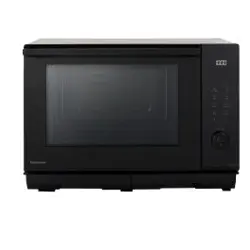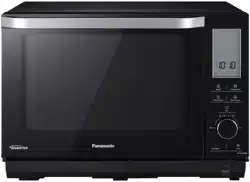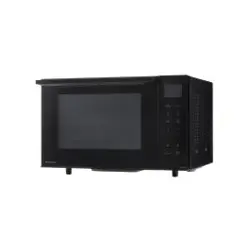
Model No. NN-DF38PB
Household Use Only
Operating Instructions
Combination Microwave Oven
Scan the QR code for more recipes:
https://www.panasonic.com/nn-df38p-df37p/
IMPORTANT SAFETY INSTRUCTIONS. PLEASE READ CAREFULLY AND KEEP FOR
FUTURE REFERENCE.
3
Thank you for purchasing a Panasonic Microwave Oven.
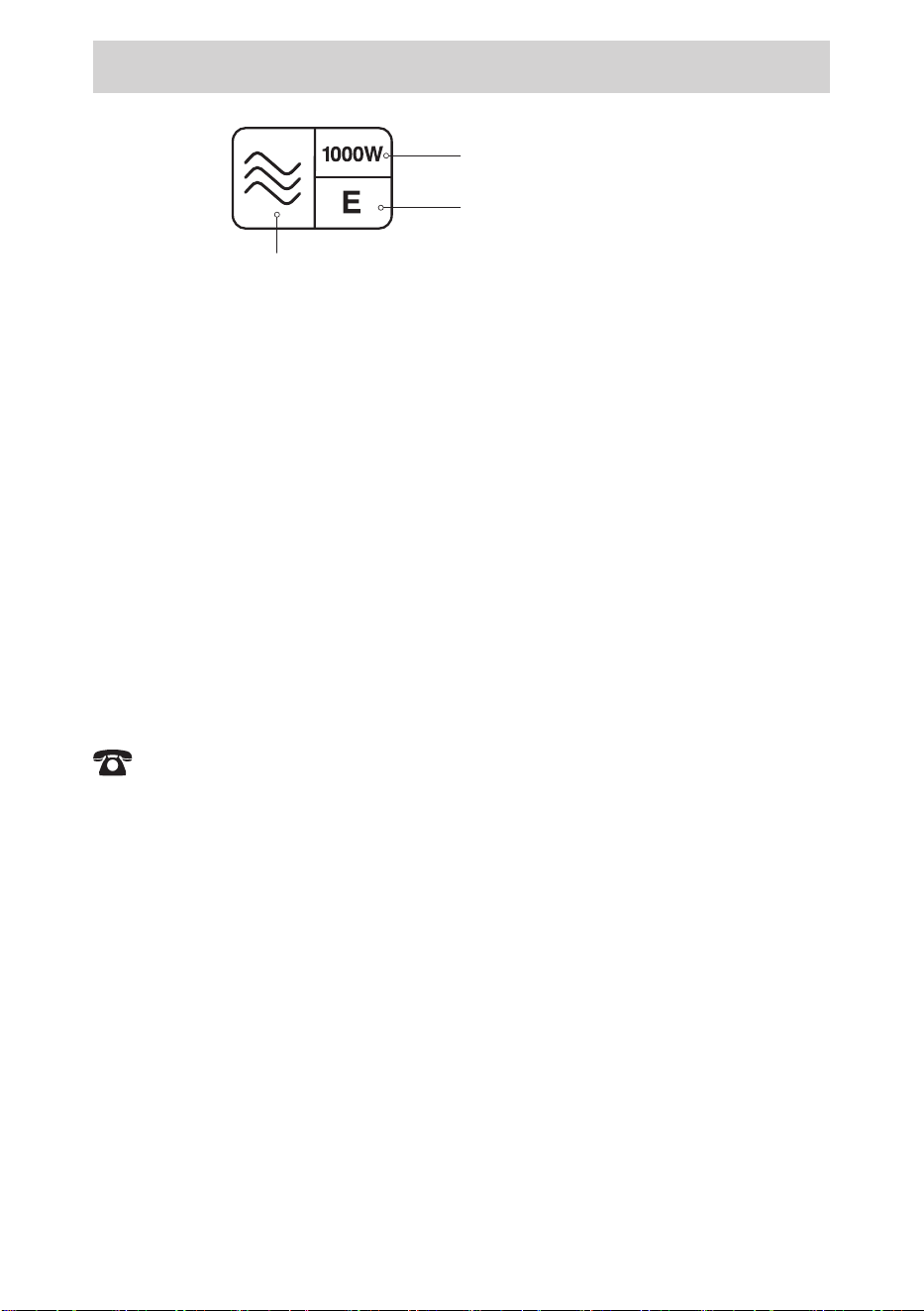
Your oven is rated 1000 Watts (IEC). When using other cookbooks remember to
adjust cooking times accordingly. The symbol indicates the heating category for your
oven when cooking or reheating convenience foods.
Your oven is rated ‘E’, which is very efficient. It is therefore very important that you
refer carefully to the packet instructions on convenience foods.
Some packet instructions only display information for B or D rated ovens. We
therefore provide additional guidelines on pages 75-89 of this book.
Always check the progress of the food as it cooks or reheats by simply opening the
door. After checking the progress of the foods, Press the Start/Set pad to continue
the cooking time.
Failure to follow the instructions given in this manual, may affect the recipe result
and in some instances may be dangerous.
Customer Communications Centre 0344 844 3899
Selected Spares and Accessories:
Order direct on line at www.panasonic.co.uk or by telephoning the Customer
Communications Centre number above.
For Cookery Advice call: 01344 862108
(open Monday to Wednesday 9 am - 12 pm)
Alternatively visit our web site at experience-fresh.eu
Or write to the address below:
Home Appliance Innovation Centre
Panasonic UK, a branch of Panasonic Marketing Europe GmbH,
Maxis 2
Western Road
Bracknell
Berkshire
RG12 1RT
UK
The IEC (60705) power
output (watts)
The heating category for
small packs of food
Microwave symbol
Important Notice

4
Control Panel ........................................................................................26
Up/Down Selection ...............................................................................27
Display Window ....................................................................................27
General Guidelines ..........................................................................28-30
Quick Check Guide to Cooking Utensils ............................................31
Containers to Use ............................................................................32-33
Cooking Modes ................................................................................34-35
Let’s Start to Use Your Oven ...............................................................36
Beep Choice ..........................................................................................37
Child Lock .............................................................................................38
Oven Lamp ............................................................................................38
Microwave Cooking and Defrosting ..............................................39-40
Defrosting Guidelines ..........................................................................41
Defrosting Charts ............................................................................42-43
Grilling ..............................................................................................44-45
CONTENTS
Safety Instructions ............................................................................6-11
Disposal of Old Equipment ..................................................................12
Important Safety Instructions .........................................................12-13
Before Using Your Oven ......................................................................14
Placement of Your Oven ......................................................................15
Care & Cleaning of Your Oven .......................................................15-17
Maintenance of Your Oven .............................................................17-18
Accessories Advice ..............................................................................18
Oven Accessories ................................................................................19
Parts of Your Oven ...............................................................................20
Important Information .....................................................................21-24
Microwaving Principles...................................................................24-25
Thank you for purchasing this Panasonic appliance.

5
Oven Cooking ..................................................................................46-48
Eco Combi ........................................................................................49-50
Multi-stage Cooking ........................................................................51-53
Using the Timer .............................................................................. 54-57
Using the Add Time Function ..............................................................58
Defrost ..............................................................................................59-61
Auto Sensor Programs ...................................................................62-66
Auto Cook Programs .......................................................................67-71
Cleaning Setting ...................................................................................72
Cooking and Reheating Guidelines ...............................................73-74
Reheating Charts .............................................................................75-80
Cooking Charts ................................................................................81-85
Eco Combi Charts ...........................................................................86-89
Questions and Answers ..................................................................90-91
Recipes .......................................................................................... 92-101
Specifications .....................................................................................102

6
Important safety instructions. Before operating this
oven, please read these instructions carefully and keep
for future reference.
This appliance can be used by children aged from
8 years and above and persons with reduced
physical,sensory or mental capabilities or lack of
experience and knowledge if they have been given
supervision or instruction concerning use of the
appliance in a safe way and understand the hazards
involved. Cleaning and user maintenance shall not
be made by children unless they are older than 8 and
supervised. Keep the appliance and its cord out of
reach of children less than 8 years. Children shall not
play with the appliance.
When this oven is installed, it should be easy to isolate
the appliance from the electricity supply by pulling out
the plug or operating a circuit breaker.
If the supply cord is damaged, it must be replaced by
the manufacturer or its service agent or a similarly
qualified person in order to avoid a hazard.
WARNING! It is hazardous for anyone other than a
competent person to carry out any service or repair
operation which involves the removal of a cover which
gives protection against exposure to microwave energy.
The appliance should be inspected for damage to the
door seals and door seal areas and If the door or door
seals are damaged, the oven must not be operated
until it has been repaired by a competent person.
Safety Instructions

7
Safety Instructions
WARNING! Do not attempt to tamper with or make
any adjustments or repairs to the door, control panel
housing, safety interlock switches or any other part of
the oven.
WARNING! Do not remove the outer panel from the
oven which gives protection against exposure to
microwave energy.
Repairs should only be made by a qualified service
person.
WARNING! Liquids and other foods must not be heated
in sealed containers since they are liable to explode.
WARNING! Do not place this oven near an electric or
gas cooker range.
WARNING! Only allow children to use the oven without
supervision when adequate instructions have been
given so that the child is able to use the oven in a safe
way and understands the hazards of improper use.
Ensure that children do not touch the hot outer casing
after operation of the oven.
This oven is intended for counter-top use only. It is not
intended for built-in use or for use inside a cupboard.
The appliance shall not be placed in a cabinet.
For counter-top use:
The oven must be placed on a flat, stable surface
85 cm above the floor, with rear of oven placed against
a back wall. Allow 15 cm of space on the top of the
oven, 10 cm at the back, 5 cm on one side, and the
other side open.

8
Safety Instructions
When heating food in plastic or paper containers,
check the oven frequently as these types of containers
ignite if overheated. When heating food in plastic or
paper containers, keep an eye on the oven due to the
possibility of ignition.
If smoke is emitted or a fire occurs in the oven, tap
Stop/Cancel pad and leave the door closed in order to
stifle any flames. Disconnect the power cord, or shut off
power at fuse or circuit breaker panel.
This appliance is intended to be used in household
applications only.
When heating liquids, e.g. soup, sauces and beverages
in your oven, overheating the liquid beyond boiling point
can occur without evidence of bubbling. This could
result in a sudden boil over of the hot liquid.
Microwave heating of beverages can result in delayed
eruptive boiling, therefore care must be taken when
handling the container.
The contents of feeding bottles and baby food jars
shall be stirred or shaken and the temperature checked
before consumption, in order to avoid burns.
Eggs in their shell and whole hard-boiled eggs should
not be heated in microwave ovens since they may
explode, even after microwave heating has ended.

9
Safety Instructions
Clean the inside of the oven, door seals and door seal
areas regularly. When food splatters or spilled liquids
adhere to the oven walls, base of the oven, door seals
and door seal areas wipe off with a damp cloth. Mild
detergent may be used if they get very dirty. The use of
harsh detergent or abrasive is not recommended.
Do not use commercial oven cleaners.
Some foods may inevitably splatter grease on to the
oven walls. If the oven is not cleaned occasionally, it
may start to ‘smoke’ during use.
Failure to maintain the oven in a clean condition could
lead to deterioration of surfaces that could affect the
life of the appliance and possibly result in a hazardous
situation.
WARNING! The accessible parts may become hot in
Grill, Oven and Eco Combi use. Young children less
than 8 years of age should be kept away. Children
should only use the oven under adult supervision due
to the temperatures generated.
WARNING! When the appliance is operated in the
combination mode, children should only use the oven
under adult supervision due to the temperatures
generated.
A steam cleaner is not to be used for cleaning the
appliance.
Do not use harsh, abrasive cleaners or sharp metal
scrapers to clean the oven door glass since they can
scratch the surface, which may result in shattering of
the glass.

10
Safety Instructions
Exterior oven surfaces, including air vents on the
cabinet and the oven door will get hot during Grill,
Oven, and Eco Combi modes, take care when opening
or closing the door and when inserting or removing food
and accessories.
This appliance is not intended to be operated by means
of an external timer or separate remote-control system.
In case of electronic failure, oven can only be turned off
at the wall socket.
Only use utensils that are suitable for use in microwave
ovens.
The oven has heating elements situated in the top and
in the base of the oven. After using the Grill, Oven and
Eco Combi functions, the inside surfaces of the oven
will be very hot. Care should be taken to avoid touching
the heating element inside the oven. To prevent burns,
care should be taken to avoid touching the inside
surfaces of the oven. N.B. After cooking by these
functions, the oven accessories will be very hot.
Metal containers or dishes with metallic trim should not
be used during microwave cooking. Sparking will occur.
The microwave oven is intended for heating food
and beverages. Take care when heating foods low in
moisture, e.g. bread items, chocolate, biscuits and
pastries. These can easily burn, dry out or catch fire
if cooked too long. We do not recommend heating
foods low in moisture such as popcorn or poppadoms.
Drying of food or clothing and heating of warming pads,
slippers, sponges, damp cloth and similar may lead to
risk of injury, ignition or fire.

11
Safety Instructions
The oven lamp must be replaced by a service
technician trained by the manufacturer. Do not attempt
to remove the outer casing from the oven.
Caution! In order to avoid a hazard due to inadvertent
resetting of the thermal cut-out, this appliance must not
be supplied through an external switching device, such
as a timer, or connected to a circuit that is regularly
switched on and off by the utility.
The appliance must not be installed behind a decorative
door in order to avoid overheating.
The oven should be cleaned regularly and any food
deposits removed.
12
Disposal of Old Equipment
This symbol on the products, packaging, and/or accompanying documents
means that used electrical and electronic products must not be mixed with
general household waste.
For proper treatment, recovery and recycling of old products, please take
them to applicable collection points in accordance with your national
legislation.
By disposing of them correctly, you will help to save valuable resources
and prevent any potential negative effects on human health and the
environment.
For more information about collection and recycling, please contact your
local municipality.
Penalties may be applicable for incorrect disposal of this waste, in
accordance with national legislation.
Only for European Union and
Countries with Recycling Systems
Important Safety Instructions
Please read carefully and keep for future reference.
This appliance is supplied with
a moulded three pin mains plug
for your safety and convenience.
A 13 amp fuse is fitted in this
plug. Should the fuse need to be
replaced, please ensure that the
replacement fuse has a rating of
13 amps and that it is approved by
ASTA or BSI to BS1362.
Check for the ASTA mark
or the
BSI mark
on the body of the fuse.
If the fuse cover is detachable,
never use the plug with the cover
omitted.
A replacement fuse cover can
be purchased from your local
Panasonic dealer.
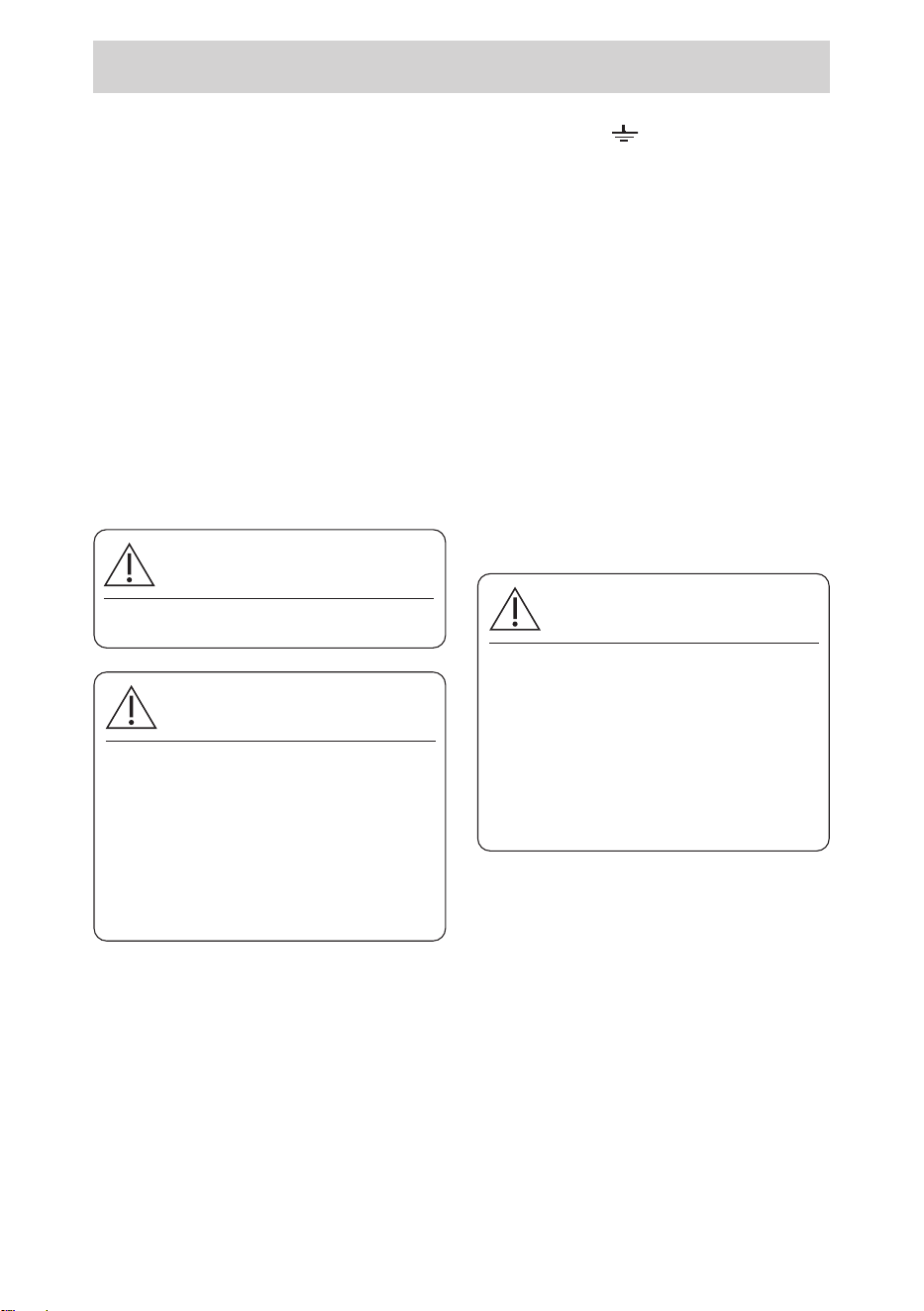
How to replace the fuse
Open the fuse
compartment with
a screwdriver and
replace the fuse.
13
If the fitted moulded plug is
unsuitable for the socket outlet in
your home then the fuse should
be removed and the plug cut off
and disposed of safely and an
appropriate one fitted. There is a
danger of severe electrical shock
if the cut off plug is inserted into
any 13 amp socket.
If a new plug is to be fitted, please
observe the wiring code as shown
opposite. If in any doubt, please
consult a qualified electrician
(For U.K. Models only).
Warning!
This appliance must be earthed.
Important
The wires in this mains lead are
coloured in accordance with the
following code:
Green-and-yellow: Earth
Blue: Neutral
Brown: Live
As the colours of the wire in the
mains lead of this appliance may
not correspond with the coloured
markings identifying the terminals in
your plug, proceed as follows:
The wire which is coloured green-
and-yellow must be connected to
the terminal in the plug which is
marked with the letter E or by the
Important Safety Instructions
Earth symbol or coloured green
or green-and-yellow.
The wire which is coloured blue
must be connected to the terminal
in the plug which is marked with
the letter N or coloured black. The
wire which is coloured brown must
be connected to the terminal in the
plug which is marked with the letter
L or coloured red.
When this oven is installed it should
be easy to isolate the appliance
from the electricity supply by pulling
out the plug or operating a circuit
breaker.
Voltage & Power
The voltage used must be
the same as specified on this
microwave oven. Using a higher
voltage than that which is
specified is dangerous and may
result in a fire or other type of
accident causing damage.
Do not immerse cord, plug or oven
in water. Keep cord away from
heated surfaces. Do not let cord
hang over the edge of table or work
top. Do not plug your oven in via
an extension cable as this can be
dangerous. It is important to plug
the oven directly into a wall socket.
The back of the appliance heats up
during use. Do not allow the cord
to be in contact with the back of the
appliance or cabinet surface.
14
Before Using Your Oven
Examine your Oven
1. Unpack oven, remove all
packing material, and examine
the oven for any damage such
as dents, broken door latches,
or cracks in the door. Notify
dealer immediately if unit is
damaged. DO NOT install if unit
is damaged.
Guarantee
2. Your receipt is your guarantee,
please keep it safe.
Cord
3. If the supply cord of this
appliance is damaged, it must
be replaced by the manufacturer
or it’s service agent or a similarly
qualified person in order to
avoid a hazard.
4. Before using grill, oven or eco
combi function for the first time
operate the oven without food
and the accessories on oven
200 °C for 10 minutes. This will
allow the oil that is used for rust
protection to be burned off. This
is the only time that the oven
is operated completely empty
(except when preheating).
Caution!
Hot Surfaces!
Exterior oven surfaces including
air vents on the cabinet and the
oven door will get hot during Eco
Combi/Grill/Oven. After cooking
by these modes, the oven
accessories will be very hot.
Do not operate the oven empty
apart from point 4 above and when
preheating. The appliance must
not be operated by Microwave or
Eco Combi without food in the
oven. Operation when empty will
damage the appliance. During use
the appliance becomes hot. Care
should be taken to avoid touching
heating elements inside the oven.
The accessible parts may become
hot in Grill, Oven and Eco Combi
use. Young children less than 8
years of age should be kept away.
Children should only use the oven
under adult supervision due to the
temperatures generated.
15
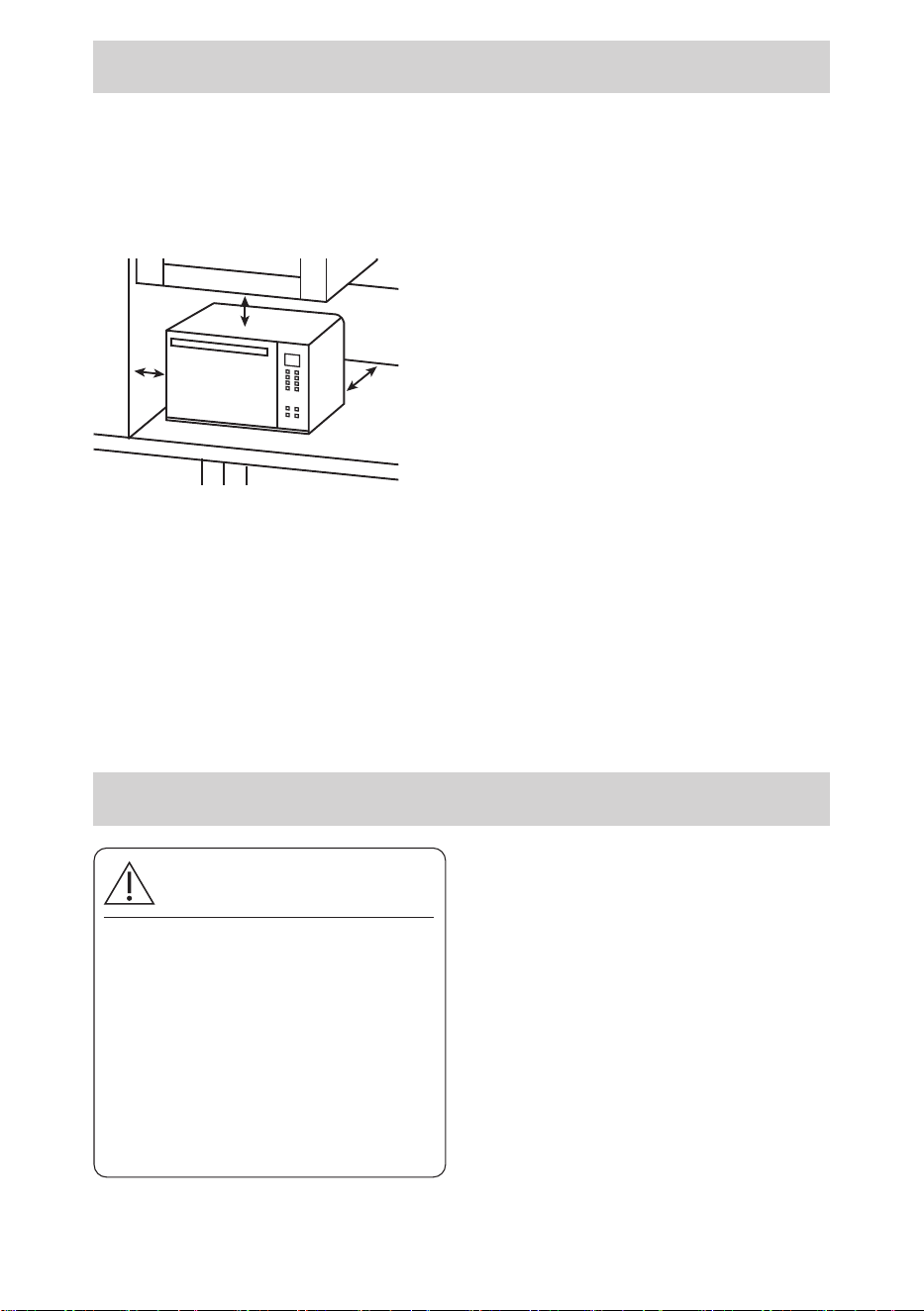
Placement of Your Oven
This oven is intended for counter-
top use only. It is not intended
for built-in use or for use inside a
cupboard. The appliance shall not
be placed in a cabinet.
counter top
Open
10 cm
15 cm
5 cm
1.
The oven must be placed on a
flat, stable surface 85 cm above
the floor, with rear of oven placed
against a back wall. For proper
operation the oven must have
sufficient air flow,
i.e. 5 cm at one side, the other
being open; 15 cm clear over the
top; 10 cm at the rear.
Care & Cleaning of Your Oven
1. Switch the oven off before
cleaning and unplug at the
socket if possible.
2. Keep the inside of the oven,
door seals and door seal
areas clean.
When food splatters or spilled
liquids adhere to oven walls,
door seals and door seal areas
wipe off with a damp cloth. Mild
detergent may be used if they
get very dirty. The use of harsh
detergent or abrasives is not
recommended.
2. When the oven door opens, do
not drag the container over the
door window, and the load on the
door should not exceed 3.5
kg
.
3. Do not place the microwave
oven on a shelf directly above
a gas or electric hob. This may
be a safety hazard and the oven
may be damaged.
4. Do not block air vents on the
oven. If air vents are blocked
during operation, the oven may
overheat. If the oven overheats,
a thermal safety device will
turn the oven off. The oven will
remain inoperable with blank
display until it has cooled.
5. This appliance is intended to be
used in household applications
only.
Important
It is essential for the safe
operation of the oven that it is
kept clean, and wiped out after
each use. Failure to maintain the
oven in a clean condition could
lead to deterioration of a surface
that could adversely affect the
life of the appliance and possibly
result in a hazardous situation.

16
Care & Cleaning of Your Oven
3. After using Grill, Oven and Eco
Combi cooking the walls of the
oven should be cleaned with
a soft cloth and soapy water.
Particular care should be taken
to keep the window area clean
especially after cooking by
Grill, Oven and Eco Combi.
Stubborn spots inside the oven
can be removed by using a
small amount of conventional
oven-cleaner sprayed onto a soft
damp cloth. Wipe onto problem
spots, leave for recommended
time and then wipe off. Do not
spray directly inside the oven.
4. Do not use harsh abrasive
cleaners or sharp metal scrapers
to clean the oven door glass
since they may scratch the
surface, which may result in
shattering of the glass.
5. The outside oven surface
should be cleaned with a damp
cloth. To prevent damage to the
operating parts inside the oven,
water should not be allowed
to seep into the ventilation
openings.
6. If the control panel becomes
dirty, clean with a soft, dry cloth.
Do not use harsh detergents
or abrasives on control panel.
When cleaning the control
panel, leave the oven door
open to prevent the oven from
accidentally turning on. After
cleaning tap Stop/Cancel pad to
clear the display window.
7. If steam accumulates inside or
around the outside of the oven
door, wipe with a soft cloth. This
may occur when the microwave
oven is operated under high
humidity conditions and in no
way indicates a malfunction of
the unit or microwave leakage.
8. The oven cavity floor should be
cleaned regularly. Simply wipe
the bottom surface of the oven
with mild detergent and warm
water then dry with a clean cloth.
Cooking vapours collect during
repeated use but in no way
affect the bottom surface.
9. When Grilling or cooking by
Oven or Eco Combi some
foods may splatter grease onto
the oven walls. If the oven is not
cleaned to eliminate this grease,
it can accumulate and cause
the oven to ‘smoke’ during
use. These marks will be more
difficult to clean later.
17
Care & Cleaning of Your Oven
10. A steam cleaner is not to be
used for cleaning the appliance.
11. Ensure the Enamel Shelf/Wire
rack is kept clean, especially
when using Eco Combi
programs.
12 . Keep air vents clear at all
times. Check that no dust or
other material is blocking any
of the air vents on the oven.
If vents become blocked this
could cause overheating which
would affect the operation of
the oven and possibly result in
a hazardous situation.
Maintenance of Your Oven
Service
1. When your oven requires
a service call your local
Panasonic engineer (Customer
Communications Centre on
0344 844 3899 can recommend
an engineer).
Warning!
It is hazardous for anyone other
than a competent person to
carry out any service or repair
operation which involves the
removal of a cover which gives
protection against exposure to
microwave energy.
Door Seals
2. Do not attempt to tamper with or
make any adjustments or repairs
to door, control panel housing,
safety interlock switches or any
other part of the oven. Do not
remove outer panel from oven
which gives protection against
exposure to microwave energy.
The door seals and door seal
areas should always be kept
clean – use a damp cloth.
Warning!
The appliance should be
inspected for damage to the door
seals and door seal areas. If the
door or door seals are damaged,
the oven must not be operated
until it has been repaired by a
competent person.

18
Maintenance of Your Oven
Accessories Advice
Oven Light
3. The oven lamp must be
replaced by a service technician
trained by the manufacturer. Do
not attempt to remove the outer
casing from the oven.
Selected Spares and
Accessories
4. These may be ordered directly
on line at www.panasonic.
co.uk or by telephoning the
Customer Communication
Centre on 0344 844 3899. Most
major credit and debit cards
accepted. Ensure you quote the
correct model number.
1. Do not cook food directly on the
base of the oven. Always place
food in a microwave safe dish.
2. The Enamel Shelf provided
must only be used as directed
for Grill and Oven. Never
use metal accessories when
cooking in microwave only
mode. Do not use if operating
the oven with less than 200
g
of food on a manual Eco Combi
program. The maximum weight
that can be used on the oven
accessories is 3.2 k
g
. Failure to
use the accessories correctly
could damage your oven.
3. When cooking with microwave
power arcing may occur if the
incorrect weight of food is used,
a metal container has been
used incorrectly, or the oven
accessories has been damaged.
If this occurs, stop the appliance
immediately. You can continue
to cook by Grill or Oven only.
4. Always refer to instructions for
correct accessories to use on all
auto programs.
Wire Rack
1. The wire rack is used to facilitate
browning of small dishes and
help with the good circulation of
the heat.
2. Do not use any metal container
directly on the wire rack in Eco
Combi.
3. Do not use the wire rack in
Microwave mode only.
Enamel Shelf
1. The Enamel Shelf is for cooking
on Oven or Grill mode only. Do
not use on Microwave or Eco
Combi.
19
Oven Accessories
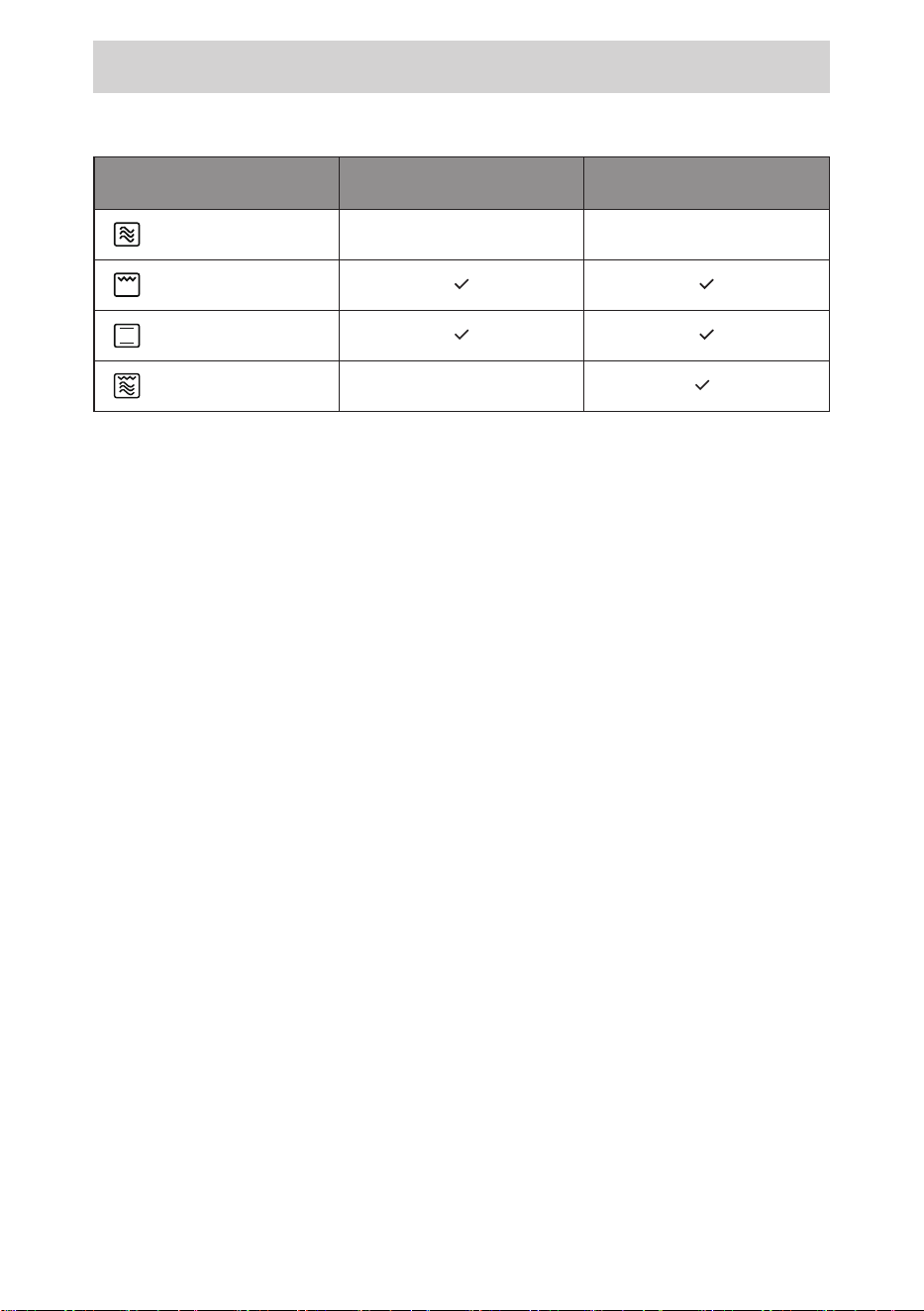
The following chart shows correct use of the accessories in the oven.
Cooking modes Enamel Shelf Wire Rack
Micro Power × ×
Grill
Oven
Eco Combi × *
* Metal containers can not be placed directly on the wire rack.
Care of the Oven Accessories
1. Never use any sharp utensils on the accessories as this will damage the
non-stick surface.
2. After use, wash the accessories in hot soapy water and rinse in hot
water. Do not use any abrasive cleaning substances or scouring pads as
this will damage the surface of the accessories.
3. Do not pre-heat.
4. Always use oven gloves when handling the hot accessories.
5. Ensure all food packaging is removed before cooking.
6. Do not place any heat-sensitive materials on the hot accessories as this
may cause burning.
20
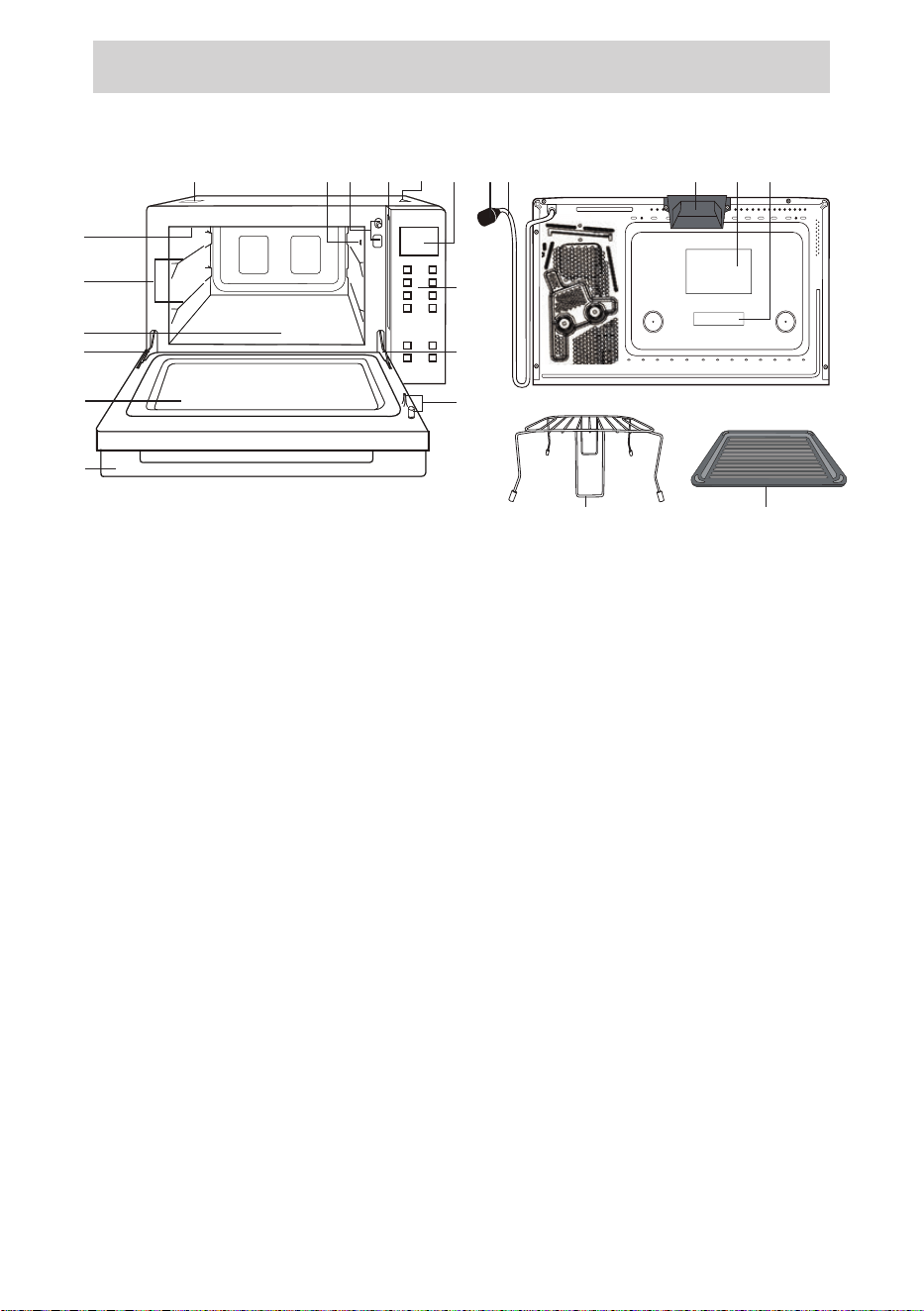
Parts of Your Oven
q Door handle
Pull the door handle downwards
to open. When you open the
oven door during cooking,
the cooking is stopped
temporarily without clearing
the programmed settings. The
cooking is resumed as soon as
the door is closed and the Start/
Set pad is pressed. The oven
lamp lights as soon as the oven
door is opened.
w Oven window
e Door safety lock system
To prevent injury, do not insert
finger, knife, spoon or other
object into the latch hole.
r Power supply plug
t Power supply cord
y Warning symbol
u Warning label
i Grill elements
o LED lights
The oven lamp lights as soon
as the oven door is opened.
a Shelf positions
s Door hinges
To prevent injury when opening
or closing the door, keep fingers
away from the door hinges.
d Bottom microwave feeding
(with grill elements inside)
(refer to page 40)
f Control panel
g Air vent exhaust
h Display window
j Identification label
k Information label
l Enamel shelf
; Wire rack
Note
The above illustration is for reference only.
Front View
Rear View
q
w
f
yju
e
grut
;
l
a
ss
i
d
oe h
k
21
Important Information
Safety
If smoke is emitted or a fire occurs
in the oven, tap Stop/Cancel pad
and leave the door closed in order
to stifle any flames. Disconnect the
power cord, or shut off power at the
fuse or the circuit breaker panel.
Short Cooking Times
As microwave cooking times are
much shorter than other cooking
methods it is essential that
recommended cooking times are
not exceeded without first checking
the food.
Cooking times given in the charts
are approximate. Factors that may
affect cooking times are: preferred
degree of cooking, starting
temperature, altitude, volume, size
and shape of foods and utensils
used. As you become familiar with
the oven, you will be able to adjust
these factors.
It is better to initially undercook
rather than overcook foods. If food
is undercooked, it can always be
returned to the oven for further
cooking. If food is overcooked,
nothing can be done. Always start
with minimum cooking times.
Important
If the recommended cooking
times are exceeded the food
will be spoiled and in extreme
circumstances could catch fire
and possibly damage the interior
of the oven.
Small Quantities of Food
Take care when heating small
quantities of food as these can
easily burn, dry out or catch fire if
cooked too long. Always set short
cooking times and check the food
frequently.
Note
Never operate the oven without
food inside on Microwave or
Eco Combi mode involving
microwave.
Food Low in Moisture
Take care when heating foods
low in moisture, e.g. bread items,
chocolate, biscuits and pastries.
These can easily burn, dry out or
catch on fire if cooked too long. We
do not recommend heating foods
low in moisture such as popcorn or
poppadoms. The microwave oven
is intended for heating food and
beverages only. Drying of food,
newspapers or clothing and heating
of warming pads, slippers, sponges,
damp cloth, wheat bags, hot water
bottles and similar may lead to risk
of injury, ignition or fire.
Christmas Pudding
Christmas puddings and other foods
high in fats or sugar, e.g. jam, mince
pies, must not be overheated.
These foods must never be left
unattended as with over cooking
these foods can ignite.
22
Important Information
After heating, allow to stand in
the oven for a short time, stirring
again before carefully removing
the container.
Microwave heating of beverages
can result in delayed eruptive
boiling, therefore care should be
taken when handling the container.
Lids
Always remove the lids of jars and
containers and takeaway food
containers before you microwave
them. If you don’t then steam and
pressure might build up inside and
cause an explosion even after the
microwave cooking has stopped.
Deep Fat Frying
Do not attempt to deep fat fry in
your oven.
Meat Thermometer
Use a meat thermometer to check
the degree of cooking of roasts and
poultry only when meat has been
removed from the microwave. If
undercooked, return to the oven
and cook for a few more minutes
at the recommended power level.
Do not leave a conventional meat
thermometer in the oven when
microwaving.
Boiled Eggs
Eggs in their shell and whole
hardboiled eggs should not be
heated in microwave ovens since
they may explode even after
microwave heating has ended.
Foods with Skins
Potatoes, apples, egg yolk, whole
vegetables and sausages are
examples of food with non porous
skins. These must be pierced using
a fork before cooking to prevent
bursting.
Warning!
Liquids and other foods must not
be heated in sealed containers
since they are liable to explode.
Liquids
When heating liquids, e.g. soup,
sauces and beverages in your
microwave oven, overheating the
liquid beyond boiling point can occur
without evidence of bubbling.
This could result in a sudden boil
over of the hot liquid. To prevent this
possibility the following steps should
be taken:
Avoid using straight-sided
containers with narrow necks.
Do not overheat.
Stir the liquid before placing the
container in the oven and again
halfway through the heating time.

23
Important Information
Paper, Plastic
When heating food in plastic or
paper containers, keep an eye on
the oven due to the possibility of
ignition. Do not use wire twist-ties
with roasting bags when cooking
mode includes microwave power
as arcing will occur. Do not use
recycled paper products, e.g.
Kitchen roll unless they say they
are specifically designed for use in
a microwave oven. These products
contain impurities which may cause
sparks and/or fires when used.
Remove wire twist-ties from roasting
bags before placing the bags in the
oven.
Reheating
It is essential that reheated food
is served “piping hot”. Remove
the food from the oven and check
that it is “piping hot”, i.e. steam is
being emitted from all parts and
any sauce is bubbling. (If you wish
you may choose to check the food
has reached 72 °C with a food
thermometer – but remember do
not use this thermometer inside the
microwave.)
For foods that cannot be stirred, e.g.
lasagne, shepherds pie, the centre
should be cut with a knife to test
it is well heated through. Even if a
manufacturer’s packet instructions
have been followed always check
the food is piping hot before serving
and if in doubt return your food to
the oven for further heating.
Standing Time
Standing time refers to the period
at the end of cooking or reheating
when food is left before being eaten,
i.e. it is a rest time which allows
the heat in the food to continue
to conduct to the centre, thus
eliminating cold spots.
Keeping Your Oven Clean
It is essential for the safe operation
of the oven that it is wiped out
regularly. Use warm soapy water,
squeeze the cloth out well and use to
remove any grease or food from the
interior. Pay particular attention to
the door seal area. The oven should
be unplugged when cleaning.
Grilling
The oven will only operate on the
Grill function with the door closed.
Fan Motor Operation
After using the microwave oven, the
fan motor may operate to cool the
electric components. This is normal
and you can take out food even
though the fan motor operates. You
can continue using the oven during
this time.
Utensils/Containers
Do not heat any closed cans or
bottles because they might explode.
If you use any aluminium foil, meat
spikes or metalware the distance
between them and the oven walls
and door should be at least 2 cm to
prevent sparking.
24
Important Information
Microwaves are present in the
atmosphere all the time, both
naturally and from manmade
sources. Manmade sources
include radar, radio, television,
telecommunication links and mobile
phones.
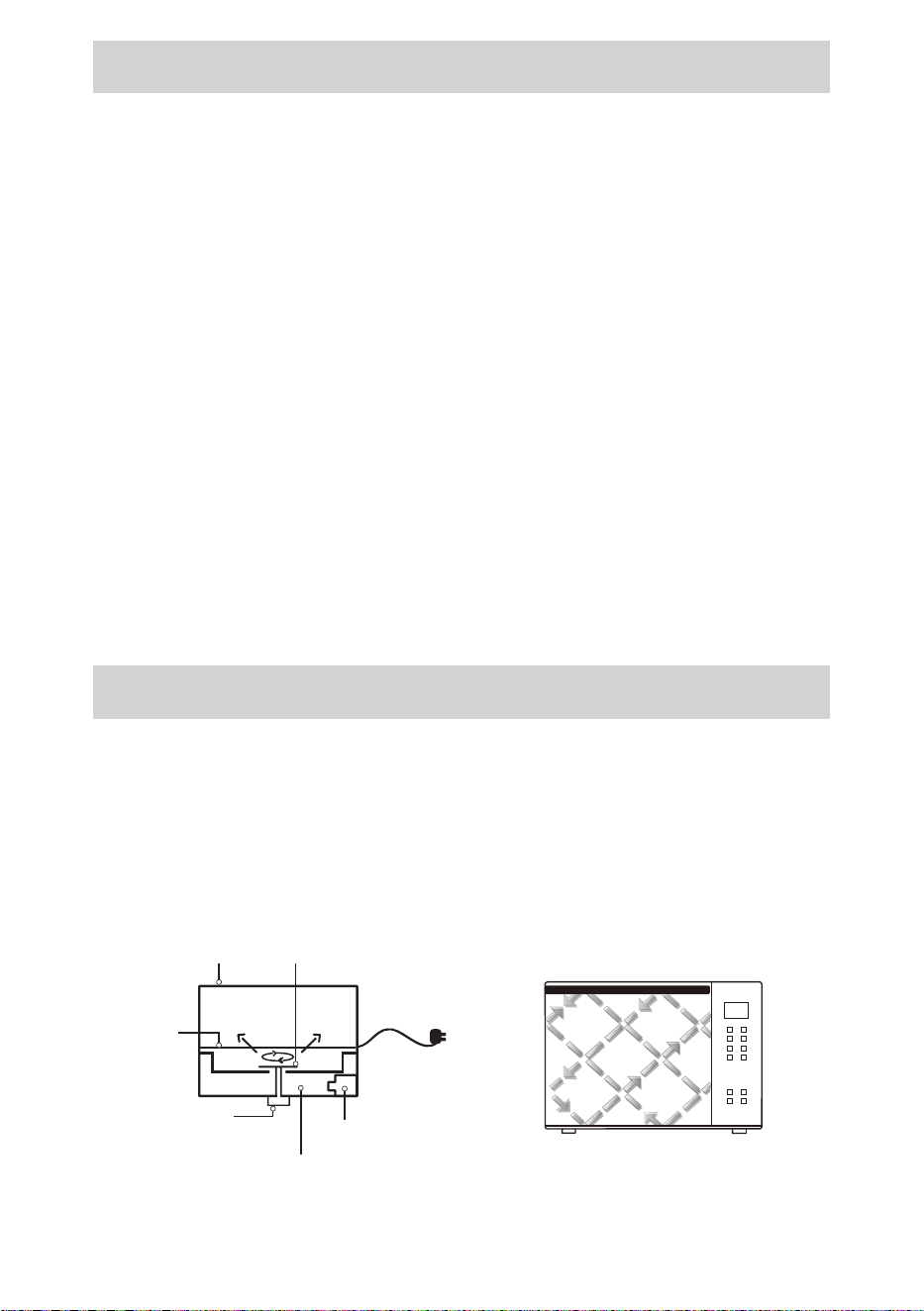
Microwave stirrer
Waveguide
Stirrer motor
Magnetron
Oven cavity
Base of
the oven
Before use check that utensils/
containers are suitable for use in
microwave ovens. See pages 32-
33.
Storage of Accessories
Do not store any objects other than
oven accessories inside the oven in
case it is accidentally turned on.
Babies Bottles and Food Jars
When reheating babies bottles
always remove top and teat.
Liquid at the top of the bottle
will be much hotter than that at
the bottom and must be shaken
thoroughly before checking the
temperature. The lid must also be
removed from babies food jars,
the contents must also be stirred
or shaken before the temperature
is checked. This should be carried
out before consumption in order to
avoid burns. See pages 74-75.
Arcing
Arcing may occur if a metal
container has been used incorrectly,
if the incorrect weight of food is
used, or if the accessories have
been damaged. Arcing is when
blue flashes of light are seen in
the microwave oven. If this occurs,
stop the machine immediately. If
the oven is left unattended and
this continues it can damage the
machine. You can continue to cook
by Grill or Oven only.
Microwaving Principles
In a microwave oven, electricity is
converted into microwaves by the
Magnetron. For bottom feeding,
please refer to page 40.
Reflection
The microwaves bounce off the
metal walls and the metal door
screen.
25
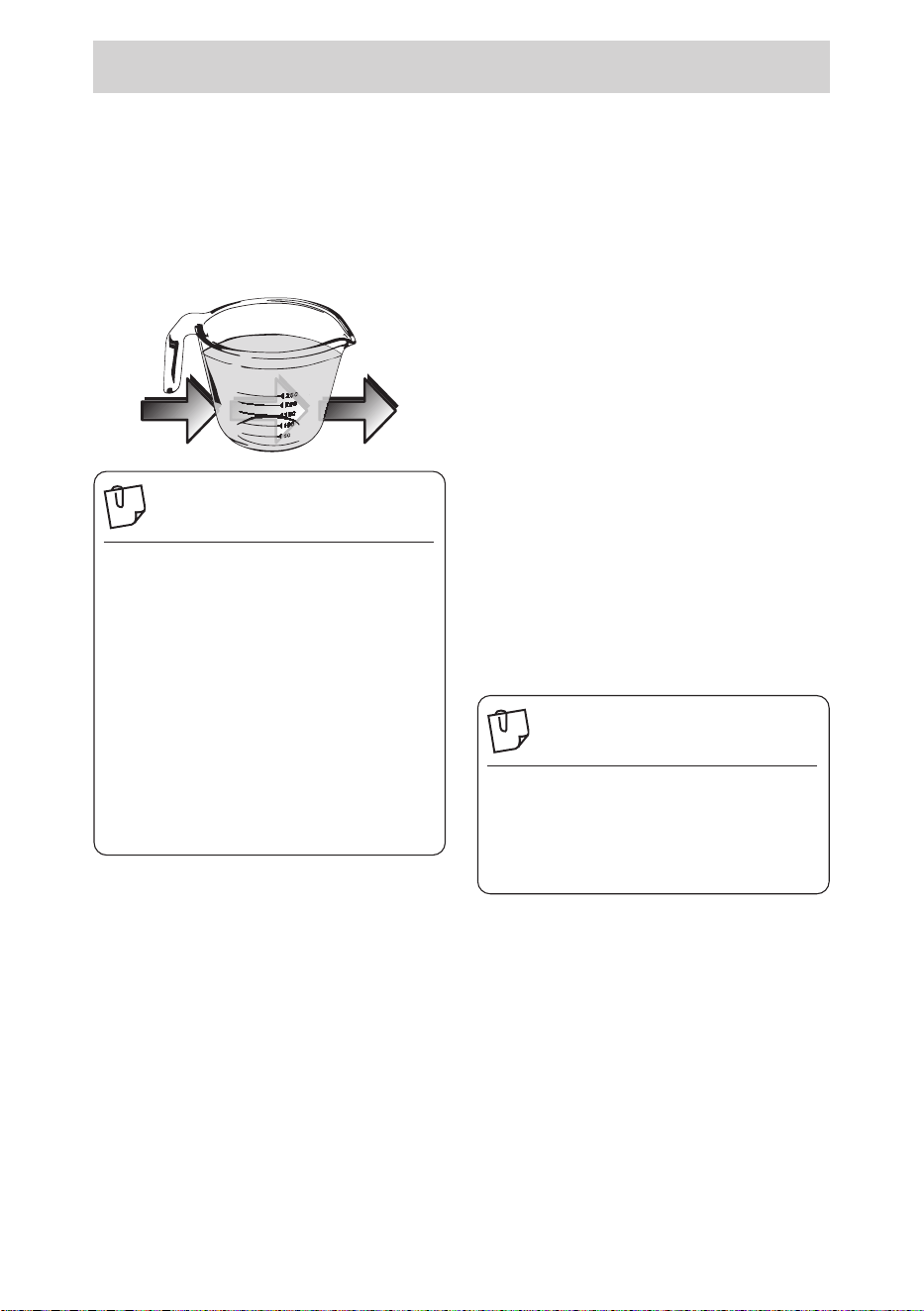
Transmission
Then they pass through the cooking
containers to be absorbed by the
water molecules in the food, all
foods contain water to a more or
lesser extent.
Important Notes
The dish used to cook or
reheat the food will get warm
during cooking, as the heat
conducts from the food. Even
in microwaving, oven gloves
are required! Microwaves
can not pass through metal
and therefore metal cooking
utensils can never be used in
a microwave, for cooking on
microwave only.
How Microwaves Cook Food
The microwaves cause the water
molecules to vibrate which causes
friction, i.e. heat. This heat then
cooks the food.
Microwaves are also attracted
to fat and sugar particles, and
foods high in these will cook more
quickly. Microwaves can only
penetrate to a depth of 4-5 cm
and as heat spreads through the
food by conduction, just as in a
Microwaving Principles
traditional oven, the food cooks
from the outside inwards.
Foods Not Suitable for
Cooking by Microwave Only
Yorkshire pudding and souffles.
This is because these foods
rely on dry external heat to cook
correctly, do not attempt to cook
by microwave.
Foods that require deep fat frying
cannot be cooked either.
Standing Time
When a microwave oven is
switched off, the food will continue
to cook by conduction – not
by microwave energy. Hence
standing time is very important
in microwaving, particularly for
dense foods i.e. meat, cakes and
reheated meals (refer to page 28).
Boiled eggs
Do not boil eggs in your
microwave. Raw eggs boiled
in their shells can explode and
cause serious injury.
26
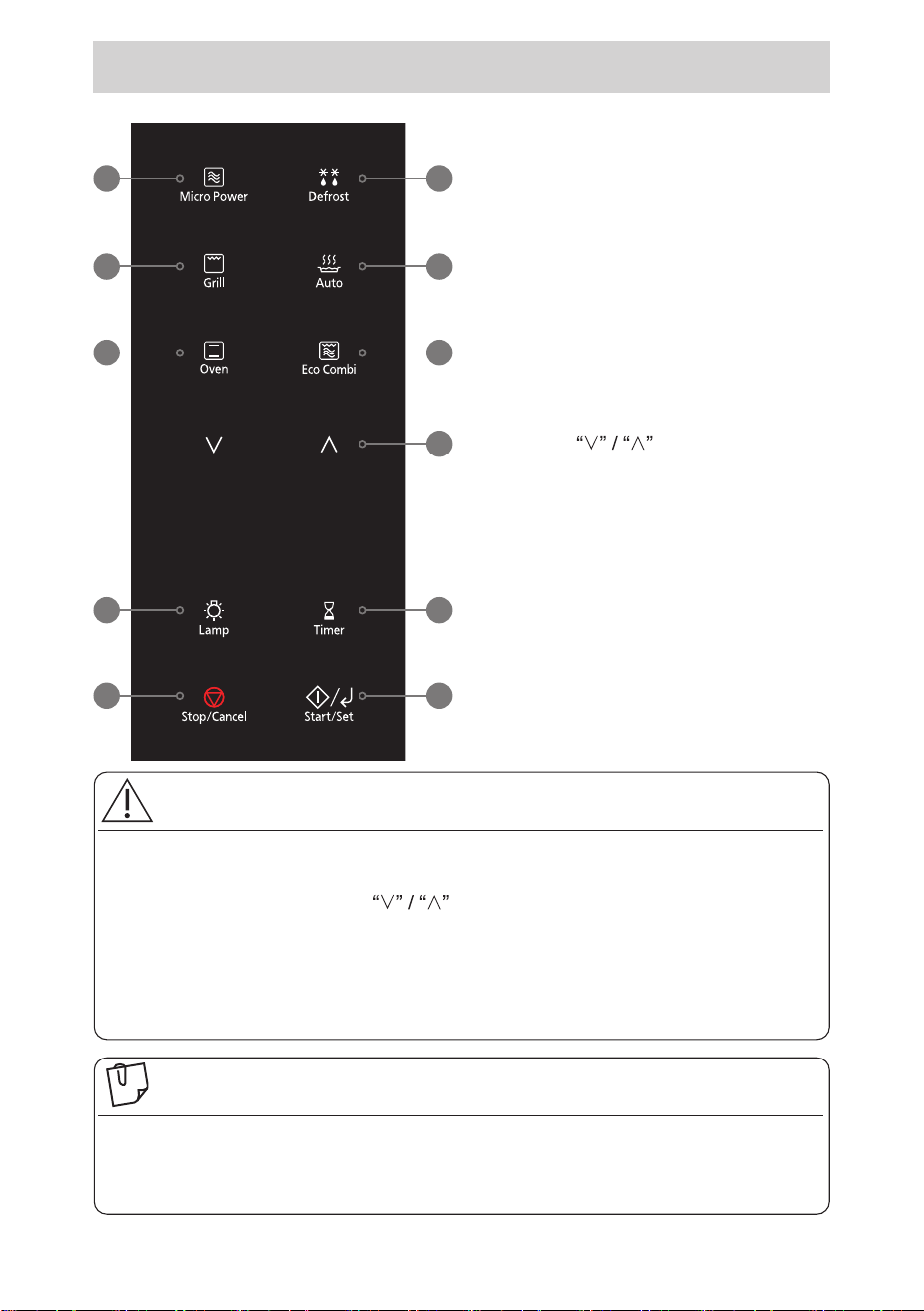
Control Panel
1. Micro Power (pages 39-40)
2. Defrost (pages 59-61)
3. Grill (pages 44-45)
4. Auto Program (pages 62-72)
5. Oven (pages 46-48)
6. Eco Combi (pages 49-50)
7. Up/Down Selection (pages 27,
58)
Select the power, temperature,
time, weight or auto menu by
tapping
.
8. Lamp (pages 38)
9. Timer (pages 54-57)
10. Stop/Cancel
Before cooking:
One tap clears your instructions.
During cooking:
One tap temporarily stops the
cooking program. Another tap
cancels all your instructions and
“0” will appear in the display.
11. Start/Set
A beep sounds when a key is tapped. If this beep does not sound, you
may have turned off the beep choice, you can turn it on by tapping Start/
set Pad once then tapping
after first plugged in, (see page 37).
When the oven changes from one function to another or remind you to
stir food during cooking, two beeps sound. After the completion of the
preheating on grill or oven, three beeps sound. After completion of the
preheating on some auto menus, a long beep sounds. After completion
of cooking, five beeps sound.
If an operation is set and the Start/Set is not pressed within 6 minutes,
the oven will automatically cancel the operation. The display will revert
back to “0”.
Beep sound
Note
9
11
8
10
7
65
43
21
27
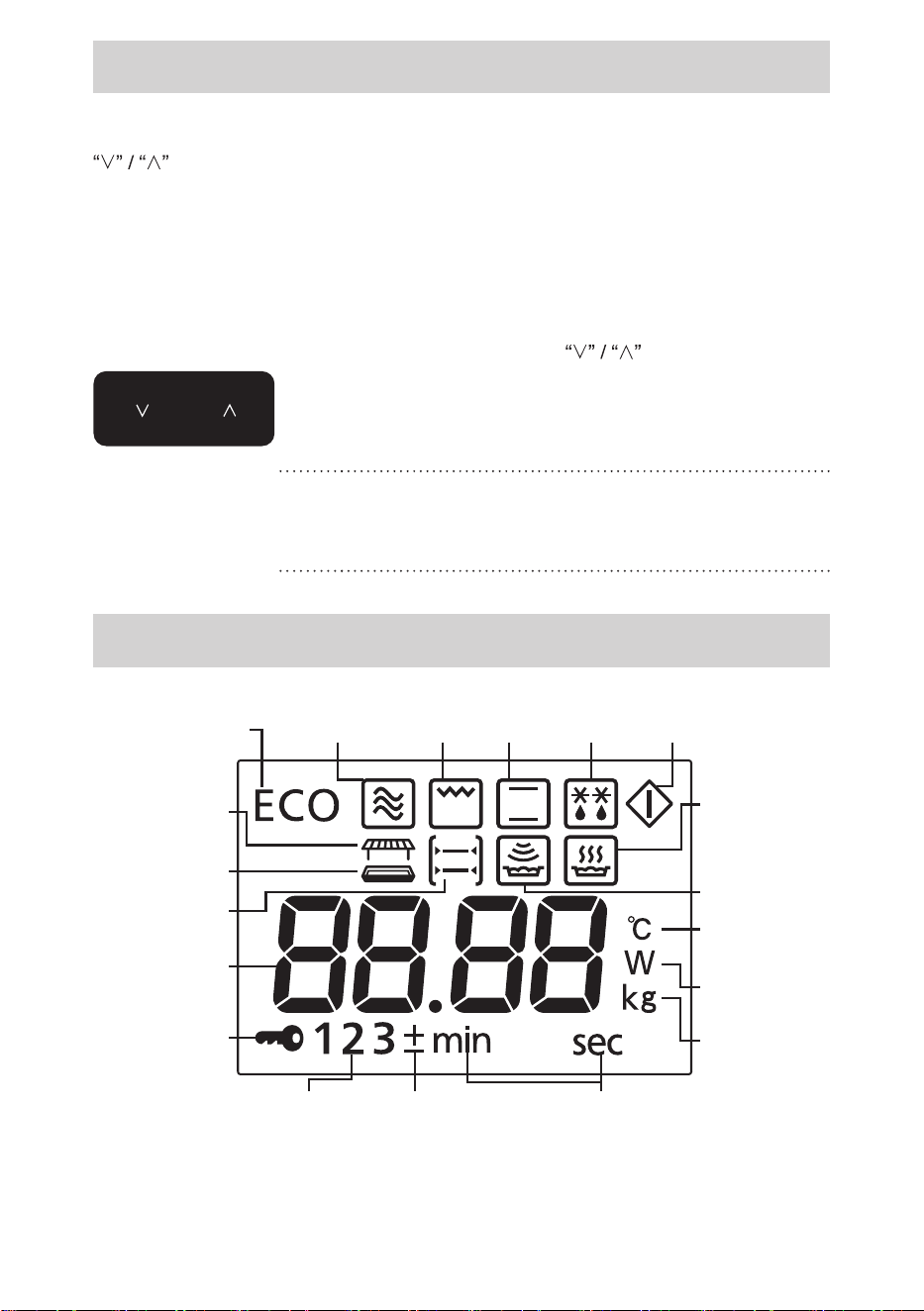
Up/Down Selection
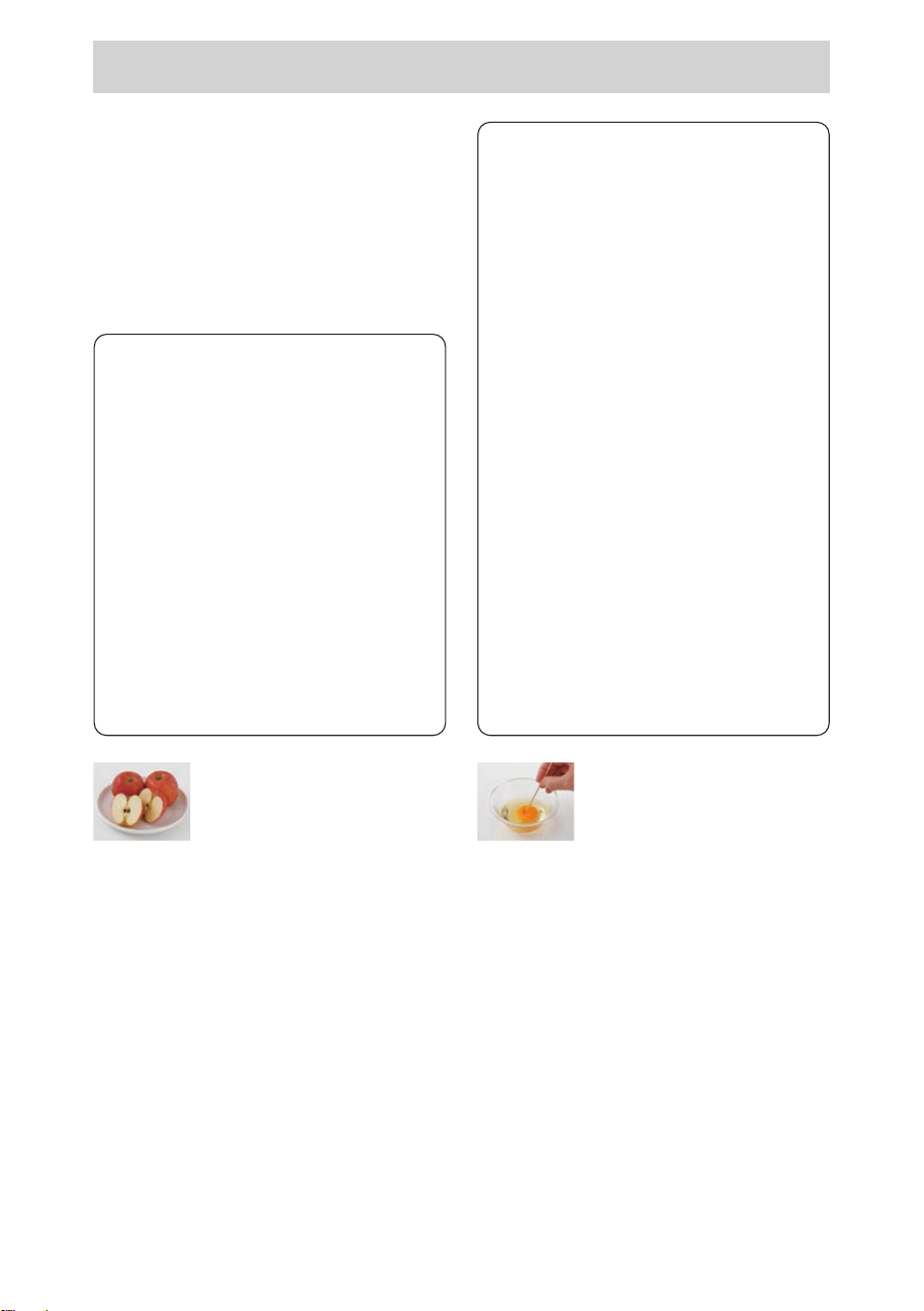
Display Window
Select the power, temperature, time, weight or auto menu by tapping
. The power, temperature, time, weight or auto menu number
appears in the display window. The time/weight/temperature can be
adjusted quickly by holding pad.
1
Power/Temperature/Time/Weight/Auto Menu
Selection:
Select the power, time, weight, temperature or
auto menu by tapping
.
2
Add Time Selection:
Use the pad for the Add Time Function (see
page 58)
3
More/Less Selection:
To set more/less for auto sensor programs (see
page 62-63).
3-stage
Display
More/Less
Display
Child Lock
Setting
Number/
Character
Time Display
(Minute/Second)
Grill Oven DefrostMicrowaveECO display Start/Set
Auto Cook
Program
Auto Sensor
Program
Temperature
Display
Power
Display
Weight
Display
Accessory
Placement
Wire Rack
Enamel Shelf
28
Moisture Content
Many fresh foods e.g. vegetables
and fruit, vary in their moisture
content throughout the season.
Jacket potatoes are a particular
example of this. For this reason
cooking times may have to be
adjusted throughout the year. Dry
ingredients e.g. rice, pasta, can dry
out during storage so cooking times
may differ from ingredients freshly
purchased.
Piercing
The skin or membrane on some
foods will cause steam to build up
during cooking. These foods must
be pierced or a strip of skin should
be peeled off before cooking to
allow the steam to escape. Eggs,
potatoes, apples, sausages etc,
will all need to be pierced before
cooking. Do not attempt to boil
eggs in their shells.
General Guidelines
Standing Time
Dense foods e.g. meat, jacket
potatoes and cakes, require a
standing time (inside or outside
of the oven) after cooking, to allow
heat to finish conducting through
the food.
Meat Joints
Stand for 15 minutes
wrapped in aluminium foil.
Plated Meals
Stand for 2-3 minutes.
Vegetables
Boiled potatoes benefit from
standing for 1-2 minutes,
however most other types
of vegetables can be served
immediately.
Defrosting
It is essential to allow
standing time to complete the
process. This can vary from
5 minutes e.g. raspberries,
to up to 1 hour for a joint of
meat. See pages 42-43.
If food is not cooked after
standing time, return to oven
and cook for additional time.
Jacket Potatoes
Wrapped in aluminium foil
when cooked by microwave
only. Stand for 15 minutes.
It is not necessary to stand
jacket potatoes cooked in Eco
Combi mode.
Fish
Stand for 2-3 minutes.
Egg Dishes
Stand for 1-2 minutes.
Precooked Convenience
Food
Stand for 1-2 minutes.
29
Cling Film
Cling film helps keep the food moist
and the trapped steam assists
in speeding up cooking times.
However it should be pierced before
cooking, to allow excess steam to
escape. Always take care when
removing cling film from a dish as
the build-up of steam will be very
hot. Always purchase cling film that
states on the packet “suitable for
microwave cooking” and use as a
covering only. Do not line dishes
with cling film. Do not cover foods
when cooking by Grill, Oven or Eco
Combi.
Dish Size
Follow the dish sizes given in the
recipes, as these affect the cooking
and reheating times. A quantity of
food spread in a bigger dish cooks
and reheats more quickly.
General Guidelines
Quantity
Small quantities cook faster than
large quantities, also small meals
will reheat more quickly than large
portions.
Spacing
Foods cook more quickly and
evenly if spaced apart. Never pile
foods on top of each other.
Shape
Even shapes cook evenly. Food
cooks better by microwave when
in a round container rather than
square.
Density
Porous airy foods heat more quickly
than dense heavy foods.
Covering
Cover foods with microwave cling
film or a self-fitting lid. Cover fish,
vegetables, casseroles, soups. Do
not cover cakes, sauces, jacket
potatoes, pastry items. Please refer
to cooking charts and recipes for
more information.
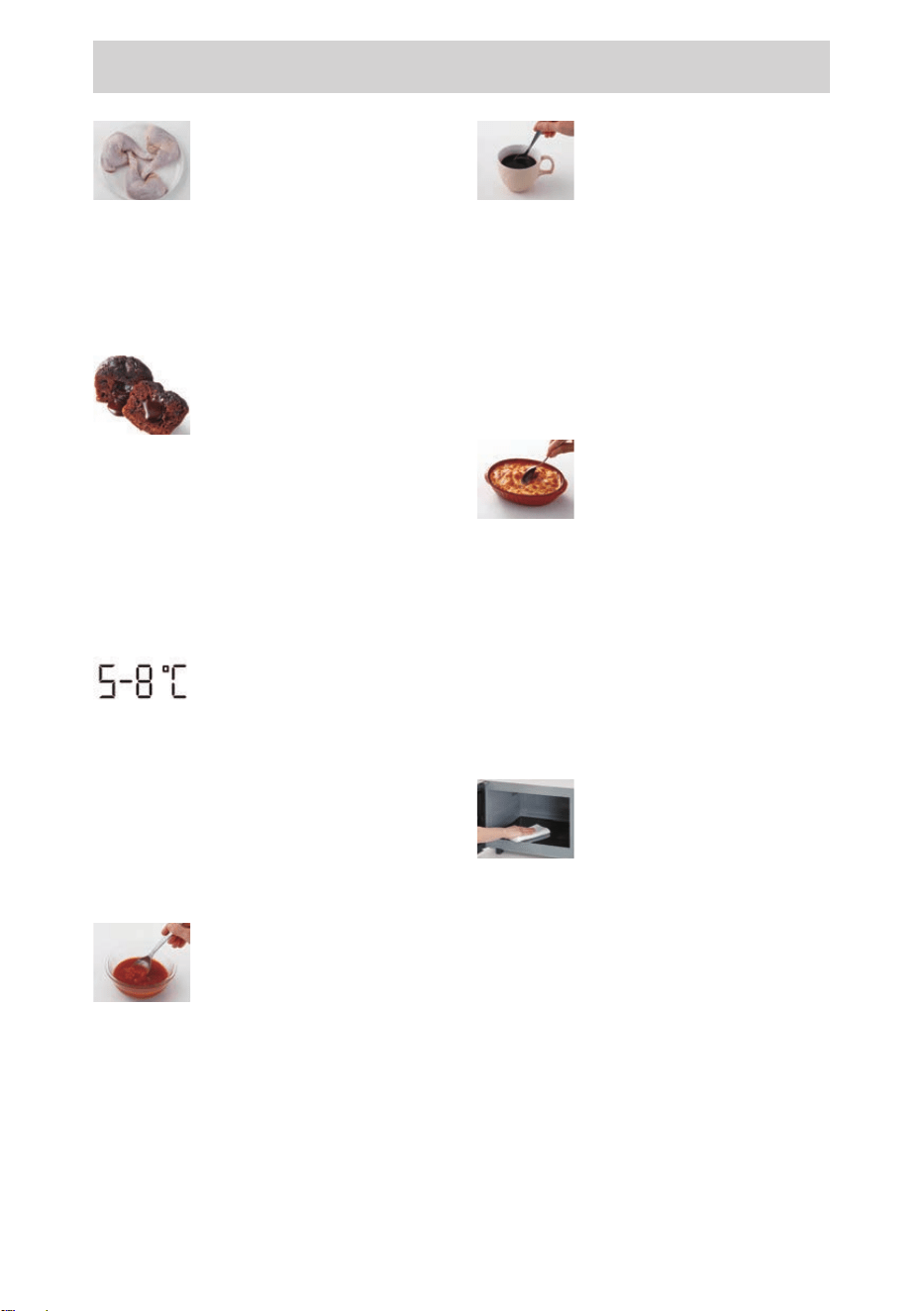
30
General Guidelines
Starting
Temperature
The colder the food, the longer
it takes to heat up. Food from a
fridge takes longer to reheat than
food at room temperature. Food
temperature should be between
5-8 °C before cooking.
Arranging
Individual foods e.g. chicken
portions or chops, should be placed
in a dish so that the thicker parts
are to the outside.
Ingredients
Foods containing fat, sugar or salt
heat up very quickly. The filling may
be much hotter than the pastry. Take
care when eating. Do not overheat
even if the pastry does not appear
to be very hot.
Turning and Stirring
Some foods require stirring during
cooking. Meat and poultry should be
turned after half the cooking time.
Liquids
All liquids must be stirred before,
during and after heating. Water
especially must be stirred before
and during heating, to avoid
eruption. Do not heat liquids that
have previously been boiled. Do
not overheat.
Checking Food
It is essential that food is checked
during and after a recommended
cooking time, even if an auto
program has been used (just as
you would check food cooked in a
conventional oven). Return the food
to the oven for further cooking if
necessary.
Cleaning
As microwaves work on food
particles, keep your oven clean at
all times. Stubborn spots of food
can be removed by using a branded
oven cleaner, sprayed onto a soft
cloth. Always wipe the oven dry
after cleaning. Avoid any plastic
parts and door area. Customers
should not spray directly into the
cavity.
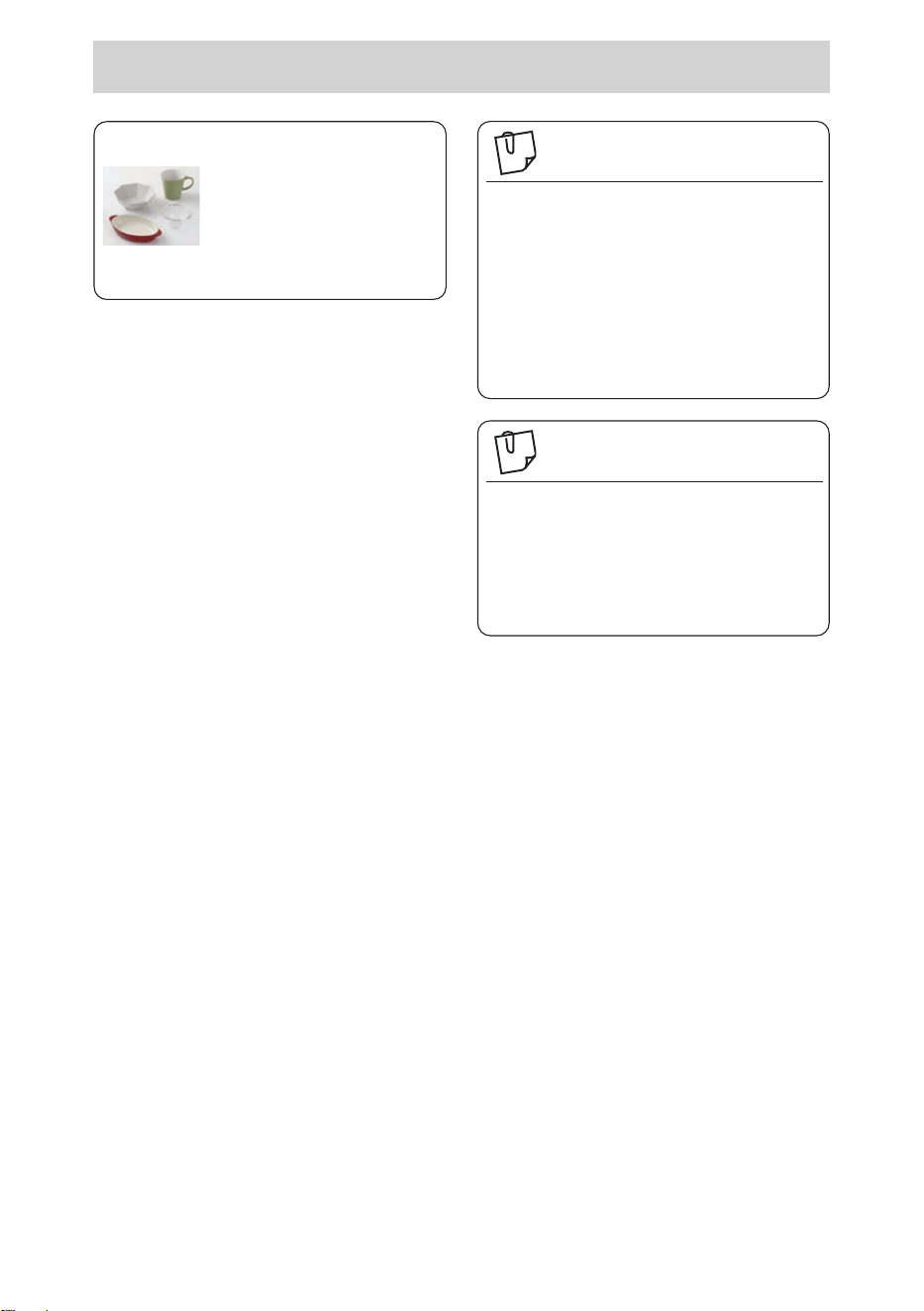
31
Quick Check Guide to Cooking Utensils
Testing Dishes for Suitability -
For Microwave Cooking Only.
When unsure that a cooking
container is suitable for use in
your microwave, check by the
following test:
1. Fill a microwave safe measuring
jug with 300 ml cold water.
2. Place it on the base of the oven
along side the dish to be tested.
If the dish you are testing is
a large dish, then stand the
measuring jug on top of the
empty dish.
3. Heat on 1000 W for 1 minute.
If the dish is suitable for
microwaving, it will remain cool,
whilst the water in the jug will
begin to feel warm. If the testing
dish feels warm, do not use as it
is obviously absorbing microwave
energy.
This test does not apply to plastic
or metal based containers e.g.
Le Creuset
®
style dishes, which
should not be used as they are
cast iron covered with enamel.
Result
Note
Choosing the correct
container is a very
important factor in
deciding the success
or failure of your
cooking.
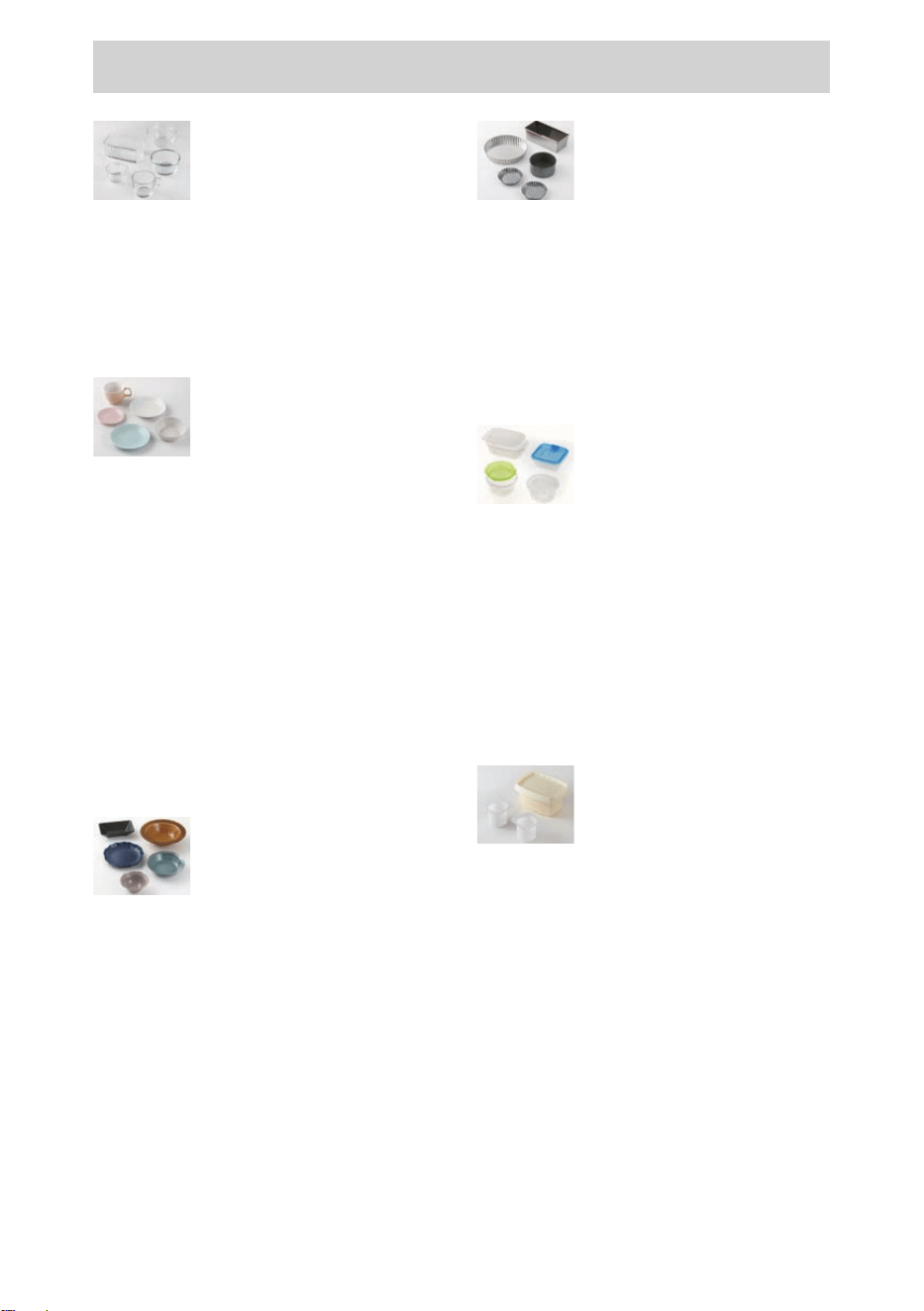
32
Containers to Use
Plastic
Many plastic containers are
designed for microwave use, but do
not use for cooking foods high in
sugar or fat or for foods that require
long cooking times e.g. brown rice.
Only use Tupperware
®
containers
if they are designed for Microwave
use.
Pottery, Earthenware,
Stoneware
If completely glazed, these dishes
are suitable. Do not use if partially
glazed or unglazed, since they are
able to absorb water which in turn
absorbs microwave energy, making
the container very hot and slows
down the cooking of food.
Oven Glass
Everyday glass that is heat resistant
e.g. Pyrex
®
, is ideal for Microwave,
Oven or Eco Combi cooking. Do not
use delicate glass or lead crystal
which may crack or arc.
Do not use Melamine.
Never cook in margarine
cartons or yoghurt pots,
as these will melt with the
heat from the food. If heatproof they
can be used for Grill, Oven or Eco
Combi cooking.
China and Ceramic
Everyday glazed china, porcelain
or ceramic plates, bowls, mugs and
cups can be used if they are heat
resistant. Fine bone china should
only be used for reheating for short
periods. Do not use dishes with a
metal rim or pattern. Do not use
jugs or mugs with glued handles,
since the glue can melt. If dishes
are heat resistant they may be used
on Oven and Eco Combi but not
directly under the Grill.
Foil/Metal
Containers
Never attempt to cook in foil or
metal containers on Microwave only
as the microwaves cannot pass
through and the food will not heat
evenly, it may also damage your
oven. Foil and metal containers can
be used on Grill or Oven.
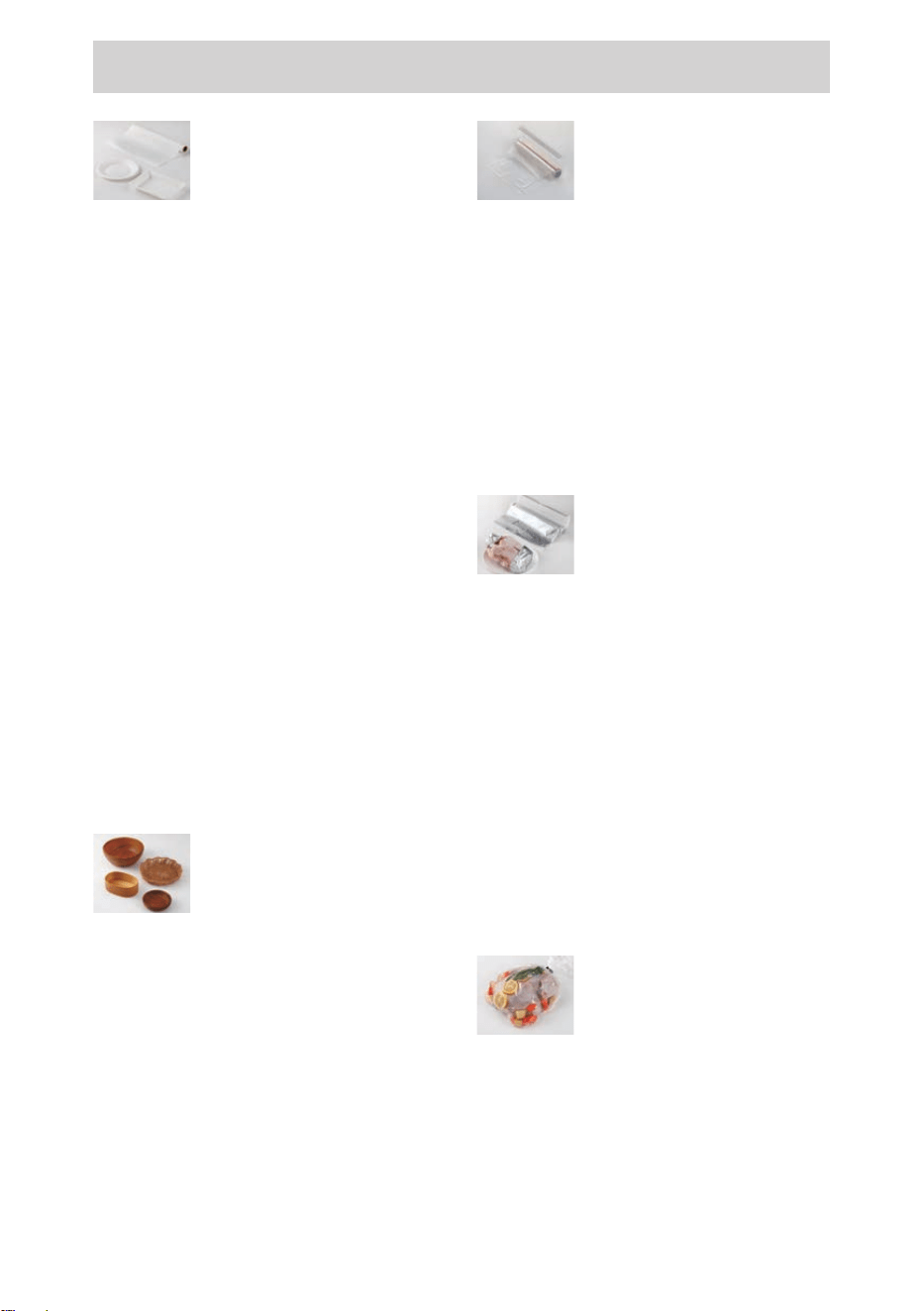
33
Only use for short cooking times.
Never re-use a piece of kitchen
towel. Always use a fresh piece
of paper for each dish.
Avoid kitchen paper containing
manmade fibres. If you are using
branded re-cycled kitchen towel,
check first that it is recommended
for microwave use. Do not use
waxed or plastic coated cups or
plates as the finish may melt.
Greaseproof paper can be used
to line the base of dishes and to
cover when blind baking pastry
cases. White paper plates can be
used for short reheating times, on
Microwave only.
Paper
Plain white absorbent kitchen paper
(kitchen towel) can only be used for
microwave cooking e.g. for covering
bacon to prevent splattering.
Containers to Use
Wicker, Wood, Straw
Baskets
Dishes will crack and could ignite.
Do not use wooden dishes in your
microwave. Do not use on any
cooking mode.
Cling Film
Microwave cling film can only
be used for covering food that is
reheated by microwave. It is also
useful for covering food to be
cooked, but care should be taken to
avoid the film being in direct contact
with the food eg. Do not line dishes
with cling film. Do not use on any
other cooking mode.
Aluminium Foil
Small amounts of smooth aluminium
foil can be used to shield joints of
meat during defrosting and cooking
by Microwave, as the microwaves
cannot pass through the foil, this
prevents the parts shielded from
overcooking or over defrosting. Take
care that the foil does not touch the
sides or roof of the oven, as this
may cause arcing and damage your
oven. Aluminium foil can be used for
Oven cooking.
Roasting Bags
Roasting bags are useful when
slit up one side to tent a joint, for
roasting by microwave and time. Do
not use the metal twists supplied,
when using Microwave or Eco
Combi.
34
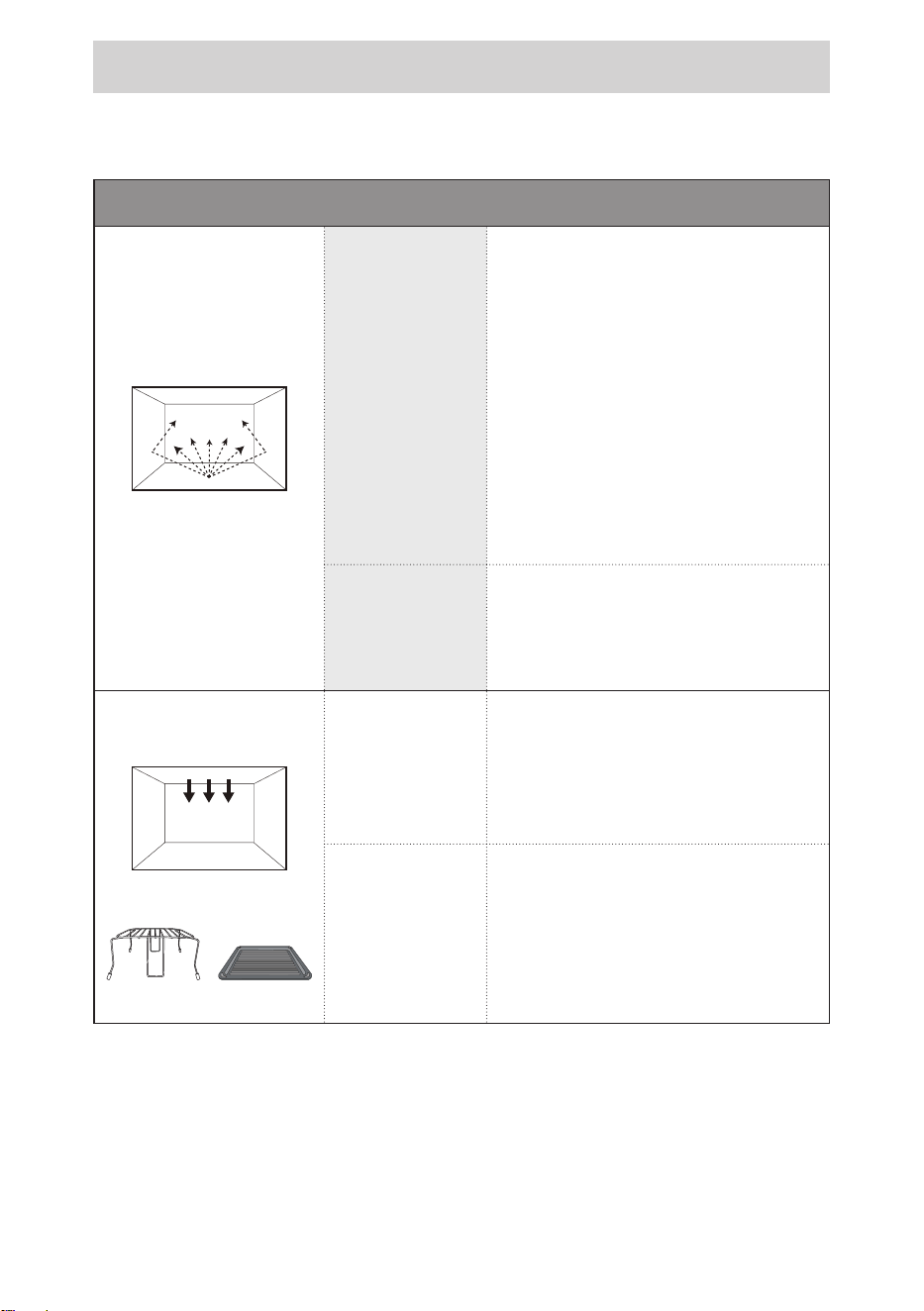
Cooking Modes
The diagrams shown below are examples of the accessories. It may vary
depending on recipe/dish used.
Cooking modes
MICROWAVE
Accessories
-
Uses
Defrosting
Reheating
Melting: butter, chocolate,
cheese.
Cooking fish, vegetables,
fruits, eggs.
Preparing: stewed fruits, jam,
sauces, custards, choux,
pastry, caramel, meat, fish.
Baking cakes without colour.
No preheating
Containers
Use your own Pyrex
®
dishes,
plates or bowls, directly
on the base of the oven.
Microwaveable, no metal.
GRILL
Accessories
Uses
Grilling of meat or fish.
Toast grilling.
Colouring of gratin dishes or
meringue pies.
Containers
Heatproof, metal tin can be used
on Enamel Shelf in lower or
upper shelf positions. Or place
foods directly on Enamel shelf or
Wire Rack with heatproof dishes
underneath.
35
Cooking Modes
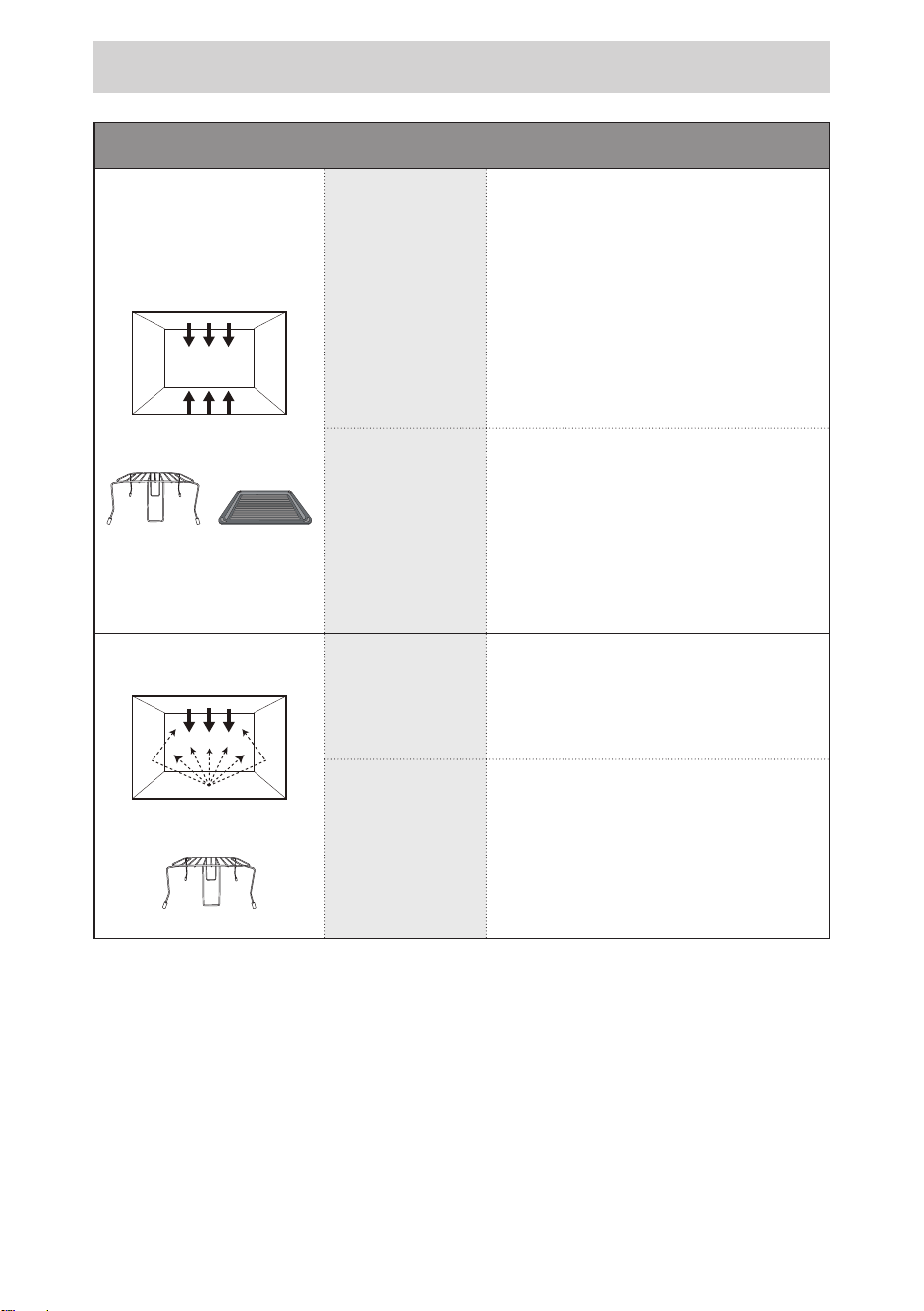
Cooking modes
OVEN
Accessories
Uses
Baking of small items with
short cooking times: puff
pastry, cookies, roll cakes,
scones.
Special baking: bread rolls or
brioches, sponge cakes.
Baking of pizzas and tarts.
Preheating advised
Containers
Heatproof, metal tin can be used
on Enamel Shelf in lower or
upper shelf positions. Or place
foods directly on Enamel shelf or
Wire Rack with heatproof dishes
underneath. Do not place foods
directly on base of oven.
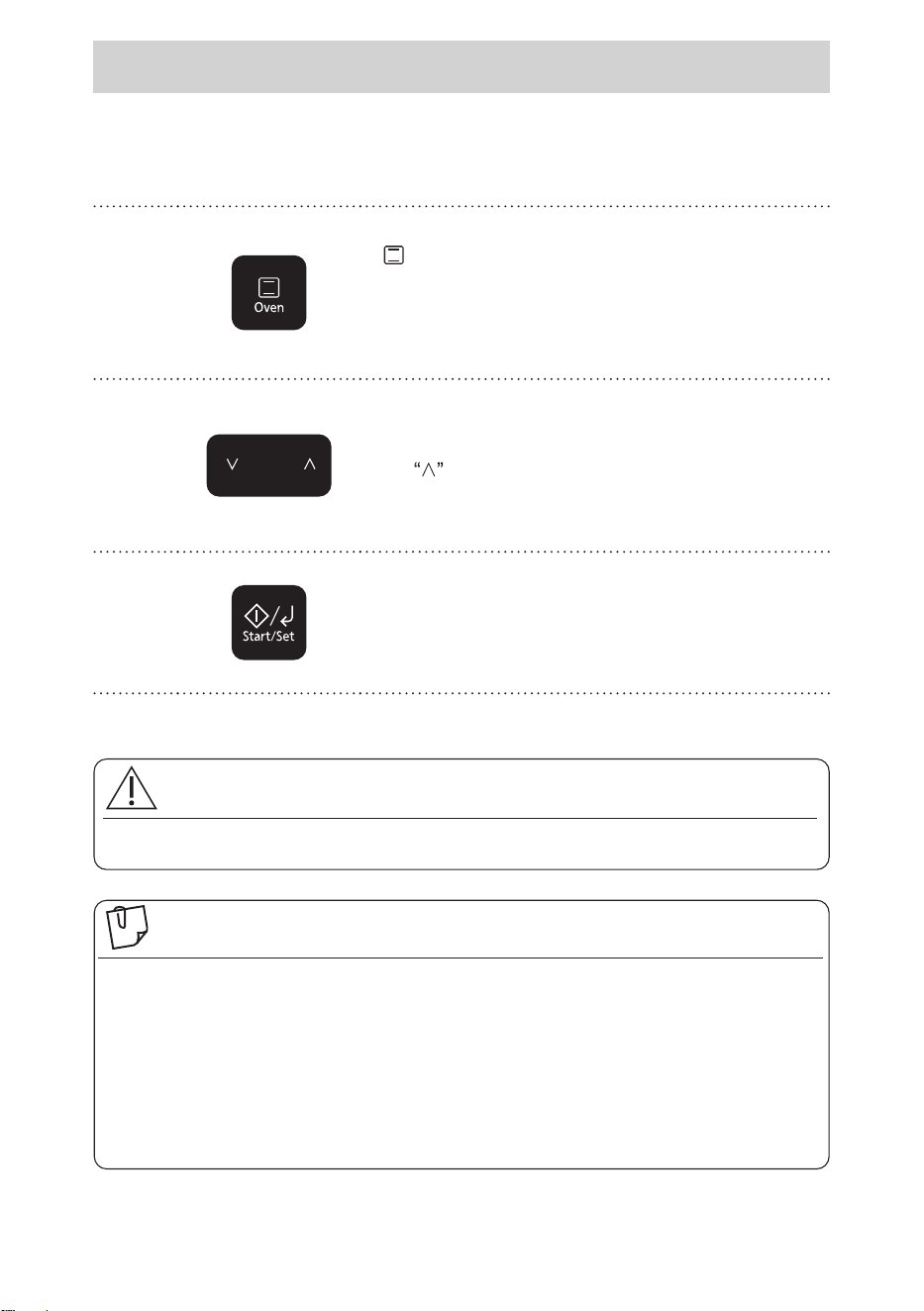
Eco Combi
Accessories
Uses
Cooking lasagne, meat,
potatoes or vegetable gratins.
No Preheating
Containers
Place foods directly on Wire
Rack with microwaveable and
heatproof dishes underneath. Or
microwaveable and heatproof
dishes placed directly on base
of oven, no metal.
36
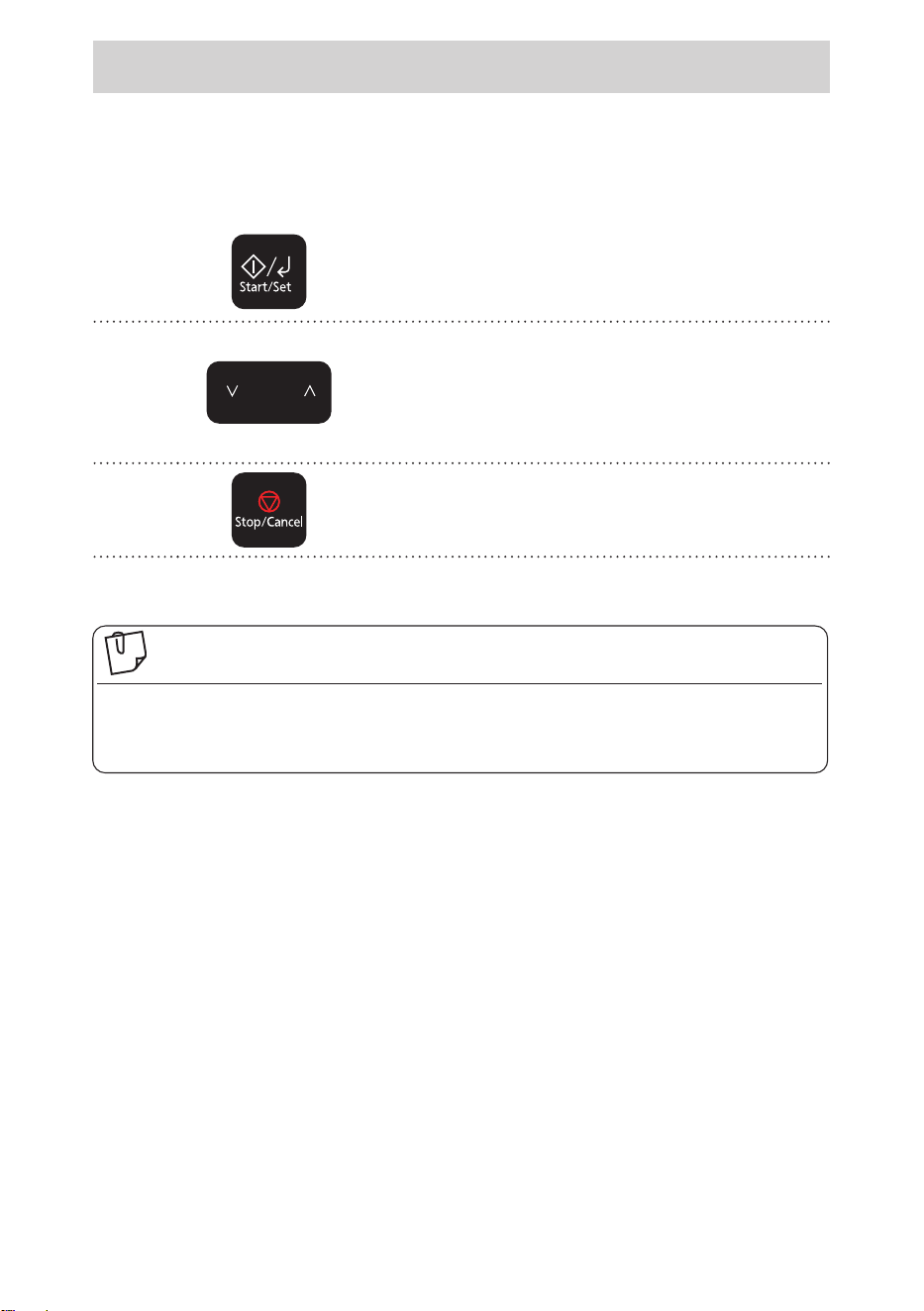
Let’s Start to Use Your Oven
1
Plug in.
Plug into a 13 amp fused electrical socket.
2
Select 200 °C Oven to burn off the oil.
(
will appear in the display window with
the oven temperature) (this procedure is to
burn off the oil used for rust protection in
the oven.) Remove all accessories from the
oven. (See page 46 for details)
3
Enter Time.
Tap
until 10 minutes is displayed in the
window.
4
Tap the Start/Set pad to start.
The time in the display will count down. The
oven will beep at the end of the program. The
oven is now ready to use.
Grill elements and oven will be hot.
Caution!
This is to enable you to experiment setting various programs. (“d”
will appear in the display window. This is to confirm that there is no
microwave power produced and it is safe to use the oven without any
food). To set Demonstration Mode: Tap Micro Power pad once, then tap
Stop/Cancel pad 4 times. To cancel demonstration mode: Tap Micro
Power pad once, tap Stop/Cancel pad 4 times.
Note
37
Beep Choice
1
Tap the Start/Set pad after first plugged in.
"bEEP" appears in the display window. The
default mode is "On".
2
Tap Up/Down Selection pad.
The mode changes to "OFF".
3
After setting, tap Stop/Cancel pad to exit.
1. The choice can be selected only when you plug-in the oven.
2. Tap Up/Down Selection pad, it will revert to initial mode.
Note
The oven has both "Beep On" and "Beep Off" mode. This unique function
of your Panasonic microwave oven allows you to establish the initial non-
cooking features of your oven.
38
Child Lock
1
To activate:
Tap Start/Set pad 3 times.
“0” will disappear. "
" is indicated in the
display.
2
To deactivate:
Tap Stop/Cancel pad 3 times.
“0” will reappear in the display.
To activate or cancel child lock, Start/Set pad and Stop/Cancel pad
must be tapped 3 times within a 10 second period. Child Lock can be
set when “0” is displayed.
Note
Using this system will make the oven controls inoperable; however, the
door can be opened. Child lock can be set when the display shows a “0”.
This feature is not available in child lock mode.
Note
Oven Lamp
To turn on/off the oven lamp.
Tap the Lamp pad to turn on/off the oven lamp.
39
Microwave Cooking and Defrosting
1
Tap Micro Power pad once.
The microwave symbol "
" will appear.
When you select 270 W, "
" will also
appear.
2
Select the power level.
Tap the
until the power you require
appears in the display window.
Power Level
1000 W
800 W
600 W
440 W
300 W
270 W
100 W
3
Tap the Start/Set pad to confirm the
selection.
4
Select the cooking time by tapping the
.
Maximum cooking time for 1000 W is
30 minutes, and for other power levels, it is
1 hour 30 minutes.
5
Tap the Start/Set pad to start.
The cooking program will start and the time in
the display will count down.
There are 7 different microwave power levels available. Do not place food
directly on the base of the oven. Use your own dishes, plates or bowls
covered with a lid or pierced cling film directly on the base of the oven.
40
Note
1. You can change the cooking time during cooking if required. Tap
the
to increase or decrease the cooking time. Time can be
increased/decreased in 1 minute increments, up to 10 minutes.
2. Do not attempt to use microwave only with any metal container in the
oven.
3. Do not place food directly onto the base of the oven. Place in
a microwaveable or glass dish. Foods reheated or cooked by
microwave only should be covered with a lid or pierced cling film,
unless otherwise stated.
4. For manual defrosting times, please refer to defrost chart on pages
42-43.
5. For multi-stage cooking refer to pages 51-53.
6. Standing time can be programmed after microwave power and time
setting. Refer to using the timer pages 56-57.
Bottom feeding technology
Please note that this product uses bottom feeding technology for microwave
distribution which differs from traditional turntable side feeding methods and
creates more useable space for a variety of different sized dishes.
This microwave feeding style can give a difference in heating times (in
microwave mode) when compared against side feeding appliances. This is
quite normal and should not cause any concern. Please refer to the charts
on pages 75-89.
Microwave Cooking and Defrosting
41
Defrosting Guidelines
For Best Results
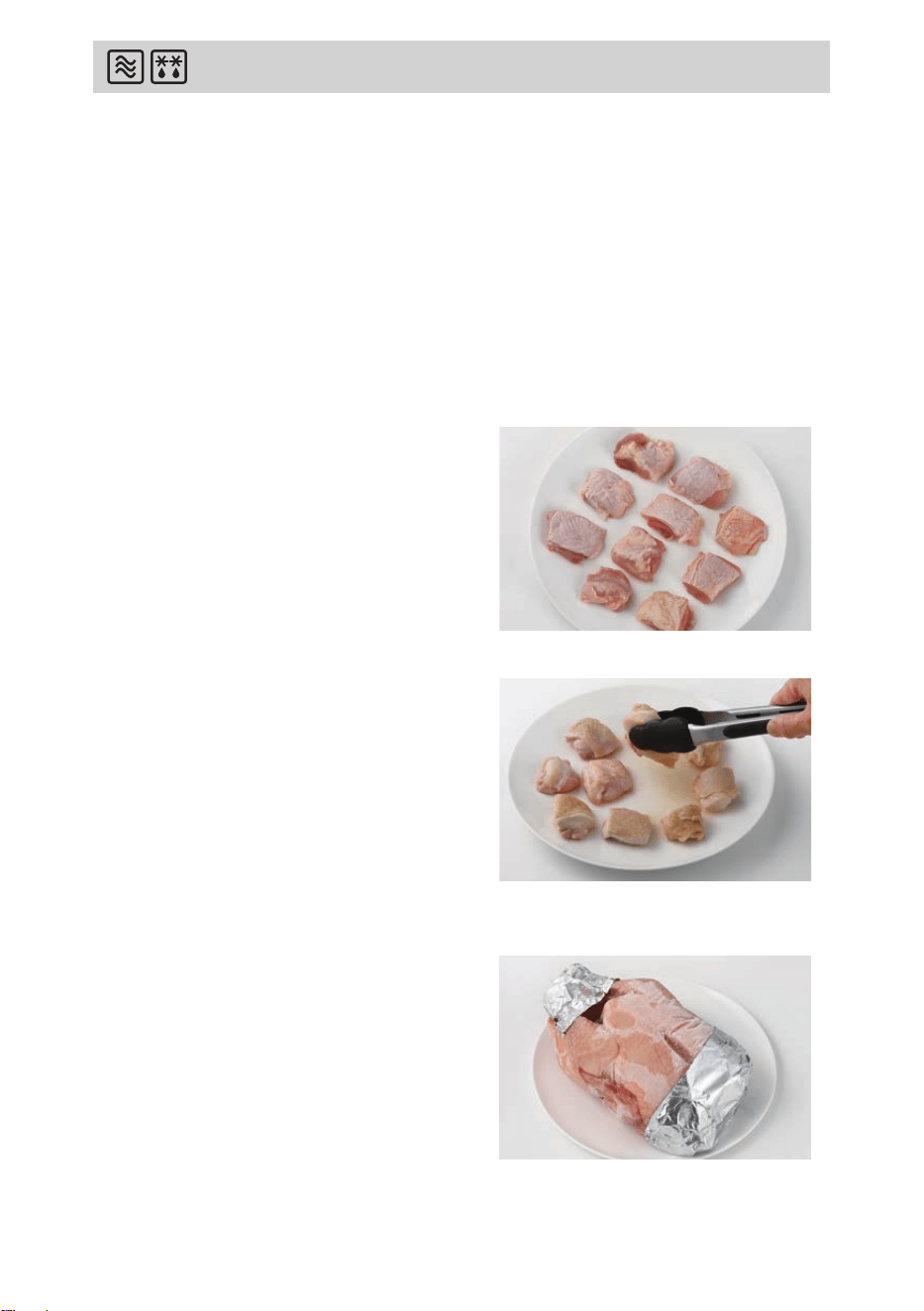
1.
Place foods in a suitable
container. Meat joints and
chickens should be placed on
an upturned saucer or on a
plastic rack if you have one.
2.
Check food during defrosting,
as foods vary in their defrosting
speed.
3.
It is not necessary to cover the
food.
4.
Always turn or stir the food
halfway through cooking. Shield
if necessary (see point 6).
5.
Minced meat, chops, chicken
portions and other small
items should be broken up or
separated as soon as possible
and placed in a single layer.
6.
Shielding prevents food cooking.
Arrange food in a single layer.
Turn or break up food as soon
as possible.
Shield chickens and joints of
meat.
By selecting the 270 W and setting
a time, you can defrost food in your
microwave. The biggest problem is
getting the inside defrosted before
the outside starts to cook.
For this reason a defrost program
alternates between a 270 W and
a standing time. The name for this
type of defrost is cyclic. During
the standing stages there is not
any microwave power in the oven,
although the light will remain on.
The automatic standing time ensure
a more even defrost but it is still
necessary to allow for standing
times before use.
It is essential when defrosting
chickens and joints of meat.
The outside thaws out first, so
protect wings/breast and fat with
smooth pieces of aluminium foil
secured with cocktail sticks.
7.
Allow standing time so that the
centre of the food thaws out.
(Minimum of 1 hour for joints of
meat and whole chickens).
42
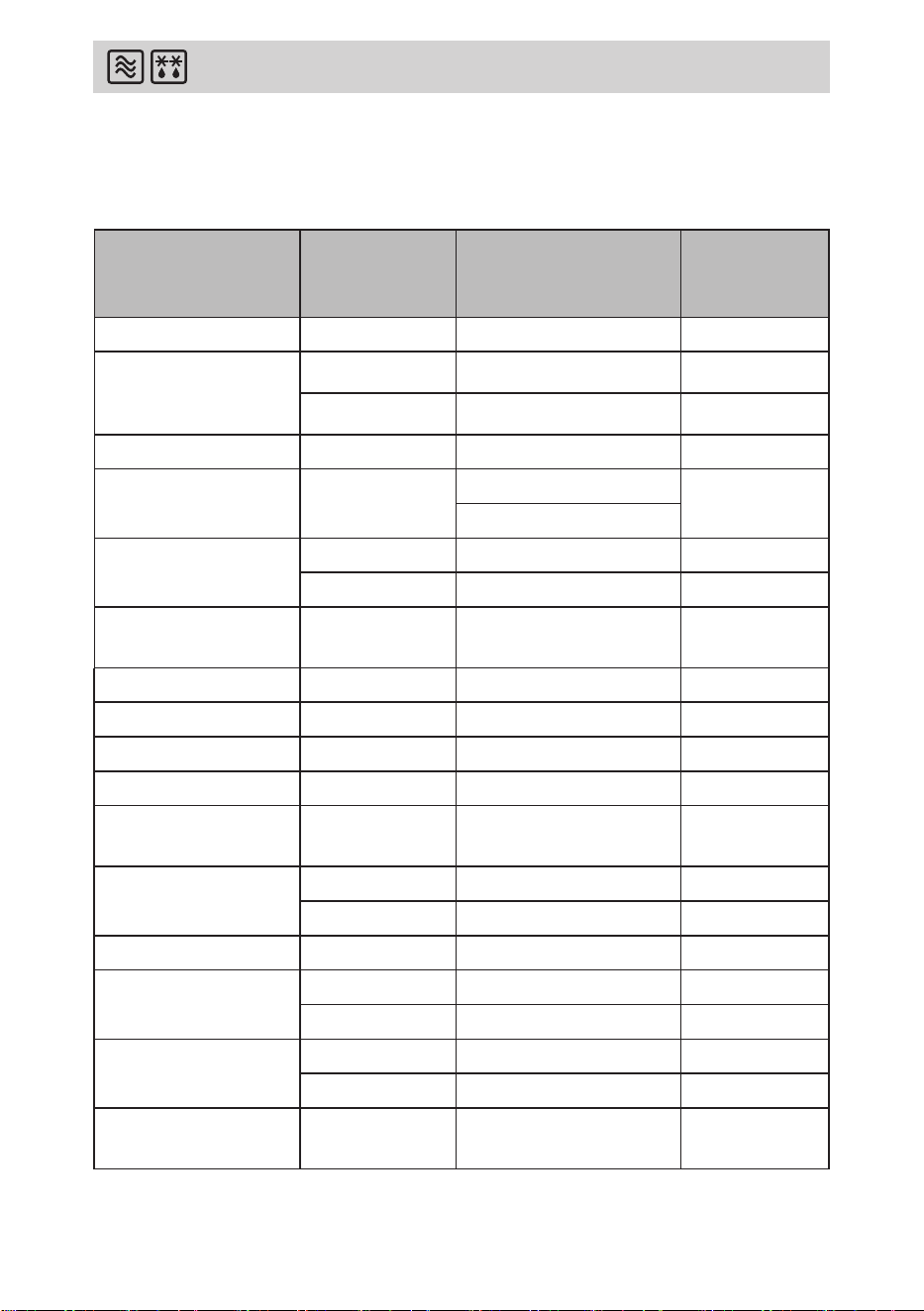
Defrosting Charts
The times given below are a guideline only. Always check the progress of
the food by opening the oven door and then re-starting. For larger quantities
adjust times accordingly. Food should not be covered during defrosting.
Food
Weight/
Quantity
Defrosting time &
mode
Standing
Times
(minimum)
Baguette (3) 150
g
1000 W 30-50 secs -
Bread rolls (3)
1 piece (85
g
) 1000 W 30-40 secs -
3 x 125
g
1000 W 40-50 secs -
Bread - slice (3) 60
g
1000 W 20-30 secs -
Breakfast pastries
(3)
2 x 50
g
1000 W 30-40 secs
-
270 W 3-4 mins
Brioche (1,3)
30
g
270 W 1-2 mins 5 mins
100
g
270 W 2-3 mins 5 mins
Butter (1) 250
g
270 W
2-3 mins 30 secs
15 mins
Cheese - Quark (1) 250
g
270 W 12-14 mins 10 mins
Fish whole (1) 500
g
270 W 10-12 mins 15 mins
Fish fi llets, thin (2) 260
g
270 W 8-10 mins 10 mins
Fish fi llets, thick (2) 300
g
270 W 10-12 mins 15-20 mins
Fish steaks without
bone (2)
260
g
270 W 9-10 mins 15 mins
Hamburger (1)
200
g
270 W 5-6 mins 10 mins
400
g
270 W 9-10 mins 10 mins
Pork sausages (1) 300
g
270 W 9-10 mins 10 mins
Pastry - puff (1)
280
g
(1 roll) 270 W 3-5 mins 15 mins
250
g
(1 block) 270 W 6-8 mins 15 mins
Pastry - shortcrust
(1)
250
g
(1 roll) 270 W 3-5 mins 15 mins
500
g
(1 block) 270 W 6-8 mins 10 mins
Pastry - pizza
dough (1)
400
g
1 ball 270 W 5 mins 10 mins
43
Defrosting Charts
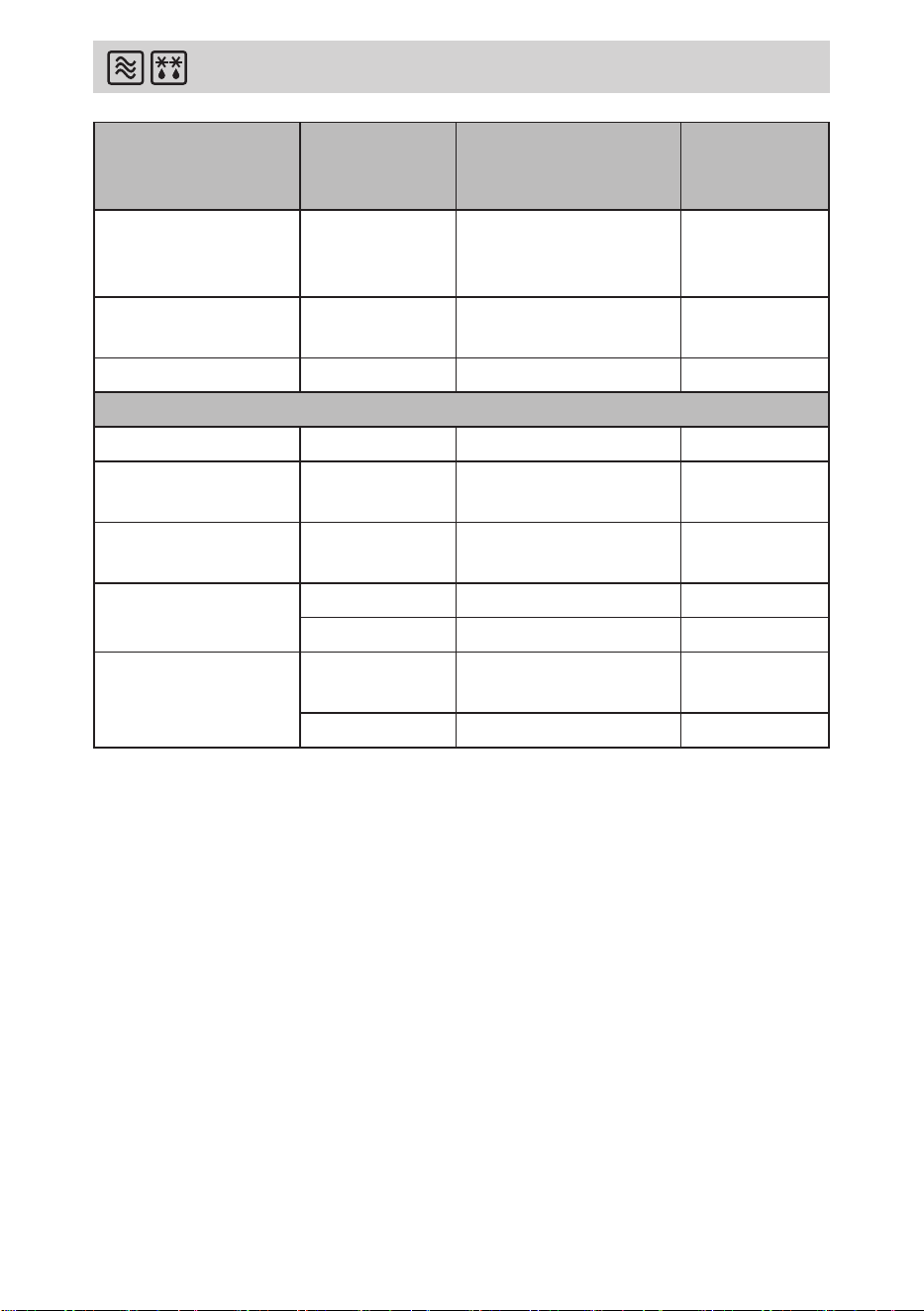
Food
Weight/
Quantity
Defrosting time &
mode
Standing
Times
(minimum)
Red fruit (2)
200
g
300
g
500
g
270 W 6-8 mins
270 W 10-12 mins
270 W 10-12 mins
15 mins
15 mins
15 mins
Salami (thin) (2)
250
g
(12 slices)
270 W 4-5 mins 5 mins
Shrimps/prawns (2) 200
g
270 W 9-11 mins 10 mins
Desserts
Black Forest (3) 600
g
270 W 10 mins 15 mins
Chocolate fondant
(3)
1 pce (500
g
) 300 W 3 mins 10 mins
Victoria sandwich
cake (3)
400
g
270 W 6-7 mins 10 mins
Fruit Tart (3)
1 slice 270 W 3-4 mins 10 mins
600
g
270 W 8-10 mins 15-20 mins
Waffl es (3)
1 pce
1000 W
30-40 secs
-
2 pces 1000 W 50 secs -
(1) Turn or stir at half time.
(2) Cover.
(3) Remove packaging and place on a heat-resistant plate.
44
Grilling
The grill system on the oven gives fast efficient cooking for a wide variety
of foods e.g. chops, sausages, steaks, toast, etc
.
Do not pre-heat on grill
mode with the Accessories in position.
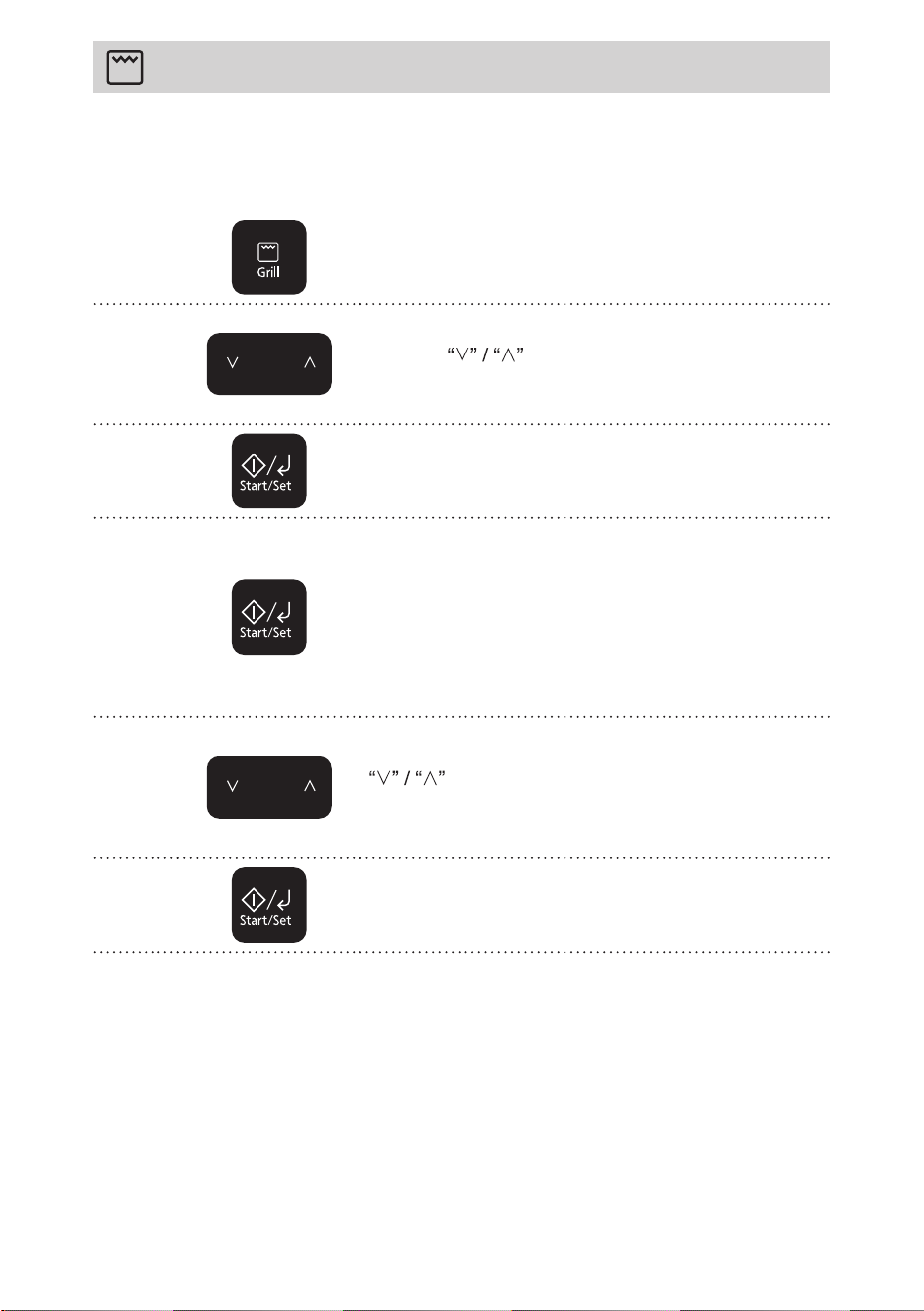
1
Tap Grill pad once.
2
Select the power level.
Tap the
until the power you require
appears in the display window.
Grill 3 (High), Grill 2 (Medium), Grill 1 (Low).
3
Tap the Start/Set pad to confirm the
selection.
4
Tap the Start/Set pad to preheat.
A “P” will appear and flash in the display
window. When the oven is preheated, the
oven will beep and the “P” will stop flashing.
Then open the door and place the food inside.
* Skip this step when preheat is not
required.
5
Select the cooking time by tapping the
.
Maximum cooking time is 1 hour and
30 minutes.
6
Tap the Start/Set pad to start.
The cooking program will start and the time in
the display will count down.
45
Grilling
Guidelines
1. You can change the cooking
time during cooking if required.
Tapping the
to increase
or decrease the cooking
time. Time can be increased/
decreased in 1 minute
increments, up to 10 minutes.
2. There is no microwave power on
the Grill only program.
3. Use the Enamel Shelf and Wire
Rack provided, as explained.
4. The Grill will only operate with
the oven door closed.
5. Most meat items e.g. bacon,
sausages, chops can be cooked
on the hottest setting Grill 3.
This setting is also suitable for
toasting bread, muffins and
teacakes etc.
6. Grill 2 and Grill 1 are used for
more delicate foods or those
that require a longer grill time
e.g. fish or chicken portions.
7. Never cover the food when
grilling.
8. The Enamel Shelf and Wire
Rack and surrounding oven will
get very hot. Use oven gloves.
9. After grilling, it is important that
the Enamel Shelf and Wire Rack
are removed for cleaning before
reuse and that the oven walls
and floor are wiped with a cloth
squeezed in hot soapy water to
remove any grease.
10. When using the grill to cook
foods, the cooking times will be
similar to traditional grilling.
Oven Accessories to Use
When grilling fish, chops or small
food items, the Enamel Shelf
should be placed in the upper shelf
position. For larger food items, the
Enamel Shelf should be in the lower
shelf position. Or you can place
foods directly on Wire Rack with
heatproof dishes underneath.
Place food on Enamel Shelf
The Enamel Shelf will allow fat and
juices to drip into the watercourse to
reduce excess splatter and smoke
when grilling.
Most foods require turning halfway
during cooking. When turning
food, open oven door and carefully
remove the Enamel Shelf or Wire
Rack by holding firmly.
After turning, return food to the
oven, close door and press the
Start/Set pad to start. The oven
will continue to count down the
remaining cooking time. It is quite
safe to open the oven door at any
time to check the progress of the
food as it is grilling.
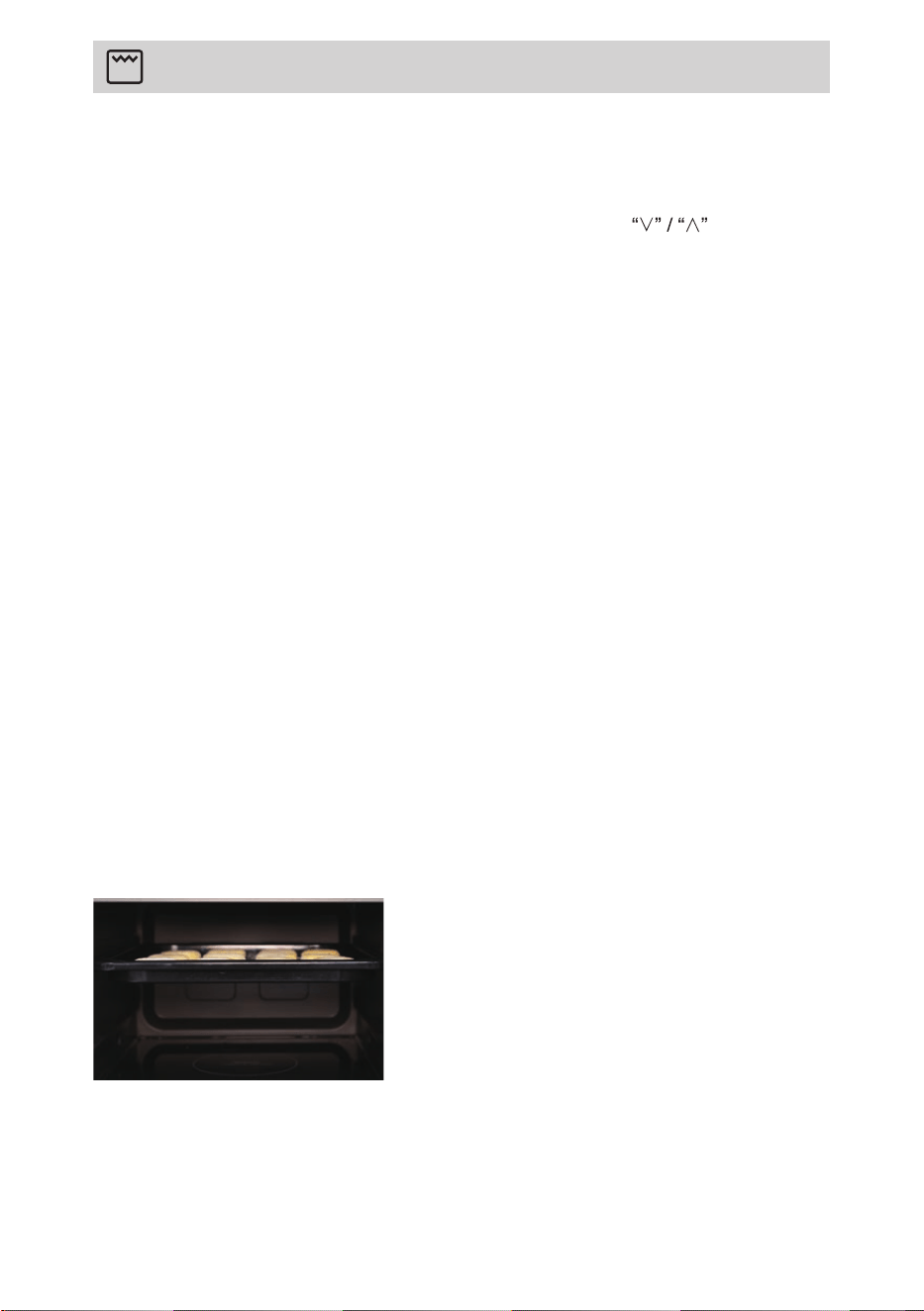
For grilling small foods use
the Enamel Shelf in the upper
shelf position.
46
Oven Cooking
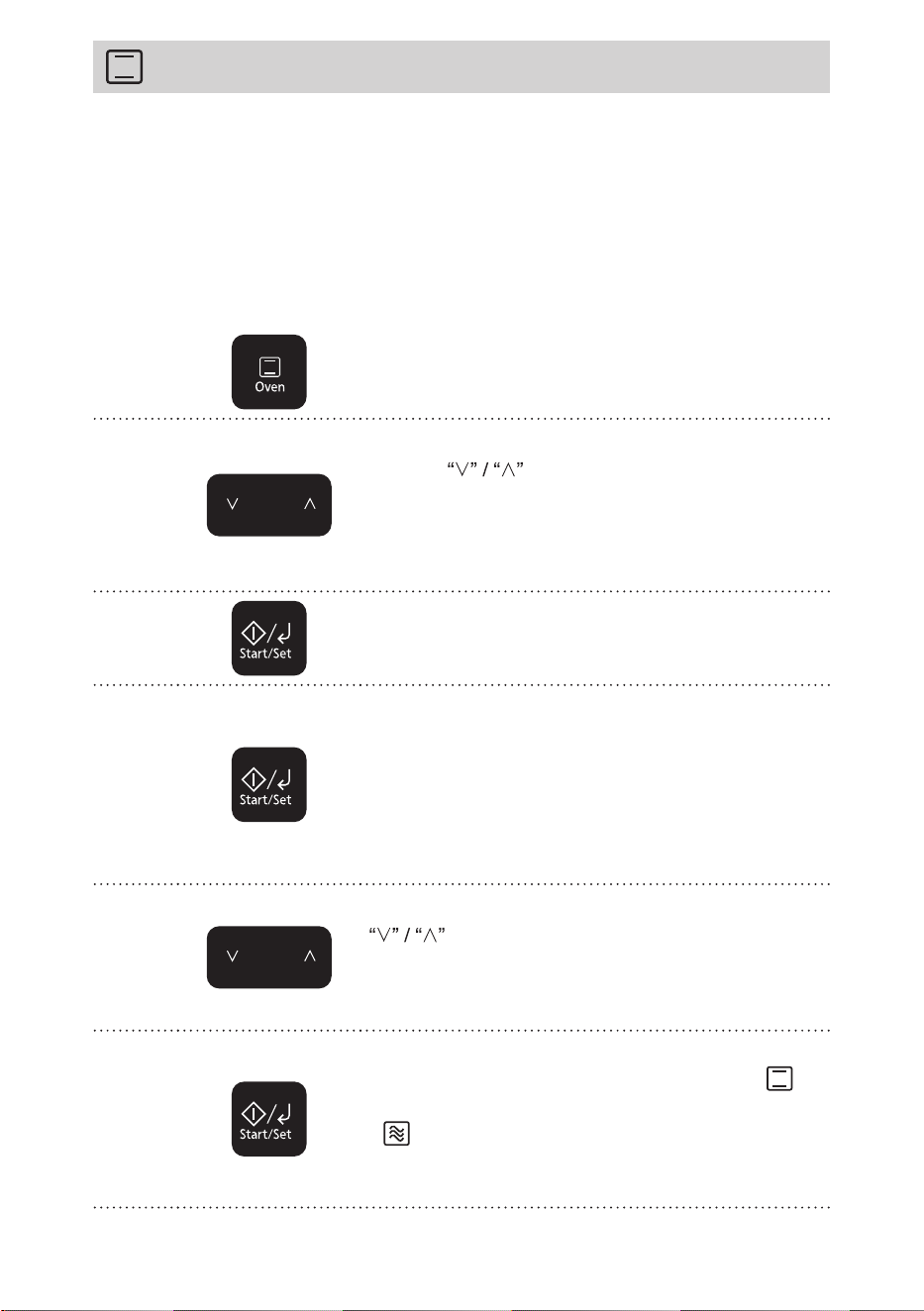
The oven can be used as an oven using the oven mode which uses top and
bottom heat. For best results always place food in a preheated oven. When
using oven mode, the Enamel Shelf can be placed in the upper or lower
shelf position. Or you can place foods directly on Wire Rack with heatproof
dishes underneath.
See individual guidelines on pages 47-48 for recommended use.
Do not pre-heat on oven mode with the Enamel Shelf in position.
1
Tap Oven pad once.
2
Select the oven temperature.
Tap the
to select the oven
temperature.
The oven starts at 180 °C and the temperature
will count up in 10 °C stages up to 200 °C
then back to 30 °C.
3
Tap the Start/Set pad to confirm the
selection.
4
Tap the Start/Set pad to preheat.
(except for 30-60 °C)
When the actual temperature reaches the set
temperature, the oven will beep. Then open
the door and place the food inside.
* Skip this step when preheat is not
required.
5
Select the cooking time by tapping the
.
Maximum cooking time for 30-60 °C is
9 hours, and for 70-200 °C, it is 1 hour and 30
minutes.
6
Tap the Start/Set pad to start.
Note: Check that only the oven symbol "
"
is still in the display. If the microwave symbol
"
" is displayed this is incorrect and the
program should be cancelled. Reselect the
oven setting.
47
Oven Cooking
1. If the oven has previously been used and it is too hot to ferment
dough on 30/40 °C, ‘HOt’ will appear in the display window. Please
wait until the cavity cools down. After the ‘HOt’ disappears, 30/40 °C
may be used again, otherwise you can ferment dough at room
temperature.
2. Open the door using the pull down door because if Stop/Cancel pad
is tapped the program may be cancelled.
3. The oven can not preheat to 30-60 °C.
4. You can change the cooking time during cooking if required. Tapping
the
to increase or decrease the cooking time. Time can be
increased/decreased in 1 minute increments, up to 10 minutes.
5. The selected temperature can be recalled and changed during
cooking and preheating if required. Tap Oven pad once to indicate
the temperature in the display window. You can change the
temperature (except 30-60 °C) by tapping the . While the
temperature is recalled in the display window.
6. The oven will maintain the selected preheated temperature for
approximately 30 minutes. If no food has been placed inside the oven
or a cooking time set, then it will automatically cancel the cooking
program and revert to “0”.
Note
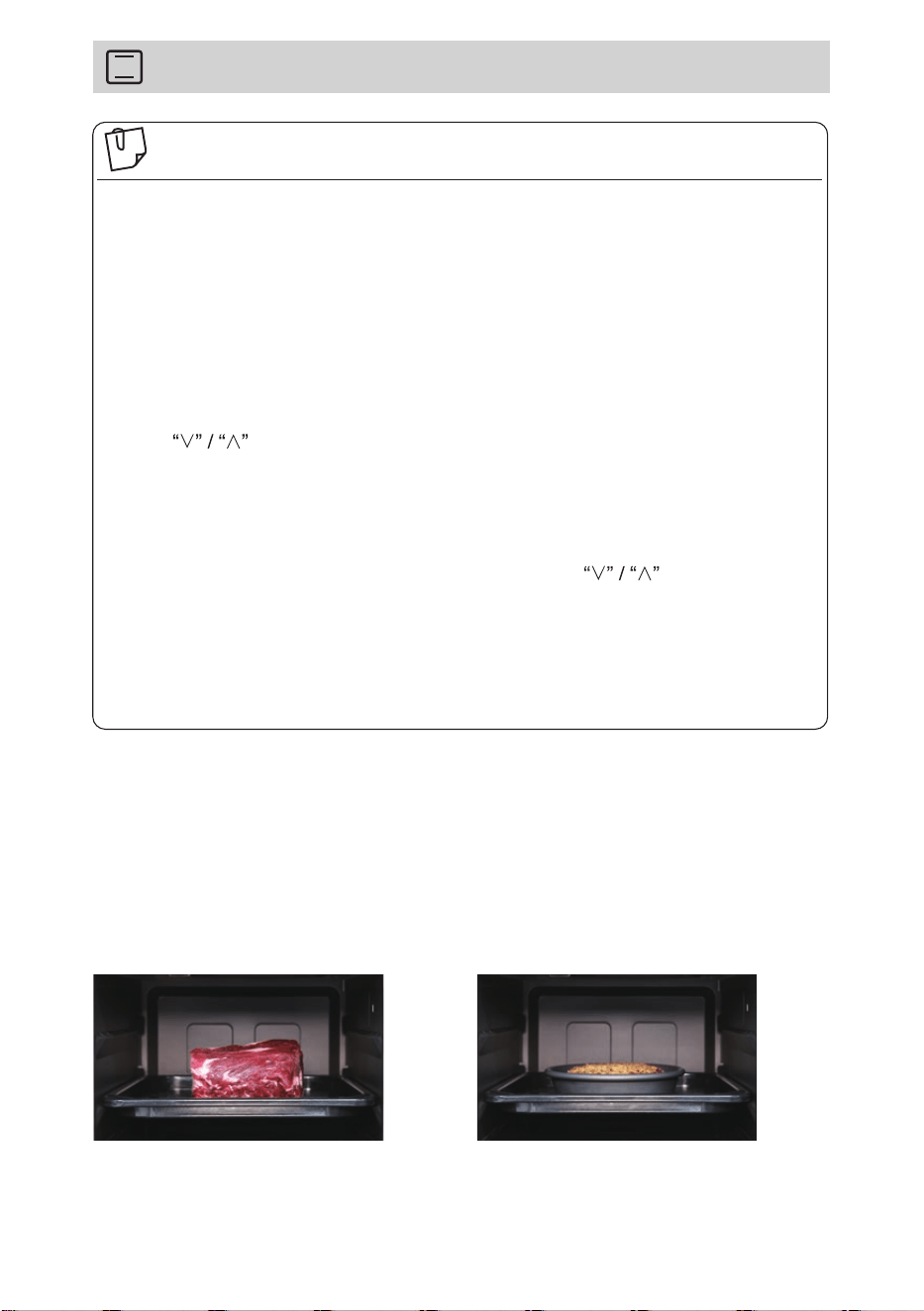
In oven mode, you can cook food directly on the Enamel Shelf in the upper
or lower shelf position. Or you can place your standard metal baking tins
and ovenware on the Enamel Shelf in the lower shelf position. Do not place
tins and ovenware directly on the base of the oven in oven mode. You also
can place foods directly on Wire Rack with heatproof dishes underneath.
Roasting meat:
Enamel Shelf in lower shelf position.
Baking:
Enamel Shelf in lower shelf position.
48
Oven Cooking
The Enamel Shelf, Wire Rack and surrounding oven will get very hot.
Use oven gloves.
Caution!
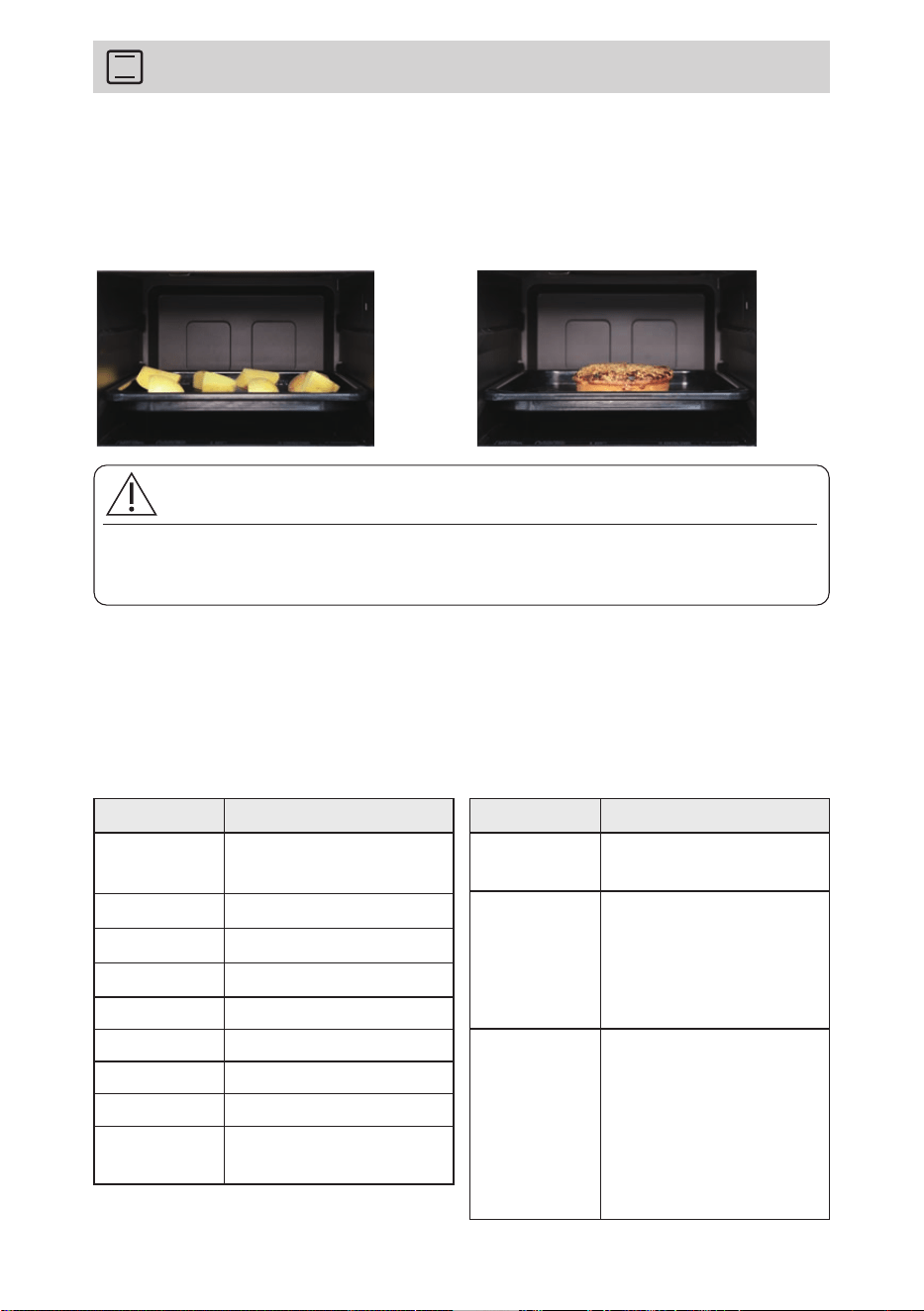
You can use the Enamel Shelf for baking dish for roasting potatoes or
vegetables, and for baking fairy cakes, scones and cookies.
It is also ideal for re-heating pre-baked convenience pastry items.
Roasting Vegetables / Potatoes:
Enamel Shelf in lower shelf position.
Reheating:
Enamel Shelf in lower shelf position.
Guideline to Oven Temperatures
For best results always place food in a preheated oven.
Don’t forget that for ease of programming of the most commonly used
temperatures, your oven will start at 180 °C and count up in 10 °C stages
to 200 °C then back to 30 °C. Food is generally cooked uncovered - unless
it is stated in the instructions or recipe.
Temp °C Use
30/40 °C
Proving bread or pizza
dough
50 °C Warming dishes
60/70 °C Dried fruits, beef jerky
80/90 °C Slow cooking
100 °C Pavlova
110 °C Meringues
140 °C Rich fruit cake
150/160 °C Macaroons
160/170 °C
Casseroles, small
tarts, cookies
Temp °C Use
180 °C
Victoria sandwich, fairy
cakes, meat joints
190 °C
Gratins, lasagne,
pastry pies, chicken,
Stuffed peppers,
scones, swiss roll,
muffins
200 °C
Vegetable parcels,
bread, garlic bread,
Baking pizza, low-
oil oven fry cooking
for drumsticks, pork
chops, and sweet
potatoes etc.
49
Eco Combi
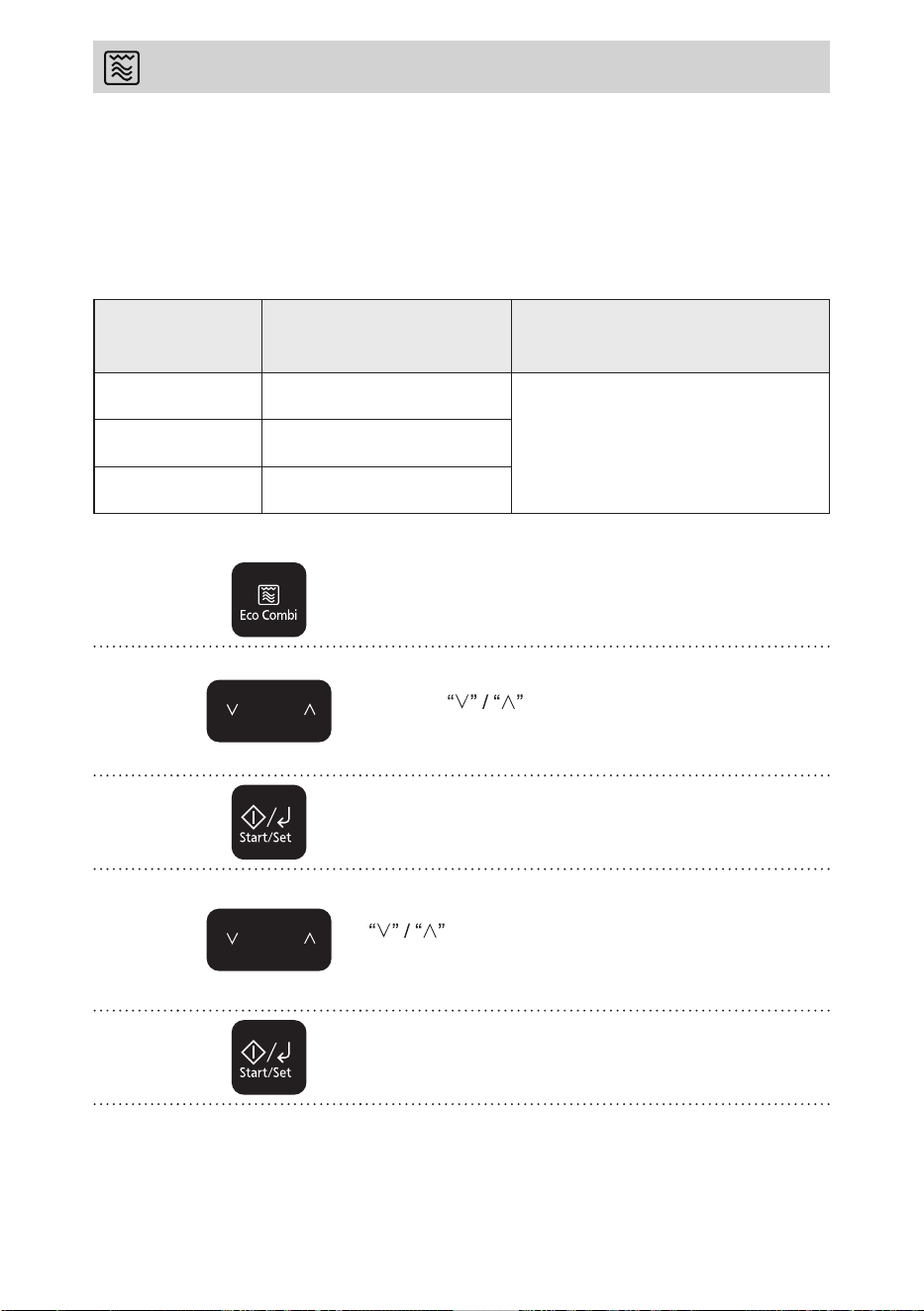
On the base of the oven in your own microwaveable and heatproof dishes,
this mode is suitable for cooking lasagne, gratins, meat, potatoes.
To cook successfully by this Eco Combi you should always use a minimum
of 200
g
food. Small quantities should be cooked by oven or grill. It is
not possible to preheat when using this Eco combi mode and food should
always be cooked uncovered.
Eco Combi
Level
Eco Combi Type Uses
Eco Combi 3 Grill 3 + MW 440 W
Breaded chicken, ready meal
with gratin tops, meat pies
and pastries.
Eco Combi 2 Grill 3 + MW 300 W
Eco Combi 1 Grill 2 + MW 300 W
1
Tap Eco Combi pad once.
2
Select the power level.
Tap the
until the power you require
appears in the display window.
(Skip this step for Eco Combi 3)
3
Tap the Start/Set pad to confirm the
selection.
4
Select the cooking time by tapping the
.
Maximum cooking time is 1 hour and 30
minutes.
5
Tap the Start/Set pad to start.
The cooking program will start and the time in
the display will count down.
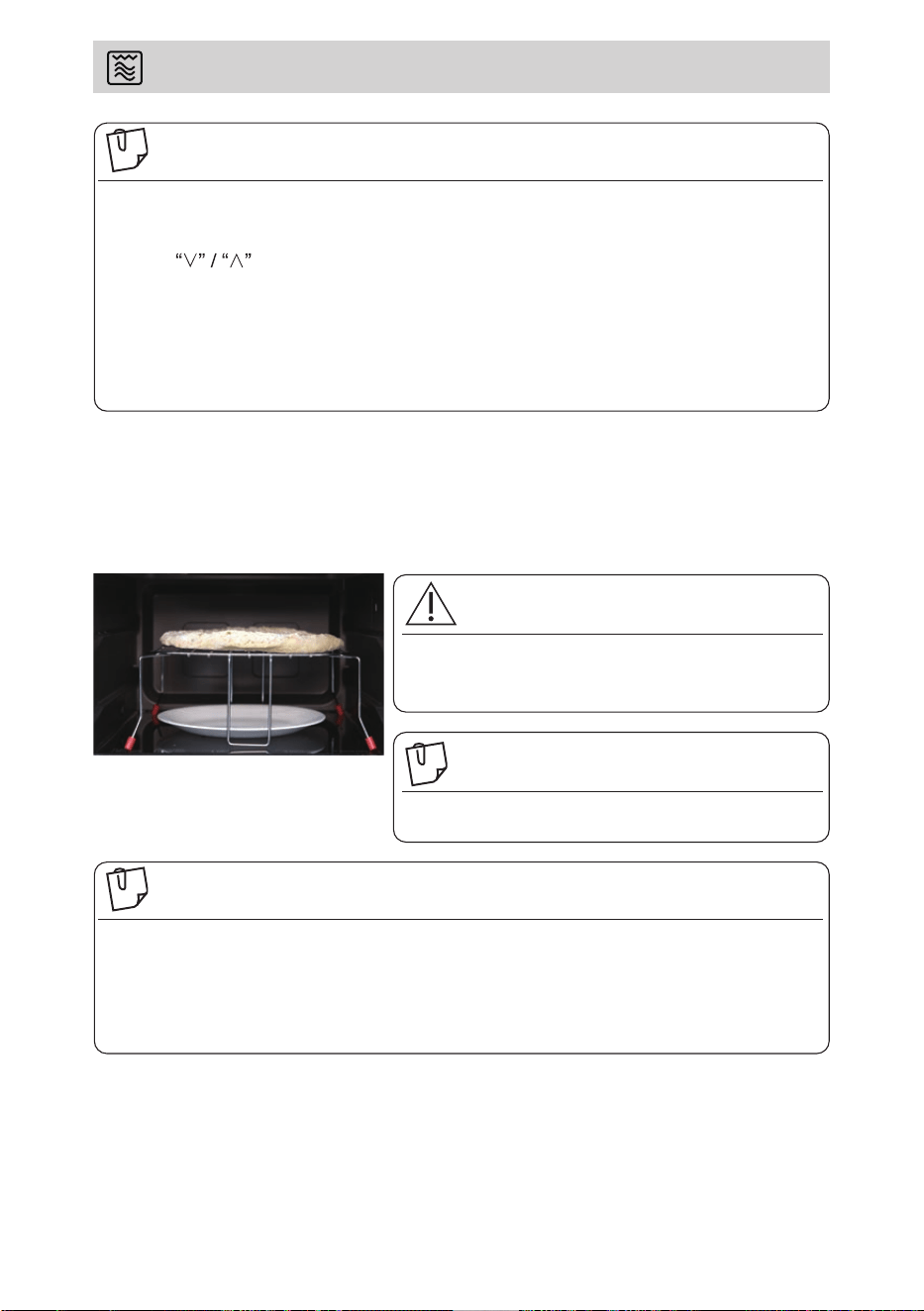
50
Eco Combi
Note
Containers to use
1. Preheating is not available for Eco Combi.
2. You can change the cooking time during cooking if required. Tapping
the
to increase or decrease the cooking time. Time can be
increased/decreased in 1 minute increments, up to 10 minutes.
3. To turn food just pull the door handle downwards to open, turn the
food, return to the oven, close the door and press the Start/Set pad
to start. The oven will continue to count down the remaining cooking
time.
Do not use plastic microwave containers on Eco Combi programs
(unless suitable for Eco Combi cooking). Dishes must be able to
withstand the heat of the top grill elements- heatproof glass e.g. Pyrex
®
or ceramic are ideal.
You can place foods directly
on Wire Rack with heatproof
dishes underneath.
For advice on cooking times refer to cooking and reheating charts in this
book. See pages 75-89. Foods should always be cooked until browned and
piping hot.
Your dishes and surrounding oven will get
very hot. Use oven gloves.
Food is always cooked uncovered.
Caution!
Guideline
51
Multi-stage Cooking
2 or 3 stage cooking
1
Select desired Function.
2
Tap the until
the power you require
appears in the display
window.
3
Tap the Start/Set pad to
confirm the selection.
4
Select the cooking time
by tapping the .
5
Select desired Function.
6
Tap the until
the power you require
appears in the display
window.
7
Tap the Start/Set pad to
confirm the selection.
8
Select the cooking time
by tapping the .
9
Tap the Start/Set pad
to start.
The cooking program will
start and the time in the
display will count down.
52
Multi-stage Cooking
Example:
To Grill 1 for 4 minutes and cook food on 440 W for 5 minutes.
1
Tap Grill pad once.
2
Tap the to
select Grill 1 (Low).
3
Tap the Start/Set pad to
confirm the selection.
4
Select the cooking time
to 4 minutes by tapping
the .
5
Tap Micro Power pad
once.
6
Tap the to
select 440 W.
7
Tap the Start/Set pad to
confirm the selection.
8
Select the cooking
time to 5 minutes by
tapping the .
9
Tap the Start/Set pad to
start.
The cooking program will
start and the time in the
display will count down.
53
Multi-stage Cooking
Example:
To 270 W for 2 minutes and cook food on 1000 W for 3 minutes.
1
Tap Micro Power pad
once.
2
Tap the to
select 270 W (defrost).
3
Tap the Start/Set pad to
confirm the selection.
4
Select the cooking time
to 2 minutes by tapping
the .
5
Tap Micro Power pad
once.
6
Tap the Start/Set pad to
confirm the selection.
7
Select the cooking time
to 3 minutes by tapping
the .
8
Tap the Start/Set pad to
start.
The cooking program will
start and the time in the
display will count down.
Note
1. For three-stage cooking, enter another cooking program before
pressing the Start/Set pad.
2. During operation, tapping Stop/Cancel pad once will stop the operation.
pressing the Start/Set pad will re-start the programmed operation.
Tapping Stop/Cancel pad twice will stop and clear the programmed
operation.
3. Whilst not operating, tapping Stop/Cancel pad will clear the selected
program.
4. Auto programs and Oven cannot be used with multi-stage cooking.
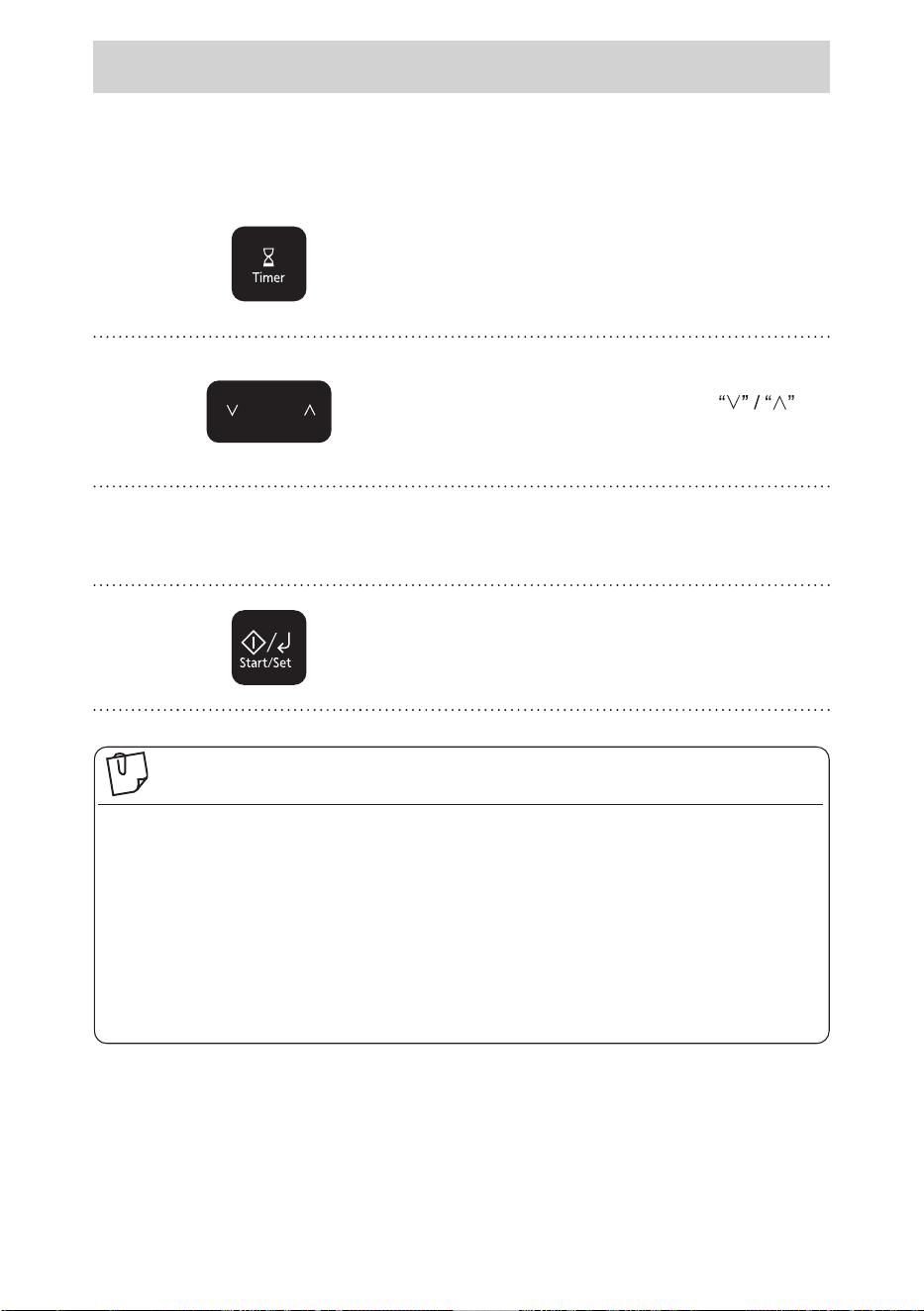
54
Using the Timer
Delay start cooking
By using the timer, you are able to program delay start cooking.
Note
1. Three-stage cooking can be programmed including delay start
cooking.
2. If the oven door is opened during the delay time, the time in the
display window will continue to count down.
3. If the programmed delay time exceeds one hour, the time will count
down in units of minutes. If less than one hour, the time will count
down in units of seconds.
4. Delay start cannot be used before an Auto programs and Oven.
1
Tap Timer pad once.
2
Set the delay time by tapping the .
(up to 9 hours).
3
Set the cooking program, by entering
cooking mode and time required.
4
Tap the Start/Set pad to start.
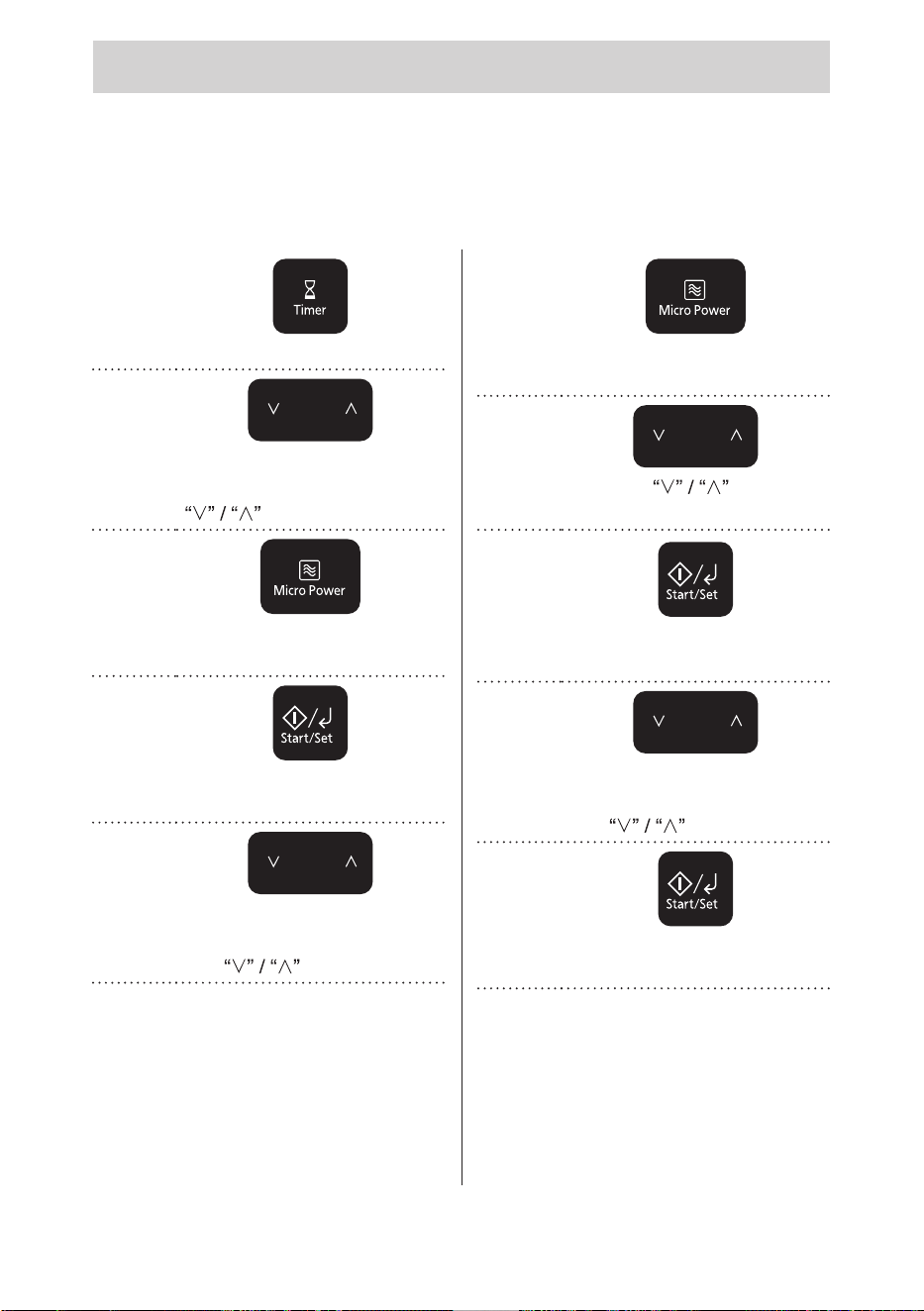
55
Delay start cooking
Example:
Delay start: 1 hour, 1000 W: 10 mins, 300 W: 20 mins.
1
Tap Timer pad once.
2
Set the delay time to
1 hour by tapping the
.
3
Tap Micro Power pad
once.
4
Tap the Start/Set pad to
confirm the selection.
5
Set the cooking time to
10 minutes by tapping
the .
6
Tap Micro Power pad
once.
7
Tap the . to
select 300 W.
8
Tap the Start/Set pad to
confirm the selection.
9
Set the cooking time to
20 minutes by tapping
the .
10
Tap the Start/Set pad to
start.
Using the Timer
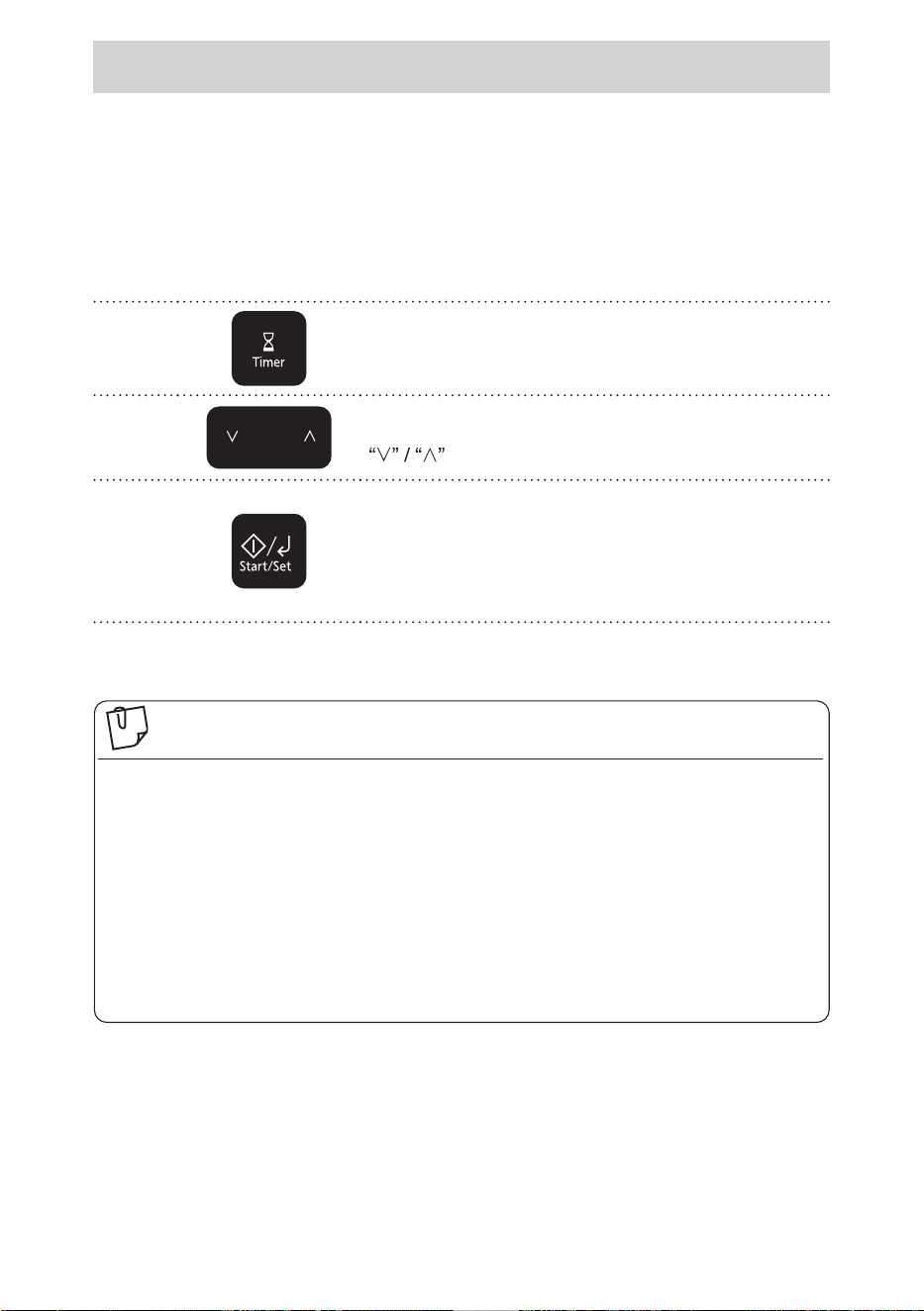
56
Using the Timer
To set a standing time:
By using the Timer, you can program Standing time after cooking is
completed or use to program the oven as a minute timer.
Note
1. Three-stage cooking can be programmed including standing time.
2. If the oven door is opened during the standing time or minute timer,
the time in the display window will continue to count down.
3. If the programmed standing time exceeds one hour, the time will
count down in units of minutes. If less than one hour, the time will
count down in units of seconds.
4. This feature may also be used as a minute timer. In this case tap the
Timer, set time and press the Start/Set pad to start.
5. Standing time cannot be used after an Auto programs and Oven.
1
Select Cooking Mode & Time
Set the cooking program, by entering cooking
mode and time required.
2
Tap Timer pad once.
3
Set the standing time by tapping the
. (up to 9 hours).
4
Tap the Start/Set pad to start.
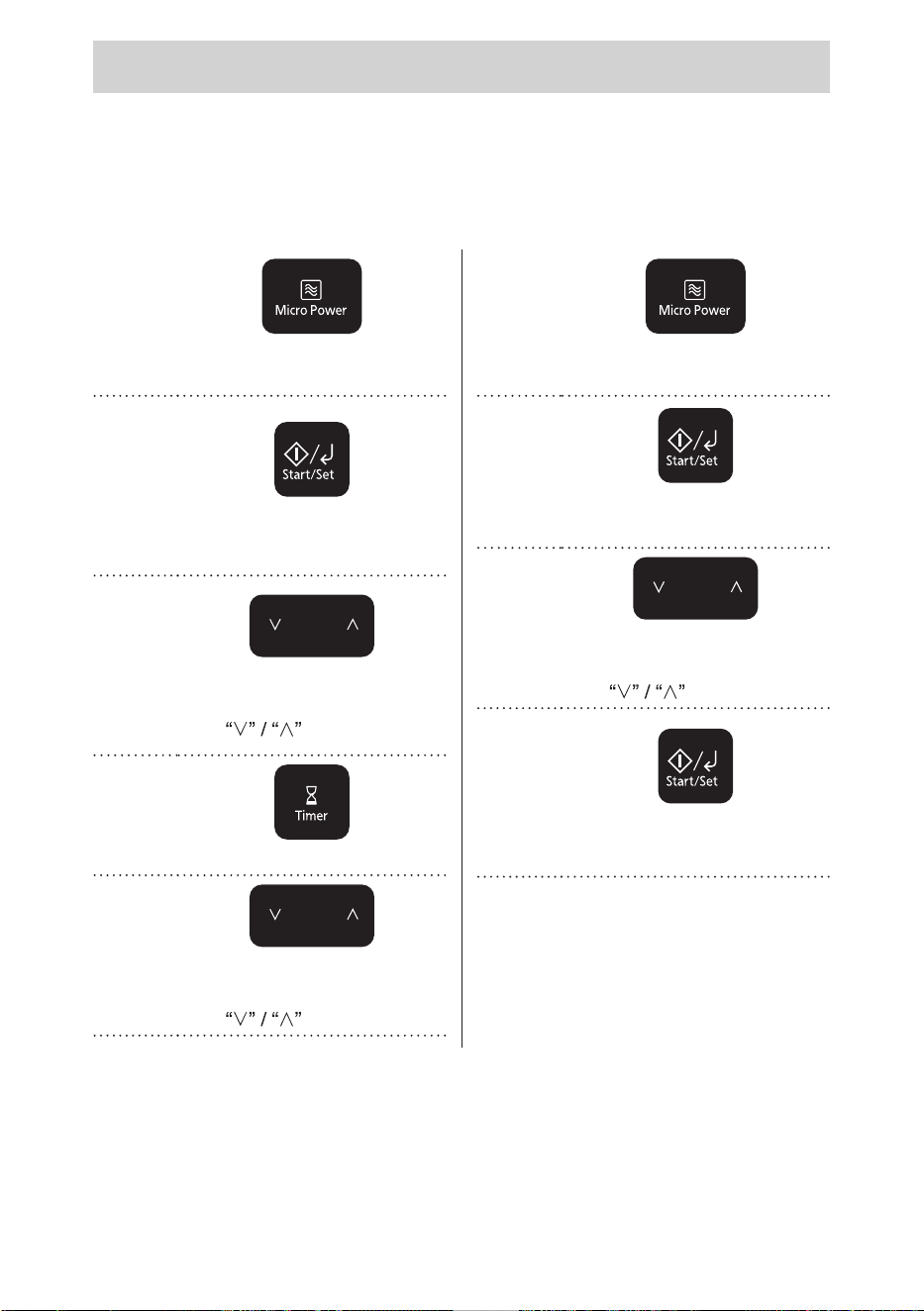
57
To set a standing time:
Example:
1000 W: 4 mins, Standing time: 5 mins, 1000 W: 2 mins
1
Tap Micro Power pad
once.
2
Tap the Start/Set pad to
confirm the selection.
3
Set the cooking time to
4 minutes by tapping
the .
4
Tap Timer pad once.
5
Set the standing time
to 5 minutes by tapping
the .
6
Tap Micro Power pad
once.
7
Tap the Start/Set pad to
confirm the selection.
8
Set the cooking time to
2 minutes by tapping
the .
9
Tap the Start/Set pad to
start.
Using the Timer
58
Using the Add Time Function
This feature allows you to add cooking time at the end of previous cooking.
After cooking, tap the to
select Add Time function.
Tap the Start/Set pad to start.
Time will be added. The time in the
display window will count down.
Modes Maximum cooking time
Micro Power 1000 W 30 minutes
Other microwave powers, Grill 1 hour and 30 minutes
Oven (30-60 °C), Timer 9 hours
Oven (70-200 °C) 1 hour and 30 minutes
Eco Combi 1 hour and 30 minutes
Note
1. This function is only available for Micro Power, Grill, Oven, Eco
Combi and Timer functions and it is not available for Auto programs.
2. The Add Time function is only available within 1 minute after cooking.
3. The Add Time function can be used after the multi-stage cooking.
The power level is the same as the last stage.
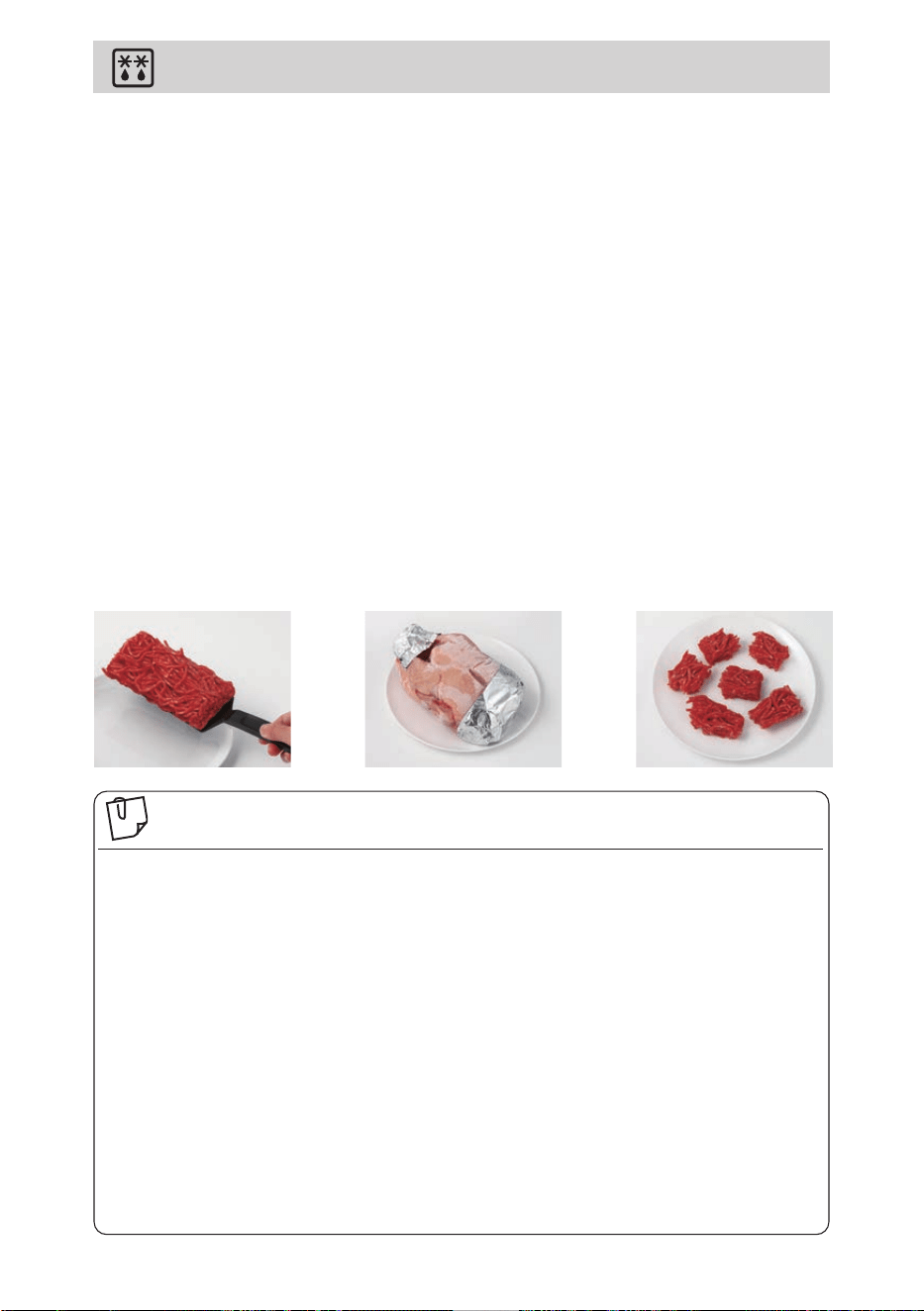
59
This feature allows you to defrost minced meat, chops, chicken
portions, meat joints and bread. Tap Defrost pad to select the correct
defrost category and then enter in the weight of the food in grams (see
page 60-61).
Foods should be placed in a suitable dish, whole chickens and joints of
meat should be on an upturned saucer or on a microwave safe plate.
Chops, chicken portions and slices of bread should be placed in a single
layer. It is not necessary to cover the foods.
The theory principle is used in auto weight defrost programs to give you a
quick and more even defrost. The system uses a random sequence of pulsing
microwave energy which speeds up the defrosting process. During the program
the oven will beep to remind you to check the food. It is essential that you
turn and stir the food frequently and shield if necessary. On hearing the
first beep you should turn and shield (if possible). On the second beep you
should turn the food or break it up.
Turn Turn or break upOr shield
1
st
Beep 1
st
Beep 2
nd
Beep
Note
1. Check foods during defrosting. Foods vary in their defrosting speed.
2. It is not necessary to cover the food.
3. Always turn or stir the food especially when the oven “beeps”. Shield
if necessary (see point 5).
4. Minced meat/chops/chicken portions should be broken up or
separated as soon as possible and placed in a single layer.
5. Shielding prevents food cooking. It is essential when defrosting
chickens and joints of meat. The outside thaws out first, so protect
wings/breast/fat with smooth pieces of aluminium foil secured with
cocktail sticks.
6. Allow standing time so that the centre of the food thaws out (minimum
1-2 hours for joints of meat and whole chickens).
7. If ‘HOt’ appears in the display window, the oven temperature is too
high from previous use and an auto program can not be set. Cooking
mode and time may still be set manually.
Defrost
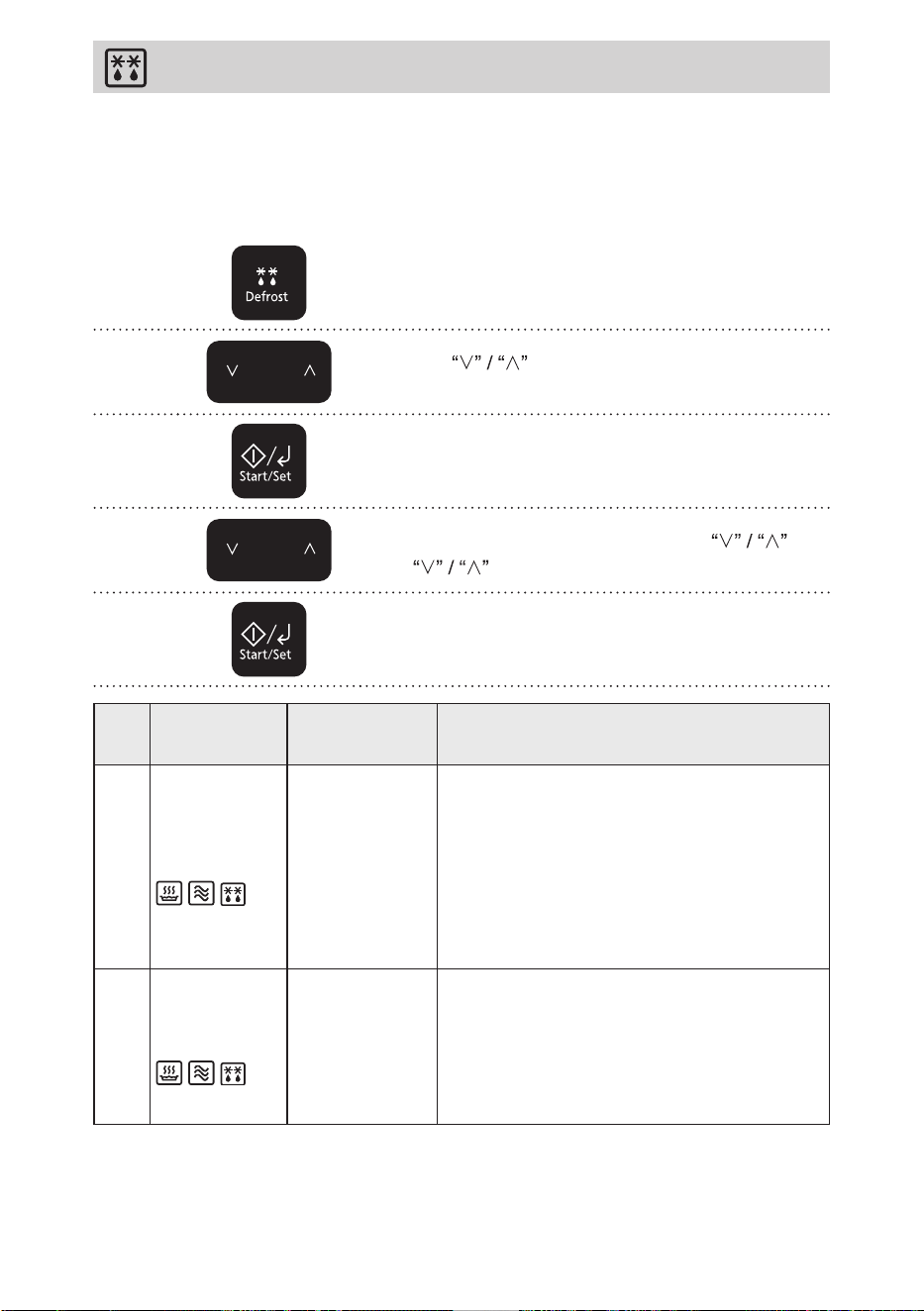
60
With this feature you can defrost frozen foods according to the weight. Select
the category and set the weight of the food. The weight is programmed in
grams. For quick selection, the weight starts from the most commonly used
weight for each category.
Defrost
1
Tap Defrost pad once.
2
Tap the to select the food category.
(No.1-3)
3
Tap the Start/Set pad to confirm the
selection.
4
Select the weight by tapping the .
The
will count up in 10
g
steps.
5
Tap the Start/Set pad to start.
No. Program
Weight/
Placement
Instructions
1
Meat Items
200
g
- 1200
g
Base of oven
To defrost small pieces of meat,
chicken portions, chops, steaks,
minced meat. Place on a plate or
shallow Pyrex
®
dish. Place the
container on base of oven. Select
program number 1. Enter the weight of
the meat items. Start to defrost. Turn
at beeps and shield.
2
Meat Joints
400
g
- 2500
g
Base of oven
To defrost whole chicken, meat joints.
Place on a plate or shallow Pyrex
®
dish. Place the container on base of
oven. Select program number 2. Enter
the weight of the meat joints. Start to
defrost. Turn at beeps and shield.
61
Defrost
1. Meat items (mince/chops/chicken portions)
Chops and chicken portions should be arranged in a single layer
and turned frequently during defrosting. It is necessary for mince to
be broken up frequently during defrosting and this is best carried
out in a large shallow dish. Standing time 20-30 mins. Not suitable
for sausages, these can be defrosted manually. Please refer to
defrosting chart on pages 42-43.
2. Meat joints/Whole chickens
Whole chickens and meat joints will require shielding during
defrosting especially if it is a particularly fatty piece. This is to prevent
food starting to cook on the outside edges. Protect wings, breast and
fat with smooth pieces of aluminium foil secured with cocktail sticks.
Do not allow the foil to touch the walls of the oven. Standing time
of at least 1-2 hours should be allowed for joints after defrosting.
3. Bread
This program is suitable for small items which are required for
immediate use, they may feel warm straight after defrosting. Loaves
can also be defrosted on this program but these will require standing
time to allow the centre to thaw out. Standing time can be shortened
if slices are separated and buns and loaves cut in half. Items should
be turned during defrosting. Standing time 10 - 30 minutes. A longer
time may be needed for large loaves. This program is not suitable
for cream cakes or desserts e.g. cheesecake.
Note
1. The shape and size of the food will determine the maximum weight
the oven can accommodate.
2. Allow standing time to ensure the food is completely defrosted.
3. If ‘HOt’ appears in the display window, the oven temperature is too
high from previous use and an auto program can not be set. Cooking
mode and time may still be set manually.
No. Program
Weight/
Placement
Instructions
3
Bread
100
g
- 900
g
Base of oven
To defrost rolls, buns, slices of bread
and loaves. Place on a plate. Place
the container on base of oven. Select
program number 3. Enter the weight
of the bread. Start to defrost. Turn and
re-arrange at beeps.
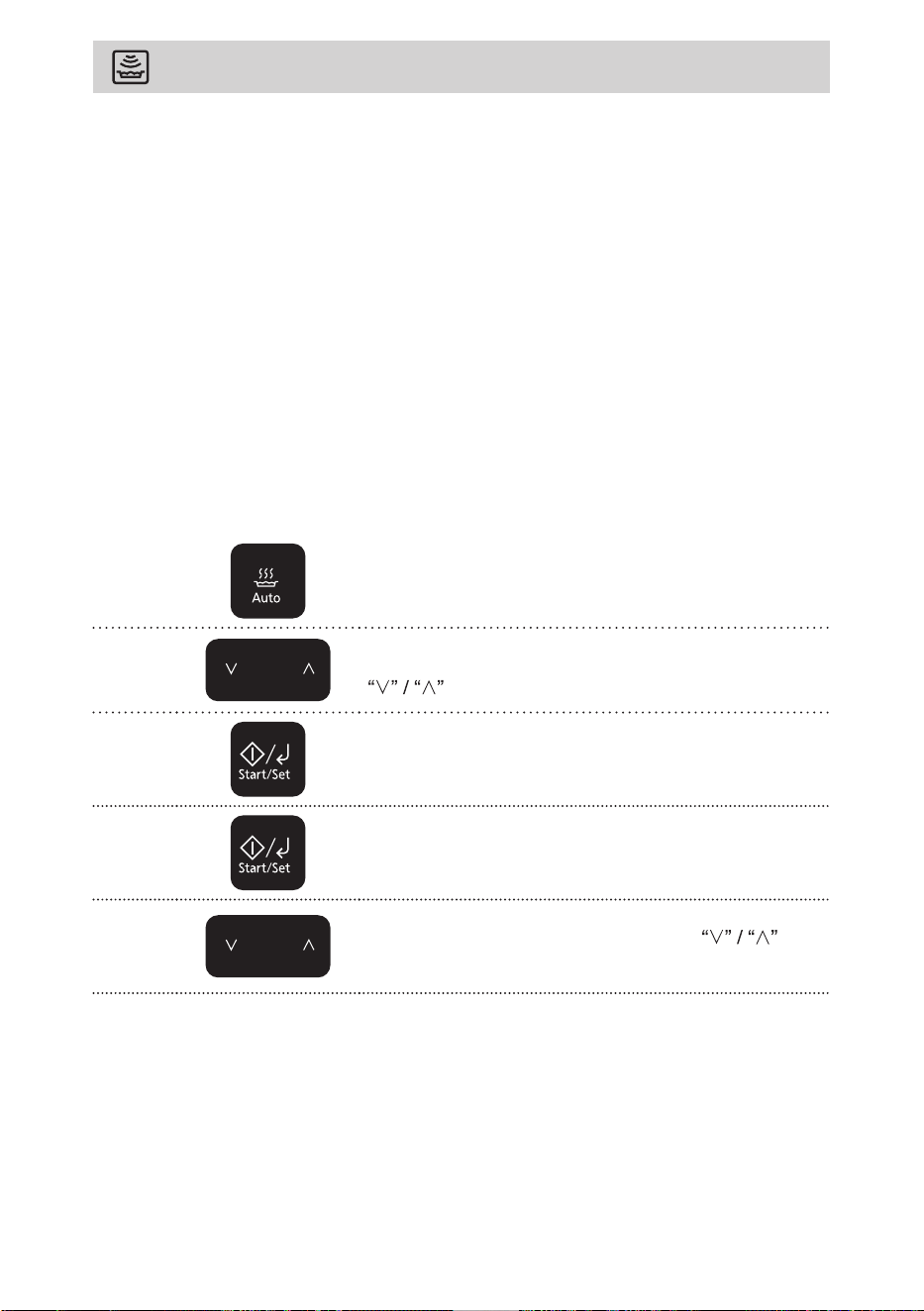
62
This feature allows you to cook or reheat foods without entering the weight.
The built-in sensor measures the humidity of the food and calculates the
recommended microwave power level together with a suggested cooking time.
How it Works
Once the food has been selected and Start/Set pad tapped the food is
heated up. As food begins to get hot, steam is emitted. When the food
reaches a certain temperature and begins to cook, an even greater amount
of steam is released. The increase in steam emission is detected by a
humidity sensor in the oven. This acts as a signal for the oven to calculate
how much longer the food needs to cook. The remaining cooking time will
appear in the display window after two beeps. Whilst the sensor program is
still in the display window the oven door should not be opened. Wait until
the cooking time appears in the window, and then open the door if required,
to stir or turn the food.
1
Tap Auto Cook pad once.
2
Select the menu number by tapping the
. (No.4-9)
3
Tap the Start/Set pad to confirm the
selection.
4
Tap the Start/Set pad to start.
5
Adjust the taste by tapping the
with in 14 seconds. (Optional)
Auto Sensor Programs
63
Adjust to Taste
Preferences for degree of cooking vary for each individual. After having
used Auto Sensor Programs a few times, you may decide you would prefer
your food cooked to a different degree of cooking. After tapping Start/Set
pad, “
” appears in the display, tap for more time or for less time.
This operation should be completed within 14 seconds. If you are satisfied
with the result of the Auto Sensor Programs, you do not have to use this
control.
Note
1. The Auto Sensor programs must only be used for foods described.
2. The oven automatically calculates the reheating time or the
remaining reheating time.
3. Only cook foods within the weight ranges described.
4. The door should not be opened before the time appears in the
display window.
5. To prevent any mistakes during Auto Sensor programs ensure that
base of oven and the container are dry.
6. The room temperature should not be more than 35 °C and not less
than 0 °C.
7. If the oven has previously been used and it is too hot to be used on
Auto Sensor programs, ‘HOt’ will appear in the display window. After
the ‘HOt’ disappears, the Auto Sensor programs may be used. If in a
hurry, cook food manually by selecting the correct cooking mode and
cooking time yourself.
8. Always weigh the food rather than relying on the package
information.
9. Most foods benefit from a STANDING time, after cooking with an
Auto Sensor programs , to allow heat to continue conducting to the
centre.
10. To allow for some variations that occur in food, check that food is
thoroughly cooked and piping hot before serving.
Auto Sensor Programs
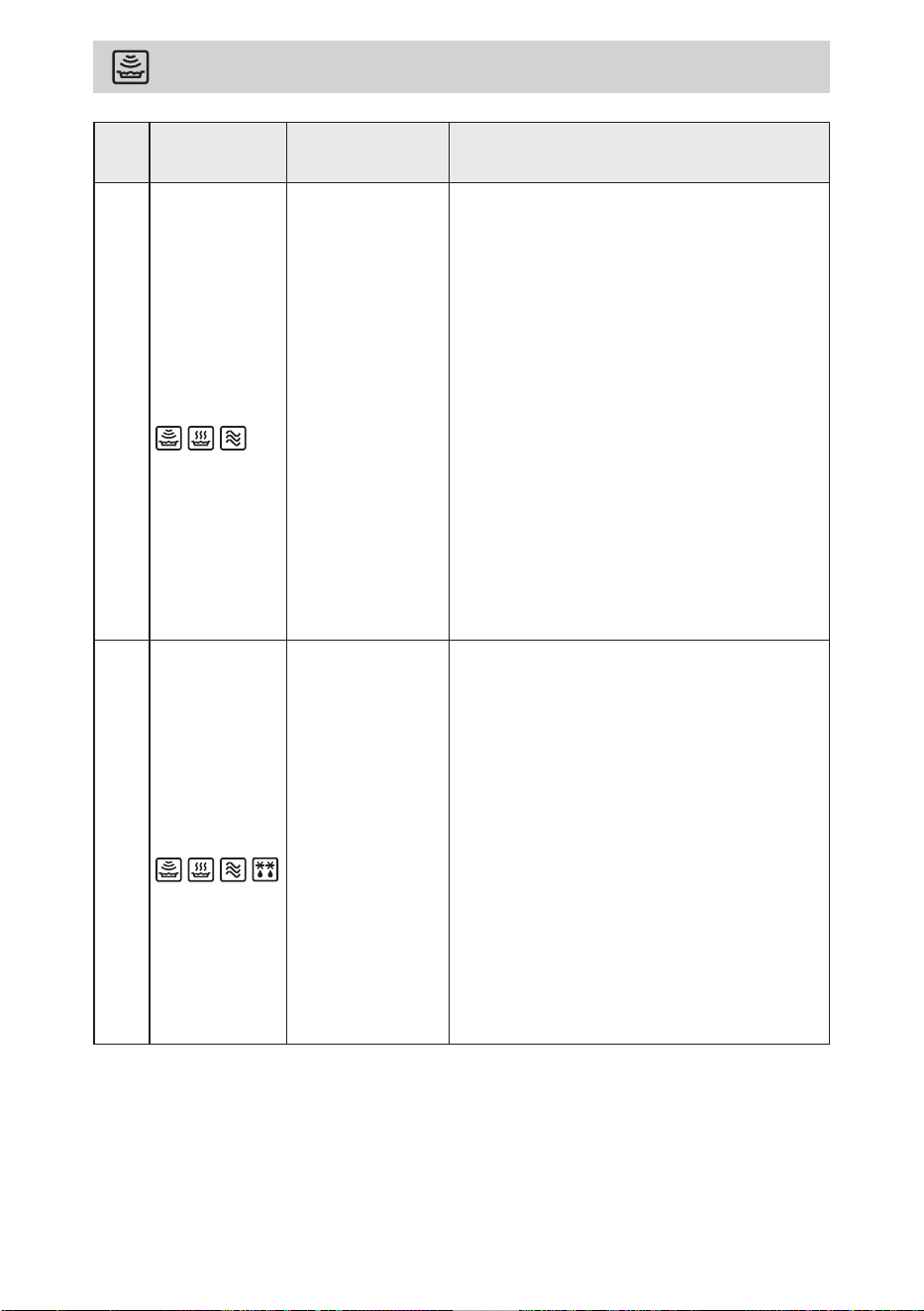
64
No. Program
Weight/
Placement
Instructions
4
Chilled Meal
200
g
- 1000
g
Base of oven
To reheat a fresh precooked meal.
All foods must be pre-cooked. Foods
should be at refrigerator temperature
approx. + 5°C. Reheat in container
as purchased. Pierce covering film
with a sharp knife once in the centre
and four times around the edge. If
transferring food to dish, cover with
pierced cling film. Select program
number 4. Start to cook. Stir at
beeps. Stir again at end of program
and allow a few minutes standing
time. Large pieces of meat/fish in
a thin sauce may require longer
cooking. This program is not suitable
for starchy food such as rice, noodles
or potatoes.
5
Frozen Meal
200
g
- 1000
g
Base of oven
To reheat a frozen precooked meal
All foods must be pre-cooked and
frozen (-18°C); Reheat in container as
purchased. Pierce covering film with a
sharp knife once in the centre and four
times around the edge. If transferring
food to dish, cover with pierced cling
film. Select program number 5. Start
to cook. Stir at beeps and cut the
blocks into pieces. Stir again at end
of program and allow a few minutes
standing time. Check temperature
and cook further minutes if necessary
before eating. This program is not
suitable for portionable frozen foods.
Auto Sensor Programs
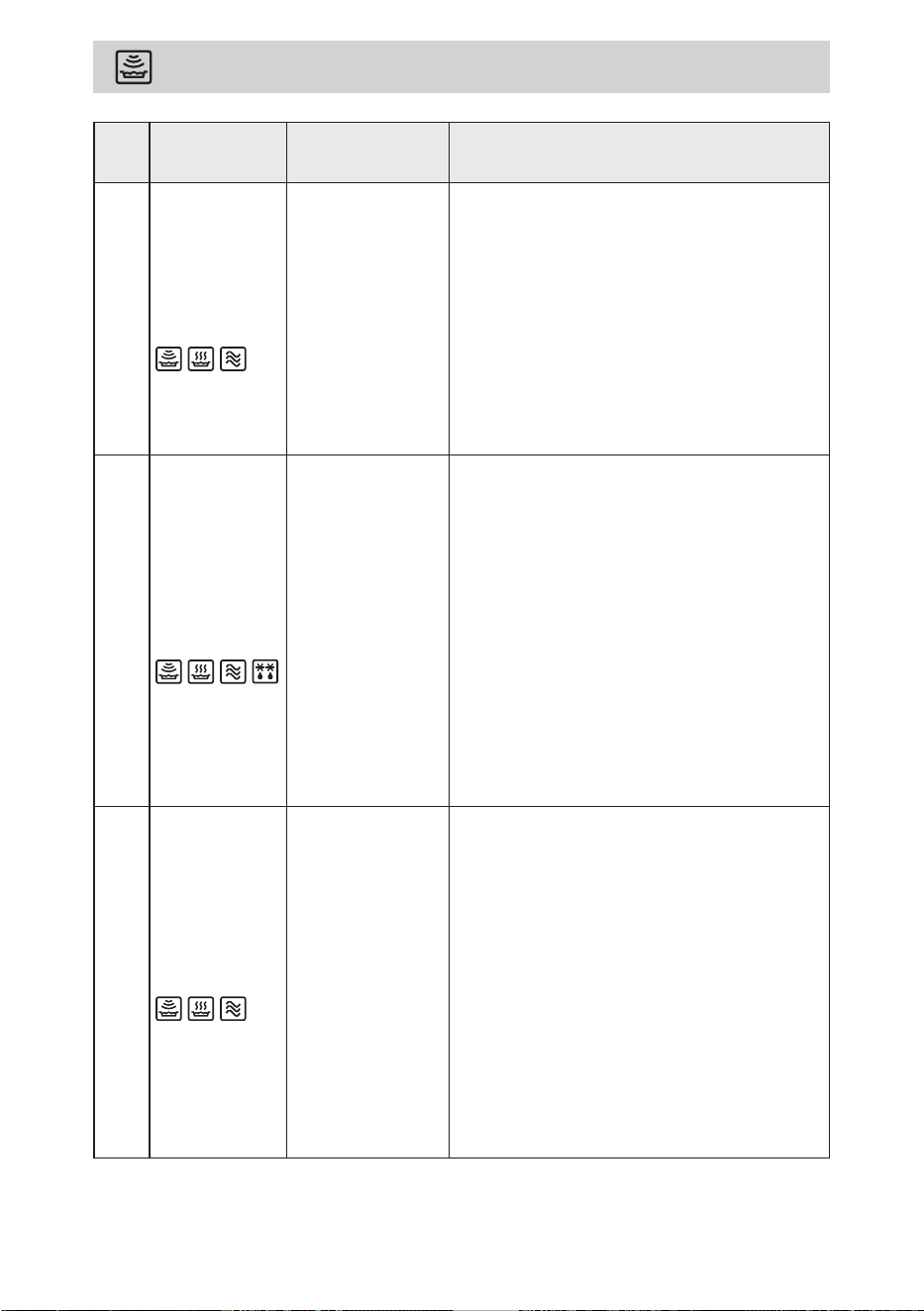
65
No. Program
Weight/
Placement
Instructions
6
Fresh
Vegetables
200
g
- 1000
g
Base of oven
To cook fresh vegetables. Place
prepared vegetables into a suitable
sized container. Sprinkle with 1 tbsp
cold water per 100
g
vegetables.
Cover with cling film. Pierce cling
film with a sharp knife once in the
centre and four times around the
edge. Select program number 6. Start
to cook. Stir at beeps. Drain after
cooking and season to taste.
7
Frozen
Vegetables
200
g
- 1000
g
Base of oven
To cook frozen vegetables. Place
vegetables into a suitable sized
container. Sprinkle with 1-3 tbsp cold
water. If cooking vegetables with high
water content, such as spinach or
tomatoes, do not add water. Cover
with cling film. Pierce cling film with
a sharp knife once in the centre and
four times around the edge. Select
program number 7. Start to cook. Stir
at the end of program and allow a
few minutes standing time. Drain and
season to taste.
8
Pasta
100
g
- 450
g
Base of oven
For cooking dried pasta. Use a
large bowl. Add 1 tsp salt, 1 tbsp oil
and boiling water. For 100
g
- 290
g
pasta add 1 litre of boiling water. For
300
g
- 450
g
pasta add 1½ litres of
boiling water. Allow at least ½ depth
of volume for evaporation to prevent
boiling over. Cover with cling film.
Pierce cling film with a sharp knife
once in the centre and four times
around the edge. Select program
number 8. Start to cook. Stir at beeps.
Drain after cooking.
Auto Sensor Programs
66
No. Program
Weight/
Placement
Instructions
9
Rice
100
g
- 300
g
Base of oven
For cooking rice for savoury dishes
not rice puddings. (Thai, Basmati,
Jasmine, Suriname, Arborio or
Mediterranean rice). Rinse the rice
thoroughly before cooking. Use a
large bowl. Add 2 times boiling water
to rice. Allow at least ½ depth of
volume for evaporation to prevent
boiling over. Cover with cling film.
Pierce cling film with a sharp knife
once in the centre and four times
around the edge. Select program
number 9. Start to cook. Stir at
beeps. Allow to stand for 5 minutes
after cooking.
Auto Sensor Programs
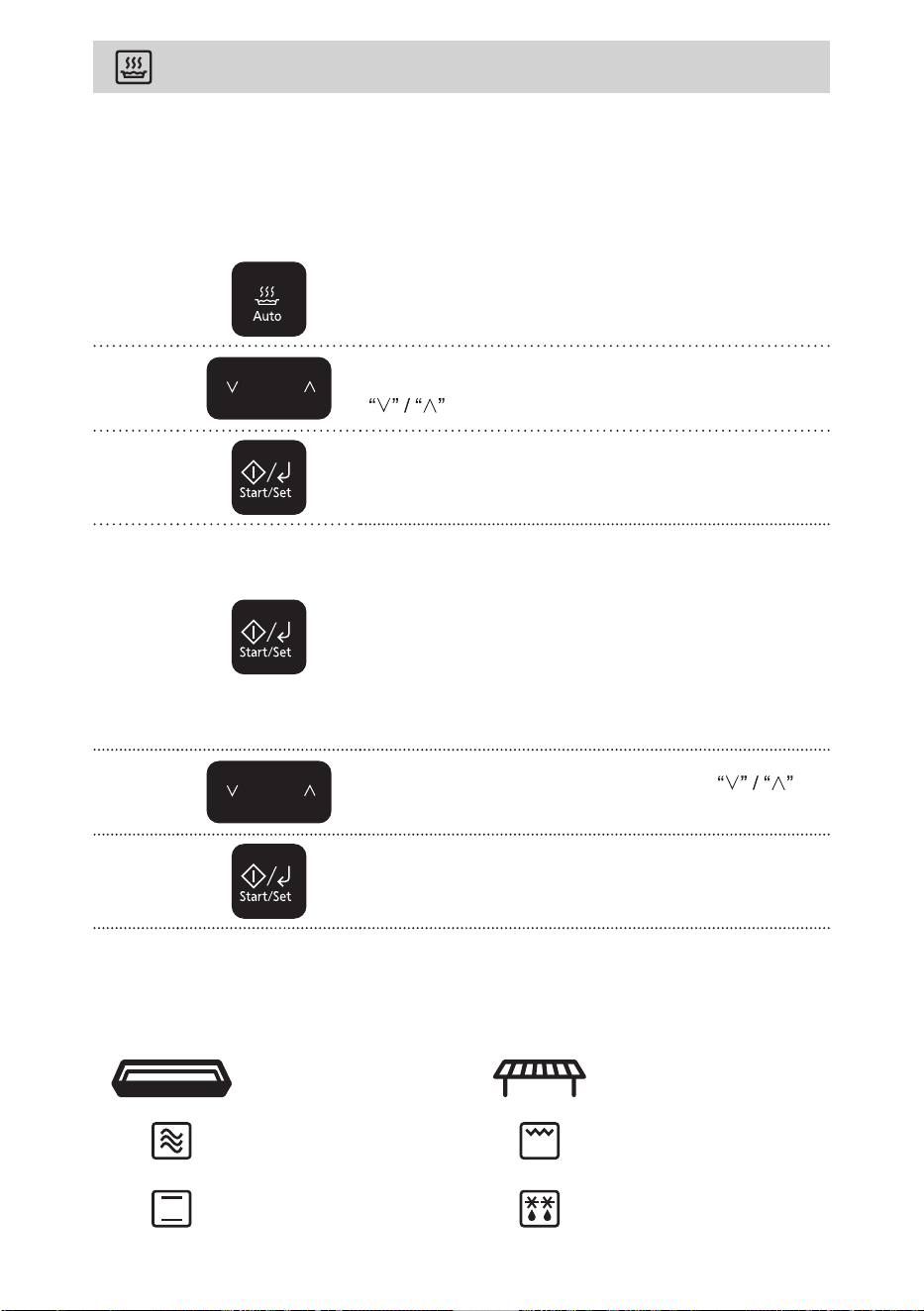
67
This feature allows you to cook some of your favourite foods by setting the
weight only. Select the category and set the weight of the food. The weight
is programmed in grams. For quick selection, the weight starts from the most
commonly used weight for each category.
1
Tap Auto Cook pad once.
2
Select the menu number by tapping the
. (No.10-16)
3
Tap the Start/Set pad to confirm the
selection.
4
Press the Start/Set pad to start preheating.
(No.11 only).
A “P” will appear and flash in the display
window. When the oven is preheated, the
oven will beep and the “P” will stop flashing.
Then open the door and place the food inside.
* Skip this step when preheating is not
required.
5
Select the weight by tapping the .
Skip this step for menu 15-16.
6
Tap the Start/Set pad to start.
When you select an automatic program, symbols will appear in the display
to show the cooking mode that will be used and if the accessories are
needed. See below to identify the symbols:
Enamel Shelf Wire Rack
Micro Power Grill
Oven
Frozen/Defrost
Mark
Auto Cook Programs
68
No. Program
Weight/
Placement
Instructions
10
Chilled
Quiche
150
g
- 500
g
Base of oven
For reheating fresh pre-cooked
quiche. Remove all packaging and
place the quiche on the wire rack on
base of oven. Select program number
10. Enter the weight of the chilled
quiche. Start to cook. Transfer the
quiche onto a cooling rack at the end
of cooking and allow a few minutes
standing time. Quiche with a high
content of cheese may result in being
hotter than quiches with vegetables.
This program is not suitable for deep
filled quiches.
Auto Cook Programs
Guidelines
1. This programs must only be used for foods described.
2. Only cook foods within the weight ranges described.
3. Always weigh the food rather than relying on the package weight
information.
4. The temperature for frozen food is assumed to be -18 °C to -20 °C.
The temperature of chilled food is assumed to be +5 °C to +8 °C
(refrigerator temperature).
5. Always use the accessories as indicated.
6. Most foods benefit from a standing time after cooking on an auto
program, to allow heat to continue conducting to the centre.
7. To allow for some variations that occur in food, check that food is
thoroughly cooked and piping hot before serving.
8. If ‘HOt’ appears in the display window, the oven temperature is
too high from previous use and an auto program can not be set.
Cooking mode and time may still be set manually.
69
No. Program
Weight/
Placement
Instructions
11
Frozen
Potato
Products
200
g
- 500
g
To cook frozen potato products. e.g.
hash browns, wedges,fries etc. Select
Program number 11, tap Start pad to
preheat the oven. Spread out potato
products onto Enamel Shelf. After
preheated, place Enamel Shelf in
upper shelf position. Enter the weight
of the frozen potato products. Start
to cook. For best results, cook in a
single layer and turn or stir at beeps.
Note: Potato products vary
considerably. We suggest checking
a few minutes before the end of
cooking to assess level of browning.
This program is not suitable for
galettes, Pom’ Dauphine and Pom’
Noisette.
12
Pastry Items
100
g
- 600
g
Base of oven
For reheating, crisping and browning
fresh pastry items e.g. friands,
feuillete tresse etc. Remove all
packaging and place on wire rack on
base of oven. Select program number
12. Enter the weight of the pastry
items. Start to cook. Turn over at
beeps. Transfer the pastry items to a
cooling rack and allow a few minutes
standing time.
13
Chilled
Pizza
100
g
- 450
g
Base of oven
For reheating and browning chilled
pizza (purchased). Remove all
packaging and place the chilled pizza
on wire rack on base of oven. Select
program number 13. Enter the weight
of the chilled pizza. Start to cook.
This program is not suitable for deep
pan pizzas or very thin pizzas such
as Flammekueche.
Auto Cook Programs
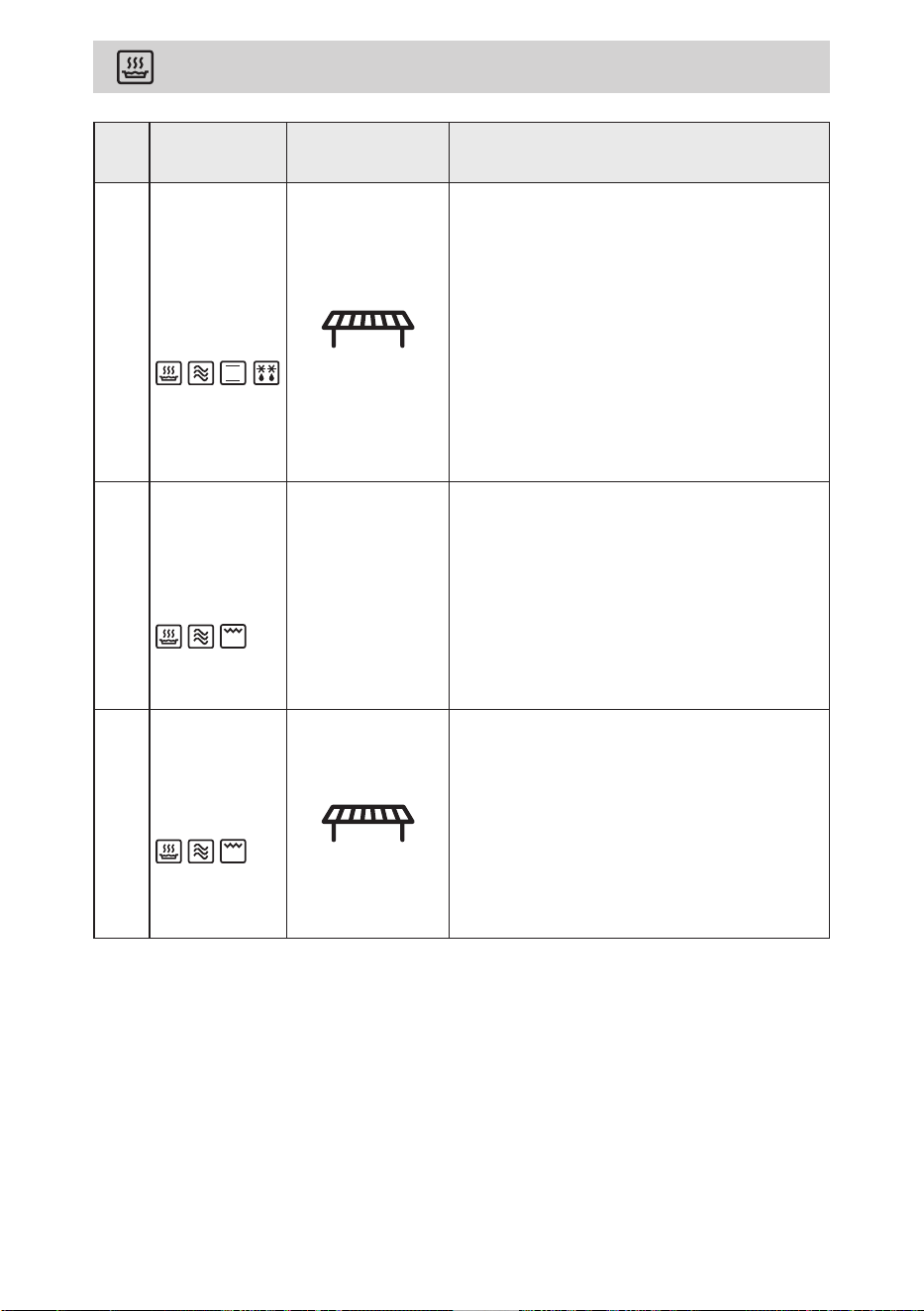
70
No. Program
Weight/
Placement
Instructions
14
Frozen
Pizza
100
g
- 450
g
Base of oven
For reheating and browning frozen
pizza (purchased). Remove all
packaging and place the frozen pizza
on wire rack on base of oven. Select
program number 14. Enter the weight
of the frozen pizza. Start to cook.
Transfer the pizza on to a cooling
rack at the end of cooking. This
program is not suitable for deep pan
pizzas or very thin pizzas such as
Flammekueche.
15
Gratin
Potato
Serves 4
Base of oven
See recipe on next page.
Place on base of oven. Select
program number 15. Start to cook.
Allow to stand for 5 mins after
cooking.
16
Gratin Pasta
Serves 4
Base of oven
See recipe on next page.
Place on wire rack on base of oven.
Select program number 16. Start to
cook. Allow to stand for 2 mins after
cooking.
Auto Cook Programs
71
Auto Cook Programs
Gratin Potato
ingredients
Serves 4
700
g
peeled potatoes,
1 garlic clove,
100
g
emmental (grated),
salt and pepper,
100 ml single cream,
100 ml milk
50
g
beaten eggs
Dish:
1 x 25 cm shallow Pyrex
®
dish
Accessory:
none
1. Cut the potatoes into thin slices.
Peel and chop the garlic.
2. Arrange the potato slices in
shallow Pyrex
®
dish. Scatter over
the garlic, half the cheese, salt
and pepper.
3. Mix the egg, milk, cream and pour
the mixture over the potatoes.
Cover with the rest of the grated
cheese. Place on base of oven.
4. Select program number 15.
Start to cook. Allow to stand for
5 minutes after cooking.
Gratin Pasta
ingredients
Serves 4
550
g
Fresh Pasta Sauce, e.g.
tomato
400
g
Fresh Pasta, e.g.
tortellini/ravioli
50
g
Grated hard cheese e.g.
Cheddar, mozzarella,
parmesan
Dish:
1 x 22 cm shallow Pyrex
®
dish
Accessory:
wire rack
1. Mix the pasta sauce and pasta
together in a large dish until the
pasta is fully coated in the sauce.
Sprinkle grated cheese over the
top.
2. Place the casserole dish on wire
rack on base of oven. Select
program number 16. Start to
cook. Allow to stand for 2 minutes
after cooking.
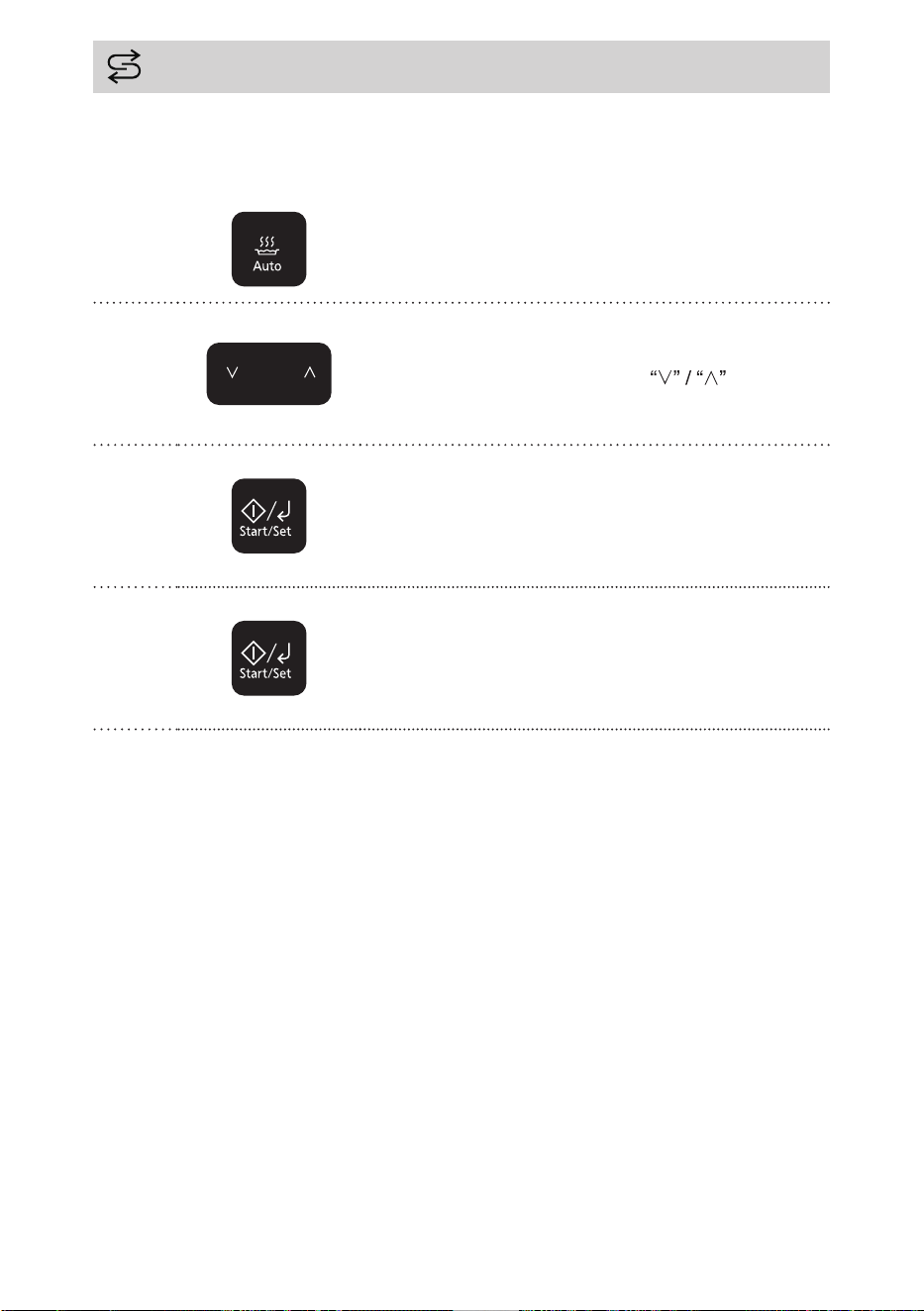
72
Cleaning Setting
F1. Deodorization
This feature is recommended for eliminating any odours from the oven.
1
Tap Auto Cook pad once.
2
Select “F1” by tapping the .
3
Tap the Start/Set pad to confirm the
selection.
4
Tap the Start/Set pad to start.

73
Cooking and Reheating Guidelines
Most foods reheat very quickly in
your oven by 1000 W. Meals can be
brought back to serving temperature
in just minutes and will taste freshly
cooked. Always check food is piping
hot and return to oven if necessary.
As a general rule, always cover wet
foods, e.g. soups, casseroles and
plated meals.
Do not cover dry foods e.g. bread
rolls, mince pies, sausage rolls etc.
The charts on pages 75-89 show
you the best way to cook or reheat
your favourite foods. The best
method depends on the type of food
you are cooking or reheating.
Remember to stir or turn food
wherever possible during cooking
or reheating. This ensures even
cooking or reheating on the outside
and in the centre.
When is food reheated?
Food that has been reheated or
cooked should be served “piping
hot” i.e. steam should be visibly
emitted from all parts. As long as
good hygiene practices have been
followed during the preparation and
storage of the food, then cooking or
reheating presents no safety risks.
Foods that cannot be stirred should
be cut with a knife to test that they
are adequately heated throughout.
Even if a manufacturer’s instructions
or the times in the chart have been
followed, it is still important to check
the food is heated thoroughly. If in
doubt, always return to the oven for
further reheating.
If you cannot find the equivalent
food in the chart then choose a
similar type and size listed and
adjust the cooking time if necessary.
Plated meals
Everyone’s appetite varies and
reheat times depend on meal
contents. Dense items e.g. mashed
potato, should be spread out well.
If a lot of gravy is added, extra time
may be required. Place denser
items to the outside of the plate.
An average plated meal will take
4-7 minutes on 1000 W to reheat.
Do not stack meals.
Canned foods
Remove foods from can and place
in a suitable dish before heating.
Stir food halfway through cooking
and again at the end of heating.
Soups
Use a bowl and stir before heating
and at least once during reheating
and again at the end.
Casseroles
Stir halfway through and again at
the end of heating.
74
Cooking and Reheating Guidelines
Caution - Mince pies
Caution - Christmas puddings and liquids
Caution - Babies’ bottles
Remember even if the pastry is cold to the touch, the filling will be
piping hot and will warm the pastry through. Take care not to overheat
otherwise burning can occur due to the high fat and sugar content of the
filling. Check the temperature of the filling before consuming to avoid
burning your mouth.
Take great care when reheating these items.
Do not leave unattended.
Do not add extra alcohol.
Milk or formula must be shaken thoroughly before heating and again
at the end and tested carefully before feeding a baby. Liquid at the top
of the bottle will be much hotter than at the bottom. The bottle must be
shaken thoroughly and tested before use.
Note
We do not recommend that you use your microwave to sterilise
babies’ bottles. If you have a special microwave steriliser we urge
extreme caution, due to the low quantity of water involved. It is vital to
follow the manufacturers' instructions implicitly.
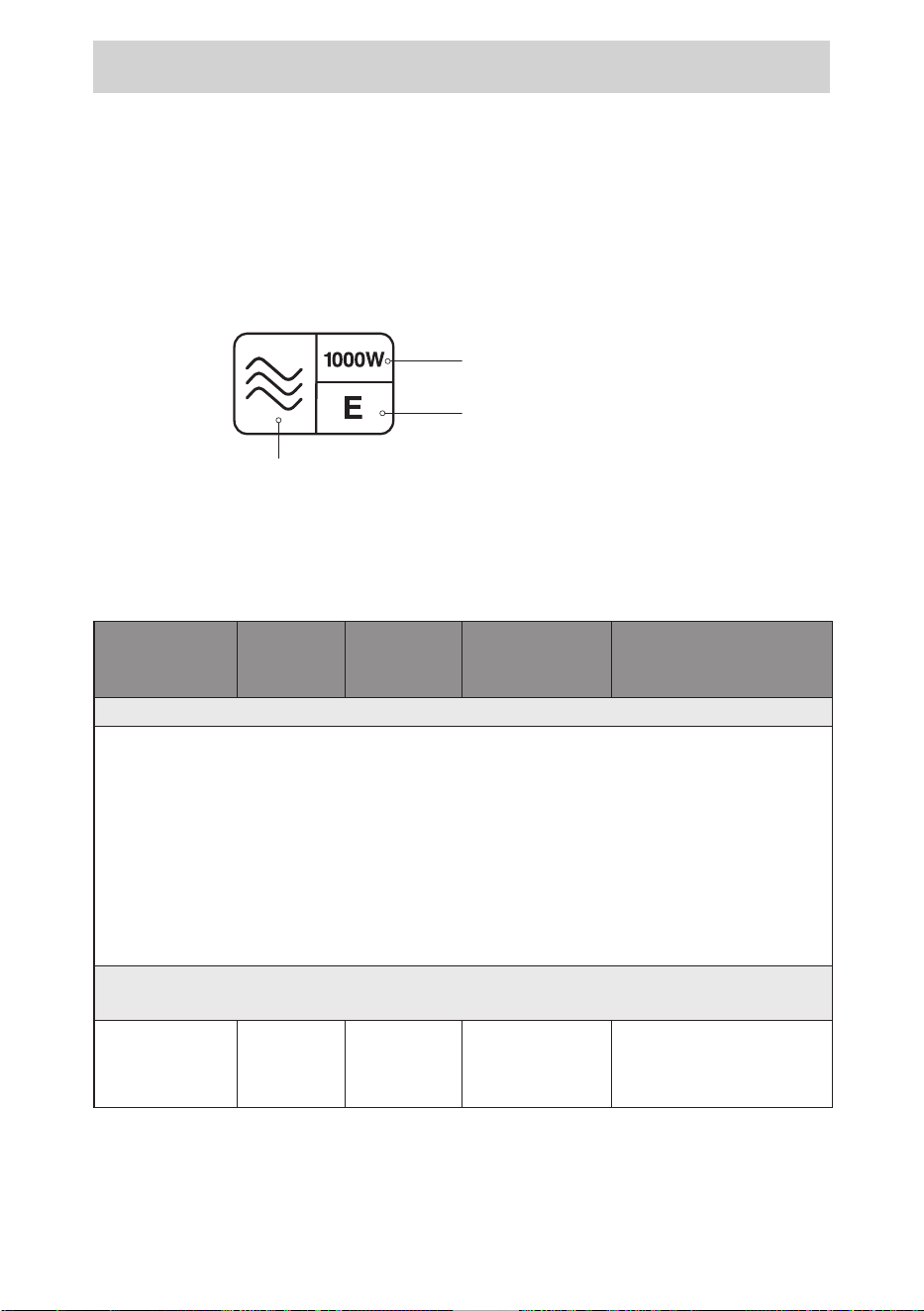
75
Reheating Charts
The times given in the charts below are a guideline only, and will vary
depending on STARTING temperature, dish size and quantity. Pastry or
bread items reheated by microwave will be soft not crisp.
Heating category
Your oven is Heating Category E and this is displayed on the Identification
label. The information on this label will assist you in using new instructions
on food packs to enable you to program the best heating time in your oven.
Points for checking
Always check that food is piping hot after reheating in the microwave. If
unsure return to oven. Foods will still require a standing time, especially if
they cannot be stirred. The denser the food the longer the standing time.
Food
Weight/
Quantity
Power
Level
Time to
Select
(approx)
Instructions/
Guidelines
Babies bottles – CAUTION
After heating by Microwave, liquid at the top of a bottle will be much hotter
than at the bottom of the bottle and must be shaken thoroughly before
checking the temperature. When testing the temperature of the milk, squirt
a little onto your inner wrist. The milk droplets on your skin should feel
warm, not hot.
For 250 ml of milk from fridge temperature, remove top and teat.
Heat on 1000 W for 40 secs. CHECK CAREFULL
Y.
For 100 ml of milk from fridge temperature, remove top and teat.
Heat on 1000 W for 20 secs. CHECK CAREFULLY.
Bread – Precooked – Fresh – N.B. Breads reheated by Microwave will
have a soft base.
Croissants/
Brioche
4 1000 W 30 secs
Use microwavable
dish on the base of
oven.
The IEC (60705) power
output (watts)
The heating category for
small packs of food
Microwave symbol
76
Reheating Charts
Food
Weight/
Quantity
Power
Level
Time to
Select
(approx)
Instructions/
Guidelines
Canned pasta
Ravioli/
Macaroni
cheese/
Spaghetti
400
g
1000 W
2 mins
30 secs
Place in a heatproof
bowl and cover. Place
on base of oven and
stir halfway
.
Canned soups
Condensed 295
g
1000 W 3-4 mins
Place in a heatproof
bowl and stir in one
can of water. Cover
and place on base of
oven stirring halfway.
Vegetable/
Broth/
Creamed
400
g
/
415
g
1000 W 3 mins
Place in a heatproof
bowl and cover. Place
on base of oven and
stir halfway.
Chilled soups
2 portion 500 ml 1000 W
4 mins-4 mins
30 secs
Place in a heatproof
bowl and cover.
Place on base of
oven and stir halfway.
Canned vegetables
Baked
beans/Butter
Beans
200
g
1000 W
1 min 30 secs
Place in a heatproof
bowl and cover.
Place on base of
oven and stir halfway.
2 mins-2 mins
30 secs
415
g
Carrots 300
g
4 mins
Mushroom/
Peas/
Tomatoes/
Sweet Corns
300
g
2 mins-2 mins
30 secs
77
Reheating Charts
Food
Weight/
Quantity
Power
Level
Time to
Select
(approx)
Instructions/
Guidelines
Light dishes and snacks – Chilled
Pancakes/
French stick
with filling
120
g
1 pce
Eco
Combi 3
1 min 40 secs
Use microwavable
dish on the base of
oven.
240
g
2 pces
Eco
Combi 3
2 mins
40 secs
Hot Dog
1
10
g
1 pce
Eco
Combi 2
3 mins
Use microwavable
dish on the base of
oven.
Sausage roll
100
g
-
130
g
1 pce
Auto menu NO.12
Remove packaging,
place directly on the
wire rack, for smaller
items put baking
paper on top of the
wire rack.
200
g
-
260
g
2 pces
T
oasted ham
& cheese
sandwich
100
g
1 pce
Eco
Combi 2
follow by
Grill 3
2 mins
then
3 mins
Remove packaging,
place directly on the
wire rack, for smaller
items put baking
paper on top of the
wire rack. Turn or
stir half-way through
heating time.
200
g
2 pces
Eco
Combi 2
follow by
Grill 3
2 mins
then
4 mins
Light dishes and snacks – Frozen
Pancakes/
French stick
with filling
120
g
1 pce
Eco
Combi 3
3 mins
30 secs
Use microwavable
dish on the base of
oven.
240
g
2 pces
Eco
Combi 3
6 mins
Hot Dog
110
g
1 pce
Eco
Combi 3
2 mins
30 secs then
2 mins rest
Use microwavable
dish on the base of
oven.
78
Reheating Charts
Food
Weight/
Quantity
Power
Level
Time to
Select
(approx)
Instructions/
Guidelines
Sausage roll
100
g
-
130
g
1 pce
Eco
Combi 3
2 mins
40 secs &
rest 2 mins
Remove packaging,
place directly on the
wire rack, for smaller
items put baking
paper on top of the
wire rack.
200
g
-
260
g
2 pces
Eco
Combi 3
follow by
Grill 3
4 mins then
2 mins
T
oasted ham
& cheese
sandwich
100
g
1 pce
Eco
Combi 3
follow by
Grill 3
2 mins
then
2 mins
Remove packaging,
place directly on the
wire rack, for smaller
items put baking
paper on top of the
wire rack.
Turn or
stir half-way through
heating time.
200
g
2 pces
Eco
Combi 3
follow by
Grill 3
3 mins
then
1 min 30 secs
Drinks
1 Mug cold
milk
235 ml
1000 W
1 min 30 secs
Place in a heatproof
container on base
of oven. Stir halfway
and after reheating.
1 Jug cold
milk
568 ml
(1 pint)
4 mins
1 Mug cold
coffee/tea
235 ml
1 min 20 secs
1 Mug cold
milky coffee
1 min 20 secs
Ready meals – chilled. Transfer food from foil container to a similar
sized heatproof dish. Healthy eating options will only slightly brown
on eco combi because of the lower fat content.
Lasagne
450
g
1000 W 6 mins
Place on base of
oven.
Eco
Combi 3
8 mins
800
g
Eco
Combi 3
16 mins
79
Reheating Charts
Food
Weight/
Quantity
Power
Level
Time to
Select
(approx)
Instructions/
Guidelines
Macaroni
cheese
450
g
Eco
Combi 3
10 mins
Place on base of
oven.
Ready meals – frozen. Transfer food from foil container to a similar
sized heatproof dish.
Lasagne/
cannelloni
400
g
1000 W 10 mins
Place on base of
oven.
Eco
Combi 2
20 mins
Macaroni
cheese
400
g
1000 W 10-12 mins
Eco
Combi 2
18 mins
Side dishes
Chilled
mashed
potato
500
g
1000 W 4-5 mins
Pierce lid and place
on base of oven. Stir
halfway.
Meat and fish – Chilled
Slices of
cooked white
meat
100
g
4 slices
600 W 50-60 secs
Use microwavable
dish on the base of
oven. Cover dish.
Slices of
cooked red
meat
100
g
4 slices
440 W 50-60 secs
Slices of
cooked
chicken legs
200
g
1 pce
1000 W
2-2 mins
30 secs
Chicken
nuggets
100
g
5 pces
Eco
Combi 2
3-5 mins
Remove packaging,
place directly on the
wire rack, for smaller
items put baking
paper on top of the
wire rack.
80
Reheating Charts
Food
Weight/
Quantity
Power
Level
Time to
Select
(approx)
Instructions/
Guidelines
Desserts – Chilled
Sweet
pancakes
50
g
1 pce
1000 W
20-30 secs
Use microwavable
dish on base of oven.
Cover dish.
100
g
2 pces
1000 W 40-50 secs
Desserts – Frozen
Donuts plain
50
g
1 pce
Eco
Combi 2
2 mins &
2 mins rest
Use microwavable
dish on base of oven
100
g
2 pcs
Eco
Combi 2
2 mins rest
Sweet
pancakes
50
g
1 pce
1000 W 40 secs
Use microwavable
dish on base of oven.
Cover dish. T
urn or
stir half-way though
heating time.
100
g
2 pces
1000 W 1 min 20 secs
Mini
croissants &
chocolate roll
200
g
6 pcs
1000 W
follow by
Grill 3
20 secs then
4 mins
Remove packaging,
place directly on the
wire rack, for smaller
items put baking
paper on top of the
wire rack.
300
g
10 pces
1000 W
follow by
Grill 3
40 secs then
4 mins
3 mins &
81
Cooking Charts
Food
Weight/
Quantity
Power Level
Time to Select
(approx)
Fish – Fresh
Fish in thin fillets 500
g
600 W
5-7 mins
Fish in thick fi llets 500
g
600 W 6-7 mins
Fish steaks 500
g
600 W 6-8 mins
Whole fi sh 500
g
600 W 6 mins
Shrimp 500
g
600 W 5-6 mins
Mussels 500
g
600 W 4-6 mins
Scallops 500
g
600 W 5-6 mins
Squid 500
g
600 W 6-7 mins
Crab 500
g
600 W 8-9 mins
Fish – Frozen
Fish in thin fillets 500
g
1000 W 8-9 mins
Fish in thick fi llets 500
g
1000 W 9-10 mins
Fish steaks 500
g
1000 W 8-9 mins
Whole fi sh 500
g
1000 W 12 mins
Squid 500
g
1000 W 9-10 mins
Fish croquettes
100
g
2 pces 1000 W 1 min 30 secs
200
g
4 pces 1000 W 3 mins
Points for checking
Always check that food is piping hot after cooking in the microwave. If
unsure return to oven. Foods will still require a standing time, especially if
they cannot be stirred. The denser the food the longer the standing time.
82
Cooking Charts
Food
Weight/
Quantity
Power Level
Time to Select
(approx)
Vegetable – Fresh
Artichokes (whole) 500
g
1000 W
9-11 mins
Artichokes (hearts) 500
g
1000 W 8-10 mins
Asparagus (1) 500
g
1000 W 5-6 mins
Aubergines 500
g
1000 W 7-8 mins
Beetroot (1) 500
g
1000 W 18-20 mins
Chinese Leaves
500
g
1000 W 4-6 mins
Broccoli 500
g
1000 W 7-8 mins
Mushrooms 500
g
1000 W 7-8 mins
Carrot (round slices) 500
g
1000 W 7-8 mins
Carrot (strips) 500
g
1000 W 7-9 mins
Fennel (whole cut in
half)
500
g
1000 W 8-10 mins
Fennel (thin cut) 500
g
1000 W 12-15 mins
Cabbage (1) 500
g
1000 W
9-10 mins
Brussels sprouts 500
g
1000 W
8-10 mins
Caulifl ower 500
g
1000 W 8-10 mins
Boule celery 500
g
1000 W 7-9 mins
Celery (1) 500
g
1000 W 12-14 mins
Courgettes
500
g
1000 W 5-7 mins
Endives 500
g
1000 W 10-12 mins
Spinach (leaves) 500
g
1000 W 6-7 mins
Peas (1) 500
g
1000 W 14-16 mins
Mange-tout peas
500
g
1000 W 7-9 mins
(1) We do not recommend cooking with the Auto menu for these vegetables.
83
Food
Weight/
Quantity
Power Level
Time to Select
(approx)
Broad beans (1) 500
g
1000 W 13-16 mins
Thin sliced leeks
500
g
1000 W 10-12 mins
Green beans (1) 500
g
1000 W 8-10 mins
Dwarf beans 500
g
1000 W
9-12 mins
Corn on cob (1)
500
g
2 cobs
1000 W 8-10 mins
T
urnips 500
g
1000 W 8-10 mins
Onions 500
g
1000 W 8-11 mins
Parsnip 500
g
1000 W 8-9 mins
Sweet potato 500
g
1000 W 10 mins
Leek stalks 500
g
1000 W 7-8 mins
Squash 500
g
1000 W 8-10 mins
Capsicums 500
g
1000 W 10-12 mins
Whole potatoes
500
g
each <220
g
1000 W 10-12 mins
Cut potatoes 500
g
1000 W 8-12 mins
Ratatouille 500
g
1000 W 14-18 mins
Salsify 500
g
1000 W 10-14 mins
Tomatoes (1) 500
g
1000 W
4-5 mins
Jerusalem artichokes
(1)
500
g
1000 W 7-9 mins
Cooking Charts
(1) We do not recommend cooking with the Auto menu for these vegetables.
84
Food
Weight/
Quantity
Power Level
Time to Select
(approx)
Vegetable – Frozen
Artichokes (hearts) 500
g
1000 W
11-12 mins
Asparagus (1) 500
g
1000 W 10-1
1 mins
Chinese Leaves 500
g
1000 W 12-13 mins
Broccoli 500
g
1000 W 9-10 mins
Mushrooms 500
g
1000 W 11-12 mins
Carrot (round slices) 500
g
1000 W 9-10 mins
Brussels sprouts 500
g
1000 W 10 mins
Caulifl ower 500
g
1000 W 9-10 mins
Courgettes 500
g
1000 W 10-12 mins
Endives 500
g
1000 W 16-17 mins
Spinach (Chopped) 500
g
1000 W 8-10 mins
Spinach (leaves) 500
g
1000 W 8-10 mins
Peas (1) 500
g
1000 W
10 mins
Broad beans (1) 500
g
1000 W 14-16 mins
Thin sliced leeks
500
g
1000 W 13-14 mins
Green beans (1) 500
g
1000 W 9-10 mins
Mixed spring
vegetables (1)
500
g
1000 W 10 mins
Corn on cob (1)
500
g
2 cobs
1000 W 12 mins
T
urnips 500
g
1000 W 16-17 mins
Onions 500
g
1000 W 10-12 mins
Cooking Charts
(1) We do not recommend cooking with the Auto menu for these vegetables.
85
Food
Weight/
Quantity
Power Level
Time to Select
(approx)
Leek stalks 500
g
1000 W 12-13 mins
Capsicums
500
g
1000 W 10 mins
Ratatouille 500
g
1000 W 12-15 mins
Salsify 500
g
1000 W 12-15 mins
Meat and Poultry
Beef stew
Maximum
weight 1.5 k
g
1000 W follow
by 300 W
10-12 mins then
1 h 10 mins -
1 h 20 mins
Lamb stew
Maximum
weight 1.5 k
g
1000 W follow
by 300 W
10-12 mins then
40-50 mins
Veal stew
Maximum
weight 1.5 k
g
1000 W follow
by 300 W
10-12 mins then
40-50 mins
Chicken Pieces,
bonless
500
g
1000 W 7-9 mins
Cooking Charts
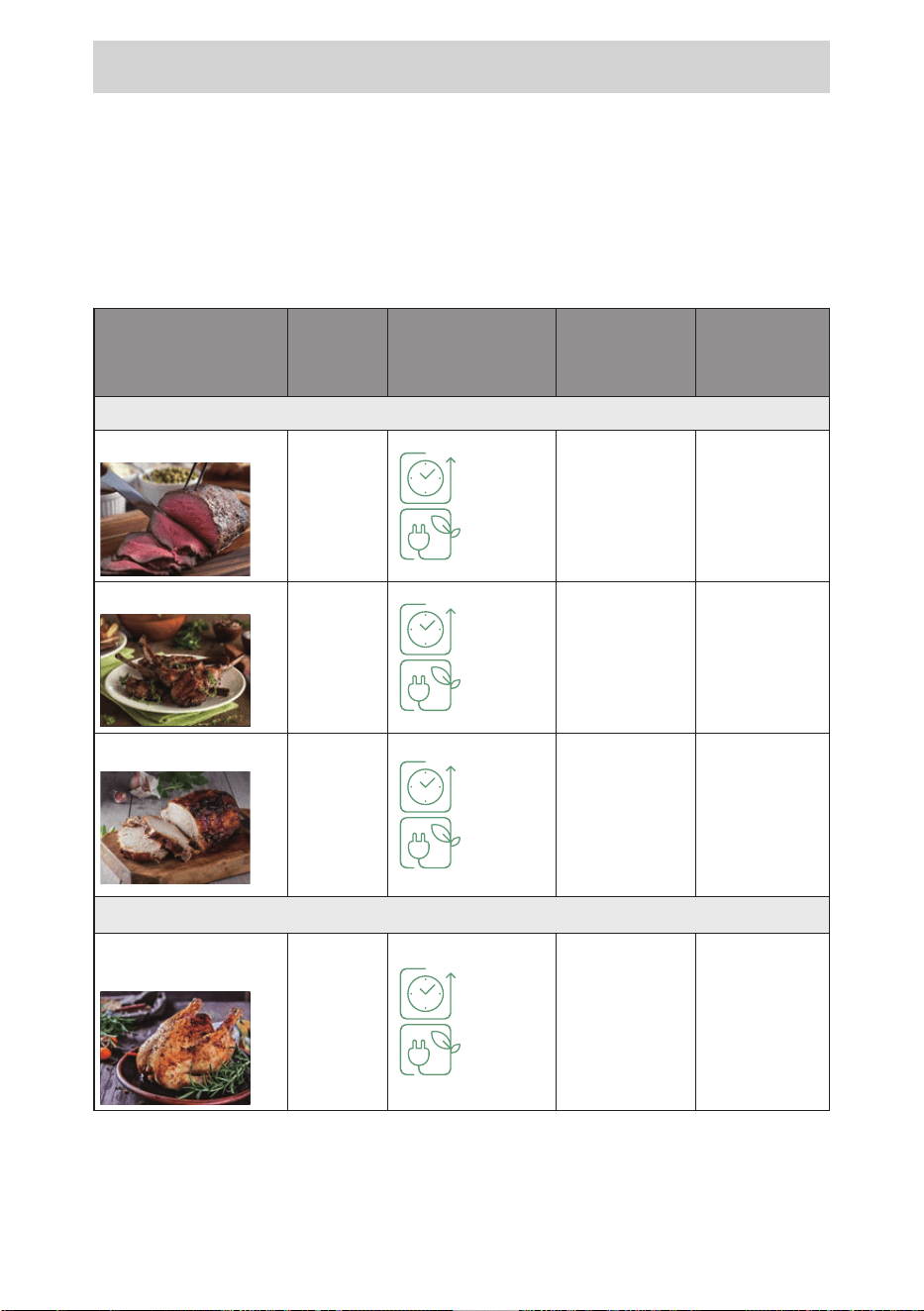
86
Eco Combi Charts
This chart provides 2 kinds of cooking methods, you can choose Eco Combi
mode or oven mode according to your needs.
Points for checking
Always check that food is piping hot after reheating in the microwave. If
unsure return to oven. Foods will still require a standing time, especially if
they cannot be stirred. The denser the food the longer the standing time.
Food
Weight/
Quantity
Time & Energy
Effi ciency vs
Oven cooking
Eco Combi
mode &
TIme
Oven mode
& TIme
Meat
Roast Beef
1 k
g
:
48-58%
: 32-43%
Eco combi 3
30-35 mins
(1) (5)
180 °C
(with preheat)
1 h 5 mins-
1 h 10 mins
(2) (5)
Lamb steak
6 pcs
:
57-64%
: 41-50%
Eco combi 3
13-15 mins
(4)
200 °C
(with preheat)
28-30 mins
(3)
Pork loin
1 k
g
:
54-63%
: 39-50%
Eco combi 3
30-35 mins
(1)
180 °C
(with preheat)
1 h 15 mins
-
1 h 20 mins
(2) (5)
Poultry
Roast whole
chicken
1 k
g
:
36-46%
: 18-29%
Eco combi 3
45-50 mins
(1) (5)
190 °C
(with preheat)
1 h 15 mins
-
1 h 20 mins
(2) (5)
(1) Place on dish on base of oven. (2) Place on Enamel Shelf in lower shelf
position. (3) Place on Enamel Shelf in upper shelf position. (4) Place on
Wire Rack with a dish underneath. (5) Turn or stir half way though cooking.
87
Eco Combi Charts
(1) Place on Enamel Shelf in lower shelf position. (2) Place on Enamel Shelf
in upper shelf position. (3) Place on Wire Rack with a dish underneath. (4)
Turn or stir half way though cooking.
Food
Weight/
Quantity
Time & Energy
Effi ciency vs
Oven cooking
Eco Combi
mode &
TIme
Oven mode
& TIme
Chicken wings
4 pcs
:
61-70%
: 50-59%
Eco combi 3
12-14 mins
(3)
200 °C
(with preheat)
30-35 mins
(1)
Drumsticks
4 pcs
:
52-60%
: 41-50%
Eco combi 3
18-20 mins
(3)
200°C
(with preheat)
35-40 mins
(1) (4)
Duck breast fillets
2 pcs
:
61-70%
: 51-60%
Eco combi 3
12-14 mins
(3)
200°C
(with preheat)
30-35 mins
(1) (4)
Frozen breaded products
Chicken wings
400
g
:
61-70%
: 51-60%
Eco combi 3
12-14 mins
(3)
200 °C
(with preheat)
35-40 mins
(2) (4)
Fish fillets
400
g
:
45-54%
: 31-46%
Eco combi 3
21-23 mins
(3)
200 °C
(with preheat)
35-40 mins
(2) (4)
88
Eco Combi Charts
Food
Weight/
Quantity
Time & Energy
Effi ciency vs
Oven cooking
Eco Combi
mode &
TIme
Oven mode
& TIme
Potatoes
Roast potatoes
500
g
:
38-48%
: 26-37%
Eco combi 3
24-26 mins
(4) (5)
200 °C
(with preheat)
35-40 mins
(2) (5)
Jacket potatoes
4 pcs
:
62-67%
: 52-58%
Eco combi 3
24-26 mins
(3)
200 °C
(with preheat)
1 h 5 mins-
1 h 10 mins
(1)
Hash Brown
potato
4 pcs
:
40-50%
: 32-41%
Eco combi 2
16-18 mins
(3)
200 °C
(with preheat)
23-25 mins
(2)
Others
Breakfast sausage
4 pcs
:
60-72%
: 47-61%
Eco combi 3
6-8 mins
(3)
200 °C
(with preheat)
13-15 mins
(2)
(1) Place on Enamel Shelf in lower shelf position. (2) Place on Enamel Shelf
in upper shelf position. (3) Place on Wire Rack with a dish underneath. (4)
Place dish on Wire Rack. (5) Turn or stir half way though cooking.
89
Eco Combi Charts
(1) Place on dish on base of oven. (2) Place on Enamel Shelf in lower shelf
position. (3) Place on Wire Rack with a dish underneath. (4) Place dish on
Wire Rack.
Food
Weight/
Quantity
Time & Energy
Effi ciency vs
Oven cooking
Eco Combi
mode &
TIme
Oven mode
& TIme
Chilled pizza
300
g
:
55-69%
: 42-57%
Eco combi 3
6-8 mins
(3)
200 °C
(with preheat)
10-12 mins
(2)
Frozen pizza
300
g
:
53-65%
: 42-53%
Eco combi 3
8-10 mins
(3)
200 °C
(with preheat)
14-16 mins
(2)
Grantins
(dauphinois,
lasagnes, cottage
pie, moussaka)
chilled
500
g
:
55-64%
: 36-46%
Eco combi 3
11-13 mins
(4)
180 °C
(with preheat)
25-27 mins
(2)
Gratin dividable
(cauliflower,
dauphinis, cheese
& potatoes) frozen
700
g
:
47-57%
: 16-31%
Eco combi 3
30-35 mins
(1)
160 °C
(with preheat)
1 h 5 mins -
1 h 10 mins
(2)
Tested by Panasonic internal laboratory

90
Questions and Answers
Q: Why won’t my oven turn on?
A: When the oven does not turn on,
check the following:
1. Is the oven plugged in securely?
Remove the plug from the outlet,
wait 10 seconds and reinsert.
2. Check the circuit breaker and
the fuse. Reset the circuit
breaker or replace the fuse if it
is tripped or blown.
3. If the circuit breaker or fuse is
all right, plug another appliance
into the outlet. If the other
appliance works, there probably
is a problem with the oven. If the
other appliance does not work,
there probably is a problem
with the outlet. If it seems that
there is a problem with the oven,
contact an authorised Service
Centre.
Q: My oven causes interference
with my TV. Is this normal?
A: Some radio, TV, Wi-Fi, cordless
telephone, baby monitor,
blue tooth or other wireless
equipment interference might
occur when you cook with
the microwave oven. This
interference is similar to the
interference caused by small
appliances such as mixers,
vacuums, blow dryers, etc. It
does not indicate a problem with
your oven.
Q: The oven won’t accept my
program. Why?
A: The oven is designed not to
accept an incorrect program.
For example, the oven will not
accept a fourth stage.
Q: Sometimes warm air comes
from the oven vents. Why?
A: The heat given off from the
cooking food warms the air in
the oven cavity. This warmed
air is carried out of the oven by
the air flow pattern in the oven.
There are no microwaves in the
air. The oven vents should never
be blocked during cooking.
Q: I can’t set an auto cook
program and ‘HOt’ appears in
the display. Why?
A: If ‘HOt’ appears in the display
window, the oven temperature is
too high from previous use and
an auto program can not be set.
Cooking mode and time may still
be set manually.
Q: Can I use a conventional oven
thermometer in the oven?
A: Only when you are using grill/
oven cooking modes. The
metal in some thermometers
may cause arcing in your
oven and should not be used
on microwave and eco combi
cooking modes.

91
Questions and Answers
Q: There are humming and
clicking noises from my oven
when I cook by Eco Combi.
What is causing these noises?
A: The noises occur as the oven
automatically switches from
microwave power to grill to
create the Eco Combi setting.
This is normal.
Q: My oven has an odour and
generates smoke when using
the eco combi, oven and grill
function. Why?
A: After repeated use, it is
recommended to clean the oven
and then run F1 Deodorization.
Q: The oven stops cooking by
microwave and "H97" or
"H98" appears in the display.
Why?
A: This display indicates a problem
with the microwave generation
system. Please contact an
authorised Service Centre.
Q: The fan continues to rotate
after cooking. Why?
A: After using the oven, the fan
motor may rotate to cool the
electrical components. This is
normal and you can continue
using the oven at this time.
Q: Can I check the pre-set oven
temperature while cooking by
oven?
A: Yes. Tap Oven pad and the oven
temperature will appear in the
display window for 2 seconds.
Q: “d” appears in the display and
the oven does not cook. Why?
A: The oven has been programmed
in demo mode. This mode is
designed for retail store display.
Deactivate this mode by tap
Micro Power once and Stop/
Cancel 4 times.
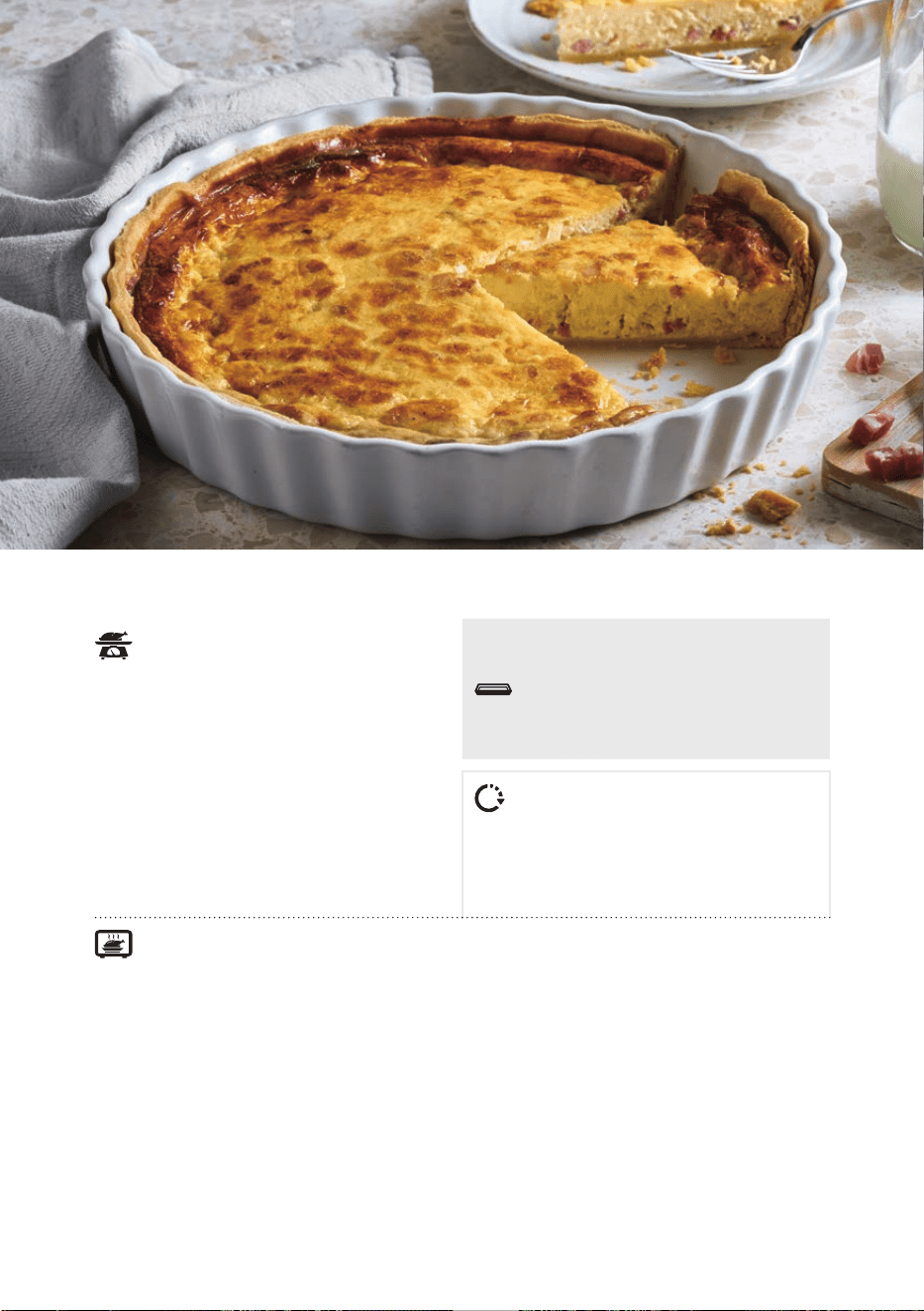
92
Quiche Lorraine
Ingredients
Accessory
Servings 6
100
g
back, smoked bacon
1 roll of pastry (approx. 300
g
)
100
g
gruyère, grated
130 ml milk
salt and pepper
3 eggs
150 ml cream
grated nutmeg
Enamel Shelf
Dish: 25 cm flan dish
Time & Setting
approx. 41-46 minutes
Oven 180-200 °C
Microwave 1000 W
Method
1. Cut the bacon into small pieces. Heat in a covered container at
1000 W for 1 minute. Drain.
2. Line the flan dish with the pastry. Preheat the oven with the Enamel
Shelf in the lower shelf position Oven 200 °C. Cook for 15-20 minutes
on Oven 200 °C.
3. Arrange the bacon and the grated gruyère cheese on the rolled out
pastry. Mix the milk seasoned with salt and pepper, the eggs, cream
and grated nutmeg with an electric whisk. Pour into the flan dish with
the pastry. Cook for 25 minutes on Oven 180 °C.
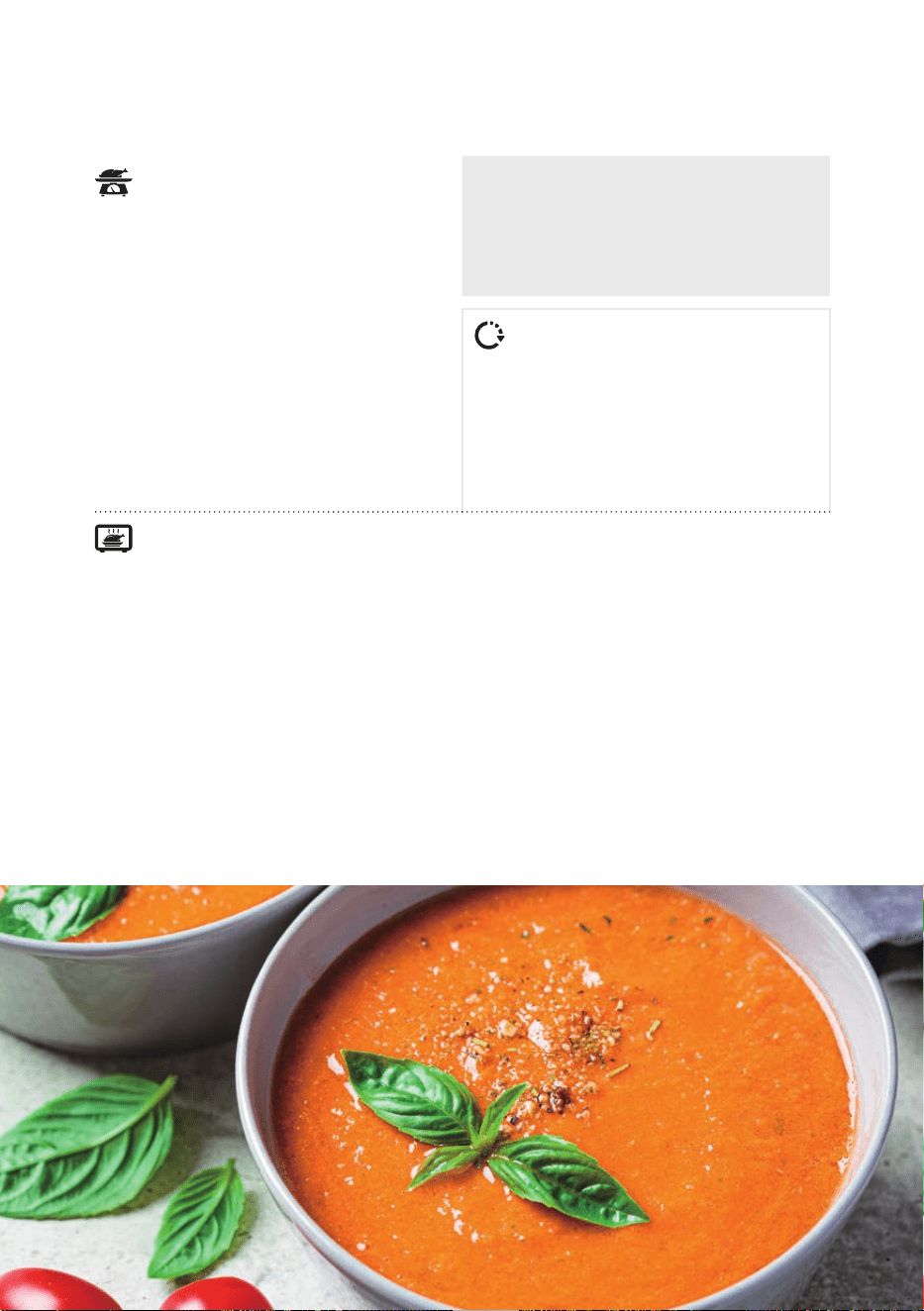
93
Tomato and Red Pepper Soup
Ingredients
Accessory
Servings 4
5 large tomatoes
30 ml olive oil
1 onion, chopped
450
g
red or orange peppers, thinly
sliced
30 ml tomato purée
Pinch of sugar
475 ml vegetable stock
60 ml soured cream (optional)
Salt and ground black pepper
Chopped fresh dill, to garnish
–
Dish: large Pyrex
®
bowl
Time & Setting
approx. 11 minutes
Microwave 1000 W
Method
1. Skin the tomatoes by plunging them in boiling water for 30 seconds.
Chop the flesh and reserve any juice.
2. Place half the oil in a bowl with the onion and cover with pierced cling
film. Cook on 1000 W for 2 minutes, stirring once.
3. Add the peppers and remaining oil, mixing well. Cover and cook on
1000 W for 5 minutes, stirring halfway through cooking.
4. Stir in the chopped tomatoes, tomato purée, seasoning, sugar and a
few tablespoons of stock. Cover and cook on 1000 W for 4 minutes,
stirring halfway through cooking, until the vegetables are tender.
5. Stir in the rest of the stock and purée in a blender or food processor
until smooth. Strain the soup to remove the skins and season to taste.
Pour into bowls, swirl in the soured cream, if desired, and garnish with
dill.
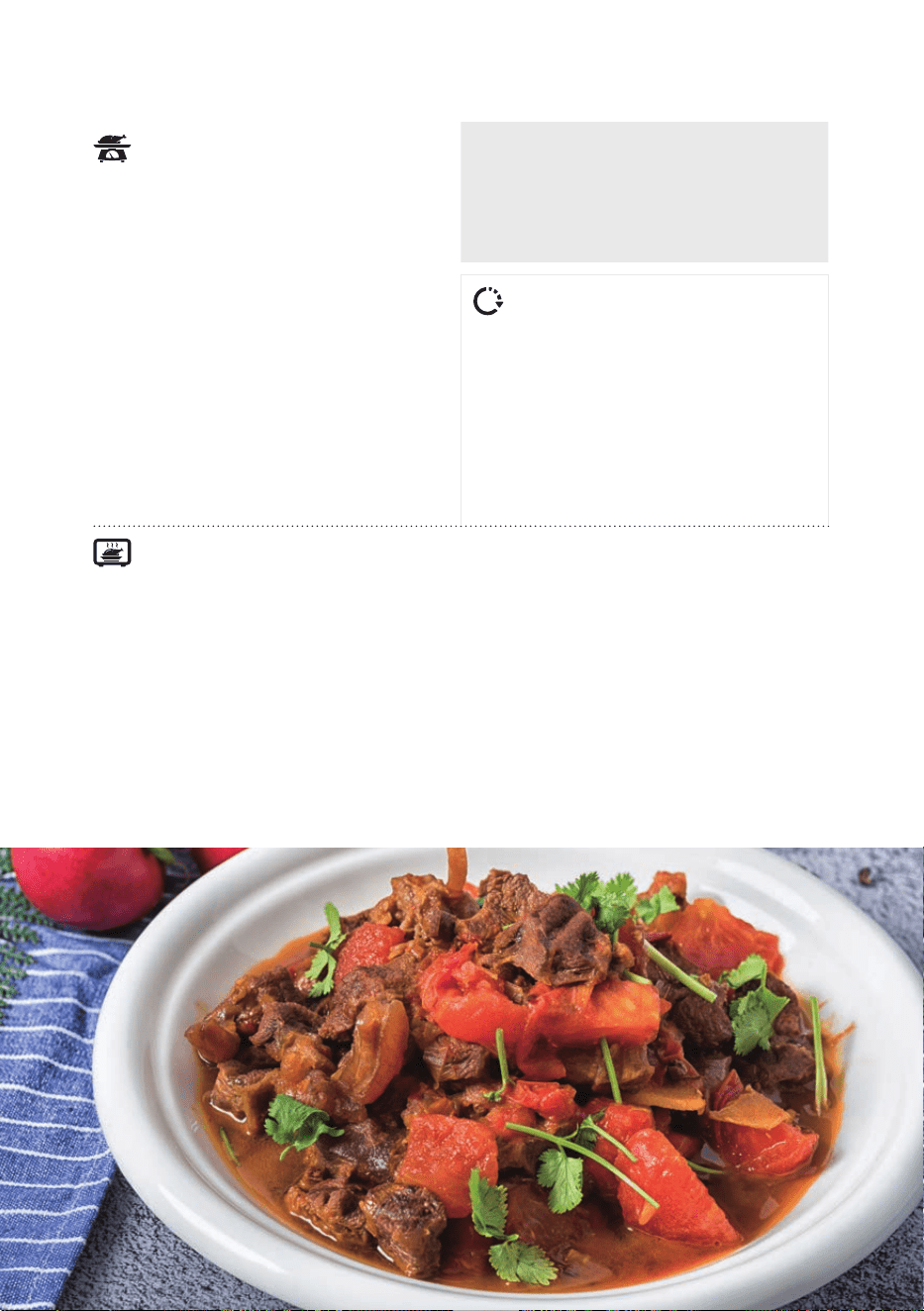
94
Greek Lamb Stew
Ingredients
Accessory
Servings 4
700
g
lamb fillet, cut into chunks
2 onions, chopped
1 red chili
2 cloves garlic, crushed
1 sprig rosemary
275 ml white wine,
400
g
can chopped tomatoes
45 ml sliced black olives
100
g
linguine, broken into small
pieces
150
g
feta cheese cubed
15
g
fresh mint chopped
–
Dish: 3 litre casserole
dish with lid
Time & Setting
approx. 60 minutes
Microwave 600W/440W
Method
1. Place the lamb and onion in casserole dish and cover. Place on base
of oven and cook on 600 W for 10 minutes.
2. Split the chili along its length leaving the top intact, (remove seeds) -
this adds flavour to the stew without too much heat. Stir the chili, garlic,
rosemary, wine and tomatoes into the lamb, with the lid on. Cook on
440 W for 40 minutes stirring halfway.
3. Stir in the black olives and linguine and contine to cook on 440 W for a
further 10 minutes or until the linguine is cooked.
4. Remove the chili and rosemary, and discard. Stir in feta cheese and
mint before serving.
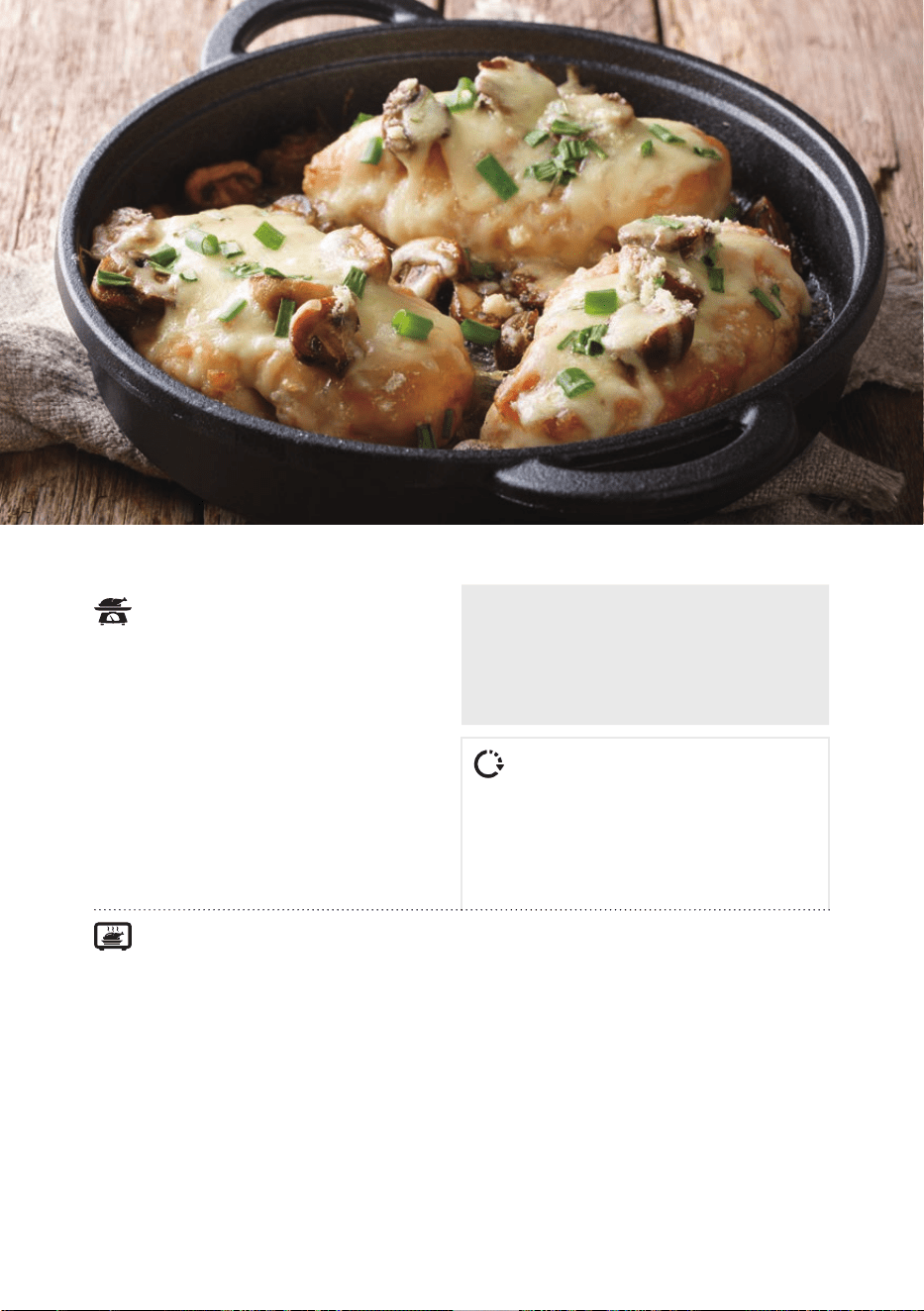
95
Normandy Style Chicken
Ingredients
Accessory
Servings 4-5
800
g
chicken fillets
2 shallots
40
g
butter
1 glass of white wine or cider
salt and pepper
4 large apples
4 tbsp double cream sauce
thickener
2 tbsp Calvados
–
Dish: 1 Pyrex
®
dish (25 cm
diameter)
Time & Setting
approx. 21-24 minutes
Microwave 1000 W
Method
1. Cut the chicken fillets into pieces. Sweat the chopped shallots in butter,
covered, for 2 minutes on 1000 W.
2. Add the chicken pieces, the white wine or cider, salt, pepper and the
apples, peeled, deseeded and cubed. Cover and cook on 1000 W for
16-18 min, stirring halfway through cooking time. Drain the chicken
pieces and keep them to one side, covered in aluminium foil.
3. Add the cream and the sauce thickener with Calvados in the dish and
cook, uncovered, a further 3-4 mins on 1000 W. Season to taste and
put the chicken pieces back into the sauce.
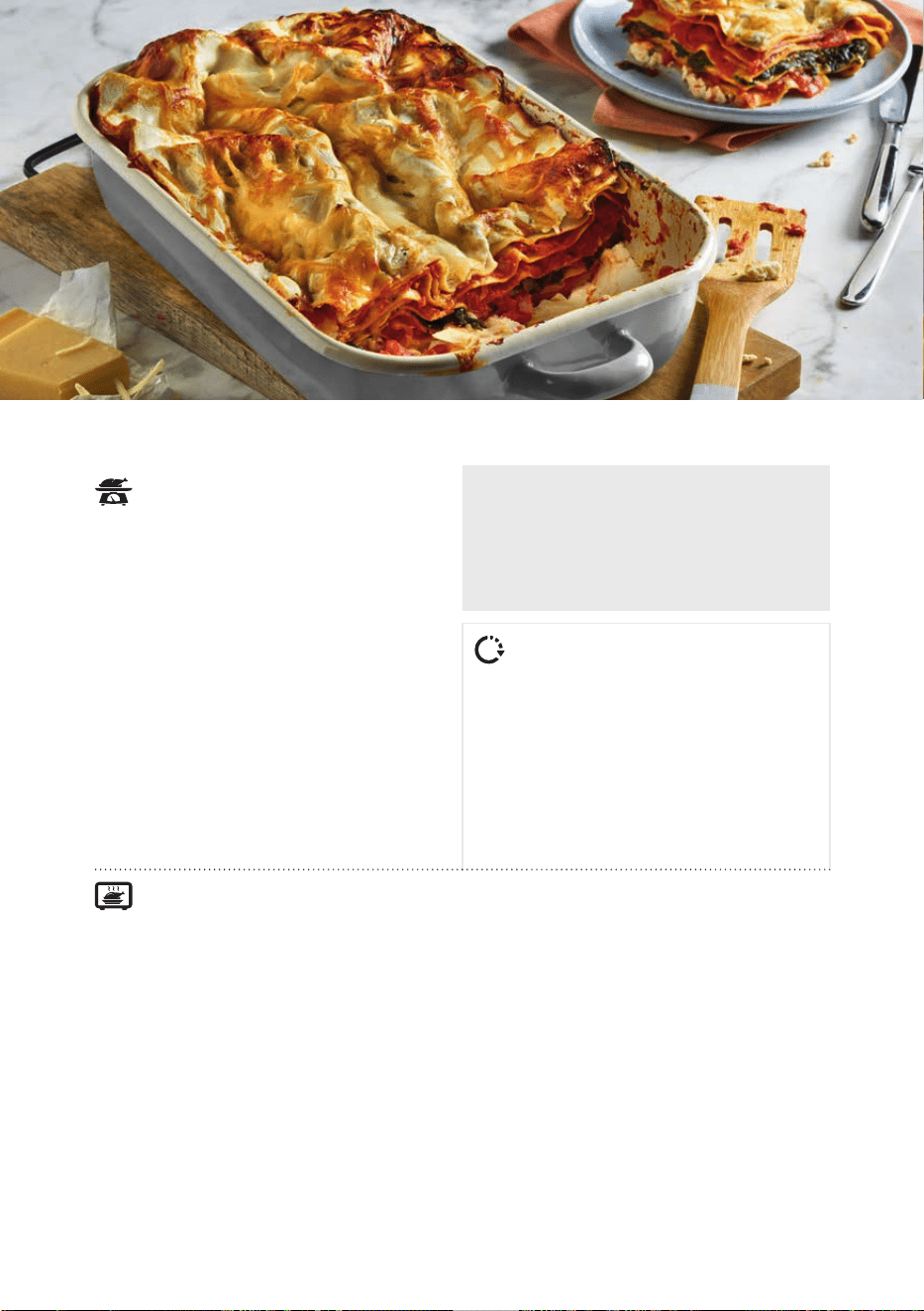
96
Spinach and Ricotta Lasagne
Ingredients
Accessory
Servings 4-6
2 onions, chopped
2 cloves garlic, crushed
30 ml oil
2 deseeded red peppers, chopped
400
g
canned tomatoes
15 ml tomato puree
salt and pepper
450
g
spinach
450
g
fresh ricotta cheese
6 sheets lasagne
300 ml natural yoghurt
parmesan cheese
–
Dish: 2 large bowls, large shallow
dish.
Time & Setting
approx. 24-35 minutes
Eco Combi 3
Microwave 1000W
Grill 3
Method
1. Place one of the onions and one of the cloves of garlic in a bowl with 1
tbsp oil, cover and cook for 2-3 minutes on 1000 W or until soft.
2. Add the red peppers, tomatoes and tomato puree, season and cook on
1000 W for 5-6 minutes.
3. In another bowl, place the second onion and garlic clove with 1 tbsp
oil. Cook on 1000 W for 2-3 minutes or until soft.
4. Add the spinach and stir well. Cook on 1000 W for 2-3 minutes or until
cooked. Drain.
5. Place a layer of spinach in the shallow dish. Top with ricotta cheese,
then lasagne followed by the tomato sauce and a further layer of pasta.
Spoon yoghurt onto the top and sprinkle with parmesan cheese. Place
the dish on the base of oven and cook on Eco Combi 3 for 10-15
minutes then Grill 3 for 3-5 minutes, or until golden and piping hot.
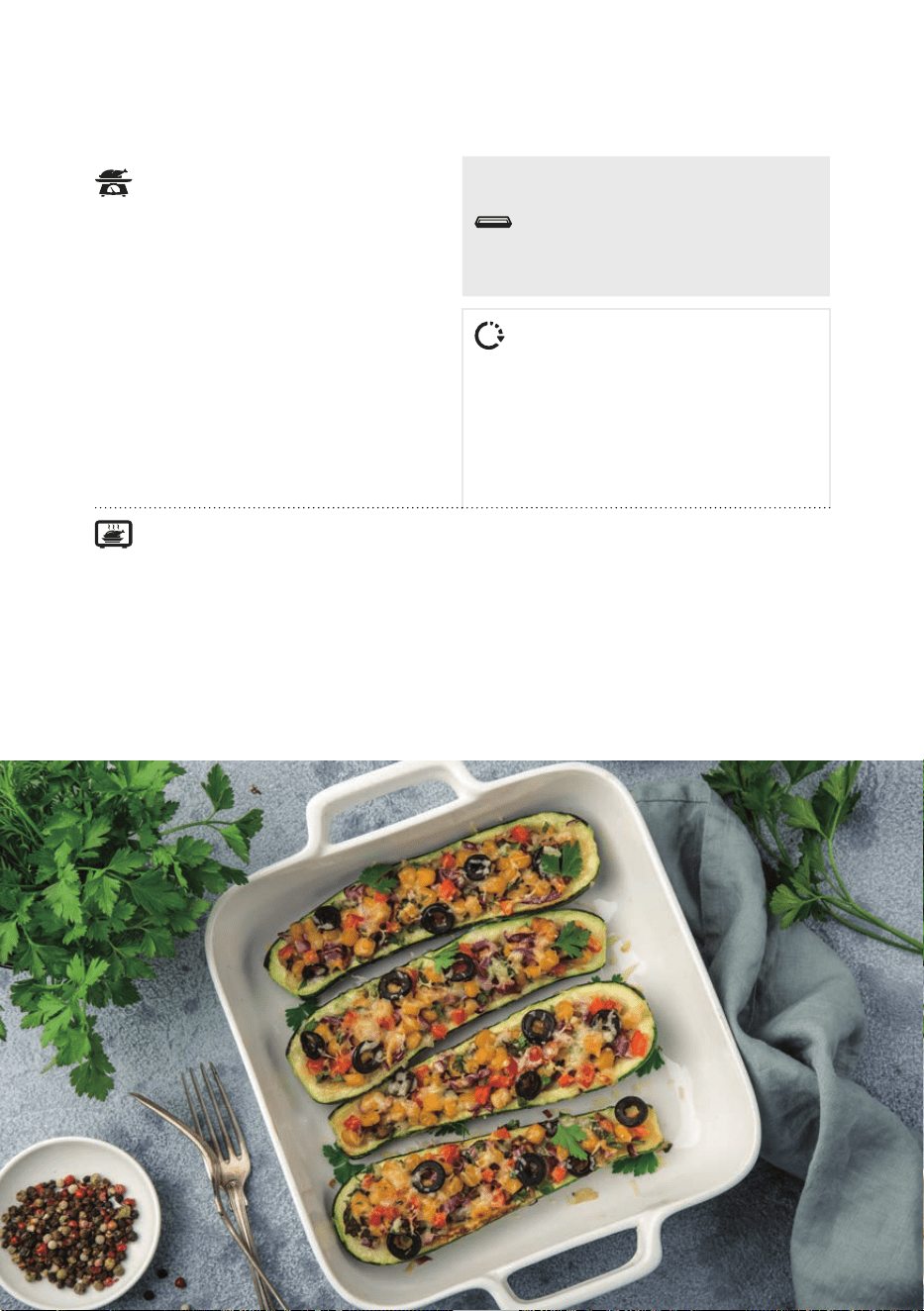
97
Stuffed Courgettes
Ingredients
Accessory
Servings 4
2 courgettes, halved lengthways
2 tsp extar virgin olive oil
For the stuffing:
30
g
dried white breadcrumbs
20
g
pine nuts
3 spring onions, trimmed and finely
sliced
1 garlic clove, crushed
1 tsp dried thyme leaves
20
g
Parmesan, finely grated
Enamel Shelf
Time & Setting
approx. 25-32 minutes
Oven 200 °C
Method
1. Preheat on Oven 200 °C. Place the courgettes in a single layer on the
enamel shelf, close together, cut side up. Lightly brush with olive oil.
Place in the lower shelf position and bake for 15-17 minutes.
2. For the stuffing mix all the ingredients together in a bowl. Sprinkle the
mixture on the top of the courgettes and drizzle the remaining olive oil
over. Return to the oven and bake for 10-15 minutes on Oven 200 °C.
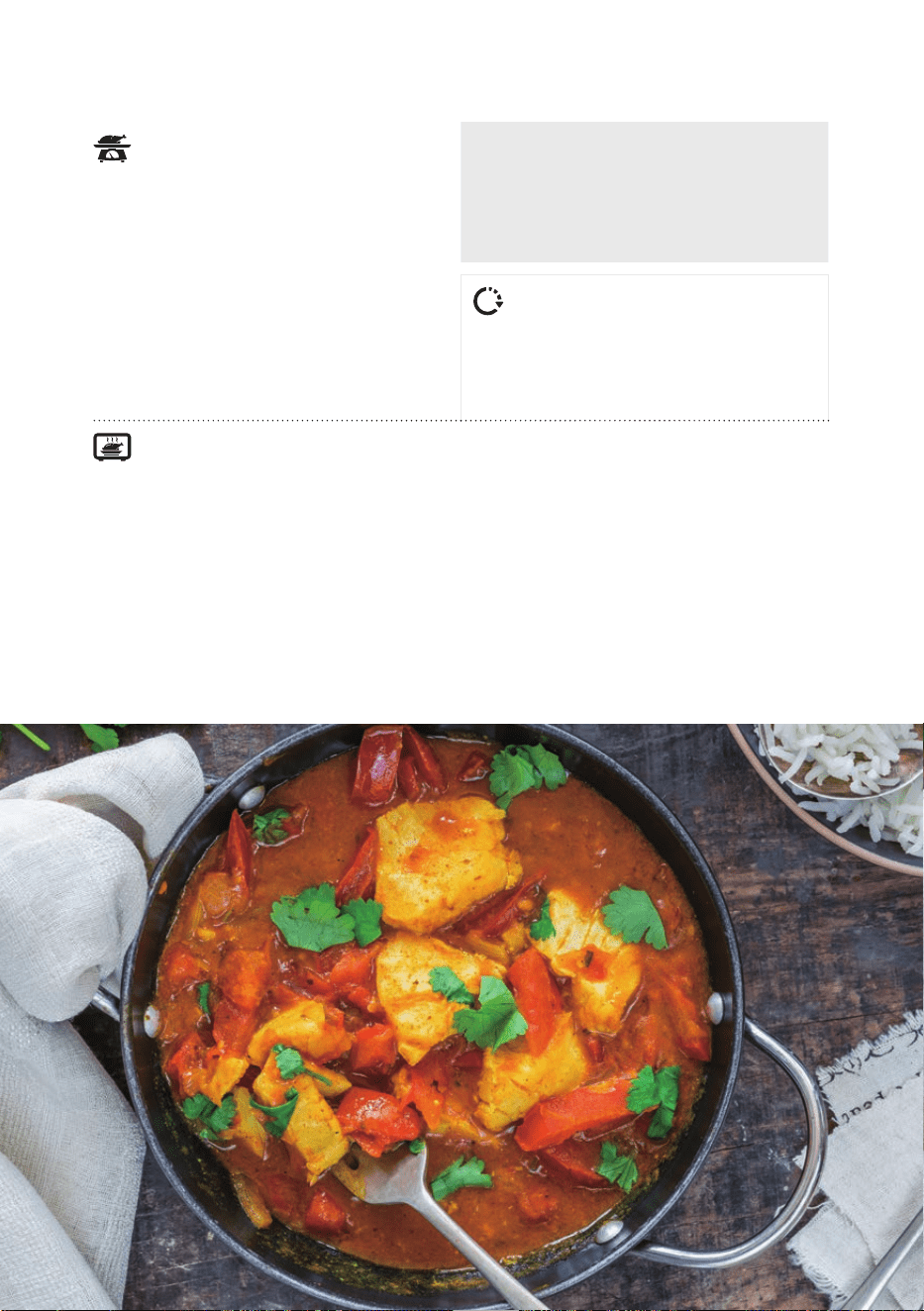
98
Coconut Fish Curry
Ingredients
Accessory
Servings 4 - 5
1 onion
1 red pepper
200 ml coconut milk
1 tomato
1 tbsp curry paste
juice of ½ lemon
600
g
coley or pollock
salt and pepper.
–
Dish: 1 Pyrex
®
dish (22 cm
diameter)
Time & Setting
approx. 26-28 minutes
Microwave 1000 W
Method
1. Sweat the chopped onion with the cubed pepper in the dish, covered,
for 4-5 minutes on 1000 W.
2. Add the coconut milk, the peeled and chopped tomato, the curry paste
and lemon juice; Cook on 1000 W for 3 minutes.
3. Before adding the fish cut into cubes. Cover and cook on 1000 W for 6-7
minutes, stirring halfway through cooking time.
4. Season to taste before serving.
5. If you use 4 frozen fish fillets, cook approx. 13 minutes. on 1000 W,
turning halfway through cooking time.
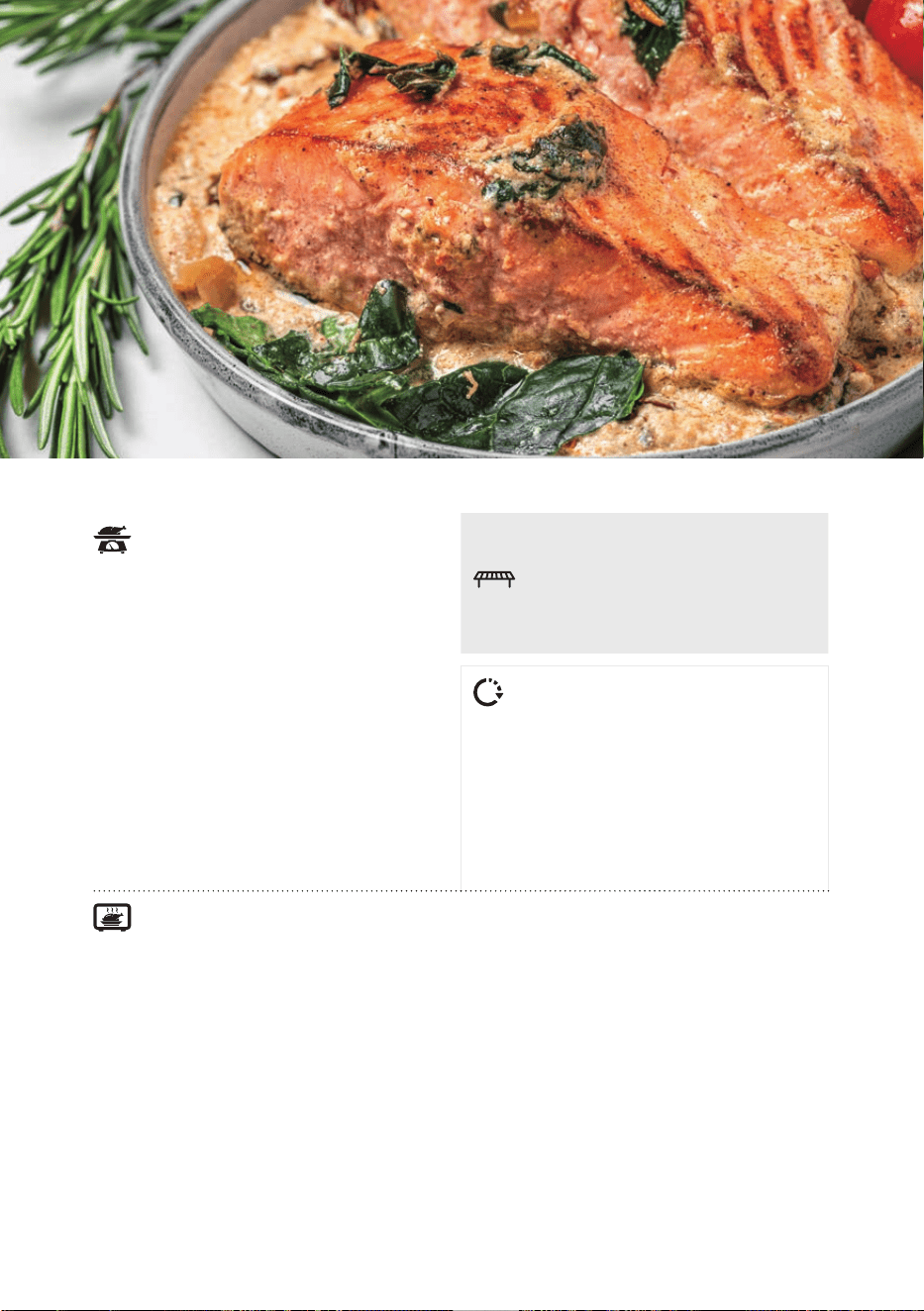
99
Seafood Bake
Ingredients
Accessory
Servings 4
500
g
frozen mixed seafood
3 shallots
1 carrot
150
g
mushrooms
30
g
butter
3 tbsp flour
250 ml milk
1 tbsp fruity white wine
1 tbsp chopped dill
salt and pepper
30
g
grated emmental
Wire Rack
Dish: 1 bowl + 1 small shallow dish
(24 cm diameter)
Time & Setting
approx. 30-33 minutes
Microwave 600W/1000W
Eco Combi 3
Grill 3
Method
1. Cook the seafood for approx. 10 minutes on 600 W, stirring several
times. Drain and keep the liquid, adding 250 ml milk to it.
2. Chop the shallots, the carrot and the mushrooms and cook this mixture
in a bowl, covered, with 30
g
of butter for 4-5 minutes on 1000 W.
3. Add 3 tbsp of flour, stir and cook again for 1 minute on 1000 W then
add the milk and juice from the seafood. Cook this sauce for 5-6
minutes on 1000 W, stirring halfway (if the sauce isn’t thick enough,
you can add some sauce thickener mixed with white wine).
4. Add 1 tbsp wine and the dill, check the seasoning once you’ve added
the seafood. Pour into the baking dish. Sprinkle with grated cheese,
place on wire rack and cook 6 minutes on Eco Combi 3 then 4-5
minutes on Grill 3.
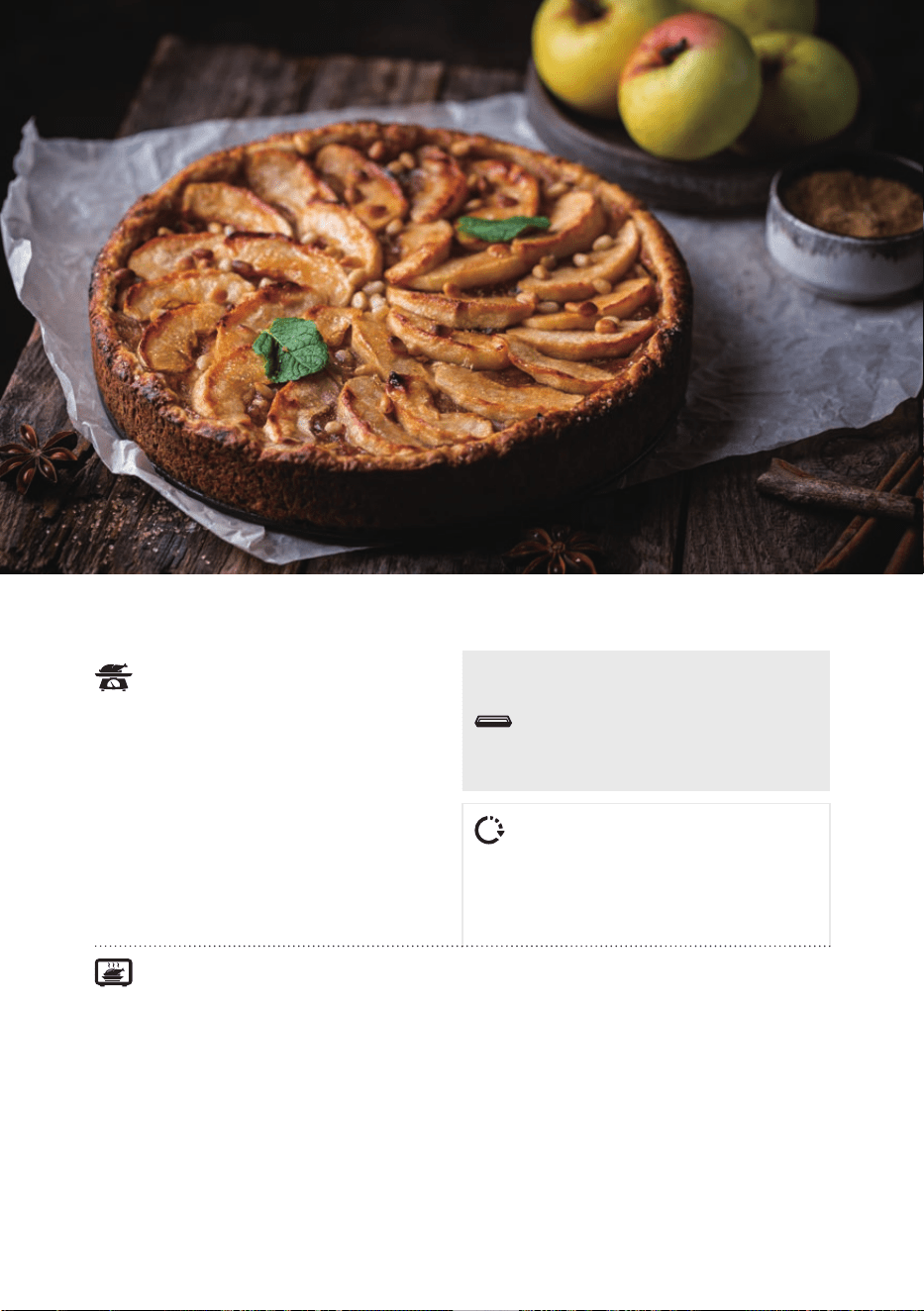
100
Apple Tart
Ingredients
Accessory
Servings 8-10
1 x roll of sweet short crust pastry
250
g
apple compote
2 to 3 apples
Apricot jam
Enamel Shelf
Dish: flan dish (Ø 28 cm)
Time & Setting
approx. 31 minutes
Oven 200 °C
Microwave 1000 W
Method
1. Line the flan dish with the pastry. Preheat on Oven 200 °C with the
enamel shelf in the lower shelf position. Pour in the apple compote and
then place the peeled, cored and thinly sliced apple in a rosette shape.
2. Place on the enamel tray in the lower shelf position and cook for about
30 minutes on Oven 200 °C. Remove from dish and leave to cool on a
wire rack.
3. Mix 3 spoons of apricot jam and a spoon of water in a bowl and cook
on 1000 W for 1 minute and brush over the apple.
101
Small Cakes
Ingredients
Accessory
Making 9 little cakes
100
g
butter
100
g
sugar
2 eggs, beaten
100
g
self-raising flour
Enamel Shelf
Dish: 1 baking tray, 24 cm x 24
cm each with 9 holes + 9
individual paper cases
Time & Setting
approx. 30-40 minutes
Oven 170 °C
Method
1. Preheat on Oven 170 °C with the enamel shelf in the lower shelf
position.
2. Beat the butter, which has been kept at room temperature, and the
sugar until a mousse-like consistency is achieved. Add the eggs one
at a time, beating well after each egg is added. Mix in the flour. Fill
individual paper cases two thirds full with the mixture. Cook on Oven
170 °C for 30-40 minutes.
102
Specifications
This product is an equipment that fulfills the European standard for EMC
disturbances (EMC = Electromagnetic Compatibility) EN 55011. According
to this standard this product is an equipment of group 2, class B and
is within required limits. Group 2 means that radio-frequency energy is
intentionally generated in the form of electromagnetic radiation for purpose
of warming or cooking food. Class B means that this product may be used
in normal household areas.
Manufactured by:
Panasonic Appliances Microwave Oven (Shanghai) Co., Ltd.
888, 898 Longdong Road. Pudong, Shanghai, 201203, China.
Imported by:
Panasonic UK, a branch of Panasonic Marketing Europe GmbH
Maxis 2, Western Road, Bracknell, Berkshire, RG12 1RT
Authorized Representative in EU:
Panasonic Marketing Europe GmbH, Panasonic Testing Centre
Winsbergring 15, 22525 Hamburg, Germany
Weight and Dimensions shown are approximate.
* 456 mm is the dimension with handle.
412 mm is the dimension without handle.
Manufacturer Panasonic
Model
NN-DF38PB
Power Supply 230-240 V ~ / 50 Hz
Operating Frequency 2450 MHz
Input Power
Maximum 1680 W
Microwave 920 W
Grill 930 W
Oven 1380 W
Output Power
Microwave 1000 W (IEC-60705)
Grill 900 W
Oven 1350 W
External Dimensions (W x D x H) 483 mm x 412 (456
*
) mm x 313 mm
Interior Dimensions (W x D x H) 315 mm x 350 mm x 220 mm
Uncrated Weight (approx.) 12.2
kg
cook
share
learn
PHONE OUR
CUSTOMER COMMUNICATIONS CENTRE
0344 844 3899
For service or spares.
Or order spares direct on line at
www.panasonic.co.uk
Panasonic Corporation
http://www.panasonic.com
© Panasonic Corporation 2023
F0003CX20BP
PA0923-0
Printed in P.R.C.
Scan the QR code for more recipes
https://www.panasonic.com/nn-df38p-df37p/