Countertop Microwave Oven
Contents
Adapter Plugs
33
Installation
33
Add
30 Seconds
9
Light Bulb Replacement
32
Appliance Registration
2
Microwaving Tips
3
Auto Defrost
14, 15
Minute/Second Timer
10
Auto Roast
12, 13
Model and Serial Numbers 2,6
Auto Simmer
13
Popcorn
18
Care and Cleaning
32
Power Levels
8,9
Consumer Services
35
Precautions 2-5
Control Panel
6,7
Problem Solver
34
Cooking by Time
9
Program Cooking
5
Cooking Complete Reminder
Quick Reheat
18
Cooking Guide
25-3:
Safety Instructions
2-5
Defrosting by Time
8
Temperature Cook
11
Defrosting Guide
23,24 Temperature Probe
4,11-13
Delayed Cooking
10
Warranty
Back Cover
Double
DUN
“’SheE
5,6,16,17,19,32
Extension Cords
33
Features
6
C,lossary
of Microwave Terms 19
Grounding Instructions
33
Heating or Reheating Guide 21,22
GE Answer Center
a
Hold Time
10
800.626.2000
ModelJE1455K
GE Appliances
Help us help you...
Before using your oven,
read this book carefully.
It is intended to help you operate
and
maintain your new microwave
oven properly.
Keep it handy
for
answers to your
questions.
If
you don’t understand something
or need more help, write (include
your phone number):
Consumer Affairs
GE Appliances
Appliance Park
Louisville, KY 40225
Write down the model and
serial numbers.
You’ll
find
them on
a
label inside
the oven.
These numbers are also on the
Consumer Product Ownership
Registration Card that came with
your microwave oven. Before
sending in this card, please write
these numbers here:
Model Number
Serial Number
Use these numbers in any
correspondence or service calls
concerning your microwave oven.
Be sure your microwave
oven is registered.
It is important that we know the
location
of your microwave oven
should a need occur
for
adjustments.
Your supplier is responsible
for
registering you as the owner.
Please check with your supplier to
be sure he has done so; also send
in your Consumer Product
Ownership Registration Card.
If
you move, or if you are not the
original purchaser,
please
write to
us, stating model and serial
numbers.
2
This appliance must be registered.
Please be certain that it is.
Write to:
GE Appliances
Range Product Service
Appliance Park
Louisville, KY 40225
If you received a
damaged oven...
Immediately contact the dealer (or
builder) that sold you the oven.
Save time and money.
Before you request service...
Check the Problem Solver in the
back of this book. It lists causes of
minor operating problems that you
can correct yourself.
All these things are normal
with your microwave oven.
● Steam or vapor escaping from
around the door.
● Light reflection around door or
outer case.
● Dimming oven light and change
in blower sound may occur while
operating at power levels other
than high.
● Dull thumping sound while oven
is operating.
● Some TV-Radio interference
might be noticed while using your
microwave oven. It’s similar to the
interference caused by other
small
appliances and does not indicate a
problem with your oven.
If you need service...
To obtain service, see the
Consumer Services page in the
back of this book.
We’re proud of our service and
want you to be pleased. If for some
reason you are not happy with the
service you receive, here are three
steps to
follow
for further help.
FIRST, contact the people who
serviced your appliance. Explain
why you are not pleased. In most
cases, this
will
solve the problem.
NEXT, if you are still not
pleasecJ
write all the details—including
your phone number—to:
Manager, Consumer Relations
GE Appliances
Appliance Park
Louisville, KY 40225
FINALLY, if your problem is still
not resolved, write:
Major Appliance Consumer
Action Panel
20 North
Wacker
Drive
Chicago, IL 60606
PRECAUTIONS
TO AVOID
POSSIBLE
EXPOSURE TO
EXCESSIVE
MICROWAVE
ENERGY
(a) Do Not Attempt
to operate this
oven with the door open since
open-door operation can result in
harmful exposure to microwave
energy. It is important not to defeat
or tamper with the safety
interlocks.
(b) Do Not Place
any object
between the oven front face and
the door or allow
soil
or cleaner
residue to accumulate on sealing
surfaces.
(c) Do Not Operate
the oven if it
is damaged. It is particularly
important that the oven door close
properly and that there is no
damage to the:
(1) door (bent)
(2) hinges and latches (broken or
loosened)
(3) door seals and sealing surfaces.
(d) The Oven Should Not
be
adjusted or repaired by anyone
except properly qualified service
personnel.
——.
Microwaving Tips
● Make sure all cookware used in
your microwave oven is suitable
for microwaving. Most glass
casseroles, cooking dishes,
measuring cups, custard cups,
pottery
or
china dinnerware which
does not have metallic trim or
glaze with a metallic sheen can be
used. Some cookware is labeled
“suitable
for
microwaving.”
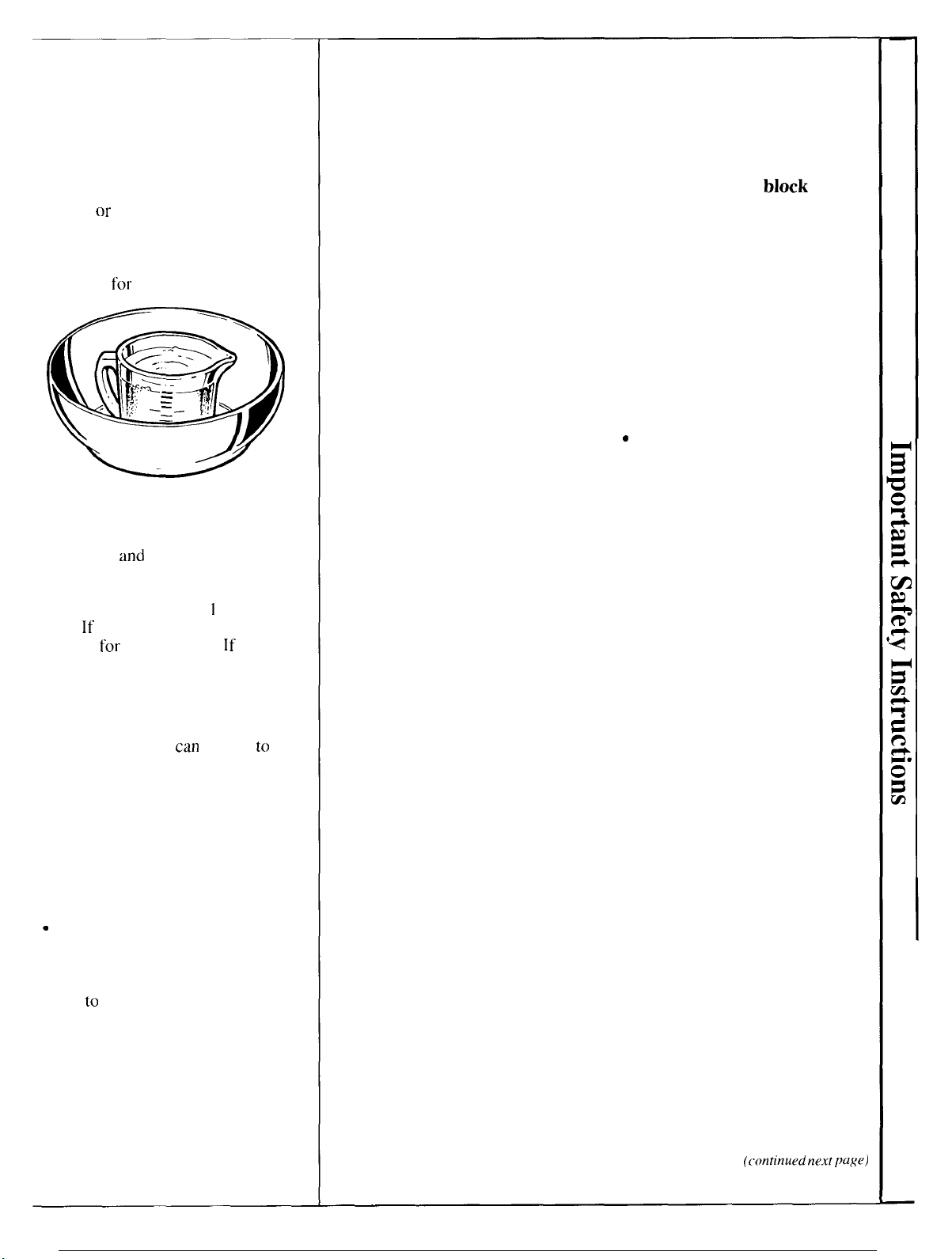
If you are not sure if a dish is
microwave-safe, use this test:
Place in the oven both the dish you
are testing
and
a glass measuring
cup filled with one cup water—set
the measuring cup either in or next
to the dish. Microwave
I
minute at
high.
If the dish heats, it should not
be used
for
microwaving. If the
dish remains cool and only the
water in the cup heats, then the
dish is microwave-safe.
●
Paper towels, waxed paper
and plastic wrap
can
be used
to
cover dishes in order to retain
moisture and prevent spattering.
Be sure to vent plastic wrap so
steam can escape.
● Some microwaved foods
require stirring, rotating or
rearranging.
Check Cooking
Guide.
“
Steam builds
up pressure in
foods which are tightly covered
by a skin or membrane. Pierce
potatoes, egg yolks and chicken
livers
to
prevent bursting.
IMPORTANT SAFETY
INSTRUCTIONS
Read all instructions before using this appliance.
When using electrical
appliances, basic safety
precautions should be followed,
including the following:
WARNING–To reduce
the risk of burns, electric
shock, fire, injury to persons
or exposure to excessive
microwave energy:
● Use this appliance only for
its intended use as described
in this manual. Do not use
corrosive chemicals or vapors in
this appliance. This microwave
oven is specifically designed to
heat or cook food, and is not
intended for laboratory or
industrial use.
● Read and follow the specific
“PRECAUTIONS TO AVOID
POSSIBLE EXPOSURE TO
EXCESSIVE MICROWAVE
ENERGY” on page
2.
● This appliance must be
grounded. Connect only to
properly grounded outlet.
See “GROUNDING
INSTRUCTIONS” on page 33.
● For best operation, plug
this appliance into its own
electrical outlet, to prevent
flickering of lights, blowing of
fuse or tripping of circuit breaker.
● Do not mount this appliance
over a sink. Install or locate
this appliance only in
accordance with the provided
Installation Instructions.
● Be certain to place the front
surface of the door three
inches or more back from the
countertop edge to avoid
accidental tipping of the
appliance in normal usage.
● Do not cover or block any
openings on the appliance.
● Do not store this appliance
outdoors. Do not use this
product near water—for
example, in a wet basement, or
near a swimming pool.
● Do not immerse power cord
or plug in water.
● Keep power cord away from
heated surfaces.
c
Do not let power cord hang
over edge of table or counter.
● Do not operate this
appliance if it has a damaged
power cord or plug, if it is not
working properly, or if it has
been damaged or dropped.
● See door surface cleaning
instructions in the Care and
Cleaning section(s) of your
book.
● This appliance should be
serviced only by qualified
service personnel. Contact
nearest authorized service
facility for examination, repair
or adjustment.
● As with any appliance, close
supervision is necessary when
used by children.
● To reduce the risk of fire in
the oven cavity:
—Do not use the oven for
storage purposes. Do not
leave paper products, cooking
utensils, or food in the oven
cavity when not in use.
—Do not overcook food.
Carefully attend appliance
if paper, plastic or other
combustible materials are
placed inside the oven to
facilitate cooking.
(continued next
[?age)
3
IMPORTANT SAFETY INSTRUCTIONS
(continued)
—Remove wire twist-ties from
paper or plastic bags before
placing bags in oven.
—Do not use your microwave
oven to dry newspapers.
—Do not use recycled paper
products. Recycled paper
towels, napkins and waxed
paper can contain metal flecks
which may cause arcing or
ignite. Paper products
containing nylon or nylon
filaments should be avoided,
as they may also ignite.
—Do not pop popcorn in your
microwave oven unless in a
special microwave popcorn
accessory or unless you use
popcorn labeled for use in
microwave ovens.
—Do not operate the oven
while empty to avoid damage
to the oven and the danger of
fire. If by accident the oven
should run empty a minute or
two, no harm is done. However,
try to avoid operating the oven
empty at all times—it saves
energy and prolongs the life of
the oven.
—Do not overcook potatoes.
They could dehydrate and
catch fire, causing damage to
your oven.
● If materials inside oven
should ignite, keep oven door
closed, turn oven off, and
disconnect power cord, or shut
off power at the fuse or circuit
breaker panel.
● Some products such as
whole eggs and sealed
containers—for example,
closed jars—will explode and
should not be heated in this
microwave
oven. Such use of
the microwave oven could
result in injury.
● Avoid heating baby food in
glass jars, even without their
lids; especially meat and egg
mixtures.
● Don’t defrost frozen
beverages in narrow necked
bottles (especially carbonated
beverages).
Even if the
container is opened, pressure
can build up. This can cause the
container to burst, possibly
resulting in injury.
● Use metal only as directed in
this book. TV dinners maybe
microwaved in foil trays less
than 3/4” high; remove top foil
cover and return tray to box.
When using metal in the
microwave oven, keep metal
(other than metal
shel~ at
least 1 inch away from sides
of oven.
. Cookware may become hot
because of heat transferred from
the heated food. Pot holders
may be needed to handle the
cookware.
● Sometimes, the glass cooking
tray can become too hot to
touch. Be careful when
touching the tray during and
after cooking.
● Foods cooked in liquids
(such as pasta) may tend to boil
over more rapidly than foods
containing less moisture.
Should this
occur, refer to the
Care and Cleaning section for
instructions on how to clean the
inside of the oven.
● Thermometer—Do not use a
thermometer in food you are
microwaving unless the
thermometer is designed or
recommended for use in the
microwave oven.
● Remove the temperature
probe from the oven when not
using it to cook with. If you
leave the probe inside the oven
without inserting it in food or
liquid, and turn on microwave
energy, it can create electrical
arcing in the oven and damage
oven walls.
● Plastic cookware—Plastic
cookware designed for
microwave cooking is very
useful, but should be used
carefully. Even microwave-safe
plastic may not be as tolerant
of overcooking conditions as are
glass or ceramic materials and
may soften or char if subjected
to short periods of overcooking.
In longer exposures to
overcooking, the food and
cookware could
ignite. For these
reasons:
1
) Use microwave-safe
plastics only and use them in
strict compliance with the
cookware manufacturer’s
recommendations. 2) Do not
subject empty cookware to
microwaving. 3) Do not permit
children to use plastic cookware
without complete supervision.
● When cooking pork, follow
the directions exactly and
always cook the meat to an
internal temperature of at least
170°F.
This assures that, in the
remote possibility that trichina
may be present in the meat, it
will be killed and meat will be
safe to eat.
Q
Do not boil eggs in a
microwave oven. Pressure will
build up inside egg yolk and
will cause it to burst, possibly
resulting in injury.
● Foods with unbroken outer
“skin” such as potatoes,
sausages, tomatoes, apples,
chicken livers and other giblets,
and egg yolks (see previous
caution) should be pierced to
allow steam to escape during
cooking.
c
Not all plastic wrap is
suitable for use in microwave
ovens. Check the package for
proper use.
● Spontaneous boiling—Under
certain special circumstances,
liquids may start to boil during
or shortly after removal from
the microwave oven. To prevent
burns from splashing liquid,
stir the liquid
briefly before
removing the container from the
microwave oven.
●
~~BoilableJ>
cooking pouches
and tightly closed plastic bags
should be slit, pierced or vented
as directed by package. If they
are not, plastic could burst
during or immediately after
cooking, possibly resulting in
injury. Also, plastic storage
containers should be at least
partially uncovered because
they form a tight seal. When
cooking with containers tightly
covered with plastic wrap,
remove covering carefully and
direct steam away from hands
and face.
● Hot foods and steam can
cause burns. Be careful when
opening any containers of hot
food, including popcorn bags,
cooking pouches and boxes.
To prevent possible injury,
direct steam away from hands
and face.
● Use of the DOUBLE
DUTYTM
Shelf accessory.
—Remove the shelf from oven
when not in use.
—Do not store or cook with shelf
on floor of oven. Product damage
may result.
—Use pot holders when handling
the shelf and cookware. They may
be hot.
—Do not use microwave browning
dish on shelf. The shelf could
overheat.
—Be sure that the shelf is
positioned properly inside the
oven to prevent product damage.
SAVE THESE
INSTRUCTIONS
Program Cooking
Use your Touch Control Panel to
Auto Roast, Quick Reheat and
Auto Defrost—with the oven
setting the power levels and
cooking or heating times; to
Temp
Cook & Hold, using your choice
of temperature; to Time Cook or
Time Defrost, using your choice of
power
levels
from 1 (lowest) to
10
(highest); to Quick Reheat using a
preset time and power level for
reheating foods; to cook popcorn
using a preset time and power
level; to extend cooking time
30
seconds using 30 second pad; to
set the clock; and to time kitchen
tasks with the
Min/Sec
Timer.
Create your own programs to suit
your individual cooking style. For
example: program a hold time
between Time Defrost and Time
Cook I & 11; set Time Cook I & II
for a two-stage program using
different times and power levels;
or use the
Min/Sec
Timer to delay
the start of a cooking function,
such as
Temp
Cook & Hold.
When You Plug in the
Oven
The display panel lights up. After
15 seconds, all lights disappear
and “RESET” appears. Touch
the
CLEAWOFF
pad and oven is
ready for use and the clock can
be set.
If power is disrupted at any time,
the above sequence recurs and you
must reset clock after touching
CLEAWOFF.
Optional Accessory
Optional accessories are available
at extra cost from your GE supplier.
JX-18K Installation Kit converts
this oven to a built-in wall oven.
5
Features of Your Oven
Cooking Complete Reminder
(For TIME COOK and TIME DEFROST cycles)
To remind you that you have food in the oven, the
oven will beep once a minute until you either open
the oven door or touch the
CLEAWOFF pad.
??
?
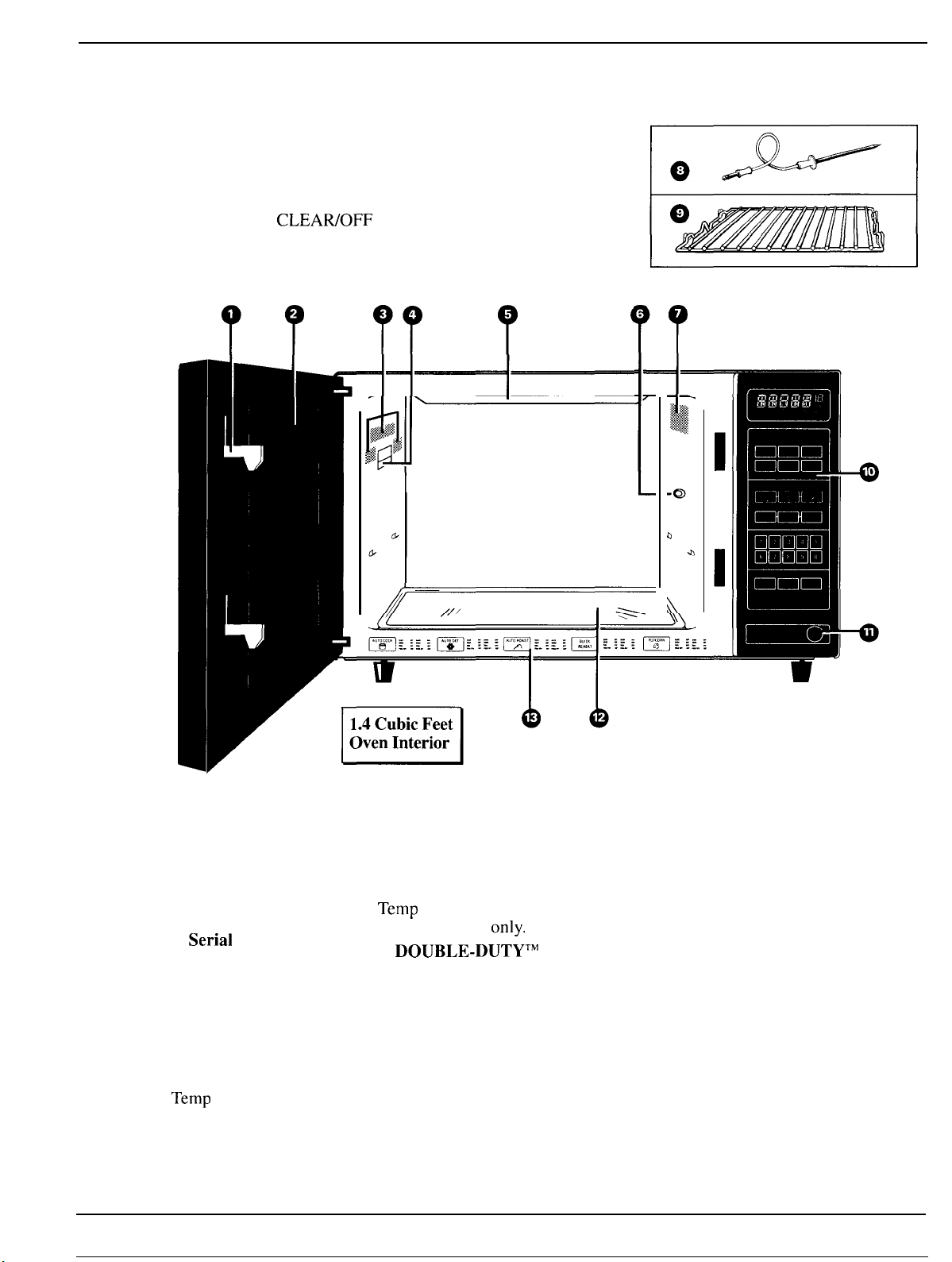
1. Door Latches.
2. Door Screen. Metal screen
permits viewing of foods and keeps
microwaves confined inside oven.
3.
Oven Vent.
4. Model and
Serial
Numbers.
5. Mode Stirrer Cover. Protects
the microwave energy distributing
system. Do not remove this cover.
You will damage the oven.
6. Receptacle for Temperature
Probe. Temperature probe must be
securely inserted into receptacle
when using
Temp
Cook & Hold or
Auto Roast.
7. Oven Interior Light. Turns on
when the door is opened or when
the oven is operating.
8. Temperature Probe. Use with
Temp
Cook & Hold and Auto
Roast functions
only.
9.
DOUBLE-DUTYTM
Shelf. Lets
you microwave several foods at
once. (See Safety Instructions and
Double Duty Shelf pages for
special instructions.) Use this shelf
only when cooking foods on two
levels.
10. Touch Control Panel and
Display. See next page for
instructions.
11. Door Open Button. Push to
open door.
12.
Glass Cooking Tray.
Tray
must be in place when using the
oven. Cooking performance will
be unsatisfactory without the tray
in place. The tray may be removed
for cleaning.
13. Automatic Cooking Guide.
Quick reference codes for many
frequently prepared foods.
6
Your Touch Control Panel
Tht
you
the
!
Toucl
to set
touch
h
Control Panel allows
the oven controls with
of a finger.
It’s designed
to be easy
to
use
aid
understa~d.
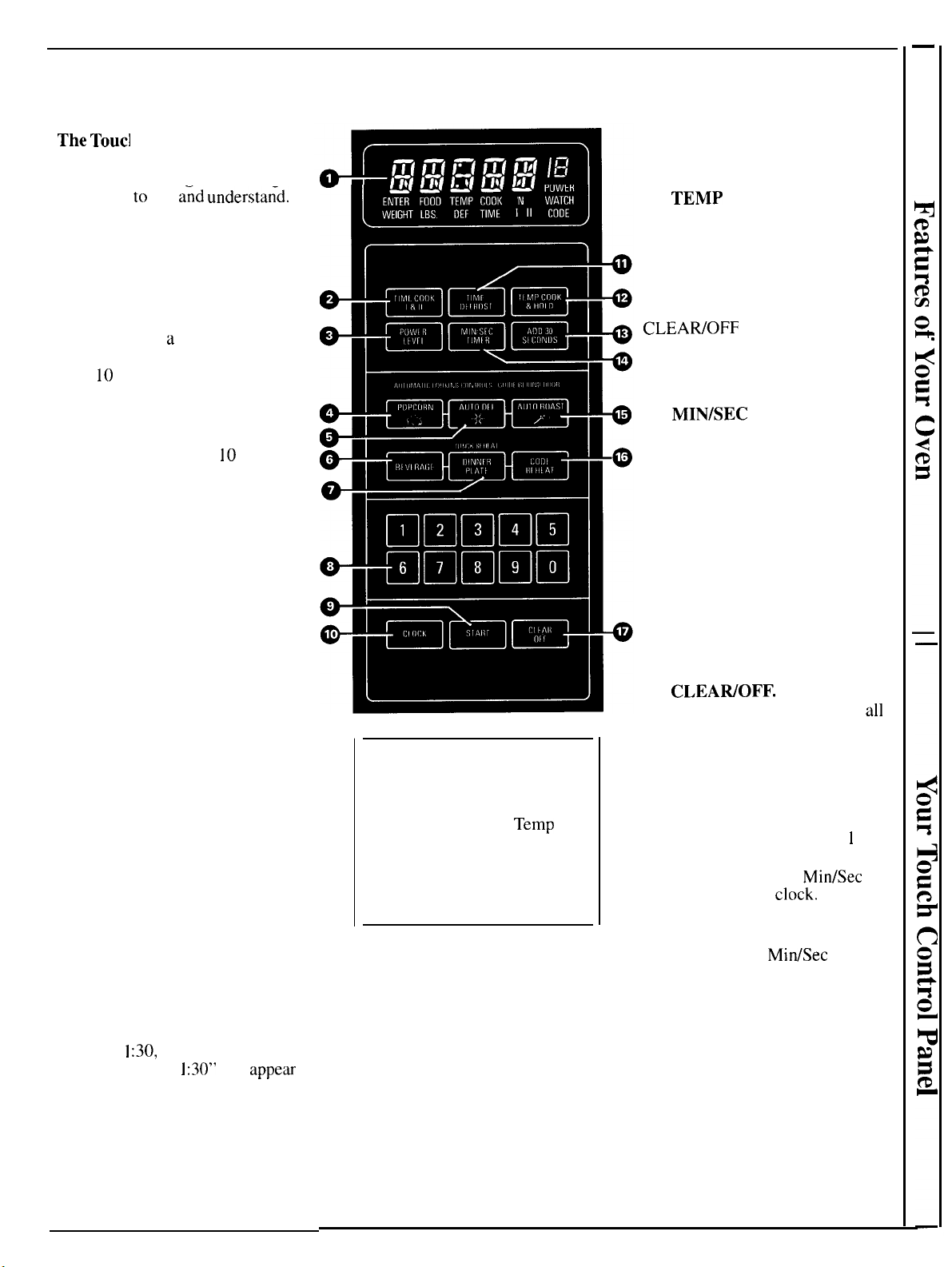
1. DISPLAY. Displays time of
day, time or temperature during
cooking functions, power level
being used, cooking mode and
instructions.
2. TIME COOK I & II.
Microwave for
a
selected amount
of time using automatic power
level
10
(High).
3. POWER LEVEL. Touch this
pad after you enter the cooking
time if you want to change from
automatic power level
10
(High).
4. POPCORN. Cook prepackaged
microwave popcorn by just
pressing this pad. The microwave
popcorn feature is designed to be
used only with prepackaged
microwave popcorn weighing 3.0
to 3.7 ounces.
5. AUTO DEFROST. Touch this
pad and enter food weight. The
oven automatically sets power
levels and defrosting time.
6. BEVERAGE. Reheat a
beverage by just pressing this pad.
7. DINNER PLATE. Reheat a
plate of leftovers by just pressing
this pad.
8. NUMBER PADS. Touch these
pads to enter cooking or defrosting
times, time of day, temperature,
power level, Auto Codes, or food
weights for Auto Defrost.
9. START. After all selections
are made, touch this pad to start
the oven.
10. CLOCK. Touch this pad to
enter time of day or check time of
day while microwaving. To set
clock, first touch CLOCK pad and
then enter time of day. For example,
if time is
I
:30,
touch number pads
1, 3, and O and “
1
:30”
will appem
in display. Then touch START pad.
To reset or change time, simply
repeat this process.
“PROBE” Appears on
Display:
● Probe has been forgotten
when Auto Roast or
Temp
Cook & Hold function is being
used.
● Probe is not securely seated
in oven wall receptacle.
11. TIME DEFROST. Gentle
thawing at automatic power level 3
(Low).
12. TEMP COOK& HOLD.
Use the temperature probe to cook
by using a preset temperature.
Once food reaches preset
temperature, oven switches to
HOLD setting and maintains that
temperature until you touch the
CLEAWOFF
pad.
13. ADD 30 SECONDS. Press
this pad to add 30 seconds to the
cook time as it’s counting down.
14. MIN/SEC TIMER. This
feature uses no microwave energy.
It functions as either a kitchen timer,
as a holding period after defrost or
as a delay timer before time or
temperature cooking.
15. AUTO ROAST. Insert probe,
touch this pad, and desired number
pad for code to slow-cook meat
with automatic preset program.
16. CODE REHEAT. Use Code
Reheat for quick reheating of a
variety of foods using different
times and power levels.
17.
CLEAWOFF. When touched,
it shuts off the oven and erases
all
settings (except time of day).
Program Cooking
Use your Touch Control Panel to
Time Defrost or Time Cook with
choice of power levels from
1
(lowest) to 10 (highest), time
kitchen tasks with the
Min/Sec
Timer, and set the
clock.
Create your own programs to suit
your individual cooking style. For
example: use the
MitiSec Timer to
delay the start of Time Cook I & 11
or program a hold time between
Time Defrost and Time Cook
I & 11. Set Time Cook I & 11 for a
two-stage program using different
times and power levels.
7
Defrosting by Time
Time Defrost is designed for
speedy thawing of frozen food
and is one of the great advantages
of a microwave oven.
Use the Time Defrost setting to
quickly thaw foods such as bread,
rolls, vegetables, fruits and frozen
dinners. The Auto Defrost setting
is preferred for meat and poultry
because the oven sets the defrosting
time and power levels for you.
● Power level
3
is automatically set
for defrosting, but you may change
this for more flexibility.
● See your Defrosting Guide for
defrosting help.
To become better acquainted with
the defrost function, defrost a 10 oz.
package of frozen strawberries by
following the steps below.
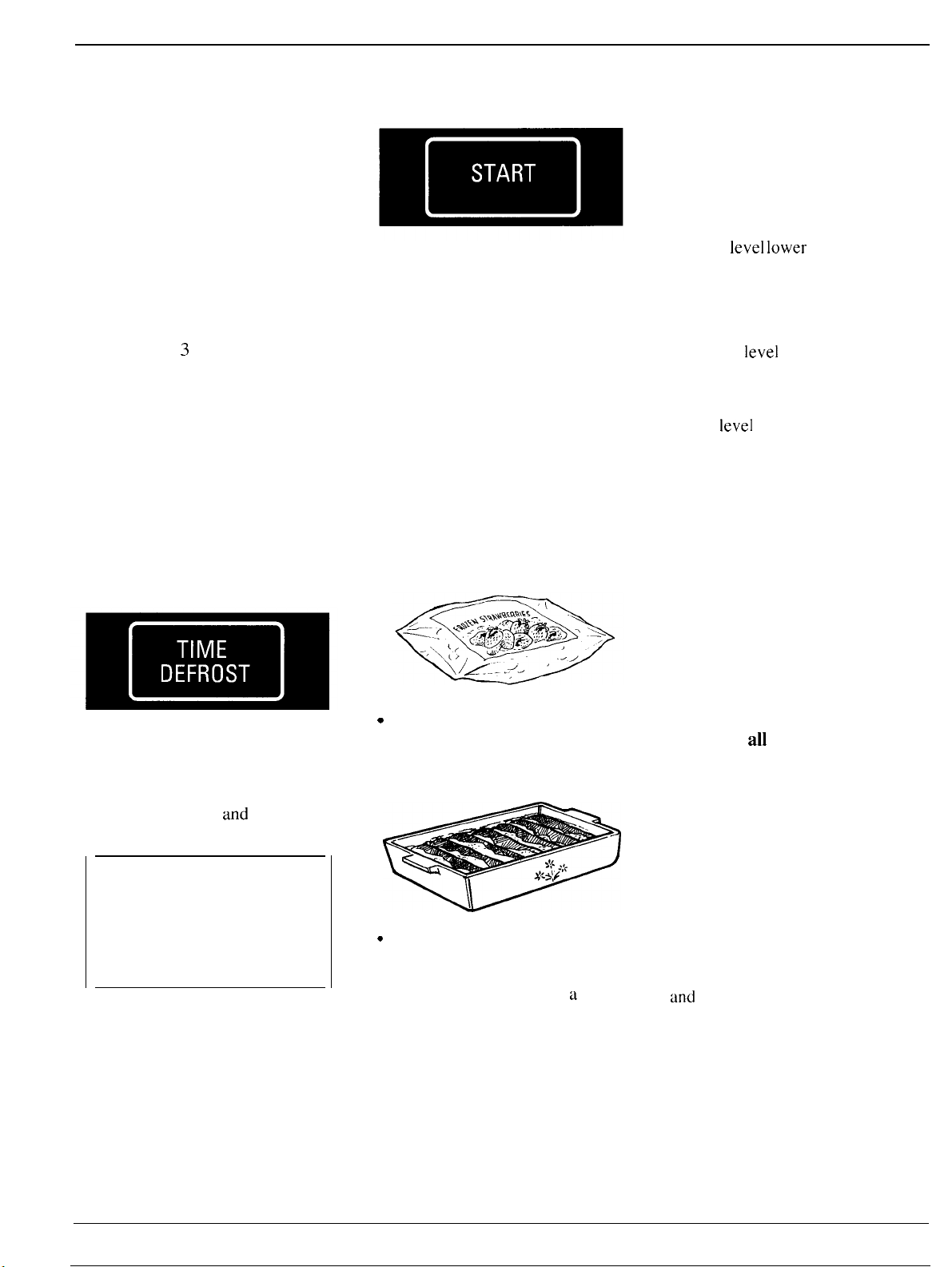
Step 1: Place a package of frozen
strawberries in the oven and close
the door. Be sure the package
contains no metal.
Step
2:
Touch TIME DEFROST.
Step
3: Select one half of the total
defrosting time recommended
in the Defrosting Guide. For
example, touch 4, 0
and
O for
4 minutes.
How to
Change Power Level
After setting defrosting time,
touch POWER LEVEL pad,
then touch desired number for
new power level.
Step
4: Touch START. When the
cycle is completed, the oven
signals and flashes “End,” then
automatically shuts off.
Step 5: Turn the package over,
close the door and repeat Steps 2
and 3 to set the remaining half of
defrosting time and touch START.
Step 6: When the oven signals and
flashes “End,” open the door,
remove the package and separate
strawberries to finish defrosting.
Defrosting Tips
● Foods frozen in paper or plastic
can be defrosted in the package.
“
For even defrosting, some foods
need to be broken up or separated
part of the way through the
defrosting time.
“
Family-size, pre-packaged frozen
dinners can be defrosted and
microwaved. If the food is in a
foil container, transfer it to
a
microwave-safe dish.
● Check your Defrosting Guide for
other defrosting tips.
Questions and Answers
Q. When I press START, I hear a
dull, thumping noise. What is it?
A. This sound is normal. It is
letting you know the oven is using
a power
level
lower
than 10 (High).
Q. Can I defrost small items in a
hurry?
A. Yes, but they will need more
frequent attention than usual. Raise
the power
level
after entering the
time by touching the desired power
level pad. Power level 7 cuts the
total defrosting time in about 1/2;
Power
level
10 cuts the total
defrosting time to approximately
1/3. During either, rotate or stir
food frequently.
Q. Why don’t the defrosting
times in the Defrosting Guide
seem right for my food?
A. These times are averages.
Defrosting time can vary according
to the temperature in your freezer.
Set your oven for the time
indicated in the Defrosting Guide.
If your food is still not completely
thawed at the end of that time,
reset your oven and adjust the time
accordingly.
Q. Should
all
foods be completely
thawed before cooking?
A. Some foods should not be
completely thawed before cooking.
For example, fish cooks so quickly
it is better to begin cooking while
it is still slightly frozen.
Q. Can I open the door during
defrosting to check on the
progress of my food?
A. Yes.
You may open the door at
any time during microwaving. To
resume defrosting, close the door
and
press START. The oven begins
operating if time is left on timer.
If not. reset timer.
8
Cooking by Time
Time Cook I & II allows you to
microwave for a selected amount
of time.
Power level
10
(High) is
recommended for most cooking,
but you may change this
for
more
flexibility. See your Cooking Guide.
To become better acquainted with
time cooking, make a cup of coffee
by following the steps below.
Step 1: Fill a cup 2/3 full of
water, add
1
teaspoon of instant
coffee and stir to dissolve. Use a
cup that has no metal decoration
and is microwave-safe (refer to
Microwaving Tips in the Safety
Instructions section). Place cup in
oven and close door.
Step
2: Touch TIME COOK 1 & II.
Step 3: Select your time. Touch 1,
0 and O pads for one minute.
Because automatic power level 10
is recommended for this cup of
coffee, there is no need to change
the power level. (If power level 10
is not appropriate, see “How to
Change Power Level” at right.)
Step 4:
Touch START.
Step 5: When time is up, the oven
signals and flashes “End.” Oven,
light
and fan shut off.
Step 6: Open the door.
Using the Time Cook II
Feature
The Time Cook II feature lets you
set two time cooking functions
within one program. This is ideal if
you want to change power levels
during your cooking operations.
Here’s how
to
do it:
Step 1: Place food in oven in
microwave-safe container and
close the door.
Step 2:
Touch TIME COOK 1 & II.
Step 3: Select your first cook time.
For example, touch 2,
1
and 5 for
two minutes and 15 seconds.
Step
4: Touch TIME COOK I & 11.
Step 5: Set your cooking time.
How to Change Power Level
After setting cooking time,
touch POWER LEVEL pad,
then touch desired number for
new power level.
Step
6: Touch START.
Step 7: “POWER 10” is displayed
and “COOK TIME I“ counts
down.
Step 8: At the end of “COOK
TIME I,” the second power level
is displayed and “COOK TIME II”
is shown counting down.
Step 9: When time is up, the oven
signals and flashes “End.” The
oven, light and fan shut off.
Step 10:
Open the door.
The Express Cook Feature
The Express Cook feature is a
short-cut method to set time for
1–5 minutes.
To Express Cook your food or
beverage:
Step 1: Touch a number pad (from
1 to 5) that corresponds with the
amount of your desired cooking
time (in minutes). For example,
touch the 2 pad for 2 minutes of
cooking time.
Step
2: Touch the START pad.
The oven will automatically signal,
flash “End” and shut
off at the end
of the programmed time.
Add 30 Seconds
The Add 30 Seconds feature
provides a convenient way to
extend cooking time by 30 seconds
while the oven timer is counting
down. It will add 30 seconds to
the time shown each time the pad
is touched.
9
How to Use the Minute/Second Timer
The MIN/SEC TIMER has three
timing functions:
● It operates as a minute timer.
● It can be set to delay cooking.
● It can be used as a hold setting
after defrosting.
The MIN/SEC TIMER operates
without microwave energy.
How to Time a 3-Minute
Phone Call
1. Touch MIN/SEC TIMER
pad.
2. Touch number pads
3,
() and
0
(for
3
minutes and no seconds).
3. Touch START. Display shows
time counting down.
4. The timer signals when
time is up.
Using a Holding Time
The Minute/Second Timer can also
be used
to
program a “holding
time” between microwave cooking
functions. The time can range from
one second to 99 minutes and 99
seconds. A holding or standing time
may be
found
in some of your own
recipes or in the Cooking Guide.
Programming Delayed
Cooking
To delay cooking up to 99 minutes
and 99 seconds, touch either TIME
COOK I & II,
TEMP COOK &
HOLD or AUTO ROAST and
enter cook time, temperature or
code. Touch MIN/SEC TIMER
and enter number
of minutes to
delay cooking. When delaying
Temp
Cook & Hold or Auto
Roast cooking, be sure probe is
in food.
Touch START. Timer will
count down to zero and cooking
will begin.
How to Defrost, Hold and
Time Cook
Let’s say you want to defrost a
frozen casserole for
I
5 minutes,
hold
for
10 minutes and then Time
Cook for 25 minutes. Here’s how to
do it:
Step 1: Take the casserole from
the freezer and place it in the
oven,
m
Step 2: Touch TIME DEFROST.
Step 3: Touch pads 1,5,0 and O
for 15 minutes defrosting time.
(Defrosting is automatically set on
power level
3
but can be changed
by touching the POWER LEVEL
pad and the desired power level.)
~m~
Step
8: Touch START. As
each function is automatically
performed, oven display shows
instructions entered and the
function. When time is up, the
oven signals and flashes “End.”
Questions and Answers
Q. What will happen if I
accidentally reverse my defrost,
hold and cook instructions?
A. The oven will automatically
rearrange your program. Defrosting
will
always
come first, then hold,
and then the cooking function.
Q. Can I defrost and hold only?
A. Yes. Sometimes you may only
want to defrost a
food,
hold it, and
cook it later.
All
you need to do is
program in defrost and
amount
of
time. Then program the hold time
and the amount
of
cooking time.
Be sure to put the thawed dish in
the refrigerator promptly.
NOTE: Let foods remain at room
temperature
only
as long as safe.
Times
will
vary.
Q.
I
programmed my oven for
a specific defrosting time but it
defrosted longer than necessary.
What happened?
A. When instructions conflict, the
oven carries out the last instruction.
You may have set the oven to
defrost for 4 minutes, hold
for
2
minutes, and then defrost for
6
minutes. In this case, the oven
would
defrost for
6
minutes and
hold for 2 minutes.
10
Cooking by Temperature
Internal temperature is the best
test of doneness for many foods.
Use Temp Cook& Hold to cook
a variety of foods to the desired
finished food temperature. The
Time Cook I & II setting is
recommended for batters,
doughs, frozen foods and foods
which are difficult to cook
precisely with the probe.
Temp Cook & Hold takes the
guesswork out
of cooking, because
~he
oven automatically switches
to “Hold” setting after reaching
the preset food temperature and
maintains that temperature until
you touch the CLEAR/OFF pad.
NOTE: Oven automatically
switches to “Hold” when preset
food temperature is reached.
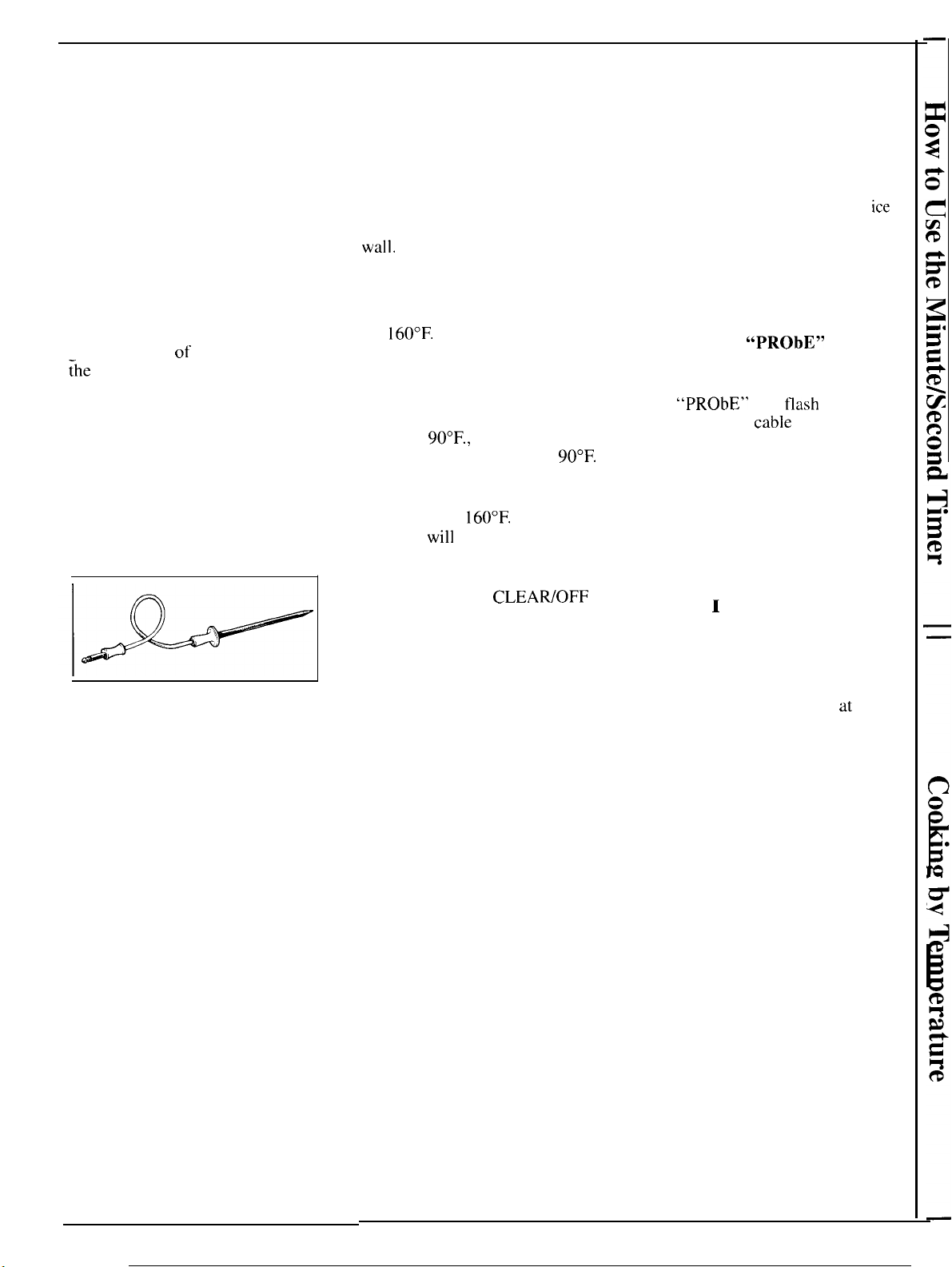
The Temperature Probe
The temperature probe is a food
thermometer that gauges the
internal temperature of the food.
(Its appearance may vary from
picture above.) The probe must be
used when using Temp Cook &
Hold or Auto Roast. To use the
probe properly, follow directions in
the Automatic Roasting section.
How to Temp Cook a
Rolled Beef Rib Roast
to Medium
Step 1: Insert temperature probe
and attach probe securely in oven
wall.
Close the door.
Step 2: Touch TEMP COOK &
HOLD pad.
Step 3: Touch 1,6 and O
for
160°F.
Step 4: Touch POWER LEVEL
pad. Touch 5 for medium power.
Step 5: Touch the START pad. If
internal temperature of the roast is
less than
90°F.,
display will show
“COOL”; if temperature is
90°F.
or above, display shows
temperature counting up.
Step 6: When
160°F.
is reached,
the oven
will
sound and display
“Hold.” The oven will then hold
the temperature.
Step 7: Touch the CLEAWOFF
pad to stop the cycle.
Step 8: Remove probe and food
from the oven.
Questions and Answers
Q. Are there any foods I can’t
Temp Cook?
A. Yes. Delicate butter icings,
ice
cream, frozen whipped toppings,
etc., soften rapidly at warm
temperatures. Batters, doughs and
frozen
foods are also difficult to
cook precisely with the probe. It’s
best to Time Cook these foods.
Q. Why did “PRObE” flash on
the display after I touched the
START pad?
A. “PRObE” will
flash
if you
don’t seat the
cable
end of the
probe securely into the receptacle
in the oven wall or if you touch the
TEMP COOK & HOLD pad and
forget to use the probe.
Q. Can I leave my probe in the
oven if it’s not inserted in food?
A. No, if it touches the oven wall,
it may damage the oven.
Q. Can
I
Temp Cook different
portions of food at different
temperatures?
A. Yes. The temperature probe
gives you the freedom to-cook
different portions of food
at
different temperatures to suit
individual eating styles. Simply
place probe in food and change
temperature setting as needed.
Cooking Tips
● Use a lower power level; foods
will heat more evenly though
requiring more time.
● Be sure frozen food has been
completely defrosted before
inserting probe. Probe may break
off if used in frozen foods.
● Cover foods loosely for moisture
control and quick, even heating.
11
Automatic Roasting
Auto Roast uses the temperature
probe to cook to the desired
serving temperature. Unlike
Temp
Cook & Hold, which uses
a single power level, Auto Roast
uses up to 3 power settings which
autom-atically
switch during
roasting, thus providing even,
tender cooking results without
overcooking.
Just
as
in conventional roasting,
only tender roasts should be
Auto Roasted until specified
internal temperatures are reached.
Less tender roasts should be
microwaved by time, according to
the Cooking Guide.
Preparing Roasts for
Auto Roasting
Place tender beef roast in cooking
ba~
on trivet in microwave-safe
dis~.
(Refer to package instructions
for proper use of cooking bag.)
Insert probe through cooking bag
horizontally into the center meaty
area not touching bone or fat.
Make sure the handle does not
touch the food or top or sides of
the oven.
Place meat in oven with probe to
the right. Insert cable end of probe
firmly into receptacle on oven wall.
How to Auto Roast Beef
Roast to Medium
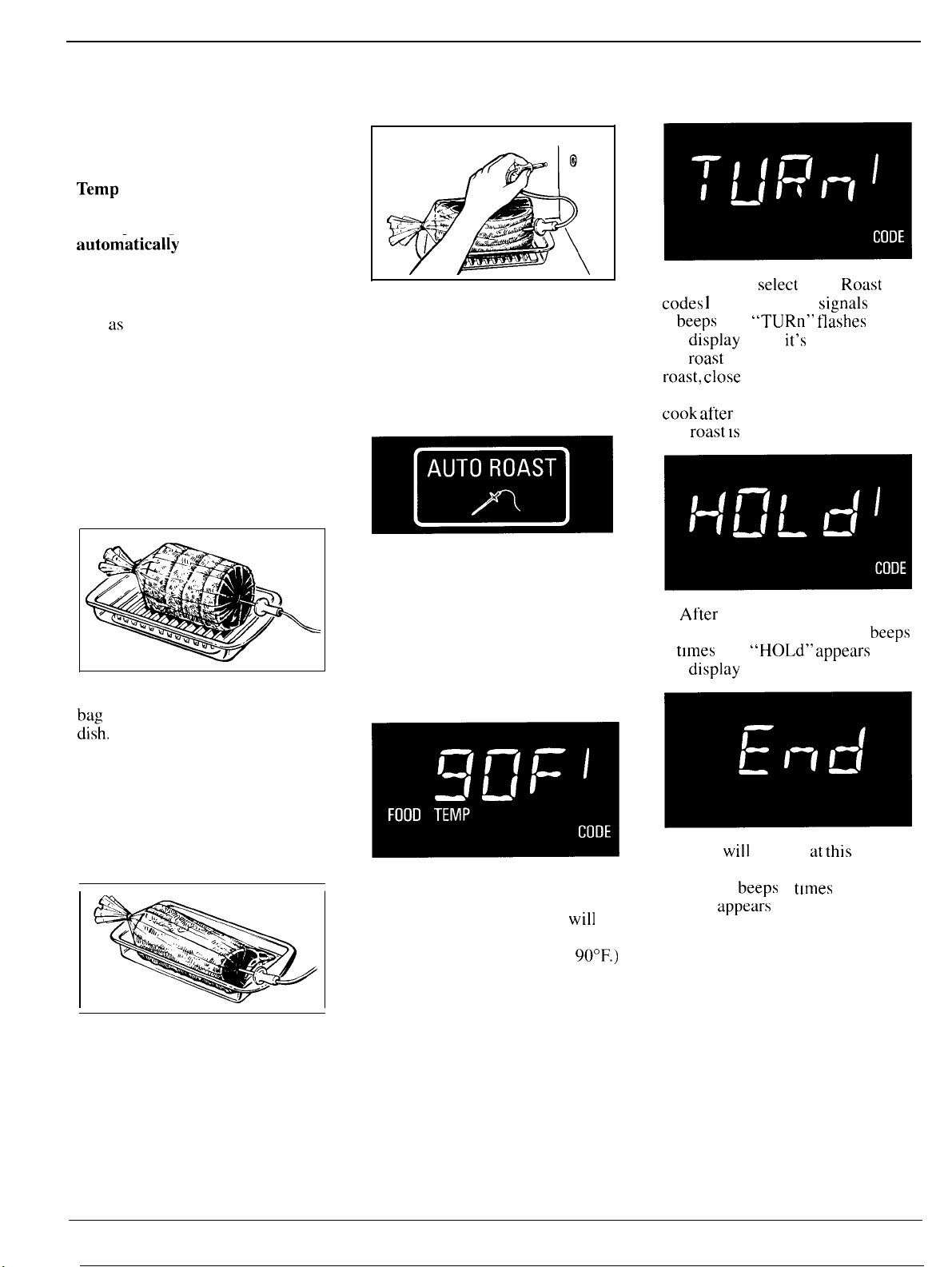
1. Touch AUTO ROAST pad.
Touch number pad 1. “1“ and the
selected doneness code—in this
case, “MEd”- appear on the
display. “CODE” flashes. After 4
seconds, “START” flashes on the
display. Touch START. (See “Auto
Roast Guide” for complete list of
recommended codes. )
Note: By touching the AUTO
ROAST pad during cooking, the
meat’s internal temperature
will
be
displayed. (“COOL” will be
displayed until meat reaches
90°F.)
When pad is released, doneness
code reappears on the display.
2. When you
select
Auto
Ro~\t
code~
I
or 2, the oven
slgnal$
with
4
beep~
and “TURn”
fld~he$
on
the
dlspldy
when
lt’$
time to turn
the
roast
over After you turn the
roa~t,
clo~e
the door and touch
START (Note Oven continues to
cook
atter the signal whether or
not
rod$t
IS
turned over)
3.
After a pre-programmed food
temperature 1$ reached, oven
beeps
4
t]me$
and “HOLd”
appedr~
on
the
dl$play
4. Food
WIII
be held
at
th]s
temperature for 60 minutes The
oven then
beep~
4
tlme$
and
“End”
appear~
Place pork roast in cooking bag
and place in microwave-safe dish.
12
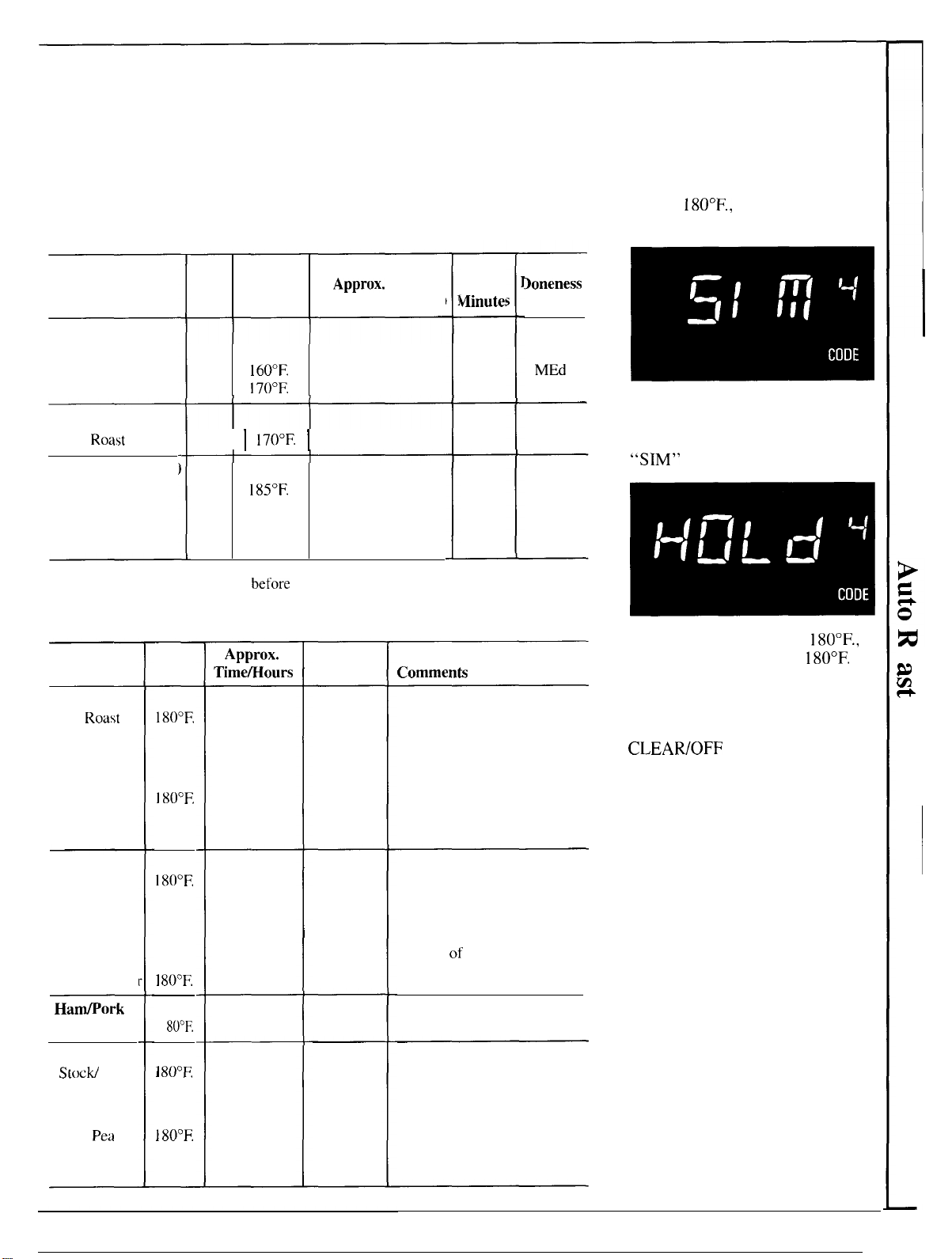
Automatic Simmer
(Auto Roast Code 4)
Auto Roast Guide
● Place meats in a cooking bag in microwave-safe dish. (Refer to package
instructions for proper use of cooking bag.)
● Recommended codes are shown on guide behind door, on front of oven.
● Insert probe as described in the Automatic Roasting section.
Total time includes time to bring
food to
180°F.,
and hold at that
temperature until done.
Minimum
Final
Approx.
Time
Code
Temp.
(minutes per pound)
Hold*
Minute!
loneness
Display
MEd
WELL
Food
Beef (5 lb. max.)
Tender Roast
Medium
Well
1
160°F. 13-15
2 1700F.
15-17
0
5-1o
Set Auto Simmer like Auto Roast
as explained in the Automatic
Roasting section. Display shows
“SIM” and “CODE 4.”
Pork (5 lb. max.)
Loin
Roast
Poultry (6 lb. max.
Turkey Breast
(Insert probe
horizontally into
meatiest area.)
2
]
170°F.
I
15-19
10
WELL
3
185°F. 17-20
WELL
10-15
*Recommended standing time
before serving.
Automatic Simmer Guide
(Auto Roast Code 4)
Oven switches to Hold at
180°F.,
and continues holding at
180°F.
until you remove food and turn off
oven. If stirring is recommended,
you can restart oven by touching
the START pad again. Touch
CLEAWOFF pad after cooking.
Final
Temp.
Approx.
TimeMours
Doneness
Display
o
g
Food
Commenk
Beef
Pot
Roast
1800F.
180”F,
180°F.
I
800F.
1
80°F.
1
So°F.
180°F.
5-7 SIM
Add enough liquid to just
cover meat. If adding
vegetables make
sure they are
completely covered by liquid.
Precook meat. Place probe
1 inch from top surface. Stir
after 3 hours, if possible.
Chili
5-8
SIM
Chicken
Stewing
4-6
SIM
Add 4 cups liquid. Insert
probe into meatiest area of
inner thigh from below end
and parallel to leg. Turn over
after l/2
of time.
Same procedure as above.
Add 4 cups liquid.
Broiler/Frye]
3-4
SIM
Haflork
Roast
soup
Stocu
Vegetable
Split
Pea
4-6
SIM
7-10
5-7
SIM
SIM
Make sure that vegetables and
meat are covered by liquid.
Stir every 3 hours.
Add enough liquid to cover
peas at least 2 inches. Stir
after 3 hours.
13
Auto Defrost
With the Auto Defrost feature,
the oven automatically sets the
defrosting times and power
levels for you.
Use
the
Auto Defrost guide on the
next page. Enter the food weight in
pounds and tenths of a pound (see
Conversion Guide at right). Then
touch START pad.
The oven calculates defrosting
time
and
changes power levels
during defrosting to give even
defrosting results.
How to set Auto Defrost
Before you begin, check the
guide located at front of oven
when you open the door.
It
shows
minimum and maximum food
weights for a variety of foods.
You will need to know your food
weight
before setting Auto Defrost.
1. Remove
food
from package,
place in oven on microwave-safe
dish and close door.
~m~
2 Touch AUTO DEF pad
14
3. Enter weight. For example,
touch number pads 1 and 2
for
weight
of 1.2 pounds ( 1 pound,
3
ounces.
See Conversion Guide at right.)
~m~
4. Touch START
pad
D1\play
$hows
defrost time counting down
Twice during defrosting, the
oven beeps 4 times and “TURn”
flashes.
Follow the directions in
the Auto Defrost Guide for what to
do at the first and second signal.
Then close the door and touch
START. (Defrosting continues
during “TURN” display.)
When defrosting time is completed,
“End” flashes and oven beeps 4
times. “End” remains on display
and oven beeps every minute
until
door is opened or CLEAR/OFF
pad is touched.
Stand Time
After Auto Defrosting, meat needs
to stand in order to
le~
the inside
defrost. You may take the food out
of the oven if you wish. Stand time
recommendations are given in the
guide on the next page.
Conversion Guide
If the weight of food is stated in
pounds and ounces, the ounces
must be converted to tenths
(.
I
) of a pound.
Ounces
Pounds
1–2
.1
6-7
.4
8
.5
I
I
9-1o
.6
I
I
11
.7
12-13
.8
1415
.9
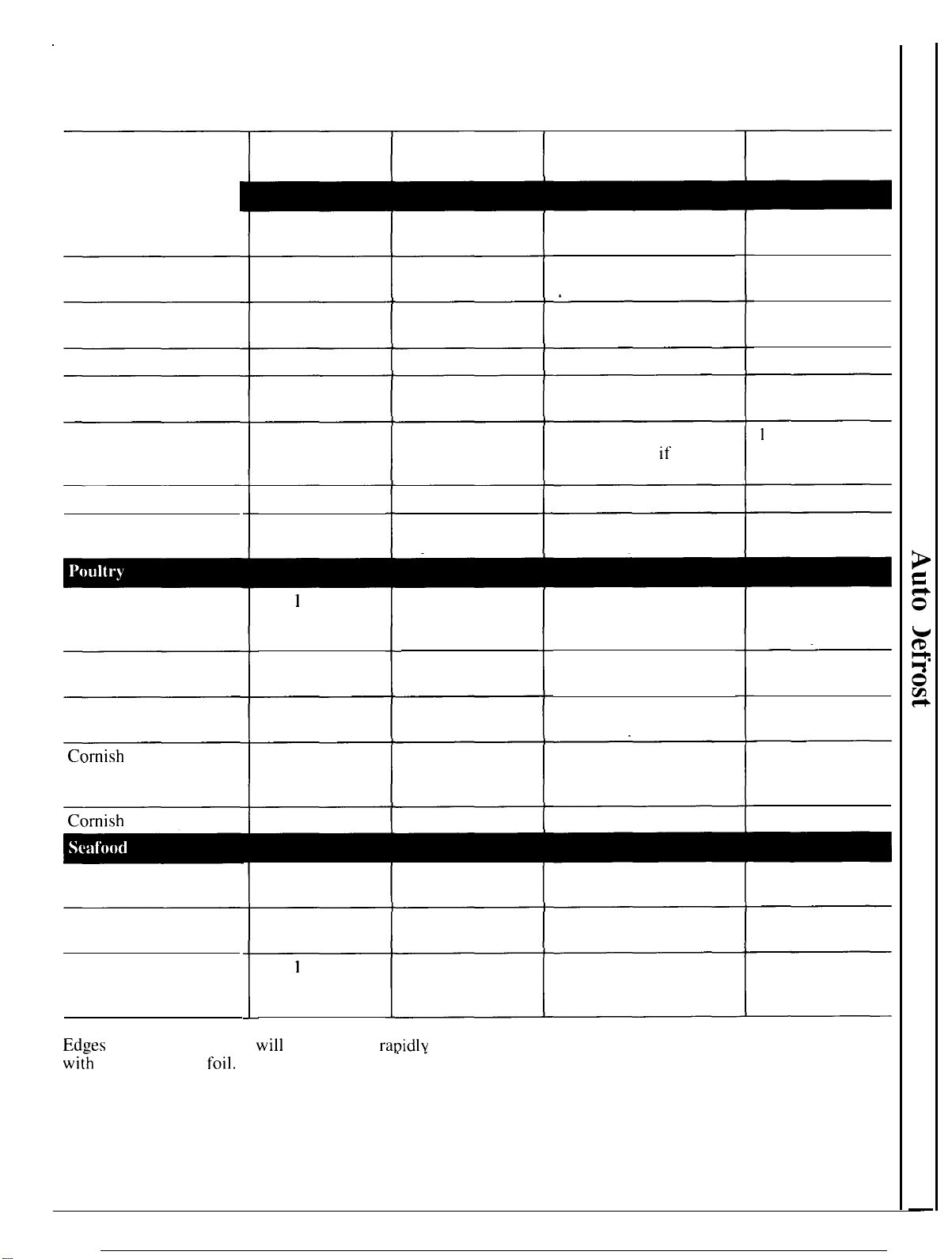
Auto Defrost Guide
SECOND SIGNAL
RECOMMENDED
FOODS
MIN.-MAX.
WEIGHT FIRST SIGNAL
STAND TIME
I
Chops
0.1 -6.0 Ibs.
Turn over. Separate and shield
where necessary.
Remove defrosted
pieces.
5 minutes
2 minutes
5 minutes
5 minutes
Frankfurters, Sausage 0.1 -6.0 lbs.
Separate.
Ground Meat 0.1 -6.0 lbs.
Turn over.
Remove defrosted areas
and break apart.
Beef Patties
0.1 -6.0 lbs.
Separate patties.Turn over.
Shield if necessary.
90 minutes
Roast
0.1 -6.0 lbs.
Turn over and
shield.
Ribs
0.1 -6.0 lbs.
Turn over.
Remove defrosted
pieces. Shield if
necessary.
I
O minutes
5 minutes
Steak
Stew
0.1 -6.0 lbs.
0.1 -6.0 lbs.
Turn over.
Turn over and
separate.
Separate and remove
defrosted pieces.
5 minutes
Whole Chicken
0.
I
-6.0 Ibs.
Turn over and
shield.
Turn over.
Turn over and shield.
10 minutes;
run cold water
in cavity.
0.1 -6.0 lbs.
Shield where
necessary.
Separate and remove
defrosted pieces.
Turkey Breast
(breast side up)
20 minutes in
refrigerator
5 minutes
Chicken Pieces
0.1 -6.0 Ibs.
Turn over.
Cornish
hens (whole) 0.1 -6.0 lbs.
Remove wrapper
and turn over.
10 minutes;
run cold water
in cavity.
5 minutes
0.1 -6.0 lbs.
Cornish
hens (split)
Turn over.
Separate and remove
defrosted pieces.
5
minutes
Fish fillets
0.1 -6.0 lbs.
Turn over.
5 minutes
Shrimp, scallops
0.1 -6.0 lbs.
Separate.
Separate and remove
defrosted pieces.
Whole fish
Hold under
cold running
water.
0.
I
-6.0 Ibs.
Turn over and
shield tail and
head.
Edges
or thin areas of meat
will
defrost more
rapidly
than other areas. After first or second signal, shield warm areas
.-
wik
small pieces of
foil.
15
—
How to Use the Double Duty
TM
Shelf
~
Use the shelf only when
cooking foods on 2 levels.
o
Do not store or cook with
shelf on floor of oven.
Product damage may result.
● Use pot holders when
handling metal shelf and
cookware. They may be hot.
c
Do not store microwave
browning dish on metal
shelf.
● Use of DOUBLE
DUTYr&’
shelf with Popcorn program
is not recommended.
The wire shelf is specifically
designed
for
added capacity
heating and reheating in your
microwave oven. Now more than
one food may be heated or
reheated and ready to serve
at
the
same time.
When microwaving with the oven
shelf,
some techniques will
differ
from the Cooking Guide. It is
important to arrange foods
pr;perly (shown on the next page).
Cookware size is important; select
from among the suggestions at
right. Also, food size should be
considered; foods over 4 inches
high, or
3X
pounds are not
recommended for shelf cooking.
Batters and dough foods and also
uncooked foods which need to be
prepared from scratch should be
cooked without the oven shelf,
following cookbook directions.
Use pot holders when handling
foods heated together with your
oven shelf, especially when
heating larger amounts of food.
16
Extra steam generated from
Positioning the Shelf
multiple food cooking may make
cookware hotter than with regular
microwaving.
l\~
Cookware for Shelf
Heating and Reheating
Before placing food in the dishes,
check to see that they will fit
together on or under the shelf.
Also, be sure cookware is
microwave safe.
Cookware for heating or reheating
include 1 cup measuring cup,
9x5x3-inch loaf dishes or 9-inch
pie plates.
Leftovers may be placed in small
individual ceramic or plastic bowls
or divided plates.
Use wax paper or plastic wrap
instead of lids on casseroles. Lids
may add too much height to dish.
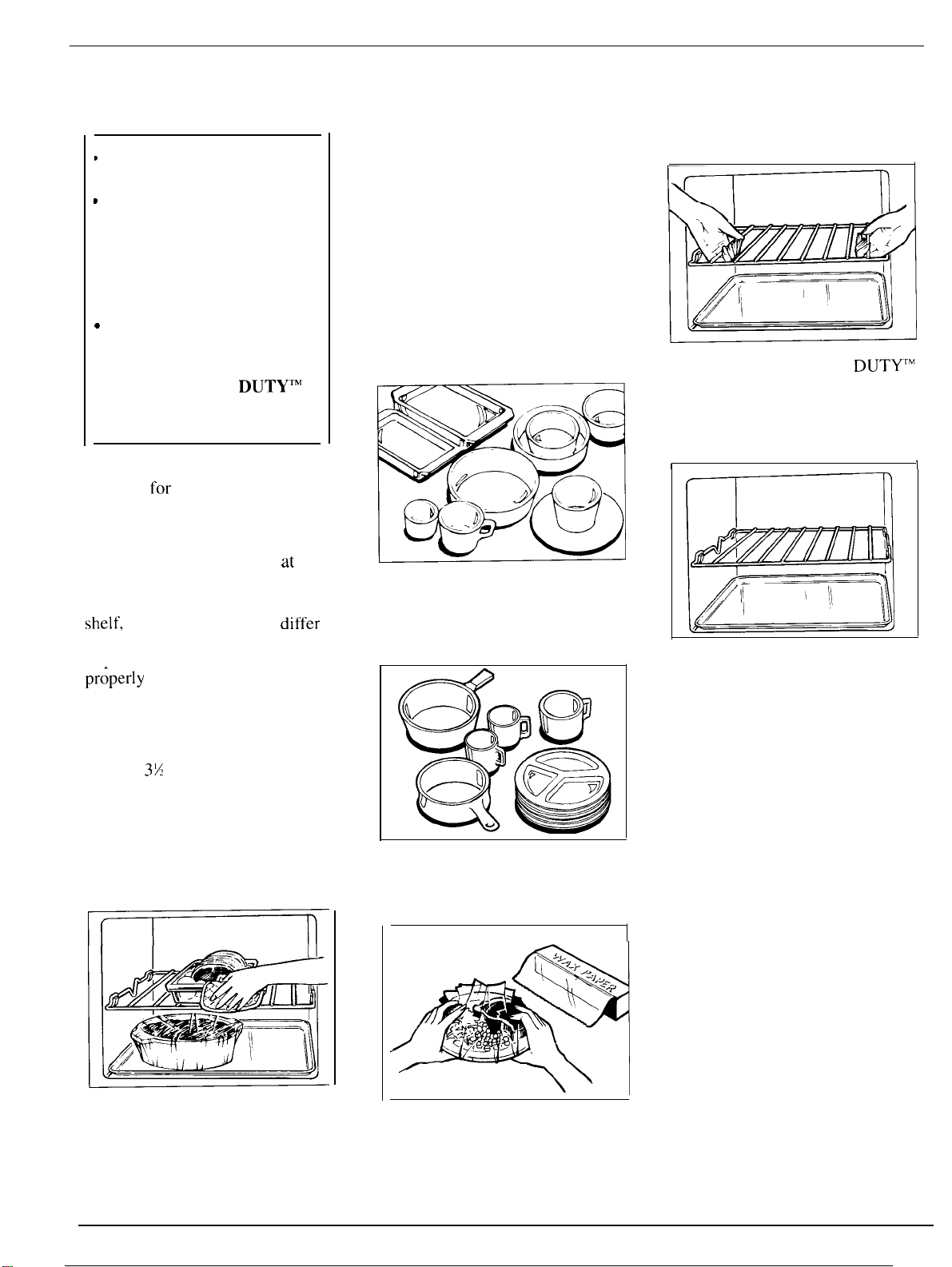
To position the DOUBLE
DUTY”’M
shelf, tip the back slightly and fit
the shelf support guides onto the
support guides located on each
side of the oven in the rear.
1
1
Next, lower the front until the shelf
support guides fit onto the support
guides located at each side of the
oven in the front.
When properly positioned, the
shelf should fit snugly in place, be
level and not touch the back or
side wall of the oven.
If arcing occurs when using the
shelf to cook more than one food
at the same time, turn the oven
off. Make sure the shelf is
positioned right-side-up on all
four shelf supports and not
touching oven walls.
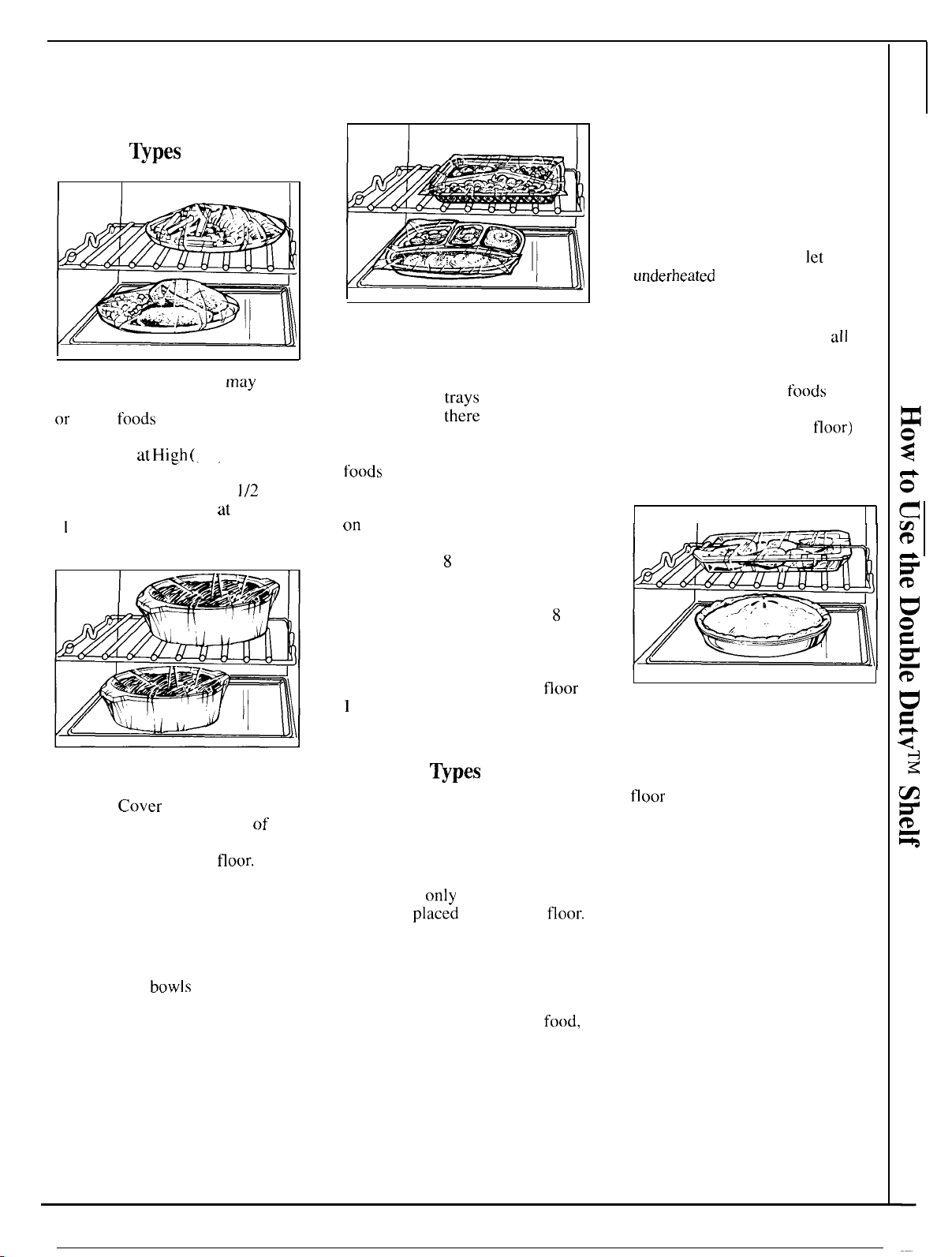
How to Heat or Reheat
Similar
~pes
of Food
Two plates of leftovers
may
be
reheated together. Arrange thick
or
dense
foods
to outside edges of
plate and cover with plastic wrap.
Microwave
at
High
(
10) for 3
u.,
minutes. Reverse position of plates
(top to bottom) and rotate
1/2
turn.
Continue microwaving
at
High
(
1
O) for 2 to 3 minutes. Continue
heating, if necessary, until hot.
Reheating two casseroles (height
should be less than 4 inches) is
possible. Cover with plastic wrap.
Use staggered arrangements
of
food, placing food on right side
of shelf and left side of
floor.
Refer to Heating or Reheating
Guide for suggested microwave
time per casserole and add the
times together. Microwave at High
( 10) reversing position of foods
(top to bottom) after half of time.
Several small
bowls
of leftovers
may be heated in the same way,
stirring and reversing positions
after half of time.
Two frozen individual entrees
(5 to 7 oz. each) or two TV
dinners (10 to 12 oz. each) are
both ready to serve at the same
time. Remove
travs
of food from
their boxes. If
th~re
are foil covers,
remove them and return the trays
of food to their boxes. (Batter
foods
should be removed from the
trays and cooked conventionally.)
Place in oven with one TV dinner
on
right shelf and the second
dinner on left floor.
Microwave at
High ( 10) for
8
minutes, Reverse
positions (top to bottom) and rotate
foods
l/2 turn. Continue
microwaving at High ( 10) for
8
minutes. Check dinners for
heating. If one dinner seems less
done than desired, return it to the
box and continue heating on
floor
I
to 2 more minutes.
How to Reheat Several
Different
~pes
of Foods
Together
When heating several different
types of food together, foods which
should be served hot must be
placed on the shelf, while foods
which need
only
to be warmed
should be
placed
on the oven
floor.
This is because microwave energy
enters the oven from the top only.
Also, it is important to remember
that foods absorb microwave
energy at different rates. Rates can
be affected by the size of the
food,
and its starting temperature.
Because of the varying rates, you
may need to start reheating a large
or dense food a few minutes ahead
of time, then add other smaller or
less dense foods. Alternately, if
one of the foods you are heating
seems undercooked but the others
are heated satisfactorily,
let
the
underheated
food continue cooking.
Heat or reheat different types of
food at High ( 10). To determine
heating times, add times for
all
foods together. (See Heating or
Reheating Guide.) After half of
time, stir or rearrange
foods
(do
not reverse positions). Check foods
(especially those on oven
floor)
after 3/4 of total time and remove
any which are done. Continue
cooking others.
Place on shelf large or dense foods
which need the most heating, such
as leftover fried chicken,
casseroles of canned or leftover
vegetables, rice or pasta. Place on
floor
those foods which need only
be warmed, such as bakery pies,
rolls, muffins or breads.
Pop popcorn on the microwave
oven floor only. Popcorn placed
on the oven shelf will not pop
properly. Use a special microwave
popcorn accessory or prepackaged
popcorn labeled for use in
microwave ovens.
17
Quick Reheat
The Quick Reheat feature is a
short-term program to automatically
reheat
a beverage or previously
cooked food. The oven turns off
automatically after a preset amount
of time.
Touch just
3
pads to use Code
Reheat codes 1 to 6 to reheat many
popular foods. See the guide at
bottom
of
page.
Or touch just 2
pads to use the BEVERAGE or
DINNER PLATE programs with
the oven automatically setting the
code for you.
Beverage
The Beverage program makes
it simple to reheat a cup of hot
chocolate or other beverage. Use a
cup
that has no metal decoration
and is microwave-safe (refer to
Microwaving Tips in the Safety
Instructions section).
Step 1: Touch BEVERAGE pad.
Step 2: Touch START pad. Oven
will signal and display remaining
time counting down shortly before
shut off.
Dinner Plate
The Dinner Plate program makes it
easy to reheat
a
plate of leftovers
or reheat
a
previously prepared
meal for a guest who arrived late
for
dinner.
Step 1: Touch DINNER PLATE.
Code Reheat Guide
Step 2:
Touch START pad. Oven
will signal and display remaining
time counting down shortly before
shut off.
Code Reheat
The Code Reheat program makes
it a snap to reheat many popular
foods. Choose a code number from
I
to 6 (see Code Reheat Guide
below).
Step 1:
Touch CODE REHEAT.
Step 2: Touch a number pad from
1 to 6 to select a food group.
Step 3:
Touch START pad. Oven
will
signal
and display remaining
time counting down shortly before
shut off.
To Reheat More Than
One Serving
Quick Reheat codes 1 through 5
and Beverage let you heat up to
three servings. To add more than
one serving, just touch number pad
2 or
3
right before touching START.
The serving size may even be
added after touching START. Just
touch number pad 2 or 3.
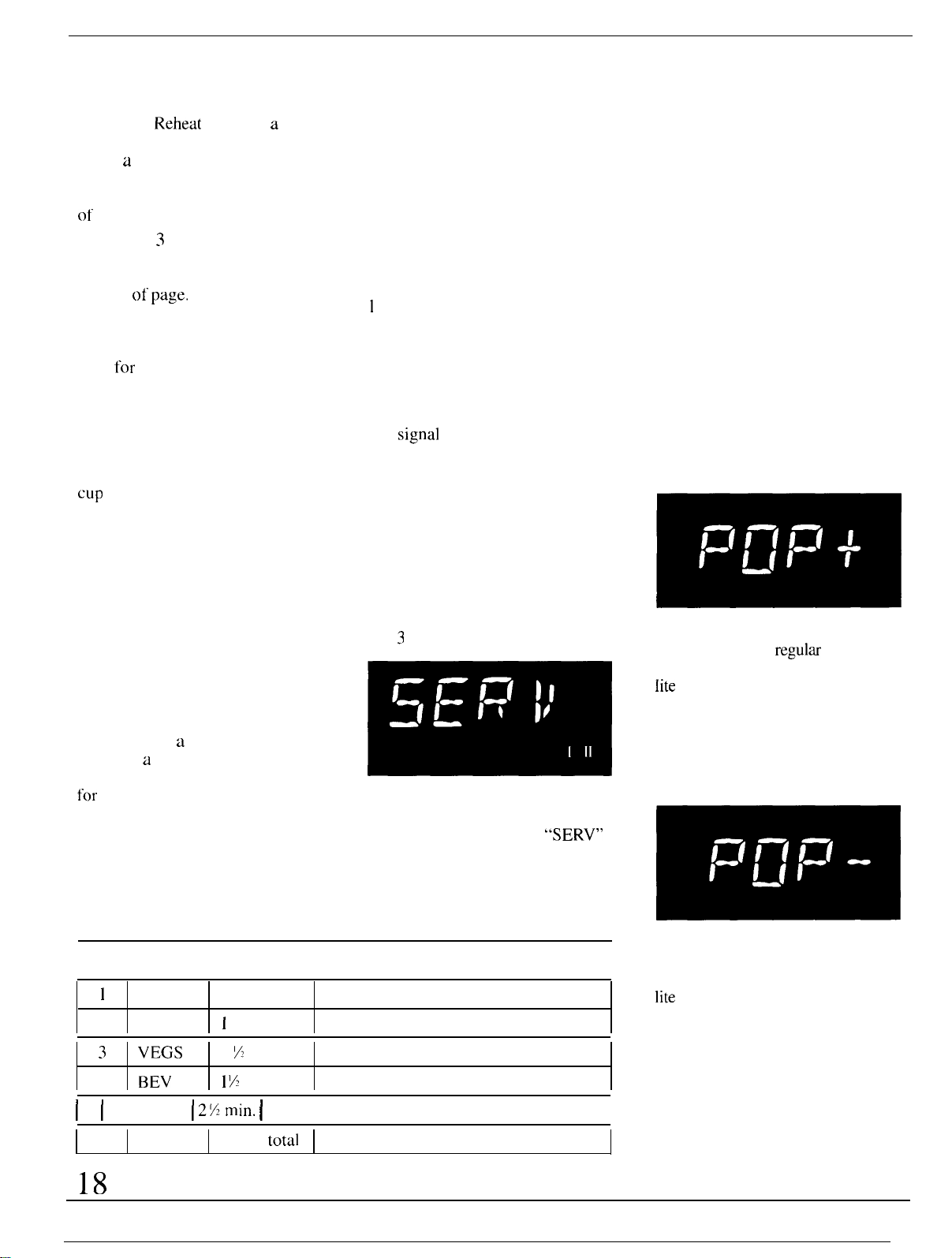
“SERV”
and a number will be displayed
briefly to show that serving size
has been changed.
II
I
Time
Code Display
per serving
Foods Recommended
I
BREAD
20 sec.
Breads, pastries, pies, bakery goods
2
MEATS
I
min. Meats, casseroles, pizza, solid foods
3
VEGS
1
k
min.
Fruits & vegetables
4 BEV
I
X
min.
Beverages
I
5
I
SAUCE
I
2fimin.
I
Soups, stews, sauces
I
Popcorn
Regular Microwave Popcorn
Step 1: Touch POPCORN pad.
Step 2: Touch START pad. Oven
will signal and display remaining
time counting down shortly before
shut off.
Light Microwave Popcorn
Step 1: Touch POPCORN pad.
Step 2:
Touch number pad 2.
Step 3:
Touch START pad.
Adjust for Shorter or
Longer Cook Time
If your favorite popcorn is
undercooked, try this:
Touch the POPCORN pad. Touch
number pad 1 for
regula
microwave
popcorn or touch number pad
2
for
Iite
microwave popcorn. Touch
number pad 9. A plus sign is
displayed. The plus sign indicates 20
seconds is added to cooking time.
If your favorite popcorn is
overcooked, try this:
Touch the POPCORN pad. Touch
number pad 1 for regular microwave
popcorn or touch number pad 2 for
Iite
microwave popcorn. Touch
number pad 1. A minus sign is
displayed. The minus sign indicates
20 seconds less cooking time is
being provided.
6
PLATE
4 min.
total
2 to 3 foods; 4 oz. each
18
Glossary of Microwave Terms
When adapting recipes for the microwave, it is best
to start with a familiar recipe. Knowing how the
food should look and taste will
help
when adapting
recipes for microwaving. Foods that require
browning or crisp, dry surfaces will cook better
conventionally.
● Moist
foods,
such
as
vegetables, fruits, poultry and
seafood, microwave well.
● Rich foods, such as
bar
cookies, moist cakes and
candies, are suitable
for
microwaving because of their
high fat
and
sugar content.
● Reduce conventional cooking time by one-half to
one-
third. Check food after minimum time to avoid
overcooking.
●
Smal
I
amounts of butter or
oi
1
can be used for
flavoring, but are not needed
to
prevent sticking.
● Seasonings may need to be reduced. Salt meats and
vegetables after cooking.
Covering.
In
both conventional and microwave
cooking, covers hold in moisture, allow for more even
heating and reduce cooking time. Conventionally,
partial covering allows excess steam to escape. Venting
plastic wrap or covering with
wax
paper serves the
same purpose when microwaving.
Venting. After covering a dish with plastic wrap, you
vent the plastic wrap by turning back one corner so
excess steam can escape.
Arranging Food in Oven.
In
conventional baking, you
position foods, such as cake layers or potatoes, so hot
air can
flow
around them. When microwaving, you
arrange foods in a ring, so that all sides are exposed to
microwave energy.
Stirring. In range-top cooking, you stir foods up from
the bottom to heat them evenly. When microwaving,
you stir cooked portions from the outside to the center.
Foods that require constant stirring conventionally will
need only occasional stirring when microwaving.
Turning Over.
In range-top cooking, you turn over
foods, such as hamburgers, so both sides can directly
contact the hot pan. When microwaving, turning is
often needed during defrosting or when cooking certain
foods, such as frozen hamburgers.
Standing Time. In conventional cooking, foods such as
roasts or cakes are allowed to stand to finish cooking or
to set. Standing time is especially important in
microwave cooking. Note that a microwaved cake is
not placed on a cooling rack.
Shielding. In
a
conventional oven, you shield chicken
breasts or baked foods to prevent over-browning. When
microwaving, you use small strips
of foil to shield thin
parts, such
as
the tips of wings and legs on poultry,
which
would
cook
before
larger parts.
Arcing. Sparks caused by too much metal in the
microwave oven or metal touching the side
of the oven
or foil that is not molded to food.
Prick Foods to Release Pressure. Steam builds up
pressure in foods that are tightly covered by a skin or
membrane. Prick foods, such as potatoes (as you do
conventionally), egg yolks and chicken livers, to
prevent bursting.
Rotating. Occasionally, repositioning a dish in the oven
helps food cook more evenly. To rotate l/2 turn, turn
the dish until the side that was to the back of the oven is
to the front. To rotate l/4 turn, turn the dish until the
side that was to the back of the oven is to the side.
Basic Microwave Guidelines
Density of Food. In both conventional and microwave
cooking, dense foods, such as potatoes, take longer to
cook than light, porous foods, such as rolls, bread or
pieces of cake.
Round Shapes. Since microwaves penetrate foods to
about one inch from top, bottom and sides, round
shapes and rings cook more evenly. Corners receive
more energy and may overcook. This
may
also happen
when cooking conventionally.
Delicacy. Foods with a delicate texture, such as
custards, are best cooked
at
lower
power settings to
avoid toughening.
Natural Moisture of food affects how it cooks. Very
moist foods cook evenly because microwave energy is
attracted to water molecules. Food that is uneven in
moisture should be covered or allowed to stand so heat
can disperse evenly.
Piece Size.
Small
pieces cook faster than large ones.
Pieces that
are
similar in size and shape cook more
evenly. With large pieces of food, reduce the power
setting
for
even cooking.
Shape of Food. In both types of cooking, thin areas
cook faster than thick areas. This can be controlled in
microwaving by placing thick pieces near the outside
edge and thin pieces in the center.
Starting Temperature. Foods taken from the freezer or
refrigerator take longer to cook than foods at room
temperature. Timings in our recipes are based on the
temperatures
at
which you normally store the foods.
Quantity of Food. In both types
of cooking, small
amounts usually take less time than large amounts. This
is most apparent in microwave cooking, where time is
directly related to the number of servings.
Shelf (on models so equipped). Use the
shelf to heat
more than one dish at one time. Take the shelf out when
you are not
using
it.
19
Microwave Cookware Guide & Microwave Adapting
~pe
of Cookware
Microwave Uses
Foil-1ined paper bags and boxes
Foil baking trays
Aluminum foil
Metal or partially metal pots, pans,
thermometers, skewers and twist ties
Glass jars and bottles
Microwave plastics
Paper or Styrofoam plates and cups
Oven glass and ceramic
Dinnerware
Paper towels, paper napkins and
wax
paper
Plastic wrap, cooking bags, boil-in
bags and storage bags
Paperboard trays used for frozen
entrees and dinners
Plastic trays and plates used for frozen
entrees and dinners
Straw, wicker and wood
Avoid using.
You
can
use
foil
trays that
are
no higher than 3/4-in. (Foil or metal will
reflect microwaves
and
cause
uneven heating. ) Arcing
can
occur
if
foil
is closer than 1 inch to oven walls.
Use
for shielding.
Do not use. Microwave-sate thermometers and skewers
are
available.
Generally,
glass
jars can be used to warm food. However, do not heat
baby
food
in jars, even without lids, because food will heat unevenly.
Do not warm foods in narrow-necked bottles because pressure can
build
up.
Cooking and heating.
Heating and serving of
foods
and beverages. Styrofoam will melt if
food
is too hot or if food is cooked
for
a
long time.
Cooking and heating.
Heating
and
some cooking.
Follow
dinnerware manufacturer’s
recommendations. Avoid using dishes with metal trim.
Absorbing moisture, and preventing spatters. Heating
and
serving of
sandwiches or appetizers. Light covering to hold in steam. Do not use
paper
towels
that have synthetic fibers, such as nylon, woven into them.
Synthetic fibers may cause the
towel
to ignite. Avoid using recycled
paper.
Covering to hold in steam (wrap). Cooking (cooking
and
boil-in bags).
Heating (storage
bags).
Cooking and heating.
Cooking and heating.
Warmin~.
Cookware Tips
● Always check the cookware manufacturer’s
recommendations before using
any
cookware
in the oven.
● Before purchasing cookware or preparing
food
in
cookware, check its size to make sure it will
fit
in the oven.
20
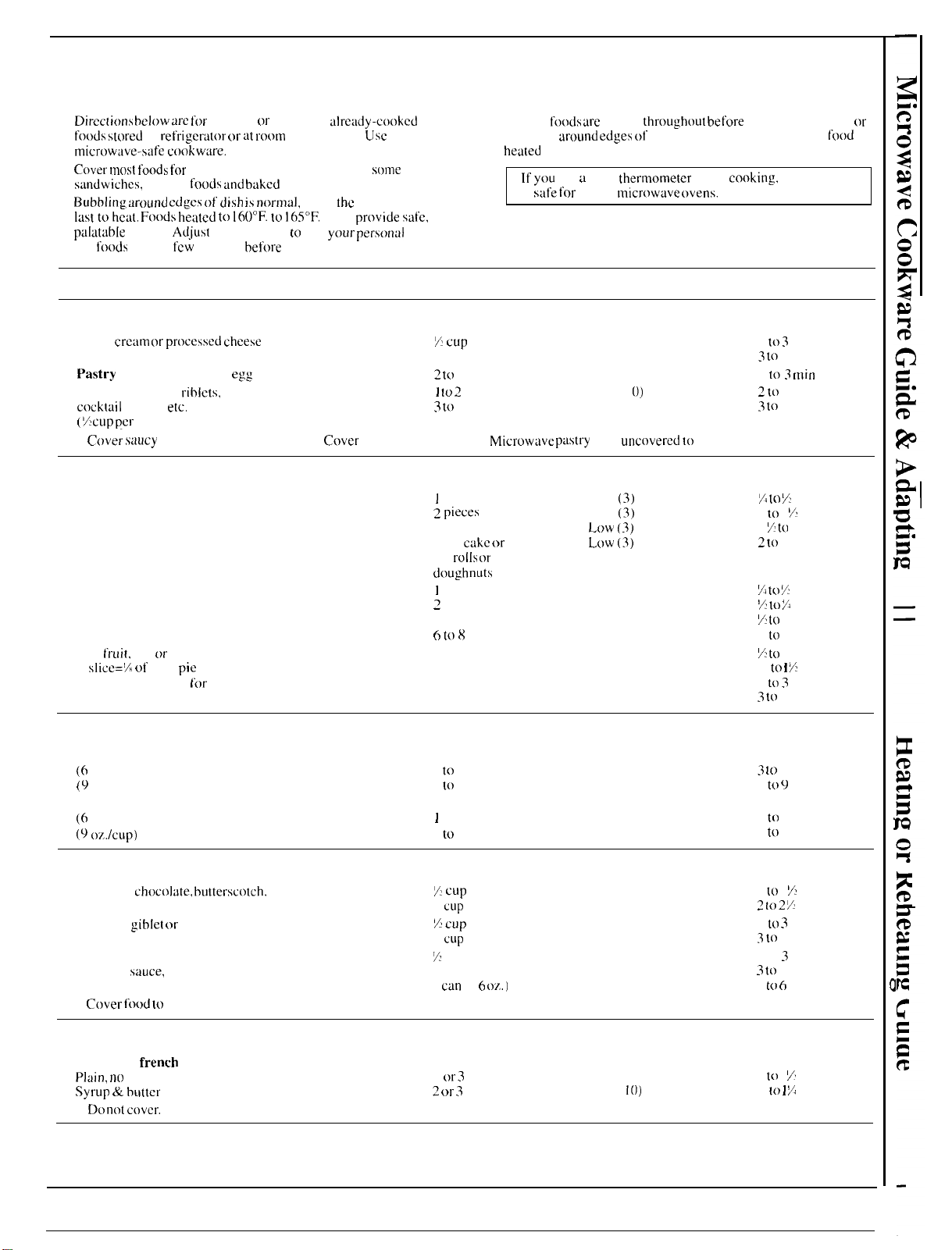
Heating or Reheating Guide
1.
Directions
be]uw
tire
Iur
heating
ur
reheating
alre:ldy-cuukcd
4. Be sure
fuuds
tire
heated
thruughuut
before
serving. Steaming
(]r
fuods
stured
in retrigerutor
or
at
room”
temperature
Use
bubbling
tiruund
edges
ut’
dish does nut necessarily mean
fuud
is
rnicruwave-stife
cookware.”
heated throughout.
2.
Cover
most
foods
for
fastest heating. Exceptions are
some
s~ndwichcs,
griddle
fuuds
find
bukcd
items.
If
yuu
usc
u
meat thermometer while
co(~king.
make sure it
3.
Bubblinc
around
cdzcs ufdish
is
normal,
since
the
center is the
is
safe
for
use in
micr(lwave
ovens.
last
to
h;ut.
F(Jods
h;ated
tu
1600F.
tc~
165°F.
will
pr(>vide
safe,
pdlatable
results.
Adjust
temperatures
to
suit
your
pers(mfil
taste
Let
tuuds
stand a
fcw
minutes
hefure
serving.
Item
Amount
Power Level Time
Appetizers
Dips: cream
or
processed cheese
Y?
cup
Medium (5)
2
to
3
min.
I cup
Medium (5)
3
t(>
5 min.
Pastry
bites: small pizzas.
egg
runs, etc.
2
to
4 servings
High ( lo)
I
103
min
Saucy: meatballs,
rihlcts,
1
tu
2
servings
High ( I
())
2
t(l
4 min.
c(}cktail
franks,
etc.
3
tu
4 servings
High ( 10)
3
to
5 min.
(7:
CLIp
per
serving)
Tip:
Cover
stiucy
appetizers with wax paper.
C(]ver
dips with plastic wrap.
Micruwave
pustry
bites
uncuvered
tu
retain their crispness.
Bakery Foods
Cake, coffee cake, doughnuts, sweet rolls,
1
piece
Low
(3)
Y,
to
Y
min.
nut or fruit bread
~
ple~es
Low
(3)
I
to
I
Y
min.
4 pieces
Low
(3)
I
Y
tu
2 min.
9-in.
c~kc
or
Low
(3)
2
tu
4 min.
I 2
ru[ls
(lr
duughnuts
I
Dinner rolls, muffins
Medium (S)
Y
tu
X
min.
~
Medium (5)
Y
tu
X
min.
4
Medium (S)
Y
tu
I min.
6
to
8
Medium (5) 1
tu
2 min.
Pie:
fruit,
nut
or
custard
1 slice
High ( lo)
X
tu
1 min.
1
slice=Y8
uf 9-in.
pie
2 slices
High ( 10)
1
t(>
I
X
min.
(use minimum time
for
custard)
4 slices
Meal-High (7)
2
tu
3
min.
9-in. pie
Meal-High (7)
3
to
5 min.
Beverages
Cocoa, other milk based
(6
oz./cup) I
to
2 cups
Meal-High (7)
3
to
5 min.
(9
oz./cup)
I
to
2 cups
Meal-High (7)
7
to
9
min.
Coffee, tea, cider
(6
oz./cup)
1
to 2 cups
(~
UZ.ICUP)
High ( 10)
2
to
4 min.
I
to
2 cups
High ( 10)
5
to
7 min.
Gravies & Sauces
Desserts:
chuculate,
butterscotch. etc.
Y?
cup
High ( 10)
I
[()
I
Y,
min.
1
cup
High ( 10)
2
tu
2YJ
min.
Gravies:
giblet
<~r
creamy
z
cup
High ( 10)
2
tu
3
min.
1
cup
High ( 10)
3
tn
4 min.
Meat or main dish sauces, such as
Y,
cup
High ( 10)
2 to
3
min.
spaghetti
sauce,
etc.
1 cup
High ( 10)
3
to
4 min.
I
c~n
( I
6
oz.)
High ( 10)
4
to
6
min.
Tip:
Cuver
fk)ud
to
prevent spattering
Griddle Foods
Pancakes,
french
toast or waffles:
Plain,
nu
tripping
2
m
3
pieces
High ( lo)
I
to
t
Y
min.
Syrup
&
buttet”
2
or
3
pieces
High (
10)
1
to
1
X
min.
Tip:
DCJ
not
cuver.
21
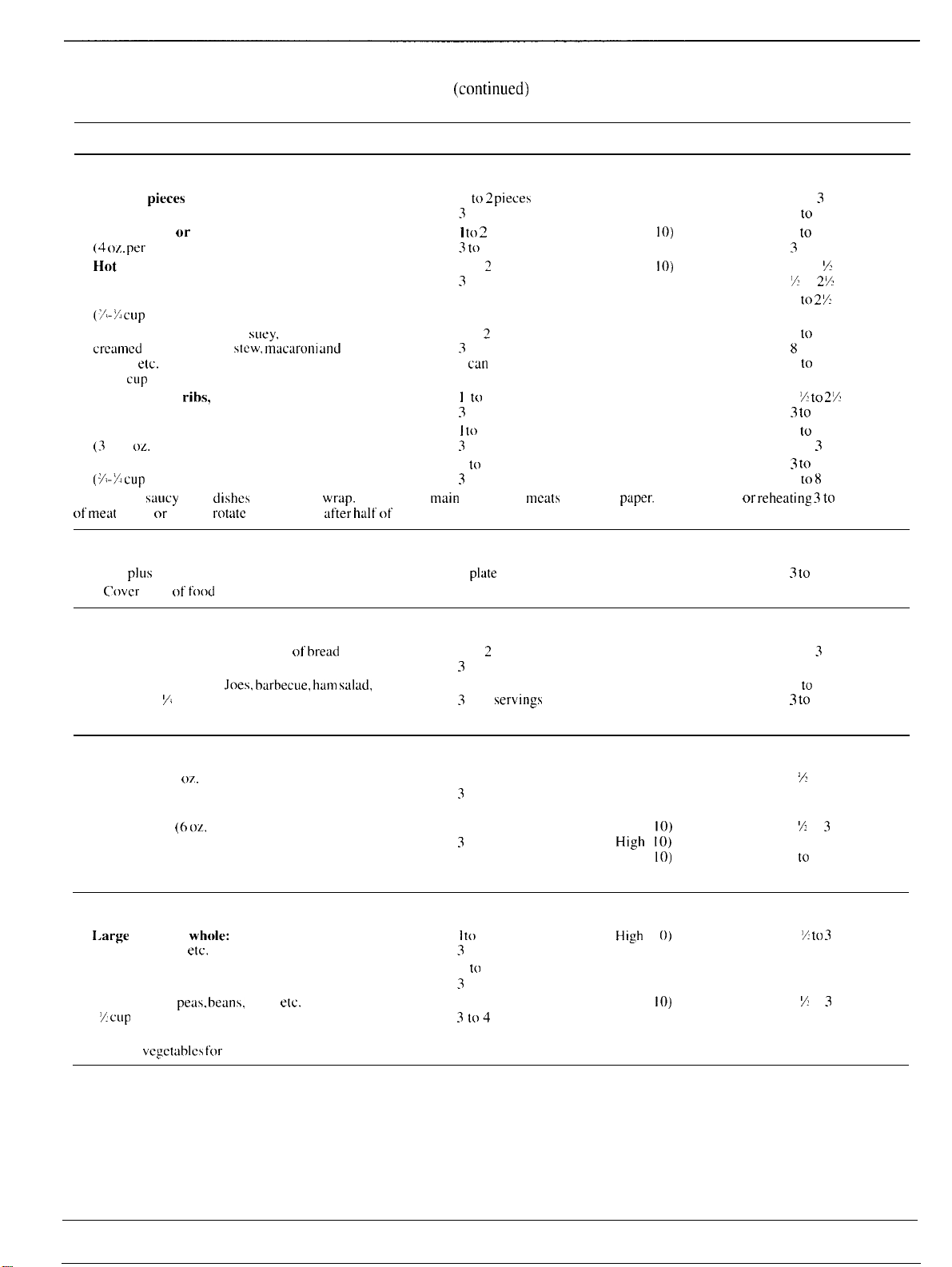
Heating or Reheating Guide
(c”ntinued)
Item Amount Power Level Time
Meats and Main Dishes
Chicken pieces
1
to
2
pieces
High ( 1 ())
1 to
3
min.
3
to 4 pieces
High ( 10)
4
to
6 min.
Hamburgers
or
meatloaf
i
to
2
servings
High (
10)
I
to
2 min.
(4
()~.
per
serving)
3
tn
4 servings
High ( 10)
3
to 5 min.
Hot
dogs and sausages
1 to
2
High (
10)
I to I
X
min.
3
to 4
High ( 10)
X
to
2X
min
Rice and pasta
1 to 2 servings
High ( 10)
I
to
2Y,
min
(7-X
CLIp
per serving)
Saucy, main dishes: chop
suey.
spaghetti.
I to
2
servings
High ( lo)
4
[0
7 min.
cre~nled
chicken, chili,
slew,
mac~roni
and
3
to 4 servings
High ( lo)
8
to I I min
cheese.
etc. I
can
(16 oz. ) High ( lo)
5
to
7 min.
( 7,- I
CLIp
per serving)
Steaks, chops,
rihs,
meat pieces
1
to
2 servings Meal-High (7)
I
X
to
2Y
min.
3
to 4 servings
Meal-High (7)
3
to
5 min.
Thinly-sliced meat
1
[0
2 servings
Meal-High (7)
I
to
2 min.
(3
to 4
oz.
per serving)
3
to 4 servings
Meal-High (7)
2 to
3
min.
Topped or mixed with sauce I
to
2 servings
High ( 10)
3
to
5 min.
(Y-X
cup
per serving)
3
to 4 servings
High ( I())
5
to
X
min.
Tip: Cover
saLIcy
main
dishes
with plastic
wrap.
Cover other
main
dishes and
meats
with wax
paper.
When heating
or
reheatin&
3
to
4 servings
of
mefit
slices
or
pieces,
rotdte
dish I/2 turn after half of cooking time.
Plate of Leftovers
Meat
p]LIs
2 vegetables
1
plate High ( 10)
3
to
4 rein,
Tip:
[’over plate nf
fnnd
with wax paper or plastic wrap.
Sandwiches
Meat-cheese filling: with 2 slices of
bread 1 to
2
servings Meal-High (7)
2 to
3
min.
3
to 4 servings
Meal-High (7) 4 to 5 min.
Moist filling: Sloppy
Joes.
b~rbecue,
ham
saltid,
I to 2 servings
Meal-High (7) 1
to
2 min.
etc. in bun (
Y
cup per serving)
3
to 4
servin&s
Meal-High (7)
3
to
4 min.
Tip: Use paper towel or napkin to cover sandwiches.
soups
Milk-based (6
o~.
per serving)
1 to 2 servings Meal-High (7) I
X
to 5 min.
3
to 4 servings
Meal-High (7) 7 to 10 min.
1 can (10 oz. )
Meal-High (7)
7 to X min.
Water-based
(6
oz.
per serving)
1 to 2 servings High (
10)
I
M
to
3
min.
3
to 4 servings
Higb
(
10)
5 to 9 min.
I can (10 oz. )
High (
10)
5
to
1 () min.
Tip: Cover soups with wax paper or plastic wrap.
Vegetables
I,arge
pieces or
whnle:
asparagus spears.
i
to
2 servings
High
( I
())
1
Y
tn
3
min
corn on the cob.
etc.
3
to 4 servings
High ( 10)
4 to 6 min.
Mashed
1
to
2
servings
High ( 10)
2 to 4 min.
(Y: cup per serving)
3
to 4 servings
High ( 10)
5 to 7 min.
Small pieces:
pe~s,
be~ns,
corn,
etc.
I to 2 servings
High (
10)
1
Y,
to
3
min.
(
Y
CLIp
per serving)
3104 servings
High ( lo)
5 to Y min.
I can (16 oz. )
High ( lo) 5 to I () min.
Tip: Cover
vcgctubles
for
most even heating
22
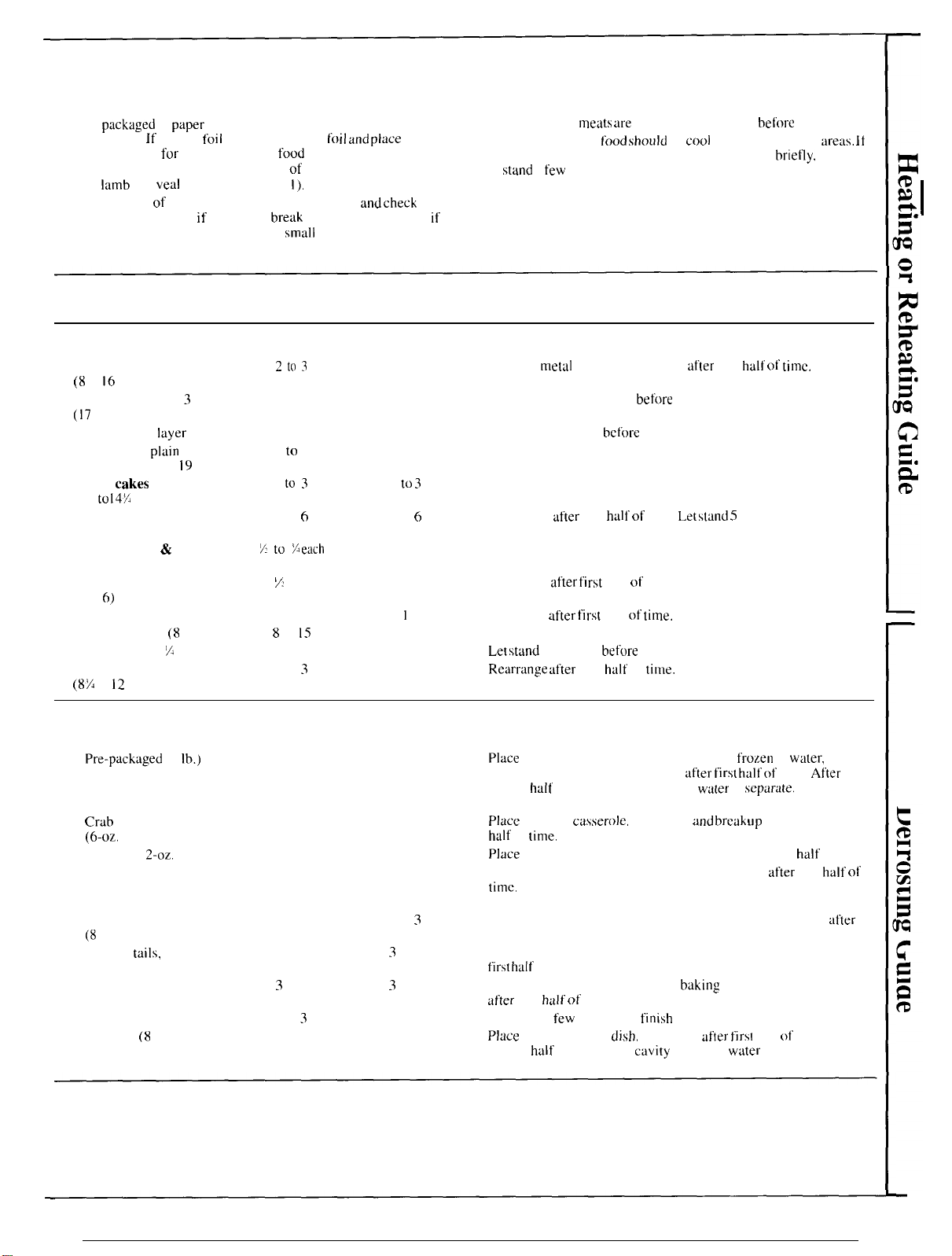
Defrosting Guide
1. Food
packaged
in paper or plastic may be defrosted without
3. Be sure large
meats
tire
completely defrosted
hefore
cooking.
unwrapping.
If food is
foil
wrapped, remove
toil
and
place
food
4. When defrosted,
Iood
shou]d
be
coo]
but softened in all
areas,
If
in cooking dish for defrosting. Most
food
defrosts well using
Defrost (3).
For more even defrosting
of
larger foods, such as
still slightly icy, return to microwave oven very
hrietly.
or let
beef,
larnh
and
veal
roasts, use Warm ( l).
stand
a
few
minutes.
2. After first half
of defrosting time, unwrap package
and
check
food. Turn food over, if necessary;
break
apart or separate food if
possible. Shield any warm areas with
small
pieces of foil.
First Half Second Half
Food
Time, Min. Time, Min. Comments
Breads, Cakes [Power Level: Defrost (3)]
Bread, buns or rolls
2
to
3
none
Remove
me[al
twist tie. Turn over
tifter
first half of
time.
(8
to
16
oz.)
Cake, frosted, 2 to
3
layer
2 to 4
none
Let stand 5 to I () minutes befure serving.
(17
oz. )
Cake, plain, I
layer
2 to 4
none
Let stand 5 minutes
befi)re
serving.
Cheesecake,
plain
or
5
to
7 none
fruit-topped (17 to
19
oz. )
Coffee
cakes
2
to
3
2
to
3
( 1 I
to
[4X
oz. )
Cream or custard pie
4 to
6
4 to
6
Reposition
utter
first
htilf
of time.
Let
st~nd
5
minutes before serving.
(14 oz.)
Crunch cakes
&
cupcakes
Y,
to
Z
each
none
Doughnuts
( 1
or 2)
K
to 1 none
Rearrange after first half of time.
(4 to
6)
I to 2
1 to 2
French toast (2 slices)
2
1
Turn over after first half of
time.
Fruit or nut pie
(8
in. )
8
to
15
none
Pound cake ( 1 I
X
oz. )
3
to 5
none Let
stand
5 minutes
before
serving.
Sweet rolls
2 to
3
2 to 3
Retirrange
tifter
first
htilf
of
time.
(8X
to
12
oz.)
Fish & Seafood [Power Level: Defrost (3)]
Fillets:
Pre-pack~ged
( I
Ih.)
4 to 5
5 to 7
Place
unopened package in oven. (If fish is
frozen
in
wtiter,
place in
Freshly frozen ( 1 lb.)
4 to 5 5 to 7
cooking dish, ) Turn package over after
first
hulf
of time. After
second
hfilf
of’ time, hold under cold
water
to separ~te.
Shellfish, blocks:
Crtib
meat
2 2
Place
block in
cosserole.
Turn over
and
break
LIp
with fork alter first
(6-oz.
package)
half of
time.
Oysters ( I
2-oz.
can)
4 to 6
4 to 6
Place
block in casserole. Break up with fork after first half of time.
Scallops ( l-lb. package)
4 to 6 4 to 6
Place block in casserole. Turn over and break up after first
half’
of
time.
Shellfish, large:
Crab legs, I to 2
2 to 3
2 to
3
Arrange in cooking dish with light-underside-up. Turn over after
(8
to
10
oz.)
first half of’ time.
Lobster
tails,
I to 2
3 to 4
3
to 4
Arrange in cooking dish, with meaty-side-down. Turn over after
(6 to 9
OZ.)
f’irst
half of’ time.
Shellfish, small pieces
3
to 4
3
to 4 Spread shellfish in single layer in
baking
dish. Rearrange pieces
(1 lb,)
after first
h~lf
of time.
Steaks (6
to 12 oz. )
2 to
3
none
Let stand a
few
minutes to
finish
defrosting.
Whole fish
(8
to 10 oz. )
3
2 to 4
Place
fish in cooking
dish.
Turn over
fitter
first
half of time. After
second
half of time, rinse
cfivity
with cold
wfiter
to complete
defrosting.
23
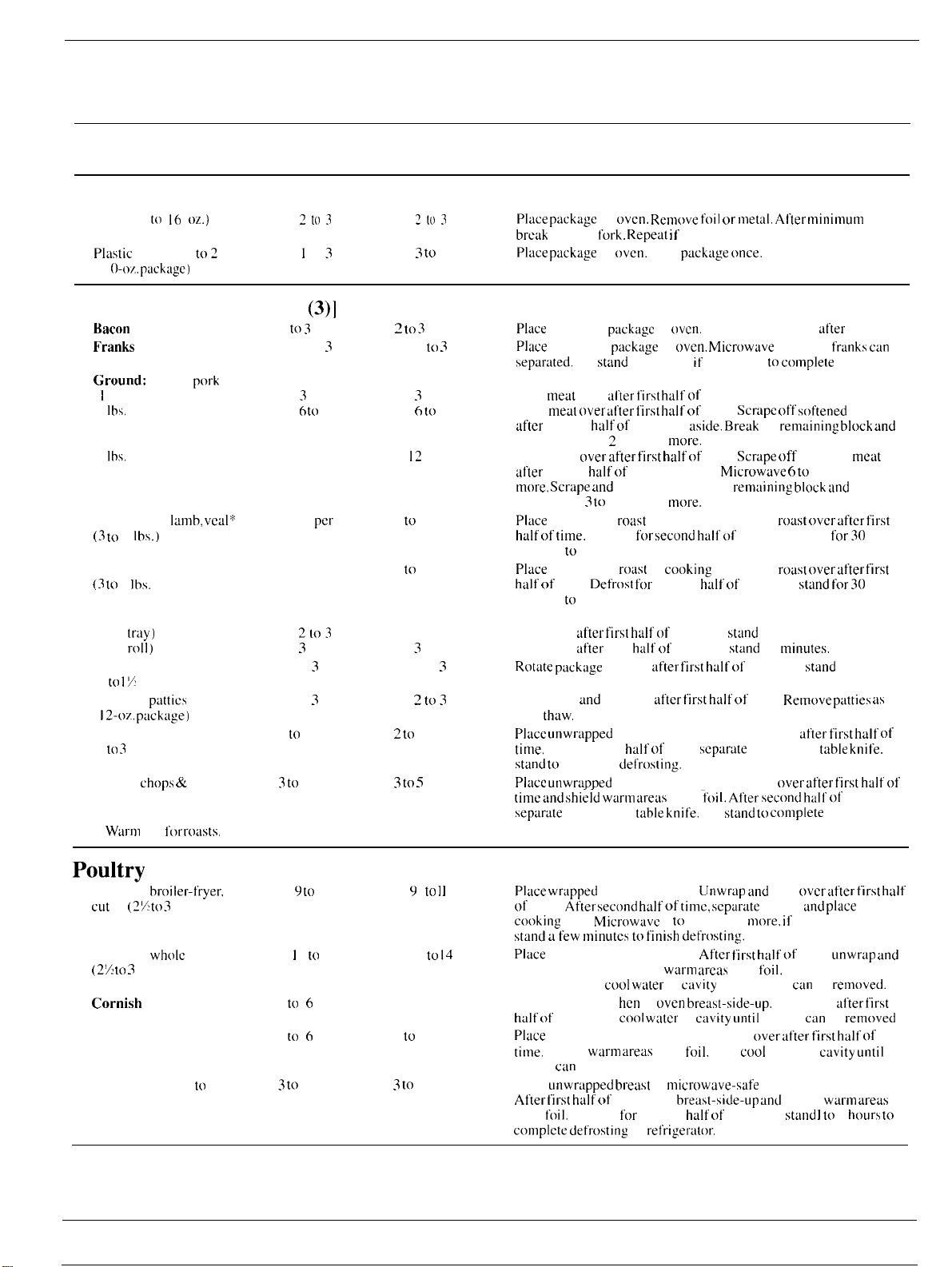
Defrosting Guide
(continued)
First Half Second Half
Food
Time, Min. Time, Min. Comments
Fruit [Power Level: Defrost (3)]
Fresh (10
to
16
oz.)
2
to
3 2
to
3
Place
packtige
in
oven,
Remnve
fuil
or
nlet~l.
Alter
tninimum
time,
break
up with
fork.
Repeat
if necessary.
Pl~istic
pouch-l
to
2
1
to
3
3
to
4
Place
package
in
oven.
Flex
p~cktige
(mce.
( 1
()-oz.
ptick~ige)
Meat [Power Level: Defrost
(3)]
Bacon ( I
lb, )
2
to
3
per lb.
E’ranks
( 1
lb. )
2 to
3
(;round: beef&
pnrk
(
I
lb. )
(2
lbs,
)
(5
lbs.
)
Roast: beef,
l:~mb,
VCJI:l:
(3
to
4
Ibs.)
Roast,
pork
(3
to
4
Ibs.
)
Sausage,
bulk
( l-lb.
tray)
( l-lb.
rnll)
Sausage, links
( I
to
17
Ibs. )
Sausage,
p:lttics
(
12-07,
p:lck:lge)
Spareribs,
pork
(2
to
3
Ibs, )
Steaks,
chops
&
cutlets
3
to 5
6
to
x
12
to 13
4 to 5
pcl”
lb.
4 to 5 pet” lb,
2103
3
to 5
3
3
2
(o
4 per lb.
3
to
5 per lb.
2
to
3
per lb.
2
to
3
3
to 5
6
to
x
12
to 13
4
to
5 per lb.
4
tn
5 per lb.
2 to 4
3
to 5
2 to
3
2
tu
3
2
tn
4 per lb.
3
to
5
per lb.
Place
unopened
package
in
ovcrr.
Let stand 5 minutes
~fter
defrosting
Place
unopened
pack:lge
in
uvcrr.
Microw~ive
just until
franks
can
be
separ;ued.
Let
st:md
5 minutes, if necessary,
t(>
cmnplete
defrosting.
Turn
metit
over
~1’ter
l’irst
htilf
of time.
Turn
mea[
(~ver
~d’ter
first
half of time.
Scr~pc
off
snftened
meat
after second
h~lf
of time. Set
aside.
Break
up
retn:lining
block
and
microwave I to
2
minutes
more.
Turn meat
over
after first half of time.
Scrape
off softened
me;it
~fter
second half nt time. Set aside.
Microwuve
6
to
X minutes
mm”e.
Scrape
:md
set aside. Break up
rem:iining
bl[>ck
:md
microwave
3
tn
5 minutes
tnore.
Pluce
unwrapped
roast
in cooking dish. Turn
roast
uvcr
after first
half nf
titne.
Defrost
for
securrd
htilf’
of time. Let stand
for
30
minutes
to
I hour in refrigerator,
Place
unwrapped
roast
in
couking
dish. Turn
roast
over
~fter
first
half of time.
Defrnst
fnr
second
h:dt’
uf time. Let
stand
for
30
minutes
to
1 hour in refrigerator.
Turn over
:d’ter
first
htitt’
uf time. Let
sttmd
5 minutes,
Turn over
titter
first half nl time. Let
stand
15
tninutes.
R(]tate
pfickfige
t/4 turn after
fil-st
hutf
nf’
time. Let
stand
5 minutes.
Turn river
~nd
separate after first half of time.
Remove
p:itties
tls
they
thaw.
Ptace
unwr:lpped
ribs in cooking dish. Turn over
~ftet”
first
htilf
of
time.
After second
hatt’
nt time,
sep~rate
pieces with
tubte
knife.
Let
stand
to
complete
delrus(ing.
Pl:ice
unwrtipped
meat in cooking dish. Turn over after first hatf of
tinrc
imd
shi~ld
worm
are:ls
with toi
1.
Af’ter
second
htdf
of time.
septirote
pieces with
table
knife.
Let
st:md
tn
cmnptete defrosting
*Use
WtiInl
( I )
I’m”
ru:ists,
Poultry
[Power Level: Defrost (3)]
Chicken,
broiter-fryer,
9
to
11
Cut Up (~~?
t(l
~ Ibs. )
Chicken,
whnlc
I
2
to
14
(2Y3
to
3
Ibs. )
Cornish
hen
5
tn
6
per lb.
Duckling
4
to
6
per lb.
Turkey breast (4
to
5 tbs. )
3
to
5 per lb.
9
to
1
I
Ploce
wr:lpped
chicken in dish.
Unwrap
imd
turn over
:ifter
t’irst
holf
of time. After
secund
half of
time,
scpar~te
pieces
tind
place
in
couking
dish.
Micrnwdvc
2
to
4 minutes
more.
il necessary. Let
stand
a
few
tnirrutcs
to
finish
defrosting.
12
to
14
Place
wrapped chicken in dish. After first
h:df
of time,
unwrup
and
turn chicken over. Shield
warm
:ircas
with
foil.
To complete
defrosting, run
CUOI
w:iter
in
ctivity
until giblets
can
be
remnved.
5 per lb.
Place unwrapped
hcn
in
uven
bretist-side-up.
Turn over
~i’ter
first
holf
nf time. Run
cool
w:itcr
in
ciivity
until
giblets
can
be
removed
4
to
6 per lb.
Place
unwrapped duckling in riven. Turn over after first half
of’
time.
Shield
warm
are:ls
with
foil.
Run
cool
water in
ctivity
until
giblets
c:m
be removed.
3
to
5 per lb.
Place
unwr:lpped
bredst
in
microw~ve-safe
dish hreast-side-duwn.
After
first
half of time, turn
bretist-side-up
~nd
shield
warm
areas
with
toil.
Defrost
fnr
second half nt time. Let
st:md
I
to
2
h[~urs
to
cumplete
defrustirrg
in
ref’rigera(or.
24
Cooking Guide
Breads
Crust on
brefids
will be
soft
and
the outsides will not brown. If
color
on upside-down
bretids,
line dish
bcf(~re
microw:iving
with
desired, sprinkle top
of batter with cinnamon-sugar mixture,
brown
sug~r-caramel
mixture or
suvory
topping, such as crushed.
chopped nuts or other topping
for
brown color. To increase brown
canned,
trench
fried
onion rings.
Food
Container
Cover
Power Level & Time
Comments
Coffee
cakes
Corn bread
Muffins
( 1
Muffin)
(2
to
4 Muffins)
(3
to
6
Mullins)
Quick breads,
from
a
mix
8-in. round or
No
Meal-High (7)
square
dish
X- to 9-in.
N()
Meal-High (7)
tube
dish+:
Paper-1ined
N(J
Mcd-High
(7)
muffin
cups
(Do not use
foil liners. )
Glass
Ioal
No
Meal-High (7)
dish
6
to
8
min.
X to Y min.
Y
to I min.
I to
3
min.
3
to
4X
min.
I
2
to
22
min.
Place
btittcr
in greased dish.
Sprinkle
co[)king
dish with
finely
chopped,
canned, trench
f’ried
onions
bef(}re
microwaving. Turn out 01”
ptin
upside
down
10
serve.
Use microwave-safe
muffin
container or
homemade
muffin
cups,
made
by cutting
down
hot drink
paper
cups. Some muffins
may
be
dune
bef~)re
others. Remove muffins
as they
~re
done,
and
continue cooking
remaining
rnut!ins
a
few
seconds longer.
Shield corners
after
half’
of cooking
time.
When done, toothpick inserted in
~entcr
will
curne
out
clean.
I.Je{
stond
I
5
minutes
before turning out
of dish. Cool.
*If tube dish
is
unov:lil~ble,
microwave in X-in,
round
dish with drinking
glfiss
placed
open-side-up in
Cerltel”.
Cakes and
Desse*
1.
Always
use
rnicrowave-stife
cookware.
4. Cool
cuke
in dish set directly
(m
heat-proof
srrrftice
or
wooden
2. Before
adding
measured
amount
of batter,
grctise
dishes or line
bourd
I
() to
15
minutes before inverting.
them
witf~
wax
paper.
(Do not flour. )
5. Crust on
cakes will be
soft.
If
c~kc
is to be frosted, refrigerate
3.
Cakes
~re
done when toothpick or long skewer inserted into
cake
f’or
an hour to
firm
exterior
surttice.
center comes out
clean.
6.
Chiffon
and
Angel Food
ctikes
are
rl~)t
recommended
for
microwaving.
Food
Container
Cover
Power Level & Time Comments
Baked apples
Microwtive- Lid or
High ( I ())
or pears
safe
dish or
plastic wrap
casserole
Bar cookies
X-in. square
N()
High
dish
Commercial mix
8-in. round or
N()
High
( I x
to
20 oz. )
square dish
10)
10)
Fluted tube
No
High ( lo)
cake
ptin
( 12 cup)
Cupcakes—6
Paper-lined
N()
Meal-High (7)
cupcaker
Pineapple upside
X-in. round
No
Meal-High (7)
down cake
dish
5 to I () min.
6
to I () min.
1 I
to
15 min.
2Y
to
4Y
min
I ()
[0
14
min.
Pierce
fruit
or peel to prevent bursting.
Core
~nd
till
center of apple with
2
tablespoons
sugar,
1
teuspoon
bu[ter
and
I/X teaspoon
cinnumon.
Add
2 tablespoons
w~ter
for each piece of
f’ruit.
Grease dish before
adding
b~ttcr.
Cut
when
cool.
Gre~sc
dish
before
adding
ba(ter.
Let stand
5 to
[()
minutes to
cool
before
inverting
Let tube
cake
stand 15 to
20
minutes to
cool,
before inverting.
When
cooking
several cupcakes,
sornc
will
be
d(me
before
others.
Remove
copcdkcs
:~s
they
are done and continue cooking
rerntiining
cupcakes a
tew
seconds
longer
When done, toothpick stuck in cake
c(~rnes
t)ut
cle:ur.
Invert
ctike
onto plate; let dish
st;md
over
c~kc
a
few
rninu[es.
25
Cooking Guide
(continued,
Candies
1.
Always
use microwave-safe cookware,
For
easy clean-up, melt
2. Candies which are boiled become very hot; handle cookware
chocolate in paper wrappers seam-side-up, or place chocolate in
carefully.
paper bowl to melt.
Food
Container
Cover
Power Level & Time Comments
Caramel apples I pint
(2-cL1p)
meosure
Chocolate bark
1
X-qt.
casserole
or howl
Marshmallow crisp 2-qt. oblong
dish
S’Mores
Paper napkin
or
puper
plate
N()
High
Yes
High
Yes
High
N()
High
10)
3
(0
7 min.
10)
3
to 5 min.
10)
I min. to
melt butter,
4 min. to melt
marshmallows
10)
15
to
25
seconds
Unwrap a
14-oz.
package
ol’
caramels into
measuring cup. Add I
[ablespoon
wtiter.
Microwave, stirring every minute. Dip 4
apples into mixture.
Place 12 oz.
setni-sweet chocolate pieces in
container. Microwave to melt. Add I cup
whole toasted
filnlonds.
Spread over
WJX
paper
on
cookie sheet. Chill until firm.
In large glass bowl, melt 1/4 cup butter.
Add
10-oz.
package marshmallows, cover
with
wax
paper
~nd
microwave to melt. Stir
in 5 cups crispy rice cereal. Press
firmly
into buttered dish.
Cover
graham
cracker
wi(h
chocolate and
marshmallow.
Cereal, Pasta and Rice
1.
Always
use microwave-safe cookware.
4. Cover pasta and rice while microwaving. When using plastic
2. For
pusta,
use about one-half the
amount
of water
needed
for
wrap, (urn back one corner to vent.
conventional boil
ing.
Add
regular amount of salt and
I
teaspoon
5. Stir or rearrange
atter half of cooking
time.
Drain pasta
oil (optional, to prevent sticking),
immediately
after microwaving.
3. For rice or minute rice, use the same
amount
of water needed
for
6. Microwave time and conventional boiling time are about the
conventional boiling,
Add
regular amount of
salt. same.
Food
Container
Cover
Power Level & Time Comments
Oatmeal,
1 -qt. casserole
No
Higb
(
10)
3
to
5 min.
old
f~shioned or bowl
per serving
Note: To microwave single-serving packet of instant oatmeal,
follow
packuge
directions
for amount
of water
and
microwave at High ( lo)
for
Y
to I minute.
Rice, minute
2-qt. casserole
Lid or High ( lo)
2 to
6
min.
( I
x
cups)
plastic wrap
Rice, regular
~-qt
~asseroie
Lid
or High (
10)
17
to
21
min.
long
grain ( 1 cup)
plastic wrap
Spaghetti (16 oz.)
2-qt. oblong
Plastic wrap
High (
10)
16 to
20
min.
dish or casserole
lncrcasc casserole size
for
more than one
serving. Increase time about I
Y?
minutes
for
efich
additional serving you are cooking.
Stir after half
of cooking time.
Add
1
X
cups
wtiter.
Stir after
2
minutes,
Add
2X
cLIps
water.
Stir after
10
minutes.
Add 6 to 7 cups water. Rearrange
after 10
minutes.
26
Cheese and Eggs
1. Eggs
may
be
prep~red
many ways in the microwave oven. 3.
Cook
eggs just until set. They are delicate and can toughen
it
Always pierce whole yolks before microwaving to prevent
overcooked.
bursting.
2. Never cook eggs in the shell. Do not reheat hard cooked eggs in
the shell. They will explode.
Food
Container
Cover
Power Level & Time Comments
Cheese
Fondue
Microwave-
Cover or
High (
10)
To make sauce
Make
basic white sauce, substituting wine
safe 2-qt. dish plastic wrap
3
to 5 min.
for
milk.
Add
cheese and microwave at
Medium (5)
8
to
9 min. Medium (5)
for
8 to 9 minutes, whisking
every 2 minutes.
Eggs
Basic eggs
Buttered
custard cup
Omelet
9-in. pie plate
Poached eggs
custard cup
(4
maximum)
Quiche
9-in. pie plate
Scrambled
Glass
measuring cup
or casserole
Plastic wrap
Medium (5)
Z
to
1
min.
per egg
No High ( 10)
Melt butter
X
to
Yi
min.
Medium (5)
7X
to
10
min.
Plastic wrap
Medium
(5)
1 to 2 min.
Meal-High (7)
X
to
X
min
per egg
No Meal-High (7)
I 7 to 22 min.
N()
High ( 10)
X
to I min.
per
egg
Puncture membrane of yolk to prevent
bursting.
Sprinkle cheese over omelet. Microwave
Y
to
I minute until cheese is
sli&htly
melted.
Heat 2 tablespoons water and
X
teaspoon
vinegar in each cup. Break I
egg
into
each custard cup. Cover loosely with
plastic wrap. Cool according to guide.
Microwave at Medium (5)
X
to
X
minute
per egg. Let stand in water a
few
minutes.
Pour filling into precooked 9-inch pie shell.
Scramble eggs
witb
I teaspoon butter and I
tablespoon milk per egg. Place in oven and
microwave for half of
total
time. Stir set
portions from the outside to the center.
Allow
to stand I or 2 minutes to finish cooking
Fish and Seafood
1. Fish is done when it flakes easily when tested with a
fork.
Center
2. Cook
fish
with or without
sauce. A tight cover steams fish. Use a
may still be slightly translucent, but will continue cooking as fish
lighter cover of
wax
paper or paper towel for less steaming.
stands a
few
minutes after cooking.
3. Do not overcook fish. Check at minimum
time.
Food
Container
Cover
Power Level & Time Comments
Clams,
6
Fillets or
steaks ( 1
lb. )
Shrimp—1
lb.
(peeled)
Shrimp—
1
lb.
(unpeeled)
Whole fish
Pie plate or Plastic
wrflp
shallow dish
Oblong dish
Wax paper or
plastic wrap
Pie plate or Plastic wrap
shallow dish
2-qt. casserole
Lid or
plastic wrap
Oblong dish
Plastic wrap
High (
10)
4 to 7 min.
Place in dish with hinged side out
High ( IO)
5 to 7 min.
Microwave until fish flakes easily. Turn
steaks over after half of cooking time.
High ( 10)
6
to 8 min.
Brush with garlic butter before cooking.
Rearrange after 4 minutes.
High ( 10)
5 to 9 min.
Place shrimp in casserole. Add 2 cups
hottest tap water. Cover. Stir after 5
minutes.
High ( I ())
5 to 7 min.
Shield head and thin tail with aluminum foil.
per lb.
27
—
Cooking Guide
(continued)
Gravies & Sauces
1.
Cove[”
thick,
chunky
szlLIces
(n
pt”evenl
spill[et”ing.
3.
Vary
basic
white
sauce
by
adding
chccse.
egg
yolks.
cream, wine
2. Whisk
S:ILICCS
vigormlsly
with
wire
whisk once
or
twice
while
m.
herbs.
microwaving.
Food
Container
Cover
Power Level & Time Comments
(;ravies
and
Gl:lss
nlcilslll”c
N()
High ( 10)
4
tu
7 min. Microwave
fat,
fluur
and
salt
tugether
to
sauces thickened
or
bowl
melt
and
blend. Whisk in liquid
:md
finish
with
flour
or
microwaving.
Incrc:lse
time 1
to
2 minutes
cor]ls[iu”ch
(
I
CLIP) per
;Idditinnal
cup of
sauce.
Melted butter
GliIss
tneiisure
N() High ( 1 ())
I
to
3
min.
Micrnwave
butler
just to melting,
Fur
sauces,
cltnil’ied
buttc[”
( ~ CLIP)
Thick spaghetti,
C;]sserole,
bnwl
Yes
barbecue or
sweetisour sauces
(~
CLIPS)
Thin, liquid sauces
C:lsserule
N()
(ALI
,Ius,
cl:un,
c[c.
)
( 1 cup)
clarif’icd
butter, bring
to
boil then
le(
stand
until
layers
separate.
Pmrr
oft
and
usc
clear,
top
layer.
ligh
( lo)
5
to
I () min.
Stir ingredients together, then
microwave,
stirring after half of
cooking
time. Let stand
5
to
I () minutes
tu
develop flavor.
ligh
( 10)
3
tn
5 min.
Add
cornstarch-wdter mixture
to
heated
ingredients. Stir well
tind
micruwavc
to
finish.
Meats
1.
AlwLIys
use
il
conking
b:ig
when
conking
beet,
kunb,
pm”k
m
ve~d
3.
Allnw
abmll
I () minutes
st~mding
time
t’nr
must masts
befure
roas[s.
See
p~cktlge
ins[rocticms
I’or
pruper
lIse
of’
coc)king
bag.
carving,
2.
After
cnclusing
ro:ist
in
cooking
b~ig,
place
nn
trivet in
lllic]”owi~vc-s:ll’e
dish.
If
you
use a meat thermometer while cooking,
m:lke
sure it
is
s:ifc
fur
use in
micruw:lve
ovens.
Power Level & Time
Food
Container
Cover (or Internal Temp.)
Comments
Beef
(;round,
crumbled
(for
C:lsscrolcs
()[”
S(~Llp)
(
1
lb. )
( I
X
Ibs.)
Meatballs
(
I
lb. )
(2
Ibs.
)
Meatloaf
(Round
lofit’)
(Ln[If
shape)
Patties
(4
p:itties
per lb. )
1
to
2
p;]llies
3
to
4
p~l[ies
Pot
roasts
(Up
to
~
Ibs.
)
Simmered beef
(corned
beet’
or
brisket)
Round
or
oblong
dish
Pie
pl~te
or
loaf dish
oblong
glass
dish (with
trive[
i 1’ desired)
or ceramic
dinner
pl:t[e
oblong dish
01”
C;lssernlc
Cilsscl”olc
N()
WJX
p:lpcr
m
pklstic
wr~p
Plastic
wr~p
W;LX
paper
Cooking
b:ig
High
( 10)
High ( 10)
Meal-High (7)
or cook”
to I 700
High ( 10)
Medium
(5)
Medium
(5)
5
to
12 min.
7
tn
I 2 min.
9
to I
3
min.
9
to
I
3
min.
25
tn
30
min.
30
tu
35
min.
3
to
5 min.
4
to
6
min.
23
to
29
min.
per lb.
I
20
[0
I
30
min
Stir alter half of cooking time.
Add
sauce
ot-
cusserule
ingredients
and
finish.
Tn
cook
frozen
blnck,
micrnwavc
I ()
tn
15 minutes,
breaking up
and
stirring every 5 minutes.
Let stand 5 minutes.
Arrange
around
edge of dish.
Refirrfinge
after half of
coc)king
time.
Let
stand
1()
minutes after
cnuking.
Let
stand
I () minutes utter
cuoking,
If desired.
add
browning
sauce.
Let
ptitties
stand.
covered, 2 minutes.
Brush with browning
stiuce
and
add
1/2 cup
water
to
cookin&
bag. Turn over after half of
cooking
time,
Add vegetables
if
desired after
half
of
cooking
time. Recover
und
finish.
Add
I
cup
wuter
per
pound
of
rne~t.
Turn
over
after half of
cc)oking
time. Let
metit
st:md
in
broth
~t
least
1() minutes after
cooking.
Fur
boiled dinner,
remove
meat
and
cnnk
vegettibles
in broth.
28
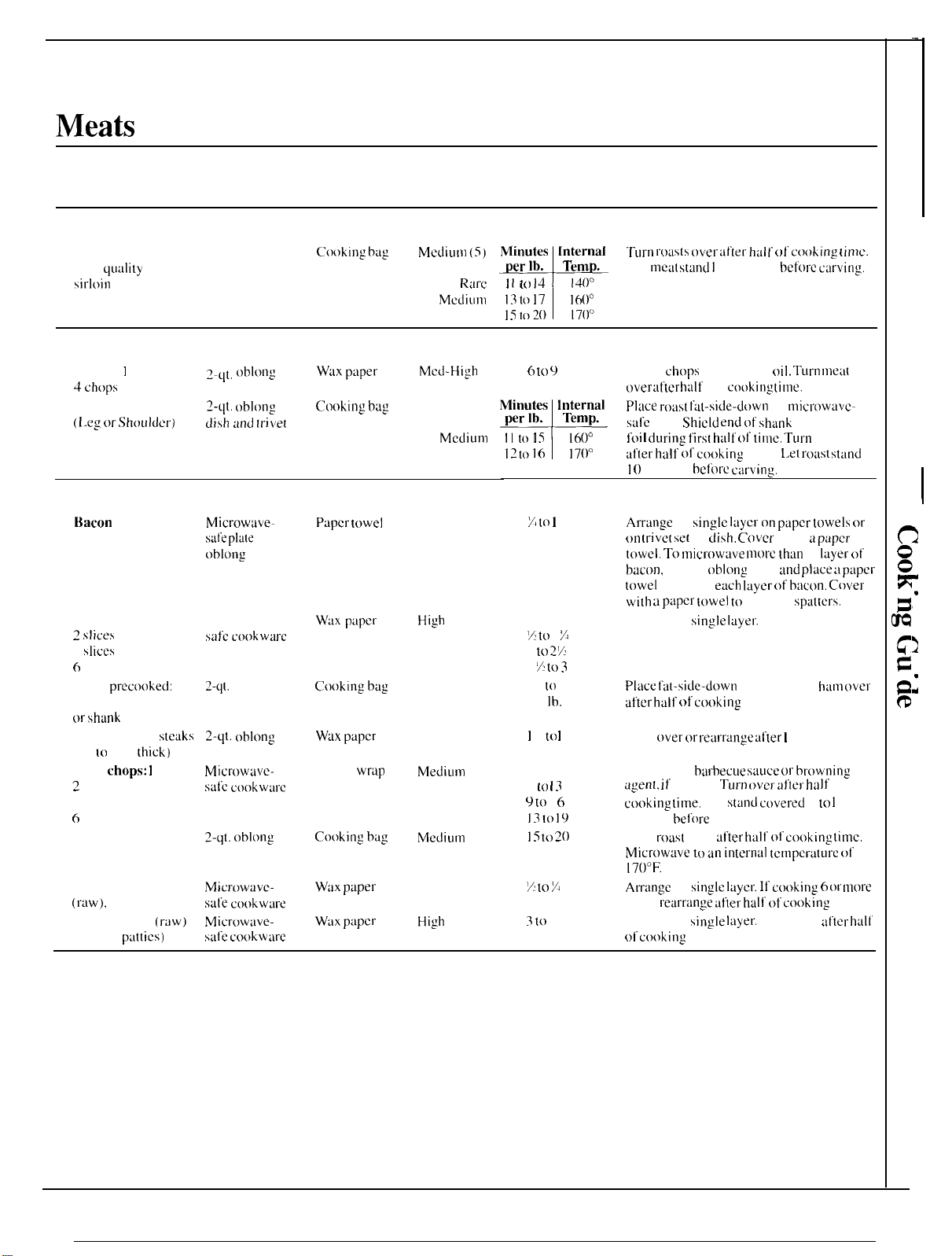
MeatS
(continued)
Power Level & Time
Food
Container
Cover (or Internal Temp.)
Comments
Beef
(continued)
Tender roasts (rib,
Oblong dish
C()()king
bug
Medium
(~)
Minutes
[nternaI
high
qutllity
rump, with trivet
sirlnin
tip)
R:[rc
Medium
well
*
‘rLll’n
1“():1s[s
ovel”
:[f’t~t”
hfil[’
of
cooking”
[inlc.
er
lb.
Tern
.
Let
nlc:~[
st:md
I
() minutes
before
c:irvin:.
I
I
to
14
1400
13
to
17
1600
Is [()20
1700
Lamb
6
tn
9
min. Brush
chnps
lightly with
oil.
TLII”II
me:it
over
:Ifter
h:df
01”
cooking”
time.
+
Minutes Internal
Pl:tce
ro~lst
tat-side-down in
nlicrnwtivc-
per lb.
Temp.
stile
dish.
Shield
end
nf
sh:mk
brine with
I 1 to
15
1600
l~~i
I
during
first
htill
of”
time,
Tut”n
river
12
to
16
1700
titter
half
01
cooking”
time.
I.e[
rn:ls[
st:md
1()
minutes
befilre
carvitlg.
Chops (
1
-in. thick)
~-qt
obl~~ll~
Wux
p:lper Mcd-High
(7
4
chops dish
Roast
?-qt.
obl(mg Cn(]king
bug
Medium (5)
([.e~
or
Shou]dct”)
dish
:md
[rivet
Medium
Well
Pork
Arrtinge
in
single
Iaycr
nn
paper
towels
nr
(m
[rivet
set
in
dish.
Cnvcr with
~1
pupcr
towel.
T(J
micrnwtive
In<)rc
(han
1
l~yer
nf
bucnn,
use an
(]blnng
dish
:md
place
:1
p:[per
towel
between
e~ch
l~yer
nf
b:]c(m.
Cnver
wi[h
J
p~Ipcr
[owel
to
prevent
sptlttcrs.
Bacon
Micr(}wave-
(per slice)
s~le
plate
01”
obl(mg
dish
Pfipcr
towel
High ( 10)
X
tn
I
min
Canadian bacon
2
slices
4
slices
Microwave-
safc
conkwi]rc
High
( 10)
Arrange in
single
Iuyer.
Y
to
I
Xi
min.
I
tn
2Y
min.
I
7
to
3
min.
14
tn
I 9 min.
per
lb,
6
slices
Plt]ce
fat-side-dc)wn
in dish. Turn
h:nn
over
after
holf
nf
cooking”
time.
Ham,
preconked:
canned, butt
or
sh:mk
2-q[.
oblong”
dish
Conking
b~g
Wax
paper
Plastic
wr~p
Medium (5)
Medium (5)
Medium
(5)
I
()
to
I
5 min.
Turn
over
or
re:il-r~mge
after
I
() minutes
Ham, slices &
ste~ks
( I -
{n
2-in. thick)
2-qt.
nbl(>ng
dish
Microwavc-
s~f’c
cnnkw:n”c
Brush with
b:ubecue
sauce
or
browning
~gent,
if desired.
Turn
over
after half of”
cn(~king
time.
Let
stand
cnvered
5
tn
I
()
minutes
bet’nre
serving.
Turn
ro~st
river
tifter
h;df’
ni’
cnoking
time.
Microw:tve
to
an
intet”md
tcnlpcrtiturc
of”
1700F.
Armnge
in
single
l~ycr.
If’
cooking”
6
nr
mnre
links,
retirr:mge
~fter
h~df’
nt
cnnking
time.
Arrange in
single
I:iyer.
Turn river
:ilter
h:lll’
of”
conking
time.
Pork
chops:
I
-in
~
4
6
7
tn
I
3
min.
9
to
I
6
min.
13
tn
19
min.
15
to
20
min.
per lb.
Pork roast
2-qt.
oblnng
dish
Cnoking
b~g
W:]x
ptiper
W:ix
p:lpcr
Medium
(5)
High ( 10)
High
( 10)
Y:
to
~
min
per link
3
to
5 min.
Pork sausage
Microwave-
(I:IW).
link
saf’e
cnokwtire
Pork sausage
(r:]w)
Micrnwiive-
(Y lb.: 4
p:lt[ics)
s:if’e
cookware”
29
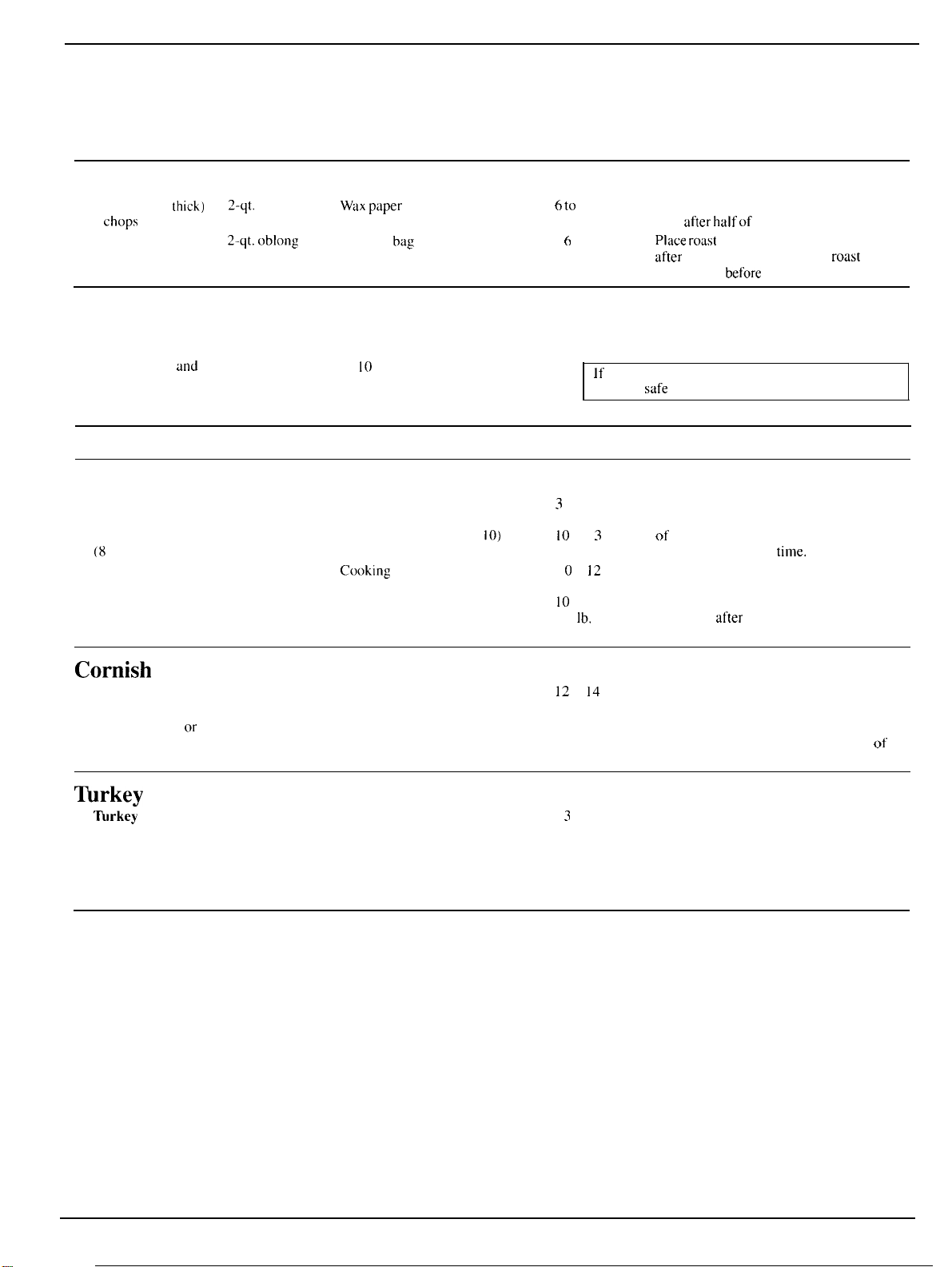
Cooking Guide
(continued)
Meats
(continued)
Veal
Chops ( 1
-in. thick)
2-qt.
oblong
Wax
paper
Meal-High (7)
6
to
9 min. Brush chops lightly with oil. Turn meat
4
chops
dish
over after half of cooking time.
Roast
2-qt.
oblong
Cooking
bag
Medium (5) I
6
to 2 I min.
Place
roast
fat- or cut-side-down. Turn over
(shoulder)
dish
per lb.
after half of cooking time. Let
roast
stand
1 () minutes
before
carving.
Poultry
Let turkey breast
tind
other poultry stand for 5 to
10
minutes after microwaving.
If you use a meat thermometer while cooking, make
sure it is
safe
for use in microwave ovens,
Food
Container
Cover
Power Level & Time Comments
Chicken
Pieces Plate or
Wax paper
High ( lo)
3
to 5 min.
(per piece)
oblong dish
Whole chicken
total
Oblong dish Wax paper
High (
10)
10
to I
3
min.
(8
pieces)
total
(unstuffed) Oblong dish
Cookin&
bag
Meal-High (7)
I
0
to
12
min.
(stuffed) Oblong dish
per lb.
Cooking bag
Meal-High (7)
10
to 16 min.
per
lb.
Arrange in single layer in cooking dish so
thickest meaty pieces are to outside edges
of dish. Turn pieces over and rearrange
after half of cooking
time.
Brush with browning agent, if desired. Slit
bag near closure to vent. Close securely
with plastic tie. Cook breast-side-down.
Turn over
after half of cooking time. Cook
to I 90° internal temp.
Cornish
Hens
Halves
Square or
Wax paper Meal-High (7)
12
to
14
min.
Arrange skin-side-up in dish, on bed of
oblong dish
per lb.
stuffing, if desired.
Whole (stuffed
or
Square or
Wax paper Meal-High (7) 13 to 15 min.
Place breast-side-down in dish. Turn over
unstuffed) oblong dish
per lb.
after half of cooking time. Shield tips of
wings and legs with foil.
Wrkey
Tarkey
breast
Oblong dish Cooking bag
Meal-High (7)
I
3
to I 5 min.
Tie ribs to breast cavity. Place breast in
per lb.
cooking bag. Close securely with plastic tie.
Place breast-side-down in dish. Slash bag
on underside near closure to vent. Turn
over after half of cooking time. Cook to
I 90° internal temperature.
30
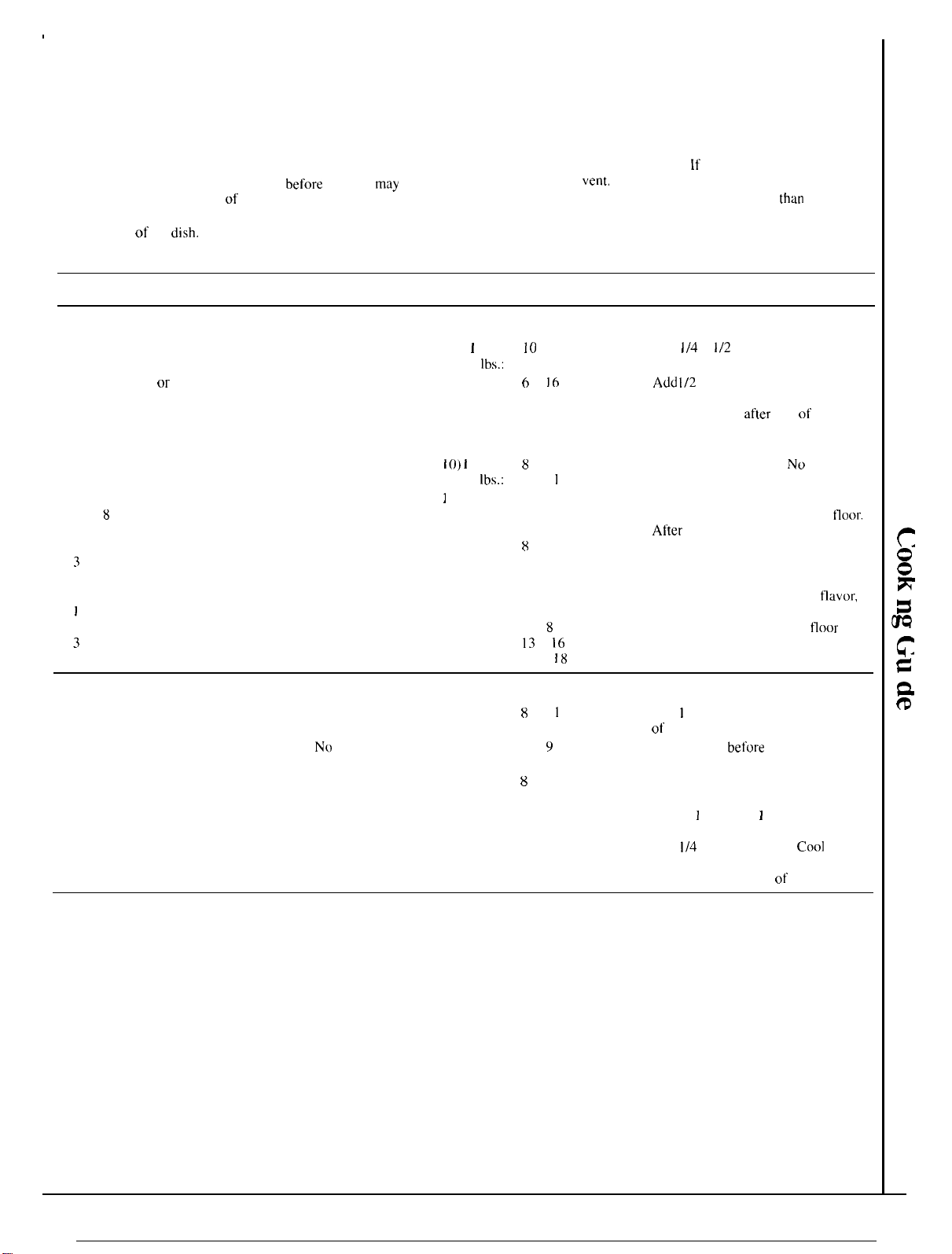
Vegetables
1. Always use microwave-safe cookware.
4. Cover vegetables when cooking.
If using plastic wrap, turn back
2. Salt vegetables after cooking. Salting
before
cooking
may
cause
one corner to
vent.
darkening and dehydration of surface.
5. Larger vegetable pieces will take longer to cook
than
smaller
3. Arrange vegetables, such as asparagus, with the thickest pieces to
pieces.
the outside of the
dish.
6. For more even heating, stir, rearrange or rotate vegetables during
cooking.
Vegetable
Container
Cover
Power Level & Time Comments
Fresh:
Slices, pieces
Whole, halves
or
large or starchy
vegetables
(winter squash,
cauliflower, etc. )
Watery (tomatoes,
summer squash)
Potatoes
(6 to
8
oz. each)
1
2
3
4
Corn on the cob
I
2
3
4
Casserole
Yes
High (10)
I
lb.:
2
Ibs.:
Yes
No
Casserole or
Yes
High
square dish
Casserole
High
No
High (
10)
10)
1
lb,:
2
Ibs.:
1
())
No
Husk or
High ( 10)
plastic wrap
10
to 17 min.
16 to 21 min.
6
to
16
min.
8
to I 2 min.
13 to
I
7 min.
4 to 6 min.
8
to I O min.
I 2 to I 5 min.
15 to 20 min.
5 to 7 min.
Add
1/4
to
1/2
CUP water.
Add
1/2
cup water to cauliflower.
Winter squash needs no water. Turn
vegetables over
after half of time.
Cut in pieces or halves.
No
additional
water is needed.
Prick skin before cooking. Position
potatoes in star pattern on oven
tloor.
After cooking, wrap in foil and allow
to stand for 5 minutes before serving.
For convenience and freshest
tlavor,
microwave corn in husk. Position
7 to
8
min. corn in star pattern on oven tloor
13
to
16
min.
16 to
18
min.
Frozen:
Package (10 oz. )
Casserole
Yes
High
Pouch (10 OZ.)
Plate
N()
High
Corn on the cob
Casserole
Plastic wrap
High
(4 ears)
10)
8
to 1
I
min. Add
I
tablespoon water. Stir after half
of
time.
10)
7 to
9
min. Pierce pouch
bef’ore
cooking. Stir
before serving.
10)
S
min.
Follow package instructions. Place on
oven floor in star pattern.
Blanching fresh
Casserole
Yes
High ( IO)
3 to 7 min.
Blanch
1
pound or
1
quart vegetables
vegetables for at a time. Place in 1 or 2 qt. casserole
freezing
with
I/4
to I/2 cup water.
Cool
drained
blanched vegetables immediately by
plunging in container
of ice water.
31
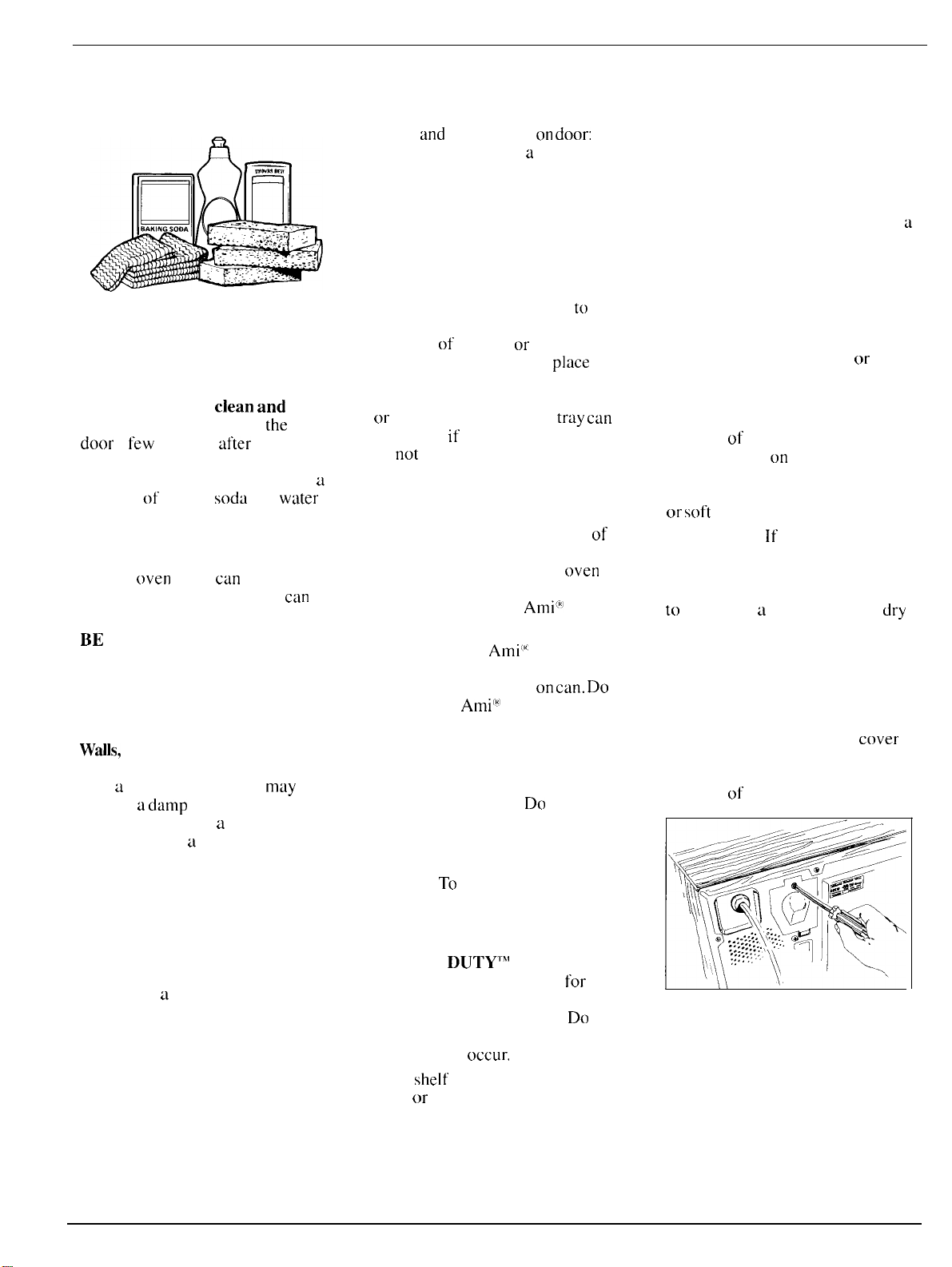
Care and Cleating
Your new microwave oven is a
valuable appliance. Protect it
from misuse by following these
rules:
● Keep your oven
clean
and
sweet-smelling. Opening the oven
door
a
few
minutes after cooking
helps air-out the inside. An
occasional thorough wiping with
a
solution of baking
soda
and
water
keeps the inside fresh.
● Don’t use sharp-edged utensils
on your oven. The inside and
outside
oven
walls
can
be
scratched.
The control panel can be
damaged.
BE CERTAIN POWER IS OFF
BEFORE CLEANING ANY
PART OF THIS OVEN.
How to Clean the Inside
Walls,
floor and mode stirrer cover.
Some spatters can be removed
with
a
paper towel, others
may
require
a
damp
cloth. Remove
greasy spatters with
a sudsy cloth,
then rinse with
a
damp cloth. Do
not use abrasive cleaners on oven
walls. NEVER USE A
COMMERCIAL OVEN
CLEANER ON ANY PART OF
YOUR MICROWAVE OVEN.
Door (inside).
Window: Wipe up
spatters daily
and wash when
soiled with
a
damp cloth. Rinse
thoroughly and dry.
Metal
and
plastic parts
on
door:
Wipe frequently with
a
damp cloth
to remove all soil. DO NOT
USE ABRASIVES, SUCH AS
CLEANING POWDERS OR
STEEL AND PLASTIC PADS.
THEY WILL MAR THE
SURFACE.
Glass Cooking Tray.
Occasionally it is necessary
to
remove the cooking tray for
cleaning
of the tray
or
oven. To
prevent breakage, do not
place
tray
into water just after cooking. Wash
it carefully in warm, sudsy water
or
in the dishwasher. The
tray
can
be broken
if
dropped. Remember,
do
not
operate the oven without the
cooking tray in place.
Special note when using Brown
‘N Sear Dish: If grease is present,
high heat generated on bottom
of
a Brown ‘N Sear dish may cause
the grease to burn onto the
oven
tray. This may be removed with a
cleanser such as Bon
Ami@)
brand
cleanser.
After using Bon
Ami”)
brand
cleanser, rinse and dry thoroughly,
following instructions
on
can.
Do
not use Bon
Ami(~
brand cleanser
on the painted surfaces such as the
walls. It may scratch the paint.
Automatic Temperature Probe.
Probe is sturdy, but care should
be taken in handling.
Do
not twist
or bend; avoid dropping
temperature probe.
Clean as soon after using as
possible.
To
clean, wipe with sudsy
cloth, then rub lightly with plastic
scouring ball if necessary. Rinse
and dry or wash in dishwasher.
DOUBLE
DUTY’’’”
shelf. Your
shelf accessory is designed
for
use
in a microwave oven only; do not
use in a conventional oven.
Do
not
use a browning dish with the shelf.
Arcing could
occur.
Clean
shelf
with mild soap and
water
or
in the dishwasher.
Do not
clean shelf in a self-cleaning oven.
How to Clean the Outside
Case. Clean the outside of your
oven with soap and damp cloth,
rinse with a damp cloth and then
dry. Wipe the window clean with
a
damp cloth. Chrome trim is best
wiped with a damp cloth and then
with a dry towel.
Control Panel. Wipe with a damp
cloth. Dry thoroughly. Do not use
cleaning sprays, large amounts of
soap and water, abrasives,
or
sharp
objects on the panel—they can
damage it.
Door Surface. When cleaning
surfaces
of
door and oven that
come together
on
closing the door,
use only mild, non-abrasive soaps
or detergents applied with a sponge
or
soft
cloth.
Power Cord.
If
the cord becomes
soiled, unplug and wash with damp
cloth. For stubborn spots, sudsy
water may be used, but be certain
to
rinse with
u
damp cloth and
dry
thoroughly before plugging cord
into outlet.
Oven Lamp Replacement
First unplug the oven. Then
remove lamp compartment
cover
by removing screw which holds
cover in place. Cover is located on
the back
of the outer case.
Replace with 40-watt appliance
bulb. (It is available in drug and
hardware stores.) Replace
compartment cover. Plug in the
oven.
32
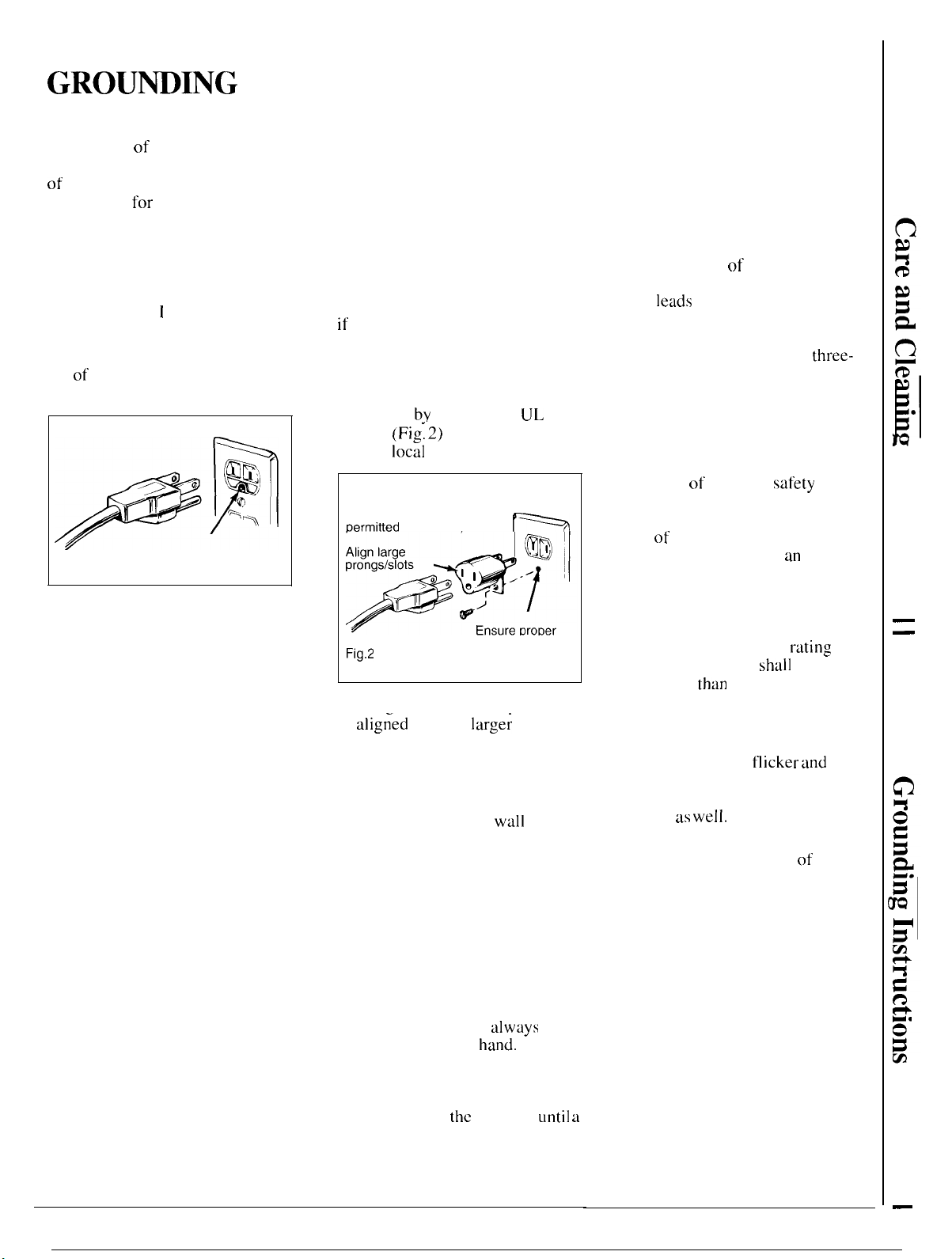
GROU~ING
INSTRUCTIONS
This appliance must be grounded.
In the event
of an electrical short
circuit, grounding reduces the risk
of
electric shock by providing an
escape wire
for
the electric current.
This appliance is equipped with a
power cord having a grounding
wire with a grounding plug. The
plug must be plugged into an outlet
that is properly installed and
grounded. (Fig.
1
)
WARNING–improper
use
of
the grounding plug. can
result in a risk of electric shock.
PREFERRED METHOD
pD
o
.@
m
+’i
]1
6
-?7
Ensure proper ground
Fig 1
exists before use.
Consult a qualified electrician or
service technician if the grounding
instructions are not completely
understood, or if doubt exists as to
whether the appliance is properly
grounded.
Where a standard two-prong wall
receptacle is encountered, it is your
personal responsibility and
obligation to have it replaced with
a properly grounded three-prong
wall receptacle.
Do not under any circumstances
cut or remove the third (ground)
prong from the power cord.
Use of Adapter Plugs
Usage situations where
appliance’s power cord will
be disconnected infrequently.
Because of potential safety hazards
under certain conditions, we
strongly recommend against the
use of an adapter plug. However,
if
you still elect to use an adapter,
where local codes permit, a
TEMPORARY CONNECTION
may be made to a properly
grounded two-prong wall
receptacle
bv
the use of a UL listed
adapter
(Fig:
2)
which is available
at most
local
hardware stores.
TEMPORARY METHOD
(Adapter plugs not
Dermitted
in Canada)
b
Fig.2
ground and firm
connection
before use
he larger slot in the adapter must
be
alig~ed
with the
large;
slot in
the wall receptacle to provide
proper polarity in the connection
of the power cord.
Caution: Attaching the adapter
ground terminal to the
wall
receptacle cover screw does not
ground the appliance unless the
cover screw is metal, and not
insulated, and the wall receptacle
is grounded through the house
wiring. You should have the circuit
checked by a qualified electrician
to make sure the receptacle is
properly grounded.
When disconnecting the power
cord from the adapter,
always hold
the adapter with one
hand.
If this
is not done, the adapter ground
terminal is very likely to break with
repeated use. Should this happen,
DO NOT USE
the
appliance until
a
proper ground has again been
established.
Usage situations where
appliance’s power cord
will be disconnected
frequently.
Do not use an adapter plug in
these situations because
disconnecting of the power cord
places undue strain on the adapter
and
leads
to eventual failure of the
adapter ground terminal. You
should have the two-prong wall
receptacle replaced with a
three-
prong (grounding) receptacle by a
qualified electrician before using
the appliance.
Use of Extension Cords
Because of potential
safety
hazards
under certain conditions, we
strongly recommend against the
use
of
an extension cord. However,
if it is necessary to use
an
extension
cord, use only a 3-wire extension
cord that has a 3-blade grounding
plug, and a 3-slot receptacle that
will accept the plug on the
appliance. The marked
rating
of
the extension cord
shall
be equal to
or greater
than
the electrical rating
of the appliance (15 amperes).
If you do use an extension cord
with your microwave oven, the
interior light may
tlicker
and
the
blower sound may vary when oven
is in use. Cook times may be
longer
as
well.
A short power-supply cord is
provided to reduce risks of
becoming entangled in or tripping
over a longer cord. Do not drape
the cord over a countertop or table
where it can be pulled on by
children or tripped over
accidentally.
33
—
—
—
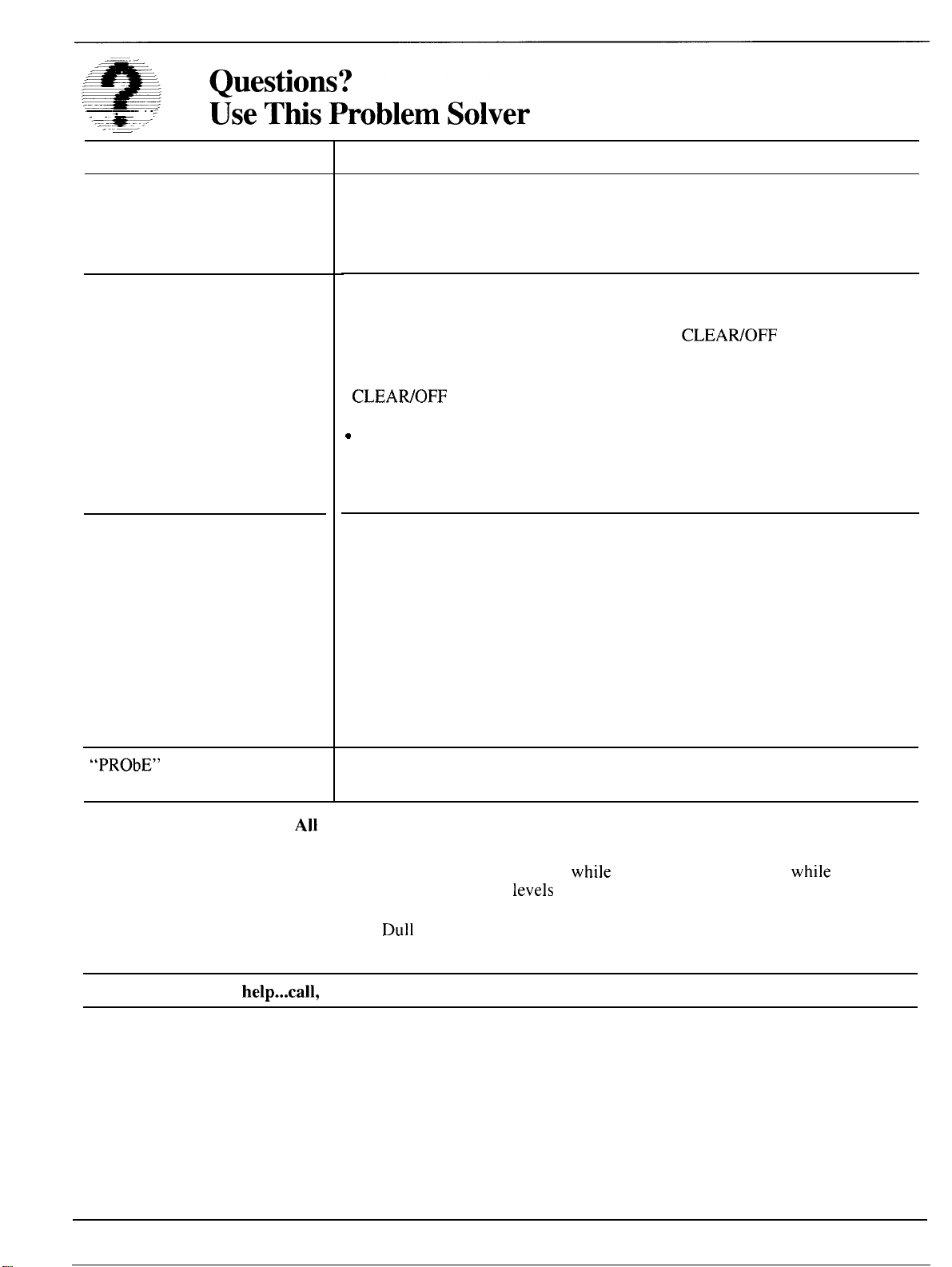
::e~;:;rob,em,o,ver
. . . .
.
. . .
. . . . . . .
..
7—
-—=---
PROBLEM
OVEN WILL NOT
COME ON
CONTROL PANEL
LIGHTED, YET
OVEN WILL NOT
START
FOODS ARE EITHER
OVERCOOKED OR
UNDERCOOKED
“PRObE”
APPEARS ON
DISPLAY
POSSIBLE CAUSE AND REMEDY
● A fuse in your home may be blown or the circuit breaker tripped. Replace fuse
or reset circuit breaker.
● Unplug your microwave oven, then plug it back in.
● Make sure 3-prong plug on oven is fully inserted into wall receptacle.
● Door not securely closed.
● START must be touched after entering cooking selection.
● Another selection entered already in oven and CLEAWOFF pad not touched
to cancel it.
●
Make sure you have entered cooking time after touching TIME COOK I & II pad.
● CLEAWOFF pad was touched accidentally. Reset cooking program and touch
START pad.
s
Make sure you have entered a temperature after touching TEMP COOK &
HOLD pad.
● Make sure you entered a code number after touching AUTO ROAST or
CODE REHEAT.
● Cooking times may vary because of starting food temperature, food density or
amount of foods in oven. Touch TIME COOK I & II pad and additional cooking
time for completion.
● Incorrect power level entered. Check Cooking Guide for recommended power
level.
● Dish was not rotated, turned or stirred. Some dishes’ require specific
instructions. Check Cooking Guide or recipe for instructions.
● Too many dishes in oven at same time. Cooking time must be increased when
cooking more than one food item. Check Cooking Guide time recommendations.
● Probe not inserted properly into meat or dish when using Temp Cook & Hold
function. Check Cooking Guide for specific instructions.
● Probe has been forgotten or not seated properly in oven wall when using Temp
Cook & Hold function.
All
these things are normal with your microwave oven:
● Steam or vapor escaping from
● Dimming oven light and change ● Some TV-Radio interference
around the door.
in blower sound may occur
while
might be noticed
while
using your
● Light reflection around door or
operating at power
levels
other
microwave oven. It’s similar to the
outer case.
than high.
interference caused by other small
●
Dull
thumping sound while oven
appliances and does not indicate a
is operating.
problem with your oven.
If you need more help...call, toll free: GE Answer Center
(
”
)
/ 800.626.2000/ consumer information service
34
Wdll
Be There
With the purchase
ofyour
new GE appliance, receive the
assurance that
if’you
ever need information
or
assistance
from
CTE,
wdll
be there. All you have to
do
is call–toll-free!
In-Home Repair
Service
80ME4ARES
(80M32-2737)
AC;Econsurner
semiceplofkssi(~tlal
will provide
expel-l
repail-
selwice,
scheduled
at
a [ime (hat’s con~enient
fi)r you.
Many
(;kl (;ons~lnler
Se]vi(c
c01np21ny-(Jpel-;llecl
locations”
ofl’er
you service today or lomorrow,
oral
y(~urc[)r]vellierlce
(7:()()
a.rn
to
7:()()
p.m.
weekdays,
!):()()
a.nl. to
2:()()
p.m. Satur-
days). our
flic[()[;-(r:linecl
[c(bniciarls
know
youI”
appliance inside and
out-
so mt)st
rep+lit-s
can he han[fled in just
one
\risil.
Service
Contrac&
80M2&2224
You cart have the secure fkeling that
(;E
(;orlsurrler Service will still be
[here after your warranty expires. Pur-
chase
a
(;E
contract while y{)ur
war-
ranly is still in eff’ect and
yoLJ
’11 rectiive
a substantial discount. With
~L
multiple-
year-
contract,
you’re assured of’fiJt.ure
selwicc
al today’s prices.
Patis
andAccessories
80@626-2D02
IndividuA
quarified
to service their
own appliances
cart
have
needed
parts
or accessories sent direclly to
their
home. The
C,E
parts system
pr{)-
vides
access to over 47,()()()
part.s...
and
all
GE
C;erruine
Renewal Parts are
f’ully
warranted. VISA, Mastercard
and
I)iscover
cards are accepted.
User maintenance instructions
contained in this
bootiet
cover proce-
dures intended to be performed
by
any user. Other servicing
generdy
shodd
be referred to
qutified
ser-
vice personnel. Caution must be
exercised, since improper servicing
may cause unsafe operation.
GEAnswer
Center@
8086262000
Whatever your question about any (;k;
tnajor appliance,
C;E
Answer (Jenter’{
infornl:;t.ion”
setvi(e is available to
help.
Your call–and your
question-
wiIl
be answered promptly and
courteously.”
And you can call any
time. (;F, Answer
~;enter”’
service is
open 24 hours a
dLLy,
7 days a week.
Telecommunication
Detice
for the Deaf
kr
Customers With
Special Needs...
Upon request,
C;E
will provide Braillt
corrtrols”
for a variety of’(;kl ;ipplian(e!
and
a
brochure
to assist in planning
;i
barrier-fi-ee kitchen for persons
with
limited mobility. T() obtain these item:
free
of’charge, call 800.626.2000.
{;orlsuulers with impaired heilring
or speech who have access to a
TI)I)
or a conventi(~nal teletypewriter may
call 800-TDLJ-C;EA[;” (800 -83~3-4322)”
to request inf(~rmation or service.
YOUR GE MICROWAVE OVEN
WARRANTY
I
I
Save proof of original purchase date such as your sales slip or
cancelled
check to establish warranty period.
WHAT IS COVERED
FULL ONE-YEAR WARRANTY
This warranty is extended to
For one year from date of original
the original purchaser and any
purchase, we will provide, free of
succeeding owner for products
charge,
pans
and service labor in
purchased for
ordina~
home use in
your home to repair or replace
any
the 48 mainland states, Hawaii and
part of the microwave oven
that
Washington,
D.C.
In Alaska the
~~~~tecause
of a manufacturing
warranty is the same except that it is
LIMITED because you must pay to
ship the product to the
sewice shop
LIMITED ADDITIONAL
or for the service technician’s travel
NINE-YEAR WARRANTY
costs to your home.
For the second through tenth year
from date of original purchase, we
will provide, free of charge, a
replacement
magnetron tube
if the
magnetron tube fails because of a
manufacturing defect. You pay for
the service trip to your home and
sewice
labor charges.
All warranty
semice
will be provided
by our
Factoy
Sewice Centers or
by our authorized Customer Care
(R
’
servicers during normal working
hours.
Look in the White or Yellow Pages
of your telephone
directo~
for
GENERAL ELECTRIC COMPANY,
GENERAL ELECTRIC FACTORY
SERVICE, GENERAL
ELECTRIC-
HOTPOINT FACTORY SERVICE or
GENERAL ELECTRIC CUSTOMER
CARE’’”
SERVICE.
WHAT IS NOT COVERED
●
Sewice trips to your home to teach
●
Replacement of house fuses or
you how to use the product.
resetting of circuit breakers.
II
Read your Use and Care material.
●
Failure of the product if it is used for
If you then have any questions
other than its intended purpose or
about operating the product, please
used commercially.
contact your dealer or our
Consumer Affairs office at the
●
Damage to product caused by
address below, or call, toll free:
accident, fire, floods or acts of God.
GE Answer Center”
WARRANTOR IS NOTRESPONSIBLE
800.626.2000
FOR CONSEQUENTIAL DAMAGES.
consumer information service
● Improper installation.
If you have an installation problem,
contact your dealer or installer.
You are responsible for providing
adequate electrical, gas, exhausting
and other connecting facilities.
Some states do not allow the exclusion or limitation of incidental or consequential damages, so the above limitation or exclusion
may not apply to you. This warranty gives you specific legal rights, and you may also have other rights which vary from state to state.
To know what your legal rights are in your state, consult your local or state consumer affairs office or your state’s Attorney General.
Warrantor: General Electric Company
If further help is needed concerning this warranty, write:
Manager—Consumer Affairs, GE Appliances, Louisville, KY 40225
I
I
Part No. 164
D2588PO05
JE1455K
Pub.
No.
49-8208
I
1
10-91
CG

