Use & Care Guide
I11
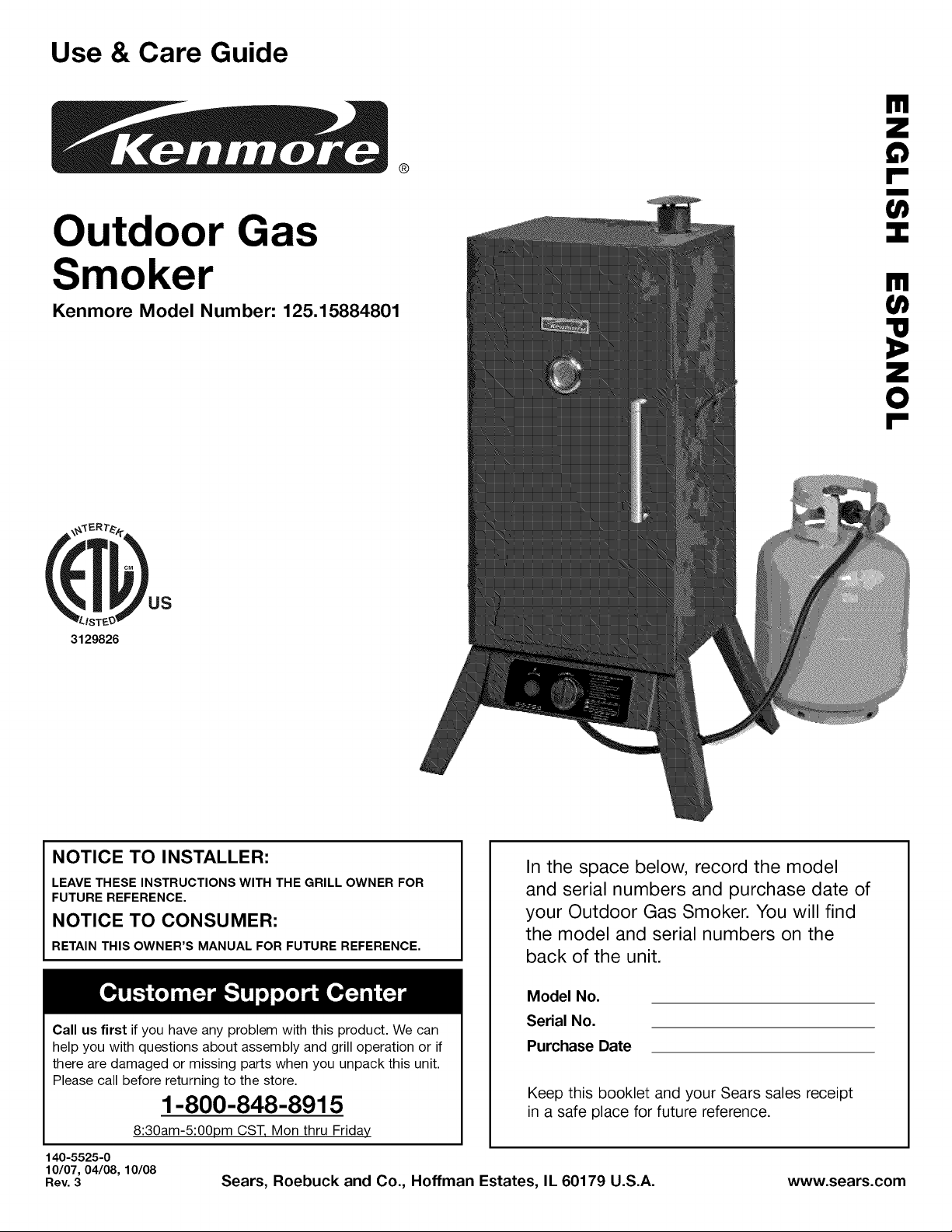
Outdoor Gas
Smoker
Kenmore Model Number: 125.15884801
3129826
US
®
I-
NOTICE TO INSTALLER:
LEAVE THESE INSTRUCTIONS WITH THE GRILL OWNER FOR
FUTURE REFERENCE.
NOTICE TO CONSUMER:
RETAIN THIS OWNER'S MANUAL FOR FUTURE REFERENCE.
Call us first if you have any problem with this product. We can
help you with questions about assembly and grill operation or if
there are damaged or missing parts when you unpack this unit.
Please call before returning to the store.
1-800-848-8915
8:30am-5:OOpm CST, Mon thru Friday
In the space below, record the model
and serial numbers and purchase date of
your Outdoor Gas Smoker. You will find
the model and serial numbers on the
back of the unit.
Model No.
Serial No.
Purchase Date
Keep this booklet and your Sears sales receipt
in a safe place for future reference.
140-5525-0
10/07, 04/08, 10/08
Rev. 3 Sears, Roebuck and Co., Hoffman Estates, IL 60179 U.S.A. www.sears.com
Warranty information ................................. 2
Important Safety Warnings .......................... 2-4
Product Features .................................... 4
Carton Contents .................................. 4-6
Assembly Instructions ............................. 7-13
Connecting the LP Tank ........................... 14-15
Operating Instructions ............................ 15-16
Lighting Procedures .............................. 16-17
Cooking Instructions ................................ 17
Temperature Chart .................................. 18
After Use Safety and Maintenance .................. 18-19
Storage .......................................... 19
Troubleshooting .................................... 19
,_ DANGER: indicatesan imminently hazardous situation which, if
not avoided, will result in death or serious injury.
WARNING: Be alert to the possibility of serious bodily injury if the
instructions are not followed. Be sure to read and
carefully follow all of the messages.
_, CAUTION: Indicates a potentially hazardous situation which, if not
avoided, may result in minor or moderate injury.
Kenmore One-Year Full Warranty
If this Kenmore smoker fails due to a defect in material or
workmanship within one year from the date of purchase,
call 1-800-4-MY-HOME® to arrange for free repair (or
replacement if repair proves impossible).
This warranty excludes smoker part paint loss or surface
rusting, which are either expendable parts or conditions that
can result from normal use, accident or improper
maintenance.
This warranty is void if this smoker is ever used for
commercial or rental purposes.
This warranty gives you specific legal rights, and you may
also have other rights which vary from state to state.
Sears, Roebuck and Co.,
Hoffman Estates, IL 60179
If you smell gas:
1. Shut off gas to the appliance.
2. Extinguish any open flames.
3. Open door.
4. If odor continues, keep away from the
appliance and immediately call your
fire department.
Failure to follow these instructions could
result in fire or explosion which could
cause property damage, personal injury or
death.
1. Never operate this appliance
unattended.
2. Although minimum clearance is
36 inches (92 cm), we strongly
recommend that you do not operate
this appliance within 10 ft. (3.0 m) of
any structure, combustible material or
extra LP gas cylinders not attached
to the appliance.
3. Never operate this appliance within
25 ft (7.5 m) of any flammable liquid.
4. Never allow oil or grease to get hotter
than 400°F or 200°C. If the
temperature exceeds 400°F (200°C) or
if oil begins to smoke, immediately
turn the burner or gas supply OFF.
5. Heated liquids remain at scalding
temperatures long after the cooking
process. Never touch cooking
appliance until liquids have cooled to
115°F (45 °C) or less.
6. If a fire should occur, keep away from
the appliance and immediately call
your fire department. Do not attempt
to extinguish an oil or grease fire with
water.
Failure to follow these instructions could
result in fire or explosion which could
cause property damage, personal injury or
death.
2 @Sears Brands L.L.C.
WE WANT YOU TO ASSEMBLE AND USE YOUR SMOKER
AS SAFELY AS POSSIBLE.
THE PURPOSE OF THIS SAFETY ALERT SYMBOL _k IS
TO ATTRACT YOUR ATTENTION TO POSSIBLE HAZARDS
AS YOU ASSEMBLE AND USE YOUR SMOKER.
WHEN YOU SEE THE SAFETY ALERT SYMBOL _k
PAY CLOSE ATTENTION TO THE INFORMATION WHICH
FOLLOWS!
_lb READ ALL SAFETY WARNINGS AND INSTRUCTIONS
CAREFULLY BEFORE ASSEMBLING AND OPERATING
YOUR SMOKER.
This instruction manual contains important information
necessary for the proper assembly and safe use of the
appliance.
Read and follow all warnings and instructions before
assembling and using the appliance.
Follow all warnings and instructions when using the
appliance.
Keep this manual for future reference.
DO NOT use this smoker in a manner other than its
intended purpose. It is NOT intended for commercial use. It
is NOT intended to be installed or used in or on a
recreational vehicle and/or boats. The smoker is not to be
used as a heater.
Keep a fire extinguisher accessible at all times.
The use of alcohol, prescription or non prescription drugs
may impair the user's ability to properly assemble or safely
operate the smoker.
This smoker is for outdoor use only, in a well-ventilated
area. DO NOT operate the smoker indoors, in a garage, or
in any other enclosed area or under overhead construction.
Use caution when assembling and operating the smoker to
avoid cuts and scrapes from rough or sharp edges.
Use caution when lifting and moving the smoker to avoid
strains or back injury. Two people are recommended to lift
or move the smoker. DO NOT move the smoker while it is
in use.
DO NOT operate the smoker near or under flammable or
combustible materials such as decks, porches, or carports.
A minimum clearance of 36 inches (92cm) is recommended.
DO NOT operate the smoker under overhead construction.
Operate the smoker only on a stable, level, non-flammable
surface such as asphalt, concrete or solid ground. DO NOT
operate the smoker on flammable material such as carpet
or a wood deck.
DO NOT store the smoker near gasoline or other
combustible liquids or where combustible vapors may be
present.
DO NOT store or operate this smoker in an area accessible
to children or pets. Store the smoker in a dry, protected
location.
DO NOT leave the smoker unattended while in use.
Operate the smoker with close supervision.
DO NOT allow anyone to conduct activities around the
smoker during or following use until it has cooled. It is hot
during operation and remains hot for a period of time
following use.
DO NOT leave hot ashes unattended until the smoker cools
completely.
DO NOT move the smoker while it is in use. Allow the
smoker to cool completely before moving or storing.
This smoker becomes extremely hot - allow the smoker to
cool completely before handling. If you must handle the
smoker while it is hot, ALWAYS wear protective oven mitts
or heat resistant gloves when handling the smoker or its
components.
NEVER use gasoline or other highly volatile fluids as a
starter. They can explode.
The water bowl and woodchip box should not be moved
while the smoker is operating or until the smoker has
cooled sufficiently. These contain hot ashes and liquids
that may cause serious injury. If you must move these
components, ALWAYS wear protective oven mitts or heat
resistant gloves.
Dispose of cold ashes by wrapping them in heavy duty
aluminum foil and putting them in a non combustible
container. Be sure there are no other combustible materials
in or near the container.
If you must dispose of the ashes in less time than it takes
for them to completely cool, remove the ashes from the
smoker, keeping them in heavy duty foil, and soak them
completely with water before disposing of them in a non
combustible container.
DO NOT obstruct the flow of combustion air and/or
ventilation air for the smoker.
Use caution when opening the door of the smoker while in
operation. Keep hands, face, and body safe from hot steam
or flare-ups. Protect your nose and mouth from smoke
inhalation.
DO NOT wear loose clothing while operating the smoker.
Tie back long hair while operating the smoker. ALWAYS
wear fully-covering shoes while operating the smoker.
Allow the smoker and its components to cool completely
before conducting any routine cleaning or maintenance.
NEVER use glassware, plastic, or ceramic cookware on or
in your smoker.
NEVER operate the smoker without water in the water
bowl. NEVER allow the water to completely evaporate.
Check the water level at least every 2 hours. A sizzling
sound may indicate a low water level. Follow instructions in
this manual for adding water while operating.
When using flavoring wood, add a sufficient amount prior
to operation to avoid having to add wood while operating.
Adding wood while operating may splash hot water and
cause serious injury.
Use of accessories not intended for this smoker is not
recommended and may lead to injury or property damage.
3
• An LP cylinder not connected for use should not be stored in the
vicinity of the smoker or any other appliance. DO NOT store
spare LP cylinders within 10 feet of the smoker. LP cylinders
must be stored outdoors, out of reach of children. DO NOT store
LP cylinders in a building, garage, or any other enclosed area.
• DO NOT store LP gas cylinders inside or on top of the smoker.
Improper storage of cylinders could lead to explosion, fire, and/or
personal injury. Cylinders are to be store outdoors, out of reach
of children and must not be stored in a building, garage, or any
other enclosed area.
• While the smoker is not in use, the gas must be turned off at the
supply cylinder.
• LP gasses are heavier than air, tend to pool and collect in low-
lying areas, are easily ignited and are highly flammable. Proper
care and caution should be employed when dealing with any
such fuels.
• Do not use the smoker if the burner fails to light or fails to remain
lit. Under such conditions, gas should be shut off and fuel
cylinders should be disconnected.
• The smoker should be shut off and all supply valves (on piping or
on fuel cylinders) should be closed in the event that the odor of
unburned gas is detected. Do not attempt to use the unit until
any gas leaks are fixed and/or the source of the unburned gas
odor is accounted for.
• Use under high wind conditions that result in poor burner
operation such as blowing out and flaring should be avoided. If
repositioning the unit does not improve operation under such
wind conditions, the unit should be shut off.
• All installations are to conform to local codes. In the absence of
local codes, installation should conform to the National Fuel Gas
Code, ANSI Z223.1/NFPA54.
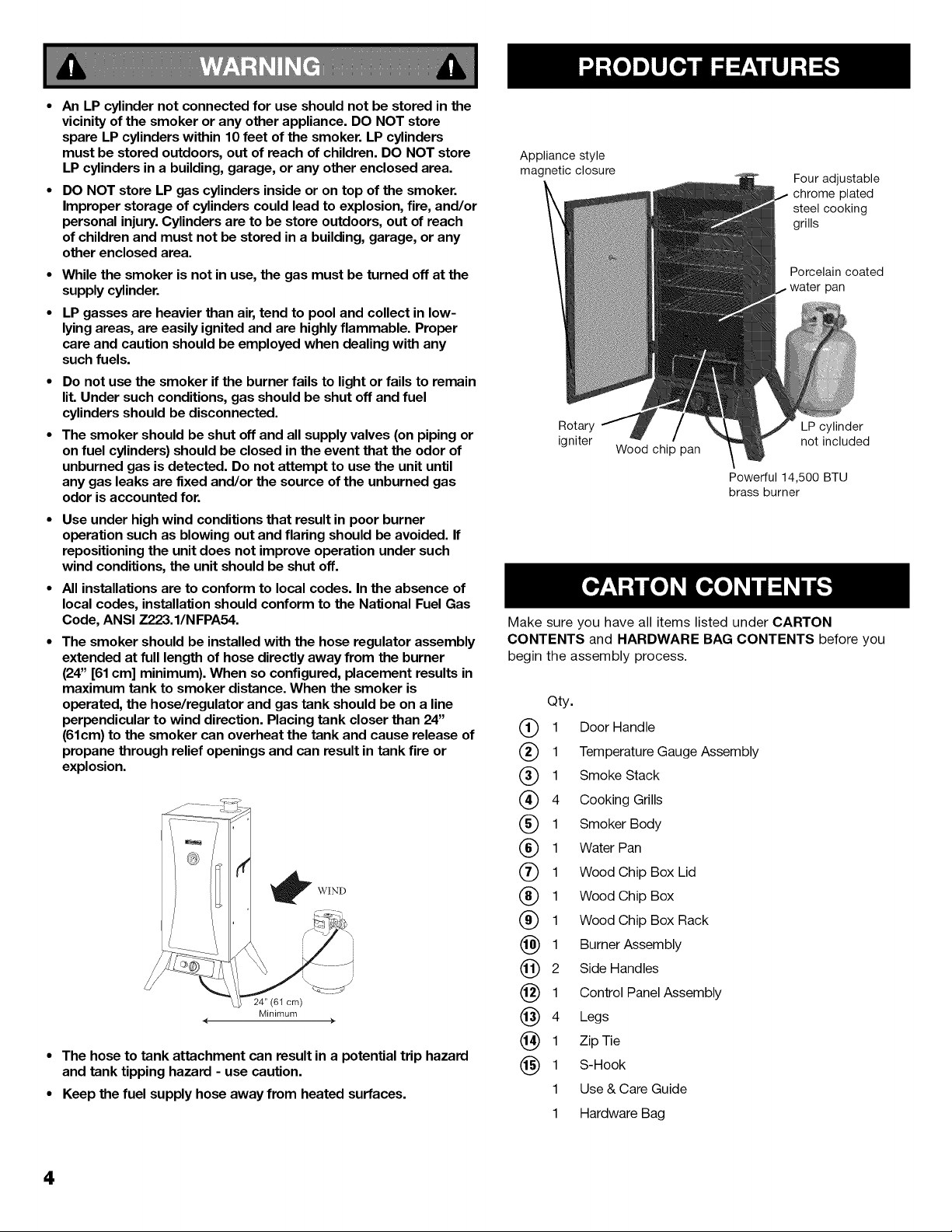
• The smoker should be installed with the hose regulator assembly
extended at full length of hose directly away from the burner
(24" [61 cm] minimum). When so configured, placement results in
maximum tank to smoker distance. When the smoker is
operated, the hose/regulator and gas tank should be on a line
perpendicular to wind direction. Placing tank closer than 24"
(61cm) to the smoker can overheat the tank and cause release of
propane through relief openings and can result in tank fire or
explosion.
_WIND
24" (61 cm)
Minimum
• The hose to tank attachment can result in a potential trip hazard
and tank tipping hazard - use caution.
• Keep the fuel supply hose away from heated surfaces.
Appliance style
magnetic closure
Four adjustable
chrome plated
steel cooking
grills
Porcelain coated
pan
Rotary LP cylinder
igniter not included
Wood chip pan
Powerful 14,500 BTU
brass burner
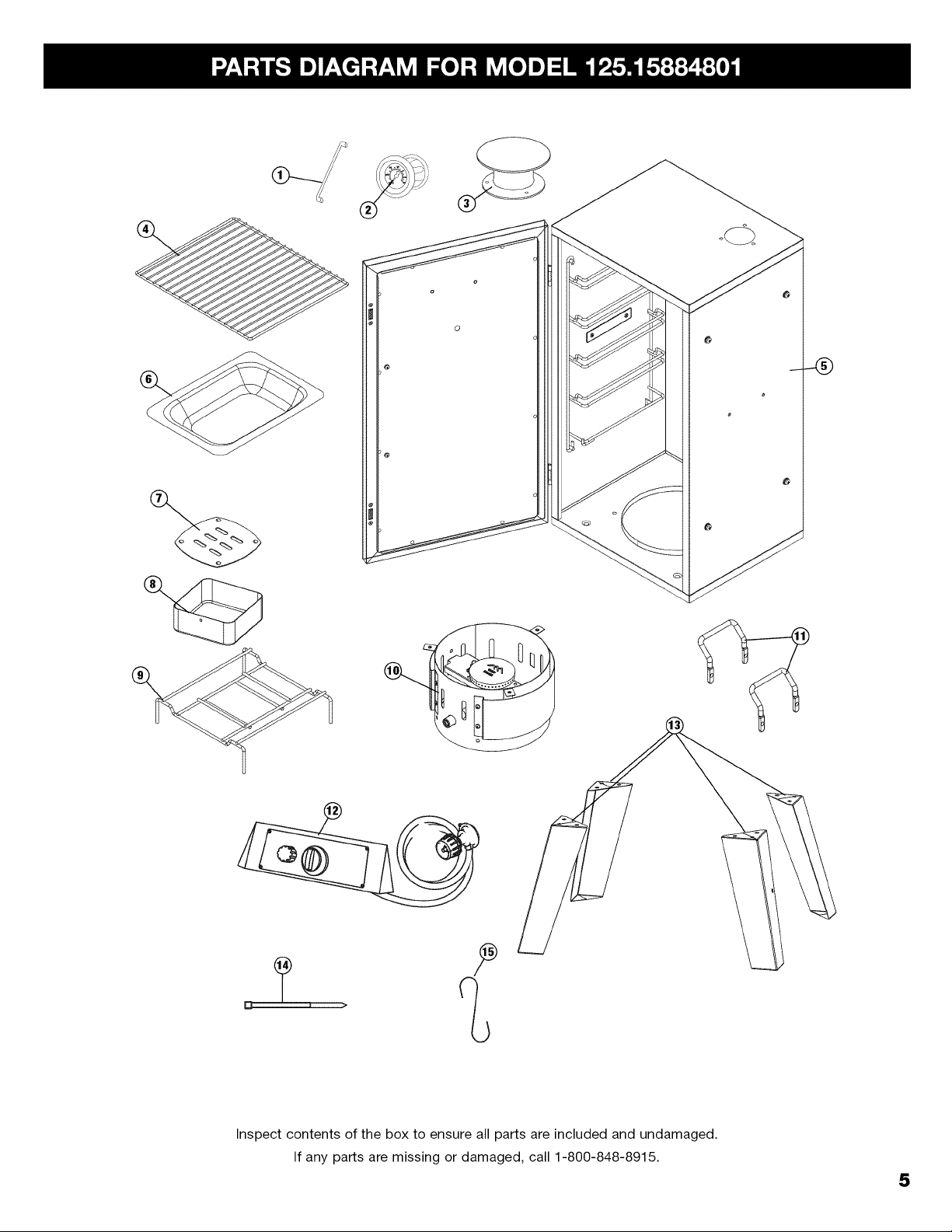
Make sure you have all items listed under CARTON
CONTENTS and HARDWARE BAG CONTENTS before you
begin the assembly process.
Qty.
(_) 1 Door Handle
(_ 1 Temperature Gauge Assembly
(_) 1 Smoke Stack
(_) 4 Cooking Grills
(_) 1 Smoker Body
(_) 1 Water Pan
(_ 1 Wood Chip Box Lid
1 Wood Chip Box
(_) 1 Wood Chip Box Rack
(_) 1 Burner Assembly
@ 2 Side Handles
(_) 1 Control Panel Assembly
(_) 4 Legs
(_) 1 Zip Tie
(_) 1 S-Hook
1 Use & Care Guide
1 Hardware Bag
4
%
Inspect contents of the box to ensure all parts are included and undamaged.
If any parts are missing or damaged, call 1-800-848-8915.
5
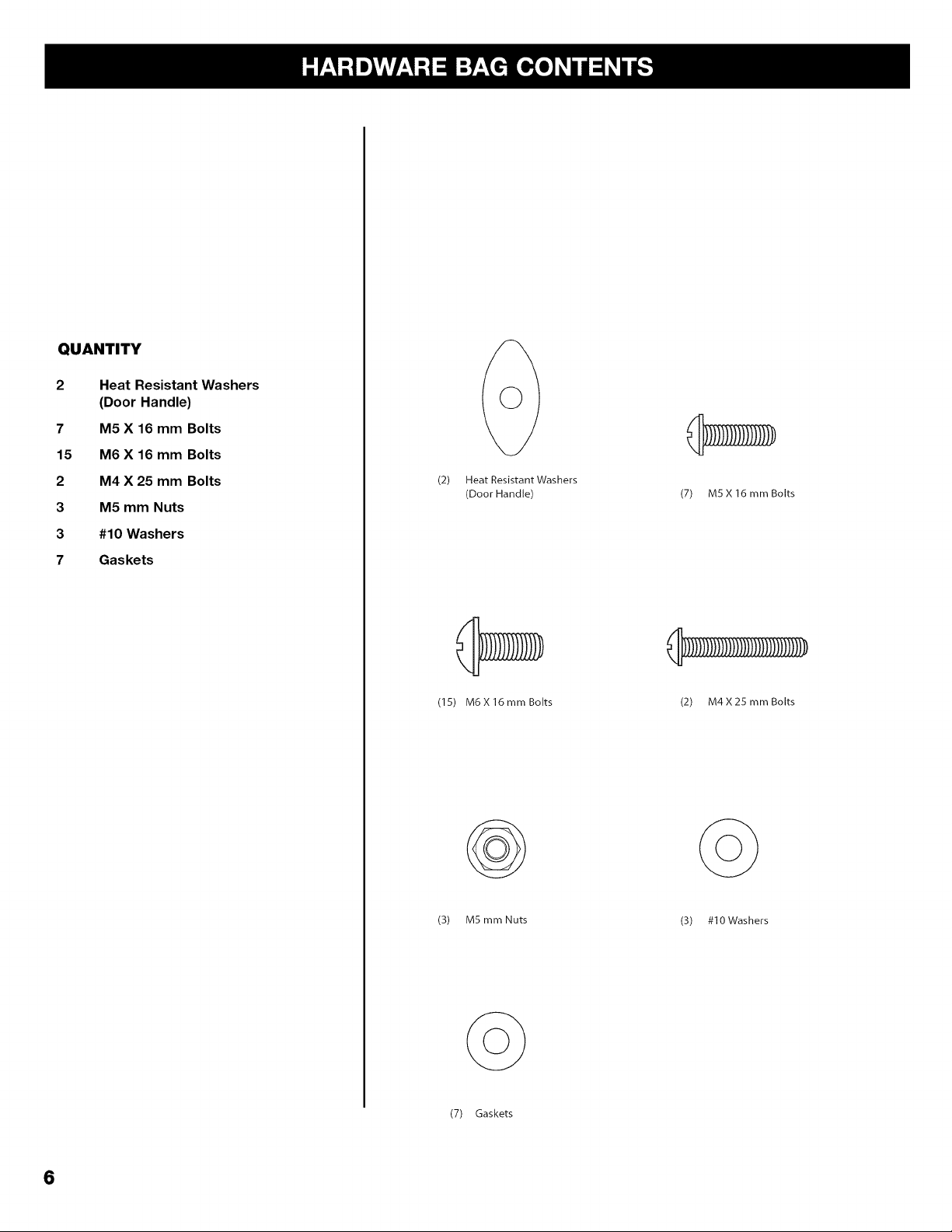
QUANTITY
2 Heat Resistant Washers
(Door Handle)
7 M5 X 16 mm Bolts
15 M6 X 16 mm Bolts
2 M4 X 25 mm Bolts
3 M5 mm Nuts
3 #10 Washers
7 Gaskets
6
(2)
(15)
(3)
Heat Resistant Washers
(Door Handle)
M6 X 16 mm Bolts
M5 mm Nuts
(7) Gaskets
(7) M5 X 16 mm Bolts
(2) M4 X 25 mm Bolts
(3) #10 Washers
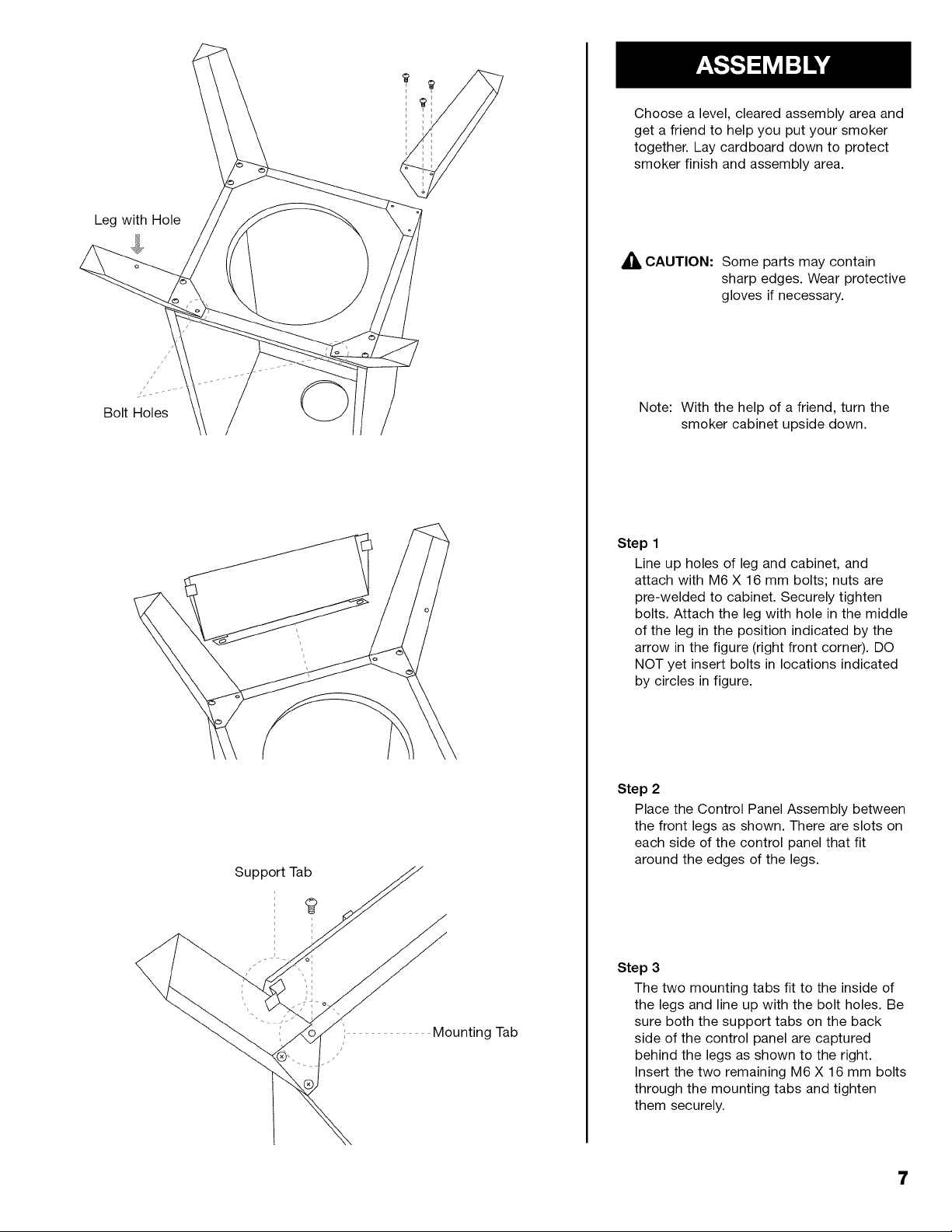
Leg with Hole
Bolt Holes
Support Tab
?
Choose a level, cleared assembly area and
get a friend to help you put your smoker
together. Lay cardboard down to protect
smoker finish and assembly area.
CAUTION: Some parts may contain
sharp edges. Wear protective
gloves if necessary.
Note: With the help of a friend, turn the
smoker cabinet upside down.
Step 1
Line up holes of leg and cabinet, and
attach with M6 X 16 mm bolts; nuts are
pre-welded to cabinet. Securely tighten
bolts. Attach the leg with hole in the middle
of the leg in the position indicated by the
arrow in the figure (right front corner). DO
NOT yet insert bolts in locations indicated
by circles in figure.
Step 2
Place the Control Panel Assembly between
the front legs as shown. There are slots on
each side of the control panel that fit
around the edges of the legs.
Step 3
The two mounting tabs fit to the inside of
the legs and line up with the bolt holes. Be
sure both the support tabs on the back
side of the control panel are captured
behind the legs as shown to the right.
Insert the two remaining M6 X 16 mm bolts
through the mounting tabs and tighten
them securely.
7
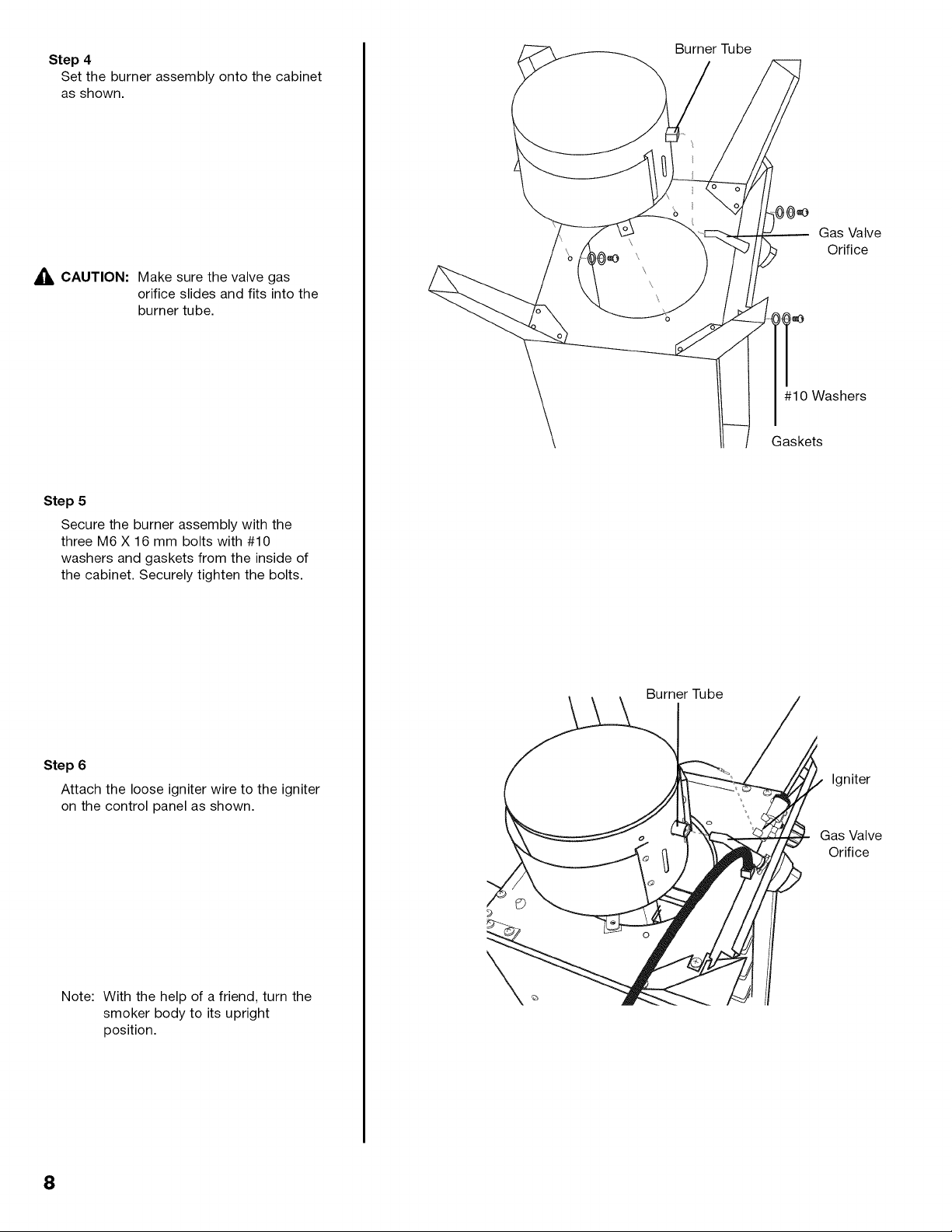
Step 4
Set the burner assembly onto the cabinet
as shown.
_, CAUTION: Make sure the valve gas
orifice slides and fits into the
burner tube.
Step 5
Secure the burner assembly with the
three M6 X 16 mm bolts with #10
washers and gaskets from the inside of
the cabinet. Securely tighten the bolts.
Step 6
Attach the loose igniter wire to the igniter
on the control panel as shown.
Note: With the help of a friend, turn the
smoker body to its upright
position.
8
Burner Tube
Burner Tube
,Io
Gas Valve
Orifice
#10 Washers
Gaskets
Igniter
Gas Valve
Orifice
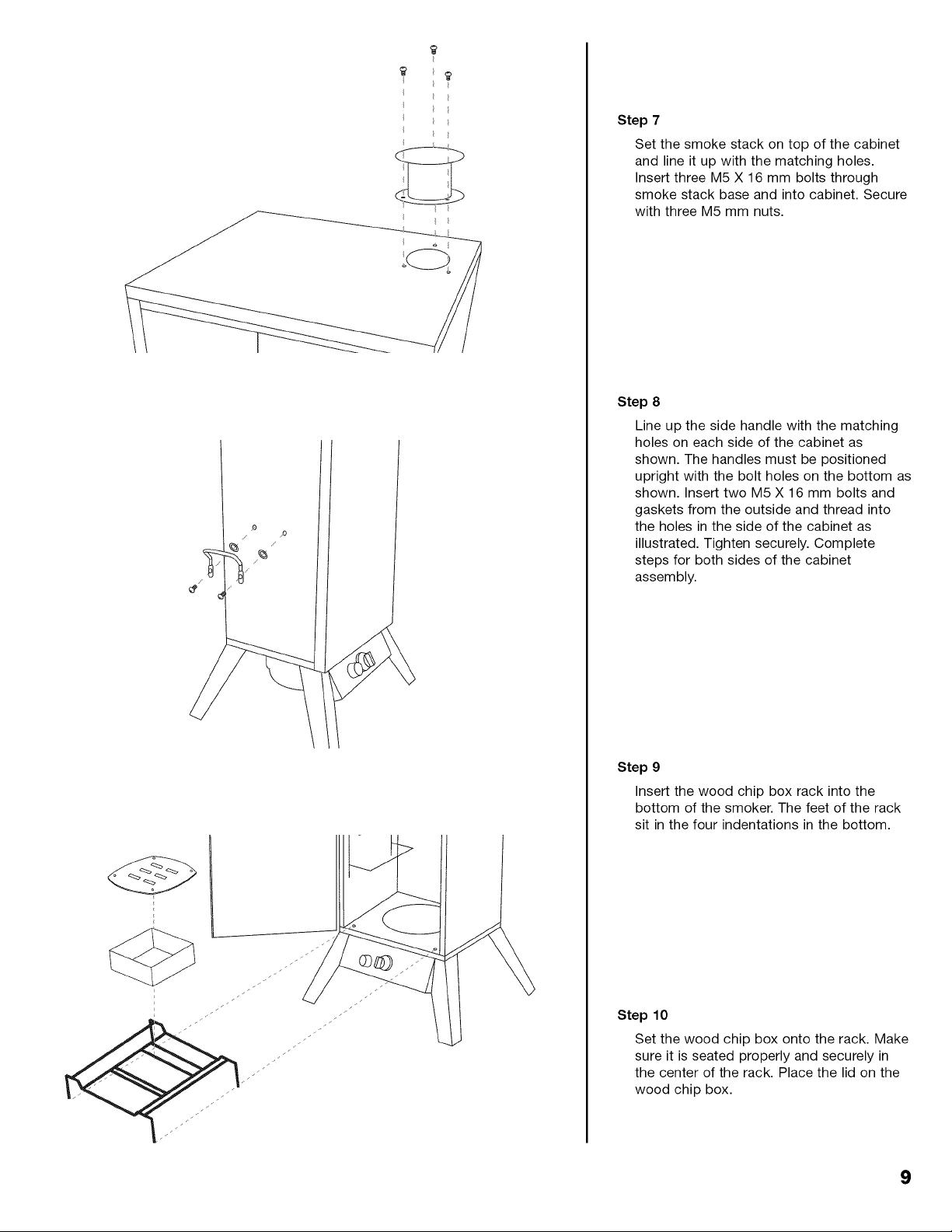
Step7
Setthesmokestackontopofthecabinet
andlineitupwiththematchingholes.
InsertthreeM5X16mmboltsthrough
smokestackbaseandintocabinet.Secure
withthreeM5mmnuts.
Step 8
Line up the side handle with the matching
holes on each side of the cabinet as
shown. The handles must be positioned
upright with the bolt holes on the bottom as
shown. Insert two M5 X 16 mm bolts and
gaskets from the outside and thread into
the holes in the side of the cabinet as
illustrated. Tighten securely. Complete
steps for both sides of the cabinet
assembly.
Step 9
Insert the wood chip box rack into the
bottom of the smoker. The feet of the rack
sit in the four indentations in the bottom.
Step 10
Set the wood chip box onto the rack. Make
sure it is seated properly and securely in
the center of the rack. Place the lid on the
wood chip box.
9
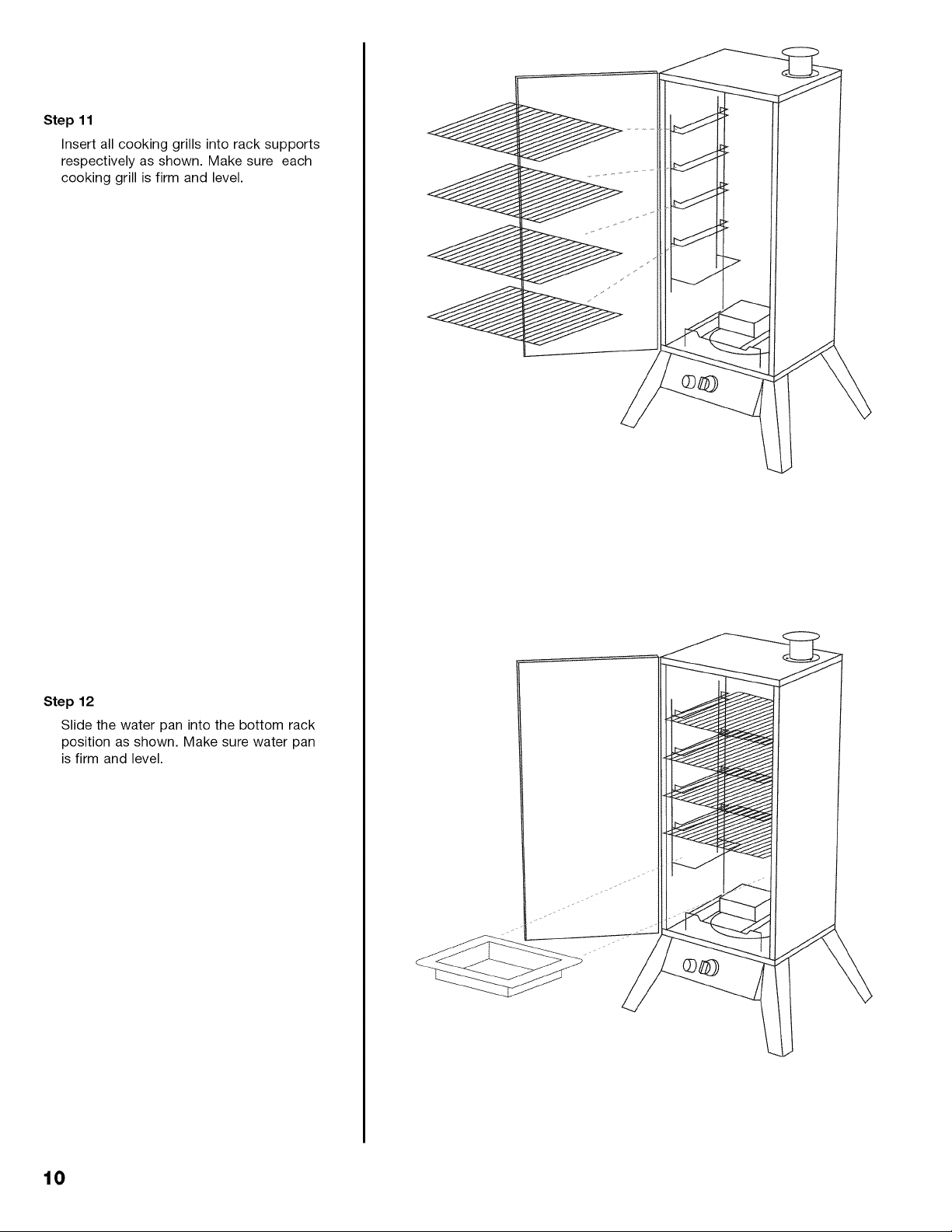
Step 11
Insert all cooking grills into rack supports
respectively as shown. Make sure each
cooking grill is firm and level.
Step 12
Slide the water pan into the bottom rack
position as shown. Make sure water pan
is firm and level.
10
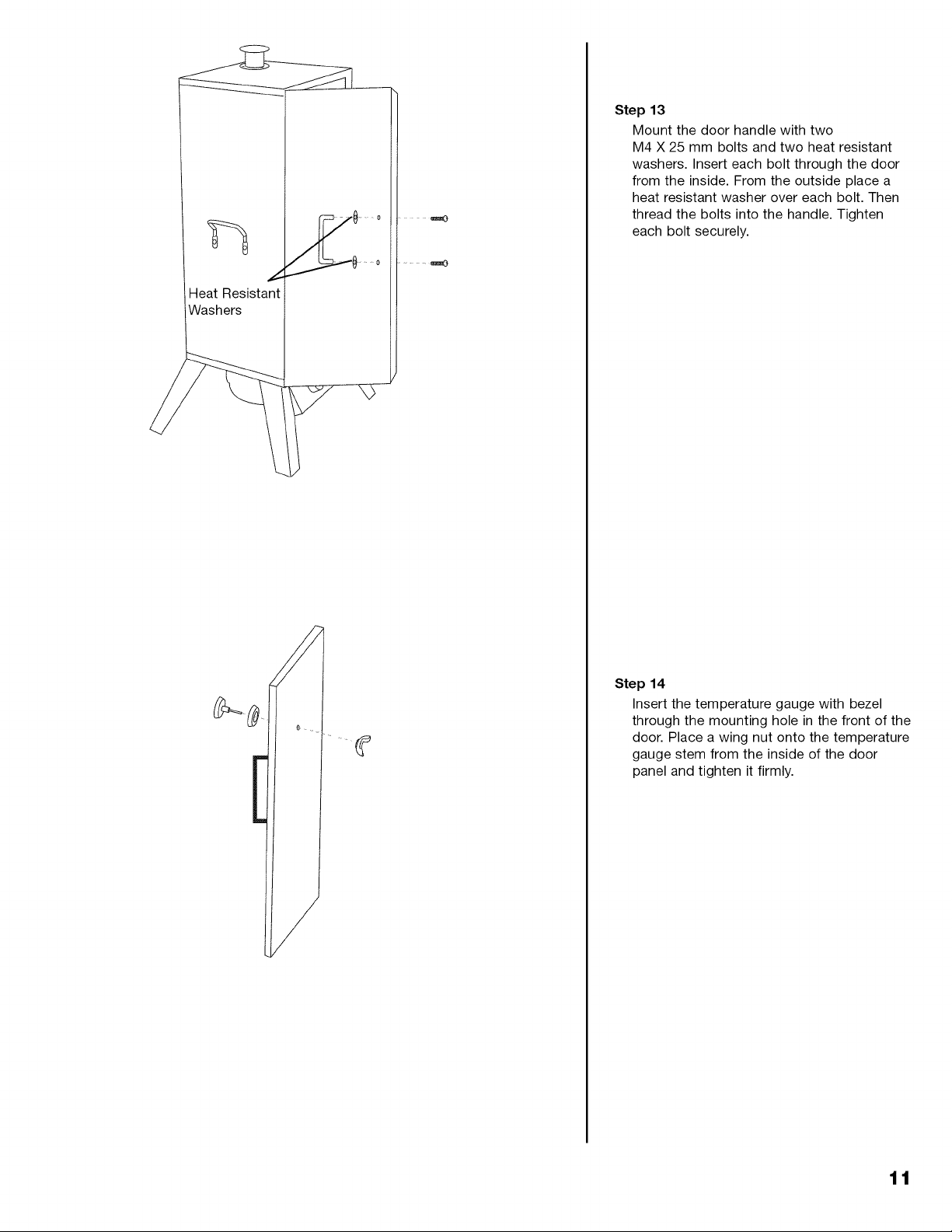
Heat Resistant
Washers
Step 13
Mount the door handle with two
M4 X 25 mm bolts and two heat resistant
washers. Insert each bolt through the door
from the inside. From the outside place a
heat resistant washer over each bolt. Then
thread the bolts into the handle. Tighten
each bolt securely.
Step 14
Insert the temperature gauge with bezel
through the mounting hole in the front of the
door. Place a wing nut onto the temperature
gauge stem from the inside of the door
panel and tighten it firmly.
11
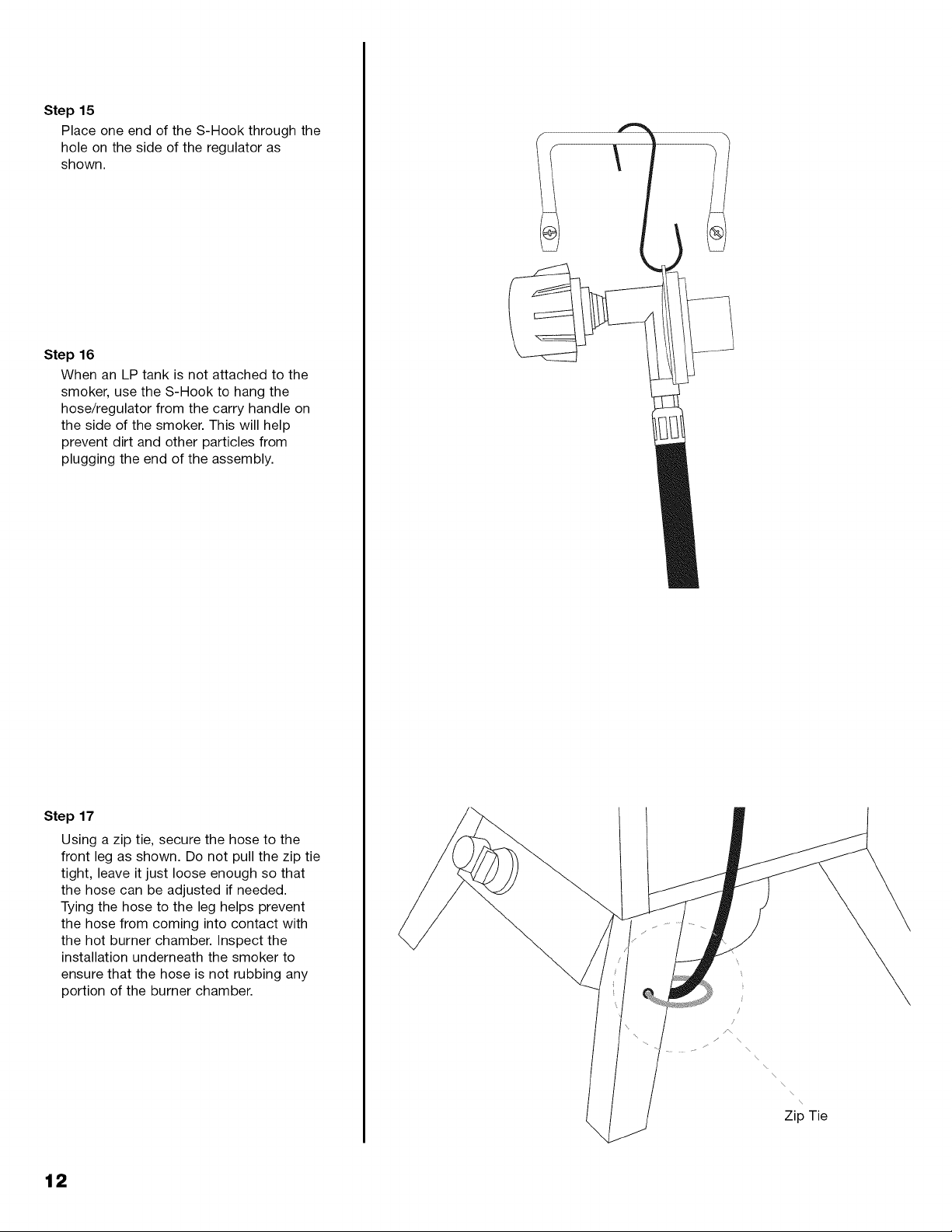
Step 15
Place one end of the S-Hook through the
hole on the side of the regulator as
shown.
Step 16
When an LP tank is not attached to the
smoker, use the S-Hook to hang the
hose/regulator from the carry handle on
the side of the smoker. This will help
prevent dirt and other particles from
plugging the end of the assembly.
Step 17
Using a zip tie, secure the hose to the
front leg as shown. Do not pull the zip tie
tight, leave it just loose enough so that
the hose can be adjusted if needed.
Tying the hose to the leg helps prevent
the hose from coming into contact with
the hot burner chamber. Inspect the
installation underneath the smoker to
ensure that the hose is not rubbing any
portion of the burner chamber.
i \
\
\
\
Zip Tie
12
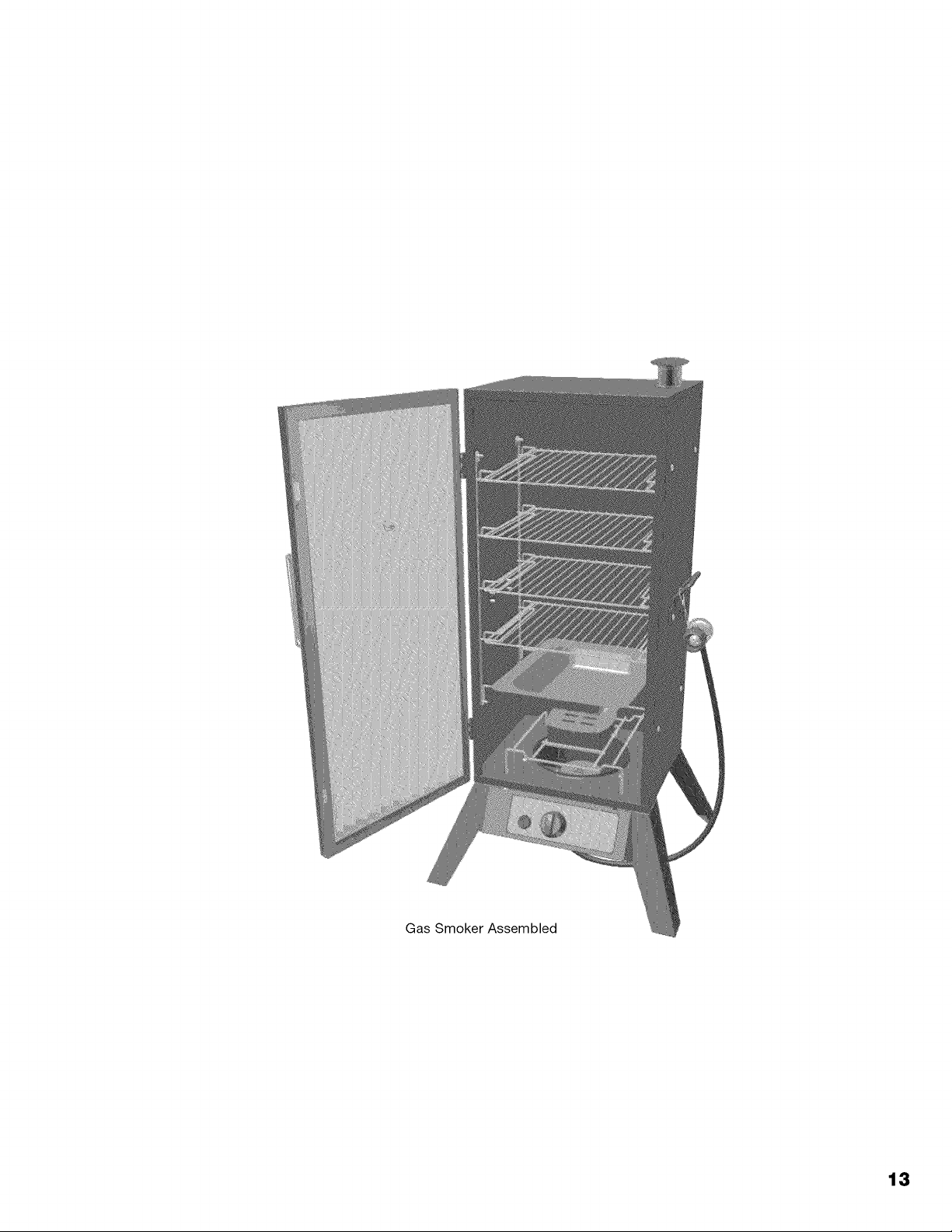
Gas Smoker Assembled
13
ALL INSTRUCTIONS AND SAFEGUARDS ON THIS PAGE
MUST BE FOLLOWED TO PREVENT FIRE, DAMAGE,
AND/OR INJURY.
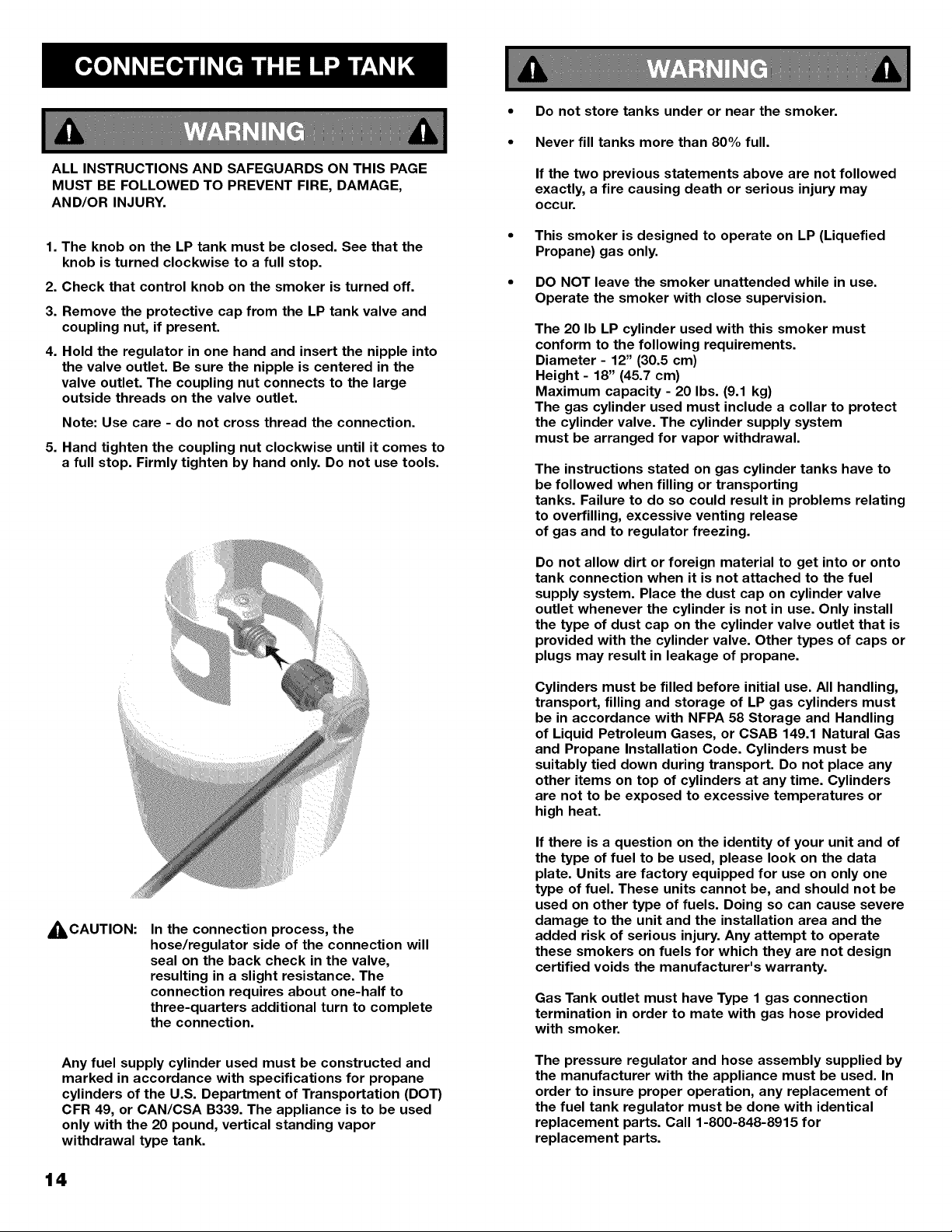
1. The knob on the LP tank must be closed. See that the
knob is turned clockwise to a full stop.
2. Check that control knob on the smoker is turned off.
3. Remove the protective cap from the LP tank valve and
coupling nut, if present.
4. Hold the regulator in one hand and insert the nipple into
the valve outlet. Be sure the nipple is centered in the
valve outlet. The coupling nut connects to the large
outside threads on the valve outlet.
Note: Use care - do not cross thread the connection.
5. Hand tighten the coupling nut clockwise until it comes to
a full stop. Firmly tighten by hand only. Do not use tools.
_IbCAUTION:
In the connection process, the
hose/regulator side of the connection will
seal on the back check in the valve,
resulting in a slight resistance. The
connection requires about one-half to
three-quarters additional turn to complete
the connection.
Any fuel supply cylinder used must be constructed and
marked in accordance with specifications for propane
cylinders of the U.S. Department of Transportation (DOT)
CFR 49, or CAN/CSA B339. The appliance is to be used
only with the 20 pound, vertical standing vapor
withdrawal type tank.
14
• Do not store tanks under or near the smoker.
• Never fill tanks more than 80% full.
If the two previous statements above are not followed
exactly, a fire causing death or serious injury may
occur.
• This smoker is designed to operate on LP (Liquefied
Propane) gas only.
• DO NOT leave the smoker unattended while in use.
Operate the smoker with close supervision.
The 20 Ib LP cylinder used with this smoker must
conform to the following requirements.
Diameter - 12" (30.5 cm)
Height - 18" (45.7 cm)
Maximum capacity - 20 Ibs. (9.1 kg)
The gas cylinder used must include a collar to protect
the cylinder valve. The cylinder supply system
must be arranged for vapor withdrawal.
The instructions stated on gas cylinder tanks have to
be followed when filling or transporting
tanks. Failure to do so could result in problems relating
to overfilling, excessive venting release
of gas and to regulator freezing.
Do not allow dirt or foreign material to get into or onto
tank connection when it is not attached to the fuel
supply system. Place the dust cap on cylinder valve
outlet whenever the cylinder is not in use. Only install
the type of dust cap on the cylinder valve outlet that is
provided with the cylinder valve. Other types of caps or
plugs may result in leakage of propane.
Cylinders must be filled before initial use. All handling,
transport, filling and storage of LP gas cylinders must
be in accordance with NFPA 58 Storage and Handling
of Liquid Petroleum Gases, or CSAB 149.1 Natural Gas
and Propane Installation Code. Cylinders must be
suitably tied down during transport. Do not place any
other items on top of cylinders at any time. Cylinders
are not to be exposed to excessive temperatures or
high heat.
If there is a question on the identity of your unit and of
the type of fuel to be used, please look on the data
plate. Units are factory equipped for use on only one
type of fuel. These units cannot be, and should not be
used on other type of fuels. Doing so can cause severe
damage to the unit and the installation area and the
added risk of serious injury. Any attempt to operate
these smokers on fuels for which they are not design
certified voids the manufacturer's warranty.
Gas Tank outlet must have Type 1 gas connection
termination in order to mate with gas hose provided
with smoker.
The pressure regulator and hose assembly supplied by
the manufacturer with the appliance must be used. In
order to insure proper operation, any replacement of
the fuel tank regulator must be done with identical
replacement parts. Call 1-800-848-8915 for
replacement parts.
Theregulator/hoseassembly should be handled carefully to
prevent contamination by foreign objects and dirt. Clean
and inspect the hose before each use of the appliance. If
there is evidence of abrasion, wear, cuts or leaks, the hose
must be replaced prior to the appliance being put into
operation. In order to insure proper operation, any
replacement of the fuel tank regulator must be done with
identical replacement parts. Call 1-800-848-8915 for
replacement parts.
This unit is not to be utilized with a non-self-contained LP-
gas supply system.
Valve/pressure regulators are factory set to the correct
operating pressures. No attempts should be made to adjust
these settings!
CHECKING FOR LEAKS
After all connections are completed, check all connections
and fittings for leaks with a soap solution.
With all valves closed, apply the leak check solution
(50/50 mix of dishwashing detergent and water) to all gas
carrying connections, fittings and to tank seams.
Open tank valve.
Presence of bubbles at areas of wet solution indicates a
gas leak. If leaks are detected or you smell or hear gas,
shut off the valve and repair the leak or replace the
defective part. Do not use the smoker until all leaks are
corrected.
When setting up the smoker and tank, it is recommended
to have the tank and smoker on a line perpendicular to
the wind direction.
The gas hose/regulator assembly should be totally
extended to the maximum distance so that the hose is
straight and the tank is as far from the smoker as it can
be.
LP tanks are intended for operation in the upright
position only.
Care should be taken to protect the fuel supply hose
from damage from either foot or vehicle traffic.
If the appliance is not in use, the gas must be turned off
at the supply cylinder and the cylinder should be
disconnected from the appliance.
Storage of the appliance indoors is only permissible if the
cylinder is disconnected and removed from the
appliance.
PRE-USE PROCEDURES
Before you cook food in your smoker, it is important to
"season" your smoker. Seasoning seals the paint and
interior of your smoker to enhance flavoring, durability, and
overall performance. This is also referred to as the "break-
in" process.
If your smoker requires any touch-up paint on the inside of
the cabinet, the only time you should apply paint to the
inside is before the seasoning process. Paint should not be
applied to the interior of your smoker after your smoker
has been used. Paint toxins may contaminate your food.
However, if paint becomes necessary after use, see the
section in this manual concerning After Use Care and
Maintenance.
To season your smoker, simply use it as you normally
would; only do not cook any food. You will need to follow
all of the operating procedures in the next few sections of
this manual.
Using your desired flavoring woods and marinades, burn
your smoker at low temperature (around 125°F [50°C]) for
45-60 minutes. Let the smoker cool, and clean out the used
water and wood.
Once seasoning is complete, your smoker's interior will
have a durable, seasoned coating.
ADDING WATER
To add water before cooking, simply remove the water
bowl and fill it with water up to 1" (2.5cm) below the rim.
Then replace the bowl to the bottom of the rack.
To add water while the smoker is hot, DO NOT pull the
water bowl out beyond the rack.
Cooking Tips:
Line the water bowl with aluminum foil before each use.
This will make it easy to clean and help your water bowl
last longer.
To make adding water easier and safer, use a clean
watering can with a long spout.
15
ADDING WOOD/CHARCOAL
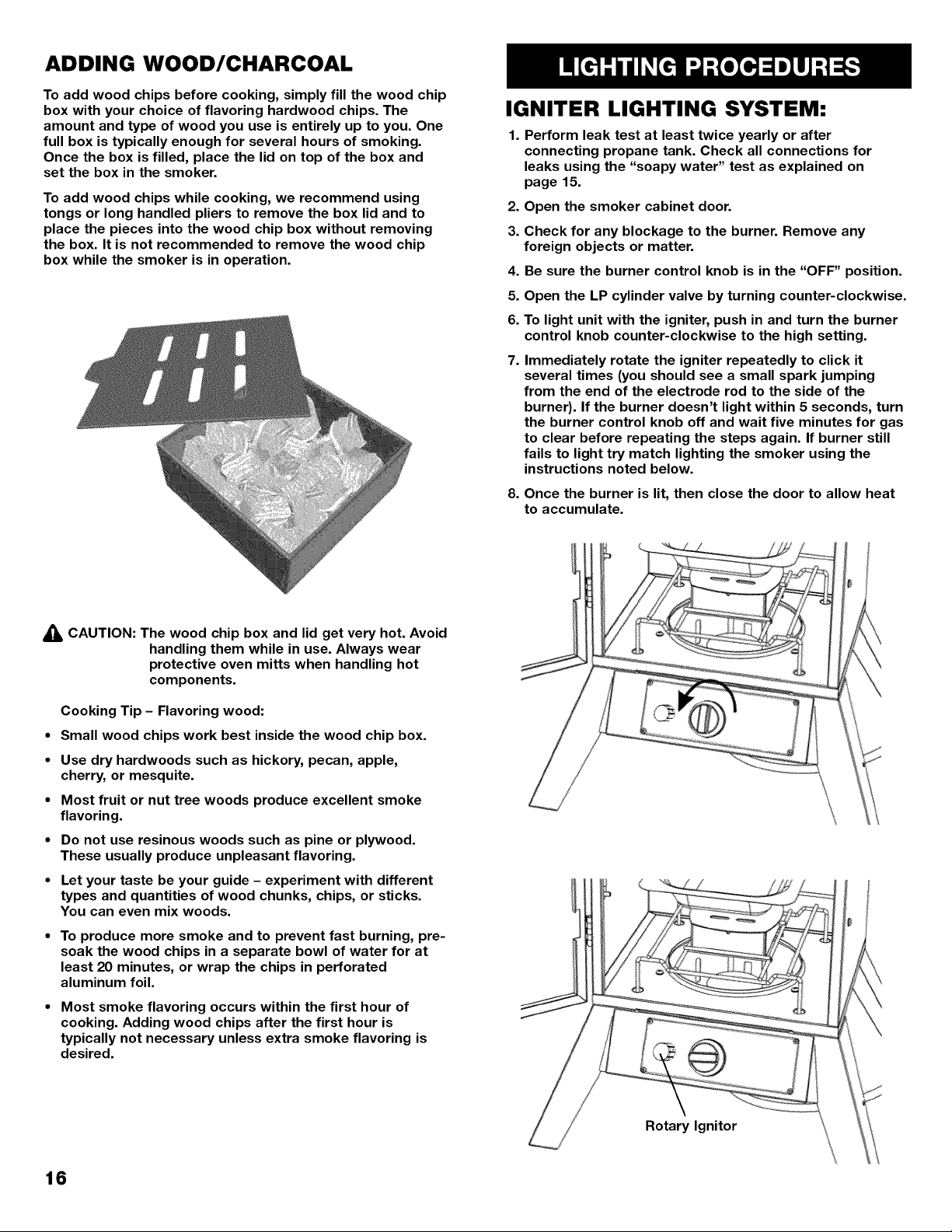
To add wood chips before cooking, simply fill the wood chip
box with your choice of flavoring hardwood chips. The
amount and type of wood you use is entirely up to you. One
full box is typically enough for several hours of smoking.
Once the box is filled, place the lid on top of the box and
set the box in the smoker.
To add wood chips while cooking, we recommend using
tongs or long handled pliers to remove the box lid and to
place the pieces into the wood chip box without removing
the box. It is not recommended to remove the wood chip
box while the smoker is in operation.
IGNITER LIGHTING SYSTEM:
1.
2.
3.
4.
5.
6.
7.
8.
Perform leak test at least twice yearly or after
connecting propane tank. Check all connections for
leaks using the "soapy water" test as explained on
page 15.
Open the smoker cabinet door.
Check for any blockage to the burner. Remove any
foreign objects or matter.
Be sure the burner control knob is in the "OFF" position.
Open the LP cylinder valve by turning counter-clockwise.
To light unit with the igniter, push in and turn the burner
control knob counter-clockwise to the high setting.
Immediately rotate the igniter repeatedly to click it
several times (you should see a small spark jumping
from the end of the electrode rod to the side of the
burner). If the burner doesn't light within 5 seconds, turn
the burner control knob off and wait five minutes for gas
to clear before repeating the steps again. If burner still
fails to light try match lighting the smoker using the
instructions noted below.
Once the burner is lit, then close the door to allow heat
to accumulate.
CAUTION: The wood chip box and lid get very hot. Avoid
handling them while in use. Always wear
protective oven mitts when handling hot
components.
Cooking Tip - Flavoring wood:
• Small wood chips work best inside the wood chip box.
• Use dry hardwoods such as hickory, pecan, apple,
cherry, or mesquite.
• Most fruit or nut tree woods produce excellent smoke
flavoring.
• Do not use resinous woods such as pine or plywood.
These usually produce unpleasant flavoring.
• Let your taste be your guide - experiment with different
types and quantities of wood chunks, chips, or sticks.
You can even mix woods.
To produce more smoke and to prevent fast burning, pre-
soak the wood chips in a separate bowl of water for at
least 20 minutes, or wrap the chips in perforated
aluminum foil.
Most smoke flavoring occurs within the first hour of
cooking. Adding wood chips after the first hour is
typically not necessary unless extra smoke flavoring is
desired.
Rotary Ignitor
16
MATCH LIGHTING:
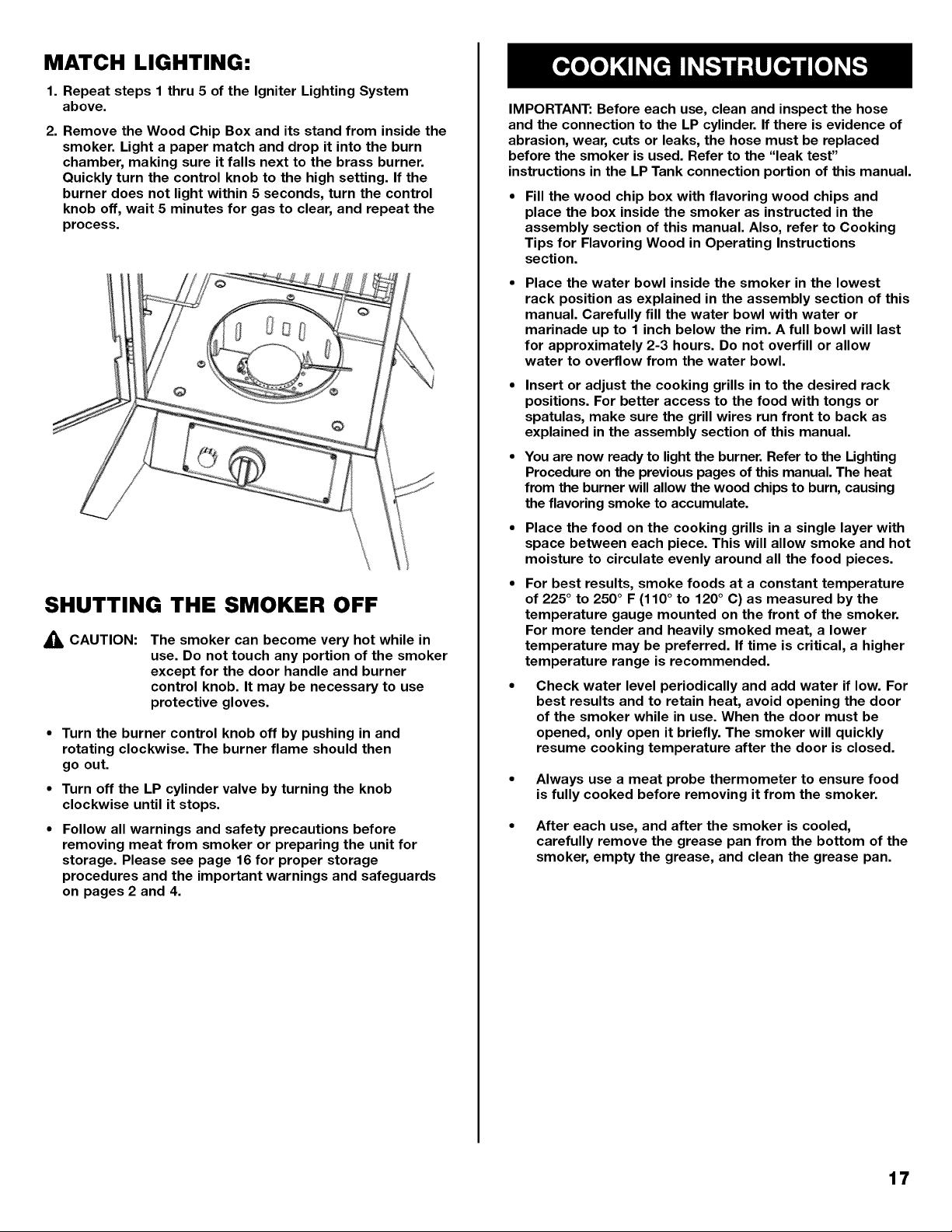
1. Repeat steps 1 thru 5 of the Igniter Lighting System
above.
2. Remove the Wood Chip Box and its stand from inside the
smoker. Light a paper match and drop it into the burn
chamber, making sure it falls next to the brass burner.
Quickly turn the control knob to the high setting. If the
burner does not light within 5 seconds, turn the control
knob off, wait 5 minutes for gas to clear, and repeat the
process.
SHUTTING THE SMOKER OFF
_k CAUTION: The smoker can become very hot while in
use. Do not touch any portion of the smoker
except for the door handle and burner
control knob. It may be necessary to use
protective gloves.
• Turn the burner control knob off by pushing in and
rotating clockwise. The burner flame should then
go out.
• Turn off the LP cylinder valve by turning the knob
clockwise until it stops.
Follow all warnings and safety precautions before
removing meat from smoker or preparing the unit for
storage. Please see page 16 for proper storage
procedures and the important warnings and safeguards
on pages 2 and 4.
IMPORTANT: Before each use, clean and inspect the hose
and the connection to the LP cylinder. If there is evidence of
abrasion, wear, cuts or leaks, the hose must be replaced
before the smoker is used. Refer to the "leak test"
instructions in the LP Tank connection portion of this manual.
Fill the wood chip box with flavoring wood chips and
place the box inside the smoker as instructed in the
assembly section of this manual. Also, refer to Cooking
Tips for Flavoring Wood in Operating Instructions
section.
Place the water bowl inside the smoker in the lowest
rack position as explained in the assembly section of this
manual. Carefully fill the water bowl with water or
marinade up to 1 inch below the rim. A full bowl will last
for approximately 2-3 hours. Do not overfill or allow
water to overflow from the water bowl.
Insert or adjust the cooking grills in to the desired rack
positions. For better access to the food with tongs or
spatulas, make sure the grill wires run front to back as
explained in the assembly section of this manual.
You are now ready to light the burner. Refer to the Lighting
Procedure on the previous pages of this manual. The heat
from the burner will allow the wood chips to burn, causing
the flavoring smoke to accumulate.
Place the food on the cooking grills in a single layer with
space between each piece. This will allow smoke and hot
moisture to circulate evenly around all the food pieces.
For best results, smoke foods at a constant temperature
of 225 ° to 250 ° F (110 ° to 120° C) as measured by the
temperature gauge mounted on the front of the smoker.
For more tender and heavily smoked meat, a lower
temperature may be preferred. If time is critical, a higher
temperature range is recommended.
Check water level periodically and add water if low. For
best results and to retain heat, avoid opening the door
of the smoker while in use. When the door must be
opened, only open it briefly. The smoker will quickly
resume cooking temperature after the door is closed.
• Always use a meat probe thermometer to ensure food
is fully cooked before removing it from the smoker.
• After each use, and after the smoker is cooled,
carefully remove the grease pan from the bottom of the
smoker, empty the grease, and clean the grease pan.
17
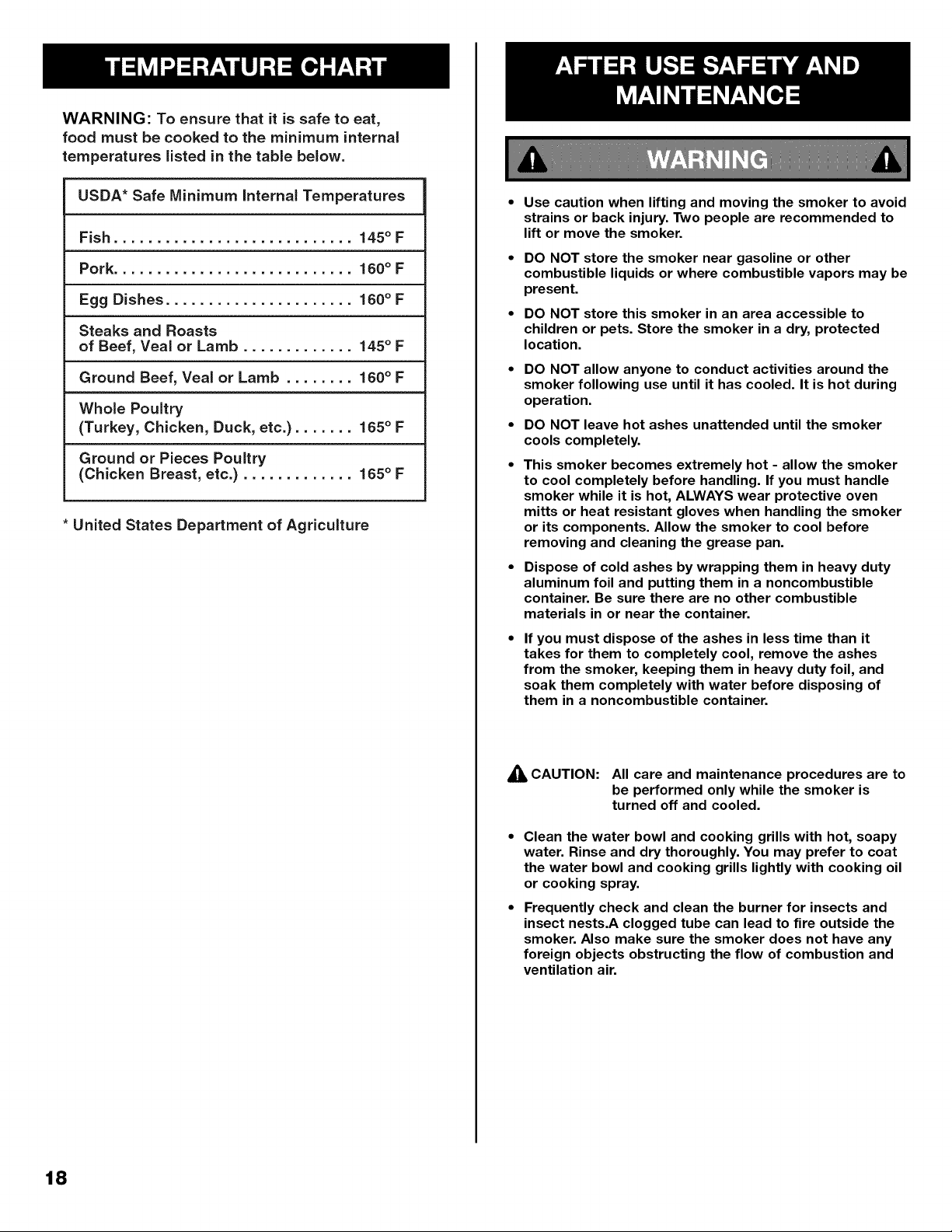
WARNING: To ensure that it is safe to eat,
food must be cooked to the minimum internal
temperatures listed in the table below.
USDA* Safe Minimum Internal Temperatures
Fish ............................ 145° F
Pork ............................ 160° F
Egg Dishes ...................... 160° F
Steaks and Roasts
of Beef, Veal or Lamb ............. 145° F
Ground Beef, Veal or Lamb ........ 160° F
Whole Poultry
(Turkey, Chicken, Duck, etc.) ....... 165° F
Ground or Pieces Poultry
(Chicken Breast, etc.) ............. 165° F
* United States Department of Agriculture
Use caution when lifting and moving the smoker to avoid
strains or back injury. Two people are recommended to
lift or move the smoker.
DO NOT store the smoker near gasoline or other
combustible liquids or where combustible vapors may be
present.
DO NOT store this smoker in an area accessible to
children or pets. Store the smoker in a dry, protected
location.
DO NOT allow anyone to conduct activities around the
smoker following use until it has cooled. It is hot during
operation.
DO NOT leave hot ashes unattended until the smoker
cools completely.
This smoker becomes extremely hot - allow the smoker
to cool completely before handling. If you must handle
smoker while it is hot, ALWAYS wear protective oven
mitts or heat resistant gloves when handling the smoker
or its components. Allow the smoker to cool before
removing and cleaning the grease pan.
Dispose of cold ashes by wrapping them in heavy duty
aluminum foil and putting them in a noncombustible
container. Be sure there are no other combustible
materials in or near the container.
If you must dispose of the ashes in less time than it
takes for them to completely cool, remove the ashes
from the smoker, keeping them in heavy duty foil, and
soak them completely with water before disposing of
them in a noncombustible container.
_k CAUTION: All care and maintenance procedures are to
be performed only while the smoker is
turned off and cooled.
Clean the water bowl and cooking grills with hot, soapy
water. Rinse and dry thoroughly. You may prefer to coat
the water bowl and cooking grills lightly with cooking oil
or cooking spray.
Frequently check and clean the burner for insects and
insect nests.A clogged tube can lead to fire outside the
smoker. Also make sure the smoker does not have any
foreign objects obstructing the flow of combustion and
ventilation air.
18
If your temperature gauge seems to be out of calibration:
Remove the heat indicator from the door of the smoker
by loosening and removing the mounting nut from the
inside. There is a second nut mounted on the back of the
heat indicator that can be turned to adjust the heat
indicator needle. Set the needle to the current outdoor
ambient temperature and re-mount the heat indicator to
the door of the smoker.
• To clean the inside and outside of the smoker cabinet,
simply use a clamp cloth. Spray-washing with a water
hose is not recommended. All moisture should be wiped
away and not allowed to stand inside or on top of the
smoker. Carefully remove the grease pan, dispose the
grease, and wash thoroughly. Once cleaned, you may
prefer to lightly coat the interior of the smoker cabinet
with cooking oil or cooking spray.
If rust is present on the exterior surface of the smoker,
clean the area with steel wool or emery cloth and use
heavy duty, heat resistant paint.
NEVER apply additional paint to the interior of the
smoker. If rust is present on the interior of the smoker,
clean it thoroughly with steel wool or emery cloth and
lightly coat the area with cooking oil or cooking spray to
help minimize recurring rust.
• When an LP tank is not connected, and to help prevent
dirt or other foreign particles from clogging the
hose/regulator, hang the end of the hose/regulator from
the side handle using the supplied S-hook.
• To protect your smoker from weather, always keep your
smoker covered while not in use.
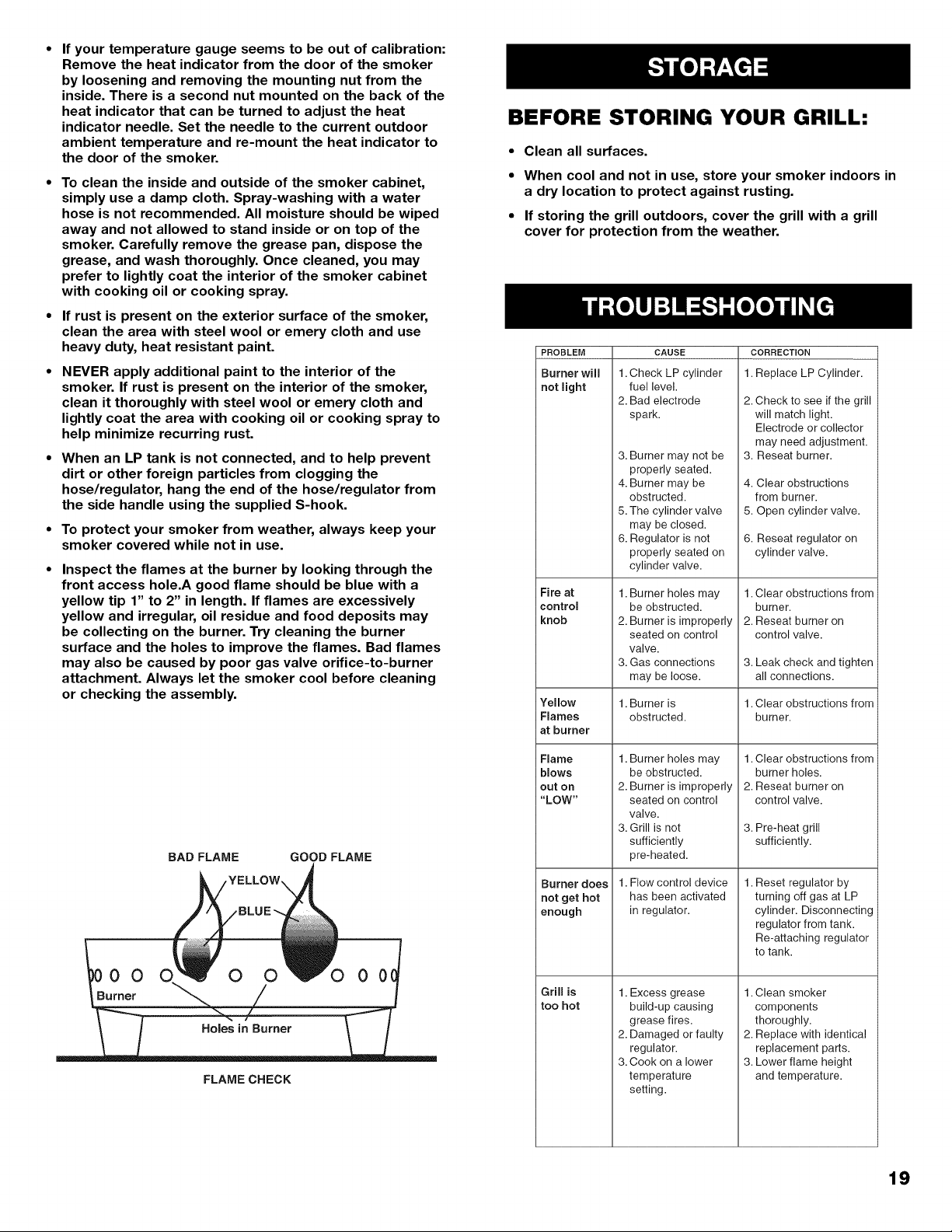
Inspect the flames at the burner by looking through the
front access hole.A good flame should be blue with a
yellow tip 1" to 2" in length. If flames are excessively
yellow and irregular, oil residue and food deposits may
be collecting on the burner. Try cleaning the burner
surface and the holes to improve the flames. Bad flames
may also be caused by poor gas valve orifice-to-burner
attachment. Always let the smoker cool before cleaning
or checking the assembly.
BAD FLAME GOOD FLAME
00
FLAME CHECK
BEFORE STORING YOUR GRILL:
• Clean all surfaces.
• When cool and not in use, store your smoker indoors in
a dry location to protect against rusting.
• If storing the grill outdoors, cover the grill with a grill
cover for protection from the weather.
PROBLEM
Burner will
notlight
Fire at
control
knob
CAUSE
1. Check LP cylinder
fuel level.
Yellow
Flames
at burner
Flame
blows
out on
"LOW"
Burner does
net get hot
enough
Grill is
too hot
2. Bad electrode
spark.
3. Burner may not be
properly seated.
4. Burner may be
obstructed.
5. The cylinder valve
may be closed.
6. Regulator is not
properly seated on
cylinder valve.
1. Burner holes may
be obstructed.
2. Burner is improperly
seated on control
valve.
3. Gas connections
may be loose.
1. Burner is
obstructed.
1. Burner holes may
be obstructed.
2. Burner is improperly
seated on control
valve.
3. Grill is not
sufficiently
pre-heated.
1. Flow control device
has been activated
in regulator.
1. Excess grease
build-up causing
grease fires.
2. Damaged or faulty
regulator.
3. Cook on a lower
temperature
setting.
CORRECTION
1. Replace LP Cylinder.
2. Check to see if the grill
will match light.
Electrode or collector
may need adjustment.
3. Reseat burner.
4. Clear obstructions
from burner.
5. Open cylinder valve.
6. Reseat regulator on
cylinder valve.
1. Clear obstructions from
burner.
2. Reseat burner on
control valve.
3. Leak check and tighten
all connections.
1. Clear obstructions from
burner.
1. Clear obstructions from
burner holes.
2. Reseat burner on
control valve.
3. Pre-heat grill
sufficiently.
1. Reset regulator by
turning off gas at LP
cylinder. Disconnecting
regulator from tank.
Re-attaching regulator
to tank.
1. Clean smoker
components
thoroughly.
2. Replace with identical
replacement parts.
3. Lower flame height
and temperature.
19
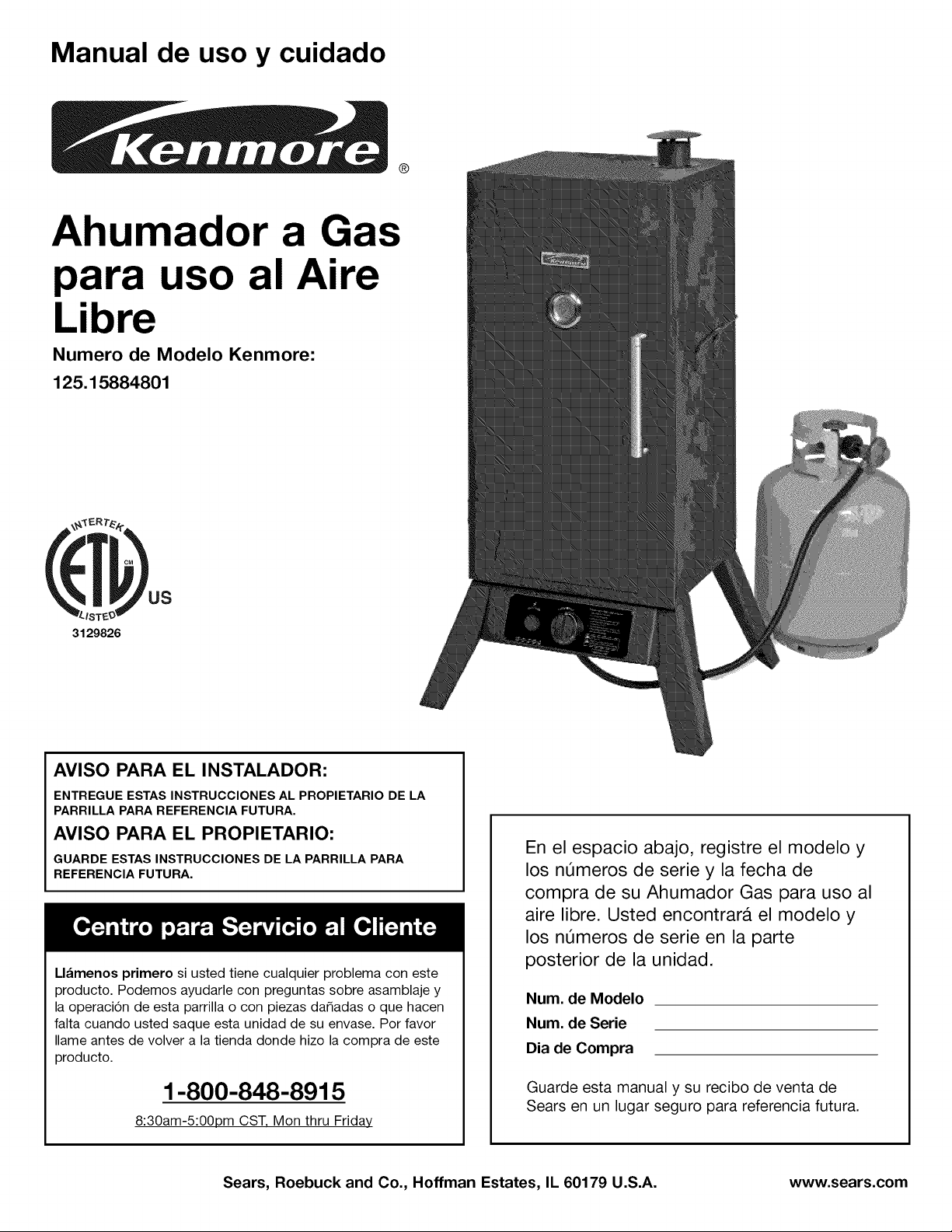
Manual de uso y cuidado
®
Ahumador a Gas
para uso al Aire
Libre
Numero de Modelo Kenmore:
125.15884801
3129826
US
AVISO PARA EL INSTALADOR:
ENTREGUE ESTAS INSTRUCCIONES AL PROPIETARIO DE LA
PARRILLA PARA REFERENCIA FUTURA.
AVISO PARA EL PROPIETARIO:
GUARDE ESTAS INSTRUCCIONES DE LA PARRILLA PARA
REFERENCIA FUTURA.
Llamenos primero si usted tiene cualquier problema con este
producto. Podemos ayudarle con preguntas sobre asamblaje y
la operaci6n de esta parrilla o con piezas da_adas o que hacen
falta cuando usted saque esta unidad de su envase. Por favor
Ilame antes de volver a la tienda donde hizo la compra de este
producto.
1-800-848-8915
8:30am-5:00pm CST, Mon thru Friday
En el espacio abajo, registre el modelo y
los nQmeros de serie y la fecha de
compra de su Ahumador Gas para uso al
aire libre. Usted encontrara el modelo y
los nQmeros de serie en la parte
posterior de la unidad.
Num. de Modelo
Num. de Serie
Dia de Compra
Guarde esta manual y su recibo de venta de
Sears en un lugar seguro para referencia futura.
Sears, Roebuck and Co., Hoffman Estates, IL 60179 U.S.A. www.sears.com
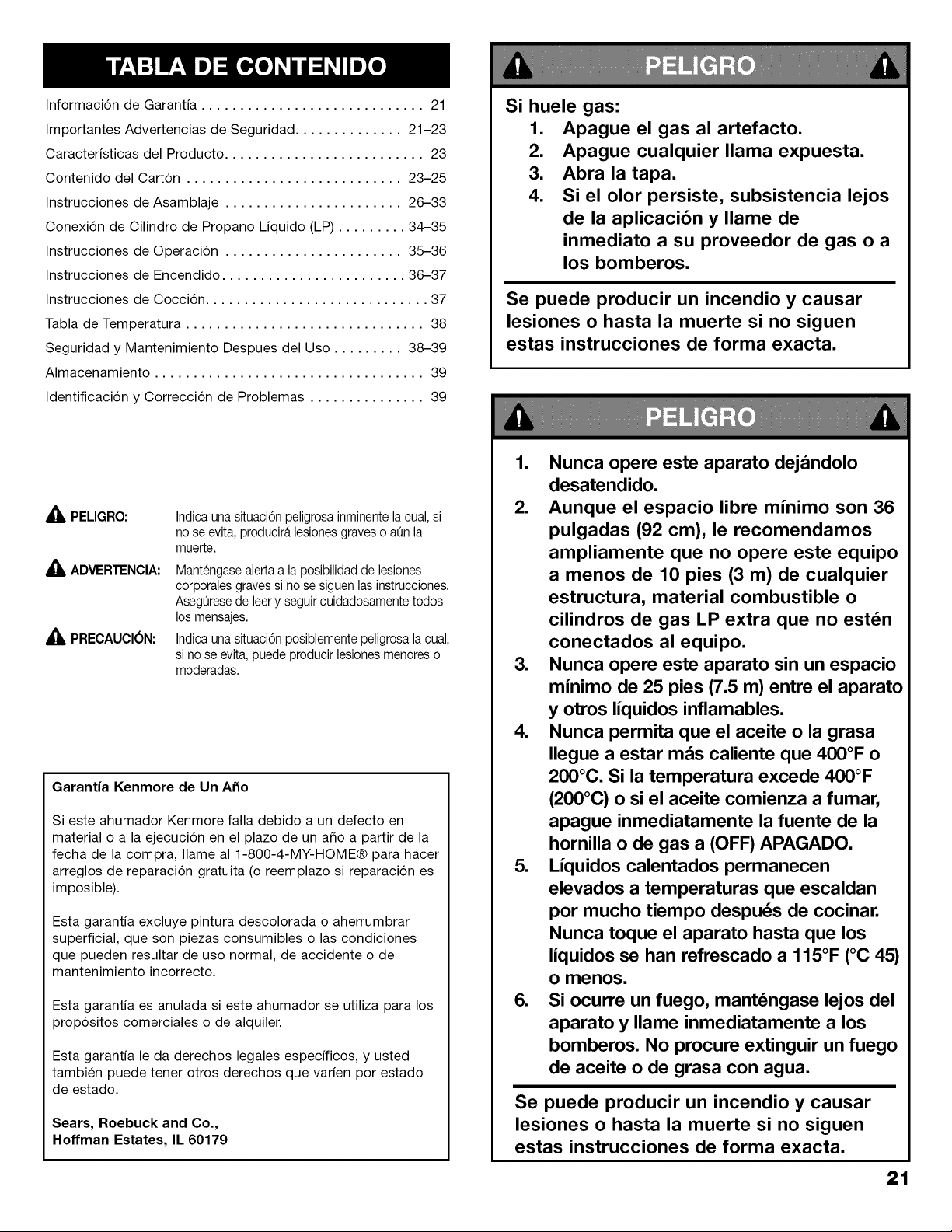
Informaci6n de Garantia ............................. 21
Importantes Advertencias de Seguridad .............. 21-23
Caracteristicas del Producto .......................... 23
Contenido del Cart6n ............................ 23-25
Instrucciones de Asamblaje ....................... 26-33
Conexi6n de Cilindro de Propano Liquido (LP) ......... 34-35
Instrucciones de Operaci6n ....................... 35-36
Instrucciones de Encendido ........................ 36-37
Instrucciones de Cocci6n ............................. 37
Tabla de Temperatura ............................... 38
Seguridad y Mantenimiento Despues del Uso ......... 38-39
Almacenamiento ................................... 39
Identificaci6n y Correcci6n de Problemas ............... 39
_k PELIGRO:
_k ADVERTENCIA:
PRECAUCION:
Indica unasituaci6n peligrosainminente la cual, si
no se evita,producira lesionesgraves o aQnla
muerte.
Mant6ngasealertaa la posibilidad de lesiones
corporalesgraves si no se siguen lasinstrucciones.
AsegQresede leery seguir cuidadosamentetodos
los mensajes.
Indica unasituaci6n posiblemente peligrosala cual,
si no se evita, puede producir lesionesmenores o
moderadas.
Garantia Kenmore de Un Aho
Si este ahumador Kenmore falla debido a un defecto en
material o a la ejecuci6n en el plazo de un a_o a partir de la
fecha de la compra, Ilame al 1-800-4-MY-HOME® para hacer
arreglos de reparaci6n gratuita (o reemplazo si reparaci6n es
imposible).
Esta garantia excluye pintura descolorada o aherrumbrar
superficial, que son piezas consumibles o las condiciones
que pueden resultar de uso normal, de accidente o de
mantenimiento incorrecto.
Esta garantia es anulada si este ahumador se utiliza para los
prop6sitos comerciales o de alquiler.
Esta garantia le da derechos legales especificos, y usted
tambien puede tener otros derechos que varien por estado
de estado.
Sears, Roebuck and Co.,
Hoffman Estates, IL 60179
Si huele gas:
1. Apague el gas al artefacto.
2. Apague cualquier llama expuesta.
3. Abra la tapa.
4. Si el olor persiste, subsistencia lejos
de la aplicacibn y Ilame de
inmediato a su proveedor de gas o a
los bomberos.
Se puede producir un incendio y causar
lesiones o hasta la muerte si no siguen
estas instrucciones de forma exacta.
1. Nunca opere este aparato dejandolo
desatendido.
2. Aunque el espacio libre minimo son 36
pulgadas (92 cm), le recomendamos
ampliamente que no opere este equipo
a menos de 10 pies (3 m) de cualquier
estructura, material combustible o
cilindros de gas LP extra que no est_n
conectados al equipo.
3. Nunca opere este aparato sin un espacio
minimo de 25 pies (7.5 m) entre el aparato
y otros liquidos inflamables.
4. Nunca permita que el aceite o la grasa
Ilegue a estar mas caliente que 400°F o
200°C. Si la temperatura excede 400°F
(200°C) o si el aceite comienza a fumar,
apague inmediatamente la fuente de la
hornilla o de gas a (OFF) APAGADO.
5. Liquidos calentados permanecen
elevados a temperaturas que escaldan
por mucho tiempo despu_s de cocinar.
Nunca toque el aparato hasta que los
liquidos se han refrescado a 115°F (°C 45)
o menos.
6. Si ocurre un fuego, mant_ngase lejos del
aparato y Ilame inmediatamente a los
bomberos. No procure extinguir un fuego
de aceite o de grasa con agua.
Se puede producir un incendio y causar
lesiones o hasta la muerte si no siguen
estas instrucciones de forma exacta.
21
ES NUESTRO DESEO QUE ARME Y UTILICE SU PARRILLA EN
LA FORMA MAS SEGURA POSIBLE. EL PROPOSITO DE ESTE
SJMBOLO DE ALERTA DE SEGURIDAD
ES QUE USTED PRESTE ATENCION A LOS POSIBLES
PELIGROS CUANDO ARME Y UTILICE SU PARRILLA.
iCUANDO VEA ESTE SJMBOLO DE ALERTA DE SEGURIDAD
A'_ PRESTE ESPECIAL ATENCION A LA INFORMACION A
CONTINUACI6N!
A'L LEA DETENIDAMENTE TODAS LAS ADVERTENCIAS DE
SEGURIDAD E INSTRUCCIONES ANTES DE ARMAR Y USAR
LA PARRILLA.
Este manual de uso y cuidado contiene informacibn
importante necesaria para uso y cuidado apropiado de
este aparato.
Lea y siga todas las advertencias e instrucciones antes de
usar este aparato.
Guarde este manual para referencia futura.
No utilice este ahumador en una manera diferente a su
propbsito previsto. No esta disehado para uso comercial.
No esta disehado para ser instalado o para ser utilizado en
un vehiculo recreacional y/o barcos. El ahumador no debe
ser utilizado como calentador.
Tenga un extintor siempre cerca o a la mano.
El uso de alcohol, prescripciones o drogas de prescripcibn
pueden deteriorar la capacidad mental del usuario para
usar correctamente y con seguridad el ahumador.
Este ahumador esta disehado para el uso al aire libre
solamente, o en una area bien-ventilada. No use el
ahumador adentro de un garaje, o en cualquier otra area
con alguna construccibn por encima del aparato.
Use precaucibn al ensamblar u operar su ahumador para
evitar cortadas o raspones por orillas agudas de partes de
metal.
Use precaucibn al levantar o mover el ahumador para
evitar tensiones o lesiones de su espalda. Se recomienda
dos personas para levantar o para mover el ahumador. No
mueva el ahumador mientras este en uso.
NO opere el ahumador cerca o bajo materiales inflamables
o combustibles tal como cubiertas, p6rticos, o cubiertas
para carros. Se recomienda una separaci6n minima de 36
pulgadas (92cm). No use el ahumador con alguna
construcci6n por encima del aparato.
Utilice el ahumador solo en superficies duras, niveladas,
incombustibles, y estables (cemento, suelo, etc.). Nunca
utilice el ahumador sobre madera u otras superficies que
pudieran quemarse.
No almacene el ahumador cerca de la gasolina u otros
vapores o liquidos inflamables.
No almacene el ahumador un area donde nihos y mascotas
pueden entrar en contacto con la unidad. Almacene el
22
ahumador en un lugar seco y protegido.
Nunca opere este aparato dejandolo desatendido. Cerca
supervisibn es necesaria cuando se utilice este ahumador.
No permite a nadie conducir actividades alrededor del
ahumador durante o despu_s de uso hasta que se haya
refrescado. El aparato se mantiene caliente durante y
despu_s de su operacibn por un periodo de tiempo
extendido.
No deje cenizas calientes desatendidas hasta que el
ahumador se refresca totalmente.
No mueva el ahumador mientras este en uso. No mueva o
almacene el ahumador hasta que se haya refrescado.
Este ahumador Ilega a temperaturas extremadamente
calientes - permita que el ahumador se refresque
totalmente antes de tocar. Si usted tiene que tocar el
ahumador mientras este caliente, SIEMPRE use mitones
protectores para horno o guantes para horno para poder
manejar el ahumador o sus componentes.
NUNCA utilice gasolina u otros liquidos altamente volatiles
como arrancador. Pueden estallar.
Mientras se este utilizando, el ahumador contiene liquido
caliente en la bandeja de agua. Use precaucibn extrema en
todo tiempo. No mueva el ahumador cuando la bandeja de
agua contenga liquidos calientes porque podria causar
serias lesiones corporales. SIEMPRE use mitones
protectores para horno o guantes para horno.
Disponga las cenizas frias envolvi_ndolas en papel de
aluminio resistente y poni_ndolas en un envase no
combustible. Asegdrese que no hay otros materiales
combustibles adentro ni cerca del envase.
Si usted tiene que deshacerse de las cenizas en menos
tiempo que toma para que se refresquen completamente,
quite las cenizas del ahumador, manteni_ndolas en papel
de aluminio resistente, y empapelas totalmente con agua
antes de disponer de elias en un envase no combustible.
No obstruya el flujo de aire de combustibn y/o del aire de la
ventilacibn para el ahumador.
Tenga cuidado al abrir la puerta del ahumador mientras
este en operacibn. Guarde las manos, la cara, y el cuerpo
del vapor caliente o de las Ilamaradas. Proteja su nariz y
boca contra la inhalacibn del humo.
No use ropa floja mientras que use el ahumador. Ate pelo
largo detras de su cabeza mientras que use el ahumador.
SIEMPRE use zapatos completamente cubiertos mientras
use el ahumador.
Permita que el ahumador y sus componentes se refresquen
completamente antes de conducir cualquier limpieza o
mantenimiento rutinaria.
NUNCA utilice vasijas cristalerias, de plastico, o de
cerbmica en su ahumador.
No permita que el liquido en la bandeja de agua se evapore
completamente. Revise la bandeja de agua cada 2 horas y
agregue agua si el nivel esta bajo (un sonido chirriante
puede indicar la necesidad de agua). Siga las instrucciones
en la seccibn agregando agua mientras se este cocinando
de este manual.
AI usar madera para agregar sabor, agregue una suficiente
cantidad antes de la operacibn para evitar de que tener que
agregar la madera durante la operacibn. La adicibn de
madera mientras que el aparato este operando puede
causar el salpicar de agua caliente y causar lesiones serias.
El uso de accesorios no previstos para este aparato no se
recomienda y puede causar lesiones o dahos a materiales
o fisicos.
• UncilindrodegasLPnoconectadoparausonosedebe
almacenarenlavecindaddelahumadorootroaparato.No
almaceneloscilindros de gas LP menos de 10 pies del
ahumador. Los cilindros de gas LP se deben almacenar al aire
libre, fuera del alcance de nifios. No almacene los cilindros de
gas LP en un edificio, garaje, o ninguna otra area encerrada.
• No almacene cilindros de gas LP dentro o encima del ahumador.
El almacenaje incorrecto de cilindros de gas podia conducir a
una explosibn, fuego, y/o a otros dafios corporales. Los cilindros
de gas LP se deben almacenar al aire libre, fuera del alcance de
nifios. No almacene los cilindros de gas LP en un edificio, garaje,
o ninguna otra area encerrada.
• Apague el cilindro de gas cuando no este en uso.
• Gases de propano son mas pesados que el aire, tienden reunirse
en areas bajas que facilmente se encienden. Cuidado apropiado y
precaucibn deben ser empleados al usar estos combustibles.
• No utilice ahumador si hornilla no puede encenderse o no
permanece encendida. Bajo tales condiciones, apague el gas y
desconecte el cilindro de gas.
• El ahumador debe ser apagado y todas las valvulas apagadas (en
la tuberia o en los cilindros del combustible) deben ser cerrados
en el caso que se detecte olor de gas no quemado. No procure
utilizar el aparato hasta que cualquier escape de gas ha sido
solucionado y/o la fuente del olor de gas no quemado se ha
encontrado y arreglado.
• No utilice el ahumador en condiciones de fuerte viento que dan
lugar a operacibn pobre y podran extinguir la llama. Intente re-
colocar la unidad en otro lugar pero si la situacibn no mejora bajo
tales condiciones de viento, apague el ahumador.
• Este artefacto debe instalarse de acuerdo con todos los cbdigos
locales relevantes. Si no existen cbdigos locales, la instalacion
tiene que estar de acuerdo con Cbdigo de Gas Combustible de
EE.UU. ANSI Z223.1 NFPA 54.
• El ahumador debe instalarse con el ensamblaje del regulador de
la manguera extendido a toda la Iongitud de la manguera y
alejado directamente de la hornilla (24" [61 cm] como minimo).
Esta colocacibn resulta en una distancia maxima entre el tanque
y el ahumador. Cuando el ahumador es utilizado, la manguera o
el regulador y el tanque de gas deben estar en una Iinea situada
perpendicularmente a la direccibn del viento. Si uno coloca el
tanque a menos de 24" (61 cm) del ahumador _ste puede
sobrecalentar el tanque y ocasionar la liberacibn de gas propano
a trav_s de las aberturas de escape, Io que a su vez puede
causar que el tanque se incendie o explote.
J
24" (61 cm)
Como Minimo
• La unibn de la manguera al tanque puede representar un peligro,
ya que uno puede tropezarse y tirar el tanque - tenga precaucibn.
• Mantenga la manguera suministradora de combustible alejada
de superficies calientes.
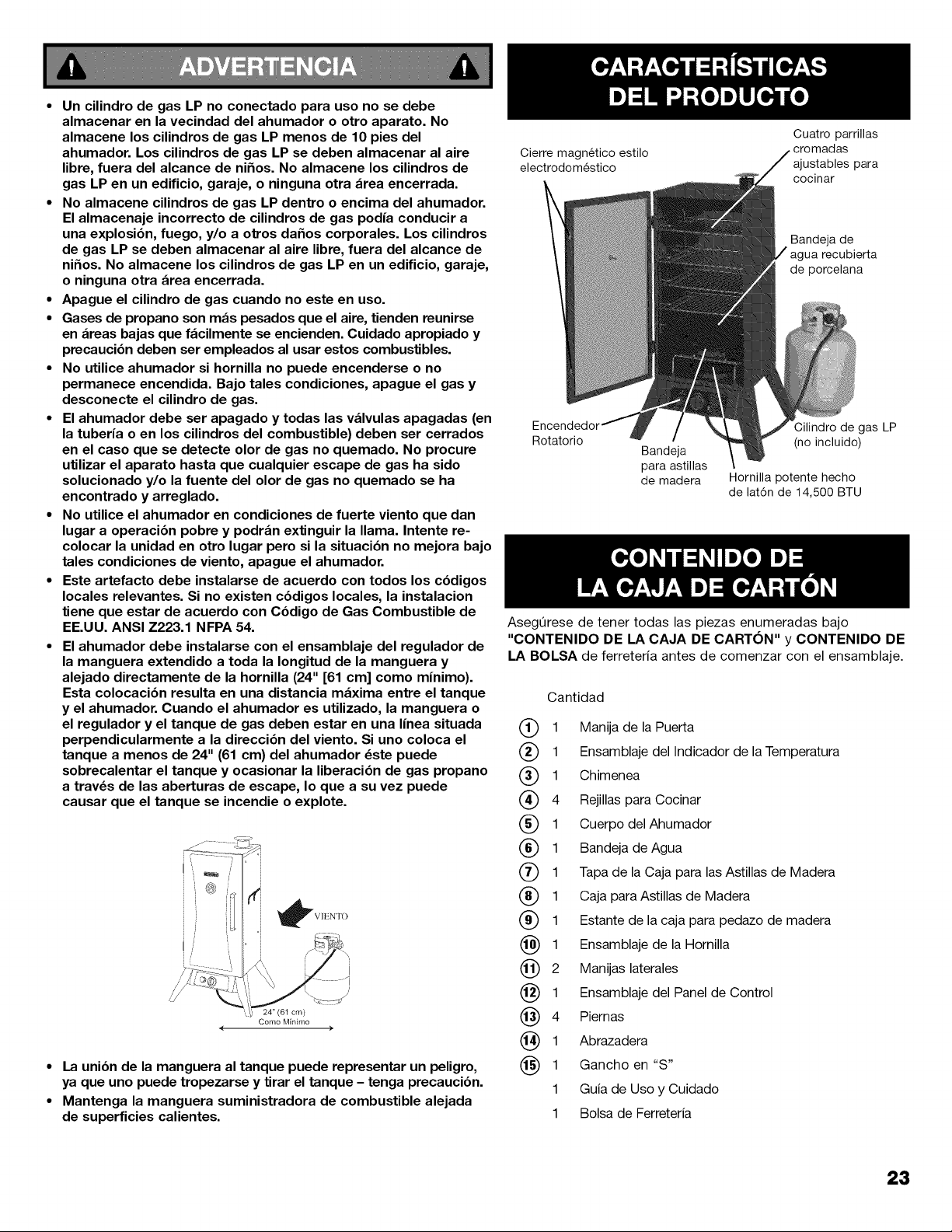
Cierre magn6tico estilo
electrodom6stico
Cuatro parrillas
ajustables para
cocinar
Bandeja de
ua recubierta
de porcelana
Cilindro de gas LP
Rotatorio (no incluido)
Bandeja
para astillas
de madera Hornilla potente hecho
de lat6n de 14,500 BTU
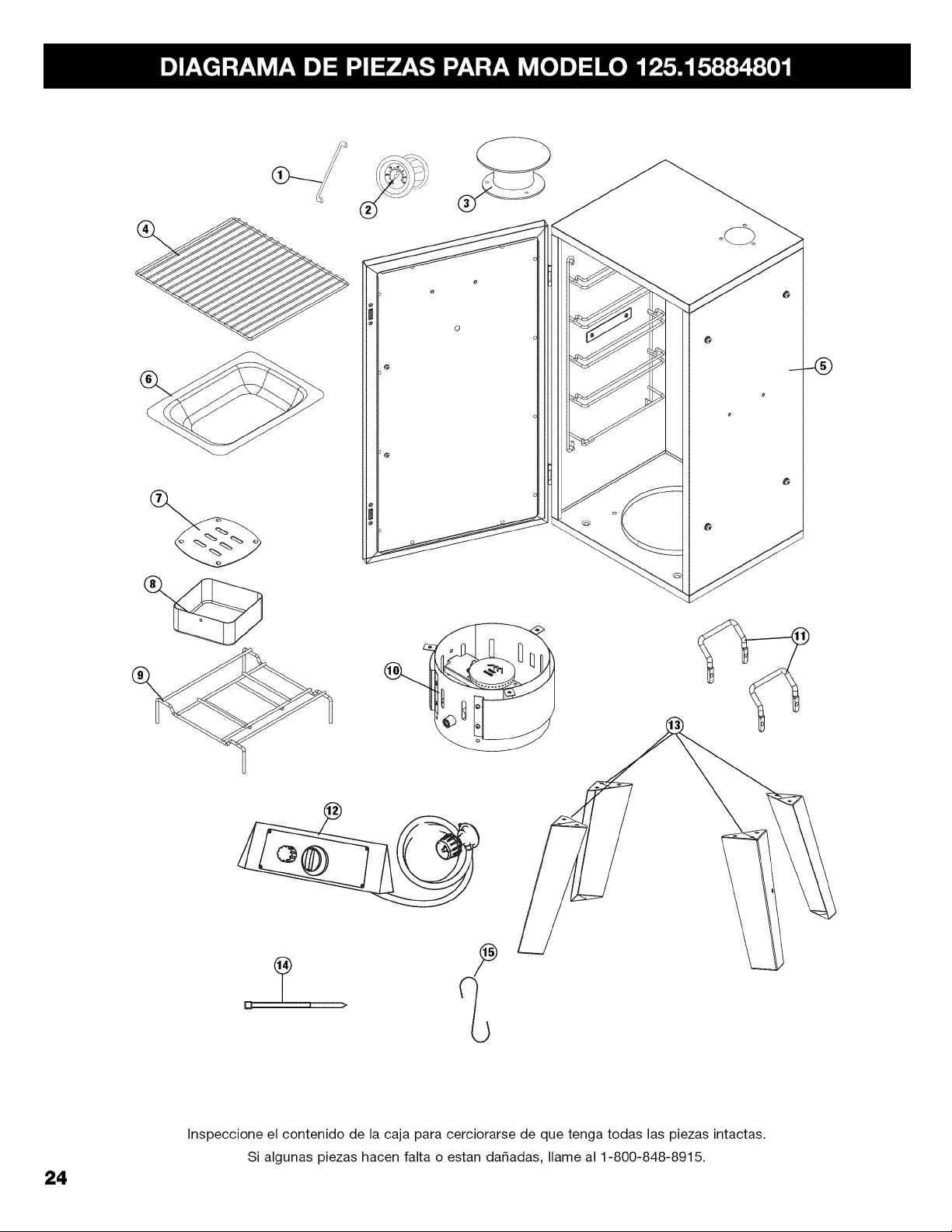
AsegQrese de tener todas las piezas enumeradas bajo
"CONTENIDO DE LA CAJA DE CARTON" y CONTENIDO DE
LA BOLSA de ferreteria antes de comenzar con el ensamblaje.
Cantidad
@ 1 Manija de la Puerta
@ 1 Ensamblaje del Indicador de la Temperatura
(_) 1 Chimenea
(_) 4 Rejillas para Cocinar
(_) 1 Cuerpo del Ahumador
(_) 1 Bandeja de Agua
(_ 1 Tapa de la Caja para las Astillas de Madera
1 Caja para Astillas de Madera
(_) 1 Estante de la caja para pedazo de madera
(_) 1 Ensamblaje de la Hornilla
2 Manijas laterales
(_) 1 Ensamblaje del Panel de Control
(_) 4 Piernas
(_) 1 Abrazadera
(_ 1 Gancho en "S"
1 Guia de Uso y Cuidado
1 Bolsa de Ferreteria
23
%
24
Inspeccione el contenido de la caja para cerciorarse de que tenga todas las piezas intactas.
Si algunas piezas hacen falta o estan da_adas, Ilame al 1-800-848-8915.
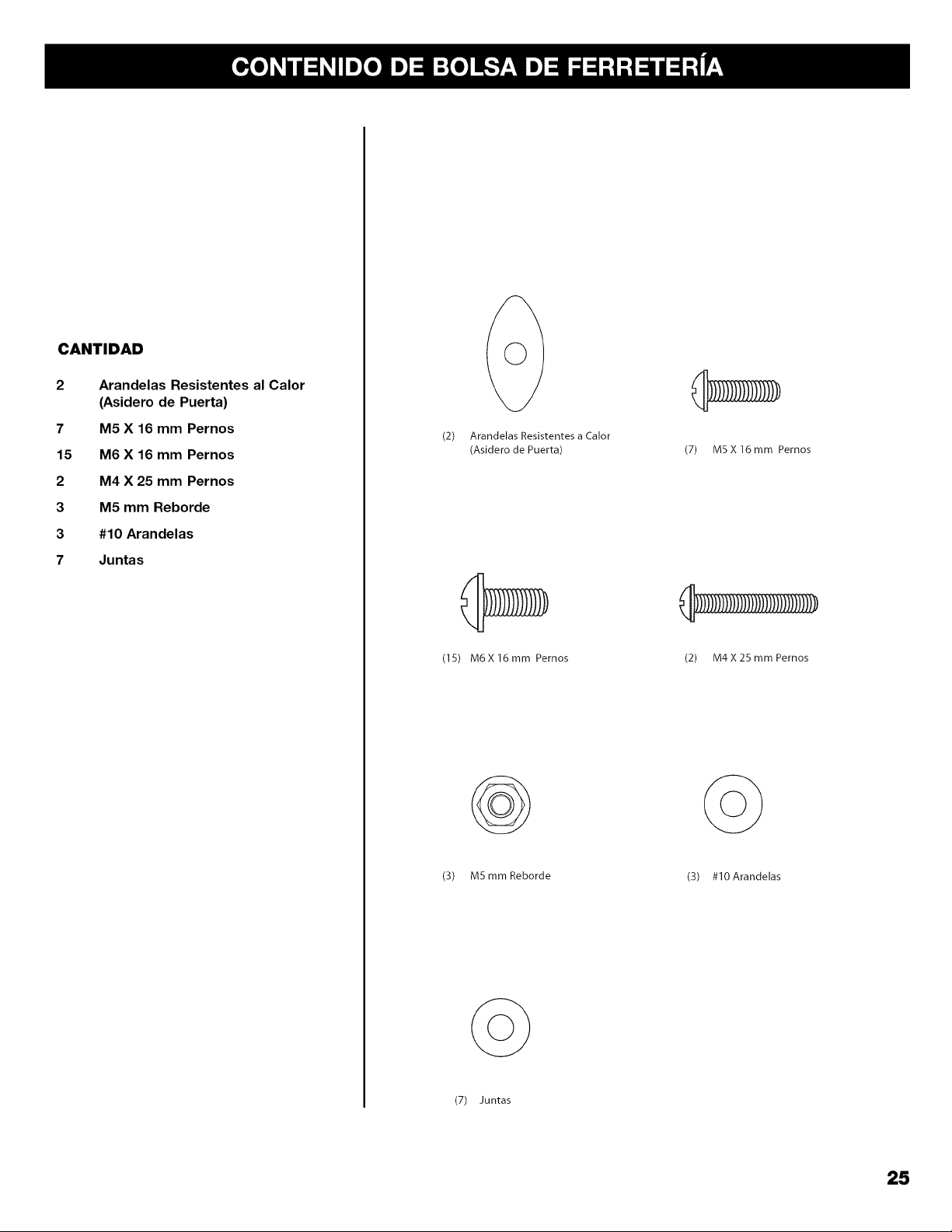
CANTIDAD
2
7
15
2
3
3
Arandelas Resistentes al Calor
(Asidero de Puerta)
M5 X 16 mm Pernos
M6 X 16 mm Pernos
M4 X 25 mm Pernos
M5 mm Reborde
#10 Arandelas
7 Juntas
(2)
(15)
(3)
/o/
Arandelas Resistentes a Calor
(Asidero de Puerta)
M6X 16mm Pernos
@
M5 mm Reborde
(7) Juntas
(7) M5X16mm Pernos
(2) M4 X 25 mm Pernos
(3) #10 Arandelas
25
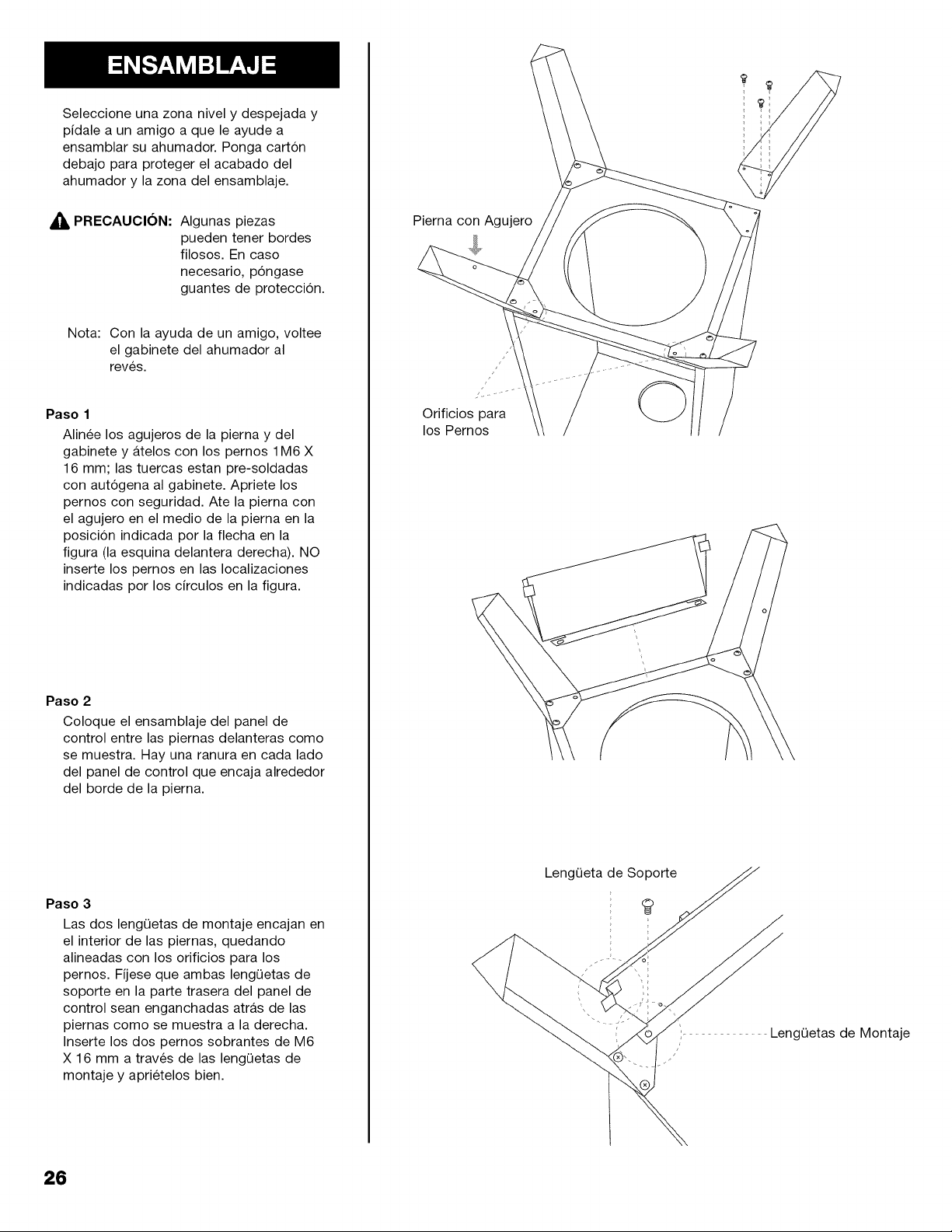
Seleccione una zona nivel y despejada y
pidale a un amigo a que le ayude a
ensamblar su ahumador. Ponga cart6n
debajo para proteger el acabado del
ahumador y la zona del ensamblaje.
_, PRECAUClON: Algunas piezas
pueden tener bordes
filosos. En caso
necesario, p6ngase
guantes de protecci6n.
Nota: Con la ayuda de un amigo, voltee
el gabinete del ahumador al
reves.
Paso 1
Alinee los agujeros de la pierna y del
gabinete y atelos con los pernos 1M6 X
16 mm; las tuercas estan pre-soldadas
con aut6gena al gabinete. Apriete los
pernos con seguridad. Ate la pierna con
el agujero en el medio de la pierna en la
posici6n indicada por la flecha en la
figura (la esquina delantera derecha). NO
inserte los pernos en las Iocalizaciones
indicadas por los circulos en la figura.
Paso 2
Coloque el ensamblaje del panel de
control entre las piernas delanteras como
se muestra. Hay una ranura en cada lado
del panel de control que encaja alrededor
del borde de la pierna.
Paso 3
Las dos lengQetas de montaje encajan en
el interior de las piernas, quedando
alineadas con los orificios para los
pernos. Fijese que ambas lengQetas de
soporte en la parte trasera del panel de
control sean enganchadas atras de las
piernas como se muestra a la derecha.
Inserte los dos pernos sobrantes de M6
X 16 mm a traves de las lengQetas de
montaje y aprietelos bien.
Pierna con Agujero
LengQeta de Soporte
?
............... LengOetas de Montaje
26
\
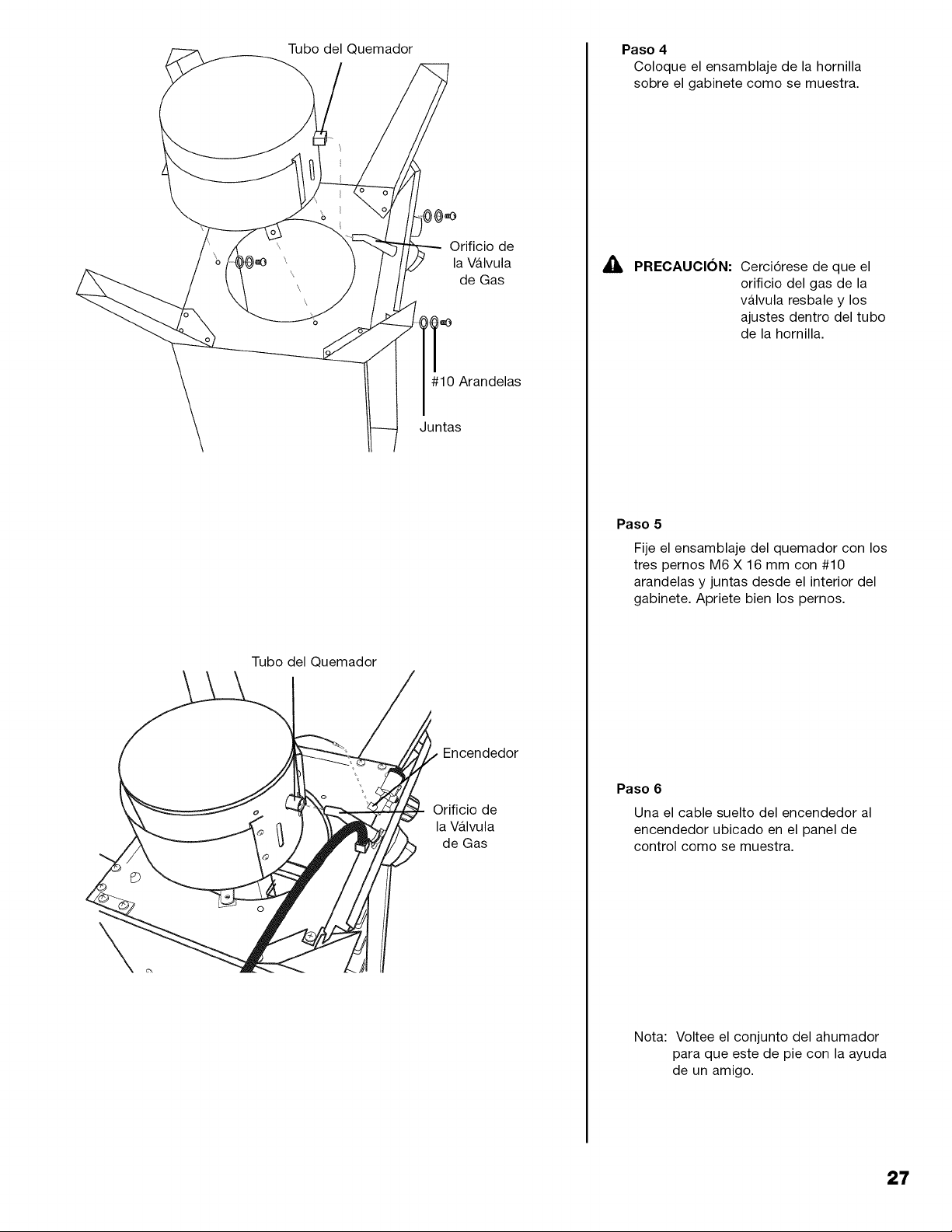
Tubo del Quemador
Tubo del Quemador
Orificio de
la Wlvula
de Gas
T°
#10 Arandelas
Juntas
Encendedor
Orificio de
la Valvula
de Gas
Paso 4
Coloque el ensamblaje de la hornilla
sobre el gabinete como se muestra.
a, PRECAUCION:
Cerci6rese de que el
orificio del gas de la
valvula resbale y los
ajustes dentro del tubo
de la hornilla.
Paso 5
Fije el ensamblaje del quemador con los
tres pernos M6 X 16 mm con #10
arandelas y juntas desde el interior del
gabinete. Apriete bien los pernos.
Paso 6
Una el cable suelto del encendedor al
encendedor ubicado en el panel de
control como se muestra.
Nota: Voltee el conjunto del ahumador
para que este de pie con la ayuda
de un amigo.
27
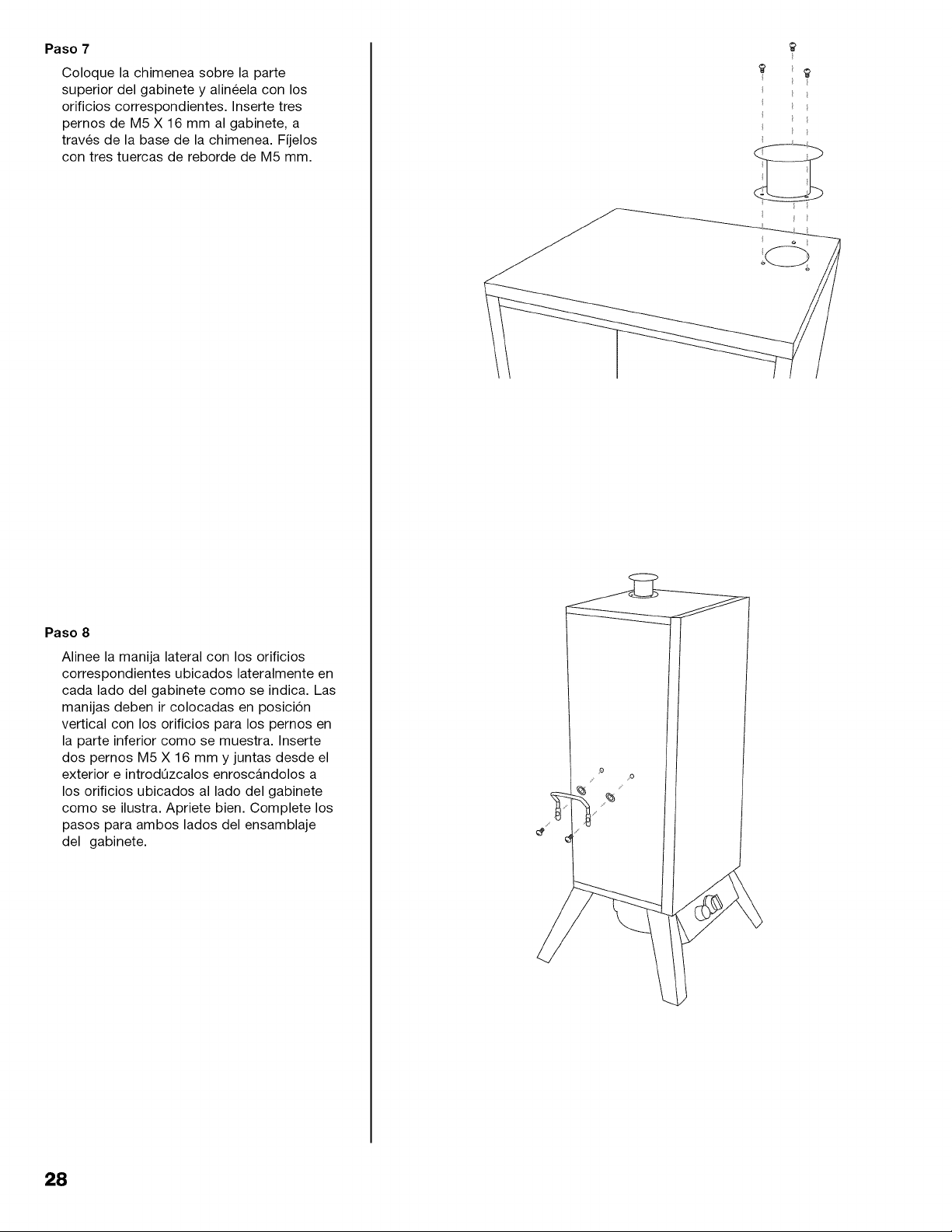
Paso 7
Coloque la chimenea sobre la parte
superior del gabinete y alineela con los
orificios correspondientes. Inserte tres
pernos de M5 X 16 mm al gabinete, a
traves de la base de la chimenea. Fijelos
con tres tuercas de reborde de M5 mm.
Paso 8
Alinee la manija lateral con los orificios
correspondientes ubicados lateralmente en
cada lado del gabinete como se indica. Las
manijas deben ir colocadas en posici6n
vertical con los orificios para los pernos en
la parte inferior como se muestra. Inserte
dos pernos M5 X 16 mm y juntas desde el
exterior e introdQzcalos enroscandolos a
los orificios ubicados al lado del gabinete
como se ilustra. Apriete bien. Complete los
pasos para ambos lados del ensamblaje
del gabinete.
28
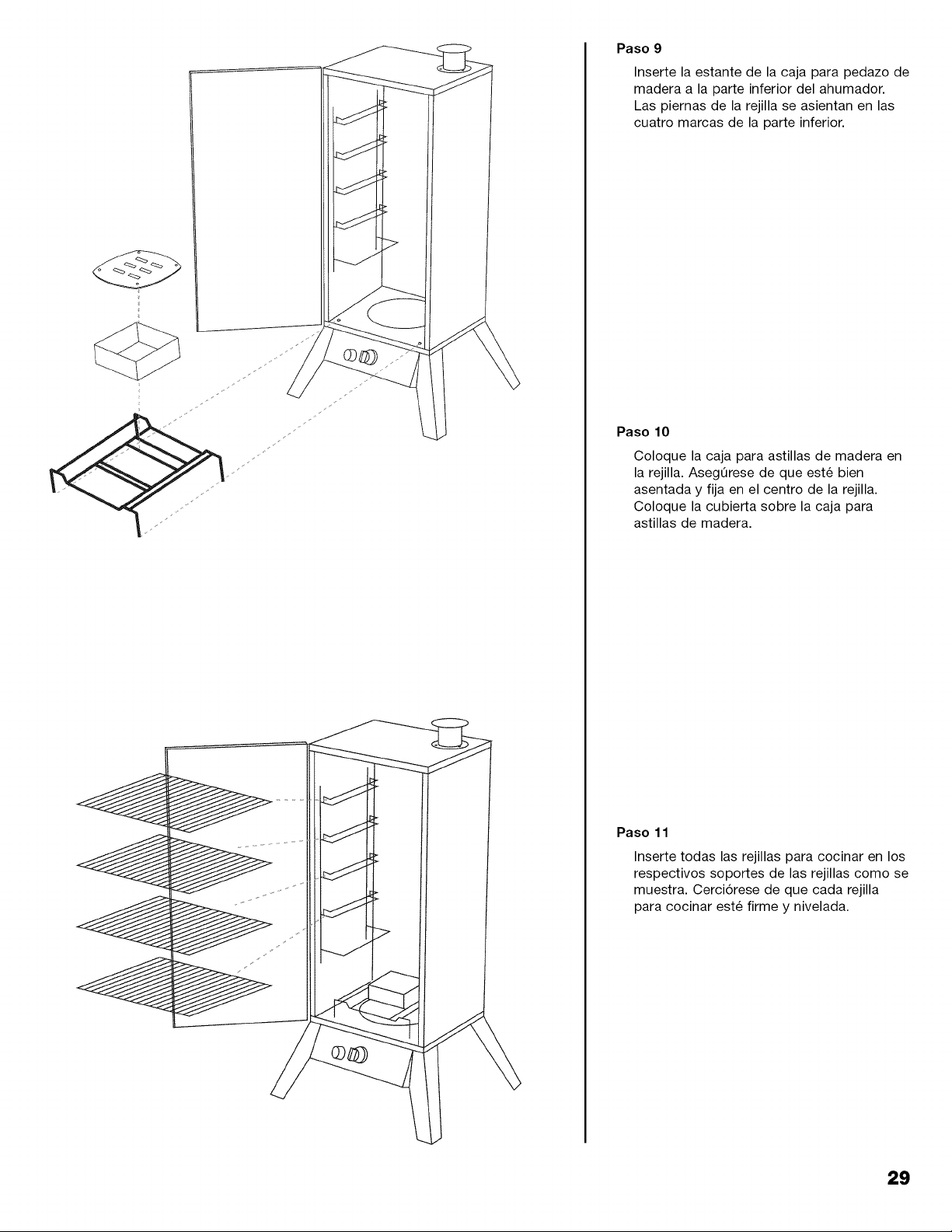
Paso 9
Inserte la estante de la caja para pedazo de
madera a la parte inferior del ahumador.
Las piernas de la rejilla se asientan en las
cuatro marcas de la parte inferior.
Paso 10
Coloque la caja para astillas de madera en
la rejilla. AsegQrese de que este bien
asentada y fija en el centro de la rejilla.
Coloque la cubierta sobre la caja para
astillas de madera.
Paso 11
Inserte todas las rejillas para cocinar en los
respectivos soportes de las rejillas como se
muestra. Cerci6rese de que cada rejilla
para cocinar este firme y nivelada.
29
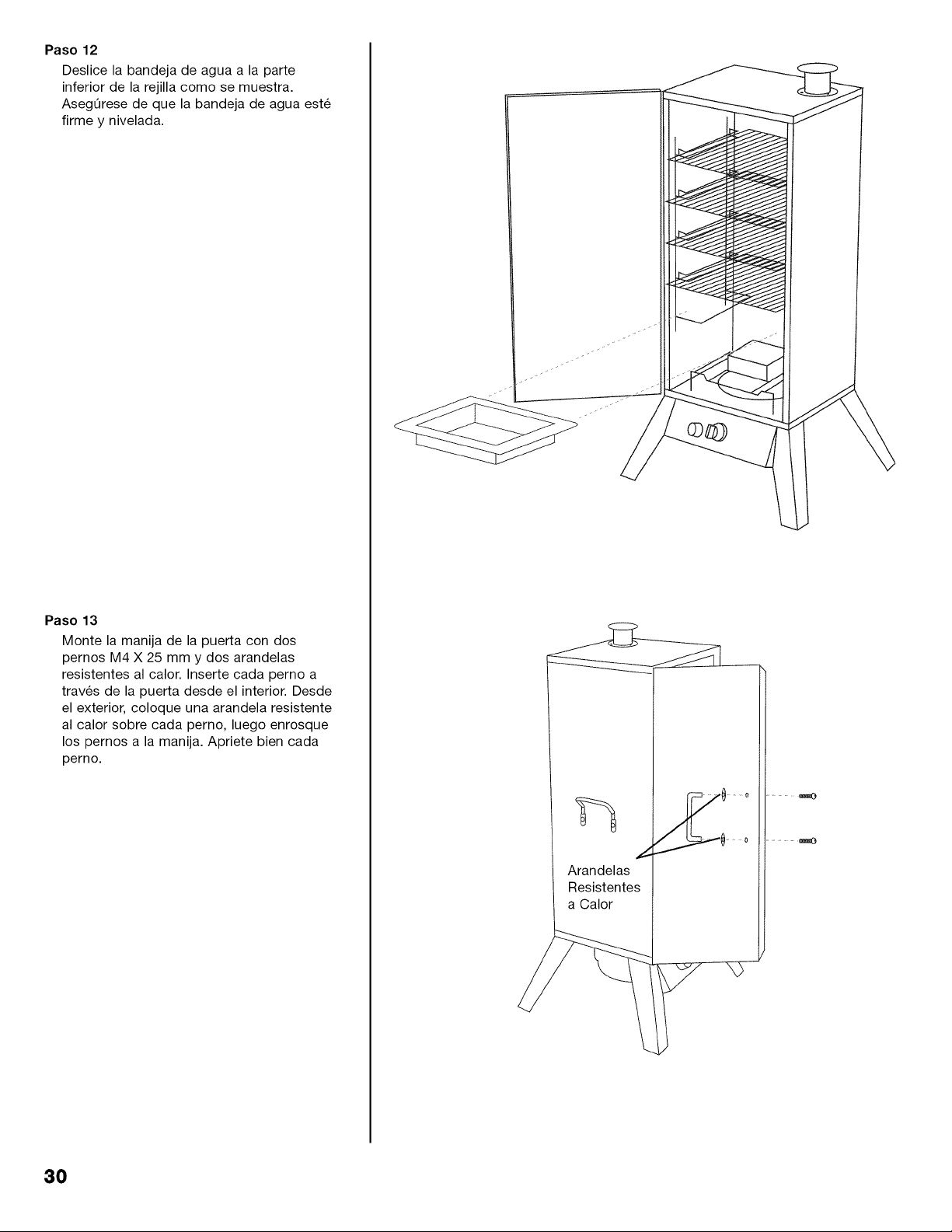
Paso 12
Deslice la bandeja de agua a la parte
inferior de la rejilla como se muestra.
AsegQrese de que la bandeja de agua este
firme y nivelada.
Paso 13
Monte la manija de la puerta con dos
pernos M4 X 25 mm y dos arandelas
resistentes al calor. Inserte cada perno a
traves de la puerta desde el interior. Desde
el exterior, coloque una arandela resistente
al calor sobre cada perno, luego enrosque
los pernos a la manija. Apriete bien cada
perno.
Arandelas
Resistentes
a Calor
3O
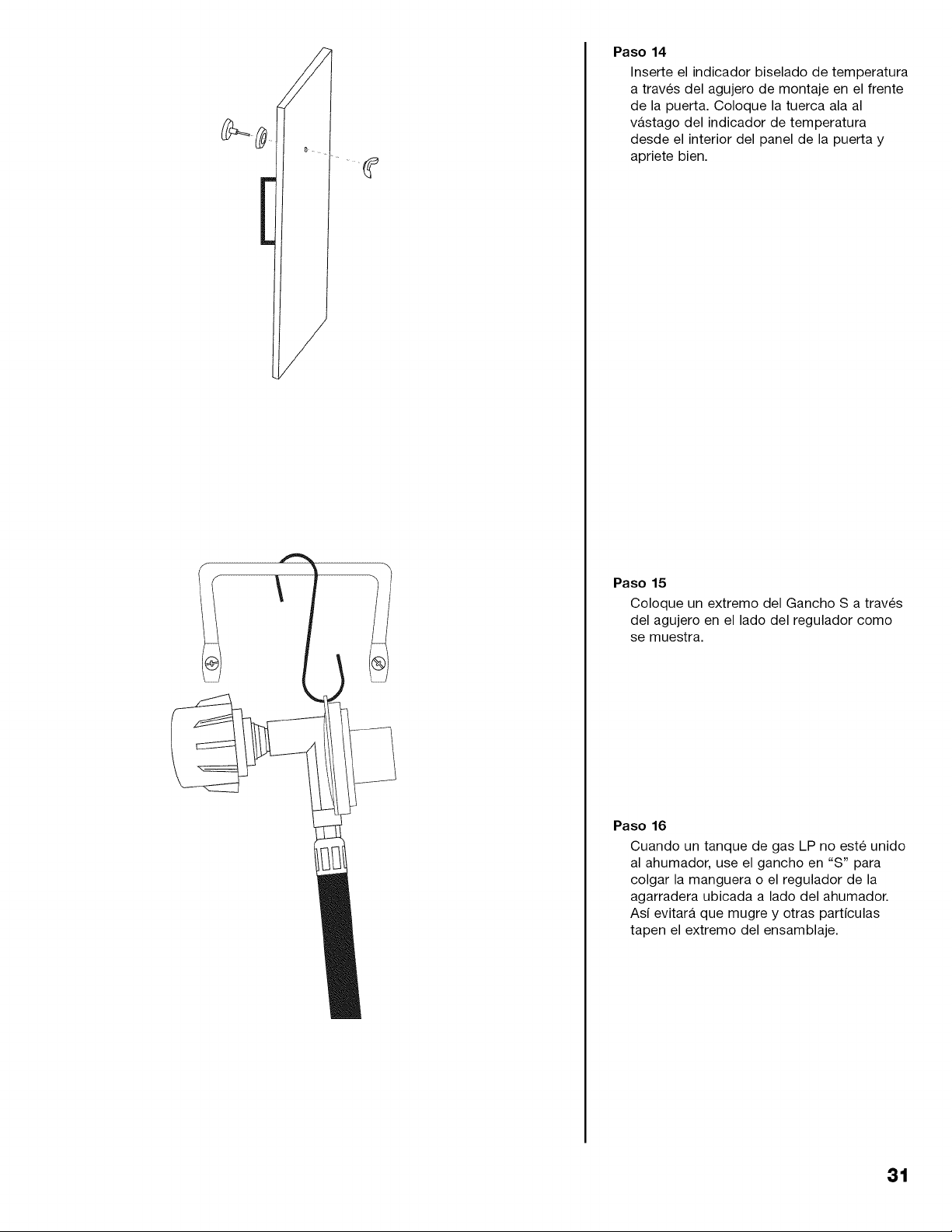
Paso 14
Inserte el indicador biselado de temperatura
a traves del agujero de montaje en el frente
de la puerta. Coloque la tuerca ala al
vastago del indicador de temperatura
desde el interior del panel de la puerta y
apriete bien.
Paso 15
Coloque un extremo del Gancho S a traves
del agujero en el lado del regulador como
se muestra.
Paso 16
Cuando un tanque de gas LP no este unido
al ahumador, use el gancho en "S" para
colgar la manguera o el regulador de la
agarradera ubicada a lado del ahumador.
Asi evitara que mugre y otras particulas
tapen el extremo del ensamblaje.
31
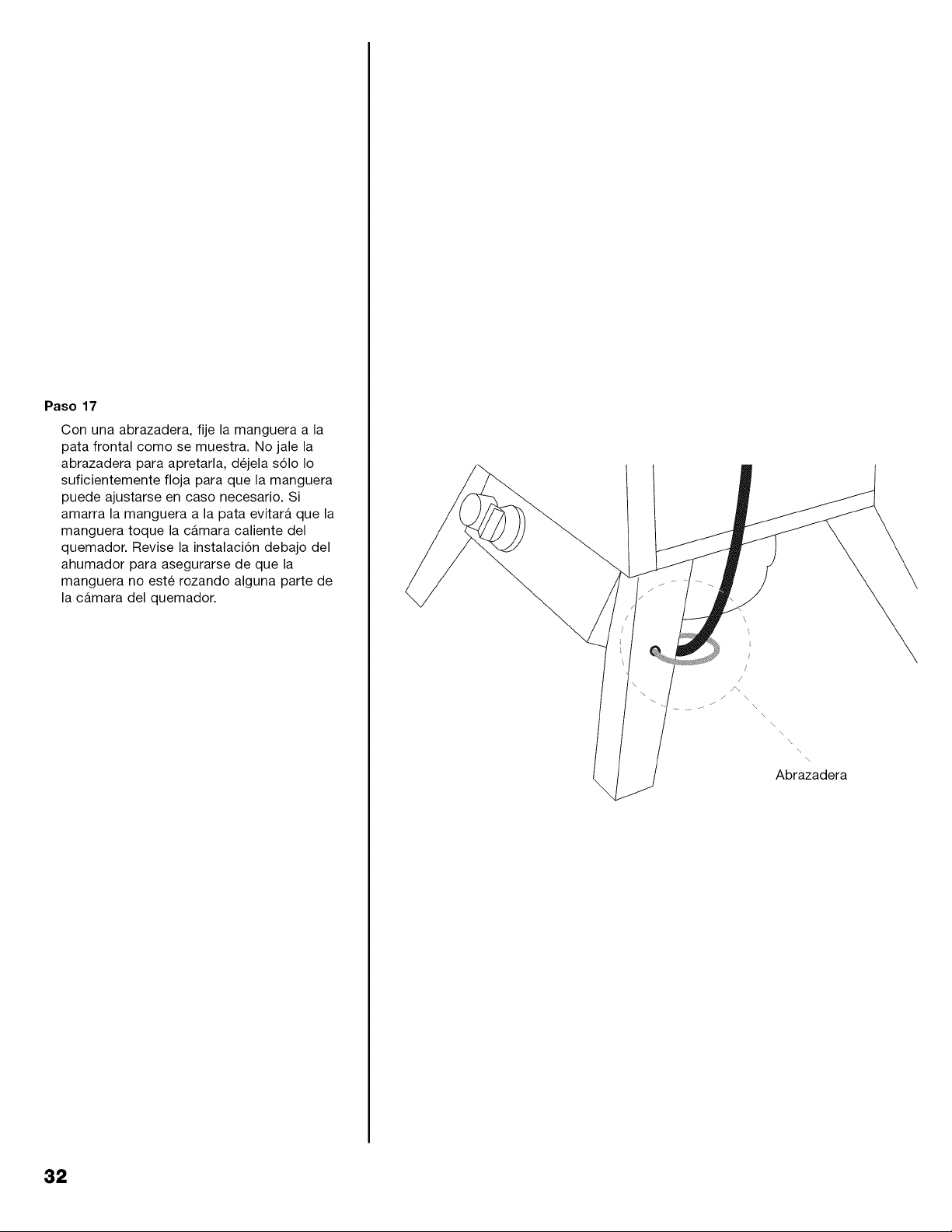
Paso 17
Con una abrazadera, fije la manguera a la
pata frontal como se muestra. No jale la
abrazadera para apretarla, dejela s61o Io
suficientemente floja para que la manguera
puede ajustarse en caso necesario. Si
amarra la manguera a la pata evitara que la
manguera toque la camara caliente del
quemador. Revise la instalaci6n debajo del
ahumador para asegurarse de que la
manguera no este rozando alguna parte de
la camara del quemador.
Abrazadera
32
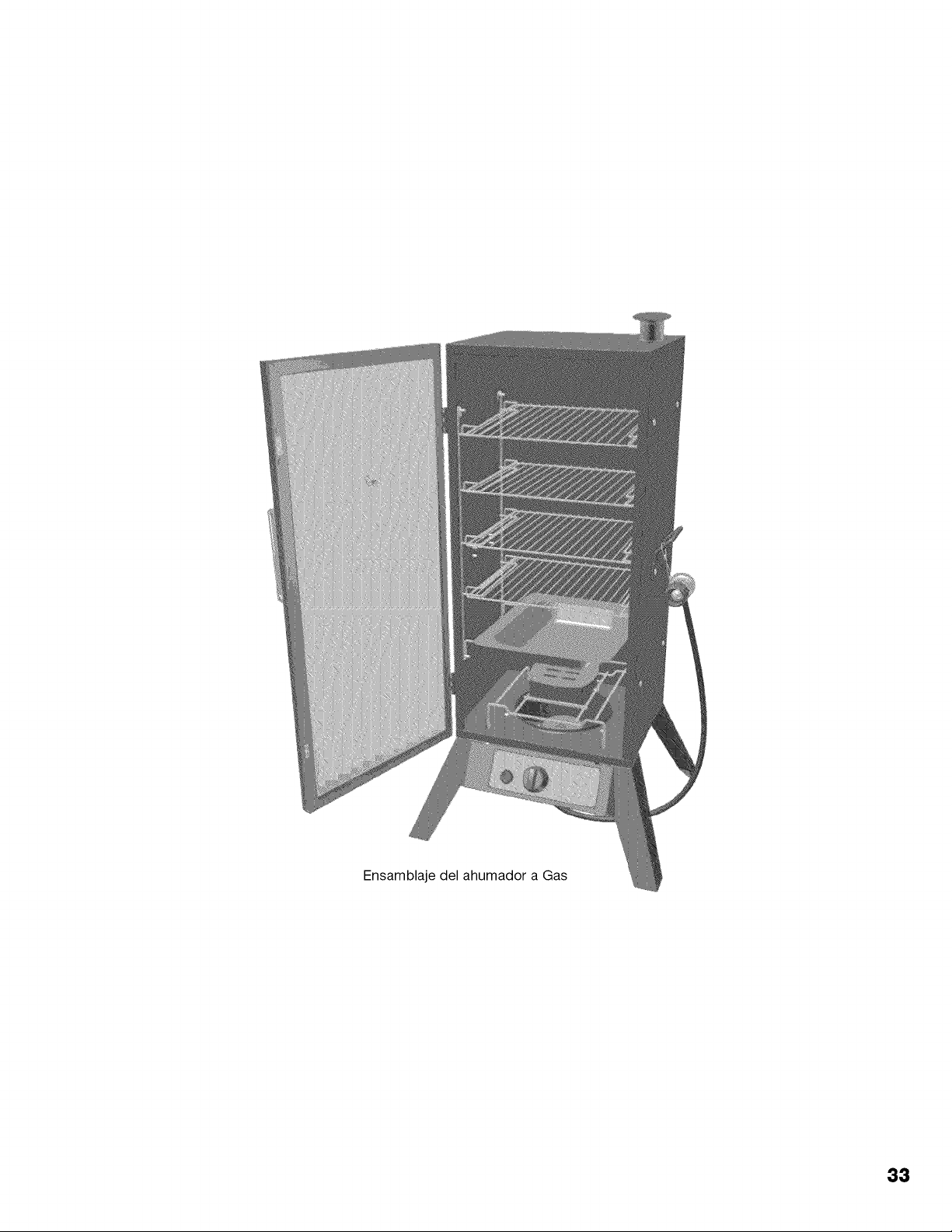
Ensamblaje del ahumador a Gas
33
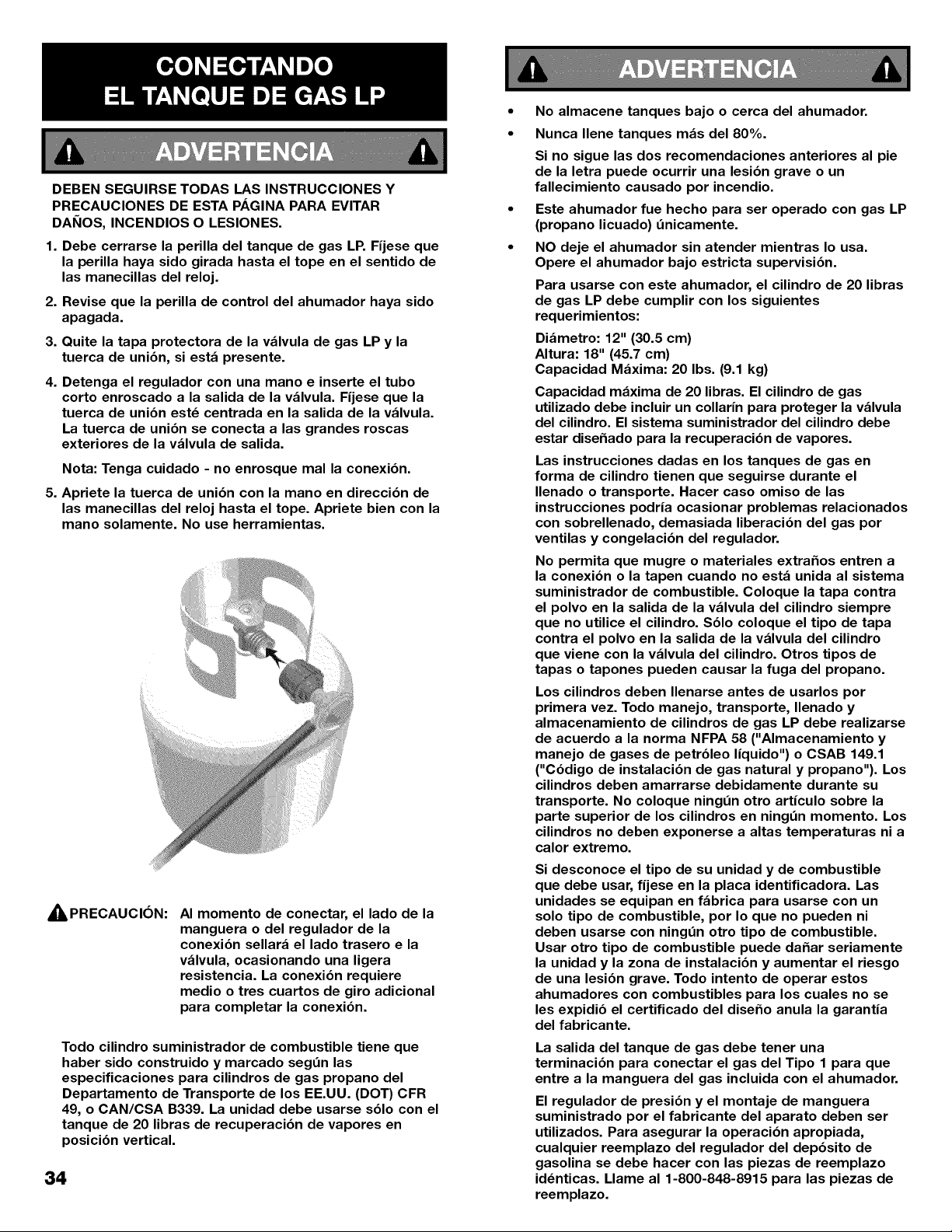
DEBEN SEGUIRSE TODAS LAS INSTRUCCIONES Y
PRECAUCIONES DE ESTA PAGINA PARA EVITAR
DAI_IOS, INCENDIOS O LESIONES.
1. Debe cerrarse la perilla del tanque de gas LP. Fijese que
la perilla haya sido girada hasta el tope en el sentido de
las manecillas del reloj.
2. Revise que la perilla de control del ahumador haya sido
apagada.
3. Quite la tapa protectora de la valvula de gas LP y la
tuerca de unibn, siesta presente.
4. Detenga el regulador con una mano e inserte el tubo
corto enroscado a la salida de la valvula. Fijese que la
tuerca de unibn est_ centrada en la salida de la valvula.
La tuerca de unibn se conecta a las grandes roscas
exteriores de la valvula de salida.
Nota: Tenga cuidado - no enrosque real la conexibn.
5. Apriete la tuerca de unibn con la mano en direccibn de
las manecillas del reloj hasta el tope. Apriete bien con la
mano solamente. No use herramientas.
i
PRECAUCION: AI momento de conectar, el lado de la
manguera o del regulador de la
conexibn sellara el lado trasero e la
valvula, ocasionando una ligera
resistencia. La conexibn requiere
medio o tres cuartos de giro adicional
para completar la conexibn.
Todo cilindro suministrador de combustible tiene que
haber sido construido y marcado segt_n las
especificaciones para cilindros de gas propano del
Departamento de Transporte de los EE.UU. (DOT) CFR
49, o CAN/CSA B339. La unidad debe usarse sblo con el
tanque de 20 libras de recuperacibn de vapores en
posicibn vertical.
34
No almacene tanques bajo o cerca del ahumador.
Nunca Ilene tanques mas del 80%.
Si no sigue las dos recomendaciones anteriores al pie
de la letra puede ocurrir una lesibn grave o un
fallecimiento causado por incendio.
Este ahumador rue hecho para ser operado con gas LP
(propano licuado) t_nicamente.
NO deje el ahumador sin atender mientras Io usa.
Opere el ahumador bajo estricta supervisibn.
Para usarse con este ahumador, el cilindro de 20 libras
de gas LP debe cumplir con los siguientes
requerimientos:
Diametro: 12" (30.5 cm)
Altura: 18" (45.7 cm)
Capacidad Maxima: 20 Ibs. (9.1 kg)
Capacidad maxima de 20 libras. El cilindro de gas
utilizado debe incluir un collarin para proteger la valvula
del cilindro. El sistema suministrador del cilindro debe
estar disehado para la recuperacibn de vapores.
Las instrucciones dadas en los tanques de gas en
forma de cilindro tienen que seguirse durante el
Ilenado o transporte. Hacer caso omiso de las
instrucciones podria ocasionar problemas relacionados
con sobrellenado, demasiada liberacibn del gas por
ventilas y congelacibn del regulador.
No permita que mugre o materiales extrahos entren a
la conexibn o la tapen cuando no esta unida al sistema
suministrador de combustible. Coloque la tapa contra
el polvo en la salida de la valvula del cilindro siempre
que no utilice el cilindro. Sblo coloque el tipo de tapa
contra el polvo en la salida de la valvula del cilindro
que viene con la valvula del cilindro. Otros tipos de
tapas o tapones pueden causar la fuga del propano.
Los cilindros deben Ilenarse antes de usarlos por
primera vez. Todo manejo, transporte, Ilenado y
almacenamiento de cilindros de gas LP debe realizarse
de acuerdo a la norma NFPA 58 ("Almacenamiento y
manejo de gases de petrbleo liquido") o CSAB 149.1
("Cbdigo de instalacibn de gas natural y propano"). Los
cilindros deben amarrarse debidamente durante su
transporte. No coloque ningt_n otro articulo sobre la
parte superior de los cilindros en ningt_n momento. Los
cilindros no deben exponerse a altas temperaturas ni a
calor extremo.
Si desconoce el tipo de su unidad y de combustible
que debe usar, fijese en la placa identificadora. Las
unidades se equipan en fabrica para usarse con un
solo tipo de combustible, por Io que no pueden ni
deben usarse con ningt_n otro tipo de combustible.
Usar otro tipo de combustible puede dahar seriamente
la unidad y la zona de instalacibn y aumentar el riesgo
de una lesibn grave. Todo intento de operar estos
ahumadores con combustibles para los cuales no se
les expidib el certificado del diseho anula la garantia
del fabricante.
La salida del tanque de gas debe tener una
terminacibn para conectar el gas del Tipo 1 para que
entre a la manguera del gas incluida con el ahumador.
El regulador de presibn y el montaje de manguera
suministrado por el fabricante del aparato deben ser
utilizados. Para asegurar la operacibn apropiada,
cualquier reemplazo del regulador del depbsito de
gasolina se debe hacer con las piezas de reemplazo
id_nticas. Llame al 1-800-848-8915 para las piezas de
reemplazo.
Elmontajedelregulador/manguerasedebemanejar
cuidadosamentepara prevenir la contaminaci6n por los
objetos extranjeros y la suciedad. Limpie y examine la
manguera antes de cada uso. Si hay evidencia de la
abrasi6n, use, los cortes o los escapes, la manguera se
debe substituir antes de que el aparato se ponga en uso.
Para asegurar la operaci6n apropiada, cualquier reemplazo
del regulador del dep6sito de gasolina se debe hacer con
las piezas de reemplazo id_nticas. Llame al 1-800-848-8915
para las piezas de reemplazo.
Esta unidad no debe utilizarse con un sistema de
suministro de gas LP que no est_ integrado.
Los reguladores de presibn o de la valvula han sido
ajustados en la fabrica a las presiones correctas de
operacibn, iNo intente cambiar estos ajustes!
COMO ENCONTRAR FUGAS
Una vez hechas las conexiones, revise todo aditamento y
conexibn con agua enjabonada para descubrir fugas.
Con todas las valvulas cerradas, aplique el agua
enjabonada para descubrir fugas (mezcla 50/50 de
detergente lavaplatos liquido y agua) a toda conexibn,
aditamento y junta del tanque por donde circula el gas.
Abra la valvula del tanque.
La presencia de burbujas en areas donde aplic6 el agua
enjabonada indica una fuga de gas. Si detect6 fugas o
huele u oye gas, cierre la valvula y repare la fuga o
reemplace la pieza defectuosa. No use el ahumador
hasta haber reparado todas las fugas.
AI instalar el ahumador y el tanque, recomendamos que
ambos est_n en una linea perpendicular con respecto a
la direccibn del viento.
El ensamblaje de la manguera de gas o del regulador
debe extenderse totalmente a la distancia maxima para
que la manguera est_ derecha y el tanque tan lejos del
ahumador como sea posible.
Los tanques de gas LP estan destinados a operarse en
posicibn vertical solamente.
Cuidese de proteger la manguera suministradora de
combustible para no daharla con el pie o trafico
vehicular.
Cuando no use la unidad, debe apagar el gas del cilindro
suministrador. Ademas, debe desconectar el cilindro de
la unidad.
La unidad podrd almacenarse en el interior s61o si el
cilindro ha sido desconectado y desprendido de la
unidad.
PROCEDIMIENTO ANTES DEL USO
Antes de cocinar alimentos en su ahumador, es importante
"Preparar" su ahumador. La preparacibn o aplicacibn de
una capa de aceite sella la pintura y el interior de su
ahumador para mejorar su sabor, durabilidad y rendimiento
general. A esto tambi_n se le conoce como el
procedimiento de "Habituacibn".
Si su ahumador requiere algt_n retoque de pintura en el
interior del gabinete, la t_nica vez que debe aplicar pintura
en su interior es antes de la preparacibn. No debe
aplicarse pintura en el interior de su ahumador si _ste ha
sido usado, ya que las toxinas de la pintura pueden
contaminar sus alimentos. Sin embargo, si es necesario
pintarlo tras el uso, consulte la seccibn de esta manual
referente a "Cuidado y Mantenimiento".
Para preparar su ahumador, simplemente t_selo como
pensaba hacerlo pero no cocine ninguna comida. $61o
necesitara seguir todas las instrucciones de operacibn
descritas en las siguientes secciones de este manual.
Ponga en su ahumador la leha y los adobos acidos
preferidos para darle sabor, cali_ntelo a baja temperatura
(aprox. 125°F [50°C]) por 45 a 60 minutos. D_jelo enfriar y
saque el agua y la leha.
Una vez terminada la preparacibn, el interior de su
ahumador tendrd un revestimiento durable y
condimentado.
COMO AGREGAR AGUA
Si desea agregar agua antes del cocimiento, simplemente
quite la bandeja de agua y II_nela con agua hasta 1" (2.5
cm) por debajo del borde. Luego, ponga la bandeja en la
parte inferior de la rejilla.
Para agregar agua si el ahumador esta caliente, NO jale la
bandeja de agua mas alia de la rejilla.
Recomendaciones para el Cocimiento:
Cubra la bandeja de agua con papel aluminio antes de
cada uso. Asi, podra limpiar su bandeja de agua mas
facilmente y _sta durara mas.
Para agregar el agua con mas facilidad y sin peligro, use
una regadera con pitbn largo.
35
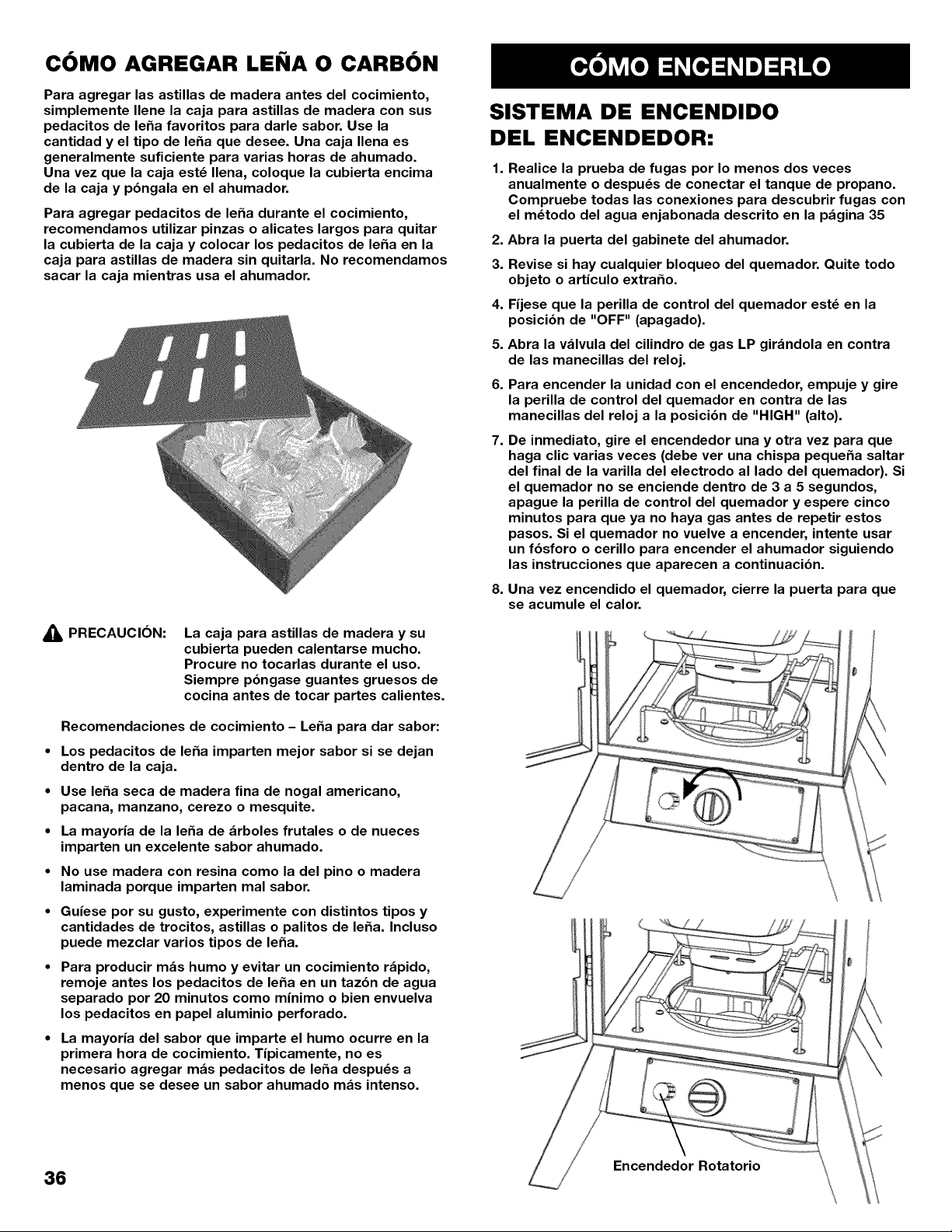
COMO AGREGAR LEI IA O CARBON
Para agregar las astillas de madera antes del cocimiento,
simplemente Ilene la caja para astillas de madera con sus
pedacitos de leha favoritos para darle sabor. Use la
cantidad y el tipo de leha que desee. Una caja Ilena es
generalmente suficiente para varias horas de ahumado.
Una vez que la caja est_ Ilena, coloque la cubierta encima
de la caja y pbngala en el ahumador.
Para agregar pedacitos de leha durante el cocimiento,
recomendamos utilizar pinzas o alicates largos para quitar
la cubierta de la caja y colocar los pedacitos de leha en la
caja para astillas de madera sin quitarla. No recomendamos
sacar la caja mientras usa el ahumador.
PRECAUCION: La caja para astillas de madera y su
cubierta pueden calentarse mucho.
Procure no tocarlas durante el uso.
Siempre pbngase guantes gruesos de
cocina antes de tocar partes calientes.
Recomendaciones de cocimiento - Leha para dar sabor:
Los pedacitos de leha imparten mejor sabor si se dejan
dentro de la caja.
Use leha seca de madera fina de nogal americano,
pacana, manzano, cerezo o mesquite.
La mayoria de la leha de arboles frutales o de nueces
imparten un excelente sabor ahumado.
No use madera con resina como la del pino o madera
laminada porque imparten mal sabor.
Guiese por su gusto, experimente con distintos tipos y
cantidades de trocitos, astillas o palitos de leha. Incluso
puede mezclar varios tipos de leha.
Para producir mas humo y evitar un cocimiento rapido,
remoje antes los pedacitos de leha en un tazbn de agua
separado por 20 minutos como minimo o bien envuelva
los pedacitos en papel aluminio perforado.
La mayoria del sabor que imparte el humo ocurre en la
primera hora de cocimiento. Tipicamente, no es
necesario agregar mas pedacitos de leha despu_s a
menos que se desee un sabor ahumado mas intenso.
36
SISTEMA DE ENCENDIDO
DEL ENCENDEDOR:
1.
2.
3.
4.
5.
6.
7.
8.
Realice la prueba de fugas por Io menos dos veces
anualmente o despu_s de conectar el tanque de propano.
Compruebe todas las conexiones para descubrir fugas con
el m_todo del agua enjabonada descrito en la pagina 35
Abra la puerta del gabinete del ahumador.
Revise si hay cualquier bloqueo del quemador. Quite todo
objeto o articulo extraho.
Fijese que la perilla de control del quemador est_ en la
posicibn de "OFF" (apagado).
Abra la valvula del cilindro de gas LP girbndola en contra
de las manecillas del reloj.
Para encender la unidad con el encendedor, empuje y gire
la perilla de control del quemador en contra de las
manecillas del reloj a la posicibn de "HIGH" (alto).
De inmediato, gire el encendedor una y otra vez para que
haga clic varias veces (debe ver una chispa pequeha saltar
del final de la varilla del electrodo al lado del quemador). Si
el quemador no se enciende dentro de 3 a 5 segundos,
apague la perilla de control del quemador y espere cinco
minutos para que ya no haya gas antes de repetir estos
pasos. Si el quemador no vuelve a encender, intente usar
un fbsforo o cerillo para encender el ahumador siguiendo
las instrucciones que aparecen a continuacibn.
Una vez encendido el quemador, cierre la puerta para que
se acumule el calor.
Encendedor Rotatorio
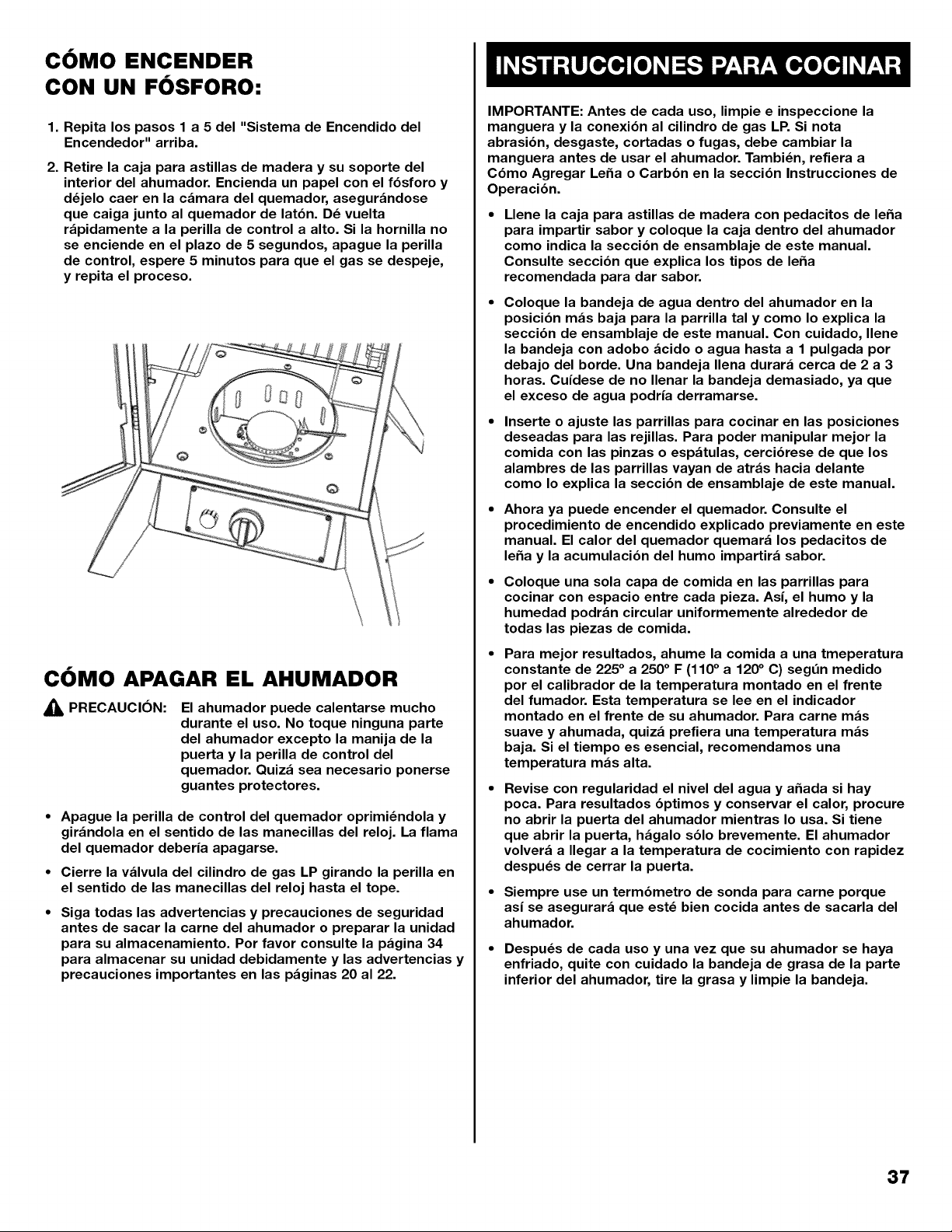
COMO ENCENDER
CON UN FOSFORO:
1. Repita los pasos 1 a 5 del "Sistema de Encendido del
Encendedor" arriba.
2. Retire la caja para astillas de madera y su soporte del
interior del ahumador. Encienda un papel con el fbsforo y
d_jelo caer en la camara del quemador, asegurandose
que caiga junto al quemador de latbn. D_ vuelta
rapidamente a la perilla de control a alto. Si la hornilla no
se enciende en el plazo de 5 segundos, apague la perilla
de control, espere 5 minutos para que el gas se despeje,
y repita el proceso.
COMO APAGAR EL AHUMADOR
_k PRECAUCION: El ahumador puede calentarse mucho
durante el uso. No toque ninguna parte
del ahumador excepto la manija de la
puerta y la perilla de control del
quemador. Quiza sea necesario ponerse
guantes protectores.
Apague la perilla de control del quemador oprimi_ndola y
girbndola en el sentido de las manecillas del reloj. La llama
del quemador deberia apagarse.
Cierre la valvula del cilindro de gas LP girando la perilla en
el sentido de las manecillas del reloj hasta el tope.
Siga todas las advertencias y precauciones de seguridad
antes de sacar la carne del ahumador o preparar la unidad
para su almacenamiento. Por favor consulte la pagina 34
para almacenar su unidad debidamente y las advertencias y
precauciones importantes en las paginas 20 al 22.
IMPORTANTE: Antes de cada uso, limpie e inspeccione la
manguera y la conexibn al cilindro de gas LP. Si nota
abrasibn, desgaste, cortadas o fugas, debe cambiar la
manguera antes de usar el ahumador. Tambi_n, refiera a
Cbmo Agregar Leha o Carbbn en la seccibn Instrucciones de
Operacibn.
Llene la caja para astillas de madera con pedacitos de leha
para impartir sabor y coloque la caja dentro del ahumador
como indica la seccibn de ensamblaje de este manual.
Consulte seccibn que explica los tipos de leha
recomendada para dar sabor.
Coloque la bandeja de agua dentro del ahumador en la
posicibn mas baja para la parrilla tal y como Io explica la
seccibn de ensamblaje de este manual. Con cuidado, Ilene
la bandeja con adobo acido o agua hasta a 1 pulgada por
debajo del borde. Una bandeja Ilena durara cerca de 2 a 3
horas. Cuidese de no Ilenar la bandeja demasiado, ya que
el exceso de agua podria derramarse.
Inserte o ajuste las parrillas para cocinar en las posiciones
deseadas para las rejillas. Para poder manipular mejor la
comida con las pinzas o espatulas, cercibrese de que los
alambres de las parrillas vayan de atras hacia delante
como Io explica la seccibn de ensamblaje de este manual.
Ahora ya puede encender el quemador. Consulte el
procedimiento de encendido explicado previamente en este
manual. El calor del quemador quemarb los pedacitos de
leha y la acumulacibn del humo impartira sabor.
Coloque una sola capa de comida en las parrillas para
cocinar con espacio entre cada pieza. Asi, el humo y la
humedad podran circular uniformemente alrededor de
todas las piezas de comida.
Para mejor resultados, ahume la comida a una tmeperatura
constante de 225° a 250° F (110 ° a 120° C) segt_n medido
por el calibrador de la temperatura montado en el frente
del fumador. Esta temperatura se lee en el indicador
montado en el frente de su ahumador. Para carne mas
suave y ahumada, quiza prefiera una temperatura mas
baja. Si el tiempo es esencial, recomendamos una
temperatura mas alta.
Revise con regularidad el nivel del agua y ahada si hay
poca. Para resultados bptimos y conservar el calor, procure
no abrir la puerta del ahumador mientras Io usa. Si tiene
que abrir la puerta, hagalo sblo brevemente. El ahumador
volvera a Ilegar a la temperatura de cocimiento con rapidez
despu_s de cerrar la puerta.
Siempre use un termbmetro de sonda para carne porque
asi se asegurara que est_ bien cocida antes de sacarla del
ahumador.
• Despu_s de cada uso y una vez que su ahumador se haya
enfriado, quite con cuidado la bandeja de grasa de la parte
inferior del ahumador, tire la grasa y limpie la bandeja.
37
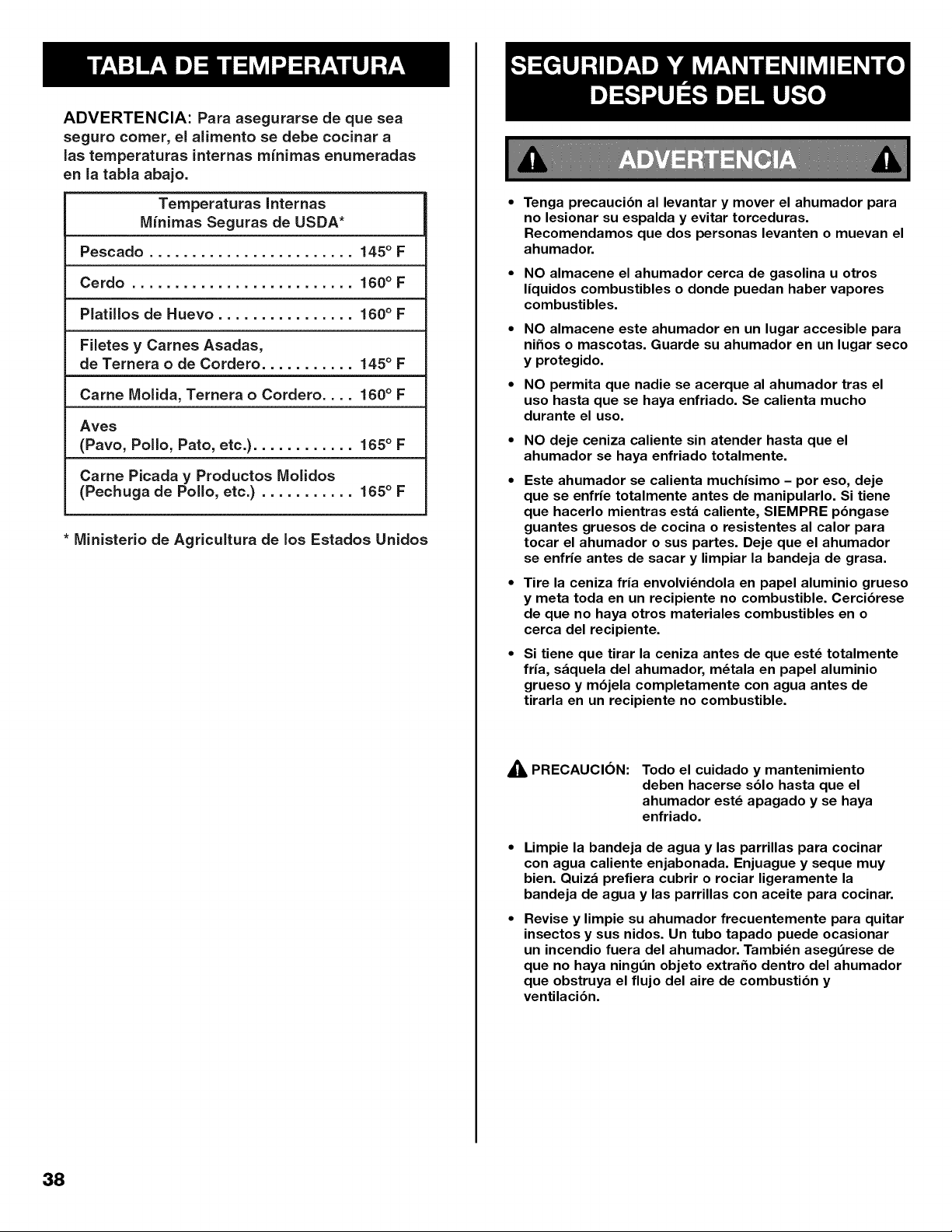
ADVERTENCIA: Para asegurarse de que sea
seguro comer, el alimento se debe cocinar a
las temperaturas internas minimas enumeradas
en la tabla abajo.
Temperaturas Jnternas
Minimas Seguras de USDA*
Pescado ........................ 145° F
Cerdo .......................... 160° F
Platillos de Huevo ................ 160° F
Filetes y Carnes Asadas,
de Ternera o de Cordero ........... 145° F
Came Molida, Ternera o Cordero .... 160 ° F
Aves
(Pavo, Polio, Pato, etc.) ............ 165° F
Came Picada y Productos Moiidos
(Pechuga de Polio, etc.) ........... 165° F
* Ministerio de Agricuitura de los Estados Unidos
Tenga precaucibn al levantar y mover el ahumador para
no lesionar su espalda y evitar torceduras.
Recomendamos que dos personas levanten o muevan el
ahumador.
NO almacene el ahumador cerca de gasolina u otros
liquidos combustibles o donde puedan haber vapores
combustibles.
NO almacene este ahumador en un lugar accesible para
nihos o mascotas. Guarde su ahumador en un lugar seco
y protegido.
NO permita que nadie se acerque al ahumador tras el
uso hasta que se haya enfriado. Se calienta mucho
durante el uso.
NO deje ceniza caliente sin atender hasta que el
ahumador se haya enfriado totalmente.
Este ahumador se calienta muchisimo - por eso, deje
que se enfrie totalmente antes de manipularlo. Si tiene
que hacerlo mientras esta caliente, SIEMPRE pbngase
guantes gruesos de cocina o resistentes al calor para
tocar el ahumador o sus partes. Deje que el ahumador
se enfrie antes de sacar y limpiar la bandeja de grasa.
Tire la ceniza fria envolvi_ndola en papel aluminio grueso
y meta toda en un recipiente no combustible. Cercibrese
de que no haya otros materiales combustibles en o
cerca del recipiente.
Si tiene que tirar la ceniza antes de que est_ totalmente
fria, saquela del ahumador, m_tala en papel aluminio
grueso y mbjela completamente con agua antes de
tirarla en un recipiente no combustible.
_kPRECAUCI6N: Todo el cuidado y mantenimiento
deben hacerse sblo hasta que el
ahumador est_ apagado y se haya
enfriado.
Limpie la bandeja de agua y las parrillas para cocinar
con agua caliente enjabonada. Enjuague y seque muy
bien. Quiza prefiera cubrir o rociar ligeramente la
bandeja de agua y las parrillas con aceite para cocinar.
Revise y limpie su ahumador frecuentemente para quitar
insectos y sus nidos. Un tubo tapado puede ocasionar
un incendio fuera del ahumador. Tambi_n asegt_rese de
que no haya ningt_n objeto extraho dentro del ahumador
que obstruya el flujo del aire de combustibn y
ventilacibn.
38
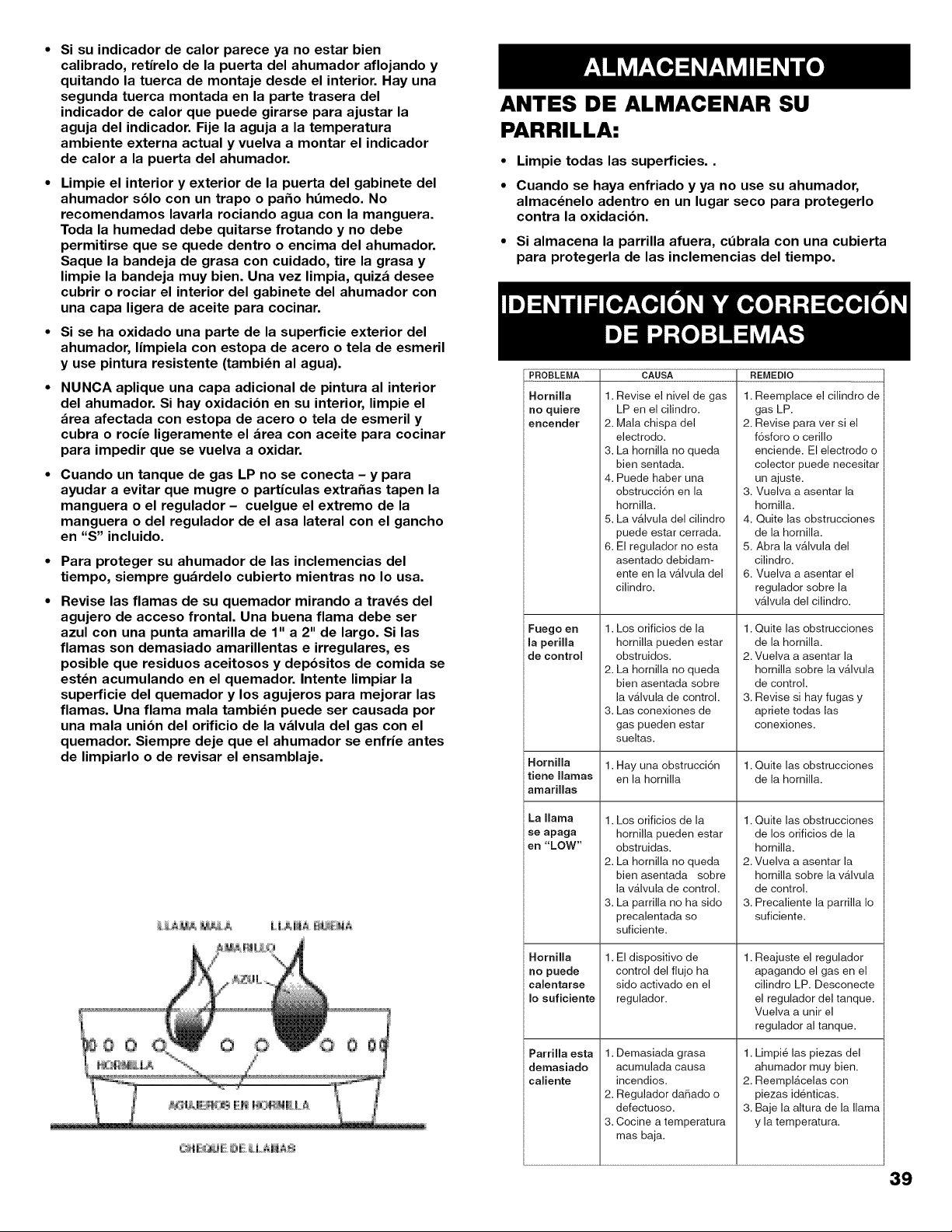
Si su indicador de calor parece ya no estar bien
calibrado, retirelo de la puerta del ahumador aflojando y
quitando la tuerca de montaje desde el interior. Hay una
segunda tuerca montada en la parte trasera del
indicador de calor que puede girarse para ajustar la
aguja del indicador. Fije la aguja a la temperatura
ambiente externa actual y vuelva a montar el indicador
de calor a la puerta del ahumador.
Limpie el interior y exterior de la puerta del gabinete del
ahumador s61o con un trapo o paffo h0medo. No
recomendamos lavarla rociando agua con la manguera.
Toda la humedad debe quitarse frotando y no debe
permitirse que se quede dentro o encima del ahumador.
Saque la bandeja de grasa con cuidado, tire la grasa y
limpie la bandeja muy bien. Una vez limpia, quiza desee
cubrir o rociar el interior del gabinete del ahumador con
una capa ligera de aceite para cocinar.
Si se ha oxidado una parte de la superficie exterior del
ahumador, limpiela con estopa de acero o tela de esmeril
y use pintura resistente (tambi_n al agua).
NUNCA aplique una capa adicional de pintura al interior
del ahumador. Si hay oxidacibn en su interior, limpie el
area afectada con estopa de acero o tela de esmeril y
cubra o rocie ligeramente el area con aceite para cocinar
para impedir que se vuelva a oxidar.
Cuando un tanque de gas LP no se conecta - y para
ayudar a evitar que mugre o particulas extraffas tapen la
manguera o el regulador - cuelgue el extremo de la
manguera o del regulador de el asa lateral con el gancho
en "S" incluido.
Para proteger su ahumador de las inclemencias del
tiempo, siempre guardelo cubierto mientras no Io usa.
Revise las flamas de su quemador mirando a trav_s del
agujero de acceso frontal. Una buena llama debe ser
azul con una punta amarilla de 1" a 2" de largo. Si las
llamas son demasiado amarillentas e irregulares, es
posible que residuos aceitosos y depbsitos de comida se
est_n acumulando en el quemador. Intente limpiar la
superficie del quemador y los agujeros para mejorar las
llamas. Una llama mala tambi_n puede ser causada por
una mala unibn del orificio de la valvula del gas con el
quemador. Siempre deje que el ahumador se enfrie antes
de limpiarlo o de revisar el ensamblaje.
t_7_17$17_>t+,_1i__=_
ANTES DE ALMACENAR SU
PARRILLA:
Limpie todas las superficies..
Cuando se haya enfriado y ya no use su ahumador,
almac_nelo adentro en un lugar seco para protegerlo
contra la oxidacibn.
Si almacena la parrilla afuera, c0brala con una cubierta
para protegerla de las inclemencias del tiempo.
PROBLEMA CAUSA REMED!O
Horniila
no quiere
encender
Fuego en
la perilla
de control
1. Revise el nivel de gas
LP en el cilindro.
2. Mala chispa del
electrodo.
3. La hornilla no queda
bien sentada.
4. Puede haber una
obstrucci6n en la
hornilla.
5. La v&lvula del cilindro
puede estar cerrada.
6. El regulador no esta
asentado debidam-
ente en la vddvula del
cilindro.
1. Los orificios de la
hornilla pueden estar
obstruidos.
2. La hornilla no queda
bien asentada sobre
la vAIvula de control.
3. Las conexiones de
gas pueden estar
sueltas.
1. Reemplace el cilindro de
gas LP.
2. Revise para ver si el
f6sforo o cerillo
enciende. El electrodo o
colector puede necesitar
un ajuste.
3. Vuelva a asentar la
hornilla.
4. Quite las obstrucciones
de la hornilla.
5. Abra la vddvula del
cilindro.
6. Vuelva a asentar el
regulador sobre la
vddvula del cilindro.
1. Quite las obstrucciones
de la hornilla.
2. Vuelva a asentar la
hornilla sobre la vAIvula
de control.
3. Revise si hay fugas y
apriete todas las
conexiones.
Hornilla 1. Hay una obstrucci6n 1. Quite las obstrucciones
tiene llamas en la hornilla de la hornilla.
amarillas
La llama
se apaga
en "LOW"
1. Los orificios de la
hornilla pueden estar
obstruidas.
2. La hornilla no queda
bien asentada sobre
la v&lvula de control.
3. La parrilla no ha sido
precalentada so
suficiente.
1. El dispositivo de
control del flujo ha
sido activado en el
regulador.
1. Demasiada grasa
acumulada causa
incendios.
2. Regulador da6ado o
defectuoso.
3. Cocine a temperatura
mas baja.
Hornilla
no puede
calentarse
Io suficiente
Parrilia esta
demasiado
caliente
1. Quite las obstrucciones
de los orificios de la
hornilla.
2. Vuelva a asentar la
hornilla sobre la v_lvula
de control.
3. Precaliente la parrilla Io
suficiente.
1. Reajuste el regulador
apagando el gas en el
cilindro LP. Desconecte
el regulador del tanque.
Vuelva a unir el
regulador al tanque.
1. Limpie las piezas del
ahumador muy bien.
2. Reempl&.celas con
piezas identicas.
3. Baje la altura de la llama
y la temperatura.
39
Your Home
For expert troubleshooting and home solutions advice:
www.managemyhome.com
For repair - in your home - of all major brand appliances,
lawn and garden equipment, or heating and cooling systems,
no matter who made it, no matter who sold it!
For the replacement parts, accessories and
owner's manuals that you need to do-it-yourself.
For Sears professional installation of home appliances
and items like garage door openers and water heaters.
1-800-4-MY-HOME ® (1-800-469-4663)
Call anytime, day or night (U.S.A. and Canada)
www.sears.com www.sears.ca
Our Home
For repair of carry-in items like vacuums, lawn equipment,
and electronics, call anytime for the location of your nearest
Sears Parts & Repair Service Center
1-800-488-1222 (U.S.A.) 1-800-469-4663 (Canada)
www.sears.com www.sears.ca
To purchase a protection agreement on a product serviced by Sears:
1-800-827-6655 (U.S.A.) 1-800-361-6665 (Canada)
Para pedir servicio de reparaci6n
a domicilio, y para ordenar piezas:
1-888-SU-HOGAR ®
(1-888-784-6427)
Au Canada pour service en fran(_ais:
1-800-LE-FOYER Mc
(1-800-533-6937)
www.sears.ca
TM SM
® Registered Trademark / Trademark / Service Mark of Sears Brands, LLC
rM
® Marca Registrada / Marca de Fabrica / SM Marca de Servicio de Sears Brands, LLC
MCMarque de commerce / MDMarque d6posee de Sears Brands, LLC © Sears Brands, LLC