UseAndCare
2
Understanding
Washers Features 4
Other Features
Assistance Or
Service 22
TWO AND THREE SPEED AUTOMATIC WASHERS
A Note ToYou
Thank you for buying a Whirlpool appliance.
You have purchased a quality, world-classhome appliance. Years of engineering experience have
gone into its manufacturing. To ensure many years of trouble-free operation, we have developed
this Use and Care Guide. It is full of valuable information on how to operate and maintain your
appliance properly and safely. Please read it carefully. Also, please complete and mail the Owner-
ship Registration Card provided with your appliance. This will help us notify you about any new
information on your appliance.
Your safety is important to us.
This guide contains safety symbols and statements. Please pay special attention to these symbols
and follow any instructions given. Here is a brief explanation of the use of each symbol.
This symbol will help alert you to such dangers
as personal injury, burns, fire and electrical
shock.
This symbol will help you avoid actions which
could cause product damage (scratches,
dents, etc.) and damage to your personal
property.
Our Consumer Assistance number, 1-800-253-1301, is
toll-free 24 hours a day,
If you have a question concerning your appliance's operation,or if you need service, first see "If
You Need Assistance Or Service" on page 22. Ifyou need further help, call us. When calling, you
will need to know your appliance's complete model number and serial number. You can find this
information on the model and serial number plate (see diagram on page 4). For your convenience,
we have included a handy place below for you to record these numbers, the purchase date from
the sales slip and your dealer's name and telephone number. Keep this book and the sales slip
together in a safe place for future reference.
Model Number Dealer Name
Serial Number Dealer Phone
Purchase Date
IMPORTANT SAFETY INSTRUCTIONS
• Read all instructions before using your
washer.
• Do not machine wash or machine dry
items cleaned, washed, soaked in, or
spotted with wax, paint, gasoline, oil, or
other flammable fluids. The fumes can
create a fire hazard or explosion. Always
hand wash and line dry items containing
these materials.
• Flammable fluids (dry-cleaning solvents,
kerosene, gasoline, etc.) should not be
used or stored in or near your washer. Do
not add flammable fluids to your wash
water. These substances give off vapors
that can create a fire hazard or explosion.
• Do not allow children to operate, play with,
or crawl on or inside your washer. Super-
vise children closely when your washer is
used near them.
• Before your washer is removed from
service or discarded, remove the lid to
prevent accidental entrapment.
• After starting a cycle, de not reach into the
basket unless the Cycle Control Knob is
pushed in and all motion stops,
• Do not tamper with the controls.
• If your hot water has not been used
recently (usually 2 weeks or longer),
hydrogen gases may build up in your
water heater and your hot water pipes.
HYDROGEN GAS IS EXPLOSIVE To
prevent injury or damage, before using
your washer, turn on all hot water faucets
and allow water to run for several min-
utes. This will allow gases to escape. Do
not smoke or use any open flame near
your faucet while it is open.
Please ...
• Have only a qualified repairman install,
repair, or replace parts on washer,
• Maintain washer properly.
• Protect washer from the weather and
keep it where the temperature will not fall
below freezing,
• Install and level washer on a floor that
can support the weight.*
• Connect washer to the correct 3-prong
outlet, electrical supply, water supply, and
drain.*
• Ground washer properly.*
*See the Installation Instructions.
Understanding your responsibilities
• Store detergent, laundry aids and other
materials in a cool, dry place where
children cannot reach them (in a locked
cabinet if possible).
• Read and follow instructions on pack-
ages of detergent and laundry aids,
especially warnings and precautions.
,, Do not wash or dry items that are soiled
with vegetable or cooking oil. These
items may contain some oil after launder-
ing. Due to the remaining oil, the fabric
may smoke or catch fire by itself.
• Do not use chlorine bleach and ammonia
or acids (such as vinegar or rust re-
mover) in the same wash, Hazardous
fumes can form.
• Unplug power supply cord before
attempting to service your washer.
• Do not machine wash fiberglass materi-
als. Small particles can stick to the
fabrics washed in following loads and
cause skin irritation.
- SAVE THESE INSTRUCTIONS -
Knowing Your Washer's
Features
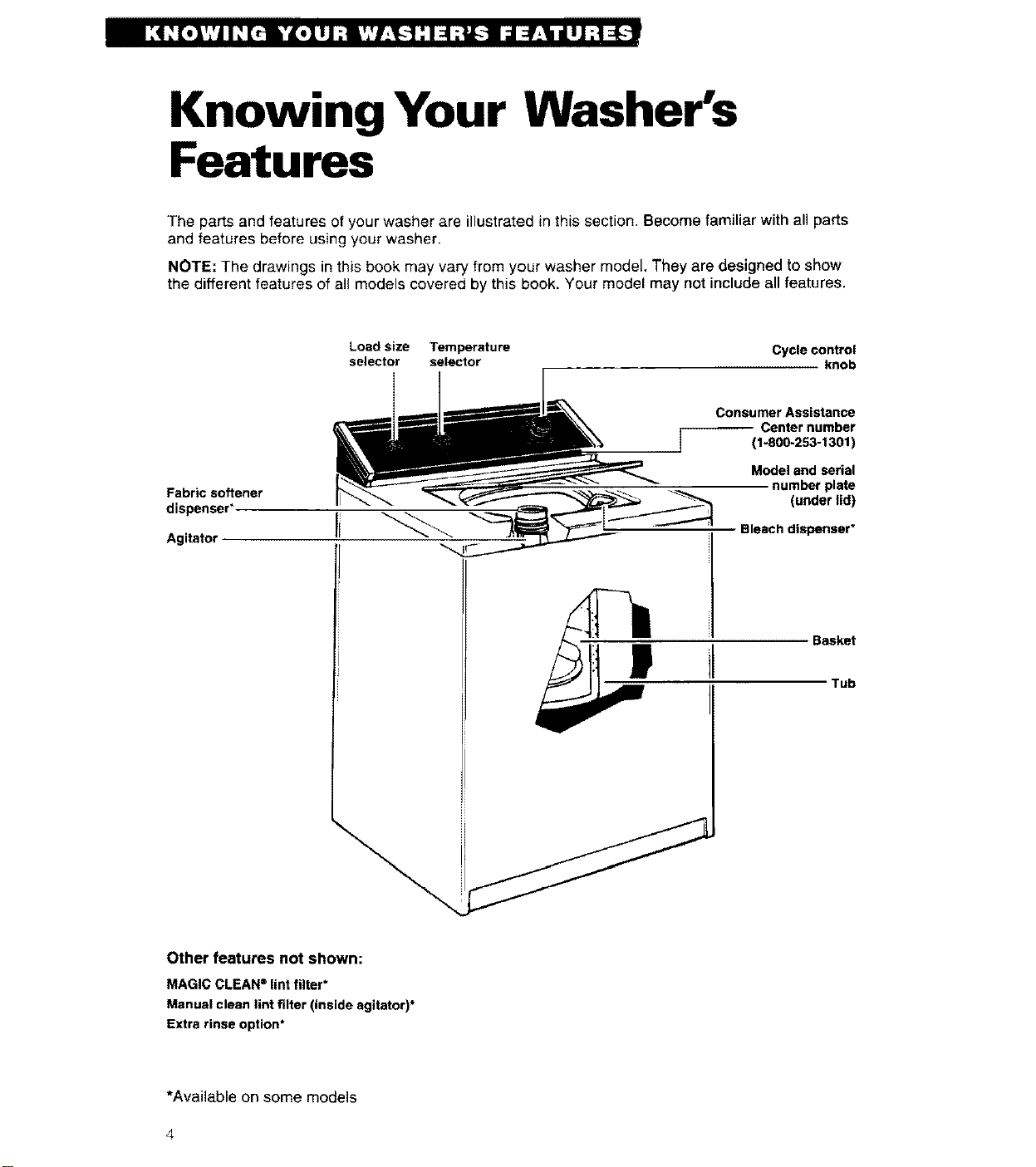
The parts and features of your washer are illustrated in this section. Become familiar with all parts
and features before using your washer.
NOTE: The drawings in this book may vary from your washer model. They are designed to show
the different features of all models covered by this book. Your model may not include all features.
Load size Temperature Cycle control
selector selector knob
Fabric softener
dispenser*
Agitato_
Consumer Assistance
._------( Center number
1-800-253-1301)
Model and serial
number plate
(under lid)
Bleach dispenser"
Basket
Tub
Other features not shown:
MAGIC CLEAN®lint filter*
Manualclean lintfilter (inside agitator)*
Extra rinse option*
*Available on some models
4
Operating Your Washer
In This Section
Page
Before starting your washer .............................. 5
Starting or stopping your washer ..................... 5
Selecting a load size .......................................... 5
Selecting wash-rinse temperatures ................. 6
Page
Selecting a cycle and time .............................. 6
Using rinse and spin ....................................... 8
Using drain and spin ....................................... 8
What happens in each cycle ........................... 9
Operating your washer properly assures maximum washing efficiency. This section gives you
important information to help you to select a cycle, time, and temperature for your wash load.
Before starting your washer
Add measured detergent. Then place a sorted NOTE: If your washer has a Consumer Buy
load in the washer before starting. See page 12 Guide, remove it and place it in your Use and
for additional "Before you wash" information. Care Guide.
Starting or stopping your washer
Starting your washer:
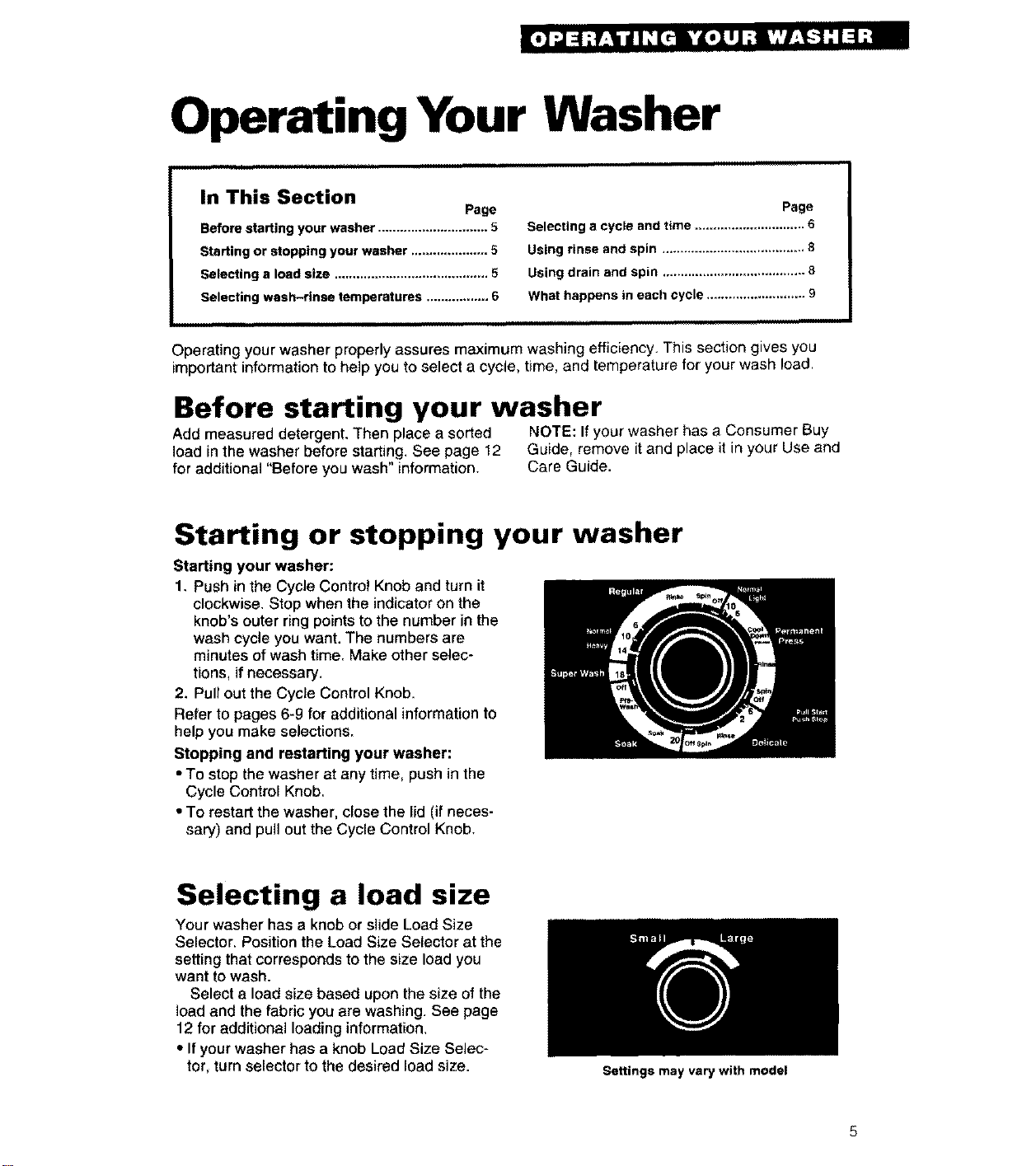
1. Push in the Cycle Control Knob and turn it
clockwise. Stop when the indicator on the
knob's outer ring points to the number in the
wash cycle you want, The numbers are
minutes of wash time. Make other selec-
tions, if necessary,
2. Pull out the Cycle Control Knob.
Refer to pages 6-g for additional information to
help you make selections.
Stopping and restarting your washer:
• To stop the washer at any time, push in the
Cycle Control Knob
• To restart the washer, close the lid (if neces-
sary) and pull out the Cycle Control Knob.
Selecting a load size
Your washer has a knob or slide Load Size
Selector. Position the Load Size Selector at the
setting that corresponds to the size load you
want to wash.
Select a load size based upon the size of the
load and the fabric you are washing. See page
12 for additional loading information,
• If your washer has a knob Load Size Selec-
tor, turn selectorto the desired load size.
Settings may vary with model
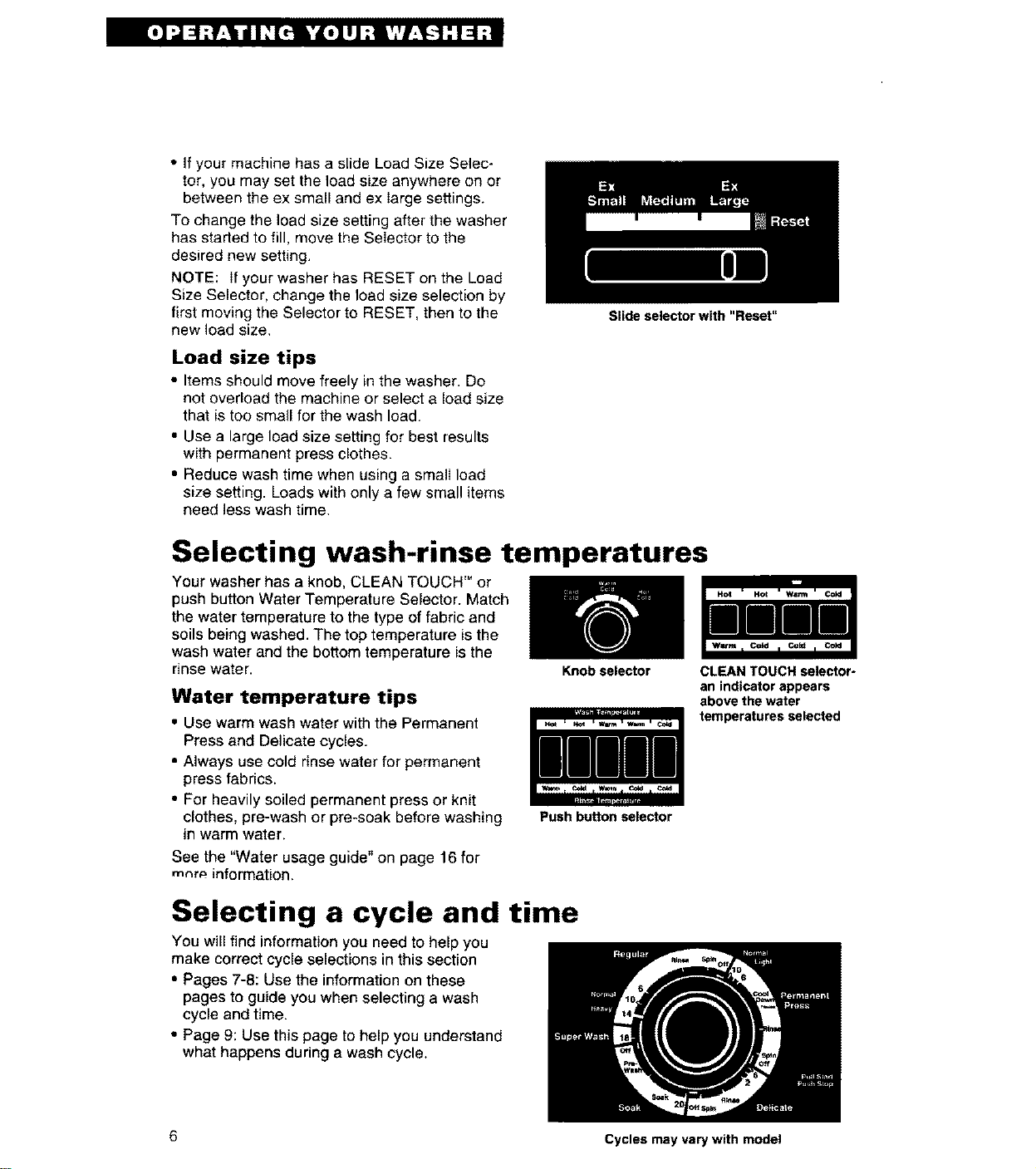
- If your machine has a slide Load Size Selec-
tor, you may set the load size anywhere on or
between the ex small and ex large settings.
To change the load size setting after the washer
has started to fill, move the Selector to the
desired new setting.
NOTE: If your washer has RESET on the Load
Size Selector, change the load size selection by
first moving the Selector to RESET, then to the
new load size.
Load size tips
• Items should move freely in the washer. Do
not overload the machine or select a load size
that is too small for the wash load.
• Use a large load size setting for best results
with permanent press clothes.
• Reduce wash time when using a smalI load
size setting. Loads with only a few small items
need less wash time.
Slide selector with "Reset"
Selecting wash-rinse temperatures
Your washer has a knob, CLEAN TOUCH'" or
push button Water Temperature Selector. Match
the water temperature to the type of fabric and
soils being washed. The top temperature is the
wash water and the bottom temperature is the
rinse water.
Water temperature tips
• Use warm wash water with the Permanent
Press and Delicate cycles.
• Always use cold rinse water for permanent
press fabrics.
• For heavily soiled permanent press or knit
clothes, pre-wash or pre-soak before washing
in warm water.
Knob selector
Push button selector
CLEAN TOUCH selector-
an indicator appears
above the water
temperatures selected
See the "Water usage guide" on page 16 for
mnr_ information.
Selecting a cycle and time
You willfind information you need to help you
make correct cycle selections inthis section
• Pages 7-8: Use the information on these
pages to guide you when selecting a wash
cycle and time.
• Page 9: Use this page to help you understand
what happens during a wash cycle,
6 Cycles may vary with model
Regular cycle
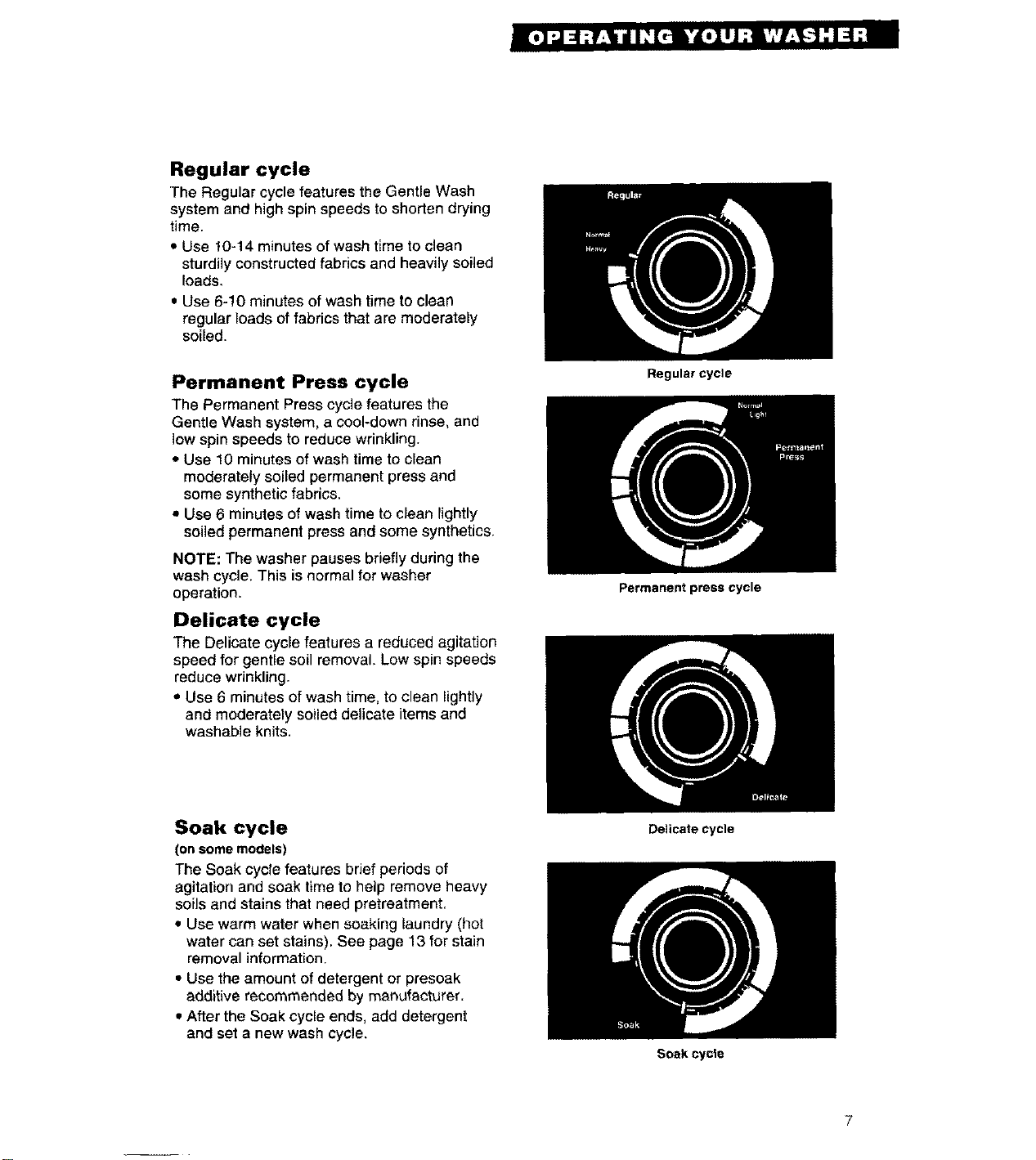
The Regular cycle features the Gentle Wash
system and high spin speeds to shorten drying
time.
• Use 10-14 minutes of wash time to clean
sturdily constructed fabrics and heavily soiled
loads.
• Use 6-!0 minutes of wash time to clean
regular loads of fabrics that are moderately
soiled.
Permanent Press cycle
The Permanent Press cycle features the
Gentle Wash system, a cool-down rinse, and
low spin speeds to reduce wrinkling.
• Use 10 minutes of wash time to clean
moderately soiled permanent press and
some synthetic fabrics.
• Use 6 minutes of wash time to clean lightly
soiled permanent press and some synthetics.
NOTE: The washer pauses briefly during the
wash cycle. This is normal for washer
operation.
Delicate cycle
The Delicate cycle features a reduced agitation
speed for gentle soft removal. Low spin speeds
reduce wrinkling.
• Use 6 minutes of wash time, to clean lightly
and moderately soiled delicate items and
washable knits.
Soak cycle
(on some models)
The Soak cycle features brief periods of
agitation and soak time to help remove heavy
soils and stains that need pretreatment.
• Use warm water when soaking laundry (hot
water can set stains), See page 13 for stain
removal information.
• Use the amount of detergent or presoak
additive recommended by manufacturer.
• After the Soak cycle ends, add detergent
and set a new wash cycle,
Regular cycle
Permanent press cycle
Delicate cycle
Soak cycle
7
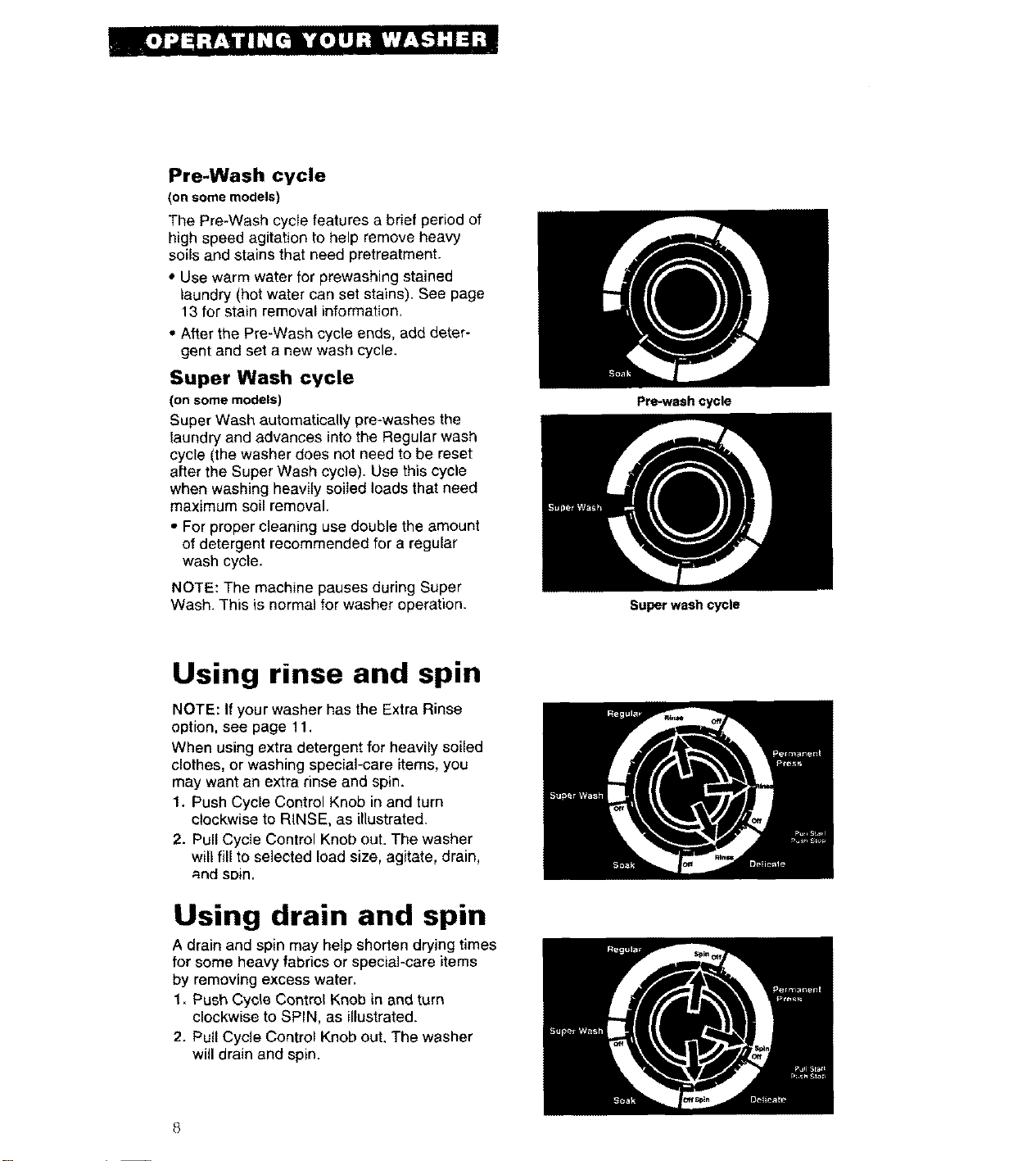
Pre-Wash cycle
(on some models)
The Pre-Wash cycle features a brief period of
high speed agitation to help remove heavy
soils and stains that need pretreatment.
• Use warm water for prewashing stained
laundry (hot water can set stains). See page
13 for stain removal information.
• After the Pre-Wash cycle ends, add deter-
gent and set a new wash cycle.
Super Wash cycle
(on some models)
Super Wash automatically pre-washes the
laundry and advances into the Regular wash
cycle (the washer does not need to be reset
after the Super Wash cycle). Use this cycle
when washing heavily soiled loads that need
maximum soil removal.
• For proper cleaning use double the amount
of detergent recommended for a regular
wash cycle.
NOTE: The machine pauses during Super
Wash. This is normal for washer operation.
Using rinse and spin
NOTE: If your washer has the Extra Rinse
option, see page 11.
When using extra detergent for heavily soiled
clothes, or washing special-care items, you
may want an extra rinse and spin.
1. Push Cycle Control Knob in and turn
clockwise to RINSE, as illustrated.
2. Pull Cycle Control Knob out. The washer
will fill to selected load size, agitate, drain,
and soin.
Using drain and spin
A drain and spin may help shorten drying times
for some heavy fabdcs or special-care items
by removing excess water.
1, Push Cycle Control Knob in and turn
clockwise to SPIN, as illustrated.
2. Pull Cycle Control Knob out. The washer
will drain and spin.
8
Pre-wash cycle
Super wash cycle
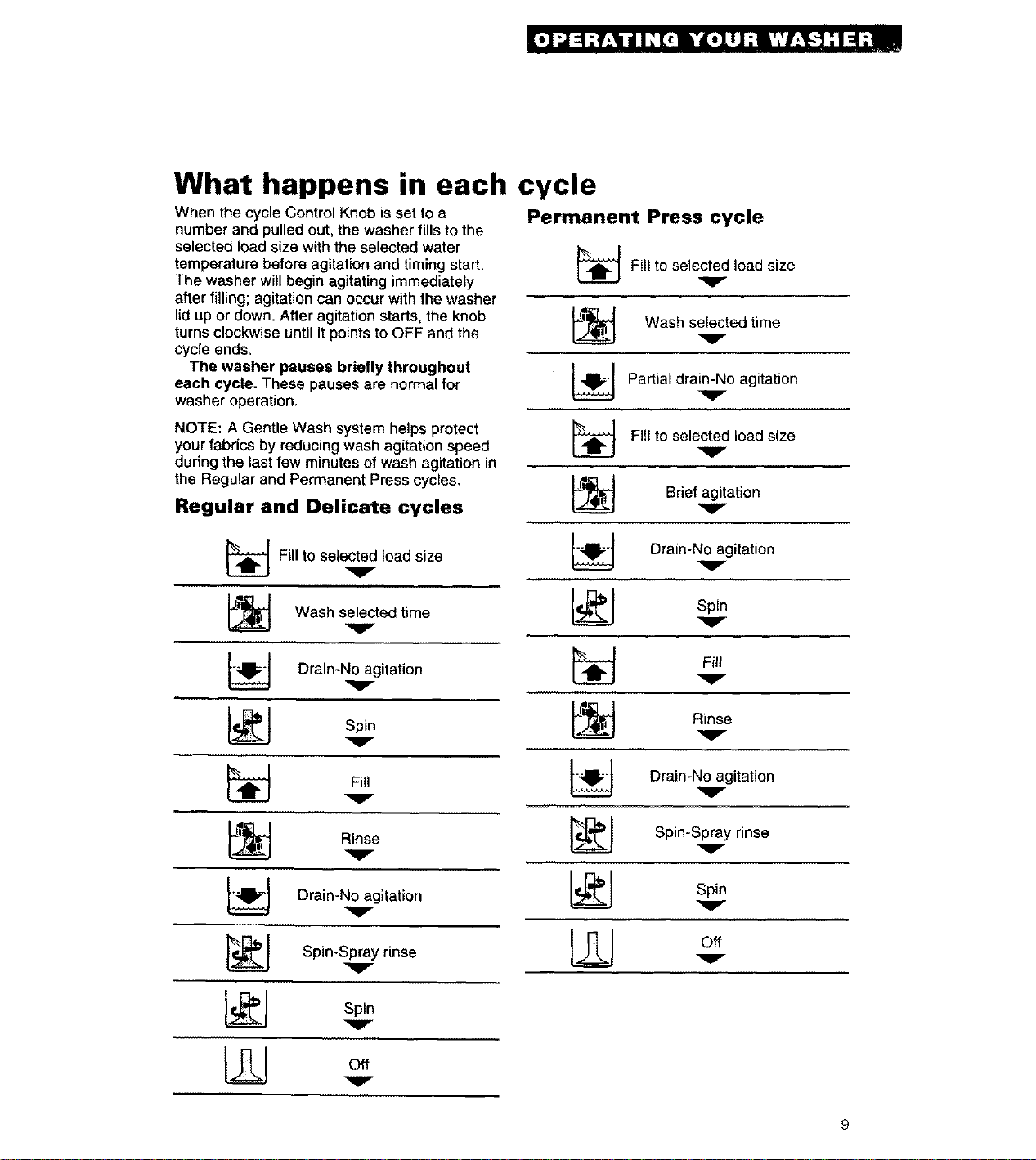
What happens in each cycle
Permanent Press cycle
Fill to selected load size
When the cycle Control Knob is set to a
number and pulled out. the washer fills to the
selected load size with the selected water
temperature before agitation and timing start.
The washer will begin agitating immediately
after filling; agitation can occur with the washer
lid up or down. After agitation starts, the knob {2r_.,_ Wash selected time
turns clockwise until it points to OFF and the _J
cycle ends,
The washer pauses briefly throughout l Jm=-I
each cycle. These pauses are normal for Partial drain-No agitation
washer operation. _
NOTE: A Gentle Wash system helps protect _ Fill to selected load size
your fabrics by reducing wash agitation speed _
during the last few minutes of wash agitation in
the Regular and Permanent Press cycles. _T_ Brief
agitation
Regular and Delicate cycles _ -qF
Fill tOselected load size t-_-I
Drain-No
agitation
Wash selected time Spin
_ Drain-No agitation _ Fill
Spin Rinse
Fill _ Drain-No agitation
___ Rinse _ Spin-Spray rinse
_ Drain-No agitation _ Spin
Spin-Spray rinse
V
Spin
9
Other Features
In This Section
Page
Using the fabric softener dispenser ............... 10
Using the chlorine bleach dispenser .............. 10
Using the extra rinse option ............................ t 1
Page
MAGIC CLEAN _ lint tilter ............................... 11
Manual clean lint filter ................................... 11
Your washer may have some of the following features. Understandingthe use of the features on
your machine will help you efficiently use your washer.
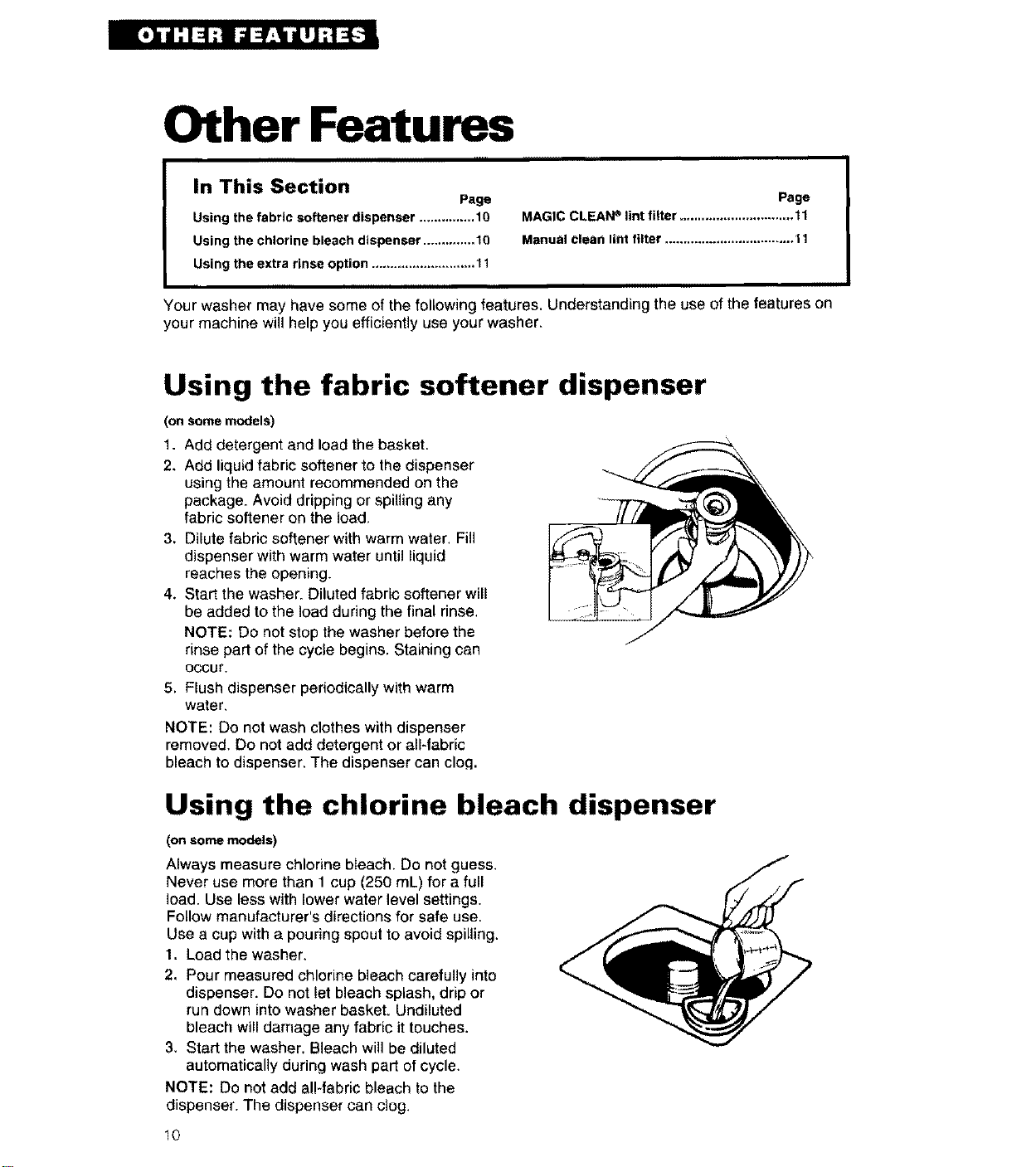
Using the fabric softener dispenser
(on some models)
1. Add detergent and loadthe basket.
2. Add liquid fabric softener to the dispenser
using the amount recommended on the
package. Avoid dripping or spilling any
fabric softener on the load.
3. Dilute fabric softener with warm waten Fill
dispenser with warm water until liquid
reaches the opening.
4. Start the washer. Diluted fabric softener will
be added to the loadduring the final rinse.
NOTE: Do not stop thewasher before the
rinse partof the cycle begins. Staining can
OCCUr.
5. Flush dispenser periodically with warm
water.
NOTE: Do not wash clothes with dispenser
removed. Do not add detergent or all-fabric
bleach to dispenser. The dispenser can clo9.
J
Using the chlorine bleach dispenser
(on some models)
Always measure chlorine bleach. Do not guess.
Never use more than 1 cup (250 mL) for a full
load. Use less with lower water level settings.
Follow manufacturer's directions for safe use.
Use a cup with a pouring spout to avoid spilling.
1. Load the washer.
2. Pour measured chlorine bleach carefully into
dispenser. Do net let bleach splash, drip or
run down intowasher basket Undiluted
bleach will damage any fabric it touches.
3. Start the washer. Bleach will be diluted
automatically during wash part of cycle.
NOTE: Do not add all-fabric bleach to the
dispenser. The dispenser can clog.
10
Using the extra rinse option
(onsome models)
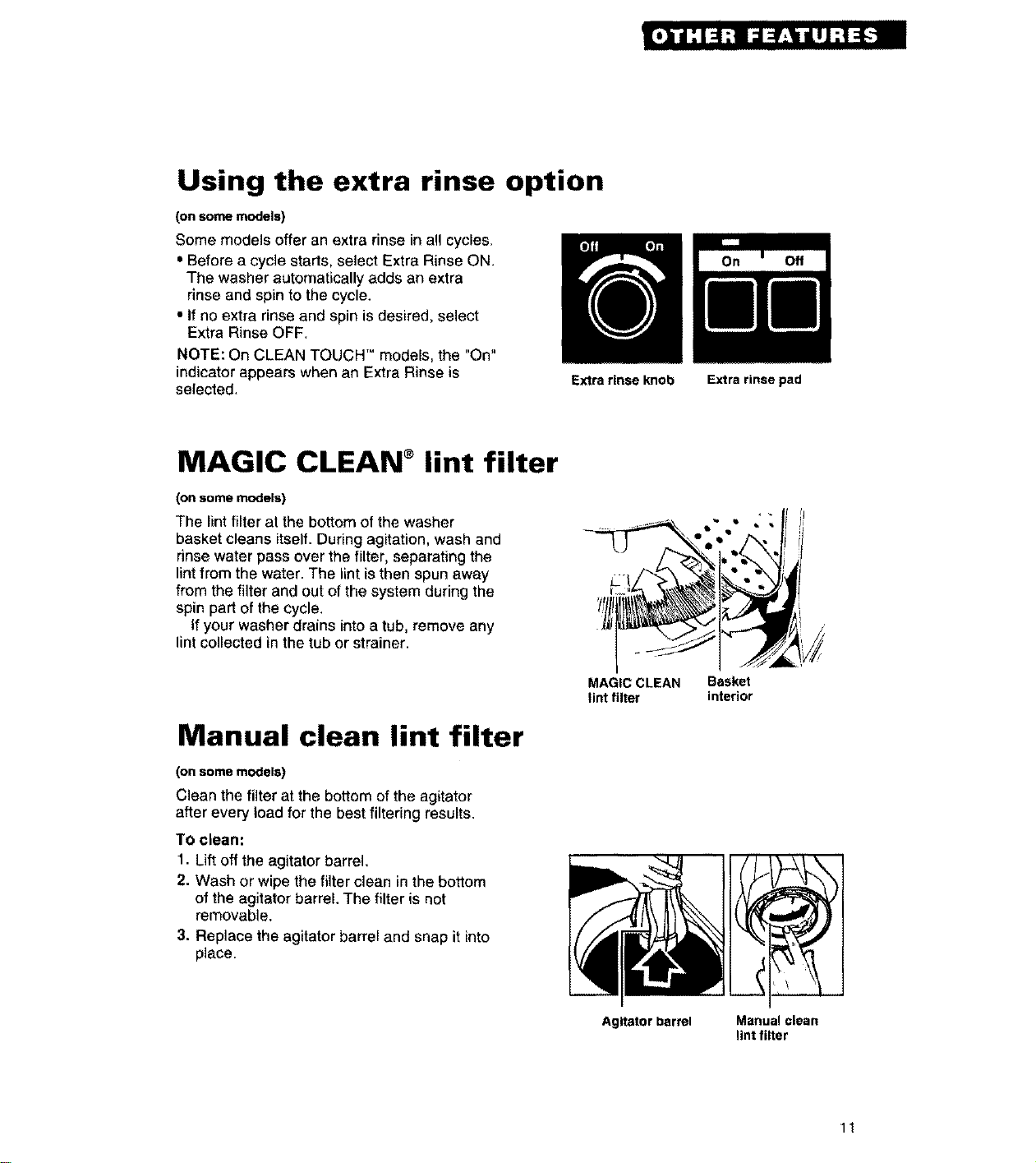
Some models offer an extra rinse in all cycles.
• Before a cycle starts, select Extra Rinse ON.
The washer automatically adds an extra
rinse and spin to the cycle.
• If no extra rinse and spin is desired, select
Extra Rinse OFF.
NOTE: On CLEAN TOUCH TM models, the "On"
indicator appears when an Extra Rinse is
selected.
Extra rinse knob
MAGIC CLEAN s lint filter
(on some models)
The lint filter at the bottom of the washer
basket cleans itself. During agitation, wash and
rinse water pass over the filter, separating the
lint from the water. The lint is then spun away
from the filter and out of the system during the
spin part of the cycle,
If your washer drains into a tub, remove any
lint collected in the tub or strainer.
Manual clean lint filter
(on some models)
Clean the filter at the bottom of the agitator
after every load for the best filtering results.
To clean:
1. Lift offthe agitator barrel.
2. Wash or wipe the filter clean in the bottom
of the agitator barrel. The filter is not
removable.
3. Replace the agitator barrel and snap it into
place.
MAGIC CLEAN
lint tilter
Agltatorbarrel
Extra rinse pad
Basket
interior
Manual clean
lint filter
11
Laundry Tips
In This Section
Page
Before you wash ............................................... 12
Removing stains ............................................... 13
Water usage guide ............................................ 16
Using laundry aids ........................................... 17
Washing special-care items ............................ 18
Page
Solving laundering problems ....................... 20
Caring for your washer ................................. 21
Saving energy ................................................ 21
Winterizing your washer ............................... 21
This section reviews proper laundering techniques, gives you additional washing information and
discusses solutions to common laundering problems.
Before you wash
Preparing clothes for washing
• Empty pockets and turnthem insideout.
• Turn down cuffs and brush away lint and dirt.
• Turn synthetic knits inside out to avoid pilling.
• Close zippers, snaps and hooks to avoid
snagging other items. Remove pins, buckles
and other hard objects to avoid scratching
the washer interior.
• Remove unwashable trim and ornaments.
• Tie strings and sashes so they will not
tangle.
• Mend tears, loose hems and seams,
• Treat spots and stains. (See page 13 for
pretreatment and stain removal information,)
• Stained or wet garments should be washed
promptly for best results.
Sorting
• Separate dark from light colors, colorfast
from non colortast.
• Sort by fabric and construction (sturdy
cottons, knits, delicate items).
• Separate heavily soiled itemsfrom lightly
soiled ones even it they would normally be
washed together.
• Separate lint givers (towels, chenille) from
lint takers (corduroy, synthetics, permanent
press). When possible,turnlint givers inside
out.
Loading
• Load washer properly. Overloading or
packing can:
-cause poor cleaning.
-increase wrinkling,
-create excessive lint.
-wear out items faster (because of pilling).
• Load by the amount of space items take up,
not by their weight.
• Drop items into washer loosely. Fill to the top
of the basket, but do not pack or wrap items
around the agitator.
• Items should move easily through wash
water for best cleaning and wrinkle-free
results, Watch for rollover. Items should sink
and reappear later.
• Mix large and small items in each load. Load
evenly to maintain washer balance. An off-
balance load can make the machine vibrate
during spin.
• To reduce wrinkling, permanent press and
synthetic knits should have more room to
move in the water than heavy items (towels,
jeans).
12
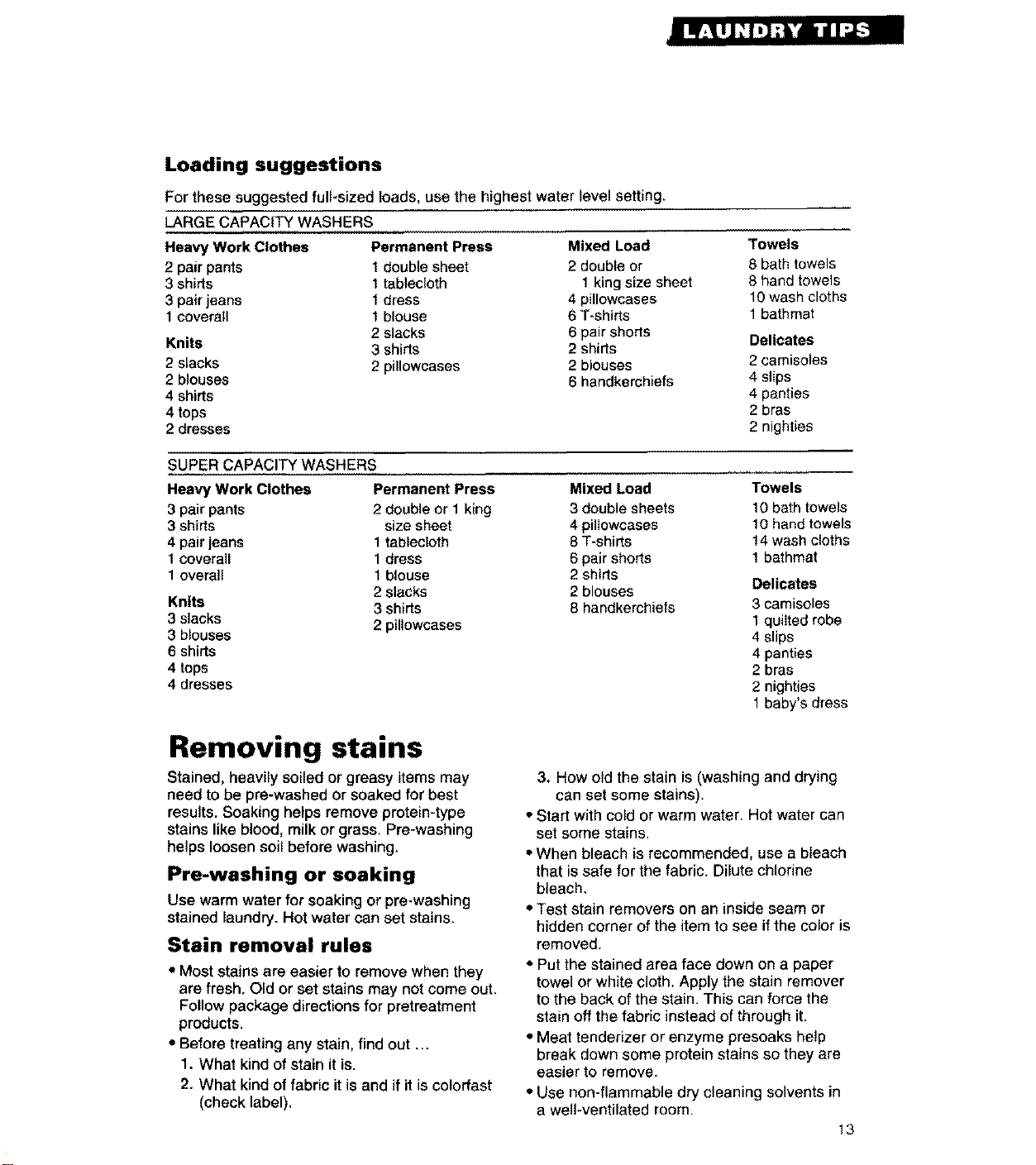
Loading suggestions
For these suggested full-sized loads, use the highest water level setting.
LARGE CAPACITY WASHERS
Heavy Work Clothes Permanent Press Mixed Load
2 pair pants 1double sheet 2 double or
3 shirts 1tablecloth 1king size sheet
3 pair jeans 1dress 4 pillowcases
1coverall 1blouse 6 T-shirts
2 slacks 6 pair shorts
Knits 3 shirts 2 shirts
2 slacks 2 pillowcases 2 blouses
2 blouses 6 handkerchiefs
4 shirts
4 tops
2 dresses
Towels
8 bath towels
8 hand towels
10 wash cloths
1 bathmat
Delicates
2 camisoles
4 slips
4 panties
2 bras
2 nighties
SUPER CAPACITY WASHERS
Heavy Work Clothes Permanent Press Mixed Load
3 pair pants 2 double or 1 king 3 double sheets
3 shirts size sheet 4 pillowcases
4 pair jeans 1tablecloth 8 T-shirts
I coverall 1dress 6 pair shorts
1 overall 1 blouse 2 shirts
2 slacks 2 blouses
Knits 3 shirts 8 handkerchiefs
3 slacks 2 pillowcases
3 blouses
6 shirts
4 tops
4 dresses
Towels
10 bath towels
10 hand towels
!4 wash cloths
1 bathmat
Delicates
3 camisoles
1quilted robe
4 slips
4 panties
2 bras
2 nighties
1 baby's dress
Removing stains
Stained, heavily soiled or greasy items may
need to be pre-washed or soaked for best
results. Soaking helps remove protein-type
stains like blood, milk or grass. Pre-washing
helps loosen soil before washing.
Pre-washing or soaking
Use warm water for soaking or pre-washing
stained laundry. Hot water can set stains.
Stain removal rules
• Most stains are easier to remove when they
are fresh. Old or set stains may not come out.
Follow package directions for pretreatment
products,
• Before treating any stain, find out ,-
1. What kind of stain it is.
2. What kind of fabric it is and if it is colorfast
(check label),
3, How old the stain is (washing and drying
can set some stains).
• Start with cold or warm water, Hot water can
set some stains.
• When bleach is recommended, use a bleach
that is safe for the fabric. Dilute chlorine
bleach,
• Test stain removers on an inside seam or
hidden corner of the item to see if the color is
removed.
• Put the stained area face down on a paper
towel or white cloth. Apply the stain remover
to the back of the stain. This can force the
stain off the fabric instead of through it.
• Meat tenderizer or enzyme presoaks help
break down some protein stains so they are
easier to remove.
• Use non-flammable dry cleaning solvents in
a well-ventilated room.
13
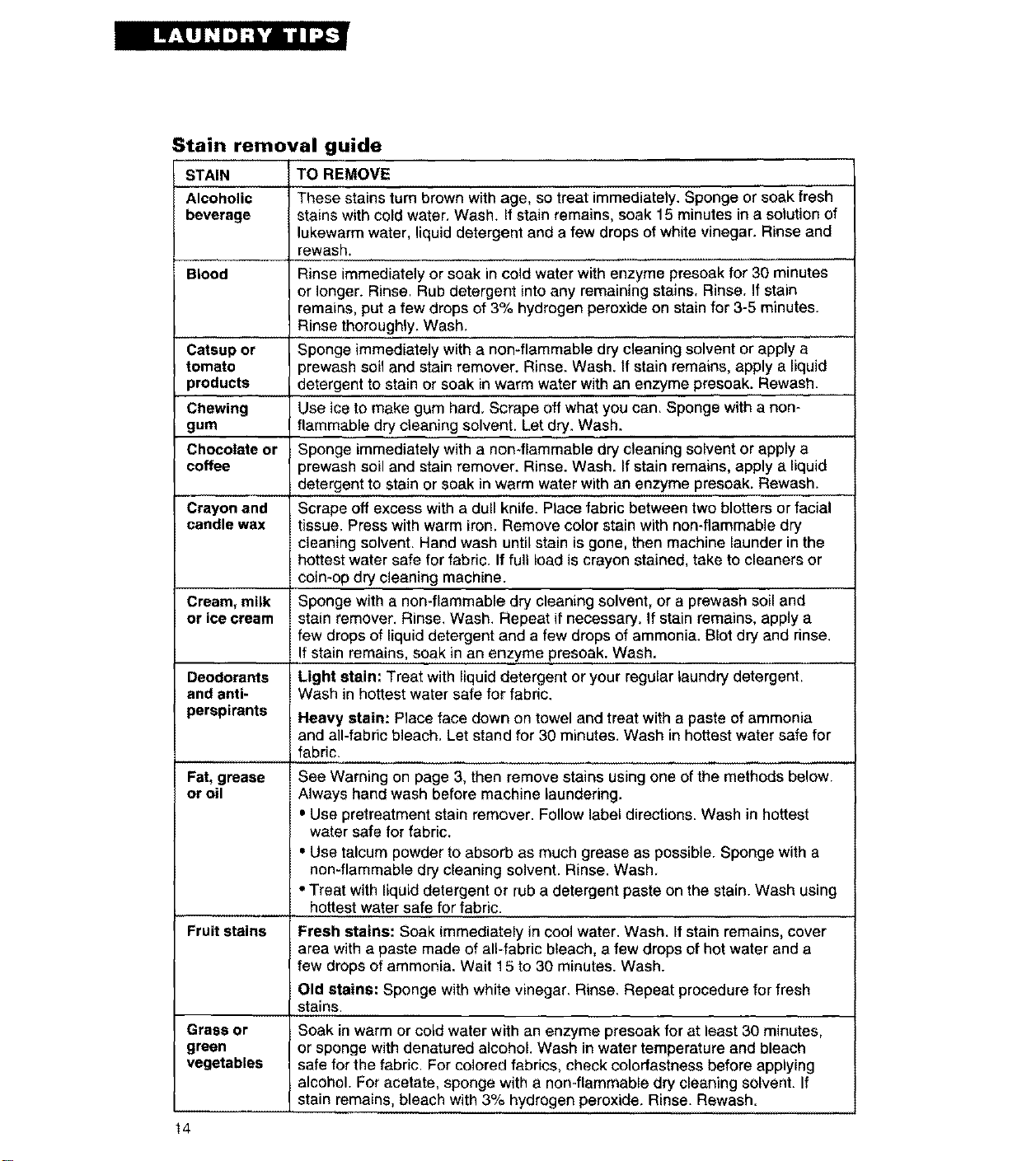
Stain removal guide
STAIN TO REMOVE
Alcoholic These stains turnbrown withage, so treat immediately.Sponge or soak fresh
beverage stains with cold water. Wash. If stain remains, soak 15 minutes in a solution of
lukewarm water, liquid detergent and a few drops of white vinegar. Rinse and
rewash.
Blood Rinse immediately or soak in cold water with enzyme presoak for 30 minutes
I or longer. Rinse. Rub detergent into any remaining stains, Rinse. If stain
remains, put a few drops of 3% hydrogen peroxide on stain for 3-5 minutes.
Rinse thoroughly. Wash.
Catsup or Sponge immediately with a non-flammable dry cleaning solvent or apply a
tomato prewash soil and stain remover. Rinse. Wash. If stain rema ns, app y a qu d
products detergent to stain or soak in warm water with an enzyme presoak. Rewash.
Chewing Use ice to make gum hard. Scrape off what you can. Sponge with a non-
gum flammable dry cleaning solvent. Let dry. Wash.
Chocolate or Sponge i_mediately with a non-flammable dry cleaning solvent or apply a
coffee prewash soil and stain remover. Rinse. Wash. If stain remains, apply a liquid
detergent to stain or soak in warm water with an enzyme presoak. Rewash.
Crayon and Scrape off excess with a dull knife. Place fabric between two blotters or facial
candle wax tissue. Presswith warm iron. Remove color stain with non-flammable dry
cleaning solvent. Hand wash until stain is gone, then machine launder in the
hottest water safe for fabric. If full load is crayon stained, take to cleaners or
coin-op dry cleaning machine.
Cream, milk Sponge with a non-flammable dry cleaning solvent, or a prewash soil and
or ice cream stain remover. Rinse. Wash. Repeat if necessary. If stain remains, apply a
few drops of liquid detergent and a few drops of ammonia. Blot dry and rinse.
If stain remains, soak in an enzyme presoak.Wash.
Deodorants Light stain: Treat with liquid detergent or your regular laundry detergent.
and anti- Wash in hottest water safe for fabric.
perspirants
Fat, grease
or oil
Fruit stains
Grass or
green
vegetables
Heavy stain: Place face down on towel and treat with a paste of ammonia
and all-fabric bleach. Let stand for 30 minutes. Wash in hottest water safe for
fabric.
See Warning on page 3, then remove stains using one of the methods below.
Always hand wash before machine laundering.
• Use pretreatment stain remover. Follow label directions. Wash in hottest
water safe for fabric.
• Use talcum powder to absorb as much grease as possible. Sponge with a
non-flammable dry cleaning solvent. Rinse. Wash.
"Treat with liquid detergent or rub a detergent paste on the stain. Wash using
hottest water safe for fabric.
Fresh stains: Soak immediatelyin cool water. Wash. If stain remains, cover
area with a paste made of all-fabric bleach, a few drops of hot water and a
few drops of ammonia. Wait 15 to 30 minutes. Wash.
Old stains: Sponge with white vinegar. Rinse. Repeat procedure for fresh
stains.
Soak in warm or cold water with an enzyme presoak for at least 30 minutes,
or sponge with denatured alcohol. Wash in water temperature and bleach
safe for the fabric. For colored fabrics, check colorfastness before applying
alcohol. For acetate, sponge with a non-flammable dry cleaningsolvent. If
stain remains, bleach with 3% hydrogen peroxide. Rinse. Rewash.
14
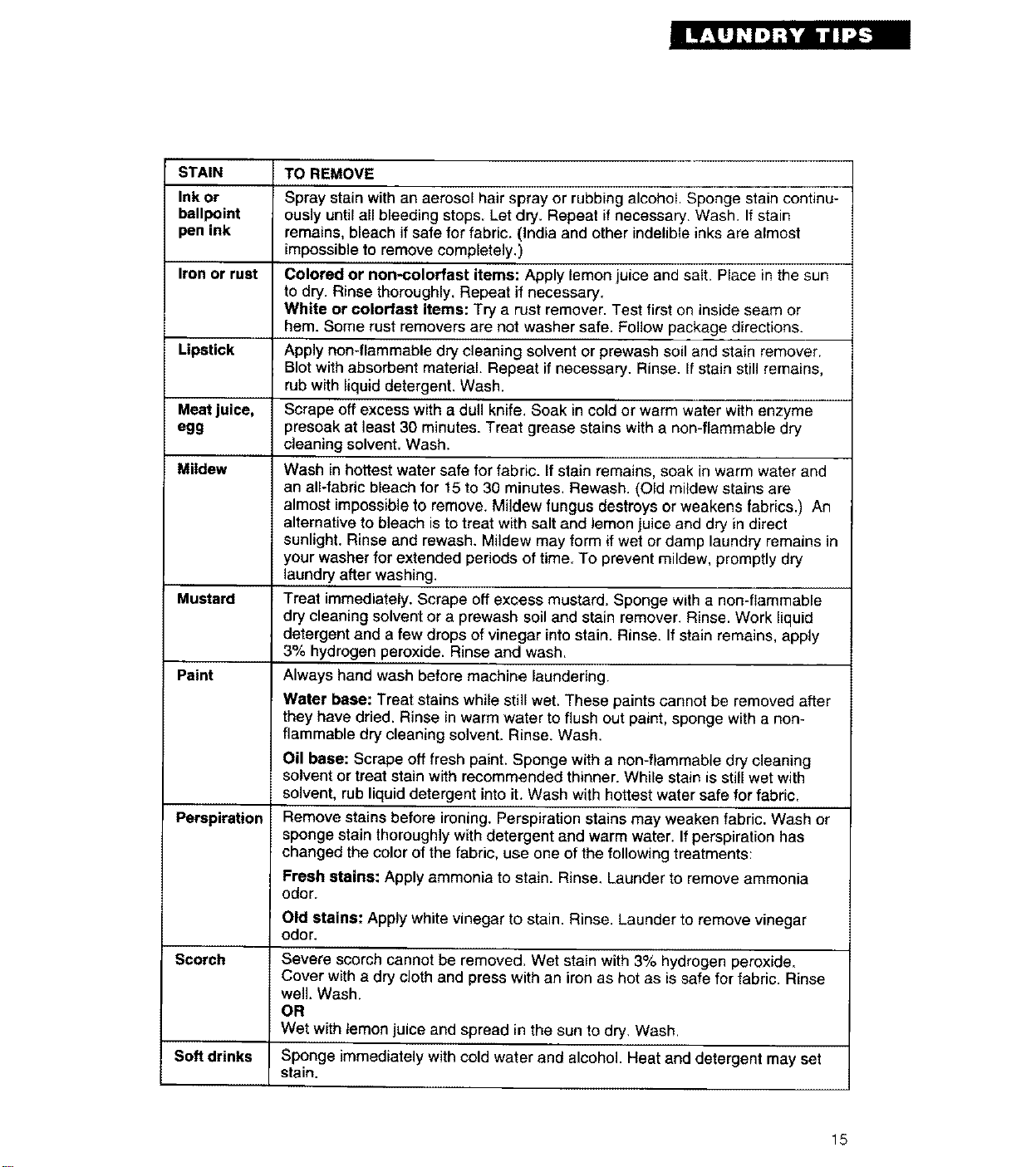
STAIN TO REMOVE
Ink or Spray stainwith an aerosol hairspray or rubbingalcohol.Sponge stain continu-
ballpoint ousiyuntilall bleedingstops Letdry. Repeat ifnecessary. Wash. If stain
pen ink remains, bleach ifsafe for fabric. (India and other indelibleinksare almost
impossible to remove completely.)
Iron or rust Colored or non-colorfast items: Applylemonjuice and salt. Place in the sun
todry. Rinsethoroughly,Repeat ifnecessary.
White or colorfast items: Try a rust remover. Test first on inside seam or
hem. Some rust removers are not washer safe. Followpackage directions.
Lipstick Apply non-flammable dry cleaning solvent or prewashsoil and stain remover.
Blot with absorbent material. Repeat if necessary. Rinse. If stain still remains,
rub with liquid detergent. Wash.
Meatjuice, Scrape off excess with a dull knife. Soak in cold or warm water with enzyme
egg presoak at least 30 minutes. Treat grease stains with a non-flammable dry
cleaning solvent, Wash.
Mildew
Mustard
Paint
Perspiration
Wash in hottest watersafe for fabric. If stain remains, soak in warm water and
an all-fabric bleach for 15 to 30 minutes. Rewash. (Old mildew stains are
almost impossibleto remove. Mildew fungus destroys or weakens fabrics.) An
alternative to bleach is to treat with salt and lemon juiceand dry in direct
sunlight. Rinse and rewash. Mildew may form ifwet or damp laundry remains in
your washer for extended periods of time. To prevent mildew, promptly dry
laundry after washing.
Treat immediately. Scrape off excess mustard. Sponge with a non-flammable
dry cleaning solvent or a prewash soil and stain remover. Rinse. Work liquid
detergent and a few drops of vinegar intostain. Rinse. If stain remains, apply
3% hydrogen peroxide. Rinse and wash,
Always hand wash before machine laundering.
Water base: Treat stains while still wet. These paints cannot be removed after
they have dried. Rinse in warm water to flush out paint, sponge with a non-
flammable dry cleaning solvent. Rinse. Wash.
Oil base: Scrape off fresh paint. Sponge with a non-flammable dry cleaning
solvent or treat stain with recommended thinner. While stain is still wet with
solvent, rub liquid detergent into it. Wash with hottest water safe for fabric.
Remove stains before ironing. Perspiration stains may weaken fabric. Wash or
sponge stain thoroughly with detergent and warm water. If perspirationhas
changed the color of the fabric, use one of the following treatments:
Fresh stains: Apply ammonia to stain. Rinse. Launder to remove ammonia
odor.
Old stains: Apply white vinegar to stain. Rinse, Launder to remove vinegar
odor.
Scorch Severe scorch cannot be removed. Wet stain with 3% hydrogen peroxide,
Cover with a dry cloth and press with an iron as hot as issafe for fabric. Rinse
well. Wash.
OR
Wet with lemon juice and spread in the sun to dry. Wash.
Softdrinks Sponge immediately with cold water and alcohol. Heat and detergent may set
stain.
15
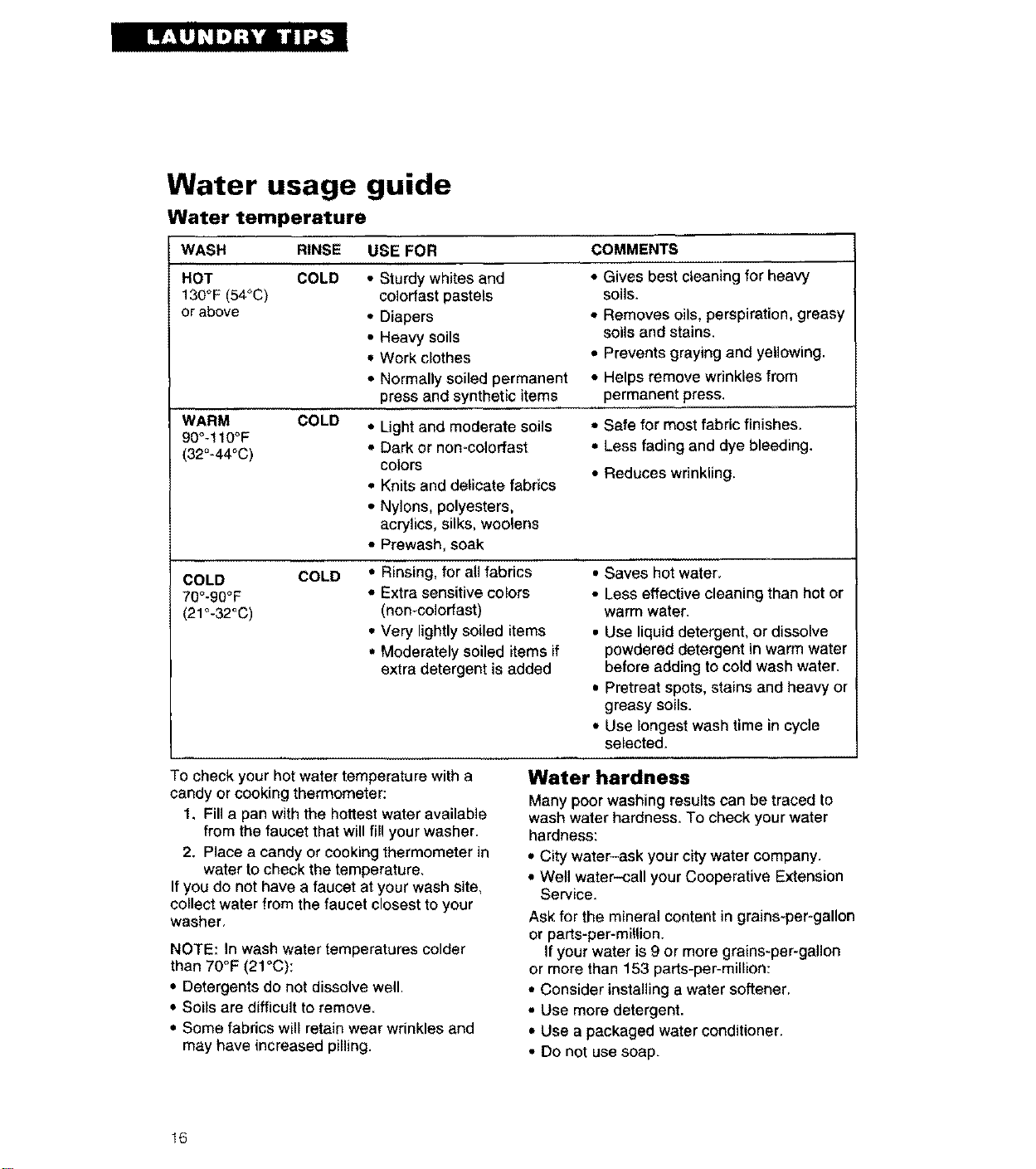
Water usage guide
Water temperature
WASH
HOT
130°F (54°C)
or above
WARM
90°-110°F
(32o-44°C)
COLD
70°-90°F
(21°-32°C)
RINSE USE FOR COMMENTS
COLD • Sturdy whites and
colorfast pastels
• Diapers
• Heavy soils
• Work clothes
• Normally soiled permanent
press and synthetic items
• Gives best cleaning for heavy
soils.
• Removes oils, perspiration, greasy
soils and stains.
• Prevents graying and yellowing.
• Helps remove wrinkles from
permanent press.
COLD
• Light and moderate soils
,, Dark or non-colorfast
colors
. Knits and delicate fabrics
• Nylons, polyesters,
acrylics, silks, woolens
• Prewash, soak
• Safe for mostfabric finishes.
• Less fading and dye bleeding.
• Reduces wrinkling.
COLD
• Rinsing, for atlfabrics
• Extra sensitive colors
(non-colorfast)
• Very lightly soiled items
• Moderately soiled items if
extra detergent is added
• Saves hot water.
• Less effective cleaning than hot or
warm water.
• Use liquid detergent, or dissolve
powdered detergent in warm water
before adding to cold wash water.
• Pretreat spots, stains and heavy or
greasy soils.
', Use longest wash time in cycle
selected.
To check your hot water temperature with a
candy or cooking thermometer:
1. Fill a pan with the hottest water available
from the faucet that will fill your washer.
2. Place a candy or cooking thermometer in
water to check the temperature+
If you do not have a faucet at your wash site,
collect water from the faucet closest to your
washer.
NOTE: In wash water temperatures colder
than 70°F (21°C):
• Detergents do not dissolve well.
• Soils are difficult to remove.
• Some fabrics will retain wear wrinkles and
may have increased pilling.
Water hardness
Many poor washing resultscan be traced to
wash water hardness. To check your water
hardness:
• City water-ask your city water company.
• Well water-call your Cooperative Extension
Service.
Ask for the mineral content in grains-per-gallon
or parts-per-million.
If your water is 9 or more grains-per-gallon
or more than 153 parts-per-million:
• Consider installing a water softener.
• Use more detergent.
• Use a packaged water conditioner.
• Do not use soap.
16
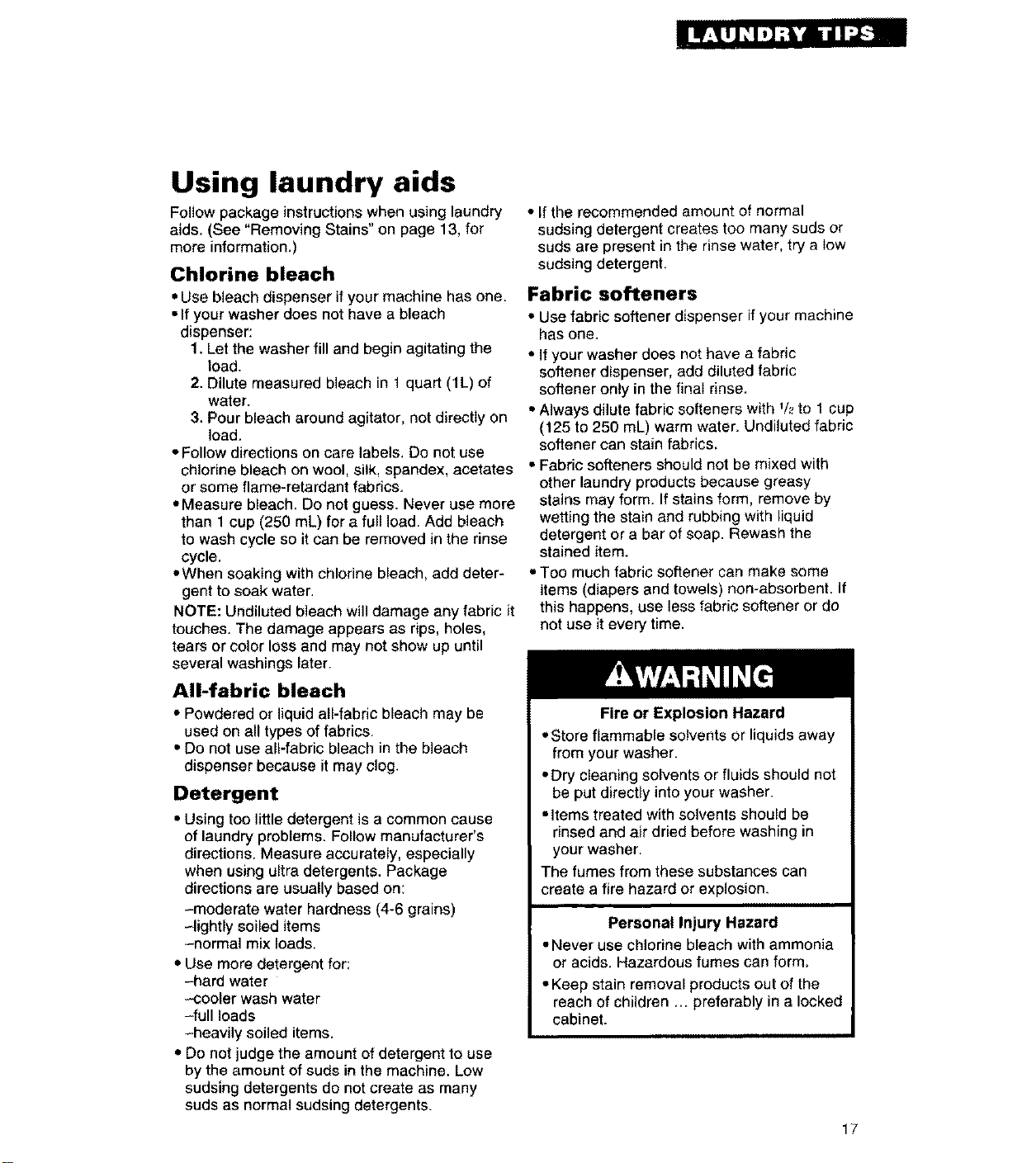
Using laundry aids
Follow package instructions when using laundry
aids. (See "Removing Stains" on page 13, for
more information.)
Chlorine bleach
•Use bleach dispenser if your machine has one.
• If your washer does not have a bleach
dispenser:
1. Let the washer fill and begin agitating the
load.
2. Dilute measured bleach in 1 quart (1L) of
water.
3. Pour bleach around agitator, not directly on
load.
• Follow directions on care labels. Do net use
chlorine bleach on wool, silk, spandex, acetates
or some flame-retardant fabrics.
• Measure bleach. Do not guess. Never use more
than 1 cup (250 mL) for a full lead. Add bleach
to wash cycle so it can be removed in the rinse
cycle.
'.When soaking with chlorine bleach, add deter-
gent to soak water.
NOTE: Undiluted bleach will damage any fabric it
touches. The damage appears as rips, holes,
tears or color loss and may not show up until
several washings later.
All-fabric bleach
• Powdered or liquid all-fabric bleach may be
used on all types of fabrics.
• Do not use all-fabric bleach in the bleach
dispenser because it may clog.
Detergent
• Using too little detergent is a common cause
of laundry problems. Follow manufacturer's
directions. Measure accurately, especially
when using ultra detergents. Package
directions are usually based on:
-moderate water hardness (4-6 grains)
-lightly soiled items
-normal mix loads.
• Use more detergent for;
-hard water
--cooler wash water
-full loads
-heavily soiled items.
• Do not judge the amount of detergent to use
by the amount of suds in the machine, Low
sudsing detergents do not create as many
suds as normal sudsing detergents.
• Ifthe recommended amount of normal
sudsing detergent creates too many suds or
suds are present in the rinse water, try a low
sudsing detergent.
Fabric softeners
• Use fabric softener dispenser if your machine
has one.
• If your washer does not have a fabric
softener dispenser, add diluted fabric
softener only in the final rinse.
• Always dilute fabric softeners with Y, to 1 cup
(125 to 250 mL) warm water. Undiluted fabric
softener can stain fabrics,
• Fabric softeners should net be mixed with
other laundry products because greasy
stains may form. If stains form, remove by
wetting the stain and rubbing with liquid
detergent or a bar of soap. Rewash the
stained item.
• Too much fabric softener can make some
items (diapers and towels) non-absorbent. If
this happens, use less fabric softener or do
not use it every time.
Fire or Explosion Hazard
• Store flammable solvents or liquids away
from your washer.
• Dry cleaning solvents or fluids should not
be put directly into your washer.
• Items treated with solvents should be
rinsed and air dried before washing in
your washer.
The fumes from these substances can
create a fire hazard or explosion.
Personal Injury Hazard
• Never use chlorine bleach with ammonia
or acids. Hazardous fumes can form.
• Keep stain removal products out of the
reach of children ,,. preferably in a locked
cabinet.
17
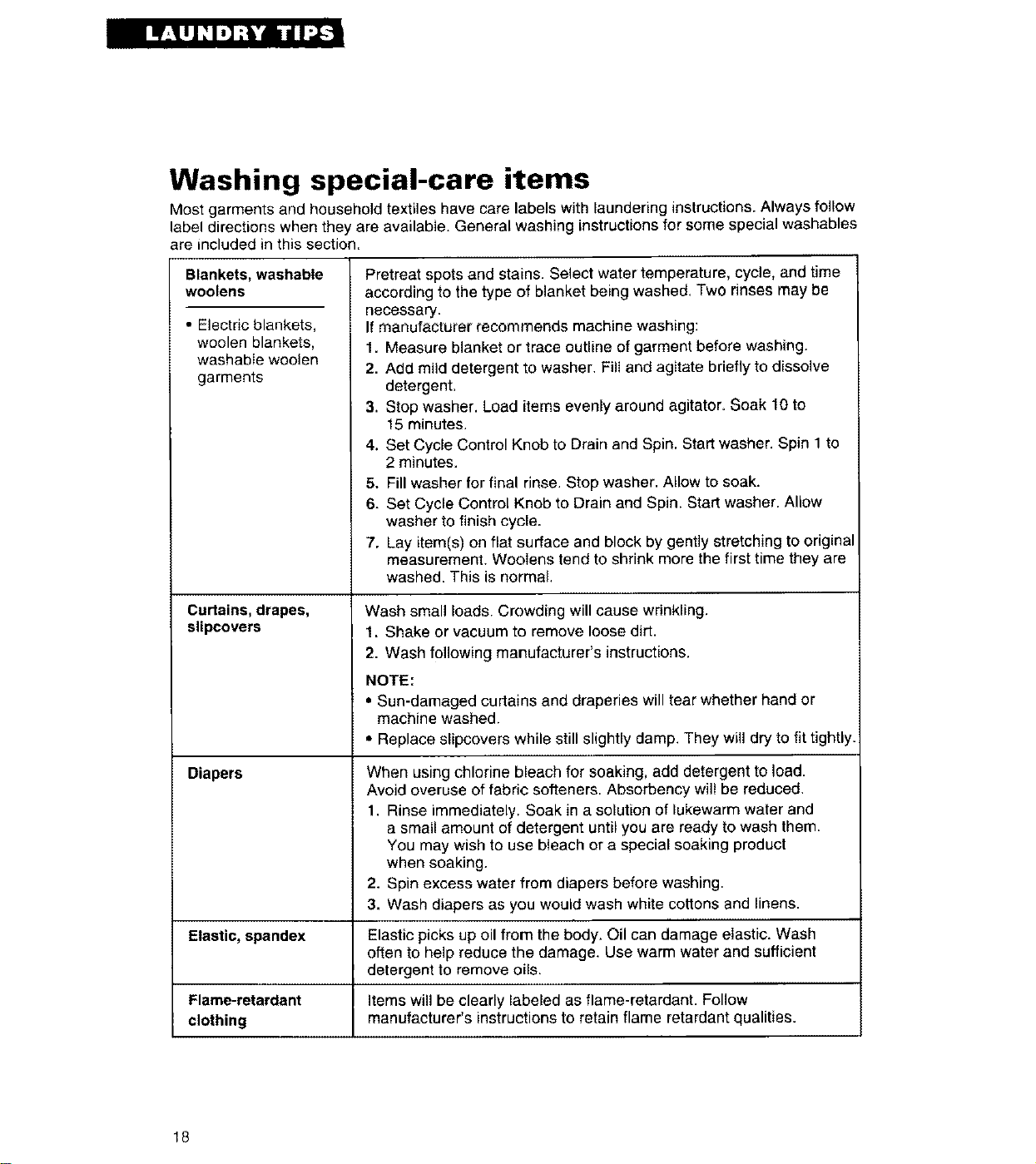
Washing special-care items
Most garments and household textiles have care labels with laundering instructions. Always follow
label directions when they are available. General washing instructions for some special washables
are included in this section.
Blankets, washable
woolens
• Electric blankets,
woolen blankets,
washable woolen
garments
Curtains, drapes,
slipcovers
Diapers
Pretreat spots and stains. Select water temperature, cycle, and time
according to the type of blanket being washed, Two rinses may be
necessary.
If manufacturer recommends machine washing:
1. Measure blanket or trace outline of garment before washing.
2. Add mild detergent to washer. Fill and agitate briefly to dissolve
detergent.
3. Stop washer. Load items evenly around agitator. Soak 10 to
15 minutes.
4. Set Cycle Control Knob to Drain and Spin. Start washer. Spin 1 to
2 minutes.
5. Fill washer for final rinse. Stop washer. Allow to soak.
6. Set Cycle Control Knob to Drain and Spin. Start washer. Allow
washer to finish cycle.
7. Lay item(s) on flat surface and block by gently stretching to original
measurement. Woolens tend to shrink more the first time they are
washed. This is normal.
Wash small loads. Crowding will cause wrinkling.
1. Shake or vacuum to remove loose dirt.
2. Wash following manufacturer's instructions.
NOTE:
• Sun-damaged curtains and draperies will tear whether hand or
machine washed.
• Replace slipcovers while still slightly damp. They will dry to fit tightly
When using chlorine bleach for soaking, add detergent to load.
Avoid overuse of fabric softeners. Absorbency will be reduced.
1. Rinse immediately, Soak in a solution of lukewarm water and
a small amount of detergent until you are ready to wash them.
You may wish to use bleach or a special soaking product
when soaking.
2. Spin excess water from diapers before washing.
3. Wash diapers as you would wash white cottons and linens.
Elastic, spandex Elastic picks up oil from the body. Oil can damage elastic. Wash
often to help reduce the damage. Use warm water and sufficient
detergent to remove oils.
Flame-retardant Items will be clearly labeled as flame-retardant. Follow
clothing manufacturer's instructions to retain flame retardant qualities.
18
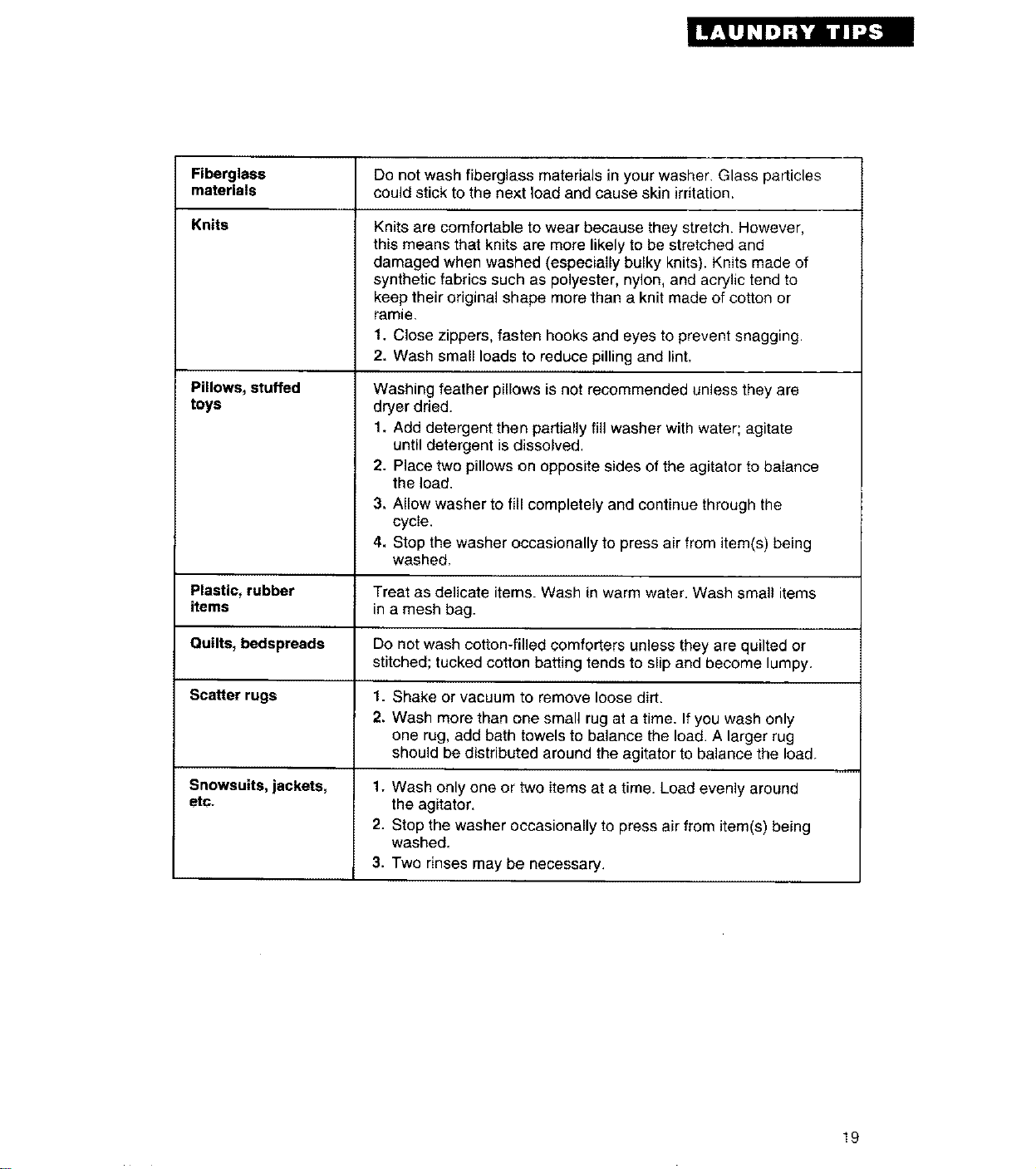
Fiberglass Do not wash fiberglass materials in your washer, Glass particles
materials could stick tothe next load and cause skin irritation.
Knits
Pillows,stuffed
toys
Knits are comfortable to wear because they stretch. However,
this means that knits are more likely to be stretched and
damaged when washed (especially bulky knits). Knits made of
synthetic fabrics such as polyester, nylon, and acrylic tend to
keep their original shape more than a knit made of cotton or
ramie,
1. Close zippers, fasten hooks and eyes to prevent snagging.
2. Wash small loads to reduce pilling and lint.
Washing feather pillows is not recommended unless they are
dryer dried.
1. Add detergent then partially fill washer with water; agitate
until detergent is dissolved,
2. Place two pillows on opposite sides of the agitator to balance
the load.
3, Allow washer to fill completely and continue through the
cycle.
4. Stop the washer occasionally to press air from item(s) being
washed,
Plastic, rubber Treat as delicate items. Wash in warm water. Wash small items
items in a mesh bag.
Quilts_bedspreads Do not wash cotton-filled comforters unless they are quilted or
stitched; tucked cotton batting tends to slip and become lumpy.
Scatter rugs 1. Shake or vacuum to remove loose dirt.
2, Wash more than one small rug at a time. If you wash only
one rug, add bath towels to balance the load, A larger rug
should be distributed around the agitator to balance the load,
Snowsuits,jackets, 1, Wash only one or two items at a time. Load evenly around
etc. the agitator,
2. Stop the washer occasionally to press air from item(s) being
washed,
3. Two rinses may be necessary,
19
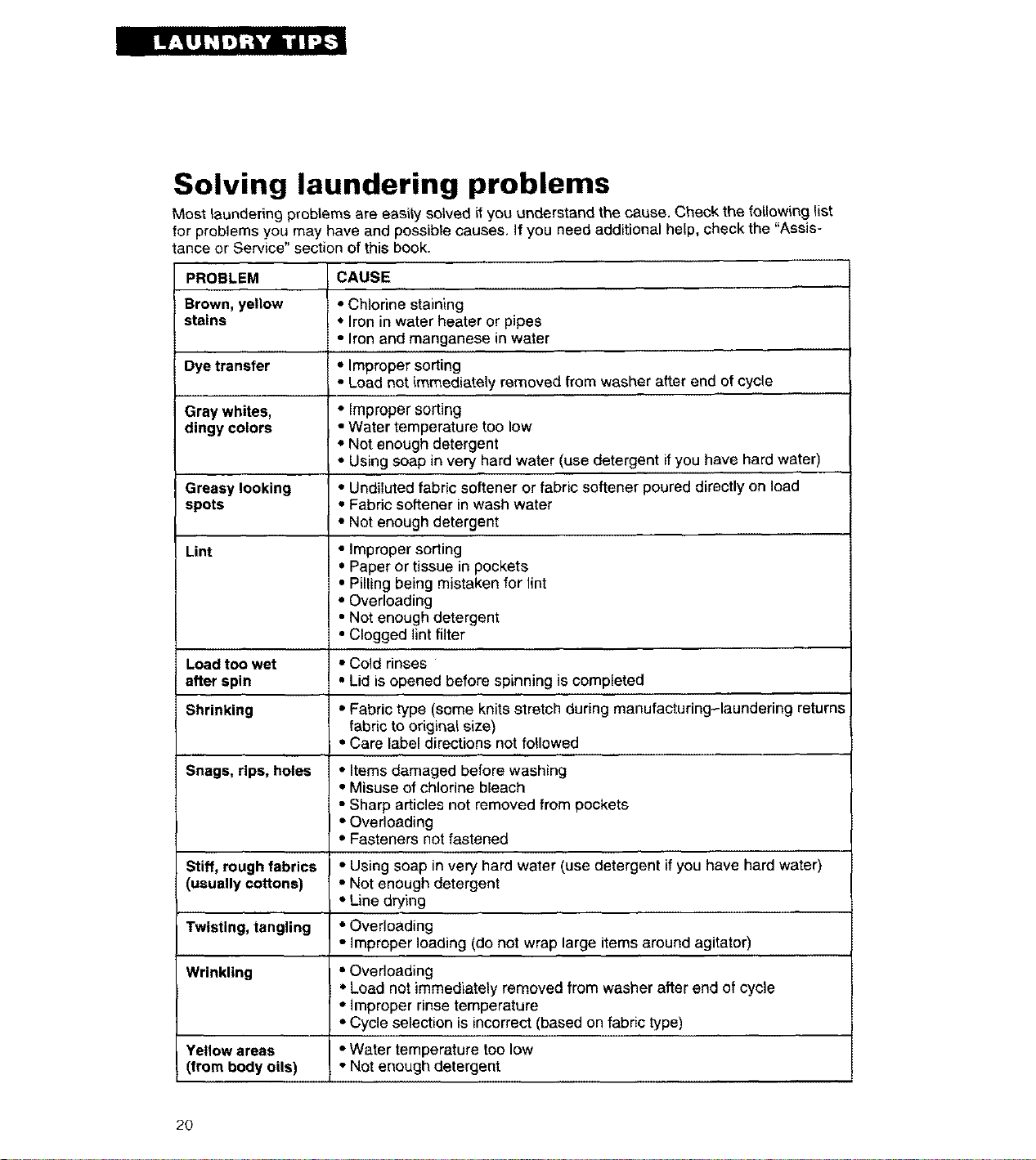
Solving laundering problems
Most laundering problems are easily solved if you understand the cause. Check the following list
for problems you may have and possible causes. If you need additional help, check the "Assis-
tance or Service" section of this book.
PROBLEM CAUSE
Brown, yellow • Chlorine staining
stains • Iron in water heater or pipes
• Iron and manganese in water
Dye transfer • Improper sorting
• Load not immediately removed from washer after end of cycle
Gray whites, • Improper sorting
dingy colors • Water temperature too low
• Not enough detergent
• Using soap in very hard water (use detergent ifyou have hard water)
Greasy looking • Undiluted fabric softener or fabric softener poured directly on load
spots • Fabric softener in wash water
• Not enough detergent
Lint - Improper sorting
• Paper or tissue in pockets
• Pilling being mistaken for lint
• Overloading
• Not enough detergent
• Clogged lint filter
Load too wet • Cold rinses
after spin * Lid is opened before spinning is completed
Shrinking "Fabric type (some knits stretch during manufacturing-laundering returns
fabric to origina_ size)
• Care label directions not followed
Snags, rips, holes • Items damaged before washing
• Misuse of chlorine bleach
• Sharp articles not removed from pockets
• Overloading
• Fasteners not fastened
Stiff, rough fabrics • Using soap in very hard water (use detergent if you have hard water)
(usually cottons) • Not enough detergent
• Line drying
Twisting, tangling • Overloading
• Improper loading (do not wrap large items around agitator)
Wrinkling • Overloading
° Load not immediately removed from washer after end of cycle
• Improper rinse temperature
• Cycle selection is incorrect (based on fabric type)
Yellow areas I • Water temperature too low
i
(from body oils) I • Not enough detergent
2O
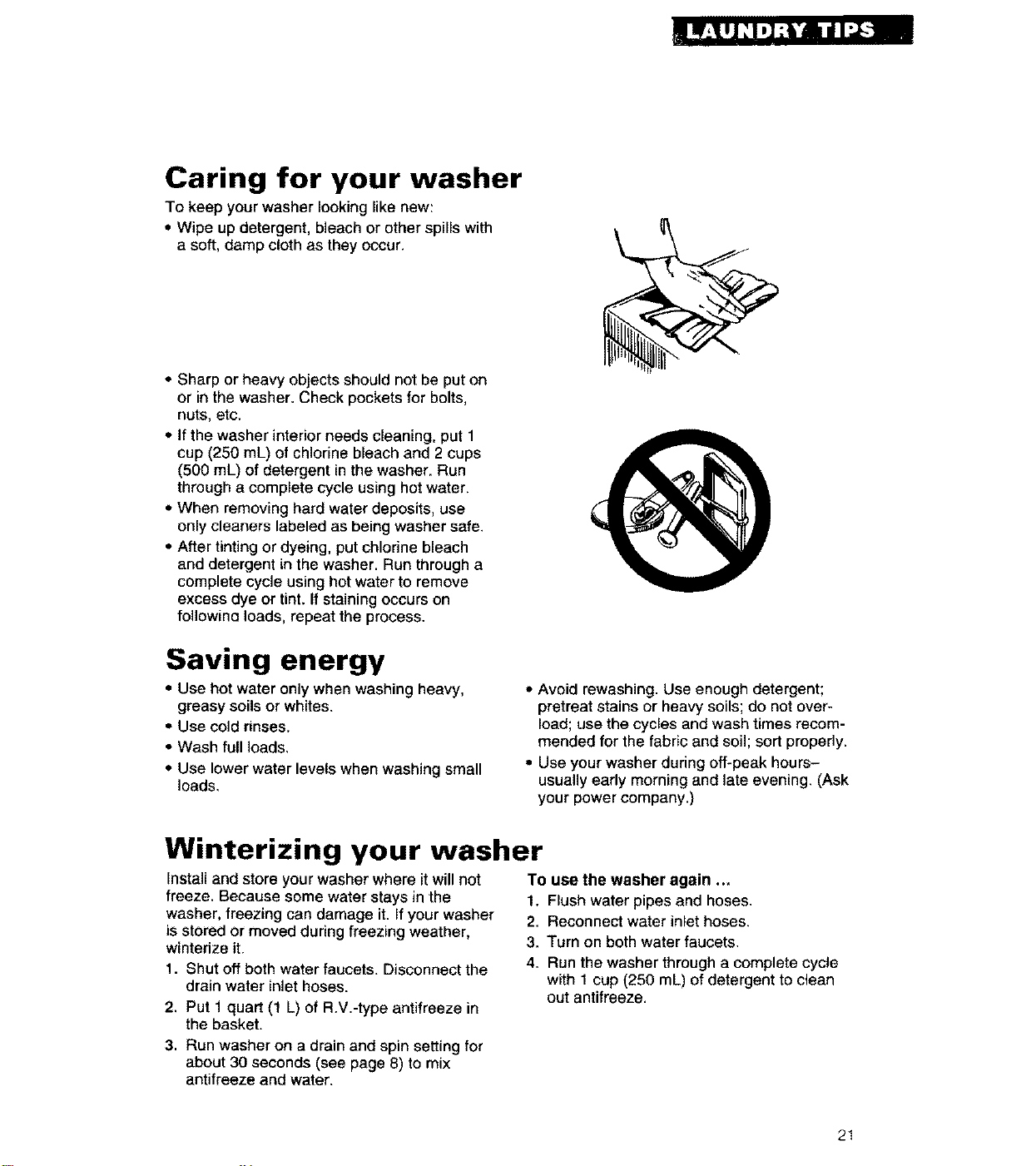
Caring for your washer
To keep your washer looking like new:
• Wipe up detergent, bleach or other spills with
a soft, damp clothas they occur.
• Sharp or heavy objects should not be put on
or in the washer. Check pockets for bolts,
nuts, etc.
• If the washer interior needs cleaning, put 1
cup (250 mL) of chlorine bleach and 2 cups
(500 mL) of detergent in the washer. Run
through a complete cycle using hot water.
• When removing hard water deposits, use
only cleaners labeled as being washer safe.
• After tinting or dyeing, put chlorine bleach
and detergent in the washer. Run through a
complete cycle using hot water to remove
excess dye or tint. If staining occurs on
followina loads, repeat the process.
Saving energy
* Use hot water onlywhen washing heavy,
greasy soilsor whites.
• Use cold rinses.
• Wash full loads.
• Use lower water levels when washing small
loads.
• Avoid rewashing. Use enough detergent;
pretreat stains or heavy soils; do not over-
load; use the cycles and wash times recom-
mended for the fabric and soil; sort properly.
• Use your washer during off-peak hours-
usually early morning and late evening. (Ask
your power company.)
Winterizing your washer
Install and store your washer where itwillnot
freeze. Because some water stays in the
washer, freezing can damage it. If your washer
is stored or moved during freezing weather,
winterize it.
1. Shut off both water faucets. Disconnect the
drain water inlethoses.
2. Put 1 quart (1 L) of R.V.-type antifreeze in
the basket.
3. Run washer on a drain and spin setting for
about 30 seconds (see page 8) to mix
antifreeze and water.
To use the washer again ...
1. Flushwater pipesand hoses.
2. Reconnectwater inlet hoses.
3, Turn on both water faucets.
4. Runthe washer througha completecycle
with 1 cup (250 mL) of detergent toclean
out antifreeze,
21
If You Need Assistance
Or Service
This section is designed to help you save the cost of a service call. Part 1 of this section outlines
possible problems, their causes, and actions you can take to solve each problem. Parts 2 and 3 tell
you what to do if you still need assistance or service. When calling our Consumer Assistance
Center for help or calling for servkce, please provide a detailed description of the problem, your
appliances complete model and serial numbers and the purchase date. (See page 2.) This infor-
mation will help us respond properly to your request.
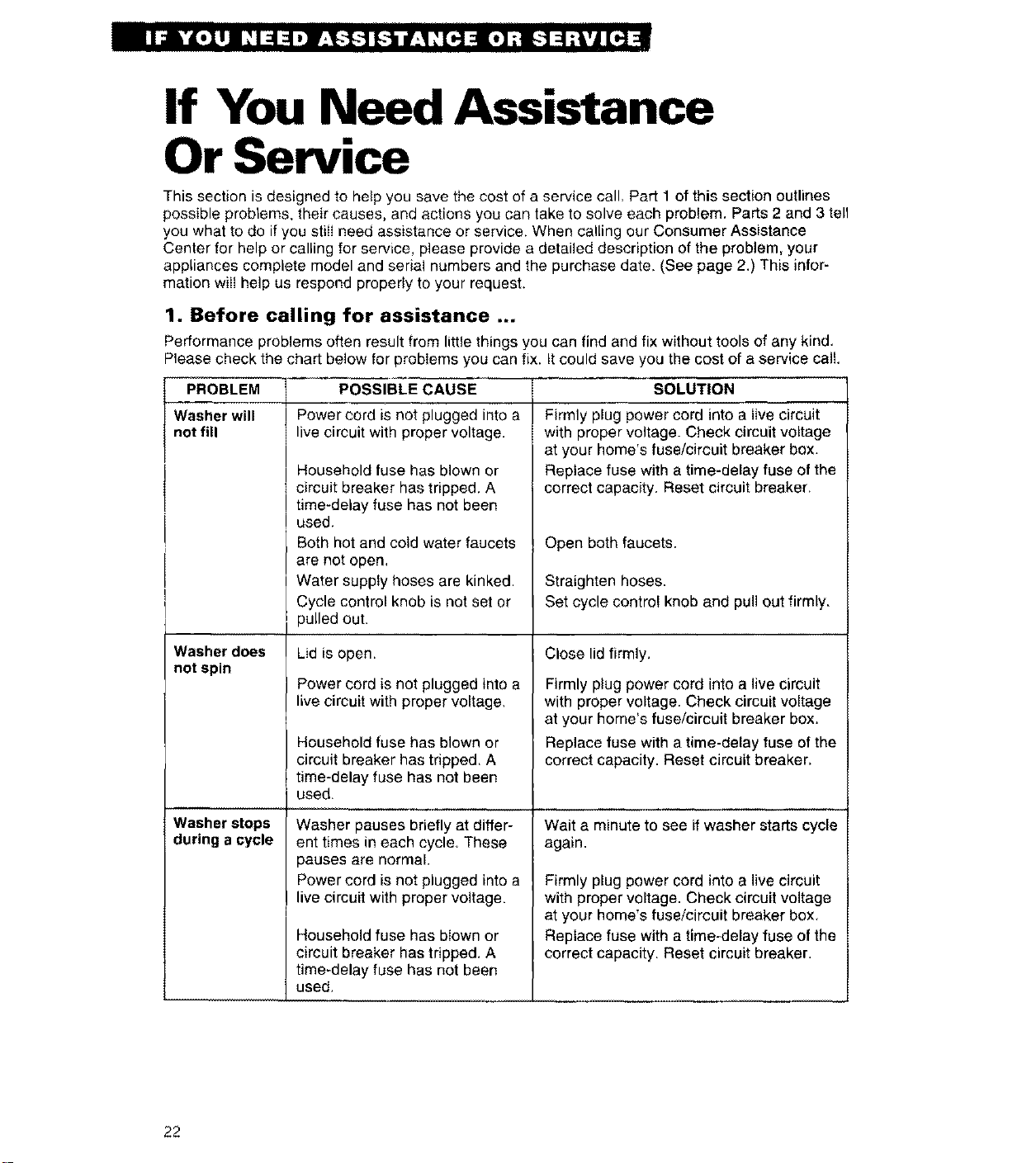
1. Before calling for assistance .,.
Performance problems often result from little things you can find and fix without tools of any kind.
Please check the chart below for problems you can fix. It could save you the cost of a service call,
PROBLEM
Washer will
not fill
Washer does
not spin
Washer stops
during a cycle
POSSIBLE CAUSE
Power cord is not plugged into a
live circuit with proper voltage.
Household fuse has blown or
circuit breaker has tripped. A
time-delay fuse has not been
used.
Both hot and cold water faucets
are not open,
Water supply hoses are kinked.
Cycle control knob is not set or
pulled out.
Lid is open.
Power cord is not plugged into a
live circuit with proper voltage.
Household fuse has blown or
circuit breaker has tripped, A
time-delay fuse has not been
used.
Washer pauses briefly at differ-
ent times in each cycle, These
pauses are normal.
Power cord is not plugged into a
live circuit with proper voltage.
Household fuse has blown or
circuit breaker has tripped. A
time-delay fuse has not been
used.
SOLUTION
Firmly plug power cord into a live circuit
with proper voltage. Check circuit voltage
at your home's fuse/circuit breaker box.
Replace fuse with a time-delay fuse of the
correct capacity. Reset circuit breaker,
Open both faucets.
Straighten hoses.
Set cycle control knob and pull out firmly,
Close lid firmly.
Firmly plug power cord into a live circuit
with proper voltage. Check circuit voltage
at your home's fuse/circuit breaker box.
Replace fuse with a time-delay fuse ofthe
correct capacity. Reset circuit breaker,
Wait a minute to see if washer starts cycle
again.
Firmly plug power cord into a live circuit
withproper voltage. Check circuit voltage
at your home's fuse/circuit breaker box,
Replace fuse with a time-delay fuse of the
correct capacity. Reset circuit breaker.
22
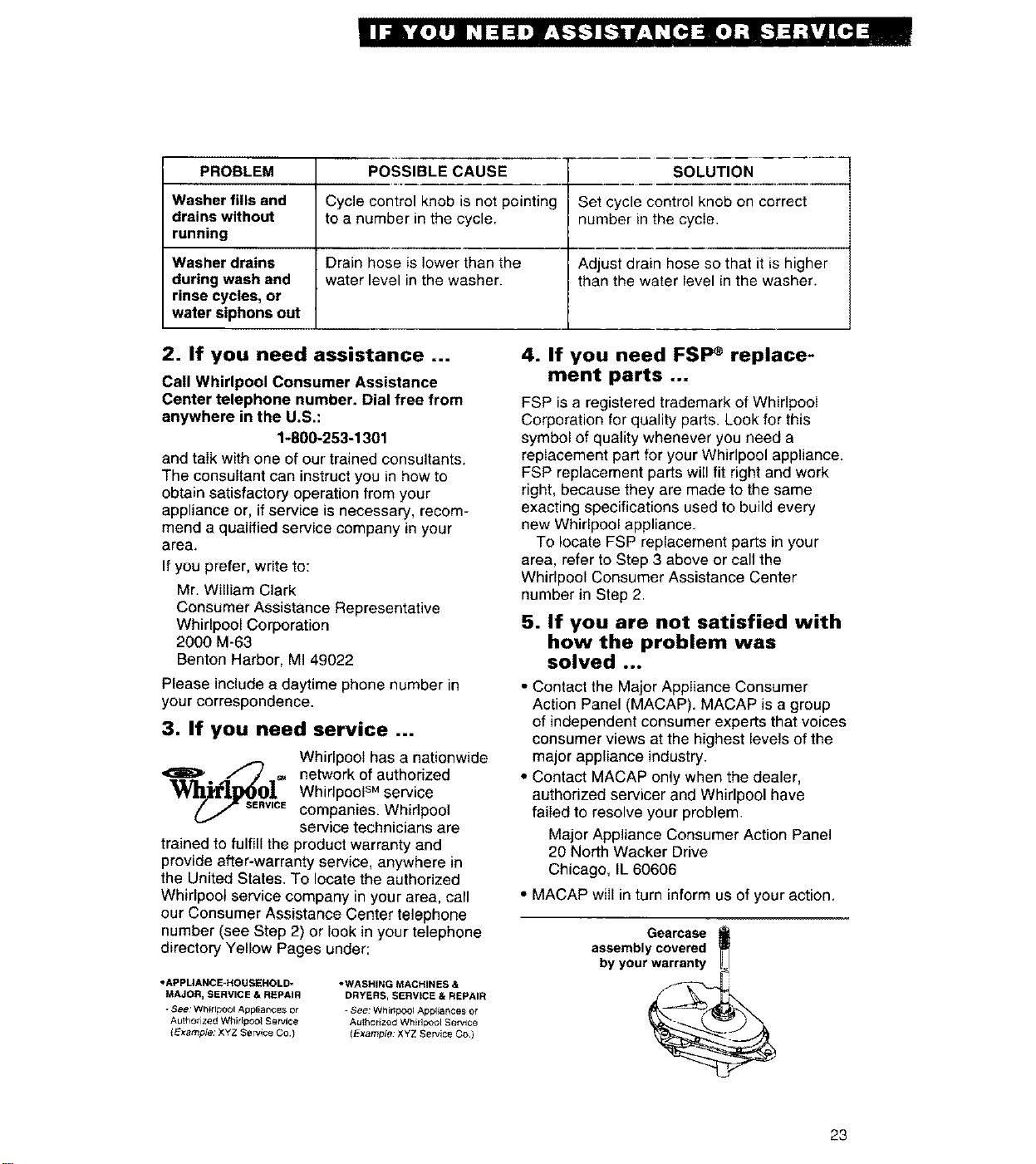
PROBLEM POSSIBLE CAUSE SOLUTION
Washer fills and Cycle control knob is not pointing Set cycle control knob on correct
drains without to a number in the cycle, number in the cycle.
running
Washer drains Drain hose is lower than the Adjust drain hose so that it is higher
during wash and water level in the washer, than the water level in the washer.
rinse cycles, or
water siphons out
2. If you need assistance ...
Call Whirlpool Consumer Assistance
Center telephone number. Dial free from
anywhere in the U.S,:
1-800-253-1301
and talk with one of ourtrained consultants.
The consultant can instruct you in how to
obtain satisfactory operation from your
appliance or, if service is necessary, recom-
mend a qualified service company inyour
area.
If you prefer, write to:
Mr, William Clark
Consumer Assistance Representative
Whirlpool Corporation
2000 M-63
Benton Harbor, MI 49022
Please include a daytime phone number in
your correspondence.
3. If you need service ...
Whirlpool has a nationwide
'11_*/" _O_'_ network of authorized
1 Whirlpool sMservice
_.._ SERVICEcompanies. Whirlpool
service technicians are
trained to fulfill the product warranty and
provide after-warranty service, anywhere in
the United States. To locate the authorized
Whirlpool service company in your area, call
our Consumer Assistance Center telephone
number (see Step 2) or look in your telephone
directory Yellow Pages under:
*APPUANCE*HOUSEHOLD=
MAJOR, SERVICE & REPAIR
- See Whirlpool Appliances or
Authorized Whirlpool Service
(Example XYZ Service Co.)
"WASHING MACHINES &
DRYERS, SERVICE & REPAIR
- See: Whirlpool Appliances or
Authorized Whirlpool Service
(Example: XYZ Sewice Co)
4. If you need FSP ® replace-
ment parts ...
FSP is a registered trademark of WhirlpooI
Corporation for quality parts. Look for this
eymbol of quality whenever you need a
replacement parl for your Whirlpool appliance.
FSP replacement parts will fit right and work
right, because they are made to the same
exacting specifications used to build every
new Whirlpool appliance.
To locate FSP replacement parts in your
area, refer to Step 3 above or call the
Whirlpool Consumer Assistance Center
number in Step 2.
5. If you are not satisfied with
how the problem was
solved ...
• Contact the Major Appliance Consumer
Action Panel (MACAP). MACAP is a group
of independent consumer experts that voices
consumer views at the highest levels of the
major appliance industry.
• Contact MACAP only when the dealer,
authorized servicer and Whirlpool have
failed to resolve your problem.
Major Appliance Consumer Action Panel
20 North Wacker Drive
Chicago, IL 60606
• MACAP wilI in turn inform us of your action.
Gearcase
assemblycovered
by your warranty
23
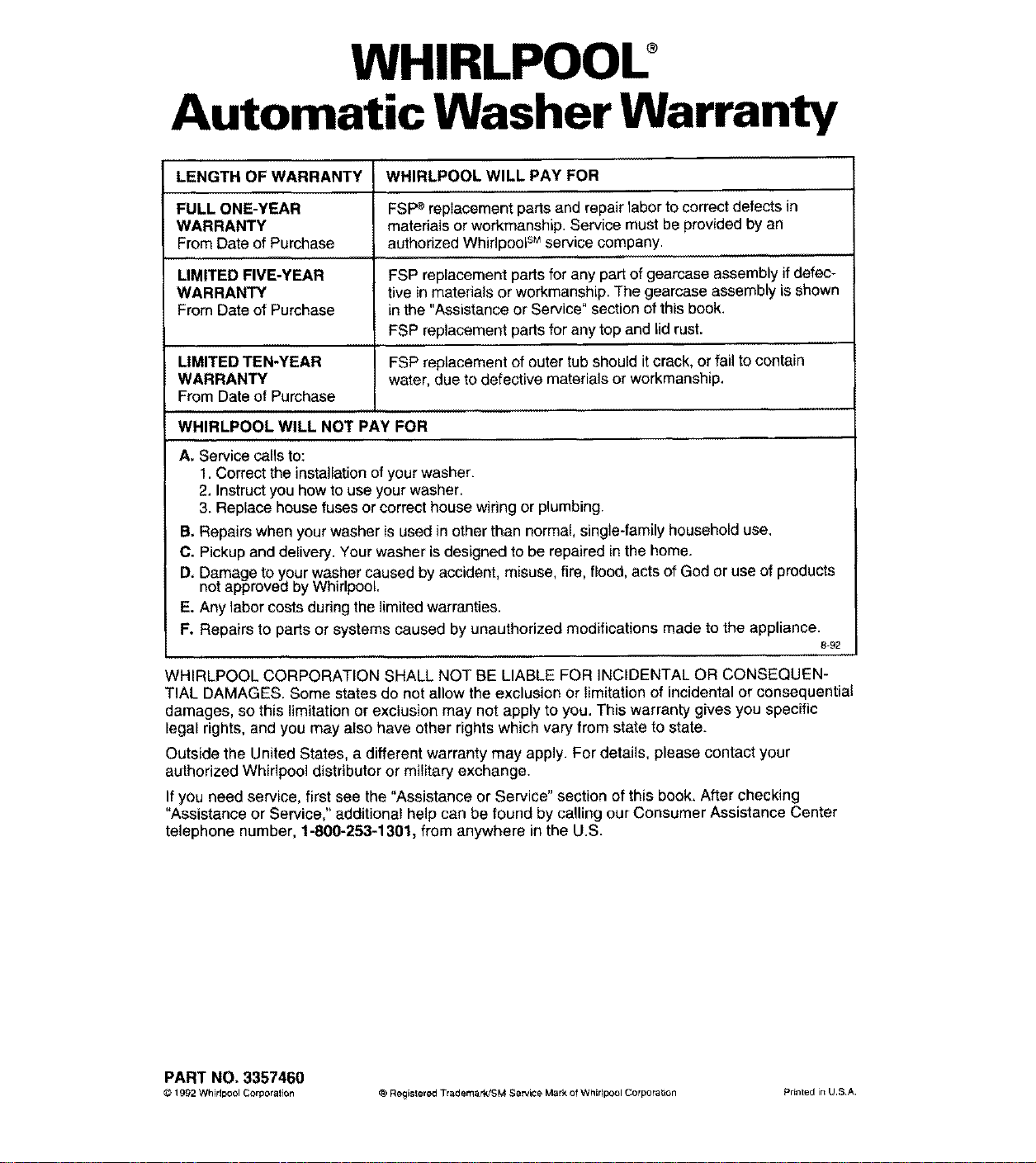
WHIRLPOOU
Automatic Washer Warranty
LENGTH OF WARRANTY WHIRLPOOL WILL PAY FOR
FULL ONE-YEAR FSPe replacement parts and repair labor to correct defects in
WARRANTY materials or workmanship.Service must be provided by an
From Date of Purchase authorized WhirlpoolsMservice company.
LIMITED FIVE-YEAR FSP replacement parts for any part of gearcase assembly if defec-
WARRANTY tive in materials or workmanship. The gearcase assembly is shown
From Date of Purchase in the "Assistance or Service" section of this book.
FSP replacement parts for any top and lid rust.
LIMITED TEN-YEAR FSP replacement of outer tub should it crack, orfail to contain
WARRANTY water, due to defective materials or workmanship,
From Date of Purchase
,,,,,,,,,,, ,............... ,.....
WHIRLPOOL WILL NOT PAY FOR
A. Service calls to:
1.Correct the installation of your washer.
2. Instruct you how to use your washer.
3. Replace house fuses or correct house wiring or plumbing.
B, Repairs when your washer is used in other than normal, single-family household use.
C. Pickup and delivery. Your washer isdesigned to be repaired inthe home.
D. Damage to your washer caused by accident, misuse, fire, flood, acts of God or use of products
not approved by Whirlpool.
E. Any labor costs during the limited warranties,
F. Repairs to parts or systems caused by unauthorized modifications made to the appliance.
8-92
WHIRLPOOL CORPORATION SHALL NOT BE LIABLE FOR INCIDENTAL OR CONSEQUEN-
TIAL DAMAGES. Some states do not allow the exclusion or limitation of incidental or consequential
damages, so this limitation or exclusion may not apply to you. This warranty gives you specific
legal rights, and you may also have other rights which vary from state to state.
Outside the United States, a different warranty may apply. For details, please contact your
authorized Whirlpool distributor or military exchange.
If you need service, first see the "Assistance or Service" section of this book. After checking
"Assistance or Service," additional help can be found by calling our Consumer Assistance Center
telephone number, 1-800-253-1301, from anywhere in the U.S.
PART NO. 3357460
© 1992 Whidpool Corporation ® Registered Tradema_SM Service Mark of Whirlpool Corporation Pr[nled in U SA.