Owner's Manual and
Installation Instructions
Three-Speed with Options
and Speeds Switch
AUTOMATIC WASH ERS
IMPORTANT:
Read and follow all safety
and operating instructions
before first use of this product.
Sears, Roebuck and Co., Hoffman Estates, IL 60179 U.S,A.
Sears Canada Inc,,Toronto, Ontario, Canada M5B 2B8
www, sears,com
8526118 PRINTEDINU.S.A.
1/01
BEFORE USINGYOUR NEW WASHER ..... 2
KENMORE AUTOMATIC WASHER WARRANTY 3
WASHER SAFETY 4
INSTALLATION REQUIREMENTS 6
INSTALLATION INSTRUCTIONS 10
OPERATING YOUR WASHER 14
LAUNDRY TIPS 25
CARING FOR YOUR WASH ER 27
TROUBLESHOOTING 28
SEARS MAINTENANCE AGREEMENT 32
Please read this manual. It will help you
install and operate your new Kenmore
washer in the most economical way.
For more information about the care
and operation of Kenmore appliances
call your nearest Sears store. You will
need the complete model and serial
numbers when requesting information.
Your washer's model and serial
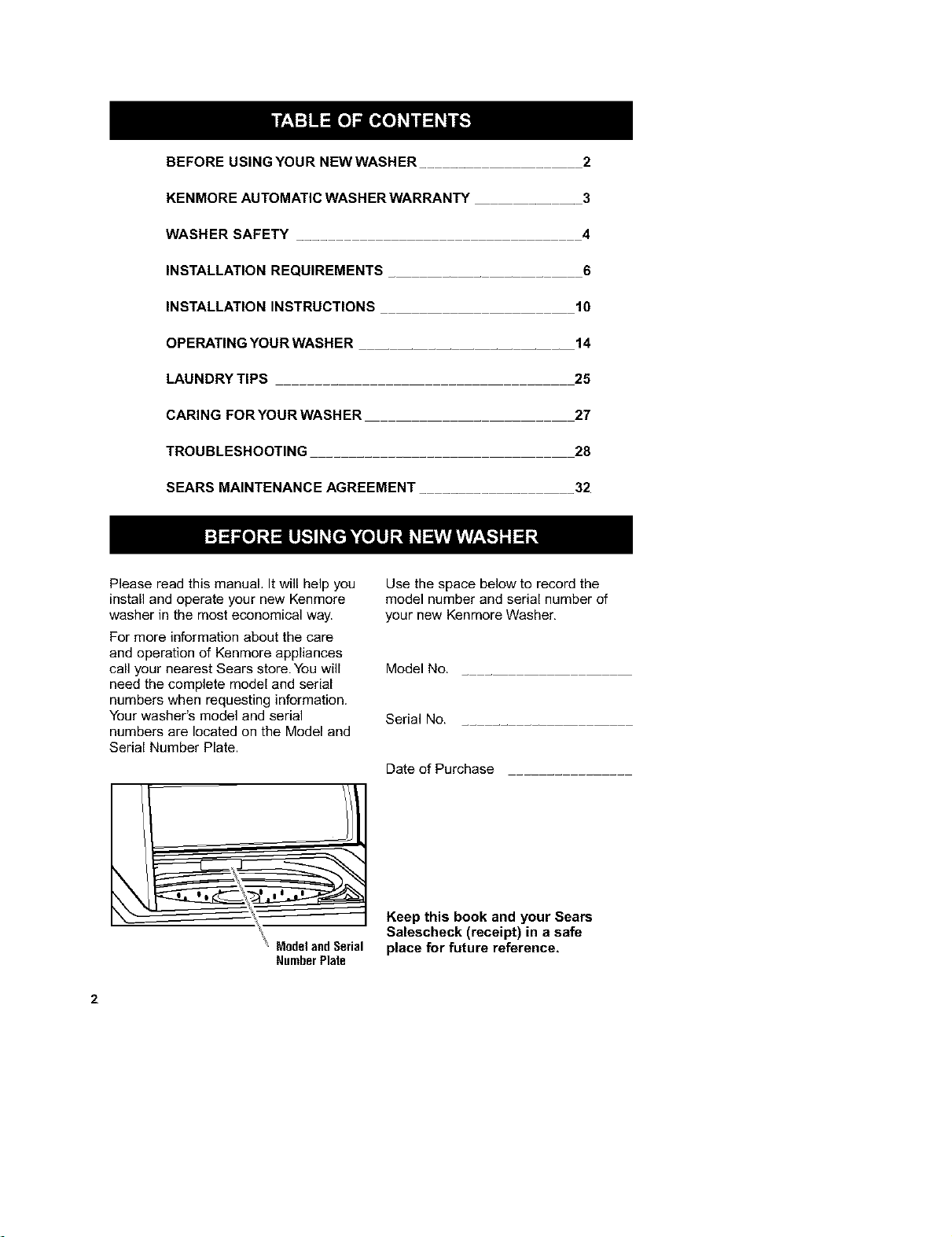
numbers are located on the Model and
Serial Number Plate.
Use the space below to record the
model number and serial number of
your new Kenmore Washer,
Model No.
Serial No.
Date of Purchase
\_ ModelandSerial
NumberPlate
Keep this book and your Sears
Salescheck (receipt) in a safe
place for future reference,
Limited Lifetime Warranty on
White Porcelain Basket
For the lifetime of the washer from the
date of purchase, Sears will replace the
white porcelain wash basket if it chips
or rusts due to defective material or
workmanship. You will be charged for
labor.
Limited 10-Year Warranty on
Plastic Tub*
For the second through tenth year from
the date of purchase, Sears will replace
the plastic tub if it is defective in
material or workmanship. You will be
charged for labor.
Limited 5-Year Warranty on
Gearcase Parts*
For the second through fifth year from
the date of purchase, Sears will replace
any gearcase parts that are defective in
material or workmanship. You will be
charged for labor.
Full 1-Year Warranty on
"Spreckle" Porcelain Basket
For one year from the date of
purchase, when this washer is installed
and operated according to the
instructions that come with it, Sears will
replace the "spreckle" (speckled
surface) porcelain wash basket if it
chips or rusts due to defective material
or workmanship.
Full 1-Year Warranty on
Mechanical and Electrical parts
For one year from the date of pur-
chase, if this washer is installed and
operated according to the instructions
that come with it, Sears will repair or
replace any of its mechanical or
electrical parts if they are defective in
material or workmanship.
Warranty Restriction
If this washer is operated for any pur-
pose other than private family use, all
warranty coverage is restricted to 90
days from the date of purchase.
Warranty Service
Warranty service is available by
contacting your nearest Sears Service
Center in the United States or Canada.
This warranty applies only while this
washer is used in the United States or
Canada.
This warranty gives you specific legal
rights and you may also have other
rights that vary from state to state or
province to province.
Sears, Roebuck and Co.,
Dept. 817WA,
Hoffman Estates, IL 60179
Sears Canada Inc.,
Toronto, Ontario,
Canada M5B 2B8
*In Canada, a different warranty may apply.
In the U.S. for Sears warranty information or
to contact a Sears Service Center, call
1-80O-4-MY-HQME _(1-809-469-4663).
in Canada, call 1-877-533-6937.
Your safety and the safety of others are very important.
We have provided many important safety messages in this manual and
on your appliance. Always read and obey all safety messages.
This is the safety alerL symbol. This symbol alerts you to
potential hazards that can kill or hurt you and others.
All safety messages will follow the safety alert symbol
and either the word "DANGER" or "WARNING."
These words mean:
You can be killed or seriously
injured if you don't immediatel,L
follow instructions.
You can be killed or seriously
injured if you don't follow
instructions.
All safety messages will tell you what the potential hazard is, tell you how
to reduce the chance of injury, and tell you what can happen if the
instructions are not followed.
IMPORTANT SAFETY INSTRUCTIONS
WARNING: To reduce the risk of fire, electric shock, or injury to persons
when using your washer, follow basic precautions, including the following:
• Read all instructions before using
the washer.
• Do not wash articles that have been
previously cleaned in, washed in,
soaked in, or spotted with gasoline,
dry-cleaning solvents, other flammable
or explosive substances as they give
off vapors that could ignite or explode.
• Do not add gasoline, dry-cleaning
solvents, or other flammable or
explosive substances to the wash
water. These substances give off
vapors that could ignite or explode.
• Under certain conditions, hydrogen
gas may be produced in a hot water
system that has not been used for 2
weeks or more. HYDROGEN GAS IS
EXPLOSIVE. If the hot water system
has not been used for such a period,
before using a washing machine, turn
on all hot water faucets and let the
water flow from each for several
minutes. This will release any accumu-
lated hydrogen gas, As the gas is
flammable, do not smoke or use an
open flame during this time.
• Do not allow children to play on or
in the washer. Close supervision of
children is necessary when the
washer is used near children.
• Before the washer is removed from
service or discarded, remove the
door or lid
• Do not reach into the washer if the
drum, tub or agitator is moving.
• Do not install or store this washer
where it will be exposed to the
weather.
• Do not tamper with controls.
• Do not repair or replace any part of
the washer or attempt any servicing
unless specifically recommended in
the Owner's Manual or in published
user-repair instructions that you
understand and have the skills to
carry out,
• See "Installation Requirements" for
grounding requirements.
SAVE THESE INSTRUCTIONS
Tools and Parts
Assemble the necessary tools and
supplies before beginning the washer
installation, The parts supplied are in the
washer basket.
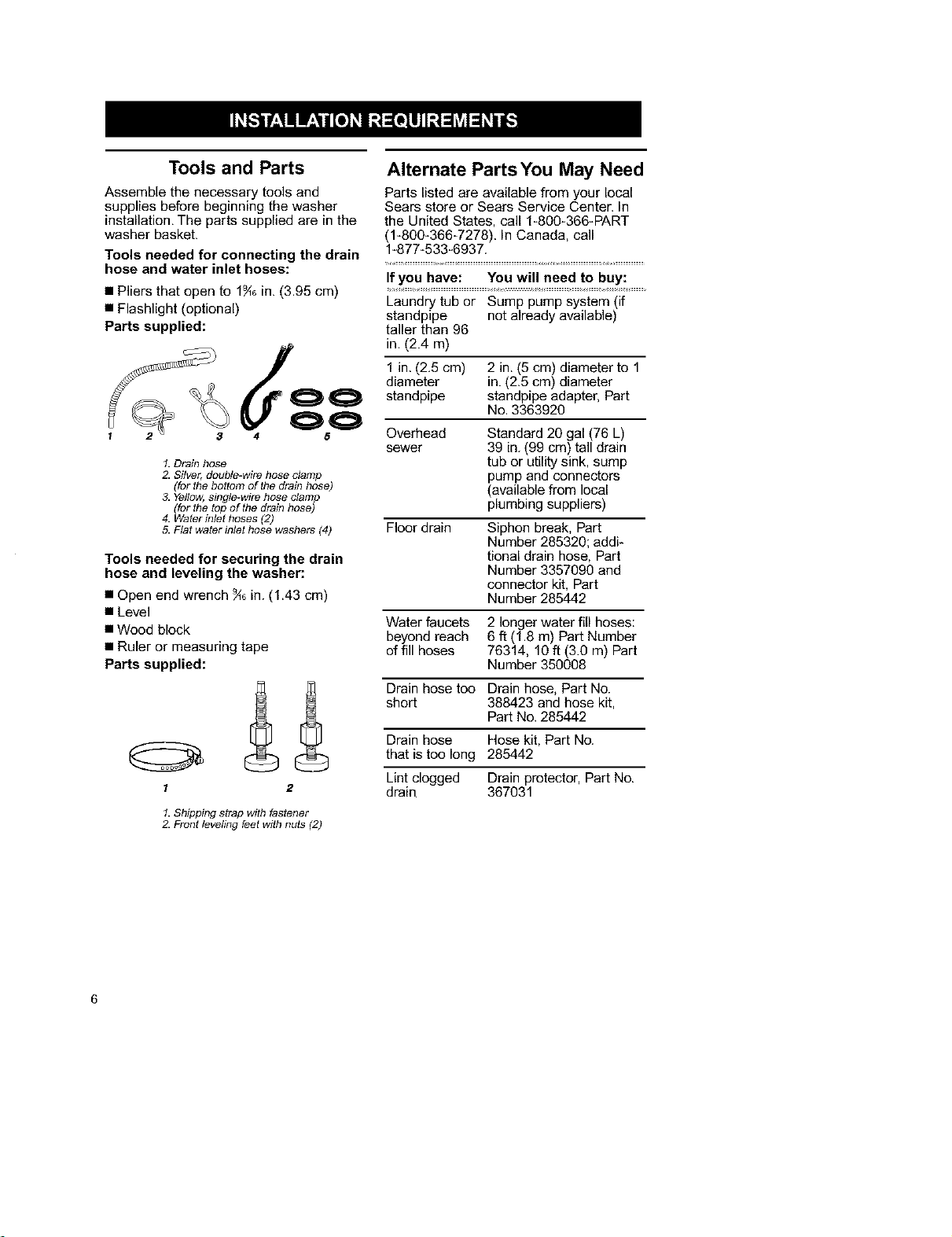
Tools needed for connecting the drain
hose and water inlet hoses:
• Pliers that open to 17`6in. (3.95 cm)
• Flashlight (optional)
Parts supplied:
3 4 5
1.Drain hose
2. Silver, double-wire hose clamp
(for the bottom of the drain hose)
3. Yellow, single-wire hose clamp
(for the top of the drain hose)
4. Water inlet hoses (2)
5. Flat water inlet hose washers (4)
Tools needed for securing the drain
hose and leveling the washer:
• Open end wrench ?'6in. (1.43 cm)
• Level
• Wood block
• Ruler or measuring tape
Parts supplied:
1 2
1.Shipping strap with fastener
2. Front leveling feet with nuts (2)
Alternate PartsYou May Need
Parts listed are available from your local
Sears store or Sears Service Center. In
the United States, call 1-800-366-PART
(1-800-366-7278). In Canada, call
1_877-533_6937.
If you have: You will need to buy:
Laundry tub or Sump pump system (if
standpipe not already available)
taller than 96
in. (2.4 m)
1 in. (2,5 cm) 2 in. (5 cm) diameter to 1
diameter in. (2.5 cm) diameter
standpipe standpipe adapter, Part
No. 3363920
Overhead Standard 20 gal (76 L)
sewer 39 in. (99 cm) tall drain
tub or utility sink, sump
pump and connectors
(available from local
plumbing suppliers)
Floor drain Siphon break, Part
Number 285320; addi*
tional drain hose, Part
Number 3357090 and
connector kit, Part
Number 285442
Water faucets 2 longer water fill hoses:
beyond reach 6 ft (1.8 m) Part Number
of fill hoses 76314, 10 ft (3.0 m) Part
Number 350008
Drain hose too Drain hose, Part No.
short 388423 and hose kit,
Part No. 285442
Drain hose Hose kit, Part No.
that is too long 285442
Lint clogged Drain protector, Part No.
drain 367031
Location Requirements
Selecting the proper location for your
washer improves performance and mini-
mizes noise and possible washer "walk."
Your washer can be installed in a base-
ment, laundry room, closet, or recessed
area. (See "Drain System.")
Proper installation is your responsibility.
You will need:
• A water heater set to deliver 120°F
(49%) water to the washer.
• A grounded electrical outlet located
within 4 ft (1.2 m) of where the power
cord is attached to the back of the
washer. (See "Electrical Requirements.")
• Hot and cold water faucets located
within 4 ft (1.2 m) of the hot and cold
water fill valves, and water pressure of
5-100 psi (34.5-689.6 kPa). Washers
with triple dispensers require 20-100 psi
(138.0-689.6 kPa) for best performance.
• A level floor with a maximum slope of
1 in. (2.5 cm) under entire washer.
Installing the washer on carpeting is not
recommended.
• A sturdy floor to support the washer
weight (washer, water and load) of 315
Ibs (143 kgs).
Do not store or operate your washer in
temperatures at or below 32°F (0%).
Some water can remain in the washer and
can cause damage in low temperatures.
See "Washer Care" for winterizing infor-
mation.
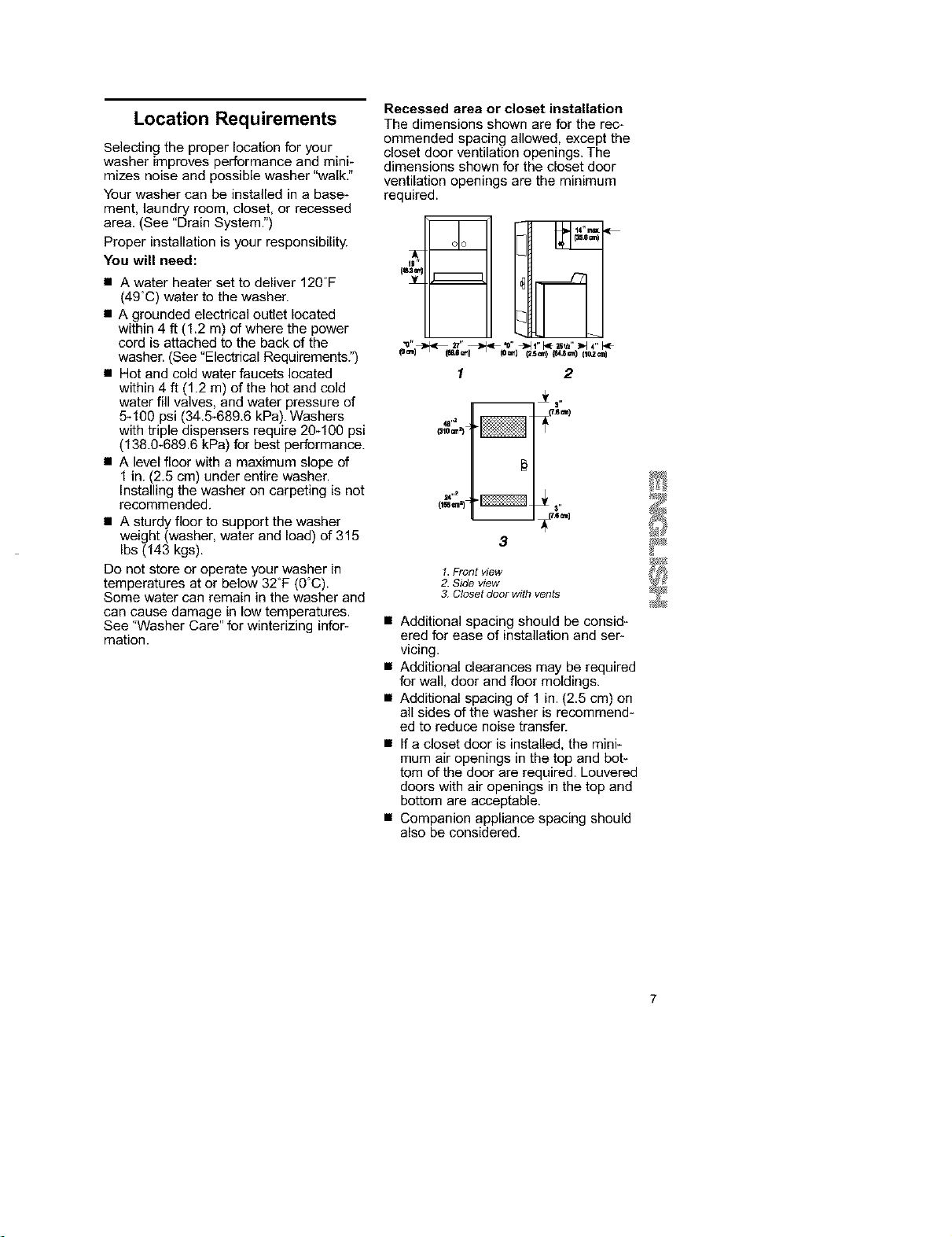
Recessed area or closet installation
The dimensions shown are for the rec-
ommended spacing allowed, except the
closet door ventilation openings. The
dimensions shown for the closet door
ventilation openings are the minimum
required.
1 2
-- Y3"
(3100m=) "_ _(7'm)
3
1.Front view
2. Side view
& Closet door with vents
• Additional spacing should be consid-
ered for ease of installation and ser*
vicing.
• Additional clearances may be required
for wall, door and floor moldings.
• Additional spacing of 1 in. (2.5 cm) on
all sides of the washer is recommend-
ed to reduce noise transfen
• If a closet door is installed, the mini-
mum air openings in the top and bot-
tom of the door are required. Louvered
doors with air openings in the top and
bottom are acceptable.
• Companion appliance spacing should
also be considered.
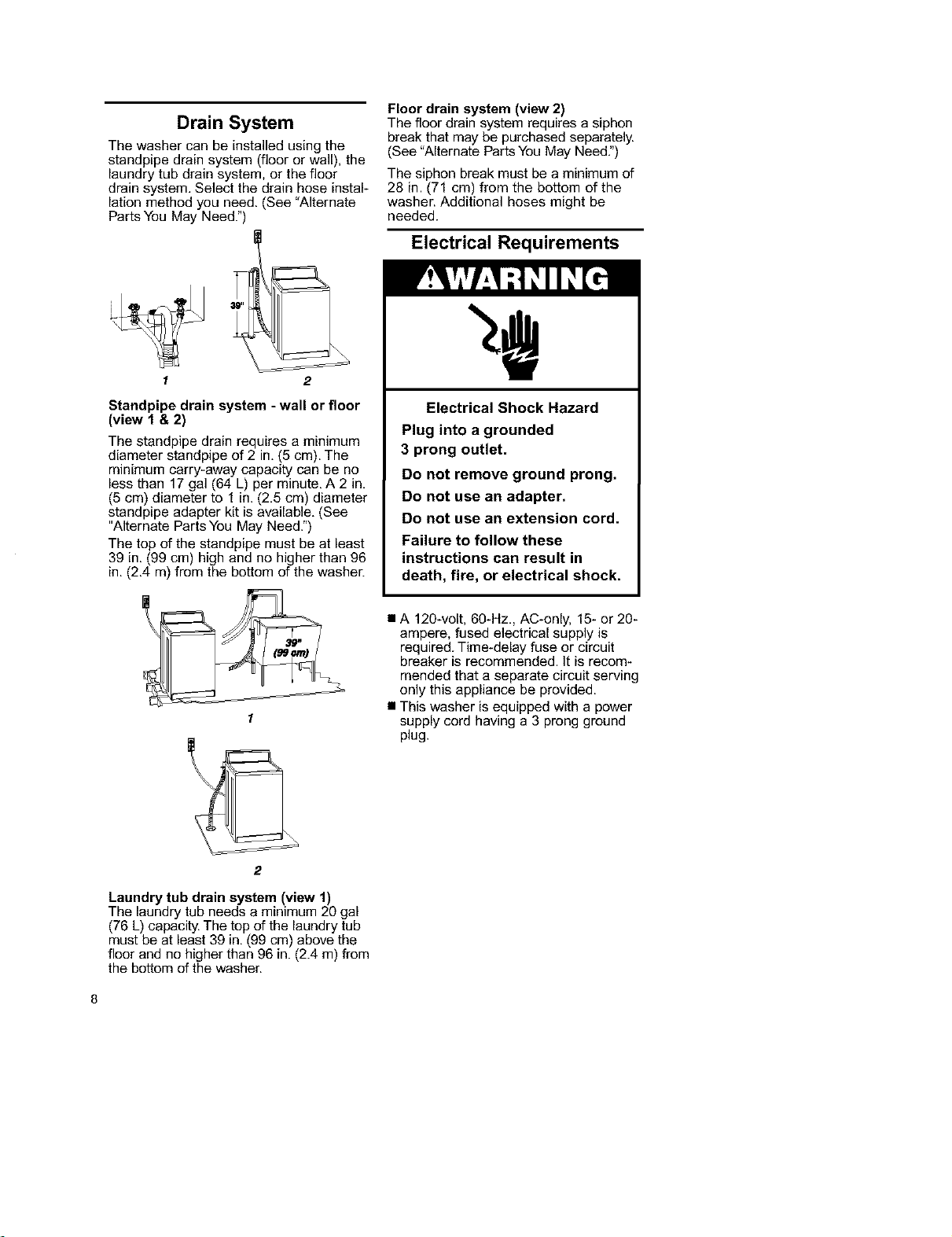
Drain System
The washer can be installed using the
standpipe drain system (floor or wall), the
laundry tub drain system, or the floor
drain system, Select the drain hose instal-
lation method you need. (See "Alternate
Parts You May Need.")
Floor drain system (view 2)
The floor drain system requires a siphon
break that may be purchased separately.
(See "Alternate Parts You May Need,")
The siphon break must be a minimum of
28 in. (71 cm) from the bottom of the
washer. Additional hoses might be
needed.
Electrical Requirements
1 2
Standpipe drain system - wall or floor
(view 1 & 2)
The standpipe drain requires a minimum
diameter standpipe of 2 in, (5 cm). The
minimum carry-away capacity can be no
less than 17 ga] (64 L) per minute, A 2 in,
(5 cm) diameter to 1 in. (2,5 cm) diameter
standpipe adapter kit is available, (See
"Alternate Parts You May Need.")
The top of the standpipe must be at least
39 in. (99 cm) high and no higher than 96
in. (2.4 m) from the bottom of the washer.
Electrical Shock Hazard
Plug into a grounded
3 prong outlet.
Do not remove ground prong.
Do not use an adapter.
Do not use an extension cord.
Failure to follow these
instructions can result in
death, fire, or electrical shock.
a A 120-volt, 60-Hz,, AC-only, 15- or 20-
ampere, fused electrical supply is
required. Time-delay fuse or circuit
breaker is recommended. It is recom-
mended that a separate circuit serving
only this appliance be provided.
a This washer is equipped with a power
supply cord having a 3 prong ground
plug.
Laundry tub drain system (view 1)
The laundry tub needs a minimum 20 gal
(76 L) capacity, The top of the laundry tub
must be at least 39 in, (99 cm) above the
floor and no higher than 96 in. (2.4 m) from
the bottom of the washer.
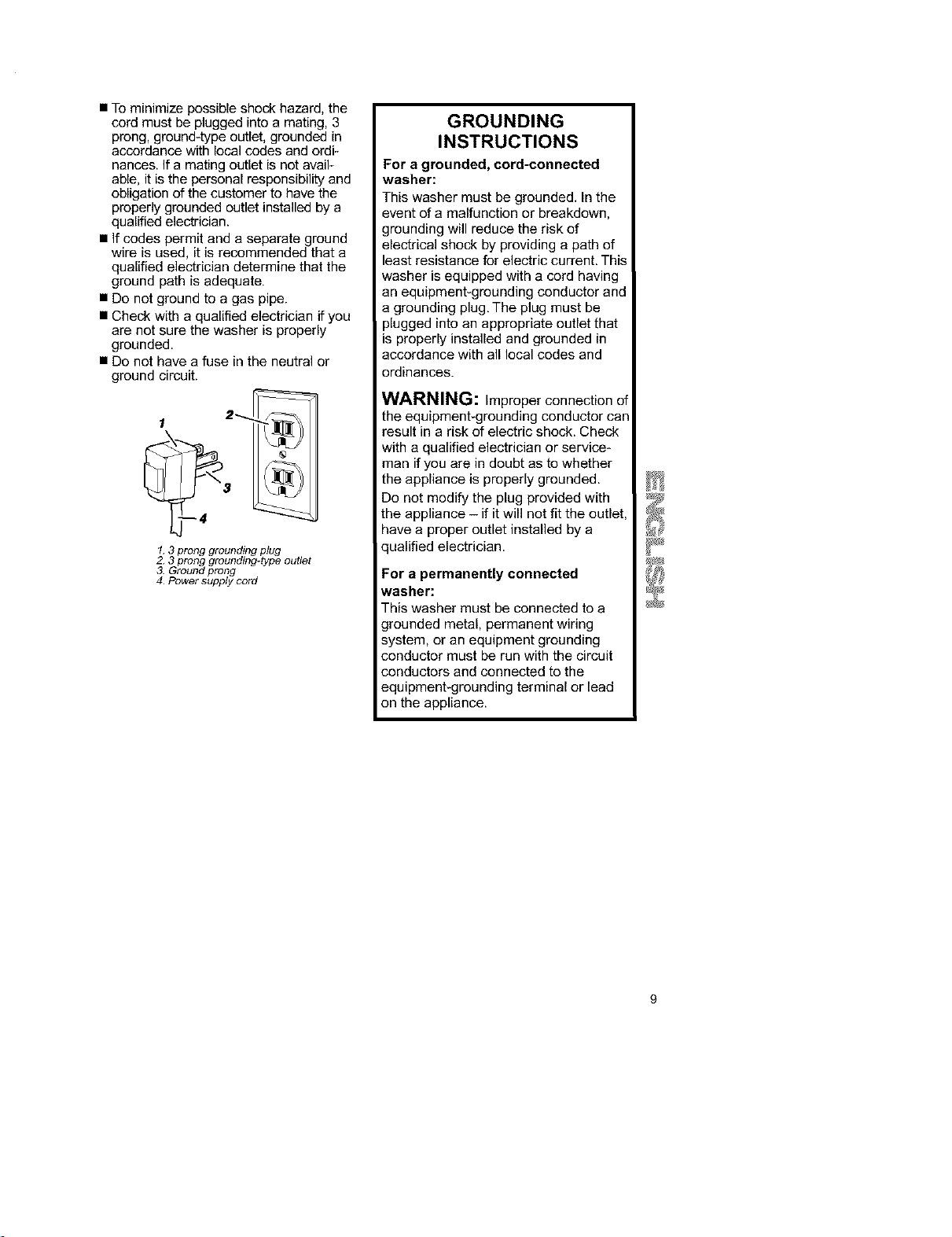
• Tominimizepossibleshockhazard,the
cordmustbepluggedintoamating,3
prong,ground4ypeoutlet,groundedin
accordance with local codes and ordi-
nances. If a mating outlet is not avail-
able, it is the personal responsibility and
obligation of the customer to have the
properly grounded outlet installed by a
qualified electrician.
• If codes permit and a separate ground
wire is used, it is recommended that a
qualified electrician determine that the
ground path is adequate.
• Do not ground to a gas pipe.
• Check with a qualified electrician if you
are not sure the washer is properly
grounded.
• Do not have a fuse in the neutral or
ground circuit.
1.3 prong grounding plug
2. 3 prong grounding-type outlet
3. Ground prong
4 Power supply cord
GROUNDING
INSTRUCTIONS
For a grounded, cord-connected
washer:
This washer must be grounded. In the
event of a malfunction or breakdown,
grounding will reduce the risk of
electrical shock by providing a path of
least resistance for electric current. This
washer is equipped with a cord having
an equipment-grounding conductor and
a grounding plug. The plug must be
plugged into an appropriate outlet that
is properly installed and grounded in
accordance with all local codes and
ordinances.
WARNING: Improper connection of
the equipment-grounding conductor can
result in a risk of electric shock. Check
with a qualified electrician or service-
man if you are in doubt as to whether
the appliance is properly grounded.
De net modify the plug provided with
the appliance - if it will not fit the outlel
have a proper outlet installed by a
qualified electrician.
For a permanently connected
washer;
This washer must be connected to a
grounded metal, permanent wiring
system, or an equipment grounding
conductor must be run with the circuit
conductors and connected to the
equipment-grounding terminal or lead
on the appliance.
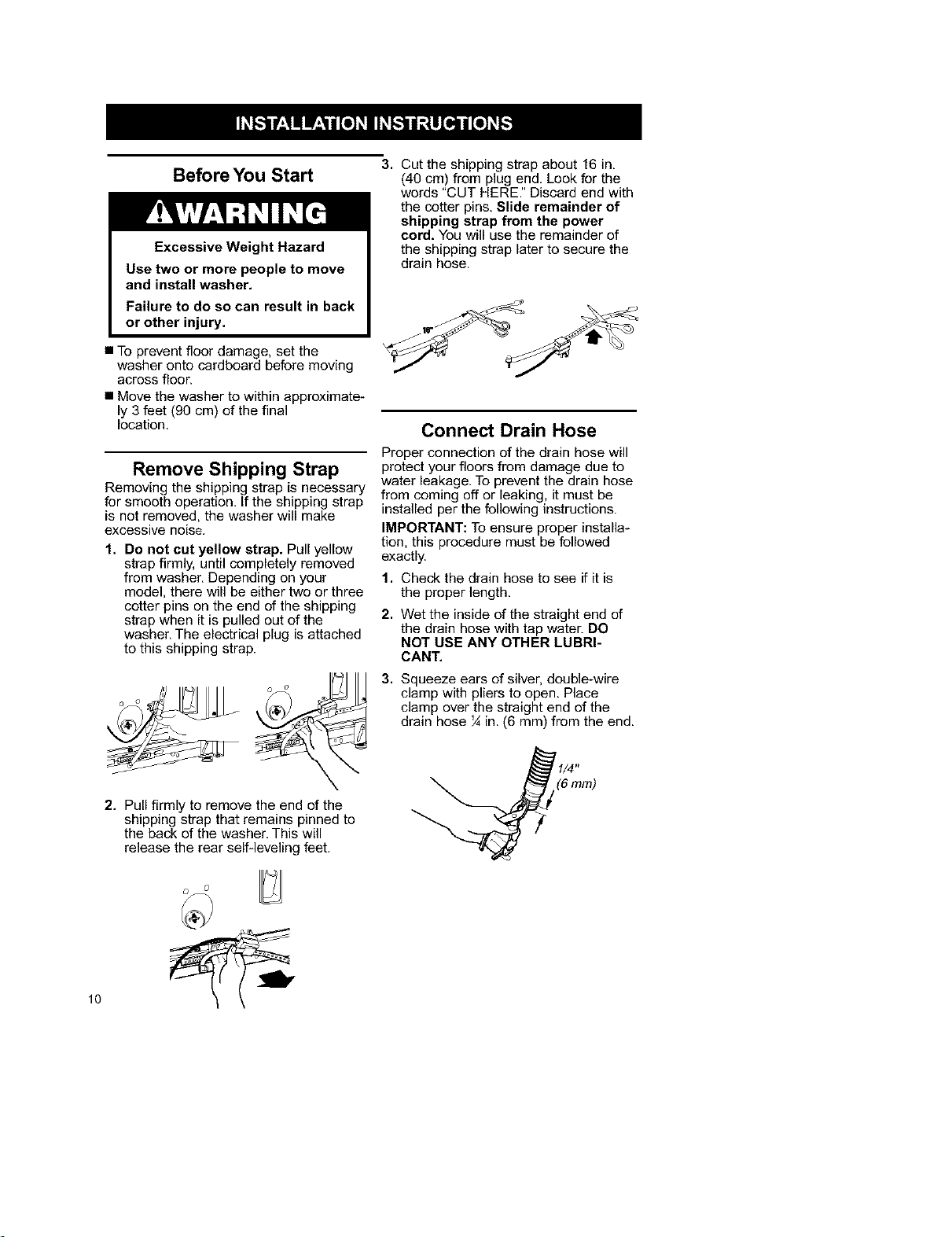
Before You Start
3. Cut the shipping strap about 16 in,
(40 cm) from plug end. Look for the
words "CUT HERE." Discard end with
the cotter pins, Slide remainder of
shipping strap from the power
cord. You will use the remainder of
the shipping strap later to secure the
drain hose.
• To prevent floor damage, set the
washer onto cardboard before moving
across floor.
• Move the washer to within approximate-
ly 3 feet (90 cm) of the final
location.
Remove Shipping Strap
Removing the shipping strap is necessary
for smooth operation. If the shipping strap
is not removed, the washer will make
excessive noise.
1. Do not cut yellow strap. Pull yellow
strap firmly, until completely removed
from washer, Depending on your
model, there will be either two or three
cotter pins on the end of the shipping
strap when it is pulled out of the
washer, The electrical plug is attached
to this shipping strap.
2. Pull firmly to remove the end of the
shipping strap that remains pinned to
the back of the washer, This will
release the rear self-leveling feet.
Connect Drain Hose
Proper connection of the drain hose will
protect your floors from damage due to
water leakage. To prevent the drain hose
from coming off or leaking, it must be
installed per the following instructions.
IMPORTANT: To ensure proper installa-
tion, this procedure must be followed
exactly.
1. Check the drain hose to see if it is
the proper length.
2.
Wet the inside of the straight end of
the drain hose with tap water. DO
NOT USE ANY OTHER LUBRI-
CANT.
3.
Squeeze ears of silver, double-wire
clamp with pliers to open. Place
clamp over the straight end of the
drain hose V44in. (6 mm) from the end.
_-_ I/4"
10
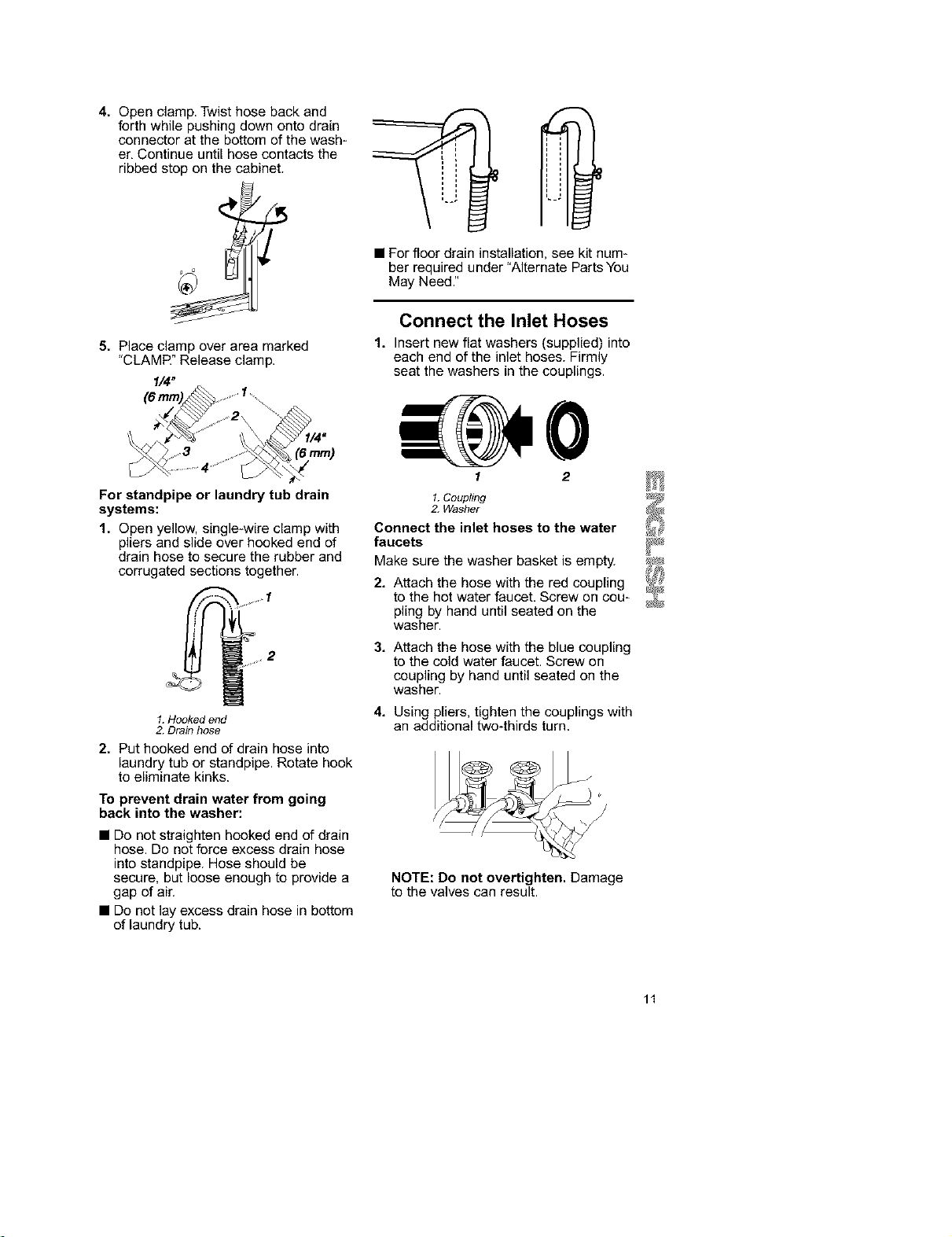
4. Open clamp. Twist hose back and
forth while pushing down onto drain
connector at the bottom of the wash-
er, Continue until hose contacts the
ribbed stop on the cabinet,
5. Place clamp over area marked
"CLAMR" Release clamp.
1/4"
For standpipe or laundry tub drain
systems:
1. Open yellow, single*wire clamp with
pliers and slide over hooked end of
drain hose to secure the rubber and
corrugated sections together.
1.Hooked end
2. Drain hose
2. Put hooked end of drain hose into
laundry tub or standpipe. Rotate hook
to eliminate kinks.
To prevent drain water from going
back into the washer:
• Do not straighten hooked end of drain
hose. Do not force excess drain hose
into standpipe. Hose should be
secure, but loose enough to provide a
gap of air.
• Do not lay excess drain hose in bottom
of laundry tub.
• For floor drain installation, see kit num*
ber required under "Alternate Parts You
May Need."
Connect the Inlet Hoses
1, Insert new flat washers (supplied) into
each end of the inlet hoses. Firmly
seat the washers in the couplings.
1 2
1.Coupling
2. Washer
Connect the inlet hoses to the water
faucets
Make sure the washer basket is empty.
2, Attach the hose with the red coupling
to the hot water faucet, Screw on cou-
pling by hand until seated on the
washer.
3,
4,
Attach the hose with the blue coupling
to the cold water faucet. Screw on
coupling by hand until seated on the
washer.
Using pliers, tighten the couplings with
an additional two-thirds turn.
NOTE: Do not overtighten. Damage
to the valves can result.
11
12
Clear the water lines
5, Run water through both faucets and
inlet hoses, into a bucket or laundry
tub, to get rid of particles in the water
lines that might clog the inlet valve
screens.
Connect the inlet hoses to the washer
6, Attach the hose with the red coupling
to the HOT (bottom) inlet valve.
Attaching the red coupling first makes
it easier to tighten connection with
pliers, Screw on coupling by hand
until seated on the washer. Using pli-
ers, tighten the couplings with an
additional two4hirds turn.
NOTE: Do not overtighten. Damage
to the valves can result.
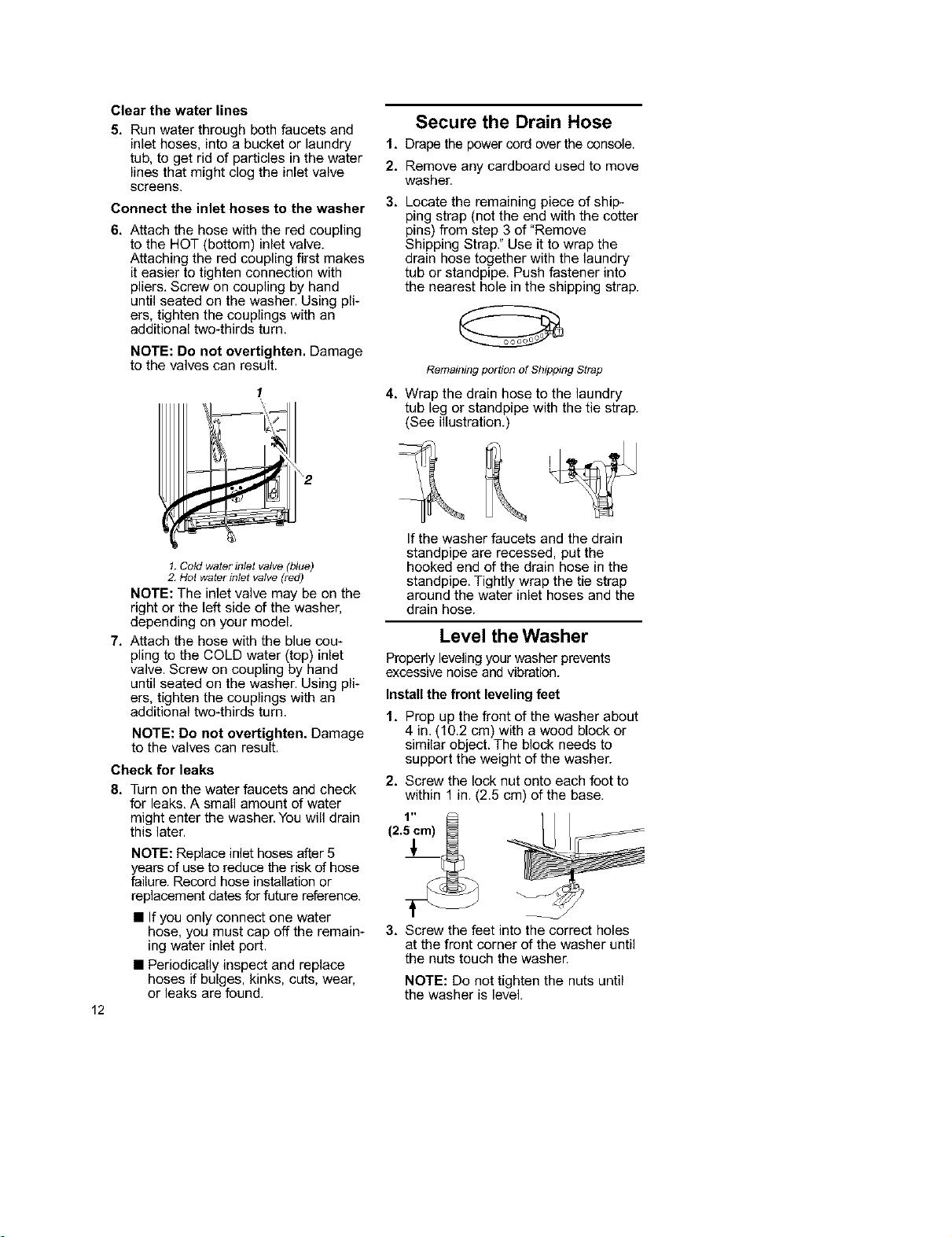
1
\
\2
1.Coldwater#getvalve(blue)
2.Hotwaterinletvalve(red)
NOTE: The inlet valve may be on the
right or the left side of the washer,
depending on your model.
7. Attach the hose with the blue cou-
pling to the COLD water (top) inlet
valve. Screw on coupling by hand
until seated on the washer. Using pli-
ers, tighten the couplings with an
additional two-thirds turn.
NOTE: Do not overtighten, Damage
to the valves can result.
Check forleaks
8, Turn on the water faucets and check
for leaks, A small amount of water
might enter the washer. You will drain
this later.
NOTE: Replace inlet hoses after 5
years of use to reduce the risk of hose
failure. Record hose installation or
replacement dates for future reference.
• If you only connect one water
hose, you must cap off the remain-
ing water inlet port.
• Periodically inspect and replace
hoses if bulges, kinks, cuts, wear,
or leaks are found.
1,
2.
3,
Secure the Drain Hose
Drape the power cord over the console.
Remove any cardboard used to move
washer.
Locate the remaining piece of ship-
ping strap (not the end with the cotter
pins) from step 3 of "Remove
Shipping Strap." Use it to wrap the
drain hose together with the laundry
tub or standpipe. Push fastener into
the nearest hole in the shipping strap.
Remaining portion of Shipping Strap
4, Wrap the drain hose to the laundry
tub leg or standpipe with the tie strap.
(See illustration.)
If the washer faucets and the drain
standpipe are recessed, put the
hooked end of the drain hose in the
standpipe. Tightly wrap the tie strap
around the water inlet hoses and the
drain hose.
Level the Washer
Properly levelingyour washerprevents
excessive noise and vibration.
Install the front leveling feet
1. Prop up the front of the washer about
4 in. (10.2 cm) with a wood block or
similar object. The block needs to
support the weight of the washer.
2. Screw the lock nut onto each foot to
within 1 in. (2.5 cm) of the base.
1 _
(2.5 cm)
1
3, Screw the feet into the correct holes
at the front corner of the washer until
the nuts touch the washen
NOTE: Do not tighten the nuts until
the washer is level.
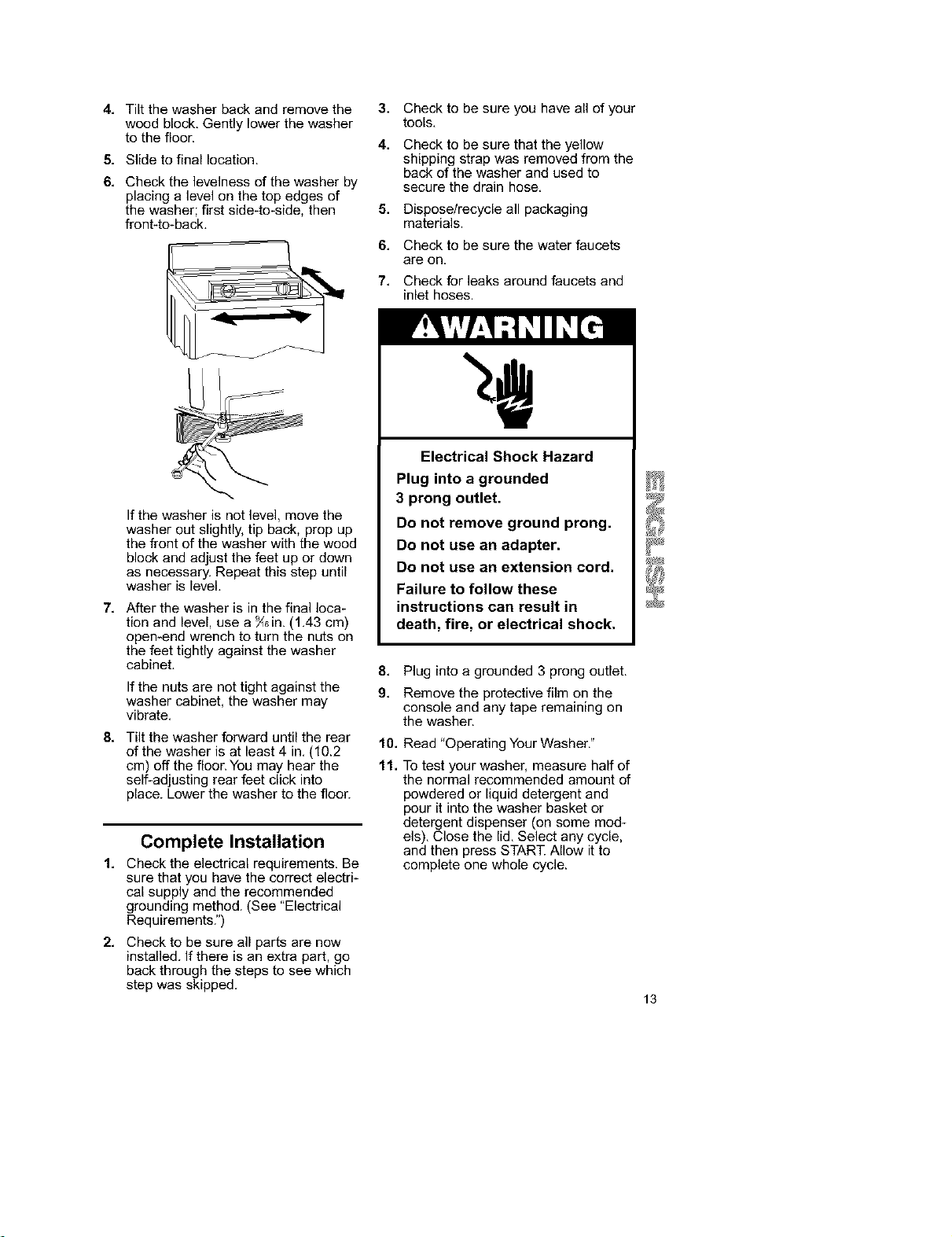
4, Tiltthewasherbackandremovethe 3,
woodblock,Gentlylowerthewasher
tothefloor. 4,
5. Slide to final location.
6. Check the levelness of the washer by
placing a level on the top edges of
the washer; first side4o-side, then
front4o-back.
5,
6,
7.
Check to be sure you have all of your
tools,
Checkto be sure thattheyellow
shipping _rap was removed from the
back of the washer and used to
secure the drain hose.
Dispose/recycle all packaging
materials.
Check to be sure the water faucets
are on,
Check for leaks around faucets and
inlet hoses.
Ifthe washer is not level, move the
washer out slightly, tip back, prop up
the front of the washer with the wood
block and adjust the feet up or down
as necessary. Repeat this step until
washer is level.
7. After the washer is in the final loca-
tion and level, use a _6in. (1.43 cm)
open-end wrench to turn the nuts on
the feet tightly against the washer
cabinet.
Ifthe nuts are not tight against the
washer cabinet, the washer may
vibrate.
8. Tilt the washer forward until the rear
of the washer is at least 4 in. (10.2
cm) off the floor. You may hear the
self-adjusting rear feet click into
place. Lower the washer to the floor.
Complete Installation
1. Check the electrical requirements. Be
sure that you have the correct electri-
cal supply and the recommended
grounding method. (See "Electrical
Requirements.")
2. Check to be sure all parts are now
installed. If there is an extra part, go
back through the steps to see which
step was skipped.
Electrical Shock Hazard
Plug into a grounded
3 prong outlet.
Do not remove ground prong.
Do not use an adapter.
Do not use an extension cord.
Failure to follow these
instructions can result in
death, fire, or electrical shock.
8,
9,
10.
11.
Plug into a grounded 3 prong outlet.
Remove the protective film on the
console and any tape remaining on
the washer.
Read "Operating Your Washer."
To test your washer, measure half of
the normal recommended amount of
powdered or liquid detergent and
pour it into the washer basket or
detergent dispenser (on some mod-
els). Close the lid. Select any cycle,
and then press START. Allow it to
complete one whole cycle.
13
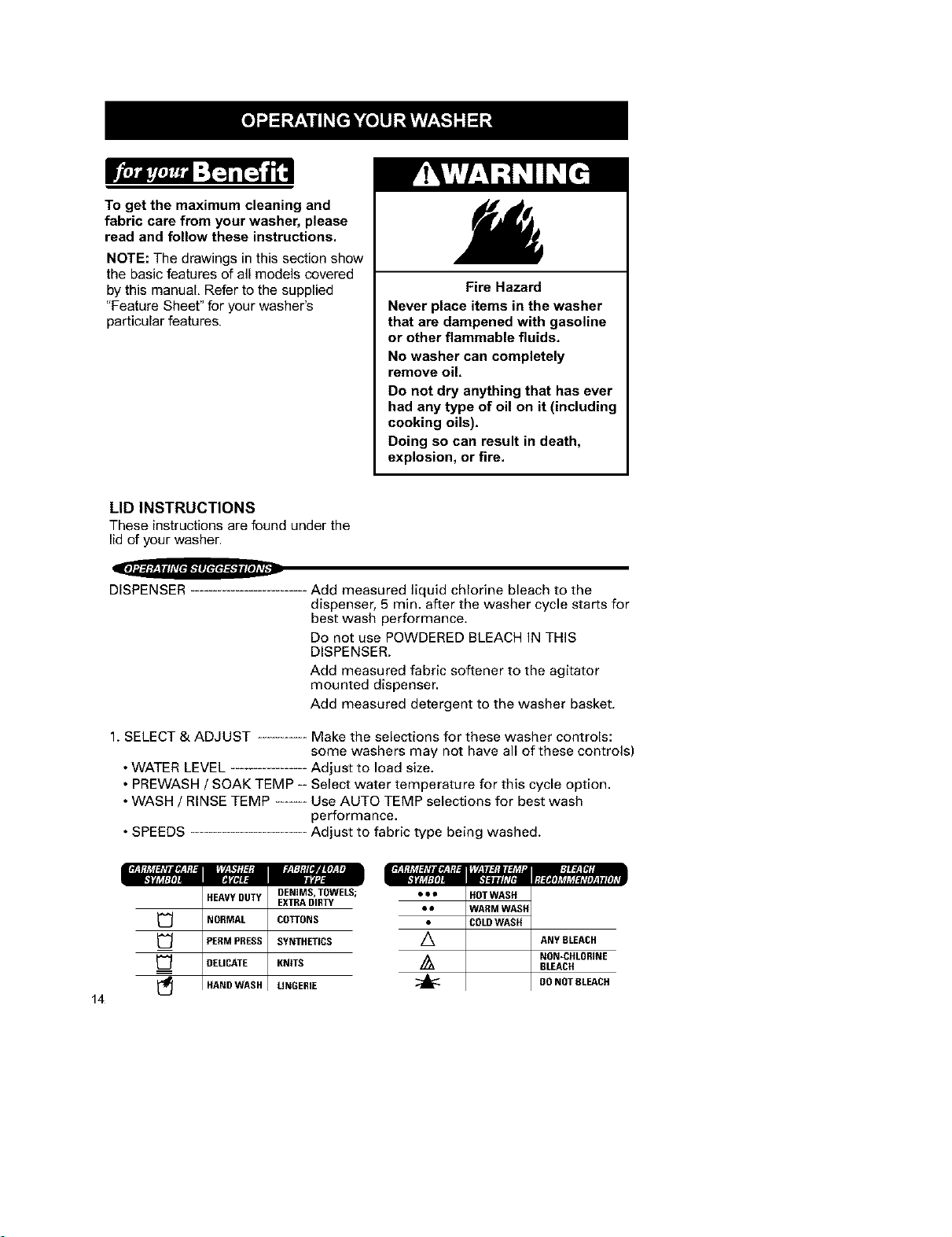
To get the maximum cleaning and
fabric care from your washer, please
read and follow these instructions.
NOTE: The drawings in this section show
the basic features of all models covered
by this manual, Refer to the supplied
"Feature Sheet" for your washer's
particular features.
Fire Hazard
Never place items in the washer
that are dampened with gasoline
or other flammable fluids.
No washer can completely
remove oil.
Do not dry anything that has ever
had any type of oil on it (including
cooking oils).
Doing so can result in death,
explosion, or fire.
LID INSTRUCTIONS
These instructions are found under the
lid of your washer.
;_:l_,_,E#livftl_,'.tl[€{€{.%_l[_
DISPENSER
Add measured liquid chlorine bleach to the
dispenser, 5 min. after the washer cycle starts for
best wash performance.
Do not use POWDERED BLEACH IN THIS
DISPENSER.
Add measured fabric softener to the agitator
mounted dispenser.
Add measured detergent to the washer basket.
1. SELECT & ADJUST ........... Make the selections for these washer controls:
some washers may not have all of these controls)
• WATER LEVEL Adjust to load size.
• PREWASH / SOAK TEMP -- Select water temperature for this cycle option.
• WASH / RINSE TEMP ....... Use AUTO TEMP selections for best wash
performance.
• SPEEDS Adjust to fabric type being washed.
r_ ll_P_ll ll_r_J_r_il
14
12_1 I'l
HEAVY DUTY DENIMS, TOWELS;
EXTRA DIRTY
'_ NORMAL COTTONS
] PEKM PRESS SYNTHETICS
DELICATE KNITS
HAND WASH UNGER]E
• • • HOTWASH
• • WARMWASH
COLDWASH
,/_ ANY SLEACH
NON-CHLORINE
BLEACH
DONOTSLEACH
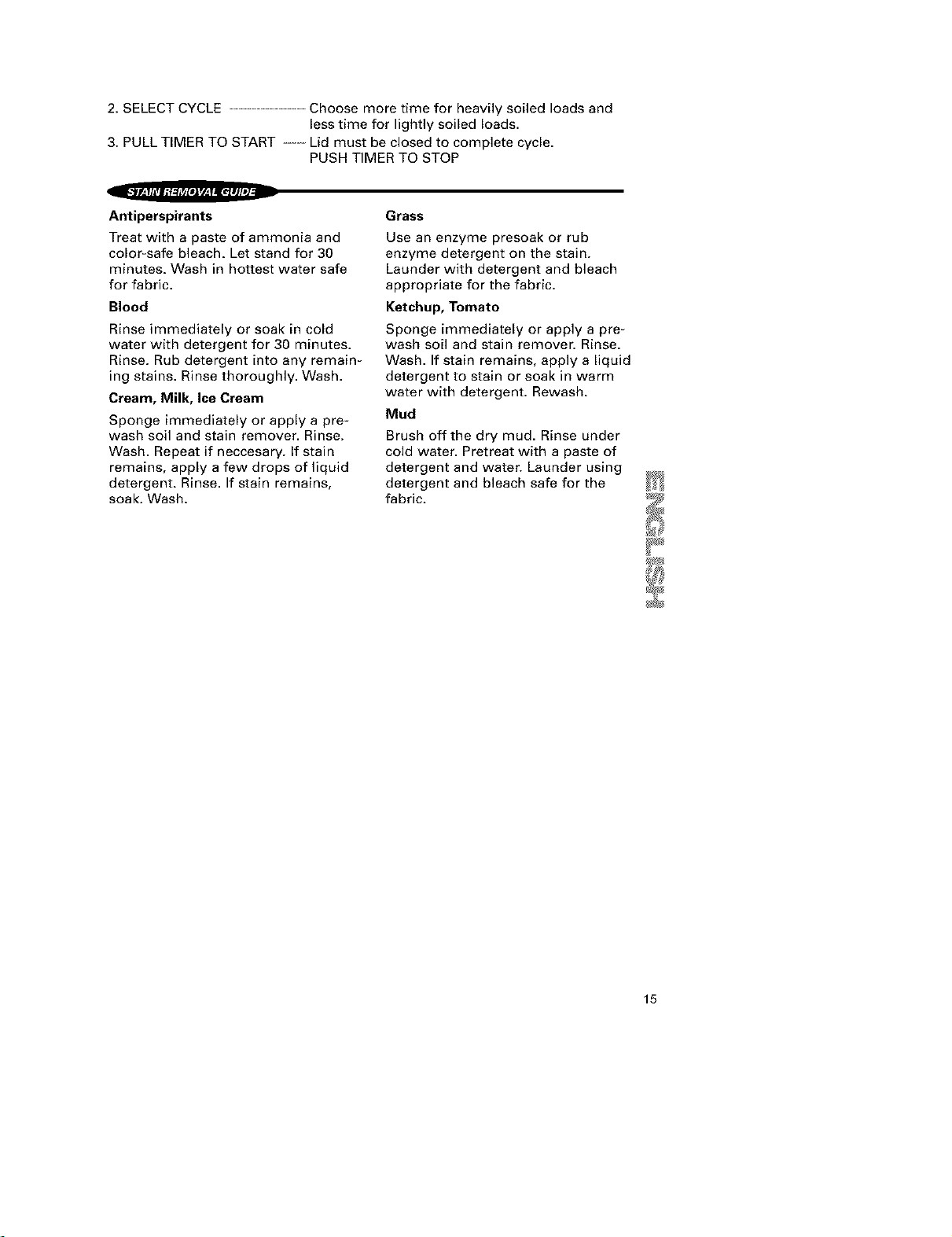
2. SELECT CYCLE Choose more time for heavily soiled loads and
less time for lightly soiled loads.
3. PULL TIMER TO START ..... Lid must be closed to complete cycle.
PUSH TIMER TO STOP
Antiperspirants Grass
Treat with a paste of ammonia and
color-safe bleach. Let stand for 30
minutes. Wash in hottest water safe
for fabric.
Blood
Rinse immediately or soak in cold
water with detergent for 30 minutes.
Rinse. Rub detergent into any remain-
ing stains. Rinse thoroughly. Wash.
Cream, Milk, Ice Cream
Sponge immediately or apply a pre-
wash soil and stain remover. Rinse.
Wash. Repeat if neccesary. If stain
remains, apply a few drops of liquid
detergent. Rinse. If stain remains,
soak. Wash.
Use an enzyme presoak or rub
enzyme detergent on the stain.
Launder with detergent and bleach
appropriate for the fabric.
Ketchup, Tomato
Sponge immediately or apply a pre-
wash soil and stain remover. Rinse.
Wash. If stain remains, apply a liquid
detergent to stain or soak in warm
water with detergent. Rewash.
Mud
Brush off the dry mud. Rinse under
cold water. Pretreat with a paste of
detergent and water. Launder using
detergent and bleach safe for the
fabric.
15
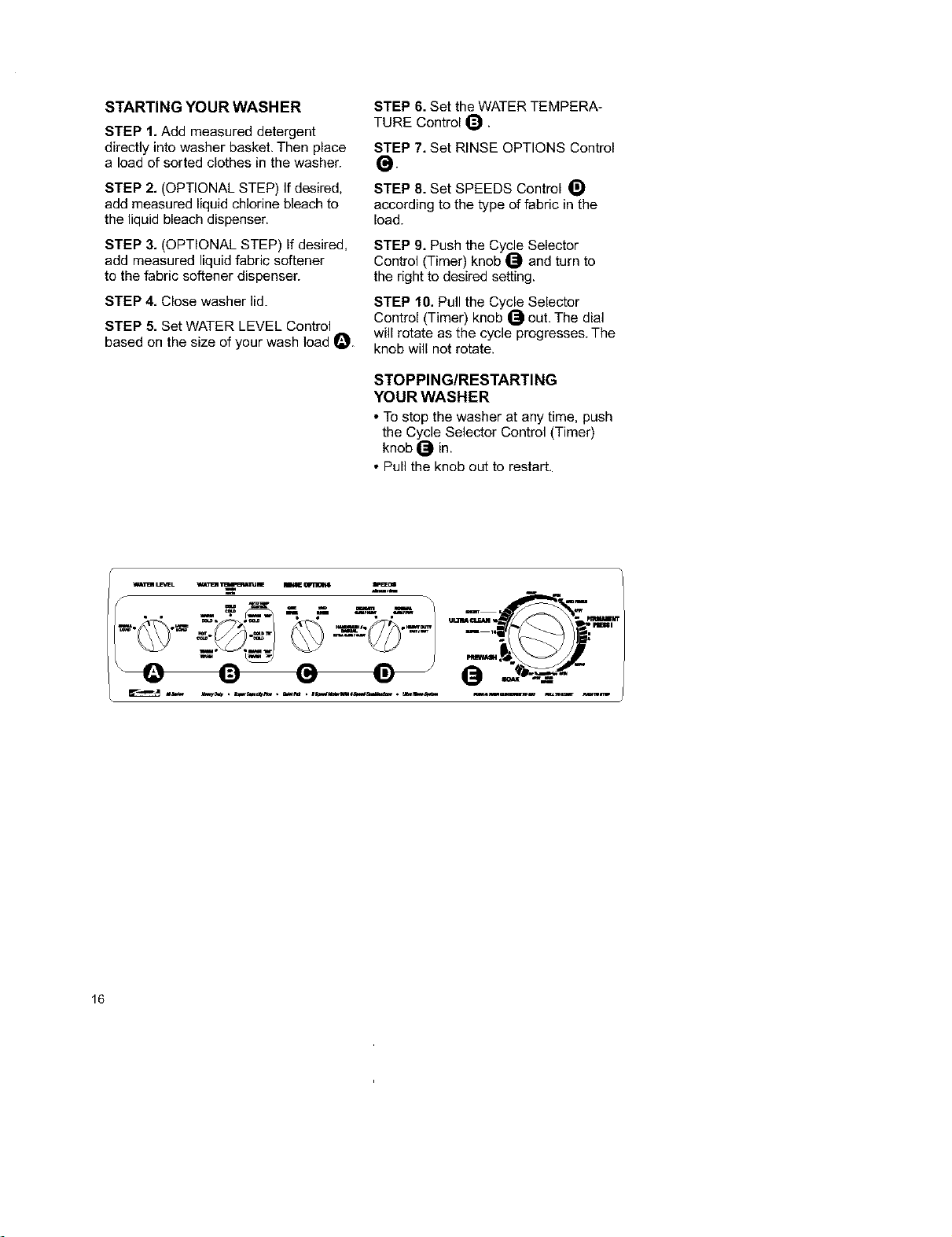
STARTING YOUR WASHER
STEP 1. Add measured detergent
directly into washer basket. Then place
a load of sorted clothes in the washer.
STEP 2. (OPTIONAL STEP) If desired,
add measured liquid chlorine bleach to
the liquid bleach dispenser.
STEP 3. (OPTIONAL STEP) If desired,
add measured liquid fabric softener
to the fabric softener dispenser.
STEP 4. Close washer lid.
STEP 5. Set WATER LEVEL Control
based on the size of your wash load O.
STEP 6. Set the WATER TEMPERA-
TURE Control _l
k
STEP 7. Set RINSE OPTIONS Control
STEP 8. Set SPEEDS Control
according to the type of fabric in the
load.
STEP 9. Push the Cycle Selector
Control (Timer) knob _ and turn to
the right to desired setting.
STEP 10. Pull the Cycle Selector
Control (Timer) knob _ out. The dial
will rotate as the cycle progresses. The
knob will not rotate.
STOPPING/RESTARTING
YOUR WASHER
• To stop the washer at any time, push
the Cycle Selector Control (Timer)
knob _ in.
• Pull the knob out to restart,
16
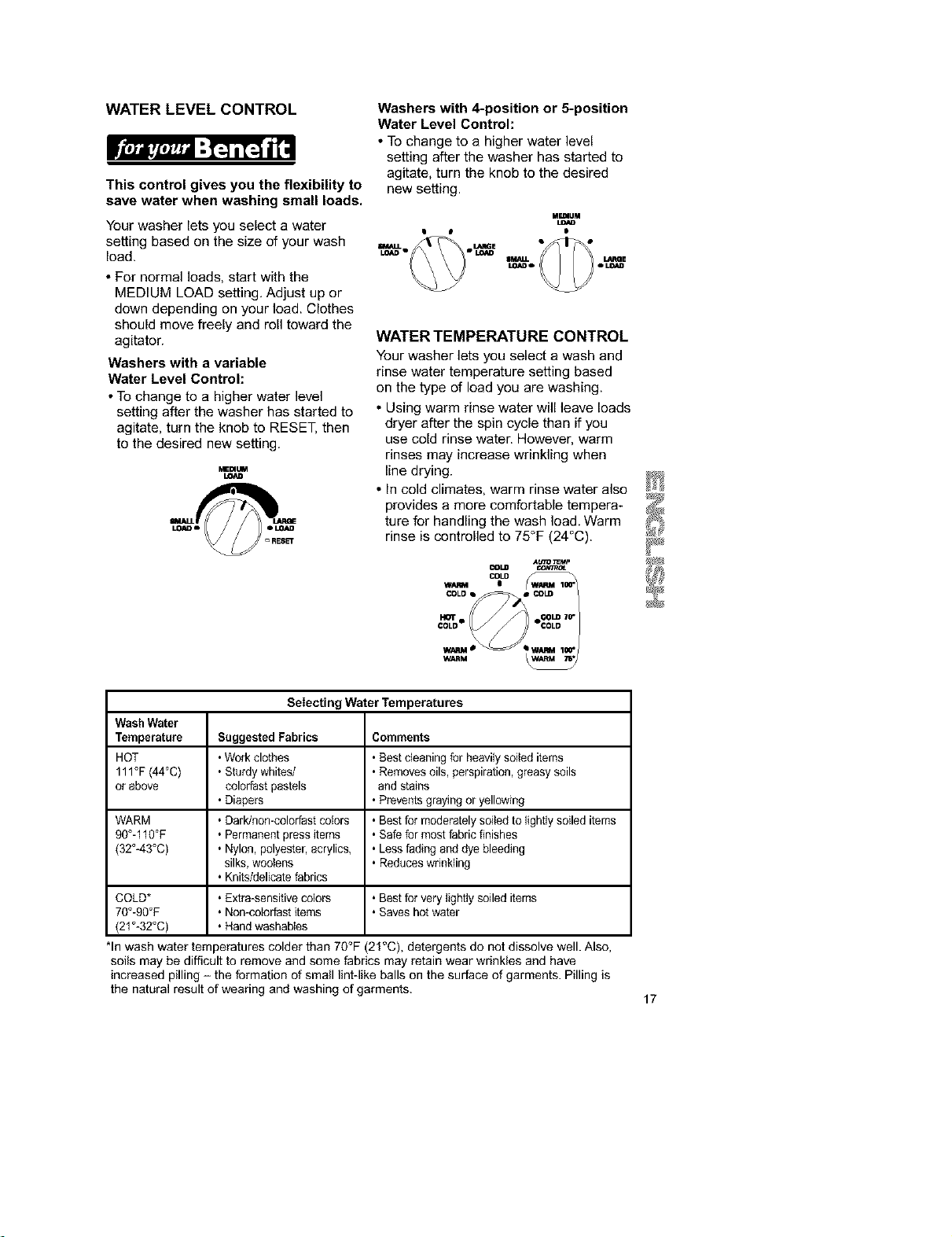
WATER LEVEL CONTROL
_seJaft*J_a :I_] a[_ [[a
This control gives you the flexibility to
save water when washing small loads.
Your washer lets you select a water
setting based on the size of your wash
load.
• For normal loads, start with the
MEDIUM LOAD setting, Adjust up or
down depending on your load. Clothes
should move freely and roll toward the
agitator.
Washers with a variable
Water Level Control:
• To change to a higher water level
setting after the washer has started to
agitate, turn the knob to RESET, then
to the desired new setting.
_MUM
Washers with 4-position or 5-position
Water Level Control:
• To change to a higher water level
setting after the washer has started to
agitate, turn the knob to the desired
new setting.
LOAD u mLGqD
|MM.L LAJtOE
LOADo oU_AD
WATER TEMPERATURE CONTROL
Your washer lets you select a wash and
rinse water temperature setting based
on the type of load you are washing.
• Using warm rinse water will leave loads
dryer after the spin cycle than if you
use cold rinse water. However, warm
rinses may increase wrinkling when
line drying
• In cold climates, warm rinse water also
provides a more comfortable tempera-
ture for handling the wash load. Warm
rinse is controlled to 75°F (24°C)
Ab'rO TeMe
COLD C,_9_.
WAAM COLD
COLD • • COLD
HOT COLD7o"
COLD ° eCOLD
Selecting Water Temperatures
WashWater
Temperature Suggested Fabrics Comments
HOT • Work clothes • Best cleaning for heavily soited items
111°F (44°C) • Sturdy whites/ • Removesoils, perspiration, greasy soils
or above colorfast pastels and stains
• Diapers • Preventsgraying or yellowing
WARM • Dark/non-colorfast colors • Best for moderately soiied to lightly soiled items
90°-110°F • Permanent press items • Safefor most fabric finishes
(32°-43°C) • Nylon, polyester, acrylics, • Less fading and dye bleeding
silks, woolens • Reduces wrinkling
• Knits/delicate fabrics
COLD* • Extra-sensitive colors • Best for very lightly soiled items
70°-90°F • Non-colorfast items • Saves hot water
(21°-32°C) • Hand washables
*In wash water temperatures colder than 70°F (21°0), detergents do not dissolve well. Also,
soils may be difficult to remove and some fabrics may retain wear wrinkles and have
increased pilling -the formation of small lint-like balls on the surface of garments Pilling is
the natural result of wearing and washing of garments.
17
AUTOMATIC TEMPERATURE
CONTROL (ATC)
ATC takes away the worry of
undissolved detergent and ensures
consistent cleaning results from
season to season with warm and
cold washes,
ATC electronically senses and maintains
a uniform water temperature by
regulating incoming hot and cold water.
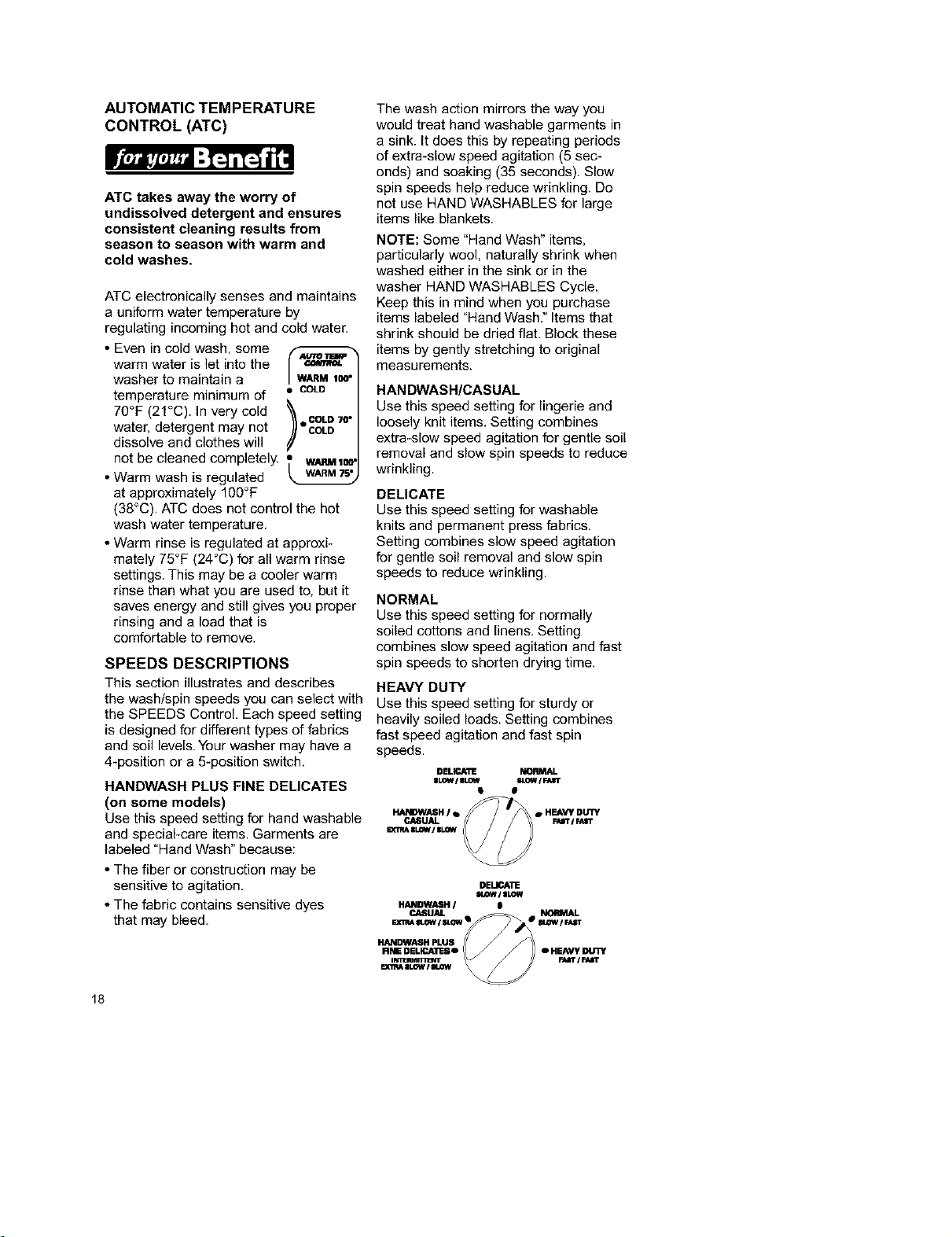
• Even in cold wash, some
warm water is let into the
washer to maintain a
temperature minimum of
70°F (21°C). In very cold
water, detergent may not
dissolve and clothes will
m
WARM 100"
COLD
l e COLD70"
COLD
not be cleaned completely. • w_l®
• Warm wash is regulated
at approximately 100°F
(38°C). ATC does not control the hot
wash water temperature.
• Warm rinse is regulated at approxi-
mately 75°F (24°C) for all warm rinse
settings. This may be a cooler warm
rinse than what you are used to, but it
saves energy and still gives you proper
rinsing and a load that is
comfortable to remove.
SPEEDS DESCRIPTIONS
This section illustrates and describes
the wash/spin speeds you can select with
the SPEEDS Control. Each speed setting
is designed for different types of fabrics
and soil levels. Your washer may have a
4-position or a 5-position switch.
HANDWASH PLUS FINE DELICATES
(on some models)
Use this speed setting for hand washable
and special-care items. Garments are
labeled "Hand Wash" because:
• The fiber or construction may be
sensitive to agitation.
• The fabric contains sensitive dyes
that may bleed.
The wash action mirrors the way you
would treat hand washable garments in
a sink. It does this by repeating periods
of extra-slow speed agitation (5 sec-
onds) and soaking (35 seconds). Slow
spin speeds help reduce wrinkling. Do
not use HAND WASHABLES for large
items like blankets.
NOTE: Some "Hand Wash" items,
particularly wool, naturally shrink when
washed either in the sink or in the
washer HAND WASHABLES Cycle.
Keep this in mind when you purchase
items labeled "Hand Wash." Items that
shrink should be dried flat. Block these
items by gently stretching to original
measurements.
HANDWASH/CASUAL
Use this speed setting for lingerie and
loosely knit items. Setting combines
extra-slow speed agitation for gentle soil
removal and slow spin speeds to reduce
wrinkling.
DELICATE
Use this speed setting for washable
knits and permanent press fabrics,
Setting combines slow speed agitation
for gentle soil removal and slow spin
speeds to reduce wrinkling.
NORMAL
Use this speed setting for normally
soiled cottons and linens. Setting
combines slow speed agitation and fast
spin speeds to shorten drying time.
HEAVY DUTY
Use this speed setting for sturdy or
heavily soiled loads. Setting combines
fast speed agitation and fast spin
speeds.
DELICA'i'IE NORMAL
HANDWASH I e
18
CYCLE SELECTOR (TIMER)
CONTROL
Use this control to choose the agitation
time and to start the washer.
• For heavy soil and sturdy fabrics,
use the full time.
• For light soil and delicate fabrics,
use less time.
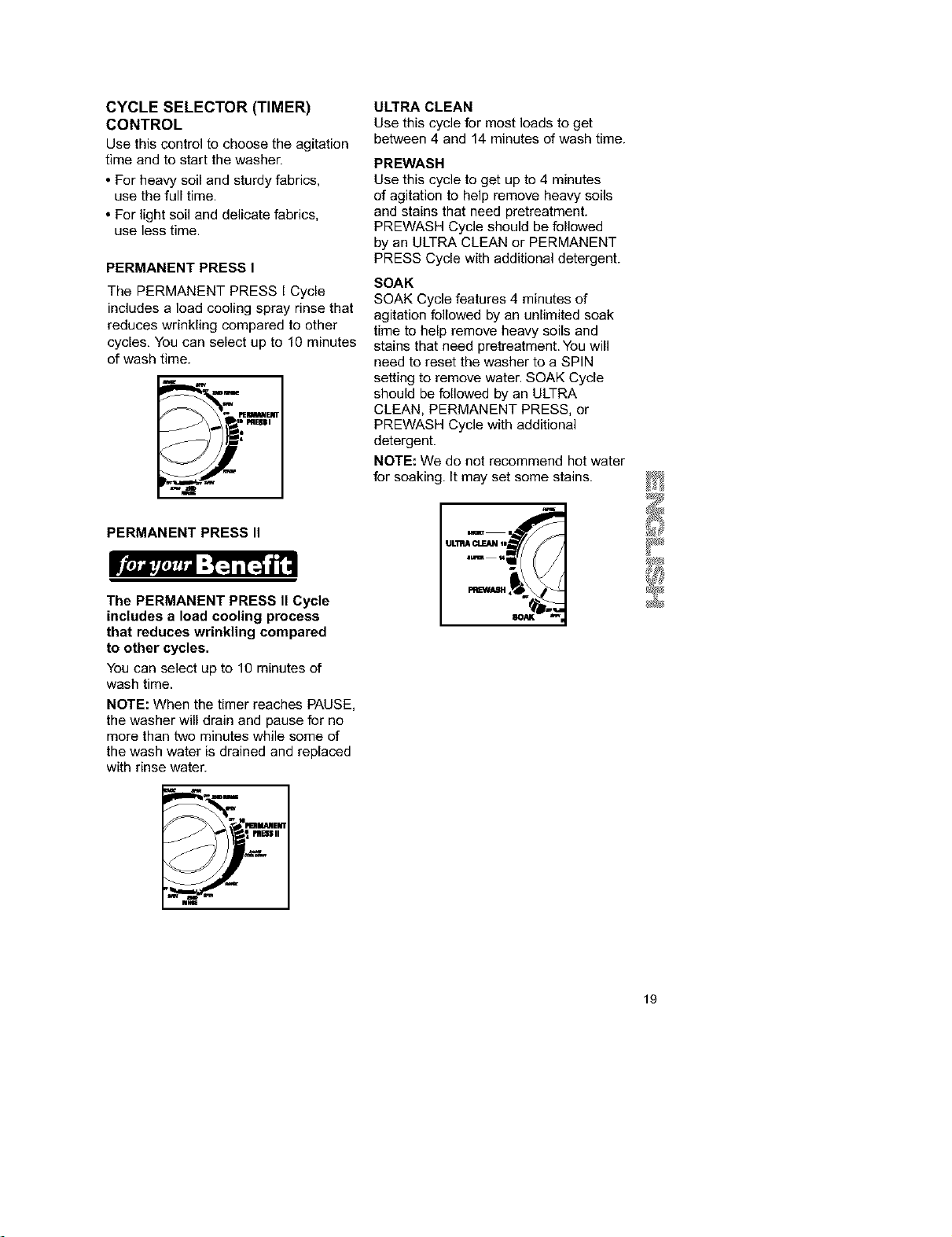
PERMANENT PRESSI
The PERMANENT PRESS I Cycle
includes a load cooling spray rinse that
reduces wrinkling compared to other
cycles. You can select up to 10 minutes
of wash time.
ULTRA CLEAN
Use this cycle for most loads to get
between 4 and 14 minutes of wash time.
PREWASH
Use this cycle to get up to 4 minutes
of agitation to help remove heavy soils
and stains that need pretreatment.
PREWASH Cycle should be followed
by an ULTRA CLEAN or PERMANENT
PRESS Cycle with additional detergent.
SOAK
SOAK Cycle features 4 minutes of
agitation followed by an unlimited soak
time to help remove heavy soils and
stains that need pretreatment. You will
need to reset the washer to a SPIN
setting to remove water. SOAK Cycle
should be followed by an ULTRA
CLEAN, PERMANENT PRESS, or
PREWASH Cycle with additional
detergent.
NOTE: We do not recommend hot water
for soaking. It may set some stains.
PERMANENT PRESSII
The PERMANENT PRESS II Cycle
includes a load cooling process
that reduces wrinkling compared
to other cycles.
You can select up to 10 minutes of
wash time.
NOTE: When the timer reaches PAUSE,
the washer will drain and pause for no
more than two minutes while some of
the wash water is drained and replaced
with rinse water.
19
RINSE OPTIONS CONTROL
A second rinse will remove more
detergent residue. It is especially
beneficial if extra detergent has been
used to remove heavy soils.
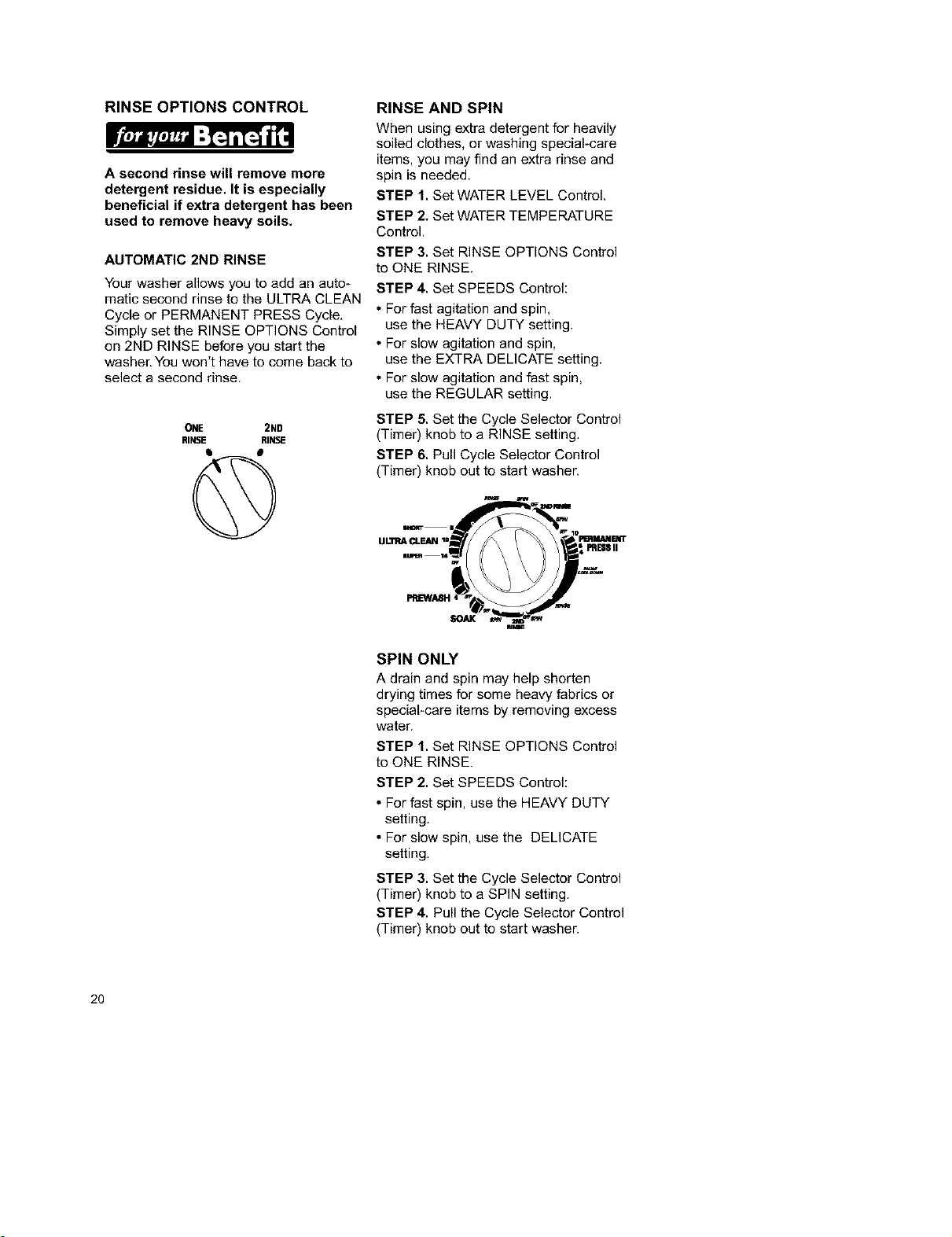
AUTOMATIC 2ND RINSE
Your washer allows you to add an auto-
matic second rinse to the ULTRA CLEAN
Cycle or PERMANENT PRESS Cycle,
Simply set the RINSE OPTIONS Control
on 2ND RINSE before you start the
washer. You won't have to come back to
select a second rinse.
ONE 2ND
RINSE RINSE
©
RINSE AND SPIN
When using extra detergent for heavily
soiled clothes, or washing special-care
items, you may find an extra rinse and
spin is needed.
STEP 1. Set WATER LEVEL Control.
STEP 2. Set WATER TEMPERATURE
Control.
STEP 3. Set RINSE OPTIONS Control
to ONE RINSE.
STEP 4. Set SPEEDS Control:
• For fast agitation and spin,
use the HEAVY DUTY setting.
• For slow agitation and spin,
use the EXTRA DELICATE setting.
• For slow agitation and fast spin,
use the REGULAR setting.
STEP 5. Set the Cycle Selector Control
(Timer) knob to a RINSE setting.
STEP 6. Pull Cycle Selector Control
(Timer) knob out to start washer.
PRESRII
SPIN ONLY
A drain and spin may help shorten
drying times for some heavy fabrics or
special-care items by removing excess
water.
STEP 1. Set RINSE OPTIONS Control
to ONE RINSE.
STEP 2. Set SPEEDS Control:
• For fast spin, use the HEAVY DUTY
setting,
• For slow spin, use the DELICATE
setting.
STEP 3. Set the Cycle Selector Control
(Timer) knob to a SPIN setting.
STEP 4. Pull the Cycle Selector Control
(Timer) knob out to start washer.
2O
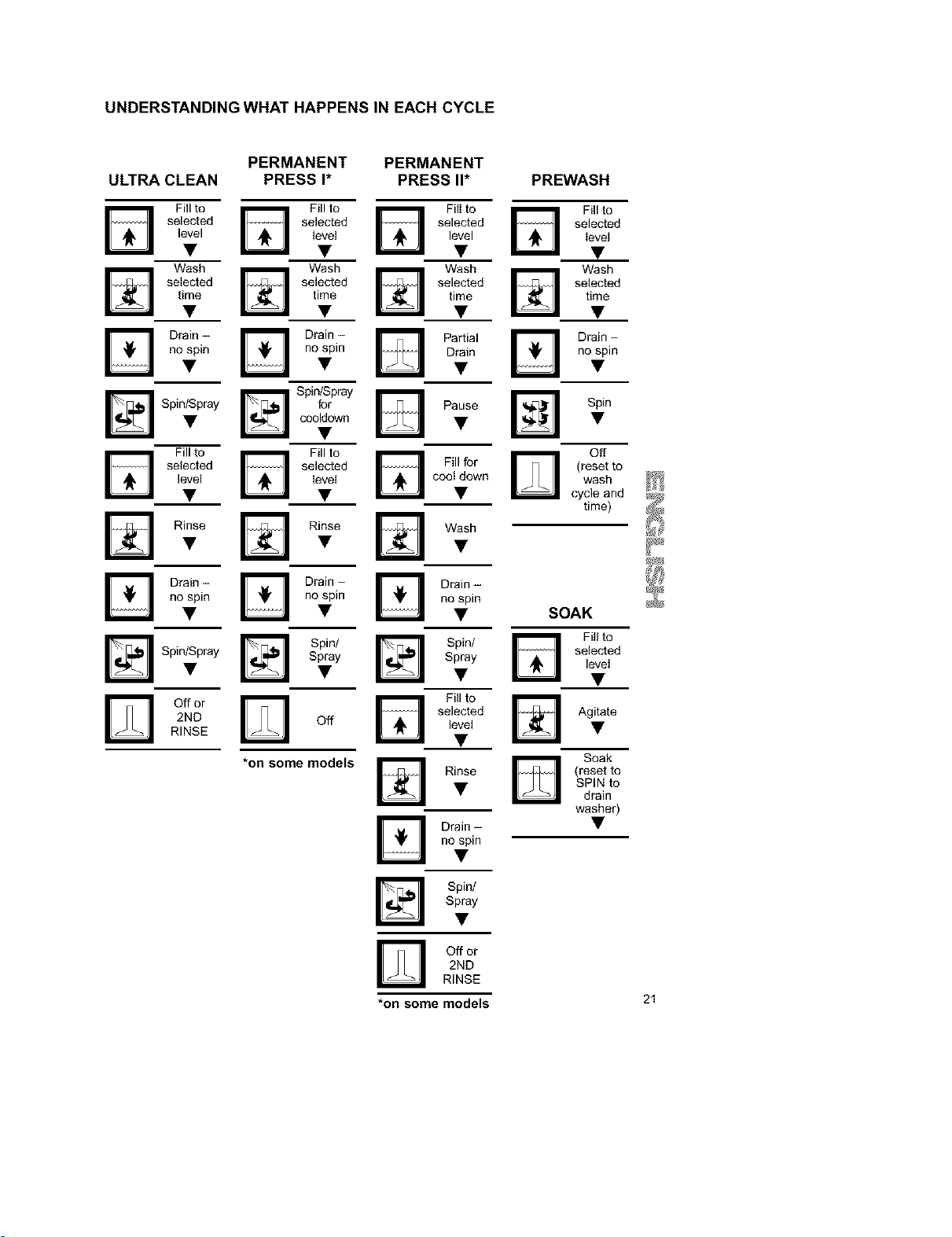
UNDERSTANDING WHAT HAPPENS IN EACH CYCLE
ULTRA CLEAN
PERMANENT PERMANENT
PRESSI* PRESSII* PREWASH
Fill to _ Fill to _ FilI to
selected selected selected
level level level
Wash Wash Wash
selected selected selected
time time time
_ rain- _ Drain-
no spin no spin
Spin/Spray
Partial
Drain
Pause
Spin/Spray
for
cooldown
Fill to
selected
level
_ Fillto _
selected Fill for
level cool down
Rinse Rinse Wash
Fill to
_iselected
Wash
selected
time
_ rain -
no spin
Spin
Off
(reset to
wash
cycle and
time)
Drain- _ Drain- _ Drain-
no spin nospin no spin
• • • SOAK
Spin/Spray
Spin/
Spray
Off or
2ND Off
RINSE
*on some models
Spin/ _ Fill to
Spray W selected
level
Fill to
selected Agitate
level •
Soak
Rinse (reset to
SPIN to
• drain
washer)
Drain - •
no spin
Spin/
Spray
Off or
2ND
RINSE
*on some models
21
QUIET PAKTM
The QUIET PAKTM System is designed to
reduce water sounds and ringing noises.
The cabinet is insulated with sound-
dampening material for better
vibration and sound-dampening
characteristics.
QUIET PAKTM II
(on some models)
The QUIET PAKTM II System is designed
to reduce water sounds and ringing
noises, The cabinet is insulated with
three sound-dampening materials for
superior vibration and sound-dampening
characteristics.
DUAL ACTION TM PLUS OR
TRIPLE ACTION TM AGITATOR
The best cleaning action in your
washer takes place at the bottom
where the agitator vanes move back
and forth to flex the fabric, loosening
the soil.
To get all your clothes down to the
bottom of the washer, the upper portion
of the agitator has uniquely designed,
spiral vanes to help push the clothes
that are on top down to the bottom,
This spiraling action displaces the
clothes that are on the bottom with a
"roll-over" motion.
TRIPLE ACTION TM agitator gives you
the most flexible fabric care for even
your largest loads.
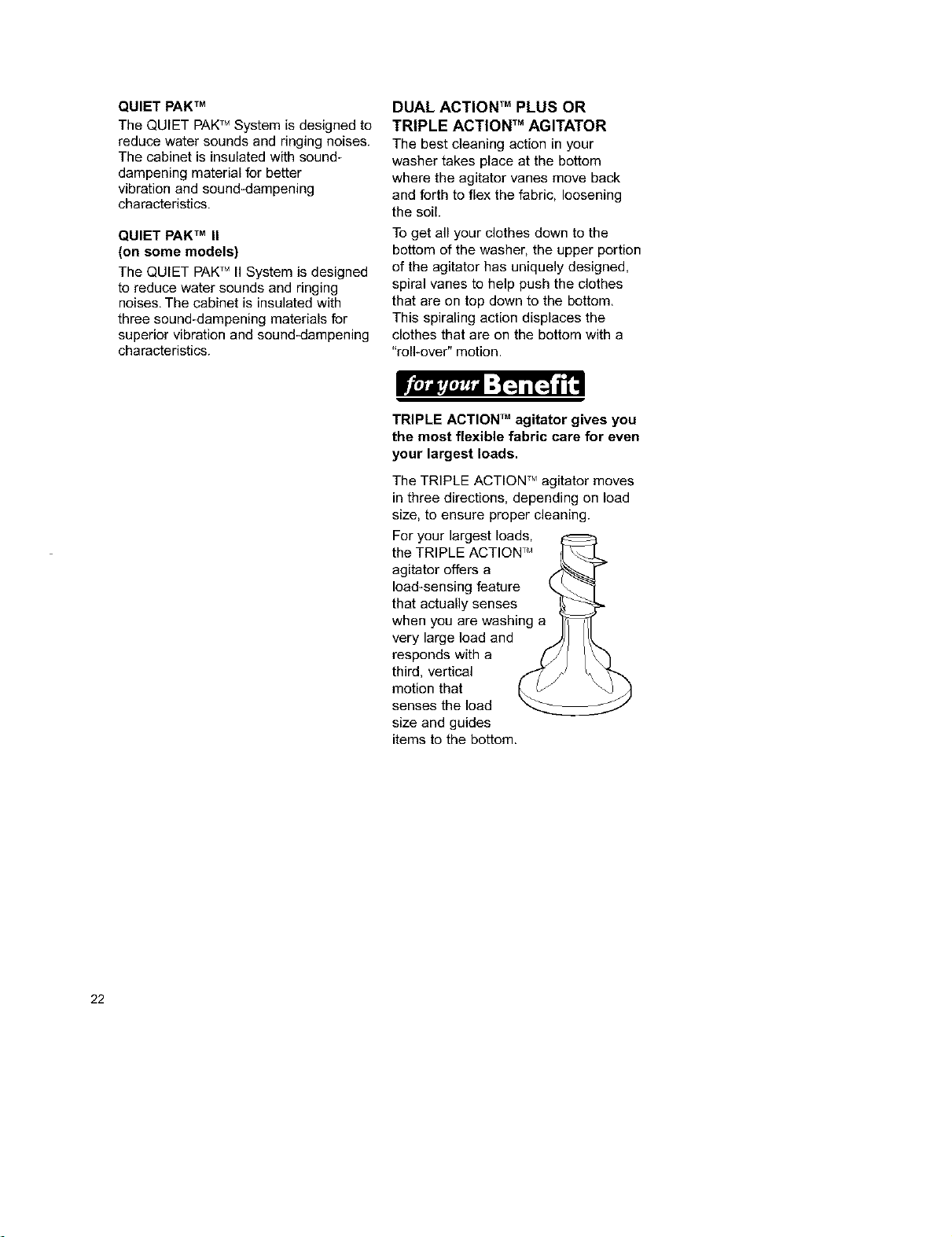
The TRIPLE ACTION TM agitator moves
in three directions, depending on load
size, to ensure proper cleaning.
For your largest loads,
the TRIPLE ACTION TM
agitator offers a
load-sensing feature
that actually senses
when you are washing a
very large load and
responds with a
third, vertical
motion that
senses the load
size and guides
items to the bottom.
22
UNDERSTANDING NORMAL
WASHER SOUNDS
Your new washer may make sounds
that your old one did not. Because the
sounds are unfamiliar, you may be
concerned about them.
The following describes some of the
normal sounds you may hear and what
causes them.
During Washing
When you select a small load size
setting for a small wash load, your wash-
er has a lower water level. With this
lower water level, you may hear a click-
ing sound from the upper portion of the
agitator.
During Drain
The rate that water is drained from your
washer depends on your installation. If
water is drained quickly from the washer,
you may hear air being pulled through
the pump. This happens during the end
of draining.
After Drain and Before Spin
When the cycle changes from draining
to spinning, you may hear a noise as the
gearcase shifts.
USING THE LIQUID CHLORINE
BLEACH DISPENSER
Automatically dilutes bleach to
ensure the cleanest and brightest
loads.
Always measure liquid chlorine
bleach. Use a measuring cup, do not
guess. Do not pour directly from bottle.
Never use more than 1 cup (250 mL) for
a full load. Use less with smaller loads.
Follow manufacturer's directions for safe
use. A cup with a pouring spout will help
you avoid spilling.
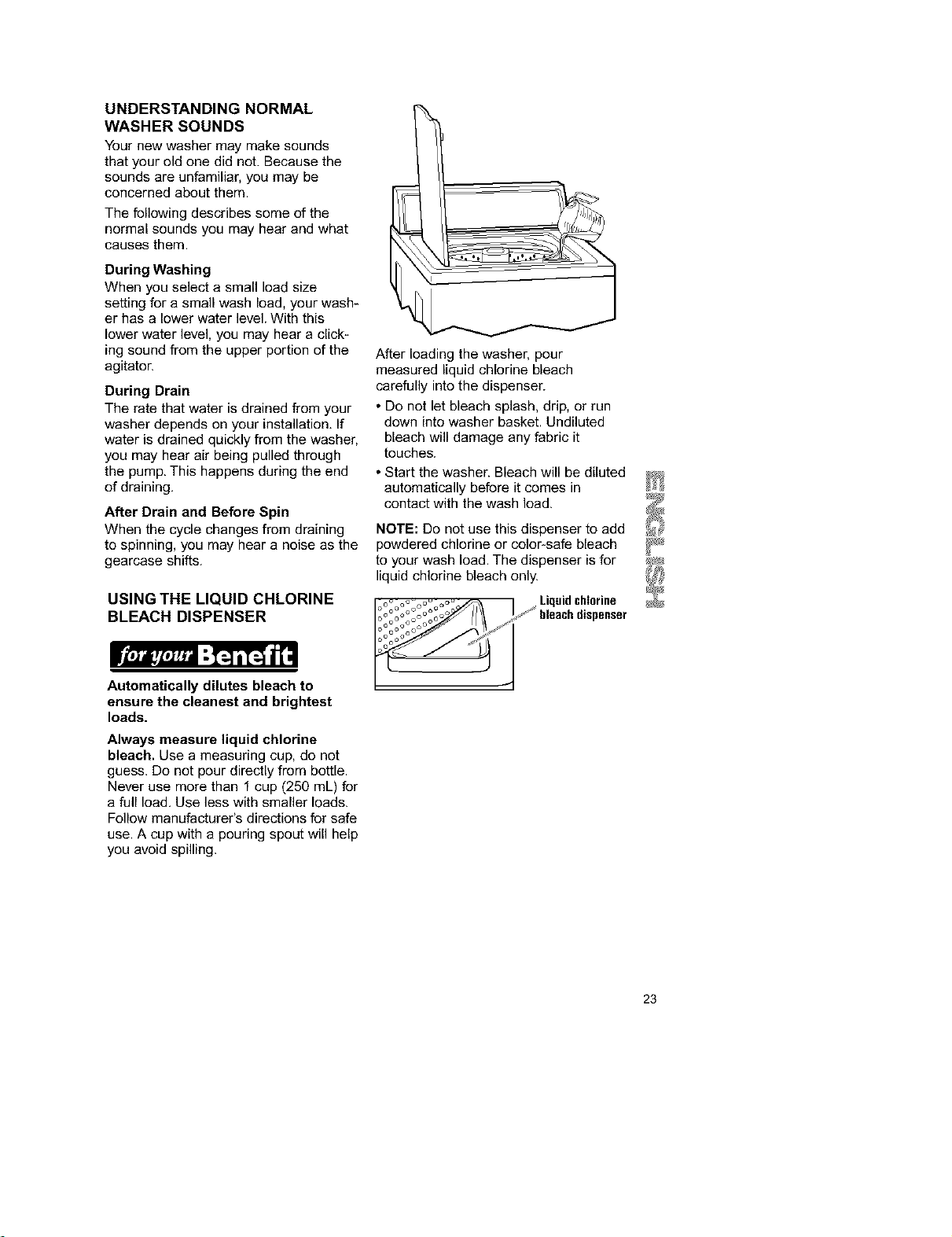
After loading the washer, pour
measured liquid chlorine bleach
carefully into the dispenser.
• Do not let bleach splash, drip, or run
down into washer basket. Undiluted
bleach will damage any fabric it
touches.
• Start the washer. Bleach will be diluted
automatically before it comes in
contact with the wash load.
NOTE: Do not use this dispenser to add
powdered chlorine or color-safe bleach
to your wash load. The dispenser is for
liquid chlorine bleach only.
I o_ oOoo_oO__/_, I Liquidchlorine
°o °o oo o o I S .
O°oO°oOo_/l/\ ;z/ bleachdispenser
IoOooO°oO_ .A/I j' I
23
USING THE LIQUID FABRIC
SOFTENER DISPENSER
After loading the washer, measure and
add the recommended amount of fabric
softener into the dispenser. Follow
manufacturer's directions.
NOTE: Pouring too much fabric softener
into the dispenser will cause the fabric
softener to dispense instantly into the
load due to siphoning action. This instant
"dump" could damage fabrics and will
make it appear that your dispenser is not
working correctly.
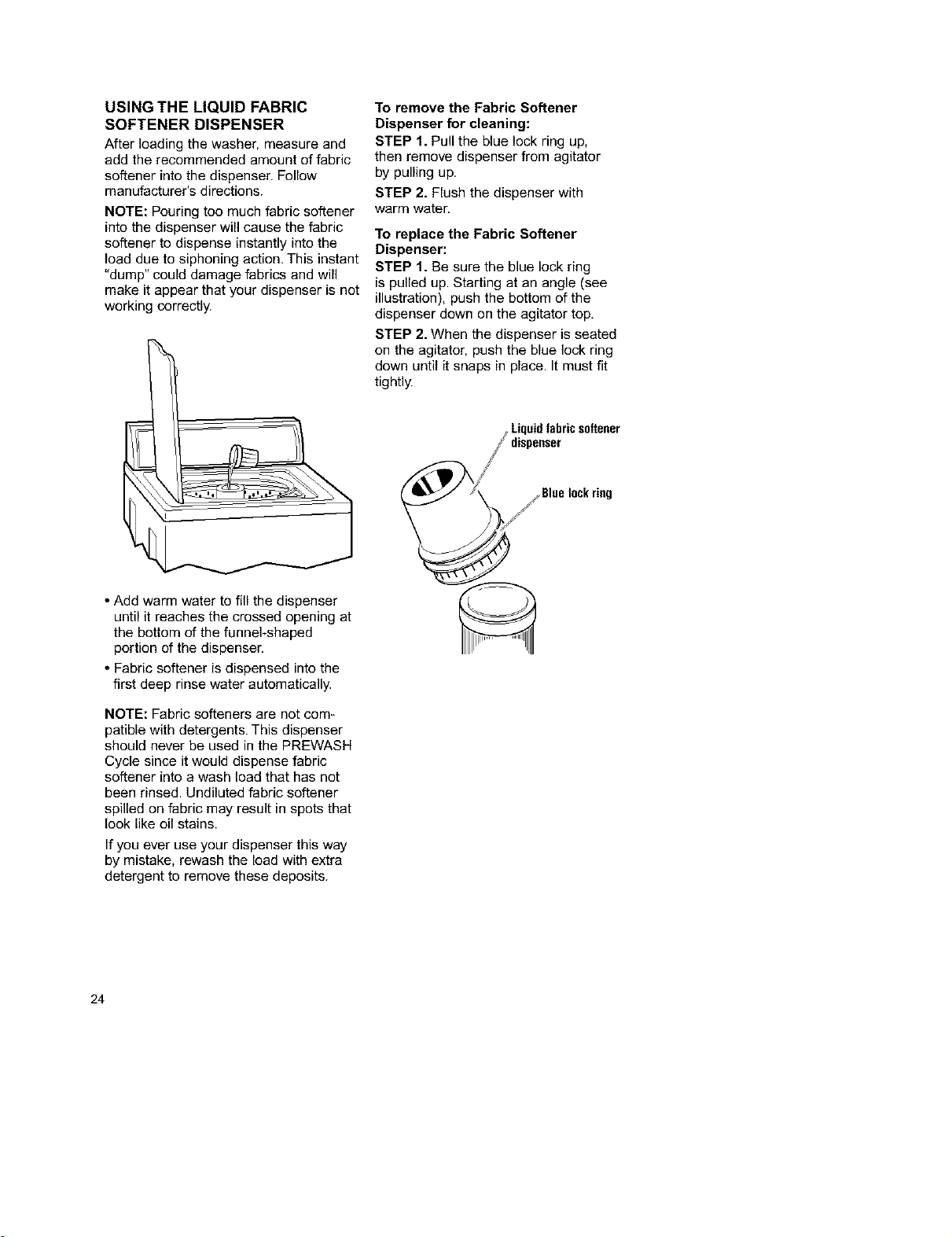
To remove the Fabric Softener
Dispenser for cleaning:
STEP 1. Pull the blue lock ring up,
then remove dispenser from agitator
by pulling up.
STEP 2. Flush the dispenser with
warm water.
To replace the Fabric Softener
Dispenser:
STEP 1. Be sure the blue lock ring
is pulled up. Starting at an angle (see
illustration), push the bottom of the
dispenser down on the agitator top,
STEP 2. When the dispenser is seated
on the agitator, push the blue lock ring
down until it snaps in place. It must fit
tightly.
Bluelockring
• Add warm water to fill the dispenser
until it reaches the crossed opening at
the bottom of the funnel-shaped
portion of the dispenser,
• Fabric softener is dispensed into the
first deep rinse water automatically.
NOTE: Fabric softeners are not com_
patible with detergents. This dispenser
should never be used in the PREWASH
Cycle since it would dispense fabric
softener into a wash load that has not
been rinsed. Undiluted fabric softener
spilled on fabric may result in spots that
look like oil stains.
If you ever use your dispenser this way
by mistake, rewash the load with extra
detergent to remove these deposits.
24
PREPARING CLOTHES
FOR WASHING
Follow these recommendations
to help you prolong the life of
your garments.
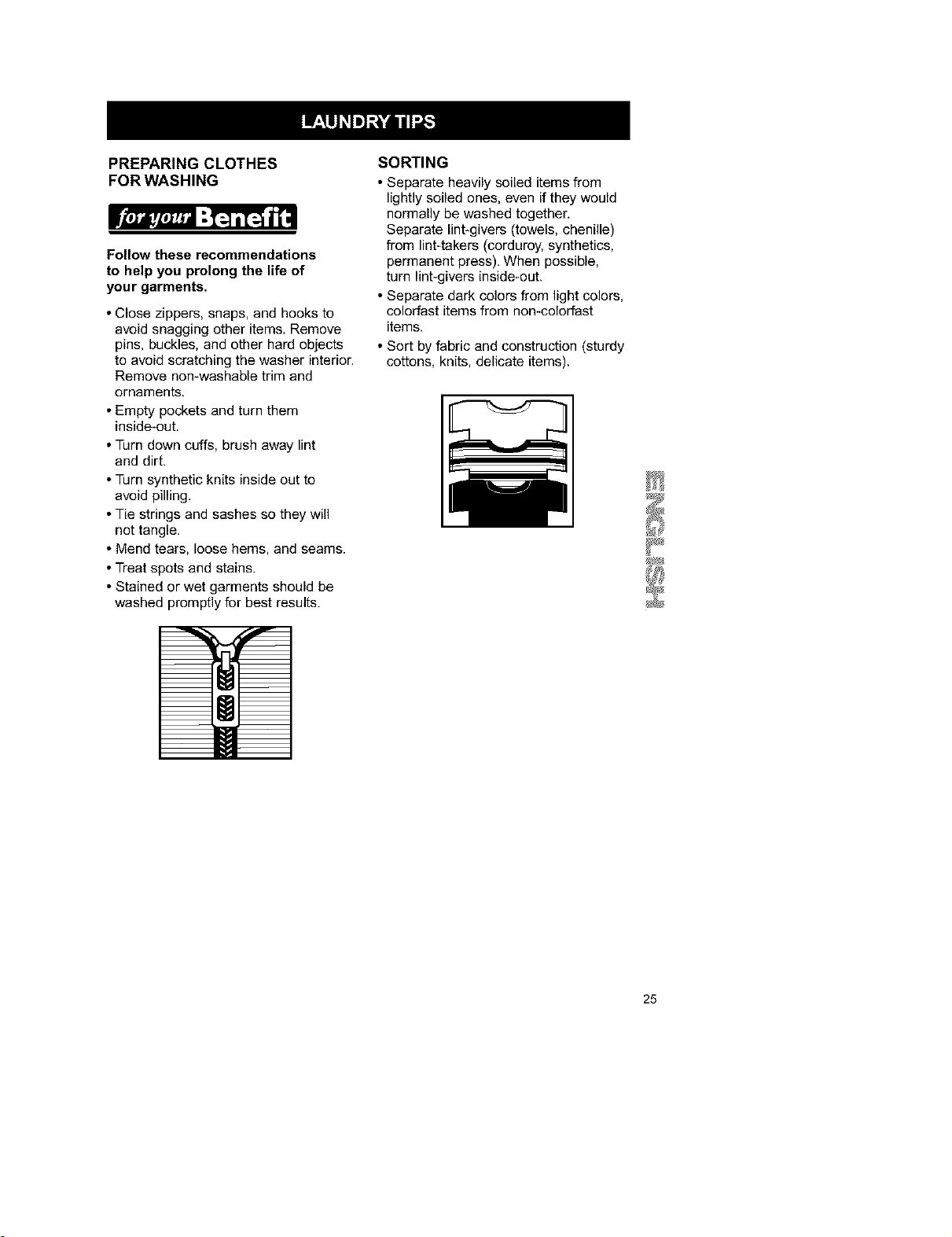
• Close zippers, snaps, and hooks to
avoid snagging other items. Remove
pins, buckles, and other hard objects
to avoid scratching the washer interior.
Remove non-washable trim and
ornaments.
• Empty pockets and turn them
inside-out.
• Turn down cuffs, brush away lint
and dirt.
• Turn synthetic knits inside out to
avoid pilling.
• Tie strings and sashes so they will
not tangle.
• Mend tears, loose hems, and seams.
• Treat spots and stains.
• Stained or wet garments should be
washed promptly for best results.
SORTING
• Separate heavily soiled items from
lightlysoiled ones, even if they would
normally be washed together.
Separate lint-givers (towels, chenille)
from lint4akers (corduroy, synthetics,
permanent press). When possible,
turn lint-givers inside-out.
• Separate dark colors from light colors,
colorfast items from non-colorfast
items.
•Sort by fabric and construction (sturdy
cottons, knits, delicate items).
25
LOADING
Ir _'j_itm_l ;[q i[q I'["
Proper loading of your washer
contributes to proper cleaning and
fabric care and reduces machine
noise.
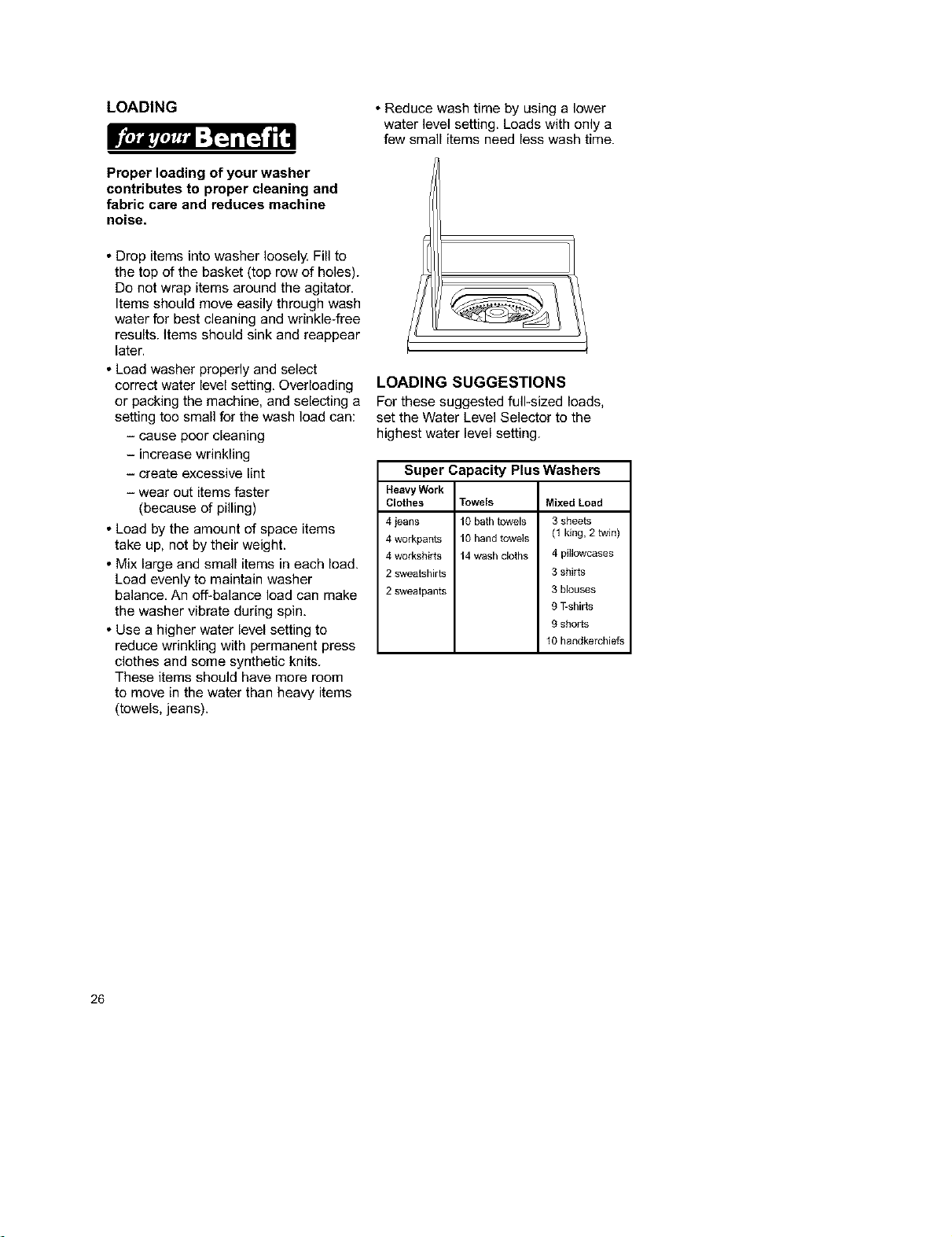
• Drop items into washer loosely, Fill to
the top of the basket (top row of holes).
Do not wrap items around the agitator,
Items should move easily through wash
water for best cleaning and wrinkle4ree
results. Items should sink and reappear
later.
• Load washer properly and select
correct water level setting, Overloading
or packing the machine, and selecting a
setting too small for the wash load can:
- cause poor cleaning
- increase wrinkling
- create excessive lint
- wear out items faster
(because of pilling)
• Load by the amount of space items
take up, not by their weight.
• Mix large and small items in each load.
Load evenly to maintain washer
balance, An off-balance load can make
the washer vibrate during spin,
• Use a higher water level setting to
reduce wrinkling with permanent press
clothes and some synthetic knits.
These items should have more room
to move in the water than heavy items
(towels, jeans).
• Reduce wash time by using a lower
water level setting. Loads with only a
few small items need less wash time.
LOADING SUGGESTIONS
For these suggested full-sized loads,
set the Water Level Selector to the
highest water level setting.
Super Capacity Plus Washers
Heavy Work
Clothes
4 jeans
4 workpants
4 workshirts
2 sweatshirts
2 sweatpants
Towels Mixed Load
10 bath towels 3 sheets
10 hand towels (1 king, 2 twin)
14 wash cloths 4 pillowcases
3 shirts
3 blouses
9 T-shirts
9 shorts
10 handkerchiefs
26
CLEANING YOURWASHER
Proper care of your washer can extend
its life. This section explains how to care
for your washer properly.
Exterior
Wipe up detergent, bleach, and other
spills with a soft, damp cloth or sponge
as they occur. Occasionally wipe the out-
side of the washer to keep it looking like
new.
Do not put sharp or metal objects in your
washer. They can damage the finish.
Check all pockets for pins, clips, money,
bolts, nuts, etc. Do not lay these objects
on your washer after emptying pockets.
Interior
Clean interior with 1 cup (250 mL) of
chlorine bleach mixed with 2 cups (500
mL) of detergent. Run washer through a
complete cycle using hot water. Repeat
process if necessary.
NOTE: Remove hard water deposits
using only cleaners labeled as washer
safe.
Water Inlet Hoses
Replace inlet hoses after five years of
use to reduce the risk of hose failure.
Periodically inspect and replace inlet
hoses if bulges, kinks, cuts, wear or
leaks are found. When replacing your
inlet hoses, mark the date of replace-
ment on the label with a permanent
marker.
WINTER STORAGE
OR MOVING CARE
Install and store your washer where it
will not freeze. Because some water
may stay in the hoses and pump,
freezing can damage your washer. If
storing or moving your washer during
freezing weather, winterize it.
To winterize washer:
1. Shut off both water faucets,
2. Disconnect and drain water inlet
hoses.
3. Put 1 qt (1 L) of R.V.-type antifreeze
in the basket.
4. Run washer on a SPIN setting for
about 30 seconds to mix the
anti-freeze and water. Some of the
mixture will pump out while the
washer spins.
5. Unplug washer or disconnect power.
To use washer again:
1. Flush water pipes and hoses.
2. Reconnect water inlet hoses.
3. Turn on both water faucets.
4. Plug in washer or reconnect power.
5. Run the washer through a complete
cycle with 1 cup (250 mL) of
detergent to clean out antifreeze.
NON-USE OR VACATION CARE
Operate your washer only when you
are at home. If you will be on vacation or
not using your washer for an
extended period of time, you should:
• Unplug washer or disconnect power.
• Turn off the water supply to the
washer. This helps avoid accidental
flooding (due to a water pressure
surge) while you are away.
27
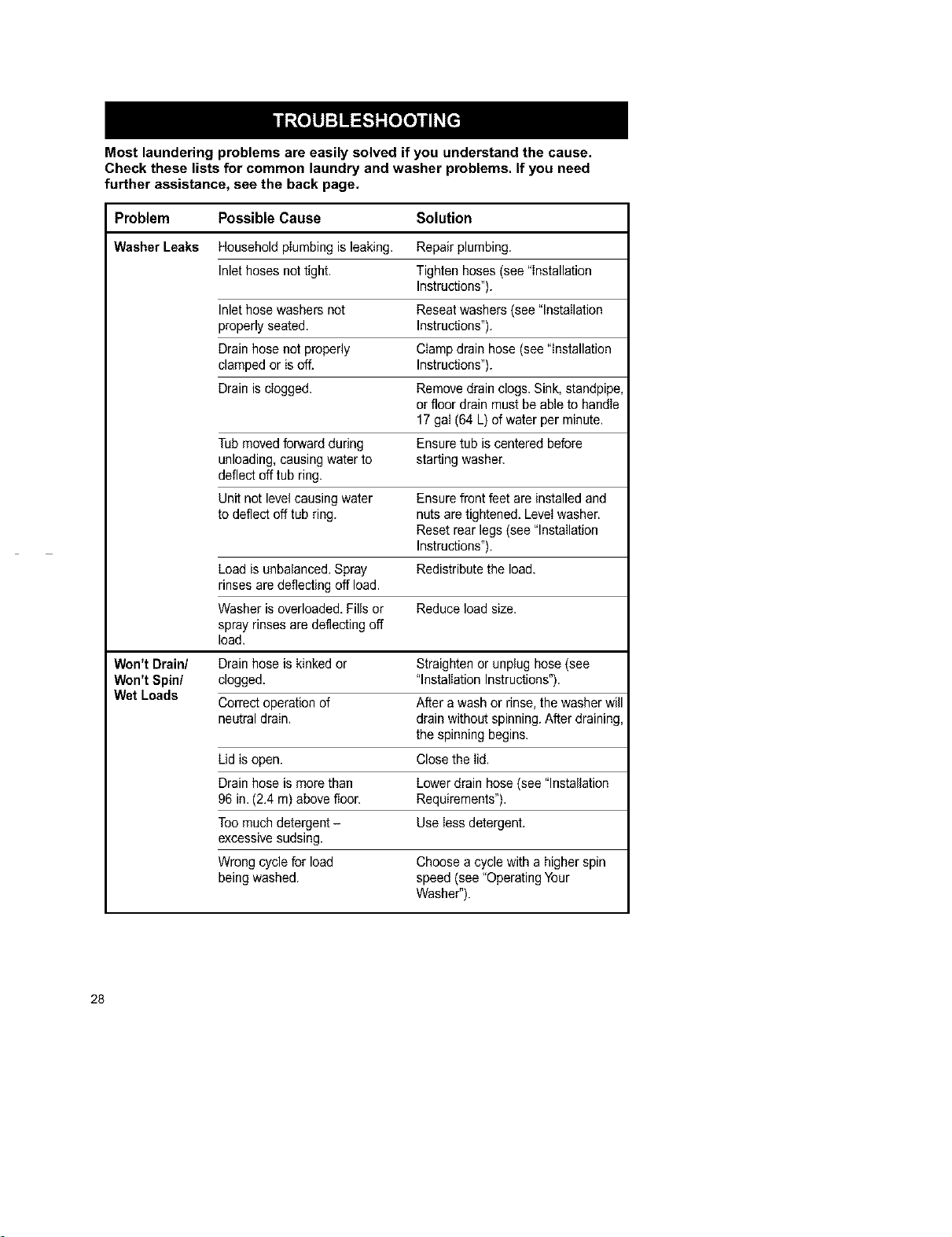
Most laundering problems are easily solved if you understand the cause.
Check these lists for common laundry and washer problems. If you need
further assistance, see the back page.
Problem Possible Cause Solution
Washer Leaks Household plumbing isleaking. Repair plumbing.
Inlet hoses not tight. Tighten hoses (see "Installation
Instructions").
Inlet hose washers not Reseat washers (see "Installation
properly seated. Instructions").
Drain hose not properly Clamp drain hose (see 'Installation
clamped or is off. Instructions").
Drain is clogged. Remove drain clogs. Sink, standpipe,
or floor drain must be ableto handle
17 gaI (64 L) of water per minute.
Tub moved forwardduring Ensure tub is centered before
unloading, causingwater to starting washer.
deflect off tub ring.
Unit not levelcausing water Ensure front feet are installedand
to deflect off tub ring. nuts aretightened. LeveIwasher.
Reset rear legs (see "Installation
Instructions").
Load is unbalanced.Spray Redistribute the load.
rinses are deflecting off load.
Washer is overloaded. Fills or Reduce load size.
spray rinses are deflecting off
load.
Won't Drain/ Drain hose is kinked or Straighten or unplug hose (see
Won't Spin/ clogged. "Installation Instructions").
Wet Loads
Correct operation of After awash or rinse, the washer will
neutral drain, drain without spinning. After draining,
the spinning begins.
Lid is open. Close the Iid.
Drain hose is more than Lower drain hose (see "Installation
96 in.(2.4 m) above floor. Requirements").
Too much detergent- Use Isss detergent.
excessive sudsing.
Wrong cycle forload Choose a cycle with a higher spin
being washed, speed (see"OperatingYour
Washer").
28
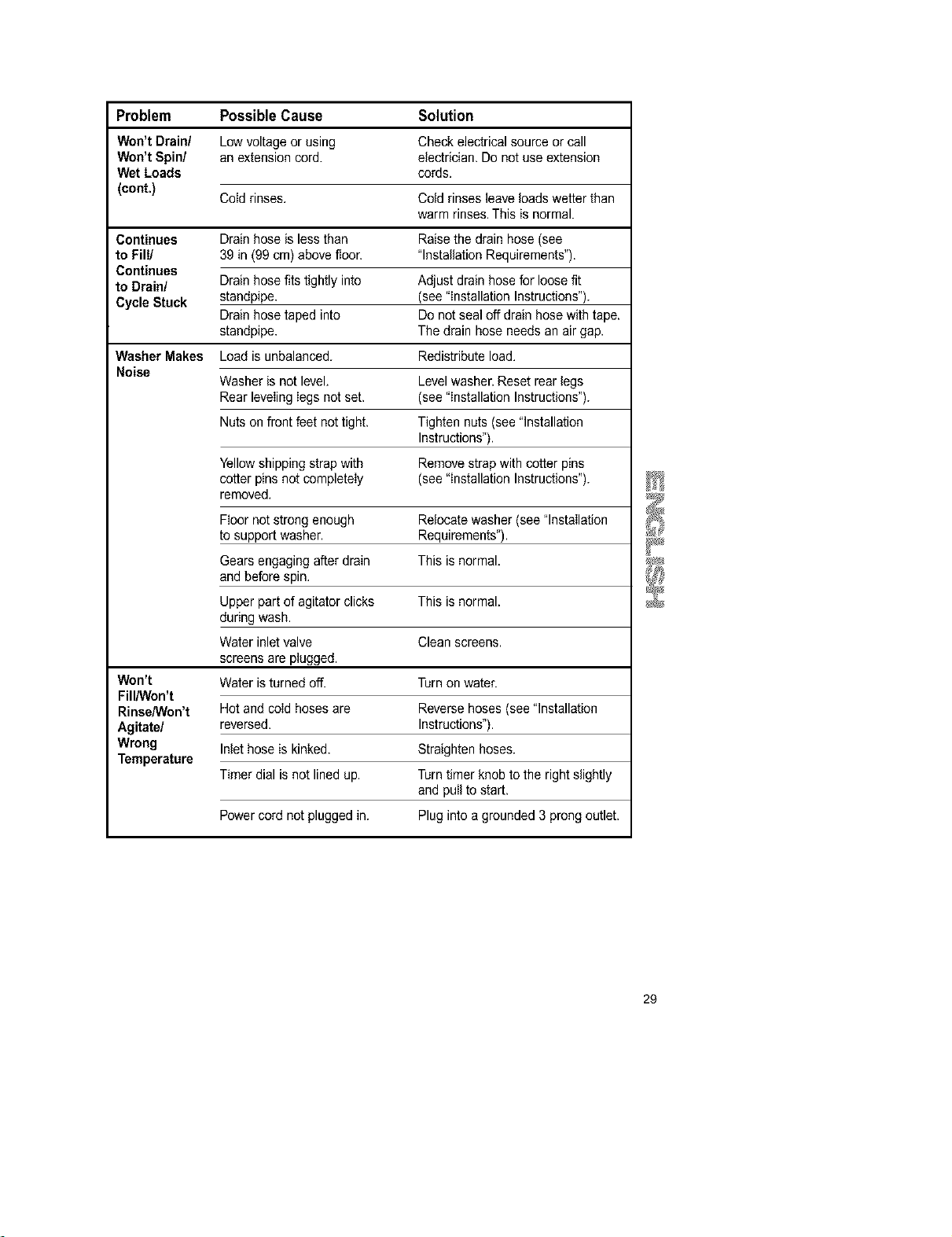
Problem Possible Cause Solution
Won't Drain/ Lowvoltage or using Check electrical source or call
Won't Spin/ an extension cord. electrician. Donot use extension
Wet Loads cords.
(cont.)
Cold rinses. Cold rinses leave loads wetter than
warm rinses,This is normal.
Continues Drain hose is less than Raise the drain hose (see
to Fill/ 39 in (99 cm) above floor. "Installation Requirements").
Continues
to Drain/ Drain hose fits tightly into Adjust drain hose for loose fit
Cycle Stuck standpipe. (see"Installation Instructions").
Drain hose taped into Donot seal off drain hose withtape.
standpipe. The drain hose needs an air gap,
Washer Makes Load is unbalanced. Redistribute load.
Noise
Washer is not level. Levelwasher. Reset rear legs
Rearleveling legs not set, (see"Installation Instructions").
Nutson front feet not tight. Tighten nuts (see "Installation
Instructions"),
Yellowshipping strap with Removestrap with cotter pins
cotter pins not completely (see"Installation Instructions").
removed.
Floor not strong enough Relocatewasher (see "Installation
to support washer. Requirements").
Gears engaging after drain This is normal.
and before spin,
Upper part of agitator clicks This is normal.
during wash.
Water inlet valve Clean screens.
screens are plugged.
Won't Water is turned off. Turnon water.
Fill/Won't
Rinse/Won't Hotand cold hoses are Reversehoses (see "Installation
Agitate/ reversed. Instructions"),
Wrong Inlet hose is kinked. Straighten hoses.
Temperature
Timer dial is not lined up, Turntimer knob to the right slightly
and pull to start.
Powercord not plugged in. Plug into a grounded 3 prong outlet.
29
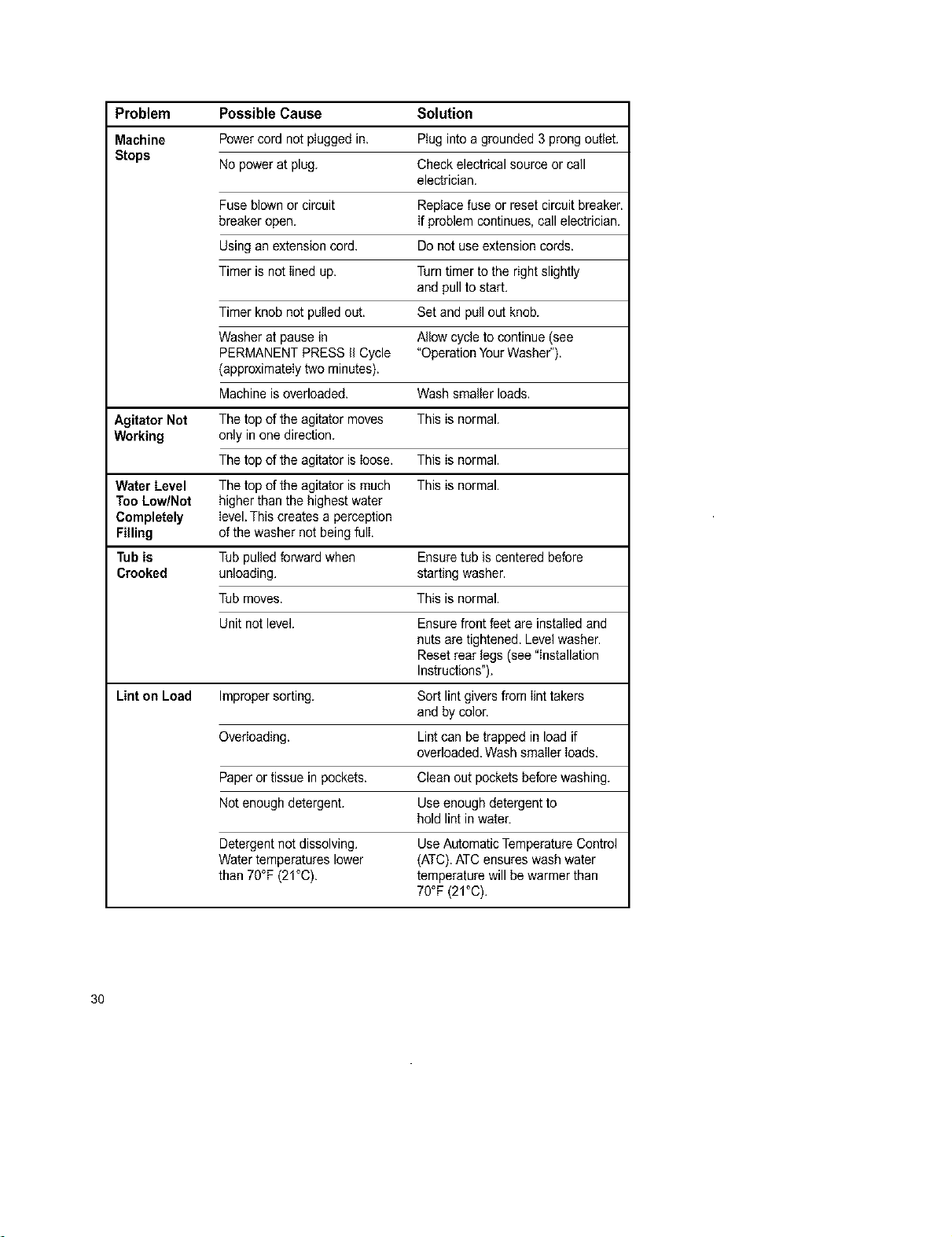
Problem Possible Cause Solution
Machine Powercord not plugged in. Plug into a grounded 3 prongoutlet.
Stops No power at plug. Check electrical source or call
electrician.
Fuse blown or circuit Replace fuse or reset circuit breaker.
breaker open. if problem continues, call electrician.
Using an extensioncord. Do not use extension cords.
Timer is not lined up. Turn timer to the right slightly
and pullto start.
Timer knob not pulled out. Set and pull out knob.
Washer at pause in Allowcycle to continue (see
PERMANENT PRESS IICycle "OperationYourWasher").
(approximatelytwo minutes).
Machine is overloaded. Wash smaller loads.
Agitator Not The top of the agitator moves This is normal.
Working only in one direction.
The top of the agitator isloose. This is normal.
Water Level The top of the agitator ismuch This is normal.
Too Low/Not higher than the highest water
Completely level.This creates a perception
Filling ofthe washer not being full
Tub is Tub pulled forwardwhen Ensure tub is centered before
Crooked unloading, starting washer.
Tub moves. This is normal.
Unit not level. Ensure front feetare instalIedand
nuts are tightened. Levelwasher.
Reset rear legs (see "installation
Instructions").
Lint on Load Improper sorting. Sort lint giversfrom linttakers
and bycolor.
Overloading. Lint can be trapped in load if
overloaded.Wash smaIler Ioads.
Paperor tissue in pockets. Clean out pocketsbefore washing.
Not enough detergent. Use enough detergent to
hold lint inwater.
Detergent not dissolving. UseAutomatic TemperatureControl
Water temperatures lower (ATC).ATC ensures washwater
than 70°F (21°C). temperature will be warmer than
70°F (21°C).
3O
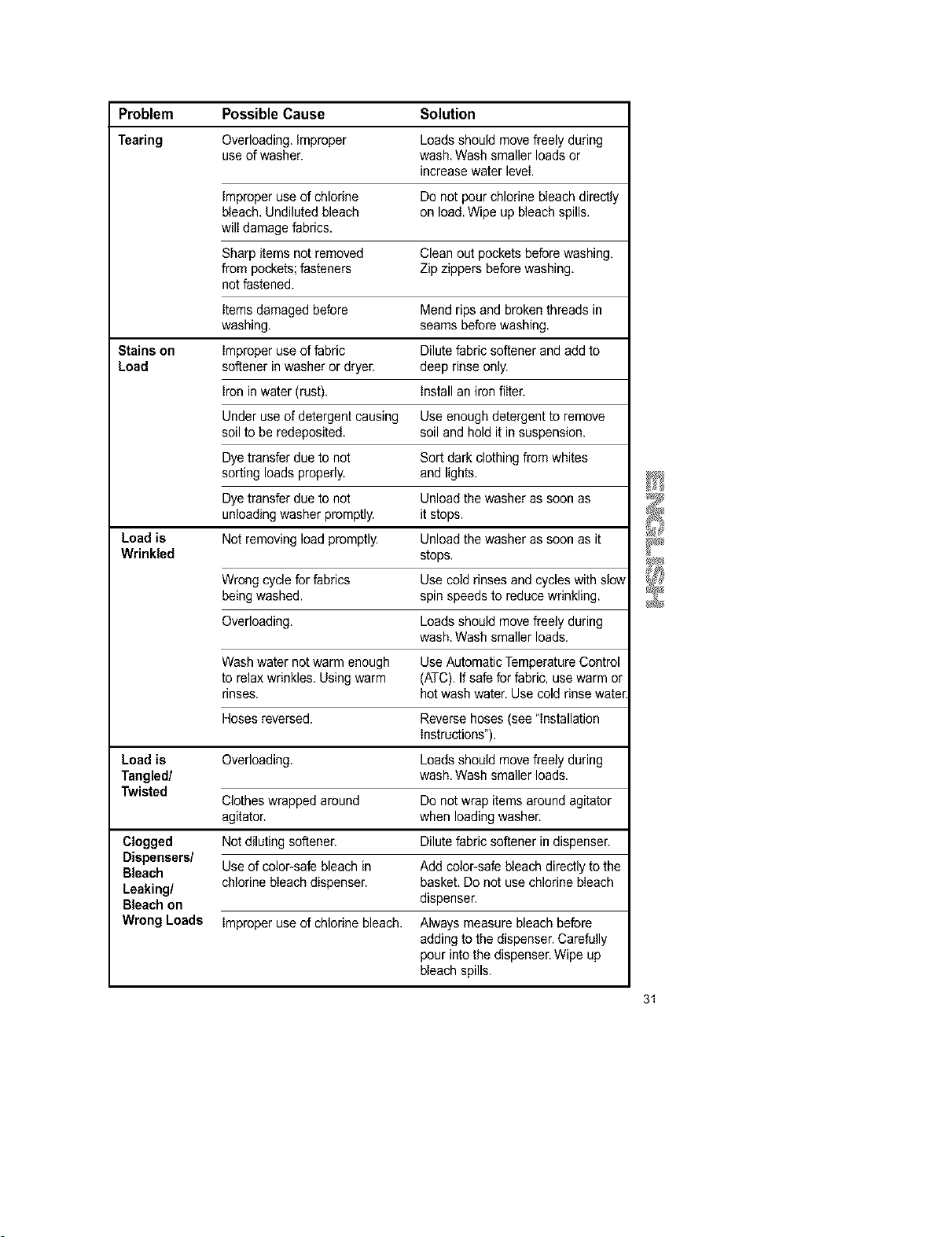
Problem Possible Cause Solution
Tearing Overloading.improper Loads should movefreely during
use of washer, wash. Wash smaller loads or
increase water level
improper use of chlorine Do not pour chlorine bleach directly
bleach.Undiluted bleach on load.Wipe up bleach spills.
wilI damage fabrics.
Sharp items not removed Clean out pocketsbefore washing.
from pockets;fasteners Zipzippers before washing.
not fastened.
items damaged before Mend rips and broken threads in
washing, seams beforewashing.
Stains on improper use of fabric Dilutefabric softener and add to
Load softener inwasher or dryer, deep rinse only.
iron in water (rust). install an iron fiIter.
Under use of detergent causing Use enoughdetergent to remove
soil to be redeposited, soil and hold it insuspension.
Dye transfer due to not Sort dark clothing from whites
sorting loads properly, and lights.
Dye transfer due to not Unload the washer as soon as
unloadingwasher promptly, it stops.
Load is Not removing load promptly. Unload the washer as soon as it
Wrinkled stops.
Wrong cycle for fabrics Use coldrinses and cycles with slow
beingwashed, spin speeds to reduce wrinkling.
Overloading. Loads should movefreely during
wash. Wash smaller loads.
Washwater not warm enough UseAutomatic TemperatureControl
to relaxwrinkles. Using warm (ATC).If safe for fabric, use warm or
rinses, hot wash water. Use cold rinse water
Hoses reversed. Reverse hoses(see "installation
instructions").
Load is Overloading. Loads should movefreely during
Tangled/ wash. Wash smaller loads.
Twisted
Clothes wrapped around Do not wrap items around agitator
agitator, when loadingwasher.
Clogged Notdiluting softener. Dilutefabric softener in dispenser.
Dispensers/
Bleach Use of color-safe bleach in Add color-safe bleach directlyto the
Leaking/ chlorine bIeach dispenser, basket.Do not use chlorine bIeach
Bleach on dispenser.
Wrong Loads improper use of chlorine bleach. Alwaysmeasure bleach before
adding to the dispenser.Carefully
pour into the dispenser.Wipe up
bleach spills.
31
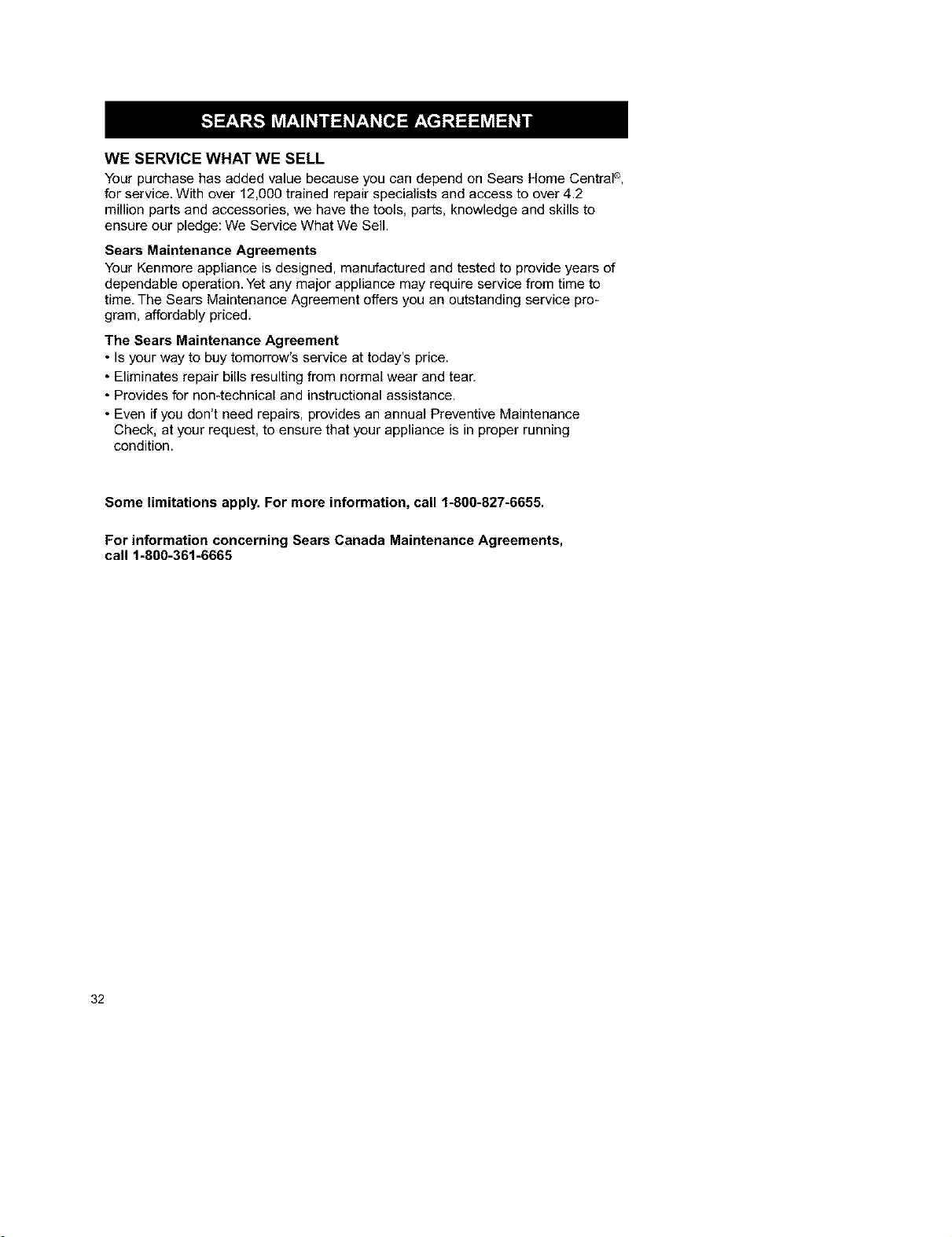
WE SERVICE WHAT WE SELL
Your purchase has added value because you can depend on Sears Home Central °,
for service. With over 12,000 trained repair specialists and access to over 4.2
million parts and accessories, we have the tools, parts, knowledge and skills to
ensure our pledge: We Service What We Sell.
Sears Maintenance Agreements
Your Kenmore appliance is designed, manufactured and tested to provide years of
dependable operation. Yet any major appliance may require service from time to
time. The Sears Maintenance Agreement offers you an outstanding service pro-
gram, affordably priced.
The Sears Maintenance Agreement
• Is your way to buy tomorrow's service at today's price.
• Eliminates repair bills resulting from normal wear and tear.
• Provides for non-technical and instructional assistance.
• Even if you don't need repairs, provides an annual Preventive Maintenance
Check, at your request, to ensure that your appliance is in proper running
condition.
Some limitations apply. For more information, call 1-800-827-6655.
For information concerning Sears Canada Maintenance Agreements,
call 1-800-361-6665
32
33

34
Forrepairofmajorbrandappliancesinyourown home...
nomatterwhomadeit,nomatterwhosolditl
1-800-4-MY-HOME _ An_, dayornight
(1-s00._9.4_3) (U.SAandCanada)
_.llaam._m WWW.84MIrs,c8
Forrepairofcarry-inproductslikevacuums,lawnequipment,
andelecVonics,callfortheIoc_onofyournearest
Seam Partsand Flef_r Center.
1-800-488-1222 _, dayornight(U.S.A.only)
www.sears.com
Forthereplacementparts,accessoriesandowner'smanuals
th_ youneedtodo-it-yourself,callSearsPartsDirecte"l
1-800-366-PART 6a.m.-11 p.m.CST,7daysaweek
(1-800-366-7278) (U.S.A.only)
www.sears.€ondparlsdlrect
TopurchaseorinquireaboutaSearsServiceAgreement
orSeamMaintenanceAgreement:
1-800-827-6655 (u.s_.) 1-800-361-6665 (Canada)
7 a.m.- 5 p.m.CST, Mon.- Sat. 9 a.m.- 8p.m. EST, M- F, 4 p.m.Sat.
Parapetit serviciodemperacidna AuCamda poursenf.ceenfl'an_:
domicilio,y para ofdeflar'piezas: 1-800-LE-FOYER "c
1-888-SU-HOGAR sM (1-8C0-533-6937)
(1-888-784-6427) www.seam.ca
H