2
.... 6-7
Ill,
il
I
Visit the Frigidaire Web Site at:
http://www.frigidaire.com
Controls ......... 7-10
..............Oven Control Functions .............. 11
Setting Oven Controls ............ 12-16
Self Cleaning (Speed Clean).. 17-18
General Care & Cleaning ....... 19-22
Adjusting Oven Temperature ....... 22
Before You Call
Solutions to Common Problems ........................ 23
Warranty ......................... Back Page
READ AND SAVE THESE INSTRUCTIONS p/n 316417015 (0502)
m m
Questions?
1-800-944-9044
(United States)
1-866-729-5199
(Canada)
Please attach sales receipt
here for future reference.
Congratulations on your purchase of a new range! At Electrolux Home Products,
we are very proud of our product and are completely committed to providing you
with the best service possible. Your satisfaction is our number one priority.
We know you'll enjoy your new range and Thank You for choosing our product.
We hope you consider us for future purchases.
PLEASE CAREFULLY READ AND SAVE THESE INSTRUCTIONS
This Use & Care Manual provides specific operating instructions for your model.
Use your range only as instructed in this manual. These instructions are not
meant to cover every possible condition and situation that may occur. Common
sense and caution must be practiced when installing, operating and maintaining
any appliance.
Please record your model and serial numbers below for future reference.
Model Number:
Serial Number:
Purchase Date:
f-
Product
Registration
Register Your Product
The self-addressed PRODUCT
REGISTRATION CARD should
be filled in completely, signed
and returned to Electrolux Home
Products.
T
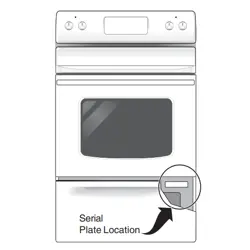
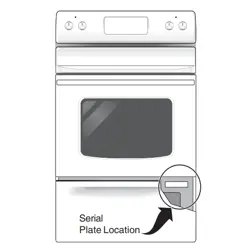
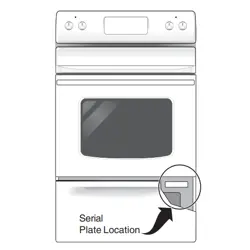
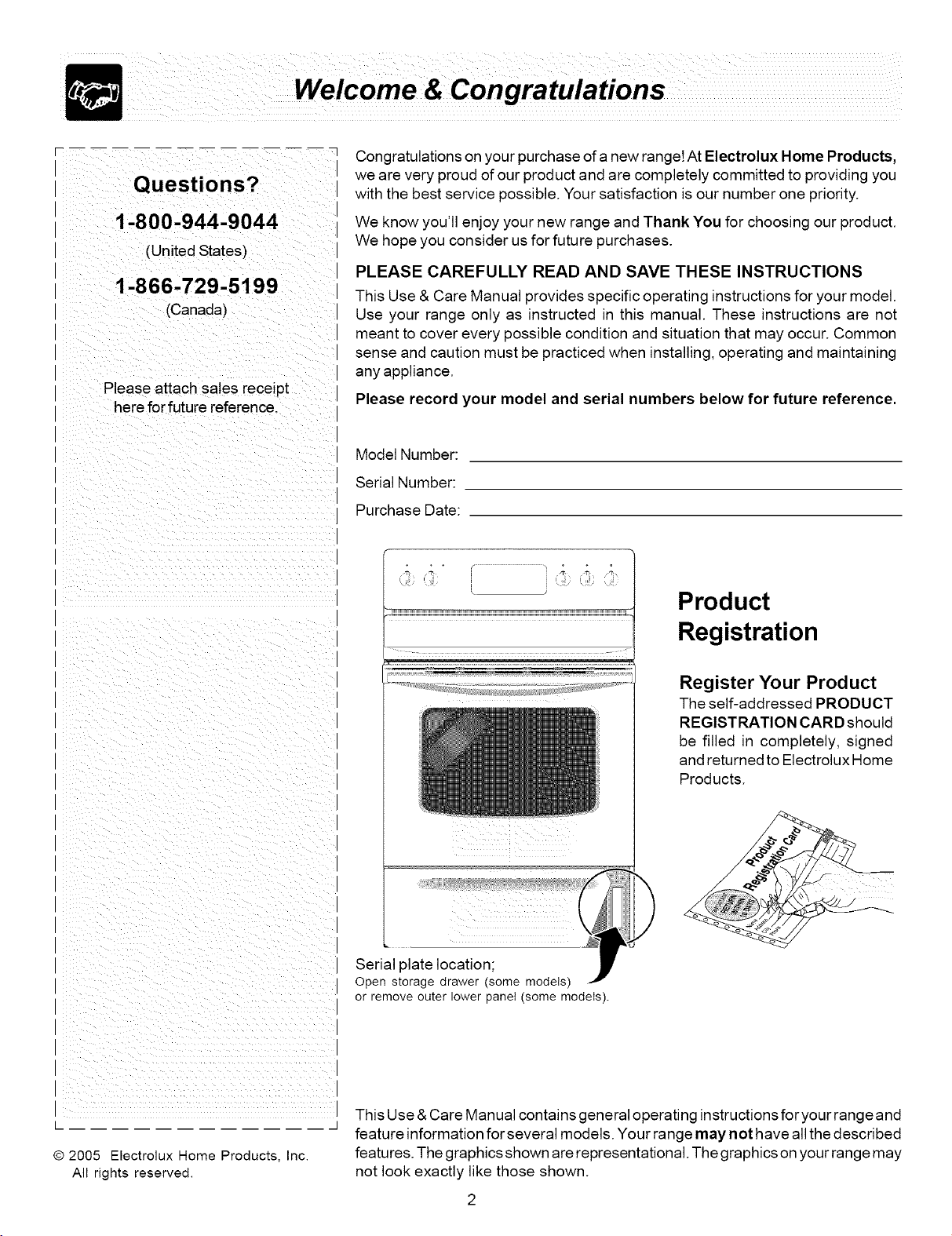
Serial plate location;
Open s[orage drawer (some models)
or remove outer lower panet (some modeIs).
© 2005 Electrolux Home Products, Inc.
All rights reserved.
This Use & Care Manual contains general operating instructions for your range and
feature information for several models. Your range may not have allthe described
features. The graphics shown are representational. The graphics on your range may
not look exactly like those shown.
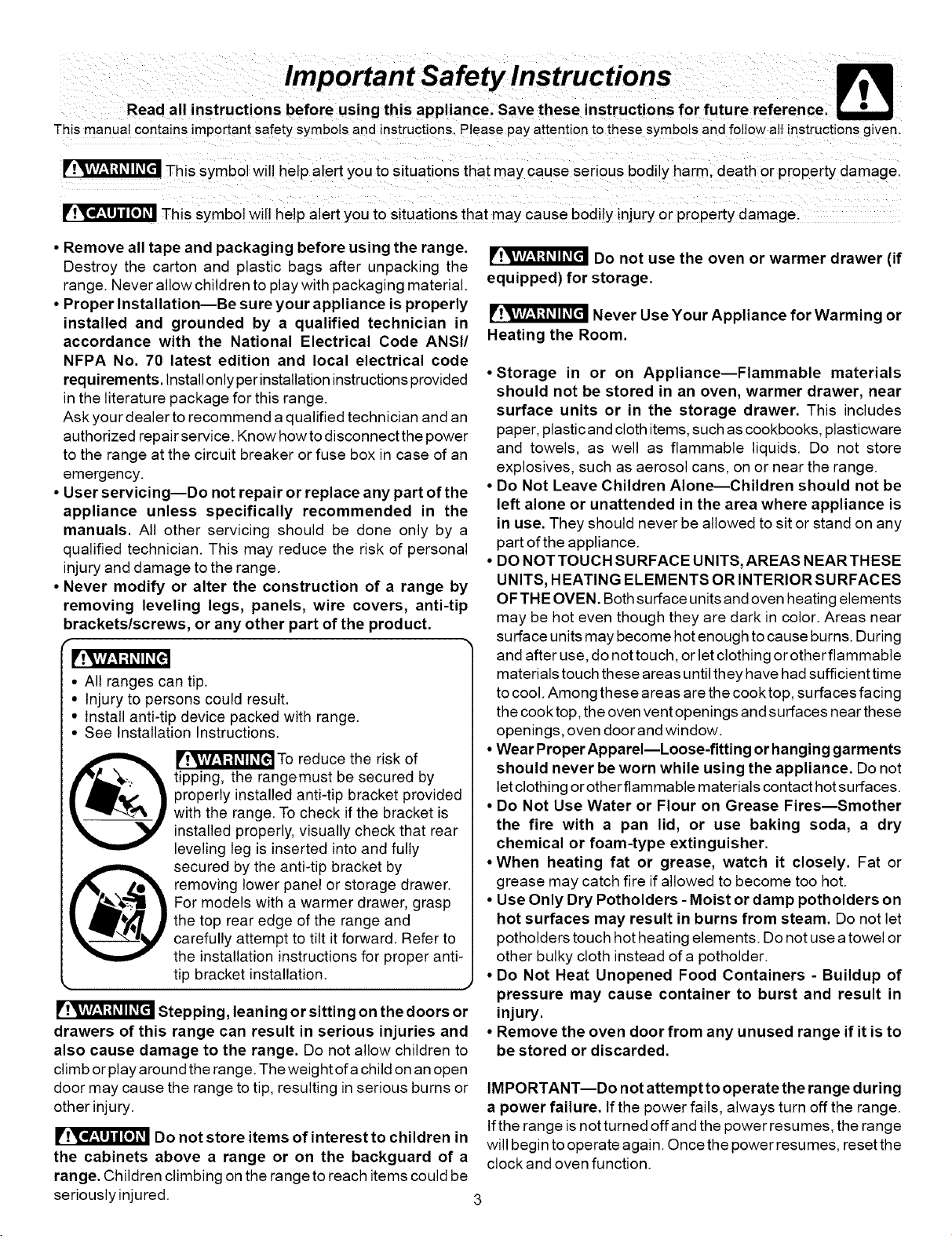
Important Safety Instructions
Read all instructions before using this appliance. Save these instructions for future reference.
This manual contains important safety symbols and instructions. Please pay attention to these symbols and follow all instructions given.
This symbol will help alert you to situations that may cause serious bodily harm. death or property damage.
This symbol will help alert you to situations that may cause bodily injury or property damage.
• Remove all tape and packaging before using the range.
Destroy the carton and plastic bags after unpacking the
range. Never allow children to play with packaging material.
• Proper Installation--Be sure your appliance is properly
installed and grounded by a qualified technician in
accordance with the National Electrical Code ANSI/
NFPA No. 70 latest edition and local electrical code
requirements. Install only perinstallation instructions provided
in the literature package for this range.
Ask your dealer to recommend a qualified technician and an
authorized repair service. Know how to disconnect the power
to the range at the circuit breaker or fuse box in case of an
emergency.
• User servicing--Do not repair or replace any part of the
appliance unless specifically recommended in the
manuals. All other servicing should be done only by a
qualified technician. This may reduce the risk of personal
injury and damage to the range.
• Never modify or alter the construction of a range by
removing leveling legs, panels, wire covers, anti-tip
brackets/screws, or any other part of the product.
• All ranges can tip.
• Injury to persons could result.
• Install anti-tip device packed with range.
• See Installation Instructions.
_ r'!,V_Vl_,l--l#ll#[_lToreduce the risk of
tipping, the rangemust be secured by
properly installed anti-tip bracket provided
with the range. To check ifthe bracket is
installed properly, visually check that rear
leveling leg is inserted into and fully
secured by the anti-tip bracket by
removing lower panel or storage drawer.
For models with a warmer drawer, grasp
the top rear edge of the range and
carefully attempt to tilt it forward. Refer to
the installation instructions for proper anti-
tip bracket installation.
• J
Stepping, leaning or sitting on the doors or
drawers of this range can result in serious injuries and
also cause damage to the range. Do not allow children to
climb or play around the range. The weight ofa child on an open
door may cause the range to tip, resulting in serious burns or
other injury.
[Ir_r"_ Do not store items of interest to children in
the cabinets above a range or on the backguard of a
range. Children climbing on the range to reach items could be
seriously injured.
Do not use the oven or warmer drawer (if
equipped) for storage.
Never Use Your Appliance for Warming or
Heating the Room.
• Storage in or on Appliance--Flammable materials
should not be stored in an oven, warmer drawer, near
surface units or in the storage drawer. This includes
paper, plasticand cloth items, such as cookbooks, plasticware
and towels, as well as flammable liquids. Do not store
explosives, such as aerosol cans, on or near the range.
• Do Not Leave Children Alone--Children should not be
left alone or unattended in the area where appliance is
in use. They should never be allowed to sit or stand on any
part of the appliance.
• DO NOT TOUCH SURFACE UNITS, AREAS NEAR THESE
UNITS, HEATING ELEMENTS ORINTERIORSURFACES
OF THE OVEN. Both surface units and oven heating elements
may be hot even though they are dark in color. Areas near
surface units may become hot enough to cause burns. During
and after use, do not touch, or let clothing or otherflammable
materials touch these areas until they have had sufficient time
to cool. Among these areas are the cook top, surfaces facing
the cook top, the oven vent openings and surfaces near these
openings, oven door and window.
•Wear Proper Apparel--Loose-fitting or hanging garments
should never be worn while using the appliance. Do not
let clothing or otherflammable materials contact hotsurfaces.
• Do Not Use Water or Flour on Grease Fires--Smother
the fire with a pan lid, or use baking soda, a dry
chemical or foam-type extinguisher.
•When heating fat or grease, watch it closely. Fat or
grease may catch fire if allowed to become too hot.
• Use Only Dry Potholders - Moist or damp potholders on
hot surfaces may result in burns from steam. Do not let
potholders touch hot heating elements. Do not use a towel or
other bulky cloth instead ofa potholder.
• Do Not Heat Unopened Food Containers - Buildup of
pressure may cause container to burst and result in
injury.
• Remove the oven door from any unused range if it is to
be stored or discarded.
IMPORTANT--Do not attempt to operate the range during
a power failure. If the power fails, always turn off the range.
If the range is not turned offand the power resumes, the range
will begin to operate again. Once the power resumes, reset the
clock and oven function.
IMPORTANT INSTRUCTIONS FOR USINGYOUR
COOKTOP
• Know which knob controls each surface heating unit. Place a
pan of food on the unit before turning it on, and turn the unit off
before removing the pan.
• Use Proper Pan Size--This appliance is equipped with one or
more surface units of different sizes. Select utensils having flat
bottoms large enough to cover the surface unit heating element.
The use of undersized utensils will expose a portion of the
heating element to direct contact and may result in ignition of
clothing. Proper relationship of utensil to element will also
improve efficiency.
• Utensil Handles Should Be Turned Inward and Not Extend Over
Adjacent Surface Elements--To reduce the risk of burns, ignition
of flammable materials, and spillage due to unintentional contact
with the utensil, the handle of the utensil should be positioned so
that it is turned inward, and does not extend over adjacent surface
units.
• Never Leave Surface Elements Unattended at High Heat
Settings--Boilovers cause smoking and greasy spillovers that
may ignite, or a pan that has boiled dry may melt.
• Do Not Immerse or Soak Removable Heating Elements--
Heating elements should never be immersed in water. Heating
elements clean themselves during normal operation.
• Glazed Cooking Utensils--Only certain types of glass, glass/
ceramic, ceramic, earthenware, or other glazed utensils are
suitable for cook top service without breaking due to the sudden
change in temperature. Check the manufacturer's
recommendations for cook top use.
• When flaming foods under a ventilating hood, turn the fan on.
IMPORTANT INSTRUCTIONS FOR USINGYOUR
OVEN
• Use Care When Opening Oven Door or Warmer Drawer (if
equipped)--Stand to the side of the range when opening the door
of a hot oven. Let hot air or steam escape before you remove or
replace food in the oven.
• Keep Oven Vent Ducts Unobstructed, The oven vent is located
under the left rear surface element if your model is equipped with
coil elements. The oven vent is located below the backguard for
models equipped with ceramic-glass cook tops. Touching the
surfaces in this area when the oven is operating may cause
severe burns. Also, do not place plastic or heat-sensitive items
on or near the oven vent. These items could melt or ignite.
• Placement of Oven Racks. Always place oven racks in desired
location while oven is cool. If rack must be moved while oven is
hot use extreme caution. Use potholders and grasp the rack with
both hands to reposition. Do not let potholders contact the hot
heating elements in the oven. Remove all utensils from the rack
before moving.
• Do not use the broiler pan without its insert. The broiler pan and
its insert allow dripping fat to drain and be kept away from the high
heat of the broiler.
• Do not cover the broiler insert with aluminum foil. Exposed fat
and grease could ignite,
• Protective Liners--Do not use aluminum foil to line the oven
bottom. Only use aluminum foil as recommended in this manual.
Improper installation of these liners may result in risk of electric
shock, or fire.
SELF CLEANING OVENS
• Clean in the self-cleaning cycle only the parts listed in this Use & Care Manual. Before self cleaning the oven, remove the broiler
pan and any utensils or foods from the oven.
• Do Not Use Oven Cleaners--No commercial oven cleaner or oven liner protective coating of any kind should be used in or around
any part of the oven.
• Do Not Clean Door Gasket--The door gasket is essential for a good seal. Care should be taken not to rub, damage or move the gasket.
•The health of some birds is extremely sensitive to the fumes given off during the self-cleaning cycle of any range. Move birds to another
well-ventilated room.
IMPORTANT INSTRUCTIONS FOR CLEANING YOUR RANGE
• Clean the range regularly to keep all parts free of grease that could catch fire. Pay particular attention to the area underneath each
surface element. Do not allow grease to accumulate.
• Kitchen cleaners and aerosols--Always follow the manufacturer's recommended directions for use. Be aware that excess
residue from cleaners and aerosols may ignite causing damage and injury.
• Clean Ventilating Hoods Frequently--Grease should not be allowed to accumulate on the hood or filter. Follow manufacturer's
instructions for cleaning.
FOR CERAMIC-GLASS COOK TOP MODELS
• Do Not Cook on Broken Cook Top--If cook top should break, cleaning solutions and spillovers may penetrate the broken cook top
and create a risk of electric shock. Contact a qualified technician immediately.
• Clean Cook Top with Caution--If a wet sponge or cloth is used to wipe spills on a hot cooking area, be careful to avoid a steam burn.
Some cleaners can produce noxious fumes if applied to a hot surface.
Important Safety Notice
The California Safe Drinking Water and Toxic Enforcement Act requires the Governor of California to publish a list of
substances known to the state to cause cancer, birth defects or other reproductive harm, and requires businesses to warn
customers of potential exposure to such substances.
® ®®® ® ® ®
.'
r i, l
'4 '\ ':2
,'-,_:;,::_;_:2:;;',
(_) : :7 ,:": ',:'> ..........
r , <,
/
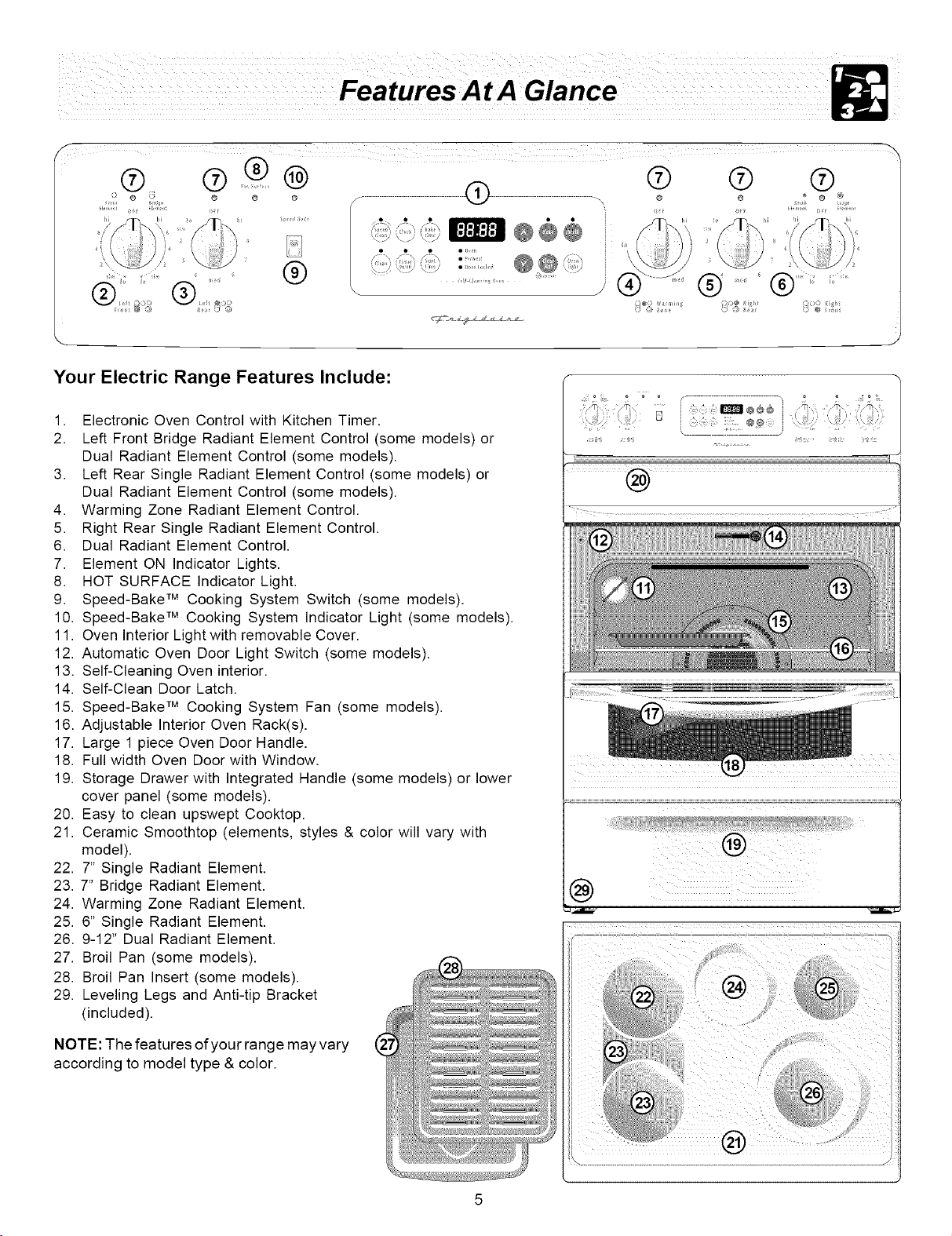
Your Electric Range Features Include:
1. Electronic Oven Control with Kitchen Timer.
2. Left Front Bridge Radiant Element Control (some models) or
Dual Radiant Element Control (some models).
3. Left Rear Single Radiant Element Control (some models) or
Dual Radiant Element Control (some models).
4. Warming Zone Radiant Element Control.
5. Right Rear Single Radiant Element Control.
6. Dual Radiant Element Control.
7. Element ON Indicator Lights.
8. HOT SURFACE Indicator Light.
9. Speed-Bake TM Cooking System Switch (some models).
10. Speed-Bake TM Cooking System Indicator Light (some models).
11. Oven Interior Light with removable Cover.
12. Automatic Oven Door Light Switch (some models).
13. Self-Cleaning Oven interior.
14. Self-Clean Door Latch.
15. Speed-Bake TM Cooking System Fan (some models).
16. Adjustable Interior Oven Rack(s).
17. Large 1 piece Oven Door Handle.
18. Full width Oven Door with Window.
19. Storage Drawer with Integrated Handle (some models) or lower
cover panel (some models).
20. Easy to clean upswept Cooktop.
21. Ceramic Smoothtop (elements, styles & color will vary with
model).
22. 7" Single Radiant Element.
23. 7" Bridge Radiant Element.
24. Warming Zone Radiant Element.
25. 6" Single Radiant Element.
26. 9-12" Dual Radiant Element.
27. Broil Pan (some models).
28. Broil Pan Insert (some models).
29. Leveling Legs and Anti-tip Bracket
(included).
NOTE: The features of your range may vary
according to model type & color.
f
D
i
i , '1 , ,
L ....... J ....
t _ 7" , I ! 1
@
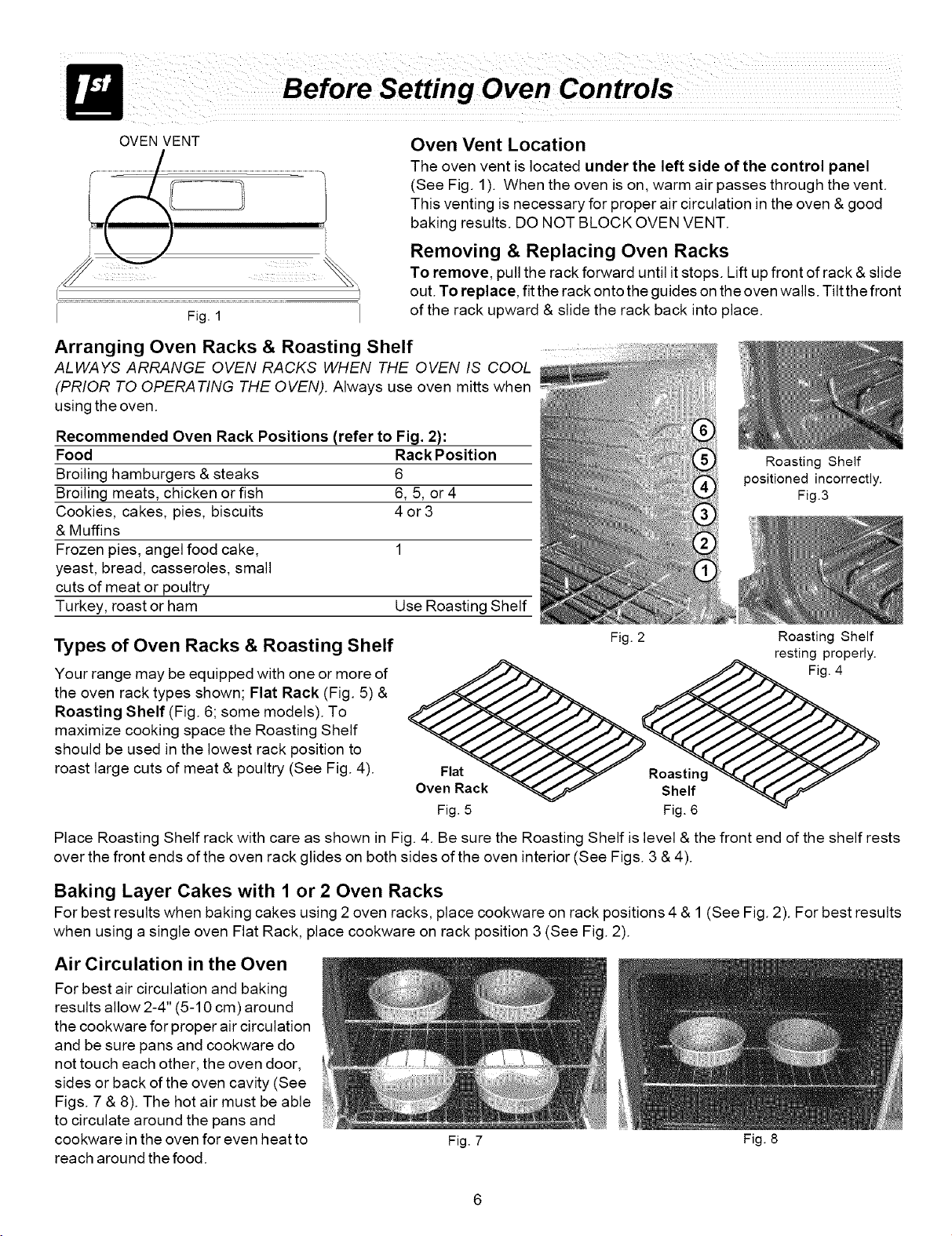
Fig. 1
OVENVENT Oven Vent Location
The oven vent is located under the left side of the control panel
(See Fig. 1). When the oven is on, warm air passes through the vent.
This venting is necessary for proper air circulation in the oven & good
baking results. DO NOT BLOCK OVEN VENT.
Removing & Replacing Oven Racks
To remove, pull the rack forward until it stops. Lift up front of rack & slide
out. To replace, fit the rack onto the guides on the oven walls. Tilt the front
of the rack upward & slide the rack back into place.
Arranging Oven Racks & Roasting Shelf
ALWAYS ARRANGE OVEN RACKS WHEN THE OVEN IS COOL
(PRIOR TO OPERATING THE OVEN). Always use oven mitts when
using the oven.
Recommended Oven Rack Positions (refer to Fig. 2):
Food Rack Position
Broiling hamburgers & steaks 6
Broiling meats, chicken or fish 6, 5, or 4
Cookies, cakes, pies, biscuits 4 or 3
& Muffins
Frozen pies, angel food cake, 1
yeast, bread, casseroles, small
cuts of meat or poultry
Turkey, roast or ham Use Roasting Shelf
Types of Oven Racks & Roasting Shelf
Your range may be equipped with one or more of
the oven rack types shown; Flat Rack (Fig. 5) &
Roasting Shelf (Fig. 6; some models). To
maximize cooking space the Roasting Shelf
should be used in the lowest rack position to
roast large cuts of meat & poultry (See Fig. 4).
Roasting Shelf
positioned incorrectly.
Fig.3
Fig. 2 Roasting Shelf
resting properly.
Fig. 5 Fig. 6
Place Roasting Shelf rack with care as shown in Fig. 4. Be sure the Roasting Shelf is level & the front end of the shelf rests
over the front ends of the oven rack glides on both sides of the oven interior (See Figs. 3 & 4).
Baking Layer Cakes with 1 or 2 Oven Racks
For best results when baking cakes using 2 oven racks, place cookware on rack positions 4 & 1 (See Fig. 2). For best results
when using a single oven Flat Rack, place cookware on rack position 3 (See Fig. 2).
Air Circulation in the Oven
For best air circulation and baking
results allow 2-4" (5-10 cm) around
the cookware for proper air circulation
and be sure pans and cookware do
not touch each other, the oven door,
sides or back of the oven cavity (See
Figs. 7 & 8). The hot air must be able
to circulate around the pans and
cookware in the oven for even heat to
reach around the food.
Fig. 7 Fig. 8
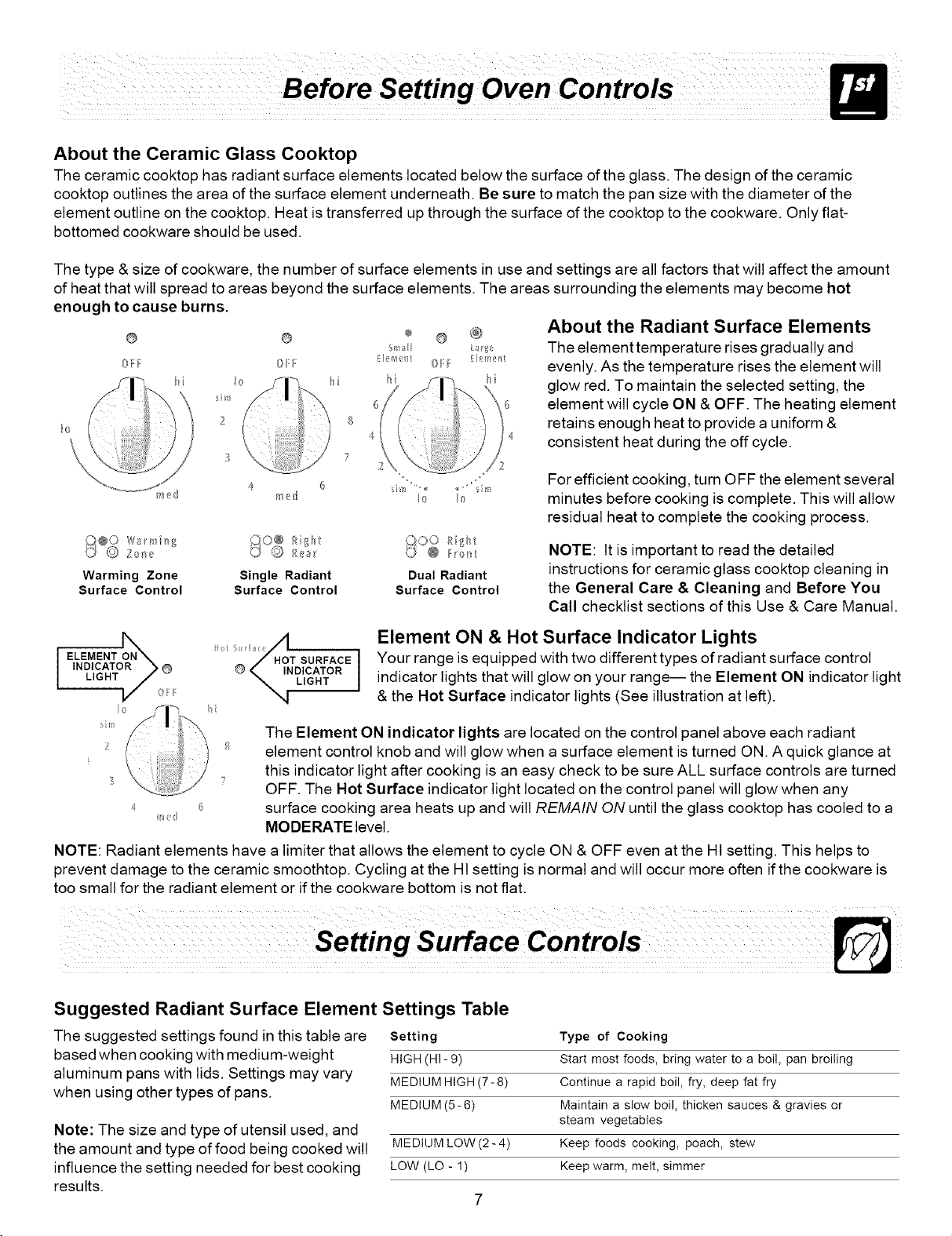
About the Ceramic Glass Cooktop
The ceramic cooktop has radiant surface elements located below the surface of the glass. The design of the ceramic
cooktop outlines the area of the surface element underneath. Be sure to match the pan size with the diameter of the
element outline on the cooktop. Heat is transferred up through the surface of the cooktop to the cookware. Only flat-
bottomed cookware should be used.
The type & size of cookware, the number of surface elements in use and settings are all factors that will affect the amount
of heat that will spread to areas beyond the surface elements. The areas surrounding the elements may become hot
enough to cause burns.
Warming Zone
Surface Control
@ @ ÷ @ ®
OFF OFF Frr_,r/ OIF:F _I__r_,_t
s_t/
2
4 6
_'8 rr_ed l0 10
OO@ R_ht t.;O_ f_f_h
Single Radiant Dual Radiant
Surface Control Surface Control
About the Radiant Surface Elements
The element temperature rises gradually and
evenly. As the temperature rises the element will
glow red. To maintain the selected setting, the
element will cycle ON & OFF. The heating element
retains enough heat to provide a uniform &
consistent heat during the off cycle.
For efficient cooking, turn OFF the element several
minutes before cooking is complete. This will allow
residual heat to complete the cooking process.
NOTE: It is important to read the detailed
instructions for ceramic glass cooktop cleaning in
the General Care & Cleaning and Before You
Call checklist sections of this Use & Care Manual.
INDICATOR
@
LIGHT /
!/"0 _:
!i
4 6
_TI8 d
u_t S_,_HOT SURFACE
@ <_ INDICATOR
_ LIGHT I
Element ON & Hot Surface Indicator Lights
Your range is equipped with two different types of radiant surface control
indicator lights that will glow on your range-- the Element ON indicator light
& the Hot Surface indicator lights (See illustration at left).
The Element ON indicator lights are located on the control panel above each radiant
element control knob and will glow when a surface element is turned ON. A quick glance at
this indicator light after cooking is an easy check to be sure ALL surface controls are turned
OFF. The Hot Surface indicator light located on the control panel will glow when any
surface cooking area heats up and will REMAIN ON until the glass cooktop has cooled to a
MODERATE level.
NOTE: Radiant elements have a limiter that allows the element to cycle ON & OFF even at the HI setting. This helps to
prevent damage to the ceramic smoothtop. Cycling at the HI setting is normal and will occur more often ifthe cookware is
too small for the radiant element or if the cookware bottom is not fiat.
Suggested Radiant Surface Element Settings Table
The suggested settings found in this table are
based when cooking with medium-weight
aluminum pans with lids. Settings may vary
when using other types of pans.
Note: The size and type of utensil used, and
the amount and type of food being cooked will
influence the setting needed for best cooking
results.
Setting
HIGH (HI-9)
MEDIUM HIGH (7-8)
MEDIUM (5-6)
MEDIUM LOW (2-4)
LOW (LO - 1)
Type of Cooking
Start most foods, bring water to a boil, pan broiling
Continue a rapid boil, fry, deep fat fry
Maintain a slow boil, thicken sauces & gravies or
steam vegetables
Keep foods cooking, poach, stew
Keep warm, melt, simmer
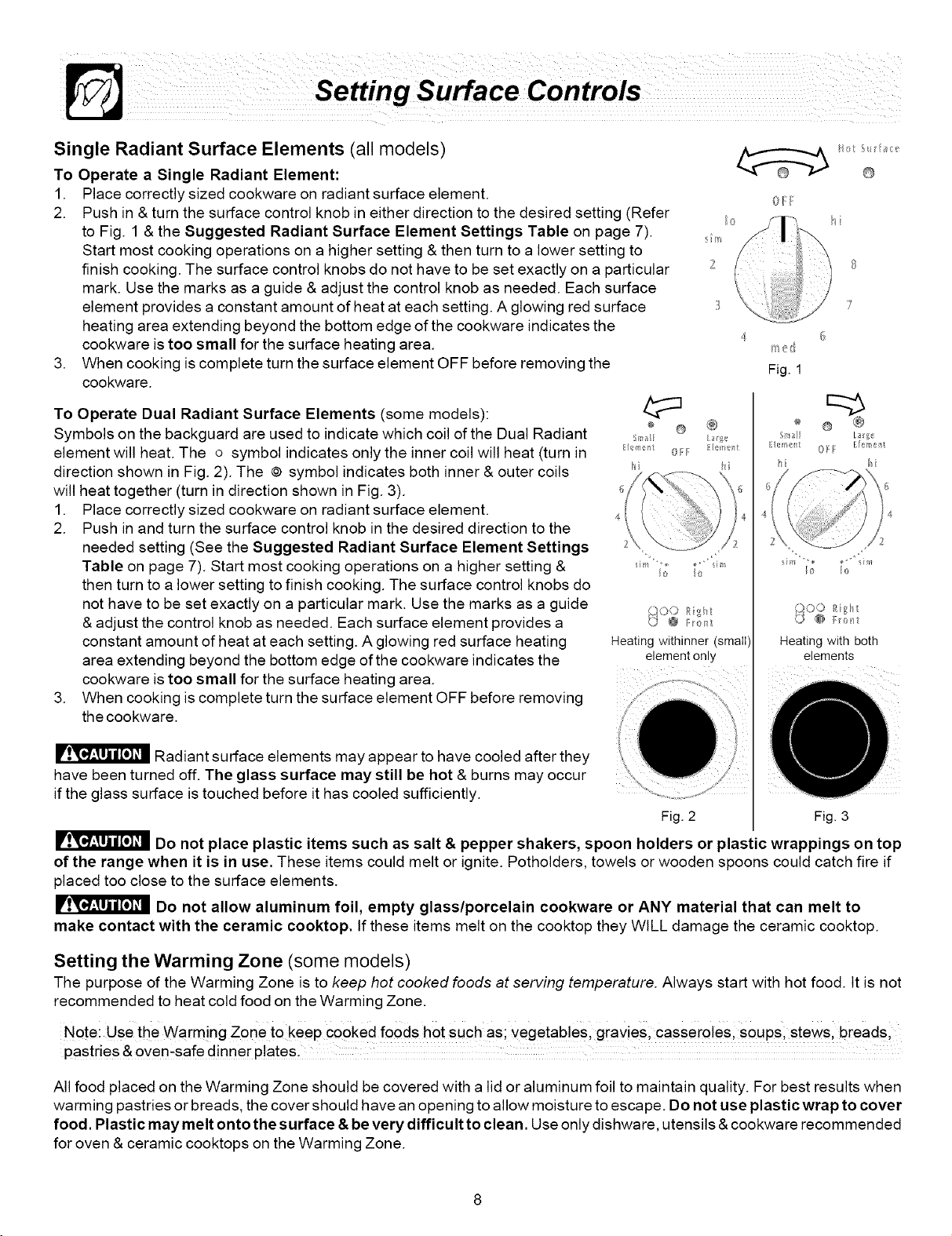
Single Radiant Surface Elements (all models) _,,,
To Operate a Single Radiant Element: @
1. Place correctly sized cookware on radiant surface element. 0 /
2. Push in & turn the surface control knob in either direction to the desired setting (Refer h
to Fig. 1& the Suggested Radiant Surface Element Settings Table on page 7).
Start most cooking operations on a higher setting & then turn to a lower setting to
finish cooking. The surface control knobs do not have to be set exactly on a particular 2 S
mark. Use the marks as a guide & adjust the control knob as needed. Each surface
element provides a constant amount of heat at each setting. A glowing red surface Y
heating area extending beyond the bottom edge of the cookware indicates the
4 6
cookware is too small for the surface heating area. _
3. When cooking is complete turn the surface element OFF before removing the Fig. 1
cookware.
To Operate Dual Radiant Surface Elements (some models):
® @ @ ÷
Symbols on the backguard are used to indicate which coil of the Dual Radiant ,_ _,,._ ,_o
element will heat. The o symbol indicates only the inner coil will heat (turn in "_'_ 0_:_ _......t _........t 0_:
direction shown in Fig. 2). The @ symbol indicates both inner & outer coils _ _ _
will heat together (turn in direction shown in Fig. 3). /
1. Place correctly sized cookware on radiant surface element.
2. Push in and turn the surface control knob in the desired direction to the
needed setting (See the Suggested Radiant Surface Element Settings
Table on page 7). Start most cooking operations on a higher setting & b _ _,_ l0
then turn to a lower setting to finish cooking. The surface control knobs do
not have to be set exactly on a particular mark. Use the marks as a guide i._oo _ r_l._ _ _ _, ,.,ti__l_t
& adjust the control knob as needed. Each surface element provides a _3 @l: _
constant amount of heat at each setting. A glowing red surface heating Heatingwithinner(small) Heatingwith both
element only elements
area extending beyond the bottom edge of the cookware indicates the
I
cookware is too small for the surface heating area.
3. When cooking is complete turn the surface element OFF before removing
the cookware.
Radiant surface elements may appear to have cooled after they
have been turned off. The glass surface may still be hot & burns may occur
if the glass surface is touched before it has cooled sufficiently.
Fig. 2 Fig. 3
Do not place plastic items such as salt & pepper shakers, spoon holders or plastic wrappings on top
of the range when it is in use. These items could melt or ignite. Potholders, towels or wooden spoons could catch fire if
placed too close to the surface elements.
Do not allow aluminum foil, empty glass/porcelain cookware or ANY material that can melt to
make contact with the ceramic cooktop. If these items melt on the cooktop they WILL damage the ceramic cooktop.
Setting the Warming Zone (some models)
The purpose of the Warming Zone is to keep hot cooked foods at serving temperature. Always start with hot food. It is not
recommended to heat cold food on the Warming Zone.
Note: Use the Warming Zone to keep cooked foods hot such as; vegetablesl gravies, casseroles, soups; stewsl breads,
Pastries & oven-safe dinner plates,
All food placed on the Warming Zone should be covered with a lid or aluminum foil to maintain quality. For best results when
warming pastries or breads, the cover should have an opening to allow moisture to escape. Do not use plastic wrap to cover
food. Plastic may melt onto the surface & be very difficult to clean. Use only dishware, utensils & cookware recommended
for oven & ceramic cooktops on the Warming Zone.
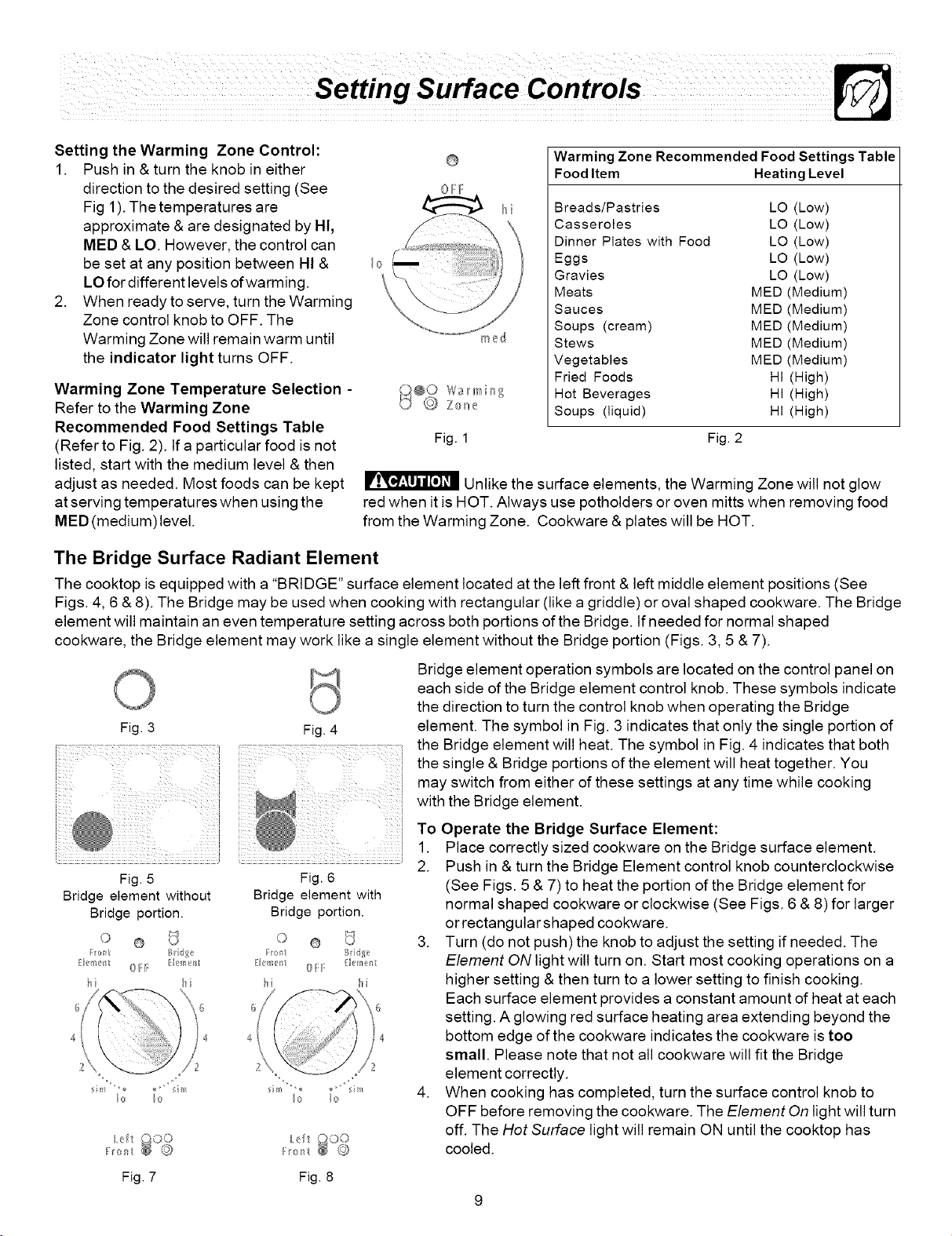
Setting the Warming Zone Control:
1. Push in & turn the knob in either
direction to the desired setting (See
Fig 1). The temperatures are
approximate & are designated by HI,
MED & LO. However, the control can
be set at any position between HI &
LO for different levels of warming.
2. When ready to serve, turn the Warming
Zone control knob to OFF. The
Warming Zone will remain warm until
the indicator light turns OFF.
Warming Zone Temperature Selection -
Refer to the Warming Zone
Recommended Food Settings Table
(Refer to Fig. 2). tfa particular food is not
listed, start with the medium level & then
adjust as needed. Most foods can be kept
at serving temperatures when using the
MED (medium)level.
[0
@
ti_t@_ Wa0m £
Eerie
Fig. 1
Warming Zone Recommended Food Settings Table
Food Item Heating Level
Breads/Pastries LO (Low)
Casseroles LO (Low)
Dinner Plates with Food LO (Low)
Eggs LO (Low)
Gravies LO (Low)
Meats MED (Medium)
Sauces MED (Medium)
Soups (cream) MED (Medium)
Stews MED (Medium)
Vegetables MED (Medium)
Fried Foods HI (High)
Hot Beverages HI (High)
Soups (liquid) HI (High)
Fig. 2
Unlike the surface elements, the Warming Zone will not glow
red when it is HOT. Always use potholders or oven mitts when removing food
from the Warming Zone. Cookware & plates will be HOT.
The Bridge Surface Radiant Element
The cooktop is equipped with a "BRIDGE" surface element located at the left front & left middle element positions (See
Figs. 4, 6 & 8). The Bridge may be used when cooking with rectangular (like a griddle) or oval shaped cookware. The Bridge
element will maintain an even temperature setting across both portions of the Bridge. tf needed for normal shaped
cookware, the Bridge element may work like a single element without the Bridge portion (Figs. 3, 5 & 7).
Fig. 3 Fig. 4
Fig. 5 Fig. 6
Bridge element without Bridge element with
Bridge portion. Bridge portion.
0 @ 0 @
Fol_ B_d_e Fol! B_d_"
¢
,'1 4
10 1o 10 1o
9tit GO0 9tit GO0
Bridge element operation symbols are located on the control panel on
each side of the Bridge element control knob. These symbols indicate
the direction to turn the control knob when operating the Bridge
element. The symbol in Fig. 3 indicates that only the single portion of
the Bridge element will heat. The symbol in Fig. 4 indicates that both
the single & Bridge portions of the element will heat together. You
may switch from either of these settings at any time while cooking
with the Bridge element.
To Operate the Bridge Surface Element:
1. Place correctly sized cookware on the Bridge surface element.
2. Push in & turn the Bridge Element control knob counterclockwise
(See Figs. 5 & 7) to heat the portion of the Bridge element for
normal shaped cookware or clockwise (See Figs. 6 & 8) for larger
or rectangularshaped cookware.
3. Turn (do not push) the knob to adjust the setting if needed. The
Element ON light will turn on. Start most cooking operations on a
higher setting & then turn to a lower setting to finish cooking.
Each surface element provides a constant amount of heat at each
setting. A glowing red surface heating area extending beyond the
bottom edge of the cookware indicates the cookware is too
small. Please note that not all cookware will fit the Bridge
element correctly.
4. When cooking has completed, turn the surface control knob to
OFF before removing the cookware. The Element On light will turn
off. The Hot Surface light will remain ON until the cooktop has
cooled.
Fig. 7 Fig. 8
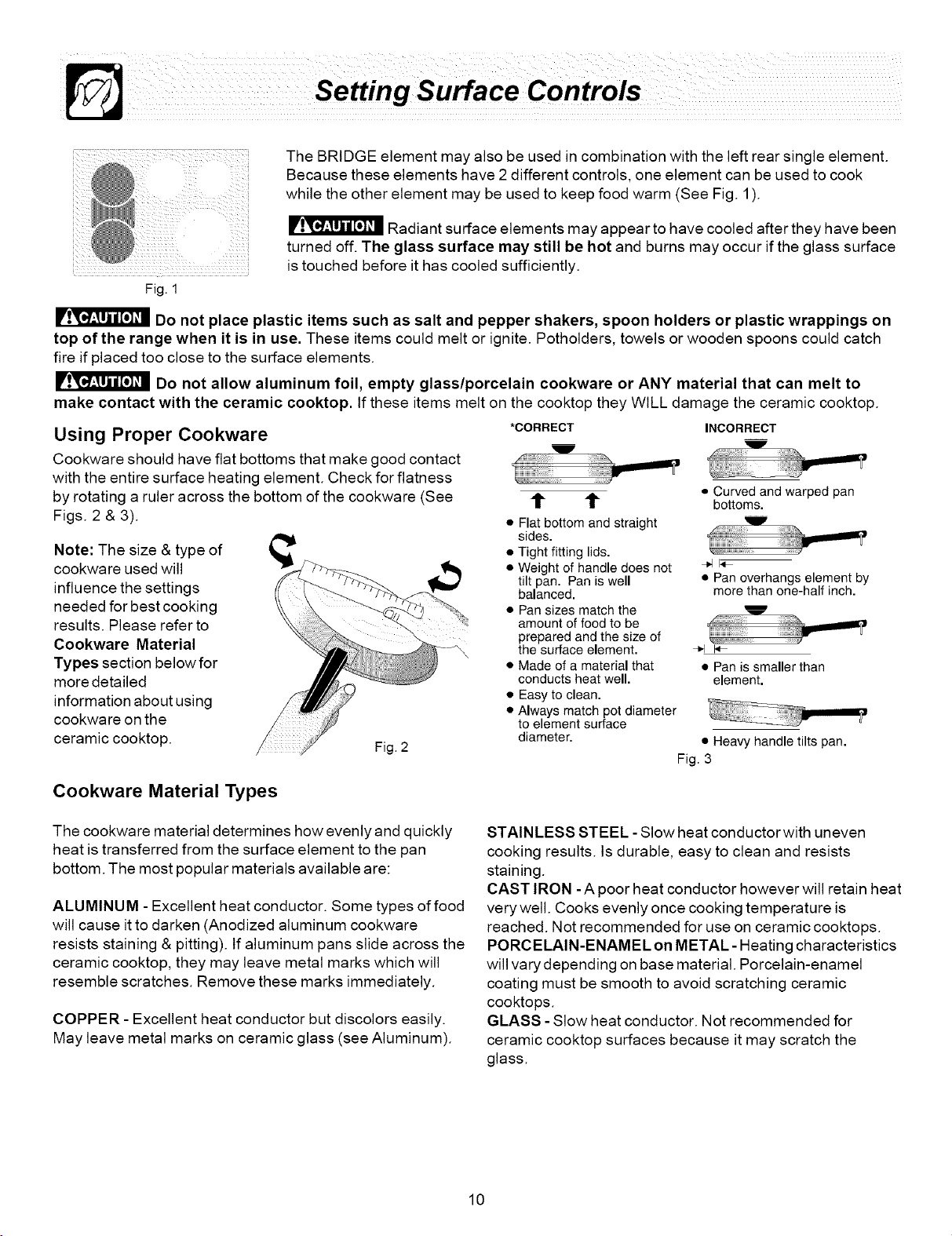
The BRIDGE element may also be used in combination with the left rear single element.
Because these elements have 2 different controls, one element can be used to cook
while the other element may be used to keep food warm (See Fig. 1).
Radiant surface elements may appear to have cooled after they have been
turned off. The glass surface may still be hot and burns may occur if the glass surface
is touched before it has cooled sufficiently.
Do not place plastic items such as salt and pepper shakers, spoon holders or plastic wrappings on
top of the range when it is in use. These items could melt or ignite. Potholders, towels or wooden spoons could catch
fire if placed too close to the surface elements.
Do not allow aluminum foil, empty glass/porcelain cookware or ANY material that can melt to
make contact with the ceramic cooktop. If these items melt on the cooktop they WILL damage the ceramic cooktop.
Using Proper Cookware
Cookware should have flat bottoms that make good contact
with the entire surface heating element. Check for flatness
by rotating a ruler across the bottom of the cookware (See
Figs. 2 & 3).
Note: The size & type of
cookware used will
influence the settings
needed for best cooking
results. Please refer to
Cookware Material
Types section below for
more detailed
information about using
cookware on the
ceramic cooktop.
Fig. 2
*CORRECT INCORRECT
v
jr ,
• Curved and warped pan
t t bottoms.
• Flat bottom and straight v
sides.
• Tight fitting lids.
• Weight of handle does not 4,.II,_
tilt pan. Pan is well • Pan overhangs element by
balanced, more than one-half inch.
• Pan sizes match the
amount of food to be
-t
prepared and the size of ......
the surface element. _ I.F
• Made of a material that • Pan is smaller than
conducts heat well. element.
• Easy to clean.
• Always match pot diameter
to element surface
diameter. • Heavy handle tilts pan.
Fig. 3
Cookware Material Types
The cookware material determines how evenly and quickly
heat is transferred from the surface element to the pan
bottom. The most popular materials available are:
ALUMINUM - Excellent heat conductor. Some types of food
will cause it to darken (Anodized aluminum cookware
resists staining & pitting). If aluminum pans slide across the
ceramic cooktop, they may leave metal marks which will
resemble scratches. Remove these marks immediately.
COPPER - Excellent heat conductor but discolors easily.
May leave metal marks on ceramic glass (see Aluminum).
STAINLESS STEEL - Slow heat conductor with uneven
cooking results. Is durable, easy to clean and resists
staining.
CAST IRON -A poor heat conductor however will retain heat
very well. Cooks evenly once cooking temperature is
reached. Not recommended for use on ceramic cooktops.
PORCELAIN-ENAMEL on METAL - Heating characteristics
will vary depending on base material. Porcelain-enamel
coating must be smooth to avoid scratching ceramic
cooktops.
GLASS - Slow heat conductor. Not recommended for
ceramic cooktop surfaces because it may scratch the
glass.
10
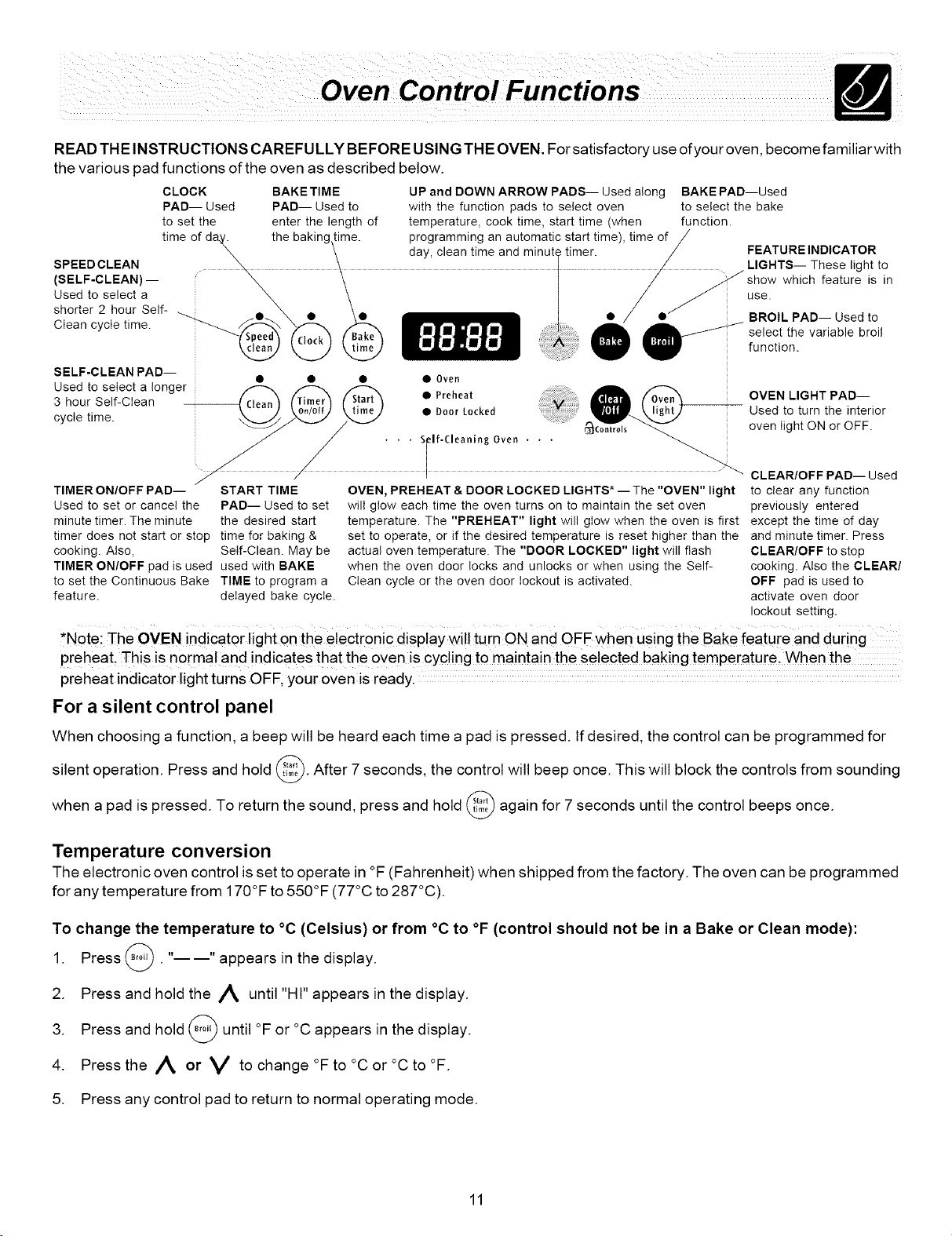
READ THE INSTRUCTIONS CAREFULLY BEFORE USING THE OVEN. Forsatisfactory use ofyour oven, become familiar with
the various pad functions of the oven as described below.
CLOCK BAKE TIME UP and DOWN ARROW PADS-- Used along BAKE PAD--Used
PAD-- Used PAD-- Used to with the function pads to select oven to select the bake
to set the enter the length of temperature, cook time, start time (when function,
time of da the time. programming an automatic start time), time of
day, clean timer.
SPEED CLEAN
(SELF-CLEAN) --
Used to select a
shorter 2 hour Self- -__
Clean cycle time.
SELF-CLEAN PAD--
• • • • Oven
se oseec on erhesecean- ...........................................
• DoorLocked I 0L_IJJIW\ lightJ
cyoIetime.
elf-Cleaning Oven • . •
J
TIMER ONIOFF PAD-- START TIME OVEN, PREHEAT & DOOR LOCKED LIGHTS* -- The "OVEN" light
Used to set or cancel the PAD-- Used to set will glow each time the oven turns on to maintain the set oven
minute timer. The minute the desired start temperature. The "PREHEAT" light will glow when the oven is first
timer does not start or stop time for baking & set to operate, or if the desired temperature is reset higher than the
cooking. Also, Self-Clean. May be actual oven temperature, The "DOOR LOCKED" light will flash
TIMER ON/OFF pad is used used with BAKE when the oven door locks and unlocks or when using the Self-
to set the Continuous Bake TIME to program a Clean cycle or the oven door lockout is activated.
feature, delayed bake cycle.
FEATURE INDICATOR
LIGHTS-- These light to
show which feature is in
._ BSR01L PAD__ Used to
select the variable broil
function.
OVEN LIGHT PAD--
Used to turn the interior
oven light ON or OFF.
CLEAR/OFF PAD-- Used
to clear any function
previously entered
except the time of day
and minute timer. Press
CLEAR/OFF to stop
cooking. Also the CLEAR/
OFF pad is used to
activate oven door
lockout setting.
,Note; The OVEN indicat0r light on the electronic display will turn ON and OFF When using the Bake feature and during
preheat, This is norma! and indicates that the oven is cycling to maintain the selected baking temperature, When the
preheat indicator light turns OFF, your oven is ready.
For a silent control panel
When choosing a function, a beep will be heard each time a pad is pressed. If desired, the control can be programmed for
silent operation. Press and hold @. After 7 seconds, the control will beep once. This will block the controls from sounding
when a pad is pressed. To return the sound, press and hold @ again for 7 seconds until the control beeps once.
Temperature conversion
The electronic oven control is set to operate in °F (Fahrenheit) when shipped from the factory. The oven can be programmed
for any temperature from 170°F to 550°F (77°C to 287°C).
To change the temperature to °C (Celsius) or from °C to °F (control should not be in a Bake or Clean mode):
1. Press _. "----" appears in the display.
2. Press and hold the A until "HI" appears in the display.
3. Press and hold _ until °F or °C appears in the display.
4. Press the A or V to change °F to °C or °C to °F.
5. Press any control pad to return to normal operating mode.
11
• • • • Oven
@@© :::::. ©
Controls
• • . Seit<ieanJn_Oven• . .
/
/
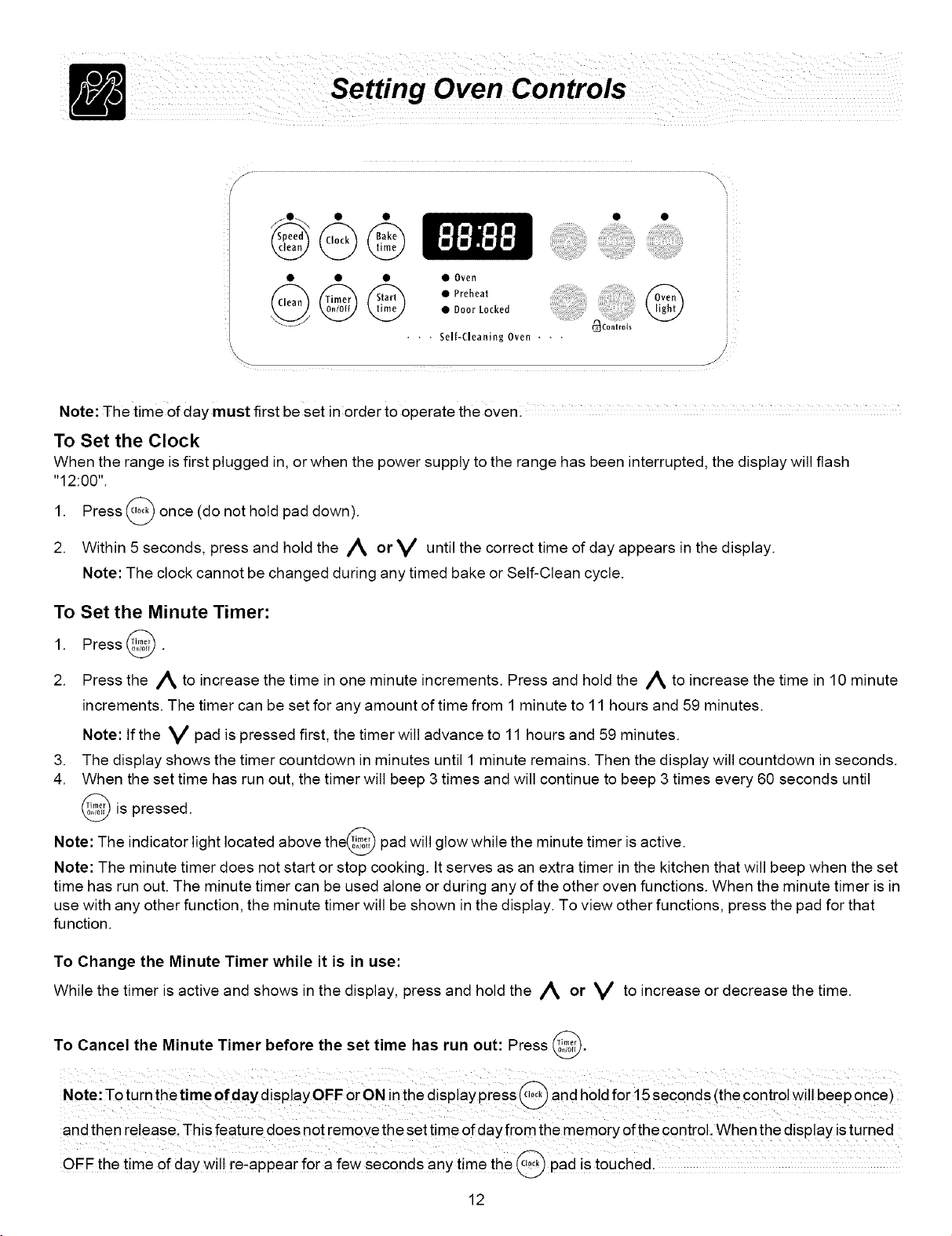
Note: The time of day must first be set in order to operate the oven.
To Set the Clock
When the range is first plugged in, or when the power supply to the range has been interrupted, the display will flash
"12:00".
once (do not hold pad down).
1. Press
2. Within 5 seconds, press and hold the A or V until the correct time of day appears in the display.
Note: The clock cannot be changed during any timed bake or Self-Clean cycle.
To Set the Minute Timer:
1. Press_.
2. Press the A to increase the time in one minute increments. Press and hold the A to increase the time in 10 minute
increments. The timer can be set for any amount of time from 1 minute to 11 hours and 59 minutes.
Note: If the V pad is pressed first, the timer will advance to 11 hours and 59 minutes.
3. The display shows the timer countdown in minutes until 1 minute remains. Then the display will countdown in seconds.
4. When the set time has run out, the timer will beep 3 times and will continue to beep 3 times every 60 seconds until
_is pressed.
Note: The indicator light located above the_ pad will glow while the minute timer is active.
Note: The minute timer does not start or stop cooking. It serves as an extra timer in the kitchen that will beep when the set
time has run out. The minute timer can be used alone or during any of the other oven functions. When the minute timer is in
use with any other function, the minute timer will be shown in the display. To view other functions, press the pad for that
function.
To Change the Minute Timer while it is in use:
While the timer is active and shows in the display, press and hold the /_, or V to increase or decrease the time.
To Cancel the Minute Timer before the set time has run out: Press _.
Note: To turnthe time of day display OFF or ON inthe display press _ and hold foil 5 seconds (the c0ntr01Wi!l beep Once)
and then release. This feature does not remove the set time of day from the memory ofthe control. When the display isturned
QFE the time of daY wi!l ie:appear for a few seconds any time the _ pad is touched .
12
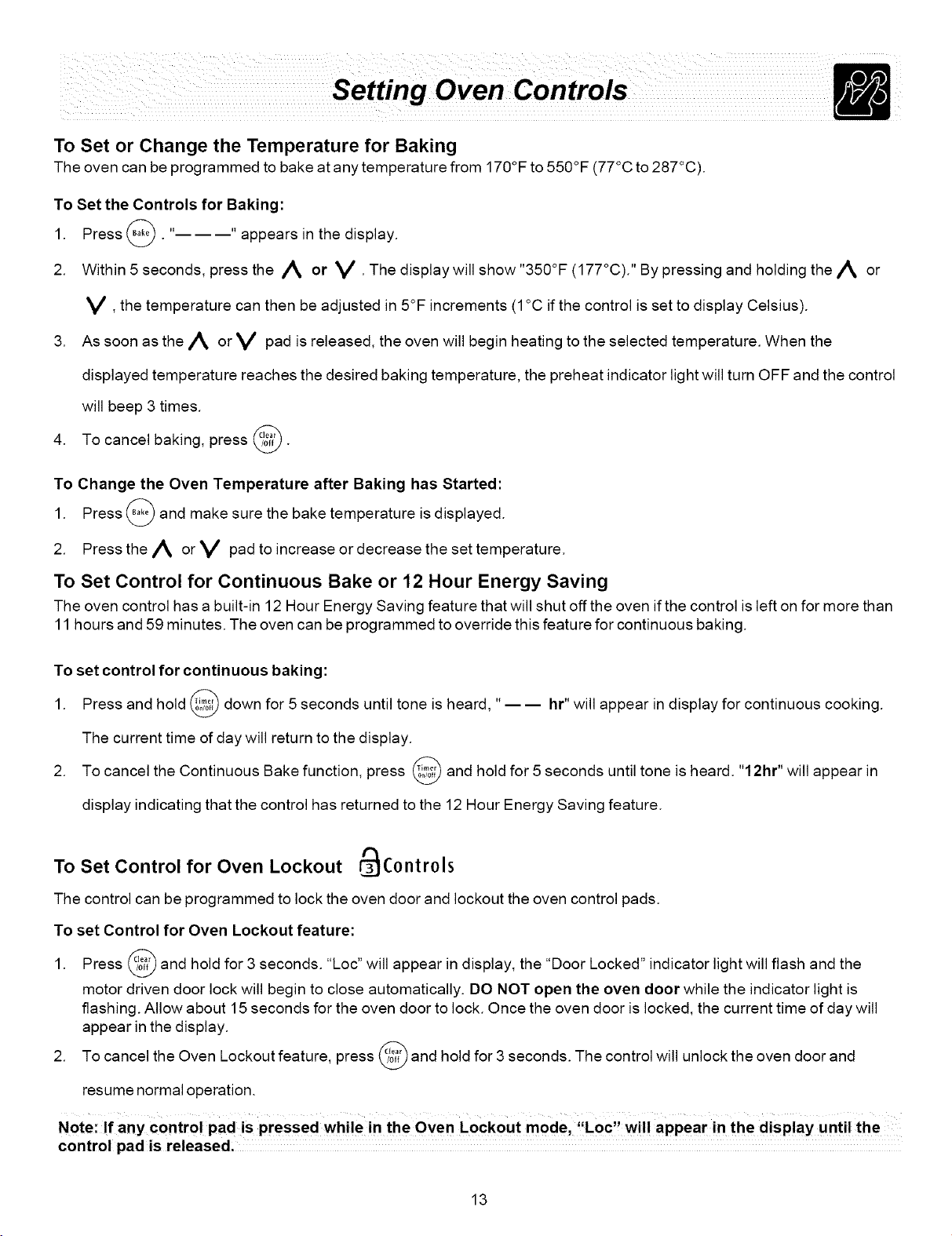
To Set or Change the Temperature for Baking
The oven can be programmed to bake at any temperature from 170°F to 550°F (77°C to 287°C).
To Set the Controls for Baking:
1. Press _. " "appears in the display.
2. Within 5 seconds, press the /_, or V-The displaywill show "350°F (177°C). '' By pressing and holding the A or
V, the temperature can then be adjusted in 5°F increments (1°C if the control is set to display Celsius).
3. As soon as the A or V pad is released, the oven will begin heating to the selected temperature. When the
displayed temperature reaches the desired baking temperature, the preheat indicator light will turn OFF and the control
will beep 3 times.
4. To cancel baking, press _.
To Change the Oven Temperature after Baking has Started:
1. Press _ and make sure the bake temperature is displayed.
2. Press the ,/_, or v pad to increase or decrease the set temperature.
To Set Control for Continuous Bake or 12 Hour Energy Saving
The oven control has a built-in 12 Hour Energy Saving feature that will shut off the oven if the control is left on for more than
11 hours and 59 minutes. The oven can be programmed to override this feature for continuous baking.
To set control for continuous baking:
1. Press and hold _ down for 5 seconds until tone is heard, "-- -- hr" will appear in display for continuous cooking.
The current time of day will return to the display.
2. To cancel the Continuous Bake function, press @ and hold for 5 seconds until tone is heard. "12hr" will appear in
display indicating that the control has returned to the 12 Hour Energy Saving feature.
To Set Control for Oven Lockout 8C0ntr01s
The control can be programmed to lock the oven door and lockout the oven control pads.
To set Control for Oven Lockout feature:
1. Press _ and hold for 3 seconds. "Loc" will appear in display, the "Door Locked" indicator light will flash and the
motor driven door lock will begin to close automatically. DO NOT open the oven door while the indicator light is
flashing. Allow about 15 seconds for the oven door to lock. Once the oven door is locked, the current time of day will
appear inthe display.
2. To cancel the Oven Lockout feature, press @ and hold for 3 seconds. The control will unlock the oven door and
resume normal operation.
Note: If any control pad is pressed while in the Oven Lockout mode, LOC will appear in the display until the
control pad is released,
13
Setting 0 ven Con trois
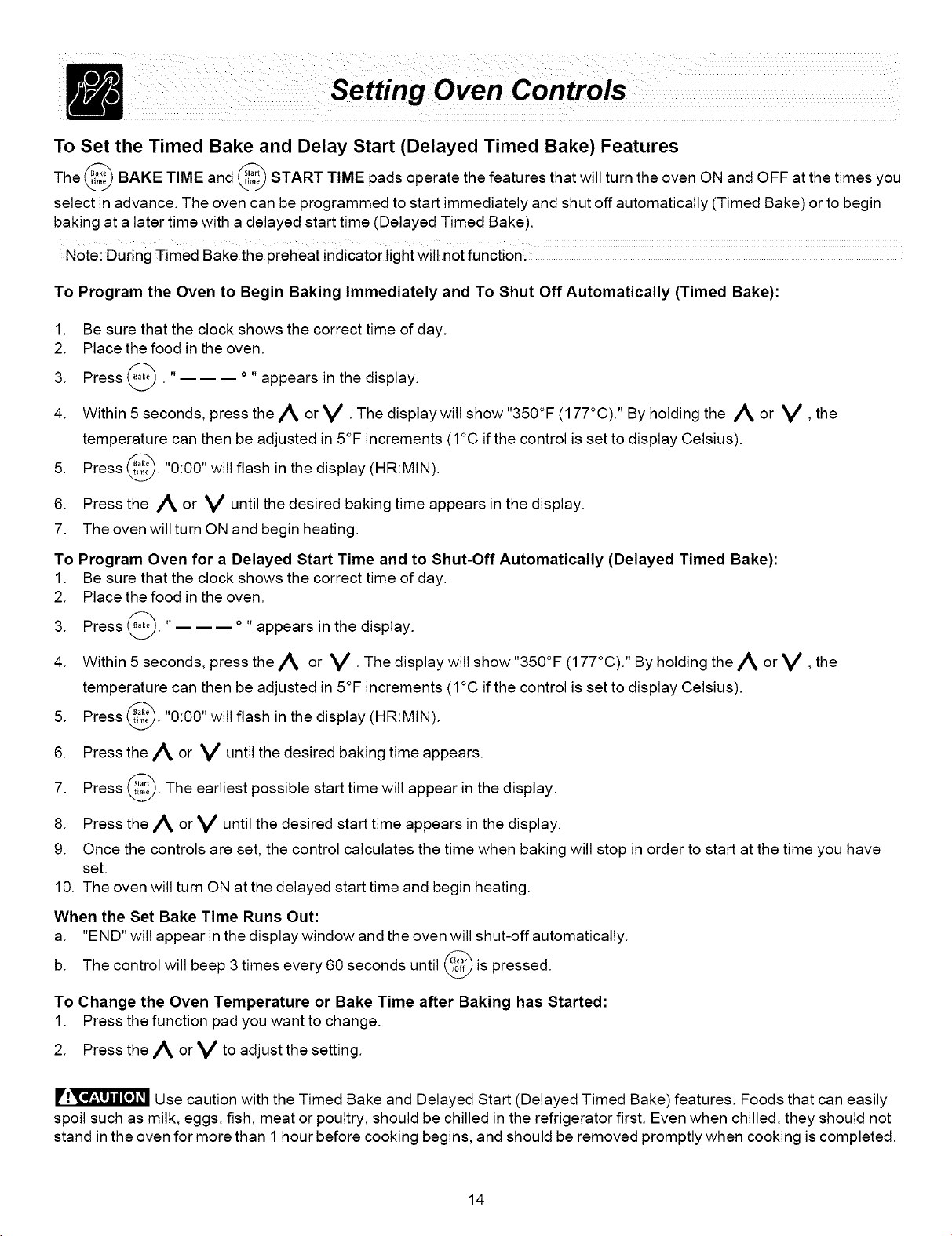
To Set the Timed Bake and Delay Start (Delayed Timed Bake) Features
The _ BAKE TIME and _ START TIME pads operate the features that will turn the oven ON and OFF at the times you
select in advance. The oven can be programmed to start immediately and shut off automatically (Timed Bake) or to begin
baking at a later time with a delayed start time (Delayed Timed Bake).
Note: During Timed Bake the preheat indicator light will not function.
To Program the Oven to Begin Baking Immediately and To Shut Off Automatically (Timed Bake):
1. Be sure that the clock shows the correct time of day.
2. Place the food in the oven.
3. Press (_. '.... appears in the display.
4. Within 5 seconds, press the/_, or V- The display will show "350°F (177°C). '' By holding the /_, or V, the
temperature can then be adjusted in 5°F increments (1°C if the control is set to display Celsius).
5. Press @. "0:00" will flash in the display (HR:MIN).
6. Press the /_, or V until the desired baking time appears in the display.
7. The oven will turn ON and begin heating.
To Program Oven for a Delayed Start Time and to Shut-Off Automatically (Delayed Timed Bake):
1. Be sure that the clock shows the correct time of day.
2. Place the food in the oven.
3. Press (_). '.... appears in the display.
4. Within 5 seconds, press the/_, or V- The display will show "350°F (177°C). '' By holding the/_, or V, the
temperature can then be adjusted in 5°F increments (1°C if the control is set to display Celsius).
5. Press @. "0:00" will flash in the display (HR:MIN).
6. Press the ,/_ or V until the desired baking time appears.
7. Press @. The earliest possible start time will appear in the display.
8. Press the ,/_ or V until the desired start time appears in the display.
9. Once the controls are set, the control calculates the time when baking will stop in order to start at the time you have
set.
10. The oven will turn ON at the delayed start time and begin heating.
When the Set Bake Time Runs Out:
a. "END" will appear in the display window and the oven will shut-off automatically.
b. The control will beep 3 times every 60 seconds until @ is pressed.
To Change the Oven Temperature or Bake Time after Baking has Started:
1. Press the function pad you want to change.
2. Press the A or V to adjust the setting.
[__ Use caution with the Timed Bake and Delayed Start (Delayed Timed Bake) features. Foods that can easily
spoil such as milk, eggs, fish, meat or poultry, should be chilled in the refrigerator first. Even when chilled, they should not
stand in the oven for more than 1 hour before cooking begins, and should be removed promptly when cooking is completed.
14
i i i i
Speed Bake TM Cooking System
Benefits of Speed Bake TM Cooking System:
--Foods cook up to 25 to 30% faster, saving time
& energy.
--Multiple rack baking.
--No special pans or bakeware needed.
• • • • Oven
• DOO_ Locked
, , , Self-Cleazfing Ove_ • • •
How the Speed Bake TM Cooking System works (some models)
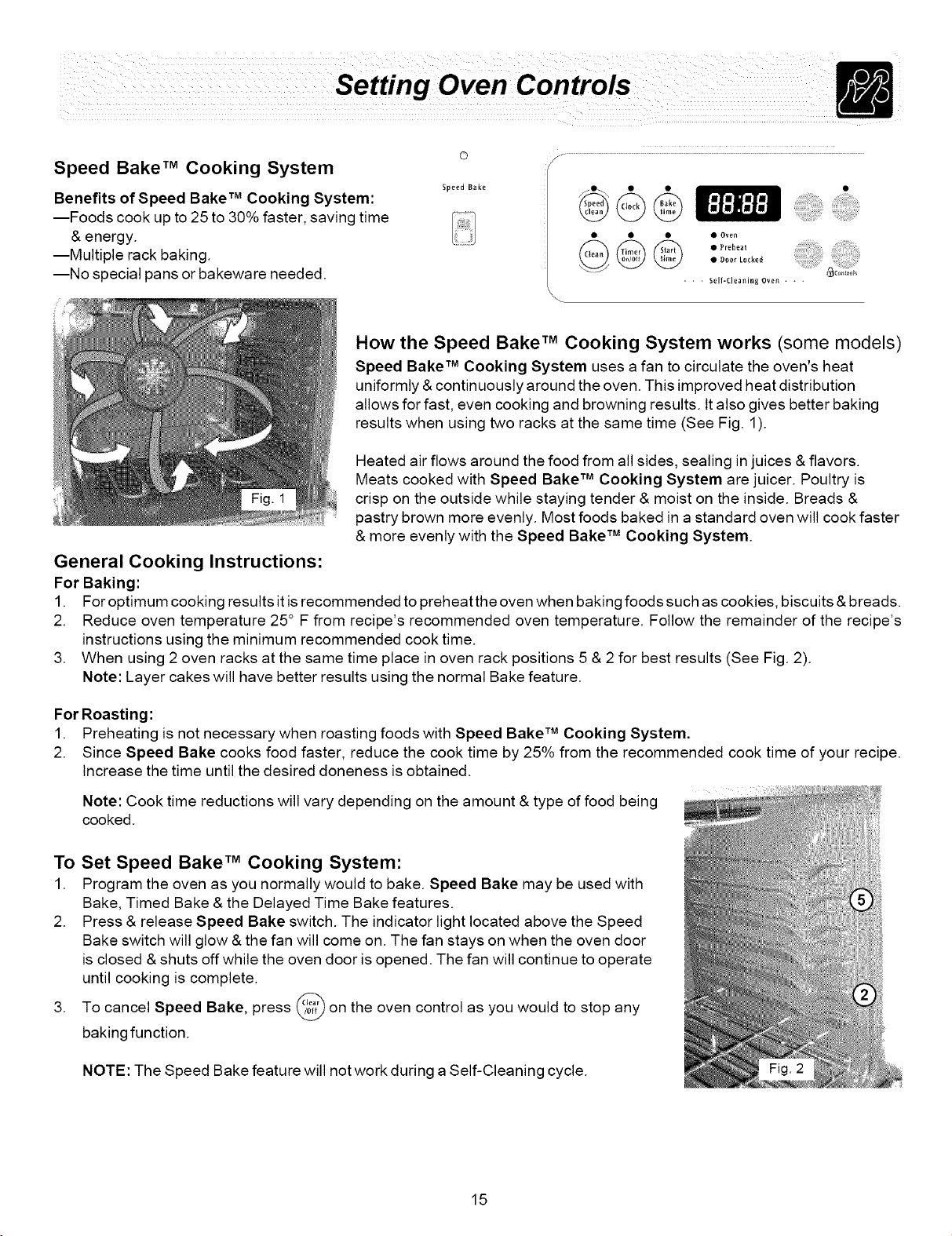
Speed Bake TM Cooking System uses a fan to circulate the oven's heat
uniformly & continuously around the oven. This improved heat distribution
allows for fast, even cooking and browning results. It also gives better baking
results when using two racks at the same time (See Fig. 1).
General Cooking Instructions:
For Baking:
1.
2.
Heated air flows around the food from all sides, sealing in juices & flavors.
Meats cooked with Speed Bake TM Cooking System are juicer. Poultry is
crisp on the outside while staying tender & moist on the inside. Breads &
pastry brown more evenly. Most foods baked in a standard oven will cook faster
& more evenly with the Speed Bake TM Cooking System.
For optimum cooking results it isrecommended to preheat the oven when baking foods such as cookies, biscuits & breads.
Reduce oven temperature 25° F from recipe's recommended oven temperature. Follow the remainder of the recipe's
instructions using the minimum recommended cook time.
When using 2 oven racks at the same time place in oven rack positions 5 & 2 for best results (See Fig. 2).
Note: Layer cakes will have better results using the normal Bake feature.
For Roasting:
1. Preheating is not necessary when roasting foods with Speed Bake TM Cooking System.
2. Since Speed Bake cooks food faster, reduce the cook time by 25% from the recommended cook time of your recipe.
Increase the time until the desired aloneness is obtained.
Note: Cook time reductions will vary depending on the amount & type of food being
cooked.
To Set Speed Bake TM Cooking System:
1. Program the oven as you normally would to bake. Speed Bake may be used with
Bake, Timed Bake & the Delayed Time Bake features.
2. Press & release Speed Bake switch. The indicator light located above the Speed
Bake switch will glow & the fan will come on. The fan stays on when the oven door
is closed &shuts off while the oven door is opened. The fan will continue to operate
until cooking is complete.
3. To cancel Speed Bake, press @ on the oven control as you would to stop any
baking function.
NOTE: The Speed Bake feature will not work during a Self-Cleaning cycle.
15
To Set for Broiling:
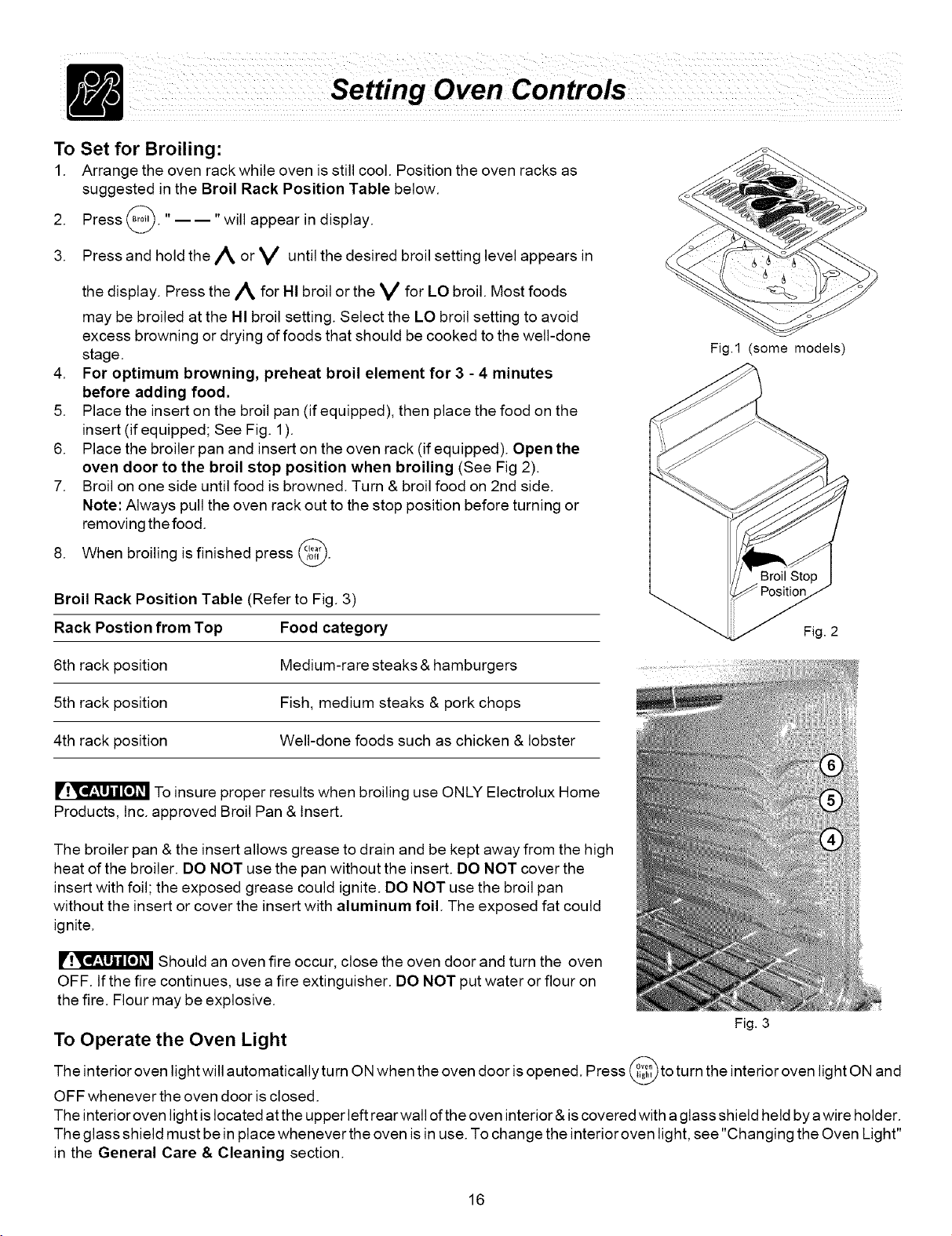
1. Arrange the oven rack while oven is still cool. Position the oven racks as
suggested in the Broil Rack Position Table below. ._
2. Press (8,0_. ,,_ _ ,,will appear in
display.
3. Press and hold the A or V until the desired broil setting level appears in _
the display. Press the ,/_ for HI broil or the V for LO broil. Most foods
may be broiled at the HI broil setting. Select the LO broil setting to avoid
excess browning or drying of foods that should be cooked to the well-done
stage.
4. For optimum browning, preheat broil element for 3 - 4 minutes
before adding food,
5. Place the insert on the broil pan (if equipped), then place the food on the
insert (if equipped; See Fig. 1).
6. Place the broiler pan and insert on the oven rack (if equipped). Open the
oven door to the broil stop position when broiling (See Fig 2).
7. Broil on one side until food is browned. Turn & broil food on 2nd side.
Note: Always pull the oven rack out to the stop position before turning or
removing the food.
8. When broiling isfinished press @.
Broil Rack Position Table (Refer to Fig. 3)
Rack Postion from Top Food category
6th rack position Medium-rare steaks & hamburgers
5th rack position Fish, medium steaks & pork chops
4th rack position Well-done foods such as chicken & lobster
Fig.1 (some models)
Fig. 3
Fig. 2
To insure proper results when broiling use ONLY Electrolux Home
Products, Inc. approved Broil Pan & Insert.
The broiler pan & the insert allows grease to drain and be kept away from the high
heat of the broiler. DO NOT use the pan without the insert. DO NOT cover the
insert with foil; the exposed grease could ignite. DO NOT use the broil pan
without the insert or cover the insert with aluminum foil. The exposed fat could
ignite.
Should an oven fire occur, close the oven door and turn the oven
OFF. If the fire continues, use a fire extinguisher. DO NOT put water or flour on
the fire. Flour may be explosive.
To Operate the Oven Light
The interior oven light will automatically turn ONwhen the oven door is opened. Press @ to turn the interior oven light ON and
OFF whenever the oven door isclosed.
The interior oven light is located at the upper left rear wall of the oven interior & is covered with a glass shield held by awire holder.
The glass shield must be in place whenever the oven is in use. To change the interior oven light, see "Changing the Oven Light"
in the General Care & Cleaning section.
16
DuringtheSelf-Cleaning
cycle,theoutsideoftherangecan
becomeveryhottothetouch.DONOT
leavesmallchildrenunattendednearthe
appliance.
Thehealthofsomebirds
isextremelysensitivetothefumesgiven
offduringtheSelf-Cleaningcycleofany
range.Movebirdstoanotherwell-
ventilatedroom.
DONOTlinetheoven
walls,racks,bottomoranyotherpartof
therangewithaluminumfoil.Doingso
willdestroyheatdistribution,produce
poorbakingresultsandcause
permanentdamagetotheoveninterior
(aluminumfoilwillmelttotheinterior
surfaceoftheoven).
DONOTforcetheoven
dooropen.Thiscandamagethe
automaticdoorlockingsystem.Use
cautionwhenopeningthedoorafterthe
Self-Cleaningcycleiscompleted.The
ovenmaystillbeVERYHOT.
DO HAND
CLEAN DOOR DO NOT
HAND
DOOR GASKET
HAND
CLEANFRAME
Note: See additional cleaning information
for the oven door in the General Care &
Cleaning section.
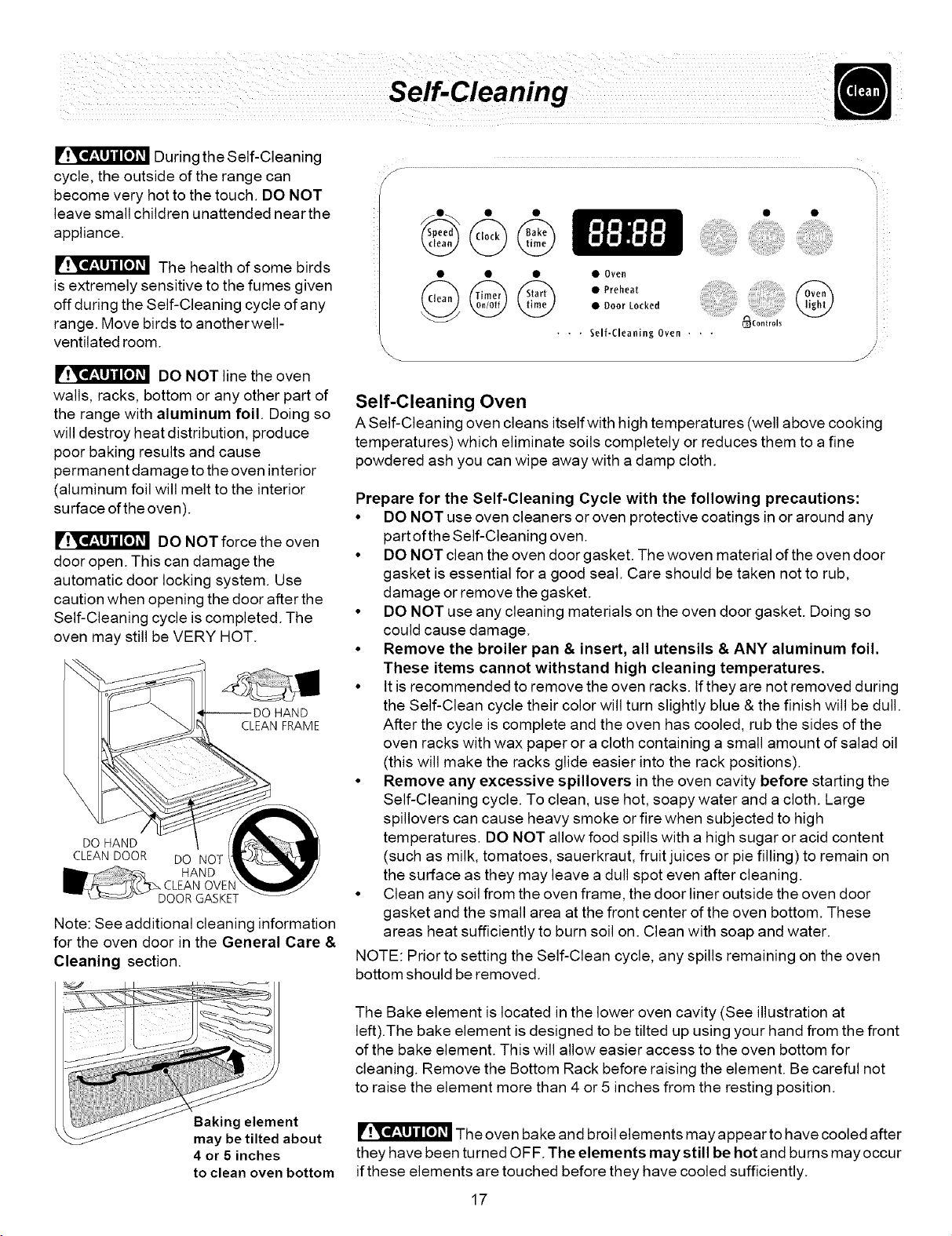
Baking element
may be tilted about
4 or 5 inches
toclean oven bottom
f ...............
\
• • • • Oven
• Door Locked
• • . Self-Cleaning Oven • , •
J
Self-Cleaning Oven
A Self-Cleaning oven cleans itself with high temperatures (well above cooking
temperatures) which eliminate soils completely or reduces them to a fine
powdered ash you can wipe away with a damp cloth.
Prepare for the Self-Cleaning Cycle with the following precautions:
• DO NOT use oven cleaners or oven protective coatings in or around any
part of the Self-Cleaning oven.
• DO NOT clean the oven door gasket. The woven material of the oven door
gasket is essential for a good seal. Care should be taken not to rub,
damage or remove the gasket.
• DO NOT use any cleaning materials on the oven door gasket. Doing so
could cause damage.
• Remove the broiler pan & insert, all utensils & ANY aluminum foil.
These items cannot withstand high cleaning temperatures.
• It is recommended to remove the oven racks. If they are not removed during
the Self-Clean cycle their color will turn slightly blue & the finish will be dull.
After the cycle is complete and the oven has cooled, rub the sides of the
oven racks with wax paper or a cloth containing a small amount of salad oil
(this will make the racks glide easier into the rack positions).
• Remove any excessive spillovers in the oven cavity before starting the
Self-Cleaning cycle. To clean, use hot, soapy water and a cloth. Large
spillovers can cause heavy smoke or fire when subjected to high
temperatures. DO NOT allow food spills with a high sugar or acid content
(such as milk, tomatoes, sauerkraut, fruit juices or pie filling) to remain on
the surface as they may leave a dull spot even after cleaning.
• Clean any soil from the oven frame, the door liner outside the oven door
gasket and the small area at the front center of the oven bottom. These
areas heat sufficiently to burn soil on. Clean with soap and water.
NOTE: Prior to setting the Self-Clean cycle, any spills remaining on the oven
bottom should be removed.
The Bake element is located in the lower oven cavity (See illustration at
left).The bake element is designed to be tilted up using your hand from the front
of the bake element. This will allow easier access to the oven bottom for
cleaning. Remove the Bottom Rack before raising the element. Be careful not
to raise the element more than 4 or 5 inches from the resting position.
The oven bake and broil elements may appear to have cooled after
they have been turned OFF. The elements may still be hot and burns may occur
ifthese elements are touched before they have cooled sufficiently.
17
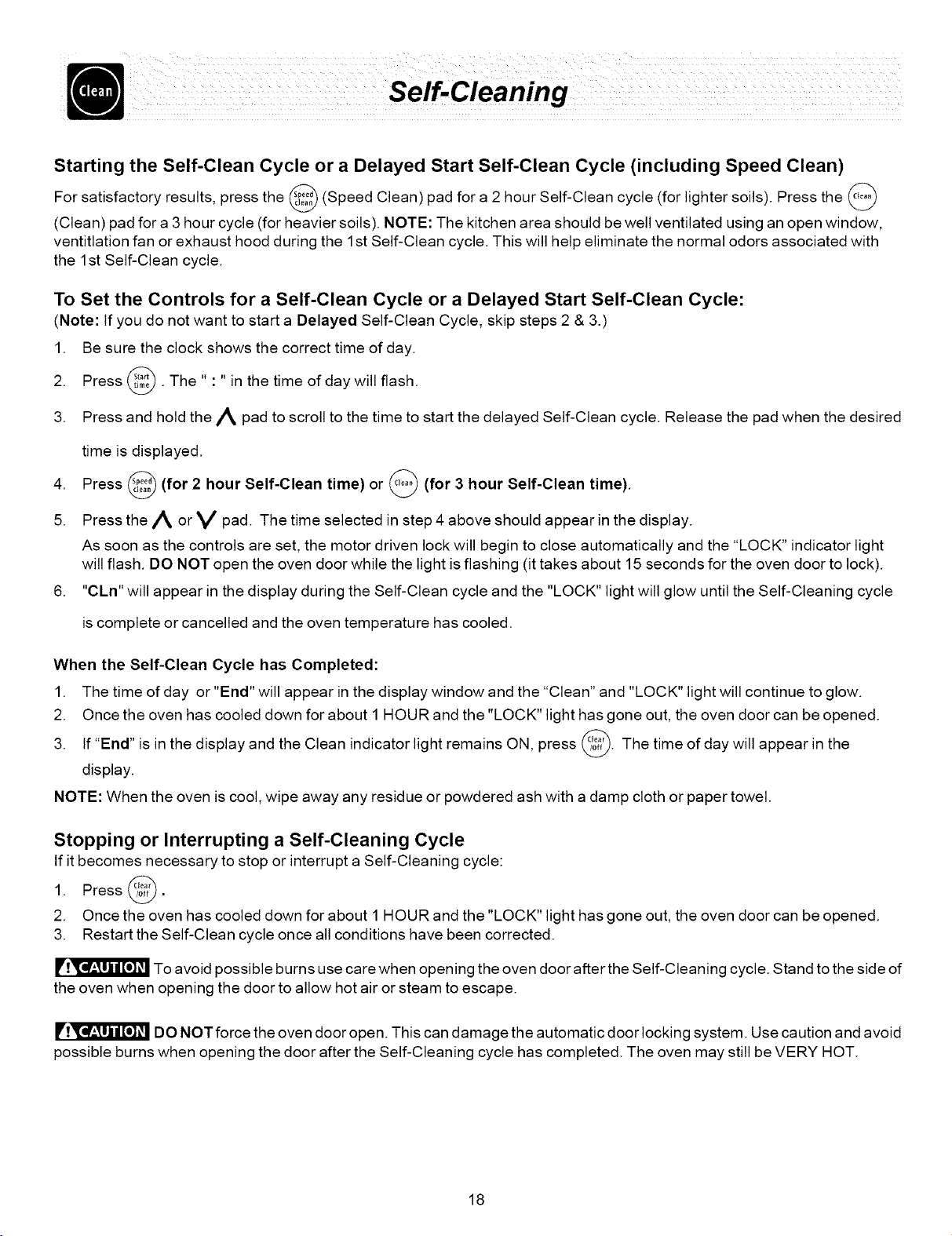
Starting the Self-Clean Cycle or a Delayed Start Self-Clean Cycle (including Speed Clean)
satisfactory results, press the _ (Speed Clean) pad for a 2 hour Self-Clean cycle (for lighter soils). Press the
For
(Clean) pad for a 3 hour cycle (for heavier soils). NOTE: The kitchen area should be well ventilated using an open window,
ventitlation fan or exhaust hood during the 1st Self-Clean cycle. This will help eliminate the normal odors associated with
the 1st Self-Clean cycle.
To Set the Controls for a Self-Clean Cycle or a Delayed Start Self-Clean Cycle:
(Note: If you do not want to start a Delayed Self-Clean Cycle, skip steps 2 & 3.)
1. Be sure the clock shows the correct time of day.
2. Press @. The " : " in the time of day will flash.
3. Press and hold the/_, pad to scroll to the time to start the delayed Self-Clean cycle. Release the pad when the desired
time is displayed.
4. Press _ (for 2 hour Self-Clean time) or _ (for 3 hour Self-Clean
time).
5. Press the A or V pad. The time selected in step 4 above should appear in the display.
As soon as the controls are set, the motor driven lock will begin to close automatically and the "LOCK" indicator light
will flash. DO NOT open the oven door while the light is flashing (it takes about 15 seconds for the oven door to lock).
6. "CLn" will appear in the display during the Self-Clean cycle and the "LOCK" light will glow until the Self-Cleaning cycle
is complete or cancelled and the oven temperature has cooled.
When the Self-Clean Cycle has Completed:
1. The time of day _r__End__wi__appear in the display wind_w and the "_lean__and '_L__K'_ light will c_ntinue t_ gl_w.
2. Once the oven has cooled down for about l HOUR and the "LOCK" light has gone out, the oven door can be opened.
3. If "End" is in the display and the Clean indicator light remains ON, press @. The time of day will appear in the
display.
NOTE: When the oven is cool, wipe away any residue or powdered ash with a damp cloth or paper towel.
Stopping or Interrupting a Self-Cleaning Cycle
If it becomes necessary to stop or interrupt a Self-Cleaning cycle:
1. Press _/_.
2. Once the oven has cooled down for about l HOUR and the "LOCK" light has gone out, the oven door can be opened.
3. Restart the Self-Clean cycle once all conditions have been corrected.
To avoid possible burns use care when opening the oven door after the Self-Cleaning cycle. Stand to the side of
the oven when opening the door to allow hot air or steam to escape.
DO NOT force the oven door open. This can damage the automatic door locking system. Use caution and avoid
possible burns when opening the door after the Self-Cleaning cycle has completed. The oven may still be VERY HOT.
18
General Care &Cleaning
(Cleaning Table)
Surfaces How to Clean
Aluminum (Trim Pieces) & Vinyl Use hot, soapy water and a cloth. Dry with a clean cloth.
Painted & Plastic Control Knobs, Body
Parts & Decorative Trim
Forgeneral cleaning, use hot, soapywater and a cloth. Formore difficult soils and
built-up grease, apply a liquid detergent directly onto the soil. Leave on soil for 30
to 60 minutes. Rinse with a damp cloth and dry. DO NOT use abrasive cleaners
on any of these materials; they can scratch. To remove control knobs, turn to the
OFF position; grasp firmly and pull straight off the shaft. To replace knobs after
cleaning, line up the flat sides of both the knob and the shaft; then push the knob
into place.
Stainless Steel, Chrome Control Panel,
Decorative Trim
Before cleaning the controlpanel, turn all controls to OFF and remove the control
knobs. To remove, pull each knob straight offthe shaft. Clean using hot, soapy
water and a dishcloth. Rinse with a clean water using a dishcloth. Be sure to
squeeze excess water from the cloth before wiping the panel; especially when
wiping around the controls. Excess water in or around the controls may cause
damage to the appliance.To replace knobs after cleaning, line up the flat sides of
both the knob and the shaft; then push the knob into place.
Clean stainless steel with hot, soapy water and a dishcloth. Rinse with clean
water and a cloth. Do not use cleaners with high concentrations of chlorides
or chlorines. Do not use harsh scrubbing cleaners. Only use kitchen cleaners
that are especially made for cleaning stainless steel. Always be sure to rinse the
cleaners from the surface as bluish stains may occur during heating that cannot
be removed.
Porcelain Enamel Broiler Pan and
Insert, Door Liner, Body Parts, Warmer
Drawer (some models)
Gentle scouring with a soapy scouring pad will remove most spots. Rinse with a
1:1solution of clearwater and ammonia. Ifnecessary, cover difficult spots with an
ammonia-soaked paper towel for 30 to 40 minutes. Rinse with clean water and a
damp cloth, and then scrub with asoap-filled scouring pad. Rinse and wipe drywith
a clean cloth. Remove all cleaners orthe porcelain may become damaged during
future heating. DO NOT use spray oven cleaners on the cooktop.
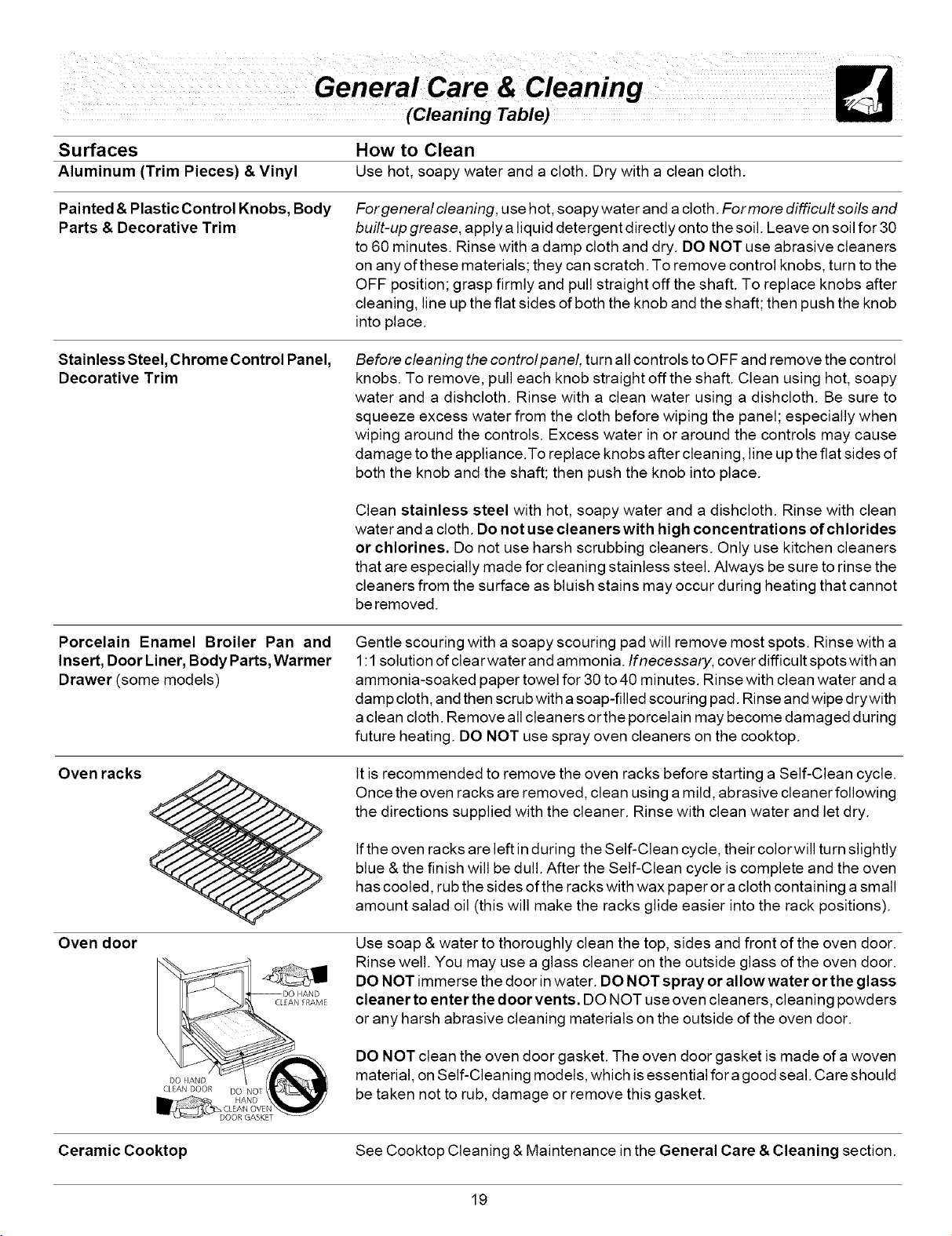
Oven racks
Oven door
It is recommended to remove the oven racks before starting a Self-Clean cycle.
Once the oven racks are removed, clean using a mild, abrasive cleaner following
the directions supplied with the cleaner. Rinse with clean water and let dry.
If the oven racks are left in during the Self-Clean cycle, their colorwill turn slightly
blue & the finish will be dull. After the Self-Clean cycle is complete and the oven
has cooled, rub the sides of the racks with wax paper or a cloth containing a small
amount salad oil (this will make the racks glide easier into the rack positions).
Use soap & water to thoroughly clean the top, sides and front of the oven door.
Rinse well. You may use a glass cleaner on the outside glass of the oven door.
DO NOT immerse the door in water. DO NOT spray or allow water or the glass
cleaner to enter the door vents. DO NOT use oven cleaners, cleaning powders
or any harsh abrasive cleaning materials on the outside of the oven door.
DO NOT clean the oven door gasket. The oven door gasket is made of a woven
material, on Self-Cleaning models, which isessential fora good seal. Care should
be taken not to rub, damage or remove this gasket.
Ceramic Cooktop See Cooktop Cleaning & Maintenance in the General Care & Cleaning section.
19
Cooktop Cleaning & Maintenance
Consistent and proper cleaning is essential to maintaining your ceramic glass cooktop,
Note: Additional cooktop cleaning cream may be ordered by visiting the Frigidaire website at www.frigidaire.com
Prior to using your cooktop for the first time, apply some of the cooktop cleaning cream supplied with your new range. Buffwith
a non-abrasive cloth or pad (such as a 3M Scotch-Brite® Blue Multi-Purpose No Scratch Scrub Sponge). This will make cleaning
easier when soiled from cooking. The special cooktop cleaning cream leaves a protective finish on the glass to help prevent
scratches and abrasions.
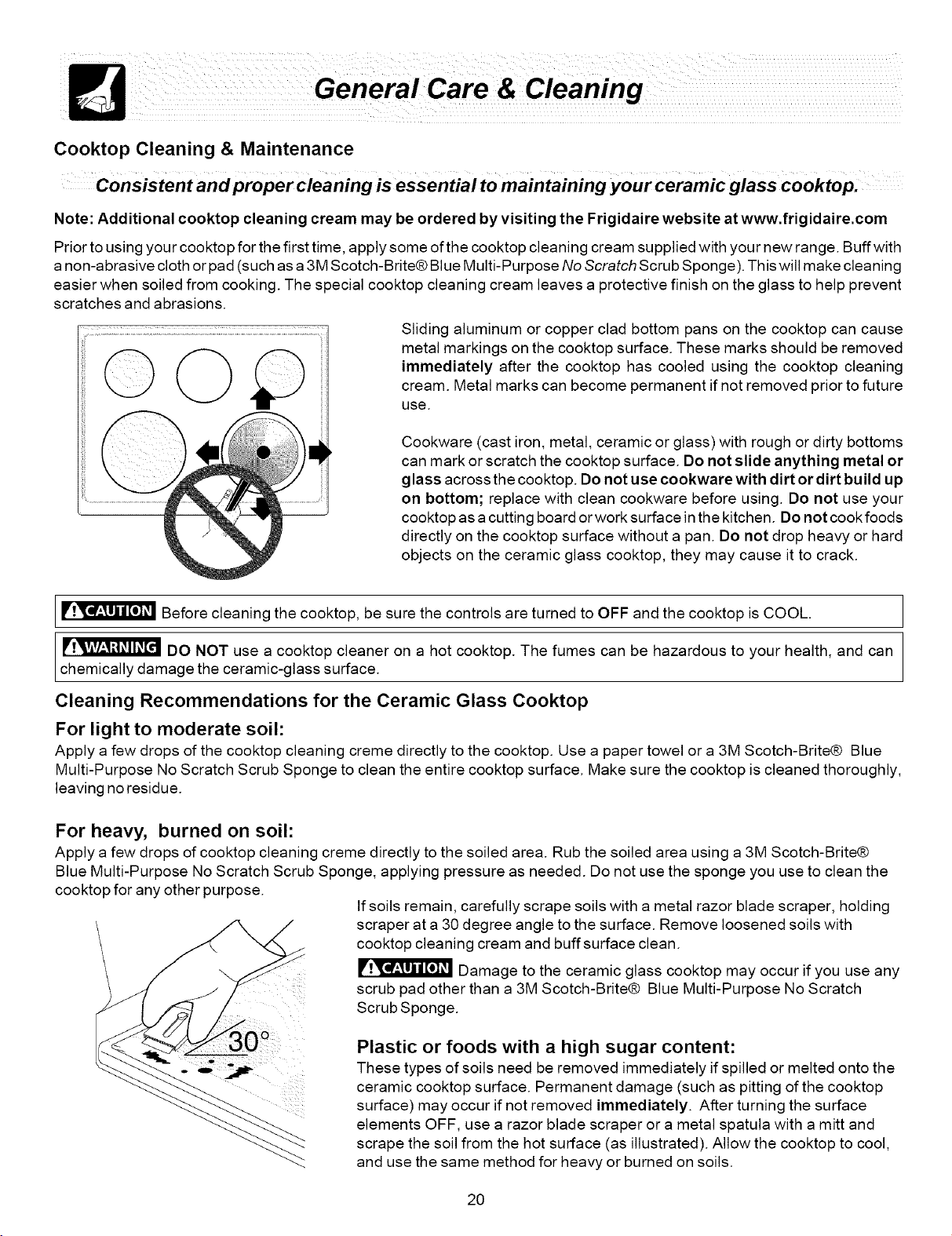
Sliding aluminum or copper clad bottom pans on the cooktop can cause
metal markings on the cooktop surface. These marks should be removed
immediately after the cooktop has cooled using the cooktop cleaning
cream. Metal marks can become permanent if not removed prior to future
use.
Cookware (cast iron, metal, ceramic or glass) with rough or dirty bottoms
can mark or scratch the cooktop surface. Do not slide anything metal or
g lass across the cooktop. Do not use cookware with dirt or dirt build up
on bottom; replace with clean cookware before using. Do not use your
cooktop as a cutting board or work surface in the kitchen. Do not cook foods
directly on the cooktop surface without a pan. Do not drop heavy or hard
objects on the ceramic glass cooktop, they may cause it to crack.
Before cleaning the cooktop, be sure the controls are turned to OFF and the cooktop is COOL.
DO NOT use a cooktop cleaner on a hot cooktop. The fumes can be hazardous to your health, and can
chemically damage the ceramic-glass surface.
Cleaning Recommendations for the Ceramic Glass Cooktop
For light to moderate soil:
Apply a few drops of the cooktop cleaning creme directly to the cooktop. Use a paper towel or a 3M Scotch-Brite® Blue
Multi-Purpose No Scratch Scrub Sponge to clean the entire cooktop surface. Make sure the cooktop is cleaned thoroughly,
leaving no residue.
For heavy, burned on soil:
Apply a few drops of cooktop cleaning creme directly to the soiled area. Rub the soiled area using a 3M Scotch-Brite®
Blue Multi-Purpose No Scratch Scrub Sponge, applying pressure as needed. Do not use the sponge you use to clean the
cooktop for any other purpose.
tf soils remain, carefully scrape soils with a metal razor blade scraper, holding
scraper at a 30 degree angle to the surface. Remove loosened soils with
cooktop cleaning cream and buff surface clean.
Damage to the ceramic glass cooktop may occur if you use any
scrub pad other than a 3M Scotch-Brite® Blue Multi-Purpose No Scratch
Scrub Sponge.
Plastic or foods with a high sugar content:
These types of soils need be removed immediately if spilled or melted onto the
ceramic cooktop surface. Permanent damage (such as pitting of the cooktop
surface) may occur if not removed immediately. After turning the surface
elements OFF, use a razor blade scraper or a metal spatula with a mitt and
scrape the soil from the hot surface (as illustrated). Allow the cooktop to cool,
and use the same method for heavy or burned on soils.
20
Cleaning Recommendations for the Ceramic Glass Cooktop (cont'd)
Do not use the following on the ceramic glass cooktop:
• Do not use abrasive cleaners and scouring pads, such as metal and some nylon
pads. They may scratch the cooktop, making it more difficult to clean.
• Do not use harsh cleaners, such as chlorine bleach, ammonia or oven cleaners,
as they may etch or discolor the cooktop.
• Do not use dirty sponges, cloths or paper towels, as they can leave soil or lint
on the cooktop which can burn and cause discoloration.
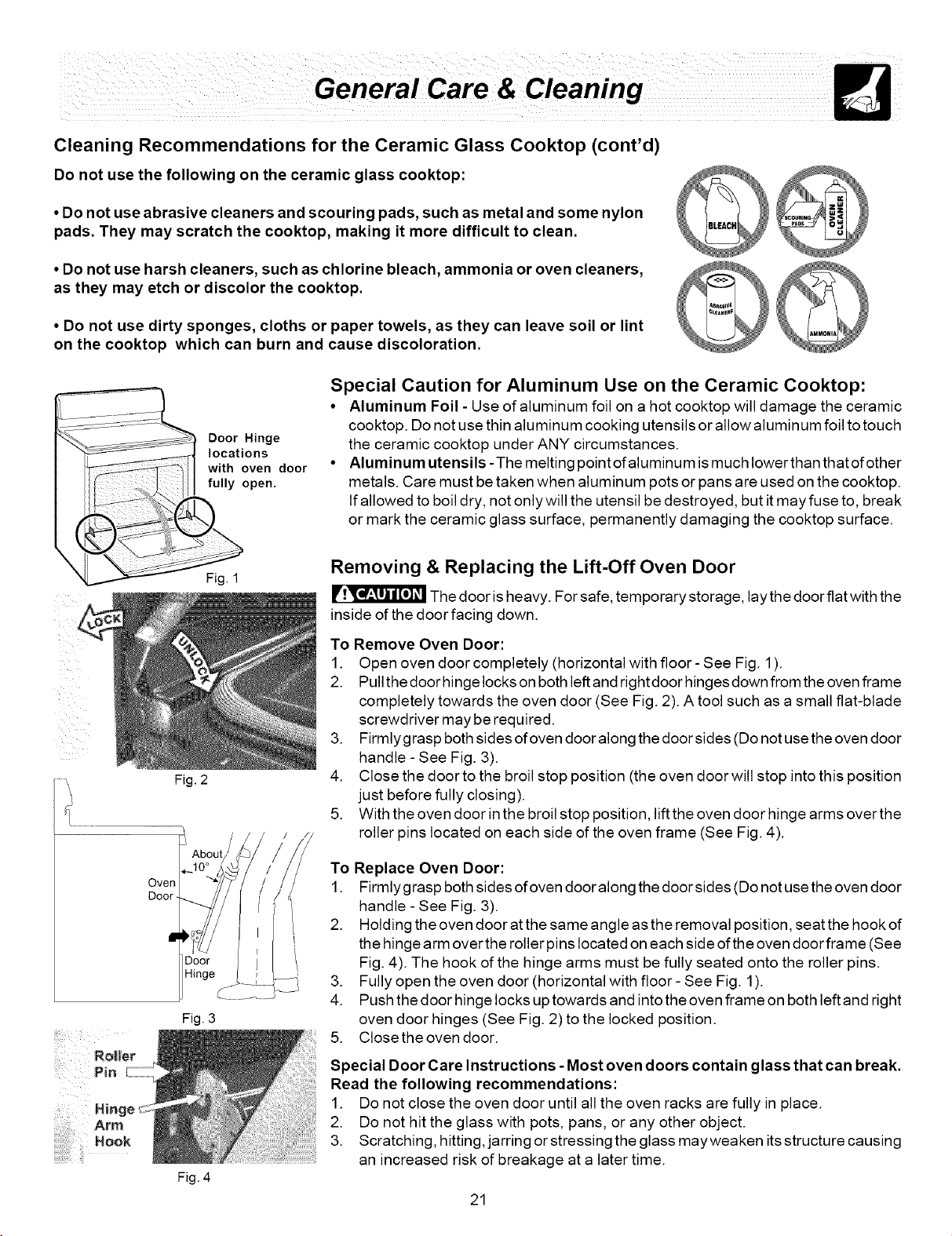
Door Hinge
locations
with oven door
fully open.
Fig. 2
Special Caution for Aluminum Use on the Ceramic Cooktop:
• Aluminum Foil - Use ofaluminum foil on a hot cooktop willdamage the ceramic
cooktop. Do not use thin aluminum cooking utensils or allow aluminum foil totouch
the ceramic cooktop under ANY circumstances.
• Aluminum utensils-The melting point ofaluminum is much Iowerthan that ofother
metals. Care must be taken when aluminum pots or pans are used on the cooktop.
If allowed to boil dry, not onlywill the utensil be destroyed, but itmay fuse to, break
or mark the ceramic glass surface, permanently damaging the cooktop surface.
Oven
Door,
Fig. 1
Fig. 3
Fig. 4
Removing & Replacing the Lift-Off Oven Door
The door is heavy. For safe, temporary storage, lay the door fiat with the
inside of the door facing down.
To Remove Oven Door:
1. Open oven door completely (horizontal with floor- See Fig. 1).
2. Pullthe door hinge locks on both left and right door hinges down from the oven frame
completely towards the oven door (See Fig. 2). A tool such as a small fiat-blade
screwdriver may be required.
3. Firmlygrasp both sides ofoven dooralong the doorsides (Do not use the oven door
handle -See Fig. 3).
4. Close the doorto the broil stop position (the oven doorwill stop into this position
just before fully closing).
5. With the oven door in the broil stop position, lift the oven door hinge arms over the
roller pins located on each side of the oven frame (See Fig. 4).
To Replace Oven Door:
1. Firmlygrasp both sides ofoven dooralong the doorsides (Do not use the oven door
handle -See Fig. 3).
2. Holding the oven door at the same angle as the removal position, seat the hook of
the hinge arm over the roller pins located on each side of the oven door frame (See
Fig. 4). The hook of the hinge arms must be fully seated onto the roller pins.
3. Fully open the oven door (horizontal with floor- See Fig. 1).
4. Push the door hinge locks up towards and into the oven frame on both left and right
oven door hinges (See Fig. 2) to the locked position.
5. Close the oven door.
Special Door Care Instructions - Most oven doors contain glass that can break.
Read the following recommendations:
1. Do not close the oven door until all the oven racks are fully in place.
2. Do not hit the glass with pots, pans, or any other object.
3. Scratching, hitting, jarring orstressing the glass mayweaken its structure causing
an increased risk of breakage at a later time.
21
! u! iijjjjJJGene /iCa ¸&cleaningliJJJJ
Changing the Oven Light
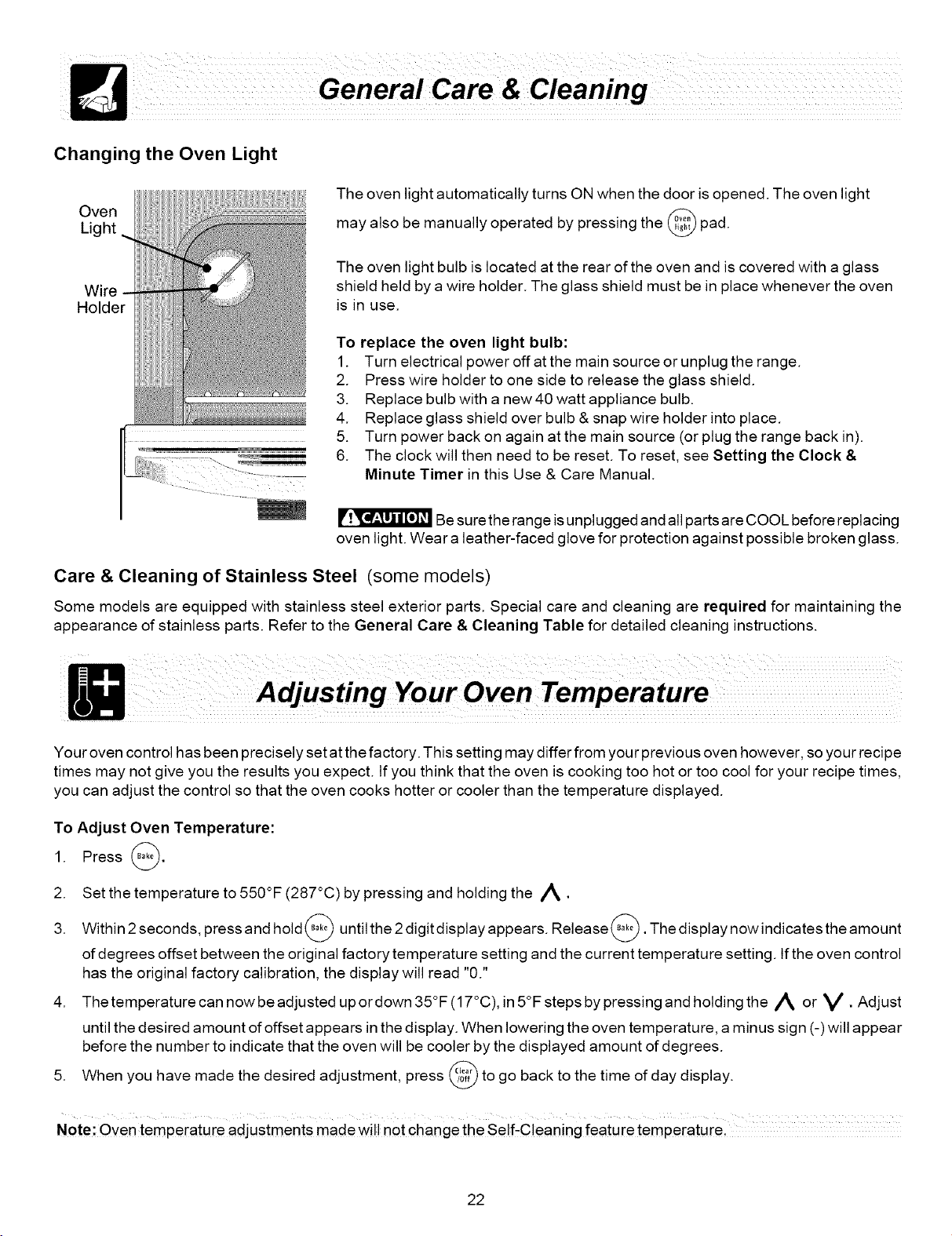
Oven
Light
Holder
The oven light automatically turns ON when the door is opened. The oven light
may also be manually operated by pressing the @ pad.
The oven light bulb is located at the rear of the oven and is covered with a glass
shield held by a wire holder. The glass shield must be in place whenever the oven
is in use.
To replace the oven light bulb:
1. Turn electrical power off at the main source or unplug the range.
2. Press wire holder to one side to release the glass shield.
3. Replace bulb with a new 40 watt appliance bulb.
4. Replace glass shield over bulb & snap wire holder into place.
5. Turn power back on again at the main source (or plug the range back in).
6. The clock will then need to be reset. To reset, see Setting the Clock &
Minute Timer in this Use & Care Manual.
Be sure the range isunplugged and all parts are COOL before replacing
oven light. Weara leather-faced glove for protection against possible broken glass.
Care & Cleaning of Stainless Steel (some models)
Some models are equipped with stainless steel exterior parts. Special care and cleaning are required for maintaining the
appearance of stainless parts. Refer to the General Care & Cleaning Table for detailed cleaning instructions.
Your oven control has been precisely set at the factory. This setting may differ from your previous oven however, so your recipe
times may not give you the results you expect. If you think that the oven is cooking too hot or too cool for your recipe times,
you can adjust the control so that the oven cooks hotter or cooler than the temperature displayed.
To Adjust Oven Temperature:
1. Press _.
2. Set the temperature to 550°F (287°C) by pressing and holding the A •
3. Within 2 seconds, press and hold (_ until the 2 digit display appears. Release (_. The display now indicates the amount
of degrees offset between the original factory temperature setting and the current temperature setting. Ifthe oven control
has the original factory calibration, the display will read "0."
4. The temperature can now be adjusted up ordown 35°F (17°C), in5°F steps by pressing and holding the A or V • Adjust
until the desired amount of offset appears in the display. When lowering the oven temperature, a minus sign (-) will appear
before the number to indicate that the oven will be cooler by the displayed amount of degrees.
5. When you have made the desired adjustment, press @ to go back to the time of day display.
Note: Oven temperature adjustments made wil! not change the Self,Cleaning feature temperature,
22
Solutions to Common Problems
Beforeyou callforservice, review the following list. It may save you time and expense. The list includes common occurrences
(shown in bold) that are not the result of defective workmanship or materials in this appliance. The possible corrections to these
problems are provided with the problem listed:
Range is not level - (1) Poor installation. Place oven rack in
center of oven. Place a level on the oven rack. Adjust leveling
legs at base of range until the oven rack is level. (2) Be sure
floor is level, strong & stable enough to adequately support
range. (3) If floor is sagging or sloping, contact a carpenter to
correct the situation. (4) Kitchen cabinet alignment may make
range appear not level. Be sure cabinets are square & have
sufficient room for range clearance.
Cannot move appliance easily. Appliance must be accessible
for service - (1) Cabinets not square or are built in too tightly.
Contact builder or installer to make appliance accessible. (2)
Carpet interferes with range. Provide sufficient space so range
can be lifted over carpet.
Oven control beeps and displays any "F" code error (for
example F11) - Electronic control has detected a fault condition.
Press CLEAR/OFF to clear the display & stop beeping.
Reprogram oven. If fault recurs, record fault number. Press
CLEAR/OFF & contact your authorized service agent.
Surface element too hot or not hot enough - incorrect control
setting. Be sure the correct control is ON for the element
needed.
Surface element does not heat - (1) Lightweight or warped
pans used. Use only fiat, evenly balanced, medium or
heavyweight cookware. Flat pans heat better than warped pans.
Cookware materials & weight of the material affect heating.
Heavy & medium-weight pans heat evenly. Because lightweight
pans heat unevenly, foods may burn easily. (2) No power to the
appliance. Check steps under "Entire Appfiance Does Not
Operate" in this Before You Call checklist. (3) Incorrect control
setting. Make sure the correct control is ON for the element
needed.
Entire appliance does not operate - Make sure cord/plug is
plugged correctly into outlet. Service wiring is not complete.
Contact your dealer, installing agent or authorized service
agent. Power outage. Check house lights to be sure. Call your
local electric company for service.
Oven light does not work- Replace or tighten bulb. See Changing
Oven Light section in this Use & Care Manual.
Oven smokes excessively during broiling - (1) Control(s) not
set properly. Follow instructions under Setting Oven Controls.
(2) Make sure oven door is opened to broil stop position. (3)
Meat too close to the broil element. Reposition the rack to
provide proper clearance between the meat & the element.
Preheat the broil element for searing. (4) Meat not properly
prepared. Remove excess fat from meat. Cut remaining fatty
edges to prevent curling, but do not cut into lean. (5) Insert on
broiler pan wrong side up & grease not draining. Always place
grid on the broiler pan with ribs up & slots down to allow
grease to drip into pan (some models). (6) Grease has built up
on oven surfaces. Regular cleaning is necessary when broiling
frequently. Old grease or food spatters cause excessive
smoking.
Poor baking results - Many factors affect baking results. Make sure
the proper oven rack position is used. Center food in the oven &
space pans to allow air to circulate. Allow the oven to preheat to the
set temperature before placing food in the oven. Try adjusting the
recipe's recommended temperature or baking time. If you feel the
oven is too hot or cool refer to Adjusting Your Oven Temperature
section in this Use & Care Manual.
Self-Clea ning cycle does not work -Oven control not set properly.
Follow instructions under Self-Cleaning Self-Cleaning cycle was
interrupted. Follow steps under "Stopping or Interrupting a Self-
Cleaning Cycle" under Self-Cleaning
Soil not completely removed after Self-Cleaning cycle -
Failure to clean bottom, front top of oven, frame of oven or door
area outside oven seal. These areas are not in the self-
cleaning area, but get hot enough to burn on residue. Clean
these areas before the Self-Cleaning cycle is started. Burned-
on residue can be cleaned with a stiff nylon brush and water or
a nylon scrubber. Be careful not to damage the oven gasket.
Flames inside oven or smoking from vent - (1) Excessive
spillovers in oven. Set Self-Clean cycle for a longer cleaning
time. (2) Excessive spillovers in oven. This is normal,
especially for high oven temperatures, pie spillovers or large
amounts of grease on bottom of oven. Wipe up excessive
spillovers before starting Self-Clean cycle. If flames or
excessive smoke are present, stop the Self-Clean cycle &
follow steps under "Stopping or Interrupting a Self-Cleaning
Cycle" in the Self-Cleaning section.
Scratches or abrasions on cooktop surface (Smooth top
models only) - (1) Coarse particles such as salt or sand
between cooktop & utensils can cause scratches. Be sure
cooktop surface & bottoms of utensils are clean before usage.
Small scratches do not affect cooking and will become less
visible with time. (2) Cleaning materials not recommended for
ceramic glass cooktop have been used. Also see "Cooktop
Cleaning & Maintenance" in the General Care & Cleaning
section. (3) Cookware with rough bottom has been used. Use
smooth, flat-bottomed cookware.
Metal marks (Smooth top models only) - Sliding or scraping of
metal utensils on cooktop surface. Do not slide metal utensils
on cooktop surface. Use a ceramic-glass cooktop cleaning
creme to remove the marks. Also see "Cooktop Cleaning &
Maintenance" in the General Care & Cleaning section.
Brown streaks or specks (Smooth top models only) -
Boilovers are cooked onto surface. Use razor blade scraper to
remove soil. See "Cooktop Cleaning & Maintenance" in the
General Care & Cleaning section.
Areas of discoloration with metallic sheen (Smooth top
models only) - Mineral deposits from water & food. Remove
using a ceramic-glass cooktop cleaning creme. Use cookware
with clean, dry bottoms. See "Cooktop Cleaning &
Maintenance" in the General Care & Cleaning section.
23
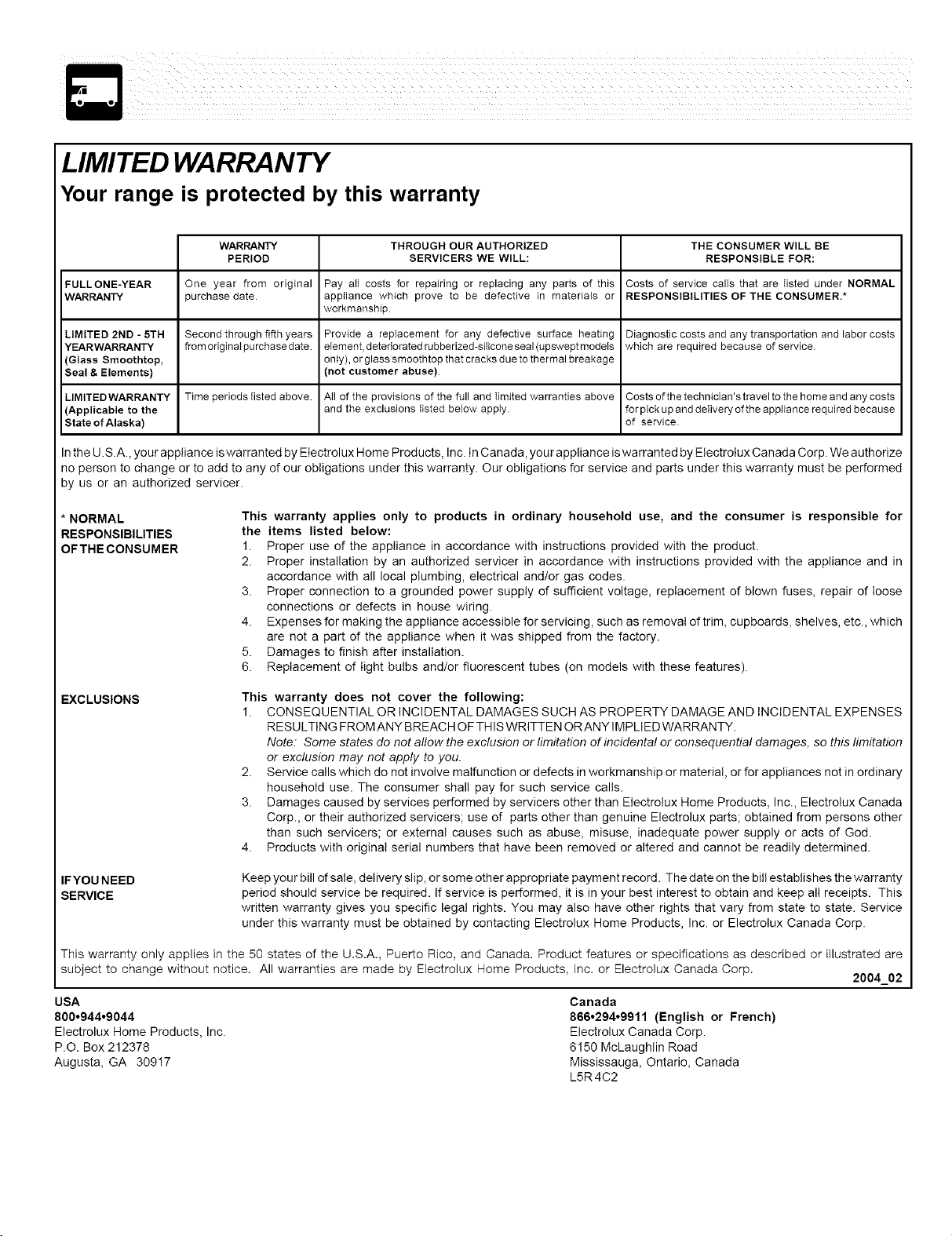
LIMITED WARRANTY
Your range is protected by this warranty
WARRANTY THROUGH OUR AUTHORIZED THE CONSUMER WILL BE
PERIOD SERVICERS WE WILL: RESPONSIBLE FOR:
FULLONE-YEAR One year from original Pay all costs for repairing or replacing any parts of this Costs of service calts that are Iisted under NORMAL
WARRANTY purchase date. appliance which prove to be defective in materials or RESPONSIBILITIES OF THE CONSUMER.*
workmanship.
LIMITED 2ND - 5TH Second through fifth years Provide a replacement for any defective surface heating Diagnostic costs and any transportation and labor costs
YEARWARRANTY fromoriginalpurchasedate, etement, deterioratedrubberized-siticoneseal(upsweptmodets which are required because of service.
Glass Smoothtop, onty), or glass smoothtop that cracks due to thermal breakage
Seal & Elements) (not customer abuse)
LIMITEDWARRANTY Time periods listed above. Atl of the provisions of the full and Iimited warranties above Costs of the technician'stravelto the home and any costs
(Applicable to the and the exclusions tisted below appty, for pick up and deIivery of the appliance required because
State of Alaska) of service.
Inthe U.S.A., your appliance is warranted by EIectrolux Home Products, Inc. In Canada, your appliance is warranted by Electrolux Canada Corp. We authorize
no person to change or to add to any of our obligations under this warranty. Our obligations for service and parts under this warranty must be performed
by us or an authorized servicer,
*NORMAL
RESPONSIBILITIES
OFTHECONSUMER
This warranty applies only to products in ordinary household use, and the consumer is responsible for
the items listed below:
1. Proper use of the appliance in accordance with instructions provided with the product.
2. Proper installation by an authorized servicer in accordance with instructions provided with the appliance and in
accordance with all local plumbing, electrical and/or gas codes.
3. Proper connection to a grounded power supply of sufficient voltage, replacement of blown fuses, repair of loose
connections or defects in house wiring.
4. Expenses for making the appliance accessible for servicing, such as removal of trim, cupboards, shelves, etc., which
are not a part of the appliance when it was shipped from the factory.
5. Damages to finish after installation.
6. Replacement of light bulbs and/or fluorescent tubes (on models with these features).
EXCLUSIONS This warranty does not cover the following:
1. CONSEQUENTIAL OR INCIDENTAL DAMAGES SUCH AS PROPERTY DAMAGE AND INCIDENTAL EXPENSES
RESULTING FROMANY BREACH OFTHISWRITTEN ORANYIMPLIEDWARRANTY.
Note: Some states do not allow the exclusion or limitation of incidental or consequential damages, so this limitation
or exclusion may not apply to you.
2. Service calls which do not involve malfunction or defects in workmanship or material, or for appliances not in ordinary
household use. The consumer shall pay for such service calls.
3. Damages caused by services performed by servicers other than EIectrotux Home Products, Inc,, Electrolux Canada
Corp,, or their authorized servicers; use of parts other than genuine Electrolux parts; obtained from persons other
than such servicers; or external causes such as abuse, misuse, inadequate power supply or acts of God.
4. Products with original serial numbers that have been removed or altered and cannot be readily determined,
IFYOUNEED
SERVICE
Keep your bill of sale, delivery slip, or some other appropriate payment record. The date on the bill establishes the warranty
period should service be required. If service is performed, it is in your best interest to obtain and keep all receipts. This
written warranty gives you specific legal rights. You may also have other rights that vary from state to state. Service
under this warranty must be obtained by contacting Electrolux Home Products, Inc. or Electrolux Canada Corp.
This warranty only applies in the 50 states of the U.S.A., Puerto Rico, and Canada. Product features or specifications as described or illustrated are
subject to change without notice. All warranties are made by Electrolux Home Products, Inc. or Electrolux Canada Corp.
USA
800°944°9044
Electrolux Home Products, Inc.
P.O. Box 212378
Augusta, GA 30917
Canada
866o294o9911 (English or French)
Electrolux Canada Corp.
6 !50 McLaughlin Road
Mississauga, Ontario, Canada
L5R 4C2
2004_02