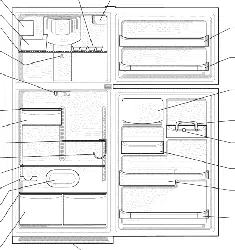
Refrigerator
Top Mount
Use & Care Guide
Refrigerador
Congelador Superior
Gufa para su uso y cuidado
Rdfrigdrateur
Compartiments Superpos6s
Guide d'utilisation et d'entretien
Sears, Roebuck and Co., Hoffman Estates, IL 60179 U.S.A.
Sears Canada, Inc., Toronto, Ontario, Canada M5B 2B8
www.sears.com
240432306 (0210)
"11
Z
Congratulations
Congratulations on your purchase of a new refrigerator!
We here at Sears are very proud of our product and we
are completely committed to providing you with the best
service possible. Your satisfaction is our #1 priority.
We know you'll enjoy your new refrigerator and Thank
You for choosing our product. We hope you consider us
for future purchases.
PLEASE READ AND SAVE THESE INSTRUCTIONS
This Owner's Guide provides specific operating
instructionsfor your model. Use your refrigerator only as
instructed in this manual. These instructions are not
meant to cover every possible condition and situation that
may occur. Common sense and caution must be
practiced when installing, operating and maintaining any
appliance.
Please record your model and serial numbers below
for future reference. This information is found on the
serial plate located inside the refrigerator
compartment.
NOTE: Use 0nly soap and water to clean serial plate.
Model Number: 253
Please Read All Instructions Before
Using This Refrigerator.
FOR YOUR SAFETY
• Do not store or use gasoline, or other flammable liquids
in the vicinity ofthis or any other appliance. Read product
labels for warnings regarding flammability and other
hazards.
• Do not operate the refrigerator in the presence of
explosive fumes.
• Avoid contact with any moving parts of automatic ice
make£
• Remove all staples from the carton. Staples can cause
severe cuts, and also destroy finishes if they come in
contact with other appliances or furniture.
CHILD SAFETY
Destroy or recycle the carton, plastic bags, and any
exterior wrapping material immediately after the
refrigerator is unpacked. Children should NEVER use
these items to play. Cartons covered with rugs,
bedspreads, plastic sheets or stretch wrap may become
airtight chambers, and can quickly cause suffocation.
or: 970
Serial Number:
Purchase Date:
PROPER DISPOSAL OF YOUR REFRIGERATOR
OR FREEZER
Risk of child entrapment
TABLE OF CONTENTS Junked
Child entrapment and suffocation __
are not problems of the past.
or abandoned
Welcome ............................................. 2
Safety Instructions ............................... 2-3
Warranty .............................................. 3
Canada - Limited Warranty ................. 4
Protection Agreements ........................ 5
Installation--includes Connecting Optional Ice
Maker To Water Supply ...................................... 6-7
Door Removal & Reversal ................... 8-9
Features At A Glance .......................... 10
Temperature Controls .......................... 11
Looking Inside ..................................... 12-14
Ice Service .......................................... 15
Food Storage & Energy Saving Tips ... 16
Normal Operating Sounds & Sights .... 17
Care & Cleaning .................................. 18-19
refrigerators or freezers are still
dangerous - even if they will sit
for "just a few days." If you are
getting rid of your old refrigerator
or freezer, please follow the
instructions below to help prevent
accidents.
Before you throw away your old refrigerator/freezer:
• Remove doors.
• Leave shelves in place so children may not easily climb
inside.
• Have refrigerant removed by a qualified service
technician.
Before You Call ................................... 20
2
Important Safety
Instructions (cont.) Warranty Information
FULL ONE-YEAR WARRANTY ON
REFRIGERATOR
These Guidelines Must Be Followed To Ensure That
Safety Mechanisms In This Refrigerator Wi!! For one year from the date of purchase, when this
Operate Properly. refrigerator is operated and maintained according to the
instructions provided in this Owner's Guide, Sears will
ELECTRICAL INFORMATION
• The refrigerator must be plugged into its own
dedicated 115 Volt, 60 Hz., AC only electric outlet.
The power cord of the appliance is equipped with a
three-prong grounding plug for your protection against
electrical shock hazards. It must be plugged directly
into a properly grounded three-prong receptacle. The
receptacle must be installed in accordance with local
codes and ordinances. Consult a qualified electrician.
Do not use an extension cord or adapter plug.
• Immediately repair or replace any power cord that
becomes frayed or damaged.
• Never unplug the refrigerator by pulling on the power
cord. Always grip the plug firmly, and pull straight out
from the receptacle to prevent damaging the power cord.
• Unplug the refrigerator before cleaning and before
replacing a light bulb to avoid electrical shock.
• Performance may be affected if the voltage varies by
10% or more. Operating the refrigerator with insufficient
power can damage the compressor. Such damage is
not covered under your warranty.
• Do not plug the unit into an outlet controlled by a wall
switch or pull cord to prevent the refrigerator from being
turned off accidentally.
• Avoid connecting refrigerator to a Ground Fault Interruptor
(GFI) circuit.
NOTE: Turning the freezer temperature control to "0"
turns off the compressor, but does not disconnect
electrical power to the light bulb or other electrical
components.
repair this refrigerator, free of charge, if defective in
material or workmanship.
FULL FIVE-YEAR WARRANTY ON SEALED
REFRIGERATION SYSTEM
For five years from the date of purchase, when this
refrigerator is operated and maintained according to the
instructions provided in this Owner's Guide, Sears will
repair the sealed system (consisting of refrigerant,
connecting tube, and compressor motor), free of charge,
if defective in material or workmanship.
The above refrigerator warranty applies only to
refrigerators which are used for storage of food for private
household purposes.
This warranty gives you specific legal rights and you may
also have other rights which vary from state to state.
Warranty service is available by contacting the
NEAREST SEARS SERVICE CENTER/DEPARTMENT
in the United States. See the back page of this manual.
For warranty questions, please contact the following
address:
Sears, Roebuck and Co.
Dept. 817WA
Hoffman Estates, IL 60179
Groundingtype
wallreceptacle
f Do not, under -"
| any clmumstance=
_1 cut, remove,
,_ or bypass the
pmng.
3-pronggroundedplug _
CANADA m LIMITED WARRANTY
Refrigerators
Sears Canada Inc., warrants every new Kenmore refrigerator to be free from defects in material or workmanship. What
Sears will do, free of charge, in case of defect:
The Compressor TEN (10) YEARS TEN (10) YEARS FIVE (5) YEARS
The Sealed System
(consisting of refrigerant, FIVE (5) YEARS FIVE (5) YEARS FIVE (5) YEARS
evaporator,and condenser)
All other parts or
adjustments ONE (1) YEAR ONE (1) YEAR ONE (1) YEAR
Normal Responsibility of the Customer
The following items, since they are not manufacturing defects, are not included in the warranty, but are the responsibility
of the customer:
1) Damage to finish after delivery.
2) Improper power supply, low voltage, or any defects in the house wiring system or appliance not connected
to electric outlet.
3) Replacement of light bulbs.
4) Damage caused by moving the product from its original installation.
5) Service required as a result of alteration, abuse, fire, floods, or acts of God.
6) Providing adequate air circulation to the refrigerating system.
7) Proper use and care of product as listed in the customer's manual; proper setting of the controls.
If any service isrequired under this warranty, simply call 1-800-4-MY-HOME sM(1-800-469-4663).
This warranty is in addition to any statutory warranty. The above warranty covers Kenmore Refrigerators sold and
operated in Canada only and shall not apply ifthe refrigerator isused for other than domestic purposes.
Sears Maintenance Agreement
Maintain the value of your Kenmore refrigerator with a Sears Maintenance Agreement.
SEARS CANADA INC. • Toronto, Canada • M5B 2B8
PRINTED IN U.S.A.
4
ii ii ii I ii
PROTECTION AGREEMENTS
In the U.S.A.
Master Protection Agreements
Congratulations on making a smart purchase. Your
new Kenmore ®appliance is designed and
manufactured for years of dependable operation. But
like all products, it may require preventive
maintenance or repair from time to time. That's when
having a Master Protection Agreement can save you
money and aggravation.
Purchase a Master Protection Agreement now and
protect yourself from unexpected hassle and expense.
The Master Protection Agreement also helps extend
the life of your new appliance. Here's what's included
in the Agreement:
_" Expert service by our 12,000 professional repair
specialists
_" Unlimited service and no charge for parts and
labor on all covered repairs
_" "No-lemon" guarantee- replacement of your
covered product if more than three product failures
occur within twelve months
Product replacement if your covered product
can't be fixed
Annual Preventive Maintenance Check at your
request - no extra charge
Fast help by phone - non-technical and
instructional assistance on products repaired in
your home, plus convenient repair scheduling
Power surge protection against electrical
damage due to power fluctuations
Rental reimbursement if repair of your covered
product takes longer than promised
Once you purchase the Agreement, a simple phone
call is all that ittakes for you to schedule service. You
can call anytime day or night, or schedule a service
appointment online.
Sears has over 12,000 professional repair specialists,
who have access to over 4.5 million quality parts and
accessories. That's the kind of professionalism you
can count on to help prolong the life of your new
purchase for years to come. Purchase your Master
Protection Agreement today!
Some limitations and exclusions apply. For prices
and additional information, call 1-800-827-6655.
Sears Installation Service
For Sears guaranteed professional installation of home
appliances and items like garage door openers and
water heaters, in the U.S.A. call 1-800-4MY-HOME ®.
In Canada
Maintenance Agreements
Your purchase has added value because you can
depend on Sears HomeCentral ®for service. With over
2400 Service Technicians and access to over 900,000
parts and accessories, we have the tools, parts,
knowledge and skills to ensure the pledge: We Service
What We Sell.
Your Kenmore ®appliance is designed, manufactured
and tested to provide years of dependable operation.
Yet any major appliance may require service from time
to time. The Sears Maintenance Agreement offers you
an outstanding service program, affordably priced.
The Sears Maintenance Agreement
• Is your way to buy tomorrow's service at today's
price.
• Eliminate repair bills resulting from normal wear
and tear.
• Provides for non-technical and instructional
assistance.
• Even if you don't need repairs, provides an annual
Preventive Maintenance Check, at your request, to
ensure that your appliance is in proper running
condition.
Some limitations apply. For information
concerning Sears Canada Maintenance
Agreements, call 1-800-361-6665.
This Use & Care Manual provides specific operating
instructions for your model. Use the refrigerator only as
instructed in this Use & Care Manual. Before starting the
refrigerator, follow these important first steps.
LOCATION
• Choose a place that is near a grounded electrical outlet.
Do Not use an extension cord or an adapter plug.
• If possible, place the refrigerator out of direct sunlight
and away from the range, dishwasher or other heat
sources.
• The refrigerator must be installed on a floor that islevel
and strong enough to support a fully loaded refrigerator.
• Consider water supply availability for models equipped
with an automatic ice maKe£
INSTALLATION
Do Not install the refrigerator where
the temperature will drop below 55°F
(13°C) or rise above 110°F (43°C). At these
temperature extremes, the compressor will not be
able to maintain proper temperatures inside the
refrigerator.
Do Not block the toe grille on the lower
front of your refrigerator. Sufficient air circulation
is essential for the proper operation of your
refrigerator.
Installation Clearances
Allow the following clearances for ease of installation
proper air circulation, and 3lumbing and electrical
connections:
Sides & Top 3/8"
Back 1"
NOTE: If you see black coils/tubing on the back of your
refrigerator (air-cooled condensert leave 3" clearance
at top of refrigerator.
LEVELING
All four corners of your refrigerator must rest firmly on a
solid floor. Your refrigerator isequipped with adjustable front
rollers to help level your unit.
To Level Your Refrigerator:
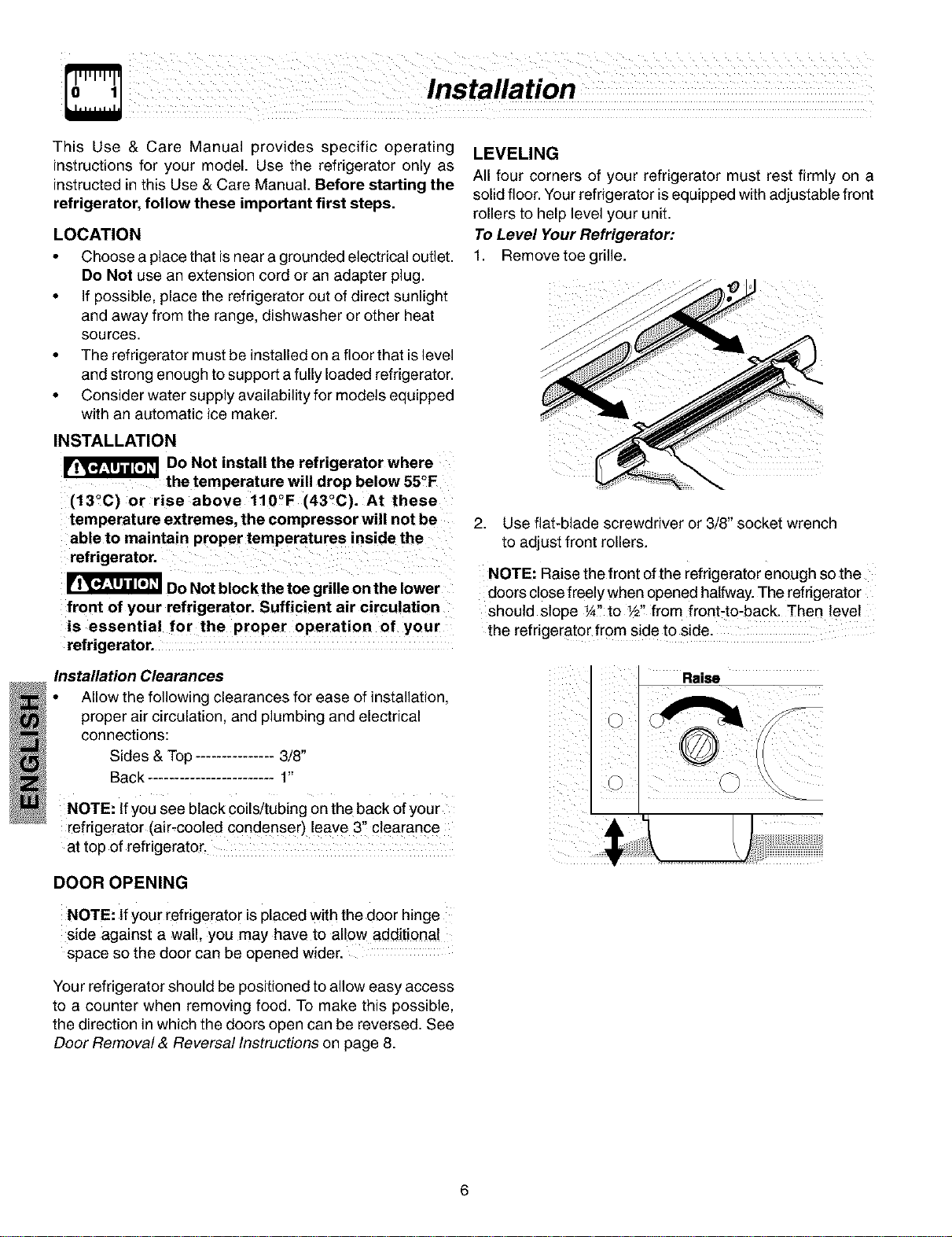
1. Remove toe grille.
2. Use flat-blade screwdriver or 3/8" socket wrench
to adjust front rollers.
NOTE: Raise the front of the refrigerator enough so the
doors close freely when opened halfway. The refrigerator
should slope ¼" to V2"from front-to-back. Then level
the refrigerator from side to side
Raise
DOOR OPENING
NOTE: If your refrigerator isplaced with the door hinge
side against a wal!, you may have to allow additional
space so the door can be opened wider.
Your refrigerator should be positioned to allow easy access
to a counter when removing food. To make this possible,
the direction inwhich the doors open can be reversed. See
Door Removal & Reversal Instructions on page 8.
6
Installation - Connecting Optional Ice Maker To Water Supply
To avoid electric shock, which can cause death or severe personal injury, disconnect the
refrigerator from electrical power before connecting a water supply line to the refrigerator.
To Avoid Property Damage:
• Copper tubing is recommended for the water supply line. Water supply tubing made of 1A" plastic is not
recommended since it greatly increases the potential for water leaks. Manufacturer will not be responsible
for any damage if plastic tubing is used for supply line.
• DO NOT install water supply tubing in areas where temperatures fall below freezing.
• Chemicals from a malfunctioning softener can damage the ice maker. If the ice maker is connected to soft
water, ensure that the softener is maintained and working properly.
IMPORTANT: Ensure that your water supply line connections comply with all local plumbing codes.
Before Installing The Water Supply Line, You Will Need
• Basic Tools: adjustable wrench, flat-blade screwdriver, and Phillips TM screwdriver
• Access to a household cold water line with water pressure between 20 and 120 psi.
• A water supply line made of IAinch (6.4 mm) OD, copper tubing or braided water line. To determine the length of
copper tubing needed, you will need to measure the distance from the ice maker inlet valve at the back of the
refrigerator to your cold water pipe. Then add approximately 7 feet (2.1 meters), so the refrigerator can be moved out
for cleaning (as shown).
• A shutoff valve to connect the water supply line to your household water system. DO NOT use a self-piercing type
shutoff valve.
• A compression nut and ferrule (sleeve) for connecting the water supply line to the ice maker inlet valve.
NOTE: A water line kit is available through Sears retail or catalog stores at additional cost.
To Connect Water Supply Line To Ice Maker Inlet Valve
1. Disconnect refrigerator from electric power source.
2. Place end of water supply line into sink or bucket. Turn ON water supply
and flush supply line until water is clear. Turn OFF water supply at shut
off valve.
3. Unscrew plastic cap from water valve inlet and discard cap.
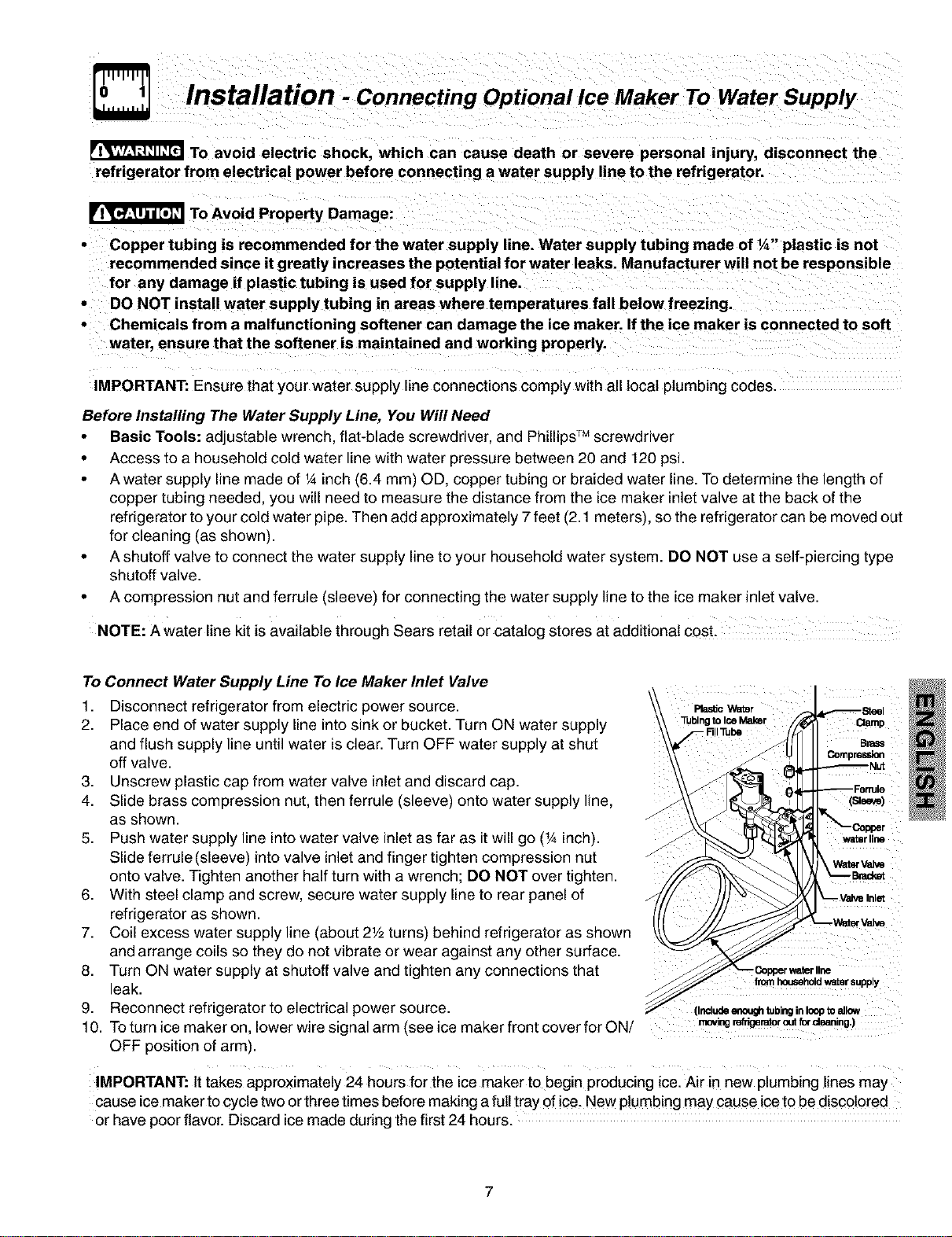
4. Slide brass compression nut, then ferrule (sleeve) onto water supply line,
as shown.
5. Push water supply line into water valve inlet as far as it will go (IA inch).
Slide ferrule (sleeve) into valve inlet and finger tighten compression nut
onto valve. Tighten another half turn with a wrench; DO NOT over tighten.
6. With steel clamp and screw, secure water supply line to rear panel of
Bre._
Compression
water line
Water Valve
refrigerator as shown, rValw
7. Coil excess water supply line (about 2V2turns) behind refrigerator as shown
and arrange coils so they do not vibrate or wear against any other surface.
8. Turn ON water supply at shutoff valve and tighten any connections that copperwaterllne
leak. _!_ _ho!d _r SUPP_'
9. Reconnect refrigerator to electrical power source. Z (Include4meu£tltubinsinloopteallew
10. TOturn ice maker on, lower wire signal arm (see ice maker front cover for ON/ ,,ovir_refd0emtoroutfordeanin0.)
OFF position of arm).
IMPORTANT: It takes approximately 24 hours for the ice maker to begin producing ice. Air in new plumbing lines may
cause ice maker to Cycletwo or three times before making a full tray of ice, New Plumbing may cause iceto be discolored
or have poor flavor. Discard ice made during the first 24 hours.
Door Removal and Reversal Instructions
Joor_p Handb
Hingle BoSom
Scraw Celder
tdlnga
Tools NecessQry:
Phillis" heOd _%
Quadr_x i_aa Adjustable
Wrench
Awl
Screws _t Cove_T°PHinge
Cabinet Hole
Rugs
Hinge Hole
Plug
Top Hinge
Handle Hole
Plug
Door
Screw_ _ Step
Washer
Hinge
R_
Center
Hinge
Hinge Hole
Rug Handle
Hole
DoorStop Door
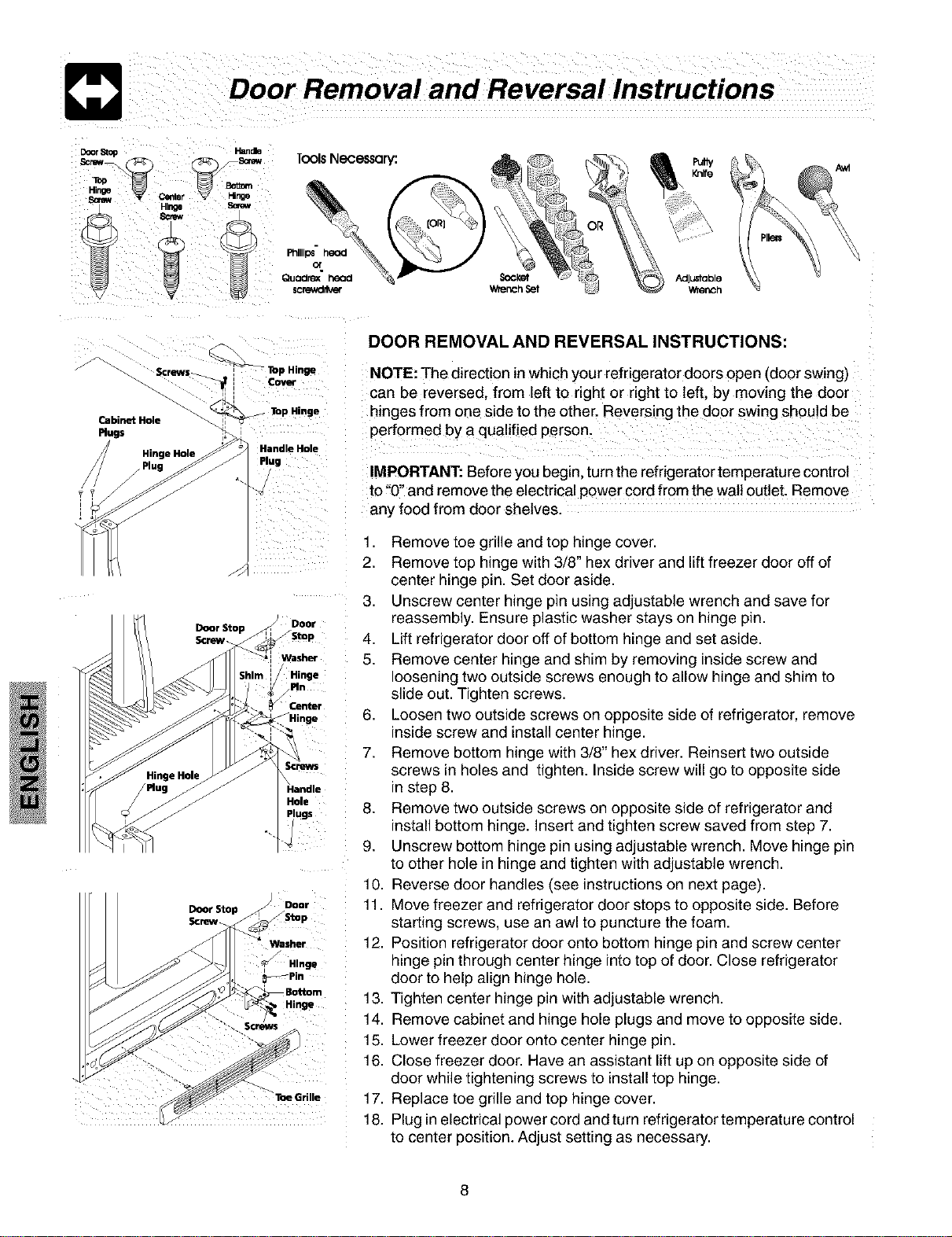
DOOR REMOVAL AND REVERSAL INSTRUCTIONS:
NOTE: The direction in which your refrigerator doors open (door swing}
can be reversed, from left to right or right to left, by moving the door
qinges from one side to the other. Reversing the door swing should be
3erformed by a qualified person.
IMPORTANT: Before you begin, turn the refrigerator temperature control
to "O"and remove the electrical power cord from the wall outlet. Remove
any food from door shelves.
1. Remove toe grille and top r_lnge cover.
2. Remove top hinge with 3/8" hex driver and lift freezer door off of
center hinge pin. Set door aside.
3. Unscrew center hinge pin using adjustable wrencn and save for
reassembly. Ensure plastic washer stays on hinge pin.
4. Lift refrigerator door off of bottom hinge and set aside.
5. Remove center hinge and shim by removing inside screw and
oosenlng two outside screws enough to allow hinge and shim to
slide out. Tignten screws.
6. Loosen two outside screws on opposite side of refrigerator, remove
nside screw and install center hinge.
7. Remove bottom hinge with 3/8" hex driver. Reinsert two outside
screws in holes and tighten. Inside screw will go to opposite side
n step 8.
8. Remove two outside screws on opposite side of refrigerator and
nstall bottom hinge. Insert and tighten screw saved from step 7.
9. Unscrew bottom hinge pin using adjustable wrench. Move hinge pin
to other hole in hinge and tighten with adjustable wrench.
10. Reverse door handles _see instructions on nex! page).
11 Move freezer and refrigerator door stops to opposite side. Before
starting screws, use an awl to puncture the foam.
12. Position refrigerator door onto bottom hinge pin and screw center
hinge penthrough center hinge into top of door. Close refrigerator
door to help align hinge hole.
13. Tighten center hinge pin with adjustable wrench.
14. Remove cabinet and hinge hole plugs and move to opposite side.
15. Lower freezer door onto center hinge pro.
16. Close freezer door. Have an assistant lift up on opposite side of
door while tightening screws to install top hinge.
17. Replace toe grille and top hinge cover.
18. Plug in electrical power cord and tum refrigerator temperature control
to center 3osition. Adjust setting as necessary.
8
Door Removal and Reversal Instructions (continued)
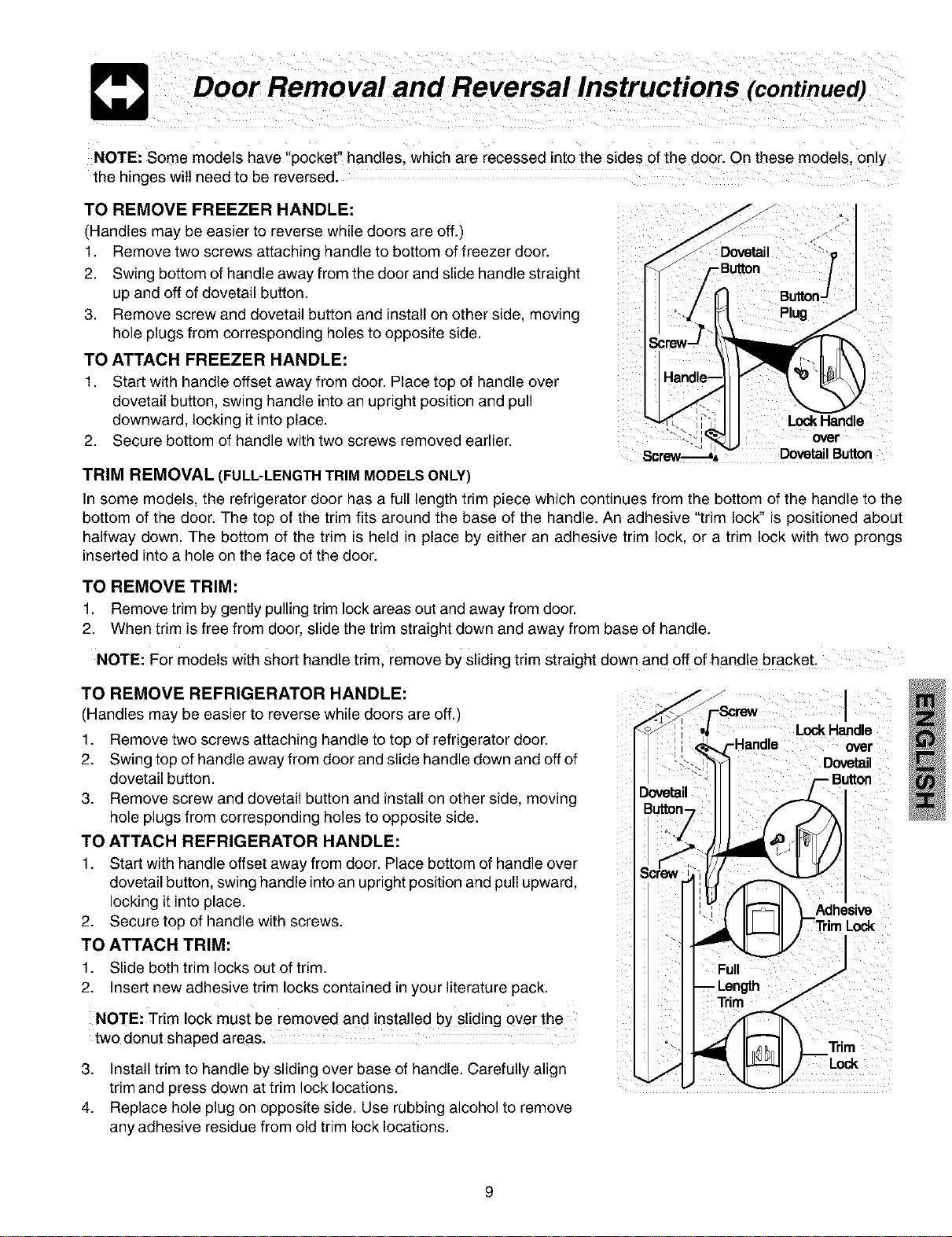
NOTE: Some models nave "pocket" handles, which are recessed into the sides of the door. On these models, only
the hinges will need to be reversed.
TO REMOVE FREEZER HANDLE:
Handles may be easier to reverse while doors are off.
1 Remove two screws attaching handle to bottom of freezer door.
2. Swing bottom of handle away from the door and slide handle straight
up and off of dovetail button.
3. Remove screw and dovetail button and install on other side. mowng
hole plugs from corresponding holes to opposite side.
TO ATTACH FREEZER HANDLE:
1 Start with handle offset away from door. Place top of handle over
dovetail button, swing handle into an upright position and pull
downward, locking it into place.
2. Secure bottom of handle with two screws removed earlier.
ButtonJ
Plug
LockHandle
over
DovetailButton
TRIM REMOVAL (FULL-LENGTH TRIM MODELS ONLY)
In some models, the refrigerator door has a full length trim piece which continues from the bottom of the handle to the
bottom of the door. The top of the trim fits around the base of the handle. An adhesive "trim lock" is positioned about
halfway down. The bottom of the trim is held in place by either an adhesive trim lock, or a trim lock with two prongs
inserted intoa hole on the face of the door.
TO REMOVE TRIM:
1. Remove trim by gently pulling trim lock areas out and away from door.
2. When trim is free from door, slide the trim straight down and away from base of handle.
NOTE: For models with short handle trim, remove by Sliding trim straight down and off of handle bracket.
TO REMOVE REFRIGERATOR HANDLE:
(Handles may be easier to reverse while doors are off.)
1. Remove two screws attaching handle to top of refrigerator door.
2. Swing top of handle away from door and slide handle down and off of
dovetail button.
3. Remove screw and dovetail button and install on other side, moving
hole plugs from corresponding holes to opposite side.
TO ATTACH REFRIGERATOR HANDLE:
1. Start with handle offset away from door. Place bottom of handle over
dovetail button, swing handle intoan upright position and pull upward,
locking it into place.
2. Secure top of handle with screws.
TO ATTACH TRIM:
1. Slide both trim locks out of trim.
2. Insert new adhesive trim locks contained in your literature pack.
NOTE: Trim lock must be removed and installed by Sliding over the
two donut shaped areas.
3. Install trim to handle by sliding over base of handle. Carefully align
trim and press down at trim lock locations.
4. Replace hole plug on opposite side. Use rubbing alcohol to remove
any adhesive residue from old trim lock locations.
Lock Handle
over
Dovetail
- Button
._ Adhesive
Trim
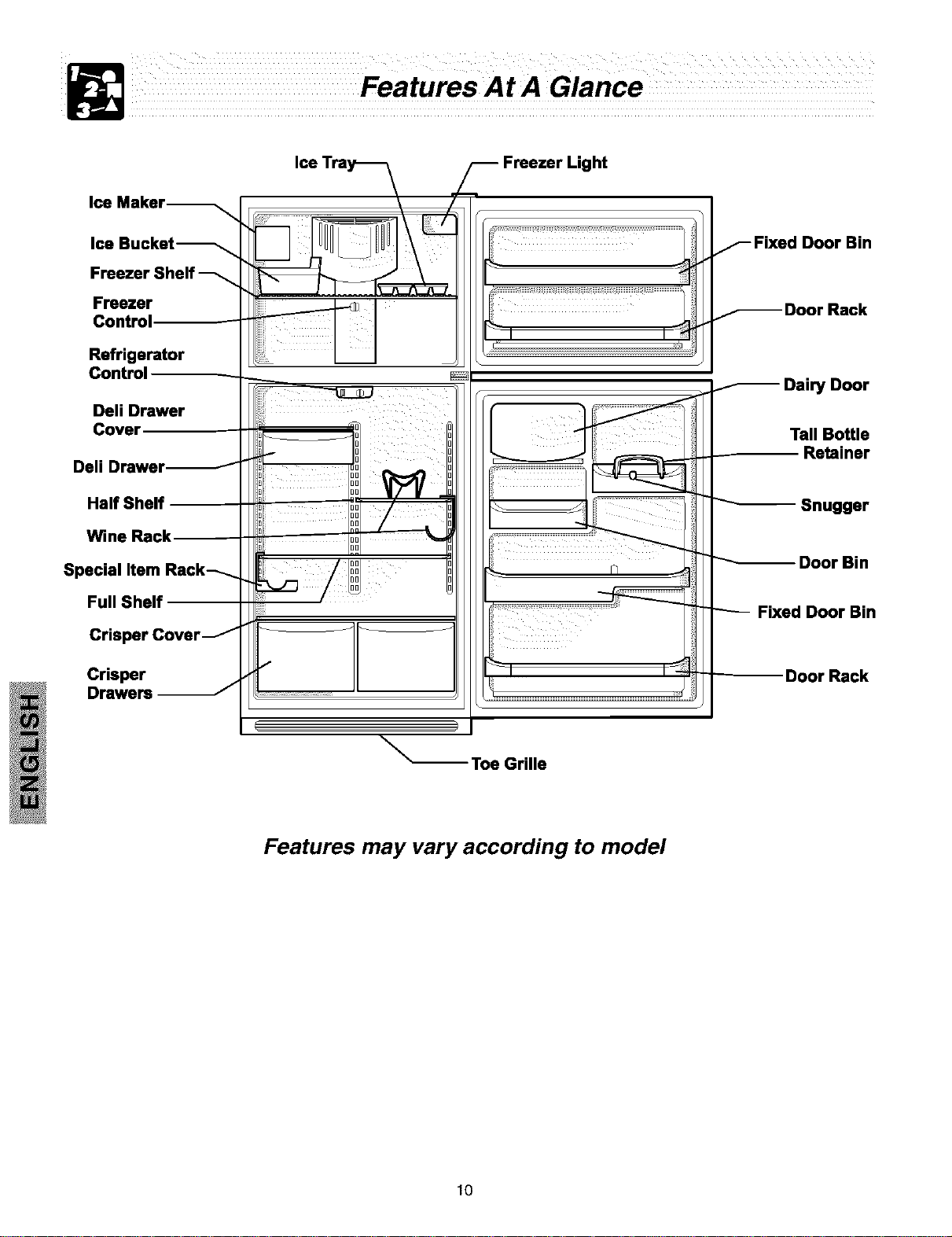
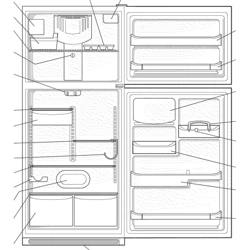
Ice _ Freezer Light
Ice Bucket_
Freezer
Freezer
Control
Refrigerator
Control
Dell Drawer
Cover
Dell
Half Shelf
Wine Rack
Special
Full Shelf
Cris
Crisper
Drawers
Fixed Door Bin
F Door Rack
Dairy Door
Tall Bottle
Retainer
Snugger
Door Bin
Fixed Door Bin
Door Rack
_Toe Grille
Features may vary according to model
10
COOL DOWN PERIOD
To ensure safe food storage, allow the refrigerator to operate with the doors closed for at least 8 to 12 hours before loading
it with food.
REFRIGERATOR & FREEZER CONTROLS
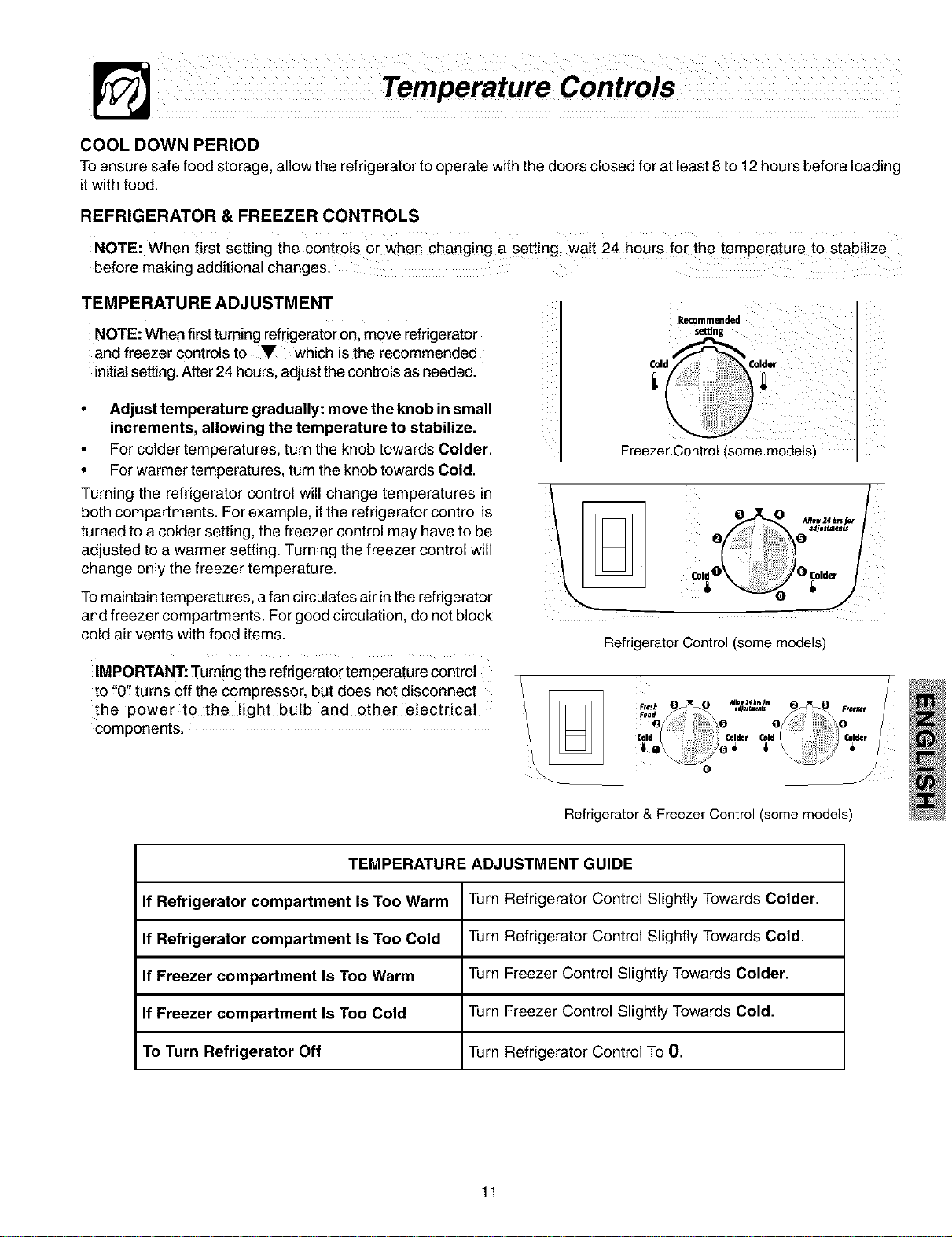
NOTE: When first setting the Controls or when Changing a setting wait 24 hours for the temperature to stabil ze
before making additional changes.
TEMPERATUREADJUSTMENT
NOTE: When first turning refrigerator on, move refrigerator
and freezer controls to 'V" which is the recommended
initial setting. After 24 hours, adjust the controls as needed.
• Adjust temperature gradually: move the knob in small
increments, allowing the temperature to stabilize.
• For colder temperatures, turn the knob towards Colder.
• For warmer temperatures, turn the knob towards Cold.
Turning the refrigerator control will change temperatures in
both compartments. For example, if the refrigerator control is
turned to a colder setting, the freezer control may have to be
adjusted to a warmer setting. Turning the freezer control will
change only the freezer temperature.
To maintain temperatures, a fan circulates air in the refrigerator
and freezer compartments. For good circulation, do not block
cold air vents with food items.
IMPORTANT: Turning the refrigerator temperature control
to '!0'!turns off the compressor, but does not disconnect
the power to the light bulb and other electrical
components.
Recommended
Freezer Control (some models)
Refrigerator Control (some models)
Refrigerator & Freezer Control (some models)
TEMPERATURE ADJUSTMENT GUIDE
If Refrigerator compartment Is Too Warm Turn Refrigerator Control Slightly Towards Colder.
If Refrigerator compartment Is Too Cold Turn Refrigerator Control Slightly Towards Cold.
If Freezer compartment Is Too Warm Turn Freezer Control Slightly Towards Colder.
If Freezer compartment Is Too Cold Turn Freezer Control Slightly Towards Cold.
To Turn Refrigerator Off Turn Refrigerator Control To 0.
11
To avoid personal injury or property damage, handle
tempered glass shelves carefully. Shelves may break suddenly if
nicked, scratched, or exposed to sudden temperature change.
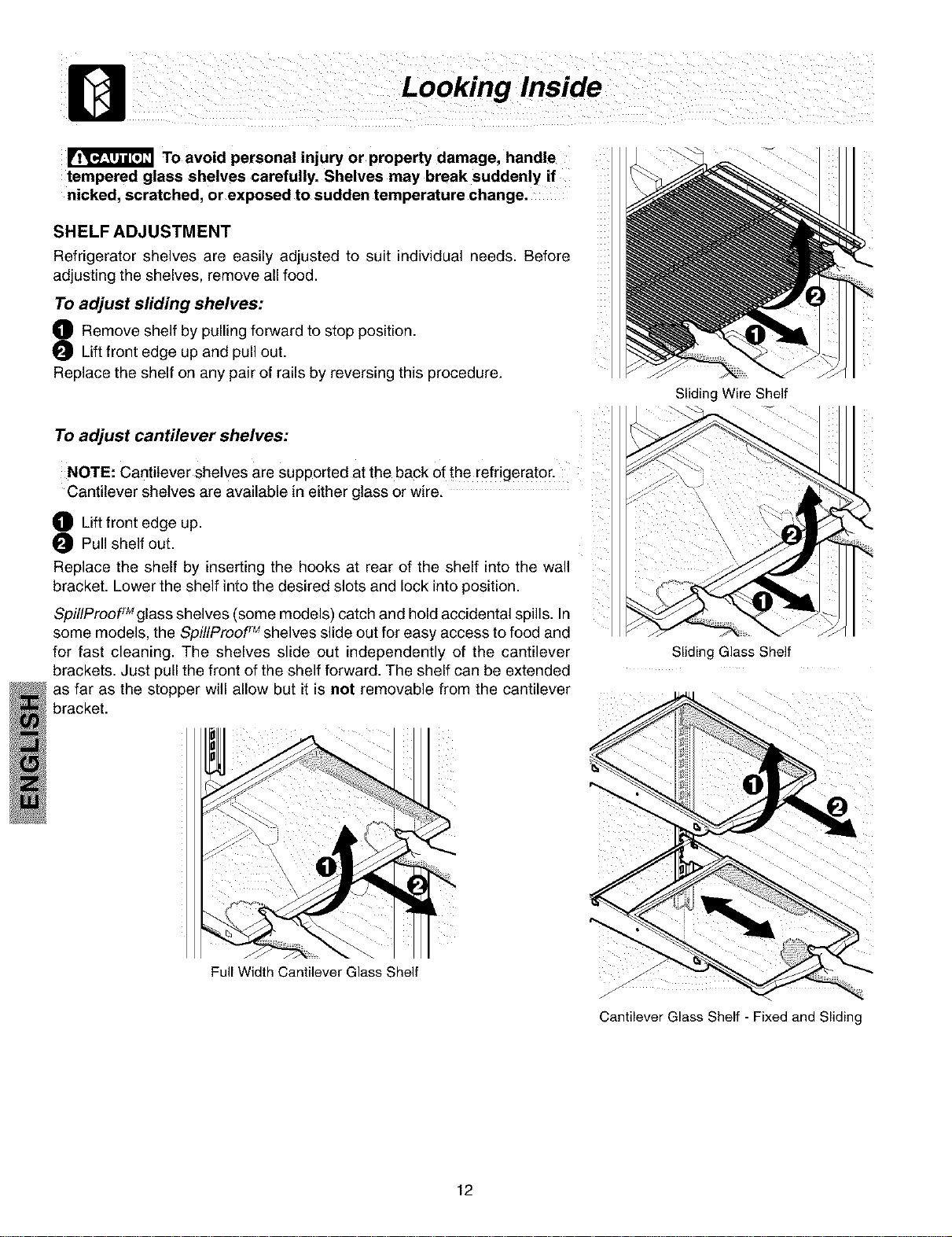
SHELF ADJUSTMENT
Refrigerator shelves are easily adjusted to suit individual needs. Before
adjusting the shelves, remove all food.
To adjust sliding shelves:
O Remove shelf by pulling forward to stop position.
O Lift front edge up and pull out.
Replace the shelf on any pair of rails by reversing this procedure.
Sliding Wire Shelf
To adjust cantilever shelves:
NOTE: Cantilever shelves are supported at the back of the refrigerator.
Cantilever shelves are available in either glass or wire.
Lift front edge up.
Pull shelf out.
Replace the shelf by inserting the hooks at rear of the shelf into the wall
bracket. Lower the shelf into the desired slots and lock intoposition.
SpillProoFMglass shelves (some models) catch and hold accidental spills. In
some models, the SpillProoF Mshelves slide out for easy access to food and
for fast cleaning. The shelves slide out independently of the cantilever
brackets. Just pull the front of the shelf forward. The shelf can be extended
as far as the stopper will allow but it is not removable from the cantilever
Sliding Glass Shelf
Full Width Cantilever Glass Shelf
Cantilever Glass Shelf - Fixed and Sliding
12
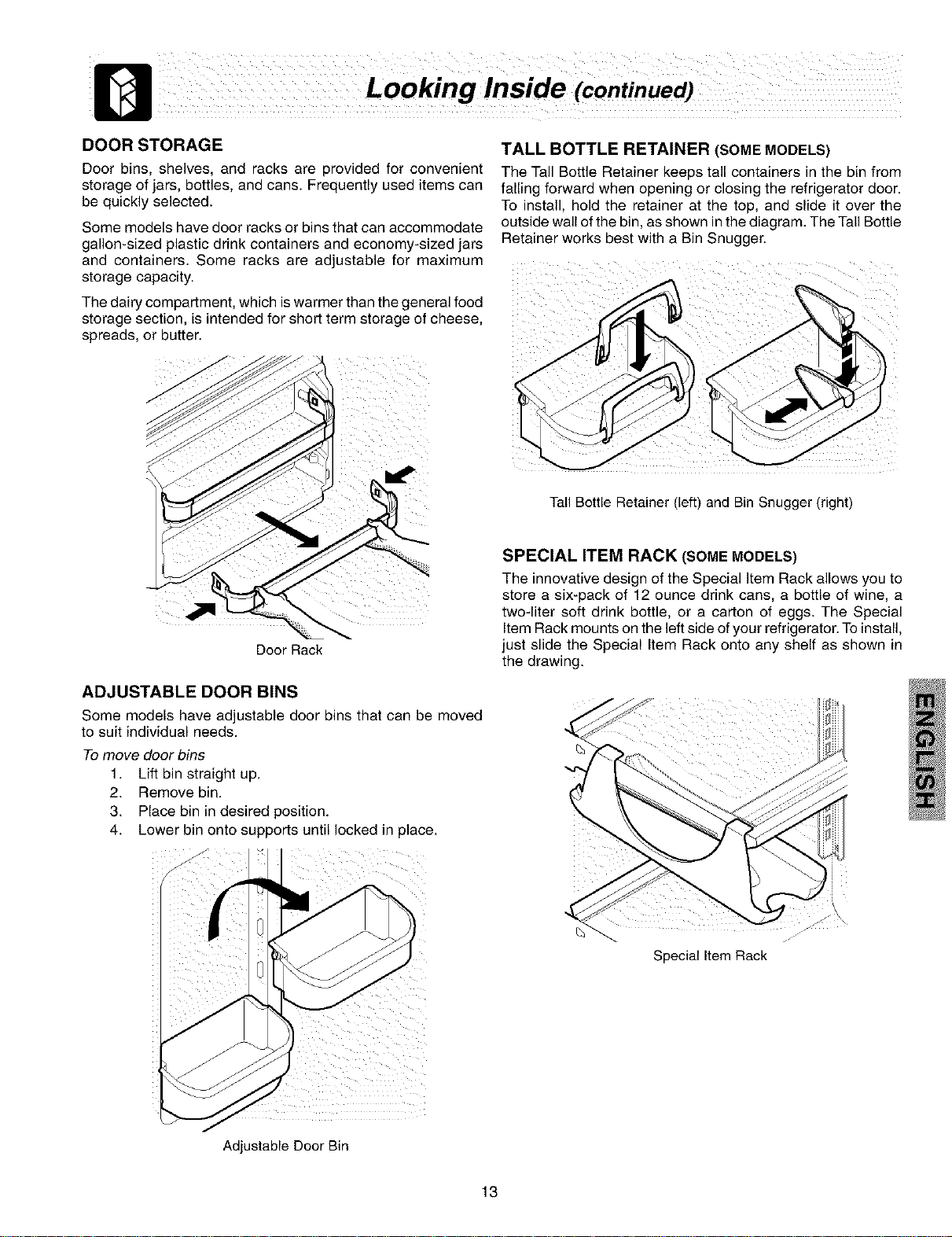
DOORSTORAGE
Door bins, shelves, and racks are provided for convenient
storage of jars, bottles, and cans. Frequently used items can
be quickly selected.
Some models have door racks or bins that can accommodate
gallon-sized plastic drink containers and economy-sized jars
and containers. Some racks are adjustable for maximum
storage capacity.
TALL BOTTLE RETAINER (SOME MODELS)
The Tall Bottle Retainer keeps tall containers in the bin from
falling forward when opening or closing the refrigerator door.
To install, hold the retainer at the top, and slide it over the
outside wall of the bin, as shown in the diagram. The Tall Bottle
Retainer works best with a Bin Snugger.
The dairy compartment, which iswarmer than the general food
storage section, is intended for short term storage of cheese,
spreads, or butter.
Door Rack
Tall Bottle Retainer (left) and Bin Snugger (right)
SPECIAL ITEM RACK (SOME MODELS)
The innovative design of the Special Item Rack allows you to
store a six-pack of 12 ounce drink cans, a bottle of wine, a
two-liter soft drink bottle, or a carton of eggs. The Special
Item Rack mounts on the left side of your refrigerator. To install,
just slide the Special Item Rack onto any shelf as shown in
the drawing.
ADJUSTABLE DOOR BINS
Some models have adjustable door bins that can be moved
to suit individual needs.
To move door bins
1. Lift bin straight up.
2. Remove bin.
3. Place bin in desired position.
4. Lower bin onto supports until locked in place.
[_ jz
Special Item Rack
Adjustable Door Bin
13
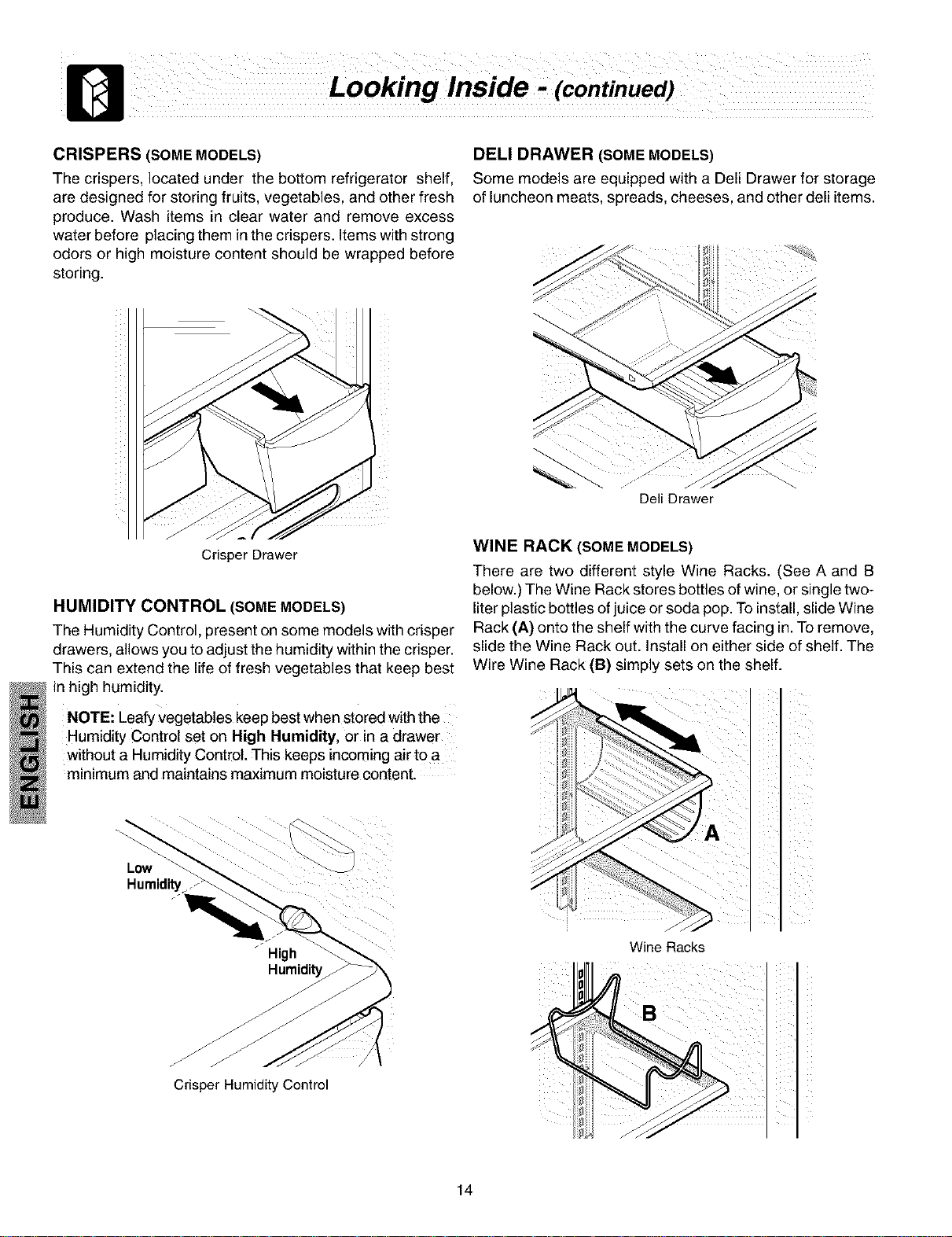
CRISPERS (SOME MODELS)
The crispers, located under the bottom refrigerator shelf,
are designed for storing fruits, vegetables, and other fresh
produce. Wash items in clear water and remove excess
water before placing them inthe crispers. Items with strong
odors or high moisture content should be wrapped before
storing.
DELl DRAWER (SOME MODELS)
Some models are equipped with a Deli Drawer for storage
of luncheon meats, spreads, cheeses, and other deli items.
Deli Drawer
Crisper Drawer
HUMIDITY CONTROL (SOME MODELS)
The Humidity Control, present on some models with crisper
drawers, allows you to adjust the humidity within the crisper.
This can extend the life of fresh vegetables that keep best
in high humidity.
NOTE: Leafy vegetables keep best when stored with the
Humidity Control set on High Humidity, or in a drawer
without a Humidity Control. This keeps incoming airto a
minimum and maintains maximum moisture content.
WINE RACK (SOME MODELS)
There are two different style Wine Racks. (See A and B
below.) The Wine Rack stores bottles of wine, or single two-
liter plastic bottles of juice or soda pop. Toinstall,slide Wine
Rack (A) onto the shelf with the curve facing in.To remove,
slide the Wine Rack out. Install on either side of shelf. The
Wire Wine Rack (B) simply sets on the shelf.
Low
Humidity_
High
Humidib
Crisper Humidity Centre
Wine Racks
B
14
Ice Service
If your refrigerator has an automatic ice maker, it will provide a sufficient
supply of ice for normal use. During the initial startup of your refrigerator.
however, no ice will be produced during the first 24 nours of operation.
Automatic ice makers are also optional accessories that may be installed in
most models at any time. Call your local dealer for information.
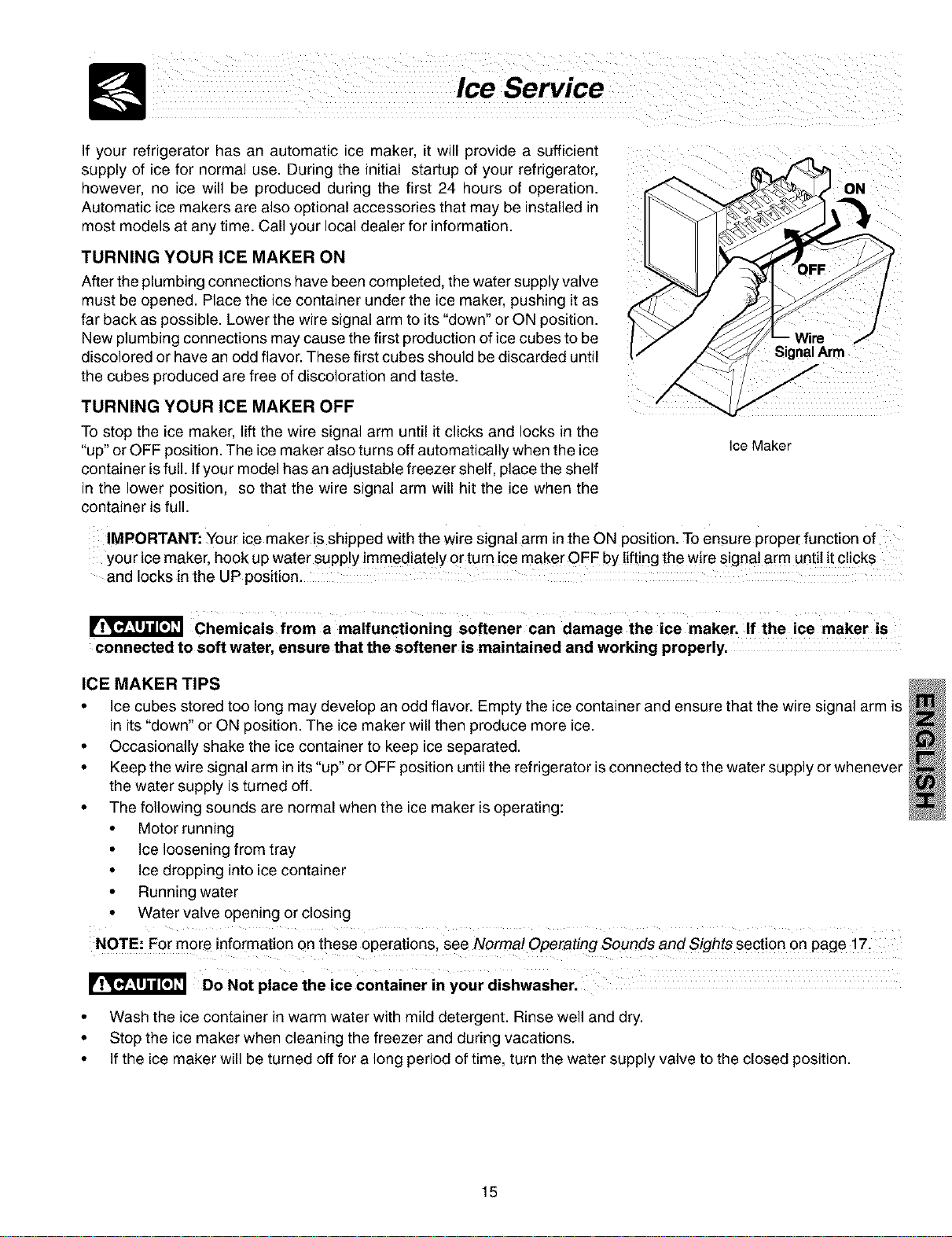
TURNING YOUR ICE MAKER ON
After the plumbing connections have been completed, the water supply valve
must be opened. Place the ice container under the ice maker, pushing it as
far back as possible. Lower the wire signal arm to its "down" or ON position.
New plumbing connections may cause the first production of ice cubes to be
discolored or have an odd flavor. These first cubes should be discarded until
the cubes produced are free of discoloration and taste.
SignalArm
/
TURNING YOUR ICE MAKER OFF
To stop the ice maker, lift the wire signal arm until itclicks and locks in the
"up" or OFF position. The ice maker also turns off automatically when the ice Ice Maker
container is full. Ifyour model has an adjustable freezer shelf, place the shelf
in the lower position, so that the wire signal arm will hit the ice when the
container is full.
IMPORTANT: Your ice maker is shipped with the wire signal arm in the ON position. To ensure proper function of
your ice maker, hook up water Supply immediately or turn ice make[ OFF by lifting the wire signal arm unti! it clicks
and locks in the UP position.
Chemicals from a malfunctioning softener can damage the ice maker. If the ice maker is
connected to soft water, ensure that the softener is maintained and working properly.
ICE MAKER TIPS
• Ice cubes stored too long may develop an odd flavor. Empty the ice container and ensure that the wire signal arm is
in its "down" or ON position. The ice maker will then produce more ice.
• Occasionally shake the ice container to keep ice separated.
• Keep the wire signal arm in its "up" or OFF position until the refrigerator is connected to the water supply or whenever
the water supply is turned off.
• The following sounds are normal when the ice maker is operating:
• Motor running
• Ice loosening from tray
• Ice dropping into ice container
• Running water
• Water valve opening or closing
NOTE: E0r more information on these operations, see Normal Operating Sounds and Sights section 0n page ! 7.
Do Not place the ice container in your dishwasher.
• Wash the ice container in warm water with mild detergent. Rinse well and dry.
• Stop the ice maker when cleaning the freezer and during vacations.
• If the ice maker will be turned off for a long period of time, turn the water supply valve to the closed position.
15
FOOD STORAGE IDEAS
Fresh Food Storage
• The fresh food compartment should be kept between 34 ° F and 40° F with an optimum temperature of 37° F.
• Avoid overcrowding the refrigerator shelves. This reduces the circulation of air around the food and results in uneven
cooling.
Fruits and Vegetables
• Storage in the crisper drawers traps moisture to help preserve the fruit and vegetable quality for longer time periods.
Meat
• Raw meat and poultry should be wrapped securely so leakage and contamination of other foods or surfaces does not
occur.
Frozen Food Storage
• The freezer compartment should be kept at 0° F or lower.
• A freezer operates most efficiently when it is at least 2/3 full.
Packaging Foods for Freezing
• To minimize dehydration and quality deterioration, use aluminum foil, freezer wrap, freezer bags or airtight containers.
Force as much air out of the packages as possible and seal them tightly. Trapped air can cause food to dry out,
change color, and develop an off-flavor (freezer burn).
• Wrap fresh meats and poultry with suitable freezer wrap prior to freezing.
• Do not refreeze meat that has completely thawed.
Loading the Freezer
• Avoid adding too much warm food to the freezer at one time. This overloads the freezer, slows the rate of freezing,
and can raise the temperature of frozen foods.
• Leave a space between the packages, so cold air can circulate freely, allowing food to freeze as quickly as possible.
• Avoid storing hard-to-freeze foods such as ice cream and orange juice on the freezer door shelves. These foods are
best stored in the freezer interior where the temperature varies less.
ENERGY SAVING IDEAS
• Locate the refrigerator in the coolest part of the room, out of direct sunlight,
and away from heating ducts or registers. Do not place the refrigerator
qext to heat-producing appliances such as a range, oven, or dishwasher.
Ifthis is not possible, a section of cabinetry or an added layer of insulation
3etween the two appliances will help the refrigerator operate more
efficiently.
Level the refrigerator so that the doors close tightly.
Refer to this Use & Care Manual for the suggested temperature control
settings.
Periodic cleaning of the condenser will help the refrigerator run more
efficiently. See the Care and Cleaning Chart on page 18.
Do not overcrowd the refrigerator or block cold air vents. Doing so causes
the refrigerator to run longer and use more energy.
Cover foods and wipe containers dry before placing them in the
refrigerator. This cuts down on moisture build-up inside the unit.
Organize the refrigerator to reduce door openings. Remove as many
items as needed at one time and close the door as soon as possible.
16
Normal Operating Sounds & Sights
UNDERSTANDING THE SOUNDS YOU MAY
HEAR
Your new high-efficiency refrigerator may make unfamiliar
sounds. These are all normal sounds and soon will
become familiar to you. They also indicate your
refrigerator isoperating as designed. Hard surfaces, such
as vinyl or wood floors, walls, and kitchen cabinets may
make sounds more noticeable. Listed below are
descriptions of some of the most common sounds you
may hear, and what is causing them.
NOTE: Rigid foam insulation is very energy efficient,
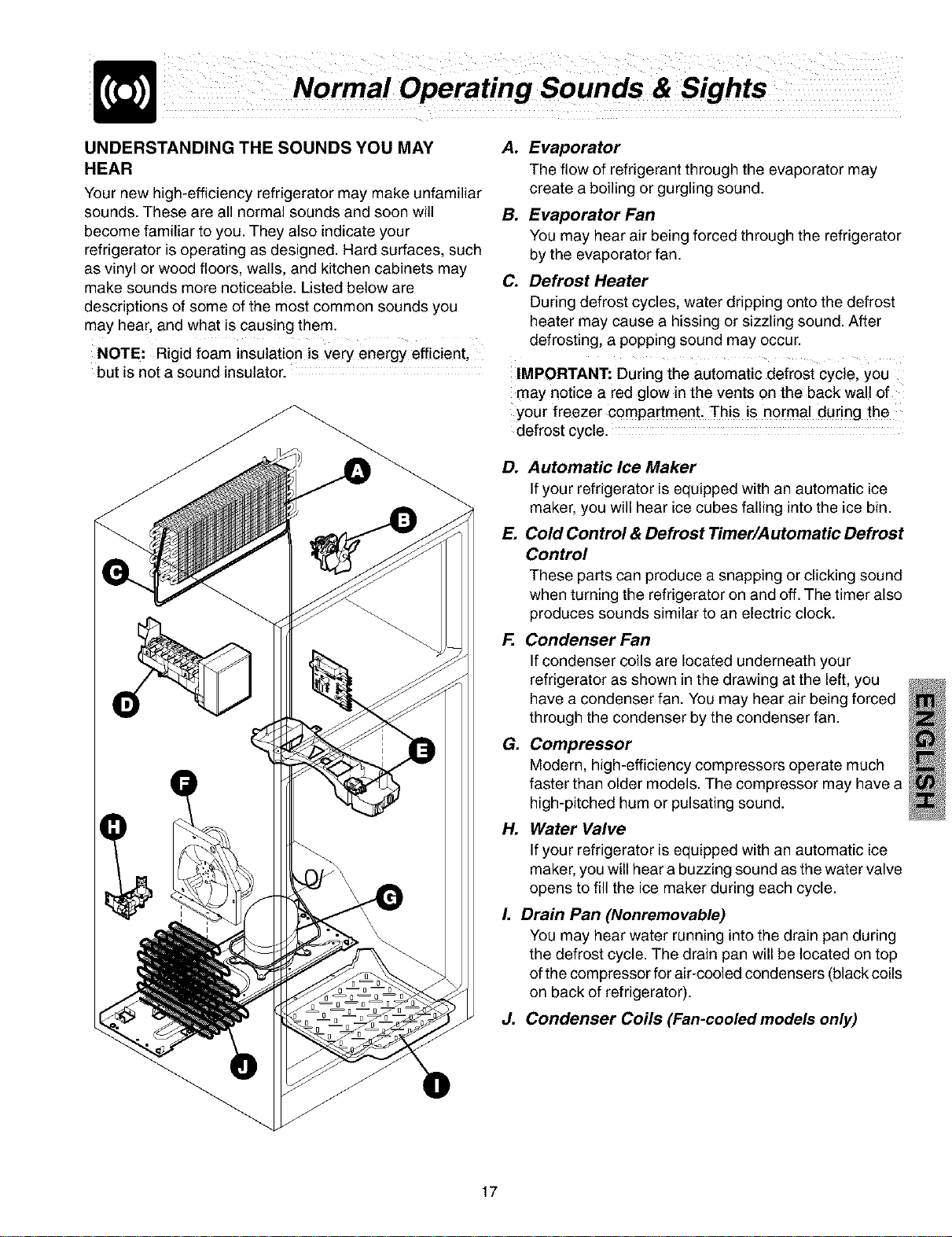
A. Evaporator
The flow of refrigerant through the evaporator may
create a boiling or gurgling sound.
B. Evaporator Fan
You may hear air being forced through the refrigerator
by the evaporator fan.
C. Defrost Heater
During defrost cycles, water dripping onto the defrost
heater may cause a hissing or sizzling sound. After
defrosting, a popping sound may occur.
but is not a sound insulator. IMPORTANT: During the automatic defrost cycle, you
may notice a red glow in the vents on the back wa!! of
your freezer compartment, This is normal during the
defrost cycle.
D. Automatic Ice Maker
If your refrigerator is equipped with an automatic ice
maker, you will hear ice cubes falling intothe ice bin.
E. Cold Control & Defrost Timer/Automatic Defrost
Control
These parts can produce a snapping or clicking sound
when turning the refrigerator on and off. The timer also
produces sounds similar to an electric clock.
E Condenser Fan
If condenser coils are located underneath your
refrigerator as shown inthe drawing at the left, you
have a condenser fan. You may hear air being forced
through the condenser by the condenser fan.
G. Compressor
Modern, high-efficiency compressors operate much
faster than older models. The compressor may have a
high-pitched hum or pulsating sound.
H. Water Valve
If your refrigerator is equipped with an automatic ice
maker, you will hear a buzzing sound as the water valve
opens to fill the ice maker during each cycle.
L Drain Pan (Nonremovable)
You may hear water running intothe drain pan during
the defrost cycle. The drain pan will be located on top
of the compressor for air-cooled condensers (black coils
on back of refrigerator).
J. Condenser Coils (Fan-cooled models only)
17
Care& Cleaning
Keep your refrigerator and freezer clean to prevent odor build-up. Wipe up any spills immediately and clean both sections
at least twice a year. Never use metallic scouring pads, brushes, abrasive cleaners or strong alkaline solutions on any
surface. Do not wash any removable parts in a dishwasher. Always unplug the electrical power cord from the wall
outlet before cleaning.
• When moving the refrigerator, pull straight out. Do not shift the refrigerator from side to side as this
may tear or gouge the floor covering. If the refrigerator has an automatic ice maker, be careful not to
move the refrigerator beyond the plumbing connections.
• Damp objects stick to cold metal surfaces. Do not touch refrigerated surfaces with wet or damp hands.
• To avoid damage and help the refrigerator run as efficiently as possible, clean the condenser periodically.
NOTES:
Turning the refrigerator temperature control to "0" turns off the compressor, but does not disconnect electrical
power to the light butb or other electrical components.
Do not use razor blades or other sharp instruments which can scratch the appliance surface when removing
adhesive labels. Any glue teft from tape or labels can be removee with a mixture of warm water and mild
detergent, or. touch the gtue residue with the sticky side of tape you have already removed. Do not remove the
serial plate.
Care
& Cleaning Chart
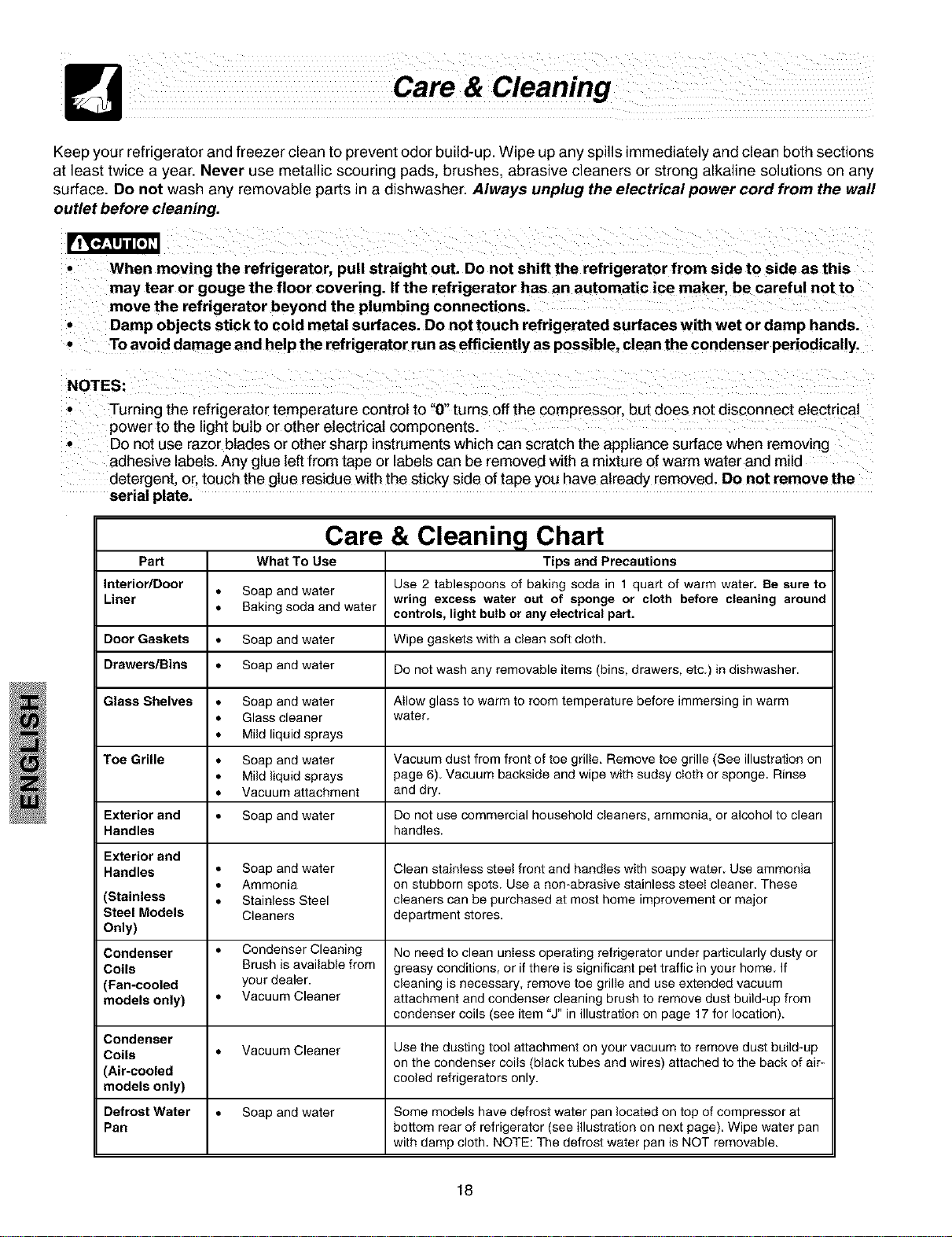
Part What To Use Tips and Precautions
Interior/Door • Soap and water Use 2 tablespoons of baking soda in t quart of warm water. Be sure to
Liner wring excess water out of sponge or cloth before cleaning around
• Baking soda and water controls, light bulb or any electrical part.
Door Gaskets • Soap and water Wipe gaskets with a clean soft cloth.
Drawers/Bins • Soap and water Do not wash any removable items (bins, drawers, etc.) in dishwasher.
Glass Shelves • Soap and water Ailow glass to warm to room temperature before immersing in warm
• Glass cleaner water
• Mild liquid sprays
Toe Grille • Soap and water Vacuum dust from front of toe grille. Remove toe grille (See illustration on
• Mild liquid sprays page 6). Vacuum backside and wipe with sudsy cIoth or sponge. Rinse
• Vacuum attachment and dry.
Exterior and • Soap and water Do not use commercial household cleaners, ammonia, or alcohol to clean
Handles handles.
Exterior and
Handles • Soap and water Clean stainless steel front and handles with soapy water. Use ammonia
• Ammonia on stubborn spots Use a non-abrasive stainless steei cleaner. These
(Stainless • Stainless Steel cleaners can be purchased at most home improvement or major
Steel Models Cleaners department stores.
Only)
Condenser • Condenser Cleaning No need to clean uniess operating refrigerator under particularly dusty or
Coils Brush is available from greasy conditions, or if there is significant pet traffic in your home. If
(Fan-cooled your dealer, cleaning is necessary, remove toe grille and use extended vacuum
models only) • Vacuum Cleaner attachment and condenser cleaning brush to remove dust build-up from
condenser coils (see item "J" in illustration on page 17 for location).
Condenser
Coils • Vacuum Cleaner Use the dusting tool attachment on your vacuum to remove dust build-up
on the condenser coils (black tubes and wires) attached to the back of air-
(Air-cooled cooled refrigerators only.
models only)
Defrost Water • Soap and water Some models have defrost water pan located on top of compressor at
Pan bottom rear of refrigerator (see illustration on next page). Wipe water pan
with damp cloth NOTE: The defrost water pan is NOT removable.
18
Care & Cleaning (continued)
Avoid cuts when replacing light
bulbs, wear gloves.
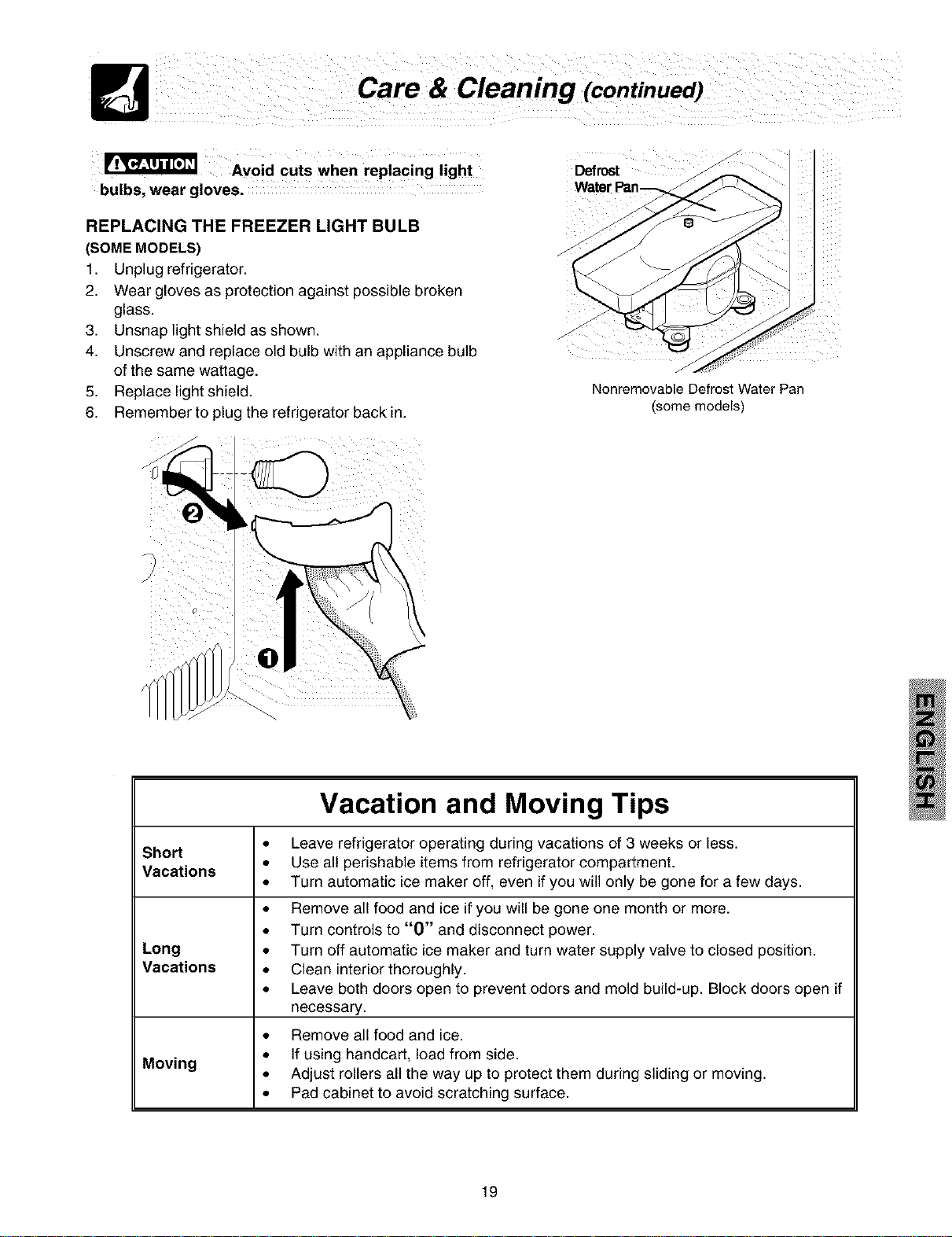
REPLACING THE FREEZER LIGHT BU LB
(SOME MODELS)
1. Unplug refrigerator
2. Wear gloves as protection against possible broken
glass.
3. Unsnap light shield as shown
4. Unscrew and replace old bulb with an appliance bulb
of the same wattage.
5. Replace light shield.
6. Remember to plug the refrigerator back in.
Defro6t
Nonremovable Defrost Water Pan
(some models)
Vacation and Moving Tips
• Leave refrigerator operating during vacations of 3 weeks or less.
Short
• Use all perishable items from refrigerator compartment.
Vacations
• Turn automatic ice maker off, even ifyou will only be gone for a few days.
• Remove all food and ice ifyou will be gone one month or more.
• Turn controls to "0" and disconnect power.
Long • Turn off automatic ice maker and turn water supply valve to closed position.
Vacations • Clean interiorthoroughly.
• Leave both doors open to prevent odors and mold build-up. Block doors open if
necessary.
• Remove all food and ice.
• If using handcart, load from side.
Moving
• Adjust rollers all the way up to protect them during sliding or moving.
• Pad cabinet to avoid scratching surface.
19
ATTENTION
To Properly Install Your Refrigerator
See "Installation" Section On Pages 6-7
OR
To Reverse The Doors
See "Door Removal & Reversal" Section On Pages 8-9
Before You Call
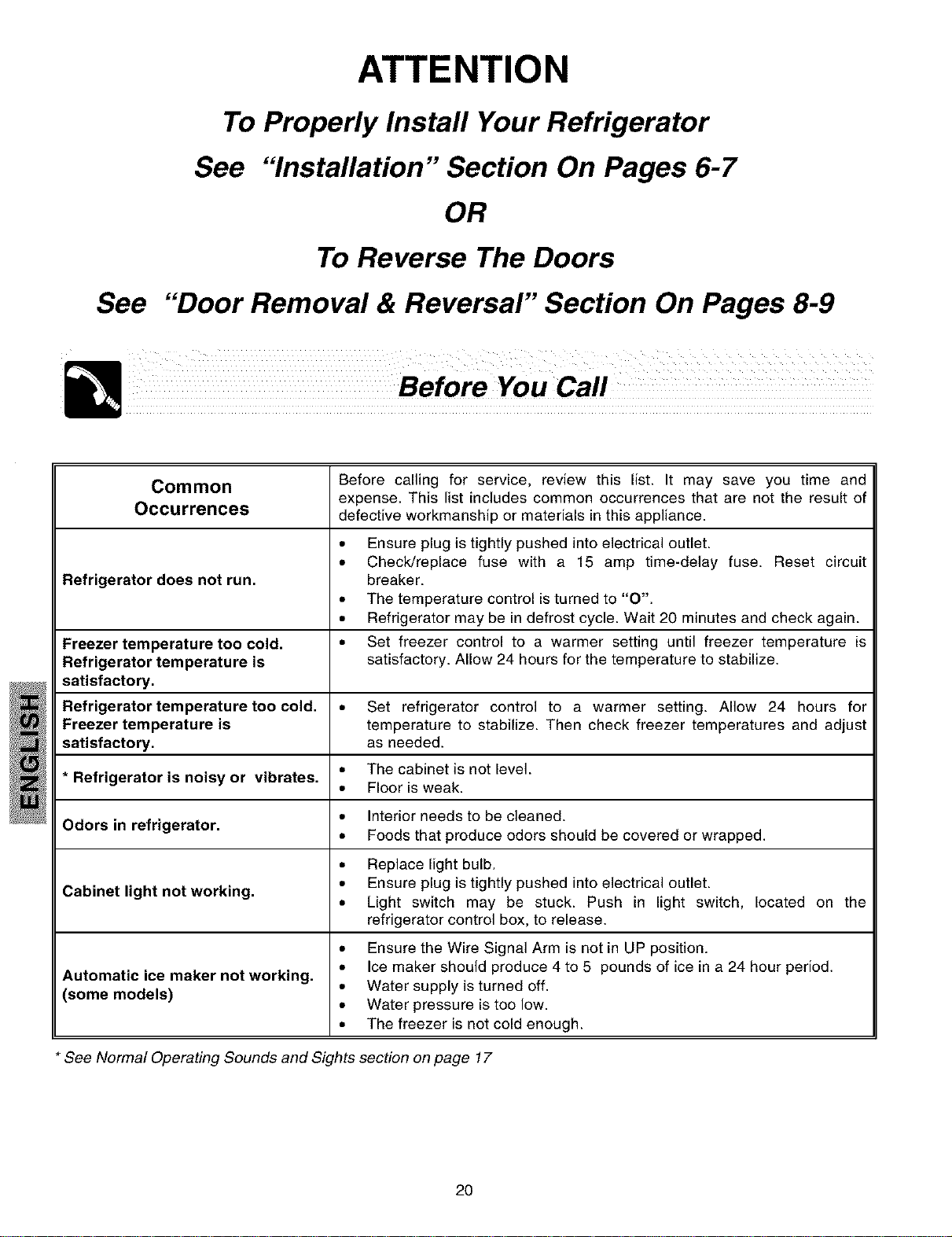
Common Before calling for service, review this list. It may save you time and
expense. This list includes common occurrences that are not the result of
Occurrences defective workmanship or materials in this appliance.
,, Ensure plug is tightly pushed into electrical outlet.
,, Check/replace fuse with a 15 amp time-delay fuse. Reset circuit
Refrigerator does not run. breaker.
,, The temperature control isturned to "O'.
,, Refrigerator may be in defrost cycle. Wait 20 minutes and check again.
Freezer temperature too cold. ,, Set freezer control to a warmer setting until freezer temperature is
Refrigerator temperature is satisfactory. Allow 24 hours for the temperature to stabilize.
satisfactory.
Refrigerator temperature too cold. ,, Set refrigerator control to a warmer setting. Allow 24 hours for
Freezer temperature is temperature to stabilize. Then check freezer temperatures and adjust
satisfactory, as needed.
,, The cabinet is not level.
* Refrigerator is noisy or vibrates.
,, Floor isweak.
,, Interior needs to be cleaned.
Odors in refrigerator.
,, Foods that produce odors should be covered or wrapped.
,, Replace light bulb.
,, Ensure plug is tightly pushed into electrical outlet.
Cabinet light not working.
,, Light switch may be stuck. Push in light switch, located on the
refrigerator control box, to release.
,, Ensure the Wire Signal Arm is not in UP position.
,, Ice maker should produce 4 to 5 pounds of ice in a 24 hour period.
Automatic ice maker not working.
,, Water supplyis turned off.
(some models)
,, Water pressure is too low.
,, The freezer is not cold enough.
*See Normal Operating Sounds and Sights section on page 17
20