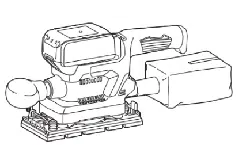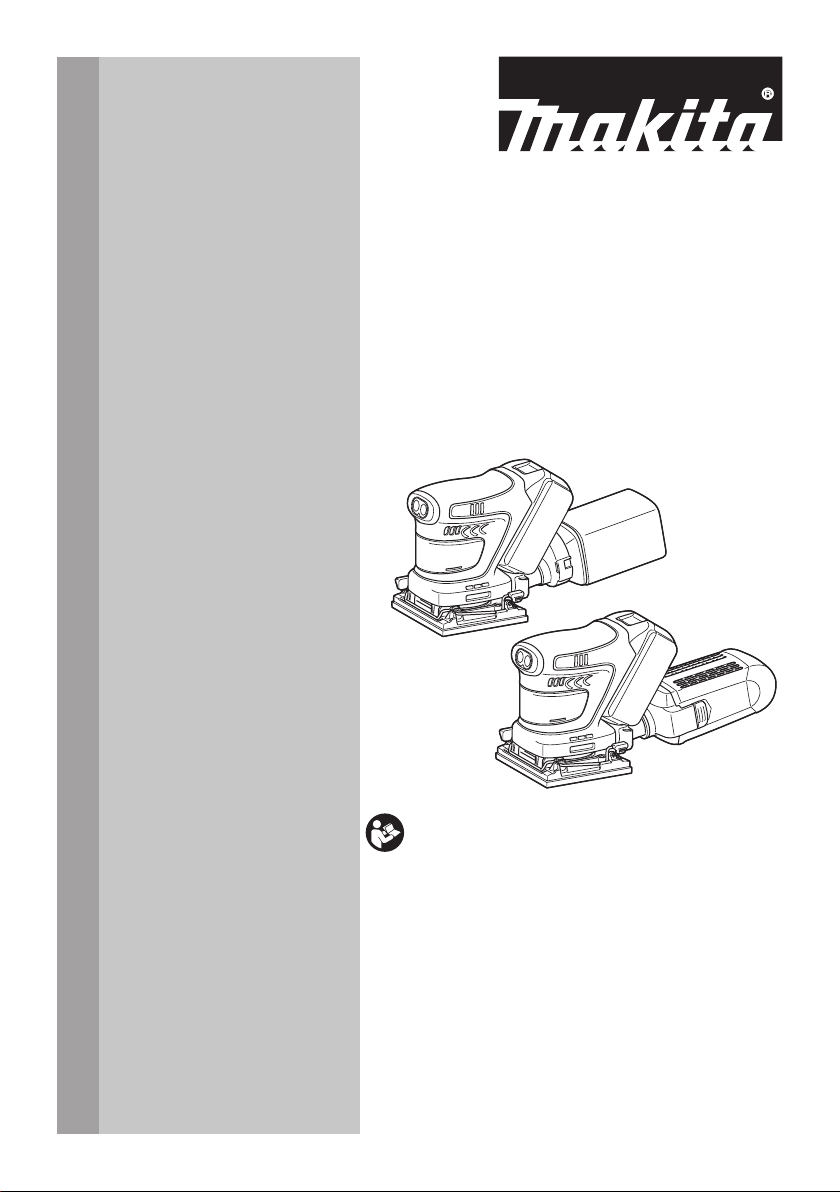
INSTRUCTION MANUAL
Cordless Finishing Sander
DBO480
DBO481
DBO482
ENGLISH: Original instructions
Read before use.
2 ENGLISH
SPECIFICATIONS
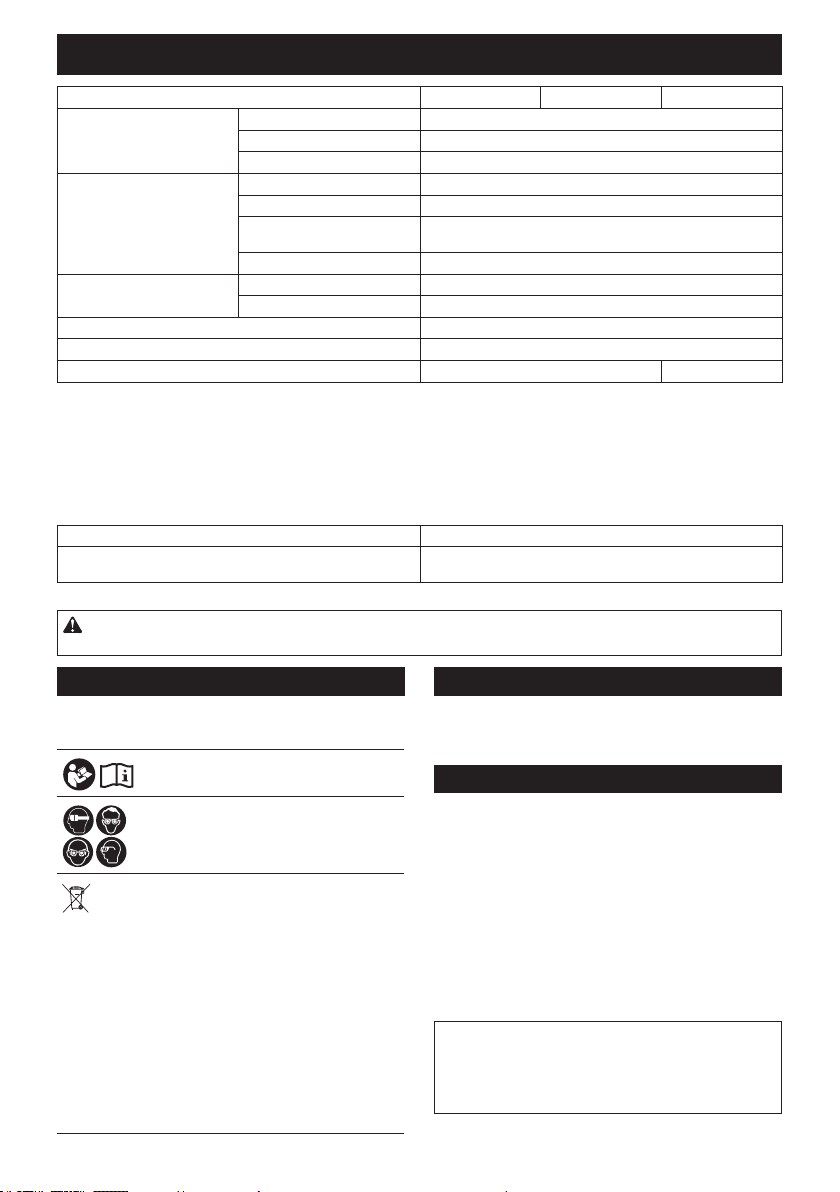
Model: DBO480 DBO481 DBO482
Pad size Square pad 112 mm x 102 mm
Triangular pad 112 mm x 190 mm
Rectangular pad 112 mm x 168.5 mm
Abrasive paper For square pad (Hook and loop) 114 mm x 102 mm
For square pad (Clamp) 114 mm x 140 mm
For triangular pad Rectangular paper: 114 mm x 102 mm
Triangular paper: 96 mm
For rectangular pad 112 mm x 168.5 mm, 112 mm x 66 mm
Orbits per minute High 14,000 min
-1
Low 11,000 min
-1
Overall length (with BL1860B) 171 mm
Rated voltage D.C. 18 V
Net weight 1.4 - 1.7 kg 1.4 - 1.8 kg
* Thestandardpaddiersfromcountrytocountry.
•
Duetoourcontinuingprogramofresearchanddevelopment,thespecicationshereinaresubjecttochangewithoutnotice.
• Specicationsandbatterycartridgemaydierfromcountrytocountry.
• Theweightmaydierdependingontheattachment(s),includingthebatterycartridge.Thelightestandheavi-
est combinations, according to EPTA-Procedure 01/2014, are shown in the table.
Applicable battery cartridge and charger
Batterycartridge BL1815N / BL1820B / BL1830B / BL1840B / BL1850B / BL1860B
Charger DC18RC / DC18RD / DC18RE / DC18SD / DC18SE / DC18SF /
DC18SH
•
Someofthebatterycartridgesandchargerslistedabovemaynotbeavailabledependingonyourregionofresidence.
WARNING: Only use the battery cartridges and chargers listed above.Useofanyotherbatterycartridges
andchargersmaycauseinjuryand/orre.
Symbols
Thefollowingsshowthesymbolswhichmaybeusedfortheequip-
ment.Besurethatyouunderstandtheirmeaningbeforeuse.
Read instruction manual.
Wearsafetyglasses.
Ni-MH
Li-ion
OnlyforEUcountries
Due to the presence of hazardous components in the
equipment, waste electrical and electronic equip-
ment,accumulatorsandbatteriesmayhaveanega-
tive impact on the environment and human health.
Do not dispose of electrical and electronic
appliances or batteries with household waste!
In accordance with the European Directive on
waste electrical and electronic equipment and on
accumulators and batteries and waste accumu-
lators and batteries, as well as their adaptation to
national law, waste electrical equipment, batter-
ies and accumulators should be stored sepa-
ratelyanddeliveredtoaseparatecollectionpoint
for municipal waste, operating in accordance with
the regulations on environmental protection.
Thisisindicatedbythesymbolofthecrossed-
out wheeled bin placed on the equipment.
Intended use
The tool is intended for the sanding of large surface of
wood, plastic and metal materials as well as painted
surfaces.
Noise
ThetypicalA-weightednoiseleveldeterminedaccord-
ing to EN62841-2-4:
Model DBO480
Sound pressure level (L
pA
) : 75 dB(A)
Uncertainty(K):3dB(A)
Model DBO481
Sound pressure level (L
pA
) : 75 dB(A)
Uncertainty(K):3dB(A)
Model DBO482
Sound pressure level (L
pA
) : 75 dB(A)
Uncertainty(K):3dB(A)
Thenoiselevelunderworkingmayexceed80dB(A).
NOTE:
The declared noise emission value(s) has been
measured in accordance with a standard test method
andmaybeusedforcomparingonetoolwithanother.
NOTE:
Thedeclarednoiseemissionvalue(s)mayalso
beusedinapreliminaryassessmentofexposure.

3 ENGLISH
WARNING: Wear ear protection.
WARNING: The noise emission during actual
use of the power tool can dier from the declared
value(s) depending on the ways in which the
tool is used especially what kind of workpiece is
processed.
WARNING: Be sure to identify safety mea-
sures to protect the operator that are based on an
estimation of exposure in the actual conditions of
use (taking account of all parts of the operating
cycle such as the times when the tool is switched
o and when it is running idle in addition to the
trigger time).
Vibration
The vibration total value (tri-axial vector sum) deter-
mined according to EN62841-2-4:
Model DBO480
Work mode: sanding metal plate (square base)
Vibration emission (a
h
) : 2.5 m/s
2
or less
Uncertainty(K):1.5m/s
2
Work mode: sanding metal plate (louver base)
Vibration emission (a
h
) : 4.1 m/s
2
Uncertainty(K):1.5m/s
2
Model DBO481
Work mode: sanding metal plate (square base)
Vibration emission (a
h
) : 2.5 m/s
2
or less
Uncertainty(K):1.5m/s
2
Model DBO482
Work mode: sanding metal plate (square base)
Vibration emission (a
h
) : 3.4 m/s
2
Uncertainty(K):1.5m/s
2
NOTE: The declared vibration total value(s) has been
measured in accordance with a standard test method
andmaybeusedforcomparingonetoolwithanother.
NOTE:Thedeclaredvibrationtotalvalue(s)mayalso
beusedinapreliminaryassessmentofexposure.
WARNING: The vibration emission during
actual use of the power tool can dier from the
declared value(s) depending on the ways in which
the tool is used especially what kind of workpiece
is processed.
WARNING: Be sure to identify safety mea-
sures to protect the operator that are based on an
estimation of exposure in the actual conditions of
use (taking account of all parts of the operating
cycle such as the times when the tool is switched
o and when it is running idle in addition to the
trigger time).
EC Declaration of Conformity
For European countries only
TheECdeclarationofconformityisincludedasAnnexA
to this instruction manual.
SAFETY WARNINGS
General power tool safety warnings
WARNING:
Read all safety warnings, instruc-
tions, illustrations and specications provided with this
power tool. Failure to follow all instructions listed below
mayresultinelectricshock,reand/orseriousinjury.
Save all warnings and instruc-
tions for future reference.
Theterm"powertool"inthewarningsreferstoyour
mains-operated(corded)powertoolorbattery-operated
(cordless) power tool.
Work area safety
1. Keep work area clean and well lit. Cluttered or
dark areas invite accidents.
2. Do not operate power tools in explosive atmo-
spheres, such as in the presence of ammable
liquids, gases or dust. Power tools create sparks
whichmayignitethedustorfumes.
3. Keep children and bystanders away while
operating a power tool. Distractions can cause
youtolosecontrol.
Electrical safety
1. Power tool plugs must match the outlet. Never
modify the plug in any way. Do not use any
adapter plugs with earthed (grounded) power
tools. Unmodiedplugsandmatchingoutletswill
reduce risk of electric shock.
2. Avoid body contact with earthed or grounded
surfaces, such as pipes, radiators, ranges and
refrigerators. There is an increased risk of elec-
tricshockifyourbodyisearthedorgrounded.
3. Do not expose power tools to rain or wet con-
ditions. Water entering a power tool will increase
the risk of electric shock.
4. Do not abuse the cord. Never use the cord for
carrying, pulling or unplugging the power tool.
Keep cord away from heat, oil, sharp edges
or moving parts. Damaged or entangled cords
increase the risk of electric shock.
5.
When operating a power tool outdoors, use an
extension cord suitable for outdoor use. Use of a cord
suitable for outdoor use reduces the risk of electric shock.
6. If operating a power tool in a damp location
is unavoidable, use a residual current device
(RCD) protected supply. Use of an RCD reduces
the risk of electric shock.
7.
Power tools can produce electromagnetic elds
(EMF) that are not harmful to the user. However,
users of pacemakers and other similar medical
devices should contact the maker of their device and/
or doctor for advice before operating this power tool.
Personal safety
1. Stay alert, watch what you are doing and use
common sense when operating a power tool.
Do not use a power tool while you are tired or
under the inuence of drugs, alcohol or med-
ication. A moment of inattention while operating
powertoolsmayresultinseriouspersonalinjury.
4 ENGLISH
2. Use personal protective equipment. Always
wear eye protection. Protective equipment such
asadustmask,non-skidsafetyshoes,hardhator
hearing protection used for appropriate conditions
willreducepersonalinjuries.
3. Prevent unintentional starting. Ensure the
switch is in the o-position before connecting
to power source and/or battery pack, picking
up or carrying the tool.Carryingpowertoolswith
yourngerontheswitchorenergisingpowertools
that have the switch on invites accidents.
4. Remove any adjusting key or wrench before
turning the power tool on.Awrenchorakeyleft
attachedtoarotatingpartofthepowertoolmay
resultinpersonalinjury.
5. Do not overreach. Keep proper footing and
balance at all times. This enables better control
of the power tool in unexpected situations.
6. Dress properly. Do not wear loose clothing or
jewellery. Keep your hair and clothing away
from moving parts.Looseclothes,jewelleryor
long hair can be caught in moving parts.
7. If devices are provided for the connection of
dust extraction and collection facilities, ensure
these are connected and properly used. Use of
dust collection can reduce dust-related hazards.
8.
Do not let familiarity gained from frequent use
of tools allow you to become complacent and
ignore tool safety principles. A careless action can
causesevereinjurywithinafractionofasecond.
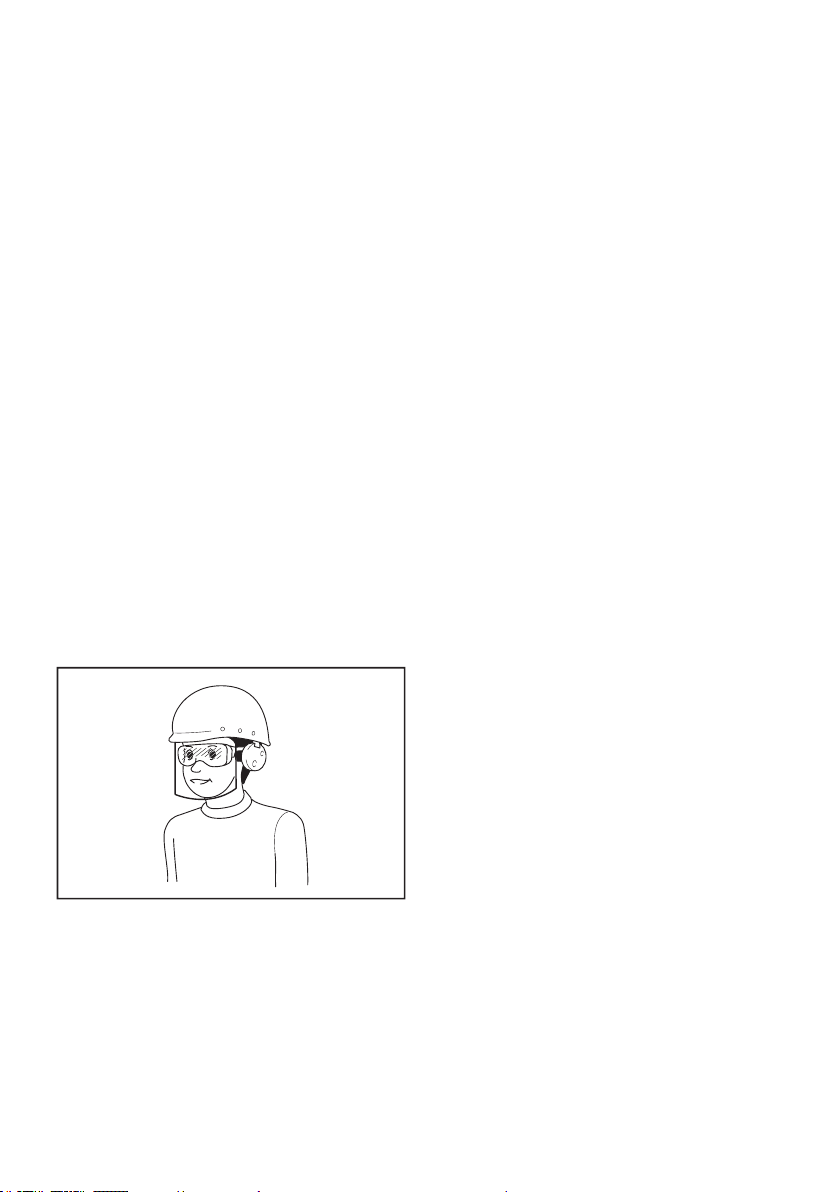
9. Always wear protective goggles to protect
your eyes from injury when using power tools.
The goggles must comply with ANSI Z87.1 in
the USA, EN 166 in Europe, or AS/NZS 1336
in Australia/New Zealand. In Australia/New
Zealand, it is legally required to wear a face
shield to protect your face, too.
It is an employer's responsibility to enforce
the use of appropriate safety protective equip-
ments by the tool operators and by other per-
sons in the immediate working area.
Power tool use and care
1. Do not force the power tool. Use the correct
power tool for your application. The correct
powertoolwilldothejobbetterandsaferatthe
rate for which it was designed.
2. Do not use the power tool if the switch does
not turn it on and o.Anypowertoolthatcannot
be controlled with the switch is dangerous and
must be repaired.
3. Disconnect the plug from the power source
and/or remove the battery pack, if detachable,
from the power tool before making any adjust-
ments, changing accessories, or storing power
tools.Suchpreventivesafetymeasuresreduce
theriskofstartingthepowertoolaccidentally.
4.
Store idle power tools out of the reach of children and
do not allow persons unfamiliar with the power tool
or these instructions to operate the power tool. Power
tools are dangerous in the hands of untrained users.
5.
Maintain power tools and accessories. Check for
misalignment or binding of moving parts, break-
age of parts and any other condition that may
aect the power tool’s operation. If damaged, have
the power tool repaired before use.Manyaccidents
arecausedbypoorlymaintainedpowertools.
6. Keep cutting tools sharp and clean.Properly
maintained cutting tools with sharp cutting edges
arelesslikelytobindandareeasiertocontrol.
7. Use the power tool, accessories and tool bits
etc. in accordance with these instructions, tak-
ing into account the working conditions and
the work to be performed. Use of the power tool
foroperationsdierentfromthoseintendedcould
result in a hazardous situation.
8.
Keep handles and grasping surfaces dry, clean
and free from oil and grease.Slipperyhandlesand
grasping surfaces do not allow for safe handling and
control of the tool in unexpected situations.
9. When using the tool, do not wear cloth work
gloves which may be entangled. The entangle-
mentofclothworkglovesinthemovingpartsmay
resultinpersonalinjury.
Battery tool use and care
1. Recharge only with the charger specied by
the manufacturer. A charger that is suitable for
onetypeofbatterypackmaycreateariskofre
whenusedwithanotherbatterypack.
2. Use power tools only with specically desig-
nated battery packs.Useofanyotherbattery
packsmaycreateariskofinjuryandre.
3. When battery pack is not in use, keep it away
from other metal objects, like paper clips,
coins, keys, nails, screws or other small metal
objects, that can make a connection from one
terminal to another.Shortingthebatterytermi-
nalstogethermaycauseburnsorare.
4.
Under abusive conditions, liquid may be ejected
from the battery; avoid contact. If contact acci-
dentally occurs, ush with water. If liquid contacts
eyes, additionally seek medical help.Liquidejected
fromthebatterymaycauseirritationorburns.
5. Do not use a battery pack or tool that is dam-
aged or modied.Damagedormodiedbatteries
mayexhibitunpredictablebehaviourresultingin
re,explosionorriskofinjury.
6. Do not expose a battery pack or tool to re or
excessive temperature.Exposuretoreortem-
peratureabove130°Cmaycauseexplosion.
7. Follow all charging instructions and do not
charge the battery pack or tool outside the
temperature range specied in the instruc-
tions.Chargingimproperlyorattemperatures
outsidethespeciedrangemaydamagethe
batteryandincreasetheriskofre.

5 ENGLISH
Service
1. Have your power tool serviced by a qualied
repair person using only identical replacement
parts.Thiswillensurethatthesafetyofthepower
tool is maintained.
2. Never service damaged battery packs. Service
ofbatterypacksshouldonlybeperformedbythe
manufacturer or authorized service providers.
3. Follow instruction for lubricating and chang-
ing accessories.
Sander safety warnings
1. Always use safety glasses or goggles.
Ordinary eye or sun glasses are NOT safety
glasses.
2. Hold the tool rmly.
3. Do not leave the tool running. Operate the tool
only when hand-held.
4. This tool has not been waterproofed, so do not
use water on the workpiece surface.
5. Ventilate your work area adequately when you
perform sanding operations.
6. Some material contains chemicals which may
be toxic. Take caution to prevent dust inhala-
tion and skin contact. Follow material supplier
safety data.
7. Use of this tool to sand some products, paints
and wood could expose user to dust contain-
ing hazardous substances. Use appropriate
respiratory protection.
8. Be sure that there are no cracks or breakage
on the pad before use. Cracks or breakage
may cause a personal injury.
9. Watch your footing and maintain your balance
with the tool. Make sure there is no one below
when working in high locations.
SAVE THESE INSTRUCTIONS.
WARNING: DO NOT let comfort or familiarity
with product (gained from repeated use) replace
strict adherence to safety rules for the subject
product. MISUSE or failure to follow the safety
rules stated in this instruction manual may cause
serious personal injury.
Important safety instructions for
battery cartridge
1. Before using battery cartridge, read all instruc-
tions and cautionary markings on (1) battery
charger, (2) battery, and (3) product using
battery.
2. Do not disassemble or tamper with the battery
cartridge.Itmayresultinare,excessiveheat,
or explosion.
3. If operating time has become excessively
shorter, stop operating immediately. It may
result in a risk of overheating, possible burns
and even an explosion.
4. If electrolyte gets into your eyes, rinse them
out with clear water and seek medical atten-
tion right away. It may result in loss of your
eyesight.
5. Do not short the battery cartridge:
(1) Do not touch the terminals with any con-
ductive material.
(2) Avoid storing battery cartridge in a con-
tainer with other metal objects such as
nails, coins, etc.
(3) Do not expose battery cartridge to water
or rain.
A battery short can cause a large current
ow, overheating, possible burns and even a
breakdown.
6. Do not store and use the tool and battery car-
tridge in locations where the temperature may
reach or exceed 50 °C (122 °F).
7. Do not incinerate the battery cartridge even if
it is severely damaged or is completely worn
out. The battery cartridge can explode in a re.
8. Do not nail, cut, crush, throw, drop the battery
cartridge, or hit against a hard object to the
battery cartridge.Suchconductmayresultina
re,excessiveheat,orexplosion.
9. Do not use a damaged battery.
10. The contained lithium-ion batteries are subject
to the Dangerous Goods Legislation require-
ments.
Forcommercialtransportse.g.bythirdparties,
forwarding agents, special requirement on pack-
aging and labeling must be observed.
For preparation of the item being shipped, consult-
ing an expert for hazardous material is required.
Pleasealsoobservepossiblymoredetailed
national regulations.
Tapeormaskoopencontactsandpackupthe
batteryinsuchamannerthatitcannotmove
around in the packaging.
11. When disposing the battery cartridge, remove
it from the tool and dispose of it in a safe
place. Follow your local regulations relating to
disposal of battery.
12. Use the batteries only with the products
specied by Makita. Installing the batteries to
non-compliantproductsmayresultinare,exces-
siveheat,explosion,orleakofelectrolyte.
13. If the tool is not used for a long period of time,
the battery must be removed from the tool.
14. During and after use, the battery cartridge may
take on heat which can cause burns or low
temperature burns. Pay attention to the han-
dling of hot battery cartridges.
15. Do not touch the terminal of the tool imme-
diately after use as it may get hot enough to
cause burns.
16. Do not allow chips, dust, or soil stuck into the
terminals, holes, and grooves of the battery
cartridge.Itmaycauseheating,catchingre,
burstandmalfunctionofthetoolorbatterycar-
tridge,resultinginburnsorpersonalinjury.
17. Unless the tool supports the use near
high-voltage electrical power lines, do not use
the battery cartridge near high-voltage electri-
cal power lines.Itmayresultinamalfunctionor
breakdownofthetoolorbatterycartridge.
18. Keep the battery away from children.
SAVE THESE INSTRUCTIONS.
6 ENGLISH
CAUTION:
Only use genuine Makita batteries.
Use of non-genuine Makita batteries, or batteries that
havebeenaltered,mayresultinthebatterybursting
causingres,personalinjuryanddamage.Itwillalso
voidtheMakitawarrantyfortheMakitatoolandcharger.
Tips for maintaining maximum
battery life
1. Charge the battery cartridge before completely
discharged. Always stop tool operation and
charge the battery cartridge when you notice
less tool power.
2.
Never recharge a fully charged battery cartridge.
Overcharging shortens the battery service life.
3.
Charge the battery cartridge with room tempera-
ture at 10 °C - 40 °C (50 °F - 104 °F). Let a hot
battery cartridge cool down before charging it.
4. When not using the battery cartridge, remove
it from the tool or the charger.
5. Charge the battery cartridge if you do not use
it for a long period (more than six months).
FUNCTIONAL
DESCRIPTION
CAUTION: Always be sure that the tool is
switched o and the battery cartridge is removed
before adjusting or checking function on the tool.
Installing or removing battery
cartridge
CAUTION: Always switch o the tool before
installing or removing of the battery cartridge.
CAUTION: Hold the tool and the battery car-
tridge rmly when installing or removing battery
cartridge.Failuretoholdthetoolandthebattery
cartridgermlymaycausethemtoslipoyourhands
andresultindamagetothetoolandbatterycartridge
andapersonalinjury.
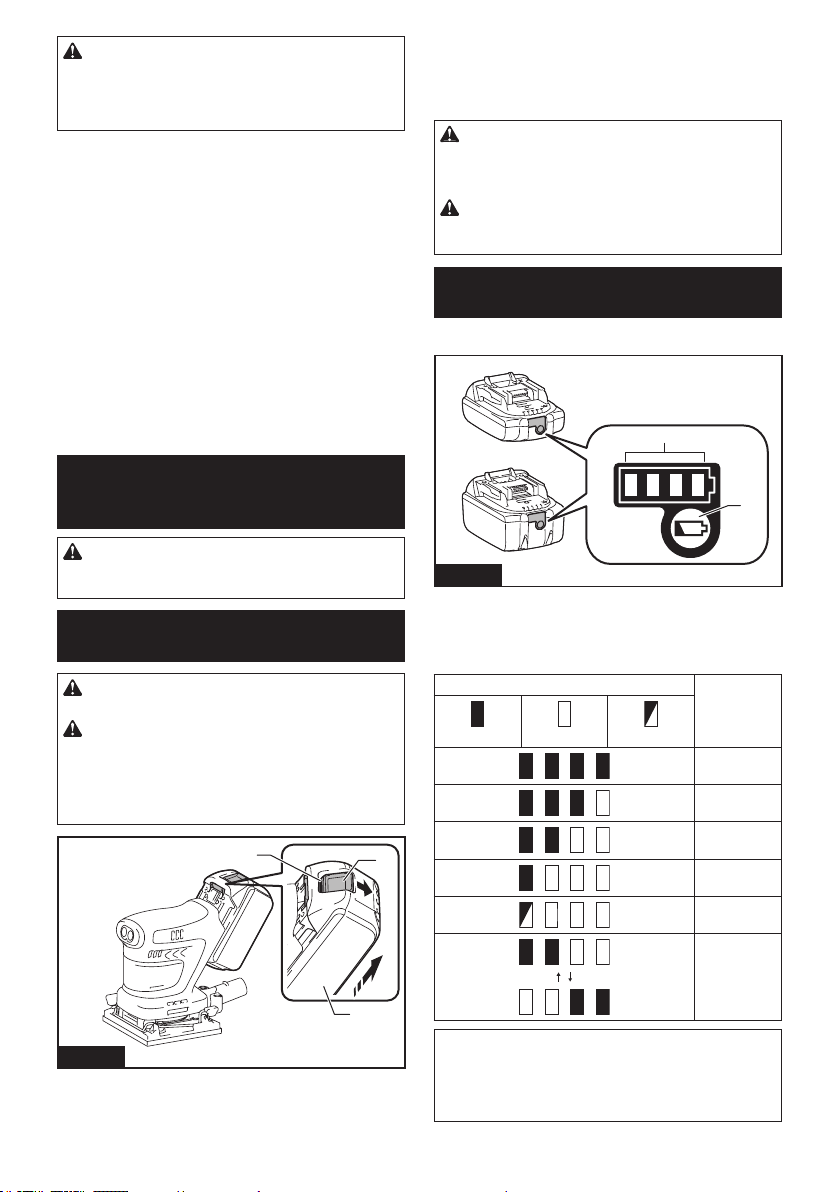
1
3
2
Fig.1
►1. Red indicator 2. Button 3.Batterycartridge
Toremovethebatterycartridge,slideitfromthetool
while sliding the button on the front of the cartridge.
Toinstallthebatterycartridge,alignthetongueonthe
batterycartridgewiththegrooveinthehousingandslip
itintoplace.Insertitallthewayuntilitlocksinplace
withalittleclick.Ifyoucanseetheredindicatoras
showninthegure,itisnotlockedcompletely.
CAUTION: Always install the battery cartridge
fully until the red indicator cannot be seen. If not,
itmayaccidentallyfalloutofthetool,causinginjuryto
youorsomeonearoundyou.
CAUTION: Do not install the battery cartridge
forcibly.Ifthecartridgedoesnotslideineasily,itis
notbeinginsertedcorrectly.
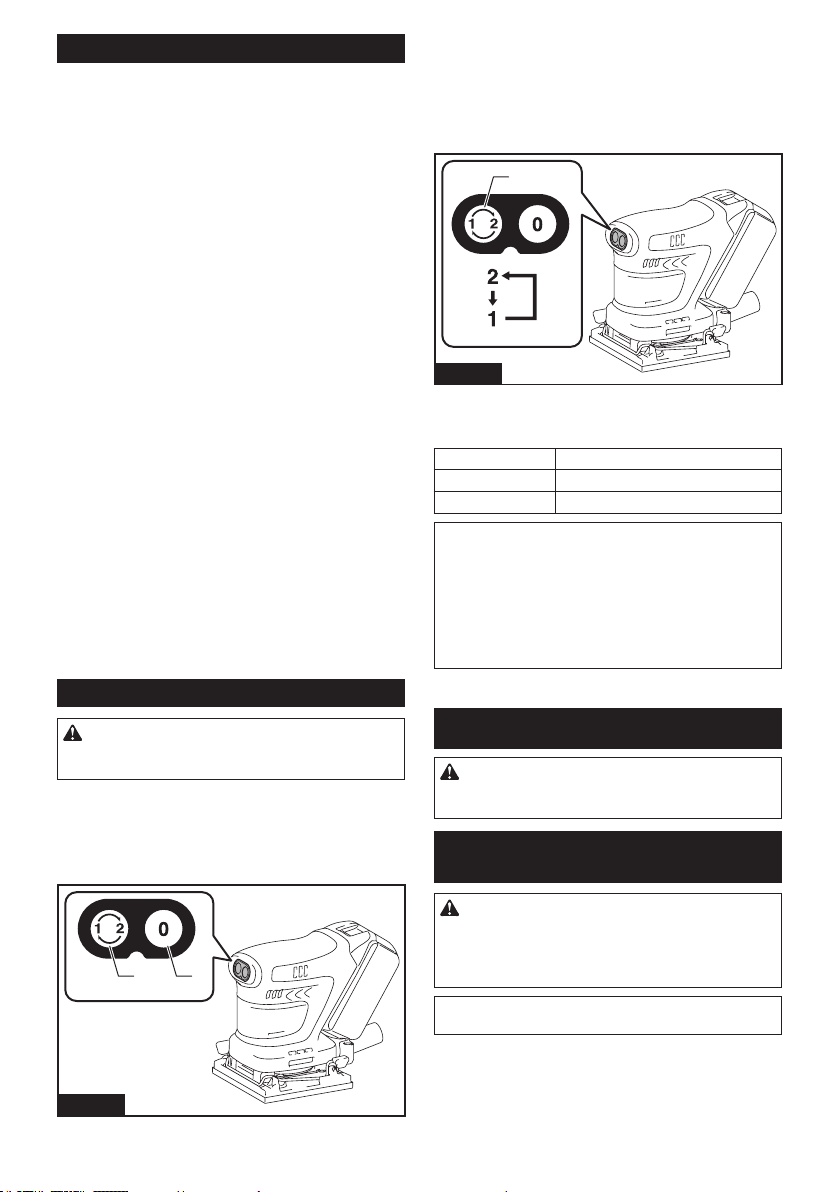
Indicating the remaining battery
capacity
Only for battery cartridges with the indicator
1
2
Fig.2
►1. Indicator lamps 2. Check button
Pressthecheckbuttononthebatterycartridgetoindi-
catetheremainingbatterycapacity.Theindicatorlamps
light up for a few seconds.
Indicator lamps Remaining
capacity
Lighted O Blinking
75% to 100%
50% to 75%
25% to 50%
0% to 25%
Charge the
battery.
Thebattery
mayhave
malfunctioned.
NOTE: Depending on the conditions of use and the
ambienttemperature,theindicationmaydierslightly
fromtheactualcapacity.
NOTE:Therst(farleft)indicatorlampwillblinkwhen
thebatteryprotectionsystemworks.
7 ENGLISH
Tool / battery protection system
Thetoolisequippedwithatool/batteryprotectionsystem.This
systemautomaticallycutsopowertothemotortoextendtool
andbatterylife.Thetoolwillautomaticallystopduringoperationif
thetoolorbatteryisplacedunderoneofthefollowingconditions:
Overload protection
Whenthetoolorbatteryisoperatedinamannerthat
causesittodrawanabnormallyhighcurrent,thetoolauto-
maticallystopswithoutanyindication.Inthissituation,turn
thetooloandstoptheapplicationthatcausedthetoolto
become overloaded. Then turn the tool on to restart.
Overheat protection
Whenthetoolorbatteryisoverheated,thetoolstops
automatically.Inthiscase,letthetoolandbatterycool
before turning the tool on again.
Overdischarge protection
Whenthebatterycapacityisnotenough,thetoolstops
automatically.Inthiscase,removethebatteryfromthe
toolandchargethebattery.
Protections against other causes
Protectionsystemisalsodesignedforothercausesthatcould
damagethetoolandallowsthetooltostopautomatically.
Take all the following steps to clear the causes, when the tool
hasbeenbroughttoatemporaryhaltorstopinoperation.
1.
Turnthetoolo,andthenturnitonagaintorestart.
2. Chargethebattery(ies)orreplaceit/themwith
rechargedbattery(ies).
3. Letthetoolandbattery(ies)cooldown.
Ifnoimprovementcanbefoundbyrestoringprotection
system,thencontactyourlocalMakitaServiceCenter.
Switch action
CAUTION: Avoid turning the tool on while it
is placed on the workpiece or on your workbench.
Itmaycausepersonalinjuryordamage.
Turning the tool on and o
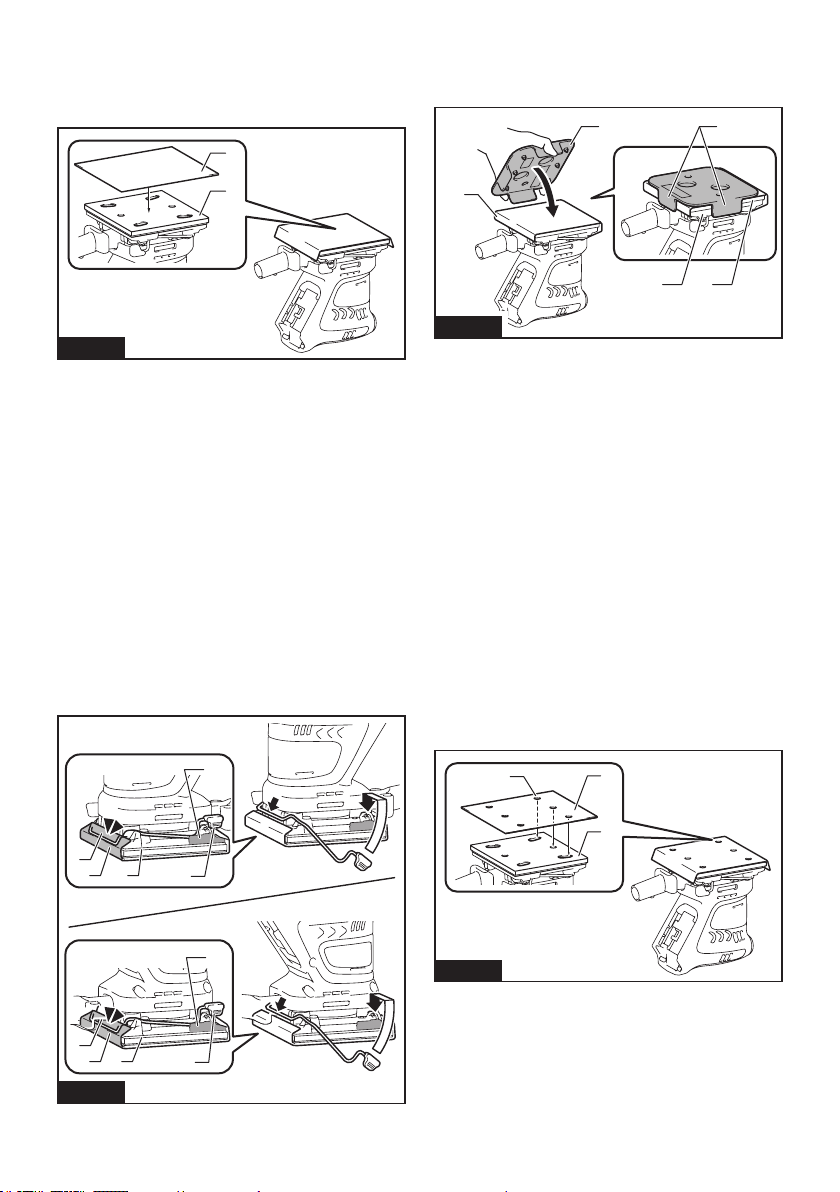
Press the power/speed select button to start the tool.
The tool starts to run at its highest orbital speed.
Press the stop button to stop the tool.
1 2
Fig.3
►1. Power/speed select button 2. Stop button
Changing the tool speed
The orbital speed can be changed in two modes; high
and low. Choose either mode depending on the applica-
tion and workload.
Press the power/speed select button to switch speed
mode while the tool is running.
1
Fig.4
►1. Power/speed select button
Speed settings table
Speed level Orbital per minute
2 (High) 14,000 min
-1
(/min)
1 (Low) 11,000 min
-1
(/min)
NOTICE: If the tool is operated continuously
at low speeds for a long time, the motor will get
overloaded, resulting in tool malfunction.
NOTICE: Select an appropriate speed range for
your sanding operations to avoid overheating
and melting the workpiece. Sanding at high orbital
speedmayheatworkpieceandmeltitatthepointof
contact.
ASSEMBLY
CAUTION: Always be sure that the tool is
switched o and the battery cartridge is removed
before carrying out any work on the tool.
Installing and removing abrasive
paper
CAUTION: Always make sure that a sheet of
abrasive paper is installed securely before use.
Thepapermayotherwisebeloosened,removed
easilyandsubjecttoslippage,resultinginuneven
sanding operation.
NOTE: Bending the paper beforehand makes attach-
ment easier.
8 ENGLISH
Using abrasive paper without dust-
suction hole
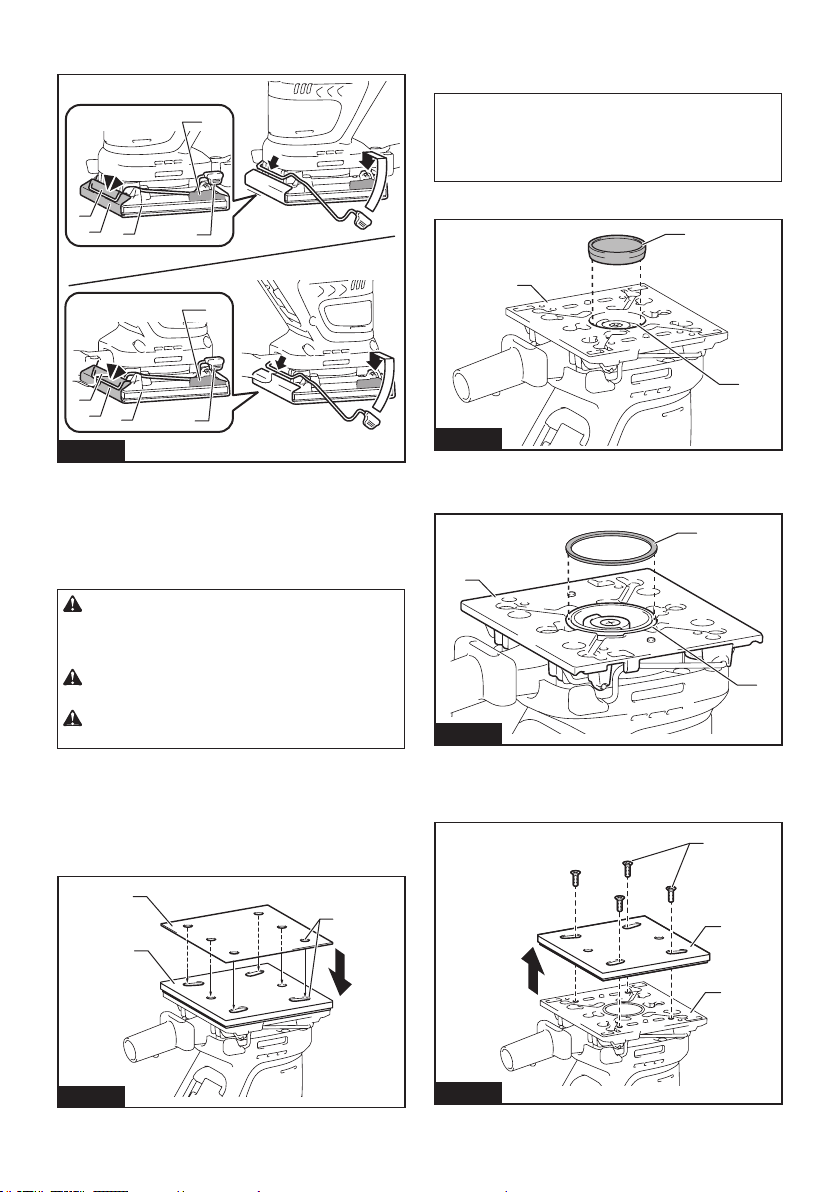
1. Cut a sheet of abrasive paper down to an appro-
priate size.
1
2
Fig.5
►1. Abrasive paper 2. Pad
2.
Push and hold down the clamp lever on either front
orrearendofthepad,andslideitawayfromthestopper
so the clamp is released from its locked position.
3.
Pull the clamp lever outwards as far as possible to cre-
ate a space between the clamp and side wall of the sanding
base in which one end of abrasive paper can be inserted.
4. Slip one end of the abrasive paper into the space
between the clamp and sanding base.
5. Repositiontheabrasivepapersoitisnelyover-
laid on the pad surface.
6. Set the clamp lever back in a locked position to
clamptheendofabrasivepapersecurely.
7. Release the clamp on the other end, and have the
otherendofabrasivepaperreadytobeclamped.
8. Maintain a proper tension on abrasive paper, and
then set the clamp lever on the other end in a locked
position.
4
2
1 3
5
4
2
1 3
5
Fig.6
►1. Abrasive paper 2. Clamp 3. Sanding base
4. Clamp lever 5. Stopper
9. Cover the abrasive paper with the punch plate
withitspositioningstoppersadjacenttothecornerwell
tontotwoofthesideedgesofthepadandsanding
base.
2 3
5 4
1
Fig.7
►1. Abrasive paper 2. Punch plate 3. Positioning
stoppers 4. Pad 5. Sanding base
10. Push the punch plate over the abrasive paper to
make dust-suction holes.
11. To remove the abrasive paper, release the clamps
onbothendsandtakethepaperothepad.
Using abrasive paper with dust-
suction hole
Optional accessory
1. Push and hold down the clamp lever on either
frontorrearendofthepad,andslideitawayfrom
the stopper so the clamp is released from its locked
position.
2. Pull the clamp lever outwards as far as possible to
create a space between the clamp and side wall of the
sanding base in which one end of abrasive paper can
be inserted.
3. Place a sheet of abrasive paper over the pad,
aligning the dust-suction holes in the paper with those
in the pad.
3
1
2
Fig.8
►1. Abrasive paper 2. Pad 3. Dust-suction hole
4. Slip one end of the abrasive paper into the space
between the clamp and sanding base.
5. Set the clamp lever back in a locked position so
theendofabrasivepaperisclampedsecurely.
6. Release the clamp on the other end, and have the
otherendofabrasivepaperreadytobeclamped.
9 ENGLISH
7.
Maintain a proper tension on abrasive paper, and then
set the clamp lever on the other end in a locked position.
4
2
1
3
5
4
2
1
3
5
Fig.9
►1. Abrasive paper 2. Clamp 3. Sanding base
4. Clamp lever 5. Stopper
8. To remove the abrasive paper, release the clamps
onbothendsandtakethepaperothepad.
Using hook-and-loop abrasive paper
CAUTION: Make sure to install a hook-and-
loop pad correctly and securely. A loose attach-
ment will run out of balance and cause an excessive
vibration resulting in loss of control.
CAUTION:
Be sure that a hook-and-loop pad and
abrasive paper are aligned and securely attached.
CAUTION:
Only use hook-and-loop abrasive
papers. Never use pressure-sensitive abrasive papers.
For DBO480
1. Remove all dirt and foreign matter from the hook-
and-loop pad.
2. Attach a sheet of optional hook-and-loop abrasive
paper to the pad, aligning the dust-suction holes in the
paper with those in the pad.
1
2
3
Fig.10
►1. Abrasive paper 2. Pad 3. Dust-suction holes
3. Toremovetheabrasivepaper,peelitofromthe
edge.
For DBO481 and DBO482
NOTICE: The cap or the O-ring may come out of
the sanding base while replacing the pad. Be sure
to set the cap or the O-ring back in the circular
hole or the circular groove around the center of
the base before installing the optional pad.
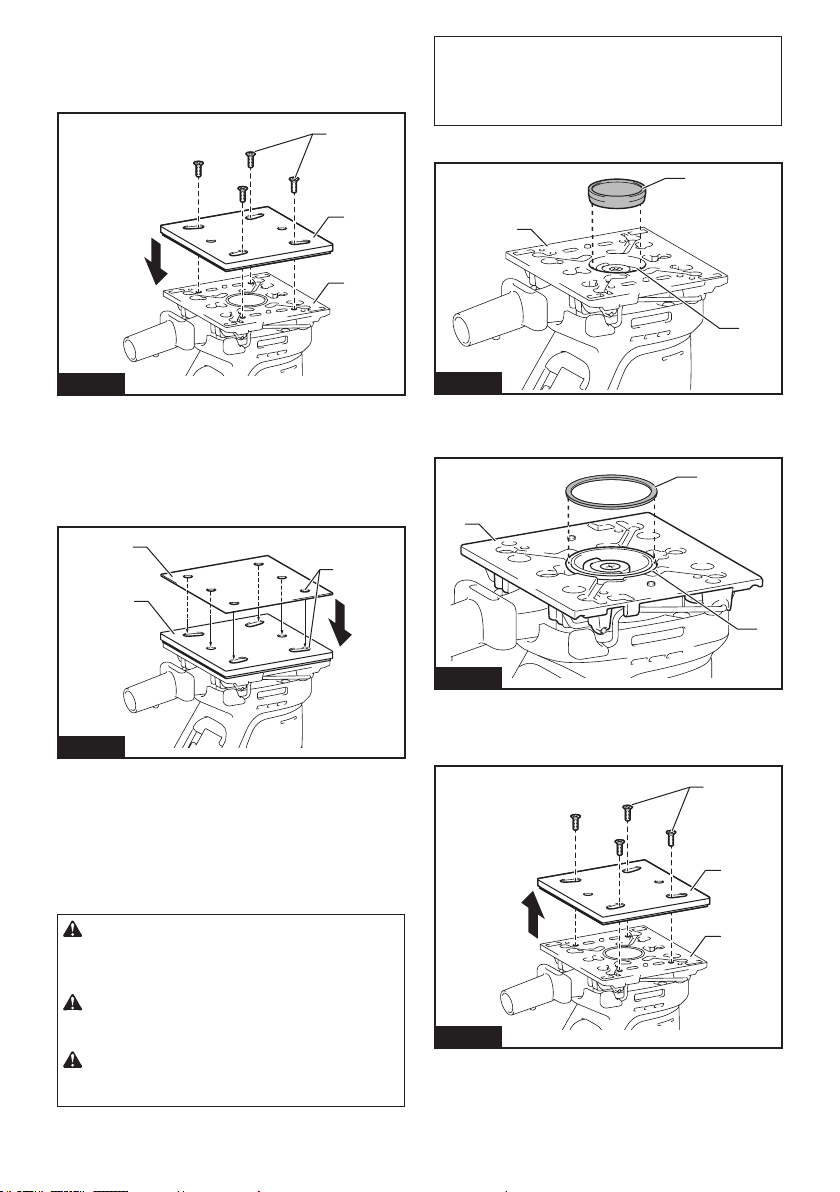
DBO481
2
1
3
Fig.11
►1. Cap 2. Sanding base 3. Circular hole
DBO482
2
1
3
Fig.12
►1. O-ring 2. Sanding base 3. Circular groove
1. Loosen and remove the four screws securing the
pad to the sanding base.
1
3
2
Fig.13
►1. Screws 2. Pad 3. Sanding base
10 ENGLISH
2. Replace the standard-equipped pad with an
optional hook-and-loop pad.
3. Re-tightenthescrewsrmlytosecurethehook-
and-loop pad.
1
3
2
Fig.14
►1. Abrasive paper 2. Pad 3. Dust-suction holes
4. Remove all dirt and foreign matter from the hook-
and-loop pad.
5. Attach a sheet of optional hook-and-loop abrasive
paper to the pad, aligning the dust-suction holes in the
paper with those in the pad.
1
2
3
Fig.15
►1. Abrasive paper 2. Pad 3. Dust-suction holes
6. Toremovetheabrasivepaper,peelitofromthe
edge.
Using triangular/rectangular abrasive
paper
Optional accessory
CAUTION: Make sure to install a hook-and-
loop pad correctly and securely. A loose attach-
ment will run out of balance and cause an excessive
vibration resulting in loss of control.
CAUTION: Be sure that a hook-and-loop pad
and abrasive paper are aligned and securely
attached.
CAUTION: Only use hook-and-loop abrasive
papers. Never use pressure-sensitive abrasive
papers.
NOTICE: The cap or the O-ring may come out of
the sanding base while replacing the pad. Be sure
to set the cap or the O-ring back in the circular
hole or the circular groove around the center of
the base before installing the optional pad.
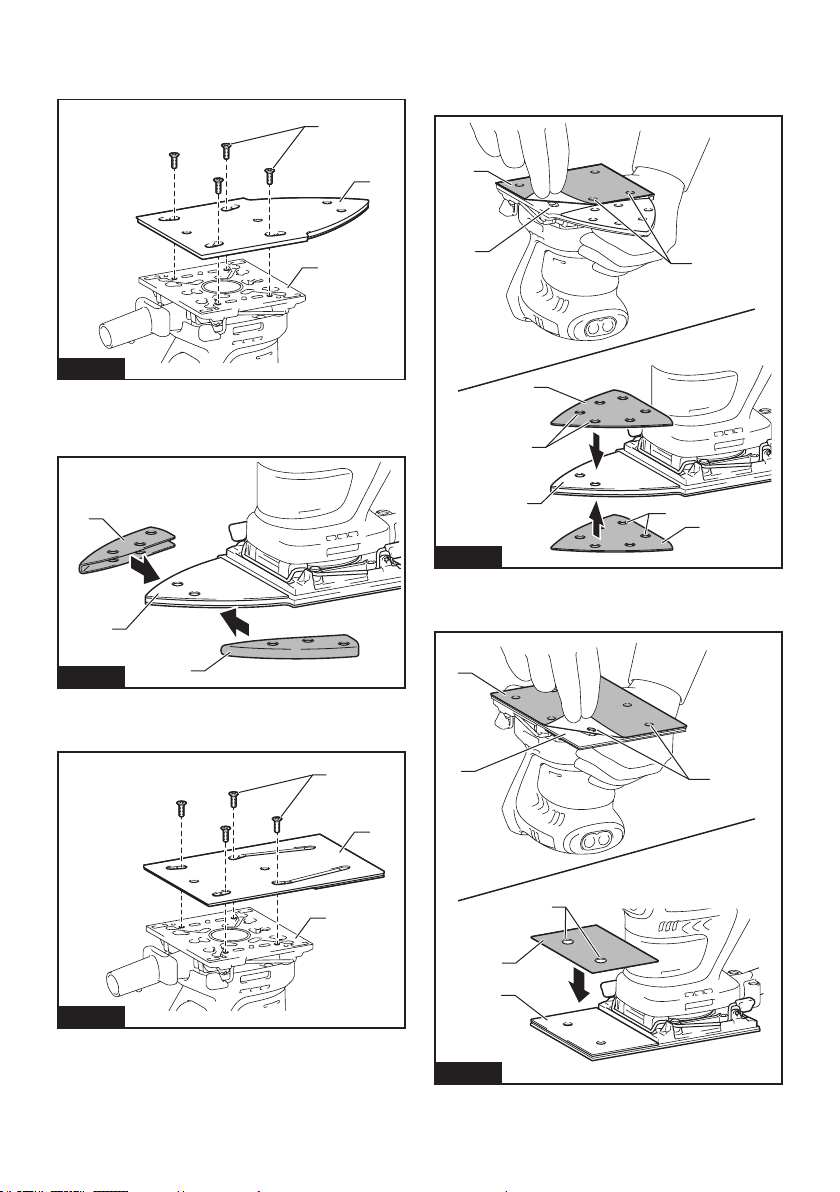
DBO480, DBO481
2
1
3
Fig.16
►1. Cap 2. Sanding base 3. Circular hole
DBO482
2
1
3
Fig.17
►1. O-ring 2. Sanding base 3. Circular groove
1. Loosen and remove the four screws securing the
pad to the sanding base.
1
3
2
Fig.18
►1. Screws 2. Pad 3. Sanding base
2. Replace the standard-equipped pad with a trian-
gular/rectangular pad.
11 ENGLISH
3. Re-tightenthescrewsrmlytosecurethetriangu-
lar/rectangular pad.
Triangular pad
1
3
2
Fig.19
►1. Screws 2. Triangular pad 3. Sanding base
You can install the abrasive paper on the side of the pad
as illustrated.
1
2
1
Fig.20
►1. Abrasive paper 2. Pad
Rectangular pad
1
3
2
Fig.21
►1. Screws 2. Rectangular pad 3. Sanding base
4. Remove all dirt and foreign matter from the trian-
gular/rectangular pad.
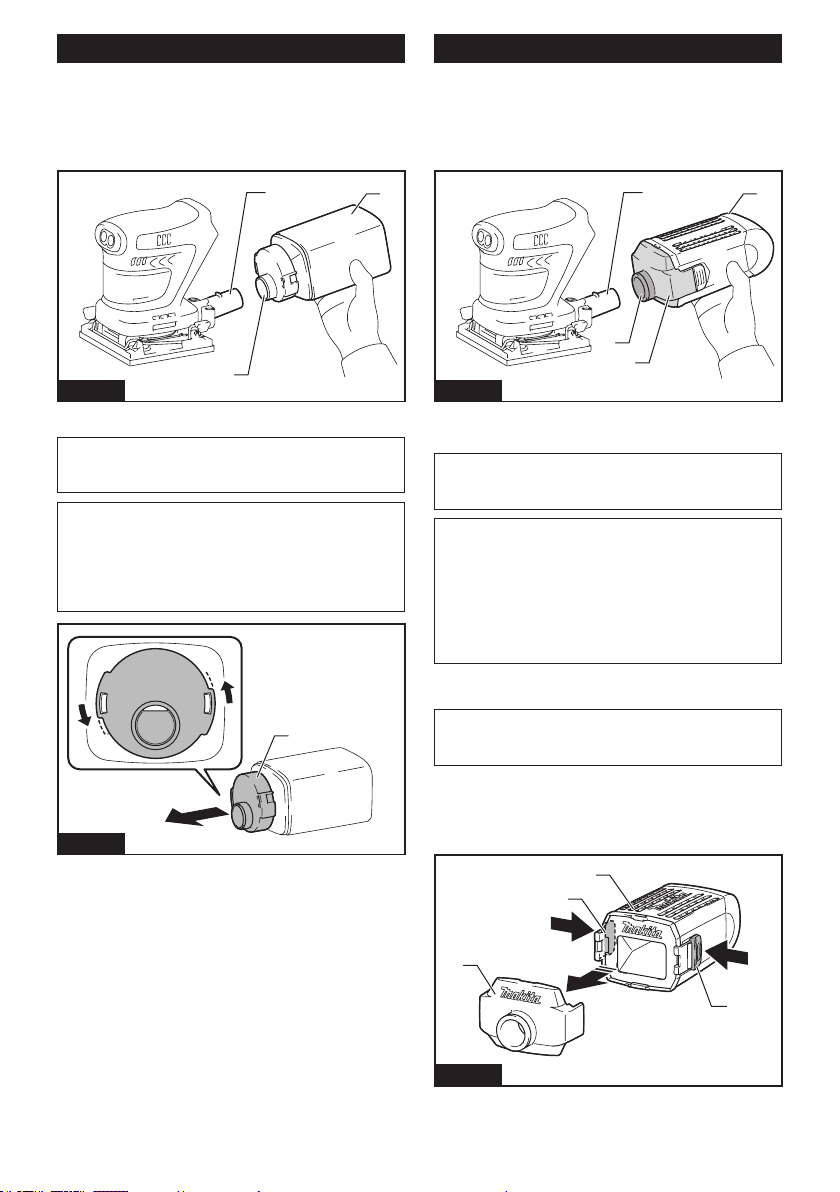
5. Attach a sheet of optional hook-and-loop abrasive
paper to the triangular/rectangular pad, aligning the
dust-suction holes in the paper with those in the pad.
Triangular pad
1
2
1
2
3
1
3
3
Fig.22
►
1. Abrasive paper 2. Triangular pad 3. Dust-suction holes
Rectangular pad
1
2
3
1
2
3
Fig.23
►
1. Abrasive paper 2. Rectangular pad 3. Dust-suction holes
6.
Toremovetheabrasivepaper,peelitofromtheedge.
12 ENGLISH
Installing and removing dust bag
Optional accessory
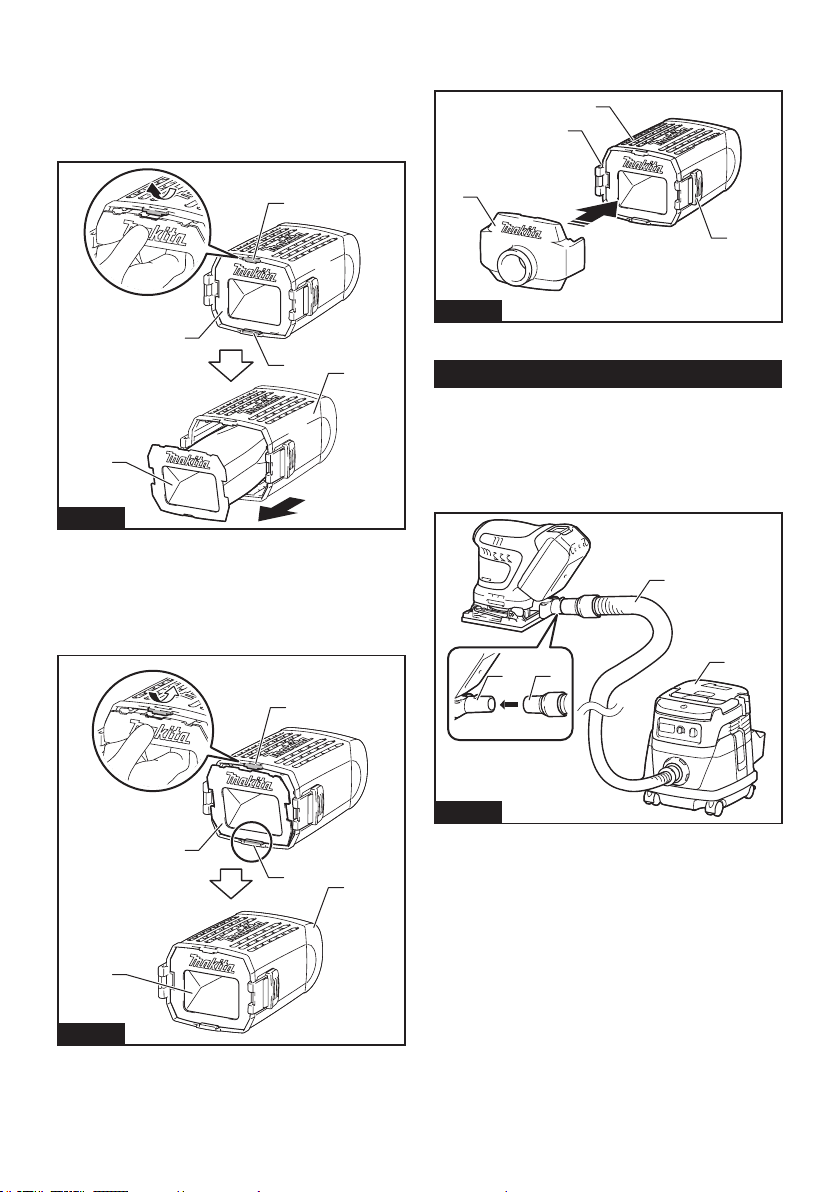
Attach the dust bag over the tapered dust spout at the
back end of the motor housing. Put the dust inlet of the
bag onto the dust spout as far as it will go to avoid it
fromcomingoduringoperation.
1
2
3
Fig.24
►1. Dust spout 2. Dust inlet 3. Dust bag
NOTICE:Donotholdthedustbagwhencarry-
ingthetool.Otherwise,thetoolmayfallandbe
damaged.
NOTE:Toensureoptimaldustcollecting,emptythe
dustbagwhenitbecomeslledtoapproximatelyhalf
ofitscapacity.
Remove the dust bag from the tool and remove the
dustnozzle.Thengentlyshakeortapthedustbag
toempty.
1
Fig.25
►1. Dust nozzle
Installing and removing dust box
Optional accessory
Attach the dust box over the tapered dust spout at the
back end of the motor housing. Put the dust inlet onto
the dust spout as far as it will go to avoid it from coming
oduringoperation.
1
2
3
4
Fig.26
►1. Dust spout 2. Dust inlet 3. Dust nozzle 4. Dust
box
NOTICE:Donotholdthedustboxwhencarry-
ingthetool.Otherwise,thetoolmayfallandbe
damaged.
NOTE:Toensureoptimaldustcollecting,emptythe
dustboxwhenitbecomeslledtoapproximatelyhalf
ofitscapacity.
1. Remove the dust box from the tool.
2. Detach the dust nozzle from the box while
pressing and holding the locking latches on both
sides of the box.
3. Gentlyshakeortapthedustboxtoempty.
Replacing paper lter
NOTICE: Be aware to align the logos on all the
dust box, paper lter and dust nozzle in a consis-
tent orientation when reassembling components.
1. Remove the dust box from the tool.
2. Detach the dust nozzle from the box while press-
ing and holding the locking latches on both sides of the
box.
3
1
2
3
Fig.27
►1. Dust nozzle 2. Dust box 3. Locking latch
13 ENGLISH
3. Hold the inner top edge of the cardboard opening,
andpullitodownwardstodisengagetheoutertop
edge of the cardboard opening from the upper hooking
tab on the lip of the dust box.
4. Takethepaperlteroutofthedustboxwhile
pulling the outer bottom edge of the cardboard opening
free from the lower hooking tab.
1
2
5
4
3
Fig.28
►1.Paperlter2. Cardboard opening 3. Upper hook-
ing tab 4. Lower hooking tab 5. Dust box
5. Replaceapaperlterbyengagingthebottom
edge of the cardboard opening in the lower hooking
tab and push the top edge inwards until it clips into the
upper hooking tab.
1
2
5
4
3
Fig.29
►1.Paperlter2. Cardboard opening 3. Upper hook-
ing tab 4. Lower hooking tab 5. Dust box
6. Snap the dust nozzle into place while pressing
and holding the locking latches on both sides of the dust
box.
3
1
2
3
Fig.30
►1. Dust nozzle 2. Dust box 3. Locking latch
Connecting with vacuum cleaner
Optional accessory
Whenyouwishtoperformcleansandingoperation,
connectaMakitavacuumcleanertoyourtool.Use
either an optional hose 28 mm or a combination of
thefrontcu22andhoseprovidedwiththecleanerto
establish a connection.
21
4
3
Fig.31
►1. Dust spout 2.Frontcu3. Hose 4. Vacuum
cleaner
14 ENGLISH
OPERATION
Sanding operation
CAUTION: Always be sure that the workpiece
is secured rmly.
NOTICE: Never run the tool without the abrasive
paper.Youmayseriouslydamagethepad.
NOTICE: Never force the tool. Excessive pressure
maydecreasethesandingeciency,damagethe
abrasive paper and/or shorten tool life.
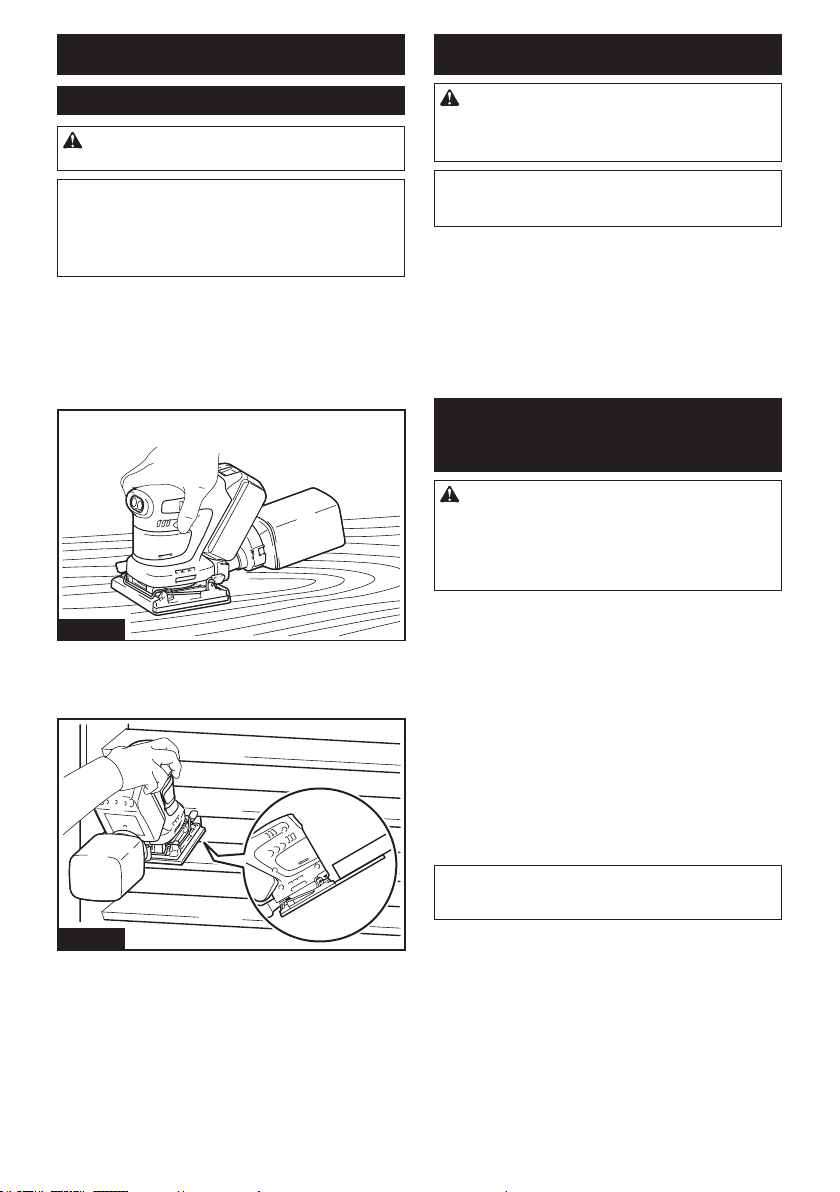
Holdthetoolrmly.Turnthetoolonandwaituntilit
attainsfullspeed.Thengentlyplacethetoolonthe
workpiecesurface.Anishingsanderisgenerallyused
toremoveonlyasmallamountofmaterialatatime.
Sincethequalityofthesurfaceismoreimportantthan
the amount of stock removed, do not bear down on the
tool.Keepthebaseushwiththeworkpieceatalltimes.
Fig.32
You can sand the material with upper and down side of
thepadwhenyousandwiththetriangular/rectangular
pad.Itisconvenientwhenyousandanobjectsuchas
louver.
Fig.33
MAINTENANCE
CAUTION: Always be sure that the tool is
switched o and the battery cartridge is removed
before attempting to perform inspection or
maintenance.
NOTICE: Never use gasoline, benzine, thinner,
alcohol or the like. Discoloration, deformation or
cracks may result.
To maintain product SAFETY and RELIABILITY,
repairs,anyothermaintenanceoradjustmentshould
beperformedbyMakitaAuthorizedorFactoryService
Centers,alwaysusingMakitareplacementparts.
After use
Wipeothetoolusingadryclothorclothslightlymoist-
enedwithsoapywateratregularintervals.
OPTIONAL
ACCESSORIES
CAUTION: These accessories or attachments
are recommended for use with your Makita tool
specied in this manual.Theuseofanyother
accessories or attachments might present a risk of
injurytopersons.Onlyuseaccessoryorattachment
for its stated purpose.
Ifyouneedanyassistanceformoredetailsregard-
ingtheseaccessories,askyourlocalMakitaService
Center.
• Abrasive paper (hook and loop)
• Abrasive paper (clamp)
• Square pad (hook and loop)
• Square pad (clamp)
• Rectangular pad
• Triangular pad
• Dust bag
• Dust box
• Filter
• Paperlter
• Makitagenuinebatteryandcharger
NOTE:Someitemsinthelistmaybeincludedinthe
toolpackageasstandardaccessories.Theymay
dierfromcountrytocountry.

15

www.makita.com
Makita Europe N.V.
Makita Corporation
3-11-8, Sumiyoshi-cho,
Anjo, Aichi 446-8502 Japa
n
Jan-Baptist Vinkstraat 2,
3070 Kortenberg, Belgium
885937-226
EN
20211004