Instructions for use
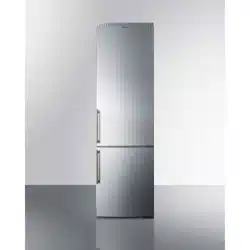
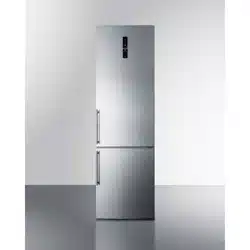
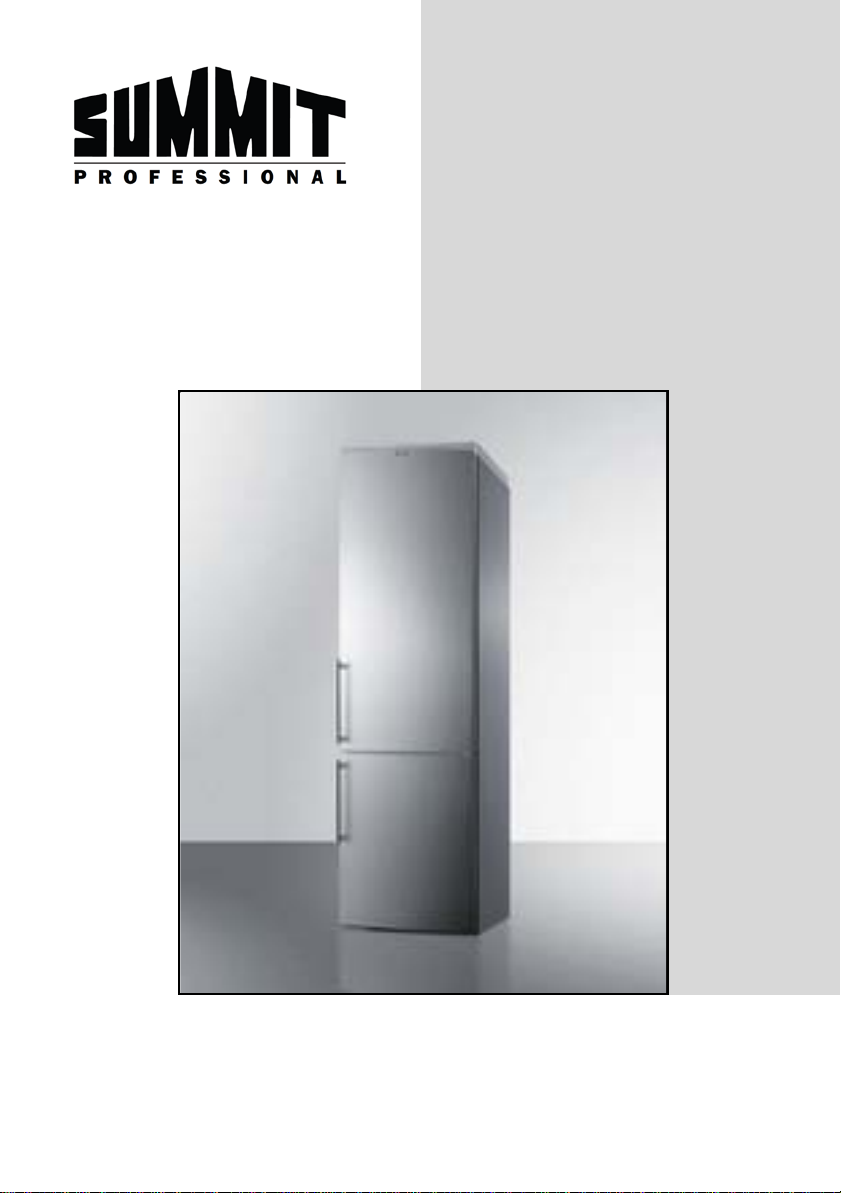
Upright refrigerator – freezer
for built-in use
Model FFBF181SSBI
Use & Care Guide
Felix Storch, Inc.
Summit Appliance Division
Bronx, NewYork 10474
www.summitappliance.com

Thank you for your confidence in buying our appliance and congratulations on the excellent choice.
We expect it will successfully serve its purpose for many years.
The appliance is intended solely for household use.
This upright refrigerator - freezer (hereinafter: the appliance) is composed of two parts: the
upper compartment is a refrigerator and the lower compartment is a freezer.
The refrigerator is used for the storage of fresh foods at temperatures above 32°F.
The freezer is used for freezing fresh foods and the storage of frozen foods for up to one year
(depending on the type of food).
Important Safeguards................................................. 3
Before your first use ................................................... 4
Description of the appliance ...................................... 5
Installation and connection ........................................ 6
Reverse door swing .................................................. 8
Control panel - appliance with electronic
regulation ................................................................ 9
Recommended distribution of food ........................ 12
Storing fresh food ................................................... 13
Freezing and storage of frozen food ....................... 14
Defrosting the appliance........................................... 16
Cleaning ..................................................................... 17
Troubleshooting guide.............................................. 18
Noise level.................................................................. 19
Limited Warranty....................................................... 20
2
Write the Serial Number (found on the rating plate inside the appliance) here:
_________________________
IMPORTANT SAFEGUARDS
• Before connecting the appliance, read these instructions carefully.
• The appliance is manufactured in compliance with all relevant safety standards; however, it is
recommended that persons with impaired physical, emotional, or mental abilities, or persons with
inadequate experience and knowledge, do not use the appliance without due supervision. The
same recommendation applies to minors using the appliance. Cleaning and user maintenance
should not be performed by children without supervision.
• The appliance must be connected to the electrical supply in accordance with the standing
regulations and local requirements.
• The appliance must not be used in open air or exposed to rain or other precipitation.
• Always disconnect the appliance from the power supply (pull the power cord from wall socket)
before cleaning and before replacing the light bulb.
• If the power supply cord is damaged, in order to avoid a hazard it must be replaced only by
qualified personnel.
• In the event of long periods without use, switch off the appliance with the ON/OFF button and
disconnect it from the wall socket. Empty the appliance, clean the interior and leave the door ajar.
• For the protection of the environment, please contact local authorities for correct disposal
arrangements.
• Never let children play with the appliance.
• DANGER: Risk of child entrapment! Before you throw away your old refrigerator or freezer: take
off the doors and leave the shelves in place so that children may not easily climb inside.
• Warning: Ventilation slots on the appliance or built-in element should always be kept clean
and unobstructed.
• Warning: Do not use any mechanical accessories when thawing the refrigerator, except for those
explicitly recommended by the manufacturer.
• Warning: To prevent any pollution, be careful not to damage the insulation or refrigeration tubes at
the rear wall during the installation, cleaning and disposal of the appliance.
• Warning: Do not use any electrical devices inside the appliance, except for those explicitly
recommended by the manufacturer.
This symbol on the product or on its packaging indicates that this product
should not be treated as household waste. Instead it should be handed over
to the applicable collection point for the recycling of electrical and electronic
equipment. By ensuring this product is disposed of correctly, you will help
prevent potential negative consequences for the environment and human
health, which could otherwise be caused by inappropriate waste handling of
this product. For more detailed information about recycling this product, please contact
your local city office, your household waste disposal service or your place of purchase.
3
– Save these instructions –

Before your first use
• Before connecting the appliance, read these instructions carefully. They describe the appliance
and provide instructions for its safe and correct use. The instructions are prepared for
different types and models of the appliance so they may contain descriptions of functions and
components your appliance may not have.
Instructions also contain the NO FROST freezer version, with integrated fan and automatic
defrost.
• Remove the wrapping protecting the appliance during transport.
• Door corners are fitted with protective spacers. Remove the spacers and replace them with the
attached pegs (certain models only).
• Before connecting the appliance to the electrical supply, leave it in the upright position for
about 2 hours. This will reduce the possibility of malfunctions in the cooling system
resulting from prior transport and handling.
• The packaging of this appliance contains environmentally friendly materials which can be
recycled, recovered or disposed of without threat to the environment.
• A self-closing door hinge (certain models only) pulls the door to the cabinet just before closing,
thereby preventing the door from remaining ajar. Also, it limits the door's opening angle and
prevents damage to adjacent surfaces.
• A rating plate with basic information is located in the interior of the appliance.
4
4
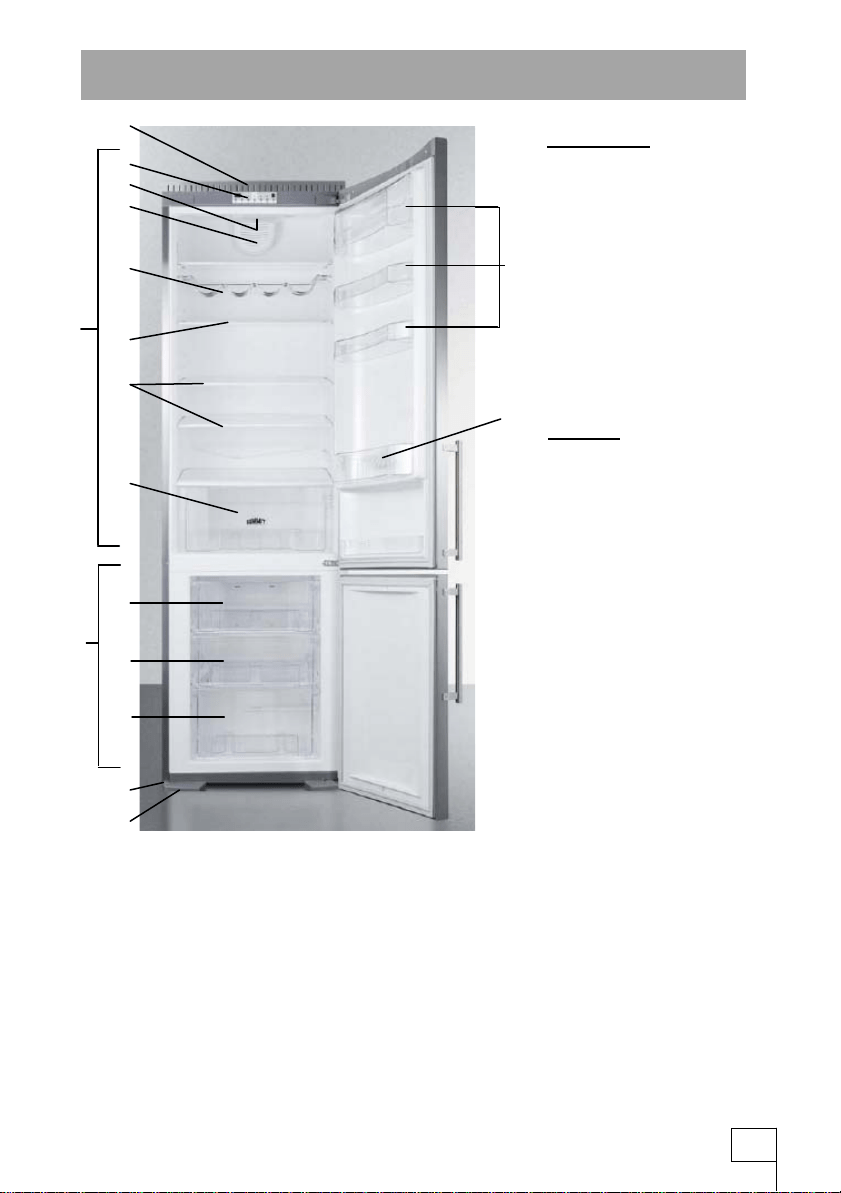
Description of the appliance
14
1
1 Control panel
A Refrigerator
2
2 Interior light
3
3 Fan
4 Bottle rack *
5 Foldable egg tray
(closed 6,
open 12 eggs)
6 Shelf (adjustable height)
A
7 Crisper
5
8 Door trays (options: deep,
shallow, cover or no cover)
6
9 Bottle tray with holder
9
10 Storage drawer
B Freezer
7
11 Freezer drawer
12 Leg*
13 Wheel*
14 Ventilation grille
10
B
11
10
13
12
• Interior accessories may vary according to the model.
• Drawers are protected against accidental extraction. To remove the drawer from the appliance,
open it and lift front part upwards, then pull it out. Certain models are fitted with pull-out slide
guides which facilitate opening.
• Pull-out guide drawers (or shelves) are extracted by lifting the rear end and pulling out inclined
at a 45° angle. Reinsert in opposite sequence.
* Certain models only.
5
8
Description of the appliance
Installation and connection
Selecting the location
Positioning the
appliance
• Place the appliance in a dry and well-aired room. Ambient
temperature should never be lower than 41°F.
Positioning the appliance requires two persons in order to avoid
injuries or damage to the appliance.
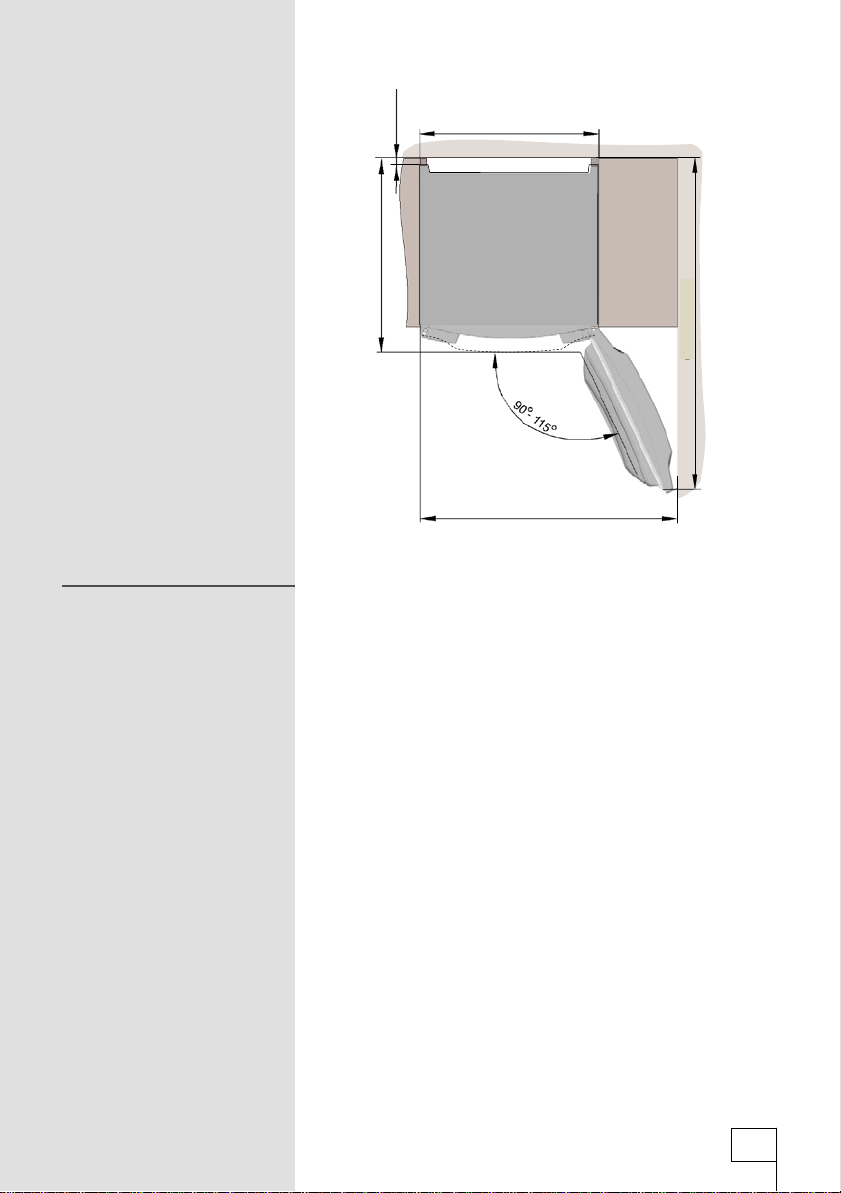
• This appliance is intended for built-in installation. Even so,
when installing, please allow these minimum clearances to
ensure the best operation and proper ventilation: 1/4” on both
sides, 5/8” at the rear and 1/16” at the top. Be sure that
airflow at the top of the appliance is not blocked. If the
appliance is going to be placed against a wall, if possible
leave extra space on the hinge side so the doors can open
wider than their width (to make it easier to remove shelves
and storage bins).
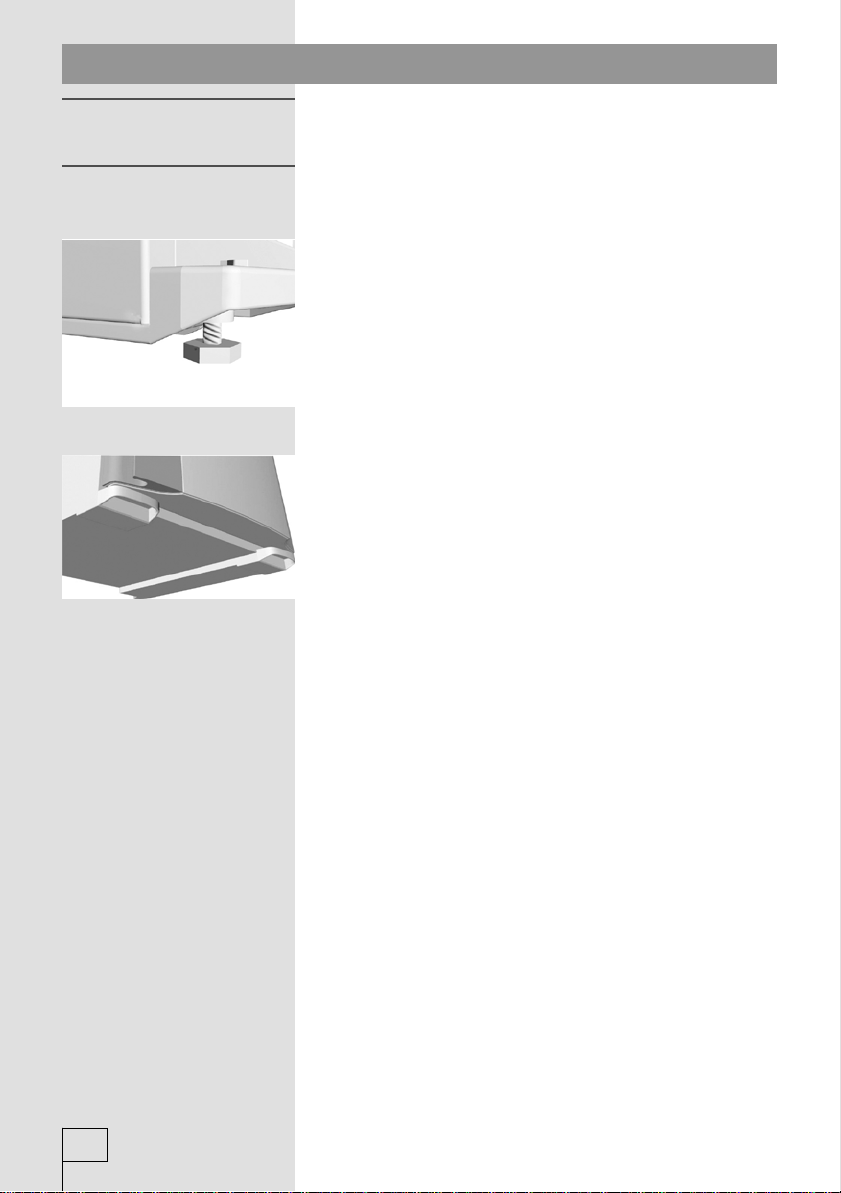
• Be sure the appliance rests flat on a solid base. The
appliance is fitted with adjustable feet on the front side, used
to level the appliance. The rear side of the appliance is fitted
with wheels (certain models only) facilitating the positioning
of the appliance at the preselected place.
• Avoid exposing the appliance to direct sunlight or heat
sources. If this is not possible, install an insulation plate
between the appliance and the adjacent heat source.
• The bottom front corners of the appliance are fitted with
handles to facilitate moving (certain models only). The
appliance may stand independently or adjacent to a wall,
cabinet or other appiance. Be sure to leave enough space for
the opening of the door, to avoid damage to the appliance or
personal injury. Also leave ample space for removing shelves
(see installation diagram on next page).
6
Connecting to power
supply
• Use the power cord to connect the appliance to the electrical
power. The wall outlet must be fitted with a ground terminal
(safety socket).
The use of an extension cord is not recommended.
Nominal voltage and frequency are indicated on the relevant
label or rating plate inside the appliance.
• The electrical power connection and grounding must be in
accordance with standing regulations and local requirements.
The appliance is able to accommodate minor temporary voltage
fluctuations that do not exceed ±6%.
7
Min 45.7″
Min 34.7″
Min 24″
Min 0.6″
Min 25″
Reverse door swing
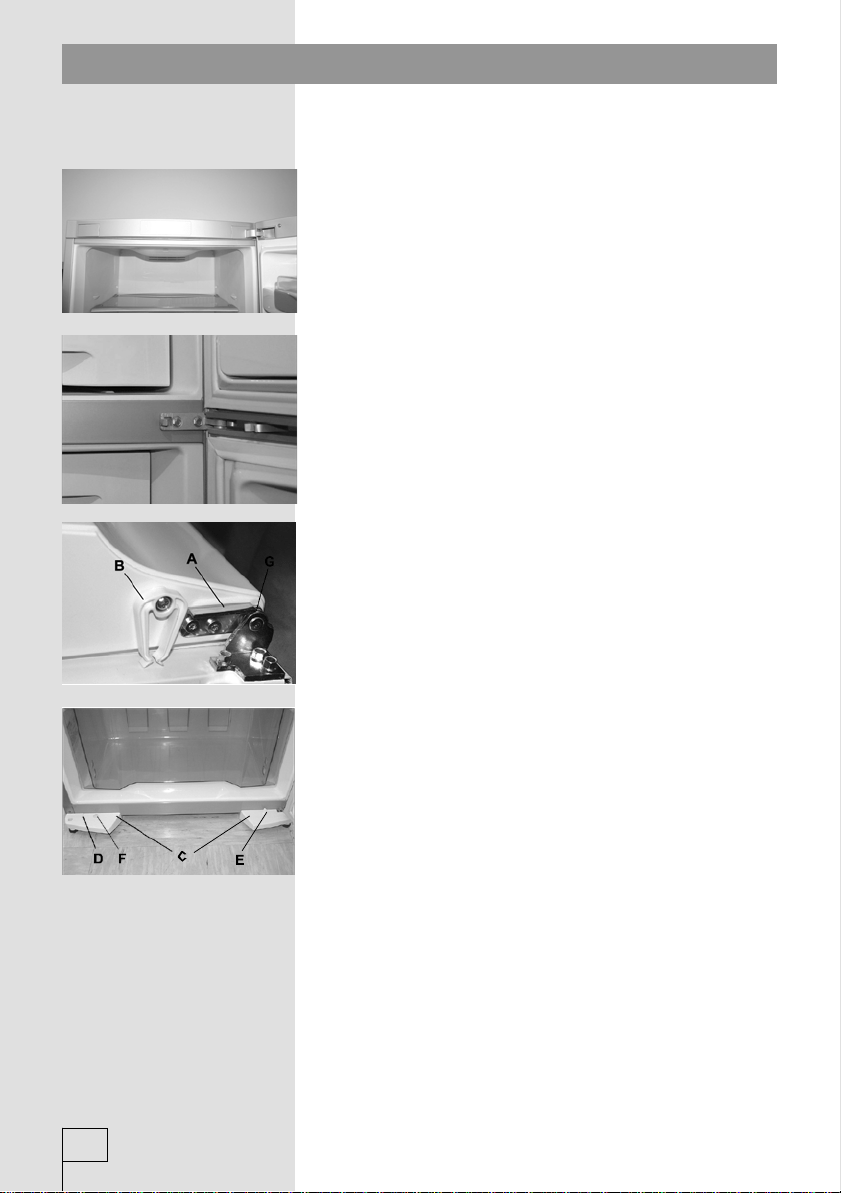
Required tools: socket wrench no. 8, screwdriver, torx 25.
Caution! After unscrewing or before fixing hinges, hold the door
to prevent it from falling and being damaged.
1. Remove upper hinge cover (save it for later use). Also remove
the cover on the opposite side of the upper hinge cover (you
will insert the attached cover on the other side during the
assembly).
2. Unscrew upper hinge screws and remove the upper door from
the middle hinge.
3. On the lower edge of the upper door unscrew the swing
stopper screws and remove the stopper (A). Keep this for
eventual use later on. Fix the attached stopper with its
bearing on the opposite side of the door.
4. Unscrew the forced door closure system (B) and fix it to the
opposite side of the door (certain models only).
5. Unscrew middle hinge screws, remove the door from bottom
hinge.
6. Loosen the screws fixing the leg supports (certain models
only), then continue with either procedure 7 or 7.1 below,
depending on the model of the appliance.
7. Tilt the appliance backward (max. 35°) and let it rest against a
firm support. Unscrew the leg support screws (C) - left and
right, and remove the leg support cover (D) and place it on the
opposite side. Unscrew and remove, then reverse the positions
of end switch (E) and decorative peg (F).
(For models with a forced door closing system, undo the three
screws attaching the lower hinge and install the hinge on the
opposite side.)
7.1.Tilt the appliance backwards (max. 35°) and let it rest
against a firm support at the back.
Undo the three screws attaching the lower hinge and install
the hinge on the opposite side. Plug the holes left after this
installation with the appropriate pegs.
8. Repeat procedures 3 and 4 on the bottom door. In case there
is no bottom door limit peg, transfer the bearing (G) and
washer to the opposite side of the door.
9. Proceed with the assembly procedure in opposite sequence.
8
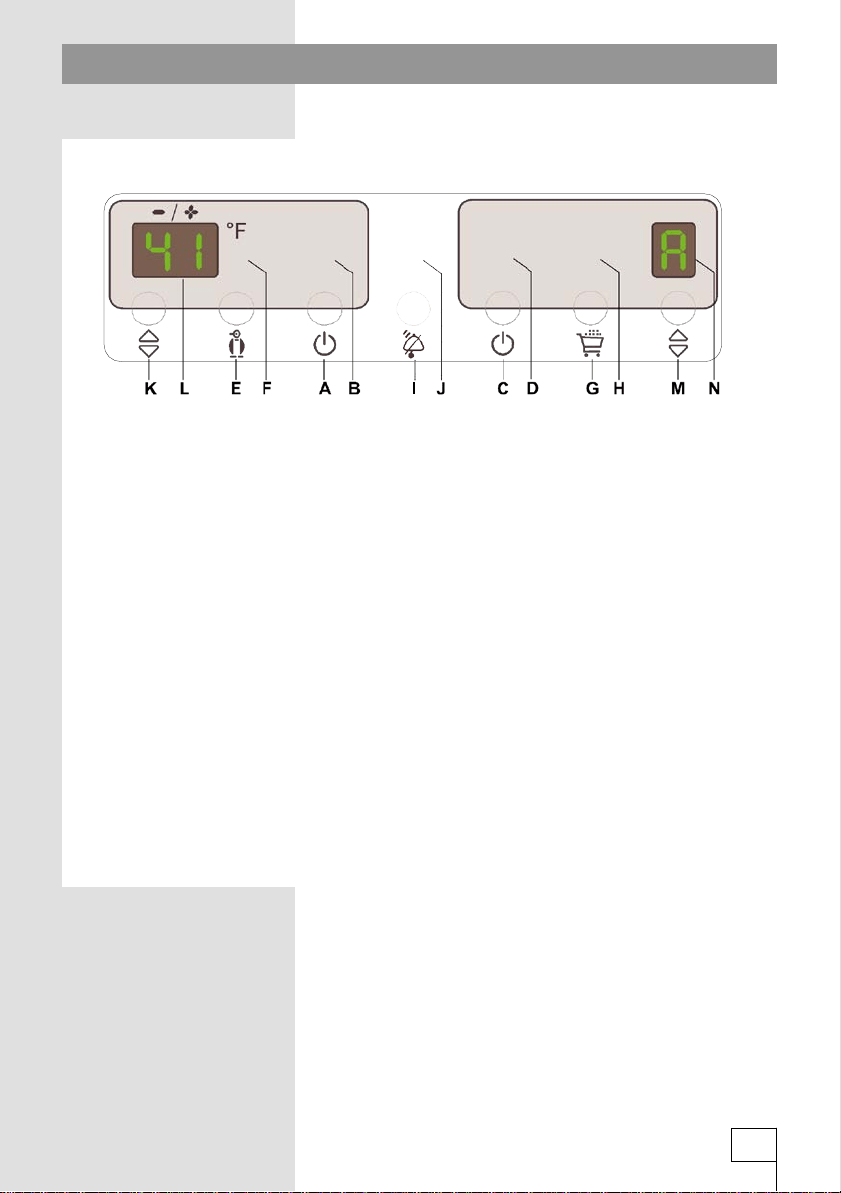
Control panel - appliance with electronic regulation
CONTROL UNIT
No-frost system appliance
A Freezer ON/OFF button
B Green signal lamp: indicates freezer operation
C Refrigerator ON/OFF button
D Green signal lamp: indicates refrigerator operation
E Intensive freezing ON/OFF button
F Orange signal lamp: intensive freezing in operation
G Intensive cooling ON/OFF button
H Orange signal lamp: intensive cooling in operation
I Sound alarm and child lock ON/OFF button
J Red signal lamp: alarm is active
K Temperature setting buttons
L Digital display indicating current temperature in the refrigerator or the set refrigerator or
freezer temperature: refrigerator temperature from 34°F to 48°F, freezer temperature from 7°F
to -9°F
M Temperature setting button: for refrigerator or freezer temperature
N Digital display indicating the selection of temperature setting for either refrigerator or
freezer: F – for freezer, R – for refrigerator
9
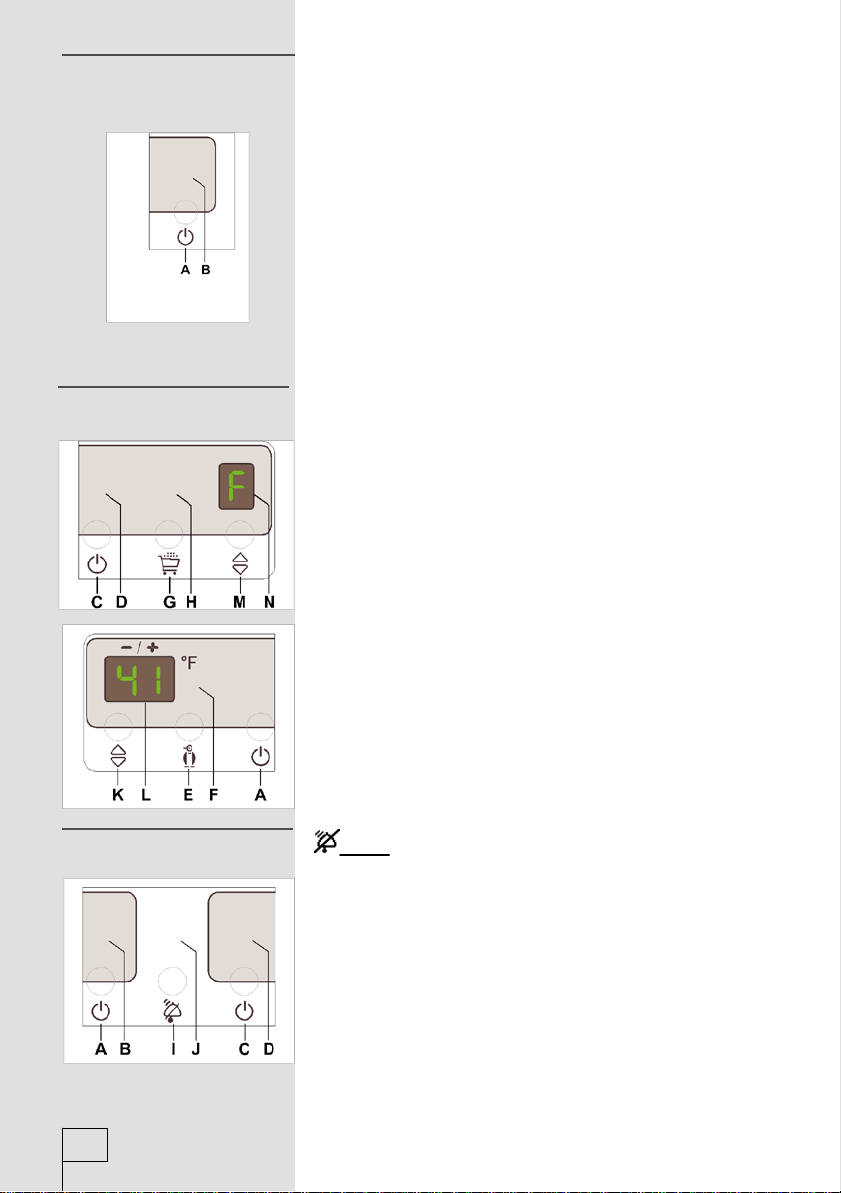
Switching the appliance
ON/OFF
Temperature setting
Before the first use of the appliance first plug the power cable
into the wall socket. Display indicates dashes for both the
refrigerator and the freezer.
- Switch the appliance ON by pressing the button A for 3
seconds. Both the refrigerator and the freezer are started,
green signal lamps B and D are on. In this mode you can
switch off the refrigerator only by pressing button C for 3
seconds (green signal lamp D is off).
- Refrigerator temperature of + 48°F is indicated on the display.
This value will remain on the display until the temperature in
the refrigerator drops below this level.
The appliance has been preset in the factory to the
recommended temperatures of the refrigerator (+41°F) and
freezer (0°F).
Temperature setting range of the refrigerator: +34°F do
+48°F.
Temperature setting range of the freezer: 7°F to -9°F.
• To set the freezer temperature, first select the freezer by
pressing the M button (letter “F” will be indicated on the display
N); then, use the K button to set the desired temperature.
To set the refrigerator temperature, first select the refrigerator
by pressing the M button (letter “R” will be indicated on
the display N); then, use the K buttons to set the desired
temperature.
• After pressing the temperature setting buttons the display starts
flashing and indicates the last selected setting.
• Temperature setting is changed by short consecutive pressing
of the button in 1°F steps. During the setting procedure all
other buttons are idle.
• Approximately 5 seconds after the setting button is released
the display indicates the actual temperature.
Other settings
10
Alarm
Continuous sound - open refrigerator door alarm
If the refrigerator door is open for more than one minute, the
sound alarm is turned on (continuous tone) and red signal lamp
J is on. The alarm is automatically switched off when the door
is closed, but you can also switch it off by pressing the Alarm Off
button (I).
Intermittent sound - freezer/refrigerator temperature is too
high
Sound alarm is also activated in case of elevated temperature
(intermittent tone), and the temperature on the display is flashing.
• Sound alarm is switched off by pressing button I. Red signal
lamp and temperature flashing are stopped automatically
when the freezer/refrigerator has cooled enough that there is
no more risk of food becoming unsafe to eat.
• If the freezer temperature fails to arrive at the adequate level
24 hours after the alarm was switched off it is activated again,
and again switched off automatically when the freezer
has cooled enough for safe storage of food. During the initial
start of the appliance there is a 24 hour delay of the
temperature alarm to avoid unnecessary alarm operation.
Intermittent alarm sound - power failure signal
If the temperature of the refrigerator or freezer is raised too much
as a consequence of power failure, the sound alarm is activated
(intermittent tone), the red signal lamp is on, and the display
flashes the highest temperature digit (in the case of the
refrigerator, a maximum of 48°F).
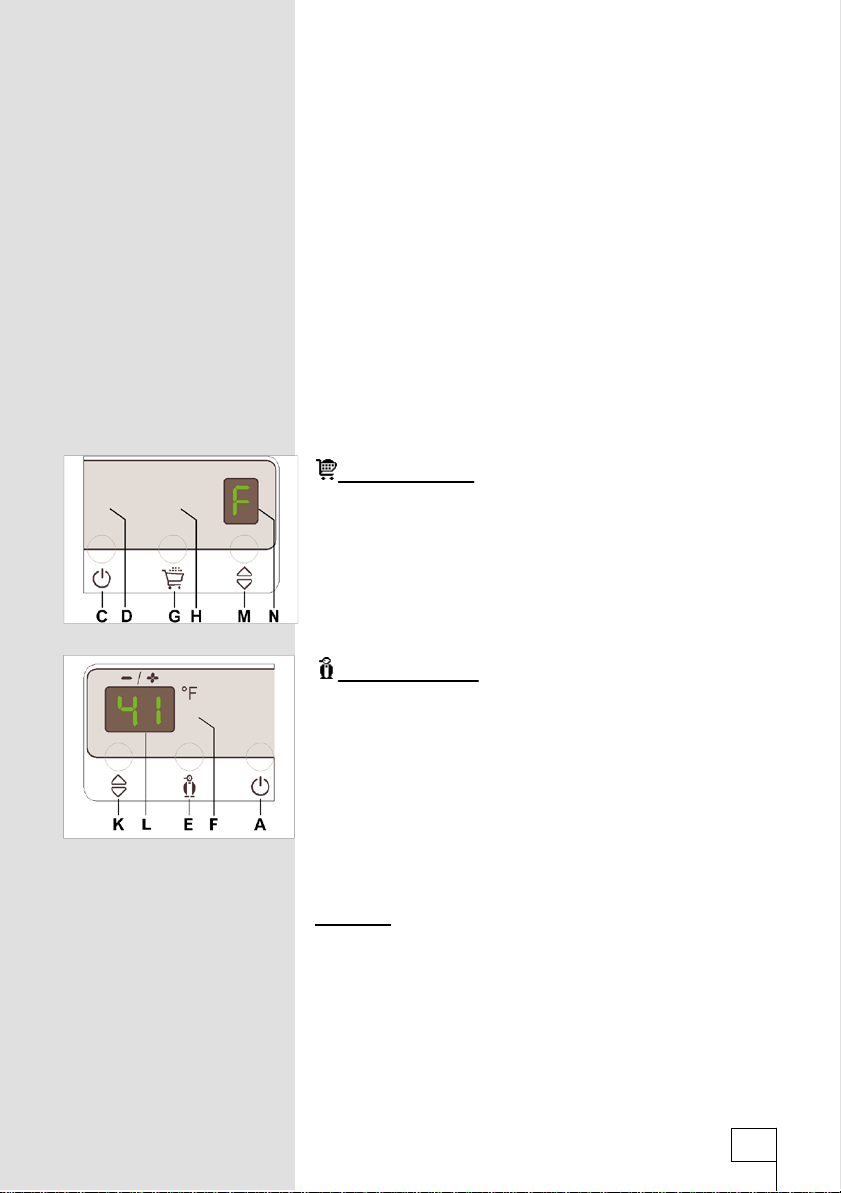
Intensive cooling
Intensive cooling of the refrigerator is activated by pressing
the button G (orange signal lamp H is on). It is automatically
switched off after 6 hours, and the selection is set back to
the previous value. It is intended for fast cooling of a large
quantity of food.
Intensive freezing
This is activated by pressing the button E (orange signal lamp F
is on), and the intensive cooling of the freezer starts. If the
setting is not deactivated (by pressing the E button once again),
the setting will be deactivated automatically approximately two
days after activation. Setting is intended for fast freezing of
large quantities of inserted food. In case of power failure the
fast freezing process is repeated. Use the setting also with the
first start of the appliance, before intended cleaning, and in the
case of large quantities of food inserted into the appliance.
Integrated child lock protects the appliance from accidental
temperature setting changes or even switching the appliance
Child lock
off. You can activate or deactivate the child lock by pressing the
alarm button (I) for 3 seconds (both displays flash ‘LL’ and ‘L’
for 3 seconds). Once the child lock is activated, only the alarm
button is active. Pressing any other button provokes the letters
‘LL’ and ‘L’ to appear on the display.
11
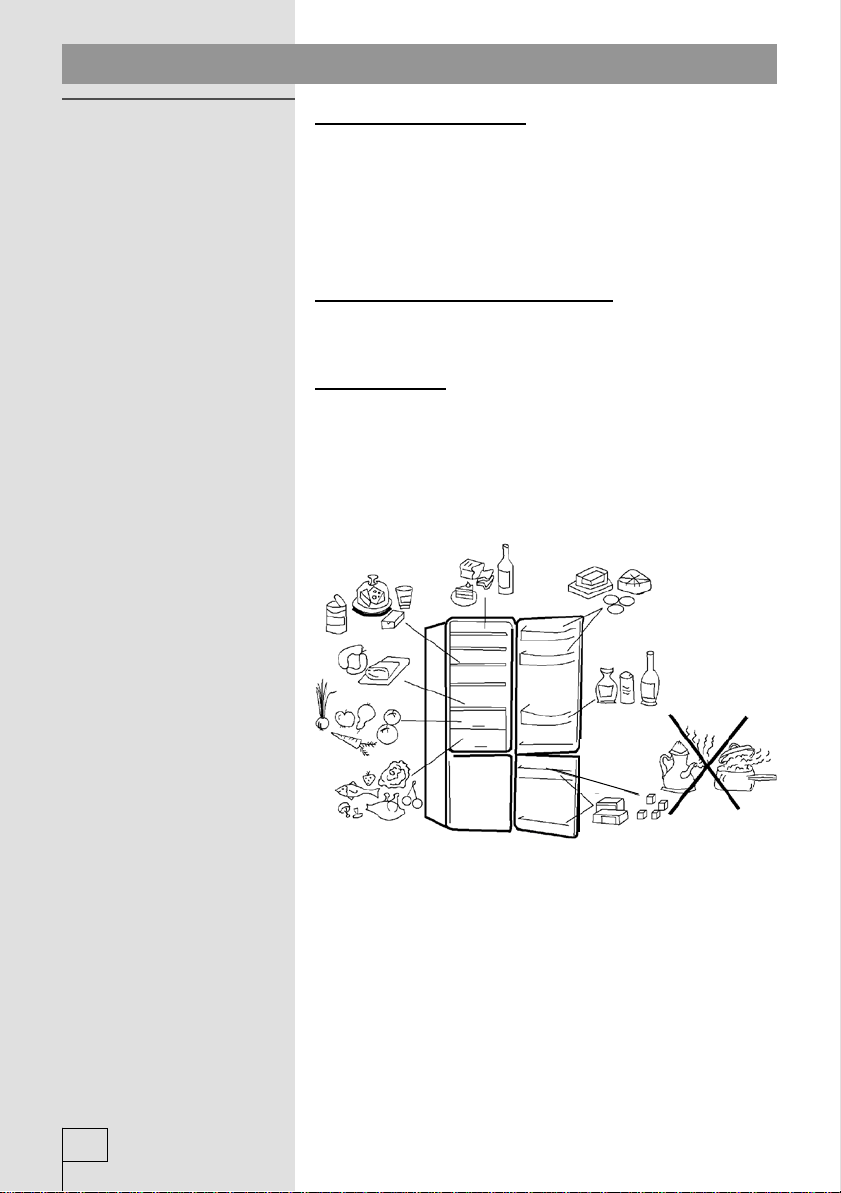
Recommended distribution of food
Recommended
distribution of food
- top section: canned food, bread, wine, cake, …
Refrigerator compartments:
- middle section: dairy products, cheese, ready-made food,
desserts, juices, beer, …
- bottom section: meat, meat products, delicatessen, …
- crisper: fresh fruit, vegetables, salads, root vegetables,
potatoes, onions, garlic, tomatoes, sauerkraut, turnips, …
- top/middle section: eggs, butter, cheese, …
Refrigerator door lining compartments:
- bottom section: beverages, cans, bottles, …
- door compartments: packed vegetables, ice cream, ice,...
Freezer sections:
- other compartments: freezing, storing frozen food or quick
cooling of bottles (see section “Freezing and storing frozen
food”, setting “Quick cooling of drinks in the freezer”, ...)
12
Storing fresh food
Important precautions
for storing fresh food
Proper use of the appliance, adequately packed food,
correct temperature and hygienic precautions have
substantial impact on the quality of stored food.
Always respect the use-by date, printed on the
packaging.
Food to be stored in the refrigerator should be
properly packed so as to prevent absorbing of
moisture and building up of odors.
Never store inflammable, volatile or explosive
substances.
Beverages with high alcohol percentage must be
stored in tightly sealed bottles in upright position.
Some organic solutions (e.g.: strong oils in lemon/
orange peel and acids in butter, etc.) can cause
damage through prolonged contact with plastic
surfaces or gaskets; they can cause accelerated
ageing of the plastic material.
An unpleasant odor inside the refrigerator is a sign
that something is wrong with food or that your
refrigerator needs cleaning (see chapter on Cleaning).
If you are away for a lengthy time, please remove all
perishables beforehand.
Interior accessories and
space distribution
Equipment depends on the model.
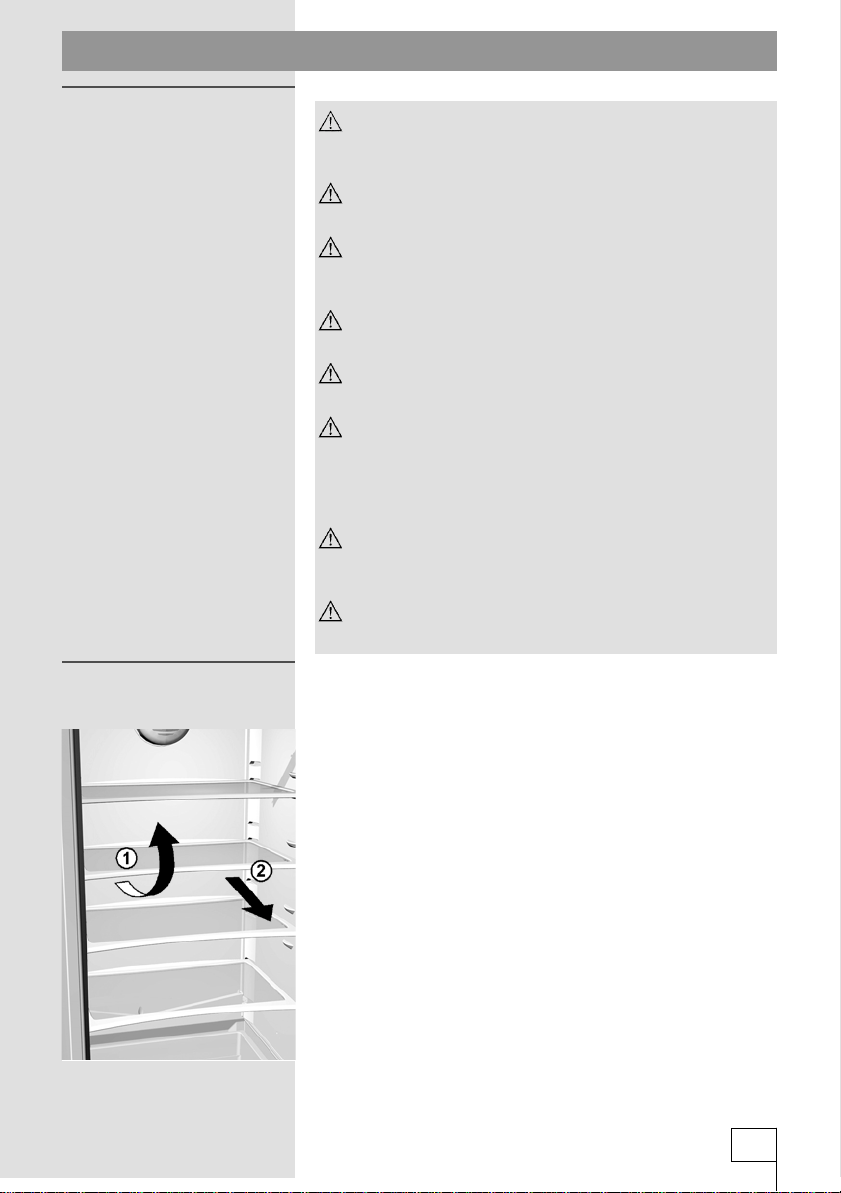
• Shelves can be optionally placed on the guides inside the
appliance. They are protected from being accidentally pulled
out completely. To remove the shelf, raise the back part, level
off and pull it out. Easily perishable food should be stored at
the back, i.e. the coldest part of the shelves.
• Certain models are equipped with a wire bottle rack
which enables storing bottles horizontally. It is safe-
guarded against pulling out. It may be pulled out only if
empty, by lifting the front part and pulling it towards you.
Place the bottle rack in the appliance in such way as to
avoid obstruction of door closing by the length of the
stored bottles.
Maximum load of the rack is 9 bottles of 750 ml, or 29 lbs
of total mass - see label at the right side of the interior of
the appliance.
• The crisper below the glass shelf at the bottom of the
refrigerator is used for storage of fruits and vegetables. It
retains the right level of moisture and prevents drying out.
• The inner refrigerator door consists of various shelves or
holders used for storing cheese, butter, eggs, yogurt, and a
13
stock of other smaller packages, tubes, cans, etc. The bottom
shelf is used for storing bottles.
• The freezer door liner is also fitted with various shelves or
holders used for storing frequently used frozen food for
quick access (ice cream, already opened packages of
vegetables, etc.).
• Fan (certain models only - located under the ceiling or hidden
behind rear panel of the refrigerator, or concealed within the
freezing unit) improves even distribution of temperature and
reduces condensation on storage racks.
Storage time of fresh
foods
Approximate storage time of fresh foods
Food
Period
eggs, marinades, smoked meat
up to 10 days
cheese
up to 10 days
carrots, etc.
up to 8 days
butter
up to 7 days
cake, fruit, left-overs, raw chunks
of meat
up to 2 days
fish, raw ground meat, seafood
up to 1 day
Freezing and storage of frozen food
Freezing procedure
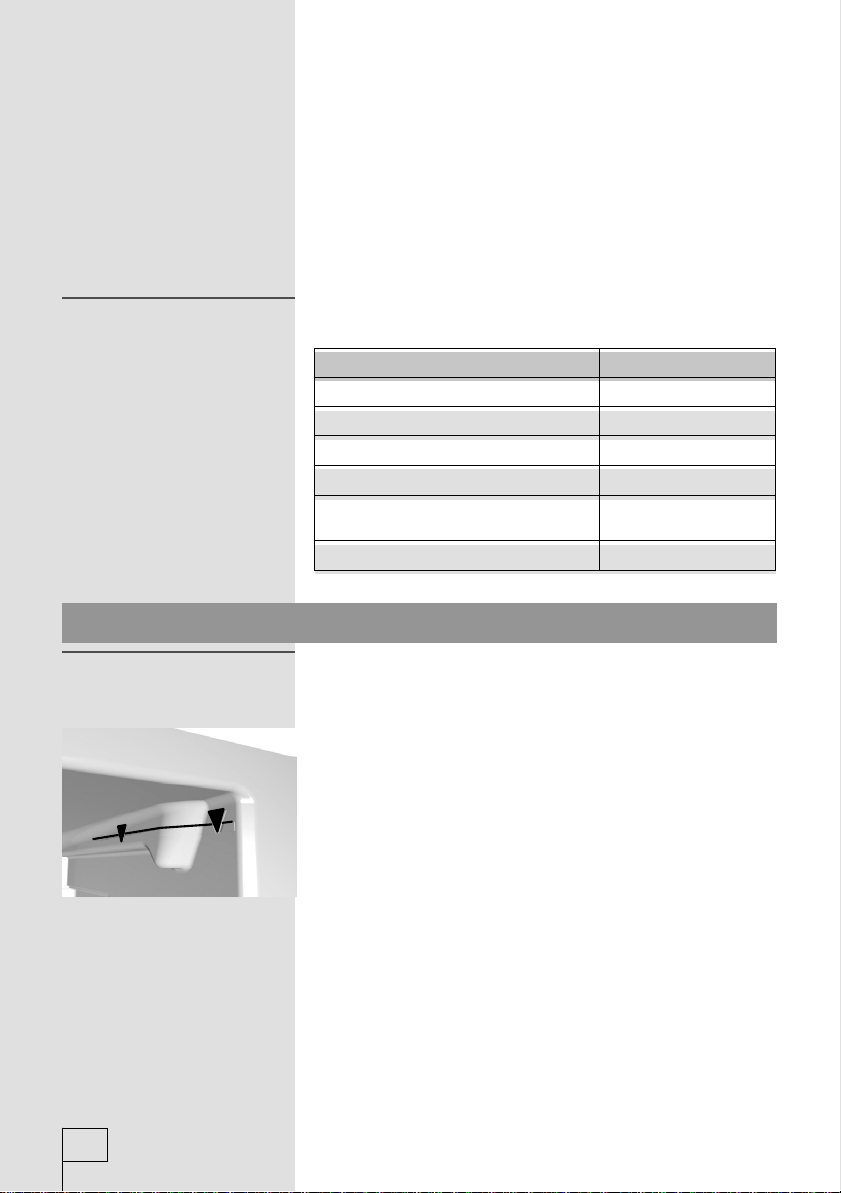
• 24 hours before freezing fresh food, activate the rapid freezing
function (freeze boost) - press the E key.
After this period place fresh food in the freezing
compartment. In the NO FROST freezer model, use the
central drawer for freezing.
Do not let the already frozen packages touch the fresh ones.
NO FROST freezers require enough space under the ceiling
for the circulation of cold air, so avoid storing the food above
the marked level (see photo).
• After 24 hours you may move the food to the storage
compartment, and repeat the freezing procedure if required.
You may also remove the drawers and store frozen food
directly on cooling shelves. Do not remove the lower drawer if
you have a NO FROST appliance!
• For freezing smaller quantities of fresh food (2 - 4½ lbs),
the engagement of the fast freeze function is not
required.
14
Food
Storage Period
Fruit, beef
from 10 to12 months
Vegetables, veal, poultry
from 8 to 10 months
Venison
from 6 to 8 months
Pork
from 4 to 6 months
Chopped (ground) meat
4 months
Bread, pastry, TV dinners, fat-free fish
3 months
Sweetbreads
2 months
Smoked sausages, fatty fish
1 month
Important precautions
for freezing of fresh food
Freeze only such foods that are suitable for freezing
and can sustain low temperatures. Food should be of
adequate quality and freshness.
Select adequate packaging for each kind of food and
pack it correctly.
The packaging should be airtight and well sealed
without leaking since this could cause substantial
vitamin loss and dehydration.
Mark packages with the following data: Type, kind
and amount, date.
It is important that food be frozen as quickly as
possible. We therefore recommend the size of the
package not be too large; it should be cooled before
placing into the freezer.
The amount of fresh food that can be put into the
freezer as a single load is stated on the rating plate. If
the loaded amount is too large, the quality of freezing
is reduced which in turn affects the quality of frozen
foods.
Storing commercially
frozen food
The storage time and recommended temperature for storing
commercially frozen foods is indicated on the package. Always
follow manufacturer’s instructions for storage and use of frozen
food. When shopping be careful to choose only food that is
adequately packed and provided with complete data and stored
in freezers where the temperature never rises above 0°F.
Do not buy packages of food covered with frost. This indicates
that the package was thawed before at least once.
Take care that packages don’t start to thaw during transport
to your home. Temperature rise shortens the storage time and
affects the quality of commercially frozen foods.
Approximate storage
time of frozen foods
15
Defrosting frozen food
Making ice
Partially thawed or defrosted foods should be used as soon as
possible. Cold air preserves the food but it does not destroy
microorganisms that rapidly activate after defrosting and make
foods perishable.
Partial defrosting reduces the nutritional value of food, especially
fruits, vegetables and ready-made meals.
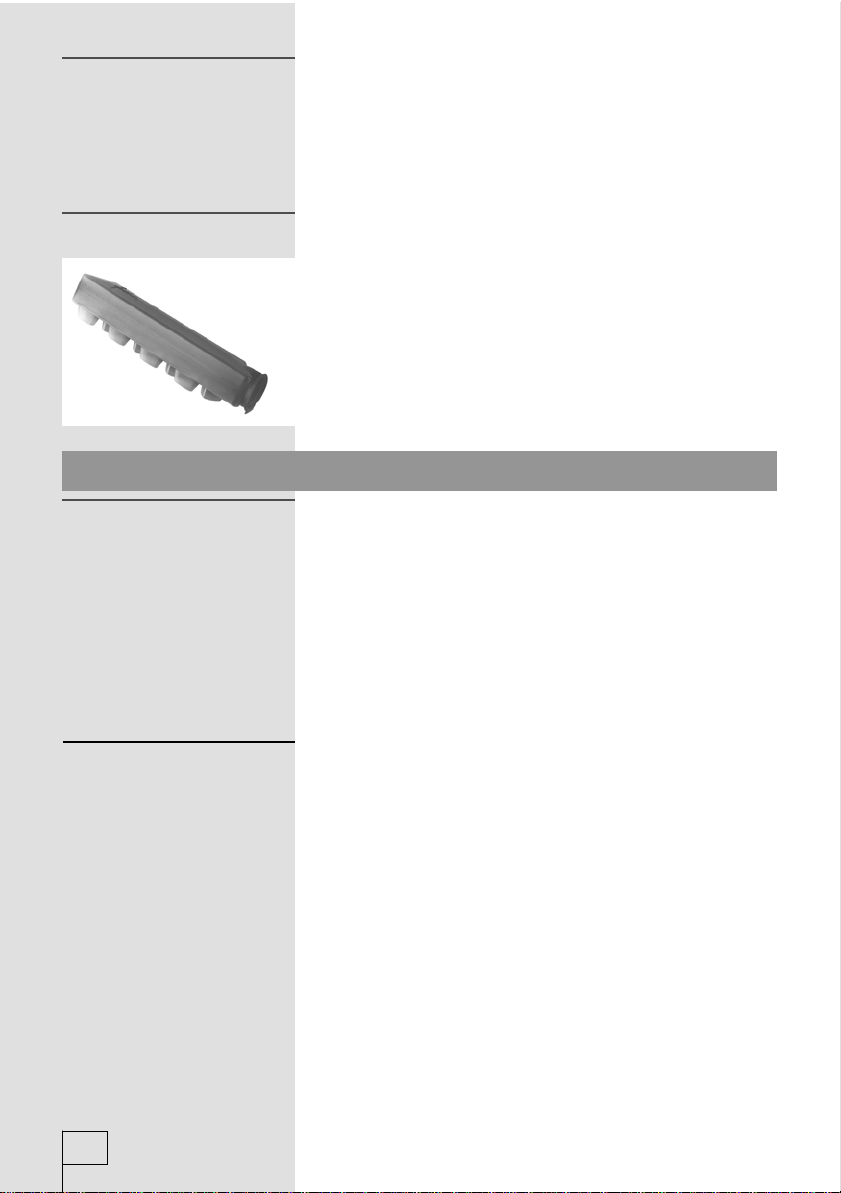
Remove the cap from ice tray (certain models only) and fill it to
the mark with filtered cold water. Close it and place it on the door
shelf. Ice tray can freeze 8 cubes.
Ice cubes are discharged from the tray by turning the tray upside
down and placing it under cold running water. Shake the tray,
open the cover and pour the ice out.
Defrosting the appliance
Automatic defrosting of
the refrigerator
Defrosting of NO FROST
freezer
The appliance needs no special defrosting procedure, because
ice deposited at the inner back wall is defrosted automatically.
Ice deposited on the inner back wall during compressor
operation is defrosted when the compressor stops operating,
and condensed water drops are drained through the outlet in the
inner back wall into the drain pan situated above the compressor
where it evaporates. In case of excessive ice deposits at the
inner rear wall of the refrigerator (thickness of 1/4″), switch the
appliance off by pressing the ON/OFF button and defrost it
manually.
• Defrosting of NO FROST freezer is automatic. Periodic
appearance of frost layer eventually disappears automatically.
• Build-up of ice or frost in the freezer compartment can be
a result of abnormal use of appliance (door opened too
frequently and/or too long, door not properly closed, etc.). In
this case, unplug the appliance, remove the food from the
freezer and protect it from defrosting.
Clean and dry the freezer interior. Before returning the frozen
food into the freezer, switch on the appliance and select the
desired setting.
16
Cleaning
Prior to any cleaning, disconnect the appliance (turn the
thermostat button to the position
and pull the power cord from the
electrical outlet). Special antibacterial protection in the top layer of the
inner walls prevents growth of bacteria and keeps the interior clean
and germ free. Make sure to remove traces of any cleaning agents
you may have been using.
• To clean any surface, use a soft cloth.
• Clean the exterior of the appliance with water and mild liquid
detergent.
• For cleaning of plastic, coated, or aluminum parts avoid using
abrasive or special cleansing agents (like stainless steel
polish), otherwise you may damage the surface.
• Clean coated and aluminum surfaces using the soft cloth and
an alcohol-based cleaning agent (like glass cleaner).
• Wash the interior of the appliance with mild liquid detergent and
lukewarm water, mixed with a little vinegar.
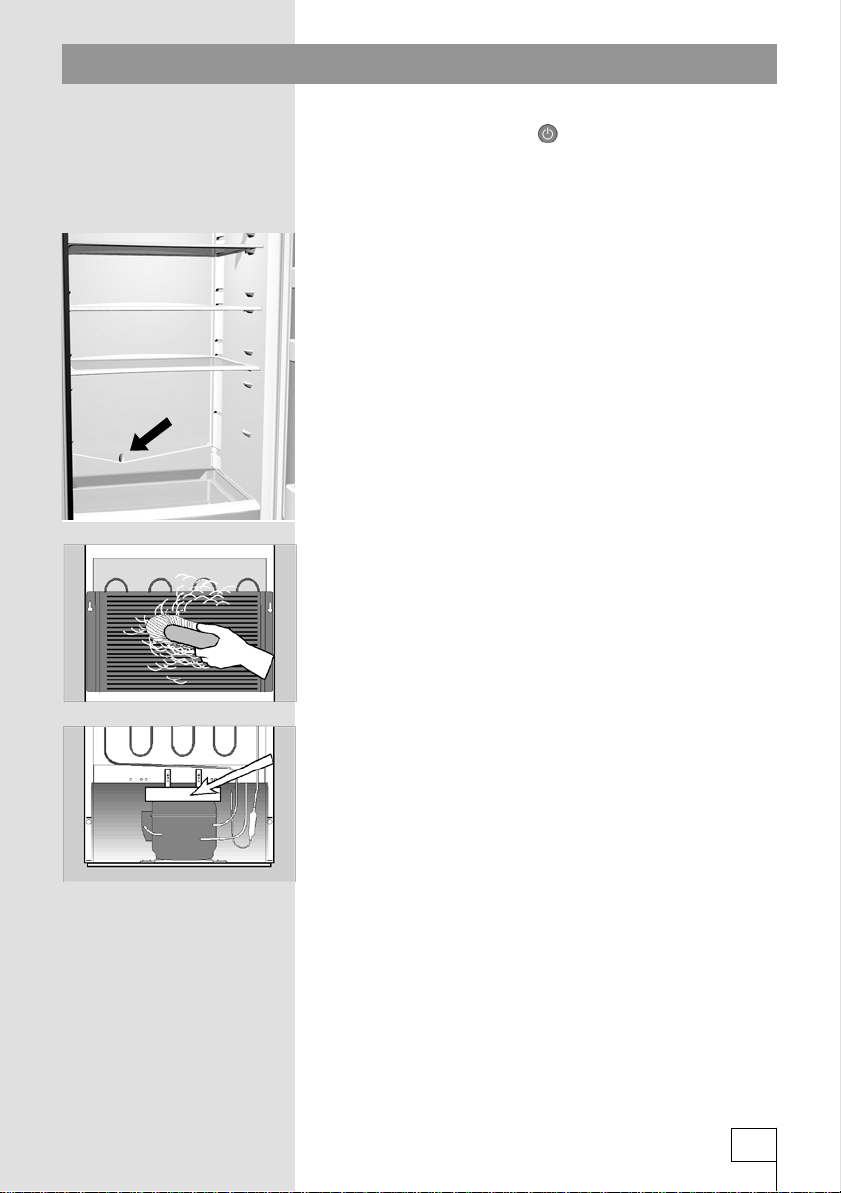
• The groove and drain outlet located below the cooling panel at the
rear wall collect the drained water, so should not be clogged (e.g.
with food particles). Make sure you inspect them periodically and
clean if necessary (use a plastic straw to free the outlet hole).
• The condenser on the rear wall must always be kept clean and
free of dust or kitchen fume deposits. Therefore clean off the
dust periodically with a non-metallic brush or vacuum cleaner.
• Also clean the drip pan above the compressor. If you removed
the pan, please make sure you replace it in the same position,
and check that it is completely horizontal!
• After cleaning, switch the appliance on and reload the food.
17
Troubleshooting guide
Problem Cause/Remedy
The appliance does not operate
after connection to the power line:
Cooling system operates
continuously without intermittent
stoppages:
•
Check if there is power in the socket and if the appliance is
switched on.
•
Ambient temperature too high.
•
Frequent opening of the door, door open too long.
•
Door not closed properly (something caught in door gasket,
sagging door, check gasket sealing, etc.).
•
Excessive quantity of fresh food inserted at one time.
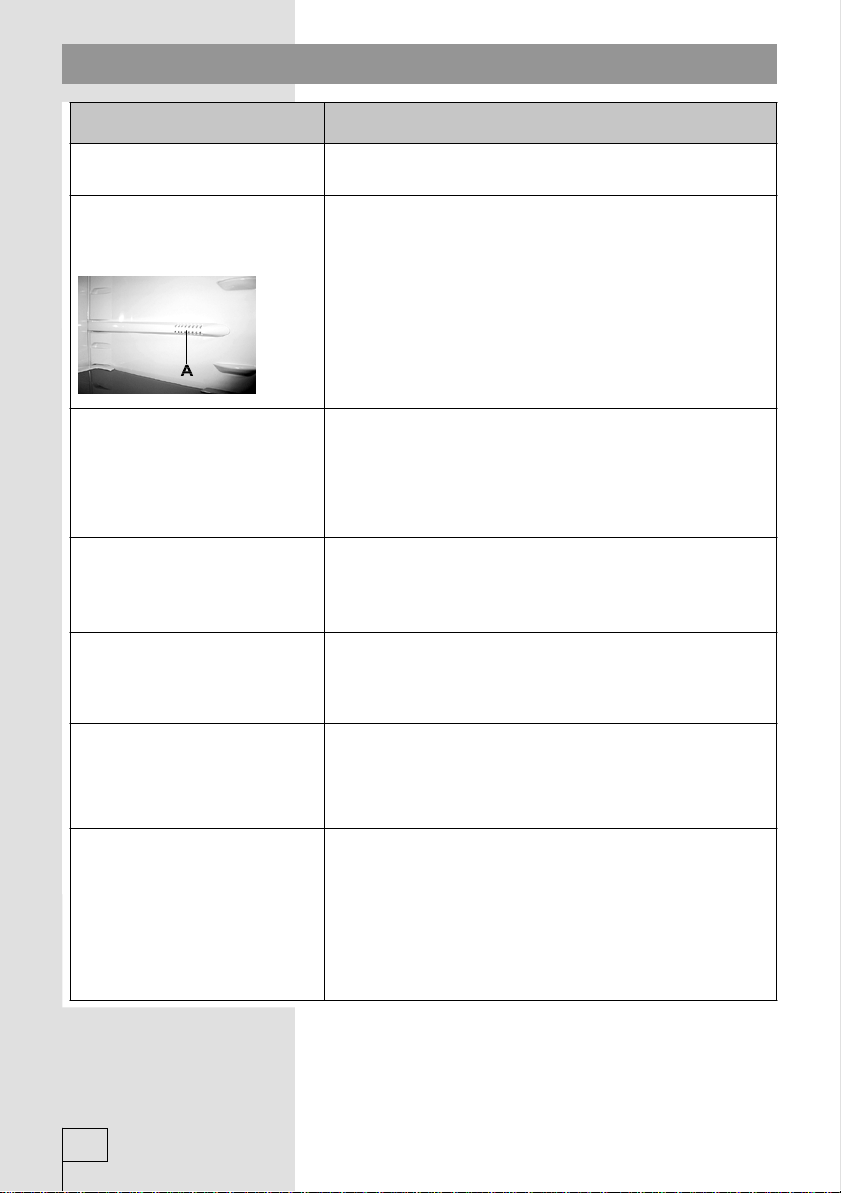
• Refrigerator sensor (A) is blocked with fresh food. Free
the sensor and allow air to circulate around it (certain
models only).
•
Check air circulation for sufficient cooling of the
compressor, and clean the condenser.
Excessive ice formation at
the rear interior wall of the
refrigerator:
•
Frequent opening of the door, door open too long.
•
Inserting hot food in the refrigerator.
•
Food or dish is touching the rear interior panel of the
refrigerator.
•
Bad door sealing; clean or replace the gasket if dirty or
damaged.
Build-up of ice or frost in the
freezer interior may be a result of
the following:
Water dripping from the
appliance:
Red light is flashing (freezer
compartment only):
• Door opened too frequently or too long.
• Door not properly closed.
• Poor door sealing.
• If the seal is dirty or damaged, clean or replace it.
•
Drain outlet is clogged, drain water drips past the collection
groove.
•
Clean the clogged outlet using plastic straw.
•
Thaw thick ice deposits manually (see chapter Defrosting).
•
Frequent opening of the door, door open too long.
•
Door not closed properly (something caught in door gasket,
sagging door, damaged gasket, etc.).
•
Excessively long power failure.
•
Excessive quantity of fresh food inserted at one time.
Difficult door opening:
•
If you attempt to open the door of the freezer immediately
after it has been closed you may experience resistance.
This happens because a certain quantity of cold air escapes
from the appliance through the open door and is replaced
by warm ambient air. Cooling of such air creates negative
pressure (vacuum) and suction, which prevents easy
opening of the door. This is normalized after several
minutes and you can open the door with ease.
18
Problem Cause/Remedy
Bulb replacement:
•
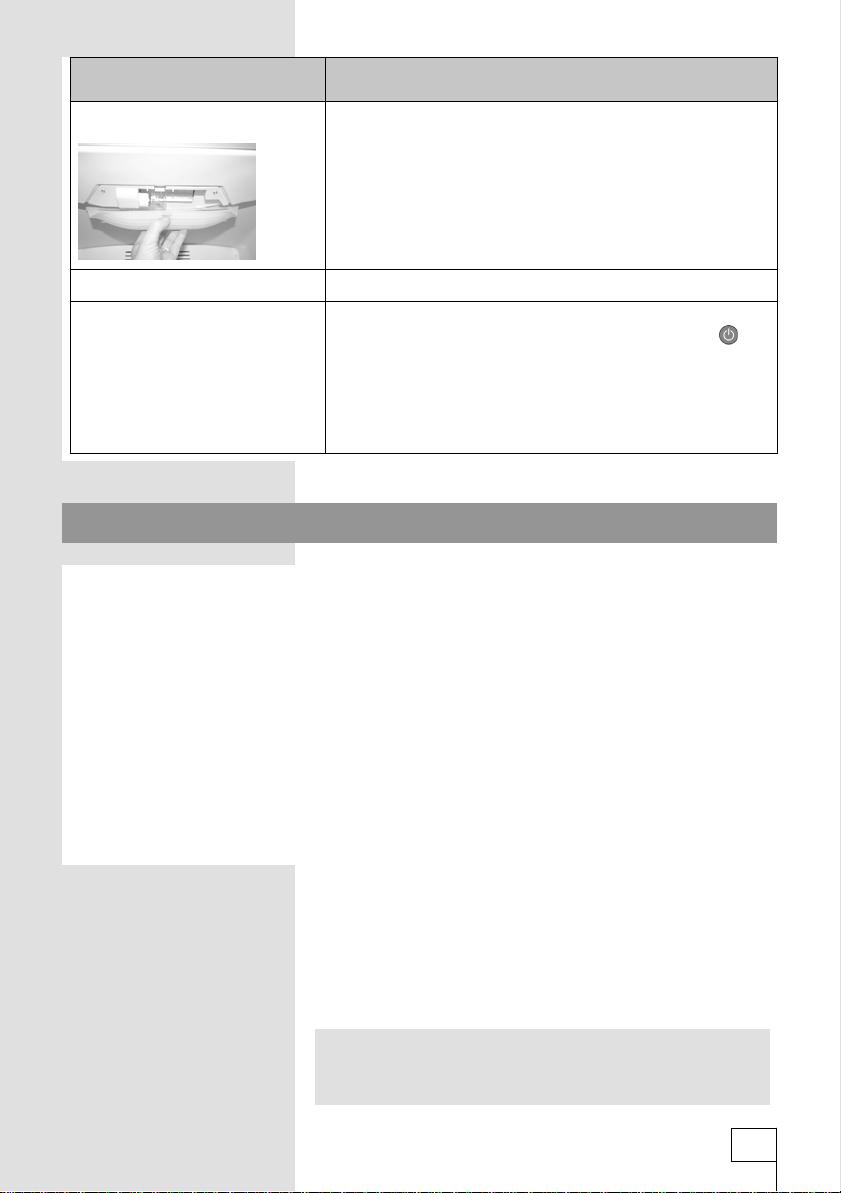
Before replacing the light bulb, disconnect the appliance
from the power supply. Using a screwdriver, remove the
cover, replace the bulb with a new one (E 14, max. same
voltage as the factory bulb) and fit back the cover.
•
Don’t forget: the old bulb is not organic waste.
•
The light bulb is a consumable item and is not covered by
the warranty.
Green LED is flashing:
•
If the green LED is flashing, call the nearest service center.
Troubleshooting helpful hints:
•
If you are not able to fix the trouble by any of the
above tips, turn the thermostat button to the position
and disconnect the power cord from the power outlet. Wait
10 minutes, and reconnect the appliance.
Should none of the above guidelines be helpful, please call
for service assistance, quoting information given on the
rating plate either within or at rear of your appliance.
Noise level
Cooling of refrigerator-freezer appliances is provided by a compressor cooling system (for certain
appliances, also the fan). Operation of this system results in a certain amount of noise, the
intensity of which depends upon the installation, correct use, and age of the appliance.
• After starting the appliance, the operation of the compressor (the refrigerant flow) may be
somewhat louder. This does not mean that something is wrong with the appliance, nor does it
have any influence on the lifetime of the appliance. Gradually the noise is reduced and
eventually subsides.
• Sometimes the appliance produces unusual and stronger noises. These noises are often the
consequence of inadequate positioning of the appliance:
- The appliance should be placed on a flat and firm base.
- It should not touch the wall or kitchen units standing next to it.
- Check whether the accessories in the interior of the appliance are placed correctly in their
positions; also check the bottles, cans and other vessels that might touch each other and rattle.
THE MANUFACTURER RESERVES THE RIGHT TO
ALTER THE SPECIFICATIONS WITH NO IMPACT TO THE
FUNCTIONAL OPERATION OF THE APPLIANCE.
19
Limited Warranty
Within the 48 contiguous United States, for one year from the date of purchase, when this appliance is operated and
maintained according to instructions attached to or furnished with the product, warrantor will pay for factory-specified
parts and repair labor to correct defects in materials or workmanship. Service must be provided by a designated
service company. Outside the 48 states, all parts are warranted for one year from manufacturing defects. Plastic
parts, shelves and cabinets are warranted to be manufactured to commercially acceptable standards, and are not
covered from damage during handling or breakage.
ONE-YEAR LIMITED WARRANTY
1. The compressor is covered for 5 years.
5-YEAR COMPRESSOR WARRANTY
2. Replacement does not include labor.
ITEMS WARRANTOR WILL NOT PAY FOR:
1. Service calls to correct the installation of your appliance, to instruct you how to use your appliance, to replace or
repair fuses or to correct wiring or plumbing.
2. Service calls to repair or replace appliance light bulbs or broken shelves. Consumable parts (such as filters) are
excluded from warranty coverage.
3. Damage resulting from accident, alteration, misuse, abuse, fire, flood, acts of God, improper installation,
installation not in accordance with electrical or plumbing codes, or use of products not approved by warrantor.
4. Replacement parts or repair labor costs for units operated outside the United States.
5. Repairs to parts or systems resulting from unauthorized modifications made to the appliance.
6. Expenses for travel and transportation for product service in remote locations.
7. The removal and reinstallation of your appliance if it is installed in an inaccessible location or is not installed in
accordance with published installation instructions.
DISCLAIMER OF IMPLIED WARRANTIES;
CUSTOMER'S SOLE AND EXCLUSIVE REMEDY UNDER THIS LIMITED WARRANTY SHALL BE PRODUCT
REPAIR AS PROVIDED HEREIN. IMPLIED WARRANTIES, INCLUDING WARRANTIES OF MERCHANTABILITY
OR FITNESS FOR A PARTICULAR PURPOSE, ARE LIMITED TO ONE YEAR. WARRANTOR SHALL NOT BE
LIABLE FOR INCIDENTAL OR CONSEQUENTIAL DAMAGES. SOME STATES DO NOT ALLOW THE EXCLUSION
OR LIMITATION OF INCIDENTAL OR CONSEQUENTIAL DAMAGES, OR LIMITATIONS ON THE DURATION OF
IMPLIED WARRANTIES OF MERCHANTABILITY OR FITNESS, SO THESE EXCLUSIONS OR LIMITATIONS MAY
NOT APPLY TO YOU. THIS WARRANTY GIVES YOU SPECIFIC LEGAL RIGHTS AND YOU MAY ALSO HAVE
OTHER RIGHTS, WHICH VARY FROM STATE TO STATE.
LIMITATION OF REMEDIES
FELIX STORCH, INC.
770 Garrison Avenue
Bronx, NY 10474
Phone: (718) 893-3900
Fax: (844) 478-8799
www.summitappliance.com
For parts and accessory ordering,
troubleshooting and helpful hints, visit:
www.summitapplianceparts.com
WARNING! This product may contain chemicals known to the state of California to cause cancer or birth
defects or other reproductive harm. For more information, visit: www.summitappliance.com/prop65
Chemicals known by the manufacturer to be present in this product in concentrations higher than
threshold limits: NONE.
20