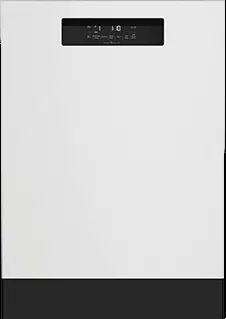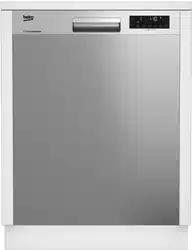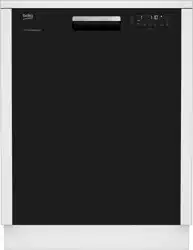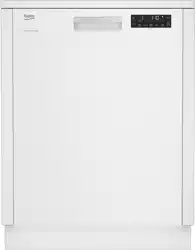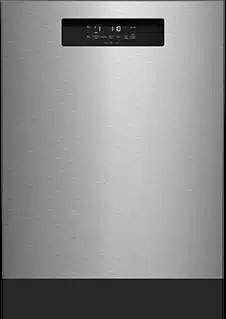

DUT36522X
DUT36522W
Dishwasher
User’s Manual
EN
USA
17 9688 01 00_BEKO_UC6_USA/ 02-02-22.(9:00)
To prevent accidents, which could cause serious injury or death, as well
as machine damage read these instructions before installation and / or
use.
CONTENTS
1. IMPORTANT SAFETY INSTRUCTIONS 1
2. RECYCLING 3
3. GETTING TO KNOW YOUR DISHWASHER 4
4. LOADING THE DISHWASHER 5
4.1 UPPER RACK 9
ADJUSTING THE HEIGHT OF THE UPPER BASKET 12
4.2 LOWER RACK 13
4.3 PROPER AND IMPROPER LOADING OF DISHWARE 18
5. WHAT SHOULD NOT BE WASHED IN YOUR DISHWASHER 19
6. OPERATING THE PRODUCT 20
6.1 KEYS 21
6.2 PREPARING THE MACHINE 21
6.3 PROGRAMME SELECTION 21
6.4 AUXILIARY FUNCTIONS 23
6.4 PROGRAMMING THE WASHING TIME 24
6.5 STARTING THE PROGRAMME 25
6.6 CHILD (KEY) LOCK 26
6.7 CANCELLING THE PROGRAMME 26
6.8 SALT INDICATOR ( ) 26
6.10 END OF PROGRAMME 27
6.11 WATER CUT-OFF WARNING 27
6.12 OVERFLOWING WARNING 27
7. DETERGENT 28
7.1 ADDING DETERGENT 28
7.2 TABLET DETERGENTS 29
7.3 RINSE AID 30
8. ADJUSTING THE WATER SOFTENING SYSTEM 31
9. FILLING THE DISHWASHER SALT DISPENSER 32
10. CARE AND MAINTENANCE 34
10.1 CARING FOR YOUR DISHWASHER EXTERIOR 34
10.2 CARING FOR YOUR DISHWASHER INTERIOR 34
10.3 CLEANING THE FILTERS 35
10.4 CLEANING THE HOSE FILTER 36
10.5 CLEANING THE WASH ARMS 36
LOWER IMPELLER 36
UPPER IMPELLER 37
11. TROUBLESHOOTING 38
12. TECHNICAL FEATURES 43
13. WARRANTY STATEMENT FOR THE BEKO DISHWASHERS 44
USA
1
USA
INTRODUCTION
Please read this user manual and
particularly the safety instructions
completely and carefully. They will save
you time and effort and help to ensure
optimum dishwasher performance.
Be sure to observe all listed warnings
and cautions. Look particularly for the
icons with exclamation marks inside. The
information icon will also provide important
references.
WARNING:
Indicates a potentially
hazardous situation which, if not
avoided, could result in death or
serious injury.
CAUTION:
Indicates a potentially
hazardous situation which, if not
avoided, may result in injury. It may
also be used to alert against unsafe
practices.
NOTICE:
Indicates a potentially
hazardous situation which, if not
avoided, may result in damage to
the dishwasher, the table-ware, the
equipment or the environment.
1. IMPORTANT SAFETY
INSTRUCTIONS
WARNING:
When using the
dishwasher, follow basic precautions,
including the following: Read all
instructions before using the
dishwasher! Save these operating
instructions and pass them on to any
future user.
“This device complies with Part 15 of
the FCC Rules. Operation is subject
to the following two conditions: (1)
this device may not cause harmful
interference, and (2) this device must
accept any interference received,
including interference that may cause
undesired operation.” “No changes
shall be made to the equipment
without the manufacturer’s permission
as this may void the user’s authority to
operate the equipment”
• Use the dishwasher only for its
intended purpose as described in
this user manual. This appliance is
intended for normal household use
only.
•
The manufacturer disclaims
responsibility for damage or
injury caused by improper use
of this appliance.
• The information in this user manual
must be followed to minimize the risk
of fire or explosion and to prevent
property damage, personal injury or
loss of life.
• Do not operate your dishwasher
unless all the enclosure panels are
properly in place.
• Do not tamper with the controls.
• Do not abuse, sit on, stand in or on the
door or dish rack of the dishwasher.
• The cup racks are designed to support
cups, glasses and kitchen utensils.
When the cup racks are in the
dishwasher do not lean on or use the
cup racks to support your body weight.
• To reduce the risk of injury, do not
allow children to play in, on or near the
dishwasher.
• Use only detergents or rinse aids
recommended for use in a household
dishwasher and keep them in a dry
place out of the reach of children.
Check that the detergent dispenser
is empty after the completion of each
wash program.
• Dishwasher detergents contain
chemicals that can cause sickeness
and may be if they are inhaled or
swallowed. Also, be careful when
opening the door due to hot steam
that is producded during operation.
2
USA
Consult a doctor immediately if
detergent has been swallowed or
inhaled.
• if the hot water has not been used
in several weeks, we recommend
running the hot water taps to remove
any built up hadrogen gases.
• Do not store or use flammable
liquids or vapors in the area of the
dishwasher.
• When loading items to be washed,
position sharp items so that they are
not likely to damage the door seal and
load sharp knives with the handles up
to reduce the risk of cut-type injuries.
• Do not wash plastic items unless they
are marked “dishwasher safe” or the
equivalent. For plastic items not so
marked, check the manufacturer’s
recommendations.
• If a malfunction occurs, switch off
the appliance and turn off the water
supply to the dishwasher.
• Please do not attempt to carry the
dishwasher by yourself in order
to avoid potential injuries. Two or
more people are needed to move a
dishwasher.
• Before cleaning or carrying out
maintenance, switch off the
appliance, disconnect the power plug
and turn off the water supply.
• Repairs and technical modifications
must be carried out exclusively by a
Authorized technician.
• If the dishwasher is not in use for an
extended period of time (i.e. vacation
home), we recommend remove all
items from the dishwasher, leave
the door cracked open to allow air to
circulate and turn off both the power
and water supply to the dishwasher.
• This appliance comes with a three
prong NEMA 5-15P 15A power cord.
It must be connected to a Grounded
and Polarized wall receptacle that
has been installed and tested by an
licensed electrician and that it has
been installed based on all Local, State
and Federal Electrical codes.
WARNING:
Improper connection of
the equipment-grounding conductor
can result in a risk of electric shock.
Check with a qualified electrician
or service representative if you are
in doubt whether the appliance is
properly grounded. Do not modify
the plug provided with the appliance,
if it will not fit the outlet, have a
proper outlet installed by a qualified
electrician.
• This appliance produces ozone
within the washing compartment
during normal operation. Long-term
exposure to ozone or exposure
at elevated levels may result in
respiratory problems, especially for
the infirmed, elderly and children.
• Chidren should not operate this
machine without adult supervision.
• Be Careful to not leave the door
fully open when not being loaded or
unloaded to prevent someone from
tripping on the unit.
WARNING:
If your dishwasher is
equipped with internal illumination,
lamp should only be replaced by the
Authorized Service Agent in case of
failures that may occur on the lamp.
WARNING:
This product can expose
you to chemicals including Nickel
(Metallic) which is known to the State
of California to cause cancer.

3
USA
For more information go to www.
P65Warnings.ca.gov
Note: Nickel is a component in all stainless
steel and some other metal components.
SAVE THESE INSTRUCTIONS
the possibility of recycling these
materials.
• Please check the water supply line
periodically. It is susceptible to
breakage. It becomes less flexible as
time goes by.Replace it immediately
when it is torn, cut, swollen or there is
water leakage.
• Please keep the dishwasher package
out of the reach of children after
unpacking it.
WARNING:
Danger of suffocation!
Ensure that any plastic wrappings,
bags, small pieces etc. are disposed
of safely and kept out of the reach of
children.
• Service should be performed by a
qualified installer. Work by unqualified
persons could be dangerous and may
void the warranty.
• Do not operate the appliance if
damaged, malfunctioning, partially
disassembled or if it has missing or
broken parts.
• Before installation or service,
disconnect the power supply to
the work area by unplugging the
unit, “tripping” the circuit breaker or
removing the fuse.
• For safety reasons, dishwasher must
be secured to adjacent cabinetry using
the brackets provided. Failure to do
this may cause damage to property or
bodily injury.
• Do not use any extension cord or
portable outlet device to connect the
dishwasher to a power supply.
2. RECYCLING
• Remove the door to the washing
compartment when removing an old
dishwasher from service or discarding
it. Ensure that the appliance presents
no danger to children while being
stored for disposal.
• Remove the door lock or door of
the washing compartment before
disposing dishwasher so that children
or small animals can not trapped
inside.
• Old appliances may contain materials
that can be recycled. Please contact
your local recycling authority about
4
USA
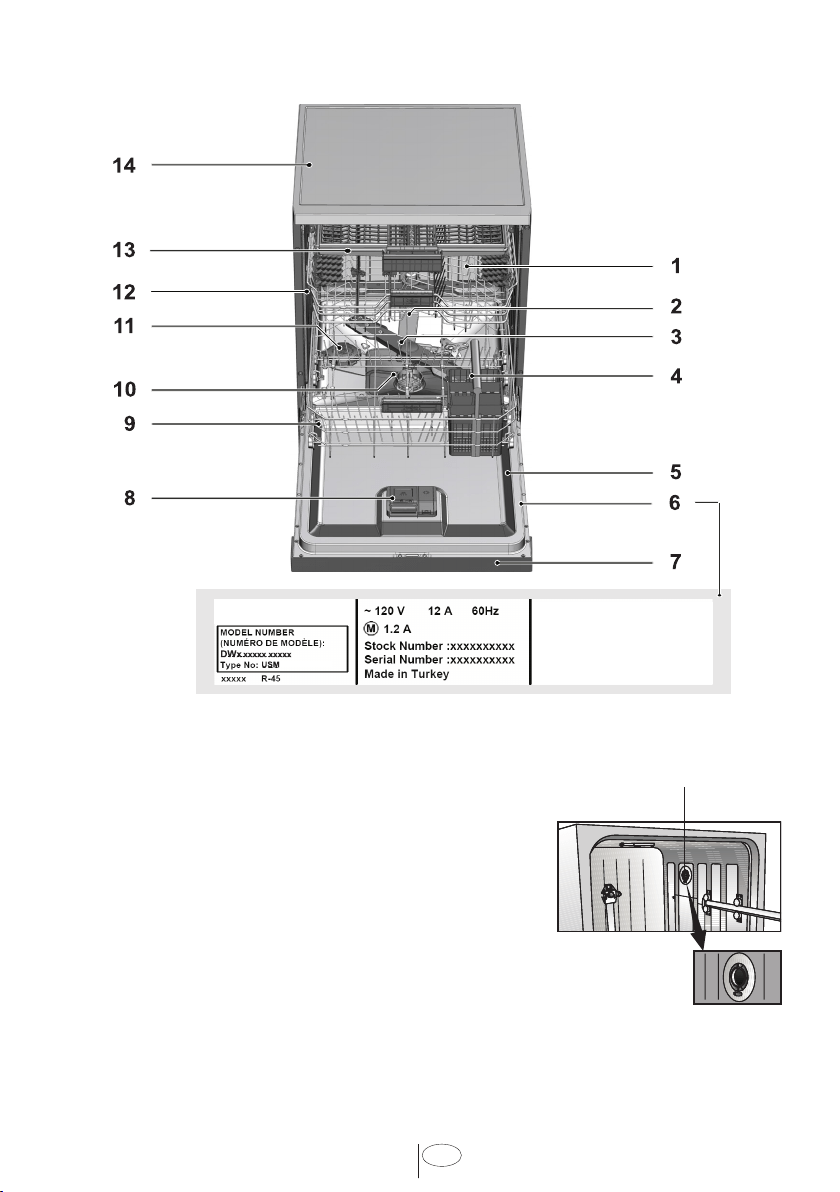
15
1. Upper basket
2. Upper impeller
3. Lower impeller
4. Cutlery basket
5. Door
6. Model and Serial Tag
7. Control panel
8. Detergent and rinse aid dispenser
9. Lower basket
10. Filters
11. Salt container (Select Models)
12. Upper basket rail
13. Upper cutlery basket (Select Models)
14. Tabletop (Select Models)
15. Turbo fan heat drying system (Select Models)
3. GETTING TO KNOW YOUR DISHWASHER
5
USA
4. LOADING THE
DISHWASHER
1. Pull the handle to open the door. If the
door is opened during operation, the
dishwasher will stop running. Once
the door is closed the program will
continue.
2. Remove coarse food leftovers from
tableware.
3. Now you can load the dishwasher.
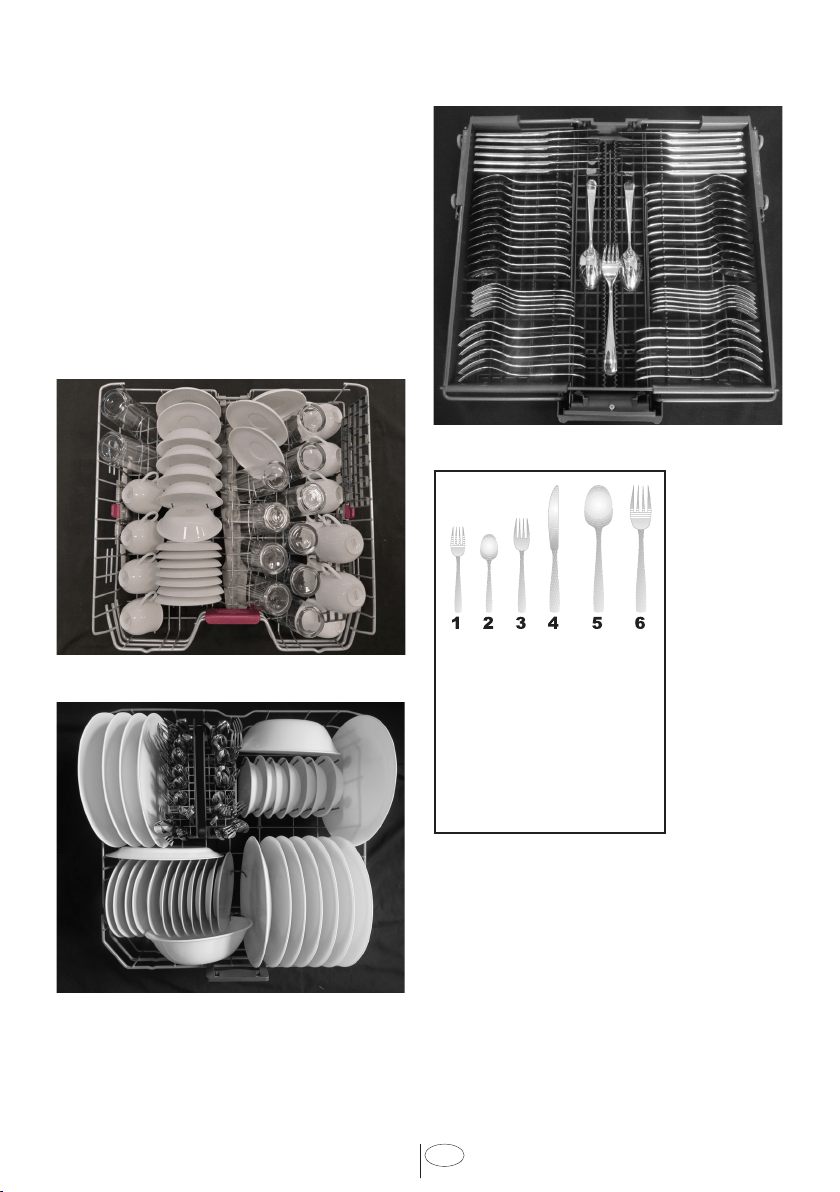
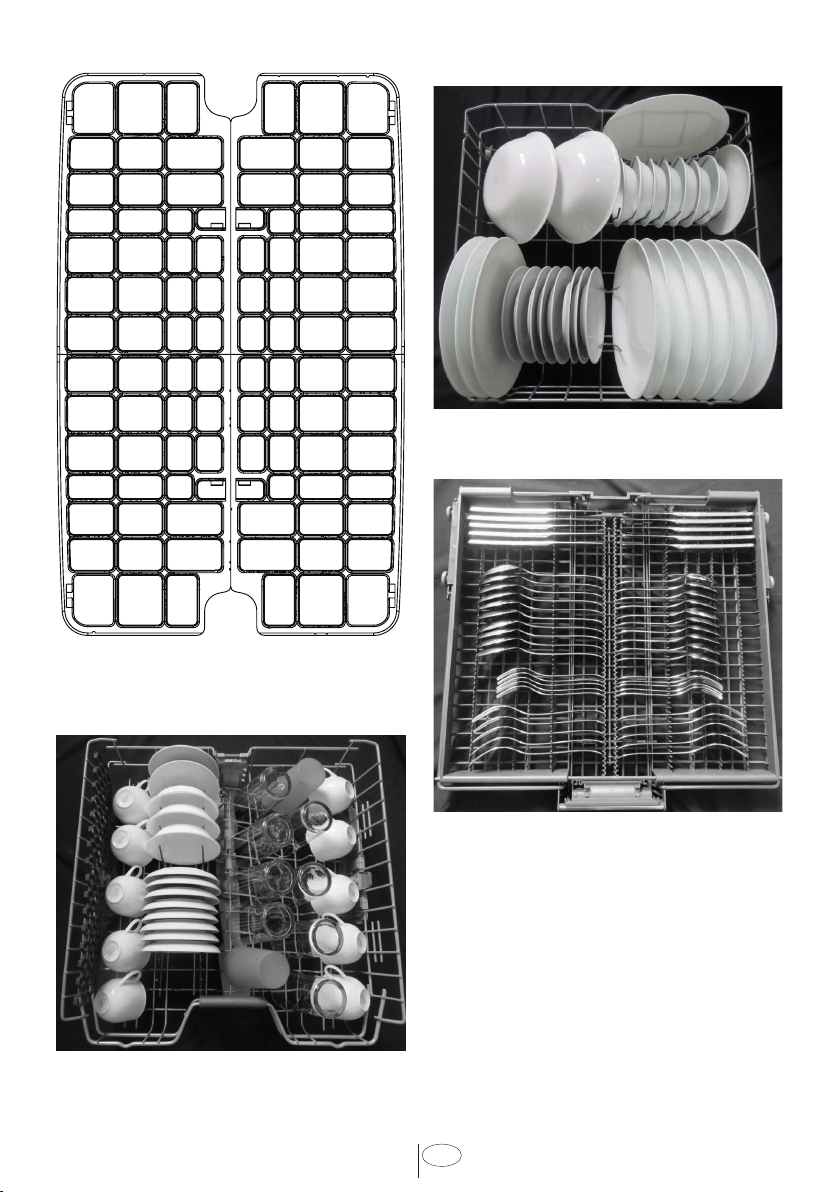
12 place settng loadng pattern
for daly, regular or typcal use
Upper rack
Lower rack
Upper cutlery basket (Select
Models)
Cutlery basket
6
5
5
4
444
44
3
3
3
33
3
222
2
2
2
2
2
2 2
2
2
2
2
2
2
2
2
2
2
22
1
1
1
1
1
111
1
1
1
1
44 44 4
32 432
3
3
3
3
1: Salad Fork
2: Teaspoon
3: Dinner fork
4: Knife
5: Serving spoon
6: Serving fork
6
USA
6
5
5
324
23
3
4
34
4
22
2
2
2
2
4
2
2
2
2
2
22
1
2
1
1
1
2
1
1
2 42 3
3 44
3
4
4
3
3
2
2
3
4
3
1
1
1
1
1
1
22
2
4
3
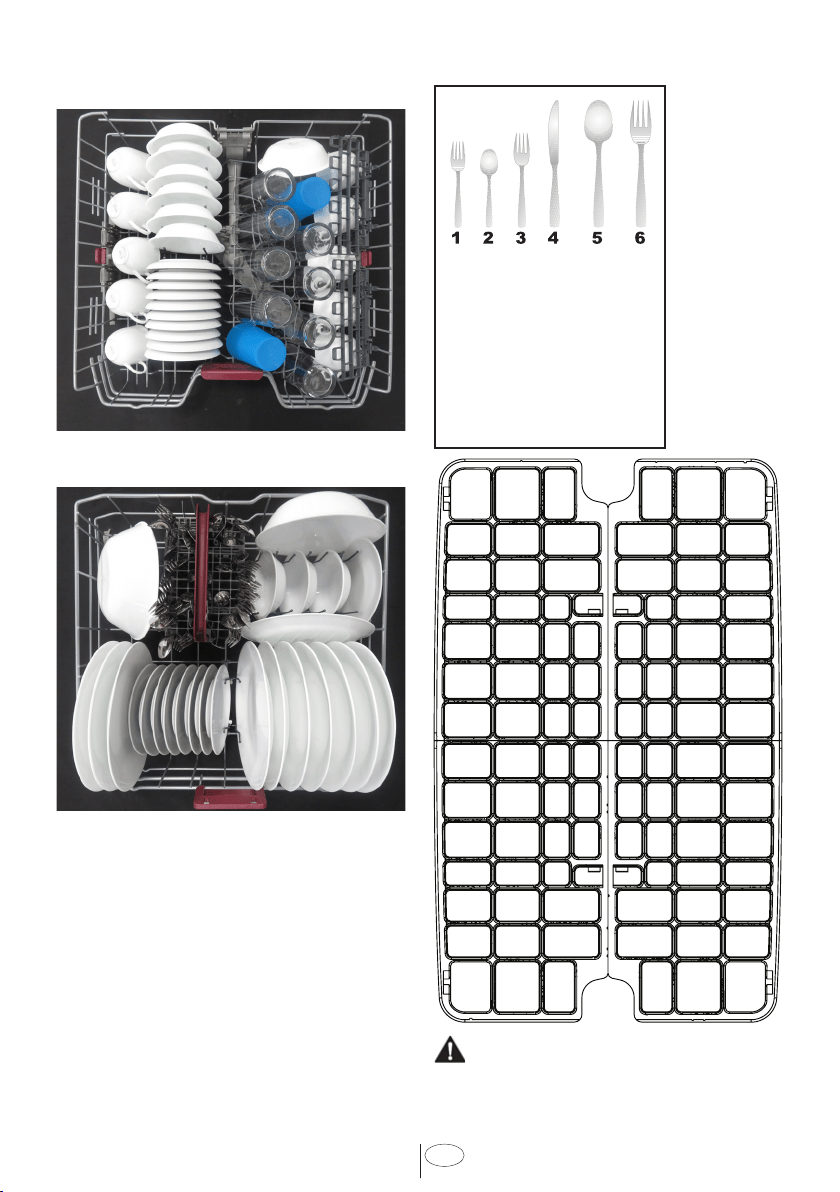
Addtonal loadng pattern for 10
place settng
Upper rack
Lower rack
Upper cutlery basket (Select
Models)
7
USA
Upper rack wthout upper cutlery
basket (Select Models)
Lower rack wthout upper cutlery
basket (Select Models)
Cutlery basket
6
5
5
4
444
44
3
3
3
33
3
222
2
2
2
2
2
2 2
2
2
2
2
2
2
2
2
2
2
22
1
1
1
1
1
111
1
1
1
1
44 44 4
32 432
3
3
3
3
1: Salad Fork
2: Teaspoon
3: Dinner fork
4: Knife
5: Serving spoon
6: Serving fork
1
4
4
114
31
3
3
13
3
25
5
5
5
5
4
5
5
5
5
4
52
2
2
2
2
2
2
2
2
3 11 4
1 33
4
3
3
4
1
4
4
1
CAUTION:
Large knives and other
utensils with sharp tips and edges
must be placed horizontally into the
upper rack due to risk of injury. Other
8
USA
smaller knives and sharp utensils
should be placed with sharp side down
in the cutlery basket.
CAUTION:
Use extreme caution
when removing knives and other sharp
utensils from the dishwasher. These
items may have shifted position during
the wash program, and may be wet or
slippery.
CAUTION:
Hot steam can escape!
Danger of serious burns or other injury.
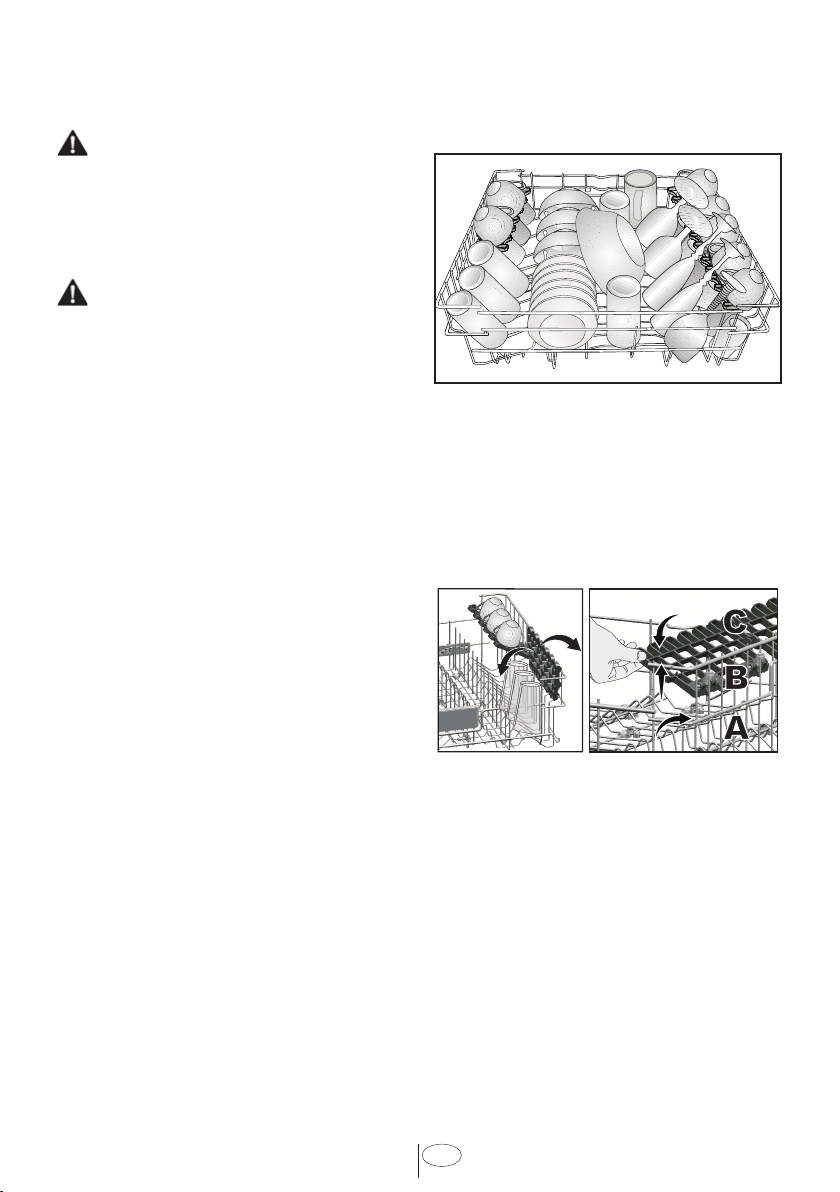
• Place all containers such as cups,
glasses and pots into the dishwasher
with the opening facing downwards
(so that no water can collect).
• Small and light items can go into the
upper rack.
• Long and narrow items are placed in
the middle of the racks.
• Place all large and very dirty items in
the lower rack.
• Load dishes accordingly and be careful
when loading glasses so they do not
hit each other during the wash cycle.
Also, make sure that both wash arms
are not in contact with any dishware.
• Do not overload your dishwasher
and pay attention to manufacturer
instructions regarding dishes which
are appropriate for use in for a
dishwasher. Only with suitable dishes
(mentioned in section 5) will you
obtain optimal washing results with a
sensible use of energy.
4.1 UPPER RACK
Load the upper rack with dessert plates,
cups, glasses etc.
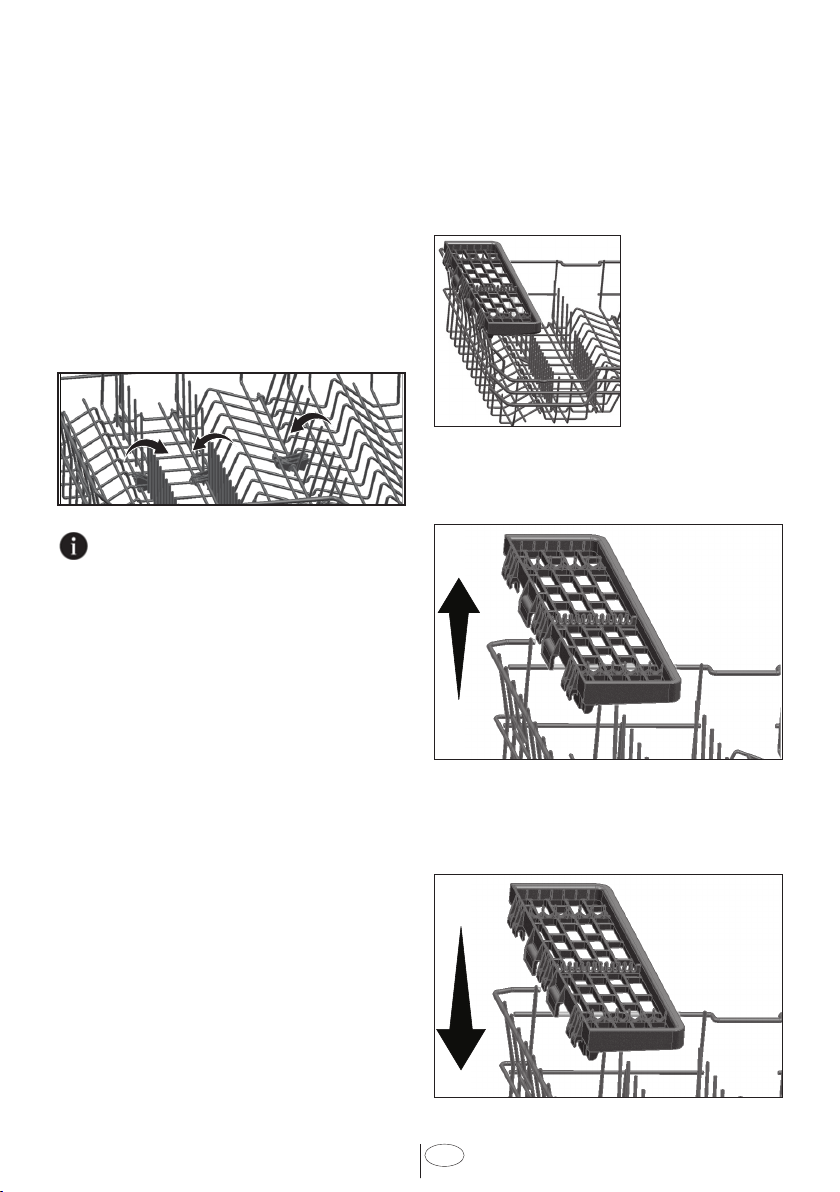
ADJUSTABLE SHELVES
(Select Models)
Depending on the size of the glasses and
cups, the shelf height setting may be
adjusted.
1. Fold the shelf upwards
A
.
2. Positioning at the desired height
B
.
3. Fold the shelf again downwards
C
.
9
USA
COLLAPSIBLE UPPER BASKET
WIRES
(Select Models)
You can use collapsible wires when you
need a larger space for your dishes in the
upper basket of your machine.
To bring the collapsible wires into
horizontal position, grab the wire from
the middle position and push them in the
direction of arrow in the figure. Place your
larger dishes into the area created. To bring
the wires back to vertical position, just lift
them up.
Bringing the wires to the horizontal
position by holding them from the tips
may cause them to bend. Therefore,
hold the wires from their stems while
bringing them to the horizontal or
vertical positions.
UPPER BASKET MULTIPURPOSE
SERVICE RACK
(Select Models)
This accessory located at the upper basket
of your machine allows you to easily wash
pieces such as extra long ladles and bread
knives.
You can lift up the upper basket
multipurpose service rack to remove it if
you do not want to use it.
If you want to use the upper basket
multipurpose service rack again, you can
easily attach it to the side section of your
upper basket.
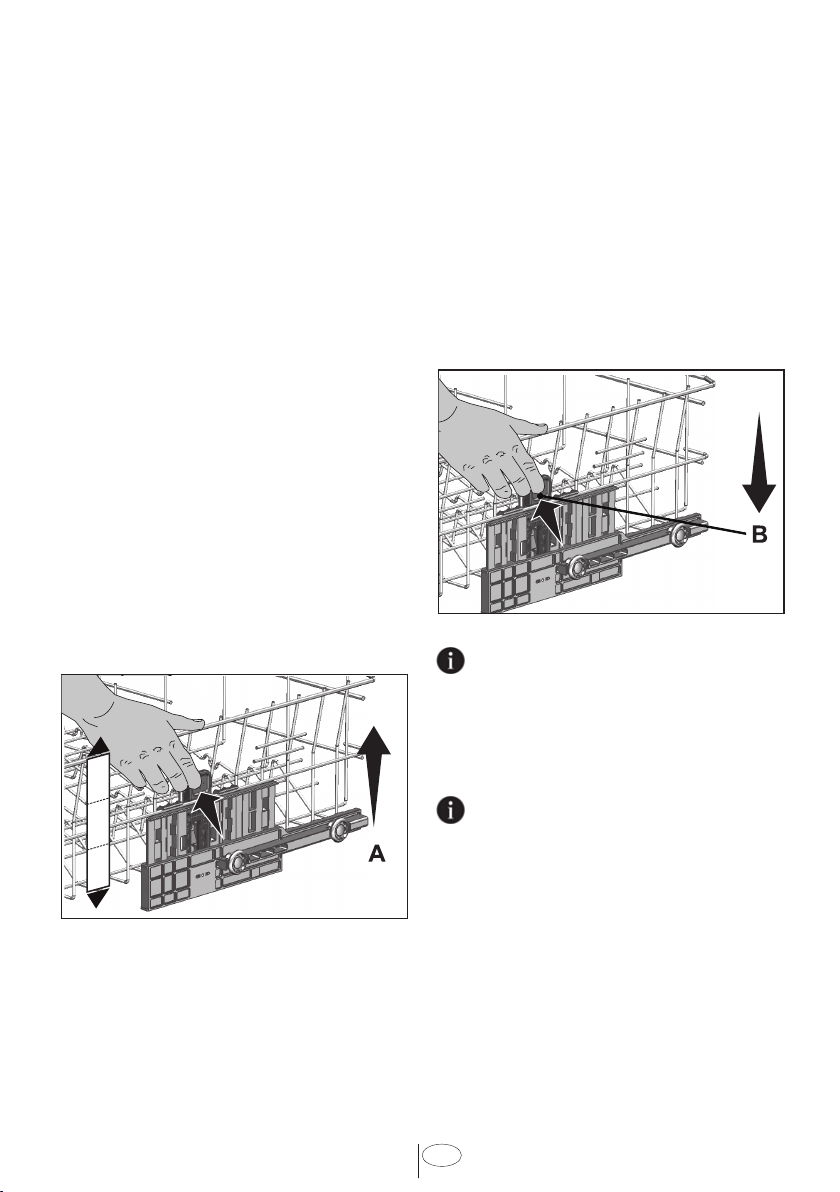
10
USA
To lower the basket, while it is in the
uppermost position;
1. Hold the upper basket wires with both
hands, slightly lift up the basket and
simultaneously push and release the
latches shown in the figure (B).
2. Lower the basket from its current
position to the lower one.
3. Release the basket after it has reached
one level down.
Repeat the process if the height is not
sufficient.
1
2
3
The movement mechanism may not
function properly if the upper basket is
overloaded or if the weight distribution
is not balanced. In heavier conditions,
there is the risk of falling one level
down.
Make sure that the adjustment
mechanism has the same positions on
the right and left sides of the upper
basket.
ADJUSTING THE HEIGHT OF THE
UPPER BASKET
(Select Models)
The upper basket height adjustment
mechanism has been designed for you to
create large spaces in the lower or upper
sections of your machine depending on
your needs by adjusting the height in the
upper or lower direction while your basket
is empty or loaded.
Thanks to this mechanism, you can use
your basket in three different positions,
namely lower, middle and upper positions
(1, 2, 3).
1. To raise your basket, hold the upper
basket wires with both hands while the
basket is in the lowermost position and
pull them up (A).
2. You will hear a "Click" from the right
and left mechanisms, indicating that
the basket has reached the next level.
Release the basket.
Repeat the process if the height is not
sufficient.
1
2
3
11
USA
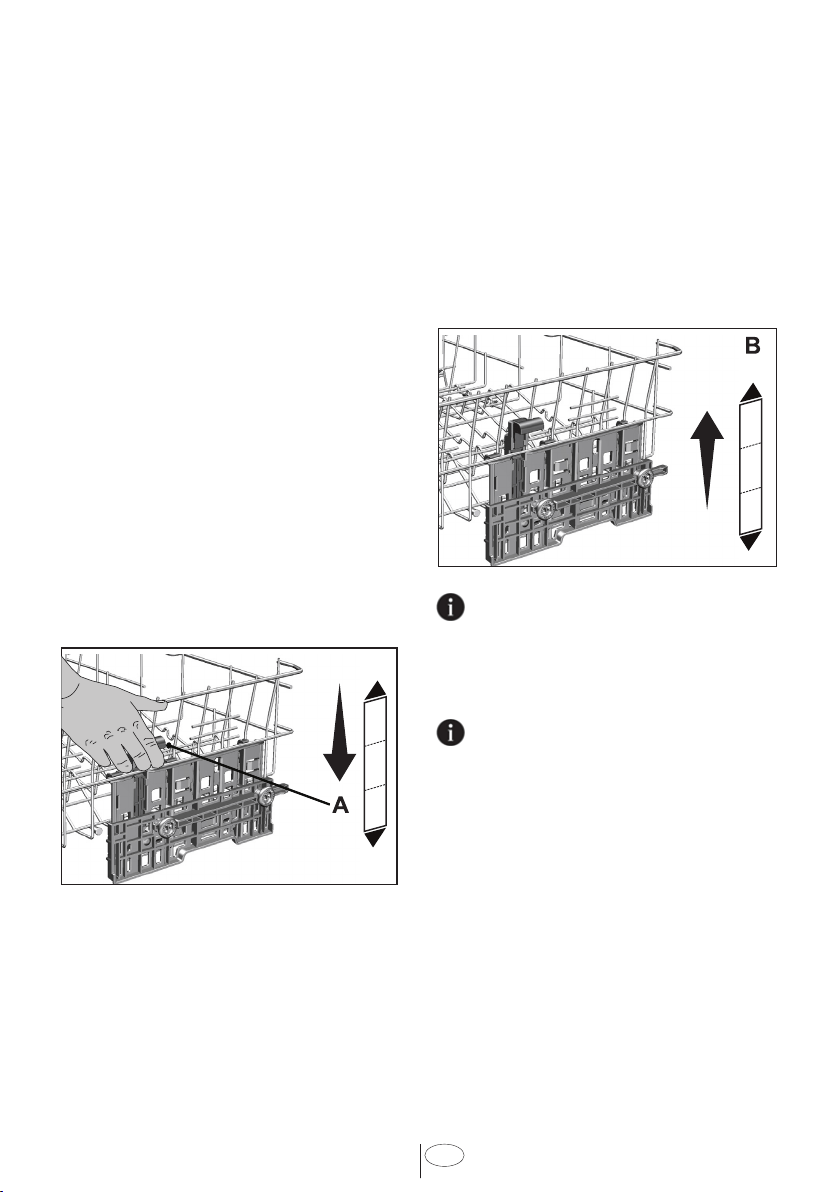
ADJUSTING THE HEIGHT OF
THE UPPER BASKET
(Select Models)
Upper basket height adjustment
mechanism is designed so that you can
create wide spaces on the upper or lower
compartment of the machine by adjusting
the basket upwards or downwards either
while it is empty or full.
Thanks to this mechanism, you may use
your basket in three different positions,
namely lower, center or upper positions.
To lower the basket, perform the following
while the basket is at uppermost position;
1. Hold the wires of the upper basket and
raise the handle of the mechanism
upwards as shown in the figure (A).
2. Lower the basket to the next lower
position.
3. Release the basket when it catches on
to the next lower position.
Repeat the same operation if the height is
not adequate.
1
2
3
1. To raise the basket, hold the wires of
the basket and pull the basket upwards
with both hands while the basket is at
the lowermost position (B)
2. Release the basket when it catches on
to the next upper position with a “Click”
that may be heard from the right and
left mechanisms.
Repeat the same operation if the height is
not adequate.
1
2
3
The movement mechanism may not
work properly when the upper basket
is overloaded or when the load is
unbalanced. And it may fall to the next
lower position in heavier conditions.
Ensure that the adjustment
mechanisms on the right and left of
the upper basket are aligned.
12
USA
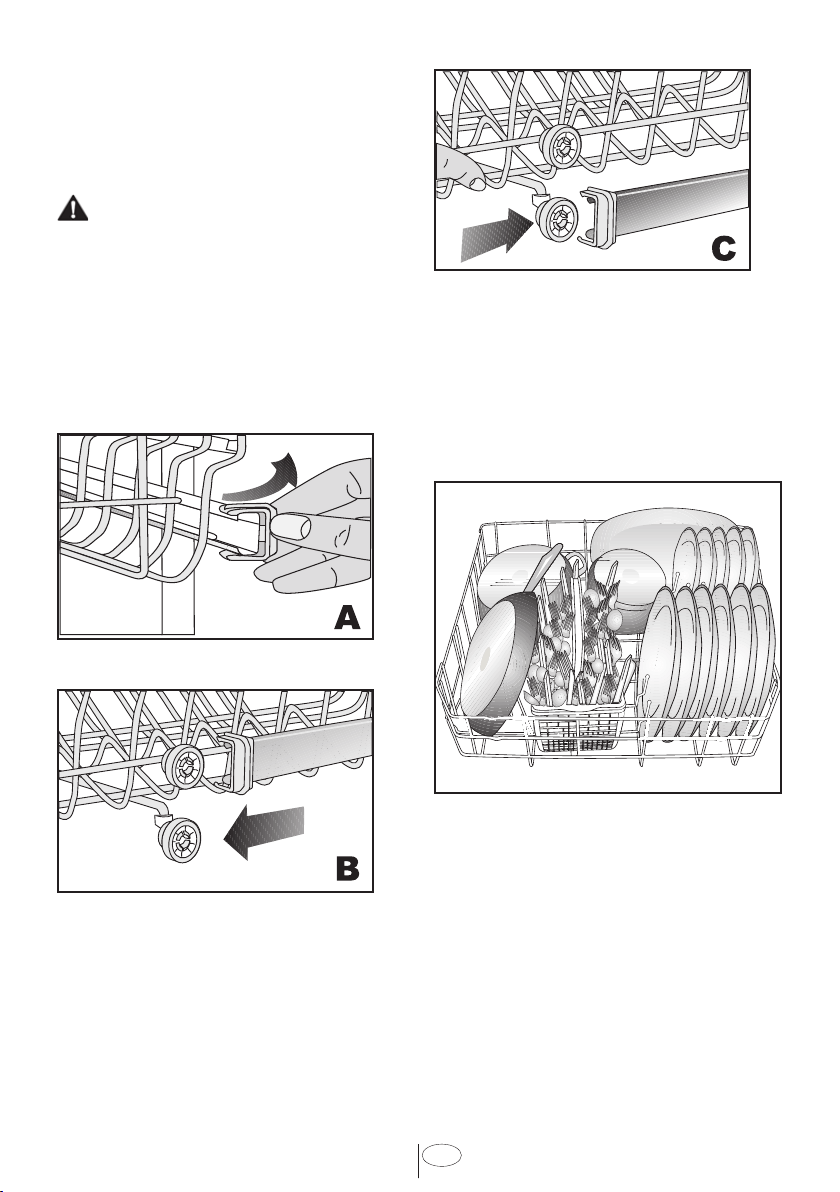
HEIGHT SETTING
(Select Models)
In certain models, the height setting of
the upper rack may be changed using the
wheels which are present at two height
levels.
CAUTION:
Make sure that the rack
is empty. Changing the height setting
while the rack contains tableware
could cause the contents to dislodge,
causing personal injury or damage to
the tableware.
1. Release the latches on both the right
and left tracks of the upper rack by
turning them to the outside
A.
2. Pull out the rack completely
B
.
3. Place the rack into the tracks again at
the desired height
C
.
4. Push the latches back into the correct
position.
4.2 LOWER RACK
Use the lower rack for plates, bowls, pots
etc.
13
USA
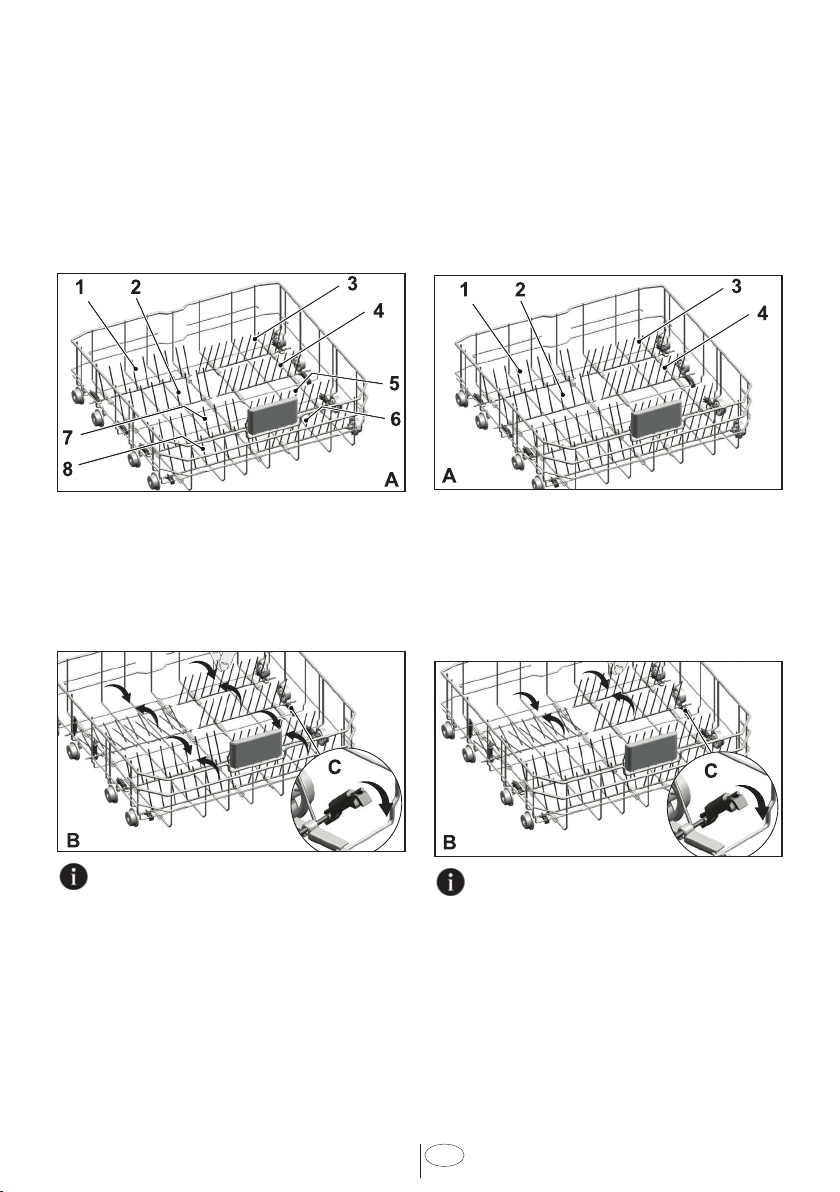
COLLAPSIBLE LOWER BASKET
TINES
(Select Models)
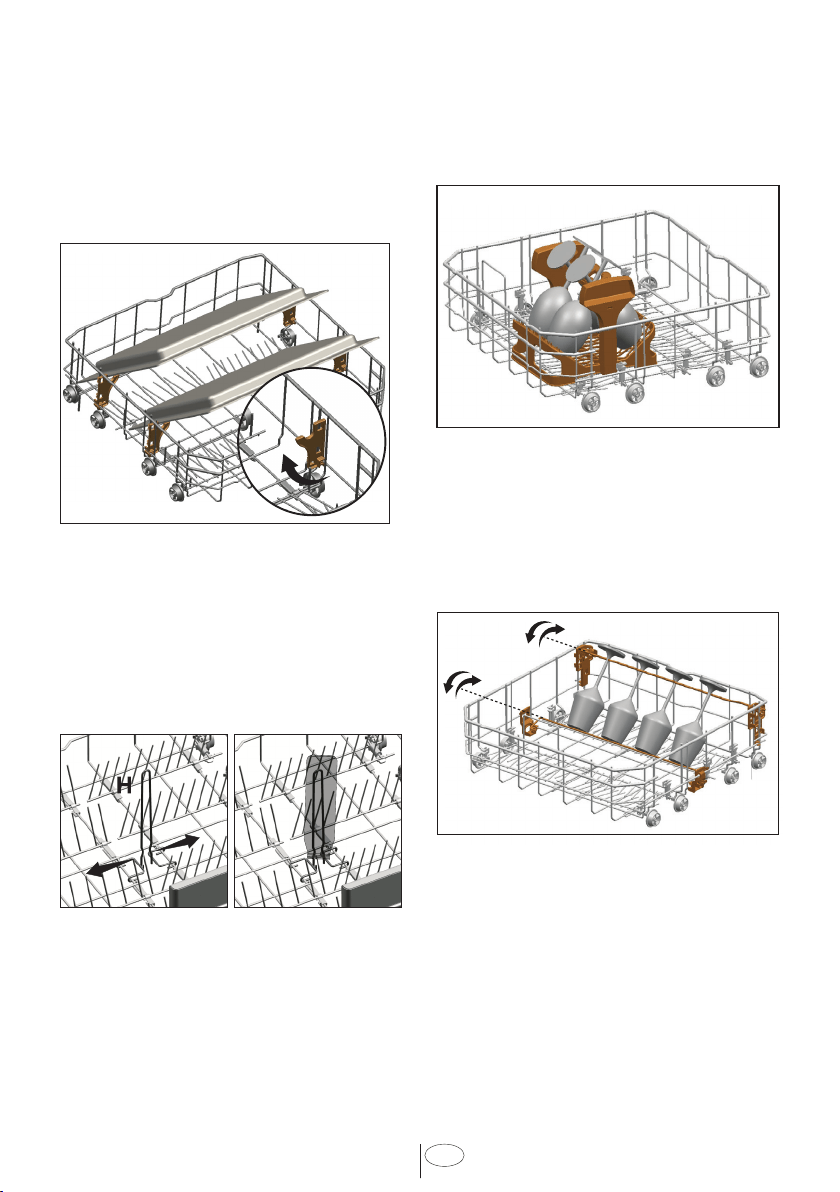
There are foldable tines (A) located at
the lower basket of the machine are
designed for an easier placement of large
pieces such as pans, bowls, etc. You can
create larger spaces by folding each tines
individually or all of them at once.
To bring the collapsible tines into horizontal
position, grab the tines from mid position
and push them in the directions of arrows
(B). To bring the tines back to vertical
position, just lift them up. Collapsible tines
will click into the latch again (C).
Bringing the tines to the horizontal
position by holding them from the tips
may cause them to bend. Therefore, it
will be appropriate to bring the tines
in the middle to horizontal or vertical
position by holding them from their
stems and pushing in the direction of
arrow.
COLLAPSIBLE LOWER BASKET
TINES
(Select Models)
There are foldable tines (A) located at
the lower basket of the machine are
designed for an easier placement of large
pieces such as pans, bowls, etc. You can
create larger spaces by folding each tines
individually or all of them at once.
To bring the collapsible tines into horizontal
position, grab the tines from mid position
and push them in the directions of arrows
(B). To bring the tines back to vertical
position, just lift them up. Collapsible tines
will click into the latch again (C).
Bringing the tines to the horizontal
position by holding them from the tips
may cause them to bend. Therefore, it
will be appropriate to bring the tines
in the middle to horizontal or vertical
position by holding them from their
stems and pushing in the direction of
arrow.
14
USA
SILVERWARE BASKET
(Select Models)
Silverware basket is designed to wash your
dishes such as knife, fork, spoon, etc. in a
cleaner manner.
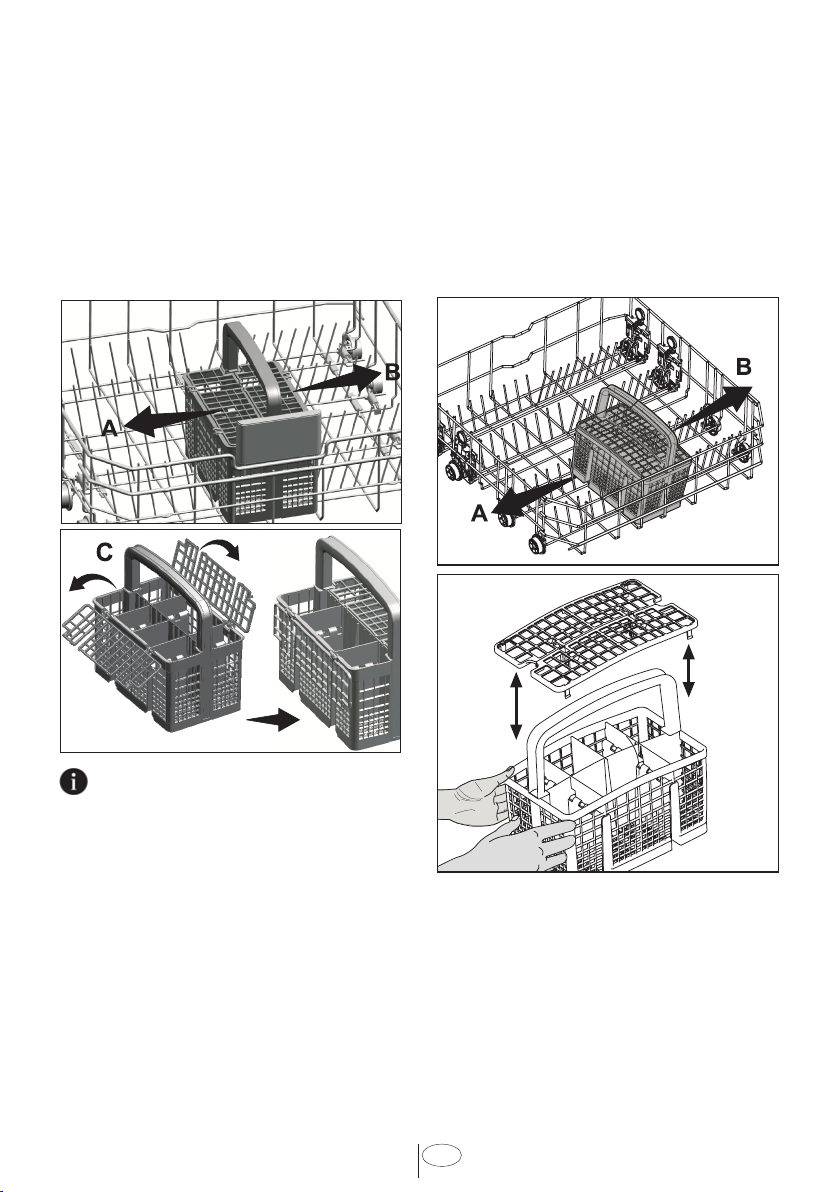
Since the cutlery basket can be moved
(A, B), you can create a wider space while
placing your dishes to the lower basket and
free up space for your dishes in different
sizes.
NOTICE:
When finished, test to
ensure that the spray arm can still
move freely.
SILVERWARE BASKET
(Select Models)
Silverware basket is designed to wash your
dishes such as knife, fork, spoon, etc. in an
efficient manner.
Since the silverware basket can be moved
(A, B), you can create more space while
placing your dishes in the lower basket and
free up space for your dishes of different
sizes.
15
USA
TRAY WASH SUPPORTS
(Select Models)
Use the supports to wash trays in the
bottom basket.
See the Auxiliary functions section
for appropriate program and function
selection.
SOFTTOUCH ACCESSORY
(Select Models)
The SoftTouch Accessory found in the
lower basket of your machine enables a
safe washing for your fragile glasses.
LOWER BASKET GLASS HOLDER
(Select Models)
Lower Basket Glass Holder found in the
lower basket of your machine enables a
safe washing for your oversized and tall
glasses.
LOWER BASKET BOTTLE WIRE
(Select Models)
The bottle wire is designed for easier
washing of long pieces with wide mouths.
You may take out the bottle wire from the
basket when not in use by pulling it out
from both sides (H).
16
USA
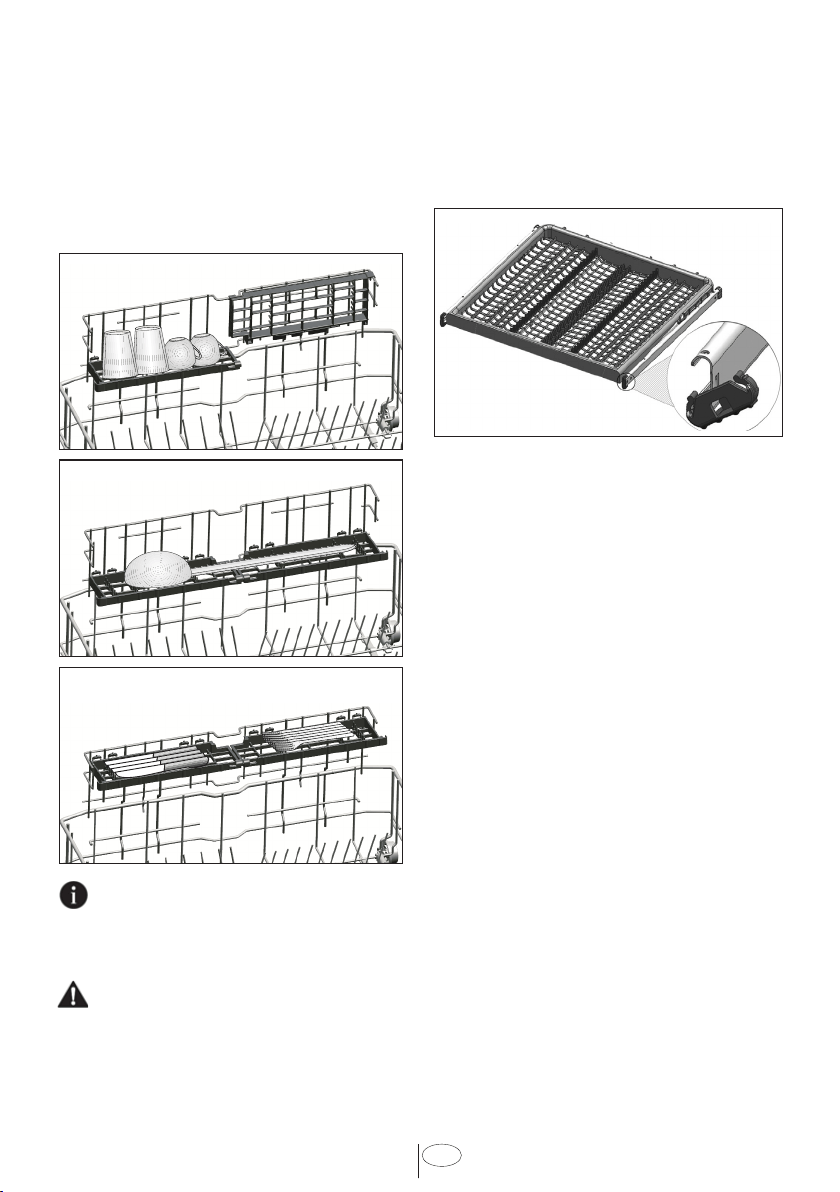
LOWER BASKET MULTIPURPOSE
/ HEIGHT ADJUSTABLE SERVICE
RACK
(Select Models)
This accessory located at the lower basket
of your machine allows you to easily wash
pieces such as extra glasses, long ladles
and bread knives.
You may use the racks as required
by moving them to lower or upper
position, or close them to create a
wider space in your lower basket.
Make sure that the impeller does not
touch the dishes you placed on the
racks.
CEILING CUTLERY BASKET
(Select Models)
Ceiling cutlery basket is designed to wash
your cutlery items such as forks, spoons
and etc. by placing them between the bars
on the basket..
17
USA
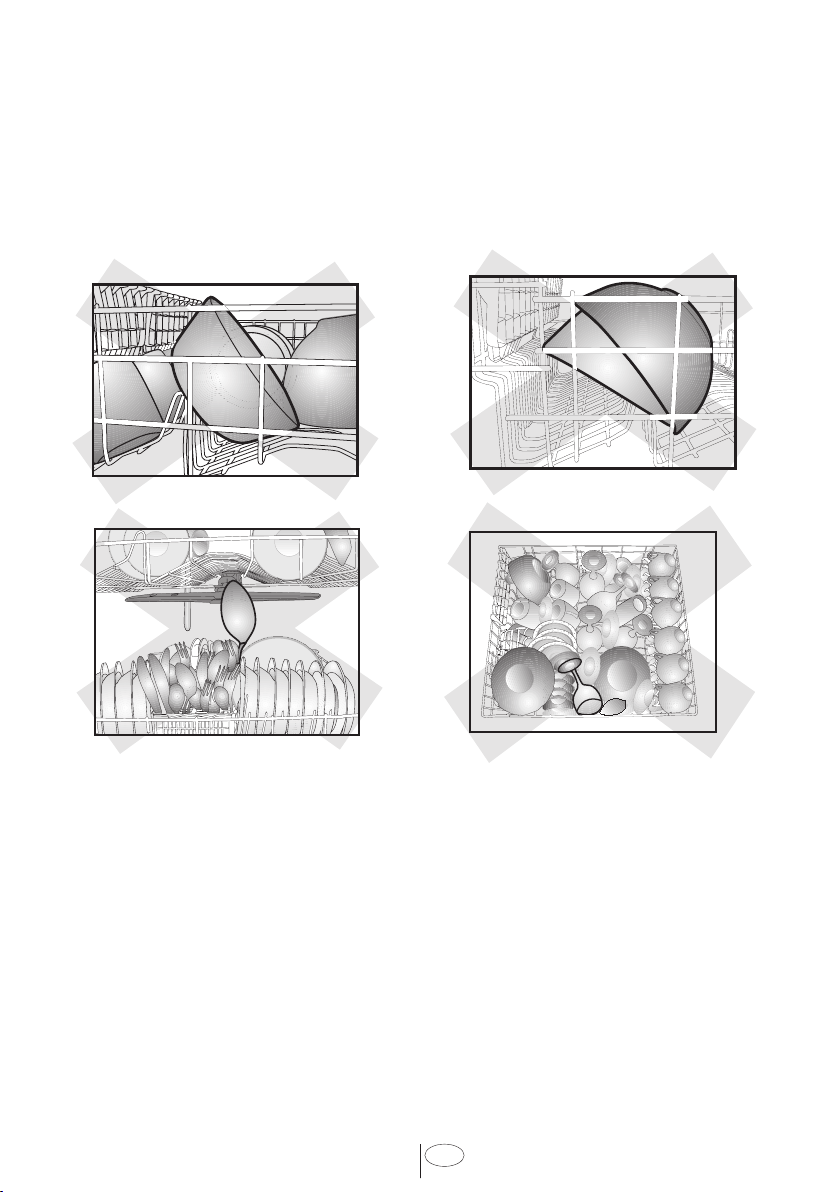
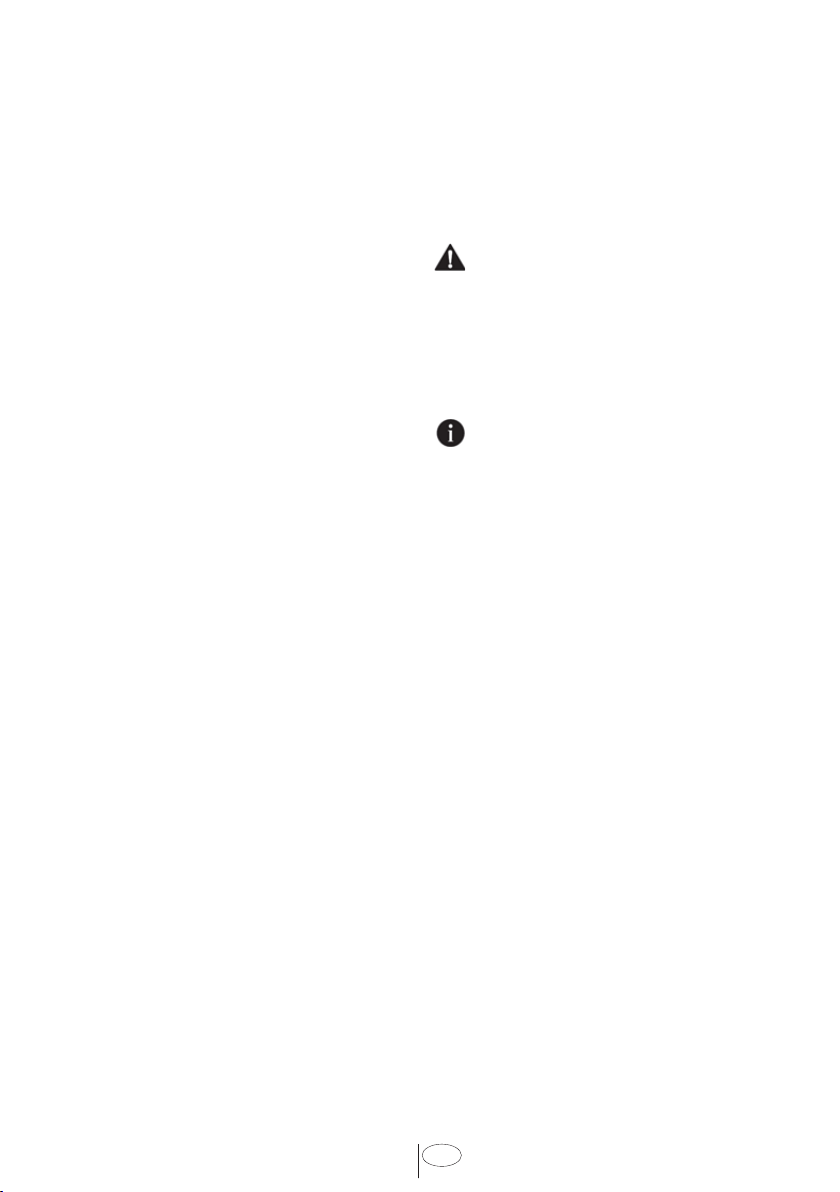
4.3 PROPER AND IMPROPER LOADING OF DISHWARE
• Place all containers such as cups, glasses and pots into the dishwasher with the opening
facing downwards (so that no water can collect).
• The movement of the spray arms must not be hindered.
• Do not overload your dishwasher.
• Only with suitable dishes (mentioned in section 5) will you obtain optimal washing
results with a sensible use of energy.
incorrect incorrect
incorrect
incorrect
18
USA
5. WHAT SHOULD NOT
BE WASHED IN YOUR
DISHWASHER
• Rust-sensitive steel parts like iron
and cast iron that can rust and stain
other utensils and damage the interior
stainless steel liner of the dishwasher
and void the warranty. Do not wash
copper, brass, pewter, bronze or tin.
• Cutlery with wooden or horn handles
and cutlery with mother-of-pearl or
porcelain handles will deteriorate over
time if put in the dishwasher.
• Plastics may lose their shape or color
with hot water, please follow the
instructions of plastic manufacturers.
Be sure that plastic items are marked
“dishwasher safe”.
• Glued dishes or cutlery are not
suitable for machine washing since
certain adhesives may get soft or
dissolve with hot water.
• Aluminum may fade over time.
Minerals in water and detergent may
cause the aluminum to darken or spot.
• Sterling silver articles should not be
washed in the dishwasher because
they tend to discolor and become dull
by dishwasher detergent.
• Silverware and stainless steel items
should not be in contact with each
other. Mixing these items can cause
staining. Remove and hand dry these
items immediately when the program
ends.
• Decorated glasses, porcelain, fine
china and china with gold rims are
sensitive to machine washing. They
may lose their patterns and colors
over time.
• Crystal and very fine glassware may
become opaque (etch) losing their
shine over time. You may prefer to
wash them by hand.
• Do not wash sponges or dish cloths in
dishwasher.
• Do not wash art and craft articles in
dishwasher.
• Disposable plastics and disposable
aluminum cannot withstand high
temperatures; do not wash them in
the dishwasher.
CAUTION:
If in doubt, wash by
hand or follow the instructions from
the manufacturer of utensils, dishes,
glasses or pots and pans. Do not wash
items soiled with cigarette ash, candle
wax, varnish, paints or chemicals since
they can damage your dishwasher.
NOTICE:
We recommend when
buying new dishware, try to choose
ones that are suitable for machine
washing (marked as dishwasher safe).
CARING FOR YOUR TABLE-WARE
The combination of high temperatures and
dishwasher detergent may cause damage
to some items if they are washed in the
dishwasher. Remember, if there is any
doubt about any aspect concerning items
to be washed in the dishwasher, follow the
instructions from the manufacturer of the
items, or wash the items by hand.
19
USA
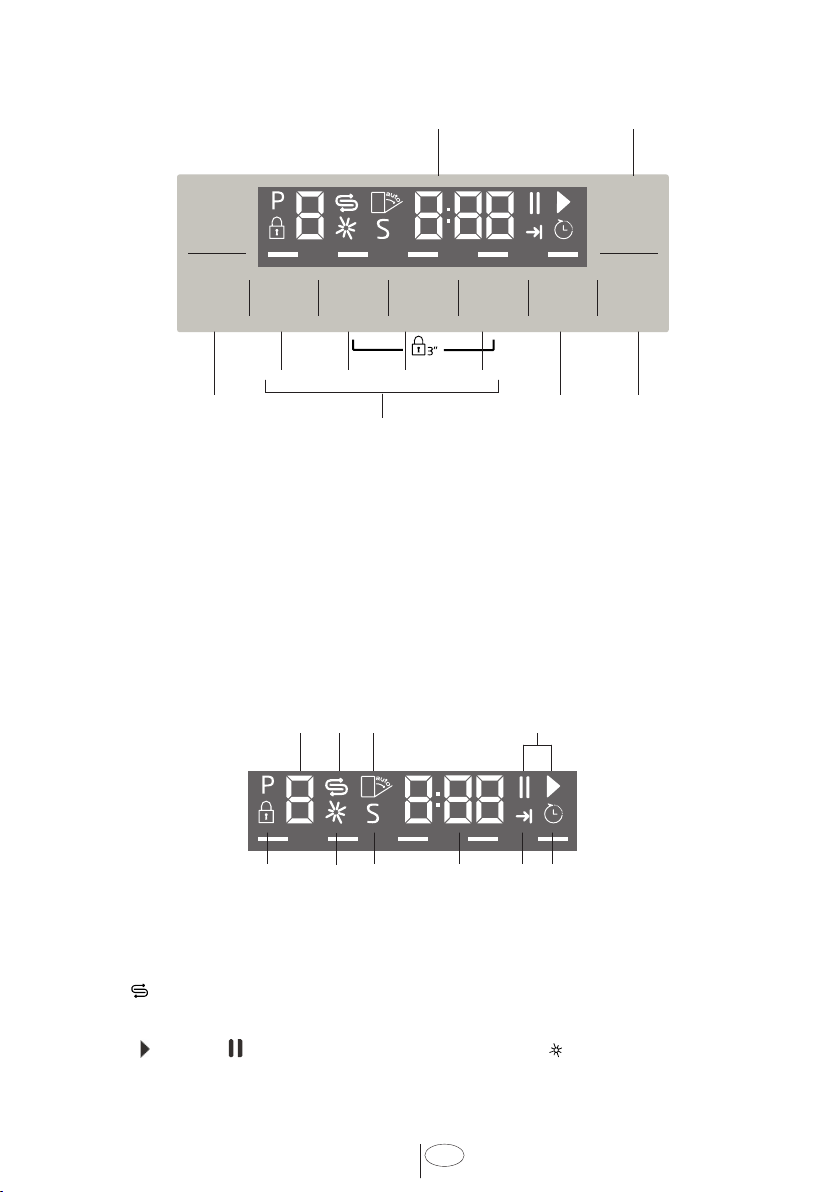
7. Programme indicator
8. Salt ( ) indicator (Select Models)
9.
10. Start ( ) / Pause ( ) indicator
11. Time Delay indicator
12. End of Programme indicator
13. Screen information line
14.
15. Rinse aid ( ) indicator
16. Child Lock indicator
5. Function keys
a)
b)
c)
d)
6. Program Selection keys
6. OPERATING THE PRODUCT
Fast+ function
SteamGloss function
Sanitize Function
EverClean Function
Not in use
7 8 9 10
111213141516
1 2
34
5
6
a b c
d
1. Display
2. On/Off key
3. Start/Pause/Cancel key
4. Time Delay key
Sanitized indicator
20
USA
6.1 KEYS
On / Off key
This key is used to turn the machine all on
off.
C
When turned “ON”, the machine
will default to Economy
Program.
A signal is heard and the machine door
is turned on. Press the On / Off key for 1
second to turn off. A signal will be heard
and machine will turn off at the end of 1
second. To turn off while the programme
is running, keep Off key pressed for 3
seconds. A countdown in the form of “3”,
“2”, “1” will appear on the display. Machine
will turn off with the end melody at the end
of 3 seconds.
Start / Pause / Cancel key
It is used to start, pause or cancel a
selected programme or function.
Program Selecton keys
They are used to select various programs
selected from the Program Table on the
following page..
Delayed Start key
Use this to the delay the program for a later
time
6.2 PREPARING THE
MACHINE
1. Open the door of the dishwasher.
2. Place the dishes in accordance with the
instructions in the user manual.
3. Make sure that the upper and lower
wah arms spin freely.
4. Put recommended amount of
detergent into the detergent
dispenser.
5. Check if the Salt and Rinse Aid
indicators light and add salt and/or
rinse aid if needed.
6. Close the door of the dishwasher.
6.3 PROGRAMME
SELECTION
1. Press the On/Off button to turn on
your machine.
2. Chose the desired program (See
program table on next Page)
3. Press Programme Selection keys until
the number of the programme you
selected appears on the Programme
indicator. Use P+ to switch to the next
programme, and P- to switch to the
previous one.
The Energy Guide label and all offical
certifications are based on ‘Normal’
soil-sensing cycle as follows: If
available on the unit, the automatic
detergent detection feature should be
deactivated. Dishes should be loaded
with the upper rack on its 2nd position
and if available third basket should
be removed. Tests should be done
without any rinse aid in the rinse aid
dispenser. Depending on the amount
of water taken in preconditioning
cycle, calculated amount of detergent
according to the definitions in the
test procedure should be inserted
into the detergent dispenser, without
detergent in prewash. For optimal
performance with minimum energy
consumption, it is recommended to
disable all other auxilary options.
21
USA
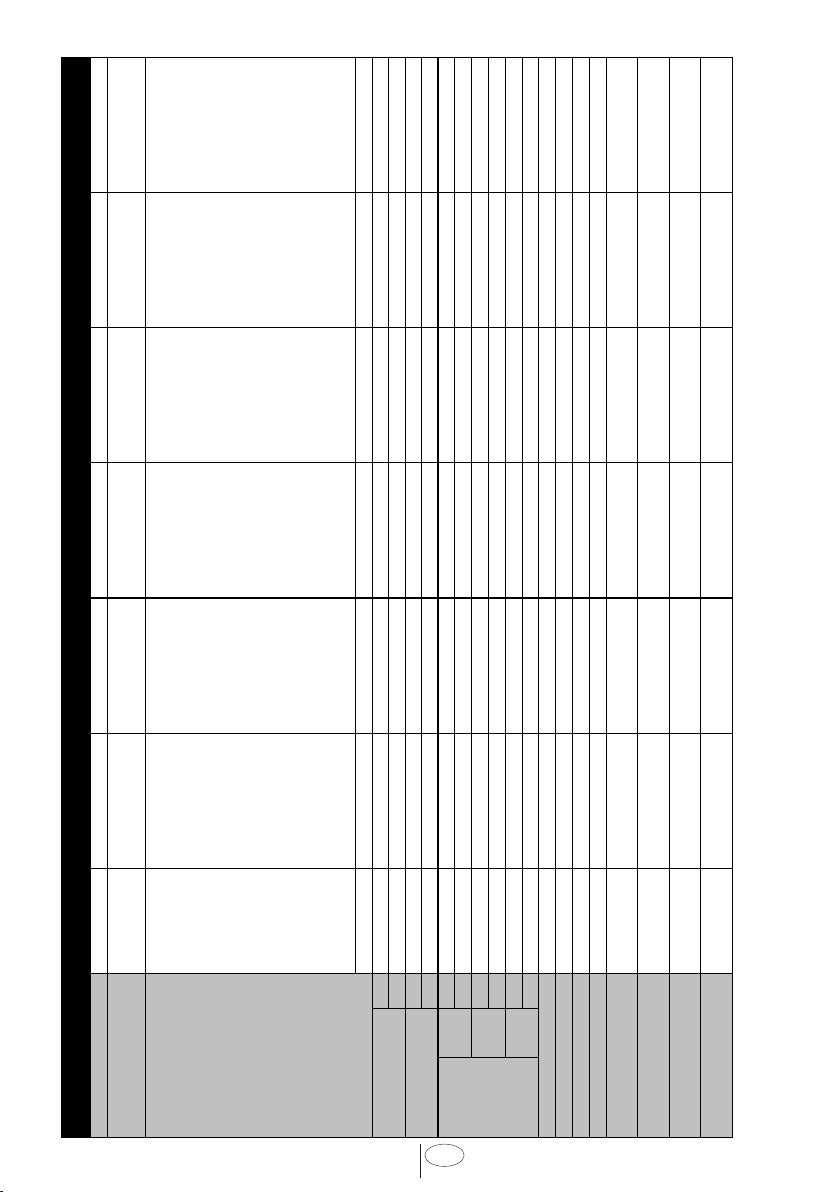
0
123456
InnerClean
Heavy+ Normal * Delicate Quick&Shine Express Rinse & Hold
This programme is
recommended to be
operated on every 1-2
months for machine
cleaning and necessary
hygiene.
Suitable for heavily
soiled dishes, pots and
pans.
Suitable for regular,
daily, or typical use to
completely wash and
dry a full load of
normally soiled dishes.
Suitable for delicate
items and for the
dishes that are not pre-
cleaned but to be
washed immediately.
Suitable for cleaning
lightly and fresly soiled
dishes while saving
time.
Suitable for lightly
soiled dishes that are
scraped or pre-cleaned.
Suitable for removing
the remnants on the
soiled dishes that will
be kept waiting in the
machine for a few
days, and thus, for
preventing the bad
odor buildup.
-
High Medium Few Few - Medium Few -
(°C)
72
70 50-55 48 47 45 0
(°F)
160
162 122-131 118 116,6 113 0
(°C)
70
72 61-67 65 71 55 0
(°F)
140
158 142-157 149 160 131 0
ml
40
40 25-40 25 25-40 15-25 -
tsp
8
85-855-83-
5-
ml
-
40 25 15-25 25 15 -
tsp
-
8 53-
55 3 -
ml
-
25-40 15-25 15 15-25 15 -
tsp
-
5-8 3-5 3 3-5 3 -
-
++---
-
+++++
-
++++-
-
++---0
76
122 100-135 65 58 35 15
15,2
20,2 8,8-21,2 12,0 10,4 11,6 4,2
3,80
5,34 2,32-5,60 3,17 2,70 3,10 1,10
M
T, E, Y, F, R, Z, H, M, K T, E, R, Z, H, M, K T, E, Y, F, R, M, K T, E, R, M T, E, M -
Programme Data and Average Consumption Values Table
Loading Capacity: 15
The consumption values shown in the table were determined under standard conditions. For this reason, deviations are possible under practical conditions. * The energy-usage label is based on this program.
Hard
water
Medium
water
Soft
water
Recommended
detergent
amount
Program number
Program name
Wash Temperatures
Selectable functions
Rinse Temperatures
Degree of dirtiness
Sanitize
Water (gallons)
Wash
Main wash
Dry
Duration (minutes)
Water (liters)
#
Sensitivity: Public
22
USA
6.4 AUXILIARY FUNCTIONS
Washing programs of your dishwasher are
designed to obtain the best cleaning result,
considering the type of the soil, soiling
degree and properties of the dishes to be
washed.
Auxiliary functions are provided in order
to enable you to save time, water and
energy and to perform a more comfortable
washing with conditions specific to you.
C
Auxiliary functions may cause
changes in the program
duration.
C
Auxiliary functions are not
suitable for all washing
programs. Indicator of the
auxiliary function that is not
compatible with the program
will not be active.
To add auxlary functon to the
programe:
1. Select the desired washing programe
by pressing the programe selection
key.
2. In the selected washing programe,
if auxiliary function is selected, its
symbol will be displayed on the screen.
If the function button is pressed again
the symbol will disappear and selection
is cancelled.
3. Selection will be cancelled when you
press the function key again.
Fast+ functon (F)
(depends on the model)
By enabling the selected program to wash
at higher pressure and temperature, it
shortens the washing time and reduces the
amount of water.
SteamGloss functon (E)
(depends on the model)
This function enables high level of drying
performance. It can extend the duration of
the selected program up to 30 minutes.
Santze Functon
Sanitize function raises the water
temperature in the final rinse to meet the
requirements of NSF/ANSI STANDARD
184 for Residential Dishwashers. Certified
residential dishwashers are not intended
for licensed food establishments.
At the end of a succesfull sanitization
“S“ is displayed on the display. “S” is not
displayed on the display if the cycle is
interrupted or the water could not be
heated to the required temperature.
Available programs are indicated on
Program Table chart.
Note: Only sanitizing cycles have been
designed to meet the requirements
of NSF/ANSI Standard 184 for soil
removal and sanitization efficacy.
There is no intention, either directly or
indirectly, that all cycles have passed
sanitization performance tests.
EverClean
Functon (M)
(depends on the model)
When you activate this function, your
micro filter is cleaned with a special system
at the end of the wash and is ready for
the next machine use. Depending on the
using conditions, this process extends
the cleaning period of the micro filter and
increases the washing performance of
the machine. In order to use this function
effectively, it is recommended to use it in
every wash.
23
USA
Interor Lghtng
(Select Models)
Some models have interior lighting to
illuminate the interior when the door is
opened.
Changng the nteror lghtng
settng
1. After turning on the machine,
press Time Delay and P+ keys
simultaneously. Continue to press until
the countdown 3, 2, 1 is completed on
the display.
2. Press P+ key to activate the L: option.
The interior lighting is turned off at
"L:0" option and turned on at "L:1"
option. Set the desired option with the
Time Delay key.
3. Turn off the machine with On/Off key
to save the changes.
Floor llumnaton
Illumnates to show program s
stll runnng.
(Select Models)
Your machine reflects a light to the floor
during the washing process. This light turns
off after the washing process is complete.
Floor illumination cannot be cancelled
by the user.
6.4 PROGRAMMING THE
WASHING TIME
Tme Delay
If an economical electricity tariff is applied
in your region, you can use the Time
Delay function to wash your dishes during
appropriate hours.
You can delay the start of the selected
program until 24 hours. Time Delay cannot
be set after the programme starts.
1. Press the Time Delay function key after
selecting the washing programme and
other auxiliary functions.
2. Once you press the Time Delay key,
Display Information Line will show
"0:30" and Time Delay indicator will
start flashing.
3. Set the desired time by pressing the
Time Delay key. Time will increase
with increments of 30 minutes up
to 6 hours and after that in 1 hour
increments up to 24 hours every time
you press the key.
4. Press Start / Pause / Cancel key to
start countdown for the Time Delay.
Time Delay indicator and Start / Pause
indicator will light continuously until
the end of the period. Time Delay is
displayed on the Display Information
Line. Selected programme will start as
soon as the countdown is over.
Changng the settngs whle Tme
Delay functon s enabled
While the Time Delay function is activated,
you cannot make changes in the washing
programme, auxiliary functions or the
duration of delay time.
C
Programme and auxiliary
functions cannot be set/
changed after the programme
has started.
Changng Warnng Sound Volume
Your machine is equipped with an audio
signal to inform warnings audibly.
1. After turning on the machine,
press Time Delay and P+ keys
simultaneously. Continue to press until
the countdown 3, 2, 1 is completed on
the display.
2. Press P+ key to activate the S position.
3. Select one of S1, S2 and S0 with Time
Delay key.
4. Turn off the machine with On/Off
button to save the changes.
24
USA
C
Your machine performs
water softening depending
on the hardness level of the
supply water. Remaining
time displayed towards the
end in some programmes can
be different from the time
indicated at the beginning
due to this process. The
total time can also change
while the programme is
running depending on the
ambient temperature where
your machine is installed,
temperature of the supply
water and amount of the
dishes.
C
Pay attention not to open the
door of the machine when it is
running. Stop the machine by
pressing Start / Pause / Cancel
key if you have to open the
door. Then, open the door of
the machine. There may be a
rush of vapour when you open
the door of your machine; be
careful. Close the door of your
machine and press Start/Pause/
Cancel key again. Programme
will resume running.
C
The machine will remain silent
in pause mode for some time
in order to remove the water in
the machine and on the dishes
completely and to have the
water softener cleaned, and
then it will resume running in
drying mode.
To cancel the Tme Delay functon
1. Press and hold Start / Pause / Cancel
key for 3 seconds.
2. When the Start / Pause / Cancel key
is pressed and hold, "3", "2", "1" appear
on the Display Information Line. Time
Delay indicator will turn off at the
end of the cancellation process and
delaying process is cancelled.
C
You can select and start a
new programme following
the cancellation of Time Delay
function.
C
Time Delay function can not be
set after the programme starts.
6.5 STARTING THE
PROGRAMME
To start your machine after selecting the
programme and auxiliary functions, press
Start / Pause / Cancel key.
Once the programme starts a tune is
played and the estimated time remained
to the end of the programme will appear
on the Display Information Line. Start /
Pause / Cancel indicator starts lighting
continuously.
C
If the door is opened while the
machine is running, the machine
will switch to the standby
mode. Close the machine door
and press Start/Pause/Cancel
button. The programme will
resume.
25
USA
6.6 CHILD KEY LOCK
You may prevent other people from
interrupting and changing the programme
cycle and time delay while the machine is
running.
To actvate the Chld Lock:
1. Pres Child (Key) Lock keys
simultaneously and hold for 3 seconds.
2. "3", "2", "1" is displayed on Display
Information Line and key lock is
activated.
C
Child Lock prevents the selected
programme or functions from
being changed and disables the
Start / Pause / Cancel key.
C
Child Lock does not lock the
door of the machine.
C
If you turn your machine o
by using On/O key at the
end of the programme, the
Child Lock will be deactivated
automatically.
C
For energy saving, the product
is automatically turned o
following the completion of the
programme or if the programme
is not started.
To deactvate the Chld Lock:
1. Pres Child (Key) Lock keys
simultaneously and hold for 3 seconds.
2. "3", "2", "1" is displayed on Display
Information Line and key lock is
cancelled.
6.7 CANCELLING THE
PROGRAMME
1. Press Start/Pause/Cancel key for 3
seconds to cancel the programme.
2. Release the key when the Start / Pause
indicator starts flashing. For a couple
of minutes the machine will fulfill
the necessary operations required to
cancel the programme.
C
There might be residues of
detergent or rinse aid left in the
machine and / or on the pieces
being washed depending on the
step the programme you have
cancelled was in.
6.8 SALT INDICATOR
Please check the salt indicator on the
display to see whether there is adequate
amount of softening salt in the dishwasher
or not. You need to refill the salt reservoir
with salt whenever salt warning indicator
appears on the display of your machine.
C
Adjusting the water hardness
level is explained in Water
Softening System section.
6.9 Rnse Ad ndcator ( )
Please check the rinse aid indicator on the
display to see whether there is adequate
amount of rinse aid in the dishwasher or
not. You need to refill the rinse aid reservoir
with rinse aid whenever rinse aid warning
indicator appears on the display of your
machine.
Adjustng the amount of rnse ad
1. After turning on the machine,
press Time Delay and P+ keys
simultaneously. Keep them pressed
until the countdown 3, 2, 1 is
completed on the display.
2. Press P+ to move to position P on the
display.
3. Set to the appropriate level with the
Time Delay key.
4. Turn off the machine with On/Off key
to save the changes.
26
USA
No rinse aid dispensed in P:0 wash position.
1 dose of rinse aid is dispensed in P:1
position.
2 doses of rinse aid are dispensed in P:2
position.
3 doses of rinse aid are dispensed in P:3
position.
4 doses of rinse aid are dispensed in P:4
position.
6.10 END OF PROGRAMME
End of Programme indicator will light up
once the washing programme is over.
1. Press the On/Off button to turn off your
machine.
2. Close the tap.
3. Unplug the machine from the socket.
C
For energy saving, the product
is automatically turned o
following the completion of the
programme or if the programme
is not started.
C
Leave your dishes in the
machine for about 15 minutes
to cool down after they are
washed. Your dishes will dry
in a shorter time if you leave
the door of your machine
ajar during this period. This
process will increase the drying
eectiveness of your machine.
6.11 WATER CUTOFF
WARNING
If mains water is cut or water inlet tap is
turned off the machine cannot take water
in and E:02 icon will flash on the programme
indicator. As long as the problem continues,
washing programme is paused and the water
inlet is checked regularly by the machine;
when the water is restored E:02 icon will
disappear after a while and the washing
programme resumes.
6.12 OVERFLOWING
WARNING
If the machine intakes too much water or
there is leakage at any of the components
then the machine will detect this and E:01
icon will flash on the Programme indicator.
As long as the overflowing continues
safety algorithm will be active and try
to discharge the water. If overflowing
stops and safety is assured, E:01 icon
will disappear. If E:01 does not disappear,
there is a permanent fault. In this case the
authorised service should be contacted.
InnerClean
This program is recommended to be
operated on each 1-2 months for machine
cleaning and necessary hygiene. The
program should be operated while the
machine is empty.
In order to achieve an efficient result, it is
recommended to use together with special
machine cleaning agents.
C
Do not use this program to clean
dishes. As it operates in high
temperatures, it is harmful for
the dishes.
27
USA
7. DETERGENT
You can use powder, liquid/gel or tablet
detergents in the machine.
Only use in the machine the
detergents produced particularly for
use with dishwashers. We recommend
you not to use detergents that contain
chlorine and phosphate as they are
harmful for the environment.
7.1 ADDING DETERGENT
Pay attention to the warnings on the
detergent packaging to get better
washing and drying results. Contact
the manufacturer of the detergent for
further questions.
Do not put solvents into the detergent
dispenser. There is the risk of
explosion!
Put the detergent into the detergent
dispenser just before operating the
machine as illustrated below.
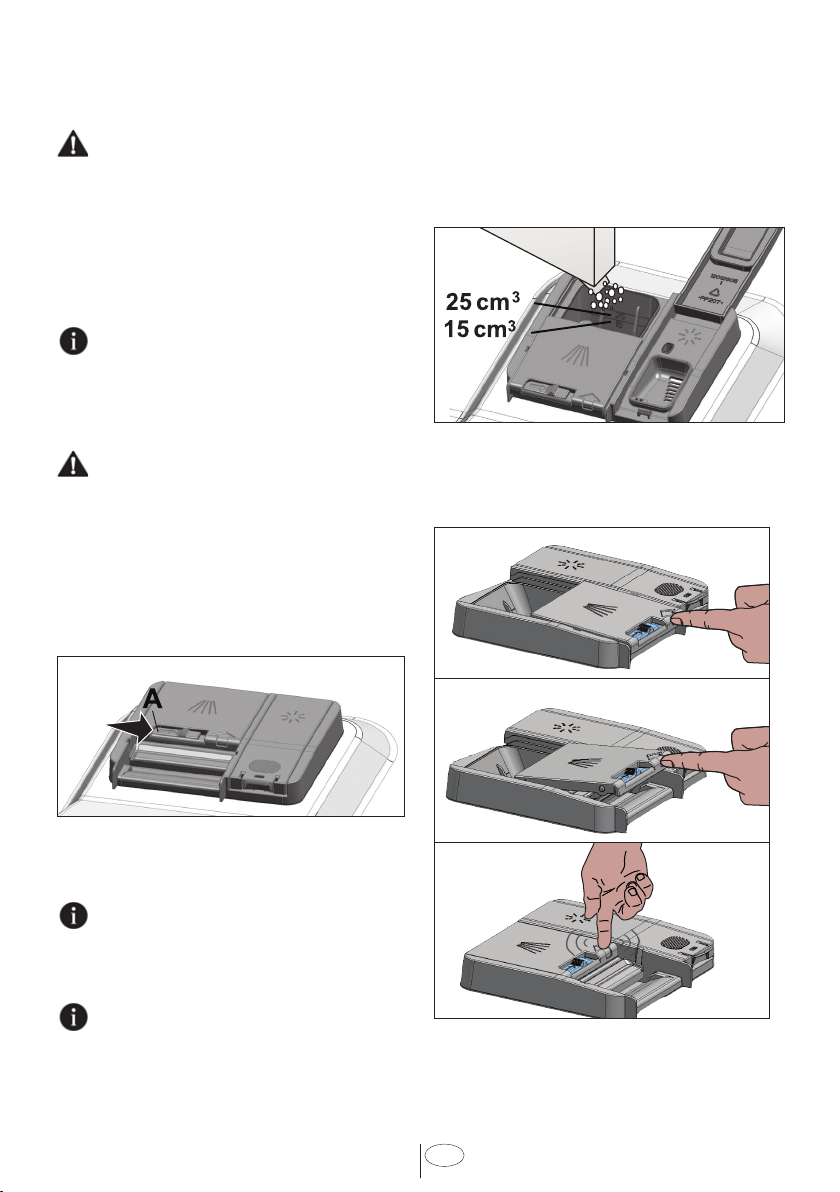
1. Push the latch to right to open the
detergent dispenser lid (A).
2. Put suggested amount of powder,
liquid/gel or tablet detergent in the
reservoir.
For suggested amount of detergent;
depending on the hardness level of the
tap water and the program selected
look at Program Table.
Inside the detergent dispenser there
are level markings that help you
use appropriate amount of powder
detergent. When brimful, detergent
dispenser will contain 1.5 Ounces (45
cm³) of detergent. Fill detergent up
to .5 Ounces (15 cm³) or .85 ounces
(25 cm³) level marks in the detergent
dispenser according to fullness of the
machine and/or soiling degree of the
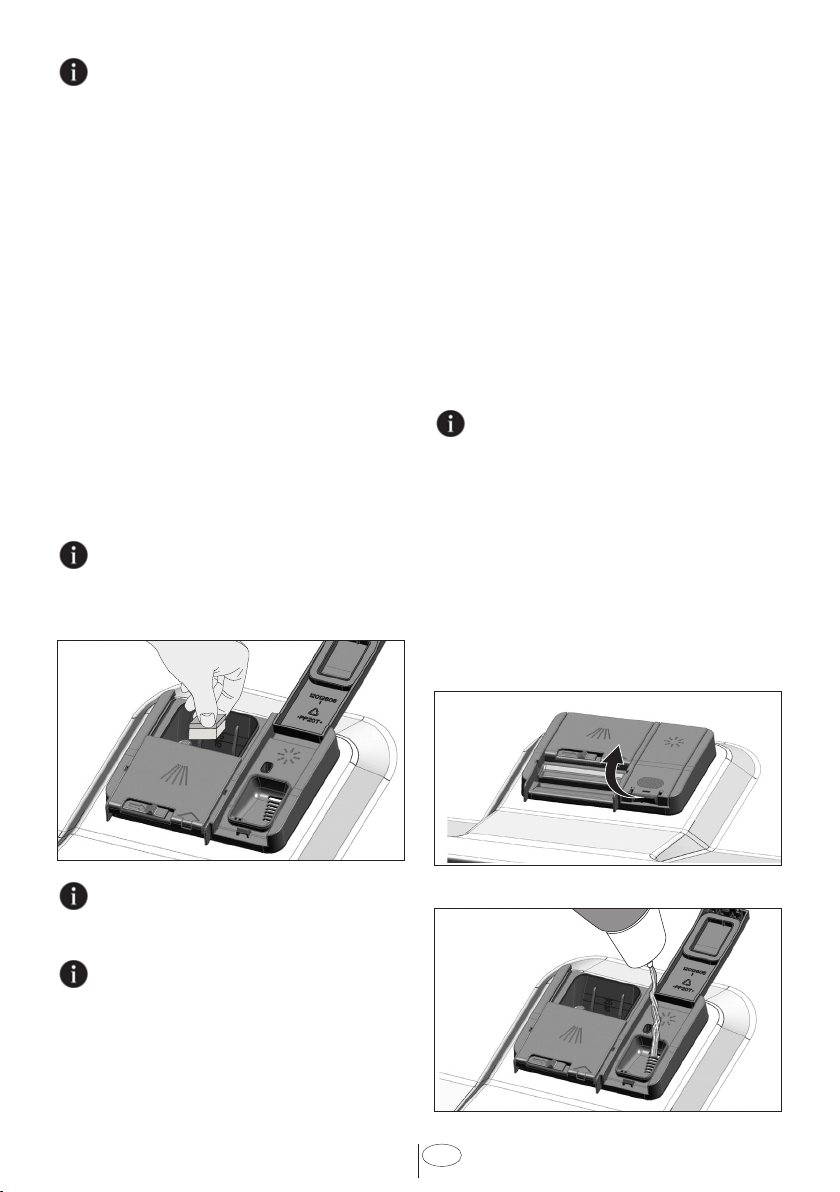
dishes. One tablet is enough if you are
using detergent tablets.
3. Push the lid of the detergent dispenser
to close it. A "click" will be heard when
the lid is closed.
1
2
3
28
USA
When you swtch to powder
detergent from tablet detergent:
1. Make sure that salt (Select Models) and
rinse aid reservoirs are full.
2. Set the water hardness to the highest
level and perform an empty run.
3. After the empty washing cycle, review
the user manual and readjust the
water hardness level so as to suit the
water supply.
4. Make the appropriate rinse aid
settings.
7.3 RINSE AID
The rinse aid used in dishwashers is
a special combination that aims to
increase drying efficiency and prevent
water or lime stains on the washed
items. For this reason, care must be
paid to have rinse aid in the rinse
aid reservoir and to use rinse aids
produced specially for dishwashers
only.
1. Open the lid of the rinse aid reservoir
with the help of the latch.
2. Fill the reservoir until “MAX” level.
Use powder or liquid/gel detergent
in short programs without prewash
since the solubility of the tablet
detergent changes depending on the
temperature and time.
7.2 TABLET DETERGENTS
In addition to the conventional tablet
detergents, there are also commercially
available detergent tablets that show
water softening salt and/or rinse aid
effect. Some types of these detergents
contain special-purpose components such
as glass and stainless steel protectors.
These tablets show their effects up to
a certain water hardness level (59 gpg).
Water softening salt and rinse aid must
also be used together with the detergent
if the water hardness level is above the
mentioned level.
The best washing performance in
dishwashers is obtained by using
detergent, rinse aid and water
softening salt individually.
Observe the instructions of the
detergent manufacturer on the
package when using tablet detergents.
Contact the detergent manufacturer
if your dishes are wet and/or if you
notice limescale spots particularly
on your glasses after the washing
program is over when using a tablet
detergent.
29
USA
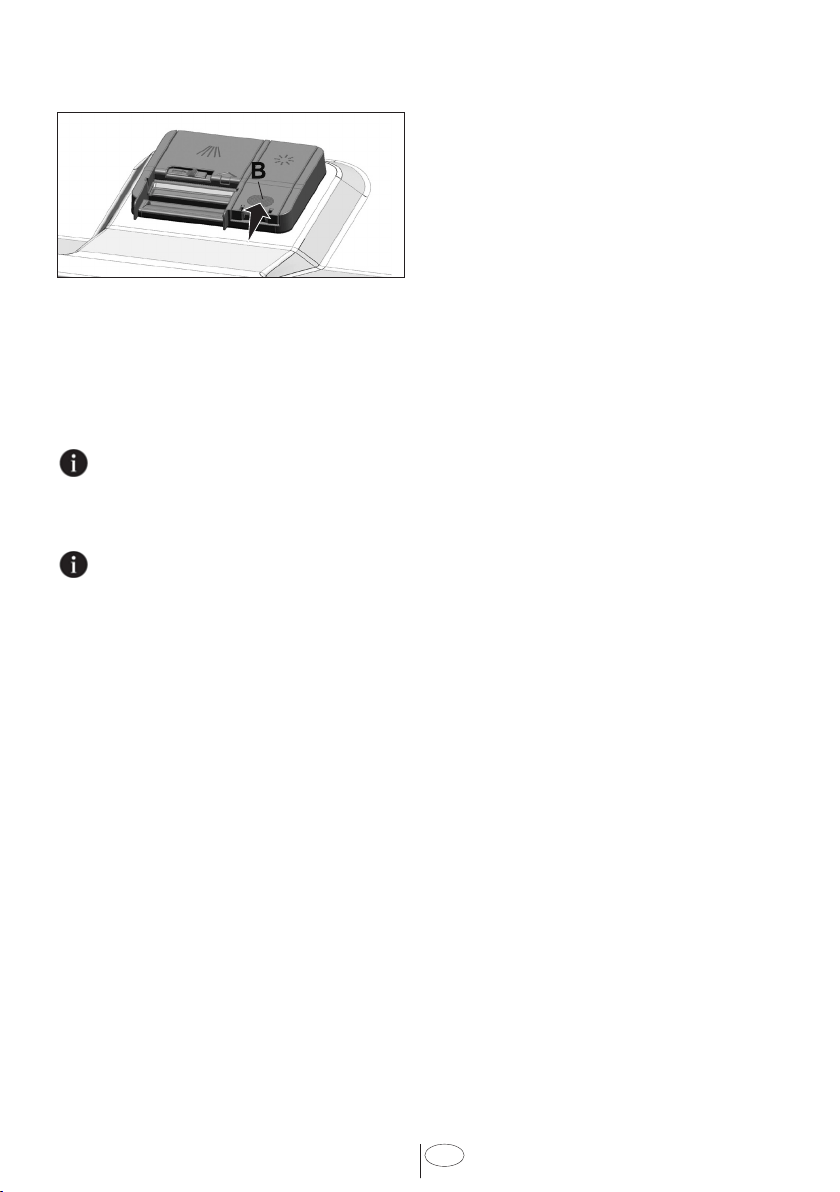
3. Slightly press the point (B) of the
reservoir lid to close it.
4. If there are stains on tableware items
after washing, level must be increased
and if there is a blue trace after wiping
them by hand, it must be decreased.
This is set to position 3 as factory
default.
The rinse aid adjustment is described
under “Adjusting the amount of rinse
aid” in the section for operating the
machine.
Wipe clean any spilled rinse aid outside
the reservoir. Rinse aid that spilled
accidentally will cause foaming and
it will eventually decrease washing
performance.
30
USA
8. ADJUSTING THE WATER SOFTENING SYSTEM
(Select Models)
Cleaning, rinsing and drying performance of your dishwasher will increase when water
softening system is adjusted properly.
Adjust the new water hardness level according to the Water hardness level instruction in
this booklet.
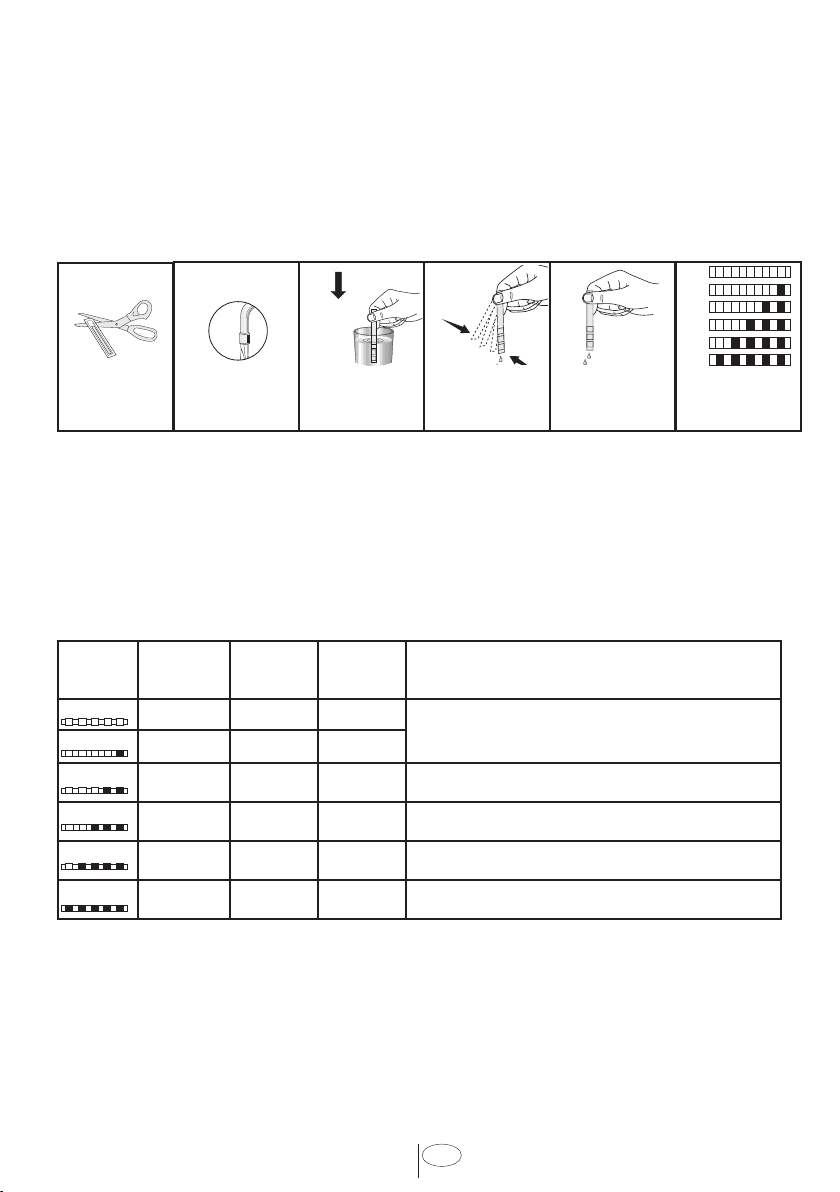
Use the test strip supplied with the product according to the steps given below to
determine hardness level of your supply water.
a b
c
d e f
Remove the test
strip from the
packet.
Turn on the tap and
let the water run for
about a minute.
Hold the test strip in
the water for about
a second.
Remove the test
strip from the water
and shake it.
Wait for 1 minute. The test strip shows
you the hardness
level.
1 Second
1 Minute
1 min.
After determining hardness level of the supply water:
1. Turn on the machine, press Time Delay and P+/P keys simultaneously. After the
countdown (3,2,1) is displayed keep the keys pressed for a while.
2. Press P+/P key to activate the (r..) position.
3. Using Time Delay key, adjust water hardness level according to the hardness of the
supply water. See “Water hardness level adjustment table” for correct setting.
4. Press On / Off key to save the setting.
Water hardness level adjustment table
Hardness
Level
Grains Per
Gallon (gpg)
German Water
Hardness °dH
French Water
Hardness °dF
Water Hardness Level Indicator
0th Level
0-14 0-4 0-8
Press the Time Delay key to switch the water hardness level
to position 1. (r1)
1st Level
15-22 5-7 9-13
2nd Level
23-37 8-12 14-22
Press the Time Delay key to switch the water hardness level
to position 2. (r2)
3rd Level
38-46 13-15 23-27
Press the Time Delay key to switch the water hardness level
to position 3. (r3)
4th Level
47-58 16-19 28-34
Press the Time Delay key to switch the water hardness level
to position 4. (r4)
5th Level
59-154 20-50 35-90
Press the Time Delay key to switch the water hardness level
to position 5. (r5)
If the hardness level of the supply water is above 154 gpg (grains per gallon) or if you are
using well water, then it is recommended to use water purification devices and special
filters.
31
USA
If the hardness level of the supply water is
below 22 gpg, there is no need to use salt
in your dishwasher. If this is the case, “No
Salt Warning Indicator” (if any) illuminates
continuously on the panel of your machine.
If the water hardness level adjustment
is set to level 1, the “No salt warning
indicator” will illuminate continuously
although it is not necessary to use salt. If
you use salt under this condition, salt will
not be consumed and the Salt indicator will
not illuminate.
If you move your house, it is necessary
to readjust water hardness level of
your machine by considering the
information given above according to
the hardness level of the supply water
in your new location. Your machine
will display the most recently adjusted
water hardness level.
9. FILLING THE
DISHWASHER SALT
DISPENSER
(Select Models)
Water softening system needs to be
regenerated in order for the product
operates with the same performance
continuously. Dishwasher salt is used for
this purpose.
Use only special softening salts
produced particularly for the
dishwashers in your machine.
It is recommended to use granule- or
powder-formed softening salts in the
water softening system. Do not use
salts that do not completely dissolve
in water such as table salt or rock salt.
Otherwise the performance of the
system may deteriorate in time.
Salt reservoir will be filled with water
when you start the product. For this
reason, add salt before operating the
machine.
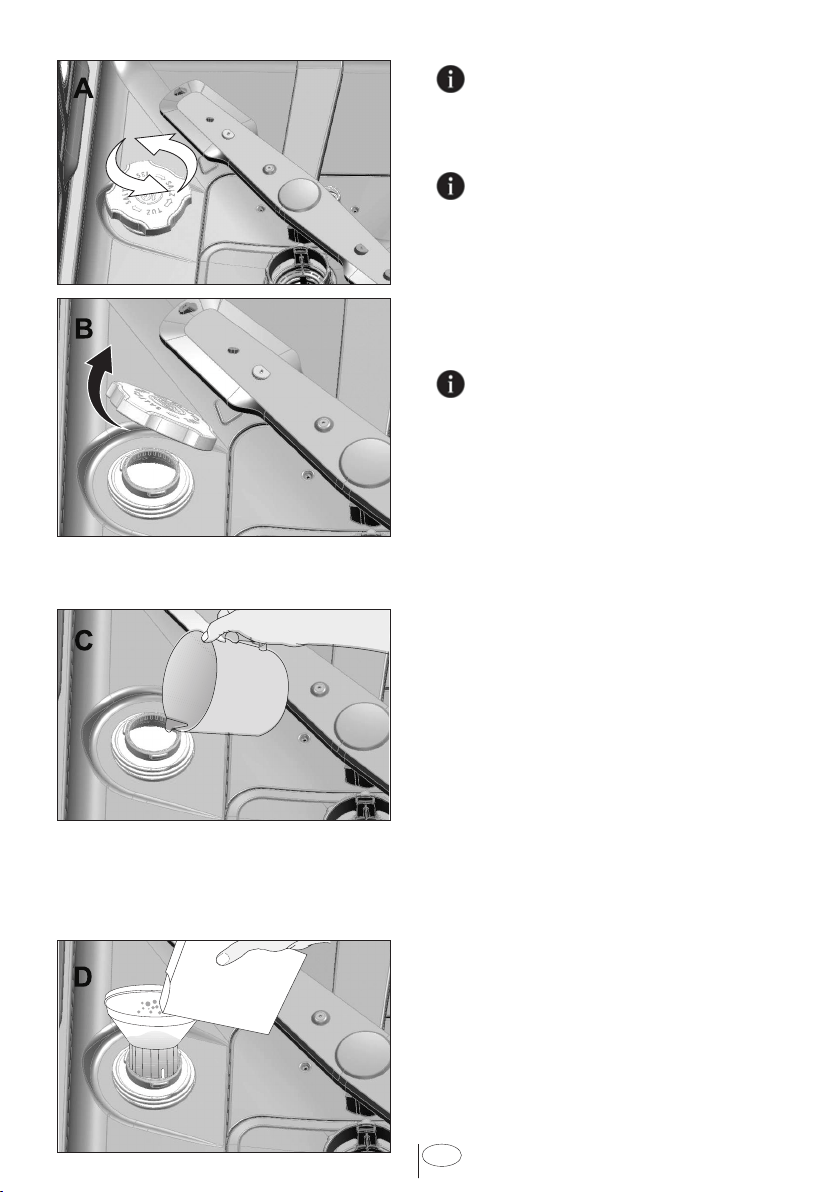
1. Firstly, take the lower basket out to
add softening salt.
2. Turn the salt reservoir lid counter-
clockwise to open it (A, B).
32
USA
3. Add 4 cups of water to salt reservoir of
your machine only in initial use (C).
4. Fill the salt reservoir with salt by
using the salt funnel (D). To speed up
dissolution rate of salt in water, stir it
with a spoon.
You can put about 4.4 Pounds of
softening salt into the salt reservoir.
5. Replace the lid and tighten it when the
reservoir is full.
You need to add salt right before
starting the machine. Thus, the
overflowing salty water will be
flushed immediately, preventing the
risk of corrosion in machine. In cases
where you would not start washing
immediately, run your machine empty
in the shortest program.
Since different salt brands in the
market have different particle sizes
and since the water hardness may
vary, dissolution of the salt in water
may take a couple of hours. Therefore,
Salt Indicator remains on for a while
after adding salt into the machine.
33
USA
10. CARE AND
MAINTENANCE
WARNING:
Before cleaning or
carrying out maintenance, switch off
the appliance, disconnect the mains
plug and turn off the water tap.
WARNING:
Do not repair or replace
any part of the dishwasher or attempt
any servicing unless specifically
recommended by this manual. We
recommend that the dishwasher only
be repaired by an authorized service
agent.
CAUTION :
To avoid the possibility
of slipping, keep the floor around the
dishwasher clean and dry. Keep your
appliance free from the accumulation
of combustible materials, such as lint,
rags, and chemicals.If the dishwasher
is not in use for an extended period of
time, we recommend you check that
the baskets are empty, leave the inside
of the dishwasher clean, the door
cracked open to allow air to circulate,
turn off both the power and water
supply to the dishwasher.
10.1 CARING FOR YOUR
DISHWASHER EXTERIOR
CAUTION :
Possible dishwasher
damage: Abrasive cleaners, scouring
pads, abrasive cloths (paper towels)
can damage the dishwasher decorative
door.
Cleaning the control panel:
Use only
soft cloth that is lightly dampened with
mild detergent. Clean the control panel only
with a moist cloth and clear water.
Cleaning the colored doors:
Use only
soft cloth that is lightly dampened with
mild detergent.
Cleaning the stainless steel doors:
Use a soft cloth with a cleaner made for
cleaning stainless steel. For the best
results, apply the stainless steel cleaner
to a soft cloth and wipe the surface in the
direction of the grain.
Cleaning the door gasket:
Regularly
clean the door gasket with a damp cloth to
remove food particles and other debris. Use
a gentle household cleaner for the outside
and the door seals, and rinse thoroughly.
10.2 CARING FOR YOUR
DISHWASHER INTERIOR
NOTICE:
Cleaning your dishwasher
at regular intervals ensures longer
product life and reduces the risk of
recurring problems. Always disconnect
the power to machine before cleaning.
CAUTION :
When cleaning the
underside of the main filter, care must
be taken on the sharp outer edge to
avoid the risk of cut type injuries.
34
USA
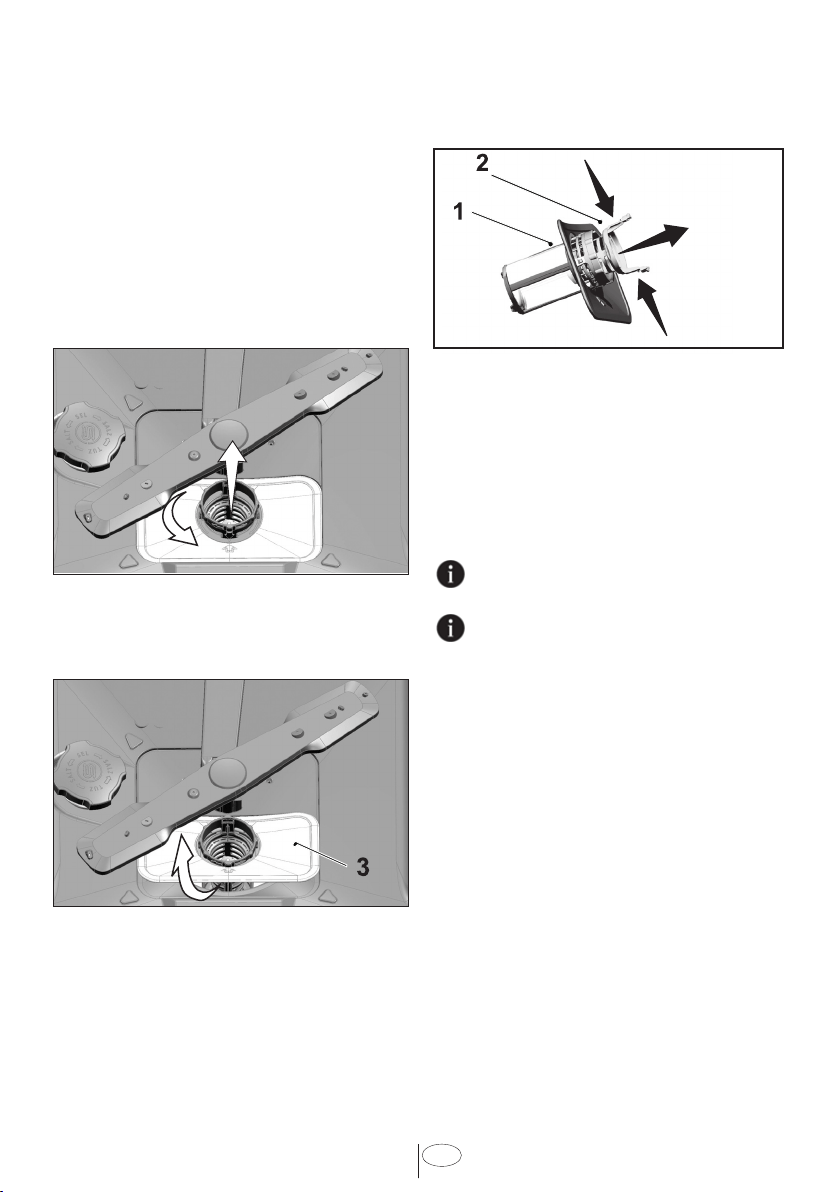
3. Press the two pawls on the coarse
filter inwards and separate the coarse
filter from the assembly.
4. Clean all three filters under tap water
by means of a brush.
5. Replace the metal/plastic filter.
6. Place the coarse filter into the
microfilter. Make sure that it is properly
seated. Turn the coarse filter clockwise
until a “click” sound is heard.
Do not use the dishwasher without
filter.
Incorrect placement of the filters will
reduce washing efficiency.
10.3 CLEANING THE FILTERS
Clean the filters at least once a week in
order for the machine operates efficiently.
Check if food residues are left on the filters.
If there are food residues on filters, take
them out and clean well under running
water.
1. Turn the micro filter (1) and coarse
filter (2) assembly counterclockwise
and pull it out from its seating.
2. Pull out the metal / plastic filter (3)
from the seating.
35
USA
10.4 CLEANING THE HOSE
FILTER
Damages on the machine that may be
caused by impurities coming from the
urban supply water or your own water
installation (such as sand, dirt, rust, etc.)
can be prevented by means of the filter
attached to the water inlet hose. Check the
filter and the hose regularly and clean them
if necessary.
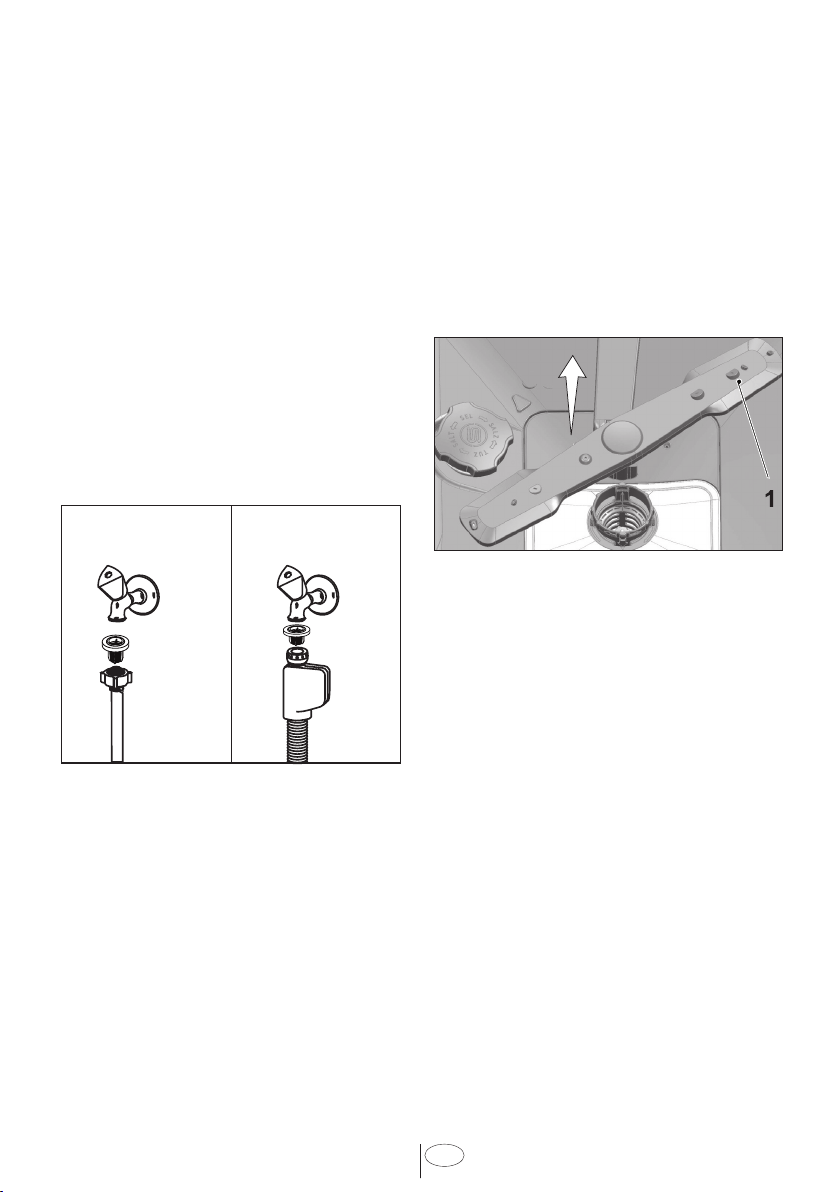
1. Turn off the tap and remove the hose.
2. After taking out the filter, clean it
under running tap water.
3. Place the cleaned filter back to its seat
in the hose.
4. Install the hose to tap.
(Select Models)
10.5 CLEANING THE WASH
ARMS
Clean the impellers at least once a week in
order for the machine operates efficiently.
LOWER IMPELLER
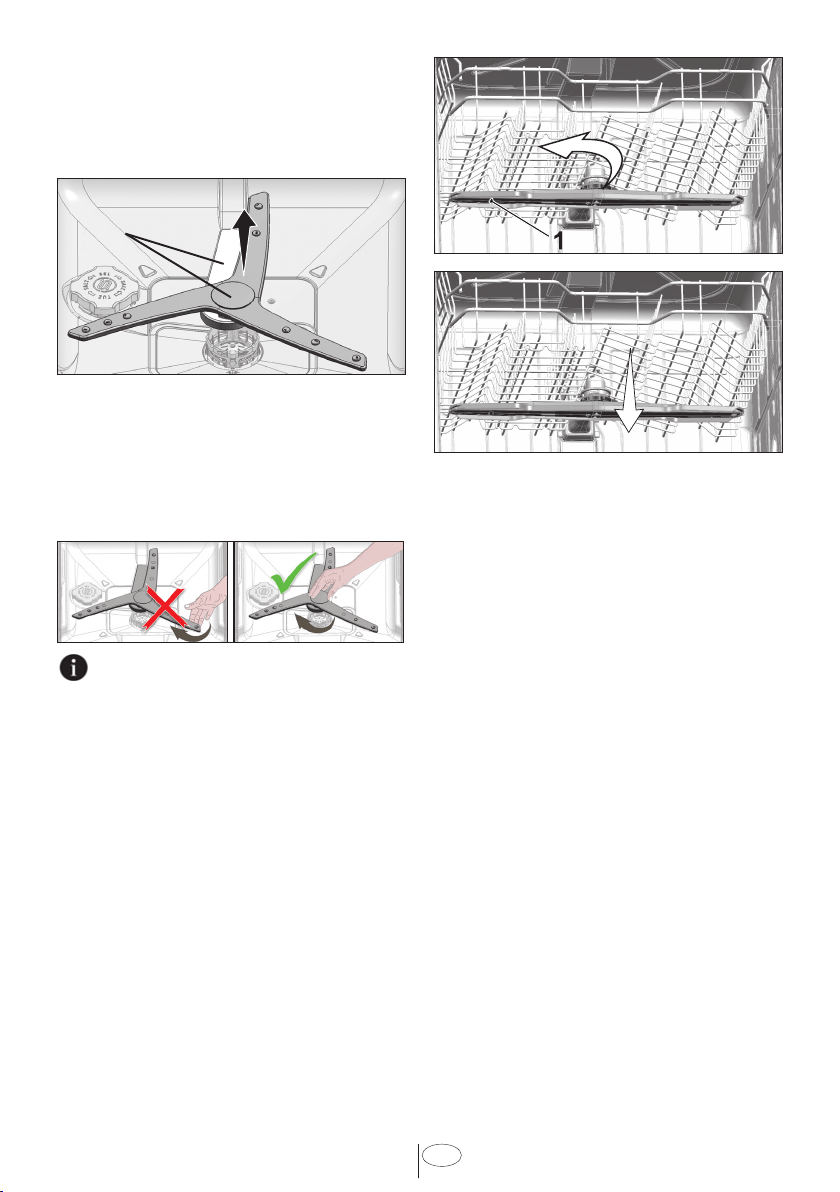
Check if the holes on the lower impeller (1)
are clogged. If they are clogged, remove
and clean the impeller. You can pull the
lower impeller up to remove it.
(Select Models)
36
USA
Check if the holes on the lower impeller
assembly are clogged. If they are clogged,
remove and clean the impeller assembly.
(Select Models)
C
To remove and clean the lower impeller
assembly together, hold by one hand from
the (C) points shown in the figure and pull
up to remove. After cleaning, follow these
steps in reverse order to reinstall the
impeller assembly.
Do not try to rotate the impeller by
holding its ends. Trying to rotate the
end sections may cause the gear
system within the impeller to break.
UPPER IMPELLER
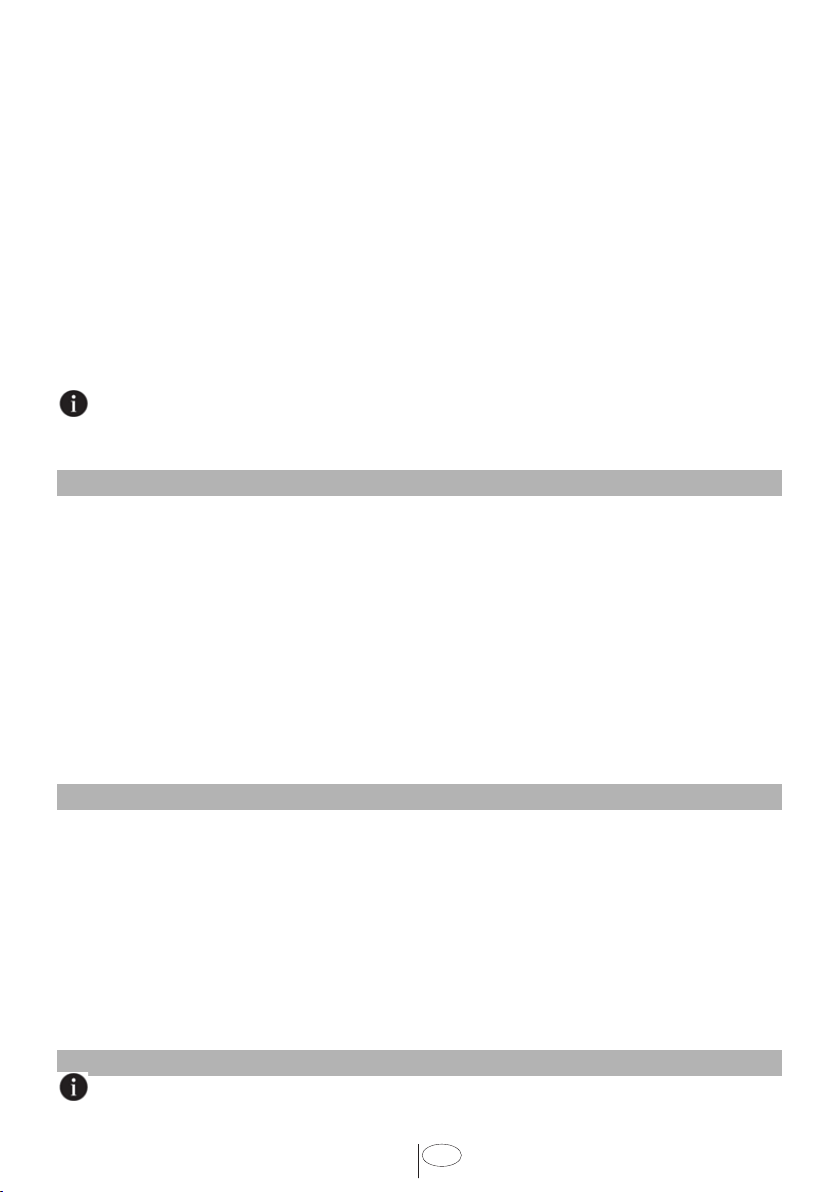
Check if the holes on the upper impeller (1)
are clogged. If they are clogged, remove
and clean the impeller. Turn its nut to left
to remove the upper impeller.
Make sure that the nut is tightened well
when installing the upper impeller.

37
USA
11. TROUBLESHOOTING
Machine does not start.
• Power cable is unplugged. >>> Check if the power cable is plugged in.
• Cicuit Breaker is blown. >>> Check the Cicuit Breaker in your house.
• Water is cut. >>> Make sure that the water inlet tap is open.
• Door of the machine is open. >>> Make sure that you have closed the door of the
machine.
• On / Off button is not pressed. >>> Make sure that you have turned on the machine
by pressing the On / Off button.
Dishes are not washed clean
• Dishes are not placed orderly in the machine. >>> Load the dishes as described in the
user manual.
• Selected program is unsuitable. >>> Select a program with a higher temperature and
cycle time.
• Wash arms are stuck. >>> Prior to starting the program, turn the lower and upper
Wash arms by hand to make sure that they rotate freely.
• Wash arms holes are clogged. >>> Lower and upper Wash arms holes might be
clogged with small food particles and debris. Clean the Wash arms regularly as
illustrated in section “Cleaning and Care”.
• Filters are clogged. >>> Check if the filter system is clean. Clean the filter system
regularly as illustrated in section “Cleaning and Care”.
• Filters are installed incorrectly. >>> Check the filter system and make sure that it is
installed correctly.
• Baskets are overloaded. >>> Do not overload the baskets in excess of their capacity.
• Detergent is stored under unsuitable conditions. >>> If you are using powder
detergent, do not store the detergent package in humid places. Keep it in a closed
container if possible. For ease-of-storing, we recommend you to use tablet
detergents.
• Detergent is not sufficient. >>> If you are using powder detergent, adjust the
amount of detergent according to the soiling degree of your dishes and/or program
definitions. We recommend you to use tablet detergents for optimum results.
• Rinse aid is not sufficient. >>> Check the rinse aid indicator and add rinse aid if
necessary. Increase the rinse aid setting if there is enough amount of rinse aid in the
machine.
• Detergent dispenser lid is left open. >>> Make sure that the detergent dispenser lid is
closed tightly after adding detergent.
Dishes are not dry at the end of cycle
• Dishes are not placed orderly in the machine. >>> Place your dishes in a way that no
water will accumulate in them.
• Rinse aid is not sufficient. >>> Check the rinse aid indicator and add rinse aid if
necessary. Increase the rinse aid setting if there is enough amount of rinse aid in the
machine.
38
USA
• Machine is unloaded right after the program is over. >>> Do not unload your
machine right after washing process is completed. Slightly open the door and wait
for evacuation of the steam inside for a while. Unload the dishes after the pieces
cool down to a touchable level. Start unloading process from the lower basket. Thus,
dropping of water remained on a piece at upper basket onto the pieces at lower
basket is prevented.
• Selected program is unsuitable. >>> Since rinsing temperature is low at program
with short duration, drying performance will also be low. Select program with longer
duration for a higher drying performance.
• Surface quality of the kitchen utensils is deteriorated. >>> Desired washing
performance can not be obtained at kitchen utensils with deteriorated surfaces and
it is not suitable to use such utensils in terms of hygiene as well. Also, water can not
flow easily on deteriorated surfaces. It is not recommended to wash such kitchen
utensils in dishwasher.
It is normal that drying complaints can be experienced with Teflon kitchen utensils.
It is associated with the structure of Teflon. Since the surface tensions of Teflon and
water are different, water droplets will remain as beads on the Teflon surface.
Stains remaining on dishes when cycle has completed.
• Selected program is unsuitable. >>> Select a program with a higher temperature and
cycle time.
• Surface quality of the kitchen utensils is deteriorated. >>> Tea and coffee stains
or other dye spots may not be cleaned in dishwasher when they have penetrated
in deteriorated surfaces. Desired washing performance can not be obtained at
kitchen utensils with deteriorated surfaces and it is not suitable to use such utensils
in terms of hygiene as well. It is not recommended to wash such kitchen utensils in
dishwasher.
• Detergent is stored under unsuitable conditions. >>> If you are using powder
detergent, do not store the detergent package in humid places. Keep it in a closed
container if possible. For ease-of-storing, we recommend you to use tablet
detergents.
Lime traces remain on dishes and glassware gains a misty appearance
• Rinse aid is not sufficient. >>> Check the rinse aid indicator and add rinse aid if
necessary. Increase the rinse aid setting if there is enough amount of rinse aid in the
machine.
• Water hardness setting is low or salt level is insufficient >>> Measure the hardness
of the supply water appropriately and check the water hardness setting.
• Salt leakage exists. >>> Pay attention not to spill salt around the salt filling hole
while adding salt. Make sure that the salt reservoir lid is tightly closed after finishing
the filling process. Run the prewash program to remove the salt that spilled inside
the machine. Since the salt granules that will remain under the lid will dissolve during
prewash, causing the lid loosen, check the lid once again at the end of the program.
There is a different odor in the machine
A new machine has a peculiar odor. It will fade out after a couple of washing.

39
USA
• Filters are clogged. >>> Check if the filter system is clean. Clean the filter system
regularly as illustrated in section “Cleaning and Care”.
• Dirty dishes are kept in dishwasher for 2-3 days. >>> If you are not going to start
the machine right after you have put the dishes into it, remove the remnants on the
dishes and run the Prewash program without detergent every 2 days. In such cases,
do not close the door of the machine completely in order to avoid odor build up in
machine. You can also use commercially available odor removers or machine cleaners.
Rust, discoloration or surface deterioration occurs on dishes
• Salt leakage exists. >>> Salt may cause deterioration and oxidation on metal
surfaces. Pay attention not to spill salt around the salt filling hole while adding salt.
Make sure that the salt reservoir lid is tightly closed after finishing the filling process.
Run the prewash program to remove the salt that spilled inside the machine. Since
the salt granules that will remain under the lid will dissolve during prewash, causing
the lid loosen, check the lid once again at the end of the program.
• Salty food remnants have remained on dishes for a long time. >>> If silverware soiled
with such foods will be kept waiting in machine, dirt must be removed by prewash or
dishes must be washed without being kept waiting.
• Electric installation is not grounded. >>>Check if your machine is connected to the
actual grounding line. Otherwise, the static electric created in the product causes arcs
on the surfaces of metal items creating pores, removing the protective cover on the
surface and causing discoloration.
• Intensive cleansers such as bleaches are used. >>> Protective cover on metal
surfaces gets damaged and looses its efficiency in time when it gets in contact with
cleansers such as bleach. Do not wash your dishes with bleach.
• Metal items particularly such as knives are used for purposes other then their
intended uses. >>> Protective cover on the edges of knives may get damaged when
they are used for purposes such as opening cans. Do not use metal kitchen utensils
out of their intended uses.
• Silverware are made of low quality stainless steel. >>> Corrosion on such items is
inevitable; they should not be washed in dishwashers.
• Kitchen utensils that are already corroded are washed in dishwasher. >>> Rust on a
corroded item can migrate to other stainless steel surfaces and cause corrosion on
those surfaces as well. Such items should not be washed in dishwashers.
Detergent remains in detergent dispenser.
• Detergent dispenser was damp when adding detergent. >>> Make sure that the
detergent dispenser is dried well prior to filling it with detergent.
• Detergent is added long before the washing process. >>> Pay attention to add
detergent shortly before start-up of the washing.
• Opening of the detergent dispenser lid is prevented during washing. >>> Place the
dishes in a way that will not prevent the detergent dispenser lid from opening and the
water going into the machine from impellers.
• Detergent is stored under unsuitable conditions. >>> If you are using powder
detergent, do not store the detergent package in humid places. Keep it in a closed
40
USA
container if possible. For ease-of-storing, we recommend you to use tablet
detergents.
• Wash Arm holes are clogged. >>> Lower and upper Wash Arm holes might be clogged
with food remnants such as lemon pips. Clean the Wash Arm regularly as illustrated in
section “Cleaning and Care”.
Decorations and ornaments on kitchen utensils are being erased.
Decorated glasses and decorated luster porcelains are not suitable for washing in
the dishwasher. Manufacturers of glassware and porcelain tableware items do not
recommend washing such kitchen utensils in the dishwashers either.
Dishes are scratched.
Kitchen utensils that contains or are made of aluminum should not be washed in
dishwasher.
• Salt leakage exists. >>> Pay attention not to spill salt around the salt filling hole while
adding salt. Spilled salt can cause scratches. Make sure that the salt reservoir lid is
tightly closed after finishing the filling process. Run the prewash program to remove
the salt that spilled inside the machine. Since the salt granules that will remain under
the lid will dissolve during prewash, causing the lid loosen, check the lid once again at
the end of the program.
• Water hardness setting is low or salt level is insufficient >>> Measure the hardness
of the supply water appropriately and check the water hardness setting.
• Dishes are not placed orderly in the machine. >>> When placing the glasses and
other glassware into the basket lean them not against other dishes but the edges
or racks of the basket or the glass support wire. Striking of the glasses to each other
or to other dishes due to the impact of water during washing can cause breaks, or
scratches on their surfaces.
A smear remains on glasses that resembles milk stain which can not be
removed when wiped by hand. A bluish / rainbow appearance occurs when
the glass is pointed to light.
• Excessive rinse aid is used. >>>Lower rinse aid setting. Clean the spilled rinse aid
when adding rinse aid.
• Corrosion has occurred on glass due to soft water. >>> Measure the hardness of the
supply water appropriately and check the water hardness setting. If your supply water
is soft (<15 gpg), do not use salt. Choose programs that wash in higher temperatures
(140-149 degress Fahrenheit). You can also use glass protective detergents that are
commercially available.
Foam forms in the machine.
• Dishes are washed with hand-wash detergent by hand but not rinsed before placing
them into the machine. >>> Hand-wash detergents do not contain antifoam. There
is no need to hand-wash the dishes before placing them into the machine. Removing
the coarse soil on the dishes under tap water, with a sponge or towel.
• Rinse aid has spilled into the machine when adding rinse aid. >>> Take care that rinse
aid is not spilled in the machine when you are filling it. Clean any spilled rinse ait with
the help of a tissue paper/towel.
41
USA
• Lid of the rinse aid reservoir is left open. >>> Make sure that the lid of the rinse aid
reservoir is closed after adding rinse aid.
Kitchen utensils are broken.
• Dishes are not placed orderly in the machine. >>> Load the dishes as described in the
user manual.
• Baskets are overloaded. >>> Do not overload the baskets in excess of their capacity.
Water remains in the dishwasher at the end of the program.
• Filters are clogged. >>> Check if the filter system is clean. Clean the filter system
regularly as illustrated in section “Cleaning and Care”.
• Discharge hose is clogged/blocked. >>> Check the discharge hose. If necessary,
remove the discharge hose, clear the blockage and insert is as illustrated in the user
manual.
If you cannot eliminate the problem although you follow the instructions in this
section, consult your dealer or the Authorized Service Agent. Never try to repair a
nonfunctional product yourself.

42
USA
12. TECHNICAL FEATURES
Load capacity
15 place settings
Permissible water
pressure
4.35 - 145 psi (0.3 - 10 bars)
Electrical connection
120 V (volts), 12 A (amps), 60Hz (hertz)
Total power
1400 W (watts)
Heater power
1100 W (watts)
NOTICE:
Because we continually strive to improve our products, we may change our
specifications and design without prior notice.
This device corresponds to the following directives:
UL 749 Household Dishwasher directive

43
USA
13. WARRANTY STATEMENT FOR THE BEKO
DISHWASHERS
The warranties provided by Beko in
these statements only apply to Beko
dishwashers sold to the original purchaser
or homeowner in the US and Canada. The
warranty is not transferable. To obtain
warranty service, please contact our
nearest distributor as listed by state and
province. You will need your dishwasher
model number, serial number, retailer
name and address, where purchased and
purchase date / installation date. This
warranty gives you specific legal rights, and
you may also have other rights which vary
from state to state. Also, please make sure
you register your product for warranty at
www.beko.us
2 year (*) full warranty from date of
first installation
Beko will repair or replace at no cost to
the consumer any defective parts of the
dishwasher if used under normal household
conditions
(warranty is void if the product
is used commercially e.g., bed
+ breakfast, nursing home etc.).
Service must also be performed by
an authorized Beko service agency.
(Cosmetic defects must be reported
within 10 business days from
installation). 1 year warranty on the
accessories is for the parts only and
doesnot include labor.
2 year*++ limited warranty from
date of first installation (Parts only)
Beko will repair or replace any
parts at no cost to the consumer if
material defects or workmanship
have caused the damage or failure
of these components. Again the
dishwasher must have been used
under normal household conditions
and not commercially as stated
above (Labor charges are the
responsibility of the consumer).
2-5 year (*, **) limited warranty from
date of first installation
(parts only 2-5 years) Beko will repair or
replace any compressors, evaporators,
condensers and dryers at no cost to
the consumer if material defects or
workmanship have caused the damage or
failure of these components.
The dishwasher must have been
used under normal household
conditions and not commercially
(Labor charges are the
responsibility of the consumer)
Disclaimers of warranties and
exclusions:
Warranty does not cover service
costs by an authorized service
agent to correct installation,
electrical problems or educational
instruction on the use of the
dishwasher. The warranty also
does not cover defects or damage
caused by an act of God (such as
storms, floods, fires, mudslides,
etc.), damage cause by use of the
dishwasher for purposes other than
those for which it was designed,
misuse, abuse, accident, alteration,
improper installation, maintenance,
travel fees, service calls outside
normal service hours, pick up
and delivery, any food loss due

44
USA
to product failure, unauthorized
service work or work.
This product is fully tested and
went through official quality
assurance inspections before
leaving the original manufacturing
site. Warranty terms for this
Beko household appliance is not
valid if the product is altered,
tampered, modifed, additional parts
assembled, fixed and re-packed by
an authorized distributor, servicer, a
third party retailer, reseller or by any
other unauthorized person(s).
TO THE EXTENT PERMITTED BY
LAW, THIS WARRANTY IS IN LIEU
OF ALL OTHER EXPRESSED AND
IMPLIED WARRANTIES, INCLUDING
THE IMPLIED WARRANTIES
OF MERCHANTABILITY AND
FITNESS FOR A PARTICULAR
PURPOSE. BEKO UNDERTAKES
NO RESPONSIBILITY FOR THE
QUALITY OF THIS PRODUCT
EXCEPT AS OTHERWISE
PROVIDED IN THIS WARRANTY
STATEMENT. BEKO ASSUMES
NO RESPONSIBILITY THAT THE
PRODUCT WILL BE FIT FOR ANY
PARTICULAR PURPOSE FOR
WHICH YOU MAY BE BUYING THIS
PRODUCT, EXCEPT AS OTHERWISE
PROVIDED IN THIS WARRANTY
STATEMENT.
Beko does not assume any
responsibility for incidential or
consequential damages. Such
damages include, but are not
limited to, loss of profits, loss of
savings or revenue, loss of use of
the dishwasher or any associated
equipment, cost of capital, cost of
any substitute equipment, facilities
or services, downtime, the claims of
third parties, and injury to property.
Some states do not allow the
exclusion or limitation of incidental
or consequential damages, so the
above limitations or exclusion may
not apply to you.
(*) Installation date shall refer to
either purchase date or 5 business
days after delivery of the product to
the home, whichever is later.
(**) Parts replaced will assume the
identity of the original parts + their
original warranty.
No Other Warranties. This Warranty
Statement is the complete and exclusive
warranty from the manufacturer. No
employee of Beko or any other party
is authorized to make any warranty
statements in addition to those made in
this Warranty Statement.
Please keep this warranty card, user
manual and your sales slip for future
reference.
HOW TO GET SERVICE
Please contact your local authorized Beko
dealer, or call our Toll Free Customer
Hotline number at 1-888-352 BEKO (2356)
for direction to an Authorized Beko Service
Agent or contact via http://www.beko.
us . You can also look up for authorized
dealer list at “Where To Buy” section at the
website for further reference.