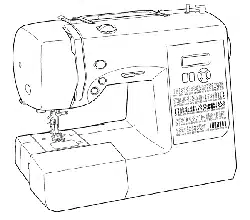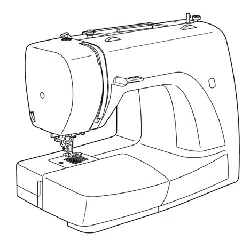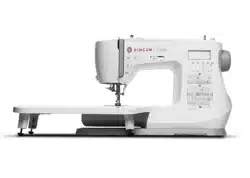
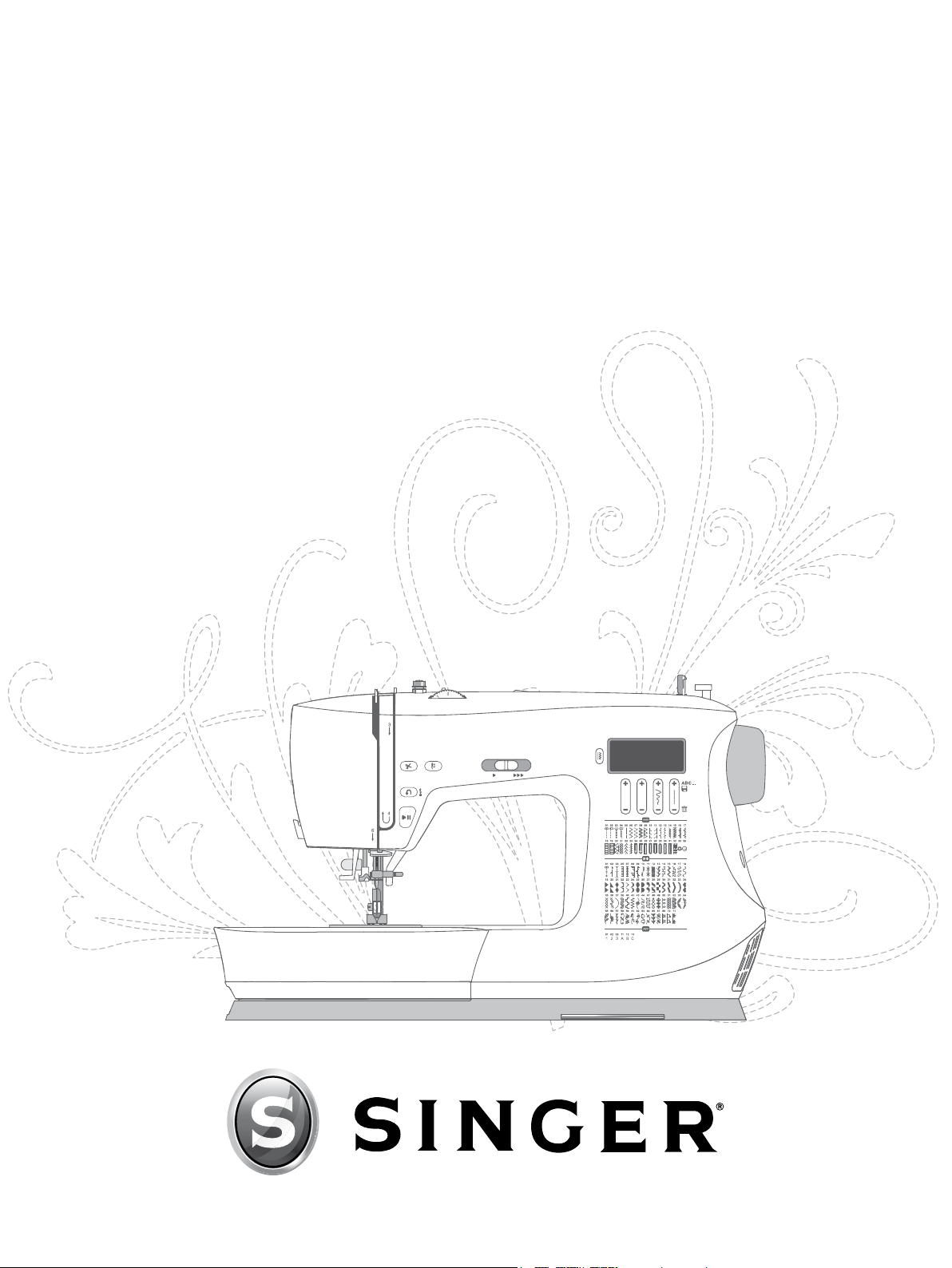
INSTRUCTION MANUAL
C7200 / C7205 / C7220 / C7225
C7250 / C7255


This household sewing machine is designed to comply with IEC/EN 60335-2-28 and UL1594.
IMPORTANT SAFETY INSTRUCTIONS
When using an electrical appliance, basic safety precautions should always be followed, including the
following: Read all instructions before using this household sewing machine. Keep the instructions at a
suitable place close to the machine. Make sure to hand them over if the machine is given to a third party.
DANGER –
TO REDUCE THE RISK OF ELECTRIC SHOCK:
• A sewing machine should never be left unattended when plugged in. Always unplug this sewing machine
from the electric outlet immediately after using and before cleaning, removing covers, lubricating or when
making any other user servicing adjustments mentioned in the instruction manual.
WARNING –
TO REDUCE THE RISK OF BURNS, FIRE, ELECTRIC
SHOCK, OR INJURY TO PERSON:
• Do not allow to be used as a toy. Close attention is neccesary when this sewing machine is used by or near
children.
• Use this sewing machine only for its intended use as described in this manual. Use only attachments
recommended by the manufacturer as contained in this manual.
• Never operate this sewing machine if it has a damaged cord or plug, if it is not working properly, if it has
been dropped or damaged, or dropped into water. Return the sewing machine to the nearest authorized
service center for examination, repair, electrical or mechanical adjustment.
• Never operate the sewing machine with any air openings blocked. Keep ventilation openings of the sewing
machine and foot control free from the accumulation of lint, dust, and loose cloth.
• Keep ngers away from all moving parts. Special care is required around the sewing machine needle.
• Always use the proper needle plate. The wrong plate can cause the needle to break.
• Do not use bent needles.
• Do not pull or push fabric while stitching. It may deect the needle causing it to break.
• Wear safety glasses.
• Switch the sewing machine o (“O”) when making any adjustment in the needle area, such as threading
needle, changing needle, threading bobbin, or changing presser foot, etc.
• Never drop or insert any object into any opening.
• Do not use outdoors.
• Do not operate where aerosol (spray) products are being used or where oxygen is being administrated.
• To disconnect, turn all controls to the o (“O”) position, then remove plug from outlet.
• Do not unplug by pulling on cord. To unplug, grasp the plug, not the cord.
• The foot control is used to operate the machine. Avoid placing other objects on the foot control.
• Do not use the machine if it is wet.
• If the LED lamp is damaged or broken, it must be replaced by the manufacturer or its service agent or a
similarly qualied person, in order to avoid a hazard.
• The power cord of the foot control can not be replaced. If the power cord is damaged, the foot control must
be disposed.
• This sewing machine is provided with double insulation. Use only identical replacement parts. See
instructions for Servicing of Double-Insulated Appliances.

SAVE THESE INSTRUCTIONSFOR EUROPE ONLY:
FOR EUROPE ONLY:
This appliance can be used by children aged from 13 years and above and persons with reduced physical,
sensory or mental capabilities or lack of experience and knowledge if they have been given supervision or
instruction concerning use of the appliance in a safe way and understand the hazards involved. Children
shall not play with the appliance. Cleaning and user maintenance shall not be made by children without
supervision.
The machine must only be used with foot control of type C-8000.
FOR OUTSIDE EUROPE:
This sewing machine is not intended for use by persons (including children) with reduced physical, sensory
or mental capabilities, or lack of experience and knowledge, unless they have been given supervision or
instruction concerning use of the sewing machine by a person responsible for their safety. Children should be
supervised to ensure that they do not play with the sewing machine.
The machine must only be used with foot control of type C-8000.
SERVICING OF DOUBLE INSULATED PRODUCTS
In a double-insulated product, two systems of insulation are provided instead of grounding. No ground
means is provided on a double-insulated product, nor should a means for grounding be added to the product.
Servicing of a double-insulated product requires extreme care and knowledge of the system and should
be done only by qualied service personnel. Replacement parts for a double-insulated product must be
identical to those parts in the product. A double-insulated product is marked with the words ‘DOUBLE
INSULATION’ or ‘DOUBLE INSULATED’.


TABLE OF CONTENTS
INTRODUCTION ............................................. 1
Intended Use .................................................................. 1
Machine Overview .......................................................... 1
Needle Area Overview .................................................... 2
Top of Machine ............................................................... 2
Overview Accessories .................................................... 3
Included Accessories (Not Pictured) .................................... 3
Presser Feet ................................................................... 4
Optional Accessories ............................................................ 4
Stitch Overview............................................................... 5
Choosing Utility and Decorative Stitch Patterns ................. 5
Decorative Stitches .............................................................. 7
PREPARATIONS ............................................ 8
Unpacking the Machine .................................................. 8
Connect to the Power Supply ......................................... 8
Packing Machine after Sewing ....................................... 8
Free Arm/Removable Accessory Tray ............................ 9
Presser Foot Lifter .......................................................... 9
Thread Knife ................................................................... 9
Spool Pin ...................................................................... 10
Wind the Bobbin ............................................................11
Insert the Bobbin ...........................................................11
Thread the Machine...................................................... 12
Needle Threader ........................................................... 13
Needles ........................................................................ 13
Important Needle Information ........................................... 14
Selection Guide — Needle Size, Fabric, Thread ............... 14
Change the Needle....................................................... 14
Thread Tension ............................................................. 15
Sew without Feed Teeth ............................................... 15
Change the Presser Foot ............................................. 16
OPERATING YOUR MACHINE .................... 17
Machine Operation Controls ......................................... 17
Reverse Button ................................................................... 17
Tie-O ................................................................................ 17
Start/Stop ............................................................................ 17
Needle Up/Down ............................................................... 17
Automatic Thread Cutter ................................................... 17
Speed Control Lever .......................................................... 17
Stitch Control Panel ...................................................... 18
Display ............................................................................... 18
Stitch Menu ........................................................................ 18
Stitch Width / Needle Position ........................................... 18
Stitch Length ...................................................................... 18
Stitch Selection Buttons ..................................................... 18
Sewing Mode ................................................................ 19
Display in Sewing Mode .................................................... 19
Select a Stitch ..................................................................... 19
Create a Sequence .............................................................. 20
Inserting a Stitch ................................................................ 20
Delete a Stitch .................................................................... 20
Clear the Memory .............................................................. 20
SEWING ........................................................ 21
Sewing .......................................................................... 21
Start to Sew – Straight Stitch........................................ 21
Change Needle Position ..................................................... 21
Change Sewing Direction ............................................. 22
Finish Sewing ............................................................... 22
Straight Stretch Stitch ................................................... 22
Multi-Step Zigzag Stitch................................................ 23
Slant Overedge Stitch................................................... 23
Closed Overlock Stitch ................................................. 24
Blind Hems ................................................................... 24
Darning and Mending ................................................... 25
Repair Large Holes ............................................................ 25
Repair Tears ....................................................................... 25
Repair Small Holes ............................................................ 26
One-Step Buttonhole .................................................... 27
Sew Zippers.................................................................. 28
Centered Zipper ................................................................. 28
Hand-Look Quilt Stitch.................................................. 29
Button Sewing .............................................................. 29
MAINTENANCE ............................................ 30
Cleaning the Machine ................................................... 30
Cleaning the Bobbin Area ............................................. 30
Cleaning under the Bobbin Area................................... 30
Troubleshooting ............................................................ 31
Technical Specication ................................................. 34
Introduction – 1
English
Introduction – 1
English
INTRODUCTION
Optimal use and maintenance are described in these instructions. This product is not intended for industrial or commercial use.
Additional assistance, by region, may be found online at www.singer.com.
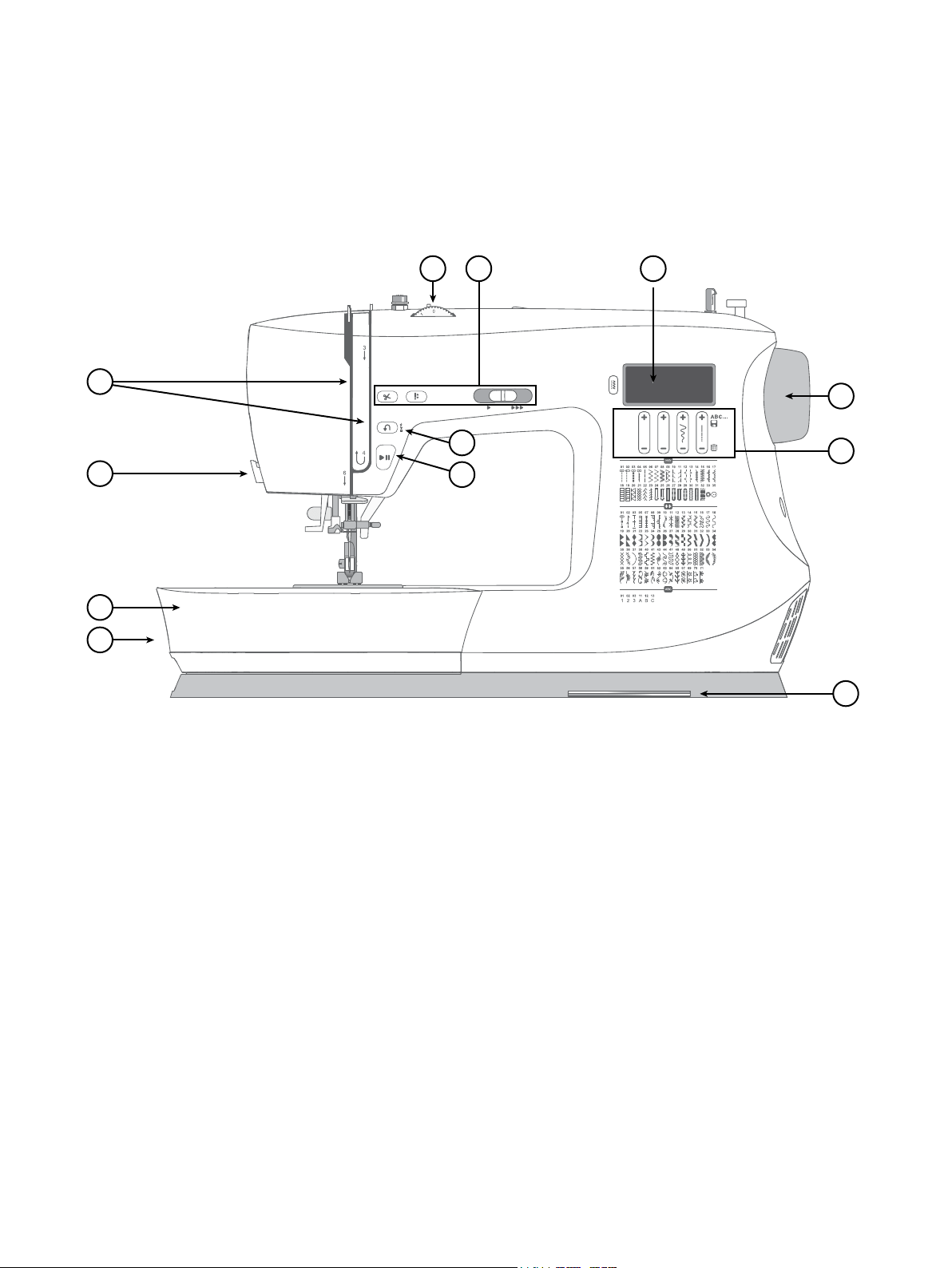
1. Feed Teeth Lever — Move from side to side to engage or
disengage the feed teeth. Positioned at the back of the free
arm.
2. Accessory Tray / Free Arm — Provides a at surface
when sewing and allows storage for your accessories.
Remove the accessory tray to use the free arm which makes
it easier to sew, e.g., trouser hems and sleeves.
3. Thread Knife — For trimming thread ends at the end of
sewing.
4. Threading Slots — Thread paths with tension discs and
take up lever.
5. Reverse Button — Press and hold to sew in reverse or to
make a tie-o, e.g., when securing the beginning or ending
of a seam.
6. Start/Stop Button — Press to start and stop sewing with-
out using the foot control.
7. Thread Tension Dial — Adjustable for setting the desired
tension for your stitch, thread and fabric.
8. Machine Operation Controls — Functions used to make
your sewing more convenient.
9. Display — Current stitch and settings are displayed.
10. Hand Wheel — Used to manually control the movement of
the needle and the thread take-up lever.
11. Function Buttons — Control the stitch width and the stitch
length, as well as the pattern memory for Alphanumeric
stitches.
12. Stitch Chart — View all stitches available on your
machine.
Intended Use
Machine Overview
7 9
10
11
12
8
6
5
1
2
3
4
2 – Introduction
English
2 – Introduction
English
Needle Area Overview
Top of Machine
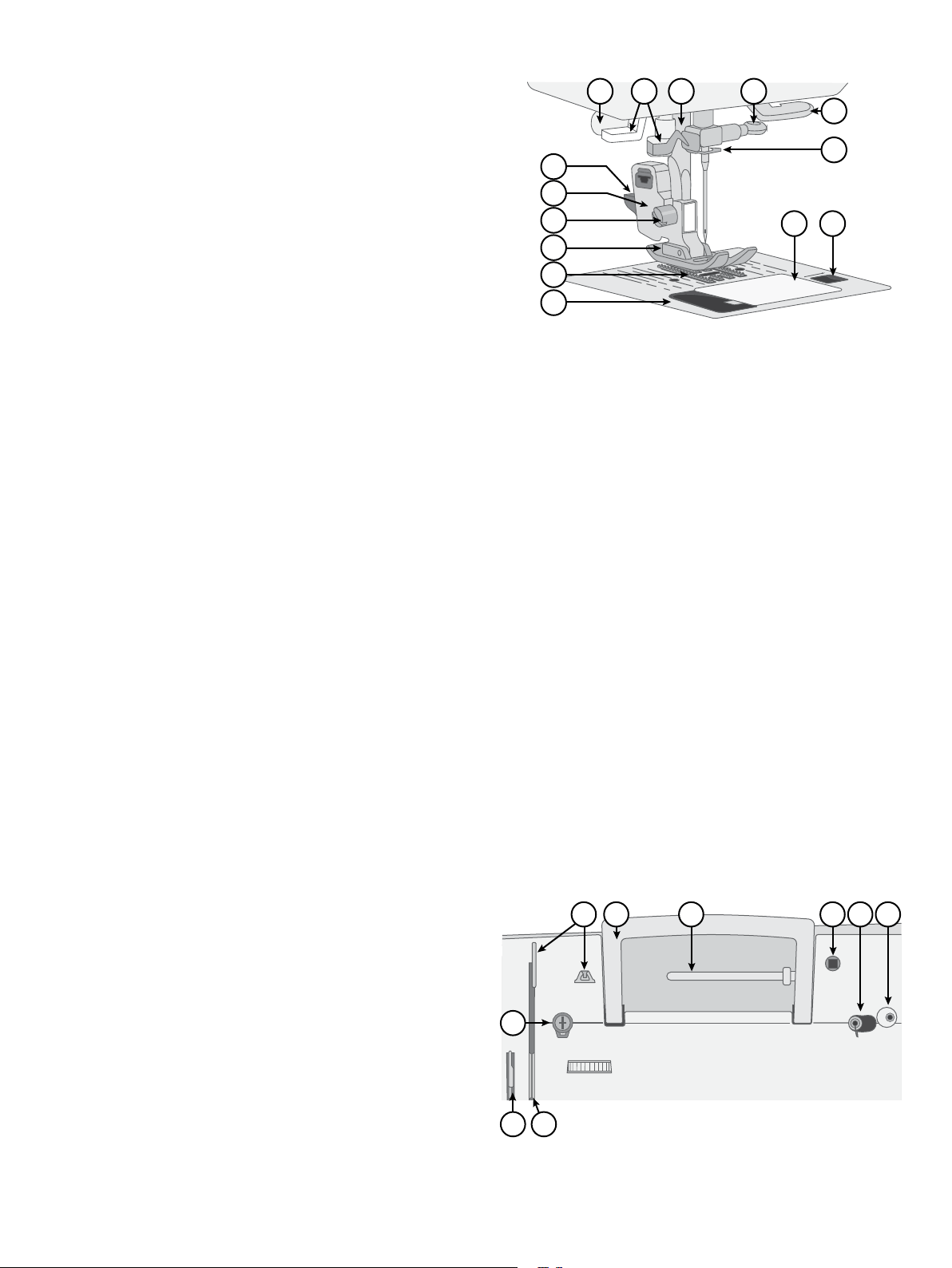
1. Needle Plate — provides a at area around presser foot for
sewing. Guidelines indicate various seam allowances used
to guide fabric while sewing.
2. Feed Teeth — feed the fabric under the presser foot when
sewing.
3. Presser Foot — holds fabric against feed teeth which draw
fabric under the presser foot as you sew.
4. Presser Foot Holder Screw — loosen the screw to
remove the presser foot holder.
5. Presser Foot Holder — holds the presser foot.
6. Presser Foot Release Button — press this button to release
the presser foot from the holder.
7. Buttonhole Lever — used for buttonhole sewing.
8. Built-in Needle Threader — thread the needle quickly and
easily.
9. Presser Foot Bar — accommodates the presser foot holder.
10. Needle Clamp Screw — secures the needle.
11. Thread Guide — helps maintain thread ow when sewing.
12. Needle Thread Guide — helps maintain thread ow
when sewing.
13. Bobbin Cover — protects the bobbin while sewing.
14. Bobbin Cover Release Button — push to open the bobbin
cover.
1. Bobbin winding tension disc
2. Thread guides
3. Handle
4. Spool pin
5. Hole for auxiliary spool pin
6. Bobbin winding spindle
7. Bobbin winding stopper
8. Thread tension discs
9. Thread take-up lever
6542 7
9 8
1
3
1
2
3
4
5
6
7 8 9 10
11
12
13 14
Introduction – 3
English
Introduction – 3
English
Overview Accessories
Included Accessories (Not Pictured)
• Needles
• Foot control
• Power cord
• Extension Table (only avalible for C7220 / C7225 / C7250 / C7255)
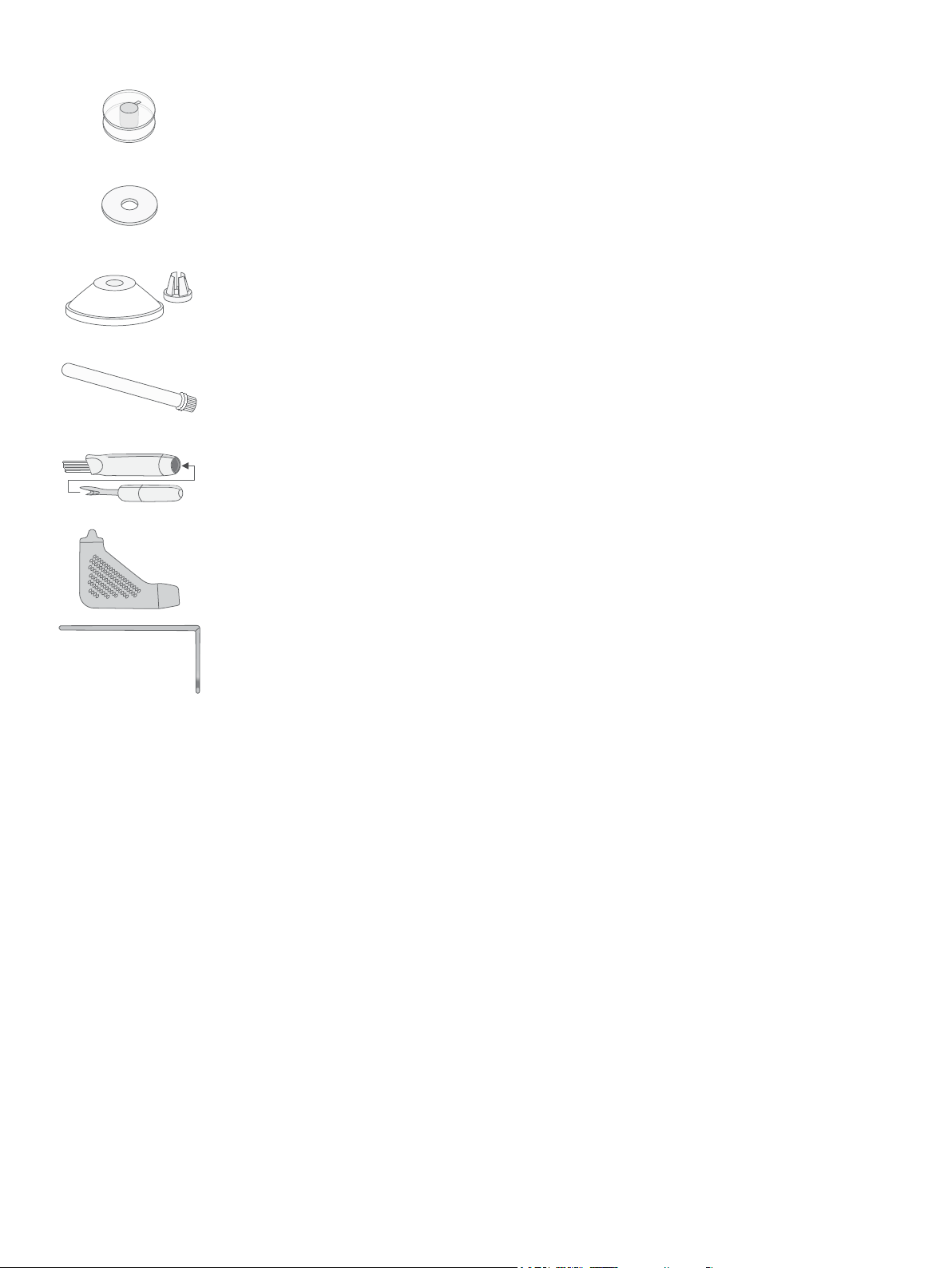
Bobbin x4 — Only use the type of transparent bobbins delivered with your machine (SINGER® Class 15
transparent bobbins). One of the bobbins is inserted in the machine upon delivery.
Felt Pad — Used to cushion the spool of thread when using the Auxiliary Spool Pin.
Spool Cap — Two sizes (large and small) for various thread spool styles.
Auxiliary Spool Pin — For sewing with large thread spools or when using specialty threads.
Brush and Seam Ripper — Used to remove stitches/brush o lint.
L-Screwdriver — Used to remove the needle plate, presser foot holder or needle screw.
Edge/Quilting Guide — Used for straight and accurate sewing, e.g., when quilting. Insert the guide into
the slot at the back of the presser foot holder. Adjust the position to t your project.
4 – Introduction
English
4 – Introduction
English
Presser Feet
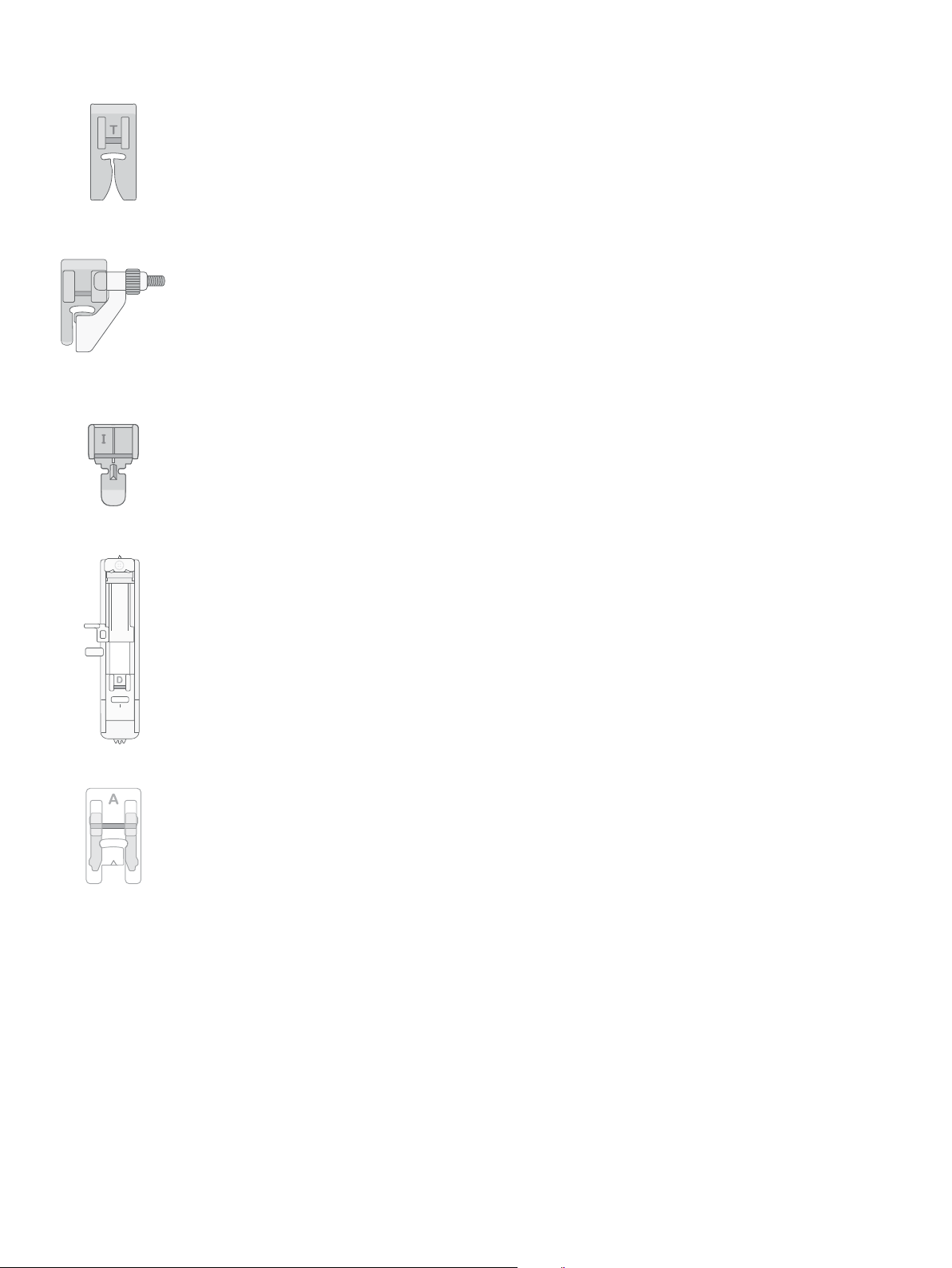
All Purpose Foot (T)
(attached to the machine upon delivery)
This foot is used for general sewing on most types of fabric. The bottom of the foot is at, so that the fabric
is held down rmly against the feed teeth while sewing. It also has a wide slot so that the needle can move
from left to right, depending on which stitch you sew.
F
Blind Hem Foot (F)
The Blind Hem Foot is used for sewing blind hems in garments and home decor. There is an adjustable
guide with an extension at the front, used to guide the fold of the hem while stitching.
Zipper Foot (I)
This foot is used for inserting zippers. Attach the foot to the presser foot holder on either side of the foot,
depending on which side of the zipper is being sewn. The Zipper Foot can also be used to create and insert
piping.
One–Step Buttonhole Foot (D)
This foot allows you to make perfectly sized buttonholes for your button. It has a space at the back for a
button, used to set the size of the buttonhole. The machine will automatically sew a buttonhole to t that
button size.
Satin Stitch Foot (A)
The Satin Stitch Foot is used for satin stitches and other more dense decorative stitches. It has a groove on
the underside that allows the dense stitching to pass freely underneath the foot.
Optional Accessories
Additional optional accessories are available for your machine. Check with your authorized SINGER® retailer for more information.
Introduction – 5
English
Introduction – 5
English
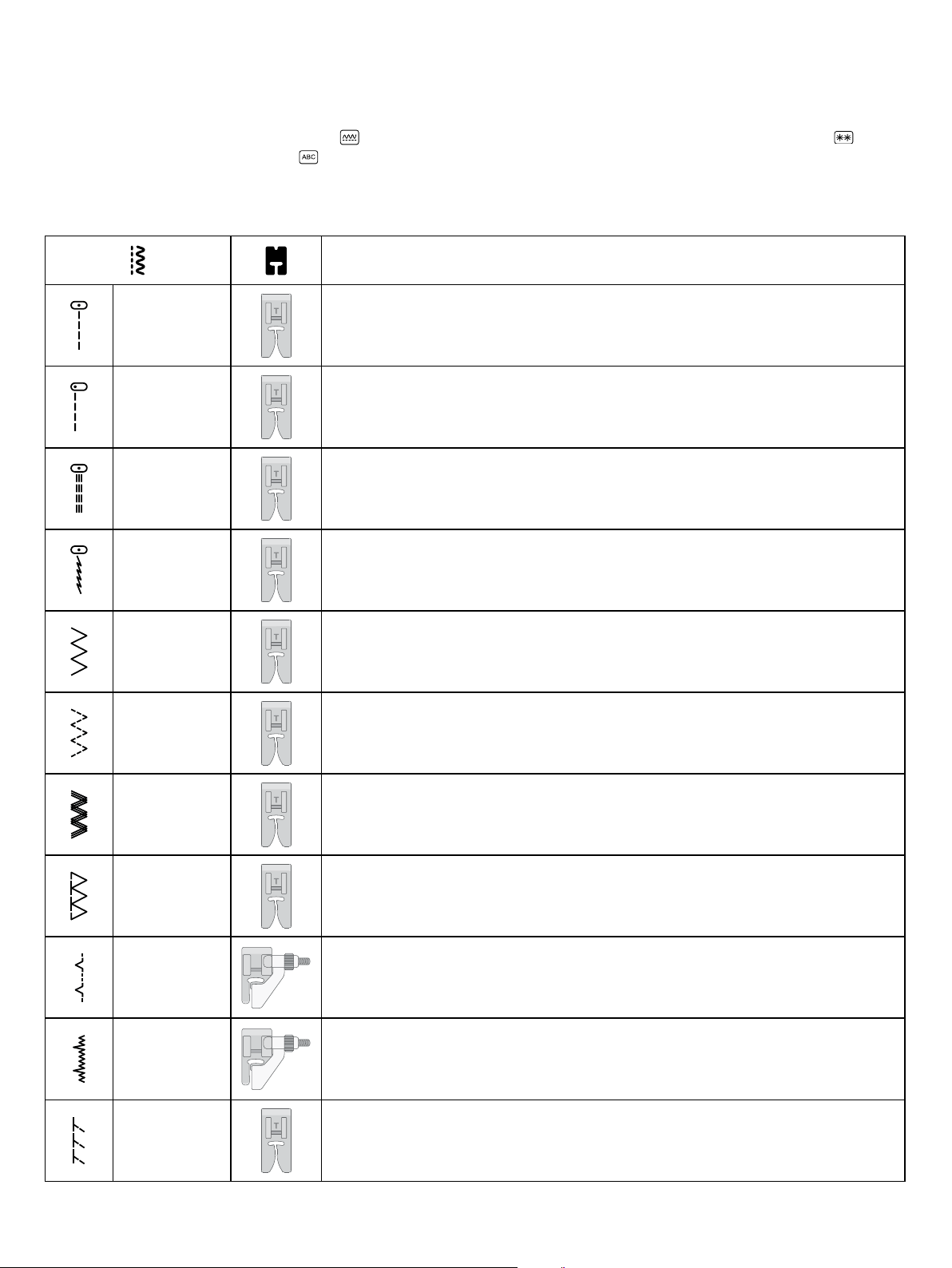
Application
Straight Stitch
Center Position
The basic stitch used for sewing. The most common use for a straight stitch is to sew
two pieces of fabric together.
Straight Stitch
Left Position
For all types of sewing.
Straight Stretch
Stitch
Stronger than a regular straight stitch, on stretch knit fabrics, because it locks three times
— forward, backward and forward again. Use it to reinforce seams of sportswear and for
curved seams which take a lot of strain.
Stretch Stitch For seams in tricot and stretch fabrics.
Zigzag Stitch A very versatile stitch for decorative sewing, appliqué, attaching trims, and more.
Multi-Step
Zigzag Stitch
Finish seam allowances to prevent the fabric from unravelling. When seam nishing, the
smaller step of the stitches will help keep fabric more at than a regular zigzag. It can
also be used for mending tears and sewing elastic.
Reinforced Zig-
zag Stitch
For joining fabric edge to edge or decorative sewing.
Overlock Stitch Sew seam and overcast in one step. For medium and medium/heavy stretch fabrics.
Blind Hem
Stitch
F
Sew hems that are practically invisible from the right side of the fabric. It is used for
skirts, dresses, trousers, curtains, etc, made with non-stretch fabrics.
Stretch Blind
Hem Stitch
F
Sew hems that are practically invisible from the right side of the fabric. It is used for
garments and other projects made with stretch knit fabrics.
Slant Overedge
Stitch
Seam and overcast in one step. For medium and heavy stretch fabrics.
Stitch Overview
Choosing Utility and Decorative Stitch Patterns
The stitches described in the below chart are utility stitches, used mainly for utility sewing.
The machine will automatically default to the Pattern Mode and Straight Stitch when turned on. You can also select the mode
for additional decorative stitches or the mode for Alphanumeric Stitch Patterns. Choose the mode and then press the two left + or -
Pattern Adjustment Button to select the number of the stitch that you desire.
When sewing, use a thread tension between 3–5. Always test sew on a piece of scrap fabric, and adjust the tension if necessary.
6 – Introduction
English
6 – Introduction
English
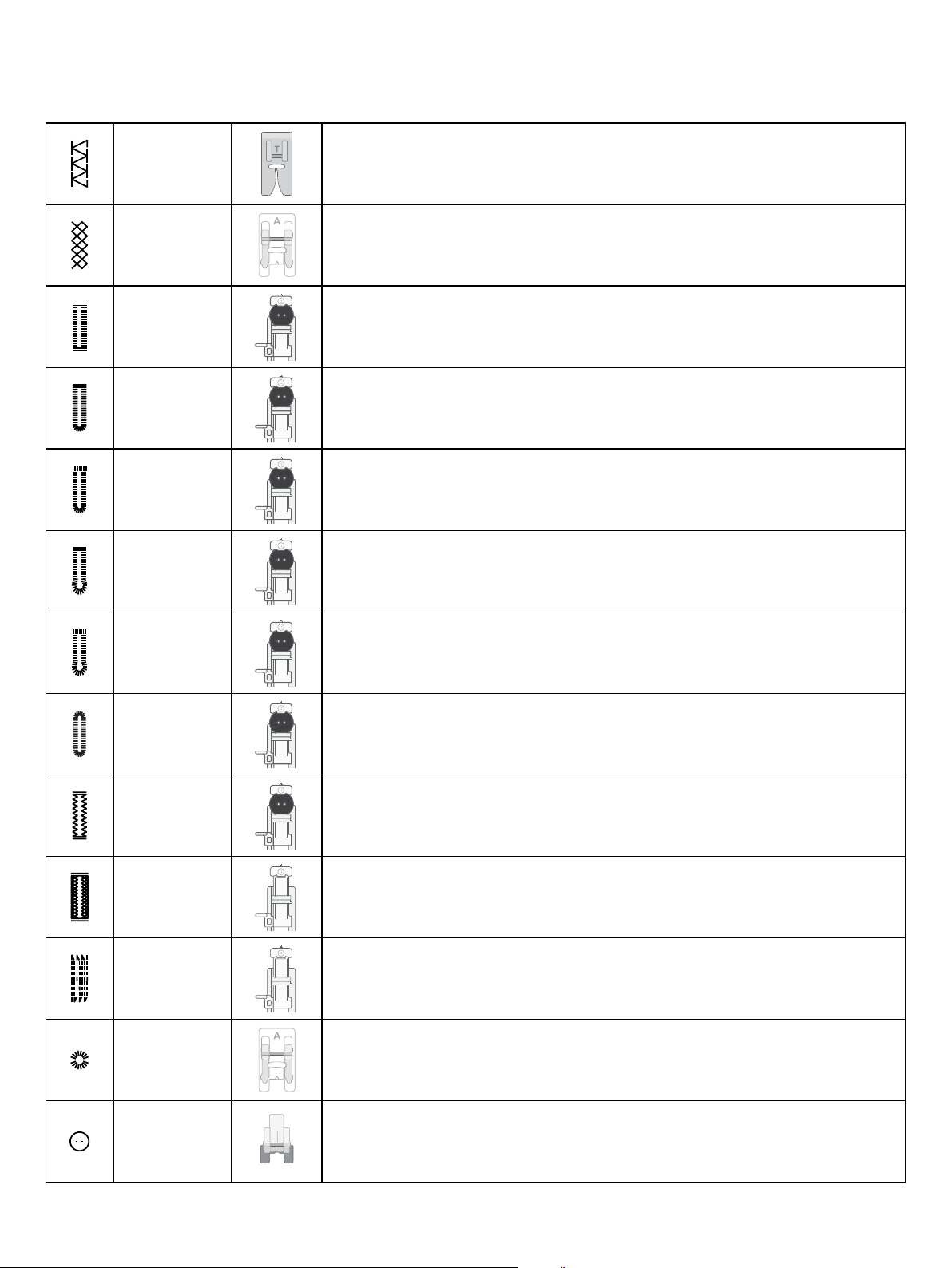
Closed Over-
lock Stitch
Sew decorative hems and overlapped seams, belts and bands. For medium/heavy stretch
fabrics.
Honeycomb
Stitch
For elastic insertion, decorative stitching, smocking, couching and hemming.
Buttonhole Sew buttonholes on home decór, garments, crafts and more.
Rounded Bart-
ack Buttonhole
For light weight fabrics.
Rounded Bart-
ack Buttonhole,
Reinforced
For light weight fabrics.
Keyhole But-
tonhole
Square end for tailored jackets, coats, etc.
Keyhole Button-
hole, Reinforced
Square end for tailored jackets, coats, etc.
Rounded But-
tonhole
Sew buttonholes on home decór, garments, crafts and more.
Stretch Button-
hole
For stretch fabrics.
Reinforce
Stretch
Buttonhole
For heavyweight knit (stretch) fabrics.
Darning Stitch Darn and mend small holes in work clothes, jeans, and more.
Eyelet For belts, laces, etc.
Button Sewing
Stitch
H
For sewing on buttons.
Introduction – 7
English
Introduction – 7
English
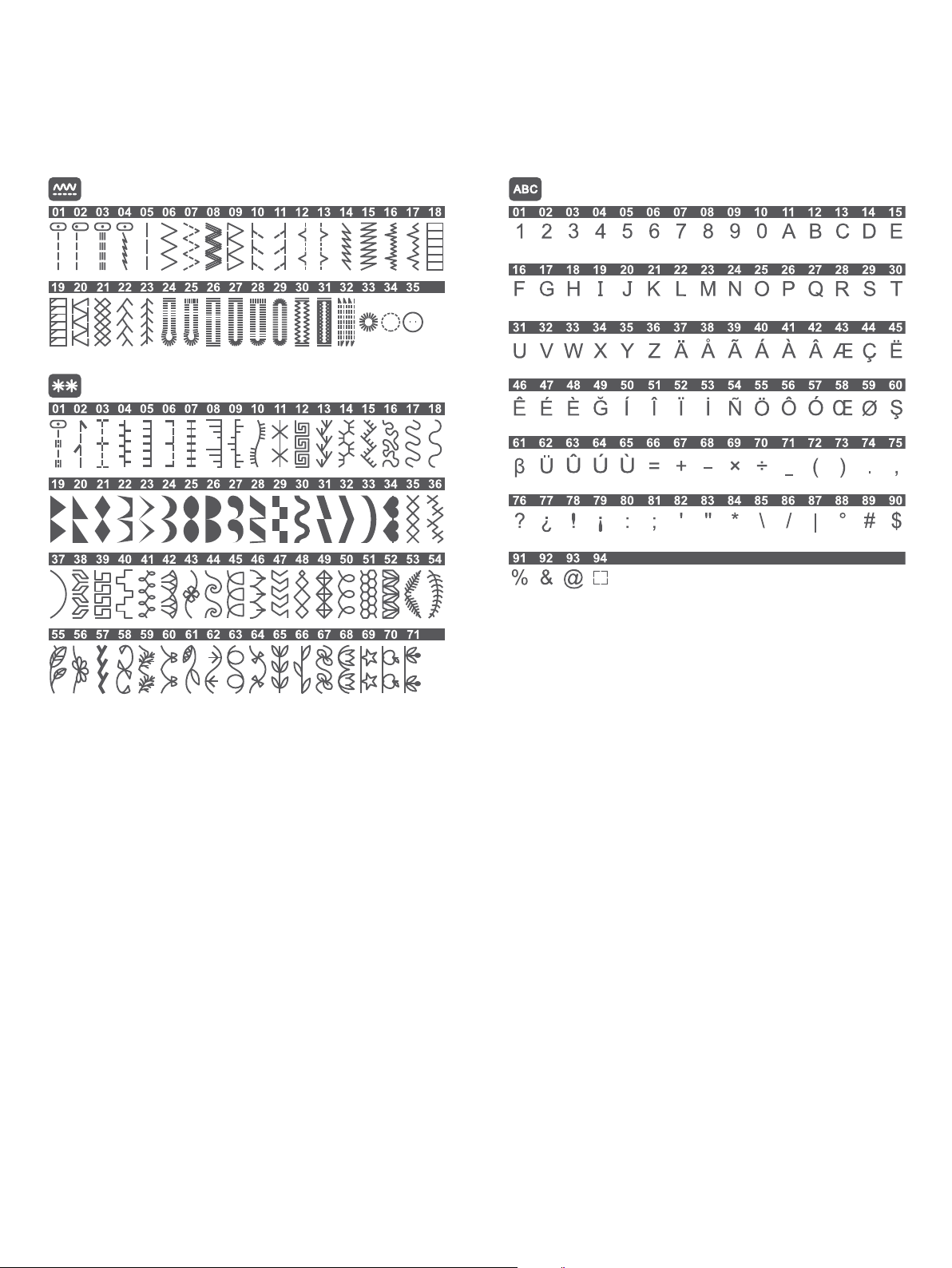
In addition to utility stitches, your machine features decorative and lettering stitches. When sewing these stitches, it is recommended
to use a stabilizer underneath the fabric to help prevent the dense stitching from possibly puckering the fabric. It is also helpful to
slightly reduce the upper thread tension. Always test sew on a piece of scrap fabric and adjust the upper thread tension if necessary.
Decorative Stitches
Stitch Menu 1 Stitch Menu 2
8 – Preparations
English
8 – Preparations
English
PREPARATIONS
1. Place the box on a steady, at surface. Lift the machine out of the box, and remove the packaging.
2. Remove all outer packing material and the plastic bag.
3. Wipe o the machine with a dry cloth to remove any lint and/or excess oil around the needle area.
Note: Your sewing machine is adjusted to provide the best stitch result at normal room temperature. Extreme hot and cold tempera-
tures can aect the sewn result.
1. Switch the main switch o. After switching o, residual power may still remain in the machine. This may cause the light to stay
on for a few seconds while the power is consumed. This is normal behavior for an energy ecient appliance.
2. Unplug the cord from the wall socket and then from the machine.
3. Wind the cord around the foot control for easy storage.
4. Place all accessories in the accessory tray. Slide the tray on to the machine around the free arm.
5. Place the foot control and cord in the space above the free arm.
6. Place the soft cover on the machine to help protect it from dust and lint.
Among the accessories you will nd the power cord and the
foot control.
Note: Consult a qualied electrician if in doubt as how to con-
nect the machine to the power source. Unplug the power cord
when the machine is not in use.
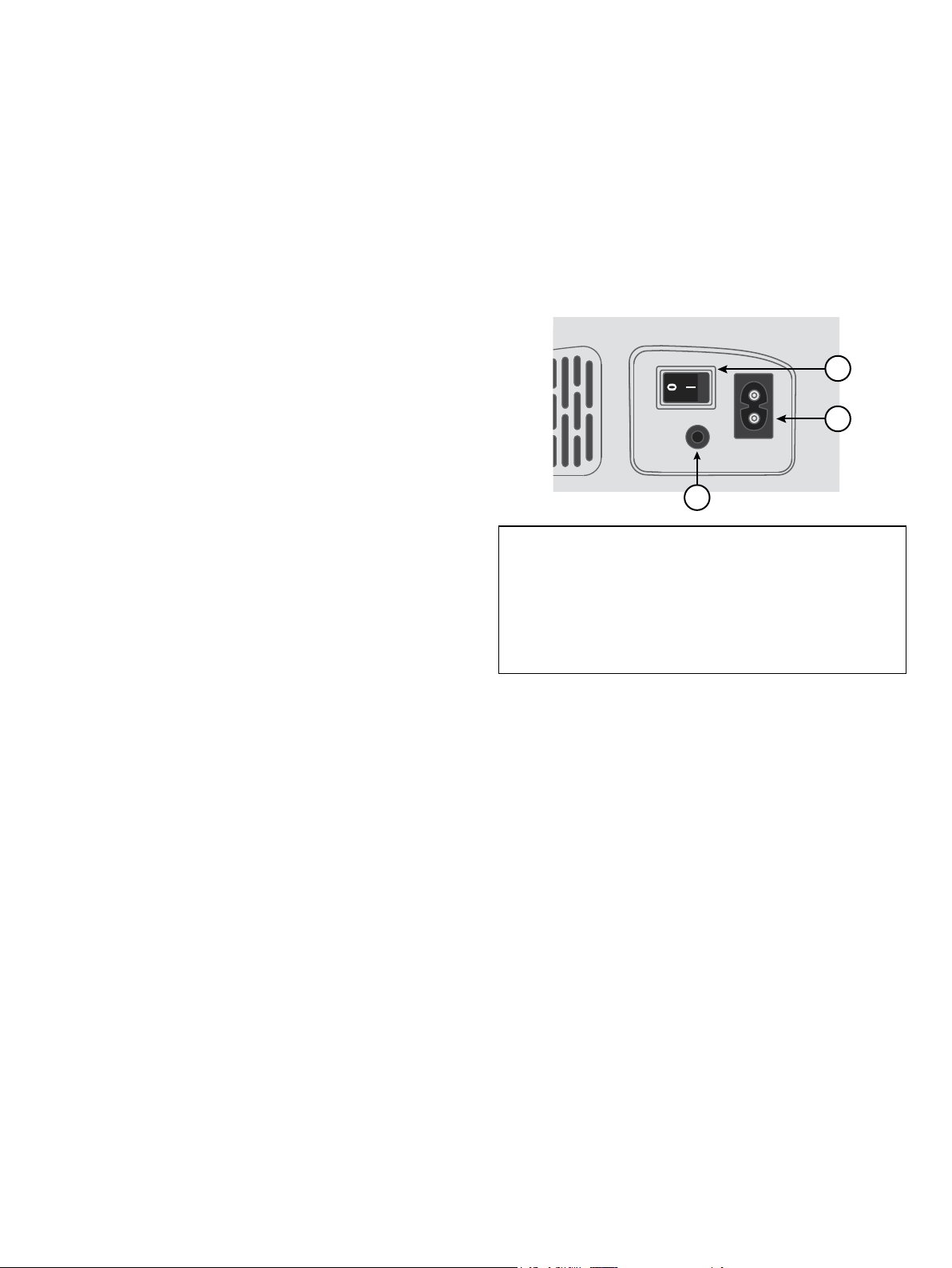
On the bottom right side of the sewing machine, you nd the
connecting sockets and the ON/OFF button.
1. Connect the foot control cord to the front socket on the
bottom right side of the machine (A).
2. Connect the power cord to the rear socket on the bottom
right side of the machine (B). Plug the cord into the wall
socket.
3. Press the ON/OFF switch (C) to "I" to turn on power and
light.
Sewing speed is regulated by pressing the foot control. The
maximum sewing speed can be adjusted using the Speed Con-
trol Lever.
Note: After turning o the machine, residual power may remain
in the machine. This could cause the light to stay on for a few
seconds while the power is consumed. This is normal for an
energy ecient appliance.
Unpacking the Machine
Packing Machine after Sewing
Connect to the Power Supply
For the USA and Canada
This sewing machine has a polarized plug (one blade wider
than the other). To reduce the risk of electric shock, this
plug is intended to t in a polarized outlet only one way. If
the plug does not t fully in the outlet, reverse the plug. If it
still does not t, contact a qualied electrician to install the
proper outlet. Do not modify the plug in any way.
A
B
C
Preparations – 9
English
Preparations – 9
English
Free Arm/Removable Accessory Tray
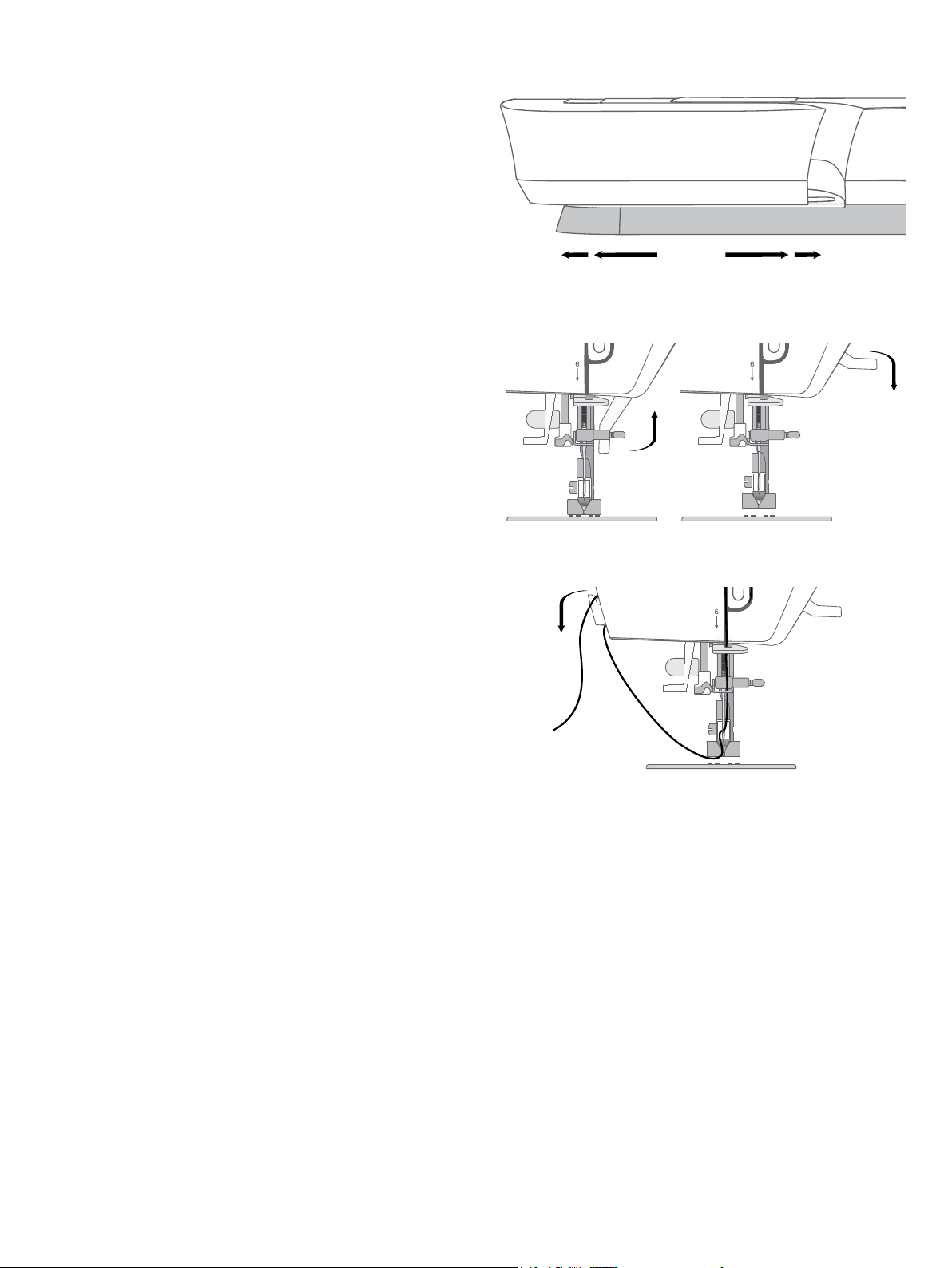
Presser Foot Lifter
Thread Knife
Store presser feet, bobbins, needles and other accessories in the
accessory tray so that they are easily accessible.
Keep the accessory tray on the machine to provide a larger, at
work surface.
Use the free arm to facilitate sewing trouser legs and sleeve
hems. To use the free arm, slide o the accessory tray. When
attached, a hook keeps the accessory tray securely attached to
the machine. Remove the tray by sliding it to the left.
The presser foot lifter is located at the right side of the sewing
machine head. The lever is used to raise and lower the presser
foot. Raise the lever up for machine threading, lower it for
sewing.
By raising the presser foot lifter and then pressing it farther up-
wards, the lift height of the presser foot is increased to an extra
height allowing you to place thick fabric layers under the foot.
To use the thread knife, pull the thread from back to front as
illustrated. Doing this will leave the thread ends long enough
so that the needle doesn't become unthreaded when you start to
sew again.
10 – Preparations
English
10 – Preparations
English
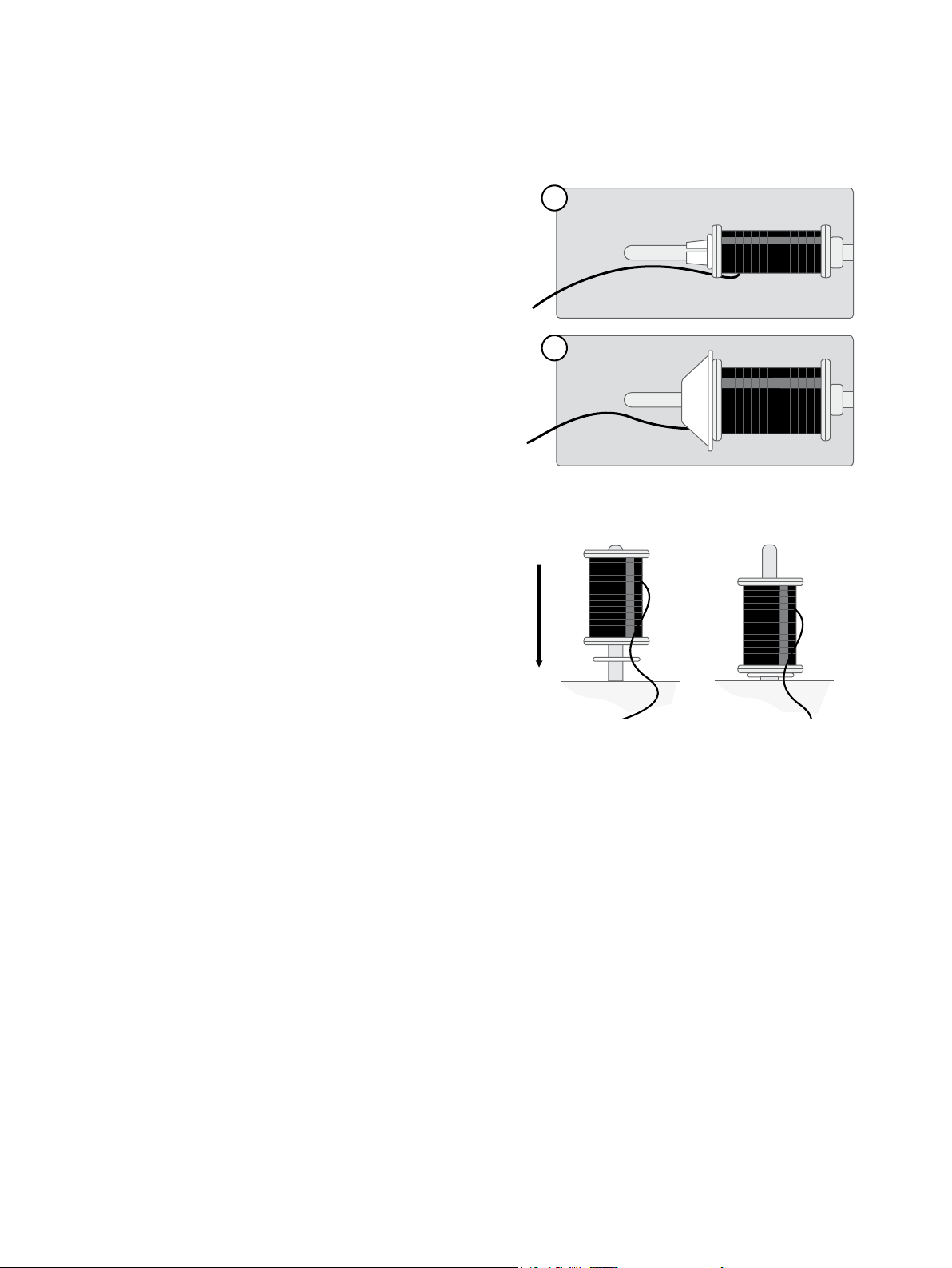
Your machine has two spool pins, a main spool pin and an Auxiliary Spool Pin. The spool pins are designed for various types of
thread. The main spool pin is used in a horizontal position (the thread reels o the spool) and the Auxiliary Spool Pin in a vertical
position (the thread spool rotates). Use the horizontal position for normal threads and the vertical position for large spools or specialty
threads.
Main Spool Pin
Place the thread spool on the spool pin. Make sure that the
thread reels o the spool counter clockwise and slide on a
spool cap. Use a spool cap slightly larger than the thread spool.
For narrow thread spools (A), use a smaller spool cap in front
of the spool. For large thread spools (B), use a larger spool
cap in front of the spool. The at side of the spool cap should
be pressed rmly against the spool. There should be no space
between the spool cap and the thread spool.
Note: Not all thread spools are manufactured in the same way.
If you experience problems with the thread, turn it in the oppo-
site way or use the vertical position.
Auxiliary Spool Pin
The Auxiliary Spool Pin is used when winding a bobbin thread
from a second spool of thread or when sewing with large
spools or with specialty threads. Insert the Auxiliary Spool Pin
into the designated hole at the top of the machine. Place a felt
pad under the thread spool. This is to prevent the thread from
reeling o too fast. Do not place a spool cap on top of the spool
pin as that would prevent the spool from rotating.
Spool Pin
A
B
Preparations – 11
English
Preparations – 11
English
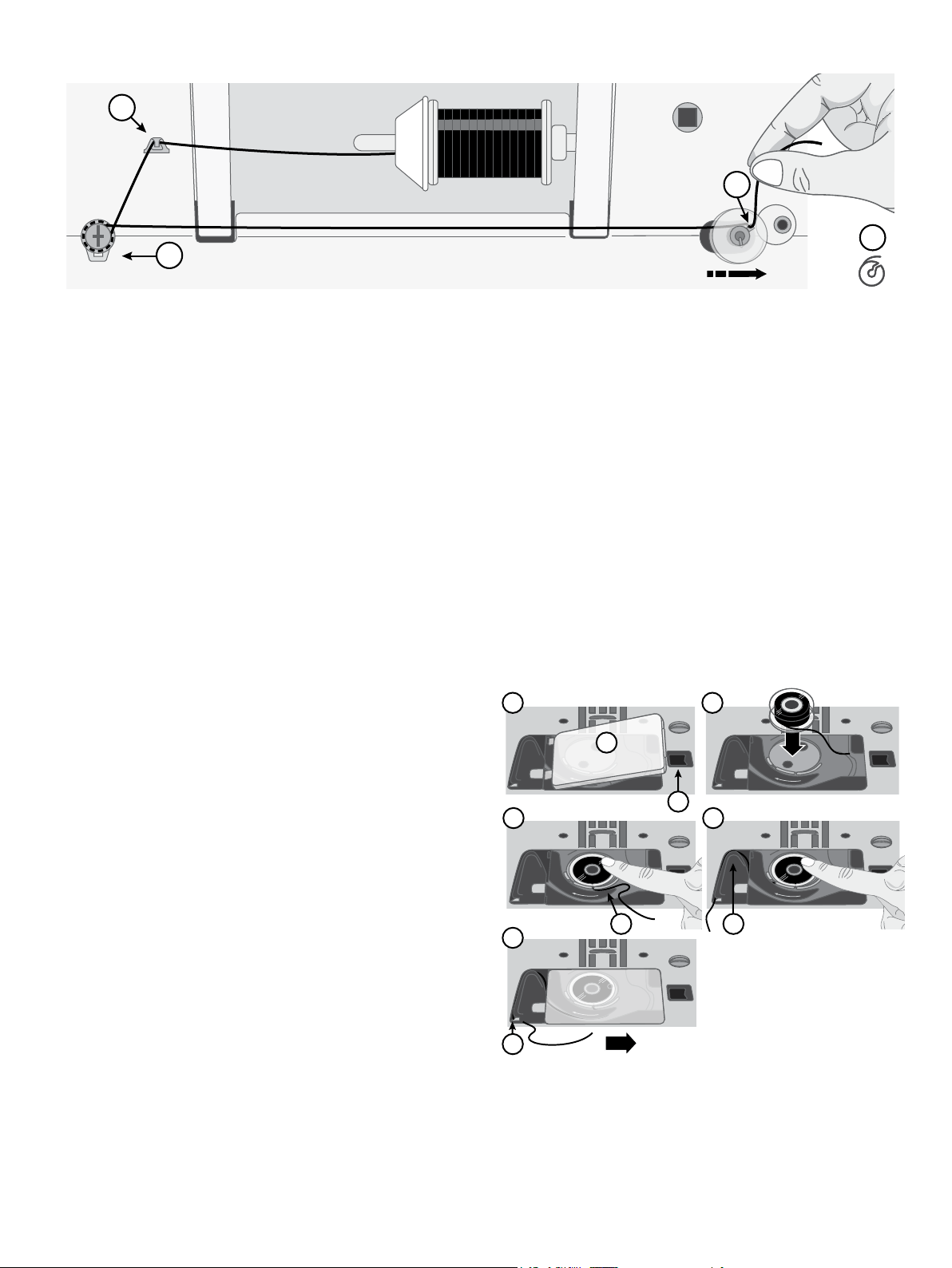
1. Place the thread spool on the spool pin. Slide a spool cap
rmly against the spool.
2. Place the thread into the thread guide (A) from front to the
back. Bring the thread clockwise around the bobbin wind-
ing tension disc (B), making sure that the thread is pulled
snuggly between the discs.
3. Thread through the hole in the bobbin (C) from the inside to
the outside.
4. Place the bobbin on the bobbin winding spindle. Make sure
the bobbin is pushed down rmly.
5. Push the bobbin winding spindle to the right. Hold the
thread end, and press the foot control to start winding.
After a few turns, take your foot o the foot control to
stop winding. Cut the excess thread tail above the bobbin,
making sure to trim it close to the bobbin. Step on the foot
control to resume winding. When the bobbin is full, the
bobbin winding will slow down and stop automatically.
Note: You can also start the winding by long pressing the
start/stop button.
When the winding spindle is pushed to the right, a bobbin
winding icon is shown on the display (D).
6. Push the bobbin winding spindle to the left. Remove the
bobbin and cut the thread.
Wind the Bobbin
Insert the Bobbin
Note: Make sure that the needle is fully raised and the machine
is turned o before inserting or removing the bobbin.
1. Remove the bobbin cover (A) by pushing the small button
to the right of the cover (B) towards the right.
2. Insert the bobbin in the bobbin case with the thread running
in a counterclockwise direction.
3. With the tip of your nger on the bobbin, pull the thread
slightly to the right and under the guide (C) then towards
the left.
4. Continue guiding the thread up toward the left and around
the curve (D).
5. Bring it down the channel toward the front and into the
bobbin thread knife (E).
Replace the bobbin cover and pull the thread to the right to
cut o the excess thread.
Note: When the bobbin winding spindle is pushed to the right, the machine will not sew. Make sure to push the bobbin spindle back to
the sewing position (left) before sewing.
A
B
1 2
3
C D
4
5
E
A
B
C
D
A
B
C
D
12 – Preparations
English
12 – Preparations
English
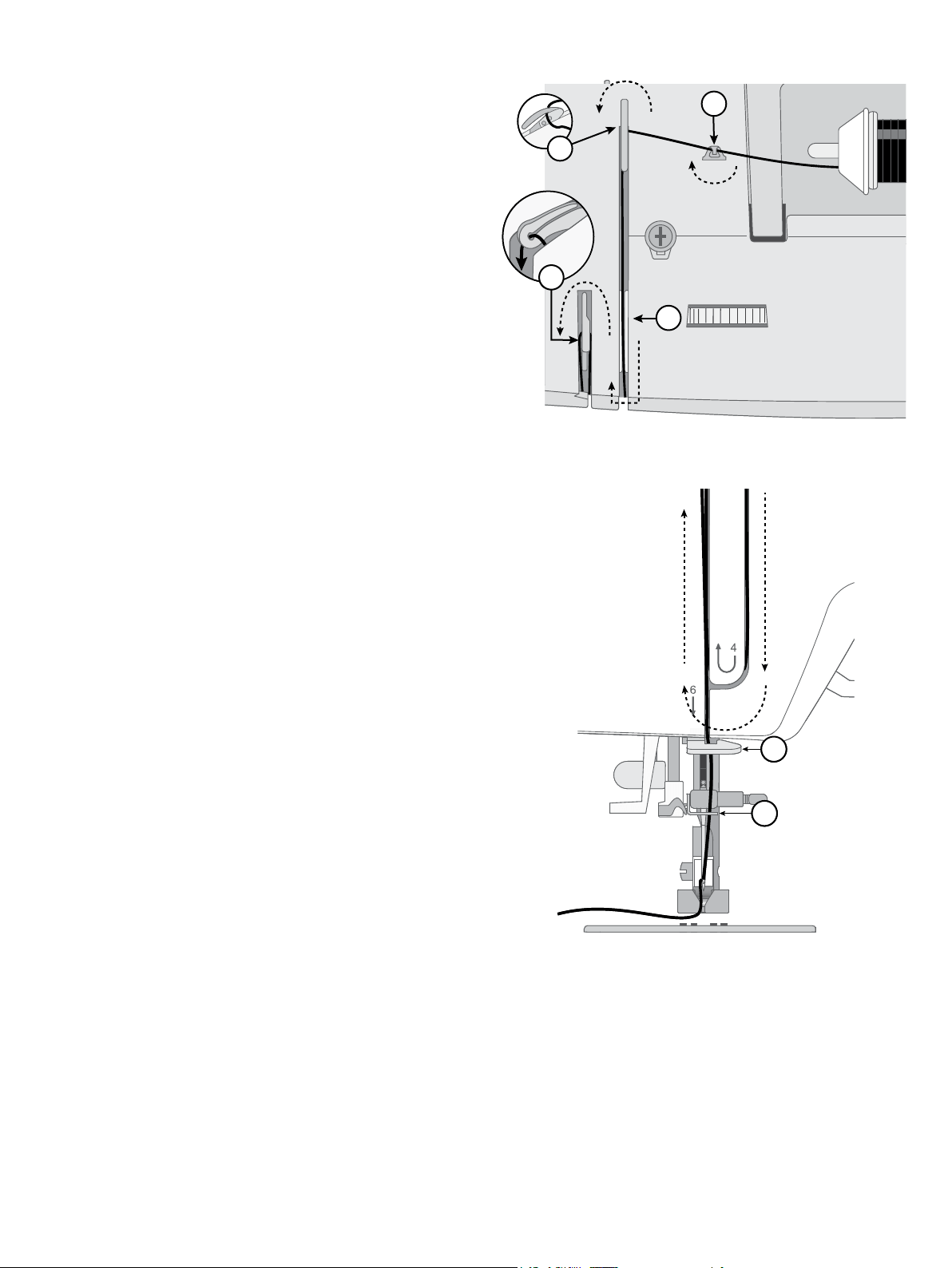
Important! Make sure that the presser foot is raised and the
needle is in its highest position by turning the handwheel
toward you. This is very important to help ensure that the
machine is correctly threaded. Not doing so can result in poor
stitch quality when you start to sew.
1. Place the thread on the spool pin and t the appropriately
sized spool cap.
2. Pull the thread into the thread guide (A) from front to the
back and thread guide (B) from back to front. Pull the
thread between the tension discs (C).
3. Continue bringing the thread down through the right thread-
ing slot, around the U-turn, then back upwards through the
left threading slot.
4. Bring the thread from the right into the take-up lever (D)
and down in the left-hand threading slot, into the lower
thread guide (E) and to the needle thread guide (F).
5. Thread the needle from front to back.
Thread the Machine
Machine from above
Machine from front
C
A
D
B
C
A
D
B
E
F
E
F
E
F
E
F
Preparations – 13
English
Preparations – 13
English
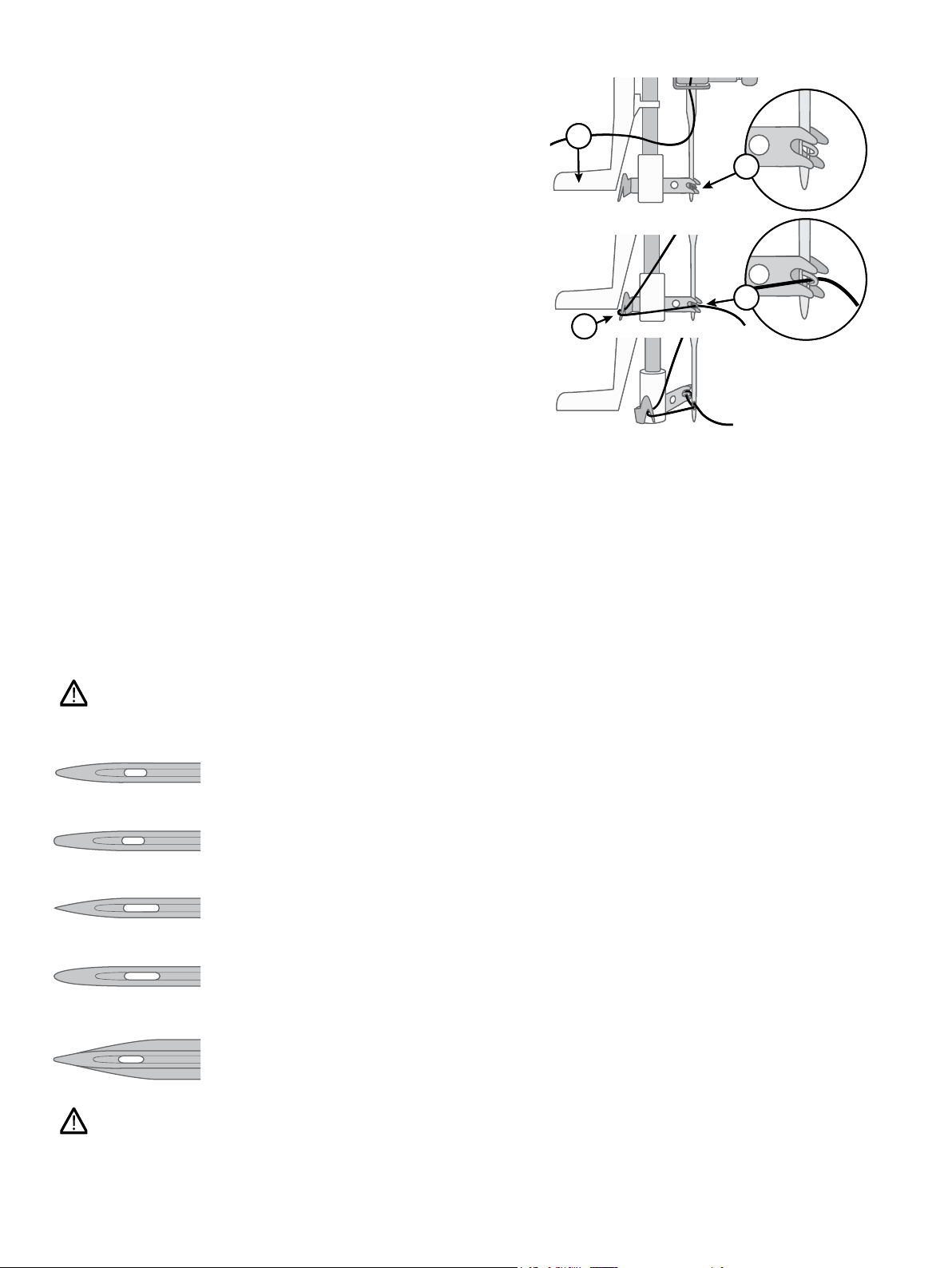
Needle Threader
Needles
The built-in needle threader allows you to thread the needle
quickly and easily.
The needle must be in its highest position to use the built-in
needle threader. Turn the hand wheel towards you until the
needle is in its highest position, or press the needle up/down
button. It is also recommended that you lower the presser foot.
• Use the handle (A) to pull the needle threader all the way
down. The metal anges cover the needle. A small hook
will pass through the needle eye (B).
• Place the thread from the back over the thread guide (C)
and under the small hook (D).
• Let the needle threader gently swing back. The hook pulls
the thread through the needle eye and forms a loop behind
the needle. Pull the thread loop out behind the needle.
• Raise the presser foot and place the thread under it.
• Pull out about 6–8” (15–20cm) of thread beyond the needle
eye. This will prevent the machine from coming unthreaded
when you start to sew.
Note: The needle threader is designed to be used for size 70-
110 needles. You cannot use the needle threader for size 60
needles or smaller, wing needles or twin needles. There are
also some optional accessories that require manual threading
of the needle. When threading the needle manually, make sure
that the needle is threaded from front to back.
The sewing machine needle plays an important role in successful sewing. Use only quality needles. We recommend needles of system
130/705H. The needle package included with your machine contains needles of the most frequently used sizes.
Be sure to match the needle to the thread you are using. Heavier threads require a needle with a larger needle eye. If the
needle eye is too small for the thread the needle threader may not work properly.
Universal Needle
Universal needles have a slightly rounded point and come in a variety of sizes. For general sewing in a
variety of fabric types and weights.
Stretch Needle
Stretch needles have a ball point and a special scarf to eliminate skipped stitches when there is a ex in the
fabric. For knits, swimwear, eece, synthetic suedes and synthetic leathers.
Denim Needle
Denim needles have a sharp point to penetrate tightly woven fabrics without deecting the needle. For
canvas, denim, microbers.
Embroidery Needle
Embroidery needles have a special scarf, a slightly rounded point and a slightly larger eye to avoid dam-
age to thread and materials. Use with metallic and other specialty threads for free-motion embroidery and
decorative sewing.
Wing Needle
Wing needles have wide extensions on each side of the needle to poke holes in the fabric when sewing
entredeux and other hemstitches on natural ber fabrics.
To help prevent needle breakage, use only medium/low sewing speed and the recommended needle for sewing thick fabrics.
C
A
B
D
C
A
B
D
14 – Preparations
English
14 – Preparations
English
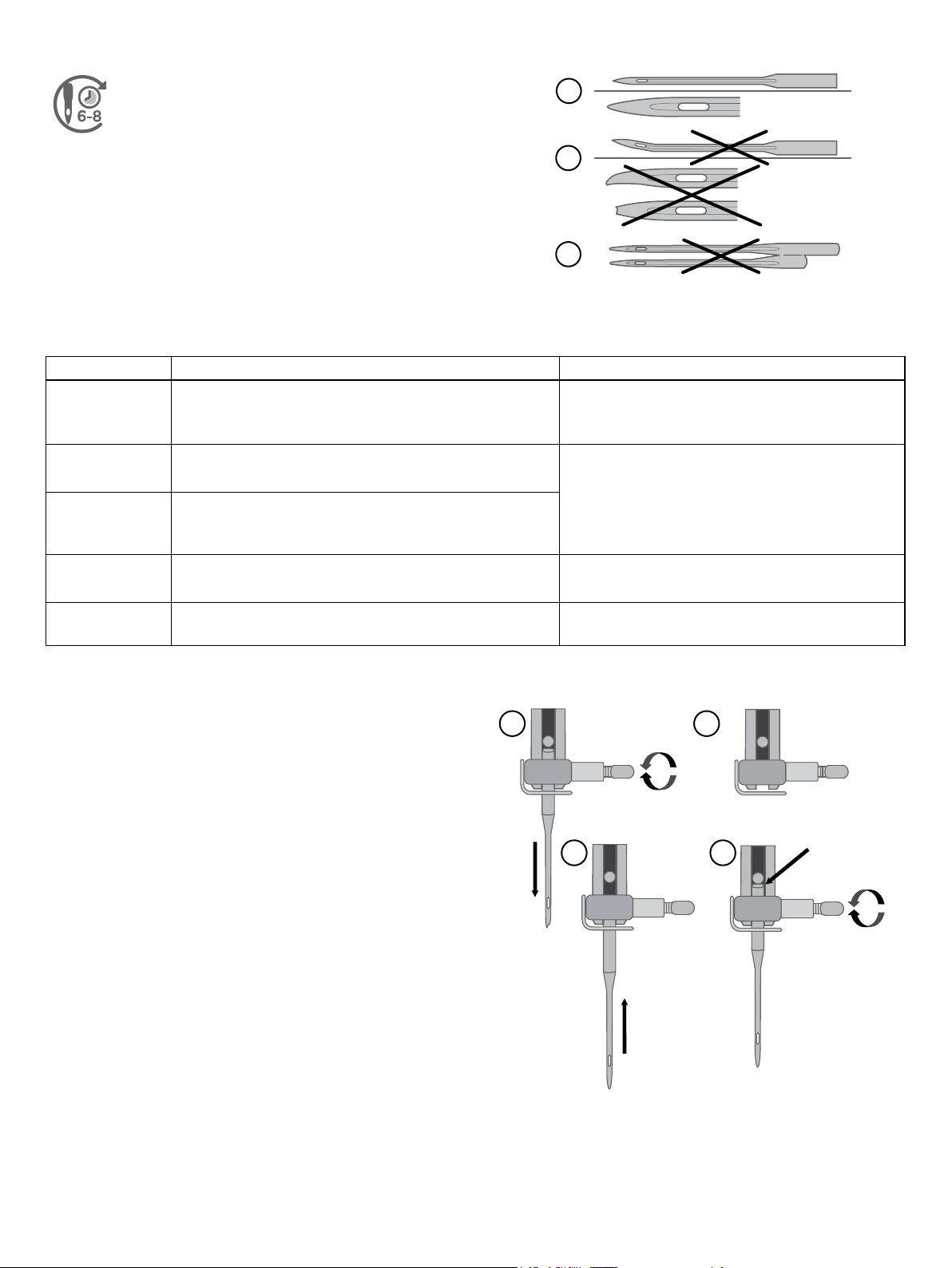
Change the needle often. As a general rule, needles
should be changed every 6-8 hours of actual stitch-
ing time.
Important Needle Information
Always use a straight needle with a sharp point and make sure
the point is not bent or damaged (A).
A damaged needle (B) can cause skipped stitches, breakage or
snapping of the thread. It can also damage the needle plate.
Do not use asymmetrical twin needles (C), they can damage
your sewing machine.
Note: Before you begin changing the needle, it can be help-
ful to place a small piece of paper or fabric underneath the
needle area, over the hole in the needle plate, so that the needle
doesn't accidentally fall down into the machine.
1. Loosen the needle clamp screw. If it feels tight, use the
screwdriver from your accessories to aid with loosening the
screw.
2. Remove the needle.
3. Push the new needle upwards into the needle clamp with
the at side of the needle away from you.
4. When the needle will go up no further, tighten the screw
securely.
Change the Needle
Selection Guide — Needle Size, Fabric, Thread
Needle Size Fabric
70 (9)
80 (11)
Lightweight fabrics: Fine cotton, voile, silk, muslin,
interlock, tricot, jersey, crepe, polyester, chion, organza,
organdy
Light duty all purpose thread
80 (11)
90 (14)
Medium weight fabrics: Quilting cotton, satin, double
knit, lightweight wool, rayon, polyester, lightweight linen
Use polyester threads on synthetic fabrics and
all-purpose or cotton thread on natural fabrics for
best results.
90 (14) Medium weight fabrics: Firm woven, medium weight lin-
en, cotton/polyester blend, terrycloth, chambray, double
knit
100 (16) Heavy weight fabrics: Canvas, wool, denim, home decor,
eece, heavy knit
Polyester or all-purpose thread
110 (18) Heavy weight fabrics: Coat weight wool, upholstery
fabrics
Heavy duty thread for needle, with all-purpose
thread for the bobbin.
A
B
C
43
1 2
Preparations – 15
English
Preparations – 15
English
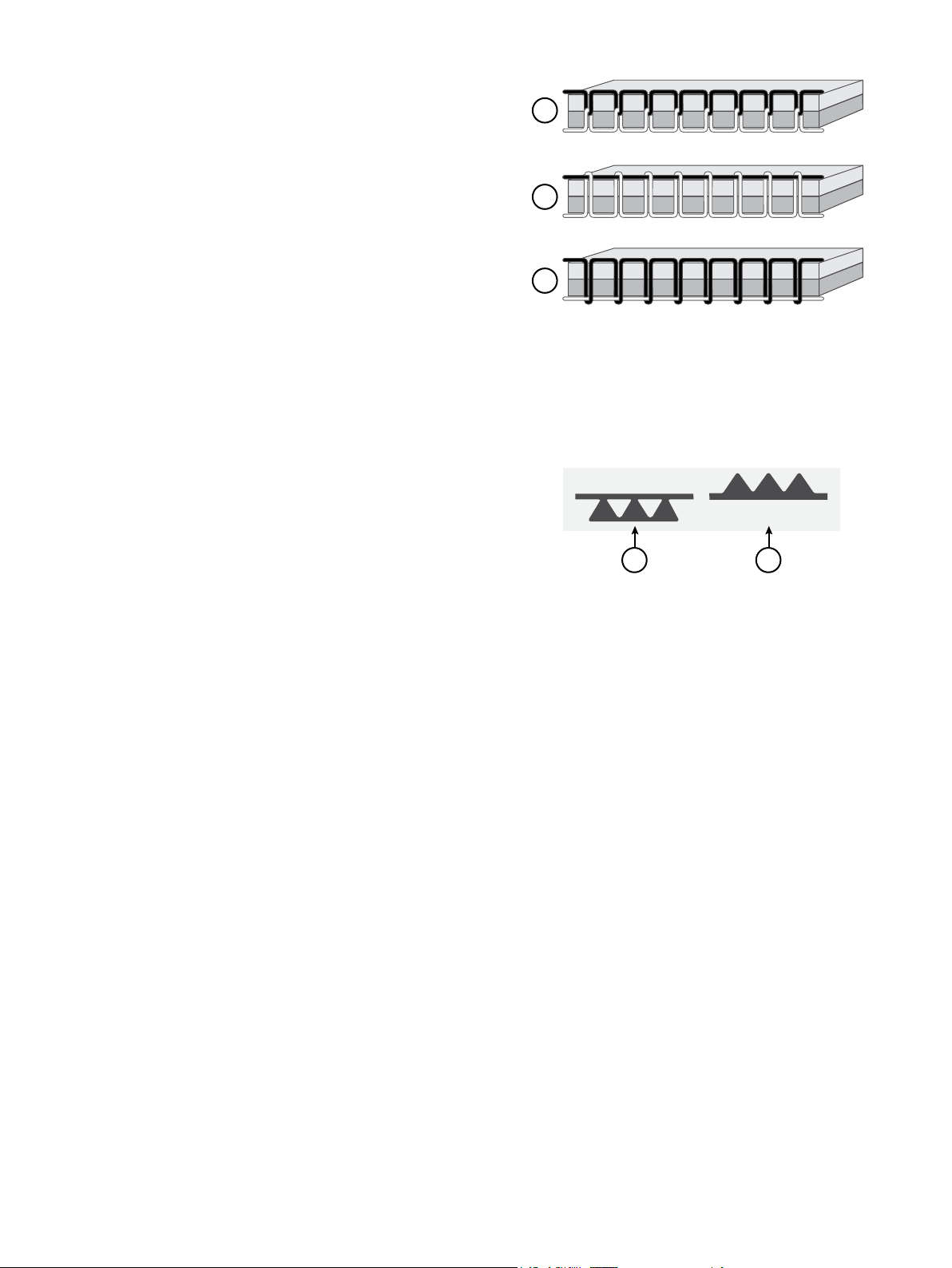
Thread Tension
Sew without Feed Teeth
To set the thread tension, turn the dial on top of the machine.
Depending on the fabric, thread, etc, the tension may need to
be adjusted. For the best stitch appearance and durability, make
sure the needle thread tension is correctly adjusted. For general
sewing, the threads evenly meet between the two layers of
fabric (A).
If the bobbin thread is visible on the top side of the fabric, the
needle thread tension is too tight (B). Reduce the needle thread
tension.
If top thread is visible on the underside of the fabric, the needle
thread tension is too loose (C). Increase the needle thread
tension.
For decorative stitches and buttonholes, the top thread should
be visible on the underside of the fabric.
Make a few tests on a scrap piece of the fabric you are going to
sew and check the tension.
When sewing on buttons or doing other sewing techniques
where you don't want the fabric to feed, you need to lower the
feed teeth.
The feed teeth lever is found at the back of the free arm.
1. Lower the feed teeth by moving the lever to the “Feed
Teeth Down” position.
2. Raise the feed teeth by moving the lever to the “Feed
Teeth Up” position.
Note: The feed teeth will not raise immediately when the lever
is switched. Turn the hand wheel toward you one full turn or
start sewing to re-engage the feed teeth.
21
A
B
C
16 – Preparations
English
16 – Preparations
English
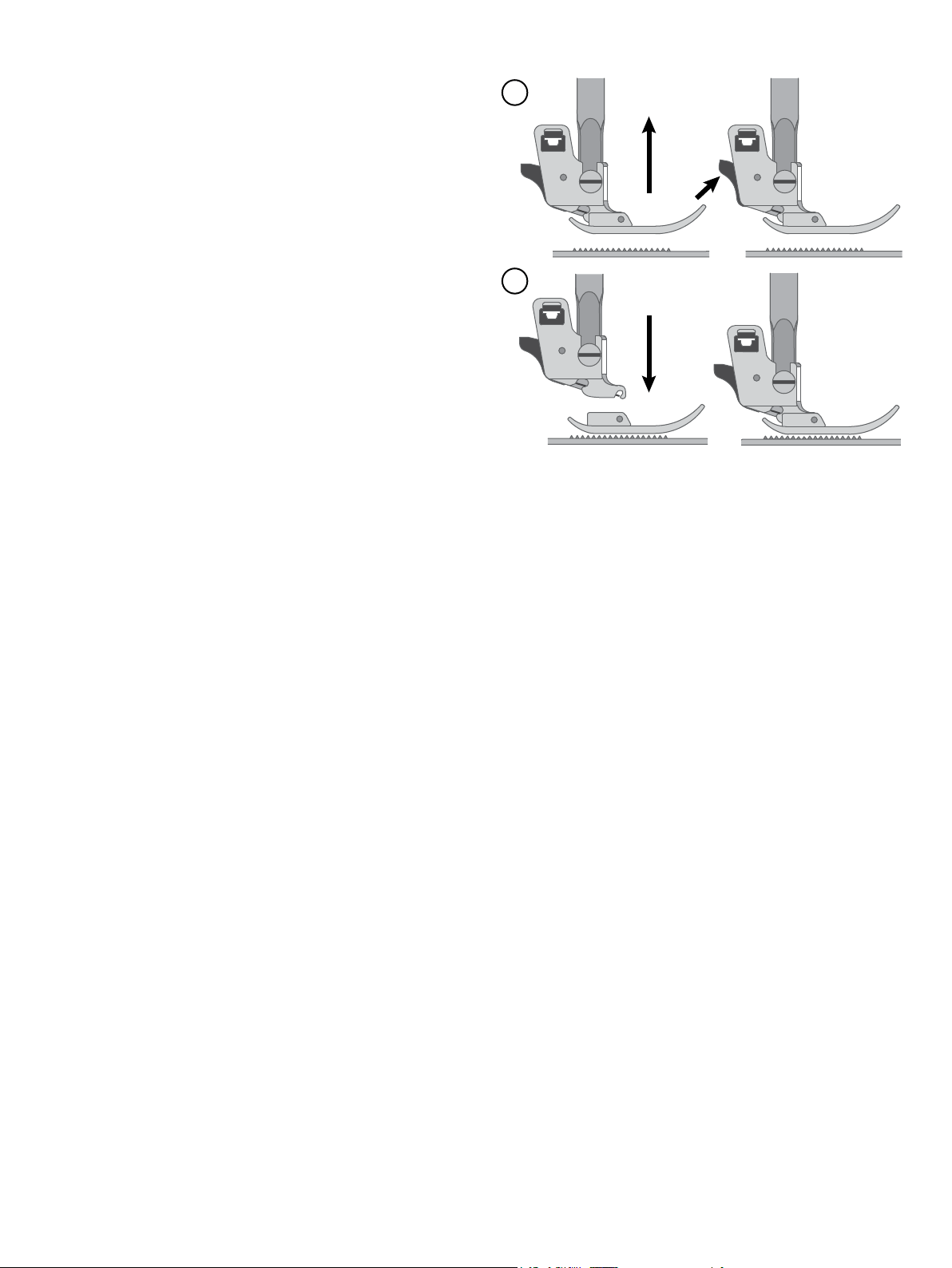
1. Make sure that the needle is in the highest position and
the presser foot is lifted. The presser foot release button
extends out the back of the presser foot holder. Press this
button to release the presser foot.
2. To attach a presser foot to the holder, place the desired
presser foot with its pin directly under the slot in the press-
er foot holder. Lower the presser foot lifter and the presser
foot will snap into place.
Note: If you nd it dicult to place the presser foot in the cor-
rect position, keep the release button pressed while lowering
the presser foot. Use your thumb to carefully guide the presser
foot into the correct position and it will snap into place.
Change the Presser Foot
2
1
Operating Your Machine – 17
English
Operating Your Machine – 17
English
OPERATING YOUR MACHINE
Machine Operation Controls
Reverse Button
Tie-O
Start/Stop
Needle Up/Down
Automatic Thread Cutter
Speed Control Lever
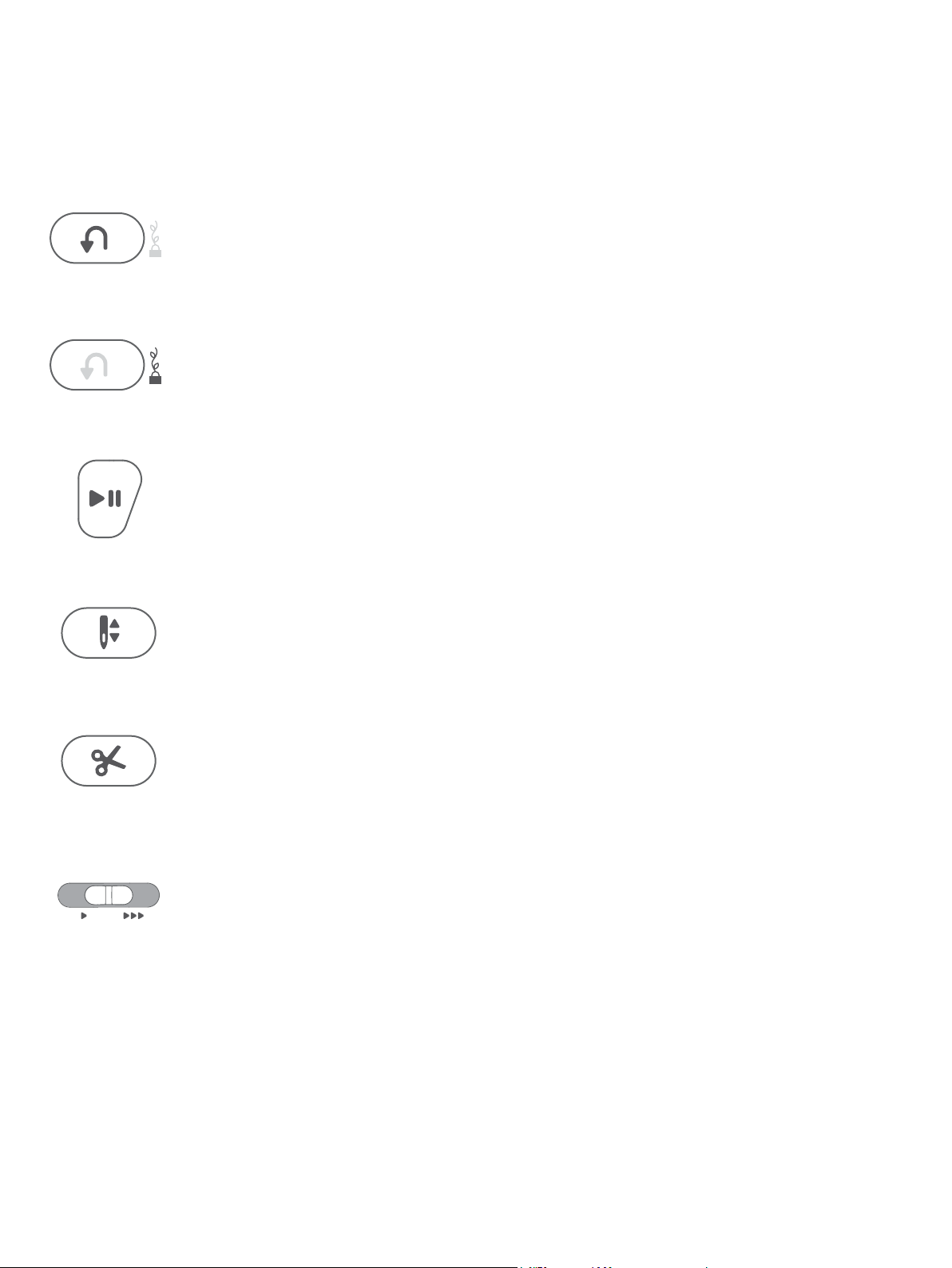
The Reverse Button has two dierent functions, depending on what stitch has been selected.
Utility Stitches (stitch no. 1–6) , Utility & Decorative Stitches (stitch no. 01)
Press and hold the Reverse button to sew in reverse. Release it to resume sewing forward. The machine sews in
reverse only as long as the reverse button is pressed.
When pressed the machine immediately sews three tie-o stitches and stops automatically.
Utility Stitches (stitch no. 7–23), Utility & Decorative Stitches (stitch no. 02–71) , Alphabet
Press the Reverse button and the machine sews 3 tie-o stitches then stops automatically.
START/STOP is used to run and stop the machine without the foot control. Long press to begin sewing and press
again to stop sewing.
Press Needle Up/Down to move the needle down or up. The setting of the needle stop position is changed at the
same time. You can also tap the foot control to raise or lower needle.
Press the Automatic Thread Cutter button and your machine ties o the threads, cuts the top and bobbin threads.
To cut threads at the end of a stitch or stitch program, press Automatic Thread Cutter while sewing.
All stitches in your sewing machine have a pre-set, recommended sewing speed. You can adjust the speed using
the Speed Control Lever. Slide the lever to the left to decrease the speed and to the right to increase the speed.
You cannot select a higher speed than the default max speed for the selected stitch.
18 – Operating Your Machine
English
18 – Operating Your Machine
English
Stitch Control Panel
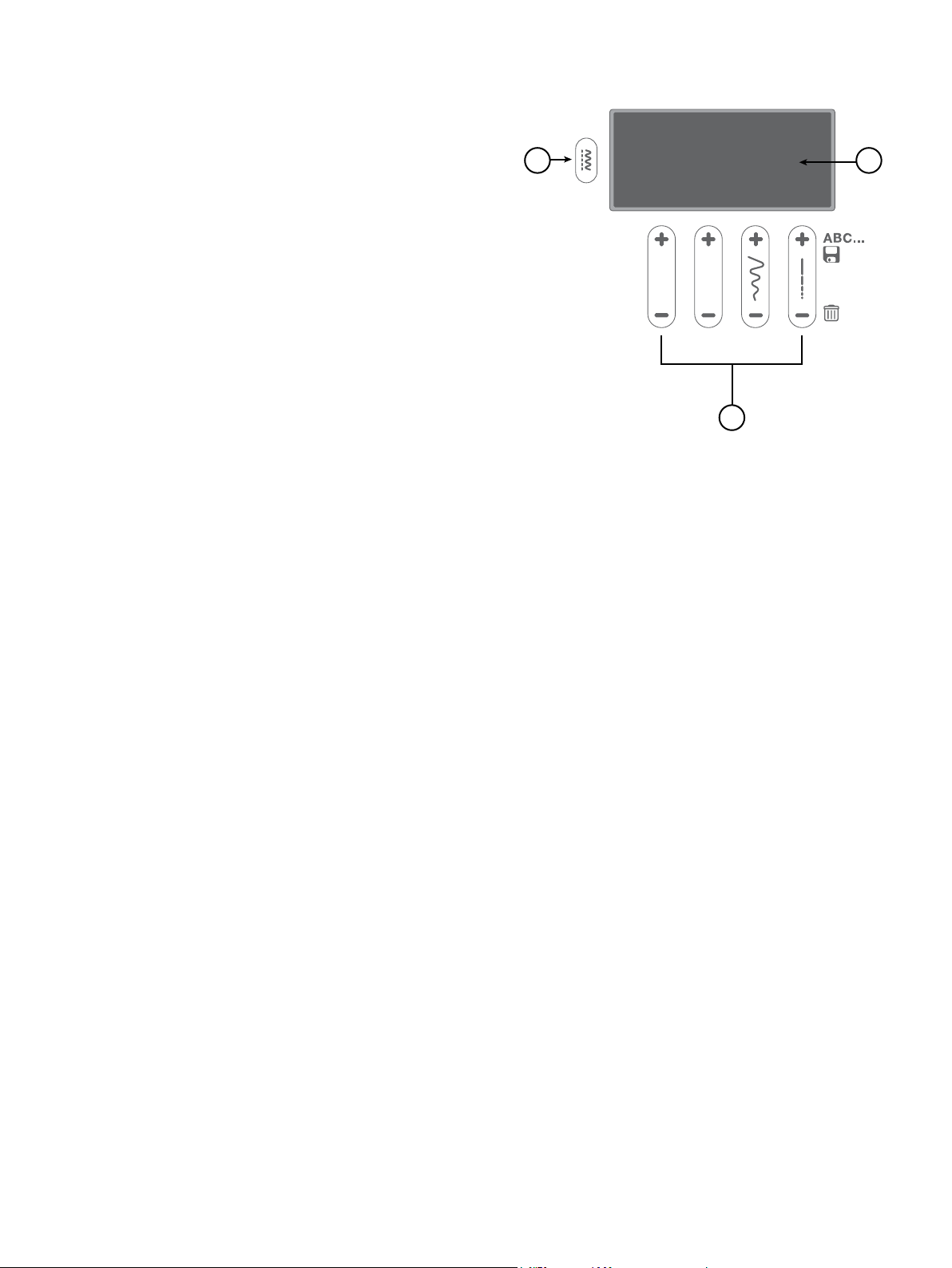
The functions on the Stitch Control Panel are used to select and
adjust stitches and program fonts. Each functionality is listed
and described further below.
1. Mode Button
2. Display
3. Function Buttons
On the display, you can see the current stitch with the set
length, width and presser foot recommendation. You can also
see activated functions such as buttonhole sewing and bobbin
winding
Press to toggle between the Stitch Menus. There are three stitch menus, 1. Utility Stitches, 2. Decorative Stitches and
3. Alphabet. The selected menu is shown on the display.
When you select a stitch, your machine automatically sets the best stitch width. The default setting is indicated on the display. The
stitch width can be adjusted between 0–7mm. Some stitches have a limited stitch width. Increase the stitch width by pressing “+”,
decrease it by pressing “-”.
When a straight stitch or a reinforced straight stitch is selected, the Stitch Width button is used to adjust the needle position. When
pressing “+”, the needle position is moved to the right. When pressing “-”, the needle moves to the left.
When you select a stitch, your machine automatically sets the best stitch length. The default setting is indicated on the display. The
stitch length can be adjusted between 0–4.5mm. Some stitches have a limited stitch length. Increase the stitch length by pressing “+”,
decrease it by pressing “-”.
The corresponding stitch numbers are shown on the Stitch Charts available at the lower right of the machine, under the Stitch Control
Panel. Choose the mode and then press the + or - Pattern Adjustment Buttons to select the number of the stitch that you desire.
Display
Stitch Menu
Stitch Width / Needle Position
Stitch Length
Stitch Selection Buttons
1
3
2
Operating Your Machine – 19
English
Operating Your Machine – 19
English
Sewing Mode
Display in Sewing Mode
Sewing Mode is the rst view on the display after you turn on the machine. Here you will nd all the basic information you need to
start sewing. This is also where you adjust the settings of your stitch. Straight stitch is selected by default.
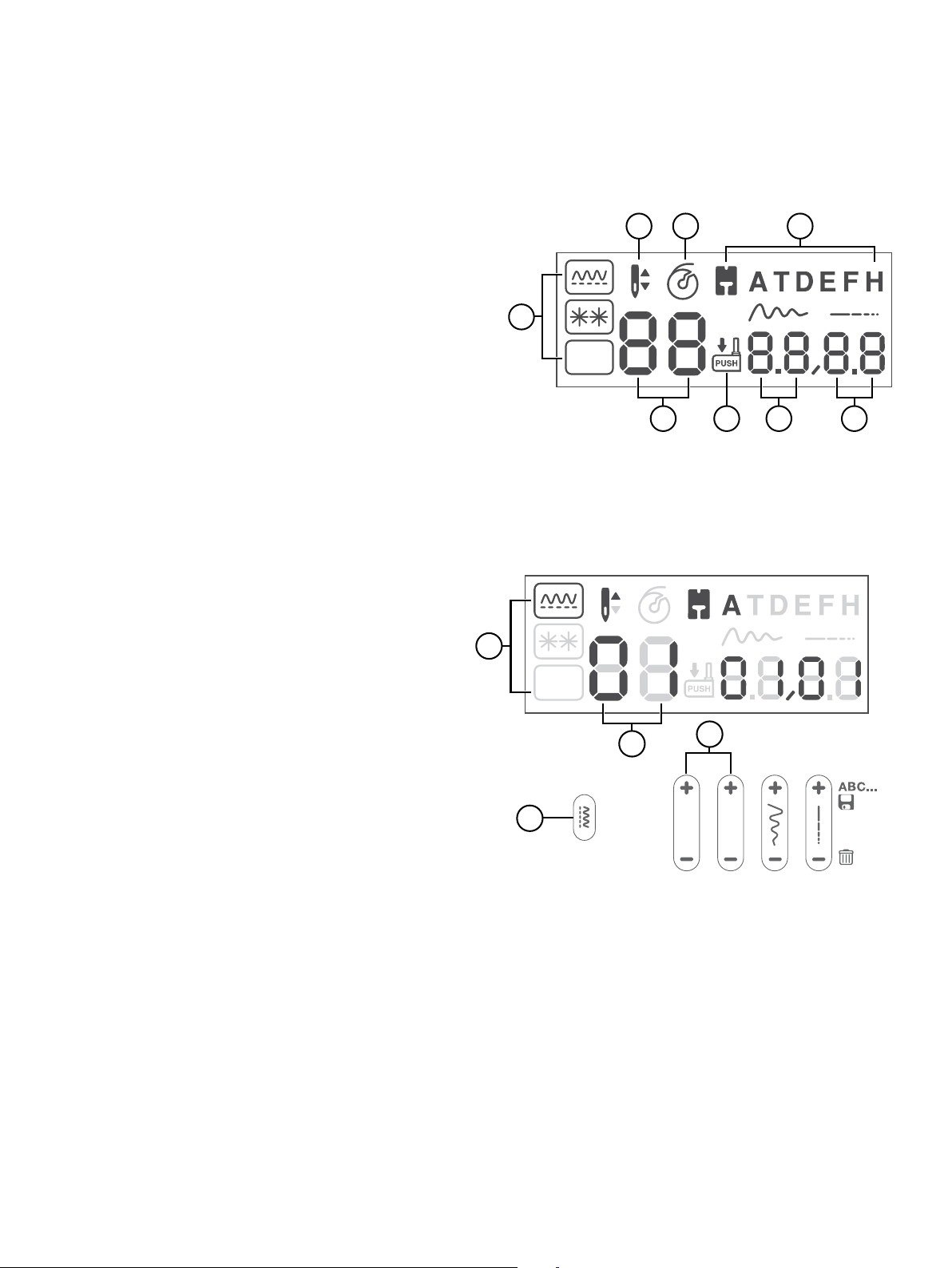
1. Mode indicator
2. Needle stop position — indicates if needle “UP” or
“DOWN” is active
3. Bobbin winding indicator — indicates that the bobbin
winding motor is activated
4. Recommended presser foot — indicates what presser foot
is recommended to use for the selected stitch to obtain the
best stitch result
5. Stitch number — the currently selected stitch
6. Buttonhole lever indicator — indicates that a buttonhole
is selected
7. Stitch width — the current width for the selected stitch
8. Stitch length — the current length for the selected stitch
Your machine has three stitch menus. Menu 1 includes the
utility stitches. Menu 2 has the decorative stitches.
Menu 3 includes the Alphanumeric stitches. Here, you will nd
Alphanumeric characters that you can use to create sequences.
When you turn on your machine, Pattern Mode and Straight
Stitch (A) is activated and (stitch no. 1) is selected (B).
Press the “Mode Button” (C) to toggle between the stitch
menus. The currently selected mode is shown on the display
(A).
Choose the mode and then press the two left + or - Pattern
Adjustment Buttons (D) to select the number of the stitch that
you desire.
To select a stitch in another menu, you will rst need to change
the mode and then select the stitch.
Select a Stitch
ABC
1
2 3 4
5 6 7 8
ABC
A
B
C
D
20 – Operating Your Machine
English
20 – Operating Your Machine
English
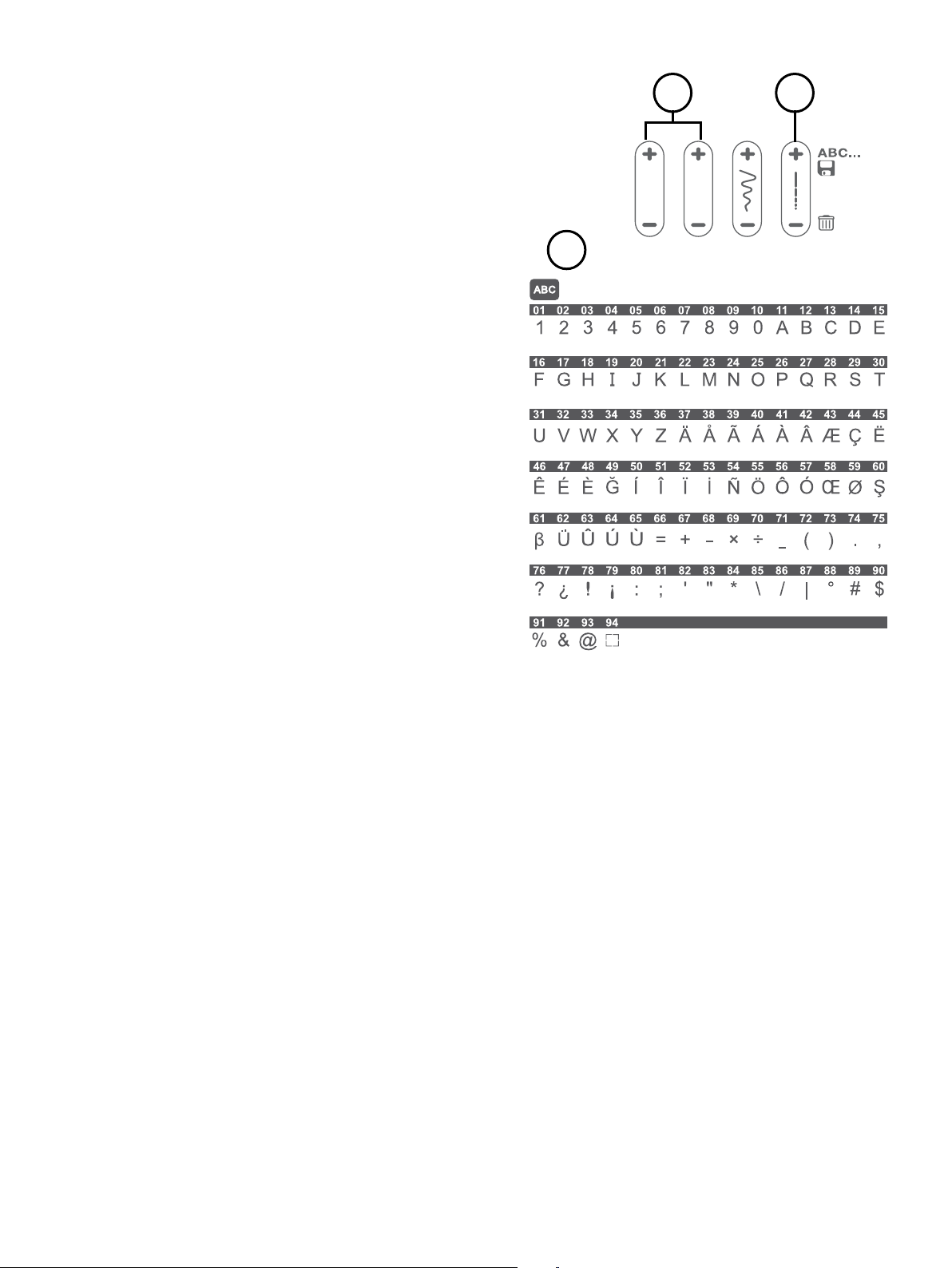
1. Letters are selected by pressing the + and - of the two Func-
tion Buttons located on the left (A).
2. Look at the Stitch Chart (B) to see which stitch number
refers to which letter or number. To program “SINGER”, it
would be stitch number 29, 19, 24, 17, 15, 28 (B).
3. After selecting each letter, press the + side of the ABC
Function Button (C) for two seconds to hear two beeps.
4. You are now ready to sew out the word “SINGER”. It will
stitch the letter sequence that was saved and will stop when
the sequence is completed. In order to repeat the sequence,
press the Foot Control or the Start/Stop Button.
Create a Sequence
1. When an error is made, for example you leave out the “E”
in SINGR.
2. Using the +/- Stitch Width Function Button scroll to the 4th
letter of the 5 stitches entered (04/05). (These numbers are
displayed under the width and length icons on the display)
3. Using the +/- side of the Pattern Adjustment Buttons, scroll
to letter E, number 15. Press the + side of the ABC Button
to enter the letter.
4. Save the new spelling of the word by pressing the + side
of the ABC Function Button for two seconds. You are now
ready to sew out the word “SINGER”.
1. Using the +/- Stitch Width Function Button scroll to the
position of the stitch you want to delete.
2. Press the – side of the ABC Function Button.
3. Save the edited sequence by pressing the + side of the ABC
Function Button for two seconds.
1. Press and hold the – side of the ABC Function Button until
all programmed stitches are gone.
2. Save by pressing the + side of the ABC Function Button for
two seconds.
Inserting a Stitch
Delete a Stitch
Clear the Memory
B
CA
Sewing – 21
English
Sewing – 21
English
SEWING
Sewing
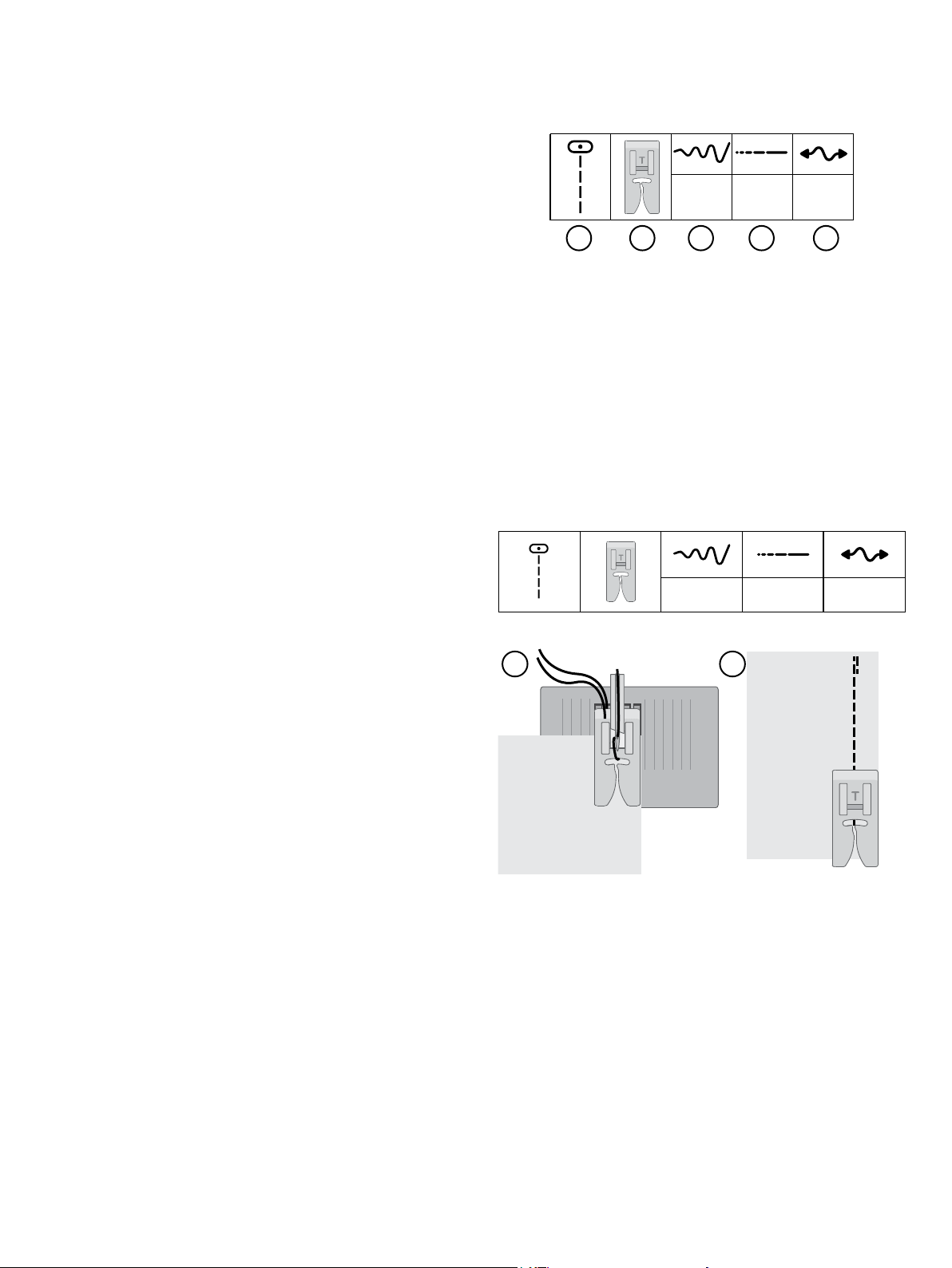
Start to Sew – Straight Stitch
Change Needle Position
Next to each stitch or sewing technique described in this sec-
tion of the manual is a chart showing the recommended settings
and presser foot. See sample of the chart to the right.
The recommended settings are also shown on the display, but
might need adjustment to t a special technique.
Note: Some fabrics have a lot of excess dye which can cause
discoloration on other fabric but also on your sewing machine.
This discoloring may be very dicult or impossible to remove.
Fleece and denim fabric in especially red and blue often con-
tain a lot of excess dye. If you suspect that your fabric/ready-
to-wear garment contains a lot of excess dye, always pre-wash
it before sewing to avoid the discoloring.
Note: For best sewing result, use the same thread on top and
bobbin. If sewing with specialty/decorative threads, use regular
sewing thread in the bobbin.
Set your machine for straight stitch (see chart to the right).
Raise the presser foot and position the fabric under it, next to a
seam allowance guide line on the needle plate. On the bobbin
cover there is a 1/4" (6mm) guide line.
Place the top thread underneath the presser foot.
Lower the needle to the point where you want to start. Bring
the threads toward the back and lower the presser foot. Press
the foot control. Gently guide the fabric along the seam guide
letting the machine feed the fabric (A). If the bobbin thread
isn’t pulled up, it will be automatically as you start to sew.
Note: You can also start and stop your machine with the Start/
Stop button.
To secure the beginning of a seam, press and hold the reverse
button. Sew a few reverse stitches. Release the reverse button
and the machine will sew forward again (B).
Some sewing is done more easily by changing the needle
position, e.g., topstitching a collar or sewing in a zipper. The
needle position is adjusted with the Stitch Width button.
A.Stitch
B.Presser foot
C.Stitch width in mm
D.Stitch length in mm
E.Thread tension
Set up for straight stitch
A B DC E
3.5
3-5
2.5
3.5 2.0– 4.0 3–5
A B
22 – Sewing
English
22 – Sewing
English
To change sewing direction, stop the machine. Press the
Needle Stop button to activate the Needle Up / Down position
button. The needle is brought down into the fabric.
Raise the presser foot.
Pivot the fabric around the needle to change sewing direction
as desired. Lower the presser foot and continue sewing in the
new direction.
Press and hold the Reverse button and sew a few stitches in reverse when you reach the end of the seam. Release the button and sew
forward again to the end of the seam. This will secure the seam so the stitches don't unravel.
Turn the handwheel toward you to raise the needle to its highest position. Raise the presser foot and remove the fabric, pulling the
threads to the back.
Pull the threads up and into the thread knife so that the threads are cut the proper length and your needle won't come unthreaded when
you start the next seam.
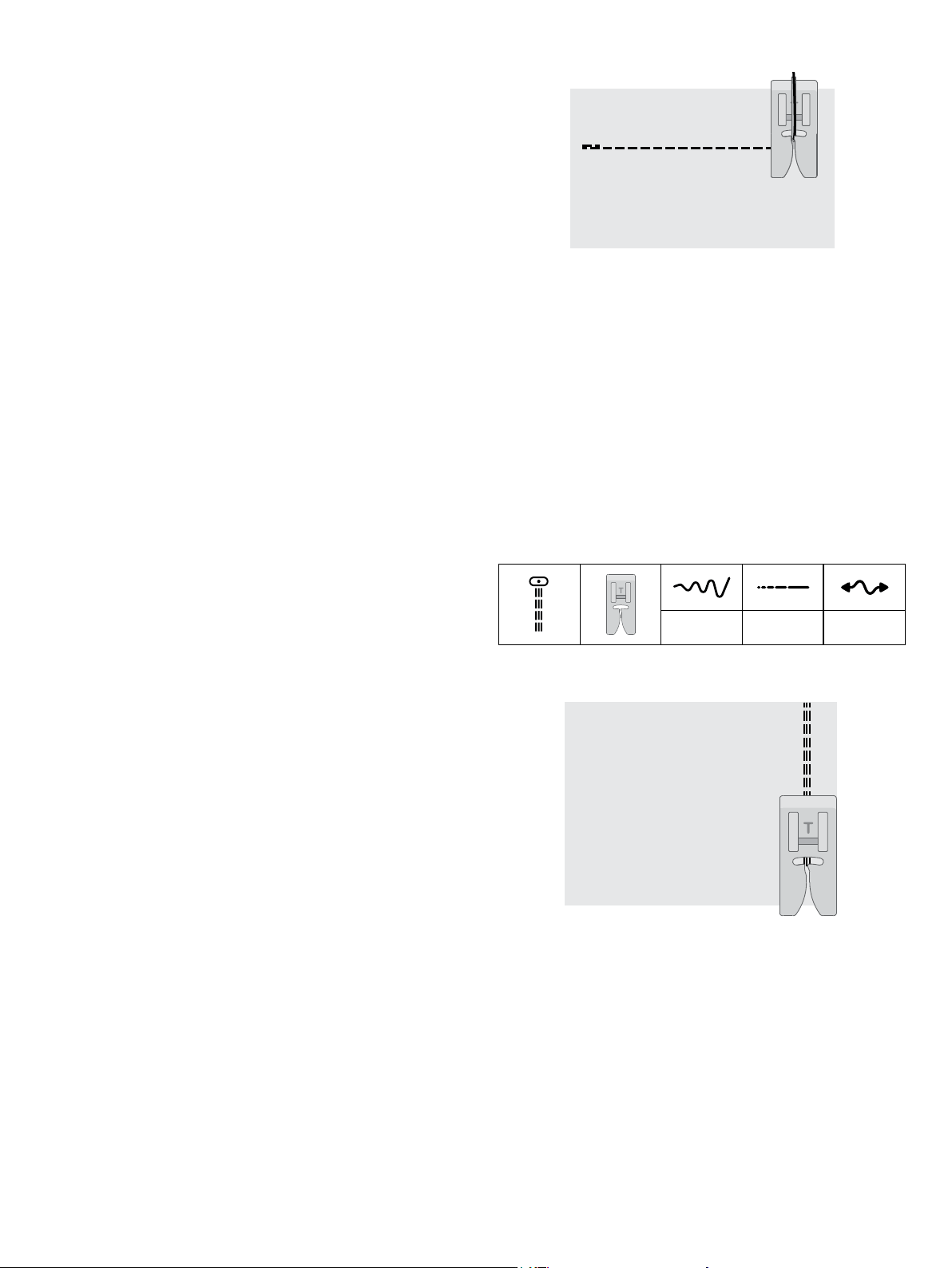
This stitch is stronger than regular straight stitch, due to the
fact that it is a triple and elastic stitch. The Straight Stretch
Stitch can be used for heavy stretch fabrics, for crotch seams
which are subject to considerable strain and for topstitching
heavy fabrics.
Carefully guide the fabric while sewing as the fabric moves
back and forth.
Change Sewing Direction
Finish Sewing
Straight Stretch Stitch
Set up for Straight Stretch Stitch
3.5 2.5 3–5
Sewing – 23
English
Sewing – 23
English
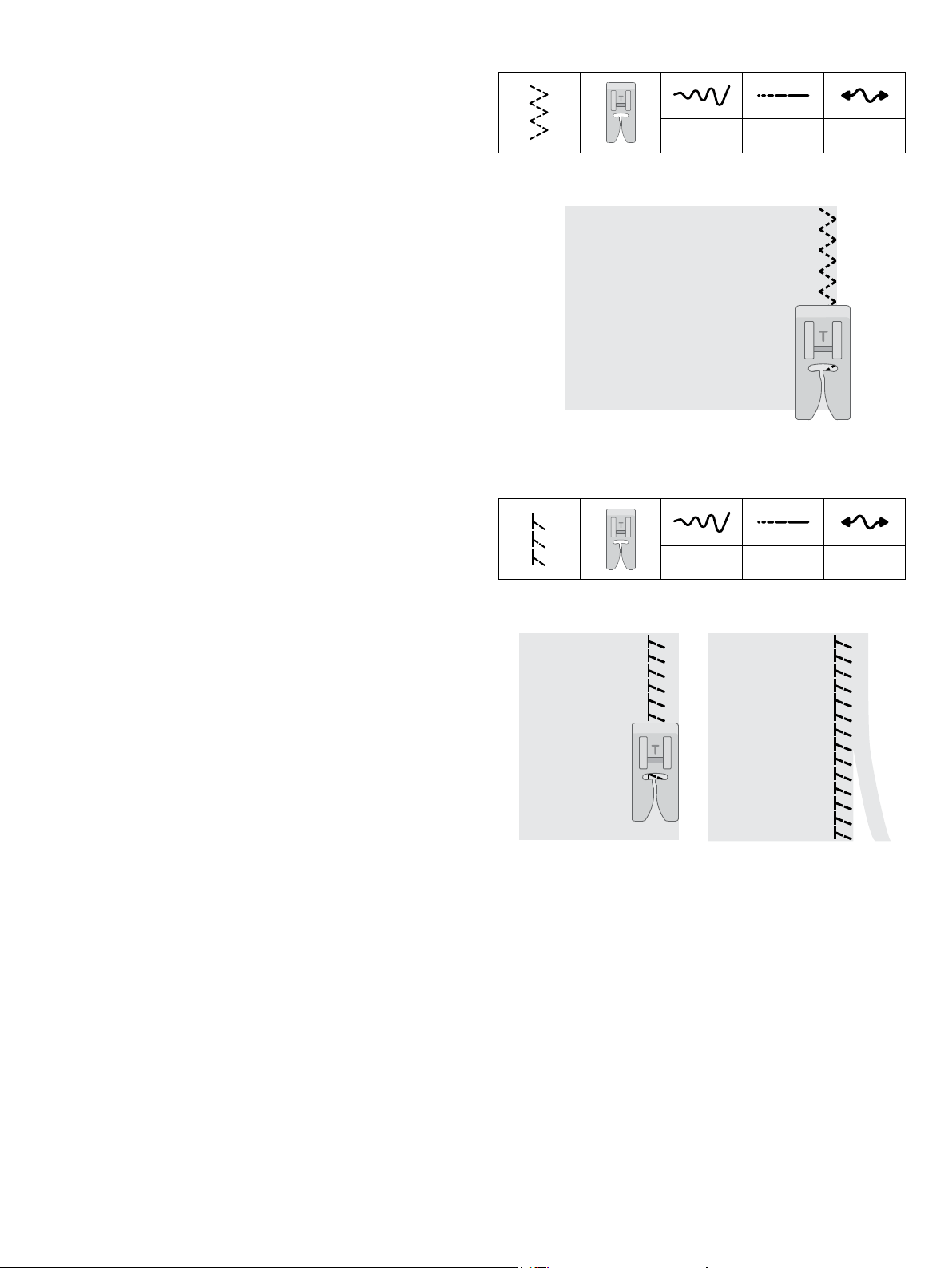
Multi-Step Zigzag Stitch
Slant Overedge Stitch
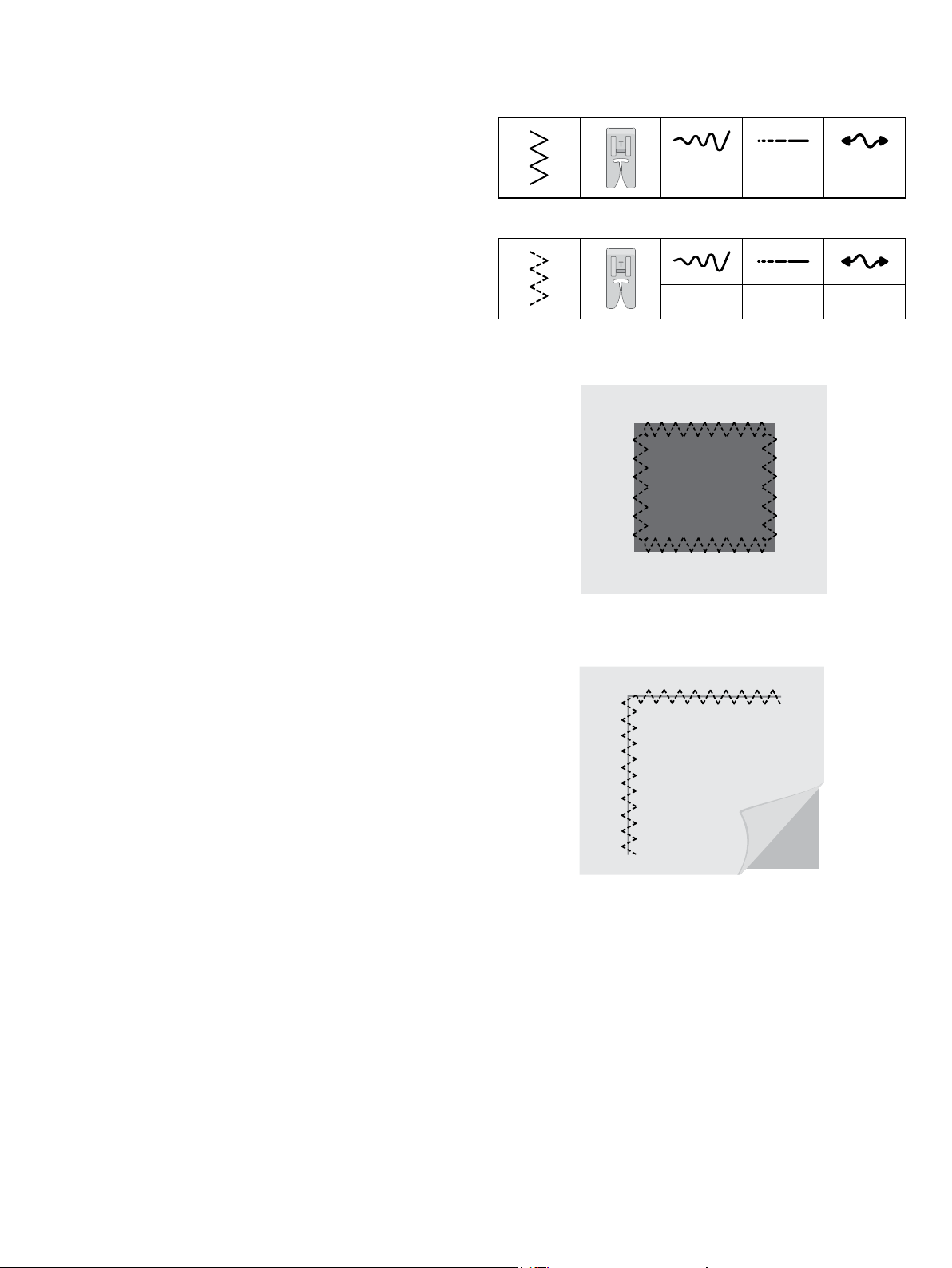
Multi-step zigzag stitch is used to overcast raw edges. Make
sure the needle pierces the fabric on the left side and overcasts
the edge on the right side.
The stitch can also be used as an elastic stitch to allow seams
to stretch when sewing knit fabrics.
The slant overedge stitch sews the seam and overcasts the edge
all at one time, perfect for stretch fabrics. This stitch is more
elastic than normal seams, very durable and quickly sewn.
Place the fabric under the presser foot aligning the edge of
the presser foot with the edge of the fabric. Once the seam is
nished, trim excess fabric outside the seam.
Tip: You can also use the Blind Hem Foot to sew at the very
edge of the fabric. Adjust the extension on the foot, and let
it guide along the fabric edge. Always test sew on a piece of
scrap fabric rst, the result might vary due to the fabric weight
and quality.
Set up for multi-step zigzag stitch
Set up for slant overedge stitch
3.0–5.0 1.0 3–5
5.0 2.5 3–5
24 – Sewing
English
24 – Sewing
English
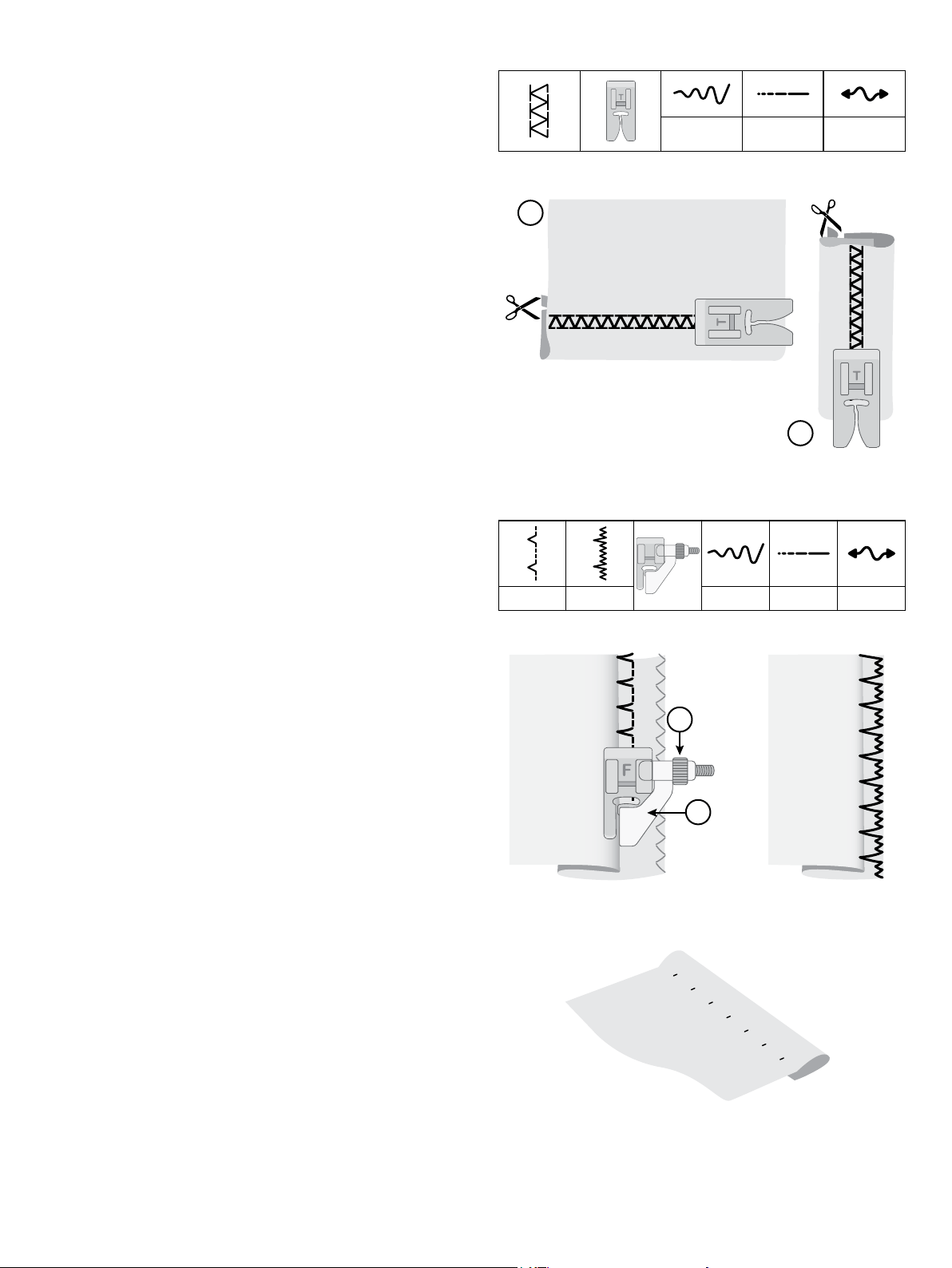
The closed overlock stitch can be used for sewing medium to
heavier weight stretch fabrics.
Use this stitch to hem stretch fabrics (A) and for belt loops (B).
Fold a hem to the wrong side and stitch with closed overlock
stitch from the right side. Trim away excess fabric.
The blind hem stitch is used to make invisible hems on skirts,
trousers and home décor projects. There are two types of blind
hem; one is recommended for medium to heavy woven fabric
(1), the other for medium to heavy stretch fabric (2).
• Finish the raw edge of the hem if sewing on a woven
fabric. There is no need to nish the raw edge rst on most
knits.
• Fold and press the hem allowance to the wrong side.
• Fold the hem back on itself so approximately 3/8" (1 cm)
of the nished edge extends beyond the fold. The wrong
side of your project should now be facing up.
• Place the fabric under the presser foot so that the fold runs
along edge guide (A).
• When the needle swings into the fold it should catch a
small amount of fabric. If the stitches are visible on the
right side, adjust edge guide (A) by turning the adjusting
screw (B) until the stitch that catches the hem just barely
shows.
Closed Overlock Stitch
Blind Hems
Set up for closed overlock stitch
Set up for blind hem
Right side of fabric
Woven fabric Stretch fabric
F
(1) (2)
3.5 1.5–2.0 3–5
A
B
B
A
5.0 2.5 3–5
Sewing – 25
English
Sewing – 25
English
Darning and Mending
Repair Large Holes
Repair Tears
To cover large holes it is necessary to sew a new piece of fabric
onto the damaged area.
Baste the new piece of fabric onto the damaged area on the
right side of the fabric.
Sew over the fabric edges with the zigzag or the multi-step
zigzag stitch.
Trim the damaged area close to the seam from the wrong side
of the fabric.
On tears, frayed edges or small holes it is useful to lay a piece
of fabric on the wrong side of the fabric. The underlayed fabric
reinforces the damaged area.
Lay a piece of fabric underneath the damaged fabric. It must be
a little larger than the damaged area.
Sew over the damaged area using the zigzag or multi-step
zigzag stitch.
Trim the piece of fabric used as reinforcement.
Set up for zigzag
Set up for multi-step zigzag
4.0–6.0 2.0 3–5
5.0 1.0–2.0 3–5
26 – Sewing
English
26 – Sewing
English
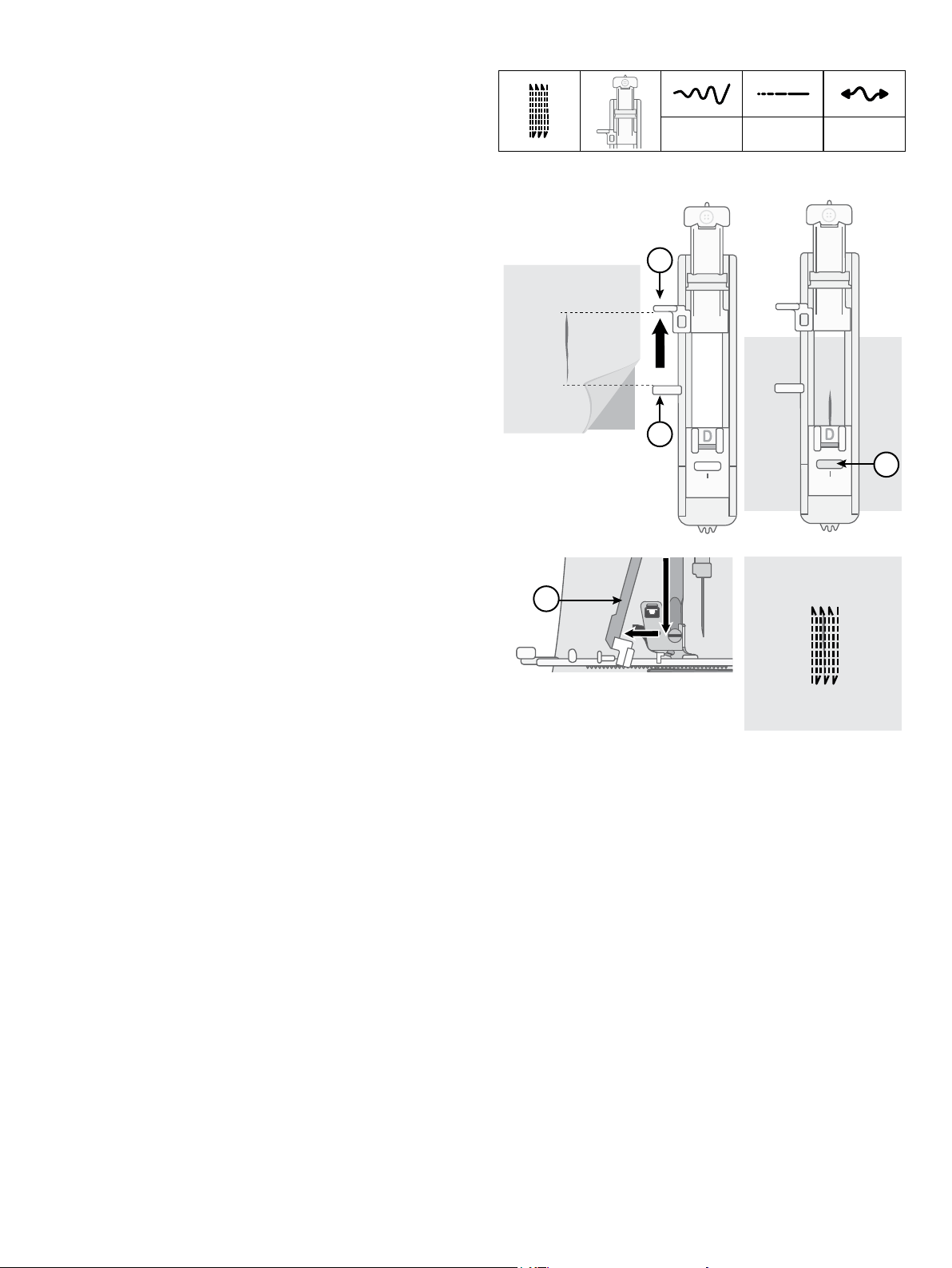
A small hole or tear is easily darned with the darning stitch.
This stitch automatically sews small stitches back and forth to
cover small holes or tears.
Thread your machine with a thread in a color as close to your
fabric as possible.
1. Select the Darning Stitch.
2. The darning stitch is used together with the Buttonhole
Foot. Measure the length of the tear/hole. Push the button
holder lever (A) out to the corresponding length. The dis-
tance between the button holder lever and the stopper (B) is
the approximate length of the darning stitch. The maximum
length is approximately 1 1/4” (3cm). (If the tear is longer,
repeat the stitch).
3. Attach the Buttonhole Foot to your machine. Place your
fabric under the presser foot. Align the fabric so that the
bottom of the tear is slightly above the center of the presser
foot (C).
4. Lower the Buttonhole Lever (D) all the way down, and
push it away from you. The Buttonhole Lever should t
between the button holder lever (A) and the stopper (B).
5. Start sewing, the machine will stop automatically once the
darning stitch is completed. Move your fabric and repeat
until the whole damaged area is covered.
Note: To make the darning even sturdier, place a fabric under-
neath the hole/tear before sewing.
Repair Small Holes
Set up for darning stitch
7.0 2.0 2–4
A
B
C
D
7.0 2.0 2–4
Sewing – 27
English
Sewing – 27
English
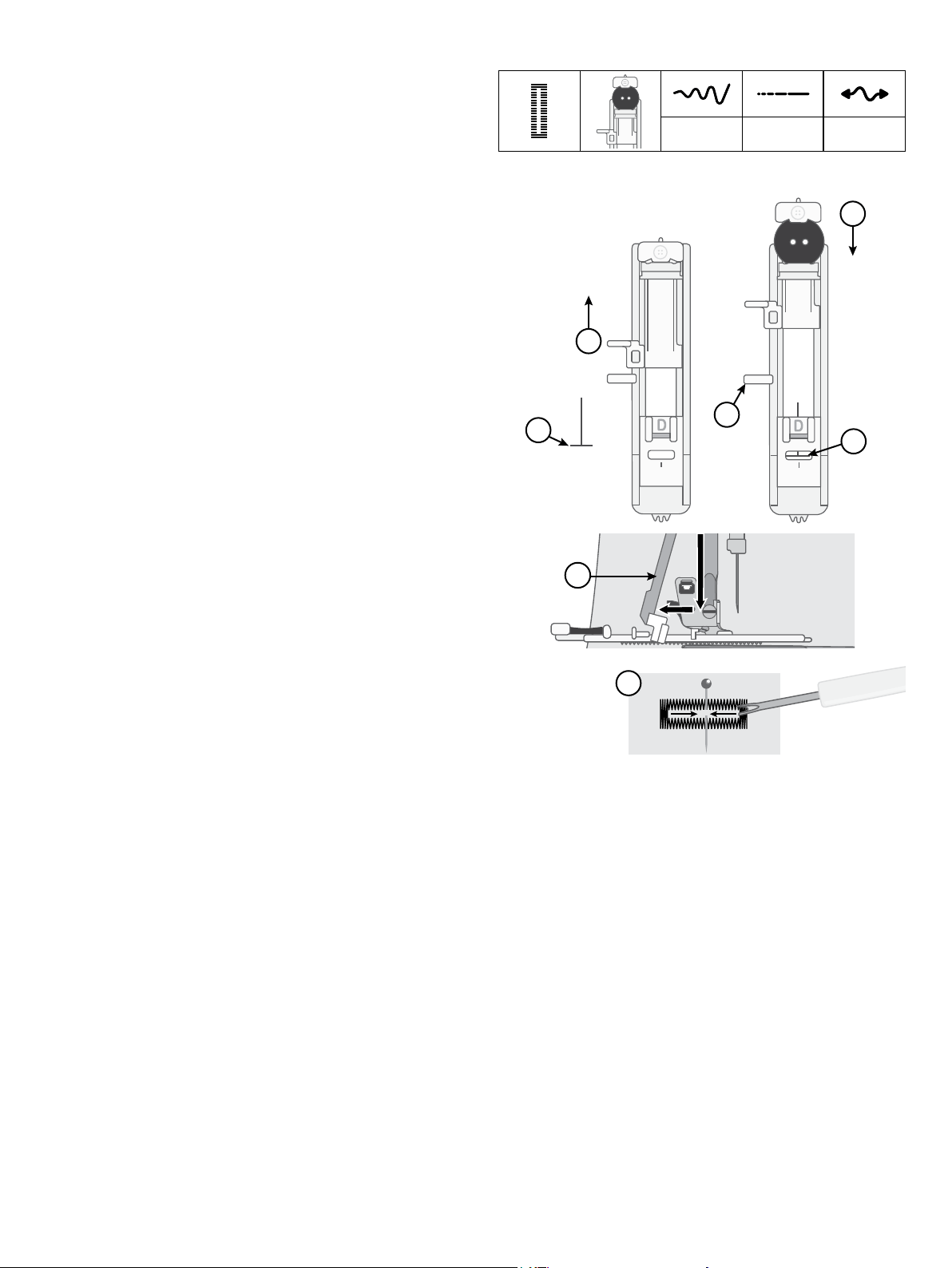
Sew buttonholes perfectly sized for your button. The fabric
should be interfaced and/or stabilized where buttonholes are to
be sewn.
1. Mark the start position of the buttonhole on the fabric (A).
2. On the One-Step Buttonhole Foot, push the button holder
open by pushing the lever backwards (B). Insert the button.
Push the button holder forward until the button is locked in
place (C). The button will determine the length of the but-
tonhole. The distance between the button holder lever (B)
and the stopper (D) is the length of the buttonhole.
3. Attach the One-Step Buttonhole Foot.
4. Make sure that the thread is pulled though the hole in the
presser foot and placed under the foot.
5. Position your fabric under the presser foot so that the mark-
ing on the fabric is aligned with the center of the Button-
hole Foot (E).
6. Lower the Buttonhole Lever (F) all the way down, and push
it away from you. The buttonhole lever should t between
the button holder lever (B) and the stopper (D).
7. Hold the end of the upper thread and start sewing. The
buttonhole is sewn from the front of the presser foot to the
back. Stop sewing when the buttonhole is nished.
8. Once the buttonhole is nished, raise the presser foot. Push
the buttonhole lever all the way up.
9. To secure the bartack, thread the end of the top thread into
a hand sewing needle, pull to the wrong side and tie the end
before cutting excess thread.
10. Use a seam ripper and cut the buttonhole open from both
ends towards the middle (G).
If you want to sew another buttonhole, do not push the button-
hole lever up when the buttonhole is nished. Instead, push it
away from you again. Sew another buttonhole.
Note: Always sew a test buttonhole on a piece of scrap fabric.
One-Step Buttonhole
Set up for buttonhole
5.0 0.4 3–5
B
A
C
E
G
D
F
5.0 0.4 3–5
28 – Sewing
English
28 – Sewing
English
Sew Zippers
Centered Zipper
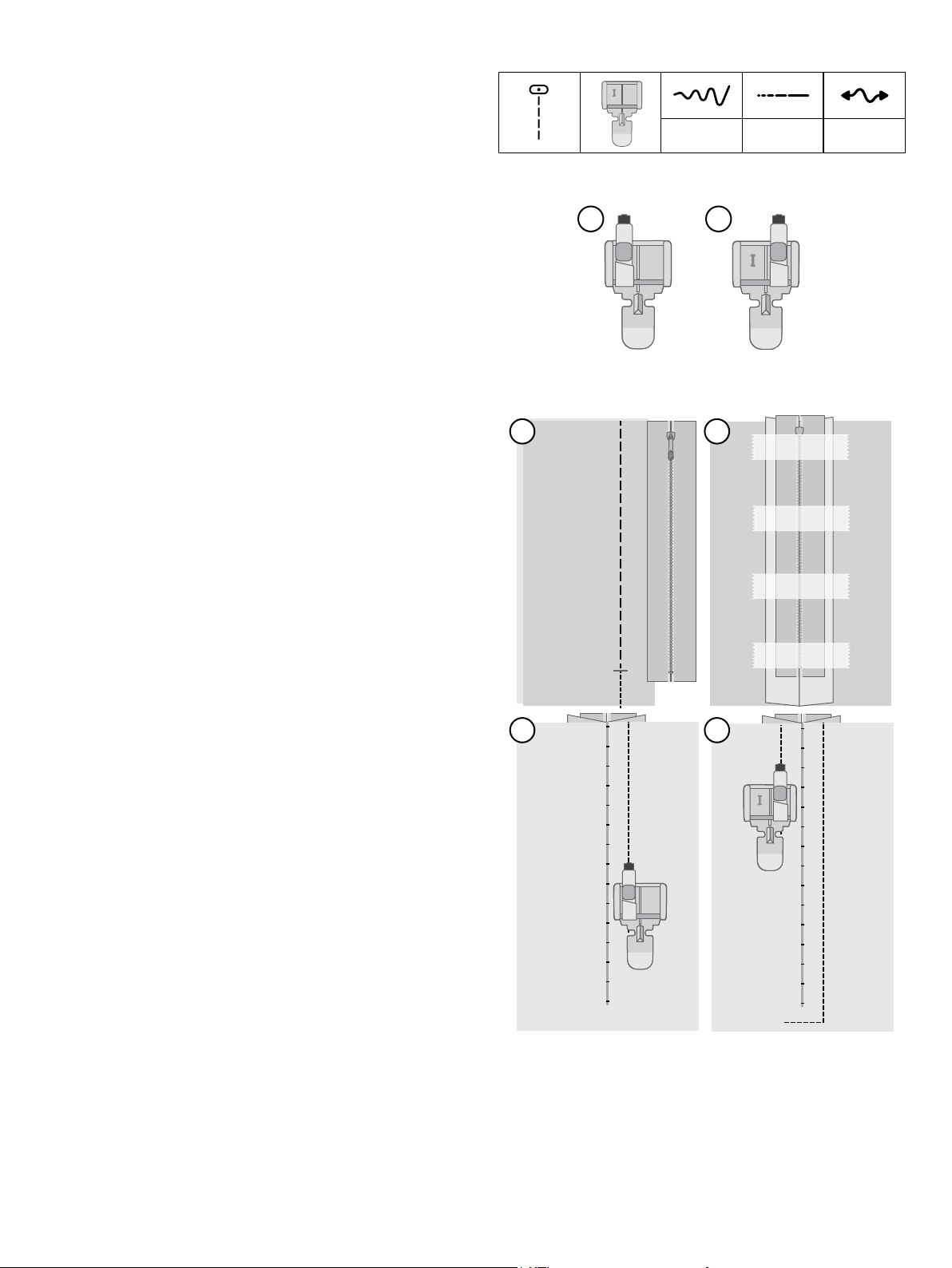
The Zipper Foot can be attached on either the right or the left
of the needle, making it easy to sew both sides of the zipper.
To sew the right side of the zipper, attach the foot in the left
presser foot position (A).
To sew the left side of zipper, attach the foot in the right presser
foot position (B).
• Place the fabric pieces right sides together and pin. Mark
the zipper length on your fabric.
• Baste the zipper seam using the specied seam allowance
(use straight stitch with stitch length 4mm, thread tension
2). Baste to the end of zipper marking (C).
• Set up the machine for straight stitch (see table above),
backstitch a few stitches and sew the rest of the seam using
the specied seam allowance (C).
• Press the seam allowances open. Place the right side of the
zipper to the wrong side of the seam, tape in place (D).
• Flip your project, making sure that the right side is facing
up. Snap on the Zipper Foot, to the left side of the needle
(A).
• Sew along the right side of the zipper to the end of your
zipper, remember to backstitch in the beginning. Stop with
the needle down in the fabric, lift the presser foot and turn
your project to sew across the bottom of the zipper (E).
• Attach the Zipper Foot to the right side of the needle (B).
Sew the remaining zipper side as you did with the rst side
(F).
• Flip your project to remove the tape on the back side.
• Flip your project to the right side again and remove the
basting stitches.
Set up for sewing zippers
3.5 2.0–3.0 3–5
FE
C D
A B
Sewing – 29
English
Sewing – 29
English
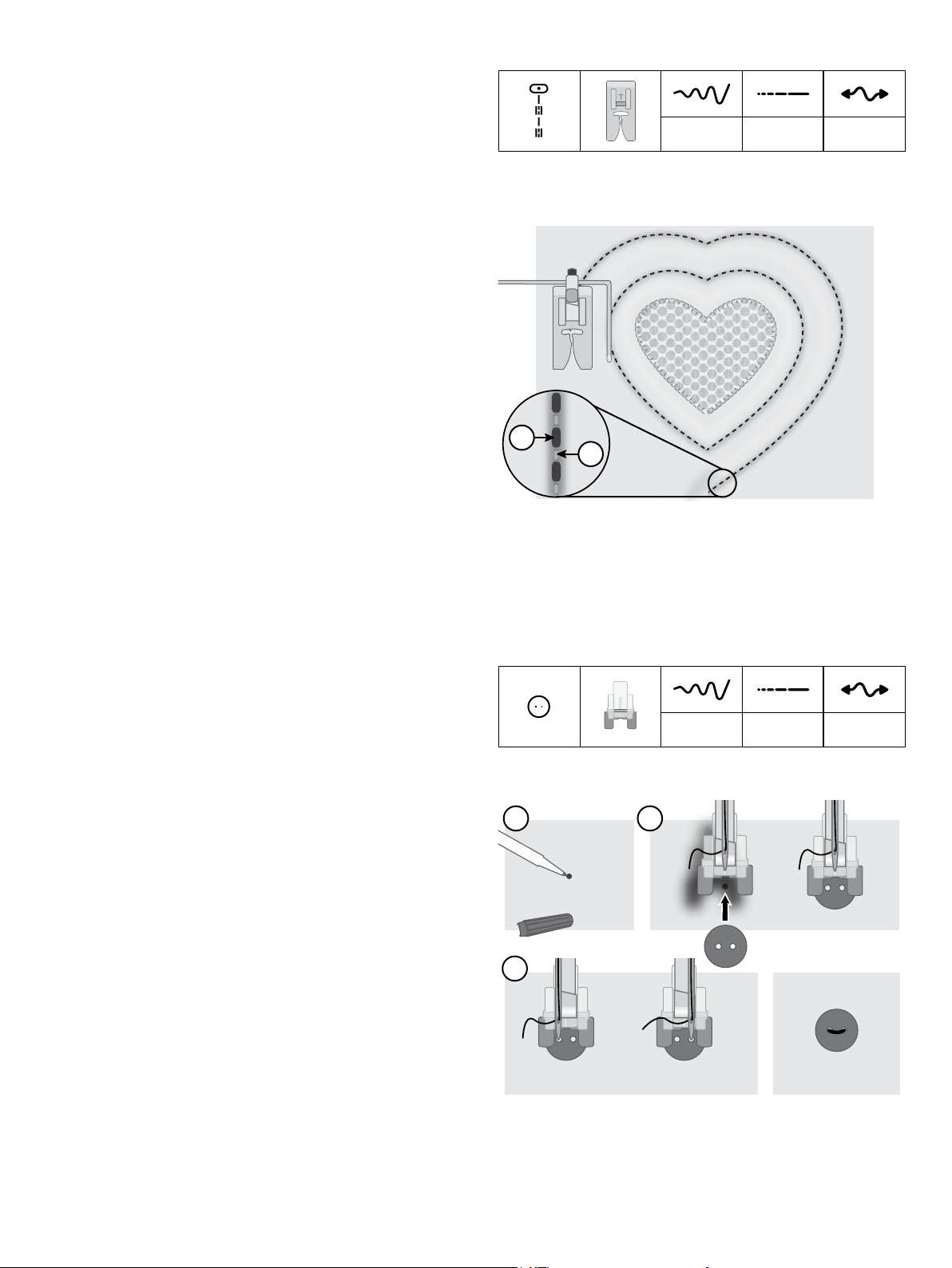
Simulate the look of hand sewn quilting with the Hand-look
Quilting stitch. Thread the needle with either transparent thread
or with a thread that blends with the color of the top of the fab-
ric. Thread the bobbin with a thread color that coordinates or
contrasts with the top of the fabric, depending on the look you
want for your project (the bobbin thread will actually appear on
the top of the fabric).
• To get the accurate hand stitched look it is important that
the stitch is sewn using a high thread tension. Make sure
to set the tension according to the recommendations in the
stitch chart.
• Stitch along one of the seams of your project, or around
an appliqué. The handlook eect is created as the bobbin
thread is pulled up to the top of the fabric.
• Use the quilting guide to make even rows of channel quilt-
ing or echo quilting as illustrated. Insert the Edge/Quilting
Guide into the groove at the back of the presser foot holder
and adjust the position to t your project.
Hand-Look Quilt Stitch
Set up for hand-look quilt stitch
A. Bobbin thread
B. Needle thread
Button Sewing
Fasten buttons easily and quickly with the special button sew-
ing stitch.
1. Select the Button Sewing Stitch.
2. Lower the feed teeth.
3. Attach the Button Sewing Foot to your machine.
4. Mark the placement of the button with a marking pen (A).
5. Place your project under the presser foot, place the button
under the foot aligning it with the marking on the fabric.
Lower the presser foot (B).
6. Turn the handwheel toward you very slowly to be sure the
needle clears the holes. Adjust the stitch width if needed
(C).
7. Start sewing at a low speed. The machine stops automati-
cally after a few stitches.
8. Leave a long thread tail and pull it under the button. Wind
the thread tail around the shank.
9. Use a hand sewing needle to pull the thread to the wrong
side of the fabric and secure.
10. To re-engage the feed teeth, move the Feed Teeth Lever
back to regular sewing position, and then turn the hand
wheel toward you one full revolution.
Set up for button sewing
3.5 2.0–3.0 6–9
3.5 — 2– 4
H
A
B
A B
C
30 – Maintenance
English
30 – Maintenance
English
MAINTENANCE
Cleaning the Machine
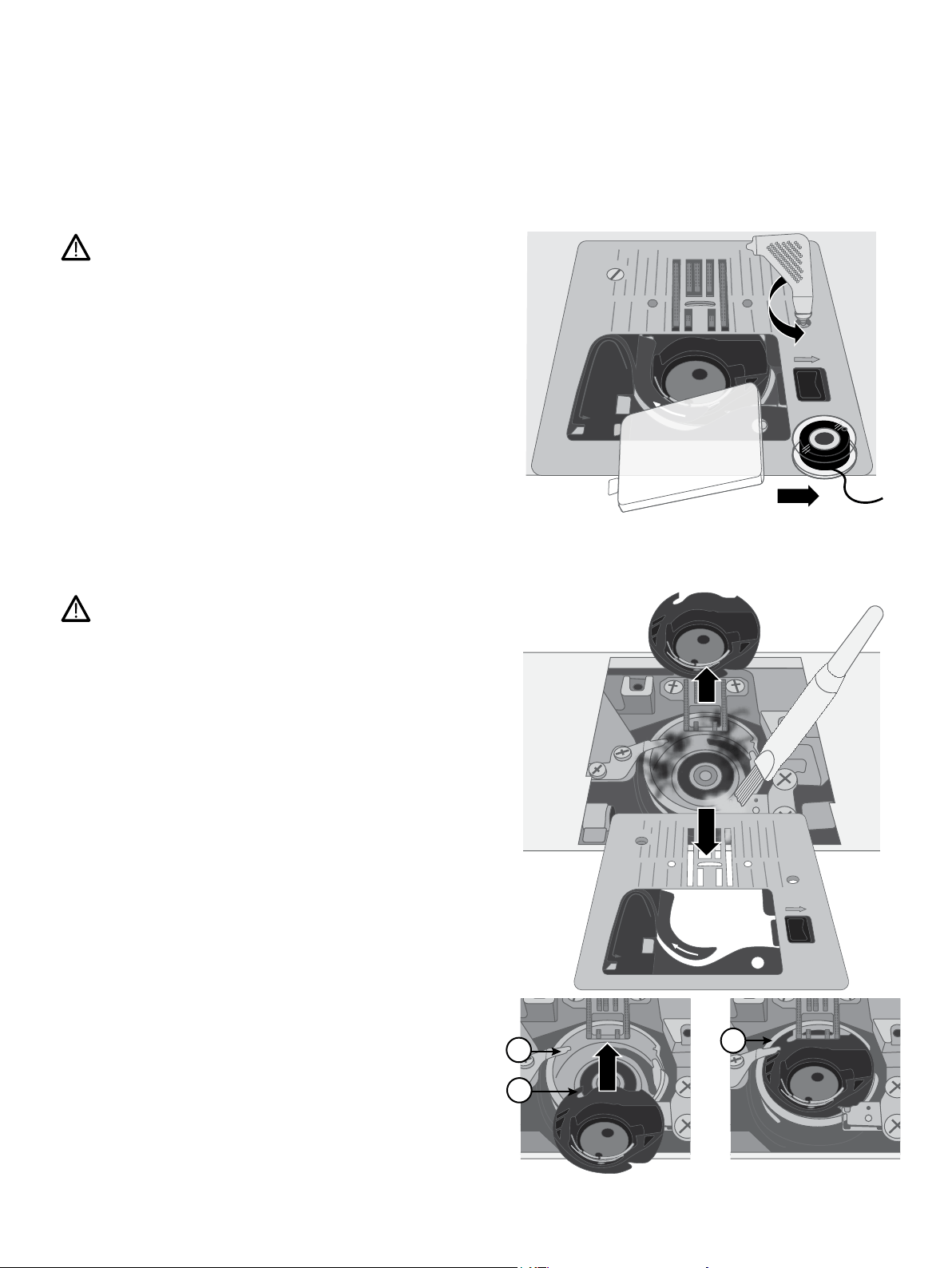
Cleaning the Bobbin Area
Raise the needle and turn o the machine.
Raise the needle and turn o the machine.
Cleaning under the Bobbin Area
To keep your sewing machine operating well, clean it often. No lubrication (oiling) is needed. Wipe the exterior surface of your ma-
chine with a soft cloth to remove any dust or lint built up.
Remove the presser foot. Slide o the bobbin cover and re-
move the bobbin.
Remove the screws in the needle plate by using the L-screw-
driver. Lift up and remove the needle plate.
Clean the feed teeth and the bobbin area with the brush found
among the accessories.
Place the needle plate over the feed teeth, replace and tighten
the screws.
Attach the presser foot, insert the bobbin and replace the bob-
bin cover.
Clean the area under the bobbin case after sewing several
projects or any time you notice an accumulation of lint in the
bobbin case area.
Remove the presser foot. Slide o the bobbin cover and re-
move the bobbin.
Remove the screws in the needle plate by using the L-screw-
driver. Lift up and remove the needle plate.
Remove the bobbin case by lifting it up. This is easier if you
push it slightly to the left or right as you lift.
Clean the area with the brush or with a dry cloth.
Note: Do not blow air into the bobbin case area. The dust and
lint will be blown into your machine.
Guide the “forked” end of the bobbin case (A) under the bob-
bin case holder (B) and under the feed teeth. Move the bob-
bin case slightly from right to left until it slips correctly into
the hook race (C). To make sure the bobbin case is properly
replaced, turn the handwheel towards you. The hook race (C)
should rotate freely in a counter-clockwise direction.
Place the needle plate over the feed teeth, replace and tighten
the screws.
Attach the presser foot, insert the bobbin and replace the bob-
bin cover.
A
C
B

Maintenance – 31
English
Maintenance – 31
English
Troubleshooting
Thread Loops on Underside of Fabric
Possible cause:
Thread looping on the underside of the fabric is always an indication that the upper thread is not correctly
threaded. This happens when the upper thread is not correctly placed in the thread tension mechanism and has
not been threaded through the take up lever.
Solution:
Rethread the machine, making sure to rst raise the presser foot lifter before starting to thread, so thread can
be properly seated in the tension mechanism and take up lever. To know if you have rethreaded the machine
correctly, try this test:
• Raise the presser foot lifter and thread the top of the machine.
• Thread the needle, but don't put the thread under the presser foot yet. As you pull the upper thread to the
left, it should pull freely.
• Put the presser foot lifter down. As you pull the upper thread to the left, you should feel resistance. This
means you are threaded correctly.
• Put the thread under the presser foot, and then draw up the bobbin thread. Slip both thread tails under the
presser foot towards the back. Lower the presser foot and begin sewing.
If you put the presser foot lifter down, but the thread still pulls freely (you feel no dierence whether the press-
er foot is up or down), this means that you have threaded incorrectly. Remove the upper thread and rethread
the machine.
Bobbin Thread Breaking
Possible cause:
Bobbin threaded incorrectly.
Solution:
Check that bobbin is placed correctly in the bobbin holder.
Possible cause:
Bobbin wound too full or unevenly.
Solution:
Bobbin thread may not have been correctly placed into bobbin winding tension disc during the bobbin wind-
ing process.
Possible cause:
Dirt or lint in bobbin holder.
Solution:
Clean bobbin holder.
Possible cause:
Wrong bobbins being used.
Solution:
Use bobbins that are the same style as those that come with the machine (SINGER® Class 15 transparent
bobbins) – don’t substitute.
Bobbin Thread Showing on Top of Fabric
Possible cause:
Top thread too tight.
Solution:
Reduce upper thread tension.
Possible cause:
Thread path is obstructed, putting extra tension on top thread.
Solution:
Check that the top thread path is not obstructed and thread is moving freely through the thread path.
Possible cause:
Bobbin thread not in bobbin case tension.
Solution:
Rethread bobbin.
Bobbin Winding Diculties
Possible cause:
Bobbin thread loosely wound on bobbin.
Solution:
Rewind bobbin, making sure that the thread is placed snuggly in the bobbin winding tension disc.
Possible cause:
Bobbin winding spindle not fully engaged, therefore bobbin not winding.
Solution:
Check that the bobbin winding spindle has been fully engaged before starting to wind.

32 – Maintenance
English
32 – Maintenance
English
Possible cause:
Bobbin is winding sloppily because thread end not held at beginning of winding process.
Solution:
Before starting to wind, hold the thread tail (coming out of the bobbin) securely, allow the bobbin to partially
ll, then stop to trim the thread tail close to the bobbin.
Fabric Puckers
Possible cause:
Top thread is too tight.
Solution:
Reduce top thread tension.
Possible cause:
Stitch length is set too short.
Solution:
Increase stitch length setting.
Possible cause:
Wrong style needle for fabric type.
Solution:
Use correct needle style and size for your fabric.
Fabric Is Tunneling Under Stitches
Possible cause:
Fabric is not properly stabilized for the density of the stitches (for example, satin stitch applique).
Solution:
Add a fabric stabilizer underneath the fabric to help keep the stitches from tunneling in together, forming a
puckered ridge in fabric.
Loud Noise When Sewing
Possible cause:
Thread not in take-up lever.
Solution:
Rethread the machine, making sure the take up lever is in its highest position so thread goes in the eye of
the take up lever — turn machine hand wheel toward you to raise the take up lever to its highest position for
threading.
Possible cause:
Thread path is obstructed.
Solution:
Check that thread is not caught on the thread spool or behind the spool cap.
Machine is Not Feeding Fabric
Possible cause:
Presser foot lifter has not been lowered onto fabric after threading.
Solution:
Lower the presser foot lifter before starting to sew. Don´t “push” or “pull” the fabric as you sew.
Possible cause:
Feed teeth lever may have been returned to "up" position, but the handwheel has not yet been turned one full
turn to completely re-engage the feed teeth.
Solution:
The feed teeth need to be raised and re-engaged by turning the handwheel one full revolution.
Possible cause:
Stitch length is set at zero.
Solution:
Increase stitch length setting.
Machine Will Not Run
Possible cause:
Bobbin winding spindle is engaged when you try to sew.
Solution:
Disengage bobbin winding spindle by pushing it to the left.
Possible cause:
Power cord and/or foot control not plugged in correctly.
Solution:
Make sure power cord/foot control are correctly seated in machine and power supply.
Possible cause:
Wrong bobbins being used.
Solution:
Use bobbins that are the same style as those that come with the machine (SINGER® Class 15 transparent
bobbins)– don’t substitute.

Maintenance – 33
English
Maintenance – 33
English
Needles Breaking
Possible cause:
Bent, dull or damaged needle.
Solution:
Discard needle, insert new needle.
Possible cause:
Wrong size needle for fabric.
Solution:
Insert appropriate needle for fabric type.
Possible cause:
Machine not threaded correctly.
Solution:
Rethread the machine completely.
Possible cause:
“Pushing” or “pulling” fabric.
Solution:
Don’t manually push/pull fabric in order to sew, but allow the machine’s feed teeth to draw fabric under the
presser foot as you guide it.
Needle Threader Not Working
Possible cause:
Needle not in correct position.
Solution:
Raise needle to its highest position by turning hand wheel toward you.
Possible cause:
Wrong size needle for fabric.
Solution:
Needle all the way up in the needle clamp.
Possible cause:
Needle is bent.
Solution:
Remove the bent needle, insert new needle.
Possible cause:
Hook pin damaged.
Solution:
Needle Threader needs replacement. Contact authorized service center.
Skipping Stitches
Possible cause:
Needle inserted incorrectly.
Solution:
Check that at side of needle top is toward back of machine and needle is up as far as it can go, then tighten
needle clamp screw.
Possible cause:
Wrong needle for fabric sewn.
Solution:
Use correct needle style and size for your fabric.
Possible cause:
Bent, dull or damaged needle.
Solution:
Discard needle and insert new needle.
Stitches Distorted
Possible cause:
“Pushing” or “pulling” the fabric.
Solution:
Don’t manually push/pull fabric in order to sew, but allow the machine’s feed teeth to draw fabric under press-
er foot as you guide it.
Possible cause:
Incorrect stitch length setting.
Solution:
Adjust stitch length setting.
Possible cause:
Stabilizer may be needed for technique.
Solution:
Place stabilizer underneath fabric.
Thread Bunching at Beginning
Possible cause:
Top and bobbin threads have not been properly placed underneath presser foot before starting to sew.
Solution:
Ensure that both the top thread and the bobbin thread are under the presser foot and toward the back before
starting to sew.
34 – Maintenance
English
34 – Maintenance
English
Possible cause:
Sewing was started with no fabric under the presser foot.
Solution:
Place fabric under foot, making sure that needle comes down into fabric; lightly hold both thread tails for rst
few stitches.
Possible cause:
Stabilizer may be needed for technique.
Solution:
Place stabilizer underneath fabric.
Upper Thread Breaking
Possible cause:
Thread path obstructed
Solution:
Check if thread is caught on thread spool (rough spots on the spool itself) or behind spool pin or spool cap (if
the thread has fallen behind the spool cap and therefore cannot feed freely through the machine path).
Possible cause:
Machine is not threaded correctly.
Solution:
Remove upper thread completely, raise presser foot lifter, rethread machine making sure thread is in take-up
lever (raise take up lever to its highest position by turning hand wheel toward you.
Possible cause:
Upper tension too tight.
Solution:
Reduce upper thread tension.
Technical Specication
Sewing Speed
Maximum 800 ± 50 rpm
(using straight stitch with default stitch length)
Rated Voltage
240 V/50Hz, 230 V/50Hz, 220 V/50-
60Hz, 127 V/60 Hz, 120 V/60 Hz, 125
V/60 Hz, 100V/50-60Hz
Presser Foot Rise Height
6mm
Protection Class
II (Europe)
Stitch Width
0–7.0mm
Stitch Length
0–4.5mm
Type of Lamp
LED light
Machine Dimensions
Length: ≈465mm
Width: ≈210mm
Height: ≈300mm
Weight
6.3kg
We reserve the right to change the machine equipment and the assortment of accessories without prior
notice, or make modications to the performance or design. Such modications, however, will always be
to the benet of the user and the product.
INTELLECTUAL PROPERTY
SINGER, and the Cameo “S” Design, are exclusive trademarks of The Singer Company Limited S.à.r.l.
or its Aliates.
Please note that on disposal, this product must be safely recycled in ac-
cordance with relevant National legislation relating to electrical/electron-
ic products. Do not dispose of electrical appliances as unsorted muncipal
waste, use separate collection facilities. Contact your local government
for information regarding the collection systems available. When replac-
ing old appliances with new ones, the retailer may be legally obligated to
take back your old appliance for disposal free of charge.
If electrical appliances are disposed of in landlls or dumps, hazardous
substances can leak into the groundwater and get into the food chain,
damaging your health and well-being.
MANUFACTURER
VSM Group AB
Soldattorpsgatan 3, SE-55474 Jönköping, SWEDEN



471099426A • English • ©2021 The Singer Company Limited S.à.r.l. or its Aliates. • All rights reserved • Printed on environment friendly paper
021H7G0101