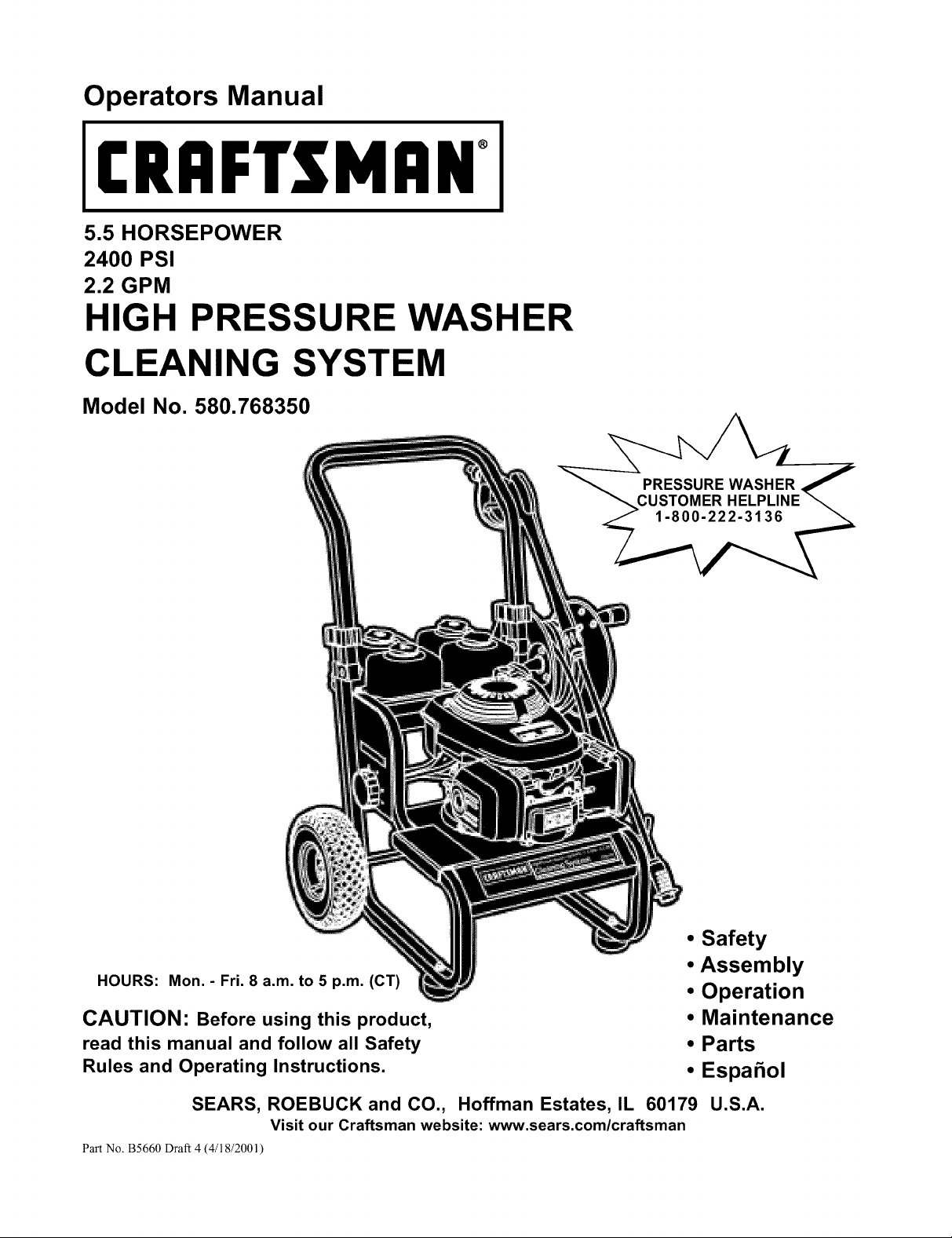
Operators Manual
CRRFT$14RN°
5.5 HORSEPOWER
2400 PSI
2.2 GPM
HIGH PRESSURE WASH
CLEANING SYSTEM
Model No. 580.768350
R
HOURS: Mon.- Fri. 8 a.m. to 5 p.m. (CT)
CAUTION" Before using this product,
read this manual and follow all Safety
Rules and Operating Instructions.
• Safety
• Assembly
• Operation
• Maintenance
• Parts
• Espafiol
SEARS, ROEBUCK and CO., Hoffman Estates, IL 60179 U.S.A.
Visit our Craftsman website: www.sears.com/craftsman
Part No. B5660 Draft 4 (4/18/2001)
WARRANTY ................................... 2
SAFETY RULES .............................. 2-3
ASSEMBLY .................................. 4-6
OPERATION ................................ 7-10
MAINTENANCE ............................ 11-14
SPECIFICATIONS ............................. 11
STORAGE ................................... 15
TROUBLESHOOTING .......................... 16
REPLACEMENT PARTS ...................... 18-27
EMISSION CONTROL WARRANTY ................ 28
ESPANOL ................................. 29-47
HOW TO ORDER PARTS ............... BACK PAGE
LIMITED WARRANTY ON CRAFTSMAN HIGH PRESSURE WASHER
For one year from the date of purchase, when this Craftsman pressure washer is maintained and operated
according to the instructions in the owner's manual, Sears will repair, free of charge, any defect in material and
workmanship.
If this washer is used for commercial purposes, this warranty applies for only 90 days from the date of pur-
chase. If this high pressure washer is used for rental purposes, this warranty applies for only 30 days after date
of purchase.
This warranty does not cover:
• Expendable items such as spark plugs or air filters, which become worn during normal use.
• Repairs necessary because of operator abuse or negligence, including damage resulting from no water
being supplied to pump or failure to maintain the equipment according to the instructions contained in the
owner's manual.
Warranty service is available by returning the high pressure washer to the nearest Sears service center or dealer
in the United States.
This warranty gives you specific legal rights and you may also have other rights, which vary from state to state.
Sears, Roebuck and Co., Dept. 817WA, Hoffman Estates, IL 60179
_L HIS IS THE SAFETY ALERT SYMBOL. IT IS USED TO ALERT YOU TO POTENTIAL PERSONALINJURY HAZARDS. OBEY ALL SAFETY MESSAGES THAT FOLLOW THIS SYMBOL TO AVOID
POSSIBLE INJURY OR DEATH.
The engine exhaust from this product
contains chemicals known to the State of
California to cause cancer, birth defects, or
other reproductive harm.
CAUTION! When setting up, transporting,
adjusting or making repairs to your high
pressure washer, always disconnect the spark
plug wire from the spark plug and place the wire
where it cannot contact spark plug.
DANGER! Engine exhaust gases contain
DEADLY carbon monoxide gas. This dangerous
gas, if breathed in sufficient concentrations, can
cause unconsciousness or even death. Operate
this equipment only in the open air where
adequate ventilation is available.
,_ WARNING! Gasoline is highly FLAMMABLE
and its vapors are EXPLOSIVE. Do Not permit
smoking, open flames, sparks or heat in the
vicinity while handling gasoline. Avoid spilling
gasoline on a hot engine. Allow unit to cool
before refueling. Comply with all laws regulating
storage and handling of gasoline.
Read this manual carefully and become familiar
with your pressure washer. Know its applications,
its limitations, and any hazards involved.
• Locate this pressure washer in areas away from
combustible materials, combustible fumes or dust.
• The high pressure equipment is designed to be
used with Sears authorized parts ONLY. If you use
this equipment with parts that do not comply with
minimum specifications, the user assumes all risks
and liabilities.
• Somechemicalsordetergentsmaybeharmfulif
inhaledoringested,causingseverenausea,
faintingorpoisoning.Theharmfulelementsmay
causepropertydamageorsevereinjury.
• DoNotallowCHILDRENto operatethepressure
washeratanytime.
• Operateengineonlyat governedspeed.Running
theengineat excessivespeedsincreasesthe
hazardof personalinjury.DoNottamperwithparts
whichmayincreaseordecreasethegoverned
speed.
• DoNotwearlooseclothing,jewelryoranything
thatmaybecaughtinthestarterorotherrotating
parts.
• Beforestartingthepressurewasherin cold
weather,checkallpartsoftheequipmentandbe
sureicehasnotformedthere.
• Neverusea spraygunwhichdoesnothavea
triggerlockortriggerguardin placeandin working
order.
• Keepthehoseconnectedto machineor thespray
gunwhilethesystemispressurized.Disconnecting
thehosewhiletheunitispressurizedisdangerous.
• Neveroperateunitswithbrokenor missingparts,
orwithoutprotectivehousingorcovers.
• Checkthefuelsystemfor leaksor signsof
deterioration,suchaschafedorspongyhose,
looseor missingclamps,ordamagedtankor cap.
Correctalldefectsbeforeoperatingthepressure
washer.
• DoNotsprayflammableliquids.
• Usea respiratoror maskwheneverthereisa
chancethatvaporsmaybeinhaled.Readall
instructionswithmasksoyouarecertainthemask
willprovidethenecessaryprotectionagainst
inhalingharmfulvapors.
• Neveraimthespraygunatpeople,animalsor
plants.Thehighpressurestreamofwaterthatthis
equipmentproducescanpierceskinandits
underlyingtissues,leadingtoseriousinjuryand
possibleamputation.
• Neverallowanypartof thebodyto comein
contactwiththefluidstream.DoNotcomein
contactwithafluidstreamcreatedbya leakinthe
highpressurehose.
• Alwaysweareyeprotectionwhenyouusethis
equipmentor whenyouareinthe vicinitywhere
theequipmentisin use.
• Highpressurespraycancausepaintchipsorother
particlesto becomeairborne.
• DoNotoperatethe pressurewasherabovethe
ratedpressure.
• Nevermovethe machinebypullingonthe high
pressurehose.Usethehandleprovidedonthe
unit.
• Alwaysbecertainthe spraygun,nozzlesand
accessoriesarecorrectlyattached.
• DoNot securethe spraygunintheopenposition.
• Highpressurespraymaydamagefragileitems
includingglass.DoNotpointspraygunatglass
wheninthejet spraymode.
• Holdthespraygunfirmlyin yourhandbeforeyou
starttheunit.Failureto doso couldresultinan
injuryfroma whippingspraygun.DoNot leavethe
spraygununattendedwhilethemachineis
running.
• Thecleaningareashouldhaveadequateslopes
anddrainageto reducethepossibilityofa falldue
to slipperysurfaces.
• Keepwatersprayawayfromelectricwiringor fatal
electricshockmayresult.
• DoNot by-passanysafetydeviceonthis
machine.
• Themufflerandengineheatupduringoperation
andremainhotimmediatelyaftershuttingitdown.
Avoidcontactwitha hotmuffleror engineasyou
couldbeseverelyburned.
• Operateandstorethis unitona stablesurface.
• Highpressurehosecandevelopleaksfromwear,
kinking,abuse,etc.Watersprayingfroma leakis
capableofinjectingmaterialintoskin.Inspecthose
eachtimebeforeusingit. Checkallhosesforcuts,
leaks,abrasionsorbulgingof cover,or damageor
movementof couplings.If anyoftheseconditions
exist,replacehoseimmediately.Neverrepairhigh
pressurehose.Replaceitwithanotherhosethat
exceedsmaximumpressureratingofyourunit.
• Alwaysstorecleaningsystemwiththe
Dial-a-CleanerTM knob in the "OFF" position.
• The muffler and air cleaner must be installed and
in good condition before operating the pressure
washer. These components act as spark arresters
if the engine backfires.
In the State of California a spark arrester is required
by law (Section 4442 of the California Public
Resources Code). Other states may have similar laws.
Federal laws apply on federal lands.
NOTE: If you equip the muffler with a spark arrester, it
must be maintained in effective working order. You
can order a spark arrester through your authorized
Sears service dealer.
Yourcleaningsystemrequiressomeassemblyandis
readyforuseonlyafterit hasbeenproperlyserviced
withtherecommendedoilandfuel.
Ifyou haveanyproblemswith the assemblyof
your pressurewasher,pleasecallthe pressure
washerhelplineat 1-800-222-3136.
IMPORTANT:Anyattemptto runthe enginebeforeit
hasbeenservicedwiththerecommendedoilwillresult
inanenginefailure.
REMOVE PRESSURE WASHER
FROM CARTON
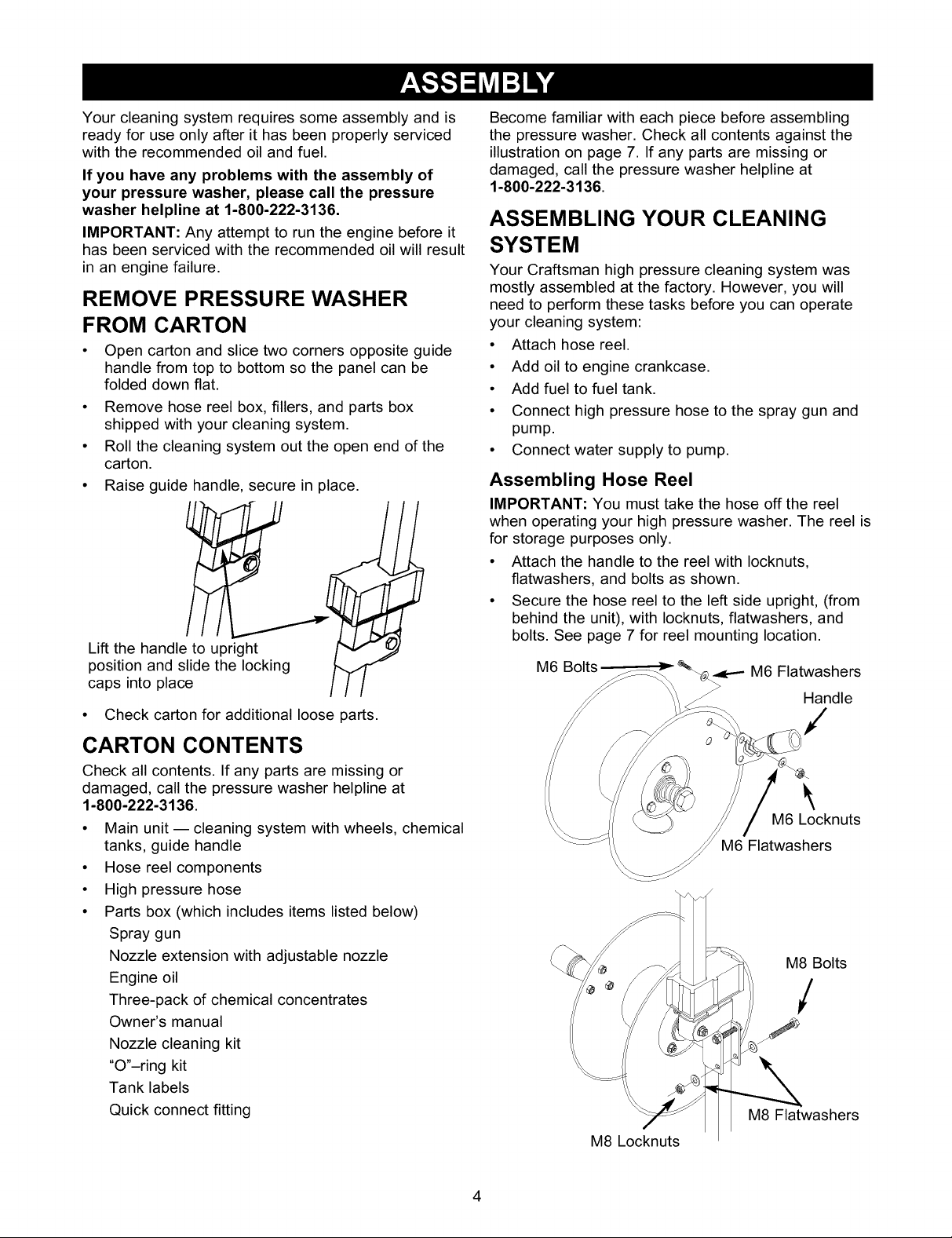
• Open carton and slice two corners opposite guide
handle from top to bottom so the panel can be
folded down flat.
• Remove hose reel box, fillers, and parts box
shipped with your cleaning system.
• Roll the cleaning system out the open end of the
carton.
• Raise guide handle, secure in place.
Lift the handle to upright
position and slide the locking
caps into place
• Check carton for additional loose parts.
CARTON CONTENTS
Check all contents. If any parts are missing or
damaged, call the pressure washer helpline at
1-800-222-3136.
• Main unit-- cleaning system with wheels, chemical
tanks, guide handle
• Hose reel components
• High pressure hose
• Parts box (which includes items listed below)
Spray gun
Nozzle extension with adjustable nozzle
Engine oil
Three-pack of chemical concentrates
Owner's manual
Nozzle cleaning kit
"O"-ring kit
Tank labels
Quick connect fitting
Become familiar with each piece before assembling
the pressure washer. Check all contents against the
illustration on page 7. If any parts are missing or
damaged, call the pressure washer helpline at
1-800-222-3136.
ASSEMBLING YOUR CLEANING
SYSTEM
Your Craftsman high pressure cleaning system was
mostly assembled at the factory. However, you will
need to perform these tasks before you can operate
your cleaning system:
• Attach hose reel.
• Add oil to engine crankcase.
• Add fuel to fuel tank.
• Connect high pressure hose to the spray gun and
pump.
• Connect water supply to pump.
Assembling Hose Reel
IMPORTANT: You must take the hose off the reel
when operating your high pressure washer. The reel is
for storage purposes only.
• Attach the handle to the reel with Iocknuts,
flatwashers, and bolts as shown.
• Secure the hose reel to the left side upright, (from
behind the unit), with Iocknuts, flatwashers, and
bolts. See page 7 for reel mounting location.
M6
,_ M6 Flatwashers
Handle
/
M6 Locknuts
M6 Flatwashers
M8 Bolts
/
M8 Locknuts
M8 Flatwashers
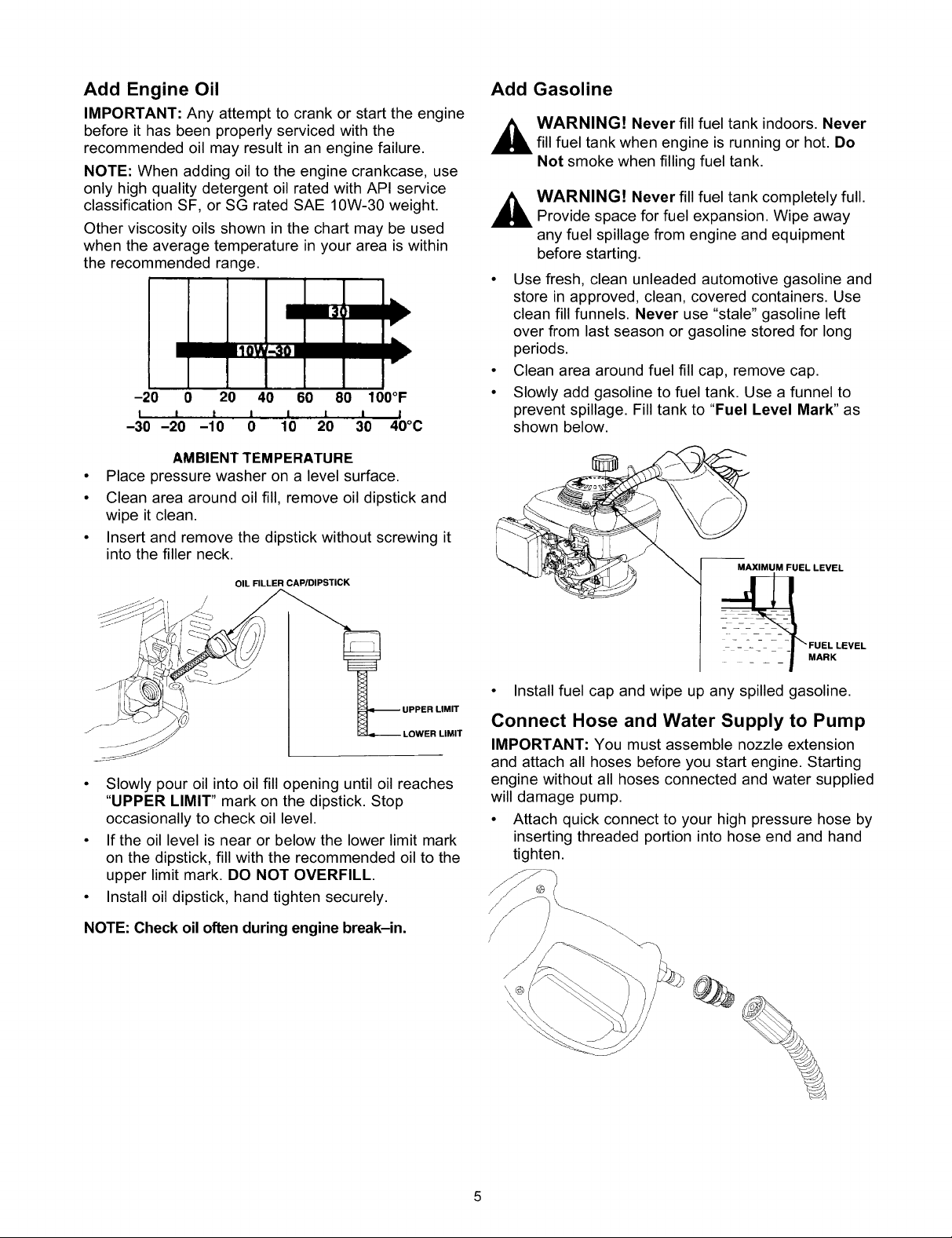
Add Engine Oil
IMPORTANT: Any attempt to crank or start the engine
before it has been properly serviced with the
recommended oil may result in an engine failure.
NOTE: When adding oil to the engine crankcase, use
only high quality detergent oil rated with API service
classification SF, or SG rated SAE 10W-30 weight.
Other viscosity oils shown in the chart may be used
when the average temperature in your area is within
the recommended range.
-20 0 20 40 60 80 100°F
I I ! I I I I I
-30 -20 -10 0 10 20 30 40°C
AMBIENT TEMPERATURE
• Place pressure washer on a level surface.
• Clean area around oil fill, remove oil dipstick and
wipe it clean.
• Insert and remove the dipstick without screwing it
into the filler neck.
OIL FILLER CAP/DIPSTICK
I LIMIT
• Slowly pour oil into oil fill opening until oil reaches
"UPPER LIMIT" mark on the dipstick. Stop
occasionally to check oil level.
• If the oil level is near or below the lower limit mark
on the dipstick, fill with the recommended oil to the
upper limit mark. DO NOT OVERFILL.
• Install oil dipstick, hand tighten securely.
NOTE: Check oil often during engine break-in.
Add Gasoline
,_ WARNING! Never fill fuel tank indoors. Never
fill fuel tank when engine is running or hot. Do
Not smoke when filling fuel tank.
,_ WARNING! Never fill fuel tank completely full.
Provide space for fuel expansion. Wipe away
any fuel spillage from engine and equipment
before starting.
• Use fresh, clean unleaded automotive gasoline and
store in approved, clean, covered containers. Use
clean fill funnels. Never use "stale" gasoline left
over from last season or gasoline stored for long
periods.
• Clean area around fuel fill cap, remove cap.
• Slowly add gasoline to fuel tank. Use a funnel to
prevent spillage. Fill tank to "Fuel Level Mark" as
shown below.
• Install fuel cap and wipe up any spilled gasoline.
Connect Hose and Water Supply to Pump
IMPORTANT: You must assemble nozzle extension
and attach all hoses before you start engine. Starting
engine without all hoses connected and water supplied
will damage pump.
• Attach quick connect to your high pressure hose by
inserting threaded portion into hose end and hand
tighten.
/
Uncoil high pressure hose and attach quick
connect end of hose to the base of the spray gun.
Pull down on the collar of the quick connect, slide
onto the spray gun and let go of collar. Pull on
hose and spray gun to be sure of a tight
connection.
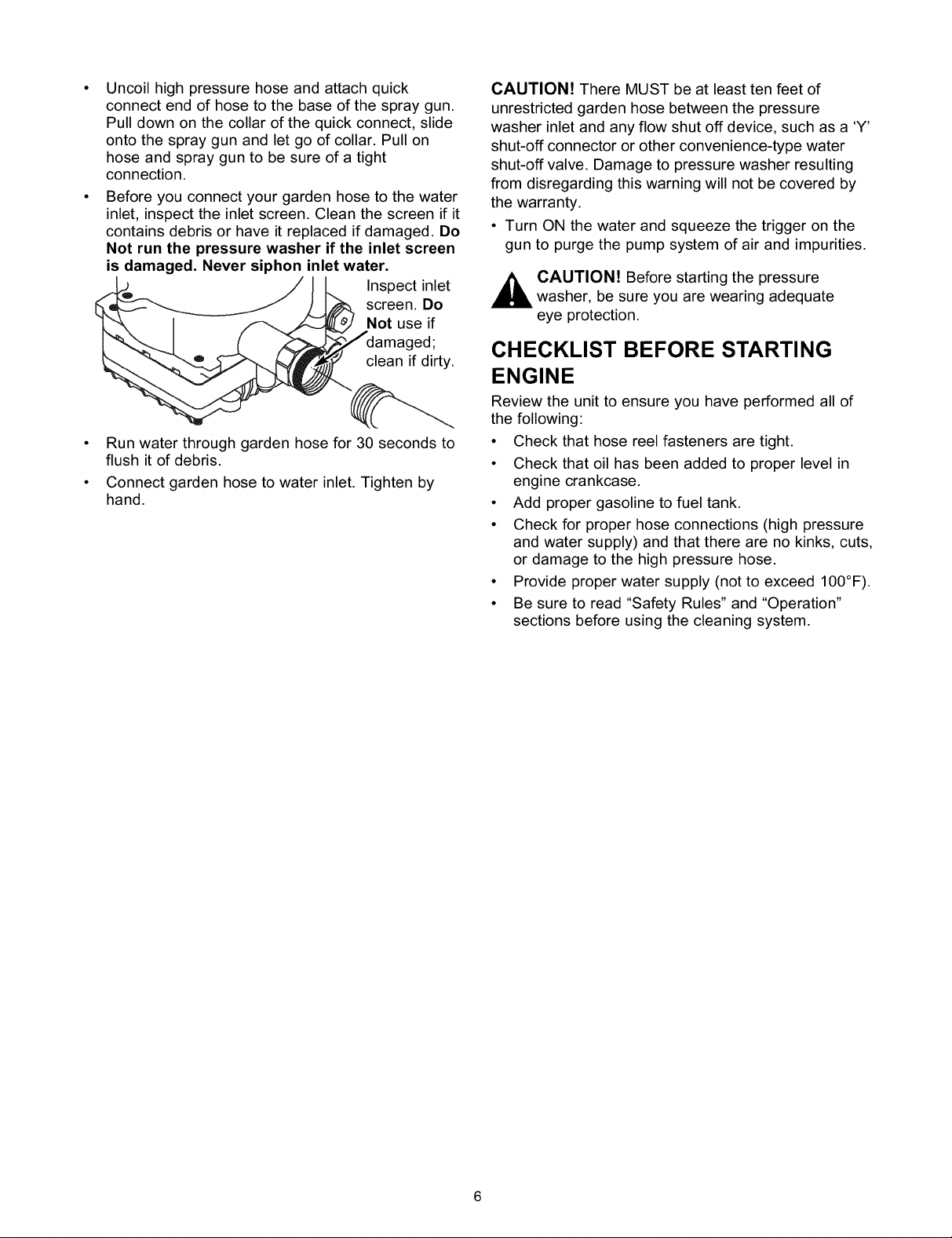
Before you connect your garden hose to the water
inlet, inspect the inlet screen. Clean the screen if it
contains debris or have it replaced if damaged. Do
Not run the pressure washer if the inlet screen
is damaged. Never siphon inlet water.
Inspect inlet
screen. Do
Not use if
Lged;
clean if dirty.
• Run water through garden hose for 30 seconds to
flush it of debris.
• Connect garden hose to water inlet. Tighten by
hand.
CAUTION! There MUST be at least ten feet of
unrestricted garden hose between the pressure
washer inlet and any flow shut off device, such as a 'Y'
shut-off connector or other convenience-type water
shut-off valve. Damage to pressure washer resulting
from disregarding this warning will not be covered by
the warranty.
• Turn ON the water and squeeze the trigger on the
gun to purge the pump system of air and impurities.
,_ CAUTION! Before starting the pressure
washer, be sure you are wearing adequate
eye protection.
CHECKLIST BEFORE STARTING
ENGINE
Review the unit to ensure you have performed all of
the following:
• Check that hose reel fasteners are tight.
• Check that oil has been added to proper level in
engine crankcase.
• Add proper gasoline to fuel tank.
• Check for proper hose connections (high pressure
and water supply) and that there are no kinks, cuts,
or damage to the high pressure hose.
• Provide proper water supply (not to exceed 100°F).
• Be sure to read "Safety Rules" and "Operation"
sections before using the cleaning system.
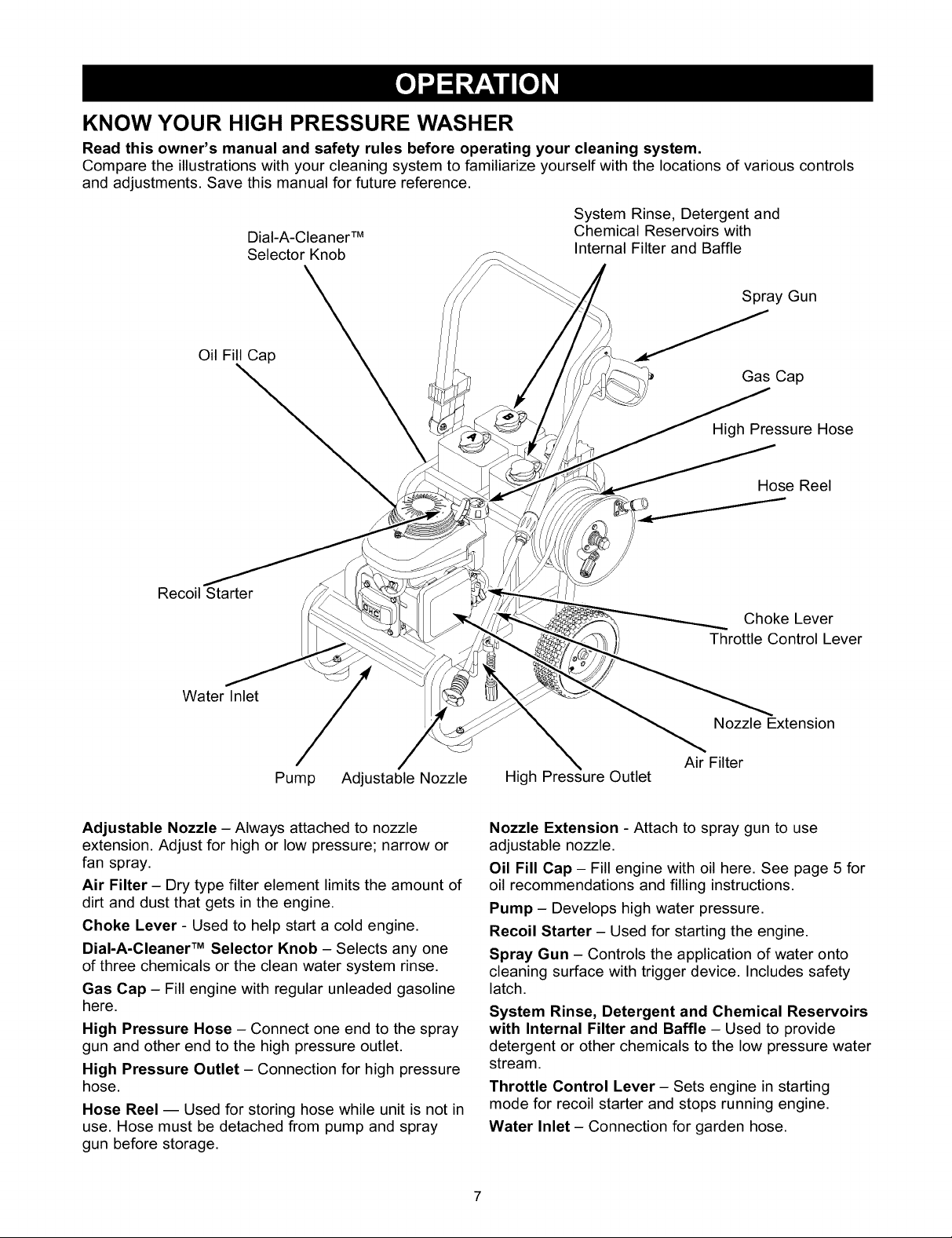
KNOW YOUR HIGH PRESSURE WASHER
Read this owner's manual and safety rules before operating your cleaning system.
Compare the illustrations with your cleaning system to familiarize yourself with the locations of various controls
and adjustments. Save this manual for future reference.
Dial-A-Cleaner TM
Selector Knob
System Rinse, Detergent and
Chemical Reservoirs with
Internal Filter and Baffle
Spray Gun
Oil Fill Cap
Gas Cap
High Pressure Hose
Hose Reel
Recoil Starter
Choke Lever
Throttle Control Lever
Water Inlet
Pump Adjustable Nozzle
High Outlet
Nozzle Extension
Air Filter
Adjustable Nozzle- Always attached to nozzle
extension. Adjust for high or low pressure; narrow or
fan spray.
Air Filter - Dry type filter element limits the amount of
dirt and dust that gets in the engine.
Choke Lever - Used to help start a cold engine.
Dial-A-Cleaner TM Selector Knob - Selects any one
of three chemicals or the clean water system rinse.
Gas Cap - Fill engine with regular unleaded gasoline
here.
High Pressure Hose - Connect one end to the spray
gun and other end to the high pressure outlet.
High Pressure Outlet - Connection for high pressure
hose.
Hose Reel -- Used for storing hose while unit is not in
use. Hose must be detached from pump and spray
gun before storage.
Nozzle Extension - Attach to spray gun to use
adjustable nozzle.
Oil Fill Cap - Fill engine with oil here. See page 5 for
oil recommendations and filling instructions.
Pump - Develops high water pressure.
Recoil Starter- Used for starting the engine.
Spray Gun - Controls the application of water onto
cleaning surface with trigger device. Includes safety
latch.
System Rinse, Detergent and Chemical Reservoirs
with Internal Filter and Baffle - Used to provide
detergent or other chemicals to the low pressure water
stream.
Throttle Control Lever - Sets engine in starting
mode for recoil starter and stops running engine.
Water Inlet - Connection for garden hose.
HOW TO USE YOUR CLEANING
SYSTEM
If you have any problems operating your pressure
washer, please call the pressure washer helpline at
1-800-222-3136.
To Start Your Cleaning System
To start your engine-powered cleaning system for the
first time, follow these instructions step-by-step. This
starting information also applies whenever you start
the engine after you have let the pressure washer sit
idle for at least a day.
• Place the pressure washer in an area close enough
to an outside water source capable of supplying
water at a flow rate greater than 2.4 gallons per
minute.
• Check that the high pressure hose is tightly
connected to the spray gun and to the pump. See
"Assembling Your Pressure Washer" for
illustrations.
• Make sure unit is in a level position.
• Connect the garden hose to the water inlet on the
pressure washer pump. Turn on the water.
CAUTION! Do Not run the pump without the water
supply connected and turned on. You must follow this
caution or the pump will be damaged.
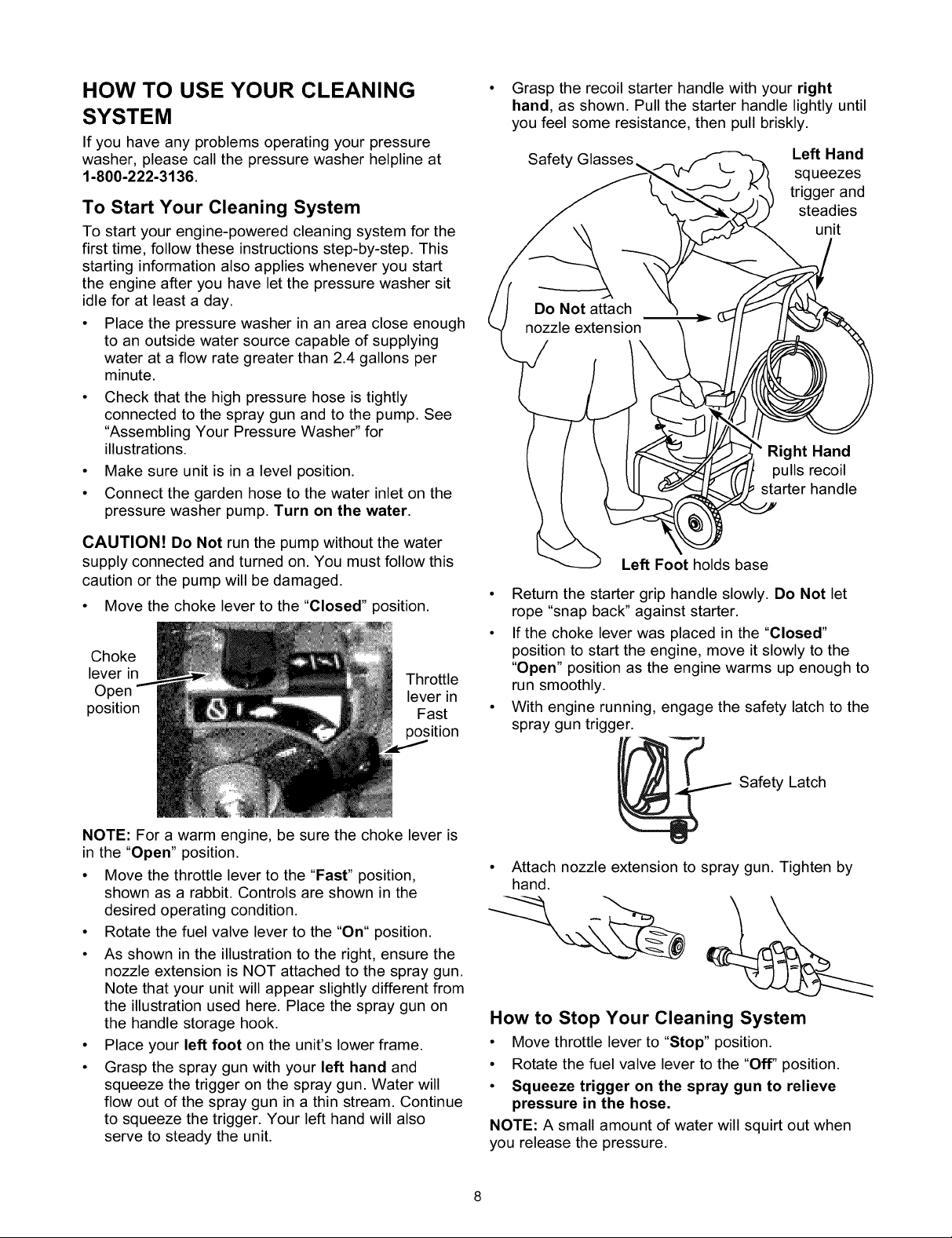
• Move the choke lever to the "Closed" position.
Choke
lever in
Open
position
Throttle
lever in
Fast
NOTE: For a warm engine, be sure the choke lever is
in the "Open" position.
• Move the throttle lever to the "Fast" position,
shown as a rabbit. Controls are shown in the
desired operating condition.
• Rotate the fuel valve lever to the "On" position.
• As shown in the illustration to the right, ensure the
nozzle extension is NOT attached to the spray gun.
Note that your unit will appear slightly different from
the illustration used here. Place the spray gun on
the handle storage hook.
• Place your left foot on the unit's lower frame.
• Grasp the spray gun with your left hand and
squeeze the trigger on the spray gun. Water will
flow out of the spray gun in a thin stream. Continue
to squeeze the trigger. Your left hand will also
serve to steady the unit.
Grasp the recoil starter handle with your right
hand, as shown. Pull the starter handle lightly until
you feel some resistance, then pull briskly.
Safety Glasses
Left Hand
squeezes
trigger and
steadies
unit
Right Hand
pulls recoil
starter handle
Left Foot holds base
• Return the starter grip handle slowly. Do Not let
rope "snap back" against starter.
• If the choke lever was placed in the "Closed"
position to start the engine, move it slowly to the
"Open" position as the engine warms up enough to
run smoothly.
• With engine running, engage the safety latch to the
spray gun trigger.
Safety Latch
hand.
Attach nozzle extension to spray gun. Tighten by
How to Stop Your Cleaning System
• Move throttle lever to "Stop" position.
• Rotate the fuel valve lever to the "Off" position.
• Squeeze trigger on the spray gun to relieve
pressure in the hose.
NOTE: A small amount of water will squirt out when
you release the pressure.
• Rotate the Dial-A-Cleaner TM selector knob to the
OFF position to prevent chemical leakage.
How To Use the Adjustable Nozzle
You now should know how to START your pressure
washer and how to STOP it. The information in this
section will tell you how to adjust the spray pattern
and apply detergent or other cleaning chemicals.
_ WARNING! Never adjust spray pattern when
spraying. Never put hands in front of nozzle to
adjust spray pattern.
Your unit is equipped with an adjustable nozzle that
permits you to adjust the spray pressure and the spray
pattern, as follows:
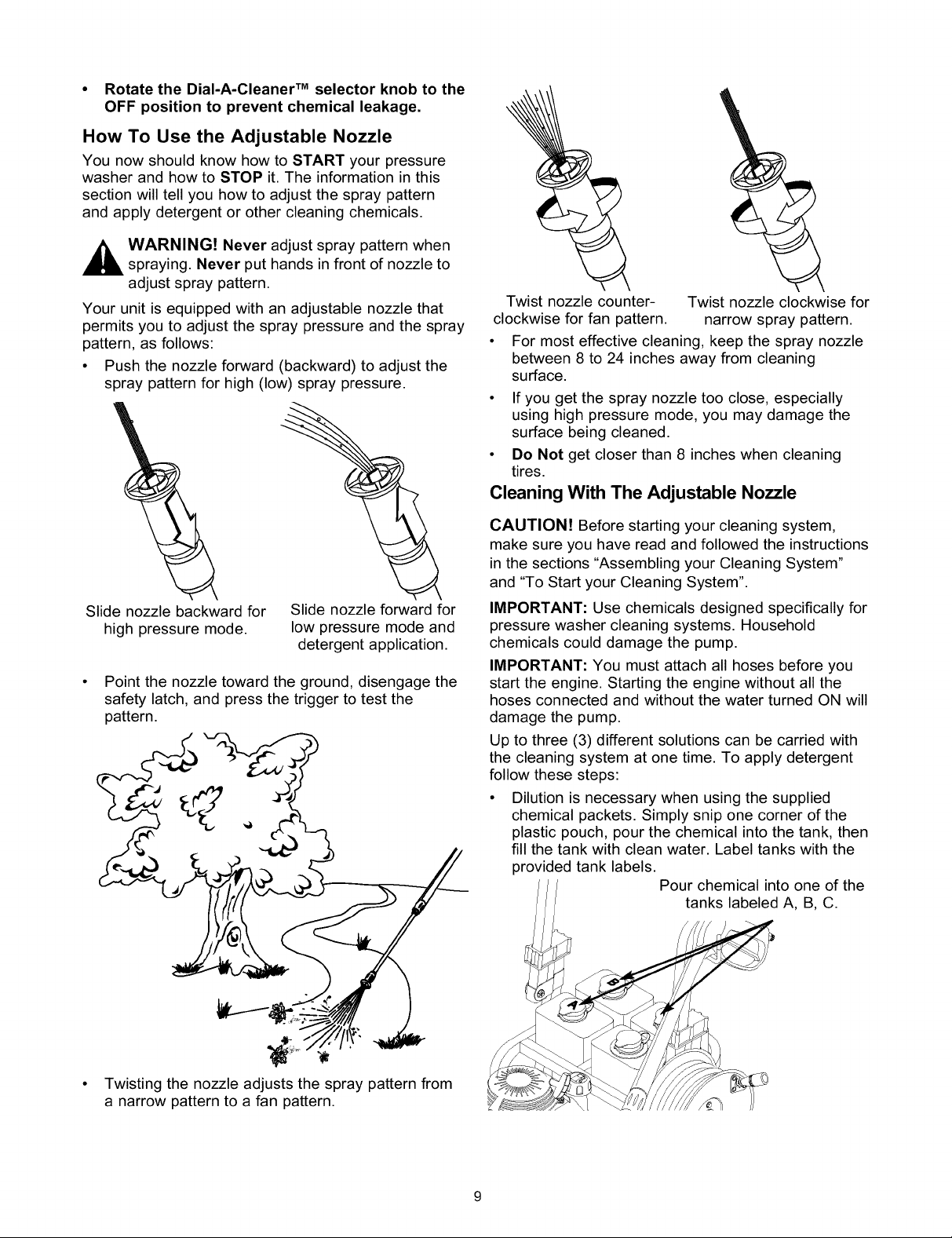
• Push the nozzle forward (backward) to adjust the
spray pattern for high (low) spray pressure.
Slide nozzle backward for
high pressure mode.
Slide nozzle forward for
low pressure mode and
detergent application.
• Point the nozzle toward the ground, disengage the
safety latch, and press the trigger to test the
pattern.
• Twisting the nozzle adjusts the spray pattern from
a narrow pattern to a fan pattern.
Twist nozzle counter- Twist nozzle clockwise for
clockwise for fan pattern, narrow spray pattern.
• For most effective cleaning, keep the spray nozzle
between 8 to 24 inches away from cleaning
surface.
• If you get the spray nozzle too close, especially
using high pressure mode, you may damage the
surface being cleaned.
• Do Not get closer than 8 inches when cleaning
tires.
Cleaning With The Adjustable Nozzle
CAUTION! Before starting your cleaning system,
make sure you have read and followed the instructions
in the sections "Assembling your Cleaning System"
and "To Start your Cleaning System".
IMPORTANT: Use chemicals designed specifically for
pressure washer cleaning systems. Household
chemicals could damage the pump.
IMPORTANT: You must attach all hoses before you
start the engine. Starting the engine without all the
hoses connected and without the water turned ON will
damage the pump.
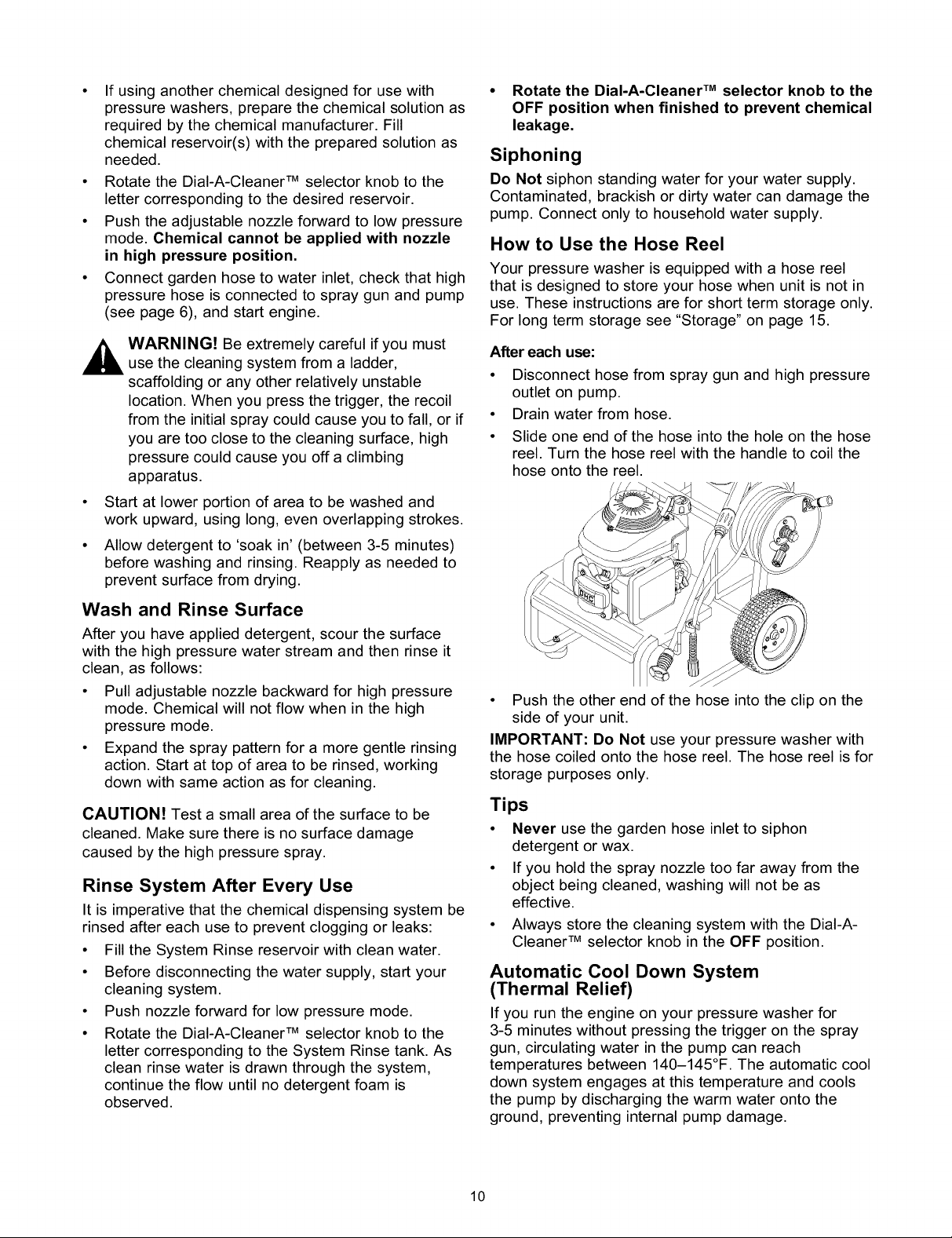
Up to three (3) different solutions can be carried with
the cleaning system at one time. To apply detergent
follow these steps:
• Dilution is necessary when using the supplied
chemical packets. Simply snip one corner of the
plastic pouch, pour the chemical into the tank, then
fill the tank with clean water. Label tanks with the
provided tank labels.
Pour chemical into one of the
tanks labeled A, B, C.
• Ifusinganotherchemicaldesignedforusewith
pressurewashers,preparethechemicalsolutionas
requiredbythechemicalmanufacturer.Fill
chemicalreservoir(s)withthepreparedsolutionas
needed.
• RotatetheDial-A-CleanerTM selector knob to the
letter corresponding to the desired reservoir.
• Push the adjustable nozzle forward to low pressure
mode. Chemical cannot be applied with nozzle
in high pressure position.
• Connect garden hose to water inlet, check that high
pressure hose is connected to spray gun and pump
(see page 6), and start engine.
,_ WARNING! Be extremely careful if you must
use the cleaning system from a ladder,
scaffolding or any other relatively unstable
location. When you press the trigger, the recoil
from the initial spray could cause you to fall, or if
you are too close to the cleaning surface, high
pressure could cause you off a climbing
apparatus.
• Start at lower portion of area to be washed and
work upward, using long, even overlapping strokes.
• Allow detergent to 'soak in' (between 3-5 minutes)
before washing and rinsing. Reapply as needed to
prevent surface from drying.
Wash and Rinse Surface
After you have applied detergent, scour the surface
with the high pressure water stream and then rinse it
clean, as follows:
• Pull adjustable nozzle backward for high pressure
mode. Chemical will not flow when in the high
pressure mode.
• Expand the spray pattern for a more gentle rinsing
action. Start at top of area to be rinsed, working
down with same action as for cleaning.
CAUTION! Test a small area of the surface to be
cleaned. Make sure there is no surface damage
caused by the high pressure spray.
Rinse System After Every Use
It is imperative that the chemical dispensing system be
rinsed after each use to prevent clogging or leaks:
• Fill the System Rinse reservoir with clean water.
• Before disconnecting the water supply, start your
cleaning system.
• Push nozzle forward for low pressure mode.
• Rotate the Dial-A-Cleaner TM selector knob to the
letter corresponding to the System Rinse tank. As
clean rinse water is drawn through the system,
continue the flow until no detergent foam is
observed.
• Rotate the Dial-A-Cleaner TM selector knob to the
OFF position when finished to prevent chemical
leakage.
Siphoning
Do Not siphon standing water for your water supply.
Contaminated, brackish or dirty water can damage the
pump. Connect only to household water supply.
How to Use the Hose Reel
Your pressure washer is equipped with a hose reel
that is designed to store your hose when unit is not in
use. These instructions are for short term storage only.
For long term storage see "Storage" on page 15.
After each use:
• Disconnect hose from spray gun and high pressure
outlet on pump.
• Drain water from hose.
• Slide one end of the hose into the hole on the hose
reel. Turn the hose reel with the handle to coil the
hose onto the reel.
• Push the other end of the hose into the clip on the
side of your unit.
IMPORTANT: Do Not use your pressure washer with
the hose coiled onto the hose reel. The hose reel is for
storage purposes only.
Tips
• Never use the garden hose inlet to siphon
detergent or wax.
• If you hold the spray nozzle too far away from the
object being cleaned, washing will not be as
effective.
• Always store the cleaning system with the Dial-A-
Cleaner TM selector knob in the OFF position.
Automatic Cool Down System
(Thermal Relief)
If you run the engine on your pressure washer for
3-5 minutes without pressing the trigger on the spray
gun, circulating water in the pump can reach
temperatures between 140-145°F. The automatic cool
down system engages at this temperature and cools
the pump by discharging the warm water onto the
ground, preventing internal pump damage.
10
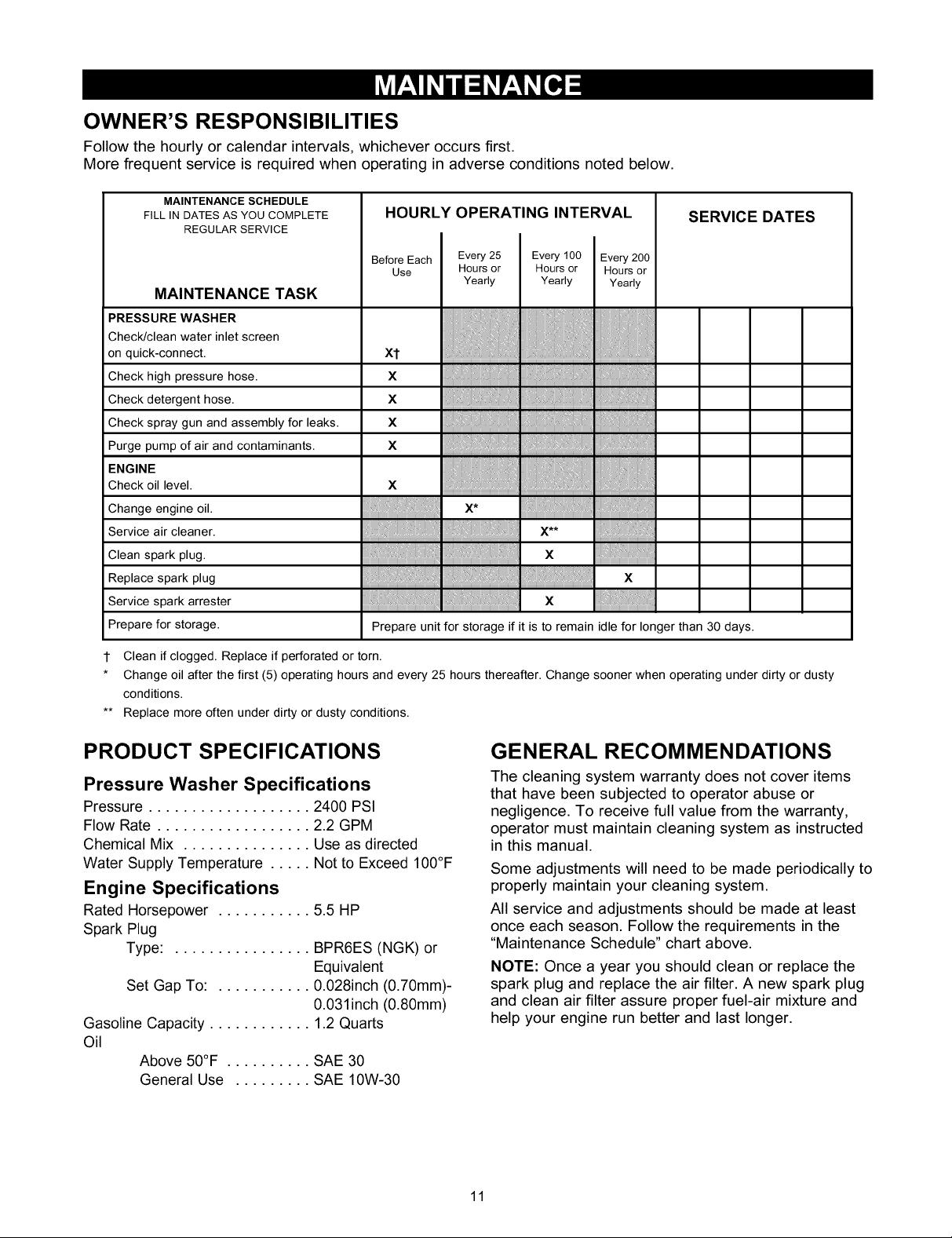
OWNER'S RESPONSIBILITIES
Follow the hourly or calendar intervals, whichever occurs first.
More frequent service is required when operating in adverse conditions noted below.
MAINTENANCE SCHEDULE
FILL IN DATES AS YOU COMPLETE
REGULAR SERVICE
HOURLY OPERATING INTERVAL
SERVICE DATES
MAINTENANCE TASK
PRESSURE WASHER
Check/clean water inlet screen
on quick-connect.
Check high pressure hose.
Check detergent hose.
Check spray gun and assembly for leaks.
Purge pump of air and contaminants.
ENGINE
Check oil level.
Change engine oil.
Service air cleaner.
Clean spark plug.
Replace spark plug
Service spark attester
Prepare for storage.
Before Each Every 25 Every 100 Every 200
Use Hours or Hours or Hours or
Yearly Yearly Yearly
xt
X
X
X
X
X
i!!i!!!!
l!i ii ili!!i iiiii x**
iii!,iiiiiiiiiiiii!,iiiiii x
illliiiiiiiillliiiii!!!iiii!
!ii!iiii!i!i!ii!iiii! x
Prepare unit for storage if it is to remain
!!!!!!!i!iiiii!i
iiiii i!i i iiiiiii i i iiiii i!i!i! iiii iiii i!i! iiiiiii iiii !ii!i!ii !! iiii!iiii iiiiiii iiiii!i ii iiii ! i iii! i ii! !ii!!i iiiiiiiiiiii
iiiiiiiii!iiililli!!iii
x.
X
idle for longer than 30 days.
1 Clean if clogged. Replace if perforated or torn.
* Change oil after the first (5) operating hours and every 25 hours thereafter. Change sooner when operating under dirty or dusty
conditions.
** Replace more often under dirty or dusty conditions.
PRODUCT SPECIFICATIONS
Pressure Washer Specifications
Pressure ................... 2400 PSI
Flow Rate .................. 2.2 GPM
Chemical Mix ............... Use as directed
Water Supply Temperature ..... Not to Exceed 100°F
Engine Specifications
Rated Horsepower ........... 5.5 HP
Spark Plug
Type: ................ BPR6ES (NGK) or
Equivalent
Set Gap To: ........... 0.028inch (0.70mm)-
0.031 inch (0.80mm)
Gasoline Capacity ............ 1.2 Quarts
Oil
Above 50°F .......... SAE 30
General Use ......... SAE 10W-30
GENERAL RECOMMENDATIONS
The cleaning system warranty does not cover items
that have been subjected to operator abuse or
negligence. To receive full value from the warranty,
operator must maintain cleaning system as instructed
in this manual.
Some adjustments will need to be made periodically to
properly maintain your cleaning system.
All service and adjustments should be made at least
once each season. Follow the requirements in the
"Maintenance Schedule" chart above.
NOTE: Once a year you should clean or replace the
spark plug and replace the air filter. A new spark plug
and clean air filter assure proper fuel-air mixture and
help your engine run better and last longer.
11
BEFORE EACH USE
• Check engine oil level.
• Check water inlet screen for damage.
• Check high pressure hose for leaks.
• Check chemical tanks and filters for damage.
• Check spray gun and nozzle extension assembly
for leaks.
• Purge pump of air and contaminants.
PRESSURE WASHER MAINTENANCE
Check and Clean Inlet Screen
Examine garden hose inlet screen. Clean if it is
clogged or replace if it is torn.
Check High Pressure Hose
High pressure hoses can develop leaks from wear,
kinking, or abuse. Inspect hose before each use.
Check for cuts, leaks, abrasions, bulging of cover, or
damage or movement of couplings. If any of these
conditions exist, replace hose immediately.
_ AUTION! Never repair a high pressure hose.
Replace with hose that exceeds the maximum
pressure rating of your cleaning system.
Check Chemical Reservoirs
Tank covers should snap cleanly onto tank. Ensure
chemical labels correctly identify tank contents.
Ensure that the System Rinse tank is filled with clean
water. Ensure that Dial-A-Cleaner TM selector knob
rotates freely between each position. Examine the
tanks and replace if the filter is clogged.
Check Gun and Nozzle extension
Examine hose connection to spray gun and make sure
it is secure. Test trigger by pressing it and making
sure it springs back into place when you release it. Put
safety latch in UP position and test trigger. You should
not be able to press trigger. Replace spray gun
immediately if it fails any of these tests.
Check In-Line Filter
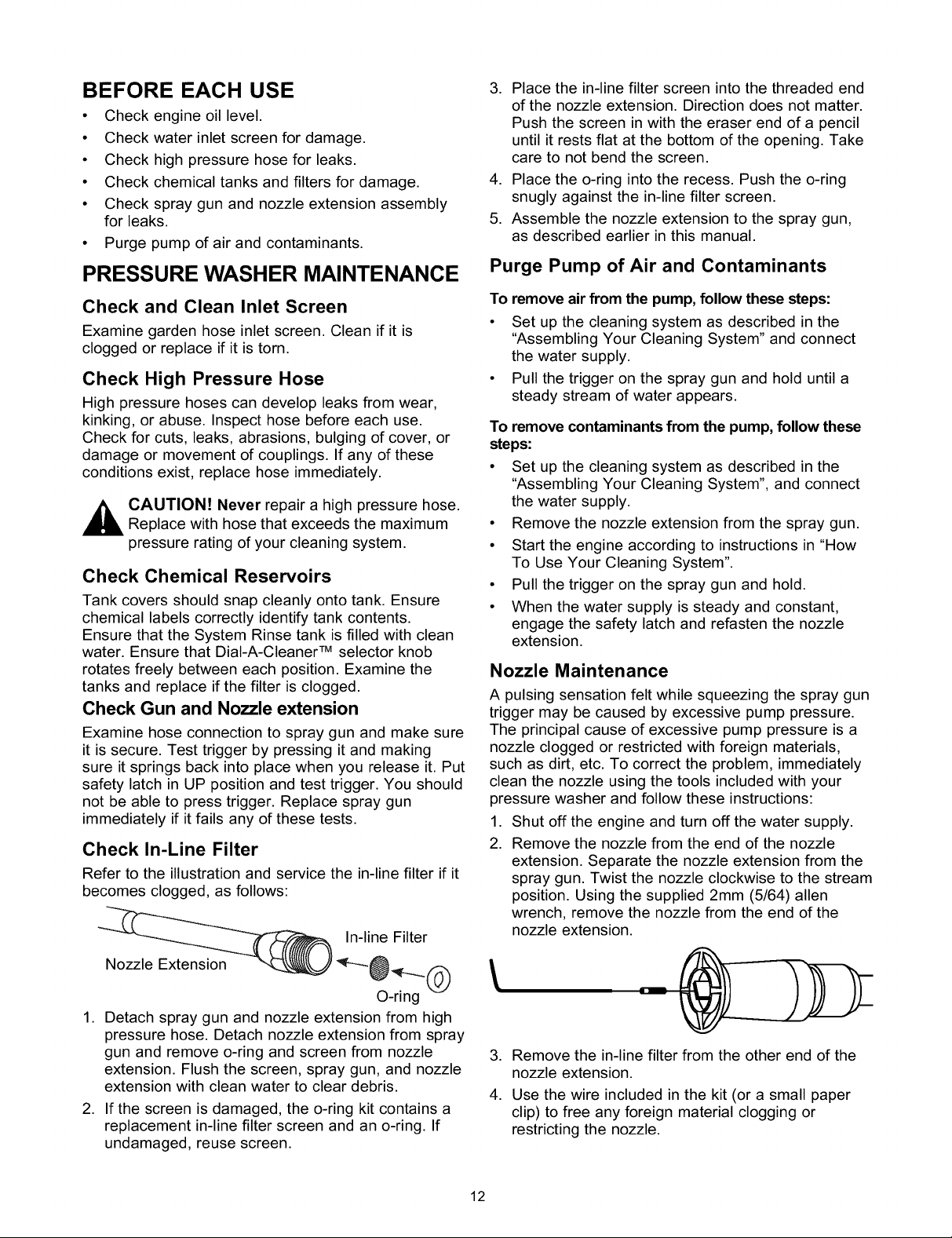
Refer to the illustration and service the in-line filter if it
becomes clogged, as follows:
In-line Filter
Nozzle Extension _O_rin_@
1. Detach spray gun and nozzle extension from high
pressure hose. Detach nozzle extension from spray
gun and remove o-ring and screen from nozzle
extension. Flush the screen, spray gun, and nozzle
extension with clean water to clear debris.
2. If the screen is damaged, the o-ring kit contains a
replacement in-line filter screen and an o-ring. If
undamaged, reuse screen.
3. Place the in-line filter screen into the threaded end
of the nozzle extension. Direction does not matter.
Push the screen in with the eraser end of a pencil
until it rests flat at the bottom of the opening. Take
care to not bend the screen.
4. Place the o-ring into the recess. Push the o-ring
snugly against the in-line filter screen.
5. Assemble the nozzle extension to the spray gun,
as described earlier in this manual.
Purge Pump of Air and Contaminants
To remove air from the pump, follow these steps:
• Set up the cleaning system as described in the
"Assembling Your Cleaning System" and connect
the water supply.
• Pull the trigger on the spray gun and hold until a
steady stream of water appears.
To remove contaminants from the pump, follow these
steps:
• Set up the cleaning system as described in the
"Assembling Your Cleaning System", and connect
the water supply.
• Remove the nozzle extension from the spray gun.
• Start the engine according to instructions in "How
To Use Your Cleaning System".
• Pull the trigger on the spray gun and hold.
• When the water supply is steady and constant,
engage the safety latch and refasten the nozzle
extension.
Nozzle Maintenance
A pulsing sensation felt while squeezing the spray gun
trigger may be caused by excessive pump pressure.
The principal cause of excessive pump pressure is a
nozzle clogged or restricted with foreign materials,
such as dirt, etc. To correct the problem, immediately
clean the nozzle using the tools included with your
pressure washer and follow these instructions:
1. Shut off the engine and turn off the water supply.
2. Remove the nozzle from the end of the nozzle
extension. Separate the nozzle extension from the
spray gun. Twist the nozzle clockwise to the stream
position. Using the supplied 2mm (5/64) allen
wrench, remove the nozzle from the end of the
nozzle extension.
\
3. Remove the in-line filter from the other end of the
nozzle extension.
4. Use the wire included in the kit (or a small paper
clip) to free any foreign material clogging or
restricting the nozzle.
12
5. Using a garden hose, remove additional debris by
back flushing water through the nozzle extension.
Back flush between 30 to 60 seconds. Turn the
adjustable nozzle extension to stream spray and
move the nozzle from low to high while flushing.
6. Reinstall the nozzle and in-line filter into the nozzle
extension. Do Not overtighten the nozzle with the
allen wrench.
7. Reconnect the nozzle extension to the spray gun.
8. Reconnect the water supply, turn on the water, and
start the engine.
9. Test the cleaning system by operating with nozzle
in the high and in the low positions.
O-Ring Maintenance
Through the normal operation of your cleaning system,
o-rings keep the connections of the hoses and spray
gun tight and leak-free. These o-rings may become
worn or damaged with use.
Provided with your pressure washer is an O-Ring
Maintenance Kit which includes replacement o-rings,
rubber washer and water inlet filter. Refer to the
instruction sheet provided in the kit to service your
unit's o-rings. Note that not all of the parts in the kit
will be used on your unit.
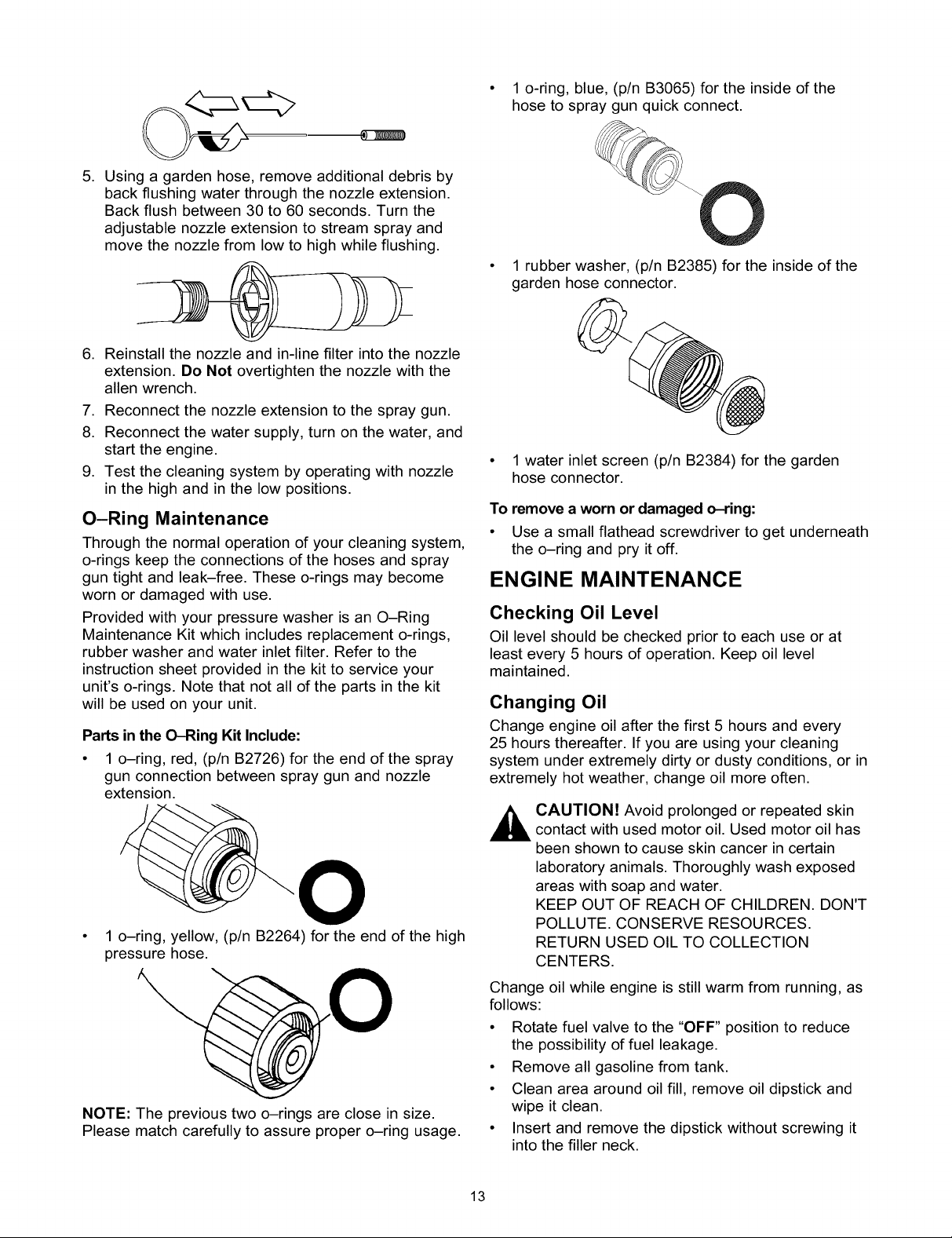
Parts in the O-Ring Kit Include:
• 1 o-ring, red, (p/n B2726) for the end of the spray
gun connection between spray gun and nozzle
extension.
• 1 o-ring, yellow, (pin B2264) for the end of the high
pressure hose.
NOTE: The previous two o-rings are close in size.
Please match carefully to assure proper o-ring usage.
• 1 o-ring, blue, (pin B3065) for the inside of the
hose to spray gun quick connect.
O
1 rubber washer, (p/n B2385) for the inside of the
garden hose connector.
• 1 water inlet screen (p/n B2384) for the garden
hose connector.
To remove a worn or damaged o-ring:
• Use a small flathead screwdriver to get underneath
the o-ring and pry it off.
ENGINE MAINTENANCE
Checking Oil Level
Oil level should be checked prior to each use or at
least every 5 hours of operation. Keep oil level
maintained.
Changing Oil
Change engine oil after the first 5 hours and every
25 hours thereafter. If you are using your cleaning
system under extremely dirty or dusty conditions, or in
extremely hot weather, change oil more often.
_ CAUTION! Avoid prolonged or repeated skincontact with used motor oil. Used motor oil has
been shown to cause skin cancer in certain
laboratory animals. Thoroughly wash exposed
areas with soap and water.
KEEP OUT OF REACH OF CHILDREN. DON'T
POLLUTE. CONSERVE RESOURCES.
RETURN USED OIL TO COLLECTION
CENTERS.
Change oil while engine is still warm from running, as
follows:
• Rotate fuel valve to the "OFF" position to reduce
the possibility of fuel leakage.
• Remove all gasoline from tank.
• Clean area around oil fill, remove oil dipstick and
wipe it clean.
• Insert and remove the dipstick without screwing it
into the filler neck.
13
• Tip your pressure washer to drain oil from the oil
dipstick into a suitable container. When crankcase
is empty, return the pressure washer to upright
position. Wipe up spilled oil.
• Slowly pour oil into oil fill opening until oil reaches
"UPPER LIMIT" mark on the dipstick. Stop
occasionally to check oil level.
• If the oil level is near or below the lower limit mark
on the dipstick, fill with the recommended oil to the
upper limit mark. DO NOT OVERFILL.
• Install oil dipstick, hand tighten securely.
• Wipe up any remaining oil.
Service Air Cleaner
Your engine will not run properly and may be
damaged if you run it with a dirty air cleaner.
Replace the air cleaner once every 200 hours of
operation or once each year, whichever comes first.
Replace more often if operating under dirty or dusty
conditions. Replacements are available at your local
Sears service center.
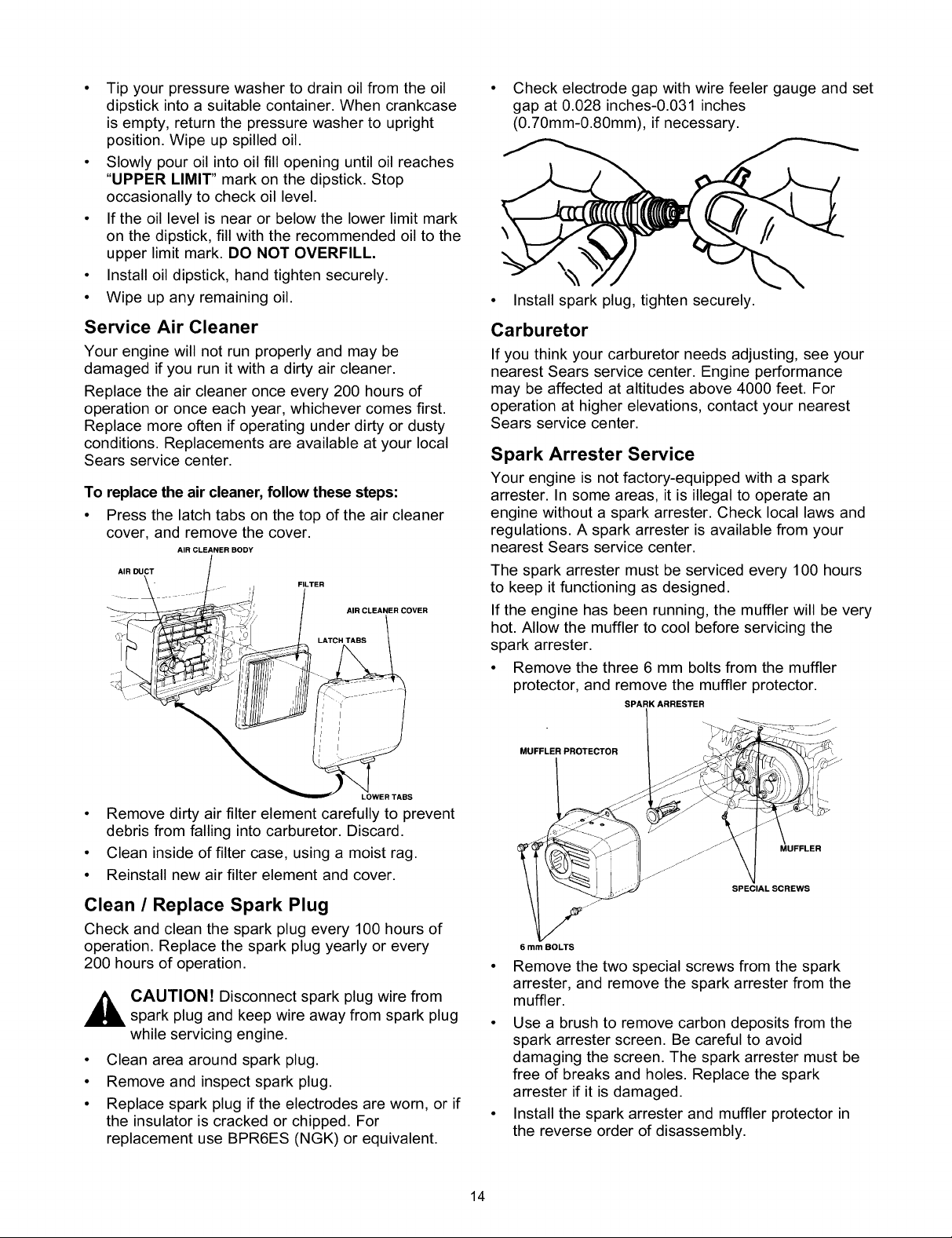
To replace the air cleaner, follow these steps:
• Press the latch tabs on the top of the air cleaner
cover, and remove the cover.
AIR CLEANER BODY
\
AIR CLEANER COVER
Check electrode gap with wire feeler gauge and set
gap at 0.028 inches-0.031 inches
(0.70mm-0.80mm), if necessary.
Install spark plug, tighten securely.
Carburetor
If you think your carburetor needs adjusting, see your
nearest Sears service center. Engine performance
may be affected at altitudes above 4000 feet. For
operation at higher elevations, contact your nearest
Sears service center.
Spark Arrester Service
Your engine is not factory-equipped with a spark
arrester. In some areas, it is illegal to operate an
engine without a spark arrester. Check local laws and
regulations. A spark arrester is available from your
nearest Sears service center.
The spark arrester must be serviced every 100 hours
to keep it functioning as designed.
If the engine has been running, the muffler will be very
hot. Allow the muffler to cool before servicing the
spark arrester.
• Remove the three 6 mm bolts from the muffler
protector, and remove the muffler protector.
SPARK ARRESTER
MUFFLER PROTECTOR
LOWER TABS
• Remove dirty air filter element carefully to prevent
debris from falling into carburetor. Discard.
• Clean inside of filter case, using a moist rag.
• Reinstall new air filter element and cover.
Clean / Replace Spark Plug
Check and clean the spark plug every 100 hours of
operation. Replace the spark plug yearly or every
200 hours of operation.
_ CAUTION! Disconnect spark plug wire from
spark plug and keep wire away from spark plug
while servicing engine.
• Clean area around spark plug.
• Remove and inspect spark plug.
• Replace spark plug if the electrodes are worn, or if
the insulator is cracked or chipped. For
replacement use BPR6ES (NGK) or equivalent.
.... I.J j_ MUFFLER
SPECIAL SCREWS
6 mm BOLTS
• Remove the two special screws from the spark
arrester, and remove the spark arrester from the
muffler.
• Use a brush to remove carbon deposits from the
spark arrester screen. Be careful to avoid
damaging the screen. The spark arrester must be
free of breaks and holes. Replace the spark
arrester if it is damaged.
• Install the spark arrester and muffler protector in
the reverse order of disassembly.
14
AFTER EACH USE
Water should not remain in the unit for long periods of
time. Sediments or minerals can deposit on pump
parts and "freeze" pump action. Follow these
procedures after every use:
• Flush the chemical system by selecting the system
rinse tank and run the pressure washer with nozzle
in low pressure mode. Flush for one minute or until
the chemical is cleared from the system.
• Shut off the engine and let it cool, then remove all
hoses.
• Disconnect spark plug wire from spark plug.
• Empty the pump of all pumped liquids by pulling
recoil handle about 6 times. This should remove
most of the liquid in the pump.
• Rotate the Dial-A-Cleaner TM selector knob to the
OFF position.
• Coil the high pressure hose and inspect it for
damage. Cuts in the hose or fraying could result in
leaks and loss of pressure. Should any damage be
found, replace the hose. Do Not attempt to repair a
damaged hose. Replace the hose with the genuine
Craftsman part.
• Disconnect hose from spray gun and high pressure
outlet on pump. Drain water from hose, gun, and
nozzle extension and wipe off the hose with a rag.
• Slide one end of the hose into the hole on the hose
reel. Turn the hose reel with the handle to coil the
hose onto the reel. Push the other end of the hose
into the clip on the side of you unit.
• Reconnect spark plug wire to spark plug.
• Store system in a clean, dry area.
_ ARNING! Never store the engine with fuel in
the gas tank indoors or in enclosed, poorly
ventilated areas where fumes may reach an
open flame, a spark, or pilot light.
WINTER STORAGE
CAUTION! You must protect your unit from freezing
temperatures. Failure to do so will permanently
damage your pump and render your unit inoperable.
To protect the unit from freezing temperatures:
• Empty all chemical reservoirs as follows:
1. Disconnect hose connected to chemical inject fitting
on the pump. Place end of hose into suitable
container.
2. Move the selector knob to Tank A and open that
tank's cover. Gravity should shortly empty the tank
contents into the container.
3. When the tank is empty, repeat step (b) for tanks B
and C, using different container for each chemical.
4. Reconnect the hose to the chemical inject fitting on
the pump. Add 0.5 liter of clean fresh water to each
tank and close tank's covers.
Flush the chemical system by selecting a tank and
run the pressure washer with nozzle in low
pressure mode. Flush until each tank is empty, then
switch the selector knob to the next tank. The last
tank to be emptied must be the System Rinse tank.
Connect a 3-foot section of garden hose to the
water inlet adapter. Pour RV-Antifreeze (antifreeze
without alcohol) into the hose. Pull the recoil handle
twice. Disconnect 3-foot hose.
LONG TERM STORAGE
If you do not plan to use the pressure washer for more
than 30 days, you must prepare the engine for long
term storage.
It is important to prevent gum deposits from forming in
essential fuel system parts such as the carburetor, fuel
filter, fuel hose or tank during storage. Also,
experience indicates that alcohol-blended fuels (called
gasohol, ethanol or methanol) can attract moisture,
which leads to separation and formation of acids
during storage. Acidic gas can damage the fuel system
of an engine while in storage.
Protect Fuel System
_ ARNING! Drain fuel into approved container
outdoors, away from open flame. Be sure engine
is cool. Do Not smoke.
• Remove all gasoline from the fuel tank to prevent
gum deposits from forming on these parts and
causing possible malfunction of engine.
• Run engine until engine stops from lack of fuel.
Make sure you have water supply to pump inlet
connected and turned ON.
Change Oil
While engine is still warm, drain oil from crankcase.
Refill with recommended grade (see Changing Oil on
page 13).
Oil Cylinder Bore
• Remove spark plug. Squirt about 1 ounce (30 ml)
of engine oil into the cylinder. Cover spark plug
hole with rag. Pull recoil handle slowly to distribute
oil. Avoid spray from spark plug hole.
• Install spark plug. Do Not connect spark plug wire.
OTHER
• Do Not store gasoline from one season to another.
• If possible, store your unit indoors and cover it to
give protection from dust and dirt. BE SURE TO
EMPTY THE FUEL TANK.
IMPORTANT: Never cover your cleaning system while
engine and exhaust area are warm.
15
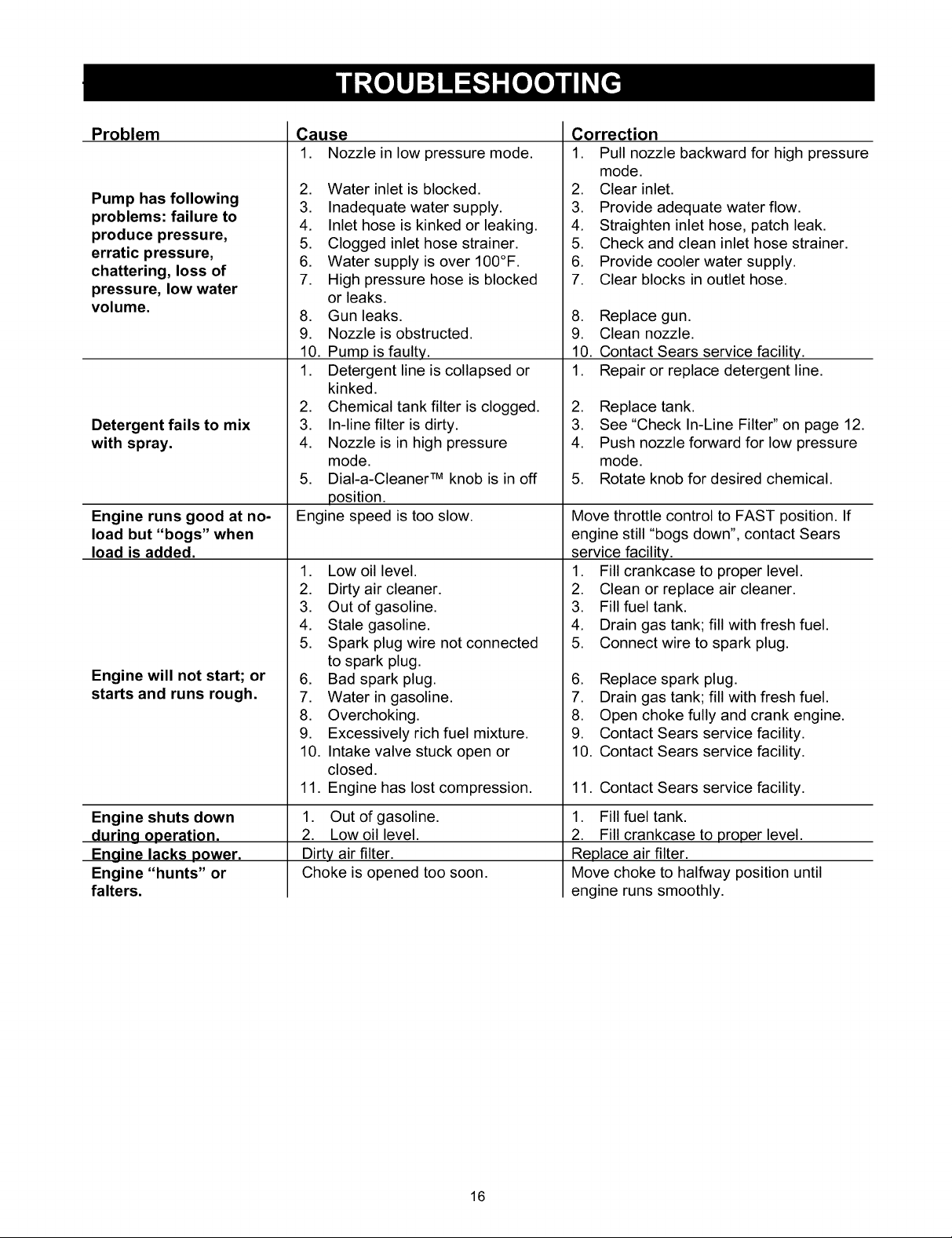
Problem Cause Correction
1. Nozzle in low pressure mode. 1. Pull nozzle backward for high pressure
Pump has following
problems: failure to
produce pressure,
erratic pressure,
chattering, loss of
pressure, low water
2. Water inlet is blocked.
3. Inadequate water supply.
4. Inlet hose is kinked or leaking.
5. Clogged inlet hose strainer.
6. Water supply is over 100°F.
7. High pressure hose is blocked
or leaks.
8. Gun leaks.
9. Nozzle is obstructed.
10. Pump is faulty.
1. Detergent line is collapsed or
kinked.
2. Chemical tank filter is clogged.
3. In-line filter is dirty.
4. Nozzle is in high pressure
mode.
5. Dial-a-Cleaner TM knob is in off
position.
Engine speed is too slow.
volume.
Detergent fails to mix
with spray.
Engine runs good at no-
load but "bogs" when
load is added.
Engine will not start; or
starts and runs rough.
Engine shuts down
during operation.
Engine lacks power.
Engine "hunts" or
falters.
1. Low oil level.
2. Dirty air cleaner.
3. Out of gasoline.
4. Stale gasoline.
5. Spark plug wire not connected
to spark plug.
6. Bad spark plug.
7. Water in gasoline.
8. Overchoking.
9. Excessively rich fuel mixture.
10. Intake valve stuck open or
closed.
11. Engine has lost compression.
1. Out of gasoline.
2. Low oil level.
Dirty air filter.
Choke is opened too soon.
mode.
2. Clear inlet.
3. Provide adequate water flow.
4. Straighten inlet hose, patch leak.
5. Check and clean inlet hose strainer.
6. Provide cooler water supply.
7. Clear blocks in outlet hose.
8. Replace gun.
9. Clean nozzle.
10. Contact Sears service facility.
1. Repair or replace detergent line.
2. Replace tank.
3. See "Check In-Line Filter" on page 12.
4. Push nozzle forward for low pressure
mode.
5. Rotate knob for desired chemical.
Move throttle control to FAST position. If
engine still "bogs down", contact Sears
service facility.
1. Fill crankcase to proper level.
2. Clean or replace air cleaner.
3. Fill fuel tank.
4. Drain gas tank; fill with fresh fuel.
5. Connect wire to spark plug.
6. Replace spark plug.
7. Drain gas tank; fill with fresh fuel.
8. Open choke fully and crank engine.
9. Contact Sears service facility.
10. Contact Sears service facility.
11. Contact Sears service facility.
1. Fill fuel tank.
2. Fill crankcase to proper level.
Replace air filter.
Move choke to halfway position until
engine runs smoothly.
16

17
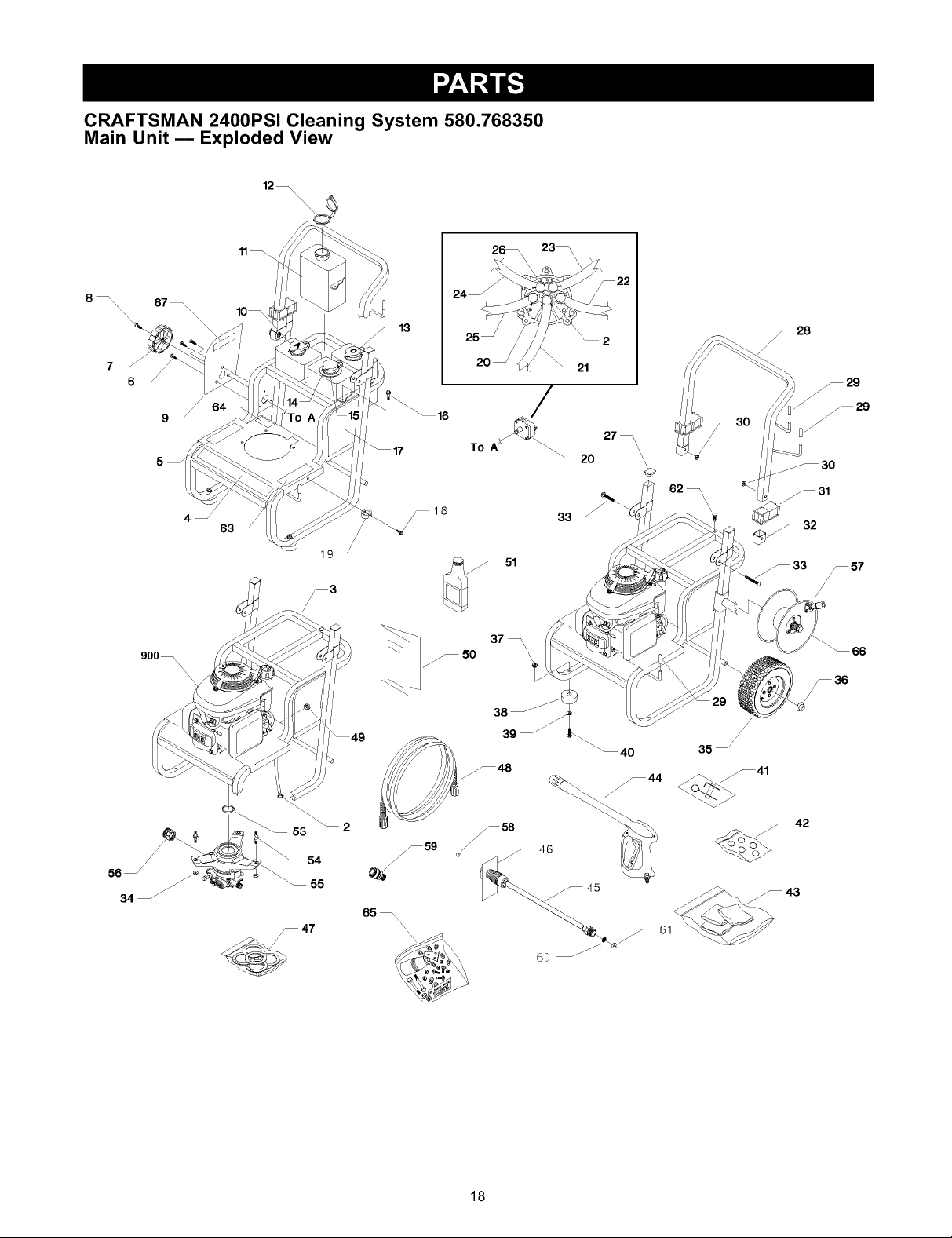
CRAFTSMAN 2400PSI Cleaning System 580.768350
Main Unit -- Exploded View
12 _\
25
/
To
51
27
20
33
\
j-- 29
_29
900
37
7 50
66
47
65 _\
\\
_-- 40
6o _%z
/
/
35 /
_41
42
43
18
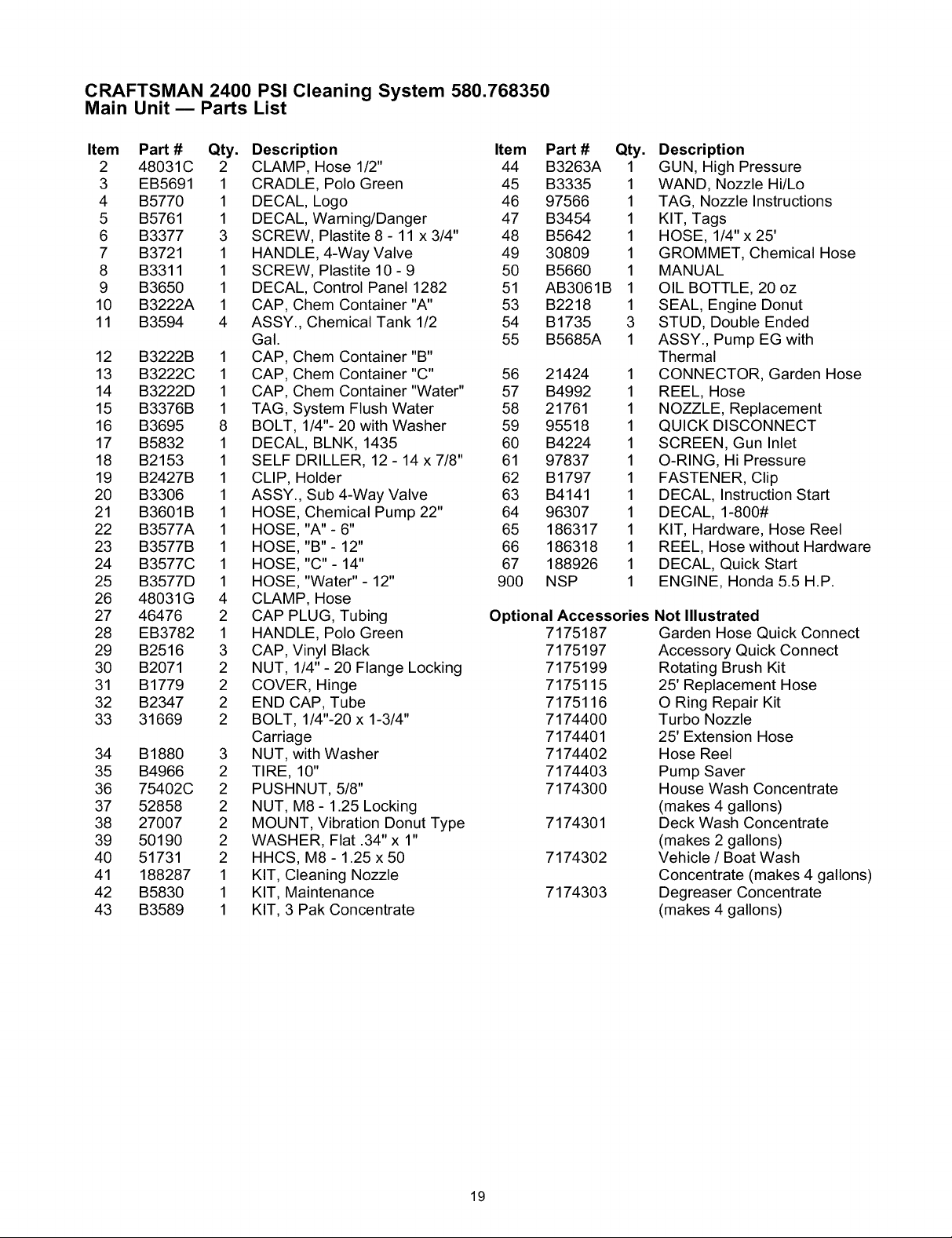
CRAFTSMAN 2400 PSI Cleaning System 580.768350
Main Unit m Parts List
Item PaN #
2 48031C
3 EB5691
4 B5770
5 B5761
6 B3377
7 B3721
8 B3311
9 B3650
10 B3222A
11 B3594
12 B3222B
13 B3222C
14 B3222D
15 B3376B
16 B3695
17 B5832
18 B2153
19 B2427B
20 B3306
21 B3601B
22 B3577A
23 B3577B
24 B3577C
25 B3577D
26 48031G
27 46476
28 EB3782
29 B2516
30 B2071
31 B1779
32 B2347
33 31669
34 B1880
35 B4966
36 75402C
37 52858
38 27007
39 50190
40 51731
41 188287
42 B5830
43 B3589
Part#
B3263A
B3335
97566
B3454
B5642
30809
B5660
AB3061B
B2218
B1735
B5685A
Qty. Description Item Qty.
2 CLAMP, Hose 1/2" 44 1
1 CRADLE, Polo Green 45 1
1 DECAL, Logo 46 1
1 DECAL, Warning/Danger 47 1
3 SCREW, Plastite 8 - 11 x 3/4" 48 1
1 HANDLE, 4-Way Valve 49 1
1 SCREW, Plastite 10 - 9 50 1
1 DECAL, Control Panel 1282 51 1
1 CAP, Chem Container "A" 53 1
4 ASSY., Chemical Tank 1/2 54 3
Gal. 55 1
1 CAP, Chem Container "B"
1 CAP, Chem Container "C" 56 21424 1
1 CAP, Chem Container "Water" 57 B4992 1
1 TAG, System Flush Water 58 21761 1
8 BOLT, 1/4"- 20 with Washer 59 95518 1
1 DECAL, BLNK, 1435 60 B4224 1
1 SELF DRILLER, 12 - 14 x 7/8" 61 97837 1
1 CLIP, Holder 62 B1797 1
1 ASSY., Sub 4-Way Valve 63 B4141 1
1 HOSE, Chemical Pump 22" 64 96307 1
1 HOSE, "A" - 6" 65 186317 1
1 HOSE, "B" - 12" 66 186318 1
1 HOSE, "C" - 14" 67 188926 1
1 HOSE, "Water"- 12" 900 NSP 1
4 CLAMP, Hose
2 CAP PLUG, Tubing
1 HANDLE, Polo Green
3 CAP, Vinyl Black
2 NUT, 1/4"- 20 Flange Locking
2 COVER, Hinge
2 END CAP, Tube
2 BOLT, 1/4"-20 x 1-3/4"
Carriage
3 NUT, with Washer
2 TIRE, 10"
2 PUSHNUT, 5/8"
2 NUT, M8 - 1.25 Locking
2 MOUNT, Vibration Donut Type
2 WASHER, Flat .34" x 1"
2 HHCS, M8- 1.25 x 50
1 KIT, Cleaning Nozzle
1 KIT, Maintenance
1 KIT, 3 Pak Concentrate
Optional Accessories
7175187
7175197
7175199
7175115
7175116
7174400
7174401
7174402
7174403
7174300
7174301
7174302
7174303
Description
GUN, High Pressure
WAND, Nozzle Hi/Lo
TAG, Nozzle Instructions
KIT, Tags
HOSE, 1/4" x 25'
GROMMET, Chemical Hose
MANUAL
OIL BOTTLE, 20 oz
SEAL, Engine Donut
STUD, Double Ended
ASSY., Pump EG with
Thermal
CONNECTOR, Garden Hose
REEL, Hose
NOZZLE, Replacement
QUICK DISCONNECT
SCREEN, Gun Inlet
O-RING, Hi Pressure
FASTENER, Clip
DECAL, Instruction Start
DECAL, 1-800#
KIT, Hardware, Hose Reel
REEL, Hose without Hardware
DECAL, Quick Start
ENGINE, Honda 5.5 H.P.
Not Illustrated
Garden Hose Quick Connect
Accessory Quick Connect
Rotating Brush Kit
25' Replacement Hose
O Ring Repair Kit
Turbo Nozzle
25' Extension Hose
Hose Reel
Pump Saver
House Wash Concentrate
(makes 4 gallons)
Deck Wash Concentrate
(makes 2 gallons)
Vehicle / Boat Wash
Concentrate (makes 4 gallons)
Degreaser Concentrate
(makes 4 gallons)
19
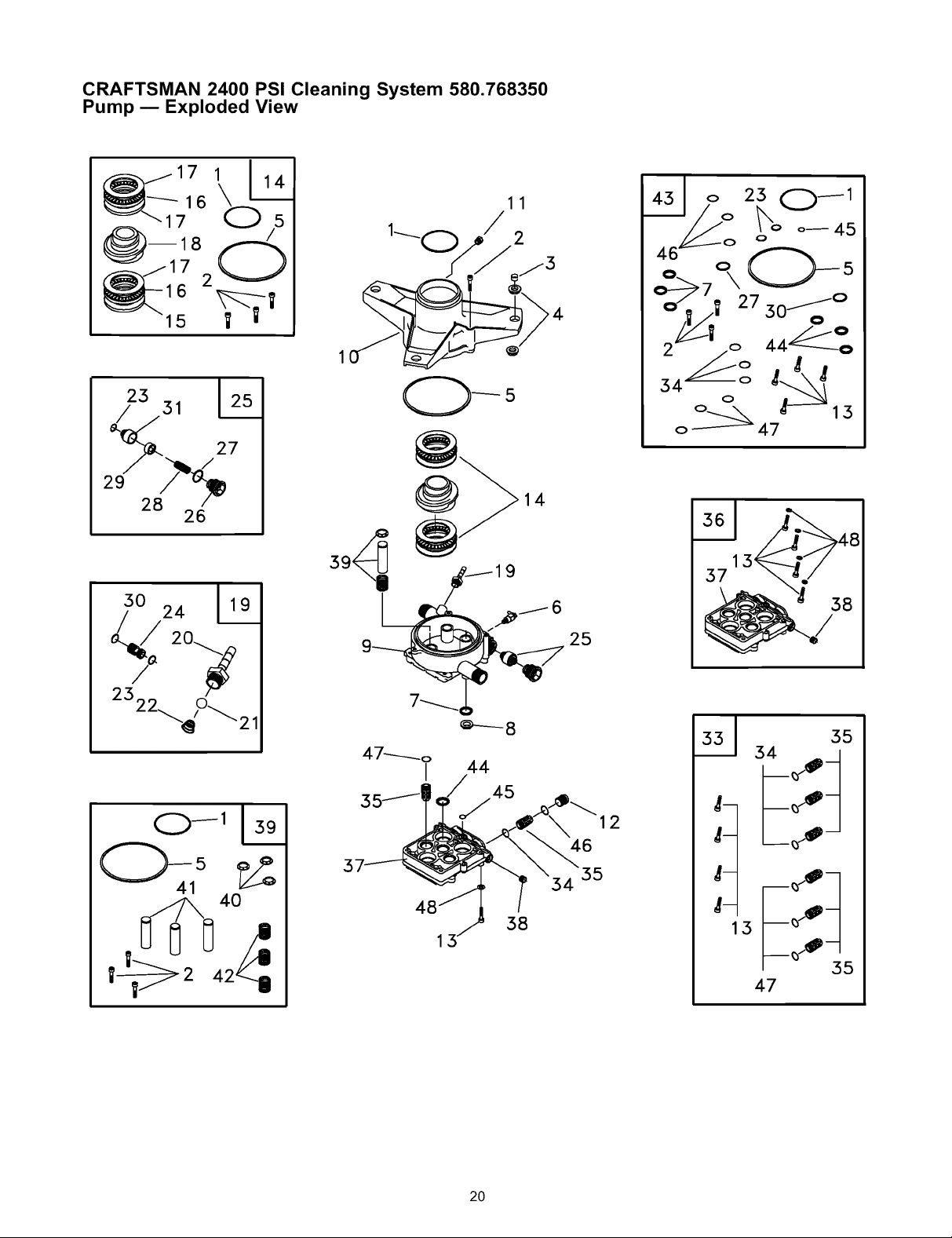
CRAFTSMAN 2400 PSI Cleaning System 580.768350
Pump -- Exploded View
17 05
5 51 125
26
0 24 119
_/20..
2522_S_21
47_o
I 44
35/!
58
1
25
46
.5 I o ° 25 0_I
_'x'°o_ 45
.Z_7% L_ s
_-/ _ 27.,_ o
o_47 _- 15
13
57
58
12
35
34 _:__
__-
it
_-
13__-
47
2O
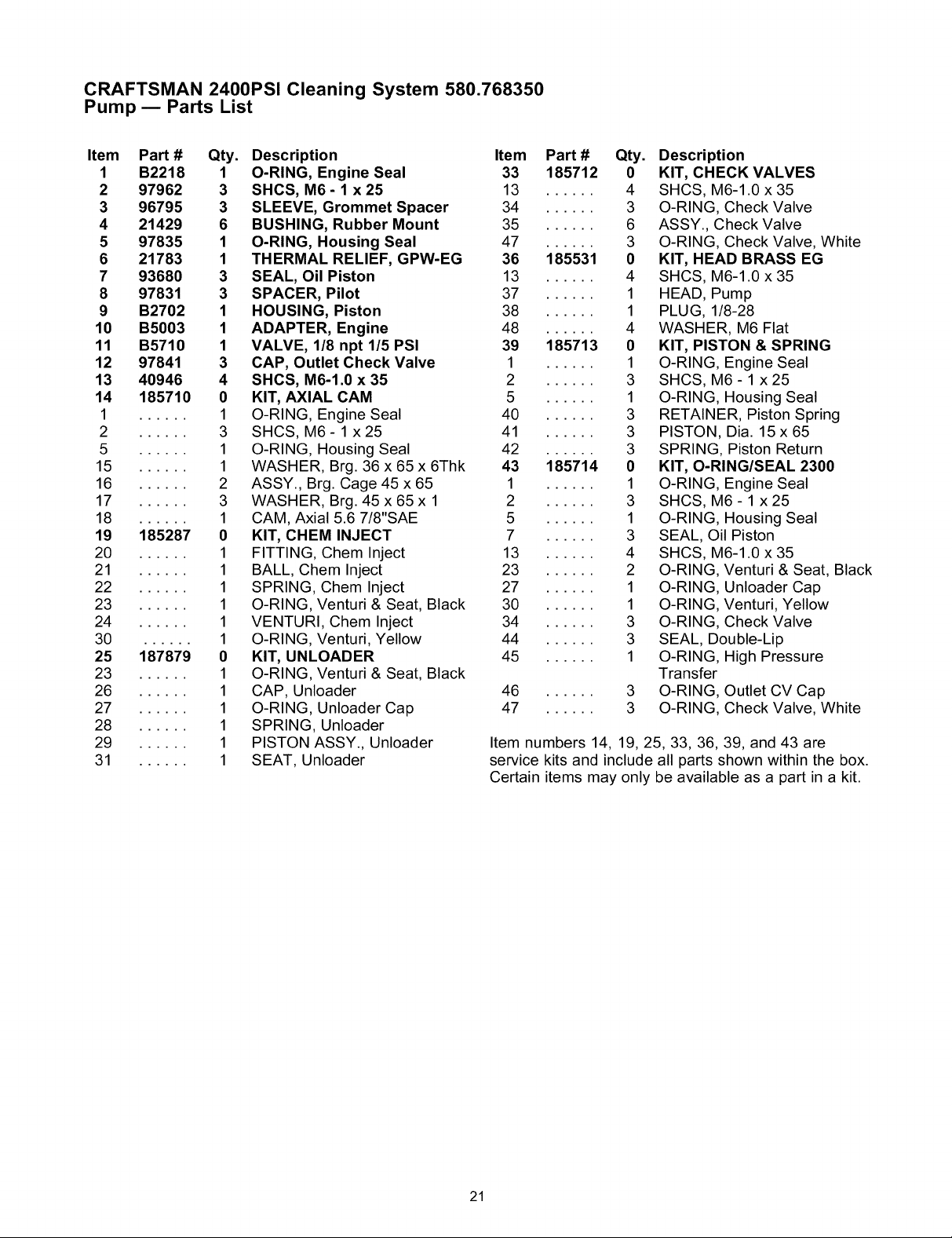
CRAFTSMAN 2400PSI Cleaning System 580.768350
Pump m Parts List
Item PaN #
1 B2218
2 97962
3 96795
4 21429
5 97835
6 21783
7 93680
8 97831
9 B2702
10 B5003
11 B5710
12 97841
13 40946
14 185710
......
......
5 ......
15 ......
16 ......
17 ......
18 ......
19 185287
20 ......
21 ......
22 ......
23 ......
24 ......
30 ......
25 187879
23 ......
26 ......
27 ......
28 ......
29 ......
31 ......
Qty. Description Item
1 O-RING, Engine Seal 33
3 SHCS, M6- 1 x 25 13
3 SLEEVE, Grommet Spacer 34
6 BUSHING, Rubber Mount 35
1 O-RING, Housing Seal 47
1 THERMAL RELIEF, GPW-EG 36
3 SEAL, Oil Piston 13
3 SPACER, Pilot 37
1 HOUSING, Piston 38
1 ADAPTER, Engine 48
1 VALVE, 1/8 npt 1/5 PSI 39
3 CAP, Outlet Check Valve 1
4 SHCS, M6-1.0 x 35 2
0 KIT, AXIAL CAM 5
1 O-RING, Engine Seal 40
3 SHCS, M6- 1 x 25 41
1 O-RING, Housing Seal 42
1 WASHER, Brg. 36 x 65 x 6Thk 43
2 ASSY., Brg. Cage 45 x 65 1
3 WASHER, Brg. 45 x 65 x 1 2
1 CAM, Axial 5.6 7/8"SAE 5
0 KIT, CHEM INJECT 7
1 FITTING, Chem Inject 13
1 BALL, Chem Inject 23
1 SPRING, Chem Inject 27
1 O-RING, Venturi & Seat, Black 30
1 VENTURI, Chem Inject 34
1 O-RING, Venturi, Yellow 44
0 KIT, UNLOADER 45
1 O-RING, Venturi & Seat, Black
1 CAP, Unloader 46
1 O-RING, Unloader Cap 47
1 SPRING, Unloader
1 PISTON ASSY., Unloader
1 SEAT, Unloader
Part#
185712
185531
185713
185714
Qty. Description
0 KIT, CHECK VALVES
4 SHCS, M6-1.0 x 35
3 O-RING, Check Valve
6 ASSY., Check Valve
3 O-RING, Check Valve, White
0 KIT, HEAD BRASS EG
4 SHCS, M6-1.0 x 35
1 HEAD, Pump
1 PLUG, 1/8-28
4 WASHER, M6 Flat
0 KIT, PISTON & SPRING
1 O-RING, Engine Seal
3 SHCS, M6- 1 x 25
1 O-RING, Housing Seal
3 RETAINER, Piston Spring
3 PISTON, Dia. 15 x 65
3 SPRING, Piston Return
0 KIT, O-RING/SEAL 2300
1 O-RING, Engine Seal
3 SHCS, M6- 1 x 25
1 O-RING, Housing Seal
3 SEAL, Oil Piston
4 SHCS, M6-1.0 x 35
2 O-RING, Venturi & Seat, Black
1 O-RING, Unloader Cap
1 O-RING, Venturi, Yellow
3 O-RING, Check Valve
3 SEAL, Double-Lip
1 O-RING, High Pressure
Transfer
3 O-RING, Outlet CV Cap
3 O-RING, Check Valve, White
Item numbers 14, 19, 25, 33, 36, 39, and 43 are
service kits and include all parts shown within the box.
Certain items may only be available as a part in a kit.
21
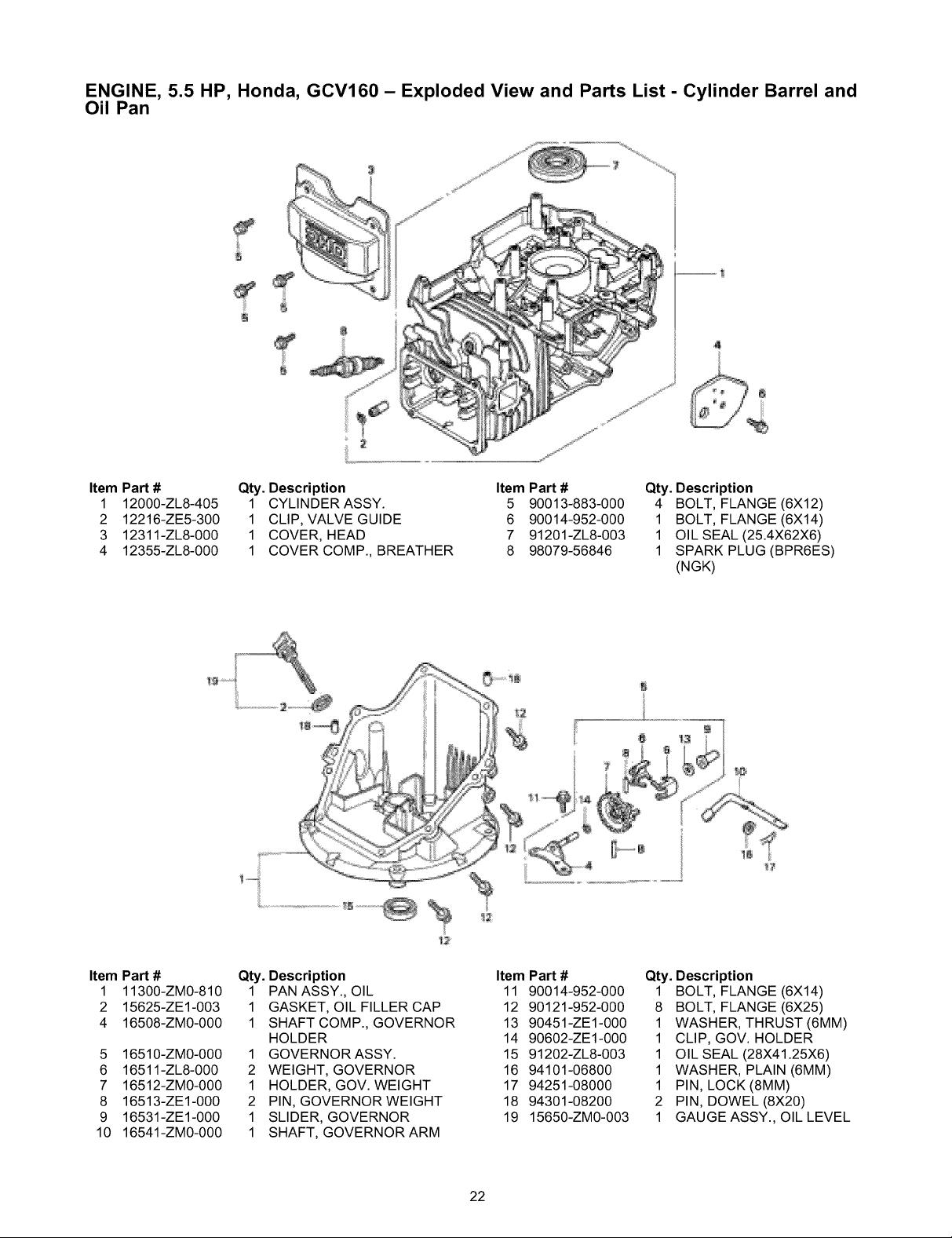
ENGINE, 5.5 HP, Honda, GCV160 - Exploded View and Parts List - Cylinder Barrel and
Oil Pan
4
Item Part # Qty. Description Item Part # Qty. Description
1 12000-ZL8-405 1 CYLINDER ASSY. 5 90013-883-000 4 BOLT, FLANGE (6X12)
2 12216-ZE5-300 1 CLIP, VALVE GUIDE 6 90014-952-000 1 BOLT, FLANGE (6X14)
3 12311-ZL8-000 1 COVER, HEAD 7 91201-ZL8-003 1 OIL SEAL (25.4X62X6)
4 12355-ZL8-000 1 COVER COMP., BREATHER 8 98079-56846 1 SPARK PLUG (BPR6ES)
(NGK)
Item Part # Qty. Description Item Part #
1 11300-ZM0-810 1 PAN ASSY., OIL 11 90014-952-000
2 15625-ZE1-003 1 GASKET, OIL FILLER CAP 12 90121-952-000
4 16508-ZM0-000 1 SHAFT COMP., GOVERNOR 13 90451-ZE1-000
HOLDER 14 90602-ZE1-000
5 16510-ZM0-000 1 GOVERNORASSY. 15 91202-ZL8-003
6 16511-ZL8-000 2 WEIGHT, GOVERNOR 16 94101-06800
7 16512-ZM0-000 1 HOLDER, GOV. WEIGHT 17 94251-08000
8 16513-ZE1-000 2 PIN, GOVERNOR WEIGHT 18 94301-08200
9 16531-ZE1-000 1 SLIDER, GOVERNOR 19 15650-ZM0-003
10 16541-ZM0-000 1 SHAFT, GOVERNOR ARM
Qty. Description
1 BOLT, FLANGE (6X14)
8 BOLT, FLANGE (6X25)
1 WASHER, THRUST (6MM)
1 CLIP, GOV. HOLDER
1 OIL SEAL (28X41.25X6)
1 WASHER, PLAIN (6MM)
1 PIN, LOCK(8MM)
2 PIN, DOWEL (8X20)
1 GAUGE ASSY., OIL LEVEL
22
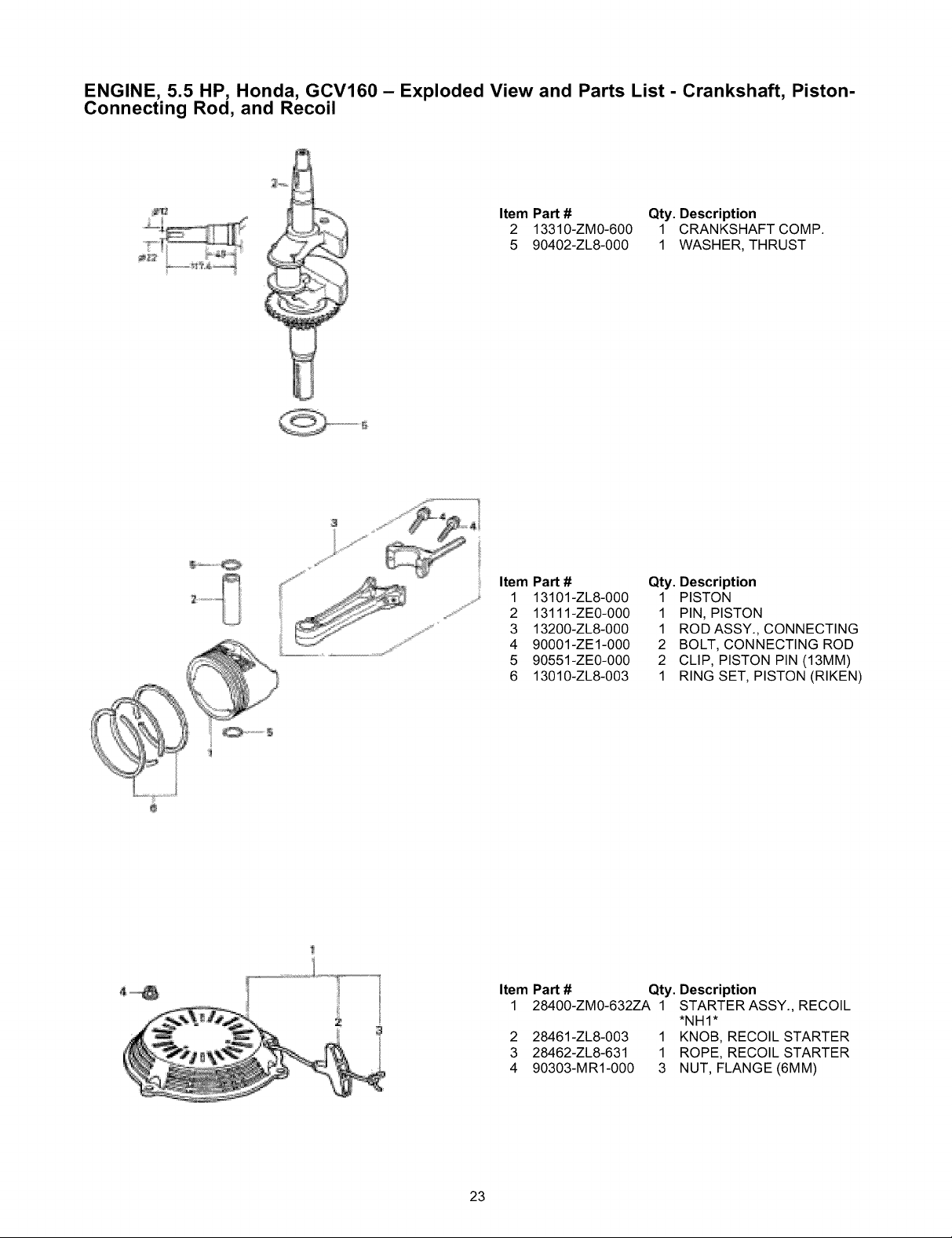
ENGINE, 5.5 HP, Honda, GCV160 - Exploded View and Parts List - Crankshaft, Piston-
Connecting Rod, and Recoil
Item Part # Qty. Description
2 13310-ZM0-600 1 CRANKSHAFT COMP.
5 90402-ZL8-000 1 WASHER, THRUST
J
J
ii O ...........
i
t
Item Part # Qty. Description
1 13101-ZL8-000 1 PISTON
2 13111-ZE0-000 1 PIN, PISTON
3 13200-ZL8-000 1 ROD ASSY., CONNECTING
4 90001-ZE1-000 2 BOLT, CONNECTING ROD
5 90551-ZE0-000 2 CLIP, PISTON PIN (13MM)
6 13010-ZL8-003 1 RING SET, PISTON (RIKEN)
1
1
,/
Item Part # Qty. Description
1 28400-ZM0-632ZA 1 STARTERASSY., RECOIL
*NHI*
2 28461-ZL8-003 1 KNOB, RECOIL STARTER
3 28462-ZL8-631 1 ROPE, RECOIL STARTER
4 90303-MR1-000 3 NUT, FLANGE (6MM)
23
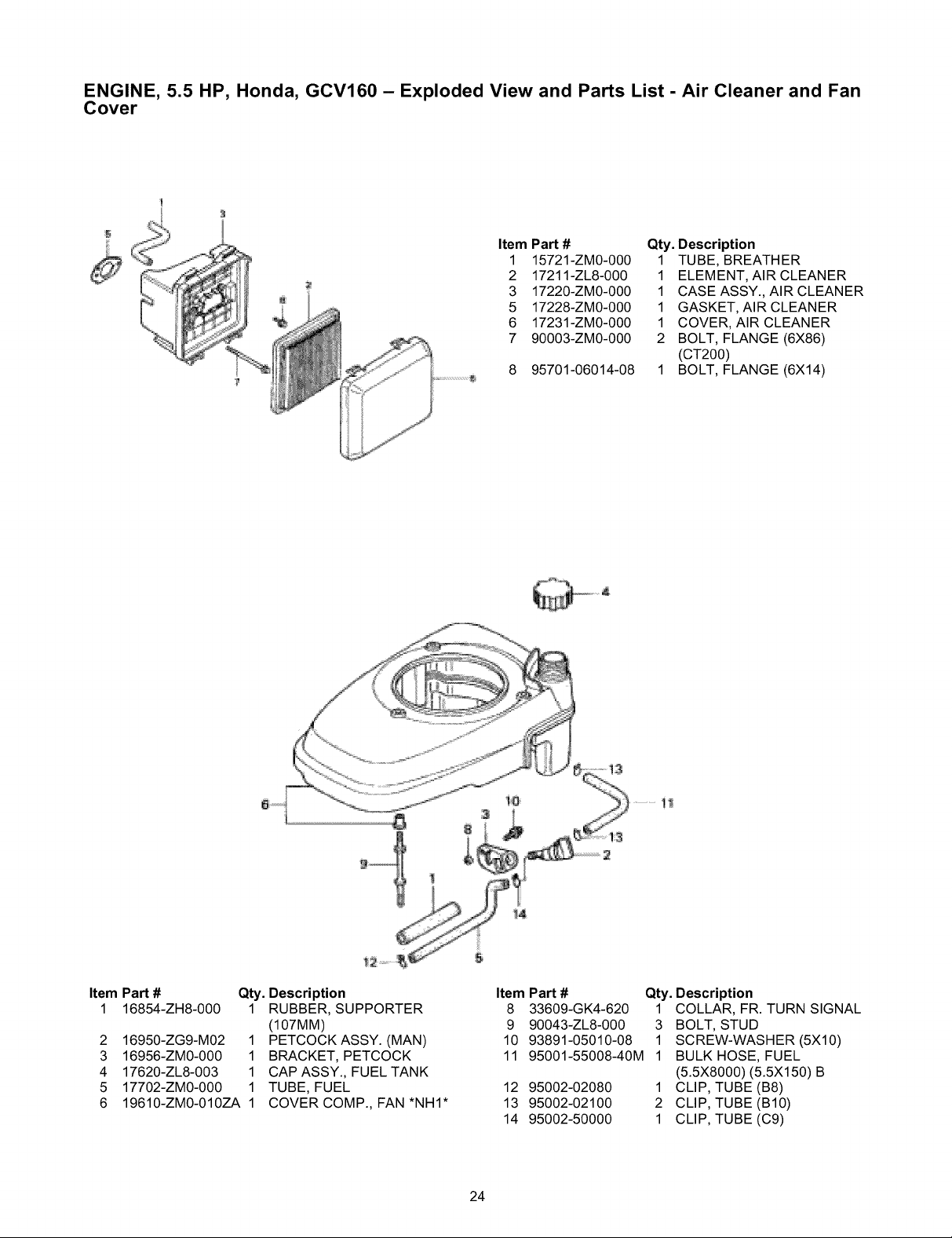
ENGINE, 5.5 HP, Honda, GCV160 - Exploded View and Parts List - Air Cleaner and Fan
Cover
Item Part # Qty. Description
1 15721-ZM0-000 1 TUBE, BREATHER
2 17211-ZL8-000 1 ELEMENT, AIR CLEANER
3 17220-ZM0-000 1 CASE ASSY., AIR CLEANER
5 17228-ZM0-000 1 GASKET, AIR CLEANER
6 17231-ZM0-000 1 COVER, AIR CLEANER
7 90003-ZM0-000 2 BOLT, FLANGE (6X86)
(CT200)
8 95701-06014-08 1 BOLT, FLANGE (6X14)
Item Part # Qty. Description
1 16854-ZH8-000 1 RUBBER, SUPPORTER
(107MM)
2 16950-ZG9-M02 1 PETCOCKASSY. (MAN)
3 16956-ZM0-000 1 BRACKET, PETCOCK
4 17620-ZL8-003 1 CAP ASSY., FUEL TANK
5 17702-ZM0-000 1 TUBE, FUEL
6 19610-ZM0-010ZA 1 COVER COMP., FAN*NHI*
Item Part#
8 33609-GK4-620 1
9 90043-ZL8-000 3
10 93891-05010-08 1
11 95001-55008-40M 1
Qty. Description
12 95002-02080 1
13 95002-02100 2
14 95002-50000 1
COLLAR, FR. TURN SIGNAL
BOLT, STUD
SCREW-WASHER (5X10)
BULK HOSE, FUEL
(5.5X8000) (5.5X150) B
CLIP, TUBE (B8)
CLIP, TUBE (B10)
CLIP, TUBE (C9)
24
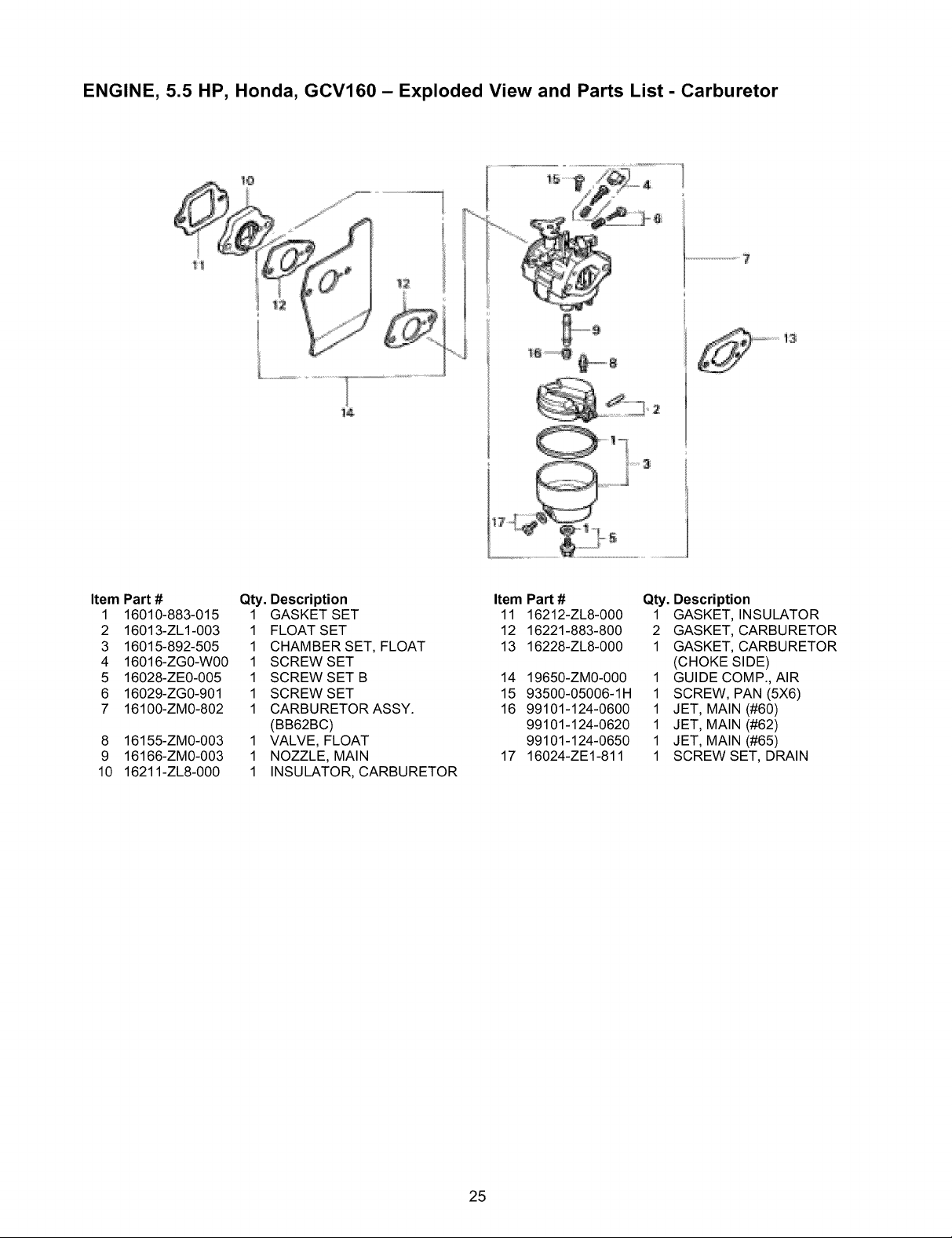
ENGINE, 5.5 HP, Honda, GCV160 - Exploded View and Parts List - Carburetor
Item Part #
1 16010-883-015
2 16013-ZL1-003
3 16015-892-505
4 16016-ZG0-W00
5 16028-ZE0-005
6 16029-ZG0-901
7 16100-ZM0-802
8 16155-ZM0-003
9 16166-ZM0-003
10 16211-ZL8-000
Qty. Description
1 GASKET SET
1 FLOAT SET
1 CHAMBER SET, FLOAT
1 SCREW SET
1 SCREW SET B
1 SCREW SET
1 CARBURETOR ASSY.
(BB62BC)
1 VALVE, FLOAT
1 NOZZLE, MAIN
1 INSULATOR, CARBURETOR
Item Part #
11 16212-ZL8-000
12 16221-883-800
13 16228-ZL8-000
14 19650-ZM0-000
15 93500-05006-1H
16 99101-124-0600
99101-124-0620
99101-124-0650
17 16024-ZE1-811
Qty. Description
1 GASKET, INSULATOR
2 GASKET, CARBURETOR
1 GASKET, CARBURETOR
(CHOKE SIDE)
1 GUIDE COMP.,AIR
1 SCREW, PAN (5X6)
1 JET, MAIN (#60)
1 JET, MAIN (#62)
1 JET, MAIN (#65)
1 SCREW SET, DRAIN
25
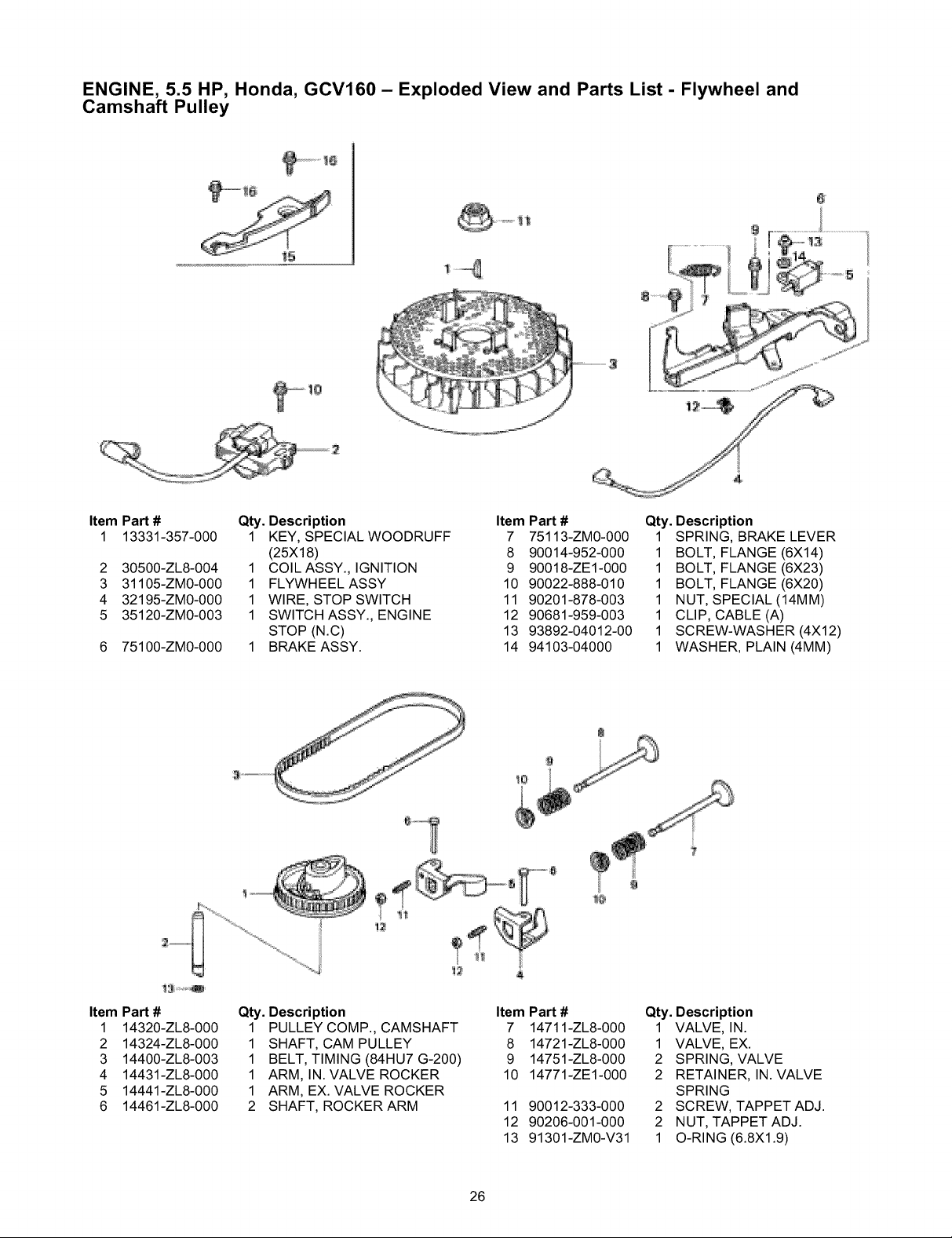
ENGINE, 5.5 HP, Honda, GCV160 - Exploded View and Parts List - Flywheel and
Camshaft Pulley
6
_5
Item Part # Qty. Description Item Part # Qty. Description
1 13331-357-000 1 KEY, SPECIAL WOODRUFF 7 75113-ZM0-000 1 SPRING, BRAKE LEVER
(25X18) 8 90014-952-000 1 BOLT, FLANGE (6X14)
2 30500-ZL8-004 1 COILASSY., IGNITION 9 90018-ZE1-000 1 BOLT, FLANGE (6X23)
3 31105-ZM0-000 1 FLYWHEELASSY 10 90022-888-010 1 BOLT, FLANGE (6X20)
4 32195-ZM0-000 1 WIRE, STOP SWITCH 11 90201-878-003 1 NUT, SPECIAL (14MM)
5 35120-ZM0-003 1 SWITCH ASSY., ENGINE 12 90681-959-003 1 CLIP, CABLE (A)
STOP (N.C) 13 93892-04012-00 1 SCREW-WASHER (4X12)
6 75100-ZM0-000 1 BRAKE ASSY. 14 94103-04000 1 WASHER, PLAIN (4MM)
.... °
Item Part # Qty. Description Item Part # Qty. Description
1 14320-ZL8-000 1 PULLEY COMP., CAMSHAFT 7 14711-ZL8-000 1 VALVE, IN.
2 14324-ZL8-000 1 SHAFT, CAM PULLEY 8 14721-ZL8-000 1 VALVE, EX.
3 14400-ZL8-003 1 BELT, TIMING (84HU7 G-200) 9 14751-ZL8-000 2 SPRING, VALVE
4 14431-ZL8-000 1 ARM, IN. VALVE ROCKER 10 14771-ZE1-000 2 RETAINER, IN. VALVE
5 14441-ZL8-000 1 ARM, EX. VALVE ROCKER SPRING
6 14461-ZL8-000 2 SHAFT, ROCKER ARM 11 90012-333-000 2 SCREW, TAPPET ADJ.
12 90206-001-000 2 NUT, TAPPET ADJ.
13 91301-ZM0-V31 1 O-RING (6.8X1.9)
26
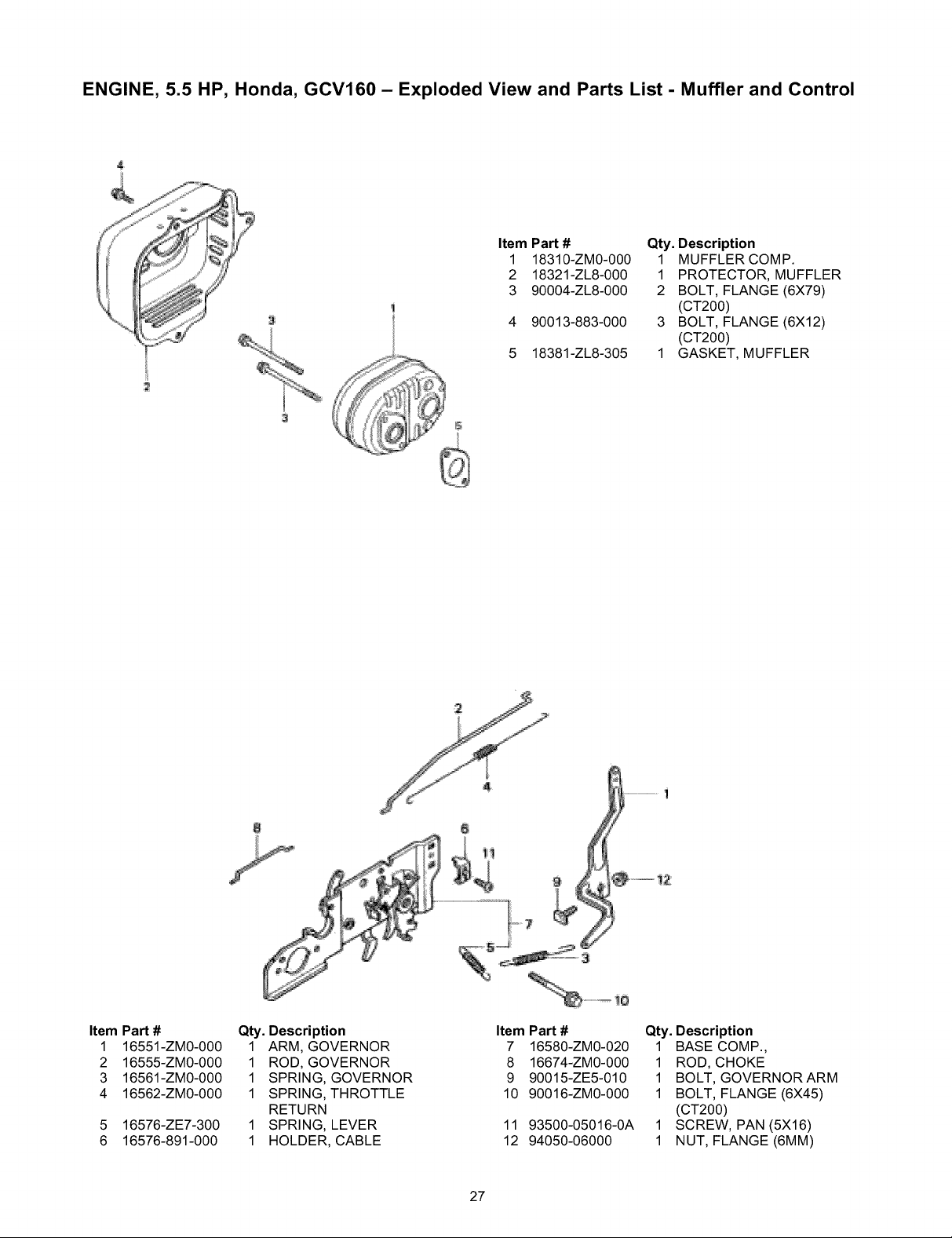
ENGINE, 5.5 HP, Honda, GCV160 - Exploded View and Parts List - Muffler and Control
f
i!i
i
Item Part # Qty. Description
1 18310-ZM0-000 1 MUFFLERCOMP.
2 18321-ZL8-000 1 PROTECTOR, MUFFLER
3 90004-ZL8-000 2 BOLT, FLANGE (6X79)
(CT200)
4 90013-883-000 3 BOLT, FLANGE (6X12)
(CT200)
5 18381-ZL8-305 1 GASKET, MUFFLER
Item Part #
1 16551-ZM0-000
2 16555-ZM0-000
3 16561-ZM0-000
4 16562-ZM0-000
5 16576-ZE7-300
6 16576-891-000
Qty. Description
1 ARM, GOVERNOR
1 ROD, GOVERNOR
1 SPRING, GOVERNOR
1 SPRING, THROTTLE
RETURN
1 SPRING, LEVER
1 HOLDER, CABLE
_0
Item Part #
7 16580-ZM0-020
8 16674-ZM0-000
9 90015-ZE5-010
10 90016-ZM0-000
11 93500-05016-0A
12 94050-06000
Qty. Description
1 BASE COMP.,
1 ROD, CHOKE
1 BOLT, GOVERNOR ARM
1 BOLT, FLANGE (6X45)
(CT200)
1 SCREW, PAN (5X16)
1 NUT, FLANGE (6MM)
27
Your Warranty Rights and Obligations
The California Air Resources Board ("CARB") and Sears
Roebuck and Co., USA, are pleased to explain the Emission
Control System Warranty on your model year 2000 and later
small off-road engine (engine). In California, new engines
must be designed, built and equipped to meet the State's
stringent anti-smog standards. Sears must warrant the
emission control system on your engine for the periods of
time listed below provided there has been no abuse,
neglect, or improper maintenance of your engine.
Your emission control system includes parts such as the
carburetor and the ignition system.
Where a warrantable condition exists, Sears will repair your
engine at no cost to you. Expenses covered under under
warranty include diagnosis, parts, and labor.
Manufacturer's Warranty Coverage
The model year 2000 and later engines are warranted for
two years. If any emission related part on your engine (as
listed below) is defective, the part will be repaired or
replaced by Sears.
Owner's Warranty Responsibilities
As the engine owner, you are responsible for the
performance of the required maintenance listed in this
owners manual. Sears recommends that you retain all
receipts covering maintenance on your engine, but Sears
cannot deny warranty solely due for the lack of receipts or
for your failure to ensure the performance of all scheduled
maintenance.
As the engine owner, you should be aware that Sears may
deny you warranty coverage if your engine or a part of it has
failed due to abuse, neglect, improper maintenance,
unapproved modifications, or the use of parts not made or
approved by the original equipment manufacturer.
You are responsible for presenting your engine to a Sears
authorized repair center as soon as a problem exists.
Warranty repairs should be completed in a reasonable
amount of time, not to exceed 30 days.
If you have any questions regarding your warranty rights
and responsibilities, you should contact your nearest
authorized service center or call Sears at 1-800-473-7247.
Warranty Commencement Date
The warranty period begins on the date the engine is
delivered.
Length of Coverage
Sears warrants to the initial owner and each subsequent
purchaser that the engine is free from defects in materials
and workmanship which cause the failure of a warranted
part for a period of two years.
WHAT IS COVERED
Repair or Replacement of Parts
• Repair or replacement of any warranted part will be
performed at no charge to the owner at an approved
Sears service center.
If you have any questions regarding your warranty rights
and responsibilities, your should contact your nearest
authorized service center or call Sears at
1-800-473-7247.
Warranty Period
Any warranted part which is not scheduled for replacement
as required maintenance, or which is scheduled only for
regular inspection to the effect of "repair or replace as
necessary" shall be warranted for 2 years. Any warranted
part which is scheduled for replacement as required
maintenance shall be warranted for the period of time up to
the first scheduled replacement point for that part.
Diagnosis
The owner shall not be charged for diagnostic labor which
leads to the determination that the warranted part is
defective if the diagnostic work is performed at an approved
Sears service center.
Consequential Damages
Sears may be liable for damages to other engine
components caused by the failure of a warranted part still
under warranty.
WHAT IS NOT COVERED
All failures caused by abuse, neglect, or improper
maintenance are not covered.
Add-on or Modified Parts
The use of add-on or modified parts can be grounds for
disallowing a warranty claim. Sears is not liable to cover
failures of warranted parts caused by the use of add-on or
modified parts.
How to File a Claim
If you have any questions regarding your warranty rights
and responsibilities, you should contact your nearest
authorized service center or call Sears at 1-800-473-7247.
Where to Get Warranty Service
Warranty services or repairs shall be provided at all Sears
authorized service centers.
Maintenance, Replacement and Repair of
Emission Related Parts
Any Sears approved replacement part used in the
performance of any warranty maintenance or repair on
emission related parts will be provided without charge to the
owner if the part it under warranty.
Emission Control Warranty Parts List
1. Carburetor Assembly
2. Ignition System
a. Spark Plug, covered up to maintenance schedule.
b. Ignition Module
3. Crankcase Breather Tube
4. Exhaust Manifold
28
GARANTIA................................... 29
REGLASDESEGURIDAD.................... 29-30
MONTAJE................................. 31-33
OPERACION............................... 34-37
MANTENIMIENTO........................... 39-43
ESPECIFICACIONES.......................... 39
ALMACENAMIENTO......................... 43-44
REPARACIONDEDAI_OS....................... 45
GARANTIADELCONTROLDEEMISIONES......... 47
COMOORDENARPARTES...... PAGINAPOSTERIOR
GARANTIA LIMITADA DE LA MAQUINA LAVADORA DE ALTA PRESION CRAFTSMAN
Durante un a_o a partir de la fecha de compra, Sears reparar& sin cargo alguno, cualquier defecto en material y mano de
obra, siempre y cuando esta maquina lavadora a presi6n Craftsman haya sido mantenida y puesta en funcionamiento de
acuerdo alas instrucciones suministradas en el manual del propietario.
Siesta maquina lavadora es usada para fines comerciales, la garantia se aplicara tan solo por 90 dias a partir de la fecha de
compra. Siesta maquina lavadora de alta presi6n es usada para alquiler, la garantia se aplicara tan solo por 30 dias
despu6s de la fecha de compra.
Esta garantia no cubre:
• Elementos perecederos como bujias o filtros de aire, los cuales se desgastan con el uso normal.
• Reparaciones necesarias debido al abuso o negligencia del operador, incluyendo daSos ocasionados por la ausencia de
suministro de agua a la bomba o por no mantener el equipo de acuerdo alas instrucciones contenidas en el manual del
propietario.
El servicio de garantia se hace efectivo devolviendo la maquina lavadora de alta presi6n al centro de servicio o distribuidor
Sears mas cercano en los Estados Unidos.
Esta garantia le proporciona derechos legales especificos; usted tambi6n puede tener otros derechos, los cuales varian de
estado a estado.
Sears, Roebuck and Co., Dept. 817WA, Hoffman Estates, IL 60179
_ STE ES EL SIMBOLO DE ALERTA DE SEGURIDAD. ES USADO PARA INDICARLE SITUACIONES CON
PELIGROS POTENCIALES DE LESION PARA EL PERSONAL. SIGA LAS INSTRUCCIONES DE TODOS LOS
MENSAJES DE SEGURIDAD QUE APARECEN DESPUES DE ESTE SIMBOLO PARA EVITAR POSIBLES
LESIONES O MUERTE.
El escape del motor de este producto contiene
elementos quimicos reconocidos en el Estado
de California por producir cancer, defectos de
nacimiento u otros dahos de tipo reproductivo.
iPRECAUCION! Cuando instale, transporte, ajuste
o haga reparaciones a su maquina lavadora de alta
presi6n, siempre desconecte el alambre de la bujia y
col6quelo donde No pueda entrar en contacto con la
bujia.
iPELIGRO! Los gases del sistema de escape del
motor contienen gas de mon6xido de carbono
MORTAL. Si este gas peligroso se inhala en
concentraciones suficientes, puede causar p6rdida de
la consciencia o incluso la muerte. Opere este equipo
Qnicamente al aire libre, donde exista ventilaci6n
adecuada.
,_ iADVERTENCIA! La gasolina es altamente
INFLAMABLE y sus vapores son EXPLOSIVOS. No
permita que fumen, que existan llamas abiertas,
chispas o calor a su alrededor cuando manipule
gasolina. Evite regar gasolina sobre un motor
caliente. Permita que la unidad se enfrie antes de
volver a colocarle combustible. Cumpla con todas las
leyes que regulan el almacenamiento y el manejo de
gasolina.
Lea este manual minuciosamente y conozca a fondo las
partes y el funcionamiento de su maquina lavadora a
presion. Conozca sus aplicaciones, sus limitaciones y
los peligros involucrados.
• Coloque esta maquina lavadora a presi6n en Areas
alejadas de materiales combustibles, humos o polvo
combustibles.
29
• El equipo de alta presi6n esta diseSado para ser utilizado •
UNICAMENTE con las pares autorizadas Sears. Si
utiliza este equipo con partes que no cumplan con las •
especificaciones minimas, el usuario asume todos los
riesgos y responsabilidades. •
Algunos quimicos o detergentes pueden ser nocivos si se
inhalan o ingieren, causando nausea severa, desmayos o
envenenamiento. Los elementos nocivos pueden
ocasionar da_o a la propiedad o lesiones severas.
No permita en ningQn momento que NINOS operen la
maquina lavadora a presi6n.
Opere el motor Qnicamente a la velocidad de mando.
Hacer funcionar el motor a velocidades excesivas
aumenta el riesgo de lesiones personales. No juegue con
partes que puedan aumentar o disminuir la velocidad de
mando.
No use ropa suelta, joyas o elementos que puedan
quedar atrapados en el arranque o en otras partes
rotatorias.
Antes de poner en marcha la maquina lavadora a presi6n
en clima frio, revise todas las pares del equipo y
asegt_rese de que no se haya formado hielo sobre elias.
Nunca utilice una pistola de rociado que no tenga un
seguro para gatillo o protecci6n para gatillo en su lugar y
en buenas condiciones.
• Mantenga conectada la manguera a la maquina o a la
pistola de rociado cuando el sistema est6 presurizado. Es
peligroso desconectar la manguera cuando la unidad
esta presurizada.
• Nunca deberan ser operadas las unidades con pares
rotas o ausentes, o sin la caja o cubiertas de protecci6n.
• Revise que el sistema de combustible no presente fugas
o signos de deterioro, como mangueras desgastadas o
porosas, sujetadores flojos o ausentes, tapa o tanque
dafiados. Corrija todos los defectos antes de operar la
maquina lavadora a presi6n.
• No rocie liquidos inflamables.
• Utilice un respirador o mascara siempre que exista la
posibilidad de inhalar vapores. Lea todas las
instrucciones de la mascara para asegurarse de que le
brindara la protecci6n necesaria contra la inhalaci6n de
vapores nocivos.
• Nunca apunte la pistola a la gente, animales o plantas.
La corriente de agua de alta presi6n que produce este
equipo pueden perforar la piel y sus tejidos profundos,
ocasionando lesiones serias y posible amputaci6n.
• Nunca permita que pares del cuerpo entren en contacto
con la corriente del fluido. No entre en contacto con la
corriente del fluido creada por una fuga en la manguera
de alta presi6n.
• Siempre use protecci6n para los ojos cuando utilice este
equipo o cuando est6 cerca de donde se est6 usando el
equipo.
• El rociado de alta presi6n puede hacer que particulas
pequeSas de pintura u otras particulas salgan disparadas
y viajen a altas velocidades.
No opere la maquina lavadora a presi6n con un valor de
presi6n superior a su clasificaci6n de presi6n.
Nunca mueva la maquina halando la manguera de alta
presi6n. Utilice la manija que viene con la unidad.
Siempre asegQrese de que la pistola de rociado,
boquillas y accesorios est6n conectados correctamente.
No asegure la pistolade rociado en la posici6n (open = abierto).
El rociado de alta presi6n puede daSar elementos
fragiles, incluyendo el vidrio. No apunte la pistola de
rociado al vidrio cuando est6 en el modo de rociado a
chorro.
Sostenga flrmemente en su mano la manguera de
rociado antes de poner en marcha la unidad. De no
hacerlo, podrian ocurrir lesiones por el movimiento
brusco de la pistola de rociado. No abandone la pistola
de rociado cuando la maquina est6 en funcionamiento.
El area de limpieza debera tener inclinaciones y drenajes
adecuados para disminuir la posibilidad de caidas debido
a superficies resbalosas.
Mantenga el chorro del agua alejado de alambrados
el6ctricos, de Io contrario podrian ocurrir descargas
el6ctricas fatales.
• No eluda ningQn dispositivo de seguridad de esta
maquina.
• El silenciador y el motor se calientan durante el
funcionamiento y permanecen calientes inmediatamente
despu6s del apagado. Evite el contacto con silenciadores
o motores calientes, o podria quemarse severamente.
• Opere y almacene esta unidad sobre una superficie estable.
• La manguera de alta presi6n puede desarrollar fugas
debido al desgaste, dobleces, abuso, etc. El agua que
sale de una fuga es capaz de inyectar materiales en la
piel. Inspeccione la manguera siempre que la vaya a
usar. Revise todas las mangueras para ver si presentan
cortes, fugas, abrasiones o deformaci6n de la cubierta,
daSo o movimiento de acoplamientos. Si existe
cualquiera de estas condiciones, remplace la manguera
inmediatamente. Nunca repare la manguera de alta
presi6n. Remplacela con una manguera que tenga la
misma capacidad de presi6n maxima de su unidad.
• Siempre almacene el sistema de limpieza con la perilla
Dial-a-Cleaner TM en la posici6n "OFF" ("APAGADO").
• El silenciador y el depurador de aire deberan estar
instalados yen buenas condiciones antes de operar la
maquina lavadora a presi6n. Estos componentes actean
como apagachispas si el motor presenta contrafuegos.
En el estado de California es obligatorio, segQn la ley, el uso
de apagachispas (Secci6n 4442 del C6digo de Recursos
Peblicos de California). Otros estados pueden tener leyes
similares. Las leyes federales se aplican en tierras
federales.
NOTA: Si equipa el silenciador con un apagachispas, este
debera set mantenido en buenas condiciones de trabajo.
Usted puede ordenar el apagachispas a trav6s de su
distribuidor de servicio autorizado Sears.
30
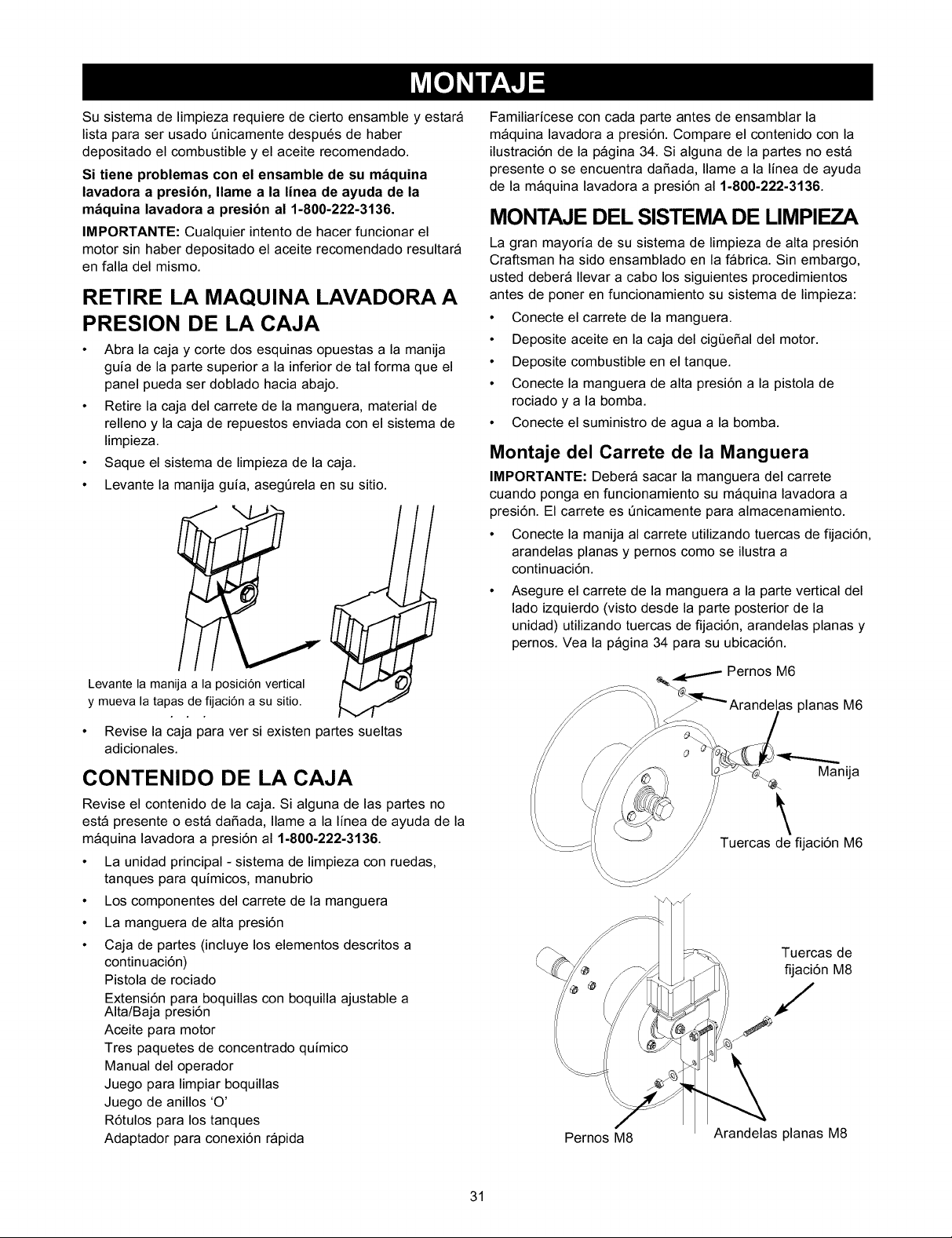
Susistemadelimpiezarequieredeciertoensambleyestara
listaparaserusadoOnicamentedespu6sdehaber
depositadoelcombustibley elaceiterecomendado.
Si tiene problemas con el ensamble de su maquina
lavadora a presion, Ilame a la linea de ayuda de la
maquina lavadora a presion al 1-800-222-3136.
IMPORTANTE: Cualquier intento de hacer funcionar el
motor sin haber depositado el aceite recomendado resultara
en falla del mismo.
RETIRE LA MAQUINA LAVADORA A
PRESION DE LA CAJA
• Abra la caja y corte dos esquinas opuestas a la manija
guia de la parte superior a la inferior de tal forma que el
panel pueda set doblado hacia abajo.
• Retire la caja del carrete de la manguera, material de
relleno y la caja de repuestos enviada con el sistema de
limpieza.
• Saque el sistema de limpieza de la caja.
• Levante la manija guia, asegerela en su sitio.
Levante la manija a la posici6n vertical
y mueva la tapas de fijaci6n a su sitio.
• Revise la caja para ver si existen partes sueltas
adicionales.
CONTENIDO DE LA CAJA
Revise el contenido de la caja. Si alguna de las partes no
esta presente o esta daSada, Ilame a la linea de ayuda de la
maquina lavadora a presi6n al 1-800-222-3136.
• La unidad principal - sistema de limpieza con ruedas,
tanques para quimicos, manubrio
• Los componentes del carrete de la manguera
• La manguera de alta presi6n
• Caja de partes (incluye los elementos descritos a
continuaci6n)
Pistola de rociado
Extensi6n para.boquillas con boquilla ajustable a
Alta/Baja preslon
Aceite para motor
Tres paquetes de concentrado quimico
Manual del operador
Juego para limpiar boquillas
Juego de anillos 'O'
R6tulos para los tanques
Adaptador para conexi6n rapida
Familiaricese con cada parte antes de ensamblar la
maquina lavadora a presi6n. Compare el contenido con la
ilustraci6n de la pagina 34. Si alguna de la partes no esta
presente o se encuentra daSada, Ilame a la linea de ayuda
de la maquina lavadora a presi6n al 1-800-222-3136.
MONTAJE DEL SISTEMA DE LIMPIEZA
La gran mayoria de su sistema de limpieza de alta presi6n
Craftsman ha sido ensamblado en la fabric& Sin embargo,
usted debera Ilevar a cabo los siguientes procedimientos
antes de poner en funcionamiento su sistema de limpieza:
• Conecte el carrete de la manguera.
• Deposite aceite en la caja del cigQeSal del motor.
• Deposite combustible en el tanque.
• Conecte la manguera de alta presi6n a la pistola de
rociado y a la bomba.
• Conecte el suministro de agua a la bomba.
Montaje del Carrete de la Manguera
IMPORTANTE: Debera sacar la manguera del carrete
cuando ponga en funcionamiento su maquina lavadora a
presi6n. El carrete es enicamente para almacenamiento.
• Conecte la manija al carrete utilizando tuercas de fijaci6n,
arandelas planas y pernos como se ilustra a
continuaci6n.
• Asegure el carrete de la manguera a la parte vertical del
lado izquierdo (visto desde la parte posterior de la
unidad) utilizando tuercas de fijaci6n, arandelas planas y
pernos. Vea la pagina 34 para su ubicaci6n.
Pernos M6
planas M6
Manija
\
Tuercas de fijacidn M6
Tuercas de
fijaci6n M8
Pernos M8
Arandelas planas M8
31
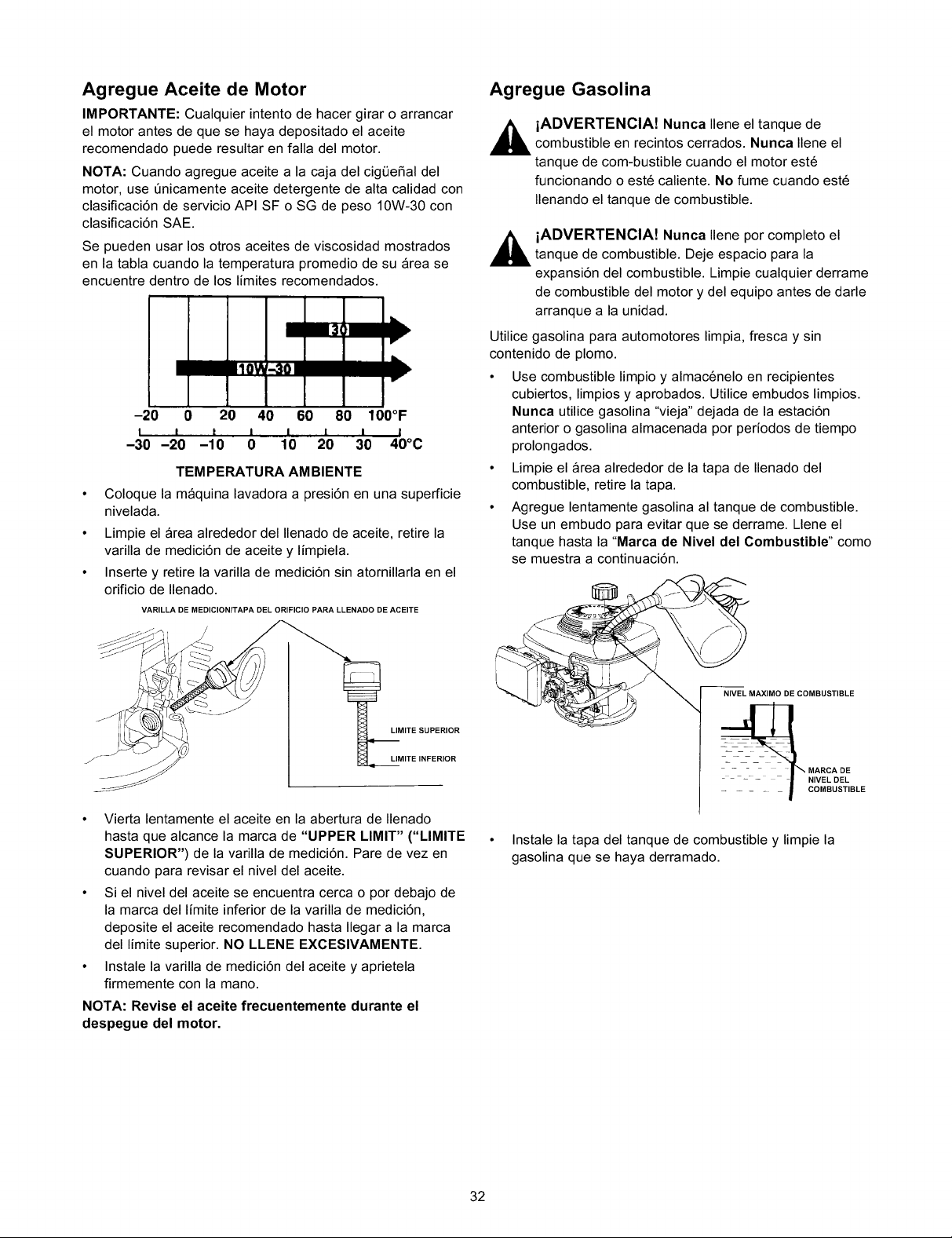
Agregue Aceite de Motor
IMPORTANTE: Cualquier intento de hacer girar o arrancar
el motor antes de que se haya depositado el aceite
recomendado puede resultar en falla del motor.
NOTA: Cuando agregue aceite a la caja del cigL_eSal del
motor, use 0nicamente aceite detergente de alta calidad con
clasificaci6n de servicio API SF o SG de peso 10W-30 con
clasificaci6n SAE.
Se pueden usar los otros aceites de viscosidad mostrados
en la tabla cuando la temperatura promedio de su Area se
encuentre dentro de los limites recomendados.
-20 0 20 40 60 80 100°F
I I t I I I I I
-30 -20 -10 0 10 20 30 40°C
TEMPERATURA AMBIENTE
Coloque la maquina lavadora a presi6n en una superficie
nivelada.
Limpie el area alrededor del Ilenado de aceite, retire la
varilla de medici6n de aceite y limpiela.
Inserte y retire la varilla de medici6n sin atornillarla en el
orificio de Ilenado.
VARILLA DE MEDICIONITAPA DEL ORIFICIO PARA LLENADO DE ACEITE
LIMITE SUPERIOR
LIMITE INFERIOR
• Vierta lentamente el aceite en la abertura de Ilenado
hasta que alcance la marca de "UPPER LIMIT" ("LIMITE
SUPERIOR") de la varilla de medici6n. Pare de vez en
cuando para revisar el nivel del aceite.
• Si el nivel del aceite se encuentra cerca o por debajo de
la marca del limite inferior de la varilla de medici6n,
deposite el aceite recomendado hasta Ilegar a la marca
del limite superior. NO LLENE EXCESlVAMENTE.
• Instale la varilla de medici6n del aceite y aprietela
firmemente con la mano.
NOTA: Revise el aceite frecuentemente durante el
despegue del motor.
Agregue Gasolina
_ ADVERTENClA! Nunca Ilene el tanque de
combustible en recintos cerrados. Nunca Ilene el
tanque de com-bustible cuando el motor est6
funcionando o est6 caliente. No fume cuando est6
Ilenando el tanque de combustible.
_ ADVERTENCIA! Nunca Ilene por completo el
tanque de combustible. Deje espacio para la
expansi6n del combustible. Limpie cualquier derrame
de combustible del motor y del equipo antes de darle
arranque a la unidad.
Utilice gasolina para automotores limpia, fresca y sin
contenido de plomo.
• Use combustible limpio y almac6nelo en recipientes
cubiertos, limpios y aprobados. Utilice embudos limpios.
Nunca utilice gasolina "vieja" dejada de la estaci6n
anterior o gasolina almacenada por periodos de tiempo
prolongados.
• Limpie el area alrededor de la tapa de Ilenado del
combustible, retire la tapa.
• Agregue lentamente gasolina al tanque de combustible.
Use un embudo para evitar que se derrame. Llene el
tanque hasta la "Marca de Nivel del Combustible" como
se muestra a continuaci6n.
__ NIVEL MAXlMO DE COMBUSTIBLE
--- _ MARCA DE
- -_- NIVEL DEL
_ i COMBUSTIBLE
• Instale la tapa del tanque de combustible y limpie la
gasolina que se haya derramado.
32
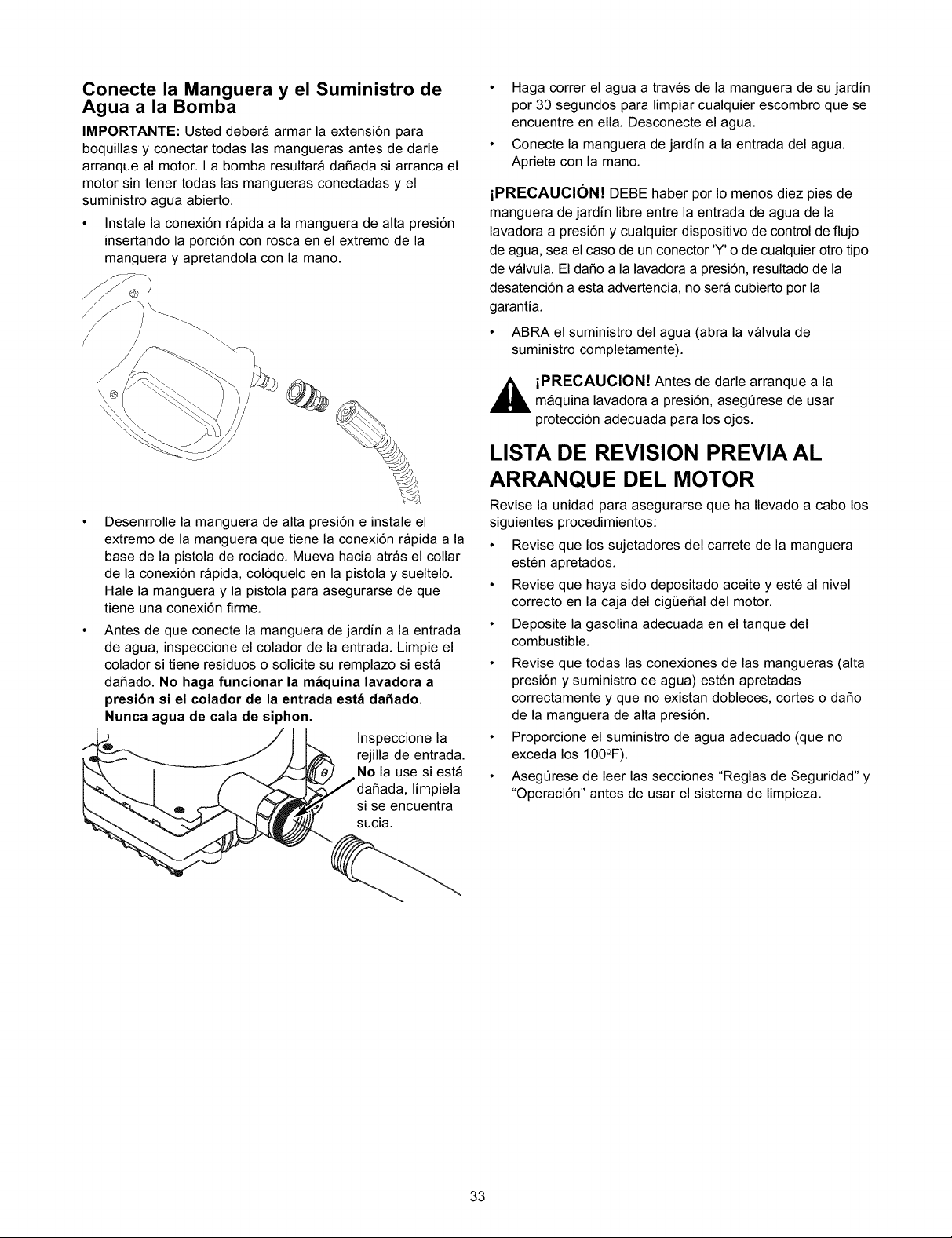
Conecte la Manguera y el Suministro de
Agua a la Bomba
IMPORTANTE: Usted debera armar la extensi6n para
boquillas y conectar todas las mangueras antes de darle
arranque al motor. La bomba resultara daSada si arranca el
motor sin tener todas las mangueras conectadas y el
suministro agua abierto.
• Instale la conexi6n rapida a la manguera de alta presi6n
insertando la porci6n con rosca en el extremo de la
manguera y apretandola con la mano.
Desenrrolle la manguera de alta presi6n e instale el
extremo de la manguera que tiene la conexi6n rapida a la
base de la pistola de rociado. Mueva hacia atras el collar
de la conexi6n rapida, col6quelo en la pistola y sueltelo.
Hale la manguera y la pistola para asegurarse de que
tiene una conexi6n firme.
Antes de que conecte la manguera de jardin a la entrada
de agua, inspeccione el colador de la entrada. Limpie el
colador si tiene residuos o solicite su remplazo siesta
daSado. No haga funcionar la m_quina lavadora a
presibn si el colador de la entrada est_ daSado.
Nunca agua de cala de siphon.
Inspeccione la
rejilla de entrada.
No la use siesta
limpiela
si se encuentra
sucia.
• Haga correr el agua a trav6s de la manguera de su jardin
por 30 segundos para limpiar cualquier escombro que se
encuentre en ella. Desconecte el agua.
• Conecte la manguera de jardin a la entrada del agua.
Apriete con la mano.
iPRECAUCI(_N! DEBE haber por Io menos diez pies de
manguera de jardin libre entre la entrada de agua de la
lavadora a presi6n y cualquier dispositivo de control de flujo
de agua, sea el caso de un conector 'Y' o de cualquier otro tipo
de valvula. El da_o a la lavadora a presi6n, resultado de la
desatenci6n a esta advertencia, no sera cubierto por la
garantia.
• ABRA el suministro del agua (abra la valvula de
suministro completamente).
,_ iPRECAUClON! Antes de darle arranque a la
maquina lavadora a presi6n, asegQrese de usar
protecci6n adecuada para los ojos.
LISTA DE REVISION PREVIA AL
ARRANQUE DEL MOTOR
Revise la unidad para asegurarse que ha Ilevado a cabo los
siguientes procedimientos:
• Revise que los sujetadores del carrete de la manguera
est6n apretados.
• Revise que haya sido depositado aceite y est6 al nivel
correcto en la caja del cig_JeSaldel motor.
• Deposite la gasolina adecuada en el tanque del
combustible.
• Revise que todas las conexiones de las mangueras (alta
presi6n y suministro de agua) est6n apretadas
correctamente y que no existan dobleces, cortes o daSo
de la manguera de alta presi6n.
• Proporcione el suministro de agua adecuado (que no
exceda los 100°F).
• AsegQrese de leer las secciones "Reglas de Seguridad" y
"Operaci6n" antes de usar el sistema de limpieza.
33
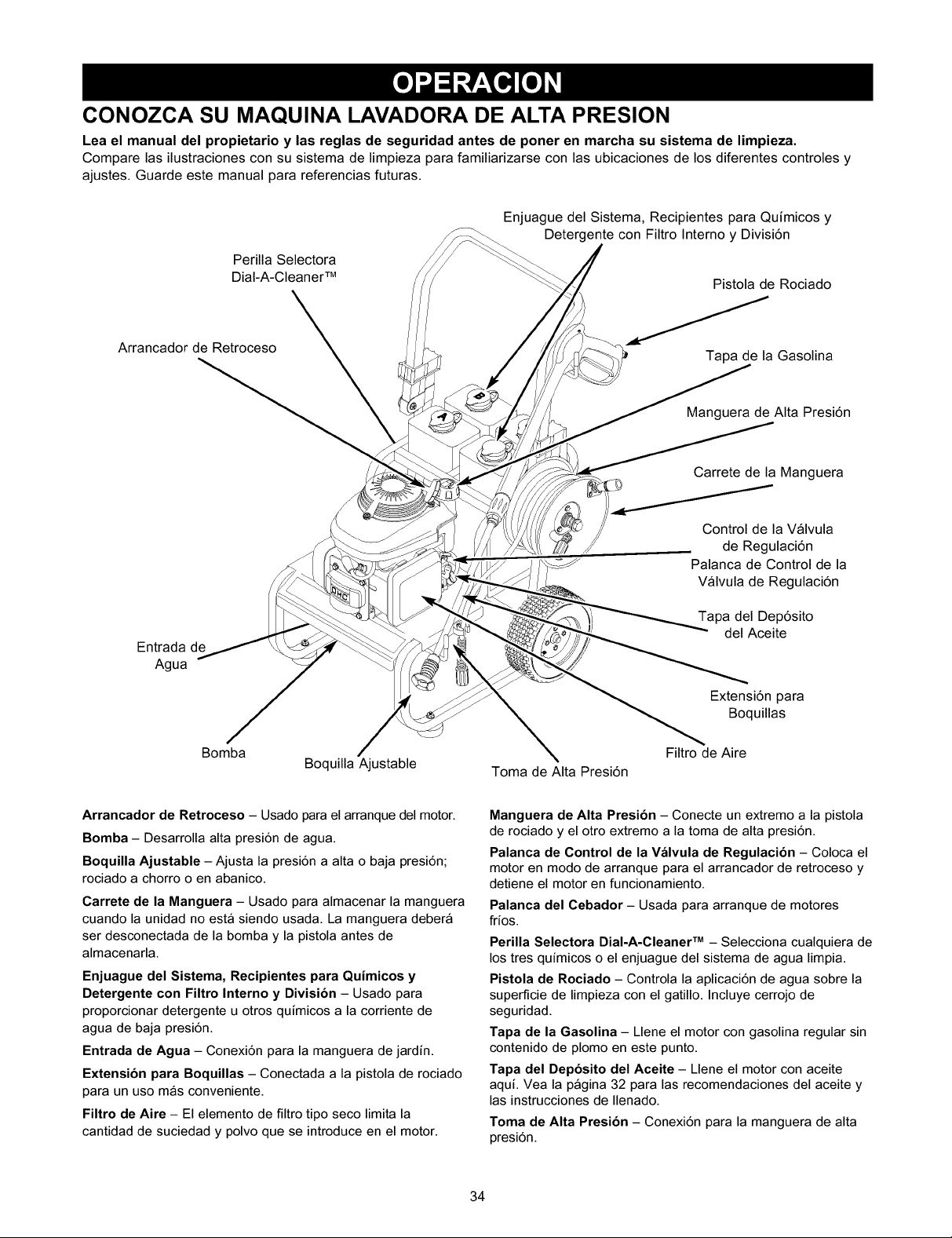
CONOZCA SU MAQUINA LAVADORA DE ALTA PRESION
Lea el manual del propietario y las reglas de seguridad antes de poner en marcha su sistema de limpieza.
Compare las ilustraciones con su sistema de limpieza para familiarizarse con las ubicaciones de los diferentes controles y
ajustes. Guarde este manual para referencias futuras.
Perilla Selectora
Dial-A-Cleaner TM
Arrancador de Retroceso
Entrada de
Agua
Enjuague del Sistema, Recipientes para Quimicos y
Detergente con Filtro Interno y DivisiOn
Pistola de Rociado
Tapa de la Gasolina
Manguera de Alta PresiOn
Carrete de la Manguera
Control de la Valvula
de RegulaciOn
Palanca de Control de la
Valvula de RegulaciOn
Tapa del DepOsito
del Aceite
ExtensiOn para
Boquillas
Bomba
Boquilla Ajustable
Toma de Alta PresiOn
Filtro de Aire
Arrancador de Retroceso - Usado para el arranque del motor.
Bomba - Desarrolla alta presiOn de agua,
Boquilla Ajustable - Ajusta la presiOn a alta o baja presiOn;
rociado a chorro o en abanico.
Carrete de la Manguera - Usado para almacenar la manguera
cuando la unidad no esta siendo usada. La manguera debera
ser desconectada de la bombay la pistola antes de
almacenarla.
Enjuague del Sistema, Recipientes para Quimicos y
Detergente con Filtro Interne y Divisibn - Usado para
proporcionar detergente u otros quimicos a la corriente de
agua de baja presiOn.
Entrada de Agua - ConexiOn para la manguera de jardin.
ExtensiOn para Boquillas - Conectada a la pistola de rociado
para un uso mas conveniente.
Filtro de Aire - El elemento de filtro tipo seco limita la
cantidad de suciedad y polvo que se introduce en el motor.
Manguera de Alta Presibn - Conecte un extremo a la pistola
de rociado y el otro extremo a la toma de alta presiOn.
Palanca de Control de la Vblvula de Regulacibn - Coloca el
motor en modo de arranque para el arrancador de retroceso y
detiene el motor en funcionamiento.
Palanca del Cebador - Usada para arranque de motores
frios.
Perilla Selectora Dial-A-Cleaner TM - Selecciona cualquiera de
los tres quimicos o el enjuague del sistema de agua limpia.
Pistola de Rociado - Controla la aplicaciOn de agua sobre la
superficie de limpieza con el gatillo. Incluye cerrojo de
seguridad.
Tapa de la Gasolina - Llene el motor con gasolina regular sin
contenido de plomo en este punto.
Tapa del Depbsito del Aceite - Llene el motor con aceite
aqui. Vea la pagina 32 para las recomendaciones del aceite y
las instrucciones de Ilenado.
Toma de Alta PresiOn - ConexiOn para la manguera de alta
presiOn.
34
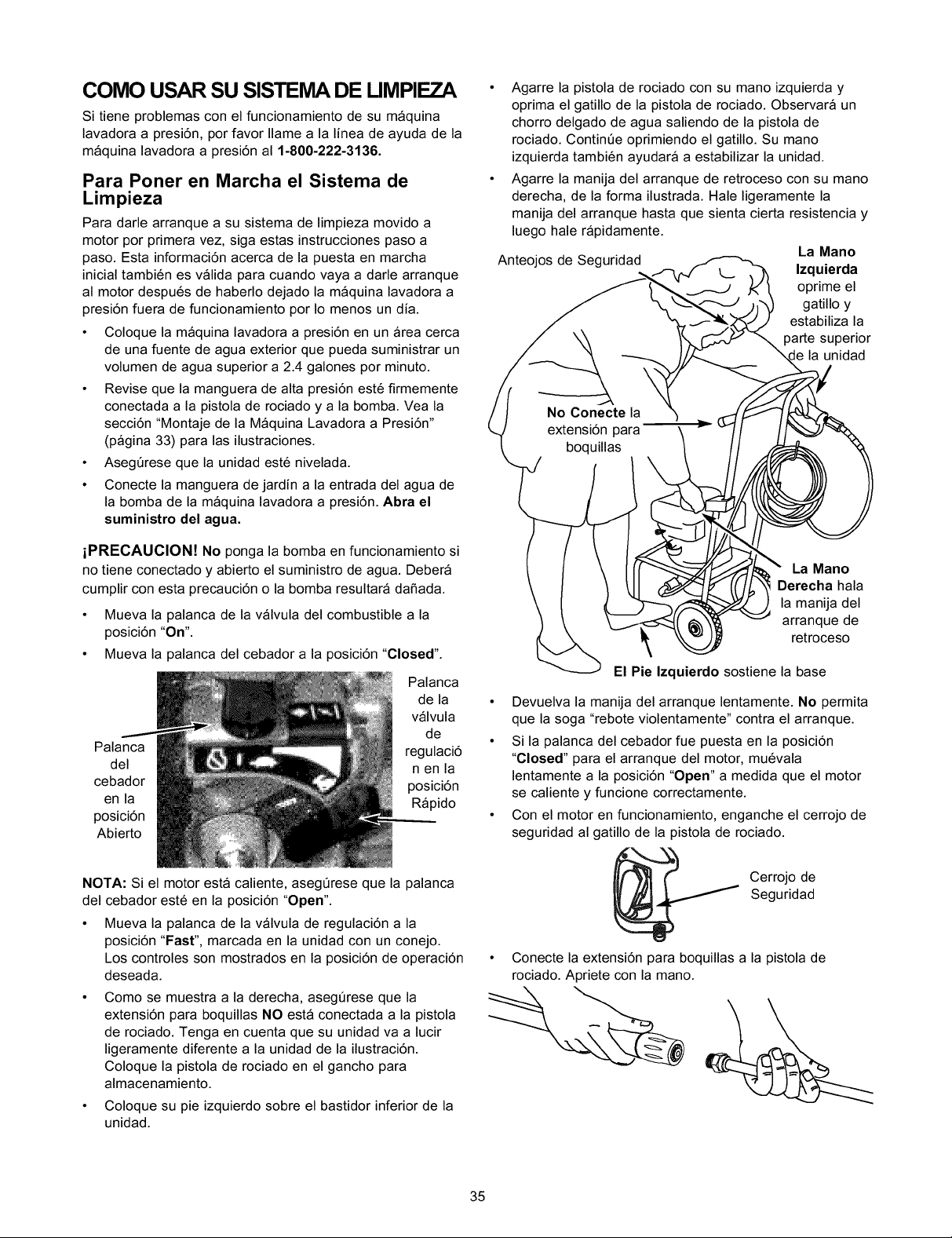
COMO USAR SU SISTEMA DE LIMPIEZA
Si tiene problemas con el funcionamiento de su maquina
lavadora a presi6n, por favor Ilame a la linea de ayuda de la
maquina lavadora a presi6n al 1-81)0-222-3136.
Para Poner en Marcha el Sistema de
Limpieza
Para darle arranque a su sistema de limpieza movido a
motor por primera vez, siga estas instrucciones paso a
paso. Esta informaci6n acerca de la puesta en marcha
inicial tambi6n es vMida para cuando vaya a darle arranque
al motor despu6s de haberlo dejado la maquina lavadora a
presi6n fuera de funcionamiento por Io menos un dia.
• Coloque la maquina lavadora a presi6n en un Area cerca
de una fuente de agua exterior que pueda suministrar un
volumen de agua superior a 2.4 galones pot minuto.
• Revise que la manguera de alta presi6n est6 firmemente
conectada a la pistola de rociado y a la bomba. Vea la
secci6n "Montaje de la Maquina Lavadora a Presi6n"
(pagina 33) para las ilustraciones.
• Aseg6rese que la unidad est6 nivelada.
• Conecte la manguera de jardin a la entrada del agua de
la bomba de la maquina lavadora a presi6n. Abra el
suministro del agua.
iPRECAUCION! No ponga la bomba en funcionamiento si
no tiene conectado y abierto el suministro de agua. Debera
cumplir con esta precauci6n o la bomba resultara daSada.
• Mueva la palanca de la vMvula del combustible a la
posici6n "On".
• Mueva la palanca del cebador a la posici6n "Closed".
Palanca
del
cebador
en la
posici6n
Abierto
Palanca
de la
valvula
de
regulaci6
nen la
posici6n
Rapido
Anteojos de Seguridad
Agarre la pistola de rociado con su mano izquierda y
oprima el gatillo de la pistola de rociado. Observara un
chorro delgado de agua saliendo de la pistola de
rociado. Contin6e oprimiendo el gatillo. Su mano
izquierda tambi6n ayudara a estabilizar la unidad.
Agarre la manija del arranque de retroceso con su mano
derecha, de la forma ilustrada. Hale ligeramente la
manija del arranque hasta que sienta cierta resistencia y
luego hale rapidamente.
La Mano
Izquierda
oprime el
gatillo y
estabiliza la
parte superior
la unidad
La Mano
Derecha hala
la manija del
arranque de
retroceso
El Pie Izquierdo sostiene la base
• Devuelva la manija del arranque lentamente. No permita
que la soga "rebote violentamente" contra el arranque.
• Si la palanca del cebador fue puesta en la posici6n
"Closed" para el arranque del motor, mu6vala
lentamente a la posici6n "Open" a medida que el motor
se caliente y funcione correctamente.
• Con el motor en funcionamiento, enganche el cerrojo de
seguridad al gatillo de la pistola de rociado.
NOTA: Si el motor esta caliente, asegerese que la palanca
del cebador est6 en la posici6n "Open".
• Mueva la palanca de la valvula de regulaci6n a la
posici6n "Fast", marcada en la unidad con un conejo.
Los controles son mostrados en la posici6n de operaci6n
deseada.
• Como se muestra a la derecha, aseg6rese que la
extensi6n para boquillas NO esta conectada a la pistola
de rociado. Tenga en cuenta que su unidad va a lucir
ligeramente diferente a la unidad de la ilustraci6n.
Coloque la pistola de rociado en el gancho para
almacenamiento.
• Coloque su pie izquierdo sobre el bastidor inferior de la
unidad.
Cerrojo de
Seguridad
• Conecte la extensi6n para boquillas a la pistola de
rociado. Apriete con la mano.
35
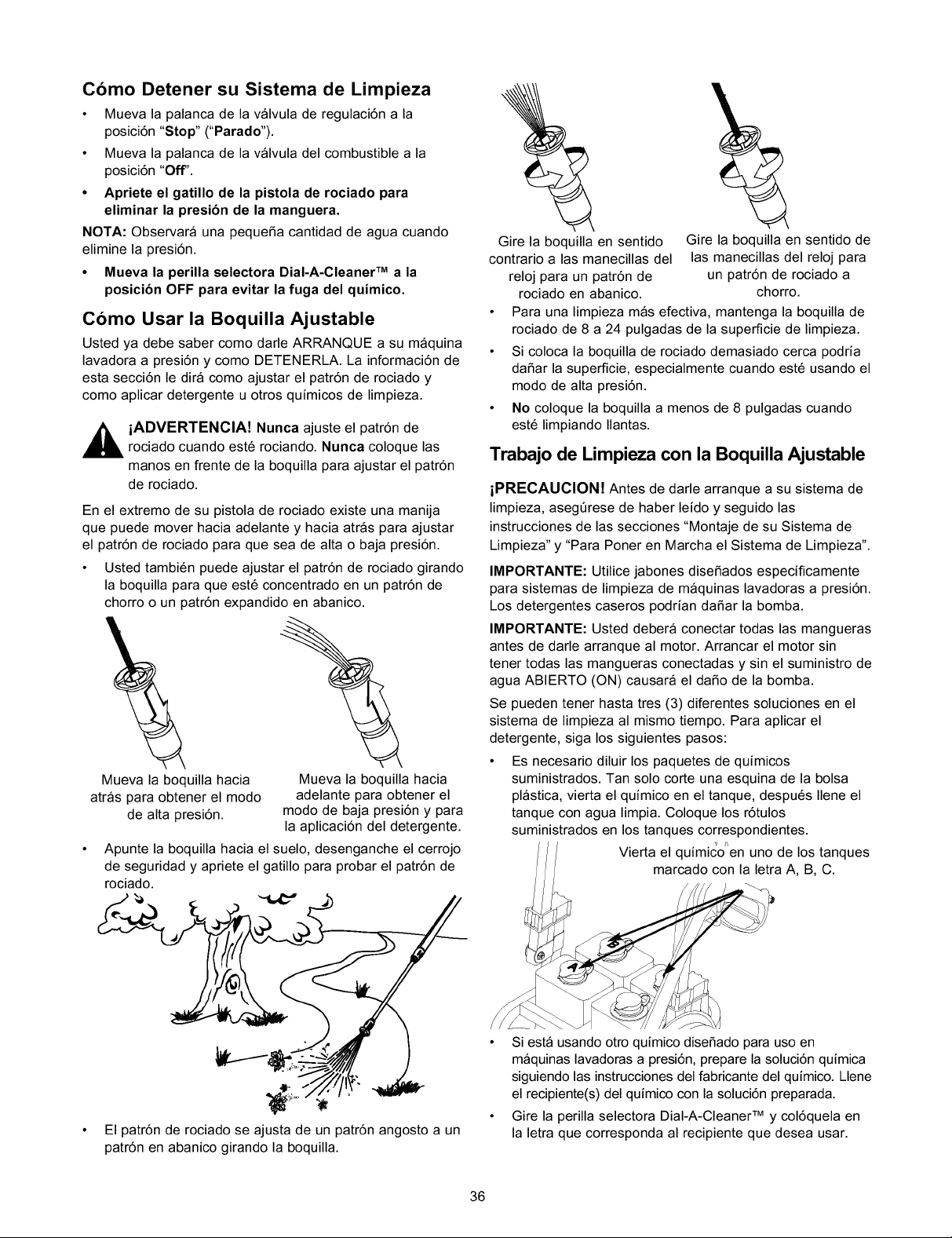
Como Detener su Sistema de Limpieza
• Mueva la palanca de la valvula de regulaci6n a la
posici6n "Stop" ("Parado").
• Mueva la palanca de la valvula del combustible a la
posici6n "Off'.
° Apriete el gatillo de la pistola de rociado para
eliminar la presi6n de la manguera.
NOTA: Observara una pequefia cantidad de agua cuando
elimine la presi6n.
° Mueva la perilla selectora Dial-A-Cleaner TM a la
posici6n OFF para evitar la fuga del quimico.
Como Usar la Boquilla Ajustable
Usted ya debe saber como darle ARRANQUE a su maquina
lavadora a presi6n y como DETENERLA. La informaci6n de
esta secci6n le dira como ajustar el patr6n de rociado y
como aplicar detergente u otros quimicos de limpieza.
,_ iADVERTENCIA! Nunca ajuste el patr6n de
rociado cuando est6 rociando. Nunca coloque las
manos en frente de la boquilla para ajustar el patrSn
de rociado.
En el extremo de su pistola de rociado existe una manija
que puede mover hacia adelante y hacia atras para ajustar
el patr6n de rociado para que sea de alta o baja presi6n.
• Usted tambi6n puede ajustar el patr6n de rociado girando
la boquilla para que est6 concentrado en un patr6n de
chorro o un patr6n expandido en abanico.
Mueva la boquilla hacia
adelante para obtener el
modo de baja presi6n y para
la aplicaci6n del detergente.
Apunte la boquilla hacia el suelo, desenganche el cerrojo
de seguridad y apriete el gatillo para probar el patr6n de
rociado.
Mueva la boquilla hacia
atras para obtener el modo
de alta presi6n.
• El patr6n de rociado se ajusta de un patr6n angosto a un
patr6n en abanico girando la boquilla.
Gire la boquilla en sentido
contrario a las manecillas del
reloj para un patr6n de
rociado en abanico.
Gire la boquilla en sentido de
las manecillas del reloj para
un patr6n de rociado a
chorro.
• Para una limpieza mas efectiva, mantenga la boquilla de
rociado de 8 a 24 pulgadas de la superficie de limpieza.
• Si coloca la boquilla de rociado demasiado cerca podria
dafiar la superficie, especialmente cuando est6 usando el
modo de alta presi6n.
• No coloque la boquilla a menos de 8 pulgadas cuando
est6 limpiando Ilantas.
Trabajo de Limpieza con la Boquilla Ajustable
iPRECAUCION! Antes de darle arranque a su sistema de
limpieza, asegQrese de haber leido y seguido las
instrucciones de las secciones "Montaje de su Sistema de
Limpieza" y "Para Poner en Marcha el Sistema de Limpieza".
IMPORTANTE: Utilice jabones disefiados especificamente
para sistemas de limpieza de maquinas lavadoras a presi6n.
Los detergentes caseros podrian dafiar la bomba.
IMPORTANTE: Usted debera conectar todas las mangueras
antes de darle arranque al motor. Arrancar el motor sin
tenet todas las mangueras conectadas y sin el suministro de
agua ABIERTO (ON) causara el dafio de la bomba.
Se pueden tenet hasta tres (3) diferentes soluciones en el
sistema de limpieza al mismo tiempo. Para aplicar el
detergente, siga los siguientes pasos:
• Es necesario diluir los paquetes de quimicos
suministrados. Tan solo corte una esquina de la bolsa
plastica, vierta el quimico en el tanque, despu6s Ilene el
tanque con agua limpia. Coloque los r6tulos
suministrados en los tanques correspondientes.
Vierta el quimico en uno de los tanques
marcado con la letra A, B, C.
• Siesta usando otto quimico disefiado para uso en
maquinas lavadoras a presi6n, prepare la soluci6n quimica
siguiendo las instrucciones del fabricante del quimico. Llene
el recipiente(s) del quimico con la soluci6n preparada.
• Gire la perilla selectora Dial-A-Cleaner TM y col6quela en
la letra que corresponda al recipiente que desea usar.
36
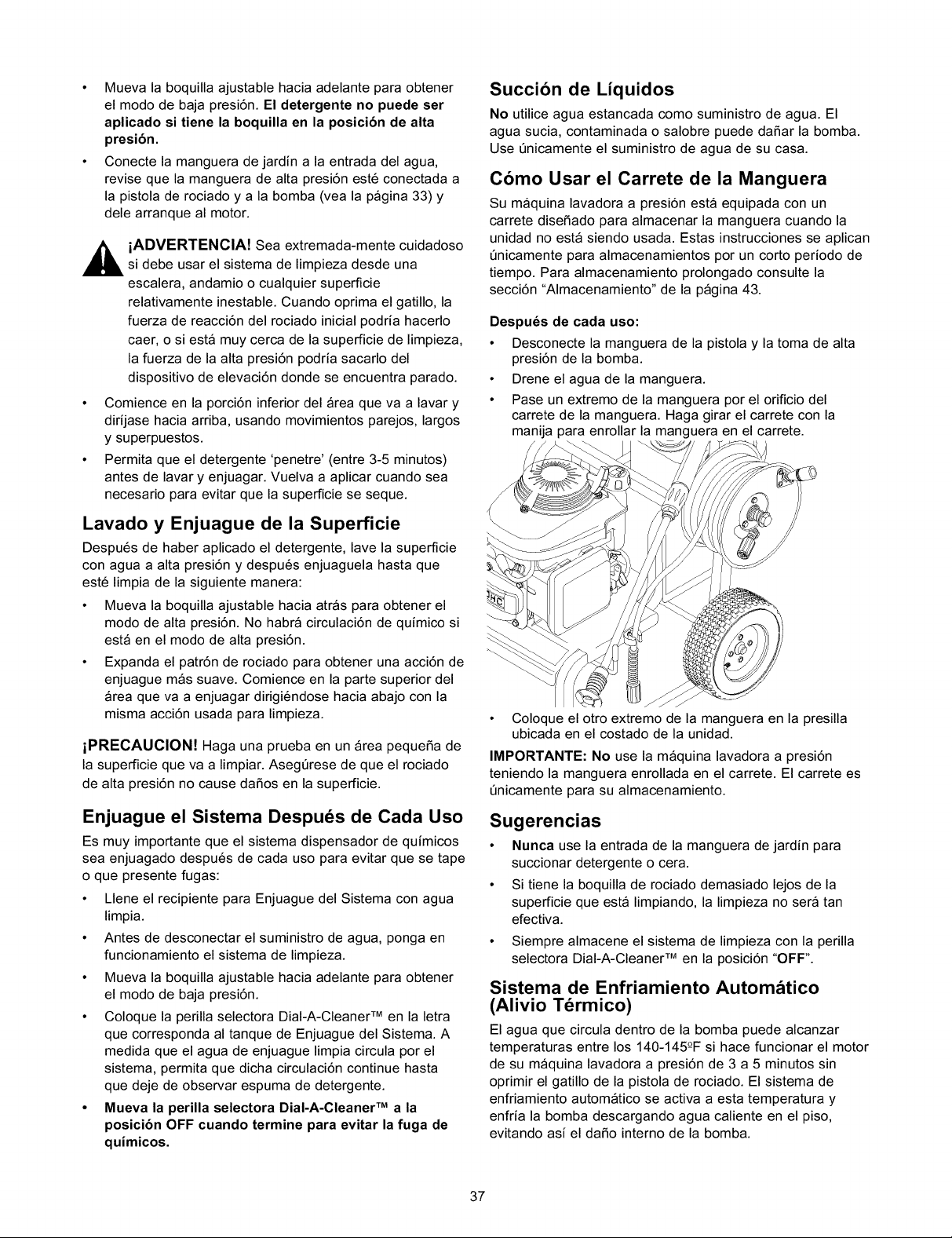
• Muevalaboquillaajustablehaciaadelanteparaobtener
elmododebajapresi6n.Eldetergentenopuedeser
aplicado si tiene la boquilla en la posici6n de alta
presi6n.
• Conecte la manguera de jardin a la entrada del agua,
revise que la manguera de alta presi6n est6 conectada a
la pistola de rociado y a la bomba (vea la pagina 33) y
dele arranque al motor.
,_ iADVERTENClA! Sea extremada-mente cuidadoso
si debe usar el sistema de limpieza desde una
escalera, andamio o cualquier superficie
relativamente inestable. Cuando oprima el gatillo, la
fuerza de reacci6n del rociado inicial podria hacerlo
caer, o si esta muy cerca de la superficie de limpieza,
la fuerza de la alta presi6n podria sacarlo del
dispositivo de elevaci6n donde se encuentra parado.
• Comience en la porci6n inferior del Area que va a lavar y
dirijase hacia arriba, usando movimientos parejos, largos
y superpuestos.
• Permita que el detergente 'penetre' (entre 3-5 minutos)
antes de lavar y enjuagar. Vuelva a aplicar cuando sea
necesario para evitar que la superficie se seque.
Lavado y Enjuague de la Superficie
Despu6s de haber aplicado el detergente, lave la superficie
con agua a alta presi6n y despu6s enjuaguela hasta que
est6 limpia de la siguiente manera:
• Mueva la boquilla ajustable hacia atras para obtener el
modo de alta presi6n. No habra circulaci6n de quimico si
esta en el modo de alta presi6n.
• Expanda el patr6n de rociado para obtener una acci6n de
enjuague mas suave. Comience en la parte superior del
Area que va a enjuagar dirigi6ndose hacia abajo con la
misma acci6n usada para limpieza.
iPRECAUCION! Haga una prueba en un Area pequefia de
la superficie que va a limpiar. Asegerese de que el rociado
de alta presi6n no cause dafios en la superficie.
Enjuague el Sistema Despu_s de Cada Uso
Es muy importante que el sistema dispensador de quimicos
sea enjuagado despu6s de cada uso para evitar que se tape
o que presente fugas:
• Llene el recipiente para Enjuague del Sistema con agua
limpia.
• Antes de desconectar el suministro de agua, ponga en
funcionamiento el sistema de limpieza.
• Mueva la boquilla ajustable hacia adelante para obtener
el modo de baja presi6n.
• Coloque la perilla selectora Dial-A-Cleaner TM en la letra
que corresponda al tanque de Enjuague del Sistema. A
medida que el agua de enjuague limpia circula por el
sistema, permita que dicha circulaci6n continue hasta
que deje de observar espuma de detergente.
• Mueva la perilla selectora Dial-A-Cleaner TM a la
posicibn OFF cuando termine para evitar la fuga de
quimicos.
Succion de Liquidos
No utilice agua estancada como suministro de agua. El
agua sucia, contaminada o salobre puede dafiar la bomba.
Use Qnicamente el suministro de agua de su casa.
Como Usar el Carrete de la Manguera
Su maquina lavadora a presi6n esta equipada con un
carrete disefiado para almacenar la manguera cuando la
unidad no esta siendo usada. Estas instrucciones se aplican
Qnicamente para almacenamientos por un corto periodo de
tiempo. Para almacenamiento prolongado consulte la
secci6n "Almacenamiento" de la pagina 43.
Despu_s de cada uso:
• Desconecte la manguera de la pistola y la toma de alta
presi6n de la bomba.
• Drene el agua de la manguera.
• Pase un extremo de la manguera por el orificio del
carrete de la manguera. Haga girar el carrete con la
manija para enrollar la manguera en el carrete.
• Coloque el otro extremo de la manguera en la presilla
ubicada en el costado de la unidad.
IMPORTANTE: No use la maquina lavadora a presi6n
teniendo la manguera enrollada en el carrete. El carrete es
enicamente para su almacenamiento.
Sugerencias
• Nunca use la entrada de la manguera de jardin para
succionar detergente o cera.
• Si tiene la boquilla de rociado demasiado lejos de la
superficie que esta limpiando, la limpieza no sera tan
efectiva.
• Siempre almacene el sistema de limpieza con la perilla
selectora Dial-A-Cleaner TM en la posici6n "OFF".
Sistema de Enfriamiento Autom&tico
(Alivio Tdrmico)
El agua que circula dentro de la bomba puede alcanzar
temperaturas entre los 140-145-°F si hace funcionar el motor
de su maquina lavadora a presi6n de 3 a 5 minutos sin
oprimir el gatillo de la pistola de rociado. El sistema de
enfriamiento automatico se activa a esta temperatura y
enfria la bomba descargando agua caliente en el piso,
evitando asi el dafio interno de la bomba.
37
38
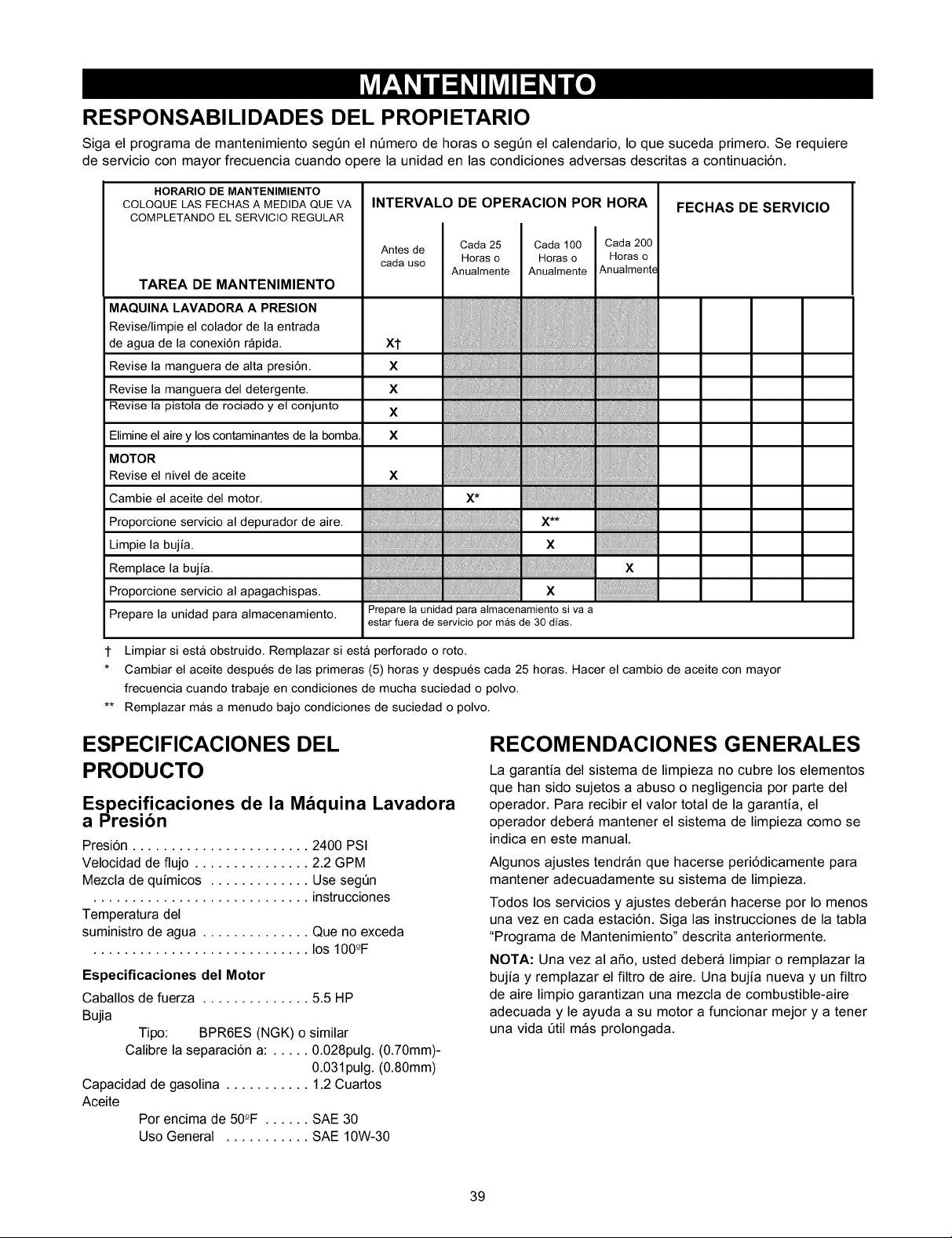
RESPONSABILIDADES DEL PROPIETARIO
Siga el programa de mantenimiento segt_n el nt_mero de horas o segt_n el calendario, Io que suceda primero. Se requiere
de servicio con mayor frecuencia cuando opere la unidad en las condiciones adversas descritas a continuaci6n.
HORARIO DE MANTENIMIENTO
COLOQUE LAS FECHAS A MEDtDA QUE VA
COMPLETANDO EL SERVICIO REGULAR
INTERVALO DE OPERACION POR HORA
Antes de
cada uso
TAREA DE MANTENIMIENTO
MAQUINA LAVADORA A PRESION
Revise/limpieel coladorde la entrada
de agua de la conexi6n rapida. Xl"
Revise la manguera de alta presi6n. X
Revise la manguera del detergente. X
Revise la pistola de rociado y el conjunto X
Elimineelaire y loscontaminantesde la bomba. X
MOTOR
Revise el nivel de aceite X
Cambie el aceite eel motor.
Proporcione servicio al depurador de aire.
Limpie la bujia.
Remplace la bujia.
Proporcione servicio al apagachispas.
Prepare la unidad para almacenamiento.
ill!iii:iii!,!!iiill!iiii....x**
i! .... x
lliilllJii!
!!ii!ii!iiii,,,,!ii!iiii.... x
Prepare la unidad para almacenamiento siva a
estar fuera de servicio per m_s de 30 dias.
FECHAS DE SERVICIO
1 Limpiar siesta obstruido. Remplazar si esta perforado o roto.
* Cambiar el aceite despues de las primeras (5) horas y despues cada 25 horas. Hacer el cambio de aceite con mayor
frecuencia cuando trabaje en condiciones de mucha suciedad o polvo.
** Remplazar mas a menudo bajo condiciones de suciedad o polvo.
ESPECIFICACIONES DEL
PRODUCTO
Es.pecificaciones de la M_quina Lavadora
a _resibn
Presi6n ....................... 2400 PSI
Velocidad de flujo ............... 2.2 GPM
Mezcla de quimicos ............. Use segQn
............................ instrucciones
Temperatura del
suministro de agua .............. Que no exceda
............................ los 100-°F
Especificaciones del Motor
Caballos de fuerza .............. 5.5 HP
Bujia
Tipo: BPR6ES (NGK) o similar
Calibre la separaci6n a: ..... 0.028pulg. (0.70mm)-
0.031pulg. (0.80mm)
Capacidad de gasolina ........... 1.2 Cuartos
Aceite
Por encima de 50-°F ...... SAE 30
Uso General ........... SAE 10W-30
RECOMENDACIONES GENERALES
La garantia del sistema de limpieza no cubre los elementos
que han sido sujetos a abuso o negligencia por parte del
operador. Para recibir el valor total de la garantia, el
operador debera mantener el sistema de limpieza como se
indica en este manual.
Algunos ajustes tendran que hacerse peri6dicamente para
mantener adecuadamente su sistema de limpieza.
Todos los servicios y ajustes deberan hacerse por Io menos
una vez en cada estaci6n. Siga las instrucciones de la tabla
"Programa de Mantenimiento" descrita anteriormente.
NOTA: Una vez al afio, usted debera limpiar o remplazar la
bujia y remplazar el filtro de aire. Una bujia nueva y un filtro
de aire limpio garantizan una mezcla de combustible-aire
adecuada y le ayuda a su motor a funcionar mejor y a tener
una vida Qtil mas prolongada.
39
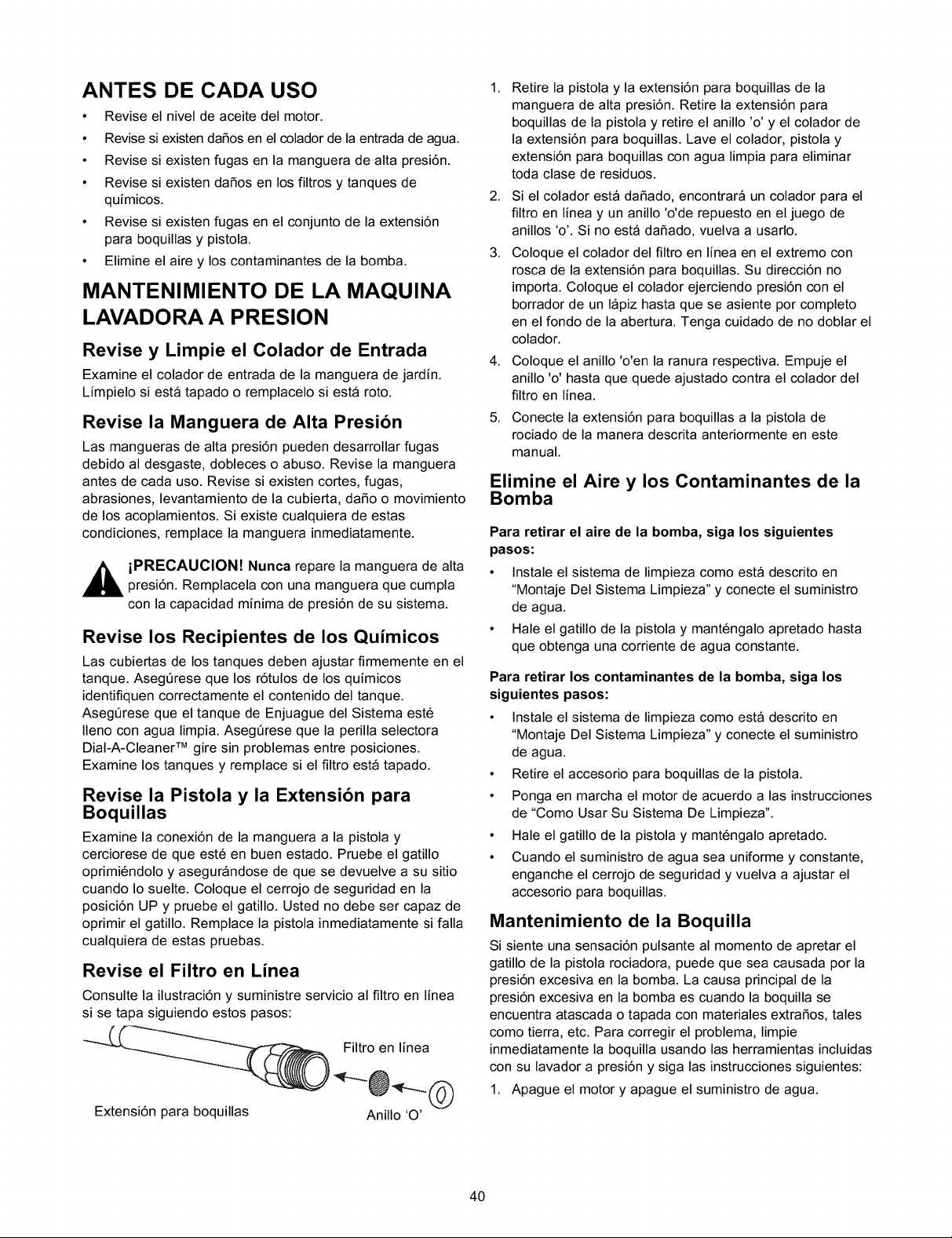
ANTES DE CADA USO
• Revise el nivel de aceite del motor.
• Revise si existen dafios en el colador de la entrada de agua.
• Revise si existen fugas en la manguera de alta presi6n.
• Revise si existen dafios en los filtros y tanques de
quimicos.
• Revise si existen fugas en el conjunto de la extensi6n
para boquillas y pistola.
• Elimine el aire y los contaminantes de la bomba.
MANTENIMIENTO DE LA MAQUINA
LAVADORA A PRESION
Revise y Limpie el Colador de Entrada
Examine el colador de entrada de la manguera de jardin.
Limpielo siesta tapado o remplacelo siesta roto.
Revise la Manguera de Alta Presion
Las mangueras de alta presi6n pueden desarrollar fugas
debido al desgaste, dobleces o abuso. Revise la manguera
antes de cada uso. Revise si existen cortes, fugas,
abrasiones, levantamiento de la cubierta, dafio o movimiento
de los acoplamientos. Si existe cualquiera de estas
condiciones, remplace la manguera inmediatamente.
,_ iPRECAUCION! Nunca repare la manguera de alta
presi6n. Remplacela con una manguera que cumpla
con la capacidad minima de presi6n de su sistema.
Revise los Recipientes de los Quimicos
Las cubiertas de los tanques deben ajustar firmemente en el
tanque. AsegQrese que los r6tulos de los quimicos
identifiquen correctamente el contenido del tanque.
AsegQrese que el tanque de Enjuague del Sistema est6
Ileno con agua limpia. AsegQrese que la perilla selectora
Dial-A-Cleaner TM gire sin problemas entre posiciones.
Examine los tanques y remplace si el filtro esta tapado.
Revise la Pistola y la Extension para
Boquillas
Examine la conexi6n de la manguera a la pistola y
cerciorese de que est6 en buen estado. Pruebe el gatillo
oprimi6ndolo y asegurandose de que se devuelve a su sitio
cuando Io suelte. Coloque el cerrojo de seguridad en la
posici6n UP y pruebe el gatillo. Usted no debe ser capaz de
oprimir el gatillo. Remplace la pistola inmediatamente si falla
cualquiera de estas pruebas.
Revise el Filtro en Linea
Consulte la ilustraci6n y suministre servicio al filtro en linea
si se tapa siguiendo estos pasos:
Filtro en linea
Extensi6n para boquillas
Retire la pistola y la extensi6n para boquillas de la
manguera de alta presi6n. Retire la extensi6n para
boquillas de la pistola y retire el anillo 'o' y el colador de
la extensi6n para boquillas. Lave el colador, pistola y
extensi6n para boquillas con agua limpia para eliminar
toda clase de residuos.
2. Si el colador esta dafiado, encontrara un colador para el
filtro en linea y un anillo 'o'de repuesto en el juego de
anillos 'o'. Si no esta dafiado, vuelva a usarlo.
3. Coloque el colador del filtro en linea en el extremo con
rosca de la extensi6n para boquillas. Su direcci6n no
importa. Coloque el colador ejerciendo presi6n con el
borrador de un lapiz hasta que se asiente por completo
en el fondo de la abertura. Tenga cuidado de no doblar el
colador.
4. Coloque el anillo 'o'en la ranura respectiva. Empuje el
anillo 'o' hasta que quede ajustado contra el colador del
filtro en linea.
5. Conecte la extensi6n para boquillas a la pistola de
rociado de la manera descrita anteriormente en este
manual.
Elimine el Aire y los Contaminantes de la
Bomba
Para retirar el aire de la bomba, siga los siguientes
pasos:
• Instale el sistema de limpieza como esta descrito en
"Montaje Del Sistema Limpieza" y conecte el suministro
de agua.
• Hale el gatillo de la pistola y mant6ngalo apretado hasta
que obtenga una corriente de agua constante.
Para retirar los contaminantes de la bomba, siga los
siguientes pasos:
• Instale el sistema de limpieza como esta descrito en
"Montaje Del Sistema Limpieza" y conecte el suministro
de agua.
• Retire el accesorio para boquillas de la pistola.
• Ponga en marcha el motor de acuerdo alas instrucciones
de "Como Usar Su Sistema De Limpieza".
• Hale el gatillo de la pistola y mant6ngalo apretado.
• Cuando el suministro de agua sea uniforme y constante,
enganche el cerrojo de seguridad y vuelva a ajustar el
accesorio para boquillas.
Mantenimiento de la Boquilla
Si siente una sensaci6n pulsante al momento de apretar el
gatillo de la pistola rociadora, puede que sea causada por la
presi6n excesiva en la bomba. La causa principal de la
presi6n excesiva en la bomba es cuando la boquilla se
encuentra atascada o tapada con materiales extrafios, tales
como tierra, etc. Para corregir el problema, limpie
inmediatamente la boquilla usando las herramientas incluidas
con su lavador a presi6n y siga las instrucciones siguientes:
1. Apague el motor y apague el suministro de agua.
40
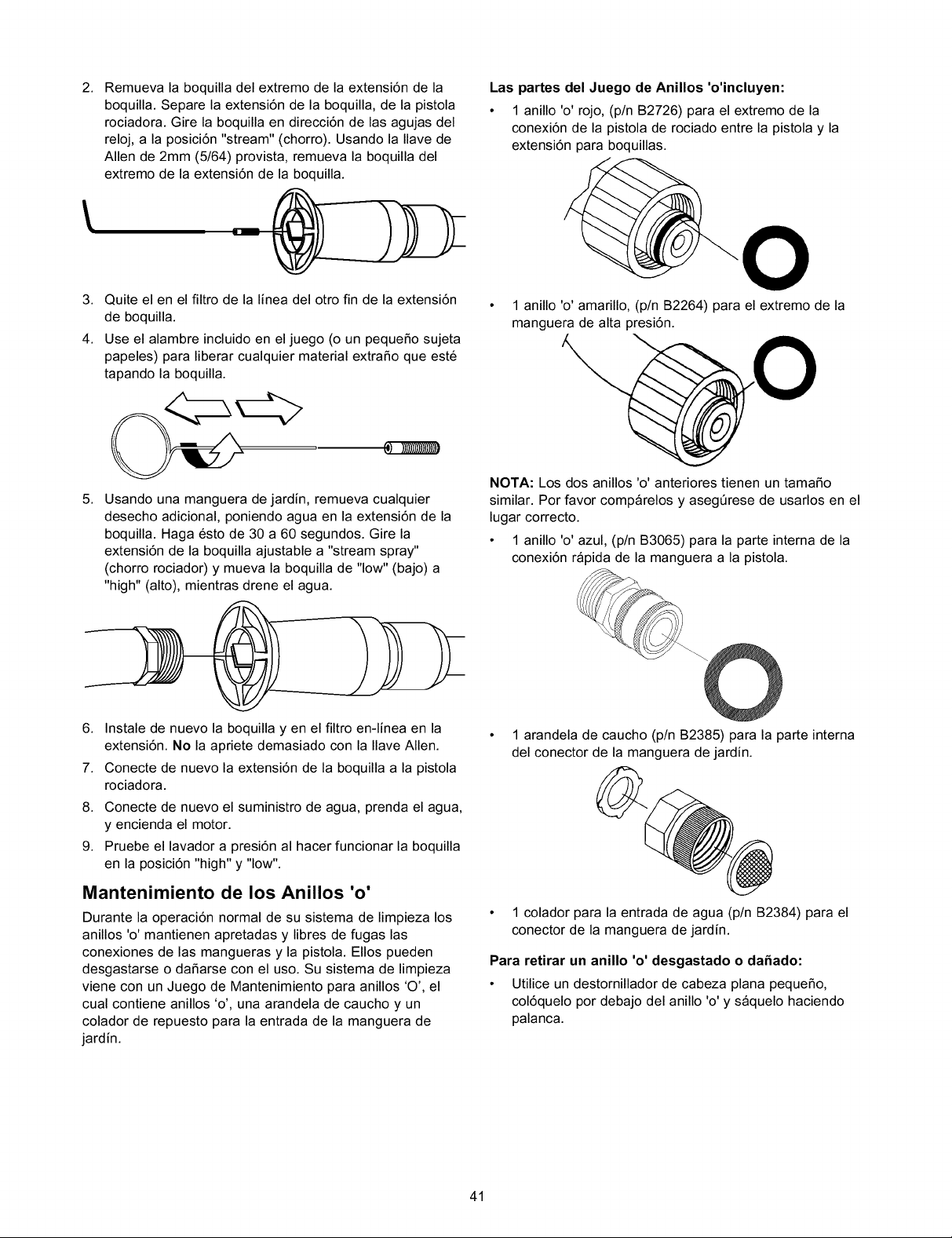
2.
\
3.
4.
5.
Remueva la boquilla del extremo de la extensi6n de la
boquilla. Separe la extensi6n de la boquilla, de la pistola
rociadora. Gire la boquilla en direcci6n de las agujas del
reloj, a la posici6n "stream" (chorro). Usando la Ilave de
Allen de 2mm (5/64) provista, remueva la boquilla del
extremo de la extensi6n de la boquilla.
Quite el en el filtro de la linea del otto fin de la extensi6n
de boquilla.
Use el alambre incluido en el juego (o un pequeSo sujeta
papeles) para liberar cualquier material extraSo que est6
tapando la boquilla.
Usando una manguera de jardin, remueva cualquier
desecho adicional, poniendo agua en la extensi6n de la
boquilla. Haga 6sto de 30 a 60 segundos. Gire la
extensi6n de la boquilla ajustable a "stream spray"
(chorro rociador) y mueva la boquilla de "low" (bajo) a
"high" (alto), mientras drene el agua.
Las partes del Juego de Anillos 'o'incluyen:
• 1 anillo 'o' rojo, (p/n B2726) para el extremo de la
conexi6n de la pistola de rociado entre la pistola y la
extensi6n para boquillas.
@.o
• 1 anillo 'o' amarillo, (pin B2264) para el extremo de la
manguera de alta presidn.
NOTA: Los dos anillos 'o' anteriores tienen un tamaSo
similar. Por favor comparelos y asegQrese de usarlos en el
lugar correcto.
• 1 anillo 'o' azul, (p/n B3065) para la parte interna de la
conexi6n rapida de la manguera a la pistola.
6. Instale de nuevo la boquilla y en el filtro en-linea en la
extensi6n. No la apriete demasiado con la Ilave Allen.
7. Conecte de nuevo la extensi6n de la boquilla a la pistola
rociadora.
8. Conecte de nuevo el suministro de agua, prenda el agua,
y encienda el motor.
9. Pruebe el lavador a presi6n al hacer funcionar la boquilla
en la posici6n "high" y "low".
Mantenimiento de los Anillos 'o'
Durante la operaci6n normal de su sistema de limpieza los
anillos 'o' mantienen apretadas y libres de fugas las
conexiones de las mangueras y la pistola. EIIos pueden
desgastarse o daSarse con el uso. Su sistema de limpieza
viene con un Juego de Mantenimiento para anillos 'O', el
cual contiene anillos 'o', una arandela de caucho y un
colador de repuesto para la entrada de la manguera de
jardin.
O
1 arandela de caucho (p/n B2385) para la parte interna
del conector de la manguera de jardin.
• 1 colador para la entrada de agua (p/n B2384) para el
conector de la manguera de jardin.
Para retirar un anillo 'o' desgastado o dahado:
• Utilice un destornillador de cabeza plana pequefio,
col6quelo pot debajo del anillo 'o' y saquelo haciendo
palanca.
41
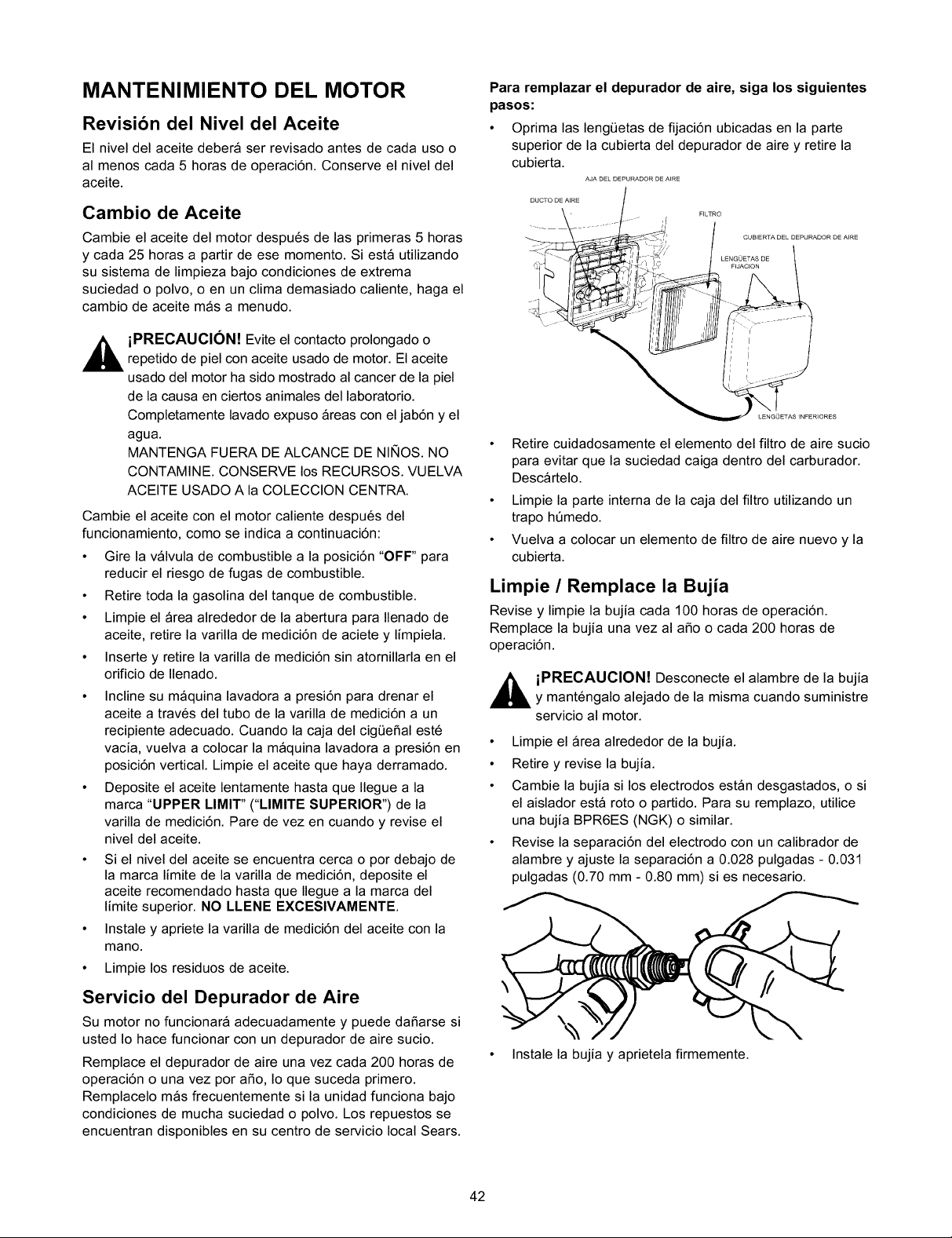
MANTENIMIENTO DEL MOTOR
Revision del Nivel del Aceite
El nivel del aceite debera ser revisado antes de cada uso o
al menos cada 5 horas de operaci6n. Conserve el nivel del
aceite.
Cambio de Aceite
Cambie el aceite del motor despu6s de las primeras 5 horas
y cada 25 horas a partir de ese momento. Siesta utilizando
su sistema de limpieza bajo condiciones de extrema
suciedad o polvo, o en un clima demasiado caliente, haga el
cambio de aceite mas a menudo.
_ iPRECAUCION! Evite el contacto prolongado o
repetido de piel con aceite usado de motor. El aceite
usado del motor ha sido mostrado al cancer de la piel
de la causa en ciertos animales del laboratorio.
Completamente lavado expuso Areas con el jab6n y el
agua.
MANTENGA FUERA DE ALCANCE DE NINOS. NO
CONTAMINE. CONSERVE los RECURSOS. VUELVA
ACEITE USADO A la COLECClON CENTRA.
Cambie el aceite con el motor caliente despu6s del
funcionamiento, como se indica a continuaci6n:
• Gire la valvula de combustible a la posici6n "OFF" para
reducir el riesgo de fugas de combustible.
• Retire toda la gasolina del tanque de combustible.
• Limpie el Area alrededor de la abertura para Ilenado de
aceite, retire la varilla de medici6n de aciete y limpiela.
• Inserte y retire la varilla de medici6n sin atomillarla en el
orificio de Ilenado.
• Incline su maquina lavadora a presi6n para drenar el
aceite a trav6s del tubo de la varilla de medici6n a un
recipiente adecuado. Cuando la caja del cigQeSal est6
vacia, vuelva a colocar la maquina lavadora a presi6n en
posici6n vertical. Limpie el aceite que haya derramado.
• Deposite el aceite lentamente hasta que Ilegue a la
marca "UPPER LIMIT" ("LIMITE SUPERIOR") de la
varilla de medici6n. Pare de vez en cuando y revise el
nivel del aceite.
• Si el nivel del aceite se encuentra cerca o pot debajo de
la marca limite de la varilla de medici6n, deposite el
aceite recomendado hasta que Ilegue a la marca del
limite superior. NO LLENE EXCESIVAMENTE.
• Instale y apriete la varilla de medici6n del aceite con la
mano.
• Limpie los residuos de aceite.
Servicio del Depurador de Aire
Su motor no funcionara adecuadamente y puede daSarse si
usted Io hace funcionar con un depurador de aire sucio.
Remplace el depurador de aire una vez cada 200 horas de
operaci6n o una vez por aSo, Io que suceda primero.
Remplacelo mas frecuentemente si la unidad funciona bajo
condiciones de mucha suciedad o polvo. Los repuestos se
encuentran disponibles en su centro de servicio local Sears.
Para remplazar el depurador de aire, siga los siguientes
pasos:
• Oprima las lengQetas de fijaci6n ubicadas en la parte
superior de la cubierta del depurador de aire y retire la
cubierta.
AJA DEL DEPURADOR DE AIRE
DUCTO DE AIRE
FILTRO
_-_ _b-_ f' CUBIERTA DEL DEPURADOR DE AIRE
/
LENGL)ETAS DE 1
/
Retire cuidadosamente el elemento del filtro de aire sucio
para evitar que la suciedad caiga dentro del carburador.
Descartelo.
• Limpie la parte interna de la caja del filtro utilizando un
trapo h0medo.
• Vuelva a colocar un elemento de filtro de aire nuevo y la
cubierta.
Limpie / Remplace la Bujia
Revise y limpie la bujia cada 100 horas de operaci6n.
Remplace la bujia una vez al aSo o cada 200 horas de
operaci6n.
,_ iPRECAUCION! Desconecte el alambre de la bujia
y mant6ngalo alejado de la misma cuando suministre
servicio al motor.
• Limpie el Area alrededor de la bujia.
• Retire y revise la bujia.
• Cambie la bujia si los electrodos estan desgastados, o si
el aislador esta roto o partido. Para su remplazo, utilice
una bujia BPR6ES (NGK) o similar.
• Revise la separaci6n del electrodo con un calibrador de
alambre y ajuste la separaci6n a 0.028 pulgadas - 0.031
pulgadas (0.70 mm - 0.80 mm) si es necesario.
• Instale la bujia y aprietela firmemente.
42
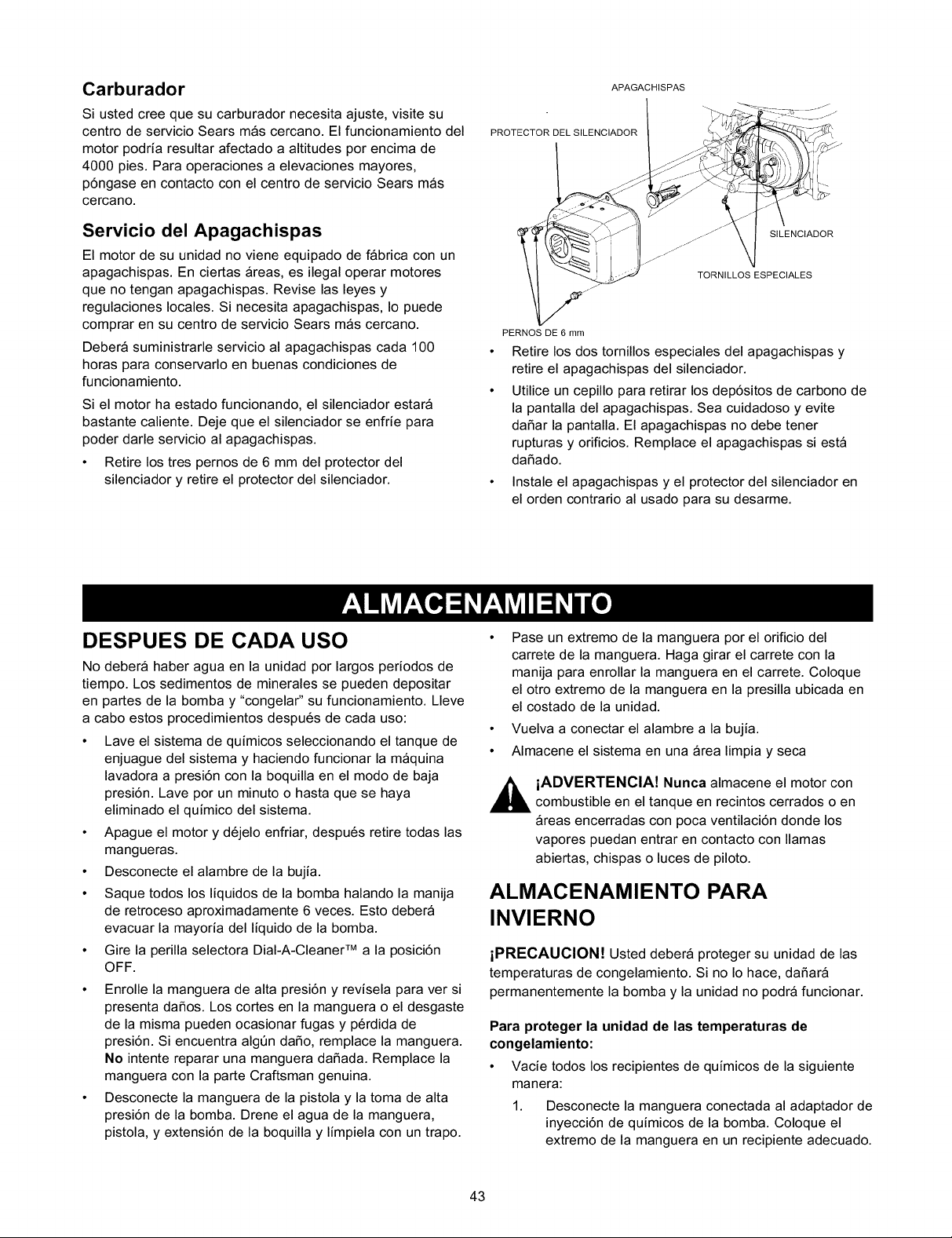
Carburador
Si usted cree que su carburador necesita ajuste, visite su
centro de servicio Sears mas cercano. El funcionamiento del
motor podria resultar afectado a altitudes por encima de
4000 pies. Para operaciones a elevaciones mayores,
p6ngase en contacto con el centro de servicio Sears mas
cercano.
Servicio del Apagachispas
El motor de su unidad no viene equipado de fabrica con un
apagachispas. En ciertas Areas, es ilegal operar motores
que no tengan apagachispas. Revise las leyes y
regulaciones locales. Si necesita apagachispas, Io puede
comprar en su centro de servicio Sears mas cercano.
Debera suministrarle servicio al apagachispas cada 100
horas para conservarlo en buenas condiciones de
funcionamiento.
Si el motor ha estado funcionando, el silenciador estara
bastante caliente. Deje que el silenciador se enfrie para
poder darle servicio al apagachispas.
• Retire los tres pernos de 6 mm del protector del
silenciador y retire el protector del silenciador.
APAGACHISPAS
PROTECTOR DEL SILENCIADOR
.... /- jj_ SILENCIADOR
TORNILLOS ESPECIALES
PERNOS DE 6 mm
• Retire los dos tomillos especiales del apagachispas y
retire el apagachispas del silenciador.
• Utilice un cepillo para retirar los dep6sitos de carbono de
la pantalla del apagachispas. Sea cuidadoso y evite
dafiar la pantalla. El apagachispas no debe tenet
rupturas y orificios. Remplace el apagachispas siesta
dafiado.
• Instale el apagachispas y el protector del silenciador en
el orden contrario al usado para su desarme.
DESPUES DE CADA USO
No debera haber agua en la unidad por largos periodos de
tiempo. Los sedimentos de minerales se pueden depositar
en partes de la bombay "congelar" su funcionamiento. Lleve
a cabo estos procedimientos despu6s de cada uso:
• Lave el sistema de quimicos seleccionando el tanque de
enjuague del sistema y haciendo funcionar la maquina
lavadora a presi6n con la boquilla en el modo de baja
presi6n. Lave pot un minuto o hasta que se haya
eliminado el quimico del sistema.
• Apague el motor y d6jelo enfriar, despu6s retire todas las
mangueras.
• Desconecte el alambre de la bujia.
• Saque todos los liquidos de la bomba halando la manija
de retroceso aproximadamente 6 veces. Esto debera
evacuar la mayoria del liquido de la bomba.
• Gire la perilla selectora Dial-A-Cleaner TM a la posici6n
OFF.
• Enrolle la manguera de alta presi6n y revisela para ver si
presenta dafios. Los cortes en la manguera o el desgaste
de la misma pueden ocasionar fugas y p6rdida de
presi6n. Si encuentra algQn dafio, remplace la manguera.
No intente reparar una manguera dafiada. Remplace la
manguera con la parte Craftsman genuina.
• Desconecte la manguera de la pistola y la toma de alta
presi6n de la bomba. Drene el agua de la manguera,
pistola, y extensi6n de la boquilla y limpiela con un trapo.
• Pase un extremo de la manguera por el orificio del
carrete de la manguera. Haga girar el carrete con la
manija para enrollar la manguera en el carrete. Coloque
el otto extremo de la manguera en la presilla ubicada en
el costado de la unidad.
• Vuelva a conectar el alambre a la bujia.
• Almacene el sistema en una Area limpia y seca
_ ADVERTENCIA! Nunca almacene el motor con
combustible en el tanque en recintos cerrados o en
Areas encerradas con poca ventilaci6n donde los
vapores puedan entrar en contacto con llamas
abiertas, chispas o luces de piloto.
ALMACENAMIENTO PARA
INVIERNO
iPRECAUCION! Usted debera proteger su unidad de las
temperaturas de congelamiento. Si no Io hace, dafiara
permanentemente la bombay la unidad no podra funcionar.
Para proteger la unidad de las temperaturas de
congelamiento:
• Vacie todos los recipientes de quimicos de la siguiente
manera:
1. Desconecte la manguera conectada al adaptador de
inyecci6n de quimicos de la bomba. Coloque el
extremo de la manguera en un recipiente adecuado.
43
2. MuevalaperillaselectoraalTanqueAyabrala
cubiertadeltanque.Lafuerzadegravedadse
encargaradevaciarelcontenidodeltanqueenel
recipiente.
3. Cuandoeltanqueest6vacio,repitaelpaso(b)para
lostanqueByC,utilizandounrecipientediferente
paracadaquimico.
4. Vuelvaa conectarlamangueraaladaptadorde
inyecci6ndequimicosdelabomba.ASada0.5litros
deagualimpiaacadatanqueycierrelascubiertas
delostanques.
Enjuagueelsistemadequimicosseleccionandoun
tanquey pongaenfuncionamientolamaquinalavadoraa
presi6nconlaboquillaenelmododebajapresi6n.
Enjuaguehastaquecadatanqueest6vacio,despu6s
muevalaperillaselectoraalsiguientetanque.ElQltimo
tanquequesedebevaciareseltanquedeEnjuaguedel
Sistema.
Conecteunpedazodemangueradejardinde3 piesal
adaptadordeentradadelagua.ViertaanticongelanteRV
(anticongelantesinalcohol)enlamanguera.Halela
manijaderetrocesodosveces.Retirelamanguerade3
pies.
ALMACENAMIENTO PROLONGADO
Si usted no planea usar la maquina lavadora a presi6n por
mas de 30 dias, debera preparar el motor para un
almacenamiento prolongado.
Es importante evitar la formaci6n de dep6sitos de goma en
las pares esenciales del sistema del combustible tales
como carburador, filtro del combustible, manguera o tanque
del combustible durante el almacenamiento. Tambi6n, la
experiencia indica que los combustibles con mezclas de
alcohol (llamados gasohol, etanol o metanol) pueden atraer
la humedad, Io que Ileva a la separaci6n y formaci6n de
acidos durante el almacenamiento. La gasolina acida puede
daSar el sistema del combustible de un motor durante el
almacenamiento.
Proteja el Sistema de Combustible
,_ iADVERTENCIA! Drene el combustible en un Area
despejada, lejos de llamas abiertas yen un recipiente
adecuado. AsegQrese que el motor est6 frio. No
Fume.
• Retire toda la gasolina del tanque del combustible para
evitar la formaci6n de dep6sitos de goma en dichas
pares esenciales y causar un mal funcionamiento del
motor.
• Haga funcionar el motor hasta que se detenga por falta
de combustible. AsegQrese de tener conectado y
ABIERTO el suministro del agua a la entrada de la
bomba.
Cambio de Aceite
Con el motor todavia caliente, drene el aceite de la caja del
cigiJeSal. Vuelva a Ilenarlo con el grado de aceite
recomendado. (Vea "Cambio de Aceite" en la pagina 42).
Aceite el Di_metro Interior del Cilindro
• Retire la bujia. Rocie aproximadamente 1 onza (30 ml)
de aceite limpio para motor dentro del cilindro. Cubra el
orificio de la bujia con un trapo. Hale la manija de
retroceso lentamente para distribuir el aceite. Evite el
rociado del orificio de la bujia.from spark plug hole.
• Instale la bujia. No conecte el alambre de la bujia.
OTROS
• No almacene gasolina de una estaci6n a otra.
• Si es posible, almacene su unidad en un recinto cerrado
y cQbrala para protegerla del polvo y la suciedad.
ASEGURESE DE VAClAR EL TANQUE DEL
COMBUSTIBLE.
IMPORTANTE: Nunca cubra su sistema de limpieza
cuando el motor y el Area del escape est6n calientes.
44
Problema Causa
1. La boquilla esta en el modo de baja
presi6n.
2. La entrada de agua esta bloqueada.
3. Suministro de agua inadecuado.
4. La manguera de entrada esta
doblada o presenta fugas.
5. El colador de la manguera de entrada
esta tapado.
6. El suministro de agua esta por
encima de los 100°F.
7. La manguera de alta presi6n esta
bloqueada o presenta fugas.
8. La pistola presenta fugas.
9. La boquilla esta obstruida.
10. Bomba defectuosa.
La bomba presenta los siguientes
problemas: no produce presibn,
produce una presibn errada,
traqueteo, p_rdida de presibn,
bajo volumen de agua.
El detergente no se mezcla con el
rociado.
El motor funciona bien cuando no
tiene cargas, pero funciona "mal"
cuando se conecta una carga.
El motor no arranca; o arranca y
funciona mal.
El motor se apaga durante la
operacibn.
El motor no tiene fuerza.
El motor intenta estabilizarse o su
funcionamiento no es constante.
1. La linea detergente se ha obstruido o
esta doblada.
2. El filtro del tanque de los quimicos
esta tapado.
3. Sucio en el filtro de la linea.
4. La boquilla esta en el modo de alta
presi6n.
5. La perilla Dial-a-Cleaner TM esta en la
posici6n de apaqado
La velocidad del motor es demasiado
lenta.
1. Bajo nivel de aceite.
2. Depurador de aire sucio.
3. Sin gasolina.
4. Gasolina vieja.
5. El alambre de la bujia no esta
conectado a la bujia.
6. Bujia mala.
7. Agua en la gasolina.
8. Estrangulaci6n excesiva.
9. Mezcla de combustible demasiado
rica.
10. Valvula de entrada trabada en la
posici6n abierta o cerrada.
11. El motor ha perdido compresi6n.
1. Sin gasolina.
2. Bajo nivel de aceite.
Filtro de aire sucio.
Cebador abierto demasiado rapido
Solucibn
1. Mueva la boquilla hacia atras para el
modo de alta presi6n.
2. Limpie la entrada.
3. Proporcione flujo de agua adecuado.
4. Estire la manguera de entrada,
coloque un parche en la fuga.
5. Revise y limpie el colador de la
manguera de entrada.
6. Proporcione suministro de agua mas
fria.
7. Retire las obstrucciones de la
manguera de salida.
8. Remplace la pistola.
9. Limpie la boquilla.
10. P6ngase en contacto con el centro de
servicio Sears.
1. Repare o remplace la linea del
detergente.
2. Remplace el tanque.
3. Vea"Cheque En el Filtro de la Linea"
en la pagina 40.
4. Mueva la boquilla hacia adelante para
el modo de baja presi6n.
5. Gire la perilla a la posici6n del
quimico que desea.
Mueva el control de la valvula de
regulaci6n a la posici6n FAST (RAPIDO).
Si el motor continua funcionando mal,
p6ngase en contacto con el centro de
servicio Sears.
1. Llene la caja del cig0efial hasta el
nivel correcto.
2. Limpie o remplace el depurador de
aire.
3. Llene el tanque de combustible.
4. Drene el tanque de gasolina; 116nelo
con combustible fresco.
5. Conecte el alambre a la bujia.
6. Remplace la bujia.
7. Drene el tanque de gasolina; ll6nelo
con combustible fresco.
8. Abra el cebador por completo y haga
girar el motor.
9. P6ngase en contacto con el centro de
servicio Sears.
10. P6ngase en contacto con el centro de
servicio Sears.
11. P6ngase en contacto con el centro de
servicio Sears.
1. Llene el tanque de combustible.
2. Llene la caja del cig0efial hasta el
nivel correcto.
Remplace el filtro de aire.
Mueva el cebador a la posici6n intermedia
hasta que el motor funcione normalmente.
45
46
Sus Obligaciones y Derechos de Garantia
La Junta Directiva de Recursos Ambientales de California ("CARB")
y Sears Roebuck and Co. USA, tienen el gusto de explicar la
Garantfa del Sistema de Control de Emisiones de su motor (motor)
pequefio afio 2000 y modelos posteriores. En California, los
motores nuevos deben ser disefiados, fabricados y equipados para
cumplir con los estrictos estandares anti-poluci6n del Estado. Sears
debera garantizar el sistema de control de emisiones de su motor
por los perfodos de tiempo enlistados a continuaci6n, con tal de que
no haya habido abuso, negligencia o mantenimiento inadecuado de
su motor.
Su sistema de control de emisiones incluye partes como el
carburador y el sistema de ignici6n.
Donde exista una condici6n que se pueda garantizar, Sears
reparar& su motor sin costo alguno para usted. Los gastos cubiertos
bajo la garantfa incluyen diagn6stico, partes y mano de obra.
Cubrimiento de Garantia del Fabricante
Los motores modelo afio 2000 y posteriores estan garantizados por
dos afios. Si alguna parte de su motor relacionada con las
emisiones (lista a continuaci6n) es defectuosa, esta sera
remplazada o reparada por Sears.
Resp.onsabilidades de Garantia del
Propietario
Como propietario del motor, usted es responsable de la realizaci6n
del mantenimiento requerido enlistado en este manual del
propietario. Sears le recomienda conservar todos los recibos que
cubran el mantenimiento de su motor. Sin embargo, Sears no
puede negar los derechos de garantfa tan solo debido a la falta de
los recibos o por que no se haya asegurado de realizar todo el
mantenimiento programado.
Como propietario del motor, usted debe saber que Sears puede
negar el cubrimiento de la garantfa si su motor, o una parte del
mismo, ha fallado debido a abuso, negligencia, mantenimiento
inadecuado, modificaciones no aprobadas, o por el uso de partes
que no hayan sido fabricadas o aprobadas por el fabricante original
del equipo.
Usted es responsable de Ilevar su motor a un centro de reparaci6n
autorizado Sears tan pronto como aparezca el problema. Las
reparaciones de garantfa deberan terminarse en un perfodo de
tiempo razonable, que no exceda los 30 dias.
Si tiene preguntas acerca de sus responsabilidades y derechos de
garantfa, debera ponerse en contacto con su centro de servicio
autorizado mas cercano o Ilamar a Sears al 1-800-473-7247.
Fecha de Inicio de la Garantia
El periodo de la garantia comienza en la fecha de entrega del
motor.
Duracion del Cubrimiento
Sears garantiza al propietario inicial y a cada comprador
subsecuente, que el motor est& libre de defectos en materiales y
mano de obra que puedan causar falla de la parte garantizada por
un periodo de dos afios.
QUE ESTA CUBIERTO
Reparacion o Remplazo de Partes
• La reparaci6n o el remplazo de cualquier parte garantizada se
realizara sin ningQn costo para el propietario en un centro de
servicio aprobado Sears.
Si tiene preguntas acerca de sus responsabilidades y derechos
de garantfa, deber& ponerse en contacto con su centro de
servicio autorizado mas cercano o Ilamar a Sears al
1-800-473-7247.
Periodo de Garantia
Cualquier parte garantizada que no haya sido programada para
reemplazo como mantenimiento requerido, o que este programada
6nicamente para inspecci6n bajo la condici6n de "repare o remplace
cuando sea necesario", sera garantizada por 2 afios. Cualquier
parte garantizada que este programada para reemplazo seg6n el
mantenimiento requerido sera garantizada por el perfodo de tiempo
hasta su primer remplazo programado.
Diagnostico
No se le cobrara al propietario los costos del trabajo diagn6stico
que Ileve a la conclusi6n de que la parte garantizada es defectuosa,
si dicho trabajo diagn6stico es hecho en un centro de servicio Sears
aprobado.
DaSos Consecuenciales
Sears puede ser responsable por dafios a otros componentes del
motor causados por la falla de una parte garantizada que a6n esta
bajo garantia.
QUE NO ESTA CUBIERTO
No seran cubiertas las fallas causadas por abuso, negligencia o
mantenimiento inadecuado.
Partes Agregadas o Modificadas
El uso de partes agregadas o modificadas puede ser motivo
suficiente para negar reclamos bajo garantfa. Sears no es
responsable de cubrir fallas de partes garantizadas causadas por el
uso de partes agregadas o modificadas.
Como Presentar un Reclamo
Si tiene preguntas acerca de sus responsabilidades y derechos de
garantfa, debera ponerse en contacto con su centro de servicio
autorizado mas cercano o Ilamar a Sears al 1-800-473-7247.
Donde se Obtiene el Servicio de Garantia
Las reparaciones o servicios de garantfa seran proporcionados en
todos los centros de servicio autorizados Sears.
Mantenimiento, Remplazo y Reparacion
de Partes Relacionadas con Emisiones
Cualquier repuesto aprobado por Sears usado en la realizaci6n de
cualquier mantenimiento o reparaci6n de garantia en partes
relacionadas con las emisiones, sera suministrado sin costo alguno
al propietario si la parte esta bajo garantia.
Lista de Partes en Garantia del Control de
Emisiones
1. Conjunto del carburador
2. Sistema de ignici6n
a. Bujia, cubierta hasta el programa de mantenimiento.
b. M6dulo de ignici6n
3. Tubo del respiradero de la caja del cigQeSal
4. MQItiple de escape
47
For in-home major brand repair service:
Call 24 hours a day, 7 days a week
1-800-4-MY-HOM E SM(1-800-469-4663)
Para pedir servicio de reparacibn a domicilio - 1-800-676-5811
In Canada for all your service and parts needs call
- 1-800-665-4455
Au Canada por tout le service ou les pi6ces
For the repair or replacement parts you need:
Call 7 am - 7 pm, 7 days a week
1-800-366-PART (1-800-366-7278)
Para ordenar piezas con entrega a domicilio - 1-800-659-7084
For the location of a Sears Parts and Repair Center in your area:
Call 24 hours a day, 7 days a week
1-800-488-1222
For information on purchasing a Sears maintenance Agreement
or to inquire about an existing Agreement:
Call 9 am - 5 pm, Monday - Saturday
1-800-827-6655
I SE $1
HomeCentraFJ
The ServiceSideof Sears_