
Installation Guide
Table of Contents:
Safety Tips. pg. 1
Unpacking Your Fan. pg. 2
Parts Inventory. pg. 2
Installation Preparation. pg. 3
Hanging Bracket Installation. pg. 3
Fan Assembly. pgs. 4 - 5
Wiring. pg. 5
Canopy Assembly. pg. 6
Rod Support Assembly. pg. 6
Blade Assembly. pg. 7
Light Kit Assembly. pg. 7
Automated Learning Process./
Activating Code. pg. 8
Remote Control Operation. pg. 9
Testing Your Fan. pg. 9
Troubleshooting. pg. 10
Warranty. pg. 10
Parts Replacement. pg. 10
net weight of fan: 29.7 lb (13.47 kg)
PRINTED IN CHINA
READ THESE INSTRUCTIONS
AND SAVE THEM FOR FUTURE USE
4009218
For Model:
E-KM52ABZ5CMR
LISTED FOR
DAMP LOCATION

SAFETY TIPS.
page 1
WARNING: To reduce the risk of electrical shock, turn off the electricity to the fan at the main fuse box or
circuit panel before you begin the fan installation or before servicing the fan or installing accessories.
1. READ ALL INSTRUCTIONS AND SAFETY INFORMATION CAREFULLY BEFORE INSTALLING YOUR
FAN AND SAVE THESE INSTRUCTIONS.
CAUTION: To avoid personal injury, the use of gloves may be necessary while handling fan parts with
sharp edges.
2. Make sure all electrical connections comply with Local Codes or Ordinances, the National Electrical
Code, and ANSI/NFPA 70-1999. If you are unfamiliar with electrical wiring or if the house/building
wires are different colors than those referred to in the instructions, please use a qualified
electrician.
3. Make sure you have a location selected for your fan that allows clear space for the blades to rotate,
and at least seven (7) feet (2.13 meters) of clearance between the floor and the fan blade tips. The
fan should be mounted so that the tips of the blades are at least thirty (30) inches (76 centimeters)
from walls or other upright structures.
4. The outlet box and ceiling support joist used must be securely mounted, and capable of supporting
at least
35 pounds (16 kilograms). The outlet box must be supported directly by the building structure.
Use only ETL or UL listed outlet boxes marked "FOR FAN SUPPORT."
WARNING: To reduce the risk of fire, electrical shock, or personal injury, mount to the outlet box marked
"Acceptable for Fan Support of 15.9 kg (35 lb) or less," and use the mounting screws provided with the
outlet box. Most outlet boxes commonly used for the support of lighting fixtures are not acceptable for
fan support and may need to be replaced. Consult a qualified electrician if in doubt.
WARNING: To reduce the risk of fire, electrical shock, or personal injury, wire connectors provided with this
fan are designed to accept only one 12 gauge house wire and two lead wires from the fan. If your house
wire is larger than 12 gauge or there is more than one house wire to connect to the corresponding fan
lead wires, consult an electrician for the proper size wire connectors to use.
5. Electrical diagrams are for reference only. Light kits that are not packed with the fan must be ETL or
UL listed and marked suitable for use with the model fan you are installing. Switches must be ETL
or UL general use switches. Refer to the instructions packaged with the light kits and switches for
proper assembly.
6. After installation is complete, check that all connections are absolutely secure.
7. After making electrical connections, spliced conductors should be turned upward and pushed
carefully up into the outlet box. The wires should be spread apart with the grounded conductor
and the equipment-grounding conductor on opposite sides of the outlet box.
WARNING: To reduce the risk of fire or electrical shock, do not use this fan with any solid state speed
control device or control fan speed with a full range dimmer switch. [Using a full range dimmer switch to
control fan speed will cause a loud humming noise from fan.]
8. Do not operate the reverse switch until the fan has come to a complete stop.
9. Do not insert anything between the fan blades while they are rotating.
WARNING: To reduce the risk of personal injury, do not bend the blade arms during assembly or after
installation. Do not insert objects into the path of the blades.
WARNING: To avoid personal injury or damage to the fan and other items, be cautious when working
around or cleaning the fan.
10. Do not use water or detergents when cleaning the fan or fan blades. A dry dust cloth or lightly
dampened cloth will be suitable for most cleaning.
WARNING: To reduce the risk of personal injury, use only parts provided with this fan. The use of parts
OTHER than those provided with this fan will void the warranty.
NOTE: The important safety precautions and instructions appearing in the manual are not meant to cover
all possible conditions and situations that may occur. It must be understood that common sense and
caution are necessary factors in the installation and operation of this fan.
1. Unpacking Your Fan.
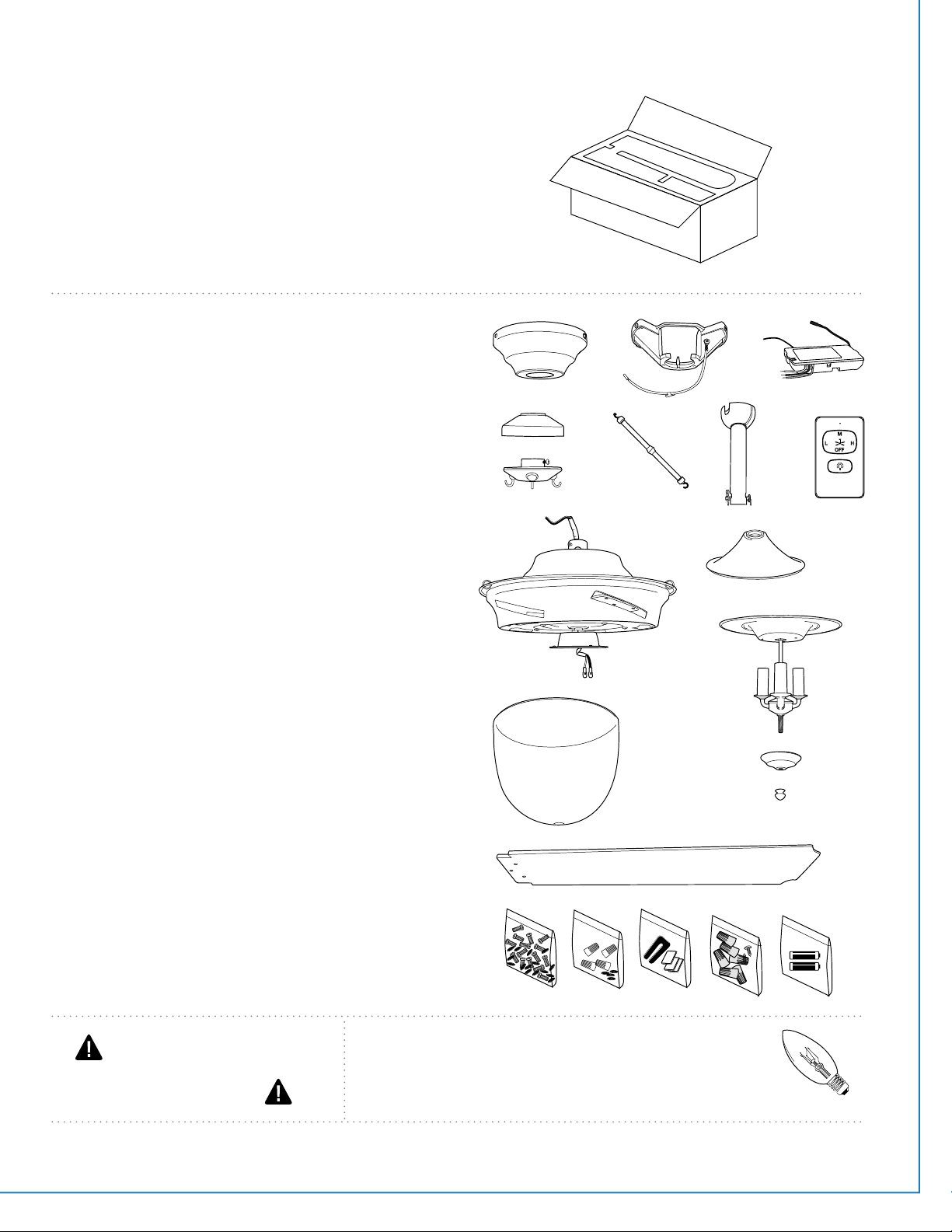
2. Parts Inventory.
Carefully open the packaging. Remove items
from Styrofoam inserts. Remove motor housing
and place on carpet or Styrofoam to avoid
damage to finish. Do not discard fan carton or
Styrofoam inserts should this fan need to be
returned for repairs.
Check against parts inventory that all parts have
been included.
a. canopy. 1 piece
b. hanging bracket (pre-attached to canopy).
1 piece
c. remote control receiver. 1 piece
d. rod support cap. 1 piece
e. rod. 3 pieces
f. downrod and hanging ball (with pin and clip).
1 piece
g. remote control transmitter. 1 piece
h. rod support. 1 piece
i. motor housing. 1 piece
j. yoke cover. 1 piece
k. light kit fitter. 1 piece
l. glass shade. 1 piece
m. finial plate. 1 piece
n. finial. 1 piece
o. blade. 5 pieces
p. hardware packs
page 2
ab c
j
i
d
h
efg
l
k
n
m
o
IMPORTANT REMINDER: You must
use the parts provided with this fan for
proper installation and safety.
p
w/ remote
required bulbs:
3 x 40 watt max. candelabra base bulbs,
size CA8 only (included)
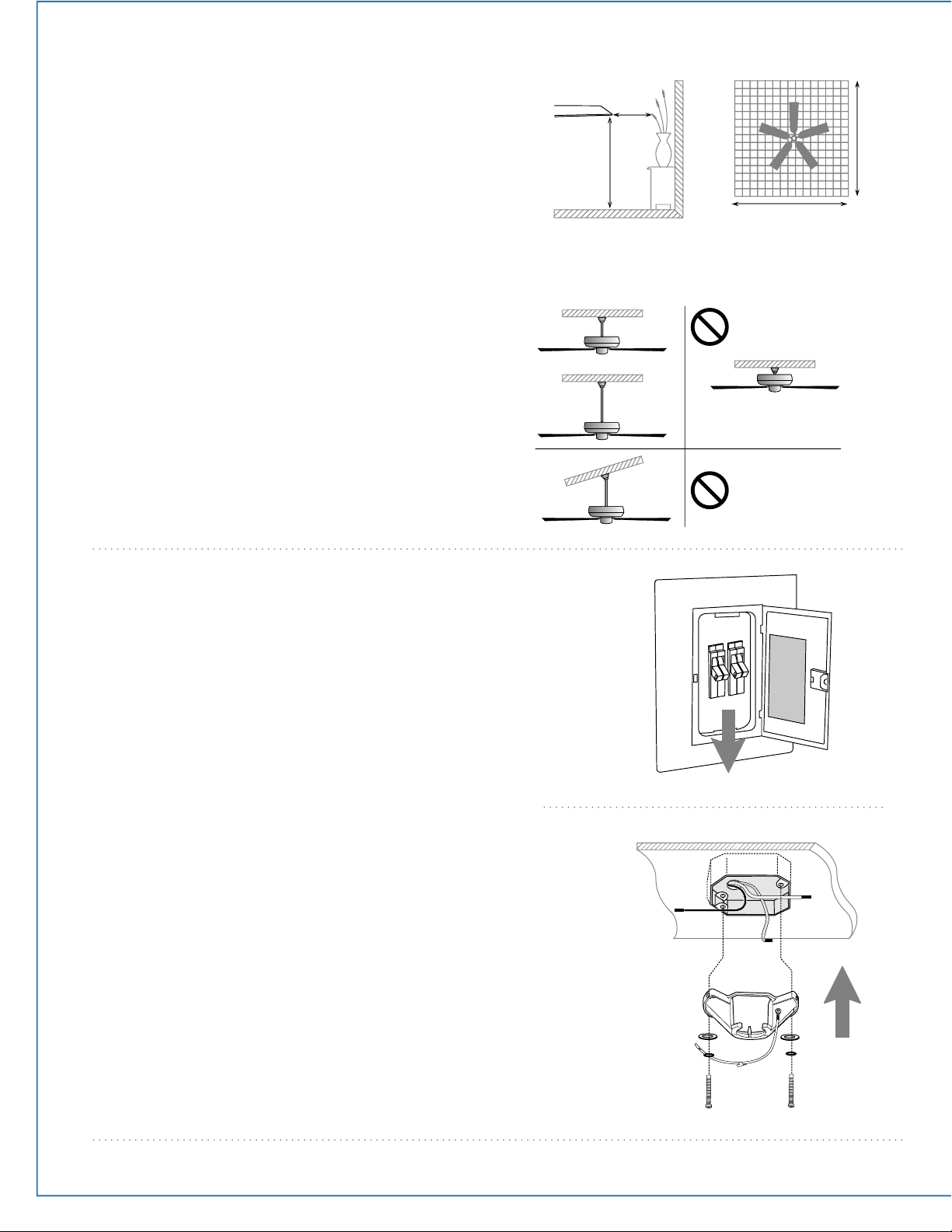
This fan can be mounted with a downrod
on a regular (no-slope) or vaulted ceiling. The
hanging length can be extended by purchasing
a longer downrod (0.5in./1.27cm diameter).
Other installation, such as flushmount, is not
available for this fan.
Vaulted ceiling
angle is not to
exceed 25 degrees.
3. Installation Preparation.
To prevent personal injury and damage, ensure
that the hanging location allows the blades a
clearance of 7 feet (2.13m) from the floor and
30in. (76cm) from any wall or obstruction.
This fan is suitable for room sizes up to 400
square feet (37.2 square meters).
Installation requires these tools:
Phillips screwdriver, flat-head screwdriver,
adjustable pliers or wrench, stepladder, wire
cutters and rated electrical tape.
downrod
installation
flushmount
installation
4. Hanging Bracket Installation.
page 3
ON
OFF
ON
OFF
hanging bracket
spring washers
outlet box screws
12ft. - 20ft.
12ft. - 20ft.
(3.66m - 6.1m)
(3.66m - 6.1m)
blade edge
7 feet
(2.13m)
(76cm)
30
inches
flat washers
Turn off circuit breakers to current fixture from breaker panel
and be sure operating light switch is turned to the OFF
position.
WARNING: Failure to disconnect power supply prior to
installation may result in serious injury.
Remove existing fixture.
WARNING: When using an existing outlet box, be sure the
outlet box is securely attached to the building structure and can
support the full weight of the fan. Ensure the outlet box is
clearly marked "Suitable for Fan Support." If not, it must be
replaced with an approved outlet box. Failure to do so can
result in serious injury.
CAUTION: Be sure outlet box is grounded and that a ground
wire (GREEN or bare) is present.
Partially loosen screws in slotted holes of canopy. Remove
the other 2 screws (along with the star washers)--save for
later use. Twist canopy to remove hanging bracket.
Install hanging bracket to outlet box using original screws,
spring washers and flat washers provided with new or
original outlet box.* If installing on a vaulted ceiling, face
opening of hanging bracket towards high point of ceiling.
Arrange electrical wiring around the back of the hanging
bracket and away from the bracket opening.
*Note: It is very important that you use the proper hardware
when installing the hanging bracket as this will support the fan.
NOTE: The important safety precautions and
instructions appearing in the manual are not meant
to cover all possible conditions and situations that
may occur. It must be understood that common
sense and caution are necessary factors in the
installation and operation of this fan.
page 4
motor
housing
5. Fan Assembly.
yoke set screw
downrod
rod support cap
rod support
set screw
rod support
canopy
yoke cover
electrical wiring
clip
pin
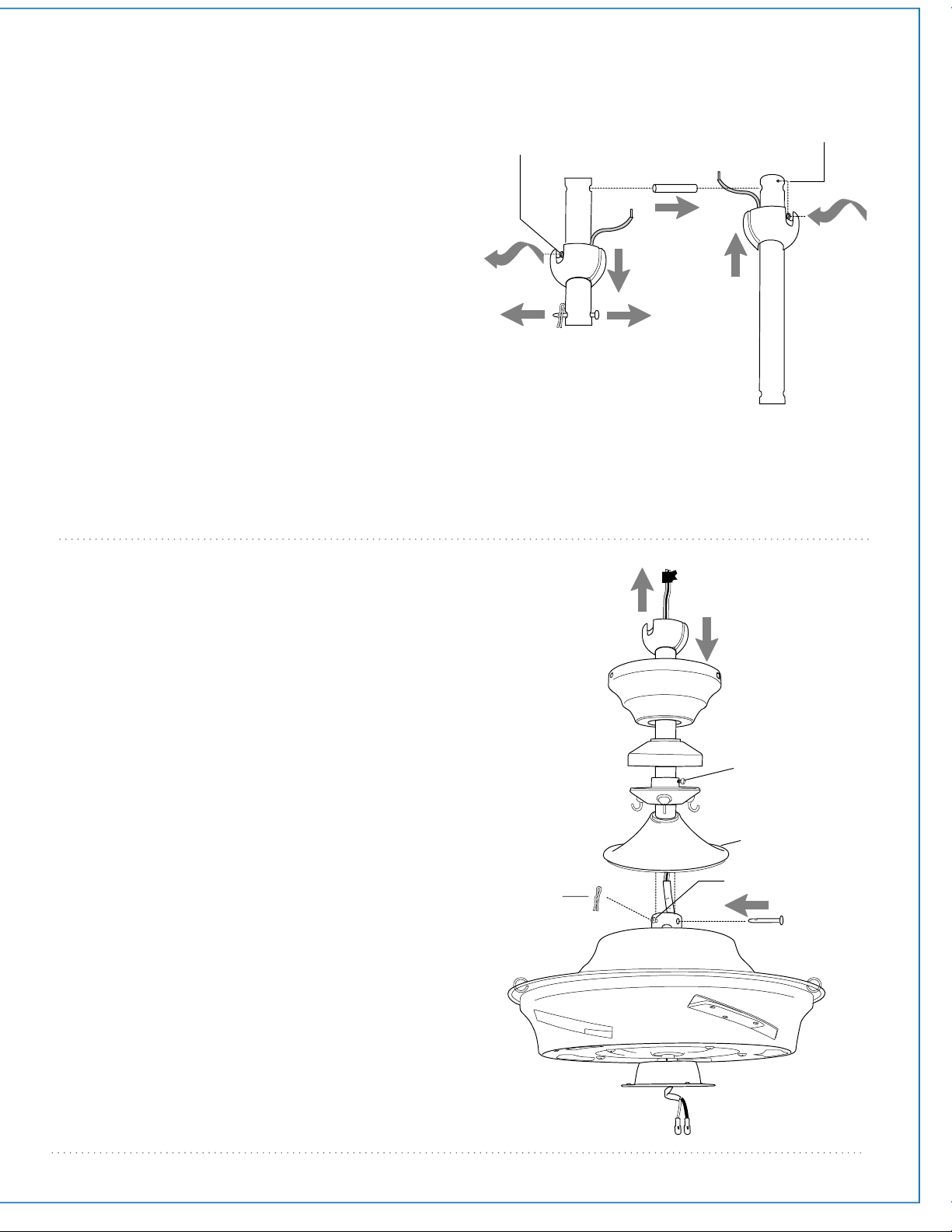
If you wish to extend the hanging length of
your fan, you must remove the hanging ball
from the downrod provided to use with an
extended downrod (sold separately). [If you wish
to use the downrod, please proceed to instructions
following the dotted line below.]
To remove hanging ball, loosen set screw on
hanging ball and remove the pin and clip.
Lower hanging ball and remove stop pin. Slide
hanging ball off the original downrod, A, and
slide it down the longer downrod, B (the top of
the downrod should be noted as having a set
screw hole; use this hole when setting the set
screw). Insert stop pin into top of extended
downrod and raise hanging ball. Be sure stop
pin aligns with slots on the inside of the
hanging ball. Tighten set screw securely.
WARNING: Failure to tighten set screw
completely could result in the fan becoming
loose and possibly falling.
Tip: To prepare for threading electrical wires
through downrod, apply a small piece of
electrical tape to the ends of the electrical
wires--this will keep the wires together when
threading them through the downrod.
Loosen yoke set screws and nut at top of motor
housing. Remove pin and clip from downrod (if
you have not already done so). Slide downrod
through canopy, rod support cap, rod support
(loosen rod support set screw to prevent
scratching the downrod finish) and then the
yoke cover.
Thread electrical wires through downrod and
pull extra wire slack from the upper end of the
downrod.
Place downrod into the motor housing yoke
and re-insert pin and clip that were previously
removed. Tighten yoke set screws and nut
securely. Lower yoke cover to motor housing.
["Fan Assembly" continued on next page.]
set screw hole
set screw
hanging ball
pin
A
B
pin
clip
5. Fan Assembly. (cont.)
page 5
hanging bracket tab
hanging ball slot
6. Wiring.
WARNING: Turn off circuit breakers to current
fixture from breaker panel and be sure switch is
turned to the OFF position.
CAUTION: Be sure outlet box is properly grounded
and that a ground wire (GREEN or Bare) is present.
Make sure all electrical connections comply with
Local Codes or Ordinances and the National
Electrical Code. If you are unfamiliar with electrical
wiring or if the house/building wires are different
colors than those referred to in the diagram to the
right, please use a qualified electrician.
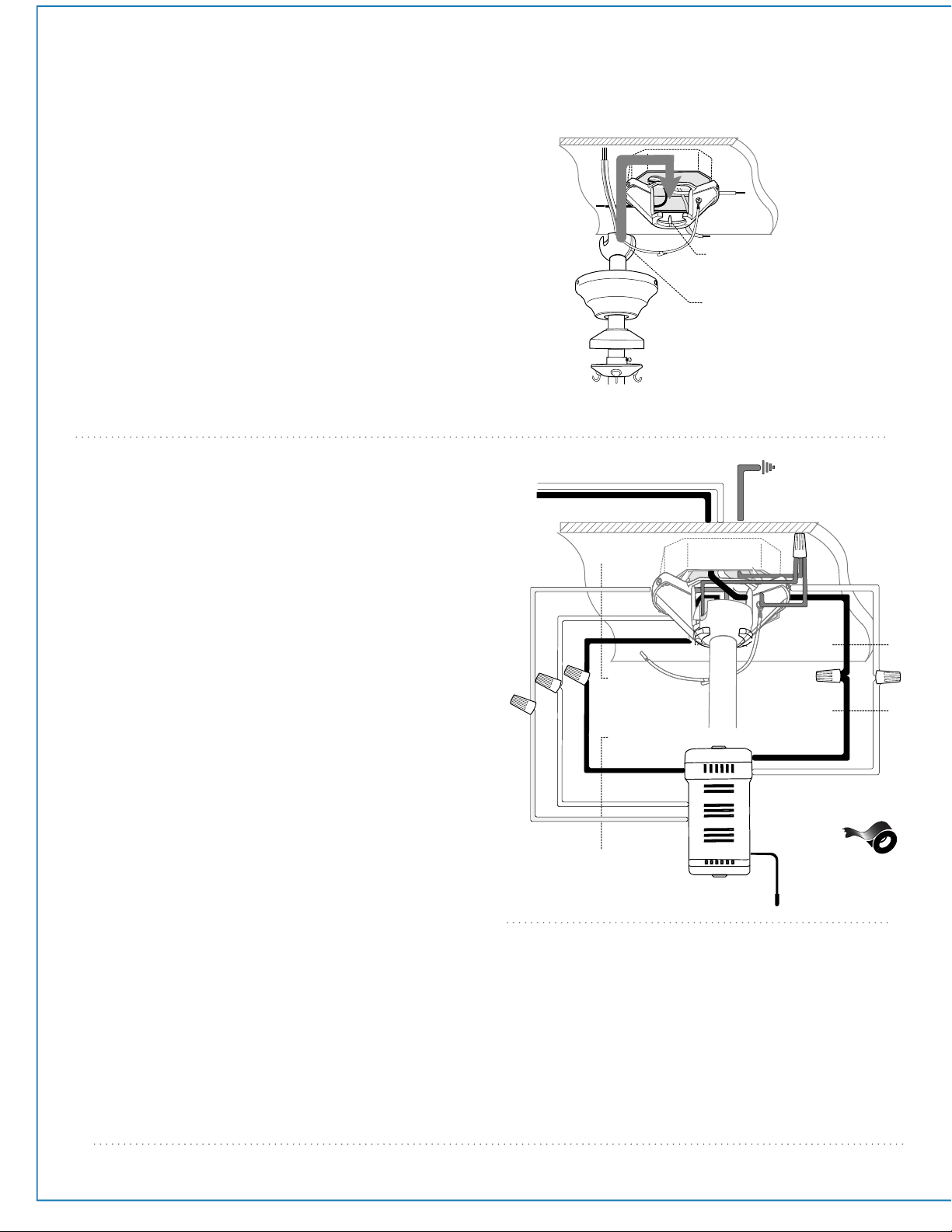
Wire the receiver with wire connectors provided
as shown in diagram at right.
Tip: While you are wiring, keep in mind that wires
must not obstruct receiver from sliding into
hanging bracket.
* Wrap each wire connector separately with
electrical tape as an extra safety measure.
Insert receiver into hanging bracket (flat side up)
and gently push taped wire connectors into
outlet box. Allow antenna from remote control
receiver to hang out of the hanging bracket.
black
black
black
from receiver
from fan
from ceiling
from receiver
white
white
blue
blue
black supply wire
ground (green
or bare)
white supply wire
white
AC IN N
AC IN L
receiver
black
white
With the hanging bracket secured to the outlet
box and able to support the fan, you are now
ready to hang your fan. Grab the fan firmly with
two hands. Slide downrod through opening in
hanging bracket and let hanging ball rest on the
hanging bracket. Turn the hanging ball slot until it
lines up with the hanging bracket tab.
WARNING: Failure to align slot in hanging ball
with tab in hanging bracket may result in serious
injury or death.
Tip: Seek the help of another person to hold the
stepladder in place and to help lift the fan up to
you once you are set on the ladder.
*
antenna
Modifications not approved by the party responsible for compliance could
void the user's authority to operate the equipment.
*NOTE: This equipment has been tested and found to comply with the limits for a Class B digital
device, pursuant to Part 15 of the FCC Rules. These limits are designed to provide reasonable
protection against harmful interference in a residential installation. This equipment generates, uses
and can radiate radio frequency energy and, if not installed and used in accordance with the
instructions, may cause harmful interference to radio communications. However, there is no
guarantee that interference will not occur in a particular installation. If this equipment does cause
harmful interference to radio or television reception, which can be determined by turning the
equipment off and on, the user is encouraged to try to correct the interference by one or more of the
following measures:
* Reorient or relocate the receiving antenna.
* Increase the separation between the equipment and receiver.
* Connect the equipment into an outlet on a circuit different from that to which the
receiver is connected.
Consult the dealer or an experienced radio/TV technician for help.
ground
(green or bare)
page 6
rod support cap
rod support
rod support
set screw
canopy
yoke cover
rod
7. Canopy Assembly.
8. Rod Support Assembly.
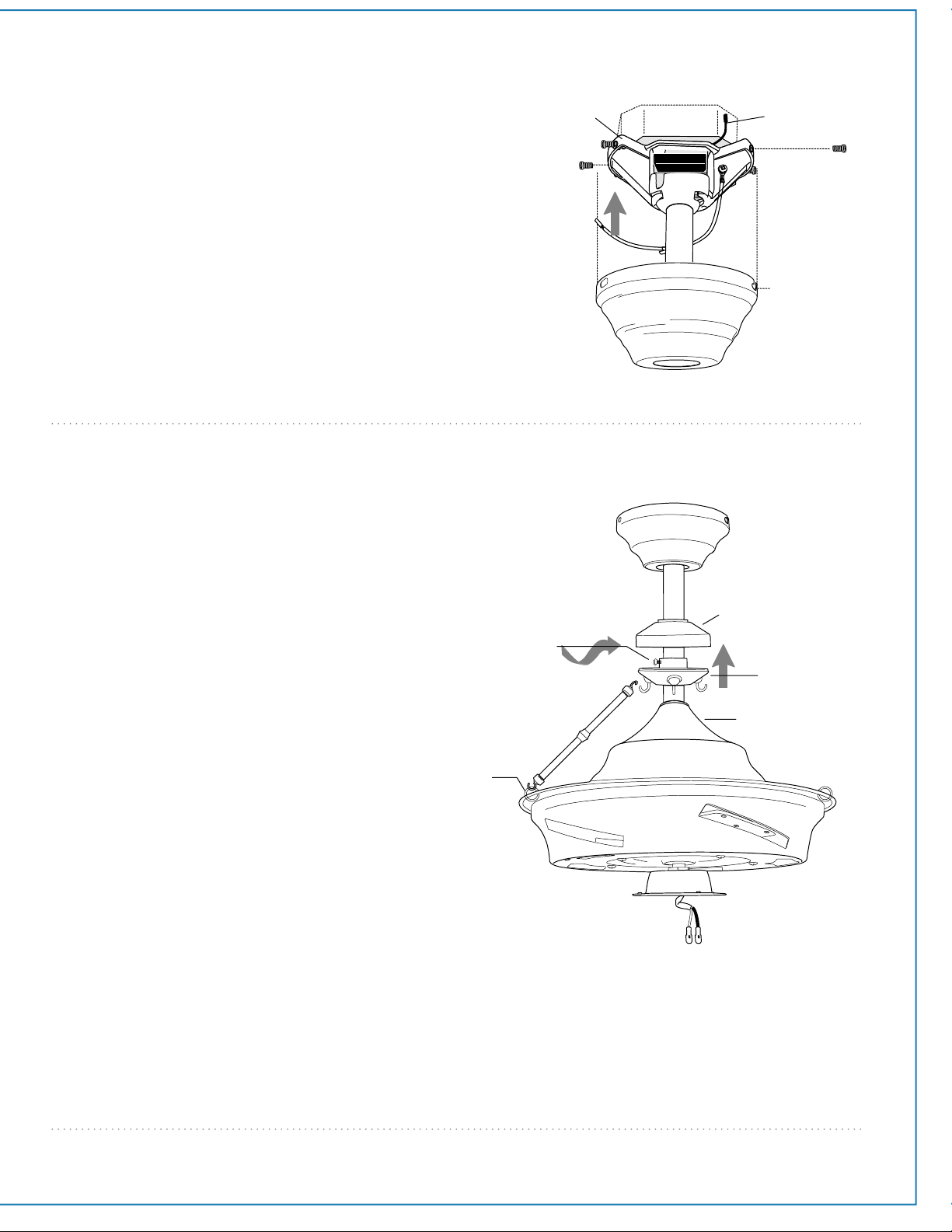
Raise canopy to hanging bracket and align
slotted holes in canopy with loosened screws
in hanging bracket. Twist canopy to lock.
Re-insert screws (along with star washers)
that were previously removed (page 3,
Section 4) and secure all screws with Phillips
screwdriver.
*Remember that antenna for remote control
receiver must rest outside of hanging bracket.
Hook one end of rod to loop on motor
housing. Adjust rod support to top end of rod
so it holds the rod in place and tighten rod
support set screw. Allow rod support cap to
rest on rod support.
Install remaining rods in between motor
housing and rod support. If rods fall off easily,
re-adjust rod support (by re-adjusting rod
support set screw as described above) with
rods already installed.
canopy
hanging
bracket
loop
slotted hole
motor
housing
antenna
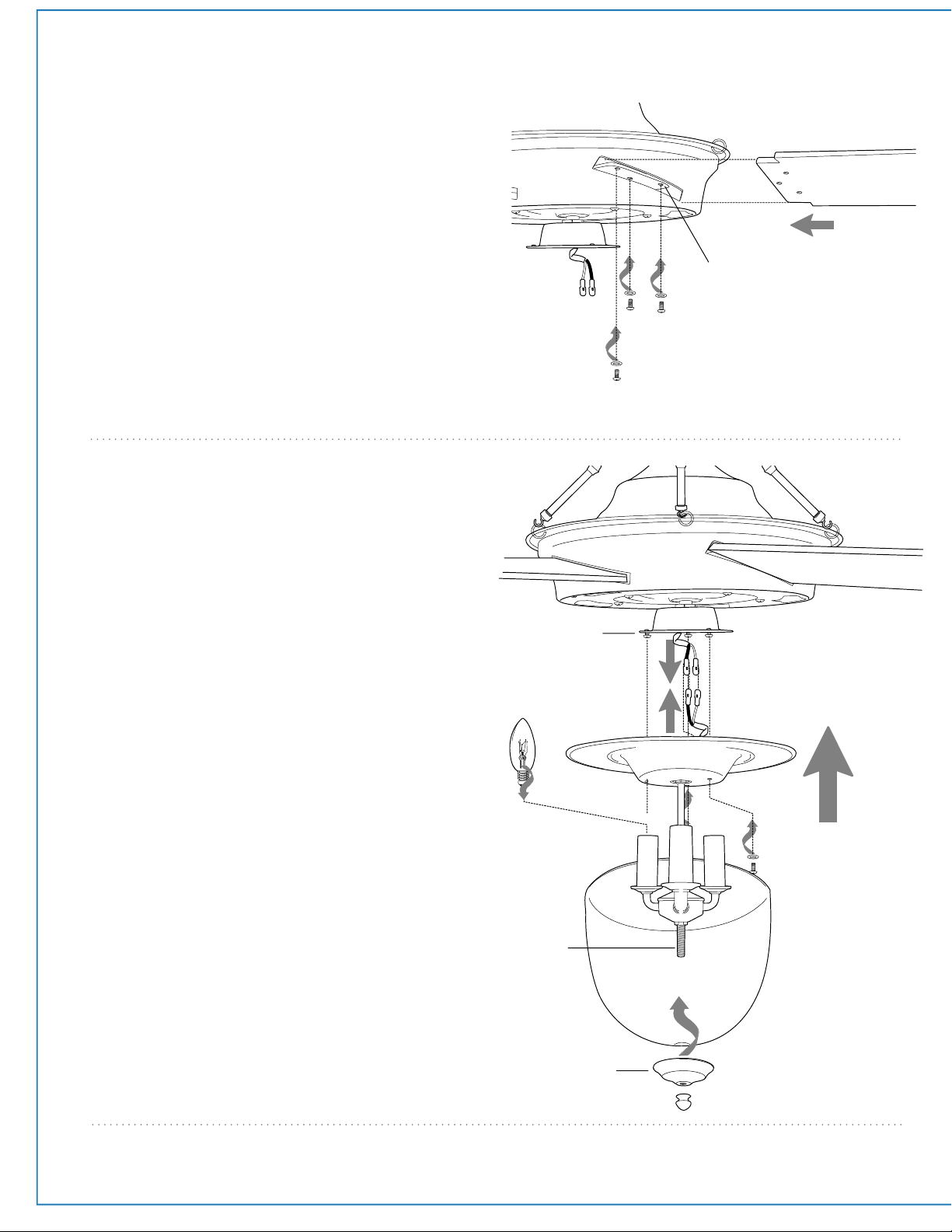
9. Blade Assembly.
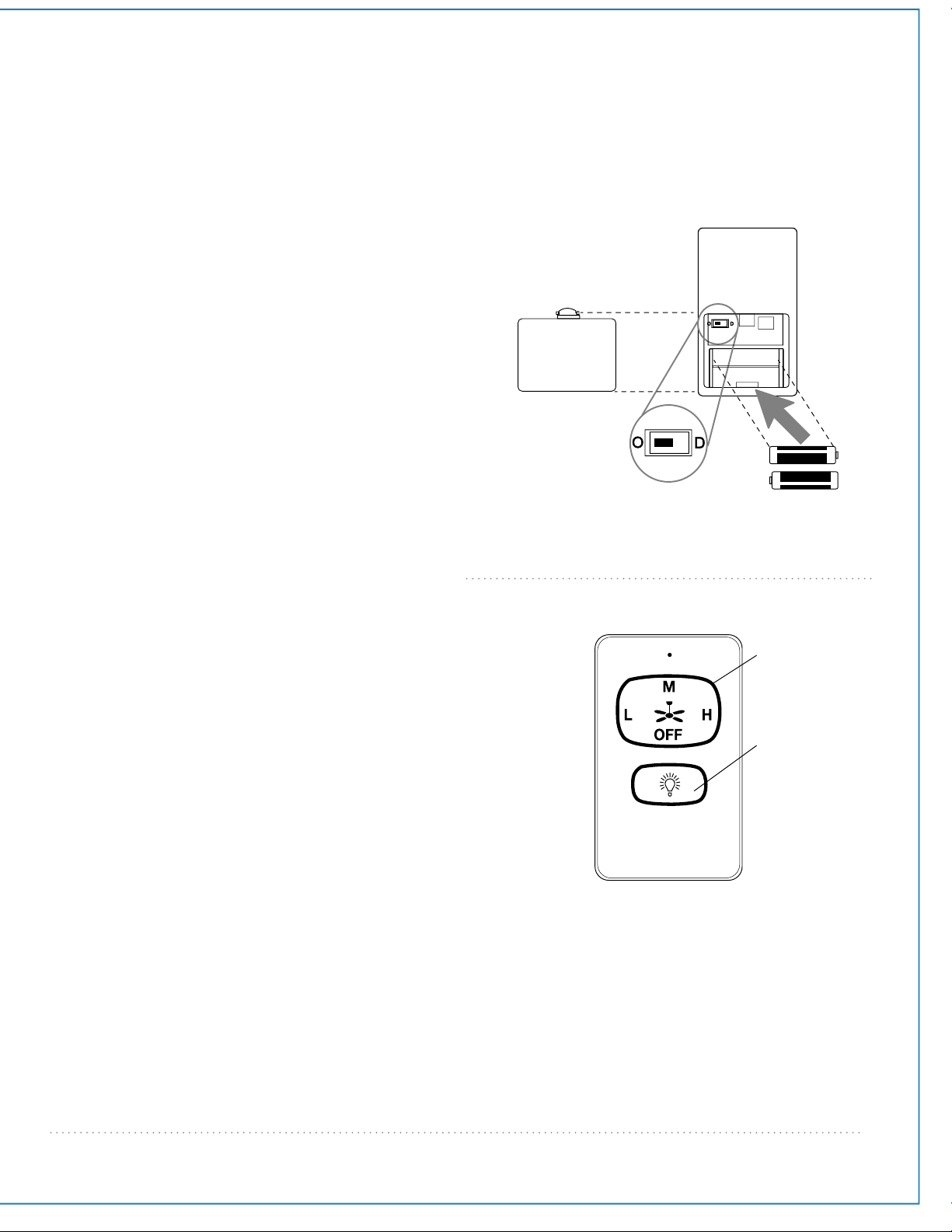
Remove 1 screw from fitter plate (on the
underside of the motor housing) and loosen
the other 2 screws.
Connect WHITE wire from light kit fitter to
WHITE wire from motor housing. Connect
BLACK wire from the light kit fitter to BLACK
(or BLUE) wire from the motor housing. Be sure
that the molex connections snap together
securely.
Align slotted holes in light kit fitter with
loosened screws on fitter plate; twist light kit
fitter to lock. Re-install screw that was
previously removed and then securely tighten
all 3 screws.
Install 3 candelabra base 40 watt max. bulbs
(included).
Important: When replacing bulbs, please allow
bulbs and glass shade to cool down before
touching.
Align hole in glass shade with threaded rod on
light kit fitter and push up gently until
threaded rod comes through hole. Align hole
in center of finial plate with threaded rod and
push up. Secure glass shade with finial. Do NOT
overtighten finial as glass may crack or break.
Time Saver: Washers for blade screws can be set
on each blade screw prior to installing blades.
Locate 15 blade attachment screws and washers
in a hardware pack. Slide blade into slot on side
of motor housing (please note side of blade
indicating THIS SIDE UP), then align holes in
blade with holes on blade plate located inside
motor housing. Insert 3 blade attachment
screws (along with washers) from underside of
motor housing. Tighten screws securely with
Phillips screwdriver. Repeat for remaining blades.
Note: Tighten blade arm screws twice a year.
motor housing
blade
page 7
10. Light Kit Assembly.
molex connections
fitter plate
bulb
light kit fitter
glass shade
finial
motor housing
finial plate
blade plate
threaded
rod
blade attachment
screws and washers
page 8
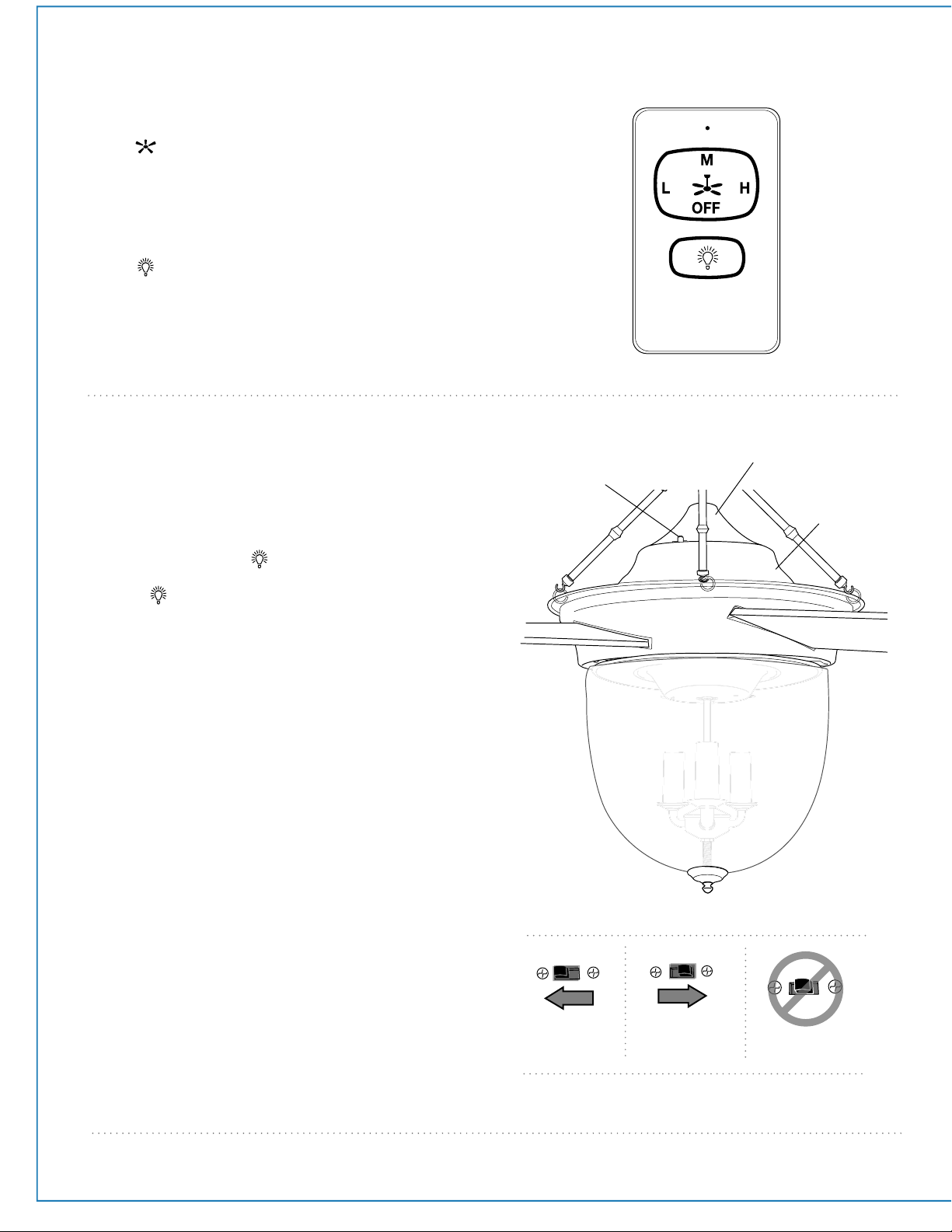
11. Automated Learning Process./Activating Code.
light button
fan button
transmitter
(front)
(backside)
remote control
transmitter
battery
battery
cover
LEARN
LEARN
CAUTION: The remote control transmitter can be
programmed to multiple receivers or fans. If this is not
desired, turn wall switch off to any other
programmable receiver or fan.
Remove battery cover from backside of remote
control transmitter.
Install two 1.5-volt batteries (size AAA, included) in
transmitter.
IMPORTANT: To prevent damage to remote control
transmitter, remove the batteries if not used for
long periods. Store the transmitter away from
excess heat or humidity.
WARNING: Choking Hazard - Small parts. Keep
battery away from children.
WARNING: To avoid personal injury, DO NOT
charge or heat batteries. DO NOT break batteries
apart or cause batteries to become deformed.
WARNING: DO NOT DISPOSE OF BATTERIES IN FIRE,
BATTERIES MAY EXPLODE OR LEAK. When
disposing of household alkaline batteries, it is best
to check with your local and state recycling or
household hazardous waste coordinators
concerning the specifics of the program in your
area. You may also locate a recycling center by
calling 1-800-8-BATTERY or 1-877-2-RECYCLE or
visit www.epa.gov/epawaste/index.htm or
www.earth911.org for more information.
Note: The dimmer switch located on the backside
of the transmitter (labeled O and D) has been
pre-set to the “Off” position (O). If you do wish to
have dimming capability, please move the switch
to the “ON” position (D).
Restore electrical power. Within 30 seconds of
restoring electrical power, press the "OFF" button
located on the front of the transmitter, for
5 seconds (or until light blinks twice or fan blades
begin to turn). Test the light and fan functions to
confirm the learning process is complete--see
Section 13.
Replace battery cover on transmitter.
page 9
12. Remote Control Operation.
13. Testing Your Fan.
reverse
switch
motor
housing
yoke cover
diagram 2 diagram 3
diagram 4
diagram 1
H button
M button
L button
OFF button
to control fan speed
to control light brightness
- turns light kit ON/OFF when pressed once;
dims light kit when pressed and held down
- turns fan to HIGH speed
- turns fan to MEDIUM speed
- turns fan to LOW speed
- turns fan OFF
It is recommended that you test fan before
finalizing installation. Test fan speeds with the
different fan speed buttons on the remote
control transmitter. Test the light ON/OFF
function with the button on the remote
control. Test dimmer function by holding down
the button for up to 5 seconds. (For more
detailed information on using remote control
transmitter, see Section 12 above.)
If the remote control operates all of the
functions of the fan and light, battery has been
installed correctly
(diagram 1). If fan and/or
light do (does) not function, please refer to
"Troubleshooting" section to solve any issues
before contacting Customer Service.
Turn fan completely off before moving the
reverse switch (located on top of motor
housing.) Set reverse switch to recirculate air
depending on the season:
- LEFT position in summer (diagram 2)
- RIGHT position in winter (diagram 3)
A ceiling fan will allow you to raise your
thermostat setting in summer and lower your
thermostat setting in winter without feeling a
difference in your comfort.
Important: Reverse switch must be set either
completely to the LEFT or completely to the RIGHT
for fan to function. If the reverse switch is set in
the middle position (diagram 4), fan will not
operate.

page 10
Troubleshooting. Warranty.
Problem: Fan fails to operate.
Solutions:
1. Check wall switch to fan.
2. Verify that reverse switch is set completely in either
direction.
3. Verify that receiver is wired properly.
4. Check to be sure fan is wired properly.
5. Learning process between fan and remote control
transmitter may not have been successful and code
was not activated. Turn off power, remove battery
cover from back of transmitter, and repeat instructions
in last 2 paragraphs of Section 11 (page 8).
Problem: Light kit not lighting.
Solutions:
1. Check wall switch to fan.
2. Check that bulbs are installed correctly.
3. Check that wires in canopy are wired properly.
4. Learning process between fan and remote control
transmitter may not have been successful and code
was not activated. Turn off power, remove battery
cover from back of transmitter, and repeat instructions
in last 2 paragraphs of Section 11 (page 8).
Problem: Fan operates but light fails.
Solutions:
1. Check that bulbs are installed correctly.
2. Check that wires in canopy are wired properly.
3. Check to be sure molex connections in light kit fitter
are connected properly.
4. Replace defective bulbs with same type of bulb.
Problem: Fan and light fail to operate with remote
control.
Solutions:
1. Check battery power to remote control.
2. Learning process between fan and remote control
transmitter may not have been successful and code
was not activated. Turn off power, remove battery
cover from back of transmitter, and repeat instructions
in last 2 paragraphs of Section 11 (page 8).
Problem: Lighting source (up-light, down-light or
both) not functioning.
Solution:
Wattage Limiting Device has interrupted the flow of
electricity to the light source. Ensure bulbs total no
more than 190W in the light source.
Problem: Fan wobbles.
Solutions:
1. Use the balancing kit in one of the hardware packs. If
no blade balancing kit is provided, please call Customer
Support, 1-800-527-1292, to request one.
2. Check to be sure set screw(s) on motor housing yoke
is (are) tightened securely.
3. Check to be sure set screw on hanging ball is
tightened securely.
Parts Replacement.
WARNING: Failure to disconnect power supply
prior to troubleshooting any wiring issues may
result in serious injury.
For parts and information, please refer to
"Parts Inventory" on page 2.
Litex Customer Support:
1-800-527-1292
LITEX LIFETIME LIMITED WARRANTY:
LITEX INDUSTRIES, LTD. warrants this fan to the original
household purchaser for indoor use under the following
provisions:
1-YEAR WARRANTY: LITEX INDUSTRIES, LTD. will replace or
repair any fan which has faulty performance due to a
defect in material or workmanship. Contact Customer
Service at 1-800-527-1292 to arrange for return of fan.
Return fan, shipping prepaid, to Litex Industries, Ltd. We will
repair or ship you a replacement fan, and we will pay the
return shipping cost.
5-YEAR WARRANTY: LITEX INDUSTRIES, LTD. will repair or
replace, at no charge to the original purchaser, any fan
motor that fails to operate satisfactorily when failure
results from normal use.
RETURN FAN MOTOR ONLY, shipping prepaid, to Litex
Industries. We will repair or ship purchaser a replacement
motor and Litex will pay the return shipping cost.
6-YEAR to LIFETIME LIMITED WARRANTY: LITEX
INDUSTRIES, LTD. will repair the fan, at no charge to the
original purchaser for labor only, if the fan motor fails to
operate satisfactorily when failure results from normal use.
Parts used in the repair will be billed to the purchaser at
prevailing prices at time of repair.
The purchaser shall be responsible for all costs incurred
in the removal, reinstallation and shipping of the product
for repairs.
This warranty does not apply when damage from
mechanical, physical, electrical or water abuse results in
causing the malfunction. Deterioration of finishes or other
parts due to time or exposure to salt air is specifically
exempted under this warranty.
Neither Litex Industries nor the manufacturer will
assume any liability resulting from improper installation or
use of this product. In no case shall the company be liable
for any consequential damages for breach of this, or any
other warranty expressed or implied whatsoever. This
limitation as to consequential damages shall not apply in
states where prohibited.
JMLI1708