Owner's Manual
CRRFTSMIIN°
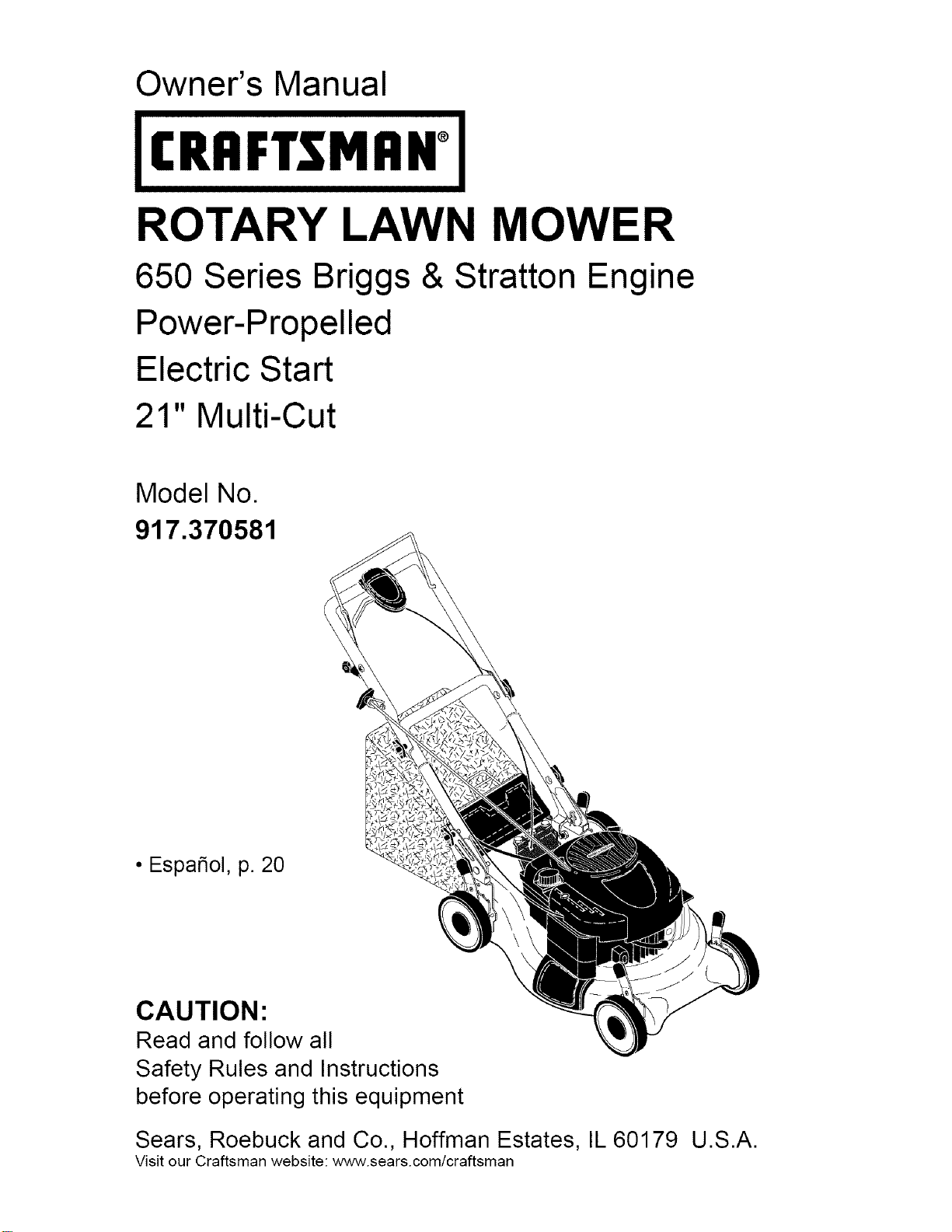
ROTARY LAWN MOWER
650 Series Briggs & Stratton Engine
Power-Propelled
Electric Start
21" Multi-Cut
Model No.
917.370581
•Espa_ol, p. 20
CAUTION:
Read and follow all
Safety Rules and Instructions
before operating this equipment
Sears, Roebuck and Co., Hoffman Estates, IL 60179
Visit our Craftsman website: www.sears.com/craftsman
U.S.A.

Warranty ................................................... 2
Safety Rules .......................................... 2-4
Product Specifications .............................. 4
Assembly / Pre-Operation ..................... 6-7
Operation ............................................. 8-12
Maintenance Schedule ........................... 13
Maintenance ...................................... 13-16
Service and Adjustments ................... 16-17
Storage .............................................. 17-18
Troubleshooting ................................. 18-19
Repair Parts ....................................... 38-46
Sears Service .......................... Back Cover
2-YEAR FULL WARRANTY ON CRAFTSMAN LAWN MOWER
If this Craftsman Lawn Mower fails due to manufacturer defects in material or
workmanship within two years from the date of purchase, return it to any Sears store,
Parts & Repair Center or other Craftsman outlet for free repair (or replacement if repair
proves impossible).
This warranty applies for only 90 days from the date of purchase if this Lawn Mower is
ever used for commercial or rental purposes.
This warranty does not cover:
• Expendable items that become worn during normal use, such as rotary mower
blades, blade adapters, belts, air cleaners and spark plug.
• Repairs necessary because of operator abuse or negligence, including bent
crackshafts and the failure to assemble, operate or maintain this Lawn Mower
according to all supplied product instructions.
This warranty applies only while this product is used in the United States.
This warranty gives you specific legal rights, and you may also have other rights which
vary from state to state.
Sears, Roebuck and Co., Hoffman Estates, IL 60179
IMPORTANT: This cutting machine is capable of amputating hands and feet and throw-
ing objects. Failure to observe the following safety instructions could result in serious
injury or death.
_,Look for this symbol to point out impor-
tant safety precautions. It means
CAUTIONH! BECOME ALERTN!
YOUR SAFETY IS INVOLVED.
_i, WARNING: In order to prevent ac-
cidental starting when setting up, trans-
porting, adjusting or making repairs,
always disconnect spark plug wire and
place wire where it cannot come in contact
with plug.
_WARNING: Engine exhaust, some of its
constituents, and certain vehicle components
contain or emit chemicals known to the State
of California to cause cancer and birth defects
or other reproductive harm.
AWARNING: Battery posts, terminals and
related accessories contain lead and lead
compounds, chemicals known to the State
of California to cause cancer and birth
defects or other reproductive harm. Wash
hands after handling.
A CAUTION: Muffler and other engine
parts become extremely hot during
operation and remain hot after engine has
stopped. To avoid severe burns on contact,
stay away from these areas.

I. GENERAL OPERATION
• Read, understand, and follow all
instructions on the machine and in the
manual(s) before starting. Be thoroughly
familiar with the controls and the proper
use of the machine before starting.
• Do not put hands or feet near or under
rotating parts. Keep clear of the dis-
charge opening at all times.
• Only allow responsible individuals, who
are familiar with the instructions, to oper-
ate the machine.
• Clear the area of objects such as rocks,
toys, wire, bones, sticks, etc., which
could be picked up and thrown by blade.
• Be sure the area is clear of other people
before mowing. Stop machine if anyone
enters the area.
• Do not operate the mower when bare-
foot or wearing open sandals. Always
wear substantial foot wear.
• Do not pull mower backwards unless
absolutely necessary. Always look down
and behind before and while moving
backwards.
• Never direct discharged material toward
anyone. Avoid discharging material
against a wall or obstruction. Material
may richochet back toward the opera-
tor. Stop the blade when crossing gravel
surfaces.
• Do not operate the mower without
proper guards, plates, grass catcher or
other safety protective devices in place.
• See manufacturer's instructions for
proper operation and installation of
accessories. Only use accessories ap-
proved by the manufacturer.
• Stop the blade(s) when crossing gravel
drives, walks, or roads.
• Stop the engine (motor) whenever you
leave the equipment, before cleaning the
mower or unclogging the chute.
• Shut the engine (motor) off and wait until
the blade comes to complete stop before
removing grass catcher.
• Mow only in daylight or good artificial
light.
• Do not operate the machine while under
the influence of alcohol or drugs.
• Never operate machine in wet grass.
Always be sure of your footing: keep a
firm hold on the handle; walk, never run.
• Disengage the self-propelled mech-
anism or drive clutch on mowers so
equipped before starting the engine.
• If the equipment should start to vibrate
abnormally, stop the engine (motor) and
check immediately for the cause. Vibra-
tion is generally a warning of trouble.
• Always wear safety goggles or safety
glasses with side shields when operating
mower.
II. SLOPE OPERATION
Slopes are a major factor related to slip &
fall accidents which can result in severe in-
jury. All slopes require extra caution. If you
feel uneasy on a slope, do not mow it.
DO:
• Mow across the face of slopes: never
up and down. Exercise extreme caution
when changing direction on slopes.
• Remove obstacles such as rocks, tree
limbs, etc.
• Watch for holes, ruts, or bumps. Tall
grass can hide obstacles.
DO NOT:
• Do not trim near drop-offs, ditches or
embankments. The operator could lose
footing or balance.
• Do not trim excessively steep slopes.
• Do not mow on wet grass. Reduced foot-
ing could cause slipping.
III. CHILDREN
Tragic accidents can occur if the operator
is not alert to the presence of children.
Children are often attracted to the machine
and the mowing activity. Never assume
that children will remain where you last
saw them.
• Keep children out of the trimming area
and under the watchful care of another
responsible adult.
• Be alert and turn machine off if children
enter the area.
• Before and while walking backwards,
look behind and down for small children.
• Never allow children to operate the ma-
chine.
• Use extra care when approaching blind
corners, shrubs, trees, or other objects
that may obscure vision.
IV. SAFE HANDLING OF GASOLINE
Use extreme care in handling gasoline.
Gasoline is extremely flammable and the
vapors are explosive.
• Extinguish all cigarettes, cigars, pipes
and other sources of ignition.
• Use only an approved container.
• Never remove gas cap or add fuel with
the engine running. Allow engine to cool
before refueling.
• Never refuel the machine indoors.
• Never store the machine or fuel contain-
er where there is an open flame, spark
or pilot light such as a water heater or on
other appliances.

• Neverfill containersinsideavehicle,on
atruckortrailerbedwitha plasticliner.
Alwaysplacecontainerson theground
awayfromyourvehiclebeforefilling.
• Removegas-poweredequipmentfrom
thetruckortrailerandrefueliton the
ground. Ifthis is notpossible,then
refuelsuchequipmentwith aportable
container,ratherthanfromagasoline
dispensernozzle.
• Keepthenozzlein contactwith therim
ofthefueltankorcontaineropeningat
alltimesuntilfueling iscomplete. Do
notusea nozzlelock-opendevice.
• Iffuel isspilledonclothing,change
clothingimmediately.
• Neveroverfillfuel tank. Replacegas
capandtightensecurely.
V. GENERAL SERVICE
• Neverruna machineinsideaclosed
area.
• Nevermakeadjustmentsor repairswith
theengine(motor)running.Disconnect
thesparkplugwire,and keepthewire
awayfromtheplugto preventaccidental
starting.
• Keepnutsandbolts,especiallyblade
attachmentbolts,tightandkeepequip-
mentin goodcondition.
• Nevertamperwithsafetydevices.Check
theirproperoperationregularly.
• Keepmachinefreeofgrass,leaves,or
otherdebrisbuild-up.Cleanoil orfuel
spillage.Allowmachineto coolbefore
storing.
• Stopandinspecttheequipmentifyou
strikean object.Repair,if necessary,
beforerestarting.
• Neverattemptto makewheelheight
adjustmentswhiletheengineisrunning.
• Grasscatchercomponentsaresubject
towear,damage,anddeterioration,
whichcouldexposemovingpartsor
allowobjectstobe thrown.Frequently
checkcomponentsandreplacewith
manufacturer'srecommendedparts,
whennecessary.
• Mowerbladesare sharpandcancut.
Wraptheblade(s)orweargloves,and
useextracautionwhenservicingthem.
• Donotchangetheenginegovernorset-
tingor overspeedtheengine.
• Maintainor replacesafetyand instruc-
tion labels,as necessary.
AWARNING: This lawn mower is equipped with an internal combustion engine and
should not be used on or near any unimproved forest-covered, brush-covered or
grass-covered land unless the engine's exhaust system is equipped with a spark
arrester meeting applicable local or state laws (if any). If a spark arrester is used, it
should be maintained in effective working order by the operator.
In the state of California the above is required by law (Section 4442 of the California
Public Resources Code). Other states may have similar laws. Federal laws apply on
federal lands. A spark arrester for the muffler is available through your nearest Sears
Parts & Repair Center (See the REPAIR PARTS section of this manual).
Serial Number:
Date of Purchase:
Gasoline Capacity / Type: 1.6 Quarts (Unleaded Regular)
Oil Type (API SG-SL): SAE 30 (above 32°F); SAE 5W-30 (below 32°F)
Oil Capacity: 20 Ounces
Spark Plug (Gap: .030") Champion RJ19HX
Blade Bolt Torque: 35-40 ft. Ibs.
• The model and serial numbers will be found on a decal on the rear of the lawn mower
housing. Record both serial number and date of purchase in space provided above.
4
Repair Protection Agreements
Congratulations on making a smart pur-
chase. Your new Craftsman® product is
designed and manufactured for years of
dependable operation. But like all prod-
ucts, it may require repair from time to
time. That's when having a Repair Protec-
tion Agreement can save you money and
aggravation.
Purchase a Repair Protection Agreement
now and protect yourself from unexpected
hassle and expense.
Here's what's included in the Agreement:
• Expert service by our 12,000 profe-
sional repair specialists.
• Unlimited service and no charge for
parts and labor on all covered repairs.
• Product replacement if your covered
product can't be fixed.
• Discount of 10% from regular price of
service and service-related parts not
covered by the agreement; also, 10%
off regular price of preventive mainte-
nance check.
• Fast help by phone- phone sup-
port from a Sears representative on
products requiring in-home repair, plus
convenient repair scheduling.
Once you purchase the Agreement, a
simple phone call is all that it takes for you
to schedule service. You can call anytime
day or night, or schedule a service ap-
pointment online.
Sears has over 12,000 professional repair
specialists, who have access to over 4.5
million quality parts and accessories.
That's the kind of professionalism you can
count on to help prolong the life of your
new purchase for years to come. Purchase
your Repair Protection Agreement today!
Some limitations and exclusions apply.
For prices and additional information
call 1-800-827-6655.
Sears Installation Service
For Sears professional installation of home
appliances, garage door openers, water
heaters, and other major home items, in
the U.S.A. call 1-800-4-MY-HOIMIE®.
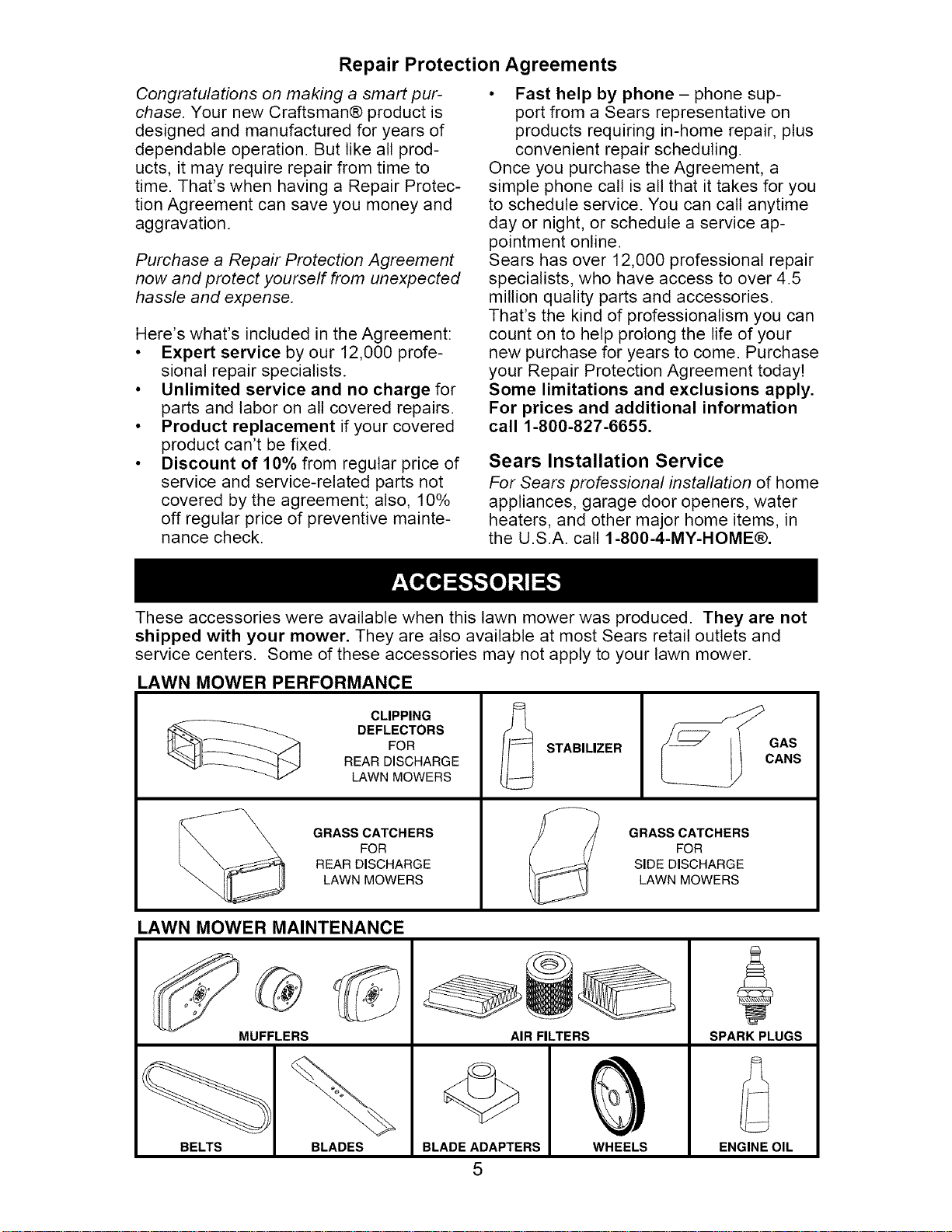
These accessories were available when this lawn mower was produced. They are not
shipped with your mower. They are also available at most Sears retail outlets and
service centers. Some of these accessories may not apply to your lawn mower.
LAWN MOWER PERFORMANCE
CLIPPING
DEFLECTORS
FOR
REAR DISCHARGE
LAWN MOWERS
GRASS CATCHERS
FOR
REAR DISCHARGE
LAWN MOWERS
STABILIZER
GRASS CATCHERS
FOR
SIDE DISCHARGE
LAWN MOWERS
LAWN MOWER MAINTENANCE
MUFFLERS
BELTS BLADES
AIR FILTERS
BLADE ADAPTERS
5
WHEELS
SPARK PLUGS
ENGINE OIL
Read these instructions and this manual in Operator
its entirety before you attempt to assemble I
or operate your new lawn mower, control bar
IMPORTANT: This lawn mower is
shipped WITHOUT OIL OR GASOLINE in
the engine.
Your new lawn mower has been assem-
bled at the factory with the exception of
those parts left unassembled for shipping UP
purposes. All parts such as nuts, washers,
bolts, etc., necessary to complete the as-
sembly have been placed in the parts bag.
To ensure safe and proper operation of
your lawn mower, all parts and hardware
you assemble must be tightened securely.
Use the correct tools as necessary to
ensure proper tightness.
MOWING
POSITION
Upper
handle
Handle
knob
Lower handle
TO REMOVE LAWN MOWER FROM
CARTON Handle
1. Remove loose parts included with bracket
mower.
2. Cut down two end corners of carton
and lay end panel down flat.
3. Remove all packing materials except
padding between upper and lower
handle and padding holding operator
presence control bar to upper handle. Knob
4. Roll lawn mower out of carton and
check carton thorougly for additional
loose parts.
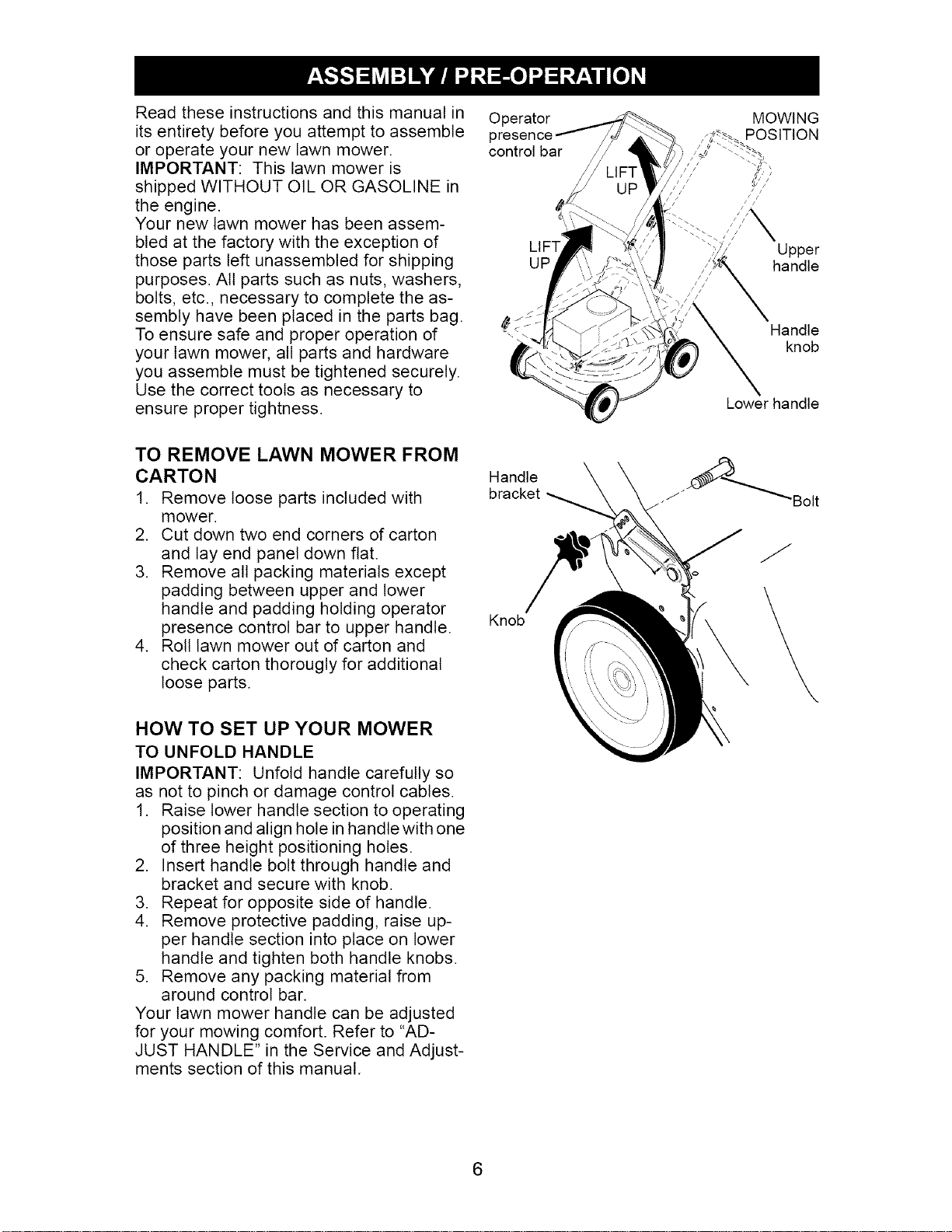
HOW TO SET UP YOUR MOWER
TO UNFOLD HANDLE
IMPORTANT: Unfold handle carefully so
as not to pinch or damage control cables.
1. Raise lower handle section to operating
position and align hole in handle with one
of three height positioning holes.
2. Insert handle bolt through handle and
bracket and secure with knob.
3. Repeat for opposite side of handle.
4. Remove protective padding, raise up-
per handle section into place on lower
handle and tighten both handle knobs.
5. Remove any packing material from
around control bar.
Your lawn mower handle can be adjusted
for your mowing comfort. Refer to "AD-
JUST HANDLE" in the Service and Adjust-
ments section of this manual.
"Bolt
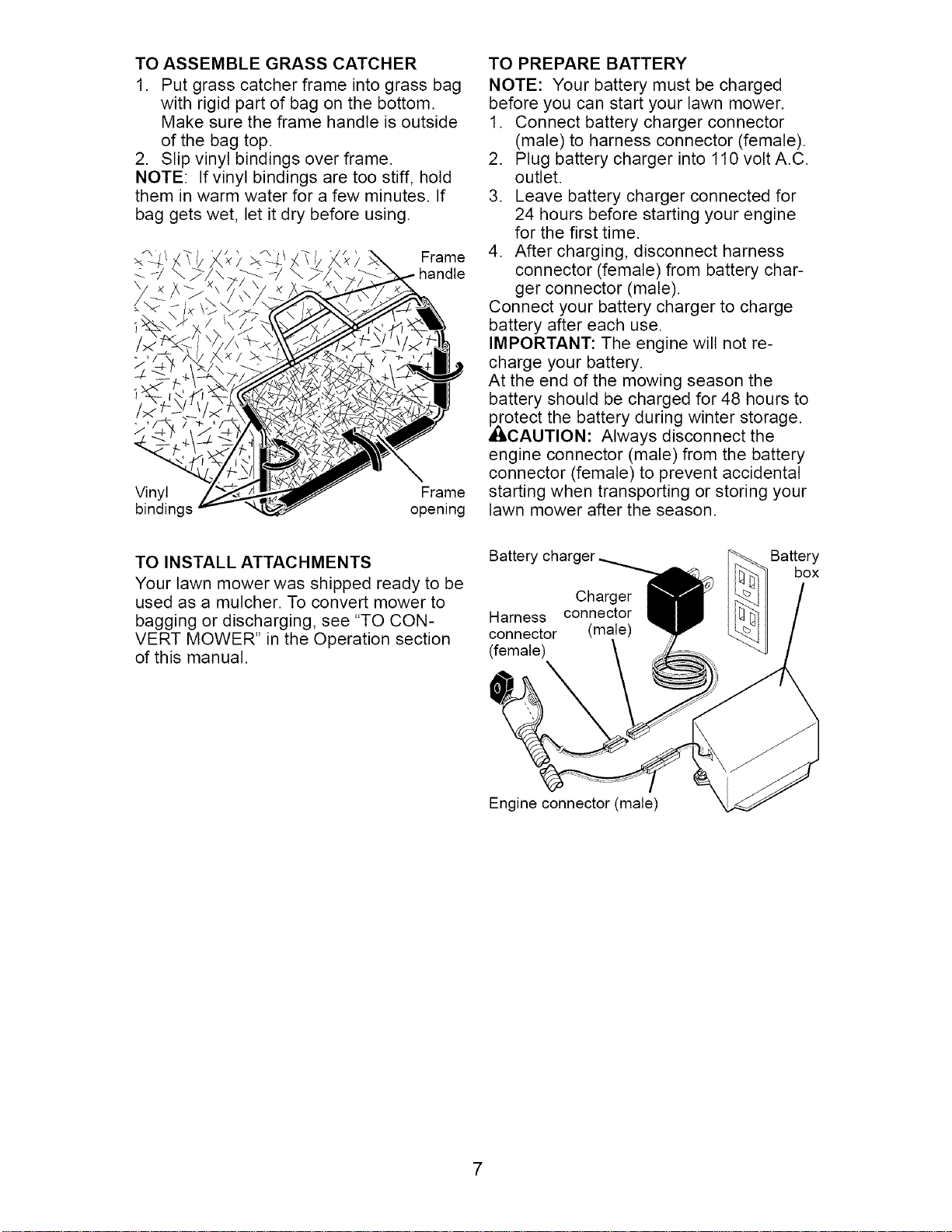
TO ASSEMBLE GRASS CATCHER
1. Put grass catcher frame into grass bag
with rigid part of bag on the bottom.
Make sure the frame handle is outside
of the bag top.
2. Slip vinyl bindings over frame.
NOTE: If vinyl bindings are too stiff, hold
them in warm water for a few minutes. If
bag gets wet, let it dry before using.
Vinyl Frame
bindings opening
TO PREPARE BATTERY
NOTE: Your battery must be charged
before you can start your lawn mower.
1. Connect battery charger connector
(male) to harness connector (female).
2. Plug battery charger into 110 volt A.C.
outlet.
3. Leave battery charger connected for
24 hours before starting your engine
for the first time.
4. After charging, disconnect harness
connector (female) from battery char-
ger connector (male).
Connect your battery charger to charge
battery after each use.
IMPORTANT: The engine will not re-
charge your battery.
At the end of the mowing season the
battery should be charged for 48 hours to
_lotect the battery during winter storage.
CAUTION: Always disconnect the
engine connector (male) from the battery
connector (female) to prevent accidental
starting when transporting or storing your
lawn mower after the season.
TO INSTALL ATTACHMENTS
Your lawn mower was shipped ready to be
used as a mulcher. To convert mower to
bagging or discharging, see "TO CON-
VERT MOWER" in the Operation section
of this manual.
Battery charger Battery
box
Charger
Harness connector
connector (male)
(female)
Engine connector (male)
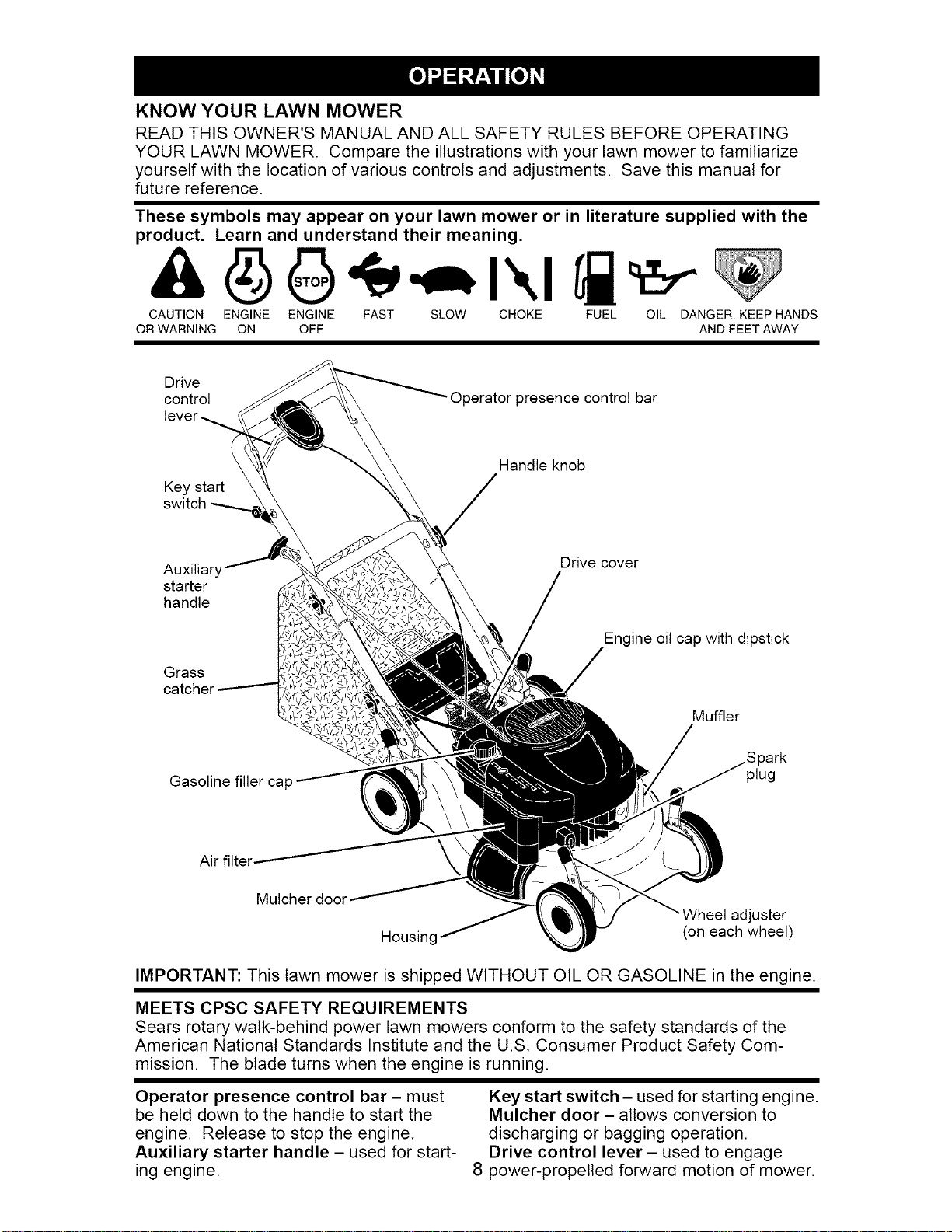
KNOW YOUR LAWN MOWER
READ THIS OWNER'S MANUAL AND ALL SAFETY RULES BEFORE OPERATING
YOUR LAWN MOWER. Compare the illustrations with your lawn mower to familiarize
yourself with the location of various controls and adjustments. Save this manual for
future reference.
These symbols may appear on your lawn mower or in literature supplied with the
product• Learn and understand their meaning•
CAUTION ENGINE ENGINE FAST SLOW CHOKE FUEL OIL DANGER, KEEP HANDS
OR WARNING ON OFF AND FEET AWAY
Drive
control
lever_
Operator presence control bar
Key start
Handle knob
Auxiliary
starter
handle
Drive cover
Engine oil cap with dipstick
Grass
catche_
Gasoline filler cal
Air
Muffler
plug
Mulcher dool
•Wheel adjuster
Housinc (on each wheel)
IMPORTANT: This lawn mower is shipped WITHOUT OIL OR GASOLINE in the engine.
MEETS CPSC SAFETY REQUIREMENTS
Sears rotary walk-behind power lawn mowers conform to the safety standards of the
American National Standards Institute and the U.S. Consumer Product Safety Com-
mission. The blade turns when the engine is running.
Operator presence control bar - must
be held down to the handle to start the
engine. Release to stop the engine.
Auxiliary starter handle - used for start-
ing engine.
Key start switch - used for starting engine.
Mulcher door - allows conversion to
discharging or bagging operation.
Drive control lever - used to engage
8 power-propelled forward motion of mower.
Theoperationof any
SAFETYGLASSESlawnmowercan result
inforeignobjectsthrown
intotheeyes,whichcan
resultinsevereeyedam-
age.Alwayswearsafetyglassesor eye
shieldswhileoperatingyour lawnmower
or performinganyadjustmentsor repairs.
Werecommendastandardsafetyglasses
orwidevisionsafetymaskwornover
spectacles.
HOW TO USE YOUR LAWN MOWER
ENGINE SPEED
The engine speed was set at the factory
for optimum performance. Speed is not
adjustable.
ENGINE ZONE CONTROL
_I_CAUTION: Federal regulations require
an engine control to be installed on this
lawn mower in order to minimize the
risk of blade contact injury. Do not under
any circumstances attempt to defeat the
function of the operator control. The blade
turns when the engine is running.
• Your lawn mower is equipped with an
operator presence control bar which
requires the operator to be positioned
behind the lawn mower handle to start
and operate the lawn mower.
DRIVE CONTROL
• Self-propelling is controlled by hold-
ing the operator presence control bar
down to the handle and pulling the drive
control lever rearward to the handle.
The farther toward the handle the lever
is pulled, the faster the unit will travel.
• Forward motion will stop when either
the operator presence control bar or
drive control lever are released. To stop
forward motion without stopping engine,
release the drive control lever only. Hold
operator presence control bar down
against handle to continue mowing
without self-propelling.
NOTE: If after releasing the drive control
the mower will not roll backwards, push
the mower forward slightly to disengage
drive wheels.
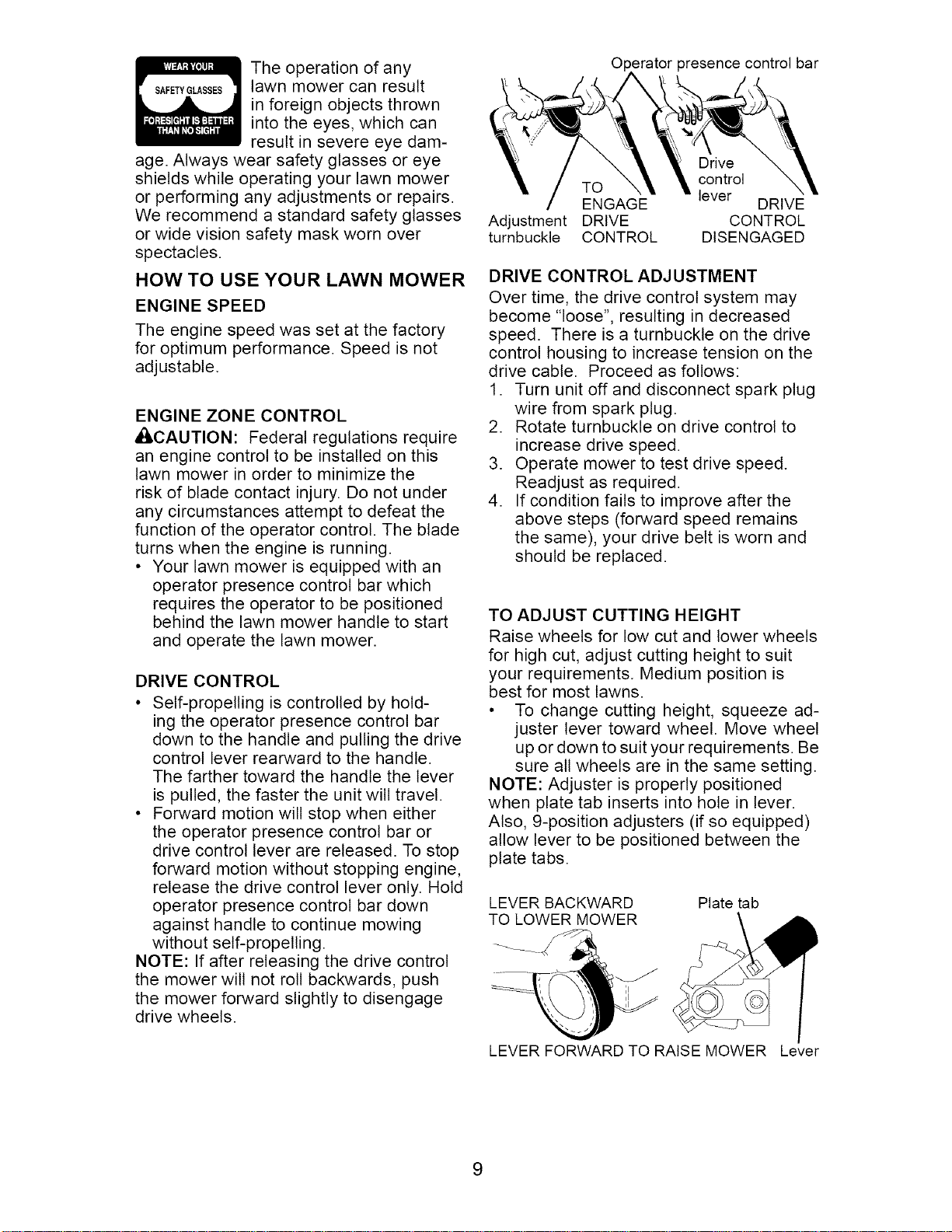
O _rator presence control bar
Drive
control
TO
lever
ENGAGE DRIVE
Adjustment DRIVE CONTROL
turnbuckle CONTROL DISENGAGED
DRIVE CONTROL ADJUSTMENT
Over time, the drive control system may
become "loose", resulting in decreased
speed. There is a turnbuckle on the drive
control housing to increase tension on the
drive cable. Proceed as follows:
1. Turn unit off and disconnect spark plug
wire from spark plug.
2. Rotate turnbuckle on drive control to
increase drive speed.
3. Operate mower to test drive speed.
Readjust as required.
4. If condition fails to improve after the
above steps (forward speed remains
the same), your drive belt is worn and
should be replaced.
TO ADJUST CUTTING HEIGHT
Raise wheels for low cut and lower wheels
for high cut, adjust cutting height to suit
your requirements. Medium position is
best for most lawns.
• To change cutting height, squeeze ad-
juster lever toward wheel. Move wheel
up or down to suit your requirements. Be
sure all wheels are in the same setting.
NOTE: Adjuster is properly positioned
when plate tab inserts into hole in lever.
Also, 9-position adjusters (if so equipped)
allow lever to be positioned between the
plate tabs.
LEVER BACKWARD
TO LOWER MOWER
Plate tab
LEVER FORWARD TO RAISE MOWER Lever
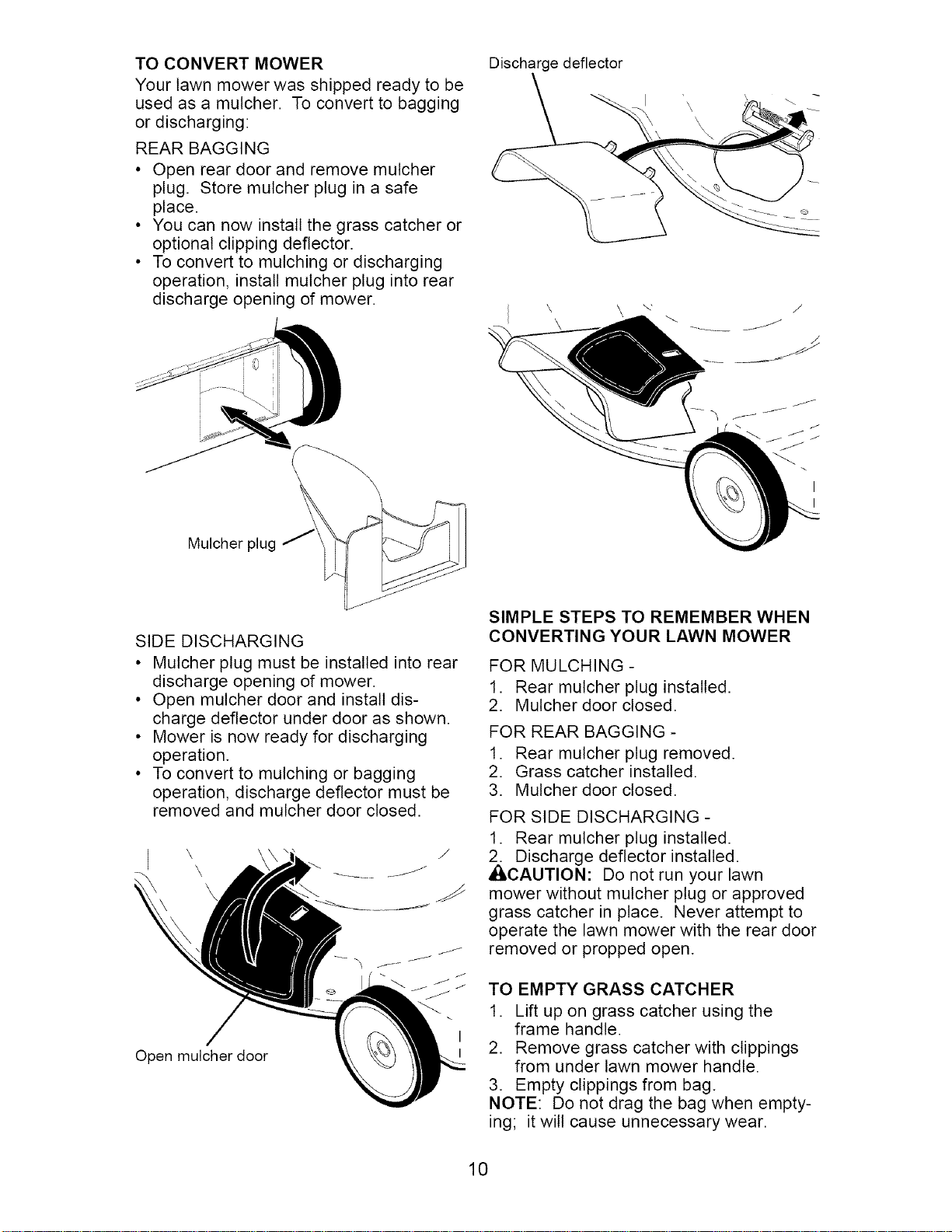
TOCONVERTMOWER
Your lawn mower was shipped ready to be
used as a mulcher. To convert to bagging
or discharging:
REAR BAGGING
• Open rear door and remove mulcher
plug. Store mulcher plug in a safe
place.
• You can now install the grass catcher or
optional clipping deflector.
• To convert to mulching or discharging
operation, install mulcher plug into rear
discharge opening of mower.
Mulcher plug
\
\
\
Discharge deflector
\
\ \ \- /
\
SIDE DISCHARGING
• Mulcher plug must be installed into rear
discharge opening of mower.
• Open mulcher door and install dis-
charge deflector under door as shown.
• Mower is now ready for discharging
operation.
• To convert to mulching or bagging
operation, discharge deflector must be
removed and mulcher door closed.
Open mulcher door
SIMPLE STEPS TO REMEMBER WHEN
CONVERTING YOUR LAWN MOWER
FOR MULCHING -
1. Rear mulcher plug installed.
2. Mulcher door closed.
FOR REAR BAGGING -
1. Rear mulcher plug removed.
2. Grass catcher installed.
3. Mulcher door closed.
FOR SIDE DISCHARGING -
1. Rear mulcher plug installed.
2. Discharge deflector installed.
_CAUTION: Do not run your lawn
mower without mulcher plug or approved
grass catcher in place. Never attempt to
operate the lawn mower with the rear door
removed or propped open.
TO EMPTY GRASS CATCHER
1. Lift up on grass catcher using the
frame handle.
2. Remove grass catcher with clippings
from under lawn mower handle.
3. Empty clippings from bag.
NOTE: Do not drag the bag when empty-
ing; it will cause unnecessary wear.
10
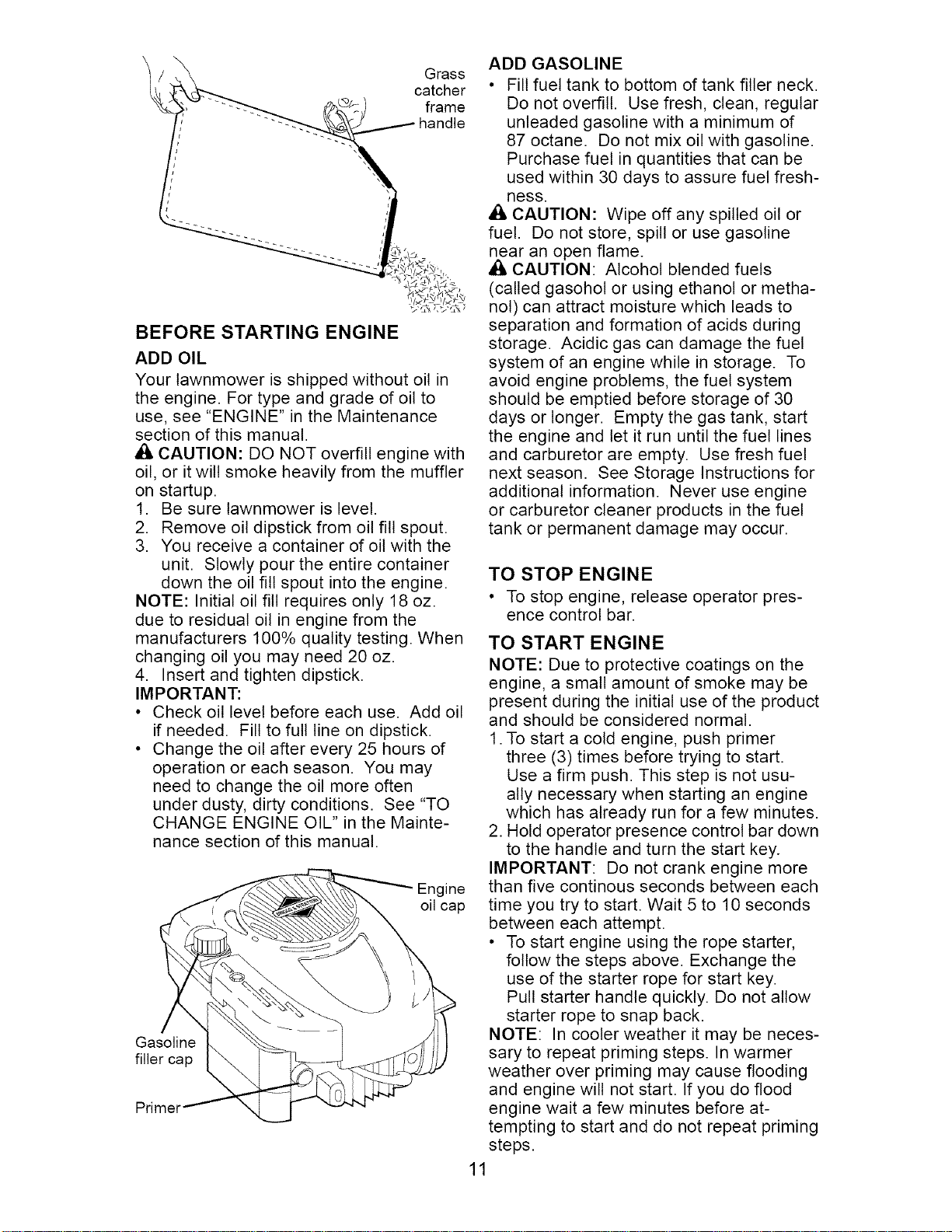
\ \
/__ Grass
catcher
frame
handle
BEFORE STARTING ENGINE
ADD OIL
Your lawnmower is shipped without oil in
the engine. For type and grade of oil to
use, see "ENGINE" in the Maintenance
section of this manual.
,i_ CAUTION: DO NOT overfill engine with
oil, or it will smoke heavily from the muffler
on startup.
1. Be sure lawnmower is level.
2. Remove oil dipstick from oil fill spout.
3. You receive a container of oil with the
unit. Slowly pour the entire container
down the oil fill spout into the engine.
NOTE: Initial oil fill requires only 18 oz.
due to residual oil in engine from the
manufacturers 100% quality testing. When
changing oil you may need 20 oz.
4. Insert and tighten dipstick.
IMPORTANT:
• Check oil level before each use. Add oil
if needed. Fill to full line on dipstick.
• Change the oil after every 25 hours of
operation or each season. You may
need to change the oil more often
under dusty, dirty conditions. See "TO
CHANGE ENGINE OIL" in the Mainte-
nance section of this manual.
Engine
oil cap
Gasoline
filler cap
ADD GASOLINE
• Fill fuel tank to bottom of tank filler neck.
Do not overfill. Use fresh, clean, regular
unleaded gasoline with a minimum of
87 octane. Do not mix oil with gasoline.
Purchase fuel in quantities that can be
used within 30 days to assure fuel fresh-
ness.
A CAUTION: Wipe off any spilled oil or
fuel. Do not store, spill or use gasoline
near an open flame.
CAUTION: Alcohol blended fuels
(called gasohol or using ethanol or metha-
nol) can attract moisture which leads to
separation and formation of acids during
storage. Acidic gas can damage the fuel
system of an engine while in storage. To
avoid engine problems, the fuel system
should be emptied before storage of 30
days or longer. Empty the gas tank, start
the engine and let it run until the fuel lines
and carburetor are empty. Use fresh fuel
next season. See Storage Instructions for
additional information. Never use engine
or carburetor cleaner products in the fuel
tank or permanent damage may occur.
TO STOP ENGINE
• To stop engine, release operator pres-
ence control bar.
TO START ENGINE
NOTE: Due to protective coatings on the
engine, a small amount of smoke may be
present during the initial use of the product
and should be considered normal.
1. To start a cold engine, push primer
three (3) times before trying to start.
Use a firm push. This step is not usu-
ally necessary when starting an engine
which has already run for a few minutes.
2. Hold operator presence control bar down
to the handle and turn the start key.
IMPORTANT: Do not crank engine more
than five continous seconds between each
time you try to start. Wait 5 to 10 seconds
between each attempt.
• To start engine using the rope starter,
follow the steps above. Exchange the
use of the starter rope for start key.
Pull starter handle quickly. Do not allow
starter rope to snap back.
NOTE: In cooler weather it may be neces-
sary to repeat priming steps. In warmer
weather over priming may cause flooding
and engine will not start. If you do flood
engine wait a few minutes before at-
tempting to start and do not repeat priming
steps.
11
MOWING TIPS
_& CAUTION: Do not use de-thatcher
blade attachments on your mower. Such
attachments are hazardous, will damage
your mower and could void your warranty.
• Under certain conditions, such as very
tall grass, it may be necessary to raise
the height of cut to reduce pushing effort
and to keep from overloading the engine
and leaving clumps of grass clippings.
It may also be necessary to reduce
ground speed and/or run the lawn
mower over the area a second time.
• For extremely heavy cutting, reduce the
width of cut by overlapping previously
cut path and mow slowly.
• For better grass bagging and most cut-
ting conditions, the engine speed should
be set in the FAST position.
• Pores in cloth grass catchers can
become filled with dirt and dust with use
and catchers will collect less grass. To
prevent this, regularly hose catcher off
with water and let dry before using.
• Keep top of engine around starter clear
and clean of grass clippings and chaff.
This will help engine air flow and extend
engine life.
MULCHING MOWING TIPS
IMPORTANT: For best performance,
keep mower housing free of built-up
grass and trash. See "CLEANING" in the
Maintenance section of this manual.
• The special mulching blade will recut
the grass clippings many times and
reduce them in size so that as they fall
onto the lawn they will disperse into
the grass and not be noticed. Also, the
mulched grass will biodegrade quickly
to provide nutrients for the lawn. Always
mulch with your highest engine (blade)
speed as this will provide the best recut-
ting action of the blades.
• Avoid cutting your lawn when it is wet.
Wet grass tends to form clumps and
interferes with the mulching action. The
best time to mow your lawn is the early
afternoon. At this time the grass has
dried, yet the newly cut area will not be
exposed to direct sunlight.
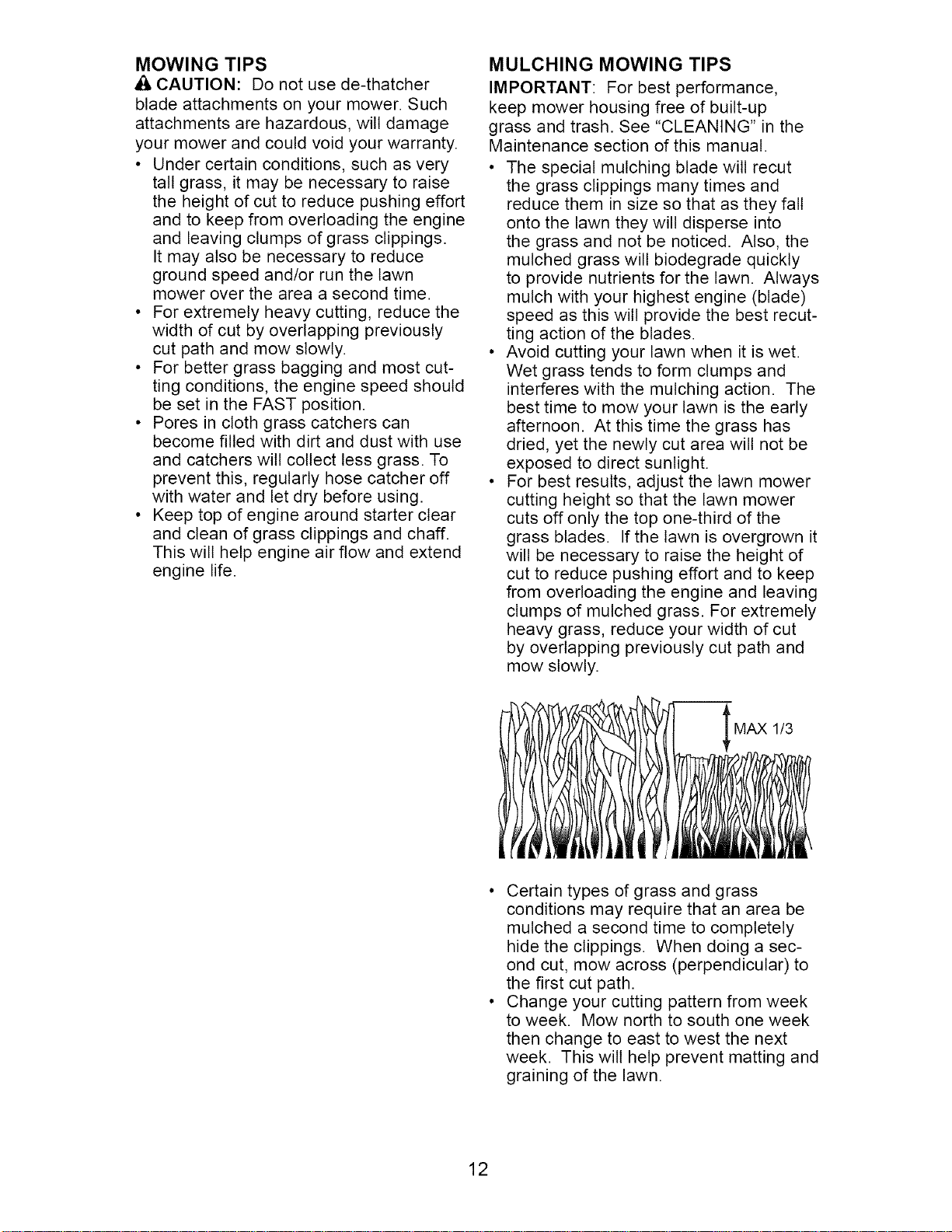
• For best results, adjust the lawn mower
cutting height so that the lawn mower
cuts off only the top one-third of the
grass blades. If the lawn is overgrown it
will be necessary to raise the height of
cut to reduce pushing effort and to keep
from overloading the engine and leaving
clumps of mulched grass. For extremely
heavy grass, reduce your width of cut
by overlapping previously cut path and
mow slowly.
1/3
• Certain types of grass and grass
conditions may require that an area be
mulched a second time to completely
hide the clippings. When doing a sec-
ond cut, mow across (perpendicular) to
the first cut path.
• Change your cutting pattern from week
to week. Mow north to south one week
then change to east to west the next
week. This will help prevent matting and
graining of the lawn.
12
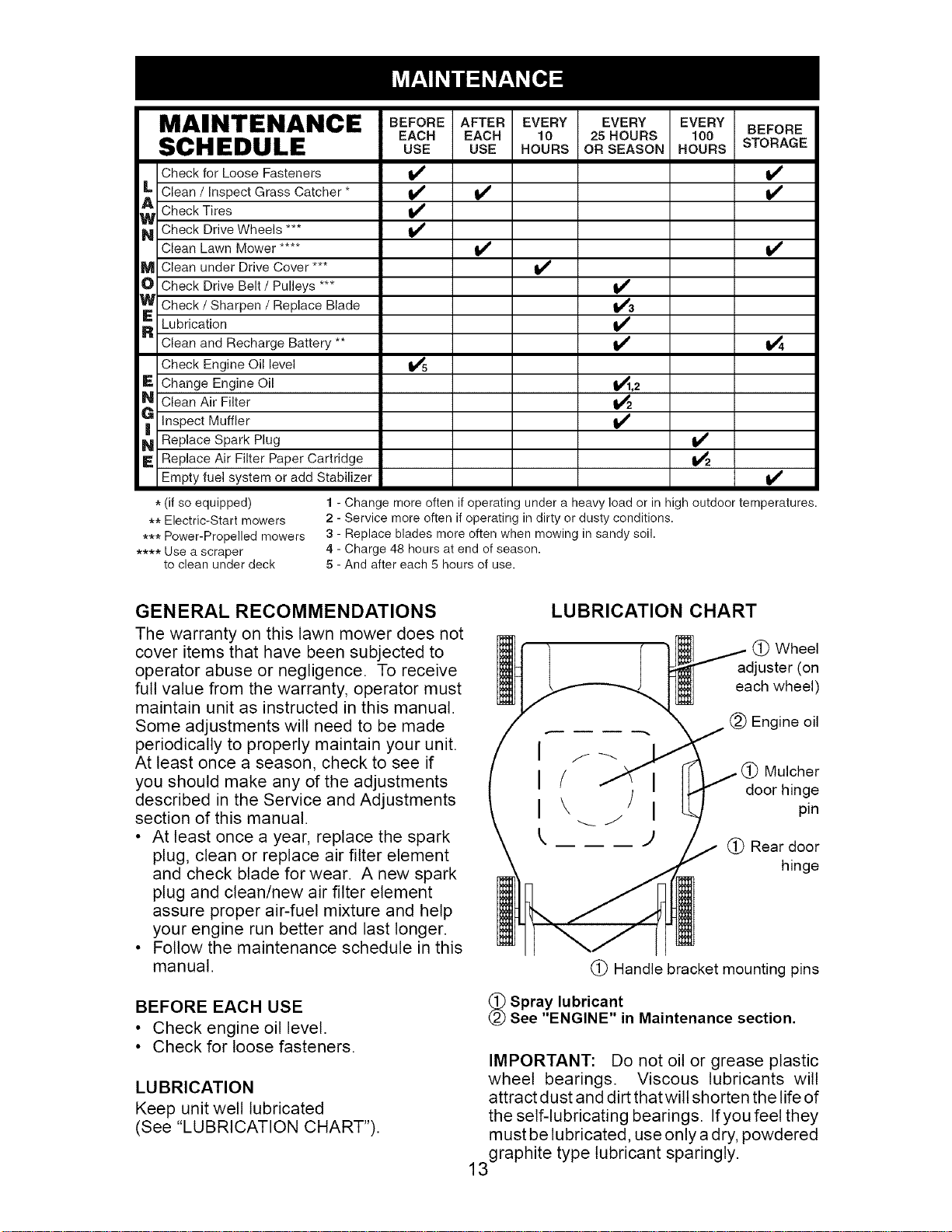
SCHEDULE
Check for Loose Fasteners
I Clean / Inspect Grass Catcher*
_ Check Tires
N Check Drive Wheels ***
Clean Lawn Mower ....
M Clean under Drive Cover ***
O Check Drive Belt / Pulleys ***
_ Check / Sharpen / Replace Blade
R Lubrication
Clean and Recharge Battery **
Check Engine Oil level
Change Engine Oil
N Clean Air Filter
_ Inspect Muffler
N Replace Spark Plug
Replace Air Filter Paper Cartridge
Empty fuel system or add Stabilizer
BEFORE AFTER EVERY EVERY EVERY
EACH EACH 10 25HOURS 100 BEFORE
USE USE HOURS OR SEASON HOURS STORAGE
vl
v' v'
v'
v'3
_,2
v'
v'
v'
* (if so equipped)
** Electric-Start mowers
*** Power-Propelled mowers
**** Use a scraper
to clean under deck
1 - Change more often if operating under a heavy load or in high outdoor temperatures.
2 - Service more often if operating in dirty or dusty conditions.
3 - Replace blades more often when mowing in sandy soil.
4 - Charge 48 hours at end of season.
5 - And after each 5 hours of use.
GENERAL RECOMMENDATIONS
The warranty on this lawn mower does not
cover items that have been subjected to
operator abuse or negligence. To receive
full value from the warranty, operator must
maintain unit as instructed in this manual.
Some adjustments will need to be made
periodically to properly maintain your unit.
At least once a season, check to see if
you should make any of the adjustments
described in the Service and Adjustments
section of this manual.
• At least once a year, replace the spark
plug, clean or replace air filter element
and check blade for wear. A new spark
plug and clean/new air filter element
assure proper air-fuel mixture and help
your engine run better and last longer.
• Follow the maintenance schedule in this
manual.
BEFORE EACH USE
• Check engine oil level.
• Check for loose fasteners.
LU BRICATION
Keep unit well lubricated
(See "LUBRICATION CHART").
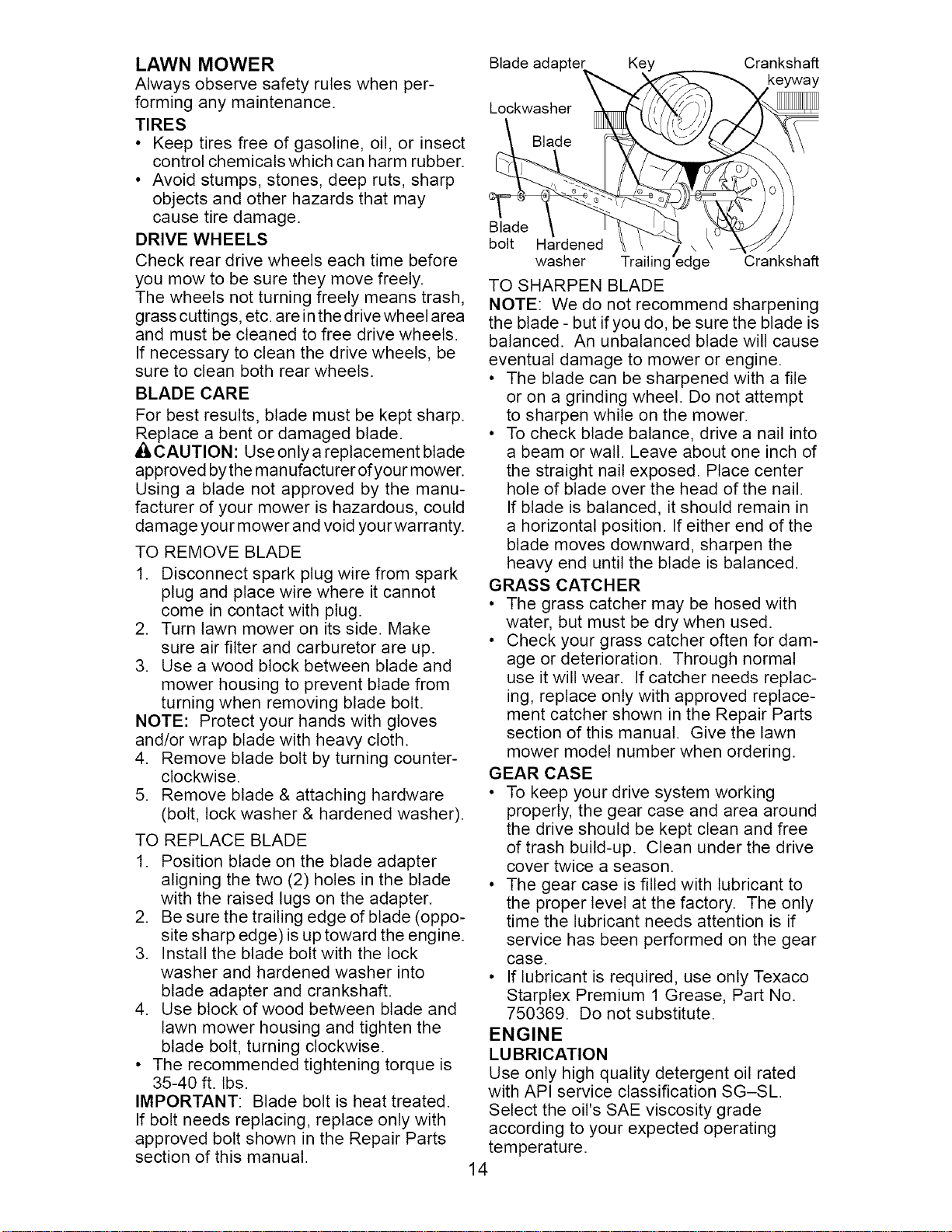
LUBRICATION CHART
Wheel
adjuster (on
each wheel)
(_) Engine oil
Mulcher
door hinge
pin
(_ Rear door
hinge
(_) Handle bracket mounting pins
_ Spray lubricant
See "ENGINE" in Maintenance section.
IMPORTANT: Do not oil or grease plastic
wheel bearings. Viscous lubricants will
attract dust and dirt that will shorten the life of
the self-lubricating bearings. If you feel they
must be lubricated, use only a dry, powdered
3graphite type lubricant sparingly.
1
LAWN MOWER
Alwaysobservesafetyruleswhenper-
forminganymaintenance.
TIRES
• Keeptiresfree of gasoline,oil, or insect
controlchemicalswhichcanharmrubber.
• Avoidstumps,stones,deepruts,sharp
objectsandother hazardsthat may
causetiredamage.
DRIVEWHEELS
Checkreardrivewheelseachtimebefore
you mowtobesuretheymovefreely.
Thewheelsnotturningfreelymeanstrash,
grasscuttings,etc.areinthedrivewheelarea
and mustbe cleanedtofreedrivewheels.
Ifnecessaryto cleanthedrivewheels,be
sureto cleanbothrearwheels.
BLADE CARE
Forbestresults,blademustbe keptsharp.
Replaceabentordamagedblade.
ACAUTION: Useonlyareplacementblade
approvedbythemanufacturerofyourmower.
Usinga bladenot approvedby the manu-
facturerofyourmowerishazardous,could
damageyourmowerandvoidyourwarranty.
TOREMOVEBLADE
1. Disconnectsparkplugwirefromspark
plugandplacewirewhereitcannot
come incontactwith plug.
2. Turnlawnmoweron itsside.Make
sure airfilterandcarburetorareup.
3. Useawoodblockbetweenbladeand
mowerhousingtopreventbladefrom
turningwhenremovingbladebolt.
NOTE: Protectyour handswithgloves
and/orwrapbladewith heavycloth.
4. Removeblade boltbyturningcounter-
clockwise.
5. Removeblade& attachinghardware
(bolt,lockwasher& hardenedwasher).
TOREPLACEBLADE
1. Positionbladeon thebladeadapter
aligningthetwo(2)holesinthe blade
withthe raisedlugsontheadapter.
2. Besurethetrailingedgeofblade(oppo-
sitesharpedge)isuptowardtheengine.
3. Installthebladeboltwith thelock
washerandhardenedwasherinto
bladeadapterandcrankshaft.
4. Useblockofwoodbetweenbladeand
lawnmowerhousingandtightenthe
blade bolt,turningclockwise.
• Therecommendedtighteningtorqueis
35-40ft. Ibs.
IMPORTANT:Bladeboltis heattreated.
Ifboltneedsreplacing,replaceonlywith
approvedboltshownintheRepairParts
sectionof thismanual.
Bladeadapter Key
Lockwasher'_ _
_ __d_(e
BIoltde H!rdee_ed ..
TO SHARPEN BLADE
Crankshaft
Crankshaft
NOTE: We do not recommend sharpening
the blade - but if you do, be sure the blade is
balanced. An unbalanced blade will cause
eventual damage to mower or engine.
• The blade can be sharpened with a file
or on a grinding wheel. Do not attempt
to sharpen while on the mower.
• To check blade balance, drive a nail into
a beam or wall. Leave about one inch of
the straight nail exposed. Place center
hole of blade over the head of the nail.
If blade is balanced, it should remain in
a horizontal position. If either end of the
blade moves downward, sharpen the
heavy end until the blade is balanced.
GRASS CATCHER
• The grass catcher may be hosed with
water, but must be dry when used.
• Check your grass catcher often for dam-
age or deterioration. Through normal
use it will wear. If catcher needs replac-
ing, replace only with approved replace-
ment catcher shown in the Repair Parts
section of this manual. Give the lawn
mower model number when ordering.
GEAR CASE
• To keep your drive system working
properly, the gear case and area around
the drive should be kept clean and free
of trash build-up. Clean under the drive
cover twice a season.
• The gear case is filled with lubricant to
the proper level at the factory. The only
time the lubricant needs attention is if
service has been performed on the gear
case.
• If lubricant is required, use only Texaco
Starplex Premium 1 Grease, Part No.
750369. Do not substitute.
ENGINE
LU BRICATION
Use only high quality detergent oil rated
with API service classification SG-SL.
Select the oil's SAE viscosity grade
according to your expected operating
temperature.
14
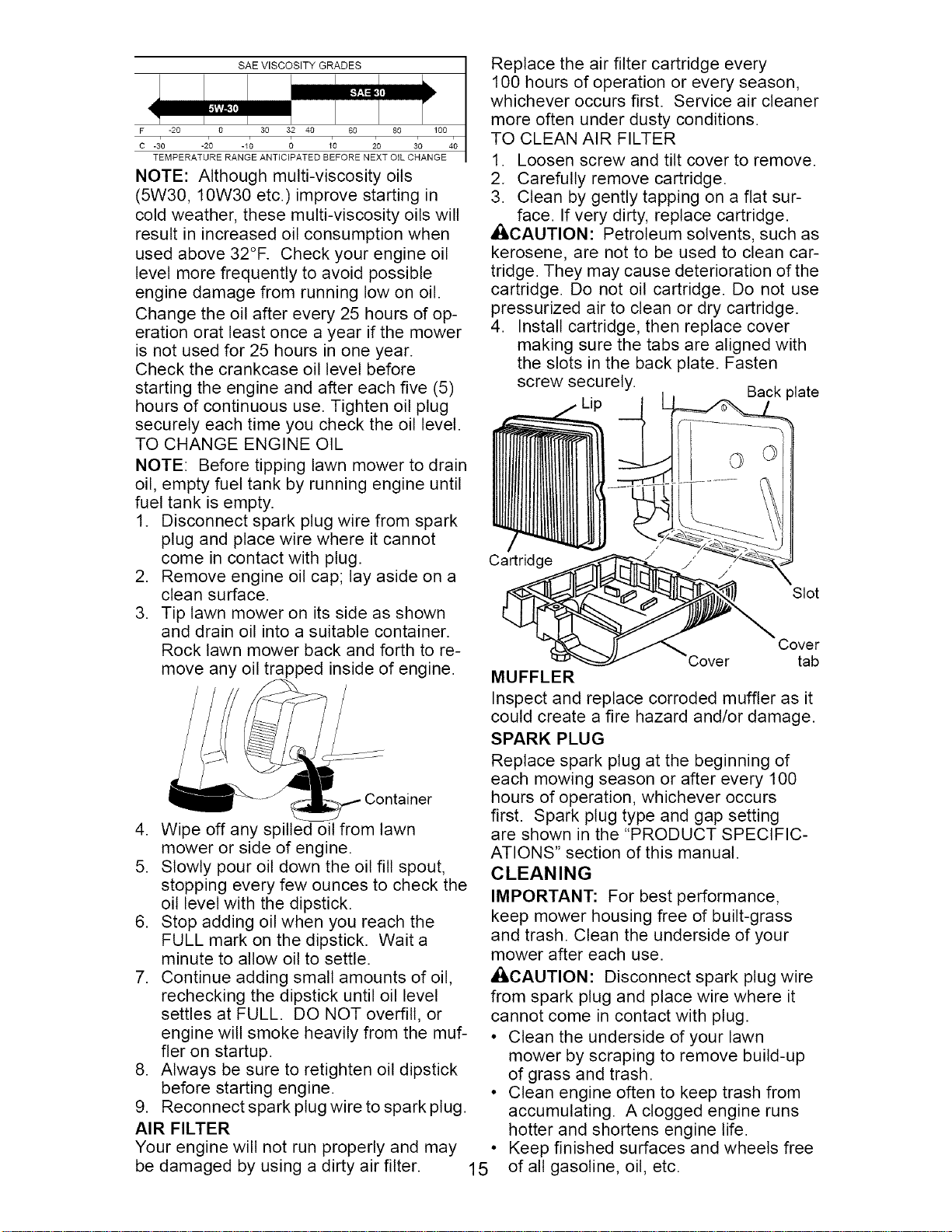
SAE VISCOSITY GRADES
F -20 0 30 32 40 60 80 100
TEMPERATURE RANGE ANTICIPATED BEFORE NEXT OIL CHANGE
NOTE: Although multi-viscosity oils
(5W30, 10W30 etc.)improve starting in
cold weather, these multi-viscosity oils will
result in increased oil consumption when
used above 32°F. Check your engine oil
level more frequently to avoid possible
engine damage from running low on oil.
Change the oil after every 25 hours of op-
eration orat least once a year if the mower
is not used for 25 hours in one year.
Check the crankcase oil level before
starting the engine and after each five (5)
hours of continuous use. Tighten oil plug
securely each time you check the oil level.
TO CHANGE ENGINE OIL
NOTE: Before tipping lawn mower to drain
oil, empty fuel tank by running engine until
fuel tank is empty.
1. Disconnect spark plug wire from spark
plug and place wire where it cannot
come in contact with plug.
2. Remove engine oil cap; lay aside on a
clean surface.
3. Tip lawn mower on its side as shown
and drain oil into a suitable container.
Rock lawn mower back and forth to re-
move any oil trapped inside of engine.
4. Wipe off any spilled oil from lawn
mower or side of engine.
5. Slowly pour oil down the oil fill spout,
stopping every few ounces to check the
oil level with the dipstick.
6. Stop adding oil when you reach the
FULL mark on the dipstick. Wait a
minute to allow oil to settle.
7. Continue adding small amounts of oil,
rechecking the dipstick until oil level
settles at FULL. DO NOT overfill, or
engine will smoke heavily from the muf-
fler on startup.
8. Always be sure to retighten oil dipstick
before starting engine.
9. Reconnect spark plug wire to spark plug.
AIR FILTER
Your engine will not run properly and may
be damaged by using a dirty air filter. 15
Replace the air filter cartridge every
100 hours of operation or every season,
whichever occurs first. Service air cleaner
more often under dusty conditions.
TO CLEAN AIR FILTER
1. Loosen screw and tilt cover to remove.
2. Carefully remove cartridge.
3. Clean by gently tapping on a flat sur-
face. If very dirty, replace cartridge.
_kCAUTION: Petroleum solvents, such as
kerosene, are not to be used to clean car-
tridge. They may cause deterioration of the
cartridge. Do not oil cartridge. Do not use
pressurized air to clean or dry cartridge.
4. Install cartridge, then replace cover
making sure the tabs are aligned with
the slots in the back plate. Fasten
screw securely. Back plate
Lip
/
Cartridge _ /
_ Slot
Cover
tab
MUFFLER
Inspect and replace corroded muffler as it
could create a fire hazard and/or damage.
SPARK PLUG
Replace spark plug at the beginning of
each mowing season or after every 100
hours of operation, whichever occurs
first. Spark plug type and gap setting
are shown in the "PRODUCT SPECIFIC-
ATIONS" section of this manual.
CLEANING
IMPORTANT: For best performance,
keep mower housing free of built-grass
and trash. Clean the underside of your
mower after each use.
_CAUTION: Disconnect spark plug wire
from spark plug and place wire where it
cannot come in contact with plug.
• Clean the underside of your lawn
mower by scraping to remove build-up
of grass and trash.
• Clean engine often to keep trash from
accumulating. A clogged engine runs
hotter and shortens engine life.
• Keep finished surfaces and wheels free
of all gasoline, oil, etc.
• Wedo notrecommendusinga garden
hoseto cleanlawnmowerunlessthe
electricalsystem,muffler,air filterand
carburetorare coveredto keepwater
out. Waterinenginecanresultinshort-
enedenginelife.
CLEANUNDERDRIVECOVER
Cleanunderdrivecoveratleasttwiceasea-
son. Scrapeundersideof coverwith putty
knifeorsimilartoolto removeany build-up
oftrashorgrassonundersideofdrivecover.
A WARNING: Toavoidseriousinjury,
beforeperforminganyserviceand
adjustments:
1. Releasecontrolbarandstopengine.
2. Makesurethebladeandall moving
partshavecompletelystopped.
3. Disconnectsparkplugwirefromspark
plugandplacewirewhereitcannot
come incontactwith plug.
LAWN MOWER
TO ADJUST CUTTING HEIGHT
See "TO ADJUST CUTTING HEIGHT" in
the Operation section of this manual.
REAR DEFLECTOR
The rear deflector, attached between the
rear wheels of your mower, is provided to
minimize the possibility that objects will
be thrown out of the rear of the mower
into the operator mowing position. If the
deflector becomes damaged, it should be
replaced.
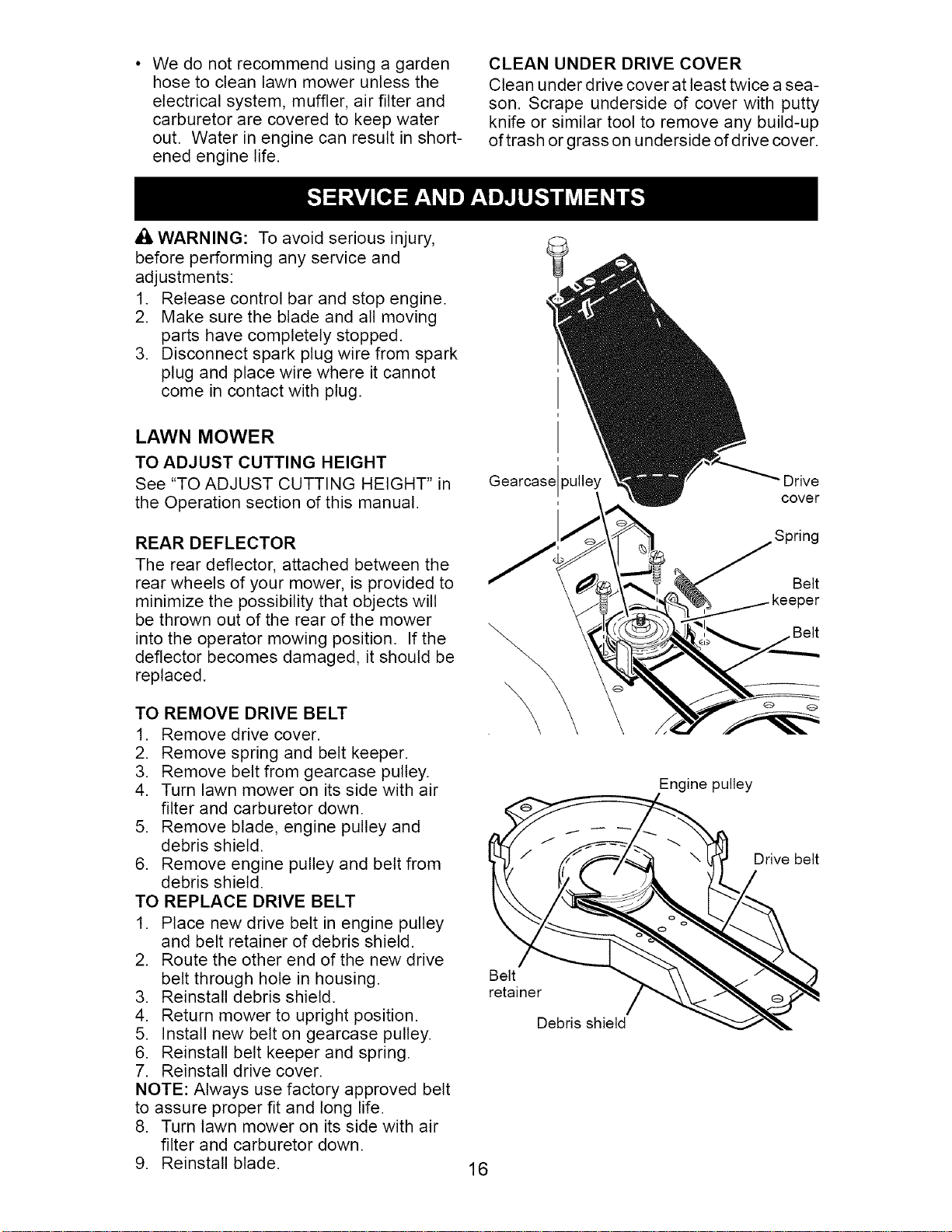
TO REMOVE DRIVE BELT
1. Remove drive cover.
2. Remove spring and belt keeper.
3. Remove belt from gearcase pulley.
4. Turn lawn mower on its side with air
filter and carburetor down.
5. Remove blade, engine pulley and
debris shield.
6. Remove engine pulley and belt from
debris shield.
TO REPLACE DRIVE BELT
1. Place new drive belt in engine pulley
and belt retainer of debris shield.
2. Route the other end of the new drive
belt through hole in housing.
3. Reinstall debris shield.
4. Return mower to upright position.
5. Install new belt on gearcase pulley.
6. Reinstall belt keeper and spring.
7. Reinstall drive cover.
NOTE: Always use factory approved belt
to assure proper fit and long life.
8. Turn lawn mower on its side with air
filter and carburetor down.
9. Reinstall blade.
Gearcase
\
Belt
retainer
16
pulley •Drive
cover
Debris shield
,Spring
Belt
Engine pulley
Drive belt
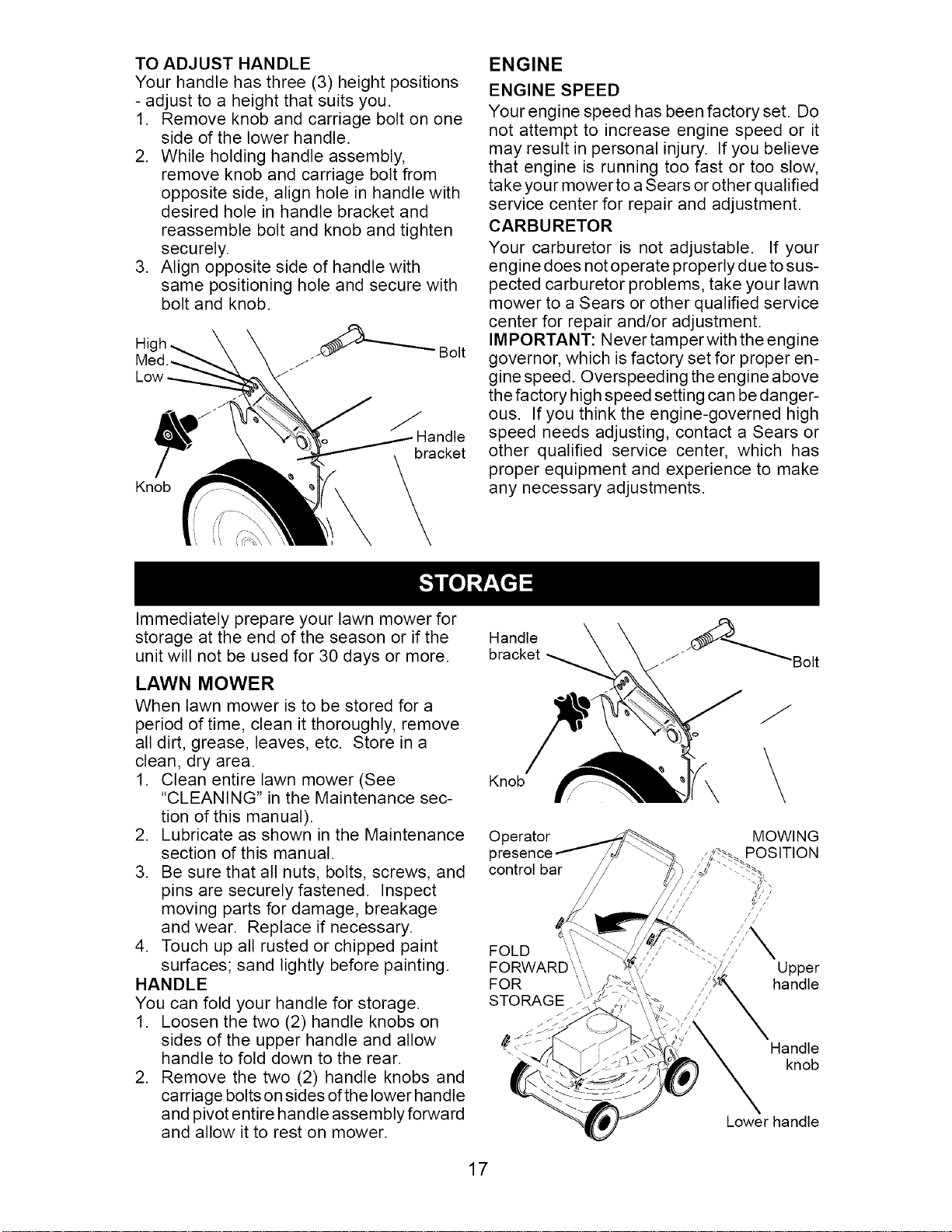
TO ADJUST HANDLE
Your handle has three (3) height positions
- adjust to a height that suits you.
1. Remove knob and carriage bolt on one
side of the lower handle.
2. While holding handle assembly,
remove knob and carriage bolt from
opposite side, align hole in handle with
desired hole in handle bracket and
reassemble bolt and knob and tighten
securely.
3. Align opposite side of handle with
same positioning hole and secure with
bolt and knob.
Knob
J
acket
Immediately prepare your lawn mower for
ENGINE
ENGINE SPEED
Your engine speed has been factory set. Do
not attempt to increase engine speed or it
may result in personal injury. If you believe
that engine is running too fast or too slow,
take your mower to a Sears or other qualified
service center for repair and adjustment.
CARBURETOR
Your carburetor is not adjustable. If your
engine does not operate properly due to sus-
pected carburetor problems, take your lawn
mower to a Sears or other qualified service
center for repair and/or adjustment.
IMPORTANT: Never tamperwith the engine
governor, which is factory set for proper en-
gine speed. Overspeeding the engine above
the factory high speed setting can be danger-
ous. If you think the engine-governed high
speed needs adjusting, contact a Sears or
other qualified service center, which has
proper equipment and experience to make
any necessary adjustments.
storage at the end of the season or if the Handle
unit will not be used for 30 days or more. bracket
LAWN MOWER
When lawn mower is to be stored for a
period of time, clean it thoroughly, remove
all dirt, grease, leaves, etc, Store in a
clean, dry area,
1, Clean entire lawn mower (See Knob
"CLEANING" in the Maintenance sec-
tion of this manual),
2, Lubricate as shown in the Maintenance
section of this manual,
3, Be sure that all nuts, bolts, screws, and
pins are securely fastened, Inspect
moving parts for damage, breakage
and wear, Replace if necessary,
4, Touch up all rusted or chipped paint
surfaces; sand lightly before painting,
HANDLE
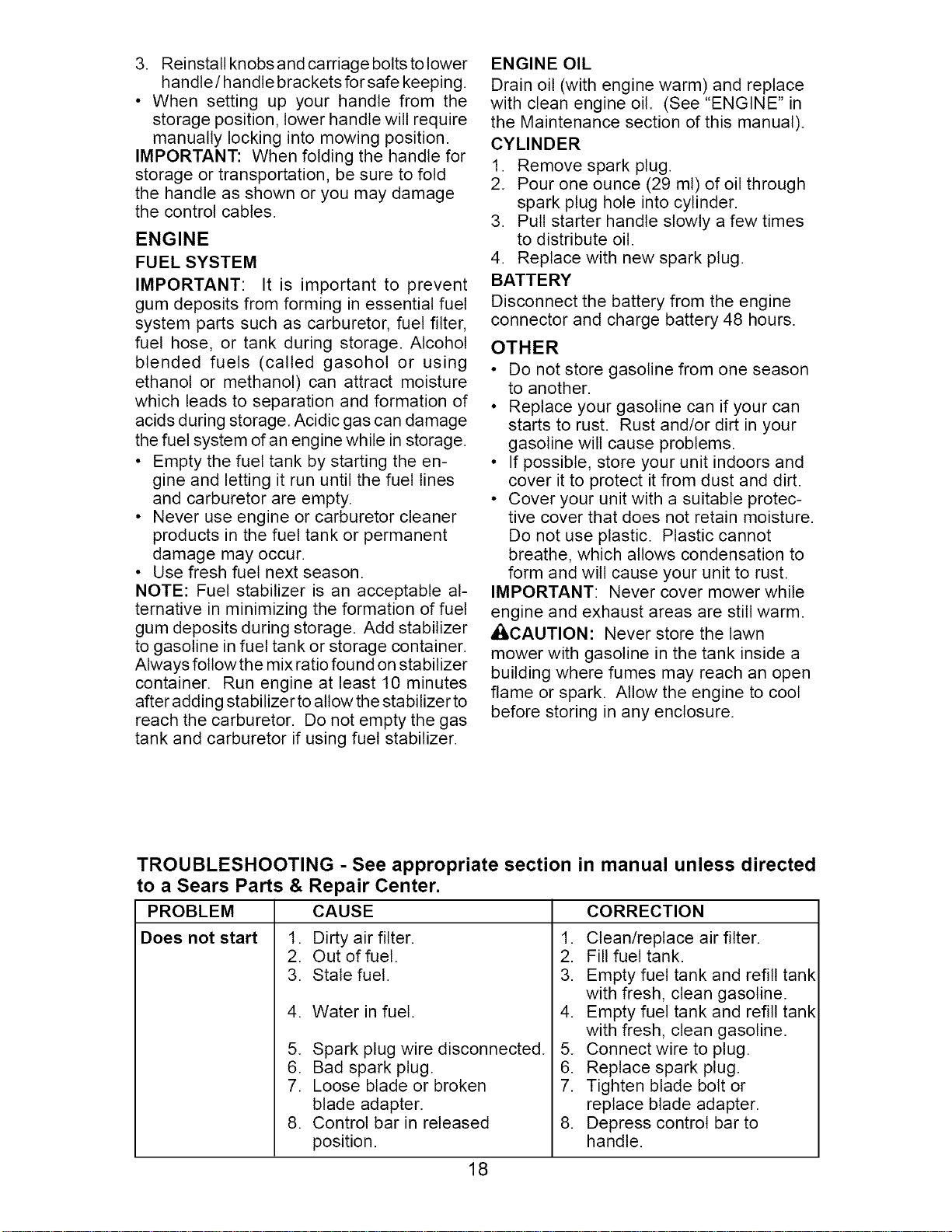
You can fold your handle for storage.
1. Loosen the two (2) handle knobs on
sides of the upper handle and allow # _: -
handle to fold down to the rear. " "
2. Remove the two (2) handle knobs and
carriage bolts on sides of the lower handle
and pivot entire handle assembly forward
and allow it to rest on mower.
Operator
presence
control bar
FOLD
FORWARD',,
FOR ",
STORAGE
\
MOWING
POSITION
////
Upper
handle
Handle
knob
Lower handle
17
3. Reinstall knobs and carriage bolts to lower
handle/handle brackets for safe keeping.
• When setting up your handle from the
storage position, lower handle will require
manually locking into mowing position.
IMPORTANT: When folding the handle for
storage or transportation, be sure to fold
the handle as shown or you may damage
the control cables.
ENGINE
FUEL SYSTEM
IMPORTANT: It is important to prevent
gum deposits from forming in essential fuel
system parts such as carburetor, fuel filter,
fuel hose, or tank during storage. Alcohol
blended fuels (called gasohol or using
ethanol or methanol) can attract moisture
which leads to separation and formation of
acids during storage. Acidic gas can damage
the fuel system of an engine while in storage.
• Empty the fuel tank by starting the en-
gine and letting it run until the fuel lines
and carburetor are empty.
• Never use engine or carburetor cleaner
products in the fuel tank or permanent
damage may occur.
• Use fresh fuel next season.
NOTE: Fuel stabilizer is an acceptable al-
ternative in minimizing the formation of fuel
gum deposits during storage. Add stabilizer
to gasoline in fuel tank or storage container.
Always followthe mix ratio found on stabilizer
container. Run engine at least 10 minutes
after adding stabilizer to allow the stabilizer to
reach the carburetor. Do not empty the gas
tank and carburetor if using fuel stabilizer.
ENGINE OIL
Drain oil (with engine warm) and replace
with clean engine oil. (See "ENGINE" in
the Maintenance section of this manual).
CYLINDER
1. Remove spark plug.
2. Pour one ounce (29 ml) of oil through
spark plug hole into cylinder.
3. Pull starter handle slowly a few times
to distribute oil.
4. Replace with new spark plug.
BATTERY
Disconnect the battery from the engine
connector and charge battery 48 hours.
OTHER
• Do not store gasoline from one season
to another.
• Replace your gasoline can if your can
starts to rust. Rust and/or dirt in your
gasoline wilt cause problems.
• If possible, store your unit indoors and
cover it to protect it from dust and dirt.
• Cover your unit with a suitable protec-
tive cover that does not retain moisture.
Do not use plastic. Plastic cannot
breathe, which allows condensation to
form and will cause your unit to rust.
IMPORTANT: Never cover mower while
engine and exhaust areas are still warm.
ACAUTION: Never store the lawn
mower with gasoline in the tank inside a
building where fumes may reach an open
flame or spark. Allow the engine to cool
before storing in any enclosure.
TROUBLESHOOTING - See appropriate section in manual unless directed
to a Sears Parts & Repair Center.
PROBLEM CAUSE
Does not start
1. Dirty air filter.
2. Out of fuel.
3. Stale fuel.
4. Water in fuel.
5. Spark plug wire disconnected.
6. Bad spark plug.
7. Loose blade or broken
blade adapter.
8. Control bar in released
position.
CORRECTION
1. Clean/replace air filter.
2. Fill fuel tank.
3. Empty fuel tank and refill tank
with fresh, clean gasoline.
4. Empty fuel tank and refill tank
with fresh, clean gasoline.
5. Connect wire to plug.
6. Replace spark plug.
7. Tighten blade bolt or
replace blade adapter.
8. Depress control bar to
handle.
18
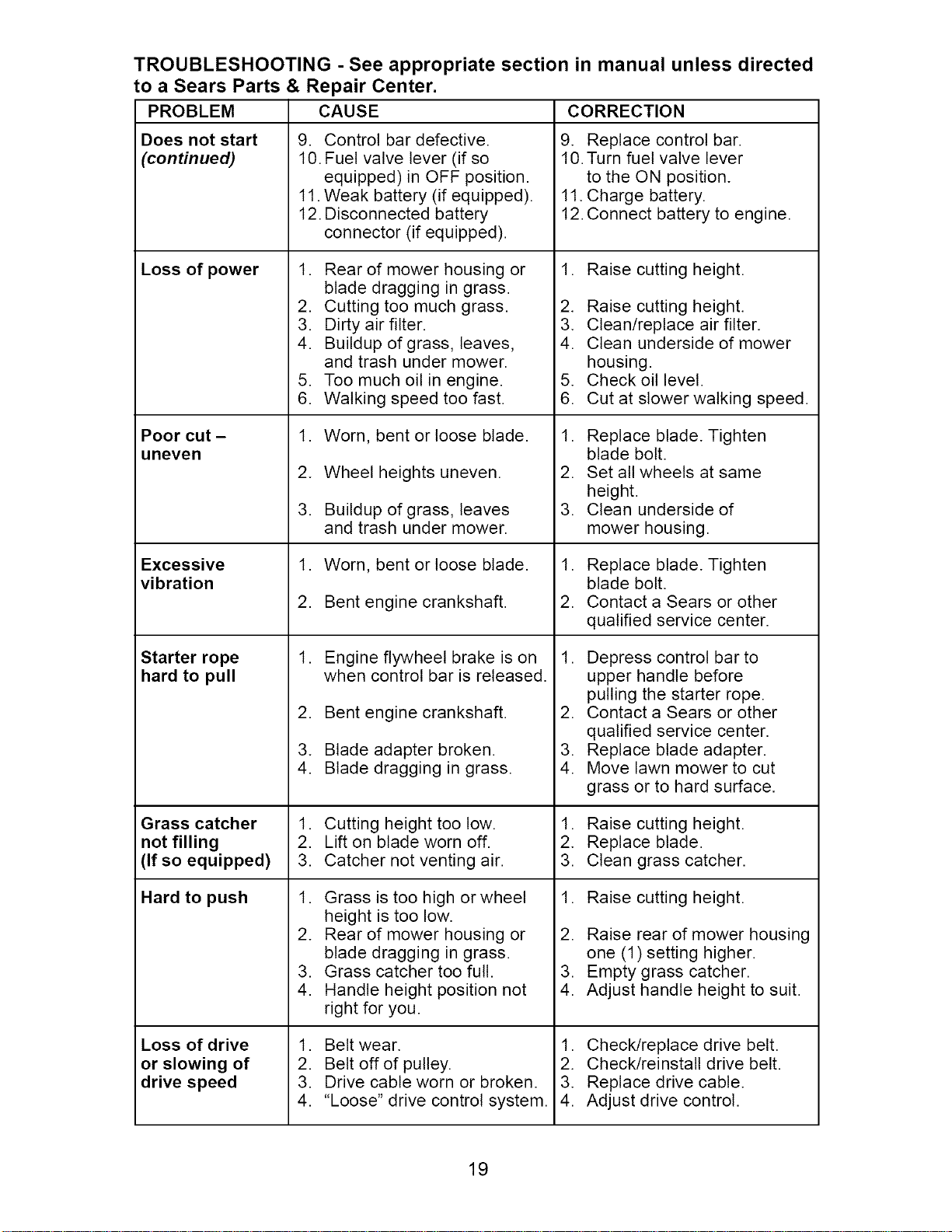
TROUBLESHOOTING - See appropriate section in manual unless directed
to a Sears Parts & Repair Center,
CAUSEPROBLEM
Does not start
(continued)
Loss of power
Poor cut -
uneven
Excessive
vibration
Starter rope
hard to pull
Grass catcher
not filling
(If so equipped)
Hard to push
Loss of drive
or slowing of
drive speed
9. Control bar defective.
10. Fuel valve lever (if so
equipped) in OFF position.
11. Weak battery (if equipped).
12. Disconnected battery
connector (if equipped).
1. Rear of mower housing or
blade dragging in grass.
2. Cutting too much grass.
3. Dirty air filter.
4. Buildup of grass, leaves,
and trash under mower.
5. Too much oil in engine.
6. Walking speed too fast.
1. Worn, bent or loose blade.
2. Wheel heights uneven.
3. Buildup of grass, leaves
and trash under mower.
1. Worn, bent or loose blade.
2. Bent engine crankshaft.
1. Engine flywheel brake is on
when control bar is released.
2. Bent engine crankshaft.
3. Blade adapter broken.
4. Blade dragging in grass.
1. Cutting height too low.
2. Lift on blade worn off.
3. Catcher not venting air.
1. Grass is too high or wheel
height is too low.
2. Rear of mower housing or
blade dragging in grass.
3. Grass catcher too full.
4. Handle height position not
right for you.
1. Belt wear.
2. Belt off of pulley.
3. Drive cable worn or broken.
4. "Loose" drive control system.
CORRECTION
9. Replace control bar.
10. Turn fuel valve lever
to the ON position.
11. Charge battery.
12. Connect battery to engine.
1. Raise cutting height.
2. Raise cutting height.
3. Clean/replace air filter.
4. Clean underside of mower
housing.
5. Check oil level.
6. Cut at slower walking speed.
1. Replace blade. Tighten
blade bolt.
2. Set all wheels at same
height.
3. Clean underside of
mower housing.
1. Replace blade. Tighten
blade bolt.
2. Contact a Sears or other
qualified service center.
1. Depress control bar to
upper handle before
pulling the starter rope.
2. Contact a Sears or other
qualified service center.
3. Replace blade adapter.
4. Move lawn mower to cut
grass or to hard surface.
1. Raise cutting height.
2. Replace blade.
3. Clean grass catcher.
1. Raise cutting height.
2. Raise rear of mower housing
one (1) setting higher.
3. Empty grass catcher.
4. Adjust handle height to suit.
1. Check/replace drive belt.
2. Check/reinstall drive belt.
3. Replace drive cable.
4. Adjust drive control.
19
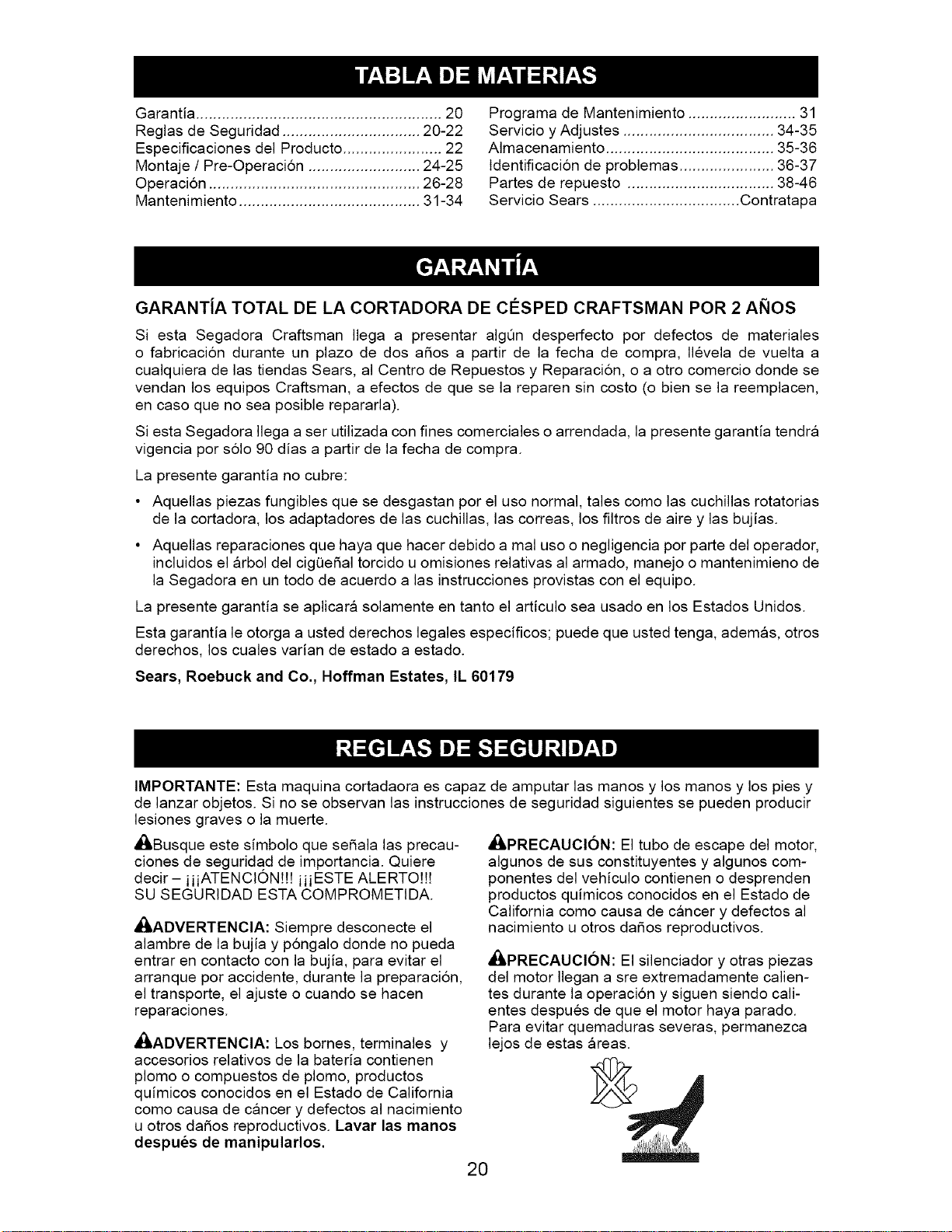
Garantia ......................................................... 20
Reglas de Seguridad ................................ 20-22
Especificaciones de] Producto ....................... 22
Montaje / Pre-Operacion .......................... 24-25
Operacion ................................................. 26-28
Mantenimiento .......................................... 31-34
Programa de Mantenimiento ......................... 31
Servicio y Adjustes ................................... 34-35
AImacenamiento ....................................... 35-36
Identificacion de problemas ...................... 36-37
Partes de repuesto .................................. 38-46
Servicio Sears .................................. Contratapa
GARANTiA TOTAL DE LA CORTADORA DE ClaSPED CRAFTSMAN POR 2 ANOS
Siesta Segadora Craftsman Ilega a presentar algQn desperfecto per defectos de materiales
o fabricacion durante un plazo de dos aSos a partir de la fecha de compra, Ilevela de vuelta a
cualquiera de las tiendas Sears, al Centre de Repuestos y Reparacion, o a otro comercio donde se
vendan los equipos Craftsman, a efectos de que se la reparen sin costo (o bien se la reemplacen,
en caso que no sea posible repararla).
Siesta Segadora Ilega a ser utilizada con fines comerciales o arrendada, la presente garantia tendra
vigencia per s61o 90 dias a partir de la fecha de compra.
La presente garantia no cubre:
• Aquellas piezas fungibles que se desgastan por el uso normal, tales como las cuchillas rotatorias
de la cortadora, los adaptadores de las cuchillas, las correas, los filtros de aire y las bujias.
• Aquellas reparaciones que haya que hacer debido a mal uso o negligencia por parte del operador,
incluidos el arbol del cigQeSal torcido u omisiones relativas al armado, manejo o mantenimieno de
la Segadora en un todo de acuerdo alas instrucciones provistas con el equipo.
La presente garantia se aplicara solamente en tanto el articulo sea usado en los Estados Unidos.
Esta garantia le otorga a usted derechos legales especificos; puede que usted tenga, ademas, otros
derechos, los cuales varian de estado a estado.
Sears, Roebuck and Co., Hoffman Estates, IL 60179
IMPORTANTE: Esta maquina cortadaora es capaz de amputar las manos y los manos y los pies y
de lanzar objetos. Si no se observan las instrucciones de seguridad siguientes se pueden producir
lesiones graves o la muerte.
_LBusque este simbolo que se5ala las precau-
clones de seguridad de importancia. Quiere
decir- iiiATENCION!!! iiiESTE ALERTO!!!
SU SEGURtDAD ESTA COMPROMETIDA.
_ADVERTENClA: Siempre desconecte el
alambre de la bujia y p6ngalo donde no pueda
entrar en contacto con la bujia, para evitar el
arranque por accidente, durante la preparacion,
el transporte, el ajuste o cuando se hacen
reparaciones.
AI_ADVERTENClA: Los bornes, terminales y
accesorios relatives de la bateria contienen
plomo o compuestos de plomo, productos
quimicos conocidos en el Estado de California
come causa de cancer y defectos al nacimiento
u otros da5os reproductivos. Lavar las manos
despues de manipularlos.
_LPRECAUCl6N" El tube de escape del motor,
algunos de sus constituyentes y algunos com-
ponentes del vehiculo contienen o desprenden
productos quimicos conocidos en el Estado de
California come causa de cancer y defectos al
nacimiento u otros da5os reproductivos.
_PRECAUCl6N: El silenciador y otras piezas
del motor Ilegan a sre extremadamente calien-
tes durante la operaci6n y siguen siendo cali-
entes despues de que el motor haya parade.
Para evitar quemaduras severas, permanezca
lejos de estas areas.
20
I. OPERACION
• Antes de empezar, debe familiarizarse
completamente con los controles y el uso
correcto de la maquina. Para esto, debe leer
y comprender todas las instrucciones que
aparecen en la maquina yen los manuales
de operacion.
• No ponga las manos o los pies cerca o
debajo de las partes rotatorias. Mantengase
siempre lejos de la abertura de la descarga.
• Permita que solamente las personas re-
sponsables que esten familiarizadas con las
instrucciones operen la maquina.
• Despeje el area de objetos tales como pie-
dras, juguetes, alambres, huesos, palos, etc.
que pueden ser recogidos y lanzados por las
cuchillas.
• AsegQrese que el area no se hallen per-
sonas, antes de segar. Pare la maquina si
alguien entra en el area.
• No opere la maquina sin zapatos o con
sandalias abiertas. P6ngase siempre zapatos
solidos.
• No tire de la segadora hacia atras a menos
que sea absolutamente necesario. Mire
siempre hacia abajo y hacia detras antes y
mientras que se mueve hacia atras.
• Nunca dirigir el material descargado hacia
las personas. Evitar descargar material
contra paredes o barreras. El material puede
retornar al operador. Para la cuchilla cuando
se pasa por superficies de grava.
• No opere la segadora sin los respectivos
resguardos, las placas, el recogedor de
cesped u otros aditamentos dise ados para
su proteccion y seguridad.
• Refi@ase alas instrucciones del fabricante
para el funcionamiento e instalacion de
accesorios. Use Qnicamente accesorios
aprobados por el fabricante.
• Detenga la cuchilla o las cuchillas cuando
cruce por calzadas, calles o caminos de
grava.
• Parar el motor cada vez que se abandona el
aparato, antes de limpiar la segadora o de
remover residuos del tubo.
• Apagar el motor y esperar hasta que las
cuchillas esten completamente paradas
antes de remover el receptor de hierba.
• Segar solamente con luz del dia o con una
buena luz artificial.
• No opere la maquina bajo la influencia del
alcohol o de las drogas.
• Nunca opere la maquina cuando la hierba
este mojada. AsegQrese siempre de tener
buena tracci6n en sus pies; mantenga el
mango firmemente y camine; nunca corra.
• Desconectar el mecanismo de propulsion
aut6noma o el embrague de transmision en
las segadoras que Io tienen antes de poner
en marcha el motor.
• Si el equipo empezara a vibrar de una
manera anormal, pare el motor y revise de
inmediato para averiguar la causa. General-
mente la vibracion suele indicar que existe
alguna averia.
• Siempre use gafas de seguridad o anteojos
con protecci6n lateral cuando opere la sega-
dora.
II. OPERACION SOBRE LAS CUESTAS
Los accidentes ocurren con mas frecuencia en
las cuestas. Estos accidentes ocurren debido a
resbaladas o caidas, las cuales pueden resultar
en graves lesiones. Operar la recortadora en
cuestas requiere mayor concentraci6n. Si se
siente inseguro en una cuesta, no la recorte.
HACER:
• Puede recortar a traves de la superficie de
la cuesta, nunca hacia arriba y hacia abajo.
Proceda con extrema precaucion cuando
cambie de direcci6n en las cuestas.
• Renueva todos los objetos extra5os, tales
como guijarros, ramas, etc.
• Debe prestar atencion a hoyos, baches o
protuberancias. Recuerde que la hierba alta
puede esconder obstaculos.
NO HACER:
• No recorte cerca de pendientes, zanjas o
terraplenes. El operador puede perder la
traccion en los pies o el equilibrio.
• No recorte cuestas demasiado inclinadas.
• No recorte en hierba mojada. La reduccion
en la traccion de la pisada puede causar
resbalones.
III. NINOS
Se pueden producir accidentes tragicos si el
operador no presta atenci6n a la presencia
de los ni5os. A menudo, los ni5os se sienten
atraidos por la maquina y por la actividad de
la siega. Nunca suponga que los niSos van a
permanecer en el mismo lugar donde los vio
por Qltima vez.
• Mantenga a los ni5os alejados del area de
la siega y bajo el cuidado estricto de otra
persona adulta responsable.
• Este alerta y apague la maquina si hay niSos
que entran al area.
• Antes y cuando este retrocediendo, mire
hacia atras y hacia abajo para verificar si hay
niSos peque5os.
• Nunca permita que los ni5os operen la ma-
quina.
• Tenga un cuidado extra cuando se acerque
a esquinas donde no hay visibilidad, a los
arbustos, _lrboles u otros objetos que pueden
interferir con su linea de vision.
IV. MANEJO SEGURO DE GASOLINA
Usar mucha atenci6n cuando se maneja gaso-
lina. La gasolina es extremamente inflamable y
los vapores son explosivos.
• Apagar todos los cigarrillos, cigarros, pipas y
otras fuentes de ignicion.
• Usar solo un contenedor apropiado.
• Nunca quitar el tap6n de la gasolina o a_adir
carburante con el motor en marcha. Esperar
que el motor se enfrie antes de repostar la
gasolina.
21
• Nunca repostar la maquina al interior de un
local.
• Nunca guardar la maquina o el contenedor
de gasolina donde hay una llama abierta,
chispa o luz piloto como una caldera u otros
dispositivos.
• Nunca Ilenar contenedores en un vehiculo,
en un cami6n o caravana con un forro de
plastico. Colocar siempre los contenedores
en el suelo lejos de su vehiculo antes de
Ilenar.
• Quitar equipos que funcionan con gasolina
del camion o caravana y repostar en el suelo.
Si esto no es posible, repostar dicho equipo
con un contenedor portatil, mas bien que con
una tobera de gasolina.
• Mantener la tobera en contacto con el bordo
del deposito de carburante o de la apertura
del contenedor siempre hasta terminar el
abastecimiento. No usar un dispositivo de
cierre-apertura de la tobera.
• Si el carburante cae en la ropa que se Ileva,
cambiarsela inmediatamente.
• Nunca Ilenar en exceso el dep6sito de
carburante. Colocar el tap6n de la gasolina y
apretar de modo seguro.
V. SERVICIO
• Nunca haga funcionar una maquina dentro
de un area cerrada.
• Nunca haga ajustes o reparaciones mientras
el motor este en marcha. Desconecte el
cable de la bujia, y mantengalo a cierta
distancia de esta para prevenir un arranque
accidental.
• Mantenga las tuercas y los pernos, espe-
cialmente los pernos del accesorio de la
cuchilla, apretados y mantenga el equipo en
buenas condiciones.
• Nunca manipule de forma indebida los
dispositivos de seguridad. Controle regular-
mente su funcionamiento correcto.
• Mantenga la maquina libre de hierba, hojas
u otras acumulaciones de desperdicio.
Limpie los derrames de aceite o combustible.
Permita que la maquina se enfrie antes de
almacenarla.
• Pare e inspeccione el equipo si le pega a un
objeto. Reparelo, si es necesario, antes de
hacerlo arrancar.
• En ningQn caso hay que regular la altura de
las ruedas mientras el motor esta en marcha.
• Los componentes del receptor de la hierba
van sujetos a desgaste, daSos y deterioro,
que pueden exponer las partes en mov-
imiento o permitir que objetos sean dispara-
dos. Controlar frecuentemente y cuando sea
necesario sustituir con partes aconsejadas
por el fabricante.
• Las cuchillas de la segadora estan afiladas
y pueden cortar. Cubrir las hojas o Ilevar
guantes, y utilizar precauciones especiales
cuando se efectQa mantenimiento sobre las
mismas.
• No cambie el ajuste del regulador del motor
ni exceda su velocidad.
• Mantener o sustituir las etiquetas de
seguridad e instrucciones, cuando sea
necesario.
_ADVERTENCIA: Este segadora viene equipado con un motor de combustion interna y no se
debe usar sobre, o cerca, de un terreno no desarrollado cubierto de bosques, de arbustos o de
cesped, o menos que el sistema de escape del motor venga equipado con un amortiguador de
chispas que cumpla con las leyes locales o estatales (si existen). Si se usa un amortiguador de
chispas, el operador debe mantenerlo en condiciones de trabajo eficientes.
En el estado de California, la ley exige Io anterior (Seccion 4442 del "California Public Re-
sources Code"). Otros estados pueden contar con otras leyes parecidas. Las leyes federales
se aplican en la tierras federales. Su centro de Servicio mas cercano tiene disponible amor-
tiguadores de chispas para el silenciador (Vea la seccion de PARTES DE REPUESTO en el
manual Ingles del dueSo).
Numero de Serie:
Fecha de Compra:
Capacidad y Tipo de Gasolina: 1.6 Cuartos (Regular sin Plomo)
Tipo de Aceite (API SG-SL): SAE 30 (Sobre 32°F); SAE 5W-30 (Debajo 32°F)
Capacidad de Aceite: 20 Onzas
Bujia (Abertura: .030") Champion RJ19HX
Torsi6n del Perno de la Cuchilla: 35-40 ft. Ibs.
El nOmero del nodelo y el de serie se encuentran en la calcomania adjunta a la parte trasera
de la caja de la segadora. Debe registrar tanto el nOmero de serie come la fecha de compra y
mantengalos en un lugar seguro para refencia en el futuro.
22
Acuerdos de Protecci6n para la Reparaci6n
Congratulaciones por su buena compra. Su
nuevo producto Craftsman@ esta diseSado
y fabricado para funcionar de modo fiable por
muchos aSos. Pero como todos los productos,
puede necesitar alguna reparaci6n de tanto
en tanto. En este caso tener un Acuerdo de
Proteccion para la Reparacion puede hacerles
ahorrar dinero y fastidios.
Compre ahora un Acuerdo de Protecci6n para
la Reparaci6n y protegese de molestias y gas-
tos inesperados.
Un Acuerdo incluye los puntos siguientes:
• Servicio experto de nuestros 12.000 espe-
cialistas profesionales en la reparaci6n.
• Servicio ilimitado sin cargo alguno para
las partes y la mano de obra sobre todas las
reparaciones garantizadas.
• Sustitucion del producto si su producto
garantizado no puede ser arreglado.
• Descuento del 10% sobre el precio cor-
riente del servicio y de las partes relativas al
servicio no cubiertas por el acuerdo; tambien
el 10% menos sobre el precio corriente de
un control de mantenimiento preventivo.
• Ayuda r&pida por telefono - soporte tele-
fonico por parte de un representante Sears
sobre productos que requieren un arreglo en
casa, y ademas una programacion sobre los
a reglos mas convenientes.
Cuando se ha comprado el Acuerdo, basta con
una Ilamada telefonica para programar el servi-
cio. Puede Ilamar cuando quiera, dia y noche o
fijar en linea una cita para obtener el servicio.
Sears tiene mas de 12.000 especialistas
profesionales en la reparacion, que tienen
acceso a mas de 4.5 millones de partes y
accesorios de calidad. Este es el tipo de
profesionalidad con que puede contar para
ayudar a alargar la vida del producto que acaba
de comprar, por muchos a5os. iCompre hoy su
Acuerdo de Protecci6n para la Reparaci6n!
Se aplican algunas limitaciones y exclu-
siones. Para conocer los precios y tener
m&s informacion, Ilame al 1-800-827-6655.
Servicio de Instalacion Sears
Para la instalaci6n profesional Sears de
aparatos de casa, puertas de garaje,
calentadores de agua y otros importantes
articulos para la casa, en U.S.A. Ilamar a
1-800-4-MY-HOME®.
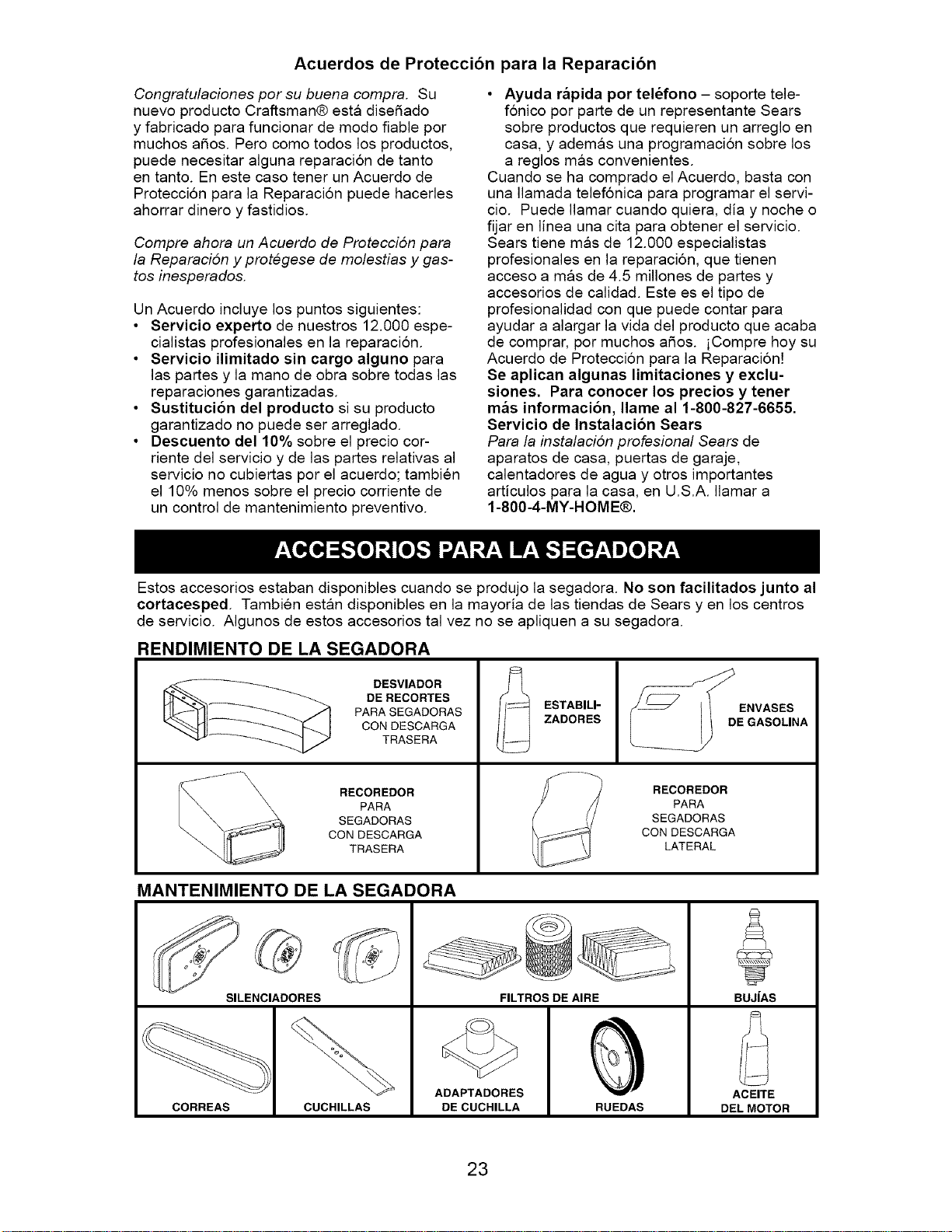
Estos accesorios estaban disponibles cuando se produjo la segadora. No son facilitados junto al
cortacesped Tambien estan disponibles en la mayoria de las tiendas de Sears yen los centros
de servicio. AIgunos de estos accesorios tal vez no se apliquen a su segadora.
RENDIMIENTO DE LA SEGADORA
DESVIADOR
DE RECORTES
PARASEGADORAS
CON DESCARGA
TRASERA
RECOREDOR
PARA
SEGADORAS
CON DESCARGA
TRASERA
ESTABILI-
ZADORES
_ENVASES
DE GASOLINA
RECOREDOR
PARA
SEGADORAS
CON DESCARGA
LATERAL
MANTENIMIENTO DE LA SEGADORA
SILENCIADORES
CORREAS CUCHILLAS
FILTROS DE AIRE
ADAPTADORES
DE CUCHILLA RUEDAS
BUJ|AS
ACEITE
DEL MOTOR
23
Lea estas instrucciones y el manual comple-
tamente antes de tratar de montar u operar su
segadora nueva.
IMPORTANTE: Este cortacesped viene SIN
ACEITE O GASOLtNA en el motor.
Su segadora nueva ha sido montada en la
fabrica con la excepcion de aquellas partes que
se dejaron sin montar por razones de envio.
Todas las partes como las tuercas, las arande-
las, los pemos, etc., que son necesarias para
completar el montaje han sido colocadas en la
bolsa de partes. Para asegurarse que su sega-
dora funcione en forma segura y adecuada,
todas las partes y los articulos de ferreteria que
se monten tienen que ser apretados segura-
mente. Use las herramientas correctas, como
sea necesario, para asegurar que se aprieten
adecuadamente.
Barra de
que sxige la
presencia del
operador
LEVANTAR'
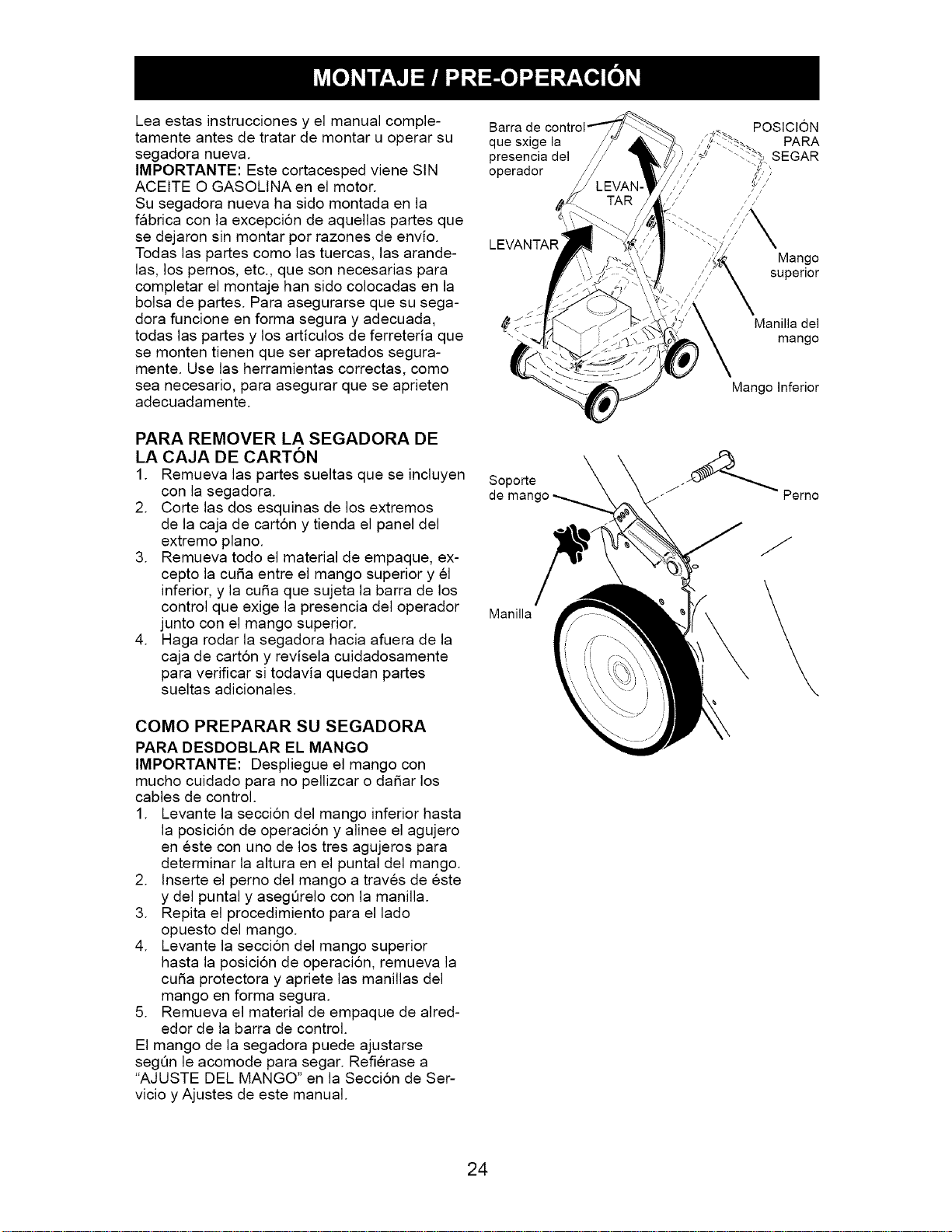
PARA REMOVER LA SEGADORA DE
LA CAJA DE CARTON
1. Remueva las partes sueltas que se incluyen Soporte
con la segadora, de mango
2. Corte las dos esquinas de los extremos
de la caja de cart6n y tienda el panel del
extremo piano.
3. Remueva todo el material de empaque, ex-
cepto la curia entre el mango superior y el
inferior, y la curia que sujeta la barra de los
control que exige la presencia del operador Manilla
junto con el mango superior.
4. Haga rodar la segadora hacia afuera de la
caja de cart6n y revisela cuidadosamente
para verificar si todavia quedan partes
sueltas adicionales.
COMO PREPARAR SU SEGADORA
PARA DESDOBLAR EL MANGO
IMPORTANTE: Despliegue el mango con
mucho cuidado para no pellizcar o dadar los
cables de control.
1. Levante la seccion del mango inferior hasta
la posicion de operacion y alinee el agujero
en este con uno de los tres agujeros para
determinar la altura en el puntal del mango.
2. Inserte el perno del mango a traves de este
y del puntal y asegQrelo con la manilla.
3. Repita el procedimiento para el lado
opuesto del mango.
4. Levante la seccion del mango superior
hasta la posicion de operacion, remueva la
curia protectora y apriete las manillas del
mango en forma segura.
5. Remueva el material de empaque de alred-
edor de la barra de control.
El mango de la segadora puede ajustarse
segQn le acomode para segar. Refierase a
"AJUSTE DEL MANGO" en la Seccion de Ser-
vicio y Ajustes de este manual.
POSICION
PARA
_-_,SEGAR
/ /
/ /
/ /
Mango
superior
Manilla del
mango
Mango Inferior
Perno
J
24
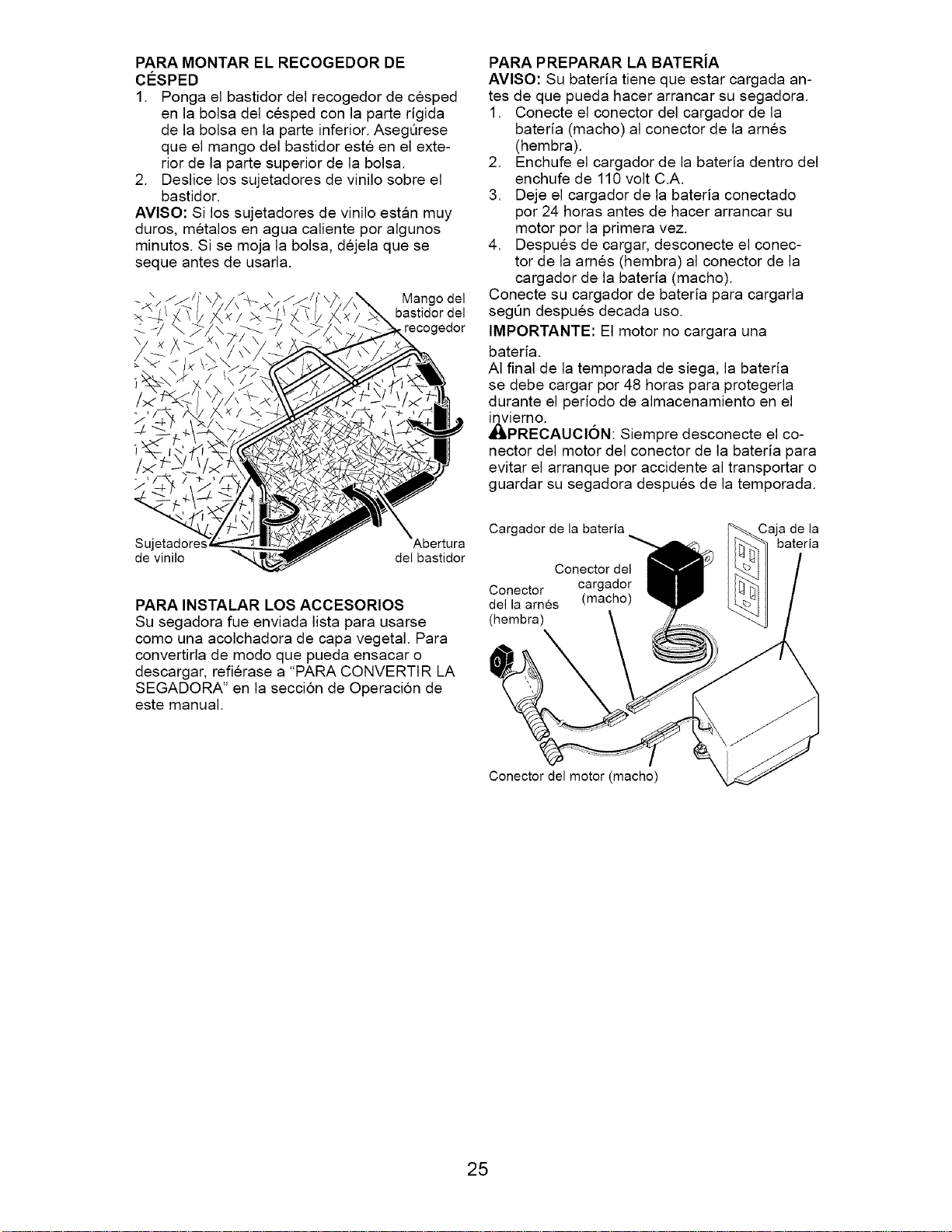
PARA MONTAR EL RECOGEDOR DE
CO:SPED
1. Ponga el bastidor del recogedor de cesped
en la bolsa del cesped con la parte rigida
de la bolsa en la parte inferior. Aseg_rese
que el mango del bastidor este en el exte-
rior de la parte superior de la bolsa.
2. Deslice los sujetadores de vinilo sobre el
bastidor.
AVlSO: Si los sujetadores de vinilo estgln muy
duros, metalos en agua caliente por algunos
minutos. Si se moja la bolsa, dejela que se
seque antes de usarla.
Mango del
bastidor del
recogedor
PARA PREPARAR LA BATERJA
AVISO: Su bateria tiene que estar cargada an-
tes de que pueda hacer arrancar su segadora.
1. Conecte el conector del cargador de la
bateria (macho) al conector de la arnes
(hembra).
2. Enchufe el cargador de la bateria dentro del
enchufe de 110 volt C.A.
3. Deje el cargador de la bateria conectado
por 24 horas antes de hacer arrancar su
motor por la primera vez.
4. Despues de cargar, desconecte el conec-
tor de la arnes (hembra) al conector de la
cargador de la bateria (macho).
Conecte su cargador de bateria para cargarla
segen despues decada uso.
IMPORTANTE: El motor no cargara una
bateria.
AI final de la temporada de siega, la bateria
se debe cargar por 48 horas para protegerla
durante el periodo de almacenamiento en el
invierno.
_IPRECAUCl6N: Siempre desconecte el co-
nector del motor del conector de la bateria para
evitar el arranque por accidente al transportar o
guardar su segadora despues de la temporada.
Sujetador_ Abertura
de vinilo del bastidor
PARA INSTALAR LOS ACCESORIOS
Su segadora fue enviada lista para usarse
como una acolchadora de capa vegetal. Para
convertirla de modo que pueda ensacar o
descargar, refierase a "PARA CONVERTIR LA
SEGADORA" en la seccion de Operacion de
este manual.
Cargador de la bateria
Conector del
Conector cargador
della arn6s (macho)
(hembra)
Conector del motor (macho)
Caja de la
bateria
25
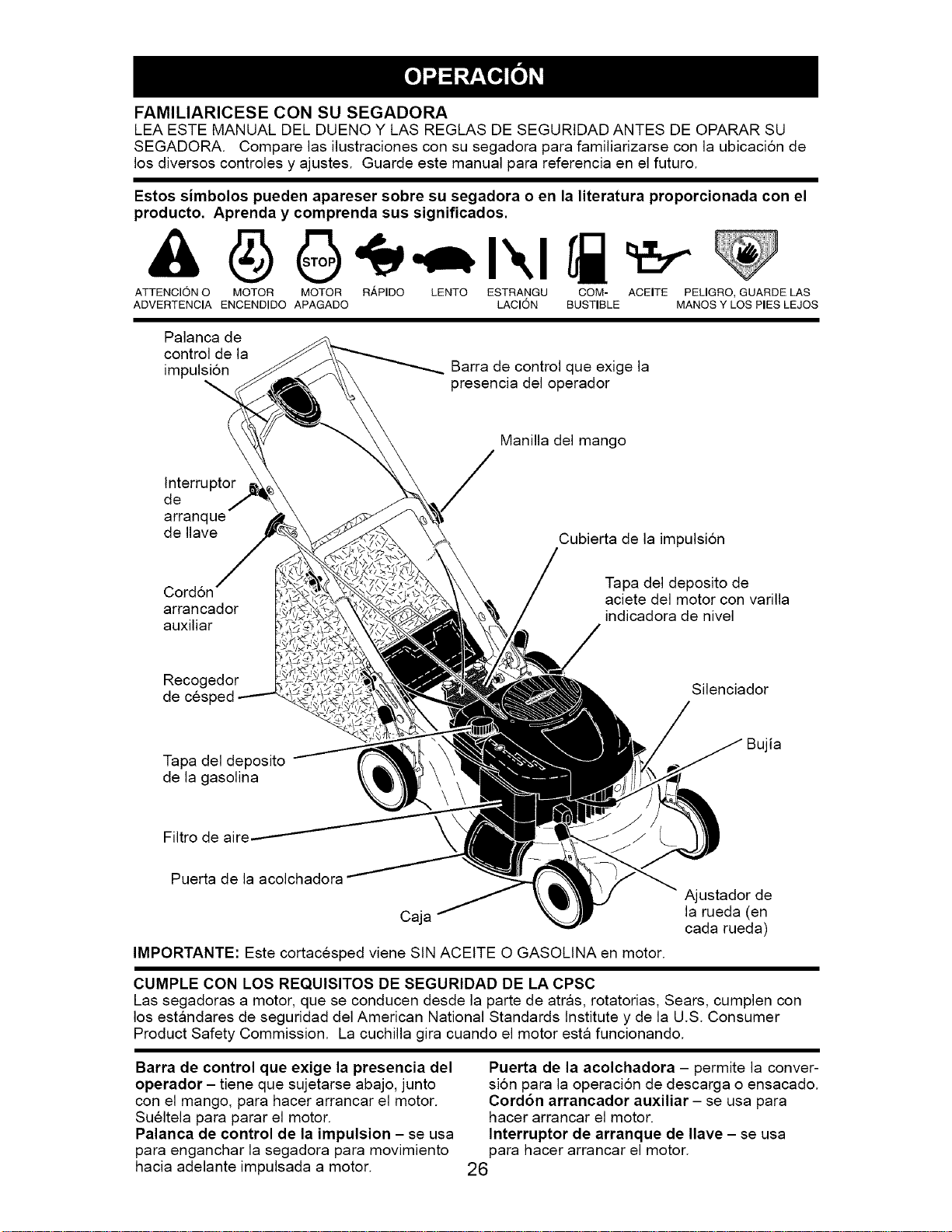
FAMILIARICESE CON SU SEGADORA
LEA ESTE MANUAL DEL DUENO Y LAS REGLAS DE SEGURtDAD ANTES DE OPARAR SU
SEGADORA. Compare las ilustraciones con su segadora para familiarizarse con la ubicacion de
los diversos controles y ajustes. Guarde este manual para referencia en el futuro.
Estos simbolos pueden apareser sobre su segadora o en la literatura proporcionada con el
producto. Aprenda y comprenda sus significados.
ATTENCION O MOTOR MOTOR R_,PIDO LENTO ESTRANGU COM- ACEITE PELIGRO, GUARDE LAS
ADVERTENCIA ENCENDIDO APAGADO LACION BUSTIBLE MANOS Y LOS PIES LEJOS
Palanca de
control de la
impulsi6n
Barra de control que exige la
presencia del operador
Manilla del mango
Interruptor
de
arranque
de Ilave
Cubierta de la impulsion
Cord6n
arrancador
auxiliar
Tapa del deposito de
aciete del motor con varilla
indicadora de nivel
Recogedor
de ces
Tapa del deposito
de la gasolina
Filtro de aire
Silenciador
Bujia
Puerta de la acolchadora
Caja
IMPORTANTE: Este cortacesped viene SIN ACEITE O GASOLINA en motor.
Ajustador de
la rueda (en
cada rueda)
CUMPLE CON LOS REQUISITOS DE SEGURIDAD DE LA CPSC
Las segadoras a motor, que se conducen desde la parte de atras, rotatorias, Sears, cumplen con
los estandares de seguridad del American National Standards Institute y de la U.S. Consumer
Product Safety Commission. La cuchilla gira cuando el motor esta funcionando.
Barra de control que exige la presencia del
operador - tiene que sujetarse abajo, junto
con el mango, para hacer arrancar el motor.
Sueltela para parar el motor.
Palanca de control de la impulsion - se usa
para enganchar la segadora para movimiento
hacia adelante impulsada a motor.
Puerta de la acolchadora - permite la conver-
si6n para la operacion de descarga o ensacado.
Cord6n arrancador auxiliar- se usa para
hacer arrancar el motor.
Interruptor de arranque de Ilave - se usa
para hacer arrancar el motor.
26
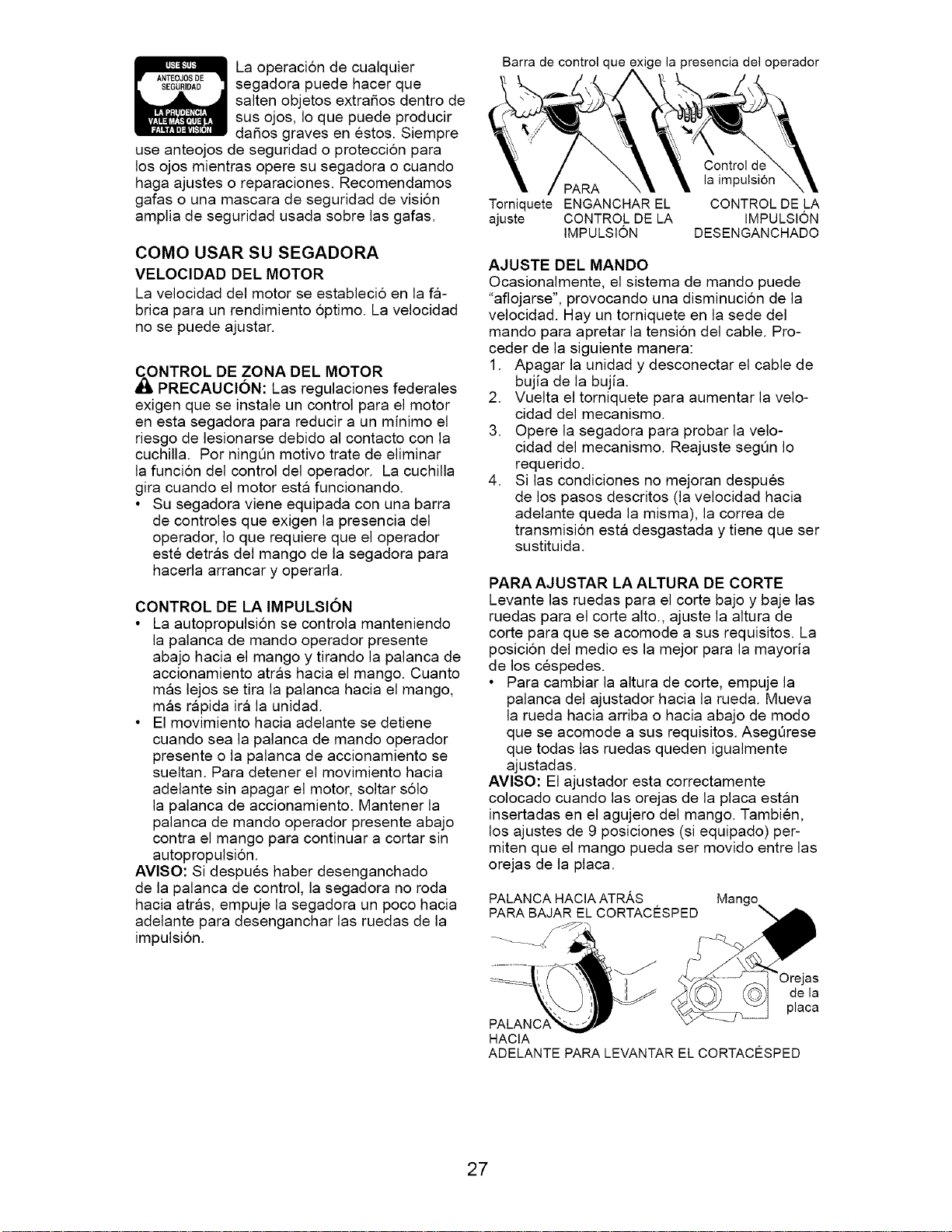
La operacion de cualquier
segadora puede hacer que
salten objetos extrafios dentro de
sus ojos, Io que puede producir
dafios graves en estos. Siempre
use anteojos de seguridad o proteccion para
los ojos mientras opere su segadora o cuando
haga ajustes o reparaciones. Recomendamos
gafas o una mascara de seguridad de visi6n
amplia de seguridad usada sobre las gafas.
COMO USAR SU SEGADORA
VELOCIDAD DEL MOTOR
La velocidad del motor se establecio en la fa-
brica para un rendimiento optimo. La velocidad
no se puede ajustar.
_NTROL DE ZONA DEL MOTOR
PRECAUCION: Las regulaciones federales
exigen que se instale un control para el motor
en esta segadora para reducir a un minimo el
riesgo de lesionarse debido al contacto con la
cuchilla. Por ning0n motivo trate de eliminar
la funcion del control del operador. La cuchilla
gira cuando el motor esta funcionando.
• Su segadora viene equipada con una barra
de controles que exigen la presencia del
operador, Io que requiere que el operador
este detras del mango de la segadora para
hacerla arrancar y operarla.
CONTROL DE LA IMPULSION
• La autopropulsi6n se controla manteniendo
la palanca de mando operador presente
abajo hacia el mango y tirando la palanca de
accionamiento atras hacia el mango. Cuanto
mas lejos se tira la palanca hacia el mango,
mas rapida ira la unidad.
• El movimiento hacia adelante se detiene
cuando sea la palanca de mando operador
presente o la palanca de accionamiento se
sueltan. Para detener el movimiento hacia
adelante sin apagar el motor, soltar s61o
la palanca de accionamiento. Mantener la
palanca de mando operador presente abajo
contra el mango para continuar a cortar sin
autopropulsion.
AVlSO: Si despues haber desenganchado
de la palanca de control, la segadora no roda
hacia atras, empuje la segadora un poco hacia
adelante para desenganchar las ruedas de la
impulsion.
Barra de control que, _resencia del operador
Control de
la impulsi6n
PARA
Torniquete ENGANCHAR EL CONTROL DE LA
ajuste CONTROL DE LA IMPULSION
IMPULSION DESENGANCHADO
AJUSTE DEL MANDO
Ocasionalmente, el sistema de mando puede
"aflojarse', provocando una disminuci6n de la
velocidad. Hay un torniquete en la sede del
mando para apretar la tension del cable. Pro-
ceder de la siguiente manera:
1. Apagar la unidad y desconectar el cable de
bujia de la bujia.
2. Vuelta el torniquete para aumentar la velo-
cidad del mecanismo.
3. Opere la segadora para probar la velo-
cidad del mecanismo. Reajuste seg0n Io
requerido.
4. Si las condiciones no mejoran despues
de los pasos descritos (la velocidad hacia
adelante queda la misma), la correa de
transmision esta desgastada y tiene que ser
sustituida.
PARA AJUSTAR LA ALTURA DE CORTE
Levante las ruedas para el corte bajo y baje las
ruedas para el corte alto., ajuste la altura de
corte para que se acomode a sus requisitos. La
posici6n del medio es la mejor para la mayoria
de los cespedes.
• Para cambiar la altura de corte, empuje la
palanca del ajustador hacia la rueda. Mueva
la rueda hacia arriba o hacia abajo de modo
que se acomode a sus requisitos. AsegOrese
que todas las ruedas queden igualmente
ajustadas.
AVlSO: El ajustador esta correctamente
colocado cuando las orejas de la placa estan
insertadas en el agujero del mango. Tambien,
los ajustes de 9 posiciones (si equipado) per-
miten que el mango pueda ser movido entre las
orejas de la placa.
PALANCA HACIAATRikS , Mango
PARA BAJAR EL CORTACESPED
PAL*N pla a
HACIA
ADELANTE PARALEVANTARELCORTACESPED
27
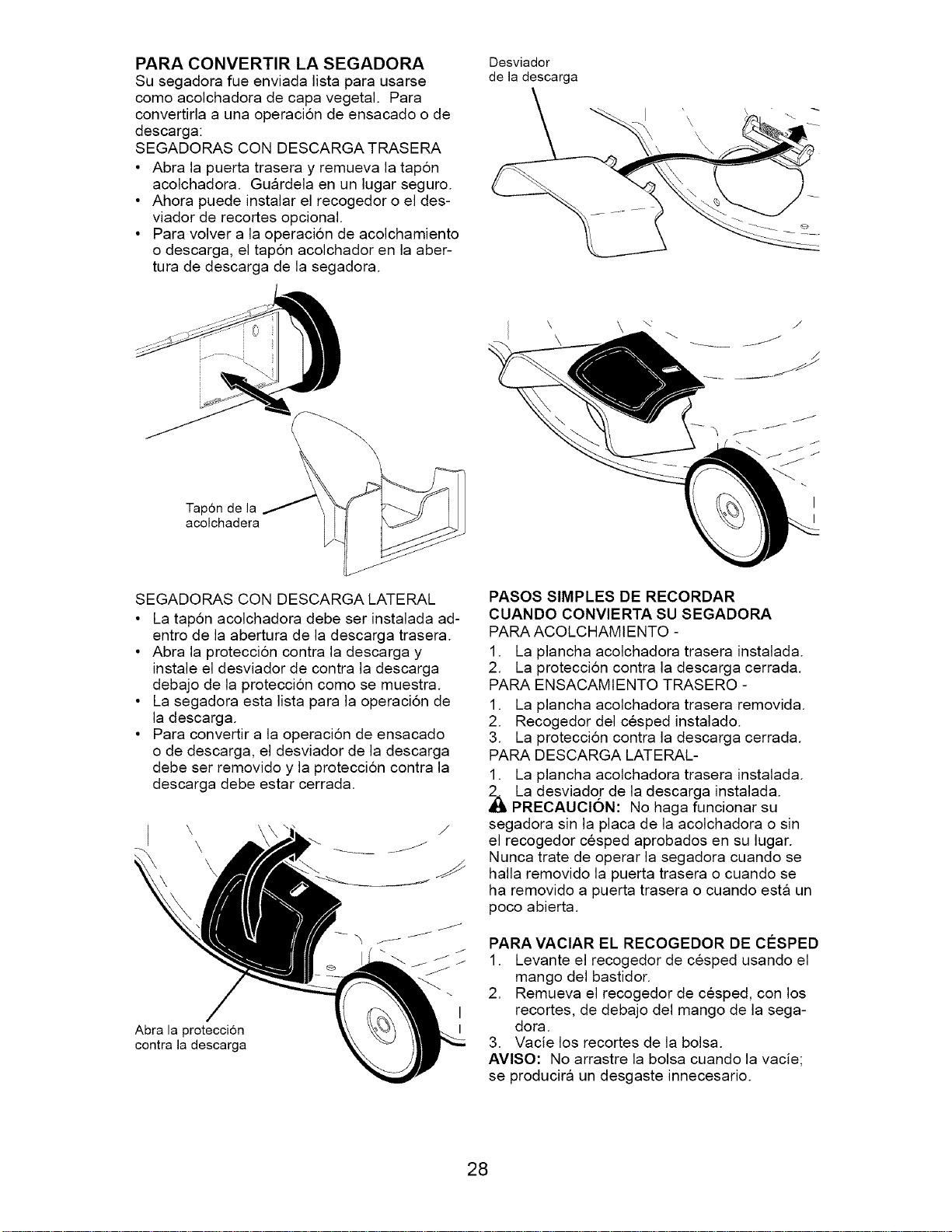
PARA CONVERTIR LA SEGADORA
Su segadora fue enviada lista para usarse
como acolchadora de capa vegetal. Para
convertirla a una operaci6n de ensacado o de
descarga:
SEGADORAS CON DESCARGA TRASERA
• Abra la puerta trasera y remueva la tap6n
acolchadora. Guardela en un lugar seguro.
• Ahora puede instalar el recogedor o el des-
viador de recortes opcional.
• Para volver a la operaci6n de acolchamiento
o descarga, el tap6n acolchador en la abet-
tufa de descarga de la segadora.
Desviador
de la descarga
\ \ \" /
\
Tap6n de la
acolchadera
SEGADORAS CON DESCARGA LATERAL
• La tap6n acolchadora debe ser instalada ad-
entro de la abertura de la descarga trasera.
• Abra la protecci6n contra la descarga y
instale el desviador de contra la descarga
debajo de la proteccion como se muestra.
• La segadora esta lista para la operacion de
la descarga.
• Para convertir a la operacion de ensacado
o de descarga, el desviador de la descarga
debe ser removido y la proteccion contra la
descarga debe estar cerrada.
\ /
Abra la protecci6n
contra la descarga
I
I
PASOS SIMPLES DE RECORDAR
CUANDO CONVIERTA SU SEGADORA
PARA ACOLC HAM IENTO -
1. La plancha acolchadora trasera instalada.
2. La proteccion contra la descarga cerrada.
PARA ENSACAMIENTO TRASERO -
1. La plancha acolchadora trasera removida.
2. Recogedor del cesped instalado.
3. La proteccion contra la descarga cerrada.
PARA DESCARGA LATERAL-
1. La plancha acolchadora trasera instalada.
_iLa desviador de la descarga instalada.
PRECAUCION: No haga funcionar su
segadora sin la placa de la acolchadora o sin
el recogedor cesped aprobados en su lugar.
Nunca trate de operar la segadora cuando se
halla removido la puerta trasera o cuando se
ha removido a puerta trasera o cuando esta un
poco abierta.
PARA VACIAR EL RECOGEDOR DE CleSPED
1. Levante el recogedor de cesped usando el
mango del bastidor.
2. Remueva el recogedor de cesped, con los
recortes, de debajo del mango de la sega-
dora.
3. Vacie los recortes de la bolsa.
AVlSO: No arrastre la bolsa cuando la vacie;
se producira un desgaste innecesario.
28
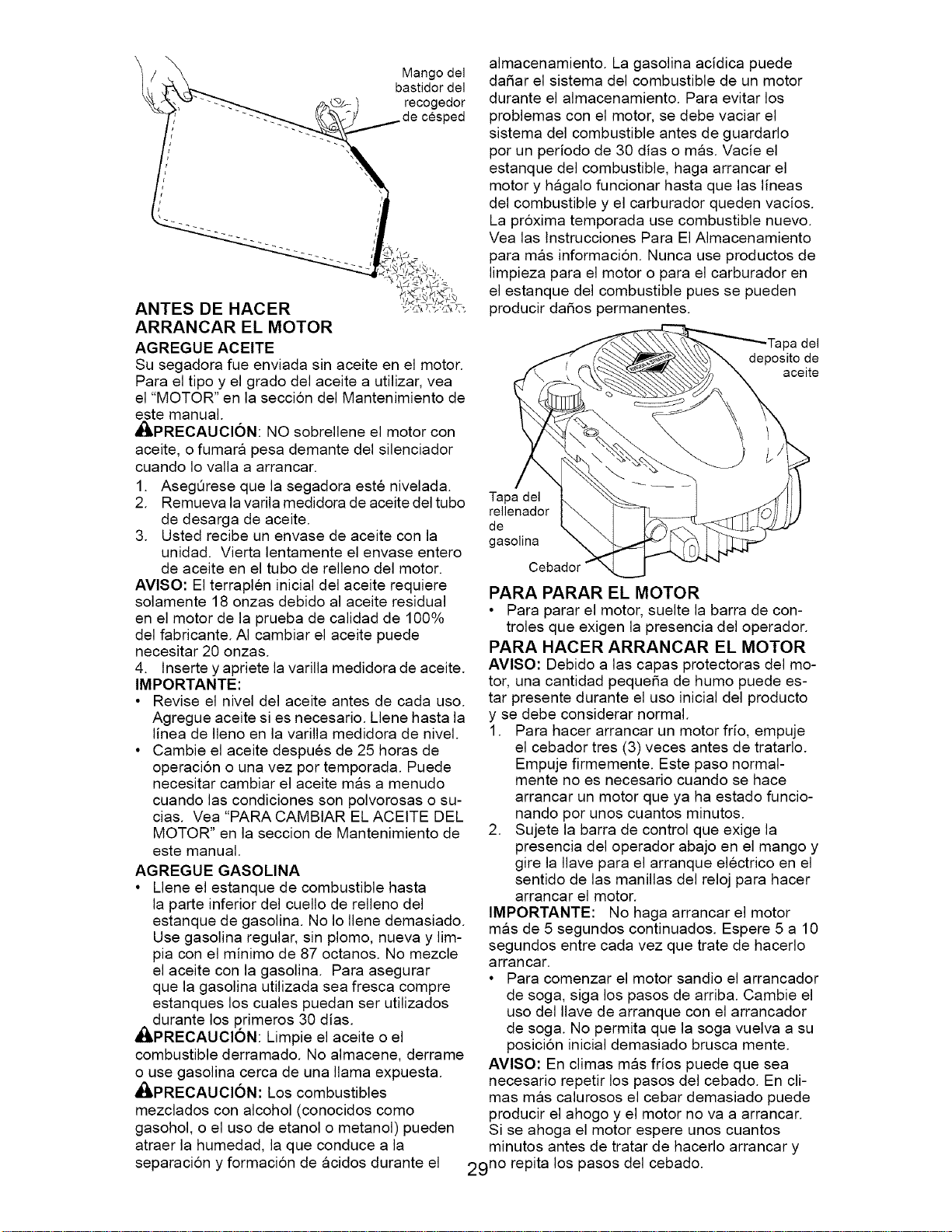
Mango del
bastidor del
recogedor
ANTES DE HACER _'"
ARRANCAR EL MOTOR
AGREGUE ACEITE
Su segadora fue enviada sin aceite en el motor.
Para el tipo y el grado del aceite a utilizar, vea
el "MOTOR" en la seccion del Mantenimiento de
este manual.
_I_PRECAUCI6N: NO sobrellene el motor con
aceite, o fumara pesa demante del silenciador
cuando Io valla a arrancar.
1. AsegQrese que la segadora este nivelada.
2. Remueva la varila medidora de aceite del tubo
de desarga de aceite.
3. Usted recibe un envase de aceite con la
unidad. Vierta lentamente el envase entero
de aceite en el tubo de relleno del motor.
AVlSO: El terraplen inicial del aceite requiere
solamente 18 onzas debido al aceite residual
en el motor de la prueba de calidad de 100%
del fabricante. AI cambiar el aceite puede
necesitar 20 onzas.
4. lnserte y apriete la varilla medidora de aceite.
IMPORTANTE:
• Revise el nivel del aceite antes de cada uso.
Agregue aceite si es necesario. Llene hasta la
linea de Ileno en la varilla medidora de nivel.
• Cambie el aceite despues de 25 horas de
operacion o una vez por temporada. Puede
necesitar cambiar el aceite mas a menudo
cuando las condiciones son polvorosas o su-
cias. Vea "PARA CAMBIAR EL ACEITE DEL
MOTOR" en la seccion de Mantenimiento de
este manual.
AGREGUE GASOLINA
• Llene el estanque de combustible hasta
la parte inferior del cuello de relleno del
estanque de gasolina. No Io Ilene demasiado.
Use gasolina regular, sin plomo, nueva y lim-
pia con el minimo de 87 octanos. No mezcle
el aceite con la gasolina. Para asegurar
que la gasolina utilizada sea fresca compre
estanques los cuales puedan ser utilizados
durante los primeros 30 dias.
_PRECAUCl6N: Limpie el aceite o el
combustible derramado. No almacene, derrame
o use gasolina cerca de una llama expuesta.
_PRECAUCl6N: Los combustibles
mezclados con alcohol (conocidos como
gasohol, o el uso de etanol o metanol) pueden
atraer la humedad, la que conduce a la
separacion y formacion de acidos durante el
almacenamiento. La gasolina acidica puede
da_ar el sistema del combustible de un motor
durante el almacenamiento. Para evitar los
problemas con el motor, se debe vaciar el
sistema del combustible antes de guardarlo
por un periodo de 30 dias o mas. Vacie el
estanque del combustible, haga arrancar el
motor y hagalo funcionar hasta que las lineas
del combustible y el carburador queden vacios.
La proxima temporada use combustible nuevo.
Vea las lnstrucciones Para El AImacenamiento
para mas informacion. Nunca use productos de
limpieza para el motor o para el carburador en
el estanque del combustible pues se pueden
producir da_os permanentes.
pa del
deposito de
aceite
Tapa del
rellenador
de
gasolina
Cebador
PARA PARAR EL MOTOR
• Parapararelmotor,sueltelabarrade con-
trolesque exigenlapresenciadeloperador.
PARA HACER ARRANCAR EL MOTOR
AVlSO: Debido alas capas protectoras del mo-
tor, una cantidad peque5a de humo puede es-
tar presente durante el uso inicial del producto
y se debe considerar normal.
1. Para hacer arrancar un motor frio, empuje
el cebador tres (3) veces antes de tratarlo.
Empuje firmemente. Este paso normal-
mente no es necesario cuando se hace
arrancar un motor que ya ha estado funcio-
nando por unos cuantos minutos.
2. Sujete la barra de control que exige la
presencia del operador abajo en el mango y
gire la Ilave para el arranque electrico en el
sentido de las manillas del reloj para hacer
arrancar el motor.
IMPORTANTE: No haga arrancar el motor
mas de 5 segundos continuados. Espere 5 a 10
segundos entre cada vez que trate de hacerlo
arrancar.
• Para comenzar el motor sandio el arrancador
de soga, siga los pasos de arriba. Cambie el
uso del Ilave de arranque con el arrancador
de soga. No permita que la soga vuelva a su
posicion inicial demasiado brusca mente.
AVlSO: En climas mas frios puede que sea
necesario repetir los pasos del cebado. En cli-
mas mas calurosos el cebar demasiado puede
producir el ahogo y el motor no va a arrancar.
Si se ahoga el motor espere unos cuantos
minutos antes de tratar de hacerlo arrancar y
29no repita los pasos del cebado.
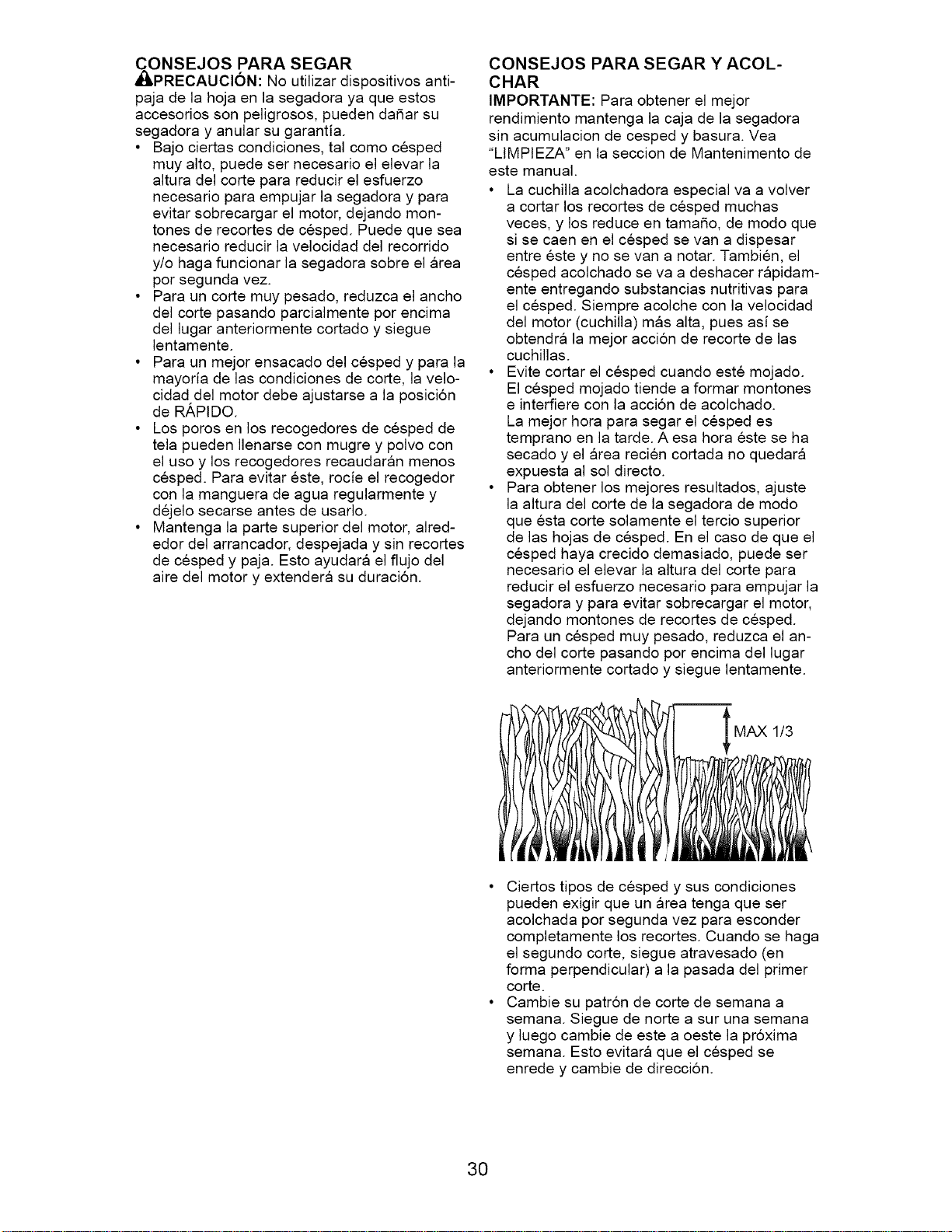
CONSEJOSPARASEGAR
A_,PRECAUCl6N: No utilizar dispositivos anti-
paja de la hoja en la segadora ya que estos
accesorios son peligrosos, pueden dafiar su
segadora y anular su garantia.
• Bajo ciertas condiciones, tal como cesped
muy alto, puede ser necesario el elevar la
altura del corte para reducir el esfuerzo
necesario para empujar la segadora y para
evitar sobrecargar el motor, dejando mon-
tones de recortes de cesped. Puede que sea
necesario reducir la velocidad del recorrido
y/o haga funcionar la segadora sobre el area
por segunda vez.
• Para un corte muy pesado, reduzca el ancho
del corte pasando parcialmente por encima
del lugar anteriormente cortado y siegue
lentamente.
• Para un mejor ensacado del cesped y para la
mayoria de las condiciones de corte, la velo-
cidad del motor debe ajustarse a la posiciSn
de R,APIDO.
• Los poros en los recogedores de cesped de
tela pueden Ilenarse con mugre y polvo con
el uso y los recogedores recaudaran menos
cesped. Para evitar este, rocie el recogedor
con la manguera de agua regularmente y
dejelo secarse antes de usarlo.
• Mantenga la parte superior del motor, alred-
edor del arrancador, despejada y sin recortes
de cesped y paja. Esto ayudara el flujo del
aire del motor y extendera su duracion.
CONSEJOS PARA SEGAR Y ACOL-
CHAR
IMPORTANTE: Para obtener el mejor
rendimiento mantenga la caja de la segadora
sin acumulacion de cesped y basura. Vea
"LIMPIEZA" en la seccion de Mantenimento de
este manual.
• La cuchilla acolchadora especial va a volver
a cortar los recortes de cesped muchas
veces, y los reduce en tamafio, de modo que
si se caen en el cesped se van a dispesar
entre este y no se van a notar. Tambien, el
cesped acolchado se va a deshacer rapidam-
ente entregando substancias nutritivas para
el cesped. Siempre acolche con la velocidad
del motor (cuchilla) mas alta, pues asi se
obtendra la mejor accion de recorte de las
cuchillas.
• Evite cortar el cesped cuando este mojado.
El cesped mojado tiende a formar montones
e interfiere con la accion de acolchado.
La mejor hora para segar el cesped es
temprano en la tarde. A esa hora este se ha
secado y el area recien cortada no quedara
expuesta al sol directo.
• Para obtener los mejores resultados, ajuste
la altura del corte de la segadora de modo
que esta corte solamente el tercio superior
de las hojas de cesped. En el caso de que el
cesped haya crecido demasiado, puede ser
necesario el elevar la altura del corte para
reducir el esfuerzo necesario para empujar la
segadora y para evitar sobrecargar el motor,
dejando montones de recortes de cesped.
Para un cesped muy pesado, reduzca el an-
cho del corte pasando por encima del lugar
anteriormente cortado y siegue lentamente.
1/3
• Ciertos tipos de cesped y sus condiciones
pueden exigir que un area tenga que ser
acolchada por segunda vez para esconder
completamente los recortes. Cuando se haga
el segundo core, siegue atravesado (en
forma perpendicular) a la pasada del primer
corte.
• Cambie su patron de corte de semana a
semana. Siegue de norte a sur una semana
y luego cambie de este a oeste la proxima
semana. Esto evitara que el cesped se
enrede y cambie de direccion.
30
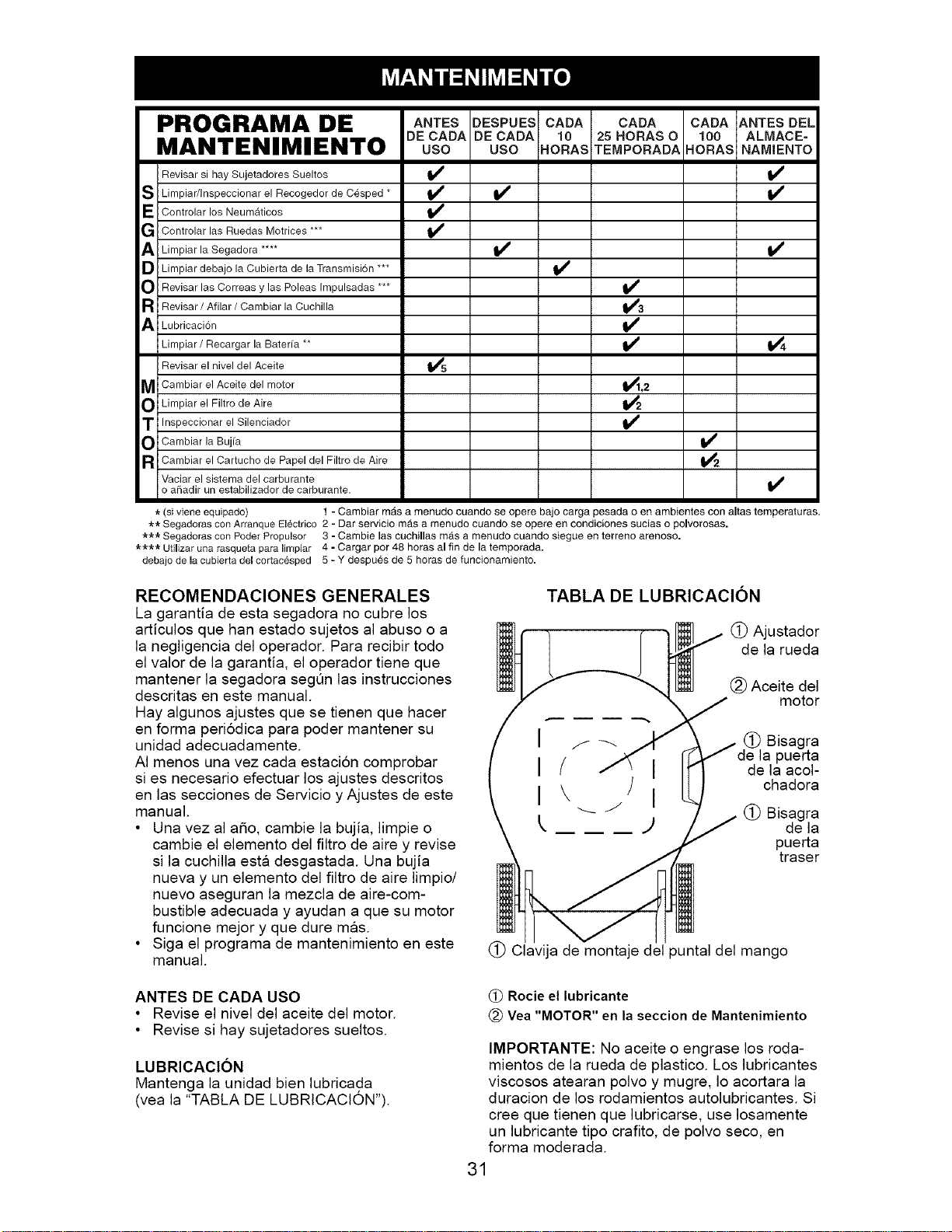
PROGRAMA DE ANTESDEsPuEsCADA CADA CADAANTESDEL
DECADAOECADA 2S.ORASO ALMACE-
MANTENIMIENTO uso uso .ORASTEMPO.ADA.ORAS.AM,E.TO
Revisar si hay Sujetadores Sueltos
S Limpiar/Inspeccionar el Recogedor de Cesped *
E Controlar los Neumaticos
G Controlar las Ruedas Motrices ***
A Limpiar la Segadora ....
D Limpiar debajo la Cubierta de la Transmisi6n ***
O Revisar las Correas y las Poleas Impulsadas ***
R Revisar / Afilar / Cambiar la Cuchilla
A Lubricaci6n
Limpiar / Recargar la Baterfa **
Revisar el nivel del Aceite
IVI Cambiar el Aceite del motor
O Limpiar el Filtro de Aire
t Inspeccionar el Silenciador
O Cambiar la 8ujfa
R Cambiar el Cartucho de Papel del Filtro de Aire
Vaciar el sistema del carburante
o afiadir un estabilizador de carburante.
_,2
14
V'
v'
* (si viene equipado) 1 - Cambiar m&s a menudo cuando se opere bajo carga pesada o en ambientes con altas temperaturas,
*_ Segadoras con Arranque Electrico 2 - Dar servicio mas a menudo cuando se opere en condiciones sucias o polvorosas.
*_* Segadoras con Poder Propulsor 3 - Cambie las cuchillas mas a menudo cuando siegue en terreno arenoso.
***_ Utilizar una rasqueta para limpiar 4 - Cargar por 48 horas al fin de la temporada.
debajo de la cubierta del cortacesped 5 - Y despu#s de 5 horas de funcionamiento.
RECOMENDACIONES GENERALES
La garantia de esta segadora no cubre los
articulos que han estado sujetos al abuso o a
la negligencia del operador. Para recibir todo
el valor de la garantia, el operador tiene que
mantener la segadora segQn las instrucciones
descritas en este manual.
Hay algunos ajustes que se tienen que hacer
en forma peri6dica para poder mantener su
unidad adecuadamente.
AI menos una vez carla estacion comprobar
si es necesario efectuar los ajustes descritos
en las secciones de Servicio y Ajustes de este
manual.
• Una vez al ado, cambie la bujia, limpie o
cambie el elemento del filtro de aire y revise
si la cuchilla esta desgastada. Una bujia
nueva y un elemento del filtro de aire limpio/
nuevo aseguran la mezcla de aire-com-
bustible adecuada y ayudan a que su motor
funcione mejor y que dure mas.
• Siga el programa de mantenimiento en este
manual.
TABLA DE LUBRICAClON
(_ Ajustador
de la rueda
_) Aceite del
motor
(_) Bisagra
puerta
de la acol-
chadora
(_ Bisagra
de la
puerta
traser
(_ Clavija de montaje del puntal del mango
ANTES DE CADA USO
• Revise el nivel del aceite del motor.
• Revise si hay sujetadores sueltos.
LUBRICAClON
Mantenga la unidad bien lubricada
(vea la "TABLA DE LUBRtCACION").
(_ Rocie el lubricante
@ Vea "MOTOR" en la seccion de Mantenimiento
IMPORTANTE: No aceite o engrase los roda-
mientos de la rueda de plastico. Los lubricantes
viscosos atearan polvo y mugre, Io acortara la
duracion de los rodamientos autolubricantes. Si
cree que tienen que lubricarse, use Iosamente
un lubricante tipo crafito, de polvo seco, en
forma moderada.
31

SEGADORA
Siempre observe las reglas de seguridad cu-
ando haga el mantenimiento.
LLANTAS
• Mantenga las Ilantas sin gasolina, aceite o
substancias quimicas para control de insec-
tos que pueden dafiar la goma.
• Evite los tocones, las piedras, las grietas pro-
fundas, los objetos afilados y otros peligros
que pueden dafiar alas Ilantas.
RUEDAS DE IMPULSION
Revise las ruedas de impulsi6n traseras cada
vez antes de segar, para asegurarse de que se
mueven libremente. Si las ruedas no giran li-
bremente quiere decir que hay basura, recortes
de cesped, etc. en el area de las ruedas de
impulsion y tienen que limpiarse para liberarlas.
Es necesario limpiar las ruedas de impulsion;
revise ambas ruedas traseras.
CUIDADO DE LA CUCHILLA
Para obtener los mejores resultados, la cuchilla
de la segadora tienen que mantenerse afilada.
_mbie la cuchilla doblada o dafiada.
PRECAUClON: Usar solamente la hoja
de repuesto aprobada por el fabricante de su
cortacesped. Usar una hoja no aprobada por el
fabricante de su cortacesped es peligroso, pu-
ede dafiar su cortacesped y anular su garantia.
PARA REMOVER LA CUCHILLA
1. Desconecte el alambre de la bujia y p6ngalo en
donde no pueda entrar en contacto con esta.
2. Haga descansar la segadora en su lado.
AsegQrese que el filtro de aire y que el car-
burador queden mirando hacia arriba.
3. Use un bloque de madera entre la cuchilla
y la caja de la segadora para evitar que la
cuchilla gire cuando se le quite el perno.
AVlSO: Proteja sus manos con guantes y/o
envuelva la cuchilla con una tela gruesa.
4. Remueva el perno de la cuchilla girandolo en
el sentido contrario en que giran las manillas
del reloj.
5. Remueva la cuchilla y los articulos de fer-
reteria adjuntadores (el perno, la arandela de
seguridad y la arandela endurecida).
AVlSO: Remueva el adaptador de la cuchilla y
revise el cubo interior de la ranura del adaptador
de la cuchilla. La ranura tiene que estar en buenas
condiciones para que funcione en forma adec-
uada. Cambie el adaptador siesta dafiado.
PARA CAMBIAR LA CUCHILLA
1. Ponga el adaptador de la cuchilla en el
ciguefial del motor. AsegQrese que la ranura
del adaptador y que el chavetero del cigue-
fial esten alineados.
2. Ponga la cuchilla en el adaptador de esta
alineando los dos (2) agujeros en la cuchilla
con las salientes elevadas en el adaptador.
3. AsegQrese de que el borde de salida de la
cuchilla (opuesto al borde afilado) este hacia
arriba hacia el motor.
4. Instale el perno de la cuchilla con la arandela
de seguridad y la arandela endurecida en el
adaptador de la cuchilla y el ciguefial. •
5. Use un bloque de madera entre la cuchilla
y la caja de la segadora y apriete el perno 32
de la cuchilla girandolo en el sentido en que
giran las manillas del reloj.
• La torsi6n para apretar recomendada es de
35 - 40 pies libras.
IMPORTANTE: El perno de la cuchilla es
tratado a calo. Si es necesario sustituir los
pernos, sustituirlos solo con pernos aprobados
mostrados en la secci6n Partes de Reparacion
de este manual.
Adaptador de Ranura Chavetero del
la cuchilla " uenal
Arandela de
seguridad
Perno Arandela
de la endurecida
cuchilla Borde de salida"
iguenal
PARA AFILAR LA CUCHILLA
AVlSO: No recomendamos el afilar la cuchilla
- pero si Io hace, asegQrese de que quede bal-
anceada. Una cuchilla que no esta balanceada
va a producir eventualmente dafio en la sega-
dora o en el motor.
• La cuchilla puede afilarse con una lima o en
una rueda rectificadora. No trate de afilarla
mientras se encuentra en la segadora.
• Para revisar el balance de lacuchilla, clave un
clavo en una viga o en la pared. Deje alrededor
de una pulgada de un clavo recto expuesto.
Ponga el agujero central de la cuchilla sobre la
cabeza del clavo. Si la cuchilla esta balanceada
debe permanecer en la posicion horizontal. Si
cualquiera de los extremos de la cuchilla se
mueve hacia abajo, afile el extremo pesado
hasta que esta quede balanceada.
RECOGEDOR DE ClaSPED
• El recogedor de cesped puede ser rociado
con el agua de la manguera pero tiene que
estar seco cuando se vaya a usar.
• Revise su recogedor de cesped a menudo
para verificar siesta dafiado o deteriorado.
Se va a desgastar con el uso normal. Si se
necesita cambiar el recogedor, cambielo
solamente por uno que sea aprobado por el
fabricante. De el nQmero del modelo de la
segadora cuando Io ordene.
CAJA DE ENGRANAJES
• Para mantener el sistema de impulsi6n
funcionando en forma adecuada, la caja de
engranajes y el area alrededor de la impulsion
tienen que mantenerse limpias y sin acumu-
lacion de basura. Limpie debajo de la cubierta
de la impulsion dos veces por temporada.
• La caja de engranajes se Ilena con lubricante
hasta el nivel adecuado en la fabrica. La
Qnica vez que el lubricante necesita atencion
es cuando se le ha prestado servicio a la
caja de engranajes.
Si se necesita lubricante, use solamente
Grasa Texaco Starplex Premium 1, Parte No.
750369. No use substitutos.
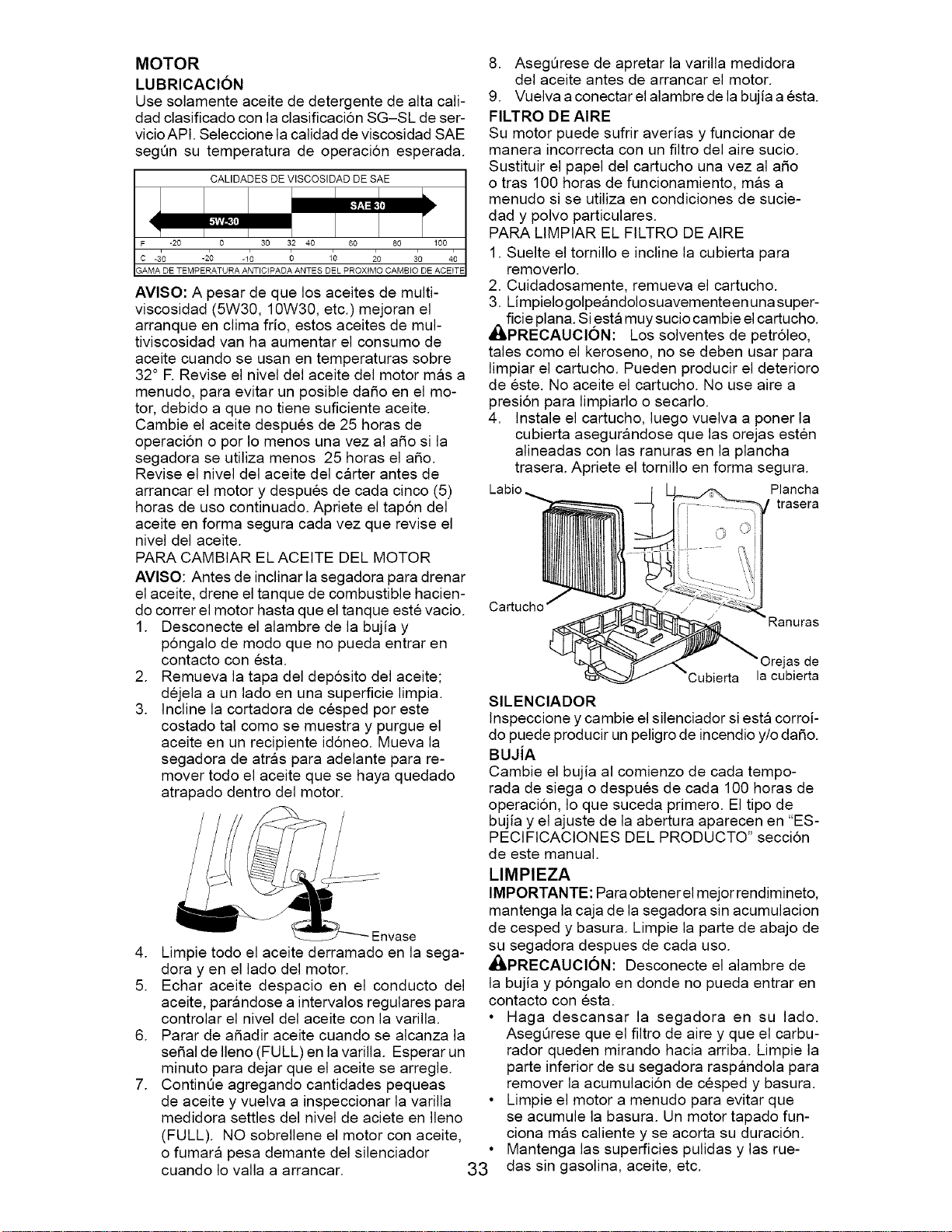
MOTOR
LUBRICACION
Use solamente aceite de detergente de alta cali-
dad clasificado con la clasificaci6n SG-SL de ser-
vicio API. Seleccione la calidad de viscosidad SAE
segQn su temperatura de operaci6n esperada.
CALIDADES DE VISCOSIDAD DE SAE
F -20 0 30 32 40 60 80 100
AVlSO: A pesar de que los aceites de multi-
viscosidad (5W30, 10W30, etc.) mejoran el
arranque en clima frio, estos aceites de mul-
tiviscosidad van ha aumentar el consumo de
aceite cuando se usan en temperaturas sobre
32° E Revise el nivel del aceite del motor mas a
menudo, para evitar un posible dafio en el mo-
tor, debido a que no tiene suficiente aceite.
Cambie el aceite despues de 25 horas de
operaci6n o por Io menos una vez al afio si la
segadora se utiliza menos 25 horas el afio.
Revise el nivel del aceite del carter antes de
arrancar el motor y despues de cada cinco (5)
horas de uso continuado. Apriete el tapon del
aceite en forma segura cada vez que revise el
nivel del aceite.
PARA CAMBIAR EL ACEITE DEL MOTOR
AVlSO: Antes de inclinar la segadora para drenar
el aceite, drene el tanque de combustible hacien-
do correr el motor hasta que el tanque este vacio.
1. Desconecte el alambre de la bujia y
p6ngalo de modo que no pueda entrar en
contacto con esta.
2. Remueva la tapa del dep6sito del aceite;
dejela a un lado en una superficie limpia.
3. Incline la cortadora de cesped por este
costado tal como se muestra y purgue el
aceite en un recipiente id6neo. Mueva la
segadora de atras para adelante para re-
mover todo el aceite que se haya quedado
atrapado dentro del motor.
4. Limpie todo el aceite derramado en la sega-
dora yen el lado del motor.
5. Echar aceite despacio en el conducto del
aceite, parandose a intervalos regulares para
controlar el nivel del aceite con la varilla.
6. Parar de afiadir aceite cuando se alcanza la
serial de Ileno (FULL) en lavarilla. Esperar un
minuto para dejar que el aceite se arregle.
7. ContinQe agregando cantidades pequeas
de aceite y vuelva a inspeccionar la varilla
medidora settles del nivel de aciete en Ileno
(FULL). NO sobrellene el motor con aceite,
o fumara pesa demante del silenciador
cuando Io valla a arrancar.
8. AsegQrese de apretar la varilla medidora
del aceite antes de arrancar el motor.
9. Vuelva a conectar elalambre de la bujia aesta.
FILTRO DE AIRE
Su motor puede sufrir averias y funcionar de
manera incorrecta con un filtro del aire sucio.
Sustituir el papel del cartucho una vez al afio
o tras 100 horas de funcionamiento, mas a
menudo si se utiliza en condiciones de sucie-
dad y polvo particulates.
PARA LIMPIAR EL FILTRO DE AIRE
1. Suelte el tornillo e incline la cubierta para
removerlo.
2. Cuidadosamente, remueva el cartucho.
3. Limpielo golpeandolosuavementeen una super-
_L,ficie plan& Siesta muy sucio cambie elcartucho.
PRECAUClON: Los solventes de petr61eo,
tales como el keroseno, no se deben usar para
limpiar el cartucho. Pueden producir el deterioro
de este. No aceite el cartucho. No use aire a
presion para limpiarlo o secarlo.
4. Instale el cartucho, luego vuelva a poner la
cubierta asegurandose que las orejas esten
alineadas con las ranuras en la plancha
trasera. Apriete el tomillo en forma segura.
Labio | _ Plancha
i_ i_ I "_, trasera
..............iii'!
'_ i
Cartucho / /, "_2-::.-' _;:
Ranuras
L_,I_ _...._ "Orejas de
"Cubierta la cubierta
33
SILENClADOR
Inspeccione y cambie el silenciador siesta corroi-
do puede producir un peligro de incendio y/o dafio.
BUJiA
Cambie el bujia al comienzo de cada tempo-
rada de siega o despues de cada 100 horas de
operaci6n, Io que suceda primero. El tipo de
bujia y el ajuste de la abertura aparecen en "ES-
PECIFICACIONES DEL PRODUCTO" seccion
de este manual.
LIMPIEZA
IMPORTANTE: Para obtenerel mejor rendimineto,
mantenga |a caja de la segadora sin acumu|acion
de cesped y basura. Limpie |a parte de abajo de
su segadora despues de cada uso.
_PRECAUCl6N: Desconecte el alambre de
la bujia y pongalo en donde no pueda entrar en
contacto con esta.
• Haga descansar la segadora en su lado.
AsegOrese que el filtro de aire y que el carbu-
rador queden mirando hacia arriba. Limpie la
parte inferior de su segadora raspandola para
remover la acumulacion de cesped y basura.
• Limpie el motor a menudo para evitar que
se acumu|e la basura. Un motor tapado fun-
ciona mas caliente y se acorta su duracion.
Mantenga |as superficies pu|idas y las rue-
das sin gasolina, aceite, etc.
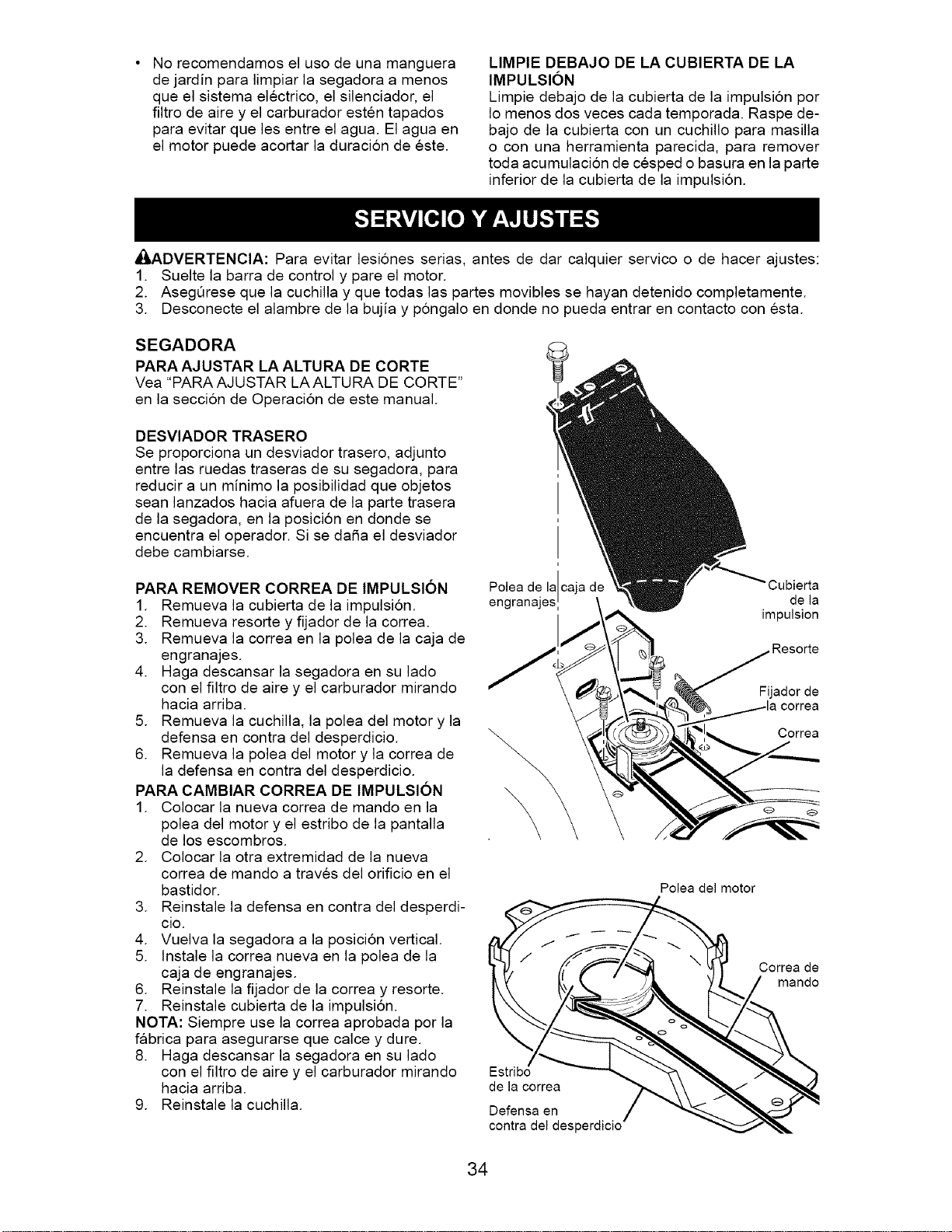
Norecomendamoselusodeunamanguera
dejardinparalimpiarlasegadoraamenos
queelsistemaelectrico,elsilenciador,el
filtrodeaireyelcarburadorestentapados
paraevitarquelesentreelagua.Elaguaen
elmotorpuedeacortarladuraci6ndeeste.
LIMPIE DEBAJO DE LA CUBIERTA DE LA
IMPULSION
Limpie debajo de la cubierta de la impulsi6n por
Io menos dos veces cada temporada. Raspe de-
bajo de la cubierta con un cuchillo para masilla
o con una herramienta parecida, para remover
toda acumulaci6n de cesped o basura en la parte
inferior de la cubierta de la impulsion.
_ADVERTENClA: Para evitar lesi6nes serias, antes de dar calquier servico o de hacer ajustes:
1. Suelte la barra de control y pare el motor.
2. AsegQrese que la cuchilla y que todas las partes movibles se hayan detenido completamente.
3. Desconecte el alambre de la bujla y p6ngalo en donde no pueda entrar en contacto con esta.
SEGADORA
PARA AJUSTAR LA ALTURA DE CORTE
Vea "PARA AJUSTAR LAALTURA DE CORTE"
en la seccion de Operacion de este manual.
DESVlADOR TRASERO
Se proporciona un desviador trasero, adjunto
entre las ruedas traseras de su segadora, para
reducir a un minimo la posibilidad que objetos
sean lanzados hacia afuera de la parte trasera
de la segadora, en la posici6n en donde se
encuentra el operador. Si se dafia el desviador
debe cambiarse.
PARA REMOVER CORREA DE IMPULSION
1. Remueva la cubierta de la impulsi6n.
2. Remueva resorte y fijador de la correa.
3. Remueva la correa en la polea de la caja de
engranajes.
4. Haga descansar la segadora en su lado
con el filtro de aire y el carburador mirando
hacia arriba.
5. Remueva la cuchilla, la polea del motor y la
defensa en contra del desperdicio.
6. Remueva la polea del motor y la correa de
la defensa en contra del desperdicio.
PARA CAMBIAR CORREA DE IMPULSION
1. Colocar la nueva correa de mando en la
polea del motor y el estribo de la pantalla
de los escombros.
2. Colocar la otra extremidad de la nueva
correa de mando a traves del orificio en el
bastidor.
3. Reinstale la defensa en contra del desperdi-
cio.
4. Vuelva la segadora a la posici6n vertical.
5. Instale la correa nueva en la polea de la
caja de engranajes.
6. Reinstale la fijador de la correa y resorte.
7. Reinstale cubierta de la impulsi6n.
NOTA: Siempre use la correa aprobada por la
fabrica para asegurarse que calce y dure.
8. Haga descansar la segadora en su lado
con el filtro de aire y el carburador mirando
hacia arriba.
9. Reinstale la cuchilla.
Polea de la caja de
engranajes
\
Estribo
de la correa
Defensa en
contra del desperdicio
de la
impulsion
Fijador de
Correa
Polea del motor
Correa de
mando
34
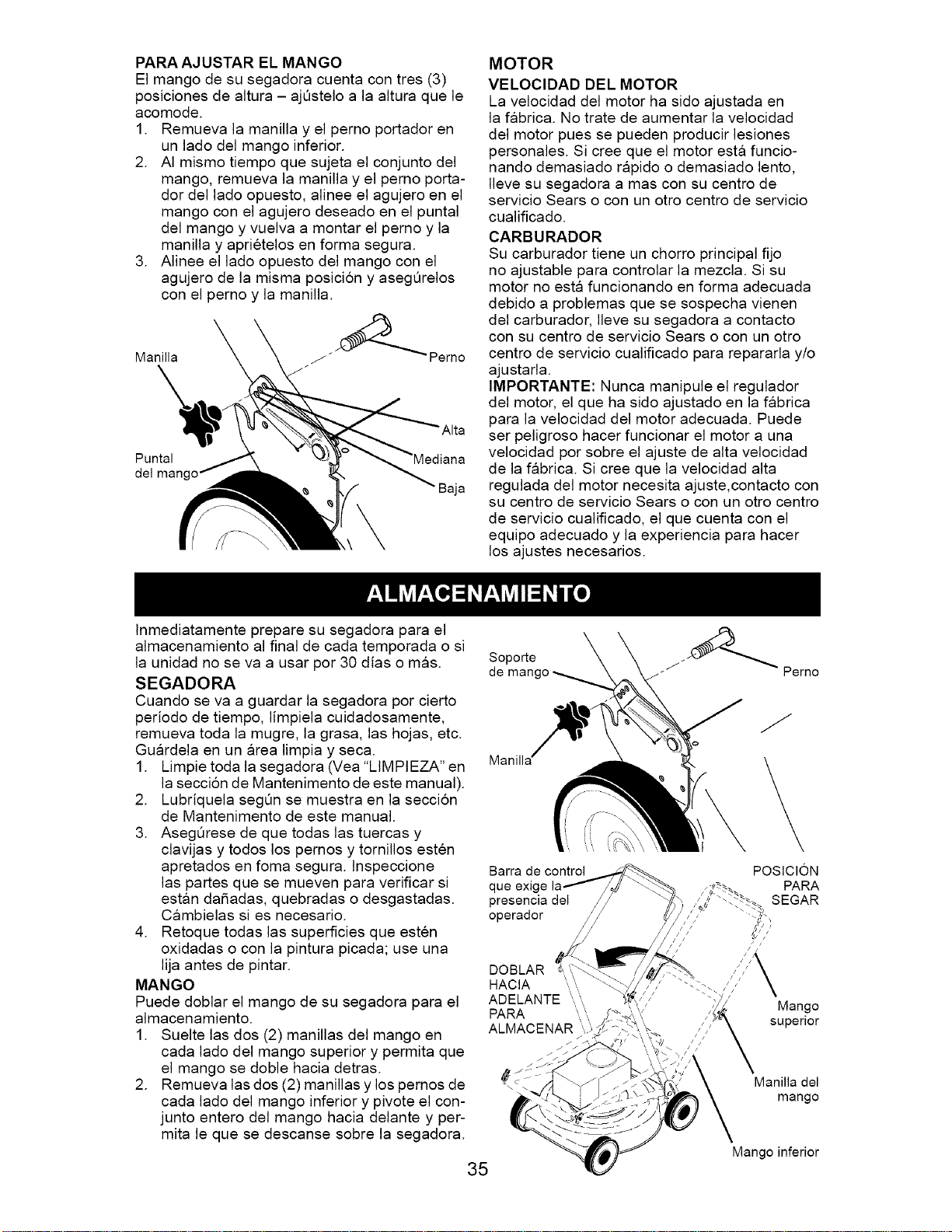
PARA AJUSTAR EL MANGO
El mango de su segadora cuenta con tres (3)
posiciones de altura - ajQstelo a la altura que le
acomode.
1. Remueva la manilla y el perno portador en
un lado del mango inferior.
2. AI mismo tiempo que sujeta el conjunto del
mango, remueva la manilla y el perno porta-
dor del lado opuesto, alinee el agujero en el
mango con el agujero deseado en el puntal
del mango y vuelva a montar el perno y la
manilla y aprietelos en forma segura.
3. Alinee el lado opuesto del mango con el
agujero de la misma posici6n y asegQrelos
con el perno y la manilla.
Manilla
Puntal
del man(
Alta
Inmediatamente prepare su segadora para el
MOTOR
VELOClDAD DEL MOTOR
La velocidad del motor ha sido ajustada en
la fabrica. No trate de aumentar la velocidad
del motor pues se pueden producir lesiones
personales. Si cree que el motor esta funcio-
nando demasiado rapido o demasiado lento,
Ileve su segadora a mas con su centro de
servicio Sears o con un otro centro de servicio
cualificado.
CARBURADOR
Su carburador tiene un chorro principal fijo
no ajustable para controlar la mezcla. Si su
motor no esta funcionando en forma adecuada
debido a problemas que se sospecha vienen
del carburador, Ileve su segadora a contacto
con su centro de servicio Sears o con un otro
centro de servicio cualificado para repararla y/o
ajustarla.
IMPORTANTE: Nunca manipule el regulador
del motor, el que ha sido ajustado en la fabrica
para la velocidad del motor adecuada. Puede
ser peligroso hacer funcionar el motor a una
velocidad por sobre el ajuste de alta velocidad
de la fabrica. Si cree que la velocidad alta
regulada del motor necesita ajuste,contacto con
su centro de servicio Sears o con un otro centro
de servicio cualificado, el que cuenta con el
equipo adecuado y la experiencia para hacer
los ajustes necesarios.
almacenamiento al final de cada temporada o si
la unidad no se va a usar por 30 dias o mas. Soporte
SEGADORA de mango
Cuando se va a guardar la segadora por cierto
periodo de tiempo, limpiela cuidadosamente,
remueva toda la mugre, la grasa, las hojas, etc.
Guardela en un area limpia y seca.
1. Limpie toda la segadora (Yea "LIMPIEZA" en
la secci6n de Mantenimento de este manual).
2. Lubriquela segQn se muestra en la secci6n
de Mantenimento de este manual.
3. AsegQrese de que todas las tuercas y
clavijas y todos los pernos y tornillos esten
apretados en foma segura, lnspeccione
las partes que se mueven para verificar si
estan da5adas, quebradas o desgastadas.
Cambielas si es necesario.
4. Retoque todas las superficies que esten
oxidadas o con la pintura picada; use una
lija antes de pintar.
MANGO
Puede doblar el mango de su segadora para el
almacenamiento.
1. Suelte las dos (2) manillas del mango en
cada lado del mango superior y permita que
el mango se doble hacia detras. ,_s- .
2. Remueva las dos (2) manillas y los pernos de
cada lado del mango inferior y pivote el con-
junto entero del mango hacia delante y per-
mita le que se descanse sobre la segadora.
35
Barra de control
que exige
presencia del
operador
Perno
J
POSICION
PARA
SEGAR
////
DOBLAR _
HACIA /_,/
ADELANTE ',,
Mango
PARA ',, superior
ALMACENAR
/
/
/
Manilla del
mango
Mango inferior
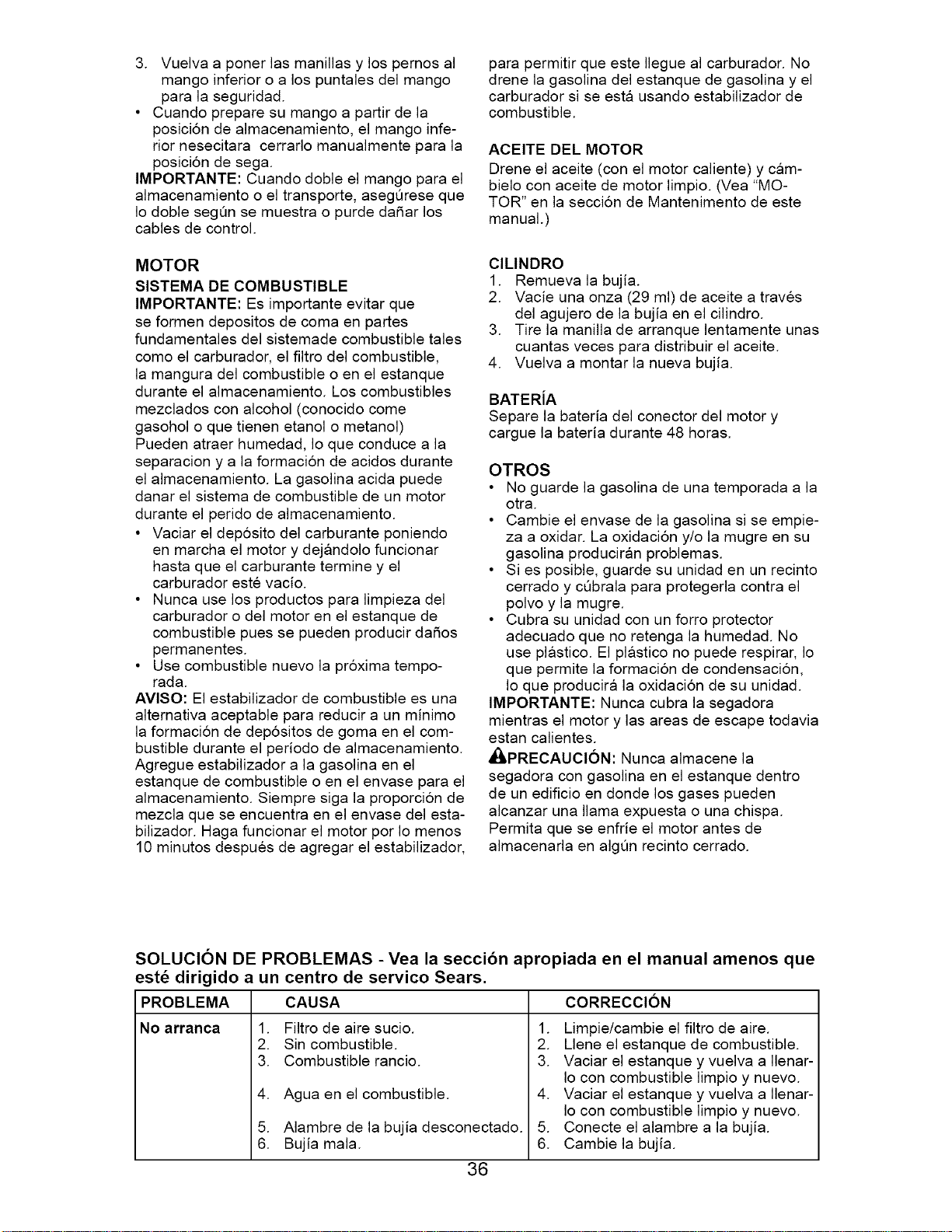
3. Vuelva a poner las manillas y los pernos al
mango inferior o a los puntales del mango
para la seguridad.
• Cuando prepare su mango a partir de la
posicion de almacenamiento, el mango infe-
rior nesecitara cerrarlo manualmente para la
posici6n de sega.
IMPORTANTE: Cuando doble el mango para el
almacenamiento o el transporte, asegQrese que
Io doble segQn se muestra o purde da5ar los
cables de control.
MOTOR
SISTEMA DE COMBUSTIBLE
IMPORTANTE: Es Jmportante evJtar que
se formen depositos de coma en partes
fundamentales del sistemade combustible tales
como el carbuFador, el filtro del combustible,
la mangura del combustible o en el estanque
durante el almacenamJento. Los combustibles
mezclados con alcohol (conocJdo come
gasohol o que tienen etanol o metanol)
Pueden atFaer humedad, Io que conduce a la
sepaFacion y a la formacJ6n de acJdos duFante
el almacenamJento. La gasolina acJda puede
danar el sistema de combustible de un motor
durante el perJdo de almacenamiento.
• VacJar el dep6sito del carburante poniendo
en marcha el motor y dej_lndolo funcJonar
hasta que el carburante termine y el
carburador este vacio.
• Nunca use los productos para limpJeza del
carburador o del motor en el estanque de
combustible pues se pueden producJr dal_os
permanentes.
• Use combustible nuevo la pr6xJma tempo-
rada.
AVlSO: El estabJlizador de combustible es una
alternatJva aceptable para reducJr a un minJmo
la formaci6n de dep6sJtos de goma en el com-
bustible durante el periodo de almacenamiento.
Agregue estabilizador a la gasolina en el
estanque de combustible o en el envase para el
almacenamiento. Siempre siga la proporcion de
mezcla que se encuentra en el envase del esta-
bilizador. Haga funcionar el motor por Io menos
10 minutos despues de agregar el estabilizador,
para permitir que este Ilegue al carburador. No
drene la gasolina del estanque de gasolina y el
carburador si se esta usando estabilizador de
combustible.
ACEITE DEL MOTOR
Drene el aceite (con el motor caliente) y c_lm-
bielo con aceite de motor limpio. (Vea "MO-
TOR" en la secci6n de Mantenimento de este
manual.)
CILINDRO
1. Remueva la bujia.
2. Vacie una onza (29 ml) de aceite a traves
del agujero de la bujia en el cilindro.
3. Tire la manilla de arranque lentamente unas
cuantas veces para distribuir el aceite.
4. Vuelva a montar la nueva bujia.
BATERiA
Separe la bateria del conector del motor y
cargue la bateria durante 48 horas.
OTROS
• No guarde la gasolina de una temporada a la
otra.
• Cambie el envase de la gasolina si se empie-
za a oxidar. La oxidacion y/o la mugre en su
gasolina producir_ln problemas.
• Si es posible, guarde su unidad en un recinto
cerrado y cQbrala para protegerla contra el
polvo y la mugre.
• Cubra su unidad con un forro protector
adecuado que no retenga la humedad. No
use plastico. El plastico no puede respirar, Io
que permite la formaci6n de condensacion,
Io que producir_l la oxidacion de su unidad.
IMPORTANTE: Nunca cubra la segadora
mientras el motor y las areas de escape todavia
estan calientes.
_PRECAUCI6N: Nunca almacene la
segadora con gasolina en el estanque dentro
de un edificio en donde los gases pueden
alcanzar una llama expuesta o una chispa.
Permita que se enfrie el motor antes de
almacenarla en algQn recinto cerrado.
SOLUCION DE PROBLEMAS - Vea la secci6n apropiada en el manual amenos que
est6 dirigido a un centro de servico Sears.
PROBLEMA CAUSA
No arranca 1. Filtro de aire sucio.
2. Sin combustible.
3. Combustible rancio.
4. Agua en el combustible.
5. Alambre de la bujia desconectado.
6. Bujia mala.
36
CORRECCION
1. Limpie/cambie el filtro de aire.
2. Llene el estanque de combustible.
3. Vaciar el estanque y vuelva a Ilenar-
Io con combustible limpio y nuevo.
4. Vaciar el estanque y vuelva a Ilenar-
Io con combustible limpio y nuevo.
5. Conecte el alambre a la bujia.
6. Cambie la bujia.
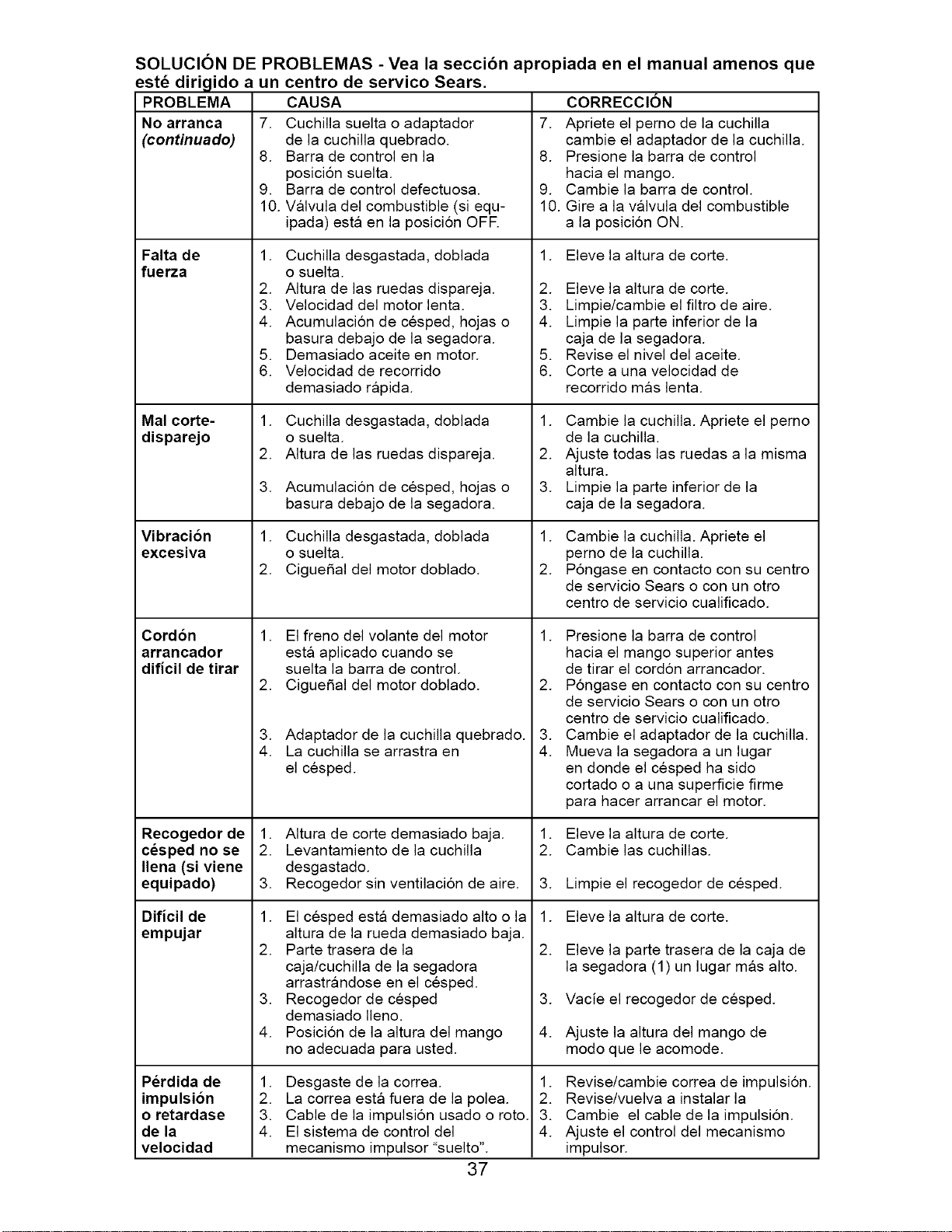
SOLUCION DE PROBLEMAS - Vea la secci6n apropiada en el manual amenos que
PROBLEMA
No arranca
(continuado)
estd dirigido a un centro de servico Sears.
CAUSA
7. Cuchilla suelta o adaptador
de la cuchilla quebrado.
8. Barra de control en la
posicion suelta.
9. Barra de control defectuosa.
10. Valvula del combustible (si equ-
ipada) esta en la posicion OFE
Falta de
fuerza
Mal corte-
disparejo
Vibracion
excesiva
Cord6n
arrancador
dificil de tirar
Recogedor de
cesped no se
Ilena (si viene
equipado)
Dificil de
empujar
Perdida de
impulsion
o retardase
de la
velocidad
1. Cuchilla desgastada, doblada
o suelta.
2. Altura de las ruedas dispareja.
3. Velocidad del motor lenta.
4. Acumulacion de cesped, hojas o
basura debajo de la segadora.
5. Demasiado aceite en motor.
6. Velocidad de recorrido
demasiado rapida.
1. Cuchilla desgastada, doblada
o suelta.
2. AItura de las ruedas dispareja.
3. Acumulacion de cesped, hojas o
basura debajo de la segadora.
1. Cuchilla desgastada, doblada
o suelta.
2. Ciguefial del motor doblado.
1. El freno del volante del motor
esta aplicado cuando se
suelta la barra de control.
2. Ciguefial del motor doblado.
3. Adaptador de la cuchilla quebrado.
4. La cuchilla se arrastra en
el cesped.
1. AItura de corte demasiado baja.
2. Levantamiento de la cuchilla
desgastado.
3. Recogedor sin ventilacion de aire.
1. El cesped esta demasiado alto o la
altura de la rueda demasiado baja.
2. Parte trasera de la
caja/cuchilla de la segadora
arrastrandose en el cesped.
3. Recogedor de cesped
demasiado Ileno.
4. Posicion de la altura del mango
no adecuada para usted.
1. Desgaste de la correa.
2. La correa esta fuera de la polea.
3. Cable de la impulsi6n usado o roto.
4. El sistema de control del
mecanismo impulsor "suelto".
37
CORRECCION
7. Apriete el perno de la cuchilla
cambie el adaptador de la cuchilla.
8. Presione la barra de control
hacia el mango.
9. Cambie la barra de control.
10. Gire a la valvula del combustible
a la posicion ON.
1. Eleve la altura de corte.
2. Eleve la altura de corte.
3. Limpie/cambie el filtro de aire.
4. Limpie la parte inferior de la
caja de la segadora.
5. Revise el nivel del aceite.
6. Corte a una velocidad de
recorrido mas lent&
1. Cambie la cuchilla. Apriete el perno
de la cuchilla.
2. Ajuste todas las ruedas a la misma
altura.
3. Limpie la parte inferior de la
caja de la segadora.
1. Cambie la cuchilla. Apriete el
perno de la cuchilla.
2. P6ngase en contacto con su centro
de servicio Sears o con un otto
centro de servicio cualificado.
1. Presione la barra de control
hacia el mango superior antes
de tirar el cord6n arrancador.
2. Pongase en contacto con su centro
de servicio Sears o con un otro
centro de servicio cualificado.
3. Cambie el adaptador de la cuchilla.
4. Mueva la segadora a un lugar
en donde el cesped ha sido
cortado o a una superficie firme
para hacer arrancar el motor.
1. Eleve la altura de corte.
2. Cambie las cuchillas.
3. Limpie el recogedor de cesped.
1. Eleve la altura de corte.
2. Eleve la parte trasera de la caja de
la segadora (1) un lugar mas alto.
3. Vacie el recogedor de cesped.
4. Ajuste la altura del mango de
modo que le acomode.
1. Revise/cambie correa de impulsion.
2. Revise/vuelva a instalar la
3. Cambie el cable de la impulsion.
4. Ajuste el control del mecanismo
impulsor.
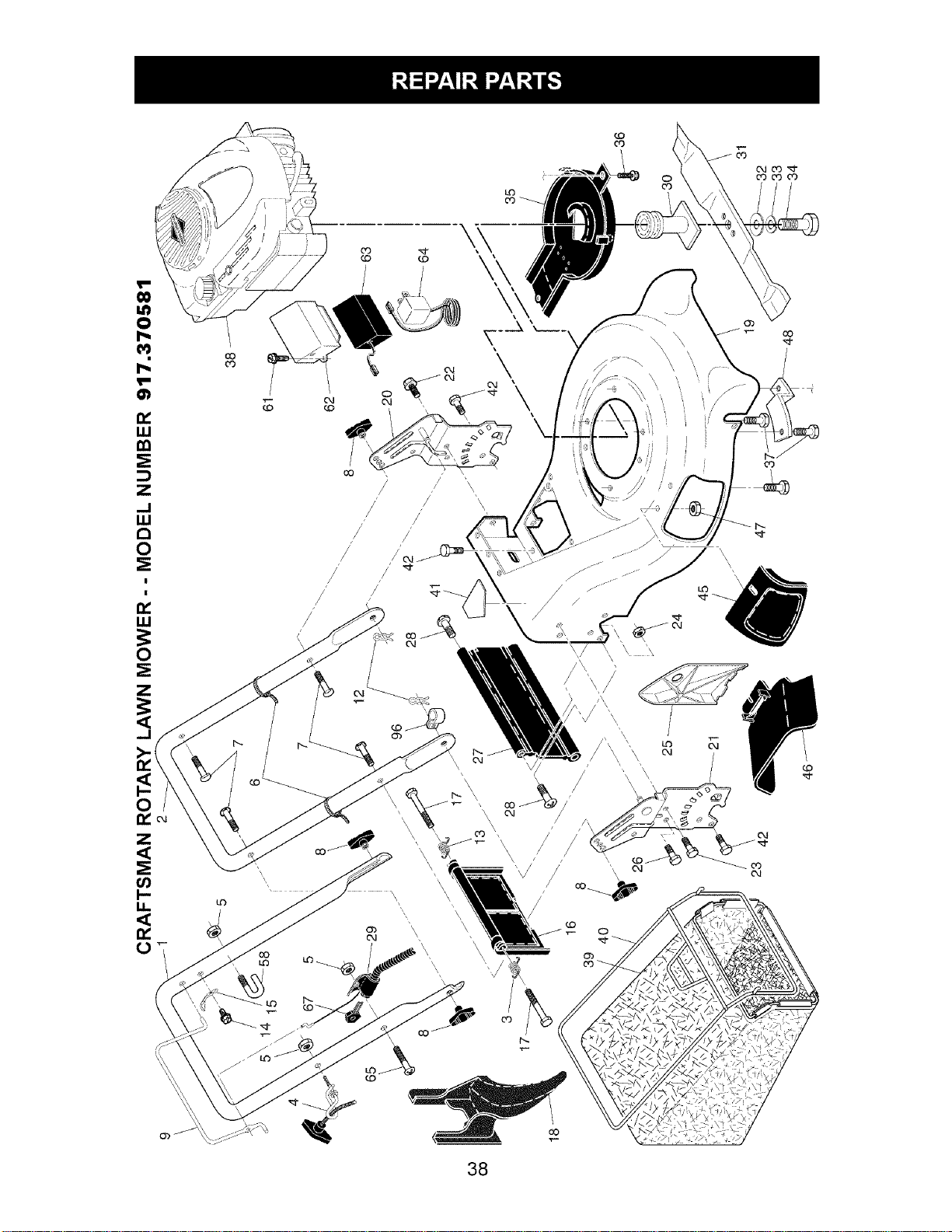
m
0
t_
m
LU
rn
Z
..J
LU
a
Z
co
/
/
/ \
/ \
/'
/
/
c_
\
\
\ \
\
/ \
\
\
\\
38
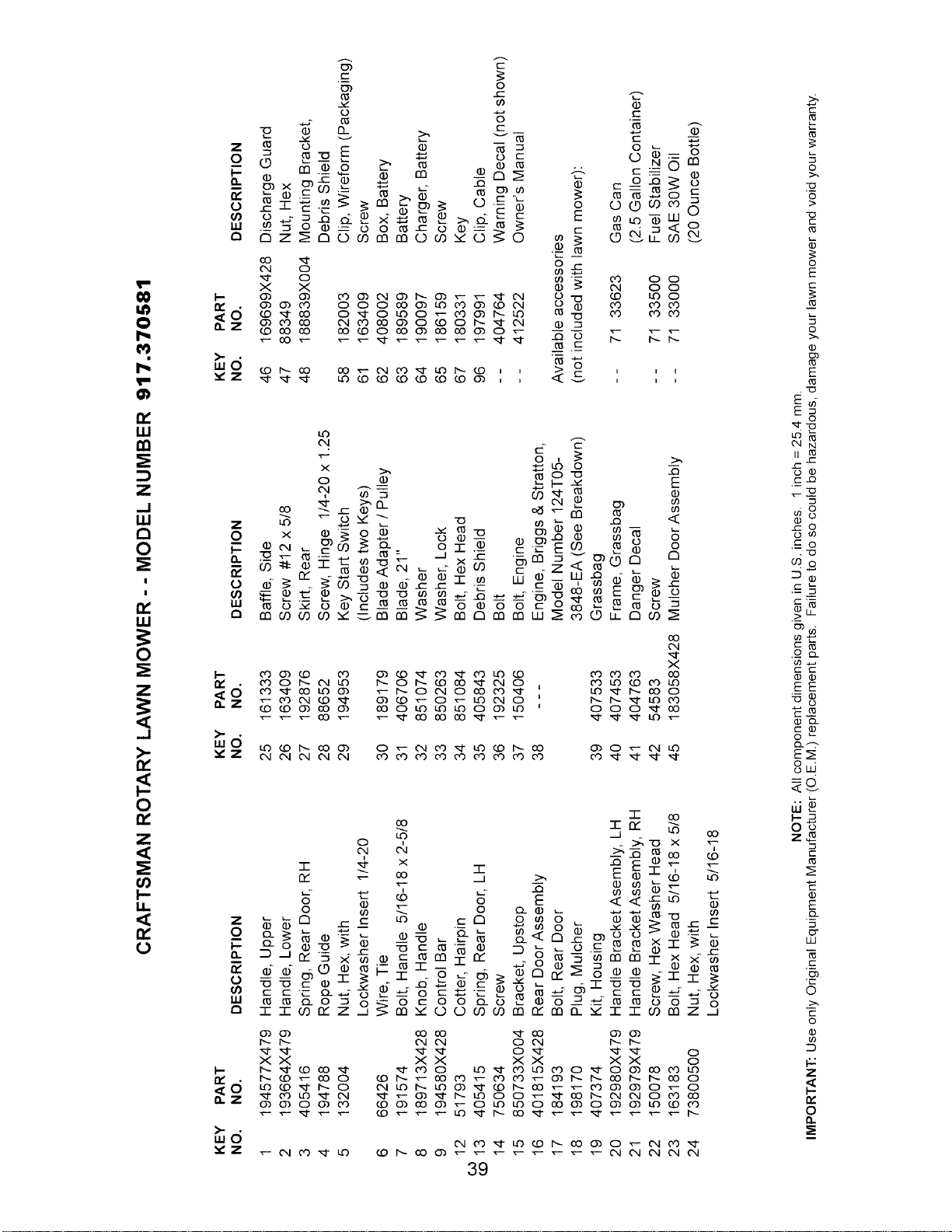
m
o
t_
m
0_
LU
00
Z
..J
I,LI
0
o
LU
Z
..J
0
0_
u_
U.
<
n-
O
_ O,_ _
X _ _O --
o • _o_
z _ _ _ _ _ <
o x
X
_ __ _0_0_ _0
__ _0_0_ _ 000_
wO __ 0__ _0_
_Z __ ___ __
z
o
1--
11.
0
1/)
W
Cl
t--
rr
wO
_z
39
O_
05
O
O
>
c
05
O
E
c
o
¢)
D_
05
E
05
E
E_
_o
J_
cJ;_
.-_ 0
c c
EE
0
8u4
z_
o)
E
w
©
o
0)
z
r¢
o
n
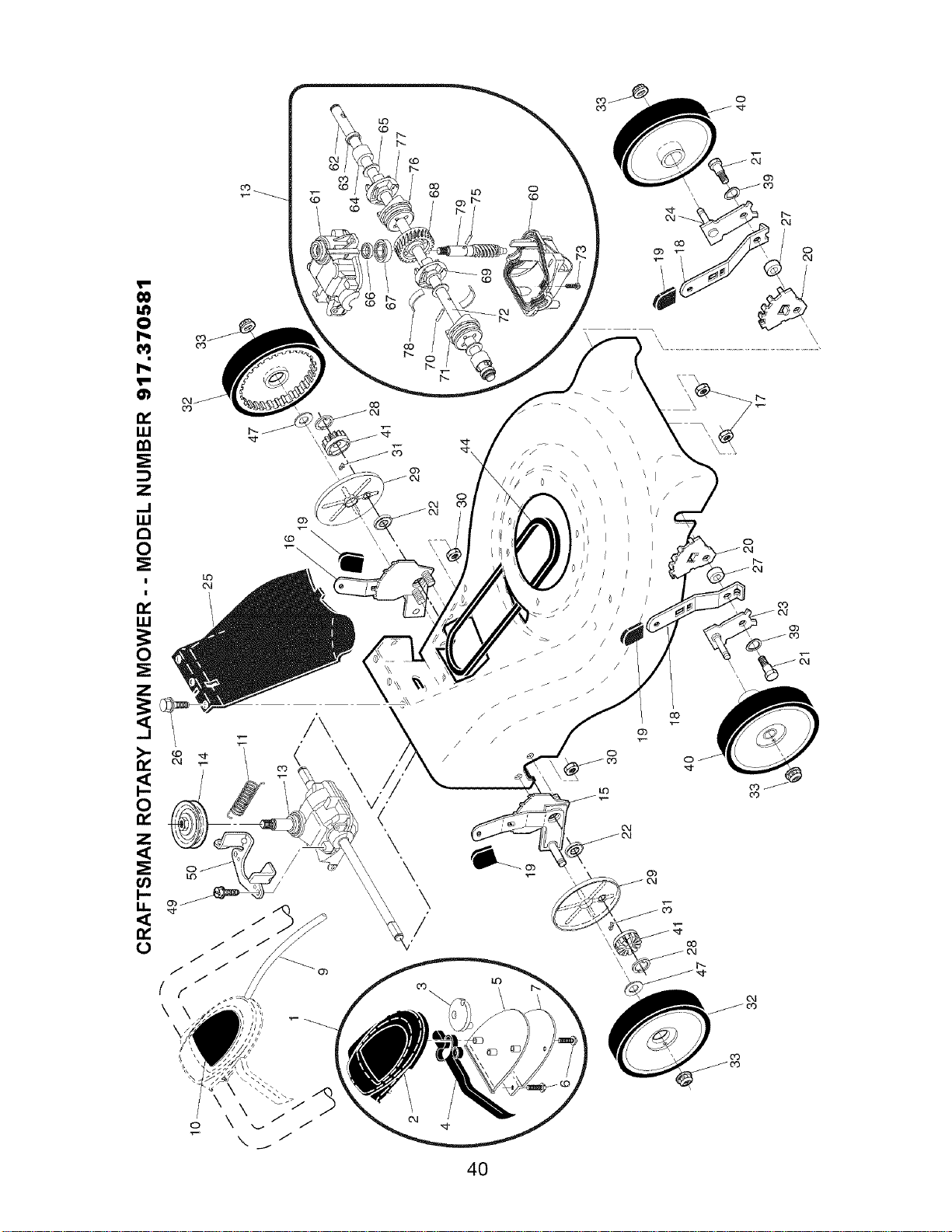
ILl
rn
Z
..J
LLI
a
\
\
\
/
/
/
/
40
i/ /
.i/ /
)
/ /
/
/
/
\
\
\
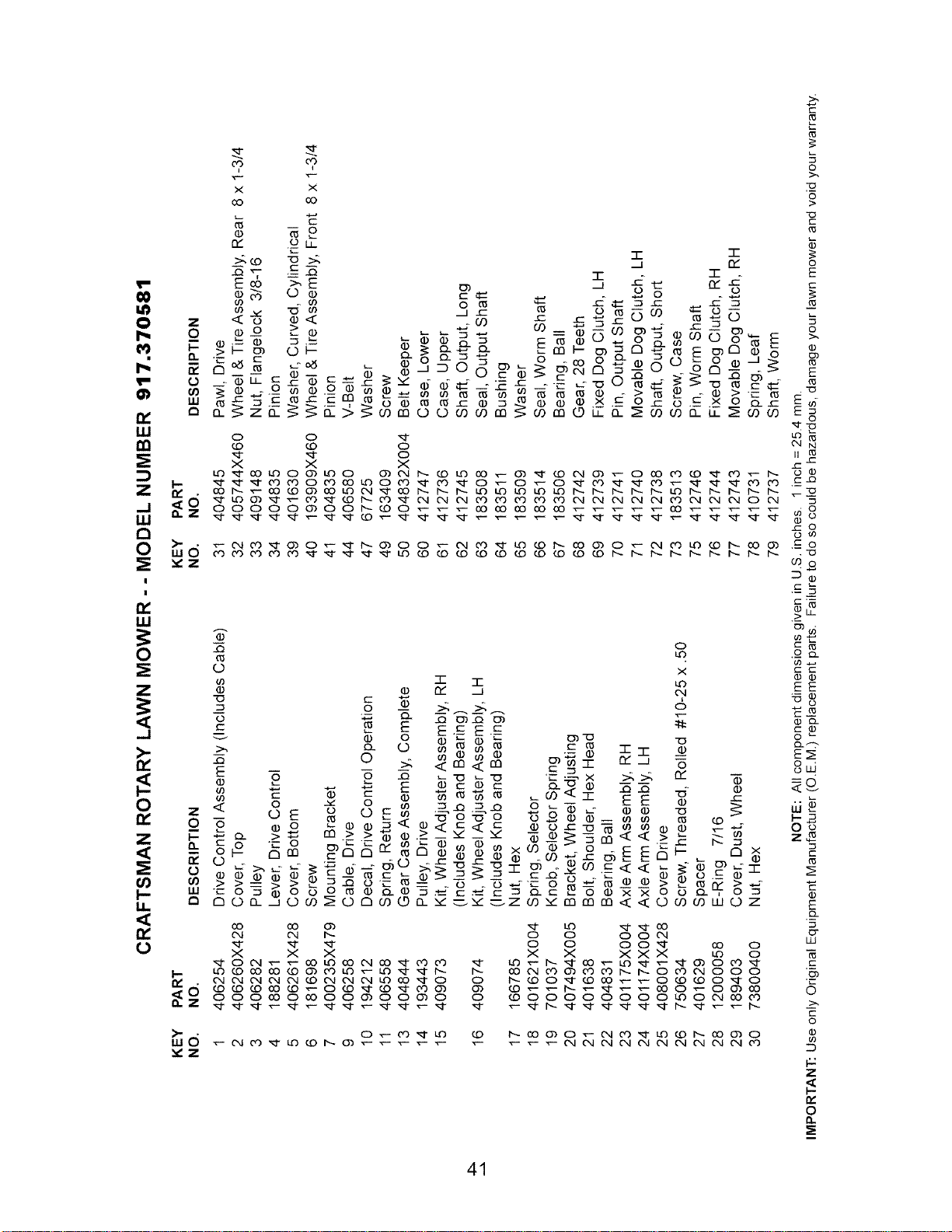
In
0 z
I_ 0
_ m
w
a
uJ
m
N
I---
z ,_
uJ
a
W
Z
-J
0 z
n- g
E
I-- "'
<
i--
r_
wO
_z
X X
oo oO
re" ._ L_
_0 "0 _
(,o
O O
X X
W_O_ _O
_o oo_oo_
__0_
I I
j ,"F
r,," .-c::-
o_ ..d _
0 _ _ ._.,____. _ t--" :::n
co= o o_go _- _
oo__
0003(083 6O
%,
05
o
o
>
"o
c
05
o
E
c
o
&
Ed
En
O
X =
_0_0 0_ __._
00___0__._0
_N
O
• _
-0 t- •
O
_c _ E
• O
_>, o_ O
_o O
_ _ _ E
o •
-_ 0
o 0_
0 0 _- 0 0 _<_
o_ > _ m._>.> _ •
_°_C3 C3 n" _u
>0.oo¢
= 0 _lO c_O
o o09_©tnu_©
0
k_
X
¢F j 04
_o _< <ca m J
_o_o "-'o
o< _-< _- _s ° oo
.>--_-_" -__ -_22_>e
X X X
_O___
000_0_00_00_0
O O OO_
O O OO_ _ O
X X XXX _ o
___0_
_ _ 0_000
0 _0__0_0_0
___0_0_
0 _00000000_0_
c_
c c
• o
EE
• _3_
o
0
{3. "Z"
E_
8u4
z_
m
o
E
uJ
o
o
o
D
Z
r¢
o
n
41

BRIGGS & STRATTON 4-CYCLE ENGINE MODEL NUMBER 124T05-3848-EA
684
51
383_
635
I 1058OPERATOR'SMANUAq
I 1330REPAIRMANUALI 15
I 1329 REPLACEMENT ENGINE I
718 @
741
lO_
3O6
307_
22_
42
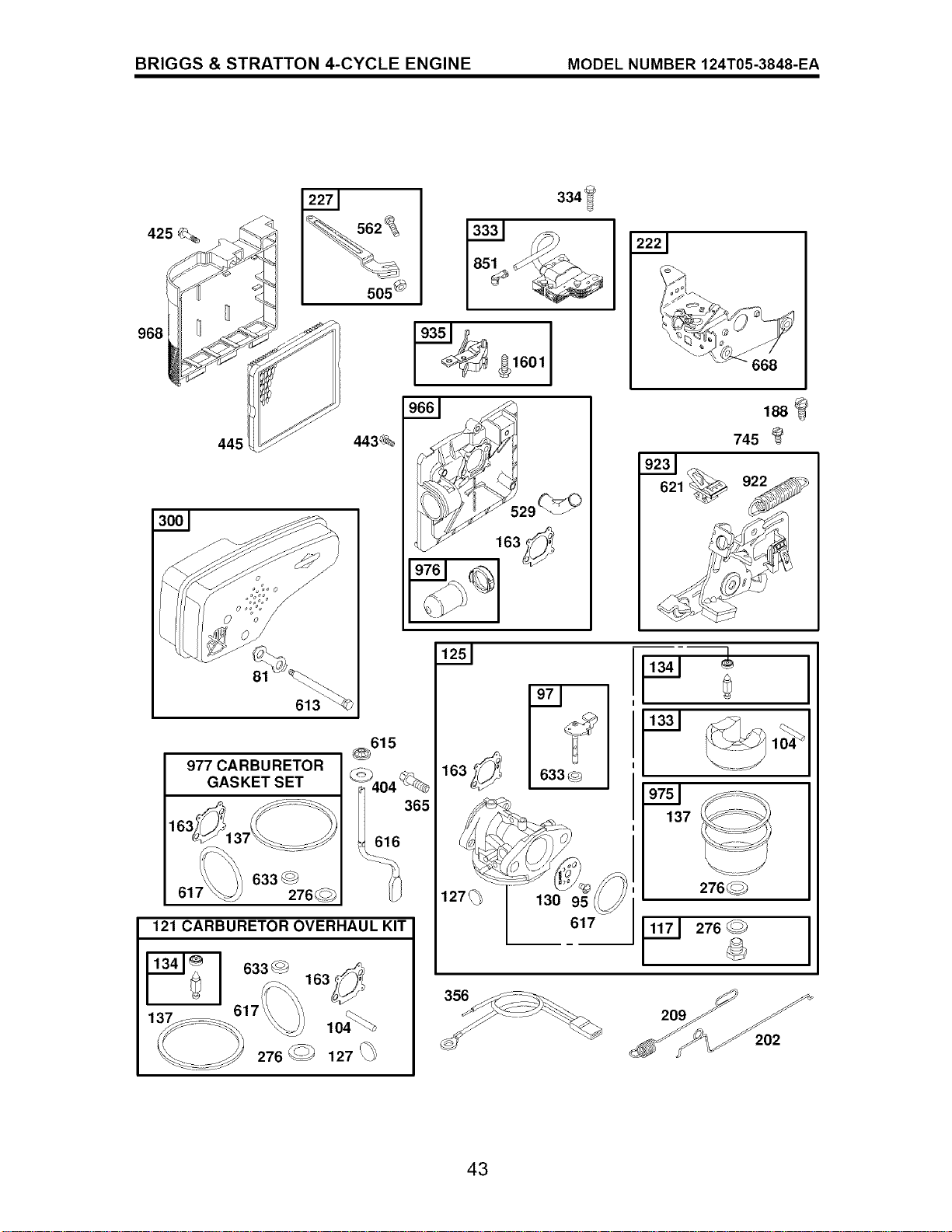
BRIGGS & STRATTON 4-CYCLE ENGINE MODEL NUMBER 124T05-3848-EA
425
968
3001
445
562
505°
_615
977 CARBURETOR
GASKET SET
121 CARBURETOR OVERHAUL KIT
334__
971
633 _3
r
137
127_ 130 95
617
209
202
43
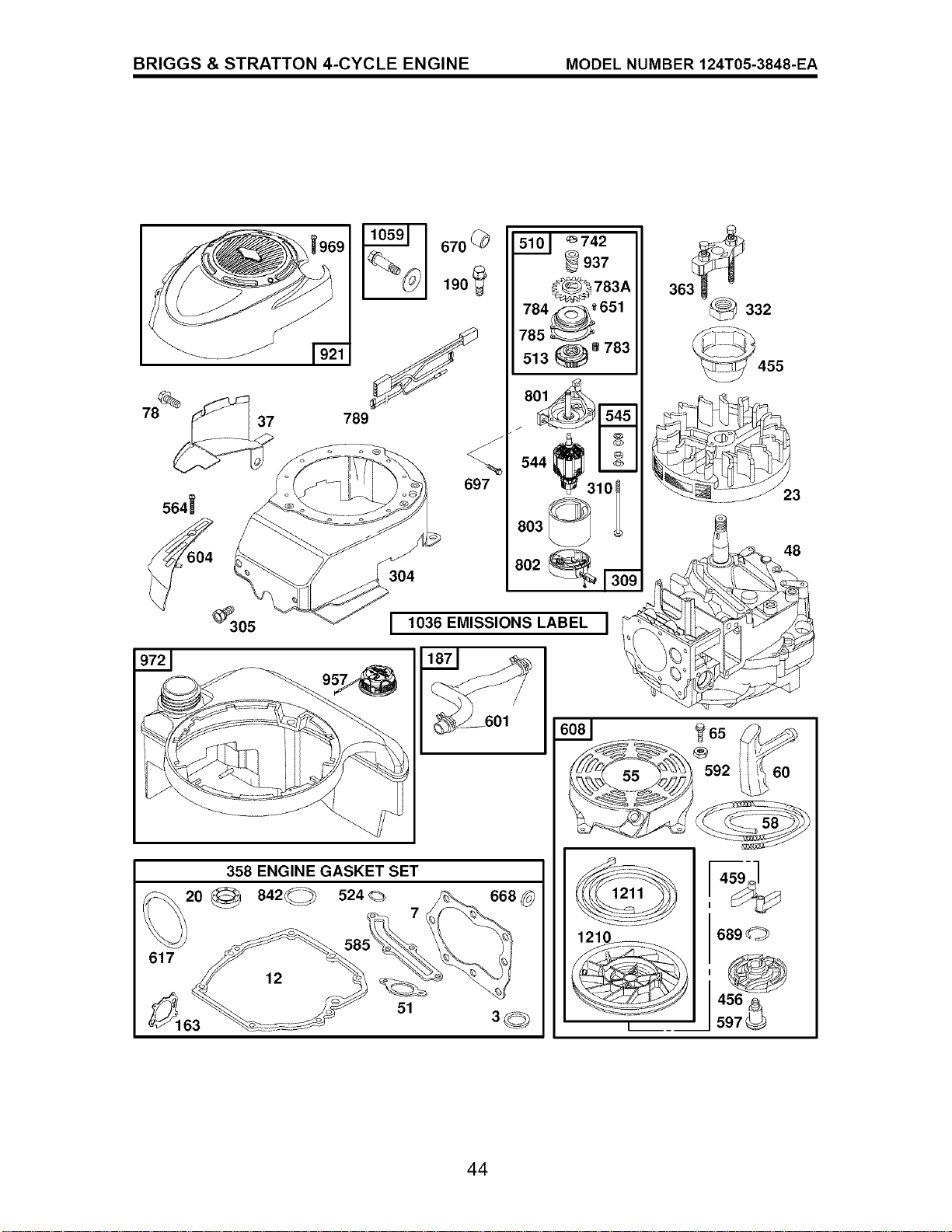
BRIGGS & STRATTON 4-CYCLE ENGINE MODEL NUMBER 124T05-3848-EA
617
670
190
37 789
_ 742
_937
83A
784 651
785_
513_ 783
363__332
455
48
358 ENGINE GASKET SET
20_ 842_ s24_ 668_
51
3©
I.I
44

BRIGGS & STRATTON 4-CYCLE ENGINE MODEL NUMBER 124T05-3848-EA
KEY PART
NO. NO. DESCRIPTION
1 697322 Cylinder Assembly
2 399269 Kit-Bushing/Seal
3 299819s • Seal-Oil (Magneto Side)
4 493279 Sump-Engine
5 691160 Head-Cylinder
7 692249 • Gasket-Cylinder Head
8 695250 Breather Assembly
9 696125 Gasket-Breather
10 691125 Screw (Breather Assembly)
11 691781 Tube-Breather
12 692232 • Gasket-Crankcase
13 690912 Screw (Cylinder Head)
15 691680 Plug-Oil Drain
16 691450 Crankshaft
20 399781s • Seal-Oil (PTO Side)
22 691092 Screw (Engine Sump)
23 691987 Flywheel
24 222698s Key-Flywheel
25 790359 Piston Assembly (Standard)
791326 Piston Assembly
(.020" Oversize)
26 790360 Ring Set (Standard)
791324 Ring Set (.020" Oversize)
27 691866 Lock-Piston Pin
28 499423 Pin-Piston
29 499424 Rod-Connecting
32 691664 Screw (Connecting Rod)
32A 695759 Screw (Connecting Rod)
33 262651s Valve-Exhaust
34 262652s Valve-Intake
35 691270 Spring-Valve (Intake)
36 691270 Spring-Valve (Exhaust)
37 694086 Guard-Flywheel
40 692194 Retainer-Valve
43 691997 Slinger-Governor/Oil
45 690548 Tappet-Valve
46 691449 Camshaft
48 792741 Short Block
50 497465 Manifold-Intake
51 272199s • Gasket-Intake
54 691650 Screw (Intake Manifold)
55 691421 Housing-Rewind Starter
58 697316 Rope-Starter
(Cut to Required Length)
60 281434s Grip-Starter Rope
65 690837 Screw (Rewind Starter)
KEY PART
NO. NO.
78 691108
81 691740
95 691636
97 696565
104 691242 O
117 498978
118 494870
121 498260
125 498170
127 694468 O
130 696564
133 398187
134 398188 O
137 693981 O5
163 272653s °05
187 791873
188 693399
190 690940
202 691829
209 699056
222 793754
227 690783
276 271716 O5
287 690940
300 692038
304 493293
305 691108
306 690450
307 690345
309 695550
310 692327
455 791960
332 690662
333 802574
334 691061
337 802592s
356 692390
358 497316
363 19069
365 692524
383 89838s
404 690272
425 690670
443 692523
445 491588s
456 692299
DESCRIPTION
Screw (Flywheel Guard)
Lock-Muffler Screw
Screw (Throttle Valve)
Shaft-Throttle
Pin-Float Hinge
Jet-Main (Standard)
Jet-Main (High Altitude)
Kit-Carburetor Overhaul
Carburetor
Plug-Welch
Valve-Throttle
Float-Carburetor
Valve-Needle/Seat
Gasket-Float Bowl
Gasket-Air Cleaner
Line-Fuel (Molded)
Screw (Control Bracket)
Screw (Fuel Tank)
Link-Mechanical Governor
Spring-Governor
Bracket-Control
Control Lever-Governor
Sealing Washer
Screw (Dipstick Tube)
Muffler
Housing-Blower
Screw (Blower Housing)
Shield-Cylinder
Screw (Cylinder Shield)
Motor-Starter
Screw (Starter Motor)
Cup-Flywheel
Nut (Flywheel)
Armature-Magneto
Screw (Armature Magneto)
Plug-Spark
Wire-Stop
Engine Gasket Set
Flywheel Puller
Screw (Carburetor)
Wrench-Spark Plug
Washer (Governor Crank)
Screw (Air Cleaner Cover)
Screw (Air Cleaner Base)
Filter-Air Cleaner Cartridge
Plate-Pawl Friction
45
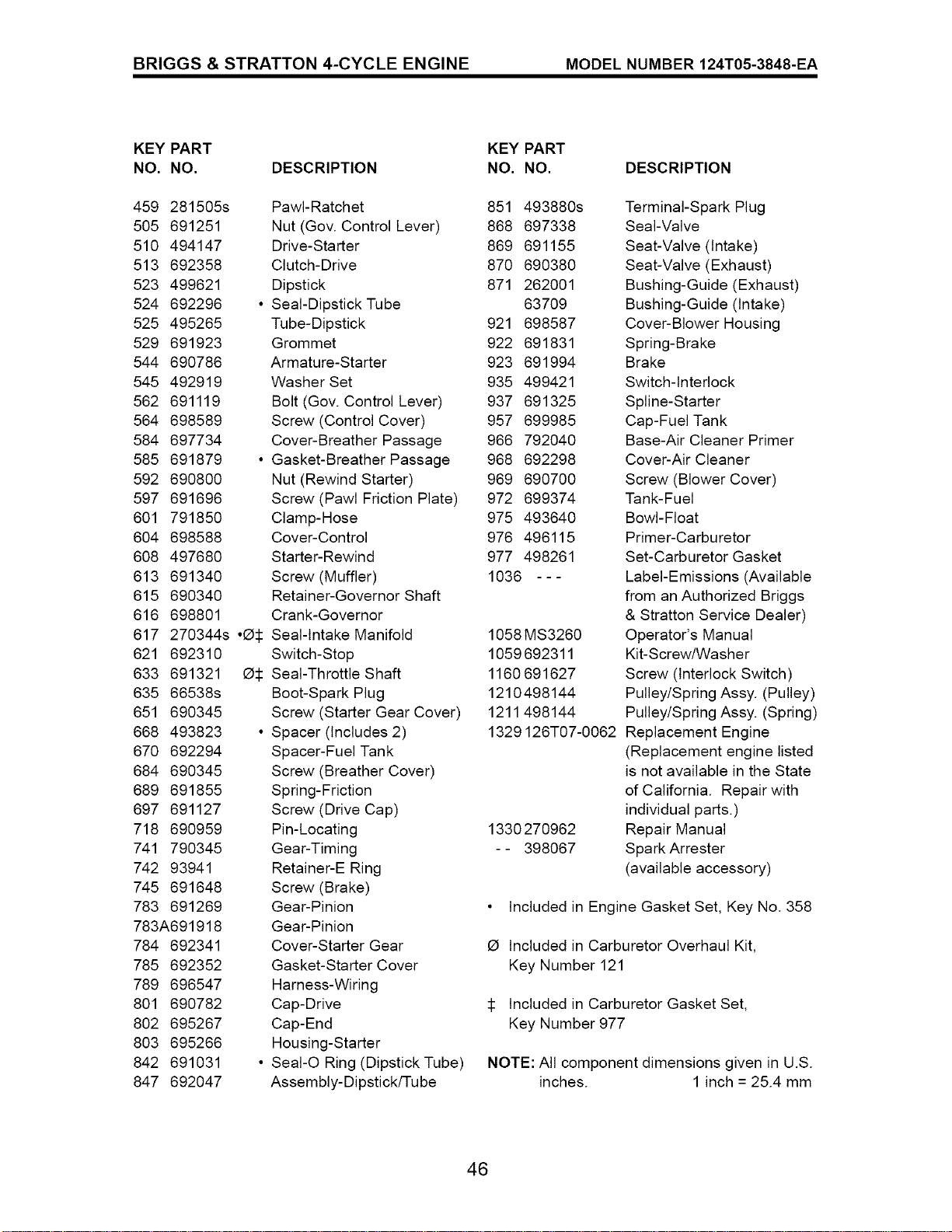
BRIGGS & STRATTON 4-CYCLE ENGINE MODEL NUMBER 124T05-3848-EA
KEY PART
NO. NO. DESCRIPTION
459 281505s
505 691251
510 494147
513 692358
523 499621
524 692296 °
525 495265
529 691923
544 690786
545 492919
562 691119
564 698589
584 697734
585 691879 •
592 690800
597 691696
601 791850
604 698588
608 497680
613 691340
615 690340
616 698801
617 270344s •05
621 692310
633 691321 O5
635 66538s
651 690345
668 493823 °
670 692294
684 690345
689 691855
697 691127
718 690959
741 790345
742 93941
745 691648
783 691269
783A691918
784 692341
785 692352
789 696547
801 690782
802 695267
803 695266
842 691031 •
847 692047
PawI-Ratchet
Nut (Gov. Control Lever)
Drive-Starter
Clutch-Drive
Dipstick
Seal-Dipstick Tube
Tube-Dipstick
Grommet
Armature-Starter
Washer Set
Bolt (Gov. Control Lever)
Screw (Control Cover)
Cover-Breather Passage
Gasket-Breather Passage
Nut (Rewind Starter)
Screw (Pawl Friction Plate)
Clamp-Hose
Cover-Control
Starter-Rewind
Screw (Muffler)
Retainer-Governor Shaft
Crank-Governor
Seal-Intake Manifold
Switch-Stop
Seal-Throttle Shaft
Boot-Spark Plug
Screw (Starter Gear Cover)
Spacer (Includes 2)
Spacer-Fuel Tank
Screw (Breather Cover)
Spring-Friction
Screw (Drive Cap)
Pin-Locating
Gear-Timing
Retainer-E Ring
Screw (Brake)
Gear-Pinion
Gear-Pinion
Cover-Starter Gear
Gasket-Starter Cover
Harness-Wiring
Cap-Drive
Cap-End
Housing-Starter
SeaI-O Ring (Dipstick Tube)
Assembly-Dipstick/Tube
KEY PART
NO. NO. DESCRIPTION
851 493880s
868 697338
869 691155
870 690380
871 262001
63709
921 698587
922 691831
923 691994
935 499421
937 691325
957 699985
966 792040
968 692298
969 690700
972 699374
975 493640
976 496115
977 498261
1036 ---
1058MS3260
1059692311
1160691627
1210498144
1211 498144
1329126T07-0062
1330270962
-- 398067
Terminal-Spark Plug
Seal-Valve
Seat-Valve (Intake)
Seat-Valve (Exhaust)
Bushing-Guide (Exhaust)
Bushing-Guide (Intake)
Cover-Blower Housing
Spring-Brake
Brake
Switch-Interlock
Spline-Starter
Cap-Fuel Tank
Base-Air Cleaner Primer
Cover-Air Cleaner
Screw (Blower Cover)
Tank-Fuel
Bowl-Float
Primer-Carburetor
Set-Carburetor Gasket
Label-Emissions (Available
from an Authorized Briggs
& Stratton Service Dealer)
Operator's Manual
Kit-Screw/Washer
Screw (Interlock Switch)
Pulley/Spring Assy. (Pulley)
Pulley/Spring Assy. (Spring)
Replacement Engine
(Replacement engine listed
is not available in the State
of California. Repair with
individual parts.)
Repair Manual
Spark Arrester
(available accessory)
• Included in Engine Gasket Set, Key No. 358
O Included in Carburetor Overhaul Kit,
Key Number 121
5 Included in Carburetor Gasket Set,
Key Number 977
NOTE: All component dimensions given in U.S.
inches. 1 inch = 25.4 mm
46

Engine Power Rating Information
The gross power rating for individual gas engine models is labeled in accordance with SAE (So-
ciety of Automo-tive Engineers) code Jl1940 (Small Engine Power & Torque Rating Procedure),
and rating performance has been obtained and corrected in accordance with SAE J1995 (Revision
2002-5). Actual gross engine power will be lower and is affected by, among other things, ambi-
ent operating conditions and engine-to-engine variability. Given both the wide array of products
on which engines are placed and the variety of environmental issues applicable to operating the
equipment, the gas engine will not develop the rated gross power when used in a given piece of
power equipment (actual "on-site" or net horsepower). This difference is due to a variety of factors
including, but not limited to, accessories (air cleaner, exhaust, charging, cooling, carburetor, fuel
pump, etc.), application limitations, ambient operating conditions (temperature, humidity, altitude),
and engine-to-engine variability. Due to manufacturing and capacity limitations, Briggs & Stratton
may substitute an engine of higher rated power for this Series engine.
47

Your Home
For repair - in your home - of all major brand appliances,
lawn and garden equipment, or heating and cooling systems,
no matter who made it, no matter who sold it!
For the replacement parts, accessories and
owner's manuals that you need to do-it-yourself.
For Sears professional installation of home appliances
and items like garage door openers and water heaters.
1-800-4-MY-HOME ® Anytime, day or night
(1-800-469-4663) (U.S.A. and Canada)
www.sears.corn www.sears.ca
OurHome
For repair of carry-in products like vacuums, lawn equipment,
and electronics, call or go on-line for the nearest
Sears Parts and Repair Center.
1-800-488-1222 Anytime, day or night (U.S.A. only)
www.sears.com
To purchase a protection agreement (U,S.A.)
or maintenance agreement (Canada) on a product serviced by Sears:
1-800-827-6655 (U.S.A.) 1-800-361-6665 (Canada)
Para pedir servicio de reparaciOn
a domicilio, y para ordenar piezas:
1-888-SU-HOGAR ®
(1-888-784-6427)
Au Canada pour service en frangais:
1-800-LE-FOYER Mc
(1-800-533-6937)
www.sears.ca
© Sears Brands, LLC
® Registered Trademark / TMTrademark / SMService Mark of Sears Brands, LLC
® Marca Registrada / TM Marca de Fabrica / SMMarca de Servicio de Sears Brands, LLC
MCMarque de commerce / MDMarque depos6e de Sears Brands, LLC
412522 02.06.07 BY Printed in U.S.A.
