o
0
0
*owtogetYour
the best from
Bu~t-In
Oven
Contents
Aluminum Foil
14
Appliance Registration
2
Use and Care
of-Model
Baking, Baking Guide
9–1
1
Broiling, Broiling Guide
14, 15
RGJ534GEP
Care
and
Cleaning
1
6–I
8
Clock/Timer
7
Consumer Services
23
Control
Panel
6,7
Door Removal
17,
18
Energy-Saving Tips
4
Features
5
Ligh(;
Bulb
Repluwment
8,
17
Minor Adjustments
lg
Model
and
Serial Numbers
2
Preheating
II
Problem Solver
20
Roasting, Roasting Guide
12,
13
Safety
Instructions
2-4
Shelves
8,
12, 17,
18
Thermostat Adjustment
lg
Warranty
Back Cover
GE
Answer Center”
800.626.2000
HcnPollw
—
Help us help you...
Read this book carefully.
It
is intended (o help you operate
and
mtiintdin
your new oven
properly.
Keep
i[
handy
for
answers
to
your
questions.
It’
you
clon
’( understand something
or need more help. write (include
your
phorw
number):
Consumer Affairs
Hotpoint
Appliance Park
Louisville, KY
40225
Write down the model and
serial numbers.
YoLI’11
find them on
a
label on the
frotlt
frame behind the broiler
drawer.
See
Features Section.
These numbers are
UISO
on the
consumer
pl”oduct
Ownership
Registration
Card
tha[
came
with your oven.
Before
sending
in this card,
please
write these
numbers here:
If you need service...
To obtain service, see the
Consumer Services page in the
back of this book.
We’re proud of our service and
want you to be pIeased. If for some
reason you are not happy with the
service you receive, here are three
steps to follow for further help.
FIRST, contact the people who
serviced your appliance. Explain
why you are not pleased. In most
cases, this will solve the problem.
NEXT, if you are still not pleased,
write
all
the details—including
your phone number—to:
Manager, Consumer Relations
Hotpoint
Appliance Park
Louisville, KY 40225
FINALLY, if your problem is still
not resolved, write:
Major Appliance Consumer
Action Panel
20 North Wacker Drive
Chicago, IL 60606
Model Number
Serial Number
Use
these
numbers in any
correspondence or service
calls
concerning your oven.
If you received
a damaged oven...
Immediately contact the dealer (or
builder)
that
sold
you the oven.
Save time and money.
Before you request
service...
Check
dw
Problem Solver in
this book.
It
lis(s
causes
of minor
operating
problems
that you
can
correc(
yourscl
f.
WARNING:
If the
information in this
manual is not followed
exactly, a fire or explosion
may result causing
property damage,
personal injury or death.
— Do not store or use
gasoline or other
flammable vapors and
liquids in the vicinity
of this or any other
appliance.
— WHAT TO DO IF
Y()[J
SMELL GAS
●
Do not try to light any
appliance.
●
Do not touch any
electrical switch; do not
use any phone in your
building.
●
Immediately
call
your
gas supplier from
a
neighbor’s phone.
Follow the gas supplier’
instructions.
●
If you cannot reach
,youl
gas supplier, call the fire
department.
—Installation and service
must be performed by
a
qualified installer, service
agency or the gas
suppliel
2
IMPORTANT SAFETY INSTRUCTIONS
Read
all instructions before using this appliance.
IMPORTANT
SAFETY NOTICE
The California Safe Drinking
Wuter
and Toxic Enforcement Act
requires the
cJovemor
of
California
to
publish a list of substances
known to the state to cause cancer,
birth
defects or other reproductive
harm,
find
requires businesses
to
warn
customers of potential
exposure to such substances.
(M
Appliances can
cause
minor
exposure to four of these
substances, namely benzene,
carbon
monoxide, formaldehyde
and soot, caused primarily by the
incomplete combustion of natural
~M
01-
[.P
fuels.
Properly adjusted
burners, indicated by a bluish
rather than a yellow flame,
will minimize incomplete
combustion. Exposure to these
substances
can
be minimized
further by venting with an open
window
or using a ventilation
fan or hood.
When You
Get
Your Oven
●
Have
the installer show you
the location of the oven gas cut-
off valve and how to shut it off
if necessary.
●
Have your oven installed and
properly grounded by a
qualified installer,
in accordance
with the Installation Instructions.
Any adjustment and service
should
be
performed only by
qualified gas
range
installers or
service
technicians.
c
Plug your oven into a 120-volt
grounded outlet only.
Do not
remove the round grounding
prong from the plug. If in doubt
about the grounding of your
home electrical system, it is
your personal responsibility and
obligation to have an ungrounded
outlet replaced with a
properly-
grounded, three-prong outlet in
accordance with the National
Electrical Code. Do not use an
extension cord with this
appliance.
●
Be sure
all
packing materials
are removed from the oven
before operating it, to prevent
fire or smoke damage should the
packing material ignite.
●
Be sure your oven is correctly
adjusted by a qualified service
technician or installer for the
type of gas (Natural or LP) on
which it is to be used.
Your oven
can be converted for use on either
type of gas. See the Installation
Instructions.
Using Your Oven
●
Don’t leave children alone or
unattended where an oven
is
hot or
in
operation.
They could
be seriously burned.
●
Don’t allow anyone to
climb!
stand or hang on the door or
broiler compartment. They
could damage the oven.
●
CAUTION: ITEMS OF
INTEREST TO CHILDREN
SHOULD NOT BE STORED
IN CABINETS ABOVE AN
OVEN—CHILDREN
CLIMBING ON THE OVEN
TO REACH ITEMS COULD
BE SERIOUSLY INJURED.
●
Never wear loose fitting or
hanging garments while using
the appliance.
Be careful
when reaching for items stored
in cabinets over the oven.
Flammable material could be
ignited if brought in contact with
flame or hot oven surfaces and
may cause severe burns.
●
For your safety, never use
your appliance for warming or
heating the room.
●
Do not use water on grease
fires. Never pick up a flaming
pan,
Turn off burner, then
smother flaming pan by covering
pan completely with well-fitting
lid, cookie sheet or flat tray.
Flaming grease outside a pan
can be put out by covering with
baking soda or, if available, a
multi-purpose dry chemical or
foam-type fire extinguisher.
●
Do not leave paper products,
cooking utensils, or food in the
oven when not in use. Do not
store flammable materials in an
oven.
Do not store or use gasoline
or other flammable vapors and
liquids in the vicinity of this or
any other appliance.
●
Do not let cooking grease or
other flammable materials
accumulate in or near the oven.
●
Do not use oven as a storage
area.
●
When cooking pork,
follow
the directions exactly and always
cook the meat to an internal
tem~erature
of at least
170”F.
Thi; assures that, in the remote
possibility that trichina may
be present in the meat, it will
be killed and meat will be
safe to eat.
(continued
ne.rl
p~ige)
3
IMPORTANT SAFETY INSTRUCTIONS
(Conllllllcd
)
●
Stand
away
f’rom
oven when
opening oven door. The hot air
or
steam
which escapes can
burn hands,
f’ace
and/or eyes.
●
Don’t heal unopened food
containers in the oven.
Pressure
could
build up and
the container could burst,
causing an injury.
●
Keep
oven
vent
ducts
unobstructed.
●
Keep
oven
f’ree
from grease
buildup.
●
Place
oven shelf in desired
position while oven is cool.
It’
shcl\
M
musI
be
htindltxf when
lint.
dO
no{ IcI pot holder
cmtact
heatin:
unils in the oven.
●
Pulliug
out shelf to shelf stop
is a convenience in lifting heavy
foods. It is also
a
precaution
against burns from touching
hot
surfaces
of’ door or oven
walls.
●
Whtm
using cooking or
roasting bags in oven, follow
[hc lll:llllll’LIct
LII’cI”s
dit”ections.
●
Do
not use your oven to dry
newspapers.
If’
o~ferheated, they
can Ldtch fire.
● Don ‘t use aluminum foil
anywhere in the oven except as
described in this book.
Misuse
could
rmu
[(
in
a
[’i
rc
hazard or
LiWI~t?
[()
(he
()\JCl].
● Use only
glass
cookware that
is recommended
for
LISe
in
gas
olcns.
●
Always remove broiler pan
from the broiler compartment
as soon as you finish broiling.
Grease left in the pan can catch
fire if oven is used without
removing the grease from the
broiler pan.
●
When broiling, if meat is too
close to the flame, the fat may
ignite.
Trim excess fat to prevent
excessive flare-ups.
●
Make sure broiler pan is in
place correctly
to reduce the
possibility of grease fires.
●
If you should have a grease
fire in the broiler pan,
turn off
oven, and keep broiler door
closed to contain fire until it
burns out.
Clean only
parts listed in this
Use and Care Book.
If You Need Service
S
Read “The Problem
Solver”
in
this book.
●
Don’t attempt to repair
or replace any part
of your
range unless it is specifically
recommended in this book.
All
other servicing should be referred
to a qualified technician.
SAVE THESE
INSTRUCTIONS
4
Energy-Saving Tips
● Preheat the oven only when
necessary. Most foods will cook
satisfactorily without preheating.
If you find preheating is
necesstiry,
listen for the beep and put food in
the oven promptly after the oven is
preheated.
● Always turn oven OFF before
removing food.
● During baking, avoid frequent
door openings. Keep door open
as short a time as possible
if
it
is opened.
● Cook complete oven meals
instead of just one food item.
Potatoes, other vegetables and
some desserts will cook together
with a main-dish casserole, meat
loaf, chicken or roast. Choose
foods that cook at the same
temperature and in approximately
the same time.
● Use residual heat in oven
whenever possible to finish
cooking casseroles, oven meals,
etc. Also add rolls or precooked
desserts to warm oven, using
residual heat to warm them.
—
4
‘k-iii
i
\
\
,’
m
I
(’J-Q
\w\
-7
F=========”-”’-
\
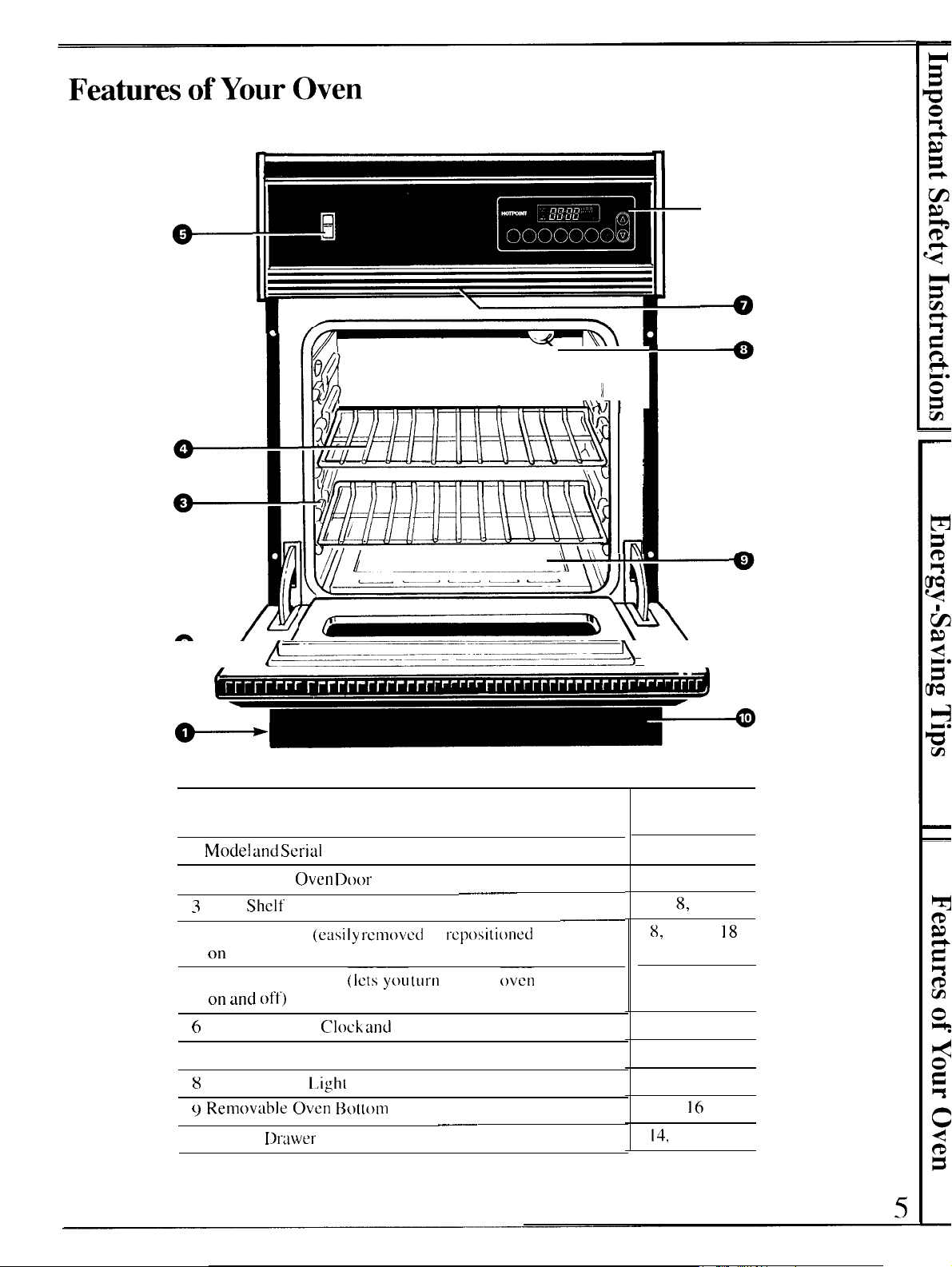
Feature Index
I
Mode]
and
,%rial
Numbers (behind broiler drawer)
2 Removable
Oven
Door
———
3
Oven Shelf Supports
—.
4 Oven Shelves
(eusily
rcmovcd
or
rcpositiomxl
on
shelf supports)
5 Oven Light Switch
(Icts-you
(urn
interior
OVL;l
light
on
and
oft)
6
Oven Controls,
Clock
and
Timer
—
7 Oven Vent
8
Oven Interior
I..igh[
~
RemovLlb]e
Oven
Bt)ttonl
—.—
1 () Broiler
Drawer
See
page
2
17, 18
8,
12
8,
12, 17,
18
8
7,8
8
8, 17
16
14,
15, 17, 18
Features of Your Oven Control
?
?
???
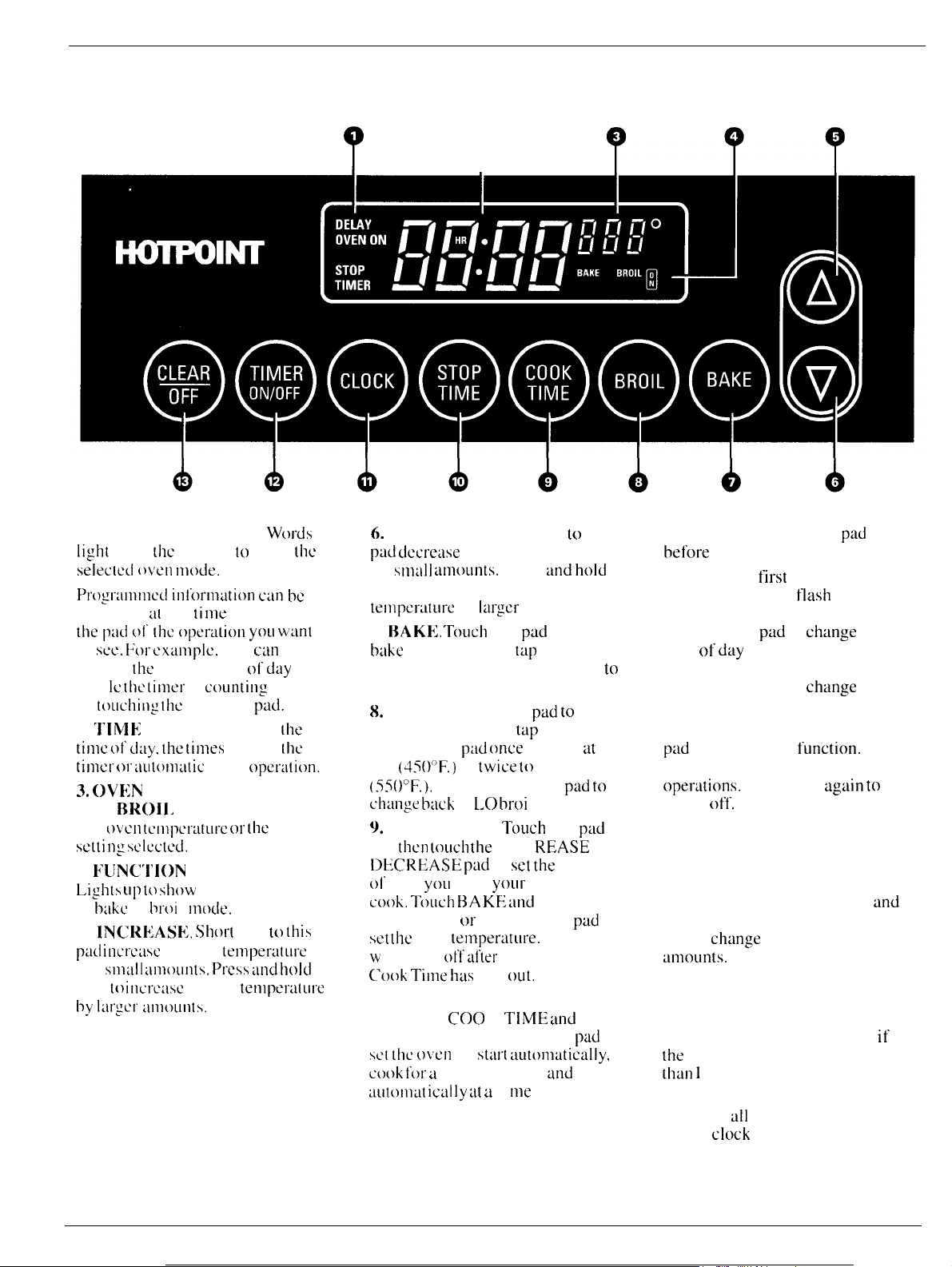
1. PROGRAM STATUS.
Words
light
up in tilt display
[o
show
the
Seleclcd
()\’ell
mode.
Progr:llllmcd
int’t)rmation
can
be
displayed
al
any
[i
me
by touching
the
pad
of
[he
opel”ulion
yoLI w’mt
to
S(2C.
1:01”
CXdlllp]C. yell
CLII1
display
[he
current time of
day
whi
Ie
[he
[imcr
is
counting
down
by
toLdling
the CLOCK
pad.
2.
‘l’IME:
DISPLAY. Shows
(be
time
c~t
d:ly,
the
limes
set for
(he
timer
or
:Iu(olno(ic
oven
operation.”
3.
OVk:N
TEMPERATURE
AND
BROII,
DISPLAY. Shows
the
OYcll
tClll]3Cl”U[Lll”C
01”
[he broil
sc[ti
n:
selected.
4.
IWJNCT1ON
INDICATORS.
Lights
LIp
(()
show
whether oven is
in
tmkc or
hroi
I mode.
5.
INCREASE;,
Short
taps to (his
pad
incrc:lw
[i me or
[emperaturc
by
SIIIL1!I
llll)OLIIltS. press
lllld
hold
pad
to incrcme time or tenlperdlLlrc
h~
@!U’
tlIlloLllltS.
6.
DECREASE. Short taps
to
this
pd
decrease
time or temperature
by
small
:unounts.
Press md
hold
pad to decrease time or
tenlperatllre
by
Ial”gcr
amounts.
7.
BAKE.
‘rOLICh
this
pad
to select
bake
function. Then
tap
or press
INCREASE
or DECREASE pad
to
display desired temperature.
8.
BROIL. Touch this
pad
to
select
broil function. Then
tap
INCREASE pxl
once
to broil
at
LO
(450(’F.)
or
twice
to
broil at HI
(5500F.).
Tap DECREASE
pad
to
chmge
hack to LO broi 1.
9. COOK TIME.
Touch
this
pad
and
then
touch
[he
1 NC REASE or
DEJCREASE
ptid
to
set
the
amount
~)!’
time
you
want
your
food to
c(mk.
Touch
BA
KF1
~lnd
the
INCREASE
or
DECREASE
pad
to
set
[he
oven
(emperatLu-e.
The oven
w
i 11 shut off
Jter
the selected
Cook
Tirrre
has
run
out.
10. STOP TIME. Usc this pad
along with
COO
K TIME
and
INCREASE or DECREASE pad to
SC(
the ()\erl to stwl
wrtomtitica]ly,
cook
for
a
specified time
and
stop
:mtomut ical Iy
ut
a
t i
me
you select.
11. CLOCK.
Touch this
pad
bef’ore
setting the clock.
To set clock,
first
touch CLOCK
pad.
“TIME” will
flash
in the
display. Tap INCREASE or
DECREASE
pad
to
change
the
time
of
day
by small amounts.
Press & hold INCREASE or
DECREASE pad to
change
the
time of day by larger amounts.
12.
TIMER ON/OFF.
Touch this
pad
to select timer
f’unction.
The
timer does not control oven
opertitions.
Touch pad
again
to
turn it
off.
To set timer, first touch TIMER
pad. “TIMER” will flash in the
display. Tap INCREASE or
DECREASE pad to change the
time by small amounts. Press
and
hold INCREASE or DECREASE
pad to
change
the time by larger
tirnounts.
Hours and minutes will be
displayed if the time set on the
timer is more than 1 hour. Minutes
and seconds will be displayed
if
the
time set on the timer is less
thun
1
hour.
13. CLEAR/OFF. Touch this
pad
to cancel
all
oven operations “
except clock and timer.
6
Control, Clock and Timer
Clock
The
clock
must be set for the
automatic oven timing functions
to
work properly. The time of day
cannot be changed during a TIME
BAKE
~yde.
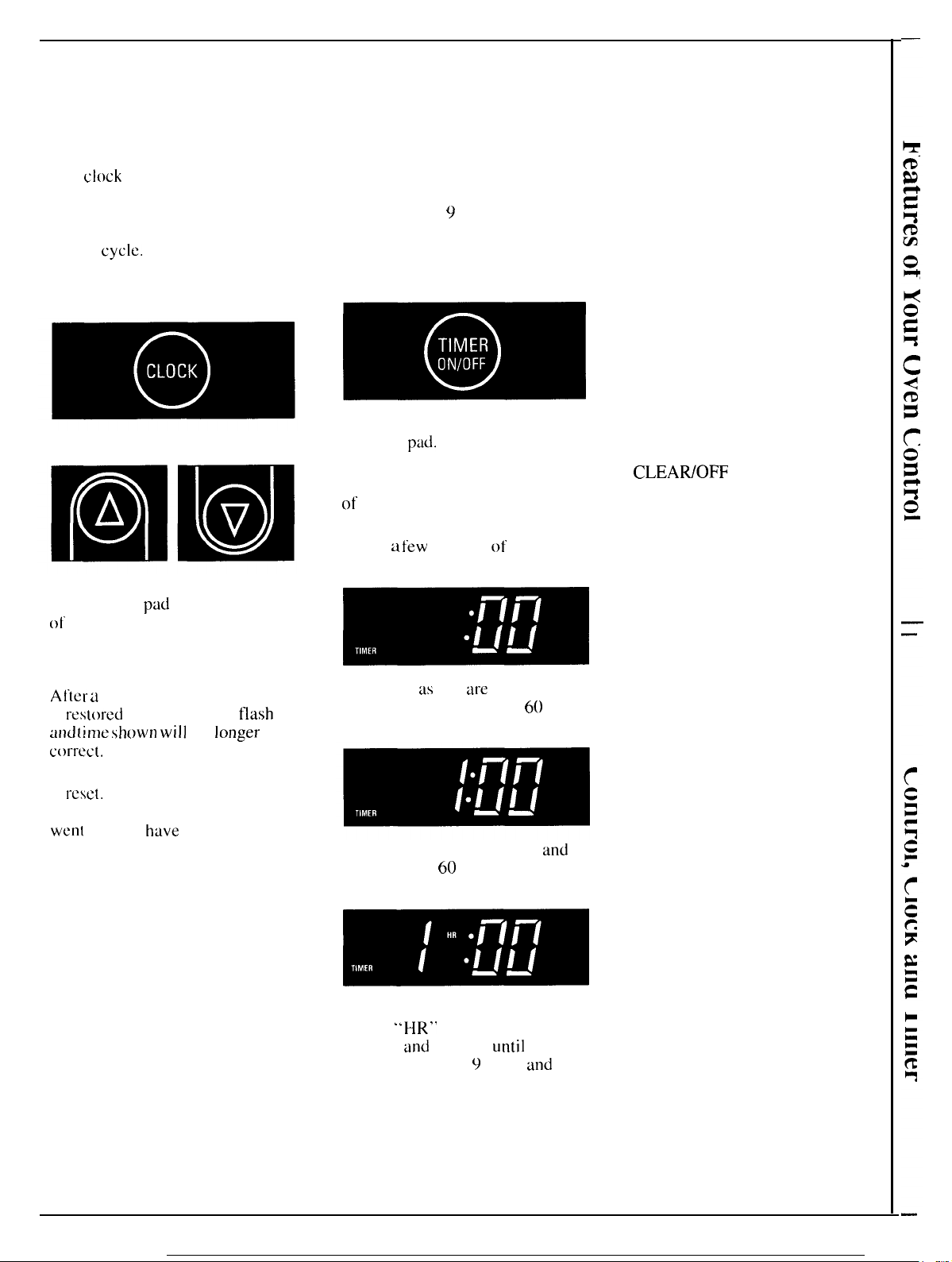
To Set the Clock
Step 1. Touch the CLOCK pad.
Step 2. Press INCREASE or
DECREASE
ptid
to set the time
ot”
day.
Power Outage?
At’tcr
a
power outage, when power
is
resl(mxl
the display will
flash
and
(iITw
shown
wi]]
no
longer
be
correc[.
The display flashes until the clock
is
reset.
All other functions that
were in operation when the power
went
out will
have
to be
programmed again.
Timer
The timer does not control oven
operations. The maximum setting
on the timer is
9
hours and 55
minutes.
To Set The Timer
Step 1.
Touch the TIMER
ON/OFF
ptid.
Step 2. Press INCREASE or
DECREASE pad to set the amount
of
time on the timer.
The timer will start automatically
within
a
few
seconds of releasing
the pad.
mllm
The timer,
as
you
are
setting it,
will display seconds until
60
seconds is reached.
Then it will display minutes
and
seconds until
60
minutes is
reached.
To Reset Timer
Touch TIMER pad and then press
INCREASE or DECREASE pad
until the time you want shows on
the display.
To Cancel Timer
Press & hold TIMER pad until the
word “TIMER” quits flashing on
the display (about 4 seconds).
Timer Tones
The timer tone is 3 beeps followed
by 1 beep every 6 seconds. If you
would like to remove the one beep
every 6 seconds, press & hold
CLEAWOFF for 10 seconds.
To return the tone of 1 beep every
6 seconds, press & hold
CLEAR/OFF for 10 seconds.
Error Message
If “F” and a number flash on
display, this indicates a function
error code. Touch CLEAR/OFF
pad. If function error code does not
clear, disconnect power to the oven
and call for service.
After 60 minutes, it will display
hours (
“HR”
now appears in
display)
and
minutes
until
the
maximum time of
9
hours
and
55
minutes is reached.
7
Using Your Oven
Automatic Ignition
The oven burner is lighted by
electric ignition.
To light the burner,
touch the pad
for the desired function and press
lNCREASE or DECREASE pad
until the desired temperature is
displayed. The burner should
ignite within 60 seconds.
After the oven reaches the selected
temperature, the oven burner
cycles—off completely, then on
with a full flame—to keep the
oven temperature controlled.
Power outage?
The oven burner will not light in
the event of an electrical power
outage. Do not attempt to light it
manually with a match.
Oven Light
Use the switch on the control panel
to turn
the light on and off.
Oven Vent
When the oven is on, heated air
moves through a vent below the
control panel.
The vent area could get hot during
oven use.
The vent is needed for proper air
flow in the oven and good baking
results.
Do
not block this vent.
Doing so may cause failure, fire
or damage to the oven.
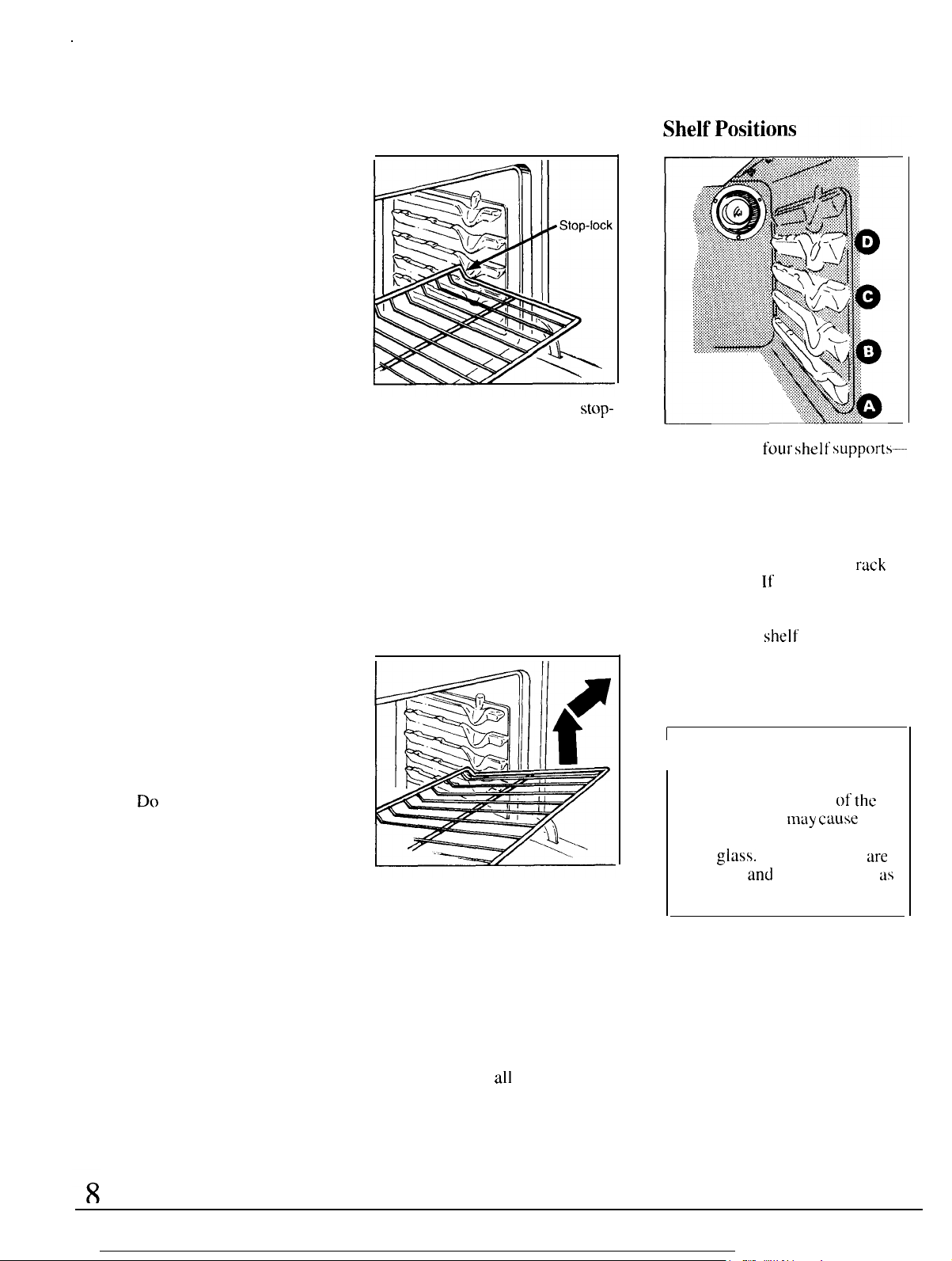
Oven Shelves
I
,
The shelves are designed with
stop-
locks so when placed correctly on
the shelf supports, they will stop
before coming completely out of
the oven and will not tilt when you
are removing food from them or
placing food on them.
When placing cookware on a shelf,
pull the shelf out to the “stop”
position. Place the cookware on
the shelf, then slide the shelf back
into the oven. This will eliminate
reaching into the hot oven.
To remove a shelf from the oven,
pull it toward you, tilt front end
upward and pull shelf out.
To replace, place shelf on shelf
support with stop-locks (curved
extension of shelf) facing up and
toward rear of oven. Tilt up front
and push shelf toward back of
oven until it goes past “stop” on
oven wall. Then lower front of
shelf and push it
all
the way back.
The oven has
four
shelf
supports-
A (bottom), B, C and D (top).
Shelf positions for cooking are
suggested on Baking and Roasting
pages.
For best results, we recommend
that you use only one oven
rack
when baking.
If
you are baking
multiple items and choose to use
both oven racks for baking, place
oven racks on shelf positions B
and D. When baking several items
stagger pans so that no pan is
directly above another.
I
Oven Moisture
As your oven heats up, the
changing temperature
of’
the
air in the oven
may
cause
water droplets to form on the
door
glass.
These droplets
are
harmless
and
will evaporate
as
the oven continues to heat Lip.
Baking
You1-
fwcn
(emperalure
is controlled
very
ticcuratciy
using
an
electronic
control
sys[em.
We
recommend
(hat
you operate
(he
range
for
a
number of
weeks
using the time
(,
i
V~Il
on
recipes as
a
guide
tO
.+
lxct)lll~,
I’anl
i liar
wilh
your new
t)\cil
pcrl’ormuncc.
If you think
an
a(l<j
ust
mcn[
is
nccesstiry,
see
A(.ljus(
ing
(“)ven
Thermostat section.
Yt)LIl
nmv
range
UI1OWS
you to set
km)[m”atures
ilS
]OW
as
150° but
(hcsc
low temperatures are intended
(()
be
Llswi
after cooking to keep
the
hot food warm. Low temperatures
wi II
tlo(
ki II all bacteria and
[hcrchw
are
not recommended
for
usc
unl
il
bactcriti
have
been
killed
by
higher
lcmperaturcs.
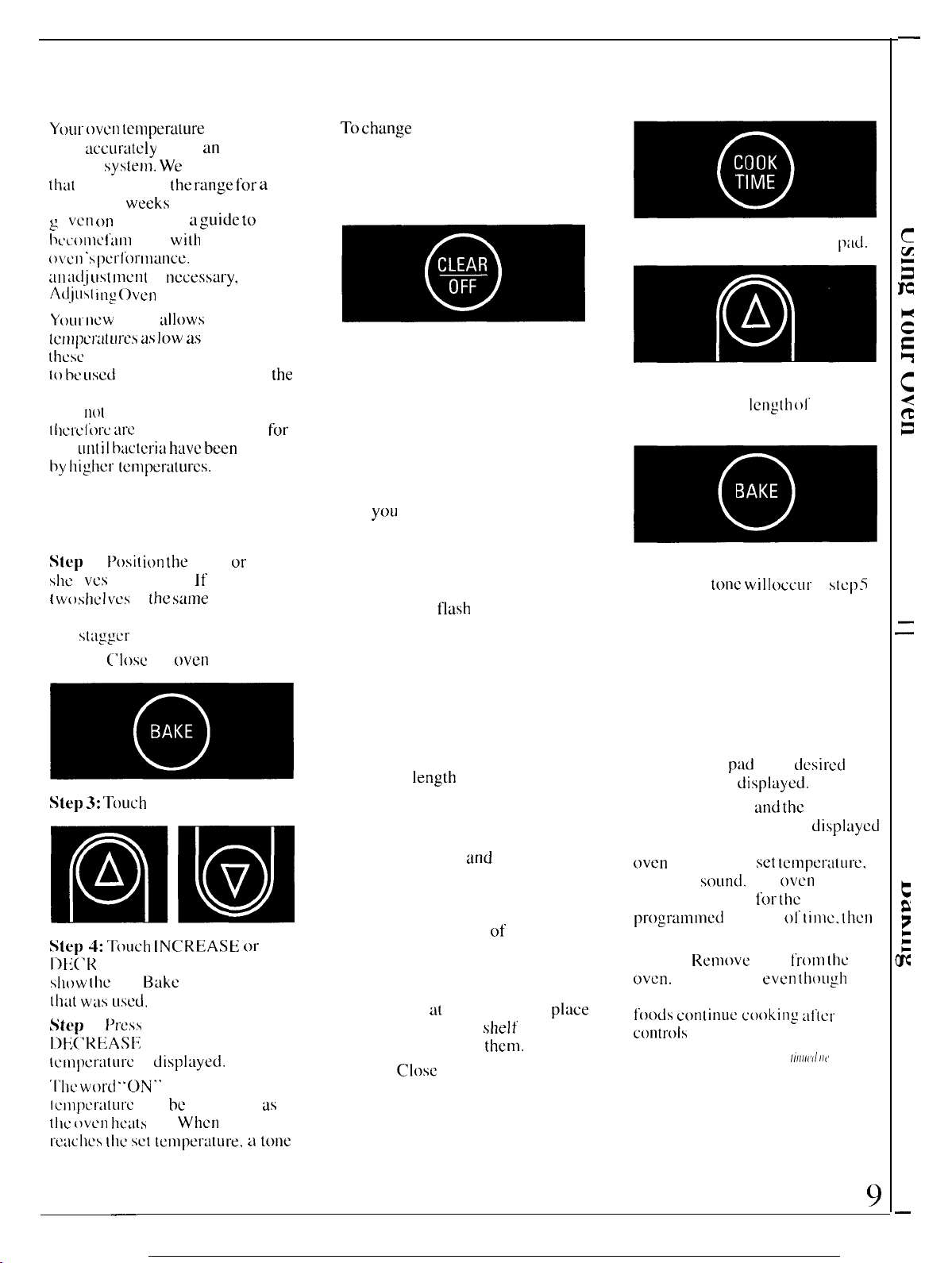
How to Set Your Range for
Baking
step
I:
Posi[ion”
the shelf or
sIIc
I vcs i n the oven.
If’
cooking on
[
w()
shelves at the
same
time, place
shelves on alternate shelf’ supports
and
s(aggcr
food on them.
Step
2: Close the oven door.
-
:A
Step
3:
Touch
BAKE pad,
I!BNml
f$kp
~:
‘[’OLICh
[NcREAS~
(M
Dli(”’R
EASE pad. The display will
sI1OW
(he
last
Bake
temperature
thd[
WLIS
LISC!Li.
Step 5:
Press
INCREASE or
DH(”’REASE
pad until desired
{ciupcra[ure
is
Liisplayed.
‘[’he
w(Nd
“ON” and the changing
lc]npcra(ure
will
be
displayed
as
(I]c
OVC1l
hc:lts
Lip.
WhCll
the oven
l’L21chCS
ltlc
Set
tClllpel”LLtUl”e.
a
tOIIC
wi
I I sound.
To
change
oven temperature
during BAKE cycle, touch BAKE
pad and then INCREASE or
DECREASE pad to get new
temperature.
Step 6: Touch CLEAR/OFF when
baking is finished and then remove
food from oven.
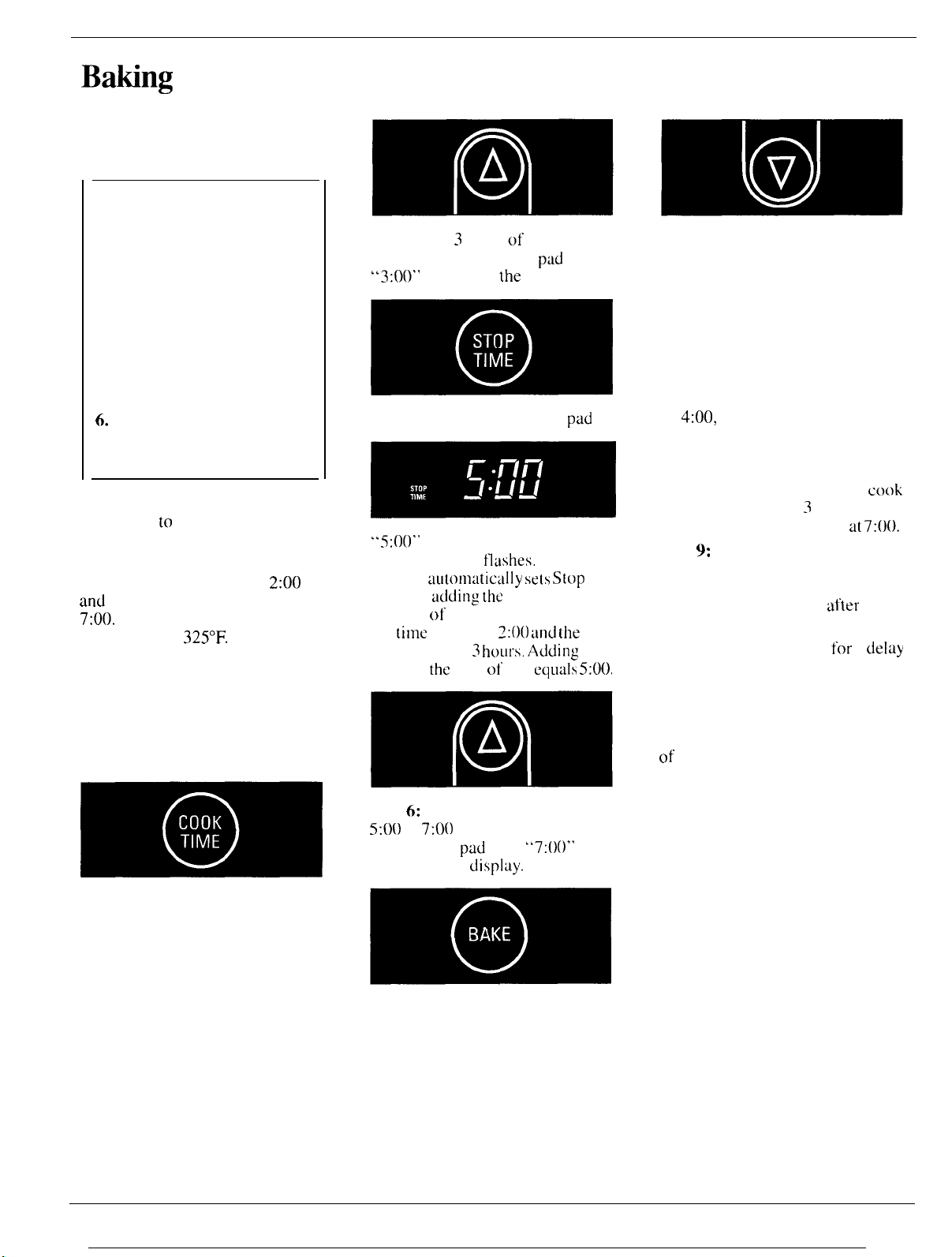
How to Time Bake
The oven control allows you to
turn the oven on or oft’
automatically at specific times
that
YOU
set.
NOTE: Before beginning make
sure the oven clock shows the
correct time of day. To set the
clock, first touch the CLOCK pad.
“TIME” will
flash
in the display.
Press INCREASE or DECREASE
pad until correct time of day
is displayed.
How to Set Immediate
Start and Automatic Stop
(Oven turns on right away, cooks
for preset
length
of time, and
turns off automatically. )
Note: Foods that are highly
perishable such as milk, eggs, fish,
stuffings, poultry
and
pork should
not be allowed to sit out for more
than one hour before or after
cooking. Room temperature
promotes the growth
of harmful
bacteria.
Step 1: Position the shelf or
shelves in the oven. If cooking on
two shelves
at
the same time,
place
shelves on alternate
shelf
supports
and stagger food on
them.
Step 2:
Close
the oven door.
-
01
Step 3: Touch COOK TIME p:d.
~
A
Step 4: Press INCREASE pad
until the desired
lellg(h
of
bilking
time appears in the display.
-
:A
Step 5: Touch BAKE pad.
Attention
tone
wi]]
occLIr it’ s[cp
f
is not done.
❑ m
Step 6: Press INCREASE or
DECREASE
pad
until
dcsirc~i
temperature is
Lfispiayed.
The word “ON”
and
the
rising
oven temperature will be
ciisi~iaycci
as the oven heats
Lip.
When the
oven
reaches the
set
[cmpcra(urc,
a
tone wiii
soun(i,
The
oven
wiii
continue to cook
for
the
ixwgrammui
amount
01’
(imc.
t
iwn
shut off automatically.
Step 7:
Remove
food
from
(iw
oven.
Remember,
even
timu:il
oven shuts off automatically.
foods
continue
cooking”
af(er
controis are off’.
(( ’()))
/;/1/{1,(/
){(,
\/ /)(/,? (,)
9
—.
Bating
(continued)
How to Set Delay Start
and Stop
Quick Reminder:
1. Touch COOK TIME pad.
2. Touch INCREASE/
DECREASE pad to set
cooking time.
3. Touch STOP TIME pad.
4. Touch INCREASE/
DECREASE pad until desired
Stop Time appears in display.
5. Touch BAKE pad.
6.
Touch INCREASE/
DECREASE pad to select
oven temperature.
Step 4: For
3
hours of cooking
time, press INCREASE
ptid
until
“3:00’”
appears in
Ihe
display.
-
1“
Step 5: Touch STOP TIME
pad
Delay Start and Stop is setting the
-
oven timer
to
turn the oven on and
off automatically at a later time
than the present time of day.
For example: Let’s say it’s
2:00
and
dinner time is shortly after
7:()().
The recipe suggests 3 hours
baking time at
325”F.
Here’s how:
Step 1: Position the shelf or
shelves in the oven. If cooking on
two shelves at the same time,
stagger the pans for best heat
circulation.
Step
2:
Close the oven door.
“5:()()”
appears on the display and
“STOP TIME”
flashes.
The
control
alltonlaticatly
Se(s
S(op
Time by
adding
the
Cook Time to
the time
of day. In this example,
the
time
of day is
2:()()
anLI
[he
Cook Time is
3
houl”s.
Adding
3
hours to
the
time
ot’
day
equals
5:()().
Step
6:
Change Stop Time from
5:()()
to
7:00
by pressing
INCREASE
pad
until
“7:()()”
appears in the
displtiy.
Step 8: Touch DECREASE pad.
“350°” appears in the display.
Press DECREASE pad until
“325°” is displayed.
At
4:00,
the oven will turn on
automatically. The word “ON”
and the changing oven temperature
will be displayed as the oven heats
up. The oven will continue to
cook
for the programmed
3
hours and
will shut off automatically
at
7:()().
Step
9:
Remove food from the
oven. Remember, even though
oven shuts off automatically,
foods continue cooking
after
controls are off.
When setting your oven
for
a
delay
start, never let foods such as dairy
products, fish, meat, poultry, etc.
stand for more than 1 hour before
actual cooking begins. Room
temperature promotes the growth
of
harmful bacteria.
Step 3: Touch COOK TIME pad
-
:A
Step 7: Touch BAKE pad.
10
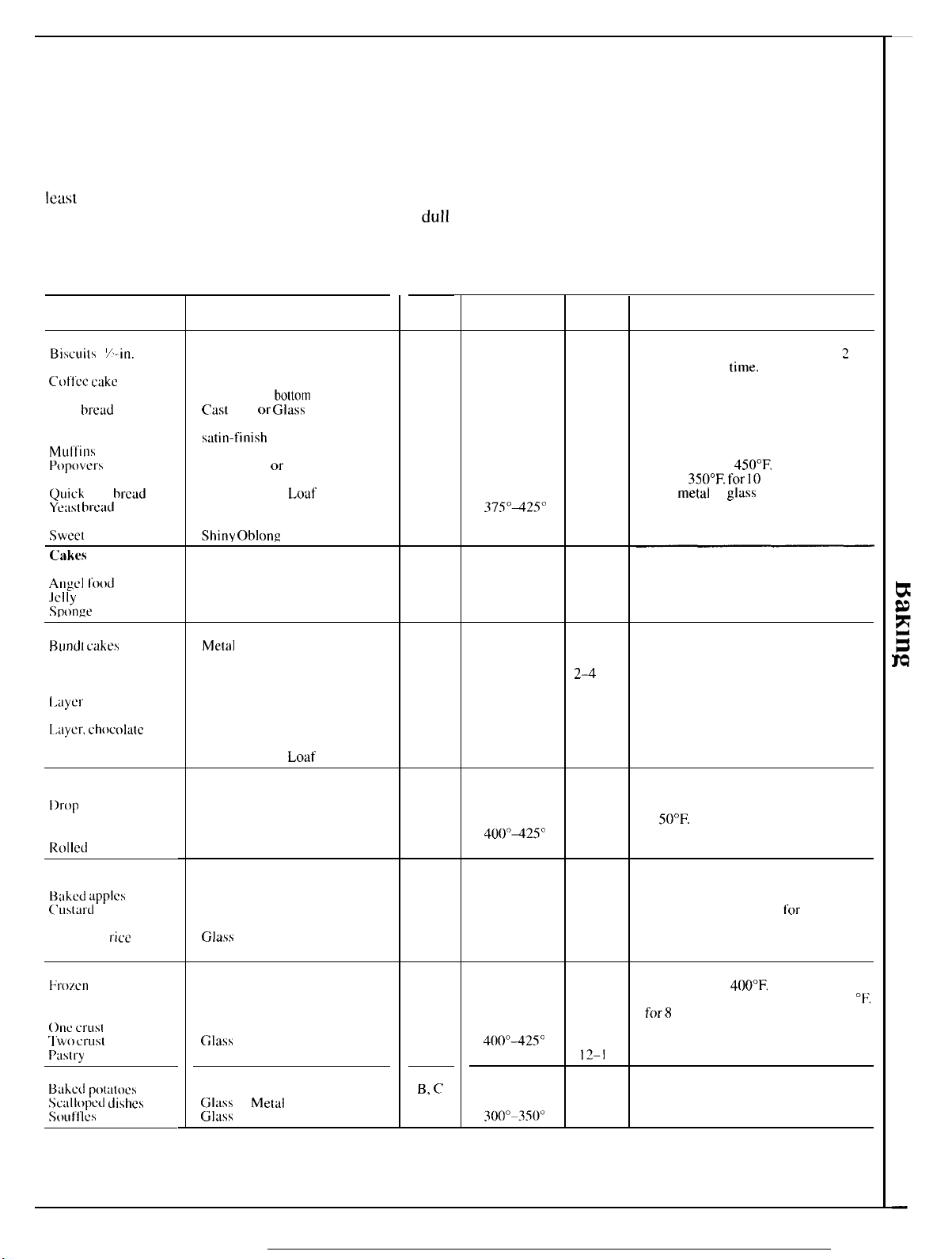
Baking Guide
2. Aluminum pans conduct heat
3. Dark or non-shiny finishes and
quickly. For most conventional
glass cookware generally absorb
baking, light, shiny finishes give
heat, which may result in dry, crisp
best results because they help
crusts. Reduce oven heat 25”F. if
prevent overbrowning. We
lighter crusts are desired. Rapid
recommend
dull
bottom surfaces
browning of some foods can be
for cake pans and pie plates.
achieved by preheating cast iron
cookware.
1. Preheating is very important
when baking foods such as
biscuits, cookies, cakes and other
pastries. Preheat the oven for at
least
10 minutes. Preheating is not
necessary when roasting or for
long-time cooking of whole meals.
Container
Shelf
Position
Time,
Minutes
Oven
Temperature
Food
Comments
“Bread
13iscui(s
(
Y-in.
thick)
Cott’ec
ciikc
Corn
bred
or muffins
Gingerbread
Mu[”fins
Popovel”s
Quick
loaf
hreiut
Yeast
bl”ewl
(2 loaves)
Plain rolls
Swec[
rolls
Shiny Cookie Sheet
Shiny
Metal Pan with
satin-finish
bottom
Cast
Iron
or
Glass Pan
Shiny Metal Pan with
sfitin-finish
bottom
Shiny Metal Muffin Pans
Deep Glass
or
Cast Iron Cups
Metal or Glass
Loaf Pans
Metal or Glass Loaf Pans
Shiny Oblong or Muffin Pans
Shinv
Oblong
or
Muffin Pans
B, C
B
B
B
B
B
B
B
B
B
4000
4
750
3500
4
000
4000
4
500
350°
400°4250
375°
3500
-
3750
375°J1250
375°4250
3500
-
3750
{5-20
20-30
2040
45-55
20-30
45-60
45-60
45-60
IO-25
20-30
Canned, refrigerated biscuits take
2
to
4 minutes less
time.
Preheat cast-iron pan for crisp crust
Decrease about 5 minutes
for muffin
mix, or bake at
450°F.
for 25 minutes,
then at
350°F.
for
10
to 15 minutes.
Dark
metal
or glass give deepest
browning.
For thin rolls, Shelf B may be used.
For thin rolls, Shelf B may be used.
Cakes
(without shortening)
Angel
k)od
lclly roll
SrxmXe
Aluminum Tube Pan
Metal Jelly Roll Pan
Metal or Ceramic Pan
A
B
B
325°–3750
375°4000
325°–3500
30-55
IO-15
45–60
Two-piece pan is convenient.
Line pan with waxed paper.
Cakes
Bund[
cakes
Cupcakes
Fruitcakes
Laycl”
layer,
ch(xmlatc
Loaf
Metal
or Ceramic Pan
Shiny Metal Muffin Pans
Metal or Glass Loaf or Tube Pan
Shiny Metal Pan with
satin-finish bottom
Shiny Metal Pan with
satin-finish bottom
Metal or Glass
Loat’
Pans
A, B
A
B
B
B
B
B
325°-3500
3500
-
3750
275°–3000
350°–3750
350°–3750
350°
45–65
20–25
2A
hrs.
20-35
25-30
40-60
Paper liners produce moister crusts,
Use 300”F. and Shelf B for small or
individual cakes.
Cookies
Brownies
[hop
Refrigerator
RollcLI
or sliced
Fruits,
other Desserts
Baked
JPP!CS
~’LIStiH”d
Puddings,
t-ice
and custard
Metal or Glass Pans
Cookie Sheet
Cookie Sheet
Cookie Sheet
B, C
B, C
B, C
B, C
325°–3500
350°4000”
40()”J1250
375°4000
25–35
10–20
6-12
7-12
Bar cookies from mix use same time.
Use Shelf C and increase temp. 25”F.
to
50”F.
for more browning.
Glass or Metal Pans
Glass Custard Cups or Casserole
(set in pan of hot water)
Glass Custard Cups or Casserole
B, C
B
B
3500
4
000
300°–3500
325°
30–60
30-60
50-90”
Reduce temp. to 300”F.
for
large
custard.
Cook bread or rice pudding with
custard base 80 to 90 minutes.
Pies
F’rozcn
Meringue
one
Cl”usl
I’wo
crust
PMIry
shell
Miscellaneous
Ba!d
f)otiLtOfX
Scalh)pcd
dishes
soLlfflM
Foil Pan on Cookie Sheet
Spread to crust edges
Glass or Satin-finish Metal Pan
Glass or Satin-finish Metal Pan
Glass or Satin-finish Metal Pan
Set on Oven Shelf
Olass or
Mettil
Pan
Glass Pan
B
B, C
B
B
B
B,
C
B, C
B
40004
2
50”
325°–3500
400°4250
4000+250
4500
325°4000”
325°–375”
3000-350””
45-70
15–25
40-60
40-60”
III
6
Large pies use
4000F.
and more time.
To quickly brown meringue. use 40001
:.”
f~w
8
to 10 minutes.
Custard fillings require lower
temperature, longer time.
60-90”
30-60”
30-75
Increase time for larger amount or
size.
11
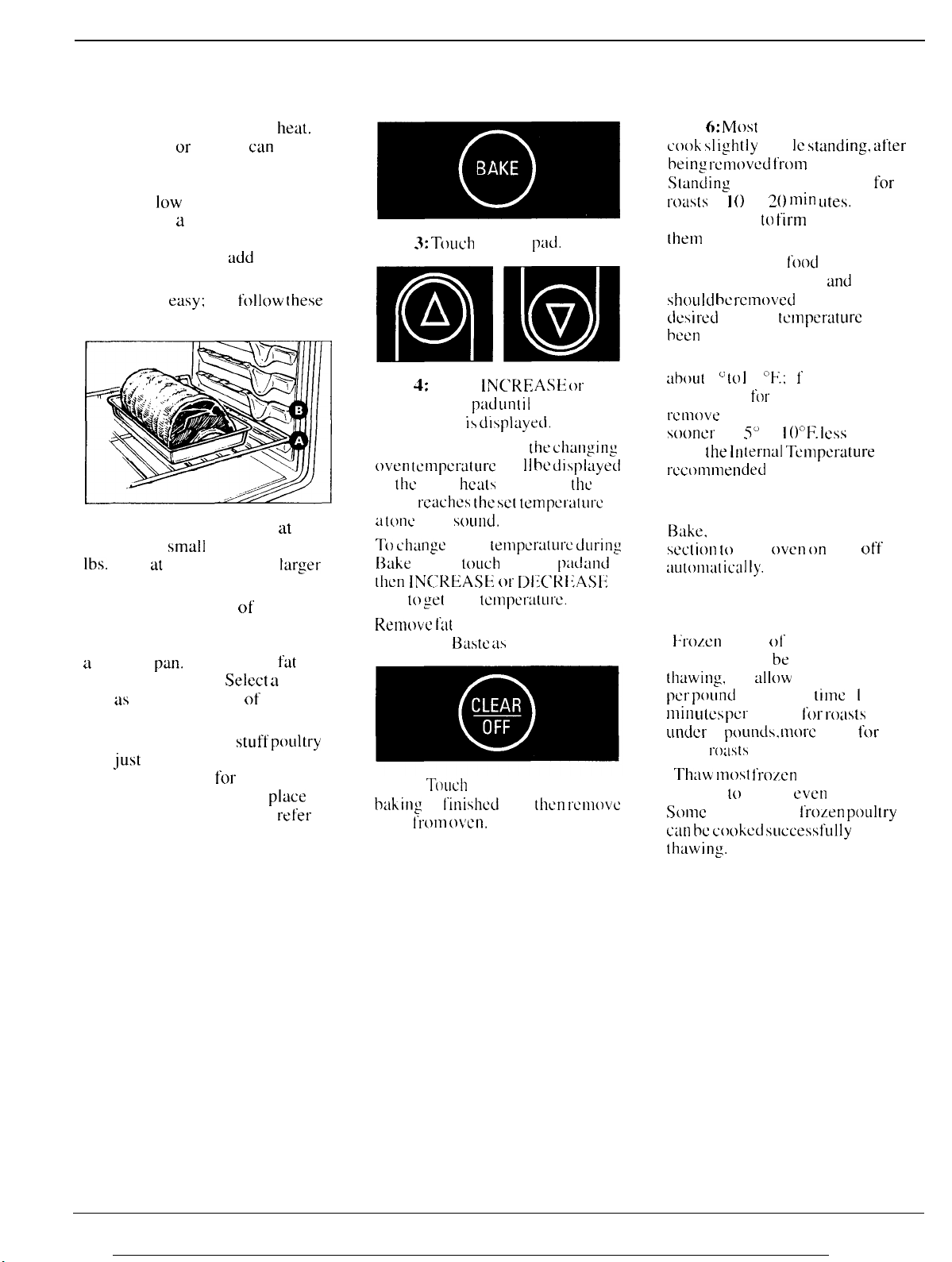
Roasting
Roasting is cooking by dry
beat.
Tender meat
or
poultry
can
be
roasted uncovered in your oven.
Roasting temperatures, which
should be
low
and steady, keep
spattering to
a
minimum. When
roasting, it is not necessary to
sear, baste, cover or
add
water
to your meat.
Roasting is
easy;
just
follow
(hese
steps:
Step 1: Position oven shelf
at
(B)
position for
small
size roast (.? to 5
lbs.
) and
at
(A) position for
larger
roasts.
Step
2:
Check weight
of’
roast.
Place meat fat-side-up or poultry
breast-side-up on roasting rack in
a
shallow
pan.
The melting
fat
will baste the meat.
Select
a
pan
as
close to the size
of
meat
as possible.
Do not cover. Do not
stuff
poLlltry
until
just
before roasting. Use
meat thermometer
for
more
accurate doneness (do not
place
thermometer in stuffing) or
refer
to
“Approximate Rousting Time” in
the Roasting Guide in this section.
12
-
:A
Step
3:
Touch
BAKE
pad.
Im!llm
Step
4:
Touch
lN(~REASE
or
DECREASE
paLI
unlil
desired
temperature is displdyed.
The word “ON” and
the
clumging
oven
[cmpcrtiturc
wi
II
be
displ~yed
as
(hc
oven
hctits
up. When
(he
oven reaches the set tcmpcra[Llrc
L1
(one
will SOLllld.
T()
chimgc oven temperatLlrc LILlring
Bake cycle.
toU~b
BAKE
@
atld
[hen INCREASE
or
DJ”:(’l<l;ASI”;
pad
(()
get
new
tClllpCl”UILll”C.
Rem(Jve
I’at
and drippings as
necessary.
Baste
LLS
desired.
Step
5:
Touch
(’1., EAR/OFF” when
baking
is
I’inished
and
[hen
remove
food
l’rom
o~cn.
Step
6:
Most
meats continue to
cook
SI
ightly
whi
Ie
sttinding,
after
being
removed
trt)m
the oven.
S(mding time recommended
for
I“(MS(S
is
I
()
to Z()
min
Lltes. This
allows roasts
to
firm
up and makes
(hem easier to carve.
Remember that food will continue
10 cook” in the hot oven
and
therefore
shoLl]d
hc
rcmoved when the
desired internal tcmperatLlre has
been
reached.
Internal temperature will rise
about
5
c’
(o
I
()
’>[;.:
i
f
yoLI
wish to
compensate
for
temperature rise,
rcmove the roast from oven
s(mncr
(at
5°
to
I
OOF.
less
than
[he
In(ernal
Tcmpcrature
rcctmlmended
in the Roasting
Guide in this section).
NOTE: YOLI may wish to Time
Bake,
as described in Baking
sec(ion
10
turn
oven
on
and
oft’
au(onla(
ical
Iy.
Frozen Roasts
●
l;rozcn
roasts
ol’
heel’, pork,
lamb, etc., can
be
roasted without
(hawing,
but
allow
15 to 25 minutes
pcr
pound
additional
time
(
i
5
lllin
Lltcs
pcl-
pound
1’01-
l“oasts
Llncler
5
poLInds,
more
time
for
larger
txxists
).
●
Thaw
ITNMt
f]”ozen poultry before
roasting
to
ensure
even
doneness.
Stlme
commercial
frozen
poLdtry
can
l-w
cooked
successfLllly
without
thtiwing.
Follow directions given
on packer’s label.
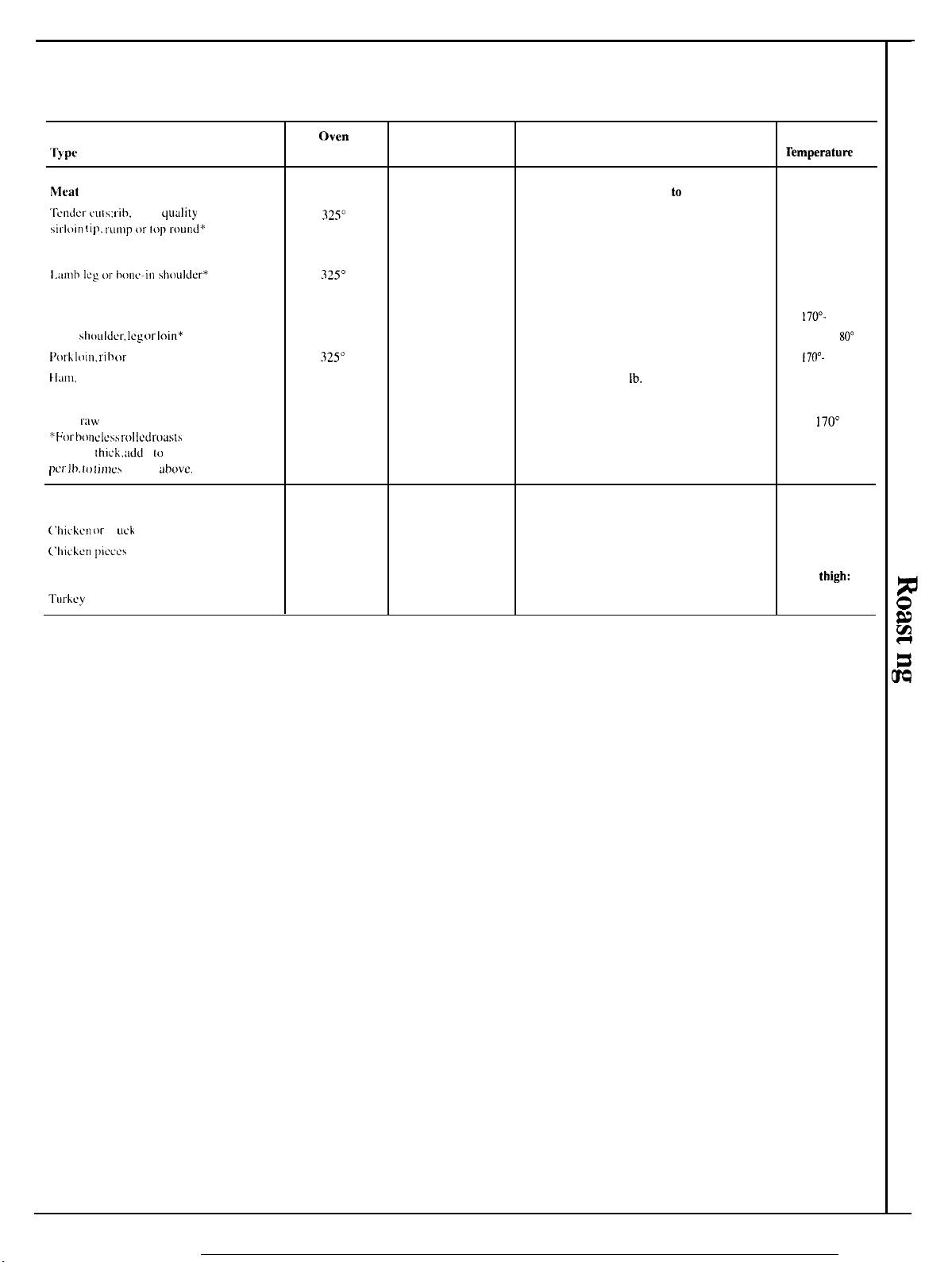
Roasting Guide
Type
Must
‘1’cndercuis:
rih,
high
qwdily
si[loin
[ip.
ItIIIIp{)I-tOl~It)UIId*
Veal
sll~)uldcr.
leg
or
lrrin*
R)rh
It)in,
trill
III
shoulder*
}[211).
pn-cooked”
Ham,
rilw
‘*[:(x
txmclcss
rolled
r~)mts
OVCI
-
() inches
thick,
AI
5
(o
1 () minutes
pcl
lb.
II)
[inks given
Jbovc.
Poultry
(’hiL’kC1]
01-
I)
LIc’k
(’hickcn
picccs
(hen
Temperature
3~5.
315.
325°
3~5~
325°
325°
325°
350”
325°
Doneness
Rare:
Medium:
Well Done:
Rare:
Medium:
Well Done:
Well Done:
Well Done:
To Warm:
Well Done:
Well Done:
Well Dune:
Well Done:
Approximate Roasting Time
in Minutes per Pound
3
to 5 Ibs.
6
to
8 Ibs.
24-33 18-22
35-39
22-29
40-45
30-35
21-25 20-23
25-30 24-28
30-35 28-33
35-45
30-40
35-45
30-40
17-20
minutes per
lb.
(any weight)
Under 10 Ibs.
10 to 15 Ibs.
27-35 24-27
3 to 5 Ibs. Over 5 Ibs.
35-40
30-35
35-40
10 to 15 Ibs. Over 15 Ibs.
18-25
15-20
Internal
I’emperature
“F
140°
150°-160”
170°-[85”
130”- 140”
150”- 160°
170”-
I 85°
1700-1
80°
170°-
1 80°
115°-125”
1700
185°-1900
185°-1900
In
tbigb:
185°-1900
13
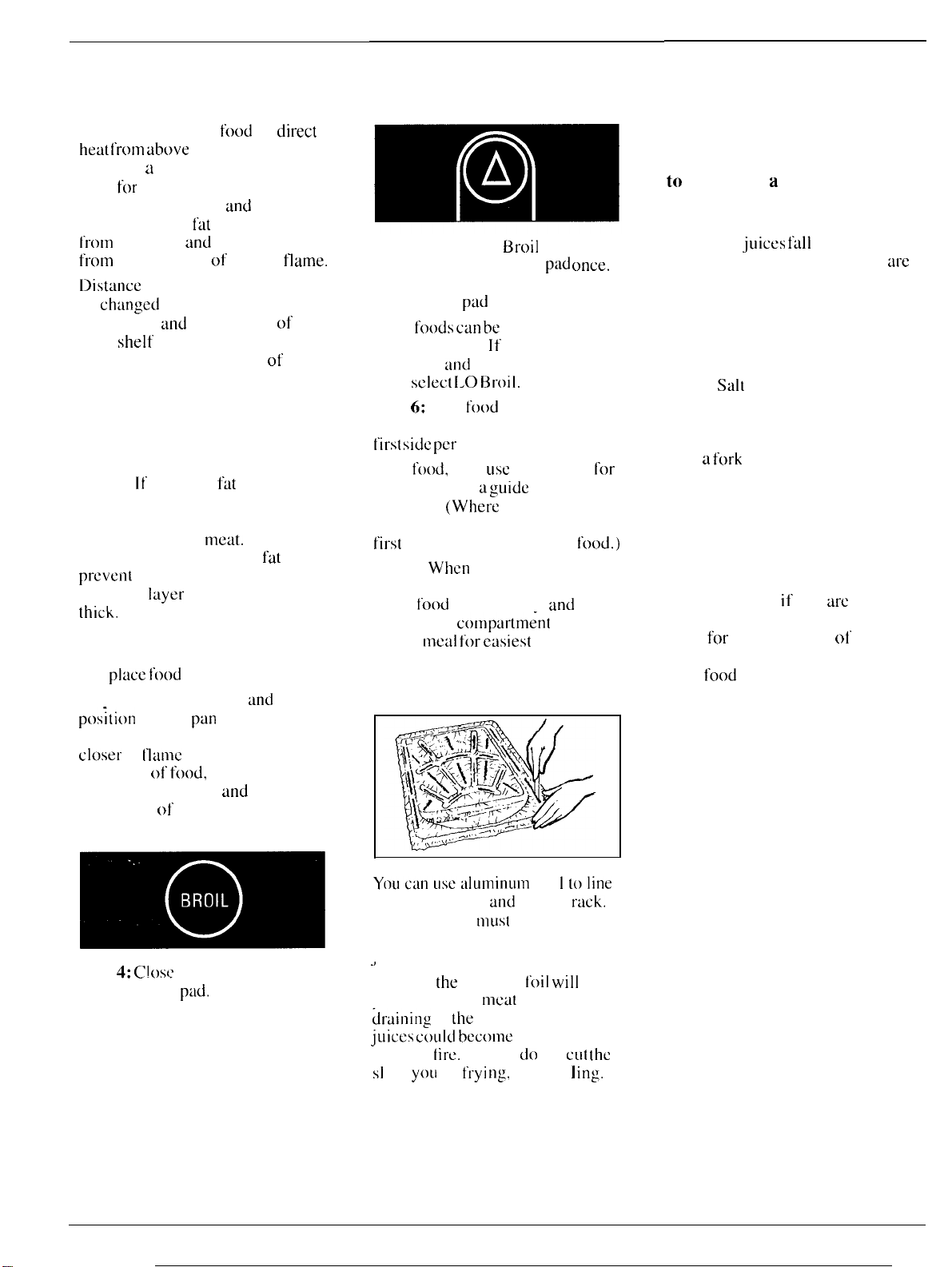
Broiling
Broiling is cooking
food
by
direct
heat
frotm
tibove
the food. Your
oven has
a
compartment below the
oven
for
broiling. A specially
designed broiler pan
and
rack
allows dripping
fat
to drain away
t’rom
the foods
wd
be kept away
fhm
the high heat of the gas
flame.
Distance
from the heat source may
be
chtinged
by positioning the
broiler pan
and
rack on one of
three
shelf positions in the broiler
compartment-A (bottom
o!’
broiler compartment), B (middle)
and C (top).
Both the oven and broiler
compartment doors should be
closed during broiling.
Step 1:
It
meat has
fat
or gristle
near the edge, cut vertical slashes
through both about 2 inches apart,
but don’t cut into
meat.
We
recommend that you trim
fat
to
prevent
excessive smoking,
leaving a
Iuyer
about l/8-inch
.L
:,.1,
Step 5: Select LO
Broil
(4500
F
.)
by tapping INCREASE
pacl
once.
Select HI Broil (5500
F
.) by tapping
INCREASE
pad
twice.
Most
foods
can
be
broiled at the
HI broil setting.
If’
you prefer less
browning
and
slower cooking, you
may
select
1.0
Broil.
Step
6:
Turn
food
only once
during cooking. Time foods for
first
side
per
Broiling Guide.
Turn
food,
then
LISC
time given
Ior
second side as
a
guide
to preferred
doneness.
(Where
two thicknesses
and times are given together, use
first
times given for thinnest
food.)
Step 7:
When
Broiling is
completed touch CLEAR/OFF.
Serve
food
immediately,
and
leave
LIIIL-K.
Step 2: Remove broiler pan and
pan outside compartm&rt to cool
during
meal
for
etisiest
cleaning.
rack from broiler compartment
and
place
food
on rack.
Step 3:
Pull out drawer
and
pos~ti~)n
broiler
pun
in
compartment. Placing food
closer
to
[’lame
increases exterior
browning
of
food,
but also
increases spattering
tind
the
possibility
of’
fats and meat
juices igniting.
Use of Aluminum Foil
-
Y(lucilnllscilluminLlln
foil
toline
.0
● .
your broiler pan
and
broiler
rtick.
However, you
must
mold the foil
tightly to the rack and cut slits in it
iust like the rack.
Step
4:
C!ose
broiler door and
.,
touch BROIL
pad.
Without
the
slits, the
toil
will
prevent fat and nwrt juices from
Questions & Answers
Q. When broiling, is it necessary
to
always use
a
rack in the pan?
A. Yes. Using the rack suspends
the meat over the pan. As the meat
cooks, the
juices
full
into the pan,
thus keeping meat drier. Juices
w-e
protected by the rack and stay
cooler, thus preventing excessive
spatter and smoking.
Q. Should I salt the meat before
broiling?
A. No.
Salt
draws out the juices
and allows them to evaporate.
Always salt after cooking. Turn
meat with tongs; piercing meat
with
a
fork
also allows juices to
escape. When broiling poultry
or fish, brush each side often
with butter.
Q. Why are my meats not
turning out as brown as
they should?
A. Check to see
if you
arc
using
the recommended shelf position.
Broil
for
longest period of time
indicated in the Broiling Guide.
Turn
food
only once during
broiling.
&-aining
to
the
broiler pan. The
juices
could
become
hot enough to
catch on
tire.
11’ you
do
not
cut
the
si
its,
yoLI
arc
fl”yi
n,g,
not broi
]
ing.
14
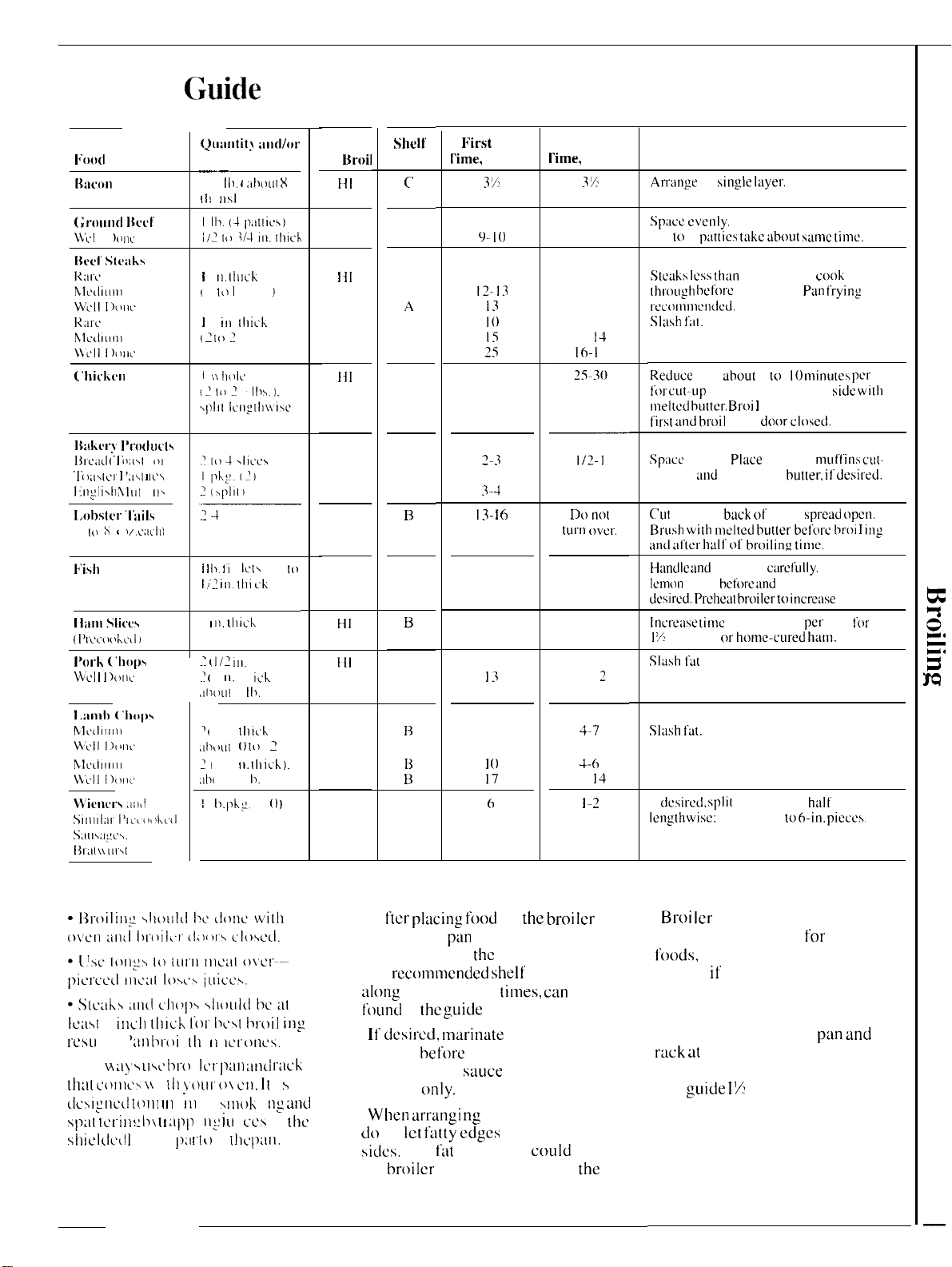
Broiling
Guide
[J{)()(I
1{1 or
[.()
Brwil
}{1
HI
III
1+1
HI
1{1
HI
Shelf
Position
F’irst
Side
rime,
Minute:
Second Side
rime,
Minute
QuantitJ
;IIId/tJr
Thickness
——
I/2
11).
I
:1110[1[
x
III i
II
\l
ice\)
Comments
I{;ICOI1
c
[’
A
A
/4
A
A
A
A
(’
c
B
[’
B
A
A
f?l
t?
B
B
3Y,
Ammge in single Iiiyer.
(;l”ound
Ik’t’
~~’(1
I I
h)rl~,
Spx’e
Wellly.
Up
[o
X
p:itties
t:lkc
tibnrrt
swnc
(imc.
9-10
7-x
Stctiks
Icss
[him
I inch thick conk
lh!”ougtl
ht?fnrc
browning.
P~Ln
frying is
l“ecomm(!n4k!d.
SIM}l
1’:1[.
I
i
Il.
llllL’k
(
I
10
I
lb..
J
9
12-13
13
10
15
15
7
5-6
8-9
6-7
I?-
14
1(’-
I
x
]
ill
thiL’~
(
:
102
11)..)
ReLtLICC
time
about
5
to
10
minutes per side
f’or
cLlt-Llp
chicken. Brush each
side
wilh
me[(cd
bultcr.
Bmi
]
with skin-side-down
f’irst
and
tx”oi]
with dnor closed.
(’hirkcn
30-35
2-3
3-4
l{;]kw~
l)l-II(IULIS
I\l’c:l[l
[
‘t’(
1;1.1
)
(
II’
‘[’(
l;l\(L>l’
]
‘;l\\
1
lL\
I;II:I
i.h
\t{ll
I i
II,
I,obstcr
‘1’uils
(()
to
s
i
1/.
L:l(’11
)
Spxc
evenly. Place English
mut’t’ins
cu[-
sick-up
:ind
brush with
bulter,
it’
dcsiwd.
13-
I
6
5
Do
nnl
tLll”ll
OVCI.
5
Cut
through
bxk
of shell,
spread
open
Bl”L!sh
wilh
melted
butler
bei’orc
brni
I
ing
:Ind
:Ltict”
bdlt’
0(’
hroiling
time.
.?
-1
I:isb
I
11).
Ii
I
lL,I\
I/4
10
t/2
ill.
(tli
Lk
Hmdle
d
turn very
cwelully,
Brush with
km(m
butter
before
imd
during cooking. it”
desired.
Prcha[
brniler
to
increxse
browning
I
I
I),
[
Ilicl.
Incre;tse
time 5 to 10 min. per side
l’ilr
]
Y in. I hick
(M
hnme-cul”ect
ham.
x
8
l’orh
(’bops
\vLl
I
I
)(1[1,
.;
(
l/2
ill. (hick)
.?
I
I i
II.
t h
i~k
).
,II)(ILII
I
11).
I
()
13
8
t ()
I
()
17
6
4-5
I ()-l
2
4-7
10
4-6
I?-
14
I
-~
slash
f’a(
Ill
‘
I
I i II.
111
ick
).
,Ihtl(ll
I
(
)
1()
I
?
()/..
:(
I
i
II.
111
ick
).
:11)(
)111 t I
l).
HI
HI
Sliish
f’a(.
It desired, spli[ sausages in
hdt
letlglhwisc: cut into 5-
to
tiin.
pieces
!
I
l).
pk:, I I
()
)
(’
Broiling Tips
● A
ttcr
plxing
food
on
the
broi
Im
pan. put the
ptm
in the broiler
compartment in
the
proper position.
The
rccomnwndeci
shelf positions,
:dong
with cooking
times,
can
be
f~)LInd
in the
,gLlide
above.
Ic;lsl I i[)cll
tllicl.
lot
l)L\l
hroil
in:
resu I Is. I
‘;II)
1>1-(
)i
I
11)
i
tl
I Icr
OI]CS.
●
I
1’
cicsircd,
mtirinate
meats or
chicken
before
broiling, or brush
● A 1
m
LI>
\
LI
w’
hro i
Ic’r
p:i])
aI)d
r~lck
with barbecue sauce last 5 or I ()
●
13roi
Ier
does not need to be
preheated. However,
for
very thin
i’oods,
or to increase browning,
preheat
if
desired.
● Frozen steaks can be
conventionally broiled by
positioning the broiler
p~m
and
rack
tit
next lowest position and
increasing cooking time given i n
this
guide
I
X
times per side.
[iliIl
LOIIIL’S
ii
i [i)
joLII
01
CI1.
il
i
5
minutes
oniy.
~icsiy
llc(l
It)
III
I
11
i
Ill
i/c
>Illoi;
i
ng
tinci
spill
Ic
[i
I)
!.:
1>1
1
t
:tllj> i
Ily
i
(i
i
L_.cs
i n
[ilc
●
Wiwn
mrangi
ng
food on pan,
. .
si]
ic Idc’(i
1
(~wL’1-
j):t
rt
(
)
1“
1
llc
p:ltl.
do
not
ict
fatty
edges
hang over
sicics.
The
f[~t
drippings
LX)LIid
soi i
the
broiicr
compartment when
the
food is broiled,
15
Care and Cleaning
(See Cleaning Guide)
Proper
care
und cleaning are
important so
your oven will give
yoLI efficient
and
satisfactory
service. F
O
I1
OW
these directions
carefully in caring for your oven to
assure
safe
and proper maintenance.
Porcelain Oven Interior
With proper care, the porcelain
enamel
t“inish
on the inside of the
oven-top, bottom, sides, back and
inside of’ the door-will stay
new-
Iooking
for years.
Let
oven cool before cleaning. We
recommend that you wear rubber
~IOVeS
when
cleaning the oven.
Soap and water will normally do
the
job. Heavy spattering or
spillovers may require cleaning
with a mild abrasive cleanser.
Soapy, wet metal pads may also be
used.
Do
not
allow
food spills with
a
high sugw- or acid content (such
as m i
I
k, tomatoes, sauerkraut, fruit
.juiccs
or pie filling) to remain on
the
surftice.
They may cause a dull
spot
even
after
cieani]yg.
Household ammonia may make the
cleuning
job easier. Place 1/2 cup in
d
shallow
glass
or pottery container
in
u
cold
oven
overnight. The
ammonia fumes will help loosen
the
burned-on grease and food.
If
necessury,
you may use a
commercial oven cleaner. Follow
package directions.
Removable Oven Bottom
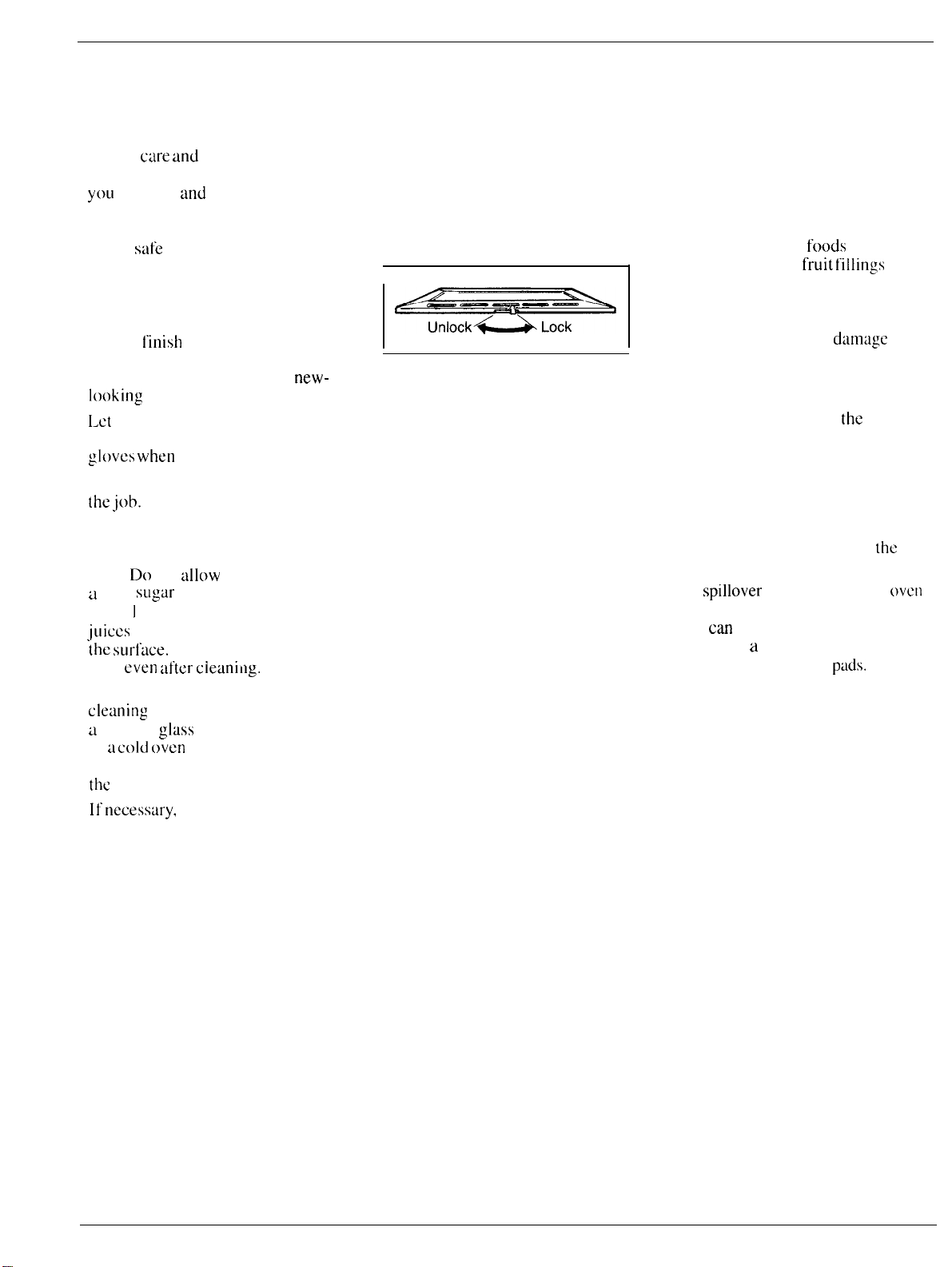
The oven bottom can be removed
to make cleaning easier after heavy
spillovers and to enable you to
reach the oven burner.
-
——
To remove:
1. Slide the tab at the center front
of the oven bottom to the left.
2. Lift the oven bottom up and out.
To replace:
1.
Slip the oven bottom into the
oven so the tabs in the rear of the
oven bottom fit into the slots in the
oven back.
2. Lower the front of the oven
bottom into place and slide the
front tab to the right to lock the
oven bottom into place.
The oven bottom has a porcelain
enamel finish. To make cleaning
easier, protect the oven bottom
from excessive spillovers. This is
particularly important when baking
a fruit pie or other
f’oods
with high
acid content. Hot
f-ruit
f’illings
or
foods that are acid in content such
as milk, tomato or sauerkraut, and
sauces with vinegar or lemon juice,
may cause pitting and
damage
to
the porcelain enamel surface.
To protect the oven bottom
surface, place a piece of’ aluminum
foil slightly larger than
the
baking
dish or a small cookie sheet on a
lower shelf or under the baking
dish to catch any spillovers. It
should not completely cover the
shelf as this would cause uneven
heat in the oven. Aluminum
foil should not be placed on
the
oven bottom.
If a
spillover
does occur on the
oven
bottom allow the oven to cool first.
You
can
clean the bottom with soap
and water,
a
mild abrasive cleanser
or soap-filled abrasive
pads.
16
Oven Shelves
oven
Shcl}’cs
may he Cleaned
with
a mild abrasive
clcamser
following
label
instructions.
A1’tcr
cleaning. ri nw
the
shelves
wi(h
clc:ln
water and dry with a
CIcan
cloth.
~“~)
l’Clllo\’C
hCU\;J’.
t~lll’lltd
011
Soi
],
Soilpy
Illctal
pads
nl;ly
be
Llscd.
A1’lcr
scrubbi
n:, wash with
s(Mpy
water.
rinst-’
aI]d
dry.
(Mm
I.ight
Bulb
Replacement
Bef-ore
replacing
any
light bulb,
disconnect
electric power
to
the
range
at
the
main
f’use
or circuit
breaker
panel.
Let
(he
bulb cool
complc[eiy
Ixl’orc
rcmov
in:
it. D()
not
touch a
110(
hul
h with a damp
clotll--(he
bu
I h wi I I break.
Reach in
and
(Ills
cl”ew’
blllh
aftcl”
[aking
precautions
Illcnli{)ned
abo~’c.
Rcplacc
i t
w
i~h
a
higtl
-
[empcI”a[LII”c appliance 40-watt bulb.
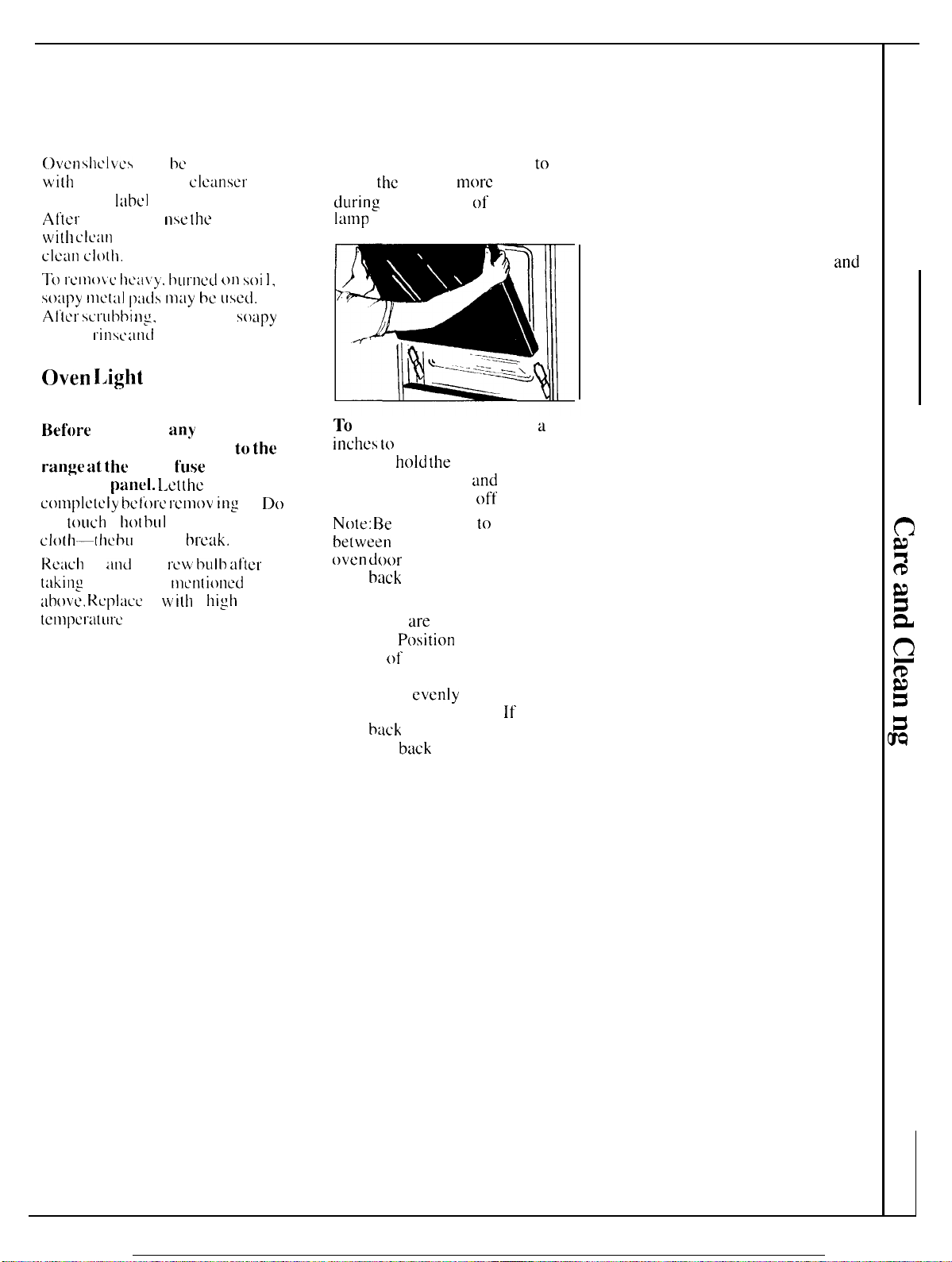
Lift-Off Oven Door
The oven door is removable
to
make
the
interior
more
accessible
dLlrin.g
replacement
of’
the
hlp
bulb.
To
remove the door, open it
a
few
inches
to
the special stop position
that will
hold
the
door open. Grasp
firmly on each side
and
lift the
door straight up and
off
the hinges.
Note:
Be
careful not
to
place hands
be(ween
the spring hinge and the
oven
door
frame as the hinge could
snap
back
and pinch fingers.
To replace the door, make sure
the hinges
w-e
in the special stop
position.
Position
the slots in the
bottom
of the door squarely over
the hinges. Then lower the door
slowly and
evenly
over both
hinges at the same time.
If
hinges
snap
hack
against the oven frame,
pull them
back
out.
Broiler Pan & Rack
After broiling, remove the broiler
pan and rack and carefully pour off
the grease. Wash and rinse the pan
and rack in hot, soapy water.
If food has burned on, sprinkle the
rack while hot with detergent
and
cover with wet paper towels or a
dish cloth. That way, burned-on
foods will soak loose while the
meal is being served.
Do not store a soiled broiler pan
and rack in the broiler compartment
or in the oven.
17
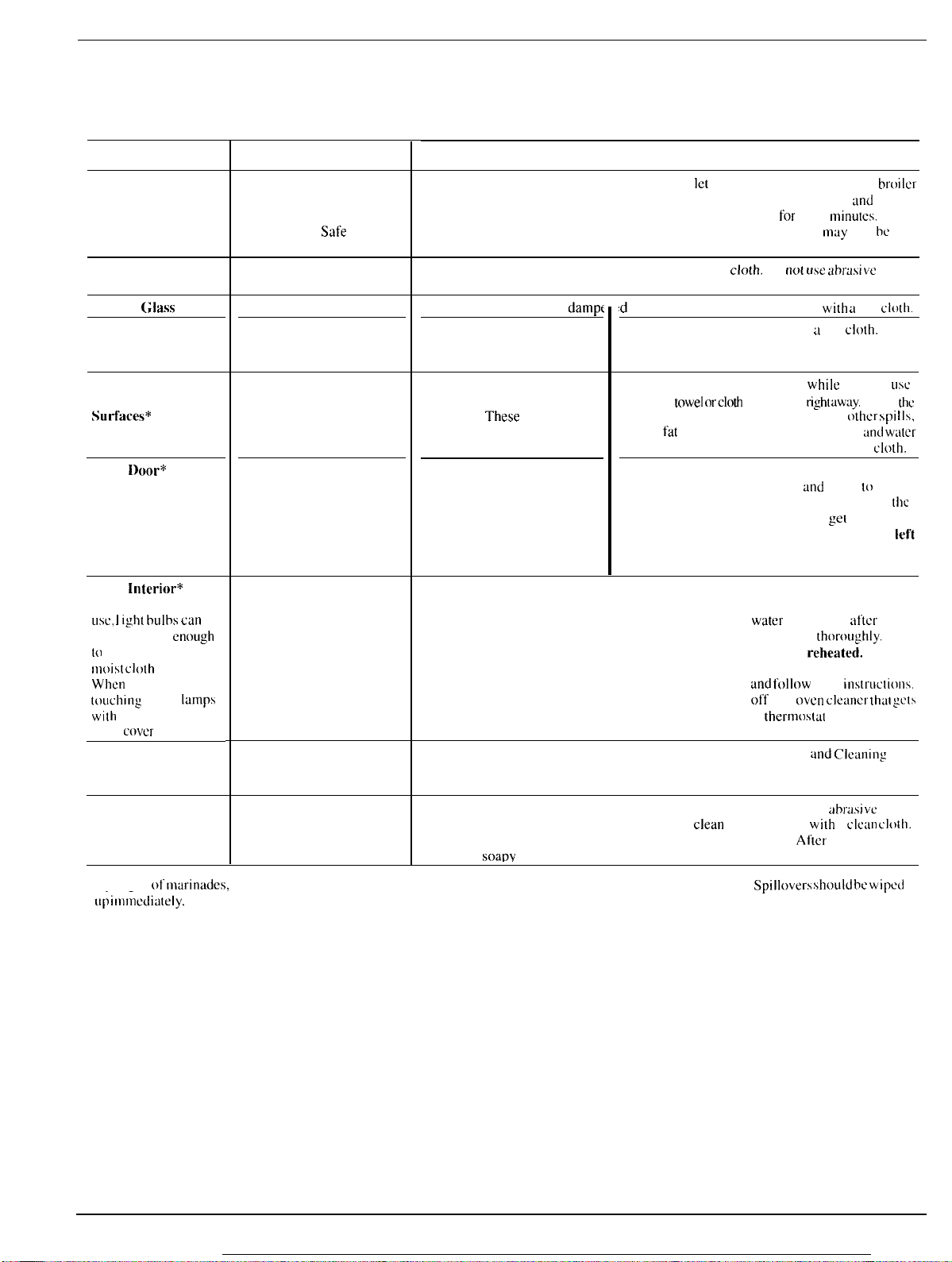
Cleaning Guide
Note: Let oven parts cool before cleaning.
PART
Broiler Pan and Rack
Control Panel
outside Class Finish
Metal, including
Side Trims and
Trim Strips
Porcelain Enamel
and Painted
surthces*
oven
Dom-*
oven
Interinr*
(( ’A CATION: When in
LISL!,
I
igh(
hLIlbS
ctin
become warm
enough
(o
break if touched with
nx)is(
clo[h
or towel.
When
cleaning. avoid
toLlchirrg
warm
Itimps
with
cleaning cloths it’
lamp
cover
is
removed.)
Removable Oven
Bottom
Shelves
MATERIALS TO
USE
● Soap and Water
● Soap-Filled Scouring Pad
● Commercial Oven Cleaner
● Dishwasher-
Sat’e
● Mild Soap and Water
● Soap and Water
● Soap and Water
● Paper Towel
● Dry Cloth
● Soap and Water
● Soap and Water
● Soap and Water
● Soap-Filled Scouring Pad
● Commercial Oven Cleaner
● Soap and Water
● Soap-Filled Scouring Pad
● Commercial Oven Cleaner
● Mild Abrasives
● Soapy Metal Pads
GENERAL DIRECTIONS
Drain fat and cool pan and rack slightly. (Do not
Ict
soiled pan and rack stand in
broilet-
compartment to cool. ) Sprinkle on detergent. Fill the pan with warm water
~ncl
spread
damp cloth or paper towel over the rack. Let pan and rack stand
for
a few
nrinutcs.
Wash:
scour if necessary. Rinse and dry. OPTION: The broiler pan and rack
nury
also
he
cleaned in a dishwasher.
Wash control panel with soap and water, using a soft
cloth.
Do
not
use
idmsivc
cleaners. Rinse and drv with a soft cloth.
Wash all glass with cloth
dampt
DO
NOT USE
steel wool,
abrasives, ammonia, acids or
commercial oven cleaners.
DO
NOT
USE
oven
cleaners,
cleansing powders or harsh
abrasives.
Tbese might
scratch the surface.
DO
NOT
USE oven cleaners,
cleansing powders or harsh
abrasives.
d in soapy water. Rinse and polish
wi[h
a
dry
cloth.
Wash, rinse, and then polish with
~
dry
clo[h.
If acids should spill on the oven
while
it is hot.
use
a @paper
towel
orckrth
to wipe up
right
away,
When
the
surface has cooled, wash and rinse. For
(nhcr
spi
11s,
such as
fat
smatterings, etc., wash with soap
md
waler
when cooled and then rinse. Polish with dry
cloth.
Remove oven door following instructions in Care
and Cleaning section. Use soap
and
water
to
thoroughly clean both the inside and outside 01’
(Iw
door. Be careful not to let any water
gel
into any
openings in the door. Rinse well. NOTE: Soap
left
on door liner causes additional stains when the
oven is reheated.
Cool before cleaning.
FOR LIGHT SOIL: Frequent wiping with mild soap and
water (especially aticr
cooking meat) will prolong the time between major cleanings. Rinse
thoroughly.
NOTE:
Soap left on
liner
causes additional stains when oven is rebeated.
FOR HEAVY SOIL: Choose a commercial oven cleaner
and
Iollow
label
ins(ruc[i(ms.
Use of rubber gloves is recommended. Rinse well. Wipe off any
oven
clcanct
[hat
:C[S
on thermostat bulb. When rinsing oven after cleaning, wipe
thermos(a[
bulb also.
The oven bottom panel can be removed for easy cleaning (see Care
and
Clewring
section). Use the same directions for cleaning as explained above for Porcelain
Enamel and Painted Surfaces.
Shelves can be washed in dishwasher or cleaned by hand, using a mild
abrasive
cleanser. After cleaning, rinse the shelves with
clean
water and dry
wi[h
a
clean
cI(JII1.
To remove heavy, burned-on soil, soapy metal pads may be used.
Altel-
scrubbing.
wasb with
soaw water. rinse and drv.
‘
l
’ Spillage
ot
mtirinades, fruit juices, tomato sauces and basting materials containing acids may cause discoloration. Spillovers should
be
wiped
UI;
imt;cdia(ely, with care being taken not to touch any hot portion of the oven. W-hen the surface is cool, clean and rinse.
18
Minor Adjustments You Can Make
Adjusting Oven Thermostat
When
ccx)king
a
food
for the first
time
in
yoLlr
new
t)vcn,
Llse
time
oiven
on recipes as a guide. Oven
*
thermostats, over a
period
of years,
may
“driti” from the factory
setting,
and
di
I’fcrcnces
in timing
bet wcen an OILI
anLI
a new oven
of
5 to 10 minutes
are
not unusual.
YoLl
may
be
inclined to think that
the
new
oven
is not performing
correctly;
however,
your new oven
has
twcn
set
correctly at the factory
and is
tmwe
likely
to be accurate
than
[he
ovcm
it
rcphrced.
11’ yoLI think the oven should be
hotter
or
cxx)lcr.
yoLI
can
adjust it
yoLtrscll ’.
T()
decide
how much to
change
the
thermostat, set the oven
wmperaturc
25°F.
higher or lower
[han
the
tcmpera(ure
in your
recipe,
then
hake.
The results of
this “test”
should
give you an idea
ol’
how much
the
thermostat should
be
changed.
To
adjust
thermostat:
1.
Pllsh
BAKE pad.
2.
Select
an oven temperature
between
500”E”
and
5500F.
by
,Ilessillg
the
IN(.’REASE
pad and
imlncdia(cly
press
BAKE again
and hold
I’(w
4
seconds.
3.
[’on[inuc
I()
bold
BAKE until
preset
OVCI1
tcnlperalLlrc
adjLlsllnellt
shows
in display. The
I’acmry
set
()\Jcn
temperature
adj
LIStlllCllt is
“00.”
‘
4.
Change
(~i]l]~~tiittlr~
adjustment
Llp
to
35
degrees
ho((er
(+35°F.
) or
35
degrees
c(x)lcr
(-35°F.
) by using
the
lNCREASf~
or
DECREASE
pads.
5.
[>ush
(’LEAWOFF to clear
display.
This
acijustment
you have made to
the
oven
(cmpcra(ure
will be
remembered by
the
control and
wi 11
au(on~a(ical
Iy
adjust
the oven
tcnlpcl”:ltul”c
hy
dlat
anlOLLnt
each
(imc
joLI
SC[
a
hake
temperatur-e.
This
a(]justnlcnt
will
not afft3Ct
Broil
(Clll})Cl”ilt
Lll”CS.
Broil
and Oven Burner Air
Adjustment Shutters
Air adjustment shutters for the
burner regulate the flow of air to
the flames.
To adjust the air shutter, remove
the oven bottom (see Care and
Cleaning section). Turn burner full
on and check the flames. Burner
flames should not flutter or blow
away from the burner. They should
be blue in color with no trace of
yellow. Foreign particles in the gas
line may cause an orange flame at
first, but this will soon disappear.
If the flames are yellow or flutter,
open the air shutter more. If they
blow away from the burner, close
the air shutter more.
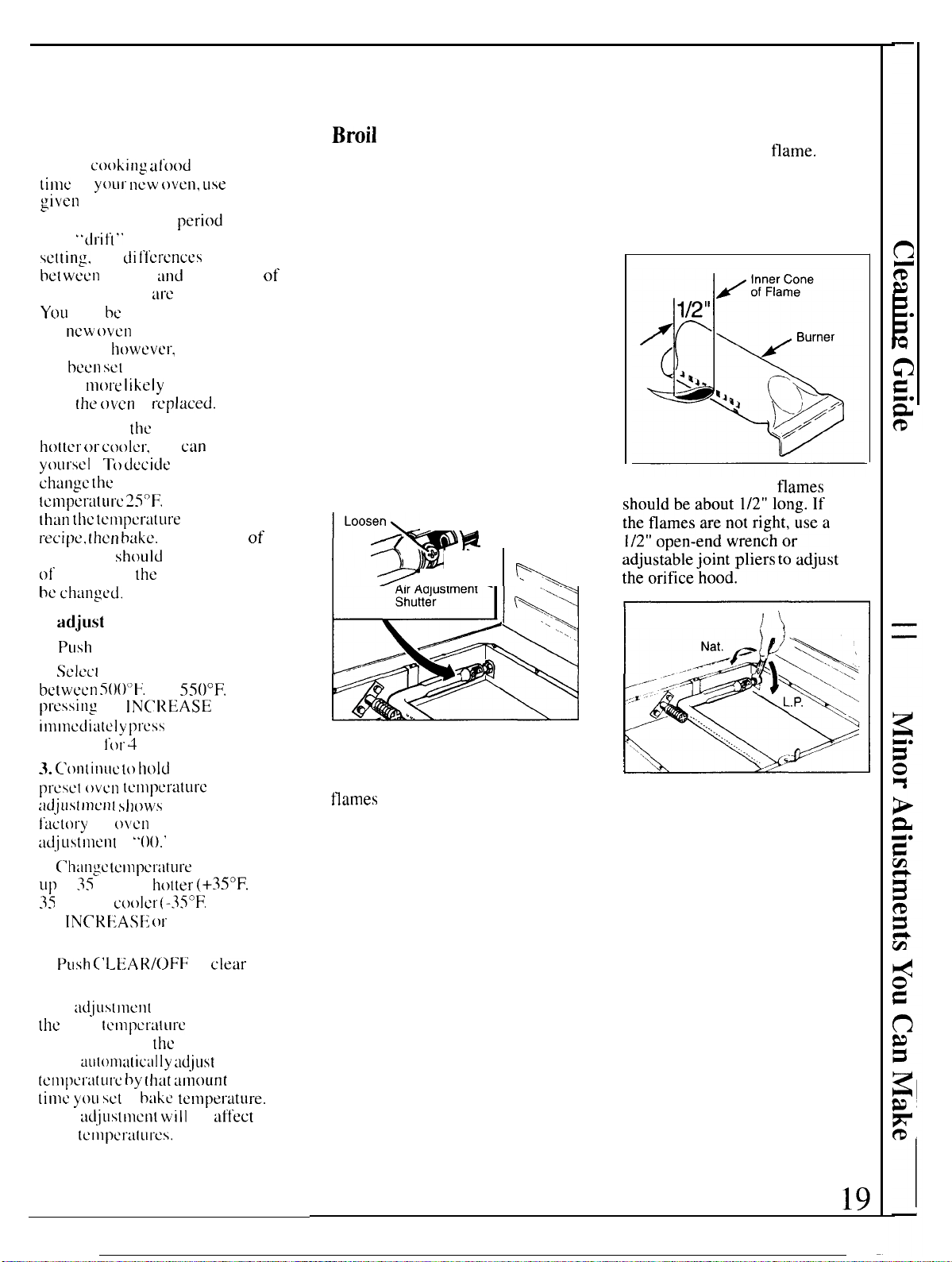
To adjust the orifice hoods, check
the inner cone of the
flame.
WARNING:
If you attempt to
measure the inner cone of the
flame, please use caution. Burns
could result.
‘he inner cone of the flames
T
\
!!!’’!!!!i!i!!!?i::;:a
adjustable Joint phers to
adjust
If necessary, use a screwdriver to
loosen the air shutter screw. Then
adjust the air shutter and, when the
flames
are right, retighten the air
To shorten the cones, tighten the
shutter screw.
orifice hood by turning in the “LP”
direction. To lengthen the cones,
loosen the orifice hood by turning
in the “Nat.” direction.
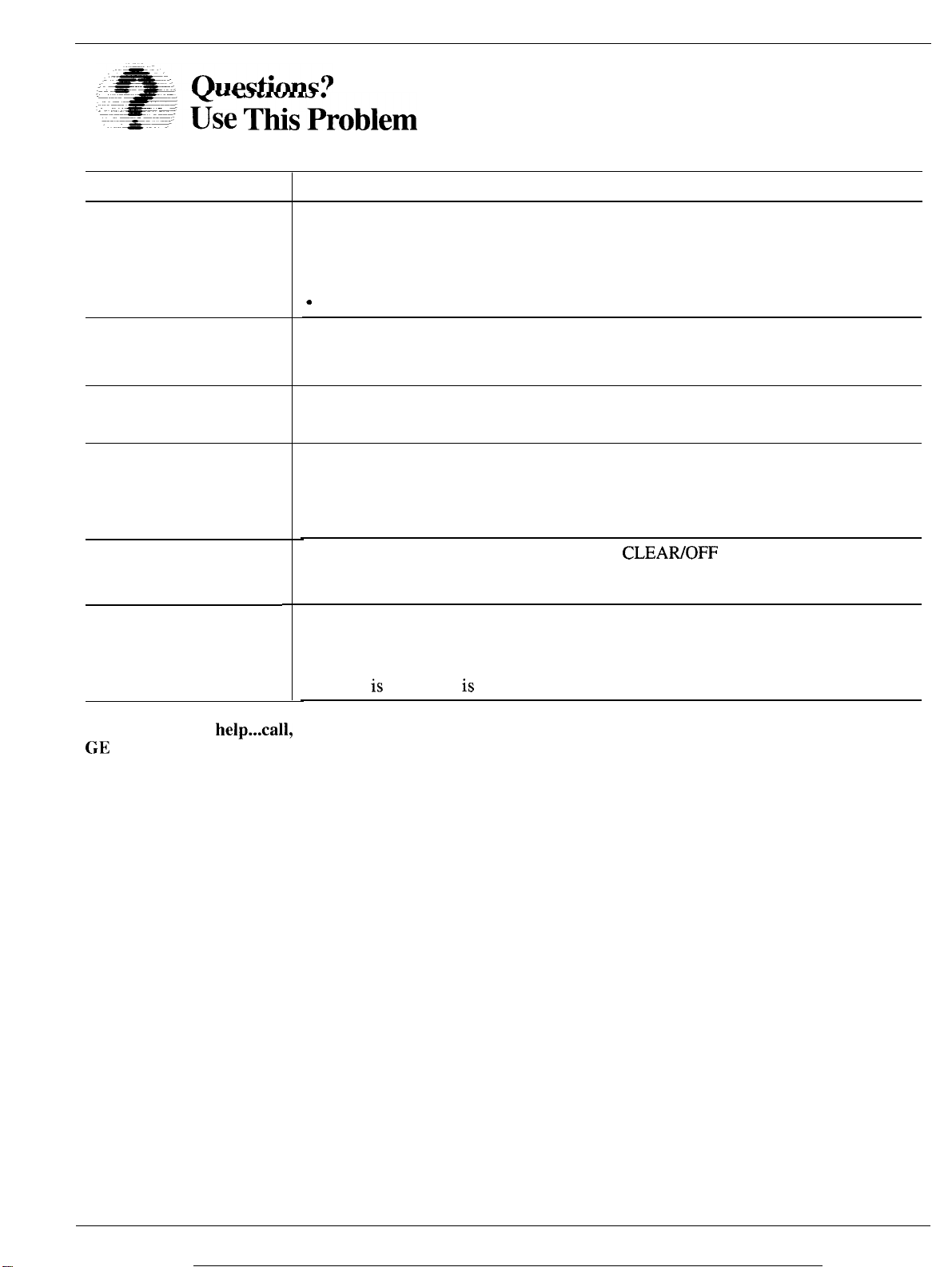
-=:Questions?
,c-<:.=~
:=~~UseT
hisProblem
Solver
–.. . . . . . . . . . . . . .
.=---
PROBLEM
OVEN DOES NOT
COOK PROPERLY
CLOCK AND
MINUTE/SECOND
TIMER DO NOT WORK
OVEN LIGHT DOES
NOT COME ON
OVEN IS BEEPING
“F” AND A NUMBER
FLASH ON THE
DISPLAY
STRONG ODOR
POSSIBLE CAUSE AND REMEDY
● Incorrect cookware being used. Check each cooking section for cookware tips.
● Oven bottom not securely seated in position.
● Controls set incorrectly. Review instructions in the Controls section of this book.
“
Check common problems listed in Baking, Roasting and Broiling sections.
● Check for power outage.
● Bulb may be loose or burned out.
● Switch is bad.
● Timer has finished timing.
● If beeping is accompanied by an “F” and a number flashing on the display, this
indicates a function error code. Touch CLEAR/OFF pad. If the function error code
does not clear, disconnect power to the oven and call for service.
● This indicates a function error code. Touch CLEAWOFF pad. If function error code
does not clear, disconnect power to the oven and call for service.
●
Improper air/gas ratio in oven.
Adjust oven burner air shutters—see Minor
Adjustments You Can Make.
● An odor from the insulation around the oven liner is normal for the first few times
the oven
is
used. This
is
temporary.
If you need more
help...call, toll free:
GE
Answer Center’
k
’
800.626.2000
consumer information service
20

Notes
21

Notes
22
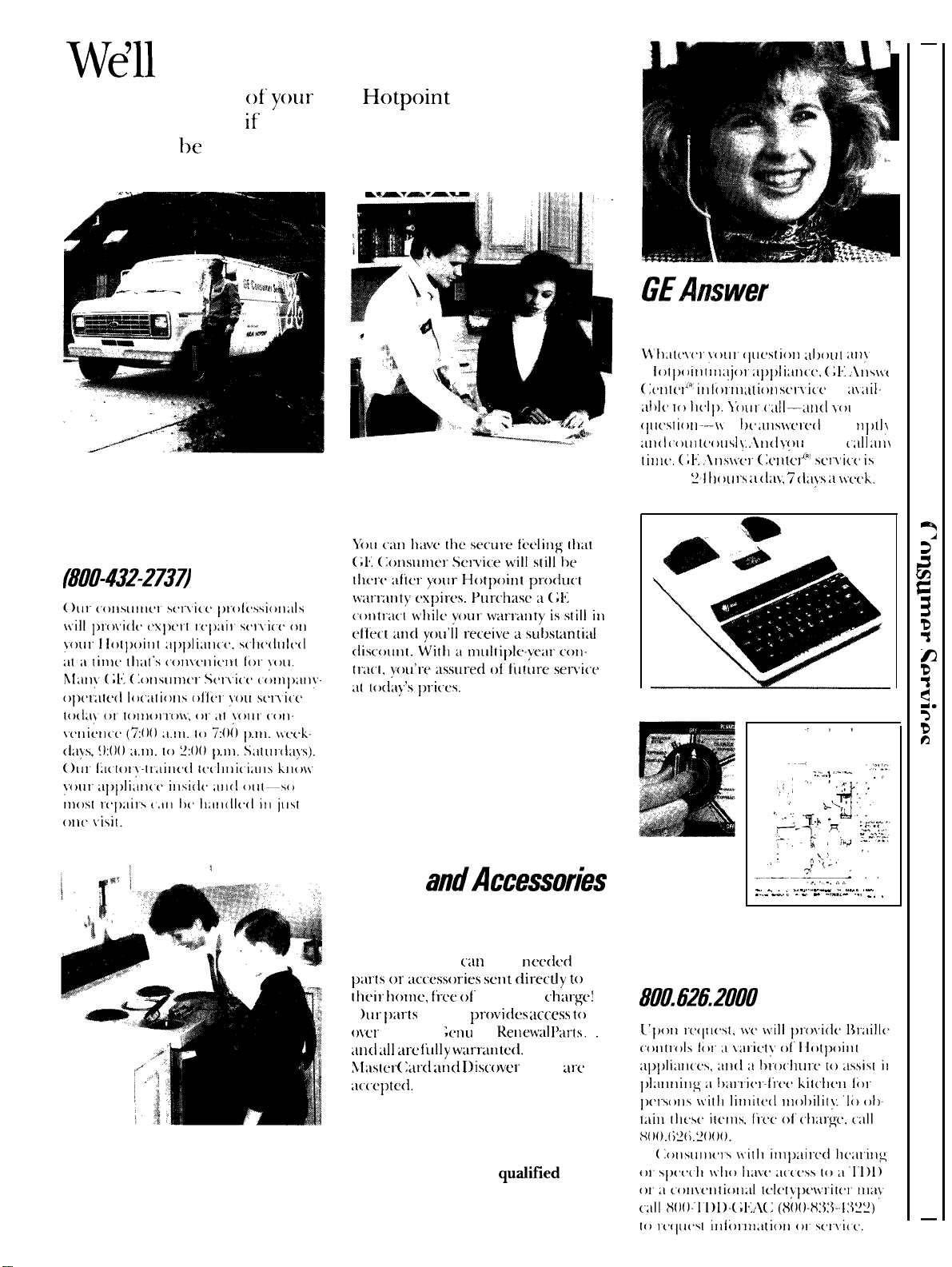
Wdll
Be There
With the purchase
of
your
new
Hotpoint
appliance, receive
the assurance that
if
you ever need information or assis-
tance, we’ll
be
there. All you have to do is call-toll-free!
GEAnswer
Center
m
800.626.2000
In-Home Repair
Service
800-GE-CARES
(8MM32-2W7
Service Contracts
8/70-626-2224
\$’lliIl(wl
}(NII
(l~lcwlio]l
:ilx)(]{
:ttl)
I
[ol[)(,itl[
]ll:lj(}]
:I[)])li:ul(e,
(;1
\tls\w
(ctl([’t<’;
itlli)ltll:lliotl
s(l-\icc.
is
;i\:iil-
;11)1(’
10
II(I]).
}1)(11”
(’:111—all(l
w)lll
’
(Ilt(’st
iot)--\\
ill 1)(
;uIs\\c>rc’(1
pro II
Il)ll)
illl(l
(’()(11
lc’OLld\:
.\tl(l
}’011
(’:111
(’:111
:lll\
lil]lt’.
(;1
ltts\\;t-
(kvll’c+’]
scvlic(
is
0])(’11 21
110111’s
ii (I;IK 7 (la}’s ii w’[’ek.
Telecommunication Device for the Deaf
Parts
andAccessories
800-626-2002
Individuals qualified to service their
own appliances
can have
neecfc’d
parts
(w
access(n_ies
sent
directfy
to
their
h(mlc,
free
of”
shipping
charge!
(
)t]r
lmrts
system
pr(widcs
access to
(
)\cr
47,()()() (
;enu
ine
Rellew’al
Par[s.
.
.
:md
it]]
are fhlly
warrwlttxi.
VISA,
klaster(
Ml
;u]d
I)isc(wer
cards
arc’
X’(’{!ptc?d.
User maintenance instructions
contained in this booklet cover proce-
dures intended to be performed by
any user. Other servicing generally
should be referred to
qualitled ser-
vice personnel. Caution must be
exercised, since improper servicing
may cause unsafe operation.
.
.
.
.
.
,“...
.
.
.
.
.
.
-.
,-
.
.
.
—,,
.-
.
.-..”.
..!
-.
.
For Customers With
Special /Keels...
800.626.2WMJ
YOUR HOTPOINT GAS RANGE
,
I
WARRANTY
Save proof of original purchase date such as your sales slip or
cancelled
check to establish warranty period.
WHAT IS COVERED
FULL ONE-YEAR WARRANTY
This warranty is
extended to
For one year from date of original
the
original
purchaser and any
purchase, we will provide,
free of
succeeding owner for products
charge, parts and service labor in
purchased for ordinary home use
your home to repair or replace
in the 48 mainland states, Hawaii
any part
of
the range that fails
and Washington,
D.C.
In Alaska the
because of a manufacturing defect.
warranty is the same except that it
is LIMITED because you must pay
to ship the product to the service
shop or for the service technician’s
travel costs to your home.
All warranty service will be
provided by our Factory Service
Centers or by our authorized
Customer Care” servicers during
normal working hours.
Look in the White or Yellow Pages
of your telephone directory for
HOTPOINT FACTORY SERVICE,
GENERAL ELECTRIC-HOTPOINT
FACTORY SERVICE or HOTPOINT
CUSTOMER CARE “ SERVICE.
WHAT IS NOT COVERED
● Service trips to your home to
● Replacement of house fuses or
teach you how to use the product.
resetting of circuit breakers.
Read your Use and Care material.
● Failure of the product if it is used
If you then have any questions
for other than its intended purpose
about operating the product please
or used commercially.
contact your dealer or our
Consumer Affairs office at the
● Damage to product caused
by accident, fire, floods or acts
address below, or call, toll free:
of God.
GE Answer
Center’’”
800.626.2000
WARRANTOFf IS NOT
consumer information service
RESPONSIBLE FOR
CONSEQUENTIAL DAMAGES
● Improper installation.
If you have an installation problem,
contact your dealer or installer.
You are responsible for providing
adequate electrical, gas, exhausting
and other connecting facilities.
Some states
do
not allow the exclusion or limitation of incidental or consequential damages, so the above limitation or exclusion
may not apply to you. This warranty gives you specific legal rights, and you may also have other rights which vary from state to state.
To know what your legal rights
are in your state, consult your local or state consumer affairs office or your state’s Attorney General.
I
Warrantor: General Electric Company
I
If further help is needed concerning this warranty, write:
Manager—Consumer Affairs, GE Appliances, Louisville, KY 40225
HcnPollur
RGJ534GEP
391
CG

