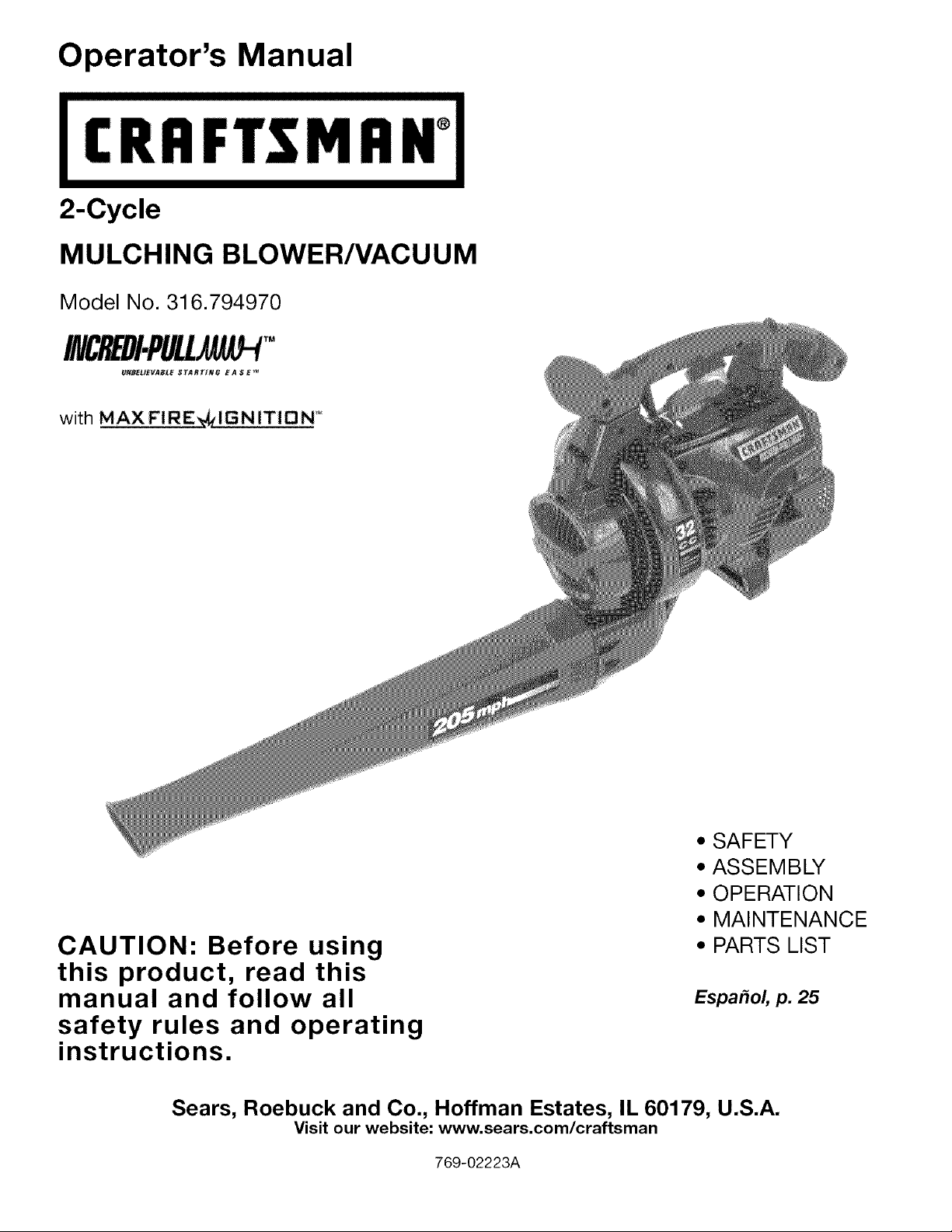
Operator's Manual
CRRFr ;MRN°
2-Cycle
MULCHING BLOWER/VACUUM
Model No. 316.794970
IW'_I.RPd)_fl_,LP
_V_EZJEVAB_E 8TA_TlN_ EASE _
with MAX FIRE_Ii3NITION °
CAUTION: Before using
this product, read this
manual and follow all
safety rules and operating
instructions.
• SAFETY
• ASSEMBLY
• OPERATION
• MAINTENANCE
• PARTS LIST
Espa#ol, p. 25
Sears, Roebuck and Co., Hoffman Estates, IL 60179, U.S.A.
Visit our website" www.sears.com/craftsman
769-02223A
Warranty Page 2
SafetyRules Pages 3 - 7
Assembly Pages 8-10
OilandFuelInformation Page 11
Starting/StoppingInstructions Page 12
Operation Pages 13- 14
MaintenanceandRepair Pages 15- 18
Troubleshooting Page 19
Specifications Page 20
Notes(IntentionallyBlank) Pages 21- 23
CARB/ EPAWarranty Information Page 24
Parts List Pages 45 - 46
Repair Protection Agreement Page 27
Service Numbers Page Back Cover
TWO YEAR LIMITED WARRANTY ON CRAFTSMAN GAS BLOWER/VACUUM
For two years from the date of purchase, when this Blower is used and maintained according to
the operator's manual, Sears will repair any defect in material or workmanship free of charge.
This warranty excludes the spark plug, air filter, and vacuum bag, which are expendable parts that
can wear out from normal use in less than two years.
If this Blower is used for commercial or rental purposes, this warranty applies for only 30 days from
the date of purchase.
WARRANTY SERVICE IS AVAILABLE BY RETURNING THIS BLOWER TO THE NEAREST
SEARS STORE OR SEARS PARTS & REPAIR CENTER IN THE UNTIED STATES.
This warranty gives you specific legal rights, and you may also have other rights which vary from
state to state.
Sears, Roebuck and Co., Dept. 817WA, Hoffman Estates, IL 60179
CALIFORNIA PROPOSITION 65 WARNING
THE ENGINE EXHAUST FROM THIS
PRODUCT CONTAINS CHEMICALS
KNOWN TO THE STATE OF CALIFORNIA
TO CAUSE CANCER, BIRTH DEFECTS
OR OTHER REPRODUCTIVE HARM.
SPARK ARRESTOR NOTE
NOTE: For users on U.S. Forest Land and in the
states of California, Maine, Oregon and Washington.
All U.S. Forest Land and the state of California (Public
Resources Codes 4442 and 4443), Oregon and
Washington require, by law that certain internal
combustion engines operated on forest brush and/or
grass-covered areas be equipped with a spark arrestor,
maintained in effective working order, or the engine be
constructed, equipped and maintained for the prevention
of fire. Check with your state or local authorities for
regulations pertaining to these requirements. Failure to
follow these requirements could subject you to liability or
a fine. This unit is factory equipped with a spark
arrestor. If it requires replacement, ask a Sears or other
qualified service dealer to install the Accessory Muffler
Assembly, Part #753-05169.
Thepurposeof safetysymbolsisto attractyour
attentionto possibledangers.Thesafetysymbols,
andtheirexplanations,deserveyourcarefulattention
andunderstanding.Thesafetywarningsdo notby
themselveseliminateanydanger.Theinstructionsor
warningstheygivearenotsubstitutesforproper
accidentpreventionmeasures.
DANGER: Failure to obey a
safety warning will
result in serious injury to yourself or to
others. Always follow the safety precautions
to reduce the risk of fire, electric shock and
injury.
SAFETY ALERT: Indicates
danger,
warning or caution. Attention is required in
order to avoid serious personal injury. May
be used in conjunction with other symbols
or pictographs.
NOTE: Advises you of information or instructions vital to
the operation or maintenance of the equipment.
Read the Operator's Manual(s) and follow all
warnings and safety instructions.
Failure to do so can result in serious injury to the
operator and/or bystanders.
WARNING: Failure to obey a
safety warning can
result in injury to yourself and others.
follow the safety precautions to
reduce the risk of fire, electric shock and
injury.
CAUTION: Failure to obey a
safety warning may
result in property damage or personal injury
to yourself or to others. Always follow the
safety precautions to reduce the risk of fire,
electric shock and personal injury.
• IMPORTANT SAFETY INSTRUCTIONS •
READ ALL INSTRUCTIONS • Clear the area of children, bystanders, and pets. At a
BEFORE OPERATING
WARNING: When using the unit,
you must follow the
safety rules. Please read these instructions
before operating the unit in order to ensure
the safety of the operator and any bystanders.
Please keep these instructions for later use.
• Read the instructions carefully. Be familiar with the
controls and proper use of the unit.
• Do not operate this unit when tired, ill, or under the
influence of alcohol, drugs, or medication.
• Children must not operate the unit. Teens must be
accompanied and guided by an adult.
• All guards and safety attachments must be installed
properly before operating the unit.
• Inspect the unit before use. Replace damaged parts.
Check for fuel leaks. Make sure all fasteners are in
place and secure. Replace parts that are cracked,
chipped, or damaged in any way. Do not operate the
unit with loose or damaged parts.
• Carefully inspect the area before starting the unit.
Remove all debris and hard or sharp objects such as
glass, wire, etc.
minimum, keep all children, bystanders, and pets
outside a 50 feet (15 m.) radius; there still may be a
risk to bystanders from thrown objects. Bystanders
should be encouraged to wear eye protection. If you
are approached, stop the unit immediately.
FUEL SAFETY WARNINGS
Gasoline is highly
flammable, and its
following precautions:
• Store fuel only in containers specifically designed and
approved for the storage of such materials.
• Avoid creating a source of ignition for spilled fuel. Do
not start the engine until fuel vapors dissipate.
Always stop the engine and allow it to cool before filling
the fuel tank. Never remove the cap of the fuel tank, or
add fuel, when the engine is hot. Never operate the unit
without the fuel cap securely in place. Loosen the fuel
tank cap slowly to relieve any pressure in the tank.
Mix and add fuel in a clean, well-ventilated outdoor area
where there are no sparks or flames. Slowly remove the
fuel cap only after stopping engine. Do not smoke while
fueling or mixing fuel. Wipe up any spilled fuel from the
unit immediately. Always wipe unit dry before using.
Move the unit at least 30 feet (9.1 m) from the fueling
source and site before starting the engine. Do not
smoke. Keep sparks and open flames away from the
area while adding fuel or operating the unit.
WHILE OPERATING
• Never start or run the unit inside a closed room or
building. Breathing exhaust fumes can kill. Operate this
unit only in a well-ventilated outdoor area.
• Wear safety glasses or goggles that are marked as
meeting ANSI Z87.1 standards and are marked as such.
Wear ear/hearing protection when operating this unit.
• Never run the unit without the the proper equipment
attached. When using this unit, always install the
blower/vacuum tubes and vacuum bag depending on
blower or vacuuming application.
• To reduce the risk of hearing loss associated with
sound level(s), always wear ear/hearing protection
when operating this unit.
• Wear heavy long pants, boots, gloves, and a long
sleeve shirt. Do not wear loose clothing, jewelery, short
pants, sandals or go barefoot. Secure hair above
shoulder level.
• To avoid static electricity shock, do not wear rubber
gloves or any other insulated gloves while operating
this unit.
• Use the unit only in daylight or good artificial light.
• Keep outside surfaces free from oil and fuel.
• Avoid accidental starting. Be in the starting position
whenever pulling the starter rope. The operator and
unit must be in a stable position while starting. Refer to
Starting/Stopping Instructions.
• Do not set unit on any surface except a clean, hard
area while engine is running. Debris such as gravel,
sand, dust, grass, etc. could be picked up by the air
intake and thrown out by the discharge opening,
damaging unit, property, or causing serious injury to
bystanders or operator.
• Use the right tool. Only use this tool for its intended
purpose.
• Do not force unit. It will do the job better and with less
likelihood of injury at a rate for which it was designed.
• Do not overreach or use from unstable surfaces such
as ladders, trees, steep slopes, rooftops, etc. Always
keep proper footing and balance.
• Always hold the unit with a firm grip when operating.
• Keep hands, face, and feet away from all moving parts.
Do not touch or try to stop the impeller when it is
rotating. Do not operate without guards in place.
• Do not put any object into openings. Do not use with
any opening blocked; keep free of dirt, debris, and
anything that may reduce the air flow.
• Do not touch the engine or muffler. These parts get
extremely hot from operation, even after the unit is
turned off.
• Do not operate the engine faster than the speed
needed to do the job. Do not run the engine at high
speed when not in use.
• Always stop the engine when operation is delayed or
when walking from one location to another.
• Stop the engine for maintenance, repair, to install or
remove the blower tubes or vacuum attachments. The
unit must be stopped and the impeller no longer
turning to avoid contact with the rotating blades.
• If you strike or come into contact with a foreign object,
stop the engine immeadiately and check for damage.
Do not operate before repairing damage. Do not
operate the unit with loose or damaged parts.
• Use only replacement parts or accessories
recommended for this tool that are sold by Sears or a
Craftsman outlet. Use of any replacement parts or
accessories purchased elsewhere may be hazardous,
and will also void your warranty.
• Never use this unit for spreading chemicals, fertilizers or
other substances which may contain toxic materials.
• To reduce fire hazard, replace faulty muffler and spark
arrestor. Keep the engine and muffler free from grass,
leaves, excessive grease or carbon build up.
• Turn the engine off and disconnect the spark plug for
maintenance or repair.
WHILE OPERATING UNIT AS A BLOWER
• Never point the blower or blowing debris in the
direction of people, animals, or in the direction of
windows. Always direct the blowing debris away from
people, animals, and windows. Use extra caution
when blowing debris near solid objects such as trees,
automobiles, walls, etc.
WHILE OPERATING UNIT AS A VACUUM
• Avoid situations that could catch the vacuum bag on
fire. Do not operate near an open flame. Do not
vacuum warm ash from fireplaces, barbecue pits,
brush piles, etc. Do not vacuum discarded cigars or
cigarettes unless the cinders are completely cool.
• The unit is designed to pickup dry material such as
leaves, grass, small twigs, and bits of paper. Do not
attempt to vacuum wet debris and/or standing water
as this may result in damage to the blower/vacuum.
To avoid severe damage to the impeller, do not
vacuum metal, broken glass, etc.
OTHER SAFETY WARNINGS
• Always disconnect the spark plug before performing
maintenance or accessing movable parts.
• Never store the unit, with fuel in the tank, inside a
building where fumes may reach an open flame (pilot
lights, etc.) or sparks (switches, electrical motors, etc.).
• Allow the engine to cool before storing or transporting.
Be sure to secure the unit while transporting.
• Store the unit in a dry place, secured, or at a height to
prevent unauthorized use or damage. Keep out of the
reach of children.
• Never douse or squirt the unit with water or any other
liquid. Keep handles dry, clean, and free from debris.
Clean after each use, see Cleaning and Storage
instructions.
• Keep these instructions. Refer to them often and use
them to instruct other users. If you loan this unit to
others, also loan these instructions to them.
SPECIAL NOTE: Exposure to vibrations through
prolonged use of gasoline powered hand tools could
cause blood vessel or nerve damage in the fingers,
hands, and joints of people prone to circulation disorders
or abnormal swelling. Prolonged use in cold weather has
been linked to blood vessel damage in otherwise healthy
people. If symptoms occur such as numbness, pain, loss
of strength, change in skin color or texture, or loss of
feeling in the fingers, hands or joints, discontinue use of
this tool and seek medical attention. A reduced vibration
system does not guarantee avoidance of these
problems. Users who operate power tools on a regular
basis must closely monitor their physical condition and
the condition of this tool.
SAVETHESE INSTRUCTIONS

SAFETY AND INTERNATIONAL SYMBOLS
This operator's manual describes safety and international symbols and pictographs that may appear on this product.
Read the operator's manual for complete safety, assembly, operating and maintenance and repair information.
SYMBOL MEANING SYMBOL
• SAFETY ALERT SYMBOL
Indicates danger, warning, or
caution. May be used in conjunction
with other symbols or pictographs.
A I
• READ OPERATOR'S MANUAL
WARNING:Read the
Operator's Manual(s) and follow all
warnings and safety instructions.
Failure to do so can result in serious
injury to the operator and/or
bystanders.
• WEAR EYE AND HEARING
PROTECTION
WARNING: Thrown
objects and loud noise can cause
severe eye injury and hearing loss.
Wear eye protection meeting ANSI
Z87.1-1989 standards and ear
protection when
operating this unit. Use a full face
shield when needed.
• KEEP BYSTANDERS AWAY
WARNING: Keepa,
bystanders, especially children and
pets, at least 50 feet (15 m.) from the
operating area.
• UNLEADED FUEL
Always use clean, fresh unleaded fuel.
• OIL
Refer to operator's manual for the
proper type of oil.
• THROWN OBJECTS CAN CAUSE
SEVERE INJURY
WARNING: Keepc,earof
blower outlet. Never point the
blower at yourself or others. Objects
can be thrown from blower. Do not
operate unit without proper
attachments and guards in place.
O
MEANING
• ON/OFF STOP CONTROL
ON / START / RUN
• ON/OFF STOP CONTROL
OFF OR STOP
• HOT SURFACE WARNING
Do not touch a hot muffler or
cylinder. You may get burned. These
parts get extremely hot from
operation, even after the unit is
turned off.
', BLOWERS- ROTATING
IMPELLER CAN CAUSE
SEVERE INJURY
WARNING: Turnthe
engine off and allow the impeller to
stop before opening the vacuum
door, installing, changing tubes or
bag, or before cleaning or
performing any maintenance.
• THROTTLE CONTROL
Indicates "HIGH" or "FASTEST" speed.
• THROTTLE CONTROL
Indicates "IDLE," "LOW" or
"SLOWEST" speed.
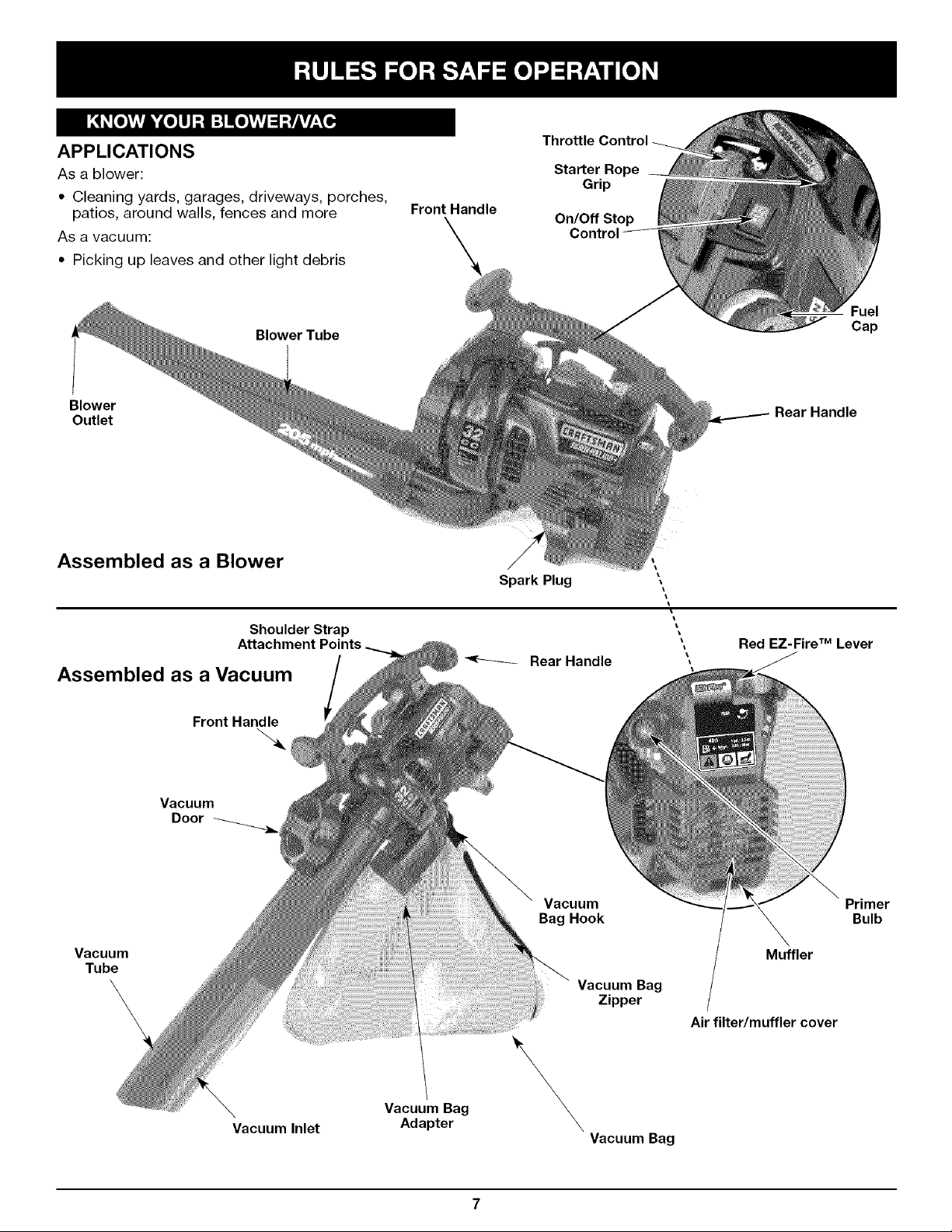
APPLICATIONS
As a blower:
• Cleaning yards, garages, driveways, porches,
patios, around walls, fences and more
As a vacuum:
• Picking up leaves and other light debris
Front Handle
Blower Tube
Blower
Outlet
Assembled as a Blower
Shoulder Strap
Attachment Points
Assembled as a Vacuum
Front Handle
Vacuum
Door
Vacuum
Tube
Vacuum Inlet
Vacuum Bag
Adapter
Throttle Control
Starter Rope
Grip
On/Off Stop
Spark Plug
Rear Handle
Vacuum
Bag Hook
Vacuum Bag
Zipper
7
Vacuum Bag
Fuel
Cap
Rear Handle
Red EZ-Fire TM Lever
Primer
Bulb
Muffler
Air filter/muffler cover
ASSEMBLING UNIT AS A BLOWER
Blower Tube Assembly
WARNING: To prevent serious
personal injury, stop
the engine and allow the impeller to stop
before attaching or removing tubes.
WARNING: Topreventserious
personal injury or
damage to the unit, the blower tube must
be installed while operating this unit as a
blower.
NOTE: If the unit was assembled as a vacuum unit,
remove all vacuum parts and store away in a
secure place for later use.
Installing
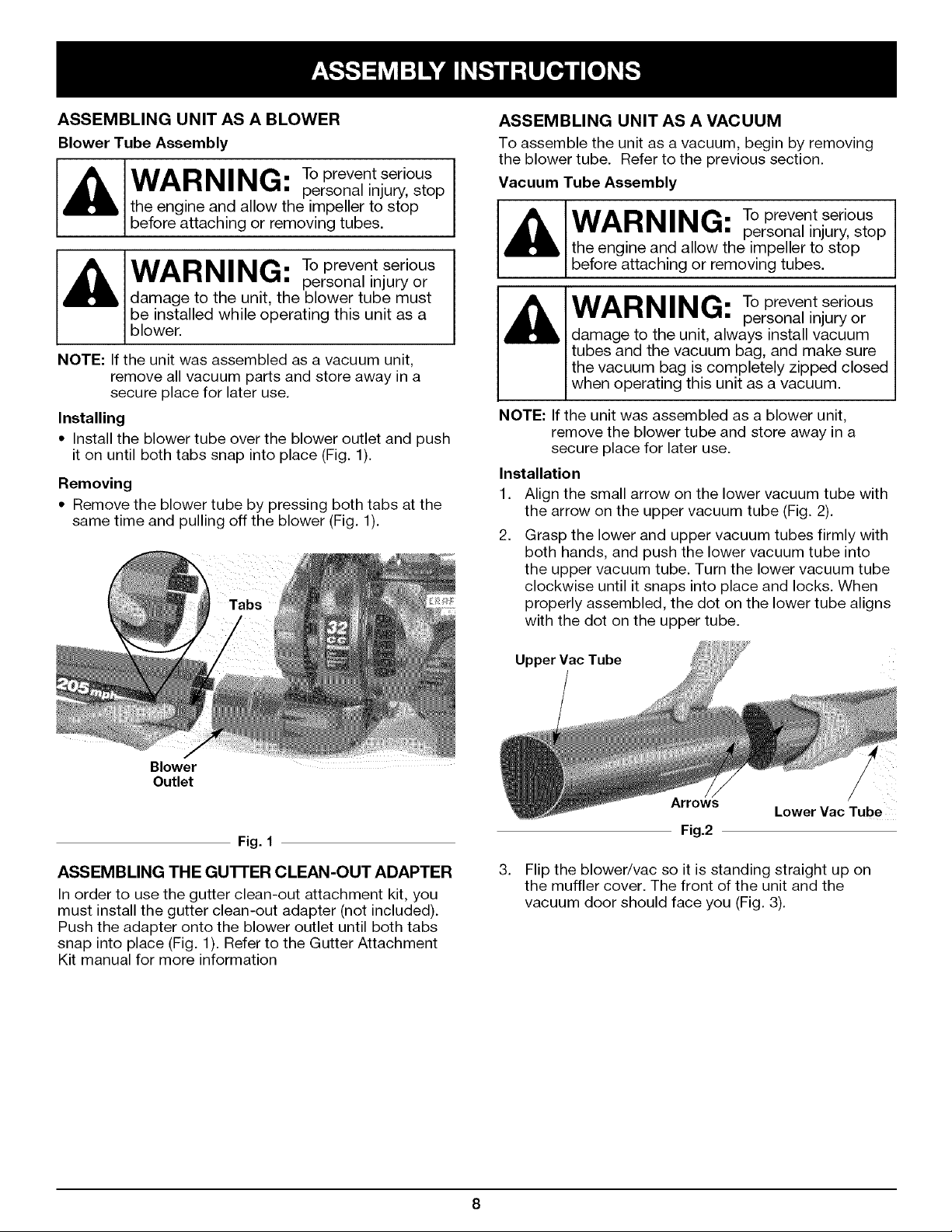
• Install the blower tube over the blower outlet and push
it on until both tabs snap into place (Fig. 1).
Removing
• Remove the blower tube by pressing both tabs at the
same time and pulling off the blower (Fig. 1).
Blower
Outlet
Fig. 1
ASSEMBLING THE GUl-FER CLEAN-OUT ADAPTER
In order to use the gutter clean-out attachment kit, you
must install the gutter clean-out adapter (not included).
Push the adapter onto the blower outlet until both tabs
snap into place (Fig. 1). Refer to the Gutter Attachment
Kit manual for more information
ASSEMBLING UNIT AS A VACUUM
To assemble the unit as a vacuum, begin by removing
the blower tube. Refer to the previous section.
Vacuum Tube Assembly
WARNING: Toprevent serious
personal injury, stop
the engine and allow the impeller to stop
before attaching or removing tubes.
To prevent serious
personal injury or
damage to the unit, always install vacuum
tubes and the vacuum bag, and make sure
the vacuum bag is completely zipped closed
when operating this unit as a vacuum.
NOTE: If the unit was assembled as a blower unit,
remove the blower tube and store away in a
secure place for later use.
Installation
1. Align the small arrow on the lower vacuum tube with
the arrow on the upper vacuum tube (Fig. 2).
2. Grasp the lower and upper vacuum tubes firmly with
both hands, and push the lower vacuum tube into
the upper vacuum tube. Turn the lower vacuum tube
clockwise until it snaps into place and locks. When
properly assembled, the dot on the lower tube aligns
with the dot on the upper tube.
Upper Vac Tube
.
Arrows
Fig.2
t
Lower Vac Tube
Flip the blower/vac so it is standing straight up on
the muffler cover. The front of the unit and the
vacuum door should face you (Fig. 3).
.
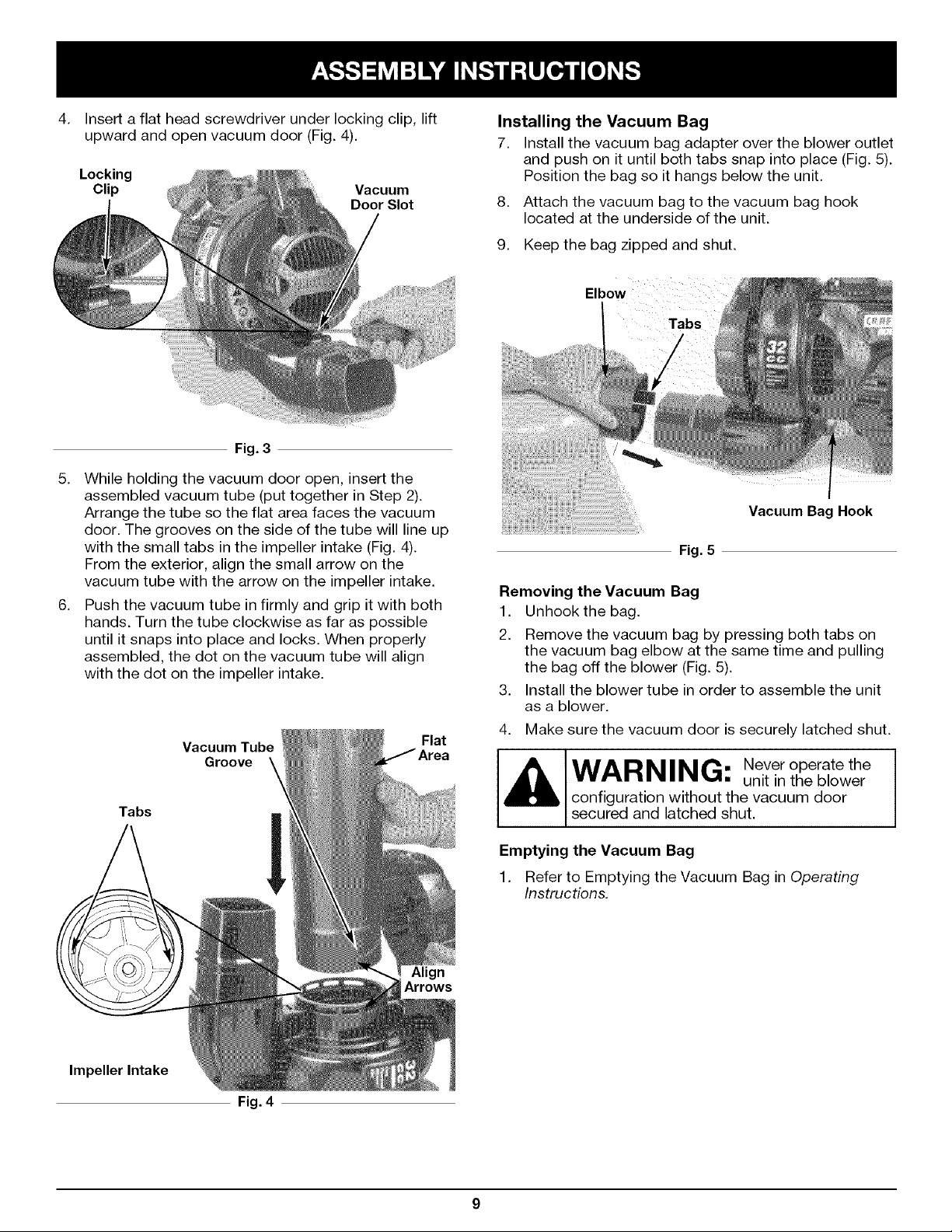
Insert a flat head screwdriver under locking clip, lift
upward and open vacuum door (Fig. 4).
Locking
Clip Vacuum
Door Slot
Fig. 3
5. While holding the vacuum door open, insert the
assembled vacuum tube (put together in Step 2).
Arrange the tube so the flat area faces the vacuum
door. The grooves on the side of the tube will line up
with the small tabs in the impeller intake (Fig. 4).
From the exterior, align the small arrow on the
vacuum tube with the arrow on the impeller intake.
6. Push the vacuum tube in firmly and grip it with both
hands. Turn the tube clockwise as far as possible
until it snaps into place and locks. When properly
assembled, the dot on the vacuum tube will align
with the dot on the impeller intake.
Tabs
Vacuum Tube
Groove \
Flat
Align
Arrows
Impeller Intake
Fig. 4
Installing the Vacuum Bag
7. Install the vacuum bag adapter over the blower outlet
and push on it until both tabs snap into place (Fig. 5).
Position the bag so it hangs below the unit.
8. Attach the vacuum bag to the vacuum bag hook
located at the underside of the unit.
9. Keep the bag zipped and shut.
Vacuum Bag Hook
Fig. 5
Removing the Vacuum Bag
1. Unhook the bag.
2. Remove the vacuum bag by pressing both tabs on
the vacuum bag elbow at the same time and pulling
the bag off the blower (Fig. 5).
3. Install the blower tube in order to assemble the unit
as a blower.
4. Make sure the vacuum door is securely latched shut.
WARNING: Never operate the
unit in the blower
configuration without the vacuum door
secured and latched shut.
Emptying the Vacuum Bag
1. Refer to Emptying the Vacuum Bag in Operating
Instructions.
INSTALLING THE SHOULDER STRAP
WARNING: Toavoidserious
personal injury,
never attempt to start the unit when
standing with the unit clipped to the
shoulder strap. Always follow the starting
procedures as described in the Starting/
Stopping Instructions section.
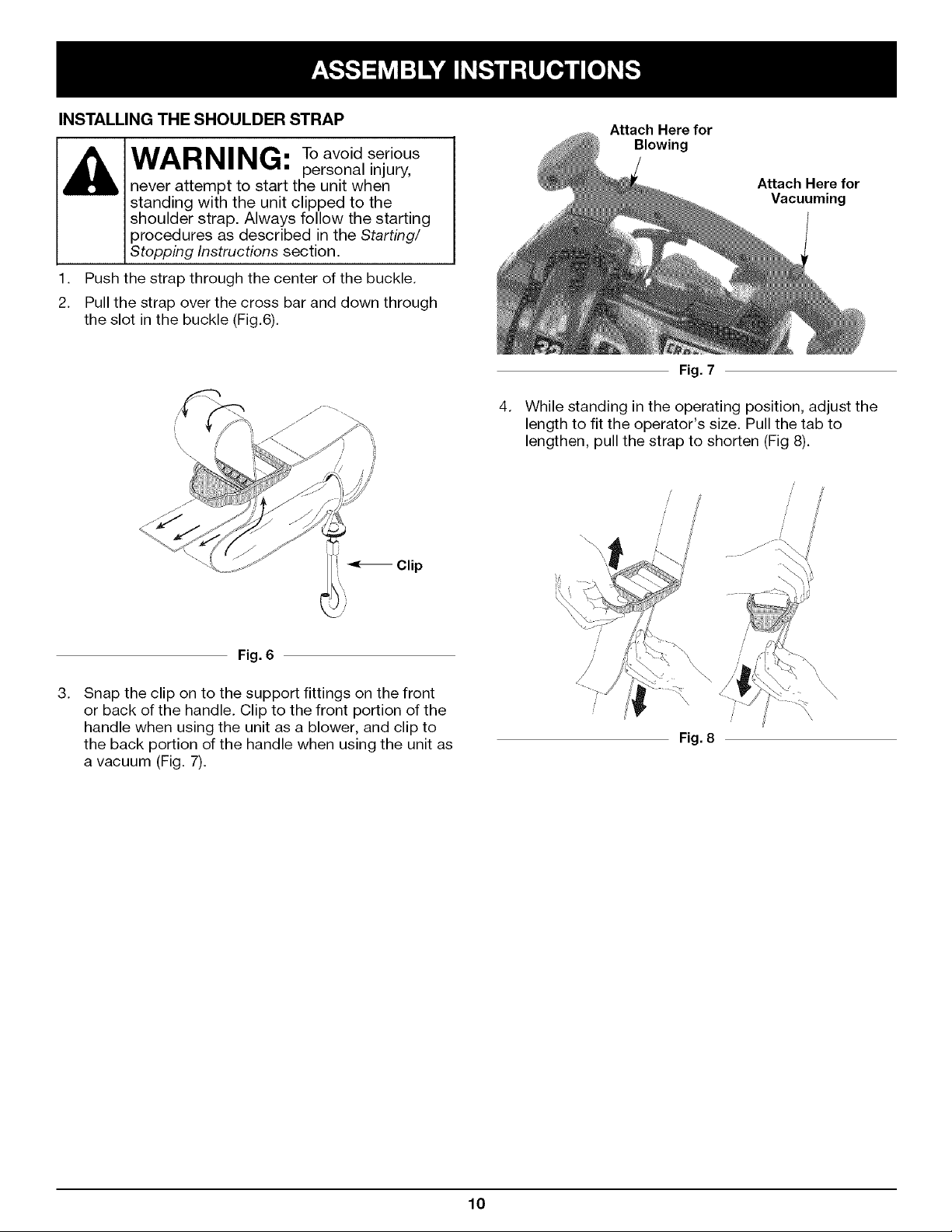
1. Push the strap through the center of the buckle.
2. Pull the strap over the cross bar and down through
the slot in the buckle (Fig.6).
Attach Here for
Blowing
Attach Here for
ig
,
Fig. 7
While standing in the operating position, adjust the
length to fit the operator's size. Pull the tab to
lengthen, pull the strap to shorten (Fig 8).
3,
Clip
Fig. 6
Snap the clip on to the support fittings on the front
or back of the handle. Clip to the front portion of the
handle when using the unit as a blower, and clip to
the back portion of the handle when using the unit as
a vacuum (Fig. 7).
Fig. 8
10
OIL AND FUEL MIXING INSTRUCTIONS
Old and/or improperly mixed fuel are the main reasons
for the unit not running properly. Be sure to use fresh
(less than 60 days old), clean unleaded fuel. Follow the
instructions carefully for the proper fuel/oil mixture.
Definition of Blended Fuels
Today's fuels are often a blend of gasoline and
oxygenates such as ethanol, methanol, or MTBE (ether).
Alcohol-blended fuel absorbs water. As little as 1%
water in the fuel can make fuel and oil separate and
leads to formation of acids during storage. When using
alcohol-blended fuel, use fresh fuel.
Using Blended Fuels
If you choose to use a blended fuel, or its use is
unavoidable, follow recommended precautions:
• Always use the fresh fuel mix explained in your
operator's manual
• Always shake the fuel mix before fueling the unit
• Drain the tank and run the engine dry before storing
the unit
Using Fuel Additives
The bottle of 2-cycle oil that came with your unit
contains a fuel additive which will help inhibit corrosion
and minimize the formation of gum deposits. It is
recommended that you always use Craftsman 2-cycle oil
with this unit.
If Craftsman 2-cycle oil is unavailable, use a good 2-
cycle oil designed for air-cooled engines along with a
fuel additive, such as STA-BIL ®Gas Stabilizer or an
equivalent. Add 0.8 oz. (23 ml.) of fuel additive per gallon
of fuel according to the instructions on the container.
NEVER add fuel additives directly to the unit's fuel tank.
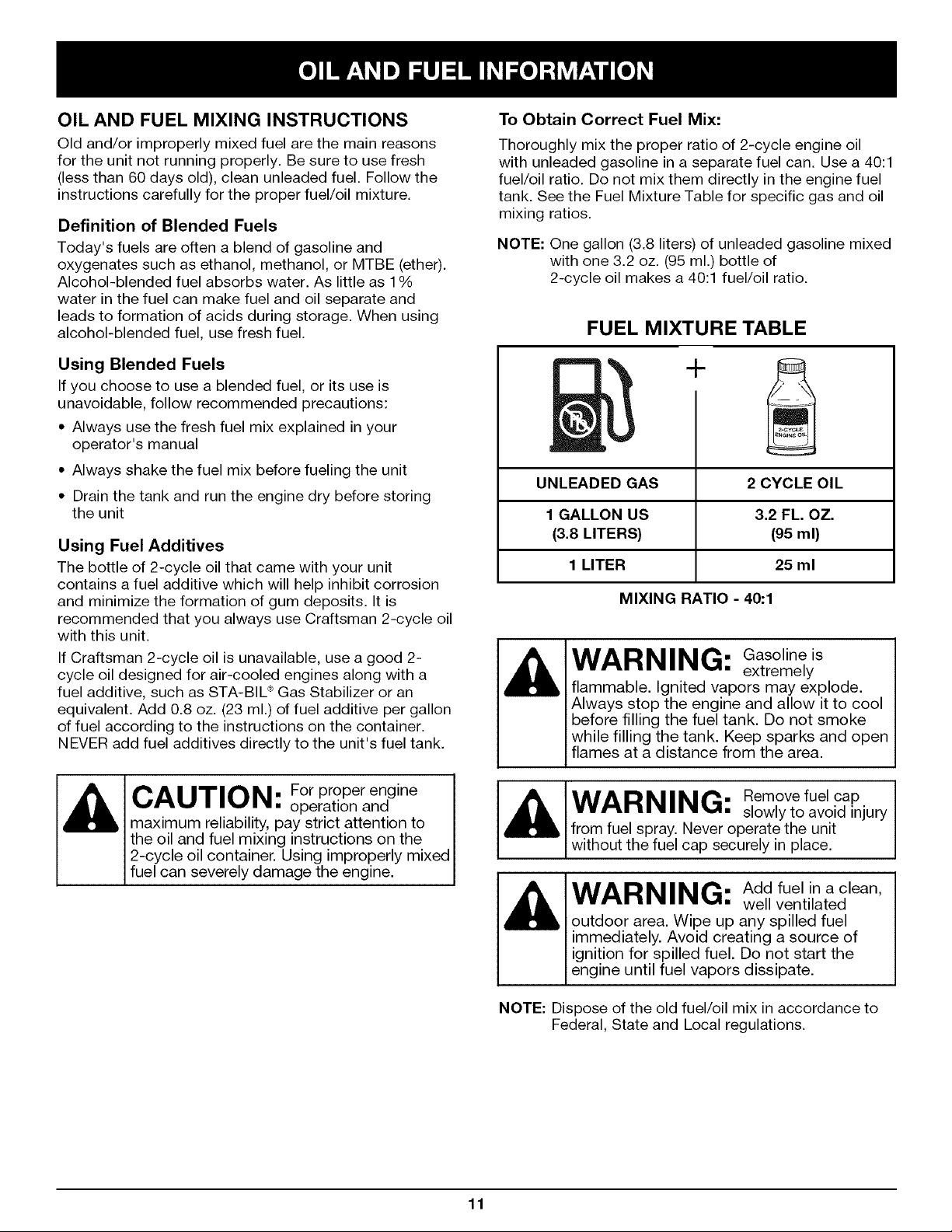
To Obtain Correct Fuel Mix:
Thoroughly mix the proper ratio of 2-cycle engine oil
with unleaded gasoline in a separate fuel can. Use a 40:1
fuel/oil ratio. Do not mix them directly in the engine fuel
tank. See the Fuel Mixture Table for specific gas and oil
mixing ratios.
NOTE: One gallon (3.8 liters) of unleaded gasoline mixed
with one 3.2 oz. (95 ml.) bottle of
2-cycle oil makes a 40:1 fuel/oil ratio.
FUEL MIXTURE TABLE
UNLEADED GAS
1 GALLON US
(3.8 LITERS)
1 LITER
MIXING RATIO - 40:1
2 CYCLE OIL
3.2 FL. OZ.
(95 mR)
25 ml
WARNING: Gasolineis
extremely
flammable. Ignited vapors may explode.
Always stop the engine and allow it to cool
before filling the fuel tank. Do not smoke
filling the tank. Keep sparks and open
CAUTION: For proper engine
operation and
maximum reliability, pay strict attention to
the oil and fuel mixing instructions on the
2-cycle oil container. Using improperly mixed
fuel can severely damage the engine.
Remove fuel cap
slowly to avoid injury
from fuel spray. Never operate the unit
without the fuel cap securely in place.
WARNING: Add fuel in a clean,
well ventilated
outdoor area. Wipe up any spilled fuel
immediately. Avoid creating a source of
ignition for spilled fuel. Do not start the
engine until fuel vapors dissipate.
NOTE: Dispose of the old fuel/oil mix in accordance to
Federal, State and Local regulations.
11

WARNING: Operate this unit only in a
well-ventilated outdoor area.
Carbon monoxide exhaust fumes can be lethal in a
confined area.
WARNING: Avoid accidental starting.
Make sure you are in the
starting position when pulling the starter rope (Fig. 11
and 12). To avoid serious injury, the operator and unit
must be in a stable position while starting.
Do not set unit on any surface except a clean, hard
area while starting. Debris such as gravel, sand, dust
and grass could be picked up by the air intake and
thrown out by the discharge opening. This could
damage the unit, property, or cause serious injury to
bystanders or the operator.
STARTING INSTRUCTIONS
1. Mix gas with oil. Fill fuel tank with fuel/oil mixture.
See Oil and Fuel Mixing Instructions.
WADk,,k,p_. Toavoid serious
0 101001_,.4. personal injury
always remove the vacuum bag priort'o
refueling the unit. The bag may become
fire hazard when saturated with fuel.
2. The On/Off Stop Control is in the ON (I) position at all
times (Fig. 10).
.... 3. Fully press and release the primer bulb 10 times,
slowly. Some amount of fuel should be visible in the
primer bulb and fuel lines (Fig. 10). If you can't see fuel
in the bulb press and release the bulb as many times
as t takes before you can see fuel in it.
4. Place the unit in the starting position (Fig. 11) as a
blower, Fig. 12 as a vacuum). Move the throttle
control to the idle position (-41IF) (Fig. 9). This is
especially important during cold starting.
TM
5. Push the red EZ-Fire Lever towards the primer
bulb until it clicks and locks into place (Fig. 10).
TM
NOTE: The unit uses the Incredi-Pull starting system
TM
with MAX FIRE IGNITION , which significantly
reduces the effort required to start the engine. You
must pull the starter rope out far enough to hear
the engine attempt to start. There is no need to pull
the rope briskly-- there is no harsh resistance when
pulling. Be aware that this starting method is vastly
different from (and much easier than) what you may
be used to.
6. Pull the starter rope out with a controlled and steady
motion until the engine attempts to start. Repeat unhl
the engine starts.
7. When the enaine starts, move the throttle control to the
fast position "_4r_) and let the engine warm up for 15 to
TM
30 seconds. The red EZ-Fire Lever will click off
automatically when you move the throttle control to
the fast posihon.
: .... IF... The engine does not start, go back to step 3.
IF... The engine stops while moving the throttle, go back
to step 5.
IF... The engine stops before you move the throttle, move
the throttle to the fast position and pull the starter
until the blower starts.
NOTE: If you are having trouble starting the unit or are
operating in extreme temperatures (below 40 ° F, above
90° F), refer to the Troubleshooting section.
STOPPING INSTRUCTIONS
1. Move the throttle control to the idle position
(-,11_). Allow the engine to cool down by idling
(Fig. 10).
2. Put the On/Off Stop Control in the OFF (O)
position (Fig. 10).
Throttle Control Idle Fast
On/Off Stop Control
Primer
Bulb
Fig. 9
Blower
Starting
Position Rope
_ 'ncredt-Pul' /
Fig. 10
Starter
Red EZ-Fire TM
Lever
Vacuum
Starting
Position
Fig. 11
Starter
Rope
Fig. 12
12
HOLDING THE BLOWER/VACUUM
WARNING: Toavoidserious
personal injury,
wear goggles or safety glasses at all times
when operating this unit. Wear a face mask
or dust mask in dusty locations.
Before operating the unit, stand in the operating position.
Check for the following:
• Operator is wearing proper clothing, such as boots,
safety glasses or goggles, ear/hearing protection,
gloves, long pants and long sleeve shirt
• If the conditions are dusty, the operator is wearing a
dust mask or face mask
• The unit is in good working condition
• The tubes and guards are in place and secure
WARNING: To prevent serious
personal injury or
damage to the unit, make sure blower tubes
or vacuum tubes and the vacuum bag are in
place before you operate the unit.
OPERATING TIPS
• Be sure the vacuum bag is zipped closed before
operating the unit.
• Ensure the unit is not directed at anybody or any loose
debris before starting the unit.
• Verify that the unit is in good working condition. Make
sure the tubes and guards are in place and secure.
• Always hold the unit securely when operating. Keep a
firm grip on both the front and rear handles.
• To reduce the risk of hearing loss associated with sound
level(s), hearing protection is required.
• To reduce noise levels, limit the number of pieces of
equipment used at any one time.
• To reduce noise levels, operate power blowers at the
lowest possible speed to do the job.
• Check your equipment before operation, especially the
muffler, air intakes and air filters.
• Use rakes and brooms to loosen debris before blowing.
• In dusty conditions, slightly dampen surfaces when
water is available.
• Conserve water by using power blowers instead of
hoses for many lawn and garden applications,
including areas such as screens, patios, grills, porches,
and gardens.
• Watch out for children, pets, open windows or freshly
washed cars, and blow debris safely away.
• Clean up after using blowers and other equipment.
Dispose of debris appropriately.
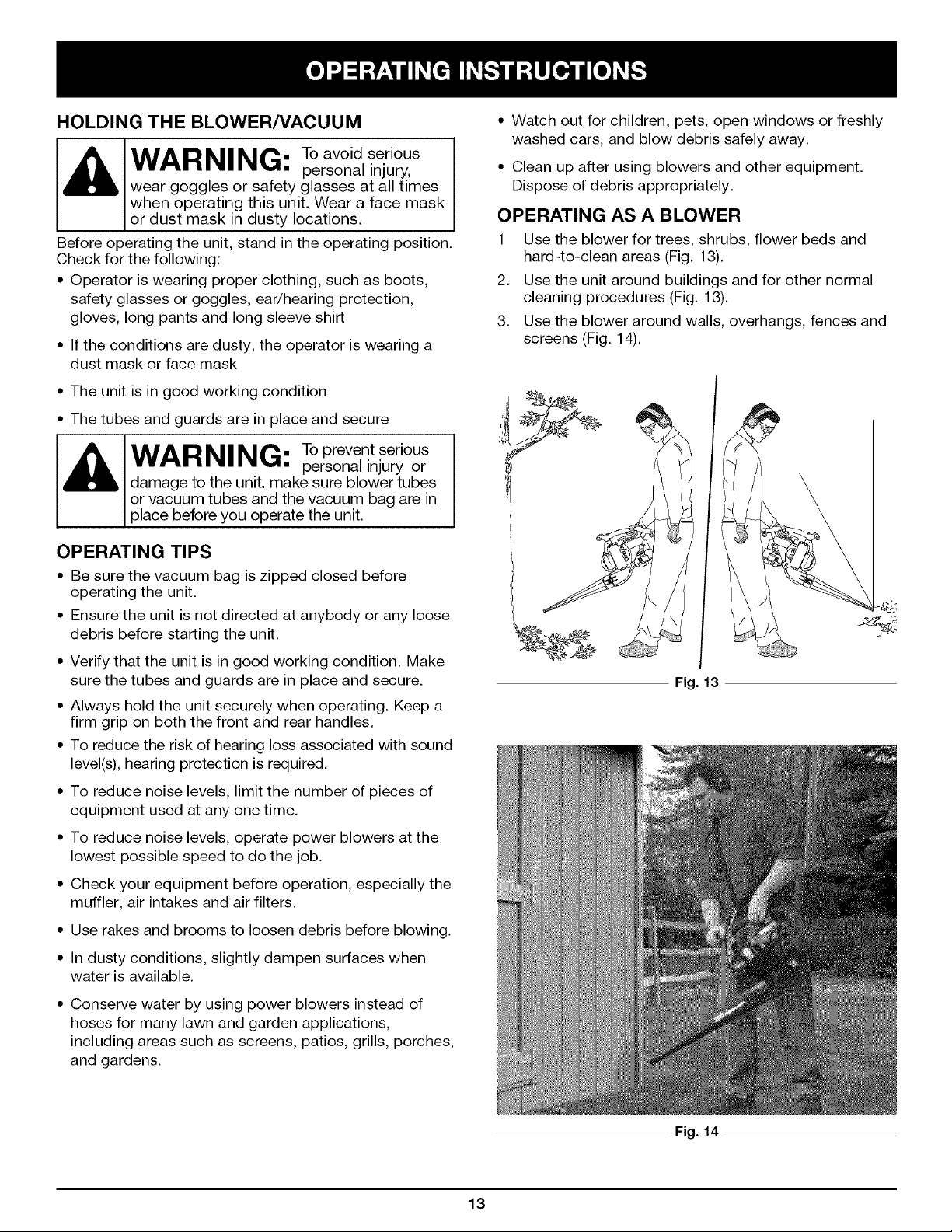
OPERATING AS A BLOWER
1 Use the blower for trees, shrubs, flower beds and
hard-to-clean areas (Fig. 13).
2. Use the unit around buildings and for other normal
cleaning procedures (Fig. 13).
3. Use the blower around walls, overhangs, fences and
screens (Fig. 14).
Fig. 13
13
Fig. 14
OPERATING AS A VACUUM
WARNING: To prevent serious
personal injury or
damage to the unit, always install vacuum
tubes, vacuum bag and make sure the
vacuum bag is completely zipped closed
when operating this unit as a vacuum.
Check for the following before operating the unit:
• Operator is wearing proper clothing, such as boots,
safety glasses or goggles, ear/hearing protection,
gloves, long pants and long sleeve shirt
• If the conditions are dusty, operator is equipped with a
dust mask or face mask
• The unit is in good working condition-- the vacuum
tubes and vacuum bag are in place and secure.
• The vacuum shoulder strap in place and correctly
adjusted
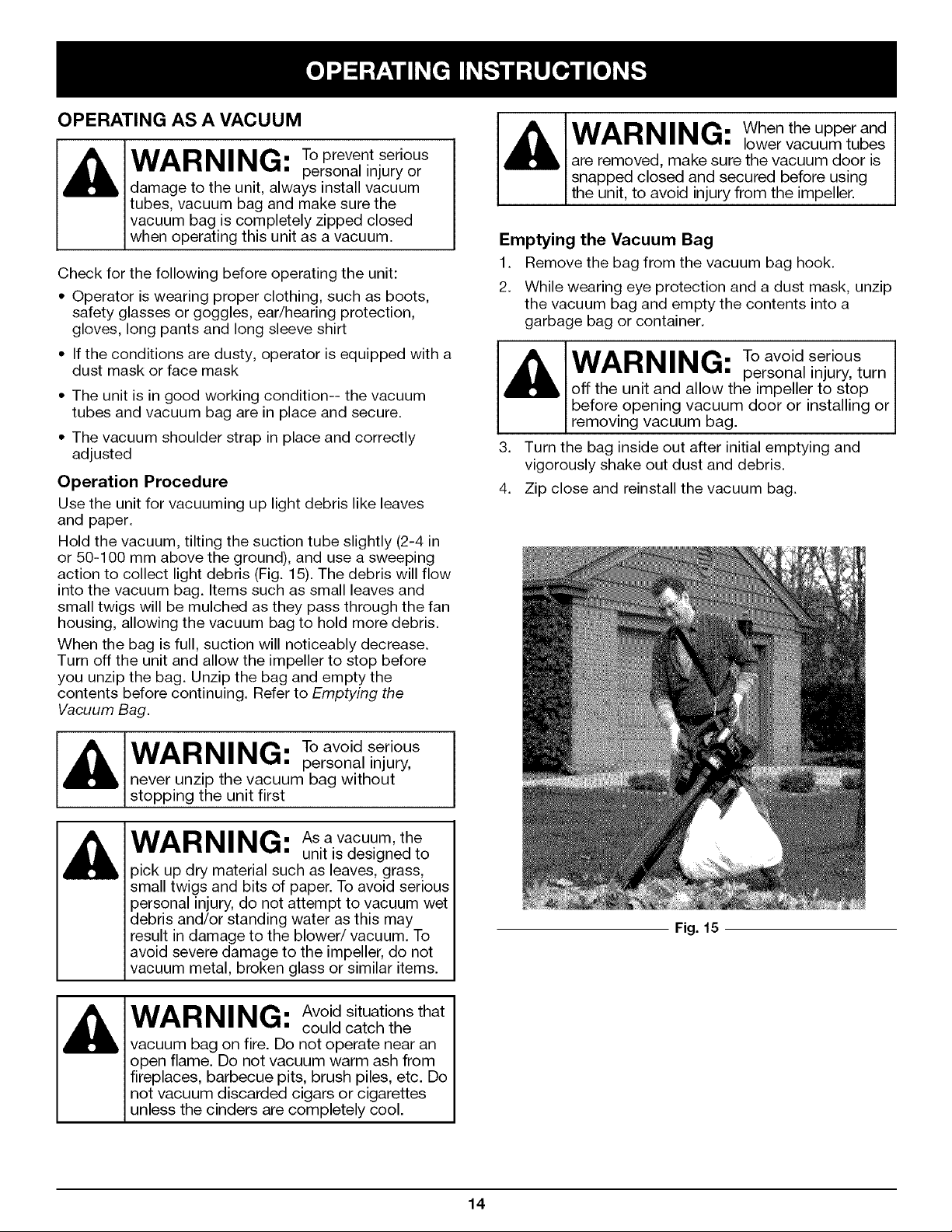
Operation Procedure
Use the unit for vacuuming up light debris like leaves
and paper.
Hold the vacuum, tilting the suction tube slightly (2-4 in
or 50-100 mm above the ground), and use a sweeping
action to collect light debris (Fig. 15). The debris will flow
into the vacuum bag. Items such as small leaves and
small twigs will be mulched as they pass through the fan
housing, allowing the vacuum bag to hold more debris.
When the bag is full, suction will noticeably decrease.
Turn off the unit and allow the impeller to stop before
you unzip the bag. Unzip the bag and empty the
contents before continuing. Refer to Emptying the
Vacuum Bag.
WARNING: Toavoidserious
personal injury,
never unzip the vacuum bag without
stopping the unit first
WARNING: Asavacuum,the
unit is designed to
pick up dry material such as leaves, grass,
small twigs and bits of paper. To avoid serious
personal injury, do not attempt to vacuum wet
debris and/or standing water as this may
result in damage to the blower/vacuum. To
avoid severe damage to the impeller, do not
vacuum metal, broken glass or similar items.
WARNING: When the upper and
lower vacuum tubes
are removed, make sure the vacuum door is
snapped closed and secured before using
unit, to avoid injury from the impeller.
Emptying the Vacuum Bag
1. Remove the bag from the vacuum bag hook.
2. While wearing eye protection and a dust mask, unzip
the vacuum bag and empty the contents into a
garbage bag or container.
WAl::ll lll l , To avoid serious
......... """ personal injury, turn I
off the unit and allow the impeller to stop I
before opening vacuum door or installing or
remov ng vacuum bag.
3. Turn the bag inside out after initial emptying and
vigorously shake out dust and debris.
4. Zip close and reinstall the vacuum bag.
Fig. 15
WARNING: Avoid situations that
could catch the
vacuum bag on fire. Do not operate near an
open flame. Do not vacuum warm ash from
fireplaces, barbecue pits, brush piles, etc. Do
not vacuum discarded cigars or cigarettes
unless the cinders are completely cool.
14
MAINTENANCE SCHEDULE
Perform these required maintenance procedures at the
frequency stated in the table. These procedures should
also be a part of any seasonal tune-up.
NOTE: Some maintenance procedures may require
special tools or skills. If you are unsure about
these procedures take your unit to a Sears or
other qualified service dealer. Call 1-800-4-MY-
HOME®.
WARNING: TO prevent serious
injury, never perform
maintenance or repairs with unit running.
Always service and repair a cool unit.
Disconnect the spark plug wire to ensure that
the unit cannot start.
NOTE:
Maintenance, replacement, or repair of the
emission control devices and system may be
performed by a Sears or other qualified service
dealer. Call 1-800-4-MY-HOME® for more
information.
In order to ensure peak performance of your
engine, inspection of the engine exhaust port
may be necessary after 50 hours of operation. If
you notice lost RPM, poor performance or
general lack of acceleration, this service may be
required. If you feel your engine is in need of this
inspection, refer service to a Sears or other
qualified service dealer. Call 1-800-4-MY-
HOME® for more information. DO NOT attempt
to perform this process yourself as engine
damage may result from contaminants involved in
the cleaning process for the port.
FREQUENCY MAINTENANCE REQUIRED REFER TO
Before starting engine Fill fuel tank with fresh fuel Page 11
Every 10 hours Clean and re-oil air filter Page 15
Check and clean spark arrestor Page 16
Every 25 hours
Check spark plug condition and gap Page 17
Inspect exhaust port and spark arrestor screen for clogging or Page 16
Every 50 hours obstruction to assure maximum performance levels
AIR FILTER MAINTENANCE
Removing the Air Filter/Muffler Cover
WARNING: Toavoidserious
personal injury,
always turn your unit off and allow it to cool
before you clean or service it.
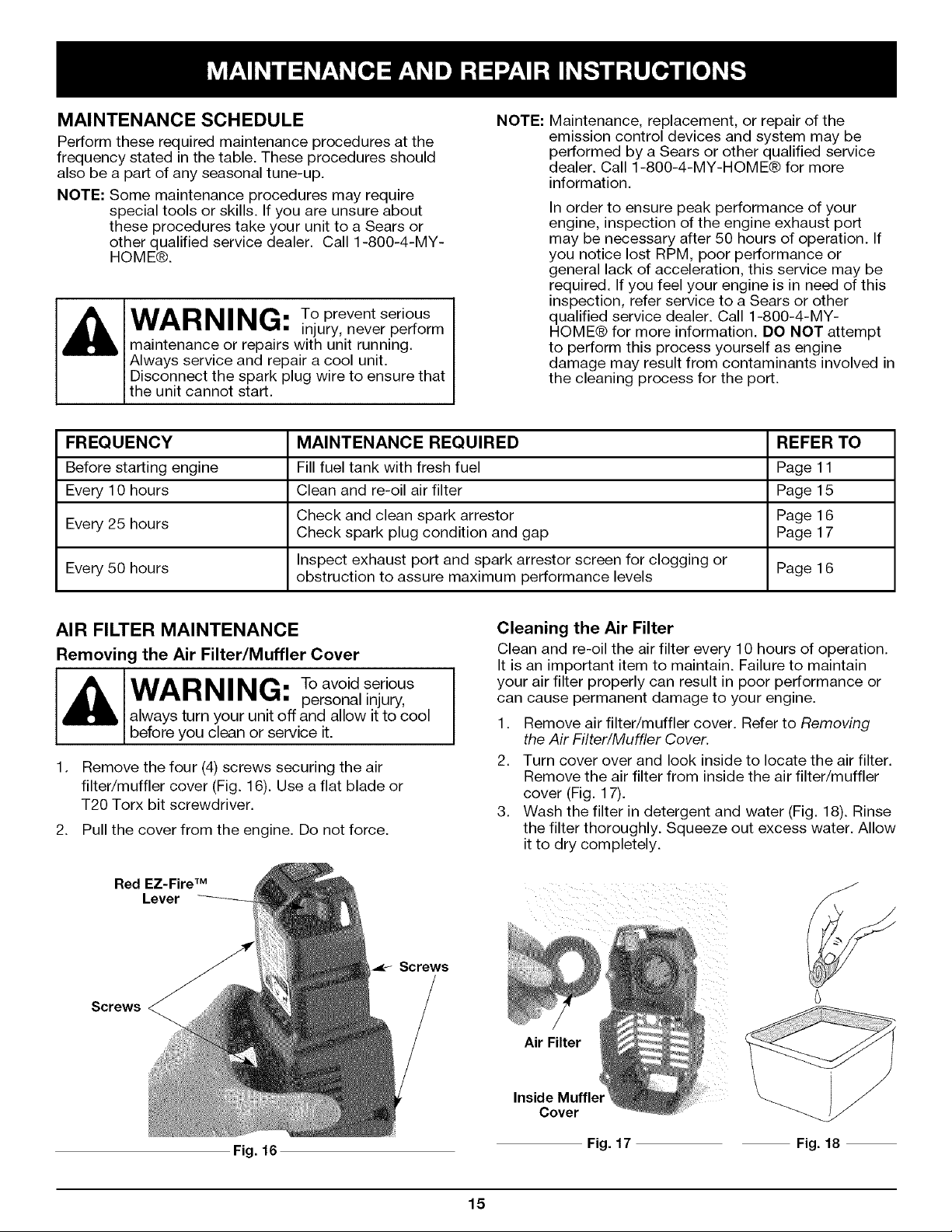
1. Remove the four (4) screws securing the air
filter/muffler cover (Fig. 16). Use a flat blade or
T20 Torx bit screwdriver.
2. Pull the cover from the engine. Do not force.
Red EZ-Fire TM
Lever
Screws
._ Screws
Cleaning the Air Filter
Clean and re-oil the air filter every 10 hours of operation.
It is an important item to maintain. Failure to maintain
your air filter properly can result in poor performance or
can cause permanent damage to your engine.
1. Remove air filter/muffler cover. Refer to Removing
the Air Filter/Muffler Cover.
2. Turn cover over and look inside to locate the air filter.
Remove the air filter from inside the air filter/muffler
cover (Fig. 17).
3. Wash the filter in detergent and water (Fig. 18). Rinse
the filter thoroughly. Squeeze out excess water. Allow
it to dry completely.
Air Filter
Fig. 16
Inside Muffle
Cover
Fig. 17 Fig. 18
15
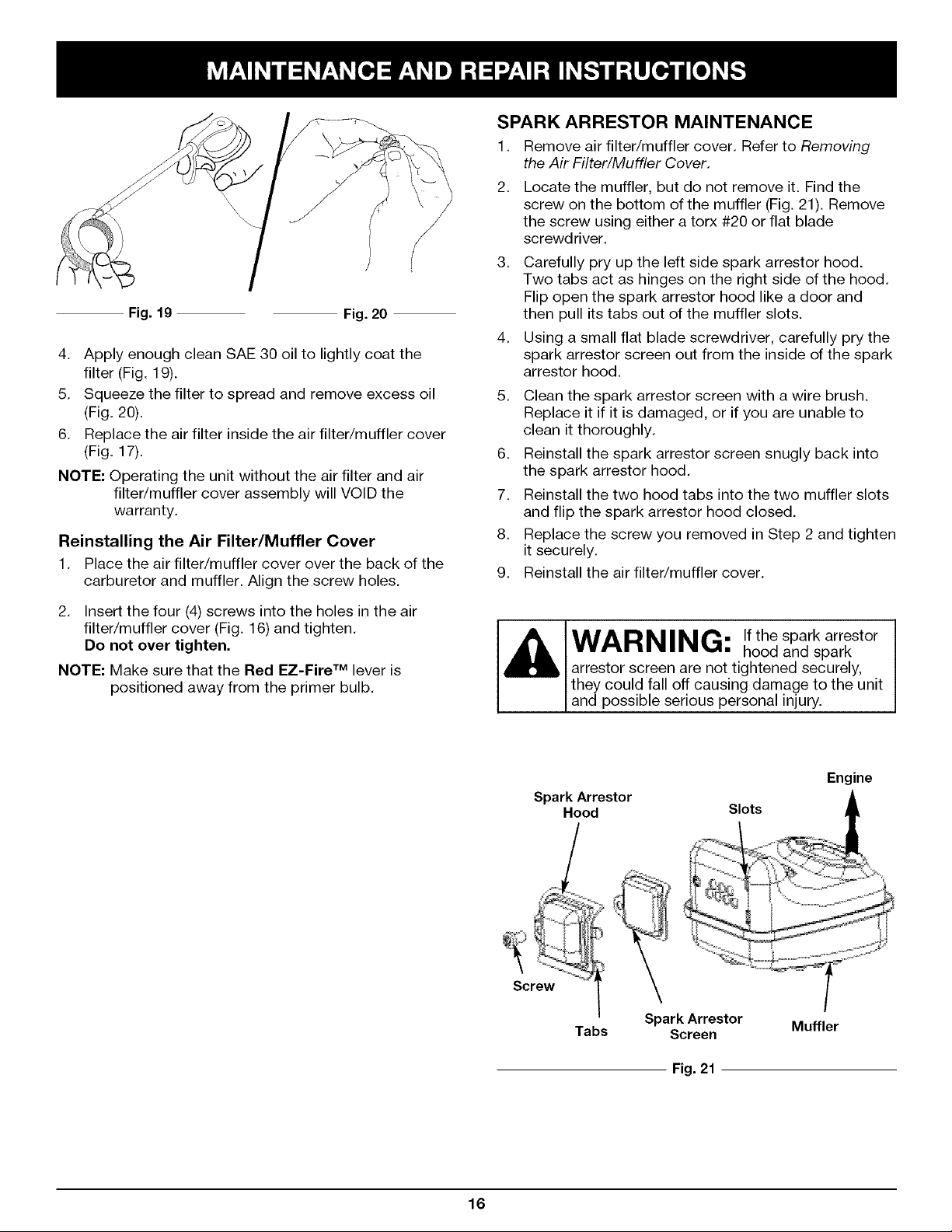
Fig. 19 Fig. 20
4. Apply enough clean SAE 30 oil to lightly coat the
filter (Fig. 19).
5. Squeeze the filter to spread and remove excess oil
(Fig. 20).
6. Replace the air filter inside the air filter/muffler cover
(Fig. 17).
NOTE: Operating the unit without the air filter and air
filter/muffler cover assembly will VOID the
warranty.
Reinstalling the Air Filter/Muffler Cover
1. Place the air filter/muffler cover over the back of the
carburetor and muffler. Align the screw holes.
2. Insert the four (4) screws into the holes in the air
filter/muffler cover (Fig. 16) and tighten.
Do not over tighten.
NOTE: Make sure that the Red EZ-Fire TM lever is
positioned away from the primer bulb.
SPARK ARRESTOR MAINTENANCE
1. Remove air filter/muffler cover. Refer to Removing
the Air Filter/Muffler Cover.
2.
Locate the muffler, but do not remove it. Find the
screw on the bottom of the muffler (Fig. 21). Remove
the screw using either a torx #20 or flat blade
screwdriver.
3. Carefully pry up the left side spark arrestor hood.
Two tabs act as hinges on the right side of the hood.
Flip open the spark arrestor hood like a door and
then pull its tabs out of the muffler slots.
4. Using a small flat blade screwdriver, carefully pry the
spark arrestor screen out from the inside of the spark
arrestor hood.
5. Clean the spark arrestor screen with a wire brush.
Replace it if it is damaged, or if you are unable to
clean it thoroughly.
6. Reinstall the spark arrestor screen snugly back into
the spark arrestor hood.
7. Reinstall the two hood tabs into the two muffler slots
and flip the spark arrestor hood closed.
8. Replace the screw you removed in Step 2 and tighten
it securely.
9. Reinstall the air filter/muffler cover.
WARNING: If the spark arrestor
hood and spark
arrestor screen are not tightened securely,
they could fall off causing damage to the unit
and possible serious personal injury.
Screw
Spark Arrestor
Hood
Spark Arrestor
Tabs Screen
Slots
Fig. 21
Engine
Muffler
16
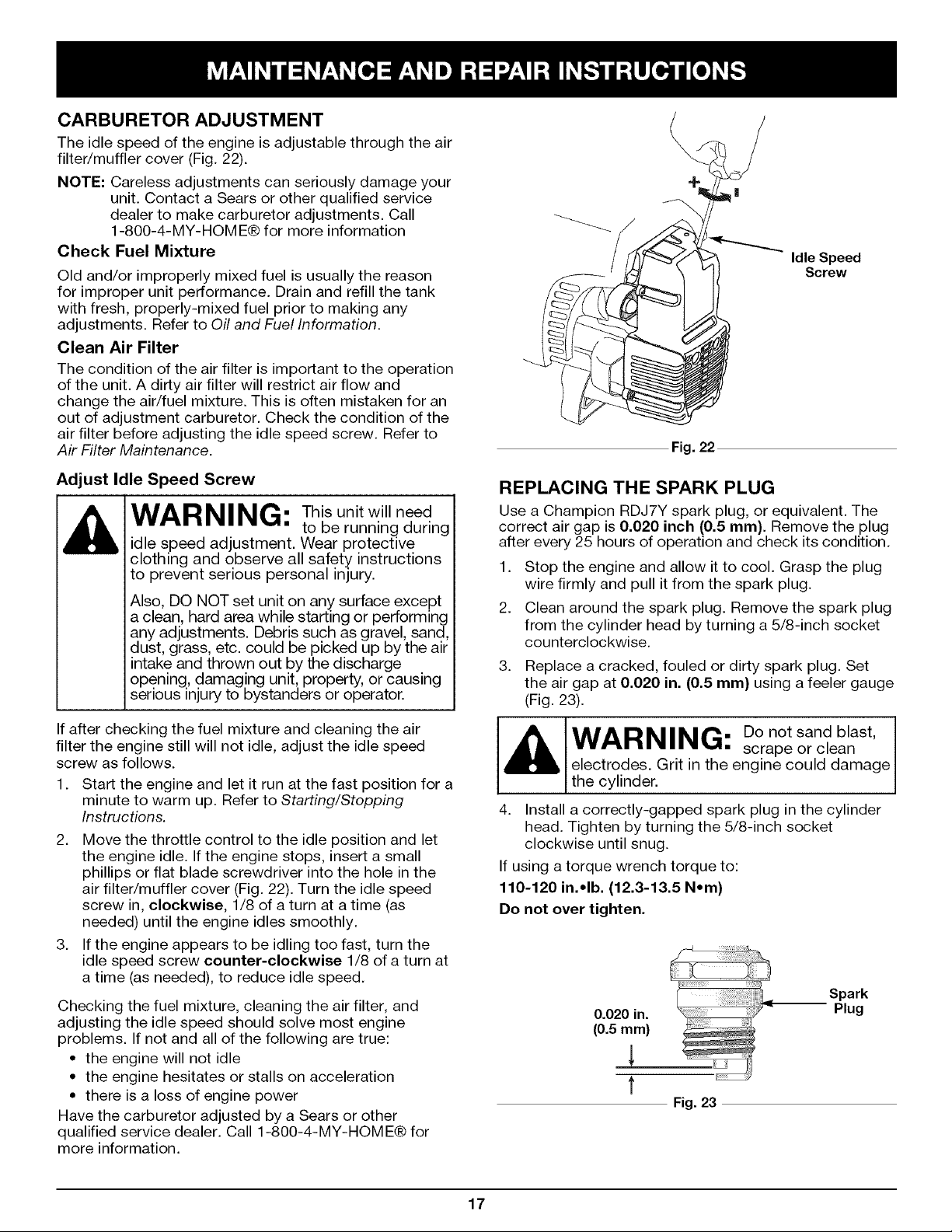
CARBURETOR ADJUSTMENT
The idle speed of the engine is adjustable through the air
filter/muffler cover (Fig. 22).
NOTE: Careless adjustments can seriously damage your
unit. Contact a Sears or other qualified service
dealer to make carburetor adjustments. Call
1-800-4-MY-HOME® for more information
Check Fuel Mixture
Old and/or improperly mixed fuel is usually the reason
for improper unit performance. Drain and refill the tank
with fresh, properly-mixed fuel prior to making any
adjustments. Refer to Oil and Fuel Information.
Clean Air Filter
The condition of the air filter is important to the operation
of the unit. A dirty air filter will restrict air flow and
change the air/fuel mixture. This is often mistaken for an
out of adjustment carburetor. Check the condition of the
air filter before adjusting the idle speed screw. Refer to
Air Filter Maintenance.
Adjust Idle Speed Screw
WARNING: Thisunitwillneed
to be running during
idle speed adjustment. Wear protective
clothing and observe all safety instructions
to prevent serious personal injury.
Also, DO NOT set unit on any surface except
a clean, hard area while starting or performing
any adjustments. Debris such as gravel, sand,
dust, grass, etc. could be picked up by the air
intake and thrown out by the discharge
opening, damaging unit, property, or causing
serious injury to bystanders or operator.
If after checking the fuel mixture and cleaning the air
filter the engine still will not idle, adjust the idle speed
screw as follows.
1. Start the engine and let it run at the fast position for a
minute to warm up. Refer to Starting/Stopping
Instructions.
2. Move the throttle control to the idle position and let
the engine idle. If the engine stops, insert a small
phillips or flat blade screwdriver into the hole in the
air filter/muffler cover (Fig. 22). Turn the idle speed
screw in, clockwise, 1/8 of a turn at a time (as
needed) until the engine idles smoothly.
3. If the engine appears to be idling too fast, turn the
idle speed screw counter-clockwise 1/8 of a turn at
a time (as needed), to reduce idle speed.
Checking the fuel mixture, cleaning the air filter, and
adjusting the idle speed should solve most engine
problems. If not and all of the following are true:
• the engine will not idle
• the engine hesitates or stalls on acceleration
• there is a loss of engine power
Have the carburetor adjusted by a Sears or other
qualified service dealer. Call 1-800-4-MY-HOME® for
more information.
\
Idle Speed
Screw
Fig. 22
REPLACING THE SPARK PLUG
Use a Champion RDJ7Y spark plug, or equivalent. The
correct air gap is 0.020 inch (0.5 mm). Remove the plug
after every 25 hours of operation and check its condition.
1. Stop the engine and allow it to cool. Grasp the plug
wire firmly and pull it from the spark plug.
2. Clean around the spark plug. Remove the spark plug
from the cylinder head by turning a 5/8-inch socket
counterclockwise.
3.
Replace a cracked, fouled or dirty spark plug. Set
the air gap at 0.020 in. (0.5 ram} using a feeler gauge
(Fig. 23).
WARNING: Do not sand blast,
scrape or clean
electrodes. Grit in the engine could damage
cylinder.
4. Install a correctly-gapped spark plug in the cylinder
head. Tighten by turning the 5/8-inch socket
clockwise until snug.
If using a torque wrench torque to:
110-120 in.•lb. (12.3-13.5 N•m)
Do not over tighten.
Spark
Plug
t
Fig.23
17
TRANSPORTING
• Allow the engine to cool before transporting.
• Drain fuel from unit.
• Tighten fuel cap before transporting.
• Secure the unit while transporting.
CLEANING THE UNIT
WARNING: Toavoidserious
personal injury,
always turn your unit off and allow it to cool
before you clean or service it.
Use a small brush to clean off the outside of the unit.
Do not use strong detergents. Household cleaners that
contain aromatic oils such as pine and lemon, and
solvents such as kerosene, can damage plastic housing
or handle. Wipe off any moisture with a soft cloth.
CLEANING THE VACUUM BAG
1. Empty the bag after each use to avoid deterioration
and obstructing air flow, which will reduce the
performance of the vacuum.
2. Wearing eye protection and a dust mask, clean the
bag as needed. Turn the bag inside out after initial
emptying and vigorously shake out dust and debris.
3. Wash the bag once a year or more often if needed:
a. Removethe vacuum bag.
b. Turn bag inside out.
c. Hang it up.
d. Hose it down thoroughly.
e. Hang to dry.
f. Turn bag right-side out and reinstall.
CLEARING A BLOCKED TUBE / IMPELLER
II^u^ Dl lll lt .. To avoid serious
I !1_1 II1111_1 personal injury, be
sure the unit is off before cleaning or
I performing any maintenance on it.
WARNING: Toavoidserious
personal injury,
always wear gloves to protect yourself from
the impeller blades or other sharp objects.
2_
3.
4.
5.
6.
Press the On/Off Stop control down in the STOP (O)
position until the engine comes to a complete stop
(Fig. 10).
Disconnect the spark plug wire to prevent the unit
from starting.
Remove the blower/vacuum tube and the vacuum bag.
Carefully remove material blocking the tube or
impeller. Inspect the blades to assure no damage has
occurred. Rotate the impeller blades by hand to
assure the blockage is completely cleared.
Reinstall the vacuum bag and blower/vacuum tube.
Reconnect the spark plug wire.
STO RAG E
• Never store a fueled unit where fumes may reach an
open flame or spark.
• Allow the engine to cool before storing.
• Store the unit locked up to prevent unauthorized use
or damage.
• Store the unit in a dry, well-ventilated area.
• Store the unit out of the reach of children.
LONG TERM STORAGE
If you plan on storing the unit for an extended time, use
the following storage procedure:
1. Carefully drain the fuel tank by running the unit dry or
remove fuel cap and tip the motor housing over and
drain oil/gas fuel into a container with the same 2-
cycle fuel mixture. Do not use fuel that has been
stored for more than 60 days.
CAUTION: Dispose of the old
fuel/oil mixture in
accordance with all Federal, State, and Local
regulations.
2_
3.
Start the engine and allow it to run until it stalls. This
ensures that all fuel has been drained from the
carburetor.
Allow the engine to cool. Remove the spark plug and
put 1 oz. (30 ml) of any high quality motor oil or
2-cycle oil into the cylinder. Pull the starter rope
slowly to distribute the oil. Reinstall the spark plug.
CAUTION: Dispose of the old
fuel/oil mixture in
accordance with all Federal, State, and Local
regulations.
NOTE: Remove the spark plug and drain all of the oil
from the cylinder before attempting to start the
unit after storage.
4. Thoroughly clean the unit and inspect it for any loose
or damaged parts. Repair or replace damaged parts
and tighten loose screws, nuts or bolts. The unit is
ready for storage.
18
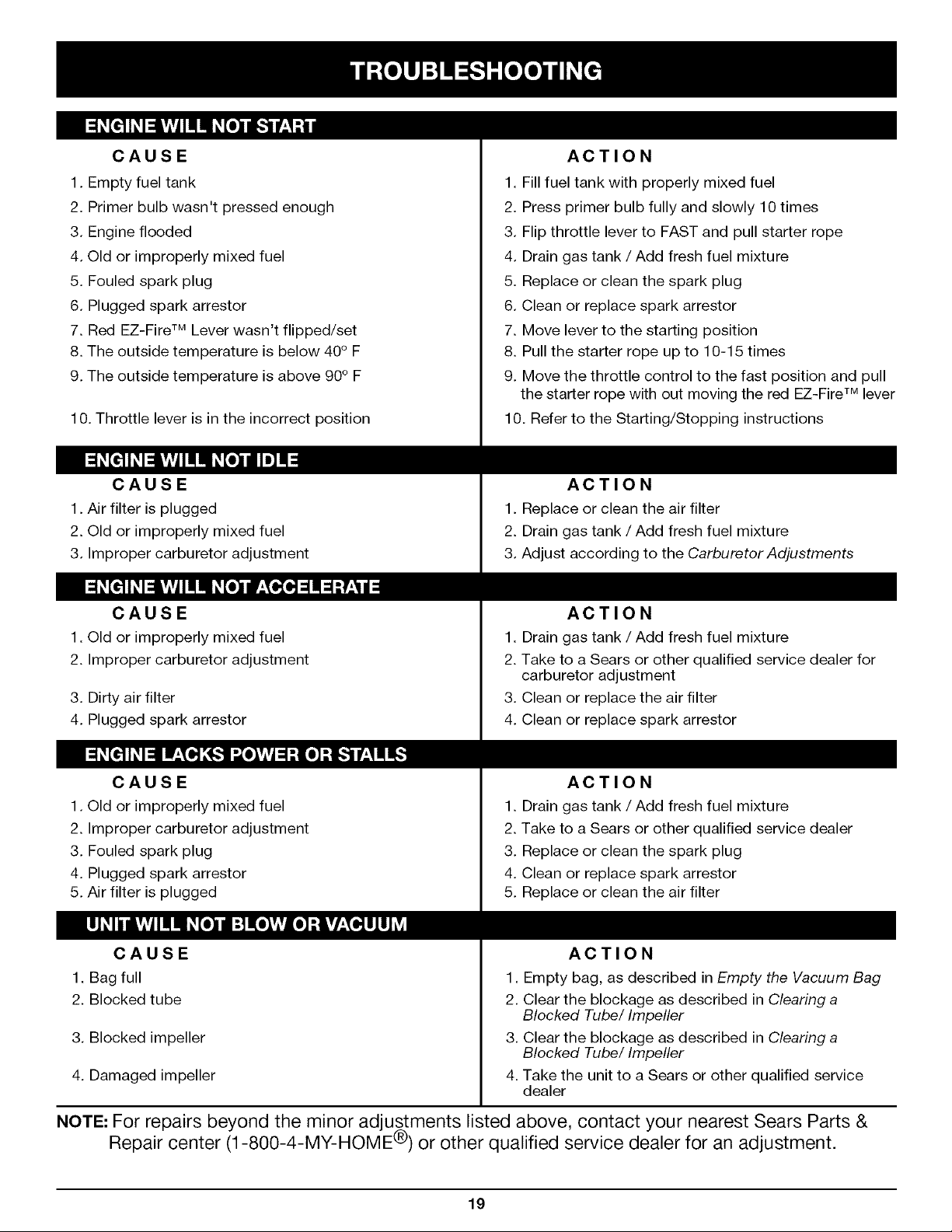
CAUSE
1. Empty fuel tank
2. Primer bulb wasn't pressed enough
3. Engine flooded
4. Old or improperly mixed fuel
5. Fouled spark plug
6. Plugged spark arrestor
7. Red EZ-Fire TM Lever wasn't flipped/set
8. The outside temperature is below 40° F
9. The outside temperature is above 90 ° F
10. Throttle lever is in the incorrect position
CAUSE
1. Air filter is plugged
2. Old or improperly mixed fuel
3. Improper carburetor adjustment
CAUSE
1. Old or improperly mixed fuel
2. Improper carburetor adjustment
3. Dirty air filter
4. Plugged spark arrestor
CAUSE
1. Old or improperly mixed fuel
2. Improper carburetor adjustment
3. Fouled spark plug
4. Plugged spark arrestor
5. Air filter is plugged
CAUSE
1, Bag full
2. Blocked tube
3. Blocked impeller
4. Damaged impeller
ACTION
1. Fill fuel tank with properly mixed fuel
2. Press primer bulb fully and slowly 10 times
3. Flip throttle lever to FAST and pull starter rope
4. Drain gas tank / Add fresh fuel mixture
5. Replace or clean the spark plug
6. Clean or replace spark arrestor
7. Move lever to the starting position
8. Pull the starter rope up to 10-15 times
9. Move the throttle control to the fast position and pull
the starter rope with out moving the red EZ-Fire TM lever
10. Refer to the Starting/Stopping instructions
ACTION
1. Replace or clean the air filter
2. Drain gas tank / Add fresh fuel mixture
3. Adjust according to the Carburetor Adjustments
ACTION
1. Drain gas tank / Add fresh fuel mixture
2. Take to a Sears or other qualified service dealer for
carburetor adjustment
3. Clean or replace the air filter
4. Clean or replace spark arrestor
ACTION
1. Drain gas tank / Add fresh fuel mixture
2. Take to a Sears or other qualified service dealer
3. Replace or clean the spark plug
4. Clean or replace spark arrestor
5. Replace or clean the air filter
ACTION
1. Empty bag, as described in Empty the Vacuum Bag
2. Clear the blockage as described in Clearing a
Blocked Tube/Impeller
3. Clear the blockage as described in Clearing a
Blocked Tube/Impeller
4. Take the unit to a Sears or other qualified service
dealer
NOTE. For repairs beyond the minor adjustments listed above, contact your nearest Sears Parts &
Repair center (1-800-4-MY-HOME ®) or other qualified service dealer for an adjustment.
19
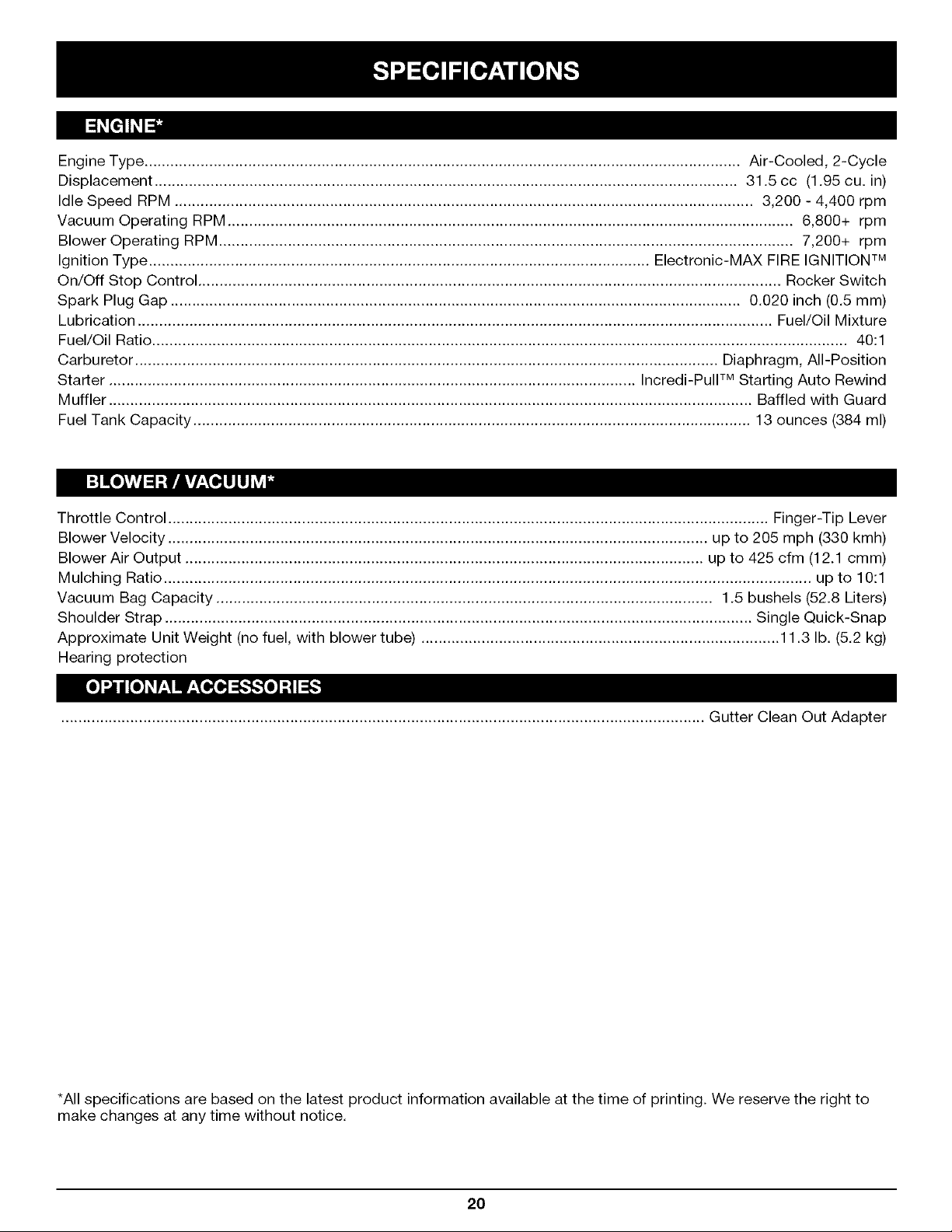
EngineType..........................................................................................................................................Air-Cooled,2-Cycle
Displacement.......................................................................................................................................31.5cc (1.95cu.in)
IdleSpeedRPM......................................................................................................................................3,200- 4,400rpm
VacuumOperatingRPM...................................................................................................................................6,800+rpm
BlowerOperatingRPM.....................................................................................................................................7,200+rpm
IgnitionType....................................................................................................................Electronic-MAXFIREIGNITIONTM
On/Off Stop Control ....................................................................................................................................... Rocker Switch
Spark Plug Gap .................................................................................................................................... 0.020 inch (0.5 mm)
Lubrication ................................................................................................................................................... Fuel/Oil Mixture
Fuel/Oil Ratio ................................................................................................................................................................. 40:1
Carburetor ....................................................................................................................................... Diaphragm, All-Position
Starter .......................................................................................................................... Incredi-Pull TM Starting Auto Rewind
Muffler ..................................................................................................................................................... Baffled with Guard
Fuel Tank Capacity ................................................................................................................................. 13 ounces (384 ml)
Throttle Control ........................................................................................................................................... Finger-Tip Lever
Blower Velocity ............................................................................................................................. up to 205 mph (330 kmh)
Blower Air Output ........................................................................................................................ up to 425 cfm (12.1 cmm)
Mulching Ratio ...................................................................................................................................................... up to 10:1
Vacuum Bag Capacity ................................................................................................................... 1.5 bushels (52.8 Liters)
Shoulder Strap ........................................................................................................................................ Single Quick-Snap
Approximate Unit Weight (no fuel, with blower tube) ................................................................................... 11.3 lb. (5.2 kg)
Hearing protection
..................................................................................................................................................... Gutter Clean Out Adapter
*All specifications are based on the latest product information available at the time of printing. We reserve the right to
make changes at any time without notice.
2O

21

22
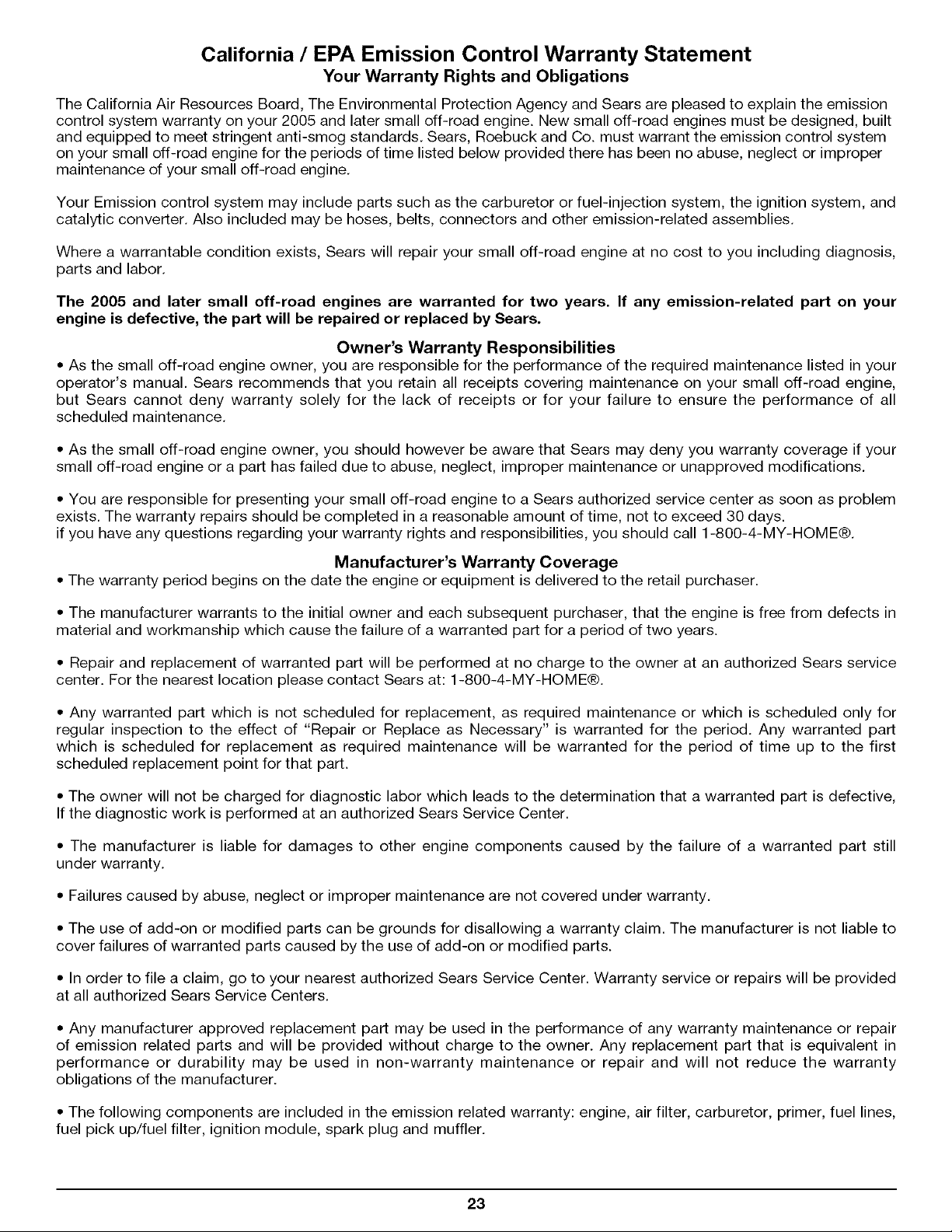
California / EPA Emission Control Warranty Statement
Your Warranty Rights and Obligations
The California Air Resources Board, The Environmental Protection Agency and Sears are pleased to explain the emission
control system warranty on your 2005 and later small off-road engine. New small off-road engines must be designed, built
and equipped to meet stringent anti-smog standards. Sears, Roebuck and Co. must warrant the emission control system
on your small off-road engine for the periods of time listed below provided there has been no abuse, neglect or improper
maintenance of your small off-road engine.
Your Emission control system may include parts such as the carburetor or fuel-injection system, the ignition system, and
catalytic converter. Also included may be hoses, belts, connectors and other emission-related assemblies.
Where a warrantable condition exists, Sears will repair your small off-road engine at no cost to you including diagnosis,
parts and labor.
The 2005 and later small off-road engines are warranted for two years. If any emission-related part on your
engine is defective, the part will be repaired or replaced by Sears.
Owner's Warranty Responsibilities
• As the small off-road engine owner, you are responsible for the performance of the required maintenance listed in your
operator's manual. Sears recommends that you retain all receipts covering maintenance on your small off-road engine,
but Sears cannot deny warranty solely for the lack of receipts or for your failure to ensure the performance of all
scheduled maintenance.
• As the small off-road engine owner, you should however be aware that Sears may deny you warranty coverage if your
small off-road engine or a part has failed due to abuse, neglect, improper maintenance or unapproved modifications.
• You are responsible for presenting your small off-road engine to a Sears authorized service center as soon as problem
exists. The warranty repairs should be completed in a reasonable amount of time, not to exceed 30 days.
if you have any questions regarding your warranty rights and responsibilities, you should call 1-800-4-MY-HOME®.
Manufacturer's Warranty Coverage
• The warranty period begins on the date the engine or equipment is delivered to the retail purchaser.
• The manufacturer warrants to the initial owner and each subsequent purchaser, that the engine is free from defects in
material and workmanship which cause the failure of a warranted part for a period of two years.
• Repair and replacement of warranted part will be performed at no charge to the owner at an authorized Sears service
center. For the nearest location please contact Sears at: 1-800-4-MY-HOME®.
• Any warranted part which is not scheduled for replacement, as required maintenance or which is scheduled only for
regular inspection to the effect of "Repair or Replace as Necessary" is warranted for the period. Any warranted part
which is scheduled for replacement as required maintenance will be warranted for the period of time up to the first
scheduled replacement point for that part.
• The owner will not be charged for diagnostic labor which leads to the determination that a warranted part is defective,
If the diagnostic work is performed at an authorized Sears Service Center.
• The manufacturer is liable for damages to other engine components caused by the failure of a warranted part still
under warranty.
• Failures caused by abuse, neglect or improper maintenance are not covered under warranty.
• The use of add-on or modified parts can be grounds for disallowing a warranty claim. The manufacturer is not liable to
cover failures of warranted parts caused by the use of add-on or modified parts.
• In order to file a claim, go to your nearest authorized Sears Service Center. Warranty service or repairs will be provided
at all authorized Sears Service Centers.
• Any manufacturer approved replacement part may be used in the performance of any warranty maintenance or repair
of emission related parts and will be provided without charge to the owner. Any replacement part that is equivalent in
performance or durability may be used in non-warranty maintenance or repair and will not reduce the warranty
obligations of the manufacturer.
• The following components are included in the emission related warranty: engine, air filter, carburetor, primer, fuel lines,
fuel pick up/fuel filter, ignition module, spark plug and muffler.
23

Your Home
For repair--in your home--of all major brand appliances,
lawn and garden equipment, or heating and cooling systems,
no matter who made it, no matter who sold it!
For the replacement parts, accessories and
owner's manuals that you need to do-it-yourself.
For Sears professional installation of home appliances
and items like garage door openers and water heaters.
1-800-4-MY-HOME ® (1-800-469-4663)
Call anytime, day or night (U.S.A. and Canada)
www.sea,s.com www.sea,_.ca
Our Home
iiiiiiiiiiiiiiiiii
For repair of carry-in items like vacuums, lawn equipment,
and electronics, call or go on-line for the location of your nearest
Sears Parts & Repair Center
1-800-488-1222
iiiiiiiiiiiiiiiiii
www. ear .com
iiiiiiiiiiiiiiil
iiiiiiiiiiiiiiil
iiiiiiiiiiiiiiil
iiiiiiiiiiiiiiil
iiiiiiiiiiiiiiil
iiiiiiiiiiiiiiil
iiiiiiiiiiiiiiil
iiiiiiiiiiiiiiil
iiiiiiiiiiiiiiil
iiiiiiiiiiiiiiil
iiiiiiiiiiiiiiil
iiiiiiiiiiiiiiil
iiiiiiiiiiiiiiil
iiiiiiiiiiiiiiil
iiiiiiiiiiiiiiil
iiiiiiiiiiiiiiil
iiiiiiiiiiiiiiil
iiiiiiiiiiiiiiil
iiiiiiiiiiiiiiil
iiiiiiiiiiiiiiil
iiiiiiiiiiiiiiil
iiiiiiiiiiiiiiil
iiiiiiiiiiiiiiil
iiiiiiiiiiiiiiil
iiiiiiiiiiiiiii_
iiiiiiiiiiiiiiil
HHHHHHHH,,_
HHHHHHHH,,_
HHHHHHHH,,_
HHHHHHHH,,_
HHHHHHHH,,_
HHHHHHHH,,_
HHHHHHHH,,_
HHHHHHHH,,_
HHHHHHHH,,_
HHHHHHHH,,_
HHHHHHHH,,_
HHHHHHHH,,_
HHHHHHHH,,_
HHHHHHHH,,_
HHHHHHHH,,_
HHHHHHHH,,_
HHHHHHHH,,_
HHHHHHHH,,_
HHHHHHHH,,_
HHHHHHHH,,_
HHHHHHHH,,_
HHHHHHHH,,_
HHHHHHHH,,_
iiiiiiiiiiiiiiiiii................................. iiiiiiiiiiiiiiiiiii
Para peclir servicio de reparacion Au Canada pour service en francais:
a domicilio, y para ordenar piezas: 1-800-LE-FOYER Me °
1-800-SU-HOGAR sM (1-800-533-6937)
(1-888-784-6427 www.sears.ca
Sealrs
(6 Registered Trademark / TM Trademark / SM Service Mark of Sears Brands, LLC
CbMama Registrada / TM Marca de Fabrica / SM Mama de Servicio de Sears Brands, LLC
MC Marque de commerce / MC Marque deposee de Sears Brands, LLC
© Sears Brands, LLC
24

Garantia
Normasparaunaoperaci6nsegura
Instruccionesdeensamble
Informaci6ndelaceitey delcombustible
Instruccionesdearranquey apagado
Operaci6n
Mantenimientoy reparaci6n
P6.gina25
P_.gina26-30
P6.gina31-33
P_.gina34
P6.gina35
P_.gina36-37
P_.gina38-41
Cuadrodesoluci6ndeproblemas
Especificaciones
CARB/ EPA Garantia
Lista de Piezas
Cobertura de Gastos de Reparaciones
NQmeros de Servicio
P_.gina 42
P_.gina 43
P_.gina 44
P_.gina 35-46
P_.gina 47
Contraportada
GARANTJA LIMITADA POR DOS ANOS EN EL SOPLADOR/ASPIRADORA DE GASOLINA
CRAFTSMAN
Por dos afios a partir de la fecha de compra, cuando se use y se d@ mantenimiento a este Soplador
segQn el manual del operador, Sears reparara cualquier defecto en material o mano de obra sin
cargo alguno.
Esta garantia excluye la bujia, el filtro de aire y la bolsa de la aspiradora, las cuales son piezas
fungibles que se pueden gastar debido al uso normal en menos de dos afios.
Si este Soplador se usa para fines comerciales o de alquiler, esta garantia tiene valor por solo 30
dias a partir de la fecha de compra.
EL SERVICIO DE LA GARANT|A ESTA DISPONIBLE AL DEVOLVER ESTE SO PLADOR A LA
TIENDA SEARS O AL CENTRO DE PIEZAS Y REPARACIONES DE SEARS MAS CERCANO EN
LOS ESTADOS UNIDOS.
Esta garantia le concede a usted derechos legales especificos, y usted pudiera tener otros derechos
que varian de un estado a otro.
Sears, Roebuck and Co., Dept. 817WA, Hoffman Estates, IL 60179
PROPOSICIC)N 65 DE CALIFORNIA
LAS EMISlONES DEL MOTOR DE ESTE
PRODUCTO CONTIENEN SUBSTANCIAS
QUIMICAS QUE EL ESTADO DE
CALIFORNIA CONOCE COMO CAUSANTES
DECANCER, DEFECTOS DE NAClMIENTO
U OTROS DANOS REPRODUCTIVOS.
PARACHISPAS
NOTA: Para los usuarios en tierras forestales de los
EE.UU. y en los estados de California, Maine, Oregon
y Washington. Todos los terrenos forestales de los
EE.UU. y el estado de California (C6digos de Recursos
PQblicos 4442 y 4443), Oregon y Washington, requieren
por decreto, que ciertos motores de combusti6n intema
que se hagan funcionar en zonas boscosas y/o zonas
cubiertas por pastizales, est@n equipados con un
parachispas, que sean mantenidos en buen estado de
tuncionamiento o que el motor sea construido, est@
equipado y sea mantenido para evitar incendios.
Consulte los reglamentos pertinentes a esos requisitos
con las autoridades estatales o locales. El incumplimiento
de esos requisitos puede responsabilizarle o someterle a
la imposici6n de una multa. Esta unidad fue equipada
en la f&brica con un parachispas. Si requiere
sustituci6n, hay una Pantalla Parachispas disponible,
Pieza #753-05169 al contactar el departamento de servicio.
25
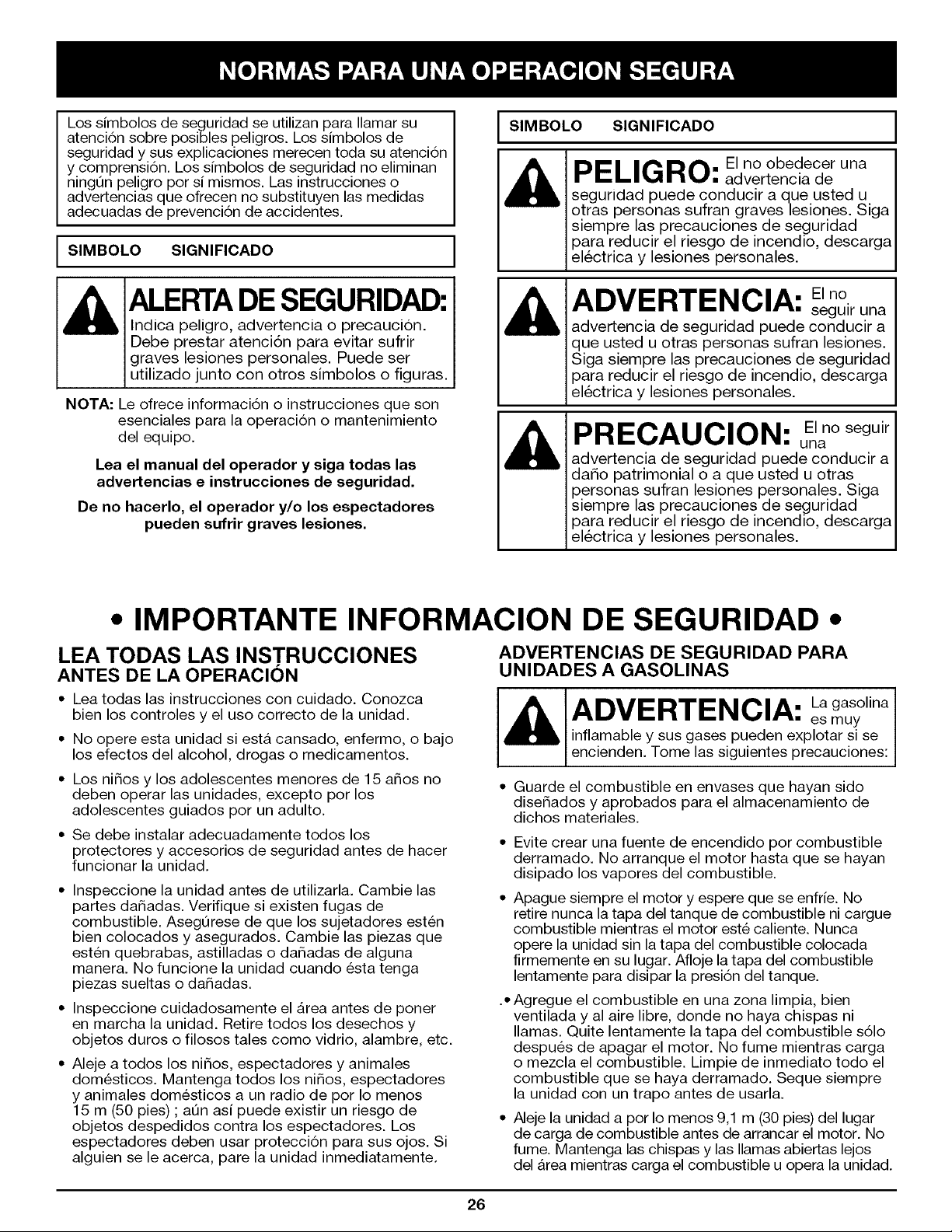
LossimbolosdeseguridadseutilizanparaIlamarsu
atenci6nsobreposiblespeligros.Lossimbolosde
seguridady susexplicacionesmerecentodasuatenci6n
ycomprensi6n.Lossimbolosdeseguridadnoeliminan
ningQnpeligroporsimismos.Lasinstruccioneso
advertenciasqueofrecennosubstituyenlasmedidas
adecuadasdeprevenci6ndeaccidentes.
SIMBOLO SIGNIFICADO I
ALERTADESEGURIDAD:
Indica peligro, advertencia o precauci6n.
Debe prestar atenci6n para evitar sufrir
graves lesiones personales. Puede ser
utilizado junto con otros simbolos o figuras.
NOTA: Le ofrece informaci6n o instrucciones que son
esenciales para la operaci6n o mantenimiento
del equipo.
Lea el manual del operador y siga todas las
advertencias e instrucciones de seguridad.
De no hacerlo, el operador y/o los espectadores
pueden sufrir graves lesiones.
I SIMBOLO SIGNIFICADO
PELIGRO: Elnoobedeceruna
advertencia de
seguridad puede conducir a que usted u
otras personas sufran graves lesiones. Siga
siempre las precauciones de seguridad
para reducir el riesgo de incendio, descarga
electrica y lesiones personales.
ADVERTENCIA: El no.
segulr una
advertencia de seguridad puede conducir a
que usted u otras personas sufran lesiones.
Siga siempre las precauciones de seguridad
para reducir el riesgo de incendio, descarga
electrica y lesiones personales.
PRECAUCION: El no seguir
una
advertencia de seguridad puede conducir a
da_o patrimonial o a que usted u otras
personas sufran lesiones personales. Siga
siempre las precauciones de seguridad
para reducir el riesgo de incendio, descarga
electrica y lesiones personales.
• IMPORTANTE INFORMACION DE SEGURIDAD •
LEA TODAS LAS INSTRUCCIONES
ANTES DE LA OPERACI(DN
• Lea todas las instrucciones con cuidado. Conozca
bien los controles y el uso correcto de la unidad.
• No opere esta unidad si est,. cansado, enfermo, o bajo
los efectos del alcohol, drogas o medicamentos.
• Los ni_os y los adolescentes menores de 15 a_os no
deben operar las unidades, excepto por los
adolescentes guiados por un adulto.
• Se debe instalar adecuadamente todos los
protectores y accesorios de seguridad antes de hacer
funcionar la unidad.
• Inspeccione la unidad antes de utilizarla. Cambie las
partes da_adas. Verifique si existen fugas de
combustible. AsegQrese de que los sujetadores est6n
bien colocados y asegurados. Cambie las piezas que
est6n quebrabas, astilladas o da_adas de alguna
manera. No funcione la unidad cuando 6sta tenga
piezas sueltas o da_adas.
• Inspeccione cuidadosamente el Area antes de poner
en marcha la unidad. Retire todos los desechos y
objetos duros o filosos tales como vidrio, alambre, etc.
• Aleje a todos los ni_os, espectadores y animales
dom6sticos. Mantenga todos los ni_os, espectadores
y animales dom6sticos a un radio de por Io menos
15 m (50 pies) ; aQn asi puede existir un riesgo de
objetos despedidos contra los espectadores. Los
espectadores deben usar protecci6n para sus ojos. Si
alguien se le acerca, pare la unidad inmediatamente.
ADVERTENCIAS DE SEGURIDAD PARA
UNIDADES A GASOLINAS
ADVERTENCIA: La gasolina
es muy
inflamable y sus gases pueden explotar si se
encienden. Tome las siguientes precauciones:
• Guarde el combustible en envases que hayan sido
dise_ados y aprobados para el almacenamiento de
dichos materiales.
• Evite crear una fuente de encendido por combustible
derramado. No arranque el motor hasta que se hayan
disipado los vapores del combustible.
• Apague siempre el motor y espere que se enfrie. No
retire nunca la tapa del tanque de combustible ni cargue
combustible mientras el motor est6 caliente. Nunca
opere la unidad sin la tapa del combustible colocada
firmemente en su lugar. Afloje la tapa del combustible
lentamente para disipar la presi6n del tanque.
.• Agregue el combustible en una zona limpia, bien
ventilada y al aire libre, donde no haya chispas ni
llamas. Quite lentamente la tapa del combustible s61o
despu6s de apagar el motor. No fume mientras carga
o mezcla el combustible. Limpie de inmediato todo el
combustible que se haya derramado. Seque siempre
la unidad con un trapo antes de usarla.
• Aleje la unidad a por Io menos 9,1 m (30 pies) del lugar
de carga de combustible antes de arrancar el motor. No
fume. Mantenga las chispas y las llamas abiertas lejos
del Area mientras carga el combustible u opera la unidad.
26
DURANTE LA OPERACION
• No arranque ni opere la unidad en un cuarto o edificio
cerrado. Los gases de escape de mon6xido de
carbono pueden ser letales en un Area cerrada. Opere
esta unidad s61o en un Area exterior bien ventilada.
• Para reducir el riesgo de lesiones asociadas con los
objetos lanzados, utilice gafas de protecci6n que
tengan una marca de clasificaci6n normativa ANSI Z87.
• Nunca haga funcionar la unidad sin que @statenga
conectado el equipo apropiado. Cuando use esta
unidad, instale siempre los tubos de la sopladora /
aspiradora y la bolsa de recolecci6n, dependiendo del
modelo. Asegurese de cerrar completamente la bolsa
de recolecci6n.
• Para reducir el riesgo de p@rdidaauditiva asociada con
los niveles de sonido, use siempre protecci6n para las
orejas / oidos cuado haga funcionar esta unidad.
• Use pantal6n largos y gruesos, botas y guantes. No
use pantalones cortos, sandalias ni ande descalzo.
• Para evitar el choque de electricidad est_.tica, no se
ponga guantes de caucho o guantes aislados mientras
haga funcionar esta unidad.
• Para reducir el riesgo de lesi6n asociada con objetos que
sean atraidos hacia las piezas que giran, no use ropa
suelta, joyas, bufandas ni cosas parecidas. Asegurese el
cabello por encima del nivel de los hombros.
• Ose una mascara para la cara o contra el polvo si el
trabajo es polvoriento. Se recomiendan las camisas de
manga larga.
• Use la unidad Qnicamente con la luz del dia o con
buena luz artificial.
• Mantenga las superficies exteriores libres de aceite y
combustible.
• Evite arrancar la unidad accidentalmente. Col6quese
en posici6n de inicio siempre que tire de la cuerda de
arranque. El operador y la unidad deben estar en una
posici6n estable al comenzar. Lea las Instrucciones de
Arranque y Apagado.
• No ponga la unidad sobre ninguna superficie excepto
sobre una superficie que est@ limpia y que sea s61ida,
cuando el motor est@prendido. Los desechos tales
como la grava, arena, polvo, c@sped, etc., pueden ser
absorbidos por la toma de aire y ser lanzados por la
avertura de descarga, caus6.ndole da_os a la unidad,
propiedad o caus_.ndole lesiones graves a los
espectadores o al operario.
• Use la herramienta adecuada. Solomente use esta
herramienta para la tarea que ha sido dise_ada.
• No fuerce la unidad. Har_. mejor el trabajo y con menos
probabilidad de lesi6n bajo la tasa de funcionamiento
que fue dise_ada.
• No alcance m_.s de la cuenta ni la use desde
superficies inestables tales como escaleras, _.rboles,
Iomas muy inclinadas, techos, etc. Observe siempre
una posici6n firme y balanceada.
• Sostenga siempre la unidad con ambas manos
mientras est@en funcionamiento.
• Mantenga las manos, la cara y los pies lejos de todas
las partes m6viles. No toque ni intente detener el rotor
cuando est@girando. No la haga funcionar sin los
protectores puestos en su lugar.
• No ponga ningQn objeto en las aberturas. No la use
cuando cualquier abertura est@bloqueada,
mant@ngalas libres de mugre, desechos o cualquier
cosa que pueda reducir el flujo de aire.
• No toque el motor, o el silenciador. Estas partes se
calientan mucho con la operaci6n. Luego de apagar la
unidad, permanecen calientes durante un tiempo breve.
• No opere el motor a una velocidad mayor que la
necesaria para hacer el trabajo. No haga funcionar el
motor a alta velocidad mientras no Io est,. usando.
• Apague siempre el motor cuando demore la operaci6n
o mientras camina de un lugar hacia otro.
• Pare el motor para hacerle mantenimiento,
reparaciones, para instalar o quitarle los tubos de
soplado o aditamentos de succi6n. La unidad debe
parar y el rotor no debe estar girando, para evitar
contacto con las cuchillas que giran.
• Use s61o piezas y accesorios de repuesto del
fabricante del equipo original para esta unidad. Puede
obtenerlos en su proveedor de servicio autorizado. El
uso de piezas y accesorios que no son equipo origina;
puede causar graves lesiones al operador o el da_o de
su unidad, y la cancelaci6n de su garantia.
• Nunca use esta unidad para regar productos quimicos,
fertilizantes u otras sustancias que puedan contener
sustancias t6xicas.
• Para reducir el riesgo de incendio, cambie los
silenciadores y parachispas defectuosos, mantenga el
motor y el silenciador libre de pasto, hojas, grasa
excesiva o acumulaciones de carbono.
27
MIENTRAS OPERA COMO SOPLADORA
• Nunca apunte la sopladora hacia a la gente, mascotas
o ventanas. Dirija siempre el soplado de desechos
lejos de la gente, animales y ventanas. Tenga mucho
cuidado cuando sople desechos cerca de objetos
s61idos como _.rboles, autom6viles, paredes, etc.
MIENTRAS OPERA COMO ASPIRADORA
• Evite situaciones que puedan prenderle fuego a la
bolsa de recolecci6n. No la haga funcionar cerca de
una llama abierta. No aspire cenizas tibias de
chimeneas, hoyos para asado, montones de maleza,
etc. No aspire cigarros o cigarrillos descartados a
menos que las cenizas est6n completamente frias.
• La unidad est,. diseSada para recoger material seco
tal como hojas, c6sped, ramitas y pedazos de papel.
No intente aspirar desechos mojados o agua
estancada ya que eso puede ocasionarle daSos a la
sopladora / aspiradora. Para evitarle daSos graves al
rotor, no aspire metales, vidrios rotos, etc.
OTRAS ADVERTENClAS DE SEGURIDAD
• Desconecte la bujia en todo momento antes de
hacerle mantenimiento o alcanzar las piezas movibles.
• Nunca guarde la unidad con combustible en el tanque
dentro de un edificio en donde los gases puedan
alcanzar una llama expuesta (pilotos, etc) o chispas
(interruptores, motores el6ctricos, etc.)
• Permita que el motor se enfrie antes de guardarla o
transportarla. AsegQrese de sujetar la unidad mientras
la transporta.
• Guarde la unidad en un lugar seco, bien sea bajo Ilave o
suficientemente alto para que evite el uso no autorizado
o daSos. Mant6ngala fuera del alcance de los niSos.
Nunca remoje o chorree la unidad con agua o
cualquier otro liquido. Mantenga los mangos secos,
limpios y libres de escombros. Limpiela despu6s de
cada uso, vea las Instrucciones de Limpieza y
Almacenamiento.
Conserve estas instrucciones. ConsQItelas con
frecuencia y Qselas para instruir a otros usuarios. Si le
presta esta unidad a otras personas, tambi6n incluya
las instrucciones.
NOTA ESPECIAL: La exposici6n alas vibraciones
mediante el uso prolongado de herramientas manuales a
gasolina puede causar daSos en los vasos sanguineos o
nervios de los dedos, manos y articulaciones en las
personas que presentan una predisposici6n a trastomos
circulatorios o inflamaciones anormales. Por otra parte, el
uso prolongado en el clima frio ha sido relacionado con el
da_o de vasos sanguineos en personas sanas. En caso de
ocurrir sintomas como adormecimiento, dolor, p6rdida de
fuerza, cambio en el color o textura de la piel o p6rdida de
sensaci6n en los dedos, manos o articulaciones, abandone
el uso de esta herramienta y obtenga atenci6n m6dica. Un
sistema antivibratorio no garantiza la prevenci6n de estos
problemas. Los usuarios que operan herramientas motrices
en forma regular y continua deben controlar con cuidado su
condici6n fisica y la condici6n de esta herramienta.
CONSERVE ESTAS
INSTRUCClONES
28
SIMBOLOS DE SEGURIDAD E INTERNACIONALES
Este manual del operador describe los simbolos y figuras de seguridad e internacionales que pueden aparecer en este
producto. Lea el manual del operador para obtener informaci6n completa acerca de la seguridad, ensamble, operaci6n
y mantenimiento y reparaci6n.
SIMBOLO SIGNIFICADO SIMBOLO SIGNIFICADO
• SIMBOLO DE ALERTA DE
SEGURIDAD
Ilndica peligro, advertencia o
precauci6n. Puede ser utilizado junto
con otros simbolos o figuras.
I
• CONTROL DE ENCENDIDO Y
APAGADO
ENCEN DIDO/ARRANQU E/MARCHA
• ADVERTENCIA - LEA EL MANUAL
DEL OPERADOR
Lea el manual del operador y siga todas
las advertencias e instrucciones de
seguridad. De no hacerlo, el operador
y/o los espectadores pueden sufrir
graves lesiones.
• USE PROTECCION OCULAR Y
AUDITIVA
ADVERTENCIA : Los objetos arrojados
por la unidad y el ruido fuerte pueden
causar graves lesiones oculares y
p@dida auditiva. Utilice protecci6n
ocular que cumpla con las normas ANSI
Z87.1 y protecci6n auditiva cuando
opere esta unidad. Use una careta
completa cuando la necesite.
• COMBUSTIBLE SIN PLOMO
Use siempre combustible limpio,
nuevo y sin plomo.
O
• CONTROL DE ENCENDIDO Y
APAGADO
APAGADO o PARADO
oADVERTENCIA DE
SUPERFICIECALIENTE
No toque un silenciador ni un
cilindro caliente. Puede quemarse.
Estas partes se calientan mucho
con el uso. Luego de apagarse
permanecen calientes durante un
corto tiempo.
LAS SOPLADORAS-
CUCHILLAS GIRATORIAS DEL
ROTOR PUEDEN CAUSAR
LESIONES GRAVES
ADVERTENClA: Pare el motor y
permita que el rotor se detenga
antes de instalar o cambiar tubos o
la bolsa, o antes de limpiar o hacerle
cualquier mantenimiento.
• INDICADOR DE ACEITE
Consulte el manual del operador para
obtener informaci6n acerca del tipo
correcto de aceite.
• LOS OBJETOS DESPEDIDOS Y LA
CUCHILLA ROTATIVA PUEDEN
CAUSAR GRAVES LESIONES
ADVERTENCIA: Mantengase alejado
de la salida del soplador. Nunca dirija
el soplador hacia usted mismo ni
hacia los dem&s. Los objetos pueden
salir despedidos del soplador. No
opere esta unidad sin los accesorios y
protecciones adecuados en su lugar.
• CONTROL DEL REGULADOR
Indica la velocidad "ALTA" o "MAS
RAPIDA"
• CONTROL DEL REGULADOR
Indica la velocidad "MINIMA"
"BAJA" o "MAS BAJA"
• MANTENGA ALEJADOS A LOS
ESPECTADORES
ADVERTENClA • Mantenga a
todos los espectadores, en
especial a ni_os y animales
domesticos a por Io menos 50
pies (15 m) del &rea de corte.
29
APLICACIC)N
Como soplador:
• Limpieza de jardines, cocheras, entradas de
autom6viles, p6rticos, patios, alrededor de
paredes, cercos, etc.
Como aspirador:
• Recoger hojas, escombros livianos, etc.
Tubo del soplador
Entrada del
soplador
Ensamblada
como un soplador
Gancho de la bolsa del
aspirador
Control del regulador
Mango de la cuerda
de arranque
Tapa del
combustible
Bujia de encendido
Control de encendido
y apagado
Ensamblada como un aspirador
Manija anterior
Pue_ade
as_
Tubos de
succi6n
\
//Manija Posterior
Cierre relampago
de la bolsa del
aspirador
Palanca Azul
de EZ-Start TM
Cebador
Silenciador
Cubierta del filtro de
aire / silenciador
Bolsa del aspirador
Entrada del soplador / aspirador
30
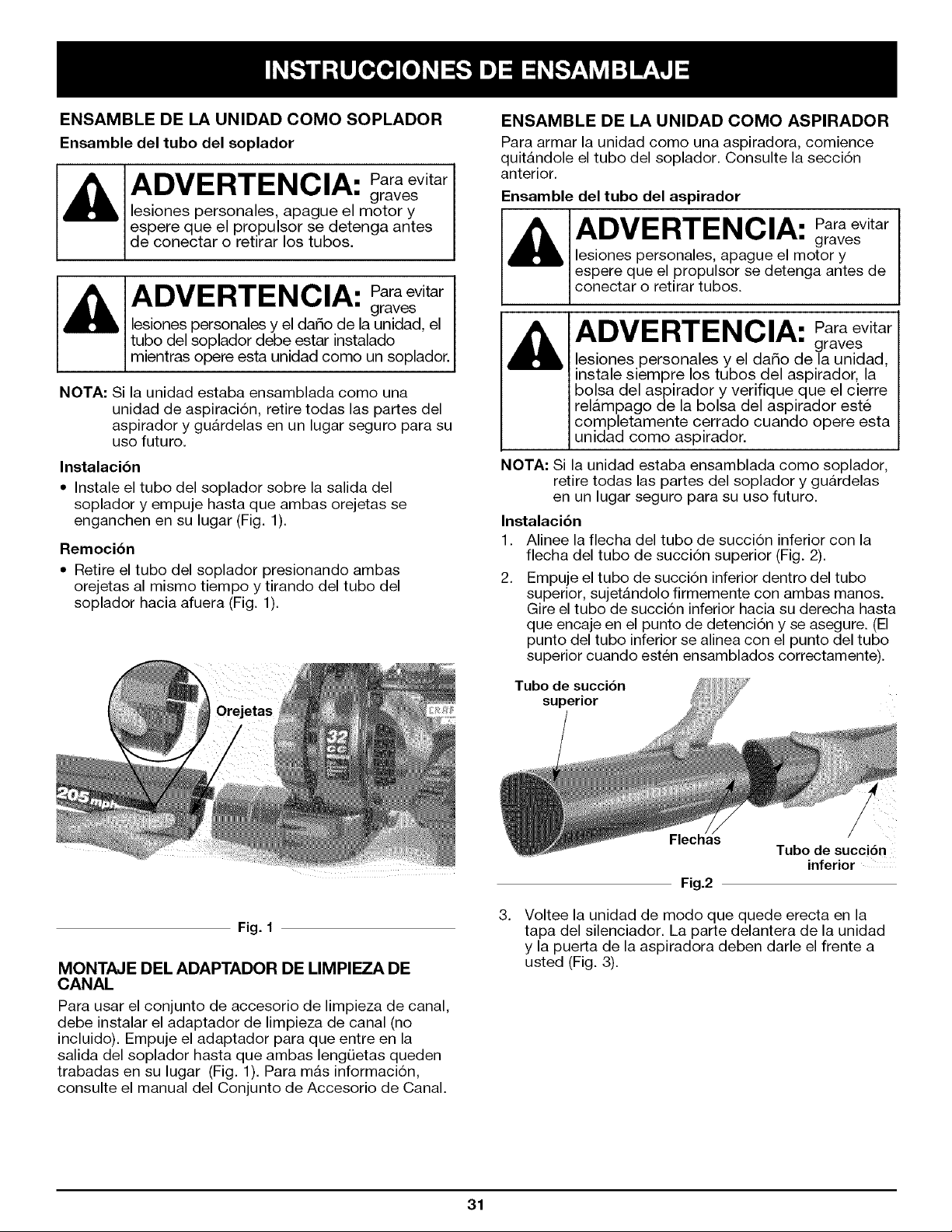
ENSAMBLE DE LA UNIDAD COMO SOPLADOR
Ensamble del tubo del soplador
ADVERTENCIA: Paraevitar
graves
lesiones personales, apague el motor y
espere que el propulsor se detenga antes
de conectar o retirar los tubos.
ADVERTENCIA: Paraevitar
graves
lesiones personales y el da_o de la unidad, el
tubo del soplador debe estar instalado
mientras opere esta unidad como un soplador.
NOTA: Si la unidad estaba ensamblada como una
unidad de aspiraci6n, retire todas las partes del
aspirador y gu_.rdelas en un lugar seguro para su
uso futuro.
Instalacibn
• Instale el tubo del soplador sobre la salida del
soplador y empuje hasta que ambas orejetas se
enganchen en su lugar (Fig. 1).
Remocibn
• Retire el tubo del soplador presionando ambas
orejetas al mismo tiempo y tirando del tubo del
soplador hacia afuera (Fig. 1).
Fig. 1
MONTAJE DEL ADAPTADOR DE LIMPIEZA DE
CANAL
Para usar el conjunto de accesorio de limpieza de canal,
debe instalar el adaptador de limpieza de canal (no
incluido). Empuje el adaptador para que entre en la
salida del soplador hasta que ambas lengQetas queden
trabadas en su lugar (Fig. 1). Para m_.s informaci6n,
consulte el manual del Conjunto de Accesorio de Canal.
ENSAMBLE DE LA UNIDAD COMO ASPIRADOR
Para armar la unidad como una aspiradora, comience
quit6.ndole el tubo del soplador. Consulte la secci6n
anterior.
Ensamble del tubo del aspirador
ADVERTENCIA: Paraevitar
graves
lesiones personales, apague el motor y
espere que el propulsor se detenga antes de
conectar o retirar tubos.
ADVERTENCIA: Paraevitar
graves
lesiones personales y el da_o de la unidad,
instale siempre los tubos del aspirador, la
bolsa del aspirador y verifique que el cierre
relampago de la bolsa del aspirador est@
completamente cerrado cuando opere esta
unidad como aspirador.
NOTA: Si la unidad estaba ensamblada como soplador,
retire todas las partes del soplador y gu_.rdelas
en un lugar seguro para su uso futuro.
Instalaci6n
1. Alinee la flecha del tubo de succi6n inferior con la
flecha del tubo de succi6n superior (Fig. 2).
2. Empuje el tubo de succi6n inferior dentro del tubo
superior, sujet&.ndolo firmemente con ambas manos.
Gire el tubo de succi6n inferior hacia su derecha hasta
que encaje en el punto de detenci6n y se asegure. (El
punto del tubo inferior se alinea con el punto del tubo
superior cuando est@nensamblados correctamente).
Tubo de succi6n
superior
3.
Flechas
Fig.2
Tubo de succi6n
inferior
Voltee la unidad de modo que quede erecta en la
tapa del silenciador. La parte delantera de la unidad
y la puerta de la aspiradora deben darle el frente a
usted (Fig. 3).
31
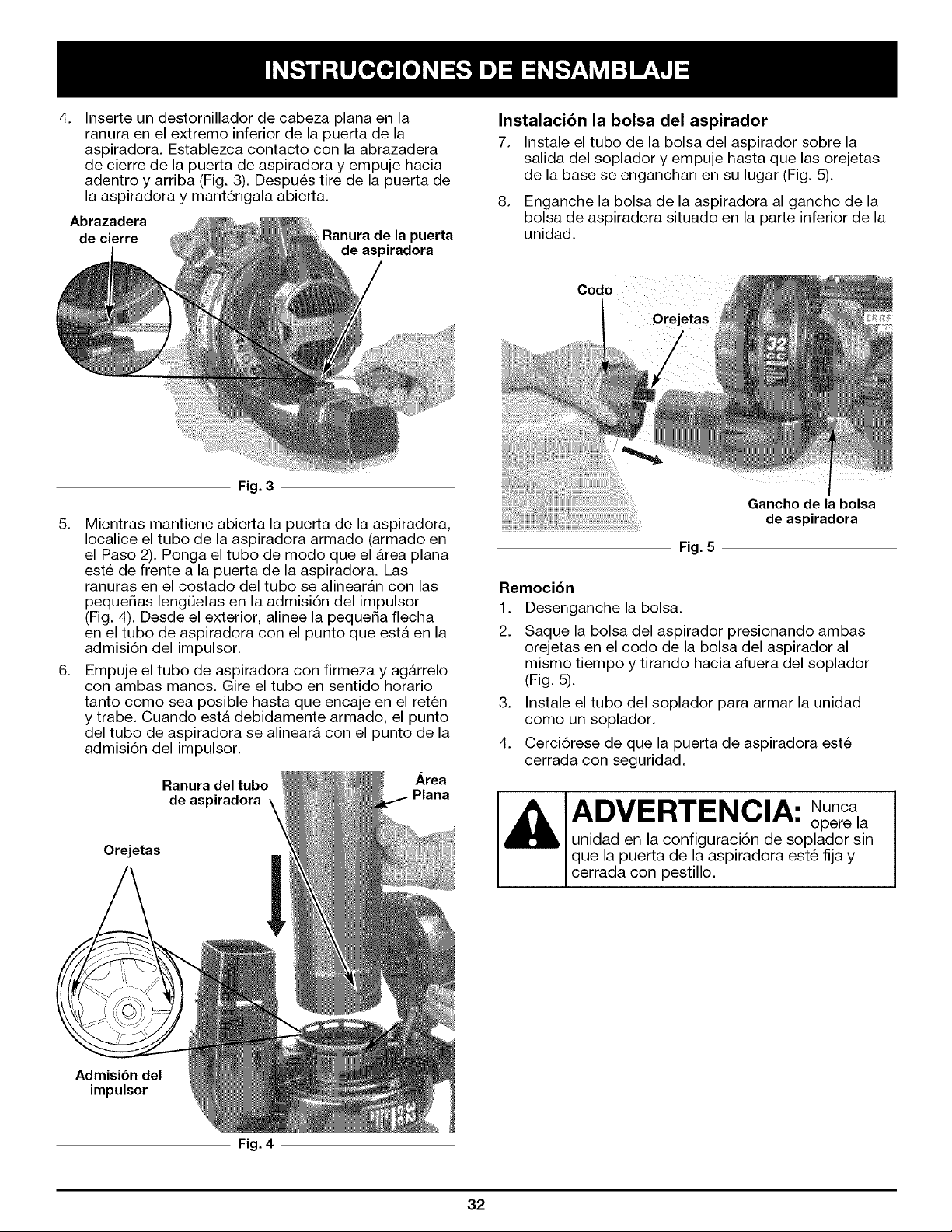
,
Inserte un destornillador de cabeza plana en la
ranura en el extremo inferior de la puerta de la
aspiradora. Establezca contacto con la abrazadera
de cierre de la puerta de aspiradora y empuje hacia
adentro y arriba (Fig. 3). Despu6s tire de la puerta de
la aspiradora y mant6ngala abierta.
Abrazadera
de cierre
Ranura de la puerta
de aspiradora
Fig. 3
5. Mientras mantiene abierta la puerta de la aspiradora,
Iocalice el tubo de la aspiradora armado (armado en
el Paso 2). Ponga el tubo de modo que el Area plana
est6 de frente a la puerta de la aspiradora. Las
ranuras en el costado del tubo se alinear_.n con las
pequefias leng(Jetas en la admisi6n del impulsor
(Fig. 4). Desde el exterior, alinee la pequefia flecha
en el tubo de aspiradora con el punto que est,. en la
admisi6n del impulsor.
6. Empuje el tubo de aspiradora con firmeza y ag_.rrelo
con ambas manos. Gire el tubo en sentido horario
tanto como sea posible hasta que encaje en el ret6n
y trabe. Cuando est,. debidamente armado, el punto
del tubo de aspiradora se alinearA con el punto de la
admisi6n del impulsor.
Ranura del tubo Area
Plana
de aspiradora \
Orejetas
Admisi6n del
impulsor
Instalacibn la bolsa del aspirador
7. Instale el tubo de la bolsa del aspirador sobre la
salida del soplador y empuje hasta que las orejetas
de la base se enganchan en su lugar (Fig. 5).
8. Enganche la bolsa de la aspiradora al gancho de la
bolsa de aspiradora situado en la parte inferior de la
unidad.
Codo
Fig. 5
Gancho de la bolsa
de aspiradora
Remoci6n
1. Desenganche la bolsa.
2. Saque la bolsa del aspirador presionando ambas
orejetas en el codo de la bolsa del aspirador al
mismo tiempo y tirando hacia afuera del soplador
(Fig. 5).
3. Instale el tubo del soplador para armar la unidad
como un soplador.
4. Cerci6rese de que la puerta de aspiradora est6
cerrada con seguridad.
ADVERTENCIA: Nunca
opere la
unidad en la configuraci6n de soplador sin
que la puerta de la aspiradora este fija y
cerrada con pestillo.
Fig. 4
32
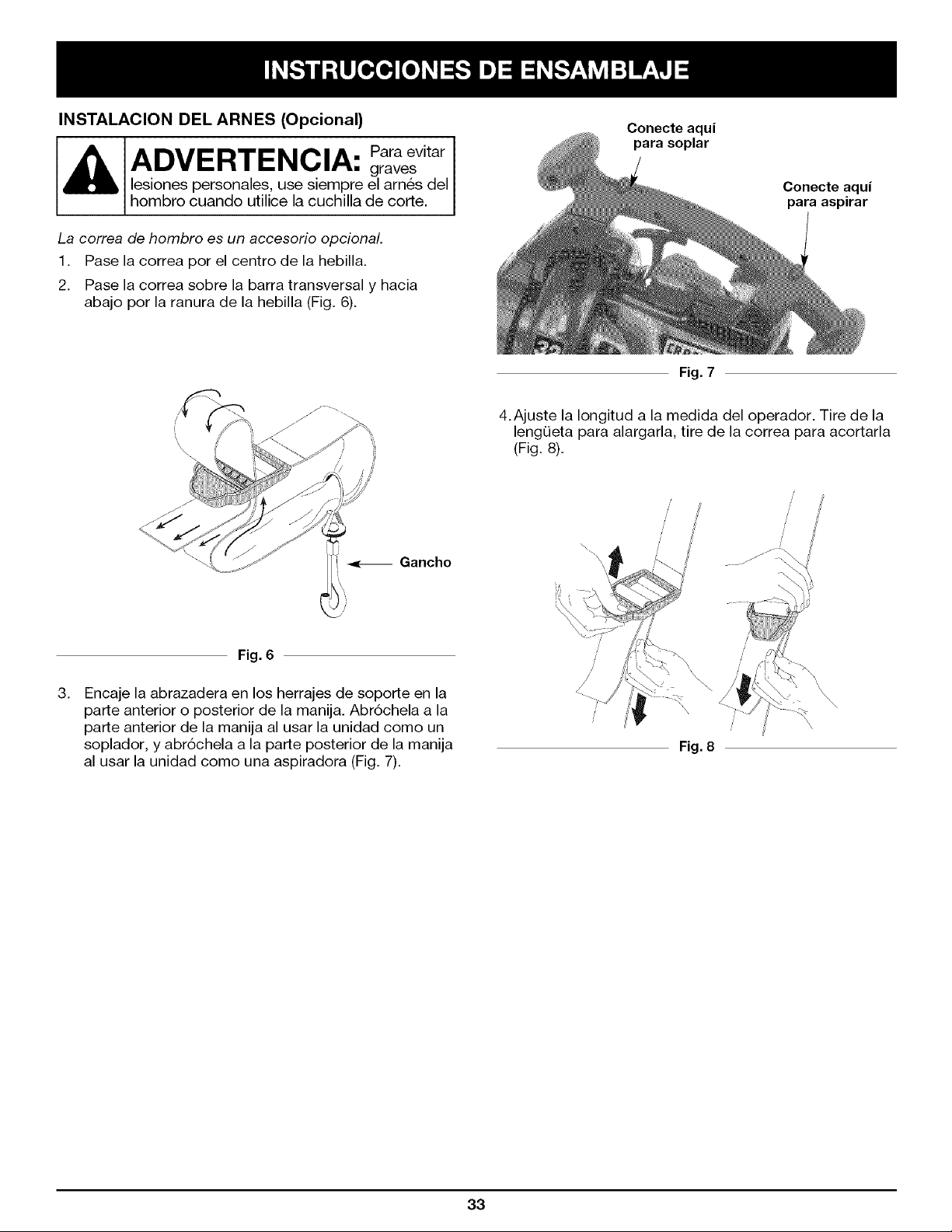
INSTALACION DEL ARNES (Opcional)
ADVERTENCIA: Paraevitar
graves
lesiones personales, use siempre el arnes del
hombre cuando utilice la cuchilla de corte.
La correa de hombro es un accesorio opcional.
1. Pase la correa por el centro de la hebilla.
2. Pase la correa sobre la barra transversal y hacia
abajo por la ranura de la hebilla (Fig. 6).
Conecte aqui
para soplar
aqui
aspirar
Fig. 7
4.Ajuste la Iongitud a la medida del operador. Tire de la
lengiJeta para alargarla, tire de la correa para acortarla
(Fig. 8).
3,
Fig. 6
Encaje la abrazadera en los herrajes de soporte en la
parte anterior o posterior de la manija. Abr6chela a la
parte anterior de la manija al usar la unidad como un
soplador, y abr6chela a la parte posterior de la manija
al usar la unidad como una aspiradora (Fig. 7).
J
Fig. 8
33

INSTRUCCIONES PARA MEZCLAR EL
ACEITE Y EL COMBUSTIBLE
El combustible viejo o mal mezclado son los motivos
principales del mal funcionamiento de la unidad.
AsegQrese de usar combustible nuevo, limpio y sin
plomo. Siga las instrucciones en detalle para mezclar
correctamente el aceite y el combustible.
Definicibn de los combustibles de mezcla
Los combustibles actuales con frecuencia son una mezcla
de gasolina y oxigenantes como por ejemplo etanol,
metanol o MTBE (@ter).El combustible mezclado con
alcohol absorbe agua. Una cantidad tan pequefia como el
1% de agua en el combustible puede causar la separaci6n
del combustible y el aceite. Forma 6.cidos cuando est&
almacenado. Cuando use combustible mezclado con
alcohol, use combustible nuevo (de menos de 60 dias).
Uso de combustibles de mezcla
Si usted opta por usar un combustible de mezcla o si su
uso es inevitable, tome las precauciones
recomendadas.
• Use siempre una mezcla fresca de combustible segQn
Io indica su manual del operador.
• Agite siempre la mezcla de combustible antes de
cargarlo en la unidad.
• Drene el tanque y haga funcionar el motor en seco
antes de guardar la unidad.
Uso de aditivos en el combustible
La botella de aceite de 2 ciclos que vino con su unidad
contiene un aditivo en el combustible que ayudar6, a
inhibir la corrosi6n y a reducir la formaci6n de dep6sitos
de goma. Se recomienda que use s61o el aceite de 2
ciclos con esta unidad.
Si es inevitable, use un buen aceite de 2 ciclos
elaborado para motores enfriados por aire junto con un
aditivo para el combustible como por ejemplo el
estabilizador de gasolina STA-BIL ®o similar. Agregue
23 mL (0,8 onzas) de aditivo de combustible por gal6n
de combustible de acuerdo con las instrucciones del
envase. NUNCA agregue aditivos directamente en el
tanque de combustible de la unidad.
PRECAUCION: Para que el
motor
funcione correctamente y con la mayor
fiabilidad, preste mucha atenci6n a las
instrucciones de mezcla de aceite y
combustible del envase de aceite de 2 ciclos.
El uso de combustible mezclado en forma
incorrecta puede daSar seriamente el motor.
Mezcle bien la proporci6n correcta de aceite para motor
de 2 ciclos y gasolina sin plomo en una lata de
combustible por separado. Use una proporci6n de 40:1
de combustible y aceite. No los mezcle directamente en
el tanque de combustible de la unidad. Consulte las
proporciones especMcas de mezcla de gasolina y aceite
en la tabla siguiente.
NOTA: 3,8 litros (un gal6n) de gasolina sin plomo
mezclada con una botella de 95 mL (3,2 onzas)
de aceite de 2 ciclos es una proporci6n de 40:1
de combustible y aceite.
GASOLINA SIN PLOMO ACEITE DE 2 ClCLOS
3,8 LITROS 95 mL
(1 GALON de EE.UU.) (3,20NZAS FLUlDAS)
1 LITRO 25 mL
PROPORCION DE LA MEZCLA = 40 : 1
ADVERTENCIA: La
gasolina es
muy inflamable. Los gases pueden explotar
si se encienden. Apague siempre el motor y
espere que se enfrie antes de cargar el
ue de combustible. No fume mientras
Ilena el tanque. Mantenga las chispas y las
llamas lejos del &rea.
ADVERTENCIA: Saque la
tapa del
combustible lentamente para evitar lesionarse
con el rociado del combustible. No opere
nunca la unidad sin la tapa del combustible
firmemente colocada en su lugar.
ADVERTENCIA: Cargue el
com-
bustible en un &rea exterior limpia y bien
ventilada. Limpie de inmediato todo
combustible que se haya derramado. Evite
crear una fuente de encendido con el
combustible derramado. No arranque el
motor hasta que se hayan evaporado los
gases de combust b e.
NOTA: Elimine la mezcla vieja de aceite y combustible de
acuerdo con los reglamentos federales, estatales
y locales.
34
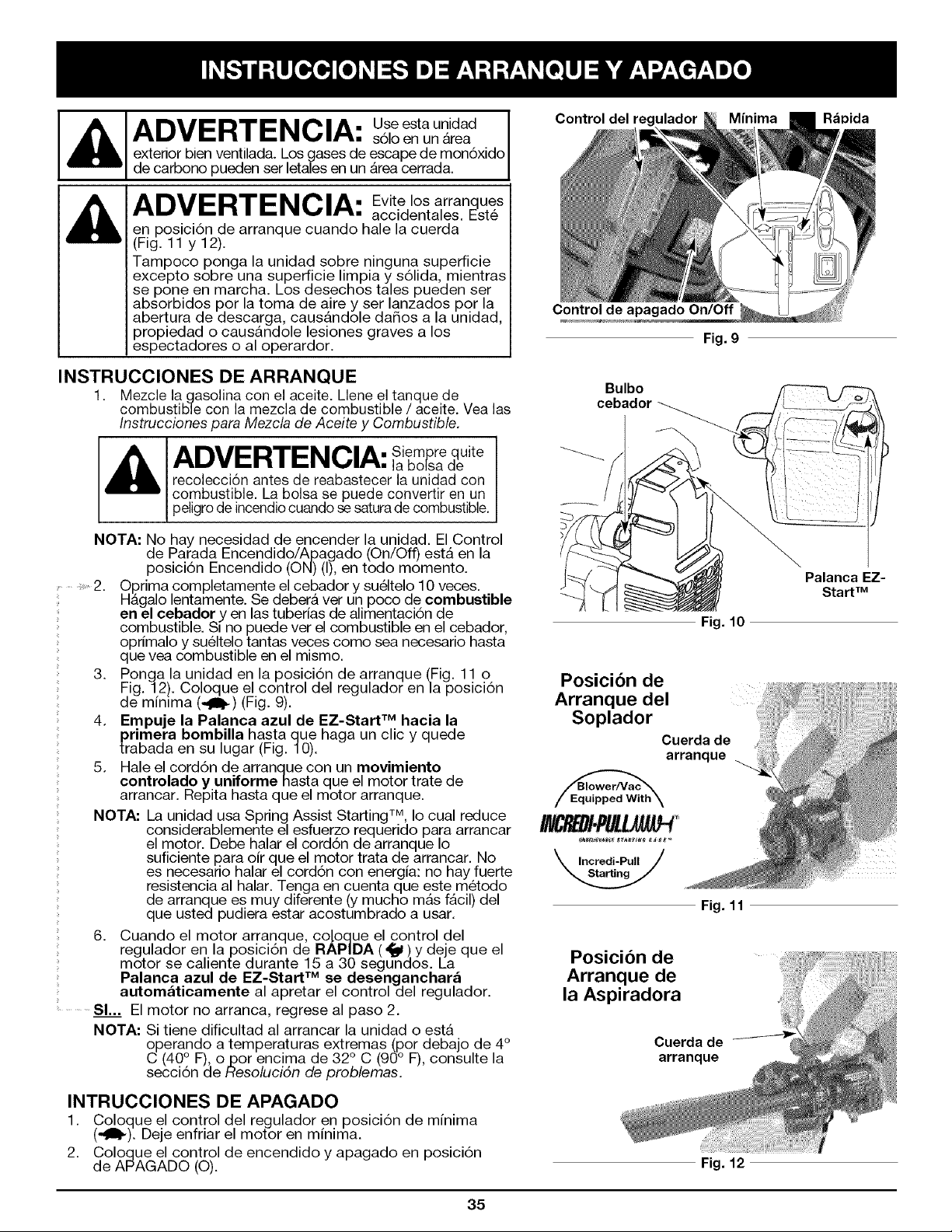
ADVERTENCIA: Useestaunidad
s61oen un _.rea
exterior bien ventilada. Los gases de escape de mon6xido
de carbono pueden ser letales en un Area cerrada.
ADVERTENCIA: Evite los arranques
accidentales. Est6
en posici6n de arranque cuando hale la cuerda
(Fig. 1 1 y 12).
Tampoco ponga la unidad sobre ninguna superficie
excepto sobre una superficie limpia y s61ida, mientras
se pone en marcha. Los desechos tales pueden ser
absorbidos por la toma de aire y ser lanzados por la
abertura de descarga, causAndole da_os a la unidad,
propiedad o causAndole lesiones graves a los
espectadores o al operardor.
INSTRUCCIONES DE ARRANQUE
1. Mezcle la gasolina con el aceite. Llene el tanque de
combustible con la mezcla de combustible / aceite. Vea las
Instrucciones para Mezcla de Aceite y Combustible.
ADVERTENCIA: Siempre quite
la bolsa de
recolecci6n antes de reabastecer la unidad con
combustible. La bolsa se puede convertir en un
peligrode incendiocuando se saturade combustible.
NOTA" No hay necesidad de encender la unidad. El Control
de Parada Encendido/Apagado (On/Off) estA en la
posici6n Encendido (ON)(I), en todo momento.
2. Oprima completamente el cebador y su61telo 10 veces.
H6.galo lentamente. Se deberA ver un poco de combustible
en el cebador yen las tuberfas de alimentaci6n de
combustible. Si no puede ver el combustible en el cebador,
oprfmalo y su61telotantas veces como sea necesario hasta
que vea combustible en el mismo.
3. Ponga la unidad en la posici6n de arranque (Fig. 11 o
deFig'mfnlmal2). Coloque(,4iP) (Fig.elcontrol9),del regulador enla posici6n
4. Empuje la Palanca azul de EZ-Start TM hacia la
primera bombilla hasta que haga un clic y quede
trabada en su lugar (Fig. 1 0).
5. Hale el cord6n de arranque con un movimiento
controlado y uniforme hasta que el motor trate de
arrancar. Repita hasta que el motor arranque.
TM
NOTA: La unidad usa Spring Assist Starting , Io cual reduce
considerablemente el esfuerzo requerido para arrancar
el motor. Debe halar el cord6n de arranque Io
suficiente para oir que el motor trata de arrancar. No
es necesario halar el cord6n con energia: no hay fuerte
resistencia al halar. Tenga en cuenta que este m6todo
de arranque es muy diferente (y mucho mAs fAcil) del
que usted pudiera estar acostumbrado a usar.
6. Cuando el motor arranque, co[oque el control del
regulador en la posici6n de RAPIDA (_ ) y deje que el
motor se caliente durante 1TM5a 30 segundos, la
Palanca azul de EZ-Start se desenganchara
automaticamente al apretar el control del regulador.
Sl... El motor no arranca, regrese al paso 2.
NOTA: Si tiene dificultad al arrancar la unidad o est,.
operando a temperaturas extremas (por debajo de 4°
C (40 ° F), opor encima de 32° C (90° F), consulte la
secci6n de Resoluei6n de problemas.
INTRUCCIONES DE APAGADO
1. Coloque el control del regulador en posici6n de minima
(,4IP). Deje enfriar el motor en minima.
2. Coloque el control de encendido y apagado en posici6n
de APAGADO (O).
Control del rec Minima RaDida
Control de apagado On/Off
Bulbo
cebador
Fig. 9
Fig. 10
Palanca EZ-
Start TM
Posicion de
Arranque del
Soplador
Cuerda de
arranque
Incredi-Pull
Fig. 11
Posicion de
Arranque de
la Aspiradora
Cuerda de
arranque
Fig. 12
35
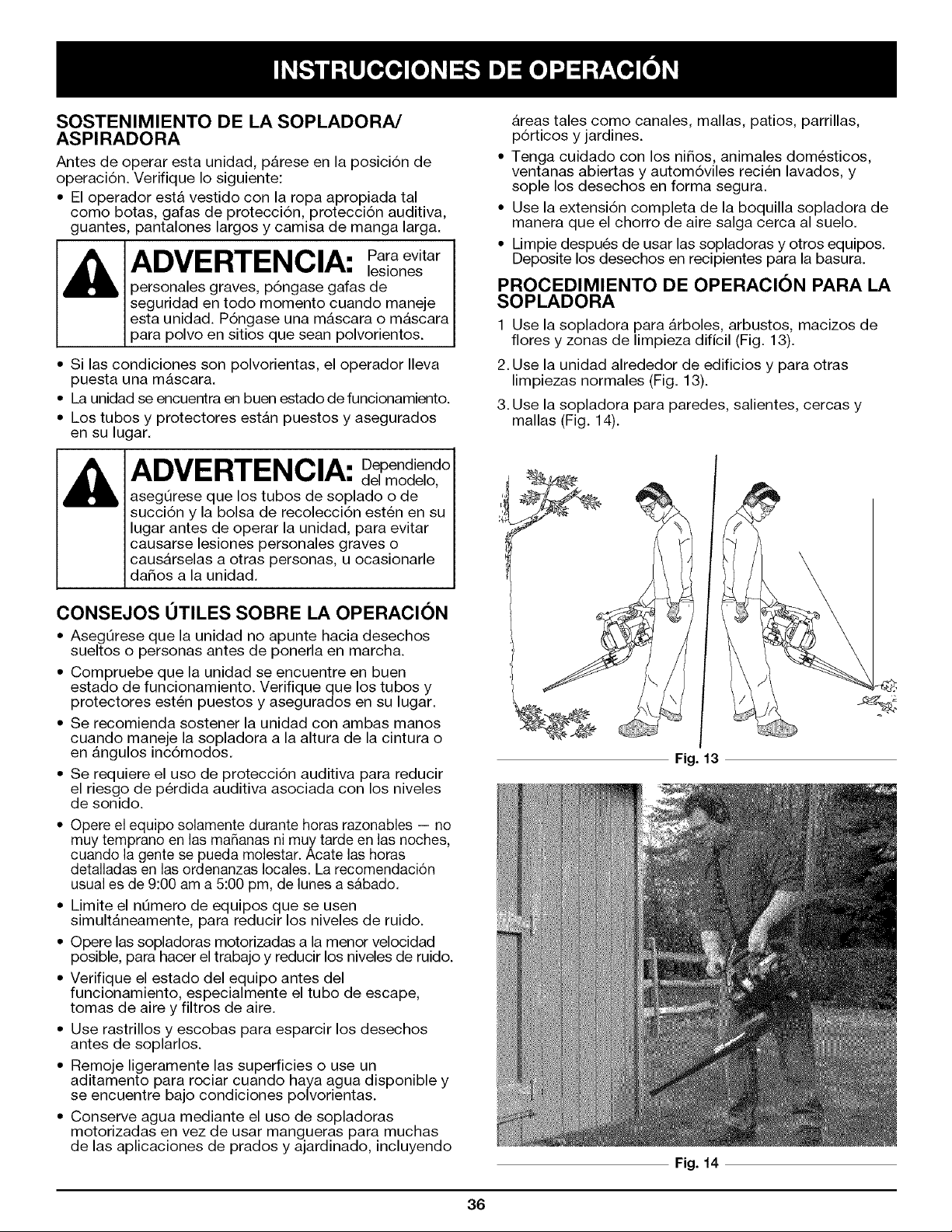
SOSTENIMIENTO DE LA SOPLADORA/
ASPIRADORA
Antes de operar esta unidad, p_.rese en la posici6n de
operaci6n. Verifique Io siguiente:
• El operador est,. vestido con la ropa apropiada tal
como botas, gafas de protecci6n, protecci6n auditiva,
guantes, pantalones largos y camisa de manga larga.
ADVERTENCIA: Paraevitar
lesiones
personales graves, p6ngase gafas de
seguridad en todo momento cuando maneje
esta unidad. P6ngase una mascara o mascara
para polvo en sitios que sean polvorientos.
• Si las condiciones son polvorientas, el operador Ileva
puesta una mascara.
• La unidad se encuentra en buen estado de funcionamiento.
• Los tubos y protectores est_.n puestos y asegurados
en su lugar.
ADVERTENCIA: Dependiendo
del modelo,
asegQrese que los tubos de soplado o de
succi6n y la bolsa de recolecci6n est6n en su
lugar antes de operar la unidad, para evitar
causarse lesiones personales graves o
caus_.rselas a otras personas, u ocasionarle
daSos a la unidad.
CONSEJOS L)TILES SOBRE LA OPERACION
• AsegQrese que la unidad no apunte hacia desechos
sueltos o personas antes de ponerla en marcha.
• Compruebe que la unidad se encuentre en buen
estado de funcionamiento. Verifique que los tubos y
protectores est6n puestos y asegurados en su lugar.
• Se recomienda sostener la unidad con ambas manos
cuando maneje la sopladora a la altura de la cintura o
en _.ngulos inc6modos.
• Se requiere el uso de protecci6n auditiva para reducir
el riesgo de p6rdida auditiva asociada con los niveles
de sonido.
• Opere el equipo solamente durante horas razonables -- no
muy temprano en las mananas ni muy tarde en las noches,
cuando la gente se pueda molestar. Acate las horas
detalladas en las ordenanzas locales. La recomendaci6n
usual es de 9:00 am a 5:00 pm, de lunes a s_bado.
• Limite el nOmero de equipos que se usen
simult_.neamente, para reducir los niveles de ruido.
• Opere las sopladoras motorizadas a la menor velocidad
posible, para hacer el trabajo y reducir los niveles de ruido.
• Verifique el estado del equipo antes del
funcionamiento, especialmente el tubo de escape,
tomas de aire y filtros de aire.
• Use rastrillos y escobas para esparcir los desechos
antes de soplarlos.
• Remoje ligeramente las superficies o use un
aditamento para rociar cuando haya agua disponible y
se encuentre bajo condiciones polvorientas.
• Conserve agua mediante el uso de sopladoras
motorizadas en vez de usar mangueras para muchas
de las aplicaciones de prados y ajardinado, incluyendo
Areas tales como canales, mallas, patios, parrillas,
p6rticos y jardines.
• Tenga cuidado con los niSos, animales dom6sticos,
ventanas abiertas y autom6viles reci6n lavados, y
sople los desechos en forma segura.
• Use la extensi6n completa de la boquilla sopladora de
manera que el chorro de aire salga cerca al suelo.
• Limpie despu6s de usar las sopladoras y otros equipos.
Deposite los desechos en recipientes para la basura.
PROCEDIMIENTO DE OPERACION PARA LA
SOPLADORA
1 Use la sopladora para 6.rboles, arbustos, macizos de
flores y zonas de limpieza dificil (Fig. 13).
2. Use la unidad alrededor de edificios y para otras
limpiezas normales (Fig. 13).
3. Use la sopladora para paredes, salientes, cercas y
mallas (Fig. 14).
Fig. 13
36
Fig. 14
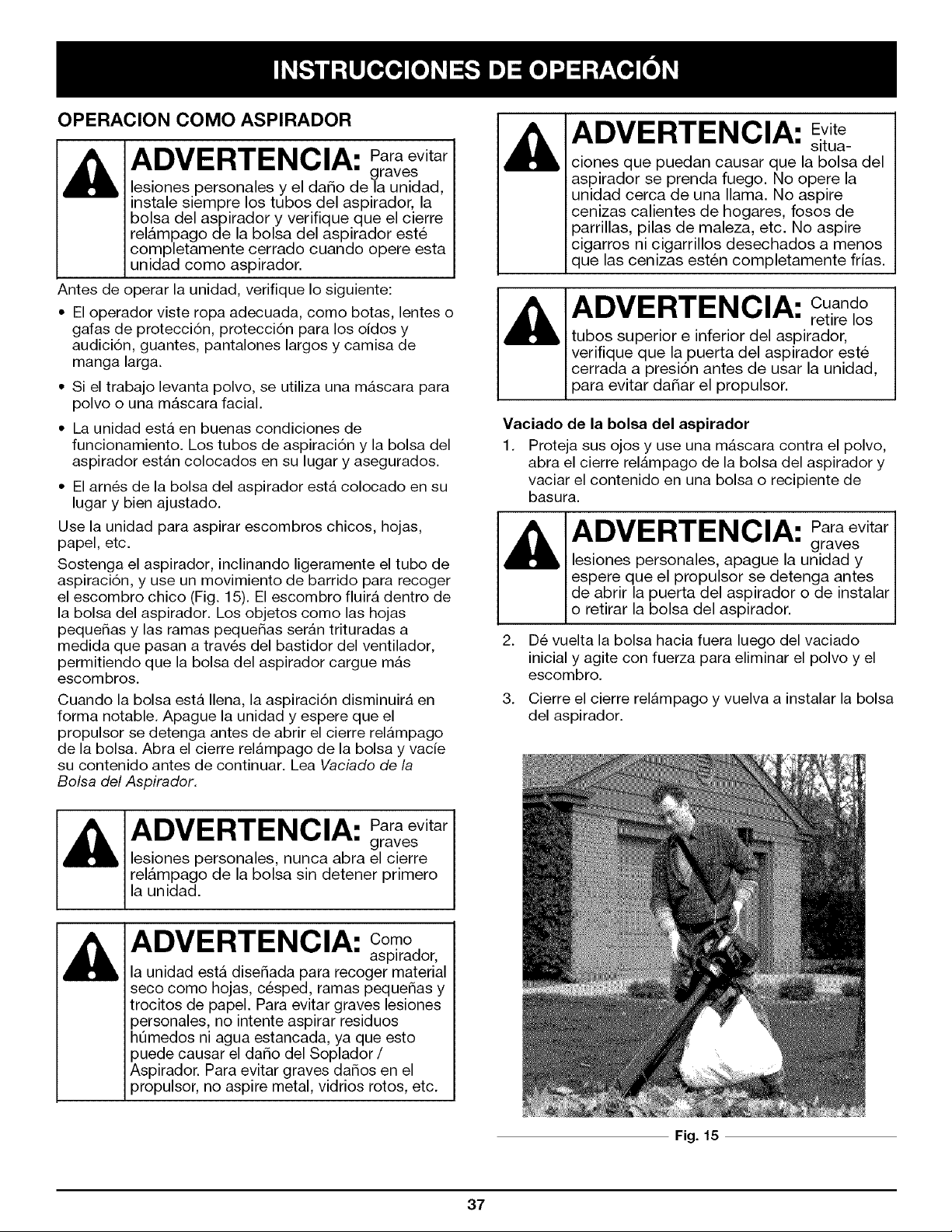
OPERACION COMO ASPIRADOR
ADVERTENCIA: Paraevitar
graves
lesionespersonalesy eldaSo de launidad,
instale siempre los tubes del aspirador, la
bolsa del aspirador y verifique que el cierre
rel&mpago de la bolsa del aspirador este
completamente cerrado cuando opere esta
unidad come aspirador.
Antes de operar la unidad, verifique Io siguiente:
• El operador viste ropa adecuada, como botas, lentes o
gafas de protecci6n, protecci6n para los oidos y
audici6n, guantes, pantalones largos y camisa de
manga larga.
• Si el trabajo levanta polvo, se utiliza una mascara para
polvo o una mascara facial.
• La unidad estA en buenas condiciones de
funcionamiento. Los tubos de aspiraci6n y la bolsa del
aspirador estAn colocados en su lugar y asegurados.
• El arn6s de la bolsa del aspirador estA colocado en su
lugar y bien ajustado.
Use la unidad para aspirar escombros chicos, hojas,
papel, etc.
Sostenga el aspirador, inclinando ligeramente el tubo de
aspiraci6n, y use un movimiento de barrido para recoger
el escombro chico (Fig. 15). El escombro fluirA dentro de
la bolsa del aspirador. Los objetos como las hojas
pequeSas y las ramas pequeSas serAn trituradas a
medida que pasan a trav6s del bastidor del ventilador,
permitiendo que la bolsa del aspirador cargue mAs
escombros.
Cuando la bolsa estA Ilena, la aspiraci6n disminuirA en
forma notable. Apague la unidad y espere que el
propulsor se detenga antes de abrir el cierre relAmpago
de la bolsa. Abra el cierre relAmpago de la bolsa y vacie
su contenido antes de continuar. Lea Vaciado de la
Belsa del Aspirador.
ADVERTENCIA: Evite
situa-
ciones que puedan causar que la bolsa del
aspirador se prenda fuego. No opere la
unidad cerca de una llama. No aspire
cenizas calientes de hogares, fosos de
parrillas, pilas de maleza, etc. No aspire
cigarros ni cigarrillos desechados a menos
que as cen zas esten comp etamente frias.
ADVERTENCIA: Cuando
retire los
tubes superior e inferior del aspirador,
verifique que la puerta del aspirador este
cerrada a presi6n antes de usar la unidad,
da_ar el propulsor.
Vaciado de la bolsa del aspirador
1. Proteja sus ojos y use una mascara contra el polvo,
abra el cierre relAmpago de la bolsa del aspirador y
vaciar el contenido en una bolsa o recipiente de
basura.
ADVERTENCIA: Paraevitar
graves
lesiones personales, apague la unidad y
espere que el propulsor se detenga antes
de abrir la puerta del aspirador o de instalar
o retirar la bolsa del aspirador.
.
3.
D6 vuelta la bolsa hacia fuera luego del vaciado
inicial y agite con fuerza para eliminar el polvo y el
escombro.
Cierre el cierre relAmpago y vuelva a instalar la bolsa
del aspirador.
ADVERTENCIA: Paraevitar
graves
lesiones personales, nunca abra el cierre
rel&mpago de la bolsa sin detener primero
la unidad.
ADVERTENCIA: Come
aspirador,
la unidad est& diseSada para recoger material
seco come hojas, c6sped, ramas pequeSas y
trocitos de papel. Para evitar graves lesiones
3ersonales, no intente aspirar residues
hOmedos ni agua estancada, ya que esto
3uede causar el daSo del Soplador /
Aspirador. Para evitar graves daSos en el
propulsor, no aspire metal, vidrios rotes, etc.
Fig. 15
37
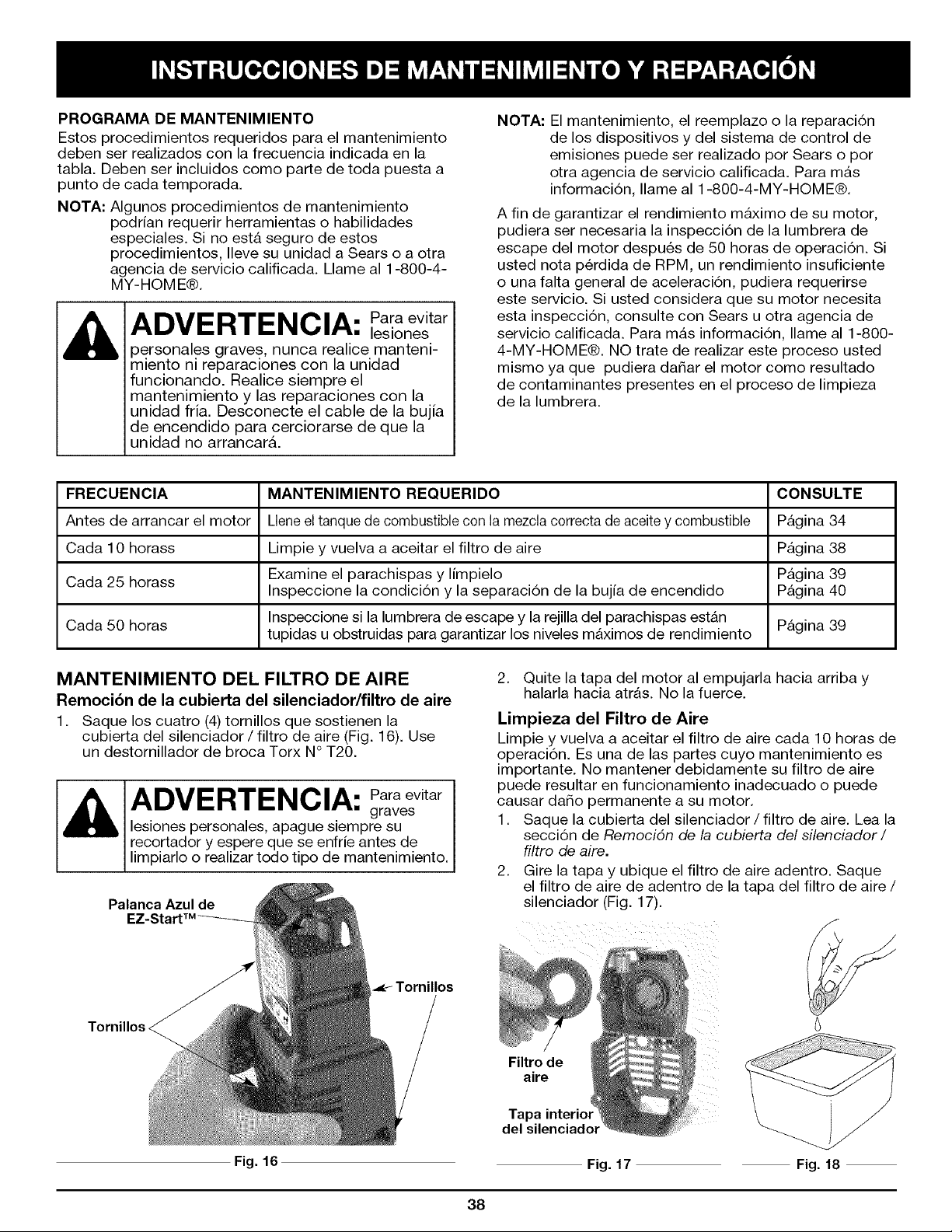
PROGRAMADEMANTENIMIENTO
Estos procedimientos requeridos para el mantenimiento
deben ser realizados con la frecuencia indicada en la
tabla. Deben ser incluidos como parte de toda puesta a
punto de cada temporada.
NOTA: Algunos procedimientos de mantenimiento
podrian requerir herramientas o habilidades
especiales. Si no est6. seguro de estos
procedimientos, Ileve su unidad a Sears o a otra
agencia de servicio calificada. Llame al 1-800-4-
MY-HOME@.
ADVERTENCIA: Paraevitar
lesiones
personales graves, nunca realice manteni-
miento ni reparaciones con la unidad
funcionando. Realice siempre el
mantenimiento y las reparaciones con la
unidad fria. Desconecte el cable de la bujia
de encendido para cerciorarse de que la
unidad no arrancar&.
NOTA: El mantenimiento, el reemplazo o la reparaci6n
de los dispositivos y del sistema de control de
emisiones puede ser realizado por Sears o por
otra agencia de servicio calificada. Para m_.s
informaci6n, Name al 1-800-4-MY-HOME®.
A fin de garantizar el rendimiento m_.ximo de su motor,
pudiera ser necesaria la inspecci6n de la lumbrera de
escape del motor despu@s de 50 horas de operaci6n. Si
usted nota p@dida de RPM, un rendimiento insuficiente
o una falta general de aceleraci6n, pudiera requerirse
este servicio. Si usted considera que su motor necesita
esta inspecci6n, consulte con Sears u otra agencia de
servicio calificada. Para mAs informaci6n, Name al 1-800-
4-MY-HOME®. NO trate de realizar este proceso usted
mismo ya que pudiera daSar el motor como resultado
de contaminantes presentes en el proceso de limpieza
de la lumbrera.
FRECUENClA MANTENIMIENTO REQUERIDO CONSULTE
Antes de arrancar el motor Lleneel tanque de combustible con la mezclacorrecta de aceite y combustible P_.gina 34
Cada 10 horass Limpie y vuelva a aceitar el filtro de aire P_gina 38
Examine el parachispas y Ifmpielo P_.gina 39
Cada 25 horass
Inspeccione la condici6n y la separaci6n de la bujfa de encendido P_gina 40
Inspeccione si la lumbrera de escape y la rejilla del parachispas est_.n P_gina 39
Cada 50 horas tupidas u obstruidas para garantizar los niveles m_.ximos de rendimiento
MANTENIMIENTO DEL FILTRO DE AIRE
Remocibn de la cubierta del silenciador/filtro de aire
1. Saque los cuatro (4) tomillos que sostienen la
cubierta del silenciador / filtro de aire (Fig. 16). Use
un destomillador de broca Torx N° T20.
ADVERTENCIA: Paraevitar
graves
lesiones personales, apague siempre su
recortador y espere que se enfrie antes de
limpiarlo o realizar todo tipo de mantenimiento.
Palanca Azul de
EZ-StartTM _-_
-_ Tornillos
Tornillos <
Fig. 16
2. Quite la tapa del motor al empujarla hacia arriba y
halarla hacia atrAs. No la fuerce.
Limpieza del Filtro de Aire
Limpie y vuelva a aceitar el filtro de aire cada 10 horas de
operaci6n. Es una de las partes cuyo mantenimiento es
importante. No mantener debidamente su filtro de aire
puede resultar en funcionamiento inadecuado o puede
causar dafio permanente a su motor.
1. Saque la cubierta del silenciador / filtro de aire. Lea la
secci6n de Remocidn de la cubierta del silenciador /
filtro de aire.
2. Gire la tapa y ubique el filtro de aire adentro. Saque
el filtro de aire de adentro de la tapa del filtro de aire /
silenciador (Fig. 17).
Filtro de
aire
Tapa interior
del silenciador
Fig. 17 Fig. 18
38
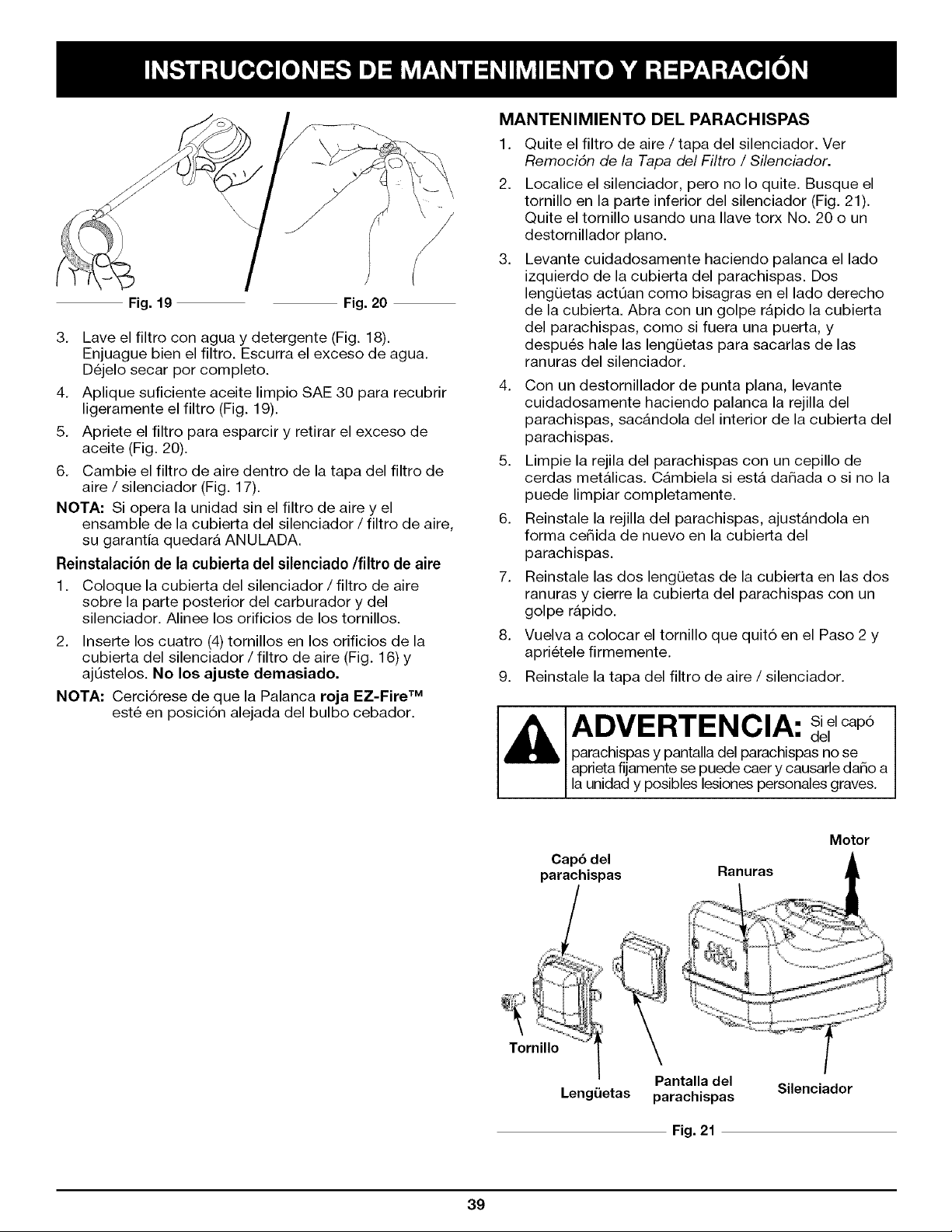
/
/
/
Fig. 19 Fig. 20
3. Lave el filtro con agua y detergente (Fig. 18).
Enjuague bien el filtro. Escurra el exceso de agua.
D@jelosecar por completo.
4. Aplique suficiente aceite limpio SAE 30 para recubrir
ligeramente el filtro (Fig. 19).
5. Apriete el filtro para esparcir y retirar el exceso de
aceite (Fig. 20).
6. Cambie el filtro de aire dentro de la tapa del filtro de
aire / silenciador (Fig. 17).
NOTA: Si opera la unidad sin el filtro de aire y el
ensamble de la cubierta del silenciador / filtro de aire,
su garantia quedar_. ANULADA.
Reinstalaci6n de la cubierta del silenciado/filtro de aire
1. Coloque la cubierta del silenciador / filtro de aire
sobre la parte posterior del carburador y del
silenciador. Alinee los orificios de los tornillos.
2. Inserte los cuatro (4) tornillos en los orificios de la
cubierta del silenciador / filtro de aire (Fig. 16) y
ajQstelos. No los ajuste demasiado.
NOTA: Cerci6rese de que la Palanca roja EZ-Fire TM
est@en posici6n alejada del bulbo cebador.
MANTENIMIENTO DEL PARACHISPAS
1. Quite el filtro de aire / tapa del silenciador. Ver
Remocidn de la Tapa del Filtro / Silenciador.
2. Localice el silenciador, pero no Io quite. Busque el
tornillo en la parte inferior del silenciador (Fig. 21).
Quite el tornillo usando una Ilave torx No. 20 o un
destornillador piano.
3. Levante cuidadosamente haciendo palanca el lado
izquierdo de la cubierta del parachispas. Dos
lengQetas actOan como bisagras en el lado derecho
de la cubierta. Abra con un golpe r6.pido la cubierta
del parachispas, como si fuera una puerta, y
despu@s hale las lengQetas para sacarlas de las
ranuras del silenciador.
4. Con un destornillador de punta plana, levante
cuidadosamente haciendo palanca la rejilla del
parachispas, sac_.ndola del interior de la cubierta del
parachispas.
5. Limpie la rejila del parachispas con un cepillo de
cerdas met6.1icas. C_.mbiela si est&.daSada o si no la
puede limpiar completamente.
6. Reinstale la rejilla del parachispas, ajust_.ndola en
forma ceSida de nuevo en la cubierta del
parachispas.
7. Reinstale las dos lengQetas de la cubierta en las dos
ranuras y cierre la cubierta del parachispas con un
golpe rApido.
8. Vuelva a colocar el tornillo que quit6 en el Paso 2 y
apri@tele firmemente.
9. Reinstale la tapa del filtro de aire / silenciador.
ADVERTENCIA: Si el cap6
del
parachispas y pantalla del parachispas no se
aprieta fijamente se puede caer y causarle da_o a
la unidad y posibles lesiones personales graves.
Cap6 del
parachispas
Tornillo
LengQetas
Ranuras
Pantalla del
parachispas
Fig. 21
Motor
Silenciador
39
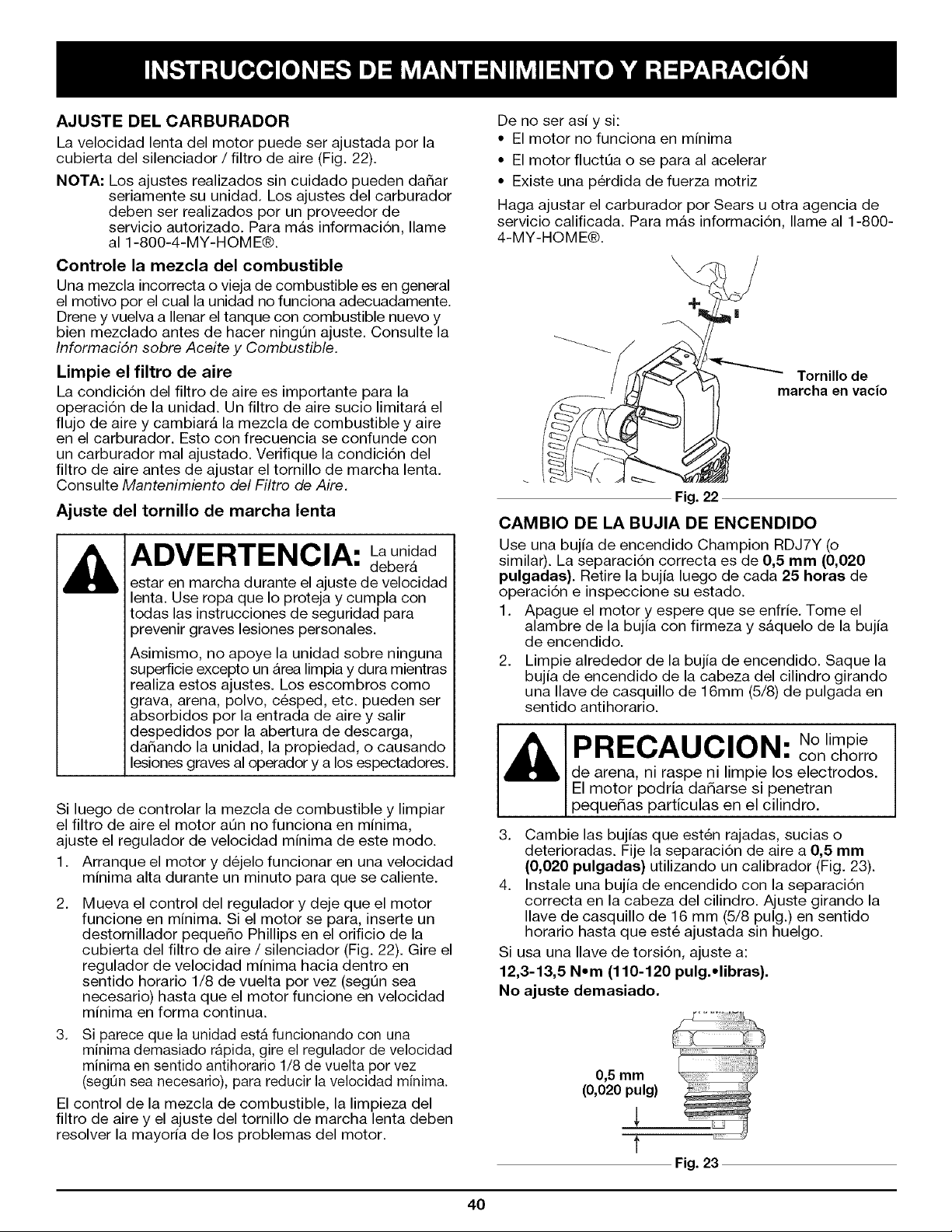
AJUSTEDELCARBURADOR
La velocidad lenta del motor puede ser ajustada por la
cubierta del silenciador / filtro de aire (Fig. 22).
NOTA: Los ajustes realizados sin cuidado pueden daSar
seriamente su unidad. Los ajustes del carburador
deben ser realizados por un proveedor de
servicio autorizado. Para mAs informaci6n, Ilame
al 1-800-4-MY-HOME®.
Controle la mezcla del combustible
Una mezcla incorrecta o vieja de combustible es en general
el motivo por el cual la unidad no funciona adecuadamente.
Drene y vuelva a Ilenar el tanque con combustible nuevo y
bien mezclado antes de hacer ningOn ajuste. Consulte la
Informacidn sobre Aceite y Combustible.
Limpie el filtro de aire
La condici6n del filtro de aire es importante para la
operaci6n de la unidad. Un filtro de aire sucio limitarA el
flujo de aire y cambiarA la mezcla de combustible y aire
en el carburador. Esto con frecuencia se confunde con
un carburador mal ajustado. Verifique la condici6n del
filtro de aire antes de ajustar el tornillo de marcha lenta.
Consulte Mantenimiento del Filtro de Aire.
Ajuste del tornillo de marcha lenta
ADVERTENCIA: Launidad
deberA
estar en marcha durante el ajuste de velocidad
lenta. Use ropa que Io proteja y cumpla con
todas las instrucciones de seguridad para
3revenir graves lesiones personales.
Asimismo, no apoye la unidad sobre ninguna
superficie excepto un Area limpia y dura mientras
realiza estos ajustes. Los escombros como
grava, arena, polvo, c6sped, etc. pueden ser
absorbidos por la entrada de aire y salir
despedidos por la abertura de descarga,
da_ando la unidad, la propiedad, o causando
lesiones graves al operador y a los espectadores.
Si luego de controlar la mezcla de combustible y limpiar
el filtro de aire el motor aOn no funciona en minima,
ajuste el regulador de velocidad minima de este modo.
1. Arranque el motor y d6jelo funcionar en una velocidad
minima alta durante un minuto para que se caliente.
2.
Mueva el control del regulador y deje que el motor
funcione en minima. Si el motor se para, inserte un
destornillador peque_o Phillips en el orificio de la
cubierta del filtro de aire / silenciador (Fig. 22). Gire el
regulador de velocidad minima hacia dentro en
sentido horario 1/8 de vuelta por vez (segOn sea
necesario) hasta que el motor funcione en velocidad
minima en forma continua.
3. Si parece que la unidad estA funcionando con una
minima demasiado rApida, gire el regulador de velocidad
minima en sentido antihorario 1/8 de vuelta por vez
(segOnsea necesario), para reducir la velocidad minima.
El control de la mezcla de combustible, la limpieza del
filtro de aire y el ajuste del tornillo de marcha lenta deben
resolver la mayoria de los problemas del motor.
De no ser asi y si:
• El motor no funciona en minima
• El motor fluctQa o se para al acelerar
• Existe una p6rdida de fuerza motriz
Haga ajustar el carburador por Sears u otra agencia de
servicio calificada. Para mAs informaci6n, Ilame al 1-800-
4-MY-HOME®.
\
Tornillo de
marcha en vacio
Fig. 22
CAMBIO DE LA BUJIA DE ENCENDIDO
Use una bujia de encendido Champion RDJ7Y (o
similar). La separaci6n correcta es de 0,5 mm (0,020
pulgadas). Retire la bujia luego de cada 25 horas de
operaci6n e inspeccione su estado.
1. Apague el motor y espere que se enfrie. Tome el
alambre de la bujia con firmeza y sAquelo de la bujia
de encendido.
2. Limpie alrededor de la bujia de encendido. Saque la
bujia de encendido de la cabeza del cilindro girando
una Ilave de casquillo de 16mm (5/8) de pulgada en
sentido antihorario.
PRECAUCION: Nolimpie
con chorro
de arena, ni raspe ni limpie los electrodos.
El motor podria da_arse si penetran
peque_as particulas en el cilindro.
3. Cambie las bujias que est6n rajadas, sucias o
deterioradas. Fije la separaci6n de aire a 0,5 mm
(0,020 pulgadas} utilizando un calibrador (Fig. 23).
4. Instale una bujia de encendido con la separaci6n
correcta en la cabeza del cilindro. Ajuste girando la
Ilave de casquillo de 16 mm (5/8 pulg.) en sentido
horario hasta que est6 ajustada sin huelgo.
Si usa una Ilave de torsi6n, ajuste a:
12,3-13,5 N•m (110-120 pulg.•libras}.
No ajuste demasiado.
t
Fig. 23
40
LIMPIEZA
ADVERTENCIA: Para
evitar
graves lesiones personales, apague
siempre su unidad y espere que se enfrie
antes de limpiarlo o realizar cualquier tipo
de mantenimiento.
Use un cepillo pequeSo para limpiar la parte exterior de
la unidad. No use detergentes fuertes. Los limpiadores
dom6sticos que contienen aceites aromAticos como pino
y lim6n, y con solventes como el queroseno pueden
daSar el bastidor de plAstico y la manija. Seque toda la
humedad con un paso suave.
LIMPIEZA DE LA BOLSA DEL ASPIRADOR
1. Vacie la bolsa luego de cada uso para evitar el
deterioro y la obstrucci6n del flujo de aire, Io cual
reducirA el rendimiento del aspirador.
2. Proteja sus ojos y use una mascara para el polvo,
limpie la bolsa segQn sea necesario. D6 vuelta la
bolsa hacia fuera luego del vaciado inicial y agite con
fuerza para eliminar el polvo y los escombros.
3. Lave la bolsa una vez por a_o o con mayor
frecuencia si es necesario:
a. Saque la bolsa del aspirador.
b. D6 vuelta la bolsa hacia fuera.
c. Cuelgue la bolsa.
d. Lave bien la bolsa con una manguera.
e. Cuelgue la bolsa para que se seque.
f. D6 vuelta la bolsa con el lado correcto hacia
fuera y vuelva a instalarla.
DESBROCE DE UN TUBO / PROPULSOR
OBSTRUIDO
ADVERTENCIA: Paraevitar
graves
lesiones personales, use siempre guantes
para protegerse contra las cuchillas del
propulsor o contra otros objetos afilados.
ADVERTENCIA: Paraevitar
graves
lesiones personales, verifique que la unidad
este apagada entes de limpiarla o realizar
cualquier tipo de mantenimiento en ella.
1. Oprima y sostenga el control de apagado On/Off en
la posici6n de apagado (STOP) (O) hasta que el
motor se apague por completo (Fig. 10).
2. Desconecte el cable de la bujia de encendido para
evitar que la unidad arranque.
3. Quite el tubo del soplador/aspirador y la bolsa del
aspirador.
4. Saque con cuidado el material que estA obstruyendo
el tubo o el propulsor. Inspeccione las cuchillas para
verificar que no hayan ocurrido daSos. Gire las
cuchillas del propulsor a mano para asegurar que
haya desbrozado la obstrucci6n por completo.
5. Vuelva a instalar la bolsa del aspirador y el tubo del
soplador / aspirador.
6. Vuelva a conectar el cable de la bujia de encendido.
ALMACENAMIENTO
• No guarde nunca la unidad con combustible en el
tanque donde los vapores puedan Ilegar a una llama o
chispa.
• Espere que el motor se enfne antes de guardar la
unidad.
• Guarde la unidad bajo Ilave para prevenir el uso por
personas no autorizadas y daSos.
• Guarde la unidad en un Area seca y bien ventilada.
• Guarde la unidad fuera del alcance de los niSos.
ALMACENAMIENTO PROLONGADO
Si planea guardar la unidad durante un largo periodo de
tiempo, siga el siguiente procedimiento para su
almacenamiento.
1. Drene todo el combustible del tanque de
combustible en un recipiente que contenga la misma
mezcla de combustible de 2 ciclos. No use
combustible que haya permanecido guardado
durante mAs de 60 dias. Deseche la mezcla vieja de
combustible y aceite de acuerdo alas regulaciones
federales, estatales y locales.
2. Arranque el motor y d6jelo funcionar hasta que se
ahogue. Esto asegura que todo el combustible ha
sido drenado del carburador.
3. Espere que el motor se enfrie. Retire la bujia de
encendido y coloque alrededor de 30 mL (1 onza) de
cualquier aceite para motor de 2 ciclos buena calidad
dentro del cilindro. Tire de la cuerda de arranque
lentamente para esparcir el aceite. Vuelva a instalar
la bujia de encendido.
NOTA: Saque la bujia de encendido y drene todo el
aceite del cilindro antes de intentar arrancar el
recortador despu6s de su almacenamiento.
4. Limpie bien la unidad e inspeccione para ver si
existen partes flojas o daSadas. Repare o cambie las
partes daSadas y ajuste los tornillos, tuercas o
pernos que puedan estar flojos. La unidad estA ahora
lista para ser guardada.
TRANSPORTE
• Espere que el motor se enfrie antes de transportar
• Asegure la unidad durante su transporte.
• Drene el combustible de la unidad.
• Ajuste la tapa del combustible antes de transportar.
41
CAUSA
La palanca EZ-Fire TM no estaba en la posici6n correcta
El tanque de combustible est,. vacio
La bombilla de cebado no fue oprimida Io suficiente
El motor est,. inundado
El combustible es viejo o est,. mal mezclado
La bujia de encendido est,. arruinada
Parachispas obstruido
La temperatura exterior es por debajo de 4° C (40° F)
La temperatura exterior es de m_.s de 32 ° C (90° F)
CAUSA
El filtro de aire est.. obstruido
El combustible es viejo o est.. mal mezclado
El carburador no est.. ajustado en forma correcta
CAUSA
El combustible es viejo o est,. mal mezclado
El carburador no est,. ajustado en forma correcta
para hacer un ajuste de carburador
El filtro de aire est,. sucio
Parachispas obstruido
CAUSA
El combustible es viejo o est.. mal mezclado
El filtro de aire est,. obstruido
El carburador no est,. ajustado en forma correcta
para hacer un ajuste de carburador
La bujia de encendido est,. arruinada
Parachispas obstruido
CAUSA
/a bolsa est_ Ilena
El tubo est,. obstruido
El propulsor est.. obstruido
El propulsor est.. da_ado
ACCI(SN
Mueva lapalancaa laposici6nde arranque
LIeneeltanque con combustiblebienmezclado
Oprima labombiIIade cebado totaly lentamentede I0
veces hastaque elcombustiblese vea en laperiIIa
Use elprocedimientode arranque
Drene el tanque de gasolina / Agregue mezcla de
combustible nueva
Cambie o limpie la bujia de encendido
Limpie o cambie el parachispas
Hale el cord6n de arranque hasta un m_'<imo de 10-15 veces
Oprima el control del regulador y hale el cord6n de arranque
ACCI()N
Cambie o limpieelfiltrode aire
Drene eltanque de gasolina/Agregue mezcla de
combustiblenueva
AjustesegQn lasinstrucciones
ACCI()N
Drene eltanque de gasolina/Agregue mezcla de
combustiblenueva
LIevelaunidada un proveedorde servicioautorizado
Limpie o cambie el filtro de aire
Limpie o cambie el parachispas
ACCI()N
Drene eltanque de gasolina/Agregue mezcla de
combustiblenueva
Limpieo cambie elfiltrode aire
LIevelaunidada un proveedorde servicioautorizado
Cambie o limpie la bujia de encendido
Limpie o cambie el parachispas
ACCI()N
Vacie la bolsa, lea Vaciado de la bolsa del aspirador
Desbroce la obstrucci6n, lea Desbroce de un tubo /
propulsor obstruido
Desbroce la obstrucci6n, lea Desbroce de un tubo /
propulsor obstruido
Lleve la unidad a un proveedor de servicio autorizado
NOTA" Para reparaciones mas alia de los peque_os ajustes recien mencionados, comuniquese con su centro
de Piezas y Reparaciones de Sears mas cercano (1-800-4-MY-HOME ®) u otra agencia de servicio
calificada, para un ajuste.
42
Tipo de motor ......................................................................................................................... Enfriado por aire, de 2 ciclos
Desplazamiento ........................................................................................................................................................... 31 cc
R.P.M. de operaci6n (Aspiradora) ................................................................................................................. 6.800 + r.p.m.
R.P.M. de operaci6n (Sopladora) .................................................................................................................. 7.200 + r.p.m.
R.P.M. de velocidad minima ................................................................................................................ 3.200 - 4.400 r.p.m.
Tipo de encendido ....................................................................................................... Electr6nico- MAX FIRE IGNITION TM
Control de apagado On/Off .................................................................................................................. Interruptor oscilante
Separaci6n de la bujia de encendido ................................................................................................... 0,5 mm (0,020 pulg.)
Lubricaci6n ......................................................................................................................... Mezcla de combustible y aceite
Proporci6n de combustible y aceite ............................................................................................................................. 40:1
Carburador ................................................................................................................................. Diafragma, multiposicional
Arranque ......................................................................................................................................... Rebobinado automAtico
Silenciador .................................................................................................................................... Desviado con protecci6n
Capacidad del tanque de combustible ................................................................................................... 384 mL (13 onzas)
Control del regulador ........................................................................................................................... Palanca para el dedo
Velocidad del soplador ................................................................................................................. hasta 330 km/h (205 m/h)
Salida de aire del soplador ........................................................................................................... hasta 12 m3/min (425 cfm)
Proporci6n de triturado ........................................................................................................................................ hasta 10:1
Capacidad de la bolsa del aspirador .............................................................................................. 52,8 Litros (1,5 fanegas)
Masa (sin combustible, con el tubo del soplador) .................................................................................. 5,2 kg (11,4 libras)
.......................................................................................................................................... Adaptador de Limpieza de Canal
*Toda las especificaciones contenidas en este manual se basan en la informaci6n m6.s reciente disponible en el momento
de impresi6n del manual. Nos reservamos el derecho de hacer cambios en cualquier momento sin aviso previo.
43
Declaracibn de Garantia de Control de Emisiones de la EPA / California
Sus Derechos y Obligaciones de la Garantia
La Junta de Recursos del Aire de California, la Agencia de Protecci6n Ambiental y Sears se complacen en explicar la
garantia del sistema de control de emisiones para su pequeSo motor para uso fuera de la carretera del 2005 y posterior.
Los nuevos motores pequeSos para uso fuera de la carretera tienen que diseSarse, construirse y equiparse para cumplir
las normas contra smog m6.s estrictas. Sears tiene que garantizar el sistema de control de emisiones de su pequeSo
motor para uso fuera de la carretera durante los periodos de tiempo que aparecen a continuaci6n siempre que no haya
habido abuso, negligencia o mantenimiento indebido de su motor para uso fuera de la carretera.
El sistema de control de emisiones puede incluir piezas tales como el carburador o sistema de inyecci6n de
combustible, el sistema de encendido y el convertidor catalitico. Tambi@n puede incluir mangueras, correas, conectores
y otros componentes relacionados con el control de emisiones.
Cuando exista una condici6n justificable, Sears arreglar_, su pequeSo motor todo-terreno sin costo alguno, incluyendo
el diagn6stico, piezas y mano de obra.
Los pequehos motores todo-terreno del aho 2005 y ahos posteriores estan garantizados por dos ahos. Si su
motor tiene alguna pieza defectuosa que est_ relacionada con las emisiones, Sears la arreglara o cambiara.
Responsabilidades del Propietario para la Garanti&
• Como propietario del peque_o motor todo-terreno, usted tiene la responsabilidad de la ejecuci6n del mantenimiento
requerido que se describe en el manual del operador. Sears le recomienda que conserve todos los recibos que cubran
el mantenimiento de su pequeSo motor todo-terreno, mas Sears no puede negarle la garantia por carecer de ellos o por
omitir la ejecuci6n del mantenimiento programado.
• No obstante, como propietario del pequeSo motor todo-terreno, usted debe tener en cuenta que Sears puede negarle
la cobertura de garantia si su pequeSo motor todo-terreno o alguna parte falla debido al abuso, negligencia,
mantenimiento inapropiado o modificaciones no aprobadas.
• Usted tiene la presponsabilidad de Ilevar el pequeSo motor todo-terreno a un centro de servicio autorizado Sears tan
pronto como exista un problema. Las reparaciones de garantia se deben Ilevar a cabo dentro de un tiempo razonable,
que no exceda los 30 dias.
Si tiene alguna pregunta relacionada con los derechos y responsabilidades de su garantia, debe Ilamar al 1-800-4-MY-HOME ®.
Cobertura de la Garantia del Fabricante
• El periodo de garantia empieza en la fecha que el motor o equio se le entrega al comprador al detalle.
• El fabricante le garantiza al propierario original y a cada comprador posterior que el motor no tiene defectos en
cuanto a su material omano de obra, los cuales causen la falla de una pieza garantizada durante un periodo de dos
a_os.
• La reparaci6n o sustituci6n de una pieza garantizada se har_. sin costo alguno para el propietario, en un centro _e
servicio autorizado Sears. Por favor contacte a Sears para informarse sobre el lugar m_.s cercano. 1-800-4-MY-HOME _.
• Cualquier pieza garantizada cuya sustituci6n no est@programada, como mantenimiento requerido o que Qnicamente
est@programada para una inspecci6n regular para "Arreglar o cambiar segQn sea necesario", estA garantizada durante
el periodo de garantia. Cualquier pieza garantizada cuya sustituci6n est@programada como mantenimiento requerido,
ser_. garantizada durante el periodo de tiempo hasta el punto de la primera sustituci6n programada para esa pieza.
• No se le cobrar6, al propietario por el trabajo de diagn6stico que conduzca a la conclusi6n de que una pieza
garantizada se encuentra defectuosa, si el trabajo de diagn6stico Io hace un centro de servicio autorizado Sears.
• El fabricante es responsabl de los daSos causados a otros componentes del motor cuando falle una pieza garantizada
que aQn est@cubierta.
• Las fallas causadas por el abuso, negligencia o el mantenimiento inapropiado no est_.n cubiertas bajo esta garantia.
• La utilizaci6n de accesorios o piezas modificadas puede ser la raz6n para no permitir una reclamaci6n de garantia. El
fabricante no es responsable de la cobertura de fallas de piezas garantizadas causadas por el uso de piezas
incorporadas o modificadas.
• Para presentar una reclamaci6n, dirijase a su centro de servicio autorizado Sears cercana. Los servicios de garantia o
de reparaci6n se prestar_.n en todos los centros de servicio autorizado Sears.
• Se puede usar cualquier pieza de sustituci6n aprobada por el fabricante cuado se haga cualquier mantenimiento de
garantia o reparaci6n de piezas relacionadas con las emisiones, y se harA sin costo al propietario. Se usar_, cualquier
pieza que sea equivalente en rendimiento o durabilidad en e mantenimiento o reparaci6n que no est@n cubiertos por la
garantia, Io cual no reducir_, las obligaciones de garantia del fabricante.
• Los siguientes componentes est6.n includos en la garantia relaconada con las emisiones del motor, filtro de aire,
carburador, cebador, lineas de combustible, toma de combustible,/filtro de combustible, m6dulo de encendido, bujia y
silenciador.
44
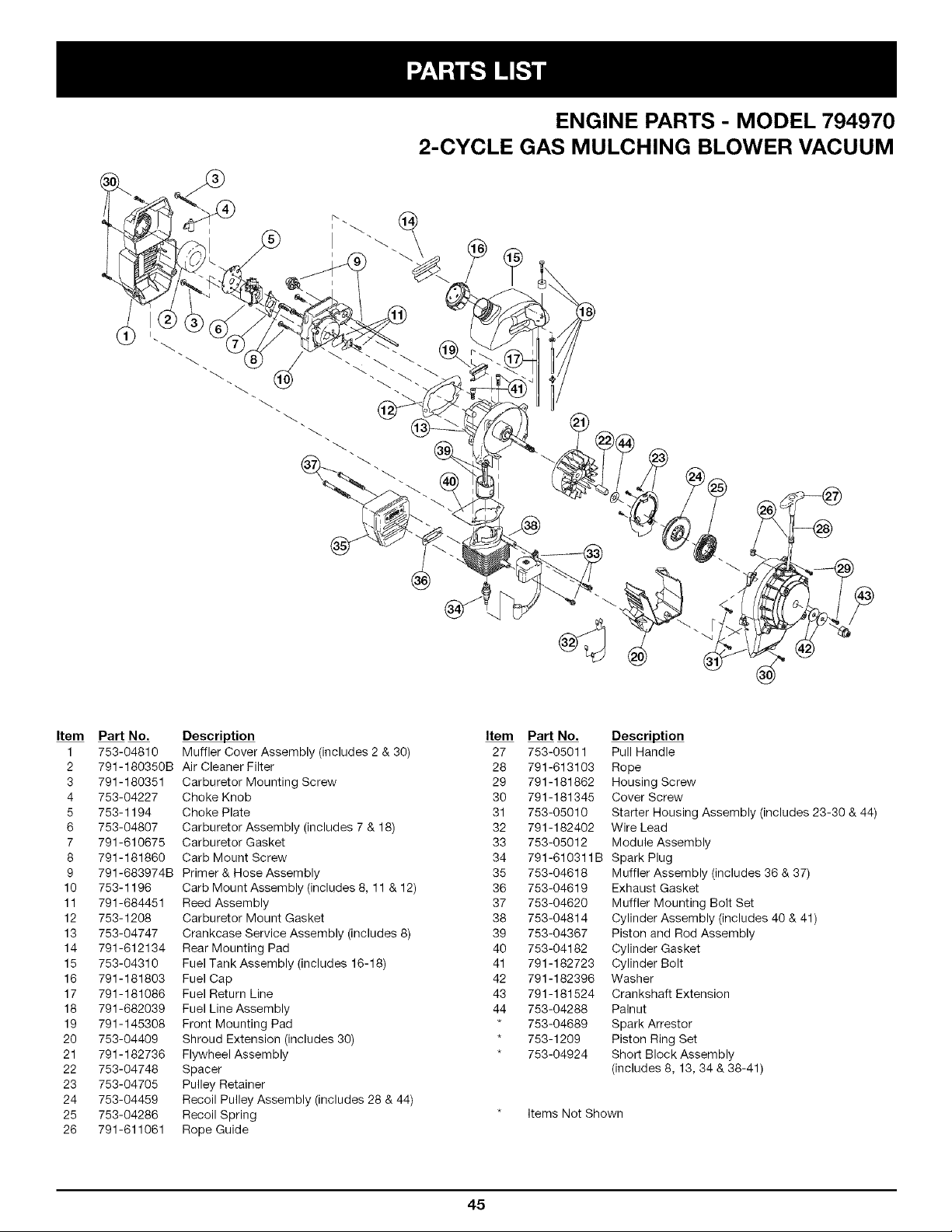
ENGINE PARTS - MODEL 794970
2-CYCLE GAS MULCHING BLOWER VACUUM
Item PaN No.
1 753-04810
2 791-180350B
3 791-180351
4 753-04227
5 753-1194
6 753-04807
7 791-610675
8 791-181860
9 791-683974B
10 753-1196
11 791-684451
12 753-1208
13 753-04747
14 791-612134
15 753-04310
16 791-181803
17 791-181086
18 791-682039
19 791-145308
20 753-04409
21 791-182736
22 753-04748
23 753-04705
24 753-04459
25 753-04286
26 791-611061
Description
Muffler Cover Assembly (includes 2 & 30)
Air Cleaner Filter
Carburetor Mounting Screw
Choke Knob
Choke Plate
Carburetor Assembly (includes 7 & 18)
Carburetor Gasket
Carb Mount Screw
Primer & Hose Assembly
Carb Mount Assembly (includes 8, 11 & 12)
Reed Assembly
Carburetor Mount Gasket
Crankcase Service Assembly (includes 8)
Rear Mounting Pad
Fuel Tank Assembly (includes 16-18)
Fuel Cap
Fuel Return Line
Fuel Line Assembly
Front Mounting Pad
Shroud Extension (includes 30)
Flywheel Assembly
Spacer
Pulley Retainer
Recoil Pulley Assembly (includes 28 & 44)
Recoil Spring
Rope Guide
Item PaN No.
27 753-05011
28 791-613103
29 791-181862
30 791-181345
31 753-05010
32 791-182402
33 753-05012
34 791-610311B
35 753-04618
36 753-04619
37 753-04620
38 753-04814
39 753-04367
40 753-04182
41 791-182723
42 791-182396
43 791-181524
44 753-04288
753-04689
753-1209
753-04924
Description
Pull Handle
Rope
Housing Screw
Cover Screw
Starter Housing Assembly (includes 23-30 & 44)
Wire Lead
Module Assembly
Spark Plug
Muffler Assembly (includes 36 & 37)
Exhaust Gasket
Muffler Mounting Bolt Set
Cylinder Assembly (includes 40 & 41)
Piston and Rod Assembly
Cylinder Gasket
Cylinder Bolt
Washer
Crankshaft Extension
Palnut
Spark Arrestor
Piston Ring Set
Shor_ Block Assembly
(includes 8, 13, 34 & 38-41)
Items Not Shown
45
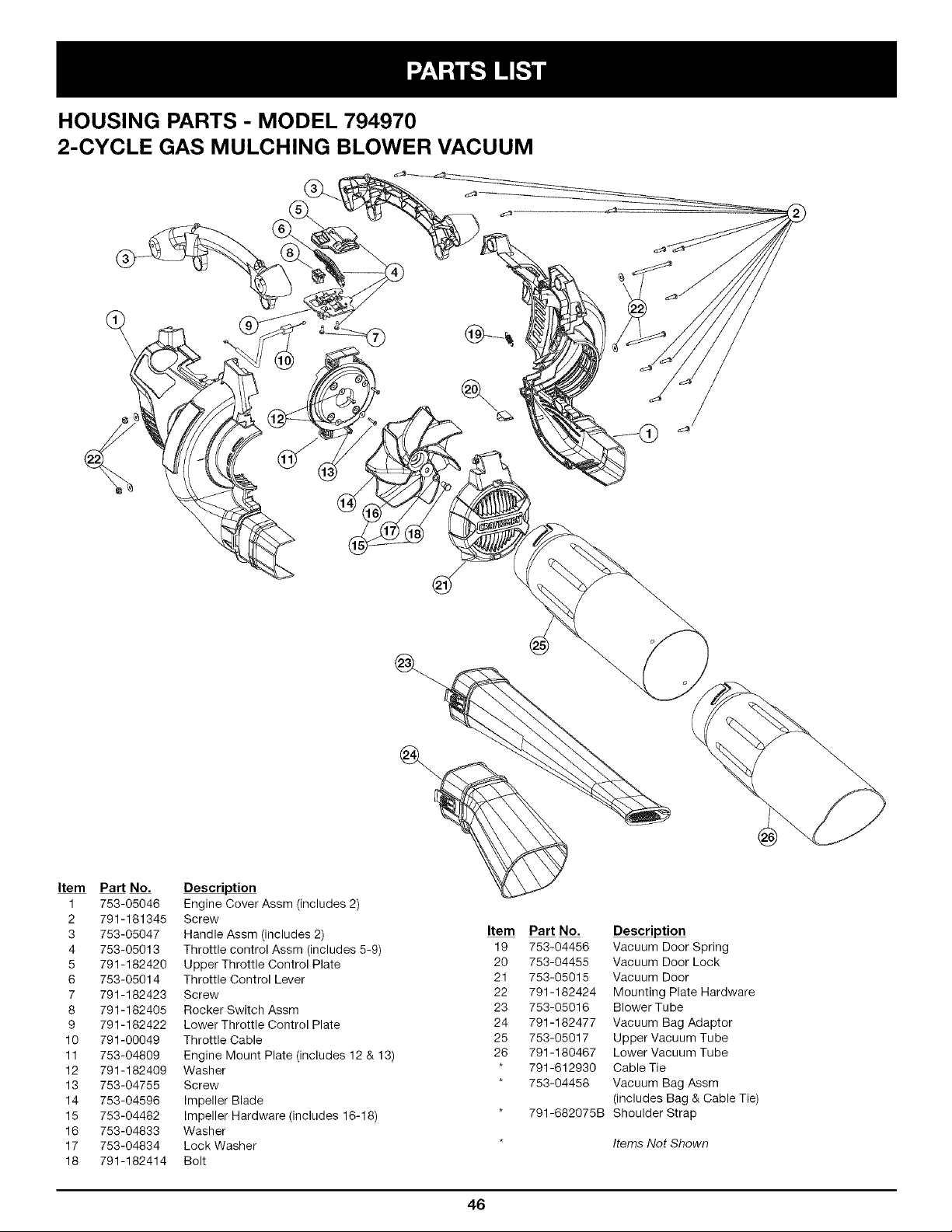
HOUSING PARTS - MODEL 794970
2-CYCLE GAS MULCHING BLOWER VACUUM
Item Part No. Description
1 753-05046 Engine Cover Assm (includes 2)
2 791-181345 Screw
3 753-05047 Handle Assm (includes 2)
4 753-05013 Throttle control Assm (includes 5-9)
5 791-182420 Upper Throttle Control Plate
6 753-05014 Throttle Control Lever
7 791-182423 Screw
8 791-182405 Rocker Switch Assm
9 791-182422 Lower Throttle Control Plate
10 791-00049 Throttle Cable
11 753-04809 Engine Mount Plate (includes 12 & 13)
12 791-182409 Washer
13 753-04755 Screw
14 753-04596 Impeller Blade
15 753-04482 Impeller Hardware (includes 16-18)
16 753-04833 Washer
17 753-04834 Lock Washer
18 791-182414 Bolt
Item Part No.
19 753-04456
20 753-04455
21 753-05015
22 791-182424
23 753-05016
24 791-182477
25 753-05017
26 791-180467
791-612930
753-04458
791-682075B
Description
Vacuum Door Spring
Vacuum Door Lock
Vacuum Door
Mounting Plate Hardware
Blower Tube
Vacuum Bag Adaptor
Upper Vacuum Tube
Lower Vacuum Tube
Cable Tie
Vacuum Bag Assm
(includes Bag & Cable Tie)
Shoulder Strap
Items Not Shown
46
Repair Protection Agreements
Congratulations on making a smart purchase.
Your new Craftsman ®product is designed and
manufactured for years of dependable opera-
tion. But like all products, it may require repair
from time to time. That's when having a Repair
Protection Agreement can save you money and
aggravation.
Purchase a Repair Protection Agreement now
and protect yourself from unexpected hassle
and expense.
Here's what's included in the Agreement:
[] Expert service by our 12,000 professional
repair specialists
[] Unlimited service and no charge for parts
and labor on all covered repairs
[] Product replacement if your covered prod-
uct can't be fixed
[] Discount of 10% from regular price of
service and service-related parts not cov-
ered by the agreement; also, 10% off regular
price of preventive maintenance check
[] Fast help by phone - phone support from a
Sears technician on products requiring in-home
repair, plus convenient repair scheduling
Once you purchase the Agreement, a simple
phone call is all that it takes for you to schedule
service. You can call anytime day or night, or
schedule a service appointment online.
Sears has over 12,000 professional repair spe-
cialists, who have access to over 4.5 million
quality parts and accessories. That's the kind of
professionalism you can count on to help pro-
long the life of your new purchase for years to
come. Purchase your Repair Protection Agree-
ment today!
Some limitations and exclusions apply.
For prices and additional information call
1-800-827-6655.
Sears Installation Service
For Sears professional installation of home
appliances, garage door openers, water heaters,
and other major home items, in the U.S.A. call
1-800-4-MY-HOME®
Convenios de Cobertura de Gastos para Reparaciones
Felicidades por haber hecho una compra inteligente. Su
nuevo producto Craftsman est,. diseSado y fabricado
para que opere de manera confiable durante aSos. Pero
como todos los productos, pudiera necesitar una
reparaci6n cada cierto tiempo. Por eso el tener un
Convenio de Cobertura de Gastos para Reparaciones
puede ahorrarle dinero y disgustos.
Adquiera un Convenio de Cobertura de Gastos para
Reparaciones ahora y prot_jase de problemas y gastos
inesperados.
He aqui Io que incluye el Convenio:
- Servicio proporcionado por nuestros 12.000
especialistas expertos en reparaciones profesionales
- Servicio ilimitado sin cargos por piezas ni mano de
obra, en todas las reparaciones cubiertas
- Reemplazo del producto, si sus productos
cubiertos no pueden arreglarse
- Descuento del 10% del precio regular del servicio y
de piezas relacionadas con el servicio no cubiertas
por el convenio; adem_.s, descuento del 10% del
precio regular de los chequeos de mantenimiento
preventivo
- Ayuda rapida por tel_fono: apoyo telef6nico por
parte de un t6cnico de Sears en los productos que
requieren reparaci6n en el hogar, adem_.s de la
programaci6n de la reparaci6n a una hora
conveniente
Una vez que usted adquiera el Convenio, basta con una
Ilamada telef6nica para programar el servicio. Usted
puede Ilamar a cualquier hora del dia o de la noche, o
programar por Internet una cita para el servicio.
Sears tiene m_.s de 12.000 especialistas en reparaciones
profesionales, que tienen acceso a m_.s de 4,5 millones
de piezas y accesorios de calidad. Ese es el tipo de
profesionalismo con el que usted puede contar para
ayudar a prolongar la vida Qtil de su nueva adquisici6n
durante afios, iAdquiera hoy mismo su Convenio de
Cobertura de Gastos para Reparaciones!
Se aplican algunas limitaciones y exclusiones. Para
precios e informaci6n adicional, Ilame al 1-800-827-
6655.
Servicio de Instalaci6n de Sears
Para la instalaci6n por parte de profesionales de Sears
de efectos electrodom6sticos; abridores de puertas de
garaje, calentadores de agua y dem_.s articulos
dom6sticos de mayor cuantia, en los EE.UU., Ilame al
1-800-4-MY-HOME ®.
47

iiiiiiiiiiiiiiiiiiiiiiiz¸_:¸¸¸
iiiiiiiiiiiiiiiiiii' Your Home
iiiiiiiiiiiiiiiiii Forrepair--inyourhome--ofall majorbrandappliances iiiiiiiiiiiiiiiiiiii
iiiiiiiiiiiiiiiiii lawn and garden equipment orheating and cooling systems iiiiiiiiiiiiiiiiiiiiiiiiiiiiiiiiiiiii
iiiiiiiiiiiiiiiiii nomatterwhomadeit, nomatterwhosoldit! iiiiiiiiiiiiiiiiiiiiiiiiiiiiiiiiiiiii
iiiiiiiiiiiiiiiiii Forthereplacement parts accessoriesand iiiiiiiiiiiiiiiiiiiiiiiiiiiiiiiiiiiil
iiiiiiiiiiiiiiiiii owner'smanualsthatyou needtodo-it-yourself, iiiiiiiiiiiiiiiiiiiiiiiiiiiiiiiiiiiii
iiiiiiiiiiiiiiiiii ForSearsprofessional installationofhomeappliances iiiiiiiiiiiiiiiiiii
iiiiiiiiiiiiiiiiii anditemslikegaragedooropenersandwaterheaters, iiiiiiiiiiiiiiiiiiiiiiiiiiiiiiiiiiiii
1-800-4-MY-HOME ® (1-800-469-4663) iiiiiiiiiiiiiiiiiiiiiiiiiiiiiiiiiiiii
iiiiiiiiiiiiiiiiii Callanytime, dayornight(U.S.A, andCanada) iiiiiiiiiiiiiiiiiiiiiiiiiiiiiiiiiiii
iiiiiiiiiiiiiiiiii www.sears.com www.sears.ca ililililililililililililililililili!
Our Home ii
Forrepairofcarry-in itemslikevacuums, lawnequipment, iiiiiiiiii:iiiiiiiiii
!!!!!!!!!!!!!!!!!i andelectronics, call orgoon-lineforthelocationofyournearest iiiilililililililililililiiiil;i:il
i Sears Parts & Repair Center iiiiiiiiiiiiiiiiiii
1-800-488-1222
iiiiiiiiiiiiiiiiiii Call any time, day or night (U.S.A. only) iiiiiiiiiiiiiiiiiii
iiiiiiiiiiiiiiiiiii www.sears.corn iiiiiiiiiiiiiiiiiii
ii TO purchase a protection agreement (U.S.A.) iiiiiiiiiiiiiiiiii
iiiiiiiiiiiiiiiiiii or maintenance agreement (Canada)on a product serviced by Sears: iiiiiiiiiiiiiiiiiii
1-800-827-6655 (U.S.A.) 1-800-361-6665 (Canada)
iiiiiiiiiiiiiiiiiii................................. iiiiiiiiiiiiiiiiiii
Para peclir servicio de reparacion Au Canada pour service en francais:
a domicilio y para ordenar piezas: 1-800-LE-FOYER Me °
1-800-SU-HOGAR sM (1-800-533-6937)
(1-888-784-6427) www.sears.ca
CbRegistered Trademark / TM Trademark / SM Service Mark of Sears Brands, LLC
CbMama Registrada / TM Marca de Fabrica / SM Mama de Servicio de Sears Brands, LLC
MC Marque de commerce / MC Marque deposee de Sears Brands, LLC
© Sears Brands, LLC
48