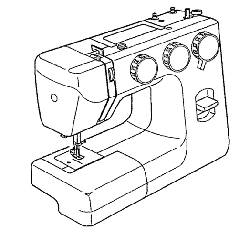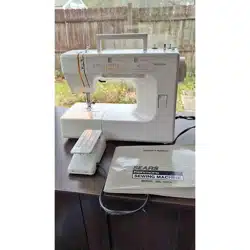
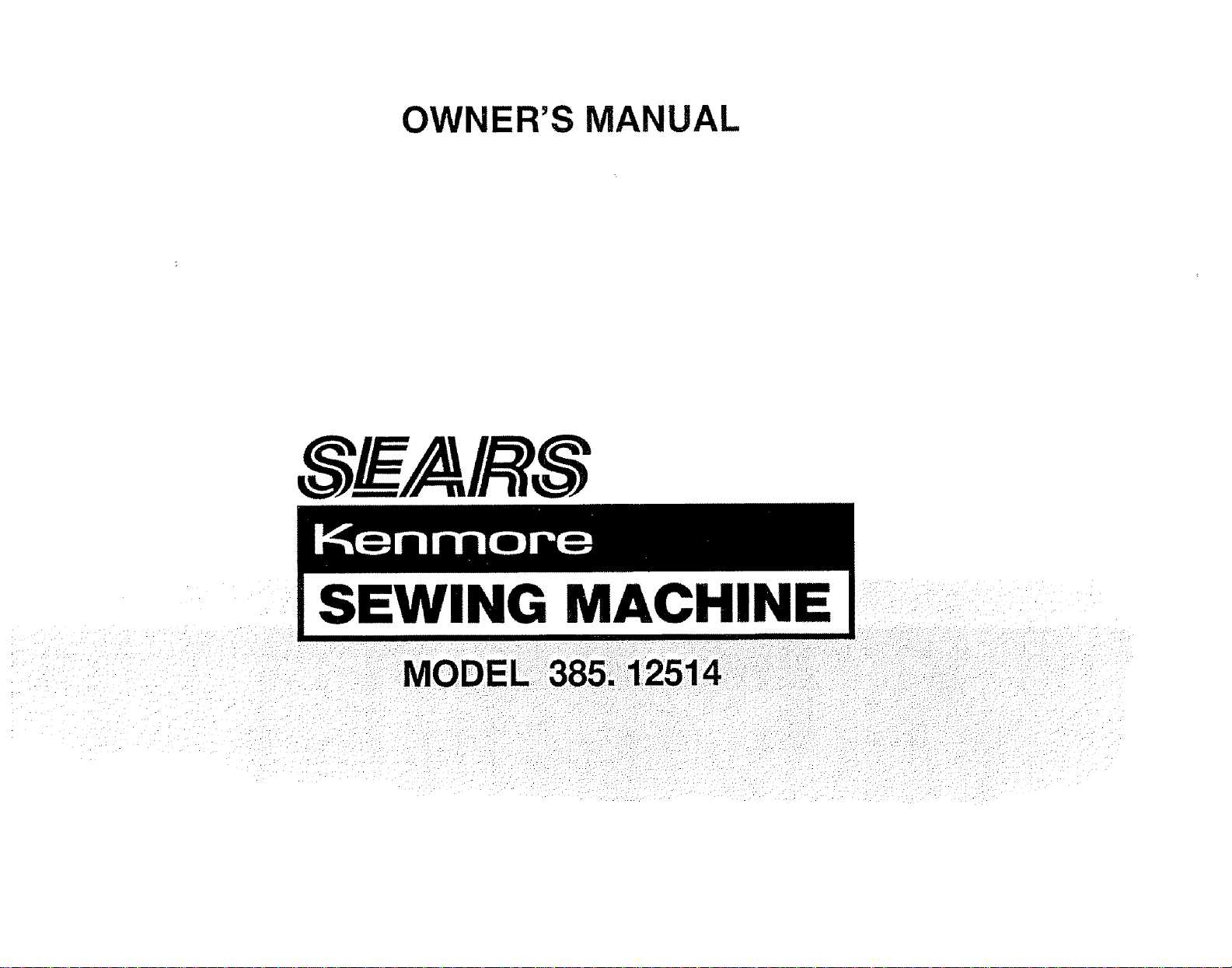
OWNER'S MANUAL
SEA/RS
SEWING MACHINE
MODEL 3 4
SEARS, ROEBUCKANDCO.
Dear Customer:
You have just invested in a very fine z_gzag sewing machine. Before using your new Kenmore machine,
please pause for a moment and carefully read this booklet Which contains instructions on how to operate
and care for your machine.
Specific instructions are given on threading, tension adjustments, cleaning, oiling, etc. This will help you
obtain the best sewing results and avoid unnecessary service expense for conditions beyond our control.
Advice on the operation and care of your machine is always available at your nearest Sears Retail Store.
Please remember, if you have q,#estions about your machine or need parts and service, always mention
the model number and serial number when you inquire.
Kenmore Sewing Machine
Record in space provided below t he model number and serial
number of this appliance. The model number and serial number
are located on the nomenclature plate, as identified on Page 4 of
this booklet.
Model No. 385. Seria{ No.
Retain these numbers lot future reference.
THIS MODEL IS A CENTER NEEDLE, LOW BAR SEWING MACHINE.
IMPORTANT SAFETY
INSTRUCTIONS
Your sewing machine is designed and constructed only for HOUSEHOLD use.
Read all instruction before using this sewing machine.
DANGER--toreduce the risk ot electric shock:
1. An appliance should never be left unattended when pluggedin_ Always
unplug this appliance from the electric outlet immediately after using and
before cleaning.
2. Always unplug before relampmg. Replace bulb with same type rated 15
Watts.
3. Do not reach |or the appliance that has fallen into water. Unplug
immediately.
4. Do not place or store appliance where it can fall or be pulled into a tub or
sink. Do not place in or drop into water or other liquid.
|AIAI_ l_! I<"L_
vv n , -To reducetheriskofburns,fire,electr,cshock,
or iniury to persons.
1. Do not allow to be used as a toy. Close attention is necessary when this
appliance is used by or near children.
2. Use this appliance only for its intended use as described in this manual.
Use only attachments recommended by the manufacturer as contained in
this manual.
3. Never operate this appliance if it has a damaged cord or plug, if it is not
working properly, if it has been dropped or damaged, or dropped into
water. Return the appliance to the nearest authorized dealer or service
center lorexamination, repair, electrical or mechanical adiustment.
4. Never operate the appliance with any air opening blocked. Keep
ventilation openings of the sewing machine and foot controller tree from
accumulation of lint, dust, and loose cloth.
5. Never drop or insert any object into any opening.
6. Do not use outdoors.
7. Do not operate where aerosol (spray) products are being used or where
oxygen is being administered.
8. To disconnect, turn all controls to the off f'*0"*) position, then remove plug
lrom outlet.
9. De not unplug by pulling on cord. To unplug, grasp the plug, not the cord.
I0. Keep fingers away from all moving parts. Special care is required around
the sewing machine needle.
11. Always use the proper needle plate. The wrong plate can cause the
needle to break.
12. Do not use bent needles.
13. Do not pull or push fabric while stitching.
It may deflect the needle causing it to break.
14. Switch the sewing machine off {"0-) when making any adjustment in the
needle area, such as threading needle, changing needle, threading
bobbin, or changing presser foot, and the like.
15.
Always unplug the sewing machine from the electrical outlet when
removing covers, lubricating, or when making any other adjustments
mentioned in the instruction manual.
SAVE THESE INSTRUCTIONS
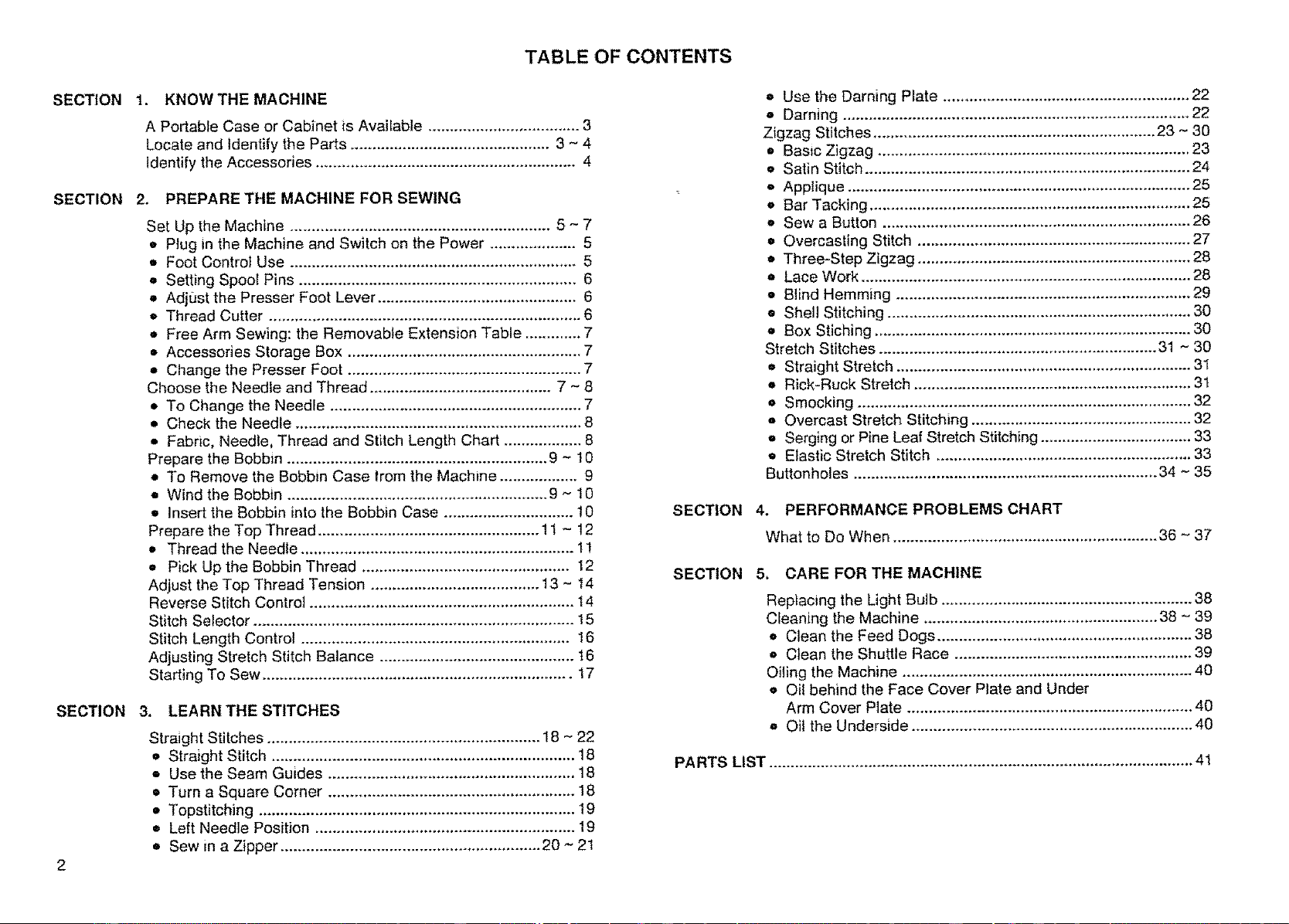
TABLE OF CONTENTS
SECTION 1. KNOW THE MACHINE
A Portable Case or Cabinet is Available ................................... 3
Locate and Identify the Parts .............................................. 3 - 4
Identify the Accessories ............................................................ 4
SECTION 2. PREPARE THE MACHINE FOR SEWING
Set Up the Machine ............................................................ 5 - 7
• Plug in the Machine and Switch on the Power .................... 5
g Foot Control Use .................................................................. 5
• Setting Spoof Pins ................................................................ 6
• Adjt_st the Presser Foot Lever .............................................. 6
• Thread Cutter ........................................................................ 6
= Free Arm Sewing: the Removable Extension Table ............. 7
• Accessories Storage Box ...................................................... 7
• Change the Presser Foot ...................................................... 7
Choose the Needle and Thread .......................................... 7 - 8
• To Change the Needle .......................................................... 7
Check the Needle .................................................................. 8
• Fabric, Needle, Thread and Stitch Length Chart .................. 8
Prepare the Bobbin ............................................................ 9 - 10
• To Remove the Bobbin Case from the Machine .................. 9
• Wind the Bobbin ............................................................ 9 ~ t0
• insert the Bobbin into the Bobbin Case .............................. 10
Prepare the Top Thread ................................................... 11 - 12
• Thread the Needle ............................................................... ll
• Pick Up the Bobbin Thread ................................................ 12
Adjust the Top Thread Tension ....................................... 13 - 14
Reverse Stitch Control ............................................................. 14
Stitch Selector .......................................................................... 15
Stitch Length Control .............................................................. 16
Adjusting Stretch Stitch Balance ............................................. 16
Starting To Sew ....................................................................... 17
SECTION 3. LEARN THE STITCHES
Straight Stitches ............................................................... 18 - 22
• Straight Stitch ...................................................................... 18
• Use the Seam Guides ......................................................... 18
= Turn a Square Corner ......................................................... 18
• Topstitching ......................................................................... 19
• Left Needle Position ............................................................ 19
• Sew in a Zipper ............................................................ 20 ~ 21
• Use the Darning Plate ......................................................... 22
• Darning ................................................................................ 22
Zigzag Stitches ................................................................. 23 - 30
• Basic Zigzag ........................................................................ 23
,, Satin Stitch ........................................................................... 24
o Applique ............................................................................... 25
• Bar Tacking .......................................................................... 25
• Sew a Button ....................................................................... 26
o Overcasting Stitch ............................................................... 27
o Three-Step Zigzag ............................................................... 28
• Lace Work ............................................................................ 28
• Blind Hemming .................................................................... 29
• Shell Stitching ...................................................................... 30
e Box Stiching ......................................................................... 30
Stretch Stitches ................................................................ 31 ~ 30
o Straight Stretch .................................................................... 31
• Rick-Ruck Stretch ................................................................ 3t
• Smocking ............................................................................. 32
• Overcast Stretch Stitching ................................................... 32
• Serging or Pine Leaf Stretch Stitching ................................... 33
o Elastic Stretch Stitch ........................................................... 33
Buttonholes ...................................................................... 34 - 35
SECTION 4. PERFORMANCE PROBLEMS CHART
What to Do When ............................................................. 36 ~ 37
SECTION 5, CARE FOR THE MACHINE
Replacing the Light Bulb .......................................................... 38
Cleaning the Machine ...................................................... 38 - 39
• Clean the Feed Dogs ........................................................... 38
• Clean the Shuttle Race ....................................................... 39
Oiling the Machine ................................................................... 40
o Oil behind the Face Cover Plate and Under
Arm Cover Plate .................................................................. 40
• Oil the Underside ................................................................. 40
PA RTS LIST .................................................................................................. 41
SECTION 1. KNOW THE MACHINE
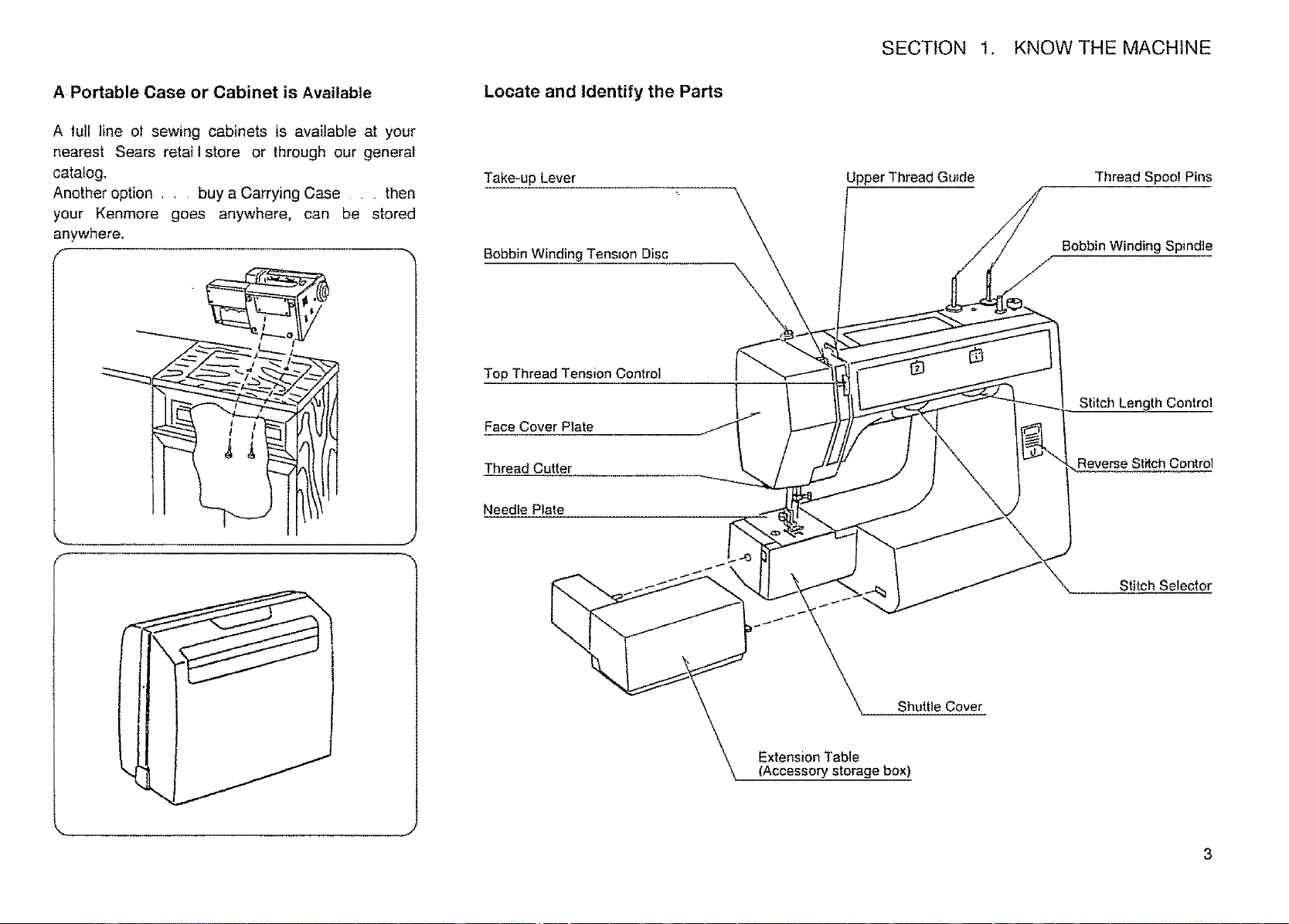
A.Portable Case or Cabinet is Available
A tulf line ot sewing cabinets is available at your
nearest Sears retai lstore or through our general
catalog,
Another option , , , buy a Carrying Case . , then
your Kenmore goes anywhere, can be stored
anywhere.
f
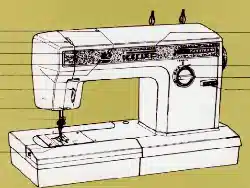
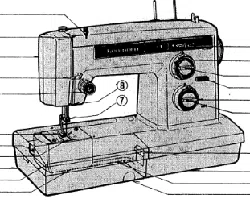
Locate and Identify the Parts
Take-up Lever
Bobbin Winding Tension Disc
\
Top Thread Tension Control
Face Cover Plate
Thread Cutter
Needle Plate
Upper Thread Guide
Shutt}e Cover
Extension Table
(Accessory storage box)
Thread Spool Pins
Bobbin Winding Spindle
Stitch Length Control
Stitch Selector
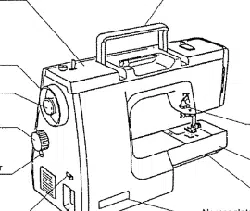
SECTION 1, KNOW THE MACHINE
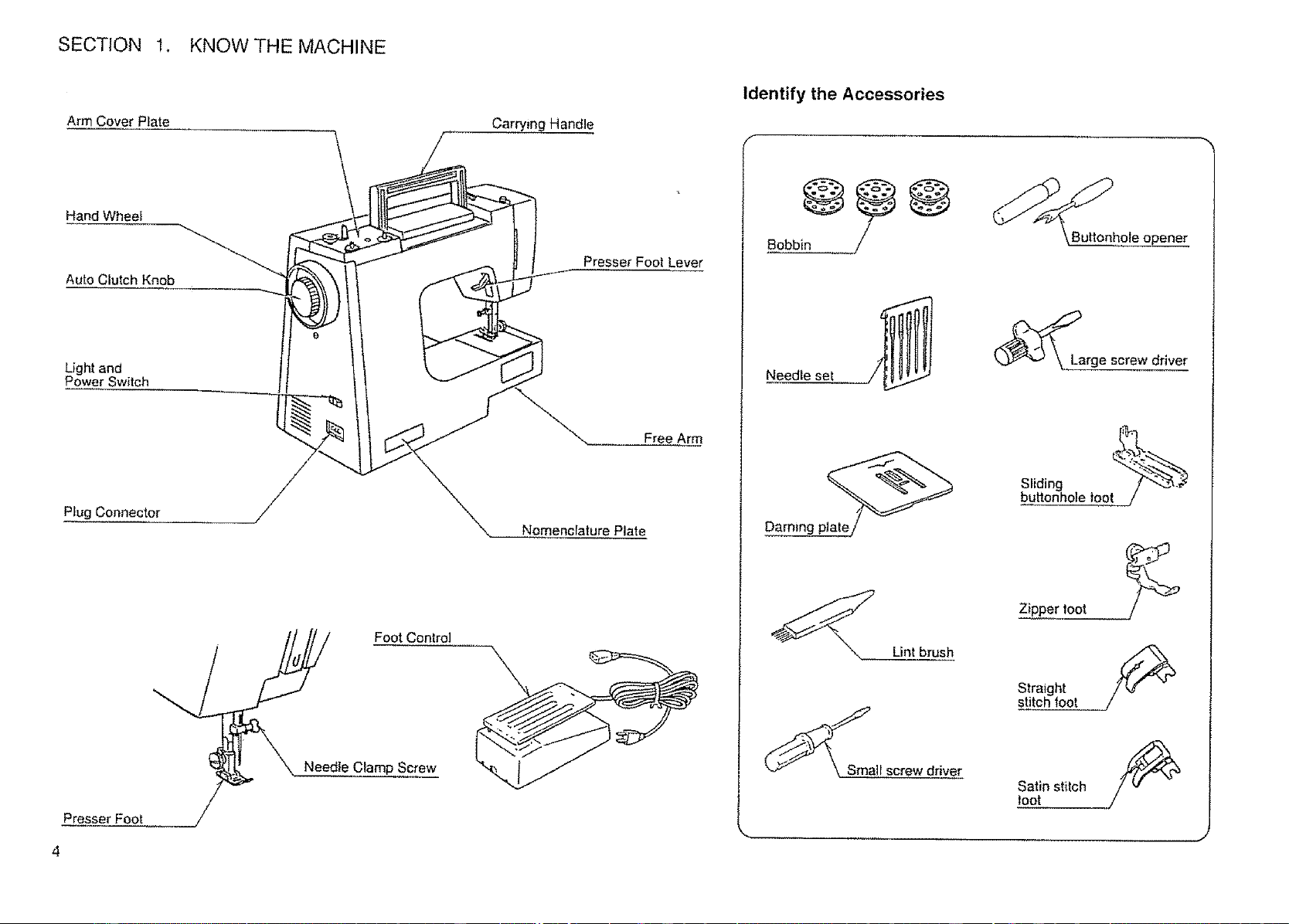
Arm Cover Plate
Hand Wheel
Auto Clutch Knob
Ughl and
Power Switch
Plug Connector
Presser Foot
4
i d
le
Foot Control
Clamp Screw
Carrying Handle
Presser Foot Lever
Free Arm
Nomenclature Plate
\
Identify the Accessories
Needle set_
(__Large screw driver
Darning plate /
__ Lint brush
j.a'o%letooi ' .
Zipper loot
Straight /_
stitch foot
Small screw driver
SECTION 2. PREPARE THE MACHINE FOR SEWING
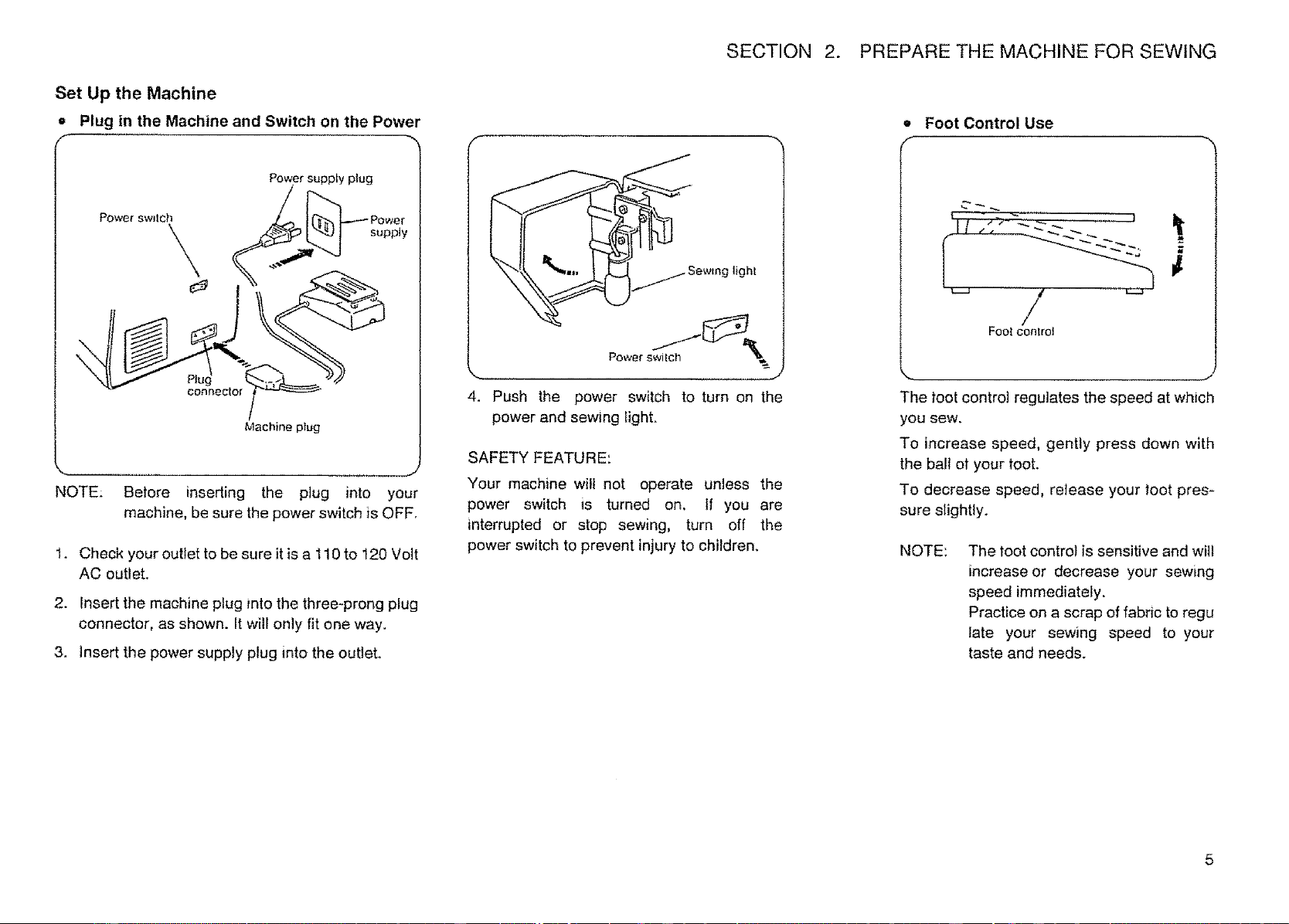
Set Up the Machine
Plug in the Machine and Switch on the Power
f
Power supply plug
Power switch
\
COnnector
supply
Machine p}ug
........ J
NOTE: 8etore inserting the plug into your
machine, be sure the power switch is OFF,
t. Check your outlet to be sure it isa 110 to 120 Volt
AC outlet.
2. Insert the machine plug into the three-prong plug
connector, as shown, it will only fit one way.
3. Insert the power supply plug into the outlet.
Power swilch
%
4. Push the power switch to turn on the
power and sewing light.
SAFETY FEATURE:
Your machine will not operate unless the
power switch is turned on. II you are
interrupted or stop sewing, turn off the
power switch to prevent injury to children.
= Foot Control Use
f
/
Fool control
% /
The foot control regulates the speed at which
you sew.
To increase speed, gently press down with
the bail ot your toot.
To decrease speed, release your toot pres-
sure slightly.
NOTE: The toot control is sensitive and will
increase or decrease your sewing
speed immediately.
Practice on a scrap of fabric to regu
late your sewing speed to your
taste and needs.
SECTION 2. PREPARE THE MACHINE FOR SEWING
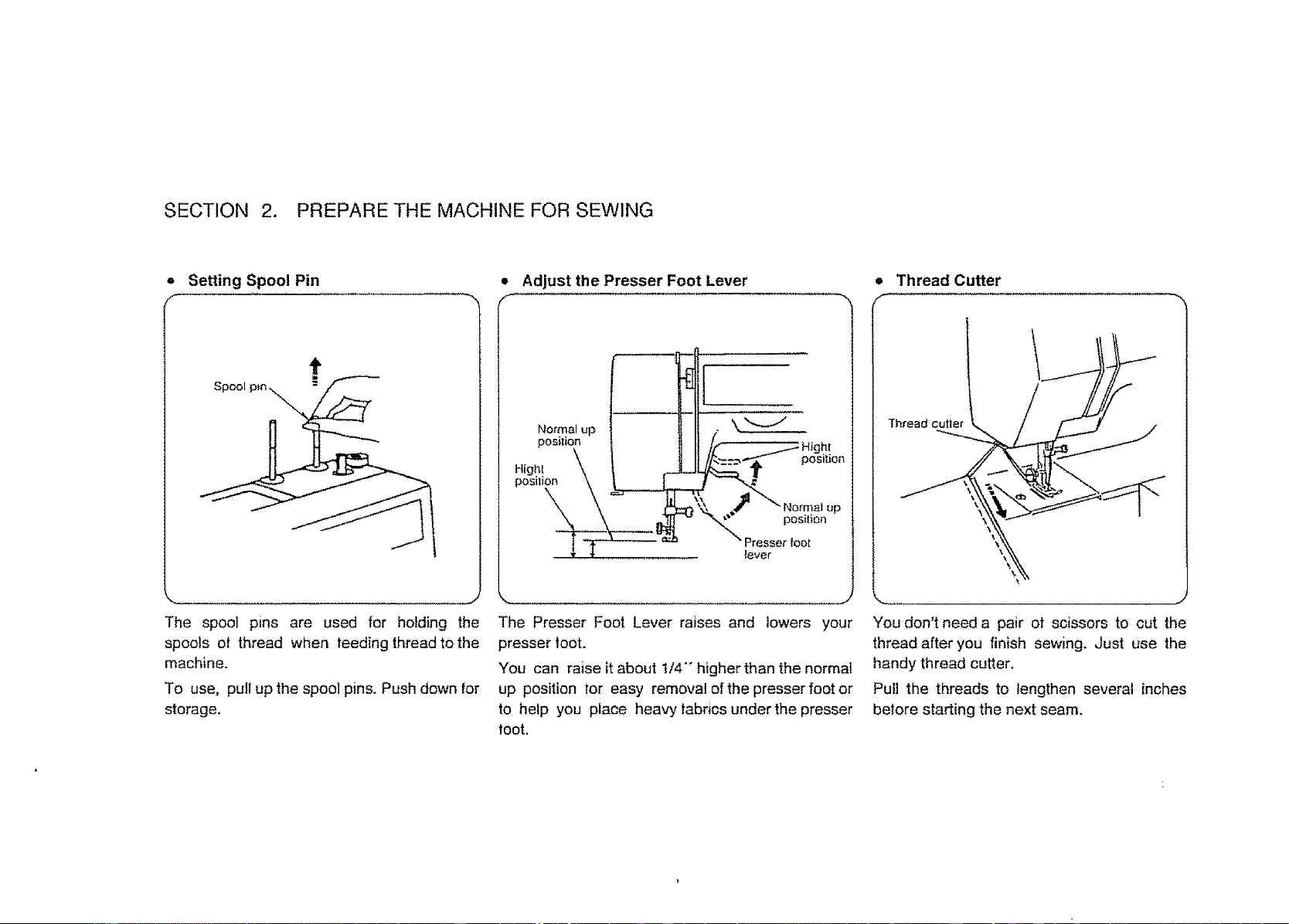
= Setting Spool Pin • Adjust the Presser Foot Lever
f -_ f
t
The spool pins are used for holding the
spools ol thread when teeding thread tothe
machine.
To use, puli up the spool pins. Push down for
storage.
lever
The Presser Foot Lever raises and lowers your
presser toot.
You can raise it about 1/4- higher than the normat
up position tor easy removal of the presser foot or
to help you place heavy fabrics under the presser
toot.
• Thread Cutter
/"
Thread cutter
\
\
You don't need a pair ot scissors to cut the
thread after you finish sewing. Just use the
handy thread cutter.
Pull the threads to lengthen several inches
betore starting the next seam.
SECTION 2. PREPARE THE MACHINE FOR SEWING
Set Up the Machine (Continued)
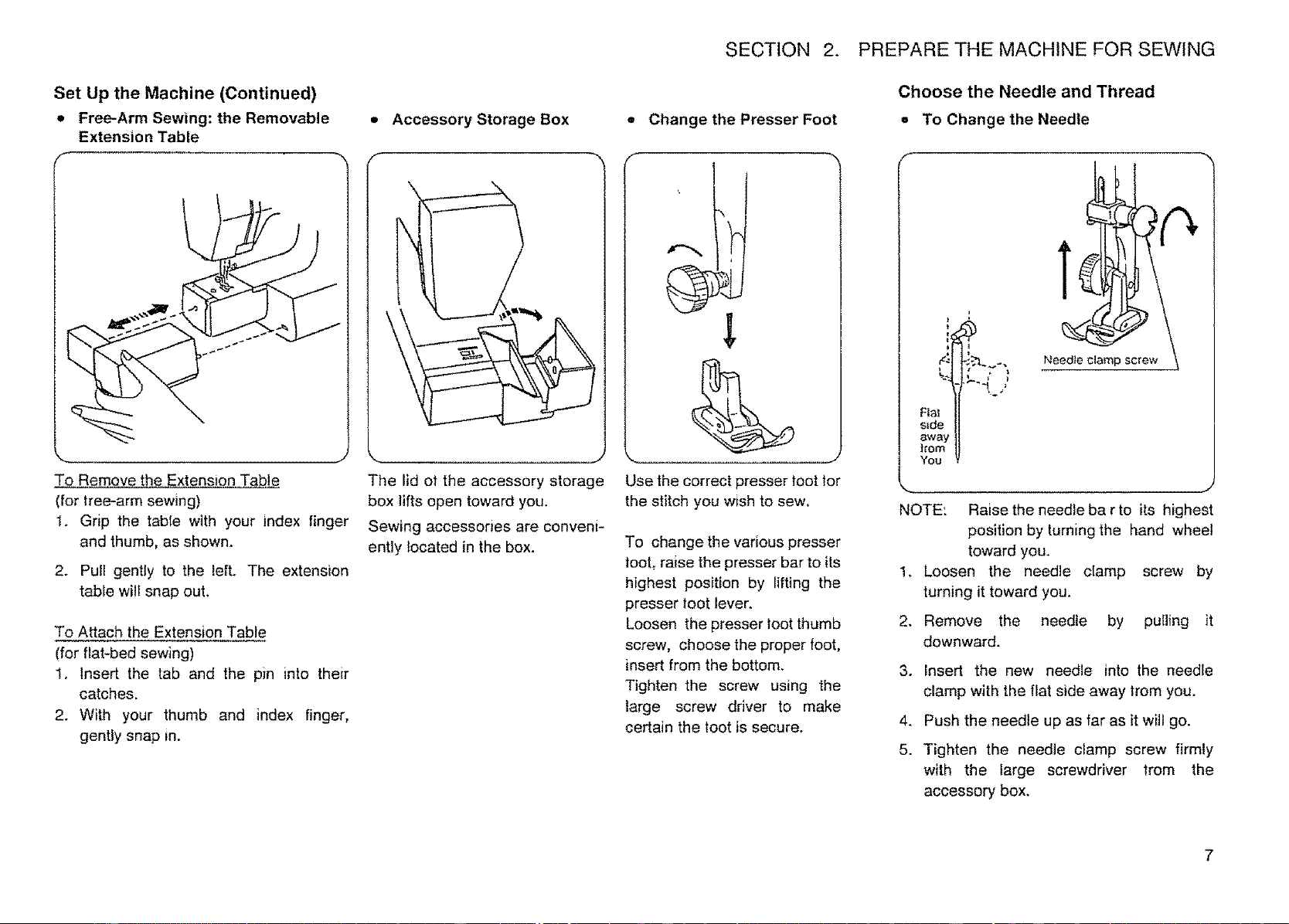
• Free-Arm Sewing: the Removable
Extension Table
f-
J
To Remove the Extension Table
(for free-arm sewing)
1. Grip the table with your index finger
and thumb, as shown.
2. Pull gently to the left. The extension
table will snap out.
To Attach the Extension Table
(for flat-bed sewing)
1. Insert the tab and the pin into their
catches.
2. With your thumb and index finger,
gently snap in.
• Accessory Storage Box
r
J
The lld ot the accessory storage
box lifts open toward you.
Sewing accessories are conveni-
ently located in the box.
• Change the Presser Foot
G
J
Use the correct presser toot for
the stitch you wish to sew,
To change the various presser
foot, raise the presser bar to its
highest position by lifting the
presser foot lever.
Loosen the presser foot thumb
screw, choose the proper foot,
insert from the bottom.
Tighten the screw using the
large screw driver to make
certain the loot is secure.
Choose the Needle and Thread
• To Change the Needle
i t
Fla! l[
s_e [l
away II
_rom 1t
You _.
Needte clamp screw
2.
J
NOTE: Raise the needle bar to its highest
position by turning the hand wheel
toward you.
Loosen the needle clamp screw by
turning it toward you.
Remove the needle by pulling it
downward.
3. Insert the new needle into the needle
clamp with the flat side away from you.
4. Push the needle up as far as it will go.
5. Tighten the needle clamp screw firmly
with the large screwdriver trom the
accessory box.
SECTION 2. PREPARE THE MACHINE FOR SEWING
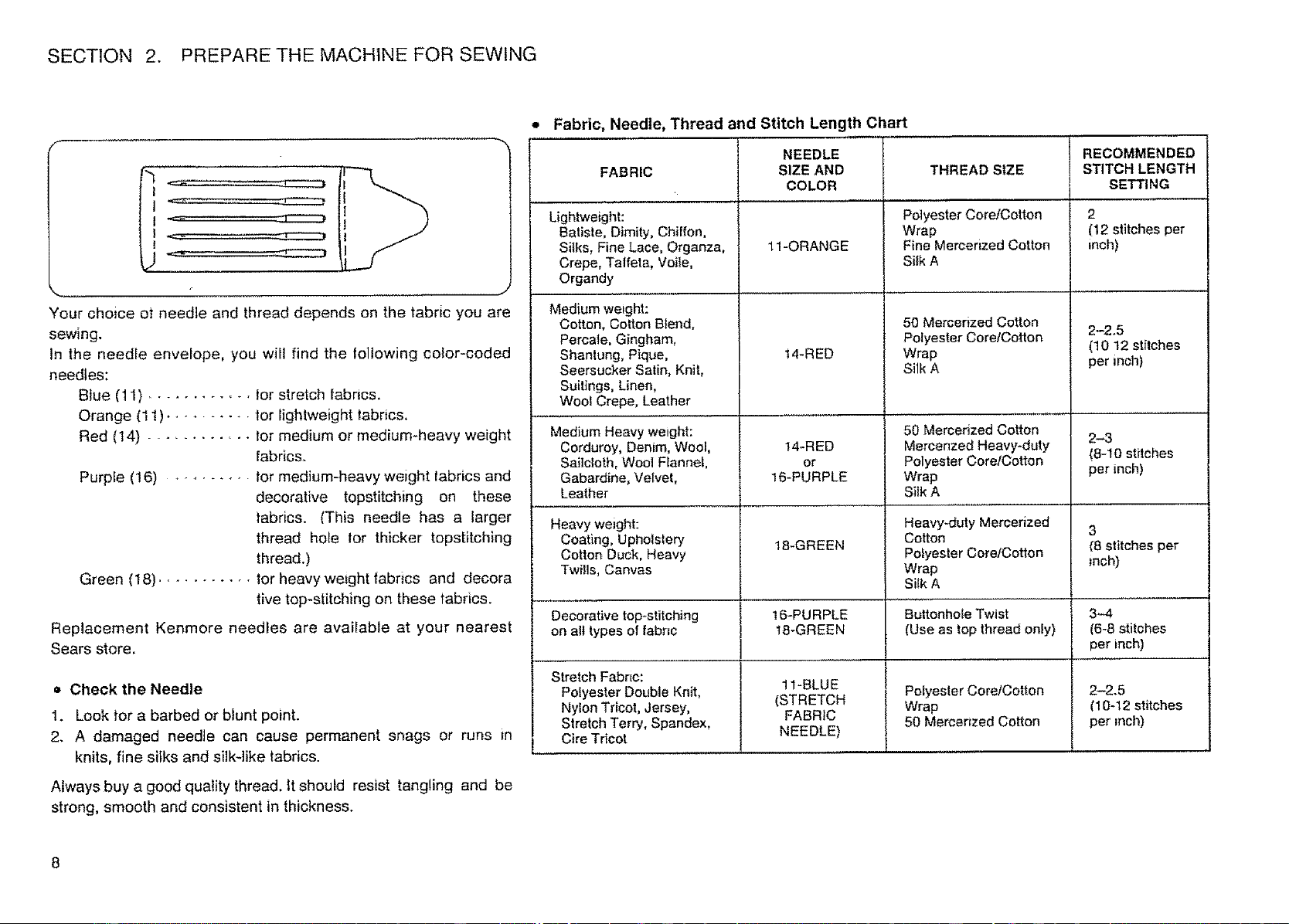
Your choice of needle and thread depends on the fabric you are
sewing.
In the needle envelope, you wilt find the toilowing color-coded
needles:
Blue (11) ............ for stretch fabncs.
Orange (11 ) .......... for lightweight fabrics.
Red (14) ............ for medium or medium-heavy weight
fabrics.
Purple (16) ......... for medium-heavy weight fabrics and
decorative topstitching on these
tabrics. (This needle has a larger
thread hole for thicker topstitchlng
thread.)
Green (18) ........... for heavy weight fabrics and decora
five top-stitching on these fabrics.
Replacement Kenmore needles are available at your nearest
Sears store.
• Check the Needle
1. Look for a barbed or blunt point.
2, A damaged needle can cause permanent snags or runs in
knits, fine silks and silkqike fabrics.
Always buy a good quality thread. It should resist tangling and be
strong, smooth and consistent in thickness,
Fabric, Needle, Thread and Stitch Length Chart
FABRIC
Lightweight:
Batiste, Dimity, Chiffon,
Silks, Fine Lace, Organza,
Crepe, Talfeta, Voile,
Organdy
Medium weight:
Cotton, Cotton Blend,
Percale, Gingham,
Shantung, Pique,
Seersucker Satin, Knit,
Suitings, Linen,
Woot Crepe, Leather
Medium Heavy weight:
Corduroy, Denim, Wool,
Sailcloth, Wool Flannel
Gabardine, Velvet,
Leather
Heavy weight:
Coating, Upholstery
Cotton Duck, Heavy
Twills, Canvas
Decorative top-stitching
on all types of fabric
Stretch Fabric:
Polyester Double Knit,
Nylon Tricot, Jersey,
Stretch Terry, Spandex,
Cire Tricot
NEEDLE
SIZE AND
COLOR
11-ORANGE .....
14-RED
14-RED
or
16-PURPLE
18-GREEN
16-PURPLE
18-GREEN
1 I-BLUE
(STRETCH
FABRIC
NEEDLE)
THREAD SIZE
Polyester CoretCotton
Wrap
Fine Mercerized Cotton
Silk A
50 Mercerized Cotton
Polyester CorelCotton
Wrap
Silk A
50 Mercerized Cotton
Mercenzed Heavy-duty
Polyester CorelCotton
Wrap
Silk A
Heavy-duty Mercerized
Cotton
Polyester CoretCotton
Wrap
Silk A
Buttonhole Twist
(Use as top thread only)
Polyester CoretCotton
Wrap
50 Mercerized Cotton
RECOMMENDED
STITCH LENGTH
SETTING
2
(12 stitches per
inch)
2-2.5
(10 12 stitches
per inch)
2-3
(8-10 stitches
per inch)
3
{8 stitches per
inch)
3_4
16-8 stitches
per inch)
2-2.5
(10-12 stitches
per inch)
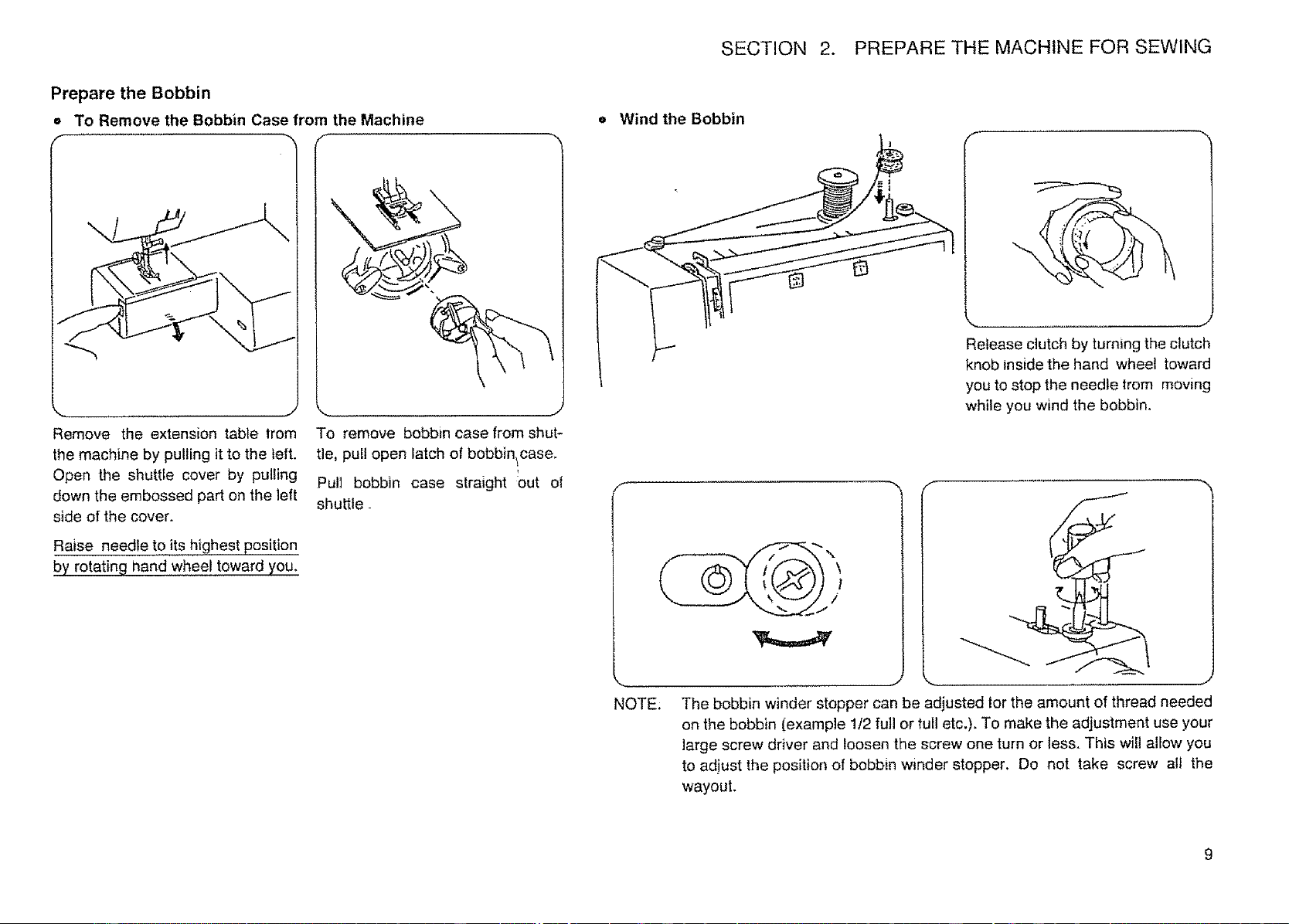
Prepare the Bobbin
= To Remove the Bobbin Case from the Machine
Remove the extension tabte from
the machine by pulling it to the left.
Open the shuttIe cover by pulling
down the embossed part on the left
side of the cover.
Raise needle to its highest position
by rotating hand whee! toward you.
J
To remove bobbin case from shuF
tie, pull open latch of bobbin_case,
Pul] bobbin case straight out ol
shuttle
SECTION 2. PREPARE THE MACHINE FOR SEWING
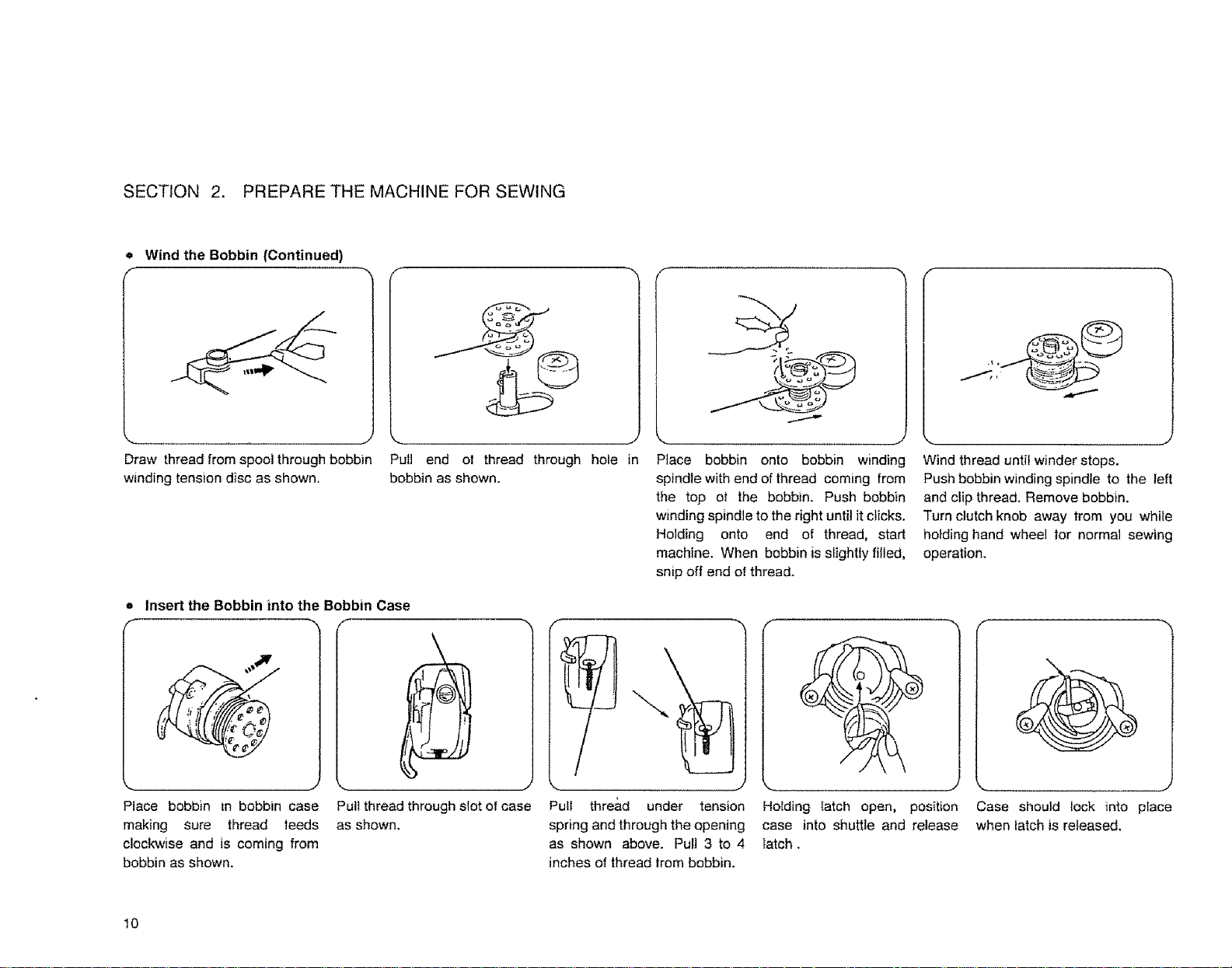
o Wind the Bobbin
Release clutch by turning the clutch
knob inside the hand wheel toward
you to stop the needle trom moving
while you wind the bobbin.
k.
NOTE:
\
fJ
The bobbin winder stopper can be adjusted lor the amount of thread needed
on the bobbin (example 1/2 full or full etc.). To make the adjustment use your
large screw driver and loosen the screw one turn or less. This will allow you
to adjust the position of bobbin winder stopper. Do not take screw all the
wayout.
SECTION 2. PREPARE THE MACHINE FOR SEWING
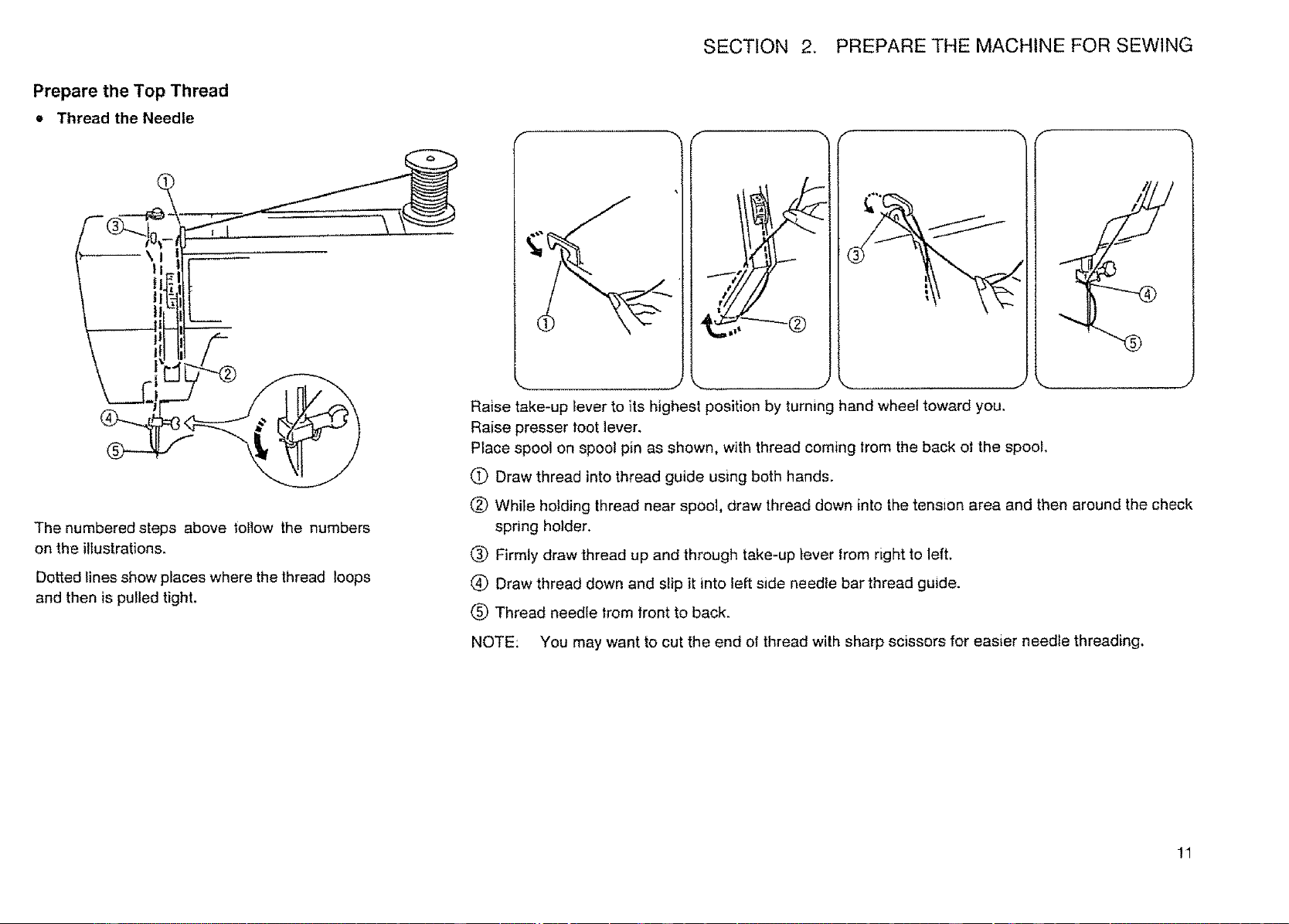
= Wind the Bobbin {Continued)
f
Draw thread from spool through bobbin
winding tension disc as shown.
Pull end ol thread through
bobbin as shown.
J
hole in
7
J
Place bobbin onto bobbin winding
spindle with end of thread coming from
the top ot the bobbin. Push bobbin
winding spindle to the right until it clicks.
Holding onto end of thread, start
machine. When bobbin is sfightly filled,
snip off end of thread.
Wind thread until winder stops.
Push bobbin winding spindle to the left
and clip thread. Remove bobbin.
Turn clutch knob away trom you while
holding hand wheel tor normal sewing
operation.
Insert the Bobbin into the Bobbin Case
Place bobbin in bobbin case
making sure thread leeds
clockwise and is coming from
bobbin as shown.
f
Pull thread through slot of case
as shown.
f
Pull thread under tension
spring and through the opening
as shown above. Pull 3 to 4
inches of thread trom bobbin.
Holding latch open, position
case into shuttle and release
latch.
f
%.. J
Case should lock into place
when latch is released.
10
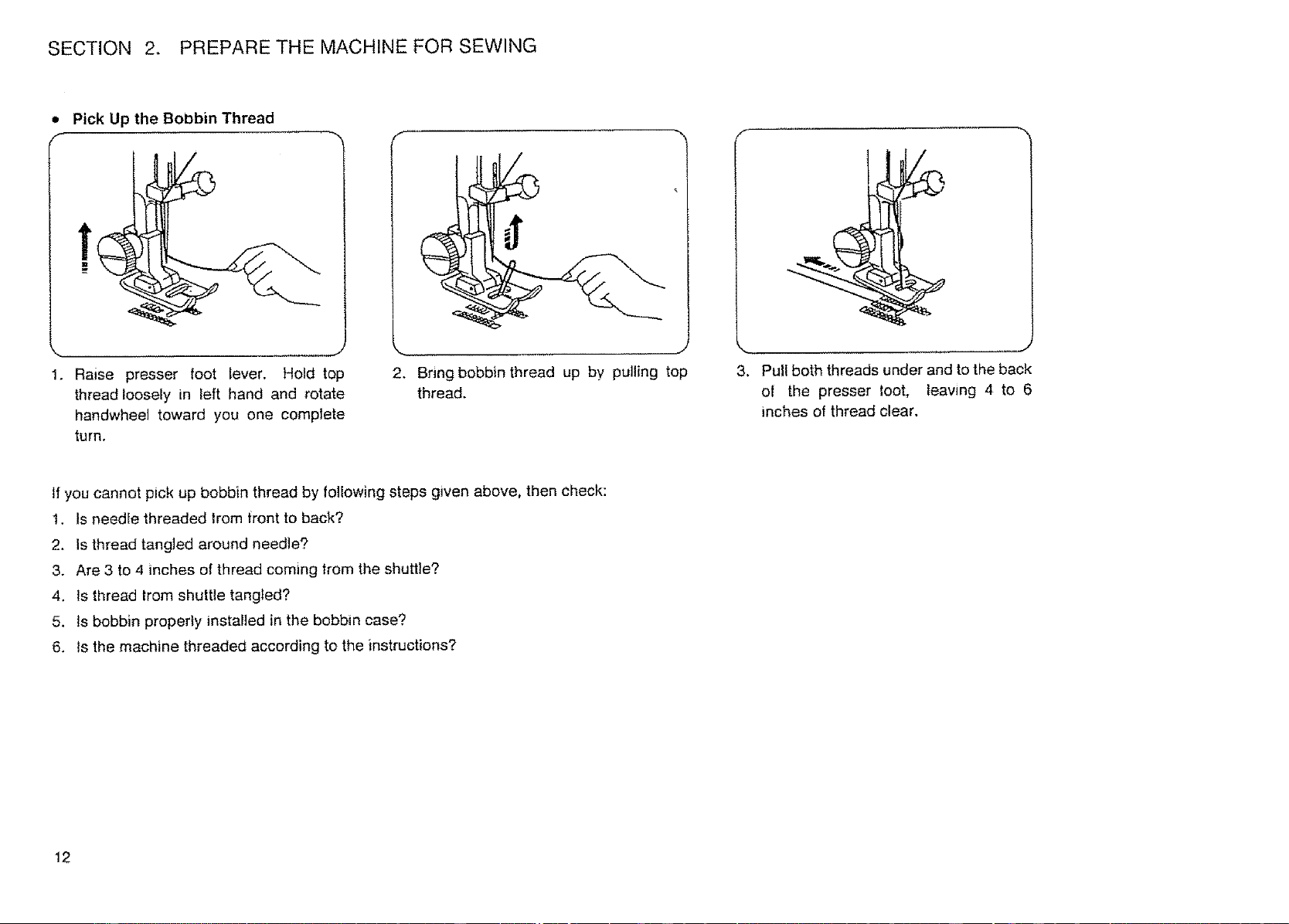
Prepare the Top Thread
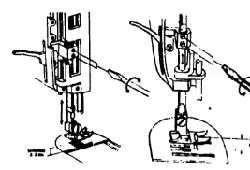
• Thread the Needle
The numbered steps above tollow the numbers
on the illustrations.
Dotted lines show places where the thread loops
and then is pulled tight.
SECTION 2. PREPARE THE MACHINE FOR SEWING
Raise take-up lever to its highest position by turning hand wheel toward you,
Raise presser toot lever,
Place spool on spool pin as shown, with thread coming from the back ot the spool,
(_ Draw thread into thread guide using both hands.
(_ While holding thread near spool, draw thread down into the tension area and then around the check
spring holder,
Firmly draw thread up and through take-up lever from right to left.
4(4(QDraw thread down and slip it into left side needle bar thread guide,
(_) Thread needle trom front to back,
NOTE: You may want to cut the end of thread with sharp scissors for easier needle threading,
11
SECTION 2. PREPARE THE MACHINE FOR SEWING
• Pick Up the Bobbin Thread
T
1. Raise presser foot Iever. Held top
threadloosely in left hand and rotate
handwhee] toward you one complete
turn.
2, Bring bobbin thread up by pulling top
thread.
3. Pull both threads under and to the back
of the presser toot, leaving 4 to 6
inches of thread clear.
If you cannot pick up bobbin thread by following steps given above, then check:
1. Is needle threaded lrom front to back?
2, Is thread tangled around needle?
3. Are 3 to 4 inches of thread coming from the shuttle?
4, Is thread lrom shuttle tangled?
5. Is bobbin property installed in the bobbin case?
6, ls the machine threaded according to the instructions?
12
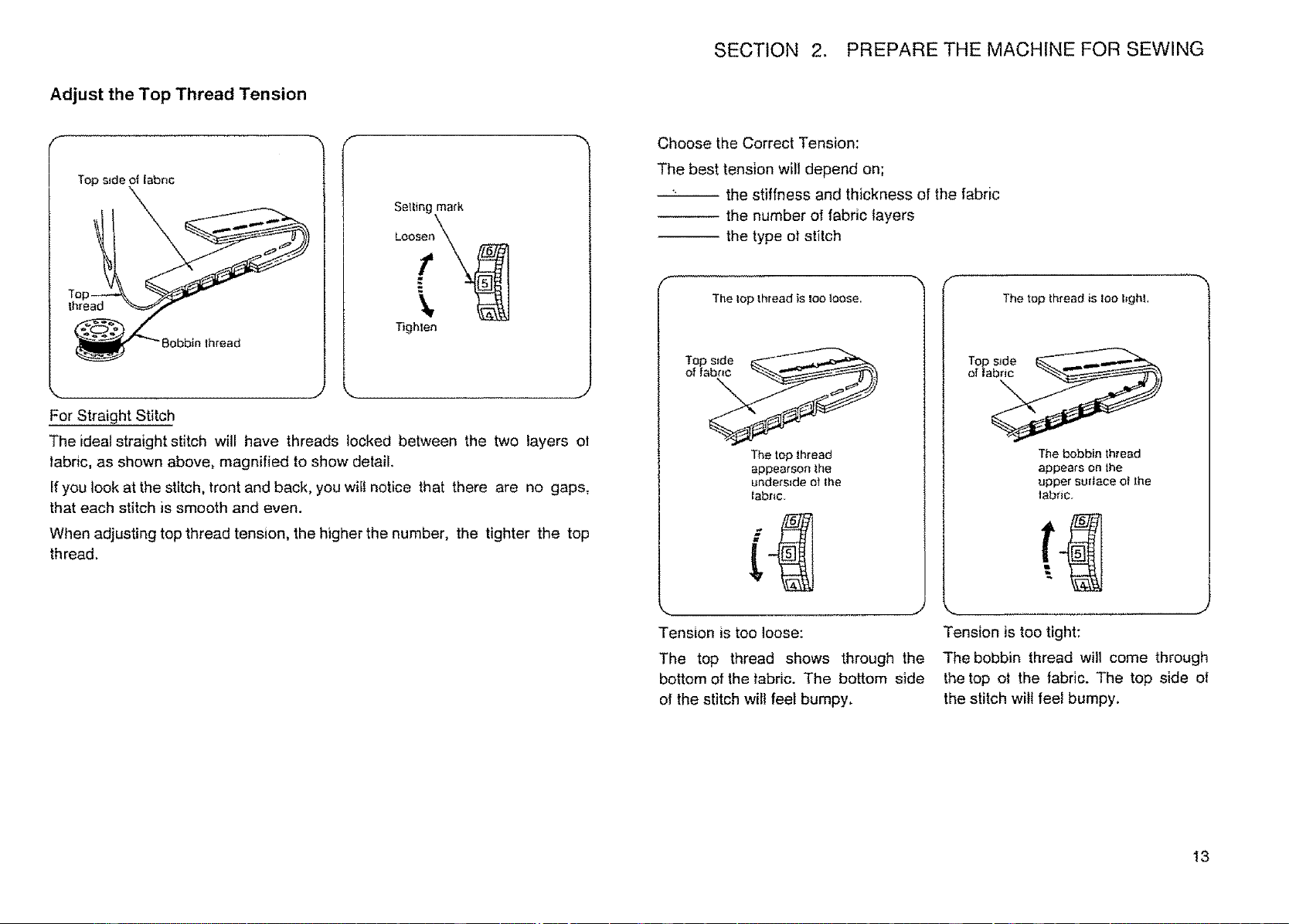
Adjust the Top Thread Tension
Top side of |abnc
ihread
Sei|ing mark
f
Tighlen
For Straight Stitch
The ideal straights|itch wilt have threads locked between the two layers el
tabric, as shown above, magnified to show detail
If you took at the stitch, trent and back, you wifl notice tha_ there are no gaps,
that each stitch is smooth and even.
When adjusting top thread tension, the higher the number, the tighter the top
thread.
SECTION 2. PREPARE THE MACHINE FOR SEWING
Choose the Correct Tension:
The best tension will depend on;
the stiffness and thickness of the fabric
the number of fabric layers
the type el stitch
The lop lhread is leo |oose.
The top lhread
appearson the
underside of Ihe
tabr_c
The top thread is Ioo t_ghl,
The bobbin thread
appears on the
upper surface ot the
Iabric.
Tension is too loose: Tension is too tight:
The top thread shows through the Thebobbin thread will come through
bottom of the fabric. The bottom side the top el the fabric. The top side of
of the stitch will fee_ bumpy, the stitch will feel bumpy.
13
SECTION 2. PREPARE THE MACHINE FOR SEWING
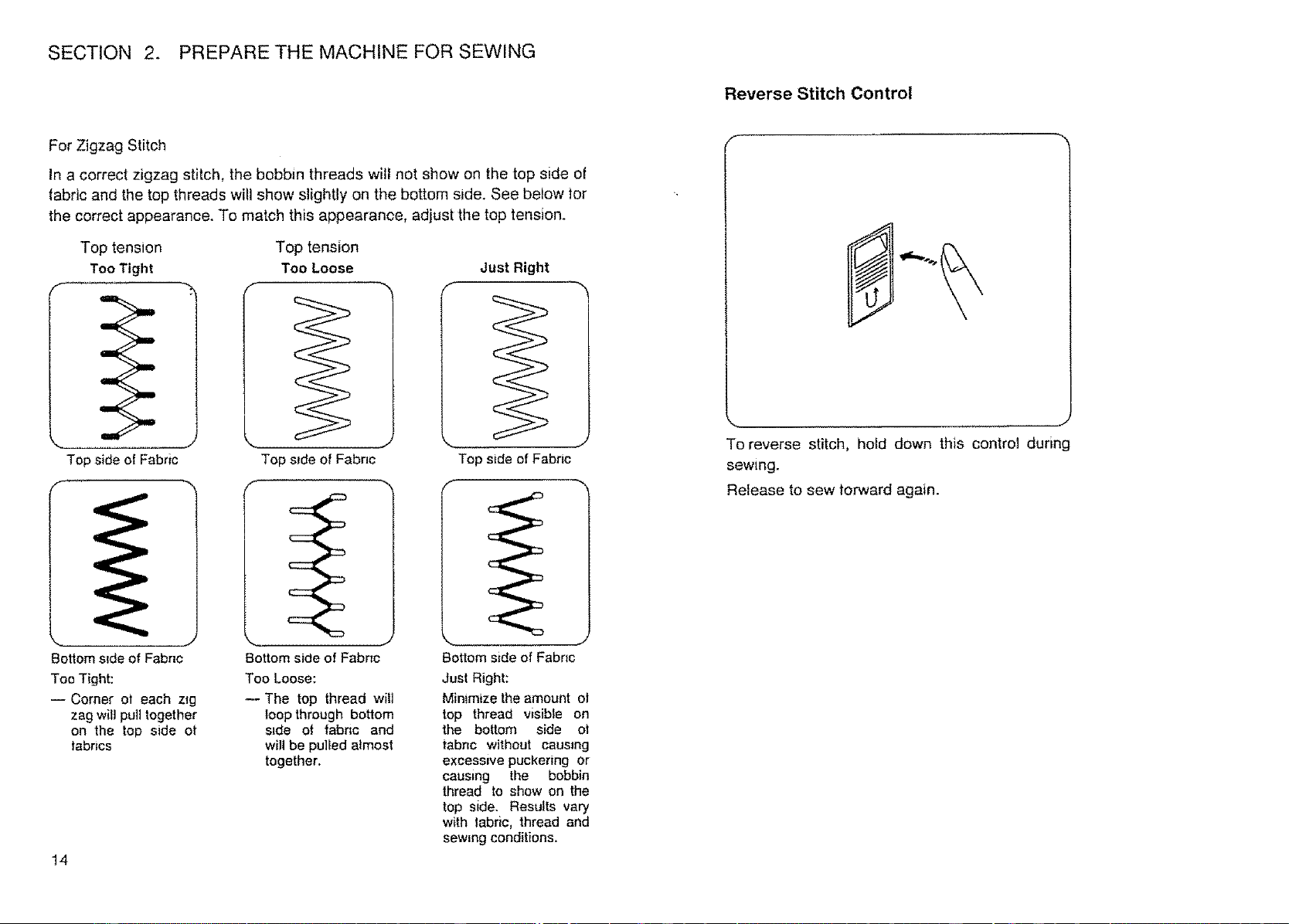
For Zigzag Stitch
In a correct zigzag stitch, the bobbin threads will not show on the top side of
labric and the top threads wifi show slightly on the bottom side. See below lor
the correct appearance. To match this appearance, adjust the top tension.
Top tension Top tension
Too Tight Too Loose
j
Top side of Fabric
Bottom side of Fabric
Too Tight:
--Corner ot each z_g
zag will pull together
on the top side ot
fabrics
f
k_ j
Top side of Fabric
1
Bottom side of Fabric
Too Loose:
--The top thread will
loop through bottom
side ol fabric and
will be pulled almost
together.
14
Just Right
r ".-,
Top side of Fabric
Bottom side of Fabnc
Just Right:
Minimize the amount ol
top thread visible on
the bottom side o_
|abnc without causing
excessive puckering or
causing the bobbin
thread to show on the
top side. Results vary
with fabric, thread and
sewing conditions.
Reverse Stitch Control
To reverse stitch, hold down this control during
sewtng.
Release to sew torward again.
SECTION 2. PREPARE THE MACHINE FOR SEWING
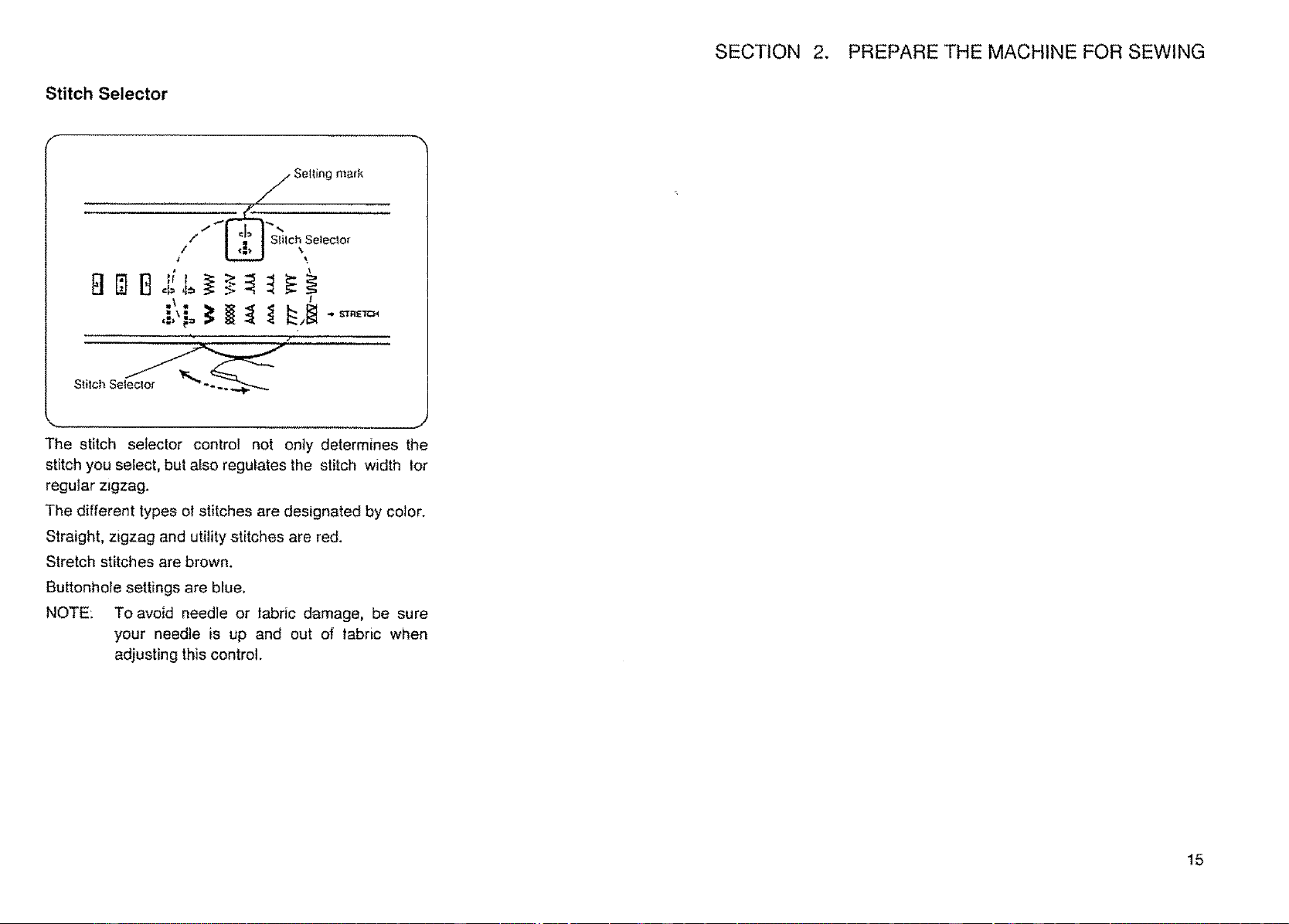
Stitch Selector
f Sel_,ing mark
f
The stitch selector control not onty determines the
stitch you select, but also regulates the stitch width lot
regular zigzag.
The different types o! stitches are designated by coJor.
Straight, zigzag and utility stitches are red.
Stretch stitches are brown.
Buttonhole settings are b_ue.
NOTE: To avoid needle or fabric damage, be sure
your needle is up and out of labric when
adjusting this control.
15
SECTION 2. PREPARE THE MACHINE FOR SEWING
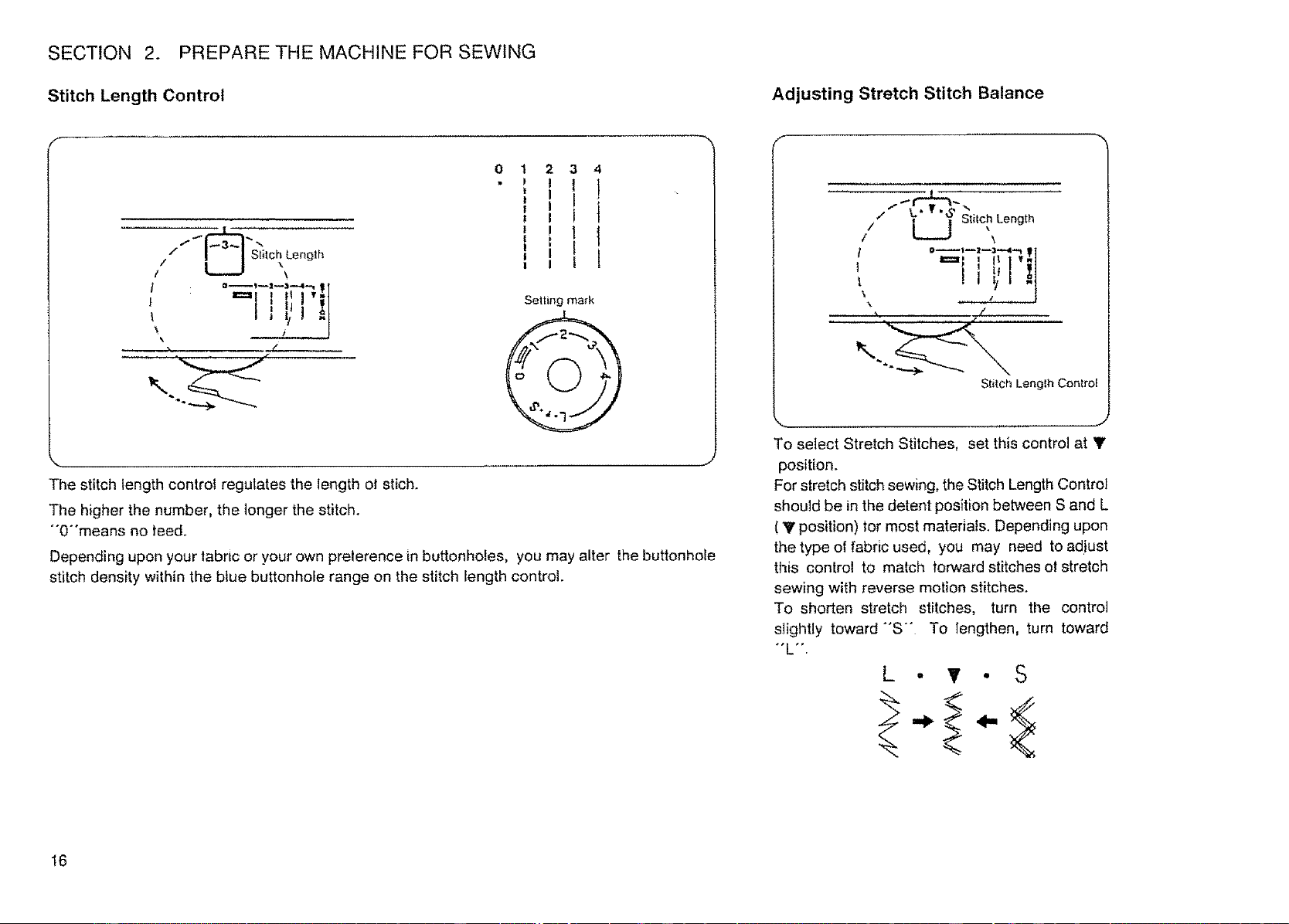
Stitch Length Control
/ / Stitch Length
/ \
,,, lJj i:t
\
01234
' I
, !
Z .
i It
Setting rnad_
0
The stitch length control regulates the length ot stich.
The higher the number, the longer the stitch.
"'0"°means no teed.
Depending upon your fabric or your own preterence in buttonholes, you may alter the buttonhole
stitch density within the blue buttonhole range on the stitch length control.
Adjusting Stretch Stitch Balance
f
iz LJ Stitch Length
/ \
1
o--t --_--$=,-4..t |
%
\
Stitch Lenglh Control
To select Stretch Stitches, set this control at Y
position.
For stretch stitch sewing, the Stitch Length Control
should be in the detent position between S and L
( Y position) for most materials. Depending upon
the type of fabric used, you may need to adjust
this control to match forward stitches ol stretch
sewing with reverse motion stitches.
To shorten stretch stitches, turn the control
slightly toward "'S'" To lengthen, turn toward
"'L*',
L • V • S
16
SECTION 2. PREPARE THE MACHINE FOR SEWING
Starting To Sew
Now that you are familiar with the controls on your machine and with the accessories provided for the machine, you are ready to start to sew with your new Kenmore
sewing machine. Below are some good habits to lotlow each time you sit down to sew:
1. Inspect the needle. It should be straight, properly set and sharp on the point. It shouldbe the correct size for the fabric and thread being used. Do not be afraid to
change your needle lrequently. Many of the new fabrics made ol synthetic blends tend to dull needles more easily than fabrics made of natural fibers.
2. Belore piacing the material on the machine, see that the ends of the threads have been drawn about 4 inches to the rear ot the machine. Hold on to threads during
the sewing of the first 3 or 4 stitches of the seam.
3. Test the machine stitch _n a scrap _f the labric y_u p_ant_ use_ The fabric sh_uId be d_uble thickness_ Adjust the machine __rthe Iength _t stitch and tensi_n suitable
to the labdc.
4. Fabric should be placed under the presser loot with the bulk of the material to the left of the needle and the right edge ot the material placed on the 5/8- seam
marking on the needle plate when making a simple seam.
5. Run the machine at a slow even speed. The more pressure you put on the toot control, the taster the machine will sew.
6. Fasten each seam by back tacking, sewing a tew stitches in reverse.
7. Always finish sewing each seam with the needle at its highest point.
& Guide the fabric gently with your hand in lront of the needle. Never putl or hold the tabnc in such a way that the normal leeding is altered.
9. When turning the hand wheel manually, always turn it toward you.
17
SECTION 3. LEARN THE STITCHES
Straight Stitches
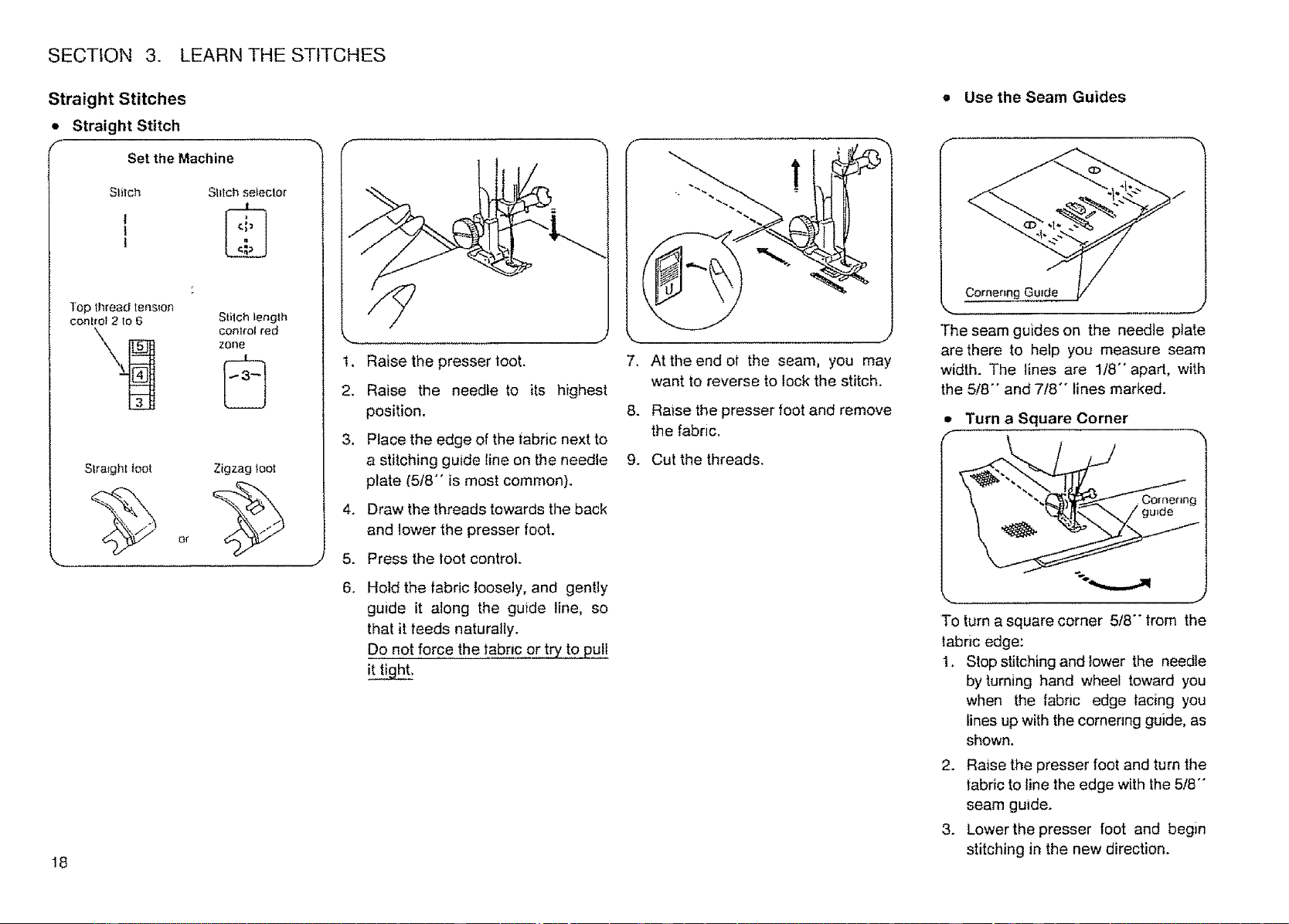
• Straight Stitch
f
Set the Machine
Slitch S'Li|ch seteclor
Top thread tension
conl[ol 2 to 6 Stitch length
control red
Slra_ght toot Zigzag loot
18
1,
2.
3,
4.
.* 5.
6.
Raise the presser toot.
Raise the needle to its highest
position.
Place the edge of the fabric next to
a stitching guide line on the needle
plate _5t8"" is most common).
Draw the threads towards the back
and lower the presser foot.
Press the loot control.
Hold the fabric loosely, and gently
guide it along the guide line, so
that it reeds naturally.
Do not force the tabric or try to pu!!
7. At the end ot the seam, you may
want to reverse to lock the stitch.
8. Raise the presser foot and remove
the fabric.
9. Cut the threads.
o Use the Seam Guides
,1"
Cornering Guide
The seam guides on the needle plate
are there to help you measure seam
width. The lines are 1/8-apart, with
the 5/8- and 7/8- lines marked.
,D Turn a Square Corner
\ / gu, o
To turn a square corner 5/8- from the
fabric edge:
1. Stop stitching and lower the needle
by turning hand wheel toward you
when the tabnc edge lacing you
lines up with the comenng guide, as
shown.
2. Raise the presser foot and turn the
fabric to line the edge with the 5/8-
seam guide.
3. Lower the presser foot and begin
stitching in the new direction.
SECTION 3. REARN THE STITCHES
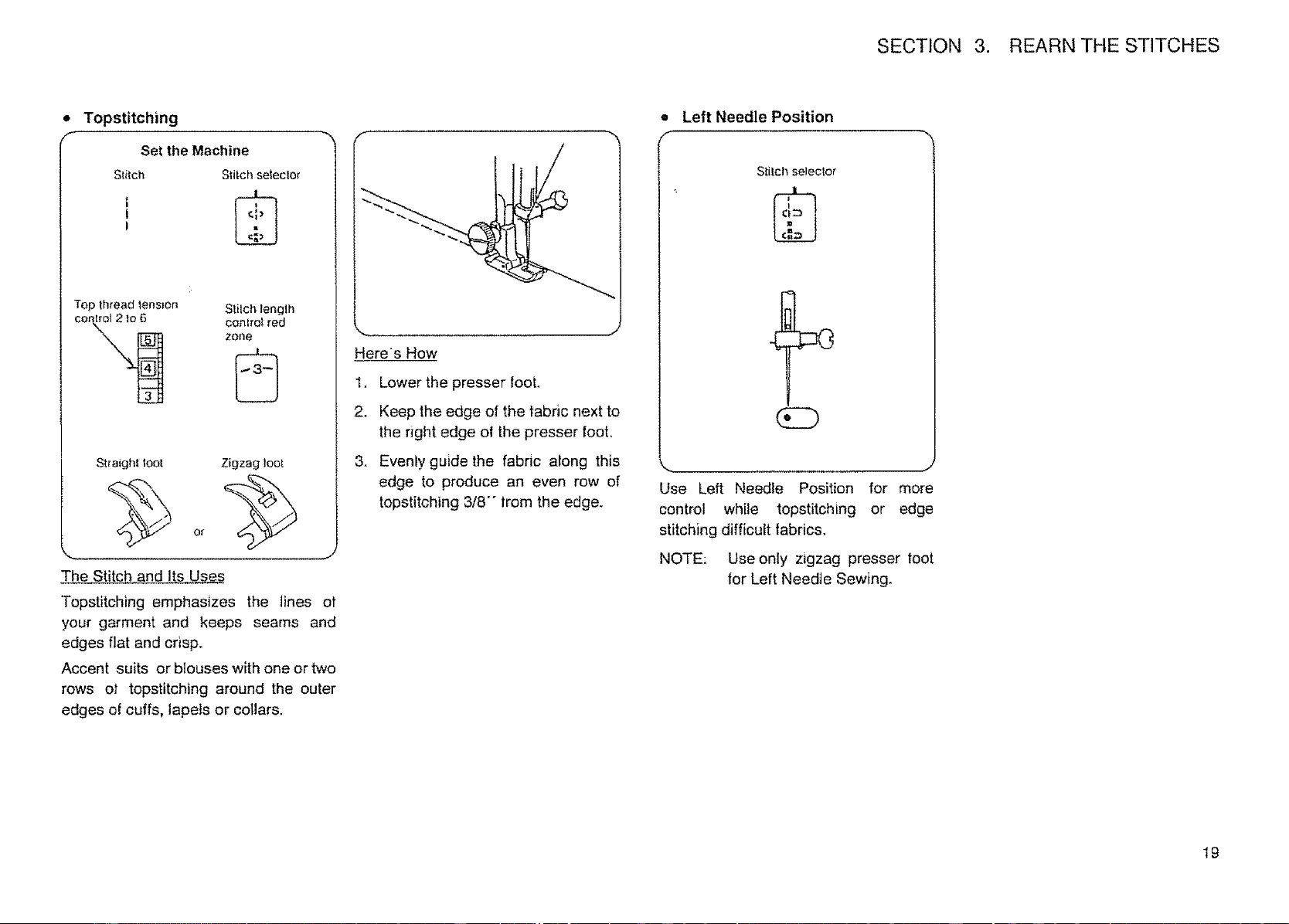
• Topstitching
f
Set the Machine
Stitch Stitch selector
Top th,read tension SfJIch ten0th
Straight loot Zigzag _oot
Or
The S_itch and itS,Uses
Topstitchlng emphasizes the lines of
your garment and keeps seams and
edges flat and crisp.
Accent suits or blouses with one or two
rows ot topstitching around the outer
edges of cuffs, lapels or cotlars.
Heres How
1. Lower the presser fool
2. Keep the edge of the fabric next to
the right edge of the presser foot.
3. Eveniy guide the fabric along this
edge to produce an even row of
topstitching 3/8- from the edge.
Left Needle Position
©
Use Left Needle Position for more
control while topstitching or edge
stitching difficult fabrics.
NOTE: Use only zigzag presser foot
for Left Needle Sewing.
19
SECTION 3. REARN THE STITCHES
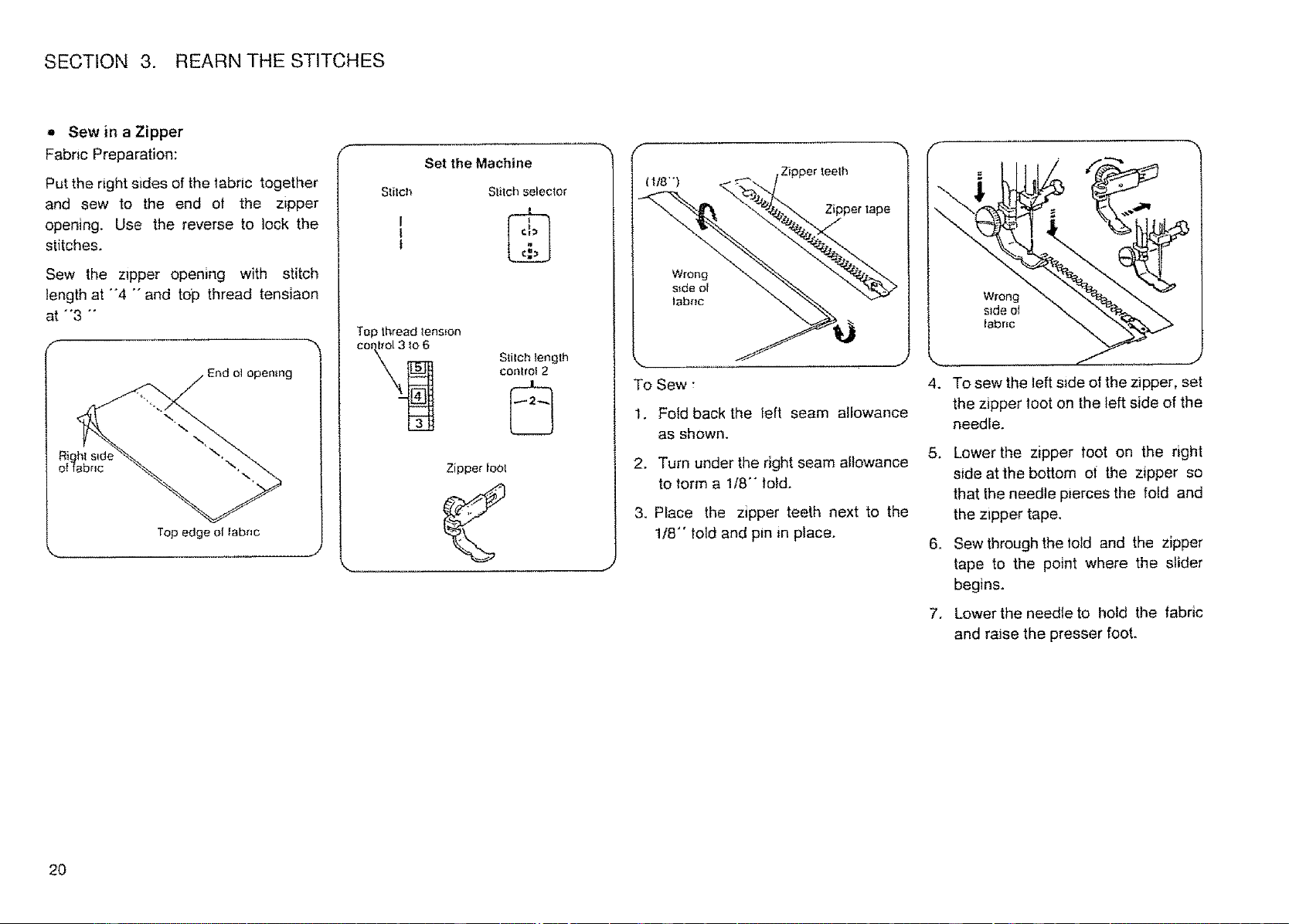
,* Sew in a Zipper
Fabric Preparation:
Put the right sides of the fabric together
and sew to the end of the zipper
opening. Use the reverse to lock the
stitches.
Sew the zipper opening with stitch
length at °°4 °" and ta;p thread tensiaen
at "°3 "'
End ol opemng
k_ ............
Top edge of labr_c
Set the Machine
SIilch Stilch selector
, ©
I
t
Top thread tension
co IroL 3 _o 6
control 2
Zipper [oot
To Sew :
1. Fold back the felt seam allowance
as shown.
2. Turn under the right seam a!lowance
to form a 1t8 "° told.
3. Place the zipper teeth next to the
118- told and pin in place.
Wrong
s_de ot
tabnc
To sew the left side of the zipper, set
the zipper toot on the left side of the
needle.
5. Lower the zipper foot on the right
side at the bottom of the zipper so
that the needle pierces the fold and
the zipper tape.
6. Sew through the told and the zipper
tape to the point where the slider
begins.
7. Lower the needle to hold the fabric
and raise the presser foot.
2O
SECTION 3. REARNTHE STITCHES
Slider
Wrong stde
of [abric
• J
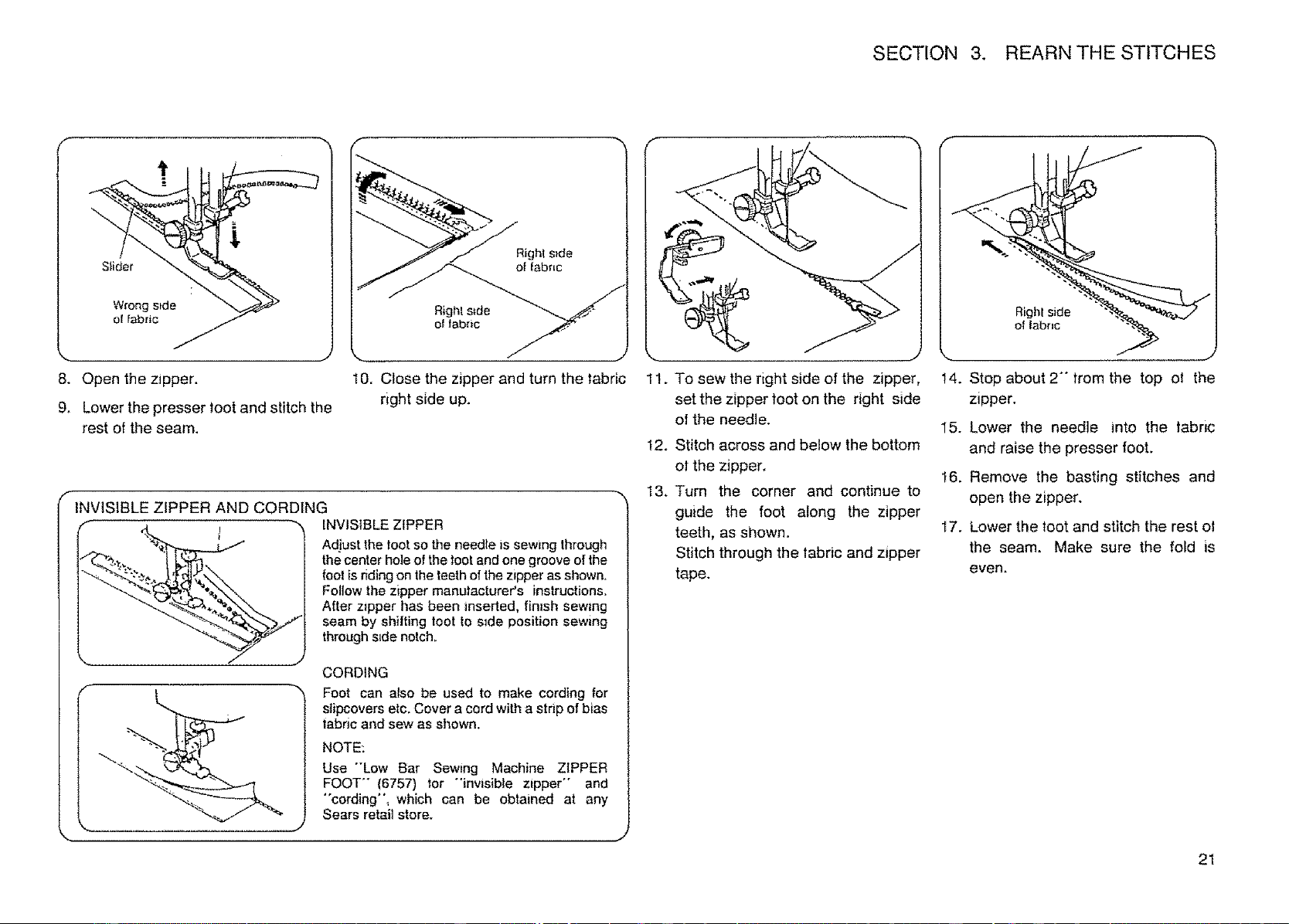
8. Open the zipper.
9, Lower the presser toot and stitch the
rest of the seam.
f
INVISIBLE ZIPPER AND CORDING
10. Close the zipper and turn the tabric
right side up,
fNVIStBLE ZIPPER
Adjust the toot so the needle is sewing through
the center hole of the tool and one groove o! the
toot is nding on the teeth of the zipper as shown.
Follow the zipper manutacturer's instructions.
After zipper has been inserted, finish sewing
seam by shifting toot to s_de position sewing
through side notch.
CORDING
Foot can also be used to make cording for
slipcovers etc. Cover a cord with a str_p of bias
tabnc and sew as shown.
NOTE:
Use "'Low Bar Sewing Machine ZIPPER
FOOT" (6757) tot "'invisible z_pper'" and
"cording", which can be obtained at any
Sears retail store.
11. To sew the right side of the zipper,
set the zipper toot on the right side
of the needle.
12. Stitch across and below the bottom
ot the zipper.
13, Turn the corner and continue to
guide the foot along the zipper
teeth, as shown.
Stitch through the fabric and zipper
tape.
f
of labnc "',
14. Stop about 2"" from the top ol the
zipper.
15. Lower the needle into the tabric
and raise the presser foot.
16. Remove the basting stitches and
open the zipper.
17. Lower the toot and stitch the rest el
the seam. Make sure the fold is
even.
2I
SECTION 3. REARN THE STITCHES
Use the Darning Plate
f
Sometimes when you sew, you want
to control the tabnc youself.
The Darning Plate covers the teed
dogs so that they do not touch the
fabric.
To Put on the Darning PIate:
NOTE: The rectangular holes in the
Darning Plate match the
holes in the needle plate. In
the darning plate, these
holes are s]ightiy to the left
ot center.
1. Position the darning plate with the
3 pins on the bottom.
2. Fit the darning plate pJns into the
needle plate holes, The teed dogs
will show through the darning plate
holes.
Use the darning plate in the folfowing
ways: Darning (P.2_.23
Button Sewing (P,26_
22
Set the Machine
Stitch . Stitch seIector
I °!'
Top thread tension Stitch Jeng[h
control I to 4 Contr01 any number
No presser {oo1
Darmng p}ate
Heres How
2.
3.
4.
5.
6.
NOTE:
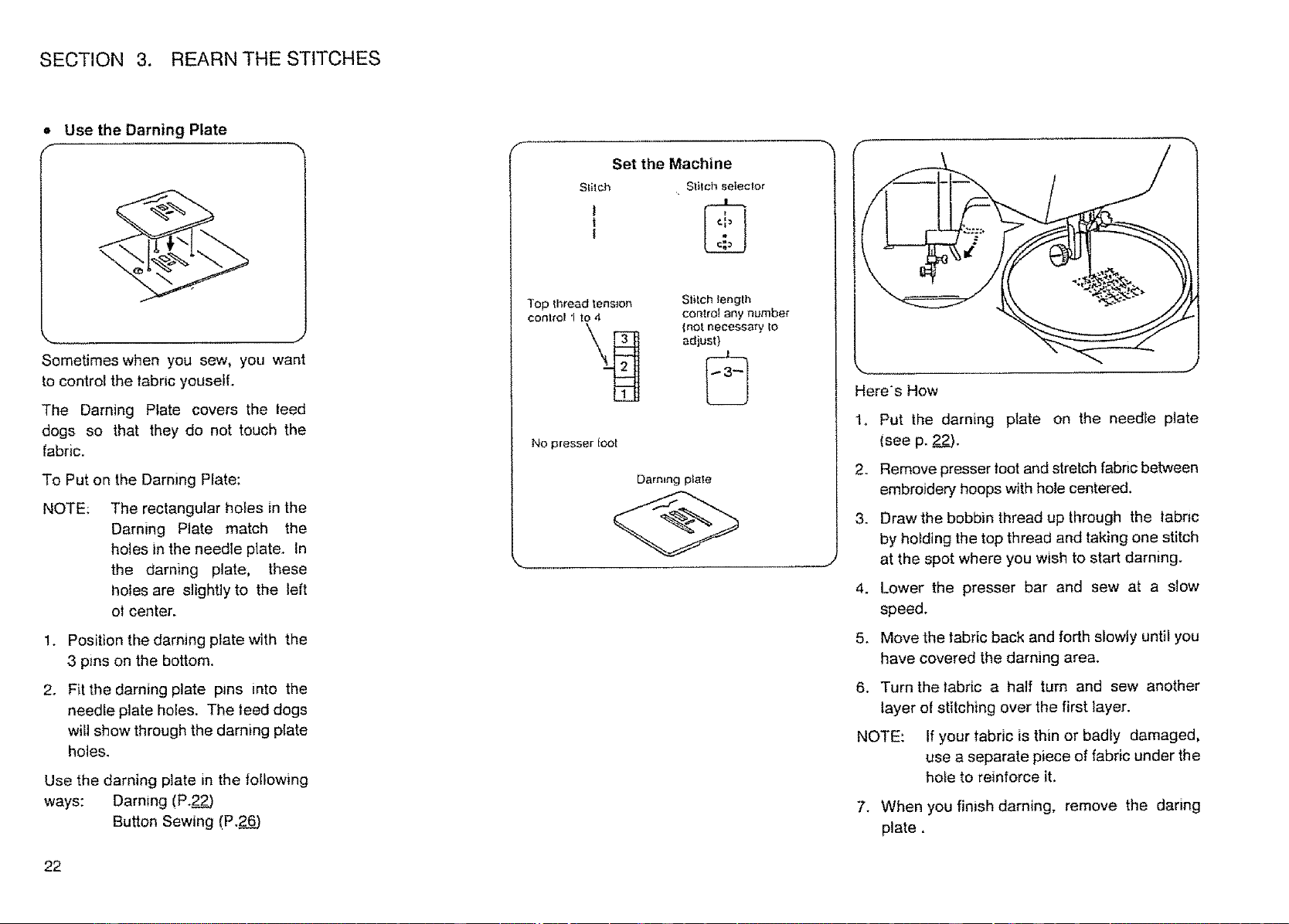
Put the darning plate on the needle plate
(see p. 22).
Remove presser loot and stretch fabric between
embroidery hoops with hole centered.
Drawthe bobbin thread up through the labric
by holding the top thread and taking one stitch
at the spot where you wish to start darning.
Lower the presser bar and sew at a slow
speed.
Move the fabric back and forth slowly until you
have covered the darning area.
Turn thetabric a half turn and sew another
layer of stitching over the first layer.
if your tabric is thin or badiy damaged,
use a separate piece of fabric under the
hole to reinforce it.
7. When you finish darning, remove the daring
plate.
SECTION 3. REARN THE STITCHES
Zigzag Stitches
Basic Zigzag
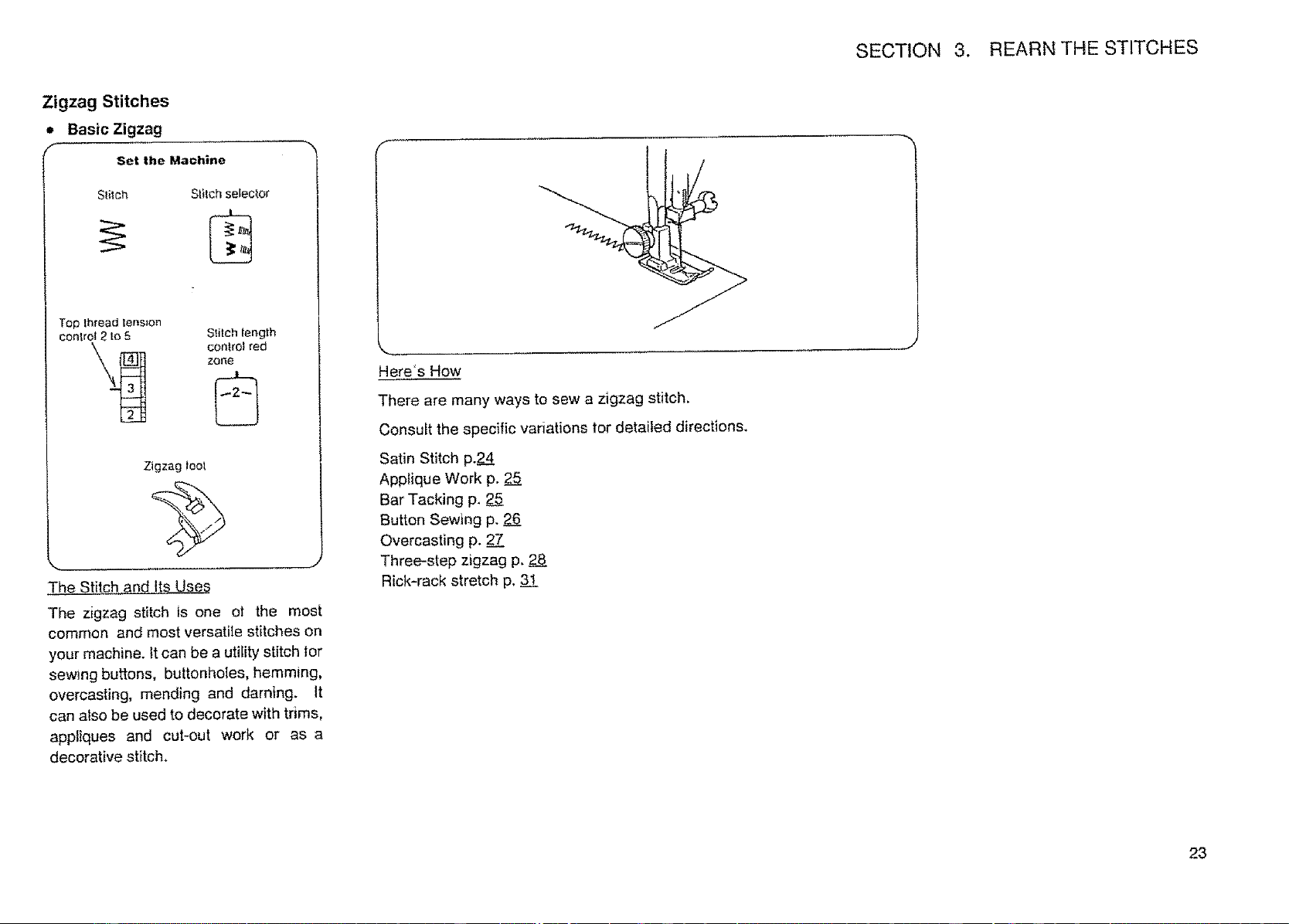
Set the Machine
Stilch Stitchselector
Zigzag loot
\
The Stitch and Its Uses
The zigzag stitch is one ot the most
common an6 most versatile stitches on
your machine. _tcan be a utility stitch tor
sewing buttons, buttonholes, hemmin 9,
overcasting, mending and darning. It
can also be used to decorate with trims,
appliques and cut-out work or as a
decorative stitch.
Here's How
There are many ways to sew a zigzag stitch,
Consult the specific variations tot detailed directlons.
Satin Stitch p.2.4.
Applique Work p. 25
Bar Tacking p. 25
Button Sewing p. 26
Overcasting p. 2_.7.
Three-step zigzag p, 28
Rick-rack stretch p, 31
23
SECTION 3. REARN THE STITCHES
Satin Stitch
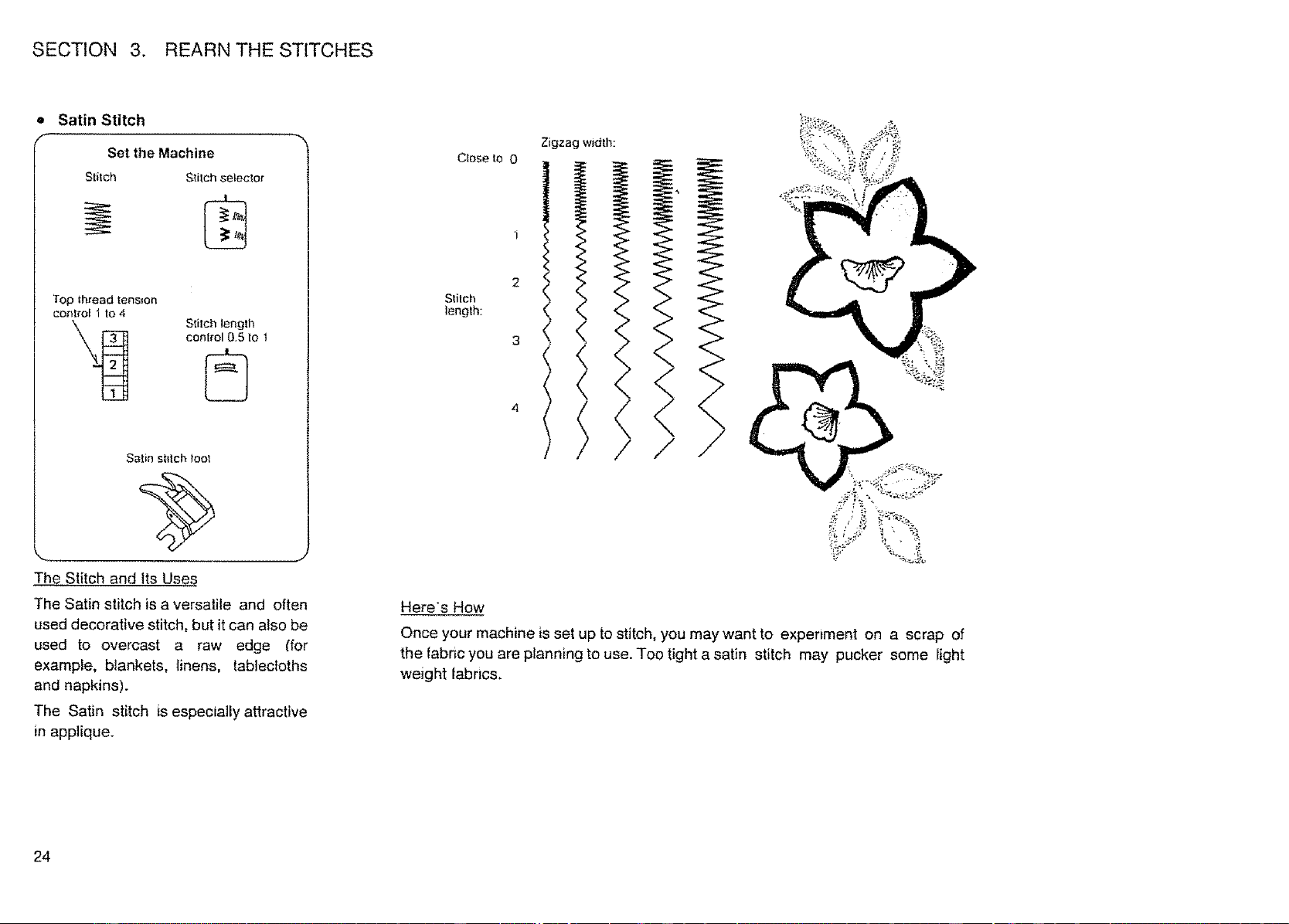
Set the Machine
Stitch Stitch selector
Top thread tension
cont_'ol 1 to 4
control 0.5 to t
Satin stitch too!
The Stitch and Its Uses
The Satin stitch is a versalile and often
used decorative stitch, but it can also be
used to overcast a raw edge (for
example, blankets, finens, tablecloths
and napkins).
The Satin stitch is especially attractive
in applique.
CIose to 0
1
2
Slilch
lenglh:
3
Zigzag width:
/
E
=
>,
>.
>
>
>
>
\
/
Heres How
Once your machine is set up to stitch, you may want to experiment on a scrap of
the fabric you are planning to use. Too tight a satin stitch may pucker some light
weight fabrics.
24
SECTION 3. REARN THE t5 t I t UHI:._
Zigzag Stitches (Continued)
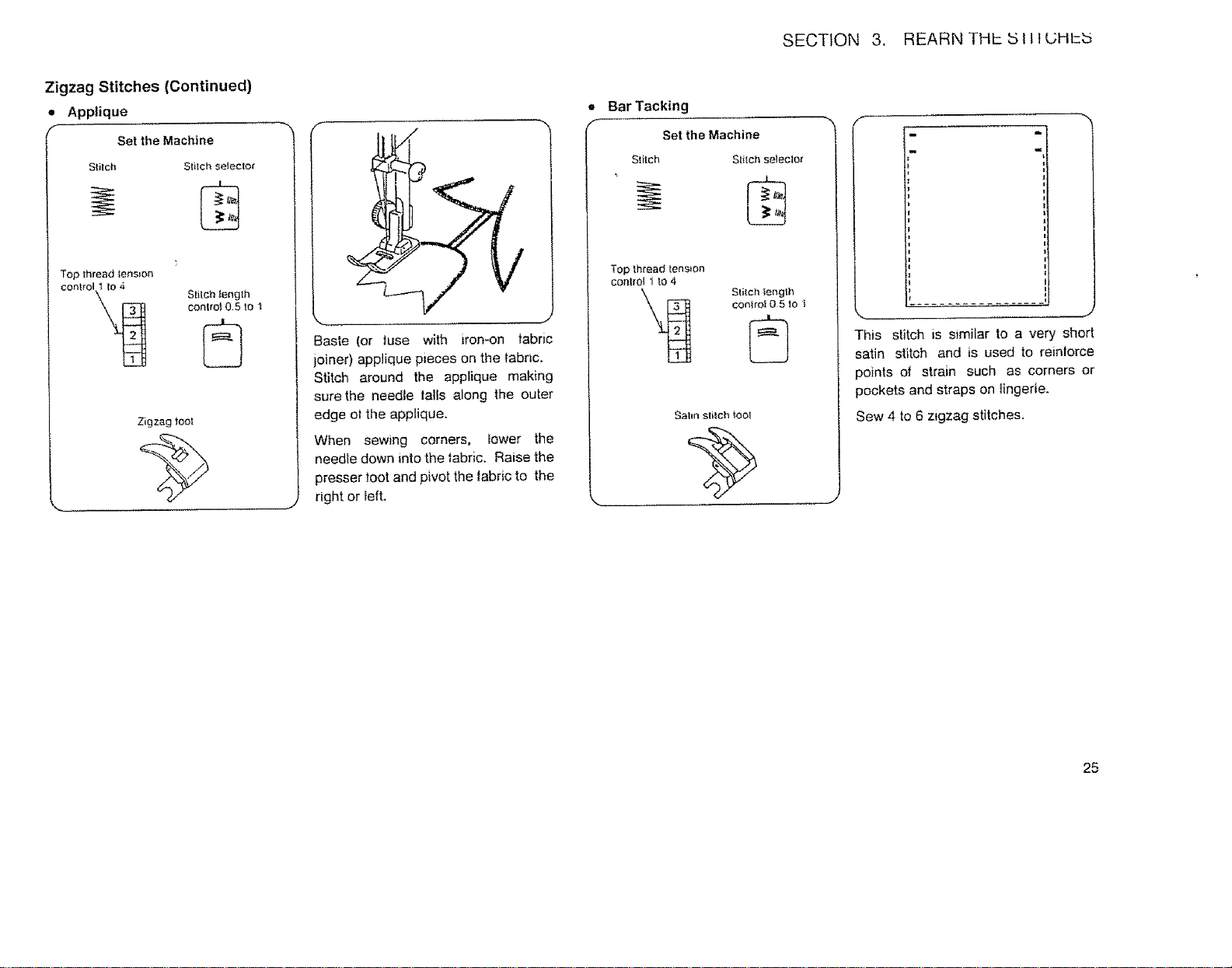
Applique
Set the Machine
Stitch Sl_lch seteclor
)
Top thread tension
Control_
Stilch length
control 0.5 to I
Zigzag toot
J
Baste (or luse with iron-on fabric
joiner) applique pieces on the tabnc.
Stitch around the applique making
sure the needle lalls along the outer
edge ot the applique.
When sewing corners, lower the
needle down into the labric. Raise the
presser loot and pivot the labric to the
right or left.
@
S
Bar Tacking
Set the Machine
Slitch Stitch seteclo_
Top thread tension
Conl_ol i to 4
Salm stitch toot
J
This stitch is similar to a very short
satin stitch and is used to reintorce
poinls of strain such as corners or
pockets and straps on lingerie.
Sew 4 to 6 zigzag stitches.
25
SECTION 3. REARNTHE STITCHES
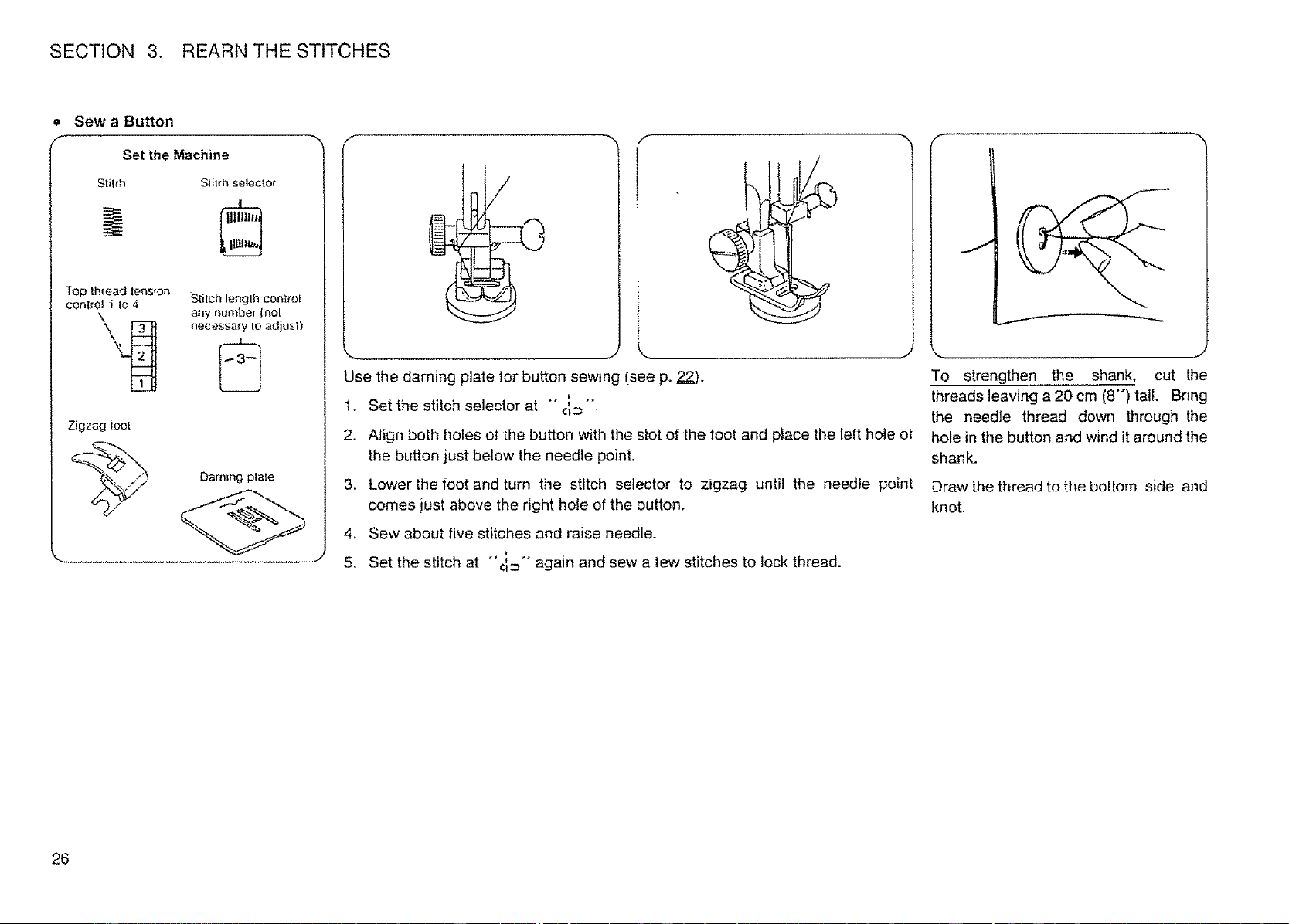
Sew a Button
Set the Machine
Stitrh S_it_t_, _;etector
Top thread tension
conl[OI i to 4 Stilch length control
any number (not
_ nece_ adjust)
Zigzag loot
Dam_ng plale
q
Use the darning plate tot button sewing (see p. 2__23.
t. Set the stitch selector at °"ci='"
2. Atign both holes ot the button with the slot of the toot and place the left hole ot
the button just below the needle point.
3. Lower the toot and turn the stitch selector to zigzag until the needle polnt
comes just above the right hole of the button,
4, Sew about five stitches and raise needle,
5. Set the stitch at "'ci=- again and sew a few stitches to lock thread.
f
J
To strengthen the shank, cut the
threads leaving a 20 cm (8-) tail Bring
the needle thread down through the
hole in the button and wind it around the
shank.
Draw the thread to the bottom side and
knot.
26
SECTION 3. REARNTHE STITCHES
Zigzag Stitches (Continued)
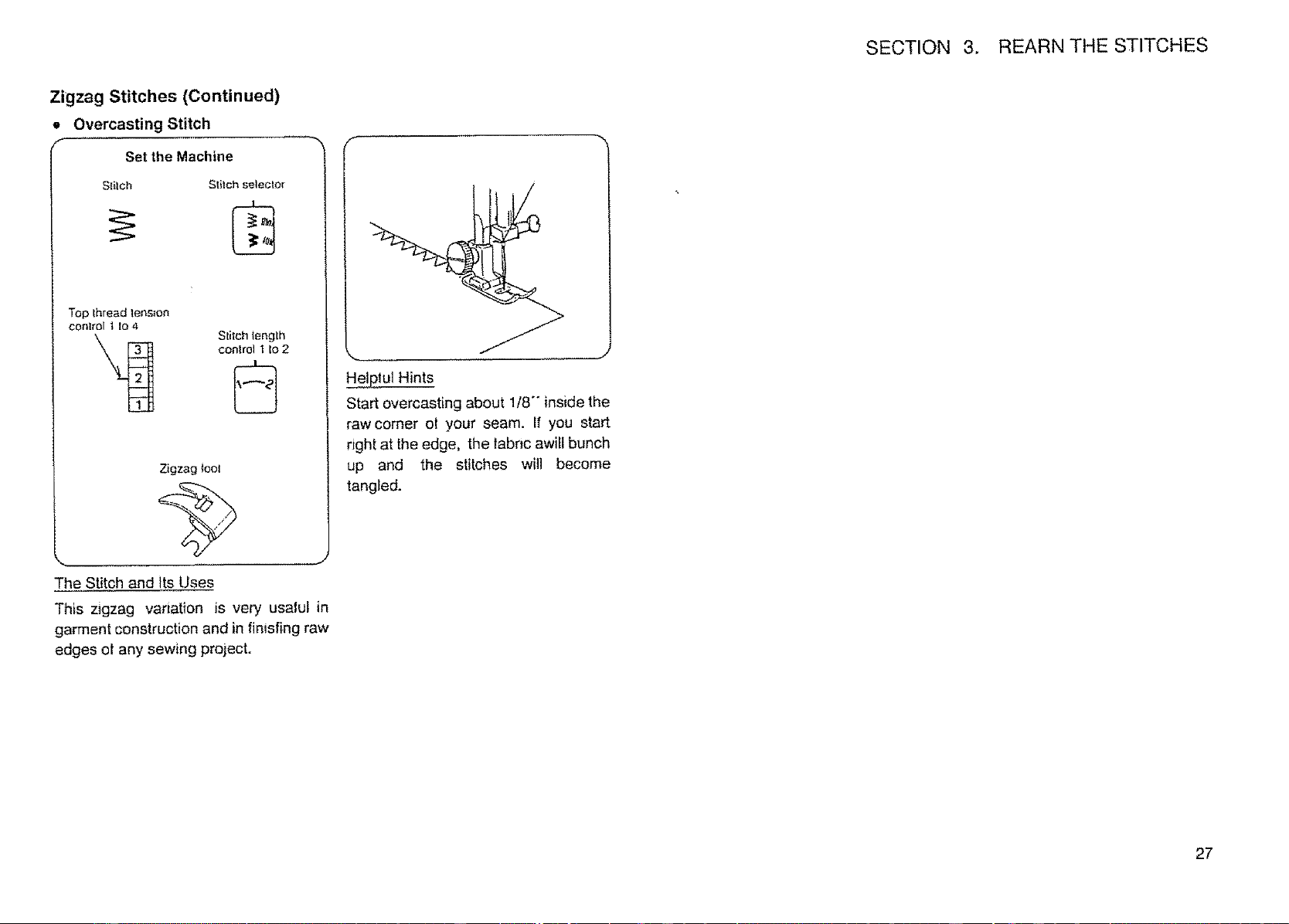
e Overcasting Stitch
f
Set the Machine
Slitch Stilch selector
Top thread tension
control t Io 4
con|rol t tO2
Zigzag foot
\
The Stitch and Its Uses
This zigzag variation is very usalul in
garment construction and in finisfing raw
edges ol any sewing project.
J
He!p!ulHints
Start overcasting about 118°"inside the
raw corner oi your seam. If you start
right at the edge, the labric awifl bunch
up and the stitches will become
tangled.
27
SECTION 3. REARN THE STITCHES
Zigzag Stitches (Continued)
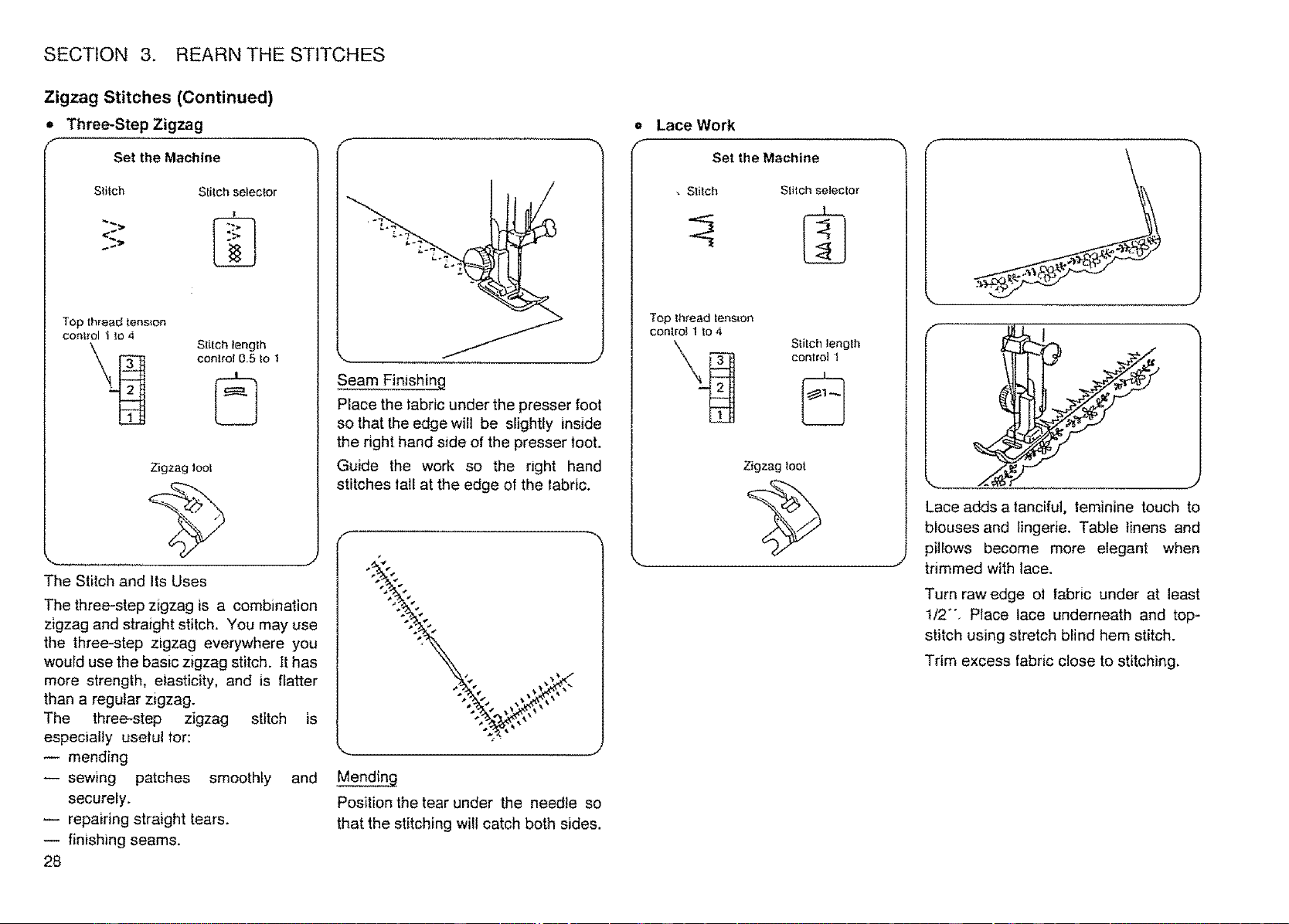
• Three-Step Zigzag
f
Set the Machine
Stitch SRch selector
Top thread tens{on
control I to 4
Sli[eh ter_gth
Zigzag loci
The Stitch and Its Uses
The three-step zigzag is a combination
zigzag and straight stitch. You may use
the three-step zigzag everywhere you
would use the basic zigzag stitch, it has
more strength, elasticity, and is flatter
than a regular zigzag.
The three-step zigzag stitch is
especially uselul for:
mending
-- sewing patches smoothly and
securely.
repairing straight tears.
-- finishing seams.
28
/.-?
Seam F!n!shing
Place the tabric under the presser foot
so that the edge will be slightly inside
the r_ght hand side of the presser toot.
Guide the work so the right hand
stitches |all at the edge of the tabric.
Position the tear under the needle so
that the stitching will catch both sides.
o Lace Work
Set the Machine
, Slitch Stitch selector
Top Ihread ter,s_on
cor_trol 1 _o 4
Stitch lenglh
Zigzag toot
f
Lace adds a lancifut, feminine touch to
blouses and lingerie. Table linens and
pillows become more elegant when
trimmed with lace.
Turn raw edge oi labric under at least
1/2"', P_ace lace underneath and top-
stitch using stretch blind hem stitch.
Trim excess fabric close to stitching,
SECTION 3. REARN THE STITCHES
f
Blind Hemming
Set the Machine
Stitch Stitch seleclor
(Regular)
Top thread tension
conlro! i to 4
Sti[ch length
con|to! I lo 3
Set the Machine
Stitch Stitch selector
(Stretch)
Tap thread _ens_on
control I _o 4
control 1 Io 3
fool
Ligh 1_'"
Fabric /,_._,,... _ ,,
Heavy weight _ /_._
". Fabric _ ,J
k,. ................... j ,..
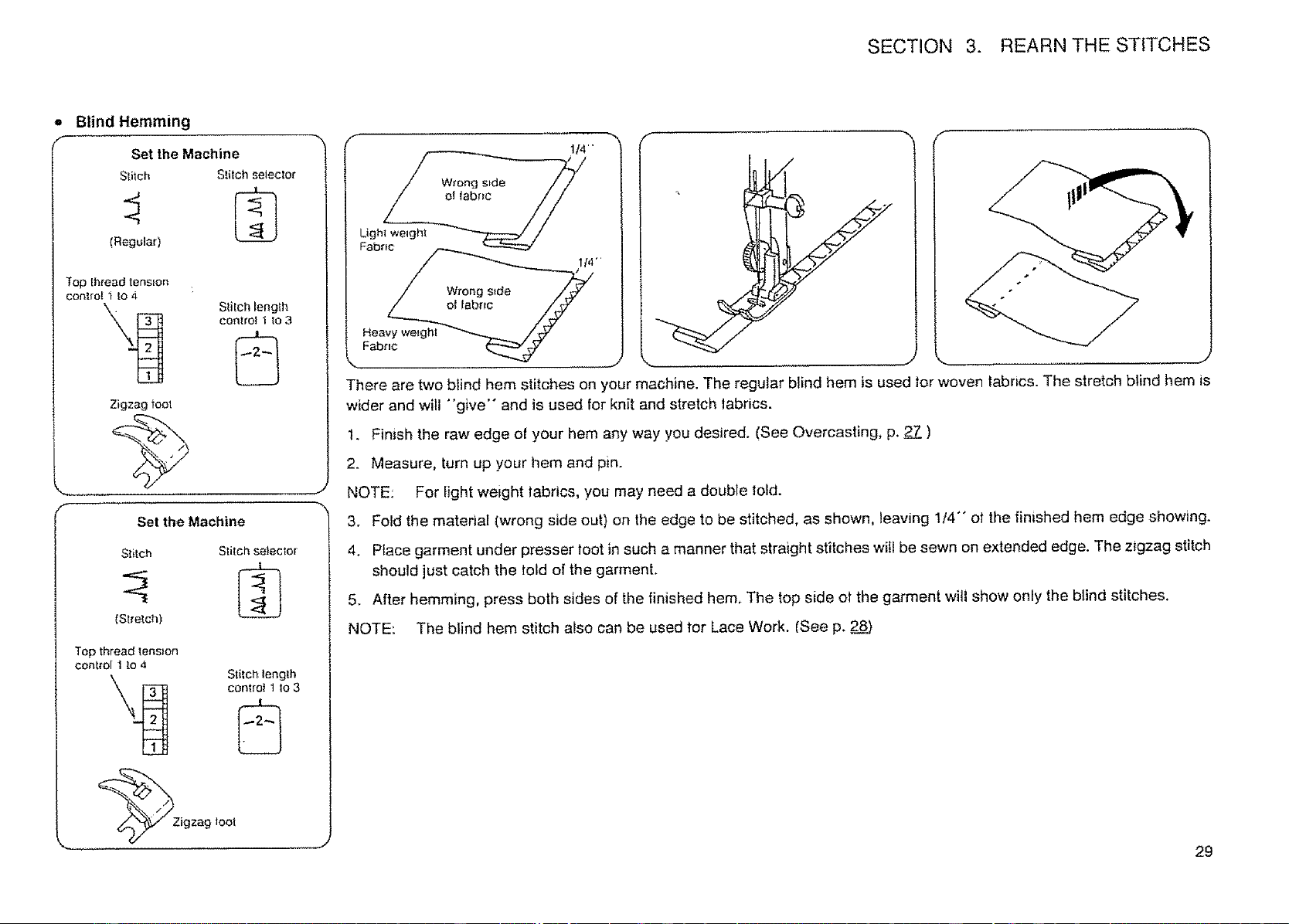
There are two blind hem stitches on your machine. The regular blind hem is used tor woven labrics. The stretch blind hem is
wider and will "'give'" and is used for knit and stretch labncs.
1. Finish the raw edge of your hem any way you desired. (See Overcasting, p. 27_)
2. Measure, turn up your hem and pin.
NOTE: For light weight fabrics, you may need a double told.
3. Fold the material (wrong side out) on the edge to be stitched, as shown, leaving 1/4"" ot the finished hem edge showing.
4. Place garment under presser toot in such a manner that straight stitches will be sewn on extended edge. The zigzag stitch
should just catch the told of the garment.
5. After hemming, press both sides of the finished hem, The top side o| the garment witl show only the blind stitches.
NOTE: The blind hem stitch also can be used for Lace Work. ISee p.
" ....... --_ 29
SECTION 3. REARN THE STITCHES
Shell Stitching
Set the Machine
Stitch Stitch selector
Top thread lenston
control 3 to 9
Zigzag loot
% J
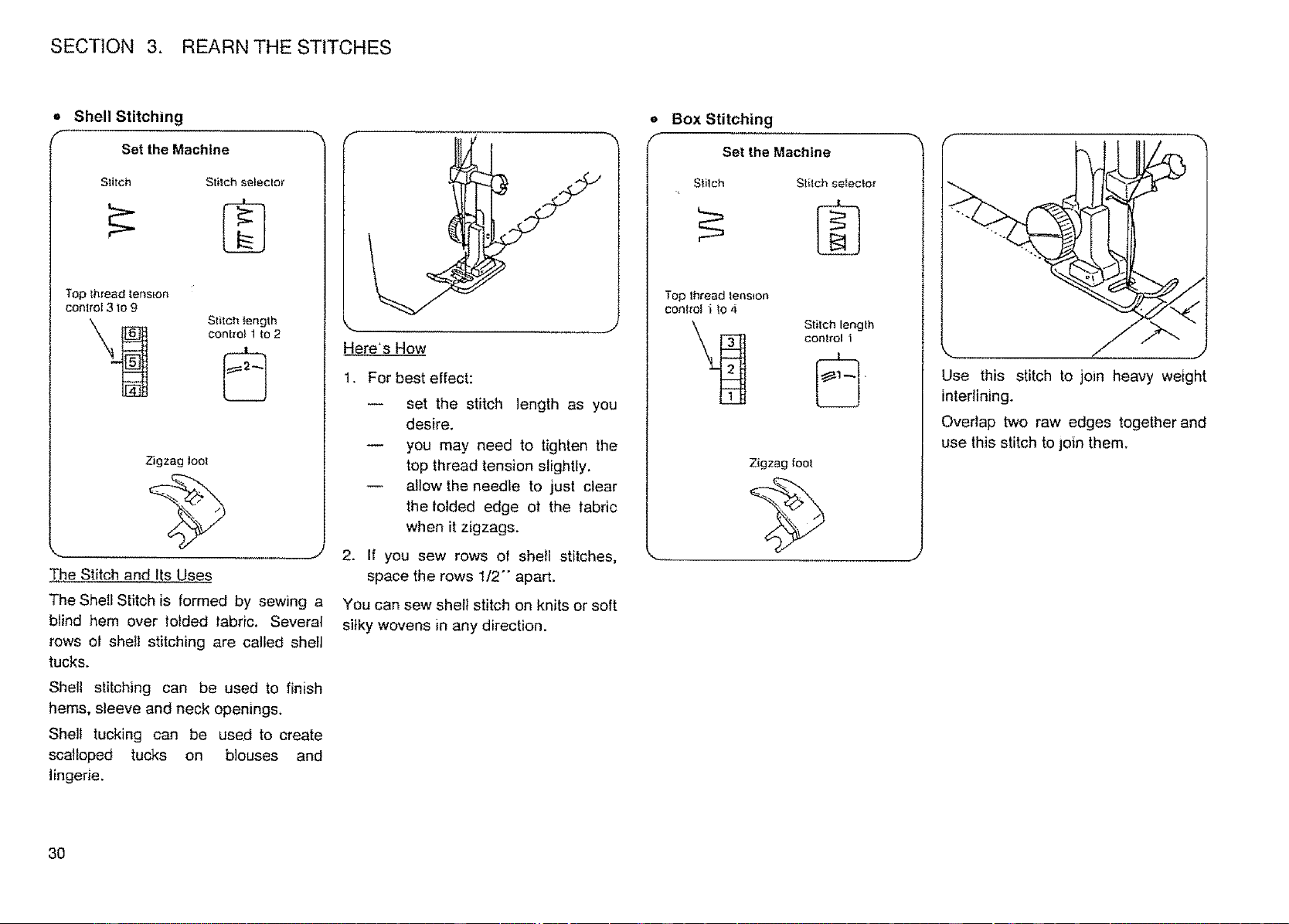
The Stitch and !Is,Uses
The Shell Stitch is formed by sewing a
blind hem over tolded labrlc. Several
rows ol shell stitching are calted shell
tucks.
Shell stitching can be used to finish
hems, sleeve and neck openings.
Shell tucking can be used to create
scalloped tucks on blouses and
lingerie.
Here's How
1. For best effect:
set the stitch length as you
desire.
-- you may need to tighten the
top thread tension slightly.
-- allow the needle to just clear
thelolded edge ot the tabdc
when it zigzags.
2. If you sew rows ol shell stitches,
space the rows 1/2"" apart.
You can sew shell stitch on knits or soft
silky wovens in any direction.
Box Stitching
Set the Machine
Stitch Stitch setec_or
Top thread lens_on
control i |o 4
control i
Zigzag fool
Use this stitch to join heavy weight
interlining.
Overlap two raw edges together and
use this stitch to jo_n them.
30
SECTION 3. REARN THE STITCHES
Stretch Stitches
Straight Stretch
,f
Set the Machine
Stitch Stitch selecto_
tit
lU
Top thread tension Slitch length
control 2' to 6 control brown
k'k_ strelch stitch
position
t__J
Straight loot Zigzag ioo!
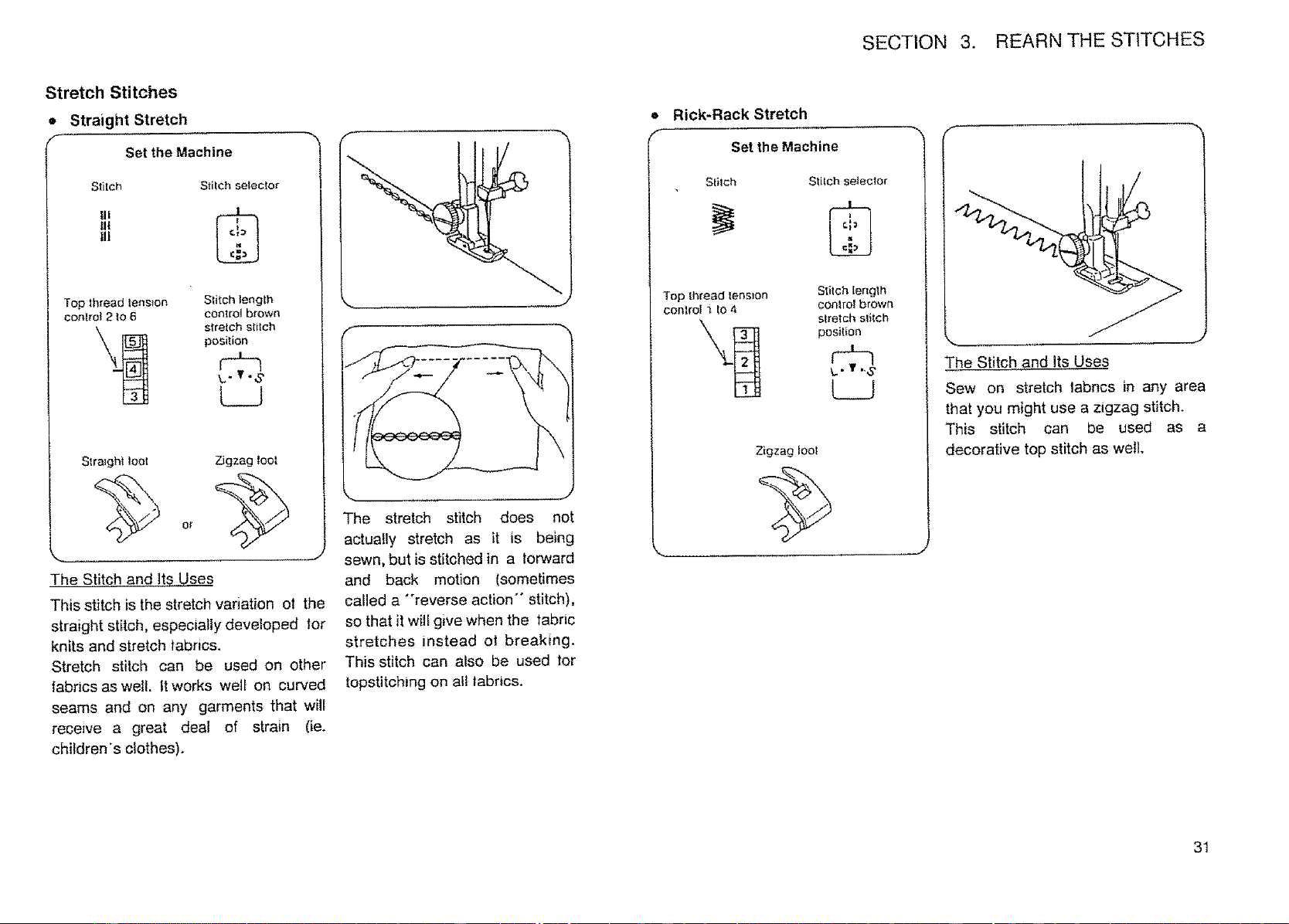
The Stitch and Its Uses
This stitch is the stretch variation oi the
straight stitch, especially developed for
knits and stretch tabrtcs.
Stretch stitch can be used on other
fabrics as well. It works welt on curved
seams and on any garments that wiif
receive a great deal of strain (ie.
children's clothes).
The stretch stitch does not
actually stretch as it is being
sewn, but is stitched in a torward
and back motion (sometimes
called a "reverse action" stitch),
so that it wilt give when the fabric
stretches instead o| breaking.
This stitch can also be used tor
topstitching on all fabrics.
• Rick-Rack Stretch
f
Set the Machine
Stitch Stitch selector
Top thread tension Stitch length
control i t0 4 control brown
stretch stlteh
___ position
Zigzag toot
\ J
The Stitch and Its Uses
Sew on stretch |abrics in any area
that you might use a zigzag stitch.
This stitch can be used as a
decorative top stitch as well.
31
SECTION 3. REARN THE STITCHES
Smocking
Set the Machine
Stitch Stitch selector
Top thread tension
conlrol 1 tO 4
Stitch Jength control
brown stretch stitch
position
Zigzag too!
s_de ol
labnc
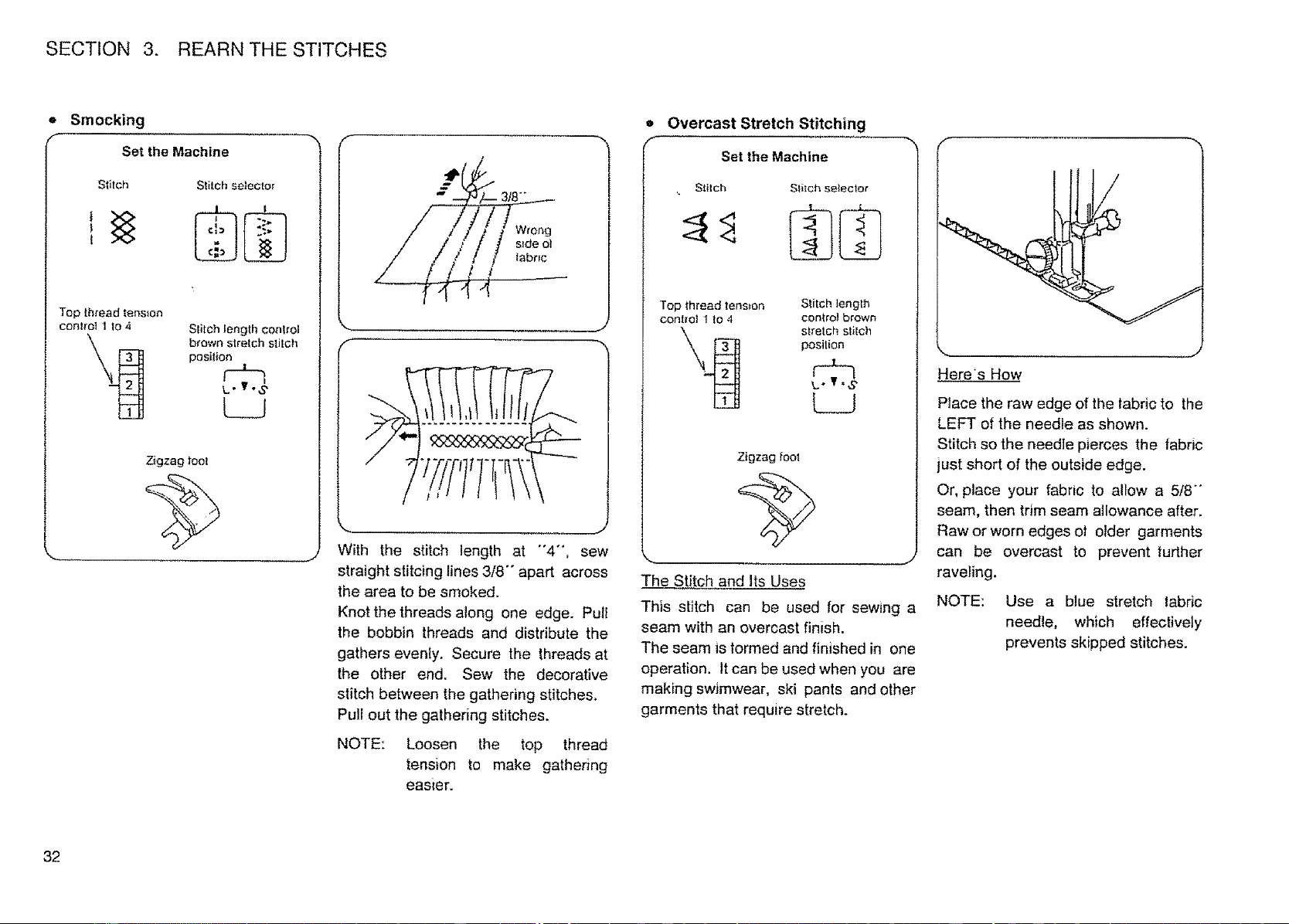
With the stitch length at "'4"', sew
straight stitcing lines 3/8 °"apart across
the area to be smoked.
Knotthe threads along one edge. Pull
the bobbin threads and distribute the
gathers evenly. Secure the threads at
the other end. Sew the decorative
stitch between the gathering stitches.
Pull out the gathering stitches.
NOTE: Loosen the top thread
tension to make gathering
easier.
o
f
Overcast Stretch Stitching
Set the Machine
Stitch Stitch selector
Top thread tension Stitch length
conbo1 1 to 4 control brown
slrelch stiEch
position
t__J
Zigzag {oct
The Stitch and its Uses
This stitch can be used for sewing a
seam with an overcast finish.
The seam is formed and finished in one
operation. It can be used when you are
making swimwear, ski pants and other
garments that require stretch.
I
\
Here's How
Place the raw edge of the fabric to the
LEFT of the needle as shown.
Stitch so the needle pierces the fabric
just short of the outside edge.
Or, place your fabric to allow a 518""
seam, then trim seam allowance after.
Raw or worn edges ol older garments
can be overcast to prevent further
raveling.
NOTE: Use a blue stretch labric
needle, which effectively
prevents skipped stitches.
32
SECTION 3. REARN]HE:,..'51i IUHLb
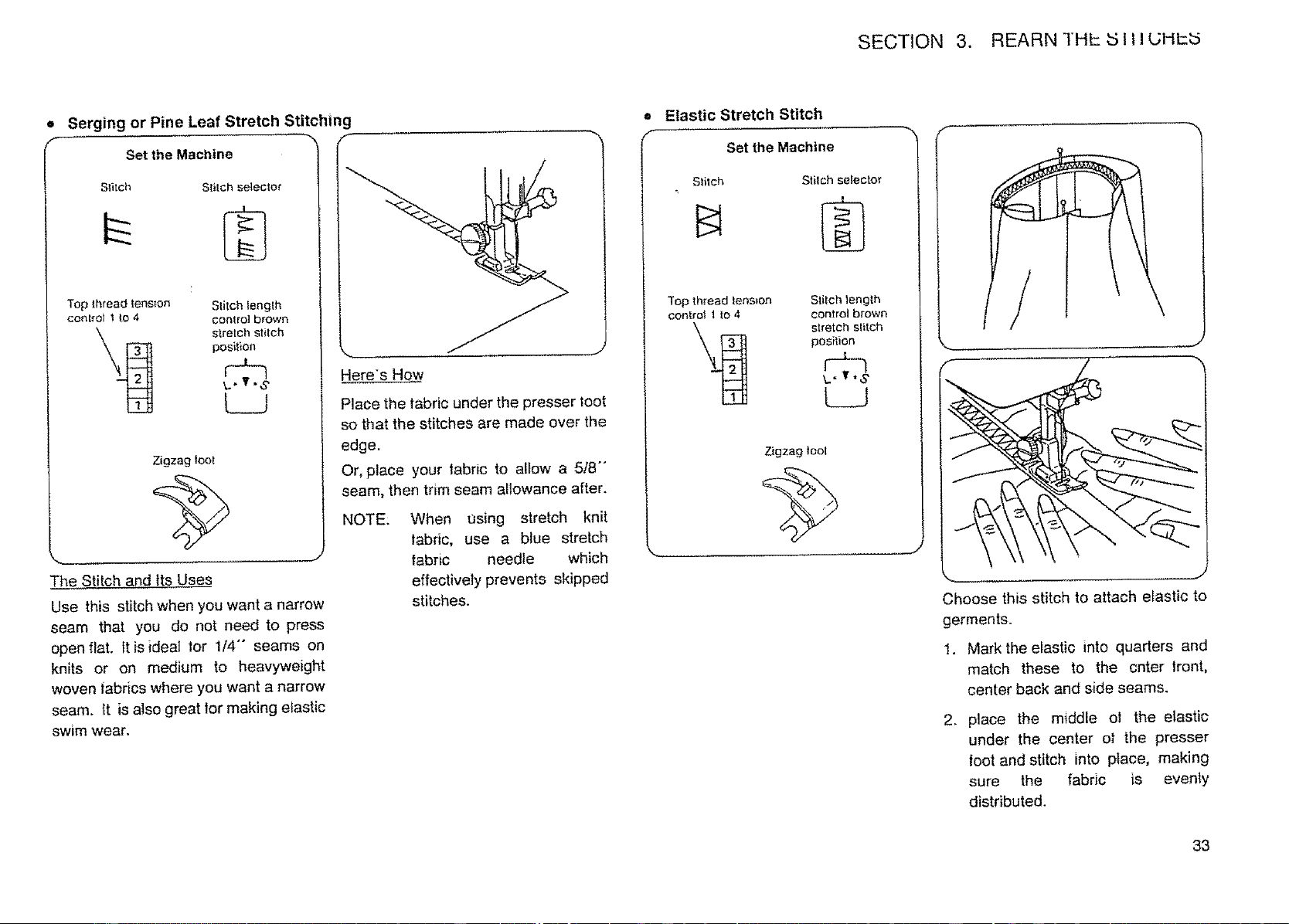
= Serging or Pine Leaf Stretch Stitching
f
Set the Machine
Stitch Stilch selector
Top thread tension
control 1 to 4
Slitch length
con{ro_ brown
s[retch stilch
position
L_J
Zigzag too{
The Stitch and its Uses
Use this stitch when you want a narrow
seam that you do not need to press
open flat. [t is ideal tot 1/4- seams on
knits or on medium to heavyweight
woven fabrics where you want a narrow
seam, It is also great tot making elastic
swim wear.
J
Here's Ho___w
Place the labric under the presser toot
so that the stitches are made over the
edge,
Or, place your labric to alfow a 5!8""
seam, then trim seam allowance after,
NOTE: When t_slng stretch knit
tabric, use a blue stretch
fabric needle which
effectively prevents skipped
stitches.
= Etastic Stretch Stitch
Set the Machine
Stitch Stilch selector
Top thread tension Slitch lenglh
control 1 to 4 control brown
s|retch stilch
position
Zigzag tool
N,. ......................... J
Choose this stitch to attach elastic to
germents.
1. Mark the elastic into quarters and
match these to the cnter front,
center back and side seams.
2. place the middle o! the elastic
under the center ot the presser
loot and stitch into place, making
sure the fabric is evenly
distributed.
33
SECTION 3. REARN THE STITCHES
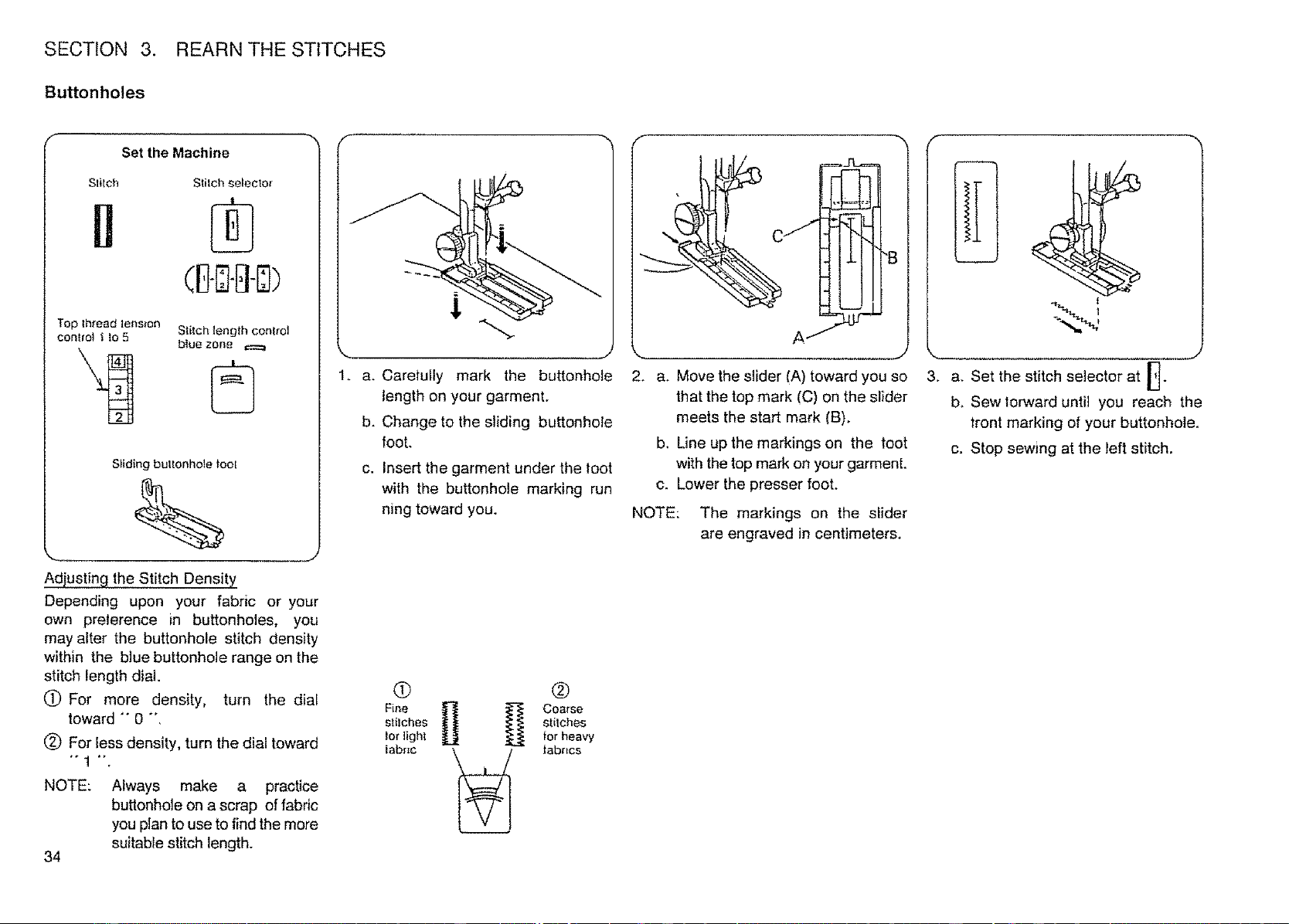
Buttonholes
Set the Machine
Slilch Stitch selector
Top thread tension Stitch length control
contro_ _ to 5
Sliding buttonhole loci
%
Adiust!ng the Stitch Density
Depending upon your fabric or your
own prelerence in buttonholes, you
may alter the buttonhole stitch density
within the blue buttonhole range on the
stitch length dial.
(_) For more density, turn the dial
toward "" 0 *',
(_) For less density, turn the dial toward
*" 1 **,
NOTE: Always make a practice
buttonhole on a scrap of fabric
you plan to use to find the more
suitable stitch length.
34
1. a. Caretully mark the buttonhole
length on your garment.
b. Change to the sliding buttonhole
foot.
c. Insert the garment under the toot
with the buttonhole marking run
ning toward you.
d) @
F,noi] coa, o
stitches stitches
tot light for heavy
iabr_c _] labrlcs
f
J'L
C __ "B
2. a° Move the slider (A) toward you so
that the top mark (C) on the slider
meets the start mark (B).
b. Line up the markings on the toot
with the top mark on your garment.
c. Lower the presser foot.
NOTE: The markings on the slider
are engraved in centimeters.
3. a. Set the stitch selector at _t].
b. Sew forward until you reach the
front marking of your buttonhole.
c. Stop sewing at the left stitch.
SECT!ON 3. REARN THE STITCHES
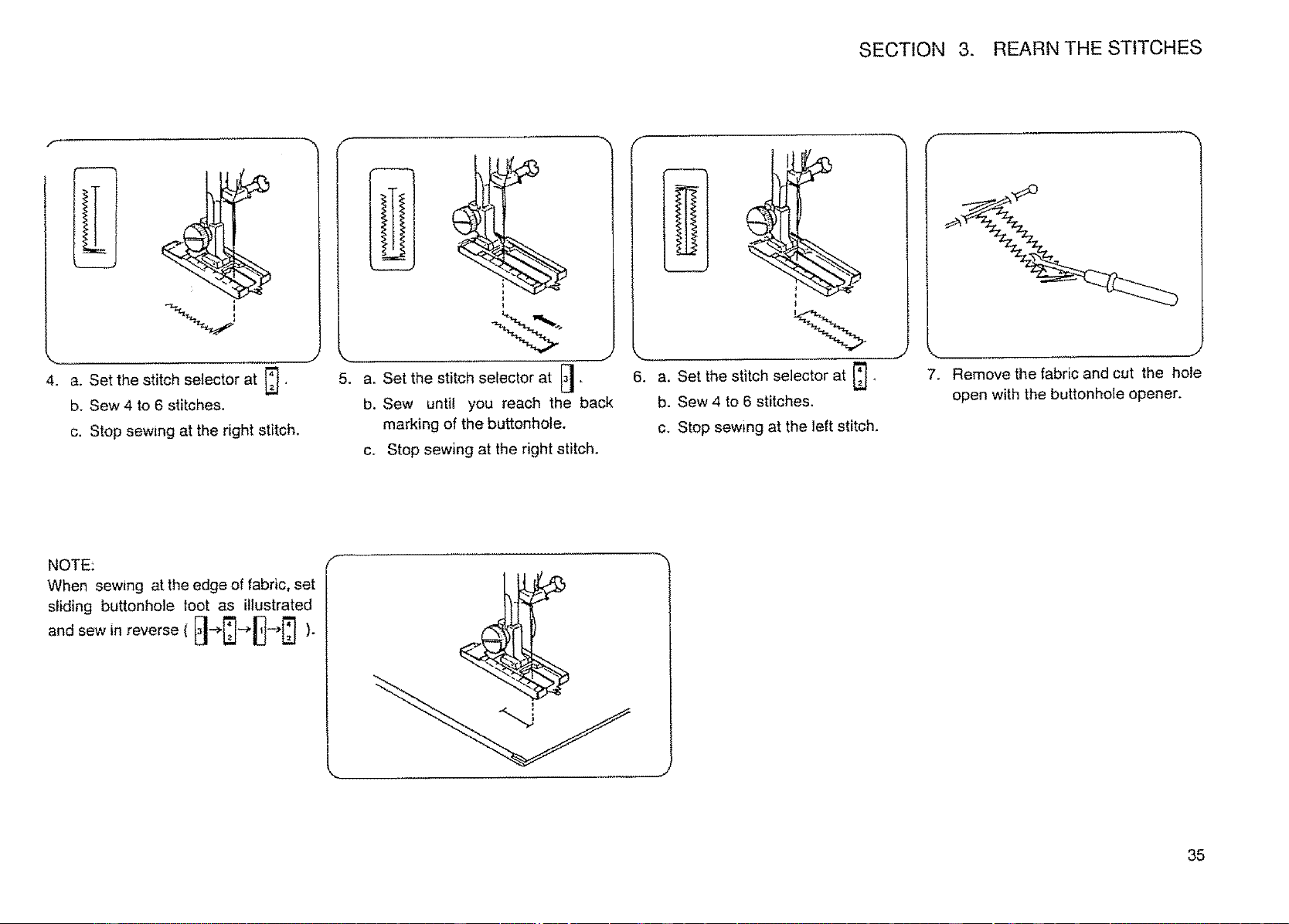
4. a. Set the stitch selector at W
b. Sew 4 to 6 stitches.
c. Stop sewing at the right stitch,
i
Set the stitch selector at I_
5.
a,
b, Sew until you reach the back
marking of the buttonhole.
c. Stop sewing at the right stitch.
k.
6. a,
Set the stitch selector at W
b. Sew 4 to 6 stitches.
c. Stop sewing at the left stitch.
J
7. Remove the fabric and cut the hole
open with the buttonhole opener.
NOTE:
When sewing at the edge of fabric, set
sliding buttonhole loot as illustrated
and sew in reverse( [=J-_f--*"-_ ).
LJ L_J ILJ _t
/
J
35
SECTION 4. PERFORMANCE PROBLEMS CHART
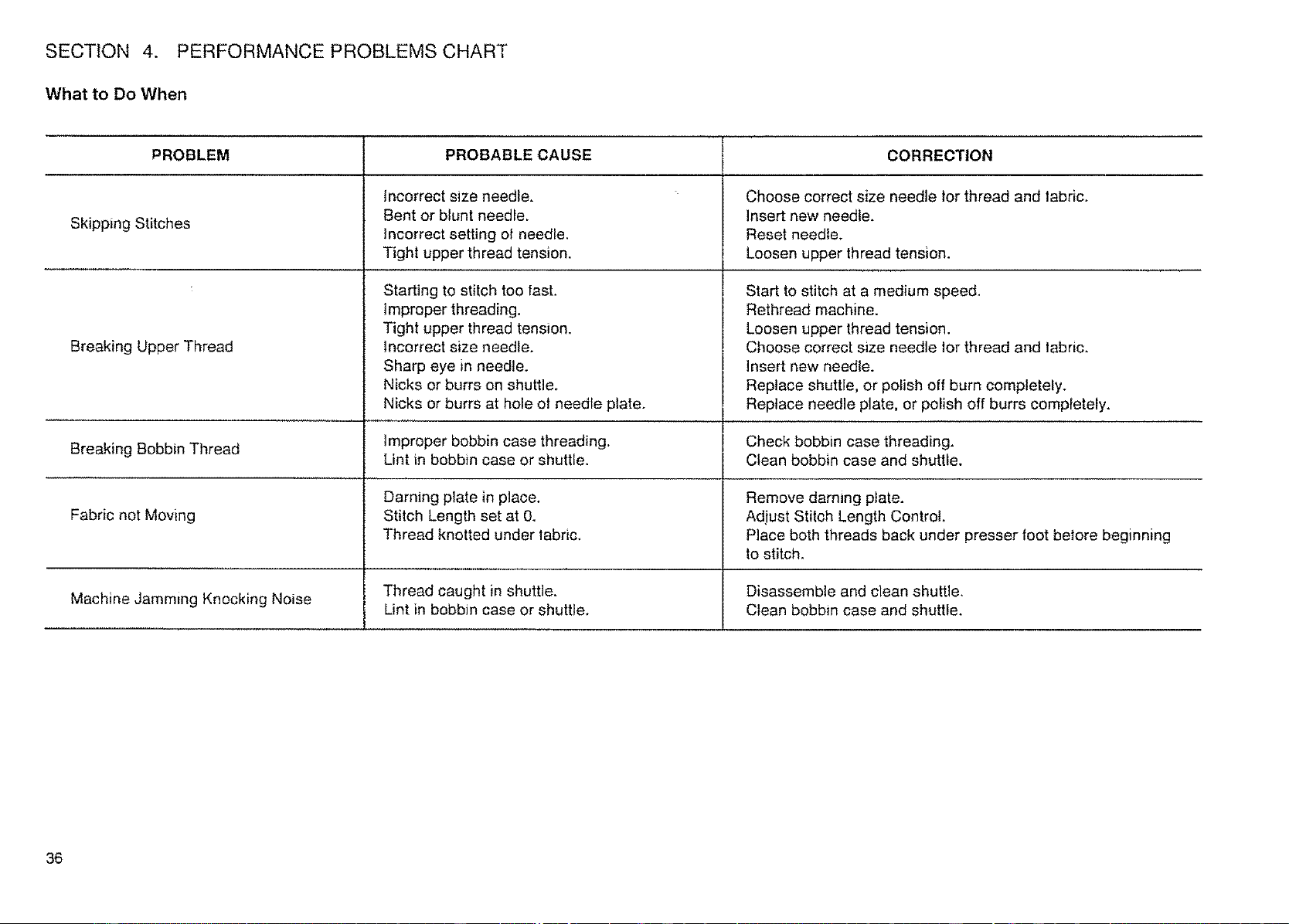
What to Do When
PROBLEM PROBABLE CAUSE CORRECTION
incorrect size needle. Choose correct size needle for thread and labric.
Skipping Stitches Bent or blunt needle. Insert new needle,
incorrect setting ot needle. Reset needle.
Tight upper thread tension. Loosen upper thread tension.
Breaking Upper Thread
Starting to stitch too last.
improper threading.
Tight upper thread tension.
incorrect size needle.
Sharp eye in needle.
Nicks or burrs on shuttle.
Nicks or burrs at hole ot needle plate.
Start to stitch at a medium speed.
Rethread machine.
Loosen upper thread tension.
Choose correct size needle tor thread and fabric.
insert new needle.
Replace shuttle, or polish off bum completely.
Replace needle plate, or polish off burrs completely.
Breaking Bobbin Thread improper bobbin case threading. Check bobbin case threading.
Lint in bobbin case or shuttle. Clean bobbin case and shuttle.
Darning plate in place. Remove darning plate.
Fabric not Moving Stitch Length set at O. Adjust Stitch Length Control.
Thread knotted under tabric. Place both threads back under presser foot be|ore beginning
to stitch.
Machine Jamming Knocking Noise Thread caught in shuttle. Disassemble and clean shuttle.
Lint in bobbin case or shuttle. Clean bobbin case and shuttle.
36
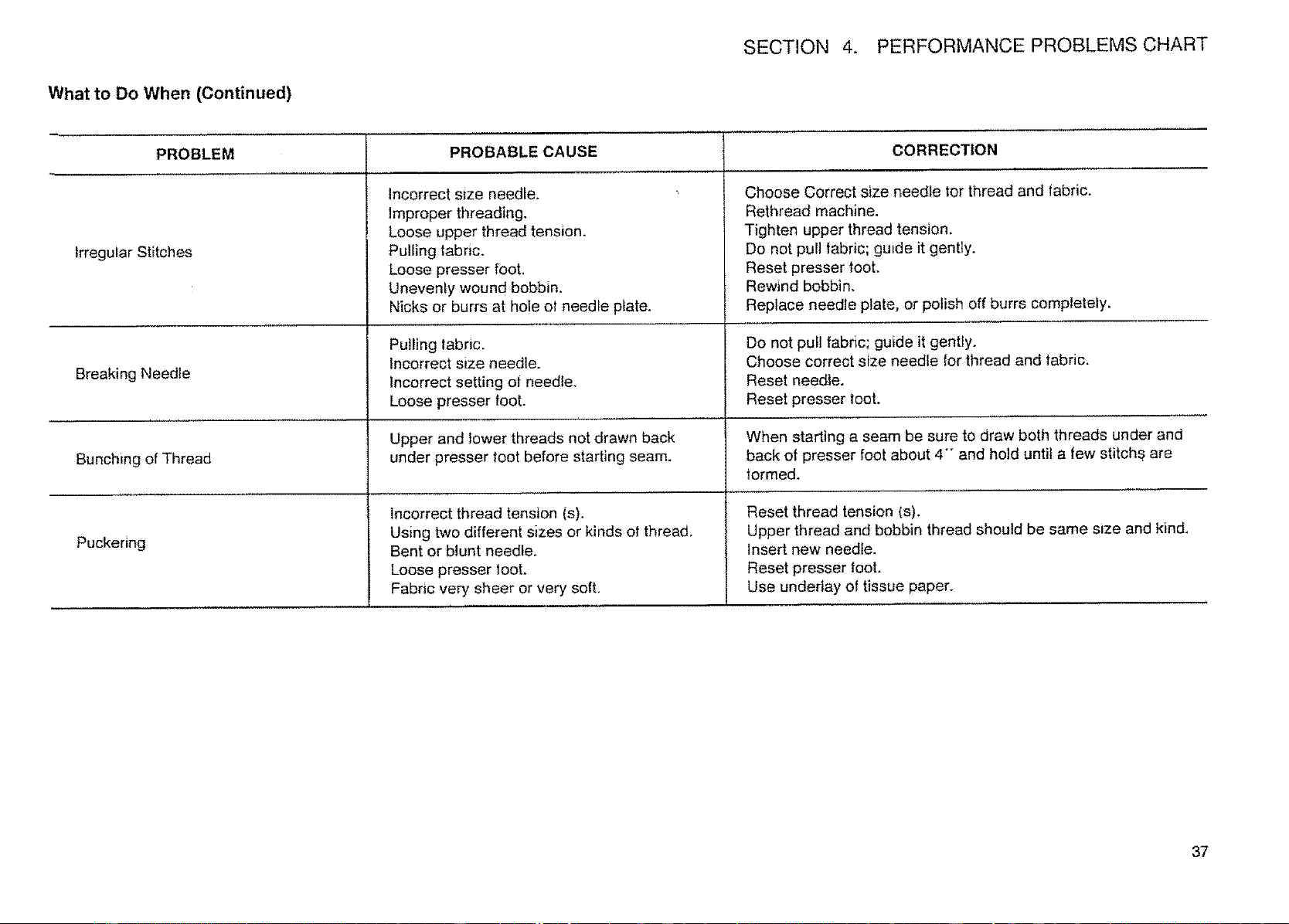
SECTION 4. PERFORMANCE PROBLEMS CHART
What to Do When (Continued)
PROBLEM PROBABLE CAUSE CORRECTION
Irregular Stitches
Breaking Needle
Bunching of Thread
Puckering
Incorrect size needle,
Improper threading.
Loose upper thread tension,
Pulling fabric,
Loose presser foot.
Unevenly wound bobbin,
Nicks or burrs at hole ot needle plate,
Pulling labric,
Incorrect size needle.
Incorrect setting of needle.
Loose presser toot.
Upper and lower threads not drawn back
under presser toot before starting seam.
Incorrect thread tension (s).
Using two different sizes or kinds of thread,
Bent or blunt needle.
Loose presser loot.
Fabric very sheer or very soft.
Choose Correct size needle for thread and labfic.
Rethread machine.
Tighten upper thread tension.
Do not pull fabric; guide it gently.
Reset presser toot,
Rewind bobbin,
Replace needle plate, or polish off burrs completely.
Do not pull fabric; guide it gently.
Choose correct size needle for thread and fabric.
Reset needle.
Reset presser toot.
When starting a seam be sure to draw both threads under and
back of presser foot about 4 "° and hold until a tew stitchs are
formed,
Reset thread tension (s),
Upper thread and bobbin thread should be same size and kind,
Insert new needle.
Reset presser foot.
Use undeday of tissue paper.
37
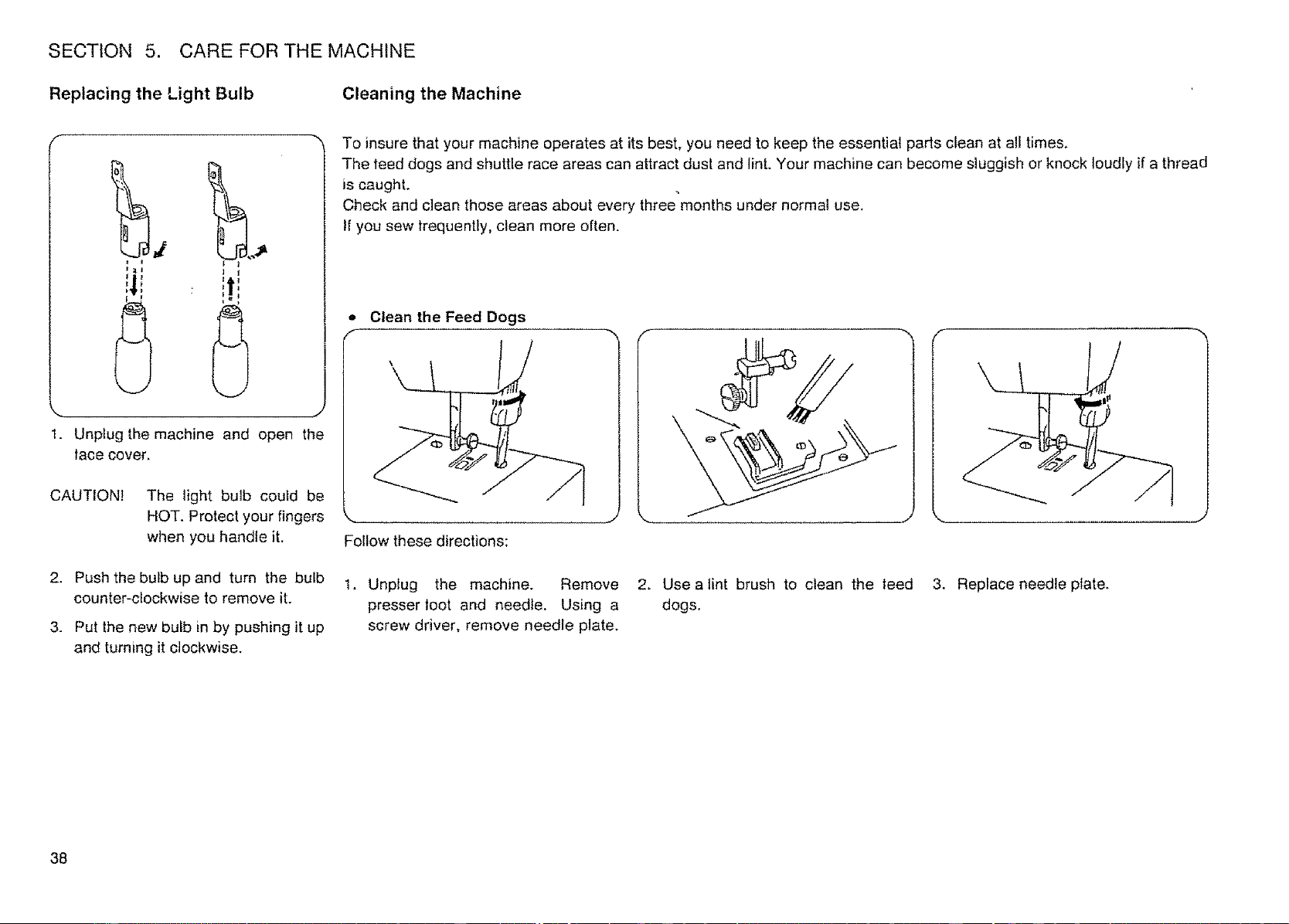
SECTION 5. CARE FOR THE MACHINE
Replacing the Light Bulb Cleaning the Machine
_=qJ J I
%* J
1. Unplug the machine and open the
lace covert
CAUTION! The light bulb could be
HOT. Protect your fingers
when you handle it.
To insure that your machine operates at its best, you need to keep the essential parts clean at all times.
The teed dogs and shuttle race areas can attract dust and lint. Your machine can become sluggish or knock loudly if a thread
is caught.
Check and clean those areas about every three'months under normal use.
If you sew frequently, clean more often.
Clean the Feed Dogs
f
Follow these directions:
2. Push the bulb up and turn the bulb
counter=clockwise to remove it.
3. Put the new bulb in by pushing it up
and turning it clockwise.
1. Unplug the machine. Remove
presser loot and needle. Using a
screw driver, remove needle plate.
2. Use a lint brush to clean the Iced
dogs.
3. Replace needle plate.
38
SECTION 5. CARE FOR THE MACHINE
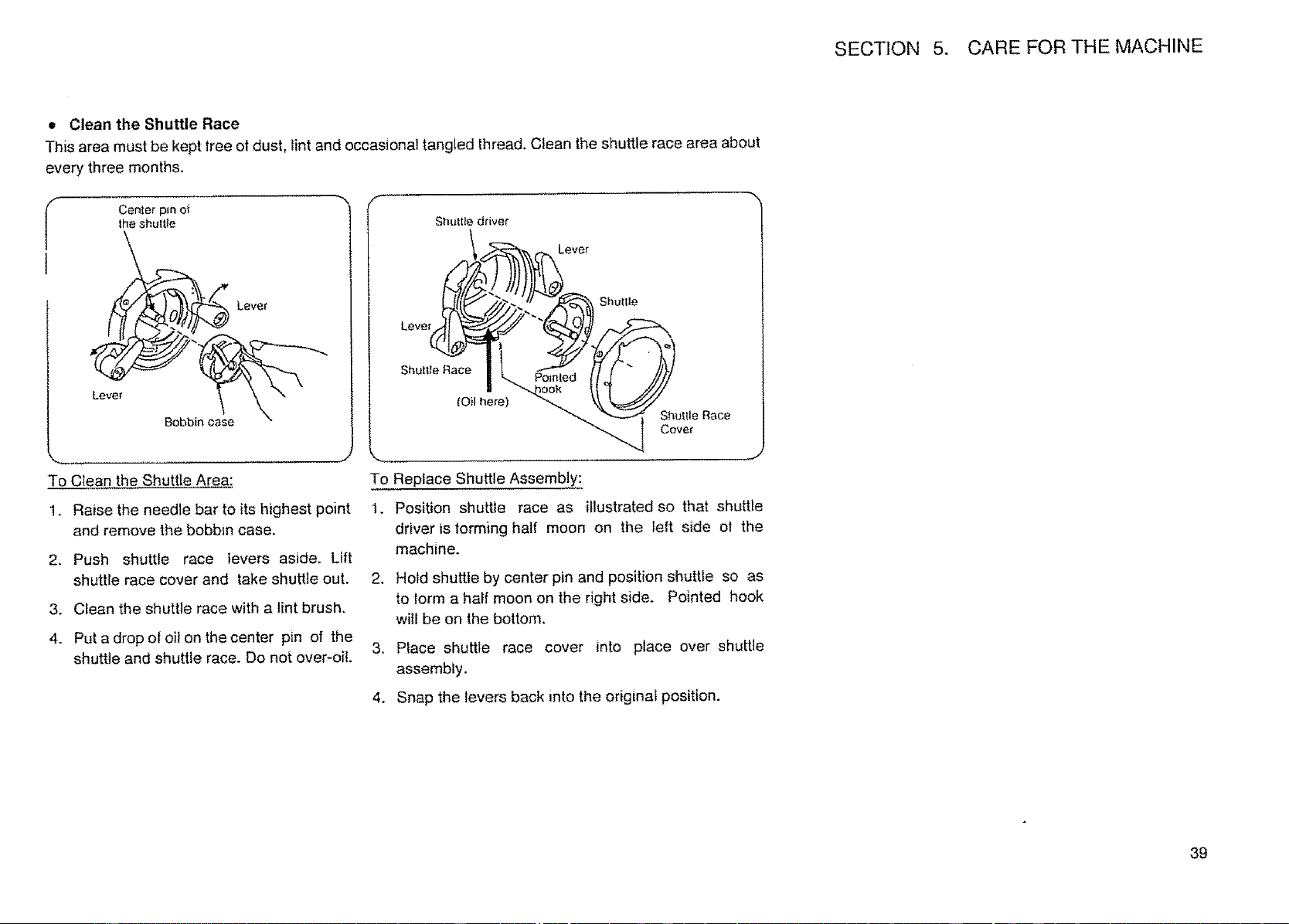
_, Clean the Shuttle Race
This area must be kept tree of dust, lint and occasional tangled thread, Clean the shuttle race area about
every three months.
f
t
Center p_n oi
lhe shullle
Lever
Lever Bobbi_ _''_"
To Clear} the Shuttle Area:
1. Raise the needle bar to its highest point
and remove the bobbin case.
2. Push shuttle race levers aside. Lift
shuttle race cover and take shuttle out.
3. Clean the shuttle race with a lint brush.
4. Put a drop ol oil on the center pin of the
shuttle and shuttle race. Do not over-oil.
Shuttle driver
Lever_
Shuttle Race L
fOil here)
Lever
Pomled
Shultle
Shuttle Race
Cover
To Replace Shuttle Assembly:
1. Position shuttle race as illustrated so that shuttle
driver is forming half moon on the left side ot the
machine.
2. Hold shuttle by center pin and position shuttle so as
to form a half moon on the right side. Pointed hook
will be on the bottom,
3. Place shuttle race cover into place over shuttle
assembly,
4. Snap the levers back into the originaf position.
39
SECTION 5. CARE FOR THE MACHINE
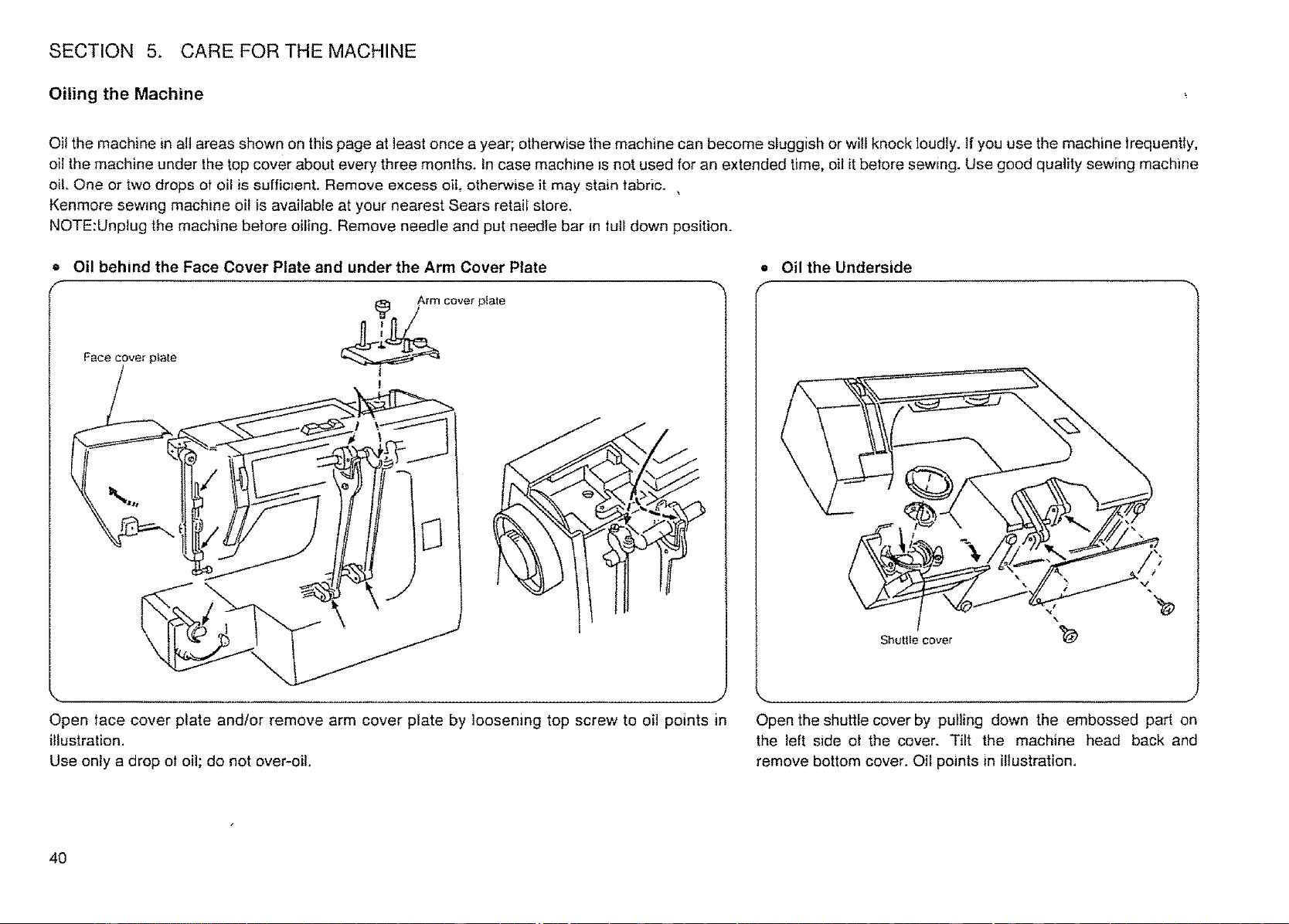
Oiling the Machine
Oil the machine in all areas shown on this page at least once a year; otherwise the machine can become sluggish or will knock loudly. If you use the machine frequently,
oil the machine under the top cover about every three months. In case machine ]s not used for an extended time, oil it beiore sewing. Use good quality sewing machine
oil, One or two drops of oil is sufficient, Remove excess oil, otherwise it may stain fabric.
Kenmore sewing machine oil is available at your nearest Sears retail store.
NOTE:Unplug the machine before oiling. Remove needle and put needle bar in tutl down position.
Oil behind the Face Cover Plate and under the Arm Cover Plate
Face cover pta[e
Atm cover p_ate
!
!
= Oil the Underside
f
Shuttle cover
% ..... ./
Open face cover plate and/or remove arm cover plate by loosening top screw to oi] points in
illustration.
Use only a drop ot oil; de not over-oil,
,.. .... J
Open the shuttle cover by pulling down the embossed part on
the left side ot the cover. Tilt the machine head back and
remove bottom cover. Oil points in illustration,
40
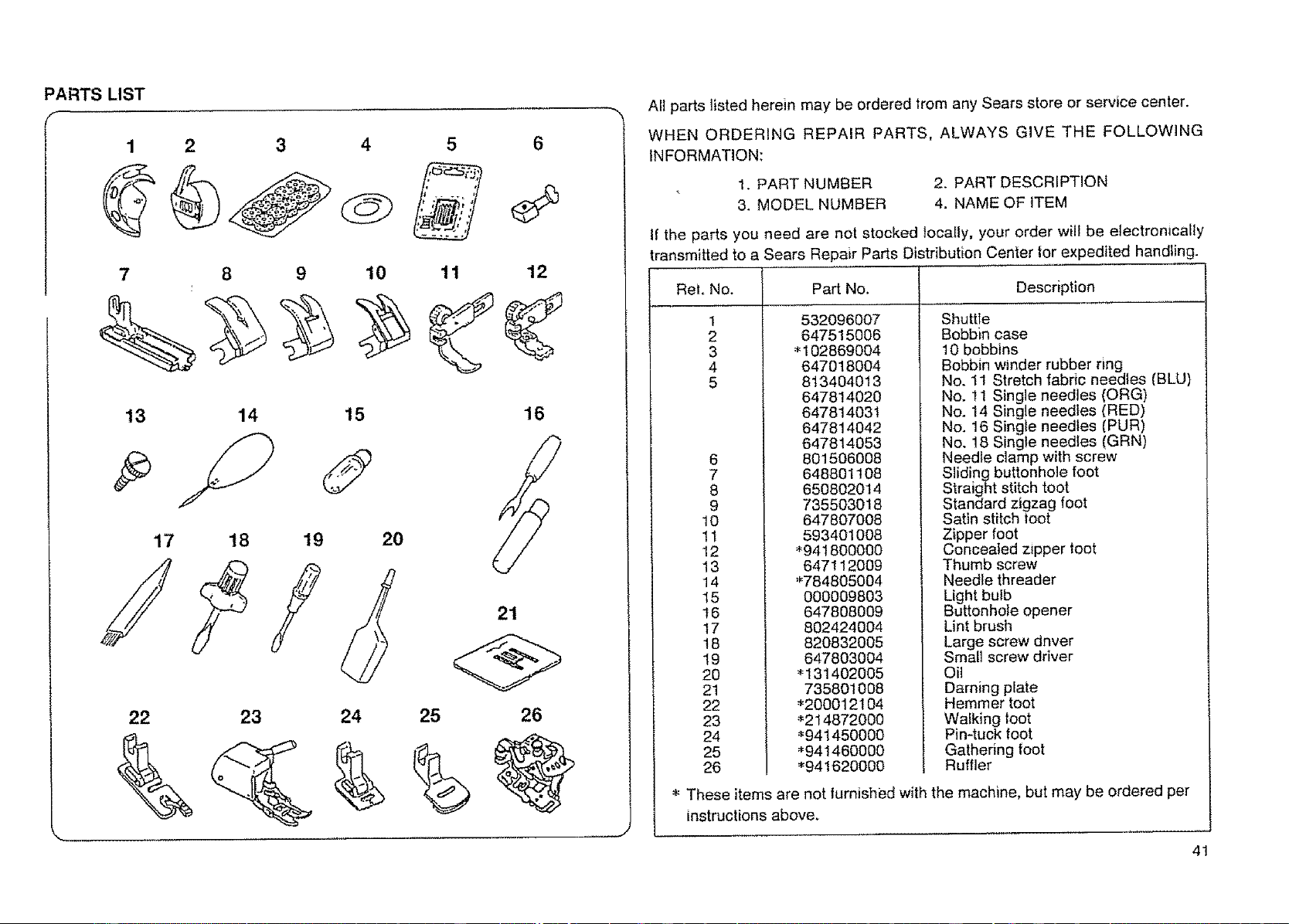
PARTS LIST
1 2 3 4
7 8 9 10
5 6
11 12
13
14
17 20
22 23
15
J
19
/
24 25
21
26
AIt parts listed herein may be ordered trom any Sears store or service center.
WHEN ORDERING REPAIR PARTS, ALWAYS GIVE THE FOLLOWING
INFORMATION:
1. PART NUMBER 2. PART DESCRIPTION
3. MODEL NUMBER 4. NAME OF ITEM
If the parts you need are not stocked locally, your order wilt be electronically
transmitted to a Sears Repair Parts Distribution Center tor expedited handling.
Ret. No. Part No, Description
1
2
3
4
5
6
7
8
9
10
11
12
13
14
15
16
17
18
19
2O
21
22
23
24
25
26
532096007
647515006
_102869004
647018004
813404013
647814020
647814031
647814042
647814053
801506008
648801108
650802014
7355O3018
647807008
593401008
_941800000
647112009
Shuttle
Bobbin case
10 bobbins
Bobbin winder rubber ring
No. 11 Stretch fabric needles (BLU)
No. 11 Single needles (ORG)
No. 14 Single needles (RED)
No. 16 Single needles (PUR)
No. 18 Single needles (GRN)
Needle clamp with screw
Sliding buttonhole foot
Straight stitch toot
Standard zigzag foot
Satin stitch toot
Zipper foot
Concealed zipper toot
Thumb screw
_784805004
000009803
647808009
802424004
820832005
647803004
_131402005
735801008
_200012104
_214872000
_941450000
_941460000
_941620000
Needle threader
Light bulb
Buttonhole opener
Lint brush
Large screw driver
Small screw driver
Oil
Darning plate
Hemmer toot
Walking toot
Pin-tuck foot
Gathering foot
Ruffler
-_These items are not furnished with the machine, but may be ordered per
instructions above.
41
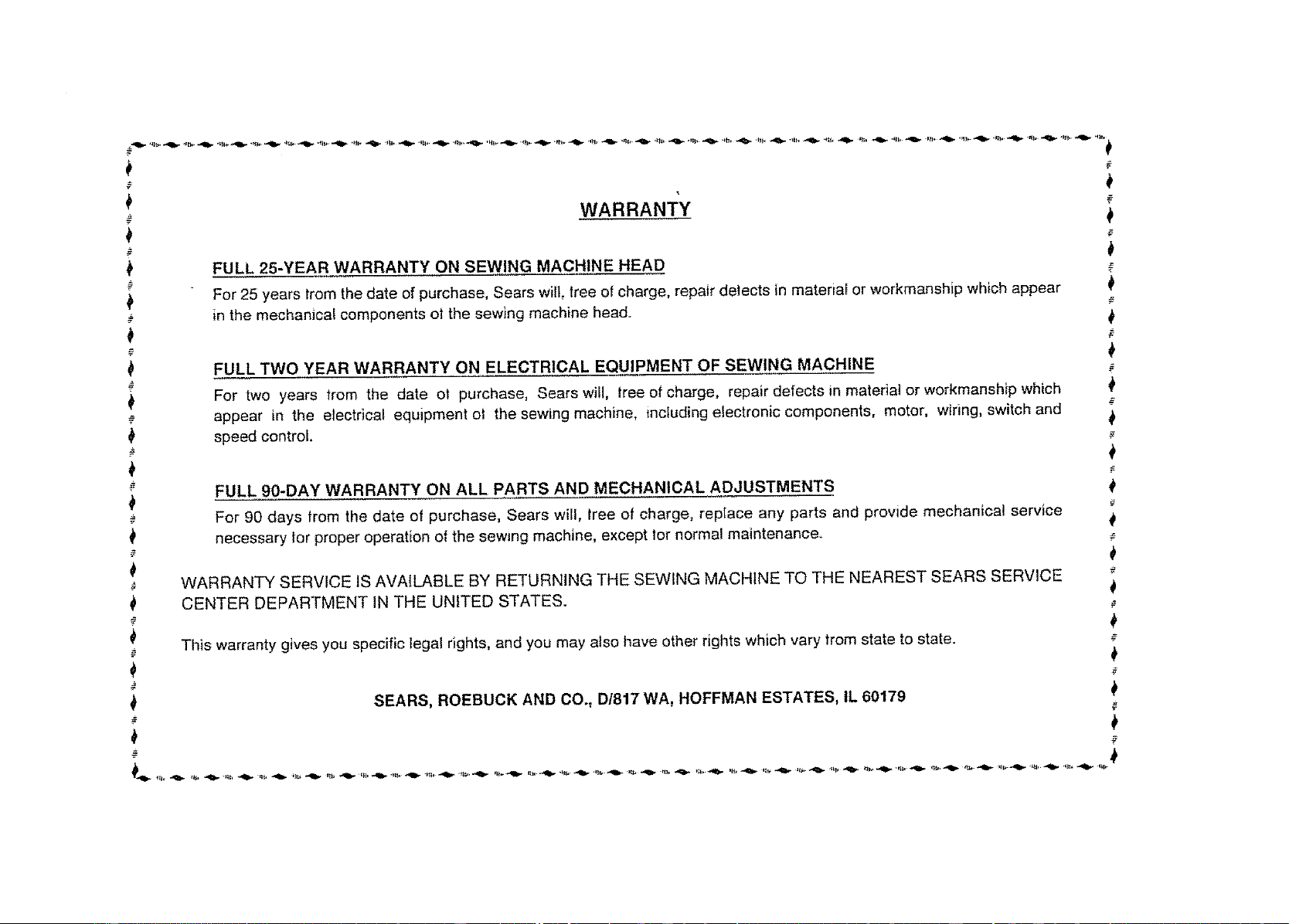
WARRANTY
FULL 25-YEAR WARRANTY ON SEWING MACHINE HEAD
For 25 years from the date of purchase, Sears wilt.•tree of charge, repair delects in materia_ or workmanship which appear ÷
- in the mechanlcal components ot the sewing machine head.
FULL TWO YEAR WARRANTY ON ELECTRICAL EQUIPMENT OF SEWING MACHINE
For two years from the date ot purchase, Sears will, tree of charge, repair defects in material or workmanship which _--"
appear in the electrical equipment o! the sewing machine, including electronic components, motor, wiring, switch and
i) speed control
-_ FULL 90-DAY WARRANTY ON ALL PARTS AND MECHANICAL ADJUSTMENTS
For 90 days trom the date ot purchase, Sears wifl, tree of charge, reptace any parts and provide mechanical service
necessary for proper operation of the sewing machine, except for normal maintenance.
_= WARRANTY SERVICE IS AVAILABLE BY RETURNING THE SEWING MACHINE TO THE NEAREST SEARS SERVICE
CENTER DEPARTMENT IN THE UNITED STATES.
_1 This warranty gives you specific legal rights, and you may also have other rights which vary _rom state to state.
SEARS, ROEBUCK AND CO. D/817 WA, HOFFMAN ESTATES, IL 60179
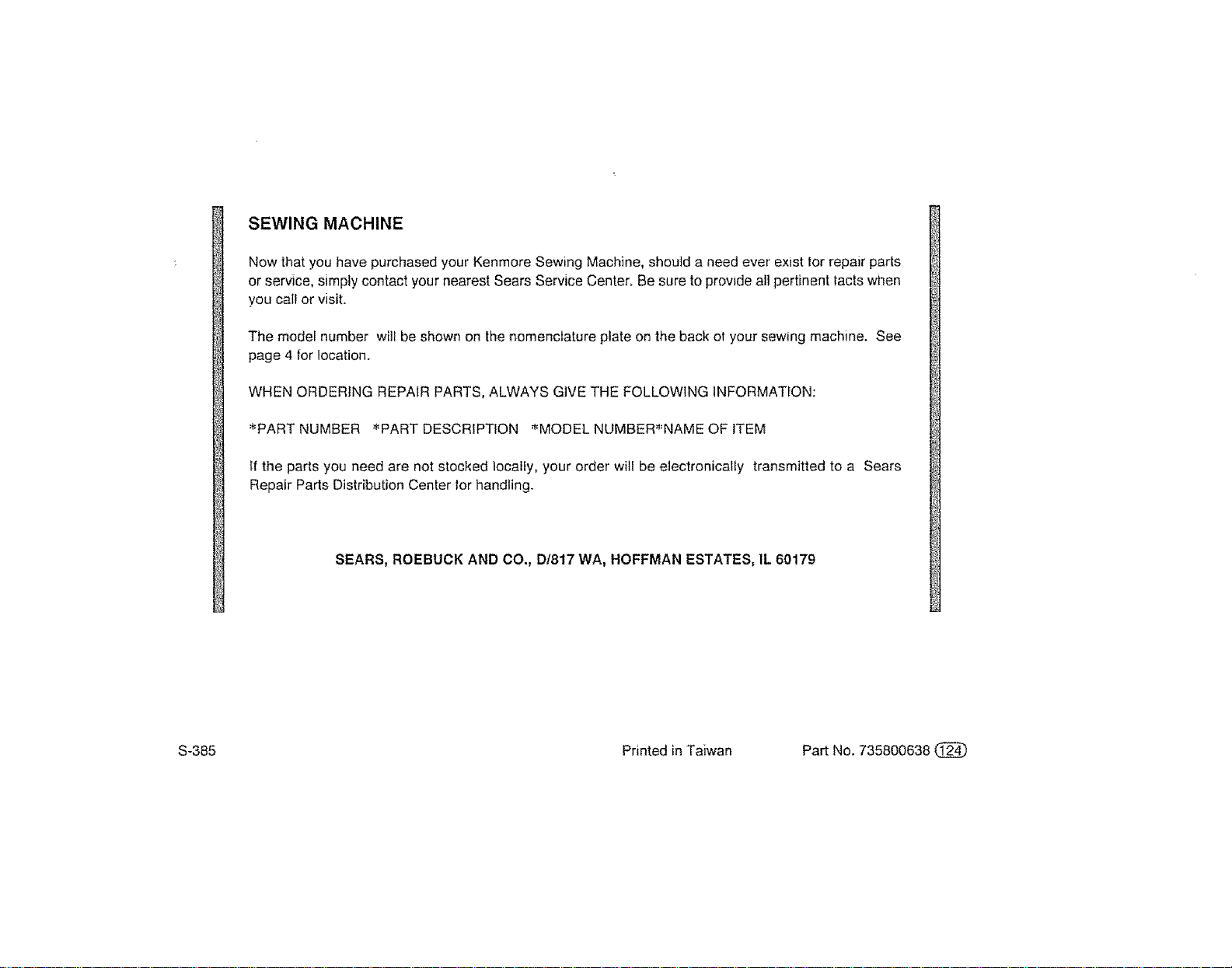
SEWING MACHINE
Now that you have purchased your Kenmore Sewing Machine, should a need ever ex+st lor repair parts
or service, simpty contact your nearest Sears Serv+ce Center+ Be sure to prov+de all pertinent tacts when
you cal+or visit+
The model number wilt be shown on the nomenclature plate on the back ot your sewing machine. See
page 4 for location.
WHEN ORDERING REPAIR PARTS, ALWAYS GIVE THE FOLLOWING INFORMATION:
+PART NUMBER +PART DESCRIPTION +MODEL NUMBER+NAME OF ITEM
If the parts you need are not stocked locally, your order will be electronically transmitted to a Sears
Repair Parts Distribution Center for handling.
SEARS, ROEBUCK AND CO., Dt817 WA, HOFFMAN ESTATES, IL 60179
S-385 Printed in Taiwan Part No. 735800638