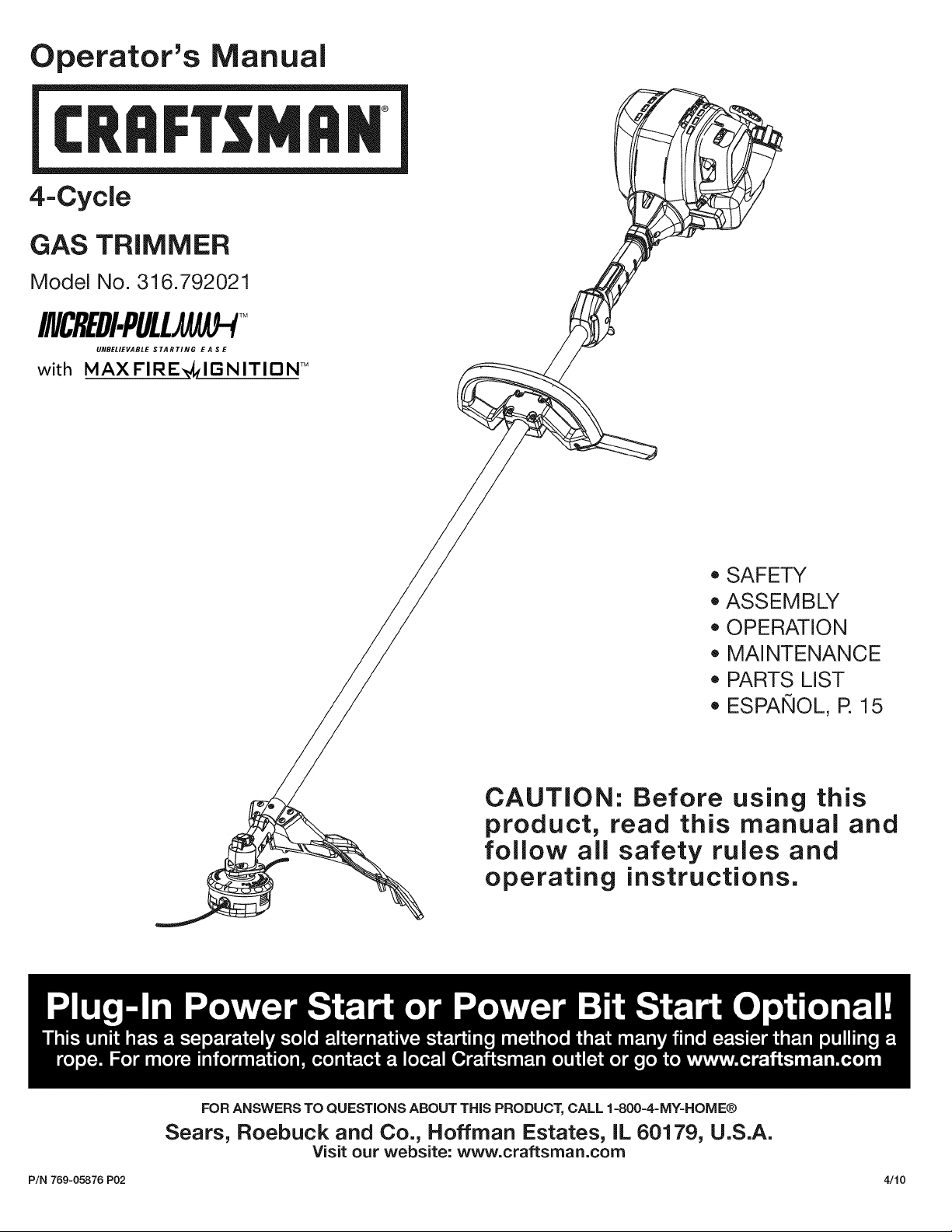
Operator's Manual
4-Cycle
GAS TRIMMER
Model No. 316.792021
INCREDI.PULL TM
UNBELIEVABLE STARTING EA S E
with MAX FIRE_._/II3NITIO N TM
* SAFETY
* ASSEMBLY
* OPERATION
* MAINTENANCE
* PARTS LIST
* ESPANOL, R 15
CAUTION: Before using this
product, read this manual and
follow all safety rules and
operating instructions.
FOR ANSWERS TO QUESTIONS ABOUT THIS PRODUCT, CALL 1-800-4-MY=HOME®
Sears, Roebuck and Co., Hoffman Estates, IL 60179, U.S.A.
Visit our websRe: www.craltsman.com
P/N 769-05876 PO2 4/10
CALiFORNiA PROPOSiTiON 65 WARNING
THE ENGINE EXHAUST FROM THIS PRODUCT CONTAINS CHEMICALS
KNOWN TO THE STATE OF CALIFORNIA TO CAUSE CANCER, BIRTH
DEFECTS OR OTHER REPRODUCTIVE HARM.
TABLE OF CONTENTS
Safety Rules ................................................. 2
Warranty .................................................... 4
Know Your Unit ............................................... 4
Assembly Instructions .......................................... 4
Oil and Fuel Information ........................................ 5
Starting/Stopping Instructions ................................... 6
Operating Instructions ......................................... 7
Maintenance and Repair Instructions .............................. 7
Cleaning and Storage ......................................... 11
Optional Equipment .......................................... 11
Troubleshooting Chart ........................................ 12
Specifications ............................................... 13
Parts List ................................................... 30
Service Numbers ..................................... Back Cover
SPARK ARRESTOR NOTE
NOTE: For users on U.S. Forest Land and in the states of California, Maine,
Oregon and Washington. All U.S. Forest Land and the state of California (Public
Resources Codes 4442 and 4443), Oregon and Washington require, by law that
certain internal combustion engines operated on forest brush and/or grass-covered
areas be equipped with a spark arrestor, maintained in effective working order, or
the engine be constructed, equipped and maintained for the prevention of fire.
Check with your state or local authorities for regulations pertaining to these
requirements. Failure to follow these requirements could subject you to liability or
a fine. This unit is factory equipped with a spark arrestor. If it requires
replacement, ask your LOCAL SERVICE DEALER to install the Accessory Part
#753-06334 Muffler Assembly.
All information, illustrations, and specifications in this manual are based
on the latest product information available at the time of printing. We
reserve the right to make changes at any time without notice.
The purpose of safety symbols is to attract attention to possible dangers. The
safety symbols, and their explanations, deserve careful attention and
understanding. The safety warnings do not by themselves eliminate any danger.
The instructions or warnings they give are not substitutes for proper accident
prevention measures.
SYMBOL MEANING
SAFETY ALERT: Indicates danger, warning or caution.Attention is required in order to avoid serious personal injury. May
be used in conjunction with other symbols or pictographs.
NOTE: Advises of information or instructions vital to the operation or
maintenance of the equipment.
_ ANGER: Failure to obey a safety warning will result in serious
injury to yourself or to others. Always follow the safety precautions
to reduce the risk of fire, electric shock and personal injury.
WARNING: Failure to obey a safety warning can result in injury to
yourself and others. Always follow the safety precautions to reduce the risk
of fire, electric shock and personal injury.
CAUTION: Failure to obey a safety warning may result inproperty damage or personal injury to yourself or to others. Always
follow the safety precautions to reduce the risk of fire, electric shock
and personal injury.
NOTE= This Unit Can Use a Plug-in Power Start or Power Bit Start
Optional Accessory!
Please refer to the Plug-In Power Start or Power Bit Start operator's
manual for proper use of these features. (Items may be Sold
Separately! Please refer to page 11 of this manual for more information
about purchasing these accessories.)
Read the Operator's Manual and follow all warnings and safety instructions.
Failure to do so can result in serious injury to the operator and/or bystanders.
FOR QUESTIONS, CALL 1-800-4-MY-HOME®
• iMPORTANT SAFETY iNSTRUCTiONS
READ ALL INSTRUCTIONS BEFORE OPERATING
• Read the instructions carefully. Be familiar with the controls and proper
use of the unit.
Do not operate this unit when tired, ill, or under the influence of alcohol,
drugs, or medication.
Children and teens under the age of 15 must not use the unit, except for
teens guided by an adult.
All guards and safety attachments must be installed properly before
operating the unit.
Inspect the unit before use. Replace damaged parts. Check for fuel leaks.
Make sure all fasteners are in place and secure. Replace parts that are
cracked, chipped, or damaged in any way. Do not operate the unit with loose
or damaged parts.
Carefully inspect the area before starting the unit. Remove all debris and
hard or sharp objects such as glass, wire, etc.
Clear the area of children, bystanders, and pets. At a minimum, keep all
children, bystanders, and pets outside a 50 feet (15 m.) radius; there still may be
a risk to bystanders from thrown objects. Bystanders should be encouraged to
wear eye protection. If approached, stop the unit immediately.
,, Use only Craftsman Hassle-Free TM XTRA QUIET Spiral Lineoriginal
equipment manufacturer replacement line. Never use metal-reinforced line,
wire or rope. These can break off and become dangerous projectiles.
Squeeze the throttle control and check that it returns automatically to the idle
position. Make all adjustments or repairs before using unit.
SAFETY WARNINGS FOR GAS UNITS
1_L_ WARNING: Gasoline is highly flammable and its vapors can
explode if ignited. Take the following precautions:
Store fuel only in containers specifically designed and approved for the
storage of such materials.
,, Avoid creating a source of ignition for spilled fuel. Do not start the engine
until fuel vapors dissipate.
Always stop the engine and allow it to cool before filling the fuel tank. Never
remove the cap of the fuel tank, or add fuel, when the engine is hot. Never
operate the unit without the fuel cap securely in place. Loosen the fuel tank
cap slowly to relieve any pressure in the tank.
Add fuel in a clean, well-ventilated outdoor area where there are no sparks or
flames. Slowly remove the fuel cap only after stopping engine. Do not smoke
while fueling. Wipe up any spilled fuel from the unit immediately. Always wipe unit
dry before using.
Move the unit at least 30 feet (9.1 m) from the fueling source and site before
starting the engine. Do not smoke or allow sparks and open flames near the area
while adding fuel or operating the unit.
WHILE OPERATING
Never start or run the unit inside a closed room or building. Breathing exhaust
fumes can kill. Operate this unit only in a well ventilated outdoor area.
Be aware of the risk of injury to the head, hands and feet.
Wear safety glasses or goggles that are marked as meeting ANSI Z87.1-1989
standards. Also wear ear/hearing protection when operating this unit. Wear a
face or dust mask if the operation is dusty. Long sleeve shirts are
recommended.
Wear heavy, long pants, boots and gloves. Do not wear loose clothing,
jewelry, short pants, sandals or go barefoot. Secure hair above shoulder
level.
The cutting attachment shield must always be in place while operating
the unit. Do not operate unit without both trimming lines extended, and
the proper line installed. Do not extend the trimming line beyond the
length of the shield.
This unit has a clutch. The cutting attachment remains stationary when
the engine is idling. If it does not, have the unit adjusted by an authorized
service technician.
Adjust the D-handle that will provide the best grip.
Be sure the cutting attachment is not in contact with anything before
starting the unit.
Use the unit only in daylight or good artificial light.

• Avoidaccidentalstarting.Beinthestartingpositionwheneverpullingthe
starterrope.Theoperatorandunitmustbeinastablepositionwhile
starting.SeeStarting/StoppingInstructions.
Usetherighttool.Onlyusethistoolforthepurposeintended.
Donotoverreach.Alwayskeepproperfootingandbalance.
Alwaysholdtheunitwithbothhandswhenoperating.Keepafirmgripon
boththefrontandrearhandleorgrips.
Keephands,face,andfeetatadistancefromallmovingparts.Donottouch
ortrytostopthecuttingattachmentwhenitisrotating.
Donottouchtheengineormuffler.Thesepartsgetextremelyhotfrom
operation.Theyremainhotforashorttimeafterturningofftheunit.
Donotoperatetheenginefasterthanthespeedneededtocut,trimoredge.Do
notruntheengineathighspeedwhentheunitisnotinuse.
Alwaysstoptheenginewhencuttingisdelayedorwhenwalkingfromone
cuttinglocationtoanother.
Ifstrikingorunitbecomesentangledwithaforeignobject,stoptheengine
immediatelyandcheckfordamage.Donotoperatebeforerepairingdamage.Do
notoperatetheunitwithlooseordamagedparts.
Stopandswitchtheenginetooffformaintenance,repair,orforchanging
thecuttingattachmentorotherattachments.
Useonlyoriginalequipmentmanufacturerreplacementpartsand
accessoriesforthisunit,aslistedinthePartspagesofthisoperator's
manual.TheseareavailablefromaSearsorotherauthorizedservice
dealer.Useofanyunauthorizedpartsoraccessoriescouldleadtoserious
injurytotheuser,ordamagetotheunit,andvoidthewarranty.
Keepunitcleanofvegetationandothermaterials.Theymaybecome
lodgedbetweenthecuttingattachmentandshield.
Toreducefirehazard,replacefaultymufflerandsparkarrestor.Keepthe
engineandmufflerfreefromgrass,leavesorotherdebris.
OTHERSAFETYWARNINGS
Neverstoretheunit,withfuelinthetank,insideabuildingwherefumes
mayreachanopenflameorspark.
Allowtheenginetocoolbeforestoringortransporting.Besuretosecure
theunitwhiletransporting.
Storetheunitinadryarea,lockeduporuphightopreventunauthorized
useordamage.Keepoutofthereachofchildren.
Neverdouseorsquirttheunitwithwateroranyotherliquid.Keephandles
dry,cleanandfreefromdebris.Cleanaftereachuse.SeetheCleaning
andStorageinstructions.
Keeptheseinstructions.Refertothemoftenandusethemtoinstructotherusers.If
loaningsomeonethisunit,alsoloanthemtheseinstructions.
SAVETHESEINSTRUCTIONS
= SAFETY & iNTERNATIONAL SYMBOLS •
This operator's manual describes safety and international symbols and pictographs that may appear on this product. Read the operator's manual for complete
safety, assembly, operating and maintenance and repair information.
SYMBOL MEANING
_,. SAFETY ALERT SYMBOL
Indicates danger, warning or caution. May be used in
conjunction with other symbols or pictographs.
, READ OPERATOR'S MANUAL
_] I []_ WARNING: Read the operator's manual(s) and follow all
IL.__L_._J_ warnings and safety instructions. Failure to do so can result
, in serious injury to the operator and/or bystanders.
4t _ D WEAR EYE AND HEARING PROTECTION
WARNING: Thrown objects and loud noise can cause severe
_! ye injury and hearing loss.Wear eye protection meeting ANSI Z87.1-
1989 standards and ear protection when operating this unit. Use a full
face shieldwhen needed.
!
O
, UNLEADED FUEL
Always use clean, fresh unleaded fuel
, ON/OFF STOP CONTROL
ON / START / RUN
, DO NOT USE E85 FUEL IN THIS UNIT
WARNING: It has been proven that fuel containing
greater than 15% ethanol will likely damage this engine and
void the warranty.
SYMBOL MEANING
_ @ , THROWN OBJECTS AND ROTATING CUTTER CAN
/_ CAUSE SEVERE INJURY
_>_" WARNING: Small objects can be propelled at high speed,
;*/__/_=b . causing injury. Keep away from the rotating rotor.
A mKEEP BYSTANDERS AWAY
WARNING: Keepall bystandeisl especially Children and
pets, at least 50 feet (!5 m.) from the operating area.
. HOTSURFAOE
_,,_ ARNING: D0 nottoucha hot enginel TheSe partS get
extremely hot from operation and may cause severe burns.
i,===== When turned off they remain hot for a short time,
,OiL
_J Refer to opeiat0r!s manual f0i the pr0per type 0f0iL
PRIMERBULBPush pdmei bulb: iU!!y and SloW!y: iO timesl
_ , SHARP BLADE
WARNING: sharpblade Ontiimmer attachment shield.
"_ p[event sedous !nJu_, do not touch th e f!ne cutting blade,
3
CRAFTSMAN PROFESSIONAL FULL WARRANTY
If this Craftsman Professional product fails due to a defect in material or workmanship within three years from the date of purchase, return it to any Sears store,
Parts & Repair Service Center, or other Craftsman outlet in the United States for free repair (or replacement if repair proves impossible).
This warranty applies for only one year if this product is ever used for commercial or rental purposes.
This warranty covers ONLY defects in material and workmanship. Sears will NOT pay for:
• Expendable items that can wear out from normal use within the warranty period, such as cutting line, filters or spark plugs.
Repairs necessary because of accident or failure to operate or maintain the product according to all supplied instructions.
Preventive maintenance, or repairs necessary due to improper fuel mixture, contaminated or stale fuel.
This warranty gives you specific legal rights, and you may also have other rights which vary from state to state.
Sears, Roebuck and Co., Hoffman Estates, IL 60179
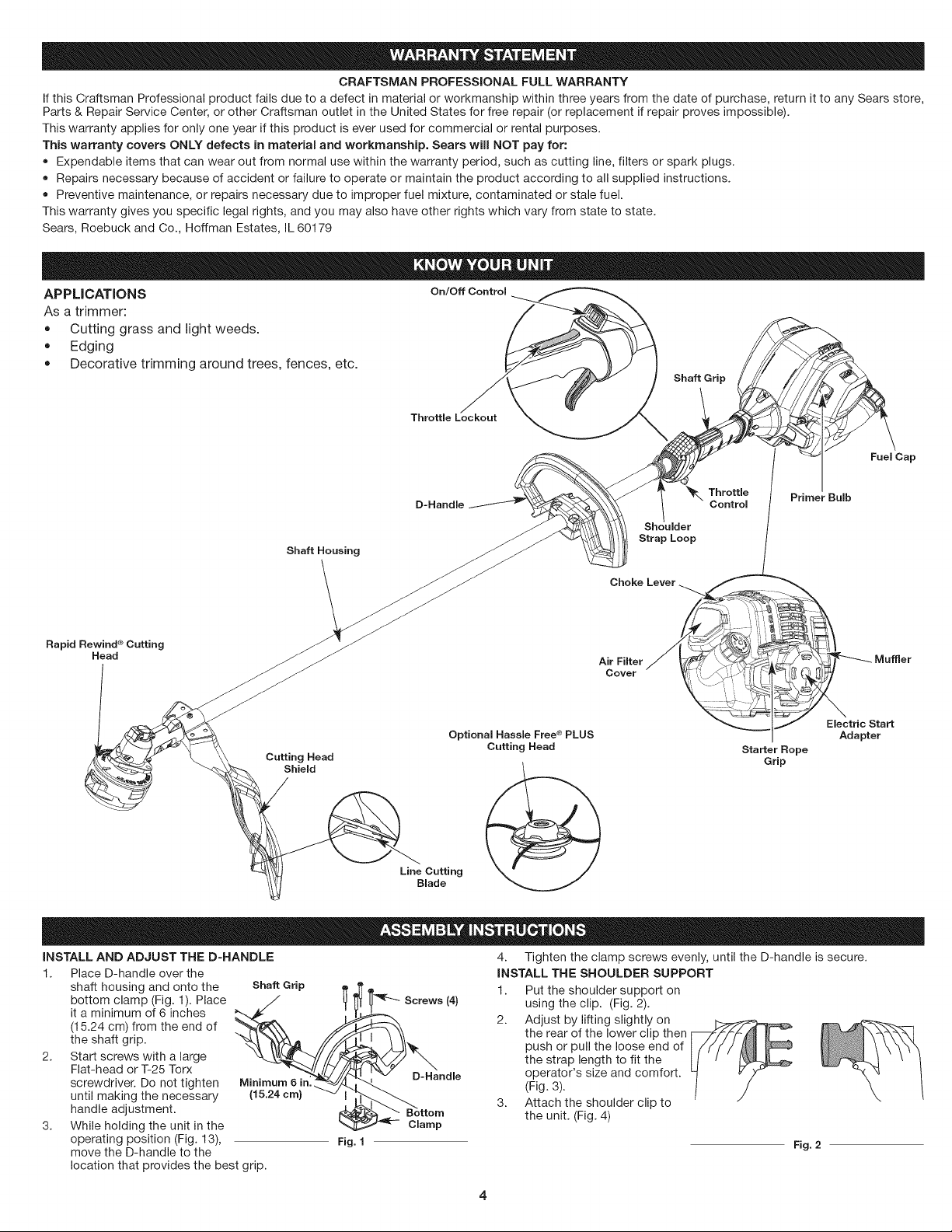
APPLICATIONS on/off Control
As a trimmer:
• Cutting grass and light weeds.
Edging
Decorative trimming around trees, fences, etc.
Shaft Grip
Throttle Lockout
Shaft Housing
D-Handle _ Throttlecontrol Primer Bulb
Shoulder
Strap Loop
Choke Lever
Fuel Cap
Rapid Rewind ® Cutting
Head
Air Filter Muffler
Cover
Electric Start
Optional Hassle Free ® PLUS Adapter
Cutting Head Starter Rope
Cutting Head Grip
Shield
Line Cutting
Blade
iNSTALL AND ADJUST THE D-HANDLE
1. Place D-handle over the
shaft housing and onto the
bottom clamp (Fig. 1). Place
it a minimum of 6 inches
(15.24 cm) from the end of
the shaft grip.
2. Start screws with a large
Flat-head or T-25 Torx
screwdriver. Do not tighten
until making the necessary
handle adjustment.
3. While holding the unit in the
operating position (Fig. 13),
move the D-handle to the
location that provides the best grip.
Shaft Grip
Fig. I
D-Handle
Clamp
4. Tighten the clamp screws evenly, until the D-handle is secure.
INSTALL THE SHOULDER SUPPORT
1. Put the shoulder support on
using the clip. (Fig. 2).
2. Adjust by lifting slightly on
the rear of the lower clip then
push or pull the loose end of
the strap length to fit the
operator's size and comfort.
(Fig. 3).
3. Attach the shoulder clip to
the unit. (Fig. 4)
Fig. 2
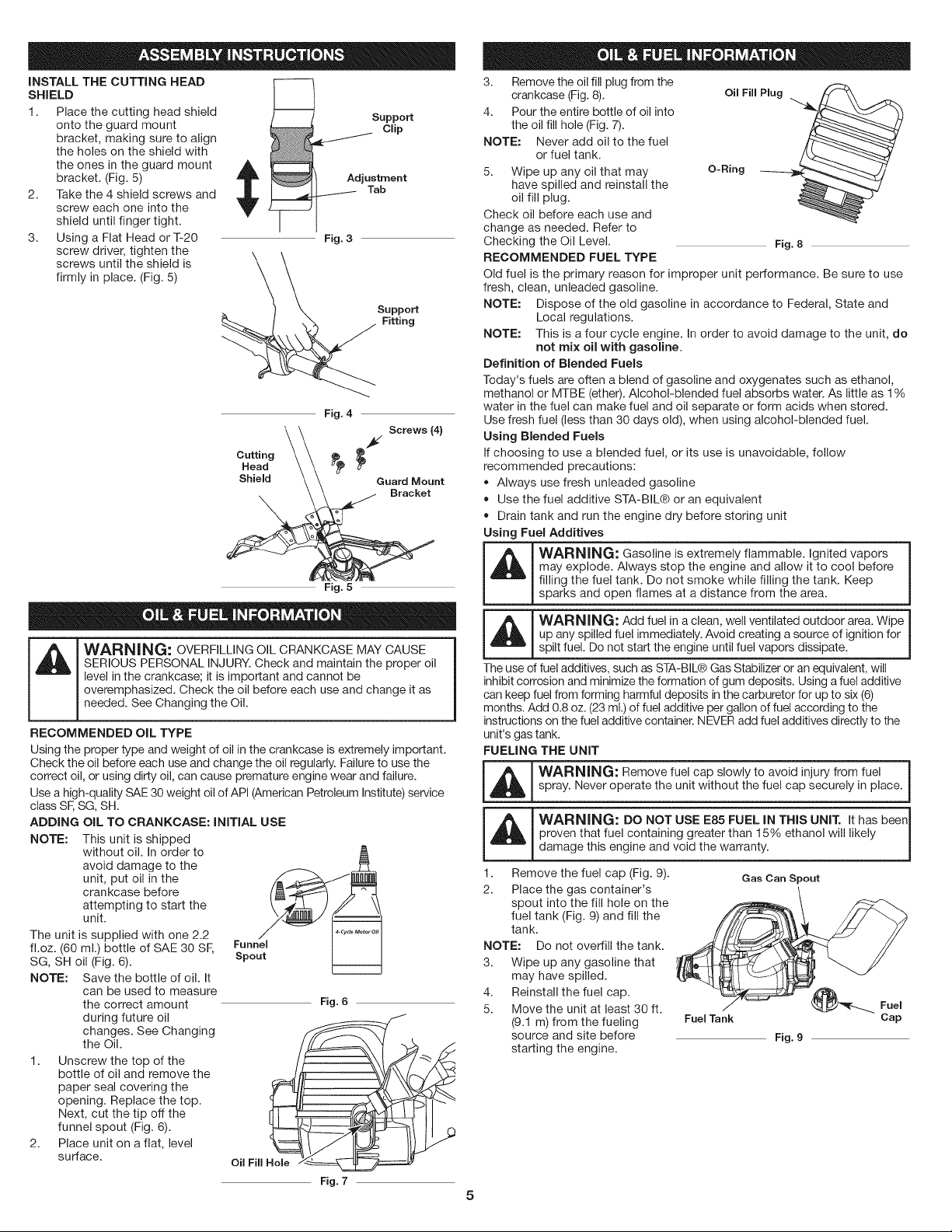
iNSTALL THE CUTTING HEAD
SHIELD
1. Place the cutting head shield
onto the guard mount
bracket, making sure to align
the holes on the shield with
the ones in the guard mount
bracket. (Fig. 5)
2. Take the 4 shield screws and
screw each one into the
shield until finger tight.
3. Using a Flat Head or T-20
screw driver, tighten the
screws until the shield is
firmly in place. (Fig. 5)
Support
Clip
Adjustment
Tab
Fig. 3
Support
Fitting
Fig. 4
\ \ Screws (4)
Shield \ \ Guard Mount
Fig. 5
I _ _WARNING: OVERFILLING OIL CRANKCASE MAY CAUSE
SERIOUS PERSONAL INJURY. Check and maintain the proper oil
level in the crankcase; it is important and cannot be
overemphasized. Check the oil before each use and change it as
needed. See Changing the Oil.
RECOMMENDED OIL TYPE
Using the proper type and weight of oil in the crankcase is extremely important.
Check the oil before each use and change the oil regularly. Failure to use the
correct oil, or using dirty oil, can cause premature engine wear and failure.
Use a high-quality SAE 30 weight oil of API (American Petroleum Institute) service
class SF, SG, SH.
ADDING OiL TO CRANKCASE: INITIAL USE
NOTE: This unit is shipped
without oil. In order to
avoid damage to the
unit, put oil in the
crankcase before
attempting to start the
unit.
The unit is supplied with one 2.2
fl.oz. (60 ml.) bottle of SAE 30 SF,
SG, SH oil (Fig. 6).
NOTE: Save the bottle of oil. It
can be used to measure
the correct amount
during future oil
changes. See Changing
the Oil.
1. Unscrew the top of the
bottle of oil and remove the
paper seal covering the
opening. Replace the top.
Next, cut the tip off the
funnel spout (Fig. 6).
2. Place unit on a flat, level
surface.
Fig. 6
Oil Fill Hole
3. Remove the oil fill plug from the
crankcase (Fig. 8).
4. Pour the entire bottle of oil into
the oil fill hole (Fig. 7).
NOTE: Never add oil to the fuel
or fuel tank.
5. Wipe up any oil that may
have spilled and reinstall the
oil fill plug.
Check oil before each use and
change as needed. Refer to
Checking the Oil Level.
RECOMMENDED FUEL TYPE
Oil Fill Plug
O-Ring --_'
Fig. 8
Old fuel is the primary reason for improper unit performance. Be sure to use
fresh, clean, unleaded gasoline.
NOTE: Dispose of the old gasoline in accordance to Federal, State and
Local regulations.
NOTE: This is a four cycle engine. In order to avoid damage to the unit, do
not mix oil with gasoline.
Definition of Blended Fuels
Today's fuels are often a blend of gasoline and oxygenates such as ethanol,
methanol or MTBE (ether). Alcohol-blended fuel absorbs water. As little as 1%
water in the fuel can make fuel and oil separate or form acids when stored.
Use fresh fuel (less than 30 days old), when using alcohol-blended fuel.
Using Blended Fuels
If choosing to use a blended fuel, or its use is unavoidable, follow
recommended precautions:
• Always use fresh unleaded gasoline
• Use the fuel additive STA-BIL® or an equivalent
• Drain tank and run the engine dry before storing unit
Using Fuel Additives
WARNING: Gasoline is extremely flammable. Ignited vapors
may explode. Always stop the engine and allow it to cool before
filling the fuel tank. Do not smoke while filling the tank. Keep
sparks and open flames at a distance from the area.
WARNING: Add fuel in a clean, well ventilated outdoor area. Wipe
up any spilled fuel immediately. Avoid creating a source of ignition for
spilt fuel. Do not start the engine until fuel vapors dissipate.
The use of fuel additives, such as STA-BIL@ Gas Stabilizer or an equivalent, will
inhibit corrosion and minimize the formation of gum deposits. Using a fuel additive
can keep fuel from forming harmful deposits in the carburetor for up to six (6)
months. Add 0.8 oz. (23 ml.) of fuel additive per gallon of fuel according to the
instructions on the fuel additive container. NEVER add fuel additives directly to the
unit's gas tank.
FUELING THE UNIT
-- i
_L_ WARNING: Remove fuel cap slowly to avoid injury from fuel
spray. Never operate the unit without the fuel cap securely in place.
_ ARNING: DO NOT USE E85 FUEL IN THIS UNIT. It has beenl
proven that fuel containing greater than 15% ethanol will likely
J
damage this engine and void the warranty.
1. Remove the fuel cap (Fig. 9).
2. Place the gas container's
spout into the fill hole on the
fuel tank (Fig. 9) and fill the
tank.
NOTE: Do not overfill the tank.
3. Wipe up any gasoline that
may have spilled.
4. Reinstall the fuel cap.
5. Move the unit at least 30 ft.
(9.1 m) from the fueling
source and site before
starting the engine.
Gas Can Spout
Fuel Tank
Fig. 9
Fig. 7
5
m
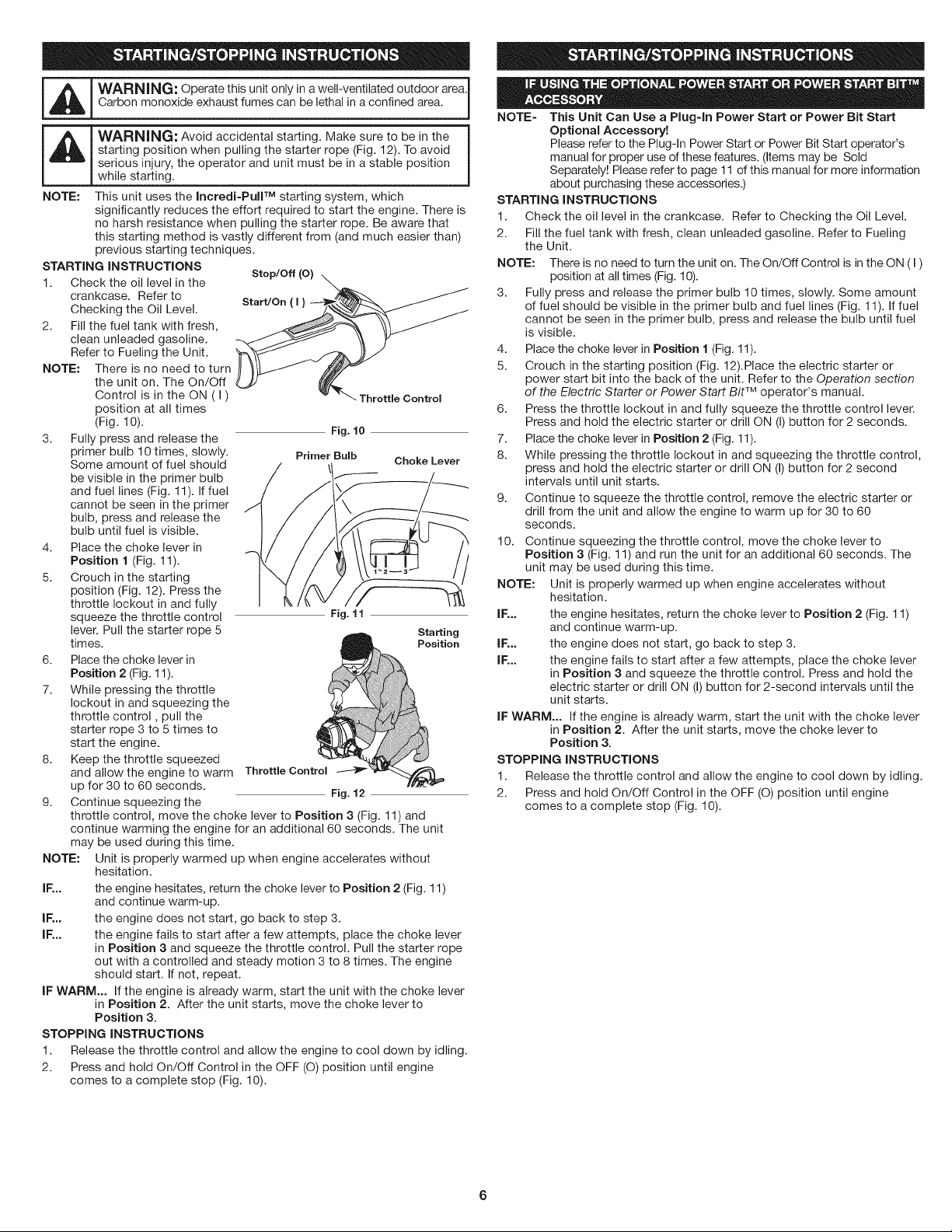
_L_ WARNING: Operate this unit only in a well-ventilated outdoor area. I
Carbon monoxide exhaust fumes can be lethal in a confined area. j
_ WARNING: Avoid accidental starting. Make sure to be in the
starting position when pulling the starter rope (Fig. 12). To avoid
serious injury, the operator and unit must be in a stable position
while starting.
NOTE: This unit uses the Incredi-PuIF M starting system, which
significantly reduces the effort required to start the engine. There is
no harsh resistance when pulling the starter rope. Be aware that
this starting method is vastly different from (and much easier than)
previous starting techniques.
STARTING INSTRUCTIONS
Stop/Off (O)
1. Check the oil level in the
crankcase. Refer to ........ /)_-_
Checking the Oil Level. bllar'6'un i i , ___
2. Fill the fuel tank with fresh,
clean unleaded gasoline. __ \\ _-
Refer to Fueling the Unit. _[_ _-_._./
NOTE: There is no need to turn /t I_ ,_J/"_
the unit on. The On/Off /1_ _{_.
Control is in the ON ( I ) "_ _ Throttle Control
position at all times
(Fig. 10).
Fig. I0
3. Fully press and release the
primer bulb 10 times, slowly. Primer Bulb
Some amount of fuel should Choke Lever
be visible in the primer bulb
and fuel lines (Fig. 11). If fuel
cannot be seen in the primer
bulb, press and release the
bulb until fuel is visible.
4. Place the choke lever in
Position 1 (Fig. 11).
5. Crouch in the starting
position (Fig. 12). Press the
throttle lockout in and fully
squeeze the throttle control Fig. 11
lever. Pull the starter rope 5 Starting
times. Position
6. Place the choke lever in
Position 2 (Fig. 11).
7. While pressing the throttle
lockout in and squeezing the
throttle control, pull the
starter rope 3 to 5 times to
start the engine.
8. Keep the throttle squeezed
and allow the engine to warm
up for 30 to 60 seconds. Fig. 12
9. Continue squeezing the
throttle control, move the choke lever to Position 3 (Fig. 11) and
continue warming the engine for an additional 60 seconds. The unit
may be used during this time.
NOTE: Unit is properly warmed up when engine accelerates without
hesitation.
IF... the engine hesitates, return the choke lever to Position 2 (Fig. 11)
and continue warm-up.
IF... the engine does not start, go back to step 3.
IF... the engine fails to start after a few attempts, place the choke lever
in Position 3 and squeeze the throttle control. Pull the starter rope
out with a controlled and steady motion 3 to 8 times. The engine
should start. If not, repeat.
IF WARM... If the engine is already warm, start the unit with the choke lever
in Position 2. After the unit starts, move the choke lever to
Position 3.
STOPPING INSTRUCTIONS
1. Release the throttle control and allow the engine to cool down by idling.
2. Press and hold On/Off Control in the OFF (O) position until engine
comes to a complete stop (Fig. 10).
NOTE= This Unit Can Use a Plug-in Power Start or Power Bit Start
Optional Accessory!
Please refer to the Plug-In Power Start or Power Bit Start operator's
manual for proper use of these features. (Items may be Sold
Separately! Please refer to page 11 of this manual for more information
about purchasing these accessories.)
STARTING INSTRUCTIONS
1. Check the oil level in the crankcase. Refer to Checking the Oil Level.
2. Fill the fuel tank with fresh, clean unleaded gasoline. Refer to Fueling
the Unit.
NOTE: There is no need to turn the unit on. The On/Off Control is in the ON ( I )
position at all times (Fig. 10).
3. Fully press and release the primer bulb 10 times, slowly. Some amount
of fuel should be visible in the primer bulb and fuel lines (Fig. 11). If fuel
cannot be seen in the primer bulb, press and release the bulb until fuel
is visible.
4. Place the choke lever in Position 1 (Fig. 11).
5. Crouch in the starting position (Fig. 12).Place the electric starter or
power start bit into the back of the unit. Refer to the Operation section
of the Electric Starter or Power Start Bit TM operator's manual.
6. Press the throttle lockout in and fully squeeze the throttle control lever.
Press and hold the electric starter or drill ON (I) button for 2 seconds.
7. Place the choke lever in Position 2 (Fig. 11).
8. While pressing the throttle lockout in and squeezing the throttle control,
press and hold the electric starter or drill ON (I) button for 2 second
intervals until unit starts.
9. Continue to squeeze the throttle control, remove the electric starter or
drill from the unit and allow the engine to warm up for 30 to 60
seconds.
10. Continue squeezing the throttle control, move the choke lever to
Position 3 (Fig. 11) and run the unit for an additional 60 seconds. The
unit may be used during this time.
NOTE: Unit is properly warmed up when engine accelerates without
hesitation.
IF... the engine hesitates, return the choke lever to Position 2 (Fig. 11)
and continue warm-up.
IF... the engine does not start, go back to step 3.
IF... the engine fails to start after a few attempts, place the choke lever
in Position 3 and squeeze the throttle control. Press and hold the
electric starter or drill ON (I) button for 2-second intervals until the
unit starts.
IF WARM... If the engine is already warm, start the unit with the choke lever
in Position 2. After the unit starts, move the choke lever to
Position 3.
STOPPING INSTRUCTIONS
1. Release the throttle control and allow the engine to cool down by idling.
2. Press and hold On/Off Control in the OFF (O) position until engine
comes to a complete stop (Fig. 10).
HOLDING THE TRIMMER
i
WARNING: Always wear eye, hearing, foot and body protection I
to reduce the risk of injury when operating this unit. |
J
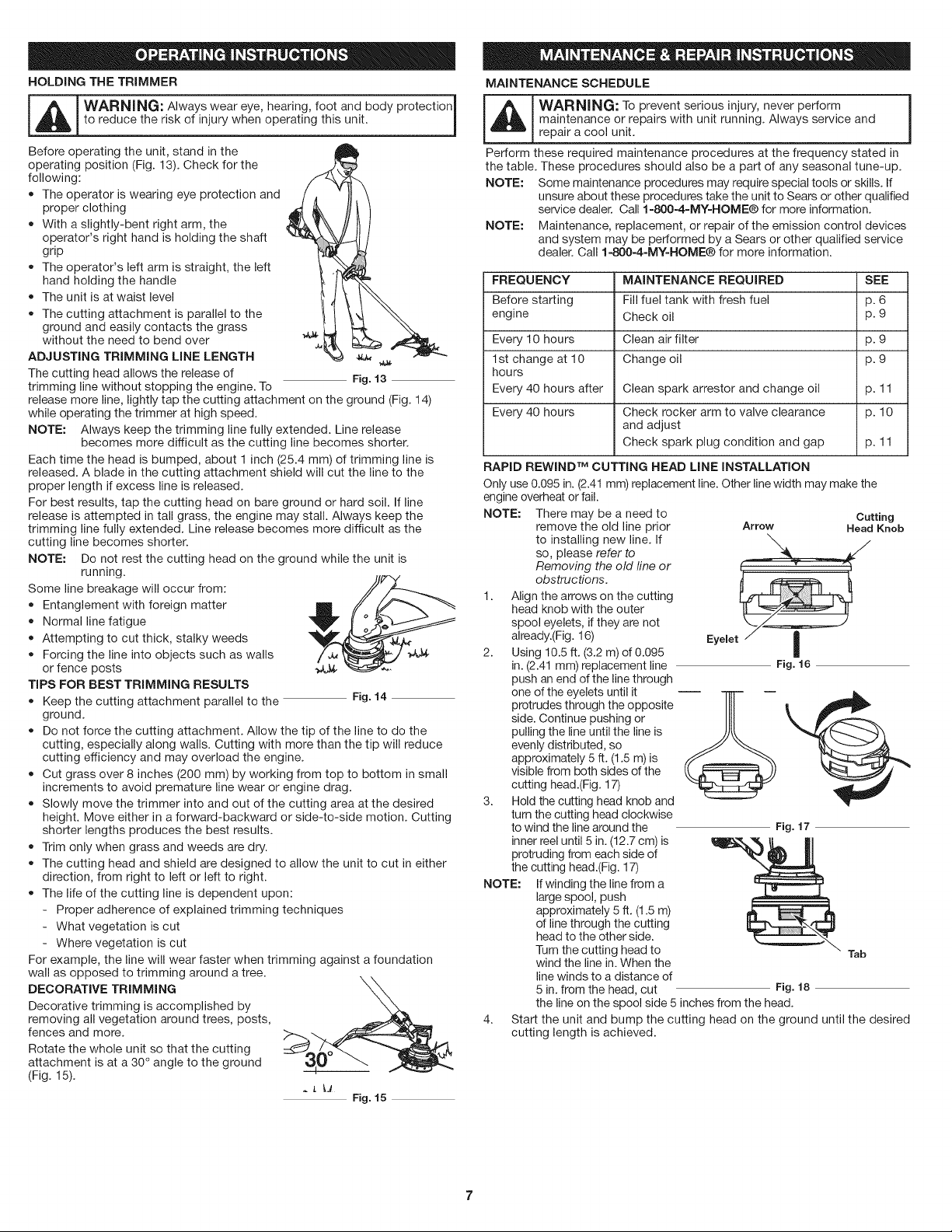
Before operating the unit, stand in the
operating position (Fig. 13). Check for the
following:
• The operator is wearing eye protection and
proper clothing
With a slightly-bent right arm, the
operator's right hand is holding the shaft
grip
The operator's left arm is straight, the left
hand holding the handle
The unit is at waist level
The cutting attachment is parallel to the
ground and easily contacts the grass
without the need to bend over
ADJUSTING TRIMMING LINE LENGTH
The cutting head allows the release of
Fig. 13
trimming line without stopping the engine. To
release more line, lightly tap the cutting attachment on the ground (Fig. 14)
while operating the trimmer at high speed.
NOTE: Always keep the trimming line fully extended. Line release
becomes more difficult as the cutting line becomes shorter.
Each time the head is bumped, about 1 inch (25.4 ram) of trimming line is
released. A blade in the cutting attachment shield will cut the line to the
proper length if excess line is released.
For best results, tap the cutting head on bare ground or hard soil. If line
release is attempted in tall grass, the engine may stall. Always keep the
trimming line fully extended. Line release becomes more difficult as the
cutting line becomes shorter.
NOTE: Do not rest the cutting head on the ground while the unit is
running.
Some line breakage will occur from:
• Entanglement with foreign matter
Normal line fatigue
Attempting to cut thick, stalky weeds
Forcing the line into objects such as walls
or fence posts
TIPS FOR BEST TRIMMING RESULTS
Keep the cutting attachment parallel to the
ground.
o
2.
Fig. 14
Do not force the cutting attachment. Allow the tip of the line to do the
cutting, especially along walls. Cutting with more than the tip will reduce
cutting efficiency and may overload the engine.
Cut grass over 8 inches (200 mm) by working from top to bottom in small
increments to avoid premature line wear or engine drag.
Slowly move the trimmer into and out of the cutting area at the desired
height. Move either in a forward-backward or side-to-side motion. Cutting
shorter lengths produces the best results.
Trim only when grass and weeds are dry.
The cutting head and shield are designed to allow the unit to cut in either
direction, from right to left or left to right.
The life of the cutting line is dependent upon:
Proper adherence of explained trimming techniques
- What vegetation is cut
- Where vegetation is cut
For example, the line will wear faster when trimming against a foundation
wall as opposed to trimming around a tree.
DECORATIVE TRiMMiNG
Decorative trimming is accomplished by
removing all vegetation around trees, posts,
fences and more.
Rotate the whole unit so that the cutting
attachment is at a 30 ° angle to the ground
(Fig. 15).
.L L_
Fig. 15
MAINTENANCE SCHEDULE
_ ARNING: To prevent serious injury, never perform
maintenance or repairs with unit running. Always service and
repair a cool unit.
Perform these required maintenance procedures at the frequency stated in
the table. These procedures should also be a part of any seasonal tune-up.
NOTE: Some maintenance procedures may require special tools or skills. If
unsure about these procedures take the unit to Sears or other qualified
service dealer. Call 1-800-4-MY=HOME® for more information.
NOTE: Maintenance, replacement, or repair of the emission control devices
and system may be performed by a Sears or other qualified service
dealer. Call 1-800-4-MY=HOME® for more information.
FREQUENCY MAINTENANCE REQUIRED SEE
Before starting Fill fuel tank with fresh fuel p. 6
engine Check oil p. 9
Every 10 hours Clean air filter p. 9
1st change at 10 Change oil p. 9
hours
Every 40 hours after Clean spark arrestor and change oil p. 11
Every 40 hours Check rocker arm to valve clearance p. 10
and adjust
Check spark plug condition and gap p. 11
RAPID REWIND TM CUTTING HEAD LiNE INSTALLATION
Only use 0.095 in. (2.41 mm) replacement line. Other line width may make the
engine overheat or fail.
NOTE: There may be a need to
remove the old line prior
to installing new line. If
so, please refer to
Removing the old line or
obstructions.
Align the arrows on the cutting
head knob with the outer
spool eyelets, if they are not
already.(Fig. 16)
Using 10.5 ft. (3.2 m) of 0.095
in. (2.41 mm) replacement line
push an end of the line through
one of the eyelets until it
protrudes through the opposite
side. Continue pushing or
pulling the line until the line is
evenly distributed, so
approximately 5 ft. (1.5 m) is
visible from both sides of the
cutting head.(Fig. 17)
3. Hold the cutting head knob and
turn the cutting head clockwise
to wind the line around the
inner reel until 5 in. (12.7 cm) is
protruding from each side of
the cutting head.(Fig. 17)
NOTE: If winding the line from a
large spool, push
approximately 5 ft. (1.5 m)
of line through the cutting
head to the other side.
Turn the cutting head to
wind the line in. When the
line winds to a distance of
5 in. from the head, cut
4.
Eyelet
Fig. 16
Cutting
Head Knob
Fig. 17
Fig. 18
the line on the spool side 5 inches from the head.
Tab
Start the unit and bump the cutting head on the ground until the desired
cutting length is achieved.
REMOVING THE OLD LiNE OR
OBSTRUCTIONS
NOTE: There should only be a
need to remove the
bump cap if there is an
obstruction or jammed
line preventing either
new line installation or
line advancement.
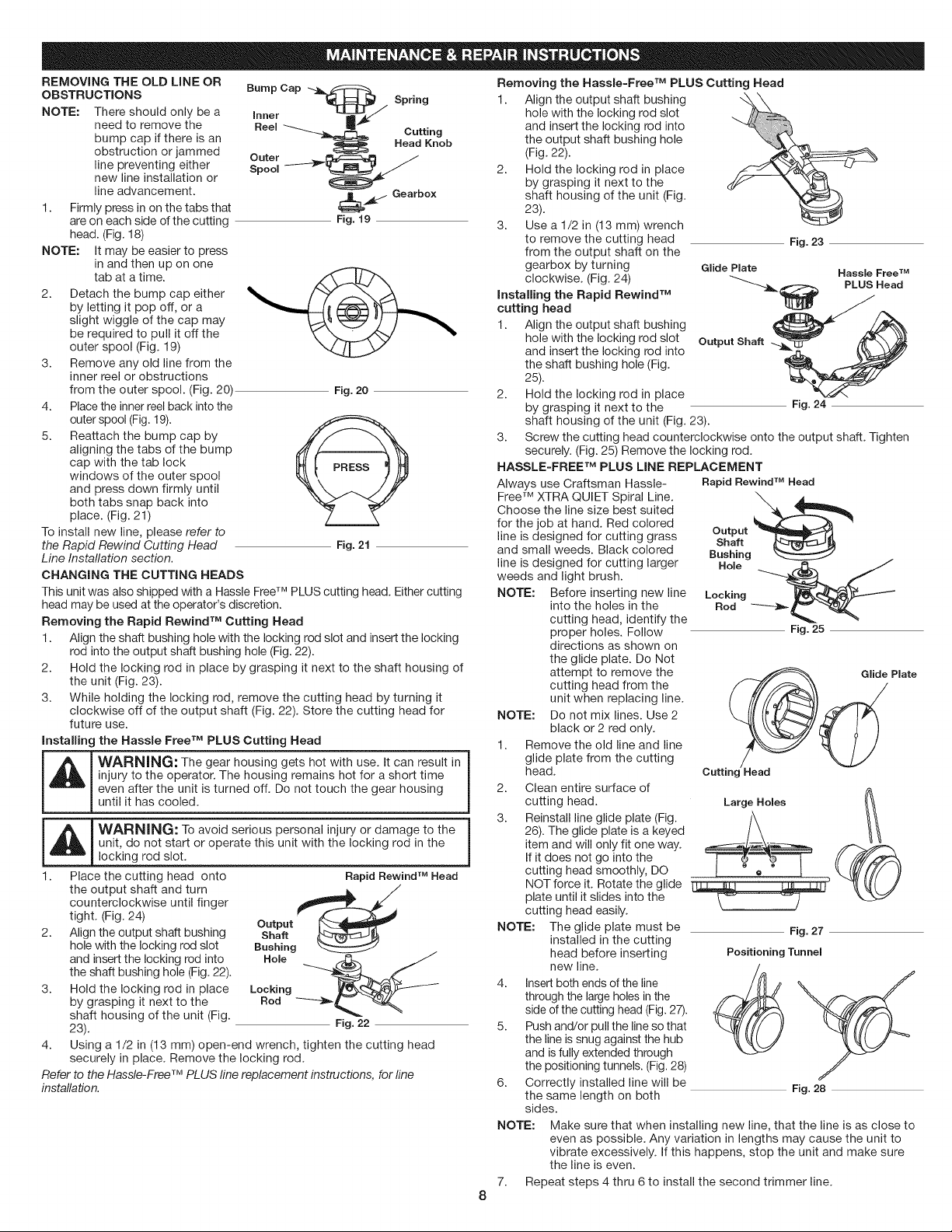
1. Firmly press in on the tabs that
are on each side of the cutting
head. (Fig. 18)
NOTE: It may be easier to press
in and then up on one
tab at a time.
2. Detach the bump cap either
by letting it pop off, or a
slight wiggle of the cap may
be required to pull it off the
outer spool (Fig. 19)
3. Remove any old line from the
inner reel or obstructions
from the outer spool. (Fig. 20)
4. Place the inner reel back into the
outer spool (Fig. 19).
5. Reattach the bump cap by
aligning the tabs of the bump
cap with the tab lock
windows of the outer spool
and press down firmly until
both tabs snap back into
place. (Fig. 21)
To install new line, please refer to
the Rapid Rewind Cutting Head
Line Instaflation section.
CHANGING THE CUTTING HEADS
Bump Cap _ / Spring
inner
Heel --_-__._ Cutting
Head Knob
Outer _€:=_:::::_
Spool
L.j Gearbox
Fig. 19
Fig. 20
@
Fig. 21
This unit was also shipped with a Hassle FreeTM PLUS cutting head. Either cutting
head may be used at the operator's discretion.
Removing the Rapid Rewind TM Cutting Head
1. Align the shaft bushing hole with the locking rod slot and insert the locking
rod into the output shaft bushing hole (Fig. 22).
2. Hold the locking rod in place by grasping it next to the shaft housing of
the unit (Fig. 23).
3. While holding the locking rod, remove the cutting head by turning it
clockwise off of the output shaft (Fig. 22). Store the cutting head for
future use.
Installing the Hassle Free TM PLUS Cutting Head
WARNING: The gear housing gets hot with use. It can result in
injury to the operator. The housing remains hot for a short time
even after the unit is turned off. Do not touch the gear housing
until it has cooled.
WARNING: To avoid serious personal injury or damage to the I
unit, do not start or operate this unit with the locking rod in the
I
locking rod slot.
1. Place the cutting head onto
the output shaft and turn
2.
3.
counterclockwise until finger
tight. (Fig. 24)
Align the output shaft bushing
hole with the locking rod slot
and insert the locking rod into
the shaft bushing hole (Fig. 22).
Hold the locking rod in place
by grasping it next to the
shaft housing of the unit (Fig.
23).
Rapid Rewind TM Head
Output
Shaft
Bushing
Hole ___
Locking
Rod
Fig. 22
4. Using a 1/2 in (13 mm) open-end wrench, tighten the cutting head
securely in place. Remove the locking rod.
Refer to the Hassle-Free TM PLUS line replacement instructions, for line
installation.
Removing the Hassle-Free TM PLUS Cutting Head
1. Align the output shaft bushing
hole with the locking rod slot
and insert the locking rod into
the output shaft bushing hole
(Fig. 22).
2. Hold the locking rod in place
by grasping it next to the
shaft housing of the unit (Fig.
23).
3. Use a 1/2 in (13 mm) wrench
to remove the cutting head
from the output shaft on the
gearbox by turning
clockwise. (Fig. 24)
Installing the Rapid Rewind TM
cutting head
1. Align the output shaft bushing
hole with the locking rod slot
and insert the locking rod into
the shaft bushing hole (Fig.
25).
2. Hold the locking rod in place
by grasping it next to the
Fig. 23
Glide Plate Hassle Free TM
_ PLUS Head
Output Shaft
Fig. 24
shaft housing of the unit (Fig. 23).
3. Screw the cutting head counterclockwise onto the output shaft. Tighten
securely. (Fig. 25) Remove the locking rod.
HASSLE-FREE TM PLUS LiNE REPLACEMENT
Always use Craftsman Hassle- Rapid Rewind TM Head
Free TM XTRA QUIET Spiral Line. _ L
Choose the line size best suited
for the job at hand. Red colored
line is designed for cutting grass Output
Shaft _:_::_J_
and small weeds. Black colored Bushing
line is designed for cutting larger Hole "__--_'_'- _
weeds and light brush.
NOTE: Before inserting new line Locking
into the holes in the Rod
cutting head, identify the
proper holes. Follow Fig. 25
directions as shown on
the glide plate. Do Not
attempt to remove the Glide Plate
cutting head from the
unit when replacing line.
NOTE: Do not mix lines. Use 2
black or 2 red only.
1. Remove the old line and line
glide plate from the cutting
head. Cuttin¢ Head
2. Clean entire surface of
/A
cutting head. Large Holes Ill\
3. Reinstall line glide plate (Fig. /\
26). The glide plate is a keyed
item and will only fit one way.
If it does not go into the
cutting head smoothly, DO
NOT force it. Rotate the glide
plate until it slides into the
cutting head easily.
NOTE: The glide plate must be Fig. 27
installed in the cutting
head before inserting Positioning Tunnel
new line.
4. Insert both ends of the line
through the large holes in the
side of the cutting head (Fig. 27).
5. Push and/or pull the line so that
the line is snug against the hub
and is fully extended through
the positioning tunnels. (Fig. 28)
6. Correctly installed line will be Fig. 28
the same length on both
sides.
NOTE: Make sure that when installing new line, that the line is as close to
even as possible. Any variation in lengths may cause the unit to
vibrate excessively. If this happens, stop the unit and make sure
the line is even.
7. Repeat steps 4 thru 6 to install the second trimmer line.
NOTE:DonotresttheHassle-FreeTM PLUS Cutting Head on the ground
while the unit is running.
Some line breakage will occur from:
• Entanglement with foreign matter
• Normal line fatigue
Attempting to cut thick, stalky weeds
Forcing the line into objects such as walls or fence posts
NOTE: During normal use the trimming line may become worn unevenly
which may cause excessive vibrations in the unit. If this becomes
uncomfortable or uncontrollable, stop the unit and replace the line.
Refer to the Line Replacement instructions above.
CHECKING THE OiL LEVEL
-- i_ WARNING: Toavoid serious personal injury,always turn the unit
off and allow it to cool before cleaning or servicing it.
The importance of checking and maintaining the proper oil level in the
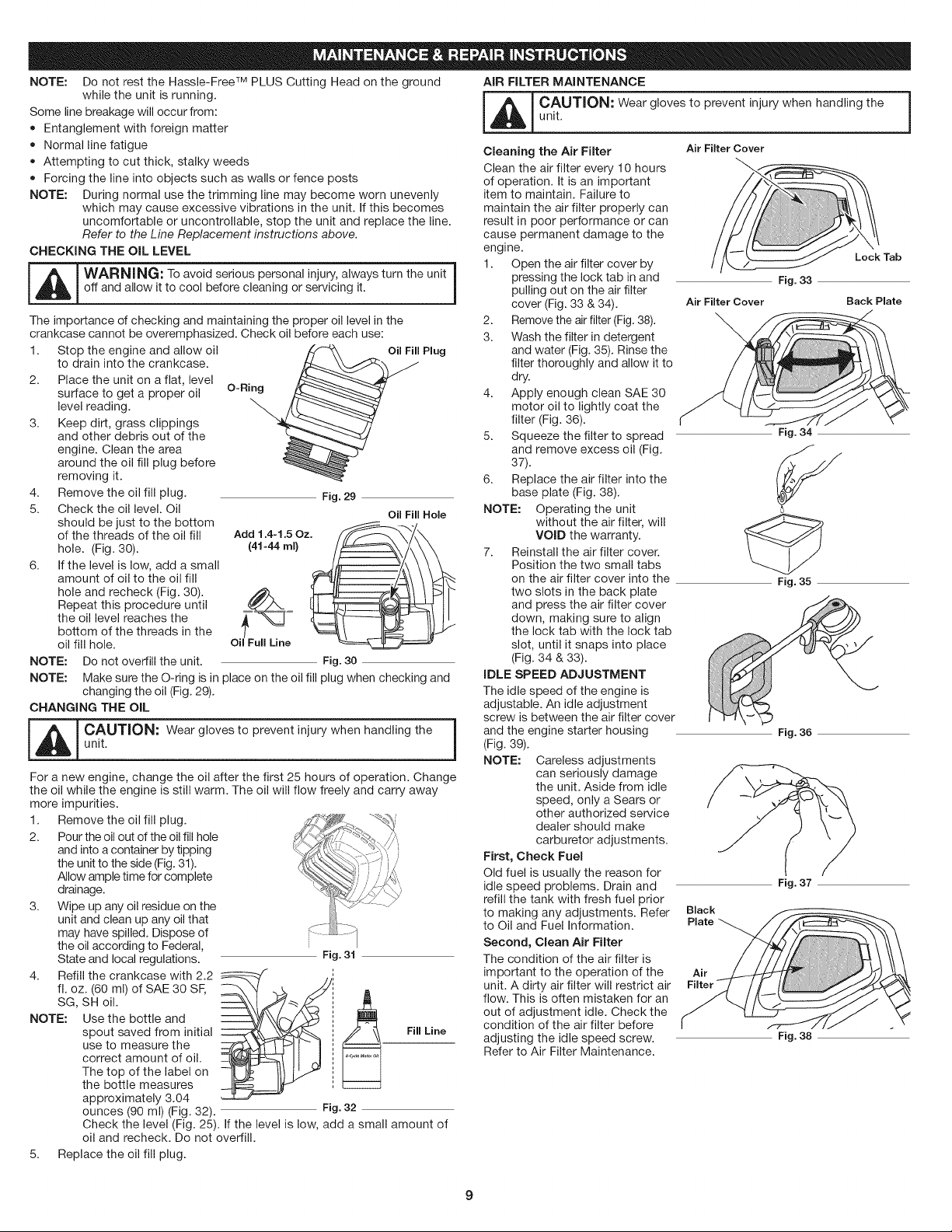
crankcase cannot be overemphasized. Check oil before each use:
1. Stop the engine and allow oil
to drain into the crankcase.
2. Place the unit on a flat, level
surface to get a proper oil
level reading.
3. Keep dirt, grass clippings
and other debris out of the
engine. Clean the area
around the oil fill plug before
removing it.
4. Remove the oil fill plug.
5. Check the oil level. Oil
should be just to the bottom
of the threads of the oil fill
hole. (Fig. 30).
6. If the level is low, add a small
amount of oil to the oil fill
hole and recheck (Fig. 30).
Repeat this procedure until
the oil level reaches the
bottom of the threads in the
oil fill hole.
Oil Fill Plug
O-Ring_
Fig. 29
Oil Fill Hole
Add 1.4-1.5 Oz. _-_V_-_/,\
(41-44 ml)
NOTE: Do not overfill the unit. Fig. 30
NOTE: Make sure the O-ring is in place on the oil fill plug when checking and
changing the oil (Fig. 29).
CHANGING THE OiL
-- i
_ AUTION: Wear gloves to prevent injury when handling the
unit.
For a new engine, change the oil after the first 25 hours of operation. Change
the oil while the engine is still warm. The oil will flow freely and carry away
more impurities.
1. Remove the oil fill plug.
2. Pour the oil out of the oil fill hole
and into a container by tipping
the unit to the side (Fig. 31).
Allow ample time for complete
drainage.
3. Wipe up any oil residue on the
unit and clean up any oil that
may have spilled. Dispose of
the oil according to Federal,
State and local regulations.
4. Refill the crankcase with 2.2
fl. oz. (60 ml) of SAE 30 SF,
SG, SH oil.
NOTE: Use the bottle and
spout saved from initial
use to measure the
correct amount of oil.
The top of the label on
the bottle measures
approximately 3.04
ounces (90 ml) (Fig. 32).
Fig. 31
_ Fill Line
Fig. 32
Check the level (Fig. 25). If the level is low, add a small amount of
oil and recheck. Do not overfill.
Replace the oil fill plug.
AIR FILTER MAINTENANCE
_J AUTION: Wear gloves to prevent injury when handling the
unit.
Air Filter Cover
Cleaning the Air Filter
Clean the air filter every 10 hours
of operation. It is an important
item to maintain. Failure to
maintain the air filter properly can
result in poor performance or can
cause permanent damage to the
engine.
1. Open the air filter cover by
pressing the lock tab in and
pulling out on the air filter
cover (Fig. 33 & 34).
2. Remove the air filter (Fig. 38).
3. Wash the filter in detergent
and water (Fig. 35). Rinse the
filter thoroughly and allow it to
dry.
4. Apply enough clean SAE 30
motor oil to lightly coat the
filter (Fig. 36).
5. Squeeze the filter to spread
and remove excess oil (Fig.
37).
6. Replace the air filter into the
base plate (Fig. 38).
NOTE: Operating the unit
without the air filter, will
VOID the warranty.
7. Reinstall the air filter cover.
Position the two small tabs
on the air filter cover into the
two slots in the back plate
and press the air filter cover
down, making sure to align
the lock tab with the lock tab
slot, until it snaps into place
(Fig. 34 & 33).
IDLE SPEED ADJUSTMENT
The idle speed of the engine is
adjustable. An idle adjustment
screw is between the air filter cover
and the engine starter housing
(Fig. 39).
NOTE: Careless adjustments
can seriously damage
the unit. Aside from idle
speed, only a Sears or
other authorized service
dealer should make
carburetor adjustments.
First, Check Fuel
Old fuel is usually the reason for
idle speed problems. Drain and
refill the tank with fresh fuel prior
to making any adjustments. Refer
to Oil and Fuel Information.
Second, Clean Air Filter
The condition of the air filter is
important to the operation of the
unit. A dirty air filter will restrict air
flow. This is often mistaken for an
out of adjustment idle. Check the
condition of the air filter before
adjusting the idle speed screw.
Refer to Air Filter Maintenance.
Air Filter Cover
\
Fig. 33
Fig. 34
Back Plate
Fig. 35
Fig. 36
Fig. 37
Black
Plate
Air
9
Fig. 38
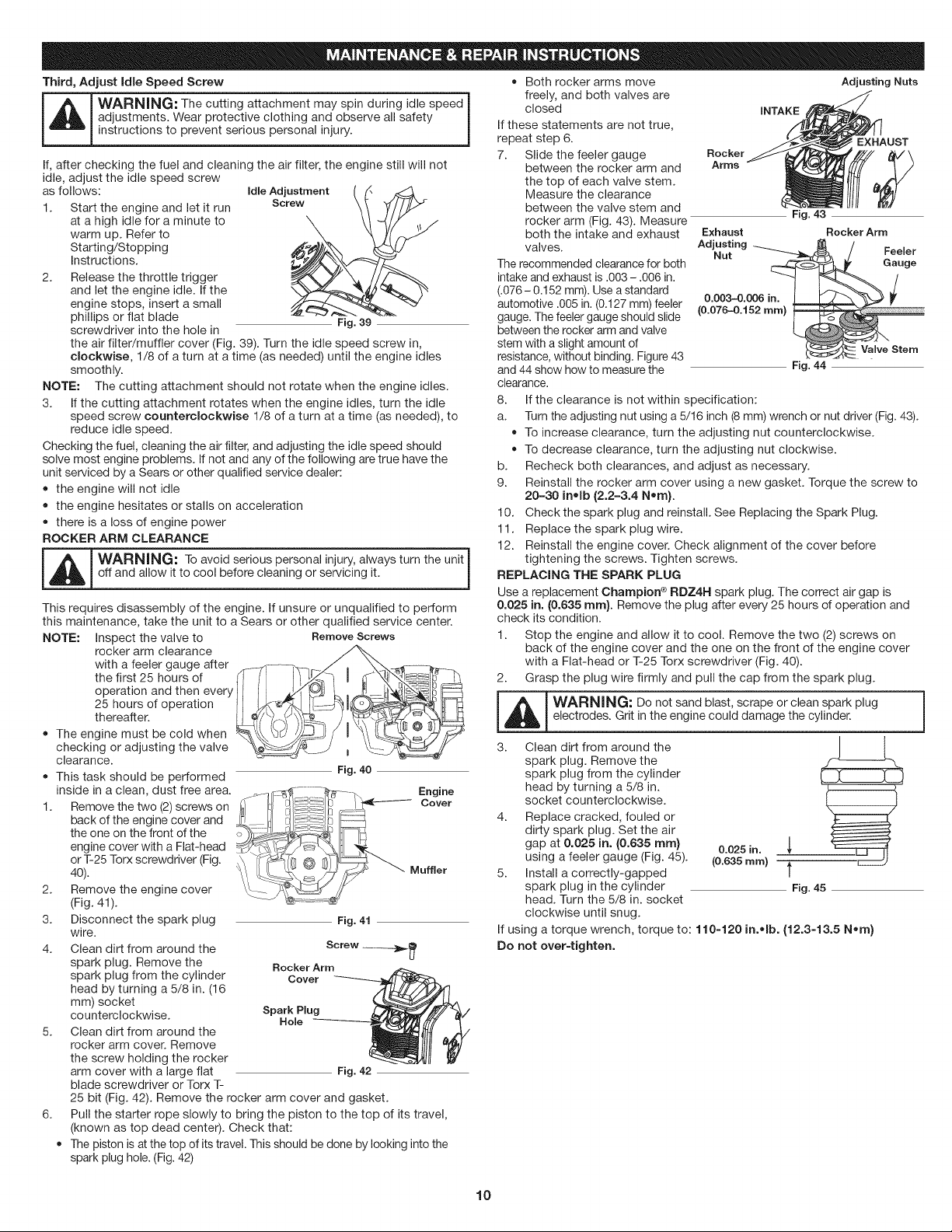
Third, Adjust Idle Speed Screw • Both rocker arms move Adjusting Nuts
_ ARNING: The cutting attachment may spin during idle speed _
adjustments. Wear protective clothing and observe all safety
J
instructions to prevent serious personal injury.
If, after checking the fuel and cleaning the air filter, the engine still will not
idle, adjust the idle speed screw
as follows:
1. Start the engine and let it run
at a high idle for a minute to
warm up. Refer to
Starting/Stopping
Instructions.
2. Release the throttle trigger
and let the engine idle. If the
engine stops, insert a small
phillips or flat blade
screwdriver into the hole in
Adjustment
Screw
Fig. 39
the air filter/muffler cover (Fig. 39). Turn the idle speed screw in,
clockwise, 1/8 of a turn at a time (as needed) until the engine idles
smoothly.
NOTE: The cutting attachment should not rotate when the engine idles.
3. If the cutting attachment rotates when the engine idles, turn the idle
speed screw counterclockwise 1/8 of a turn at a time (as needed), to
reduce idle speed.
Checking the fuel, cleaning the air filter, and adjusting the idle speed should
solve most engine problems. If not and any of the following are true have the
unit serviced by a Sears or other qualified service dealer:
• the engine will not idle
the engine hesitates or stalls on acceleration
there is a loss of engine power
ROCKER ARM CLEARANCE
_L_ WARNING: To avoid serious personal injury, always turn the unit I
off and allow it to cool before cleaning or servicing it. |
J
This requires disassembly of the engine. If unsure or unqualified to perform
this maintenance, take the unit to a Sears or other qualified service center.
NOTE: Inspect the valve to Remove Screws
rocker arm clearance
with a feeler gauge after
the first 25 hours of
operation and then every
25 hours of operation
thereafter.
The engine must be cold when
checking or adjusting the valve
clearance.
This task should be performed
inside in a clean, dust free area.
1. Remove the two (2) screws on
back of the engine cover and
the one on the front of the
engine cover with a Flat-head
or T-25 Torx screwdriver (Fig.
40).
2. Remove the engine cover
(Fig. 41).
3. Disconnect the spark plug
wire.
4. Clean dirt from around the
spark plug. Remove the
spark plug from the cylinder
head by turning a 5/8 in. (16
mm) socket
counterclockwise.
5. Clean dirt from around the
rocker arm cover. Remove
the screw holding the rocker
arm cover with a large flat
blade screwdriver or Torx T-
6.
Fig. 40
_-/l!_:_f.............,_----_ Engine
Muffler
Fig. 41
Screw _-----t_
Rocker Arm
Cover
Spark Plug
Hole
Fig. 42
25 bit (Fig. 42). Remove the rocker arm cover and gasket.
Pull the starter rope slowly to bring the piston to the top of its travel,
(known as top dead center). Check that:
The piston is at the top of its travel. This should be done by looking into the
spark plug hole. (Fig. 42)
freely, and both valves are
closed
If these statements are not true,
repeat step 6.
7. Slide the feeler gauge
between the rocker arm and
the top of each valve stem.
Measure the clearance
between the valve stem and
rocker arm (Fig. 43). Measure
both the intake and exhaust
valves.
The recommended clearance for both
intake and exhaust is .003 - .006 in.
(.076 - 0.152 mm). Use a standard
automotive .005 in. (0.127 mm)feeler
gauge. The feeler gauge should slide
between the rocker arm and valve
stem with a slight amount of
resistance, without binding. Figure 43
and 44 show how to measure the
clearance.
8.
a.
b.
9.
10.
11.
12.
Rocker
Arms
INTAKE
EXHAUST
Fig. 43
Exhaust Rocker Arm
/ Fee,er
Gauge
0.003-0.006 in. _ "_'_ _
(0.076-0.152 mm)
Valve Stem
Fig. 44
If the clearance is not within specification:
Turn the adjusting nut using a 5/16 inch (8 mm) wrench or nut driver (Fig. 43).
To increase clearance, turn the adjusting nut counterclockwise.
To decrease clearance, turn the adjusting nut clockwise.
Recheck both clearances, and adjust as necessary.
Reinstall the rocker arm cover using a new gasket. Torque the screw to
20-30 inolb (2.2-3.4 Norn).
Check the spark plug and reinstall. See Replacing the Spark Plug.
Replace the spark plug wire.
Reinstall the engine cover. Check alignment of the cover before
tightening the screws. Tighten screws.
REPLACING THE SPARK PLUG
Use a replacement Champion ® RDZ4H spark plug. The correct air gap is
0.025 in. (0.635 rnm}. Remove the plug after every 25 hours of operation and
check its condition.
1. Stop the engine and allow it to cool. Remove the two (2) screws on
back of the engine cover and the one on the front of the engine cover
with a Flat-head or T-25 Torx screwdriver (Fig. 40).
2. Grasp the plug wire firmly and pull the cap from the spark plug.
_[_ ARNING: Do not sand blast, scrape or clean spark plug
electrodes. Grit in the engine could damage the cylinder.
I I
3. Clean dirt from around the I 1
spark plug. Remove the
spark plug from the cylinder
head by turning a 5/8 in.
socket counterclockwise.
4. Replace cracked, fouled or
dirty spark plug. Set the air
gap at 0.025 in. (0.635 rnrn} ,_
using a feeler gauge (Fig. 45). 0.025 in.
(0.635 ram)
5. Install a correctly-gapped 1'
spark plug in the cylinder Fig. 45
head. Turn the 5/8 in. socket
clockwise until snug.
If using a torque wrench, torque to: 110=120 in.=lb. (12.3=13.5 N=rn}
Do not over=tighten.
10
SPARK ARRESTOR MAINTENANCE
-- iWARNING: To avoid serious personal injury, always turn the
unit off and allow it to cool before cleaning or servicing it.
1.
2.
3.
4.
5.
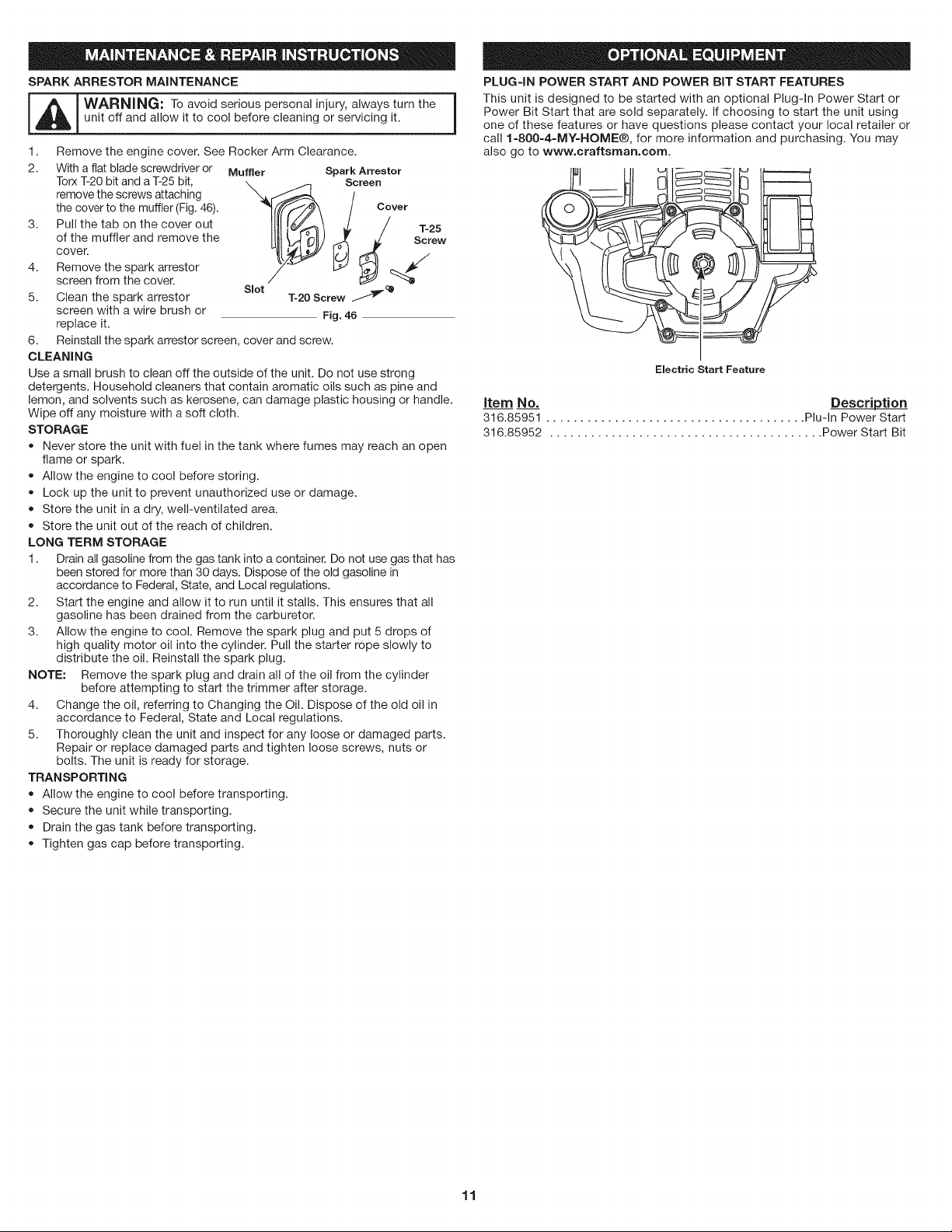
Remove the engine cover. See Rocker Arm Clearance.
With a flat blade screwdriver or
Torx T-20 bit and a T-25 bit,
remove the screws attaching
the cover to the muffler (Fig. 46).
Pull the tab on the cover out
of the muffler and remove the
cover.
Remove the spark arrestor
screen from the cover.
Clean the spark arrestor
screen with a wire brush or
replace it.
Muffler Spark Arrestor
Cover
1"-25
Screw
Slot
1-20 Screw ..//'_
Fig. 46
6. Reinstall the spark arrestor screen, cover and screw.
CLEANING
Use a small brush to clean off the outside of the unit. Do not use strong
detergents. Household cleaners that contain aromatic oils such as pine and
lemon, and solvents such as kerosene, can damage plastic housing or handle.
Wipe off any moisture with a soft cloth.
STORAGE
• Never store the unit with fuel in the tank where fumes may reach an open
flame or spark.
Allow the engine to cool before storing.
Lock up the unit to prevent unauthorized use or damage.
Store the unit in a dry, well-ventilated area.
Store the unit out of the reach of children.
LONG TERM STORAGE
1. Drain all gasoline from the gas tank into a container. Do not use gas that has
been stored for more than 30 days. Dispose of the old gasoline in
accordance to Federal, State, and Local regulations.
2. Start the engine and allow it to run until it stalls. This ensures that all
gasoline has been drained from the carburetor.
3. Allow the engine to cool. Remove the spark plug and put 5 drops of
high quality motor oil into the cylinder. Pull the starter rope slowly to
distribute the oil. Reinstall the spark plug.
NOTE: Remove the spark plug and drain all of the oil from the cylinder
before attempting to start the trimmer after storage.
4. Change the oil, referring to Changing the Oil. Dispose of the old oil in
accordance to Federal, State and Local regulations.
5. Thoroughly clean the unit and inspect for any loose or damaged parts.
Repair or replace damaged parts and tighten loose screws, nuts or
bolts. The unit is ready for storage.
TRANSPORTING
Allow the engine to cool before transporting.
Secure the unit while transporting.
Drain the gas tank before transporting.
Tighten gas cap before transporting.
PLUG=IN POWER START AND POWER BIT START FEATURES
This unit is designed to be started with an optional Plug-In Power Start or
Power Bit Start that are sold separately. If choosing to start the unit using
one of these features or have questions please contact your local retailer or
call 1-800-4=MY-HOME®, for more information and purchasing. You may
also go to www.craftsman.com.
Electric Start Feature
item No. Description
316.85951 ...................................... Plu-ln Power Start
316.85952 ........................................ Power Start Bit
11

PROBLEM
Empty fuel tank
Old fuel
Plugged spark arrestor
Air filter is plugged
SOLUTION
Fill fuel tank with fuel
Drain gas tank and add fresh fuel
Clean or replace spark arrestor
Improper idle speed
Old fuel
Dirty air filter
Old fuel
Plugged spark arrestor
Cutting attachment bound with grass
Inner reel bound up
Line welded
Not enough line is exposed
Oil, cleaner or lubricant in cutting head
Replace or clean the air filter
Adjust according to the Idle Speed Adjustments section.
Drain gas tank and add fresh fuel
Clean or replace the air filter
Drain gas tank and add fresh fuel
Clean or replace spark arrestor
,l!i i'l
Stop the engine and clean cutting attachment
Replace the inner reel
Disassemble, remove the welded section and rewind
Push the bump head and pull out line until 4 inches (102 mm) of line is
outside of the cutting attachment
Clean and thoroughly dry the cutting head
i...............................................................................................................................................................................................................................................................................................................................................................................................................................................................................................................................................................................................................................................................................................................................................................................................................................................................................................................................................................................................................................................................................................................................................................I
12
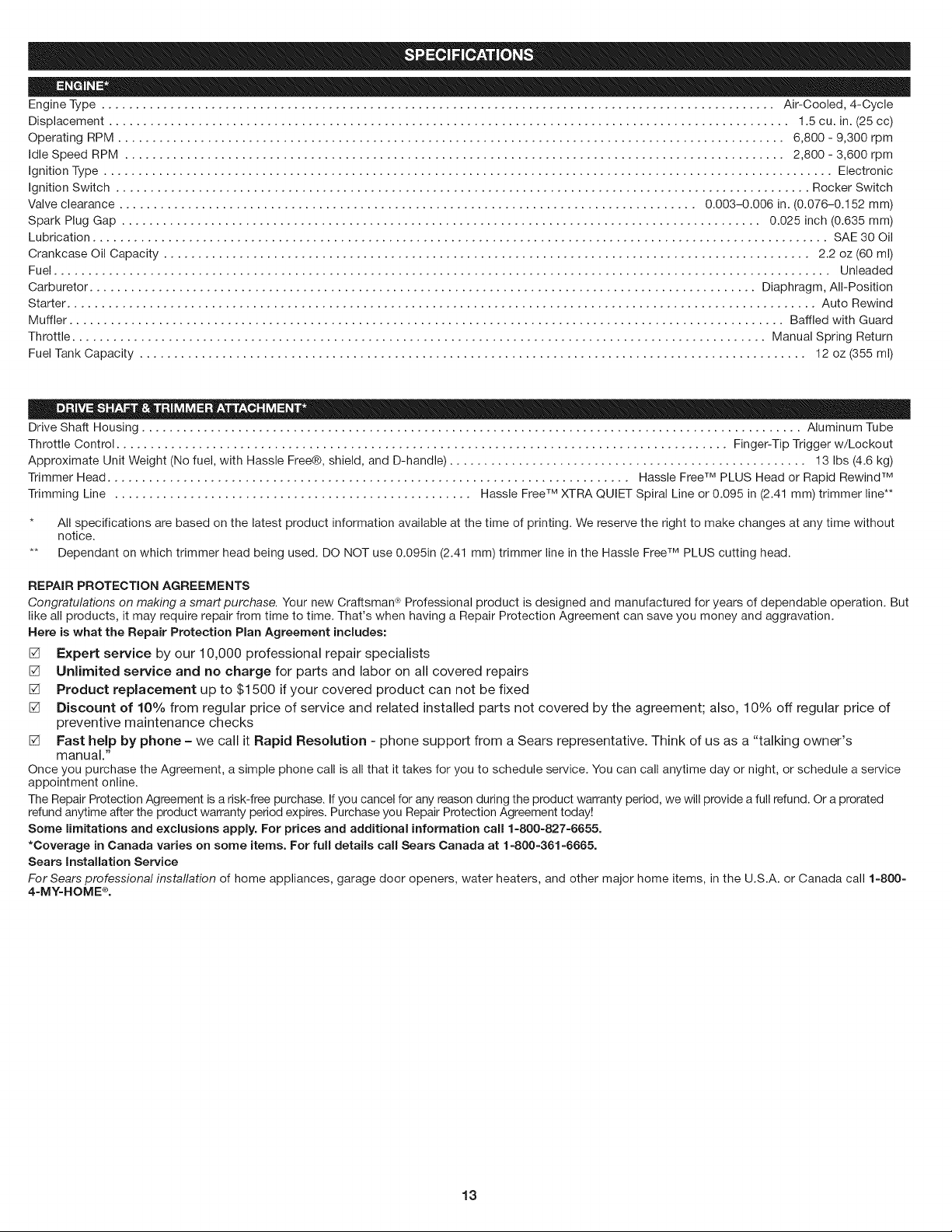
Engine Type .................................................................................................. Air-Cooled, 4-Cycle
Displacement ................................................................................................... 1.5 cu. in. (25 cc)
Operating RPM ................................................................................................. 6,800 - 9,300 rpm
Idle Speed RPM ................................................................................................ 2,800 - 3,600 rpm
Ignition Type .......................................................................................................... Electronic
Ignition Switch ..................................................................................................... Rocker Switch
Valve clearance .................................................................................... 0.003-0.006 in. (0.076-0.152 mm)
Spark Plug Gap ............................................................................................. 0.025 inch (0.635 mm)
Lubrication ........................................................................................................... SAE 30 Oil
Crankcase Oil Capacity .............................................................................................. 2.2 oz (60 ml)
Fuel ................................................................................................................. Unleaded
Carburetor ................................................................................................. Diaphragm, All-Position
Starter ............................................................................................................. Auto Rewind
Muffler ........................................................................................................ Baffled with Guard
Throttle ..................................................................................................... Manual Spring Return
Fuel Tank Capacity ................................................................................................. 12 oz (355 ml)
Drive Shaft Housing ................................................................................................ Aluminum Tube
Throttle Control ......................................................................................... Finger-Tip Trigger w/Lockout
Approximate Unit Weight (No fuel, with Hassle Free@, shield, and D-handle) .................................................... 13 Ibs (4.6 kg)
Trimmer Head ............................................................................ Hassle Free TM PLUS Head or Rapid Rewind TM
Trimming Line .................................................... Hassle Free TM XTRA QUIET Spiral Line or 0.095 in (2.41 mm) trimmer line**
* All specifications are based on the latest product information available at the time of printing. We reserve the right to make changes at any time without
notice.
** Dependant on which trimmer head being used. DO NOT use 0.095in (2.41 mm) trimmer line in the Hassle Free TM PLUS cutting head.
REPAIR PROTECTION AGREEMENTS
Congratulations on making a smart purchase. Your new Craftsman_ Professional product is designed and manufactured for years of dependable operation. But
like all products, it may require repair from time to time. That's when having a Repair Protection Agreement can save you money and aggravation.
Here is what the Repair Protection Plan Agreement includes:
[] Expert service by our 10,000 professional repair specialists
[] Unlimited service and no charge for parts and labor on all covered repairs
[] Product replacement up to $1500 if your covered product can not be fixed
[] Discount of 10% from regular price of service and related installed parts not covered by the agreement; also, 10% off regular price of
preventive maintenance checks
[] Fast help by phone - we call it Rapid Resolution - phone support from a Sears representative. Think of us as a "talking owner's
manual."
Once you purchase the Agreement, a simple phone call is all that it takes for you to schedule service. You can call anytime day or night, or schedule a service
appointment online.
The Repair Protection Agreement is a risk-free purchase. If you cancel for any reason during the product warranty period, we will provide a full refund. Or a prorated
refund anytime after the product warranty period expires. Purchase you Repair Protection Agreement today!
Some limitations and exclusions apply. For prices and additional information call 1=800=827=6655.
*Coverage in Canada varies on some items. For full details call Sears Canada at 1 =800=361 =6665.
Sears Installation Service
For Sears professional installation of home appliances, garage door openers, water heaters, and other major home items, in the U.S.A. or Canada call 1=800=
4=MY=HOME ®.
13

14
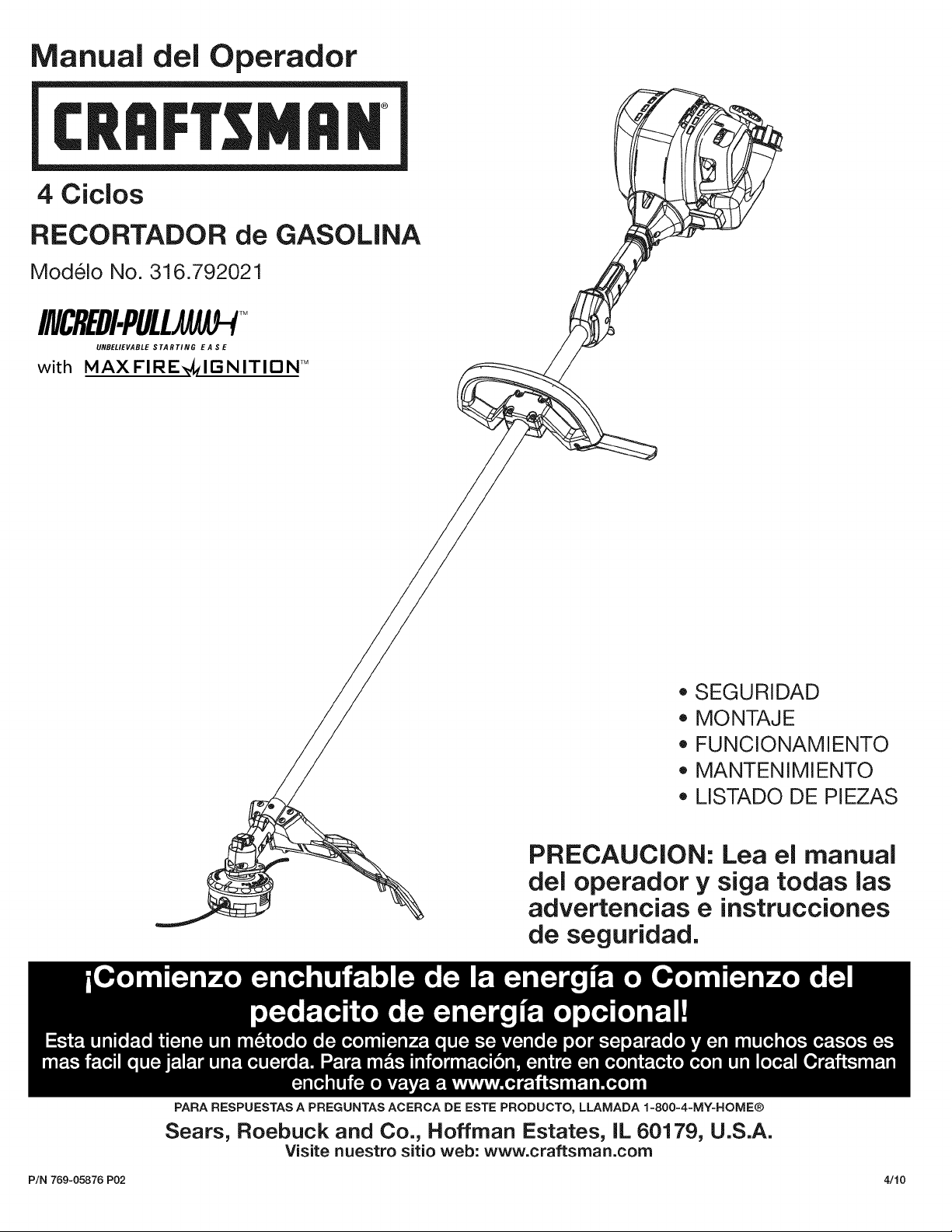
Manual del Operador
4 Ciclos
RECORTADOR de GASOLINA
Modelo No. 316.792021
INCREDI.PULL TM
UNBELIEVABLE STARTING EA S E
with MAX FIRE,_IGNITION M
* SEGURIDAD
* MONTAJE
* FUNCIONAMIENTO
* MANTENIMIENTO
* LISTADO DE PIEZAS
PRECAUCION: Lea el manual
del operador y siga todas ias
advertencias e instrucciones
de seguridad.
PARA RESPUESTAS A PREGUNTAS ACERCA DE ESTE PRODUCTO, LLAMADA 1=800=4=MY=HOME®
Sears, Roebuck and Co., Hoffman Estates, IL 60179, U.S.A.
Visite nuestro sitio web: www.craftsman.com
P/N 769-05876 PO2 4/10

PROPOSICION 65 DE CALIFORNIA Los simbolos de seguridad se utilizan para Ilamar su atenci6n sobre posibles
LAS EMISIONES DEL MOTOR DE ESTE PRODUCTO CONTIENEN
SUBSTANCIAS QUIMICAS QUE EL ESTADO DE CALIFORNIA CONOCE
COMO CAUSANTES DECANCER, DEFECTOS DE NACIMIENTO U OTROS
DANOS REPRODUCTIVOS.
INDICE DE CONTENIDOS
Normas para una operaci6n segura .............................. 16
Garantia ................................................... 18
Conozca su unidad ........................................... 18
Instrucciones de ensamble ..................................... 18
Informaci6n del aceite y del combustible .......................... 19
Instrucciones de arranque y apagado ............................ 20
Instrucciones de operaci6n .................................... 20
Instrucciones de mantenimiento y reparaci6n ...................... 21
Limpieza y almacenamiento .................................... 25
Resoluci6n de problemas ...................................... 26
Especificaciones ............................................. 27
Lista de piezas .............................................. 30
Numeros de servicio ................................ Contraportada
PARACNISPAS
NOTA: Para los usuarios en tierras forestales de los EE.UU. yen los estados de
California, Maine, Oregon y Washington. Todos los terrenos forestales de los EE.UU.
y el estado de California (C6digos de Recursos Peblicos 4442 y 4443), Oregon y
Washington, requieren pot decreto, que ciertos motores de combusti6n intema que se
hagan funcionar en zonas boscosas y/o zonas cubiertas por pastizales, esten equipados
con un parachispas, que sean mantenidos en buen estado de funcionamiento o que el
motor sea construido, este equipado y sea mantenido para evitar incendios. Consulte los
reglamentos pertinentes a esos requisitos con las autoridades estatales o locales. El
incumplimiento de esos requisitos puede responsabilizarleo someterle a la imposici6n de
una multa. Esta unidad fue equipada en la fabrica con un parachispas. Si requiere
sustituci6n, hay una Pantalla Parachispas disponible, Pieza # 753-06334 al contactar el
departamento de servicio.
Toda la informaci6n, las ilustraciones y las especificaciones contenidas en este
manual se basan en la informaci6n m&s reciente disponible en el momento de
impresi6n del manual. Nos reservamos el derecho de hacer cambios en
cualquier momento sin aviso previo.
peligros. Los simbolos de seguridad y sus explicaciones merecen toda su atenci6n
y comprensi6n. Los simbolos de seguridad no eliminan ningQn peligro por si
mismos. Las instrucciones o advertencias que ofrecen no substituyen las medidas
adecuadas de prevenci6n de accidentes.
SIMBOLO SIGNIFICADO
ALERTA DE SEGURIDAD: Indica peligro, advertencia o
precauci6n. Debe prestar atenci6n para evitar sufrir graves lesiones
personales. Puede ser utilizado junto con otros simbolos o figuras.
NOTA: Le ofrece informaci6n o instrucciones que son esenciales para la
operaci6n o mantenimiento del equipo.
_ PELIGRO: El no obedecer una advertencia de seguridad puede
conducir a que usted u otras personas sufran graves lesiones. Siga
siempre las precauciones de seguridad para reducir el riesgo de
incendio, descarga electrica y lesiones personales.
ADVERTENCIA: El no seguir una advertencia de seguridad puede
conducir a que usted u otras personas sufran lesiones. Siga siempre las
precauciones de seguridad para reducir el riesgo de incendio, descarga
el6ctrica y lesiones personales.
PRECAUCION: El no seguir una advertencia de seguridad
puede conducir a daSo patrimonial o a que usted u otras personas
sufran lesiones personales. Siga siempre las precauciones de
seguridad para reducir el riesgo de incendio, descarga el6ctrica y
lesiones personales.
NOTA: iEsta unidad puede utilizar un comienzo enchufable de la energia o un
accesorio de arranque opcional comienzo del pedacito de energia!
Para informarse sobre el uso adecuado de estos sistemas, consulte el
manual del operador del comienzo enchufable de la energia de opcional
comienzo del pedacito de energia.(Se vende por separado) En la pagina 25
de este manual encontrara la informaci6n necesaria para comprar estos
accesorios).
Lea el manual del operador y sJga todas las advertencias e Jnstrucciones
de seguridad. De no hacedo, el operador y/o los espectadores pueden sufrir
graves lesiones. SI TIENE PREGUNTAS, LLAME AL 1=800=4=MY=HOME®
= IMPORTANTE INFORMACION DE SEGURIDAD =
LEA TODAS LAS INSTRUCCIONES ANTES DE LA OPERACION
_ AVERTISSEMENT: Lorsque vous utilisez la machine, vous devez
suivre les consignes de securit& Veuillez lireces instructions avant I
d'op6rer la machine pour vous assurer de la s6curit6 de I'op@ateur et de I
tout spectateur. Veuillezconserver ces instructions pour un usage ult6rieur.j
• Lea todas las instrucciones con cuidado. Conozca bien los controles y el uso
correcto de la unidad.
• No opere esta unidad siesta cansado, enfermo, o bajo los efectos del
alcohol, drogas o medicamentos.
Los ni_os y los adolescentes menores de 15 a_os no deben operar las
unidades, excepto por los adolescentes guiados por un adulto.
• Inspeccione la unidad antes de utilizarla. Cambie las partes da_adas.
Verifique si existen p@didas de combustible. AsegQrese de que los
sujetadores esten bien colocados y asegurados. Cambie las partes
accesorias de corte que est6n quebradas, cascadas o da_adas de cualquier
forma. AsegQrese de que el accesorio de corte esta bien instalado y ajustado
con firmeza. AsegQrese de que la protecci6n accesoria de corte est6 bien
conectada y colocada segQn se recomienda.
• No use nunca linea reforzada con metal, alambre, cadena ni soga, etc. Estas
pueden desprenderse y convertirse en un proyectil peligroso.
Optima el control del regulador y verifique que regrese automaticamente a la
posici6n de minima. Haga todos los ajustes o reparaciones antes de usar la
unidad.
Limpie el Area de corte antes de cada uso. Retire todos los objetos como rocas,
vidrios rotos, clavos, alambre o cuerda los cuales pueden ser despedidos o
enredarse en el accesorio de corte. Aleje a todos los ni_os, espectadores y
animales domesticos. Mantenga todos los ninos, espect-adores y animales
domesticos a un radio de pot Io menos 15 m (50 pies); aQn asi puede existir un
riesgo de objetos despedidos contra los espectadores. Los espectadores
deben usar protecci6n para sus ojos. Si alguien se le acerca, pare el motor y el
accesorio de corte de inmediato.
Use solamente lineas de repuesto de fabricantes de equipos originales de
Lineas en Espiral Hassle-Free TM XTRA QUIET de Craftsman. Nunca use
lineas reforzadas con metal, alambre o soga. Estas pueden desprenderse y
convertirse en proyectiles peligrosos.
16
Oprima el control del regulador y compruebe que regresa automaticamente a
la posici6n de marcha en vacio. Haga todos los ajustes o reparaciones antes
de usar la unidad.
ADVERTENCIAS DE SEGURIDAD PARA LOS RECORTADORES A GASOLINA
A_k I ADVERTENCIA: La gasolina es muy inflamable y sus gases pueden J
exp otar s se enc enden. Tome as s gu entes precauc ones: |
J
Guarde el combustible en envases que hayan sido diseSados y aprobados
para el almacenamiento de dichos materiales.
• Aleje la unidad a por Io menos 9.1 m (30 pies), del lugar de carga de
combustible antes de arrancar el motor. No fume, mantenga las chispas y las
llamas abiertas lejos del Area mientras carga el combustible u opera la unidad.
• Cargue el combustible en un Area exterior bien ventilada donde no haya
chispas ni llamas. Quite lentamente la tapa del combustible s61o despues de
apagar el motor. No fume mientras carga el combustible. Limpie de inmediato
todo el combustible que se haya derramado.
Antes de Ilenar el tanque de combustible, apague siempre el motor y espere
que se enfrie. No retire nunca la tapa del tanque de combustible ni cargue
combustible mientras el motor est6 caliente. No opere nunca la unidad sin la
tapa del combustible colocada firmemente en su lugar. Afloje la tapa del
combustible lentamente para disipar la presi6n del tanque.
• Evite crear una fuente de encendido pot combustible derramado. No
arranque el motor hasta que se hayan disipado los vapores del combustible.
DURANTE LA OPERACION
No arranque ni opere la unidad en una sala o edificio cerrado. Los gases de
escape de mon6xido de carbono pueden ser letales en un Area cerrada.
Opere esta unidad s61o en un Area exterior bien ventilada.
Use lentes o galas de protecci6n que cumplan con las normas ANSI Z87.1-
1989, y protecci6n para sus oidos/audici6n mientras opere esta unidad. Use
siempre una mascara facial o para protegerse contra el polvo si la operaci6n
levanta polvo.
Use pantalones largos y gruesos, botas, guantes y camisa de manga larga.
No use ropa holgada, alhajas, pantalones cortos, sandalias ni est6 descalzo.
Sostenga el cabello sobre el nivel de los hombros.
• Laprotecci6naccesoriadecortedebeestarsiemprecolocadaensulugar • Apaguesiempreelmotorcuandodemoreelcorteomientrascaminaentre
mientrasoperelaunidad.Nooperelaunidadconlasdoslineasdecorte
extendidas,ylalineacorrectainstalada.Noextiendalalineadecortemasalia
delaIongituddelaprotecci6n.
• Estaunidadcuentaconunembrague.Elaccesoriodecortepermanece
estacionariocuandoelmotorestaenmarchalenta.SinoIohace,hagaajustar
launidadpotunt6cnicodeservicioautorizado.
• Ajustelamanijaasutama_odemodoquelebrindeelmejoragarre.
• AsegQresedequeelaccesoriodecortenoestAencontactoconningQn
objetoantesdearrancarlaunidad.
• UselaunidadQnicamenteconlaluzdeldiaoconbuenaluzartificial.
• Evitearrancarlaunidadaccidentalmente.Col6queseenposici6ndeinicio
siemprequetiredelacuerdadearranque.Eloperadorylaunidaddebenestar
enunaposici6nestablealcomenzar.LealasinstruccionesdeArranquey
Apagado.
• Uselaherramientaadecuada.Nouseestaunidadparaningunatareaparala
cualnohasidodise_ada.
Noseestiredemasiado.Mantengasiempreunaposici6nyequilibrio
adecuados.
• Sostengasiemprelaunidadconambasmanosmientrasest6en
funcionamiento.Sostengaconfirmezatantoelmangocomolamanijaauxiliar.
Mantengalasmanos,lacaraylospieslejosdetodaslaspartesm6viles.No
intentetocarnidetenerelaccesoriodecortemientrasgira.
• Notoqueelmotor,elbastidordelengranajenielsilenciador.Estaspartesse
calientanmuchoconlaoperaci6n.Luegodeapagarlaunidad,permanecen
calientesduranteuntiempobreve.
Noopereelmotoraunavelocidadmayorquelanecesariaparacortar,
recortarorecortarlosbordes.Nohagafuncionarelmotoraaltavelocidad
mientrasnoestAcortando.
zonasdecorte.
SigolpeaoseenredaconalgQnobjetoextra_o,apagueelmotordeinmediato
yverifiquesihayda_os.Reparetodoslosda_osantesdevolveraintentar
operarlaunidad.Nooperelaunidadsitienepiezasflojasoda_adas.
Apagueelmotorpararealizartodoelmantenimiento,repara-cionesocambio
delaccesoriodecorteuotrosaccesorios.
Uses61opiezasyaccesoriosderepuestodelfabricantedelequipooriginal
paraestaunidad.Puedeobtenerlosensuproveedordeservicioautorizado.El
usodepiezasyaccesoriosquenosonequipoorigina;puedecausargraves
lesionesaloperadoroelda_odesuunidad,ylacancelaci6ndesugarantia.
Mantengalaunidadlibredevegetaci6nyotrosmateriales.Puedenalojarse
entreelaccesoriodecorteylaprotecci6n.
Parareducirelriesgodeincendio,cambielossilenciadoresyamortiguadores
dechispasdefectuosos,mantengaelmotoryelsilenciadorlibredepasto,
hojas,grasaexcesivaoacumulacionesdecarbono.
OTRAS ADVERTENCIAS DE SEGURIDAD
No guarde nunca la unidad con combustible en el tanque en un edificio donde
los gases puedan Ilegar a una llama abierta o a una chispa.
Espere que el motor se enfrie antes de guardar o transportar la unidad.
AsegQrese de que la unidad est6 segura al transportarla.
Guarde la unidad bajo Ilave en un lugar adecuado y seco para evitar que sea
usada pot personas no autorizadas y se da_e, fuera del alcance de los ni_os.
Nunca moje ni rocie la unidad con agua ni con ningQn otro liquido. Mantenga
las manijas secas, limpias y sin residuos. Limpie la unidad luego de cada uso,
lea las instrucciones de Limpieza y AImacenamiento.
• Guarde estas instrucciones. ConsQItelas con frecuencia y utilicelas para
ense_ar a otros usuarios. Si le presta esta unidad a alguien, pr6stele tambien
estas instrucciones.
CONSERVE ESTAS INSTRUCCIONES
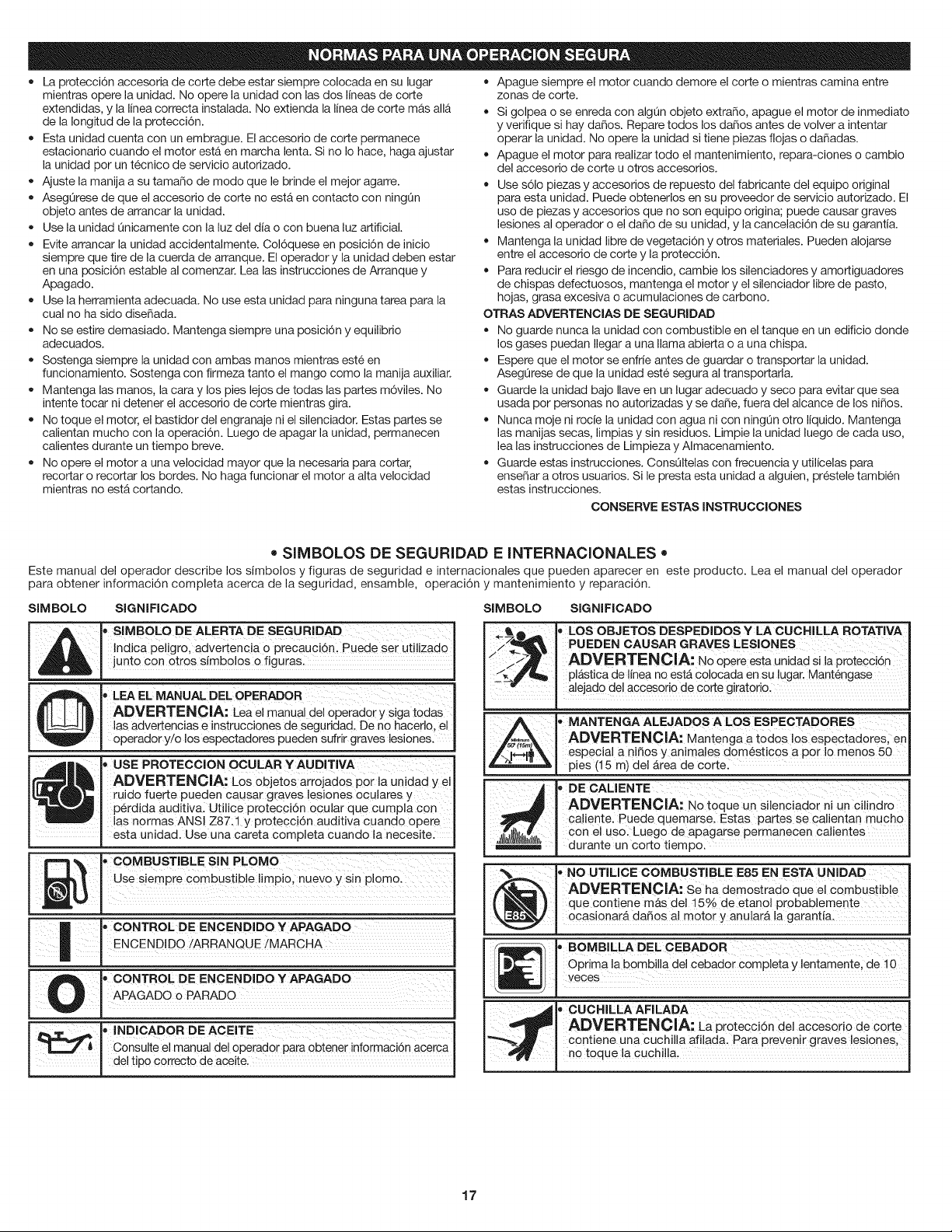
,, SIMBOLOS DE SEGURIDAD E INTERNACIONALES ,,
Este manual del operador describe los simbolos y figuras de seguridad e internacionales que pueden aparecer en este producto. Lea el manual del operador
para obtener informaci6n completa acerca de la seguridad, ensamble, operaci6n y mantenimiento y reparaci6n.
SIMBOLO
0
i
0
SIGNIFICADO
b SIMBOLO DE ALERTA DE SEGURNDAD
Indica peligro, advertencia o precauci6n. Puede ser utilizado
junto con otros simbolos o figuras.
LEA EL MANUAL DEL OPERADOR
ADVERTENCIA: Lea el manual del operador y siga todas
las advertencias e instrucciones de seguddad. De no hacedo, el
operador y/o los espectadores pueden sufrir graves lesiones.
USE PROTECCION OCULAR Y AUDITNVA
ADVERTENCIA: Los objetos arrojados per la unidad y el
ruido fuerte pueden causar graves lesiones oculares y
p6rdida auditiva. Utilice protecci6n ocular que cumpla con
las normas ANSI Z87.1 y protecci6n auditiva cuando opere
esta unidad. Use una careta completa cuando la necesite.
COMBUSTIBLE SNN PLOMO
Use siempre combustible limpio, nuevo y sin plomo.
CONTROL DE ENCENDIDO Y APAGADO
ENCENDIDO !ARRANQUE !MARCHA
CONTROL DE ENCENDIDO Y APAGADO
APAGADO o PARADe
, INDICADOR DE ACEITE
Consulte el manual del operador para obtener informaci6n acerca
del tipo correcto de aceite.
SIMBOLO SIGNIFICADO
_'7,_;=fL_"_ "LOS OBJETOS DESPEDIDOS YLA CUCNILLA ROTATIVA
_/_----,,,_ PUEDEN CAUSAR GRAVES LESNONES
J,R.-_ ADVERTENCIA: N0 0pore esta Unidad si ia prote¢ci6n
_/_,_ plastica de linea no estb.colocada en su !ugar.Mant6ngase
alejad0 del accesodo de c0rte giratorio.
A • MANTENGAALEJADOSA LOS ESPECTADORES
ADVERTENCIA: Mantenga a todos los espectadores; en
especial aniSos y anima!es dom6sticos a porlo meno s 5 0
pies (15 m) del b.rea de corte.
•OECAUENTE
ADVERTENCIA: No toque un Silenoiadoi ni un cilindro
ca!iente. Puede quemarse. Estas partes se calientan touche
i; con el use: Luego de apagarse permanecen ca!ientes
durante un corto tiempo.
'% ".NO UTILICE COMBUSTIBLE E85 EN ESTA UNIDAD
ADVERTENCIA: Seha dem0strad0 que ei combusiibie
L_'_ J que contiene mas del 15% de etanol probablemente
0casi°nar_ da_°s aI m0t0r Y anu!arA !a garant!&
_ BOMBILLA DEL CEBADOR
Opdma la bombilla del cebador completa y lentamente de t 0
veces
• CUCHILLA AFILADA
ADVERTENCIA: La p[0tecci6n dei acceserio de coAe
contiene una cuchilla afllada. Para prevenir graves lesiones,
_, notoquela cuchi!!a,
17
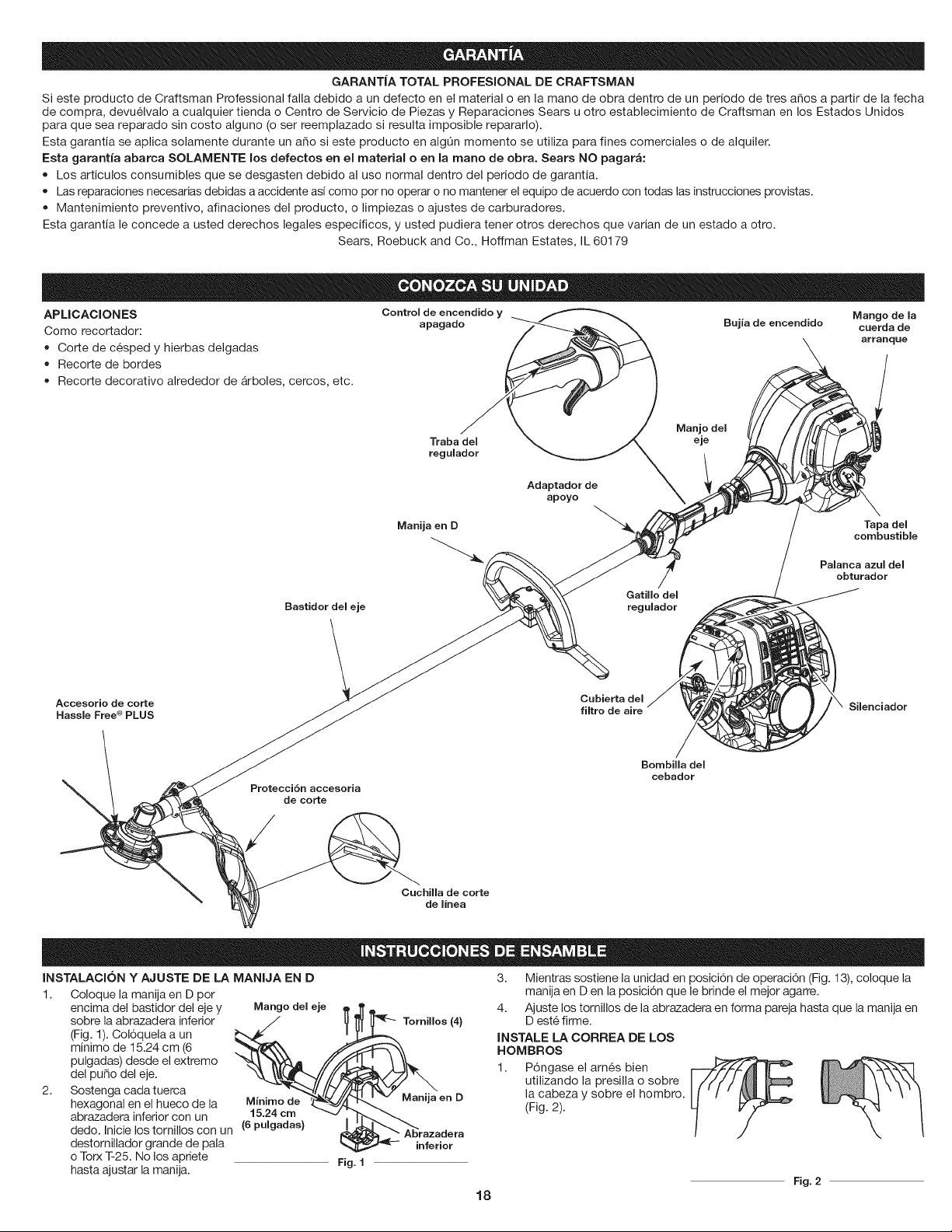
GARANTJA TOTAL PROFESIONAL DE CRAFTSMAN
Si este producto de Craftsman Professional falla debido a un defecto en el material o en la mano de obra dentro de un periodo de tres a_os a partir de la fecha
de compra, devuelvalo a cualquier tienda o Centro de Servicio de Piezas y Reparaciones Sears u otro establecimiento de Craftsman en los Estados Unidos
para que sea reparado sin costo alguno (o ser reemplazado si resulta imposible repararlo).
Esta garantia se aplica solamente durante un a_o si este producto en algOn momento se utiliza para fines comerciales o de alquiler.
Esta garantfa abarca SOLAMENTE los defectos en el material o en la mane de obra. Sears NO pagar_:
• Los articulos consumibles que se desgasten debido al uso normal dentro del periodo de garantia.
Las reparaciones necesarias debidas a accidente asi como por no operar o no mantener el equipo de acuerdo con todas las instrucciones provistas.
Mantenimiento preventivo, afinaciones del producto, o limpiezas o ajustes de carburadores.
Esta garantia le concede a usted derechos legales especificos, y usted pudiera tener otros derechos que varian de un estado a otro.
Sears, Roebuck and Co., Hoffman Estates, IL 60179
APLNCACHONES Control de encendido y Mango de la
Como recortador: apagado Bujia de encendido cuerda de
• Corte de cesped y hierbas delgadas arranque
• Recorte de bordes
• Recorte decorativo alrededor de Arboles, cercos, etc.
Bastidor del eje
/
Traba del
regulador
Adaptador de
apoyo
Manjo del
eje
Manija en D Tapa del
_.._ combustible
Pamanca azul del
obturador
GatiHo del
regumador
Accesorio de corte Cubierta del
Hassle Free ® PLUS filtro de aire Silenciador
Protecci6n accesoria
de corte
Bombilla del
cebador
CuchiHa de corte
de minea
INSTALACION Y AJUSTE DE LA MANIJA EN D
1. Coloque la manija en D por
encima del bastidor del eje y
sobre la abrazadera inferior
(Fig. 1). Col6quela a un
minimo de 15.24 cm (6
pulgadas) desde el extremo
del puSo del eje.
2. Sostenga cada tuerca
hexagonal en el hueco de la Minirno de
abrazadera inferior con un 15.24 cm
dedo. Inicie los tornillos con un (6 pulgadas)
destornillador grande de pala
o Torx T-25. No los apriete
hasta ajustar la manija.
Mango del eje
Fig. I
3.
4.
Tornillos (4) D est6 firme.
INSTALE LA CORREA DE LOS
HOMBROS
1. P6ngase el arn6s bien
utilizando la presilla o sobre
Manija en D la cabeza y sobre el hombro.
(Fig. 2).
inferior
Mientras sostiene la unidad en posici6n de operaci6n (Fig. 13), coloque la
manija en Den la posici6n que le brinde el mejor agarre.
Ajuste los tornillos de la abrazadera en forma pareja hasta que la manija en
18
Fig. 2
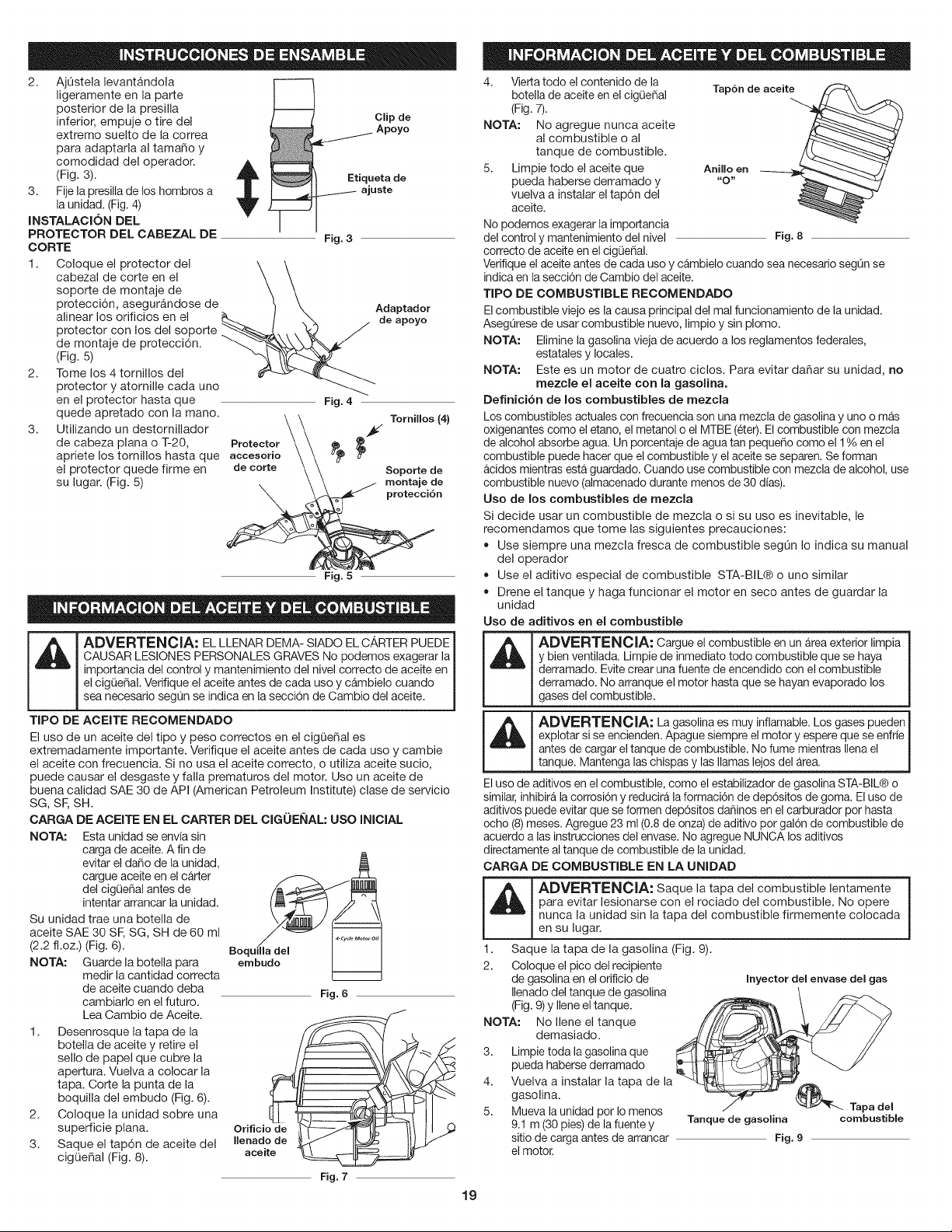
2. AjOstela levant&ndola
ligeramente en la parte
posterior de la presilla
inferior, empuje o tire del
extremo suelto de la correa
para adaptarla al tamafio y
comodidad del operador.
(Fig. 3).
3. Fije la presilla de los hombres a
la unidad. (Fig. 4)
INSTALACION DEL
PROTECTOR DEL CABEZAL DE
CORTE
1. Ooloque el protector del
cabezal de corte en el
soporte de montaje de
protecci6n, asegurandose de
alinear los orificios en el
protector con los del soporte
de montaje de protecci6n.
(Fig. 5)
2. Tome los 4tornillos del
protector y atornille cada uno
en el protector hasta que
quede apretado con la mano.
3. Utilizando un destornillador
de cabeza plana o T-20, Protector
apriete los tornillos hasta que accesorio
el protector quede firme en de corte
su lugar. (Fig. 5)
Fig. 3
Fig. 4
Clip de
Apoyo
Etiqueta de
ajuste
Adaptador
de apoyo
Tornillos (4}
Soporte de
montaje de
protecci6n
Fig. 5
_1 EL LLENAR DEMA- SIADO EL PUEDE
ADVERTENCIA: CARTER
CAUSAR LESIONES PERSONALES GRAVES No podemos exagerar la
I importancia del control y mantenimiento del nivel correcto de aceite en
el cigC)efial.Verifique el aceite antes de cada uso y c_.mbielo cuando
=._ sea necesar o seg_n send ca en a secc 6n de Camb o de ace te.
TIPO BE ACEITE RECOMENDADO
El uso de un aceite del tipo y peso correctos en el cigQefial es
extremadamente importante. Verifique el aceite antes de cada uso y cambie
el aceite con frecuencia. Si no usa el aceite correcto, o utiliza aceite sucio,
puede causar el desgaste y falla prematuros del motor. Uso un aceite de
buena calidad SAE 30 de API (American Petroleum Institute) clase de servicio
SG, SF, SH.
CARGA DE ACEITE EN EL CARTER DEL CIGOENAL: USO INICIAL
NOTA: Esta unidad se envia sin
carga de aceite. A fin de
evitar el dafio de la unidad,
cargue aceite en el ca.rter
del cigOefial antes de
intentar arrancar la unidad.
Su unidad trae una botella de
aceite SAE 30 SF, SG, SH de 60 ml
(2.2 fl.oz.) (Fig. 6).
NOTA: Guarde la botella para
medir la cantidad correcta
de aceite cuando deba
cambiarlo en el futuro.
Lea Cambio de Aceite.
1. Desenrosque la tapa de la
botella de aceite y retire el
sello de papel que cubre la
apertura. Vuelva a colocar la
tapa. Corte la punta de la
boquilla del embudo (Fig. 6).
2. Coloque la unidad sobre una
superficie plana.
3. Saque el tap6n de aceite del
cig0efial (Fig. 8).
Orificio de
Ilenado de
aceite
Fig. 7
4. Vierta todo el contenido de la
botella de aceite en el cigQefial
(Fig. 7).
NOTA: No agregue nunca aceite
al combustible o al
tanque de combustible.
5. Limpie todo el aceite que
pueda haberse derramado y
vuelva a instalar el tap6n del
aceite.
No podemos exagerar la importancia
del control y mantenimiento del nivel
correcto de aceite en el cig(]efial.
de aceite
Tap6n
Anillo en
"O"
Fig. 8
Verifique el aceite antes de cada uso y ca.mbielo cuando sea necesario segOn se
indica en lasecci6n de Cambio del aceite.
TIPO BE COMBUSTIBLE RECOMENDADO
Elcombustible viejo es la causa principal del mal funcionamiento de la unidad.
AsegOrese de usar combustible nuevo, limpio y sin plomo.
NOTA: Elimine la gasolina vieja de acuerdo a los reglamentos federales,
estatales y locales.
NOTA: Este es un motor de cuatro ciclos. Para evitar dafiar su unidad, no
mezcle el aceite con la gasolina.
Definici6n de los combustibles de mezcla
Los combustibles actuales con frecuencia son una mezcla de gasolina y uno o mas
oxigenantes como el etano, el metanol o el MTBE (6ter). Elcombustible con mezcla
de alcohol absorbe agua. Un porcentaje de agua tan pequefio como el 1% en el
combustible puede hacer que el combustible y el aceite se separen. Se forman
acidos mientras esta.guardado. Cuando use combustible con mezcla de alcohol, use
combustible nuevo (almacenado durante menos de 30 dias).
Uso de los combustibles de mezcla
Si decide usar un combustible de mezcla o si su uso es inevitable, le
recomendamos que tome las siguientes precauciones:
• Use siempre una mezcla fresca de combustible segQn Io indica su manual
del operador
• Use el aditivo especial de combustible STA-BIL® o uno similar
• Drene el tanque y haga funcionar el motor en seco antes de guardar la
unidad
Uso de aditivos en el combustible
ADVERTENCIA: Cargue el combustible en un a.reaexterior limpiay bien ventilada. Limpie de inmediato todo combustible que se haya
derramado. Evite crear una fuente de encendido con el combustible
derramado. No arranque el motor hasta que se hayan evaporado los
gases del combustible.
ADVERTENCIA: La gasolina es muy inflamable. Los gases puedenexplotar si se encienden. Apague siempre el motor y espere que se enfrie
antes de cargar el tanque de combustible. No fume mientras Ilena el
tanque. Mantenga las chispas y las llamas lejos del area.
Eluso de aditivos en el combustible, come el estabilizador de gasolina STA-BIL® o
similar, inhibira la corrosi6n y reducira la formaci6n de dep6sitos de goma. El uso de
aditivos puede evitar que se formen dep6sitos dafiinos en el carburador pot hasta
ocho (8)meses. Agregue 23 ml (0.8 de onza) de aditivo pot gal6n de combustible de
acuerdo a las instrucciones del envase. No agregue NUNCA los aditivos
directamente al tanque de combustible de la unidad.
CARGA DE COMBUSTIBLE EN LA UNIDAD
I _ I ADVERTENCIA: Saque la tapa del combustible lentamente
para evitar lesionarse con el rociado del combustible. No opere
nunca la unidad sin la tapa del combustible firmemente colocada
en su lugar.
1. Saque la tapa de la gasolina (Fig. 9).
2. Coloque el pico del recipiente
de gasolina en el orificio de
Ilenado del tanque de gasolina
(Fig. 9) y Ilene el tanque.
NOTA: No Ilene el tanque
demasiado.
3. Limpie toda la gasolina que
pueda haberse derramado
4. Vuelva a instalar la tapa de la
gasolina.
5. Mueva la unidad por Io menos
9.1 m (30 pies) de lafuente y
sitio de carga antes de arrancar
el motor.
Inyector del envase del gas
Tanque de gasolina
_Tapa del
combustible
Fig. 9
19
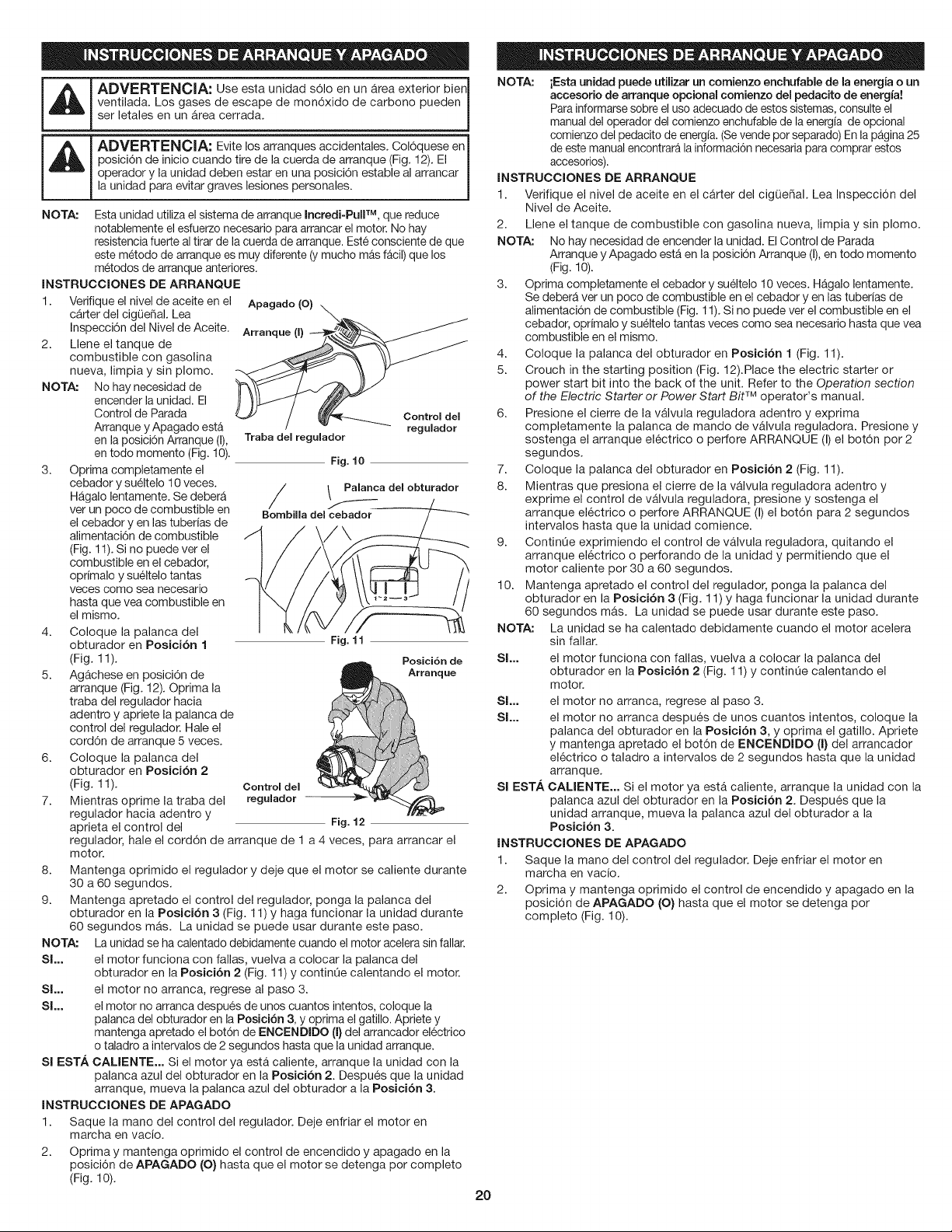
ADVERTENOIA: Use esta unidad s61o en un Area exterior bienventilada. Los gases de escape de mon6xido de carbono pueden
ser letales en un Area cerrada.
ADVERTENOIA: Evite los arranques accidentales. Col6quese enposici6n de inicio cuando tire de la cuerda de arranque (Fig. 12). El
operador y la unidad deben estar en una posici6n estable al arrancar
la unidad para evitar graves lesiones personales.
NOTA:
Esta unidad utiliza el sistema de arranque Incredi-PulF M,que reduce
notablemente el esfuerzo necesario para arrancar el motor. No hay
resistencia fuerte al tirar de la cuerda de arranque. Est6 consciente de que
este metodo de arranque es muy diferente (y mucho mas fAcil) que los
Apagado (O)
Arranque (I)
Traba del regulador
Fig. 10
m6todos de arranque anteriores.
INSTRUCCIONES DE ARRANQUE
1. Verifique el nivel de aceite en el
carter del cigOeSal. Lea
Inspecci6n del Nivel de Aceite.
2. Llene el tanque de
combustible con gasolina
nueva, limpia y sin plomo.
NOTA: No hay necesidad de
encender la unidad. El
Control de Parada
Arranque y Apagado esta.
en la posici6n Arranque (I),
en todo momento (Fig. 10).
3. Oprima completamente el
Control del
regulador
cebador y su61telo 10 veces. /
Palanca del obturador
Hagalo lentamente. Se debera /
ver un poco de combustible en Bombilla del cebador
el cebador yen las tuberias de
alimentaci6n de combustible
(Fig. 11). Si no puede ver el
combustible en el cebador,
oprimalo y su61telo tantas
veces como sea necesario
hasta que vea combustible en
el mismo.
4. Coloque la palanca del
obturador en Posicibn 1 Fig. 11
(Fig. 11). _ Posici6n de
5. Ag&chese en posici6n de _ Arranque
arranque (Fig. 12). Oprima la
it _
traba del regulador hacia
adentro y apriete la palanca de
control del regulador. Hale el
cord6n de arranque 5 veces.
6. Coloque la palanca del
obturador en Posicibn 2
(Fig. 11). Control del
7. Mientras oprime la traba del regulador
regulador hacia adentro y /_
aprieta el control del Fig. 12
regulador, hale el cord6n de arranque de 1 a 4 veces, para arrancar el
motor.
8. Mantenga oprimido el regulador y deje que el motor se caliente durante
30 a 60 segundos.
9. Mantenga apretado el control del regulador, ponga la palanca del
obturador en la Posici6n 3 (Fig. 11) y haga funcionar la unidad durante
60 segundos mAs. La unidad se puede usar durante este paso.
NOTA: La unidad se ha calentado debidamente cuando el motor acelera sin fallar.
Sl... el motor funciona con fallas, vuelva a colocar la palanca del
obturador en la Posici6n 2 (Fig. 11) y contin0e calentando el motor.
Sl... el motor no arranca, regrese al paso 3.
Sl... el motor no arranca despues de unos cuantos intentos, coloque la
palanca del obturador en la Posici6n 3, y oprima el gatillo. Apriete y
mantenga apretado el bot6n de ENCENDIDO (I) del arrancador electrico
o taladro a intervalos de 2 secjundos hasta que la unidad arranque.
Sl ESTA CAUENTE... Si el motor ya est& caliente, arranque la unidad con la
palanca azul del obturador en la Posici6n 2. Despues que la unidad
arranque, mueva la palanca azul del obturador a la Posicibn 3.
INSTRUCCIONES DE APAGADO
1. Saque la mano del control del regulador. Deje enfriar el motor en
marcha en vacio.
2. Oprima y mantenga oprimido el control de encendido y apagado en la
posici6n de APAGADO (O) hasta que el motor se detenga por completo
(Fig. 10).
NOTA: iEsta unidad puede utilizar un comienzo enchufable de la energia o un
accesorio de arranque opcional comienzo del pedacito de energfa!
Para informarse sobre el uso adecuado de estos sistemas, consulte el
manual del operador del comienzo enchufable de la energia de opcional
comienzo del pedacito de energia.(Se vende por separado) En la pagina 25
de este manual encontrara la informaci6n necesaria para comprar estos
accesorios).
INSTRUOCIONES DE ARRANQUE
1. Verifique el nivel de aceite en el carter del cigOefial. Lea Inspecci6n del
Nivel de Aceite.
2. Llene el tanque de combustible con gasolina nueva, limpia y sin plomo.
NOTA: No hay necesidad de encender la unidad. El Control de Parada
Arranque y Apagado est,. en la posici6n Arranque (I),en todo momento
(Fig. 10).
3. Oprima completamente el cebador y su61telo 10 veces. H_.galo lentamente.
Se deberA ver un poco de combustible en el cebador yen las tuberias de
alimentaci6n de combustible (Fig. 11). Si no puede ver el combustible en el
cebador, oprimalo y su61telotantas veces como sea necesario hasta que vea
combustible en el mismo.
4. Coloque la palanca del obturador en Posici6n 1 (Fig. 11).
5. Crouch in the starting position (Fig. 12).Place the electric starter or
power start bit into the back of the unit. Refer to the Operation section
of the Electric Starter or Power Start Bit TM operator's manual.
6. Presione el cierre de la valvula reguladora adentro y exprima
completamente la palanca de mando de valvula reguladora. Presione y
sostenga el arranque el6ctrico o perfore ARRANQUE (I) el bot6n por 2
segundos.
7. Coloque la palanca del obturador en Posicibn 2 (Fig. 11).
8. Mientras que presiona el cierre de la v&lvula reguladora adentro y
exprime el control de valvula reguladora, presione y sostenga el
arranque el6ctrico o perfore ARRANQUE (I) el bot6n para 2 segundos
intervalos hasta que la unidad comience.
9. Contin0e exprimiendo el control de v&lvula reguladora, quitando el
arranque el6ctrico o perforando de la unidad y permitiendo que el
motor caliente por 30 a 60 segundos.
10. Mantenga apretado el control del regulador, ponga la palanca del
obturador en la Posici6n 3 (Fig. 11) y haga funcionar la unidad durante
60 segundos m&s. La unidad se puede usar durante este paso.
NOTA: La unidad se ha calentado debidamente cuando el motor acelera
sin fallar.
Sl... el motor funciona con fallas, vuelva a colocar la palanca del
obturador en la Posici6n 2 (Fig. 11) y continOe calentando el
motor.
Sl... el motor no arranca, regrese al paso 3.
Sl... el motor no arranca despues de unos cuantos intentos, coloque la
palanca del obturador en la Posicibn 3, y oprima el gatillo. Apriete
y mantenga apretado el bot6n de ENCENDIDO (I} del arrancador
el6ctrico o taladro a intervalos de 2 segundos hasta que la unidad
arranque.
Sl EST.&. CAUENTE... Si el motor ya estA caliente, arranque la unidad con la
palanca azul del obturador en la Posicibn 2. Despu6s que la
unidad arranque, mueva la palanca azul del obturador a la
Posicibn 3.
INSTRUCCIONES DE APAGADO
1. Saque la mano del control del regulador. Deje enfriar el motor en
marcha en vacio.
2. Oprima y mantenga oprimido el control de encendido y apagado en la
posici6n de APAGADO (O) hasta que el motor se detenga por
completo (Fig. 10).
20
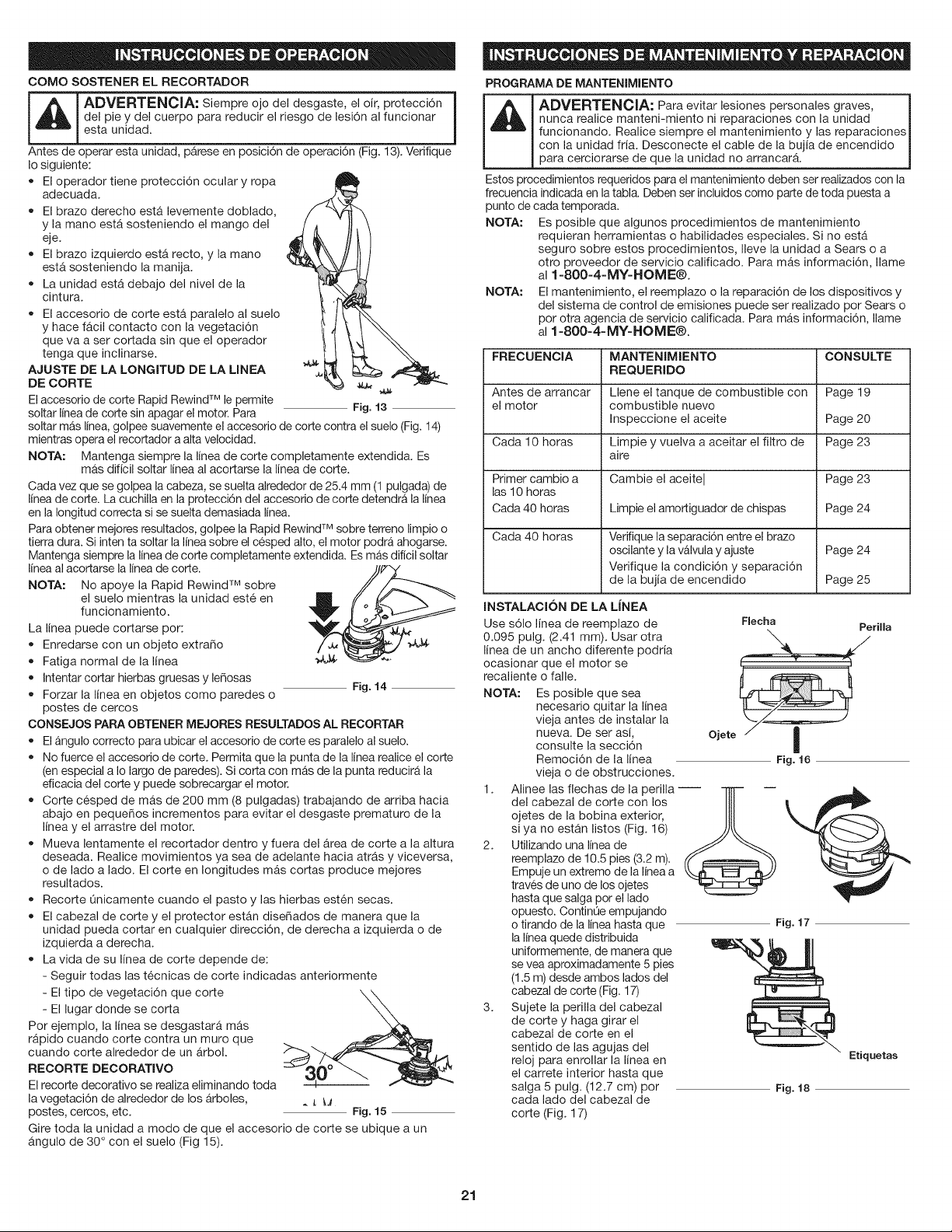
COMO SOSTENER EL RECORTADOR
_ ADVERTENOIA: Siempre ojo del desgaste, el oir, protecci6n i
del pie y del cuerpo para reducir el riesgo de lesi6n al funcionar
esta unidad.
Antes de operar esta unidad, p&rese en posici6n de operaci6n (Fig. 13). Verifique
Io siguiente:
• El operador tiene protecci6n ocular y ropa
adecuada.
• El brazo derecho esta levemente doblado,
y la mano estA sosteniendo el mango del
eJe.
El brazo izquierdo estA recto, y la mano
estA sosteniendo la manija.
• La unidad estA debajo del nivel de la
cintura.
• El accesorio de corte esta paralelo al suelo
y hace fAcil contacto con la vegetaci6n
que va a ser cortada sin que el operador
tenga que inclinarse.
AJUSTE DE LA LONGITUD DE LA LHNEA
DE CORTE _,_
El accesorio de corte Rapid RewindTM le permite
soltar linea de corte sin apagar el motor. Para Fig. 13
soltar ma.s line& golpee suavemente el accesorio de corte contra el suelo (Fig. 14)
mientras opera el recortador a alta velocidad.
NOTA: Mantenga siempre la linea de corte completamente extendida. Es
m&s diflcil soltar linea al acortarse la linea de corte.
Cada vez que se golpea la cabeza, se suelta alrededor de 25.4 mm (1 pulgada) de
linea de corte. La cuchilla en la protecci6n del accesorio de corte detendra la linea
en la Iongitud correcta si se suelta demasiada line&
Para obtener mejores resultados, golpee la Rapid RewindTM sobre terreno limpio o
tierra dura. Si inten ta soltar la linea sobre el cesped alto, el motor podra ahogarse.
Mantenga siempre la linea de corte completamente extendida. Es ma.sdificil soltar
linea al acortarse la linea de corte.
NOTA: No apoye la Rapid Rewind TM sobre
el suelo mientras la unidad est6 en
funcionamiento.
La linea puede cortarse por:
Enredarse con un objeto extra_o
• Fatiga normal de la linea
Intentar cortar hierbas gruesas y lehosas
Forzar la linea en objetos como paredes o
postes de cercos
Fig. 14
CONSEJOS PARA OBTENER MEJORES RESULTADOS AL RECORTAR
El a.ngulo correcto para ubicar el accesorio de corte es paralelo al suelo.
• No fuerce el accesorio de corte. Permita que la punta de la linea realice el corte
(en especial a Io largo de paredes). Si corta con mAs de la punta reducir& la
eficacia del corte y puede sobrecargar el motor.
Corte c6sped de mas de 200 mm (8 pulgadas) trabajando de arriba hacia
abajo en pequeSos incrementos para evitar el desgaste prematuro de la
linea y el arrastre del motor.
Mueva lentamente el recortador dentro y fuera del Area de corte a la altura
deseada. Realice movimientos ya sea de adelante hacia atr&s y viceversa,
o de lado a lado. El corte en longitudes m&s cortas produce mejores
resultados.
• Recorte Onicamente cuando el pasto y las hierbas est6n secas.
• El cabezal de corte y el protector est&n diseSados de manera que la
unidad pueda cortar en cualquier direcci6n, de derecha a izquierda o de
izquierda a derecha.
La vida de su linea de corte depende de:
- Seguir todas las t6cnicas de corte indicadas anteriormente
- El tipo de vegetaci6n que corte \
- El lugar donde se corta
Por ejemplo, la linea se desgastarA m&s
rapido cuando corte contra un muro que
cuando corte alrededor de un _rbol.
REOORTE DECORATIVO
El recorte decorativo se realiza eliminando toda
la vegetaci6n de alrededor de los _rboles, _ L U
postes, cercos, etc. Fig. 15
Gire toda la unidad a modo de que el accesorio de corte se ubique a un
&ngulo de 30 ° con el suelo (Fig 15).
PROGRAMA DE MANTENIMIENTO
_ DVERTENCIA: Para evitar lesiones personales graves,
nunca realice manteni-miento ni reparaciones con la unidad
funcionando. Realice siempre el mantenimiento y las reparaciones
con la unidad fria. Desconecte el cable de la bujia de encendido
para cerciorarse de que la unidad no arrancar&
Estos procedimientos requeridos para el mantenimiento deben set realizados con la
frecuencia indicada en la tabla. Deben set incluidos como parte de toda puesta a
punto de cada temporada.
NOTA: Es posible que algunos procedimientos de mantenimiento
requieran herramientas o habilidades especiales. Si no est&
seguro sobre estos procedimientos, Ileve la unidad a Sears o a
otro proveedor de servicio calificado. Para mAs informaci6n, Ilame
al 1-800-4-MY-HOME®.
NOTA: El mantenimiento, el reemplazo o la reparaci6n de los dispositivos y
del sistema de control de emisiones puede ser realizado por Sears o
por otra agencia de servicio calificada. Para mAs informaci6n, Ilame
al 1-800-4-MY-HOME®.
FRECUENCIA MANTENIMIENTO CONSULTE
REQUERIDO
Antes de arrancar Llene el tanque de combustible con Page 19
el motor combustible nuevo
Inspeccione el aceite Page 20
Cada 10 horas Limpie y vuelva a aceitar el filtro de Page 23
aire
Primer cambio a Cambie el aceiteJ Page 23
las 10 horas
Cada 40 horas Limpie el amortiguador de chispas Page 24
Cada 40 horas Verifique la separaci6n entre el brazo
oscilante y la va.lvula y ajuste Page 24
Verifique la condici6n y separaci6n
de la bujia de encendido Page 25
INSTALAOION DE LA LJNEA
Use s61o linea de reemplazo de Flecha Perilla
0.095 pulg. (2.41 mm). Usar otra
linea de un ancho diferente podria
ocasionar que el motor se
recaliente o falle.
NOTA: Es posible que sea
necesario quitar la linea
vieja antes de instalar la
nueva. De ser asi,
consulte la secci6n
Remoci6n de la linea
vieja o de obstrucciones.
1. Alinee las flechas de la perilla --
del cabezal de corte con los
ojetes de la bobina exterior,
si ya no estAn listos (Fig. 16)
2. Utilizando una linea de
reemplazo de 10.5 pies (3.2 m).
Empuje un extremo de la linea a
traves de uno de los ojetes
hasta que salga por el lado
opuesto. ContinOe empujando
o tirando de la linea hasta que Fig. 17
la linea quede distribuida
uniformemente, de manera que
se vea aproximadamente 5 pies
(1.5 m) desde ambos lados del
cabezal de corte (Fig. 17)
3. Sujete la perilla del cabezal
de corte y haga girar el
cabezal de corte en el
sentido de las agujas del
reloj para enrollar la linea en
el carrete interior hasta que
salga 5 pulg. (12.7 cm) por Fig. 18
cada lado del cabezal de
corte (Fig. 17)
Ojete /
Fig. 16
Etiquetas
21
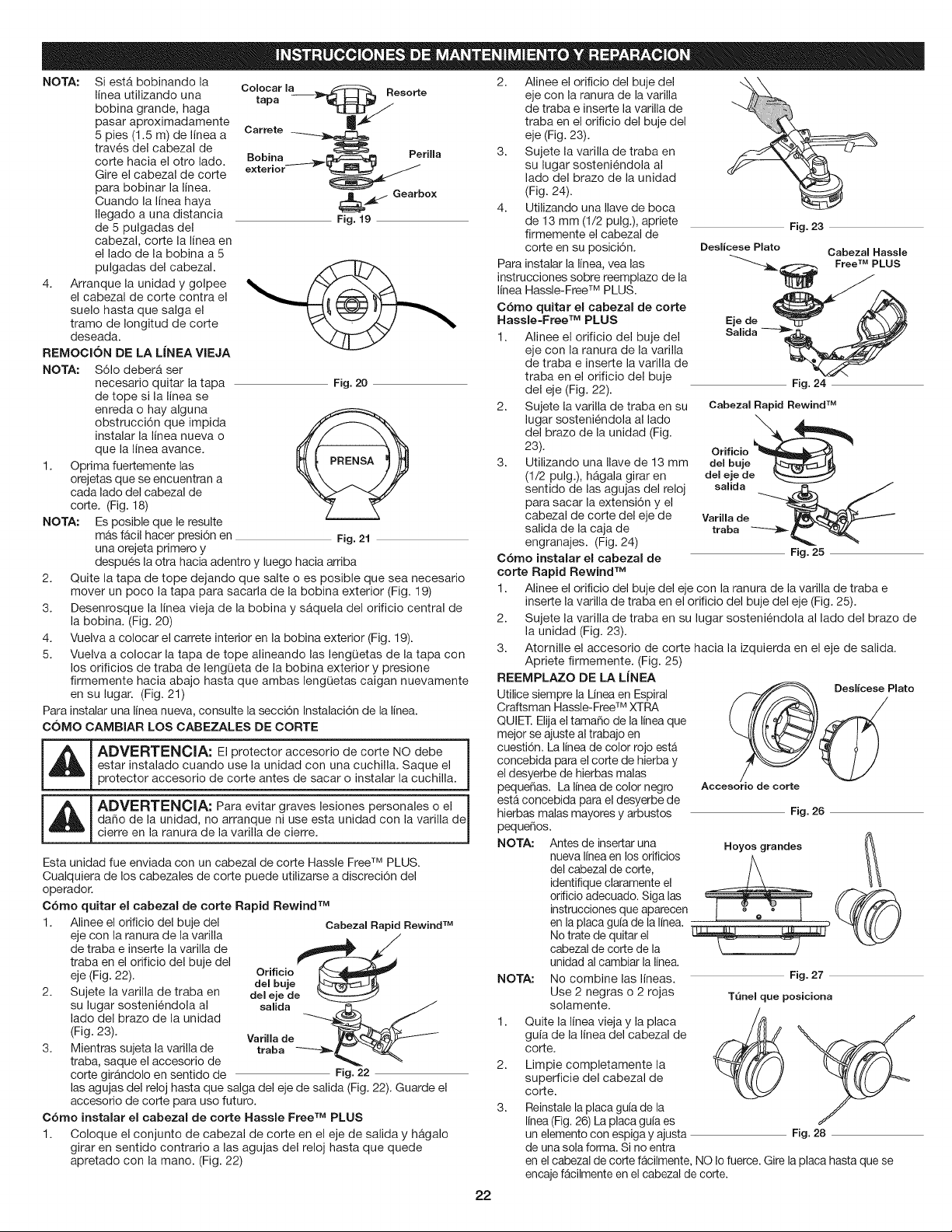
NOTA: Si estA bobinando la
Colocar la _ Resorte
linea utilizando una tapa --
bobina grande, haga
pasar aproximadamente I_.,__
5 pies (1.5 m) de linea a
trav6s del cabezal de
corte hacia el otro lade.
Gire el cabezal de corte
para bobinar la linea.
Cuando la linea haya _ Gearbox
Ilegado a una distancia Fig. 19
de 5 pulgadas del
cabezal, corte la linea en
el lado de la bobina a 5
pulgadas del cabezal.. /<
4. Arranque la unidad y golpee _ /'-
el cabezal de corte contra el
suelo hasta que salga el
tramo de Iongitud de corte
deseada.
REMOClON DE LA LJNEA VlEJA
NOTA: $61o debera ser
necesario quitar la tapa Fig. 20
de tope si la linea se
enreda o hay alguna
obstrucci6n que impida
instalar la linea nueva o
que la linea avance.
1. Oprima fuertemente las
orejetas que se encuentran a
cada lade del cabezal de
corte. (Fig. 18)
NOTA: Es posible que le resulte
m&s fAcil hacer presi6n en Fig. 21
una orejeta primero y
despues la otra hacia adentro y luego hacia arriba
2. Quite la tapa de tope dejando que salte o es posible que sea necesario
mover un poco la tapa para sacarla de la bobina exterior (Fig. 19)
3. Desenrosque la linea vieja de la bobina y sAquela del orificio central de
la bobina. (Fig. 20)
4. Vuelva a colocar el carrete interior en la bobina exterior (Fig. 19).
5. Vuelva a colocar la tapa de tope alineando las lengOetas de la tapa con
los orificios de traba de lengOeta de la bobina exterior y presione
firmemente hacia abajo hasta que ambas lengOetas caigan nuevamente
en su lugar. (Fig. 21)
Para instalar una linea nueva, consulte la secci6n Instalaci6n de la line&
COMO CAMBIAR LOS CABEZALES DE CORTE
i _j ADVERTENOIA: El protector accesorio de certe NO debe 1
estar instalado cuando use la unidad con una cuchilla. Saque el
protector accesorio de corte antes de sacar o instalar la cuchilla.
I _IL ! ADVERTENOJA: para evitar graves lesiones personales ° el I
daSo de la unidad, no arranque ni use esta unidad con la varilla de
cierre en la ranura de la varilla de cierre.
Esta unidad fue enviada con un cabezal de corte Hassle FreeTM PLUS.
Cualquiera de los cabezales de corte puede utilizarse a discreci6n del
operador.
C6mo quitar el cabezal de corte Rapid Rewind TM
1. Alinee el orificio del buje del
eje con la ranura de la varilla
de traba e inserte la varilla de
traba en el orificio del buje del
eje (Fig. 22).
2. Sujete la varilla de traba en
su lugar sosteni6ndola al
lade del braze de la unidad
(Fig. 23).
3. Mientras sujeta la varilla de
traba, saque el accesorio de
corte gir&ndolo en sentido de
CabezaJ Rapid Rewind TM
Orificio _
del buje _
del eje de
salida ___
Varilla de
traba
Fig. 22
las agujas del reloj hasta que salga del eje de salida (Fig. 22). Guarde el
accesorio de corte para uso future.
C6mo instalar el cabezal de corte Hassle Free TM PLUS
1. Coloque el conjunto de cabezal de corte en el eje de salida y hAgalo
girar en sentido contrario alas agujas del reloj hasta que quede
apretado con la mano. (Fig. 22)
2. Alinee el orificio del buje del
eje con la ranura de la varilla
de traba e inserte la varilla de
traba en el orificio del buje del
eje (Fig. 23).
3. Sujete la varilla de traba en
su lugar sosteni6ndola al
lade del braze de la unidad
(Fig. 24).
4. Utilizando una Ilave de boca
de 13 mm (1/2 pulg.), apriete
firmemente el cabezal de
corte en su posici6n.
Para instalar la linea, vea las
instrucciones sobre reemplazo de la
linea Hassle-Free TM PLUS.
C6mo quitar el cabezal de corte
Hassle-Free TM PLUS
1. Alinee el orificio del buje del
eje con la ranura de la varilla
de traba e inserte la varilla de
traba en el orificio del buje
del eje (Fig. 22).
2. Sujete la varilla de traba en su
lugar sosteni6ndola al lade
del brazo de la unidad (Fig.
23).
3. Utilizando una Ilave de 13 mm
(1/2 pulg.), hagala girar en
sentido de las agujas del reloj
para sacar la extensi6n y el
cabezal de corte del eje de
salida de la caja de
engranajes. (Fig. 24)
C6mo instalar el cabezal de
corte Rapid Rewind TM
Fig. 23
DeslJcese Plato Cabezal Hassle
_'_.j_ Free TM PLUS
Eje.de _.__I___
Sahda
Fig. 24
Cabezal Rapid Rewind TM
Orificio
del buje __
del eje de ____
Varilla de ]1_,_ _
traba ----_b- ___. "-Z_
Fig. 25
1. Alinee el orificio del buje del eje con la ranura de la varilla de traba e
inserte la varilla de traba en el orificio del buje del eje (Fig. 25).
2. Sujete la varilla de traba en su lugar sosteniendola al lado del brazo de
la unidad (Fig. 23).
3. Atornille el accesorio de corte hacia la izquierda en el eje de salida.
Apriete firmemente. (Fig. 25)
REEMPLAZO DE LA LINEA
Utilice siempre la Linea en Espiral
Craftsman Hassle-Free TM XTRA
QUIET. Elija el tamaSo de la linea que
mejor se ajuste al trabajo en
cuestion. La linea de color rojo esta.
concebida para el corte de hierba y
el desyerbe de hierbas malas
pequeSas. La linea de color negro
est,. concebida para el desyerbe de
hierbas malas mayores y arbustos
pequenos.
NOTA: Antes de insertar una
nueva linea en los orificios
NOTA:
1.
2.
Deslicese Plato
en la placa guia de la line& --
No trate de quitar el
cabezal de corte de la
unidad al cambiar la line&
No combine las lineas.
Use 2 negras o 2 rojas
solamente.
Quite la linea vieja y la placa
guia de la linea del cabezal de
corte.
Limpie completamente la
superficie del cabezal de
corte.
Reinstale la placa guia de la
linea (Fig. 26) La placa guia es
un elemento con espiga y ajusta
de una sola forma. Si no entra
Fig. 26
Hoyos grandes
del cabezal de corte, _
identifique claramente el
orificio adecuado. Siga las
instrucciones que aparecen
3.
Fig. 27
T_nel que posiciona
Fig. 28
en el cabezal de corte f_cilmente, NO Io fuerce. Gire la placa hasta que se
encaje f_cilmente en el cabezal de corte.
22
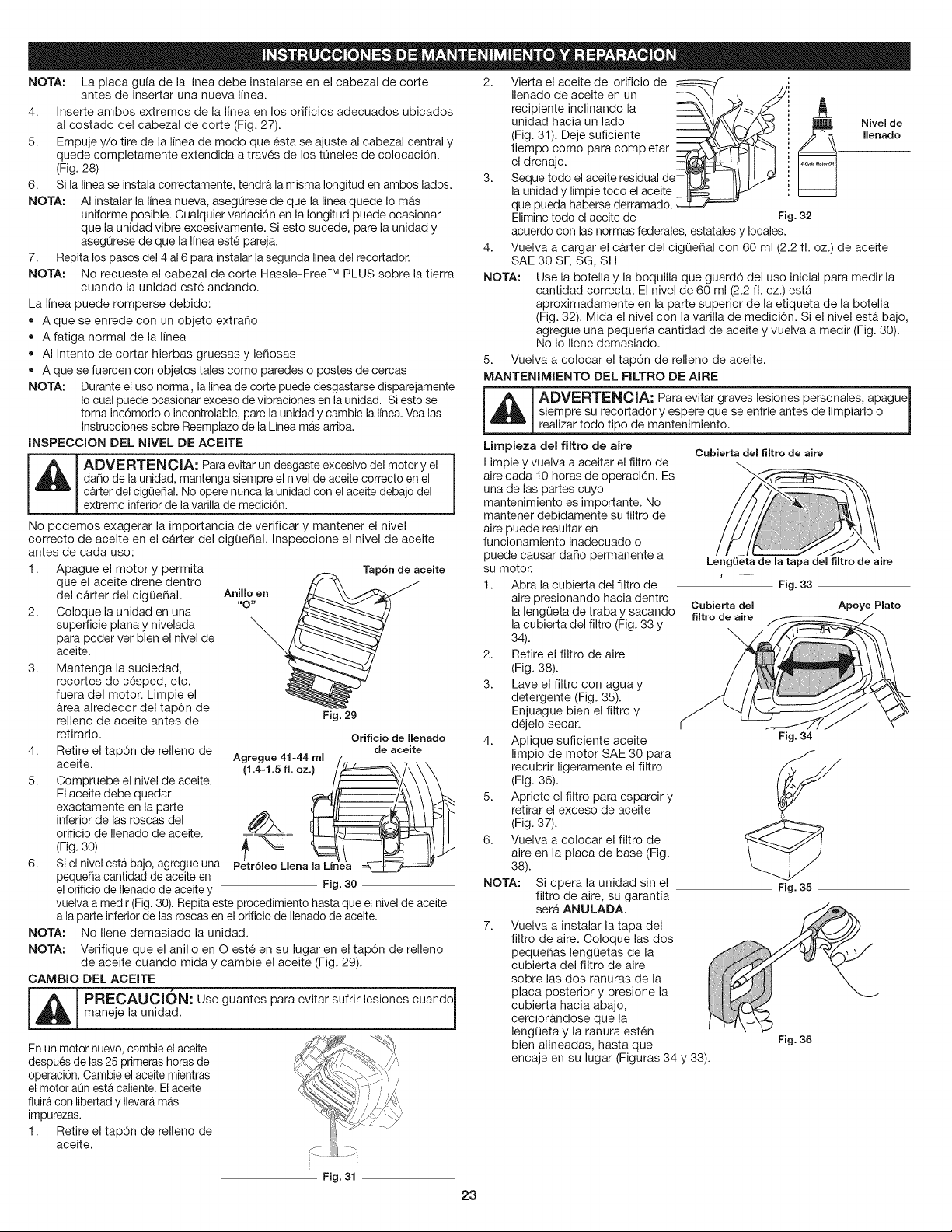
NOTA: La placa guia de la linea debe instalarse en el cabezal de corte
antes de insertar una nueva linea.
4. Inserte ambos extremos de la linea en los orificios adecuados ubicados
al costado del cabezal de corte (Fig. 27).
5. Empuje y/o tire de la linea de modo que 6sta se ajuste al cabezal central y
quede completamente extendida a trav6s de los tOneles de colocaci6n.
(Fig. 28)
6. Si la linea se instala correctamente, tendra la misma Iongitud en ambos lados.
NOTA: AI instalar la linea nueva, asegOrese de que la linea quede Io mas
uniforme posible. Cualquier variaci6n en la Iongitud puede ocasionar
que la unidad vibre excesivamente. Si esto sucede, pare la unidad y
asegOrese de que la linea est6 pareja.
7. Repita los pasos del 4 al 6 para instalar la segunda linea del recortador.
NOTA: No recueste el cabezal de corte Hassle-Free TM PLUS sobre la tierra
cuando la unidad est6 andando.
La linea puede romperse debido:
• A que se enrede con un objeto extrafio
• Afatiga normal de la linea
• AI intento de cortar hierbas gruesas y le_osas
A que se fuercen con objetos tales como paredes o postes de cercas
NOTA: Durante el uso normal, la linea de corte puede desgastarse disparejamente
Io cual puede ocasionar exceso de vibraciones en la unidad. Si esto se
torna inc6modo o incontrolable, pare la unidad y cambie la line& Vea las
Instrucciones sobre Reemplazo de la Linea mas arriba.
INSPECCION DEL NIVEL DE ACEITE
,A I ADVERTENCIA: Para evitar un desgaste excesivo del motory el
I ,_ _ dafio de la unidad, mantenga siempre el nivel de aceite correcto en el
J
I '=='==" _ carter del cigOe_al. No opere nunca la unidad con el aceite debajo del
extremo inferior de la varilla de medici6n.
No podemos exagerar la importancia de verificar y mantener el nivel
correcto de aceite en el carter del cigOefial. Inspeccione el nivel de aceite
antes de cada uso:
1. Apague el motory permita
que el aceite drene dentro
del carter del cigQe_al.
2. Coloque la unidad en una
superficie plana y nivelada
para poder ver bien el nivel de
aceite.
3. Mantenga la suciedad,
recortes de cesped, etc.
fuera del motor. Limpie el
Area alrededor del tap6n de
relleno de aceite antes de
retirarlo.
4. Retire el tap6n de relleno de
aceite.
5. Compruebe el nivel de aceite.
El aceite debe quedar
exactamente en la parte
inferior de las roscas del
orificio de Ilenado de aceite.
(Fig. 30)
6. Si el nivel esta.bajo, agregue una
pequefia cantidad de aceite en
el orificio de Ilenado de aceite y
Tap6n de aceite
Anillo en
Fig. 29
2. Vierta el aceite del orificio de
Ilenado de aceite en un :-_"
recipiente inclinando la
unidad hacia un lado
(Fig. 31). Deje suficiente
tiempo como para completar
el drenaje.
3. Seque todo el aceite residual de-_[-j_
la unidad y limpie todo el aceite _
que pueda haberse derramado. _L=J
Elimine todo el aceite de
Orificio de JJertado
de aceite
Agr.e!u.e 41.-44.m1 /
Fig. 30
4.
vuelva a medir (Fig. 30). Repita este procedimiento hasta que el nivel de aceite
a la parte inferior de las roscas en el orificio de Ilenado de aceite.
NOTA: No Ilene demasiado la unidad.
NOTA: Verifique que el anillo en O est6 en su lugar en el tap6n de relleno
de aceite cuando mida y cambie el aceite (Fig. 29).
CAMBIO DEL ACEITE
-- i_[_ RECAUCI(DN: Use guantes para evitar sufrir lesiones cuand
maneje la unidad.
En un motor nuevo, cambie el aceite
despues de las 25 primeras horas de
operaci6n. Cambie el aceite mientras
el motor aOnesta caliente. El aceite
fluira con libertad y Ilevara mas
impurezas.
1. Retire el tap6n de relleno de
aceite.
f
Fig. 32
Nivel de
Jlenado
acuerdo con las normas federales, estatales y locales.
4. Vuelva a cargar el carter del cig0efial con 60 ml (2.2 fl. oz.) de aceite
SAE 30 SE SG, SH.
NOTA: Use la botella y la boquilla que guard6 del uso inicial para medir la
cantidad correcta. El nivel de 60 ml (2.2 fl. oz.) esta
aproximadamente en la parte superior de la etiqueta de la botella
(Fig. 32). Mida el nivel con la varilla de medici6n. Si el nivel esta bajo,
agregue una peque_a cantidad de aceite y vuelva a medir (Fig. 30).
No Io Ilene demasiado.
5. Vuelva a colocar el tap6n de relleno de aceite.
MANTENIMIENTO DEL FILTRO DE AIRE
_ DVERTENCIA: Para evitar graves lesiones personales, apague
siempre su recortador y espere que se enfrie antes de limpiarlo o
rea zar todo t po de manten m ento. j
Cubierta del filtro de aire
Lengl3eta de la tapa del filtro de aire
i
Fig. 33
Cubierta del Apoye Plato
filtro de "
\
Fig. 34
Fig. 35
Fig. 36
Limpieza deJ filtro de aire
Limpie y vuelva a aceitar el filtro de
aire cada 10 horas de operaci6n. Es
una de las partes cuyo
mantenimiento es importante. No
mantener debidamente su filtro de
aire puede resultar en
funcionamiento inadecuado o
puede causar dafio permanente a
su motor.
1. Abra la cubierta del filtro de
aire presionando hacia dentro
la leng0eta de traba y sacando
la cubierta del filtro (Fig. 33 y
34).
2. Retire el filtro de aire
(Fig. 38).
3. Lave el filtro con agua y
detergente (Fig. 35).
Enjuague bien el filtro y
d6jelo secar.
Aplique suficiente aceite
limpio de motor SAE 30 para
recubrir ligeramente el filtro
(Fig. 36).
Apriete el filtro para esparcir y
retirar el exceso de aceite
(Fig. 37).
Vuelva a colocar el filtro de
aire en la placa de base (Fig.
38).
NOTA: Si opera la unidad sin el
filtro de aire, su garantia
serA ANULADA.
7. Vuelva a instalar la tapa del
filtro de aire. Coloque las dos
pequefias lengOetas de la
cubierta del filtro de aire
sobre las dos ranuras de la
placa posterior y presione la
cubierta hacia abajo,
cerciorAndose que la
lengOeta y la ranura est6n
bien alineadas, hasta que
encaje en su lugar (Figuras 34 y 33).
Fig. 31
23
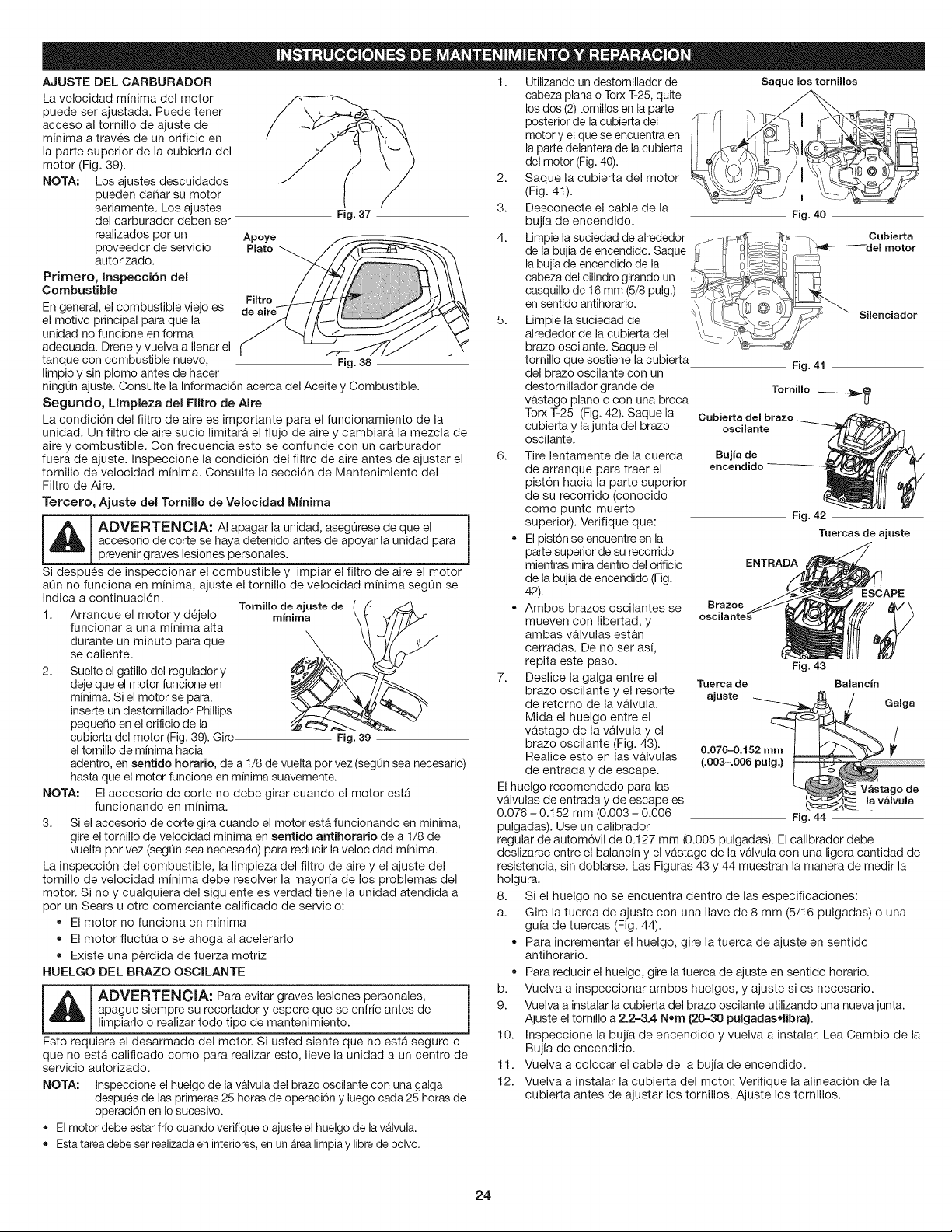
AJUSTE DEL CARBURADOR
La velocidad minima del motor
puede ser ajustada. Puede tener
acceso al tornillo de ajuste de
minima a trav6s de un orificio en
la parte superior de la cubierta del
motor (Fig. 39).
NOTA: Los ajustes descuidados
pueden da_ar su motor
seriamente. Los ajustes
del carburador deben ser
realizados per un
proveedor de servicio
autorizado.
Primero, Inspeccibn del
Combustible
En general, el combustible viejo es
el motivo principal para que la
unidad no funcione en forma
adecuada. Drene y vuelva a Ilenar el
tanque con combustible nuevo,
limpio y sin plomo antes de hacer
Saque mos tornimlos
Fig. 37 Fig. 40
Apoye f
Plato
Fig. 38
ningOn ajuste. Consulte la Informaci6n acerca del Aceite y Combustible.
Segundo, Limpieza del Filtro de Aire
La condici6n del filtro de aire es importante para el funcionamiento de la
unidad. Un filtro de aire sucio limitar& el flujo de aire y cambiar& la mezcla de
aire y combustible. Con frecuencia esto se confunde con un carburador
fuera de ajuste. Inspeccione la condici6n del filtro de aire antes de ajustar el
tornillo de velocidad minima. Consulte la secci6n de Mantenimiento del
Filtro de Aire.
Tercero, Ajuste del TorniUo de Velocidad Minima
I _hb I ADVERTENc'A: AI apagar la unidad' asegQrese de que el 1
accesorio de corte se haya detenido antes de apoyar la unidad para
prevenir graves lesiones personales.
Si despues de inspeccionar el combustible y limpiar el filtro de aire el motor
aOn no funciona en minima, ajuste el tornillo de velocidad minima segOn se
Torn,lode.ajasteae ( L<
minima
Fig. 39
indica a continuaci6n.
1. Arranque el motor y d6jelo
funcionar a una minima alta
durante un minuto para que
se caliente.
2. Suelte el gatillo del regulador y
deje que el motor funcione en
minima. Si el motor se para,
inserte un destomillador Phillips
pequeno en el orificio de la
cubierta del motor (Fig. 39). Gire
el tomillo de minima hacia
adentro, en sentido horatio, de a 1/8 de vuelta por vez (segQn sea necesario)
hasta que el motor funcione en minima suavemente.
NOTA: El accesorio de corte no debe girar cuando el motor est&
funcionando en minima.
3. Si el accesorio de corte gira cuando el motor esta funcionando en minima,
gire el tornillo de velocidad minima en sentido antihorario de a 1/8 de
vuelta per vez (segQn sea necesario) para reducir la velocidad minima.
La inspecci6n del combustible, la limpieza del filtro de aire y el ajuste del
tornillo de velocidad minima debe resolver la mayoria de los problemas del
motor. Si no y cualquiera del siguiente es verdad tiene la unidad atendida a
per un Sears u otro comerciante calificado de servicio:
• El motor no funciona en minima
El motor fluctOa o se ahoga al acelerarlo
Existe una p6rdida de fuerza motriz
HUELGO DEL BRAZO OSOILANTE
1. Utilizando un destornillador de
cabeza plana o Torx T-25,quite
los dos (2) tornillos en la parte
posterior de la cubierta del
motor y el que se encuentra en
la parte delantera de la cubierta
del motor (Fig. 40).
2. Saque la cubierta del motor
(Fig. 41).
3. Desconecte el cable de la
bujia de encendido.
4. Limpie la suciedad de alrededor
de la bujia de encendido. Saque
la bujia de encendido de la
cabeza del cilindro girando un
casquillo de 16 mm (5/8 pulg.)
en sentido antihorario.
5. Limpie la suciedad de
alrededor de la cubierta del
brazo oscilante. Saque el
tornillo que sostiene la cubierta
del brazo oscilante con un
destornillador grande de
vastago piano o con una broca
Torx T-25 (Fig. 42). Saque la
cubierta y la junta del brazo
oscilante.
6. Tire lentamente de la cuerda
de arranque para traer el
pist6n hacia la parte superior
de su recorrido (conocido
como punto muerto
superior). Verifique que:
• El pist6n se encuentre en la
parte superior de su recorrido
mientras mira dentro del orificio
de la bujia de encendido (Fig.
42).
• Ambos brazos oscilantes se
mueven con libertad, y
ambas valvulas est&n
cerradas. De no ser asi,
repita este paso.
7. Deslice la galga entre el
brazo oscilante y el resorte
de retorno de la v&lvula.
Mida el huelgo entre el
v&stago de la v&lvula y el
brazo oscilante (Fig. 43).
Realice esto en las valvulas
de entrada y de escape.
El huelgo recomendado para las
vAlvulas de entrada y de escape es
0.076 - 0.152 mm (0.003 - 0.006
pulgadas). Use un calibrador
Fig. 41
TorniHo _
Cubierta del
oscilante
Bujia de
i i es°nes ° esI
apague siempre su recortador y espere que se enfrie antes de
limpiarlo o realizar todo tipo de mantenimiento.
Esto requiere el desarmado del motor. Si usted siente que no estA seguro o
que no esta calificado como para realizar esto, Ileve la unidad a un centro de
servicio autorizado.
NOTA: Inspeccione el huelgo de la va.lvuladel braze oscilante con una galga
despues de las primeras 25 horas de operaci6n y luego cada 25 horas de
operaci6n en Io sucesivo.
• El motor debe estar frio cuando verifique o ajuste el huelgo de la vAIvula.
• Esta tarea debe ser realizadaen interiores,en un area limpia y librede polvo.
Fig. 42
Tuercas de ajuste
ENTRADA
ESCAPE
Brazos
Fig. 43
Tuerca de Balancin
ajuste --_ Gaiga
0.076-0.152 mm _[.._"_ _
(.003-.006
la v_lvula
Fig. 44
regular de autom6vil de 0.127 mm (0.005 pulgadas). El calibrador debe
deslizarse entre el balancin y el v&stago de la valvula con una ligera cantidad de
resistencia, sin doblarse. Las Figuras 43 y 44 muestran la manera de medir la
holgura.
8. Si el huelgo no se encuentra dentro de las especificaciones:
a. Gire la tuerca de ajuste con una Ilave de 8 mm (5/16 pulgadas) ouna
guia de tuercas (Fig. 44).
• Para incrementar el huelgo, gire la tuerca de ajuste en sentido
antihorario.
• Para reducir el huelgo, gire la tuerca de ajuste en sentido horario.
b. Vuelva a inspeccionar ambos huelgos, y ajuste si es necesario.
9. Vuelva a instalar la cubierta del brazo oscilante utilizando una nueva junta.
Ajuste el tornillo a 2.2-3.4 Nora (20--30 pulgadaselibra).
10. Inspeccione la bujia de encendido y vuelva a instalar. Lea Cambio de la
Bujia de encendido.
11. Vuelva a colocar el cable de la bujia de encendido.
12. Vuelva a instalar la cubierta del motor. Verifique la alineaci6n de la
cubierta antes de ajustar los tornillos. Ajuste los tornillos.
24
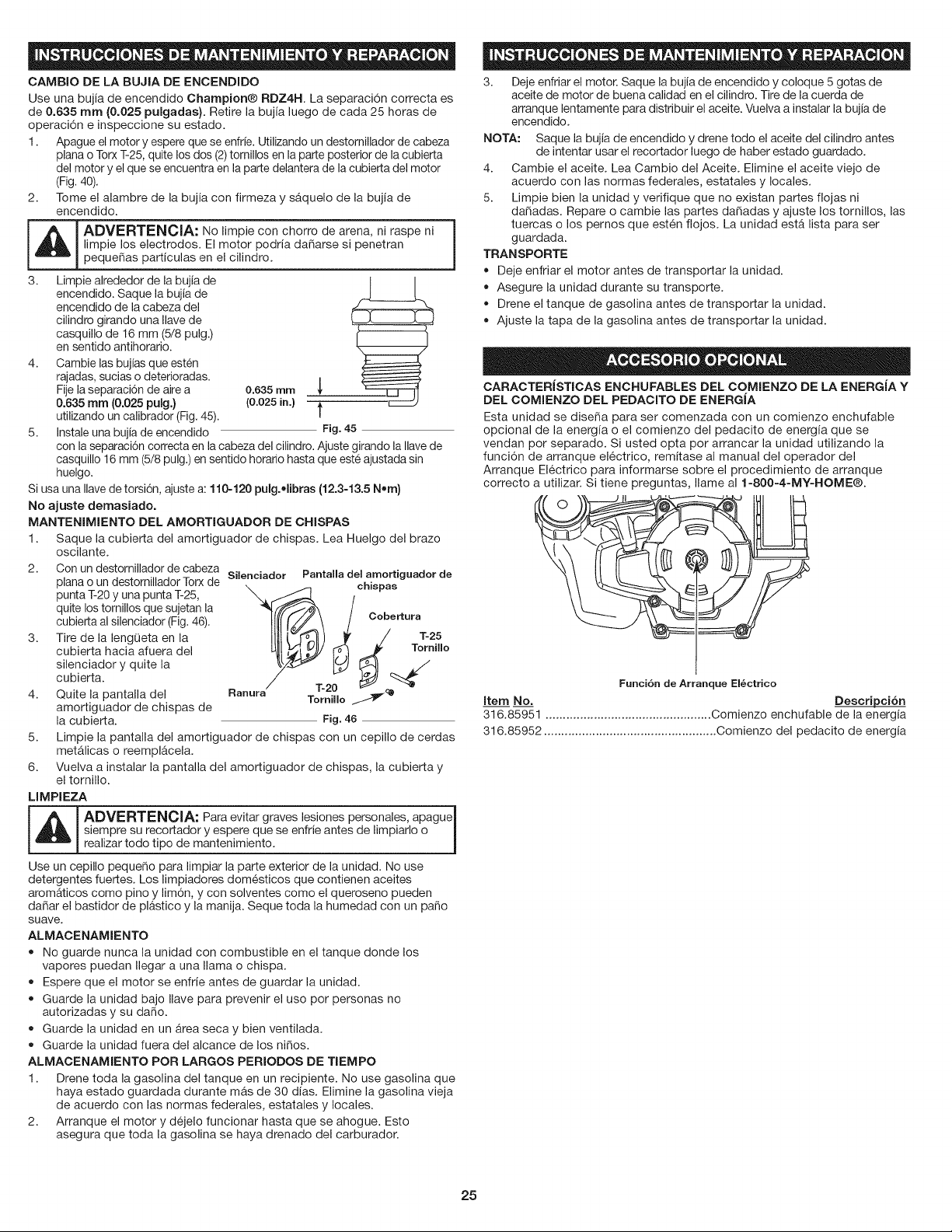
CAMBIO DE LA BUJJA DE ENCENDIDO
Use una bujia de encendido Champion@ RDZ4H La separaci6n correcta es
de 0.635 mm (0.025 pulgadas). Retire la bujia luego de cada 25 horas de
operaci6n e inspeccione su estado.
1. Apague el motor y espere que se enfrie. Utilizando un destomillador de cabeza
plana o Torx T-25, quite los dos (2)tornillos en la parte posterior de la cubierta
del motor y el que se encuentra en la parte delantera de la cubierta del motor
(Fig. 40).
2. Tome el alambre de la bujia con firmeza y s&quelo de la bujia de
encendido.
ADVERTENCIA: No limpie con chorro de arena, ni raspe ni
limpie los electrodos. El motor podria daSarse si penetran
J
pequeSas particulas en el cilindro.
3. Limpie alrededor de la bujia de J I
encendido. Saque la bujia de
encendido de la cabeza del
cilindro girando una Ilave de
casquillo de 16 mm (5/8 pulg.)
en sentido antihorario.
4. Cambie las bujias que esten
rajadas, sucias o deterioradas.
/
Fije la separacion de aire a 0.635 rnm _.
0.635 mm (0.025 pumg.) (0.025 in.)
utilizando un calibrader (Fig. 45). 1'
5. Instale una bujia de encendido Fig. 45
con la separaci6n correcta en la cabeza del cilindro. Ajuste girando la Ilave de
casquillo 16 mm (5/8 pulg.) en sentido horario hasta que este ajustada sin
huelgo.
Si usa una Ilave de torsi6n, ajuste a: 110-120 pulg..libras (12.3-13.5 N.m)
No ajuste demasiado.
MANTENIMIENTO DEL AMORTIGUADOR DE CHISPAS
1. Saque la cubierta del amortiguador de chispas. Lea Huelgo del brazo
oscilante.
2.
8.
4.
Con un destornillador de cabeza
plana o un destomillador Torx de
punta T-20 y una punta T-25,
quite los tornillos que sujetan la
cubierta al silenciador (Fig. 46).
Tire de la lengQeta en la
cubierta hacia afuera del
silenciador y quite la
cubierta.
Quite la pantalla del
amortiguador de chispas de
la cubierta.
Silenciador Pantalla del amortiguador de
Cobertura
/ '%o
Fig. 46
5. Limpie la pantalla del amortiguador de chispas con un cepillo de cerdas
metAlicas o reemplAcela.
6. Vuelva a instalar la pantalla del amortiguador de chispas, la cubierta y
el tornillo.
LIMPIEZA
I _ I ADVERTENCIA: Para evitar graves lesiones personales, apague I
siempre su recortador y espere que se enfrie antes de limpiarlo o |
realizar todo tipo de mantenimiento.
J
Use un cepillo pequeSo para limpiar la parte exterior de la unidad. No use
detergentes fuertes. Los limpiadores dom6sticos que contienen aceites
arom&ticos como pino y lim6n, y con solventes como el queroseno pueden
daSar el bastidor de pl&stico y la manija. Seque toda la humedad con un paso
suave.
ALMACENAMIENTO
• No guarde nunca la unidad con combustible en el tanque donde los
vapores puedan Ilegar a una llama o chispa.
• Espere que el motor se enfrie antes de guardar la unidad.
Guarde la unidad bajo Ilave para prevenir el uso por personas no
autorizadas y su da5o.
Guarde la unidad en un &rea seca y bien ventilada.
Guarde la unidad fuera del alcance de los niSos.
ALMACENAMIENTO POR LARGOS PERIODOS DE TIEMPO
1. Drene toda la gasolina del tanque en un recipiente. No use gasolina que
haya estado guardada durante m&s de 30 dias. Elimine la gasolina vieja
de acuerdo con las normas federales, estatales y locales.
2. Arranque el motor y d6jelo funcionar hasta que se ahogue. Esto
asegura que toda la gasolina se haya drenado del carburador.
3. Deje enfriar el motor. Saque la bujia de encendido y coloque 5 gotas de
aceite de motor de buena calidad en el cilindro. Tire de la cuerda de
arranque lentamente para distribuir el aceite. Vuelva a instalar la bujia de
encendido.
NOTA: Saque la bujia de encendido y drene todo el aceite del cilindro antes
de intentar usar el recortador luego de haber estado guardado.
4. Cambie el aceite. Lea Cambio del Aceite. Elimine el aceite viejo de
acuerdo con las normas federales, estatales y locales.
5. Limpie bien la unidad y verifique que no existan partes flojas ni
daSadas. Repare o cambie las partes daSadas y ajuste los tornillos, las
tuercas o los pernos que est6n flojos. La unidad est& lista para ser
guardada.
TRANSPORTE
Deje enfriar el motor antes de transportar la unidad.
Asegure la unidad durante su transporte.
• Drene el tanque de gasolina antes de transportar la unidad.
Ajuste la tapa de la gasolina antes de transportar la unidad.
CARACTERJSTICAS ENCHUFABLES DEL COMIENZO DE LA ENERGJA Y
DEL COMIENZO DEL PEDACITO DE ENERGJA
Esta unidad se dise_a para ser comenzada con un comienzo enchufable
opcional de la energia o el comienzo del pedacito de energia que se
vendan por separado. Si usted opta por arrancar la unidad utilizando la
funci6n de arranque el6ctrico, remitase al manual del operador del
Arranque EI6ctrico para informarse sobre el procedimiento de arranque
correcto a utilizar. Si tiene preguntas, flame al 1-800-4-MY-HOME®.
Funci6n de Arranque El_ctrico
item No. Descripci6n
316.85951 ................................................ Comienzo enchufable de la energia
316.85952 .................................................. Comienzo del pedacito de energia
25
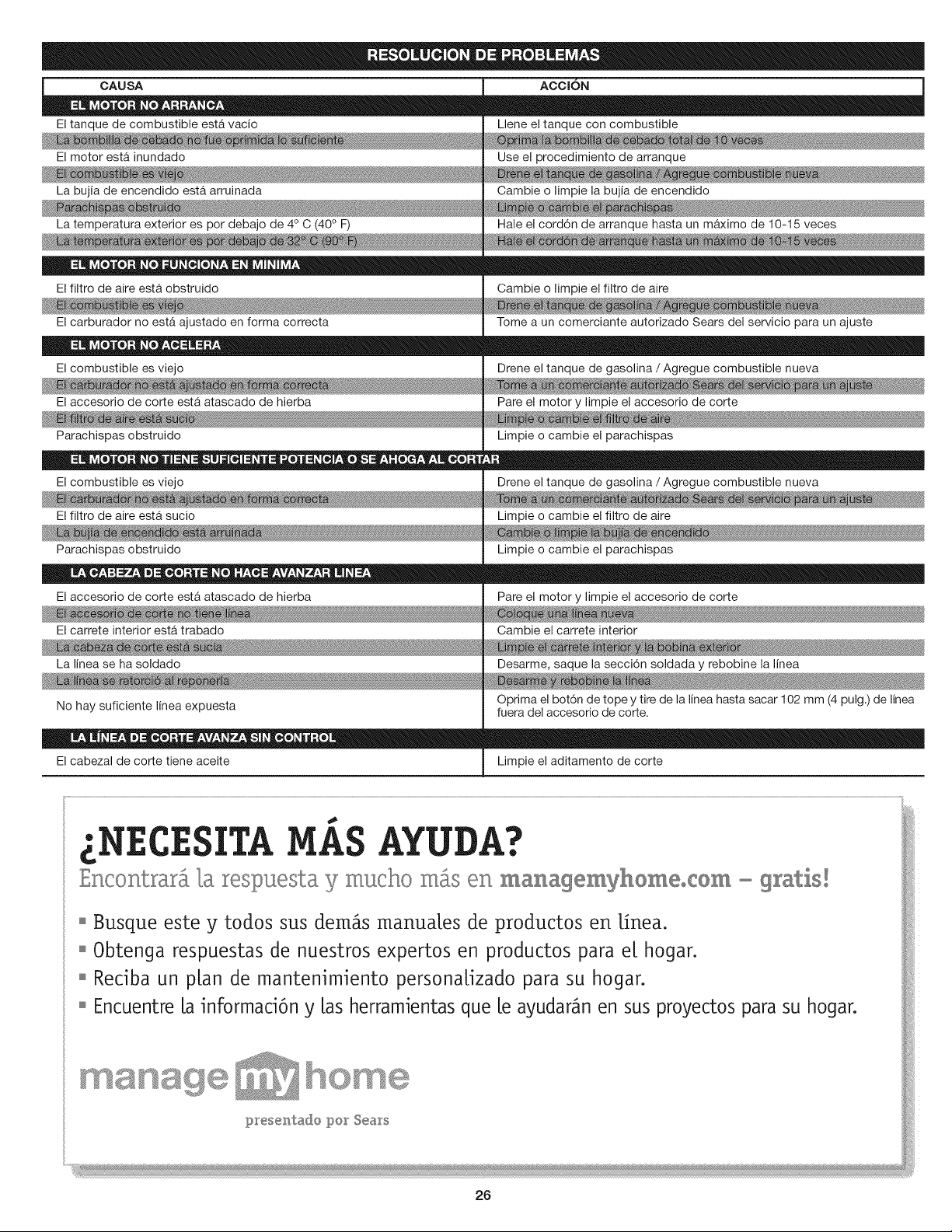
CAUSA
El tanque de combustible esta vacio
El motor esta inundado
La bujia de encendido est& arruinada
La temperatura exterior es por debajo de 4 ° C (40 ° F)
El filtro de aire est& obstruido
El carburador no est& ajustado en forma correcta
El combustible es viejo
El accesorio de corte est& atascado de hierba
Parachispas obstruido
El combustible es viejo
El filtro de aire esta sucio
Parachispas obstruido
El accesorio de corte esta atascado de hierba
El carrete interior esta trabado
La linea se ha soldado
No hay suficiente linea expuesta
El cabezal de corte tiene aceite
ACClON
Llene el tanque con combustible
Use el procedimiento de arranque
Cambie o limpie la bujia de encendido
Hale el cord6n de arranque hasta un m&ximo de 10-15 veces
Cambie o limpie el filtro de aire
Tome a un comerciante autorizado Sears del servicio para un ajuste
Drene el tanque de gasolina /Agregue combustible nueva
@ ...................... ,,_ ,_,
Pare el motor y limpie el accesorio de corte
Limpie o cambie el parachispas
Drene el tanque de gasolina /Agregue combustible nueva
Limpie o cambie el filtro de aire
Limpie o cambie el parachispas
Pare el motor y limpie el accesorio de corte
Cambie el carrete interior
Desarme, saque la secci6n soldada y rebobine la linea
Optima el bot6n de tope y tire de la linea hasta sacar 102 mm (4 pulg.) de linea
fuera del accesorio de corte.
Limpie el aditamento de corte
,, iiiiiii!i i
n AYUDA?
Encontrari [a respuesta y mucho m_s en managemyhomeotOm - gratis!
, ,.........
° Busque este y todos sus demos manua(es de productos en (fnea. [
° 0btenga respuestas de nuestros expertos en productos para e[ hogar.
o Redba un p[an de mantenimiento persona[izado par° su hogar.
o Encuentre [a informad6n y [as herramientas que [e ayudar_n en sus proyectos para su hogar.
presetratio per °ears
26
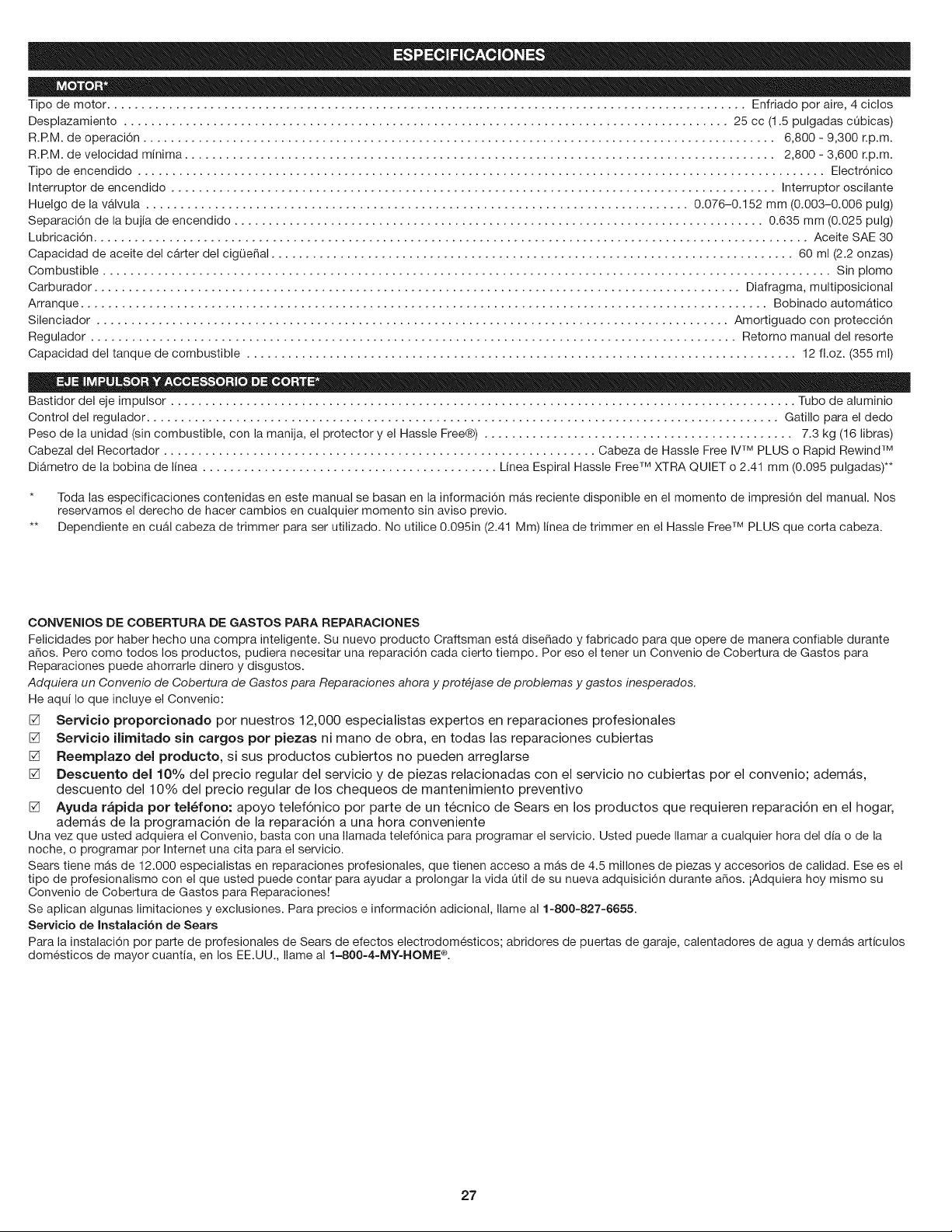
Tipo de motor ............................................................................................. Enfriado por aire, 4 ciclos
Desplazamiento ........................................................................................ 25 cc (1.5 pulgadas cQbicas)
R.RM. de operaci6n ............................................................................................ 6,800 - 9,300 r.p.m.
R.RM. de velocidad minima ...................................................................................... 2,800 - 3,600 r.p.m.
Tipo de encendido .................................................................................................... Electr6nico
Interruptor de encendido ........................................................................................ Interruptor oscilante
Huelgo de la valvula ............................................................................... 0.076-0.152 mm (0.003-0.006 pulg)
Separaci6n de la bujia de encendido ............................................................................. 0.635 mm (0.025 pulg)
Lubricaci6n ........................................................................................................ Aceite SAE 30
Capacidad de aceite del carter del cigQefial ............................................................................ 60 ml (2.2 onzas)
Combustible .......................................................................................................... Sin plomo
Carburador .............................................................................................. Diafragma, multiposicional
Arranque .................................................................................................... Bobinado automatico
Silenciador ............................................................................................ Amortiguado con protecci6n
Regulador .............................................................................................. Retorno manual del resorte
Capacidad del tanque de combustible ................................................................................ 12 fl.oz. (355 ml)
Bastidor del eje impulsor ........................................................................................... Tubo de aluminio
Control del regulador ............................................................................................ Gatillo para el dedo
Peso de la unidad (sin combustible, con la manija, el protector y el Hassle Free@) ............................................. 7.3 kg (16 libras)
Cabezal del Recortador ............................................................... Cabeza de Hassle Free IVTM PLUS o Rapid Rewind TM
DiAmetro de la bobina de linea ........................................... Linea Espiral Hassle Free TM XTRA QUIET o 2.41 mm (0.095 pulgadas)**
* Toda las especificaciones contenidas en este manual se basan en la informaci6n mAs reciente disponible en el momento de impresi6n del manual. Nos
reservamos el derecho de hacer cambios en cualquier momento sin aviso previo.
** Dependiente en cuAI cabeza de trimmer para ser utilizado. No utilice 0.095in (2.41 Mm) linea de trimmer en el Hassle FreeTM PLUS que corta cabeza.
CONVENIOS DE COBERTURA DE GASTOS PARA REPARACIONES
Felicidades por haber hecho una compra inteligente. Su nuevo producto Craftsman esta disefiado y fabricado para que opere de manera confiable durante
a_os. Pero como todos los productos, pudiera necesitar una reparaci6n cada cierto tiempo. Pot eso el tener un Convenio de Cobertura de Gastos para
Reparaciones puede ahorrarle dinero y disgustos.
Adquiera un Convenio de Cobertura de Gastos para Reparaciones ahora y prot_jase de problemas y gastos inesperados.
He aqui Io que incluye el Convenio:
[] Servicio proporcionado por nuestros 12,000 especialistas expertos en reparaciones profesionales
[] Servicio ilimitado sin cargos por piezas ni mane de obra, en todas las reparaciones cubiertas
[] Reemplazo del producto, si sus productos cubiertos no pueden arreglarse
[] Descuento del 10% del precio regular del servicio y de piezas relacionadas con el servicio no cubiertas per el convenio; ademas,
descuento del 10% del precio regular de los chequeos de mantenimiento preventivo
[] Ayuda r_pida por tel6fono: apoyo telef6nico por parte de un tecnico de Sears en los productos que requieren reparaci6n en el hogar,
ademas de la programaci6n de la reparaci6n a una hora conveniente
Una vez que usted adquiera el Convenio, basta con una Ilamada telef6nica para programar el servicio. Usted puede Ilamar a cualquier hora del dia o de la
noche, o programar por Internet una cita para el servicio.
Sears tiene mas de 12.000 especialistas en reparaciones profesionales, que tienen acceso a m&s de 4.5 millones de piezas y accesorios de calidad. Ese es el
tipo de profesionalismo con el que usted puede contar para ayudar a prolongar la vida Qtil de su nueva adquisici6n durante afios, iAdquiera hoy mismo su
Convenio de Cobertura de Gastos para Reparaciones!
Se aplican algunas limitaciones y exclusiones. Para precios e informaci6n adicional, Ilame al 1=800=827=6655.
Servicio de Instalaci6n de Sears
Para la instalaci6n pot parte de profesionales de Sears de efectos electrodom6sticos; abridores de puertas de garaje, calentadores de agua y demas articulos
dom6sticos de mayor cuantia, en los EE.UU., Ilame al 1-800-4-MY-HOME ®.
27

28

29
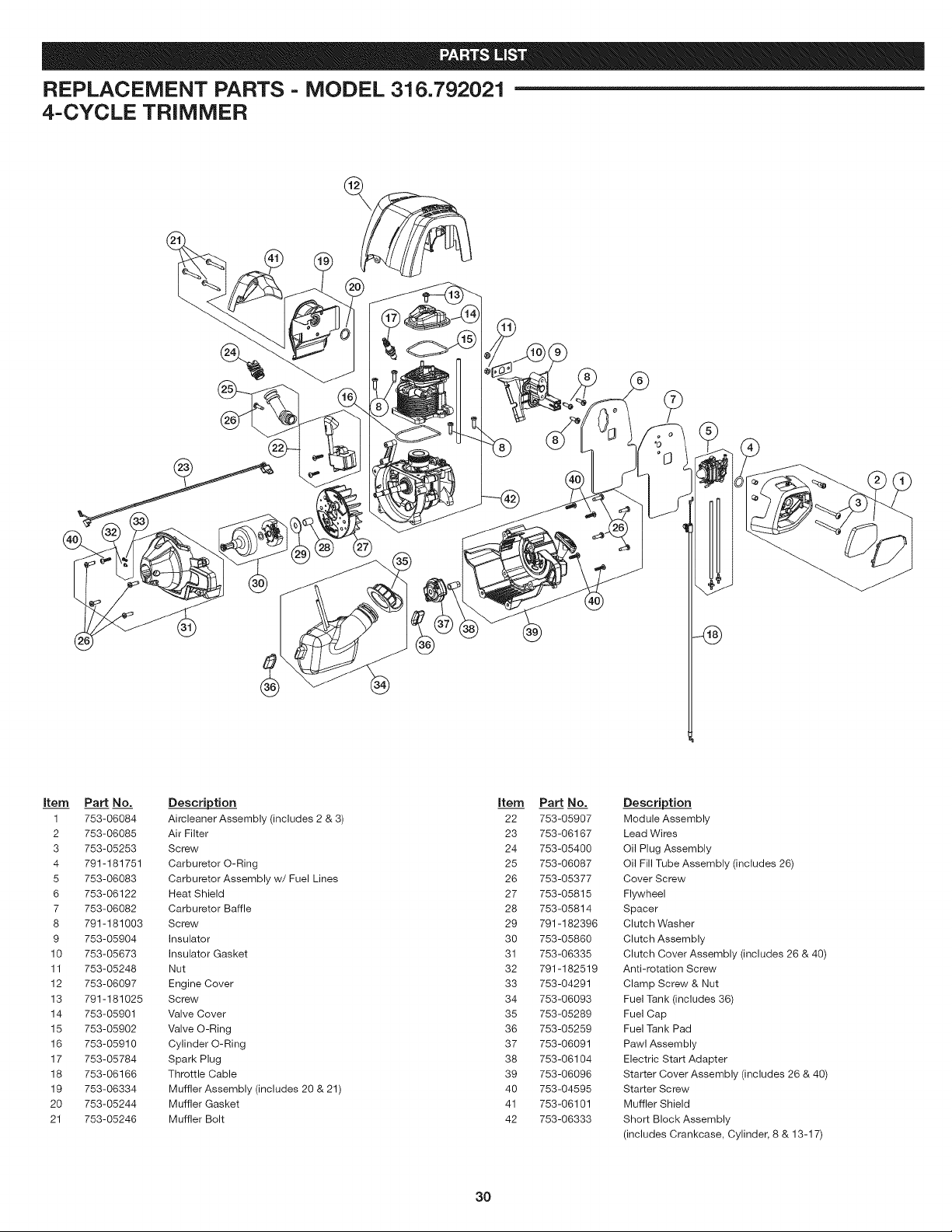
REPLACEMENT PARTS - MODEL 316.792021
4-CYCLE TRIMMER
item Part No. Description
1 753-06084 Aircleaner Assembly (includes 2 & 3)
2 753-06085 Air Filter
3 753-05253 Screw
4 791-181751 Carburetor O-Ring
5 753-06083 Carburetor Assembly w/Fuel Lines
6 753-06122 Heat Shield
7 753-06082 Carburetor Baffle
8 791-181003 Screw
9 753-05904 insulator
10 753-05873 Insulator Gasket
11 753-05248 Nut
12 753-06097 Engine Cover
13 791-181025 Screw
14 753-05901 Valve Cover
15 753-05902 Valve O-Ring
16 753-05910 Cylinder O-Ring
17 753-05784 Spark Plug
18 753-06186 Throttle Cable
19 753-06334 Muffler Assembly (includes 20 & 21)
20 753-05244 Muffler Gasket
21 753-05248 Muffler Bolt
item Part No.
22 753-05907
23 753-06167
24 753-05400
25 753-06087
26 753-05377
27 753-05815
28 753-05814
29 791-182396
30 753-05860
31 753-06335
32 791-182519
33 753-04291
34 753-06093
35 753-05289
36 753-05259
37 753-06091
38 753-06104
39 753-06096
40 753-04595
41 753-06101
42 753-06333
Description
Module Assembly
Lead Wires
Oil Plug Assembly
Oil Fill Tube Assembly (includes 26)
Cover Screw
Flywheel
Spacer
Clutch Washer
Clutch Assembly
Clutch Cover Assembly (includes 26 & 40)
Anti-rotation Screw
Clamp Screw & Nut
Fuel Tank (includes 36)
Fuel Cap
Fuel Tank Pad
Pawl Assembly
Electric Start Adapter
Starter Cover Assembly (includes 26 & 40)
Starter Screw
Muffler Shield
Short Block Assembly
(includes Crankcase, Cylinder, 8 & 13-17)
30
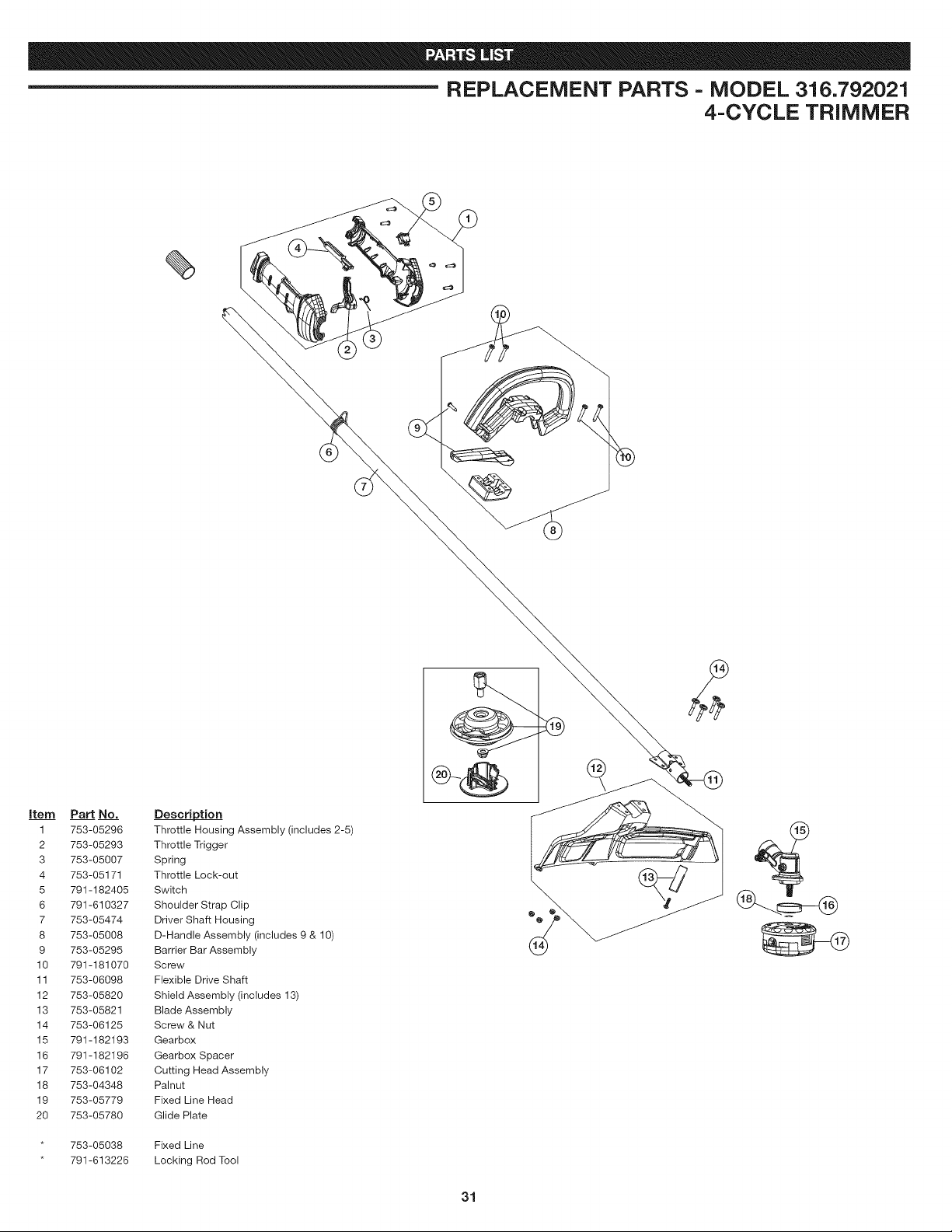
REPLACEMENT PARTS - MODEL 316.792021
4-CYCLE TRIMMER
%
item Part No. Description
1 753-05296 Throttle Housing Assembly (includes 2-5)
2 753-05293 Throttle Trigger
3 753-05007 Spring
4 753-05171 Throttle Lock-out
5 791-182405 Switch
6 791-610327 Shoulder Strap Clip
7 753-05474 Driver Shaft Housing
8 753-05008 D-Handle Assembly (includes 9 & 10)
9 753-05295 Barrier Bar Assembly
10 791-181070 Screw
11 753-06098 Flexible Drive Shaft
12 753-05820 Shield Assembly (includes 13)
13 753-05821 Blade Assembly
14 753-06125 Screw & Nut
15 791-182193 Gearbox
16 791-182196 Gearbox Spacer
17 753-06102 Cutting Head Assembly
18 753-04348 Palnut
19 753-05779 Fixed Line Head
20 753-05780 Glide Plate
753-05038 Fixed Line
791-613226 Locking Rod Tool
31

Your Home
For expert troubleshooting and home solutions advice:
www.managemyhome.corn
For repair - in your home - of all major brand appliances,
lawn and garden equipment, or heating and cooling systems,
no matter who made it, no matter who sold it!
For the replacement parts, accesspries and
owner's manuals that you need to do-it-yourself.
For Sears professional installation of home appliances
and items like garage door openers and water heaters.
1-800-4-MY-HOME ® (1-8oo-4o9-4oo3)
Call anytime, day or night (U.S.A. and Canada)
www.sears.com www.sears.ca
Our Home
For repair of carry-in items like vacuums, lawn equipment,
and electronics, call anytime for the location of your nearest
Sears Parts & Repair Service Center
1-800-488-1222 (U.S.A.) 1-800-469-4663 (Canada)
www.sears.corn www.sears.ca
To purchase a protection agreement on a product serviced by Sears:
1-800-827-6655 (U.S.A.) 1-800-361-6865 (Canada)
Para pedir servicio de reparaci6n Au Canada pour service en fran(_ais:
a domicilio, y para ordenar piezas: 1-800-LE-FOYER Mc
1-800-SU-HOGAR ® (1-800-533-6937)
(1-888-784-6427) www.sears.ca
SM
® Registered Trademark / TMTrademark / Service Mark of Sears Brands, LLC
® Marca Registrada / TMMarca de F&brica / SMMarca de Servicio de Sears Brands, LLC
MCMarque de commerce / MDMarque d6pos6e de Sears Brands, LLC © Sears Brands, LLC

