

2
Table of Contents
Basics
4 Read me first
5 Package contents
6 Device layout
8 SIM or USIM card
10 Battery
15 Turning the device on and off
16 Touchscreen
19 Home screen
26 Lock screen
27 Notification panel
30 Entering text
33 Screen capture
33 Opening apps
34 Multi window
39 Device and data management
43 Connecting to a TV
45 Sharing files with contacts
46 Emergency mode
Applications
47 Installing or uninstalling apps
48 Phone
51 Contacts
53 Messages
55 Internet
56 Email
57 Camera
73 Gallery
75 Smart Manager
77 S Planner
78 S Health
81 S Voice
83 Music
84 Video
85 Voice Recorder
87 My Files
88 Memo
88 Clock
90 Calculator
91 Google apps
Settings
93 Introduction
93 Wi-Fi
95 Bluetooth
97 Flight mode
97 Mobile hotspot and tethering
98 Data usage
99 Mobile networks
99 NFC and payment
102 More connection settings
104 Sounds and notifications
105 Display
105 Motions and gestures

Table of Contents
3
106 Applications
106 Wallpaper
106 Themes
107 Lock screen and security
111 Privacy and safety
114 Easy mode
115 Accessibility
115 Accounts
116 Backup and reset
117 Language and input
117 Battery
118 Storage
118 Date and time
119 User manual
119 About device
Appendix
120 Accessibility
135 Troubleshooting

4
Basics
Read me first
Please read this manual before using the device to ensure safe and proper use.
•
Descriptions are based on the device’s default settings.
•
Some content may differ from your device depending on the region, service provider,
model specifications, or device’s software.
•
Content (high quality content) that requires high CPU and RAM usage will affect the
overall performance of the device. Apps related to the content may not work properly
depending on the device’s specifications and the environment that it is used in.
•
Samsung is not liable for performance issues caused by apps supplied by providers other
than Samsung.
•
Samsung is not liable for performance issues or incompatibilities caused by edited
registry settings or modified operating system software. Attempting to customise the
operating system may cause the device or apps to work improperly.
•
Software, sound sources, wallpapers, images, and other media provided with this device
are licensed for limited use. Extracting and using these materials for commercial or other
purposes is an infringement of copyright laws. Users are entirely responsible for illegal
use of media.
•
You may incur additional charges for data services, such as messaging, uploading and
downloading, auto-syncing, or using location services depending on your data plan. For
large data transfers, it is recommended to use the Wi-Fi feature.
•
Default apps that come with the device are subject to updates and may no longer be
supported without prior notice. If you have questions about an app provided with
the device, contact a Samsung Service Centre. For user-installed apps, contact service
providers.
•
Modifying the device’s operating system or installing softwares from unofficial sources
may result in device malfunctions and data corruption or loss. These actions are violations
of your Samsung licence agreement and will void your warranty.
Basics
5
•
Depending on the region or model, some devices are required to receive approval from
the Federal Communications Commission (FCC). If your device is approved by the FCC,
you can view the FCC ID of the device. To view the FCC ID, tap
Apps
→
Settings
→
About device
.
Instructional icons
Warning: situations that could cause injury to yourself or others
Caution: situations that could cause damage to your device or other equipment
Notice: notes, usage tips, or additional information
Package contents
Check the product box for the following items:
•
Device
•
Quick start guide
•
The items supplied with the device and any available accessories may vary
depending on the region or service provider.
•
The supplied items are designed only for this device and may not be compatible
with other devices.
•
Appearances and specifications are subject to change without prior notice.
•
You can purchase additional accessories from your local Samsung retailer. Make
sure they are compatible with the device before purchase.
•
Use only Samsung-approved accessories. Using unapproved accessories may cause
the performance problems and malfunctions that are not covered by the warranty.
•
Availability of all accessories is subject to change depending entirely on
manufacturing companies. For more information about available accessories, refer
to the Samsung website.
Basics
6
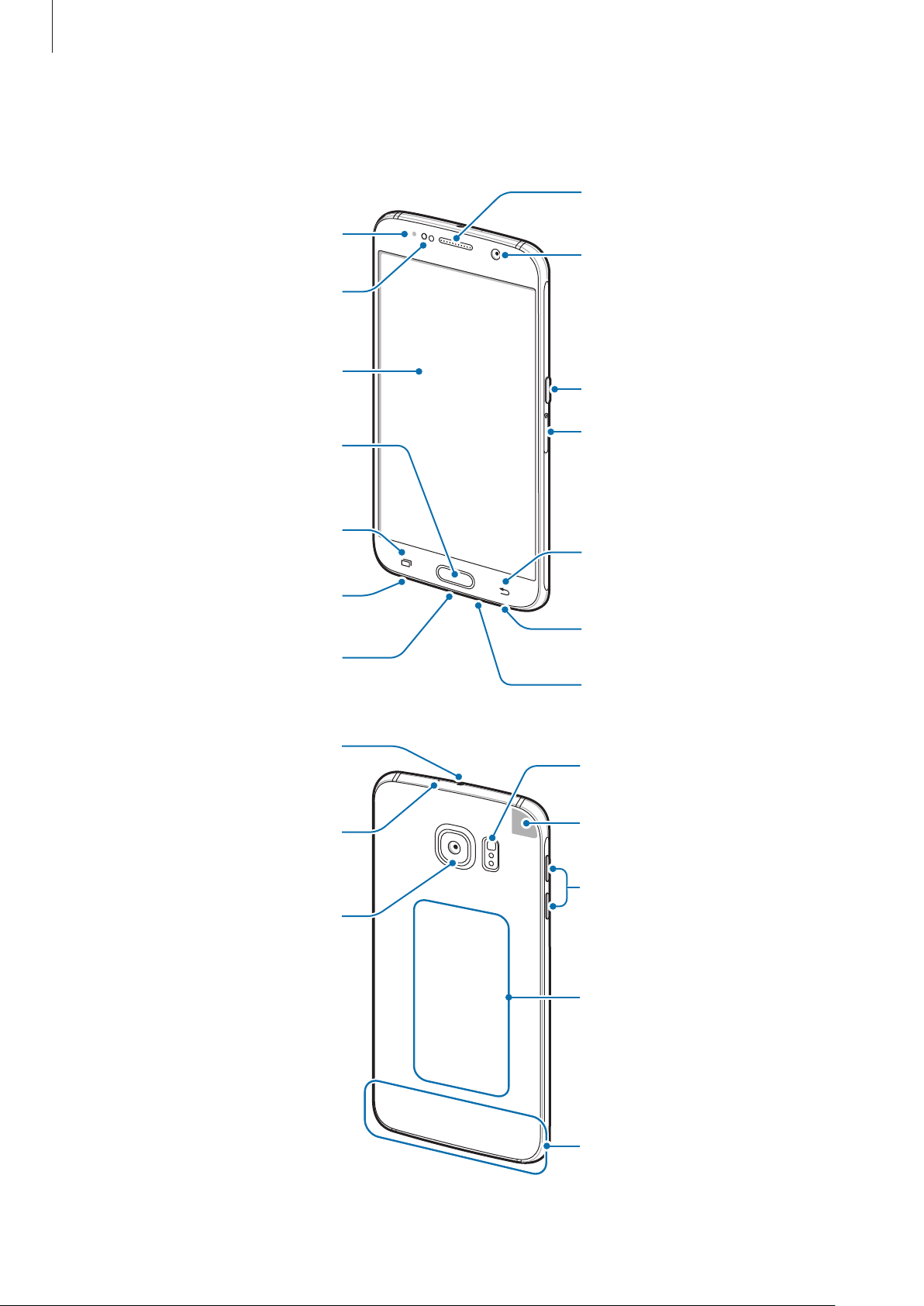
Device layout
Microphone
Loud speaker
Back key
Multipurpose jack
Front camera
Speaker
SIM card tray
Power key
Touchscreen
Recents key
Headset jack
Home key (Fingerprint
recognition sensor)
LED indicator
Proximity/Light sensor
Main antenna
Infrared port
Flash
Volume key
NFC antenna/Wireless
charging coil
Rear camera
Microphone
GPS antenna
Basics
7
•
Do not cover the antenna area with your hands or other objects. This may cause
connectivity problems or drain the battery.
•
Using a Samsung-approved screen protector is recommended. Unapproved screen
protectors may cause the sensors to malfunction.
•
Do not allow water to contact the touchscreen. The touchscreen may malfunction
in humid conditions or when exposed to water.
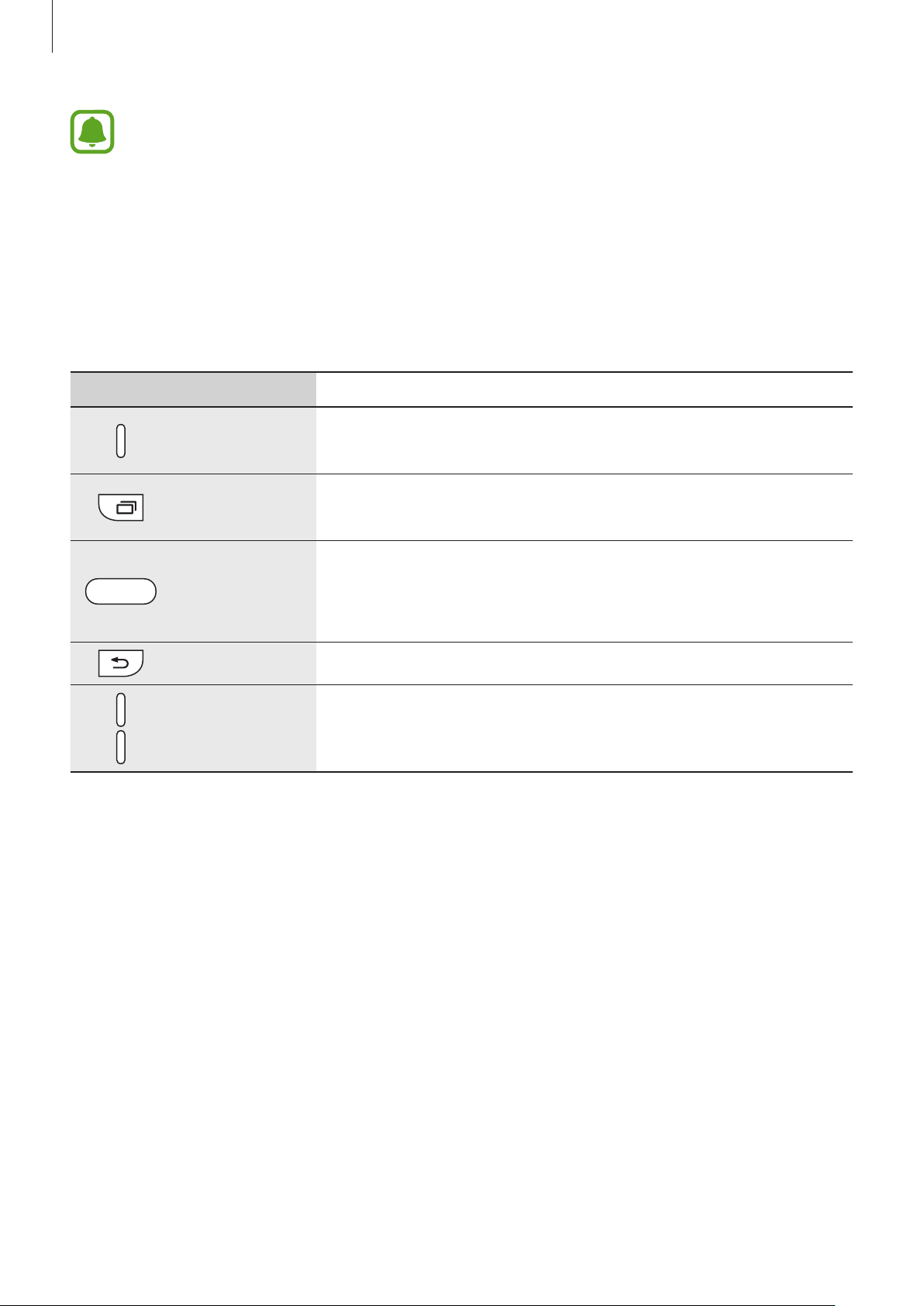
Keys
Key Function
Power
•
Press and hold to turn the device on or off.
•
Press to turn on or lock the screen.
Recents
•
Tap to open the list of recent apps.
•
Tap and hold to launch the split screen view.
Home
•
Press to turn on the screen while the screen is locked.
•
Press to return to the Home screen.
•
Press and hold to launch
Google
.
Back
•
Tap to return to the previous screen.
Volume
•
Press to adjust the device volume.
Basics
8
SIM or USIM card
Installing the SIM or USIM card
Insert the SIM or USIM card provided by the mobile telephone service provider.
•
Only nano-SIM cards work with the device.
•
Some LTE services may not be available depending on the service provider. For
more information about service availability, contact your service provider.
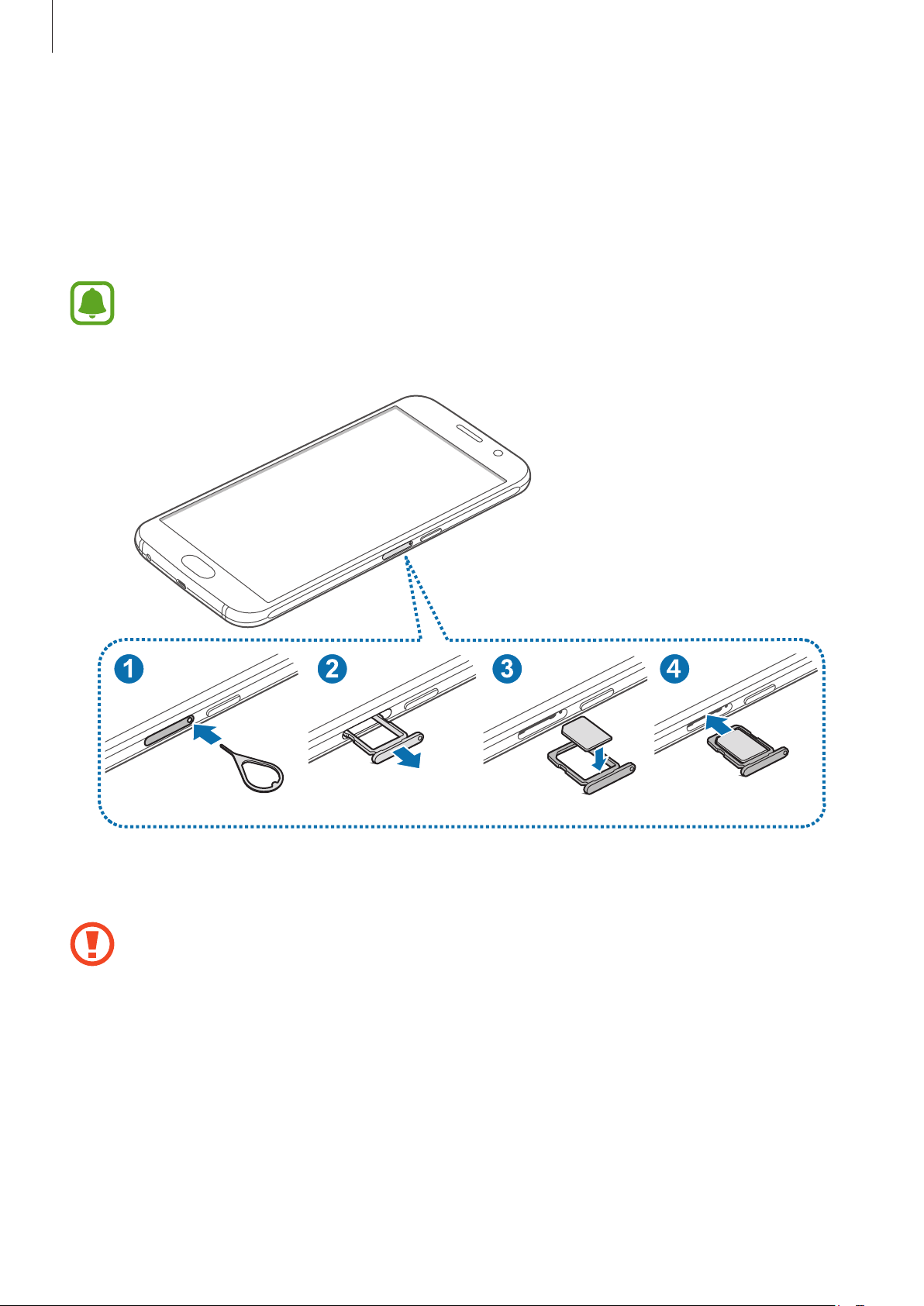
1
Insert the ejection pin into the hole on the SIM card tray to loosen the tray.
Ensure that the ejection pin is perpendicular to the hole. Otherwise, the device may
be damaged.
Basics
9
2
Pull out the SIM card tray gently from the SIM card tray slot.
3
Place the SIM or USIM card on the SIM card tray with the gold-coloured contacts facing
downwards.
Use caution not to lose or let others use the SIM or USIM card. Samsung is not
responsible for any damages or inconveniences caused by lost or stolen cards.
4
Insert the SIM card tray back into the SIM card tray slot.
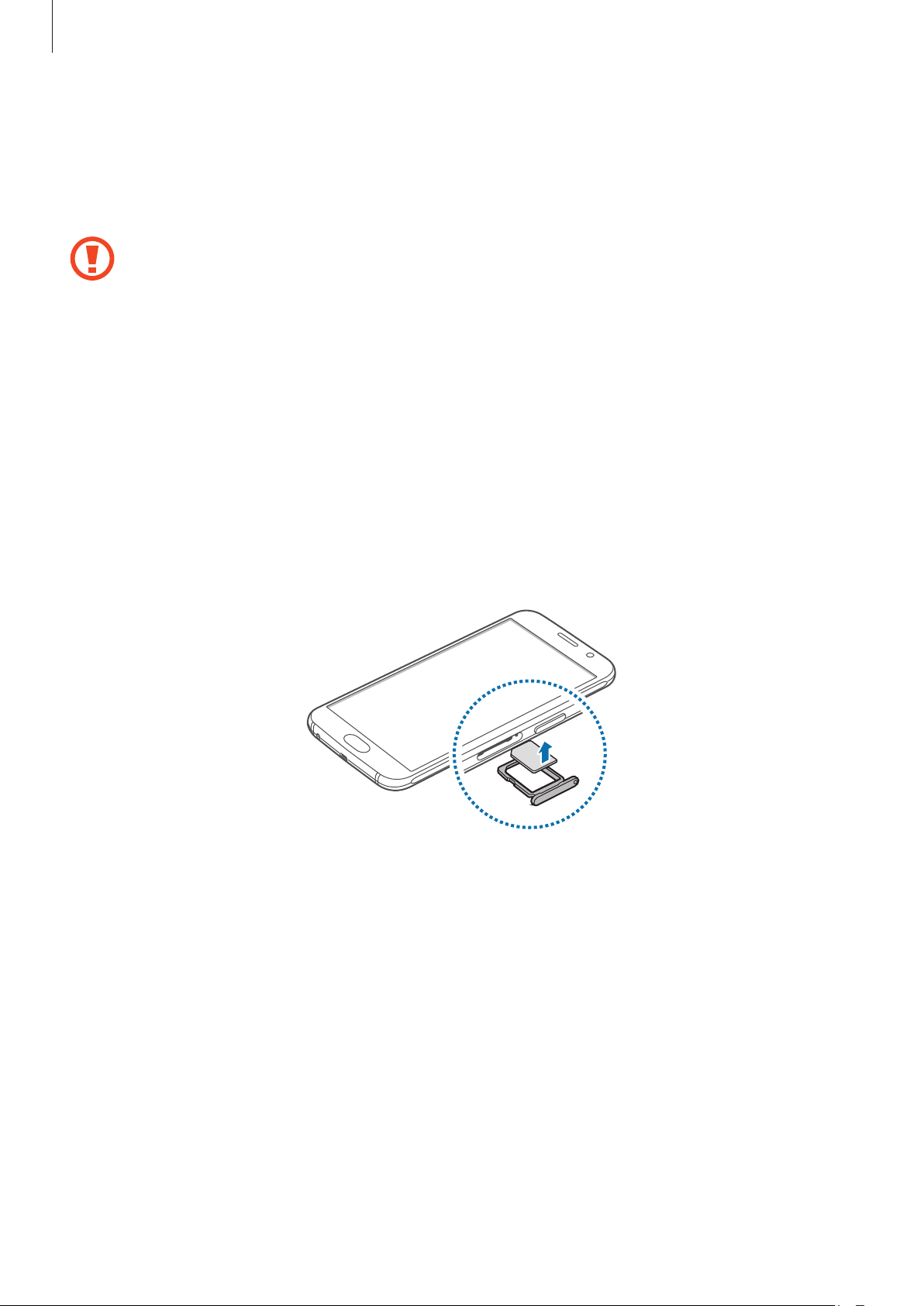
Removing the SIM or USIM card
1
Insert the ejection pin into the hole on the SIM card tray to loosen the tray.
2
Pull out the SIM card tray gently from the SIM card tray slot.
3
Remove the SIM or USIM card.
4
Insert the SIM card tray back into the SIM card tray slot.
Basics
10
Battery
Charging the battery
Charge the battery before using it for the first time or when it has been unused for extended
periods.
Use only Samsung-approved chargers, batteries, and cables. Unapproved chargers or
cables can cause the battery to explode or damage the device.
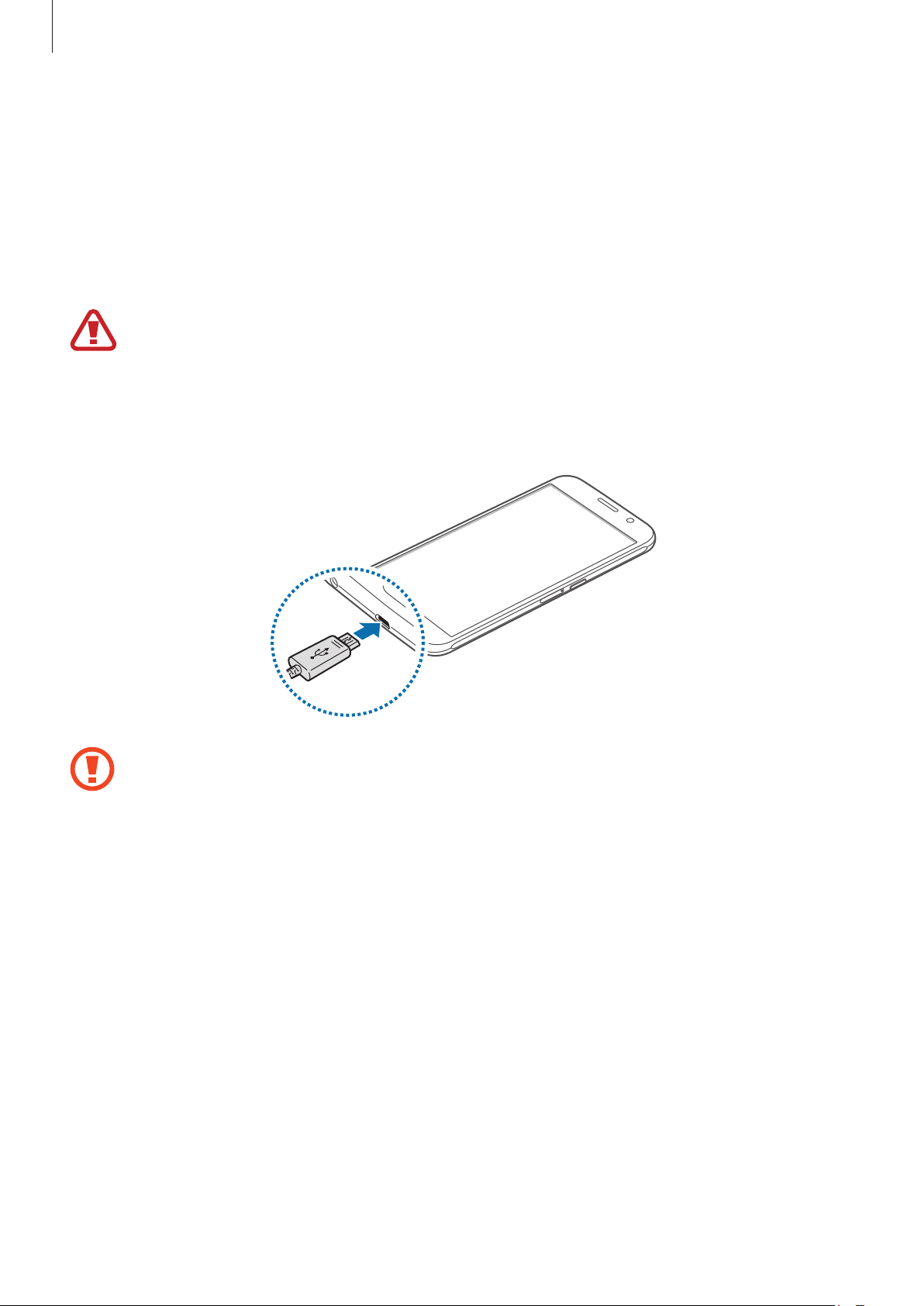
1
Connect the USB cable to the USB power adaptor, and then plug the end of the USB cable
into the multipurpose jack.
Connecting the charger improperly may cause serious damage to the device. Any
damage caused by misuse is not covered by the warranty.
2
Plug the USB power adaptor into an electric socket.

Basics
11
3
After fully charging, disconnect the device from the charger. First unplug the charger
from the device, and then unplug it from the electric socket.
To save energy, unplug the charger when not in use. The charger does not have a
power switch, so you must unplug the charger from the electric socket when not in
use to avoid wasting power. The charger should remain close to the electric socket
and easily accessible while charging.
Viewing the remaining charging time
While charging, open the Home screen and tap
Apps
→
Settings
→
Battery
.
The actual charging time may vary depending on the status of your device and the
charging conditions. The remaining charging time may not be displayed when you
charge the device in very cold or very hot conditions.
Reducing the battery consumption
Your device provides various options that help you conserve battery power.
•
Optimise the device using the Smart manager.
•
When you are not using the device, switch to sleep mode by pressing the Power key.
•
Activate power saving mode.
•
Close unnecessary apps.
•
Deactivate the Bluetooth feature when not in use.
•
Deactivate the Wi-Fi feature when not in use.
•
Deactivate auto-syncing of apps.
•
Decrease the backlight time.
•
Decrease the screen brightness.

Basics
12
Battery charging tips and precautions
•
When the battery power is low, the battery icon appears empty.
•
If the battery is completely discharged, the device cannot be turned on immediately
when the charger is connected. Allow a depleted battery to charge for a few minutes
before turning on the device.
•
If you use multiple apps at once, network apps, or apps that need a connection to
another device, the battery will drain quickly. To avoid disconnecting from the network
or losing power during a data transfer, always use these apps after fully charging the
battery.
•
Using a power source other than the USB power adaptor, such as a computer, may result
in a slower charging speed due to a lower electric current.
•
The device can be used while it is charging, but it may take longer to fully charge the
battery.
•
If the device receives an unstable power supply while charging, the touchscreen may not
function. If this happens, unplug the charger from the device.
•
While charging, the device and the charger may heat up. This is normal and should not
affect the device’s lifespan or performance. If the battery gets hotter than usual, the
charger may stop charging.
•
If the device is not charging properly, take the device and the charger to a Samsung
Service Centre.
Basics
13
Fast charging
The device has a built-in fast charging feature. You can use this feature to charge the battery
more quickly while the device or its screen is turned off.
About Fast charging
•
Fast charging uses battery charging technology that charges the battery faster by
increasing the charging power. The device supports Samsung’s Adaptive fast charging
feature and Qualcomm Quick Charge 2.0.
•
To use Fast charging on your device, connect it to a battery charger that supports
Adaptive fast charging or Quick Charge 2.0.
Increasing the charging speed
To increase the charging speed, turn the device or its screen off when you charge the battery.
•
While charging the battery when the device is turned off, the icon appears on the
screen.
•
You cannot use the fast charging feature when the screen is turned on. Turn off the
screen to increase the charging speed.
•
You cannot use the built-in fast charging feature when you charge the battery
using a standard battery charger.
•
If the device heats up or the ambient air temperature rises, the charging speed may
decrease automatically. This is a normal operating condition to prevent damage to
the device.
Basics
14
Wireless charging
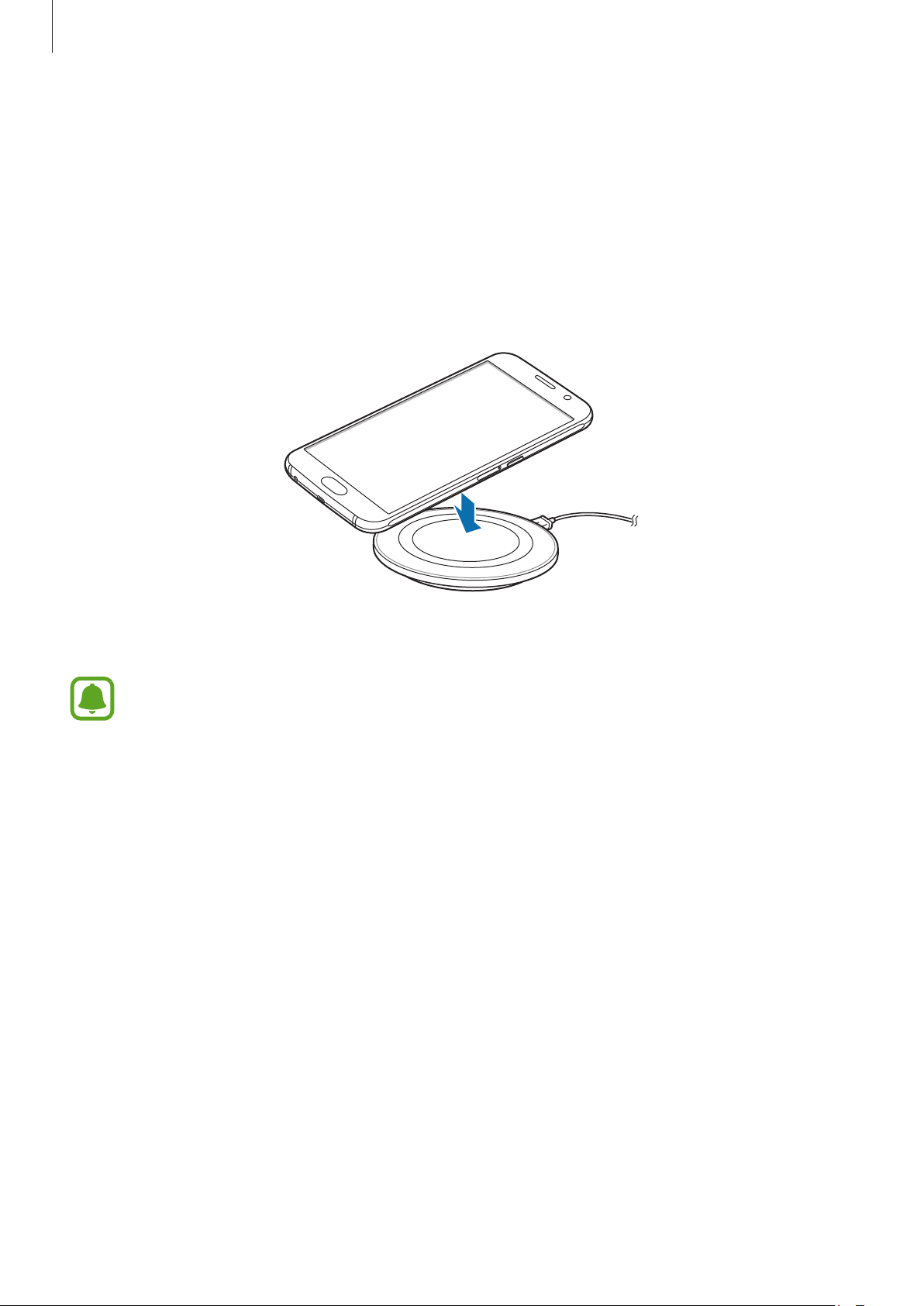
The device has a built-in wireless charging coil. You can charge the battery using a wireless
charger (sold separately).
1
Place the centre of the device’s back on the centre of the wireless charger.
You can check the remaining charging time on the screen. The actual remaining time
may vary depending on the charging conditions.
2
After fully charging, disconnect the device from the wireless charger.
•
When there are foreign materials between the device and the wireless charger, the
device may not charge properly.
•
If you use the wireless charger in areas with weak network signals, you may lose
network reception.
•
Use Samsung-approved wireless chargers. If you use other wireless chargers, the
battery may not charge properly.
Power saving mode
Save the battery power by limiting the device’s functions.
On the Home screen, tap
Apps
→
Settings
→
Battery
→
Power saving mode
, and then tap
the switch to activate it.
To automatically activate power saving mode when the remaining battery power reaches the
preset level, tap
Start power saving
and select an option.

Basics
15
Ultra power saving mode
Use this mode to extend the device’s battery power. In ultra power saving mode, the device
performs the following:
•
Displays colours on the screen as grey tones.
•
Restricts the available apps to essential and selected apps only.
•
Deactivates the mobile data connection when the screen turns off.
•
Deactivates the Wi-Fi and Bluetooth features.
On the Home screen, tap
Apps
→
Settings
→
Battery
→
Ultra power saving mode
, and
then tap the switch to activate it.
To deactivate ultra power saving mode, tap
MORE
→
Disable ultra power saving mode
.
The usage time left shows the time remaining before the battery power runs
out. Usage time left may vary depending on your device settings and operating
conditions.
Turning the device on and off
Press and hold the Power key for a few seconds to turn on the device.
When you turn on your device for the first time or after performing a data reset, follow the on-
screen instructions to set up your device.
To turn off the device, press and hold the Power key, and then tap
Power off
.
•
If your device is frozen and unresponsive, press and hold the Power key and the
Volume key down simultaneously for more than 7 seconds to restart it.
•
Follow all posted warnings and directions from authorised personnel in areas
where the use of wireless devices is restricted, such as aeroplanes and hospitals.
Basics
16
Touchscreen
•
Do not allow the touchscreen to come into contact with other electrical devices.
Electrostatic discharges can cause the touchscreen to malfunction.
•
To avoid damaging the touchscreen, do not tap it with anything sharp or apply
excessive pressure to it with your fingertips.
•
The device may not recognise touch inputs close to the edges of the screen, which
are outside of the touch input area.
•
Leaving the touchscreen idle for extended periods may result in afterimages
(screen burn-in) or ghosting. Turn off the touchscreen when you do not use the
device.
•
It is recommended to use fingers when you use the touchscreen.
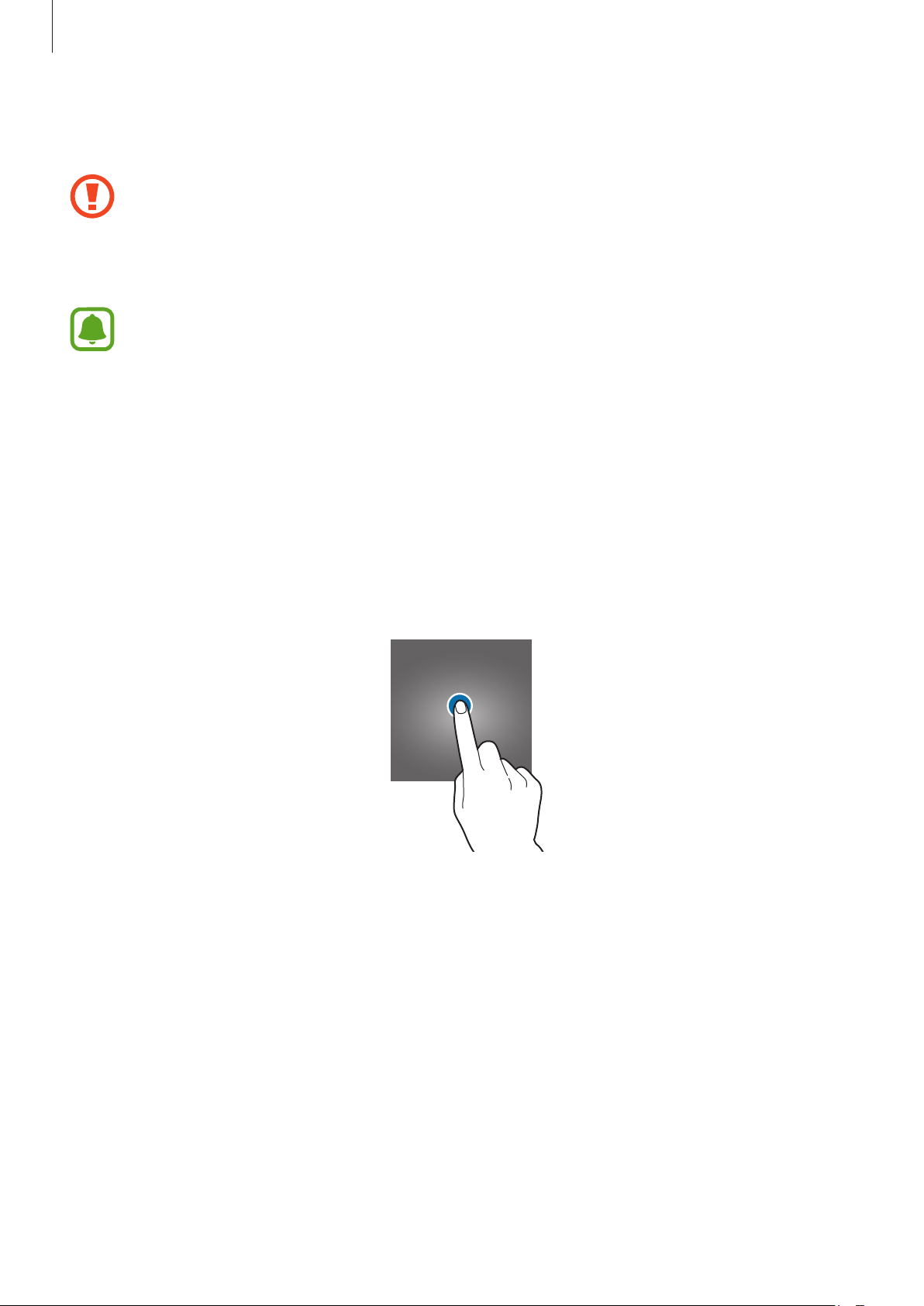
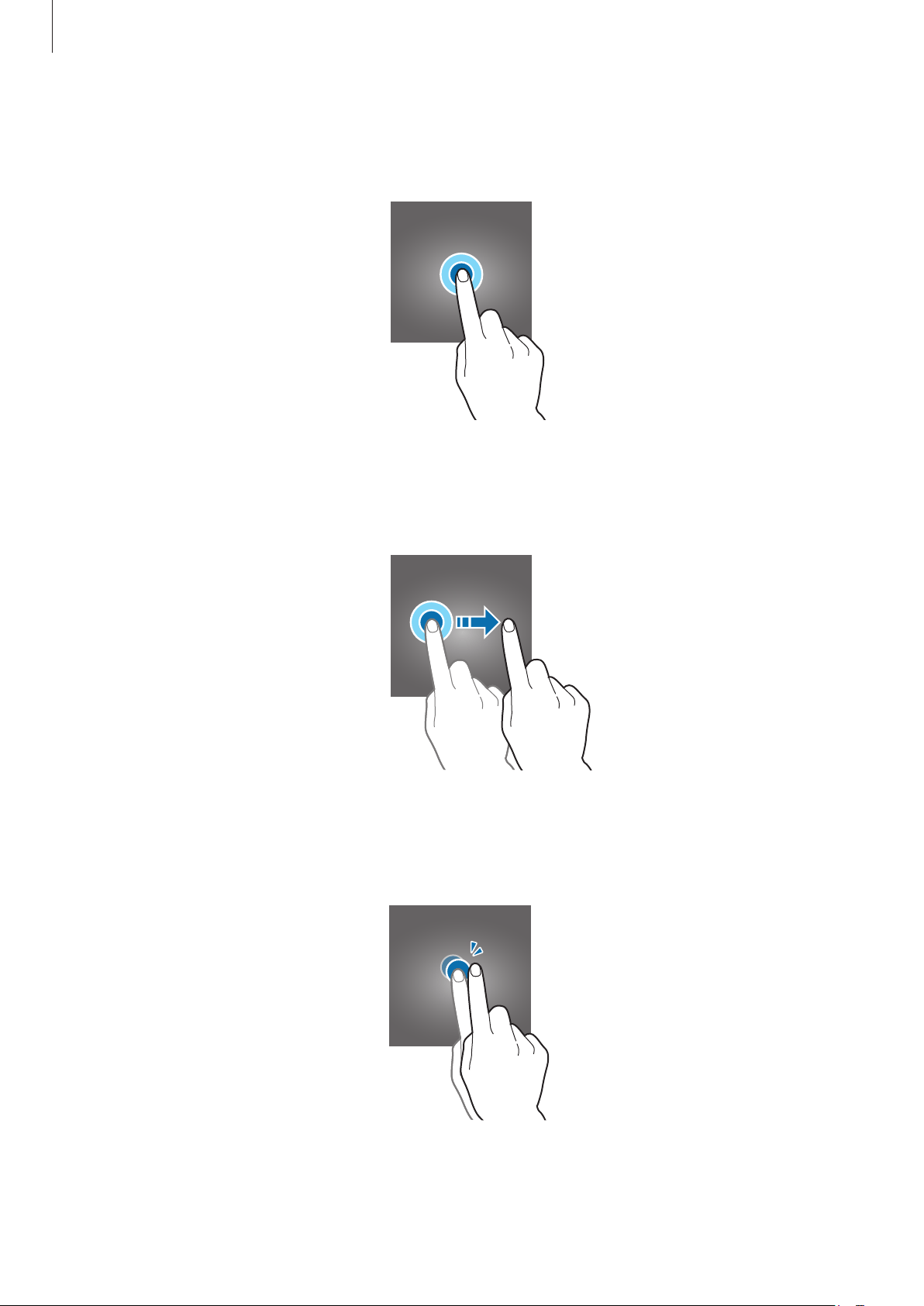
Tapping
To open an app, to select a menu item, to press an on-screen button, or to enter a character
using the keyboard on the screen, tap it with your finger.
Basics
17
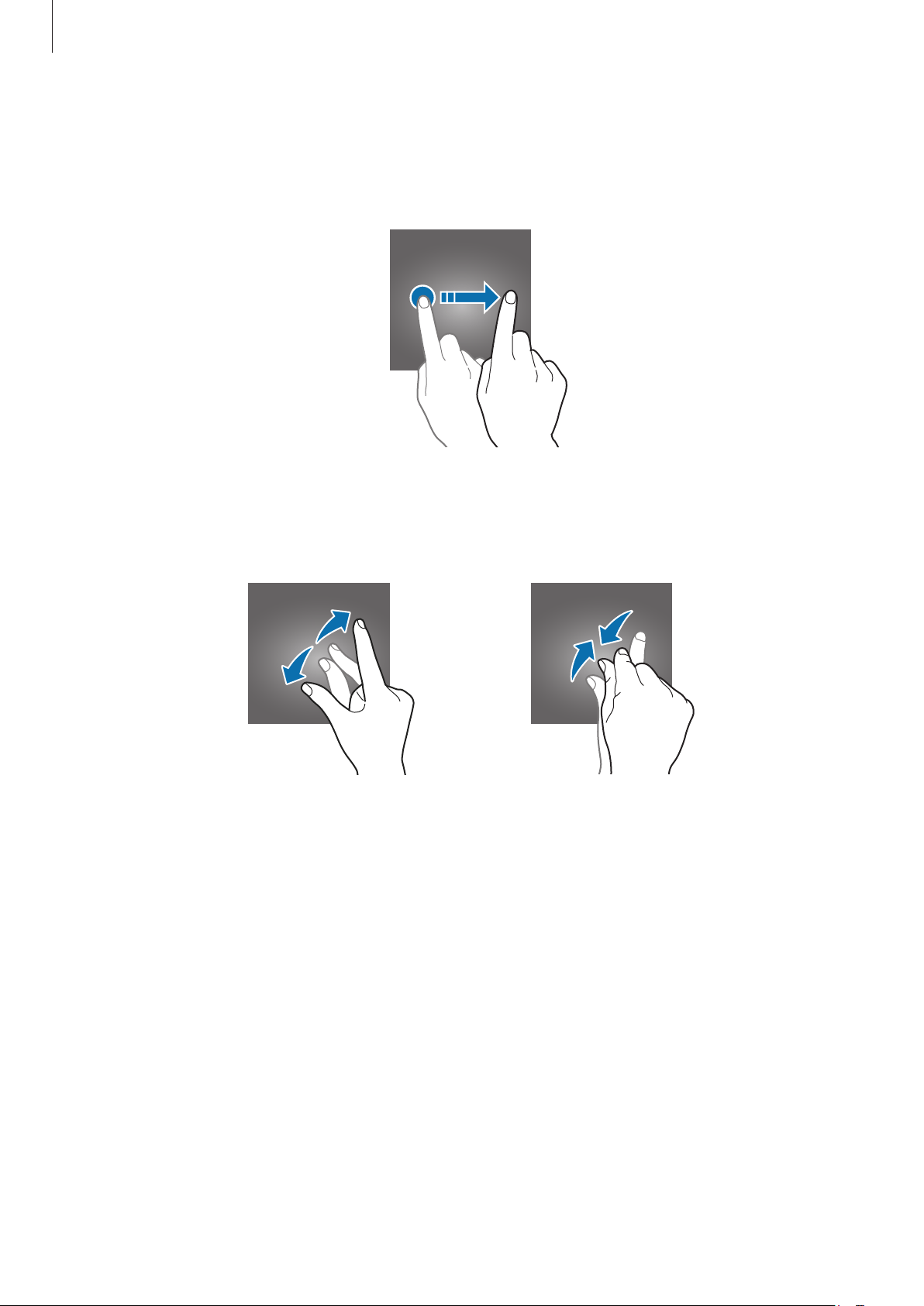
Tapping and holding
Tap and hold an item or the screen for more than 2 seconds to access available options.
Dragging
To move an item, tap and hold it and drag it to the target position.
Double-tapping
Double-tap on a webpage or image to zoom in. Double-tap again to return.
Basics
18
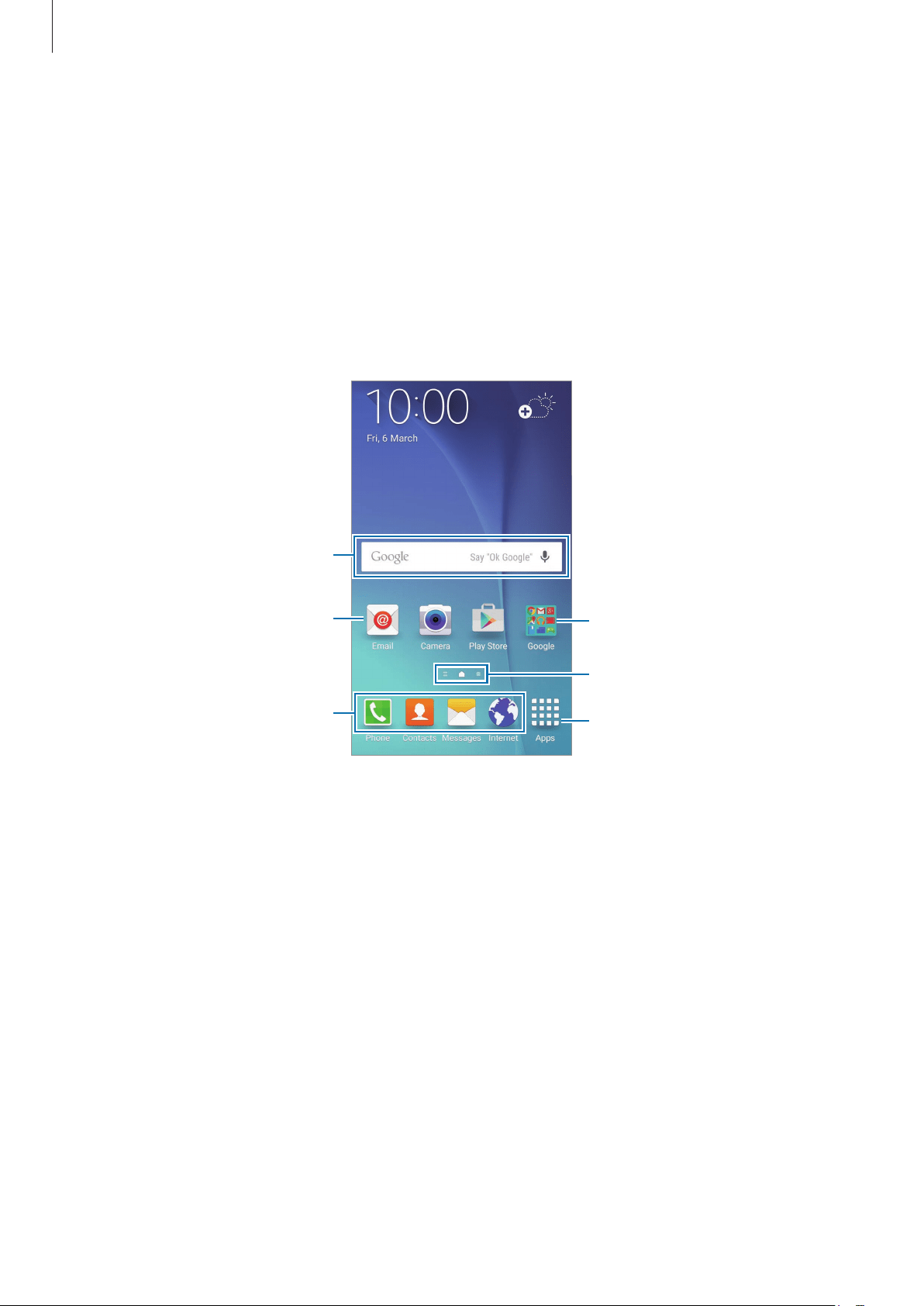
Swiping
Swipe to the left or right on the Home screen or the Apps screen to view other panels. Swipe
upwards or downwards to scroll through a webpage or a list of items, such as contacts.
Spreading and pinching
Spread two fingers apart on a webpage, map, or image to zoom in a part. Pinch to zoom out.
Basics
19
Home screen
Home screen
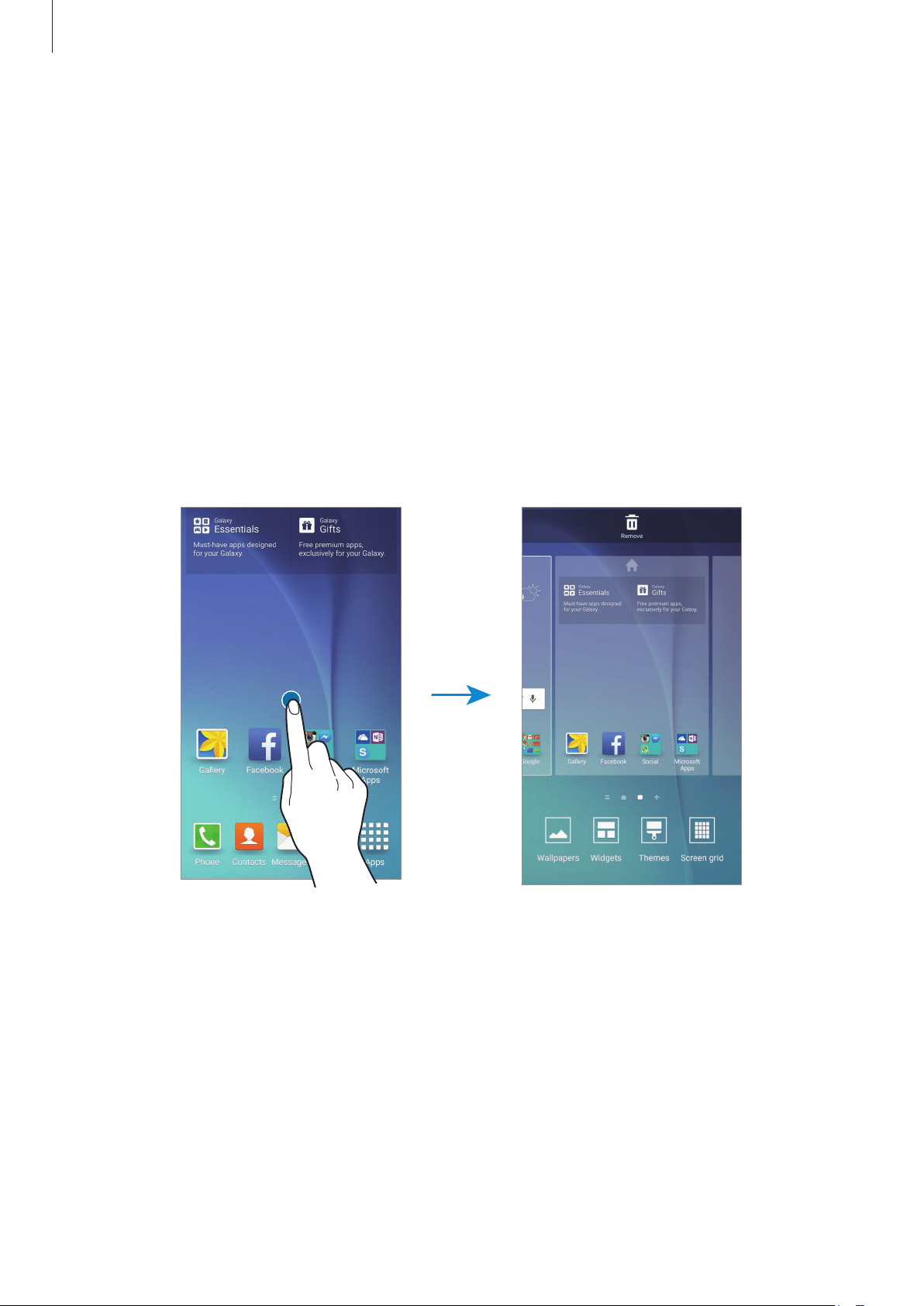
The Home screen is the starting point for accessing all of the device’s features. It displays
widgets, shortcuts to apps, and more.
To view other panels, swipe to the left or right, or tap one of the screen indicators at the
bottom of the screen.
A widget
An app
A folder
Screen indicators
Favourite apps
Apps screen icon
Basics
20
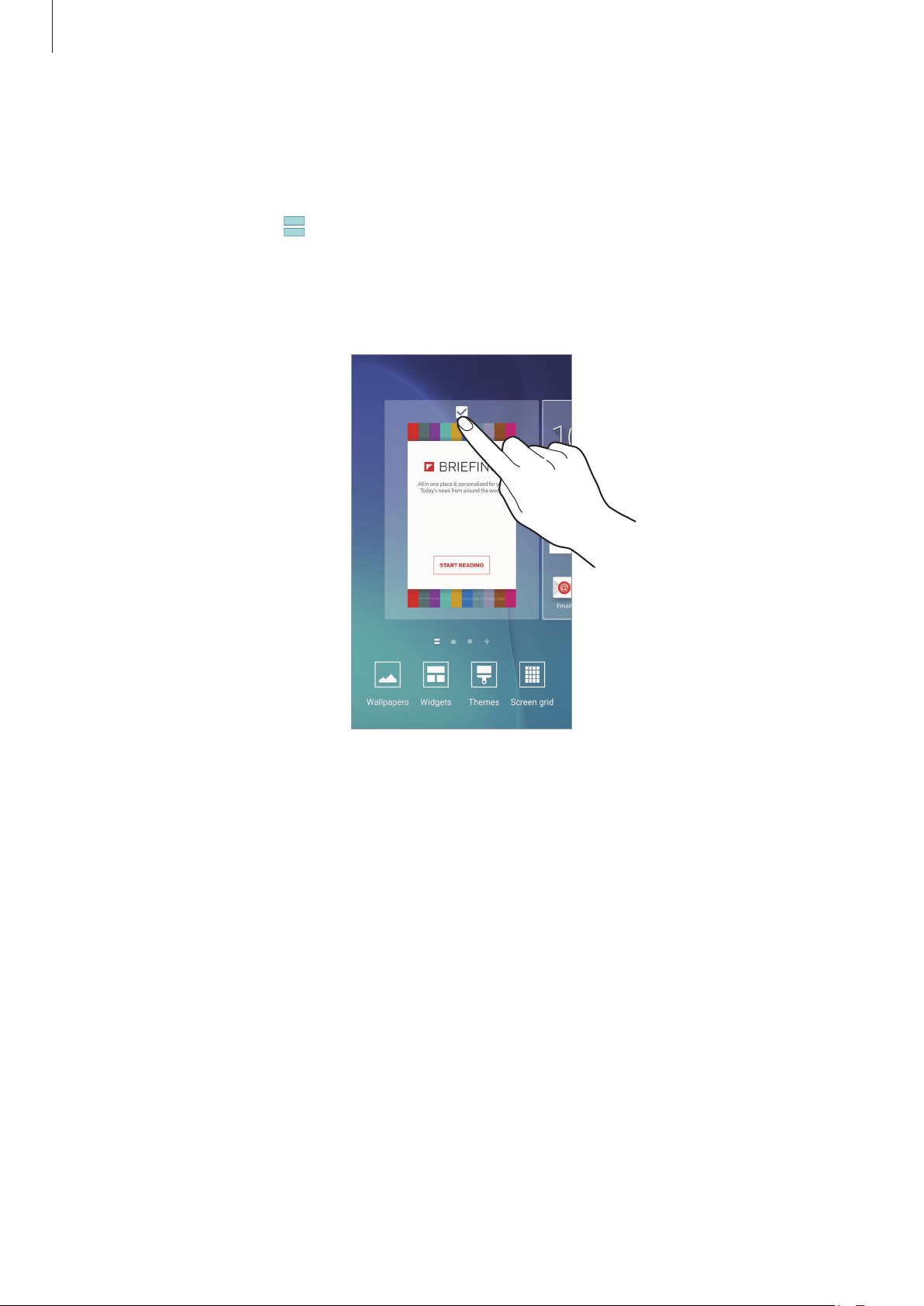
Home screen options
On the Home screen, tap and hold an empty area, or pinch your fingers together to access
the available options. Customise the Home screen by adding, deleting, or rearranging Home
screen panels. You can also set the Home screen wallpaper, add widgets to the Home screen,
and more.
•
Wallpapers
: Change the wallpaper settings for the Home screen and the locked screen.
•
Widgets
: Add widgets to the Home screen. Widgets are small apps that launch specific
app functions to provide information and convenient access on your Home screen.
•
Themes
: Change the device’s theme. Visual elements of interface, such as colours, icons,
and wallpapers, will change depending on the selected theme.
•
Screen grid
: Change the size of the grid to display more or less items on the Home
screen.
Basics
21
Flipboard Briefing
View the latest articles in various categories. You can get up to date on news that interests
you using this feature.
On the Home screen, tap
or swipe to the right to open Flipboard Briefing. Swipe upwards
or downwards to browse articles in each news category.
To deactivate Flipboard Briefing, tap and hold an empty area on the Home screen. Then,
swipe to the right and deselect the tick box at the top of the Flipboard Briefing panel.
Adding items
Tap and hold an app or a folder from the Apps screen, and then drag it to the Home screen.
To add widgets, tap and hold an empty area on the Home screen, tap
Widgets
, tap and hold a
widget, and then drag it to the Home screen.
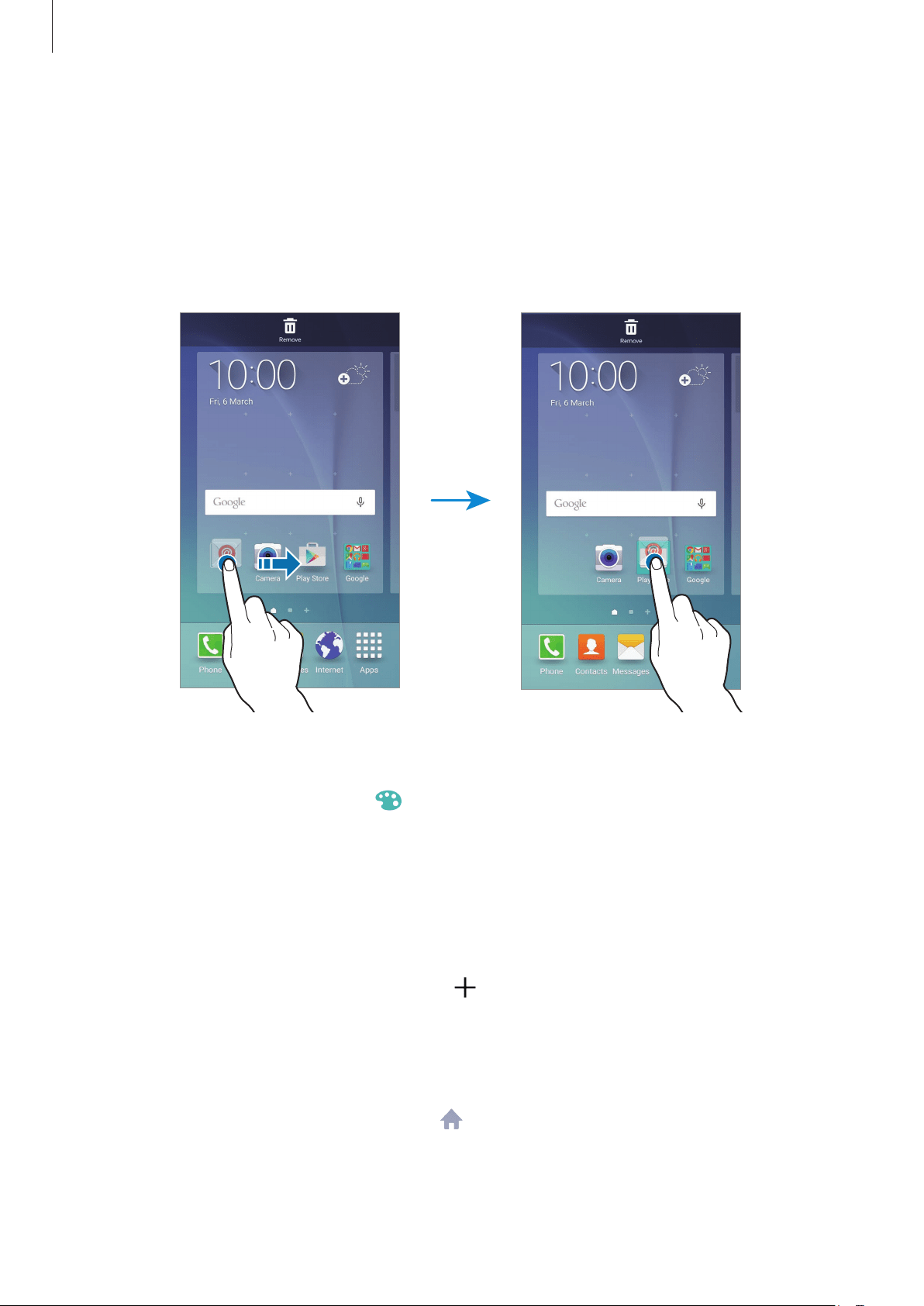
Moving and removing an item
Tap and hold an item on the Home screen, and then drag it to a new location.
To move the item to another panel, drag it to the side of the screen.
You can also move frequently used apps to the shortcuts area at the bottom of the Home
screen.
To remove an item, tap and hold the item. Then, drag it to
Remove
at the top of the screen.
Basics
22
Creating folders
1
On the Home screen, tap and hold an app, and then drag it over another app.
2
Drop the app when a folder frame appears around the apps.
A new folder containing the selected apps will be created.
3
Tap
Enter folder name
and enter a folder name.
To change the folder colour, tap
.
To add more apps to the folder, tap and hold another app, and then drag it to the folder.
Managing panels
On the Home screen, tap and hold an empty area to add, move, or remove a panel.
To add a panel, swipe to the left, and then tap
.
To move a panel, tap and hold a panel preview, and then drag it to a new location.
To remove a panel, tap and hold a panel preview, and then drag it to
Remove
at the top of
the screen.
To set a panel as the main Home screen, tap
.

Basics
23
Apps screen
The Apps screen displays icons for all apps, including newly installed apps.
On the Home screen, tap
Apps
to open the Apps screen. To view other panels, swipe to the
left or right, or select a screen indicator at the bottom of the screen.
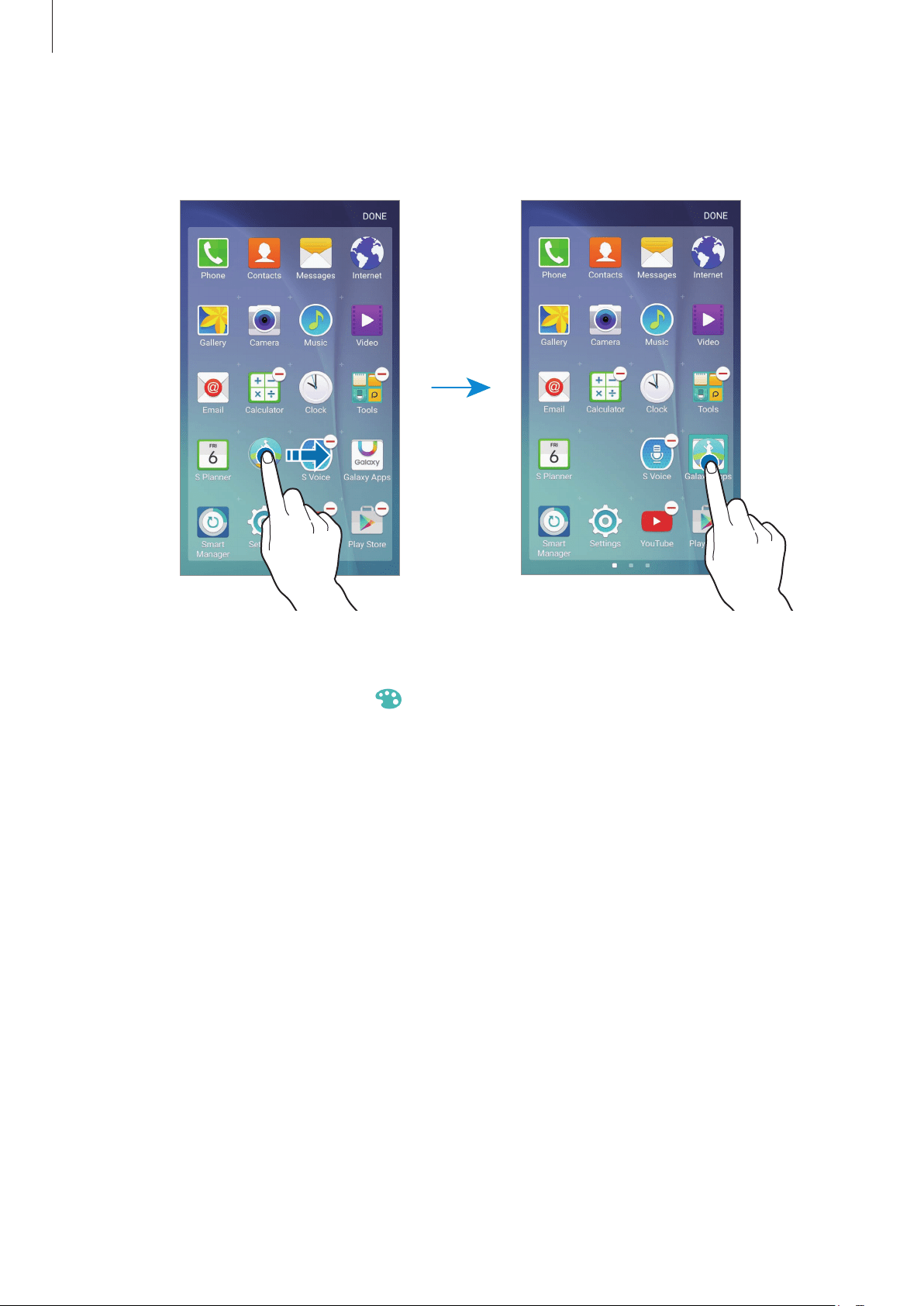
Moving items
This feature may not be available depending on the region or service provider.
On the Apps screen, tap
EDIT
. Tap and hold an item and drag it to a new location.
To move the item to another panel, drag it to the side of the screen.
Creating folders
This feature may not be available depending on the region or service provider.
1
On the Apps screen, tap
EDIT
.
2
Tap and hold an app, and then drag it over another app.
Basics
24
3
Drop the app when a folder frame appears around the apps.
A new folder containing the selected apps will be created.
4
Tap
Enter folder name
and enter a folder name.
To change the folder colour, tap
.
To add more apps to the folder, tap and hold another app, and then drag it to the folder.
Basics
25
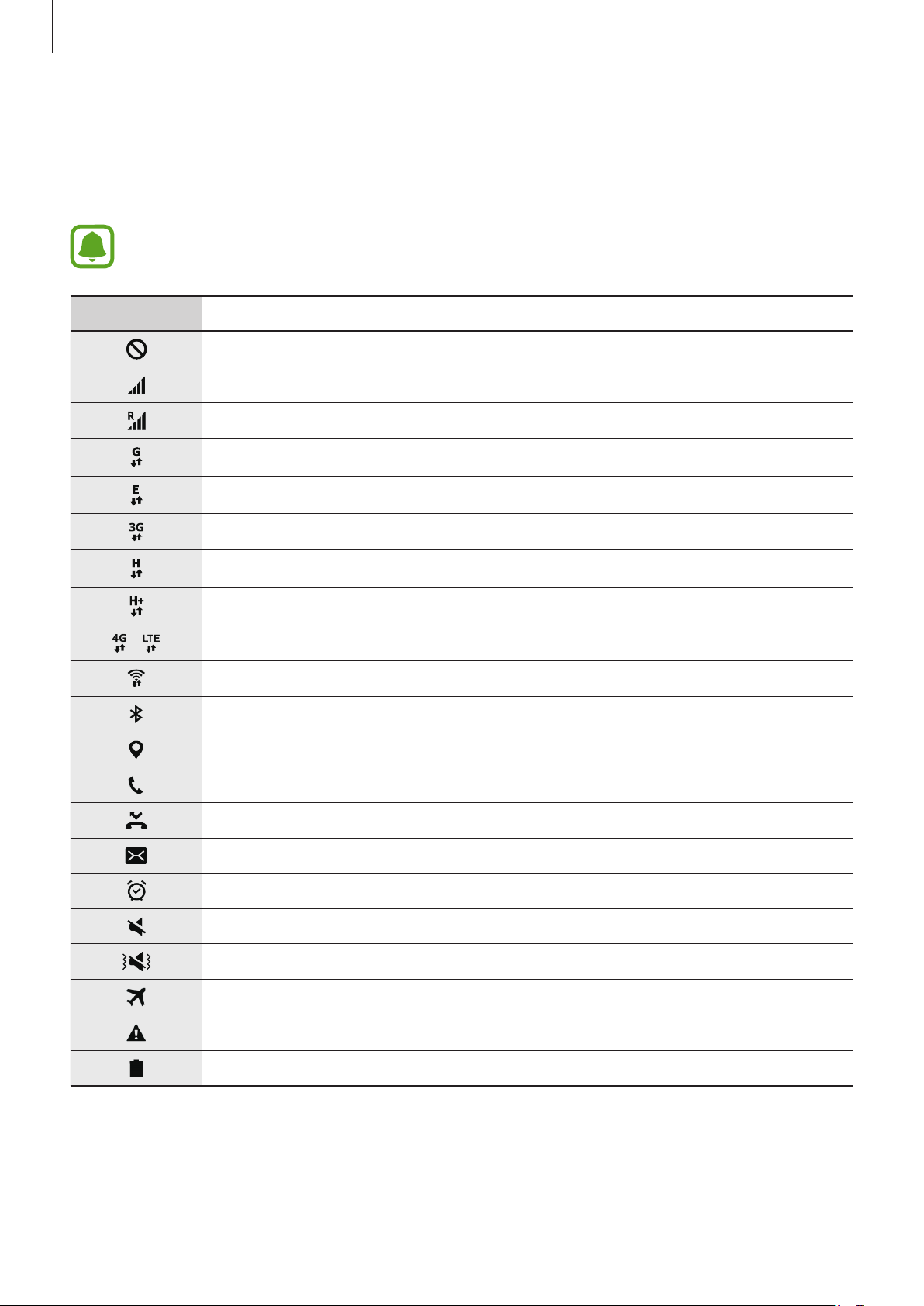
Indicator icons
Indicator icons appear on the status bar at the top of the screen. The icons listed in the table
below are most common.
The status bar may not appear at the top of the screen in some apps. To display the
status bar, drag down from the top of the screen.
Icon Meaning
No signal
Signal strength
Roaming (outside of normal service area)
GPRS network connected
EDGE network connected
UMTS network connected
HSDPA network connected
HSPA+ network connected
/
LTE network connected (LTE-enabled models)
Wi-Fi connected
Bluetooth feature activated
GPS activated
Call in progress
Missed call
New text or multimedia message
Alarm activated
Mute mode activated
Vibration mode activated
Flight mode activated
Error occurred or caution required
Battery power level
Basics
26
Lock screen
Pressing the Power key turns off the screen and locks it. Also, the screen turns off and
automatically locks if the device is not used for a specified period.
To unlock the screen, press the Power key or the Home key and swipe in any direction.
You can change the way that you lock the screen to prevent others from accessing your
personal information.
On the Apps screen, tap
Settings
→
Lock screen and security
→
Screen lock type
, and then
select a screen lock method. The device requires an unlock code whenever unlocking it.
If the unlock code is forgotten, take the device to a Samsung Service Centre to reset it.
Pattern
Draw a pattern by connecting four dots or more, and then draw the pattern again to verify it.
Set a backup PIN to unlock the screen when you forget the pattern.
PIN
A PIN consists of numbers only. Enter at least four numbers, and then enter the password
again to verify it.

Basics
27
Password
A password consists of characters and numbers. Enter at least four characters including
numbers and symbols, and then enter the password again to verify it.
Fingerprints
Register your fingerprints to unlock the screen. Refer to
Fingerprint recognition for more
information.
Notification panel
Using the notification panel
When you receive new notifications, such as messages or missed calls, indicator icons appear
on the status bar. To see more information about the icons, open the notification panel and
view the details.
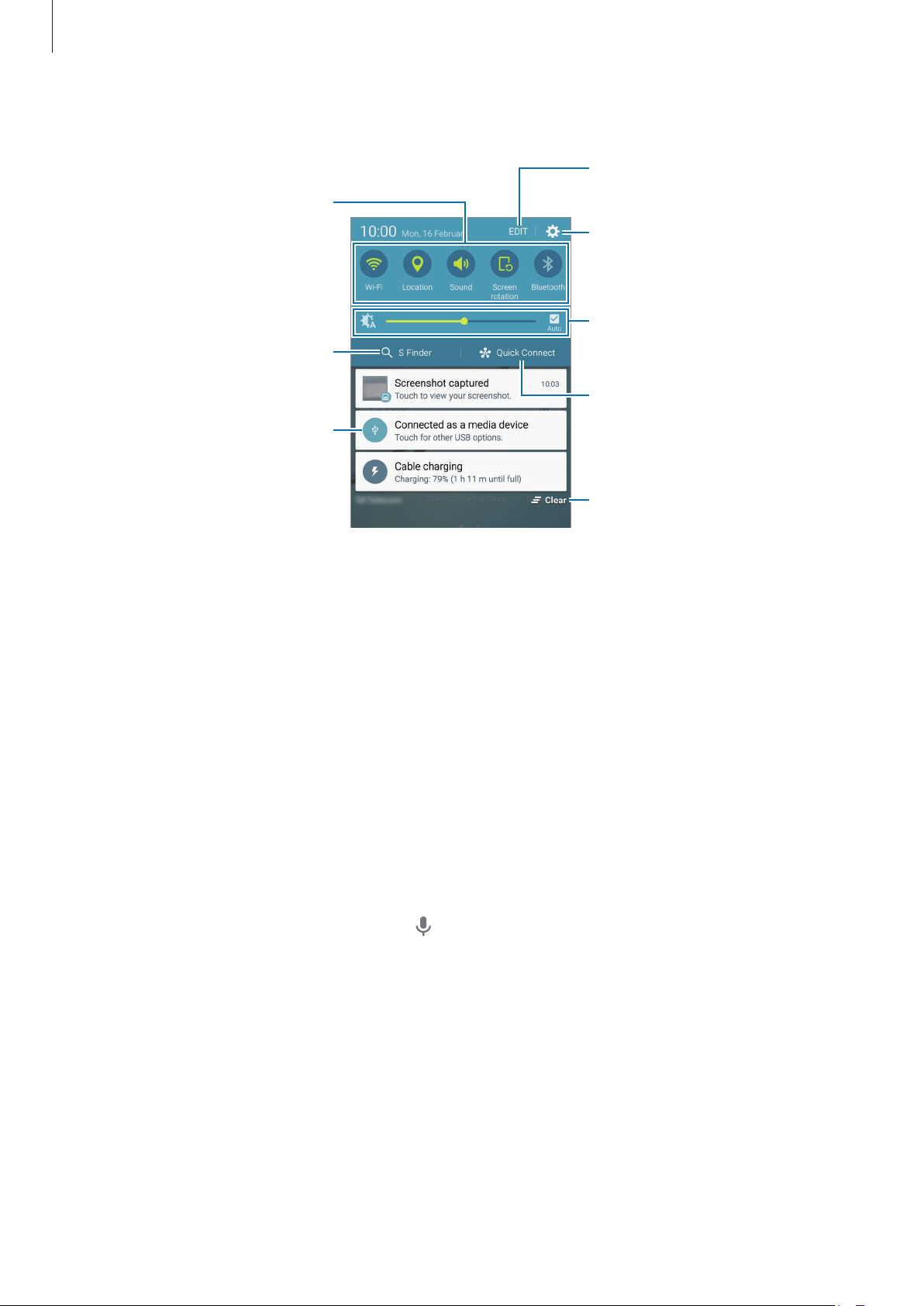
To open the notification panel, drag the status bar downwards. To close the notification panel,
swipe upwards on the screen.
Basics
28
You can use the following functions on the notification panel.
Launch Settings.
Launch S Finder.
Tap a notification and perform
various actions.
Clear all notifications.
Adjust the brightness.
Rearrange quick setting buttons.
Quick setting buttons
Launch Quick Connect.
Using quick setting buttons
Tap quick setting buttons to activate some features. Swipe to the left or right on the buttons
area to view more buttons. To view more detailed settings, tap and hold a button.
To rearrange buttons, tap
EDIT
, tap and hold a button, and then drag it to another location.
S Finder
Search for a wide variety of content with a keyword.
Searching for content on the device
Open the notification panel and tap
S Finder
.
Enter a keyword in the search field or tap
and say a keyword.
To get more refined results, tap the filter buttons under the search field, and then select filter
details.

Basics
29
Setting search categories
You can set search categories to search for content in specific search fields.
Tap
MORE
→
Select search locations
and select categories.
Quick Connect
Automatically search for nearby devices and quickly connect to them.
•
If the device you want to connect does not support the Quick connect feature,
activate its Wi-Fi Direct or Bluetooth feature before launching
Quick Connect
on
your device.
•
Connection methods may vary depending on the type of connected devices or the
shared content.
Connecting to other devices
1
Open the notification panel and tap
Quick Connect
.
If you are using this feature for the first time, select a visibility option and tap
ENABLE
QUICK CONNECT
.
When the panel opens, the Wi-Fi and the Bluetooth features are activated automatically
and the device searches for nearby devices.
If you have installed Samsung Link on your device, the list of devices registered
with Samsung Link will appear at the top of the screen. For more information about
Samsung Link, visit
link.samsung.com.
2
Select a device from the list and connect to it by following the on-screen instructions.
The next steps may vary depending on the connected device.
To change your device’s visibility setting, tap
SETTINGS
→
Device visibility
, and then
select an option.
Re-searching for devices
If the desired device does not appear in the list, search for the device.
Tap
REFRESH
and select the device from the list of detected devices.
Basics
30
Sharing content
Share content with the connected devices.
1
Open the notification panel and tap
Quick Connect
.
2
Select a device from the list of detected devices.
3
Tap
Share content
and select a media category.
4
Follow the on-screen instructions to send content to the connected device.
The next steps may vary depending on the selected media category.
Entering text
Keyboard layout
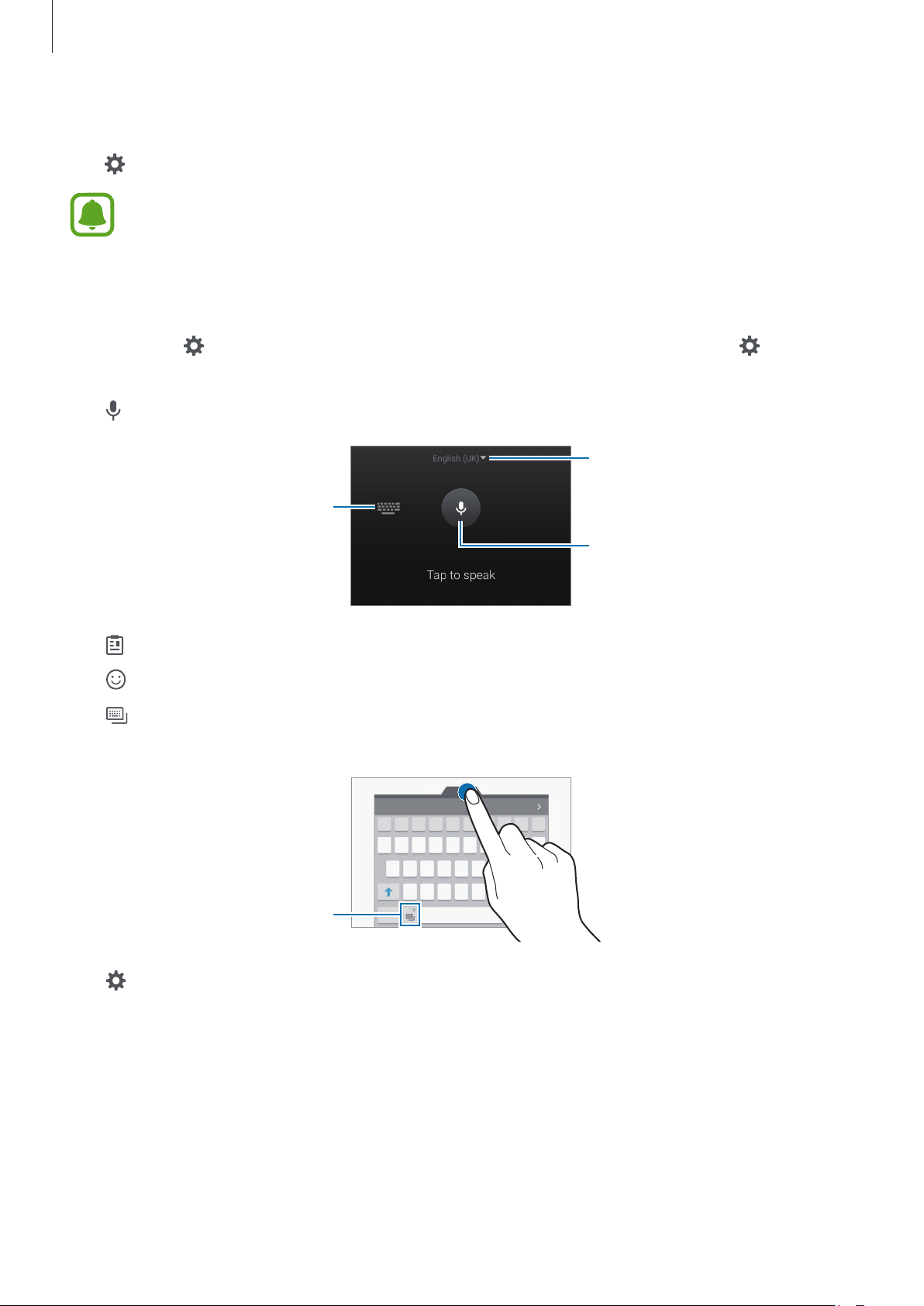
A keyboard appears automatically when you enter text to send messages, create memos, and
more.
Text entry is not supported in some languages. To enter text, you must change the
input language to one of the supported languages.
Break to the next line.
Delete a preceding character.
Enter punctuation marks.
Enter uppercase. For all caps, tap
it twice.
Change the keyboard settings.
Enter a space.
Changing the input language
Tap
→
Select input languages
, and then select the languages to use. When you select
two or more languages, you can switch between the input languages by swiping to the left or
right on the space key.
Basics
31
Changing the keyboard layout
Tap
, select a language under
Input languages
, and then select a keyboard layout to use.
On
3x4 keyboard
, a key has three or four characters. To enter a character, tap the
corresponding key repeatedly until the desired character appears.
Additional keyboard functions
Tap and hold to use various functions. Other icons may appear instead of the icon
depending on the last function that was used.
•
: Enter text by voice.
Change the language.
Open the keyboard.
Start or pause entering text by
voice.
•
: Add an item from the clipboard.
•
: Enter emoticons.
•
: Switch to the floating keyboard. You can move the keyboard to another location by
dragging the tab.
Switch to the standard keyboard.
•
: Change the keyboard settings.

Basics
32
Copying and pasting
1
Tap and hold over text.
2
Drag or to select the desired text, or tap
Select all
to select all text.
3
Tap
Copy
or
Cut
.
The selected text is copied to the clipboard.
4
Tap and hold where the text is to be inserted and tap
Paste
.
To paste text that you have previously copied, tap
Clipboard
and select the text.
Dictionary
Look up definitions for words while using certain features, such as when browsing webpages.
1
Tap and hold over a word that you want to look up.
If the word you want to look up is not selected, drag
or to select the desired text.
2
Tap
Dictionary
on the options list.
If a dictionary is not preinstalled on the device, tap
next to a dictionary to download it.
3
View the definition in the dictionary pop-up window.
To switch to the full screen view, tap
. Tap the definition on the screen to view more
definitions. In the detailed view, tap
to add the word to your favourite words list or tap
SEARCH WEB
to use the word as a search term.

Basics
33
Screen capture
Capture a screenshot while using the device.
Press and hold the Home key and the Power key simultaneously. You can view captured
images in
Gallery
.
You can also capture screenshots by swiping your hand to the left or right across the screen.
Refer to Motions and gestures for more information.
It is not possible to capture a screenshot while using some apps and features.
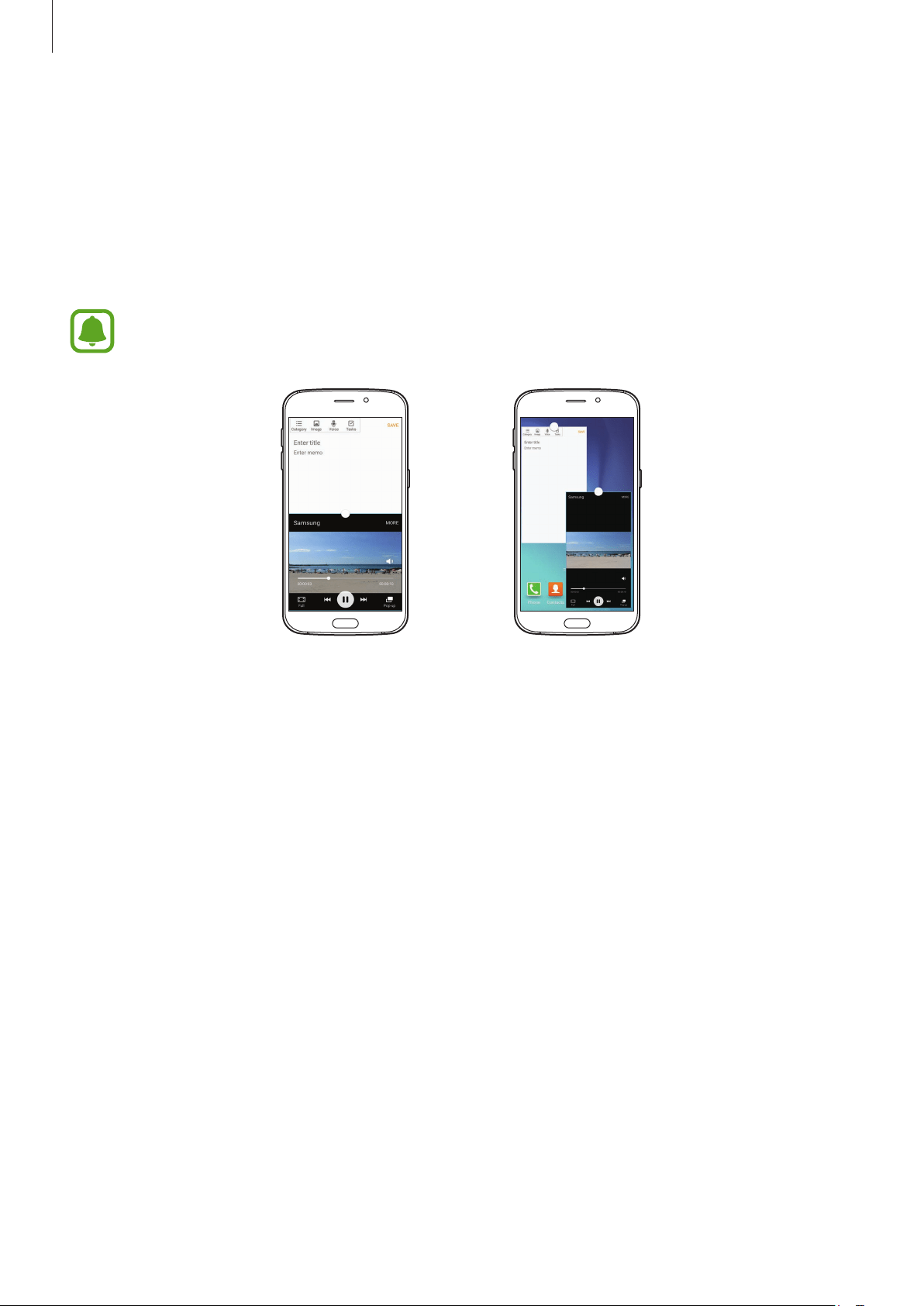
Opening apps
On the Home screen or the Apps screen, select an app icon to open it.
To open an app from the list of recently used apps, tap
and select a recent app window.
Closing an app
Tap
and drag a recent app window to the left or right to close it. To close all running apps,
tap
CLOSE ALL
.
Basics
34
Multi window
Introduction
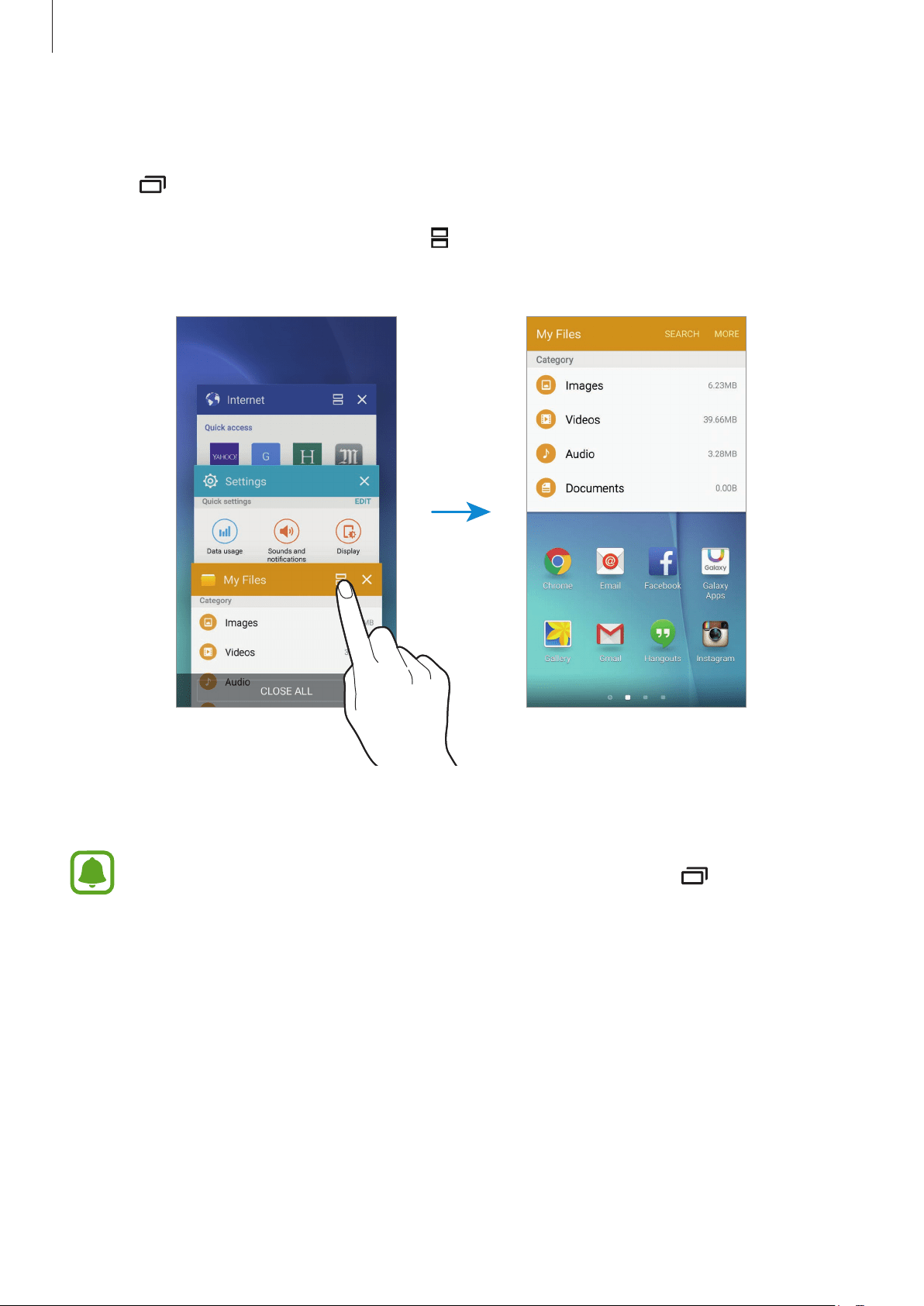
Multi window lets you run two apps at the same time in the split screen view. You can also run
multiple apps at the same time in the pop-up view.
Some apps may not support this feature.
Split screen view Pop-up view
Basics
35
Split screen view
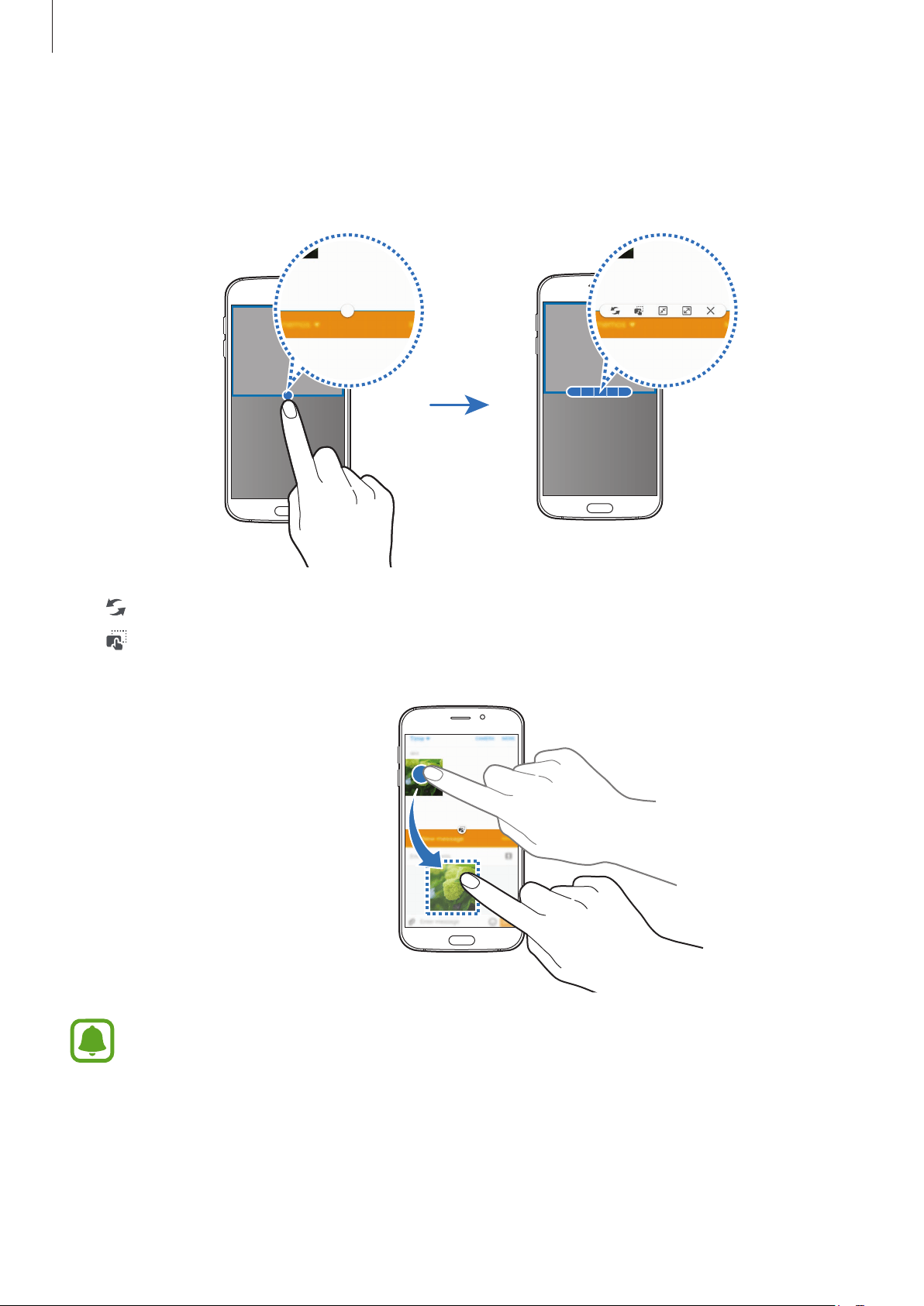
1
Tap to open the list of recently used apps.
2
Swipe upwards or downwards and tap on a recent app window.
The selected app will launch in the upper window.
3
Select another app to launch.
You can also launch the split screen view by tapping and holding .
Basics
36
Using additional options
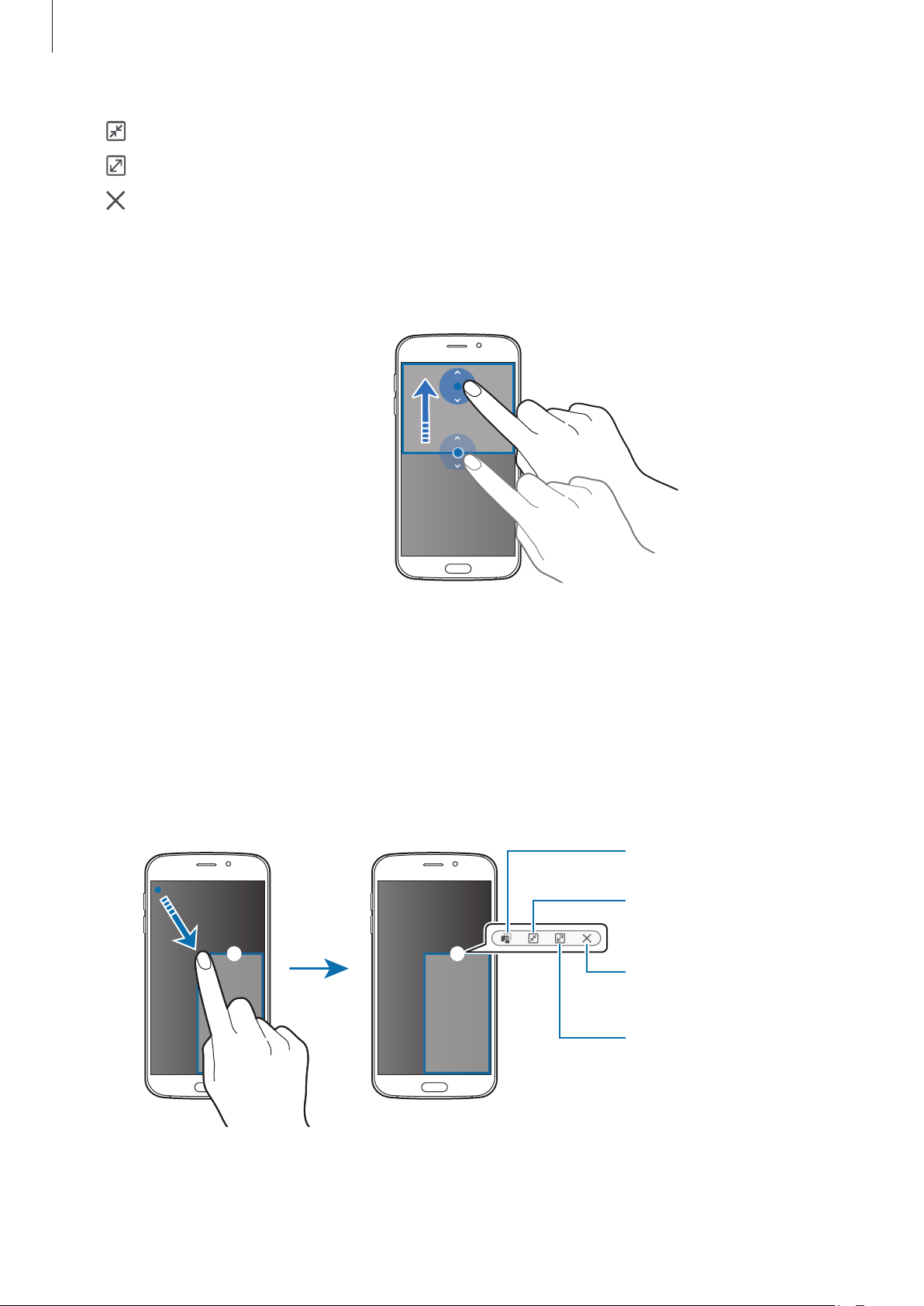
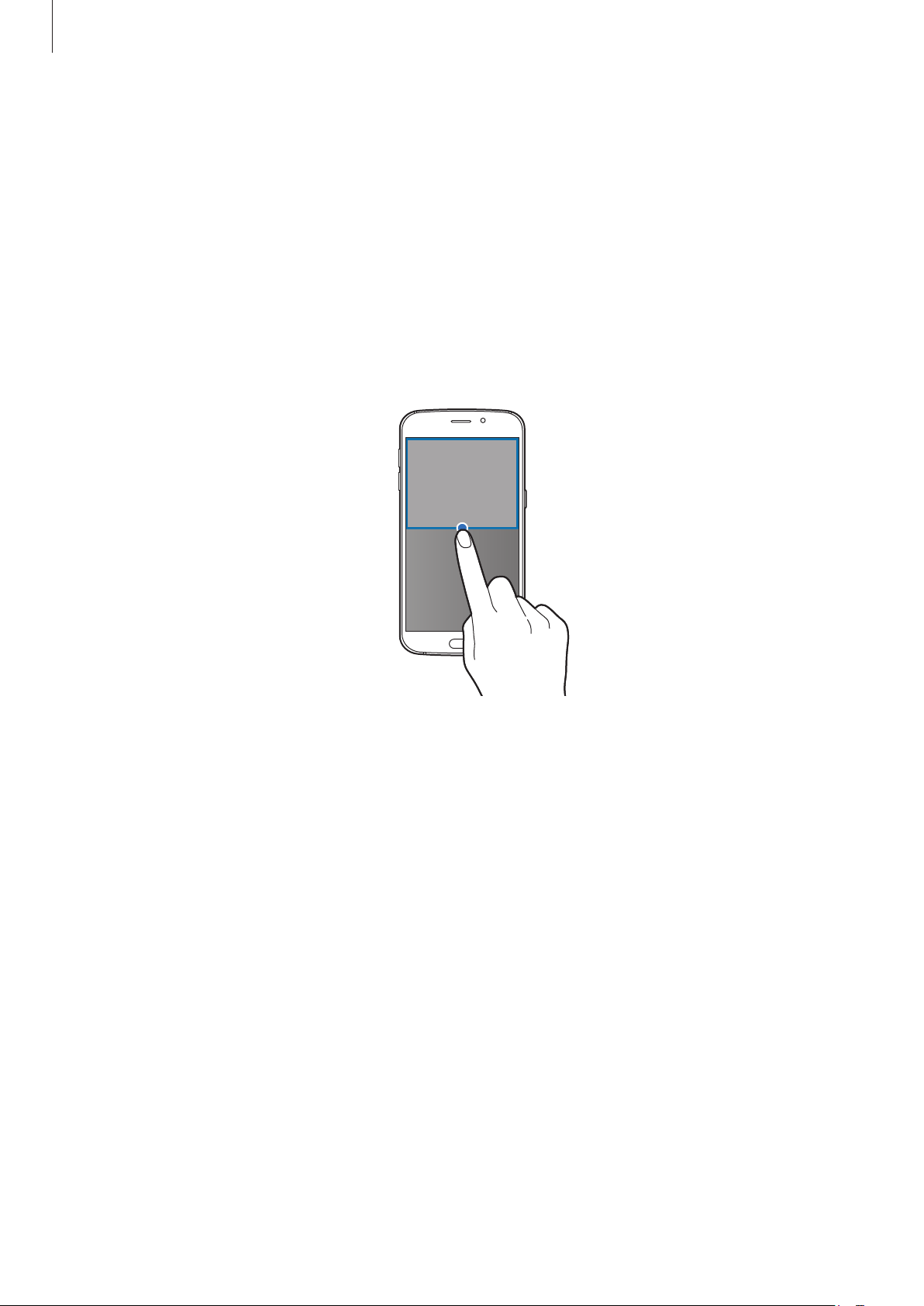
When using apps in the split screen view, select an app window and tap the circle between
the app windows to access the following options:
•
: Switch locations between app windows.
•
: Drag and drop text or copied images from one window to another. Tap and hold an
item in the selected window and drag it to a location in another window.
Some apps may not support this feature.
Basics
37
•
: Minimise the window.
•
: Maximise the window.
•
: Close the app.
Adjusting the window size
Drag the circle between the app windows up or down to adjust the size of the windows.
Pop-up view
1
On the Apps screen, launch an app to use in the pop-up view.
2
Drag down diagonally from either end of the top edge.
The app screen will appear in the pop-up view.
Minimise the window.
Close the app.
Maximise the window.
Drag and drop content.
Basics
38
Moving pop-up windows
To move a pop-up window, tap and hold the circle on a window and drag it to a new location.
Launching the pop-up view from the split screen view
1
On the split screen view, tap an app window to launch it in the pop-up view.
2
Tap and hold the circle between the app windows.
The selected app will launch in a pop-up window.

Basics
39
Device and data management
Transferring data from your previous device
You can transfer data from a previous device to your new device via Samsung Smart Switch.
The following versions of Samsung Smart Switch are available.
•
Mobile version (Smart Switch Mobile): Transfer data between mobile devices. You can
download the app from
Galaxy Apps
or
Play Store
.
•
Computer version: Transfer data between your device and a computer. You can download
the app from
www.samsung.com/smartswitch.
•
Samsung Smart Switch is not supported on some devices or computers.
•
Limitations apply. Visit www.samsung.com/smartswitch for details. Samsung
takes copyright seriously. Only transfer content that you own or have the right to
transfer.
Transferring data from a mobile device
Transfer data from your previous device to your new device.
When you turn on your new device for the first time, tap
DOWNLOAD AND OPEN
in the
Smart Switch installation pop-up window to install the app. Alternatively, download and
install Smart Switch from
Galaxy Apps
or
Play Store
.
On both devices, launch
Smart Switch Mobile
and follow the on-screen instructions to
transfer data from your previous device.
Transferring data from a computer
Back up data from your previous device to a computer and import the data to your new
device.
1
On the computer, visit www.samsung.com/smartswitch to download Smart Switch.
2
On the computer, launch Smart Switch.
If your previous device is not a Samsung device, back up data to a computer using a
program provided by the device’s manufacturer. Then, skip to the fifth step.
Basics
40
3
Connect your previous device to the computer using the USB cable.
4
On the computer, follow the on-screen instructions to back up data from the device.
Then, disconnect your previous device from the computer.
5
Connect your new device to the computer using the USB cable.
6
On the computer, follow the on-screen instructions to transfer data to your new device.
Using the device as a removable disk for data transfer
Move audio, video, image, or other types of files from the device to the computer, or vice
versa.
Do not disconnect the USB cable from the device when you are transferring files.
Doing so may cause data loss or device damage.
The devices may not connect properly if they are connected via a USB hub. Directly
connect the device to the computer’s USB port.
1
Connect the device to the computer using the USB cable.
2
Open the notification panel, and then tap
Connected as a media device
→
Media
device (MTP)
.
Tap
Camera (PTP)
if your computer does not support Media Transfer Protocol (MTP) or
not have any appropriate driver installed.
3
Transfer files between your device and the computer.
Basics
41
Updating the device
The device can be updated to the latest software.
Updating over the air
The device can be directly updated to the latest software by the firmware over-the-air (FOTA)
service.
On the Apps screen, tap
Settings
→
About device
→
Software update
→
Update now
.
To automatically check for available updates, tap the
Auto update
switch to activate
it. To download updates only when a Wi-Fi connection is activated, tap the
Wi-Fi only
switch to activate it.
Updating with Smart Switch
Connect the device to a computer and update the device to the latest software.
1
On the computer, visit www.samsung.com/smartswitch to download and install Smart
Switch.
2
On the computer, launch Smart Switch.
3
Connect the device to the computer using a USB cable.
4
If a software update is available, follow the on-screen instructions to update the device.
•
Do not turn off the computer or disconnect the USB cable while the device is
updating.
•
While updating the device, do not connect other media devices to the computer.
Doing so may interfere with the update process. Before updating, disconnect all
other media devices from the computer.

Basics
42
Backing up and restoring data
Keep your personal information, app data, and settings safe on your device. You can back
up your sensitive information to a backup account and access it later. You must sign in to
your Google or Samsung account to back up or restore data. Refer to
Accounts for more
information.
Using a Samsung account
On the Apps screen, tap
Settings
→
Backup and reset
→
Back up my data
, select the items
to back up, and then tap
BACK UP NOW
.
To set the device to automatically back up data, tap the
Auto back up
switch to activate it.
To restore data using a Samsung account, tap
Restore
. Current data will be deleted from the
device to restore the selected items.
Using a Google account
On the Apps screen, tap
Settings
→
Backup and reset
, and then tap the
Back up my data
switch to activate it. Tap
Backup account
and select an account as the backup account.
To restore data using a Google account, tap the
Automatic restore
switch to activate it. When
you reinstall apps, backed up settings and data will be restored.
Performing a data reset
Delete all settings and data on the device. Before performing a factory data reset, ensure you
back up all important data stored on the device. Refer to
Backing up and restoring data for
more information.
On the Apps screen, tap
Settings
→
Backup and reset
→
Factory data reset
→
RESET
DEVICE
→
ERASE EVERYTHING
. The device automatically restarts.

Basics
43
Connecting to a TV
Introduction
Register a TV to your device to easily share content between them.
•
This feature is compatible with Samsung Smart TVs released in 2015 or later that
support the Bluetooth Low Energy (BLE) feature.
•
Some files may be buffered during playback, depending on the network
connection.
Registering a TV
Register a TV to your device. Once you register a TV, you can easily share the screen between
your device and TV and use the Briefing on TV feature.
1
Turn on the TV and place your device close to the TV.
2
Open the notification panel and tap
Quick Connect
.
3
Select the TV and tap
Register TV
.
Sharing screen
You can mirror your device’s screen on a TV or vice versa.
Mirroring your device’s screen to a TV
When your device recognises the registered TV while you are watching a video, the
icon
will appear on the device. Tap the icon to stream the video from your device to your TV.
If the TV is turned off and registered with
Quick Connect
, it will automatically turn on and
your device’s screen will appear on the TV screen.
This feature is supported by the default video player app only.

Basics
44
Mirroring a TV screen to your device
1
Open the notification panel and tap
Quick Connect
.
The registered TV appears on the list.
2
Select the registered TV.
3
Tap
TV to mobile device
.
The TV screen will appear on your device.
Using the Briefing on TV feature
Your registered TV turns on automatically according to the preset time set on your device and
displays the time, weather, and your schedule information on the screen. To use this feature,
your device and the TV must be connected to the same access point.
1
Open the notification panel and tap
Quick Connect
.
The registered TV will appear on the list.
2
Select the registered TV.
3
Tap
Briefing on TV
and set a time and day to display the briefing.
Time, weather, and schedule information will be displayed on the right side of the TV
screen at the preset time.

Basics
45
Sharing files with contacts
Share files with your contacts using the simple sharing feature. The following actions are an
example of sharing images.
This feature may not be available depending on the region or service provider.
1
Tap
Gallery
on the Apps screen.
2
Select an image.
3
Tap
Share
→
Contacts
.
If you are using this feature for the first time, read and agree to the terms and conditions.
Your phone number will be verified and then the simple sharing feature will be activated.
4
Select recipients and tap
DONE
.
•
If the recipients’ devices do not support the simple sharing feature, a link to the
files will be sent to them via text message. The link will expire after a certain period.
•
You may incur additional charges when sharing files via the mobile network.
Basics
46
Emergency mode
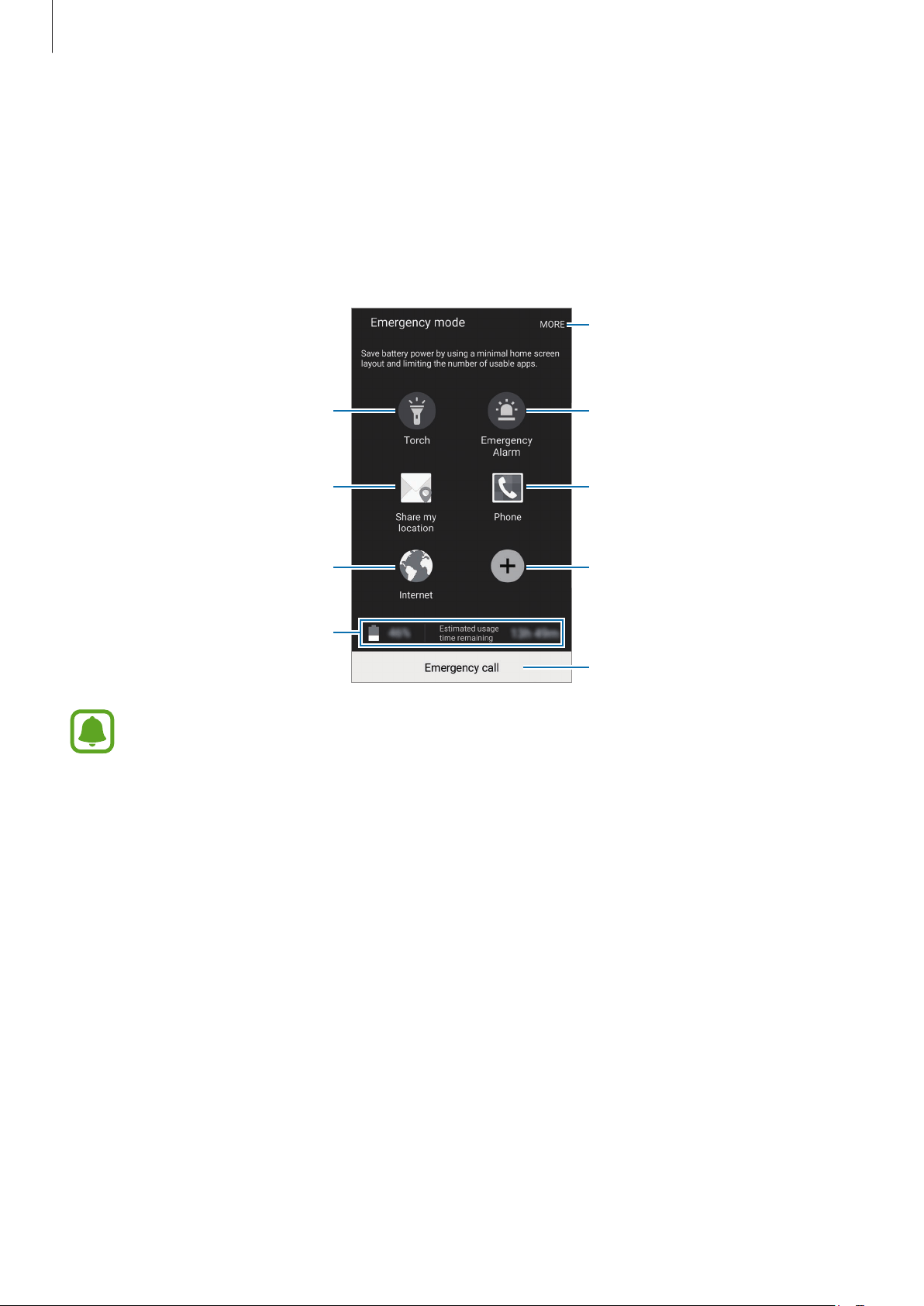
Emergency mode changes the screen to grey tones to reduce battery consumption. Some
apps and functions will be restricted. In emergency mode, you can make an emergency call,
send your current location information to others, sound an emergency alarm, and more.
Press and hold the Power key, and then tap
Emergency mode
.
Add more apps to use.
Make an emergency call.
Remaining battery power and
usage time left
Turn on the flash.
Make a call.
Send your current location
information in a message.
Browse the Internet.
Access additional options.
Sound alarms.
The usage time left shows the time remaining before the battery power runs
out. Usage time left may vary depending on your device settings and operating
conditions.
Deactivating emergency mode
To deactivate emergency mode, tap
MORE
→
Disable Emergency mode
. Alternatively, press
and hold the Power key, and then tap
Emergency mode
.
47
Applications
Installing or uninstalling apps
Samsung Galaxy Apps
Purchase and download apps. You can download apps that are specialised for Samsung
Galaxy devices.
Tap
Galaxy Apps
on the Apps screen.
This app may not be available depending on the region or service provider.
Installing apps
Browse apps by category or tap
SEARCH
to search for a keyword.
Select an app to view information about it. To download free apps, tap
INSTALL
. To purchase
and download apps where charges apply, tap the price and follow the on-screen instructions.
To change the auto update settings, tap
→
Settings
→
Auto update apps
, and
then select an option.
Play Store
Purchase and download apps.
Tap
Play Store
on the Apps screen.
Installing apps
Browse apps by category or tap
to search for a keyword.
Select an app to view information about it. To download free apps, tap
INSTALL
. To purchase
and download apps where charges apply, tap the price and follow the on-screen instructions.
To change the auto update settings, tap
→
Settings
→
Auto-update apps
, and
then select an option.

Applications
48
Managing apps
Uninstalling or disabling apps
On the Apps screen, tap
EDIT
. The icon appears on the apps that you can disable or
uninstall. Select an app and tap
DISABLE
or
UNINSTALL
. Alternatively, on the Apps screen,
tap
Settings
→
Applications
→
Application manager
, select an app, and then tap
DISABLE
or
UNINSTALL
.
•
DISABLE
: Disable selected default apps that cannot be uninstalled from the device.
•
UNINSTALL
: Uninstall downloaded apps.
Enabling apps
On the Apps screen, tap
Settings
→
Applications
→
Application manager
, scroll to
DISABLED
, select an app, and then tap
ENABLE
.
Phone
Introduction
Make or answer voice and video calls.
Making calls
1
Tap
Phone
on the Apps screen.
2
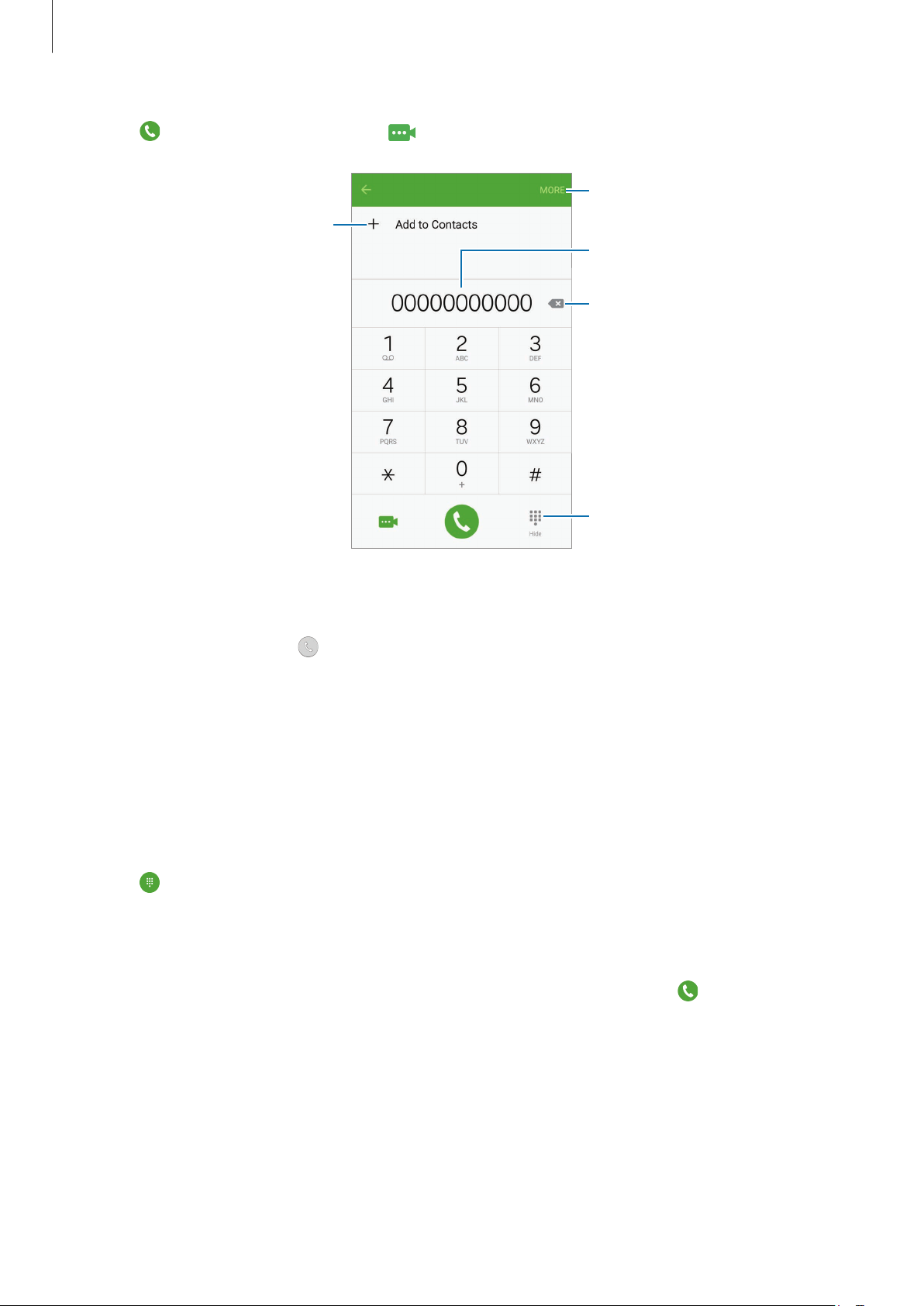
Enter a phone number.
If the keypad does not appear on the screen, tap
to open the keypad.
Applications
49
3
Tap to make a voice call, or tap to make a video call.
Add the number to the contacts
list.
Preview the phone number.
Hide the keypad.
Delete a preceding character.
Access additional options.
Making calls from the locked screen
On the locked screen, drag
outside the large circle.
Making calls from call logs or contacts list
Tap
LOG
or
CONTACTS
, and then swipe to the right on a contact or a phone number to make
a call.
Making an international call
1
Tap to open the keypad if the keypad does not appear on the screen.
2
Tap and hold 0 until the + sign appears.
3
Enter the country code, area code, and phone number, and then tap .

Applications
50
Receiving calls
Answering a call
When a call comes in, drag
outside the large circle.
Rejecting a call
When a call comes in, drag
outside the large circle.
To send a message when rejecting an incoming call, drag the reject message bar upwards.
To create various rejection messages, open the Apps screen and tap
Phone
→
MORE
→
Settings
→
Call rejection
→
Rejection messages
, enter a message, and then tap .
Missed calls
If a call is missed, the
icon appears on the status bar. Open the notification panel to view
the list of missed calls. Alternatively, on the Apps screen, tap
Phone
→
LOG
to view missed
calls.
Options during calls
During a voice call
The following actions are available:
•
Add call
: Dial a second call.
•
Extra volume
: Increase the volume.
•
Bluetooth
: Switch to a Bluetooth headset if it is connected to the device.
•
Speaker
: Activate or deactivate the speakerphone. When using the speakerphone, speak
into the microphone at the top of the device and keep the device away from your ears.
•
Keypad
/
Hide
: Open or close the keypad.
•
Mute
: Turn off the microphone so that the other party cannot hear you.
•
Email
: Send an email.
•
Message
: Send a message.

Applications
51
•
Internet
: Browse webpages.
•
Contacts
: Open the contacts list.
•
S Planner
: Open the calendar.
•
Memo
: Create a memo.
•
: End the current call.
During a video call
Tap the screen to use the following options:
•
: Switch between the front and rear cameras.
•
: End the current call.
•
: Turn off the microphone so that the other party cannot hear you.
Contacts
Introduction
Create new contacts or manage contacts on the device.
Adding contacts
Creating contacts manually
1
Tap
Contacts
on the Apps screen.
2
Tap and select a storage location.
3
Enter contact information.
•
: Add an image.
•
/ : Add or delete a contact field.
4
Tap
SAVE
.

Applications
52
To add a phone number to the contacts list from the keypad, open the Apps screen and tap
Phone
. If the keypad does not appear on the screen, tap to open the keypad. Enter the
number and tap
Add to Contacts
.
To add a phone number to the contacts list from received calls or messages, open the Apps
screen and tap
Phone
→
LOG
→
a contact.
Importing contacts
Import contacts from storage services to your device.
On the Apps screen, tap
Contacts
→
MORE
→
Settings
→
Import/Export contacts
→
IMPORT
and select an import option.
Searching for contacts
On the Apps screen, tap
Contacts
.
Use one of the following search methods:
•
Scroll up or down the contacts list.
•
Drag a finger along the index at the right side of the contacts list to scroll through it
quickly.
•
Tap the search field at the top of the contacts list and enter search criteria.
Once a contact is selected, take one of the following actions:
•
: Add to favourite contacts.
•
/ : Make a voice or video call.
•
: Compose a message.
•
: Compose an email.

Applications
53
Sharing profile
Share your profile information, such as your photo and status message, with others using the
profile sharing feature.
•
This feature may not be available depending on the region or service provider.
•
This feature is only available for contacts who have activated the profile sharing
feature on their device.
On the Apps screen, tap
Contacts
→
your profile
→
Profile sharing
, and then tap the switch
to activate it. If you are using this feature for the first time, read and agree to the terms and
conditions. Your phone number will be verified and then the profile sharing feature will be
activated.
To set additional items to share, tap
Shared profile info
and select items.
To set a contact group to share your profile with, select a contact group under
Share with
.
Messages
Introduction
Send and view messages by conversation.
Sending messages
You may incur additional charges for sending messages when you are roaming.
1
Tap
Messages
on the Apps screen.
2
Tap .
Applications
54
3
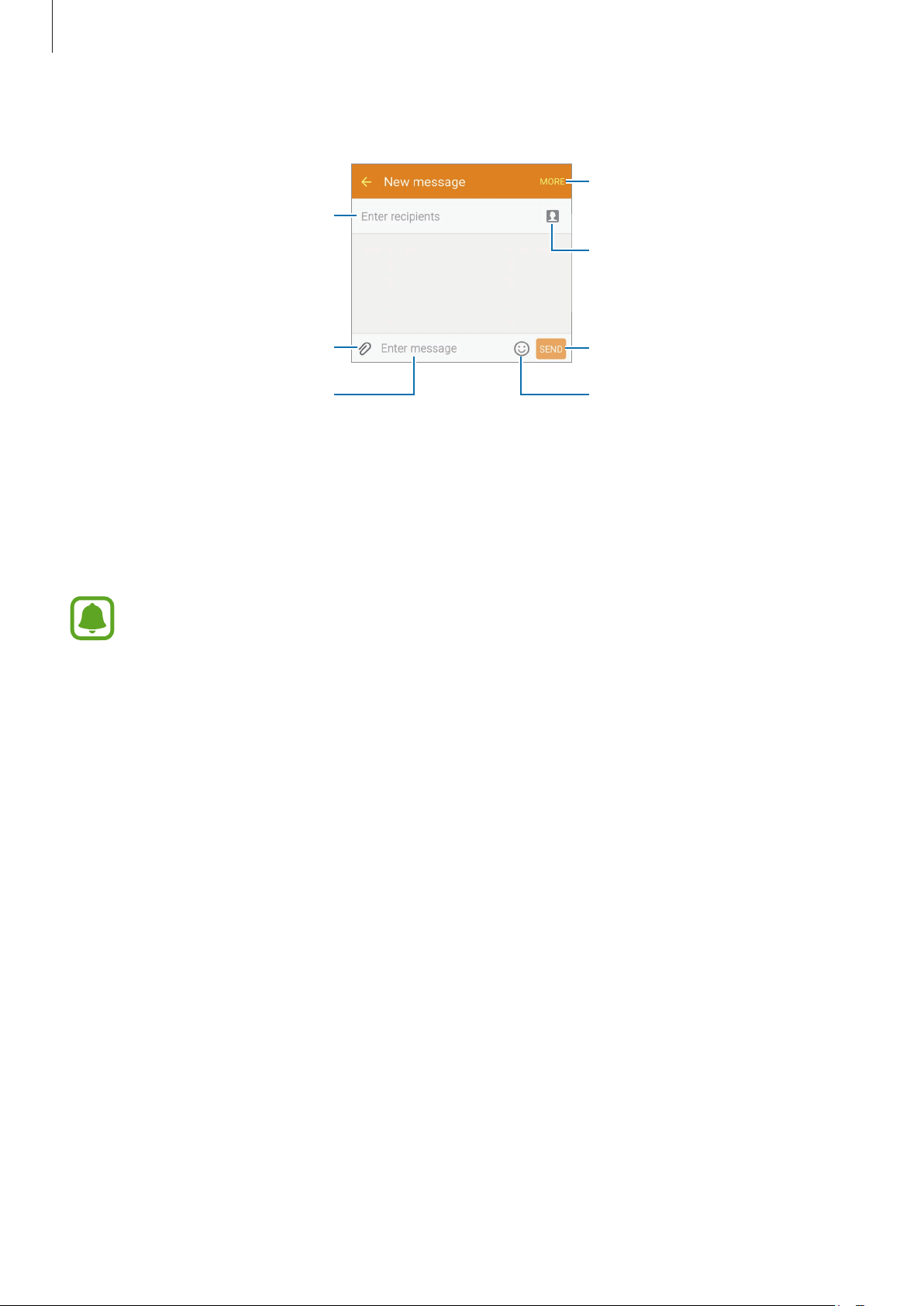
Add recipients and enter a message.
Access additional options.
Enter a message.
Select contacts from the
contacts list.
Enter emoticons.
Enter recipients.
Attach files.
Send the message.
4
Tap
SEND
to send the message.
Viewing messages
Messages are grouped into message threads by contact.
You may incur additional charges for receiving messages when you are roaming.
1
Tap
Messages
on the Apps screen.
2
On the messages list, select a contact.
3
View your conversation.
Applications
55
Internet
Browse the Internet to search for information and bookmark your favourite webpages to
access them conveniently.
1
Tap
Internet
on the Apps screen.
2
Tap the address field.
3
Enter the web address or a keyword, and then tap
Go
.
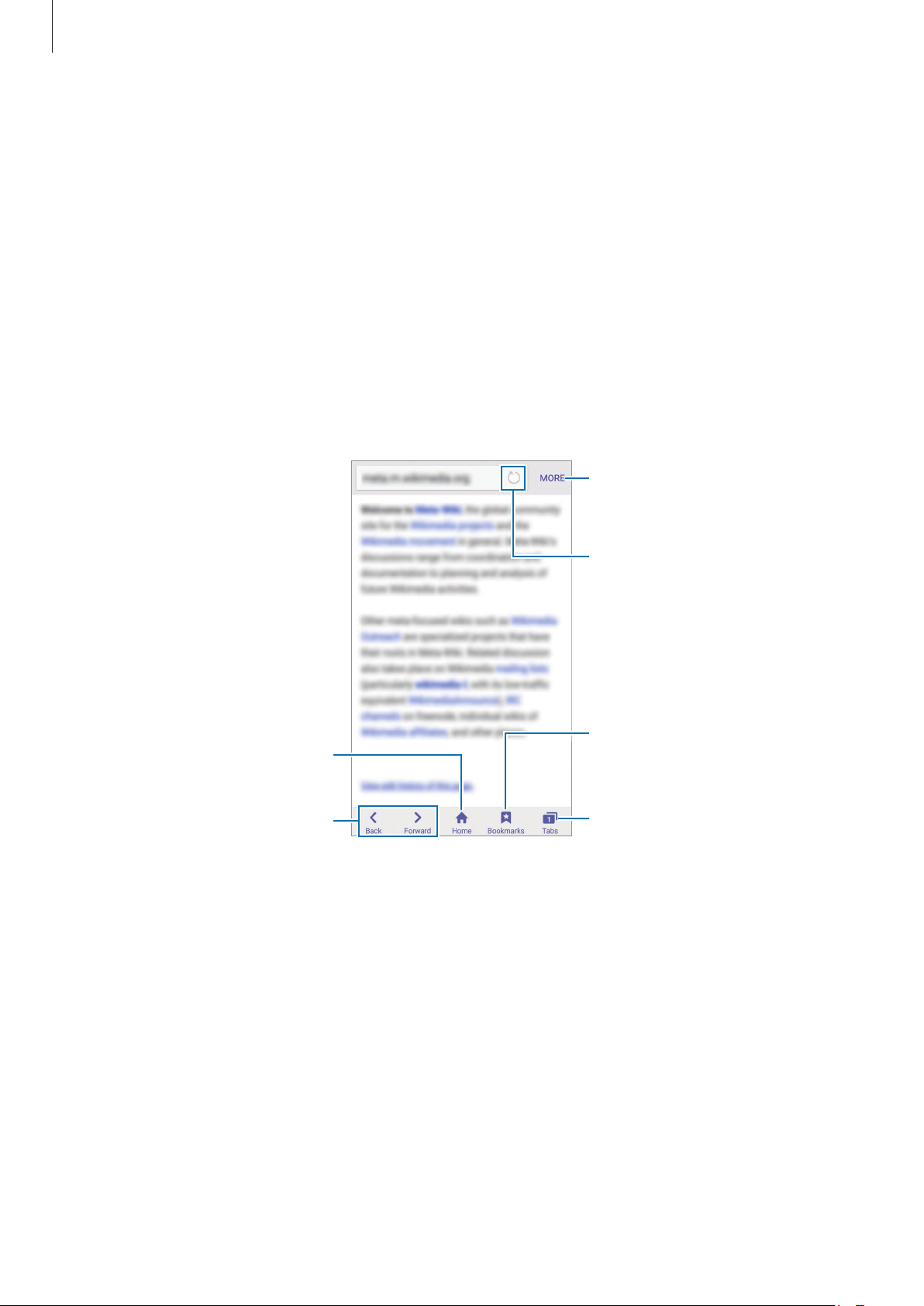
To view the toolbars, drag your finger downwards slightly on the screen.
Open the homepage.
Move to the previously visited
page.
Open the browser's tab
manager.
Access additional options.
Refresh the current webpage.
View your bookmarks, saved
webpages, and recent history.

Applications
56
Email
Setting up email accounts
Set up an email account when opening
Email
for the first time.
1
Tap
Email
on the Apps screen.
2
Enter the email address and password, and then tap
NEXT
.
To manually register a company email account, tap
MANUAL SETUP
.
3
Follow the on-screen instructions to complete the setup.
To set up another email account, tap
MORE
→
Settings
→
Add account
.
If you have more than one email account, you can set one as the default account. Tap
MORE
→
Settings
→
MORE
→
Set default account
.
Sending emails
1
Tap to compose an email.
2
Add recipients and enter an email text.
3
Tap
SEND
to send the mail.
Reading emails
On the emails list, tap an email to read.

Applications
57
Camera
Introduction
Take photos and record videos using various modes and settings.
Basic shooting
You can take photos or record videos. View your photos and videos in
Gallery
.
Tap
Camera
on the Apps screen.
Camera etiquette
•
Do not take photos or record videos of other people without their permission.
•
Do not take photos or record videos where legally prohibited.
•
Do not take photos or record videos in places where you may violate other people’s
privacy.
Taking photos or recording videos
1
Tap the image on the preview screen where the camera should focus.
2
Tap to take a photo or tap to record a video.
•
Spread two fingers apart on the screen to zoom in, and pinch to zoom out.
•
To capture an image from the video while recording, tap
Capture
.

Applications
58
•
To change the focus while recording a video, tap where you want to focus. To focus on
the centre of the screen, tap
.
Camera settings
Hide or show the
setting icons.
Quick settings
Record a video.
Take a photo.
Switch between the
front and rear
cameras.
Shooting modes
Preview thumbnail
Current mode
On the preview screen, swipe to the right to access the list of shooting modes. Or, swipe to
the left to view photos and videos you have captured.
•
The preview screen may vary depending on the shooting mode and which camera
is being used.
•
The camera automatically shuts off when unused.
•
Make sure that the lens is clean. Otherwise, the device may not work properly in
some modes that require high resolutions.
•
The front camera lens is suitable for taking wide-angle photos. Minor distortion
may occur in wide-angle photos and does not indicate device performance
problems.
•
The maximum recording time may reduce when you record video at high
resolution.
Applications
59
Launching Camera on the locked screen
To quickly take photos, launch
Camera
on the locked screen.
On the locked screen, drag
outside the large circle.
•
This feature may not be available depending on the region or service provider.
•
Some camera features are not available when you launch
Camera
from the locked
screen while the security features are activated.
Launching Camera quickly
Press the Home key twice quickly to launch
Camera
.
Camera
always launches in auto mode.
Some camera features are not available when you launch
Camera
from the locked
screen or when the screen is turned off while the security features are activated.
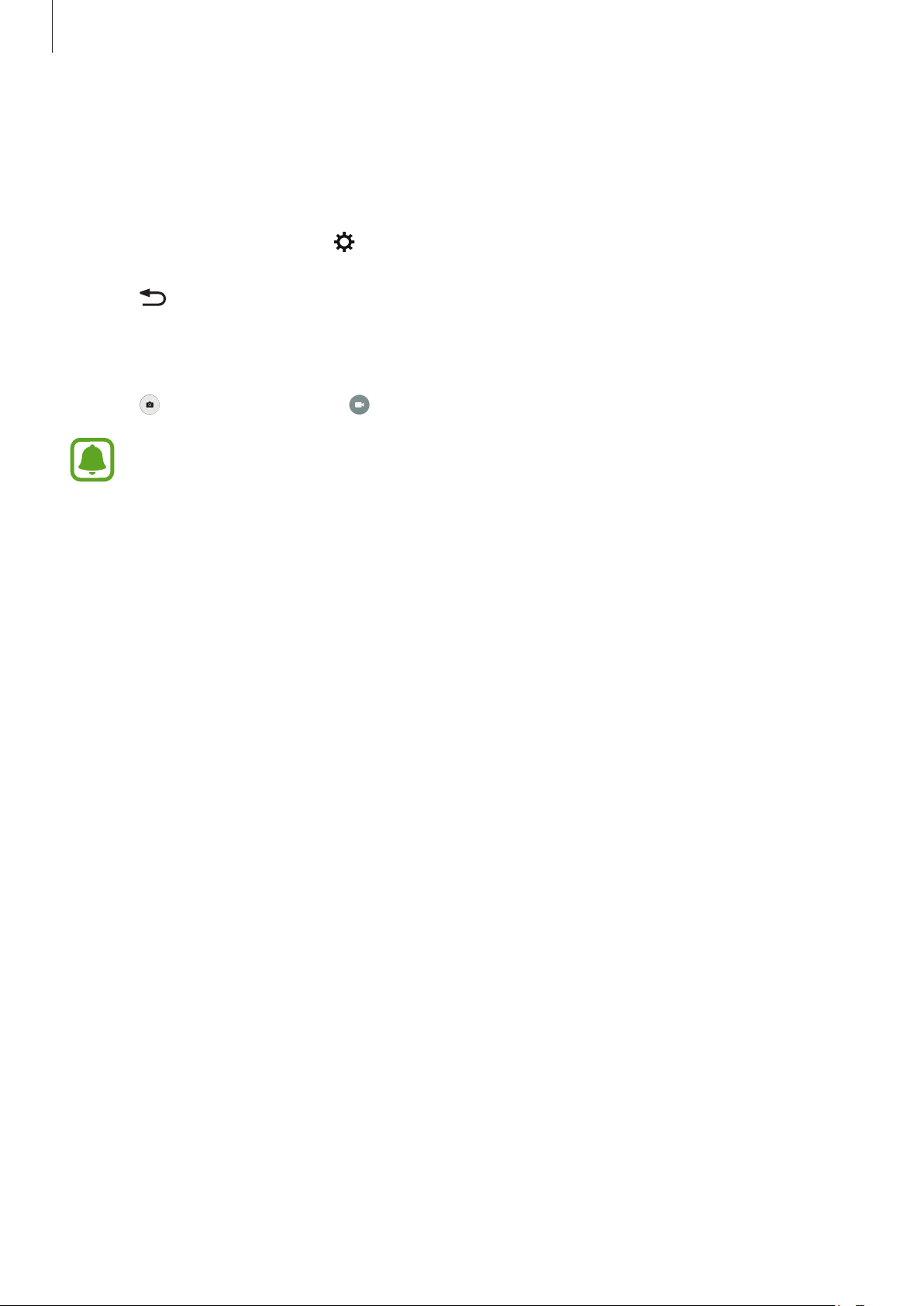
HDR (High Dynamic Range)
Take photos with rich colours and reproduce details even in bright and dark areas.
To activate or deactivate HDR mode, open the preview screen and tap
until you reach the
desired option.
•
: The device automatically activates HDR mode depending on the shooting
conditions.
•
: HDR mode is activated.
•
: HDR mode is deactivated.
Without effect With effect
Applications
60
Tracking AF
Set the device to track and automatically focus on a selected subject, even when the subject
is moving or when you change the shooting composition.
1
On the preview screen, tap and tap the
Tracking AF
switch to activate it.
2
Tap to return to the preview screen.
3
Tap the subject you want to track.
4
Tap to take a photo or tap to record a video.
Tracking a subject may fail in the following conditions:
•
The subject is too big or too small.
•
The subject moves excessively.
•
The subject is backlit or you are shooting in a dark place.
•
Colours or patterns on the subject and the background are the same.
•
The subject includes horizontal patterns, such as blinds.
•
The camera shakes excessively.
•
The video resolution is high.
Auto mode
Auto mode allows the camera to evaluate the surroundings and determine the ideal mode
for the photo.
On the preview screen, tap
MODE
→
Auto
.
Locking the focus and exposure
Strong light/dark contrast and the subject being outside the auto focus area may make it
difficult to achieve an appropriate exposure. Lock the focus or exposure and then take a
photo. Tap and hold the area to focus, the AF/AE frame will appear on the area and the focus
and exposure setting will be locked. The setting remains locked even after you take a photo.

Applications
61
Pro mode
Take photos while manually adjusting various shooting options, such as exposure value and
ISO value.
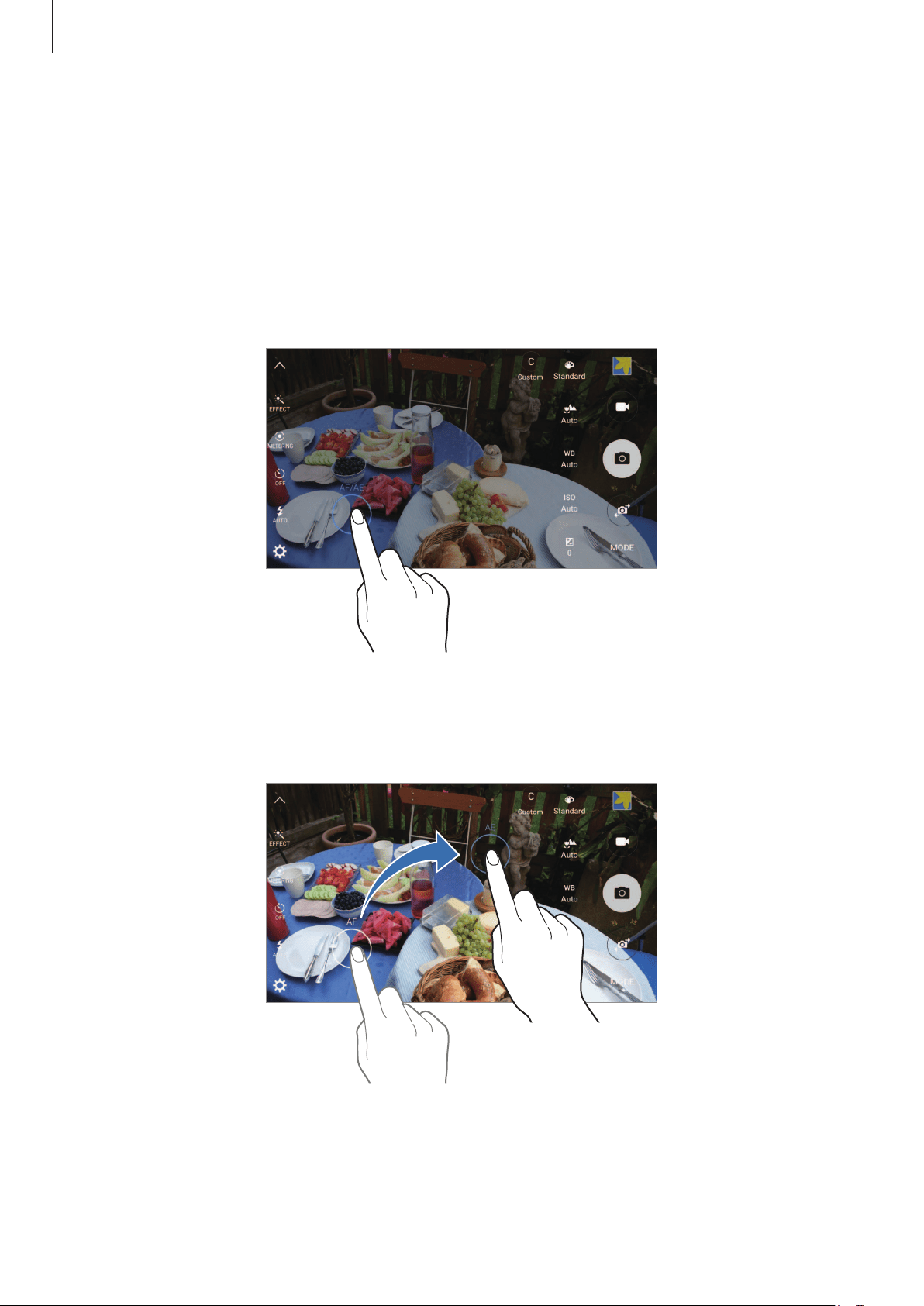
On the preview screen, tap
MODE
→
Pro
. Select options and customise the settings, and
then tap
to take a photo.
•
: Select a colour effect. To create your own colour effect, tap
Preset 1
or
Preset 2
.
•
: Change the focus mode. Drag the adjustment bar towards or to manually
adjust the focus. To switch to auto focus mode, drag the adjustment bar towards
AUTO
.
•
: Select an appropriate white balance, so images have a true-to-life colour range.
•
: Select an ISO value. This controls camera light sensitivity. Low values are for
stationary or brightly lit objects. Higher values are for fast-moving or poorly lit objects.
However, higher ISO settings can result in noise in photos.
•
: Change the exposure value. This determines how much light the camera’s sensor
receives. For low-light situations, use a higher exposure.
Saving the current setting as a custom setting
On the preview screen, tap
Custom
→
Save current settings
, select a name, and then tap
SAVE
.
To apply the saved settings to the camera, open the preview screen, tap
Custom
, and then
select a name.
Applications
62
Separating the exposure area and the focus area
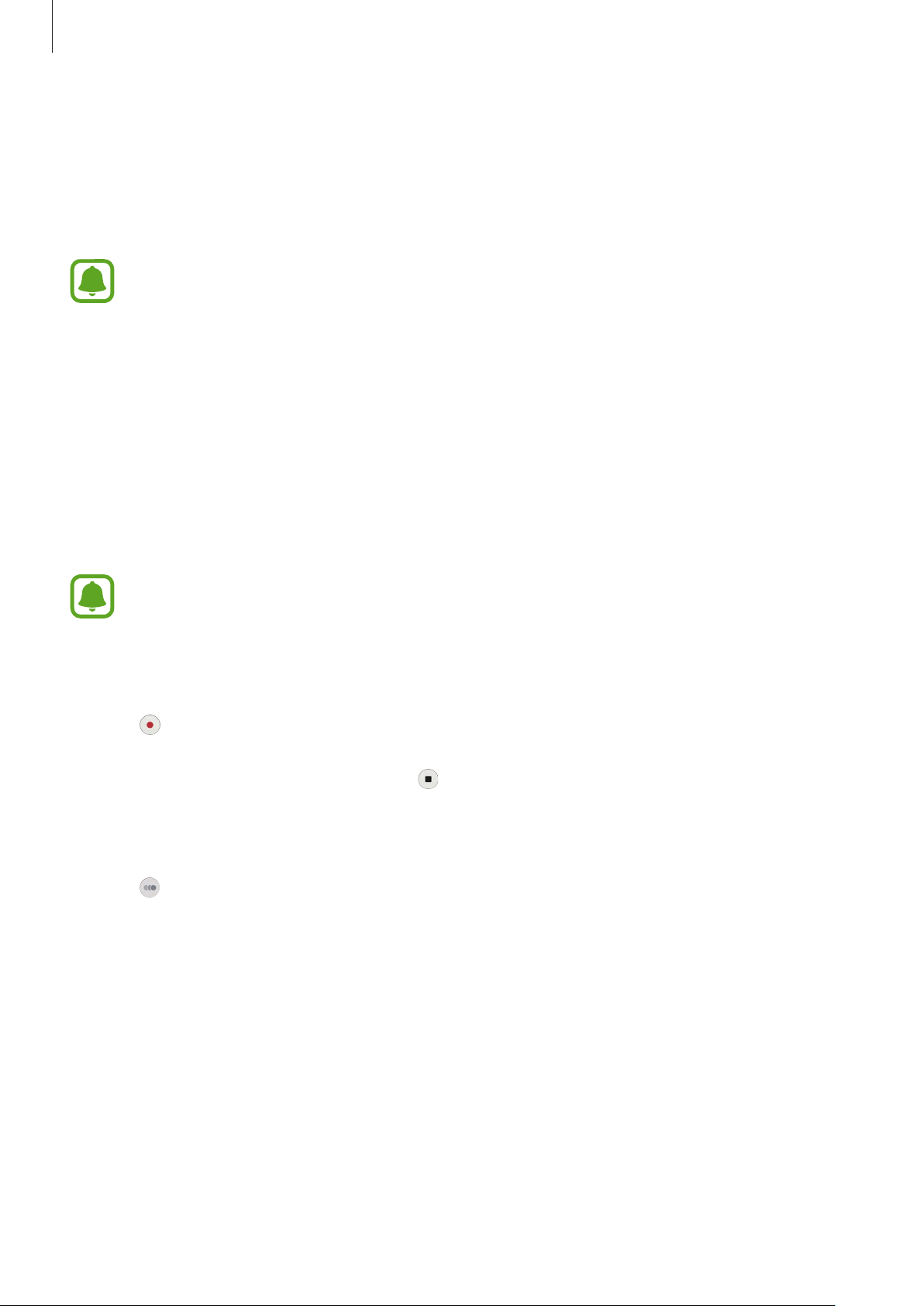
If bright light affects the contrast or the subject is outside the auto focus area, use this feature
to achieve an appropriate exposure. You can separate the exposure and focus areas and select
the exposure level you want for the subject.
1
On the preview screen, tap and hold the area to focus.
The AF/AE frame will appear on the focus area.
2
Drag the AF/AE frame to the exposure area.
The exposure area will be separated from the focus area.

Applications
63
Selective focus
Use the out-of-focus effect to make specific objects stand out in a photo.
1
On the preview screen, tap
MODE
→
Selective focus
.
2
Tap the image on the preview screen where the camera should focus.
3
Tap to take a photo.
4
Tap the preview thumbnail.
5
Tap and select one of the following:
•
Near focus
: Make the subject stand out and blur the background around the subject.
•
Far focus
: Blur the subject and make the background stand out around the subject.
•
Pan focus
: Make the subject and its background stand out.
6
Tap
SAVE
.
•
It is recommended that you position subjects within 50 cm of the device. Position
the subject that you want to focus on close to the device.
•
When taking photos, ensure there is sufficient distance between the subject
and the background. The distance should be more than three times the distance
between the device and the subject.
•
The quality of photos taken by the device can be affected in the following
conditions:
–
The device or the subject is moving.
–
There is strong background light, low levels of light, or you are taking photos
indoors.
–
The subject or background has no pattern, or consists of a plain colour.
Applications
64
Panorama
Take a series of photos horizontally or vertically and then stitch them together to create a
wide scene.
On the preview screen, tap
MODE
→
Panorama
.
To get the best shots using panorama mode, follow these tips:
•
Move the camera slowly in one direction.
•
Keep the image within the frame on the camera’s viewfinder.
•
Avoid taking photos of indistinct backgrounds, such as an empty sky or a plain
wall.
Slow motion
Record a video for viewing it in slow motion. You can specify sections of your videos to be
played in slow motion.
The focal length may become shorter when using this mode.
1
On the preview screen, tap
MODE
→
Slow motion
.
2
Tap to start recording.
3
When you are finished recording, tap to stop.
4
On the preview screen, tap the preview thumbnail.
5
Tap .
The video will start playing with a randomly set slow motion section.
Applications
65
Editing slow motion sections
1
On the preview screen, tap the preview thumbnail.
2
Tap .
The video will start playing with a randomly set slow motion section.
3
Tap to pause playback.
4
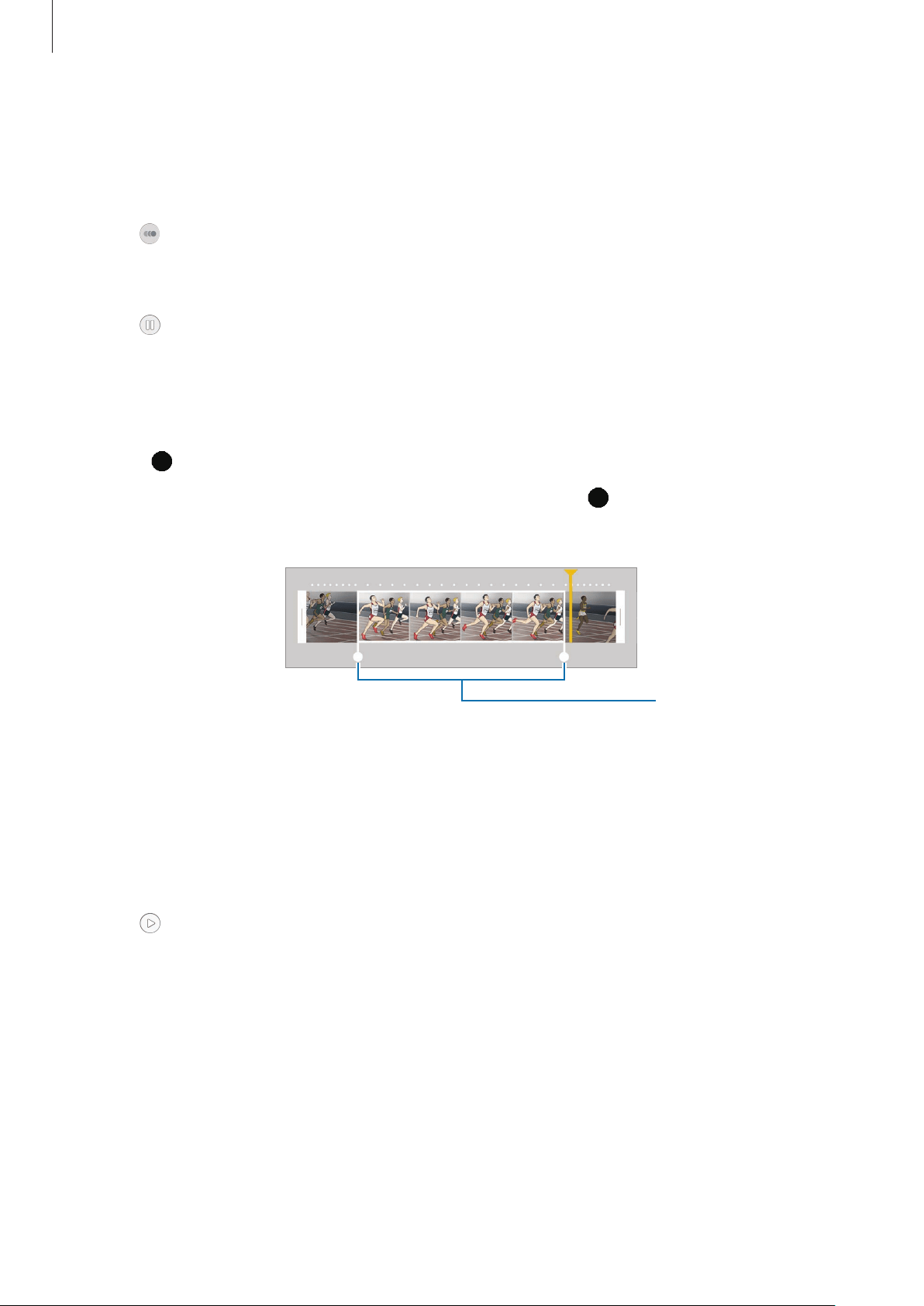
Drag the start bracket and the end bracket to the desired point to trim segments of a
video.
5
Drag to select the area of the video to be played in slow motion.
To set a slow motion section more precisely, tap and hold
, and then drag your finger
to the left or right to move through the section frame by frame.
Slow motion section
6
Tap the slow motion section and use the following options:
•
Speed
: Change the playback speed of the selected section.
•
Split
: Divide the section into two parts.
•
Delete
: Delete the section.
7
Tap to preview the video.
8
Tap
EXPORT
to save the video.

Applications
66
Fast motion
Record a video for viewing it in fast motion. You can specify sections of your videos to be
played in fast motion.
The focal length may become shorter when using this mode.
1
On the preview screen, tap
MODE
→
Fast motion
.
2
Tap to start recording.
3
When you are finished recording, tap to stop.
4
On the preview screen, tap the preview thumbnail.
5
Tap .
The video will start playing with a randomly set fast motion section.
Editing fast motion sections
1
On the preview screen, tap the preview thumbnail.
2
Tap .
The video will start playing with a randomly set fast motion section.
3
Tap to pause playback.
4
Drag the start bracket and the end bracket to the desired point to trim segments of a
video.

Applications
67
5
Drag to select the area of the video to be played in fast motion.
To set a fast motion section more precisely, tap and hold
, and then drag your finger to
the left or right to move through the section frame by frame.
Fast motion section
6
Tap the fast motion section and use the following options:
•
Speed
: Change the playback speed of the selected section.
•
Split
: Divide the section into two parts.
•
Delete
: Delete the section.
7
Tap to preview the video.
8
Tap
EXPORT
to save the video.
Applications
68
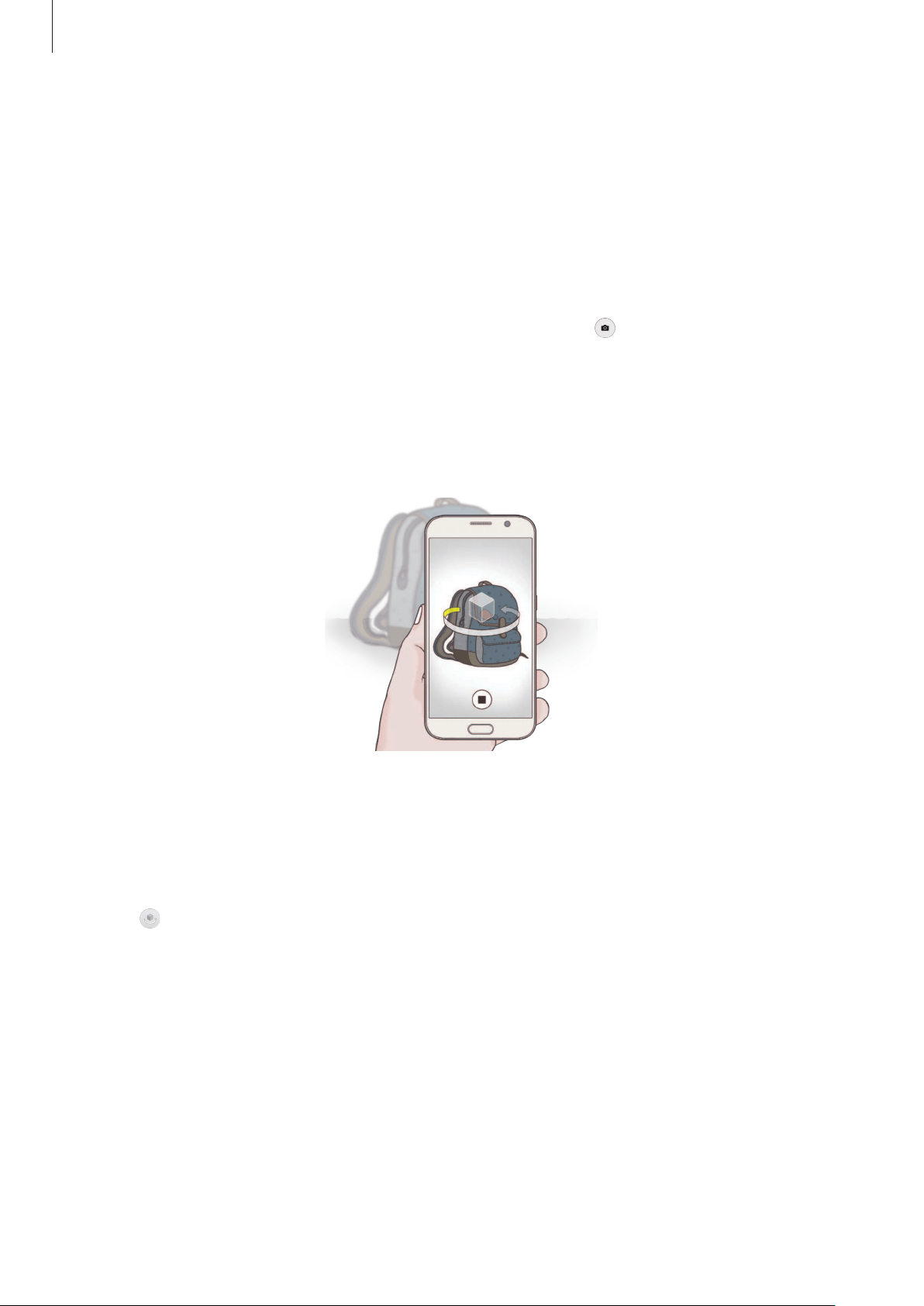
Virtual shot
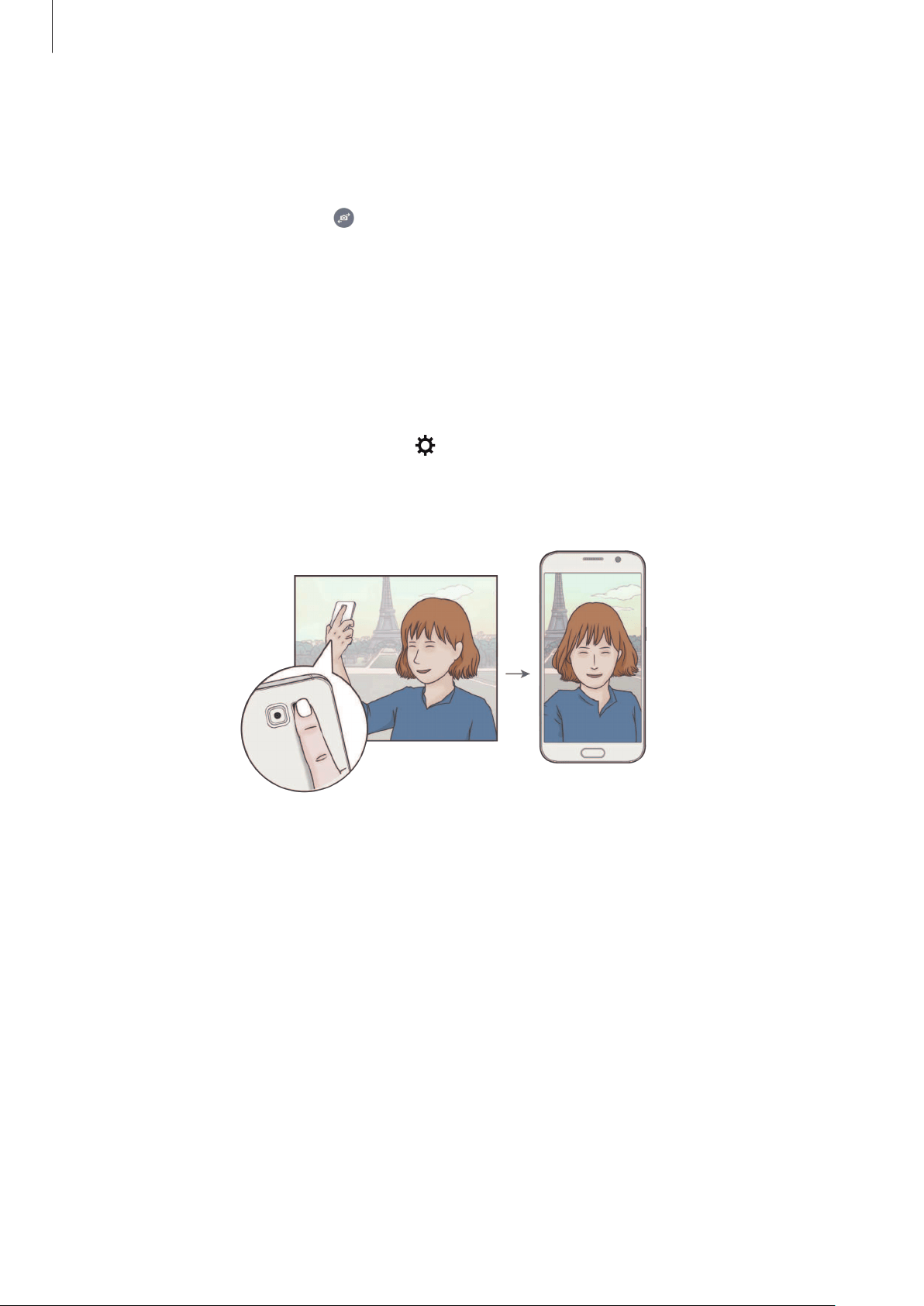
Take a series of photos while circling a subject to create a view of the subject from multi
angles. You can view the subject from different angles by dragging your finger left or right on
the photo.
1
On the preview screen, tap
MODE
→
Virtual shot
.
2
Place a subject in the centre of the preview screen and tap .
3
Move the device around the subject slowly in one direction to take more photos.
When the arrow becomes completely yellow or when you stop circling the subject, the
device will automatically stop taking photos.
Viewing virtual shot photos
1
On the preview screen, tap the preview thumbnail.
2
Tap .
3
Drag your finger left or right on the screen, or slowly swivel the device left or right to view
the subject from different angles.
Applications
69
Selfie
Take self-portraits with the front camera.
1
On the preview screen, tap to switch to the front camera for self-portraits.
2
Tap
MODE
→
Selfie
.
3
Face the front camera lens.
4
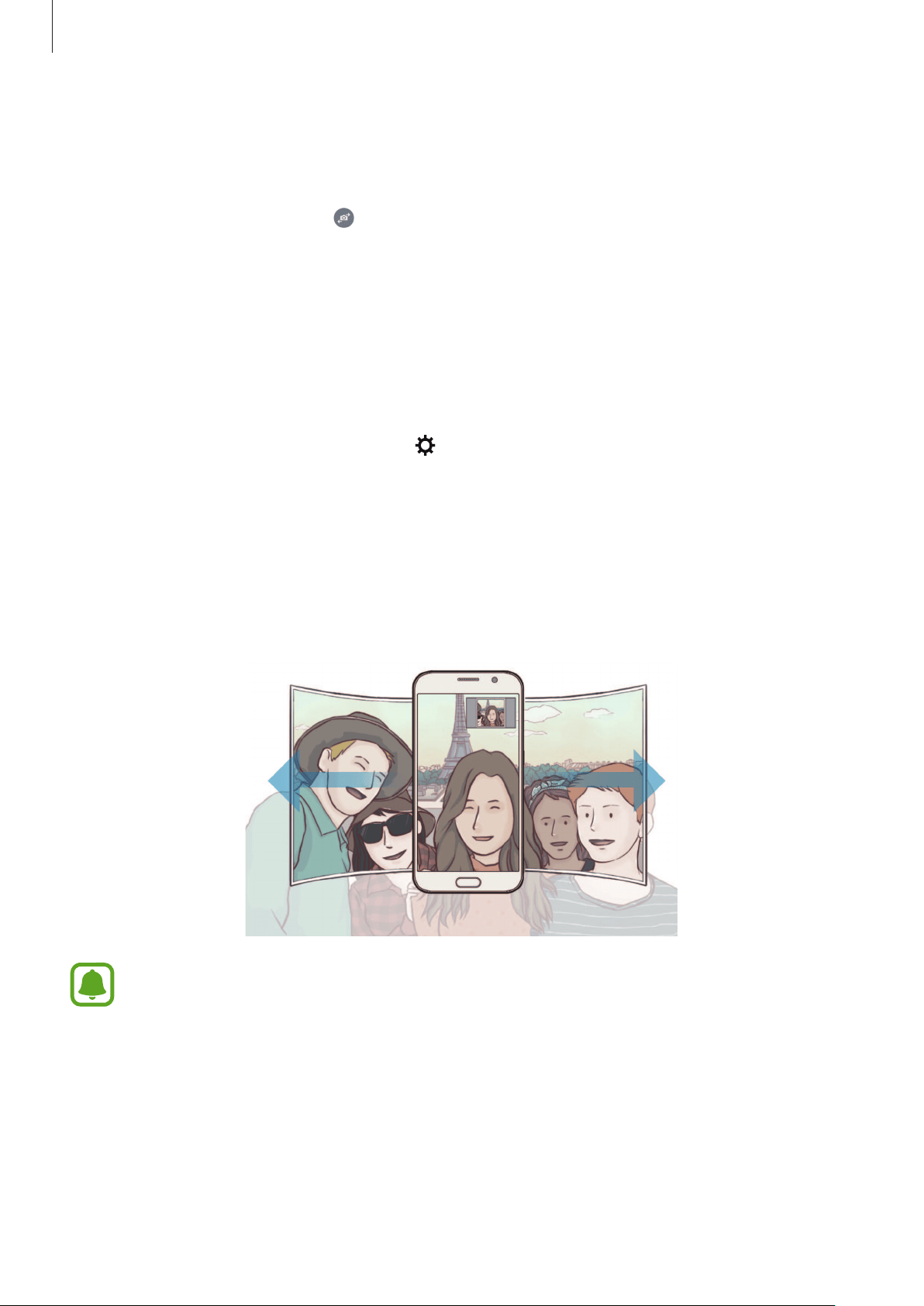
When the device detects your face, tap the sensor on the back of the device to take a
photo of yourself. You can also tap the screen to take a photo.
To take a photo using your palm, tap
and tap the
Gesture control
switch to activate it.
Show your palm to the front camera. After recognising your palm, the device will take a
photo after two seconds.
Applications
70
Wide selfie
Take a wide self-portrait to include more people in the photo and avoid leaving people out.
1
On the preview screen, tap to switch to the front camera for self-portraits.
2
Tap
MODE
→
Wide selfie
.
3
Face the front camera lens.
4
When the device detects your face, tap the sensor on the back of the device to take a
photo of yourself. You can also tap the screen to take a photo.
To take a photo using your palm, tap
and tap the
Gesture control
switch to activate it.
Show your palm to the front camera. After recognising your palm, the device will take a
photo after two seconds.
5
Slowly swivel the device left and then right or vice versa to take a wide self-portrait.
The device will take additional photos when the white frame moves to each end of the
viewfinder window.
•
Make sure to keep the white frame inside the viewfinder window.
•
The subjects should remain still while taking wide self-portraits.
•
The resolution of a photo may be affected by lighting conditions.
•
The top and bottom parts of the image displayed on the preview screen may be
cut out of the photo depending on the shooting conditions.
Applications
71
Interval shot
Take series of self-portraits at an interval and save photos you want.
1
On the preview screen, tap to switch to the front camera for self-portraits.
2
Tap
MODE
→
Interval shot
.
3
When the device detects your face, tap the sensor on the back of the device to take a
photo of yourself. You can also tap the screen to take a photo.
The device will take four photos at the two-second intervals.
To take a photo using your palm, tap
and tap the
Gesture control
switch to activate it.
Show your palm to the front camera. After recognising your palm, the device will take a
photo after two seconds.
4
Tick photos you want to save and tap
SAVE
.
Downloading modes
Download more shooting modes from
Galaxy Apps
.
On the preview screen, tap
MODE
→
Download
.
Some downloaded shooting modes do not have access to every feature. Swiping
right to view the modes list and swiping left to view captured images and videos may
not be available.
Applications
72
Camera settings
Quick settings
On the preview screen, use the following quick settings.
The available options may vary depending on the shooting mode and which camera
is being used.
•
: Select a filter effect to use when taking photos or recording videos. To download
more effects, tap
Download
.
•
: Use this to take photos with rich colours and reproduce details even in bright and
dark areas.
•
: Select a metering method. This determines how light values are calculated.
Centre-
weighted
uses the light in the centre portion of the shot to calculate the exposure of
the shot.
Spot
uses the light in a concentrated centre area of the shot to calculate the
exposure of the shot.
Matrix
averages the entire scene.
•
: Select the length of the delay before the camera automatically takes a photo.
•
: Adjust the slide bar to take a photo with lightened faces for gentler images.
•
: Activate or deactivate the flash.
Camera settings
On the preview screen, tap
.
The available options may vary depending on the shooting mode and which camera
is being used.
•
Picture size (rear)
/
Picture size (front)
: Select a resolution for photos. Using a higher
resolution will result in higher quality photos, but they will take up more memory.
•
Video size (rear)
/
Video size (front)
: Select a resolution for videos. Using a higher
resolution will result in higher quality videos, but they will take up more memory.
•
Gesture control
: Set the device to detect your palm, so you can use it to take self-
portraits.
•
Save as horizontally flipped
: Invert the image to create a mirror-image of the original
scene, when taking photos with the front camera.

Applications
73
•
Tracking AF
: Set the device to track and automatically focus on a selected subject, even
when the subject or camera moves.
•
Video stabilisation
: Activate anti-shake to reduce or eliminate blurriness resulting from
camera shake while recording a video.
•
Grid lines
: Display viewfinder guides to help composition when selecting subjects.
•
Location tags
: Attach a GPS location tag to the photo.
•
GPS signal strength may decrease in locations where the signal is obstructed, such
as between buildings or in low-lying areas, or in poor weather conditions.
•
Your location may appear on your photos when you upload them to the Internet.
To avoid this, deactivate the location tag setting.
•
Review pictures
: Set the device to show photos after capturing them.
•
Quick launch
: Set the device to launch the camera by pressing the Home key twice
quickly.
•
Voice control
: Set the device to take photos or record videos with voice commands.
You can say “Smile”, “Cheese”, “Capture”, or “Shoot” to take a photo. To record a video, say
“Record video.”
•
Volume keys function
: Set the device to use the Volume key to control the shutter or
zoom function.
•
Reset settings
: Reset the camera settings.
Gallery
Introduction
View and manage photos and videos stored in the device.
Viewing images or videos
1
Tap
Gallery
on the Apps screen.
Applications
74
2
Select an image or a video.
Video files show the
icon on the preview thumbnail. To play a video, tap .
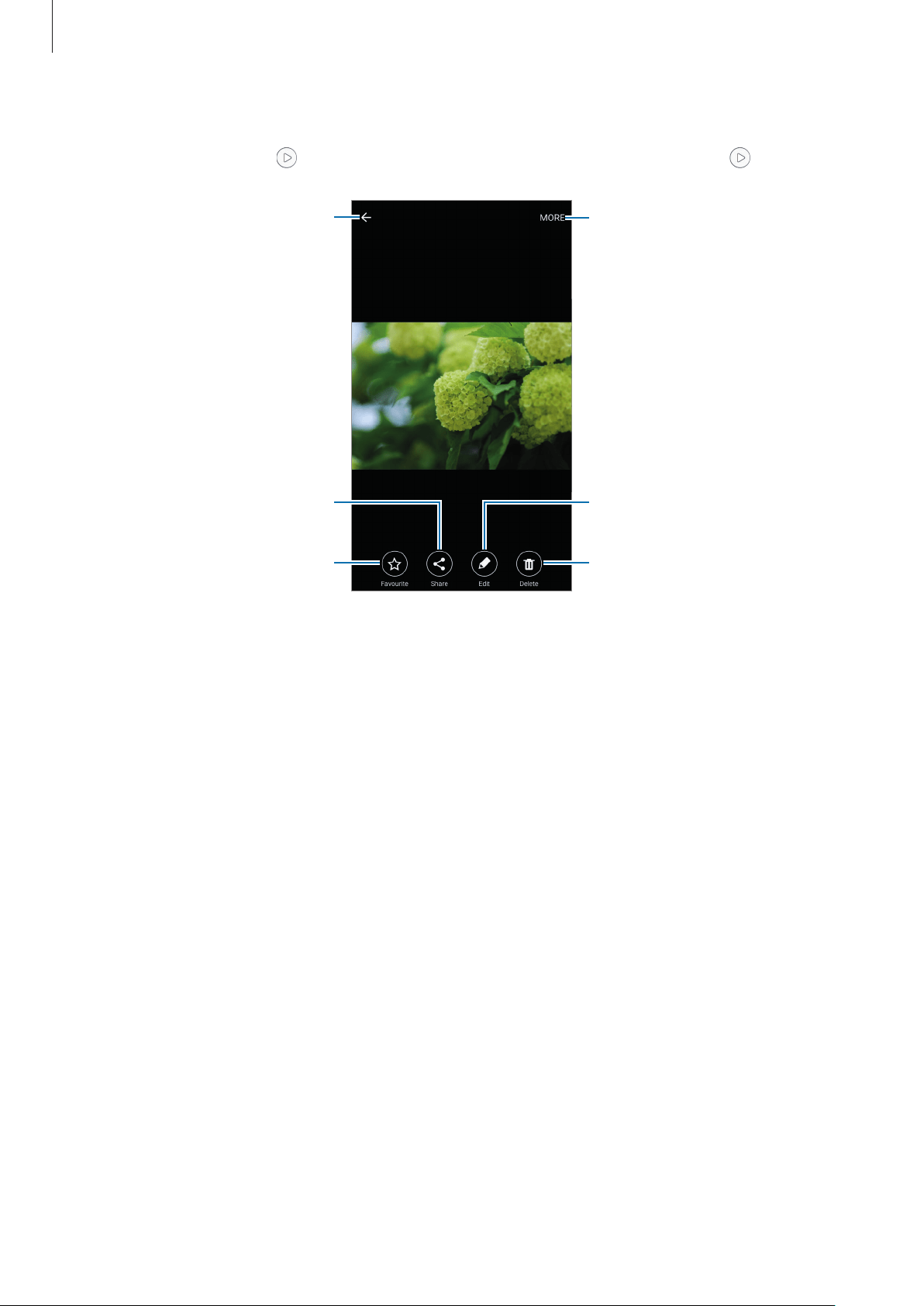
More options
Move to the previous screen.
Add the image to favourites.
Share the image with others.
Delete the image.
Modify the image.
To hide or show the menus, tap the screen.
Deleting images or videos
Deleting an image or a video
Select an image or a video and tap
Delete
at the bottom of the screen.
Deleting multiple images and videos
1
On the Gallery main screen, tap and hold an image or a video to delete.
2
Tick the images or videos to delete.
3
Tap
DELETE
.
Applications
75
Smart Manager
Introduction
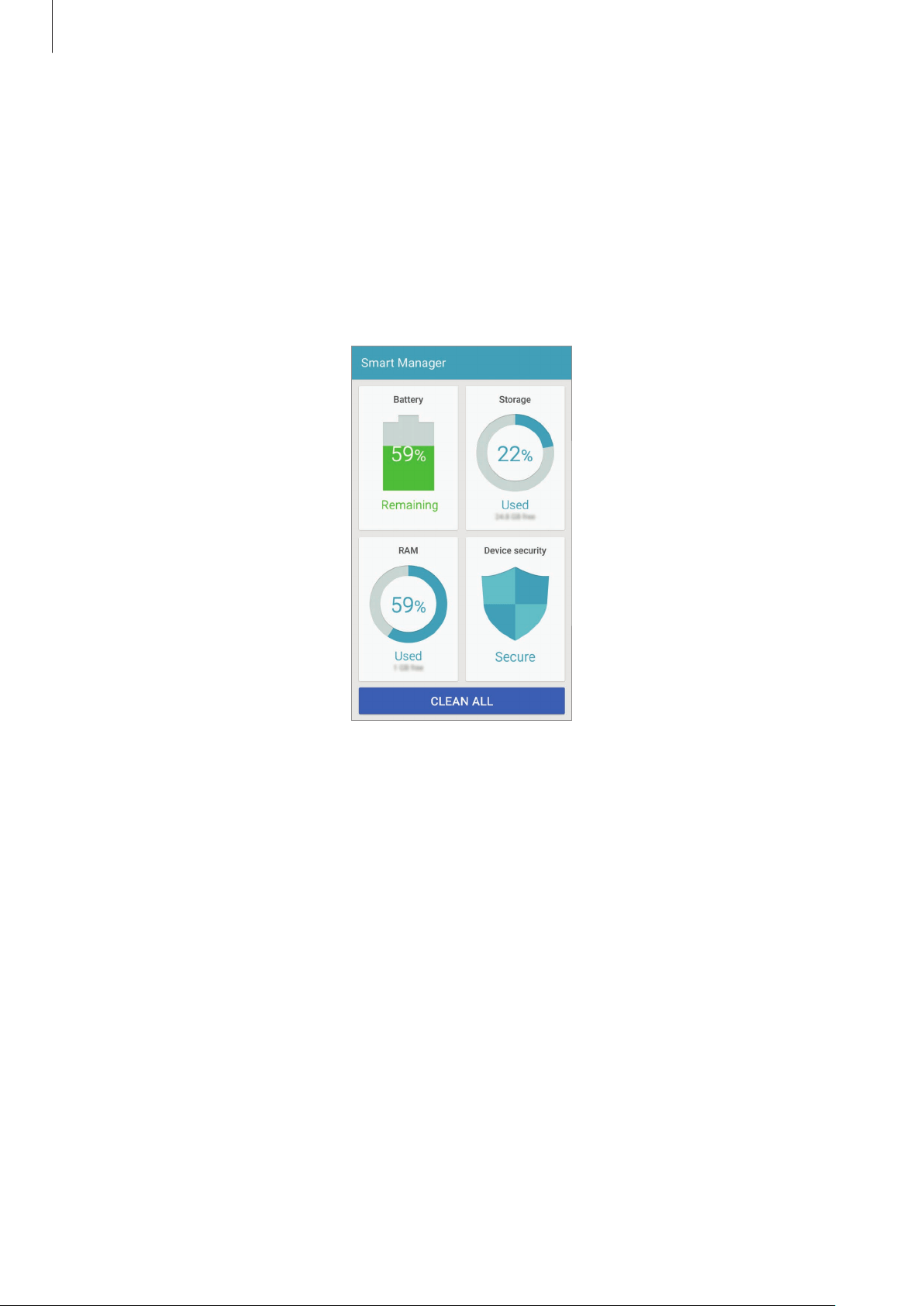
The Smart manager provides an overview of the status of your device’s battery, storage, RAM,
and system security. You can also automatically optimise the device with one tap of your
finger.
Using the quick optimisation feature
On the Apps screen, tap
Smart Manager
→
CLEAN ALL
.
The quick optimisation feature improves device performance through the following actions.
•
Identifying apps that use excessive battery power and clearing some memory.
•
Deleting unnecessary files and closing apps running in the background.
•
Scanning for malware and phishing attacks.

Applications
76
Using the Smart manager
On the Apps screen, tap
Smart Manager
and select a feature.
Battery
Check the remaining battery power and time to use the device. For devices with low battery
levels, conserve battery power by activating power saving features and closing apps that are
consuming an excessive amount of battery power.
The usage time left shows the time remaining before the battery power runs
out. Usage time left may vary depending on your device settings and operating
conditions.
Storage
Check the status of used and available memory capacity. You can delete unused and residual
files or uninstall apps that you do not use any more.
RAM
Check the amount of available RAM. You can close background apps and reduce the amount
of RAM you are using to speed up your device.
Device security
Check the device’s security status. This feature scans your device for malware and blocks
phishing attacks and malicious websites.
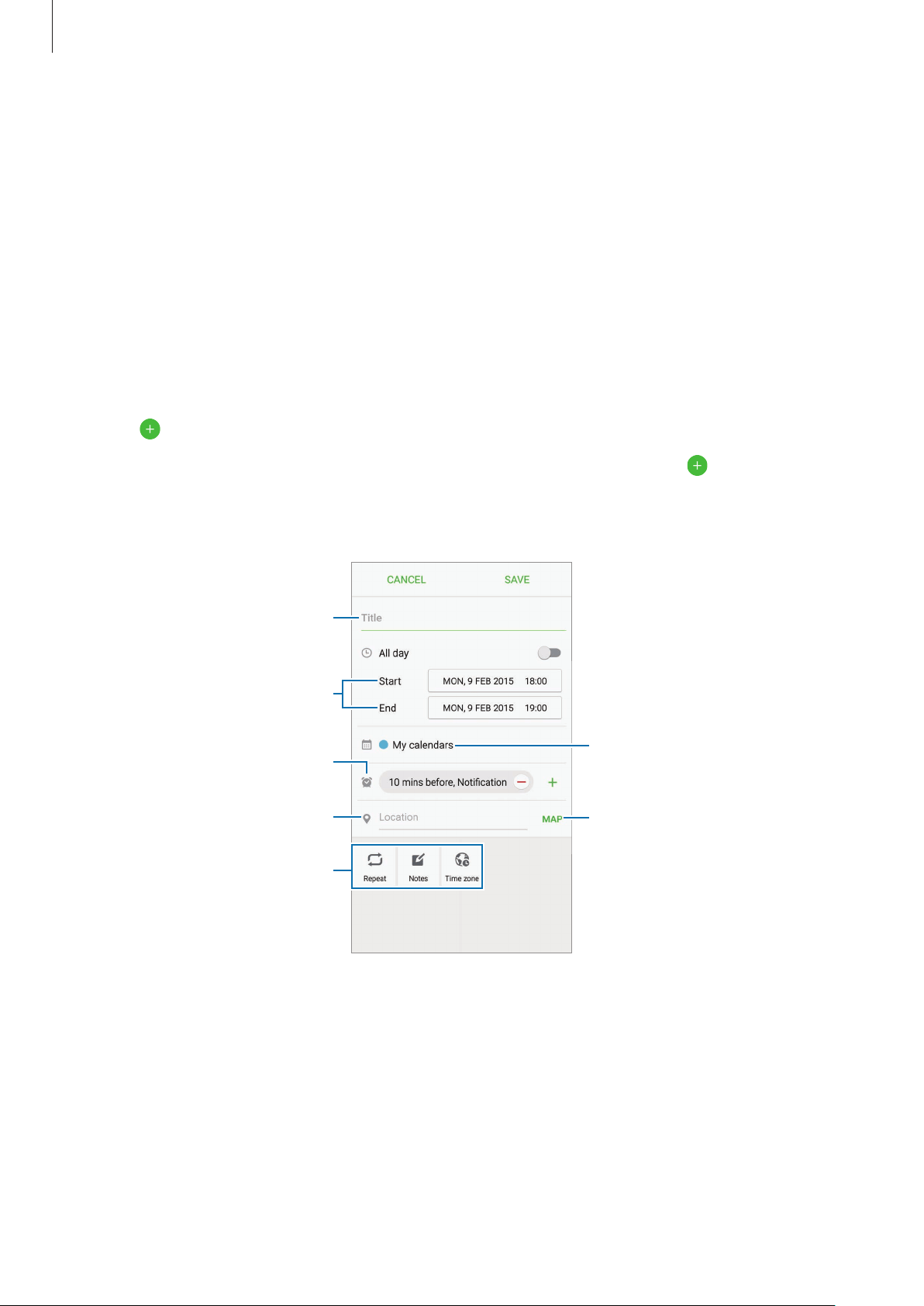
Applications
77
S Planner
Introduction
Manage your schedule by entering upcoming events or tasks in your planner.
Creating events
1
Tap
S Planner
on the Apps screen.
2
Tap or double-tap a date.
If the date already has saved events or tasks in it, tap the date and tap
.
3
Enter event details.
Select a calendar to use or sync
with.
Attach a map showing the
location of the event.
Enter the location of the event.
Enter a title.
Set a start and end date for the
event.
Add more details.
Set an alarm.
4
Tap
SAVE
to save the event.

Applications
78
Creating tasks
1
Tap
S Planner
on the Apps screen.
2
Tap
→
Tasks
.
3
Enter task details and tap
TO DAY
or
TOMORROW
to set a due date.
To add more details, tap
.
4
Tap
SAVE
to save the task.
Syncing events and tasks with your accounts
On the Apps screen, tap
Settings
→
Accounts
, select an account service, and then tap the
Sync Calendar
switch to sync events and tasks with the account.
To add accounts to sync with, open the Apps screen and tap
S Planner
→
MORE
→
Manage
calendars
→
Add account
. Then, select an account to sync with and sign in. When an
account is added, a green circle is displayed next to the account name.
S Health
Introduction
S Health helps you manage your wellness and fitness. Set fitness goals, check your progress,
and keep track of your overall wellness and fitness.
Starting S Health
When running this app for the first time or restart it after performing a data reset, follow the
on-screen instructions to complete the setup.
1
Tap
S Health
on the Apps screen.
2
Follow the on-screen instructions to complete the setup.
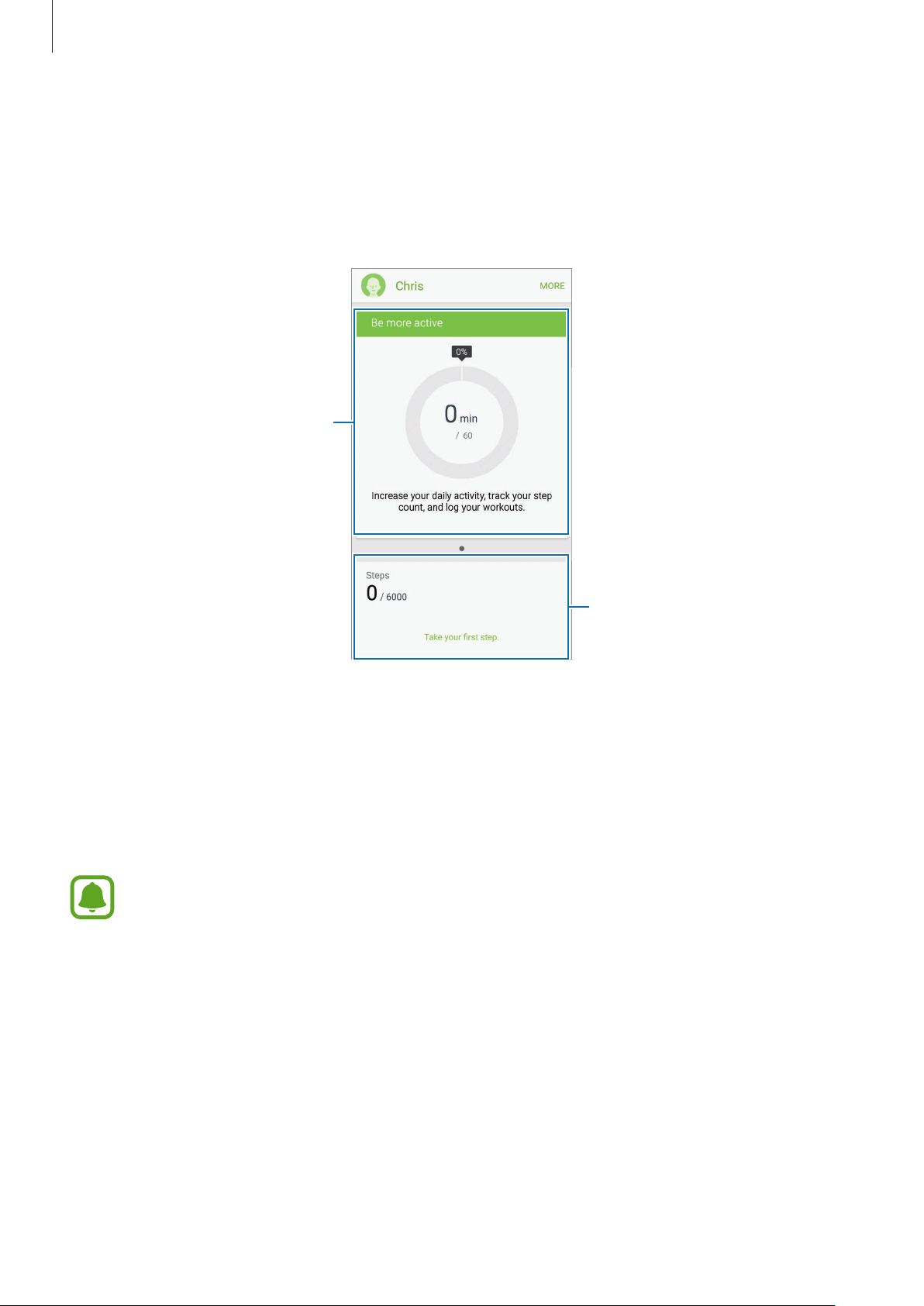
Applications
79
Using S Health
You can view the key information from S Health menus and trackers to monitor your wellness
and fitness.
Tap
S Health
on the Apps screen.
Trackers
Goals and programmes
•
GOALS
: Set your daily fitness goals and view your progress.
•
PROGRAMMES
: Use customisable exercise programmes.
•
TRACKERS
: Monitor your activities, food intake, and body measurements.
To add trackers, goals, or programmes to the S Health screen, tap
MORE
→
Manage items
,
and then select items under
TRACKERS
,
GOALS
, or
PROGRAMMES
tab.
To access more information about S Health functions, tap
MORE
→
Settings
→
Help
.

Applications
80
Additional information
•
S Health is intended for fitness and wellness purposes only and is not intended for use
in the diagnosis of disease or other conditions, or in the cure, mitigation, treatment, or
prevention of disease.
•
The available functions, features and addable applications for S Health may vary from
country to country due to different local laws and regulations. You should check the
features and applications available in your specific region before use.
•
S Health applications and its service can be changed or discontinued without prior
notice.
•
The purpose for data collection is limited to providing the service that you have
requested, including providing additional information to enhance your wellness, sync
data, data analysis and statistics or to develop and provide better services. (But if you
sign in to your Samsung account from S Health, your data may be saved on the server
for data backup purposes.) Personal information may be stored until the completion of
such purposes. You can delete personal data stored by S Health by using the Reset data
option in the Settings menu. To delete any data you have shared with social networks or
transferred to storage devices, you must delete them separately.
•
You may share and/or sync your data with additional Samsung services or compatible
third party services that you select, as well as with any of your other connected devices.
Access to S Health information by such additional services or third party devices will only
be permitted with your express approval.
•
You assume full responsibility for the inappropriate use of data shared on social networks
or transmitted to others. Use caution when sharing your personal data with others.
•
If the device is connected to measuring devices, verify the communication protocol to
confirm proper operation. If you use a wireless connection, such as Bluetooth, the device
may be affected by electronic interference from other devices. Avoid using the device
near other devices that transmit radio waves.
•
Please read Terms and Conditions and Privacy Policy of S Health carefully before using it.
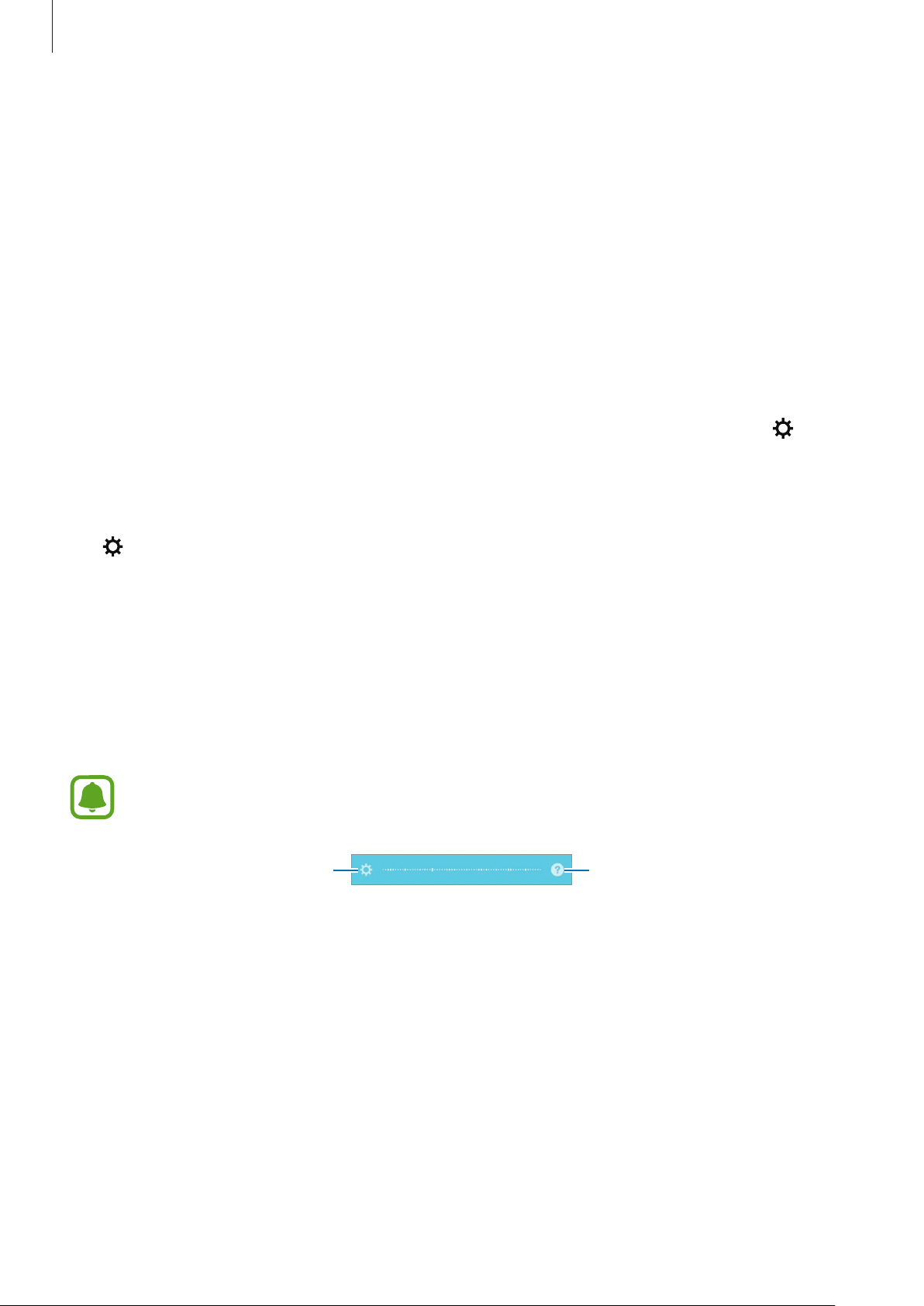
Applications
81
S Voice
Introduction
Perform various tasks simply by speaking.
Setting a wake-up command
You can launch
S Voice
using your own wake-up command.
When launching
S Voice
for the first time, tap
START
and set your own wake-up command.
To change the wake-up command, open the Apps screen and tap
S Voice
. Then, tap
→
Voice wake-up
→
Delete wake-up command
to reset the current setting. Tap the switch, tap
Set wake-up command
→
START
, and then follow the on-screen instructions.
To set the device to launch
S Voice
using the wake-up command while the device is locked,
tap
and tap the
Wake up in secured lock
switch to activate it.
Using S Voice
1
Say the preset wake-up command.
Alternatively, on the Apps screen, tap
S Voice
.
When
S Voice
is launched, the device begins voice recognition.
This app may not be available depending on the region or service provider.
View examples of voice
commands.
S Voice settings
Applications
82
2
Say a voice command.
If the device recognises the command, the device will perform the corresponding action.
To repeat a voice command or say a different command, tap
.
This app will close automatically if the device is not used for a specified period.
Tips for better voice recognition
•
Speak clearly.
•
Speak in quiet places.
•
Do not use offensive or slang words.
•
Avoid speaking in dialectal accents.
The device may not recognise your commands or may perform unwanted commands
depending on your surroundings or how you speak.
Setting the language
On the Apps screen, tap
S Voice
→
→
Language
, and then select a language.
The selected language is applied to
S Voice
only, not to the language displayed on
the device.
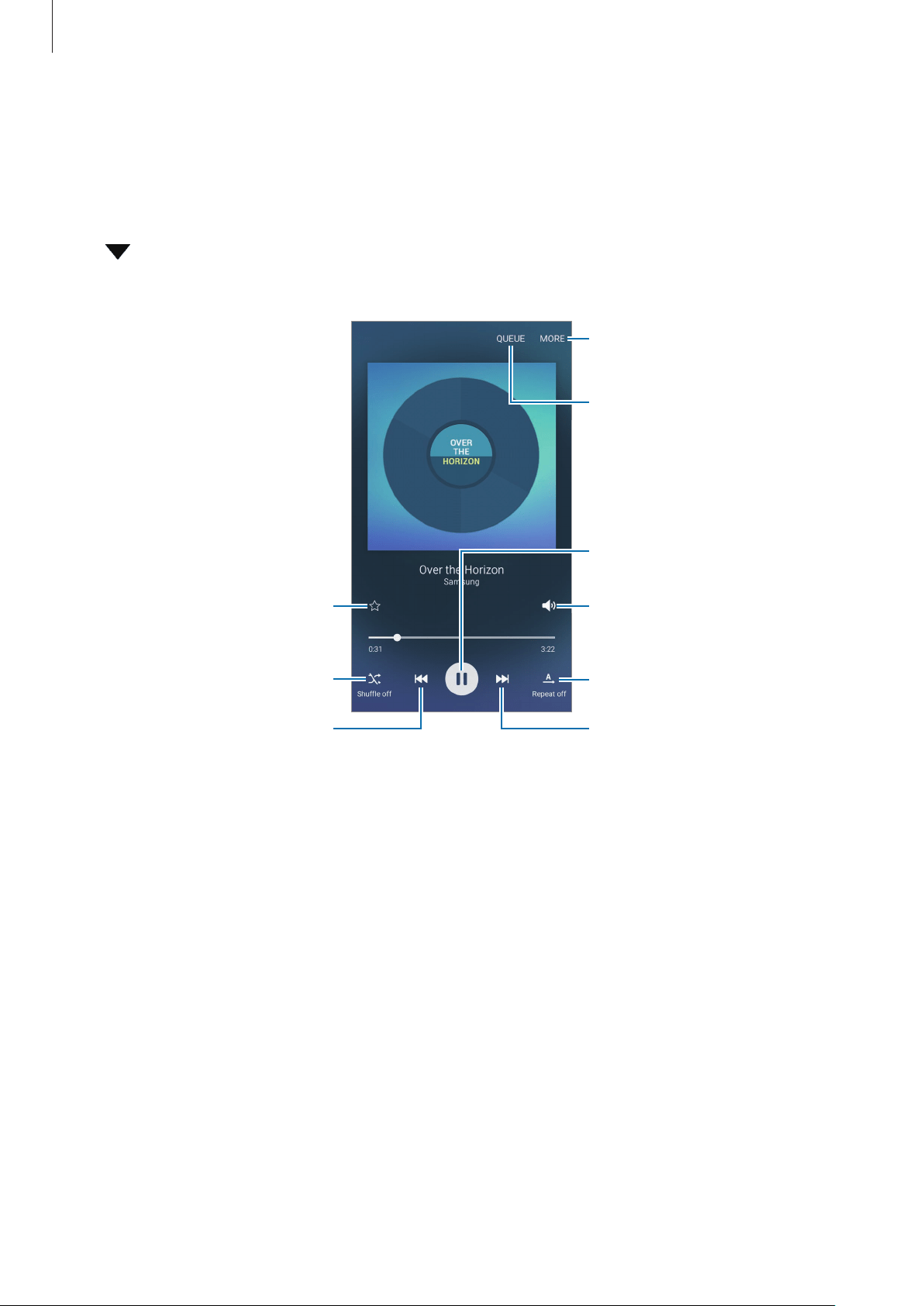
Applications
83
Music
Listen to music sorted by category and customise playback settings.
Tap
Music
on the Apps screen.
Tap
, select a category, and then select a song to play.
Tap the album image at the bottom of the screen to open the music player screen.
Change the repeat mode.
Skip to the next song. Tap and
hold to fast-forward.
Pause and resume playback.
Access additional options.
Adjust the volume.
Skip to the previous song. Tap
and hold to rewind.
Turn on shuffle.
Set the file as your favourite
song.
Open the playlist.
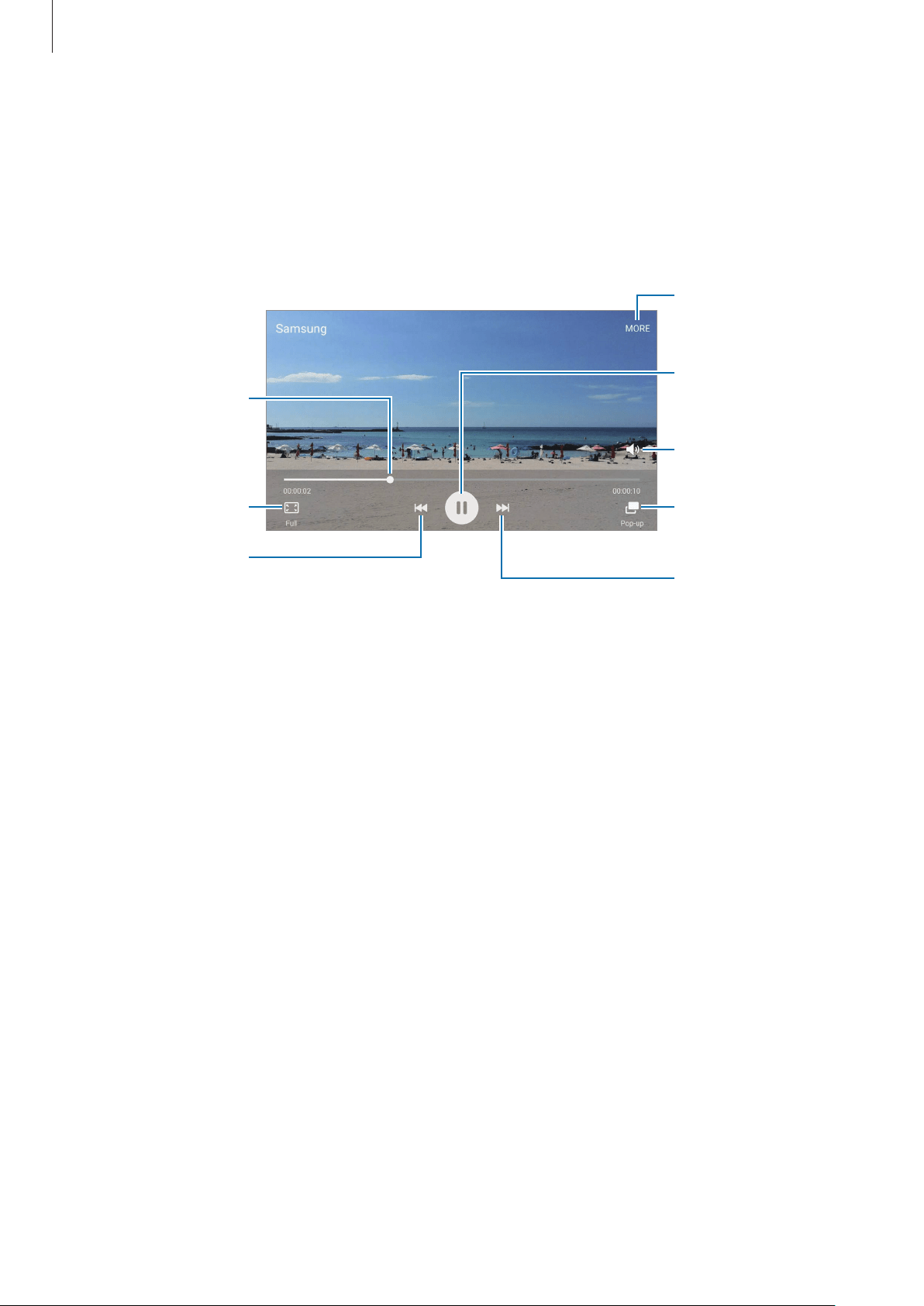
Applications
84
Video
Watch videos stored in the device and customise playback settings.
Tap
Video
on the Apps screen.
Select a video to play.
Change screen ratio.
Rewind or
fast-forward by
dragging the bar.
Skip to the previous
video. Tap and hold
to rewind.
Skip to the next
video. Tap and hold
to fast-forward.
Access additional
options.
Switch to the
pop-up video player.
Pause and resume
playback.
Adjust the volume.
Drag your finger up or down on the left side of the playback screen to adjust the brightness,
or drag your finger up or down on the right side of the playback screen to adjust the volume.
To rewind or fast-forward, swipe to the left or right on the playback screen.
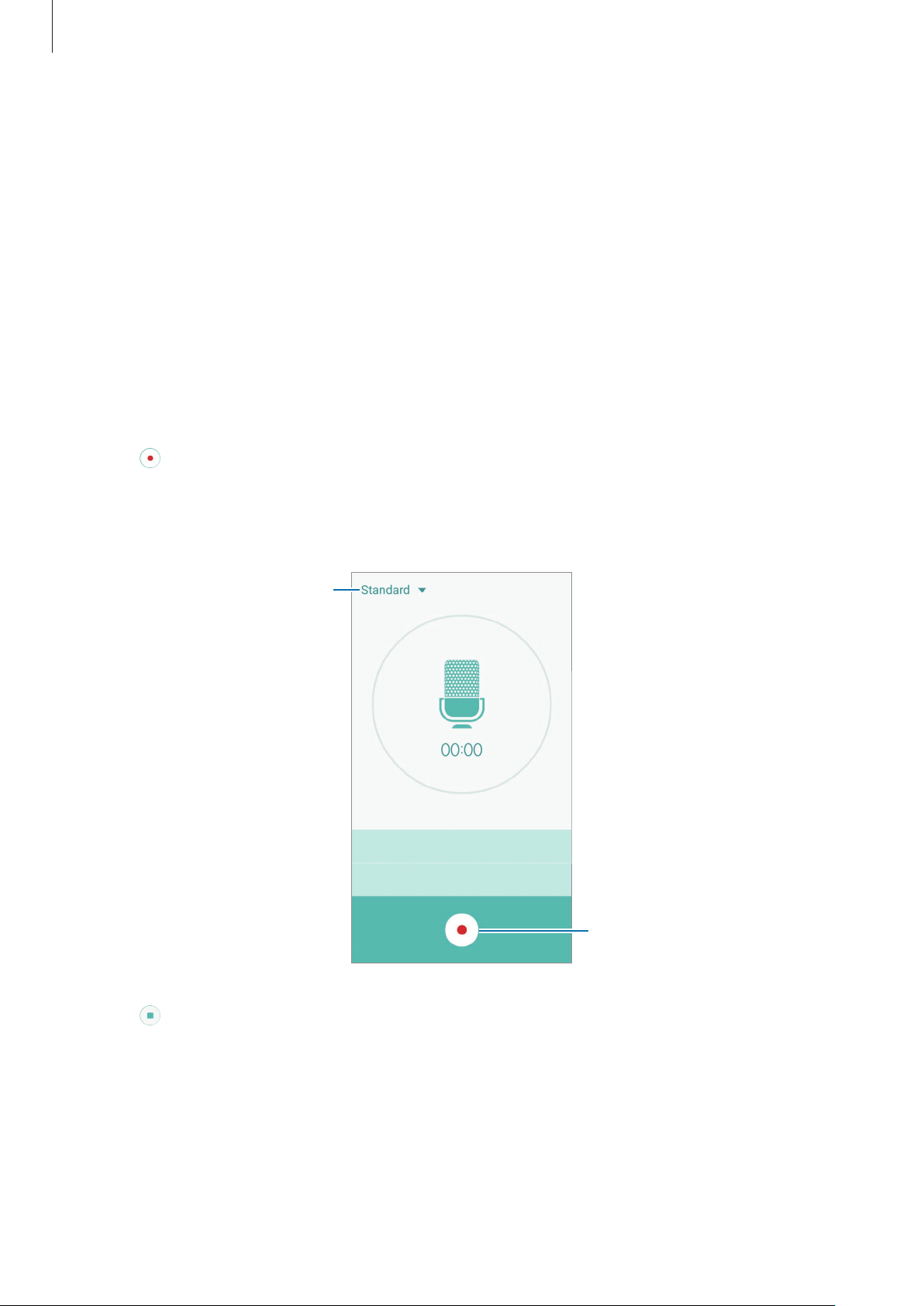
Applications
85
Voice Recorder
Introduction
Use different recording modes for various situations, such as in an interview. The device can
convert your voice to text and distinguish between sound sources.
Recording voice memos
1
On the Apps screen, tap
Tools
→
Voice Recorder
.
2
Tap to start recording. Speak into the microphone.
Tap
Pause
to pause recording.
While recording a voice memo, tap
Bookmark
to insert a bookmark.
Change the recording mode.
Start recording.
3
Tap to finish recording.
Applications
86
Changing the recording mode
Tap to select a mode from the list.
•
Standard
: This is the normal recording mode. Voice memos recorded in this mode appear
with the
icon next to them.
•
Interview
: The microphone is sensitive to sounds from two directions. In this mode, both
the top and the bottom of the device pick up equal amounts of sound. Voice memos
recorded in this mode appear with the
icon next to them.
•
Voice memo
: The device records your voice and simultaneously converts it to on-screen
text. For best results, keep the device near your mouth and speak loudly and clearly in a
quiet place. Voice memos recorded in this mode appear with the
icon next to them.
If the voice memo system language does not match the language you are speaking,
the device will not recognise your voice. Before using this feature, tap the current
language to set the voice memo system language.
Playing selected voice memos
When you review interview recordings, you can mute or unmute certain sound sources in the
recording.
1
On the Apps screen, tap
Tools
→
Voice Recorder
.
2
Tap
Recordings
and select a voice memo recorded in interview mode.
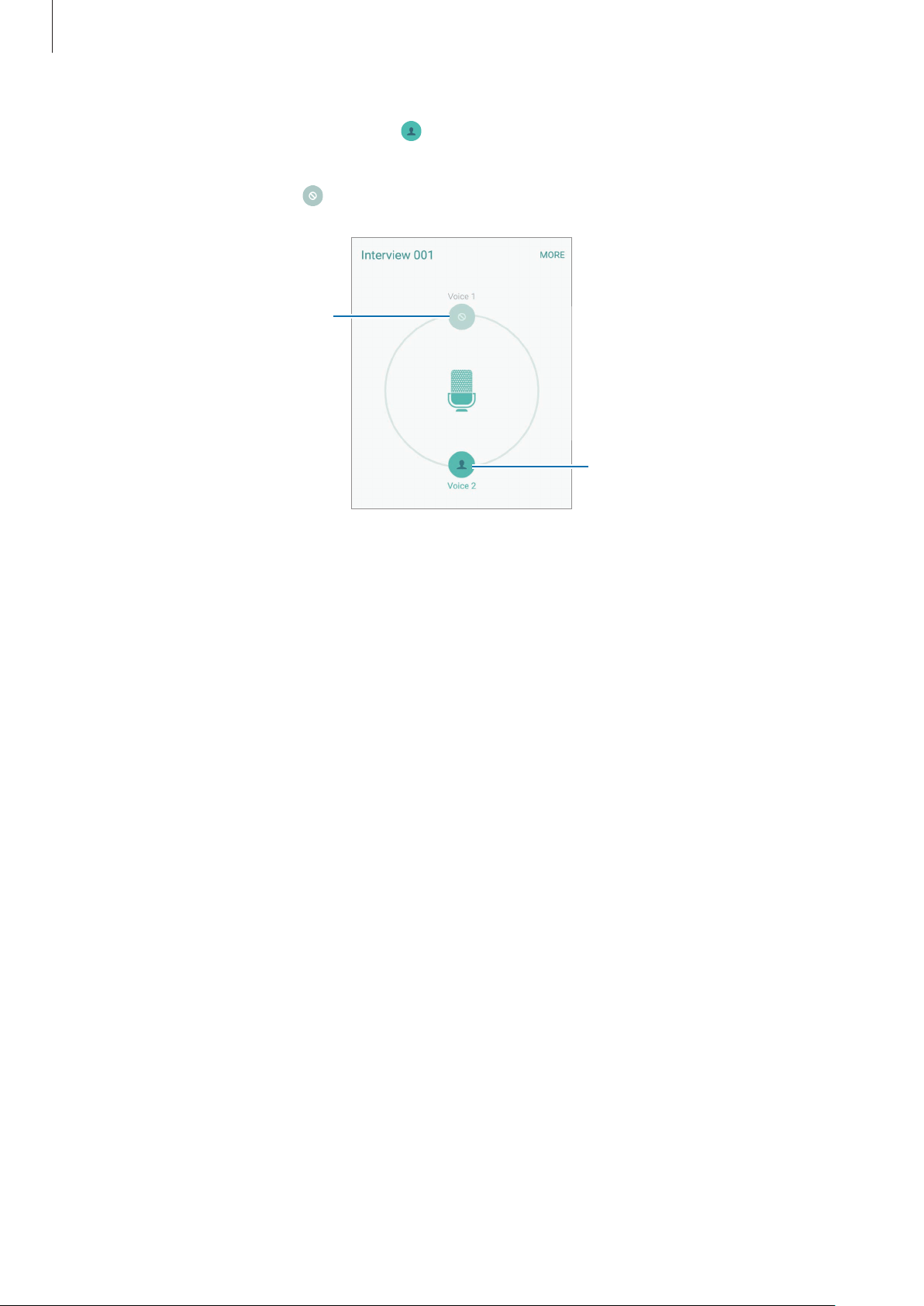
Applications
87
3
To mute certain sound sources, tap for the corresponding direction that sound is to be
muted.
The icon will change to
and the sound will be muted.
Unmuted sound source
Muted sound source
My Files
Access and manage various files stored in the device or in other locations, such as cloud
storage services.
On the Apps screen, tap
Tools
→
My Files
.
•
Category
: View files by category.
•
Local storage
: View files stored in the device.
•
Cloud storage
: View files stored in the cloud storage service.
•
STORAGE USAGE
: View your device’s memory information.
To search for files or folder, tap
SEARCH
.

Applications
88
Memo
Create memos and organise them by category.
On the Apps screen, tap
Tools
→
Memo
.
Composing memos
Tap
on the memos list and enter a memo. While composing a memo, use the following
options:
•
Category
: Create or set a category.
•
Image
: Insert images.
•
Voice
: Make a voice recording to insert.
•
Tasks
: Add tick boxes at the beginning of each row to create a list of tasks.
To save the memo, tap
SAVE
.
To edit a memo, tap a memo, and then tap the content of the memo.
Searching for memos
Tap
SEARCH
on the memos list and enter a keyword to search for memos that include the
keyword.
Clock
Introduction
Set alarms, check the current time in many cities around the world, time an event, or set a
specific duration.
Alarm
On the Apps screen, tap
Clock
→
Alarm
.

Applications
89
Setting alarms
Set an alarm time and tap
SAVE
.
To open the keypad to enter an alarm time, tap
KEYPAD
.
To set an alarm with various alarm options, tap
OPTIONS
, set alarm options, and then tap
SAVE
.
To activate or deactivate alarms, tap the clock icon next to the alarm in the alarms list.
Stopping alarms
Tap
DISMISS
to stop an alarm. If you have previously enabled the snooze option, tap
SNOOZE
to repeat the alarm after a specified length of time.
Deleting alarms
Tap
on an alarm in the list of alarms.
World clock
On the Apps screen, tap
Clock
→
World clock
.
Creating clocks
Enter a city name or select a city from the globe, and then tap
.
Deleting clocks
Tap
on a clock.
Stopwatch
1
On the Apps screen, tap
Clock
→
Stopwatch
.
2
Tap
START
to time an event.
To record lap times while timing an event, tap
LAP
.

Applications
90
3
Tap
STOP
to stop timing.
To restart the timing, tap
RESUME
.
To clear lap times, tap
RESET
.
Timer
1
On the Apps screen, tap
Clock
→
Timer
.
2
Set the duration, and then tap
START
.
To open the keypad to enter the duration, tap
KEYPAD
.
3
Tap
DISMISS
when the timer goes off.
Calculator
Perform simple or complex calculations.
Tap
Calculator
on the Apps screen.
Rotate the device to landscape orientation to display the scientific calculator. If
Screen
rotation
is disabled, open the notification panel and tap
Screen rotation
to activate it.
To see the calculation history, tap
HISTORY
. To close the calculation history panel, tap
KEYPAD
.
To clear the history, tap
HISTORY
→
CLEAR HISTORY
.

Applications
91
Google apps
Google provides entertainment, social network, and business apps. You may require a Google
account to access some apps. Refer to
Accounts for more information.
To view more app information, access each app’s help menu.
Some apps may not be available or may be labelled differently depending on the
region or service provider.
Chrome
Search for information and browse webpages.
Gmail
Send or receive emails via the Google Mail service.
Google+
Share your news and follow updates that your family, friends, and others share. You can also
back up your photos and videos, and more.
Maps
Find your location on the map, search for locations, and view location information for various
places.
Play Music
Discover, listen to, and share music on your device.
Play Movies & TV
Watch videos stored on your device and download various content to watch from the
Play
Store
.
Play Books
Download various books from
Play Store
and read them.

Applications
92
Play Newsstand
Read news and magazines that interest you in one convenient location.
Play Games
Download games from
Play Store
and play them with others.
Drive
Store your content on the cloud, access it from anywhere, and share it with others.
YouTube
Watch or create videos and share them with others.
Photos
Manage photos, albums, and videos that you have saved on the device and uploaded to
Google+
.
Hangouts
Chat with your friends individually or in groups and use images, emoticons, and video calls
while you are chatting.
Google
Search quickly for items on the Internet or your device.
Voice Search
Search quickly for items by saying a keyword or phrase.
Google Settings
Configure settings for some features provided by Google.

93
Settings
Introduction
Customise settings for functions and apps. You can make your device more personalised by
configuring various setting options.
On the Apps screen, tap
Settings
.
To search for settings by entering keywords, tap
SEARCH
.
To edit the list of frequently used settings, tap
EDIT
. Then, tick items to add or deselect items
to remove.
Wi-Fi
Connecting to a Wi-Fi network
Activate the Wi-Fi feature to connect to a Wi-Fi network and access the Internet or other
network devices.
•
Your device uses a non-harmonised frequency and is intended for use in all
European countries. The WLAN can be operated in the EU without restriction
indoors, but cannot be operated outdoors.
•
Turn off Wi-Fi to save the battery when not in use.
1
On the Settings screen, tap
Wi-Fi
, and then tap the switch to activate it.
2
Select a network from the Wi-Fi networks list.
Networks that require a password appear with a lock icon.

Settings
94
3
Tap
CONNECT
.
Once the device connects to a Wi-Fi network, the device will reconnect to that
network each time it is available without requiring a password. To prevent the device
connecting to the network automatically, select it from the list of networks and tap
FORGET
.
Wi-Fi Direct
Wi-Fi Direct connects devices directly via a Wi-Fi network without requiring an access point.
1
On the Settings screen, tap
Wi-Fi
, and then tap the switch to activate it.
2
Tap
Wi-Fi Direct
.
The detected devices are listed.
If the device you want to connect to is not in the list, request that the device turns on its
Wi-Fi Direct feature.
3
Select a device to connect to.
The devices will be connected when the other device accepts the Wi-Fi Direct
connections request.
Sending and receiving data
You can share data, such as contacts or media files, with other devices. The following actions
are an example of sending an image to another device.
1
Tap
Gallery
on the Apps screen.
2
Select an image.
3
Tap
Share
→
Wi-Fi Direct
, select a device to transfer the image to, and then tap
SHARE
.
4
Accept the Wi-Fi Direct connection request on the other device.
If the devices are already connected, the image will be sent to the other device without
the connection request procedure.

Settings
95
Ending the device connection
1
Tap
Wi-Fi
on the Settings screen.
2
Tap
Wi-Fi Direct
.
The device displays the connected devices in the list.
3
Tap the device name to disconnect the devices.
Bluetooth
Introduction
Use Bluetooth to exchange data or media files with other Bluetooth-enabled devices.
•
Samsung is not responsible for the loss, interception, or misuse of data sent or
received via Bluetooth.
•
Always ensure that you share and receive data with devices that are trusted
and properly secured. If there are obstacles between the devices, the operating
distance may be reduced.
•
Some devices, especially those that are not tested or approved by the Bluetooth
SIG, may be incompatible with your device.
•
Do not use the Bluetooth feature for illegal purposes (for example, pirating copies
of files or illegally tapping communications for commercial purposes).
Samsung is not responsible for the repercussion of illegal use of the Bluetooth
feature.

Settings
96
Pairing with other Bluetooth devices
1
On the Settings screen, tap
Bluetooth
, and then tap the switch to activate it.
The detected devices are listed.
2
Select a device to pair with.
If your device has paired with the device before, tap the device name without confirming
the auto-generated passkey.
If the device you want to pair with is not in the list, request that the device turns on its
visibility option. Refer to the other device’s user manuals.
Your device is visible to other devices while the Bluetooth settings screen is open.
3
Accept the Bluetooth connection request on your device to confirm.
The devices will be connected when the other device accepts the Bluetooth connection
request.
Sending and receiving data
Many apps support data transfer via Bluetooth. You can share data, such as contacts or media
files, with other Bluetooth devices. The following actions are an example of sending an image
to another device.
1
Tap
Gallery
on the Apps screen.
2
Select an image.
3
Tap
Share
→
Bluetooth
, and then select a device to transfer the image to.
If the device you want to pair with is not in the list, request that the device turns on its
visibility option.
4
Accept the Bluetooth connection request on the other device.

Settings
97
Unpairing Bluetooth devices
1
Tap
Bluetooth
on the Settings screen.
The device displays the paired devices in the list.
2
Tap next to the device name to unpair.
3
Tap
Unpair
.
Flight mode
This disables all wireless functions on your device. You can use only non-network services.
On the Settings screen, tap
Flight mode
.
Mobile hotspot and tethering
Use the device as a mobile hotspot to share the device’s mobile data connection with other
devices when the network connection is not available. Connections can be made via Wi-Fi,
USB, or Bluetooth.
On the Settings screen, tap
Mobile hotspot and tethering
.
You may incur additional charges when using this feature.
•
Mobile hotspot
: Use the mobile hotspot to share the device’s mobile data connection
with computers or other devices.
•
Bluetooth tethering
: Use Bluetooth tethering to share the device’s mobile data
connection with computers or other devices via Bluetooth.
•
USB tethering
: Use USB tethering to share the device’s mobile data connection with
a computer via USB. When connected to a computer, the device is used as a wireless
modem for the computer.

Settings
98
Using the mobile hotspot
Use your device as a mobile hotspot to share your device’s mobile data connection with other
devices.
1
On the Settings screen, tap
Mobile hotspot and tethering
→
Mobile hotspot
.
2
Tap the switch to activate it.
The
icon appears on the status bar. Other devices can find your device in the Wi-Fi
networks list.
To set a password for the mobile hotspot, tap
MORE
→
Configure Mobile hotspot
and
select the level of security. Then, enter a password and tap
SAVE
.
3
On the other device’s screen, search for and select your device from the Wi-Fi networks
list.
4
On the connected device, use the device’s mobile data connection to access the Internet.
Data usage
Keep track of your data usage amount and customise the settings for the limitation.
On the Settings screen, tap
Data usage
.
•
Mobile data
: Set the device to use data connections on any mobile network.
•
Set mobile data limit
: Set a limit for mobile data usage.
To change the monthly reset date for the monitoring period, tap
→
Change cycle
.
Limiting data usage
1
On the Settings screen, tap
Data usage
and tap the
Set mobile data limit
switch to
activate it.
2
Drag the limit adjustment bar upwards or downwards to set the limit.
3
Drag the warning adjustment bar upwards or downwards to set a data usage alert level.
The device will alert you when the warning level is reached.

Settings
99
Mobile networks
Configure your mobile network settings.
On the Settings screen, tap
Mobile networks
.
•
Data roaming
: Set the device to use data connections when you are roaming.
•
Access Point Names
: Set up access point names (APNs).
•
Network mode
: Select a network type.
•
Network operators
: Search for available networks and manually register a network.
NFC and payment
Introduction
Your device allows you to read near field communication (NFC) tags that contain information
about products. You can also use this feature to make payments and buy tickets for
transportation or events after downloading the required apps.
The device contains a built-in NFC antenna. Handle the device carefully to avoid
damaging the NFC antenna.
Using the NFC feature
Use the NFC feature to send images or contacts to other devices, and read product
information from NFC tags. If you insert a SIM or USIM card that has a payment feature, you
can use the device to make payments conveniently.
1
On the Settings screen, tap
NFC and payment
→
NFC
, and then tap the switch to
activate it.
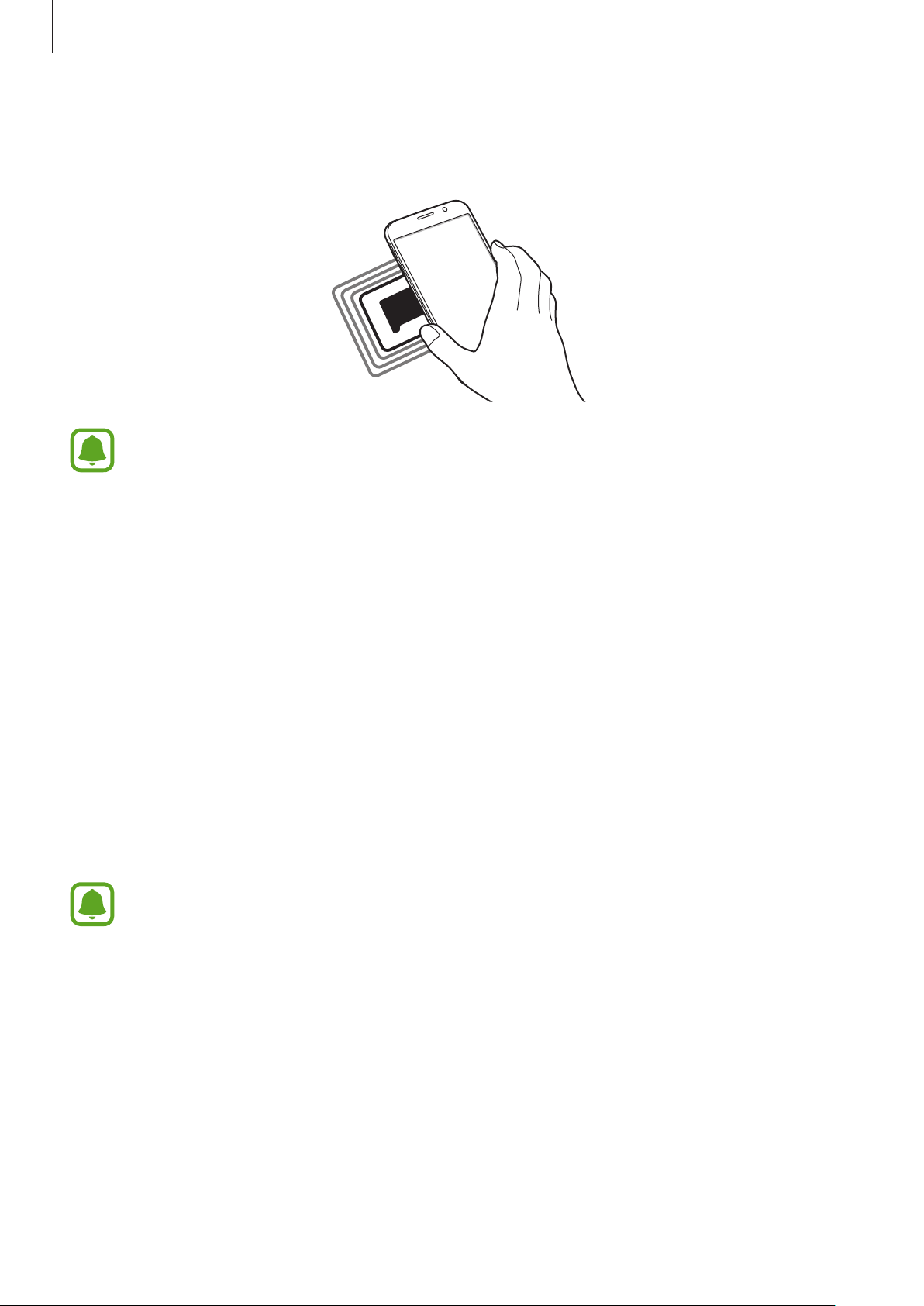
Settings
100
2
Place the NFC antenna area on the back of your device near an NFC tag.
The information from the tag appears.
Ensure that the device’s screen is unlocked. Otherwise, the device will not read NFC
tags or receive data.
Making payments with the NFC feature
Before you can use the NFC feature to make payments, you must register for the mobile
payment service. To register or get more information about the service, contact your service
provider.
1
On the Settings screen, tap
NFC and payment
→
NFC
, and then tap the switch to
activate it.
2
Touch the NFC antenna area on the back of your device to the NFC card reader.
To set the default payment app, open the settings screen and tap
NFC and payment
→
Tap
& Pay
, and then select an app.
The payment services list may not include all available payment apps.
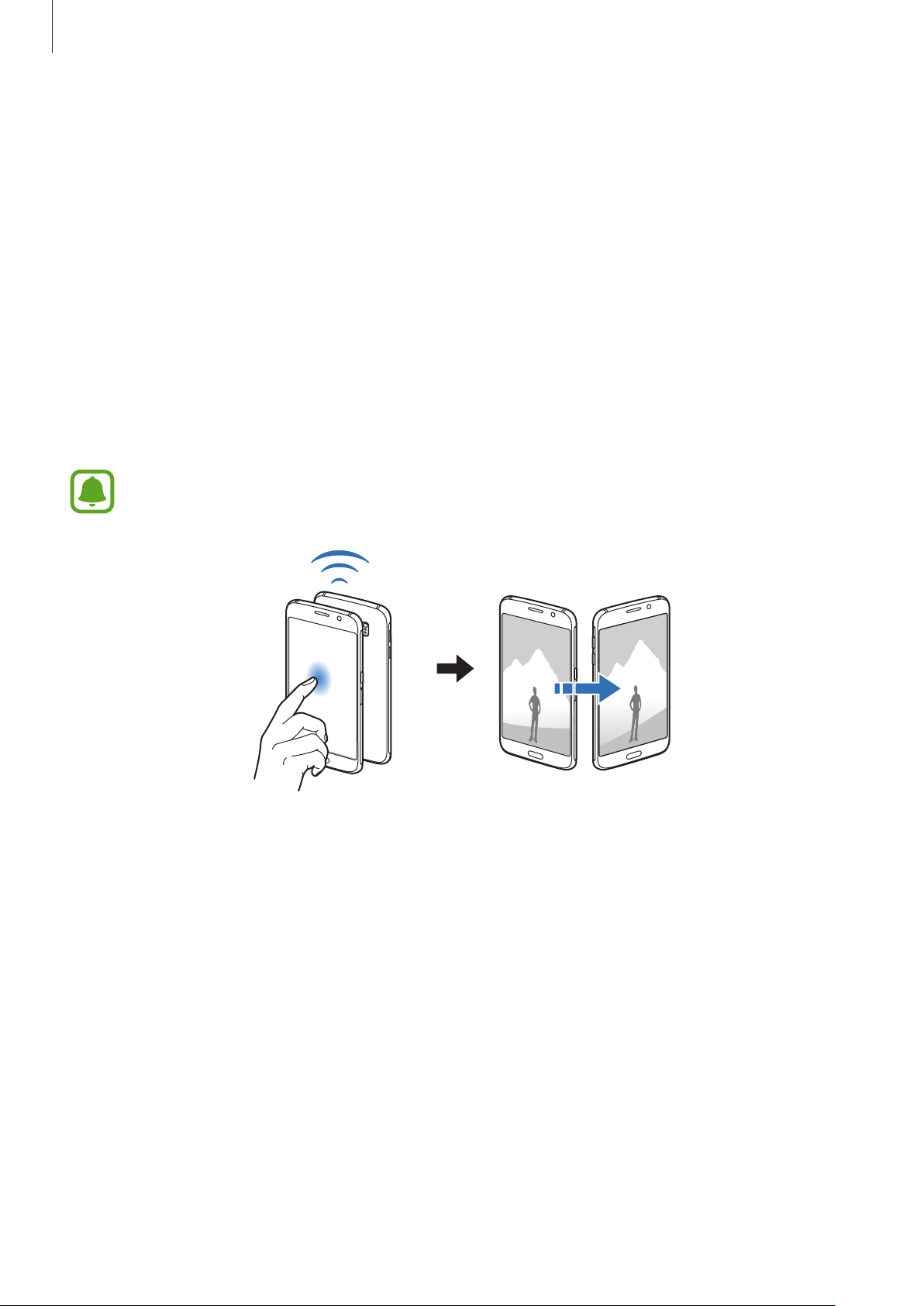
Settings
101
Sending data
Allow data exchange when your device’s NFC antenna touches the other device’s NFC
antenna.
1
On the Settings screen, tap
NFC and payment
→
NFC
, and then tap the switch to
activate it.
2
Tap
Android Beam
and tap the switch to activate it.
3
Select an item and touch the other device’s NFC antenna to your device’s NFC antenna.
4
When
Touch to beam.
appears on the screen, tap your device’s screen to send the item.
If both devices try to send data simultaneously, the file transfer may fail.

Settings
102
More connection settings
Options
Customise settings to control other features.
On the Settings screen, tap
More connection settings
.
•
Printing
: Configure settings for printer plug-ins installed on the device. You can search
for available printers or add one manually to print files. Refer to
Printing for more
information.
•
MirrorLink
: Use the MirrorLink feature to control your device’s MirrorLink apps on the
vehicle’s head unit monitor. Refer to
MirrorLink for more information.
•
Download booster
: Set the device to download files larger than 30 MB, faster via Wi-Fi
and mobile networks simultaneously. Refer to
Download booster for more information.
•
VPN
: Set up and connect to virtual private networks (VPNs).
•
Default messaging app
: Select the default app to use for messaging.
Printing
Configure settings for printer plug-ins installed on the device. You can connect the device to a
printer via Wi-Fi or Wi-Fi Direct, and print images or documents.
Some printers may not be compatible with the device.
Adding printer plug-ins
Add printer plug-ins for printers you want to connect the device to.
1
On the Settings screen, tap
More connection settings
→
Printing
→
Download plug-in
.
2
Search for a printer plug-in in
Play Store
.
3
Select a printer plug-in and install it.

Settings
103
4
Select the printer plug-in and tap the switch to activate it.
The device searches for printers that are connected to the same Wi-Fi network as your
device.
To add printers manually, tap
MORE
→
Add printer
→
ADD PRINTER
.
To change print settings, tap
MORE
→
Printing settings
.
Printing content
While viewing content, such as images or documents, tap
Share
→
Print
→
→
All
printers
, and then select a printer.
MirrorLink
Connect your device to a vehicle to control your device’s MirrorLink apps on the vehicle’s
head unit monitor.
On the Settings screen, tap
More connection settings
→
MirrorLink
.
Your device is compatible with vehicles that support MirrorLink version 1.1 or higher.
Connecting your device to a vehicle via MirrorLink
When using this feature for the first time, connect the device to a Wi-Fi or mobile network.
1
Pair your device with a vehicle via Bluetooth.
Refer to
Pairing with other Bluetooth devices for more information.
2
Connect your device to the vehicle using a USB cable.
When they are connected, access your device’s MirrorLink apps on the head unit monitor.
Ending the MirrorLink connection
Unplug the USB cable from your device and the vehicle.

Settings
104
Download booster
Set the device to download files larger than 30 MB, faster via Wi-Fi and mobile networks
simultaneously. A stronger Wi-Fi signal will provide a faster download speed.
On the Settings screen, tap
More connection settings
→
Download booster
.
•
This feature may not be supported by some devices.
•
You may incur additional charges when downloading files via the mobile network.
•
When you download large files, the device may heat up. If the device exceeds a set
temperature, the feature will turn off.
•
If network signals are unstable, the speed and performance of this feature may be
affected.
•
If the Wi-Fi and mobile network connections have significantly different data
transfer speeds, the device may use only the fastest connection.
•
This feature supports Hypertext Transmission Protocol (HTTP) 1.1 and Hypertext
Transmission Protocol Secure (HTTPS). The feature cannot be used with other
protocols, such as FTP.
Sounds and notifications
Change settings for various sounds on the device.
On the Settings screen, tap
Sounds and notifications
.
•
Sound mode
: Set the device to use sound mode or silent mode.
•
Volume
: Adjust the volume level for call ringtones, music and videos, system sounds, and
notifications.
•
Ringtones and sounds
: Change the ringtone and system sound settings.
•
Vibrations
: Change the vibration settings.
•
Sound quality and effects
: Configure additional sound settings.
•
Do not disturb
: Set the device to mute incoming call and notification sounds, except for
allowed exceptions.
•
Notifications on lock screen
: Set whether or not to show the content of notifications on
the locked screen.

Settings
105
•
App notifications
: Change the notification settings for each app.
•
LED indicator
: Set the device to turn on the LED indicator while the battery is charging,
when you have notifications, or when you record voice memos.
Display
Change the display settings.
On the Settings screen, tap
Display
.
•
Brightness
: Adjust the brightness of the display.
•
Font
: Change the font size and type.
•
Screen timeout
: Set the length of time the device waits before turning off the display’s
backlight.
•
Smart stay
: Set the device to prevent the display backlight from turning off while you are
looking at the display.
•
Screen mode
: Change the screen mode to adjust the display’s colour and contrast.
•
Daydream
: Set the device to launch a screensaver when the device is charging or
connected to a desktop dock.
Motions and gestures
Activate the motion recognition feature and change the settings that control motion
recognition on your device.
On the Settings screen, tap
Motions and gestures
.
Excessive shaking or impact on the device may result in unintended inputs. Control
motions properly.
•
Direct call
: Set the device to make a voice call by picking up and holding the device near
your ear while viewing call, message, or contact details.

Settings
106
•
Smart alert
: Set the device to alert you if you have missed calls or new messages when
you pick up the device.
This feature may not work if the screen is turned on or the device is not on a flat
surface.
•
Mute
: Set the device to mute incoming calls or alarms by using palm motions or facing
the device’s screen downwards.
•
Palm swipe to capture
: Set the device to capture a screenshot when you swipe your
hand to the left or right across the screen. You can view the captured images in
Gallery
.
It is not possible to capture a screenshot while using some apps and features.
Applications
Manage the device’s apps and change their settings.
On the Settings screen, tap
Applications
.
•
Application manager
: View and manage the apps on your device.
•
Default applications
: Select a default settings for using apps.
•
Application settings
: Customise the settings for each app.
Wallpaper
Change the wallpaper settings for the Home screen and the locked screen.
On the Settings screen, tap
Wallpaper
.
Themes
Apply various themes to the device to change the visual elements of the Home screen, locked
screen, and icons.
On the Settings screen, tap
Themes
.
To download more themes, tap
STORE
.

Settings
107
Lock screen and security
Options
Change the settings for securing the device and the SIM or USIM card.
On the Settings screen, tap
Lock screen and security
.
The available options may vary depending on the screen lock method selected.
•
Screen lock type
: Change the screen lock method.
•
Show information
: Change settings for the items displayed on the locked screen.
•
Unlock effect
: Select an effect that you see when you unlock the screen.
•
Fingerprints
: Register your fingerprint to the device to secure the device or sign in to
your Samsung account. Refer to
Fingerprint recognition for more information.
•
Device security
: Scan for and remove malware from the device. You can also activate the
real-time scanning feature to block phishing attacks and malicious websites.
•
Find My Mobile
: Activate or deactivate the Find My Mobile feature. This feature can
help you locate your device if it is lost or stolen. You can also access the Find my mobile
website (
findmymobile.samsung.com) to track and control your lost or stolen device.
•
Unknown sources
: Set the device to allow the installation of apps from unknown
sources.
•
Other security settings
: Configure additional security settings.

Settings
108
Fingerprint recognition
In order for fingerprint recognition to function, your fingerprint information needs to be
registered and stored in your device. After registering, you can set the device to use your
fingerprint for the features below:
•
Screen lock
•
Web sign-in
•
Verify Samsung account
•
This feature may not be available depending on the region or service provider.
•
Fingerprint recognition uses the unique characteristics of each fingerprint to
enhance the security of your device. The likelihood of the fingerprint sensor
confusing two different fingerprints is very low. However, in rare cases where
separate fingerprints are very similar the sensor may recognise them as identical.
For better fingerprint recognition
When you scan your fingerprints on the device, be aware of the following conditions that
may affect the feature’s performance:
•
The Home key contains a fingerprint recognition sensor. Ensure that the Home key is not
scratched or damaged by metal objects, such as coins, keys, and necklaces.
•
The screen protector supplied with the device may cause the fingerprint recognition
sensor to malfunction. Remove the screen protector to improve fingerprint sensitivity.
•
Ensure that the fingerprint recognition area and your fingers are clean and dry.
•
The device may not recognise fingerprints that are affected by wrinkles or scars.
•
The device may not recognise fingerprints from small or thin fingers.
•
If you bend your finger or use a fingertip, the device may not recognise your fingerprints.
Make sure to cover the entire Home key with your finger.
•
To improve recognition performance, register fingerprints of the hand used most often to
perform tasks on the device.
•
In dry environments, static electricity can build up in the device. Avoid using this feature
in dry environments or before using the feature, discharge static electricity by touching a
metal object.
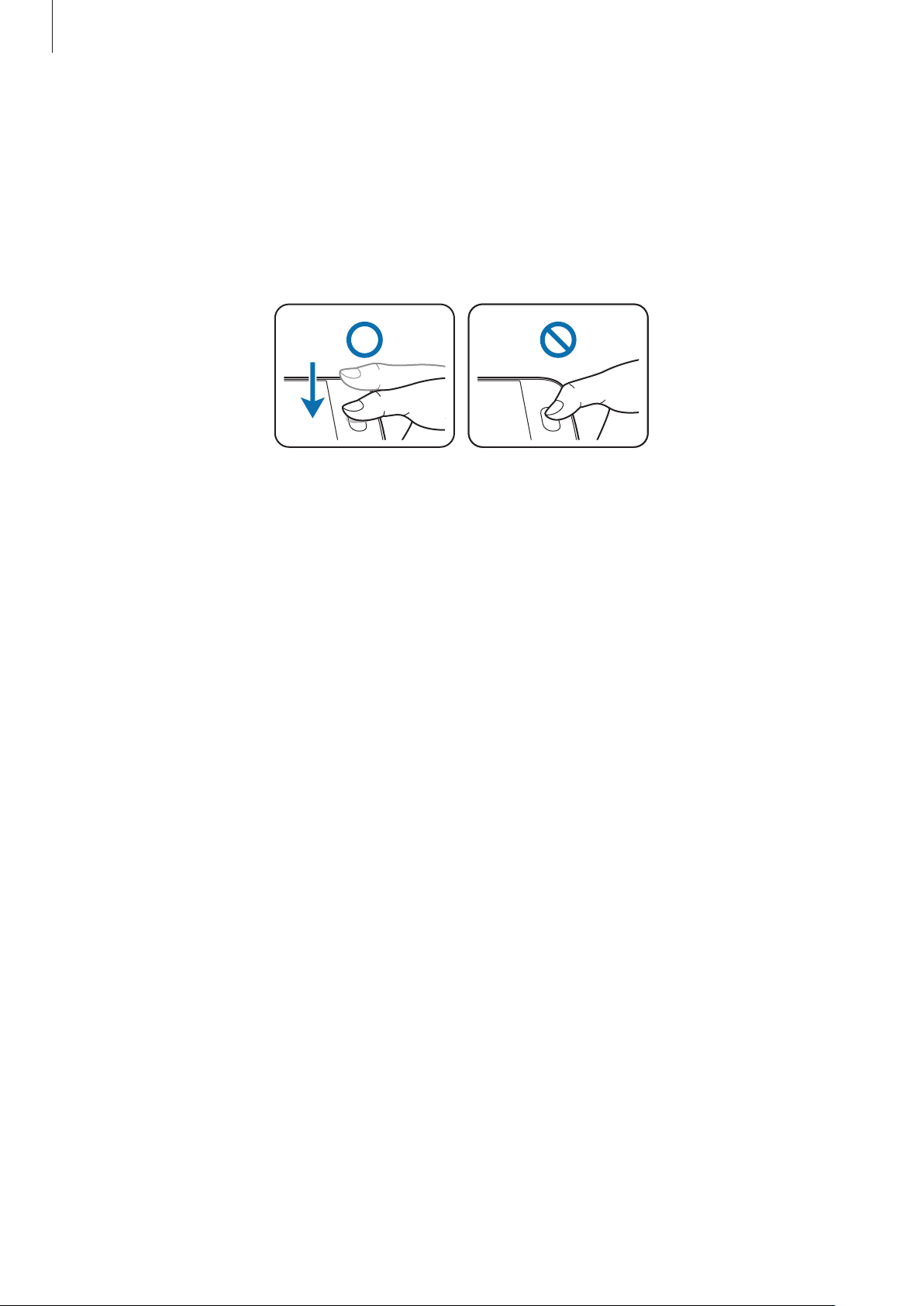
Settings
109
Registering fingerprints
1
On the Settings screen, tap
Lock screen and security
→
Fingerprints
→
Add
fingerprint
.
2
Place your finger on the Home key.
3
Lift your finger when the device vibrates, and then place it on the Home key again.
Repeat this action using the same finger until the fingerprint is registered.
4
When a screen appears requesting to register a backup password, enter the backup
password, and then tap
CONTINUE
.
5
Enter the backup password again to verify it, and then tap
OK
.
You can use the backup password instead of scanning your fingerprints.
6
When a fingerprint lock pop-up window appears, tap
OK
. You can use your fingerprints to
unlock the screen.
Deleting fingerprints
You can delete registered fingerprints using the fingerprint manager.
1
On the Settings screen, tap
Lock screen and security
→
Fingerprints
.
2
Scan a registered fingerprint, or tap
BACKUP PASSWORD
and enter the backup
password.
3
Tap
EDIT
.
4
Tick fingerprints to delete and tap
REMOVE
.

Settings
110
Changing the backup password
You can change the password that you use as a backup to scanning your fingerprints.
1
On the Settings screen, tap
Lock screen and security
→
Fingerprints
.
2
Scan a registered fingerprint, or tap
BACKUP PASSWORD
and enter the backup
password.
3
Tap
Change backup password
.
4
Enter a new password and tap
CONTINUE
.
5
Enter the password again and tap
OK
.
Verifying the Samsung account password
Use fingerprints to verify your Samsung account password. You can use a fingerprint instead
of entering your password, for example, when you purchase content from
Galaxy Apps
.
1
On the Settings screen, tap
Lock screen and security
→
Fingerprints
.
2
Scan a registered fingerprint, or tap
BACKUP PASSWORD
and enter the backup
password.
3
Tap the
Verify Samsung account
switch to activate it.
4
Sign in to your Samsung account.

Settings
111
Using fingerprints to sign in to accounts
You can use your fingerprints to sign in to webpages that support password saving.
1
On the Settings screen, tap
Lock screen and security
→
Fingerprints
.
2
Scan a registered fingerprint, or tap
BACKUP PASSWORD
and enter the backup
password.
3
Tap the
Web sign-in
switch to activate it.
4
Open a webpage that you want to sign in to with a fingerprint.
5
Enter your user name and password, and then tap the webpage’s sign in button.
6
Tick
Sign in using your fingerprints
and tap
REMEMBER
.
You can use your fingerprint to verify your account and password to sign in to the
webpage.
Privacy and safety
Options
Change the settings for maintaining your privacy and safety.
On the Settings screen, tap
Privacy and safety
.
•
Location
: Change settings for location information permissions.
•
Private mode
: Activate private mode to prevent others from accessing your personal
content. Refer to
Private mode for more information.
•
Report diagnostic info
: Set the device to automatically send the device’s diagnostic and
usage information to Samsung.
•
Send SOS messages
: Set the device to send help messages by pressing the Power
key three times. You can also send sound recordings along with the message to the
recipients. Refer to
Send SOS messages for more information.

Settings
112
Private mode
Hide personal content in your device to prevent others from accessing it.
In private mode, you can hide items in
Gallery
,
Video
,
Music
,
Voice Recorder
,
My Files
, and
Internet
.
Activating private mode
1
On the Settings screen, tap
Privacy and safety
→
Private mode
, and then tap the switch
to activate it.
If you are activating private mode for the first time, follow the on-screen instructions to
set up a private mode access code.
2
Follow the on-screen instructions to enter the preset private mode access code.
Private mode is activated and the
icon appears on the status bar.
You can view and access the hidden items only when private mode is activated. To
hide items stored in the private folder, deactivate private mode.
Hiding content
1
On the Apps screen, launch an app to hide items.
2
Select an item and tap
MORE
→
Move to Private
.
If private mode is not activated, follow the on-screen instructions to enter the preset
private mode access code.
The selected items will be moved to the private folder.

Settings
113
Viewing hidden content
You can view hidden items only when private mode is activated.
1
On the Settings screen, tap
Privacy and safety
→
Private mode
, and then tap the switch
to activate it.
2
Follow the on-screen instructions to enter the preset private mode access code.
3
On the Apps screen, tap
Tools
→
My Files
→
Private
.
Items moved to the private folder will appear on the screen. For bookmarks, you can view
them with the
Internet
app.
Unhiding content
1
In the private folder, tap and hold an item, and then tick items to unhide.
2
Tap
MORE
→
Remove from Private
.
3
Select a folder to move the items to, and then tap
MOVE HERE
.
The items will be moved to the selected folder.
Automatically deactivating private mode
You can set the device to automatically deactivate private mode each time the screen turns
off.
1
On the Settings screen, tap
Privacy and safety
→
Private mode
, and then tap the switch
to activate it.
2
Follow the on-screen instructions to enter the preset private mode access code.
3
Tap the
Auto disable
switch to activate it.
When the
Auto disable
option is enabled, the device will fail to transfer files to the
private folder if the screen turns off during transfer.

Settings
114
Send SOS messages
In an emergency situation, quickly press the Power key three times. The device sends
messages to your primary contacts. The messages include your location information.
1
On the Settings screen, tap
Privacy and safety
→
Send SOS messages
, and then tap the
switch to activate it.
2
Follow the on-screen instructions to add primary contacts if you have not already done
so.
To send help messages with audio recordings or photos, tap the
Attach audio recording
or
Attach pictures
switch to activate it.
The
Attach pictures
option may not be available depending on the region or service
provider.
Adding primary contacts
On the Settings screen, tap
Privacy and safety
→
Send SOS messages
→
Send messages
to
→
ADD
. Tap
Create contact
and enter contact information or tap
Select from contacts
to
add an existing contact as a primary contact.
Easy mode
Easy mode provides an easier user experience by using a simpler layout and bigger icons on
the Home screen.
Switching to easy mode
1
On the Settings screen, tap
Easy mode
→
Easy mode
.
2
Select apps under
Easy applications
to apply a simpler layout.
3
Tap
DONE
.

Settings
115
Returning to standard mode
Swipe to the left on the Home screen and tap
Settings
→
Easy mode
→
Standard mode
→
DONE
.
Managing shortcuts
To add a shortcut to an app to the Home screen, swipe to the left, tap
, and then select an
app.
To add a shortcut to a contact on the Home screen, swipe to the right and tap
.
To delete a shortcut from the Home screen, tap
EDIT
and select an app or contact with .
Accessibility
Configure various settings to improve accessibility to the device. Refer to Accessibility for
more information.
On the Settings screen, tap
Accessibility
.
Accounts
Add your Samsung and Google accounts, or other accounts, to sync with.
Adding accounts
Some apps used on your device require a registered account. Create accounts to have the
best experience with your device.
1
On the Settings screen, tap
Accounts
→
Add account
.
2
Select an account service.
3
Follow the on-screen instructions to complete the account setup.
To sync content with your accounts, select an account and select items to sync.

Settings
116
Registering Samsung accounts
You need a Samsung account when using some Samsung apps. You can back up or restore
data saved in the device to your Samsung account. Register your Samsung account to the
device to conveniently use Samsung services.
1
On the Settings screen, tap
Accounts
→
Add account
.
2
Tap
Samsung account
.
3
Follow the on-screen instructions to complete the account setup.
Once your Samsung account has been registered, you can use apps requiring your Samsung
account without the sign in procedure.
Removing accounts
On the Settings screen, tap
Accounts
, select an account name, select the account to remove,
and then tap
MORE
→
Remove account
.
Backup and reset
Change the settings for managing settings and data.
On the Settings screen, tap
Backup and reset
.
•
Back up my data
: Back up your personal information and app data to the Samsung
server. You can also set the device to automatically back up data.
•
Restore
: Restore previously backed up personal information and app data from your
Samsung account.
•
Backup account
: Set up or edit your Google backup account.
•
Back up my data
: Set the device to back up settings and app data to the Google server.
•
Automatic restore
: Set the device to automatically restore settings and app data from
the Google server when apps are reinstalled.
•
Factory data reset
: Reset settings to the factory default values and delete all data.

Settings
117
Language and input
Change the settings for text input. Some options may not be available depending on the
selected language.
On the Settings screen, tap
Language and input
.
•
Language
: Select a display language for all menus and apps.
•
Default keyboard
: Select a default keyboard type for text input.
•
Samsung keyboard
: Change the Samsung keyboard settings.
•
Google voice typing
: Change the voice input settings.
•
Voice input
: Select a default voice input service. You can also change settings for each
service.
•
Text-to-speech options
: Change the text-to-speech settings.
•
Pointer speed
: Adjust the pointer speed for the mouse or trackpad connected to your
device.
Battery
View battery power information and change power saving options.
On the Settings screen, tap
Battery
.
The usage time left shows the time remaining before the battery power runs
out. Usage time left may vary depending on your device settings and operating
conditions.
•
BATTERY USAGE
: View the amount of battery power consumed by your device.
•
Power saving mode
: Activate power-saving mode and change the settings for power-
saving mode. Refer to
Power saving mode for more information.
•
Ultra power saving mode
: Extend standby time and reduce battery consumption by
displaying a simpler layout and allowing limited access to an app. Refer to
Ultra power
saving mode
for more information.
•
Abnormal battery usage
: View a list of apps that are consuming an excessive amount of
battery power.

Settings
118
Storage
View memory information for your device.
On the Settings screen, tap
Storage
.
The actual available capacity of the internal memory is less than the specified
capacity because the operating system and default apps occupy part of the memory.
The available capacity may change when you update the device.
Date and time
Access and alter the following settings to control how the device displays the time and date.
On the Settings screen, tap
Date and time
.
If the battery remains fully discharged or removed from the device, the time and date
is reset.
•
Automatic date and time
: Automatically update the time and date when moving across
time zones.
•
Automatic time zone
: Set the device to receive time zone information from the network
when you move across time zones.
•
Set date
: Set the current date manually.
•
Set time
: Set the current time manually.
•
Select time zone
: Set the home time zone.
•
Use 24-hour format
: Display time in 24-hour format.
•
Select date format
: Select a date format.

Settings
119
User manual
View help information to learn how to use the device and apps or configure important
settings.
On the Settings screen, tap
User manual
.
About device
Access device information, edit the device name, or update device software.
On the Settings screen, tap
About device
.

120
Appendix
Accessibility
About Accessibility
Improve accessibility with features that make the device easier to use for users who have
impaired vision, hearing, and reduced dexterity.
On the Apps screen, tap
Settings
→
Accessibility
.
Using the Home key to open accessibility menus
On the Apps screen, tap
Settings
→
Accessibility
→
Direct access
, and then tap the switch
to activate it. Then, select an accessibility menu to open when you press the Home key three
times quickly.
You can access the following accessibility menus.
•
Accessibility
•
Voice Assistant
•
Universal switch
•
Magnifier window
•
Negative colours
•
Greyscale
•
Colour adjustment
•
Interaction control

Appendix
121
Voice Assistant (Voice feedback)
Activating or deactivating Voice Assistant
When you activate Voice Assistant, the device reads aloud the text on the screen or selected
features when you tap it once.
On the Apps screen, tap
Settings
→
Accessibility
→
Vision
→
Voice Assistant
, and then tap
the switch to activate it. The device will start voice feedback.
To deactivate Voice Assistant, tap the switch and tap anywhere on the screen twice quickly.
When you activate Voice Assistant for the first time, the tutorial will start after activation. You
can replay it by tapping
Voice Assistant help
.
Some features are not available while you are using Voice Assistant.
Controlling the screen with finger gestures
You can use various finger gestures to control the screen while you are using Voice Assistant.
One finger gestures
•
Tapping: Read aloud the item under your finger. To explore the screen, place a finger on
the screen and move it on the screen.
•
Tapping twice: Open the selected item. While selected items are read aloud, when you
hear the item you want, release your finger from the item. Then, tap anywhere on the
screen twice quickly.
•
Double-tapping and holding the screen: Move an item or access an available option.
•
Swiping to the left: Move to the previous item.
•
Swiping to the right: Move to the next item.
•
Swiping upwards or downwards: Use the most recent contextual menu option or change
its settings. In text selection mode, move the cursor backwards or forwards to select text.

Appendix
122
•
Swiping to the left then right in one motion: Scroll up the screen.
•
Swiping to the right then left in one motion: Scroll down the screen.
•
Swiping upwards then downwards in one motion: Move to the first item on the screen.
•
Swiping downwards then upwards in one motion: Move to the last item on the screen.
Two finger gestures
•
Tapping: Pause or resume voice feedback.
•
Tapping twice: Start, pause, or resume playback.
•
Tapping three times: Check the current time, remaining battery power, and mode.
To change items that are read aloud, open the Apps screen and tap
Settings
→
Accessibility
→
Vision
→
Voice Assistant
→
SETTINGS
→
Status bar information
.
•
Double-tapping and holding the screen: Enable or disable text selection mode.
•
Swiping to the left: Move to the next page. In text selection mode, cut the selected text.
•
Swiping to the right: Return to the previous page. In text selection mode, paste the
copied text.
•
Swiping upwards: Scroll down the list. In text selection mode, copy the selected text.
•
Swiping downwards: Scroll up the list. In text selection mode, select all text.
•
Swiping in any direction on the locked screen: Unlock the screen.
•
Swiping downwards from the top of the screen: Open the notification panel.
Three finger gestures
•
Tapping: Start reading items aloud from the top.
•
Tapping twice: Start reading from the next item.
•
Tapping three times: Read the last selected text and copy it to the clipboard.
•
Swiping to the left or right: Open the contextual menu and scroll through the options.
•
Swiping upwards or downwards: Change the text reading and selecting granularity.

Appendix
123
Using the contextual menu
While you are using Voice Assistant, swipe to the left or right with three fingers. The
contextual menu will appear and the device will read the options aloud. Swipe to the left or
right with three fingers to scroll through the options. When you hear the option you want,
swipe upwards or downwards to use the option or adjust the settings for the option. For
example, when you hear
Media Volume
, you can adjust the volume by swiping upwards or
downwards.
Adding image labels
You can assign labels to images on the screen. The device reads aloud the labels when the
images are selected. Add labels to unlabelled images by tapping the screen twice with three
fingers and holding.
Configuring settings for Voice Assistant
Configure settings for Voice Assistant for your convenience.
On the Apps screen, tap
Settings
→
Accessibility
→
Vision
→
Voice Assistant
→
SETTINGS
.
•
Speech volume
: Select the volume level for voice feedback.
•
Speech rate
: Select a speed for voice feedback.
•
Pitch changes
: Set the device to read aloud text at a low pitch when it is entered using a
keyboard.
•
Keyboard feedback
: Set the device to read aloud a word that you enter using a keyboard
when you tap the space key.
•
Speak while screen off
: Set the device to provide voice feedback when the screen is
turned off.
•
Use proximity sensor
: Set the device to pause voice feedback when you place your hand
over the sensor at the top of the device.
•
Shake to continue reading
: Set the device to read aloud the text displayed on the screen
when you shake the device. You can select from various shaking speeds.

Appendix
124
•
Vibration feedback
: Set the device to vibrate when you explore the screen.
•
Sound feedback
: Set the device to emit a sound when you control the screen, such as
scrolling the screen, and more.
•
Focus on speech audio
: Set the device to turn the media volume down when the device
reads an item aloud.
•
Sound feedback volume
: Adjust the volume that sound is played when you touch the
screen to control it. This feature is available when
Sound feedback
is activated.
•
Single-tap selection
: Set the device to open the selected item by tapping it once.
•
Back/Recents key feedback
: Set the device to provide voice feedback when you tap
or
once. Tap or twice to activate them.
•
Status bar information
: Select items to read aloud when you tap the screen three times
with two fingers.
•
Developer options
: Set options for app development.
Using the device with the screen turned off
Set the device to turn the screen off at all times to keep the content on your screen private.
The screen does not turn on when you press the Home key or tap the screen. Currently
activated features do not turn off when the screen is off.
On the Apps screen, tap
Settings
→
Accessibility
→
Vision
, and then tap the
Dark screen
switch to activate it. You can activate or deactivate this feature by pressing the Power key
twice.
Reading passwords aloud
Set the device to read the password aloud when you enter the password while Voice Assistant
is activated.
On the Apps screen, tap
Settings
→
Accessibility
→
Vision
, and then tap the
Speak
passwords
switch to activate it.

Appendix
125
Setting text-to-speech features
Change the settings for text-to-speech features used when Voice Assistant is activated, such
as languages, speed, and more.
On the Apps screen, tap
Settings
→
Accessibility
→
Vision
→
Text-to-speech options
, and
then use the following functions:
•
Preferred TTS engine
: Select an engine for the text-to-speech feature.
•
Speech rate
: Adjust the speed for the text-to-speech feature.
•
Default language status
: View the status of the current language set for the text-to
speech feature.
Entering text using the keyboard
To display the keyboard, tap the text input field, and then tap anywhere on the screen twice
quickly.
When you touch the keyboard with your finger, the device reads aloud the character keys
under your finger. When you hear the character you want, release your finger from the screen
to select it. The character is entered and the device reads the text aloud.
If
Rapid key input
is not activated, release your finger from the character you want, and
then tap anywhere on the screen twice quickly. To activate the rapid key input feature, open
the Apps screen, tap
Settings
→
Accessibility
→
Vision
, and then tap the
Rapid key input
switch to activate it.
Entering additional characters
Tap and hold a key on the keyboard to enter additional characters available for the key. A
pop-up window appears above the key showing available characters. To select a character,
drag your finger on the pop-up window until you hear the character you want, and release it.

Appendix
126
Vision
Writing voice memos to voice labels
You can use voice labels to distinguish objects of similar shape by attaching labels to them.
You can record and assign a voice memo to an NFC-enabled voice label. The voice memo is
played back when you place your device near the label.
Turn on the NFC feature before using this feature.
1
On the Apps screen, tap
Settings
→
Accessibility
→
Vision
→
Voice Label
.
The voice recorder will launch.
2
Tap to start recording. Speak into the microphone.
3
When you are finished recording, tap to stop.
4
Hold the back of your device over the voice label.
The information in the voice recording will be written to the voice label.
Changing the font size
Change the font size displayed on the screen. Setting the font size to
Huge
may not be
available in some apps.
On the Apps screen, tap
Settings
→
Accessibility
→
Vision
→
Font size
.
Magnifying the screen
Magnify the screen and zoom in on a specific area.
On the Apps screen, tap
Settings
→
Accessibility
→
Vision
→
Magnification gestures
, and
then tap the switch to activate it.
•
Zooming in and out: Quickly tap the screen three times to zoom in on a specific area.
Quickly tap the screen three times again to return to the normal view.

Appendix
127
•
Exploring the screen by scrolling: Drag two or more fingers across the magnified screen.
•
Adjusting zoom ratio: Pinch two or more fingers on the magnified screen or spread them
apart.
You can also temporarily magnify the screen by tapping the screen three times and holding.
While holding the screen, drag your finger to explore the screen. Release your finger to return
to the normal view.
•
Keyboards on the screen cannot be magnified.
•
When this feature is activated, the performance of some apps, such as
Phone
and
Calculator
, may be affected.
Using a magnifier
Activate a magnifier to zoom in on the screen to view a larger version of the content.
On the Apps screen, tap
Settings
→
Accessibility
→
Vision
→
Magnifier window
, and then
tap the switch to activate it. The magnifier will appear on the screen.
Drag the magnifier to where you want to zoom in on the screen.
Converting the screen to greyscale mode
Display colours on the screen as grey tones.
On the Apps screen, tap
Settings
→
Accessibility
→
Vision
, and then tap the
Greyscale
switch to activate it.
Reversing the display colours
Improve screen visibility to help users recognise text on the screen more easily.
On the Apps screen, tap
Settings
→
Accessibility
→
Vision
, and then tap the
Negative
colours
switch to activate it.

Appendix
128
Colour adjustment
Adjust how colours are displayed on the screen if you have difficulty in distinguishing colours.
The device changes the colours into more recognisable colours.
On the Apps screen, tap
Settings
→
Accessibility
→
Vision
→
Colour adjustment
, and
then tap the switch to activate it. Follow the on-screen instructions to complete the colour
adjustment procedure.
Hearing
Sound detectors
Set the device to vibrate when it detects your doorbell or a baby crying.
Baby crying detector
On the Apps screen, tap
Settings
→
Accessibility
→
Hearing
→
Sound detectors
, and then
tap the
Baby crying detector
switch to activate it. The device will vibrate when it detects
sound and the alert will be saved as a log.
Doorbell detector
1
On the Apps screen, tap
Settings
→
Accessibility
→
Hearing
→
Sound detectors
, and
then tap the
Doorbell detector
switch to activate it.
2
Tap to make a recording of your doorbell.
The device will detect and record the doorbell.
3
Tap and ring your doorbell to check if it is recorded correctly. When the device detects
the doorbell sound, tap
OK
.
To change the doorbell sound, tap
Change doorbell sound
.
The device will vibrate when it detects sound and the alert will be saved as a log.

Appendix
129
Setting flash notification
Set the flash to blink when you have incoming calls, new messages, or notifications.
On the Apps screen, tap
Settings
→
Accessibility
→
Hearing
, and then tap the
Flash
notification
switch to activate it.
Turning off all sounds
Set the device to mute all device sounds, such as media sounds, and the caller’s voice during
a call.
On the Apps screen, tap
Settings
→
Accessibility
→
Hearing
, and then tap the
Turn off all
sounds
switch to activate it.
Caption settings
On the Apps screen, tap
Settings
→
Accessibility
→
Hearing
→
Samsung subtitles (CC)
or
Google subtitles (CC)
, and then tap the switch to activate it.
Select an option for configuring the caption settings.
Adjusting the sound balance
Set the device to adjust the sound balance when using a headset.
1
Connect a headset to the device and wear it.
2
On the Apps screen, tap
Settings
→
Accessibility
→
Hearing
→
Left/right sound
balance
.
3
Drag the adjustment bar to the left or right and adjust the sound balance, and then tap
SET
.

Appendix
130
Mono audio
Mono output combines stereo sound into one signal that is played through all headset
speakers. Use this if you have a hearing impairment or if a single earbud is more convenient.
On the Apps screen, tap
Settings
→
Accessibility
→
Hearing
, and then tap the
Mono audio
switch to activate it.
Auto haptic
When the auto haptic feature is activated, the device will vibrate with the sound when
playing music, watching videos, or playing games. It will also vibrate when buttons are
tapped in supported apps.
On the Apps screen, tap
Settings
→
Accessibility
→
Hearing
, and then tap the
Auto haptic
switch to activate it.
Some apps may not support this feature.
Dexterity and interaction
Universal switch
You can control the touchscreen by connecting an external switch, by tapping the screen, or
by using head movements and face gestures.
On the Apps screen, tap
Settings
→
Accessibility
→
Dexterity and interaction
→
Universal
switch
, and then tap the switch to activate it. If the universal switches are not registered on
the device, tap
ADD SWITCH
and set switches to control the device.
To activate the universal switch feature, at least one switch must be registered on the
device.
To set switches to control the device, tap
SETTINGS
→
Switches
.
To quickly deactivate this feature, press the Home key three times.

Appendix
131
Assistant menu
Displaying the assistive shortcut icon
Set the device to display the assistive shortcut icon for accessing apps, features, and settings.
You can easily control the device by tapping the assistive menus in the icon.
1
On the Apps screen, tap
Settings
→
Accessibility
→
Dexterity and interaction
→
Assistant menu
.
2
Tap the switch to activate it.
The assistive shortcut icon appears at the bottom right of the screen.
3
Tap
Dominant hand
to move the assistive shortcut icon to a convenient location.
Accessing assistive menus
The assistive shortcut icon appears as a floating icon for easy access to the assistive menus
from any screen.
When you tap the assistive shortcut icon, the icon expands slightly and the assistive menus
appear on the icon. Tap the up or down arrow to move to other panels or swipe upwards or
downwards to select other menus.
Using the cursor
On the assistive menu, tap
Cursor
. You can control the screen using small finger movements
on the touch area. Drag your finger on the touch area to move the cursor. Also, tap the screen
to select items under the cursor.
Use the following options:
•
/ : Select an item or scroll left or right on the screen.
•
/ : Scroll up or down the screen.
•
: Magnify the area where the cursor is located.
•
: Move the touch area to another location.
•
: Close the touch area.

Appendix
132
To change the cursor settings, open the Apps screen, tap
Settings
→
Accessibility
→
Dexterity and interaction
→
Assistant menu
. Then, customise settings in
Touchpad and
cursor settings
.
Using enhanced assistive menus
Set the device to display enhanced assistive menus for selected apps.
On the Apps screen, tap
Settings
→
Accessibility
→
Dexterity and interaction
→
Assistant
menu
→
Assistant plus
, tap the switch to activate it, and then select apps.
Turning on the screen with the air gesture feature
Use the air gesture feature to turn on the screen by moving your hand above the sensor at
the top of the device. You can turn on the screen without pressing a key. When you use this
feature, place the device on a flat surface with the screen facing upwards or hold the device
securely to prevent it from moving.
On the Apps screen, tap
Settings
→
Accessibility
→
Dexterity and interaction
→
Gesture
wake up
, and then tap the switch to activate it.
Setting tap and hold delay options
Set the recognition time for tapping and holding the screen.
On the Apps screen, tap
Settings
→
Accessibility
→
Dexterity and interaction
→
Tap and
hold delay
, and then select an option.
Interaction control
Activate interaction control mode to restrict the device’s reaction to inputs while using apps.
1
On the Apps screen, tap
Settings
→
Accessibility
→
Dexterity and interaction
→
Interaction control
.
2
Tap the switch to activate it.
3
Press and hold the Home key and the Volume key down simultaneously while using an
app.

Appendix
133
4
Adjust the size of the frame or draw a line around an area that you want to restrict.
5
Tap
DONE
.
The device displays the restricted area. The restricted area will not react when you touch
it and the device’s hard keys will be disabled.
To deactivate interaction control mode, press and hold the Home key and the Volume key
down simultaneously.
Direction lock
Create a directional combination to unlock the screen.
1
On the Apps screen, tap
Settings
→
Accessibility
→
Direction lock
and tap the switch
to activate it.
2
Drag your finger up, down, left, or right more than four times, and then tap
CONTINUE
.
3
Draw the direction combination again to verify it and tap
CONFIRM
.
4
Set a backup PIN to unlock the screen when you forget the combination.
Notification reminder
Set the device to alert you to notifications that you have not checked at the interval.
On the Apps screen, tap
Settings
→
Accessibility
→
Notification reminder
, and then tap
the switch to activate it.
To set the device to vibrate when you have unchecked notifications, tap the
Vibrate
switch to
activate it.
To set the device to turn on the LED indicator when you have unchecked notifications while
the screen is turned off, tap the
LED indicator
switch to activate it.
To set an interval between alerts, tap
Reminder interval
.
To set apps to alert you to notifications, select apps under
Select applications
.

Appendix
134
Answering or ending calls
Change the method of answering or ending calls.
On the Apps screen, tap
Settings
→
Accessibility
→
Answering and ending calls
.
Select the desired method.
Using single tap mode
When an alarm sounds or a call comes in, tap the button to stop the alarm or answer the call
instead of dragging the button.
On the Apps screen, tap
Settings
→
Accessibility
, and then tap the
Single tap mode
switch
to activate it.
Managing accessibility settings
Saving accessibility settings in a file
Export the current accessibility settings in a file.
On the Apps screen, tap
Settings
→
Accessibility
→
Manage accessibility
→
Import/
Export
→
Export to My Files
.
Importing an accessibility settings file
Import an accessibility settings file and update the current settings.
On the Apps screen, tap
Settings
→
Accessibility
→
Manage accessibility
→
Import/
Export
→
Import from My Files
. Select a file to import and tap
DONE
. The accessibility
settings will be updated according to the imported file.
Sharing accessibility settings files
Share accessibility settings files with others via email, Wi-Fi Direct, Bluetooth, and more.
On the Apps screen, tap
Settings
→
Accessibility
→
Manage accessibility
→
Share via
.
Then, select the accessibility files and tap
DONE
. Select a sharing method and follow the on-
screen instructions to share the files.

Appendix
135
Troubleshooting
Before contacting a Samsung Service Centre, please attempt the following solutions. Some
situations may not apply to your device.
When you turn on your device or while you are using the device, it
prompts you to enter one of the following codes:
•
Password: When the device lock feature is enabled, you must enter the password you set
for the device.
•
PIN: When using the device for the first time or when the PIN requirement is enabled, you
must enter the PIN supplied with the SIM or USIM card. You can disable this feature by
using the Lock SIM card menu.
•
PUK: Your SIM or USIM card is blocked, usually as a result of entering your PIN incorrectly
several times. You must enter the PUK supplied by your service provider.
•
PIN2: When you access a menu requiring the PIN2, you must enter the PIN2 supplied with
the SIM or USIM card. For more information, contact your service provider.
Your device displays network or service error messages
•
When you are in areas with weak signals or poor reception, you may lose reception. Move
to another area and try again. While moving, error messages may appear repeatedly.
•
You cannot access some options without a subscription. For more information, contact
your service provider.
Your device does not turn on
When the battery is completely discharged, your device will not turn on. Fully charge the
battery before turning on the device.

Appendix
136
The touchscreen responds slowly or improperly
•
If you attach a protective cover or optional accessories to the touchscreen, the
touchscreen may not function properly.
•
If you are wearing gloves, if your hands are not clean while touching the touchscreen,
or if you tap the screen with sharp objects or your fingertips, the touchscreen may
malfunction.
•
The touchscreen may malfunction in humid conditions or when exposed to water.
•
Restart your device to clear any temporary software bugs.
•
Ensure that your device software is updated to the latest version.
•
If the touchscreen is scratched or damaged, visit a Samsung Service Centre.
Your device freezes or has fatal errors
If your device freezes or hangs, you may need to close apps or turn off the device and turn
it on again. If your device is frozen and unresponsive, press and hold the Power key and the
Volume key down simultaneously for more than 7 seconds to restart it.
If this does not solve the problem, perform a factory data reset. On the Apps screen,
tap
Settings
→
Backup and reset
→
Factory data reset
→
RESET DEVICE
→
ERASE
EVERYTHING
. Before performing the factory data reset, remember to make backup copies of
all important data stored in the device.
If the problem is still not resolved, contact a Samsung Service Centre.
Calls are not connected
•
Ensure that you have accessed the right cellular network.
•
Ensure that you have not set call barring for the phone number you are dialling.
•
Ensure that you have not set call barring for the incoming phone number.
Others cannot hear you speaking on a call
•
Ensure that you are not covering the built-in microphone.
•
Ensure that the microphone is close to your mouth.
•
If using a headset, ensure that it is properly connected.

Appendix
137
Sound echoes during a call
Adjust the volume by pressing the Volume key or move to another area.
A cellular network or the Internet is often disconnected or audio
quality is poor
•
Ensure that you are not blocking the device’s internal antenna.
•
When you are in areas with weak signals or poor reception, you may lose reception. You
may have connectivity problems due to issues with the service provider’s base station.
Move to another area and try again.
•
When using the device while moving, wireless network services may be disabled due to
issues with the service provider’s network.
The battery icon is empty
Your battery is low. Charge the battery.
The battery does not charge properly (For Samsung-approved
chargers)
•
Ensure that the charger is connected properly.
•
Visit a Samsung Service Centre and have the battery replaced.
The battery depletes faster than when first purchased
•
When you expose the device or the battery to very cold or very hot temperatures, the
useful charge may be reduced.
•
Battery consumption increases when you use messaging features or some apps, such as
games or the Internet.
•
The battery is consumable and the useful charge will get shorter over time.
Your device is hot to the touch
When you use apps that require more power or use apps on your device for an extended
period of time, your device may feel hot to the touch. This is normal and should not affect
your device’s lifespan or performance.

Appendix
138
Error messages appear when launching the camera
Your device must have sufficient available memory and battery power to operate the camera
app. If you receive error messages when launching the camera, try the following:
•
Charge the battery.
•
Free some memory by transferring files to a computer or deleting files from your device.
•
Restart the device. If you are still having trouble with the camera app after trying these
tips, contact a Samsung Service Centre.
Photo quality is poorer than the preview
•
The quality of your photos may vary, depending on the surroundings and the
photography techniques you use.
•
If you take photos in dark areas, at night, or indoors, image noise may occur or images
may be out of focus.
Error messages appear when opening multimedia files
If you receive error messages or multimedia files do not play when you open them on your
device, try the following:
•
Free some memory by transferring files to a computer or deleting files from your device.
•
Ensure that the music file is not Digital Rights Management (DRM)-protected. If the file is
DRM-protected, ensure that you have the appropriate licence or key to play the file.
•
Ensure that the file formats are supported by the device. If a file format is not supported,
such as DivX or AC3, install an app that supports it. To confirm the file formats that your
device supports, visit
www.samsung.com.
•
Your device supports photos and videos captured with the device. Photos and videos
captured by other devices may not work properly.
•
Your device supports multimedia files that are authorised by your network service
provider or providers of additional services. Some content circulated on the Internet,
such as ringtones, videos, or wallpapers, may not work properly.

Appendix
139
Another Bluetooth device is not located
•
Ensure that the Bluetooth wireless feature is activated on your device.
•
Ensure that the Bluetooth wireless feature is activated on the device you wish to connect
to.
•
Ensure that your device and the other Bluetooth device are within the maximum
Bluetooth range (10 m).
If the tips above do not solve the problem, contact a Samsung Service Centre.
A connection is not established when you connect the device to a
computer
•
Ensure that the USB cable you are using is compatible with your device.
•
Ensure that you have the proper driver installed and updated on your computer.
•
If you are a Windows XP user, ensure that you have Windows XP Service Pack 3 or higher
installed on your computer.
Your device cannot find your current location
GPS signals may be obstructed in some locations, such as indoors. Set the device to use Wi-Fi
or a mobile network to find your current location in these situations.
Data stored in the device has been lost
Always make backup copies of all important data stored in the device. Otherwise, you cannot
restore data if it is corrupted or lost. Samsung is not responsible for the loss of data stored in
the device.
A small gap appears around the outside of the device case
•
This gap is a necessary manufacturing feature and some minor rocking or vibration of
parts may occur.
•
Over time, friction between parts may cause this gap to expand slightly.

Copyright
Copyright © 2015 Samsung Electronics
This manual is protected under international copyright laws.
No part of this manual may be reproduced, distributed, translated, or transmitted in any form
or by any means, electronic or mechanical, including photocopying, recording, or storing
in any information storage and retrieval system, without the prior written permission of
Samsung Electronics.
Trademarks
•
SAMSUNG and the SAMSUNG logo are registered trademarks of Samsung Electronics.
•
Bluetooth
®
is a registered trademark of Bluetooth SIG, Inc. worldwide.
•
Wi-Fi
®
, Wi-Fi Protected Setup
™
, Wi-Fi Direct
™
, Wi-Fi CERTIFIED
™
, and the Wi-Fi logo are
registered trademarks of the Wi-Fi Alliance.
•
All other trademarks and copyrights are the property of their respective owners.