OWNER'S MANUAL
SEWING MACHINE
MODEL 1340 / 1345 / 1350 / 1355 / 1358
1561/1595
69548

.
2_
KNOWING YOUR SEWING MACHINE
Machine identification .............................................. 2 - 3
Parts list................................................................ 4- 5
Setting up your machine ................. :........................... 6
Spool pins, Foot control, Light/power switch
Installing extension table ............................................. 6
Winding bobbin ........................................................ 7
Removing bobbin case from shuttle ............................... 8
Inserting bobbin into bobbin case .................................. 9
Inserting bobbin case into shuttle .................................. 9
Threading top thread .................................................. 10
Picking up bobbin thread ............................................. 11
CONTROLS
Thread tension control ................................................ 12
Stitch selector, Stitch length control .............................. 13
Reverse stitch control, Pressure regulator ........................ 14
Seam guides, Presser foot lever, Feed dog control ............. 15
ACCESSORIES
Needles ................................................................... 16
Placement of needle ................................................... 16
Needle, thread and fabric chart ..................................... 17
Feed cover plate, Presser feet ...................................... 18
CARING FOR THE MACHINE
Cleaning feed dogs and shuttle ..................................... 19
Oiling ................................................................ 20 - 21
Changing light bulb .................................................... 21
CHECKING PERFORMANCE PROBLEMS ............. 22-23
STARTING TO SEW ............................................... 24
Straight stitching ................................................. 25 - 27
Fastening a seam, Turning a square corner,
Removing fabric, Top stitching, Darning,
Temporary sewing by machine, Zipper application-Cording
Zigzag stitching ................................................... 28 - 30
Checking thread tension, Overcasting, Satin stitching,
Bar tacking, Appliqueing, Button sewing
Blind Hemming ................................................... ;..... 31
Mending and overcast stitching (three-step zigzag) ............ 32
Shell stitching ........................................................... 33
Box stitch ................................................................ 34
Stretch stitches ................................................... 35- 38
Adjusting stitch length, Straight stretch stitch,
Rick-rack stretch, Smocking stretch, Overcast stretch,
Serging {or pine leaf) stretch, Elastic stretch
Where to use which stretch stitch: A check-chart .............. 39
Buttonhole making ............................................... 40 - 47
Free-arm sewing ........................................................ 48

==1. KNOWING YOUR SEWING MACHINE
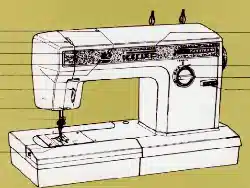
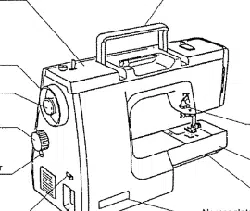
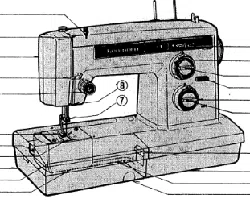
MACHINE IDENTIFICATION
IIII IIIIII IIIII
O
®.
®
®
®
@
@
@
@
@
Model 1358
2

I IIIIIIIII IIIII II I IIIII IIII III
Model 1595
®
.@
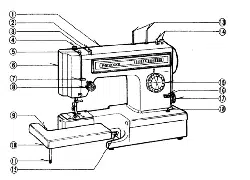
1. Top cover
2. Bobbin winder tension disc
3. Thread guide
4, Pressure regulator
5. Take-up lever
6. Face cover
7, Face cover thread guide
8, Top thread tension control
9. Guide pin
10, Extension table
11. Support leg
12, Guide pin
13. Spool pins
14. Bobbin winder
15. Stitch selector
16. Reverse stitch lever
17. Stitch length dial
18. Light/power switch
19. Thread cutter
20. Presser foot thumb screw
21. Presser foot
_. Needle clamp screw
23. Needle
24, Needle plate
25. Feed dogs
26. Shuttle cover
27. Hand wheel
28. Clutch knob
29. Nomenclature plate
30, Electric cord receptacle
31. Presser foot lever
32. Foot control
33. Accessory box
34. Owner's manual

I
PARTS LIST
IIIIIII
PARTS AND ACCESSORIES PROVIDED WITH MACHINE
1
8
2 4
10
11
6
12 13
19
OPTIONAL ACCESSORIES
24 25 26
30 31
15
20 21
16
27 28
32 33
23
29
34
4

PARTS LIST (Useonly genuine Kenmore replacement parts and accessories,)
All parts listed herein may be ordered from
any Sears, Roebuck and Co. store or service
center.
WHEN ORDERING REPAIR PARTS,
ALWAYS GIVE THE FOLLOWING INFOR-
MATION:
1. PART NUMBER
2. PART DESCRIPTION
3. MODEL NUMBER shown on the nomen-
clature plate. (See page 3 for location.)
4. NAME OF ITEM
If the parts you need are not stocked locally,
your order will be electronically transmitted
to a Sears Repair Parts Distribution Center
for expedited handling.
_lef. NO,
1
2
3
4
5
6
7
8
9
10
11
12
13
14
15
16
17
18
19
2O
Part No.
40390
6873
6870
6757
47149
8286
2273
45846
58232
45195
45196
45197
58700
42679
6830
55824
35346
35347
68183
55501
47
6510
36353
Description
Zigzag presser foot
Straight stitch foot
Satin stitch foot
Zipper foot
Buttonhole guide foot
Thread spool pin
Nylon disc
Feed cover plate
Buttonhole guide plate
Buttonhole template No. 1
Buttonhole template No. 2
Buttonhole template No. 3
Buttonhole adapter
Buttonhole foot
Buttonhole opener
Buttonhole guide plate
for 1358
Buttonhole template No. 1
for 1358
Buttonhole template No. 2
for 1368
Buttonhole cover plate
for 1358
Large screw driver
Small screw driver
Shuttle
Bobbin case
Needle clamp with screw
RefoNo.
21
23
24
25
26
27
28
29
30
31
32
33
34
Part No. Description
iiiiii i ii i i
1939 Bobbin winder rubber ring
6797 Light bulb
6811 Foot control
6782 "Q FOOT"
6882 "Q SET"
6885 Blind hem foot
6792 Hinged zipper foot
6887 Even feed foot
6891 Ruffler pleater
6550 No. 9 needles
6551 No. 11 needles
6552 No. 14 needles
6553 No. 16 needles
6554 No. 18 needles
6746 "Q NEEDLE"
6862 10 bobbins in case
6864 Needle threader
6889 Oiler-brush combination
6736 Automatic buttonholer
makes 3 styles in 10 sizes
6840 Accessory set (not shown)
for heming, edgestitching,
binding, gathering, quilting,
attaching braid, lace,
zippers incl. "Q SET".
5

• I IIIIIIIIIIIIIIIIIIIII J
Light(power
switch
Model 1358
SETTING UP YOUR MACHINE
1. Install your Kenmore sewing machine in a
Kenmore cabinet, case or set the machine
on a sturdy flat surface.
2. Your Kenmore sewing, machine has been
throughly oiled at the factory. Be sure to
wipe off the needle plate area, bed plate
and bobbin case carefully before sewing a
garment, It is wise to practice on a scrap
of fabric so any surplus oil is absorbed,
3. SPOOL PINS
You'll find spool pins and nylon discs
packed in the accessory box. Using a
screwdriver, attach spool pins securely on
the top cover and position nylon discs
over the spool pins as indicated.
4. FOOT CONTROL
Plug foot control into machine receptacle.
Then connect cord into any 110-120 volt
A. C. wall outlet,
5. LIGHT/POWER SWITCH
Your machine will not operate unless the
light/power switch is turned on. Turning
on the power automatically illuminates
the whole stitching area. If you're
interrupted or stop sewing, turn off the
light/power switch.
(A)
INSTALLING EXTENSION TABLE
For all fiat-bed sewing use the extension table
provided with the machine. To install the
extension table, simply slide the table along
the free arm until the two pins (A) and (B)
enter fitting holes in the machine, Lower the
support leg.
To utilize free-arm feature for sewing tubular
material, remove the extension table from the
machine by pulling it to the left.

II IH II H IIIIII I I IIIIIIIIIIIIIIIIIIIIIIIIHIIIIIHII
WINDING BOBBIN
O
®
®
i I i t
®
®
!. Release clutch by pulling hand wheel or
turning clutch knob toward you.
2. Draw thread from spool through bobbin
winder tension disc as shown.
3. Pull end of thread through hole in bobbin
as shown.
4. Push bobbin winder shaft to far left
position, if it is not already them. Place
bobbin onto shaft with end of thread
5.
,
coming from top of bobbin. Push bobbin
winder shaft to right until it clicks. Hold
onto end of thread.
Start machine. The thread that is held
will snap. Bobbin will cease turning when
completely filled. Push shaft to left to
remove bobbin.
Push in handwheel or tighten clutch knob
and remove bobbin.
7

REMOVING BOBBIN CASE FROM SHUTTLE
®
®
®
1, Raise needle to its highest position 4.
rotating hand wheel toward you.
2. Remove the extension table from machine 5.
by pulling it to the left.
6.
3. Open shuttle cover.
To remove bobbin case from shuttle, pull
open latch of bobbin case.
Pull bobbin case straight out of shuttle.
Release the latch and bobbin wilt come
out from bobbin case.
8

I IIII IMH
INSERTING BOBBIN INTO BOBBIN CASE
I HI I II
®
,
*
3.
4.
With the bobbin case in your left hand,
place the bobbin into it with the thread
running clockwise.
Feed the thread through the slot in the
case.
Pull the thread under the tension plate.
Draw 3 to 4 inches of thread from bobbin,
INSERTING BOBBIN CASE INTO SHUTTLE
i
With locating pin straight up, hold the
latch open, and slide the bobbin case on
to the center spindle of the shuttle.
.
Make sure the locating pin fits into the
locating groove at the top of the shuttle.
Release the latch to lock the bobbin case
into place.
9

IIIIIIII IIIII IIIII I IIII IIIIIIIIIIIIIIIII
THREADING TOP THREAD
...........
10
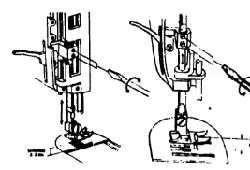
Raise thread take-up lever to its highest
position by turning hand wheel toward you.
Raise presser foot lever. Place thread spool
on spool pin,
Draw thread through thread guide 1.
Holding spool stationary with right hand,
pull thread through the tension discs. Pull
the end of the thread taut with the left hand.
2_
3_
This will pull the spring wire up and past the
end of the hook. The thread will then slip
into the hook when the spring is released.
Draw thread up through thread guide 4 take-
up lever 5 and down through lower thread
guides 6, 7, 8 to needle.
The needle must be threaded from front to
rear, Draw 3 to 4 inches of thread through
the eye of needle.

.... IIIIIIIIIIIIII I IIIIIIIIIHIIIIIIIIIIIIIIIIIIIIIII I II I
PICKING UP BOBBIN THREAD
1. Raise presser foot lever. Hold needle
thread loosely in left hand and rotate
handwheel toward you one complete
turn.
.
Bring bobbin thread up by pulling upper
thread.
®
3. Pull both threads under and to the back
of the presser foot, leaving 3 to 4 inches
of thread clear.
®
If you can not pick up bottom thread by
following above steps, then check:
1. Is thread through needle ?
2. Is thread tangled around needle ?
3. Is there 3 to 4 inches of thread coming out
of bobbin case ?
4. Is thread from bobbin case tangled ?
11

j IIIIII UlIHHHIIIIIII IIIIII
q>
®
An ideal straight stitch will have
threads locked between the two
layers of fabric.
Upper thread too tight
Decrease tension
®
Upper thread too loose
Increase Tension
)
ADJUSTING TOP THREAD
TENSION
Probably the most important control on your
machine is this one that regulates your top
thread tension.
There are many reasons for having to reset
your tension. The best tension for one fabric
may not I_e correct for another. The required
tension depends upon the stiffness of the
fabric, thickness of the fabric, numbers of
layers of fabric being sewn, as well as the
type of stitch you are making.
It is best to test the stitching on a scrap of the
fabric you are using before starting to make a
garment. Use the straight stitch function as
shown at the right.
Increase
Decrease
ADJUSTING BOBBIN THREAD
TENSION
When stitching is unsatisfactory in figures 2
and 3 above, adjust the upper thread tension.
LOWER THREAD TENSION REQUIRES
ADJUSTMENT LESS FREQUENTLY THAN
THE UPPER THREAD TENSION.
When stitch is satisfactory, as in Fig. 1 and
seam is badly puckered, the cause may be
tight tensions and both upper and lower may
have to be adjusted.
When adjusting the tension on the bobbin
case, make slight adjustments with a screw-
driver.
12

I I ! III I
STITCH SELECTOR
There are certain types of stitches that are
used more often than others in your garment
construction. Because of their frequent use,
you will soon realize the convenience offered
to you by this control. All of the stitches that
are made by this machine are illustrated on
the stitch selector dial. You can obtain your
desired stitch by simply turning the stitch
selector dial.
Zigzag stitch.
width range
Straight stitch
Buttonhole steps
Shell stitch
Blind 1
Mending stitch
Elastic stretch
Straight stretch
Serging stretch
stretch
Rick-rack stretch
Smocking stretch
STITCH LENGTH CONTROL
.
,
Recommended stitch length settings are
indicated in three colors and color-coded
with stitch patterns on the selector.
Turn the knob toward you to lengthen a
stitch and away from you to shorten.
3. Orange graduation indicates the approx-
imate number of stitches per inch (6-8-12-
24) of both straight.and zigzag stitches.
4. Stitches per inch are printed on the end of
the dial for your convenience,
Stitches Orange zone
per inch
Green zone
6
8
t2 Yellow zone
24
° I
Buttonhole
zone
Straight stitch [
Zigzag stitch i' '_'" J
Shell stitch
Blind stitch <_
Mending stitcll iii
Box stitch
Elastic stretch
Smocking
Rick-rack |
Overcasting :_
Serging _:
Straight |
Buttonhole II] 0 [k
13

I I ]11[11!11111111IIII
J
REVERSE STITCH CONTROL
It is best to begin and end seams with a few
stitches taken in reverse. This is called back
tacking. Back tacking fastens the ends of the
seams firmly and prevents raveling.
When reverse stitching is needed, turn the
control clockwise and hold there during
sewing. The fabric will immediately start
feeding backwards and seam will be
fastened.
PRESSURE REGULATOR
Push down the outer ring of the pressure
regulator. This will release the pressure on
the presser foot. To increase the pressure,
push down inner pin until a suitable pressure
is obtained.
insufficient pressure may cause poor feeding
of the fabric, skipped stitches, or difficulty in
guiding the fabric. If feed dogs or presser
foot marks appear on the fabric, reduce the
pressure.
For sewing of medium weight fabric, the
inner pin should be pushed all the way down.
When sewing multiple thicknesses or heavy
fabric, reduce the pressure with the pin ½
way down.
Light weight fabrics need full pressure,
unless feed dog marks are visible on fabric.
Reduce slightly to eliminate marks, but retain
good feeding.
14

IIII IIIIII I I III III II
SEAM GUIDES
Seam guides are printed on needle plate, at
both sides of needle, to help you line up the
fabric and keep it straight. The standard
seam width is 5/8". So these lines are
emphasized, easy to follow.
Also the cross lines are "cornering guides" to
help when turning a square corner 5/8" from
the fabric edge. (For details on cornering, see
page 25.)
_ornering Guide
Cornering Guide
PRESSER FOOT LEVER
Presser foot lever has a two position lift,
tn order to place heavy fabric under the
presser foot or to change the presser foot
raise the presser foot lever to its maximum
upward position as shown.
\
FEED DOG CONTROL (Model1358)
The feed dog control is located on the right
front of the machine bedplate, There are a
few times when you want to control the
feeding of the fabric yourself. When the
control is turned to the left, the feed dogs
drop and do not move the fabric.
For most of your sewing, turn knob to the
right.
m
15

,*- ACCESSORIES ill
1
1
NEEDLES
Use KENMORE needles. The size of the
needle should conform with the size of the
thread and both should be suitable to the
fabric. Kenmore needles are color-coded by
size for your convenience (See chart on
next page).
Never use a bent needle or one with a dull
point.
If you do not have a Kenmore needle, please
use this illustration to be sure your needle is
the right size. Distance from top of needle to
needlehole should be this exact length.
You will find among your accessories a
•'O._EEDLE",. with blue shank. This special
needle is to be used when sewing knits and
certain difficult synthetic fabrics. If you
experience skipped stitches in any of your
sewing, use "o NEEDLE",=and "O FOOT",.•
Flat
side
away
from
you
!
PLACEMENT OF NEEDLE
Raise needle bar to its highest position by
turning the hand wheel toward you. Loosen
the needle clamp screw. Holding the needle
with the flat side away from you, slip the
needle into the needle bar. When it is in as far
as it will go, tighten the needle clamp screw
with small screwdriver provided in the
accessory box.
16

NEEDLE, THREAD AND FABRIC CHART
i.i MIIIII IIII I IIII I I IIIIIIIIII ,,
FABRIC
LIGHTWEIGHT: Batiste, Dimity,
Chiffon. Silks. Synthetic Jerseys,
Fine Lace. Organza, Crepe,
Taffeta. Voile, Organdy
MEDIUMWEIGHT: Cotton,
Cotton Blends. Percale. Gingham,
Shantung. Pique, Seersucker,
Satin, Knits. Vinyl, Suitings,
Linen, Wool Crepe. Leather
iiiiiiiiiiiii iiii i iiiiiiiiiii
MEDIUM HEAVYWEIGHT:
Corduroy, Denim, Woot,
Sailcloth, Wool Flannel,
Gabardine. Velvets, Leather
iiiiiii iiii ]1
HEAVYWEIGHT: Coatings,
Upholstery, Cotton Duck,
Heavy Twills, Canvas
Deco_-ativetop-stitchi_l or= all
type= of falxic
Synthetic Knits and Stretch:
Polyester Double Knits, Nylon
Tricot, Jersey, Stretch Terry,
Spandex. Cire Tricot
NEEDLE
SIZE AND
COLOR
ii ii i
9- BROWN
or
11-ORANGE
14-RED
14-RED
or
16-PURPLE
18-GREEN
16-PURPLE
18- GREEN
or
Q-BLUE
I iiiii
Q-BLUE
with
"'Q FOOT ....
THREAD SIZE
Polyester Core/Cotton Wrap
Fine Mercerized Cotton
Silk A
Polyester Core/Cotton Wrap
50 Mercerized Cotton
Silk A
Polyester Core/Cotton Wrap
50 Mercerized Cotton
Mercerized Heavy-Duty
Silk A
i i ii.lll i =
Polyester Core/Cotton Wrap
Heavy-Duty Mercerized Cotton
Polyester Synthetic
Silk A
II I II IIII
Buttonhole Twist
Polyester Core/Cotton Wrap
50 Mercerized Cotton
= i = i i iii
RECOMMENDED
STITCH LENGTH
SETTING
I
12 stitches
per inch
10 to 12 stitches
per inch
8 to 10 stitches
per inch
8 stitches
per inch
6 stitches
per klch
i i
10 for Regular
or
6 for Stretch
Stitches

FEED COVER PLATE
There are a few times when you want to
control the feeding of the fabric yourself.
Raise needle to its highest position and raise
presser foot, Place feed cover plate over
needle plate aligning two pins of feed cover
plate with holes of needle plate. You may
then determine the movement of the fabric
yourself,
A B C
D E
F
PRESSER FEET
To change the various presser feet, raise the
presser bar to its highest position by lifting
the presser foot lever (See page 15). Loosen
the presser foot thumb screw, choose the
proper foot, insert from the front. Lower the
presser foot lever and tighten the screw using
the large screw driver to make certain the
foot is secure.
You have a variety of presser feet:
A. Zigzag Foot
B. Straight Stitch Foot
C. Satin Stitch Foot
D. Zipper Foot
E. Buttonhole Guide Foot
F. Buttonhole Foot
Applications are provided in appropriate
sewing section.
18

==CARING FOR THE MACHINE IIII
CLEANING AND OILING
Fig. 1 Cleaning the feed dogs with a brush.
To insure the best possible operation of your
machine, it is necessary to keep the essential
parts clean at all times. Open shuttle access
cover and remove needle plate with large
screw driver. Then using a small brush,
remove the lint that accumulates in the
shuttle area and around the feed dogs.
Fig, 2 Parts of the Shuttle Assembly
To Clean the Shuttle Area:
1. This area must be kept free of dust, lint
and occasional tangled thread. Raise the
needle bar to its highest point and remove
the bobbin case.
2. Push levers of shuttle race aside and lift
shuttle race cover and shuttle out.
3. Clean the shuttle race with small brush.
,
Put a drop of Kenmore sewing machine
oil only on the center pin of the shuttle
and shuttle race (see arrows on two
bottom illustrations).
To Replace Shuttle Assembly:
1, Position shuttle race as illustrated so that
race is forming half moon on the left side
of the machine,
Hold shuttle by center pin and position
shuttle so as to form a half moon on the
right side. Pointed hook will be on the
bottom.
3. Place shuttle race cover into place over
shuttle assembly,
4. Snap the levers into position.
Note: Oil and lint brush No. 6889 is available
at most Sears retail stores and catalog.
Fig. i
Shuttle Race Cover
pointed _....,
hook
Shuttle
shuttle driver
Shuttle Race
Fig. 2
19

i ...............................................................
OILING UNDER TOP COVER
PLATE
Remove arm cover plate to oil points
indicated by arrows in top of machine head.
Use one to two drops of Kenmore sewing
machine oil at each part, To remove cover
plate, loosen up two top screws and lift the
cover plate.
J D
Rear Support
OiUNG UNDERSIDE
Tilt machine head back and remove bottom
covers and rear support to oil points indicated
by arrows on underside of machine. To
remove bottom covers and rear support,
remove screws (A), (B), (C), (D), (E)and (F).
20

OILING IN FACE COVER PLATE
Swing face cover plate open and oil points
indicated by arrows in illustration.
I
CHANGING LIGHT BULB
The sewing light is located inside the face
cover plate as shown. To replace the bulb,
push switch to off, unplug machine and
swing the face cover plate open. Push up on
the bulb slightly and,turn bulb to the left.
Withdraw bulb from socket. Push in new
bulb and turn to the right.
21

iCHECKING PERFORMANCE PROBLEMS I II
SUSPECTED PROBLEM
IRREGULAR
STITCHES
BREAKING
NEEDLE
PROBABLE CAUSE
Incorrect size needle.
Improper threading.
Loose upper thread tension.
Pulling fabric.
Light pressure on presser foot,
Loose presser foot.
Unevenly wound bobbin.
Nicks or burrs at needleplate opening.
Pulling fabric.
Incorrect size needle.
Incorrect setting of needle.
Loose presser foot.
BUNCHING OF Upper and lower threads not drawn back under presser
THREAD foot before starting seam.
PUCKERING Incorrect thread tension(s).
Light pressure on presser foot.
Using two different sizes or kinds of thread,
Bent or blunt needler
Loose presser foot.
Fabric too sheer or too soft.
SKIPPING
STITCHES
BREAKING UPPER
THREAD
BREAKING BOBBIN
THREAD
Incorrect size needle,
Certain knits and synthetics.
Bent or blunt needle.
Incorrect setting of needle.
Tight upper thread tension.
Light pressure on presser foot.
Starting to stitch too fast.
Improper threading,
Tight upper thread tension.
Incorrect size needle.
Sharp eye in needle.
Nicks or burrs at needleptate opening.
Improper bobbin case threading.
Lint in bobbin case or shuttle.
FABRIC NOT
MOVING
MACHINE JAMMING,
KNOCKING NOISE
MACHINE DOES
NOT SEW
Feed cover plate attached or feed dog down.
Light pressure on presser foot.
Thread knotted under fabric.
Thread caught in shuttle.
Damaged needle.
Bent needle plate.
Power cord not connected,
Power/light switch off.
22

IIII II II HIIIIIII IIIIIIIIIIIIIIIIUIIIIIIIII
POSSIBLY EASY CORRECTION
Choose correct size needle for thread and fabric.
Rethread machine; check tension spring threading.
Tighten upper thread tension.
Do not pull fabric; guide it gently.
Increase pressu re on presser foot.
Reset presser foot.
Rewind bobbin.
Replace needleplate, or polish off burrs completely.
Do not pull fabric; guide it gently.
Choose correct size needle for thread and fabric.
Reset needle.
Reset presser foot.
When starting a seam be sure to draw both threads under and back of presser foot
about 4" and hold until a few stitches are formed.
Reset thread tension(s).
Increase pressure on presser foot.
Upper thread and bobbin thread should be same size and kind.
Insert new needle.
Reset presser foot.
Use underlay of tissue paper.
Choose correct size needle for thread and fabric.
Use "Q NEEDLE '''M and "Q FOOT"'".
Insert new needle.
Reset needle.
Loosen upper thread tension.
Increase pressure on presser foot.
Start to stitch at a medium speed.
Rethread machine.
Loosen upper thread tension.
Choose correct size needle for thread and fabric.
Insert new needle.
Replace needleplate, or polish off burrs completely.
Check bobbin case threading.
Clean bobbin case and shuttle.
Remove feed cover plate or raise feed dog.
Increase pressure on presser foot.
Place both threads back under presser foot before beginning to stitch.
Disassembleand clean shuttle.
Replace needle.
Replace needle plate.
Check plug.
Push to on position.
23

STARTING TO SEW
Now that you are familiar with the controls
on your machine and with the accessories
pr,ovided for the machine, you are ready to
start to sew with your sewing machine,
Below are some good habits to follow each
time you sit down to sew:
1, Check the needle-it should be straight,
properly set and sharp on the point.
it should be the correct size for the fabric
and thread being used, Do not be afraid
to change your needle frequently. Many
of the new fabrics made of synthetic
blends tend to dull the needles more
easily than fabrics made of natural fibers,
.
.
.
Before placing the material on the
machine, see that the ends of the threads
have been drawn about 3 -4 inches to the
rear of the machine, Hold on to threads
during the sewing of the first 3 or 4
stitches of the seam.
Test the machine stitch on a scrap of
fabric you plan to use, The fabric should
be double thickness, Adjust the machine
for the length of stitch and tension
suitable to your fabric,
Fabric should be placed under the presser
foot with the bulk of the material to the
left of the needle and the right edge of the
material placed on the 5/8" seam marking
on the needle plate when making a simple
seam.
5_
Run the machine at a slow even speed.
The more pressure you put on the foot
control, the faster the machine will sew.
6. Fasten each seam by back tacking at the
beginning and end of the seam.
7. Always finish sewing each seam with the
needle at its highest point.
8. Guide the fabric gently with your hand in
front of the needle. Never pull or hold the
fabric in such a way, that the normal
feeding is altered.
,
When turning the hand wheel manually,
always turn it toward you.
24

STRAIGHT STITCHING
Pressure regulator
See page 14.
Presserfoot
"Straight, zigzagfoot
or O foot
*You may use zigzag, straight stitch foot or Q foot but
for best control offabric, best looking straight stitches
and best .feeding of fabric use Straight Stitch Foot,
Stitch selector
Stitch length dial
Any setting but "0"
FASTENING A SEAM
Be sure both threads are drawn back under
the presser foot. Lower needle into fabric
about 1/2 inch from beginning of seam.
Depress the reverse stitch lever and stitch in
reverse until needle reaches beginning of
seam, Release control and complete seam.
When you reach the end, depress the reverse
stitch lever and sew back (backtack) over 1/2
inch of completed seam.
TURNING A SQUARE CORNER
To turn a square corner 5/8" from the fabric
edge, stop stitching with the needle piercing
the fabric, when reaching the cornering guide
as shown. Raise the presser foot, turn fabric.
New stitching line will align with 5/8" seam
guide on side of needle plate, Lower the
presser foot and begin stitching in new
direction.
25

REMOVING FABRIC
First turn the handwheet toward you until the
needle is at its highest position, then raise the
presser foot, draw materials to the rear and
cut off excess thread with the thread cutter
located on the presser bar as shown.
TOP- STITCHING
This is a seam you may want to show off! It's
on the front side of the garment, possibly at
the top of a "kick pleat" or on a lapel, both
functional and decorative. Usually, it's a
simple, forward stitch- with an extra-long
stitch length, or with special thread, match-
ing or contrasting.
DARNING
SETTINGS
i
Stitch Selector - I
Stitch Length - 8 to 10
Zigzag foot or square automatic buttonhole
foot
Release Presser Foot Pressure.
Stretch fabric between embroidery hoops
with hole centered. Lower presser bar and
sew at a slow speed moving fabric back and
forth with a steady rhythm to cover darning
area. When it is covered, turn fabric 1/4 a
turn and sew layer of stitching across first
layer.
If fabric is thin or badly damaged in hole area,
you may want to put a separate piece under
the hole for reinforcement.
26

IIIIIIII III IIIIIII
IIIIIIIIIIII
TEMPORARY SEWING BY
MACHINE
No longer do you need to baste by hand!
Basting by machine is easy-simply use
straight stitching with longest available
length setting.
PiN BASTING
You can sew over pins easily (if done
correctly) because your presser feet are
hinged. Pins must be inserted at right angles
to seam line. Tip of pin should just touch
seam line. Sew over tip of pins. Pins must not
come in contact with feed dogs: Never pin on
the under-side of the fabric. Sew slowly. If in
doubt about sewing over pins, remove each
pin as you approach it.
STAY- STITCHING
"Stay-stitching" is a form of temporary
seaming that prevents stretching of curved
edges of garments. Usually this is on a single
layer of fabric, so reduce top thread tension
slightly to prevent puckering. Baste about
I/4" away from intended seamline.
/
ZIPPER APPLICATION - CORDING
REGULAR ZIPPER
The foot is adjustable for use on the right or
left side of needle when sewing regular type
of zipper. Adjust the foot so the needle clears
the side notch on the foot. Carefully follow
directions given on the zipper package.
CORDING
To make cording for slipcovers, etc., cover a
cord with a strip of true bias. Adjust the foot
to the left of the needle.
J
27

il II IIIIMIIII I III
ZIGZAG STITCHING
Pressureregulator
f
See page 14.
Presserfoot
Zigzagfoot
Stitch selector
Stitch length dial
Any setting but "0"
TOP VIEW
DESIRABLE
UNDESIRABLE
CHECKING THREAD TENSION OF
ZIGZAG STITCHES
The easiest way to check tension is to sew a
medium zig zag stitch on the fabric you will
be using. °Use the appropriate type of thread
and needle as recommended on page 17.
Sew a line of zig zag stitches. The bobbin
thread should not show on the top of the
fabric.
Adjust the top tension if necessary to achieve
the stitch indicated at left side of illustration.
OVERCASTING
This is one of the more frequently used
zigzag stitches on garment construction:
You may want to overcast along the raw
edge of each seam allowance or fold the raw
edge toward the garment and stitch.
Stitch so the needle pierces the fabric just
short of the outside edge, Raw or worn edges
of older garments can be overcast to prevent
further raveling,
28

III IIII I I IIIIII
SATIN STITCHING
SETTINGS
Stitch Selector - Zigzag Stitch
Stitch Length Dial - Between 0 and 24
Satin Stitch Foot
Closely spaced zigzag stitches are called satin
stitches. This is an attractive stitch used for
appliqueing, bar tacking.
Whenever you are using this stitch, it is well
to remember to loosen the tension of the top
thread slightly. The wider the stitch you
make, the looser the tension should be.
If you are stitching on a very soft fabric, use a
backing of tissue paper or interfacing for a
well formed stitch. Puckering of the material
will be eliminated and the bobbin thread will
not be visible on the right side of the fabric.
As with all special stitches, it is best to make
a sample design on your fabric before starting
the design on the garment.
Satin stitch
foot
I I I " 1 | I' *_' '1
BAR TACKING
SETTINGS
Stitch Selector - Zigzag Stitch
Stitch Length Dial - Between 0 and 24
Satin Stitch Foot
This stitch is similar to a very short satin
stitch and is used to reinforce points of strain
such as corners of pockets and straps on
lingerie.
Sew 4 to 6 zigzag stitches.
_ i , ,,,,,,,, , L i ii
- =
• I/
0
I
H HHHNHI
29

HIIIIIIIIIIIIIII!IIIIIIIII I II I IIIIIIIII
APPLIQUEING
SETTINGS
Stitch Selector - Zigzag Stitch
Stitch Length Dia! - Between 0 and 24
Satin Stitch Foot
Select an applique design to be applied to
your garment and baste it in place. Satin
stitch around the raw edge of the-applique
completely covering the edge. You may want
to do this with a contrasting color of thread.
BUTTON SEWING
SETTINGS
Stitch Selector - Zigzag Stitch
Use Feed Cover Plate or Feed Dog Down.
1. Fix the button on fabric at desired
position with clear tape.
2. Align two holes of button with slot of
presser foot and lower foot to hold the
button securely.
3. Turn hand wheel manually until needle
point is just above button.
4. Set stitch selector at desired zigzag stitch
position so needle will enter one hole of
the button.
5. Turn hand wheel again by hand so needle
enters second hole. Reset stitch selector
if necessaw. Stitch a number of times.
6. Finish sewing with an extra two inches of
thread remaining. Draw these threads to
reverse side of garment and tie.
When sewing a flat button, place needle or
pin between holes of button as shown to
provide flexibility for buttoning,
3O

BLIND HEMMING
Pre_zsureregulator
See page 14.
Presserfoot
Zigzagfoot JForeasierbJindhemmingit is recommendedto usej
optionalaccessoryitem6885- adjustableblindhem
J
foot.
IIIIIIIIIIIIIIIIIIIII
Stitchsetector
a
Stitch length dial
Within greenzone
PROCEDURE
q>
INSIDE
FINISHED
EDGE
Finish edge of hem anyway you desire. Turn up
hem appropriate width,
®
®
FINISHED
EDGE
Fold garment away from hem leaving 1/8" of
hem edge extending.
®
RIGHT SIDE OF
:INISHED HEM
Place garment under presser foot in such a
manner that straight stitches will be sewn on
extended edge. The zigzag stitch should just
catch the fold of the garment.
Press both sides of the finished hem. The right
side of the garment will show only the blind
stitches.
31

__ I I II IIIIIIH IIIIIII III IIIIIIIIIIIIIIIIIIIIII I
MENDING AND OVERCAST STITCHING (THREE-STEPZIGZAG)
Pressureregulator
See page 14.
Presserfoot
_gzagfoot
Stitch selector
0
Stitch length dial
Within greenzone
iiJ_ii_3JiJi__Jiiii_iiiii__iJiiiiifiiii!_i_!i__iii_i!iiiiiii!iiiiiiiiiii_ii!iiiii_iiiiiiiiiiiiiii!!i
"> : <'._
J >
L.> : <"
'" I .>
] <,
,-:> I <-
,.:> i <.
,,.> I <.
,.> I <;_
MENDING
To repair a straight or three.cornered tear,
position the tear under the needle in such a
way that the stitching catches both sides of
the tear. When mending a three-cornered
tear, stitch from each end to the center. It is
well to use a piece of fabric under the tear for
reinforcement.
OVERCASTING WITH MENDING STITCH
Three-step zig-zag is a strong stitch because,
as its name implies, it takes three short
stitches where normal zig-zag takes one.
For this reason it is highly recommended for
overcasting, i.e. finishing a raw edge, on all
types of fabric.
32

IIIIIII
SHELL STITCHING
Pressureregulator
See page 14.
Presser foot
Zigzagfoot
IIIIll
I I
Stitch selector
Stitch length dial
Within greenzone
PROCEDURE
This shell-stitched edge is a popular finish for
lingerie and nightgowns. To achieve this
multiple scalloped effect, allow needle to just
clear the right edge of the fabric when it
zigzags.
33

J II II IHIIIII II IIIIIIIIIIIIIIIIIIIIIIII HIIIIIIII I HIIIIIIII IIIIIIIIIIIHIIII
•BOX STITCH
Pressure regulator
See page 14.
Presserfoot
Zigzagfoot
Stitch selector
{)
Stitch length dia!
Withingreenzone
OVERLAPPED SEAM
Box stitch is ideal for producing flat
overlapped seams on almost any type of
fabric and a bolder effect wilt result from
sewing with a contrasting thread.
Overlap the raw edges of two pieces of fabric
2" and pin or tack. Place the fabric right side
up with the middle of the overlap under the
center of the presser foot, so that the stitch
sews just over the top and bottom raw edges.
%
J
I
DECORATIVE EDGING
Turn the raw edge under 2" and press, Place
the fabric right side up with the middle of the
turnover under the center of the presser foot,
so that the stitch sews on to the fold and just
over the raw edge underneath.
34

_ Ill
STRETCH STITCHES
Pressureregulator
See page 14.
Presserfoot
Zigzagfoot
Stitchselector
0
Stitch lengthdial
Within yellow zone
The stitches shown at left are all for use with
stretch and knit fabrics, These are special
stitches built in to the machine for your quick
selection.
1. Straight Stretch
2. Serging or Pine Leaf Stretch
3. Overcast Stretch
4. Rick-Rack Stretch
5. Smocking Stretch
6, Elastic Stretch
ADJUSTING STITCH LENGTH
Depending upon your preference in stitch
patterns, you may make stretch stitches
closer together without changing the balance
of stitches by turning stitch length dial away
from you within yellow zone.
RECOMMENDATION
It is recommended to use ..Q NI_:F:I)LF;",. and
•'Q FOOT",, for sewing on knit and synthetic
fabric.
@ ® ® ® ®
®
35

III I IIIIIIII/ IIIIIIIIIIIIIIIIIIIIL III !111111 IIIIIIIIIIIIIIIIIIIIII IIIIIII
STRAIGHT STRETCH STITCH
SETTINGS
Stitch Selector -
Stitch Length - Yellow Zone
You may useeither a zig zag or straight stitch
foot BUT-- for best control of fabric, best
looking straight stitches and best feeding of
fabric use Straight Stitch Foot.
Use this stretch stitcl_ with knit or synthetic
fabric. Sew as you do with regular straight
stitch.
This is also a good stitch to use on curved
seams regardless of the type of fabric. Any
seam that will receive a great deal of strain
when worn should be sewn with the stretch
stitch, Use in children's shorts and slacks as
well as adult sports clothes.
RICK-RACK STRETCH STITCH
Stitch Selector -
Stitch Length - Yellow Zone
Sew on stretch fabrics in any area that you
might use a zig zag stitch. This stitch can be
used as a decorative top stitch as well.
It is useful also on lapped or abutted seams
where you lap one edge of a seam over
another with seamtines meeting in the center.
_ ,,,i i
36

RMOCKING STRETCH STITCH
_Stitch Selector -
Stitch Length- Yellow Zone
i!. Make a straight line of gathers across the
fabric that you wish to smock,
With a narrow strip of fabric directly
under the line of gathering, stitch over the
gathers. The design will be a series of
small diamonds.
Note: When smocking e garment, the stitch *
ing should be done before the piece is
sewn into the garment.
/
t i
OVERCAST STRETCH STITCH
Stitch Selector -
Stitch Length - Yellow Zone
This is the same type stitch used by the
garment industry in making sportswear-it
forms and finishes the seam in one operation
!(for seams of 1/4" to 3/e"). It's very effective
for use in repaidng raw or worn edges of
i:older garments.
_ote: To sew overcast stretch stitch in the
opposite direction, use serging (or pine
leaf) stretch stitch.
37

IIIIIIIIIIIIIIIIIII II II II II IIIIIIII IIII IIIIIIIIIIIIIIIIIIIIIIIII
SERGING (OR PINE LEAF)
STRETCH STITCH
Stitch Selector -
Stitch Length - Yellow Zone
Great in making elastic swimwear-as well
as for overcasting a neat edge on seams,
It's equally useful with woven and knitted
fabrics, Tension may need to be tightened to
achieve desired look.
ELASTIC STRETCH STITCH
Stitch Selector -
Stitch Length - Yellow Zone
Use this versatile stitch to insert elastic in
garments. Simply stitch elastic into place.
making sure it is evenly spaced, To do this,
mark the correct length piece into quarters,
then match these markings with center front
and side seams,
38

II III IIIIIIIIIIIII
WHERE TO USE WHICH STRETCH STITCH: A CHECK-CHART
td lower needle
_t.
!_ ................
stretchy suggestions...
constructed knits sometimes catch
toes of presser foot. To remedy this,
short strip of transparent tape around
foot encasing both toes.
avoid tangled threads when working with
tits, start seams carefully. Position fabric
before lowering presser
"IB_"lma-'III_'ID_ -IIIl_ -enl.
It is always a good idea to test thread tension
and stitches on a scrap of the fabric being
used.
Knits contain more yarn than woven fabrics,
so you will need to take greater care to keep
your machine clean specially in feed dog and
bobbin case area.
STRAIGHT STRETCH
/VVV'
RICK-RACK STRETCH
SMOCKING STRETCH
ELASTIC STRETCH
VVVVVVV
OVERCAST STRETCH
JJJ[ _L L
SERGING OR PINE LEAF
PLAIN ZIGZAG
Specially for Stretch
,, ,_,,
Use on stretch and knit fabrics and to repair ready made
garments at stress points. Basic stitch for atl garment
seams requiring "give" (i. e. armholes, crotch area, etc.},
Use also to sew center seam of men's neck ties and seams
cut on the bias.
A basic multi-purposestretch stitch with 'same usage as
zigzag stitch, especially for lightweight stretch fabrics.
A decorative stitch for use on Children's Ciothing, lingerie,
yokes of blouses, dress bodice.
Use to apply etastic io top 0f iingerie or-to repair ready-
made lingerie and replace or restitch elastic.
Use on sportswear where _" seams are required. Makes
and finishes seams at same time.
Use for overcasting fabrics that ravel or fray easily.., and
for seams that need a great deal of stretch (i.e.
swimwear, other sportswear, girdles). Also good-iookingl
SHELL STITCH
"Everyday" Stitches with Stretch Applications
Use for all-purpose stretch sewing, seam finishing, edge
finishing, or attaching stretch laces.
A good finishing stitch for nylon tricot lingerie.
39

! IH I IIIIIIIIIIIIIIIII IIIIIIIII IIIIIIIIIIIIIIIII IIIIIIIIIIIIIIIIIIIIIIIIIIII I I
BUTTONHOLE MAKING - BUILT-IN SYSTEM (BAR-TACKBUTTONHOLES)
Pressureregulator
See page t4.
Presserfoot
Buttonholeguide
foot
Stitchselector
Stitchlengthdial
Within buttonhole zone
B
A
PREPARATION
Carefully mark the buttonhole length on your
garment, Place the fabric with the buttonhole
marked under the buttonhole foot. Pull th(
guide foot (A) all the way forward so that th_
index mark (B) is aligned with the graduatior
(C), with thread to rear.
Reproduction of the identical size buttonhole.
is facilitated with the aid of the graduation,
on the left side of the buttonhole guide foot
These graduations are 1/8" apart
Graduations act as reference mark.
40

II IIIIIIHI
0
Step 1
PROCEDURE
Set stitch selector at 0 and sew several
times at the marked beginning of the
buttonhole. Stop sewing at the left stitch.
Raise needle to its highest position by turning
handwheel toward you manually.
Step 2
Set stitch selector at |_]. Stitch forward until
you approach the front marking of the
buttonhole, Stop sewing at the left stitch and
raise needle to its highest position.
Step 3
0
Step 4
m
Set stitch selector at U again and sew
several times. Stop sewing at the right stitch
and raise needle to its highest position.
Set stitch selector at lit and finish button-
hole.
Use buttonhole opener provided in accessory
box to open buttonhole.
41

iiiiiiiiii
More density
Less density
®
l
®
ADJUSTING STITCH DENSITY
Depending upon the fabrics on which you are
sewing, or your own preference in button-
holes, you may alter buttonhole stitch density
by varying the original stitch length setting
within the green zone.
1. For more density, turn thediat away from
you.
2. For less density, turn the d_al toward you.
==
:LJIIL
ii =1
N
U
A
=L_L¢.B
CORDED BUTTONHOLES
Hook filler cord (crotchet thread or button-
hole twist) to the spur (A), pull both ends of
cord forward under foot and tie to the spur
(B). Sew buttonhole in such a way that
zigzag stitches cover the cord.
When stitching is completed, release cord
from foot, pull ends of cord and snip off extra
length.
42

II /I IIIIlUlIIIIIIIIIIIIIIIIIII
BUTTONHOLE MAKING-USINGBUTTONHOLE ATTACHMENT
(Model 1358) StitchselectorPressureregulator
See page12.
Presserfoot
Feed dog down
Satin stitch foot
Stitch length dial
Between0 and 24
PROCEDURE
1. Raise needle to its highest position and
raise presser foot, Remove regular cover
plate and insert buttonhole cover plate.
Guide pin hole
Pinion gear
2. Screw guide pin on buttonhole guide
plate into guide pin hole on needle plate.
Guide pin
\
43

I I I
Template
Holder
/
Template Advance Knob Fig. 3
3. Insert a template into the slot of template
holder. Select the proper size of button-
hole by turning the template advance
knob.
Fig. 4
4. Pull the guide plate all the way forward so
that the guide pin is at °'S". This will
enable you to start at one end of the
buttonhole. Drop guide plate into place
over the pinion gear,
Fig. 5
.
Pick up bobbin thread through guide plate
by turning hand wheel and drawing
thread to back of machine. Place fabdc
between presser foot and guide plate.
Line up edge of fabric with marked
indentation on guide. If you wish all
buttonholes to be 3/4 inch from edge of
garment, line up fabric with 3/4 inch
marking each time you start sewing a
buttonhole.
44

III1[ IIIlUlIIIIIIIIIIIIIIIIMIII/I I II II IIIIIIIHIIII I IIIIIIP
BUTTONHOLE MAKING - USING BUTTONHOLE ATTACHMENT
PremJrere.mr
See page 14,
Press_' foot
Buttonhole foot
Feed cover plate
Stitchlelector
0
Stitch length dial
Any setting
Tab Release
lever
®
SETTING STITCH SELECTOR
PROCEDURE
,
2,
Raise needle to its highest position and
raise the presser foot. Remove the
extension table from machine and open
shuttle cover.
Insert two tabs of buttonhole adapter into
slots under the needle plate pulling
density control knob toward you until the
adapter snaps into place. (when button-
holing is completed, remove the adapter
by pulling it toward you with release
lever lifted up.)
Swing the shuttle cover up and away until
it is locked under the adapter as shown.
45

III II II
(__jGuide plate
.
Select correct template for type button-
hole you want. Insert template into slot of
guide plate. Turn template advance knob
to desired size.
®
.
Slip guide plate onto machine so it fits in
place with pinion gear in the center of arc
hole of template. Be sure guide block is
inserted in guide slot.
Your machine controls should be set as
shown on page 44. You will note that the
stitch selector can be set for several stitch
widths. This will result in thicker or
thinner buttonholes as illustrated on
page 44. The type of fabric you use will
determine what width you use. Be sure to
make a practice buttonhole first.
®
.
Pick up bobbin thread through guide plate
by turning hand wheel. Place fabric
between presser foot and guide plate.
Align marked buttonhole with center
marking on foot. Line up edge of fabric
with markings on guide plate, If you wish
all buttonholes to be 3/4" from edge of
garment, for example, line up fabric with
3/4" marking each time you start a
buttonhole.
46

ADJUSTING STITCH DENSITY
Depending upon the fabrics on which you are
sewing, or your own preference in button-
holes, you may alter buttonhole stitch density
by turning stitch density control knob.
1. When delivered, stitch density control
knob will be tighterted completely. For
more density, turn the knob toward you.
If the knob should be loosened as far as it
can go during adjustment, retighten it by
a quarter to half a turn to assure smooth
operation.
2, For less density, turn the knob away from
you.
\
®
Stitch density
control knob
CHOOSING BUTTONHOLE STYLE AND SIZE
Each buttonholing will be different so you will
want to experiment with your garment,
considering fabric and placement of button.
Here are some basic applications:
Straight buttonholes are most popular for
everyday sewing - for series of buttons on
dress, blouse, vest, jacket or coat.
Keyhole buttonholes are a variation of the
above, with an enlarged opening at one end
to allow more room for button Shank. These
are normally used in tailored vests, jackets,
coats.
Eyelet buttonholes (another variation of
"straight") most often are used for studs on
skirts or holes for tongues of belt buckles.
ROUND END
STRAIGHT
BUTTONHOLE
KEYHOLE
BUTTONHOLE
EYELET
BUTTONHOLE
47

III IIIIIIIIII II
, \
\
FREE-ARM SEWING
Your Kenmore sewing machine is easily
converted from a traditional flat-bed to a
contemporary free-arm sewing machine by
removing extension table.
The free arm enables you to sew tubular
types of pieces more easily. Just slip the
sleeve or pants leg on the free arm as shown.
You will find many uses for this free arm
feature such as:
1, Mend elbows and knees of garments
more easily.
2. Sew in sleeves more easily. This is
especially true when sewing smaller
garments.
3. Applique, embroider or hem around
edges of cuffs or pants legs,
4. Sewing in elastic casings in skirts or pants
at the waistline.
48

SEWING MACHINE
Now that you have purchased your Kenmore Sewing Machine,
shouid anead ever exist for repair parts or ean_e, sinciy contect
any Seam Service Cen_r and most Sears, Roebuck and Co.
Stores. Be sum to Ixovide all pertinent facts when you call or
visit
The model number of your Sewing Machine will be shown on
your nomenclature plate on the back of your Sewing Machine.
See page3 for location.
WHEN ORDERING REPAIR PARTS, ALWAYS GIVE THE
FOLLOWING INFORMATION:
*MOOEL NUMBER *NAME OF ITEM *PART DESCRIPTION
If the parts you need are not stocked locally, your order will be
electronically transmitted to a Sears Repair Parts Distribtnion
Cemerfor handling.
SEARS, ROEBUCK AND CO., Chicago, IL g0884 U.S.A.
S - 158 Part No. 69548 6/91