FOOD WASTE DISPOSER
OWNER’S GUIDE
See insert for specific information about your new disposer
NOTE: This Food Waste Disposer has been designed to operate on 110-120 Volt, 60 Hz exclusively.
Using any other voltage or Hz adversely affects performance.
IMPORTANT: Read all instructions thoroughly. Keep this guide for future reference.
CAUTION: Be sure to review SAFETY INSTRUCTIONS FIRST PERTAINING TO A RISK OF FIRE, ELECTRI-
CAL SHOCK OR INJURY TO PERSONS before using disposer.
2680 Orbiter Street • Brea, CA 92821 • www.anaheimmfg.com 560C485P01 REV E
Record important disposer information here
Model Number* Serial Number*
*Above information appears on the label affixed to bottom of the disposer. For your convenience,
write down the model and serial numbers prior to installation.
Bill of sale, sales slip, cancelled check or other purchase record should be kept to verify the original purchase
date for warranty purposes.
Call our toll free Help Line with any questions
800-854-3229
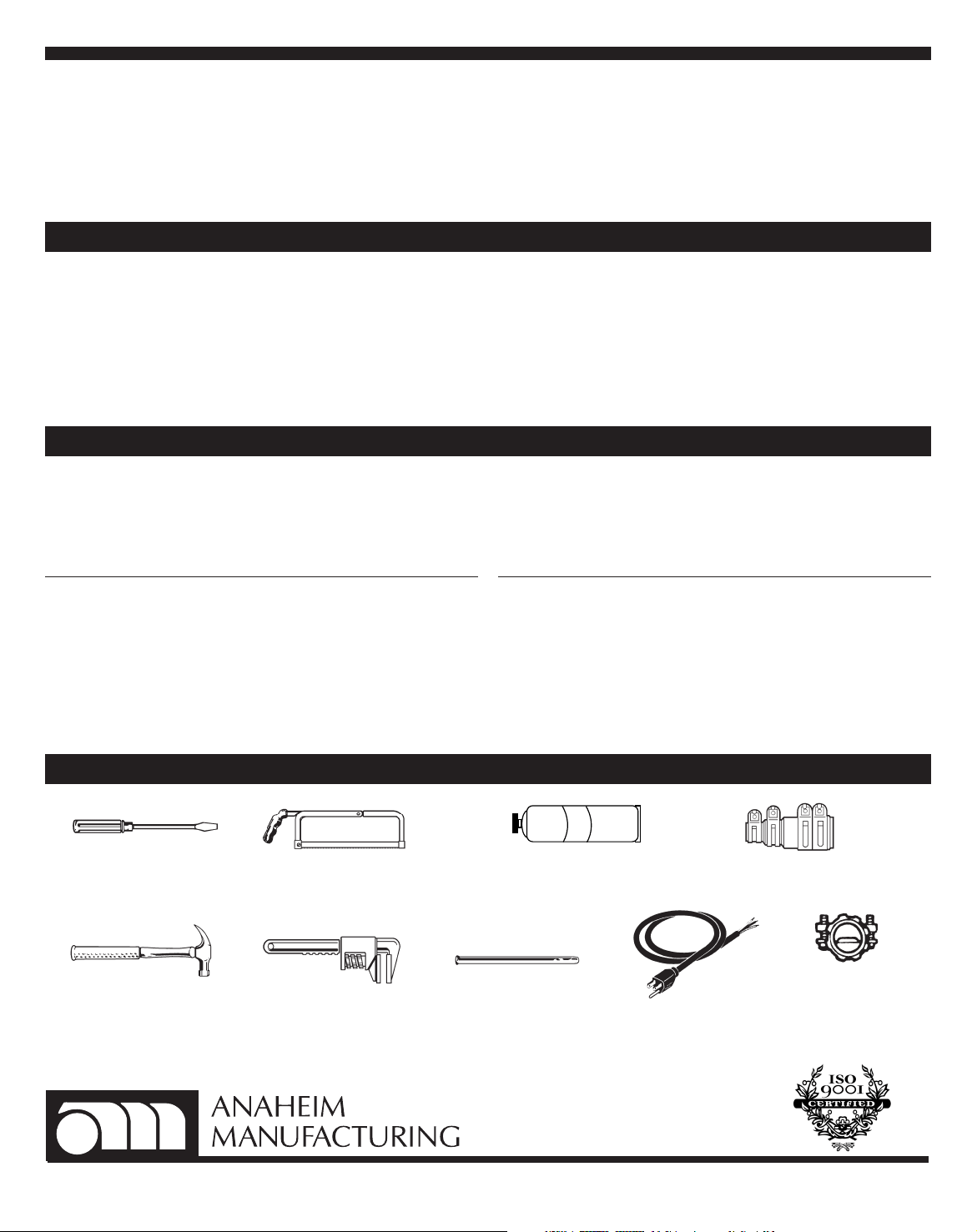
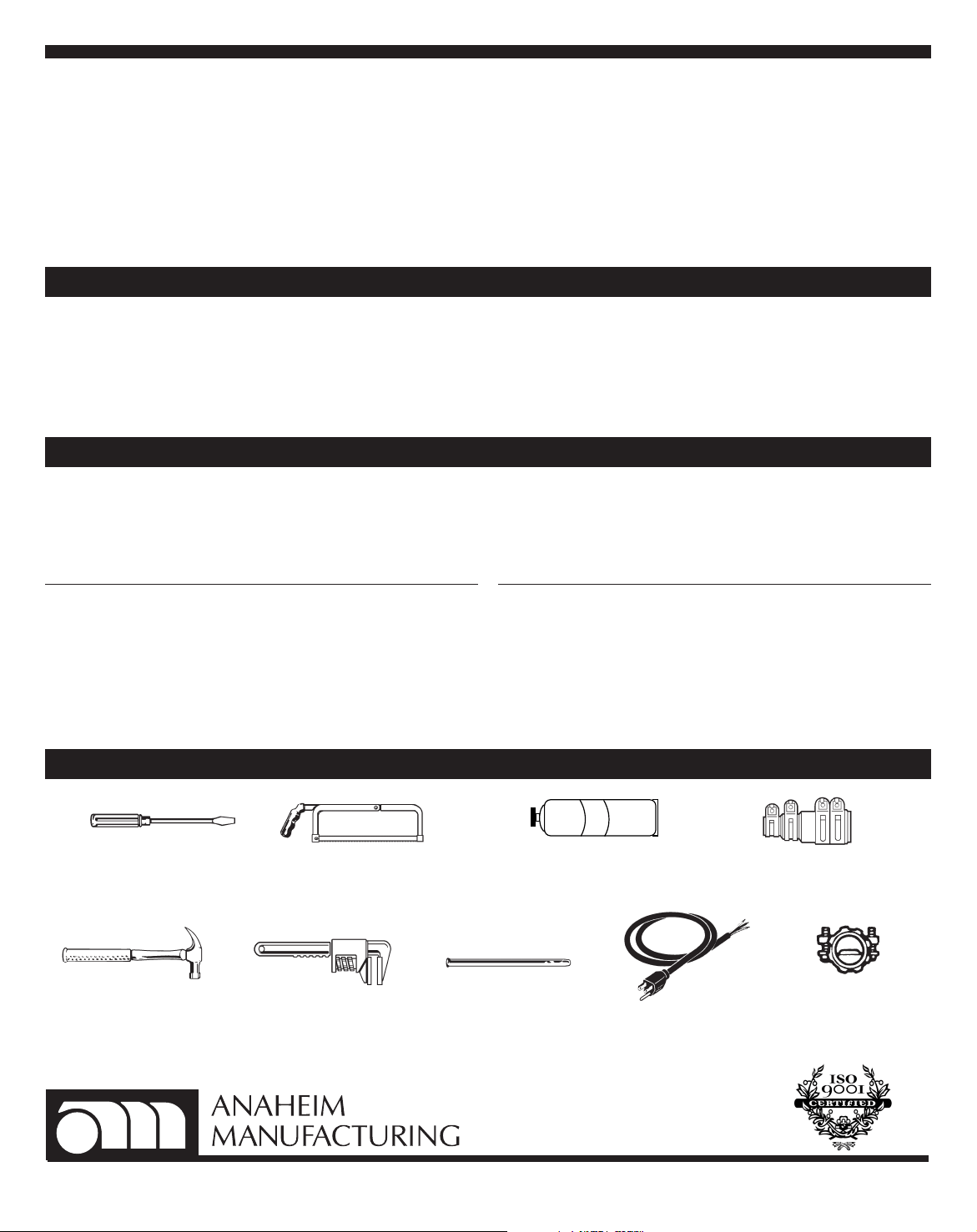
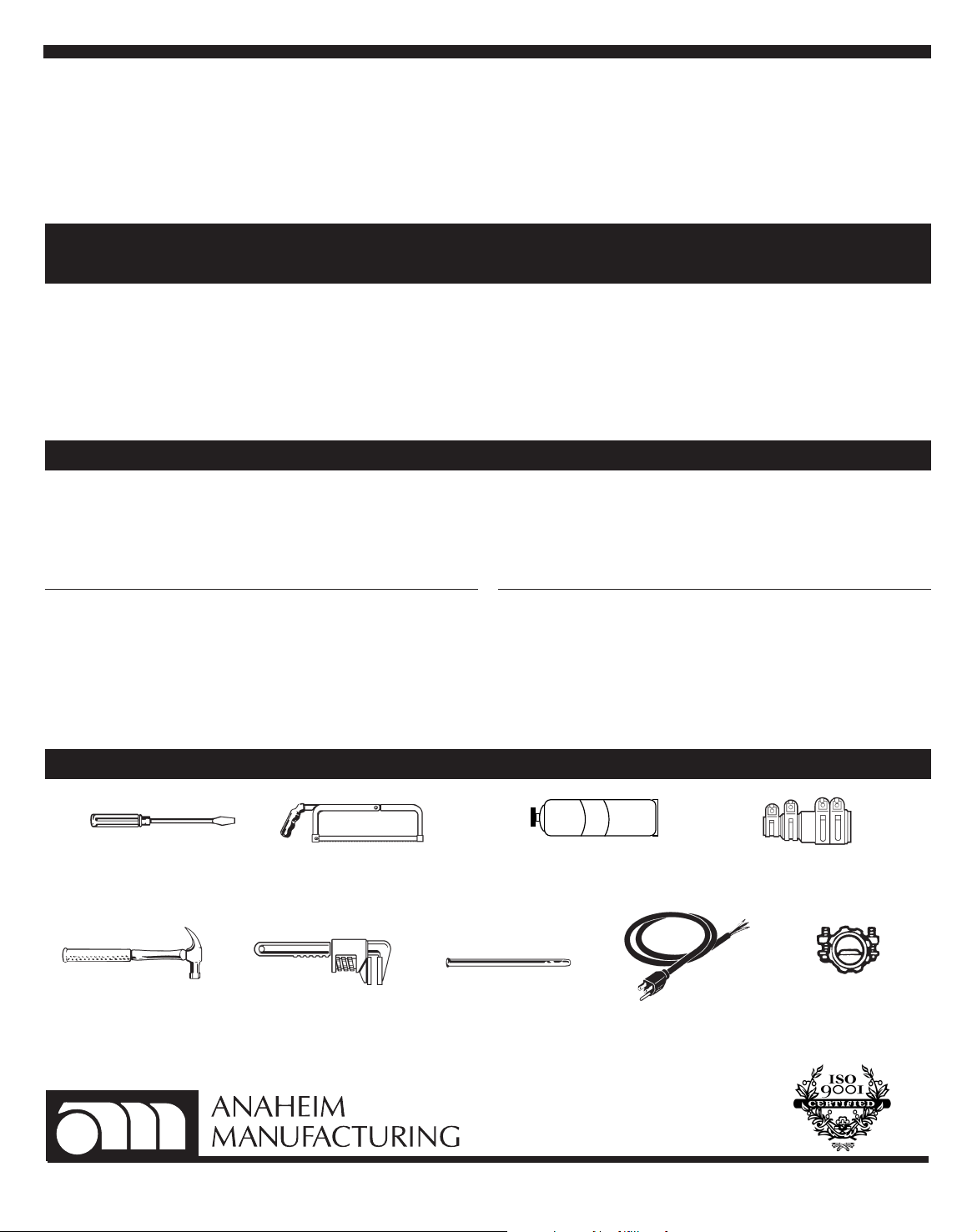
PIPE WRENCH
HACKSAW
POWER CORD
DISHWASHER CONNECTOR KIT
HAMMER DOWEL OR
STEEL PUNCH
STRAIN RELIEF
PLUMBER’S PUTTY
Tools and materials you may need
PHILLIPS & FLATBLADE
SCREWDRIVER
IMPORTANT SAFETY INSTRUCTIONS
INSTRUCTIONS PERTAINING TO A RISK OF FIRE, ELECTRIC SHOCK OR INJURY TO
PERSONS. SAVE THESE INSTRUCTIONS.
WARNING
– When using electrical appliances,
basic precautions should always be followed, includ-
ing the following:
1. Read all instructions before using the appliance.
2. To reduce the risk of injur y, close supervision is
necessary when an appliance is used near chil-
dren.
3. Do not put fingers or hands into a waste disposer.
4. Turn the power switch to the off position before
attempting to clear a jam or remove an object
from the disposer.
5. When attempting to loosen a jam in a waste dis-
poser, use a long wooden object such as a wooden
spoon or the wooden handle of a broom or mop.
6. When attempting to remove objects from a waste
disposer use long-handled tongs or pliers. If the
disposer is magnetically actuated, non-magnetic
tools should be used.
7. To reduce the risk of injur y by materials that may
be expelled by a waste disposer, do not put the
following into a disposer: clam or oyster shells;
caustic drain cleaners or similar products; glass,
china or plastic; large whole bones; metal, such as
bottle caps, tin cans, aluminum foil or utensils;
hot grease or other hot liquids; whole cornhusks.
8. When not operating a disposer, leave the stopper
in place to reduce the risk of objects falling into
the disposer.
9. DO NOT operate disposer unless splash guard is
in place. (Does not apply to the Top
Control/Batch Feed units.)
10. For proper grounding instructions see the ELEC-
TRICAL CONNECTION portion of this manual.
Before starting this step, turn off electrical power at
the circuit breaker or fuse box.
If your old mount is the same as the mount on your
new disposer, just reverse the assembly instructions
found in section 3. If your new mount system is differ-
ent, follow these instructions:
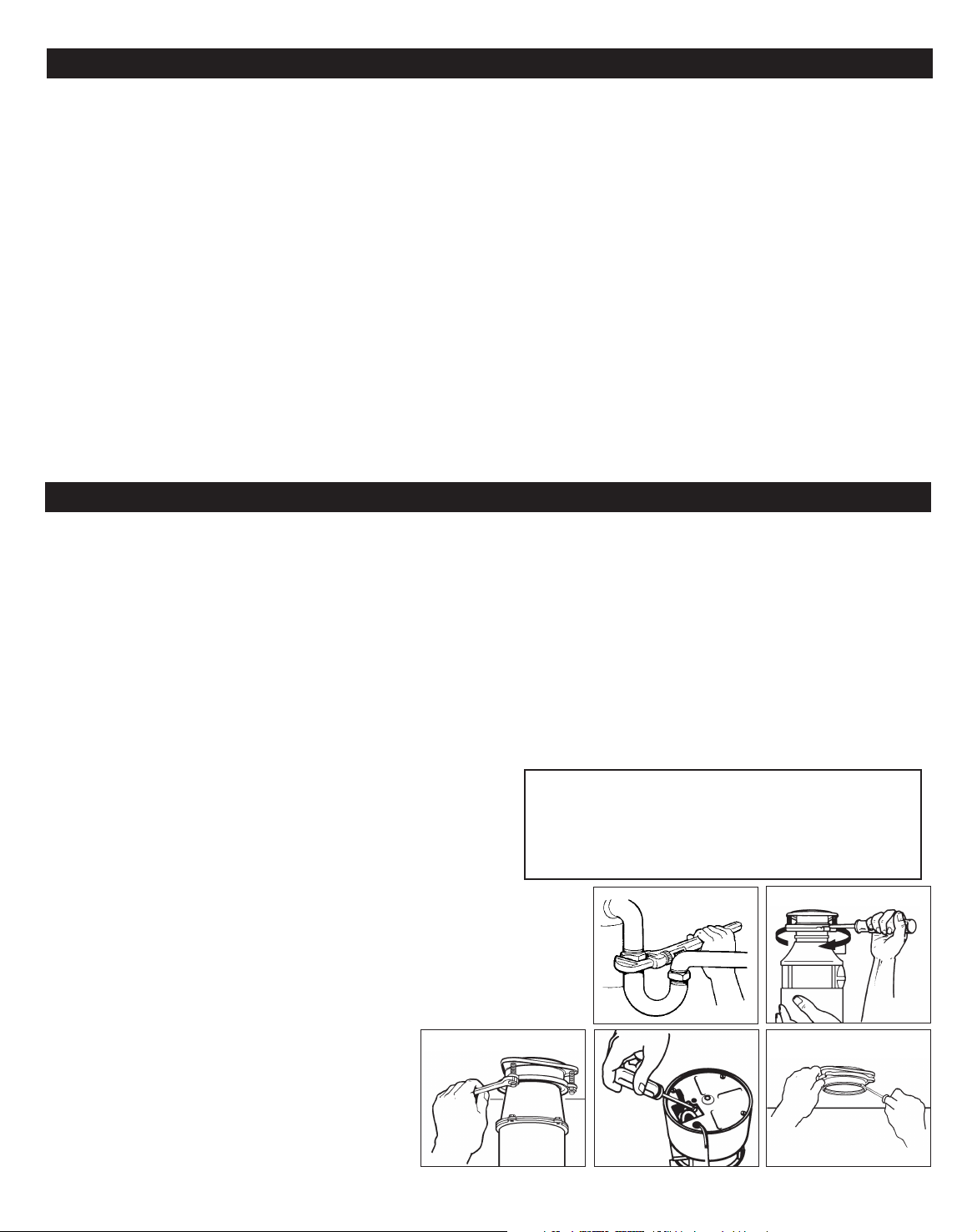
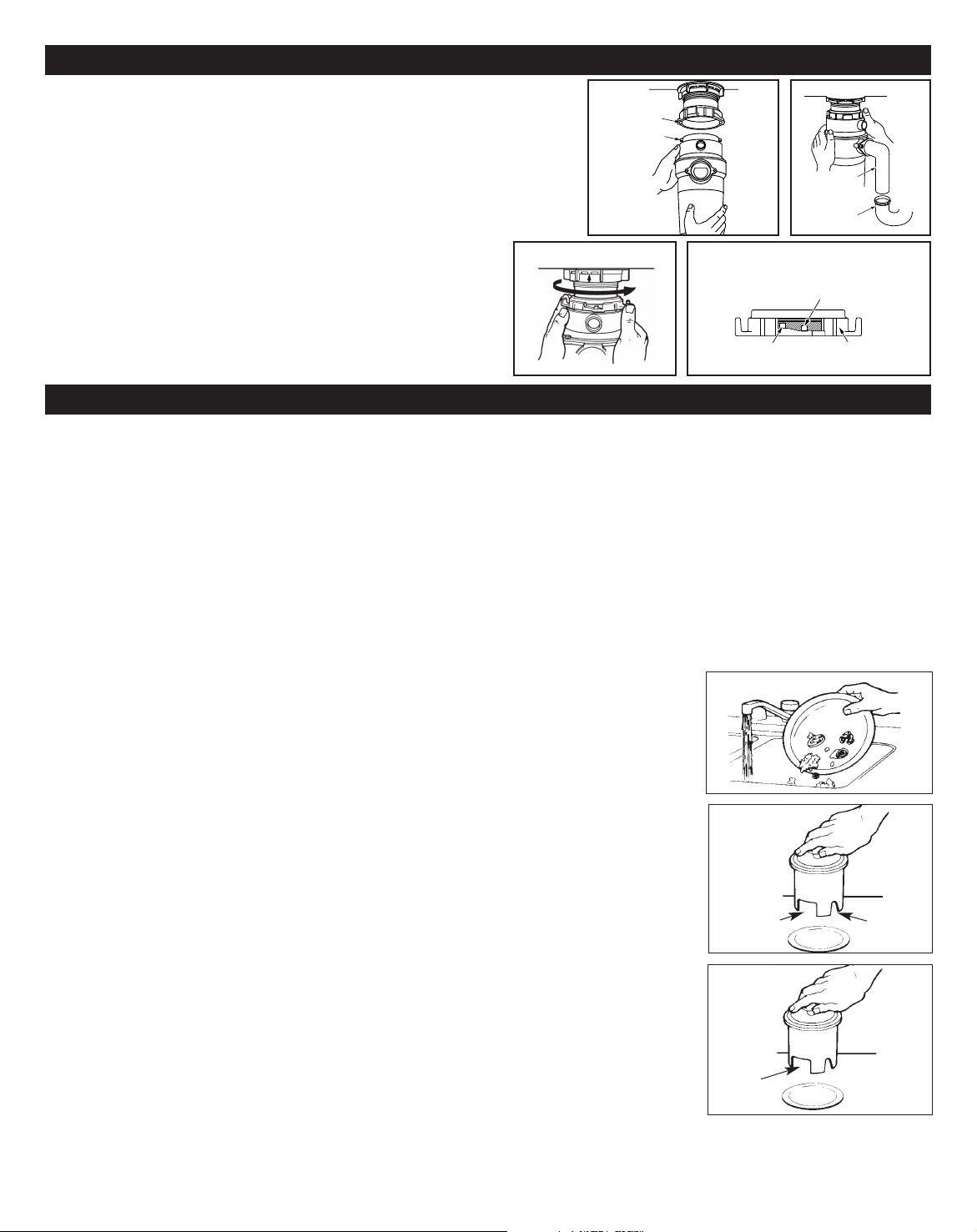
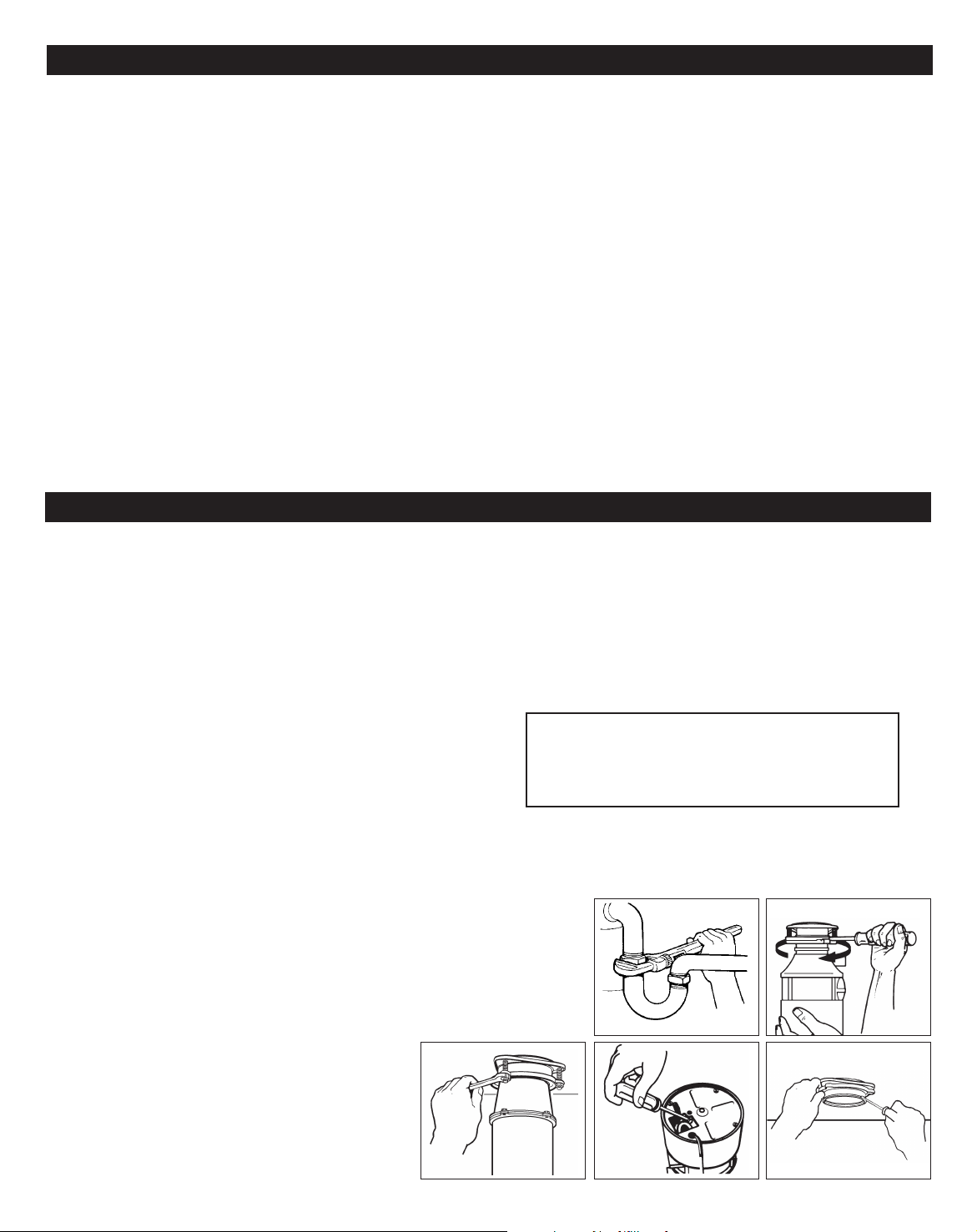
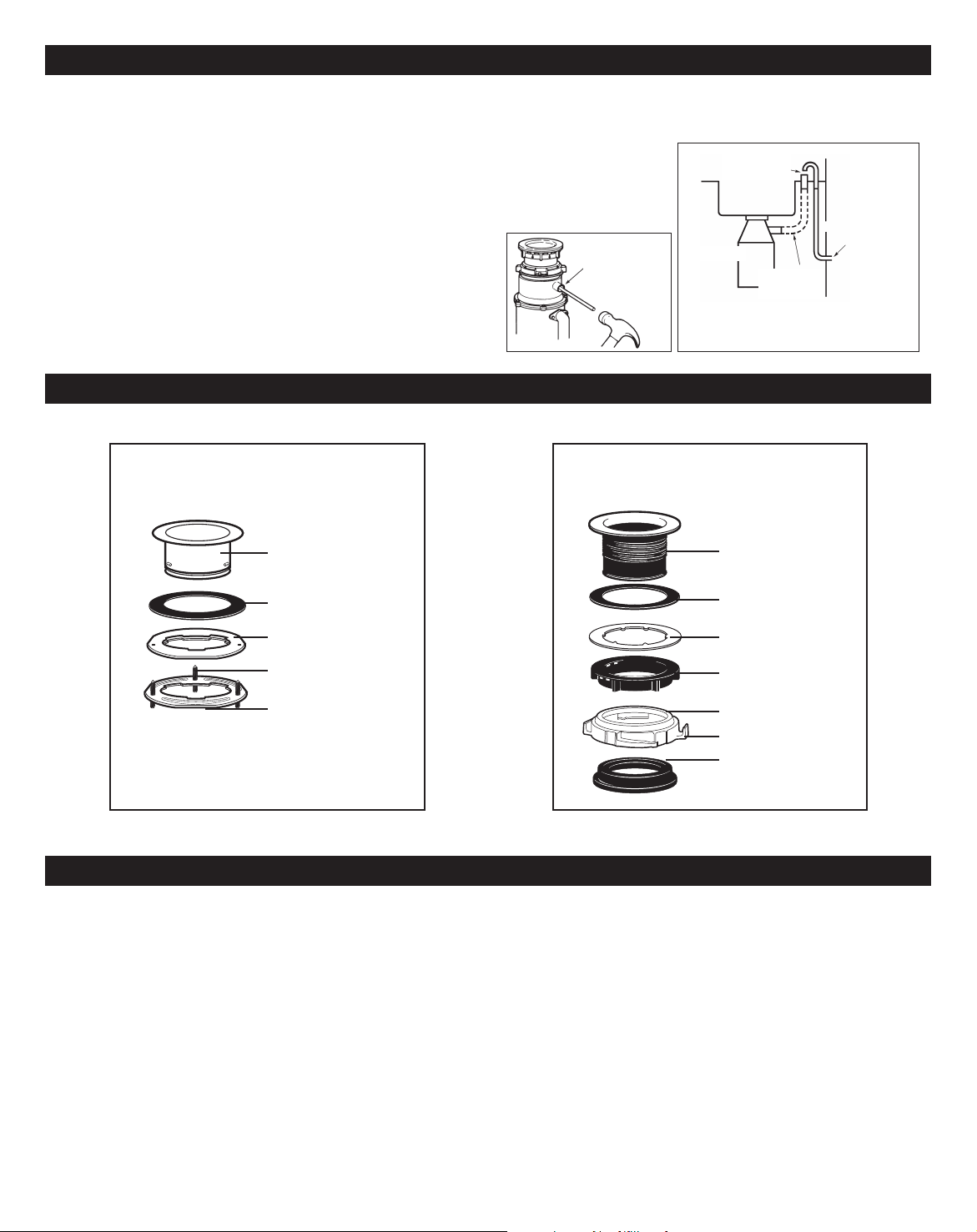
A. Use a pipe wrench to disconnect drain line where
it attaches to disposer discharge tube (see 1A).
B. Remove disposer from sink flange by turning
mount ring clockwise (see 1B). If you are unable
to turn the mount ring, tap on one of the exten-
sions from the ring with a hammer. Some
mounting systems have tubular extensions.
Inserting a screwdriver into one tube will provide
additional leverage for turning the mount ring
(see 1B). Some disposers may require the removal
or loosening of nuts from the mount screws (see
1C). Some disposers may require the removal of a
clamp.
Caution: Be sure to support the disposer
while performing this step or it may fall
when the mounting ring is disconnected
from the mounting assembly. If your dis-
poser is hard wired (metal shielded cable
not utilizing a wall plug), complete
steps C and D. If you utilize a plug-
in cord, go on to step E.
C. When disposer is removed, turn up side
down and remove electrical cover plate
(see 1D).
D. Use screwdriver to remove green ground
wire. Remove wire nuts from black and
white power wires and separate disposer wires
from power cable wires. Loosen screws on cable
clamp and separate cable from disposer.
E. To remove the remaining mount system from the
sink, loosen three mount screws and push mount
ring up. Under it is the snap ring. Use a
screwdriver to pop off the ring (see 1E). Remove
mount ring, protector ring and gasket from sink
flange. Some mounts will require the unscrewing
of a large ring holding the sink flange in place.
Pull sink flange up through sink and clean off the
old putty from sink.
IMPORTANT: Unless you have a new home,
this is a good time to clean out the trap and
drain lines by running a drain auger or
plumber’s snake before installing your new
disposer.
1. REMOVAL OF OLD UNIT
TYPICAL INSTRUCTIONS, YOUR MODEL MAY VARY.
1A
1B
1C 1D 1E
2. DISHWASHER CONNECTION
If you are utilizing a dishwasher, complete the follow-
ing procedure. If dishwasher is not to be connected
go on to section 3.
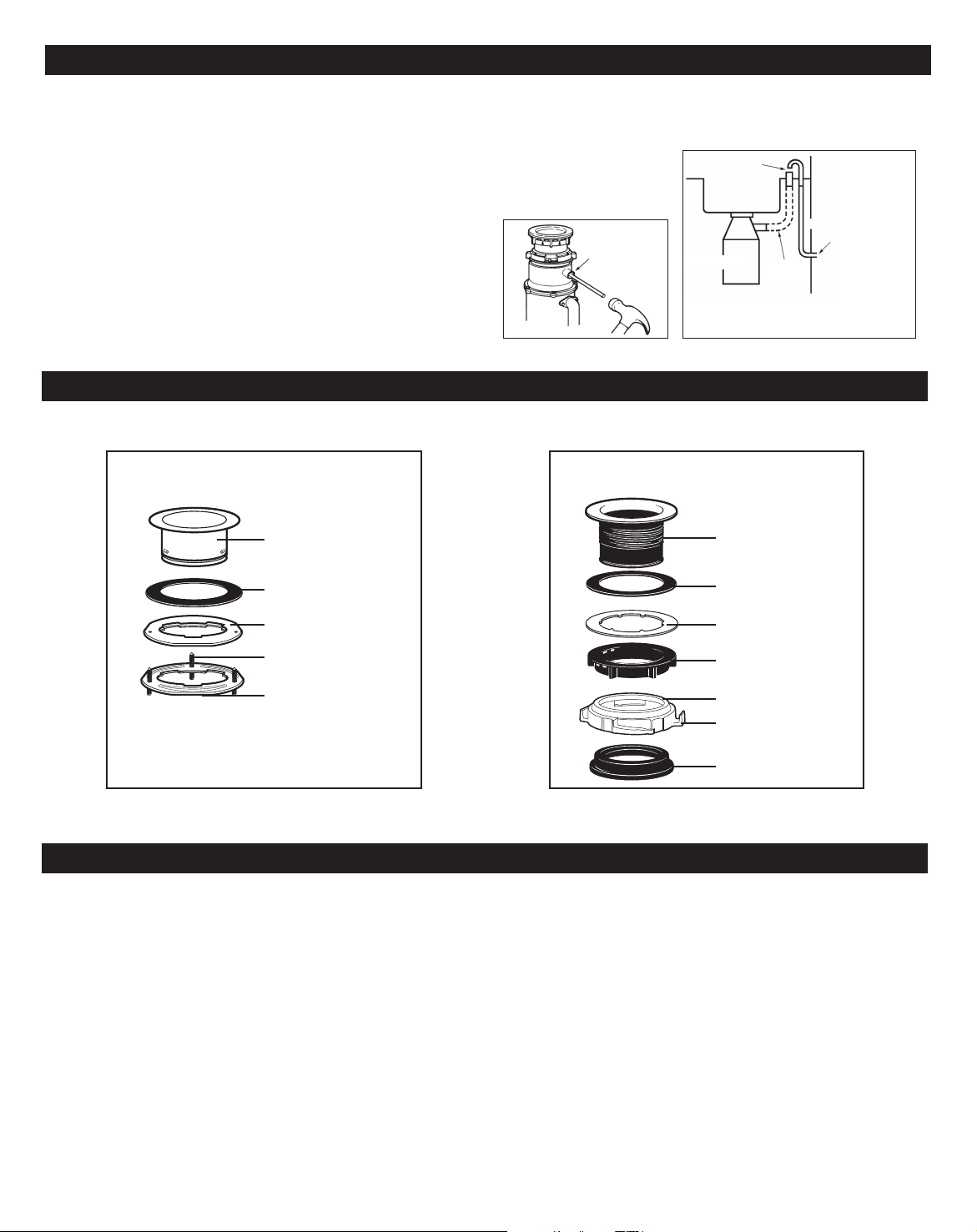
A
. Using a blunt instrument (steel punch or wooden
dowel), knock out entire plug (see 2A). Do not
use a screwdriver or sharp instrument. When
knockout plug falls into disposer, you may
remove it or simply grind it up when the disposer
is used. This will not damage the disposer in any
way, but may take some time to grind, over the
course of several uses. Go to Section 3.
B. Connect dishwasher hose using hose clamp. If
hose size is different, you will need a Dishwasher
Connector Kit (see 2B). Make sure all plumbing
connections are tight and in accordance with all
plumbing codes and ordinances. Run water and
check for leaks.
KNOCK
OUT PLUG
2B
D
ISHWASHER
H
OSE
RUBBER
HOSE
*
AIR GAP
DISPOSER
*
Air gap may not be required
f
or all installations. Check local
p
lumbing codes.
3. INSTALLATION OF MOUNTING ASSEMBLY
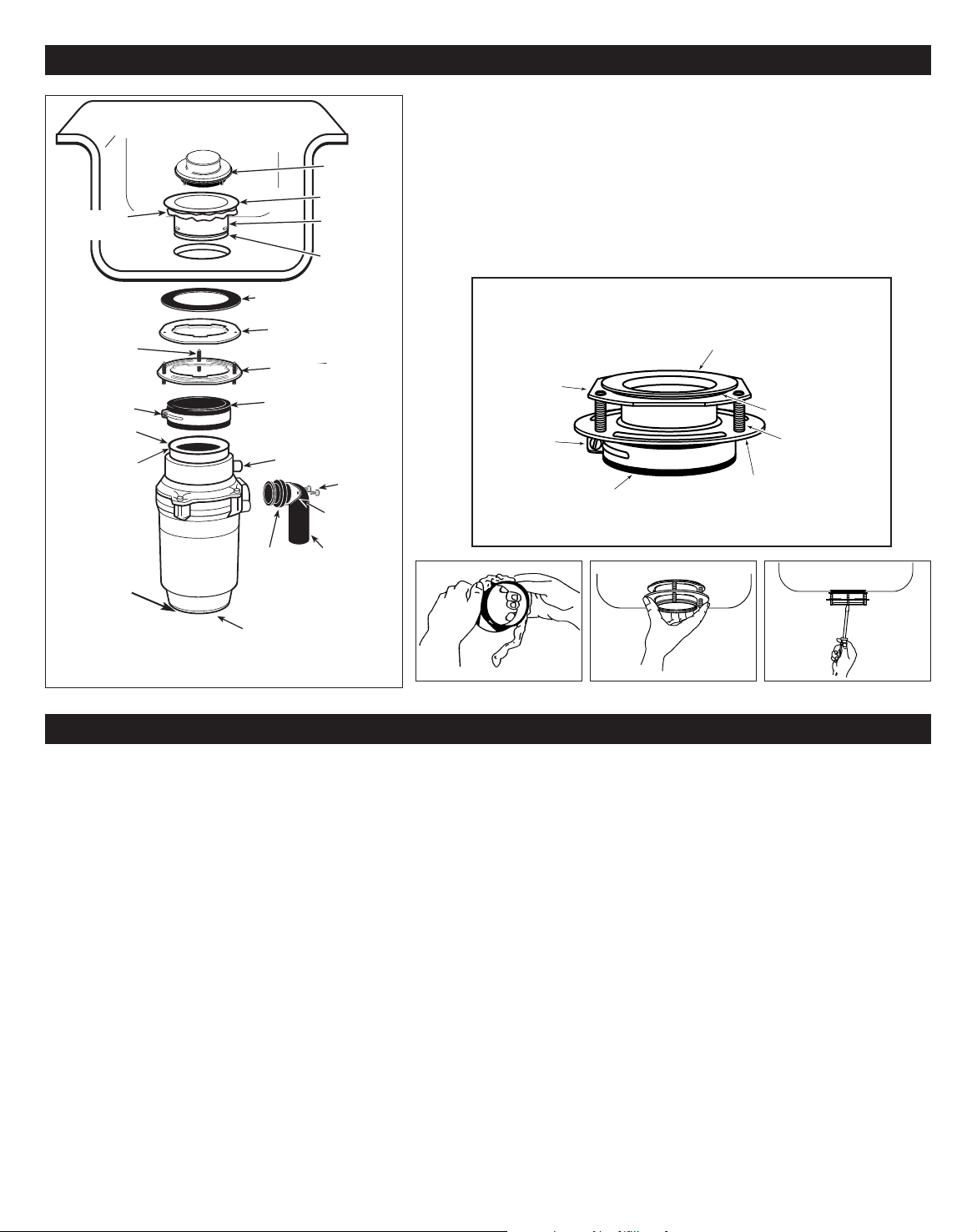
YOUR DISPOSER COMES WITH ONE OF THE FOLLOWING MOUNT SYSTEMS
Proceed to the instructions for your type of mount system.
3-Bolt Mount System EZ Mount System
SINK FLANGE
SINK FLANGE GASKET
PROTECTOR RING
FIBER GASKET
SINK MOUNT RING
MOUNTING SCREWS (3)
SUPPORT RING
MOUNT RING
TIGHTENING EARS
CUSHION MOUNT
SINK FLANGE*
SINK FLANGE GASKET
* An extended sink flange (Item # 3140) is
available for deep-well, cast iron sinks. (For
3-bolt mount only.)
2A
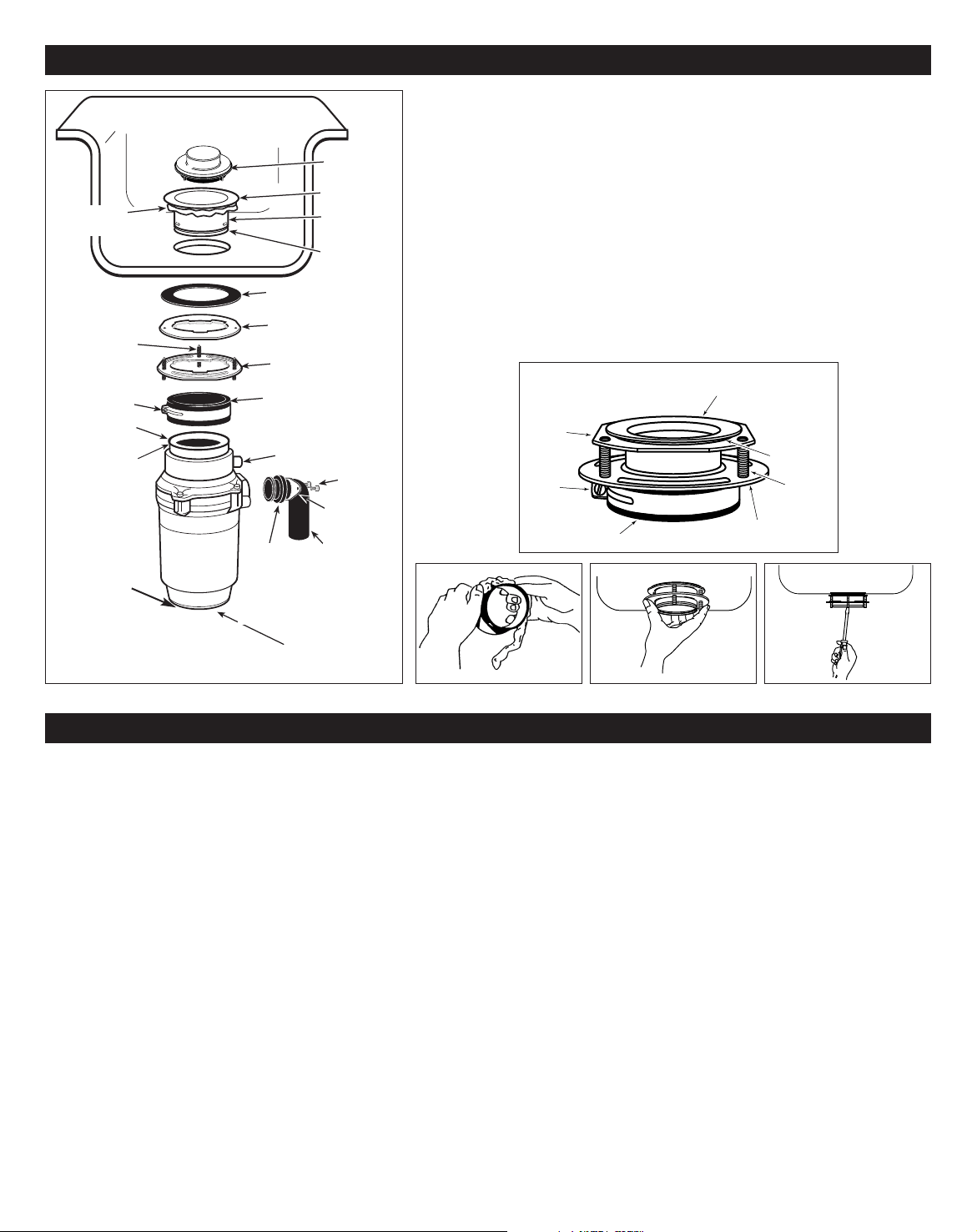
NOTE: Pay close attention to the order of mount
assembly parts, as they have been correctly assembled
by the factory. (See 3A and 3B.)
A. Disassemble the mounting assembly, as it has
been shipped, by turning the sink flange until the
projections align with the notches in the mount
ring and allow you to pull the sink flange up and
out of the remaining mount assembly. Note the
sequence of these parts as they are stacked and
refer to 3A and 3B to identify each part. Unpack
the 3 mount screws and screw them half way
through the mount ring (notice “THIS SIDE UP”
is imprinted on top of the mount ring).
Next, stack the rubber gasket on top of the pro-
tector ring and sit them on top of the pointed
ends of the mount screws.
B. Keep these assembled parts together and set aside.
Before you connect the disposer to the mount
assembly under the sink, you may want to prac-
tice engaging the groove of the Hush Cushion®
to the ridge at the bottom of the sink flange (see
3A and read Sec. 6).
C. Be sure your sink is clean. Pack the underside rim
of the sink flange with plumber’s putty (see 3C).
Position the sink flange so it is centered and read-
able as you look into your sink. Push the sink
3-Bolt Mount System
READ COMPLETELY BEFORE STARTING
3-Bolt Mount System (continued)
flange firmly into the sink opening to make a good seal. DO
N
OT move or rotate the sink flange once seated or the seal
may be broken.
D. Take the remaining portion of the mount assembly, as it was
set aside and make sure that the rubber gasket is on top of
the protector ring. From under the sink, while holding the
sink flange firmly with one hand, line up the notches in the
mount ring with the projections of the sink flange. Slide the
mount assembly up onto the sink flange, past the projec-
tions and give the mount assembly a 1/4 turn, so that it will
hang by itself (see 3D).
E. Tighten the 3 mounting screws evenly with a screwdriver
(see 3E). DO NOT OVERTIGHTEN! Trim off excess putty.
3A
S
TOPPER*
SINK FLANGE**
S
INK
HOPPER
ELBOW
GASKET
SCREWS
SERIAL #
M
OUNTING
S
CREWS**
S
CREW
C
LAMP**
P
ROJECTIONS
RIDGE
R
IDGE
DISCHARGE
ELBOW
ELBOW
FLANGE
DISHWASHER
DISCHARGE INLET
HUSH CUSHION
®
**
R
UBBER SINK
F
LANGE GASKET**
PROTECTOR RING**
MOUNT RING**
P
LUMBER’S
P
UTTY
END BELL
(ELECTRICAL
CONNECTIONS)
3E
3D
3C
MOUNTING
SCREWS
PROTECTOR
RING
RUBBER
GASKET
SINK
FLANGE
HUSH CUSHION
3B
SCREW
CLAMP
MOUNTING
RING
Mount Assembly
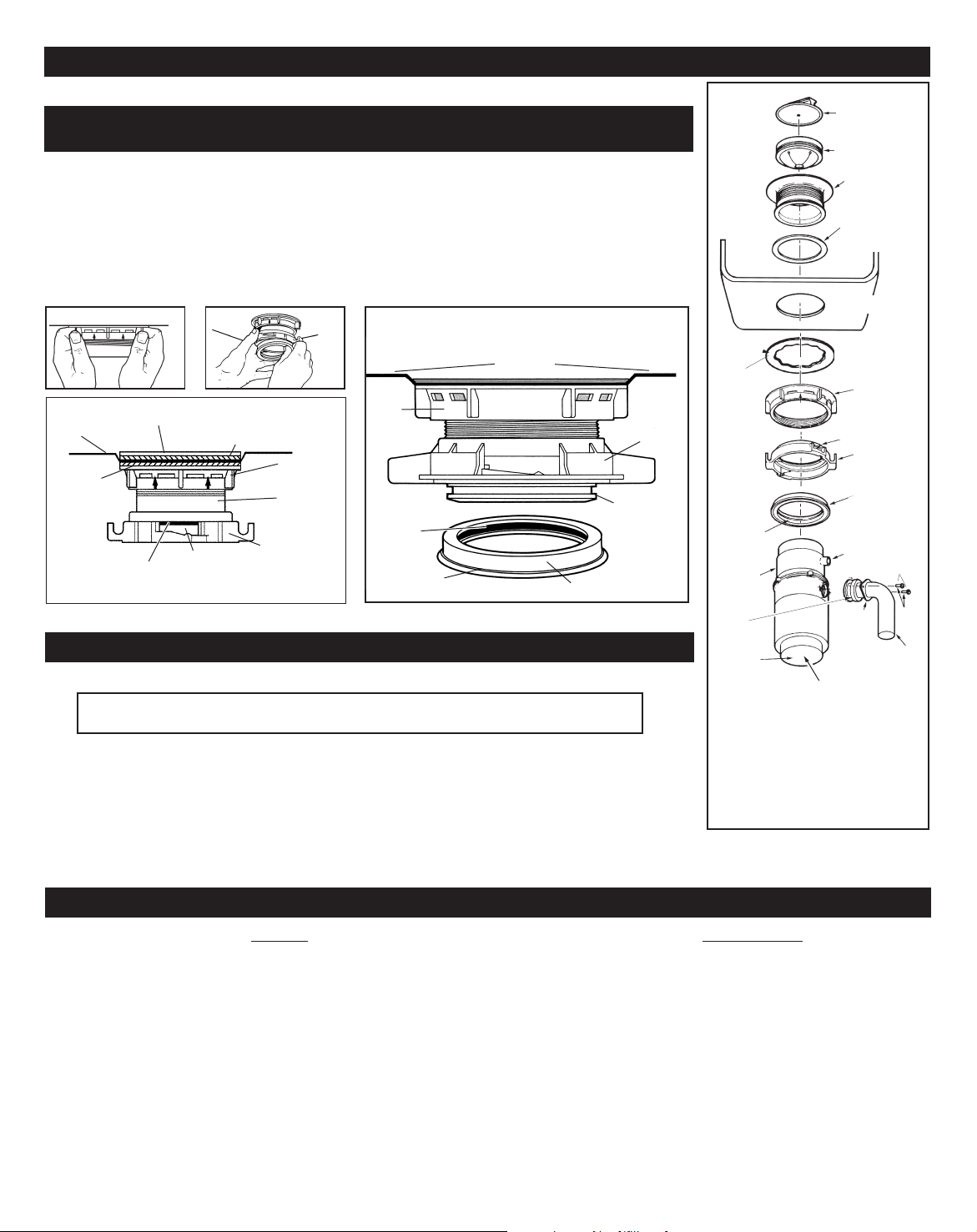
EZ Mount System
READ COMPLETELY BEFORE STARTING
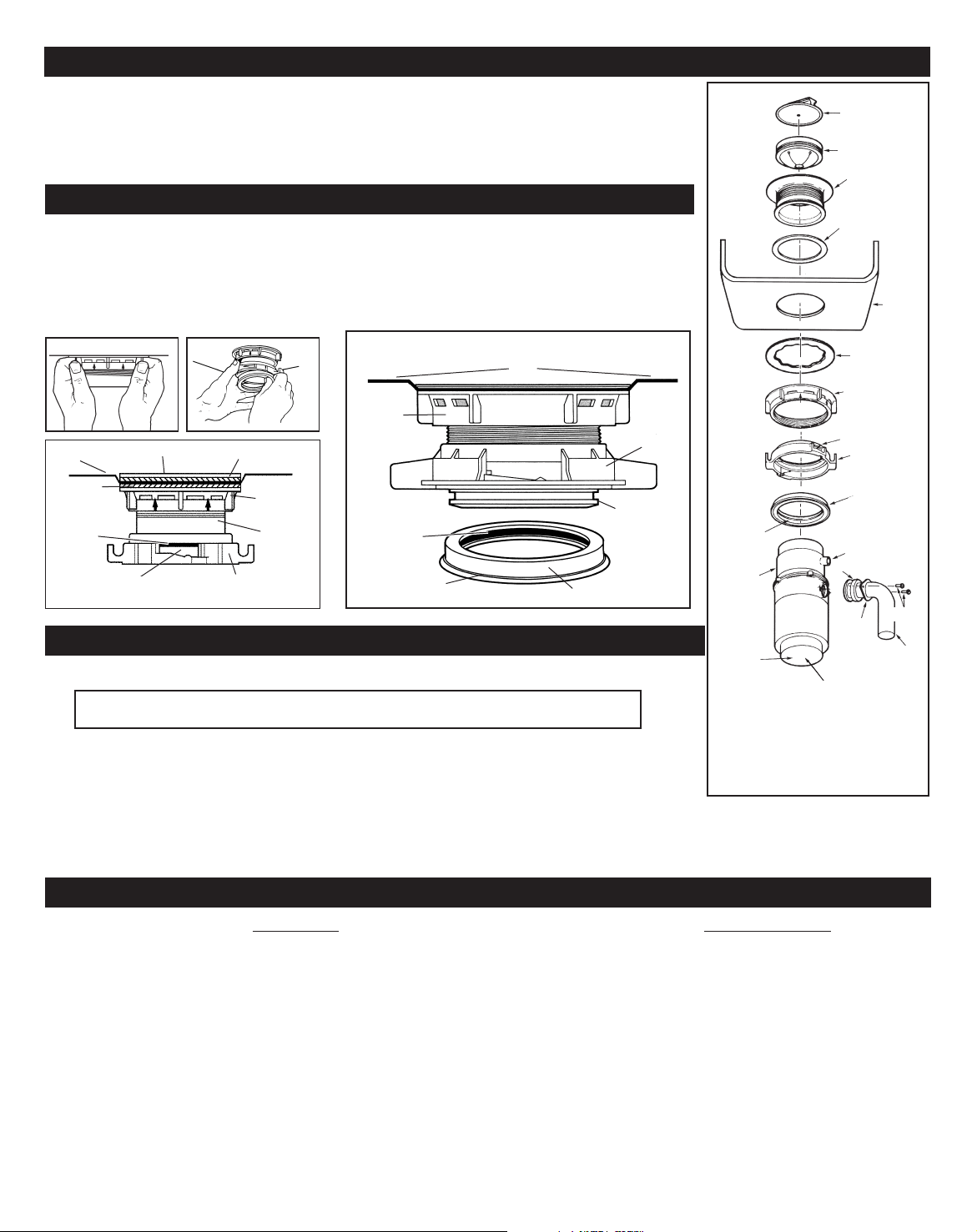
NOTE: Pay close attention to the order of mount
assembly parts, as they have been correctly assembled
by the factory. Also, reference the cushion mount
detail in illustration 3J below for the proper orienta-
tion of the cushion mount.
NOTE: Try practicing this assembly before you get
under the sink to get the “feel” of how the parts fit
together.
A. Disassemble mount assembly from disposer by
turning mount ring clockwise and remove.
B. Raise mount ring toward top of sink flange.
Remove cushion mount. Remove mount ring. You
may want to practice installing the cushion
mount at this point before you are under the
sink. See paragraph H. Also see the “Important
Notice: Cushion Mount Detail.”
C. Unscrew support ring from sink flange and
remove fiber gasket. You are now left with sink
flange and rubber gasket.
D. The rubber gasket is used instead of plumbers
putty with stainless steel sinks. Other sinks will
require putty.
E. If no putty is used, insert sink flange through rub-
ber gasket into sink opening. Do not rotate sink
flange once it is seated.
F. If you use putty instead of the gasket, form a ring
around underside of sink flange. Insert flange into
sink opening, press down hard to squeeze out
excess putty. From under sink, trim off excess
putty flush with bottom edge of sink opening.
USE ONLY ONE: PLUMBERS PUTTY OR THE
RUBBER GASKET.
G. From underneath sink, slip fiber gasket onto
exposed sink flange. With arrows pointing up,
screw support ring onto the sink flange, hand
tighten until the sink flange will not move (see
3F). At this point you may want to insert stopper
in sink and fill with water to check sink flange
seal and insure there are no leaks.
* Batch Feed Stopper looks different than the stopper illustrated.
** Mount Assembly (see 3B)
Now is the time to record the SERIAL NUMBER. Located on the bottom of the disposer.
IF YOU ARE NOT FAMILIAR WITH ELECTRICAL POWER AND PROCEDURES,
CALL A QUALIFIED ELECTRICIAN
WARNING: IMPROPER CONNECTION OF THE EQUIPMENT-GROUNDING
CONDUCTOR CAN RESULT IN A RISK OF ELECTRIC SHOCK. CHECK WITH A
QUALIFIED ELECTRICIAN OR SERVICEMAN IF YOU ARE IN DOUBT AS TO
WHETHER THE APPLIANCE IS PROPERLY GROUNDED. DO NOT MODIFY THE
PLUG PROVIDED WITH THE APPLIANCE IF IT WILL NOT FIT THE OUTLET,
HAVE A PROPER OUTLET INSTALLED BY A QUALIFIED ELECTRICIAN.
FOR WASTE DISPOSERS EQUIPPED WITH A
GROUNDED PLUG-IN POWER CORD.
This appliance must be grounded. In the event of a
malfunction or breakdown, grounding provides a path
of least resistance for electric current to reduce the risk
of electric shock. This appliance is equipped with a
cord having an equipment-grounding conductor and a
grounding plug. The plug must be plugged into an
appropriate outlet that is properly installed and
grounded in accordance with all local codes and
ordinances.
FOR WASTE DISPOSERS NOT EQUIPPED
WITH A
GROUNDED PLUG-IN POWER CORD.
This appliance must be grounded. In the event of
malfunction or breakdown, grounding provides a
path of least resistance for electric current to reduce
the risk of electric shock. The power cord (to be
installed) must have an equipment-grounding
conductor and a grounding plug. The plug must be
plugged into an appropriate outlet that is properly
installed and grounded in accordance with all local
codes and ordinances.
Disconnect electric power to disposer circuit before
installation. Turn the circuit breaker to the OFF
position or remove the fuse.
T
OP OF SINK FLANGE
FIBER
GASKET
R
UBBER
G
ASKET
SUPPORT
RING
SINK
FLANGE
MOUNT RING SHOULD BE
FREE TO MOVE UP & DOWN
SINK
BOTTOM
BEAD OF
CUSHION
MOUNT
3H
When the cushion mount is installed correctly, the lip of the sink flange fits into the
groove on the inside of the cushion mount and mount ring can be pulled downward over
cushion mount and will be free to rotate. The bottom bead of the cushion mount acts as
a gasket between the bottom of the sink flange and the top of the disposer. See illustra-
tion 3J.
IMPORTANT NOTICE: CUSHION MOUNT DETAIL
EZ Mount System (continued)
H. Place mount ring over sink flange and hold in place while installing cushion
mount (large side down) so the groove on the inside of cushion mount fits
over lip on sink flange, similar to putting the lid on a plastic container (see
3G, 3H & 3J). Please read important notice below.
3J
GROOVE
BOTTOM
BEAD
CUSHION MOUNT
BOTTOM “LIP”
OF SINK
FLANGE
3G
CUSHION MOUNT DETAIL
M
OUNT
R
ING
SUPPORT
RING
3F
OPEN AREA, NO
OBSTRUCTION
4. ELECTRICAL CONNECTIONS
STOPPER*
R
EMOVABLE
S
PLASH
G
UARD**
SINK
FLANGE
RUBBER SINK
FLANGE GASKET
FIBER
GASKET
MOUNT RING‡
SUPPORT RING
NOTE: ARROWS
INDICATING UP
TIGHTENING
EARS‡
CUSHION
MOUNT
GROOVE
HOPPER
ELBOW GASKET
ENDBELL
(ELECTRICAL
CONNECTIONS
DISHWASHER
DISCHARGE
INLET
ELBOW
FLANGE
DISCHARGE
ELBOW
S
INK
SCREWS
*Batch Feed Stopper looks different than
the stopper illustrated.
**NOT used with Batch Feed units.
‡Your mount ring may look different and
not have tightening ears.
SERIAL #
GROUNDING INSTRUCTIONS
SINK
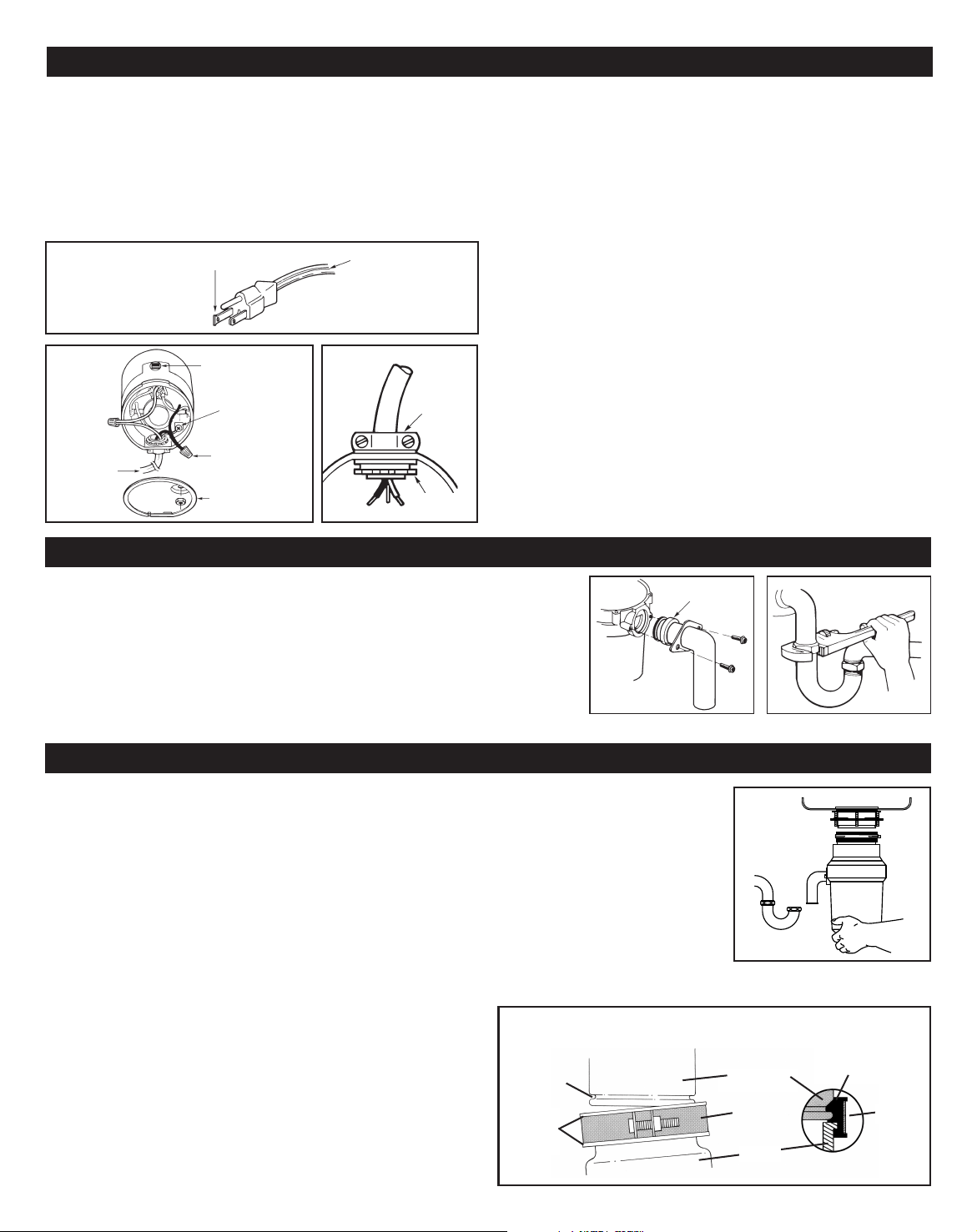
A. Connect disposer to 110-120 Volt, 60 Hz AC cur-
rent only.
B
. If plug-in cord is used, use a three prong plug (see
4
A). Ground wire should be attached to the
ground screw in the bottom of the end bell (see
4B).
C. Use a cable clamp strain relief connector where
power cord enters the disposer (see 4C).
W
iring Disposer Directly to House Current
T
his appliance must be connected to a grounded,
m
etal permanent wiring system or an equipment-
g
rounding conductor must be run with the circuit
conductors and connected to the equipment-ground-
ing terminator or lead on the appliance.
A. If you use BX cable:
1. Install cable connector in hole.
2. Connect white wire to white lead of disposer.
3. Connect black.
4. Connect bare ground.
If BX cable is not used, provide a separate ground wire
to nearest cold water metal pipe or other suitable
ground, using the screw in the bottom of the end bell
for the ground wire (see 4C).
B. If your power supply does not include a ground
wire, you must provide one unless metal cable is
used. Attach a copper wire securely to disposer
ground screw and attach other end of wire to a
metal cold water pipe. Use only UL approved
ground clamp. If plastic pipe is used in your
home, a qualified electrician should install a
proper ground.
4. ELECTRICAL CONNECTIONS
5. ATTACHING DISCHARGE ELBOW
A. Connect waste elbow to the disposer (see 5A), proceed to step
6 and then connect bottom of the elbow by tightening the
slip nut (see 5B).
B. If you are connecting to a dishwasher, return to section 2B. If
not, make sure all plumbing connections are tight and in
accordance with all plumbing codes and ordinances. Run
water and check for leaks.
RUBBER
GASKET
5A 5B
3-BOLT MOUNT (See section 3 for your mount type.)
A. Press firmly around the Hush Cushion® to ensure
it is engaged with the neck of the disposer.
B. Lubricate the top inside lip of the rubber Hush
Cushion® with a liquid soap.
C. Line up discharge elbow of disposer with trap
under mounting assembly. Guide disposer up and
engage the groove of the Hush Cushion® around
the ridge at the bottom of the sink flange (see 6A
& refer back to 3B). While still supporting the dis-
poser, tighten the screw-clamp around Hush
Cushion®. The disposer will now hang by itself.
D. If you need to turn the disposer make sure the
sink flange does not turn. It will break the seal
created when installed. Go back to steps 5A and
5B.
IMPORTANT – PLEASE READ
Do not remove clamp from Hush Cushion® or
Hush Cushion® from hopper. Both parts are
factory installed and installation ready.
Lubricate top angled surface
of rubber Hush Cushion®
with liquid soap prior to
engaging disposer to sink
flange. Fit Hush Cushion®
lip into sink flange groove
using a slight rocking
motion. Tighten clamp (see
6B).
6. CONNECTING DISPOSER TO MOUNT ASSEMBLY
6B
SINK FLANGE
CLAMP
HUSH CUSHION®
TOP ANGLED
SURFACE
HUSH
CUSHION®
6A
SINK
FLANGE
GROOVE
CLAMP
NOTE: When viewing face of electri-
cal plug with grounding pin at top,
the larger left blade is connected to
the identified wire.
4A
RIBBED SIDE
GROUND SCREW
WIRE NUTS
REMOVE COVER
PLATE
4B
T
O HOUSE
C
URRENT OR
P
OWER CORD
4C
S
TRAIN
R
ELIEF
NUT
R
ED RESET BUTTON
Trace lead connected to this blade
and attach that lead to white wire
on disposer.
HOPPER
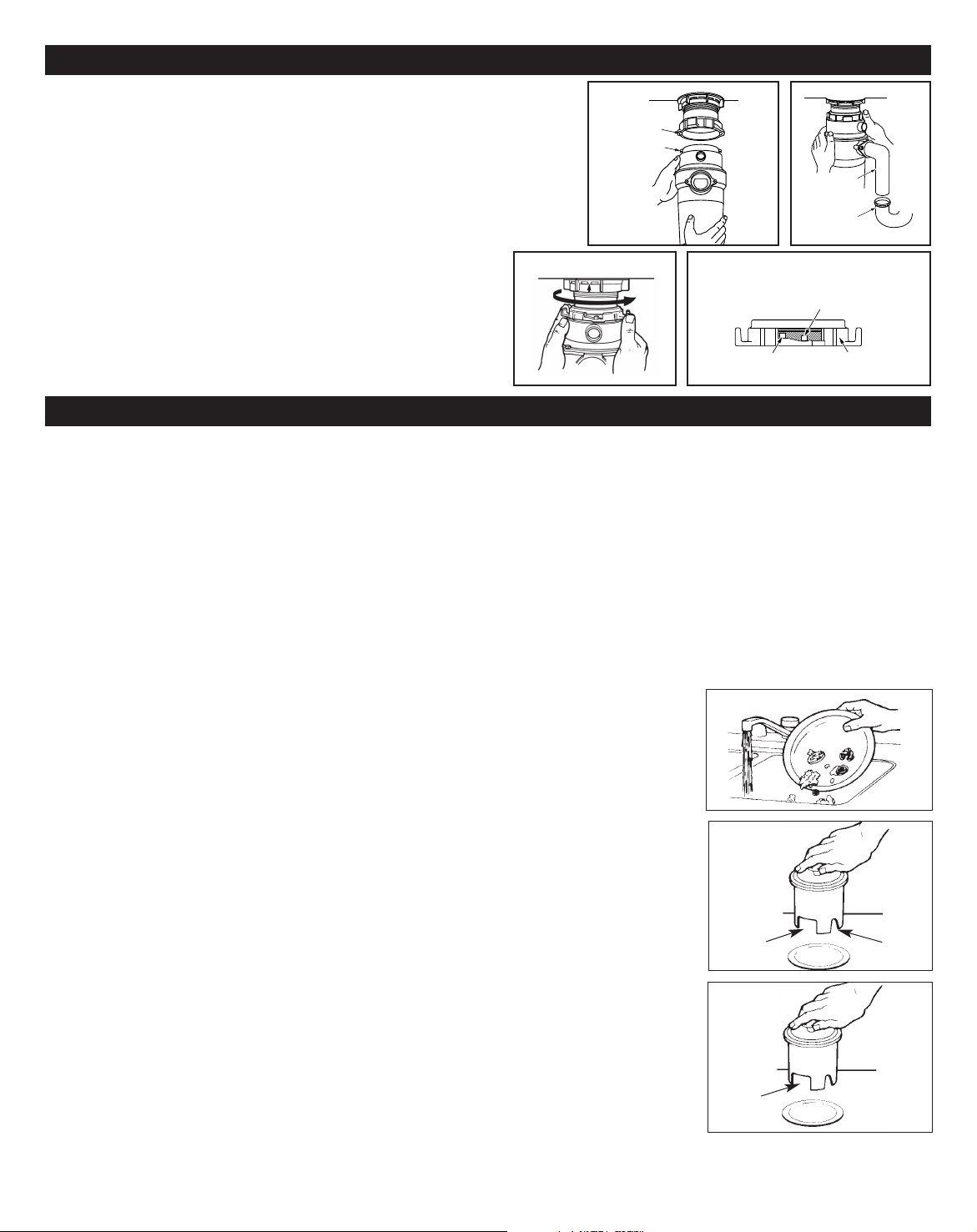
EZ MOUNT (See section 3 for your mount type.)
A. Line up disposer under mounting assembly. Guide hopper
projections into mount ring slots. Turn mount ring about 1/4”
t
o right so that disposer is temporarily supported (see 6C).
B. Turn mount ring and disposer until disposer elbow lines up
with trap (see 6D).
C. Turn mount ring counter-clockwise until
it locks up tight. Tap the mount ring ears with a hammer until
the lock position is achieved. Hopper projections
must be to extreme left of mounting slots (see 6E).
D. If mount ring is hard to turn, you may add a small
amount of petroleum jelly or liquid soap to hopper
projections. Run water and check for leaks.
6E
6D
E
LBOW
T
RAP
LOCKING DETAIL
HOPPER PROJECTION IN
“SUPPORTED” POSITION
HOPPER PROJECTION IN
“LOCK” POSITION
MOUNT RING
6. CONNECTING DISPOSER TO MOUNT ASSEMBLY (continued)
7. OPERATING INSTRUCTIONS
SLOT
P
ROJECTION
6C
The Anti-Jam Swivel Impellers make a clicking
sound as they swing into place. This indicates
normal operation.
A. Remove sink stopper. Turn on a medium flow of
cold water.
B. Turn switch to ON position; your motor is turn-
ing at full speed and ready to use.
C. Scrape in food waste. Down the drain go table
scraps, peelings, rinds, seeds, pits, small bones
and coffee grounds. To speed up food waste dis-
posal, cut or break up large bones, rinds and cobs.
Large bones and fibrous husks require consider-
able grinding time and are more easily thrown
away with other trash. Do not be alarmed that
the disposer slows down while grinding. The dis-
poser is actually increasing torque (grinding
power) and is operating under normal conditions.
D. Before turning disposer off, let water and disposer
run for approximately 15 seconds after shredding
stops. This assures that all waste is thoroughly
flushed through trap and drain.
E. It is not recommended to use hot water while
running disposer. Cold water will keep waste and
fats solid so disposer can flush away particles.
6F
TIPS FOR SUCCESSFUL OPERATION
A. Be sure disposer is empty before using your dishwasher so it may drain
properly.
B. You may want to leave the stopper in the drain when not in use to prevent
utensils and foreign objects from falling into the disposer.
C. Your disposer is ruggedly built to give you many years of trouble free service.
It will handle all normal food wastes, but it will NOT grind or dispose of such
items as plastic, tin cans, bottle caps, glass, china, leather, cloth, rubber,
string, clam and oyster shells, aluminum foil or feathers.
BATCH FEED OPERATING INSTRUCTIONS
The Anti-Jam Swivel Impellers make a clicking sound as they swing into place. This indi-
cates normal operation.
A. Remove sink stopper and turn on a medium flow of cold water.
B. Scrape in food waste. Down the drain go table scraps, vegetable peelings,
cobs, rinds, pits, bones and coffee grounds. (see 7A)
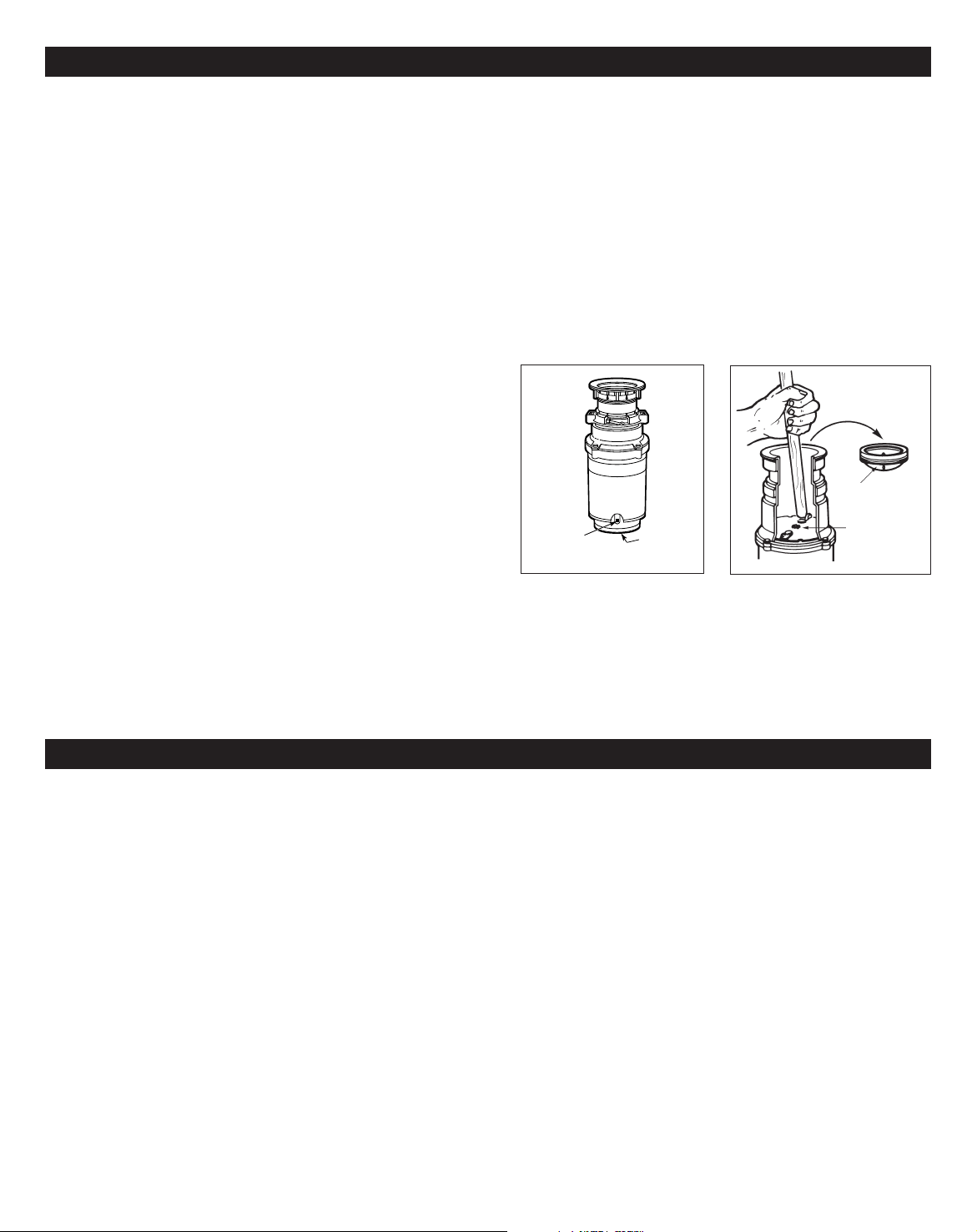
C. Insert stopper to start disposer. (see 7B) One of the two small slots in stopper
base must line up with switch plunger inside the neck of the disposer. Push
down firmly to turn the disposer on. Lift stopper to shut the disposer off.
D. Run disposer for 15 seconds after shredding stops. This assures that all waste is
thoroughly flushed through the drain.
E. To fill sink, insert stopper and align the largest slot with the switch plunger.
(see 7C) Push down to seal sink without starting the disposer. When medium
sized slot (see 7B) in stopper base is lined up with the switch plunger, water
can drain, but tableware, etc., cannot be accidentally dropped into disposer.
7A
7B
7C
MEDIUM
SLOT
SMALL
SLOT
LARGE
SLOT
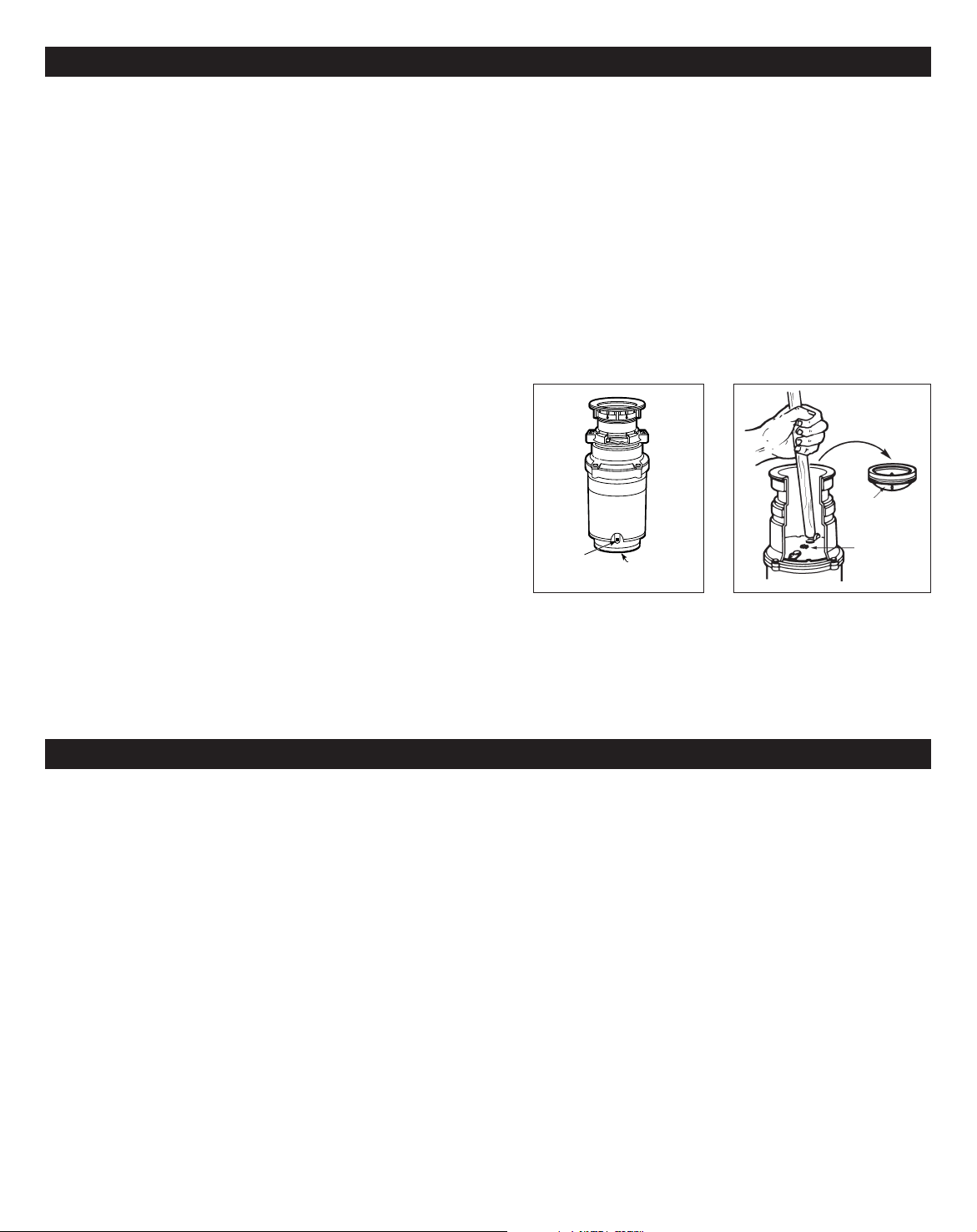
9. CLEANING AND MAINTENANCE
8. TROUBLESHOOTING
Before seeking repair or replacement, we recom-
mend that you review the following:
LOUD NOISES: (Other than those during grinding of
s
mall bones and fruit pits): These are usually caused
by accidental entry of a spoon, bottle cap or other for-
eign object. To correct this, turn off electrical switch
and water. After disposer has stopped, remove *splash
guard, remove object with long handled tongs, and
replace *splash guard.
UNIT DOES NOT START: Unplug power cord or turn
either the wall switch or breaker box switch to “OFF”
position, depending on your model and wiring config-
uration. Remove stopper and/or *splash guard. Check
to see if turntable will rotate freely using a wooden
broom handle. If turntable rotates freely, replace
*splash guard and check re-set button to see if it has
been tripped. Re-set button is red and located oppo-
site discharge elbow, near the bottom (see 8A). Push
button in until it clicks and remains depressed.
If re-set button has not been tripped, check for short-
ed or broken wire connecting to disposer. Check
electrical power switch, fuse box or circuit breaker. If
wiring and electrical components are intact, the unit
may have internal problems that require service or
replacement.
* Splash guard not used on Top Control/Batch Feed
unit. Splash guard is not removable on 3-bolt mount
units.
IF TURNTABLE DOES NOT ROTATE FREELY: Turn
off disposer, then check for any foreign object lodged
between the turntable and grind ring. Dislodge object
b
y rotating table with a wooden broom handle and
remove object. (see 8B) If no foreign object is present,
there may be internal problems.
LEAKS: If the unit leaks at the top, it may be due to:
1. Improper seating of sink flange (gasket centering,
putty or tightening).
2. Support ring not tightened properly.
3. Defective or improperly installed cushion mount.
If unit leaks at the waste elbow, leak may be due to
improper tightening of elbow flange screws.
8A
8B
SERIAL
NUMBER
RESET
BUTTON
TURNTABLE
REMOVE
SPLASH
GUARD
Call our toll free Help Line with any questions
800-854-3229
DO NOT ATTEMPT TO LUBRICATE YOUR DISPOSER!
The motor is permanently lubricated. The disposer is
self cleaning and scours its internal parts with each
use.
NEVER put lye or chemical drain cleaners into the dis-
poser, as they cause serious corrosion of metal parts. If
used, resulting damage can be easily detected and all
warranties are void. Mineral deposits from your water
can form on the turntable, giving the appearance of
rust.
GUÍA DEL PROPIETARIO
DEL TRITURADOR DE
DESPERDICIOS DE COMIDA
Vea la informacíon específica para su nuevo triturador
NOTA: Este triturador de desperdicios de comida ha sido diseñado para funcionar exclusivamente con 110-120 voltios,
60 Hz. El uso de cualquier otro voltaje o frecuencia afectará negativamente el funcionamiento.
IMPORTANTE: Lea todas las instrucciones con atención. Guarde esta guía para cualquier consulta en el futuro.
PRECAUCIÓN: Asegúrese de repasar PRIMERO LAS INSTRUCCIONES DE SEGURIDAD SOBRE LOS PELIGROS DE FUEGO,
TOQUES ELÉCTRICOS O LESIONES A PERSONAS antes de instalar el triturador.
2680 Orbiter Street • Brea, CA 92821 • www.anaheimmfg.com 560C485P01 REV E
Anote en los espacios provistos la información del triturador de comida
Numero de Modelo* Numero de Serie*
* La información anterior se encuentra en la etiqueta adherida a la parte inferior del triturador.
Para conveniencia suya, anote los números de modelo y de serie antes de la instalación.
Guarde su factura de venta, comprobante de venta, cheque cancelado u otra constancia de compra para verificar la fecha de com-
pra original para efectos de la garantiia.
Llame gratis a nuestra linea de asistencia para atender cualquier pregunta.
800-854-3229
Herramientas y materiales que podrá necesitar
LLAVE PARA TUBOS
SIERRA PARA METALES
CORDÓN DE
SUMINISTRO
JUEGO DE CONECTORES PARA
MÁQUINAS LAVADORAS DE TRASTOS
MARTILLO PUNZÓN DE
ESPIGA O ACERO
ALIVIADOR DE TENSIÓN
MASILLA DE PLOMERODESTORNILLADOR PHILLIPS Y
DE HOJA PLANA
INSTRUCCIONES DE SEGURIDAD IMPORTANTES
INSTRUCCIONES CONCERNIENTES A RIESGO DE FUEGO, CHOQUE ELÉCTRICO O LESIONES A
PERSONAS. GUARDE ESTAS INSTRUCCIONES.
ADVERTENCIA – Cuando utilice aparatos eléctricos,
siempre debe seguir precauciones básicas, entre las cuales
se incluyen las siguientes:
1. Lea todas las instrucciones antes de utilizar el aparato.
2. Para reducir el riesgo de lesiones, es necesaria la cercana
supervisión cuando un aparato es utilizado cerca de niños.
3. No ponga dedos o manos dentro de un triturador de basura.
4. Ponga el interruptor a la posición apagada antes de intentar
desatorar un objeto o remover un objeto del triturador.
5. Cuando intente aflojar una obstrucción en el triturador de
basura, utilice un objeto largo de madera tal como una
cuchara de madera o el mango de madera de una escoba o
trapeador.
6. Cuando intente remover objetos del triturador de basura,
utilice pinzas o alicates de mango largo. Si el triturador es
magnéticamente accionado, se deberán usar herramientas
no-magnéticas.
7. Para reducir el riesgo de lesiones por materiales que puedan
ser expulsados por el triturador de basura, no coloque los
s
iguientes dentro del triturador: conchas de ostiones o alme-
jas; limpiadores de drenaje cáusticos o productos similares;
vidrio, loza o plástico; huesos grandes y enteros; metales,
tales como tapas de botellas, latas, papel de aluminio o uten-
silios; grasa caliente u otros líquidos calientes; cáscaras
enteras de maíz.
8. Cuando no esté operando el triturador, coloque el tapón en
su lugar para reducir el riesgo de que caigan objetos dentro
del triturador.
9. NO opere el triturador a menos que la salpicadera de protec-
ción esté en su lugar. (Esto no aplica a las unidades del
Control Superior/Lote de Alimentación.)
10. Para las instrucciones de conectar a tierra, vea la porción
CONEXIÓN ELÉCTRICA de este manual.
Antes de iniciar esta tarea, corte la electridad a partir del
interruptor del circuito o caja de fusibles.
Si el conjunto de montaje es el mismo en su triturador nuevo,
siga las instrucciones de montaje de la seccion 3, a la inversa. Si
el nuevo sistema de montaje es diferente, siga las siguientes
instrucciones:
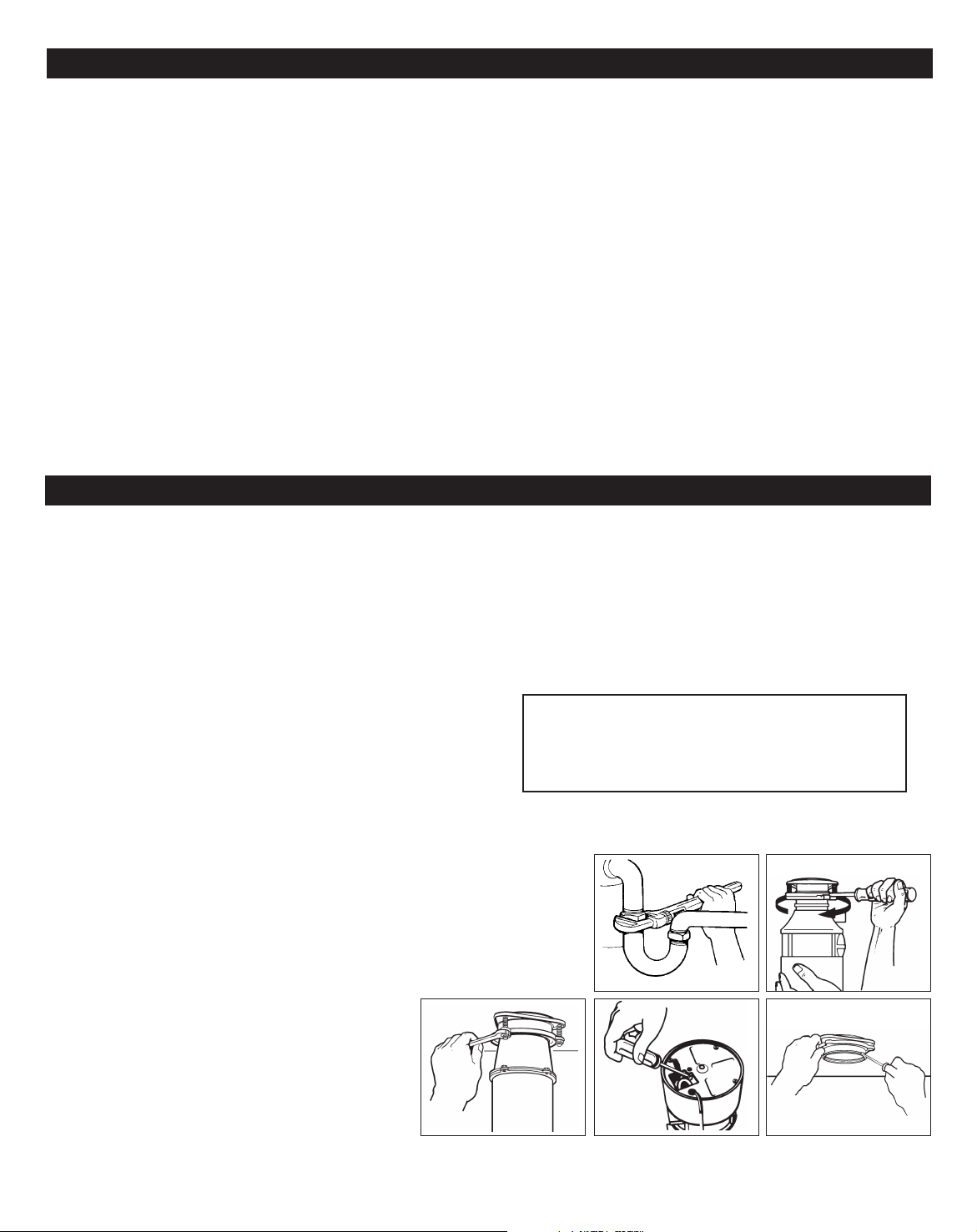
A. Use una llave para tubos para desconectar la línea de drenaje
en donde está conectada al tubo de desagüe del triturador
(vea 1A).
B. Quite el triturador de la brida del fregadero girando en el
sentido de las agujas del reloj (vea 1B). Si no puede darle
vuelta al anillo, golpee ligeramente una de las extensiones
con un martillo. Algunos sistemas de montaje tienen exten-
siones tubulares. Introduzca un destornillador a través del
tubo y úselo como palanca para darle vuelta al anillo (vea
1B). En algunos trituradores es necesario quitar las tuercas en
los tornillos de montaje, y luego quite el triturador viejo (vea
1C). En el caso de algunos trituradores, es necesario quitar
primero la abrazadera.
Precaución: Asegúrese de apoyar el triturador mien-
tras lleva a cabo este paso para evitar que se caiga al
desconectarse el anillo de montura del conjunto de
montaje. Si el cableado está integrado al dispositivo
(un cable protegido que no usa un enchufe de
pared), complete los pasos C y D. Si usa un cordón
enchufable, prosiga al paso E.
C. Después de quitar el triturador, colóquelo boca
abajo y quite la placa de cubierta eléctrica (vea 1D).
D. Use un destornillador para quitar el alambre de tier-
ra verde. Quite las tuercas para alambre de los
alambres de suministro negro y blanco y separe los
alambres del triturador de los alambres del cable de
suministro. Afloje los tornillos en la abrazadera del
cable y separe el cable del triturador.
E. Afloje los tornillos de montaje y empuje el anillo de montu-
ra hacia arriba. Debajo de éste se encuentra el anillo de
resorte. Desprenda el anillo con un destornillador (vea 1E).
Quite el anillo de montura, el anillo protector y la empaque-
tadura de la brida del fregadero. Algunas monturas van a
necesitar que se quite el anillo de montura grande de la brida
del fregadero. Jale la brida del fregadero hacia arriba a través
del fregadero y raspe y quite la masilla vieja.
IMPORTANTE: A menos que su casa sea nueva,
aproveche esta oportunidad para limpiar todas las
líneas de las trampas y los drenajes, introduciendo
una barrena de drenaje o una culebra de plomero
antes de instalar su nuevo triturador.
1. CÓMO QUITAR UNA UNIDAD VIEJA
INSTRUCCIONES TÍPICAS. SU MODELO PODRÍA SER DIFERENTE.
1A
1B
1C 1D 1E
2. COMO CONECTAR LA MÁQUINA LAVADORA DE TRASTOS
Si usa un máquina lavadora de trastos, complete el siguiente
procedimiento. Si no está conectada a una máquina lavadora de
trastos, prosiga a la sección 3.
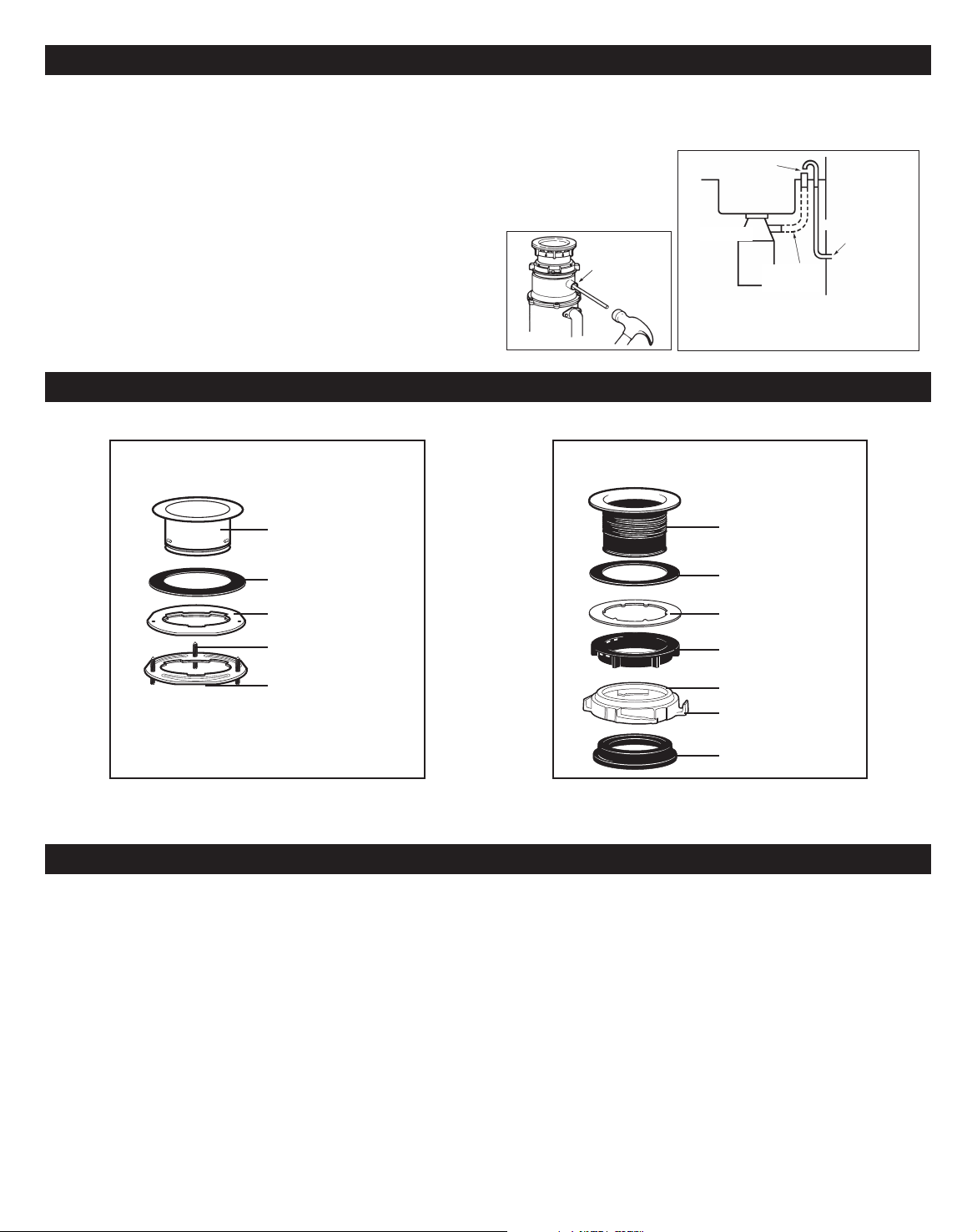
A. Con un instrumento desafilado (punzón de acero o espiga
de madera), golpee y saque todo el tapón provisional (vea
2A). No use un destornillador u otro instrumento afilado.
Cuando el tapón provisional cae dentro del triturador, puede
r
etirarlo o simplemente triturarlo cuando use el triturador.
Esto no dañará el triturador en lo absoluto, pero es posible
que tome algún tiempo para desmenuzarlo por completo,
quizás después de que lo use varias veces.Pasa a la sección 3.
B. Conecte la manguera de la máquina lavadora de trastos
usandola abrazadera de la manguera. Si el tamaño de la
manguera es diferente, necesitará un enchufe de conectores
para máquina de lavar trastos (vea 2B). Asegúese que todas
las conexiones de tuberías estén bien apretadas según los
códigos y regulamentos de plomería. Deje correr el agua el y
detecte si hay fugas.
TAPÓN
PROVISIONAL
2B
MANGUERA
DE LA
MÁQUINA
LAVADORA
DE TRASTOS
BRECHA DE AIRE*
TRITURADOR
*
Puede que no sea necesaria la brecha de aire
p
ara todas las instalaciones. Revise los códigos
d
e plomería locales.
3. INSTALACIÓN DEL CONJUNTO DE MONTAJE
SU TRITURADOR ESTA EQUIPADO CON UNO DE LOS SIGUIENTES SISTEMAS DE MONTAJE
Siga las indicaciones del tipo de montaje que usted tenga.
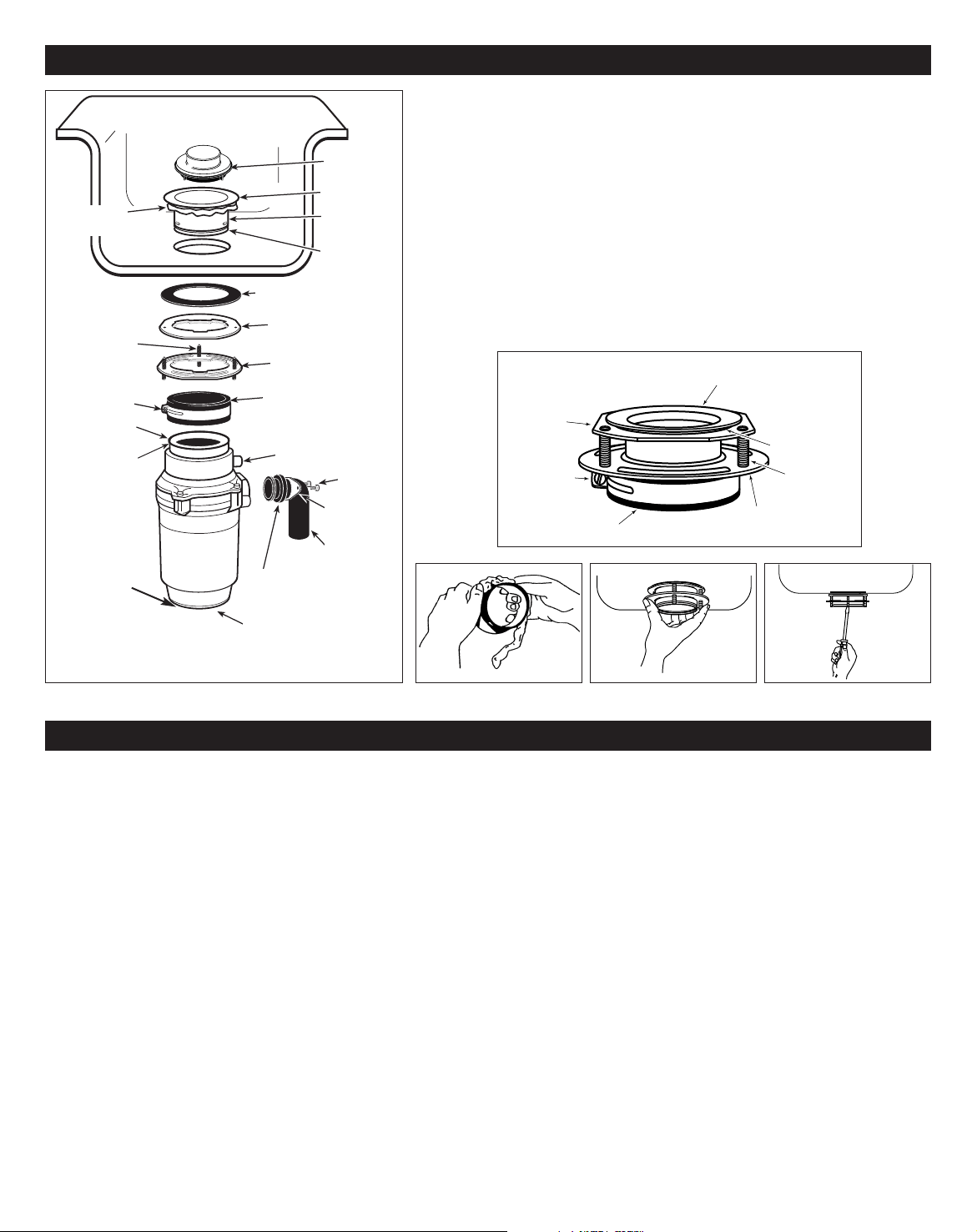
Sistema De Montaje De 3 Pernos Sistema De Montaje “EZ” (Fácil)
BRIDA DEL FREGADERO
EMPAQUETADURA DE BRIDA
DE CAUCHO DEL FREGADERO
ANILLO PROTECTOR
EMPAQUETADURA DE FIBRA
ANILLO DE MONTURA
TORNILLOS DE MONTAJE (3)
ANILLO DE APOYO
ANILLO DE MONTURA
ALETAS PARA APRETAR
MONTURA DE COJIN
BRIDA DEL FREGADERO*
EMPAQUETADURA
DE CAUCHO
* Un reborde prolongado (articulo # 3140) está
disponible para fregaderos profundos de hierro
fundido. (Sólo para montaje de tres pernos.)
2A
NOTA: Póngale mucha atención al orden de piezas del conjunto
de montaje, ya que han sido armadas debidamente por la fábri-
ca. (Vea 3A y 3B.)
A. Desarme el conjunto de montaje, tal como ha sido enviado
de fábrica, dándole vuelta a la brida del fregadero hasta que
las proyecciones queden alineadas con las muescas en el
anillo de montura y pueda halar la brida del fregadero hacia
arriba y retirarla del resto del conjunto de montaje. Tome
nota de la secuencia de estas piezas, tal como están colo-
cadas una encima de la otra y consulte 3A y 3B para
identificar cada pieza. Desempaque los 3 tornillos de montu-
ra y atorníllelos hasta la mitad a través del anillo de montura
(tome nota de la advertencia "THIS SIDE UP" ("ESTE LADO
HACIA ARRIBA”) que está impresa en la parte superior del
anillo de montura). Seguidamente, coloque la empaquetadu-
ra de caucho encima del anillo protector y luego coloque los
dos encima de los extremos puntiagudos de los tornillos de
montura.
B. Mantenga estas piezas ensambladas juntas y póngalas a un
lado. Antes de conectar el triturador al conjunto de montaje
debajo del fregadero, quizás querrá practicar engranar la
ESTRÍA del cojín silenciador Hush Cushion® al REBORDE en
la parte inferior de la brida del fregadero (consulte 3A y lea la
sección 6).
C. Asegúrese de que el fregadero esté limpio. Rellene el borde
del lado inferior de la brida del fregadero con masilla de
plomero (vea 3C). Coloque la brida del fregadero de manera
que quede centrada y se pueda leer cuando usted mira den-
tro del fregadero. Empuje la brida del fregadero firmemente
en la abertura del fregadero para crear un sello bueno. NO
MONTAJE DE 3 PERNOS
LEA POR COMPLETO ANTES DE COMENZAR
MANGUERA
DE CAUCHO
MONTAJE DE 3 PERNOS (CONT.)
mueva ni le dé vuelta a la brida del fregadero una vez que quede asentada, ya
q
ue puede romper el sello.
D. Tome la porción que queda del conjunto de montaje, tal como la puso a
un lado y asegúrese de que la empaquetadura de caucho quede encima
d
el anillo protector. Desde por debajo del fregadero, sostenga la brida del
fregadero firmemente en una mano y alinee las muescas en el anillo de
montura con las proyecciones de la brida del fregadero. Deslice el conjun-
to de montaje sobre la brida del fregadero, más allá de las proyecciones y
déle al conjunto de montaje 1/4 de vuelta, de manera que cuelgue por sí
solo (vea 3D).
E. Apriete los 3 tornillos de montaje uniformemente con un destornillador
(vea 3E). ¡NO APRIETE DEMASIADO! Quite el exceso de masilla.
3A
TAPÓN*
BRIDA DEL
FREGADERO**
FREGADERO
TOLVA
EMPAQUETADURA
DEL CODO
T
ORNILLOS
TORNILLOS
DE MONTAJE**
ABRAZADERA
DE TORNILLO**
PROYECCIONES
REBORDE
REBORDE
CODO DE
DESCARGA
BRIDA
DEL CODO
ORIFICIO DE DESCARGA
DE LA MÁQUINA
LAVADORA DE TRASTOS
COJÍN SILENCIADOR**
EMPAQUETADURA DE BRIDA
DE CAUCHO DEL FREGADERO**
ANILLO PROTECTOR**
ANILLO DE MONTURA**
MASILLA DE
PLOMERO
CAMPANA DE
PUNTA
(CONEXIONES
ELÉCTRICAS)
3E
3D
3C
TORNILLOS
DE MONTAJE
ANILLO
PROTECTOR
EMPAQUETADURA
DE CAUCHO
BRIDA DEL
FREGADERO
COJÍN SILENCIADOR
3B
ABRAZADERA
DE TORNILLO
ANILLO DE
MONTURA
Conjunto de Montaje
MONTAJE “EZ”
LEA POR COMPLETO ANTES DE COMENZAR
NOTA: Ponga mucha atención al orden de piezas del conjunto
de montaje, ya que han sido armadas debidamente por la fábri-
ca. Consulte también la ilustración (3D) de detalles de la
montura de cojín
más abajo para la debida orientación de la montura de cojín.l
NOTA: Trate de practicar esta instalación antes de meterse deba-
jo del fregadero para que pueda “experimentar” como se
acomodan las partes.
A. Desconecte el conjunto de montaje del triturador dándole
vuelta al anillo de montura en el sentido de las agujas del
reloj y quitándolo.
B. Levante el anillo de montura hacia la parte superior de la
brida del fregadero. Quite la montura de cojín. Quite el anil-
lo de montura. Tal vez quiera practicar instalando la
montura de cojín en este momento, antes de meterse debajo
del fregadero. Vea el párrafo "H".
C. Destornille el anillo de apoyo de la brida del fregadero y
quite la empaquetadura de fibra. Lo que le queda ahora es la
brida del fregadero y la empaquetadura de caucho.
D. Use la empaquetadura de caucho, en vez de masilla de plom-
ero, con fregaderos de acero inoxidable. Use la masilla con
otros tipos de fregaderos.
E. Si no usa masilla, introduzca la brida del fregadero a través
de la empaquetadura de caucho dentro de la abertura del fre-
gadero. No le dé vuelta a la brida del fregadero una vez que
quede asentada.
F. Si usa masilla en vez de la empaquetadura, forme un anillo
alrededor del lado inferior de la brida del fregadero.
Introduzca la brida en la abertura del fregadero y oprima
firmemente hacia abajo para hacer salir el exceso de masilla.
Desde debajo del fregadero, quite el exceso de masilla hasta
que quede a ras con el borde inferior de la abertura del fre-
gadero.
NOTA: USE UNICAMENTE UNA: LA MASILLA O LA EMPA-
QUETADURADE CAUCHO.
G. Desde debajo del fregadero, deslice y coloque la empaque-
tadura de fibra sobre la brida de fregadero expuesta.
Asegúrese de que las flechas apunten hacia arriba, y luego
tornille el anillo de apoyo sobre la brida del fregadero y
aprétela a mano hasta que la brida del fregadero no se
mueva (vea 3A). Ahora posiblemente querrá poner el tapón
en el fregadero y llenar éste con agua para verificar que no
haya pérdidas de agua a través de la brida del fregadero.
* La apariencia del tapón del Batch Feed es diferente a la del tapón
que se ilustra.
** Conjunto de Montaje (vea 3B)
NUMERO DE SERIE - ANOTAR EN
LA TARJETA DE GARANTÍA.

3J
ESTRIA
REBORDE
MONTURA DE COJIN
“LABIO”
INFERIOR DE
LA BRIDA DEL
FREGADERO
MONTURA DE COJIN EN DETALLE
ANILLO DE
MONTURA
ANILLO DE
APOYO
Ahora es el momento de anotar el NÚMERO DE SERIE. Lo encuentra en laparte inferior
del tritorador.
SI NO ESTÁ FAMILIARIZADO CON EL SUMINISTRO ELÉCTRICO Y LOS
PROCEDIMIENTOS ELÉCTRICOS, LLAME A UN ELECTRICISTA ACREDITADO.
ADVERTENCIA: LA CONEXIÓN INDEBIDA DEL CONDUCTOR QUE CONECTA EL
EQUIPO A TIERRA PUEDE PRODUCIR UN RIESGO DE CHOQUE ELÉCTRICO. VERIFIQUE
CON UN ELECTRICISTA O TÉCNICO ACREDITADO SI TIENE DUDAS SOBRE SI SU
ARTEFACTO ESTÁ DEBIDAMENTE CONECTADO A TIERRA. NO MODIFIQUE EL ENCHUFE
QUE VIENE CON EL ARTEFACTO SI NO SE AJUSTA AL TOMACORRIENTE. PÍDALE A UN
ELECTRICISTA ACREDITADO QUE INSTALE UN TOMACORRIENTE ADECUADO.
PARA TRITURADORES DE DESPERDICIOS EQUIPADOS
CON UN ENCHUFE CONECTADO A TIERRA EN EL CORDÓN
DE SUMINISTRO.
Este artefacto debe ser conectado a tierra. En caso de un fun-
cionamiento defectuoso o una falla, la conexión a tierra ofrece
una vía de menos resistencia a la corriente eléctrica y reduce el
riesgo de toques eléctricos. Este artefacto está equipado con un
cordón que tiene un conductor para conectar el equipo a tierra
y un enchufe de conexión a tierra. El enchufe debe ser
conectado a un tomacorriente adecuado que esté
debidamente instalado y conectado a tierra de con-
formidad con todos los códigos y reglamentos locales.
PARA TRITURADORES DE DESPERDICIOS NO EQUIPADOS
CON UN ENCHUFE CONECTADO A TIERRA EN EL CORDÓN
DE SUMINISTRO.
Este artefacto debe ser conectado a tierra. En caso de un fun-
cionamiento defectuoso o una falla, la conexión a tierra ofrece
una vía de menos resistencia a la corriente eléctrica y reduce el
riesgo de toques eléctricos. El cordón de suministro (que va a ser
instalado) debe de tener un conductor para conectar a tierra y
un enchufe de conexión a tierra. El enchufe debe ser conec-
tado a un tomacorriente adecuado que esté
debidamente instalado y conectado a tierra de con-
formidad con todos los códigos y reglamentos locales.
NOTA: Desconecte el suministro eléctrico al circuito del tritu-
rador antes de la instalación. Coloque el cortacircuitos en la
posición de apagado OFF o quite el fusible.
PARTE SUPERIOR DE LA
BRIDA DEL FREGADERO
EMPAQUE-
TADURA DE
FIBRA
EMPAQUETADURA
DE CAUCHO
ANILLO DE
APOYO
BRIDA DEL
FREGADERO
FREGADERO
3H
Cuándo el cojín de montura esta instalado correctamente, el labio inferior de la brida del
fregadero se acomoda en el canal interno del cojín, entonces el anillo metalico de mon-
tura puede ser jalado hacia abajo sobre el cojín dejandolo voltear libremente. El reborde
del cojín actua como empaquetadura sellando la porción de abajo de la brida y la parte
de arriba de el triturador. Para más detalles vea figura 3J.
NOTA IMPORTANTE RELACIONADA A SU NUEVO TRITURADOR
MONTAJE “EZ” (CONT.)
3G
3F
ÁREA ABIERTA, SIN
OBSTRUCCIONES
4. CONEXIONES ELÉCTRICAS
TAPÓN*
P
ROTECTOR
A
NTISALPICADUA
D
ESMONTABLE**
BRIDA DEL
FREGADERO
EMPAQUETADURA
DE BRIDA DE
CAUCHO DEL
FREGADERO
A
NILLO DE
M
ONTURA‡
ALETAS PARA
APRETAR‡
MONTURA DE
COJIN
ESTRIA
TOLVA
EMPAQUE-
TADURA
DEL CODO
COMPANA
DE PUNTA
(CONEXIONES
ELECTRICAS)
BRIDA
DEL
CODO
CODO DE
DESCARGA
FREGADERO
TORNILLOS
* La apariencia del tapón del Batch Feed
es diferente a la del tapón que se ilustra.
** No lo use con unidades Batch Feed.
‡ Su anillo de montura puede verse
diferente y no tener aletas para apretar.
NUMERO DE SERIE
INSTRUCCIONES PARA CONECTAR A TIERRA
H. Coloque el anillo de montura sobre la brida del fregadero y sosténgalo en esa posición mien-
tras instala la montura de cojín (el lado grande hacia abajo) de manera que la estría en la
parte interior de la montura de cojín encaje sobre el borde en la brida del fregadero, similar a
cuando coloca una tapa en un envase plástico (vea el detalle de la montura de cojín y 3B).
Vea NOTA IMPORTANTE.
ANILLO DE
APOYO NOTA:
LAS FLECHAS
INDICAN HACIA
ARRIBA
ORIFICIO DE
DESCARGA DE
LA MAQUINA
LAVADORA DE
TRASTOS
EMPAQUETADURA
DE FIBRA
EL ANILLO DE MONTURA DEBE
MOVERSE LIBREMENTE HACIA
ARRIBA Y HACIA ABAJO
REBORDE DE
LA MONTURA
DE TIGUACION
FREGADERO
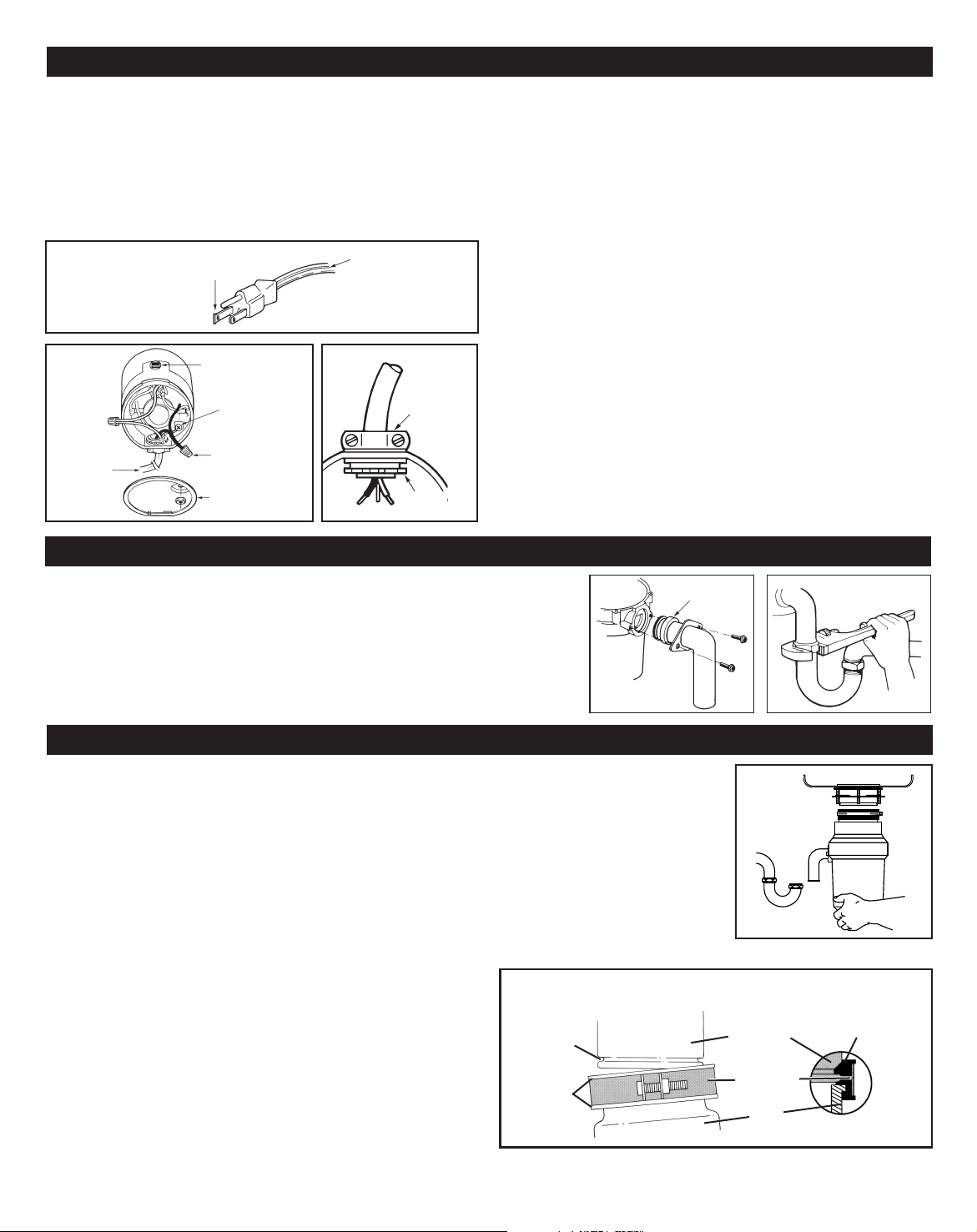
A. Conecte el triturador sólo a corriente de 110-120 voltios, 60
Hz AC.
B. Si usa un cordón enchufable, use un enchufe de tres dientes
(vea 4A). El alambre tornillo de tierra debe estar conectado al
tornillo en la parte inferior de la campana de punta (vea 4B).
C. Use un conector aliviador de tensión de alivio con abrazadera
de cable en el punto en el cual el cordón de suministro entra
al triturador (vea 4C).
Si está conectando el cableado de su triturador directa-
mente a la corriente casera:
Este artefacto debe conectarse a un sistema de cableado perma-
nente, metálico, y conectado a tierra; o se debe tender un
conductor para conectar el equipo a tierra junto con los conduc-
tores de circuito y se debe conectar al borne o conductor que
conecta el artefacto a tierra.
A. Si usa cable BX:
1. Instale el conector de cable en el orificio.
2. Conecte el alambre blanco al conductor blanco del
triturador.
3. Conecte el negro.
4. Conecte el alambre de tierra.
Si no usa el cable BX, provea un alambre de tierra separado a la
tubería metálica de agua fría más cercana, u otra linea de tierra ade-
cuada usando el tornillo en la campana de punta inferior para el
alambre de tierra (vea 4C).
B. Si su suministro eléctrico no incluye un alambre de tierra,
usted debe suministrar uno a menos que use cable metálico.
Conecte firmemente un alambre de cobre al tornillo de tierra
del triturador y conecte la otra punta del alambre a una
tubería metálica de agua fría. Use sólo una abrazadera de tier-
ra aprobada por la asociación Underwriters Laboratories (UL)
de los EE.UU. Si usa tubería plástica en su casa, llame a un
electricista acreditado para que instale la conexión a tierra
debidamente.
4. CONEXIONES ELÉCTRICAS (cont.)
5. CÓMO CONECTAR EL CODO DE DESCARGA
A. Conecte el codo de desperdicios al triturador (vea 5A), prosiga al paso 6, y
luego conecte la parte inferior del codo apretando la
tuerca deslizante (vea 5B).
B. Si está haciendo una conexión a una maquina para lavar trastos, regrese a
la sección 2B. En caso contrario, asegúrese que todas las conexiones de
tuberiás estén bien apretadas según los códigos y reglamentos de plomería.
Deje correr el agua y detecte si hay fugas.
EMPAQUETADURA
DEL CODO
5A 5B
NOTA: Al mirar la cara del enchufe
eléctrico con la patilla de tierra
hacia arriba, el diente mas grande
se conecta al alambre.
4A
LADO
ACANALADO
Montaje de 3 pernos (Consulte la sección 3 para
sutipode de montaje.)
A. Presione firmemente alrededor del cojín silenciador Hush
Cushion® para asegurar que esté engranado con el cuello del
triturador.
B. Lubrique el reborde interior superior del cojín silenciador
Hush Cushion® de caucho con jabón líquido.
C. Alinee el codo de descarga del triturador con la trampa que
se encuentra debajo del conjunto de montaje. Guíe el tritu-
rador hacia arriba y engrane la RANURA del cojín silenciador
Hush Cushion® alrededor del REBORDE en la parte inferior
de la brida del fregadero (vea 6A y consulte 3B). Siga apoyan-
do el triturador, y ajuste la abrazadera de tornillo alrededor
del cojín silenciador Hush Cushion®. Ahora el triturador
podrá mantenerse colgado por sí solo.
D. Si necesita girar el triturador, asegúrese de que la brida del
fregadero no gire, ya que romperá el sello creado cuando se
instaló. Vuelva a los pasos 5A y 5B.
IMPORTANTE – ¡POR FAVOR LEER!
NO REMUEVAN LA ABRAZADERA DE EL COJíN SILEN-
CIADOR HUSH CUSHION® O DE LA TOLVA, LAS DOS
PARTES FUERON INSTALADAS EN LA FACTORíA Y
ESTAN LISTAS PARA LA INSTALACIóN.
Lubriqué la área ángular de cau-
cho de el cojín silenciador Hush
Cushion® con jabón líquido
antes de engranar el triturador a
la brida del fregadoro. Acople el
labío de el cojín Hush Cushion®
en la ranura de la brida del fre-
gadero usando un movimiento
ligero y suave. Apriete la
abrazadera (vea 6B).
6. CÓMO CONECTAR EL TRITURADOR AL CONJUNTO DE MONTAJE
6B
BRIDA DEL
FREGADERO
HUSH CUSHION®
LA AREA ANGULAR
COJÍN
SILENCIADOR
6A
TORNILLO DE
TIERRA
T
UERCAS PARA
A
LAMBRES
QUITE LA PLACA
DE CUBIERTA
4B
A LA CORRIENTE
CASERA O EL
CORDÓN DE
SUMINISTRO
RANURA DE
LA BRIDA DEL
FREGADERO
4C
ALIVIADOR
DE
TENSION
TUERCA
BOTÓN DE REAJUSTE
“RESET” ROJO
Siga el recorrido del conductor
conectado a este diente y conecte
ese conductor al alambre blanco
del triturador.
TOLVA
ABRAZADERA
Montaje “EZ” (Consulte la sección 3 para identifiguar
sutipode de montaje.)
A. Alinee el triturador debajo del conjunto de montaje. Guíe las proyecciones
de la tolva en las ranuras del anillo de montura. Gire el anillo de montura
aproximadamente 1/4 pulg. a la derecha de manera que el triturador quede
a
poyado temporalmente (vea 6C).
B. Gire el anillo de montura y el triturador hasta que las líneas de salida de
desperdicios del triturador queden alineadas con la trampa (vea 6D).
C. Gire el anillo de montura en el sentido opuesto
alas agujas del reloj hasta que quede firmemente trabado. Las
proyecciones de la tolva deben quedar a la extrema izquierda
de las ranuras de montaje (vea 6E).
D. Si le cuesta trabajo darle vuelta al anillo de montura, puede
poner un poco de jalea de petróleo o jabón líquido a las
proyecciones de la tolva. Haga correr el agua y verifique si hay
fugas.
6E
6D
C
ODO DE
D
ESCARGA
T
RAMPA
DETALLE DE TRABA
PROYECCIÓN DE TOLVA EN
POSICIÓN "APOYADA"
P
ROYECCIÓN DE TOLVA EN
P
OSICIÓN "TRABADA"
ANILLO DE
MONTURA
6. CÓMO CONECTAR EL TRITURADOR AL CONJUNTO DE MONTAJE (cont.)
7. INSTRUCCIONES DE OPERACIÓN
ABERTURA
PROYECCIÓN
DE TOLVA
6C
Los impulsores giratorios antiatascamiento hacen un
sonido de "clic" al girar y colocarse en su debida posición.
Esto indica un funcionamiento normal.
A. Quite el tapón del fregadero. Abra el agua hasta que logre un
flujo mediano de agua fría.
B. Coloque el interruptor en la posición prendida "ON". El
motor está girando a toda velocidad y está listo para ser
usado.
C. Introduzca desperdicios de comida. Las sobras de comida,
mondaduras, mazorcas, cáscaras, semillas, huesos de frutas,
huesos de carne pequeños y granos de café, bajarán por el
drenaje. Para acelerar la disposición de los desperdicios de
comida, corte o deshaga los huesos grandes, las cáscaras y las
mazorcas. Los huesos grandes y las cáscaras fibrosas
requieren mucho tiempo para triturar, y es más fácil simple-
mente botarlos con el resto de la basura. No se alarme si el
artefacto pierde velocidad al triturar. En realidad, el tritu-
rador está aumentando el momento de torsión (potencia de
trituración) y está funcionando normalmente.
D. Antes de apagar el triturador, deje que el agua fluya y el tritu-
rador funcione por aproximadamente 15 segundos después
que la acción de triturar termine. Esto asegura que todos los
desperdicios sean drenados por completo a través de la tram-
pa y el drenaje.
E. No se recomienda usar agua caliente mientras está funcio-
nando el triturador. El agua fría mantendrá los desperdicios y
las grasas en condición sólida para que el triturador pueda
drenar las partículas.
6F
SUGERENCIAS
A. Asegúrese de que el triturador esté vacío antes de usar su máquina lavadora de trastos para que
pueda drenarse debidamente.
B. Posiblemente querrá dejar el tapón en el drenaje cuando no esté en uso el triturador para
impedir que caigan dentro del triturador utensilios y objetos extraños.
C. Su triturador es de construcción sólida y duradera para brindarle muchos años de servicio sin
problemas. Triturará todos los desperdicios de comida normales, pero NO triturará ni eliminará
objetos tales como el plástico, latas, tapas de botellas, vidrio, loza, cuero, tela, caucho, hilos o
conchas de almejas u ostras.
INSTRUCCIONES PARA UTILIZAR EL PROCESO DISCONTINUO
(BATCH FEED) DEL TRITURADOR
Los impulsores giratorios antiatascamiento hacen un sonido de “clic” al girar y colocarse
en su debida posición. Esto indica un funcionamiento normal.
A
. Quite el tapón del fregadero y abra el agua hasta que logre un flujo mediano de agua fría.
B. Introduzca los desperdicios de comida. Las sobras de comida, mondaduras, mazorcas, cáscaras,
semillas, huesos de frutas, huesos de carne pequeños y granos de café, bajarán por el drenaje (vea
7A).
C. Coloque el tapón para arrancar el triturador (vea 7B). Una de las aberturas pequeñas en la base del
tapón debe coincidir con el interruptor del desatascador dentro del cuello del triturador. Empuje
firmemente hacia abajo para arrancar el triturador. Levante el tapón para que se apague.
D. Deje que el triturador siga funcionando por 15 segundos después de terminar de triturar. Esto ase-
gura que todos los desperdicios sean llevados por el agua dentro del drenaje.
E. Para llenar el fregadero, coloque el tapón y haga coincidir la abertura más grande con el interrup-
tor del desatascador (vea 7C). Empuje hacia abajo para sellar el fregadero sin arrancar el triturador.
Cuando la abertura mediana (vea 7B) del tapón de la base coincida con el interruptor del desatas-
cador, el agua puede drenarse, pero no deje que caigan accidentalmente cubiertos otros u objetos
dentro del triturador.
7A
7B
7C
ABERTURA
GRANDE
ABERTURA
PEQUENA
ABERTURA
MEDIANA
9. LIMPIEZA Y MANTENIMIENTO
8. DIAGNÓSTICO Y LOCALIZACIÓN DE FALLAS
Antes de tratar de reparar o reemplazar, recomendamos
que estudie lo siguiente:
R
UIDOS FUERTES: (Además de los causados cuando se trituran
huesos pequeños y huesos de frutas): Normalmente, estos son
producidos cuando una cuchara, tapa de botella u otro objeto
extraño es introducido accidentalmente. Para corregir esto,
apague el interruptor eléctrico y cierre el agua. Después de que
el triturador se haya detenido por completo, retire el objeto con
tenazas de mango largo.
LA UNIDAD NO ARRANCA: Desenchufe el cordón de sumin-
istro y, dependiendo de su modelo y la configuración de
cableado, coloque el interruptor de pared o el interruptor en la
caja de cortacircuitos en la posición apagada OFF. Verifique que
el disco de cuchillas gire libremente usando un mango de
madera de escoba largo. Si el disco de cuchillas gira libremente,
verifique si el botón de ajuste "reset" se disparó. El botón de
ajuste "reset" es rojo y se encuentra en frente del codo de
descarga, cerca de la parte inferior (Vea 8A). Oprima el botón
hasta que haga "clic" y se quede oprimido.
Si el botón de ajuste "reset" no se disparó, verifique si el alambre
conectado al triturador tuvo un cortocircuito o está roto. Revise
el interruptor de suministro eléctrico, la caja de fusibles o el
cortacircuitos. Si los componentes de cableado y eléctricos están
intactos, es posible que la unidad tenga problemas internos que
requieren servicio o reemplazo.
* La unidad con proceso discontinuo/batchfeed y la unidad de 3
pernos no tienen protector removable antisalpicadura.
SI EL DISCO DE CUCHILLAS NO GIRA LIBREMENTE: Apague
el triturador y verifique si hay algún objeto extraño trabado
entre el disco de cuchillas y el anillo de trituración. Destrabe y
quite el objeto girando el disco con un palo de madera de esco-
ba. (Vea 8B). Si no hay ningún objeto extraño, puede que haya
problemas internos.
FUGAS: Si la unidad tiene fugas en la parte superior, puede ser
porque:
1. La brida del fregadero no está asentada debidamente (aplicar
masilla o apretar).
2. El anillo de apoyo no está apretado debidamente.
3. El cojín silenciador Hush Cushion® está defectuoso o inde-
bidamente instalado.
Si la unidad tiene fugas en el codo de desperdicios, las mismas
pueden deberse a que los tornillos de la brida del codo no están
debidamente apretados.
8A
8B
NUMERO DE
SERIE
BOTÓN DE
REAJUSTE
“RESET” ROJO
DISCO DE
CUCHILLAS
QUITE PROTECTOR
ANTISALPICADURA
Llame gratis a nuestra linea de asistencia para atender cualquier pregunta.
800-854-3229
¡NO INTENTE LUBRICAR SU TRITURADOR!
El motor está permanentemente lubricado. El triturador se
limpia automáticamente y restriega sus piezas internas después
de cada uso. Todos los modelos están equipados con un protec-
tor antisalpicadura desmontable que permite sacarlo, limpiarlo
y volver a instalarlo fácilmente. (Las unidades de control superi-
or/lote de alimentación no usan protector antisalpicadura y las
unidades de 3 pernos. Quite el protector antisalpicadura jalán-
dolo hacia afuera por la parte superior. Para volver a instalarlo,
simplemente introdúzcalo en la brida del fregadero y presiónelo
hasta que quede debidamente asentado.
NUNCA ponga lejía o limpiadores químicos de drenajes en el
triturador, ya que producen una corrosión grave de las piezas
metálicas. Si son usados, el daño que causan se puede detectar
fácilmente, y todas las garantías quedarán anuladas. En el disco
de cuchillas se pueden formar depósitos de minerales de agua,
que dan la apariencia de estar oxidado.
BROYEUR À ORDURES
GUIDE DE L’UTILISATEUR
Voir le feuillet inclus pour informations spécifiques concernant votre
nouveau broyeur
NOTE: Ce broyeur à ordures ménagères a été conçu pour fonctionner uniquement sur du courant 110-120 volts, 60 Hz. Utiliser
un autre voltage ou Hz peut affecter de manière défavorable la performance de l’appareil.
IMPORTANT: Lire attentivement toutes les instructions. Garder ce guide pour référence future.
AVERTISSEMENT:
S’assurer de COMMENCER PAR LIRE LES INSTRUC- TIONS DE SÉCURITÉ RELATIVES AU RISQUE D’IN-
CENDIE, DE CHOC ÉLECTRIQUE OU DE BLESSURES CORPORELLES avant d’utiliser le broyeur (voir la dernière
page du guide).
2680 Orbiter Street • Brea, CA 92821 • www.anaheimmfg.com 560C485P01 REV E
Veuillez noter / inscrire les informations importantes à cet endroit
Numéro de Modèle*
Numéro de Série*
Garder le contrat de vente, la facture de vente, le chèque oblitéré ou autre preuve d’achat pour vérifier la date d’achat original pour
fins de garantie.
Appler notre info service sans frais pour trouver réponse à vos questions.
Nous sommes toujours à votre service.
800-854-3229
Outils et matérial pouvant être requis
CLEF À TUYAUX
SCIE À MÉTAUX
CORDON
D’ALIMENTATION
TROUSSE DE RACCORDEMENT DU
LAVE-VAISSELLE
MARTEAU GOUJON OU
POINÇON D’ACIER
DÈTENDEUR
MASTIC DE PLOMBIERTOURNEVIS PHILIPS
OU TOURNEVIS
À LAME PLATE
* Les informations ci-dessus se trouvent sur l’étiquette collée sous le broyeur. Pour plus de commodité,
copier le numéro du modèle et le numéro de série avant l’installation.
INSTRUCTIONS DE SÉCURITÉ IMPORTANTES
INSTRUCTIONS RELATIVES A UN RISQUE D’INCENDIE, DE DECHARGE ELECTRIQUE, OU DE
BLESSURES PHYSIQUES. CONSERVEZ CES INSTRUCTIONS.
AVERTISSEMENT - Lors de l’utilisation d’appareils
électriques, des précautions élémentaires doivent être
suivies, incluant les suivantes:
1. Lisez toutes les instructions avant d’utiliser l’appareil.
2. Afin de réduire le risque de blessures, une surveillance étroite
est nécessaire lorsqu’un appareil est utilisé à proximité d’en-
fants.
3. N’insérez pas de doigts ou mains à l’intérieur du broyeur
d’ordures.
4. Mettez l’interrupteur en position éteinte avant de tenter
décoincer ou d’enlever un objet du broyeur.
5. Lorsque vous essayez de décoincer le broyeur à ordures,
utilisez un long objet in bois tel qu’une cuillére en bois ou le
manche en bois d’un balai ou d’une serpiére.
6. Lorsqu’en train d’essayer d’enlever des objets d’un broyeur à
ordures, utilisez des pinces ou tenailles à manches longs. Si
le broyeur est activé magnétiquement, vous devriez alors
utiliser des outils non magnétiques.
7. Afin de réduire le risque de blessures causées par des matéri-
aux qui pourraient être expulsés par un broyeur à ordures,
n’insérez aucun des objets suivants dans le broyeur: coquilles
de palourde ou d’huîtres, nettoyants caustiques pour tuyau
d’écoulement ou produits similaires; verre, porcelaine ou
plastique; os entiers de longue taille, métaux, tels que des
capsules de bouteille, boites en fer blanc, papier ou ustensiles
d’aluminium, huile bouillante ou autres liquides chauds,
gousses entiéres de mais.
8. Lorsque le broyeur n’est pas sous utilisation, laissez le bou-
chon en place pour réduire les risques de chute d’objets à
l’intérieur du broyeur.
9. N’UTILISEZ PAS le broyeur à moins que le garde-boue ne soit
en place (ne s’applique pas aux unités de broyeur à interrup-
teur au counercle/ sbroyeur à chargement discontinu.)
10. Pour les instructions appropriées de mise à la masse, reportez
vous à la partie CONNEXION ÉLECTRIQUE de ce manuel.
Avant d’entreprendre cette étape, couper l’alimentation
électrique au boîtier des disjoncteurs ou à la boîte de
fusibles.
Si le montage de l’ancien appareil est identique à celui de votre
nouveau broyeur, refaire en sens inverse les instructions de
montage à la section 3. Les instructions suivantes doivent être
utilisées si votre vieux broyeur a un système de montage à 3
boulons.
A. Utiliser une clef à tuyaux pour séparer la tuyauterie de vidan-
ge du tuyau d’évacuation du broyeur (voir 1A).
B. Détacher le broyeur du collet d’évier en tournant dans le
sens des aiguilles d’une montre, (voir 1B). Si vous êtes inca-
pable de tourner l’anneau, frapper sur l’une des pattes de
l’anneau avec un marteau. Certains anneaux de montage
ont des pattes tubulaires. Insérer un tournevis dans l’un de
ces éléments tubulaires crée un bras de levier pour tourner
plus facilement l’anneau de montage (voir 1B). Pour certains
broyeurs, il peut être nécessaire d’enlever ou de desserrer les
écrous des vis de montage (voir 1C). Pour certains broyeurs,
il peut être nécessaire d’enlever une bride.
Attention: S’assurer de supporter le broyeur durant
cette étape ou il peut tomber lorsque l’anneau de
montage est séparé du dispositif de montage. Si
votre broyeur a un relais par câble (fil à écran
métallique n’utilisant pas de prise murale), com-
pléter les étapes C et D. Si vous utilisez un prise
mobile, passer à l’étape E.
C. Une fois le broyeur enlevé, tourner le broyeur à
l’envers et ôter la plaque-couvercle électrique (voir
1D).
D. Se servir d’un tournevis pour enlever le fil vert de
mise à la terre. Enlever les écrous de fil des fils
d’alimentation blanc et noir et séparer les fils du
broyeur des fils d’alimentation. Dévisser les vis du
collier de serrage et séparer le câble du broyeur.
E. Pour enlever le reste du système de montage de l’évier,
desserrer les vis de montage, pousser l’anneau de montage
vers le haut. Sous celui-ci se trouve l’anneau élastique.
Utiliser un tournevis pour déloger l’anneau (voir 1E). Enlever
l’anneau de montage, l’anneau de protection et le joint d’é-
tanchéité du collet d’évier. Pour certains types de montage, il
faudra dévisser le grand anneau qui maintient le collet d’évi-
er en place. Retirer le collet d’évier et nettoyer le vieux
mastic qui se trouve dans l’évier.
IMPORTANT: Sauf dans le cas d’une maison
neuve, c’est le temps de nettoyer le siphon et la
tuyauterie de drainage en y passant un furet ou
une sonde spirale avant d’installer votre nouveau
broyeur.
1. ENLÈVEMENT DU VIEUX BROYEUR
INSTRUCTIONS TYPE, VOTRE MODÈLE PEUT ÊTRE DIFFÉRENT.
1A
1B
1C 1D 1E
2. RACCORDEMENT DU LAVE-VAISSELLE
Si vous utilisez un lave-vaisselle, passer à l’étape suivante. Si
vous ne raccordez pas de lave-vaisselle au broyeur, passer à la
s
ection 3.
A. Au moyen d’un instrument peu tranchant (poinçon à
métaux ou goujon), faire tomber toute la bonde (voir 2A).
Ne pas utiliser un tournevis ou autre instrument tranchant.
Lorsque la bonde tombe dans le broyeur, vous pouvez l’en-
lever ou simplement la broyer quand le broyeur sera utilisé.
Ceci n’endommagera aucunement le broyeur mais peut
prendre un certain temps, lors de plusieurs sessions de broy-
age. Passer à la section 3.
B. Brancher le boyau du lave-vaisselle en utilisant un collier de
serrage de boyau. Si le boyau est de grosseur différente, vous
aurez besoin d’une trousse de raccordement pour lave-vais-
selle (voir 2B). S’assurer que tous les raccords de plomberie
son bien serrés et respectent le Code et les règlements de
plomberie. Faire couler de l’eau et s’assurer qu’il n’y a pas de
fuite.
TAPÓN
PROVISIONAL
2B
BOYAU DU
LAVE-VAISSELLE
C
OUPURE
A
NTI-RETOUR*
BROYEUR
La coupure anti-retour peut ne pas être requise
pour toutes les installations. Consulter le Code
de plomberie local.
3. INSTALLATION DU SYSTÈME DE MONTAGE
VOTRE BROYEUR À DÉCHETS EST LIVRÉ AVEC L’UN OU L’AUTRE DE CES DEUX TYPES DE MONTAGE
Reportez-vous aux instructions couvrant votre type de montage.
Type De Montage Avec
3 Boulons De Fixation
Type De Montage EZ
COLLET D’ÉVIER
JOINT CAOUTCHOUC
DU COLLET D’ÉVIER
ANNEAU DE PROTECTION
JOINT D’ÉTANCHÉITÉ
EN FIBRE
ANNEAU D E MONTAGE
VIS DE MONTAGE (3)
ANNEAU DE SUPPORT.
NOTER LES FLÈCHES
POINTANT VERS LE HAUT
ANNEAU DE MONTAGE
PATTES DE SERRAGE
GARNITURE ÉLASTIQUE
D’ÉTANCHÉITÉ.
COLLET D’ÉVIER*
JOINT CAOUTCHOUC
DU COLLET D’ÉVIER
* Un collier d’évier ajustable (pièce # 3140) est
disponible pour le montage dans les éviers en
fonte à cuve profonde (uniquement pour les
montages faisant appel à 3 boulons de fixation).
2A
NOTE: Observer attentivement l’ordre des pièces du système de
montage, car elles ont été assemblées correctement en usine.
(Voir 3A et 3B.)
A. Désassembler l’ensemble d montage, tel qu’expédié, en tour-
nant le collet d’évier jusqu’à ce que ses saillies s’alignent avec
les encoches de la bague de fixation et permettent de séparer
le collet d’évier du reste de l’ensemble de montage. Prendre
note de l’ordre dans lequel ces pièces sont superposées et
référer à l’illustration «3A» et «3B» pour identifier chaque
pièce. Désemballer les trois vis de montage et les visser à
moitié dans la bague de fixation (noter l’inscription: «Ce
côté en haut» "THIS SIDE UP" imprimée sur la partie
supérieure de la bague de fixation.) Puis, mettre le joint
caoutchouc sur l’anneau de protection et les poser sur les
extrémités pointues des vis de montage.
B. Garder ces pièces assemblées ensemble et les mettre de côté.
Avant de fixer le broyeur à l’ensemble de montage sous l’évi-
er, il peut être utile de pratiquer l’ajustement du SILLON du
dispositif atténuateur de bruit "Hush Cushion®" à l’ARÊTE
de la partie inférieure du collet d’évier (voir 3A et section 6).
C. S’assurer que l’évier est propre. Mettre une quantité appré-
ciable de mastic de plombier sous la face inférieure du collet
d’évier (voir 3C). Placer le collet d’évier pour qu’il soit bien
centré et que vous puissiez voir l’inscription lorsque vous
regardez dans l’évier. Presser fermement le collet d’évier dans
l’ouverture de l’évier pour créer un joint étanche. NE PAS
bouger ou tourner le collet d’évier après l’avoir mis en place,
car ceci pourrait briser le joint.
MONTAGE AVEC 3 BOULONS DE FIXATION
LIRE EN ENTIER AVANT DE COMMENCER
B
OYAU DE
C
AOUTCHOUC
MONTAGE AVEC 3 BOULONS DE FIXATION (SUITE)
D. Prendre le reste de l’ensemble de montage, tel que mis de côté, et s’assur-
er que la rondelle de caoutchouc est bien sur l’anneau de protection. Du
dessous de l’évier, tout en tenant fermement le collet d’évier d’une main,
aligner les saillies de l’anneau de montage avec les arêtes du collet d’évier.
Glisser l’ensemble de montage dans le collet d’évier, au-delà des arêtes et
le tourner d’un quart de tour, pour qu’il tienne en place de lui-même.
(voir 3D)
E. Serrer les trois vis de montage avec un tournevis. (voir 3E) . NE PAS TROP
SERRER! Enlever l’excédent de mastic de plombier.
3A
B
OUCHON
D
’ÉVIER*
COLLET
D’ÉVIER**
ÉVIER
COMPARTIMENT
DE BROYAGE
JOINT
CAOUTCHOU
C DU COUDE
VIS
VIS DE
MONTAGE**
SERRE-JOINT**
S
ILLON
A
RÊTE
REBORDE
JOINT DE
VIDANGE
JOINT À
REBORD
COUDÉ
RACCORD DE VIDANGE
DU LAVE-VAISSELLE
D
ISPOSITIF
A
TTÉNUATEUR DE
B
RUIT**
JOINT CAOUTCHOUC
DU COLLET D’ÉVIER
ANNEAU DE PROTECTION**
ANNEAU DE MONTAGE**
M
ASTIC DE
P
LOMBIER
FLASQUE DE
FERMETURE
(RACCORDS
ÉLECTRIQUES)
3E
3D
3C
MONTAGE EZ
LIRE EN ENTIER AVANT DE COMMENCER
NOTE: Observer attentivement l’ordre des pièces du système de
montage, car elles ont été assemblées correctement en usine. Voir
également l’illustration détaillée de la garniture élastique d’é-
tanchéité dans l’illustration 3J ci-dessous pour vérifier l’orientation
correcte de la garniture élastique d’étanchéité.
NOTE: Pratiquer cette installation avant d’aller sous l’évier pour
vous familiariser avec la façon dont les pièces s’emboîtent.
A. Désassembler le système de montage du broyeur en tournant
l’anneau de montage dans le sens des aiguilles d’une montre
et l’enlever.
B. Remonter l’anneau de montage vers la partie supérieure du
collet d’évier. Enlever la garniture élastique d’étanchéité.
Enlever l’anneau de montage. Il peut être utile de pratiquer
l’installation de la garniture élastique d’étanchéité à ce
moment avant d’être sous l’évier. Voir paragraphe “H”.
C. Dévisser l’anneau de support du collet d’évier et enlever le
joint d’étanchéité en fibre. Il vous reste a le joint d’é-
tanchéité en caoutchouc.
D. On utilise le joint d’étanchéité en caoutchouc au lieu du
mastic de plombier avec les éviers en acier inoxidable. Le
mastic de plombier doit être utilisé avec les autres éviers.
E. Si l’on n’utilise pas de mastic, pousser le collet d’évier dans
l’ouverture d’évier à travers le joint d’étanchéité en
caoutchouc. Ne pas tourner le collet d’évier après qu’il a été
mis en place.
F. Si vous utilisez du mastic au lieu du joint d’étanchéité, met-
tre un anneau de mastic sous le dessous du collet d’évier.
Insérer le collet d’évier dans l’ouverture d’évier, appuyer fer-
mement pour enlever l’excédent de mastic. Par le dessous de
l’évier, enlever l’excédent de mastic de la face inférieure de
l’ouverture d’évier.
G. Du dessous de l’évier, glisser le joint d’étanchéité en fibre sur
le collet d’évier exposé. Avec les flèches pointant vers le
haut, visser l’anneau de support sur le collet d’évier, serrer à
la main jusqu’ à ce que le collet d’évier ne bouge plus (voir
3F). A ce moment, il est recommandé d’insérer le bouchon
d’évier, de remplir celuici d’eau afin de vérifier l’étanchéité
du collet d’évier et s’assurer qu’il n’y a pas de fuite.
*REMARQUE: POUR L’INSTALLATION: UTILISER UN SEUL,
MASTIC DE PLOMBIER OU LE JOINTEN CAOUTCHOUC.
H. Placer l’anneau de montage sur le collet d’évier et le
maintenir en place pendant que vous installez la garniture
élastique d’étanchéité (la partie large vers le bas) de façon
à ce que le sillon sur l’intérieur de la garniture élastique
d’étanchéité s’ajuste sur la lèvre du collet d’évier, tout
comme un couvercle sur un contenant en plastique
(voir 3G, 3H et 3J).
* Le bouchon pour broyeur à chargement discontinu peut étre
différent de celul dans l’illustration.
** L’ensemble de Montage (voir 3A et 3B)
NUMÉRO DE SÉRIE - INSCRIRE
SUR LA CARTE DE GARANTIE
VIS DE MONTAGE
ANNEAU DE
PROTECTION
JOINT
CAOUTCHOUC
COLLET D’ÉVIER
DISPOSITIF ATTÉNUATEUR
DE BRUIT
3B
SERREJOINT
ANNEAU DE
MONTAGE
DÉTAILS DE L’ENSEMBLE DE MONTAGE
3J
SILLON
BOURRELET
INFÉRIEUR
GARNITURE ÉLASTIQUE D’ÉTANCHÉITÉ
L’ÈVRE
INFÉRIEURE
DU COLLET
D’ÉVIER
GARNITURE ÉLASTIQUE
D’ÉTANCHÉITÉ ÉPURE
A
NNEAU DE
M
ONTAGE
ANNEAU
DE
SUPPORT
C’est le moment d’inscrire sur votre NUMÉRO DE SÉRIE qui se trouve sous le broyeur.
Si vous n’êtes pas familier avec l’alimentation et les procédures électriques
consulter un électricien qualifié. Para trituradores de desperdicios
AVERTISSEMENT: UNE MAUVAISE CONNEXION DU CONDUCTEUR DE MISE À LA
TERRE POUR APPAREILLAGE PEUT CONDUIRE À UN CHOC ÉLECTRIQUE. CONSULTER
UN ÉLECTRICIEN QUALIFIÉ OU UN EXPERT EN RÉPARATIONS SI VOUS N’ÊTES PAS SÛR
QUE L’APPAREIL A ÉTÉ MIS À LA TERRE DE FAÇON CORRECTE. NE PAS MODIFIER LA
FICHE QUI VIENT AVEC L’APPAREIL, SI CELLE-CI NE FAIT PAS DANS LA PRISE, FAITES
INSTALLER UNE PRISE APPROPRIÉE PAR UN ÉLECTRICIEN QUALIFIÉ.
Pour les broyeurs à ordures
DOTÉS d’un CORDON D’ALI-
MENTATION AVEC MISE À LA TERRE ENFICHABLE.
Cet appareil doit être mis à la terre. En cas de mauvais fonction-
nement ou de bris, la mise à la terre offre un chemin de
moindre résistance pour le courant électrique diminuant ainsi
les risques de choc électrique. Cet appareil est équippé d’un
cordon d’alimentation avec conducteur de mise à la terre pour
appareillage et d’une fiche de mise à la terre. La fiche doit
être insérée dans un prise appropriée, installée cor-
rectement et mise à la terre conformément aux codes
et ordonnances locaux.
Pour les broyeurs à ordures NON DOTÉS d’un CORDON
D’ALIMENTATION AVEC MISE À LA TERRE ENFICHABLE.
Cet appareil doit être mis à la terre. En cas de mauvais fonction-
nement ou de bris, la mise à la terre offre un chemin de
moindre résistance pour le courant électrique diminuant les
risques de choc électrique. Le cordon d’alimentation (à installer)
doit avoir un conducteur de mise à la terre pour appareillage et
une fiche de mise à la terre. La fiche doit être insérée dans
un prise appropriée qui a été installée de façon cor-
recte et mise à la terre conformément aux codes et
ordonnances locaux.
NOTE: Fermer le circuit d’alimentation électrique allant au
broyeur avant l’installation. Mettre le disjoncteur à la position
«OFF» ou enlever le fusible.
EMPAQUE-
TADURA DE
FIBRA
ANNEAU DE
SUPPORT
ANNEAU DE
SUPPORT
E
VIER
3H
Lorsque la garniture él astique d’étanchéité est installée cor rectement, la lèvre du col let
d’évier s’ajuste dans le sillon de la garniture élastique d’étanchéité e t l’anneau de mon-
tage peut être tiré vers le bas par dessus la garniture élastique d’étanchéité et peut
alors t our ner. Le bourrelet inférieur de la garniture élastique d’étanchéité ag it comme
joint d ’étanchéité en tre la partie inférieure du collet d’évier et la partie supérieure d u
broyeur. Voir 3J.
IMPORTANT NOTE:
GARNITURE ÉLASTIQUE D’ÉTANCHÉITÉ ÉPURE
MONTAGE EZ (SUITE)
3G
3F
ESPACE LIBRE,
SANS
OBSTRUCTION
4. CONNEXIONS ÉLECTRIQUES
BOUCHON*
P
ARE-
É
CLABOUSSURES
A
MOVIBLE**
COLLET
D’ÉVIER
JOINT
D’ÉTANCHÉITÉ EN
CAOUTCHOUC DU
COLLET D’ÉVIER
ANNEAU DE
MONTAGE‡
PATTES DE
SERRAGE‡
SILLON
TRÉMIE
FLASQUE
DE FERMETURE
(RACCORDS
ÉLECTRIQUES)
COLLET
DU
COUDE
COUDE DE
VIDANGE
EVIER
* Le bouchon pour broyeur à chargement
discontinu peut être différent de celui
dans l’illustration.
** NON utilisé avec les broyeurs à chargem
ent discontinu.
‡ Votre anneau de montage peut sembler
différent et ne pas avoir de pattes.
NUMÉRO DE SÉRIE
INSTRUCTIONS DE MISE À LA TERRE
ANNEAU DE
SUPPORT.
NOTER LES
FLÈCHES
POINTANT
VERS LE HAUT
POINT D’ARRIVÉE
DE LA VIDANGE
DU LAVE-VAIS-
SELLE
JOINT
D’ÉTANCHÉITÉ
EN FIBRE
L’ANNEAU DE
MONTAGE DOIT
ÊTRE LIBRE DE
MONTER ET DE
DESCENDRE
BOURRELET INFÉRIEUR
DE LA GARNITURE
ÉLASTIQUE D’ÉTANCHÉITÉ
É
VIER
GARNITURE
ÉLASTIQUE
D’ÉTANCHÉITÉ.
VIS
JOINT
D’ÉTANCH
ÉITÉ
DU COUDE
JOINT D’ÉTANCHÉITÉ
EN CAOUTCHOUC
PARTIE SUPÉRIEURE
DU COLLET D’ÉVIER
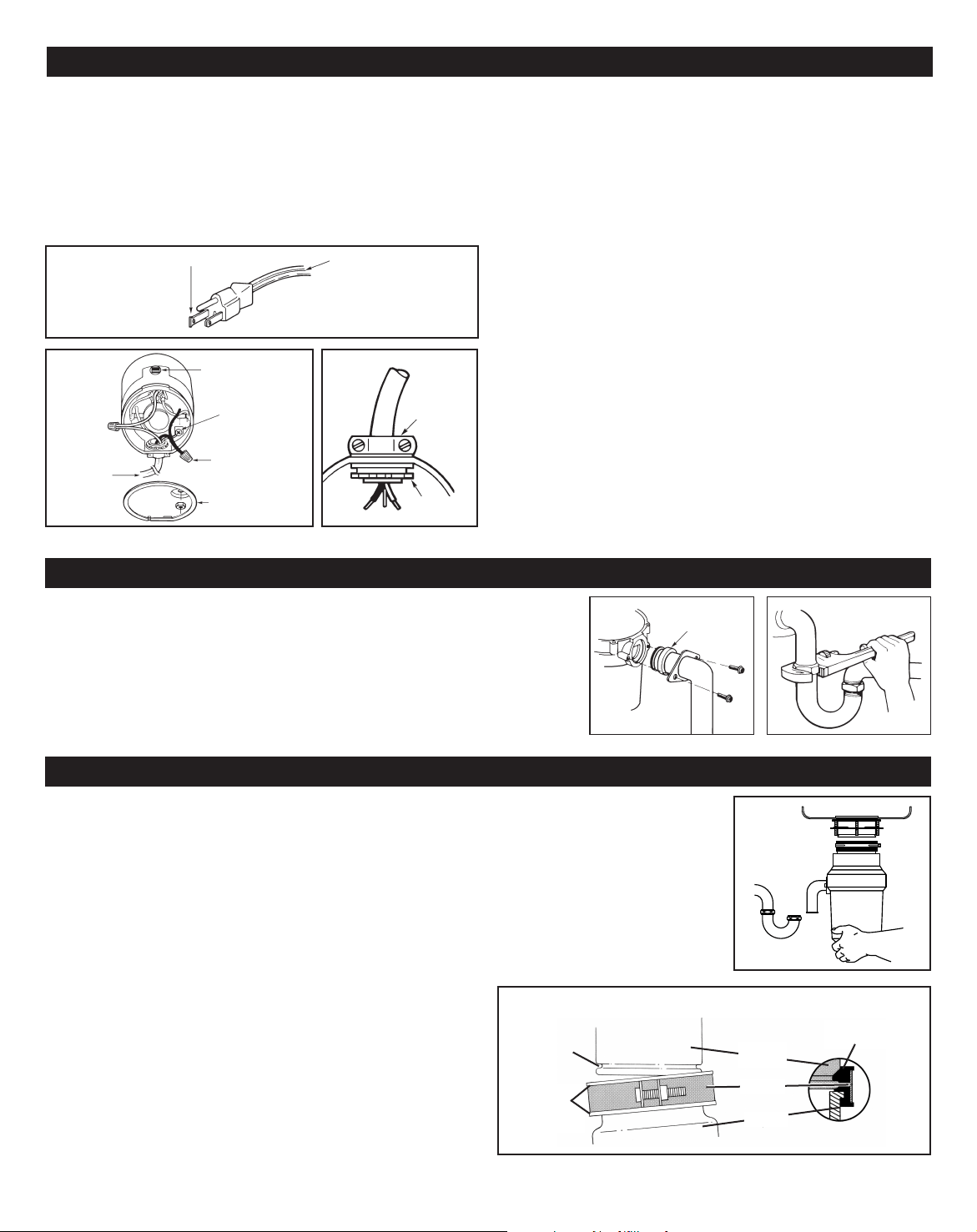
A. Brancher le broyeur uniquement sur du courant alternatif
110-120 volts, 60 Hz.
B. Si un cordon enfichable est utilisé, utiliser une prise enfich-
able double avec terre (voir 4A). Le fil de terre doit être fixé à
la vis de borne de terre à l’extrémité inférieure du broyeur
sous la plaque-couvercle électrique (4B).
C. Utiliser un raccord serre-câble avec détendeur à l’endroit où
l
e câble d’alimentation entre dans le broyeur (voir 4C).
Si vous branchez votre broyeur directement sur le courant de
la maison:
Cet appareil doit être branché à un système permanent de
filage métallique muni de mise à la terre; ou un conducteur de
mise à la terre de l’appareillage doit être utilisé conjointement
avec les conducteurs de circuit et branché à un terminal de
mise à la terre de l’appareillage ou à une borne de l’appareil.
A. Si vous utilisez un câble BX:
1. Installer le connecteur de câble dans le trou.
2. Connecter le fil blanc au fil de sortie blanc du broyeur
3. Connecter le noir
4. Connecter le fil de terre nu
Si vous n’utilisez pas un câble BX, faire courir un fil de terre
séparé au tuyau métallique d’eau froide le plus près ou à un
autre conducteur approprié, utilisant comme fil de terre la vis
située à la partie inférieure sous la plaque-couvercle électrique
(voir 4C).
B. Si votre source d’alimentation n’a pas de fil de terre, vous
devez en ajouter un à moins d’utiliser un fil métallique.
Attacher de façon sécuritaire un fil de cuivre à la vis de
terre du broyeur et attacher l’autre extrémité du fil à un
tuyau métallique d’eau froide. Utiliser seulement une
prise de terre approuvée UL. Si vous avez des tuyaux en
plastique dans votre maison, un électricien qualifié doit
installer une prise de terre appropriée.
4. CONNEXIONS ÉLECTRIQUES (SUITE)
5. ATTACHER LE COUDE DE VIDANGE
A. Fixer le coude de vidange sur le broyeur (voir 5A), passer à l’étape 6 puis
fixer l’extrémité inférieure du coude en resserrant l’écrou coulissant (voir
5B).
B. Si vous connectez votre broyeur à un lave-vaisselle, revenirà la
section 2B. Sinon, s’assurer…S’assurer que tous les raccords de plomberie
sont bien serrés et respectent les codes et ordonnances. Faire couler de
l’eau et vérifier s’il y a fuite.
5A
5B
NOTE: Lorsque vous regardez la face de
la prise électrique avec la tige de terre
au-dessus, la lame de gauche plus large
est branchée au fil identifié.
4A
CÔTÉ CÔTELÉ
MONTAGE AVEC 3 BOULONS DE FIXATION (Voir la section
3 pour votre type de montage.)
A. Apuyer fermement autour du coussin de montage pour s’as-
surer qu’il est bien inserré dans le col du broyeur.
B. Lubrifier la lèvre supérieure à l’intérieur du coussin de mon-
tage avec du savon liquide.
C. Aligner le coude de vidange du broyeur avec le siphon qui se
trouve sous le système de montage. Lever le broyeur et
engager le SILLON du coussin de montage autour du SIL-
LON placé au bas du collet d’évier (voir 6A et 3B). En
soutenant le broyeur, serrer les vis autour du coussin de
montage. Le broyeur restera suspendu.
D. Au cas ou il faudrait faire tourner le broyeur, s’assurer de ne
pas tourner le collet d’évier. Ceci pourrait briser le joint créé
lors de l’installation. Revenir aux pas 5A et 5B.
IMPORTANT – LISEZ S’IL VOUS PLAIT
NO RETIREZ PAS L’ÉTRIER DU COUSSIN HUSH CUSH-
ION® OU LE COUSSIN HUSH CUSHION® DE LA
TRÉMMIE, CES DEUX PIÈCES SONT INSTALLÉES EN
USINE ET PRÈS À L’INSTALLATION.
Lubrifiez la surface de coude
supérieure du Hush Cushion®
en caoutchouc avec du savon liq-
uide avant d’enclencher le
broyeur au collet d’evier. Ajustez
le rebord du Hush Cushion® à
la rainure du collet d’evier en
utilisant un faible mouvement de
balancement. Resserrez la clame
(voir 6B).
6. CONNECTER LE BROYEUR À L’ENSEMBLE DE MONTAGE
6B
SURFACE DE COUDE
SUPÉRIEURE
COUSSIN
6A
VIS DE MISE À
LA TERRE
ÉCROUS DE FIL
ENLEVER PLAQUE-
COUVERCLE
ÉLECTRIQUE
4B
V
ERS COURANT
D
E LA MAISON
O
U CORDON
D’ALIMENTATION
RAINURE DU
COLLET D’EVIER
4C
DÉTENDEUR
ÉCROU
BOUTON ROUGE DE
REMISE EN MARCHE
Trouver le fil qui va à cette lame et
attacher ce fil au fil de sortie
blanc de votre broyeur.
TRÉMIE
CLAME
JOINT D’ÉTANCHÉITÉ
ENCAOUTCHOUC
COLLET
D’EVIER
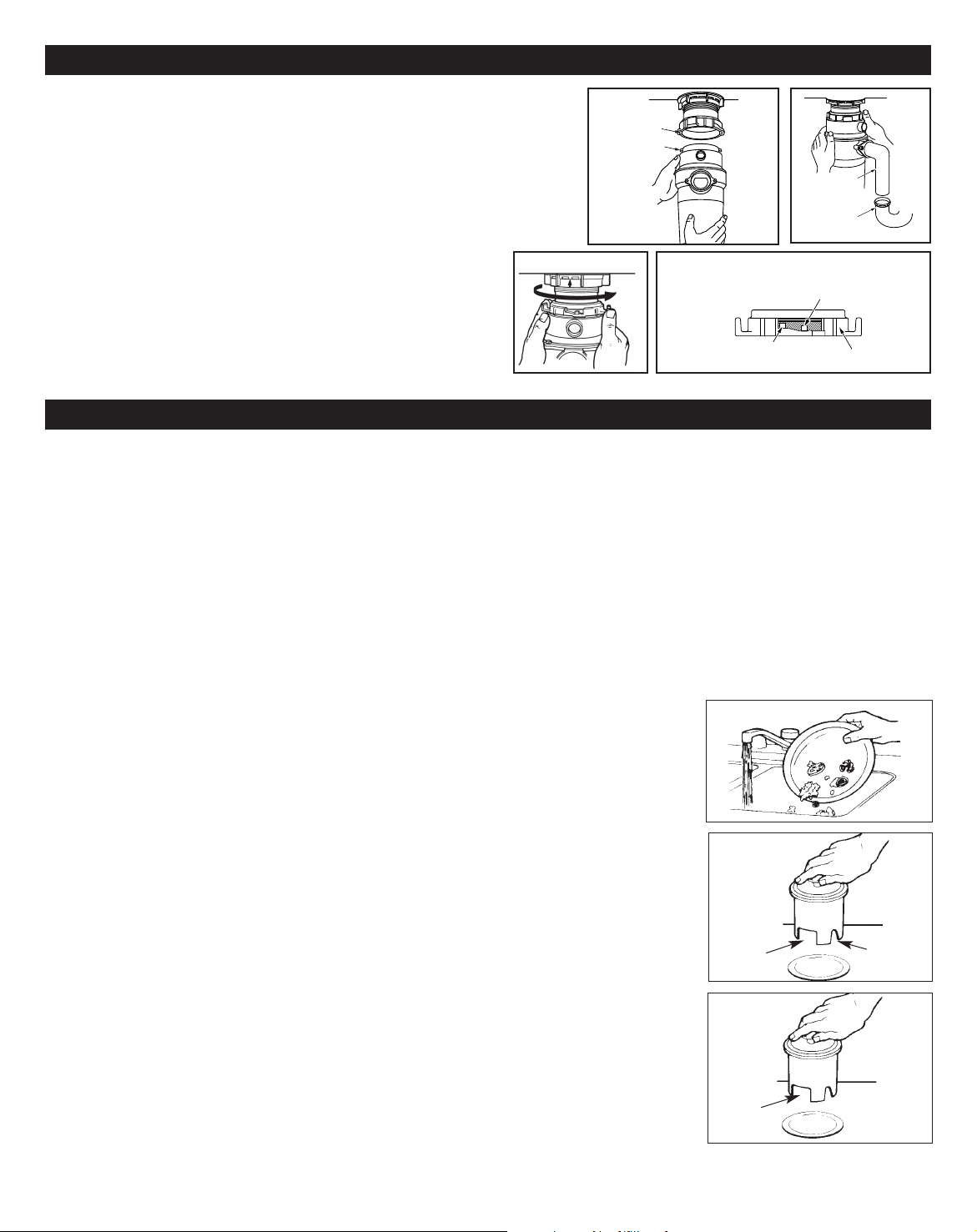
MONTAGE EZ (Voir la section 3 pour votre type de montage.)
A. Aligner le broyeur sous l’ensemble de montage. Guider les pattes de la
trémie dans les fentes de l’ensemble de montage. Tourner |l’anneau de
montage de 1/4” vers la droite de façon à ce que le broyeur soit tempo-
rairement suspendu. (voir 6C).
B. Tourner l’anneau de montage et le broyeur jusqu’à ce que le coude soit
aligné avec le siphon (voir 6D).
C. Tourner l’anneau de montage vers la droite (dans le sens inverse des aigu-
illes d’une montre) jusqu’à ce qu’il soit solidement enclenché.
Frapper sur les pattes de l’anneau de montage avec un marteau
jusqu’à ce que la position de verrouillage soit atteinte. Les
pattes de la trémie doivent être à l’extrême gauche des
encoches de montage (voir 6E).
D. Si l’anneau de montage est difficile à tourner, vous pouvez
ajouter un peu de vaseline ou de savon liquide aux projections
de trémie. Faites couler de l’eau et vérifiez s’il y a fuite.
6E
6D
COUDE
SIPHON
DÉTAIL DU VERROUILLAGE
PROJECTION DE TRÉMIE EN
POSITION «SUSPENSION»
PROJECTION DE TRÉMIE EN
POSITION «VERROUILLAGE»
ANNEAU DE
MONTAGE
6. CONNECTER LE BROYEUR À L’ENSEMBLE DE MONTAGE (SUITE)
7. GUIDE D’UTILISATION
ENCOCHE
PATTE
6C
Les impulseurs anti-blocage pivotants émettent un clic
lorsqu’ils se mettent en position. Ceci est normal.
A. Enlever le bouchon d’évier. Faire couler l’eau froide à un
régime modéré.
B. Mettre l’interrupteur en position ON; votre moteur tourne à
plein régime et est prêt à être utilisé.
C. Y mettre les ordures de cuisine. Les restes de nourriture,
épluchures, pelures, pépins, noyaux, os de petite taille et
marc de café disparaissent dans le drain. Pour accélérer le
broyage des ordures, briser en petits morceaux les os de
grand taille, les pelures et le épis. Les os de grande taille et les
enveloppes fibreuses demandent beaucoup de temps pour le
broyage et il est souvent plus facile de les jeter aux ordures.
Ne pas s’inquiéter si le broyeur ralentit durant le broyage. Le
broyeur augmente le moment de torsion (capacité de broy-
age) et fonctionne normalement.
D. Avant d’arrêter le broyeur, laisser le broyeur fonctionner à
peu près 15 secondes après la fin du broyage. Ceci assure que
tous les déchets ont été évacués de la trappe et du drain.
E. Il n’est pas conseillé d’utiliser de l’eau chaude lorsque vous
faites fonctionner le broyeur. L’eau froide garde les ordures et
les gras à l’état solide et le broyeur peut alors les évacuer à
l’état de particules.
6F
SUGGESTIONS
A. S’assurer que le broyeur est vide avant d’utiliser le lave-vaisselle pour que celui-ci puisse drainer
de façon normale.
B. Il est préférable de laisser le bouchon dans le drain quand le broyeur n’est pas utilisé pour
empêcher les ustensiles et autres corps étrangers de tomber dans le broyeur.
C. Votre broyeur a été construit de façon solide pour vous donner plusieurs années de service
sans problème. Il peut broyer toute ordure de table normale MAIS il ne pas pourra broyer ou
évacuer des items comme le plastique, les boîtes de conserve, les capsules de bouteille, le verre,
la porcelaine, le cuir, le tissu, le caoutchouc, la corde, les écailles d’huître ou de palourdes, le
papier d’aluminium ou les plumes.
INSTRUCTIONS D’UTILISATION POUR CHARGEMENT DISCONTINU
Les impulseurs anti blocage pivotants émettent un clic lorsqu’ils se mettent en position.
Ceci est normal.
A. Enlever le bouchon d’évier. Faire couler l’eau froide à un régime modéré.
B. Y mettre les ordures de cuisine. Les restes de nourriture, épluchures, pelures, pépins, noyaux,
os de petite taille et marc de café disparaissent dans le drain (voir 7A).
C. Insérer le bouchon pour mettre le broyeur en marche (voir 7B). L’une des deux petites encoches
à la partie inférieure du bouchon doit être alignée avec le déclencheur de l’interrupteur dans le
col du broyeur. Appuyer fermement. Enlever le bouchon pour arrêter le broyeur.
D. Faire fonctionner le broyeur pendant 15 secondes après la fin du broyage. Ceci assure que tous
les déchets sont évacués de la trappe et du drain.
E. Pour remplir l’évier, insérer le bouchon de sorte que la grande encoche s’aligne avec l’interrup-
teur (voir 7C). Le bouchon peut être enfoncé pour remplir l’évier sans activer le broyeur.
Lorsque l’encoche de taille moyenne (voir 7B) du bouchon est alignée avec l’interrupteur, l’eau
peut être évacuée mais les ustensiles etc. ne peuvent tomber accidentellement dans le broyeur.
7A
7B
7C
GRANDE
ENCOCHE
PETITE
ENCOCHE
ENCOCHE
DE TAILLE
MOYENNE
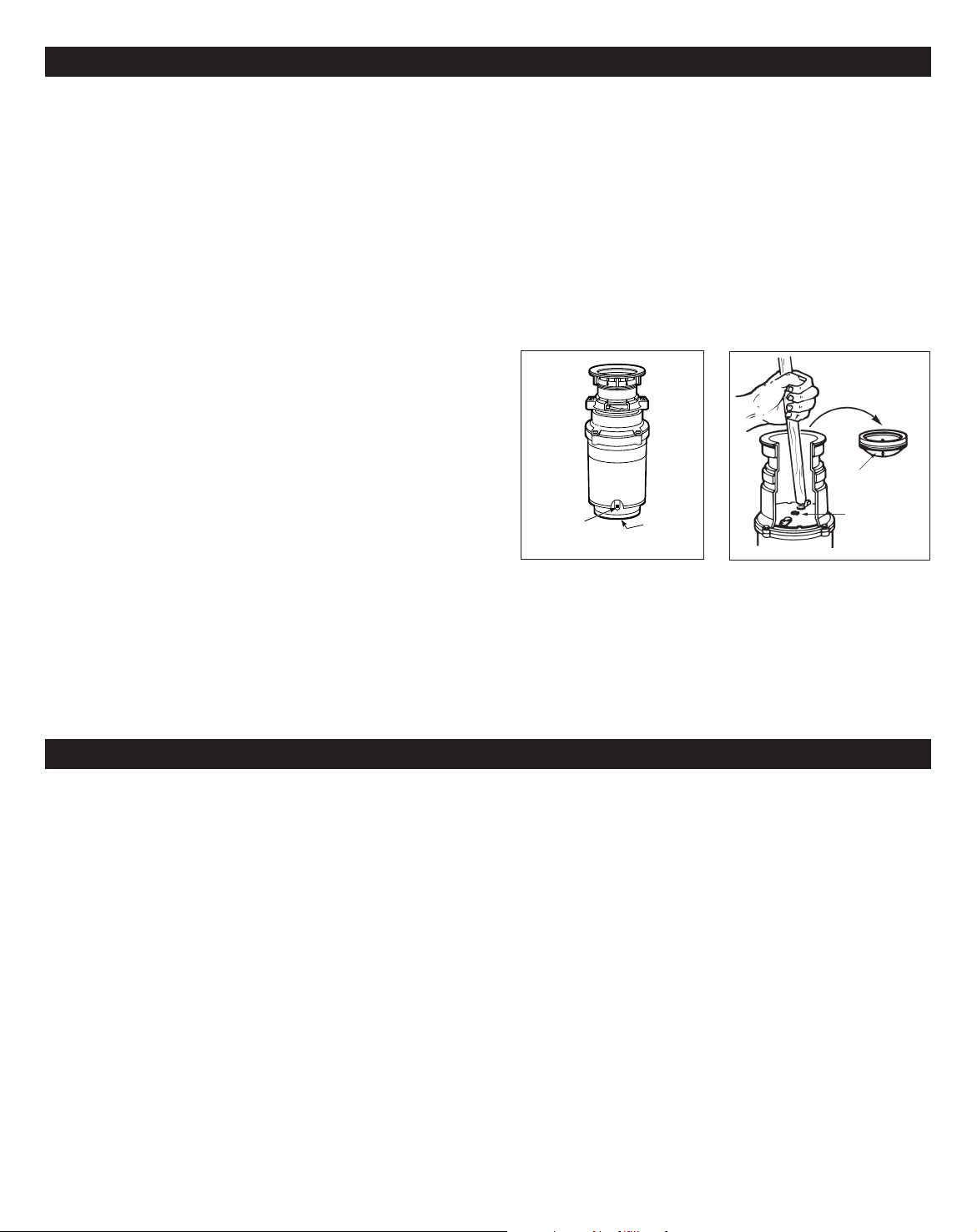
9. NETTOYAGE ET ENTRETIEN
8. DÉPANNAGE
Avant de réclamer des réparations ou un remplacement, il
est recommendé de faire les vérifications suivantes:
BRUITS MARQUÉS: (autres que ceux produits durant le broy-
age des os de petite taille ou des noyaux). Les bruits marqués
sont habituellement dûs à la présence d’une cuillère, d’une cap-
sule de bouteille ou autre objet similaire. Pour corriger ce
problème, fermer le courant électrique et l’eau. Lorsque le
broyeur soit arrêté, retirer l’objet à l’aide de tenailles.
LE BROYEUR NE PEUT PAS ÊTRE MIS EN MARCHE:
Débrancher le cordon d’alimentation ou mettre soit l’interrrup-
teur mural soit la chambre de broyage en position OFF, selon le
modèle et le type d’installation électrique. Vérifier que la plaque
tournante peut tourner librement. Pour ce faire, utiliser un
manche à balai. Si la plaque tournante tourne librement, vérifi-
er le bouton de mise en marche pour voir s’il a été déclenché.
Le bouton de remise en marche est rouge et se trouve dans la
partie inférieure, en face du coude de vidange (voir 8A).
Appuyer le bouton jusqu’à ce qu’il se produise un déclic et que
celui-ci demeure abaissé.
Si le bouton de remise en marche n’a pas été déclenché, vérifier
s’il y a un fil court-circuité ou brisé branché au broyeur. Vérifier
l’interrupteur électrique, la boîte à fusible et les disjoncteurs. Si
le filage ou les composants électriques sont intacts, l’unité peut
avoir des problèmes internes nécessitant réparation ou rem-
placement.
SI LA PLAQUE TOURNANTE NE TOURNE PAS LIBREMENT:
Fermer le courant électrique et s’assurer qu’il n’y a pas de corps
étrangers entre la plaque tournante et la couronne de broyage.
Dégager l’objet en tournant la plaque au moyen d’un manche à
balai (voir 8B). S’il n’y a pas de corps étrangers, l’unité peut
avoir des problèmes internes.
FUITES: Si l’appareil fuit a la partie supérieure, cela peut être dû
à:
1. Mauvaise pose du colet d’évier (mastic ou vissage)
2. Anneau de montage mal vissé.
3. Coussin de montage défectueux ou mal installé.
Si la fuite a lieu au niveau du coude de vidange, la fuite peut
être due au mauvais serrage des vis du joint du coude.
8A
8B
NUMÉRO DE
SÉRIE
BOUTON
DE REMISE
EN MARCHE
PLAQUE
TOURNANTE
ENLEVER LE PARE-
ÉCLABOUSSURES
Appler notre info service sans frais pour trouver réponse à vos questions.
Nous sommes toujours à votre service.
800-854-3229
NE PAS TENTER DE LUBRIFIER VOTRE BROYEUR!
Le moteur est lubrifié de façon permanente. Le broyeur est auto-
nettoyant et récure ses parties internes à chaque usage.
NE JAMAIS mettre de la soude caustique ou des nettoyeurs de
tuyaux d’évacuation dans le broyeur, parce qu’ils entraînent une
importante corrosion des parties métalliques. Si vous en faites
l’usage, le dommage qui en résulte peut facilement être identifié
et toutes les garanties deviendront nulles. Des dépôts calcaires
provenant de l’eau peuvent se former sur la plaque tournante,
donnant l’apparence de rouille.