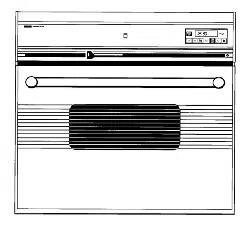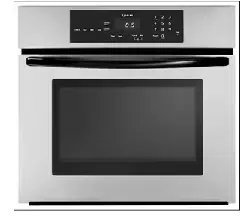
JENN-AIR
Use and Care Manual
27' Expressions ®
Convection Wall Oven
Models W27400 WM27460, WW27430
L W27400S, WW27430S_
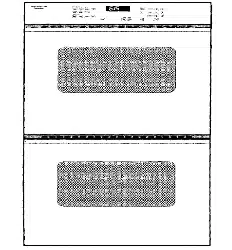
MODEL WW27430
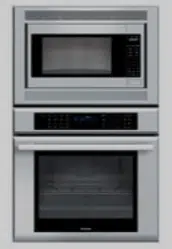
For Microwave Oven, refer to Use and Care Manual packed in Microwave Oven.
Congratulations on your choice of a Jenn-Air wall oven. Your Jenn-Air convection oven
combines the best of four cooking methods: conventional baking or roasting, convection
baking, convection roasting, and broiling, in a self-cleaning oven.
The Jenn-Air convection oven is actually a conventional oven that circulates heated air
within the oven. As both bake and broil heating elements cycle on and off with the
thermostat, a fan keeps the heated air circulating around the food. The constantly
recirculating heated air in the convection oven strips away the layer of cooler air that
surrounds food. Consequently, many foods cook more quickty. Distributed heat makes
multiple rack cooking possible. Convection roasted meats retain their natural flavor and
juiciness with less shrinkage than conventional roasting.
Before you begin cooking with your new oven, please take a few minutes to read and
become familiar with the instructions in this book. On the following pages you will find
a wealth of information regarding all aspects of using your new oven. By following the
instructions carefully, you will be able to fully enjoy and properly maintain your oven and
achieve excellent results with the food you prepare.
Should you have any questions about using your Jenn-Air oven, write to us. Be sure
to provide the model number.
Jenn-Air Customer Assistance
c/o Maytag Customer Service
P,O. Box 2370
Cleveland, TN 37320-2370
Model Number
Serial Number
(numbers appear on the serial plate on the oven front frame)
Date Purchased
JENN-AIR DEALER FROM WHOM PURCHASED
Address
City.
Phone
Baking
Baking Chart ................................................................................................ 15
Causes of Cake Failure ............................................................................... 16
Convect Baking ...................................................................................... 15-17
Convect Cooking on Multiple Racks ............................................................ 17
General Recommendations ......................................................................... 14
Before You Cal! For Service ....................................................................... 35-36
Broiling
Broiling ......................................................................................................... 26
Broiling Tips ................................................................................................. 27
Broiling Chart ............................................................................................... 27
Caring for Your Oven
Adjust Oven Temperature ........................................................................... 34
Child Protection Lock ................................................................................... 34
Cleaning Other Surfaces ............................................................................. 32
Oven Light Buib Replacement .................................................................... 33
Cleaning
Self-Cleaning Process28-32
Clock Controls
Clock Contro!ied Baking or Roasting ...................................................... 12-13
Time of Day Clock ........................................................................................ 10
Timer ........................................................................................................... 11
Oven Operation
Oven ControlPanel ........................................................................................6
Rack Positions .............................................................................................9
SettingControLs.............................................................................................8
Probe ........................................................................................................... 22-25
Roasting
Conventional Roasting Recommendations18
Convect Roasting ................................................................................... 19-21
Frozen Convenience Foods ......................................................................... 21
General Roasting Recommendations .......................................................... 18
Roasting Chart ............................................................................................ 19
Safety Precautions .......................................................................................... 4-5
Read before operating your oven
All appliances - regardless of the manufacturer - have the potential through
improper or careless use to create safety problems. Therefore the following
safety precautions should be observed:
1. Be sure your appliance is properly installed and grounded by a qualified
technician.
2. Never use your appliance for warming or heating the room.
3. Children should not be left alone or unattended in area where appliance
is in use. They should never be allowed to sit or stand on any part of the
appliance.
4. Wear proper apparel. Loose-fitting or hanging garments should never be
worn while using the appliance.
5. Do not repair or replace any part of the appliance unless specifically
recommended in this manual. All other servicing should be referred to an
authorized Jenn-Air Service Contractor.
6. Flammable materials should not be stored in an oven.
7. Do not use water on grease fires. Smother fire or flame or use dry
chemical or foam-type extinguisher.
8. Use only dry potholders. Moist or damp potholders on hot surfaces may
result in burns from steam. Do not let potholder touch hot heating
elements. Do not use a towel or other bulky cloth.
9. Use care when opening oven door. Let hot air or steam escape before
removing or replacing food.
10. Do not heat unopened food containers. Build-up of pressure may cause
container to burst and result in injury.
11. Keep oven vent ducts unobstructed.
12. Always place oven racks in desired location while oven iscool. If rack must
be moved while oven is hot, do not let potholder contact hot heating
element in oven.
13. Do not clean door gasket. The door gasket is essential for a good seal.
Care should be taken not to rub, damage, or move the gasket.
14. Do not use oven cleaners. No commercial oven cleaner or oven liner
protective coating of any kind should be used in or around any part of the
oven.
15. Clean only parts listed in this manual.
16. CAUTION: BEFORE SELF-CLEANING THE OVEN, REMOVE FOOD,
BROILER PAN AND OTHER UTENSILS.
17. Listenforfan.Afannoiseshouldbeheardduringthebake,convectbake,
convectroast,broilandcleaningcycles.Ifnot,calla serviceman.
18. DONOTTOUCHHEATINGELEMENTSORINTERIORSURFACESOF
OVEN.Heatingelementsmaybehoteventhoughtheyaredarkincolor.
Interiorsurfacesofanyovenbecomehotenoughtocauseburns.During
andafteruse,donottouch,orletclothingorother flammable materials
contact heating elements or interior surfaces of oven until they have had
sufficient time to cool. Other surfaces of the appliance may become hot
enough to cause burns-among these surfaces are: oven vent openings
and surfaces near these openings, oven doors, windows of oven doors.
19. PREPARED FOOD WARNING: Follow food manufacturer's instructions.
If a plastic frozen food container and/or its film cover distorts, warps or is
otherwise damaged during cooking, immediately discard the food and its
container. The food could be contaminated.
21). This appliance has been tested for safe performance using conventional
cookware. Do not use any devices or accessories that are not specifically
recommended in this manual. Do not use add-on convection systems.
The use of devices or accessories that are not expressly recommended
in this manual could create serious safety hazards, result in performance
problems, and reduce the life of the components of the appliance.
21. Do not allow aluminum foil or meat probes to contact heating element.
IMPORTANT SAFETY NOTICE AND WARNING
The California Safe Drinking Water and Toxic Enforcement Act of 1986
(Proposition 65) requires the Governor of California to publish a list of
substances known to the State of California to cause cancer or reproductive
harm, and requires businesses to warn customers of potential exposures to
such substances. Users of this appliance are hereby warned that when the
oven is engaged inthe self-clean cycle, there may be some low level exposure
to some of the listed substances, including Carbon Monoxide. Exposure to
these substances can be minimized by properly venting the oven to the
outdoors during the self-clean cycle.
- SAVE THESE INSTRUCTIONS -
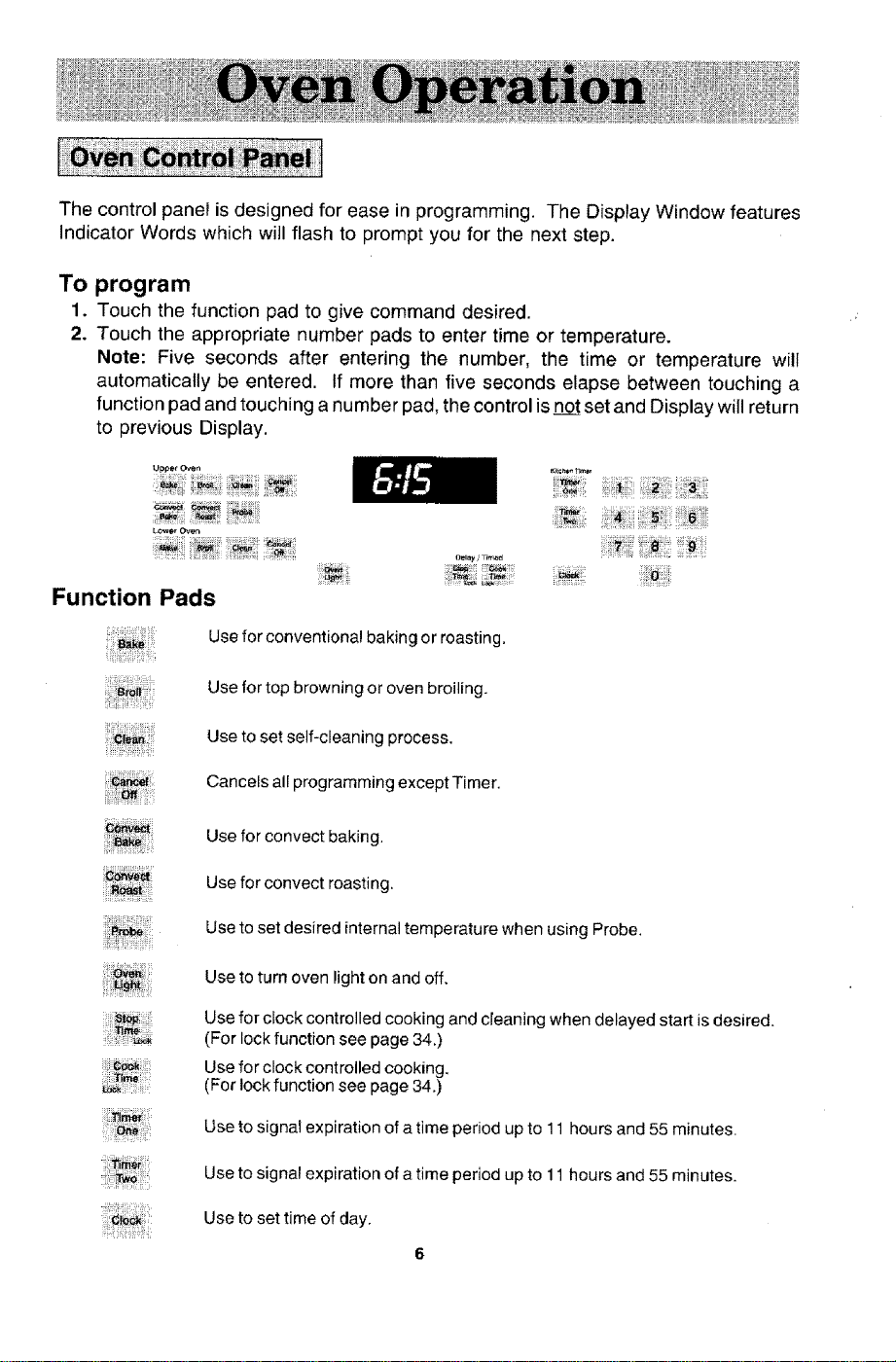
The control panel is designed for ease in programming. The Display Window features
Indicator Words which will flash to prompt you for the next step.
To program
1. Touch the function pad to give command desired.
2. Touch the appropriate number pads to enter time or temperature.
Note: Five seconds after entering the number, the time or temperature wilt
automatically be entered. If more than five seconds elapse between touching a
function pad and touching a number pad, the control is not set and Display will return
to previous Display.
Upperoven
,i_ii_iiii!z;_ _ _!_i
L_er Oven .................
Function Pads
!ii!!i:_:ii:i_!iii_!i!!il
Use for conventional baking or roasting.
Use for top browning or oven broiling.
Use to set self-cleaning process.
Cancels all programming except Timer.
Use for convect baking.
Use for convect roasting,
Use to set desired internal temperature when using Probe.
ii_!!i!i:ii_ili_ii!i;ii!_i!ii:
Use to turn oven light on and off.
Use for clock controlled cooking and cleaning when delayed start is desired.
(For lock function see page 34.)
Use for clock controlled cooking.
(For lock function see page 34.)
Use to signal expiration of a time period up to 11 hours and 55 minutes.
Use to signal expiration of a time period up to 11 hours and 55 minutes.
Use to set time of day.
Number Pads
Use to set time or temperature.
Oven Light Pad (Control Panel)
The oven light automatically comes on whenever the oven door is opened. When door is closed, touch
the Oven Light Pad to turn oven light on or off. Note: A beep will sound every time the Oven Light
Pad is touched.
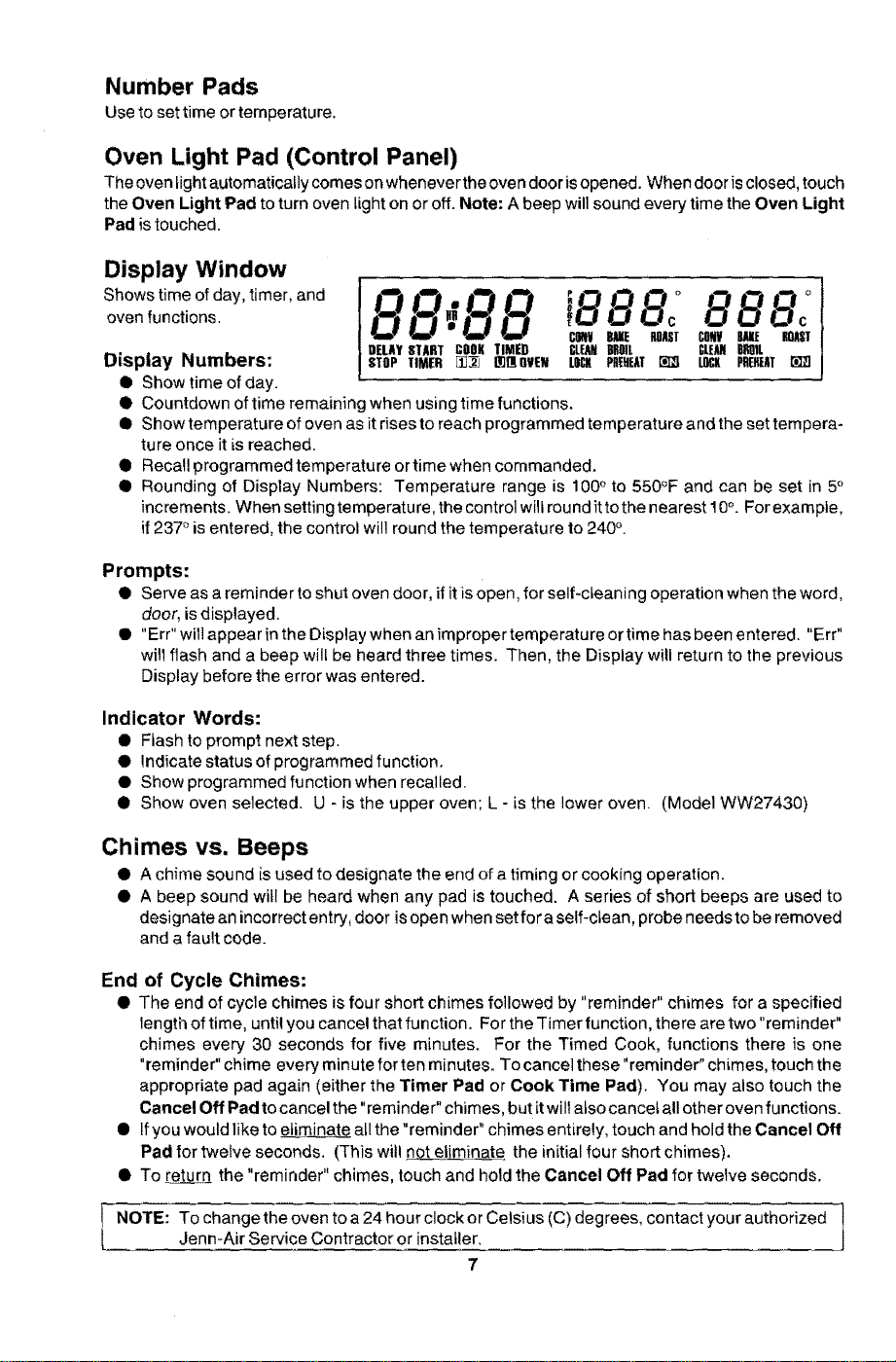
Display Window
88" 88 iSSSc°SSS:
CSNVBASEMAST CHV BAKEROAST
DELAY START COON TIMED CLEANBHIL CLEANBROIL
Display Numbers: STOPTIMER[_] [_glOVEN LOCKPREHEAT_ LOCKPREKEAT
• Show time of day.
• Countdown of time remaining when using time functions.
• Show temperature of oven as it rises to reach programmed temperature and the set tempera-
ture once it is reached.
• Recall programmed temperature or time when commanded.
• Rounding of Display Numbers: Temperature range is 100 ° to 550oF and can be set in 5°
increments. When setting temperature, the control will round it to the nearest ! 0°. For example,
if 2370 is entered, the control will round the temperature to 240 °.
Prompts:
• Serve as a reminder to shut oven door, if it isopen, for self-c_eaning operation when the word,
door, is displayed.
• "Err" will appear in the Display when an improper temperature or time has been entered. "Err"
witl flash and a beep will be heard three times. Then, the Display wi!l return to the previous
Display before the error was entered.
Indicator Words:
• Flash to prompt next step.
• Indicate status of programmed function.
• Show programmed function when recalled.
• Show oven selected. U - is the upper oven; L - is the lower oven. (Model WW27430)
Chimes vs. Beeps
• A chime sound is used to designate the end of a timing or cooking operation.
• A beep sound will be heard when any pad is touched. A series of short beeps are used to
designate an incorrect entry, door is open when set for aself-clean, probe needs to be removed
and a fault code.
End of Cycle Chimes:
• The end of cycle chimes is four short chimes followed by "reminder" chimes for a specified
length of time, until you cancel that function. For the Timer function, there are two "reminder"
chimes every 30 seconds for five minutes. For the Timed Cook, functions there is one
"reminder" chime every minute for ten minutes. To cancel these "reminder" chimes, touch the
appropriate pad again (either the Timer Pad or Cook Time Pad). You may also touch the
Cancel Off Pad to cancel the "reminder" chimes, but it will also cancet all other oven functions.
• If you would like to eliminate all the "reminder" chimes entire_y, touch and hold the Cancel Off
Pad for twelve seconds. (This wil! .not eliminate the initial four short chimes).
• To retejw#_ the "reminder" chimes, touch and hold the Cancel Off Pad for twelve seconds.
I NOTE: To change the oven to a 24 hour clock or Celsius (C) degrees, contact your authorized !
Jenn-Air Service Contractor or installer.
]
7
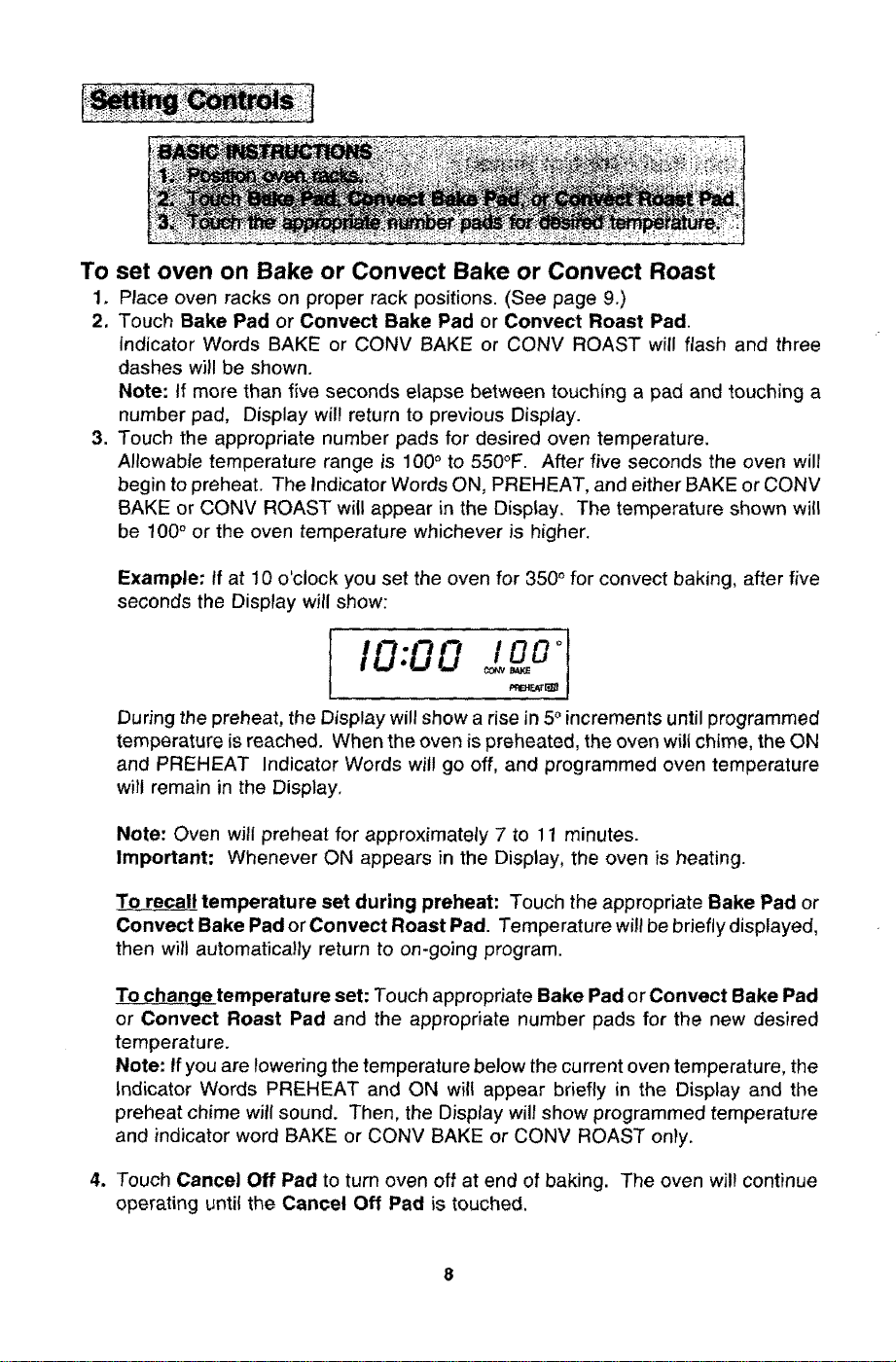
To set oven on Bake or Convect Bake or Convect Roast
1, Place oven racks on proper rack positions. (See page 9.)
2, Touch Bake Pad or Convect Bake Pad or Convect Roast Pad.
indicator Words BAKE or CONV BAKE or CONV ROAST wil! flash and three
dashes will be shown.
Note: tf more than five seconds elapse between touching a pad and touching a
number pad, Display will return to previous Display.
3. Touch the appropriate number pads for desired oven temperature,
Allowable temperature range is 100° to 550°F. After five seconds the oven will
begin to preheat. The Indicator Words ON, PREHEAT, and either BAKE or CONV
BAKE or CONV ROAST will appear in the Display. The temperature shown will
be 100 ° or the oven temperature whichever is higher.
Example: tf at 10 o'clock you set the oven for 350 ° for convect baking, after five
seconds the Display will show:
t lO:O0 ,ot
During the preheat, the Display will show a rise in 5° increments until programmed
temperature is reached. When the oven is preheated, the oven will chime, the ON
and PREHEAT Indicator Words wit! go off, and programmed oven temperature
will remain in the Display.
Note: Oven will preheat for approximately 7 to 11 minutes.
Important: Whenever ON appears in the Display, the oven is heating.
temperature set during preheat: Touch the appropriate Bake Pad or
Convect Bake Pad or Convect Roast Pad. Temperature wiltbe briefly displayed,
then wilt automatically return to on-going program.
To change_temperature set: Touch appropriate Bake Pad or Convect Bake Pad
or Convect Roast Pad and the appropriate number pads for the new desired
temperature.
Note: If you are lowering the temperature be!ow the current oven temperature, the
Indicator Words PREHEAT and ON will appear briefly in the Display and the
preheat chime will sound. Then, the Display will show programmed temperature
and indicator word BAKE or CONV BAKE or CONV ROAST only.
4, Touch Cancel Off Pad to turn oven off at end of baking. The oven wil! continue
operating until the Cancel Off Pad is touched.
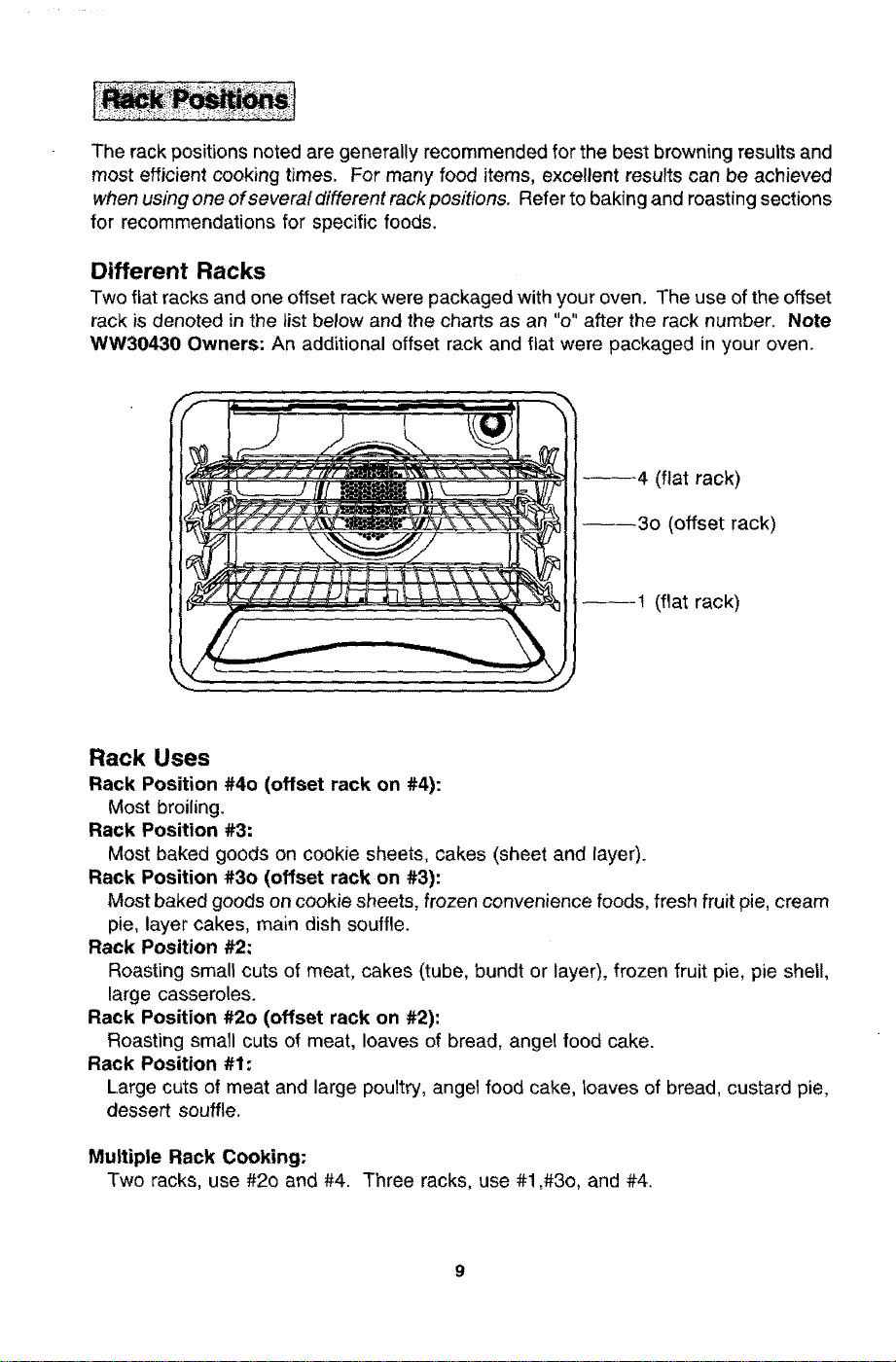
Therackpositionsnotedaregenerallyrecommendedforthebestbrowningresultsand
mostefficientcookingtimes.Formanyfooditems,excellentresultscanbeachieved
when using one of several different rack positions. Refer to baking and roasting sections
for recommendations for specific foods.
Different Racks
Two fiat racks and one offset rack were packaged with your oven. The use of the offset
rack is denoted in the tist below and the charts as an "o" after the rack number. Note
WW30430 Owners: An additional offset rack and fiat were packaged in your oven.
_4 (fiat rack)
_3o (offset rack)
_t (flat rack)
Rack Uses
Rack Position #4o (offset rack on #4):
Most broiling.
Rack Position #3:
Most baked goods on cookie sheets, cakes (sheet and layer).
Rack Position #30 (offset rack on #3):
Most baked goods on cookie sheets, frozen convenience foods, fresh fruit pie, cream
pie, layer cakes, main dish souffle.
Rack Position #2:
Roasting small cuts of meat, cakes (tube, bundt or layer), frozen fruit pie, pie shell,
large casseroles.
Rack Position #20 (offset rack on #2):
Roasting small cuts of meat, loaves of bread, angel food cake.
Rack Position #1:
Large cuts of meat and large poultry, angel food cake, loaves of bread, custard pie,
dessert souffle.
Multiple Rack Cooking:
Two racks, use #2o and #4. Three racks, use #! ,#3o, and #4.
Whenelectricalpoweris suppliedor afterpowerinterruption,thelastclocktime
displayed_beforepowerwasinterruptedwillflash.Timewill advance and continue to
flash until clock is reset.
To set Time of Day
1. Touch Clock Pad.
Indicator word TIME wilt flash and time digits will appear in the Display. (If more
than five seconds elapse between touching Clock Pad and touching a number
pad, the Clock Pad must be touched again in order to set clock.)
2. Touch the appropriate number pads until correct time of day appears in Display.
Note: Five seconds after touching the number pads, the time of day will
automatic.a!ly be entered.
IMPORTANT
• TO recall time of day when another time function is showing: Touch Clock Pad.
• Clock time cannot be changed when oven has been programmed for Timed
Bake, Timed Convect Bake, Timed Convect Roast or Self-clean. Cancel program
before reprogramming clock.
10
Important: This interval Timer can be used to remind you when a period, up to 1 t
hours and 55 minutes, expires, tt can be used independently of any other oven activity
and can be set while another oven function is operating. The Tim__does not controt
the oven.
To set Timer
1. Touch Timer Pad.
The Indicator Word Timer and either 1 or 2 flashes and "0Hr:00" appears in the
Display.
2. Touch the appropriate number pads until the desired number of minutes or hours
and minutes appear in the Disptay.
Note: If more than five seconds elapse between touching a Timer Pad and a
number pad, the Timer Pad must be touched again.
Example: To set Timer One for 5 minutes, touch the Timer One Pad and the
number 5 pad. After five seconds, the display wi!} show:
-os l
Example: To set Timer Two for i hour and 30 minutes, touch the Timer Two Pad
and the numbers "1, 3, 0" pads. After five seconds, the Display will show:
Countdown wil! start after five seconds. Countdown wil! have display precedence
over other time functions, tf both timers are set, the timer with the least amount
of time remaining will have display precedence.
At the end of time set, the Timer will chime four times and "End" wil! appear in the
Display. If timer is not cancelled (see below), "End" will remain in the Display and
there will be two chimes every thirty seconds for five minutes.
To cancel Timer
1. Touch and hold the Timer Pad for four seconds.
OR
2. A. Touch the Timer Pad.
B. Touch "0" number pad. Five seconds later the Timer will be cancelled.
NOTE: ouching Cancel Off Pad to cancel chimes will cancel ALL selected oven 1
programming.
J
11
t steps 5 you want baking to start ately.
To set oven to start immediately and shut off automatically
1. Touch Bake Pad or Convect Bake Pad or Convect Roast Pad.
Indicator Words BAKE or CONV BAKE or CONV ROAST will flash and three
dashes will be shown.
2. Touch the appropriate number pads for desired oven temperature.
After five seconds the oven will begin to preheat. The Indicator Words ON,
PREHEAT, and BAKE or CONV BAKE or CONV ROAST will appear in the Display.
The temperature shown will be 100° or the temperature of the oven, whichever is
higher. Example: If at 10 o'clock you set the oven for 350 ofor convection baking,
the Display will show:
goo°
I lO:O0 ,..o,ol
During the preheat, the Display wi!l show a rise in 50increments until programmed
temperature is reached. When the oven is preheated, the oven wilt chime, the ON
and PREHEAT Indicator Words will go off, and programmed oven temperature
will be displayed. Important: Whenever ON appears in the Display, the oven is
heating.
3. Touch Cook Time Pad.
Indicator Words COOK TIME will flash and Display will show "0 HR:00'L
4. Touch the appropriate number pads to enter cooking hours in five minute
increments. Hours are to left of colon and minutes to right of colon. (Allowable
range is 5 minutes to 11 hours and 55 minutes.) Example: If cooking time selected
for the oven is 2 hours and 30 minutes, the Display will show:
[
After five seconds, the time of day returns to the Display. Important: Oven wi!l
preheat for approximately 7 to 11 minutes. At end of programmed Cook Time,
oven will shut off automatically; retained heat wil! continue to cook food. Clock
controlled cooking is not recommended for baked items that require a preheated
oven, such as cakes, cookies, pies, breads. For these foods, place food in
preheated oven, then use Timer to signal end of baking time.
At the end of programmed Cook Time, the oven will shut off automatically and a
"chime" will be heard four times and "End" wil! appear in the Display. if oven is not
cancelled, "End" wil! remain in the Display and there wit! be one chime every minute
for ten minutes.
12
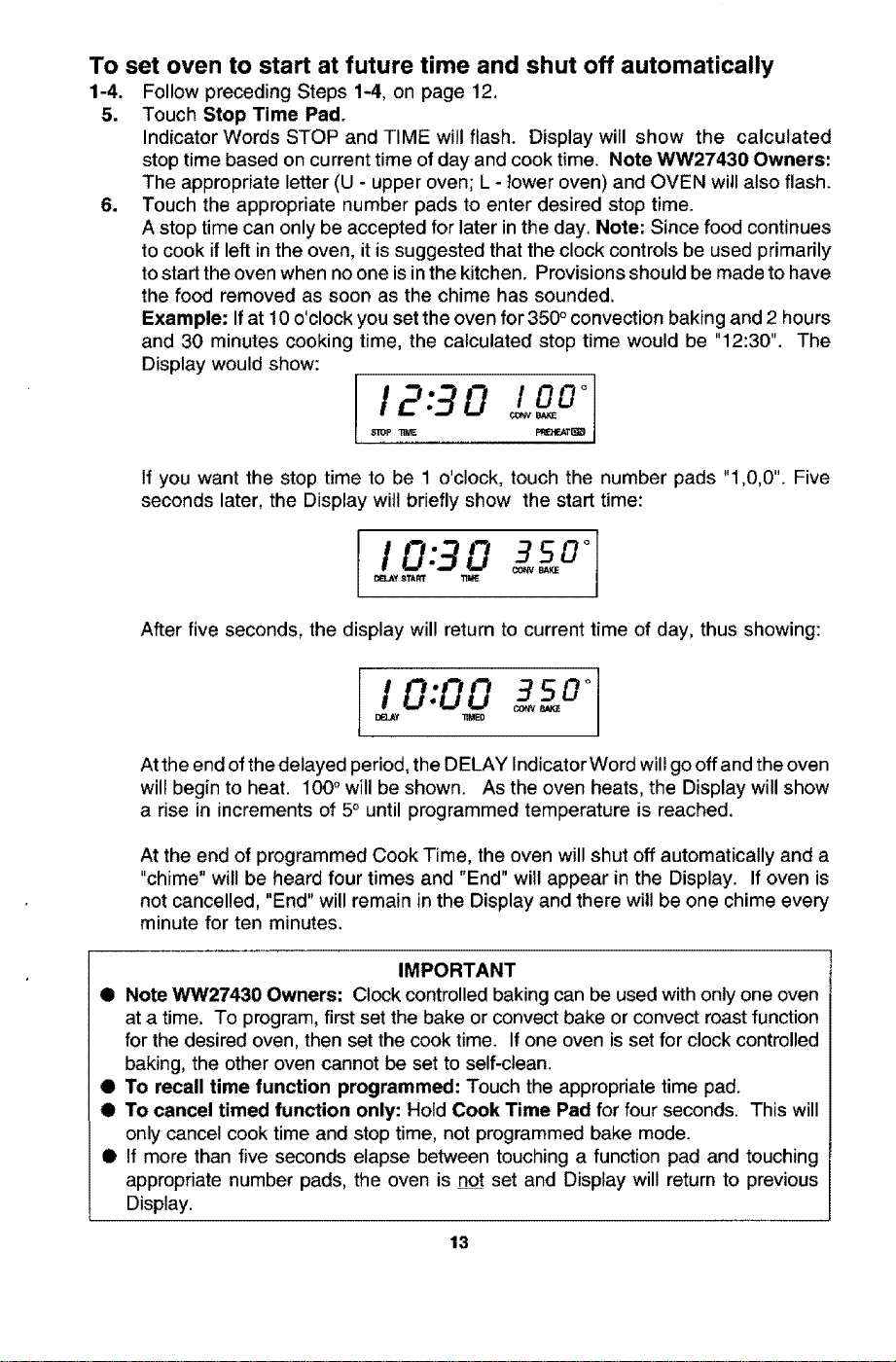
To set oven to start at future time and shut off automatically
1-4. Follow preceding Steps 1-4, on page 12.
5. Touch Stop Time Pad.
Indicator Words STOP and TIME will flash. Display will show the calculated
stop time based on current time of day and cook time. Note WW27430 Owners:
The appropriate letter (U - upper oven; L - lower oven) and OVEN will also flash.
6. Touch the appropriate number pads to enter desired stop time.
A stop time can only be accepted for later in the day. Note: Since food continues
to cook if left in the oven, it is suggested that the clock controls be used primarily
to start the oven when no one is in the kitchen. Provisions should be made to have
the food removed as soon as the chime has sounded.
Example: If at 10 o'clock you set the oven for 350 ° convection bak}ng and 2 hours
and 30 minutes cooking time, the calculated stop time would be "12:30". The
Display would show:
I 2:30 1oo°
SlOP 11E Pr_t_lfJ_T_
If you want the stop time to be 1 o'clock, touch the number pads "1,0,0". Five
seconds later, the Display will briefly show the start time:
10:30 5.oo°J
After five seconds, the display wil! return to current time of day, thus showing:
I I 0:00 3so°
¢ONV_J_
DELAY "WED
At the end of the delayed period, the DELAY Indicator Word will go off and the oven
will begin to heat. 100° will be shown. As the oven heats, the Display will show
a rise in increments of 5° until programmed temperature is reached.
At the end of programmed Cook Time, the oven will shut off automatically and a
"chime" will be heard four times and "End" will appear in the Display. If oven is
not cancelled, "End" will remain in the Display and there will be one chime every
minute for ten minutes.
IMPORTANT
• Note ViV#27430 Owners: Clock controlled baking can be used with only one oven
at a time. To program, first set the bake or convect bake or convect roast function
for the desired oven, then set the cook time. If one oven isset for clock controlled
baking, the other oven cannot be set to self-clean.
Q To recall time function programmed: Touch the appropriate time pad.
• To cancel timed function only: Hold Cook Time Pad for four seconds. This will
only cancel cook time and stop time, not programmed bake mode.
• If more than five seconds elapse between touching a function pad and touching
appropriate number pads, the oven is not set and Display will return to previous
Display.
13
i
I
• When cooking foods for the first time in your new oven, use recipe cooking times
and temperatures as a guide.
• Use tested recipes from reliable sources.
• Preheat the oven only when necessary. For baked foods that rise and for richer
browning, a preheated oven is better. Casseroles can be started in a cold oven.
Preheating takes from 7 to t ! minutes; place food in oven after PREHEAT indicator
Word cycles off.
• Arrange oven racks before turning on oven. Follow suggested rack positions on
page 9 and in various baking charts.
• Allow about t to I_/_inches of space between the oven side walls and pans to allow
proper air circulation.
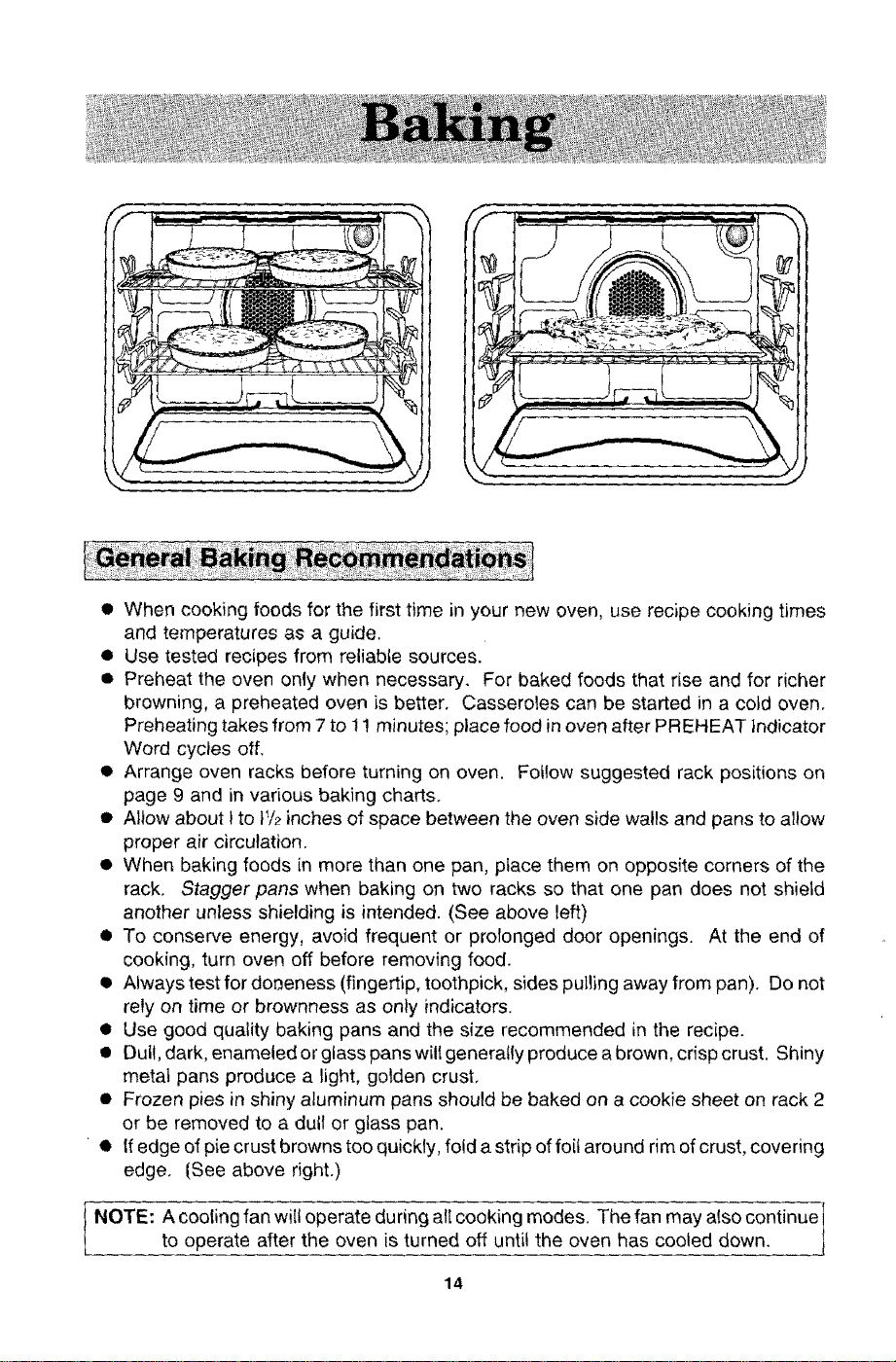
• When baking foods in more than one pan, place them on opposite corners of the
rack. Stagger pans when baking on two racks so that one pan does not shield
another unless shielding is intended. (See above left)
• To conserve energy, avoid frequent or prolonged door openings. At the end of
cooking, turn oven off before removing food.
• Always test for dooeness (fingertip, toothpick, sides pulling away from pan). Do not
rely on time or brownness as only indicators.
• Use good quality baking pans and the size recommended in the recipe.
• Dull, dark, enameled or glass pans will generally produce a brown, crisp crust. Shiny
metal pans produce a light, golden crust,
• Frozen pies in shiny aluminum pans should be baked on a cookie sheet on rack 2
or be removed to a dull or glass pan.
• If edge of pie crust browns too quickly, fold a strip of foi{ around rim of crust, covering
edge. (See above right.)
NOTE: A cooling fan will operate during all cooking modes. The fan may atso continue I
to operate after the oven is turned off until the oven has cooled down. }
14
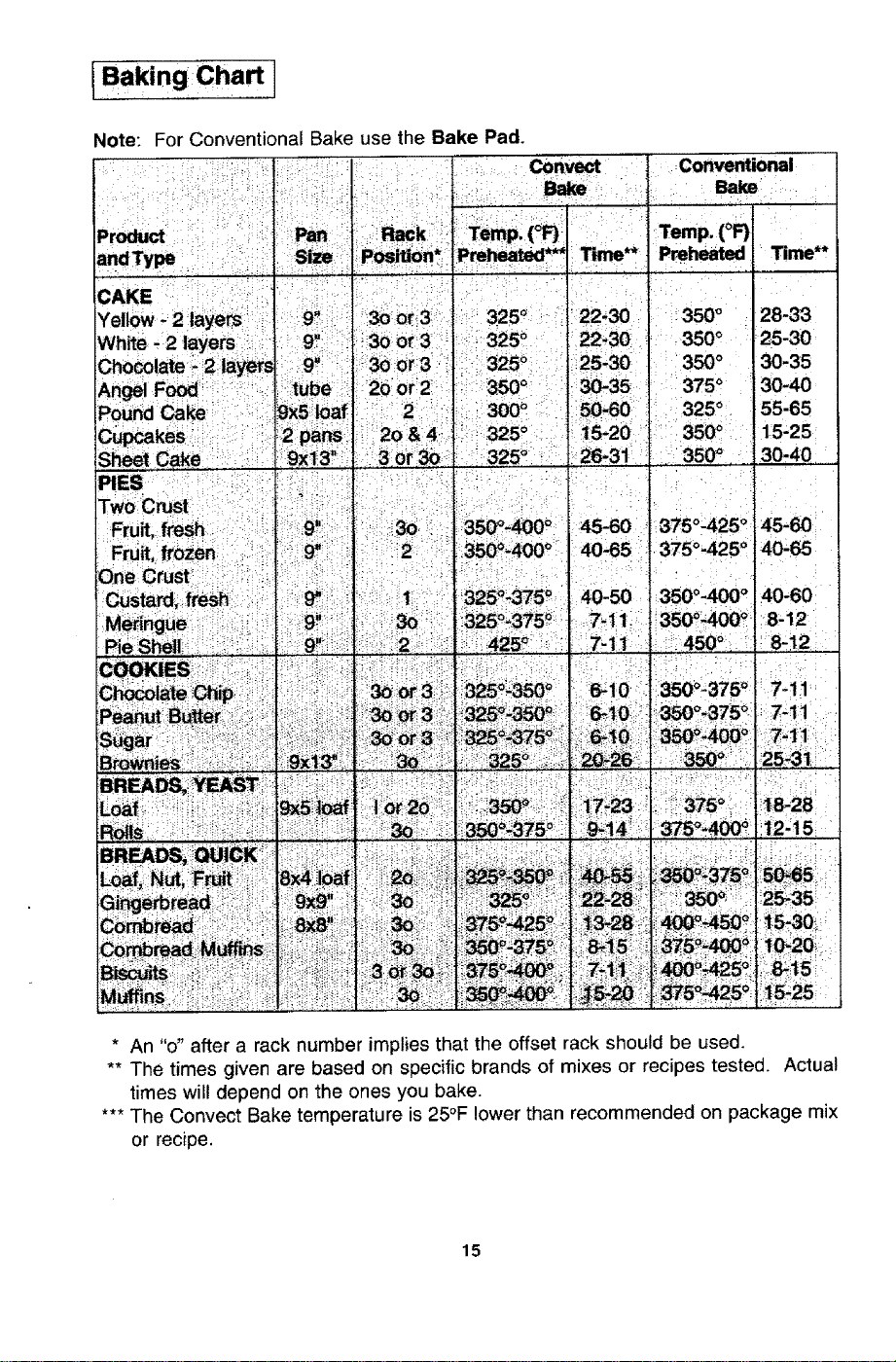
I Baking Chart 1
Note: For Conventional Bake use the Bake Pad.
_32s_-i_,2s-3o 35o° _.35
sr,o_- _-_ "Z7So 3o-4o
3oo_ iso_o 325_ 5s-ss
i: _5_ / !5-20 i 350' 15-25
; =325'. 26-31 _ . 350° - 30-40
: : o 75_
:. 25,3_
:375 :I
* An "o" after a rack number implies that the offset rack should be used.
** The times given are based on specific brands of mixes or recipes tested. Actual
times will depend on the ones you bake.
*** The Convect Bake temperature is 25°F lower than recommended on package mix
or recipe.
15
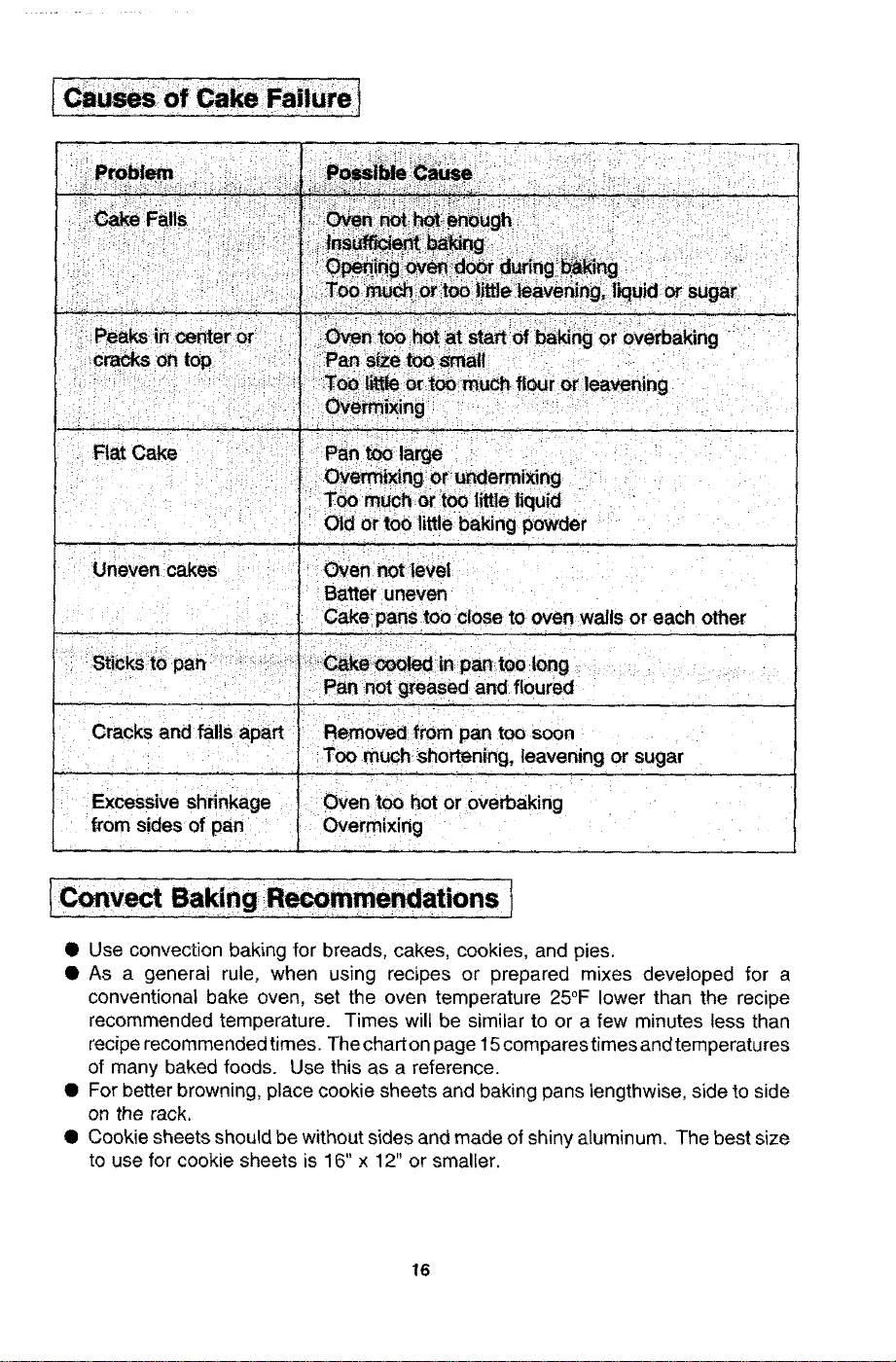
'Batter uneven
- 1
Excessive shrinkage Oven too hot or °verbaking
f_om sides of pan Overmixing
tConvect Baking. R mme ations t
• Use convection baking for breads, cakes, cookies, and pies.
• As a general rule, when using recipes or prepared mixes developed for a
conventional bake oven, set the oven temperature 25°F lower than the recipe
recommended temperature. Times will be similar to or a few minutes less than
recipe recommended times. The chart on page 15compares times and temperatures
of many baked foods. Use this as a reference.
• For better browning, place cookie sheets and baking pans lengthwise, side to side
on the rack.
I Cookie sheets should be without sides and made of shiny aluminum. The best size
to use for cookie sheets is 16" x 12" or smaller.
16
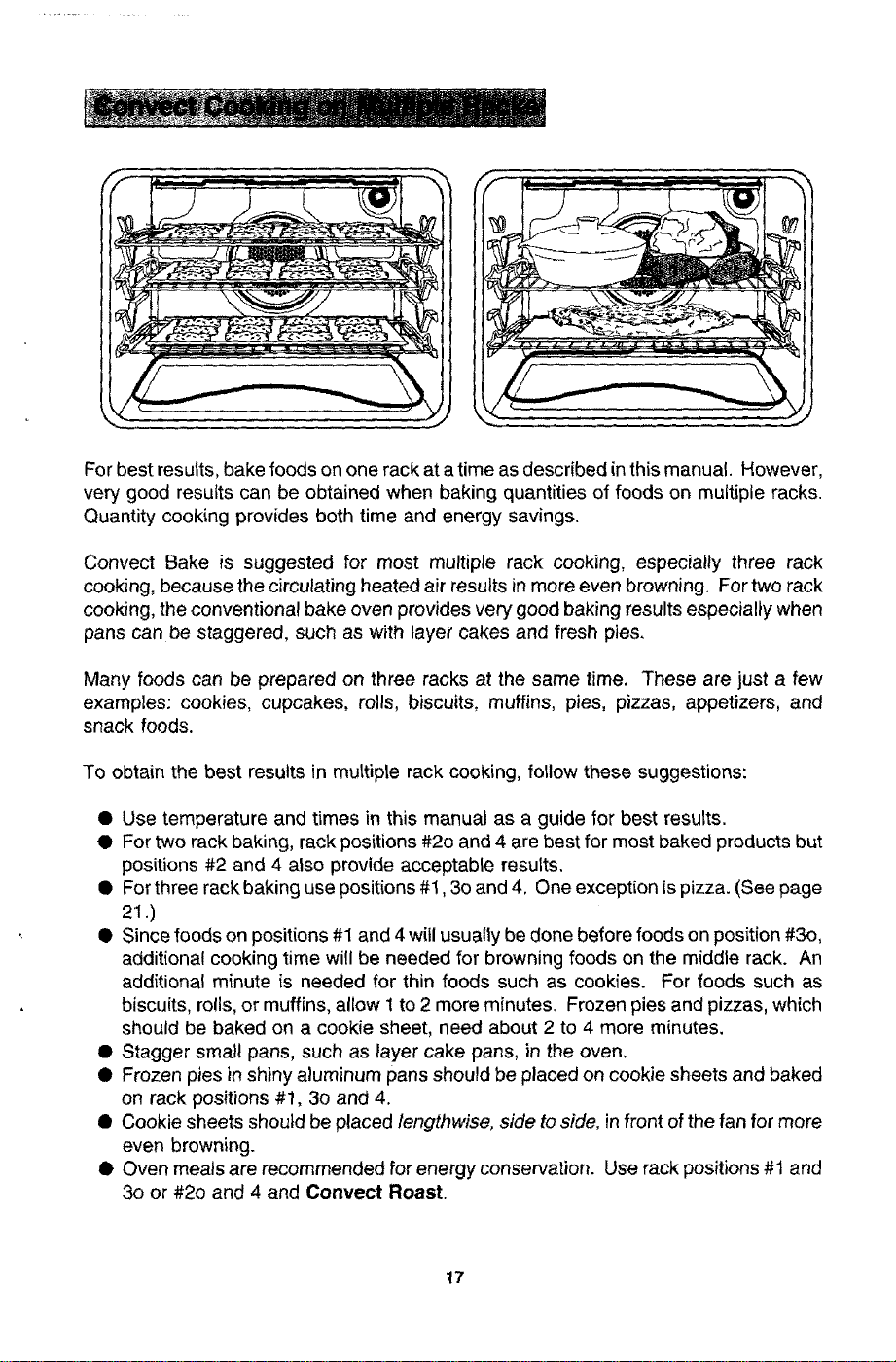
For best results, bake foods on one rack at a time as described in this manual. However,
very good results can be obtained when baking quantities of foods on multiple racks.
Quantity cooking provides both time and energy savings.
Convect Bake is suggested for most multiple rack cooking, especially three rack
cooking, because the circulating heated air results in more even browning. For two rack
cooking, the conventional bake oven provides very good baking results especially when
pans can be staggered, such as with layer cakes and fresh pies.
Many foods can be prepared on three racks at the same time. These are just a few
exampZes: cookies, cupcakes, rolls, biscuits, muffins, pies, pizzas, appetizers, and
snack foods.
To obtain the best results in multiple rack cooking, follow these suggestions:
• Use temperature and times in this manual as a guide for best results.
• For two rack baking, rack positions #20 and 4 are best for most baked products but
positions #2 and 4 also provide acceptable results.
• For three rack baking use positions #t, 3o and 4. One exception is pizza. (See page
21 .)
• Since foods on positions #1 and 4 will usually be done before foods on position #3o,
additional cooking time will be needed for browning foods on the middle rack. An
additional minute is needed for thin foods such as cookies. For foods such as
biscuits, rolls, or muffins, allow I to 2 more minutes. Frozen pies and pizzas, which
should be baked on a cookie sheet, need about 2 to 4 more minutes.
• Stagger small pans, such as layer cake pans, in the oven.
• Frozen pies in shiny aluminum pans should be placed on cookie sheets and baked
on rack positions #1, 3o and 4.
• Cookie sheets should be placed lengthwise, side to side, in front of the fan for more
even browning.
• Oven meals are recommended for energy conservation. Use rack positions #1 and
3o or #20 and 4 and Convect Roast.
17
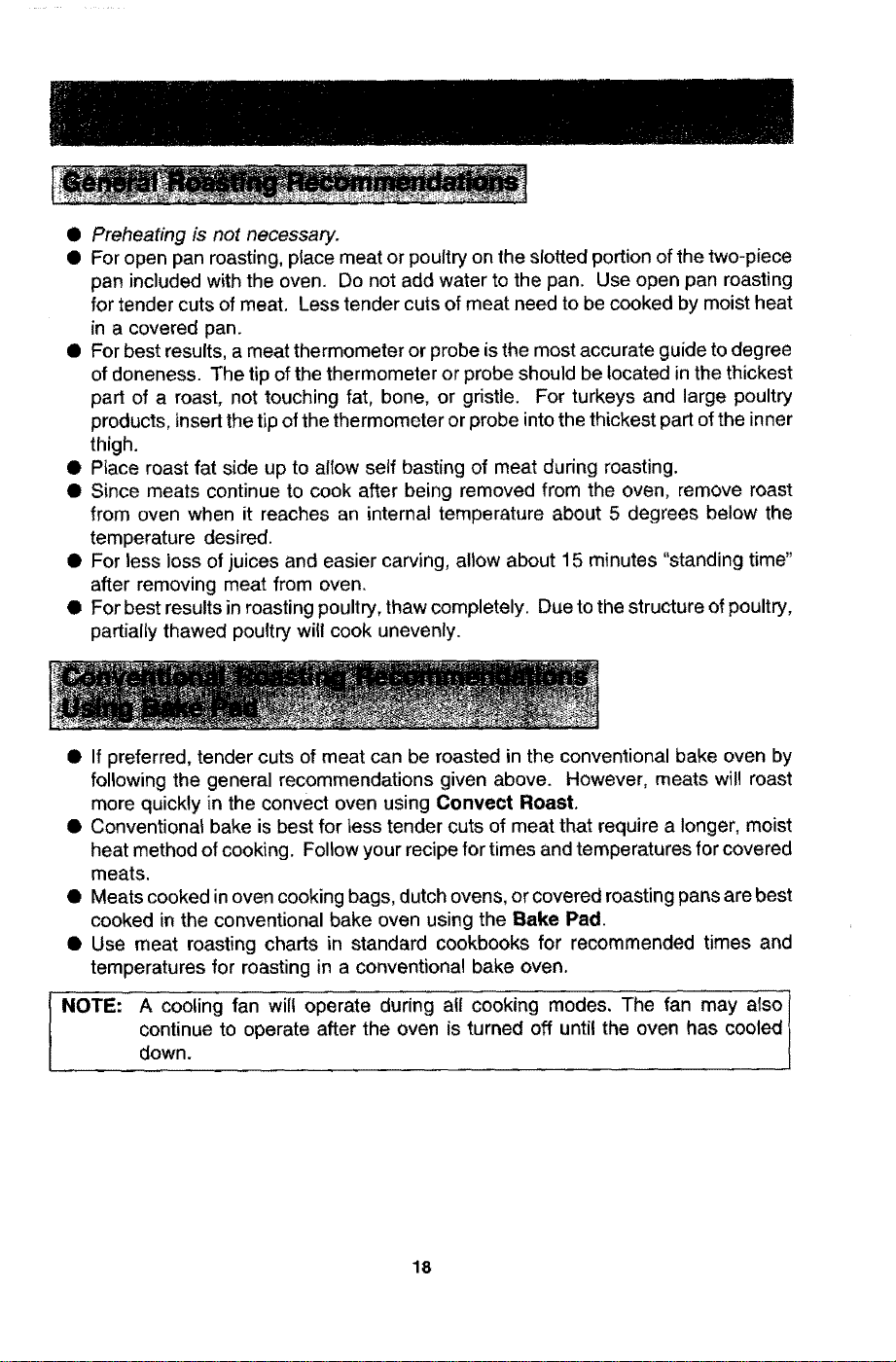
• Preheating is not necessary.
• For open pan roasting, place meat or poultry on the slotted portion of the two-piece
pan included with the oven. Do not add water to the pan. Use open pan roasting
for tender cuts of meat. Less tender cuts of meat need to be cooked by moist heat
in a covered pan.
• For best results, a meat thermometer or probe is the most accurate guide to degree
of doneness. The tip of the thermometer or probe should be located in the thickest
part of a roast, not touching fat, bone, or gristle. For turkeys and large poultry
products, insert the tip of the thermometer or probe into the thickest part of the inner
thigh.
• Ptace roast fat side up to allow self basting of meat during roasting.
• Since meats continue to cook after being removed from the oven, remove roast
from oven when it reaches an internal temperature about 5 degrees below the
temperature desired.
• For less loss of juices and easier carving, allow about 15 minutes "standing time"
after removing meat from oven.
• For best results in roasting poultry, thaw completely. Due to the structure of poultry,
partially thawed pouttry will cook unevenly.
• If preferred, tender cuts of meat can be roasted in the conventional bake oven by
following the general recommendations given above. However, meats wil! roast
more quickly in the convect oven using Conveet Roast.
• Conventional bake is best for tess tender cuts of meat that require a longer, moist
heat method of cooking. Follow your recipe for times and temperatures for covered
meats.
II Meats cooked in oven cooking bags, dutch ovens, or covered roasting pans are best
cooked in the conventional bake oven using the Bake Pad.
Q Use meat roasting charts in standard cookbooks for recommended times and
temperatures for roasting in a conventional bake oven.
NOTE: A cooling fan wilt operate during all cooking modes. The fan may also
continue to operate after the oven is turned off until the oven has cooled
down.
18
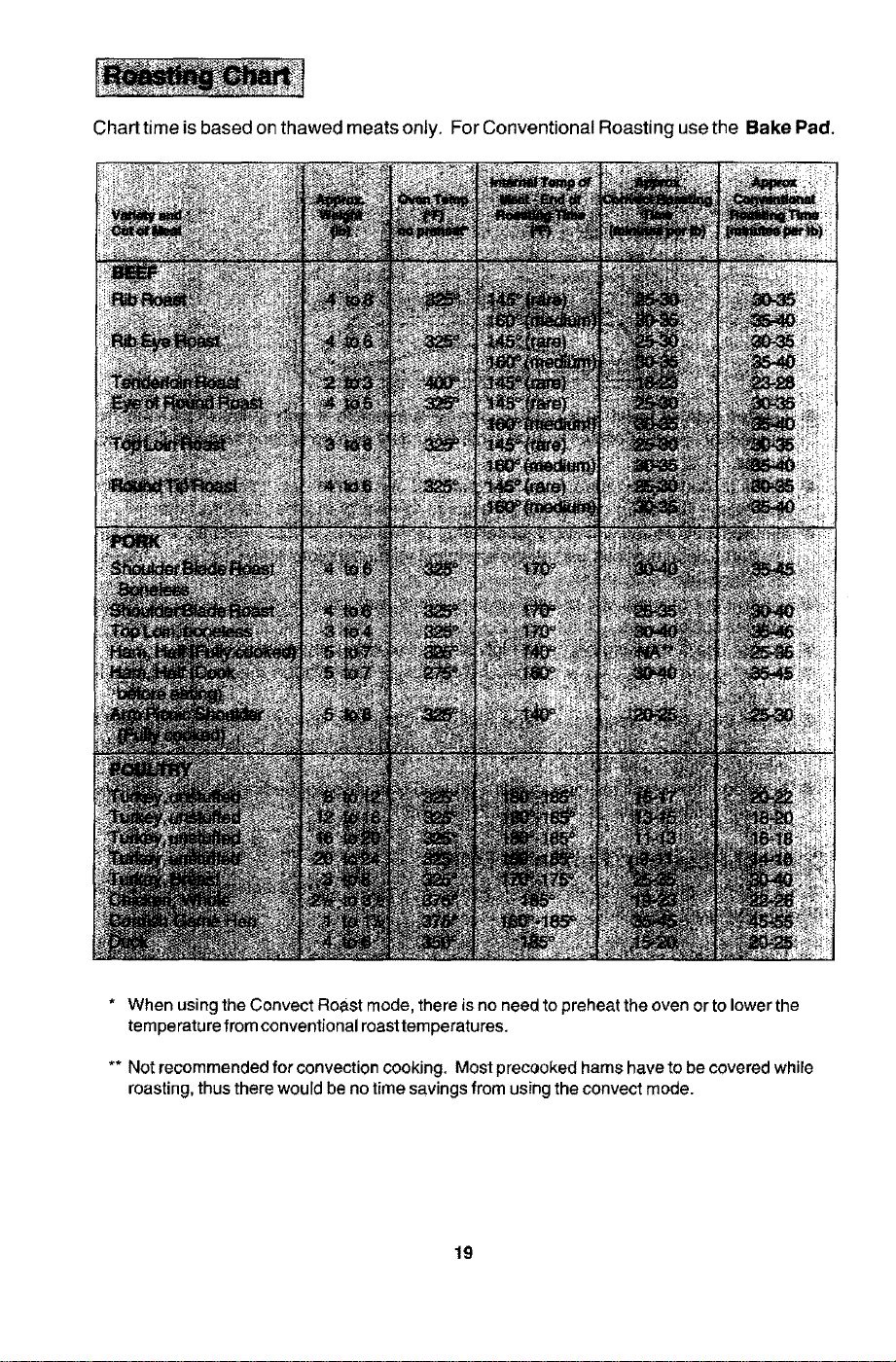
Chart time is based on thawed meats only. For Conventional Roasting use the Bake Pad+
* When using the Convect Roast mode, there is no need to preheat the oven or to lower the
temperature from conventional roast temperatures.
** Not recommended for convection cooking. Most precooked hams have to be covered white
roasting, thus there would be no time savings from using the convect mode.
19
• Tender cuts of meat and poultry can be roasted to a rich golden brown in the
convection oven. Follow general recommendations for roasting and use Convect
Roast.
• Refer to convection meat roasting chart for recommended cooking temperature
and time. The chart can serve as a guide to help plan meal serving time.
• Minutes per pound will vary according to the size, shape, quality, and initial
temperature of meat as wel! as the electrical voltage in your area. Times are based
on refrigerator cold meat.
Q A large cut of meat wilt usually require fewer minutes per pound to roast than a
smaller cut of meat.
• Do not use a roasting pan with high sides; use pan provided with oven.
• Do not Cover meat. Allow the circulating hot air to surround the meat and sea! in
the juices.
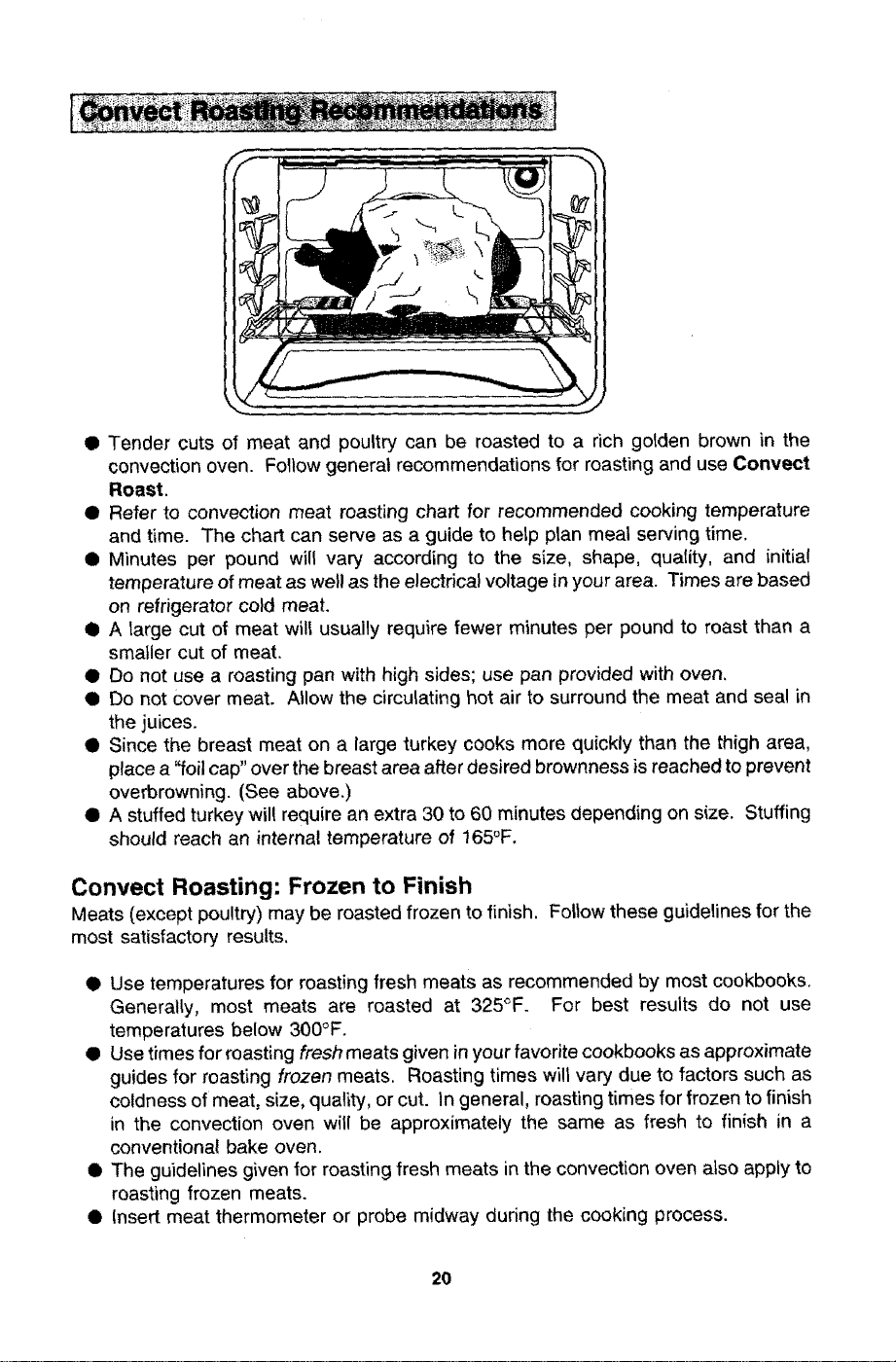
• Since the breast meat on a large turkey cooks more quickly than the thigh area,
place a '_foilcap" over the breast area after desired brownness is reached to prevent
overbrowning. (See above.)
• A stuffed turkey wil! require an extra 30 to 60 minutes depending on size. Stuffing
should reach an internal temperature of 165°F.
Convect Roasting: Frozen to Finish
Meats (except poultry) may be roasted frozen to finish. Follow these guidelines for the
most satisfactory results.
• Use temperatures for roasting fresh meats as recommended by most cookbooks.
Generally, most meats are roasted at 325°F. For best results do not use
temperatures below 300°F.
• Use times for roasting fresh meats given in your favorite cookbooks as approximate
guides for roasting frozen meats. Roasting times wi!l vary due to factors such as
coldness of meat, size, qua!ity, or cut. In general, roasting times for frozen to finish
in the convection oven wil! be approximately the same as fresh to finish in a
conventional bake oven.
• The guidelines given for roasting fresh meats in the convection oven also apply to
roasting frozen meats.
• Insert meat thermometer or probe midway during the cooking process.
2O
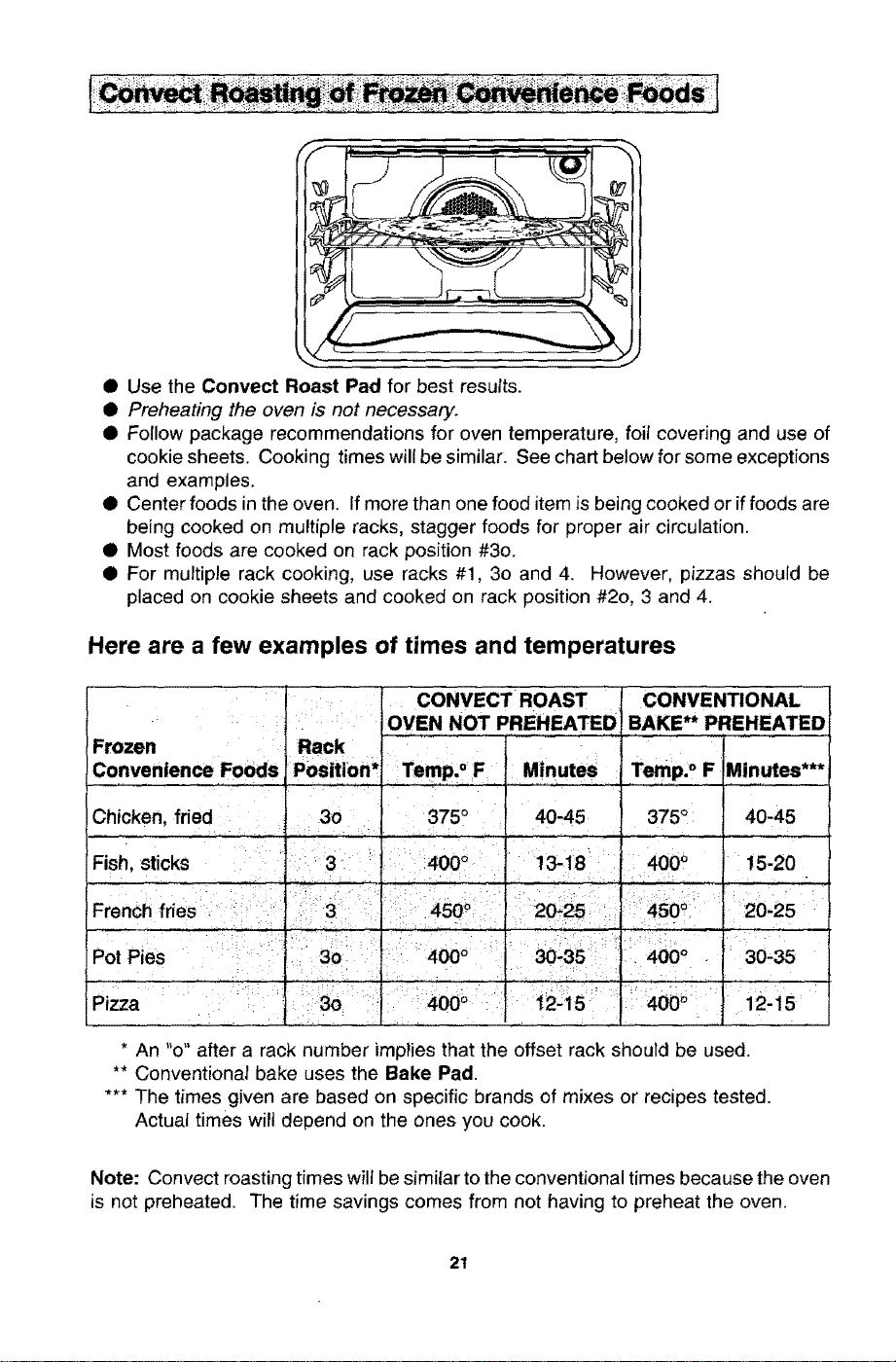
...... '............. i ......... i ii
• Use the Convect Roast Pad for best results.
• Preheating the oven is not necessary.
• Follow package recommendations for oven temperature, foil covering and use of
cookie sheets. Cooking times will be similar. See chart below for some exceptions
and examples.
• Center foods in the oven. If more than one food item is being cooked or if foods are
being cooked on multiple racks, stagger foods for proper air circulation.
• Most foods are cooked on rack position #30.
• For multiple rack cooking, use racks #1, 30 and 4. However, pizzas should be
placed on cookie sheets and cooked on rack position #20, 3 and 4.
Here are a few examples of times and temperatures
Ch!cken, fried .. j
Fish, sticks
Pot Pies
30 ,
I
o" 30 ¸ ,
CONVECT ROAST ! CONVENTIONAL
,OVEN NOT PREHEATED !BAKE ** PREHEATED
Minutes Temp.° F ,Minutes ***_
375 ° 375 ° 40-45
400 ° i !5-20
40-45
13-18 r 400 °
I :. | |
* An "o" after a rack number impiies that the offset rack should be used.
** Conventional bake uses the Bake Pad.
*** The times given are based on specific brands of mixes or recipes tested.
Actual times wilt depend on the ones you cook.
Note: Convect roasting times will be similar to the conventional times because the oven
is not preheated. The time savings comes from not having to preheat the oven.
21
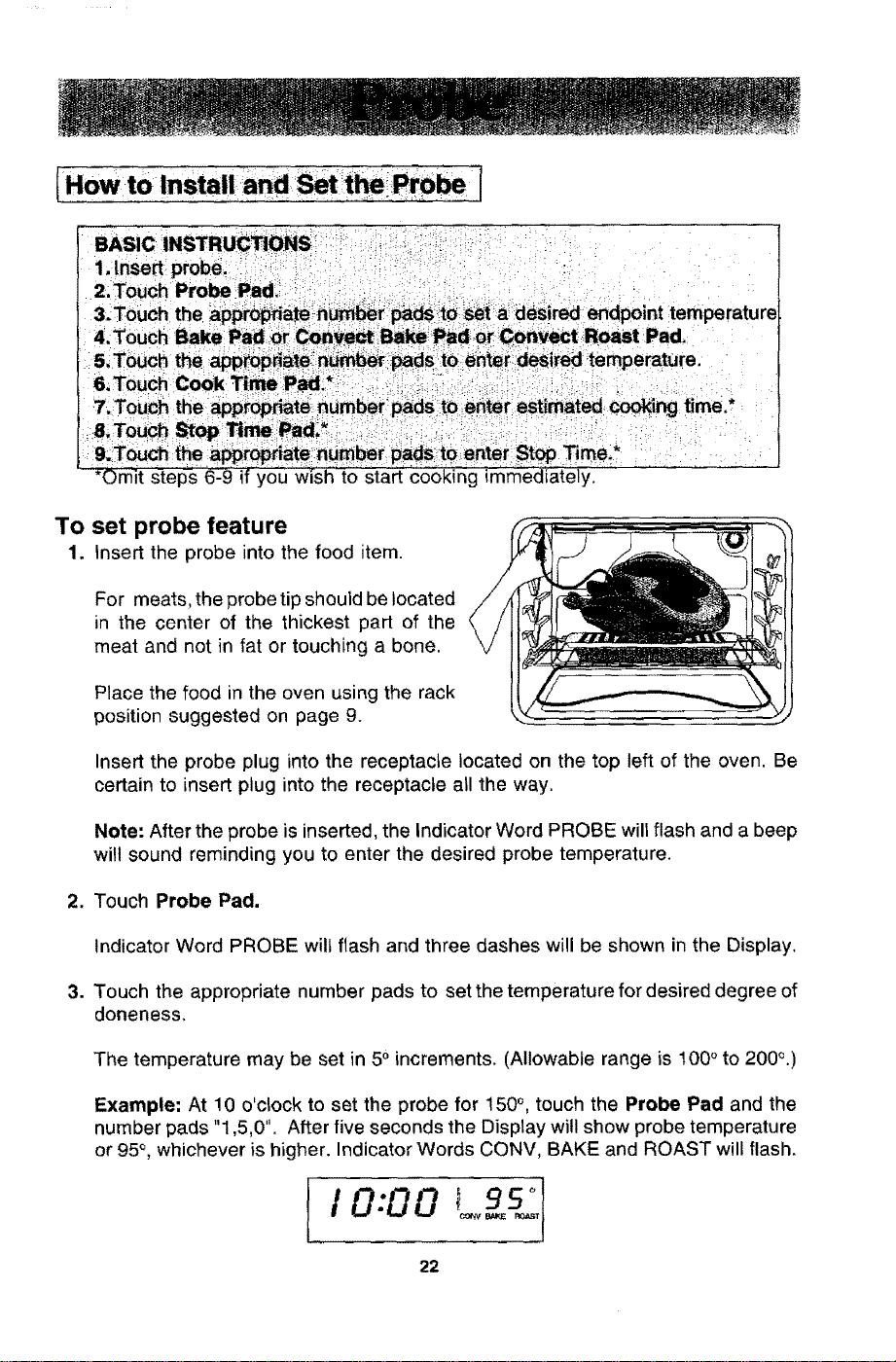
steps 6-9 to start coo g y.
To set probe feature
1. Insert the probe into the food item.
For meats, the probe tip should be located
in the center of the thickest part of the
meat and not in fat or touching a bone.
Place the food in the oven using the rack
position suggested on page 9.
Insert the probe plug into the receptacle located on the top left of the oven. Be
certain to insert plug into the receptacle all the way.
Note: After the probe is inserted, the Indicator Word PROBE wilt flash and a beep
will sound reminding you to enter the desired probe temperature.
2. Touch Probe Pad.
Indicator Word PROBE wilt flash and three dashes will be shown in the Display.
3. Touch the appropriate number pads to set the temperature for desired degree of
doneness.
The temperature may be set in 50 increments. (Allowable range is 100° to 200°.)
Example: At 10 o'clock to set the probe for 1500, touch the Probe Pad and the
number pads "1,5,0". After five seconds the Display will show probe temperature
or 95°, whichever is higher. Indicator Words CONV, BAKE and ROAST will flash.
I 0:00 LZsC,1
22
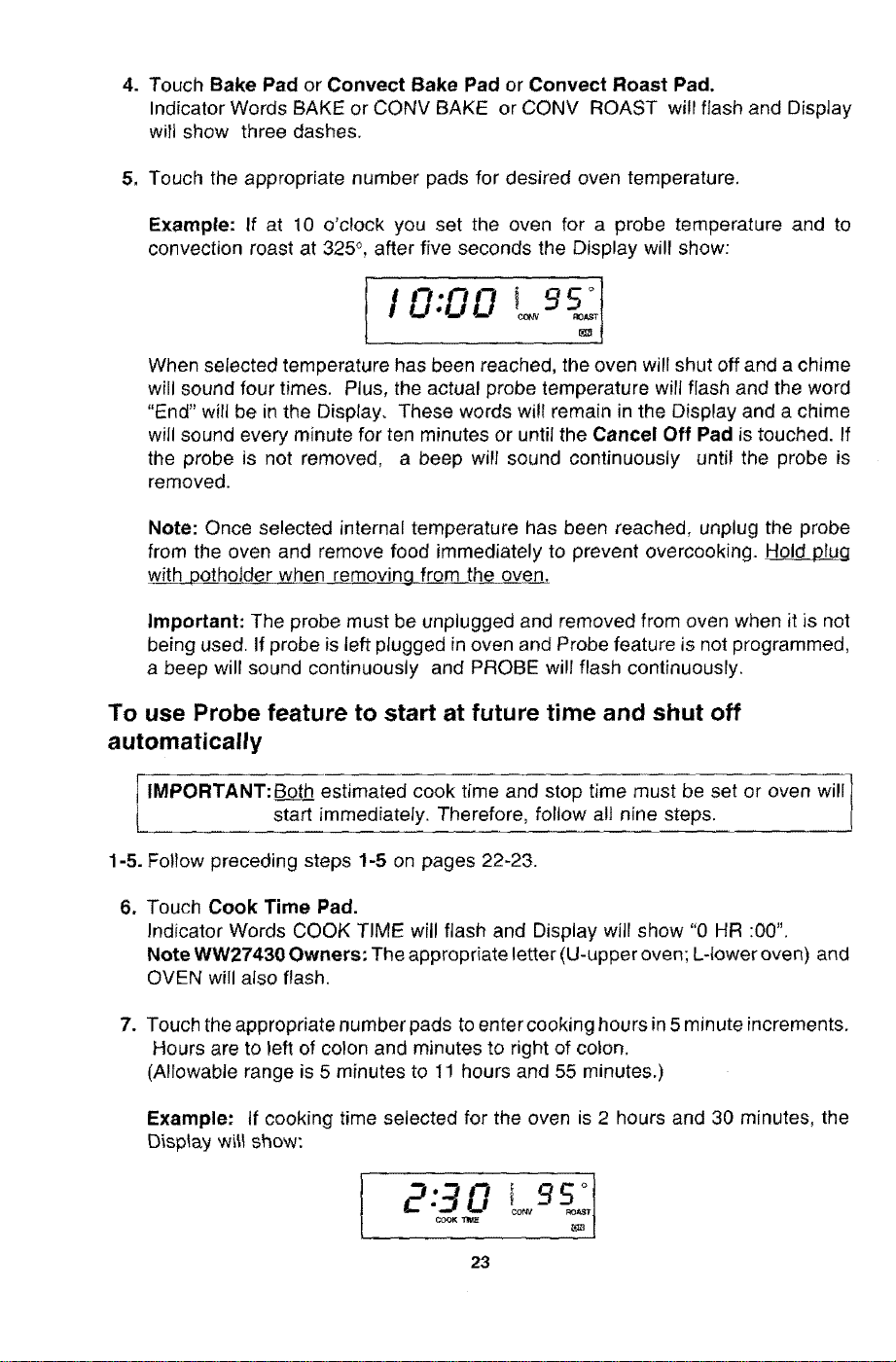
4. Touch Bake Pad or Convect Bake Pad or Convect Roast Pad.
Indicator Words BAKE or CONV BAKE or CONV ROAST will flash and Display
wilt show three dashes.
5, Touch the appropriate number pads for desired oven temperature.
Example: If at 10 o'clock you set the oven for a probe temperature and to
convection roast at 325 °, after five seconds the Display will show:
When selected temperature has been reached, the oven will shut off and a chime
will sound four times. Plus, the actual probe temperature will flash and the word
"End" will be in the Display. These words will remain in the Display and a chime
will sound every minute for ten minutes or until the Cancel Off Pad is touched. If
the probe is not removed, a beep will sound continuously until the probe is
removed.
Note: Once selected internal temperature has been reached, unplug the probe
from the oven and remove food immediately to prevent overcooking.
with p__..._oving from .the oven.
Important: The probe must be unplugged and removed from oven when it is not
being used. If probe is left plugged in oven and Probe feature is not programmed,
a beep will sound continuously and PROBE will flash continuously.
To use Probe feature to start at future time and shut off
automatically
I IMPORTANT: Both estimated cook time and stop time must be set or oven wi!l I
start immediately. Therefore, follow all nine steps.
1-5. Follow preceding steps 1-5 on pages 22-23.
6. Touch Cook Time Pad.
Indicator Words COOK TIME wil! flash and Display will show "0 HR :00".
Note WW27430 Owners: The appropriate letter (U-upper oven; L-tower oven) and
OVEN will also flash.
7. Touch the appropriate number pads to entercooking hours in 5 minute increments.
Hours are to left of colon and minutes to right of colon.
(Allowable range is 5 minutes to 11 hours and 55 minutes.)
Example: tf cooking time selected for the oven is 2 hours and 30 minutes, the
D_sp_aywill show:
2:90 I 9s°I
COOK Tm_ OO_
23
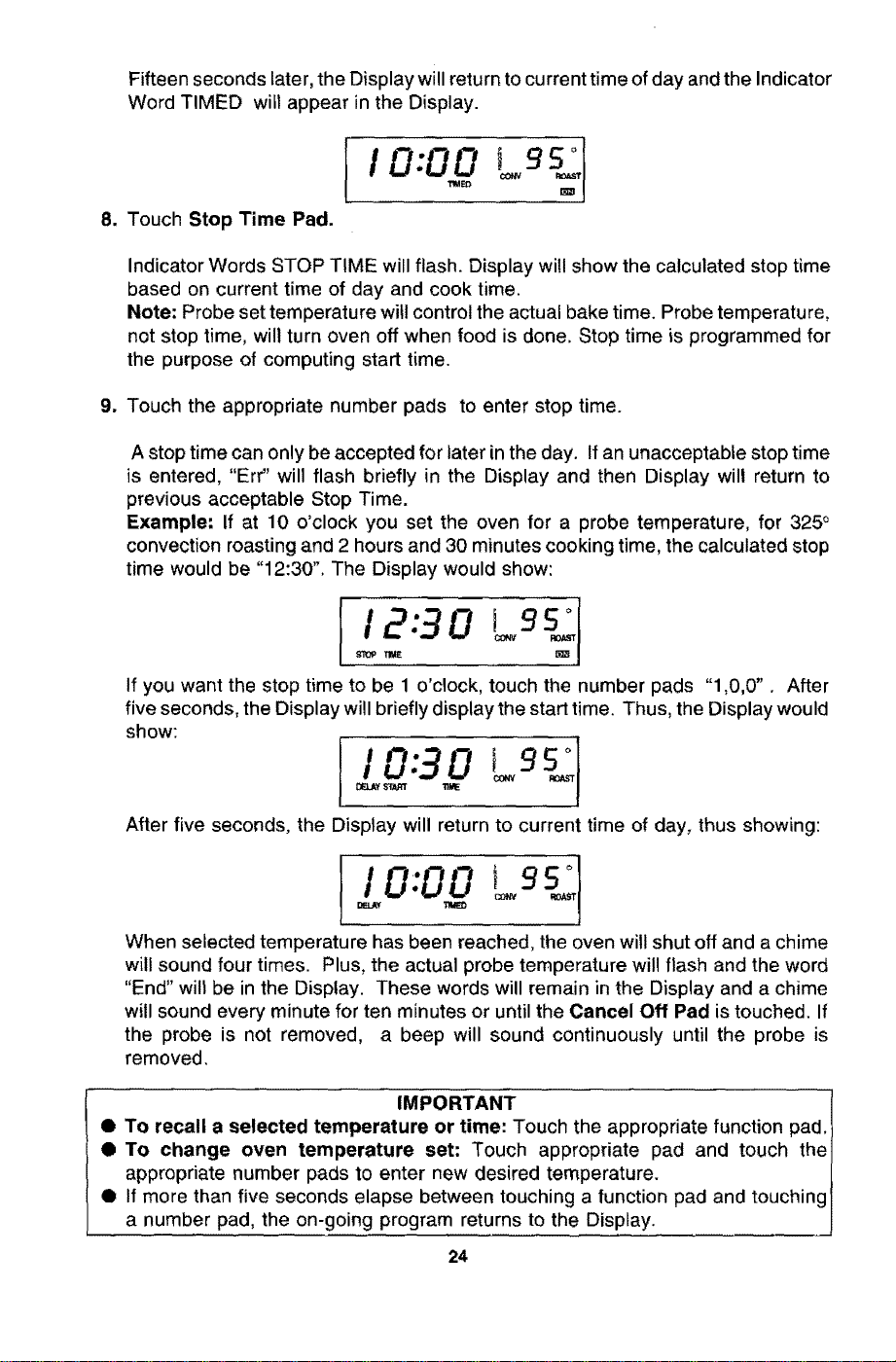
Fifteen seconds later, the Display will return to current time of day and the Indicator
Word TIMED will appear in the Display.
,o:oo_
8. Touch Stop Time Pad.
Indicator Words STOP TIME will flash. Display will show the calculated stop time
based on current time of day and cook time.
Note: Probe set temperature will control the actual bake time. Probe temperature,
not stop time, will turn oven off when food is done. Stop time is programmed for
the purpose of computing start time.
9, Touch the appropriate number pads to enter stop time.
A stop time can only be accepted for later in the day. If an unacceptable stop time
is entered, "Err" will flash briefly in the Display and then Display wil! return to
previous acceptable Stop Time.
Example: If at 10 o'clock you set the oven for a probe temperature, for 325 _
convection roasting and 2 hours and 30 minutes cooking time, the calculated stop
time would be "12:30'% The Display would show:
If you want the stop time to be 1 o'clock, touch the number pads "1,0,0". After
five seconds, the Display will briefly display the start time. Thus, the Display would
show:
10:90 LgE ]
After five seconds, the Display will return to current time of day, thus showing:
When selected temperature has been reached, the oven will shut off and a chime
will sound four times. Plus, the actual probe temperature will flash and the word
"End" will be in the Display. These words will remain in the Display and a chime
will sound every minute for ten minutes or until the Cancel Off Pad is touched. If
the probe is not removed, a beep will sound continuously until the probe is
removed.
i IMPORTANT I
Q TO recall a selected temperature or time: Touch the appropriate function pad.t
Q To change oven temperature set: Touch appropriate pad and touch the I
appropriate number pads to enter new desired temperature.
Q If more than f ve seconds e apse between touching a funct on pad and touch ng_
a number pad, the on-going program returns to the DispLay.
J
24
[
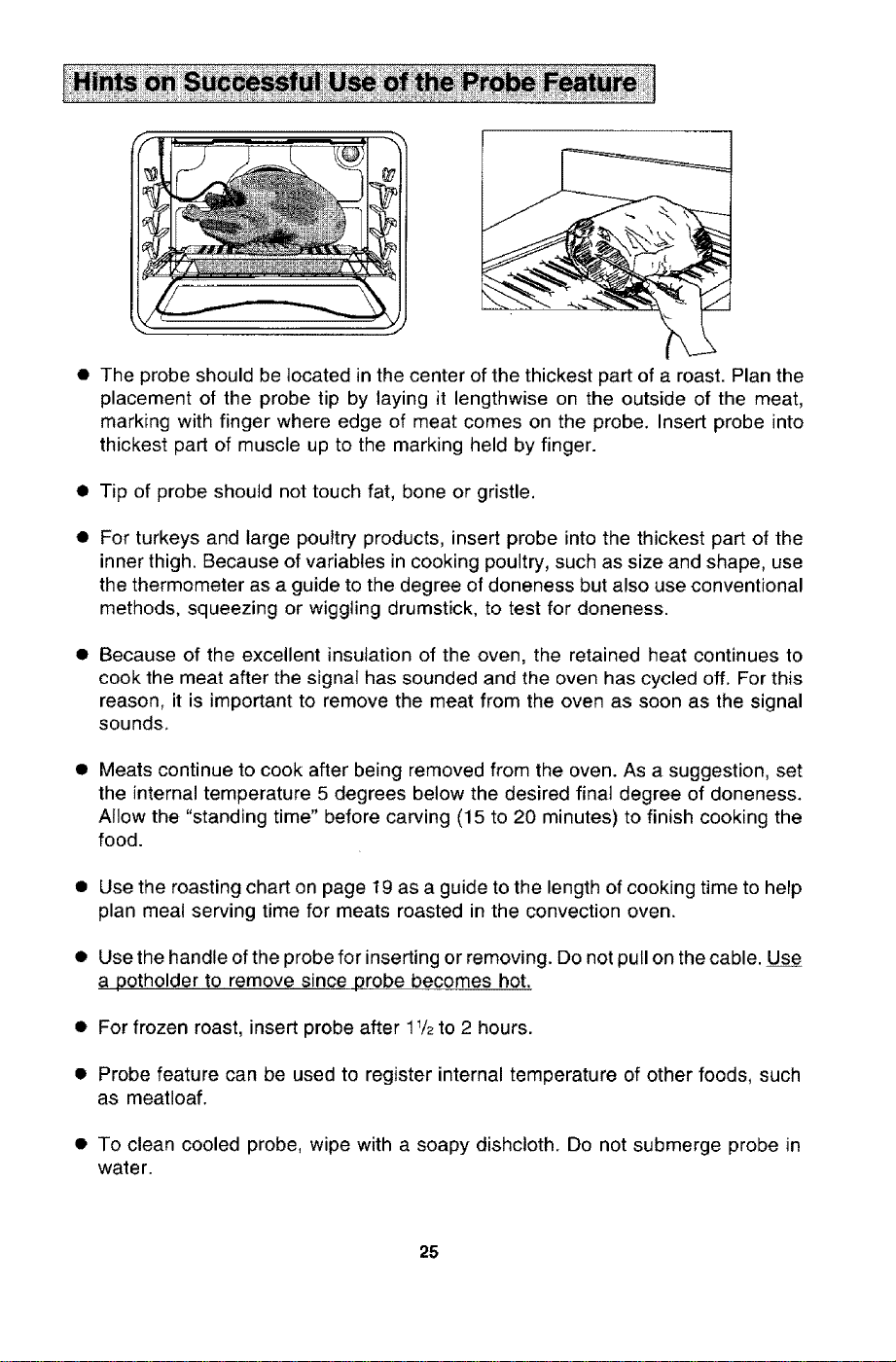
• The probe should be located in the center of the thickest part of a roast. Plan the
placement of the probe tip by laying it lengthwise on the outside of the meat,
marking with finger where edge of meat comes on the probe. Insert probe into
thickest part of muscle up to the marking held by finger.
• Tip of probe should not touch fat, bone or gristle.
• For turkeys and large poultry products, insert probe into the thickest part of the
inner thigh. Because of variables in cooking poultry, such as size and shape, use
the thermometer as a guide to the degree of doneness but also use conventional
methods, squeezing or wiggling drumstick, to test for doneness.
• Because of the excellent insulation of the oven, the retained heat continues to
cook the meat after the signal has sounded and the oven has cycled off. For this
reason, it is important to remove the meat from the oven as soon as the signal
sounds.
• Meats continue to cook after being removed from the oven. As a suggestion, set
the internal temperature 5 degrees below the desired final degree of doneness.
Allow the "standing time" before carving (15 to 20 minutes) to finish cooking the
food.
• Use the roasting chart on page 19 as a guide to the length of cooking time to help
plan meal serving time for meats roasted in the convection oven.
• Use the handle of the probe for inserting or removing. Do not pull on the cable. Use
a potholder to remove since probe becomes hot.
• For frozen roast, insert probe after 11/2to 2 hours.
• Probe feature can be used to register internal temperature of other foods, such
as meatloaf.
• To clean cooled probe, wipe with a soapy dishcloth. Do not submerge probe in
water.
25
1. Place oven rack on the rack position suggested in the chart on page 27.
Distance from broiling element depends on foods being prepared. Rack position
40 (offset rack in position #4) is usually recommended unless otherwise stated.
2. Touch Broil Pad,
Indicator Word BROIL will flash and Display will show three dashes.
Note: tf more than five seconds elapses between touching Broil Pad and touching
a number pad, the oven is not set and Display will return to previous Display.
3. Touch the appropriate number pad(s).
The first number pad touched will enter "HI" in the Display.
The oven has a variable broil feature which means that a lower temperature can be
selected. After "HI" appears in the Display, touch the appropriate number pads for
the desired temperature. Temperature can be entered in 5o increments. Use "HI"
broil for most broil operations. Use variable broil for delicate and long-term items.
Five seconds after entering "HI" or a temperature, the broil element will come on
and the Indicator Words BROIL and ON will remain in the Display. If the variable
broil feature was selected, the Indicator Word ON will cycle with the element.
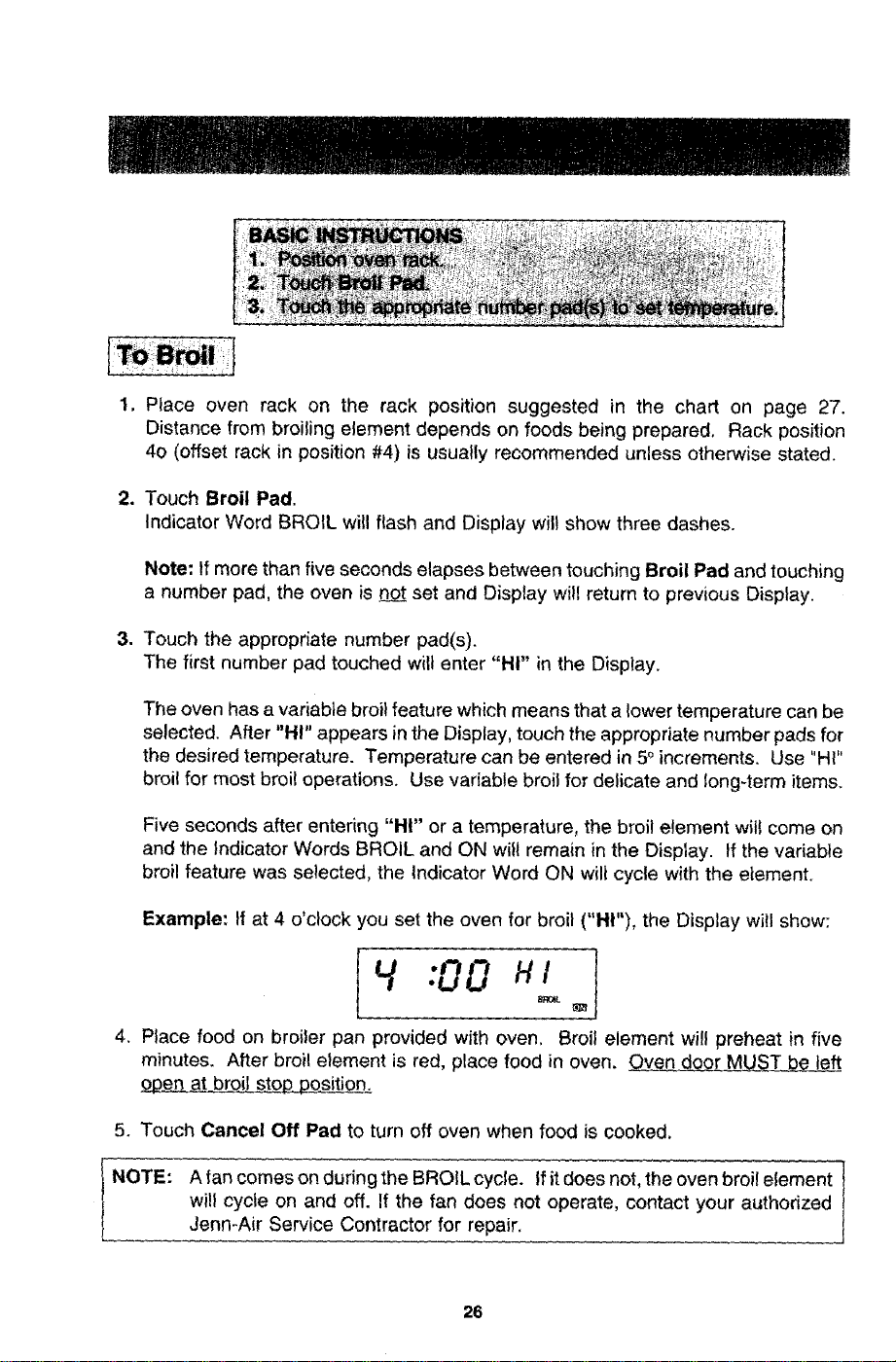
Example: If at 4 o'clock you set the oven for broil ("HI"), the Display will show:
4 :OOHI. oj
4. Place food on broiler pan provided with oven. Broil element will preheat in five
minutes. After broil element is red, place food in oven. Oven do r MUST be left
__e_nat broit sty.
5. Touch Cancel Off Pad to turn off oven when food is cooked,
NOTE: A fan comes on during the BROIL cycle. If it does not, the oven broil element
will cycle on and off. If the fan does not operate, contact your authorized
Jenn-Air Service Contractor for repair.
26

When the oven controls are set to CLEAN, the oven heats to temperatures that are higher
than those used for cooking. The high temperatures cause food soil to burn off and
substantially disappear. While this occurs, a device in the oven vent helps to consume
normal amounts of smoke. The oven is vented through an opening under the control panel.
Note WW27430 Owners: Both ovens cannot be self-cleaned at the same time.
• Remove the broiler pan and any other utensils from the oven. These utensils cannot
withstand the high temperatures of the cleaning process.
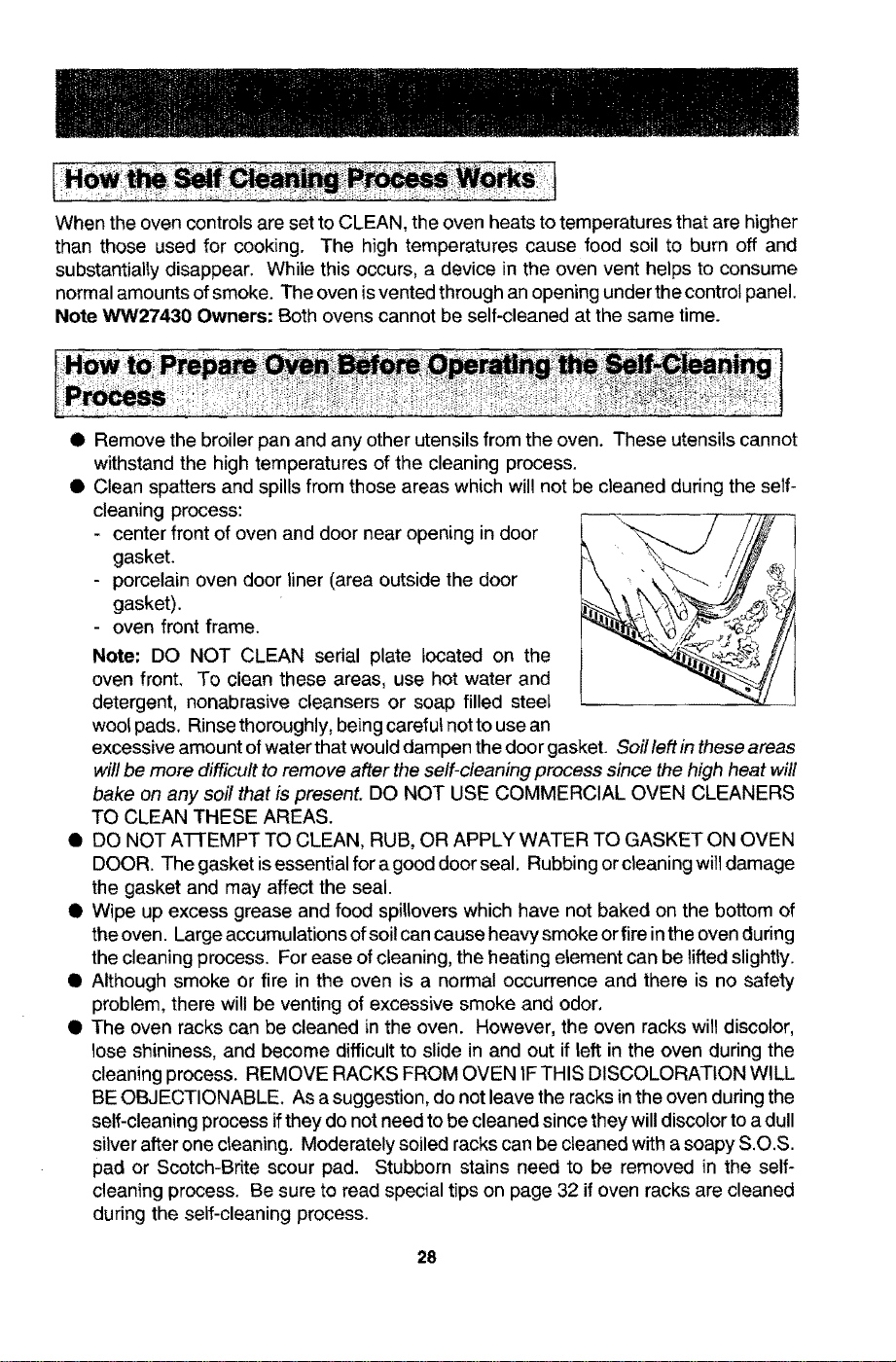
• Clean spatters and spills from those areas which wil! not be cleaned during the self-
cleaning process:
- center front of oven and door near opening in doorgasket. --___
- porcelain oven door liner (area outside the door \ __.
gasket). _ .-_ ._
- oven front frame. __9'_
Note: DO NOT CLEAN serial plate located on the __
oven front. To clean these areas, use hot water and
detergent, nonabrasive cleansers or soap filled steel
wool pads. Rinse thoroughly, being careful notto use an
excessive amount of water that would dampen the door gasket. Soil left in these areas
will be more difficult to remove after the self-cleaning process since the high heat will
bake on any soi! that is present. DO NOT USE COMMERCIAL OVEN CLEANERS
TO CLEAN THESE AREAS.
• DO NOT A-I-FEMPT TO CLEAN, RUB, OR APPLY WATER TO GASKET ON OVEN
DOOR. The gasket is essential for a good door seal. Rubbing or cleaning wit1damage
the gasket and may affect the seal.
• Wipe up excess grease and food spillovers which have not baked on the bottom of
the oven. Large accumulations of soil can cause heavy smoke or fire in the oven during
the cleaning process. For ease of cleaning, the heating etement can be lifted slightly.
• Although smoke or fire in the oven is a normal occurrence and there is no safety
problem, there will be venting of excessive smoke and odor.
• The oven racks can be cleaned in the oven. However, the oven racks will discolor,
lose shininess, and become difficult to slide in and out if left in the oven during the
cleaning process. REMOVE RACKS FROM OVEN 1FTHIS DISCOLORATION WILL
BE OBJECTIONABLE. As a suggestion, do not leave the racks in the oven during the
self-cleaning process if they do not need to be cleaned since they will discolor to a dull
silver after one cleaning. Moderately soiled racks can be cleaned with a soapy S.O.S.
pad or Scotch-Brite scour pad. Stubborn stains need to be removed in the self-
cleaning process. Be sure to read special tips on page 32 if oven racks are cleaned
during the self-cleaning process.
28
*Omit steps 4 & 5 if you wish cleaning to begin immediately,
To set oven to start cleaning immediately
1. Close the oven door.
2. Touch Clean Pad of oven to be cleaned.
Indicator Words Clean Time will flash and Display will show" HR : ".
Note WW27430 Owners: The appropriate letter (U-upper oven; L-lower oven) and
OVEN will also flash.
3. Touch the appropriate number pad(s).
The first number pad touched will enter "3:00" in the Display for an average soiled
oven. The cleaning time can be varied depending on the amount of soil. Set "2:00"
for light soil or "4:00" for heavy soil.
Note: If more than five seconds elapse between touching a Clean Pad and
touching a number pad, the oven is no__ttset and time of day will automatically return
to the Display.
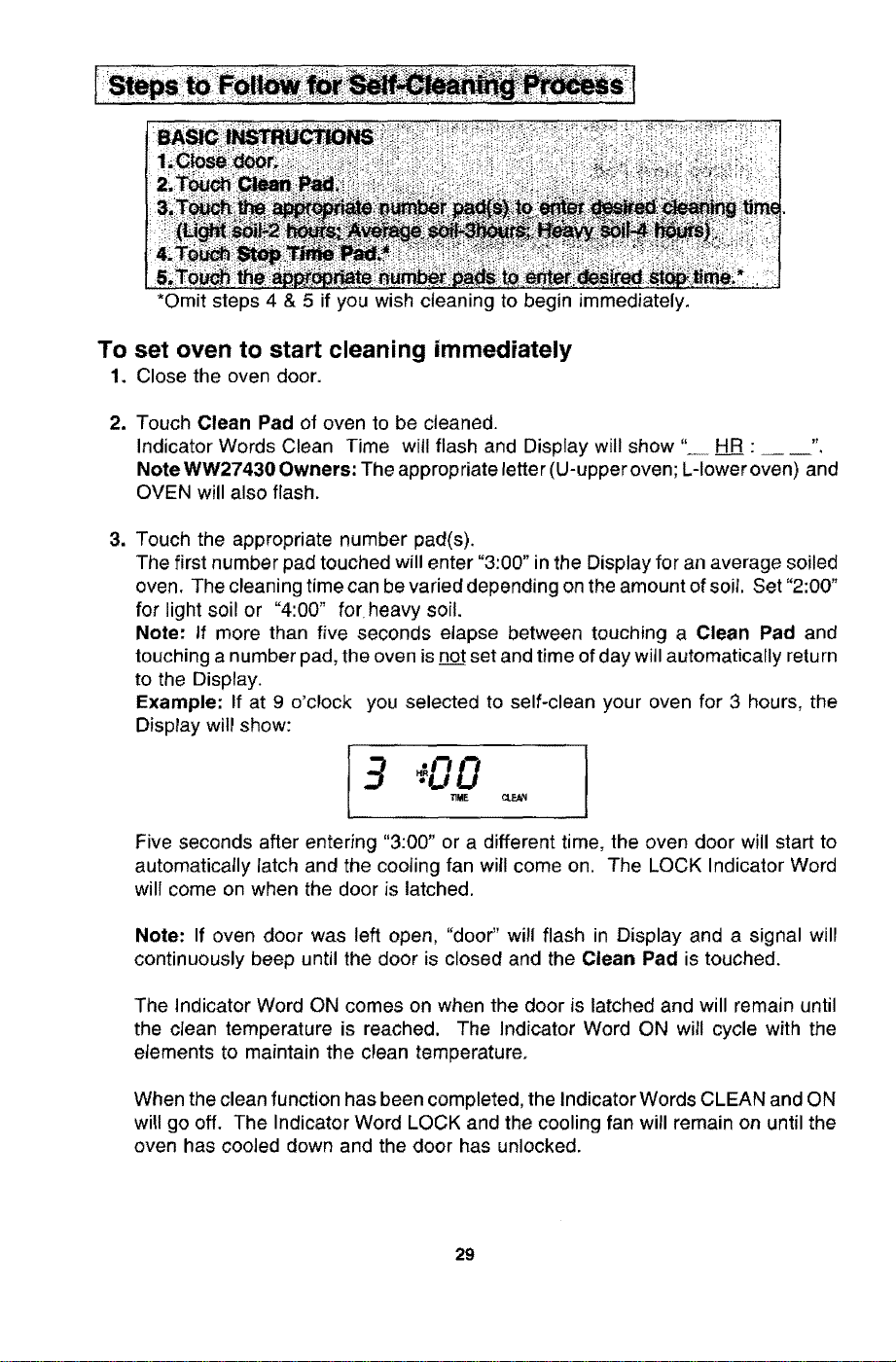
Example: If at 9 o'clock you selected to self-clean your oven for 3 hours, the
Display will show:
9 .:00
1]ME
Five seconds after entering "3:00" or a different time, the oven door will start to
automatically latch and the cooling fan will come on. The LOCK Indicator Word
will come on when the door is latched.
Note: If oven door was left open, "door" will flash in Display and a signal will
continuously beep until the door is closed and the Clean Pad is touched.
The Indicator Word ON comes on when the door is latched and will remain until
the clean temperature is reached. The Indicator Word ON will cycle with the
elements to maintain the clean temperature.
When the clean function has been completed, the Indicator Words CLEAN and ON
will go off. The Indicator Word LOCK and the cooling fan will remain on until the
oven has cooled down and the door has unlocked.
29
To set oven to start cleaning at a later time
1-3. Follow Steps 1-3 in previous section on page 29.
4, Touch Stop Time Pad.
Indicator Words STOP TIME will flash in the Display. The Indicator Word CLEAN
and the calculated stop time will also appear in Display.
Note WW27430 Owners- The appropriate letter (U-upper oven; L-lower oven) and
OVEN will also flash.
5. Touch the appropriate number pads to enter stop time.
A stop time can only be accepted for later in the day. If an unacceptable stop time
is entered, "Err" will flash briefly in the Display and then Display will return to
previous acceptable Stop Time.
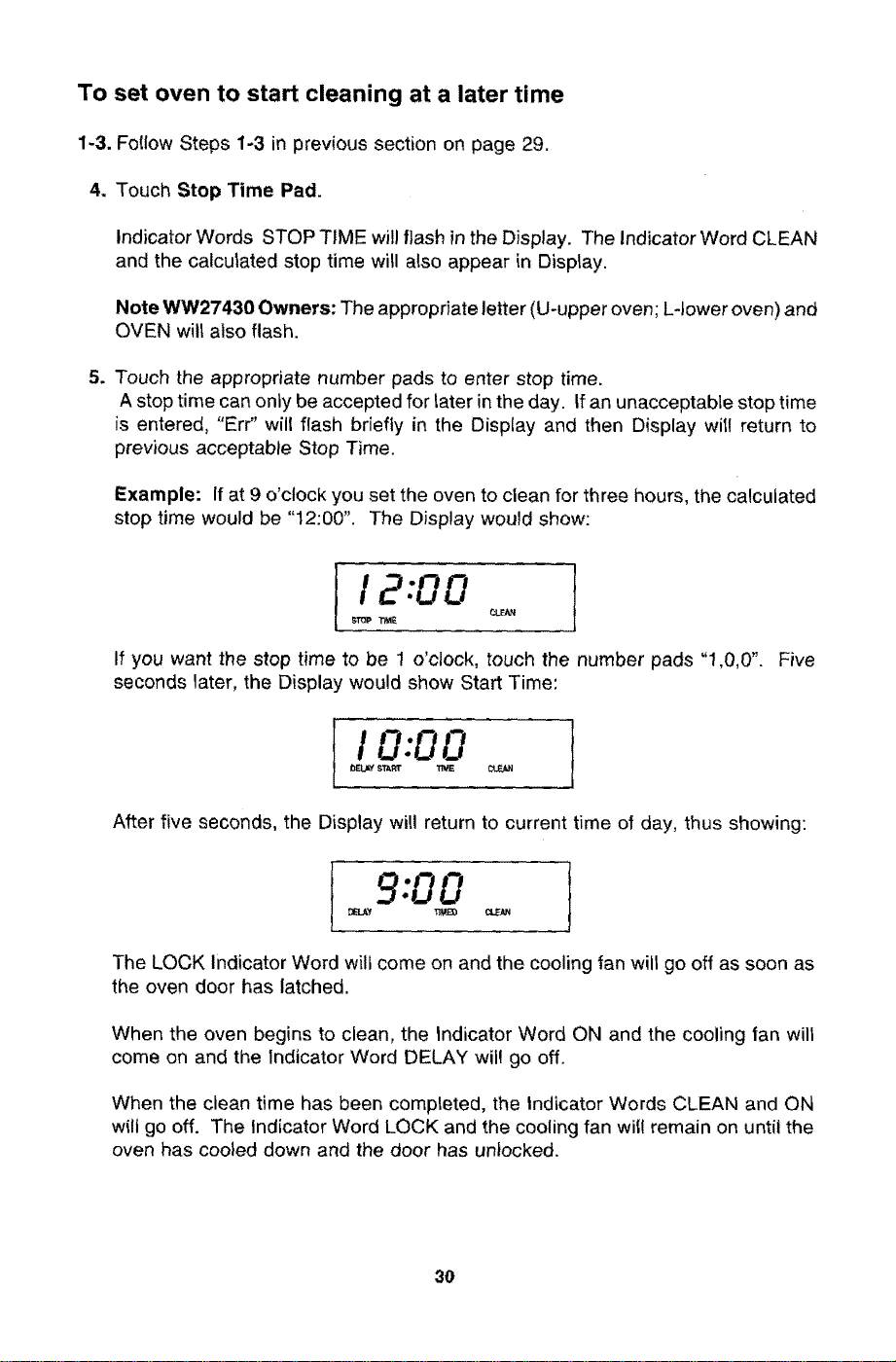
Example: If at 9 o'clock you set the oven to clean for three hours, the calculated
stop time would be "12:00". The Display would show:
f 2:00
If you want the stop time to be 1 o'clock, touch the number pads "1,0,0". Five
seconds later, the Display would show Start Time:
I 0:00 ]OEL_ STAF_T T_E
After five seconds, the Display will return to current time of day, thus showing:
9:00
The LOCK Indicator Word will come on and the cooling fan will go off as soon as
the oven door has latched.
When the oven begins to clean, the Indicator Word ON and the cooling fan will
come on and the Indicator Word DELAY will go off.
When the clean time has been completed, the Indicator Words CLEAN and ON
wilt go off. The Indicator Word LOCK and the cooling fan wil! remain on until the
oven has cooled down and the door has unlocked.
3O
To cancel self-clean
• Touch Cancel Off Pad,
• The oven door will be locked while the LOCK Indicator Word remains inthe Display.
Depending on the length of time the oven had been self-cleaning, it may take up
to 45 minutes for the oven to coot down, the door to unlock and cooling fan to turn
off.
IMPORTANT
• Note WW27430 Owners: Both ovens CANNOT be cleaned at the same time. The
LOCK Indicator Word for the first oven must go off before setting the second oven
for a clean
• Note WW27430 Owners: Ifone oven is set to clean, the other oven cannot be set
for clock controlled baking.
• To recall cleaning time or stop time: Touch the appropriate pad (Clean Pad or
Stop Time Pad).
• To change cleaning time or stop time before cleaning begins: Repeat the
preceding steps.
• When the Clean Pad is touched, a fan comes on. If this fan is not operating, the
oven will go through the cleaning process at a reduced oven temperature and the
even will not clean effectively. If the fan does not operate, contact your authorized
Jenn-Air Service Contractor for service.
• A slight odor may be detected, and if an oven is heavily soiled, some smoke may
be visible. Some smoke and odor during the cleaning process is a normal
occurrence. Since the oven is vented under the controf panel, vapors, moisture,
etc. may be seen coming from this area.
• During the cleaning process, do not be alarmed if an occasional flame is visible
through the oven window. This is caused by excessive food soil that was not
removed before the oven was set to clean.
• SINCE THE DOOR AND WINDOW OF THE OVEN WILL GET WARM DURING
THE SELF-CLEANING PROCESS, AVOID CONTACT,
• Some types of soi! may disintegrate but leave a light film or heavier deposit of ash.
The amount of ash depends on the amount of soil which was in the oven. After oven
has cooled, this ash may be removed with a damp sponge. If other dark deposits
remain after wiping with a sponge, the time set for the length of cleaning was not
enough. Increase the cleaning time for future cleanings or clean more frequently.
The normal cleaning time is 3 hours. A maximum of 4 hours may be selected if
necessary.
31
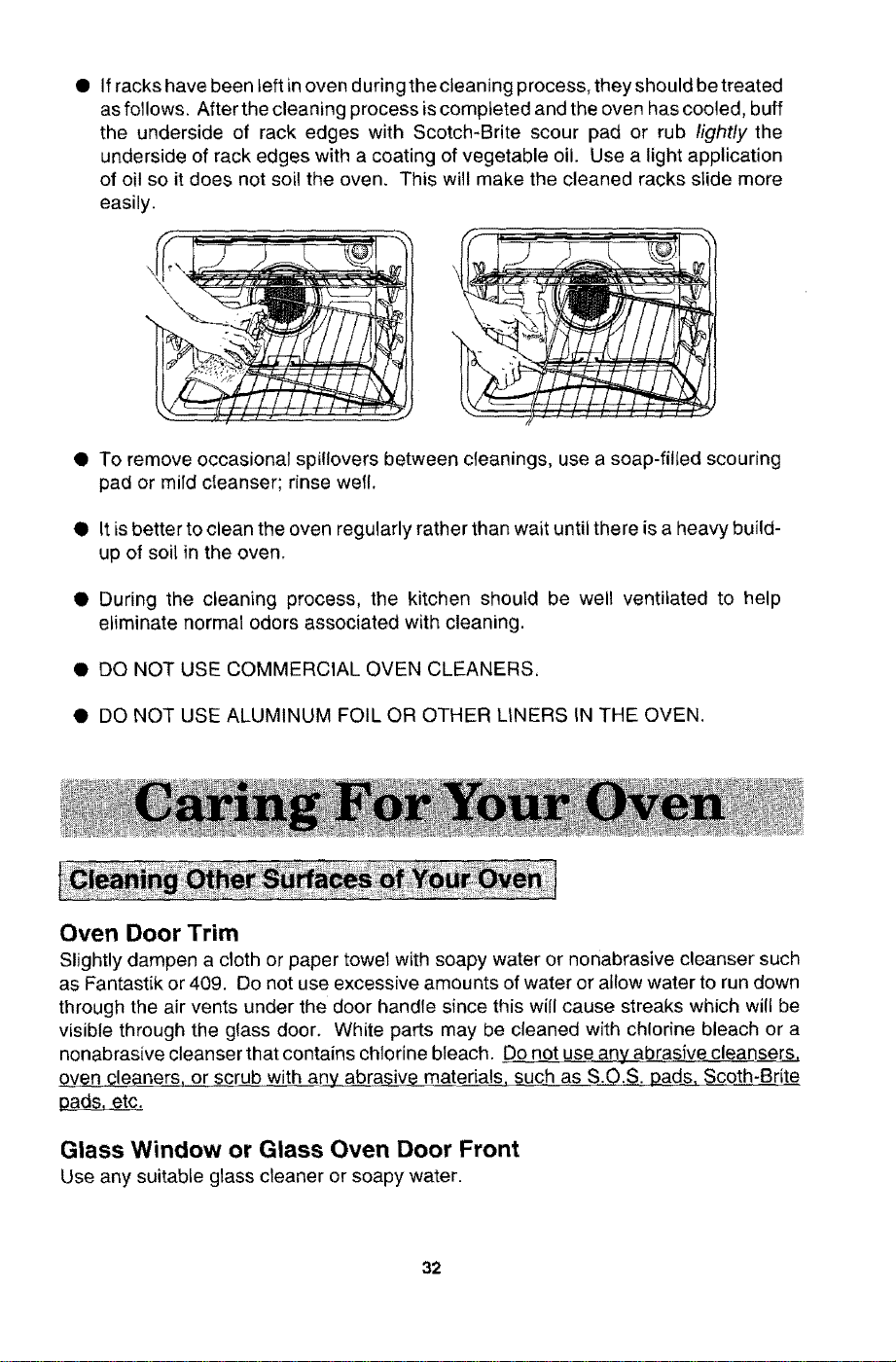
• If racks have been left in oven during the cleaning process, they should be treated
as fol!ows. After the cleaning process is completed and the oven has cooled, buff
the underside of rack edges with Scotch-Brite scour pad or rub lightly the
underside of rack edges with a coating of vegetable oil. Use a light application
of oil so it does not soil the oven. This will make the cleaned racks slide more
easily.
• To remove occasional spillovers between cfeanings, use a soap-filled scouring
pad or mild cleanser; rinse we11.
Q It is better to clean the oven regularly rather than wait until there is a heavy build-
up of soil in the oven.
Q During the cleaning process, the kitchen should be well ventilated to help
eliminate normal odors associated with cleaning.
• DO NOT USE COMMERCIAL OVEN CLEANERS,
• DO NOT USE ALUMINUM FOIL OR OTHER LtNERS LNTHE OVEN,
Oven Door Trim
Slightly dampen a cloth or paper towel with soapy water or nonabrasive cleanser such
as Fantastik or 409. Do not use excessive amounts of water or allow water to run down
through the air vents under the door handle since this will cause streaks which will be
visible through the glass door. White parts may be cleaned with chlorine bleach or a
nonabrasive cleanser that contains chlorine bleach. Do not use ana_e cleanse_e[_rs
cleaners, or scrub with any abr..a_erials, such as S_..._-Brite
pads, ..etc.
Glass Window or Glass Oven Door Front
Use any suitable glass cleaner or soapy water.
32
Control Panel Area and Display Window
Wipe with soft cloth dampened with soapy water or glass cleaner. Do not spray any
cleaning solutions directly onto the display window or use large amounts of soap and
water. Do not scrub with S.O.S, pads or abrasive cleaners.
Stainless Steel (selectmodels)
Do not use any cleaning product containing chlorine bleach.
Always wipe with the grain when cleaning.
Daily Cleaning/Light Soil - Wipe with one of the following - soapy water, white vinegad
water solution, Formula 409 Glass and Surface Cleaner or a similar multi-surface cleaner
- using a sponge or soft cloth. Rinse and dry. To polish and help prevent fingerprints,
follow with Stainless Steel Magic Spray (Jenn-Air Model A912, Part No. 20000008).
Moderate/Heavy Soil - Wipe with one of the following - Bon Am! or Soft Scrub - using
a damp sponge or soft cloth. Rinse and dry. Stubborn soils may be removed with a damp
Scotch-Brite pad; rub evenly with the grain. Rinse and dry. To restore luster and remove
streaks, follow with Stainless Steel Magic Spray (Jenn-Air Model A912, Part No.
20000008).
Discoloration - Using a damp sponge or soft cloth, wipe with Cameo Stainless Steel
Cleaner. Rinse immediately and dry. To remove streaks and restore luster, follow with
Stainless Steel Magic Spray (Jenn-Air Model A912, Part No, 20000008).
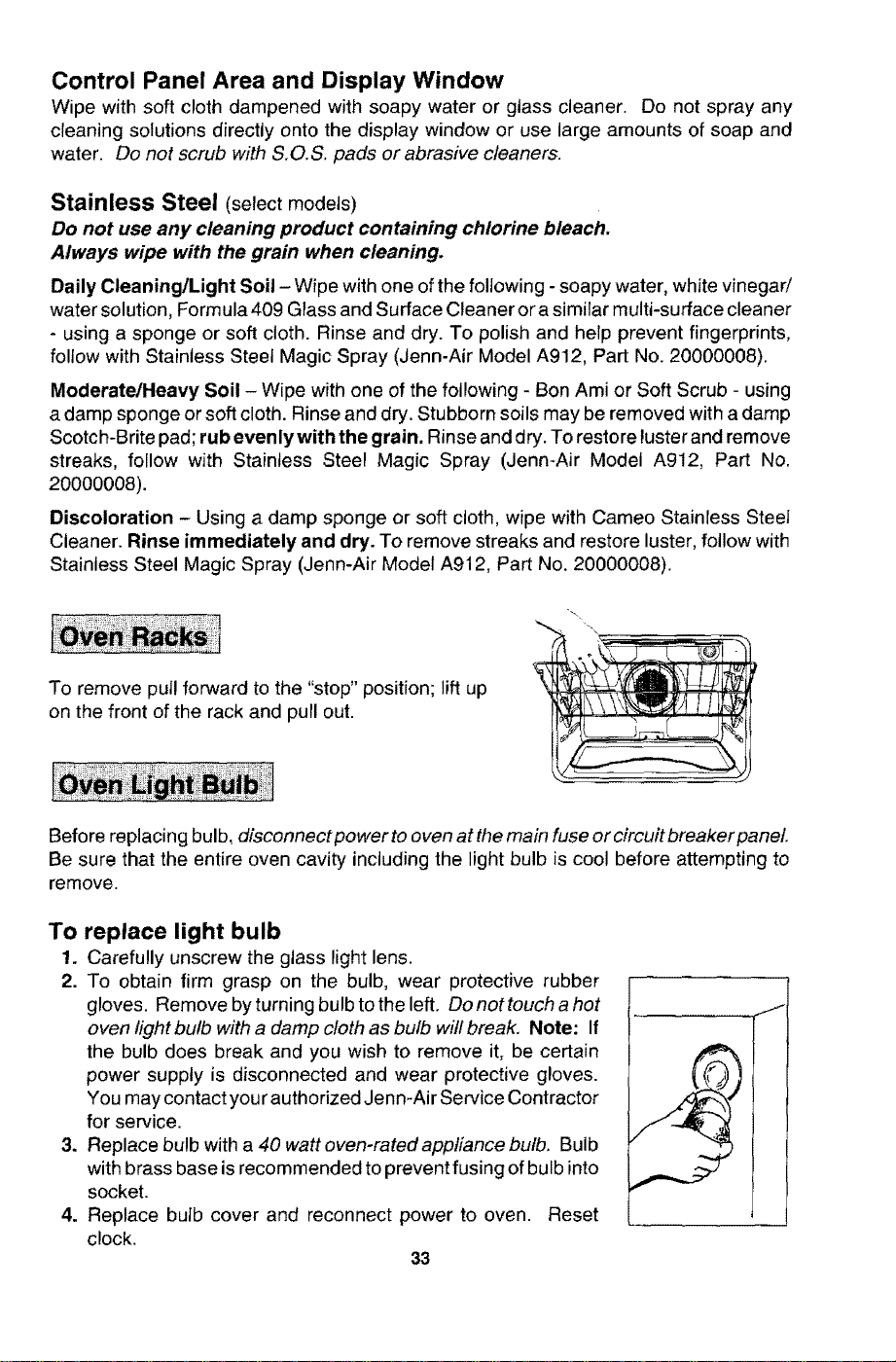
To remove pul! forward to the "stop" position; lift up
on the front of the rack and pull out.
Before replacing bulb, disconnect power to oven at the main fuse or circuit breaker panet.
Be sure that the entire oven cavity including the light bulb is cool before attempting to
remove.
To replace light bulb
1. Carefully unscrew the glass light lens.
2. To obtain firm grasp on the bulb, wear protective rubber
gloves. Remove by turning bulb to the left. Do not touch a hot
oven light bulb with a damp cloth as bulb will break. Note: If
the bulb does break and you wish to remove it, be certain
power supply is disconnected and wear protective gloves.
You may contact you r authorized Jenn-Air Service Contractor
for service.
3. Replace bulb with a 40 watt oven-rated appliance bulb, Bulb
with brass base is recommended to prevent fusing of bulb into
socket.
4. Replace bulb cover and reconnect power to oven. Reset
clock.
33
Theoventemperaturecanbeadjustedifalloventemperaturesaretootowortoohigh
andthelengthoftimetocookALLfoodsistoolongortooshort.DoNOTadjustthe
temperatureifonlyoneortwoitemsarenotbakingproperly,
To adjust
1. Touch the Bake Pad.
2, Enter 500° by touching the number pads: "5,0,0",
3. Touch and hold the Bake Pad for 8 seconds until "00 °" appears in the Display.
4. Touch the appropriate number pads to enter the offset temperature. (Allowable
range is -35 ° to +35°.) Note: Touching the Broil Pad will change the - sign to a
positive number or back to a negative number.
Note: Do not change the temperature setting more than 10° before checkin 9 the
oven.
5. Touch the Cancel Off Pad to return to the previous Display.
Important: The oven shoutd be adjusted only 10° and the oven should be tested, (We
recommend baking two 9" yellow layer cakes using a purchased box mix.) If the oven
temperature is still too Towor too high, repeat the procedure described above,
The oven operation controls can be locked in the "OFF" position during cleaning or to
prevent a child from accidentally turning them on. The oven functions which can be
locked in the "OFF" position are: Bake, Convect Bake, Convect Roast, Probe, Broil and
Clean. The control functions which can always be used regardless of lockout are: Timer,
Clock and Oven Light.
To set
Touch and hold the Cook Time Pad and the Stop Time Pad simultaneousTy for four
seconds. The Indicator Word "OFF" will appear and remain inthe temperature digits
for fifteen seconds.
Note: If an oven function is currently being used, the controls cannot be locked off.
Note: ff someone touches an oven function pad, the Indicator Word "OFF" will again
appear in the temperature digits for fifteen seconds.
To cancel
Touch and hold the Cook Time Pad and the Stop Time Pad simultaneously for four
seconds. The Indicator Word "OFF" witl appear briefly in the temperature digits and
then go off.
34
Check the following list to be sure a service call is realiy necessary. A quick reference
of this manual may prevent an unneeded service call.
If nothing on the oven operates:
• check for a blown circuit fuse or a tripped main circuit breaker.
• check if oven is properly connected to electric outlet.
If clock, indicator words, and/or lights operate but oven does not
heat:
• the controls may have been set incorrectly.
• clock controls may be set for delayed start of oven.
• the Child Protection Lock may have been set.
if the oven light does not work:
• the light bulb is loose or defective.
• oven tight does not work during self-cleaning process.
If oven will not go through self-cleaning process:
• controls may be improperly set.
• check the "Clean" and "Stop" time settings and the current time of day on the clock.
If oven did not clean properly:
• oven may need longer cleaning time.
• excessive spills were not removed prior to self-cleaning process.
If oven door will not unlock:
• oven may not have cooled to safe temperature after self-cleaning process.
• etectric current coming into the oven may be off.
If foods do not broil properly:
• the control may not be set properly.
• check rack position.
• voltage into house may be tow.
If baked food is burned or too brown on top:
• food may be positioned incorrectly in oven,
• oven not preheated properly,
If foods bake unevenly:
• the oven may be installed improperly.
• check the oven rack with a level.
• stagger pans, do not allow pans to touch each other or oven wall.
• check instructions for suggested placementof pans on oven rack.
If oven baking results are less than expected:
• the pans being used may not be of the size or material recommended for best
results.
• there may not be sufficient room around sides of the pans for proper air circulation
in the oven.
• check instructions for preheating, rack position and oven temperature.
35
If baking results differ from previous oven:
• oven thermostat calibration may differ between old and new ovens, Follow recipe
and use and care directions before calling for service since the calibration on the
previous oven may have drifted to a too high or too low setting. (See p. 34- Adjusting
Oven Temperature.)
If the cooling fan continues to operate after the oven has been
turned off:
• this is normal and the fan will automatically shut off when the oven is cooled.
If a fan is heard while using the bake mode:
• this is the cooling fan and is normal. The fan will continue to run after use until the
oven cools.
If probe does not work:
• check to be sure probe plug is properly inserted into oven receptacle.
Q probe may not be positioned in food properly,
• probe temperature may have been improperly set,
Fault Codes
Q Fault codes are shown in the Display as "F" and a number_ If a fault code appears
in the Display and a continuous beep sounds, touch the Cancel Off Pad. If the fault
code reappears, disconnect power to the oven and call an authorized Jenn-Air
Service Contractor.
B JENN-AIR
403 WE_T FOURTH STREET NORTH •RO BOX 39 • NEWTON, tA 5C_8
Print_,d Ln USA. Cat. No_ OU27300UE
©1997 Jen_q-Air Part NO. 8_ 11P342_60 9/97