TYPE HBM40
Instructions
Istruzioni
Instrucciones
Bedienungsanleitungen
Gebruiksaanwijzing
Instrukcja obsługi
Instruções

TYPE HBM40
Instructions
Istruzioni
Instrucciones
Bedienungsanleitungen
Gebruiksaanwijzing
Instrukcja obsługi
Instruções
2
© Copyright 2021 All rights reserved
Kenwood Ltd
New Lane, Havant
PO9 2NH Hampshire
UK/AR
5722100038_01/05.21
HBM40.002WH-006WH-306WH
English 6
11

Pegasus Kenwood white Explo-inuse KURTZ DESIGN 20.10.20
500 ml
8* 75
6
3
2
1
a
b
a
b
d
c
c
9*
mc
mc
mc
220-240V
˜
50-60 Hz 850-1000W
4
A
B
click!
*certain models only
a
b
3
Pegasus Kenwood white Inuse KURTZ DESIGN 26.10 .20
C
max.
300 g
250 g
350 g
200 g
200 g 200 g
30 g
sec.
10-15 15-25
6x1
10
6x1
5-10 15 30
2 cm
2 cm
2 cm
Parmesan
20
500 ml
mc
mc
mc
4
Pegasus Kenwood white Inu2 clean KURTZ DESIGN 20.10.20
D
5

6
English
Before Use
Please read the user instructions carefully
and completely before using the appliance
and retain for future reference. Remove all
packaging and labels and dispose them
appropriately.
Caution
z
The blades are very sharp!
To avoid injuries, please
handle blades with
utmost care.
z
Care shall be taken when handling the
sharp cutting blades, emptying the
bowl and during cleaning.
z
This appliance can be used by persons
with reduced physical, sensory or
mental capabilities or lack of expe-
rience and knowledge if they have
been given supervision or instruction
concerning use of the appliance in a
safe way and if they understand the
hazards involved.
z
Children shall not play with the appli-
ance.
z
This appliance shall not be used by
children.
z
Children shall be kept away from the
appliance and its mains cord.
z
If the supply cord is damaged, it must
be replaced by the manufacturer, its
service agent or similarly qualified
persons in order to avoid a hazard.
z
Always switch o and unplug the ap-
pliance when it is left unattended and
before assembling, disassembling,
cleaning and storing.
z
Before plugging into a socket, check
whether your voltage corresponds with
the voltage printed on the bottom of
the appliance.
z
This appliance is designed for house-
hold use only and for processing
normal household quantities.
z
Do not use the appliance for any
purpose other than the intended use
described in the user manual. Any
misuse may cause potential injury.
z
Do not use any part in the microwave.
z
Please clean all parts before first use
or as required, following the instruc-
tions in the Care and Cleaning section.
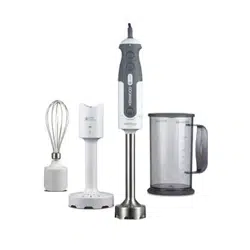
Parts and Accessories
1 Variable speed button (on/o)
2 Turbo button (T)
3 Motor part
4 Twist lock
5 Blender shaft
6 Beaker
7 Whisk accessory
a Gearbox
b Whisk
8 Puree accessory
a Gearbox
b Puree shaft
c Paddle
9 500 ml chopper accessory «mc»
a Lid (with gear)
b Chopping blade
c Chopper bowl
d Anti-slip rubber ring
How to Use the Appliance
Blending Shaft (A)
The hand blender is perfectly suited for
preparing dips, sauces, salad dress-
ings, soups, baby food, as well as drinks,
smoothies and milkshakes.
For best results, use the Turbo speed.
Assembly and Operation
z
Place the motor part (3) on the blend-
er shaft (5) and turn the twist lock (4)
counter-clockwise until it audibly clicks
into place.
z
Place the blending shaft into the mixture
to be blended. Then switch the appliance
on.

7
z
Blend ingredients to the desired con-
sistency using a gentle up-and-down
motion.
z
After use, unplug and turn the blending
shaft clockwise (5) to remove the hand
blender.
Caution
z
If using the appliance to purée hot food in
a saucepan or pot, remove the saucepan
or pot from the heat source and ensure
the liquid is not boiling. Allow hot food to
cool slightly to avoid risk of scalding.
z
Do not let the hand blender sit in a hot
pan on the cooktop when not in use.
z
Do not operate continuously for longer
than 1 minute.
z
Let the appliance cool down for 3 minutes
before you continue processing.
Recipe Example: Mayonnaise
250 g oil (e.g. sunflower oil)
1 egg and 1 extra egg yolk
1–2 tbsp. Vinegar
Salt and pepper to taste
z
Place all ingredients (at room temper-
ature) into the beaker in the order as
above.
z
Place the hand blender at the bottom of
the beaker. Blend at maximum speed
until the oil starts emulsifying.
z
With the hand blender still running, slowly
raise the shaft to the top of the mixture
and back down to incorporate the rest of
the oil.
NOTE: Processing time: approx. 1 minute
for salads and up to 2 minutes for a thicker
mayonnaise (e.g. for dip).
Whisk Accessory (A)
Use the whisk only for whipping cream,
beating egg whites, making sponge cakes
and ready-mix desserts.
Assembly and Operation
z
Attach the whisk (7b) to the gearbox (7a).
z
Align the motor part and the assembled
whisk and turn the parts together until
you hear them click into place.
z
After use, unplug and turn the whisk
clockwise (7) to detach the motor part.
Then pull the whisk out of the gearbox.
z
Do not operate continuously for longer
than 3 minutes.
z
Let the appliance cool down for 3 minutes
before you continue processing.
Tips for Best Results
z
Move the whisk clockwise while holding it
at a slight incline.
z
To prevent splattering, start slowly and
use the whisk accessory in deep contain-
ers or pans.
z
Place the whisk in a bowl and only then
switch the appliance on.
z
Always ensure the whisk and mixing
bowl are completely clean and free of fat
before whisking egg whites. Only whip up
to 4 egg whites.
Recipe Example: Whipped Cream
1.8 cups / 400 ml chilled cream (min. 30 %
fat content, 4 - 8 °C / 39 - 46 F)
z
Start with low speed and increase the
speed while whipping.
z
Always use fresh chilled cream to achieve
greater and more stable volume when
whisking.
Puree Accessory (B)
The puree accessory can be used to mash
cooked vegetables and fruits such as pota-
toes, sweet potatoes, tomatoes, plums and
apples.
Before Use
z
Do not mash hard or uncooked food, as
this may damage the unit.
z
Peel and remove any stones or hard
parts; cook and drain then mash the fruit/
vegetable.
Assembly and Operation
z
Fit the gearbox (8a) to the shaft (8b) by
turning in a clockwise direction until it
locks into place.

8
z
Turn the puree accessory upside down
and fit the paddle (8c) over the central
hub and turn counter- clockwise to lo-
cate. (If the gearbox is not fitted properly,
then the paddle will not secure in place).
z
Align the motor part and the assembled
masher and turn the parts together until
you hear them click into place. Plug in.
z
Dip the puree accessory into the ingredi-
ents and switch on the appliance.
z
Using a gentle up and down motion,
move the puree accessory through the
ingredients until the desired texture is
achieved.
z
Release the variable speed button and
ensure the puree accessory has com-
pletely stopped turning before removing
it from the food.
z
After use, unplug and turn the masher
clockwise (8) to detach the motor part.
z
Remove the paddle (8c) by turning it
clockwise and separate the gearbox (8a)
from the shaft (8b).
Caution
z
Never use the puree accessory in a
saucepan over direct heat.
z
Always remove the saucepan from the
heat and allow to cool slightly.
z
Sit the saucepan or bowl on a stable, flat
surface, and support it with your free hand.
z
Do not tap the puree accessory on the
side of the cooking vessel during or after
use. Use a spatula to scrape excess food
away.
z
For best results when mashing never fill a
saucepan or bowl more than half full with
food.
z
Do not process more than one batch
without interruption.
z
Let the appliance cool down for 4 minutes
before you continue processing.
Recipe Example: Mashed Potatoes
1 kg cooked potatoes
200 ml warm milk
z
Place the potatoes in a bowl and mash for
30 seconds with speed Turbo.
z
Add the milk. Resume mashing for anoth-
er 30 seconds.
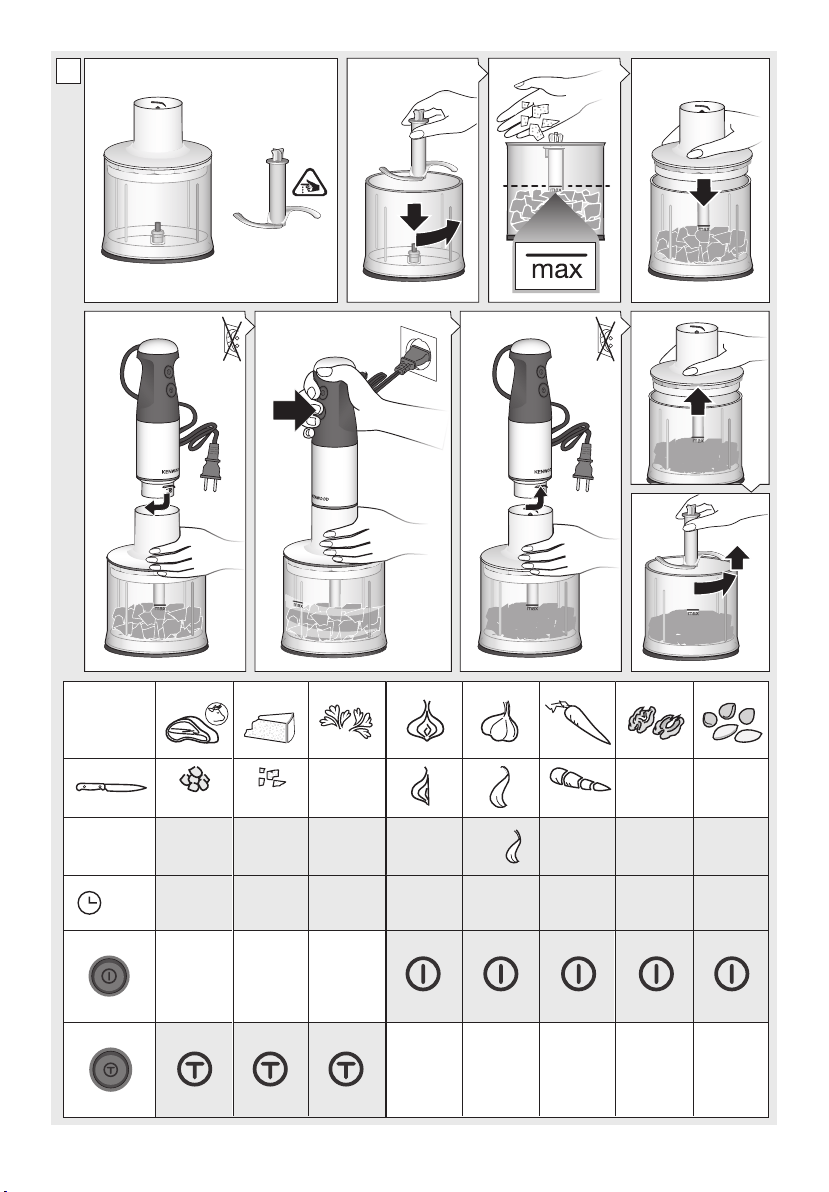
Chopper Accessory (C)
The chopper (9) is perfectly suited for
chopping meat, hard cheese, onions,
herbs, garlic, vegetables, bread, crackers
and nuts.
Use the «mc» chopper (9) for larger quanti-
ties and for hard foods.
For «mc» chopper do not exceed the quan-
tity of ingredients higher than max line.
For «hc» chopper do not exceed the
quantity of ingredients higher than max
line. Maximum operation time for the «hc»
chopper: 1 minute for large amounts of
wet ingredients, 30 seconds for dry or hard
ingredients.
NOTE: leave an interval of at least 3 min-
utes before operating again (To prevent
faults). Immediately stop processing when
motor speed decreases and/or strong
vibrations occur.
Refer to the Processing Guide C for maxi-
mum quantities, recommended times and
speeds.
Before Use
z
Pre-cut foods into small pieces for easier
chopping.
z
Remove any bones, tendons and gristle
from meat to help prevent damage to the
blades.
z
Make sure the anti-slip rubber ring (9e)
is attached to the bottom of the chopper
bowl.
Assembly and Operation
z
The blade (9b) is very sharp! Always hold
it by the upper plastic part and handle it
carefully.
z
Place the blade on the center pin of the
chopper bowl (9c). Press it down and give
it a turn so that it locks into place.
z
Fill the chopper with food and put on the
lid (9a).

9
z
Align the motor part and the chopper
and turn the parts together until you hear
them click into place. Plug in.
z
To operate the chopper, switch on the
appliance. During processing, hold the
motor part with one hand and the chop-
per bowl with the other.
z
Always chop harder foods (e.g. parme-
san cheese) at full speed.
z
After use, unplug and turn the motor part
(3) to detach.
z
Lift the lid up. Carefully take out the blade
before pouring out the contents of the
bowl. To remove the blade slightly turn it
then pull it o.
Caution
z
Do not use the chopper accessory to
process extremely hard foods, such as
unshelled nuts, ice cubes, coee beans,
grains, or hard spices e.g. nutmeg. Pro-
cessing these foods could damage the
blades.
z
Never place the chopper bowls in the
microwave oven.
«hc» Recipe example: Honey-Prunes (as a
pancake stung or spread)
50 g prunes
75 g creamy honey
70 ml water (vanilla-flavoured)
z
Fill the «hc» chopper bowl with prunes
and creamy honey.
z
Store at 3 °C in refrigerator for 24 hours.
z
Add 70 ml water (vanilla-flavoured).
z
Resume chopping for another 1,5 sec-
onds at maximum speed.
Use the chopper accessory «hc» (optional
accessory available at your Kenwood Ser-
vice Center; however not in every country).
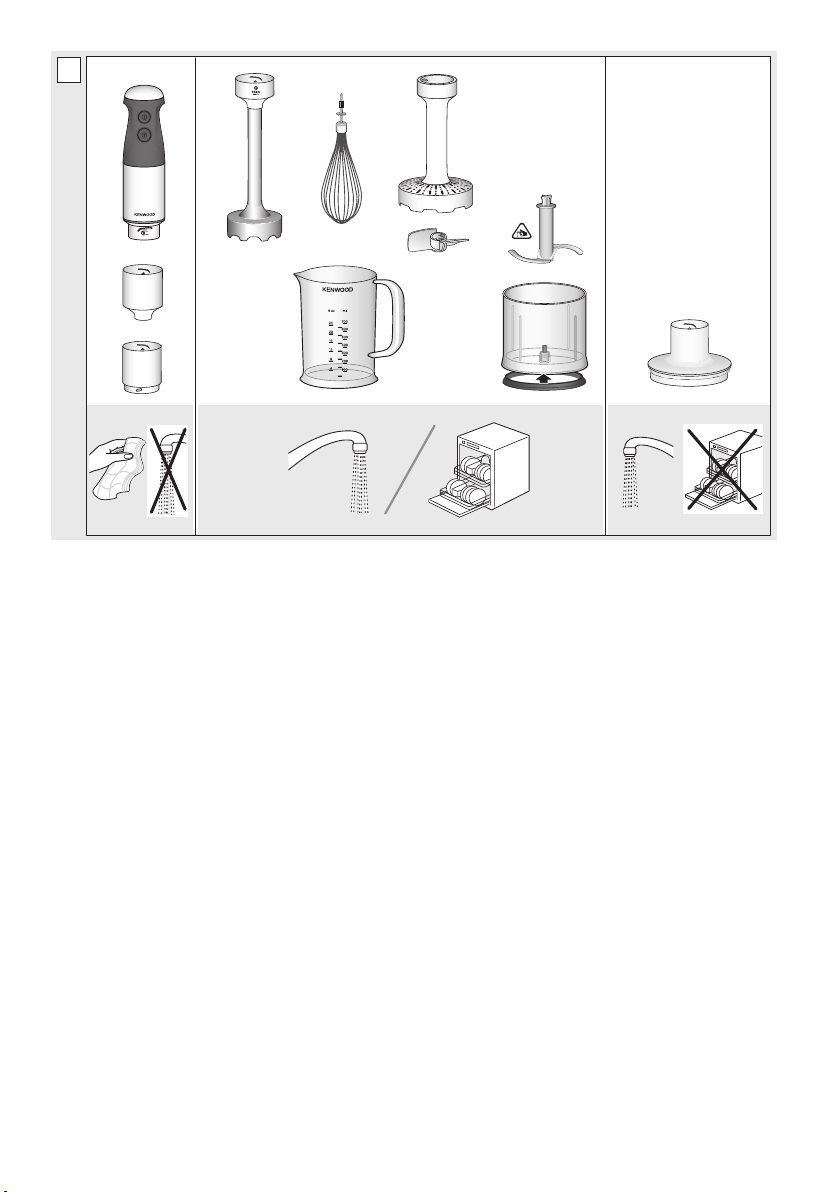
Care and Cleaning (D)
z
Always clean the hand blender and the
suitable accessories thoroughly for first
use and after every use with water and
detergent.
z
Unplug hand blender before cleaning.
z
Do not immerse the motor part (3) or
gearboxes (7a/8a) in water or any other
liquid. Clean with a damp cloth only.
z
The lid (9a) can be rinsed under running
water. Do not immerse in water, nor place
in a dishwasher.
z
All other parts can be cleaned in a dish-
washer. Do not use abrasive cleaners that
could scratch the surface.
z
You may remove the anti-slip rubber ring
from the bottom of the bowl for an extra
thorough clean.
z
When processing foods with high pig-
ment content (e.g. carrots), the accesso-
ries may become discolored. Wipe these
parts with vegetable oil before cleaning
them.
Warranty and Service
If you experience any problems with the
operation of your appliance, before
requesting assistance refer to the “trouble-
shooting guide” section in the manual or
visit www.kenwoodworld.com.
Please note that your product is covered
by a warranty, which complies with all legal
provisions concerning any existing warranty
and consumer rights in the country where
the product was purchased.
If your Kenwood product malfunctions
or you find any defects, please send it or
bring it to an authorised KENWOOD Service
Centre. To find up to date details of your
nearest authorized KENWOOD Service
centre visit www.kenwoodworld.com or the
website specific to your Country.
Both the design specifications and these
user instructions are subject to change
without notice.

10
Please do not dispose of the product in the
household waste at the end of its
useful life. Disposal can take place
at a Kenwood Service Center or at
appropriate collection points
provided in your country.
Troubleshooting Guide
Problem Potential Causes Solution
Hand blender does not operate. No power Check appliance is plugged in.
Check the fuse /circuit breaker
in your home.
If none of the above contact
Kenwood Service.
• No rights are given under this guarantee
to a person acquiring the appliance sec-
ond hand or for commercial or communal
use.
• Any repaired or replaced appliance will be
guaranteed on these terms for the unex-
pired portion of the guarantee.
• The need for repair has not been caused
by insucient aftercare or cleaning: or
damage caused by the chemical or elec-
trochemical eects of water.
Under no circumstances shall the appli-
cation of this guarantee give rise to the
complete replacement of the appliance or
entitle the consumer to damages.
Kenwood Ltd, New Lane, Havant,
Hampshire PO9 2NH
www.kenwoodworld.com
Thank You for choosing Kenwood. We are
confident that you will get excellent service
from this product.
TO IMPROVE YOUR EXPERIENCE
Register now at
www.kenwoodworld.com
By registering we may send you from time
to time details on exclusive oers, promo-
tions, recipes and inside tips.
For UK Only
Guarantee Information
All Kenwood products carry a minimum
guarantee period of one year. The rights
and benefits under this guarantee are
additional to your statutory rights which are
not aected. Please keep your receipt as
this will form the basis of your guaran-
tee.
In the unlikely event of a breakdown you
have access to professional help from our
team simply by calling:
0345 222 0458
For service in the Republic of Ireland please
call: 012475471
Kenwood undertakes within the specified
period to repair or replace any part of the
appliance, free of charge (with the excep-
tion of any glass or porcelain-ware incorpo-
rated in the product) found to be defective
provided that;
• We are promptly informed of the defect.
• The product is used and maintained in
accordance with the User Instructions.
• The appliance has not been altered in any
way or subjected to misuse or repair by a
person other than an authorised service
agent for Kenwood.
Materials and accessories coming
into contact with food conform to
EEC regulation 1935/2004.

7
a
b
8
a
b
c
«mc» 500 9
( ) a
b
c
d
(A)
.
.Turbo
(5) (3) •
(4)
.
. . •
•
.
•
. (5)
•
.
.
•
.
. 1 •
. 3 •
:
250 ( )
1-2
.
.
!
•
.
•
.
•
.
. •
. •
•
.
•
.
•
.
•
.
•
.
•
. .
. •
•
.
(/) 1
(T) Turbo 2
3
4
5
6
11

/ •
.
(b 8) (a 8) •
.
(c 8) •
) .
.(
•
.
.
. •
•
.
•
.
•
. (8)
(8c) •
.((8b (8a)
. •
. •
•
.
. •
.
•
.
. •
. 4 •
:
1
200
. 30 •
. 30 . •
(C)
( 9 )
.
( ) •
.
. •
Turbo .
•
1
: : .
)
.(
(A)
.
.(a 7 ) (b 7 ) •
•
.
•
. (7)
.
. 23 •
. 3 •
.
•
•
.
.
•
•
. 4 .
:
) % 30 400 )
4 - 8 (
•
•
.
(B)
.
•
.
12

.( ) 70 •
. •
«ch» (
Kenwood .(
(D)
•
.
. •
. (3) •
.
. (a 9 ) •
.
. •
.
•
.
) •
. ( :
.
" "
.www.kenwoodworld.com
.
Kenwood
. KENWOOD
www.kenwoodworld.com KENWOOD
.
.
. «mc»
«hc» «mc»
.
.«hc»
: «hc»
: . 30
.( ) 3
. /
.
•
•
.
(e 9) •
.
! ( 9 )
•
.
.(c 9 ) •
.
.(a 9 ) •
•
. .
. •
.
.( ) •
•
. (3)
. •
. .
•
.
.
.
•
( «hc» ) :
50
75
10 ( )
. «hc» •
. 24 3
•
13

14
. .
. /
.Kenwood

15

16