Owner's IVlanual
CRRF?SI4RN®
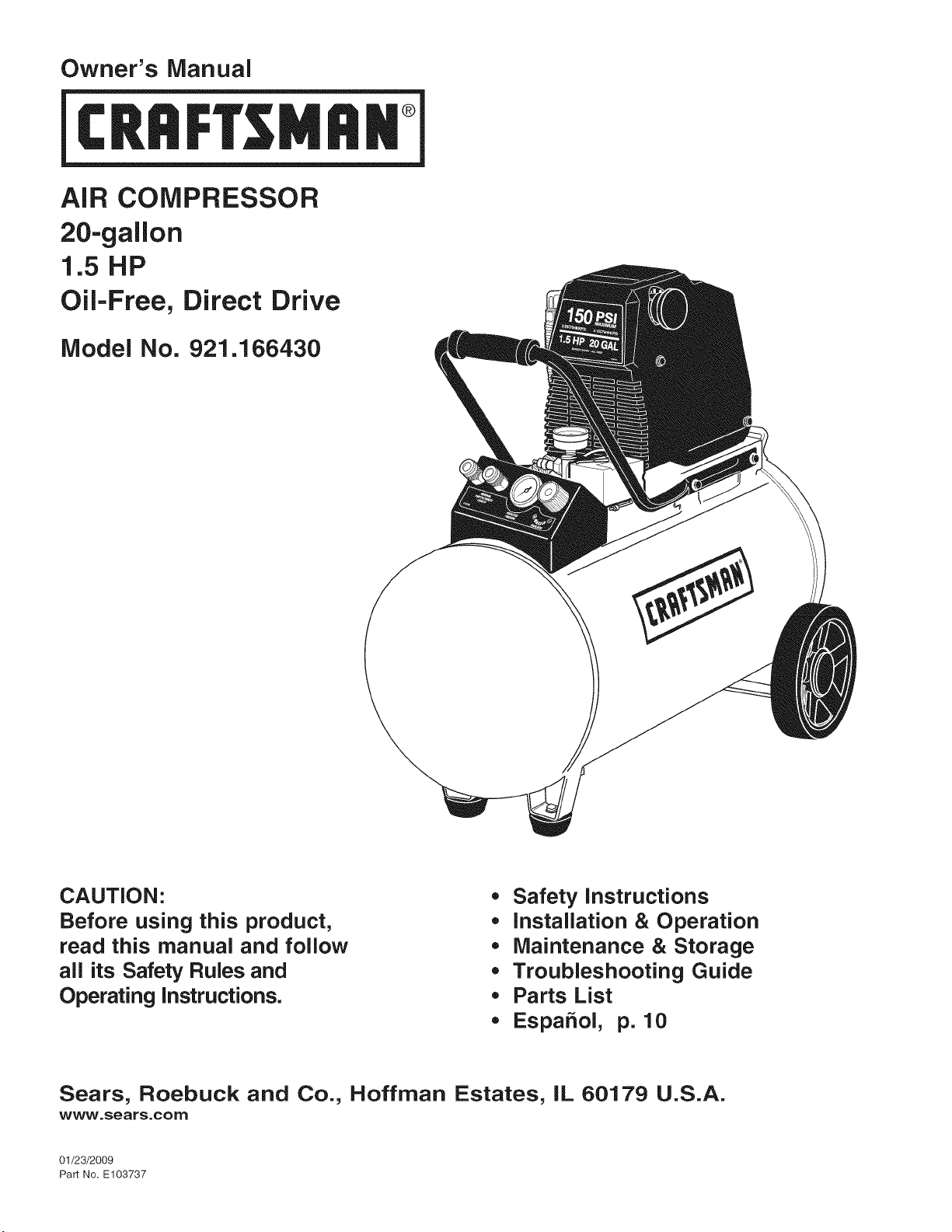
AiR COMPRESSOR
20-gallon
1.5 HP
Oil=Free, Direct Drive
ModeJ No. 921.166430
CAUTION:
Before using this product,
read this manuaJ and follow
all its Safety Rules and
Operating instructions.
• Safety instructions
• Installation & Operation
• Maintenance & Storage
• Troubleshooting Guide
• Parts List
• Espa5ol, p. 10
Sears, Roebuck and Co., Hoffman Estates, IL 60179 U.S.A.
www.sears.co133
01/23/2009
Part No. E103737
Table of Contents
Page
Warranty .............................................................. See Below
Safety Symbols .......................................................... 1
Important Safety Instructions & Guidelines ..................................... 1
Specifications ............................................................ 2
Glossary ................................................................ 2
Duty Cycle .............................................................. 2
Parts & Features ......................................................... 3
Installation & Assembly .................................................... 4
Operating Procedures ..................................................... 5
Maintenance ............................................................. 6
Storage ................................................................ 6
Troubleshooting Guide ..................................................... 7
Exploded View ........................................................... 8
Parts List ............................................................... 9
Espaffol ................................................................ 11
ONE YEAR FULL WARRANTY ON CRAFTSMAN AIR COMPRESSOR
If this Craftsman Air Compressor fails due to manufacturer's defects in material or workmanship
within one year of the date of purchase, RETURN IT TO THE NEAREST SEARS STORE OR
SERVICE CENTER IN THE UNITED STATES and it will be replaced or repaired (at our option),
free of charge.
If this Air Compressor is used for commercial or rental purposes, this warranty applies for only 90
days from the date of purchase. This warranty gives you specific legal rights and you may also
have other rights which vary from state to state.
Sears, Roebuck and Co., Hoffman Estates, [L 60179
Safety Symbols
The information listed below should be read and understood by the operator. This information is given to protect the
user while operating and storing the air compressor. We utilize the symbols below to allow the reader to recognize important
information about their safety.
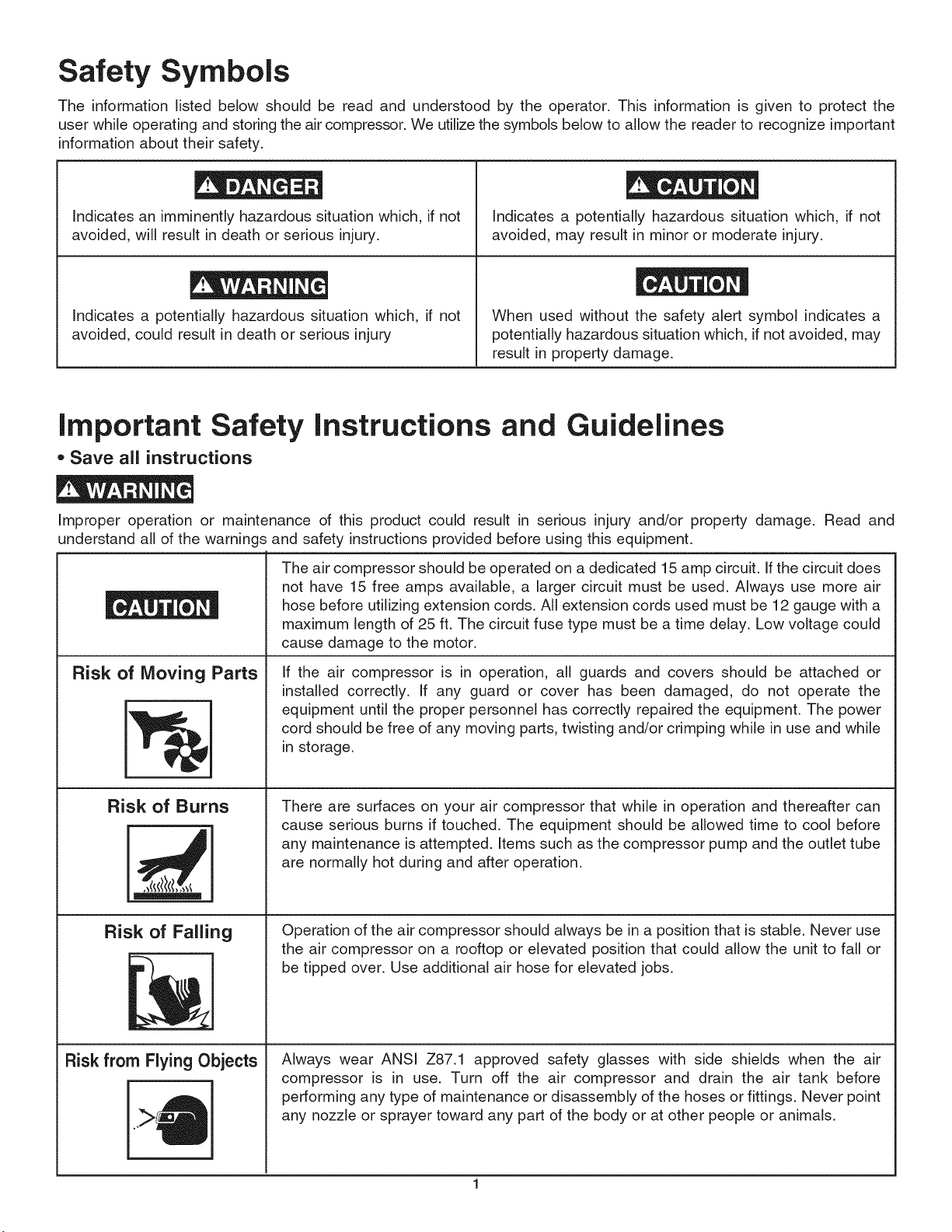
Indicates an imminently hazardous situation which, if not
avoided, will result in death or serious injury.
Indicates a potentially hazardous situation which, if not
avoided, could result in death or serious injury
Indicates a potentially hazardous situation which, if not
avoided, may result in minor or moderate injury.
When used without the safety alert symbol indicates a
potentially hazardous situation which, if not avoided, may
result in property damage.
important Safety instructions and Guidelines
• Save all instructions
Improper operation or maintenance of this product could result in serious injury and/or property damage. Read and
understand all of the warnings and safety instructions provided before using this equipment.
Risk of Moving Parts
Risk of Burns
Risk of Falling
Risk from Flying Objects
The air compressor should be operated on a dedicated 15 amp circuit. If the circuit does
not have 15 free amps available, a larger circuit must be used. Always use more air
hose before utilizing extension cords. All extension cords used must be 12 gauge with a
maximum length of 25 ft. The circuit fuse type must be a time delay. Low voltage could
cause damage to the motor.
If the air compressor is in operation, all guards and covers should be attached or
installed correctly. If any guard or cover has been damaged, do not operate the
equipment until the proper personnel has correctly repaired the equipment. The power
cord should be free of any moving parts, twisting and/or crimping while in use and while
in storage.
There are surfaces on your air compressor that while in operation and thereafter can
cause serious burns if touched. The equipment should be allowed time to cool before
any maintenance is attempted. Items such as the compressor pump and the outlet tube
are normally hot during and after operation.
Operation of the air compressor should always be in a position that is stable. Never use
the air compressor on a rooftop or elevated position that could allow the unit to fall or
be tipped over. Use additional air hose for elevated jobs.
Always wear ANSI Z87.1 approved safety glasses with side shields when the air
compressor is in use. Turn off the air compressor and drain the air tank before
performing any type of maintenance or disassembly of the hoses or fittings. Never point
any nozzle or sprayer toward any part of the body or at other people or animals.
1
Important Safety Instructions & Guidelines
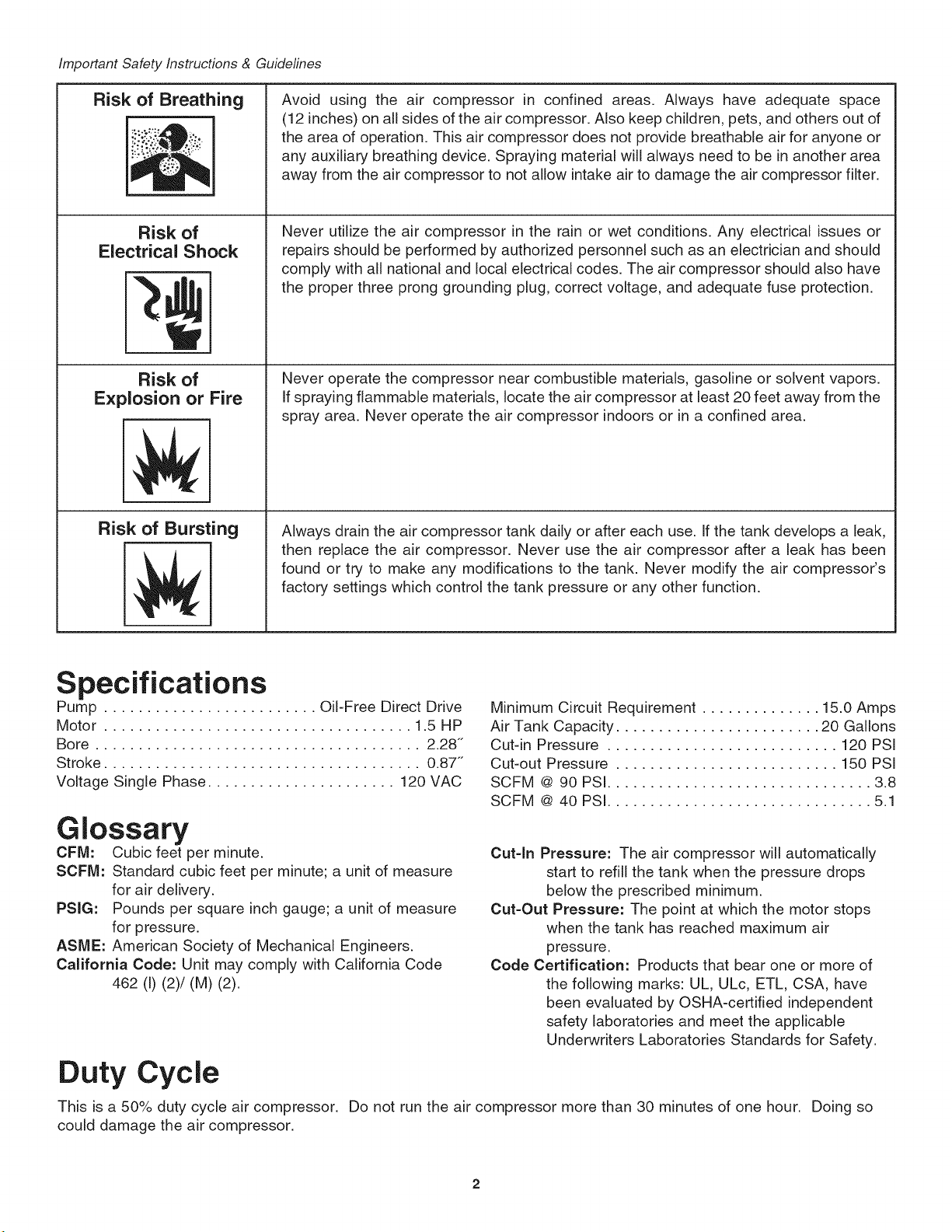
Risk of Breathing
Risk of
Electrical Shock
Risk of
Explosion or Fire
Risk of Bursting
Avoid using the air compressor in confined areas. Always have adequate space
(12 inches) on all sides of the air compressor. Also keep children, pets, and others out of
the area of operation. This air compressor does not provide breathable air for anyone or
any auxiliary breathing device. Spraying material will always need to be in another area
away from the air compressor to not allow intake air to damage the air compressor filter.
Never utilize the air compressor in the rain or wet conditions. Any electrical issues or
repairs should be performed by authorized personnel such as an electrician and should
comply with all national and local electrical codes. The air compressor should also have
the proper three prong grounding plug, correct voltage, and adequate fuse protection.
Never operate the compressor near combustible materials, gasoline or solvent vapors.
If spraying flammable materials, locate the air compressor at least 20 feet away from the
spray area. Never operate the air compressor indoors or in a confined area.
Always drain the air compressor tank daily or after each use. If the tank develops a leak,
then replace the air compressor. Never use the air compressor after a leak has been
found or try to make any modifications to the tank. Never modify the air compressor's
factory settings which control the tank pressure or any other function.
Specifications
Pump ......................... Oil-Free Direct Drive
Motor .................................... 1.5 HP
Bore ...................................... 2.28"
Stroke ..................................... 0.87"
Voltage Single Phase ...................... 120 VAC
Glossary
CFM: Cubic feet per minute.
SCFM: Standard cubic feet per minute; a unit of measure
for air delivery.
PSIG: Pounds per square inch gauge; a unit of measure
for pressure.
ASME: American Society of Mechanical Engineers.
California Code: Unit may comply with California Code
462 (I) (2)/(M) (2).
Minimum Cimuit Requirement .............. 15.0 Amps
Air Tank Capacity ........................ 20 Gallons
Cut-in Pressure ........................... 120 PSi
Cut-out Pressure .......................... 150 PSi
SCFM @ 90 PSi ............................... 3.8
SCFM @ 40 PSi ............................... 5.1
Cut-In Pressure: The air compressor will automatically
start to refill the tank when the pressure drops
below the prescribed minimum.
Cut-Out Pressure: The point at which the motor stops
when the tank has reached maximum air
pressure.
Code Certification: Products that bear one or more of
the following marks: UL, ULc, ETL, CSA, have
been evaluated by OSHA-certified independent
safety laboratories and meet the applicable
Underwriters Laboratories Standards for Safety.
Duty Cycle
This is a 50% duty cycle air compressor.
could damage the air compressor.
Do not run the air compressor more than 30 minutes of one hour. Doing so
Parts & Features
See figures below for reference
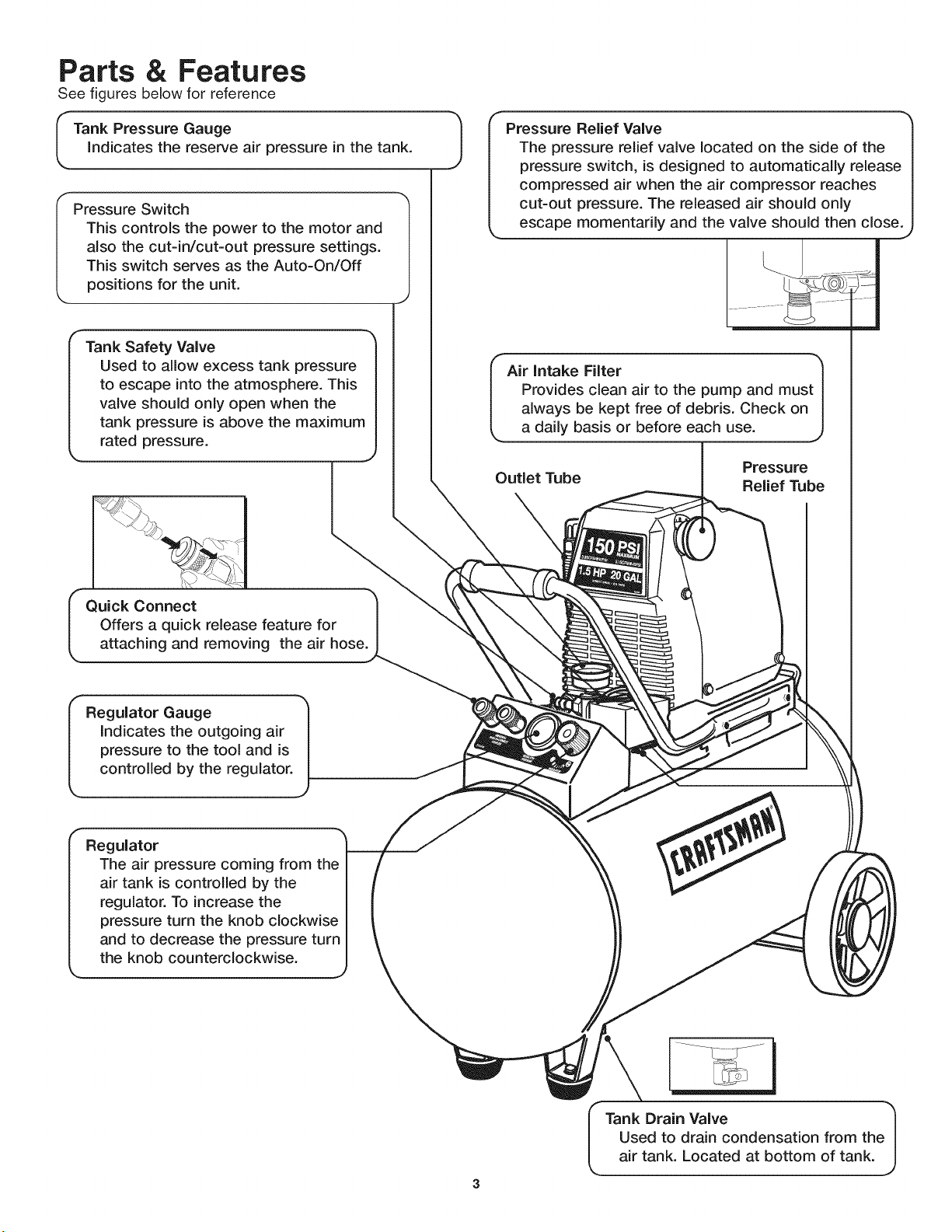
I Tank Pressure Gauge
indicates the reserve air pressure in the tank. |
__J
I Pressure Switch 1
This controls the power to the motor and
also the cut-in/cut-out pressure settings.
This switch serves as the Auto-On/Off
positions for the unit.
Tank Safety Valve
Used to allow excess tank pressure
to escape into the atmosphere. This
valve should only open when the
tank pressure is above the maximum
rated pressure.
Pressure Relief Valve
The pressure relief valve located on the side of the
pressure switch, is designed to automatically release
compressed air when the air compressor reaches
cut-out pressure. The released air should only
escape momentarily and the valve should then close.
I Air Intake Filter
Provides clean air to the pump and must t
always be kept free of debris. Check on |
a daily basis or before each use. )
Pressure
Outlet Tube Relief Tube
Quick Connect
Offers a quick release feature for
attaching and removing the air hose.
Regulator Gauge
Indicates the outgoing air
pressure to the tool and is
controlled by the regulator.
Regulator
The air pressure coming from the
air tank is controlled by the
regulator. To increase the
pressure turn the knob clockwise
and to decrease the pressure turn
the knob counterclockwise.
I Tank Drain Valve *]
Used to drain condensation from the|
air tank. Located at bottom of tank. J
Installation & Assembly
The air compressor should be turned off, unplugged from
the power source, the air bled from the tank and the unit
allowed time to cool before any maintenance is performed.
Personal injuries could occur from moving parts, electrical
sources, compressed air or hot surfaces. The quick connect
assembly must be attached before use. Failure to assemble
correctly could result in leaks and possible injury. If unsure
of assembly instructions or you experience difficulty in the
assembly please call your local service department for
further information.
Getting Started = Location of the Air Compressor
The air compressor should always be located in a clean,
dry and well ventilated environment. The unit should have
at minimum, 12 inches of space on each side. The air filter
intake should be free of any debris or obstructions.
Check the air filter on a daily basis to make sure it is clean
and in working order.
Improper installation of the grounding plug will result in a
risk of electric shock. If repair or replacement of the cord
or plug is necessary, do not connect the grounding wire to
either flat blade terminal. The wire with insulation having an
outer surface that is green with or without yellow stripes is
the grounding wire. Check with a qualified electrician or
serviceman if the grounding instructions are not completely
understood, or if in doubt as to whether the product is
properly grounded. Do not modify the plug provided.
If it will not fit the outlet, have the proper outlet installed
by a qualified electrician.
This product is for use on a circuit having a nominal rating
of 120 volts and is factory-equipped with a specific electric
cord and plug to permit connection to a proper electric
circuit. Make sure the product is connected to an outlet
having the same configuration as the plug. An adapter
should not be used with this product. If the product must
be reconnected for use on a different type of electric circuit,
qualified service personnel should make the reconnection.
Risk Of Fire Or Explosion
This product incorporates snap action switch contacts and
a universal electric motor which tend to produce arcs and
sparking and therefore should not be exposed to flammable
liquids or vapors. This product is not intended for installation
or use in a commercial garage or shop environment.
Grounding Instructions
This product should be grounded. Inthe event of an electrical
short circuit, grounding reduces the risk of electric shock by
providing an escape wire for the electric current.
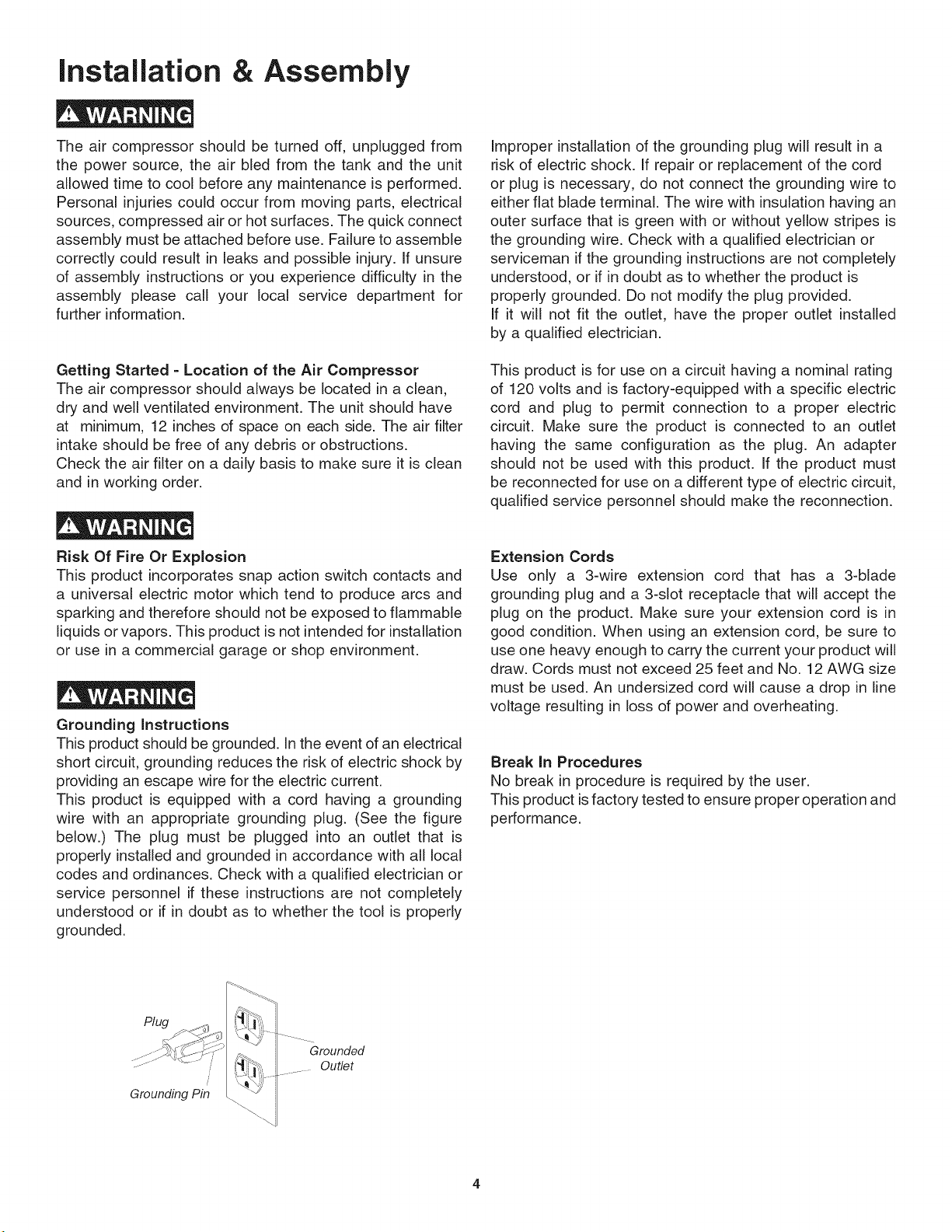
This product is equipped with a cord having a grounding
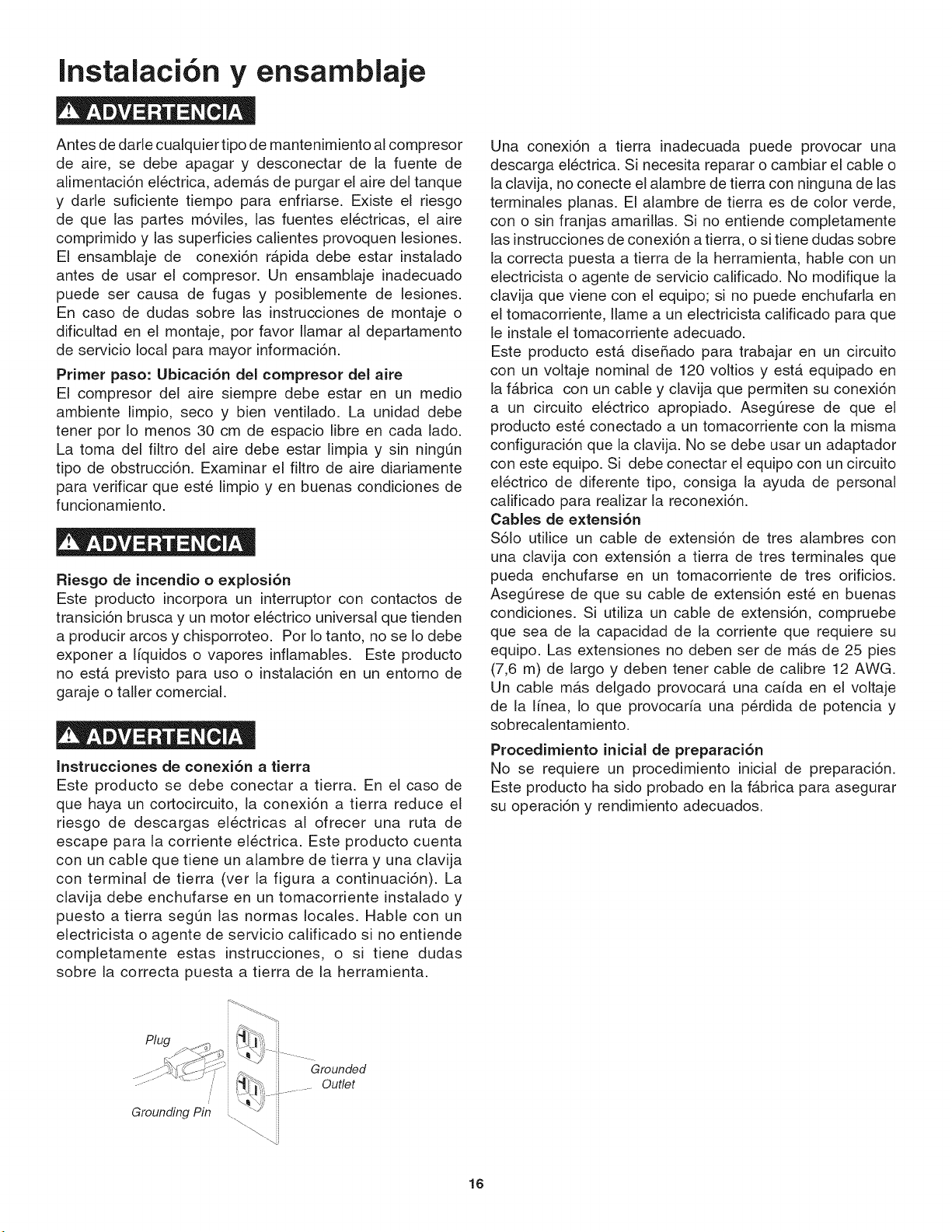
wire with an appropriate grounding plug. (See the figure
below.) The plug must be plugged into an outlet that is
properly installed and grounded in accordance with all local
codes and ordinances. Check with a qualified electrician or
service personnel if these instructions are not completely
understood or if in doubt as to whether the tool is properly
grounded.
Extension Cords
Use only a 3-wire extension cord that has a 3-blade
grounding plug and a 3-slot receptacle that will accept the
plug on the product. Make sure your extension cord is in
good condition. When using an extension cord, be sure to
use one heavy enough to carry the current your product will
draw. Cords must not exceed 25 feet and No. 12 AWG size
must be used. An undersized cord will cause a drop in line
voltage resulting in loss of power and overheating.
Break In Procedures
No break in procedure is required by the user.
This product isfactory tested to ensure proper operation and
performance.
.j.--
Grounding Pin
Grounded
Outlet
Operating Procedures
Daily Start-Up Procedures
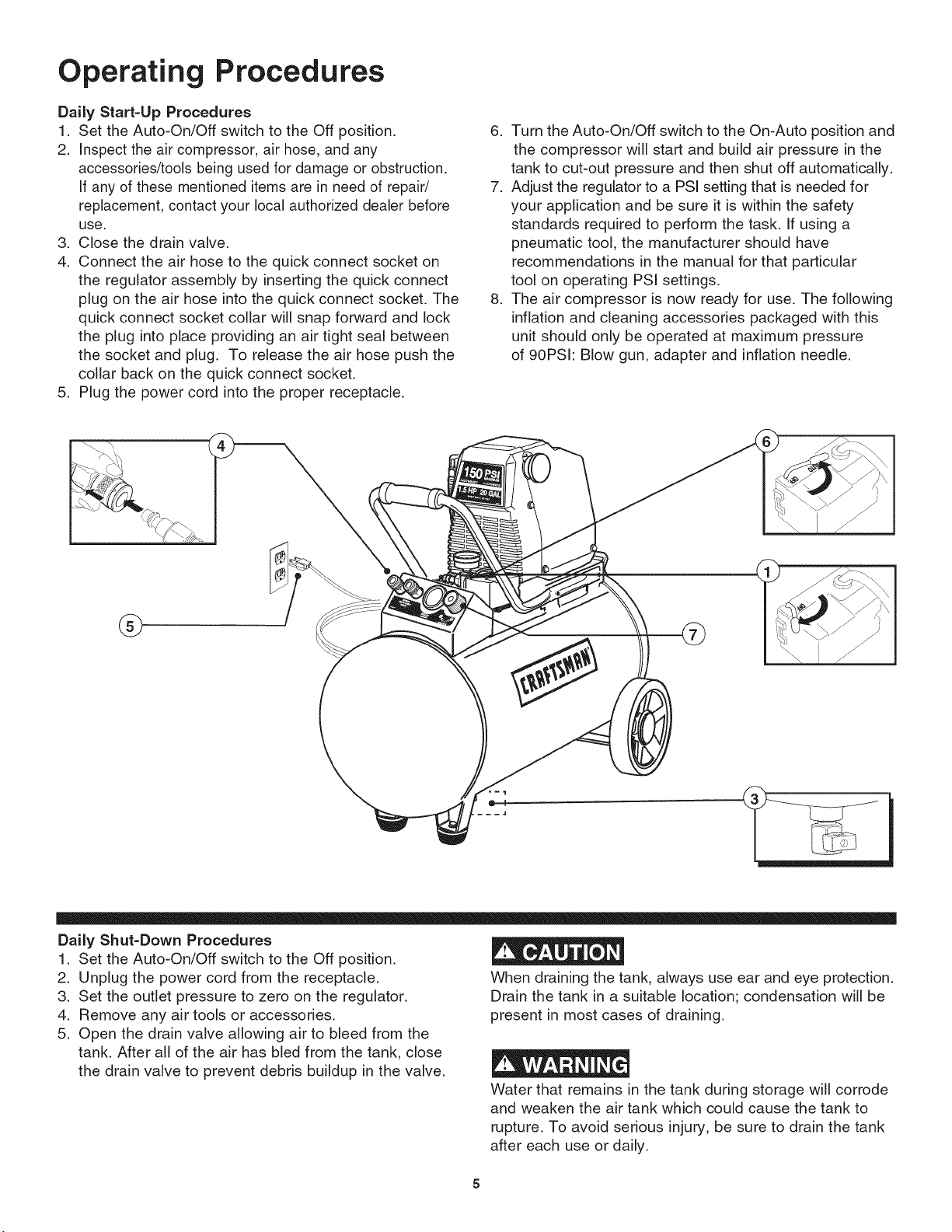
1. Set the Auto-On/Off switch to the Off position.
2. Inspect the air compressor, air hose, and any
accessories/tools being used for damage or obstruction.
If any of these mentioned items are in need of repair!
replacement, contact your local authorized dealer before
use.
3. Close the drain valve.
4. Connect the air hose to the quick connect socket on
the regulator assembly by inserting the quick connect
plug on the air hose into the quick connect socket. The
quick connect socket collar will snap forward and lock
the plug into place providing an air tight seal between
the socket and plug. To release the air hose push the
collar back on the quick connect socket.
5. Plug the power cord into the proper receptacle.
6. Turn the Auto-On/Off switch to the On-Auto position and
the compressor will start and build air pressure in the
tank to cut-out pressure and then shut off automatically.
7. Adjust the regulator to a PSi setting that is needed for
your application and be sure it is within the safety
standards required to perform the task. If using a
pneumatic tool, the manufacturer should have
recommendations in the manual for that particular
tool on operating PSi settings.
8. The air compressor is now ready for use. The following
inflation and cleaning accessories packaged with this
unit should only be operated at maximum pressure
of 90PSI: Blow gun, adapter and inflation needle.
Daily Shut-Down Procedures
1. Set the Auto-On/Off switch to the Off position.
2. Unplug the power cord from the receptacle.
3. Set the outlet pressure to zero on the regulator.
4. Remove any air tools or accessories.
5. Open the drain valve allowing air to bleed from the
tank. After all of the air has bled from the tank, close
the drain valve to prevent debris buildup in the valve.
When draining the tank, always use ear and eye protection.
Drain the tank in a suitable location; condensation will be
present in most cases of draining.
Water that remains in the tank during storage will corrode
and weaken the air tank which could cause the tank to
rupture. To avoid serious injury, be sure to drain the tank
after each use or daily,
Maintenance
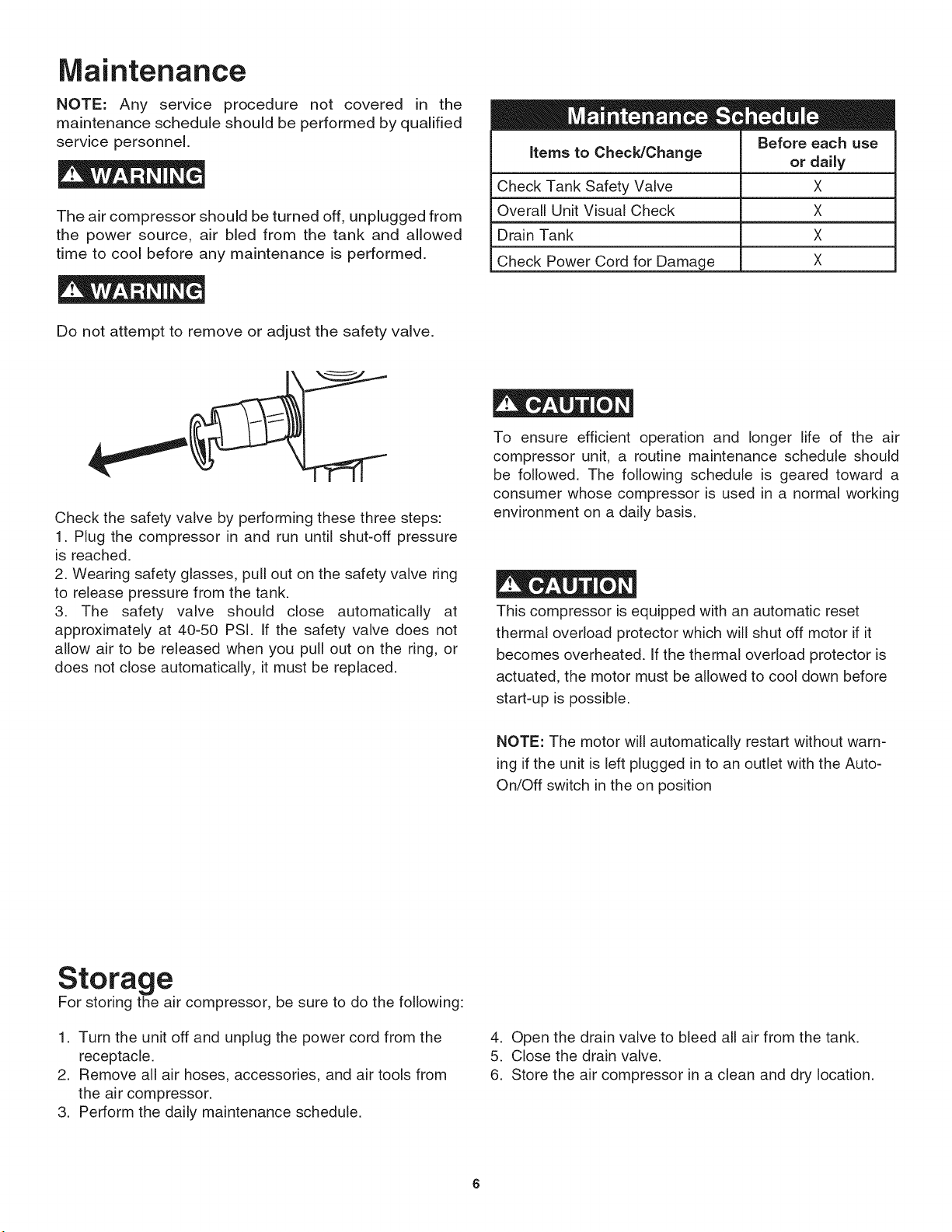
NOTE: Any service procedure not covered in the
maintenance schedule should be performed by qualified
service personnel.
The air compressor should be turned off, unplugged from
the power source, air bled from the tank and allowed
time to cool before any maintenance is performed.
Items to Check/Change
Check Tank Safety Valve
Overall Unit Visual Check
Before each use
or daily
X
X
Drain Tank X
Check Power Cord for Damage X
Do not attempt to remove or adjust the safety valve.
Check the safety valve by performing these three steps:
1. Plug the compressor in and run until shut-off pressure
is reached.
2. Wearing safety glasses, pull out on the safety valve ring
to release pressure from the tank.
3. The safety valve should close automatically at
approximately at 40-50 PSI. if the safety valve does not
allow air to be released when you pull out on the ring, or
does not close automatically, it must be replaced.
To ensure efficient operation and longer life of the air
compressor unit, a routine maintenance schedule should
be followed. The following schedule is geared toward a
consumer whose compressor is used in a normal working
environment on a daily basis.
This compressor is equipped with an automatic reset
thermal overload protector which will shut off motor if it
becomes overheated. If the thermal overload protector is
actuated, the motor must be allowed to cool down before
start-up is possible.
NOTE: The motor will automatically restart without warn-
ing if the unit is left plugged in to an outlet with the Auto-
On/Off switch in the on position
Storage
For storing the air compressor, be sure to do the following:
1. Turn the unit off and unplug the power cord from the
receptacle.
2. Remove all air hoses, accessories, and air tools from
the air compressor.
3. Perform the daily maintenance schedule.
4. Open the drain valve to bleed all air from the tank.
5. Close the drain valve.
6. Store the air compressor in a clean and dry location.
Troubleshooting Guide
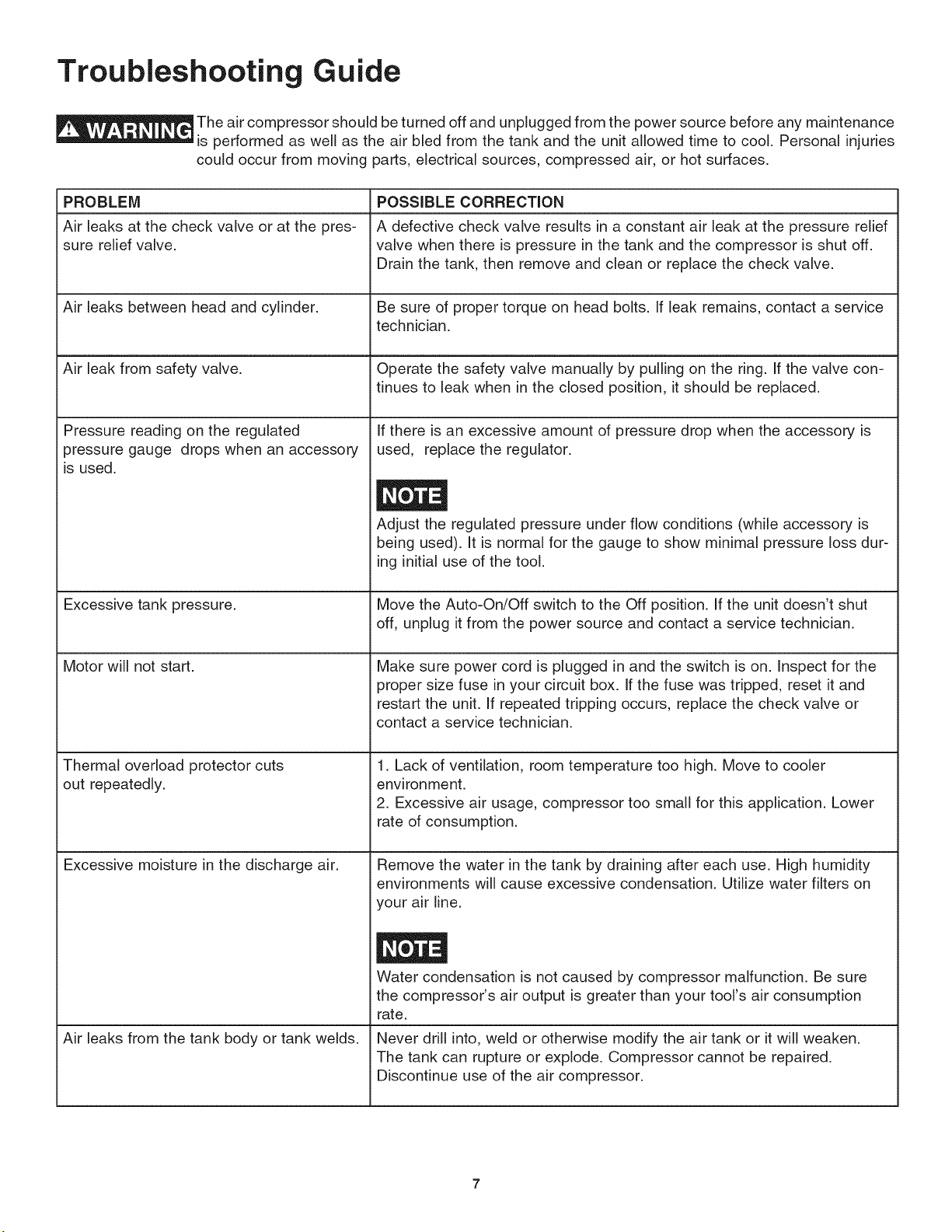
The air compressor should be turned off and unplugged from the power source before any maintenance
is performed as well as the air bled from the tank and the unit allowed time to cool. Personal injuries
could occur from moving parts, electrical sources, compressed air, or hot surfaces.
PROBLEM
Air leaks at the check valve or at the pres-
sure relief valve.
Air leaks between head and cylinder.
Air leak from safety valve.
Pressure reading on the regulated
pressure gauge drops when an accessory
is used.
Excessive tank pressure.
Motor will not start.
Thermal overload protector cuts
out repeatedly.
Excessive moisture in the discharge air.
Air leaks from the tank body or tank welds.
POSSIBLE CORRECTION
A defective check valve results in a constant air leak at the pressure relief
valve when there is pressure in the tank and the compressor is shut off.
Drain the tank, then remove and clean or replace the check valve.
Be sure of proper torque on head bolts. If leak remains, contact a service
technician.
Operate the safety valve manually by pulling on the ring. If the valve con-
tinues to leak when in the closed position, it should be replaced.
If there is an excessive amount of pressure drop when the accessory is
used, replace the regulator.
Adjust the regulated pressure under flow conditions (while accessory is
being used). It is normal for the gauge to show minimal pressure loss dur-
ing initial use of the tool.
Move the Auto-On/Off switch to the Off position. If the unit doesn't shut
off, unplug it from the power source and contact a service technician.
Make sure power cord is plugged in and the switch is on. Inspect for the
proper size fuse in your circuit box. If the fuse was tripped, reset it and
restart the unit. If repeated tripping occurs, replace the check valve or
contact a service technician.
1. Lack of ventilation, room temperature too high. Move to cooler
environment.
2. Excessive air usage, compressor too small for this application. Lower
rate of consumption.
Remove the water in the tank by draining after each use. High humidity
environments will cause excessive condensation. Utilize water filters on
your air line.
Water condensation is not caused by compressor malfunction. Be sure
the compressor's air output is greater than your tool's air consumption
rate.
Never drill into, weld or otherwise modify the air tank or it will weaken.
The tank can rupture or explode. Compressor cannot be repaired.
Discontinue use of the air compressor.

Air Compressor
E×pioded View
Model
921.166430
22
24
37
18
° 4
o
62
48
52
53--
54
55
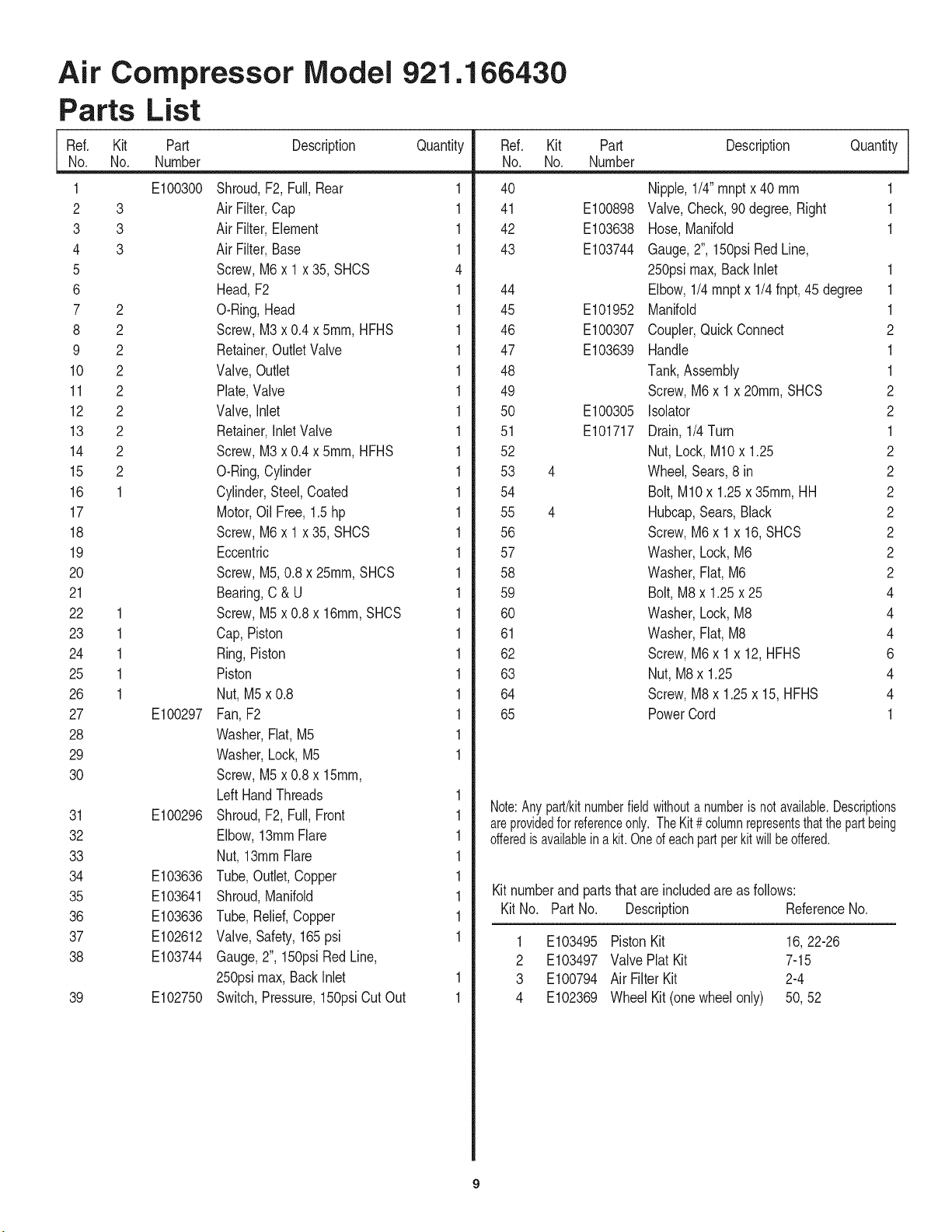
Air
Parts
L Ref. Kit
No. No.
1
2 3
3 3
4 3
5
6
7 2
8 2
9 2
10 2
11 2
12 2
13 2
14 2
15 2
16 1
17
18
19
20
21
22 1
23 1
24 1
25 1
26 1
27
28
29
3O
31
32
33
34
35
36
37
38
39
Compressor
List
Model
921.166430
Part Description Quantity Kit Part Description
Number No. Number
E100300
E100297
E100296
E103636
E103641
E103636
E102612
E103744
E102750
Shroud,F2, Full,Rear
Air Filter,Cap
Air Filter,Element
Air Filter,Base
Screw,M6x 1 x35, SHCS
Head,F2
O-Ring,Head
Screw,M3x 0.4x5ram,HFHS
Retainer,OutletValve
Valve,Outlet
Plate,Valve
Valve,Inlet
Retainer,InletValve
Screw,M3x 0.4x5ram,HFHS
O-Ring,Cylinder
Cylinder,Steel,Coated
Motor,Oil Free,1.5hp
Screw,M6x 1 x35, SHCS
Eccentric
Screw,M5,0.8x 25ram,SHCS
Bearing,C& U
Screw,M5x 0.8x 16ram,SHCS
1
1
1
1
4
1
1
1
1
1
1
1
1
Ref.
No.
40
41
42
43
44
45
46
47
48
49
5O
51
E100898
E103638
E103744
E101952
E100307
E103639
E100305
E101717
Nipple,1/4"mnptx40mm
Valve,Check,90degree,Right
Hose,Manifold
Gauge,2",150psiRedLine,
250psimax,BackInlet
Elbow,1/4mnptx 1/4fnpt,45 degree
Manifold
Coupler,QuickConnect
Handle
Tank,Assembly
Screw,M6x 1x 20ram,SHCS
Isolator
Drain,1/4Turn
1 52
1 53 4
1 54
1 55 4
1 56
1 57
1 58
1 59
1 6O
Nut,Lock,MIOx 1.25
Wheel,Sears,8 in
Bolt,MIOx 1.25x35ram,HH
Hubcap,Sears,Black
Screw,M6x 1x 16,SHCS
Washer,Lock,M6
Washer,Flat,M6
Bolt,M8x 1.25x 25
Washer,Lock,M8
Cap,Piston
Ring,Piston
Piston
Nut,M5x 0.8
Fan,F2
Washer,Flat,M5
Washer,Lock,M5
Screw,M5x 0.8x 15ram,
Left HandThreads
Shroud,F2, Full,Front
Elbow,13ramFlare
Nut,13ramFlare
Tube,Outlet,Copper
Shroud,Manifold
Tube,Relief,Copper
Valve,Safety,165psi
Gauge,2", 150psiRedLine,
250psimax,BackInlet
Switch,Pressure,150psiCutOut
1
1
1
1
1
1
1
1
1
1
1
1
1
1
1
1
1
61 Washer,Flat,M8
62 Screw,M6x 1x 12,HFHS
63 Nut,M8x 1.25
64 Screw,M8x 1.25x 15,HFHS
65 PowerCord
QuantityJ
1
1
1
1
1
1
2
1
1
2
2
1
2
2
2
2
2
2
2
4
4
4
6
4
4
1
1
2
3
4
E103495 PistonKit 16,22-26
E103497 ValvePlatKit 7-15
E100794 Air FilterKit 2-4
E102369 WheelKit(onewheel only) 50,52
Kitnumberand partsthatare includedareasfollows:
KitNo. PartNo. Description ReferenceNo.
Note:Anypart/kitnumberfieldwithouta numberisnotavailable.Descriptions
areprovidedforreferenceonly.TheKit#columnrepresentsthatthepartbeing
offeredisavailableina kit.Oneofeachpartperkitwillbeoffered.

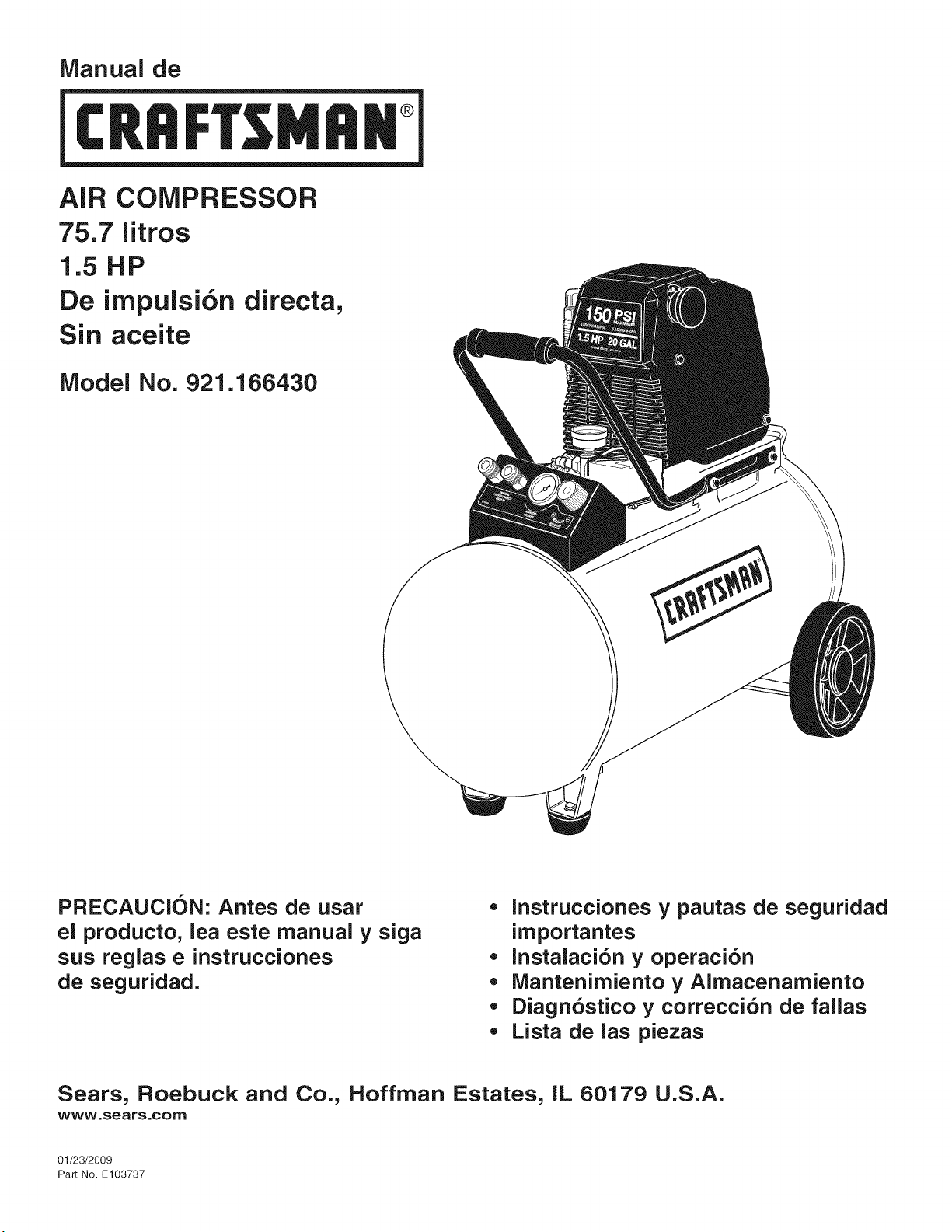
Manual de
CRRFTSl4Rli®
AIR COMPRESSOR
75.7 litros
1.5 HP
De impulsi6n directa,
Sin aceite
Model No. 921.166430
PRECAUCI6N: Antes de usar
el producto, lea este manual y siga
sus reglas e instrucciones
de seguridad.
• Instrucciones y pautas de seguridad
importantes
• Instalaci6n y operaci6n
• Mantenimiento y Almacenamiento
• Diagnostico y correccion de fallas
• Lista de las piezas
Sears, Roebuck and Co., Hoffman Estates, IL 60179 U.S.A.
www.sears.co133
01/23/2009
Part No. E103737
Garanfia
Contenido
PAgina
estapAgina
Simbolosde seguridad........................................................ 13
Important Safety Instructions & Guidelines ..................................... 13
Especificaciones............................................................ 14
Glosario ................................................................ 14
Ciclodetrabajo............................................................. 14
Partesy caracteristicas........................................................ 15
Instalaci6ny ensamblaje....................................................... 16
Procedimientosdeoperaci6n.................................................... 17
Mantenimiento............................................................. 18
AImacenamiento............................................................ 18
Diagn6sticoy correcci6nde fallas................................................. 19
Vistaesquem_.tica........................................................... 20
Listadelaspiezas........................................................... 21
GARANTiA COMPLETA DURANTE UN ANO DEL COMPRESOR DE AJRE CRAFTSMAN
Si este compresor de aire Craftsman fallase debido a defectos en materiales y mano de obra
dentro de un a_o a partir de la fecha de compra, DEVOLVERLO AL ESTABLECIMIENTO 0
CENTRO DE SERVICIO SEARS M,&S CERCANO EN LOS ESTADOS UNIDOS y este serA
reemplazado o reparado (a nuestra opci6n), gratuitamente.
Si este compresor de aire se utiliza para fines comerciales o de alquiler, esta garantia es valida
solo durante 90 dias a partir de la fecha de compra. Esta garantia brinda al comprador original
del producto derechos legales especificos; el comprador original tambien podria tener otros
derechos, los cuales varian de un estado a otro.
Sears, Roebuck and Co., Hoffman Estates, IL 60179
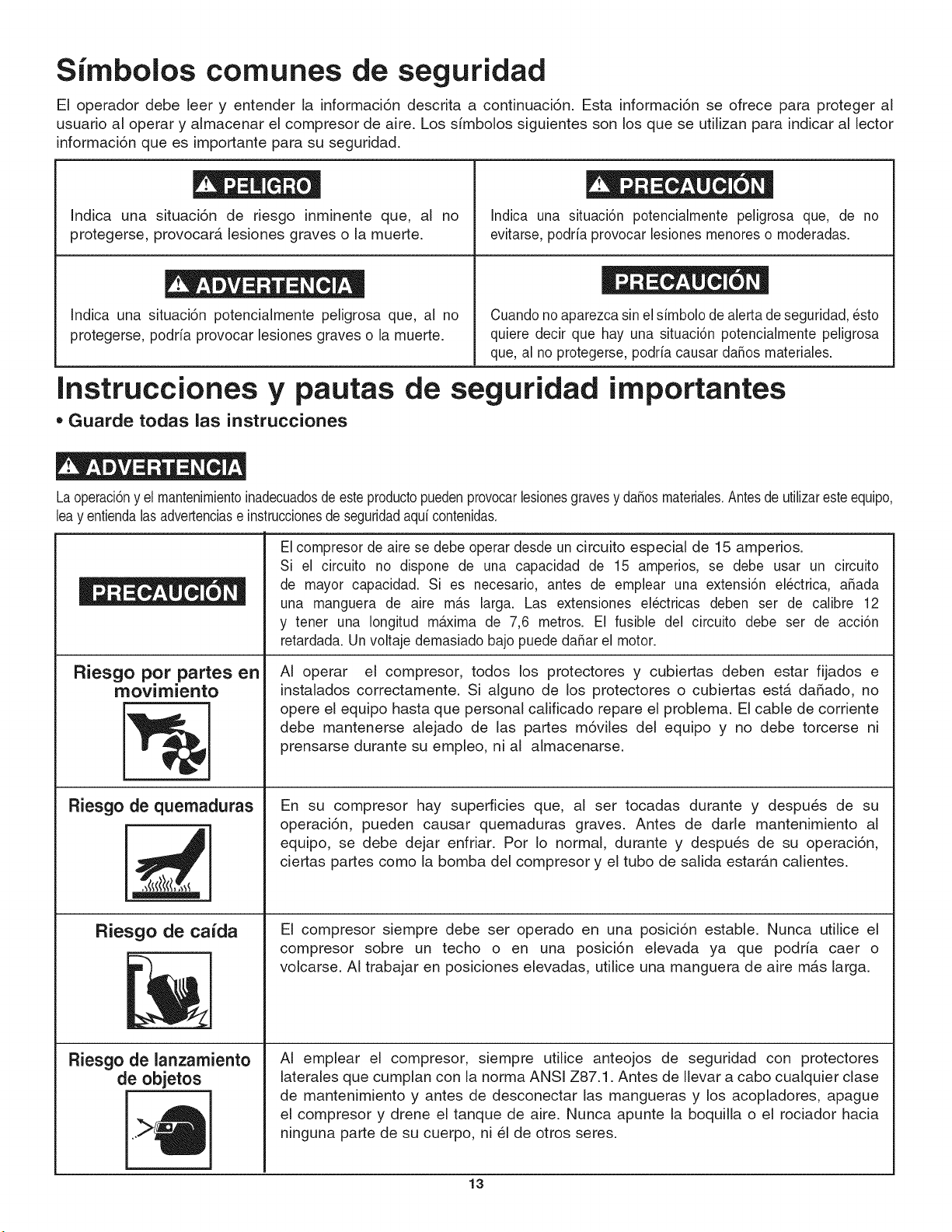
Sirnboios comunes de seguridad
El operador debe leer y entender la informaci6n descrita a continuaci6n. Esta informaci6n se ofrece para proteger al
usuario al operar y almacenar el compresor de aire. Los simbolos siguientes son los que se utilizan para indicar al lector
informaci6n que es importante para su seguridad.
Indica una situaci6n de riesgo inminente que, al no
protegerse, provocar_ lesiones graves o la muerte.
Indica una situaci6n potencialmente peligrosa que, al no
protegerse, podrfa provocar lesiones graves o la muerte.
Indica una situaci6n potencialmente peligrosa que, de no
evitarse, podria provocar lesiones menores o moderadas.
Cuando noaparezca sin el simbolo de alertade seguridad, _sto
quiere decir que hay una situaci6n potencialmente peligrosa
que, al no protegerse, podria causar da_os materiales.
nstrucciones y pautas de seguridad
,, Guarde todas las instrucciones
importantes
Laoperaci6nyel mantenimientoinadecuadosde esteproductopuedenprovocarlesionesgravesyda_osmateriales.Antesde utilizaresteequipo,
leay entiendalasadvertenciase instruccionesde seguridadaqui contenidas.
Riesgo por partes en
movimiento
Riesgo de quernaduras
Riesgo de caida
Riesgo de lanzarniento
de objetos
El compresor de aire se debe operar desde uncircuito especial de 15 amperios.
Si el circuito no dispone de una capacidad de 15 amperios, se debe usar un circuito
de mayor capacidad. Si es necesario, antes de emplear una extensi6n el_ctrica, aSada
una manguera de aire m_.s larga. Las extensiones el_ctricas deben ser de calibre 12
y tener una Iongitud maxima de 7,6 metros. El fusible del circuito debe ser de acci6n
retardada. Unvoltaje demasiado bajo puede daSar el motor.
AI operar el compresor, todos los protectores y cubiertas deben estar fijados e
instalados correctamente. Si alguno de los protectores o cubiertas estb. da_ado, no
opere el equipo hasta que personal calificado repare el problema. El cable de corriente
debe mantenerse alejado de las partes m6viles del equipo y no debe torcerse ni
prensarse durante su empleo, ni al almacenarse.
En su compresor hay superficies que, al ser tocadas durante y despues de su
operaci6n, pueden causar quemaduras graves. Antes de darle mantenimiento al
equipo, se debe dejar enfriar. Por Io normal, durante y despues de su operaci6n,
ciertas partes como la bomba del compresor y el tubo de salida estarAn calientes.
El compresor siempre debe ser operado en una posici6n estable. Nunca utilice el
compresor sobre un techo o en una posici6n elevada ya que podria caer o
volcarse. AI trabajar en posiciones elevadas, utilice una manguera de aire mAs larga.
AI emplear el compresor, siempre utilice anteojos de seguridad con protectores
laterales que cumplan con la norma ANSI Z87.1. Antes de Ilevar a cabo cualquier clase
de mantenimiento y antes de desconectar las mangueras y los acopladores, apague
el compresor y drene el tanque de aire. Nunca apunte la boquilla o el rociador hacia
ninguna parte de su cuerpo, ni el de otros seres.
13
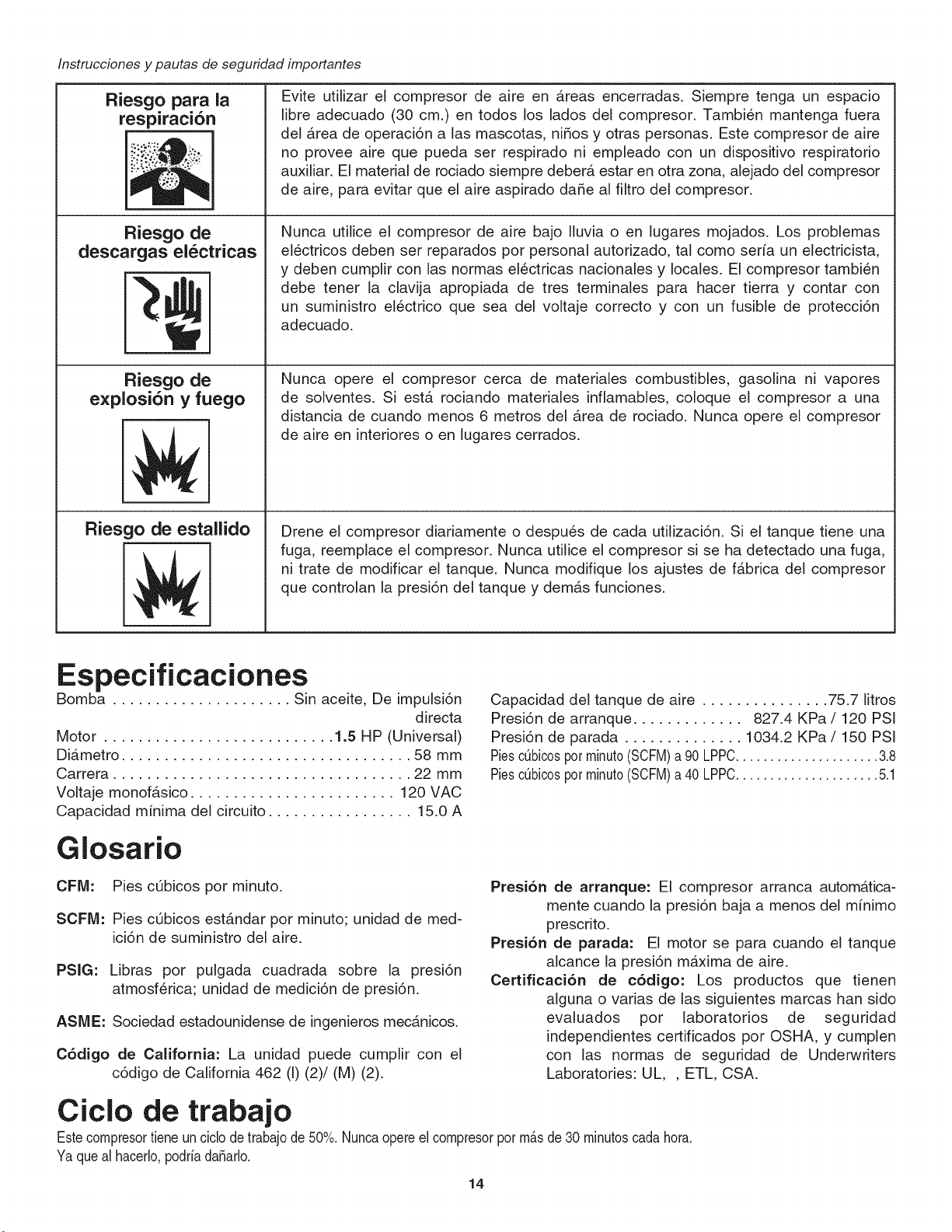
Instrucciones y pautas de seguridad importantes
Riesgo para la
respiraci6n
Riesgo de
descargas electricas
Riesgo de
explosi6n y fuego
Riesgo de estallido
Evite utilizar el compresor de aire en Areas encerradas. Siempre tenga un espacio
libre adecuado (30 cm.) en todos los lados del compresor. Tambien mantenga fuera
del Area de operaci6n alas mascotas, ni_os y otras personas. Este compresor de aire
no provee aire que pueda ser respirado ni empleado con un dispositivo respiratorio
auxiliar. El material de rociado siempre deberA estar en otra zona, alejado del compresor
de aire, para evitar que el aire aspirado da_e al filtro del compresor.
Nunca utilice el compresor de aire bajo Iluvia o en lugares mojados. Los problemas
electricos deben ser reparados por personal autorizado, tal como serfa un electricista,
y deben cumplir con las normas electricas nacionales y locales. El compresor tambien
debe tener la clavija apropiada de tres terminales para hacer tierra y contar con
un suministro electrico que sea del voltaje correcto y con un fusible de protecci6n
adecuado.
Nunca opere el compresor cerca de materiales combustibles, gasolina ni vapores
de solventes. Si esta rociando materiales inflamables, coloque el compresor a una
distancia de cuando menos 6 metros del Area de rociado. Nunca opere el compresor
de aire en interiores o en lugares cerrados.
Drene el compresor diariamente o despues de cada utilizaci6n. Si el tanque tiene una
fuga, reemplace el compresor. Nunca utilice el compresor si se ha detectado una fuga,
ni trate de modificar el tanque. Nunca modifique los ajustes de fAbrica del compresor
que controlan la presi6n del tanque y demAs funciones.
Especificaciones
Bomba ..................... Sin aceite, De impulsi6n
directa
Motor ........................... 1.5 HP (Universal)
Diametro .................................. 58 mm
Carrera ................................... 22 mm
Voltaje monofAsico ........................ 120 VAC
Capacidad minima del circuito ................. 15.0 A
Glosario
Capacidad del tanque de aire ............... 75.7 litros
Presi6n de arranque ............. 827.4 KPa / 120 PSi
Presi6n de parada .............. 1034.2 KPa / 150 PSi
PiescQbic0sp0rminut0(SCFM)a 90 LPPC..................... 3.8
PiescQbic0sp0rminut0(SCFM)a 40 LPPC..................... 5.1
CFM: Pies cQbicos por minuto.
SCFM: Pies cQbicos estAndar por minuto; unidad de med-
ici6n de suministro del aire.
PSIG: Libras por pulgada cuadrada sobre la presi6n
atmosferica; unidad de medici6n de presi6n.
ASME: Sociedad estadounidense de ingenieros mecanicos.
C6digo de California: La unidad puede cumplir con el
c6digo de California 462 (I) (2)/(M) (2).
Presi6n de arranque: El compresor arranca automatica-
mente cuando la presi6n baja a menos del minimo
prescrito.
Presi6n de parada: El motor se para cuando el tanque
alcance la presi6n maxima de aire.
Certificaci6n de c6digo: Los productos que tienen
alguna o varias de las siguientes marcas ban sido
evaluados por laboratorios de seguridad
independientes certificados por OSHA, y cumplen
con las normas de seguridad de Underwriters
Laboratories: UL, , ETL, CSA.
Ciclo de trabajo
Estecornpresortieneunciclode trabajode 50%.Nuncaopereel cornpresorpor rn_sde30 rninutoscadahora.
Ya queal hacerlo,podriada_arlo.
14
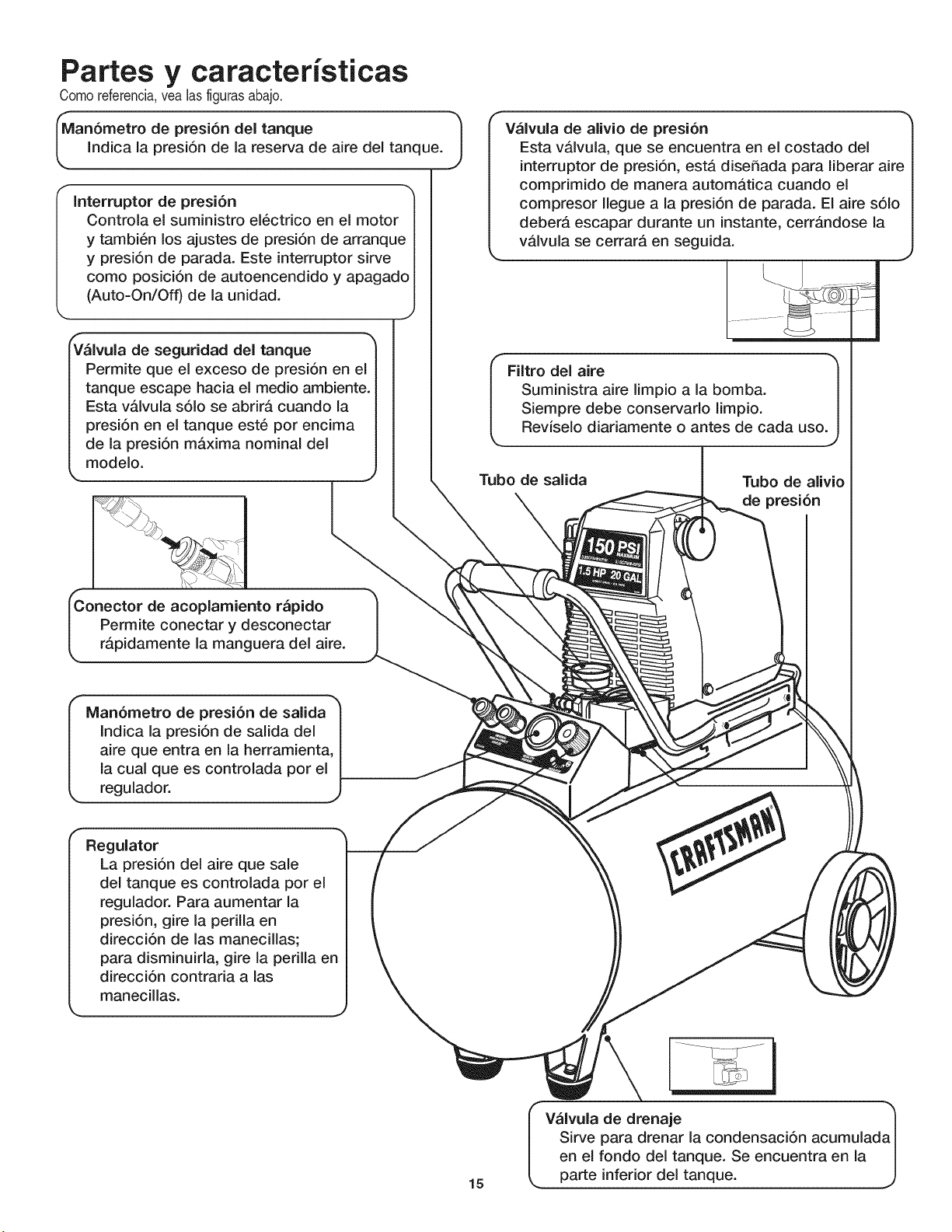
Partes y caracteristicas
Comoreferencia,vea lasfigurasabajo.
IMan6metro de presi6n del tanque "_
Indica la presi6n de la reserva de aire del tanqu_
Interruptor de presi6n
Controla el suministro el6ctrico en el motor
y tambi6n los ajustes de presi6n de arranque
y presi6n de parada. Este interruptor sirve
como posici6n de autoencendido y apagado
(Auto-On/Off) de la unidad.
_J
','_lvulade seguridad del tanque
Permite que el exceso de presi6n en el I
tanque escape hacia el medio ambiente. I
Esta v&lvula s61o se abrir& cuando la |
presi6n en el tanque est6 por encima |
de la presi6n m&xima nominal del --
modelo.
V,'_lvula de alivio de presi6n
Esta vbJvula, que se encuentra en el costado del
interruptor de presi6n, est& diseSada para Hberar aire
comprimido de manera autom&tica cuando el
compresor Ilegue a la presi6n de parada. El aire s61o
deberb, escapar durante un instante, cerr&ndose la
v_Jvula se cerrar_, en seguida.
I Filtro del aire ]
Suministra aire limpio a la bomba.
Siempre debe conservado limpio.
Reviselo diariamente o antes de cada uso.
Tubo de salida
Tubo de alivio
de presi6n
de acoplamiento r,_pido
Permite conectar y desconectar
r&pidamente la manguera del aire.
Man6metro de presi6n de salida
Indica la presi6n de salida del
aire que entra en la herramienta,
la cual que es controlada pot el
regulador.
Regulator
La presi6n del aire que sale
del tanque es controlada por el
regulador. Para aumentar la
presi6n, gire la periHa en
direcci6n de las maneciHas;
para disminuirla, gire la perilla en
direcci6n contraria alas
maneciHas.
15
I V,i_lvula de drenaje *_
Sirve para drenar la condensaci6n acumulada I
en el fondo del tanque. Se encuentra en la |
parte inferior del tanque.
)
Instalaci6n y ensamblaje
Antes de darle cualquier tipo de mantenimiento al compresor
de aire, se debe apagar y desconectar de la fuente de
alimentaci6n el6ctrica, ademAs de purgar el aire del tanque
y darle suficiente tiempo para enfriarse. Existe el riesgo
de que las partes mdviles, las fuentes el6ctricas, el aire
comprimido y las superficies calientes provoquen lesiones.
El ensamblaje de conexi6n rApida debe estar instalado
antes de usar el compresor. Un ensamblaje inadecuado
puede ser causa de fugas y posiblemente de lesiones.
En caso de dudas sobre las instrucciones de montaje o
dificultad en el montaje, por favor Ilamar al departamento
de servicio local para mayor informacidn.
Primer paso: Ubieaci6n del compresor del aire
El compresor del aire siempre debe estar en un medio
ambiente limpio, seco y bien ventilado. La unidad debe
tener por Io menos 30 cm de espacio libre en cada lado.
La toma del filtro del aire debe estar limpia y sin ning_n
tipo de obstrucci6n. Examinar el filtro de aire diariamente
para verificar que este limpio yen buenas condiciones de
funcionamiento.
Riesgo de incendio o explosi6n
Este producto incorpora un interruptor con contactos de
transici6n brusca y un motor el6ctrico universal que tienden
a producir arcos y chisporroteo. Por Io tanto, no se Io debe
exponer a liquidos o vapores inflamables. Este producto
no est_ previsto para uso o instalaci6n en un entorno de
garaje o taller comerciak
Instrucciones de conexi6n a tierra
Este producto se debe conectar a tierra. En el caso de
que haya un cortocircuito, la conexi6n a tierra reduce el
riesgo de descargas el6ctricas al ofrecer una ruta de
escape para la corriente el6ctrica. Este producto cuenta
con un cable que tiene un alambre de tierra y una clavija
con terminal de tierra (ver la figura a continuaci6n). La
clavija debe enchufarse en un tomacorriente instalado y
puesto a tierra segt_n las normas locales. Hable con un
electricista o agente de servicio calificado si no entiende
completamente estas instrucciones, o si tiene dudas
sobre la correcta puesta a tierra de la herramienta.
Una conexi6n a tierra inadecuada puede provocar una
descarga el6ctrica. Si necesita reparar o cambiar el cable o
la clavija, no conecte el alambre de tierra con ninguna de las
terminales planas. El alambre de tierra es de color verde,
con o sin franjas amarillas. Si no entiende completamente
las instrucciones de conexi6n a tierra, o si tiene dudas sobre
la correcta puesta a tierra de la herramienta, hable con un
electricista o agente de servicio calificado. No modifique la
clavija que viene con el equipo; si no puede enchufarla en
el tomacorriente, Ilame a un electricista calificado para que
le instale el tomacorriente adecuado.
Este producto est,. dise5ado para trabajar en un circuito
con un voltaje nominal de 120 voltios y est& equipado en
la f&brica con un cable y clavija que permiten su conexi6n
a un circuito el6ctrico apropiado. AsegQrese de que el
producto este conectado a un tomacorriente con la misma
configuraci6n que la clavija. No se debe usar un adaptador
con este equipo. Si debe conectar el equipo con un circuito
el6ctrico de diferente tipo, consiga la ayuda de personal
calificado para realizar la reconexi6n.
Cables de extensi6n
$61o utilice un cable de extensi6n de tres alambres con
una clavija con extensi6n a tierra de tres terminales que
pueda enchufarse en un tomacorriente de tres orificios.
AsegOrese de que su cable de extensi6n este en buenas
condiciones. Si utiliza un cable de extensi6n, compruebe
que sea de la capacidad de la corriente que requiere su
equipo. Las extensiones no deben ser de mAs de 25 pies
(7,6 m) de largo y deben tener cable de calibre 12 AWG.
Un cable mAs delgado provocarA una caida en el voltaje
de la I[nea, Io que provocafia una perdida de potencia y
sobrecalentamiento.
Procedimiento inicial de preparaci6n
No se requiere un procedimiento inicial de preparaci6n.
Este producto ha sido probado en la fAbrica para asegurar
su operaci6n y rendimiento adecuados.
16
Procedirnientos de
Procedimiento diario de arranque
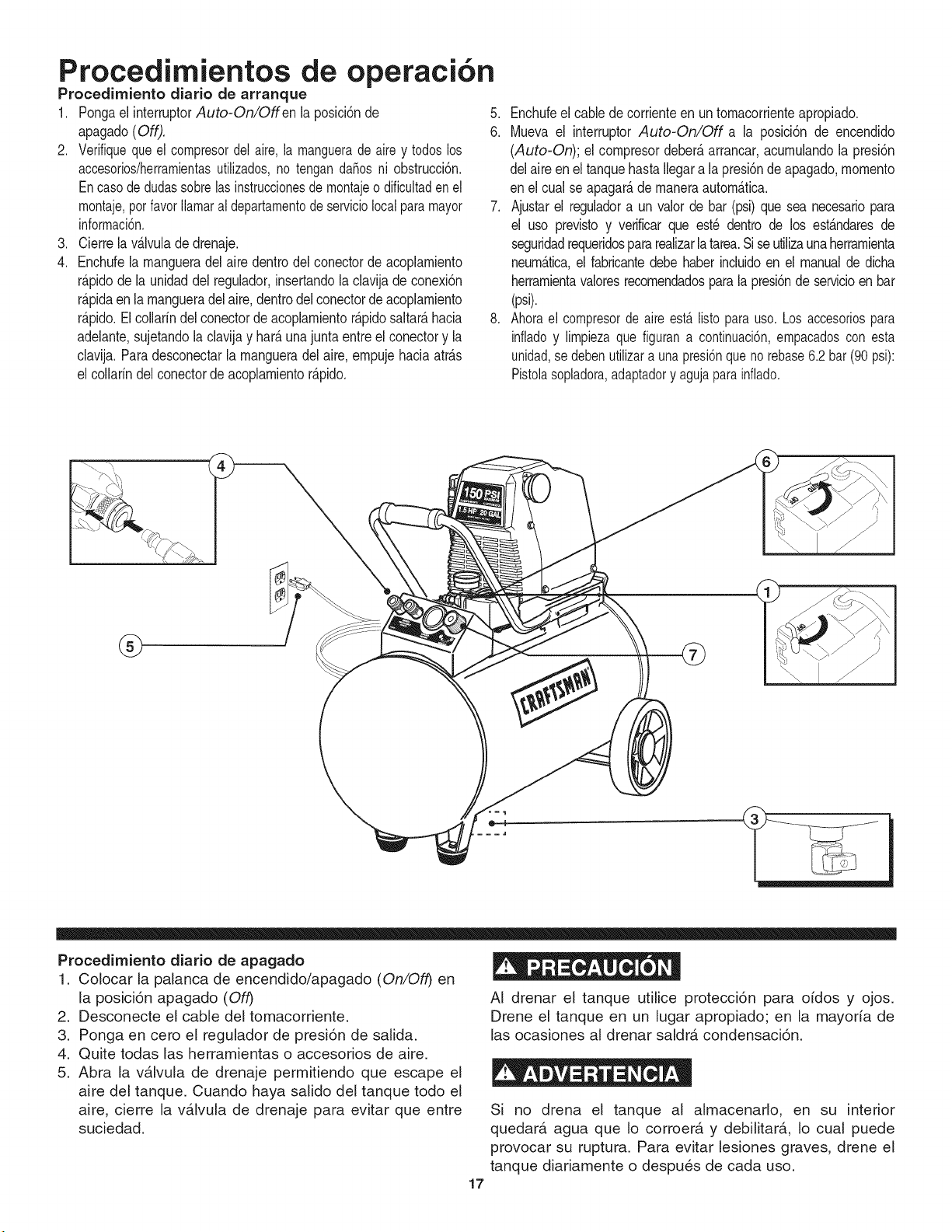
1. Pongael interruptorAuto-On/Offen la posici6nde
apagado(Off).
2. Verifiquequeel compresordelaire,la manguerade aire ytodoslos
accesorios/herramientasutilizados,no tengandaSosni obstrucci6n.
Encasodedudassobrelasinstruccionesde montajeodificultadenel
montaje,porfavorIlamaraldepartamentodeserviciolocalparamayor
informaci6n.
3. Cierrela v_.lvulade drenaje.
4. Enchufela mangueradelaire dentrodel conectorde acoplamiento
r_.pidode la unidaddel regulador,insertandola clavijade conexi6n
r_.pidaen la mangueradelaire,dentrodelconectordeacoplamiento
r_.pido.Elcollarindel conectorde acoplamientor_.pidosaltar_,hacia
adelante,sujetandola clavijay har_.unajuntaentreel conectory la
clavija.Paradesconectarla mangueradel aire,empujehaciaatr_.s
el collarindel conectordeacoplamientor_.pido.
operaci6n
5.
6.
,
,
Enchufeel cablede corrienteen untomacorrienteapropiado.
Mueva el interruptorAuto-On/Off a la posici6nde encendido
(Auto-On); el compresordeber_,arrancar,acumulandola presi6n
delaireenel tanquehastaIlegara la presi6ndeapagado,momento
enel cualseapagar_,de maneraautom_.tica.
Ajustarel reguladora un valorde bar (psi)quesea necesariopara
el uso previstoy verificarque est_ dentrode los est_.ndaresde
seguridadrequeridospararealizarlatarea.Siseutilizaunaherramienta
neum_.tica,el fabricantedebe haberincluidoen el manualde dicha
herramientavaloresrecomendadosparala presi6nde servicioen bar
(psi).
Ahorael compresorde aireest,. listoparauso.Losaccesoriospara
infladoy limpiezaque figurana continuaci6n,empacadoscon esta
unidad,sedebenutilizara unapresi6nquenorebase6.2bar(90psi):
Pistolasopladora,adaptadory agujaparainflado.
Procedimiento diario de apagado
1. Colocar la palanca de encendido/apagado (On/Oft) en
la posici6n apagado (Oft)
2. Desconecte el cable del tomacorriente.
3. Ponga en cero el regulador de presi6n de salida.
4. Quite todas las herramientas o accesorios de aire.
5. Abra la v_lvula de drenaje permitiendo que escape el
aire del tanque. Cuando haya salido del tanque todo el
aire, cierre la valvula de drenaje para evitar que entre
suciedad.
17
AI drenar el tanque utilice protecci6n para oidos y ojos.
Drene el tanque en un lugar apropiado; en la mayoria de
las ocasiones al drenar saldr_ condensaci6n.
Si no drena el tanque al almacenarlo, en su interior
quedar,:4,agua que Io corroer_ y debilitar_, Io cual puede
provocar su ruptura. Para evitar lesiones graves, drene el
tanque diariamente o despues de cada uso.
iVlantenirniento
NOTA: Cualquier procedimiento de servicio que no
est_ cubierto en el programa de mantenimiento que
sigue debera ser efectuado el personal de servicio
calificado.
Antes de dar mantenimiento al equipo, se debe apagar
y desconectar del tomacorriente, asi como purgar el
aire del tanque y permitir que la unidad se enfrie.
no intentar retirar o ajustar la valvula de seguridad
Antes de cada uso
Asuntos para verificar/cambiar
o diariamente
RevisarlavAIvuladeseguridaddeltanque X
Revisarvisuaimentee[aspectogenera[ X
de [aunidad
Drenare[tanque X
Verificarquee[cableei_ctricono est_ X
dafiado
A fin de asegurar una operaci6n eficiente y una larga vida
del compresor, debe seguir un programa de mantenimiento
de rutina. El siguiente programa de mantenimiento estb.
enfocado al consumidor cuyo compresor es usado en un
medio ambiente normal y diariamente.
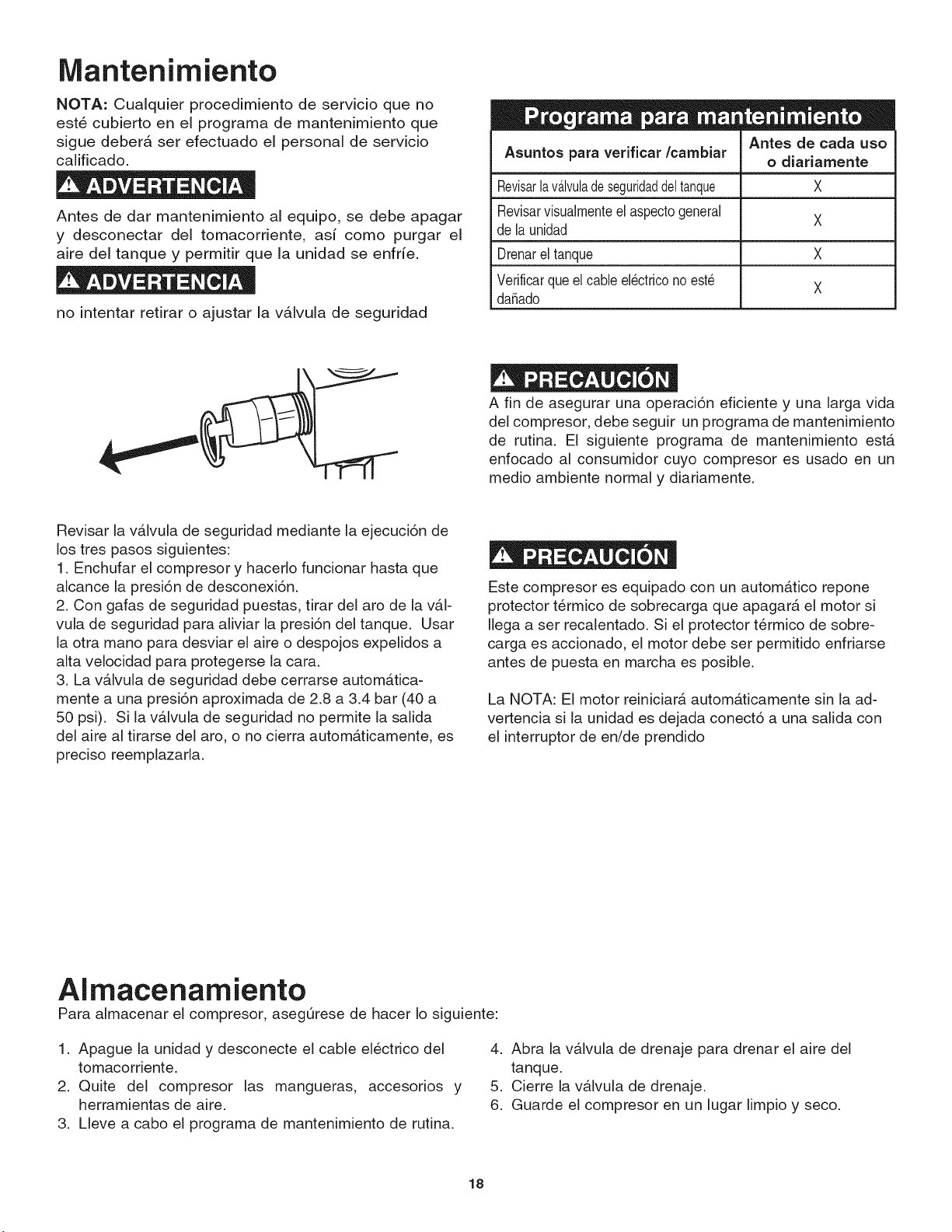
Revisar la v&lvula de seguridad mediante la ejecuci6n de
los tres pasos siguientes:
1. Enchufar el compresor y hacerlo funcionar hasta que
alcance la presi6n de desconexi6n.
2. Con gafas de seguridad puestas, tirar de[ aro de la v,:4.l-
vula de seguridad para aliviar la presi6n del tanque. Usar
la otra mano para desviar el aire o despojos expelidos a
alta velocidad para protegerse la cara.
3. La valvula de seguridad debe cerrarse automAtica-
mente a una presi6n aproximada de 2.8 a 3.4 bar (40 a
50 psi). Si la valvula de seguridad no permite la salida
de[ aire al tirarse del aro, o no cierra autom&ticamente, es
preciso reemplazarla.
Este compresor es equipado con un autom&tico repone
protector termico de sobrecarga que apagar& el motor si
Ilega a ser recalentado. Si el protector termico de sobre-
carga es accionado, el motor debe ser permitido enfriarse
antes de puesta en marcha es posible.
La NOTA: El motor reiniciarA automAticamente sin [a ad-
vertencia si [a unidad es dejada conect6 a una salida con
el interruptor de en/de prendido
Aimacenamiento
Para almacenar el compresor, aseg_rese de hacer Io siguiente:
1. Apague [a unidad y desconecte el cable electrico del
tomacorriente.
2. Quite de[ compresor las mangueras, accesorios y
herramientas de aire.
3. Lleve a cabo el programa de mantenimiento de rutina.
4. Abra la v,:4.1vulade drenaje para drenar el aire del
tanque.
5. Cierre la vAlvula de drenaje.
6. Guarde el compresor en un lugar limpio y seco.
18
Diagn6stico y correcci6n de fallas
Antes de dar mantenimiento al equipo, se debe apagar y desconectar del tomacorriente, asi
como purgar el aire del tanque y permitir que la unidad se enfrie. Las partes en movimiento,
las fuentes electricas, el aire comprimido y las superficies calientes pueden provocar lesiones.
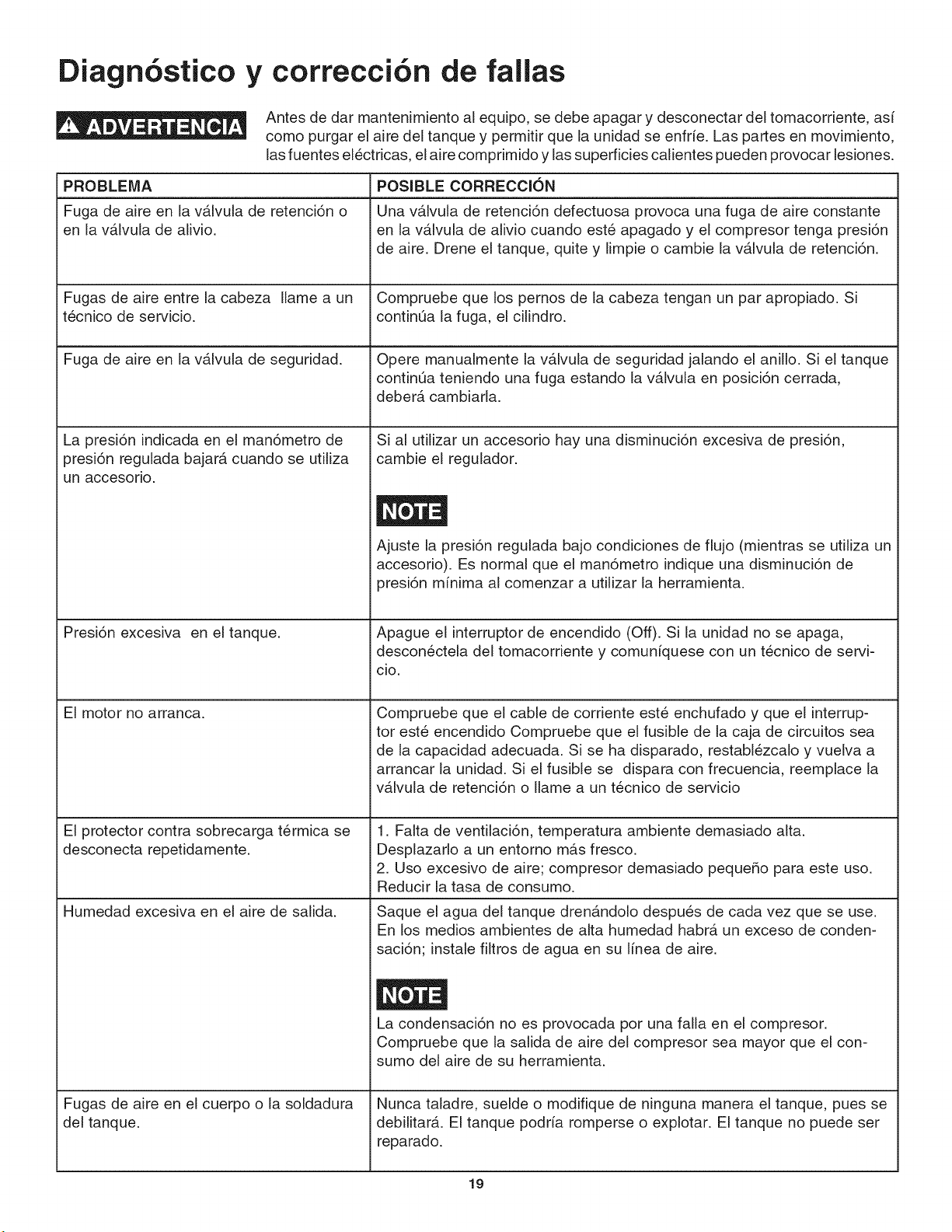
PROBLEMA
Fuga de aire en la v&lvula de retenci6n o
en la valvula de alivio.
Fugas de aire entre la cabeza Ilame a un
tecnico de servicio.
Fuga de aire en la valvula de seguridad.
La presi6n indicada en el man6metro de
presi6n regulada bajar& cuando se utiliza
un accesorio.
Presi6n excesiva en el tanque.
El motor no arranca.
El protector contra sobrecarga termica se
desconecta repetidamente.
Humedad excesiva en el aire de salida.
Fugas de aire en el cuerpo o la soldadura
del tanque.
POSIBLE CORRECCION
Una valvula de retenci6n defectuosa provoca una fuga de aire constante
en la valvula de alivio cuando este apagado y el compresor tenga presi6n
de aire. Drene el tanque, quite y limpie o cambie la valvula de retenci6n.
Compruebe que los pernos de la cabeza tengan un par apropiado. Si
continQa la fuga, el cilindro.
Opere manualmente la valvula de seguridad jalando el anillo. Si el tanque
continQa teniendo una fuga estando la valvula en posici6n cerrada,
deber& cambiarla.
Sial utilizar un accesorio hay una disminuci6n excesiva de presi6n,
cambie el regulador.
Ajuste la presi6n regulada bajo condiciones de flujo (mientras se utiliza un
accesorio). Es normal que el man6metro indique una disminuci6n de
presi6n minima al comenzar a utilizar la herramienta.
Apague el interruptor de encendido (Off). Si la unidad no se apaga,
desconectela del tomacorriente y comuniquese con un tecnico de servi-
cio.
Compruebe que el cable de corriente este enchufado y que el interrup-
tor este encendido Compruebe que el fusible de la caja de circuitos sea
de la capacidad adecuada. Si se ha disparado, restablezcalo y vuelva a
arrancar la unidad. Si el fusible se dispara con frecuencia, reemplace la
valvula de retenci6n o Ilame a un tecnico de servicio
1. Falta de ventilaci6n, temperatura ambiente demasiado alta.
Desplazarlo a un entorno mas fresco.
2. Uso excesivo de aire; compresor demasiado peque5o para este uso.
Reducir la tasa de consumo.
Saque el agua del tanque drenandolo despues de cada vez que se use.
En los medios ambientes de alta humedad habr& un exceso de conden-
saci6n; instale filtros de agua en su linea de aire.
La condensaci6n no es provocada por una falla en el compresor.
Compruebe que la salida de aire del compresor sea mayor que el con-
sumo del aire de su herramienta.
Nunca taladre, suelde o modifique de ninguna manera el tanque, pues se
debilitarA. El tanque podria romperse o explotar. El tanque no puede ser
reparado.
19
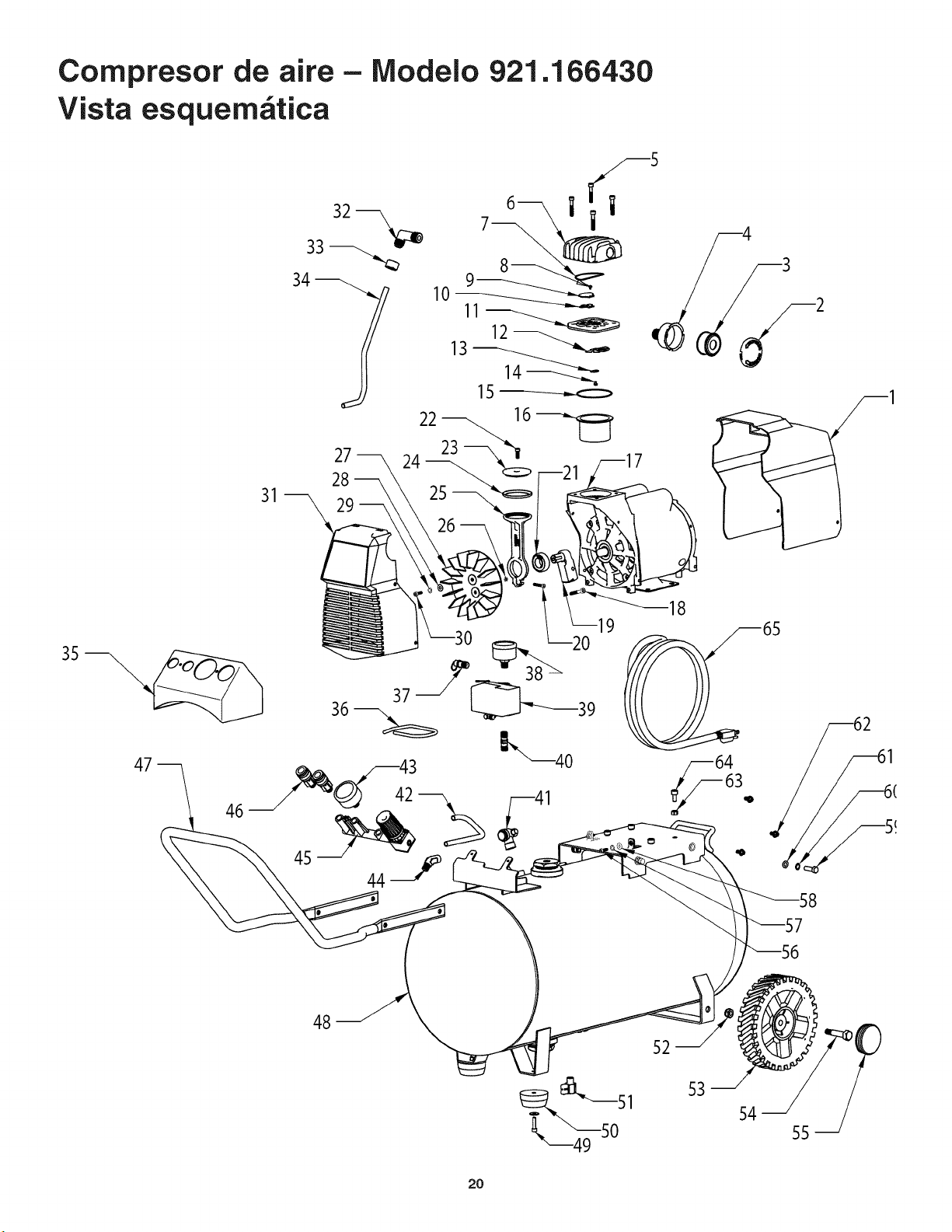
Compresor de aire
Vista esquem_tica
- iVlodelo
921.166430
22
24
37
18
39 9 _65
_40 64
63
48
52
53--
54
55
2O
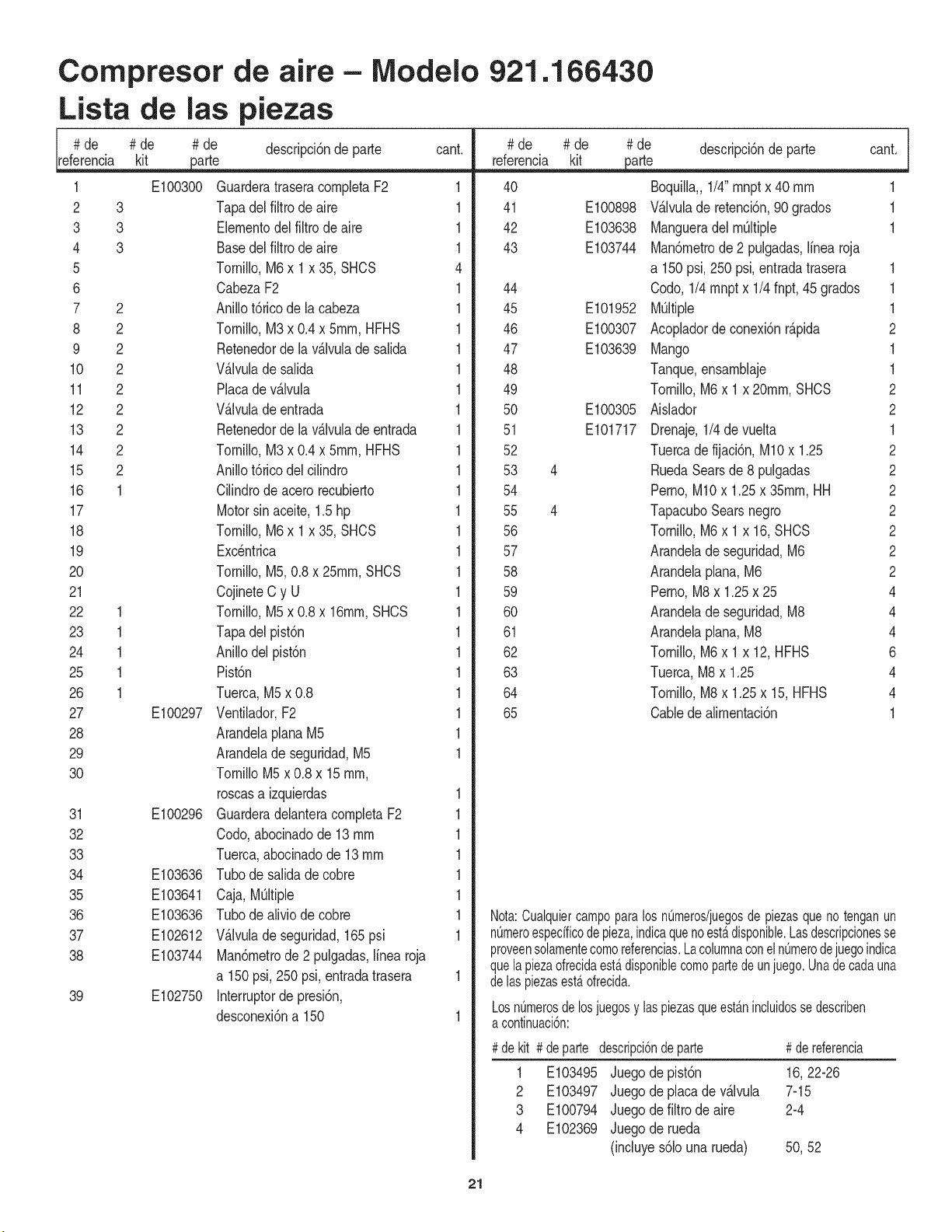
Cornpresor de aire- IVlodelo 921.166430
Lista de ias piezas
ref#rdeec.a#kde #adrt_ descripci6nde parte cant. ref_rdeecia#kle #ad_ descripci6ndeparte cant.
1
2
3
4
5
6
7
8
9
10
11
12
13
14
15
16
17
18
19
2O
21
22
23
24
25
26
27
28
29
30
31
32
33
34
35
36
37
38
3
3
3
2
2
2
2
2
2
2
2
2
1
1
1
1
1
1
E100300 GuarderatraseracompletaF2 1
Tapadelfiltrode aire 1
Elernentodelfiltrode aire 1
Basedelfiltrode aire 1
Tornillo,M6x 1x 35,SHCS 4
CabezaF2 1
Anillot6ricode lacabeza 1
Tornillo,M3x 0.4x5ram,HFHS 1
Retenedorde lawilvulade salida 1
V_.lvulade salida 1
Placadev_.lvula 1
V_.lvulade entrada 1
Retenedorde lav_.lvulade entrada 1
Tornillo,M3x 0.4x5ram,HFHS 1
Anillot6ricodelcilindro 1
Cilindrode acerorecubierto 1
Motorsinaceite,1.5hp 1
Tornillo,M6x 1x 35,SHCS 1
Excentrica 1
Tornillo,M5,0.8x 25ram,SHCS 1
CojineteCy U 1
Tornillo,M5x 0.8x 16ram,SHCS 1
Tapadel pist6n 1
Anillodel pist6n 1
Pist6n 1
Tuerca,M5x 0.8 1
E100297 Ventilador,F2 1
ArandelaplanaM5 1
Arandelade seguridad,M5 1
TornilloM5x 0.8x 15ram,
roscasa izquierdas 1
E100296 GuarderadelanteracompletaF2 1
Codo,abocinadode 13mm 1
Tuerca,abocinadode 13mm 1
E103636 Tubode salidadecobre 1
E103641 Caja,M[iltiple 1
E103636 Tubode aliviodecobre 1
E102612 V_.lvulade seguridad,165psi 1
E103744 Man6metrode2 pulgadas,linearoja
a 150psi,250 psi,entradatrasera 1
E102750 Interruptordepresi6n,
desconexi6na 150 1
39
4O
41 E100898
42 E103638
43 E103744
44
45
46
47
48
49
5O
51
52
53
54
55
56
57
58
59
6O
61
62
63
64
65
4
4
E101952
E100307
E103639
E100305
E101717
Boquilla,,1/4"mnptx 40mrn 1
V_.lvulade retenci6n,90 grados 1
Mangueradel m_ltiple 1
Man6metrode2 pulgadas,linearoja
a 150psi,250 psi,entradatrasera 1
Codo,1/4mnptx 1/4fnpt,45grados 1
M_ltiple 1
Acopladorde conexidnr_.pida 2
Mango 1
Tanque,ensamblaje 1
Tornillo,M6x 1x 20ram,SHCS 2
Aislador 2
Drenaje,1/4de vuelta 1
Tuercadefijaci6n,MIOx 1.25 2
RuedaSearsde 8 pulgadas 2
Perno,MIOx 1.25x 35ram,HH 2
TapacuboSearsnegro 2
Tornillo,M6x 1x 16,SHCS 2
Arandelade seguridad,M6 2
Arandelaplana,M6 2
Perno,M8x 1.25x 25 4
Arandelade seguridad,M8 4
Arandelaplana,M8 4
Tornillo,M6x 1x 12,HFHS 6
Tuerca,M8x 1.25 4
Tornillo,M8x 1.25x 15,HFHS 4
Cabledealimentacidn 1
Nota:CualquiercampoparalosnQmeros/juegosde piezasquenotenganun
nQmeroespecificodepieza,indicaquenoestAdisponible.Lasdescripcionesse
proveensolamentecomoreferencias.LacolumnaconelnOmerodejuegoindica
quelapiezaofrecidaestAdisponiblecomopartedeunjuego.Unadecadauna
delaspiezasestAofrecida.
LosnQmerosdelosjuegosylaspiezasqueestAnincluidossedescriben
acontinuaci6n:
#dekit # departe descripci6ndeparte #dereferencia
1 E103495 Juegode pist6n 16,22-26
2 E103497 Juegode placadev_.lvula 7-15
3 E100794 Juegode filtrodeaire 2-4
4 E102369 Juegode rueda
(incluyes61ounarueda) 50,52
21

AuCanadapourserviceen{ran_ais:
1-800-LE-FOYER "R
{1-800-553-8837)
www.seaps.ca
SMTM
® RegisteredTrsdemarb/ Trsdemarb/ ServiceMaPRof Sears,RoebucksadCo.
SpATM
® Narcs Rogistreda/ Narcs de Fabrics/ Narcs doRorviciodoSears,RoebucbandCo.
pAo
McNarque decommerce/ IViarquodeposeedeSoars,RoebucksodCo.
®ReaPs Brands,LLC
