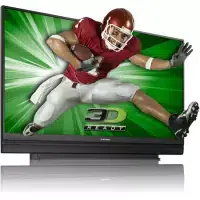
DLP® HIGH-DEFINITION
MODELS
C Series
WD=C657
Y Series
WD=Y577,WD=Y657
733 Series
WD=57733, WD=65733, WD=73733
734 Series
WD=57734, WD=65734, WD-73734
OWNER'S GUIDE
TELEVISION
• For questions:
Visit our website at www.mitsubishi-tv.com.
Call Consumer Relations at 800-332-2119.
• For information on System Reset, please see the back cover.
• To order replacement or additional remote controls, lamp cartridges, or Owner's Guides,
visit our website at www.mitsuparts.com or call 800-553-7278.
• Guidelines for setting up and using your new widescreen TV start on page 11.
x.v.Color HiGH DEFiNITiON MULTiM EDiA iNTERFACE
_Lp®PICTUREBY
TEXASINSTRUMENTS
For Your Records
Record the model number, serial number, and
purchase date of yourTV. The model and serial
numbers are on the back of the TV. Refer to this
page when requesting assistance with the TV.
MODEL NUMBER __
SERIAL NUMBER
PURCHASE DATE
RETAILER NAME
LOCATION
CAUTION: TO REDUCE THE RISK OF ELECTRIC
SHOCK, DO NOT REMOVE COVER (OR BACK).
NO USER SERVICEABLE PARTS INSIDE.
REFER SERVICING TO QUALIFIED SERVICE
PERSONNEL.
The lightning flash with arrowhead
symbol within an equilateral triangle is
intended to alert the user of the pres-
ence of uninsulated "dangerous voltage"
within the product's enclosure that may
be of sufficient magnitude to constitute
a risk of electric shock to persons.
The exclamation point within an equilat-
eral triangle is intended to alert the user to
the presence of important operating and
maintenance (servicing) instructions in the
literature accompanying the product.
WARNING: TO REDUCE THE RISK OF FIRE
OR ELECTRIC SHOCK, DO NOT EXPOSE THiS
APPLIANCE TO RAiN OR MOISTURE.
TV WEIGHT: This TV is heavy! Exercise extreme care
when lifting or moving it. Lift or move the TV with a
minimum of two adults. To prevent damage to the TV,
avoid jarring or moving it while it is turned on. Always
power off your TV, unplug the power cord, and discon-
nect all cables before moving it.
WARNING: This product contains chemicals known
to the State of California to cause cancer and/or birth
defects or other reproductive harm.
FCC Declaration of Conformity
Product:
Models:
Responsible
Party:
Telephone:
Projection Television Receiver
WD-C657
WD-57733, WD-65733, WD-73733
WD-Y577, WD-Y657
WD-57734, WD-65734, WD-73734
Mitsubishi Digital Electronics
America, Inc.
9351 Jeronimo Road
Irvine, CA 92618-1904
(800) 332-2119
This device complies with Part 15 of the FCC Rules.
Operation is subject to the following two conditions:
(1) This device may not cause harmful interference,
and
(2) this device must accept any interference
received, including interference that may cause
undesired operation.
Note: This equipment has been tested and found
to comply with the limits for a Class B digital device,
pursuant to part 15 of the FCC Rules. These limits
are designed to provide reasonable protection
against harmful interference in a residential instal-
lation. This equipment generates, uses and can
radiate radio frequency energy and, if not installed
and used in accordance with the instructions, may
cause harmful interference to radio communica-
tions. However, there is no guarantee that interfer-
ence will not occur in a particular installation. If this
equipment does cause harmful interference to radio
or television reception, which can be determined
by turning the equipment off and on, the user is
encouraged to try to correct the interference by one
or more of the following measures:
• Reorient or relocate the receiving antenna.
Increase the separation between the equip-
ment and the receiver.
Connect the equipment into an outlet on
a circuit different from that to which the
receiver is connected.
Consult the dealer or an experienced
radio/TV technician for help.
Changes or modifications not expressly
approved by Mitsubishi could cause harmful
interference and would void the user's authority
to operate this equipment.
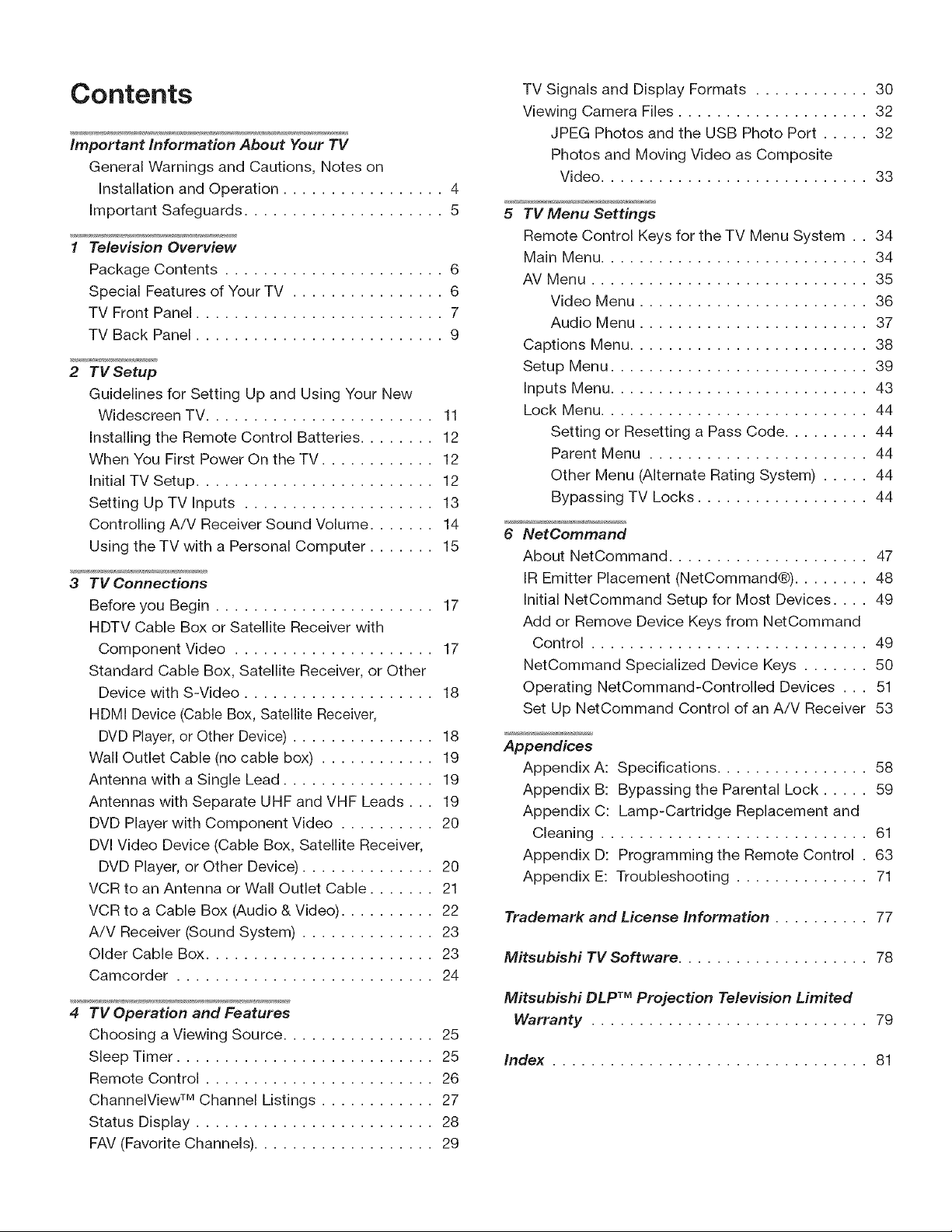
Contents
Important Information About Your TV
General Warnings and Cautions, Notes on
Installation and Operation ................. 4
Important Safeguards ..................... 5
1 Television Overview
Package Contents ....................... 6
Special Features of Your TV ................ 6
TV Front Panel .......................... 7
TV Back Panel .......................... 9
2 TV Setup
Guidelines for Setting Up and Using Your New
Widescreen TV ........................ 11
Installing the Remote Control Batteries ........ 12
When You First Power On the TV ............ 12
Initial TV Setup ......................... 12
Setting Up TV Inputs .................... 13
Controlling A/V Receiver Sound Volume ....... 14
Using the TV with a Personal Computer ....... 15
3 TV Connections
Before you Begin ....................... 17
HDTV Cable Box or Satellite Receiver with
Component Video ..................... 17
Standard Cable Box, Satellite Receiver, or Other
Device with S-Video .................... 18
HDMI Device (Cable Box, Satellite Receiver,
DVD Player, or Other Device) ............... 18
Wall Outlet Cable (no cable box) ............ 19
Antenna with a Single Lead ................ 19
Antennas with Separate UHF and VHF Leads... 19
DVD Player with Component Video .......... 20
DVI Video Device (Cable Box, Satellite Receiver,
DVD Player, or Other Device) .............. 20
VCR to an Antenna or Wall Outlet Cable ....... 21
VCR to a Cable Box (Audio & Video) .......... 22
A/V Receiver (Sound System) .............. 23
Older Cable Box ........................ 23
Camcorder ........................... 24
4 TV Operation and Features
Choosing a Viewing Source ................ 25
Sleep Timer ........................... 25
Remote Control ........................ 26
ChanneIView TM Channel Listings ............ 27
Status Display ......................... 28
FAV (Favorite Channels) ................... 29
TV Signals and Display Formats ............ 30
Viewing Camera Files .................... 32
JPEG Photos and the USB Photo Port ..... 32
Photos and Moving Video as Composite
Video ............................ 33
5 TV Menu Settings
Remote Control Keys for the TV Menu System . . 34
Main Menu ............................ 34
AV Menu ............................. 35
Video Menu ........................ 36
Audio Menu ........................ 37
Captions Menu ......................... 38
Setup Menu ........................... 39
Inputs Menu ........................... 43
Lock Menu ............................ 44
Setting or Resetting a Pass Code ......... 44
Parent Menu ....................... 44
Other Menu (Alternate Rating System) ..... 44
Bypassing TV Locks .................. 44
6 NetCommand
About NetCommand ..................... 47
IR Emitter Placement (NetCommand®) ........ 48
Initial NetCommand Setup for Most Devices .... 49
Add or Remove Device Keys from NetCommand
Control ............................. 49
NetCommand Specialized Device Keys ....... 50
Operating NetCommand-Controlled Devices . . . 51
Set Up NetCommand Control of an A/V Receiver 53
Appendices
Appendix A: Specifications ................ 58
Appendix B: Bypassing the Parental Lock ..... 59
Appendix C: Lamp-Cartridge Replacement and
Cleaning ............................ 61
Appendix D: Programming the Remote Control . 63
Appendix E: Troubleshooting .............. 71
Trademark and License Information .......... 77
Mitsubishi TV Software .................... 78
Mitsubishi DLP TM Projection Television Limited
Warranty ............................. 79
Index ................................. 81

important information About Your TV
Installation Notes
Stand Requirement
CAUTION: Use these Mitsubishi TV models only with
the Mitsubishi stand models shown here. Other stands
can result in instability and possibly cause injury.
WD-57733
WD-Y577 MB-57PB
WD-57734
WD-65733
WD-Y657 M B-65PB
WD-65734
WD-C657 MB-65G
WD-73733
M B-73PB
WD-73734
Custom cabinet installation must allow for proper
air circulation around the television.
NOTE TO CATV SYSTEM iNSTALLER: THIS
REMINDER IS PROVIDED TO CALL THE CATV SYSTEM
INSTALLER'S ATTENTION TO ARTICLE 820-40 OF THE
NEC THAT PROVIDES GUIDELINES FOR THE PROPER
GROUNDING AND, IN PARTICULAR, SPECIFIES THAT
THE CABLE GROUND SHALL BE CONNECTED TO
THE GROUNDING SYSTEM OFTHE BUILDING, AS
CLOSE TO THE POINT OF CABLE ENTRY AS PRACTI-
CAL.
Operating Notes
Internal Fans
Internal cooling fans maintain proper operating tempera-
tures inside the TV. It is normal to hear the fans when you
first turn on the TV, during quiet scenes while viewing the
TV, and for a short time after turning off the TV.
Lamp Replacement
For lamp-replacement instructions, see Appendix C.
To Order a Replacement Lamp Under Warranty
Call (800) 553-7278. Please have model number, serial
number, and TV purchase date available.
important: All lamps replaced under warranty must be
returned to Mitsubishi where they will be inspected for
defect verification.
Cleaning Recommendations
Normally, light dusting with a dry, non-scratching
duster will keep your TV clean. If cleaning beyond this
is needed, please use the following guidelines:
First, turn off the TV and unplug the power cord from
the power outlet.
ToP and Sides of the TV
• Occasionally clean dust build-up from the air-intake
grilles on the back and sides of the TV. Clean using
a vacuum cleaner with a brush attachment.
Gently wipe down your TV with a soft, non-abrasive
cloth such as cotton flannel or a clean cloth diaper,
lightly moistened with water. Dry with a second dry,
soft, non-abrasive cloth.
• For oily dirt, add a few drops of mild liquid deter-
gent, such as dishwashing detergent, to the water
used to moisten the cloth. Rinse with a second
cloth moistened only with water. Dry with a third
dry, soft, non-abrasive cloth.
Screen
• Follow the instructions for the top and sides, wiping
gently in an up and down motion.
Clean the entire screen evenly, not just sections of
the screen.
Do not allow liquid to drip down the screen, as
some liquid may enter the TV through the gap
between the screen and screen frame.
You may purchase Mitsubishi Screen Cleaner, part
number CLEANER-VSS, by calling (800) 553-7278.
DO NOT allow liquid to enter the TV through the
ventilation slots or any crevice.
DO NOT use any strong or abrasive cleaners, as
these can scratch the surfaces.
DO NOT use any cleaners containing ammonia,
bleach, alcohol, benzene, or thinners, as these can
dull the surfaces.
DO NOT spray liquids or cleaners directly on the
TV's surfaces.
DO NOT scrub or rub the TV harshly. Wipe it gently.
To Purchase a Replacement Lamp After Warranty
Visit our website at www.mitsuparts.com or call
(800) 553-7278. Order new lamp part number
915P061010.
TV Software
Do not attempt to update the software of this TV with
software or USB drives not provided by or authorized
by Mitsubishi Digital Electronics America, Inc. Non-
authorized software may damage the TV and will not be
covered by the warranty.
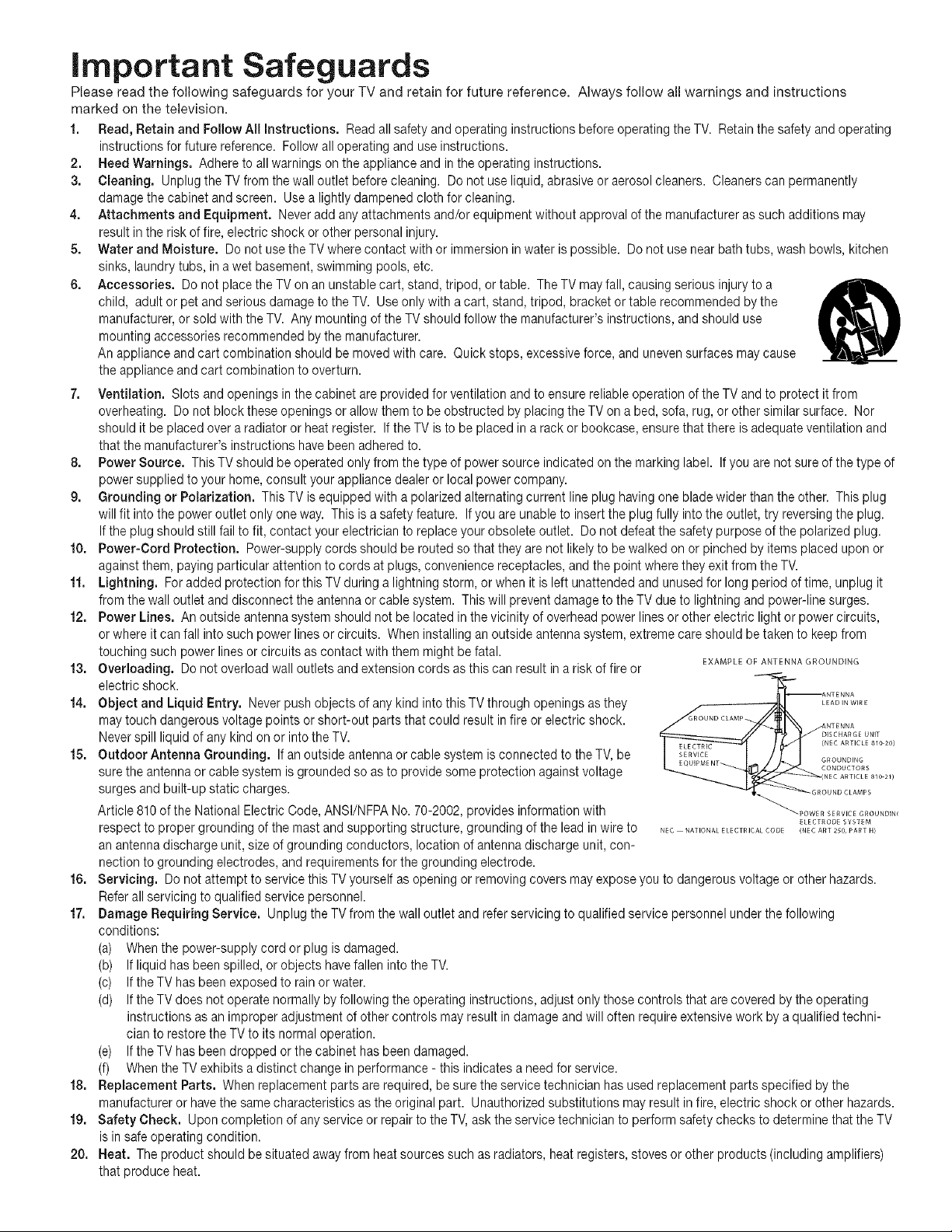
important Safeguards
Please read the following safeguards for your TV and retain for future reference. Always follow all warnings and instructions
marked on the television.
1. Read, Retain and Follow All Instructions. Read all safety and operating instructions before operating the TV. Retain the safety and operating
instructions for future reference. Follow alloperating and use instructions.
2. Heed Warnings. Adhere to all warnings on the appliance and in the operating instructions.
3. Cleaning. Unplug the TV from the wall outlet before cleaning. Do not use liquid, abrasive or aerosol cleaners. Cleaners can permanently
damage the cabinet and screen. Use a lightly dampened cloth for cleaning.
4. Attachments and Equipment. Never add any attachments and/or equipment without approval of the manufacturer as such additions may
result in the risk of fire, electric shock or other personal injury.
5. Water and Moisture. Do not use the TV where contact with or immersion in water is possible. Do not use near bath tubs, wash bowls, kitchen
sinks, laundry tubs, in a wet basement, swimming pools, etc.
6. Accessories. Do not place the TV on an unstable cart, stand, tripod, or table. The TV may fall, causing serious injury to a
child, adult or pet and serious damage to the TV. Use only with a cart, stand, tripod, bracket or table recommended by the
@
manufacturer, or sold with the TV. Any mounting of the TV should follow the manufacturer's instructions, and should use
mounting accessories recommended by the manufacturer.
An appliance and cart combination should be moved with care. Quick stops, excessive force, and unevensurfaces may cause
the appliance and cart combination to overturn.
7. Ventilation. Slots and openings in the cabinet are provided for ventilation and to ensure reliable operation of the TV and to protect it from
overheating. Do not block these openings or allow them to be obstructed by placing the TV on a bed, sofa, rug, or other similar surface. Nor
should it be placed over a radiator or heat register. If the TV is to be placed in a rack or bookcase, ensure that there is adequate ventilation and
that the manufacturer's instructions havebeen adhered to.
8. Power Source. ThisTV should be operated only from the type of power source indicated on the marking label. Ifyou are not sure of the type of
power supplied to your home, consult your appliance dealer or local power company.
9. Grounding or Polarization. This TV is equipped with a polarized alternating current line plug having one blade wider than the other. This plug
will fit into the power outlet only one way. This is a safety feature. If you are unable to insert the plug fully into the outlet, try reversingthe plug.
If the plug should still fail to fit, contact your electrician to replace your obsolete outlet. Do not defeat the safety purpose of the polarized plug.
10. Power-Cord Protection. Power-supply cords should be routed so that they are not likely to be walked on or pinched by items placed upon or
against them, paying particular attention to cords at plugs, convenience receptacles, and the point where they exit from the TV.
ff. Lightning. For added protection for this TV during a lightning storm, or when it is left unattended and unused for long period of time, unplug it
from the wall outlet and disconnect the antenna or cable system. This will prevent damage to the TV due to lightning and power-line surges.
12. Power Lines. An outside antenna system should not be located in the vicinity of overhead power lines or other electric light or power circuits,
or where it can fall into such power lines or circuits. When installing an outside antenna system, extreme care should be taken to keep from
touching such power lines or circuits as contact with them might be fatal.
13. Overloading. Do not overload wall outlets and extension cords as this can result in a risk of fire or EXAMPLEOFANTENNAGROUNDING
electric shock. __._.._
14. Object and Liquid Entry. Neverpush objects of any kind into this TV through openings as they _EAO_,W,RE
may touch dangerous voltage points or short-out parts that could result in fire or electric shock. GROO,D_AMp A"TE""A
Never spill liquid of any kind on or into the TV. _,'sE_"_"_'__o_
15. Outdoor Antenna Grounding. If an outside antenna or cable system is connected to the TV, be _ROO"D'N_.
sure the antennaor cable system is grounded so as to provide some protection against voltage _N°_°_ ..... )
surges and built-up static charges. OONO_A_
Article 810of the National Electric Code, ANSI/NFPA No. 70-2002, provides information with _-PowER _ER_E_ROO,O_,,
ELECTRODE SYSTEM
respect to proper grounding of the mast and supporting structure, grounding of the lead inwire to NECNAT,ONALELECTRICALCODE(NECART250,PARTH)
an antenna discharge unit, size of grounding conductors, location of antenna discharge unit, con-
nection to grounding electrodes, and requirements for the grounding electrode.
16. Servicing. Do not attempt to service this TV yourself as opening or removing covers may expose you to dangerous voltage or other hazards.
Refer all servicing to qualified service personnel.
17. Damage Requiring Service. Unplug the TV from the wall outlet and refer servicing to qualified service personnel under the following
conditions:
(a) When the power-supply cord or plug is damaged.
(b) If liquid has been spilled, or objects havefallen into the TV.
(c) If the TV has been exposed to rain or water.
(d) If the TV does not operate normally by following the operating instructions, adjust only those controls that are covered by the operating
instructions as an improper adjustment of other controls may result in damage and will often require extensive work by a qualified techni-
cian to restore the TV to its normal operation.
(e) If the TV hasbeen dropped or the cabinet has been damaged.
(f) When the TV exhibits a distinct change in performance - this indicates a need for service.
18. Replacement Parts. When replacement parts are required, be sure the service technician has used replacement parts specified by the
manufacturer or have the same characteristics as the original part. Unauthorized substitutions may result in fire, electric shock or other hazards.
19. Safety Check. Upon completion of any service or repair to the TV, ask the service technician to perform safety checks to determine that the TV
is in safe operating condition.
20. Heat. The product should be situated away from heat sources such as radiators, heat registers, stoves or other products (including amplifiers)
that produce heat.
TelevisionOverview
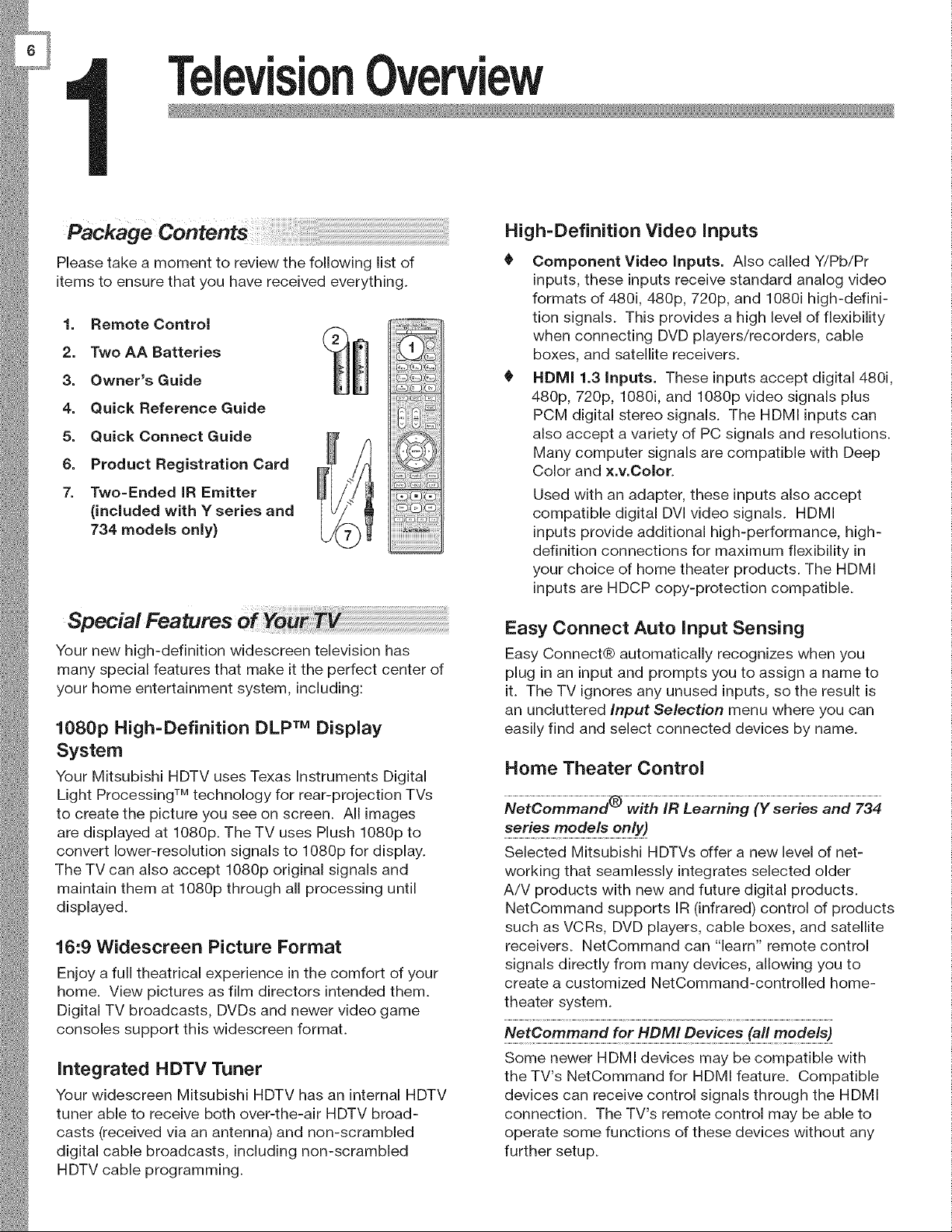
Please take a moment to review the following list of
items to ensure that you have received everything.
1. Remote Control
2. Two AA Batteries
3. Owner's Guide
4. Quick Reference Guide
5. Quick Connect Guide
6. Product Registration Card
7. Two=Ended iR Emitter
(included with Y series and
734 models only)
t _!i!iiiii:i!
i!_!i!_;ii:i
I_!!:!; iii_ii_!i;i:i
iii 222:!:i:I
Your new high-definition widescreen television has
many special features that make it the perfect center of
your home entertainment system, including:
1080p High=Definition DLP TM Display
System
Your Mitsubishi HDTV uses Texas Instruments Digital
Light Processing TM technology for rear-projection TVs
to create the picture you see on screen. All images
are displayed at 1080p. The TV uses Plush 1080p to
convert lower-resolution signals to 1080p for display.
The TV can also accept 1080p original signals and
maintain them at 1080p through all processing until
displayed.
16:9 Widescreen Picture Format
Enjoy a full theatrical experience in the comfort of your
home. View pictures as film directors intended them.
Digital TV broadcasts, DVDs and newer video game
consoles support this widescreen format.
integrated HDTV Tuner
Your widescreen Mitsubishi HDTV has an internal HDTV
tuner able to receive both over-the-air HDTV broad-
casts (received via an antenna) and non-scrambled
digital cable broadcasts, including non-scrambled
HDTV cable programming.
High=Definition Video inputs
Component Video inputs. Also called Y/Pb/Pr
inputs, these inputs receive standard analog video
formats of 480i, 480p, 720p, and 1080i high-defini-
tion signals. This provides a high level of flexibility
when connecting DVD players/recorders, cable
boxes, and satellite receivers.
HDMi 1.3 inputs. These inputs accept digital 480i,
480p, 720p, 1080i, and 1080p video signals plus
PCM digital stereo signals. The HDMI inputs can
also accept a variety of PC signals and resolutions.
Many computer signals are compatible with Deep
Color and x.v.Oolor.
Used with an adapter, these inputs also accept
compatible digital DVl video signals. HDMI
inputs provide additional high-performance, high-
definition connections for maximum flexibility in
your choice of home theater products. The HDMI
inputs are HDCP copy-protection compatible.
Easy Connect Auto input Sensing
Easy Connect@ automatically recognizes when you
plug in an input and prompts you to assign a name to
it. The TV ignores any unused inputs, so the result is
an uncluttered Input Selection menu where you can
easily find and select connected devices by name.
Home Theater Control
N ...................................................................................................._ .....................................................................................................................................................................................................................................................................................
etCommand with IR Learning (Y series and 734
seriesmodelsonly)
Selected Mitsubishi HDTVs offer a new level of net-
working that seamlessly integrates selected older
A/V products with new and future digital products.
NetCommand supports IR (infrared) control of products
such as VCRs, DVD players, cable boxes, and satellite
receivers. NetCommand can "learn" remote control
signals directly from many devices, allowing you to
create a customized NetCommand-controlled home-
theater system.
Some newer HDMI devices may be compatible with
the TV's NetCommand for HDMI feature. Compatible
devices can receive control signals through the HDMI
connection. The TV's remote control may be able to
operate some functions of these devices without any
further setup.
1. Television Overview 7
TV Front Panel
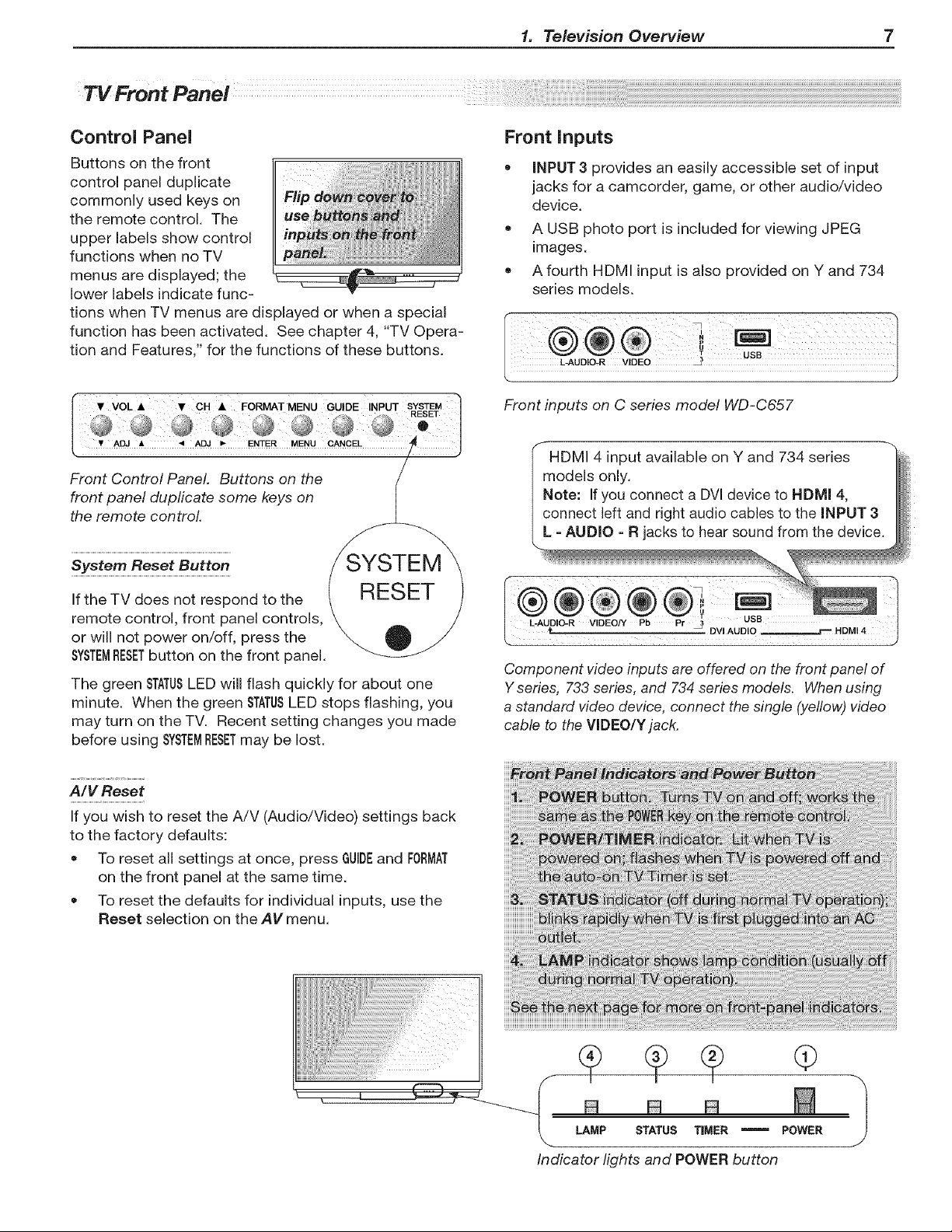
Control Panel
Buttons on the front
control panel duplicate
commonly used keys on
the remote control. The
upper labels show control
functions when no TV
menus are displayed; the
lower labels indicate func-
tions when TV menus are displayed or when a special
function has been activated. See chapter 4. "TV Opera-
tion and Features," for the functions of these buttons.
Front inputs
• INPUT 3 provides an easily accessible set of input
jacks for a camcorder, game, or other audio/video
device.
• A USB photo port is included for viewing JPEG
images.
A fourth HDMI input is also provided on Y and 734
series models.
L-AUDIO-R VIDEO 3
USB
Front inputs on C series model WD-C657
Front Control Panel. Buttons on the
front panel duplicate some keys on
the remote control.
System Reset Butto n
SYSTEMRESETbutton on the front panel,
If the TV does not respond to the
remote control, front panel controls,
or will not power on/off, press the
The green STATUSLED will flash quickly for about one
minute. When the green STATUSLED stops flashing, you
may turn on the TV. Recent setting changes you made
before using SYSTEMRESETmay be lost.
HDMI 4 input available on Y and 734 series
models only.
Note: If you connect a DVl device to HDMI 4,
connect left and right audio cables to the INPUT 3
L - AUDIO - R jacks to hear sound from the device.
i
" t :}?
L-AUDIO-R VIDEO/Y Pb Pr 3
{" _ DVI AUDIO HDMI 4,
Component video inputs are offered on the front panel of
Y series, 733 series, and 734 series models. When using
a standard video device, connect the single (yellow) video
cable to the VIDEO/Y jack.
A/V Reset
If you wish to reset the A/V (Audio/Video) settings back
to the factory defaults:
To reset all settings at once, press GUIDEand FORMAT
on the front panel at the same time,
To reset the defaults for individual inputs, use the
Reset selection on the AV menu.
LAMP STATUS
Indicator lights and POWER button
8 1. Television Overview
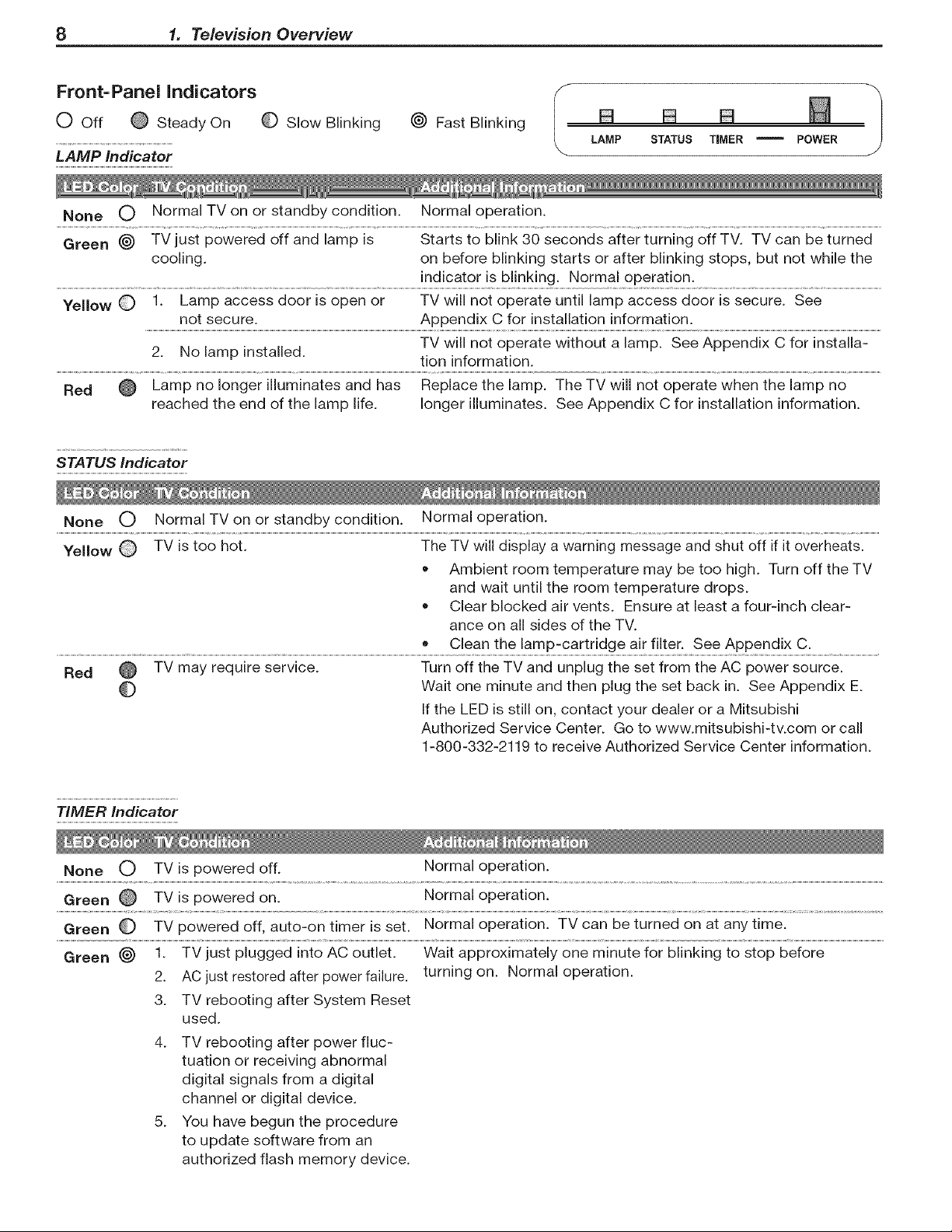
Front=Panel indicators
O Off O Steady On C) Slow Blinking
LAMP Indicator
(_ Fast Blinking _ _ R
LAMP STATUS TIMER = POWER
None O Normal TV on or standby condition. Normal operation.
Green (_ TV just powered off and lamp is Starts to blink 30 seconds after turning off TV. TV can be turned
cooling, on before blinking starts or after blinking stops, but not while the
indicator is blinking. Normal operation.
Yellow Q 1. Lamp access door is open or TV will not operate until lamp access door is secure. See
not secure. Appendix C for installation information.
TV will not operate without a lamp. See Appendix C for installa-
2. No lamp installed.
tion information.
Red Lamp no longer illuminates and has Replace the lamp. The TV will not operate when the lamp no
reached the end of the lamp life. longer illuminates. See Appendix C for installation information.
STATUS indicator
None O Normal TV on or standby condition. Normal operation.
Yellow O TV is too hot. The TV will display a warning message and shut off if it overheats.
• Ambient room temperature may be too high. Turn off the TV
and wait until the room temperature drops.
• Clear blocked air vents. Ensure at least a four-inch clear-
ance on all sides of the TV.
• Clean the lamp-cartridge air filter. See Appendix C.
Red TV may require service. Turn off the TV and unplug the set from the AC power source.
Wait one minute and then plug the set back in. See Appendix E.
If the LED is still on, contact your dealer or a Mitsubishi
Authorized Service Center. Go to www.mitsubishi-tv.com or call
1-800-332-2119 to receive Authorized Service Center information.
TIMER indicator
None O TV is powered off. Normal operation.
Green @ TV is powered on. Normal operation.
Green O TV powered off, auto-on timer is set. Normal operation. TV can be turned on at any time.
Green (_ 1. TV just plugged into AC outlet. Wait approximately one minute for blinking to stop before
2. AC just restored after power failure, turning on. Normal operation.
3. TV rebooting after System Reset
used.
4. TV rebooting after power fluc-
tuation or receiving abnormal
digital signals from a digital
channel or digital device.
5. You have begun the procedure
to update software from an
authorized flash memory device.
1. Television Overview 9
TV Back Panel
((o))
,A
ANT2/AUX
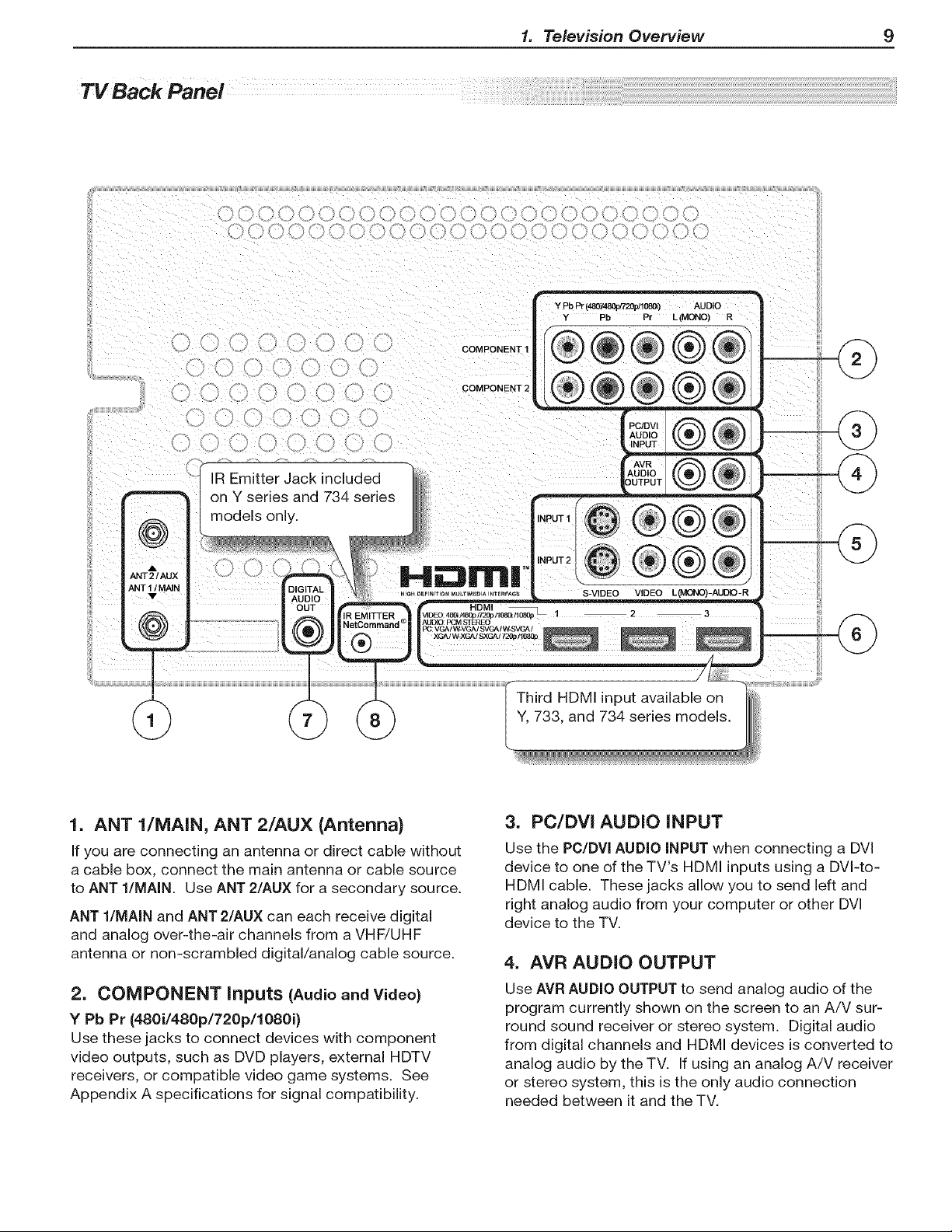
IR Emitter Jack included
on Y series and 734 series
models only.
COMPONENT1
Y Pb Pr (48c¢'480p/720p/1080i] AUDIO
Y Pb Pr _(MONO)
COMPONENT2
REMITTER
YetCommand _
®
S-VIDEO VIDEO L_)-AUDD-R
1 2 3
HDMI input available on
Y, 733, and 734 series models.
1. ANT l/MAIN, ANT 2/AUX (Antenna)
If you are connecting an antenna or direct cable without
a cable box, connect the main antenna or cable source
to ANT l/MAIN. Use ANT 2/AUX for a secondary source.
ANT l/MAIN and ANT 2/AUX can each receive digital
and analog over-the-air channels from a VHF/UHF
antenna or non-scrambled digital/analog cable source.
2. COMPONENT inputs (Audio and Video}
Y Pb Pr (480i/480p/720p/1080i}
Use these jacks to connect devices with component
video outputs, such as DVD players, external HDTV
receivers, or compatible video game systems. See
Appendix A specifications for signal compatibility.
3. PC/DVI AUDIO INPUT
Use the PC/DVI AUDIO iNPUT when connecting a DVI
device to one of the TV's HDMI inputs using a DVI-to-
HDMI cable. These jacks allow you to send left and
right analog audio from your computer or other DVI
device to the TV.
4. AVR AUDIO OUTPUT
Use AVR AUDIO OUTPUT to send analog audio of the
program currently shown on the screen to an A/V sur-
round sound receiver or stereo system. Digital audio
from digital channels and HDMI devices is converted to
analog audio by the TV. If using an analog A/V receiver
or stereo system, this is the only audio connection
needed between it and the TV.
10 1. Television Overview
TVBackPanel,continued
5. iNPUT 1, 2 (Audio and Video)
INPUT 1 and 2 can be used to connect a VCR, Super
VHS (S-VHS) VCR, DVD player, standard satellite
receiver, or other A/V device to the TV. Each TV iNPUT
group consists of jacks for composite video, S-Video,
and analog stereo audio. Note that when you connect
to the S-video jack, the composite video jack is auto-
matically disabled. INPUT 3 is a third set of composite
video and stereo audio jacks located on the front of the
TV for convenience.
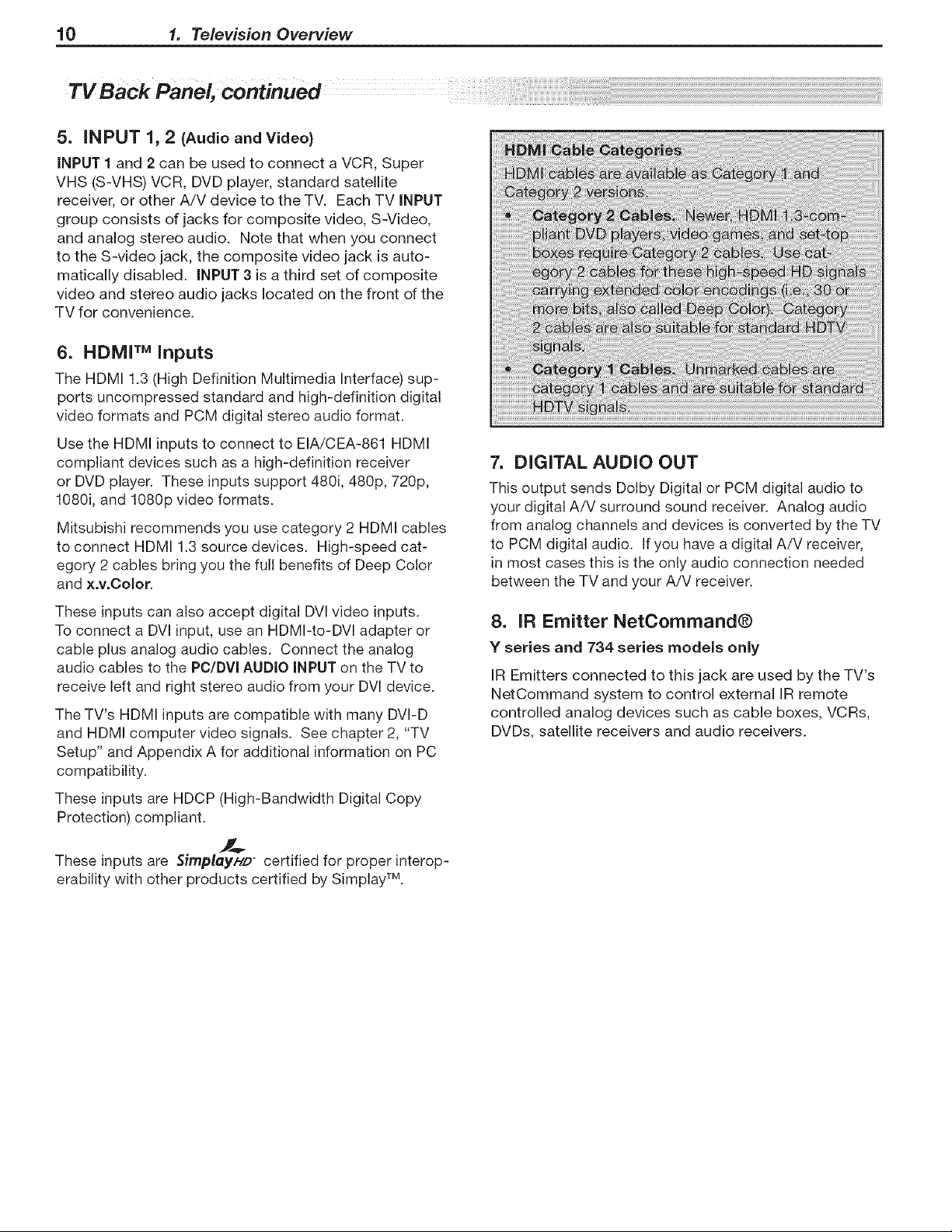
6. HDMI TM inputs
The HDMI 1.3 (High Definition Multimedia Interface) sup-
ports uncompressed standard and high-definition digital
video formats and PCM digital stereo audio format.
Use the HDMI inputs to connect to EIA/CEA-861 HDMI
compliant devices such as a high-definition receiver
or DVD player. These inputs support 480i, 480p, 720p,
1080i, and 1080p video formats.
Mitsubishi recommends you use category 2 HDMI cables
to connect HDMI 1.3 source devices. High-speed cat-
egory 2 cables bring you the full benefits of Deep Color
and x.v.Color.
These inputs can also accept digital DVl video inputs.
To connect a DVl input, use an HDMI-to-DVl adapter or
cable plus analog audio cables. Connect the analog
audio cables to the PC/DVI AUDIO iNPUT on the TV to
receive left and right stereo audio from your DVI device.
The TV's HDMI inputs are compatible with many DVI-D
and HDMI computer video signals. See chapter 2, "TV
Setup" and Appendix A for additional information on PC
compatibility.
These inputs are HDCP (High-Bandwidth Digital Copy
Protection) compliant.
These inputs are 5implayHD" certified for proper interop-
erability with other products certified by Simplay TM.
7. DIGITAL AUDIO OUT
This output sends Dolby Digital or PCM digital audio to
your digital A/V surround sound receiver. Analog audio
from analog channels and devices is converted by the TV
to PCM digital audio. If you have a digital A/V receiver,
in most cases this is the only audio connection needed
between the TV and your A/V receiver.
8. IR Emitter NetCommand®
Y series and 734 series models only
IR Emitters connected to this jack are used by the TV's
NetCommand system to control external IR remote
controlled analog devices such as cable boxes, VCRs,
DVDs, satellite receivers and audio receivers.
TVSet-
Getting Started
1. Review the important safety, installation, and oper-
ating information at the beginning of this book.
2. Choose a location for your TV.
• Allow at least four inches of space on all sides
of the TV to help prevent overheating. Over-
heating may cause premature failure of the TV
as well as shortened lamp life.
Avoid locations where light may reflect off the
screen.
See the stand requirements under "Important
Information About Your TW'
3. Install the batteries in the remote control. See the
following page. See chapter 4, "TV Operation and
Features" for more on use of the remote control.
4. Plug your TV into a power outlet. The TIMERindica-
tor on the front of the TV will start blinking rapidly.
After the TIMERindicator stops blinking, press the
POWERkey to power on the TV.
5. When the Welcome screen appears the first time
you power on the TV, select a language for TV
menus. You can later change the language through
the Setup menu.
6. Connect your audio/video (A!V) devices to the TV
and perform initial setup.
See chapter 3, "TV Connections" for connec-
tion diagrams.
See the following pages for initial TV setup and
use of the Auto Input Sensing feature.
See chapter 6, "NetCommand," to perform
NetCommand IR "learning" for control of your
home theater (available on Y series and 734
series models).
7. Mitsubishi recommends you perform a channel
scan. See "Initial TV Setup" on the following pages.
8. You can now start watching TV or you can perform
additional setup and customization through the TV
menus.
TV Operation
1. Review chapter 4, "TV Operation and Features," for
TV features including:
• Input Selection (viewing source). Select a
connected program source to watch, such as a
VCR, DVD player, or antenna. Press INPUTon the
remote control to select from icons for the TV
inputs. See "Choosing a Viewing Source."
• ChannelView. Press GUIDEto see channel list-
ings for programs on ANT 1 and ANT 2.
• Picture Formats. Press FORMATto cycle through
picture sizes and shapes to find the one best
suited to the current program. See "TV Signals
and Display Formats."
2. To understand use of the Input Selection menu
with NetCommand-controlled devices, see "Using
NetCommand" (Y and 734 series models).
3. To view JPEG photo files on the TV, see "Viewing
JPEG Picture Files."
Additional TV Setup
Review chapter 5, "TV Menu Settings," to custom-
ize TV operation. Press the MENUkey to enter the
menu system. Some examples of settings you may
wish to change include:
= FAV. Use an on-screen menu to create custom
lists of your favorite channels. See Setup >
Edit.
Order. Rearrange the device icons in the input
Selection menu to put frequently used icons
near the front. See the Inputs menu Order
options.
• Name. Changethe device names that appear
in the Input Selection menu. See the Inputs
menu Name options.
• ParentalLocks. Restrict TVviewing by
program rating, by channel, or by time of day.
You can also disable the front-panel buttons
if you have small children. See the Lock >
12 2. TV Setup
Note:
2_
Parent menu, the Lock > Front Panel menu,
and Setup > Edit > Lock.
Video Settings. Change video adjustments to
get the best picture for your viewing conditions.
See "AV Menu."
You may wish to change the Picture Mode from
the default Brilliant to either Bright or Natural,
which are suitable for most home viewing envi-
ronments.
To program the remote control to operate A/V
devices not under NetCommand control, see
Appendix D, "Programming the Remote Control."
TV Care
• Lamp Cartridge. When the lamp cartridge
needs replacement, replace the lamp yourself
and save the cost of a service call. See
Appendix C for instructions.
General Cleaning. See the cleaning recom-
mendations under "Important Information
About Your TV."
Assistance
For troubleshooting, service, and product
support, see Appendix E.
For warranty information, see the TV warranty
in the back of this book.
Choosing a Language for Menus
1. Power on the TV for the first time.
2. Press A Y to select either English or Spanish
for all menus. You can later change the language
selection through the Setup menu Language
option.
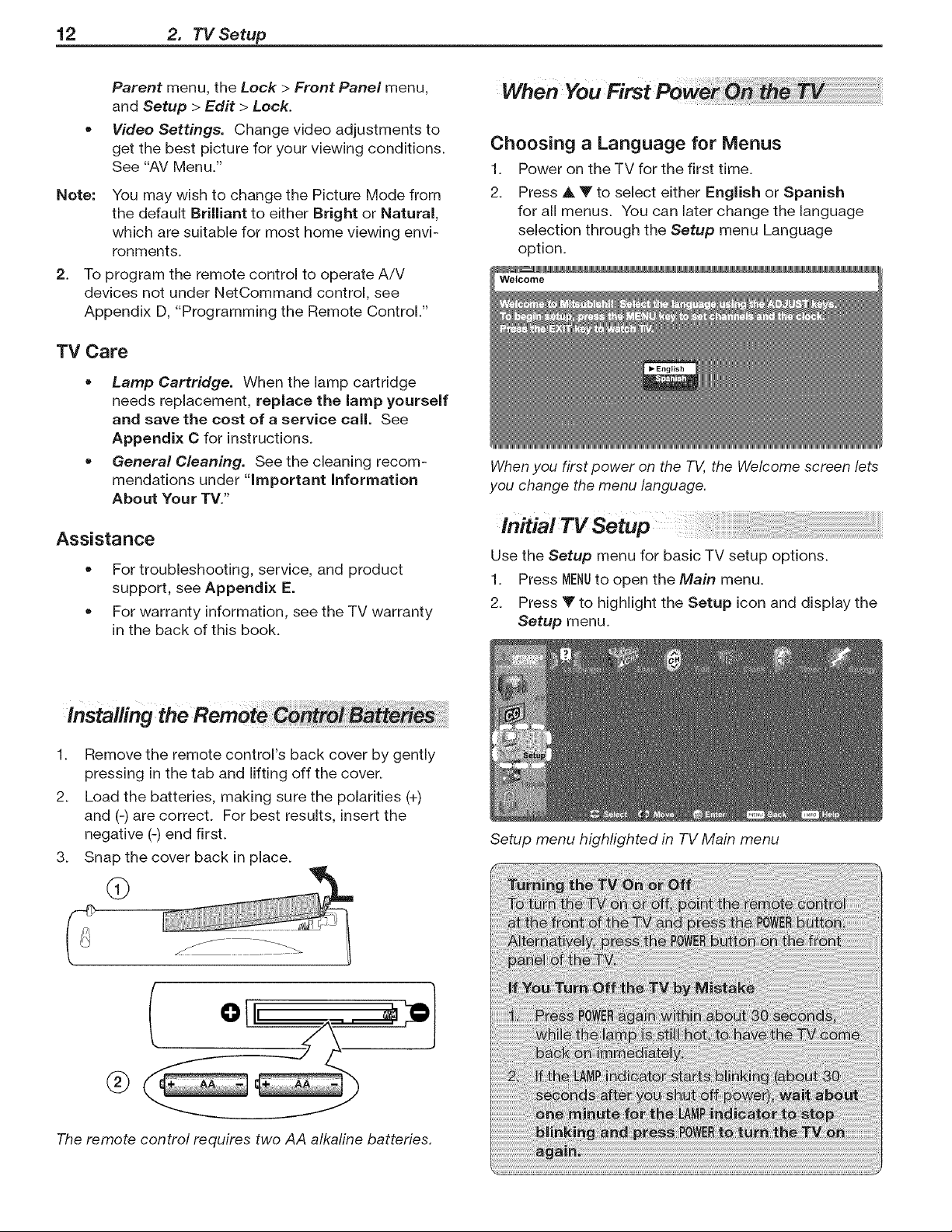
When you first power on the TV, the Welcome screen lets
you change the menu language.
Use the Setup menu for basic TV setup options.
1. Press MENUto open the Main menu.
2. Press Y to highlight the Setup icon and display the
Setup menu.
1. Remove the remote control's back cover by gently
pressing in the tab and lifting off the cover.
2. Load the batteries, making sure the polarities (+)
and (-) are correct. For best results, insert the
negative (-) end first.
3. Snap the cover back in place.
®
The remote control requires two AA alkaline batteries.
Setup menu highlighted in TV Main menu
2. TV Setup 13
Change the Menu Language
Choose to display on-screen menus in either English or
Spanish (EspaSol).
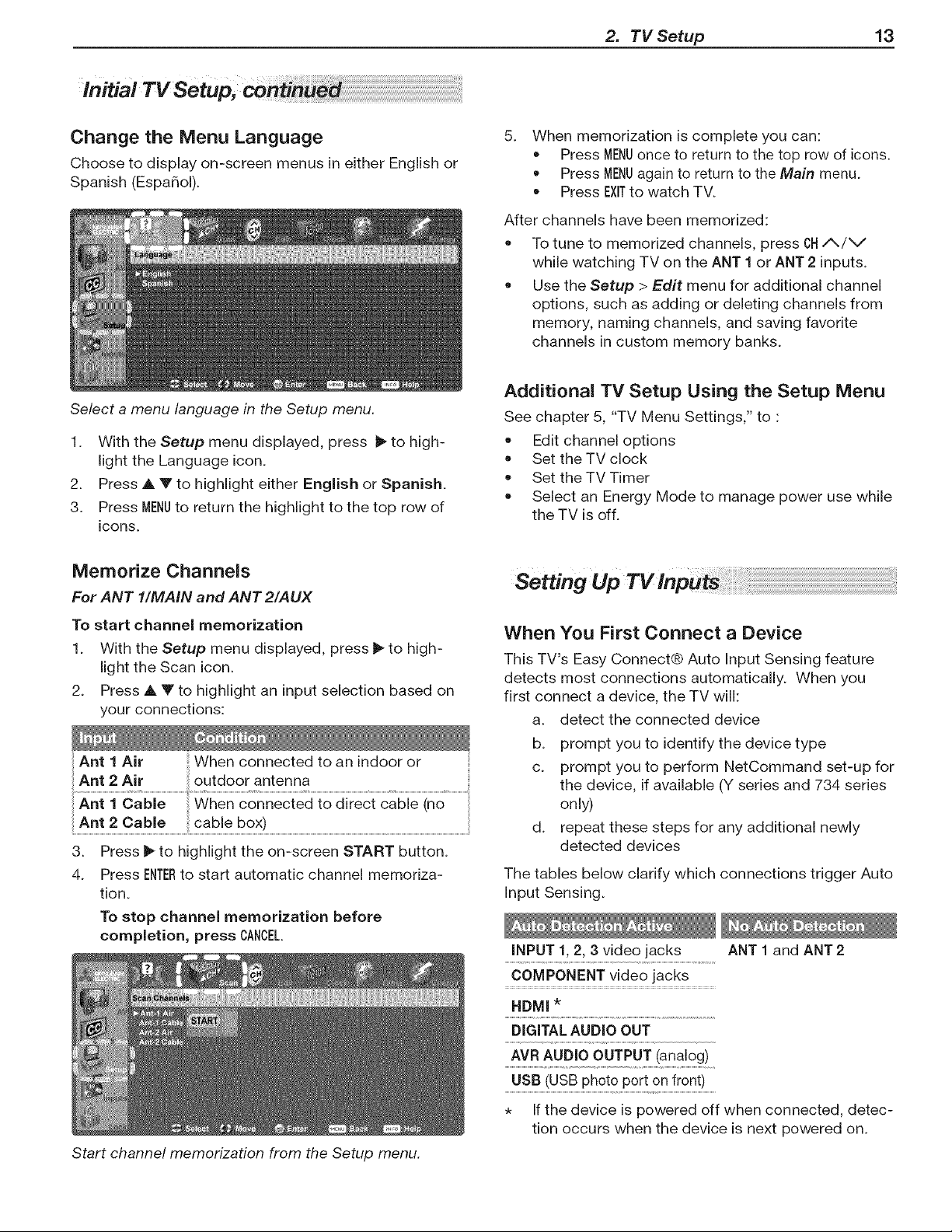
Select a menu language in the Setup menu.
5.
When memorization is complete you can:
• Press MENUonce to return to the top row of icons.
• Press MENUagain to return to the Main menu.
Press EXITto watch TV.
After channels have been memorized:
• To tune to memorized channels, press OH/_/V
while watching TV on the ANT 1 or ANT 2 inputs.
• Use the Setup > Edit menu for additional channel
options, such as adding or deleting channels from
memory, naming channels, and saving favorite
channels in custom memory banks.
1. With the Setup menu displayed, press _ to high-
light the Language icon.
2. Press A V to highlight either English or Spanish.
3. Press MENUto return the highlight to the top row of
icons.
Additional TV Setup Using the Setup Menu
See chapter 5, "TV Menu Settings," to :
• Edit channel options
Set the TV clock
Set the TV Timer
Select an Energy Mode to manage power use while
the TV is off.
Memorize Channels
For ANT l/MAIN and ANT 2/AUX
To start channel memorization
1. With the Setup menu displayed, press _ to high-
light the Scan icon.
2. Press ,A,V to highlight an input selection based on
your connections:
3. Press _ to highlight the on-screen START button.
4. Press ENTERto start automatic channel memoriza-
tion.
To stop channel memorization before
completion, press CANCEL.
Start channel memorization from the Setup menu.
se,i.gupTv
When You First Connect a Device
This TV's Easy Connect@ Auto Input Sensing feature
detects most connections automatically. When you
first connect a device, the TV will:
a. detect the connected device
b. prompt you to identify the device type
c. prompt you to perform NetCommand set-up for
the device, if available (Y series and 734 series
only)
d. repeat these steps for any additional newly
detected devices
The tables below clarify which connections trigger Auto
Input Sensing.
INPUT 1, 2, 3 video jacks ANT 1 and ANT 2
COMPONENT video jacks
HDMI *
DiGiTALAUDIO OUT
AVR AUDIO OUTPUT (analog)
USB (USB photo port on front)
, If the device is powered off when connected, detec-
tion occurs when the device is next powered on.

14 2. TV Setup
Note: For connection and setup of a personal com-
puter, see the information later in this chapter.
1.
2.
See chapter 3, "TV Connections," for recommen-
dations on connecting your devices.
Connect your devices to the TV, making note of
which TV input is used for each device.
The TV and the devices can be either on or off
when connecting.
_ First select a
device type.
Next perform .+_+
IR "learning."
Auto Input Sensing screen for most device types. The
Learn icon appears only on models with NetCommand.
3.
Power on the TV if not already on. When the TV
detects a connection, the Auto Input Sensing
screen opens.
+ Most Device Types: Specify the device
type and then, if desired, proceed directly to
NetCommand setup if available.
a. In the Auto input Sensing screen, press A
V to move through the device list to select
the device type connected to the input.
The device type you select here will appear
in the Input Selection menu.
b. If NetCommand IR "learning" is available on
your TV model, you can perform "learning"
now or at a later time. To perform now,
highlight the Learn icon and press ENTER.
See chapter 6, "NetCommand" for more.
+ A/V Receiver: The TV can detect audio con-
nections on the DIGITAL AUDIO OUT jack and
the right (red) analog AVR AUDIO OUTPUT jack.
Note for Analog A/V Receivers: When you
disconnect an analog A/V receiver, manually
change the Speakers setting to TV to hear
sound from the TV speakers.
If NetCommand IR "learning" is available for your
TV model, perform "learning" now or at a later
time. To perform now, highlight the Learn icon
in the Auto Output Sensing screen and press
ENTER.See chapter 6, "NetCommand" for more.
• HDMI Devices Compatible with the TV's
NetCommand for HDMi Feature: Compatible
HDMI devices are often recognized automati-
cally by the TV. The TV's remote control may
operate some device functions without further
setup. You can add more control functions if
desired. Program the TV's remote control or,
in the case of a Y or 734 series TV, perform
NetCommand IR "learning" to add functions.
Press EXITto close the Auto Input Sensing screen.
The TV will then display the Auto Input Sensing
screen for the next connection it finds.
More About Auto input Sensing
+ Choose a different name for each input.
+ Antenna inputs (ANT l/ANT 2) are never detected,
although you can turn off unused antenna inputs in
the Inputs > Name menu.
+ You can change the device type at a later time
using the Inputs > Name menu. Any "learned"
NetCommand IR codes will be erased, however.
= If you wish to change devices on an HDMI input:
1. Disconnect the HDMI device.
2. Turn off the HDMI input in the inputs > Name
menu.
3. Connect the new device and the Auto Input
Sensing screen will display. If you want the
device under NetCommand IR control, perform
NetCommand "learning" for the new device.
Although the TV detects when you connect an A/V
receiver, you must use one of the methods below to
control sound volume from the A/V receiver.
With a Standard TV Setup
Recommended Method: Program the TV's remote
control for your A/V receiver and enable the Audio
Lock feature. See Appendix D, "Programming the
Remote Control."
+ Program the TV's remote control for your A/V
receiver and set the TV remote's slide switch to
the AUBI0position to control volume. Set the switch
back to the TVposition to control the TV.
Use the remote control that came with the A/V
receiver.
With NetCommand Control of an A/V Receiver (Y
and 734 series only}
= Set up NetCommand control of the A/V receiver's
volume functions in the Inputs > AVR menu. The
TV's remote will then automatically control A/V
receiver volume. See chapter 6, "NetCommand."
+ Use any of the methods described for the standard
TV setup.
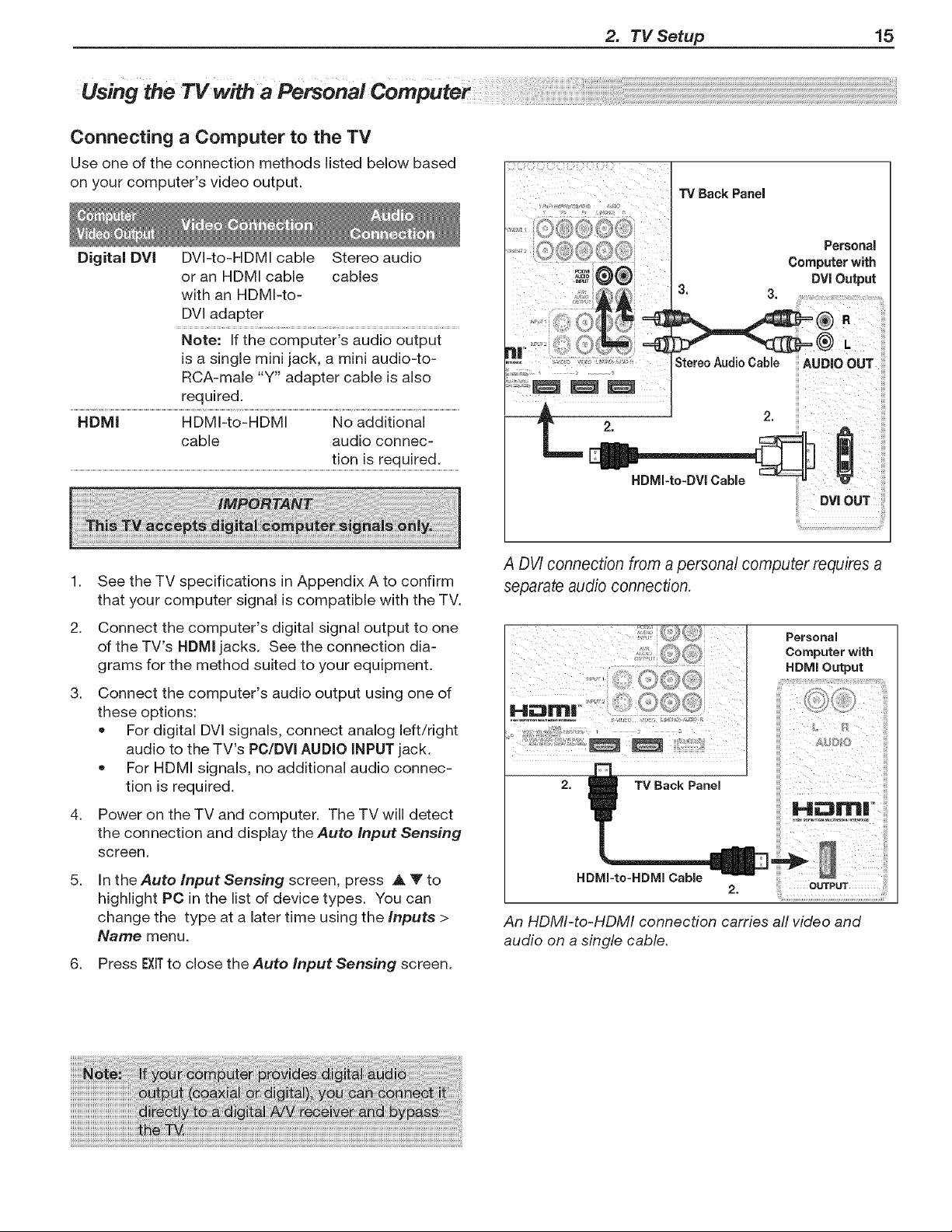
2. TV Setup 15
UsingtheTVwi,h,PersonalCorn
Connecting a Computer to the TV
Use one of the connection methods listed below based
on your computer's video output.
Digital DVl DVI-to-HDMI cable Stereo audio
or an HDMI cable cables
with an HDMI-to-
DVI adapter
Note: If the computer's audio output
is a single mini jack, a mini audio-to-
RCA-male "Y" adapter cable is also
required.
HDMI HDMI-to-HDMI No additional
cable audio connec-
tion is required.
1. See the TV specifications in Appendix A to confirm
that your computer signal is compatible with the TV.
2. Connect the computer's digital signal output to one
of the TV's HDMI jacks. See the connection dia-
grams for the method suited to your equipment.
3,
,
5,
Connect the computer's audio output using one of
these options:
• For digital DVl signals, connect analog left/right
audio to the TV's PC/DVI AUDIO INPUT jack.
For HDMI signals, no additional audio connec-
tion is required.
Power on the TV and computer. The TV will detect
the connection and display the Auto Input Sensing
screen.
In the Auto input Sensing screen, press A V to
highlight PC in the list of device types. You can
change the type at a later time using the Inputs >
Name menu.
6. Press EXiTto close the Auto Input Sensing screen.
TV Back Panel
PersoRa_
Computerwith
DViOutput
3. 3.
StereoAudioCable AUDIOOUT
iii _ iii
HDMI-to-DVI Cable
A DWconnection froma pe_onalcomputerrequires a
separa_ audio connection.
2. TV Back Panel
Personal
Computer with
HDMI Output
HDMI-to-HDMI Cable
2.
;; ; ; ; ; ; ; ; ; ;;;
An HDMI-to-HDMI connection carries all video and
audio on a single cable.

16 2. TV Setup
Using the TV with a Personal Com
Computer Video Adjustments
1. Power on the computer if it is not already on.
2. Select PC from the Input Selection menu. To do
this, press INPUTto open the Input Selection menu,
move the highlight to the PC icon, and press ENTER.
3. Working from the computer, change the resolution
of the computer image. View the computer image
on the TV and maximize the computer resolution
while maintaining a suitable aspect ratio for the
image.
.
6.
Perform TV video adjustments. Press f
Computer Display Formats
Press the FORMATkey repeatedly to cycle through the TV displays avail-
able for your computer's video signal.
VIDEOrepeatedly to access video-
adjustment options. The following
additional adjustments are available
for computer video:
Horiz Position (Horizontal Position).
Manually adjust the horizontal
position; overrides Auto Position.
Vert Position (Vertical Position).
Manually adjust the vertical position;
overrides Auto Position.
Press FORMATrepeatedly to find the
picture format best suited to the
image. See the chart on this page
showing how different computer reso-
lutions are displayed on the TV.
image Resolution
Your Mitsubishi TV can display resolutions
from standard VGA (640 x 480) through
1920 x 1080 signals at a refresh rate of 60
Hz. The resolution of 1920 x 1080 is sup-
ported at refresh rates of 24, 30, and 60
Hz. See Appendix A in this book for more
on compatible screen resolutions.
In most cases, the computer will select the
best resolution match to display on the TV.
You can override this setting if you wish.
Refer to your computer operating system's
instructions for information on changing
the screen resolution.
You may need to restart the computer for
changes to take effect.
PC 720p
1280 X 720
SXGA
1280 X 1024
PC 1080p I
1920 X 1080
TVConnections
/ '
Before you Begin .....
The TV's Auto Input Sensing feature automatically rec-
ognizes most connections and prompts you to identify
the type of device connected. See chapter 2, "TV
Setup," for more on Auto Input Sensing.
Review the connection types available on your input
devices and use inputs that will give the best video
quality. For example, choose HDMI over component
video, and choose component video over S-video or
composite video.
Picture Quality
For best picture quality, route signals directly from
the input device to the TV; avoid routing video signals
through an A/V receiver, for example.
so-,,d0,,!!ty
For best surround sound audio quality, route audio
signals from the input device directly to your A/V
receiver or sound system whenever possible.
HDTV Cable Box or Satellite Receiver w
If your cable box or satellite receiver has an HDMI
output, use the connections for HDMI devices
described later in this chapter.
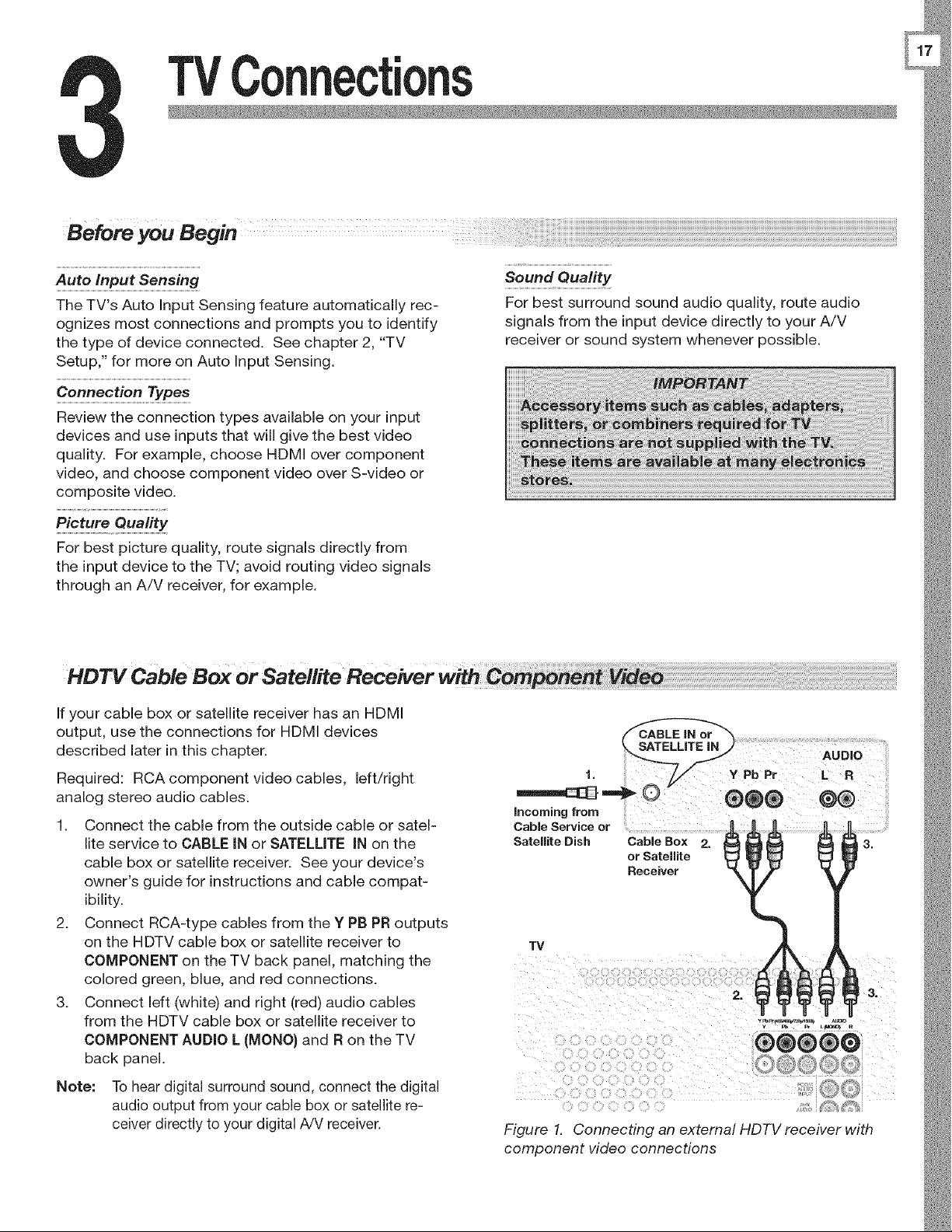
Required: RCA component video cables, left/right
analog stereo audio cables.
1. Connect the cable from the outside cable or satel-
lite service to CABLE IN or SATELLITE IN on the
cable box or satellite receiver. See your device's
owner's guide for instructions and cable compat-
ibility.
2. Connect RCA-type cables from the Y PB PR outputs
on the HDTV cable box or satellite receiver to
COMPONENT on the TV back panel matching the
colored green, blue, and red connections.
3. Connect left (white) and right (red) audio cables
from the HDTV cable box or satellite receiver to
COMPONENT AUDIO L (MONO) and R on the TV
back panel.
Note: To hear digital surround sound, connect the digital
audio output from your cable box or satellite re-
ceiver directly to your digital A/V receiver.
incoming from
Cable Service or
Satellite Dish Cable Box 2. 3.
or Satellite
Receiver
TV
Figure 1. Connecting an external HDTV receiver with
component video connections
18 3. 71/Connections
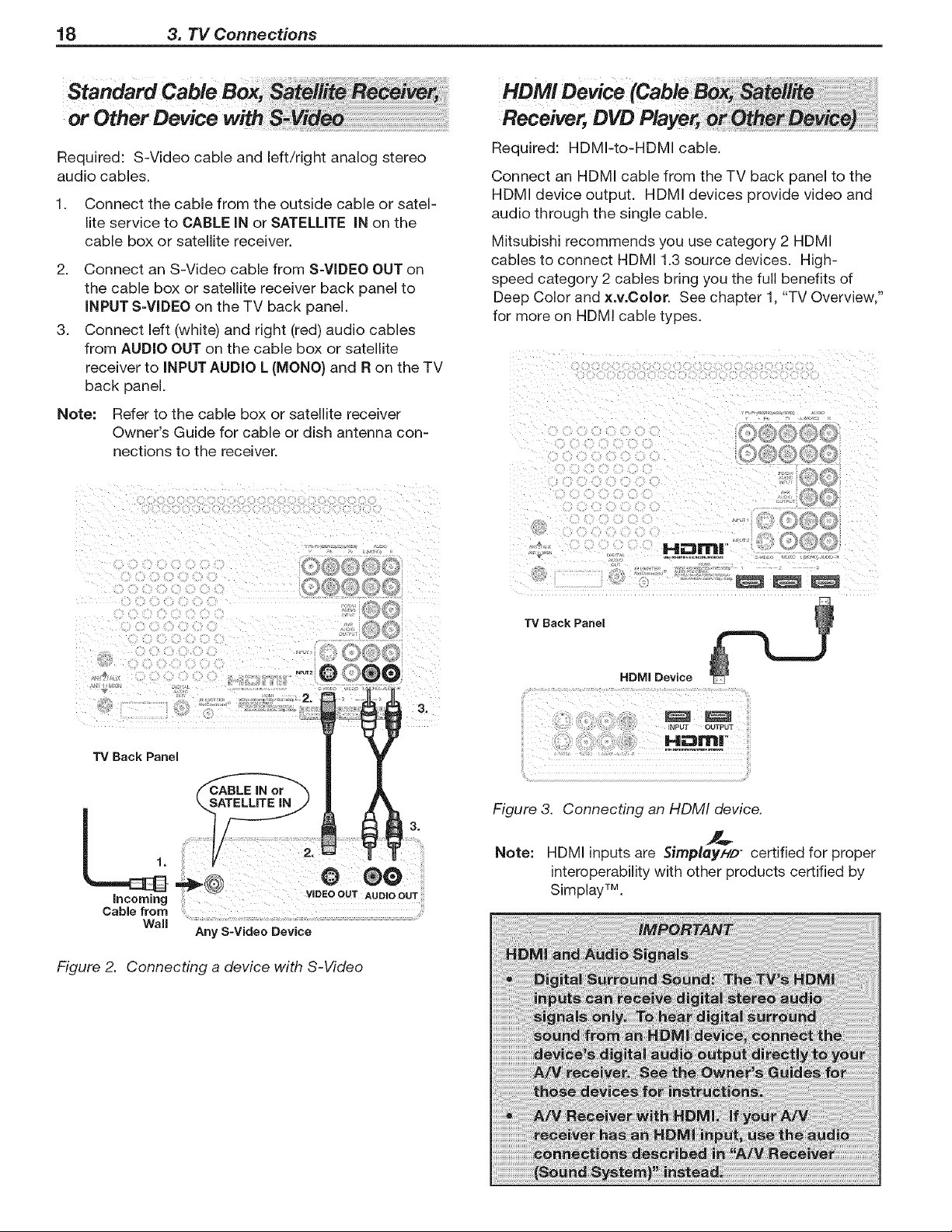
Required: S-Video cable and left/right analog stereo
audio cables.
1. Connect the cable from the outside cable or satel-
lite service to CABLE IN or SATELLITE IN on the
cable box or satellite receiver.
2. Connect an S-Video cable from S-VIDEO OUT on
the cable box or satellite receiver back panel to
iNPUT S-VIDEO on the TV back panel.
3. Connect left (white) and right (red) audio cables
from AUDIO OUT on the cable box or satellite
receiver to INPUT AUDIO L (MONO) and R on the TV
back panel,
Note: Refer to the cable box or satellite receiver
Owner's Guide for cable or dish antenna con-
nections to the receiver.
HDMI Device;
Receiver,
Required: HDMI-to-HDMI cable,
Connect an HDMI cable from the TV back panel to the
HDMI device output. HDMI devices provide video and
audio through the single cable.
Mitsubishi recommends you use category 2 HDMI
cables to connect HDMI 1.3 source devices. High-
speed category 2 cables bring you the full benefits of
Deep Color and x.v.Coior. See chapter 1, "TV Overview,"
for more on HDMI cable types.
I411:::llrlll"
_o
TV Back Panel
HDMi Device
NPUT OUTPUT
H_lRrlll
Cable from ;...................
Wall
Any S-Video Device
Figure 3. Connecting an HDMI device.
Note: HDMI inputs are 5implay/-/D _ certified for proper
interoperability with other products certified by
Simplay TM.
Figure 2. Connecting a device with S-Video
3. TV Connections 19
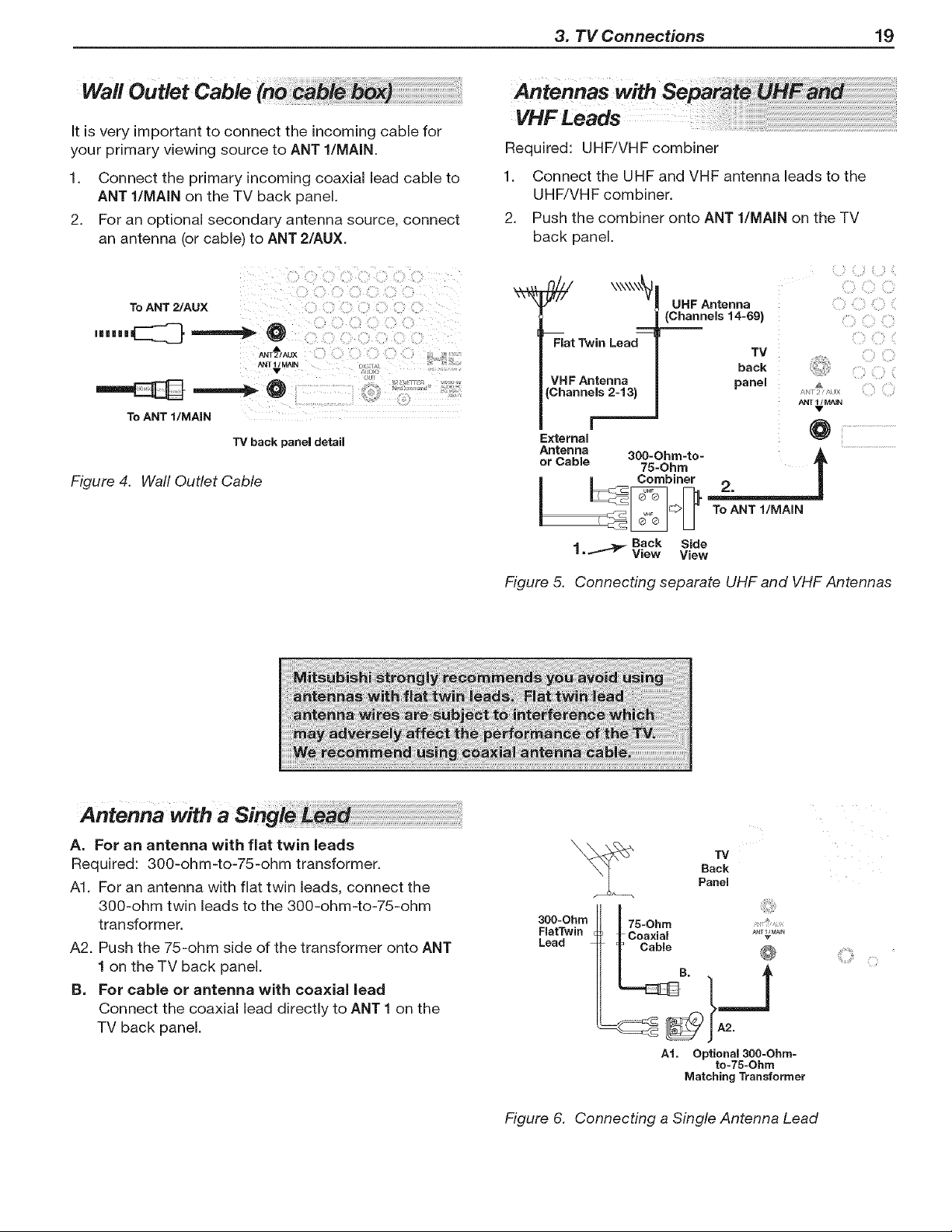
It is very important to connect the incoming cable for
your primary viewing source to ANT l/MAIN.
1. Connect the primary incoming coaxial lead cable to
ANT l/MAIN on the TV back panel.
2. For an optional secondary antenna source, connect
an antenna (or cable) to ANT 2/AUX.
_ii;C__C:¸ C;_C; CI_C_¸
TO ANT 2/AUX
,,,,,,c:z:D ¢
_r2_Aux ....
To ANT f/MAIN
TV back panel detail
Figure 4. Wall Outlet Cable
Antennas with
VHF Leads
Required: UHF/VHF combiner
1. Connect the UHF and VHF antenna leads to the
UHF/VHF combiner.
2. Push the combiner onto ANT l/MAIN on the TV
back panel.
m
Flat Twin Lead
VH F Antenna
(Channels 2-13)
UHF Antenna
(Channels 14-69}
TV
back
panel
[
External
Antenna 300-Ohm-to-
or Cable 75-Ohm
I _ Combiner
_O[_ To ANT l/MAIN
Back Bide
1. _ View View
C__iiiiiii,,ii___iiii,,iii__'_:i
C_¸_O
AN / 2 / AL _/:
N*;T 1 / _AIN
.....
Figure 5. Connecting separate UHF and VHF Antennas
A. For an antenna with flat twin leads
Required: 300-ohm-to-75-ohm transformer.
A1. For an antenna with flat twin leads, connect the
300-ohm twin leads to the 300-ohm-to-75-ohm
transformer.
A2. Push the 75-ohm side of the transformer onto ANT
1 on the TV back panel.
B. For cable or antenna with coaxial lead
Connect the coaxial lead directly to ANT 1 on the
TV back panel,
30g-Ohm
FlatTwin
Lead
_ TV
Back
Panel
Cable @
At. Optional 300-Ohm-
to-75-Ohm
Matching Transformer
Figure 6. Connecting a Single Antenna Lead
20 3. TV Connections
DVD Player with C
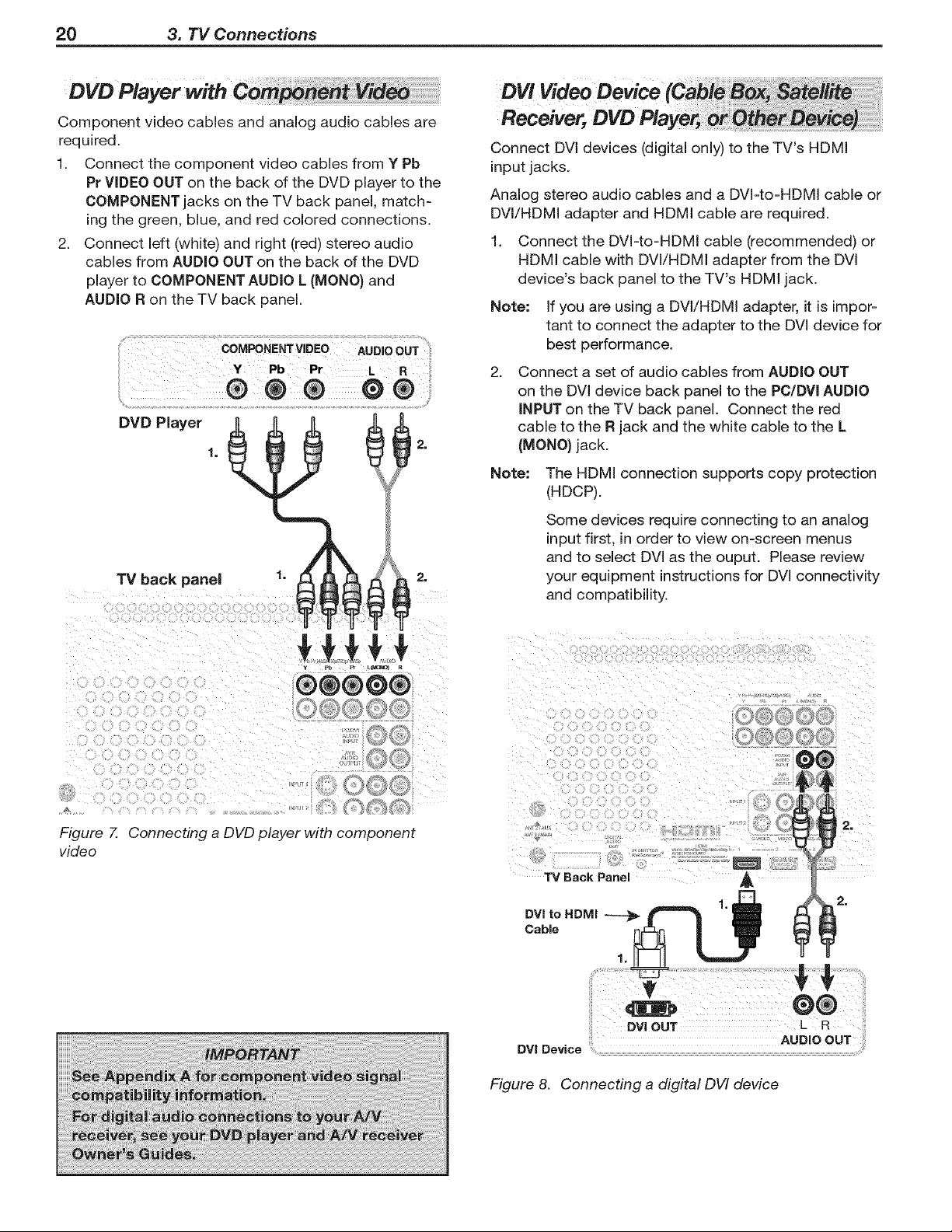
Component video cables and analog audio cables are
required.
1. Connect the component video cables from Y Pb
Pr VIDEO OUT on the back of the DVD player to the
COMPONENT jacks on the TV back panel, match-
ing the green, blue, and red colored connections.
2. Connect left (white) and right (red) stereo audio
cables from AUDIO OUT on the back of the DVD
player to COMPONENT AUDIO L (MONO) and
AUDIO R on the TV back panel,
DVD Player
1.
DVI Video
Receiver,
Connect DVI devices (digital only) to the TV's HDMI
input jacks.
Analog stereo audio cables and a DVI=to=HDMI cable or
DVl/HDMI adapter and HDMI cable are required.
1. Connect the DVI=to=HDMI cable (recommended) or
HDMI cable with DVVHDMI adapter from the DVl
device's back panel to the TV's HDMI jack.
Note: if you are using a DVl/HDMI adapter, it is impor=
tant to connect the adapter to the DVl device for
best performance.
2. Connect a set of audio cables from AUDIO OUT
on the DVI device back panel to the PC/DVI AUDIO
iNPUT on the TV back panel. Connect the red
cable to the R jack and the white cable to the L
(MONO) jack.
Note: The HDMI connection supports copy protection
(HDCP).
Some devices require connecting to an analog
input first, in order to view on=screen menus
and to select DVl as the ouput. Please review
your equipment instructions for DVl connectivity
and compatibility.
Figure 7. Connecting a DVD player with component
video
0®
TV Back Panel A
ov,.o.o , rm
co ,o iv
AUDIO OUT
DVI Device
Figure 8. Connecting a digital DVI device
3. TV Connections 21
VCR to an
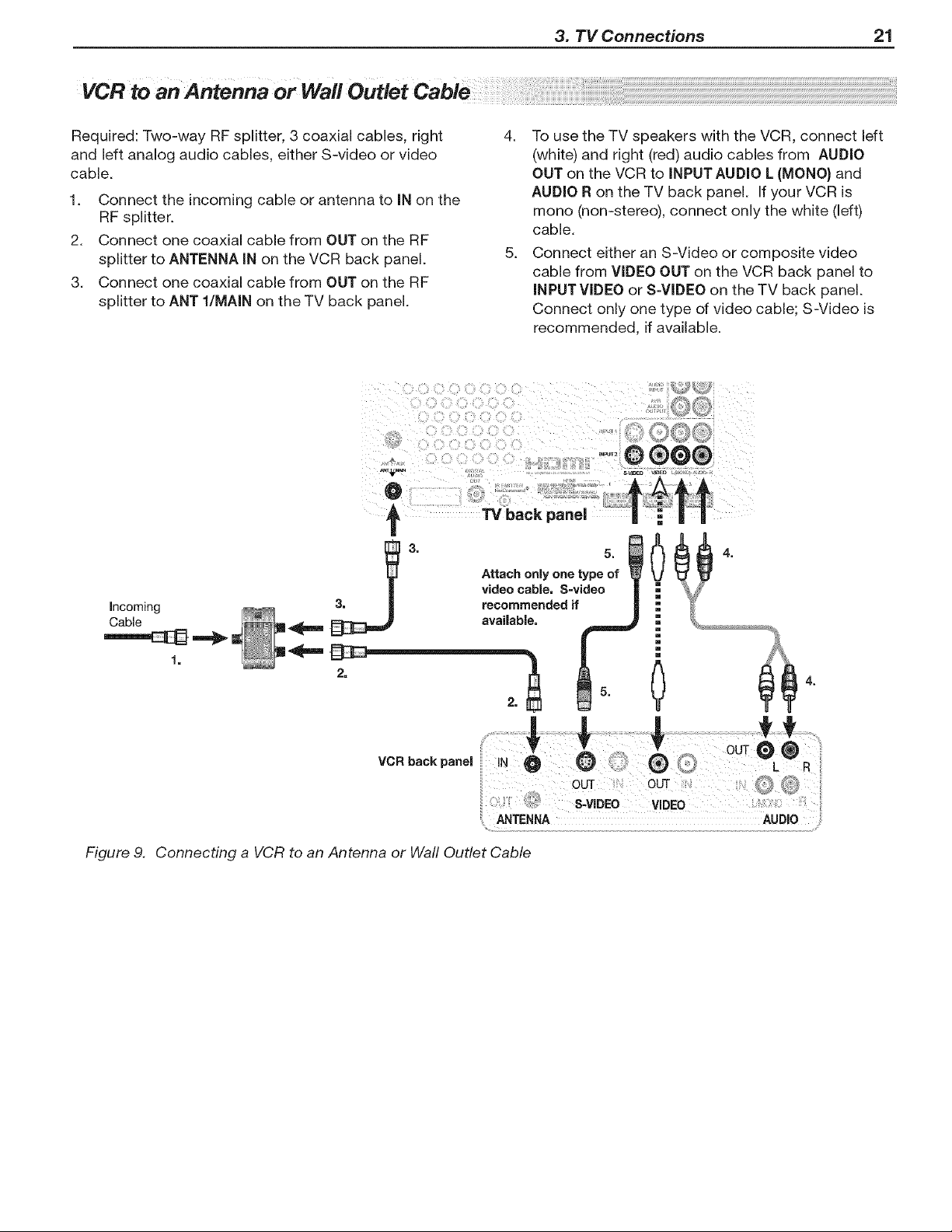
Required: Two-way RF splitter, 3 coaxial cables, right
and left analog audio cables, either S-video or video
cable.
1. Connect the incoming cable or antenna to iN on the
RF splitter.
2. Connect one coaxial cable from OUT on the RF
splitter to ANTENNA iN on the VCR back panel.
3. Connect one coaxial cable from OUT on the RF
splitter to ANT l/MAIN on the TV back panel.
4. To use the TV speakers with the VCR, connect left
(white) and right (red) audio cables from AUDIO
OUT on the VCR to INPUT AUDIO L (MONO} and
AUDIO R on the TV back panel. If your VCR is
mono (non-stereo), connect only the white (left)
cable.
5. Connect either an S-Video or composite video
cable from VIDEO OUT on the VCR back panel to
INPUT VIDEO or S-VIDEO on the TV back panel.
Connect only one type of video cable; S-Video is
recommended, if available.
Incoming 3,
Cable
1=
....0 ®0®
TV back panel
5,
Attach only one type of
video cable, S=video
recommended if
available,
5,
2.
4.
R
E
0
4,
VCR back panel
ANTENNA AUDIO
Figure 9. Connecting a VCR to an Antenna or Wall Outlet Cable
22 3. 71/Connections
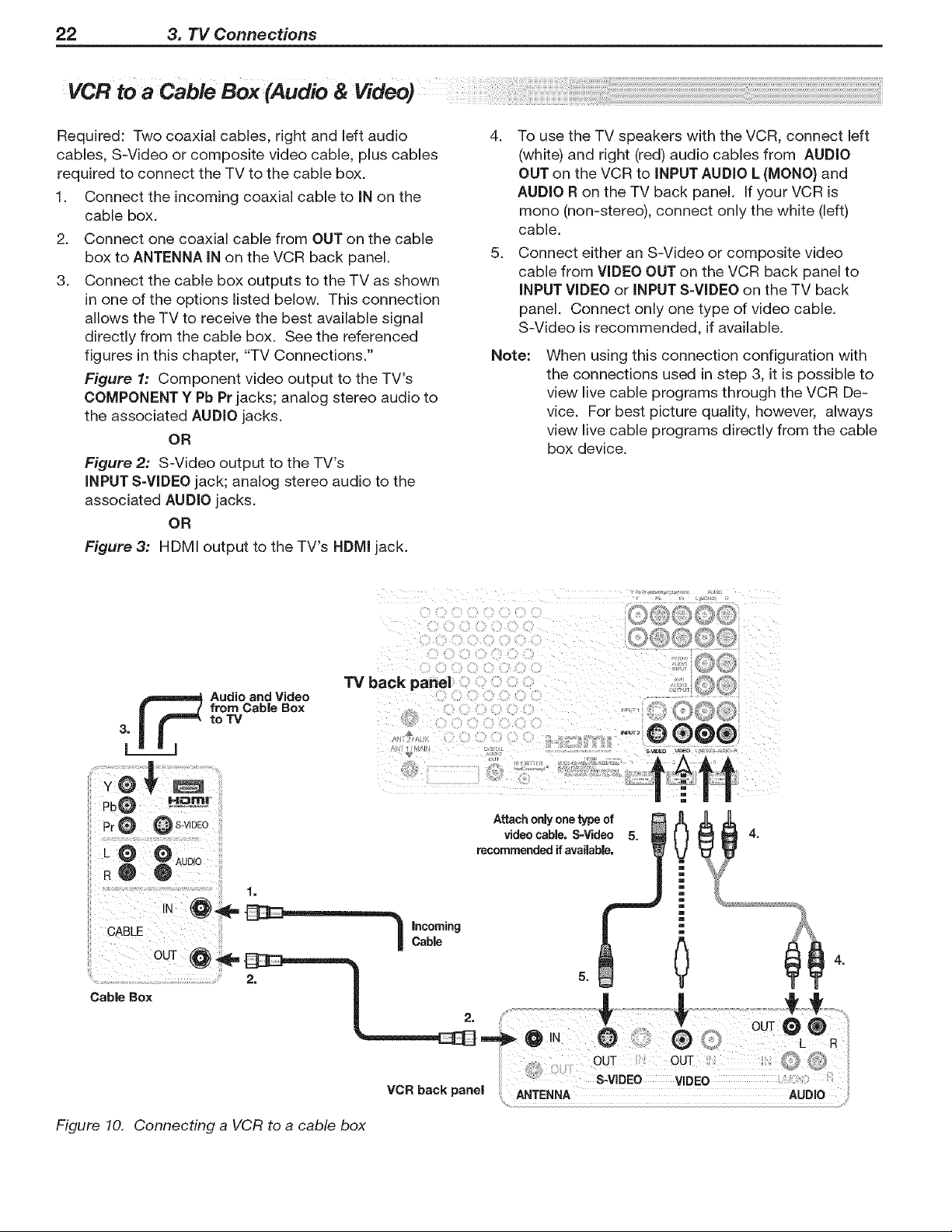
Required: Two coaxial cables, right and left audio
cables, S-Video or composite video cable, plus cables
required to connect the TV to the cable box.
1. Connect the incoming coaxial cable to iN on the
cable box.
2. Connect one coaxial cable from OUT on the cable
box to ANTENNA iN on the VCR back panel.
3. Connect the cable box outputs to the TV as shown
in one of the options listed below. This connection
allows the TV to receive the best available signal
directly from the cable box. See the referenced
figures in this chapter, "TV Connections."
Figure 1: Component video output to the TV's
COMPONENT Y Pb Pr jacks; analog stereo audio to
the associated AUDIO jacks.
OR
Figure 2: S-Video output to the TV's
iNPUT S-VIDEO jack; analog stereo audio to the
associated AUDIO jacks.
OR
Figure 3: HDMI output to the TV's HDMI jack.
4. To use the TV speakers with the VCR, connect left
(white) and right (red) audio cables from AUDIO
OUT on the VCR to INPUT AUDIO L (MONO) and
AUDIO R on the TV back panel. If your VCR is
mono (non-stereo), connect only the white (left)
cable.
5. Connect either an S-Video or composite video
cable from VIDEO OUT on the VCR back panel to
iNPUT VIDEO or iNPUT S-VIDEO on the TV back
panel. Connect only one type of video cable.
S-Video is recommended, if available.
Note:
When using this connection configuration with
the connections used in step 3, it is possible to
view live cable programs through the VCR De-
vice. For best picture quality, however, always
view live cable programs directly from the cable
box device.
3_ Audio and Video
from Cable Box
to TV
"iV back pane|
...... +' O Q@®
+° ++,
Osv'°E°
Figure 10+ Connecting a VCR to a cable box
3. TV Connections 23
A/V Receiver
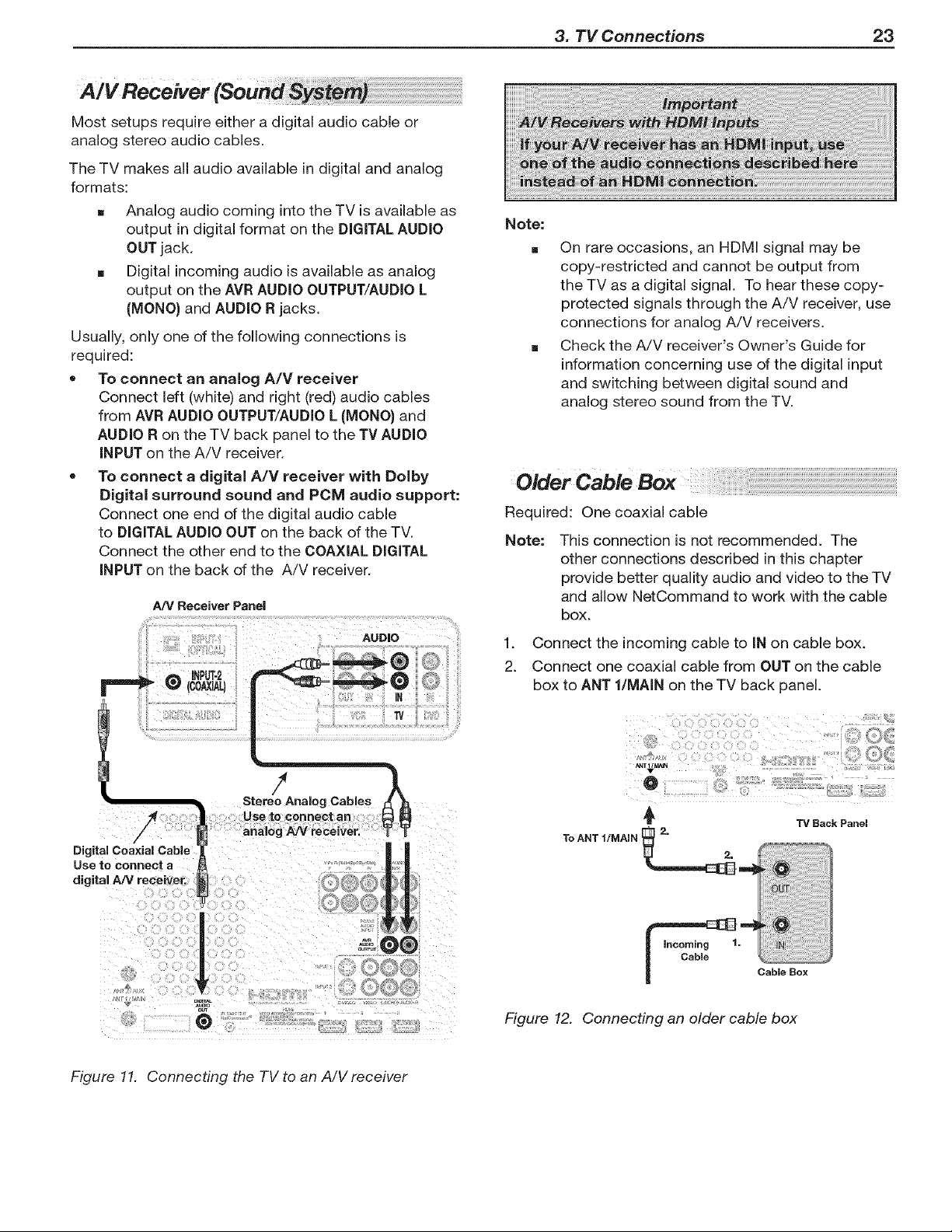
Most setups require either a digital audio cable or
analog stereo audio cables.
The TV makes all audio available in digital and analog
formats:
[] Analog audio coming into the TV is available as
output in digital format on the DiGiTALAUDIO
OUT jack.
[] Digital incoming audio is available as analog
output on the AVR AUDIO OUTPUT/AUDIO L
(MONO) and AUDIO R jacks.
Usually, only one of the following connections is
required:
• To connect an analog A/V receiver
Connect left (white) and right (red) audio canes
from AVR AUDIO OUTPUT/AUDIO L (MONO) and
AUDIO R on the TV back panel to the TV AUDIO
iNPUT on the A/V receiver,
• To connect a digital A/V receiver with Dolby
Digital surround sound and PCIVl audio support:
Connect one end of the digital audio cable
to DiGiTAL AUDIO OUT on the back of the TV.
Connect the other end to the COAXIAL DiGiTAL
iNPUT on the back of the A/V receiver,
A/V Receiver Panel
Note:
[] On rare occasions, an HDMI signal may be
copy-restricted and cannot be output from
the TV as a digital signal. To hear these copy-
protected signals through the A/V receiver, use
connections for analog A/V receivers.
Check the A/V receiver's Owner's Guide for
information concerning use of the digital input
and switching between digital sound and
analog stereo sound from the TV.
Required: One coaxial cable
Note: This connection is not recommended. The
other connections described in this chapter
provide better quality audio and video to the TV
and allow NetCommand to work with the cable
box.
1. Connect the incoming cable to iN on cable box.
2. Connect one coaxial cable from OUT on the cable
box to ANT l/MAIN on the TV back panel,
TV Back Panel
To ANT t/MAIN "_21_'Jt'_"
m
Cable Box
Figure 12. Connecting an older cable box
Figure 11. Connecting the TV to an A/Vreceiver
24 3. 71/Connections
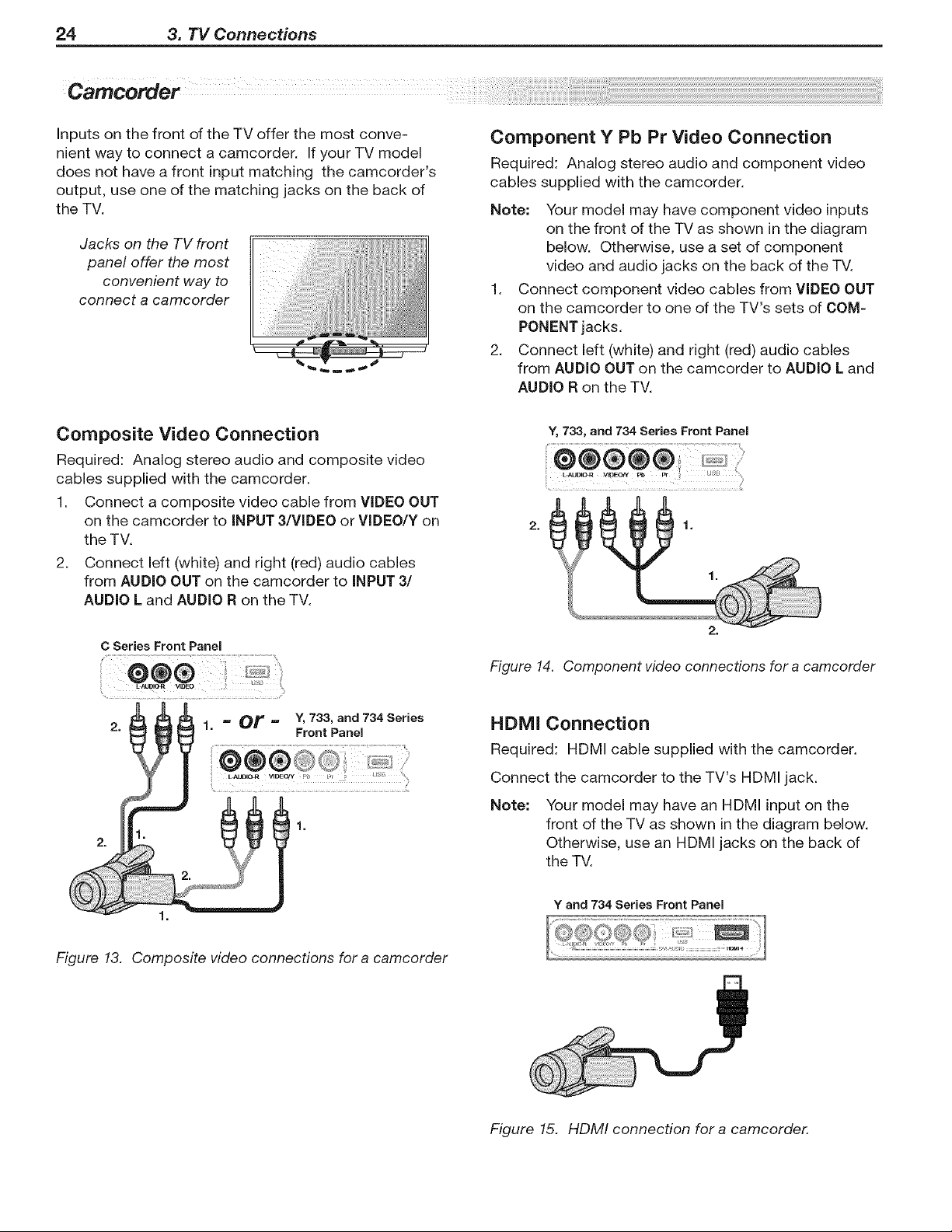
Inputs on the front of the TV offer the most conve-
nient way to connect a camcorder. If your TV model
does not have a front input matching the camcorder's
output, use one of the matching jacks on the back of
the TV.
Jacks on the TV front
panel offer the most
convenient way to
connect a camcorder
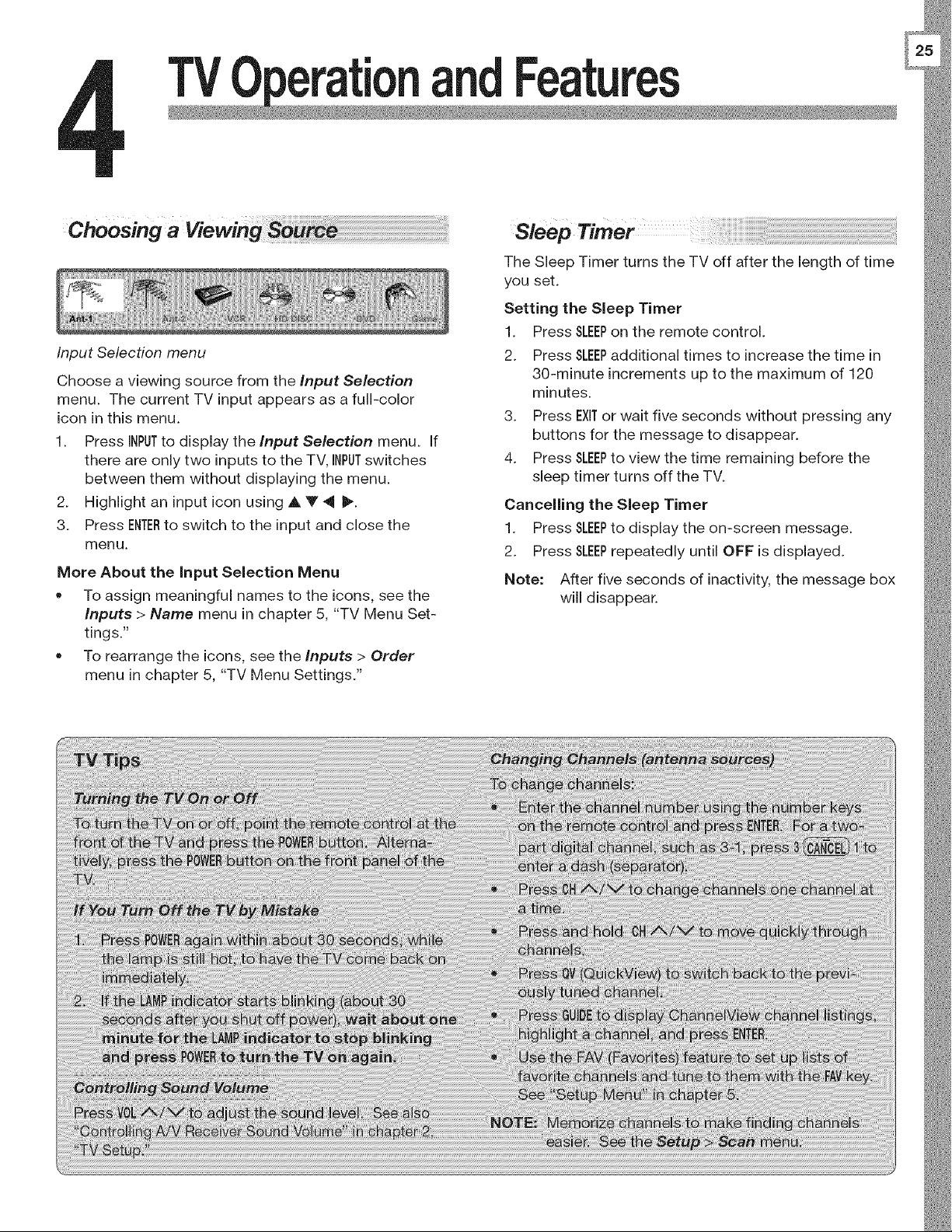
Component Y Pb Pr Video Connection
Required: Analog stereo audio and component video
cables supplied with the camcorder.
Note: Your model may have component video inputs
on the front of the TV as shown in the diagram
below. Otherwise, use a set of component
video and audio jacks on the back of the TV.
1. Connect component video cables from VIDEO OUT
on the camcorder to one of the TV's sets of COM-
PONENT jacks.
2. Connect left (white) and right (red) audio cables
from AUDIO OUT on the camcorder to AUDIO L and
AUDIO R on the TV.
Composite Video Connection
Required: Analog stereo audio and composite video
cables supplied with the camcorder.
1. Connect a composite video cable from VIDEO OUT
on the camcorder to INPUT 3/VIDEO or VIDEO/Y on
the TV.
2. Connect left (white) and right (red) audio cables
from AUDIO OUT on the camcorder to iNPUT 3/
AUDIO L and AUDIO R on the TV.
C Series Front Panel
Y, 733, and 734 Series
Front Panel
1.
Y, 733, and 734 Series Front Panel
2.
Figure 14. Component video connections for a camcorder
HDMI Connection
Required: HDMI cable supplied with the camcorder.
Connect the camcorder to the TV's HDMI jack.
Note: Your model may have an HDMI input on the
front of the TV as shown in the diagram below.
Otherwise, use an HDMI jacks on the back of
the TV.
Y and 734 Series Front Panel
Figure 13. Composite video connections for a camcorder
Figure 15. HDMI connection for a camcorder.
TV
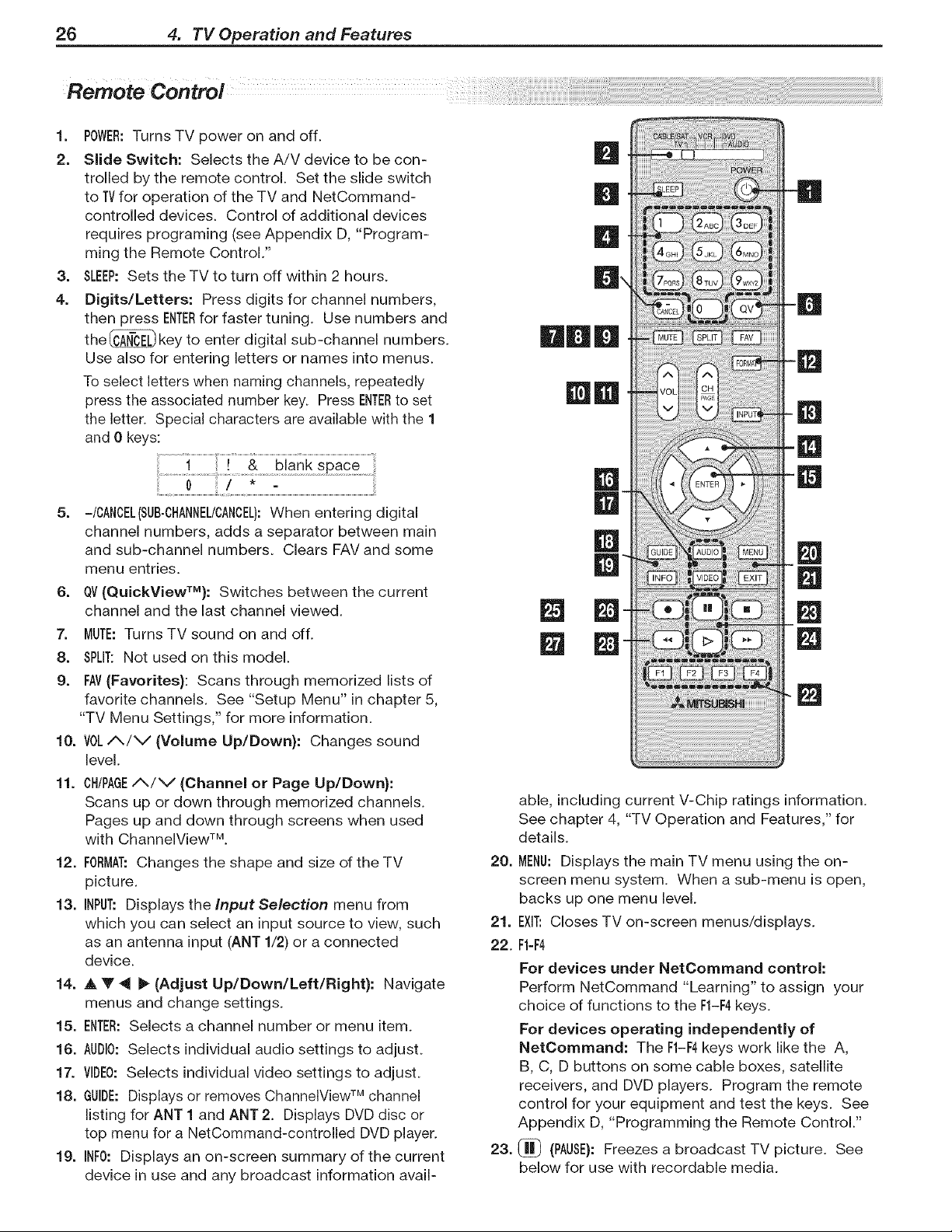
Input Selection menu
andFeatures
Choose a viewing source from the Input Selection
menu. The current TV input appears as a full-color
icon in this menu.
1. Press INPUTto display the Input Selection menu. If
there are only two inputs to the TV, INPUTswitches
between them without displaying the menu.
2. Highlight an input icon using A V 4 _.
3. Press ENTERto switch to the input and close the
menu.
More About the input Selection Menu
• To assign meaningful names to the icons, see the
inputs > Name menu in chapter 5, "TV Menu Set-
tings."
To rearrange the icons, see the inputs > Order
menu in chapter 5, "TV Menu Settings."
Sleep Timer
The Sleep Timer turns the TV off after the length of time
you set.
Setting the Sleep Timer
1. Press SLEEPon the remote control.
2. Press SLEEPadditional times to increase the time in
30-minute increments up to the maximum of 120
minutes.
3. Press EXITor wait five seconds without pressing any
buttons for the message to disappear.
4. Press SLEEPto view the time remaining before the
sleep timer turns off the TV.
Cancelling the Sleep Timer
1. Press SLEEPto display the on-screen message.
2. Press SLEEPrepeatedly until OFF is displayed.
Note: After five seconds of inactivity, the message box
will disappear.
26 4. TV Operation and Features
Remote Control
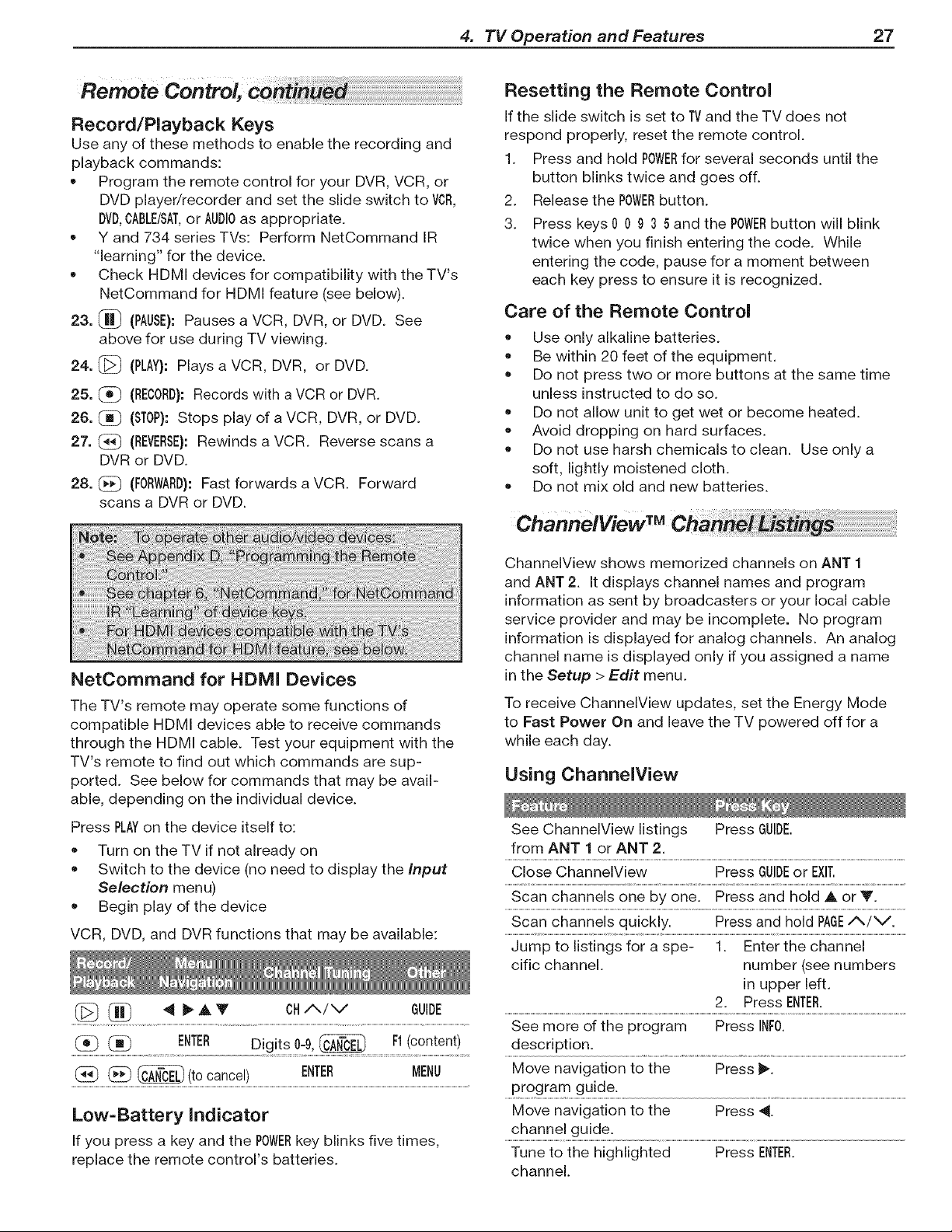
1. POWER:Turns TV power on and off.
2. Slide Switch: Selects the A!V device to be con-
trolled by the remote control. Set the slide switch
to TVfor operation of the TV and NetCommand-
controlled devices. Control of additional devices
requires programing (see Appendix D, "Program-
ming the Remote Control."
3. SLEEP:Sets the TV to turn off within 2 hours.
4. Digits/Letters: Press digits for channel numbers,
then press ENTERfor faster tuning. Use numbers and
the _ key to enter digital sub-channel numbers.
Use also for entering letters or names into menus.
To select letters when naming channels, repeatedly
press the associated number key. Press ENTERto set
the letter. Special characters are available with the 1
and 0 keys:
0 i/ *
i!...........................................................................................................................:..........................................................................................................i
5. =/CANCEL(SUB-CHANNEL/CANCEL}:When entering digital
channel numbers, adds a separator between main
and sub-channel numbers. Clears FAV and some
menu entries.
6. OV(QuickViewTM): Switches between the current
channel and the last channel viewed.
7. MUTE:Turns TV sound on and off.
8. SPLIT:Not used on this model.
9. FAV(Favorites): Scans through memorized lists of
favorite channels. See "Setup Menu" in chapter 5,
"TV Menu Settings," for more information.
10. VOL/_/V (Volume Up/Down): Changes sound
level.
11. CH/PAGE/_/V (Channel or Page Up/Down}:
Scans up or down through memorized channels.
Pages up and down through screens when used
with ChannelView TM.
12. FORMAT:Changes the shape and size of the TV
picture.
13. iNPUT:Displays the Input Selection menu from
which you can select an input source to view, such
as an antenna input (ANT 1/2) or a connected
device.
14. ,L y _1!I_ (Adjust Up/Down/left/Right): Navigate
menus and change settings.
15. ENTER:Selects a channel number or menu item.
16. AUDIO:Selects individual audio settings to adjust.
17. VIDEO:Selects individual video settings to adjust.
TM
18. GUIDE:Displays or removes ChannelView channel
listing for ANT 1 and ANT 2. Displays DVD disc or
top menu for a NetCommand-controlled DVD player.
19. INFO:Displays an on-screen summary of the current
device in use and any broadcast information avail-
H
El
able, including current V-Chip ratings information.
See chapter 4, "TV Operation and Features," for
details.
20. MENU:Displays the main TV menu using the on-
screen menu system. When a sub-menu is open,
backs up one menu level.
21. EXIT:Closes TV on-screen menus/displays.
22. FI=F4
For devices under NetCommand control:
Perform NetCommand "Learning" to assign your
choice of functions to the F1-F4keys.
For devices operating independently of
NetCommand: The F1-F4keys work like the A,
B, C, D buttons on some cable boxes, satellite
receivers, and DVD players. Program the remote
control for your equipment and test the keys. See
Appendix D, "Programming the Remote Control."
23. 1_ (PAUSE):Freezes a broadcast TV picture. See
below for use with recordable media.
4. TV Operation and Features 27
Record/Playback Keys
Use any of these methods to enable the recording and
playback commands:
• Program the remote control for your DVR, VCR, or
DVD player/recorder and set the slide switch to VCR,
DVD,CABLE/SAT,or AUDIOas appropriate.
Y and 734 series TVs: Perform NetCommand IR
"learning" for the device.
• Check HDMI devices for compatibility with the TV's
NetCommand for HDMI feature (see below).
23. _ (PAUSE):Pauses a VCR, DVR, or DVD. See
above for use during TV viewing.
24. _ (PLAY):Plays a VCR, DVR, or DVD.
25. (_ (RECORD):Records with a VCR or DVR.
26. _ (STOP):Stops play of a VCR, DVR, or DVD.
27. (_ (REVERSE):Rewinds a VCR. Reverse scans a
DVR or DVD.
28. (_ (FORWARD):Fast forwards a VCR. Forward
scans a DVR or DVD.
Resetting the Remote Control
If the slide switch is set to TVand the TV does not
respond properly, reset the remote control.
1. Press and hold POWERfor several seconds until the
button blinks twice and goes off.
2. Release the POWERbutton.
3. Press keys 0 0 9 3 5 and the POWERbutton will blink
twice when you finish entering the code. While
entering the code, pause for a moment between
each key press to ensure it is recognized.
Care of the Remote Control
• Use only alkaline batteries.
• Be within 20 feet of the equipment.
Do not press two or more buttons at the same time
unless instructed to do so.
Do not allow unit to get wet or become heated.
• Avoid dropping on hard surfaces.
• Do not use harsh chemicals to clean. Use only a
soft, lightly moistened cloth.
• Do not mix old and new batteries.
NetCommand for HDMI Devices
The TV's remote may operate some functions of
compatible HDMI devices able to receive commands
through the HDMI cable. Test your equipment with the
TV's remote to find out which commands are sup-
ported. See below for commands that may be avail-
able, depending on the individual device.
Press PLAYon the device itself to:
Turn on the TV if not already on
Switch to the device (no need to display the Input
Selection menu)
Begin play of the device
VCR, DVD, and DVR functions that may be available:
(_ _ 4 I_A y CHA/V GUIDE
1_ (_ ENTER Digits 0-9,_ F1(content)
_ _ (to cancel) ENTER MENU
Low=Battery indicator
If you press a key and the POWERkey blinks five times,
replace the remote control's batteries.
ChannelView shows memorized channels on ANT 1
and ANT 2. It displays channel names and program
information as sent by broadcasters or your local cable
service provider and may be incomplete. No program
information is displayed for analog channels. An analog
channel name is displayed only if you assigned a name
in the Setup > Edit menu.
To receive ChannelView updates, set the Energy Mode
to Fast Power On and leave the TV powered off for a
while each day.
Using ChannelView
See ChanneIView listings Press GUIDE.
from ANT 1 or ANT 2.
Close ChannelView Press GUIDEor EXIT.
Scan channels one by one. Press and hold A or Y.
Scan channels quickly. Press and hold PAGE/_/V.
Jump to listings for a spe- 1. Enter the channel
cific channel, number (see numbers
in upper left.
2. Press ENTER.
See more of the program Press INFO.
description.
Move navigation to the Press _.
program guide.
Move navigation to the Press 4.
channel guide.
Tune to the highlighted Press ENTER.
channel.
28 4. TV Operation and Features
Status Display
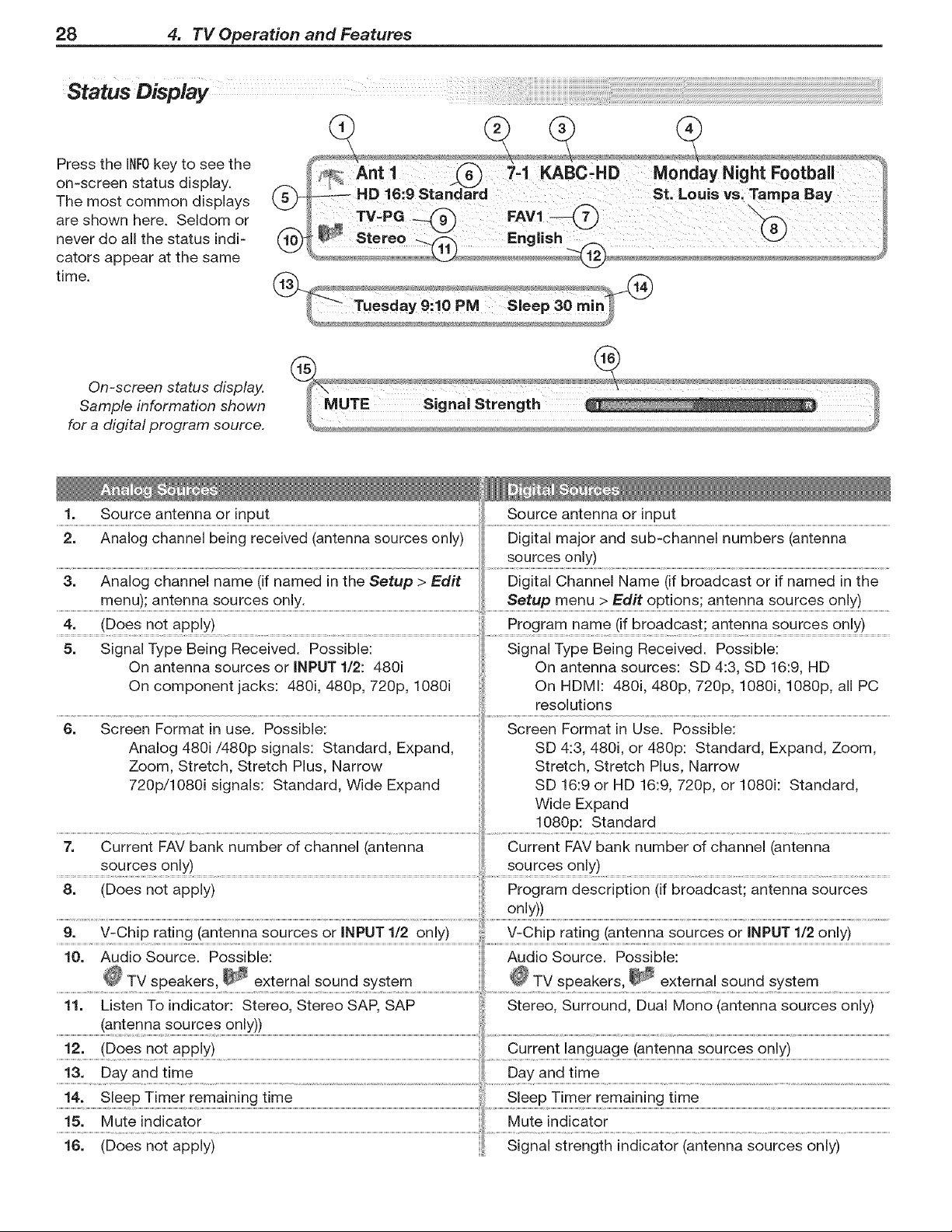
Press the INFOkey to see the
on-screen status display.
The most common displays
are shown here. Seldom or
never do all the status indi-
cators appear at the same
time.
On-screen status display.
Sample information shown
for a digital program source.
1. Source antenna or input Source antenna or input
2. Analog channel being received (antenna sources only) Digital major and sub-channel numbers (antenna
sources only)
3. Analog channel name (if named in the Setup > Edit Digital Channel Name (if broadcast or if named in the
menu); antenna sources only. Setup menu > Edit options; antenna sources only)
4. (Does not apply) Program name (if broadcast; antenna sources only)
5. Signal Type Being Received. Possible: Signal Type Being Received. Possible:
On antenna sources or INPUT 1/2: 480i On antenna sources: SD 4:3, SD 16:9, HD
On component jacks: 480i, 480p, 720p, 1080i On HDMI: 480i, 480p, 720p, 1080i, 1080p, all PC
resolutions
6. Screen Format in use. Possible: Screen Format in Use. Possible:
Analog 480i/480p signals: Standard, Expand, SD 4:3, 480i, or 480p: Standard, Expand, Zoom,
Zoom, Stretch, Stretch Plus, Narrow Stretch, Stretch Plus, Narrow
720p/1080i signals: Standard, Wide Expand SD 16:9 or HD 16:9, 720p, or 1080i: Standard,
Wide Expand
1080p: Standard
7. Current FAV bank number of channel (antenna Current FAV bank number of channel (antenna
sources only) sources only)
8. (Does not apply) Program description (if broadcast; antenna sources
only))
9. V-Chip rating (antenna sources or INPUT 1/2 only) V-Chip rating (antenna sources or INPUT 1/2 only)
10. Audio Source. Possible: Audio Source. Possible:
@ TV speakers, _# external sound system "_@TV speakers, _ external sound system
11. Listen To indicator: Stereo, Stereo SAP, SAP Stereo, Surround, Dual Mono (antenna sources only)
(antenna sources only))
12. (Does not apply) Current language (antenna sources only)
13. Day and time Day and time
14. Sleep Timer remaining time Sleep Timer remaining time
15. Mute indicator Mute indicator
16. (Does not apply) Signal strength indicator (antenna sources only)
4. TV Operation and Features 29
FA V (Favorite Channels)
Use the six Fav channel banks to store groups of your
favorite channels from ANT 1 and ANT 2. You can set
up a Fav channel bank for each of your favorite program
types or set up a bank for each TV user.
You may prefer to perform FAV channel setup from a
menu. See chapter 5, "TV Menu Settings," and the
Setup > Edit options.
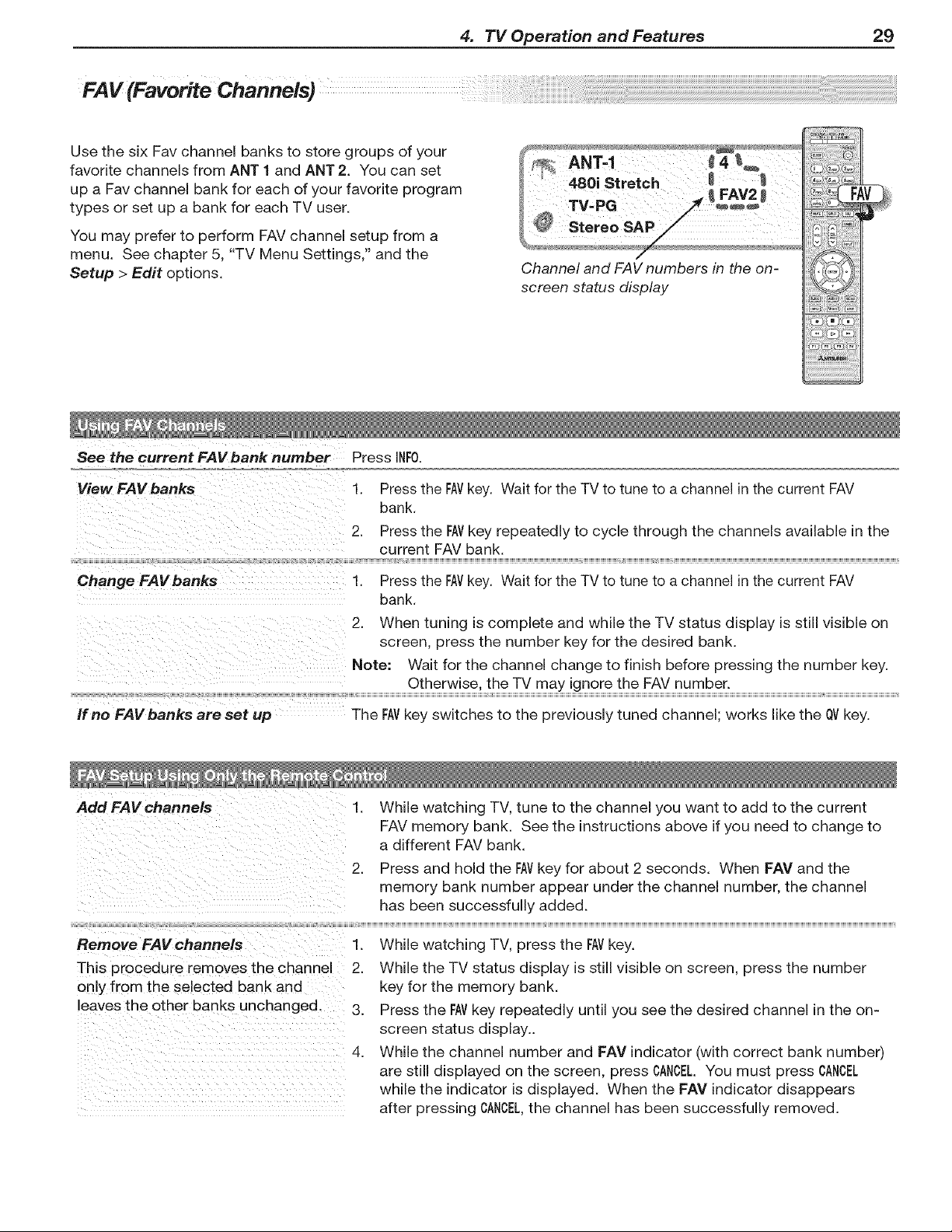
Channel and FAV numbers in the on-
screen status display
See the current FAV bank number
View FAV banks 1.
2
Change FAVbanks 1.
Press INFO,
Press the FAVkey. Wait for the TV to tune to a channel in the current FAV
bank.
Press the FAVkey repeatedly to cycle through the channels available in the
current FAV bank.
Press the FAVkey. Wait for the TV to tune to a channel in the current FAV
bank.
2. When tuning is complete and while the TV status display is still visible on
screen, press the number key for the desired bank.
Note: Wait for the channel change to finish before pressing the number key.
Otherwise, the TV mav ianore the FAVnumber.._
!
If no FAVbanks are set up The FAVkey switches to the previously tuned channel; works like the QVkey.
Add FA V channels
Remove FAV channels
This procedure removes the channel
only from the selected bank and
eaves the other banks unchanged.
1. While watching TV, tune to the channel you want to add to the current
FAV memory bank. See the instructions above if you need to change to
a different FAV bank.
2. Press and hold the FAVkey for about 2 seconds. When FAV and the
memory bank number appear under the channel number, the channel
has been successfully added.
1. While watching TV, press the FAVkey.
2. While the TV status display is still visible on screen, press the number
key for the memory bank.
3. Press the FAVkey repeatedly until you see the desired channel in the on-
screen status display..
4. While the channel number and FAV indicator (with correct bank number)
are still displayed on the screen, press CANCEL.You must press CANCEL
while the indicator is displayed. When the FAY indicator disappears
after pressing CANCEL,the channel has been successfully removed.
30 4. TV Operation and Features
This is a widescreen TV, also known as a 16:9 TV. This
shape reflects the new types of images available from
HDTV and many DVDs. There are still many older style
narrow-screen images (called 4:3 aspect ratio) you will
encounter. While there is no perfect solution for dis-
playing a squarish, narrower image on a wide screen,
Mitsubishi offers several display formats from which
you can choose.
Press FORMATon the TV remote control to cycle through
the available display formats. The last-used format for
each device is used when you return to that device.
DVD Definitions
Anamorphic (or Enhanced for WideScreen TV)
These DVDs are recorded in a special way to prop-
erly show widescreen images on 16:9 TV sets using
the Standard format mode. This is the recommended
viewing choice.
Non-Anamorphic (or 4:3, 1:33:1, Letter Box, or Full
Screen}
These DVDs are recorded for use with traditionally
shaped, squarish TVs. They may be full screen (4:3 or
1:33:1) which crops movies to fit the narrow TV, or letter
box, which adds black top and bottom bars.
This information may be listed on the DVD case. Some
DVDs support both types of recordings.
Signal Definitions
480i Signals: Traditional analog interlaced signals
from or through ANT-1 and 2, INPUT 1-3, COMPONENT
and HDMI jacks.
480p Signals: Progressive-scan DVD signals on COM-
PONENT and HDMI jacks.
720p and 1080i Signals: High-definition signals
received through COMPONENT and HDMI jacks. These
signals are always 16:9 (widescreen).
SD 4:3: Standard-definition squarish-screen format
signals from digital channels on ANT 1 and ANT 2.
SD 16:9: Standard-definition widescreen format signals
from digital channels on ANT 1 and ANT 2.
HD: High-definition wide-screen format signals from
digital channels on ANT 1 and ANT 2. These signals are
always 16:9 (widescreen).
TV Display Format Definitions
Standard: This is the full-screen format. HDTV signals
use this format. This format is useful for displaying
Anamorphic DVDs that have 1.78:1 or 1.85:1 aspect
ratios. Anamorphic DVDs that have a 2.35:1 aspect
ratio are displayed with black bars at the top and
bottom, but show the entire image correctly. Narrow
(4:3) images are stretched evenly from side to side.
Available for all signals.
Expand: This enlarges the picture to fill the screen,
cropping off some of the image at the top and bottom.
This is useful for reducing the letter box top and bottom
bars of non-anamorphic DVD images. Available for
480i, 480p, and digital SD 4:3 signals only.
Zoom: This enlarges the picture, cropping off some
of the image at each side and top and bottom. This
is useful for removing or reducing the black top and
bottom bars on anamorphic DVDs with a 2.35:1 aspect
ratio. Available for 480i, 480p, and SD 4:3 signals only.
Stretch: This format stretches a narrow (4:3) image
across the screen; there is less stretch in the center
than at the sides, however. This allows the entire
narrow image to be displayed across the screen with
less distortion than is seen in the Standard format.
Available for 480i, 480p, and SD 4:3 signals only.
Stretch Plus: Similar to stretch mode, but to minimize
distortions on the side, the picture is expanded to crop
off portions of the top and bottom. Except when dis-
playing menus, press A Y to adjust the position of the
picture vertically. Available for 480i, 480p, and SD 4:3
signals only.
Narrow: This format displays narrow (4:3) images in
their original shape, and adds stationary black side
bars to fill the screen. Available for 480i, 480p, and SD
4:3 signals only.
Wide Expand: Enlarges the picture, cropping some of
the image on both sides. This Expand format is useful
to remove or reduce black side bars added to narrow
images that are converted to 16:9 signals for digital
broadcast. Available for 1080i, 720p, digital SD 16:9
and digital HD signals.
Note:
All high-definition channels send widescreen
(16:9) signals, but not all programming sent on
these channels was created for this format. The
broadcaster may stretch the image or add side
bars to fill the widescreen area.

4. TV Operation and Features 31
TV Display Formats
See descriptions on the preceding page.
Standard
Expand
Zoom
Stretch
Stretch Plus
Narrow
m
_"r
ORIGINAL SIGNAL
Non-anamorphic or SD 4:3
TV Display
(not recommended, distorted)
not available for
HD, SD 16:9 or
analog 720p, 1080i
(recommended for letterboxed)
__) (_ not available for
HD, SD 16:9 or
analog 720p, 1080i
(not recommended, distorted)
(_ _(_ not available for
HD, SD 16:9 or
analog 720p, 1080i
(recommended for standard broadcast)
not available for
HD, SD 16:9 or
analog 720p, 1080i
(recommended for standard broadcast)
ORIGINAL SIGNAL
Anamorphic DVD
TV Display
Standard
Expand
(recommended)
(not recommended, distorted)
not available for
HD, SD 16:9 or
analog 720p, 1080i
Zoom __)
(recommended for anamorphic 2.35:1)
not available for
HD, SD 16:9 or
analog 720p, 1080i
Stretch Plus
(not recommended, distorted)
not available for
HD, SD 16:9 or
analog 720p, 1080i
Narrow
not available for
HD, SD 16:9 or
analog 720p, 1080i
(not recommended, distorted)
(with side bars in broadcast)
Standard
Original HD or SD
16:9, 720p or 1080i
Wide Expand
available only for
digital SD 16:9, HD,
analog 1080i or 720p
'recommended to remove side bars)
Stretch
(not recommended, distorted)
not available for
HD, SD 16:9 or
analog 720p, 1080i

32 4. TV Operation and Features
JPEG Photos and the USB Photo Port
Connect your digital camera or USB drive to the
USB Photo port on the front of the TV. If using a
camera, power it on and set it to playback mode.
The USB Photo menu
displays while files
are still being read.
Wait until you see the
completion message
on screen before
continuing.
Note:
Some manufacturers' devices may be incompat-
ible with the TV. If the TV is unable to display your
photos, you can:
Try transferring files to a different USB
device.
Use the camera's composite video output
as described later in this chapter.
USB Photo menu
2. After files have been read, you can do the following
from the USB Photo menu:
Start slide show. With the Slideshow icon high-
lighted, press @ or ENTER.
Activate menu options. Highlight an icon and press
ENTERto:
start the slide show
display picture thumbnails
open the Media Setup
submenu.
Display or close the Press MENU.
Main menu.
Display status for the Press INFO.
file source.
Select a different con- 1. Press INPUT.
nected device 2. Highlight the icon for a dif-
ferent device.
3. Press ENTER.
Clear status display Press EXIT.
or menu to show the
USB Photo menu
JPEG Thumbnail Menu
Use these keys while viewing JPEG thumbnail images:
A Y _! I_ Move the highlight from image to image.
FORMAT Rotate the thumbnail clockwise in 90°
increments
or Play the slide show starting with the high-
ENTER lighted thumbnail.
(_ Highlight the last thumbnail on the current
page.
(_ Highlight the first thumbnail on the current
page.
Display the next or previous page of
OH/PAGE^/V thumbnails.
EXIT Close the Thumbnail menu and display
the USB Photo menu.
MENU Close the Thumbnail menu and display
the Main menu.
INPUT Close the Thumbnail menu and display
the input Selection menu.
Notes on Viewing JPEG Files
• Large flies or high-capacity storage devices may take a
longtime to display. The screen will be blank while files
are read.
• Use only one source device at a time.
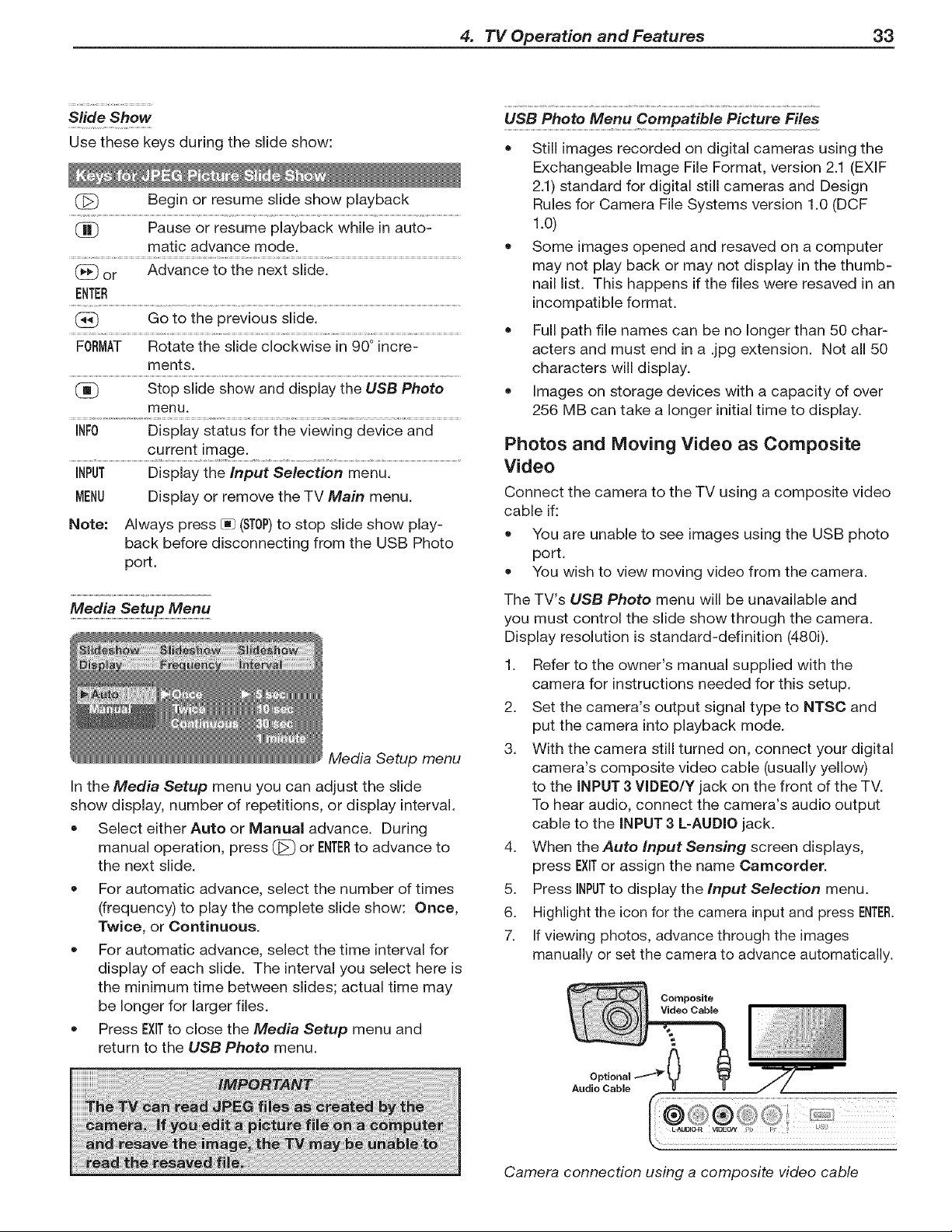
4. TV Operation and Features 33
Slide Show
Use these keys during the slide show:
@ Begin or resume slide show playback
(_ Pause or resume playback while in auto-
matic advance mode.
(_ or Advance to the next slide.
ENTER
Go to the previous slide.
FORMAT Rotate the slide clockwise in 90° incre-
ments.
(_ Stop slide show and display the USB Photo
menu.
INFO Display status for the viewing device and
current image.
iNPUT Display the input Selection menu.
MENU Display or remove the TV Main menu.
Note: Always press l_ (STOP)to stop slide show play-
back before disconnecting from the USB Photo
port.
Media Setup Menu
Media Setup menu
In the Media Setup menu you can adjust the slide
show display, number of repetitions, or display interval.
• Select either Auto or Manual advance. During
manual operation, press (_ or ENTERto advance to
the next slide.
For automatic advance, select the number of times
(frequency) to play the complete slide show: Once,
Twice, or Continuous,
For automatic advance, select the time interval for
display of each slide. The interval you select here is
the minimum time between slides; actual time may
be longer for larger files.
Press EXITto close the Media Setup menu and
return to the USB Photo menu.
USB Photo Menu Compatible Picture Files
Still images recorded on digital cameras using the
Exchangeable Image File Format, version 2.1 (EXIF
2.1) standard for digital still cameras and Design
Rules for Camera File Systems version 1.0 (DCF
1.0)
Some images opened and resaved on a computer
may not play back or may not display in the thumb-
nail list. This happens if the files were resaved in an
incompatible format.
Full path file names can be no longer than 50 char-
acters and must end in a .jpg extension. Not all 50
characters will display.
Images on storage devices with a capacity of over
256 MB can take a longer initial time to display.
Photos and Moving Video as Composite
Video
Connect the camera to the TV using a composite video
cable if:
You are unable to see images using the USB photo
port.
You wish to view moving video from the camera.
The TV's USB Photo menu will be unavailable and
you must control the slide show through the camera.
Display resolution is standard-definition (480i).
1. Refer to the owner's manual supplied with the
camera for instructions needed for this setup.
2. Set the camera's output signal type to NTSC and
put the camera into playback mode.
3. With the camera still turned on, connect your digital
camera's composite video cable (usually yellow)
to the INPUT 3 VIDEO/Y jack on the front of the TV.
To hear audio, connect the camera's audio output
cable to the INPUT 3 L-AUDIO jack.
4. When the Auto input Sensing screen displays,
press EXiTor assign the name Camcorder.
5. Press iNPUTto display the input Selection menu.
6. Highlight the icon for the camera input and press ENTER.
7. If viewing photos, advance through the images
manually or set the camera to advance automatically.
Composite
Video Cable
Camera connection using a composite video cable
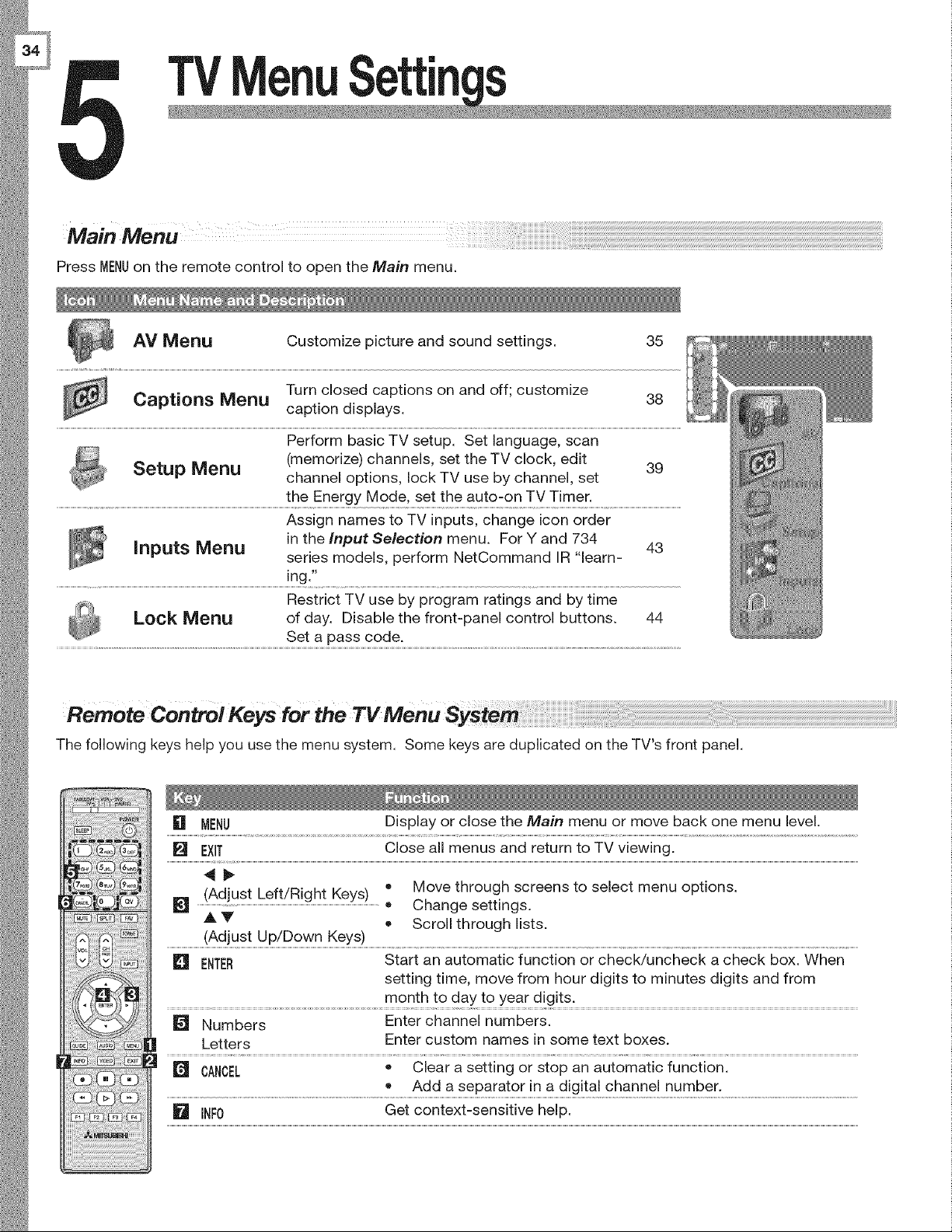
TV
Main Menu
Press MENUon the remote control to open the Main menu.
AV Menu Customize picture and sound settings. 35
Turn closed captions on and off; customize
Captions Menu caption displays. 38
Perform basic TV setup. Set language, scan
(memorize) channels, set the TV clock, edit 39
Setup Menu channel options, lock TV use by channel, set
the Energy Mode, set the auto-on TV Timer.
Assign names to TV inputs, change icon order
in the Input Selection menu. For Y and 734 43
inputs Menu series models, perform NetCommand IR "learn-
ing."
Restrict TV use by program ratings and by time
Lock Menu of day. Disable the front-panel control buttons. 44
Set a pass code.
The following keys help you use the menu system. Some keys are duplicated on the TV's front panel.
[] MENU Display or close the Main menu or move back one menu level.
[] EXIT Close all menus and return to TV viewing.
(Adjust Left/Right Keys) • Move through screens to select menu options.
....................................................................................................................................................................................................• Change settings.
AV * Scroll through lists.
(Adjust Up/Down Keys)
[] ENTER Start an automatic function or check/uncheck a check box. When
setting time, move from hour digits to minutes digits and from
month to day to year digits.
[_ Numbers Enter channel numbers.
Letters Enter custom names in some text boxes.
[_J CANCEL • Clear a setting or stop an automatic function.
Add a separator in a digital channel number.
[] INFO Get context-sensitive help.
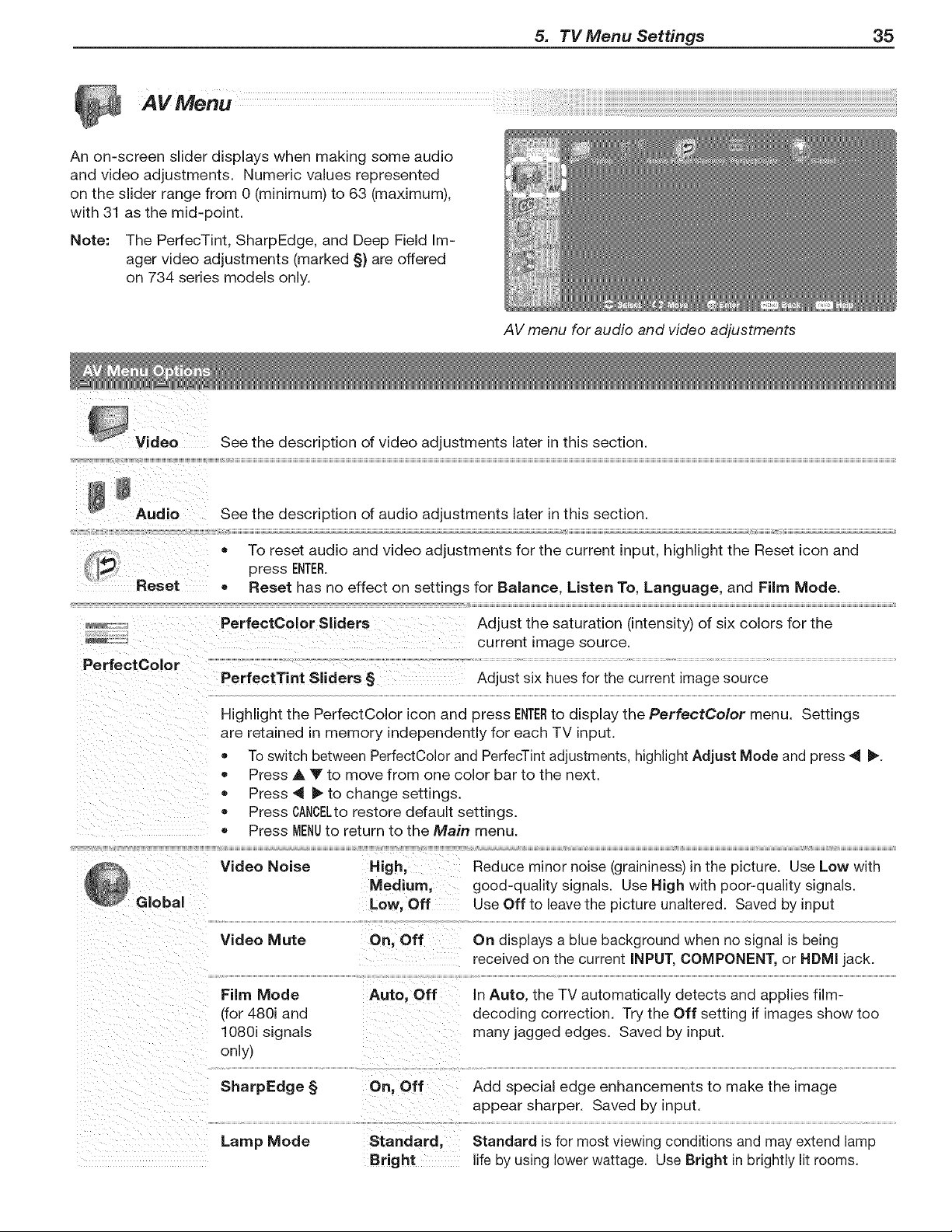
5. TV Menu Settings 35
AV menu for audio and video adjustments
An on-screen slider displays when making some audio
and video adjustments. Numeric values represented
on the slider range from 0 (minimum) to 63 (maximum),
with 31 as the mid-point.
Note: The PerfecTint, SharpEdge, and Deep Field Im-
ager video adjustments (marked §) are offered
on 734 series models only.
See the description of video adjustments later in this section.
t
Audio
:i
................. PerfectColor Sliders
PerfectColor
See the description of audio adjustments later in this section.
To reset audio and video adjustments for the current input, highlight the Reset icon and
press ENTER.
Reset has no effect on settings for Balance, Listen To, Language, and Film Mode.
Adjust the saturation (intensity) of six colors for the
current image source.
PerfectTint Sliders § Adjust six hues for the current image source
Global
Highlight the PerfectColor icon and press ENTERto display the PerfectColor menu. Settings
are retained in memory independently for each TV input.
To switch between PerfectColor and PerfecTint adjustments, highlight Adjust Mode and press 4 _.
Press A Y to move from one color bar to the next.
Press 4 _ to change settings.
Press OANCELtorestore default settings.
Press MENUto return to the Main menu.
Video Noise High, Reduce minor noise (graininess) in the picture. Use Low with
Medium, good-quality signals. Use High with poor-quality signals.
Low, Off Use Off to leave the picture unaltered. Saved by input
Video Mute On, Off
Film Mode
(for 480i and
1080i signals
only)
SharpEdge§
Lamp Mode
Auto, Off
On, Off
Standard,
Bright
On displays a blue background when no signal is being
received on the current INPUT, COMPONENT, or HDMI jack.
In Auto, the TV automatically detects and applies film-
decoding correction. Try the Off setting if images show too
many jagged edges. Saved by input.
Add special edge enhancements to make the image
appear sharper. Saved by input.
Standard is for most viewing conditions and may extend lamp
life by using lower wattage. Use Bright in brightly lit rooms.
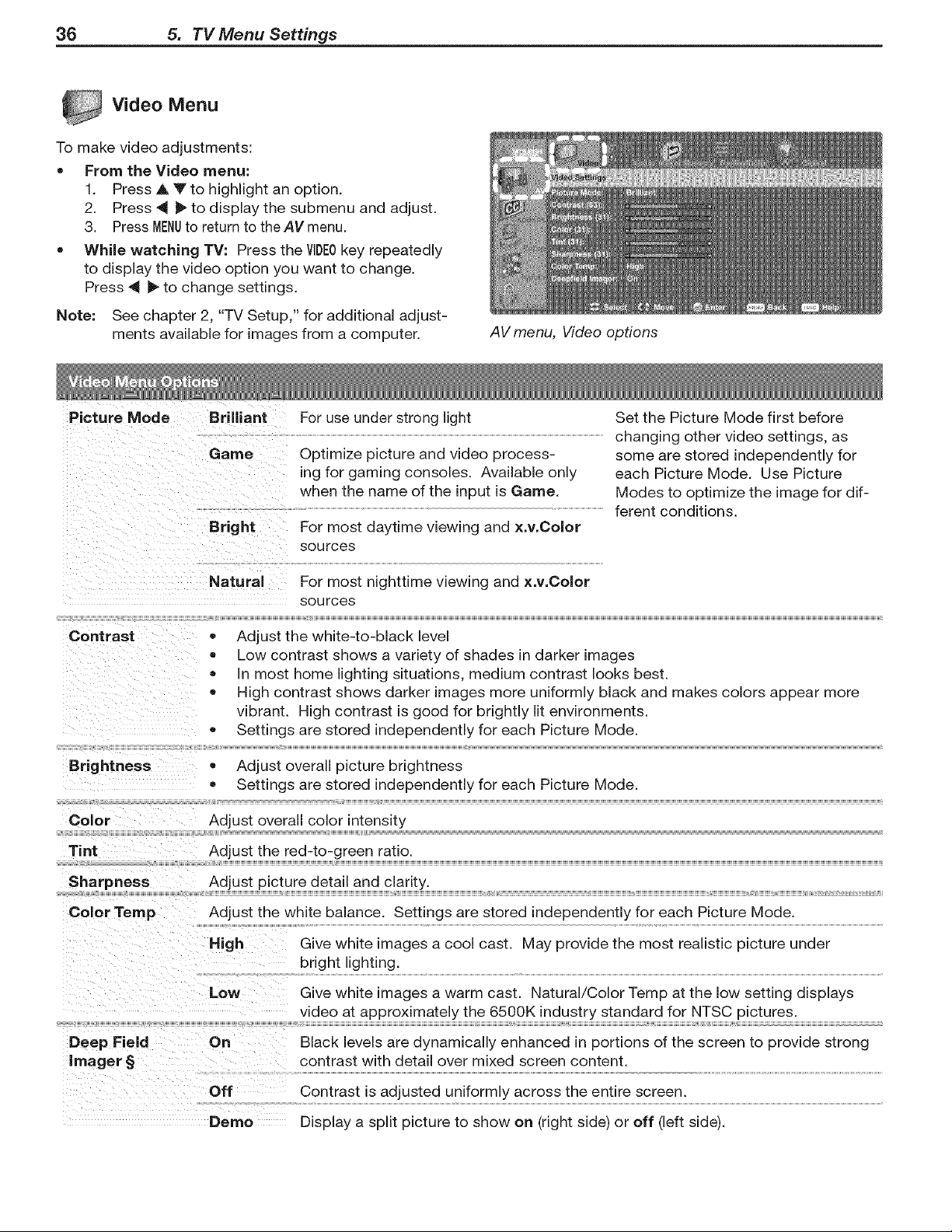
36 5. TV Menu Settings
Video Menu
To make video adjustments:
• From the Video menu:
1. Press A V to highlight an option.
2. Press 4 _" to display the submenu and adjust.
3. Press MENUto return to the AV menu.
While watching TV: Press the VIDEOkey repeatedly
to display the video option you want to change.
Press 4 I_ to change settings.
Note: See chapter 2, "TV Setup," for additional adjust-
ments available for images from a computer.
Picture Mode
Contrast
Brightness
Color
Tint
Sharpness
Color Temp
Deep Field
Imager §
BriUiant
Game
Bright
Natural
AV menu, Video options
For use under strong light Set the Picture Mode first before
...................................................................................................................................................................................................changing other video settings, as
Optimize picture and video process- some are stored independently for
ing for gaming consoles. Available only each Picture Mode. Use Picture
when the name of the input is Game. Modes to optimize the image for dif-
ferent conditions.
For most daytime viewing and x.v.Color
sources
For most nighttime viewing and x.v.Oolor
sources
Adjust the white-to-black level
Low contrast shows a variety of shades in darker images
In most home lighting situations, medium contrast looks best.
High contrast shows darker images more uniformly black and makes colors appear more
vibrant. High contrast is good for brightly lit environments.
Settings are stored independently for each Picture Mode.
Adjust overall picture brightness
Settings are stored independently for each Picture Mode.
Adjust overall color intensity
Adjust the red-to-green ratio.
Adjust picture detail and clarity.
Adjust the white balance. Settings are stored independently for each Picture Mode.
High Give white images a cool cast. May provide the most realistic picture under
bright lighting.
Low
On
Off
Give white images a warm cast. Natural/Color Temp at the low setting displays
v !,,deo at ap pro x!,,mate!,yt he 6500K !,,,ndu,st ry st a nd a:,d !o r NTSC p!,,ct u[es
Black levels are dynamically enhanced in portions of the screen to provide strong
contrast with detail over mixed screen content.
Contrast is adjusted uniformly across the entire screen.
Demo Display a split picture to show on (right side) or off (left side).
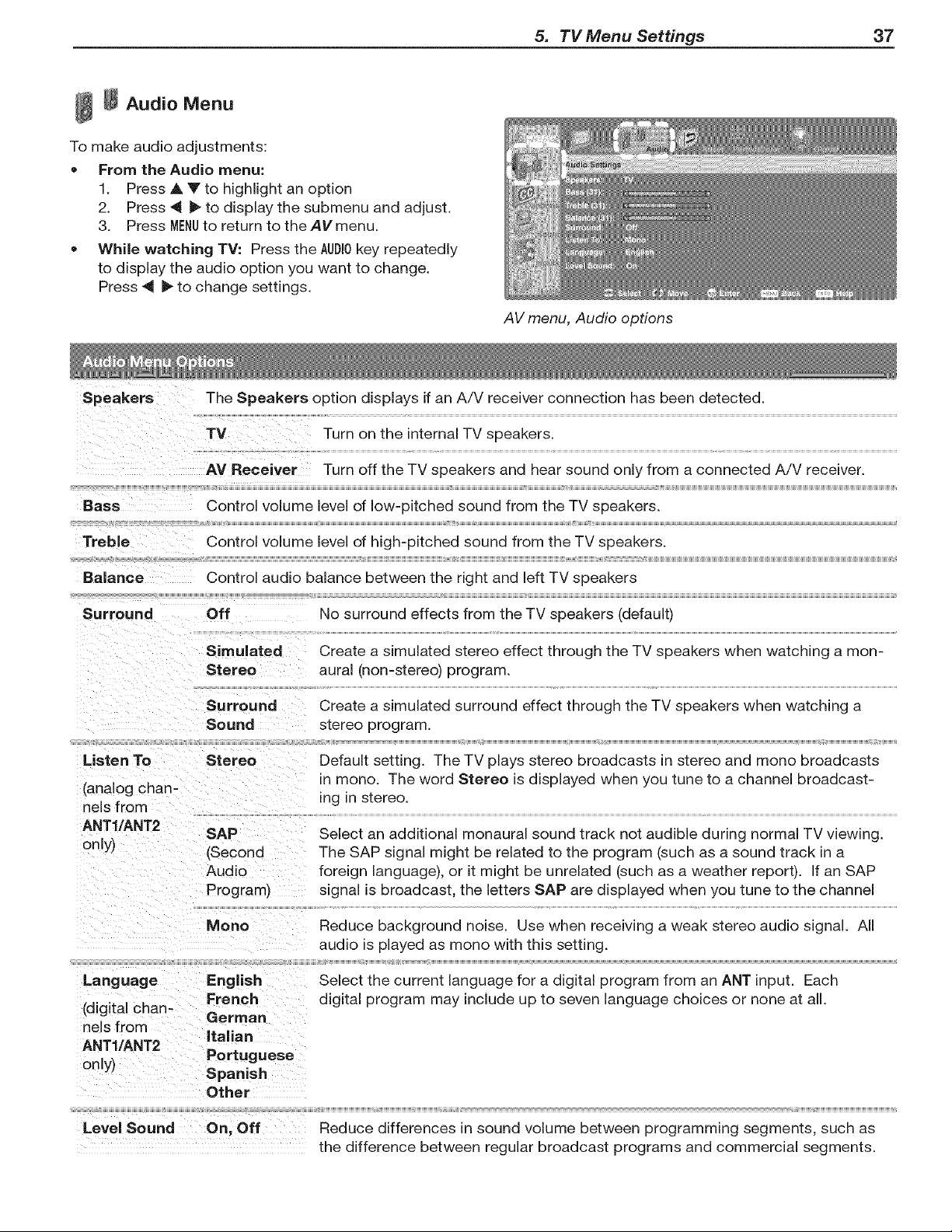
5. TV Menu Settings 37
AV menu, Audio options
Audio Menu
To make audio adjustments:
• From the Audio menu:
1. Press _, V to highlight an option
2. Press 4 _ to display the submenu and adjust.
3. Press MENUto return to the AV menu.
• While watching TV: Press the AUDIOkey repeatedly
to display the audio option you want to change.
Press "_ _ to change settings.
Speakers The Speakers option displays if an A/V receiver connection has been detected.
TM Turn on the internal TV speakers.
Bass
Treb le
Balance
Surround
AV Receiver Turn off the TV speakers and hear sound only from a connected A/V receiver.
Control volume level of low=pitched sound from the TV speakers.
Control volume level of high-pitched sound from the TV speakers.
% / % %
Control audio balance between the right and left TV speakers
Off No surround effects from the TV speakers (default)
Simulated Create a simulated stereo effect through the TV speakers when watching a mon-
Stereo aural (non=stereo) program.
Listen To
(analog chan-
nels from
ANTI/ANT2
only)
Surround
Sound
Stereo
SAP
(Second
Audio
Program)
Mono
Language English
French
(digital chan- German
nels from
italian
ANTI/ANT2
Portuguese
only) Spanish
Other
Level Sound On, Off
Create a simulated surround effect through the TV speakers when watching a
stereo program.
Default setting. The TV plays stereo broadcasts in stereo and mono broadcasts
in mono. The word Stereo is displayed when you tune to a channel broadcast-
ing in stereo.
Select an additional monaural sound track not audible during normal TV viewing.
The SAP signal might be related to the program (such as a sound track in a
foreign language), or it might be unrelated (such as a weather report). If an SAP
signal is broadcast, the letters SAP are displayed when you tune to the channel
Reduce background noise. Use when receiving a weak stereo audio signal. All
audio is played as mono with this setting.
Select the current language for a digital program from an ANT input. Each
digital program may include up to seven language choices or none at all.
Reduce differences in sound volume between programming segments, such as
the difference between regular broadcast programs and commercial segments.
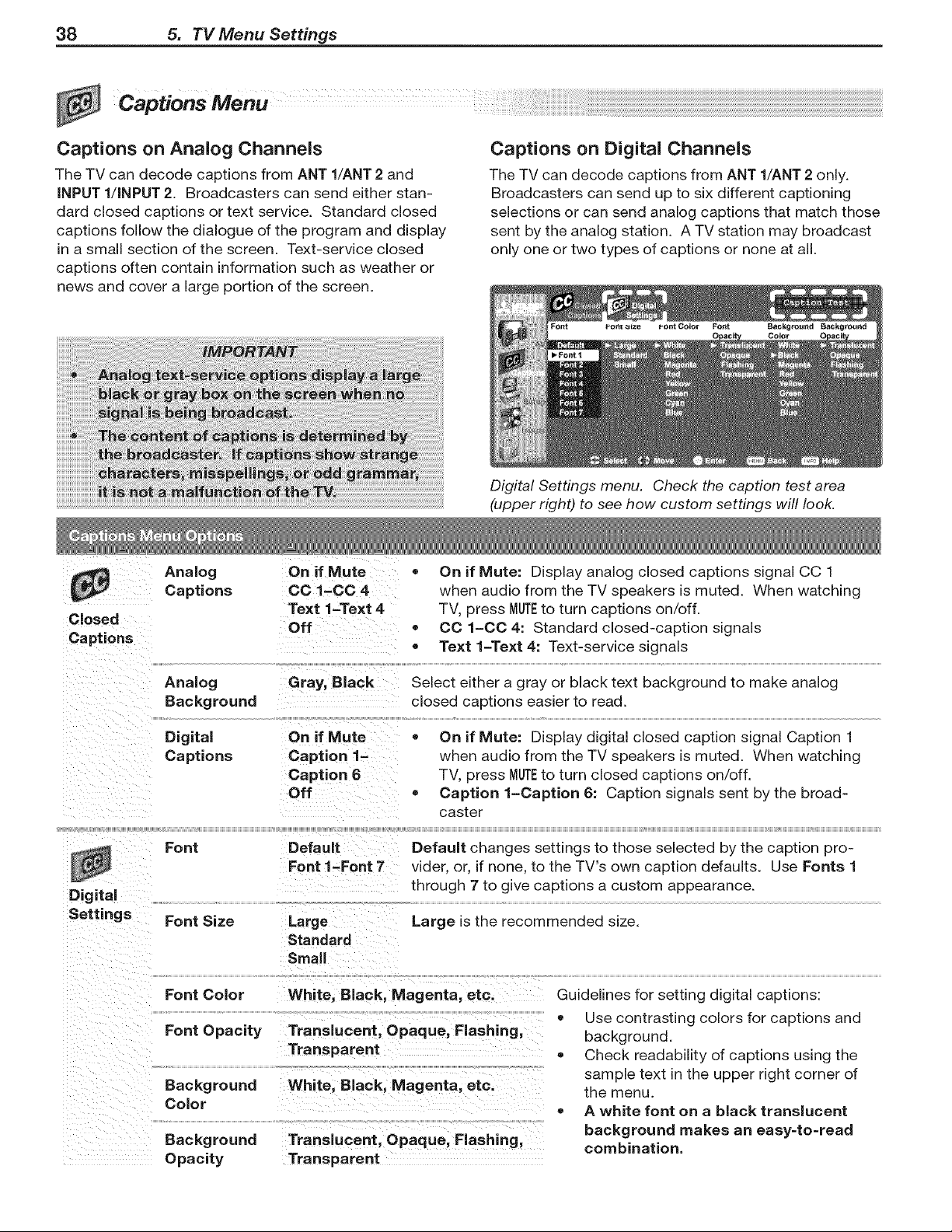
38 5. TV Menu Settings
Captions Menu
Captions on Analog Channels
The TV can decode captions from ANT l/ANT 2 and
INPUT l/INPUT 2. Broadcasters can send either stan-
dard closed captions or text service. Standard closed
captions follow the dialogue of the program and display
in a small section of the screen. Text-service closed
captions often contain information such as weather or
news and cover a large portion of the screen.
Captions on Digital Channels
The TV can decode captions from ANT l/ANT 2 only.
Broadcasters can send up to six different captioning
selections or can send analog captions that match those
sent by the analog station. A TV station may broadcast
only one or two types of captions or none at all.
Color
Digital Settings menu. Check the caption test area
(upper right) to see how custom settings will look.
Analog On if Mute • On if Mute: Display analog closed captions signal CC 1
Captions CO 1-CO 4 when audio from the TV speakers is muted. When watching
Text 1-Text 4 TV, press MUTEto turn captions on/off.
Closed Off • CO 1-CO 4: Standard closed-caption signals
Captions • Text 1-Text 4: Text=service signals
Analog Gray, Black Select either a gray or black text background to make analog
Background closed captions easier to read.
Digital
Captiona
i iii i i
On if Mute
Caption 1=
Caption 6
Off
On if Mute: Display digital closed caption signal Caption 1
when audio from the TV speakers is muted. When watching
TV, press MUTEto turn closed captions on/off.
• Caption 1=Caption 6: Caption signals sent by the broad-
caster
Font Default Default changes settings to those selected by the caption pro-
Font 1-Font 7 vider, or, if none, to the TV's own caption defaults. Use Fonts 1
through 7 to give captions a custom appearance.
settings Font Size Large Large is the recommended size.
Standard
Small
Font Color Whitei Black, Magenta, etc, Guidelines for setting digital captions:
Font Opacity Translucent, Opaque, Flashing,
Transparent =
Background White} Black, Magenta, etc.
Color ,
Background Translucent, Opaque, Flashing ,
Opacity Transparent
Use contrasting colors for captions and
background.
Check readability of captions using the
sample text in the upper right corner of
the menu.
A white font on a black translucent
background makes an easy-to-read
combination.
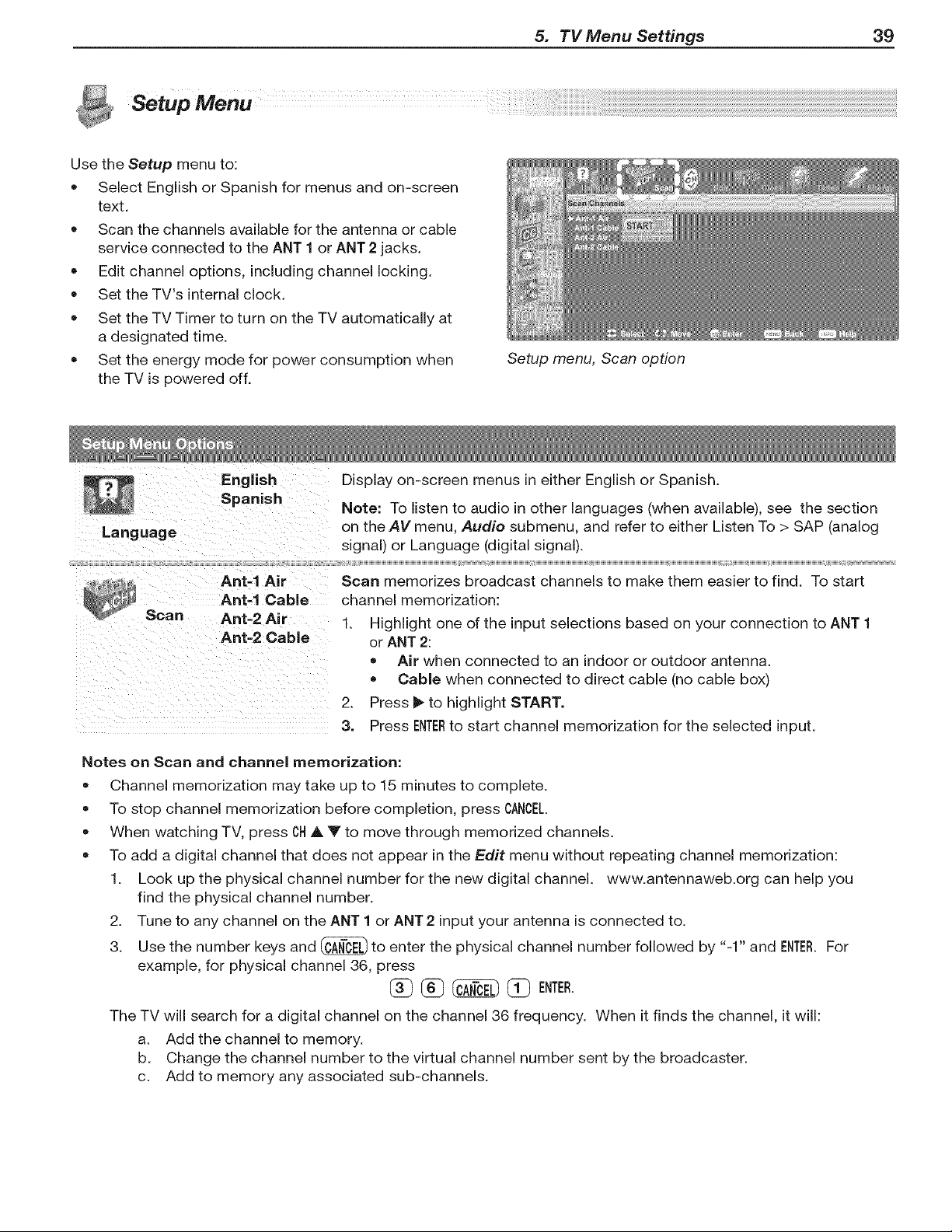
5. TV Menu Settings 39
sew ¸Menu¸:::: :::: ::: :::: ::: :::iiiii!!iii!iiiiil i+i
Use the Setup menu to:
+ Select English or Spanish for menus and on-screen
text.
+ Scan the channels available for the antenna or cable
service connected to the ANT 1 or ANT 2 jacks.
+ Edit channel options, including channel locking.
+ Set the TV's internal clock.
+ Set the TV Timer to turn on the TV automatically at
a designated time.
+ Set the energy mode for power consumption when
the TV is powered off.
Language
English
Spanish
Ant-1 Air
Ant-1 Cable
Scan Ant-2 Air
Ant-2 Cable
Setup menu, Scan option
Display on-screen menus in either English or Spanish.
Note: To listen to audio in other languages (when available), see the section
on the AV menu, Audio submenu, and refer to either Listen To > SAP (analog
signal) or Language (digital signal).
;+
Scan memorizes broadcast channels to make them easier to find. To start
channel memorization:
1. Highlight one of the input selections based on your connection to ANT 1
or ANT 2:
• Air when connected to an indoor or outdoor antenna.
+ Cable when connected to direct cable (no cable box)
2. Press i_ to highlight START.
3. Press ENTERto start channel memorization for the selected input,
Notes on Scan and channel memorization:
+ Channel memorization may take up to 15 minutes to complete.
+ To stop channel memorization before completion, press CANCEL.
+ When watching TV, press ORA Y to move through memorized channels.
+ To add a digital channel that does not appear in the Edit menu without repeating channel memorization:
1. Look up the physical channel number for the new digital channel, www.antennaweb.org can help you
find the physical channel number.
2. Tune to any channel on the ANT 1 or ANT 2 input your antenna is connected to.
3. Use the number keys and _ to enter the physical channel number followed by "-1" and ENTER.For
example, for physical channel 36, press
ENTER.
The TV will search for a digital channel on the channel 36 frequency. When it finds the channel, it will:
a. Add the channel to memory.
b. Change the channel number to the virtual channel number sent by the broadcaster.
c. Add to memory any associated sub-channels.
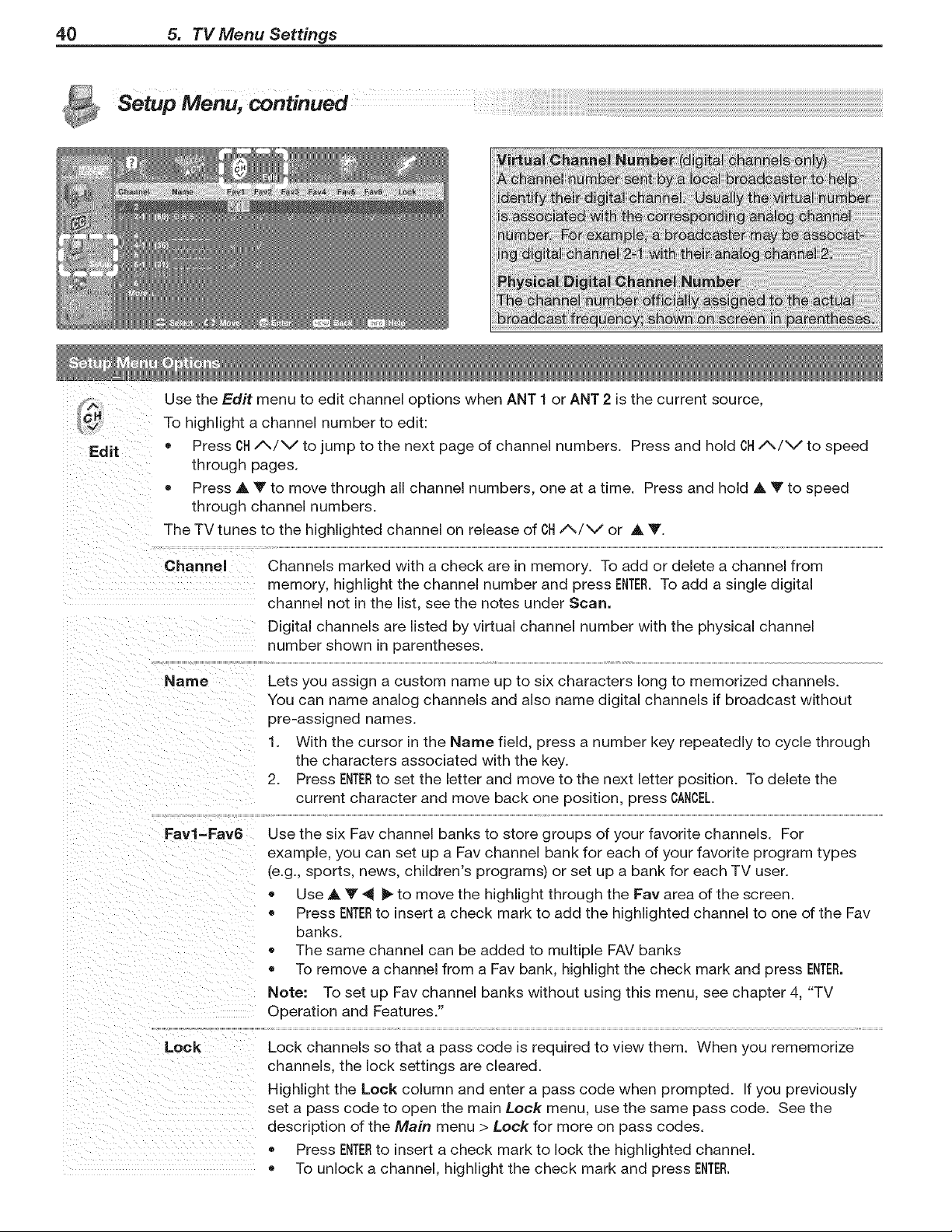
40 5. TV Menu Settings
Setup Menu, continued
Use the Edit menu to edit channel options when ANT 1 or ANT 2 is the current source,
To highlight a channel number to edit:
Edit • Press ON/N/V to jump to the next page of channel numbers. Press and hold ON/N/V to speed
through pages.
Press A V to move through all channel numbers, one at a time. Press and hold A Y to speed
through channel numbers.
The TV tunes to the highlighted channel on release of ON/',/V or A Y.
Channel
Name
Favl-Fav6
Lock
Channels marked with a check are in memory. To add or delete a channel from
memory, highlight the channel number and press ENTER.To add a single digital
channel not in the list, see the notes under Scan.
Digital channels are listed by virtual channel number with the physical channel
number shown in parentheses.
Lets you assign a custom name up to six characters long to memorized channels.
You can name analog channels and also name digital channels if broadcast without
pre-assigned names.
1. With the cursor in the Name field, press a number key repeatedly to cycle through
the characters associated with the key.
2. Press ENTERto set the letter and move to the next letter position. To delete the
current character and move back one position, press CANCEL.
Use the six Fav channel banks to store groups of your favorite channels. For
example, you can set up a Fav channel bank for each of your favorite program types
(e.g., sports, news, children's programs) or set up a bank for each TV user.
• Use A Y 4 i1_to move the highlight through the Fay area of the screen.
Press ENTERto insert a check mark to add the highlighted channel to one of the Fav
banks.
The same channel can be added to multiple FAV banks
= To remove a channel from a Fav bank, highlight the check mark and press ENTER.
Note: To set up Fav channel banks without using this menu, see chapter 4, "TV
Operation and Features."
Lock channels so that a pass code is required to view them. When you rememorize
channels, the lock settings are cleared.
Highlight the Lock column and enter a pass code when prompted. If you previously
set a pass code to open the main Lock menu, use the same pass code. See the
description of the Main menu > Lock for more on pass codes.
• Press ENTERto insert a check mark to lock the highlighted channel.
To unlock a channel, highlight the check mark and press ENTER.
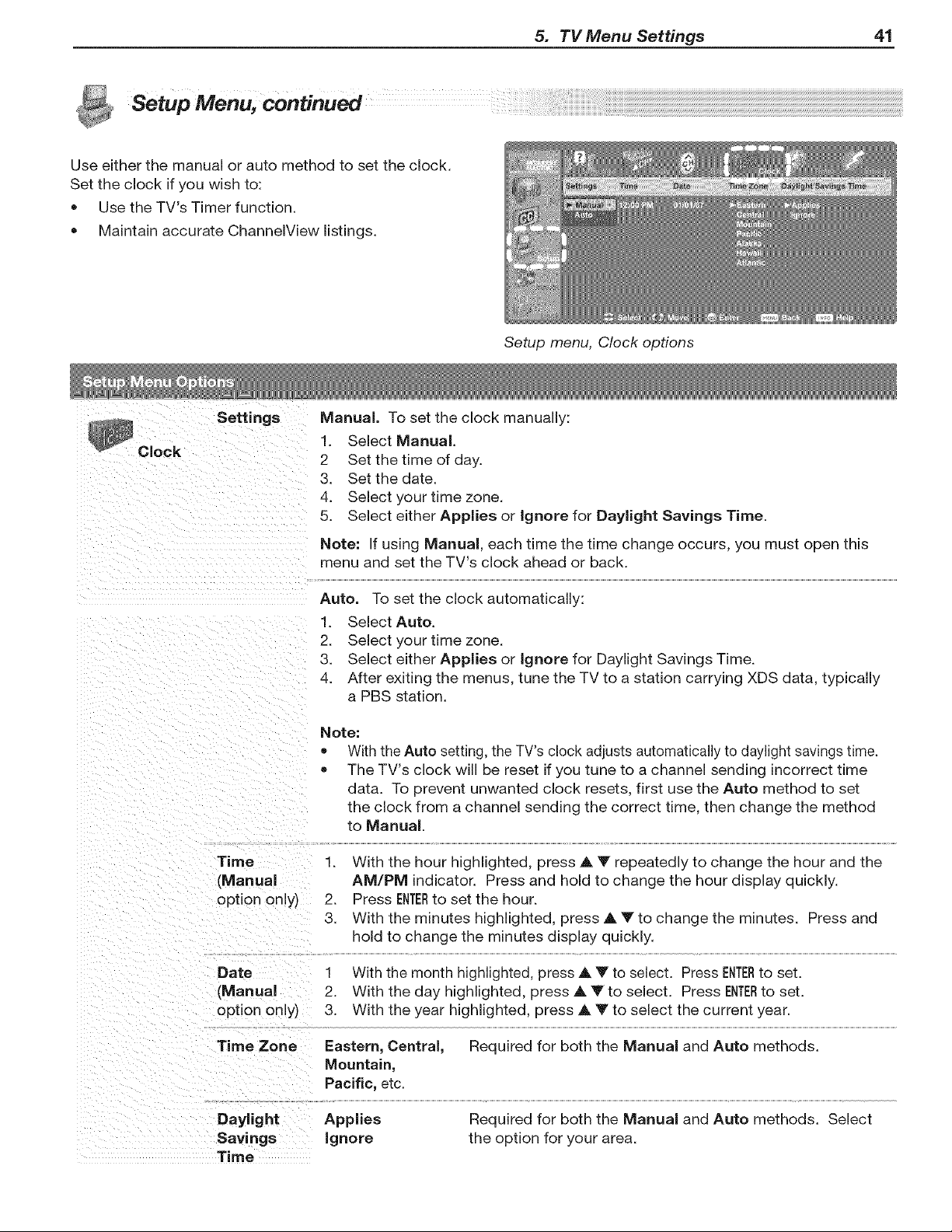
5. TV Menu Settings 41
sew Men-,¸c ued
Use either the manual or auto method to set the clock.
Set the clock if you wish to:
• Use the TV's Timer function.
Maintain accurate ChannelView listings.
Clock
Settings
Time
_Manual
option only)
Date
[Manual
option only)
Time Zone
Daylight
Savings
Time
Setup menu, Clock options
Manual. To set the clock manually:
1 Select Manual.
2 Set the time of day.
3. Set the date.
4. Select your time zone.
5. Select either Applies or ignore for Daylight Savings Time.
Note: If using Manual, each time the time change occurs, you must open this
menu and set the TV's clock ahead or back.
Auto. To set the clock automatically:
1 Select Auto.
2. Select your time zone.
3. Select either Applies or ignore for Daylight Savings Time.
4. After exiting the menus, tune the TV to a station carrying XDS data, typically
a PBS station.
Note:
• With the Auto setting, the TV's clock adjusts automatically to daylight savings time.
The TV's clock will be reset if you tune to a channel sending incorrect time
data. To prevent unwanted clock resets, first use the Auto method to set
the clock from a channel sending the correct time, then change the method
to Manual.
1. With the hour highlighted, press A Y repeatedly to change the hour and the
AM/PM indicator. Press and hold to change the hour display quickly.
2. Press ENTERto set the hour.
3. With the minutes highlighted, press A Y to change the minutes. Press and
hold to change the minutes display quickly.
1 With the month highlighted, press A V to select. Press ENTERto set.
2. With the day highlighted, press A Y to select. Press ENTERto set.
3. With the year highlighted, press A V to select the current year.
Eastern, Central, Required for both the Manual and Auto methods.
Mountain,
Pacific, etc.
Applies
ignore
Required for both the Manual and Auto methods. Select
the option for your area.
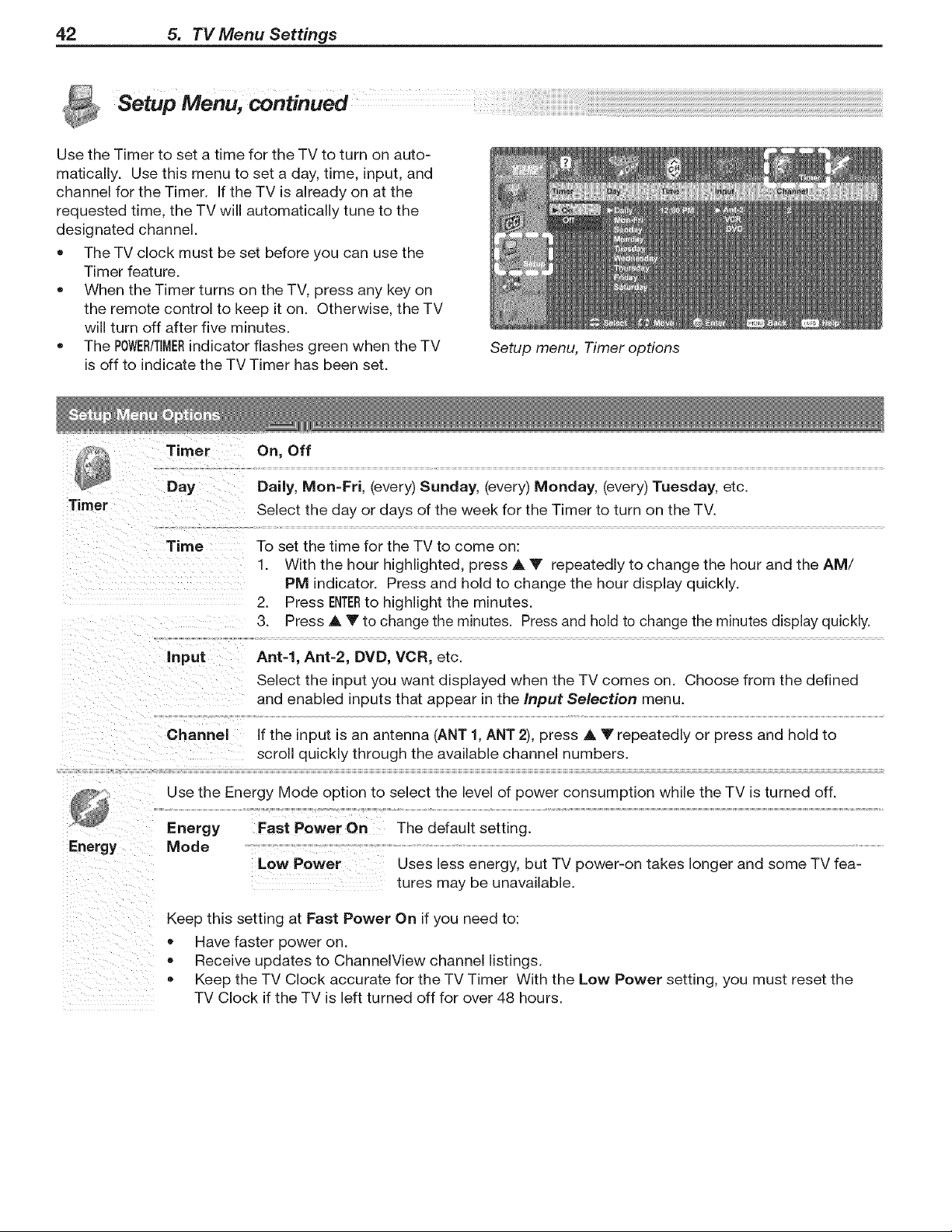
42 5. TV Menu Settings
Setup Menu, continued
Use the Timer to set a time for the TV to turn on auto-
matically. Use this menu to set a day, time, input, and
channel for the Timer. If the TV is already on at the
requested time, the TV will automatically tune to the
designated channel.
• The TV clock must be set before you can use the
Timer feature.
When the Timer turns on the TV, press any key on
the remote control to keep it on. Otherwise, the TV
will turn off after five minutes.
The POWER/TIMERindicator flashes green when the TV
is off to indicate the TV Timer has been set.
Timer
On, Off
Timer
Day
Setup menu, Timer options
Daily, Mon=Fri. (,every) Sunday, (every) Monday, (every) Tuesday, etc.
Select the day or days of the week for the Timer to turn on the TV.
Time To set the time for the TV to come on:
1. With the hour highlighted, press A T repeatedly to change the hour and the AM/
PM indicator. Press and hold to change the hour display quickly.
2. Press ENTERto highlight the minutes.
3. Press A Y to change the minutes. Press and hold to change the minutes display quickly.
input
Channel
Ant-l, Ant-2, DVD, VCR, etc.
Select the input you want displayed when the TV comes on. Choose from the defined
and enabled inputs that appear in the Input Selection menu.
If the input is an antenna (ANT 1, ANT 2), press A Y repeatedly or press and hold to
scroll quickly through the available channel numbers.
Use the Energy Mode option to select the level of power consumption while the TV is turned off.
Energy
Energy Fast Power On
Mode
Low Power
The default setting.
Uses less energy, but TV power-on takes longer and some TV fea-
tures may be unavailable.
Keep this setting at Fast Power On if you need to:
Have faster power on.
Receive updates to ChannelView channel listings.
= Keep the TV Clock accurate for the TV Timer With the Low Power setting, you must reset the
TV Clock if the TV is left turned off for over 48 hours.
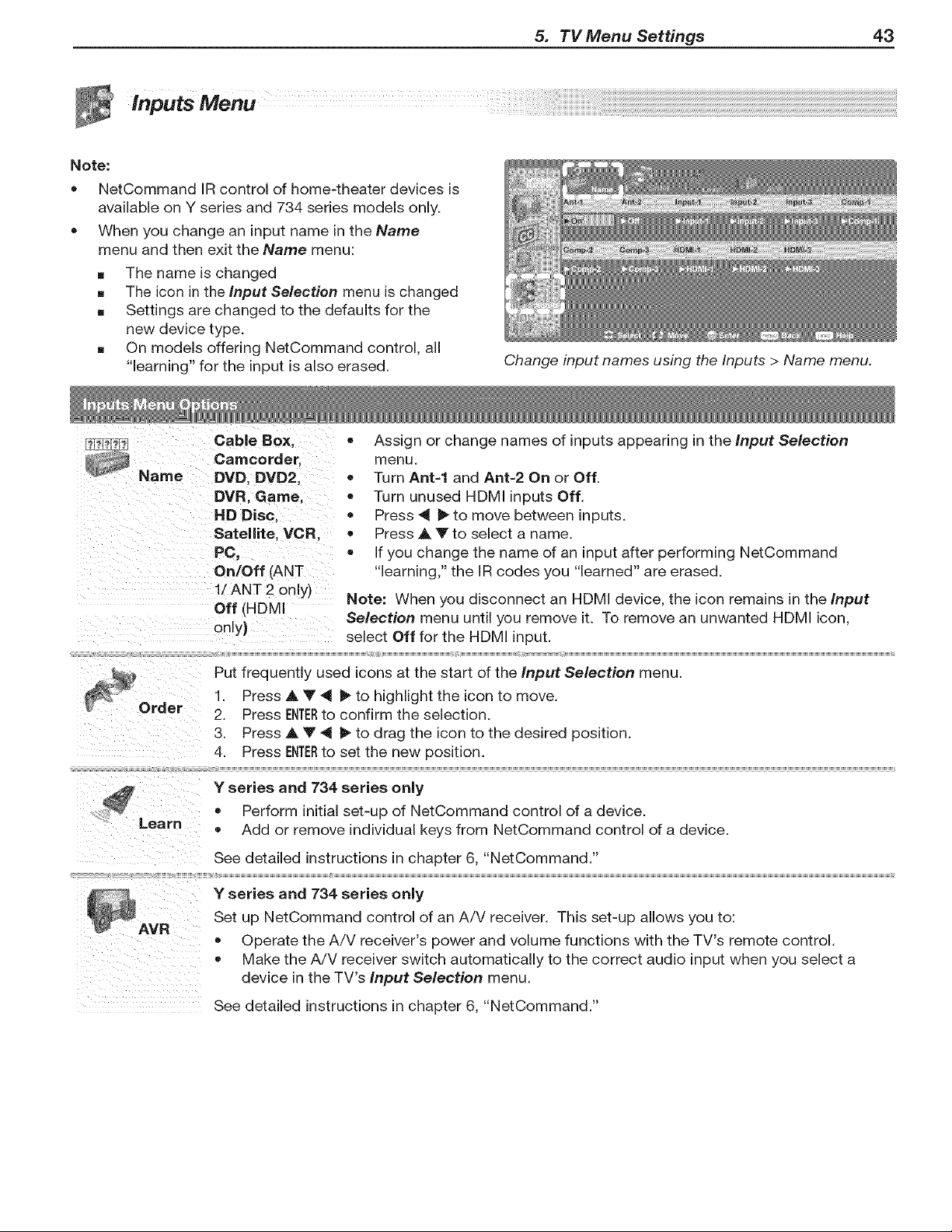
5. TV Menu Settings 43
lnputs Menu
Note:
• NetCommand IR control of home-theater devices is
available on Y series and 734 series models only.
When you change an input name in the Name
menu and then exit the Name menu:
[] The name is changed
[] The icon in the Input Selection menu is changed
[] Settings are changed to the defaults for the
new device type.
[] On models offering NetCommand control, all
"learning" for the input is also erased.
Cable Box,
Camcorder.
Name DVD, DVD2,
DVR, Game,
HD Disc,
Satellite, VCR,
PC,
On/Off (ANT
1/ANT 2 only)
Off (HDMI
only}
Change input names using the Inputs > Name menu.
• Assign or change names of inputs appearing in the Input Selection
menu.
• Turn Ant-1 and Ant-2 On or Off.
• Turn unused HDMI inputs Off.
Press 4 _ to move between inputs.
- Press A Y to select a name.
If you change the name of an input after performing NetCommand
"learning," the IR codes you "learned" are erased.
Note: When you disconnect an HDMI device, the icon remains in the Input
Selection menu until you remove it. To remove an unwanted HDMI icon,
select Off for the HDMI input.
Put frequently used icons at the start of the Input Selection menu.
1. Press A T _ _ to highlight the icon to move.
2. Press ENTERto confirm the selection.
3. Press A V _1 _" to drag the icon to the desired position.
4. Press ENTERto set the new position.
Learn
Y series and 734 series only
Perform initial set-up of NetCommand control of a device.
= Add or remove individual keys from NetCommand control of a device.
See detailed instructions in chapter 6, "NetCommand."
AVR
Y series and 734 series only
Set up NetCommand control of an A/V receiver. This set-up allows you to:
Operate the A/V receiver's power and volume functions with the TV's remote control.
Make the A/V receiver switch automatically to the correct audio input when you select a
device in the TV's Input Selection menu.
See detailed instructions in chapter 6, "NetCommand."
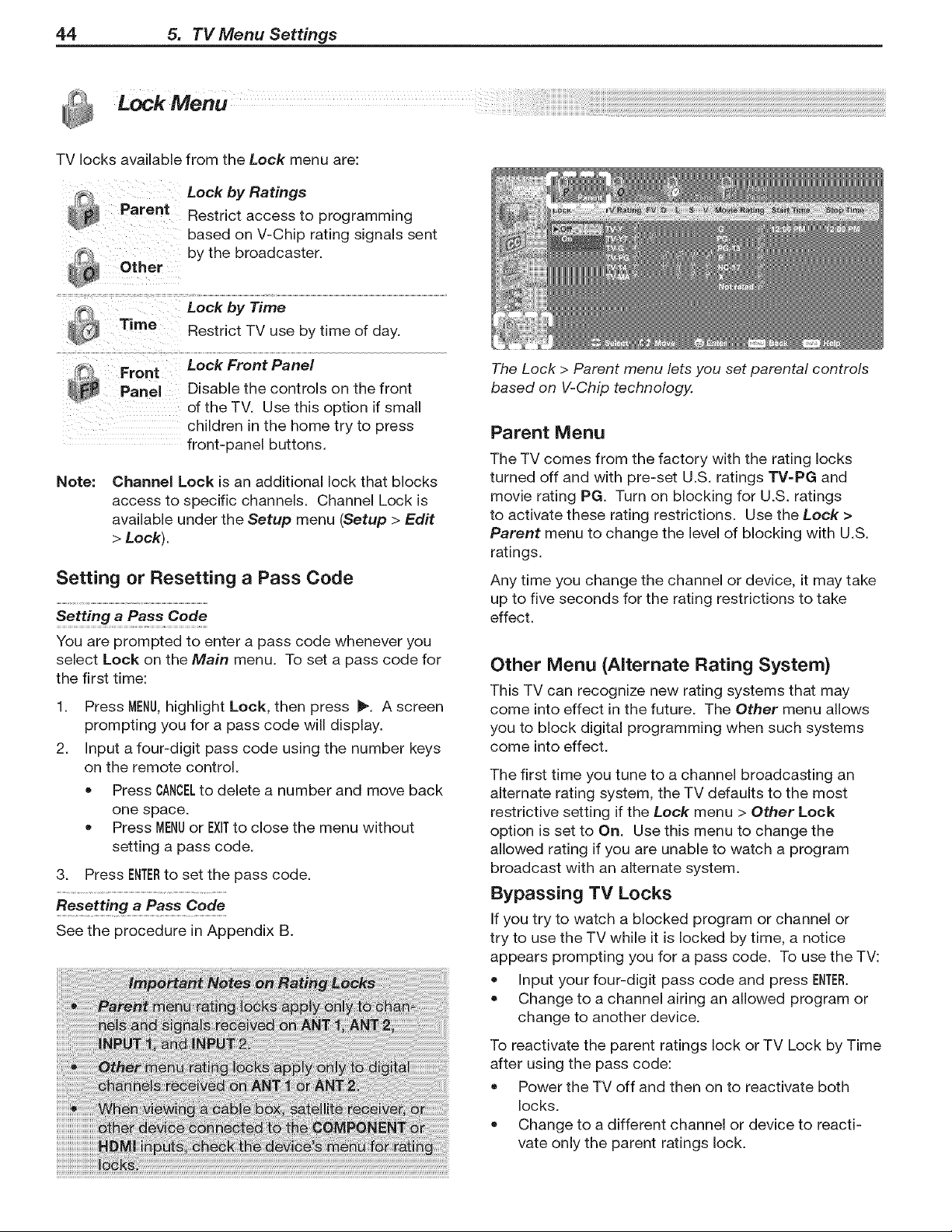
44 5. TV Menu Settings
TV locks available from the Lock menu are:
Other
Lock by Ratings
Restrict access to programming
based on V-Chip rating signals sent
by the broadcaster.
Time
Lock by Time
Restrict TV use by time of day.
Front
Panel
Lock Front Panel
Disable the controls on the front
of the TV. Use this option if small
children in the home try to press
front-panel buttons.
Note: Channel Lock is an additional lock that blocks
access to specific channels. Channel Lock is
available under the Setup menu (Setup > Edit
> Lock).
Setting or Resetting a Pass Code
SettingaPassCo@
You are prompted to enter a pass code whenever you
select Lock on the Main menu. To set a pass code for
the first time:
1.
2.
Press MENU,highlight Lock, then press _. A screen
prompting you for a pass code will display.
Input a four-digit pass code using the number keys
on the remote control.
• Press CANCELto delete a number and move back
one space.
Press MENUor EXITto close the menu without
setting a pass code.
3. Press ENTERto set the pass code.
Resetting a PaSs Code
See the procedure in Appendix B.
The Lock > Parent menu lets you set parental controls
based on V-Chip technology.
Parent Menu
The TV comes from the factory with the rating locks
turned off and with pre-set U.S. ratings TV=PG and
movie rating PG. Turn on blocking for U.S. ratings
to activate these rating restrictions. Use the Lock >
Parent menu to change the level of blocking with U.S.
ratings.
Any time you change the channel or device, it may take
up to five seconds for the rating restrictions to take
effect.
Other Menu (Alternate Rating System)
This TV can recognize new rating systems that may
come into effect in the future. The Other menu allows
you to block digital programming when such systems
come into effect.
The first time you tune to a channel broadcasting an
alternate rating system, the TV defaults to the most
restrictive setting if the Lock menu > Other Lock
option is set to On. Use this menu to change the
allowed rating if you are unable to watch a program
broadcast with an alternate system.
Bypassing TV Locks
If you try to watch a blocked program or channel or
try to use the TV while it is locked by time, a notice
appears prompting you for a pass code. To use the TV:
Input your four-digit pass code and press ENTER.
Change to a channel airing an allowed program or
change to another device.
To reactivate the parent ratings lock or TV Lock by Time
after using the pass code:
Power the TV off and then on to reactivate both
locks.
Change to a different channel or device to reacti-
vate only the parent ratings lock.
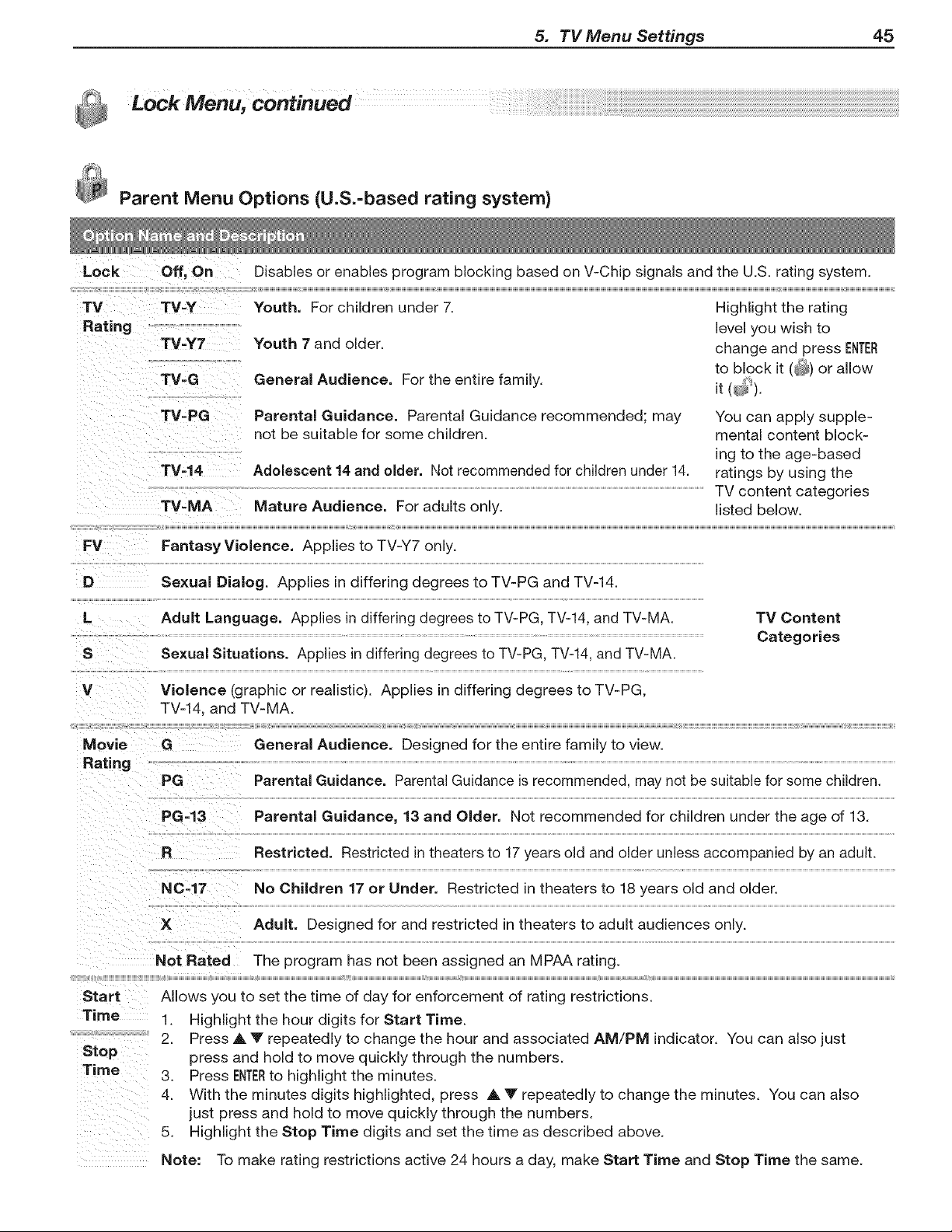
5. TV Menu Settings 45
Parent Menu Options (U.S.=based rating system)
Lock Off, On Disables or enables program blocking based on V-Chip signals and the U.S. rating system.
TV TV-Y Youth. For children under 7. Highlight the rating
level you wish to
TV-Y7 Youth 7 and older, change and press ENTER
....................... to block it (_) or allow
TV4G General Audience. For the entire family, it (_).
TV, PG
Parental Guidance. Parental Guidance recommended; may You can apply supple-
not be suitable for some children, mental content block-
.............................. ing to the age-based
TV,14 Adolescent 14 and older. Not recommended for children under 14. ratings by using the
.... ..............................................................................................................................................................................................................................................................................................................................................................................................................................................................TV content categories
TV, MA Mature Audience. For adults only. listed below.
FV Fantasy Violence. Applies to TV-Y7 only.
D Sexual Dialog. Applies in differing degrees to TV-PG and TV=14.
L Adult Language. Applies in differing degrees to TV-PG, TV-14, and TV-MA. TV Content
................................................t .....................................................................................................................Categories
S Sexual Situations. Applies in differing degrees to TV-PG, TV-14, and TV-MA.
V Violence (graphic or realistic). Applies in differing degrees to TV-PG,
TV=14, and TV-MA.
Movie G General Audience. Designed for the entire family to view.
Rating
PG Parental Guidance. Parental Guidance is recommended, may not be suitable for some cNdren.
PG=13 Parental Guidance, 13 and Cider. Not recommended for children under the age of 13.
Restricted. Restricted in theaters to 17 years old and older unless accompanied by an adult.
X Adult. Designed for and restricted in theaters to adult audiences only.
Not Rated The program has not been assigned an MPAA rating.
Start Allows you to set the time of day for enforcement of rating restrictions.
Time 1.
z)
K
Stop
Time 3.
4.
5,
Highlight the hour digits for Start Time.
Press A Y repeatedly to change the hour and associated AM/PM indicator. You can also just
press and hold to move quickly through the numbers.
Press ENTERto highlight the minutes.
With the minutes digits highlighted, press A V repeatedly to change the minutes. You can also
just press and hold to move quickly through the numbers.
Highlight the Stop Time digits and set the time as described above.
Note: To make rating restrictions active 24 hours a day, make Start Time and Stop Time the same.
46 5. TV Menu Settings
Other Menu Options (alternate rating system)
This TV can recognize new rating systems that may come into effect in the future. The Other option remains grayed
out until the TV receives a signal using an alternate rating system. Such alternate rating systems will apply to digital
programming only.
Lock On, Off Enable or disable program blocking.
!
System Name The rating system available for the channel
Group Rating groups available in the rating system shown on the screen. Rating groups are defined by
the rating system in effect.
)} [ [,,
Rating Rating restrictions available in the selected rating system and group. Highlight the rating and
press ENTERto check (block) or uncheck (allow) rated content.
Time
Block all use of the TV during the time period you specify. You must enter a pass code to use the TV when the time
lock is in effect.
Lock by Time On, Off Enable or disable Lock by Time.
Lock Time, To set the lock and unlock times:
Unlock Time 1. Highlight the hour digits for the Lock Time.
2. Press A Y repeatedly to change the hour and associated AM/PM indicator. To move quickly
through the numbers, just press and hold.
3. Press ENTERto set the hour and highlight the minutes.
4. With the minutes highlighted, press A Y repeatedly to change the minutes. To move quickly
through the numbers, just press and hold.
5. Highlight the Unlock Time digits and set the time as described above.
Note: To make Lock by Time active 24 hours a day, make Start Time and Stop Time the same.
i,
Front Panel
On, Off On locks and Off unlocks the controls on the front of the TV. Use this option if small children may
try to press TV buttons.
If the remote control is unavailable, use the front-panel buttons to release the front panel lock by
doing one of the following:
If the TV is on, press and hold the MENUbutton for over eight seconds. A message will display
to confirm release of the Front Panel Lock.
If the TV is off:
[] In Fast Power On Energy Mode, press and hold the MENUbutton on the front panel for over
eight seconds. The TV will power on and release the lock.
[] In Low Power Energy Mode, press POWERon the front panel to turn on the TV. With the TV
on, press and hold MENUon the front panel for over eight seconds.
etCommand
• NetCommand home-theater control is available on
the following models:
Y series WD-Y577, WD-Y657
734 series WD-57734, WD-65734, WD-73734.
This chapter applies only to these models.
• NetCommand setup is optional.
• You can perform NetCommand setup when the TV
first recognizes a device during Auto Input Sensing
or at any convenient time afterward.
• NetCommand operates by sending remote control
signals from the TV to your other devices via the IR
emitters, telling the devices to play, record, change
inputs, adjust volume, change channels and many
more functions. All this is accomplished with the
TV's remote control and the slide switch left in the
TVposition.
• The IR "Learning" feature of NetCommand allows
the TV to learn the remote control signals for your
A!V devices.
You can choose the level of NetCommand control
for your home theater.
[] Standard Setup. Perform a standard setup if
you want NetCommand to control only a few
devices, such as the TV, a playback device (like
a DVD player), and a cable box. With this setup,
you can use the TV's remote control to operate
these devices.
A/V Receiver Setup. Perform A/V receiver
setup if you want NetCommand to:
. Control a surround sound A/V receiver.
• Automatically change audio input selections
on an A/V receiver when you change inputs
on the TV.
iiiiiiiiii i !iii ii i i ! ii : i !i i i #iiii i i i! iiii
iiiiiiiiiiiiiiiiiiiiiiiiiiiiiiiiiiiiiiiiiiiiiiiiiiiiiiiiiiiiiiiiiiiiiiiiiiiiiiiiiiiiiiiiiiiiiiiiiiiiiiiiiiiiiiiiiiiiiiiiiiiiiiiiiiiiiiiiiiiiiiiiiiiiiiiiiiiiiiiiiiiiiiiiiiiiiiiiiiiiiiiiiiiiiiiiiiiiiiiiiiiiiiiiiiiiiiiiiiiiiiiiiiiiiiiiiiiiiiiiiiiiiiiiiiiiiiiiiiiiiiiiiiiiiiiiiiiiiiiiiiiiiiii !:!!i
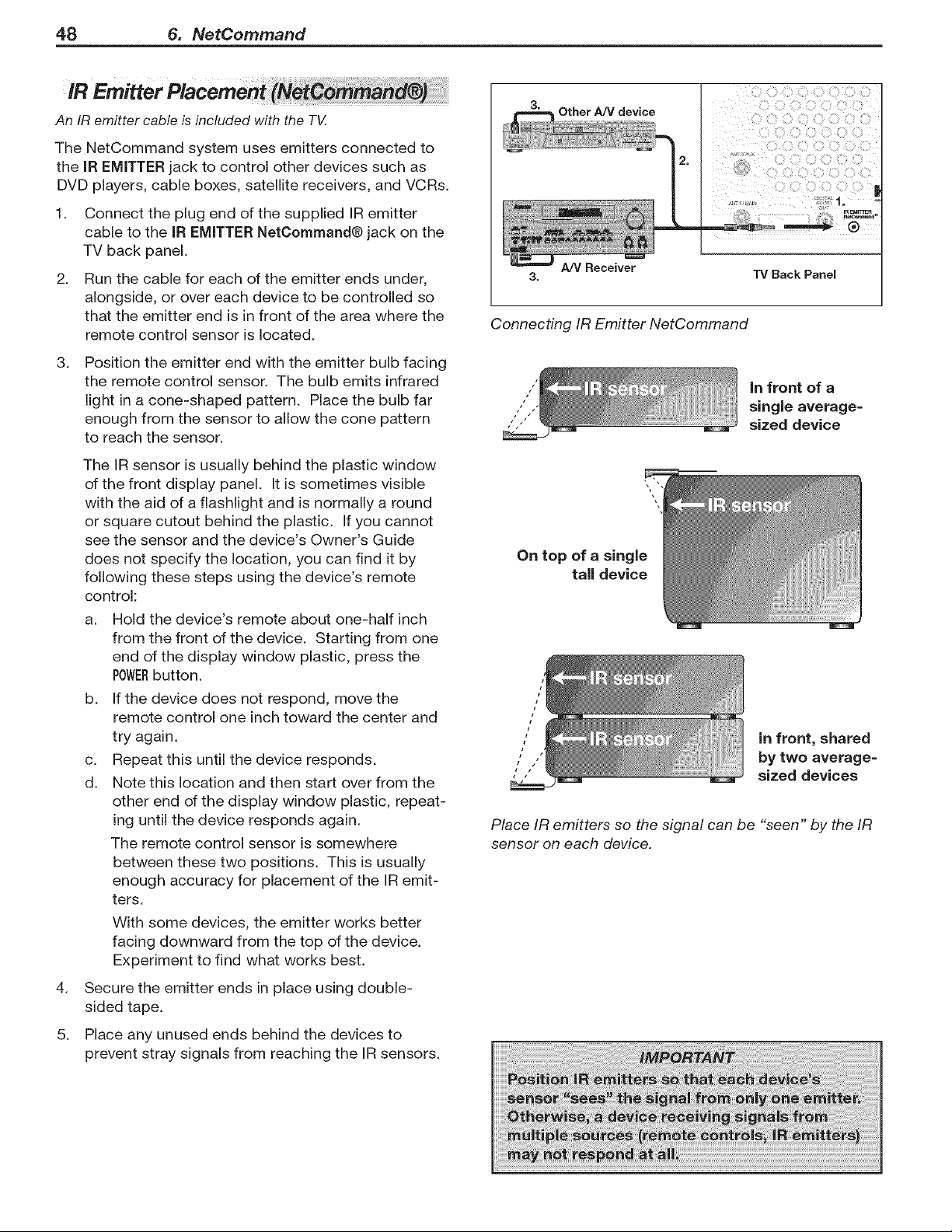
48 6. NetCommand
An IR emitter cable is included with the TV.
The NetCommand system uses emitters connected to
the IR EMITTER jack to control other devices such as
DVD players, cable boxes, satellite receivers, and VCRs.
1. Connect the plug end of the supplied IR emitter
cable to the IR EMITTER NetCommand® jack on the
TV back panel.
2,
Run the cable for each of the emitter ends under,
alongside, or over each device to be controlled so
that the emitter end is in front of the area where the
remote control sensor is located.
3,
Position the emitter end with the emitter bulb facing
the remote control sensor. The bulb emits infrared
light in a cone-shaped pattern. Place the bulb far
enough from the sensor to allow the cone pattern
to reach the sensor.
,
5.
The IR sensor is usually behind the plastic window
of the front display panel. It is sometimes visible
with the aid of a flashlight and is normally a round
or square cutout behind the plastic. If you cannot
see the sensor and the device's Owner's Guide
does not specify the location, you can find it by
following these steps using the device's remote
control:
a. Hold the device's remote about one-half inch
from the front of the device. Starting from one
end of the display window plastic, press the
POWERbutton.
b. If the device does not respond, move the
remote control one inch toward the center and
try again.
c. Repeat this until the device responds.
d. Note this location and then start over from the
other end of the display window plastic, repeat-
ing until the device responds again.
The remote control sensor is somewhere
between these two positions. This is usually
enough accuracy for placement of the IR emit-
ters.
With some devices, the emitter works better
facing downward from the top of the device.
Experiment to find what works best.
Secure the emitter ends in place using double-
sided tape.
Place any unused ends behind the devices to
prevent stray signals from reaching the IR sensors.
3.
Other A/V device
A/V Receiver
©
ii ii !ii
!i i i ii ;ili;i iiii ! !i i!ii iiiilil
®
TVBack Panel
Connecting IR Emitter NetCommand
in front of a
single average=
sized device
On top of a single
tail device
in front, shared
by two average-
sized devices
Place IR emitters so the signal can be "seen" by the IR
sensor on each device.
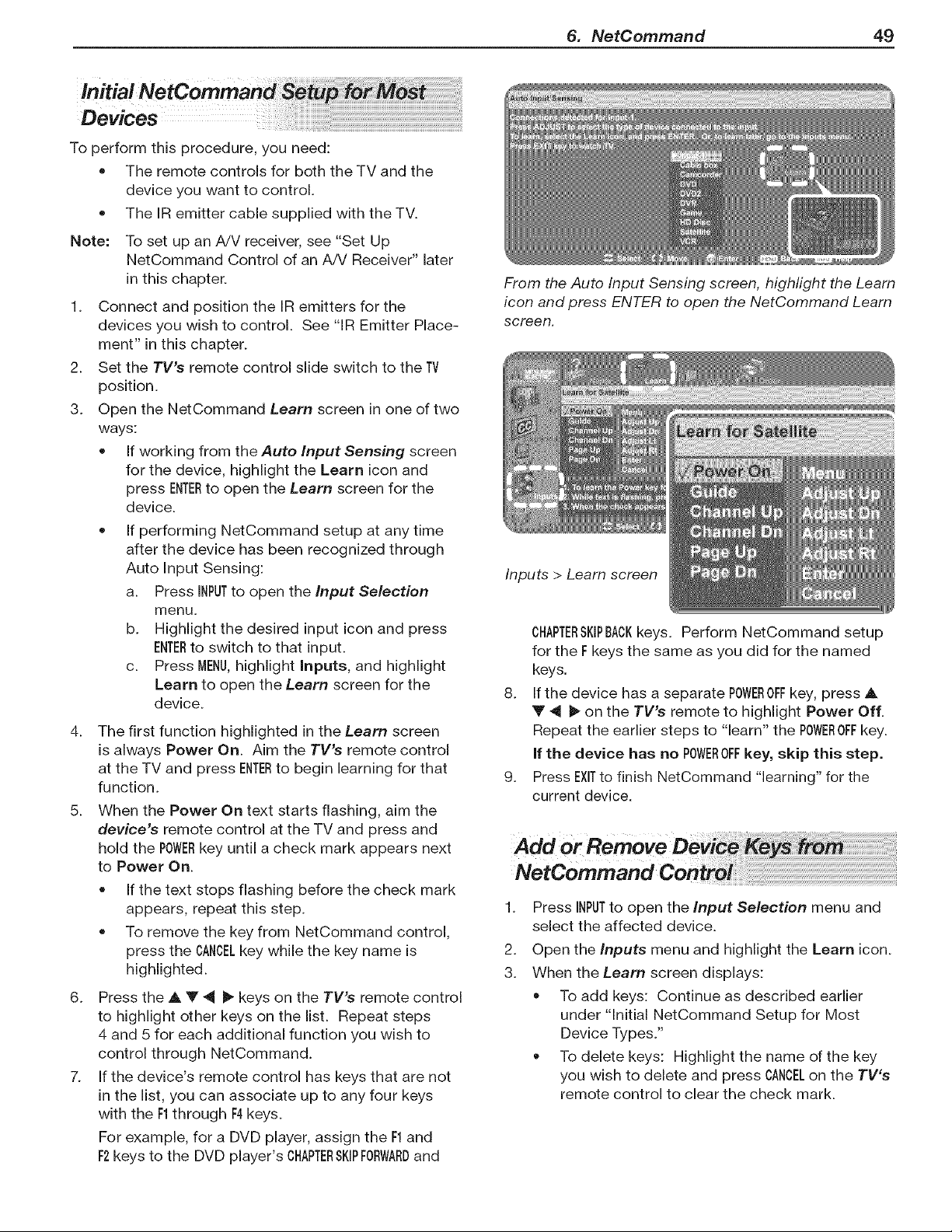
6. NetCommand 49
Devices
To perform this procedure, you need:
• The remote controls for both the TV and the
device you want to control.
The IR emitter cable supplied with the TV.
Note: To set up an A/V receiver, see "Set Up
NetCommand Control of an A/V Receiver" later
in this chapter.
1. Connect and position the IR emitters for the
devices you wish to control. See "IR Emitter Place-
ment" in this chapter.
2. Set the TV's remote control slide switch to the TV
position.
3. Open the NetCommand Learn screen in one of two
ways:
If working from the Auto Input Sensing screen
for the device, highlight the Learn icon and
press ENTERto open the Learn screen for the
device.
If performing NetCommand setup at any time
after the device has been recognized through
Auto Input Sensing:
a. Press INPUTto open the Input Selection
menu.
b. Highlight the desired input icon and press
ENTERto switch to that input.
c. Press MENU,highlight Inputs, and highlight
Learn to open the Learn screen for the
device.
4. The first function highlighted in the Learn screen
is always Power On. Aim the TV's remote control
at the TV and press ENTERto begin learning for that
function.
5. When the Power On text starts flashing, aim the
device's remote control at the TV and press and
hold the POWERkey until a check mark appears next
to Power On.
If the text stops flashing before the check mark
appears, repeat this step.
To remove the key from NetCommand control,
press the CANCELkey while the key name is
highlighted.
6. Press the A Y 4 I_ keys on the TV's remote control
to highlight other keys on the list. Repeat steps
4 and 5 for each additional function you wish to
control through NetCommand.
7. If the device's remote control has keys that are not
in the list, you can associate up to any four keys
with the F1through F4keys.
For example, for a DVD player, assign the F1and
F2keys to the DVD player's CHAPTERSKIPFORWARDand
From the Auto Input Sensing screen, highlight the Learn
icon and press ENTER to open the NetCommand Learn
screen,
Inputs > Learn screen
CHAPTERSKIPBACKkeys. Perform NetCommand setup
for the Fkeys the same as you did for the named
keys.
8. If the device has a separate POWEROFFkey, press A
Y 4 _" on the TV's remote to highlight Power Off.
Repeat the earlier steps to "learn" the POWEROFFkey.
if the device has no POWEROFFkey, skip this step.
9. Press EXITto finish NetCommand "learning" for the
current device.
Add or RemovE
2.
3.
Press INPUTto open the input Selection menu and
select the affected device.
Open the inputs menu and highlight the Learn icon.
When the Learn screen displays:
To add keys: Continue as described earlier
under "Initial NetCommand Setup for Most
Device Types."
To delete keys: Highlight the name of the key
you wish to delete and press CANCELon the TV's
remote control to clear the check mark.
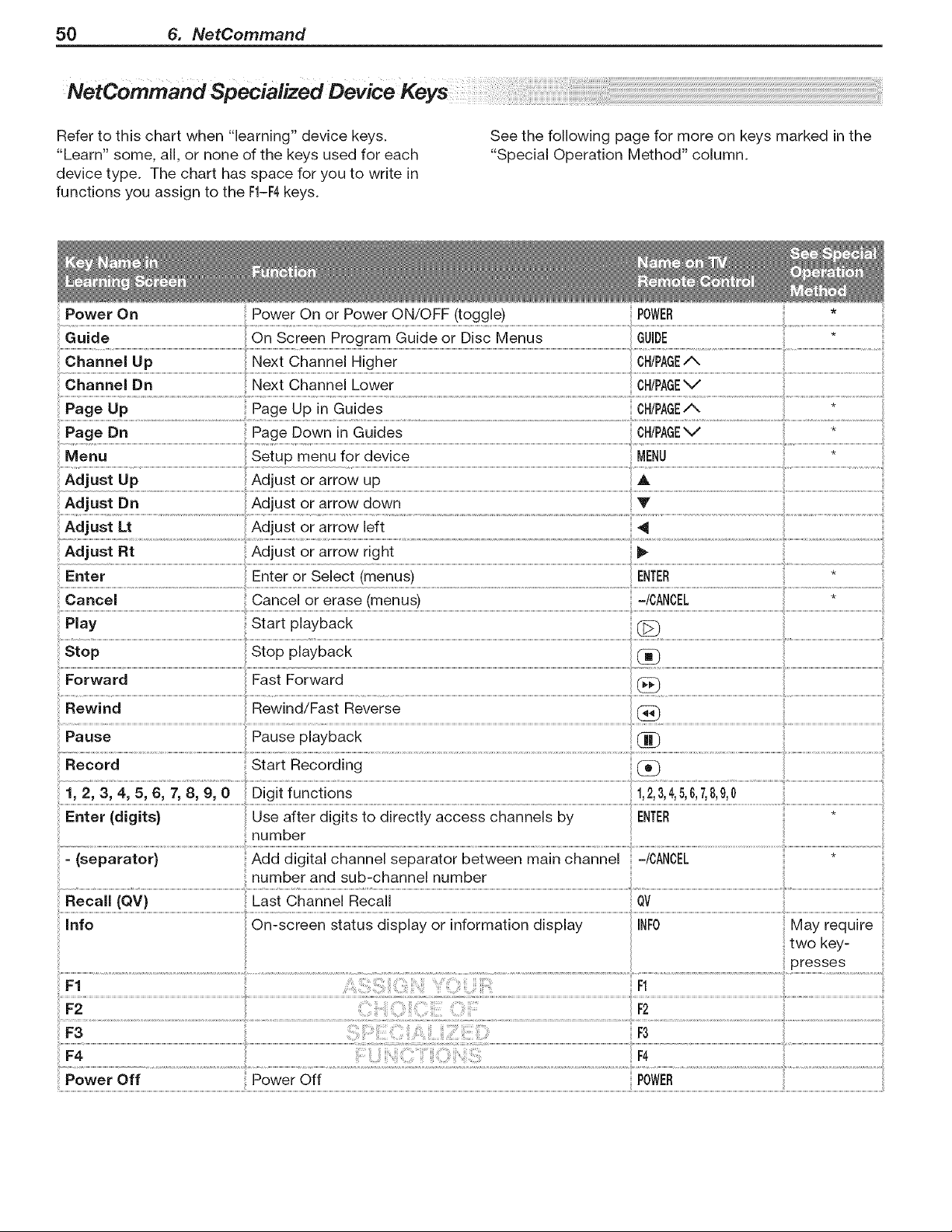
50 6. NetCommand
Refer to this chart when "learning" device keys.
"Learn" some, all, or none of the keys used for each
device type. The chart has space for you to write in
functions you assign to the F1-F4keys.
See the following page for more on keys marked in the
"Special Operation Method" column.
Power On Power On or Power ON/OFF (toggle) POWER
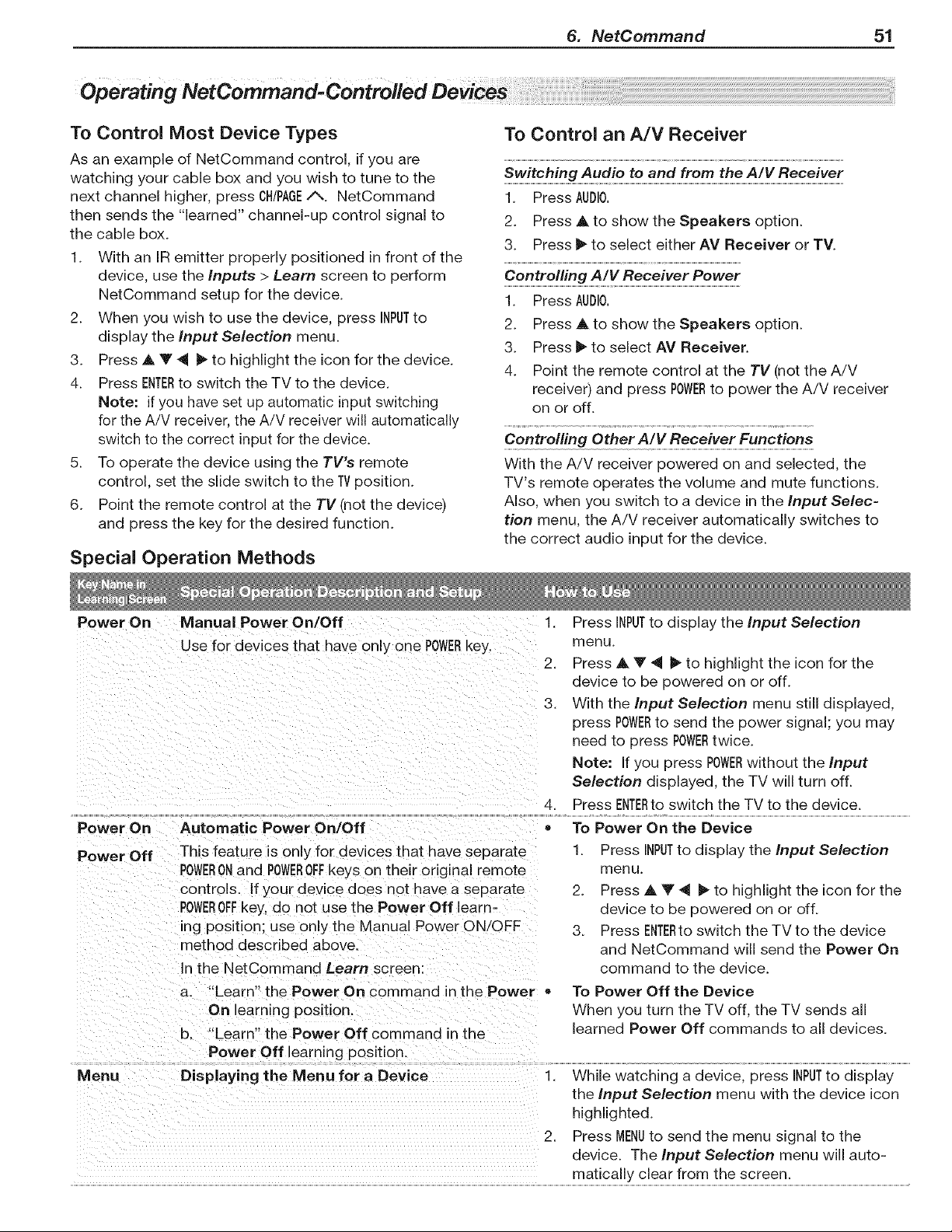
6. NetCommand 51
To Control Most Device Types
As an example of NetCommand control, if you are
watching your cable box and you wish to tune to the
next channel higher, press OH/PAGE/_.NetCommand
then sends the "learned" channel-up control signal to
the cable box.
1. With an IR emitter properly positioned in front of the
device, use the Inputs > Learn screen to perform
NetCommand setup for the device.
2. When you wish to use the device, press INPUTto
display the Input Selection menu.
3. Press A V _11I_ to highlight the icon for the device.
4. Press ENTERto switch the TV to the device.
Note: if you have set up automatic input switching
for the A/V receiver, the A/V receiver will automatically
switch to the correct input for the device.
5. To operate the device using the TV's remote
control, set the slide switch to the TVposition.
6. Point the remote control at the TV (not the device)
and press the key for the desired function.
Special Operation Methods
To Control an A/V Receiver
switching Audio to and from the A/V Receiver
1. Press AUDIO.
2. Press A to show the Speakers option.
3. Press _ to select either AV Receiver or TV.
contro!ling A/V Receiver Powe r
1. Press AUDIO.
2. Press A to show the Speakers option.
3. Press _, to select AV Receiver.
4. Point the remote control at the TV (not the A!V
receiver) and press POWERto power the A/V receiver
on or off.
Controlling Other A/V Receiver Functions
With the A!V receiver powered on and selected, the
TV's remote operates the volume and mute functions.
Also, when you switch to a device in the input Selec-
tion menu, the A/V receiver automatically switches to
the correct audio input for the device.
Power On
Power On
Power Off
Menu
Manual Power On/Off
Use for devices that have only one POWERkey.
Automatic Power On/Off
This feature is only for devices that have separate
POWERONand POWEROFFkeys on their original remote
controls. If your device does not have a separate
POWEROFFkey, do not use the Power Off learn=
ing position; use only the Manual Power ON/OFF
method described above.
in the NetCommand Learn screen:
a. "Learn" the Power On command in the Power •
On learning position.
b. 'Learn" the Power Off command in the
Power Off learning position.
Displaying the Menu for a Device 1.
1. Press INPUTto display the Input Selection
menu.
2. Press A Y 4 _ to highlight the icon for the
device to be powered on or off.
3. With the Input Selection menu still displayed,
press POWERto send the power signal; you may
need to press POWERtwice.
Note: If you press POWERwithout the Input
Selection displayed, the TV will turn off.
4. Press ENTERtoswitch the TV to the device.
• To Power On the Device
1. Press INPUTto display the Input Selection
menu.
2. Press J, V' 4 I_ to highlight the icon for the
device to be powered on or off.
3. Press ENTERtoswitch the TV to the device
and NetCommand will send the Power On
command to the device.
To Power Off the Device
When you turn the TV off, the TV sends all
learned Power Off commands to all devices.
While watching a device, press INPUTto display
the Input Selection menu with the device icon
highlighted.
Press MENUto send the menu signal to the
device. The Input Selection menu will auto-
matically clear from the screen.
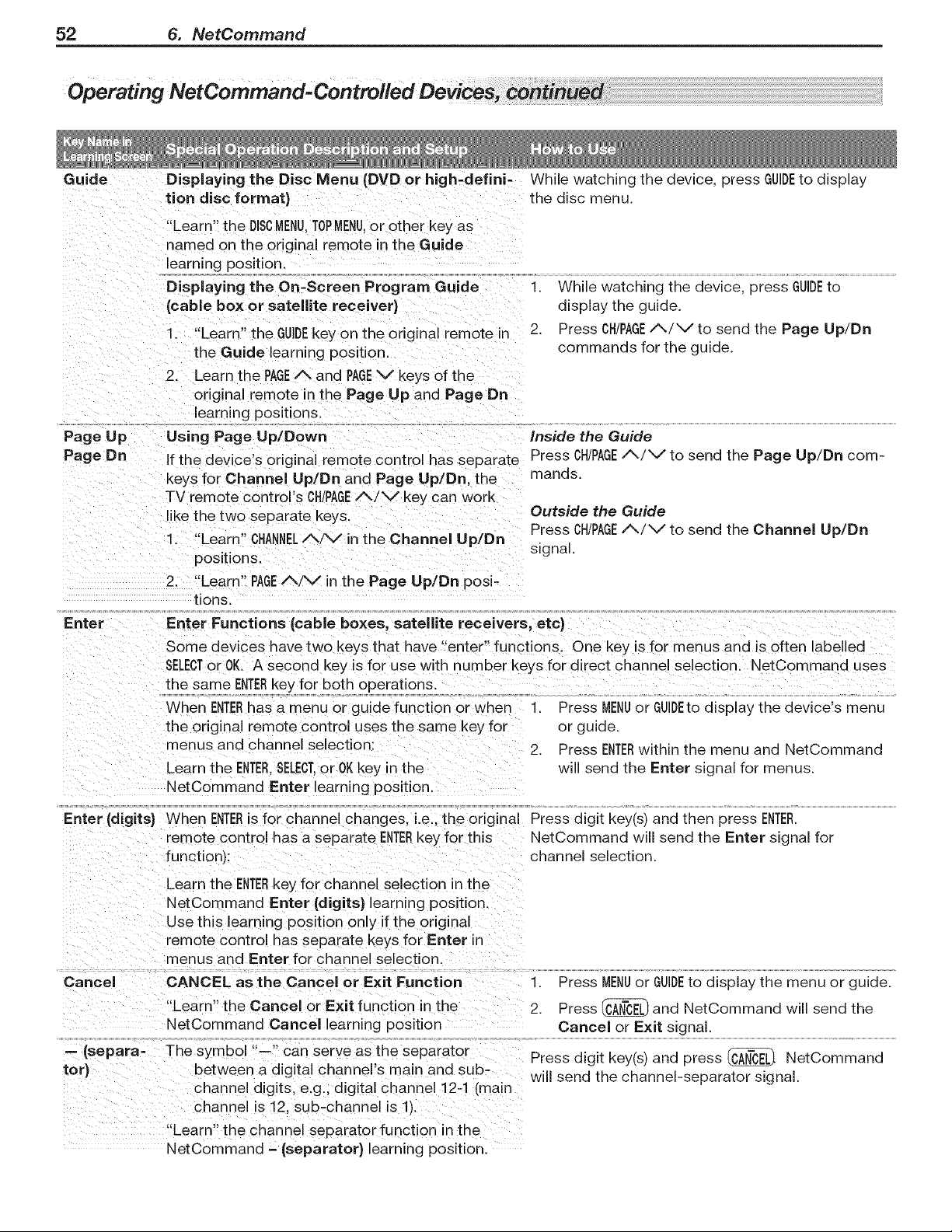
52 6. NetCommand
Operating
Guide
Displaying the Disc Menu (DVD or high-defini-
tion disc format)
"Learn" the DISCMENU,TOPMENU,or other key as
named on the original remote in the Guide
learning position.
Displaying the On-Screen Program Guide
(cable box or satellite receiver)
1. "Learn" the GUIDEkey on the original remote in
the Guide learning position.
2. Learn the PAGE/Nand PAGEV keys of the
original remote in the Page Up and Page Dn
learning positions.
Page Up Using Page Up/Down
Page Dn
Enter
While watching the device, press GUIDEto display
the disc menu.
1.
2.
While watching the device, press GUIDEto
display the guide.
Press €H/PAGE/x/v to send the Page Up/Dn
commands for the guide.
inside the Guide
If the device's original remote control has separate Press OH/PAGE/_/v to send the Page Up/Dn corn-
keys for Channel Up/Dn and Page Up/Dn. the mands,
TV remote control's ON/PAGE/_/V key can work
like the two separate keys. Outside the Guide
Press OH/PAGE/_/V to send the Channel Up/Dn
/% .
1. Learn CHANNEL/q/tn the Channel Up/Dn signal
positions.
2. "Learn" PAGE/_/x/in the Page Up/Dn posi-
tions.
Enter Functions (cable boxes, satellite receivers, etc)
Some devices have two keys that have "enter functions. One key is for menus and is often labelled
SELECTor OK. A second key is for use with number keys for direct channel selection. NetCommand uses
the same ENTERkey for both operations.
When ENTERhas a menu or guide function or when
the original remote control uses the same key for
menus and channel selection
Learn the ENTER,SELECT,or OKkey in the
NetCommand Enter learning position.
1. Press MENUor GUIDEtodisplay the device's menu
or guide.
2. Press ENTERwithin the menu and NetCommand
will send the Enter signal for menus.
Enter (digits) When ENTERis for channel changes, i.e., the original Press digit key(s) and then press ENTER.
remote control has a separate ENTERkey for this NetCommand will send the Enter signal for
function): channel selection.
Learn the ENTERkey for channel selection in the
NetCom mand Enter (digits) learning position,
Use this learning position only if the original
remote control has separate keys for Enter in
menus and Enter for channel selection.
Cancel CANCEL as the Cancel or Exit Function
"Learn" the Cancel or Exit function in the
NetCommand Cancel learning position
-- (separa- The symbol "--" can serve as the separator
tot) between a digital channel's main and sub-
channel digits, e.g., digital channel 12=1 (main
channel is 12, sub-channel is 1).
'Learn" the channel separator function in the
NetCommand - (separator) learning position.
1. Press MENUor GUIDEto display the menu or guide.
2. Press _ and NetCommand will send the
Cancel or Exit signal.
Press digit key(s) and press _ NetCommand
will send the channel-separator signal.

Performthissetupto:
• OperatetheA/Vreceiver'spowerandvolume
functionswiththeTV'sremotecontrol.
EnabletheA/Vreceiverto switchautomatically
to thecorrectaudioinputwhenyouselecta
devicein the TV's Input Selection menu.
To set up control of an A/V receiver you need:
The remote controls for both the TV and the
A/V receiver.
The IR emitter cable supplied with the TV.
Note: To set up control of other device types, see
"Initial NetCommand Setup for Most Devices"
earlier in this chapter.
Perform this setup using the inputs > AVR screen,
shown below.
AVR screen overview
1. Power and volume commands the TV can send to the
A/V receiver when "learned"
2. A check under Learn/Name means the TV has
"learned" the command to switch the A/V receiver to the
input,
3. Input1 through Input4 are placeholder names for A/V
receiver inputs, Use this screen to assign meaningful
names, e,g,, the name of the A/V receiver input,
4. Match up devices connected to the TV inputs with
audio inputs on the A/V receiver.
Setup to Control the A/V Receiver's Power
and Volume Functions
1. Connect your A/V receiver to the TV and any addi-
tional devices. See chapter 2, "TV Connections,"
for suggestions.
2. Connect the IR emitter cable to the TV and position
the IR emitter where it can send signals to the A/V
receiver.
6. NetCommand 53
3. Set the TV's remote control slide switch to the TV
position.
4. Open the AVR screen in one of two ways:
If using the Auto Output Sensing screen for
the A/V receiver, highlight the Learn icon and
press ENTERto open the AVR screen.
If performing NetCommand setup at any time
after the A/V receiver has been recognized
through Auto Input Sensing:
Press MENU,highlight Inputs, and highlight AVR
to open the AVR screen.
5. The first function highlighted in the AVR screen is
always Power On. Aim the TV's remote control at
the TV and press ENTERto begin learning for Power
On.
A/V Receiver (AVR)
screen. Perform
NetCommand IR
"learning" for A/V
receiver power and
volume keys.
6.
When the Power On text starts flashing, aim the
A/V receiver's remote control at the TV and press
and hold the POWERor POWERONkey until a check mark
appears next to Power On.
If the text stops flashing before the check mark
appears, repeat this step.
To remove the key from NetCommand control,
press the CANCELkey while the key name is
highlighted.
By completing "learning" for the power key,
NetCommand now operates the power function for
the A/V receiver.
Point the TV's remote control at the TV to control
the A/V receiver.
7. Press the Y key on the TV's remote control to high-
light other keys in the list. Repeat steps 5 and 6 for
each additional function you wish to control through
NetCommand.
8. If the A/V receiver has a separate POWEROFFkey,
press Y on the TV's remote to highlight Power Off.
Repeat steps 5 and 6 to "learn" the POWEROFFkey.
9. When finished "learning" the power and volume
keys, either press EXITto watch TV or proceed to the
next section to continue NetCommand setup of the
A/V receiver.
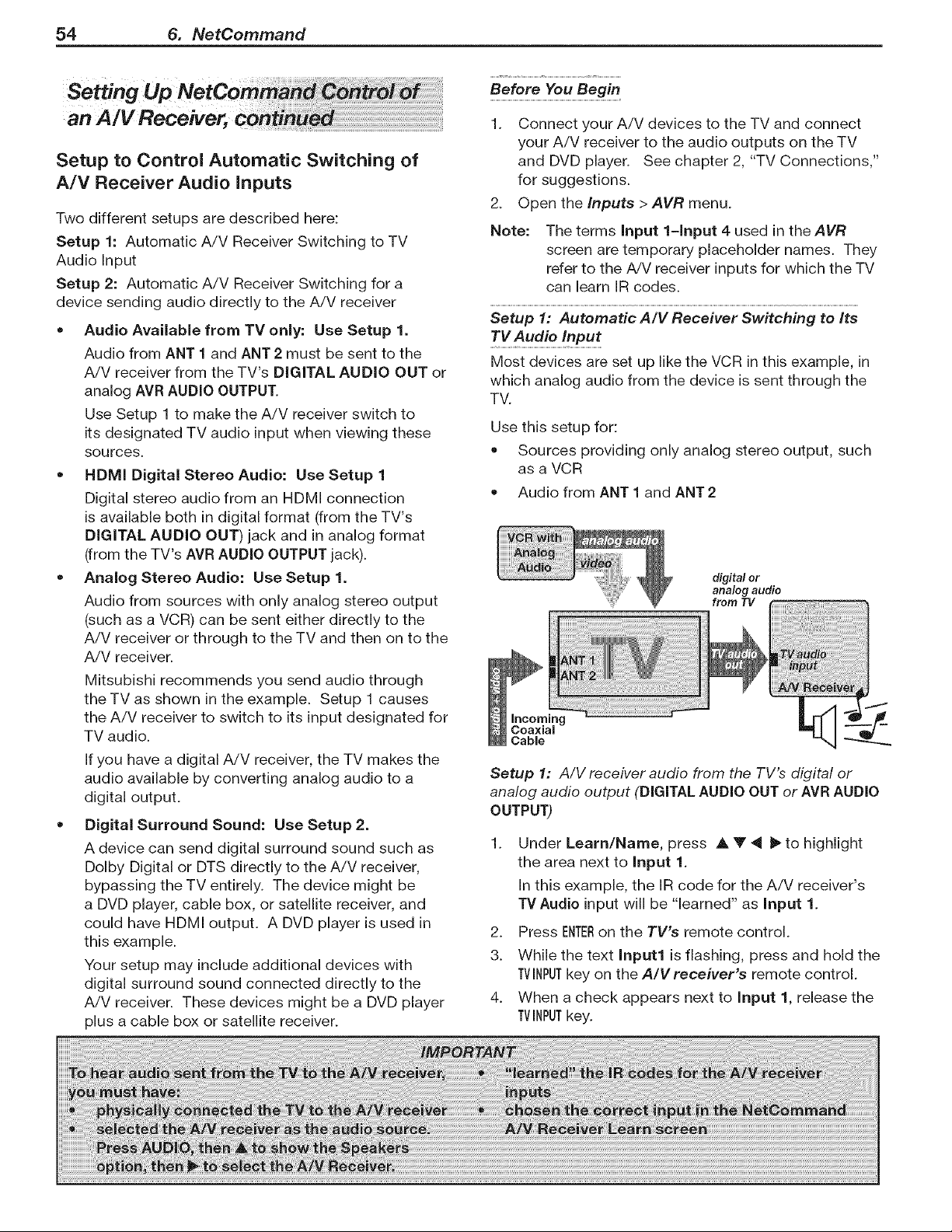
54 6. NetCommand
Setup to Control Automatic Switching of
A/V Receiver Audio inputs
Two different setups are described here:
Setup 1: Automatic A!V Receiver Switching to TV
Audio Input
Setup 2: Automatic A/V Receiver Switching for a
device sending audio directly to the A/V receiver
• Audio Available from TV only: Use Setup 1.
Audio from ANT 1 and ANT 2 must be sent to the
A/V receiver from the TV's DIGITAL AUDIO OUT or
analog AVR AUDIO OUTPUT.
Use Setup 1 to make the A/V receiver switch to
its designated TV audio input when viewing these
sources.
• HDMI Digital Stereo Audio: Use Setup 1
Digital stereo audio from an HDMI connection
is available both in digital format (from the TV's
DIGITAL AUDIO OUT) jack and in analog format
(from the TV's AVR AUDIO OUTPUT jack).
• Analog Stereo Audio: Use Setup 1.
Audio from sources with only analog stereo output
(such as a VCR) can be sent either directly to the
A/V receiver or through to the TV and then on to the
A/V receiver.
Mitsubishi recommends you send audio through
the TV as shown in the example. Setup 1 causes
the A/V receiver to switch to its input designated for
TV audio.
If you have a digital A/V receiver, the TV makes the
audio available by converting analog audio to a
digital output.
• Digital Surround Sound: Use Setup 2.
A device can send digital surround sound such as
Dolby Digital or DTS directly to the A/V receiver,
bypassing the TV entirely. The device might be
a DVD player, cable box, or satellite receiver, and
could have HDMI output. A DVD player is used in
this example.
Your setup may include additional devices with
digital surround sound connected directly to the
A/V receiver. These devices might be a DVD player
plus a cable box or satellite receiver.
Before You Begin
1. Connect your A/V devices to the TV and connect
your A/V receiver to the audio outputs on the TV
and DVD player. See chapter 2, "TV Connections,"
for suggestions.
2. Open the Inputs > AVR menu.
Note: The terms Input l-Input 4 used in the AVR
screen are temporary placeholder names. They
refer to the A!V receiver inputs for which the TV
can learn IR codes.
Setup 1: Automatic A/V Receiver Switching to Its
Most devices are set up like the VCR in this example, in
which analog audio from the device is sent through the
TV.
Use this setup for:
• Sources providing only analog stereo output, such
as a VCR
• Audio from ANT 1 and ANT2
digital or
analog audio
from 71/
Incoming
Coaxial
Cable
Setup 1: A/V receiver audio from the TV's digital or
analog audio output (DIGITAL AUDIO OUT or AVR AUDIO
OUTPUT)
Under Learn/Name, press A V < 1_to highlight
the area next to Input 1.
In this example, the IR code for the A/V receiver's
TV Audio input will be "learned" as Input 1.
2. Press ENTERon the TV's remote control.
3. While the text input1 is flashing, press and hold the
TVINPUTkey on the A/V receiver's remote control.
4. When a check appears next to Input 1, release the
TVINPUTkey.
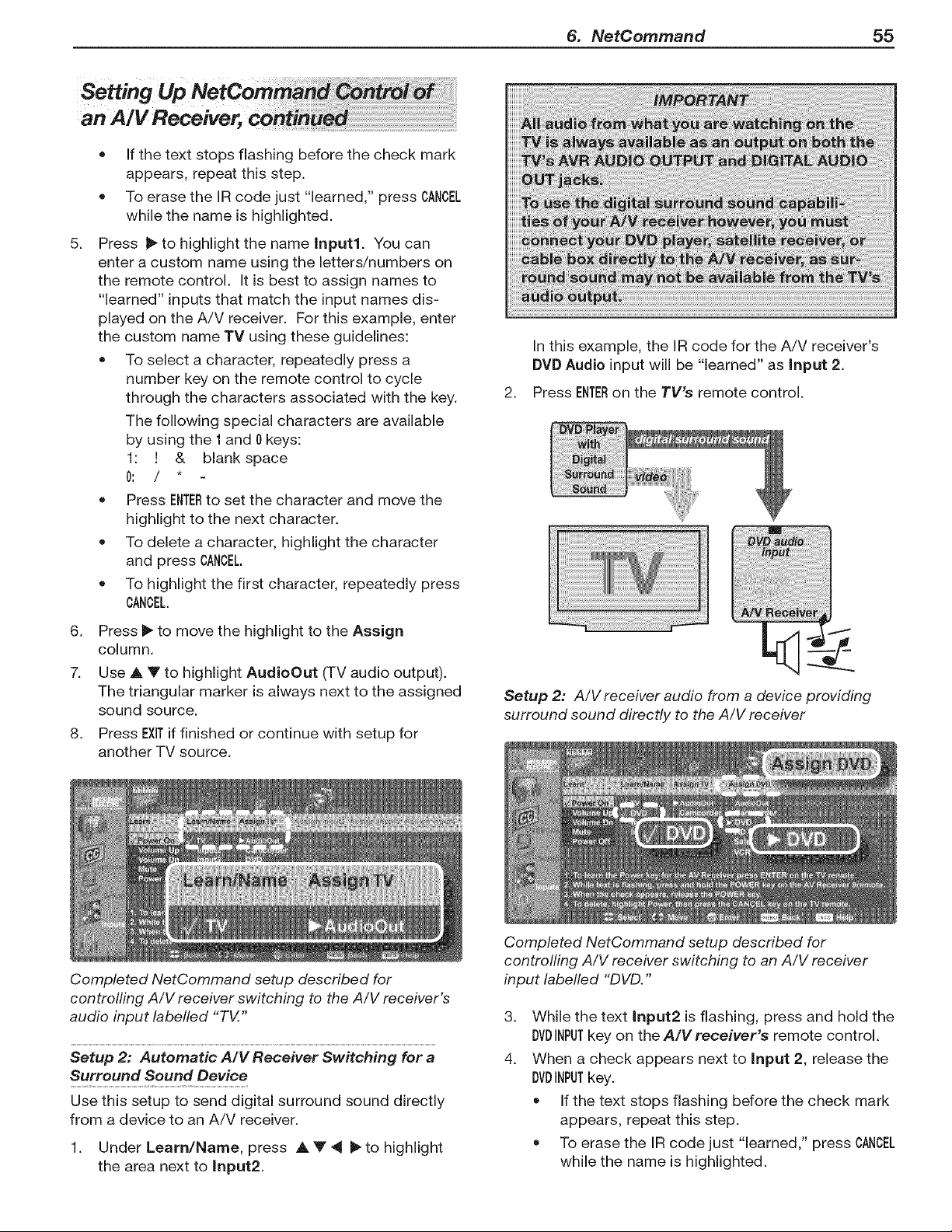
6. NetCommand 55
5.
• If the text stops flashing before the check mark
appears, repeat this step.
To erase the IR code just "learned," press CANCEL
while the name is highlighted.
Press _ to highlight the name input1. You can
enter a custom name using the letters/numbers on
the remote control. It is best to assign names to
"learned" inputs that match the input names dis-
played on the A/V receiver. For this example, enter
the custom name TV using these guidelines:
To select a character, repeatedly press a
number key on the remote control to cycle
through the characters associated with the key.
The following special characters are available
by using the 1 and 0 keys:
1: ! & blank space
O: / * -
Press ENTERto set the character and move the
highlight to the next character.
To delete a character, highlight the character
and press CANCEL.
To highlight the first character, repeatedly press
CANCEL.
6. Press _, to move the highlight to the Assign
column.
7. Use A Y to highlight AudioOut (TV audio output).
The triangular marker is always next to the assigned
sound source.
8. Press EXITif finished or continue with setup for
another TV source.
In this example, the IR code for the A/V receiver's
DVD Audio input will be "learned" as input 2.
2. Press ENTERon the TV's remote control.
Setup 2: A/V receiver audio from a device providing
surround sound directly to the A/V receiver
Completed NetCommand setup described for
con trolling A/V receiver switching to the A/V receiver's
audio inpu t labelled "TV."
Setup 2: Automatic A/V Receiver Switching for a
Surround Sound Device
Use this setup to send digital surround sound directly
from a device to an A/V receiver,
1. Under Learn/Name, press A Y _ I_ to highlight
the area next to Input2.
Completed NetCommand setup described for
controlling A/V receiver switching to an A/V receiver
input labelled "DVD."
3.
4.
While the text Input2 is flashing, press and hold the
DVDINPUTkey on the A/V receiver's remote control.
When a check appears next to input 2, release the
DVDiNPUTkey.
* If the text stops flashing before the check mark
appears, repeat this step.
* To erase the IR code just "learned," press CANCEL
while the name is highlighted.
56 6. NetCommand
Se .gup
5_
Press _ to highlight the name Input2. Assign a
custom name that matches the input name dis-
played on the A/V receiver. For this example, enter
the custom name DVD using the guidelines given
earlier.
6. Press _ to move the highlight to the second Assign
column.
7. Use A V to highlight DVD in the list of devices
recognized by the TV. The triangular marker always
shows the assigned sound source.
8. Press EXITif finished or continue for additional TV
sources.
Appendix A: Specifications ....................... 58
Appendix B: Bypassing the Parental Lock .............. 59
Appendix C: Lamp Cartridge Replacement and Cleaning ..... 61
Appendix D: Programming the Remote Control ........... 63
Appendix E: Troubleshooting ...................... 71
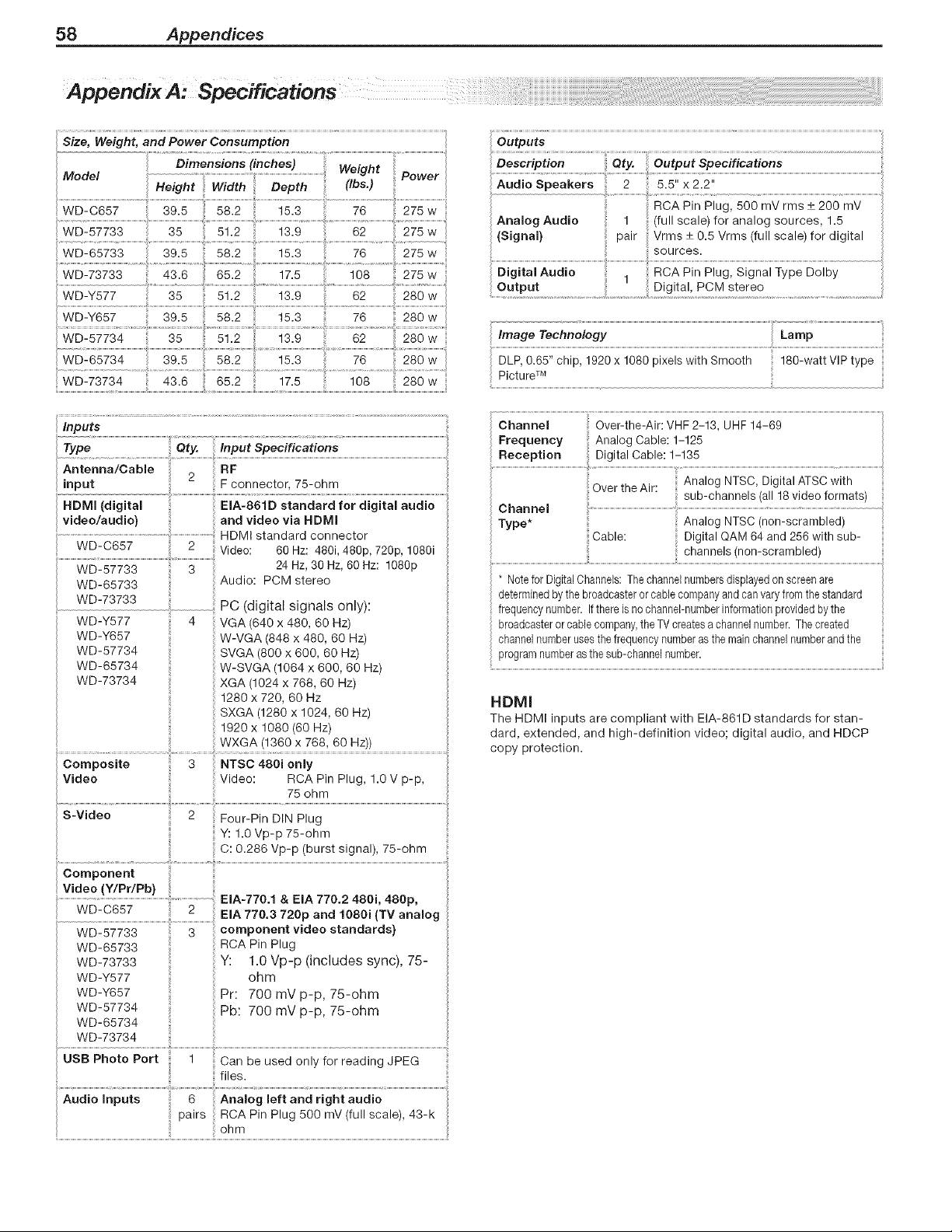
58 Appendices
Appendix A: Specifications
WD-65733
WD-73733
WD-73734 43.6
275 w
65.2 17.5 108 280 w
Typ cry. I.p.f Spociricat o,,e
Antenna cable2 RF
input F connector, 75-ohm
video/audio) and video via HDMI
.........................................................................................................................HDMI standard connector
WD-C657 2 Video: 60 Hz: 480i, 480p, 720p, 1080i
........................................................24.z,30.z,60.z:1osop
WD-65733 Audio: PCM stereo
WD-73733
PC (digital signals only):
WD-Y577 4 VGA (640 x 480, 60 Hz)
WD-Y657 W-VGA (848 x 480, 60 Hz)
WD-57734 SVGA (800 x 600, 60 Hz)
WD-65734 W-SVGA (1064 x 600, 60 Hz)
WD-73734 XGA (1024 x 768, 60 Hz)
1280 x 720, 60 Hz
SXGA (1280 x 1024, 60 Hz)
1920 x 1080 (60 Hz)
WXGA (1360 x 768, 60 Hz))
Composite 3 NTSC 480i only
Video Video: RCA Pin Plug, 1.0 V p-p,
75 ohm
Y: 1.0 Vp-p 75-ohm
C: 0.286 Vp-p (burst signal), 75-ohm
EIA-770.1 & EIA 770.2 480i, 480p,
EIA 770.3 720p and 1080i (TV analog
component video standards}
WD-65733 RCA Pin Plug
WD-73733 Y: 1.0 Vp-p (includes sync), 75-
WD-Y577 ohm
WD-Y657 Pr: 700 mV p-p, 75-ohm
WD-57734 Pb: 700 mV p-p, 75-ohm
WD-65734
WD-73734
USB Photo Port 1 Can be used only for reading JPEG
files.
Audio inputs 6 Analog left and right audio
pairs RCA Pin Plug 500 mV (full scale), 43-k
ohm
Analog Audio 1
(Signal} pair
RCA Pin Plug, 500 mV rms + 200 mV
(full scale) for analog sources, 1.5
Vrms + 0.5 Vrms (full scale) for digital
sources.
RCA Pin Piugl Signal Type D;iby
Digital, PCM stereo
Channel Over-the-Air: VHF 2-13, UHF 14-69
Frequency Analog Cable: 1-125
Reception Digital Cable: 1-135
Over the Air: Analog NTSC, Digital ATSC with
sub-channels (all 18 video formats)
Channel
Type*
Cable: Digital QAM 64 and 256 with sub-
channels (non-scrambled)
* Notefor DigitalChannels: Thechannelnumbersdisplayedon screenare
determinedbythe broadcasteror cable companyandcan varyfrom the standard
frequencynumber. If there [sno channel-numberinformationprovidedbythe
broadcasterorcable company,the TV createsa channelnumber. The created
channelnumberusesthe frequencynumberas the mainchannelnumberand the
program numberasthe sub-channelnumber.
HDMi
The HDMI inputs are compliant with EIA-861D standards for stan-
dard, extended, and high-definition video; digital audio, and HDCP
copy protection.
|
I Appendices
59
0
"0
m
=m
LL
>
Z
C
0
=m
0
C C
m
L
_m
0
JLL
Bypassing the Parental Lock
After you set the lock, you must use your pass code
to view a locked program, view the locked TV, view
a locked channel, cancel the lock, or enter the Lock
menus.
If you forget your pass code, you can view the locked
TV without entering your pass code. When you are
prompted for your pass code, press the number 9 and
QVkeys on the TV remote control at the same time. This
process temporarily unlocks the TV.
When entering the Lock menu, this process deletes
your old pass code and prompts you to enter a new
pass code.
• You can either enter a new pass code to open the
Lock menu and make changes or press EXITto close
the menu.
• If any of the locks are turned on and you exit the
menus when prompted for a new code, the old
code and all lock settings are retained.
• If all locks are turned off and you exit the menus
when prompted for a new code, then the previous
code is erased.
I
I
|
60 Appendices
Appendices 61
WARNING
THE ACCESS PANEL IS PROVIDED WITH
AN INTERLOCK TO REDUCE THE RISK OF
EXCESSIVE ULTRAVIOLET RADIATION. DO NOT
DEFEAT ITS PURPOSE OR ATTEMPT TO SERVICE
WITHOUT REMOVING PANEL COMPLETELY.
A A
BURN DANGER! NOT SURFACES iNSiDE!
Touch lamp cartridge handle only. Do not touch lamp or lamp cartridge
housing. Keep lamp cartridge horizontal during removal. Do not tilt as
glass may come out and cause injury. Only replace lamp cartridge with
the same part number 915P061010.
CAUTION: If the television is on, press POWER to turn it off. Unplug the television and
allow it to cool for at least one hour before attempting to replace the lamp cartridge.
Lamp Life
The light source for this television is a lamp, which is part of a lamp cartridge assembly. The life of the lamp can vary,
based on the lamp itself, the air temperature around the TV while it is operating, and your viewing patterns. Warmer air
or poor ventilation shorten the lamp life, as does turning the television on and off frequently. Mitsubishi warrants the
lamp for one (1) year from the date of original purchase at retail. It is likely that the lamp will last much longer than this.
To Order a New Lamp
To Receive a Replacement Lamp Under Warranty
Call (800) 553-7278. Please have model number, serial number, and TV purchase date available.
important: All lamps replaced under warranty must be returned to Mitsubishi where they will be inspected for defect
verification.
To Purchase a Replacement Lamp After Warranty
Visit our website at www.mitsuparts.com or call (800) 553-7278. Order the following:
Lamp Part Number 915P061010
WARNING
= Do not remove the lamp cartridge immediately after turning off the television. You may get burned because the
lamp is very hot. Allow the television to cool for at least one hour before replacing the lamp cartridge.
= Do not remove the lamp cartridge except when replacing it. Careless treatment can result in injury or fire.
= Do not touch the lamp glass element. It may be very hot and break, causing injuries or burns.
= Be sure not to insert any metal or flammable object into the lamp cartridge opening, as it may cause fire or electri-
cal shock. If a foreign object is inserted into the opening, unplug the AC cord of the TV and contact your dealer for
service.
= Install the lamp cartridge securely. Failure to do so may cause a fire.
= Do not touch the lamp glass elements. Oils from your fingers may cause premature lamp failure.
Hg}= MERCURY
THE LAMP INSIDE THIS PRODUCT CONTAINS MERCURY AND MUST BE RECYCLED OR
DISPOSED OF ACCORDING TO LOCAL, STATE OR FEDERAL LAWS. For disposal or recy-
cling information, please contact your local authorities or the Electronic Industries Alliance at
www.eiae.org
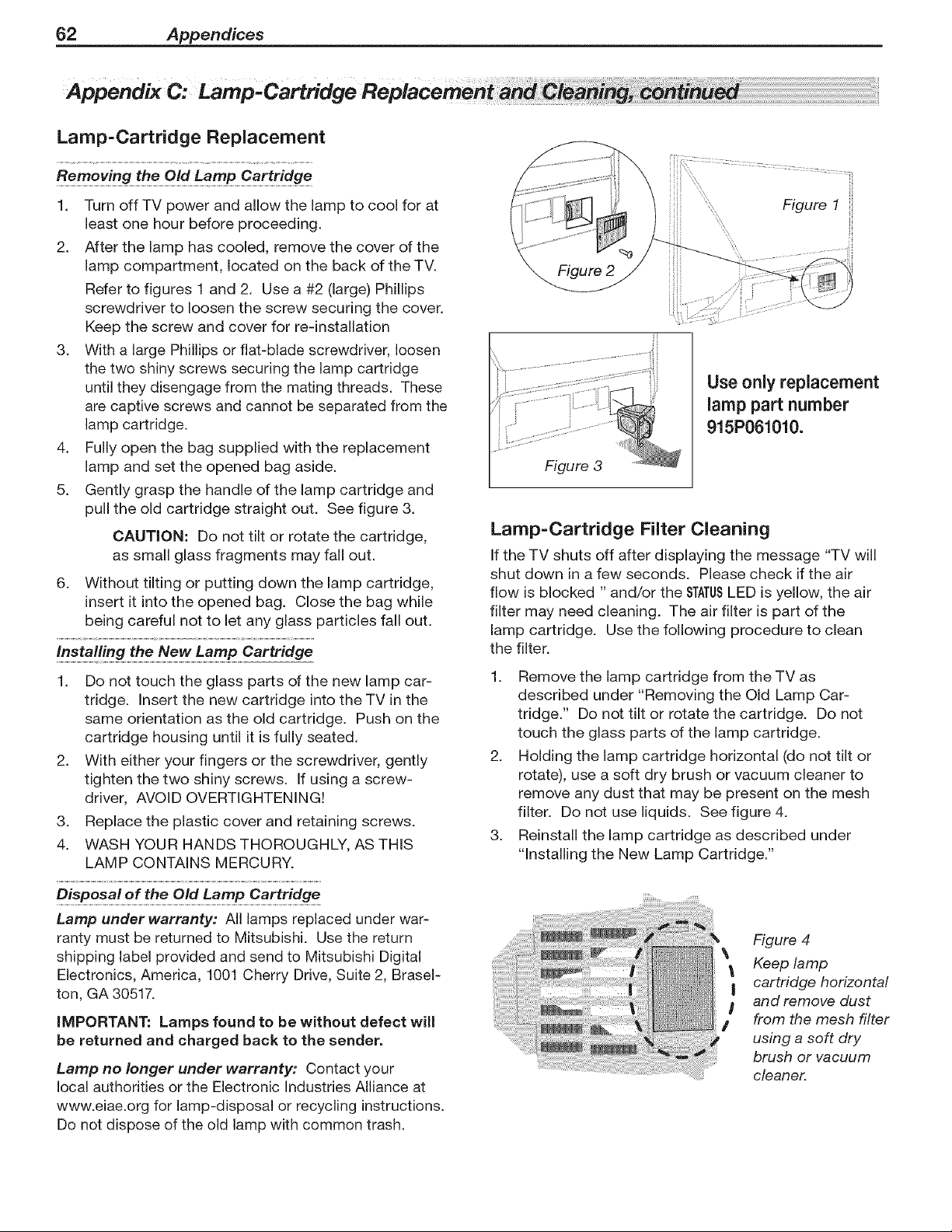
62 Appendices
Lamp=Cartridge Replacement
Removing the OId Lamp Cartridge
1. Turn off TV power and allow the lamp to cool for at
least one hour before proceeding.
2. After the lamp has cooled, remove the cover of the
lamp compartment, located on the back of the TV.
Refer to figures 1 and 2. Use a #2 (large) Phillips
screwdriver to loosen the screw securing the cover.
Keep the screw and cover for re-installation
3. With a large Phillips or flat-blade screwdriver, loosen
the two shiny screws securing the lamp cartridge
until they disengage from the mating threads. These
are captive screws and cannot be separated from the
lamp cartridge.
4. Fully open the bag supplied with the replacement
lamp and set the opened bag aside.
5. Gently grasp the handle of the lamp cartridge and
pull the old cartridge straight out. See figure 3.
CAUTION: Do not tilt or rotate the cartridge,
as small glass fragments may fall out.
6. Without tilting or putting down the lamp cartridge,
insert it into the opened bag. Close the bag while
being careful not to let any glass particles fall out.
!nsta!lMg the New Lamp Cartridge
1. Do not touch the glass parts of the new lamp car-
tridge. Insert the new cartridge into the TV in the
same orientation as the old cartridge. Push on the
cartridge housing until it is fully seated.
2. With either your fingers or the screwdriver, gently
tighten the two shiny screws. If using a screw-
driver, AVOID OVERTIGHTENING!
3. Replace the plastic cover and retaining screws.
4. WASH YOUR HANDS THOROUGHLY, AS THIS
LAMP CONTAINS MERCURY.
Lamp under warranty: All lamps replaced under war-
ranty must be returned to Mitsubishi. Use the return
shipping label provided and send to Mitsubishi Digital
Electronics, America, 1001 Cherry Drive, Suite 2, Brasel-
ton, GA 30517.
IMPORTANT: Lamps found to be without defect will
be returned and charged back to the sender.
Lamp no longer under warranty: Contact your
local authorities or the Electronic Industries Alliance at
www.eiae.org for lamp-disposal or recycling instructions.
Do not dispose of the old lamp with common trash.
Figure 3
Use only replacement
lamp part number
915P061010.
Lamp=Cartridge Filter Cleaning
If the TV shuts off after displaying the message "TV will
shut down in a few seconds. Please check if the air
flow is blocked "and/or the STATUSLED is yellow, the air
filter may need cleaning. The air filter is part of the
lamp cartridge. Use the following procedure to clean
the filter.
1. Remove the lamp cartridge from the TV as
described under "Removing the Old Lamp Car-
tridge." Do not tilt or rotate the cartridge. Do not
touch the glass parts of the lamp cartridge.
2. Holding the lamp cartridge horizontal (do not tilt or
rotate), use a soft dry brush or vacuum cleaner to
remove any dust that may be present on the mesh
filter. Do not use liquids. See figure 4.
3. Reinstall the lamp cartridge as described under
"Installing the New Lamp Cartridge."
Figure 4
Keep lamp
| cartridge horizontal
and remove dust
from the mesh filter
using a soft dry
brush or vacuum
cleaner.
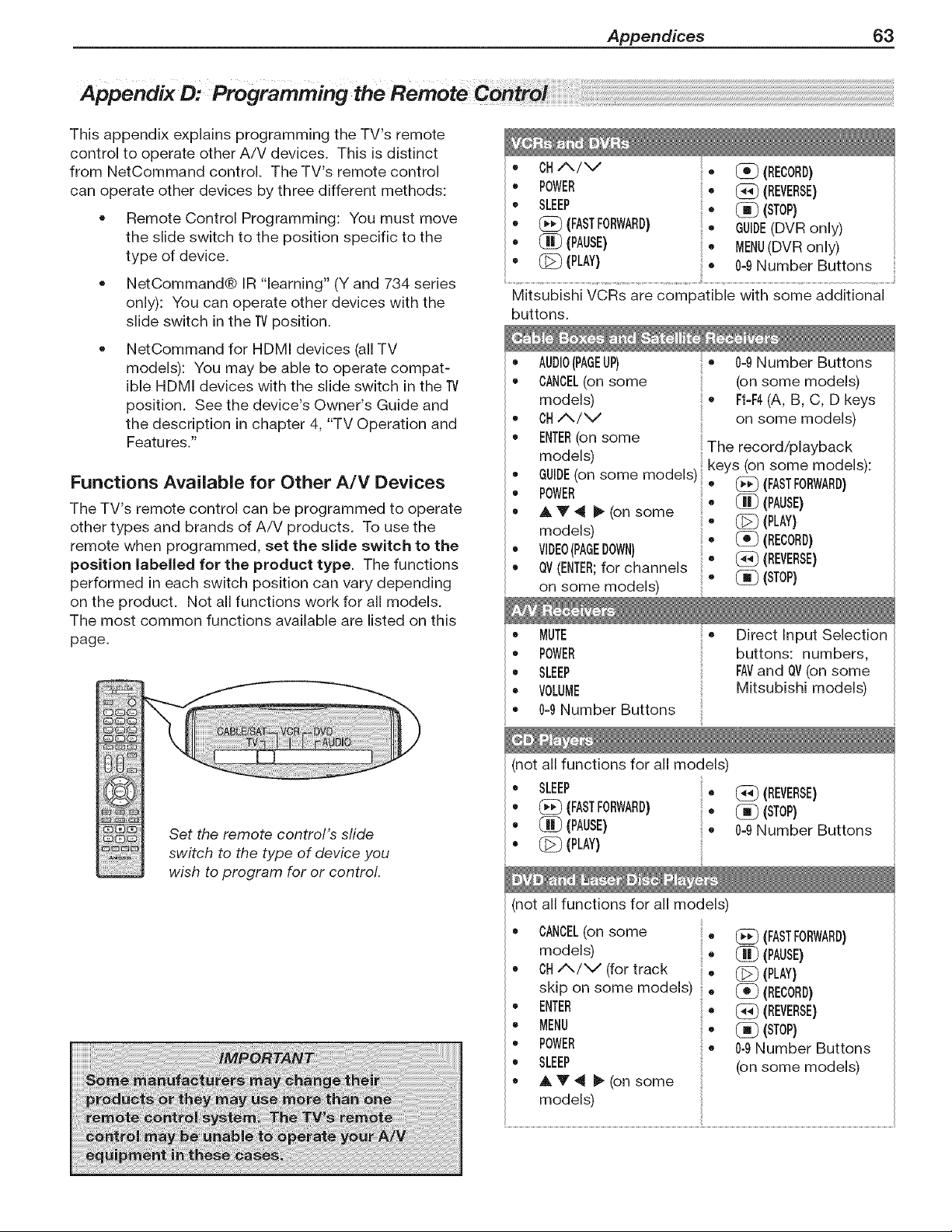
Appendices 63
This appendix explains programming the TV's remote
control to operate other A/V devices. This is distinct
from NetCommand control. The TV's remote control
can operate other devices by three different methods:
• Remote Control Programming: You must move
the slide switch to the position specific to the
type of device.
NetCommand® IR "learning" (Y and 734 series
only): You can operate other devices with the
slide switch in the TVposition.
NetCommand for HDMI devices (all TV
models): You may be able to operate compat-
ible HDMI devices with the slide switch in the TV
position. See the device's Owner's Guide and
the description in chapter 4, "TV Operation and
Features."
Functions Available for Other A/V Devices
The TV's remote control can be programmed to operate
other types and brands of A/V products. To use the
remote when programmed, set the slide switch to the
position labelled for the product type. The functions
performed in each switch position can vary depending
on the product. Not all functions work for all models.
The most common functions available are listed on this
page.
OHA/V . (_ (RECORD)
POWER , _ (REVERSE)
SLEEP . _ (STOP)
(FASTFORWARD) . GUIDE(DVR only)
(PAUSE) • MENU(DVR only)
@ (PLAY) _ 0-9Number Buttons
il............................................................................................................................................................................................................_il..................................................................................................................................................................!
Mitsubishi VCRs are compatible with some additional
buttons.
AUDIO(PAGEUP} • 0-9 Number Buttons
• CANCEL(on some (on some models)
models) • FI=F4(A, B, C, D keys
OHA/'-_ on some models)
ENTER(on some
models) The record/playback
keys (on some models):
GUIDE(on some models)• _ (FASTFORWARD)
• POWER
• AV4),/onsome °
(PAUSE)
• (]_) (PLAY)
models) • _ (RECORD)
VIDEO(PAGEDOWN}
QV(ENTER;for channels • _ (REVERSE)
on some models) _ _ (STOP)
MUTE
POWER
SLEEP
VOLUME
04 Number Buttons
Direct Input Selection
buttons: numbers,
FAVand QV(on some
Mitsubishi models)
(not all functions for all models)
Set the remote control's slide
switch to the type of device you
wish to program for or control.
SLEEP
• (;;{)(FASTFORWARD)
• (_(PAUSE)
• (_)(PLAY)
• _(REVERSE)
• (ST0p)
0-9Number Buttons
(not all functions for all models)
,, CANCEL(on some
models)
', OHA/V (for track
skip on some models)
,, ENTER
• MENU
,, POWER
,, SLEEP
• ,&Y 41i _ (on some
models)
• (_) (FASTFORWARD)
• (_ (PAUSE)
• @ (PLAY)
• _(RECORD)
• _(REVERSE)
• _ (STOP)
0-9Number Buttons
(on some models)
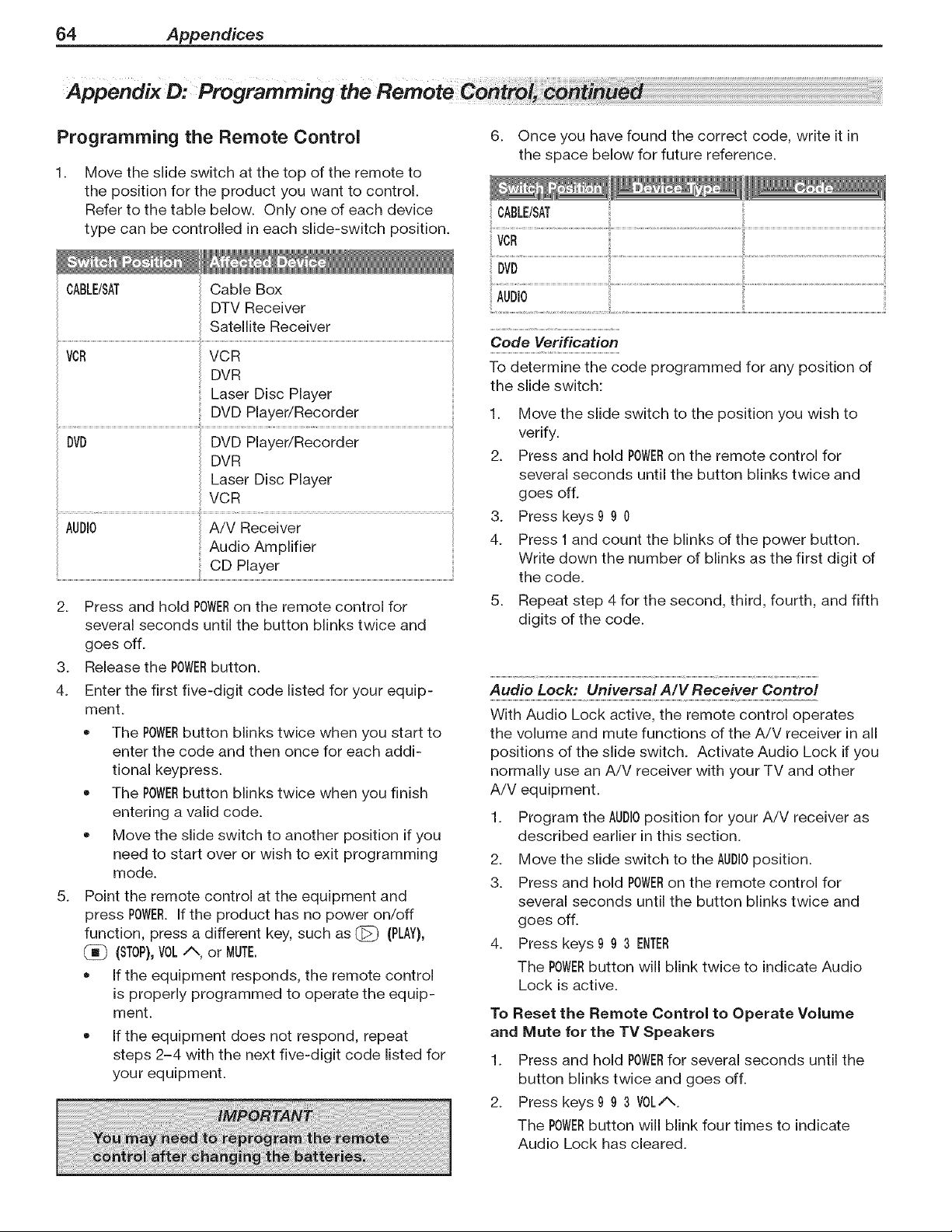
64 Appendices
Appendix D: Programming
Programming the Remote Control
1.
Move the slide switch at the top of the remote to
the position for the product you want to control.
Refer to the table below. Only one of each device
type can be controlled in each slide-switch position.
6. Once you have found the correct code, write it in
the space below for future reference.
CABLE/SAT Cable Box
DTV Receiver
Satellite Receiver
VOR VCR
DVR
Laser Disc Player
DVD Player/Recorder
DVD DVD Player/Recorder
DVR
Laser Disc Player
VCR
CD Player
2. Press and hold POWERon the remote control for
several seconds until the button blinks twice and
goes off.
3. Release the POWERbutton.
4. Enter the first five-digit code listed for your equip-
ment.
• The POWERbutton blinks twice when you start to
enter the code and then once for each addi-
tional keypress.
The POWERbutton blinks twice when you finish
entering a valid code.
Move the slide switch to another position if you
need to start over or wish to exit programming
mode.
5. Point the remote control at the equipment and
press POWER.If the product has no power on/off
function, press a different key, such as @ (PLAY},
(STOP},V0L/_, or MUTE.
If the equipment responds, the remote control
is properly programmed to operate the equip-
ment.
If the equipment does not respond, repeat
steps 2-4 with the next five-digit code listed for
your equipment.
Code Verification
To determine the code programmed for any position of
the slide switch:
1. Move the slide switch to the position you wish to
verify.
2. Press and hold POWERon the remote control for
several seconds until the button blinks twice and
goes off.
3. Press keys9 9 0
4. Press 1and count the blinks of the power button.
Write down the number of blinks as the first digit of
the code.
5. Repeat step 4 for the second, third, fourth, and fifth
digits of the code.
Audio Lock: Universal A/V Receiver Control
With Audio Lock active, the remote control operates
the volume and mute functions of the A/V receiver in all
positions of the slide switch. Activate Audio Lock if you
normally use an A!V receiver with your TV and other
A/V equipment.
1. Program the AUDIOposition for your A!V receiver as
described earlier in this section.
2. Move the slide switch to the AUBI0position.
3. Press and hold POWERon the remote control for
several seconds until the button blinks twice and
goes off.
4. Press keys9 9 3 ENTER
The POWERbutton will blink twice to indicate Audio
Lock is active.
To Reset the Remote Control to Operate Volume
and Mute for the TV Speakers
1. Press and hold POWERfor several seconds until the
button blinks twice and goes off.
2. Press keys9 9 3 V0L/_.
The POWERbutton will blink four times to indicate
Audio Lock has cleared.
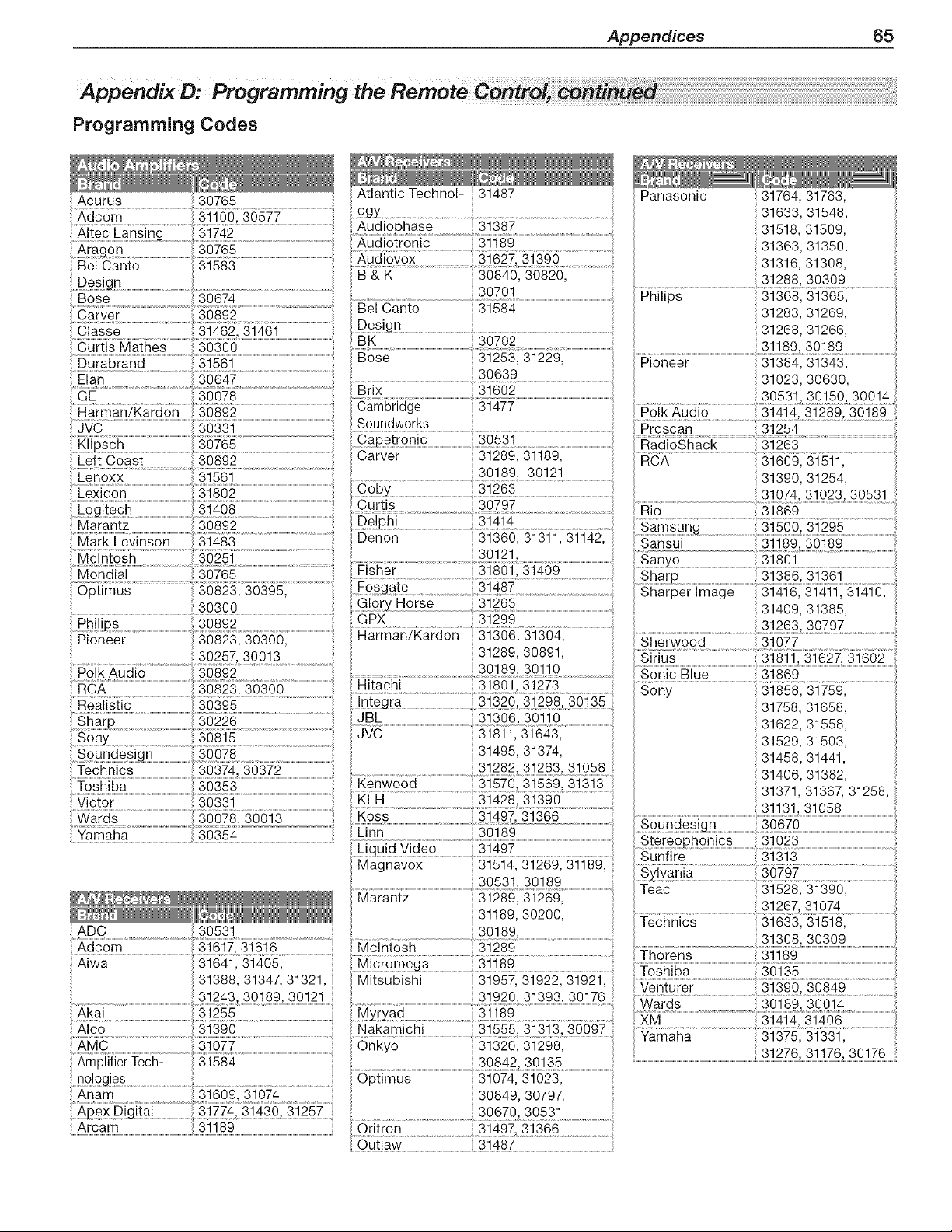
Appendices 65
Programming Codes
Acurus
Adcom
Bose
Durabrand 31561
Elan 30647 i
......................................................................................................................................................................................................................................................Brix
GE
B & K 30840, 30820,
30701
Technics
_31602
30300
31811, 31643,
31495,31374,
,30374,30372 31282,31263,31058
i Panasonic 31764,31763,
31633,31548,
31518,31509,
31363,31350,
31316,31308,
i ...................................................................................................................._12_ _309 ...................................................
Philips 31368,31365,
31283,31269,
31268,31266,
i Pioneer 31384,31343,
31023,30630,
31409,31385,
31622,31558,
31529,31503,
31458, 31441,
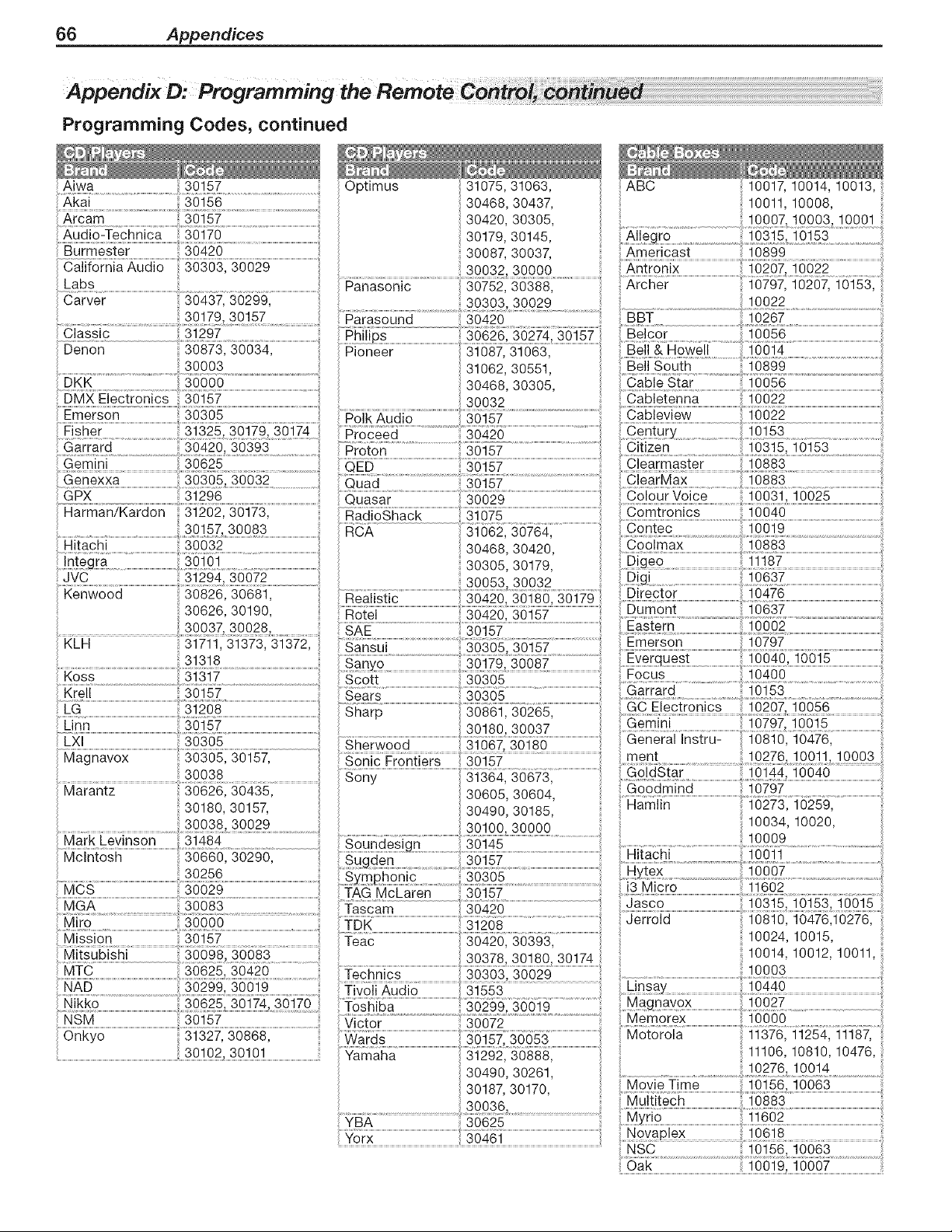
66 Appendices
Appendix D: Programming
Programming Codes,continued
!Aiwa 30157
ii_ii_i_ _diS ...................................................
i!Labs
!Gemini 30625
!Genexxa 30305,30032
Optimus 31075,31063,
30468,30437, ii 10017'10014'10013'10011,10008,
30420,30305,
30179,30145,
30087 30037 i Americast 10899
30032 30000 ....Antronix ...................................................................i"i0207 10022 .....................................................
QED 30157
_______________________________________________________________________________________________________________________________________________________________________________________________________________________________________________.....__s_ .............................................................................__ ......................................................................................................_Ce_eurVe_ce 10031,10025
Harman/Kardon 31202, 30173, ...................................................................................................................................................................................................................................................................................
tachi 30032 30468, 30420, ::_i:_ :::
....................... 3!29f_ 30072
Kenwood 30826, 30681,
30626, 30190,
Koss 31317
Einn............................................................................................................................................................................................................
ERi.............................................................................................................................................................................................................
30305,30179,
.........................................................................................................30053 30032 ........................
Scott 30305
....._e_rs..........................................................................................................................................................................................
_ar_........................................................................................................................................
30180 30037
_erwoo_ ..................................................................................................................
...._onic _ron_iers _ ........................................................................................................
30490,30261,
30187,30170,
...._!g!....................................................................................................10637.......................................................................................................
Director 10476
Focus 10400
....Garrard..............................................................10153.........................................................................................
......................!o2o7 .....................................................
............................................................................! ..........................................................
General Instru- 10810, 10476,
Motorola
....11376,11254,11187,
11106,10810,10476,
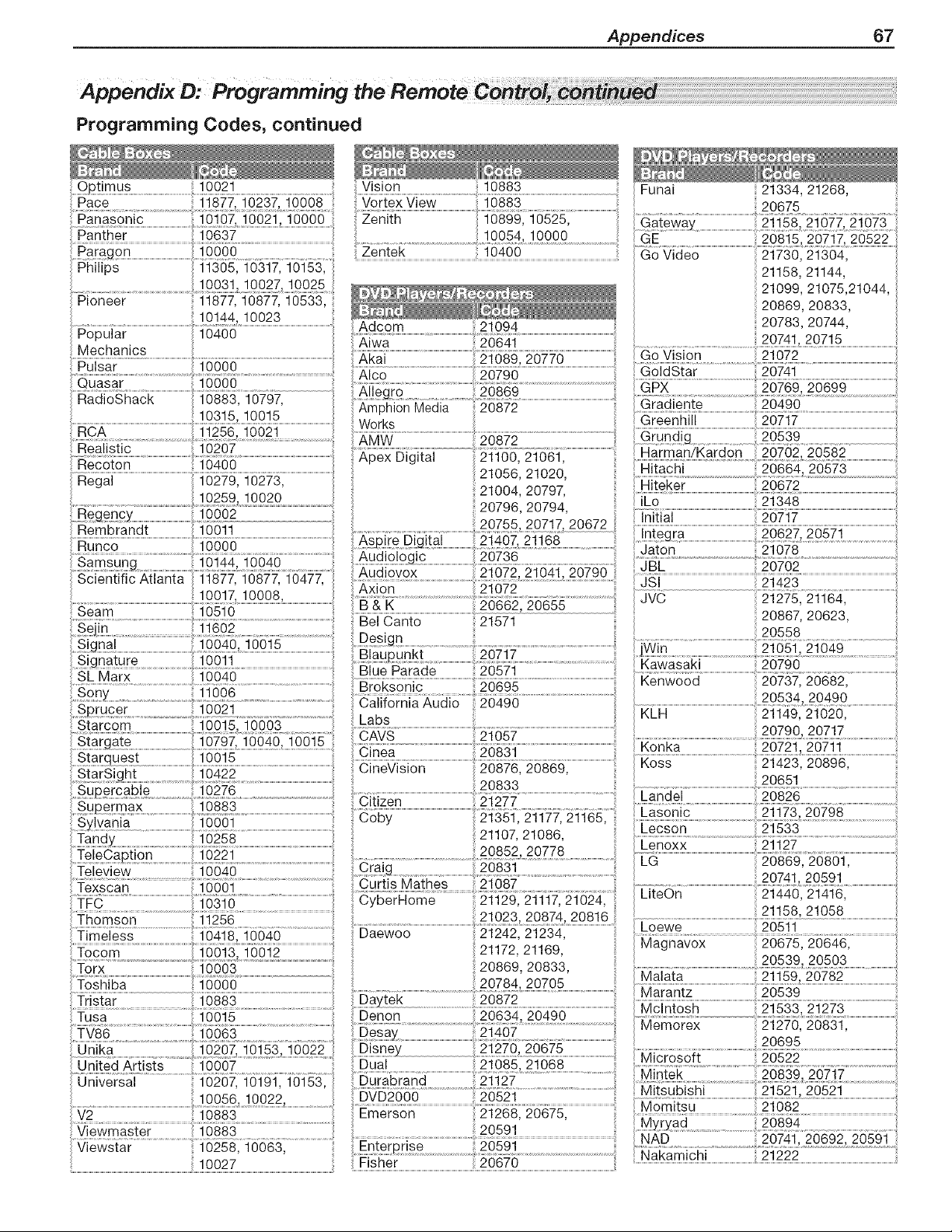
Appendices 67
Programming Codes, continued
Pulsar 10000
......Time!ess.....................................................................!04!8_!0040..........................................................
.....Tocom..................................................................!2...............................................................
Torx 10003
21004, 20797,
20796,20794,
21072
21172,21169,
20869,20833,
Funai 21334, 21268,
ii[£ ..................................................................................................ii£i£ .......................................................................................................i
21149,21020,
20511
! iiM_'g_ ........... ...............................................
!i 20539,20503
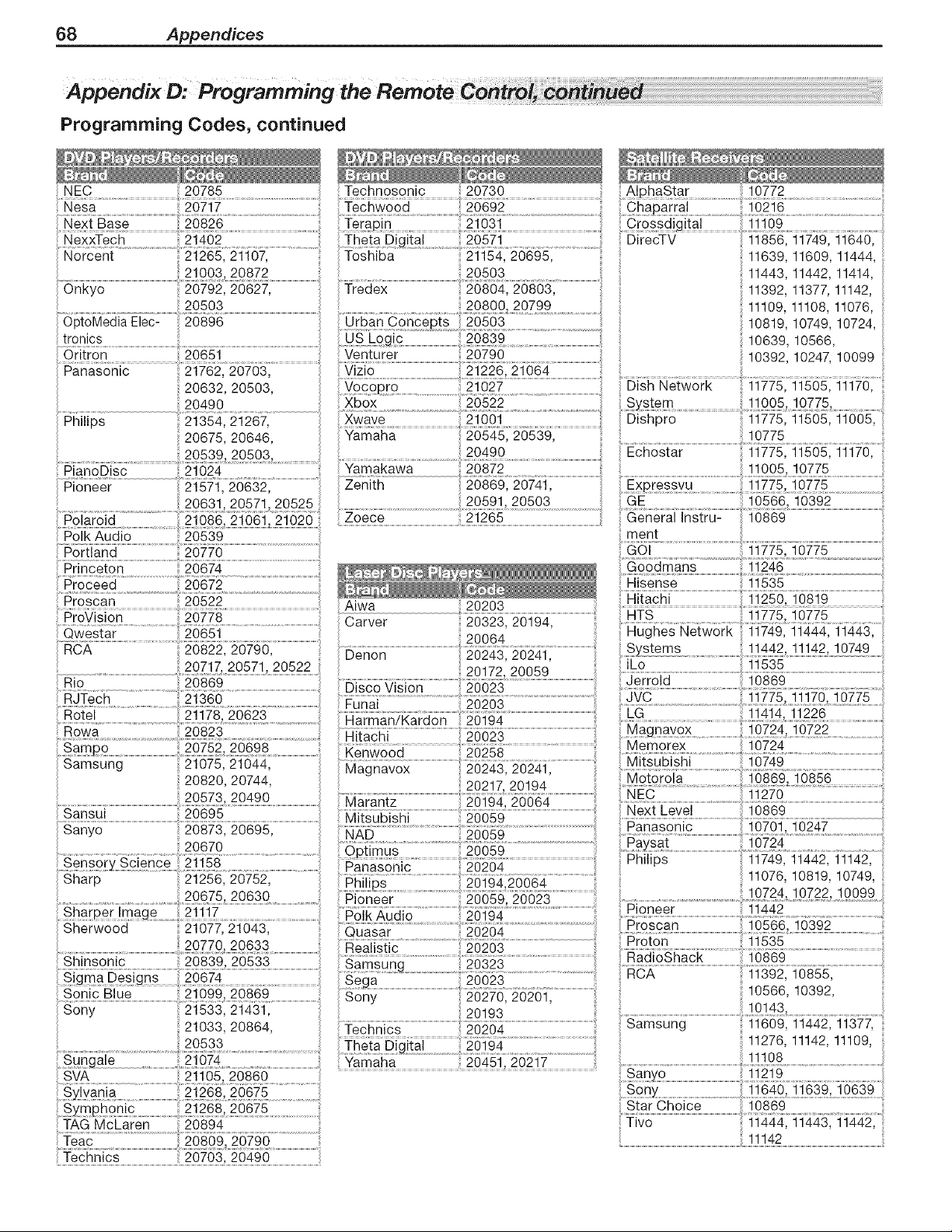
68 Appendices
Appendix D: Programming
Programming Codes, continued
10639,10566,
........Zoece ...........................................................................................21265 ..............................................................................................................
!Proceed i/20672
20869
21075,21044,
20820,20744,
....._73z_0490 ..................................................
20695
21105,20860
ii?_ _ _I'_i_ .......
Aiwa
20323,20194,
20064
_20172,20059
!i!_i_ _i_i_ .....................................
Hisense 11535
10869
20023 Magnayox ....
................................................................................................................................................................................................: Memorex 10724
Magnavox 20243, 20241,
20217, 20194 Motorola 10869 10856
.......................................................................................................................................................................................................................................NEC 11270
......Marantz ........................................................................................................................ ..................................................i0869 ..........................................................................................................
.....M!tsub!sh! .............................................................................................................................
NAD 20059
Paysat 10724
hiiips ........ ii74 142,
11076, 10819, 10749,
i
Sony 20270,20201,
Yamaha 20451,20217
ii110566,10392,
10143
11276 11142 11109,
11142
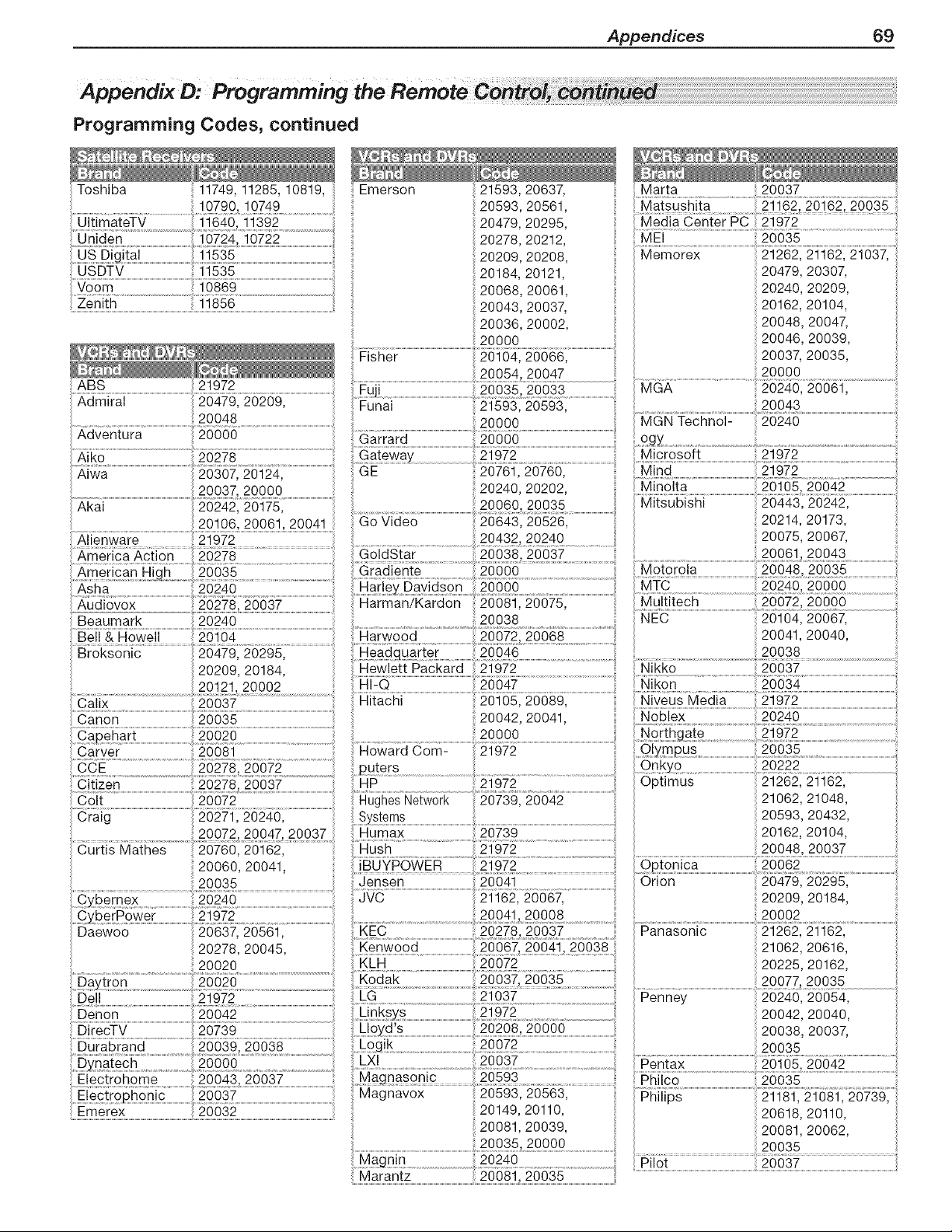
Appendices 69
Programming Codes, continued
UitimateTV
Uniden
US
ABS
Akai
Alienware
America Action
American Hie
Asha 20240
_udiovox.....................................................................................................................
Emerson 21593, 20637,
20598,20561,
20479, 20295,
20278,20212,
20209, 20208,
20184, 20121,
0068, 20061,
20043, 20037,
20036,20002,
Fisher 20104, 20066,
Funai
Gradiente 20000
Harman?RarSon2008_ 256t8
j Matsushita
MEI 20035
Memorex 21262,21162,21037,
20479,20307,
20240,20209,
20162,20104,
20048,20047,
20046,20039,
20037,20035,
20043
NEC
20104,20067,
20038,20037,
Marantz 20081, 20035

70 Appendices
Appendix D: Programming
Programming Codes, continued
Polk Audio
20081
Portland 20020
_ro_itronic....................................................................................................................
i20202,20060 _ ,
20035
Randex ...........................................................................20037 ................................................................................................
i RCA 20880,20761,
20760,20240,
20202,20149,
20106,20105,
20077,20060,
20042
Sylvania 21593, 20593,
_i_i20110, 20081,
ii2oo43,2oo35,
20000
ii20000
Teac 20041,20000
20000
....._6666....................................................................................................
Tivo 21503,20739,
TMK 20240, 20208,
20036
Toshiba 21972,21503,
21008,20212,
20210,20209,
20066,20045,
20043
Vector Research 20040, 20038
..... ................................................................................_;VdeoCo'ncep{s'ii20061,20045,
.... ...................................................................................................i20040
ii 20209 20067
! 20041,20000
ii 120104 20047 20046
ii !i2018420121 ii
ii! i20045, 20043 ii
20066,20054, i
20047 20046 i!
20042,20037,
20062,20060,
20048,20047,
20042,20035,
White 20637,20209,20072
XR-1000 20072,20035,
20000
ii i!20636 20035
ii ii20034,20033,
!i! 20032 20000
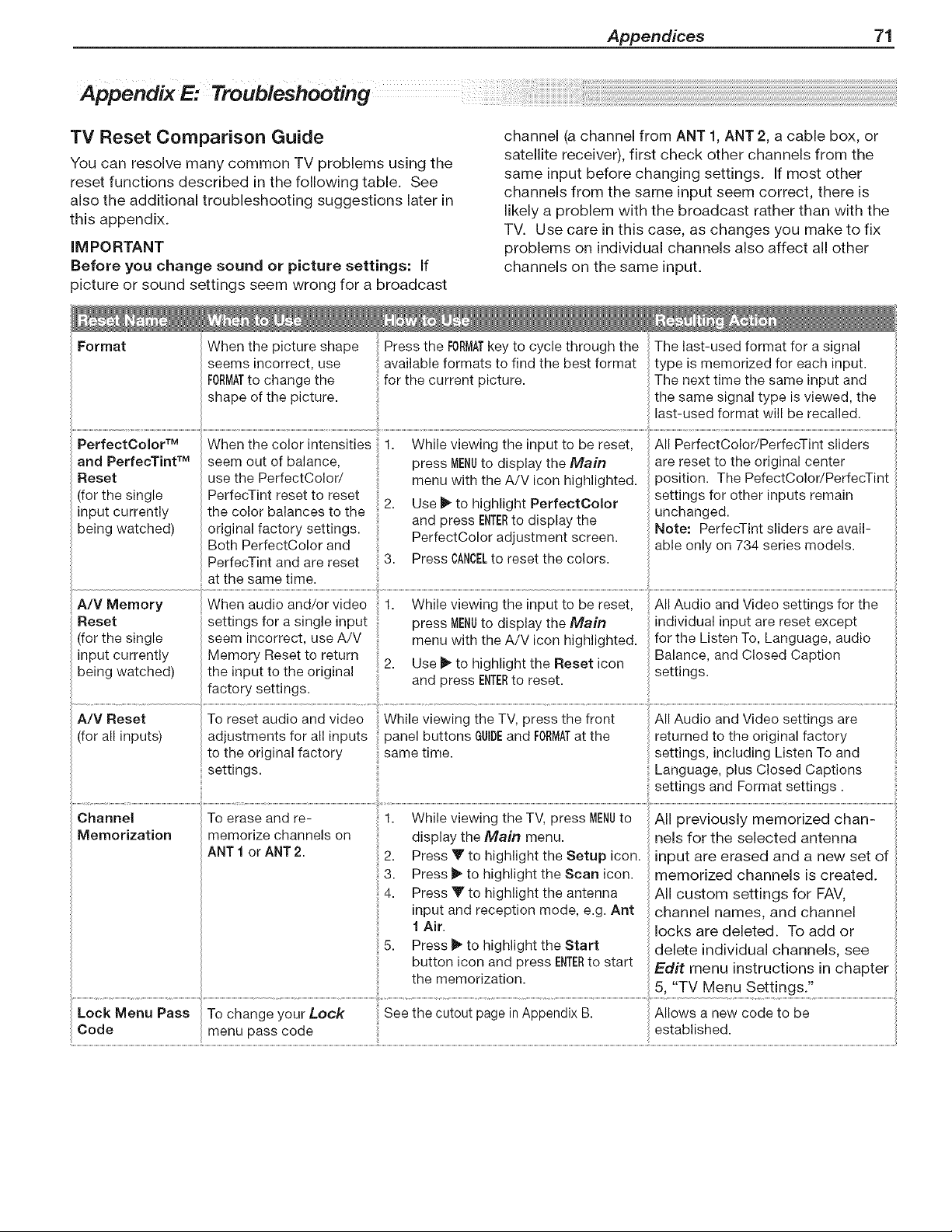
Appendices 71
TV Reset Comparison Guide
You can resolve many common TV problems using the
reset functions described in the following table. See
also the additional troubleshooting suggestions later in
this appendix.
iMPORTANT
Before you change sound or picture settings: If
picture or sound settings seem wrong for a broadcast
channel (a channel from ANT 1, ANT 2, a cable box, or
satellite receiver), first check other channels from the
same input before changing settings. If most other
channels from the same input seem correct, there is
likely a problem with the broadcast rather than with the
TV. Use care in this case, as changes you make to fix
problems on individual channels also affect all other
channels on the same input.
Format When the picture shape Press the FORMATkey to cycle through the The last-used format for a signal
seems incorrect, use available formats to find the best format type is memorized for each input.
FORMATto change the for the current picture. The next time the same input and
shape of the picture, the same signal type is viewed, the
last-used format will be recalled.
i
PerfectColor TM When the color intensities 1. While viewing the input to be reset, All PerfectColor/PerfecTint sliders
and PerfecTint TM seem out of balance, press MENUto display the Main are reset to the original center
Reset position. The PefectColor/PerfecTint
(for the single
input currently
being watched)
use the PerfectColor/
PerfecTint reset to reset
the color balances to the 2.
original factory settings.
Both PerfectColor and
PerfecTint and are reset 3.
at the same time.
menu with the A/V icon highlighted.
Use 1_to highlight PerfectColor
and press ENTERto display the
PerfectColor adjustment screen.
Press CANCELto reset the colors.
settings for other inputs remain
unchanged.
Note: PerfecTint sliders are avail-
able only on 734 series models.
A/V Memory When audio and/or video 1. While viewing the input to be reset, All Audio and Video settings for the
Reset settings for a single input press MENUto display the Main individual input are reset except
(for the single seem incorrect use A/V menu with the A/V icon highlighted, for the Listen To, Language, audio
input currently Memory Reset to return Balance, and Closed Caption
being watched) the input to the original 2. Use I1_to highlight the Reset icon settings.
factory settings, and press ENTERto reset.
A/V Reset To reset audio and video While viewing the TV, press the front All Audio and Video settings are
(for all inputs) adjustments for all inputs )anel buttons GUIDEand FORMATat the returned to the original factory
to the original factory same time. settings, including Listen To and
settings. Language, plus Closed Captions
settings and Format settings.
Memorization memorize channels on display the Main menu.
ANT 1 or ANT 2. 2. Press Y to highlight the Setup icon.
3. Press t_ to highlight the Scan icon.
4. Press Y to highlight the antenna
input and reception mode, e.g. Ant
t Air.
5. Press _ to highlight the Start
button icon and press ENTERto start Ed,,!t menu instructions in chapter
the memorization. 5, TV Menu Settings.
Lock Menu Pass To change your Lock See the cutout page in Appendix B. Allows a new code to be
Code menu pass code established.
nels for the selected antenna
input are erased and a new set of
memorized channels is created.
All custom settings for FAV,
channel names, and channel
locks are deleted. To add or
delete individual channels, see
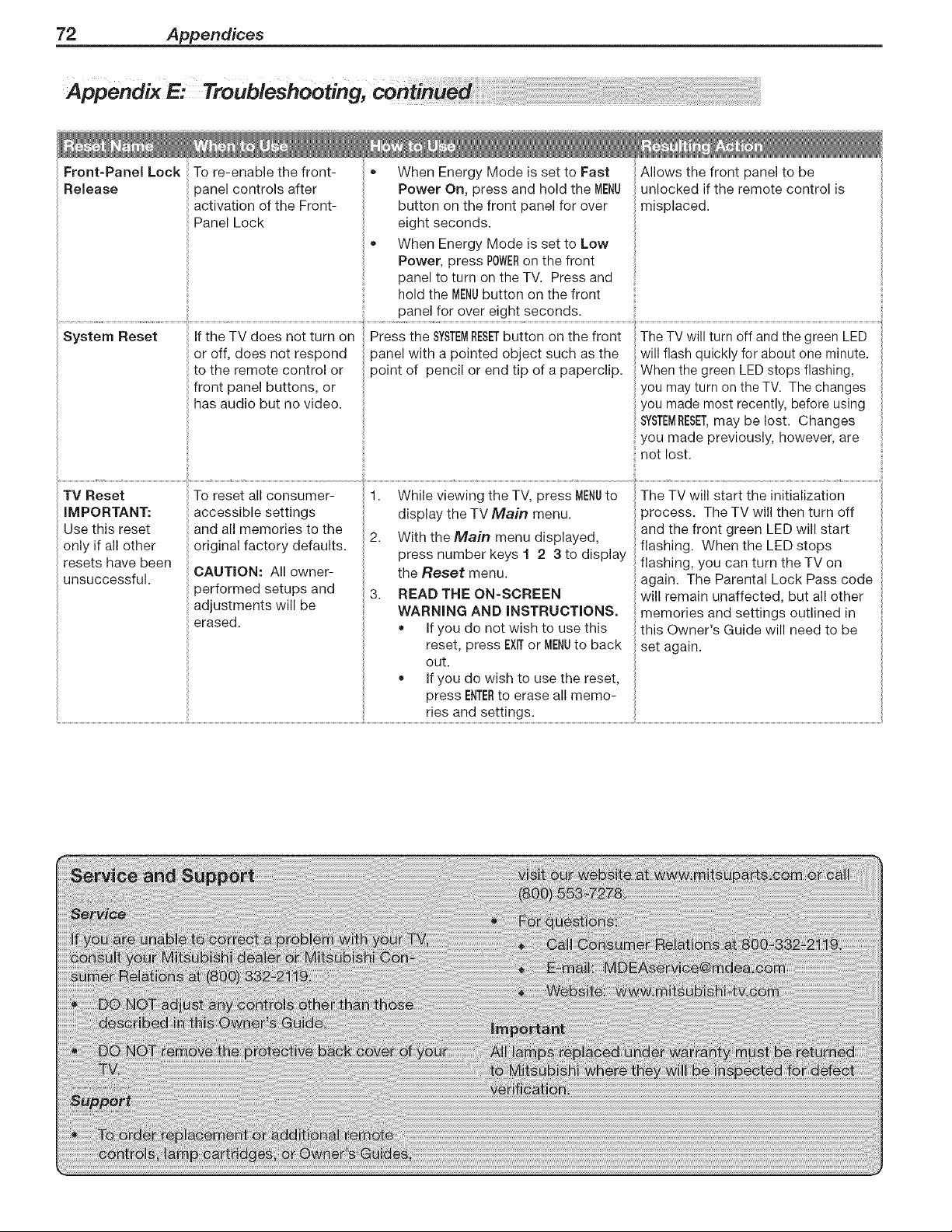
72 Appendices
Appendix E: Troubleshooting,
Front=Panel Lock
Release
To re-enable the front-
panel controls after
activation of the Front-
Panel Lock
o When Energy Mode is set to Fast Allows the front panel to be
Power On, press and hold the MENU unlocked if the remote control is
button on the front panel for over misplaced.
eight seconds.
• When Energy Mode is set to Low
Power, press POWERon the front
panel to turn on the TV. Press and
hold the MENUbutton on the front
panel for over eight seconds.
System Reset If the TV does not turn on Press the SYSTEMRESETbutton on the front The TV will turn off and the green LED
or off, does not respond panel with a pointed object such as the will flash quickly for about one minute.
to the remote control or point of pencil or end tip of a paperclip. When the green LED stops flashing,
front panel buttons, or you may turn on the TV. The changes
has audio but no video, you made most recently, before using
SYSTEMRESET,may be lost. Changes
you made previously, however, are
not lost.
TV Reset To reset all consumer- 1. While viewing the TV, press MENUto The TV will start the initialization
IMPORTANT: accessible settings display the TV Main menu. process. The TV will then turn off
and the front green LED will start
Use this reset and all memories to the 2. With the Main menu displayed, flashing. When the LED stops
resets°nlyif allhaveOtherbeenoriginal factory defaults, press number keys 1 2 3 to display flashing, you can turn the TV on
unsuccessful. CAUTION: All owner- the Reset menu. again. The Parental Lock Pass code
performed setups and 3. READ THE ON-SCREEN will remain unaffected, but all other
adjustments will be WARNING AND INSTRUCTIONS. memories and settings outlined in
erased. • If you do not wish to use this this Owner s Guide will need to be
reset, press EXITor MENUto back set again.
out.
If you do wish to use the reset,
press ENTERto erase all memo-
ries and settings.
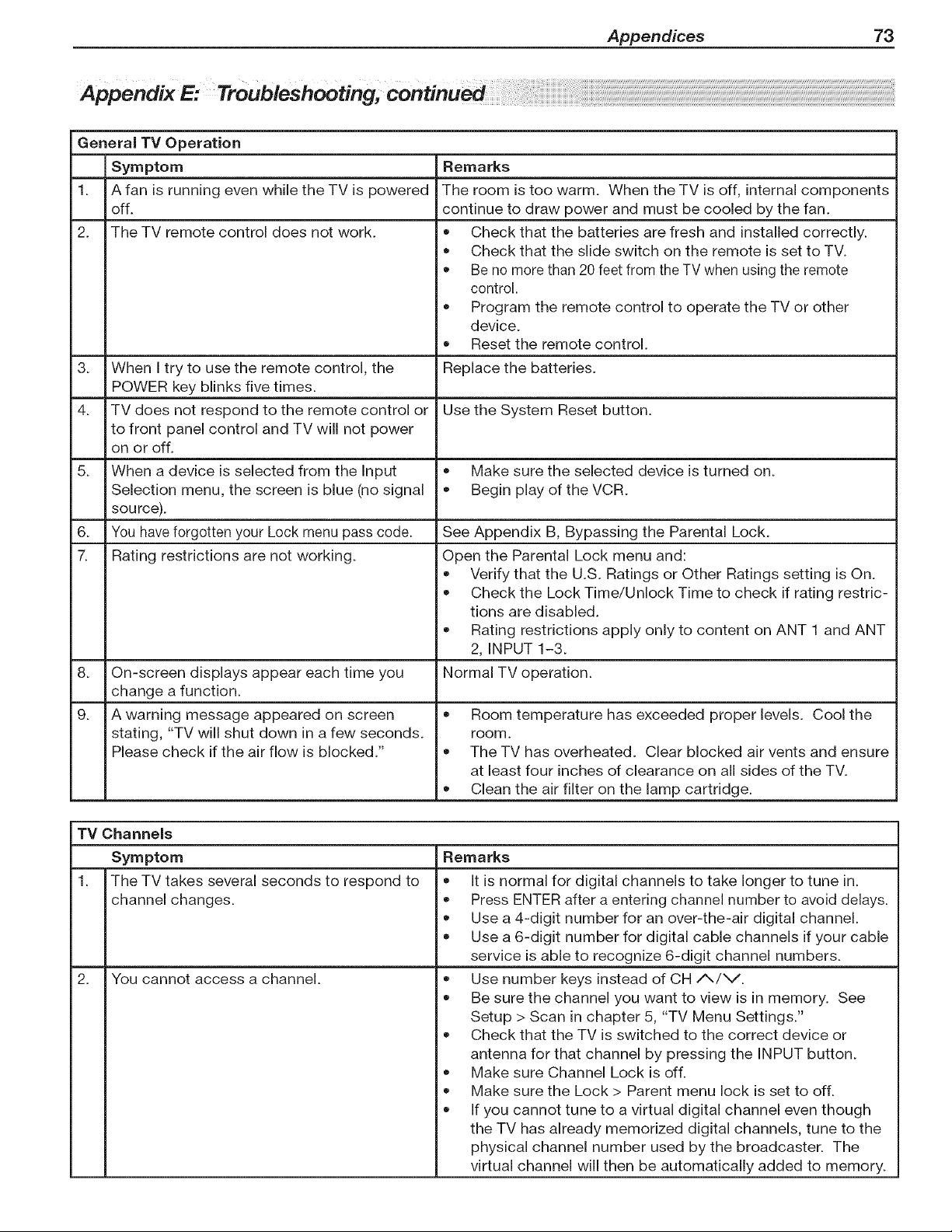
Appendices 73
General TV Operation
Symptom
1. A fan is running even while the TV is powered
off.
2. The TV remote control does not work.
3. When I try to use the remote control, the
POWER key blinks five times.
4. TV does not respond to the remote control or Use the System Reset button.
to front panel control and TV will not power
on or off.
5. When a device is selected from the Input • Make sure the selected device is turned on.
Selection menu, the screen is blue (no signal • Begin play of the VCR.
SOU roe).
6. You have forgotten your Lock menu pass code.
7. Rating restrictions are not working.
Remarks
The room is too warm. When the TV is off, internal components
continue to draw power and must be cooled by the fan.
Check that the batteries are fresh and installed correctly.
Check that the slide switch on the remote is set to TV.
Be no more than 20 feet from the TV when using the remote
control.
Program the remote control to operate the TV or other
device.
Reset the remote control.
Replace the batteries.
See Appendix B, Bypassing the Parental Lock.
Open the Parental Lock menu and:
Verify that the U.S. Ratings or Other Ratings setting is On.
Check the Lock Time/Unlock Time to check if rating restric-
tions are disabled.
Rating restrictions apply only to content on ANT 1 and ANT
2, INPUT 1-3.
Normal TV operation.8. On-screen displays appear each time you
change a function.
9. A warning message appeared on screen • Room temperature has exceeded proper levels. Cool the
stating, "TV will shut down in a few seconds, room.
Please check if the air flow is blocked." • The TV has overheated. Clear blocked air vents and ensure
at least four inches of clearance on all sides of the TV.
Clean the air filter on the lamp cartridge.
TV Channels
Symptom
1. The TV takes several seconds to respond to
channel changes.
2. You cannot access a channel.
Remarks
It is normal for digital channels to take longer to tune in.
Press ENTER after a entering channel number to avoid delays.
Use a 4-digit number for an over-the-air digital channel.
Use a 6-digit number for digital cable channels if your cable
service is able to recognize 6-digit channel numbers.
Use number keys instead of CH/_/V.
Be sure the channel you want to view is in memory. See
Setup > Scan in chapter 5, "TV Menu Settings."
Check that the TV is switched to the correct device or
antenna for that channel by pressing the INPUT button.
Make sure Channel Lock is off.
Make sure the Lock > Parent menu lock is set to off.
If you cannot tune to a virtual digital channel even though
the TV has already memorized digital channels, tune to the
physical channel number used by the broadcaster. The
virtual channel will then be automatically added to memory.
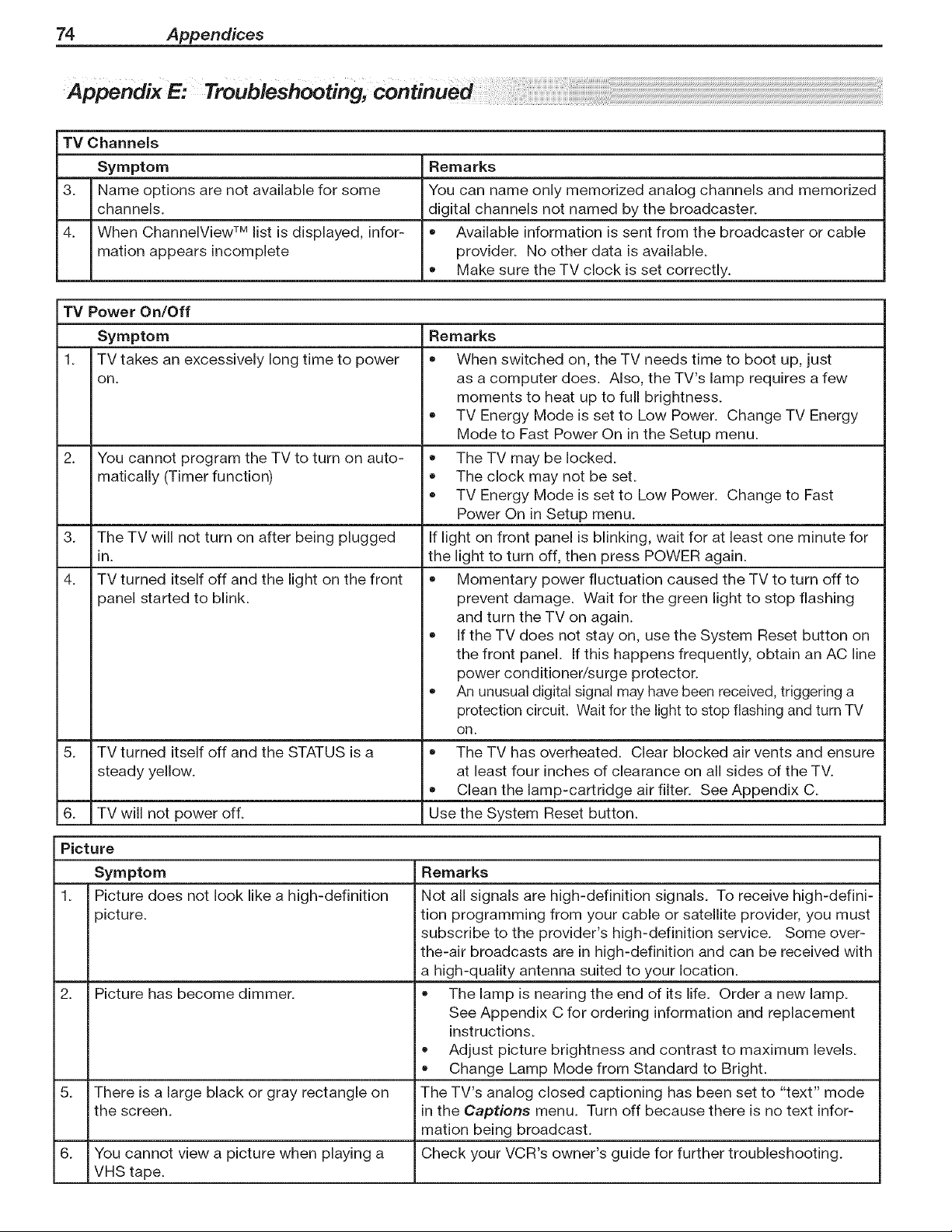
74 Appendices
Appendix E: Troubleshooting,
TV Channels
Symptom Remarks
[ 3. Name options are not available for some You can name only memorized analog channels and memorized
channels, digital channels not named by the broadcaster.
4. When ChannelView TM list is displayed, infor- • Available information is sent from the broadcaster or cable
mation appears incomplete provider. No other data is available.
Make sure the TV clock is set correctly.
TV Power On/Off
Symptom
1. TV takes an excessively long time to power
on.
2. You cannot program the TV to turn on auto-
matically (Timer function)
3.
4.
The TV will not turn on after being plugged
in.
TV turned itself off and the light on the front
panel started to blink.
5. TV turned itself off and the STATUS is a
steady yellow.
6. TV will not power off.
Picture
Symptom Remarks
1. Picture does not look like a high-definition Not all signals are high-definition signals. To receive high-defini-
picture, tion programming from your cable or satellite provider, you must
subscribe to the provider's high-definition service. Some over-
the-air broadcasts are in high-definition and can be received with
a high-quality antenna suited to your location.
2. Picture has become dimmer. • The lamp is nearing the end of its life. Order a new lamp.
See Appendix C for ordering information and replacement
instructions.
• Adjust picture brightness and contrast to maximum levels.
• Change Lamp Mode from Standard to Bright.
5. There is a large black or gray rectangle on The TV's analog closed captioning has been set to "text" mode
the screen, in the Captions menu. Turn off because there is no text infor-
mation being broadcast.
6. You cannot view a picture when playing a Check your VCR's owner's guide for further troubleshooting.
VHS tape.
Remarks
When switched on, the TV needs time to boot up, just
as a computer does. Also, the TV's lamp requires a few
moments to heat up to full brightness.
TV Energy Mode is set to Low Power. Change TV Energy
Mode to Fast Power On in the Setup menu.
The TV may be locked.
The clock may not be set.
TV Energy Mode is set to Low Power. Change to Fast
Power On in Setup menu.
If light on front panel is blinking, wait for at least one minute for
the light to turn off, then press POWER again.
Momentary power fluctuation caused the TV to turn off to
prevent damage. Wait for the green light to stop flashing
and turn the TV on again.
If the TV does not stay on, use the System Reset button on
the front panel. If this happens frequently, obtain an AC line
power conditioner/surge protector.
An unusual digital signal may have been received, triggering a
protection circuit. Wait for the light to stop flashing and turn TV
on.
The TV has overheated. Clear blocked air vents and ensure
at least four inches of clearance on all sides of the TV.
Clean the lamp-cartridge air filter. See Appendix C.
Use the System Reset button.
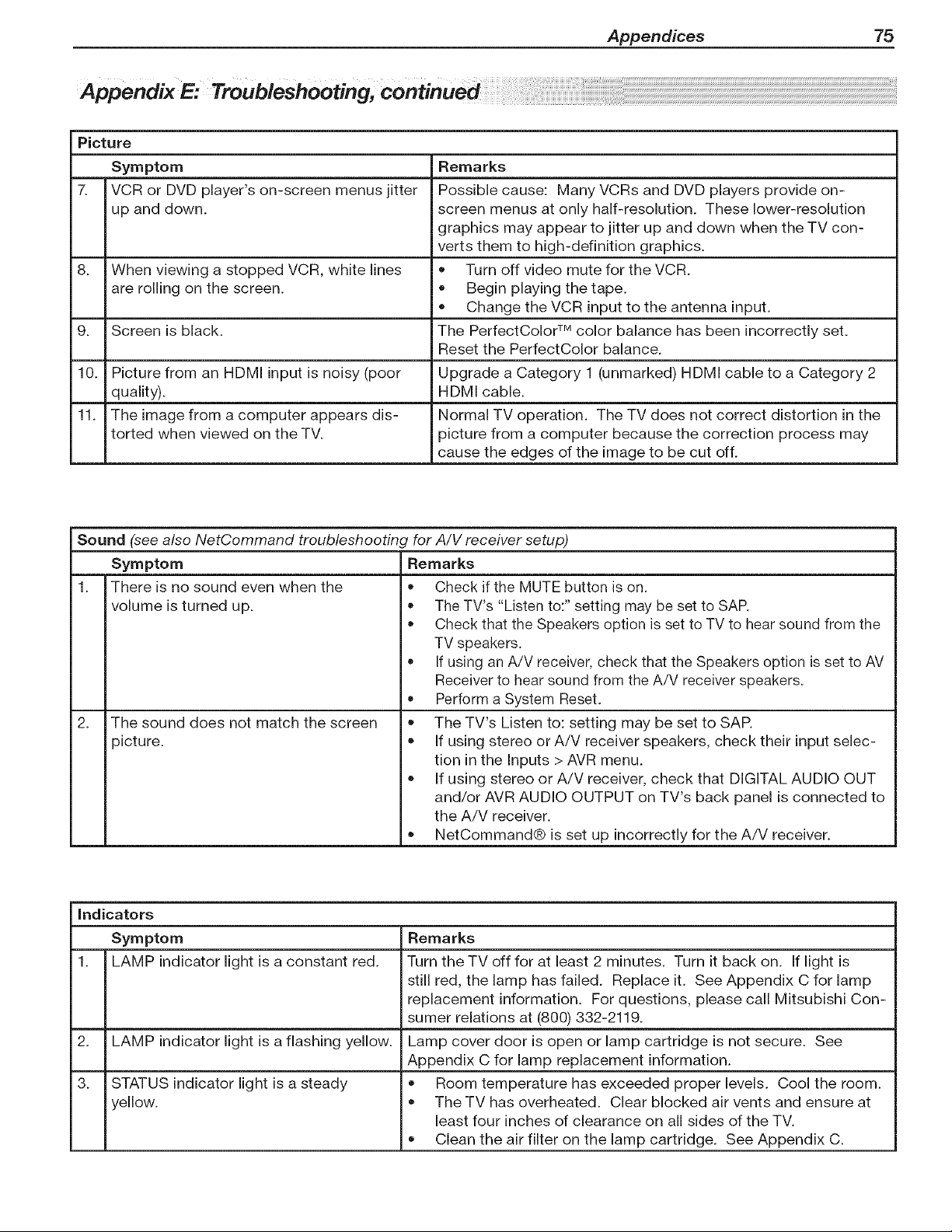
Appendix E: Troubleshooting,
Appendices 75
Picture
Symptom Remarks
7. VCR or DVD player's on-screen menus jitter Possible cause: Many VCRs and DVD players provide on-
up and down. screen menus at only half-resolution. These lower-resolution
graphics may appear to jitter up and down when the TV con-
verts them to high-definition graphics.
8. When viewing a stopped VCR, white lines • Turn off video mute for the VCR.
are rolling on the screen. • Begin playing the tape.
Change the VCR input to the antenna input.
9. Screen is black. The PerfectColor TM color balance has been incorrectly set.
Reset the PerfectColor balance.
10. Picture from an HDMI input is noisy (poor Upgrade a Category 1 (unmarked) HDMI cable to a Category 2
quality). HDMI cable.
11. The image from a computer appears dis- Normal TV operation. The TV does not correct distortion in the
torted when viewed on the TV. picture from a computer because the correction process may
cause the edges of the image to be cut off.
Sound (see also NetCommand troubleshooting for A/V receiver setup)
Remarks
1.
2_
Symptom
There is no sound even when the
volume is turned up.
The sound does not match the screen
picture.
Check if the MUTE button is on.
The TV's "Listen to:" setting may be set to SAP.
Check that the Speakers option is set to TV to hear sound from the
TV speakers.
If using an A/V receiver, check that the Speakers option is set to AV
Receiver to hear sound from the A/V receiver speakers.
• Perform a System Reset.
The TV's Listen to: setting may be set to SAR
If using stereo or A/V receiver speakers, check their input selec-
tion in the Inputs > AVR menu.
If using stereo or A/V receiver, check that DIGITAL AUDIO OUT
and/or AVR AUDIO OUTPUT on TV's back panel is connected to
the A/V receiver.
NetCommand® is set up incorrectly for the A/V receiver.
indicators
Symptom
1. LAMP indicator light is a constant red.
2. LAMP indicator light is a flashing yellow.
3. STATUS indicator light is a steady
yellow.
Remarks
Turn the TV off for at least 2 minutes. Turn it back on. If light is
still red, the lamp has failed. Replace it. See Appendix C for lamp
replacement information. For questions, please call Mitsubishi Con-
sumer relations at (800) 332-2119.
Lamp cover door is open or lamp cartridge is not secure. See
Appendix C for lamp replacement information.
Room temperature has exceeded proper levels. Cool the room.
The TV has overheated. Clear blocked air vents and ensure at
least four inches of clearance on all sides of the TV.
Clean the air filter on the lamp cartridge. See Appendix C.
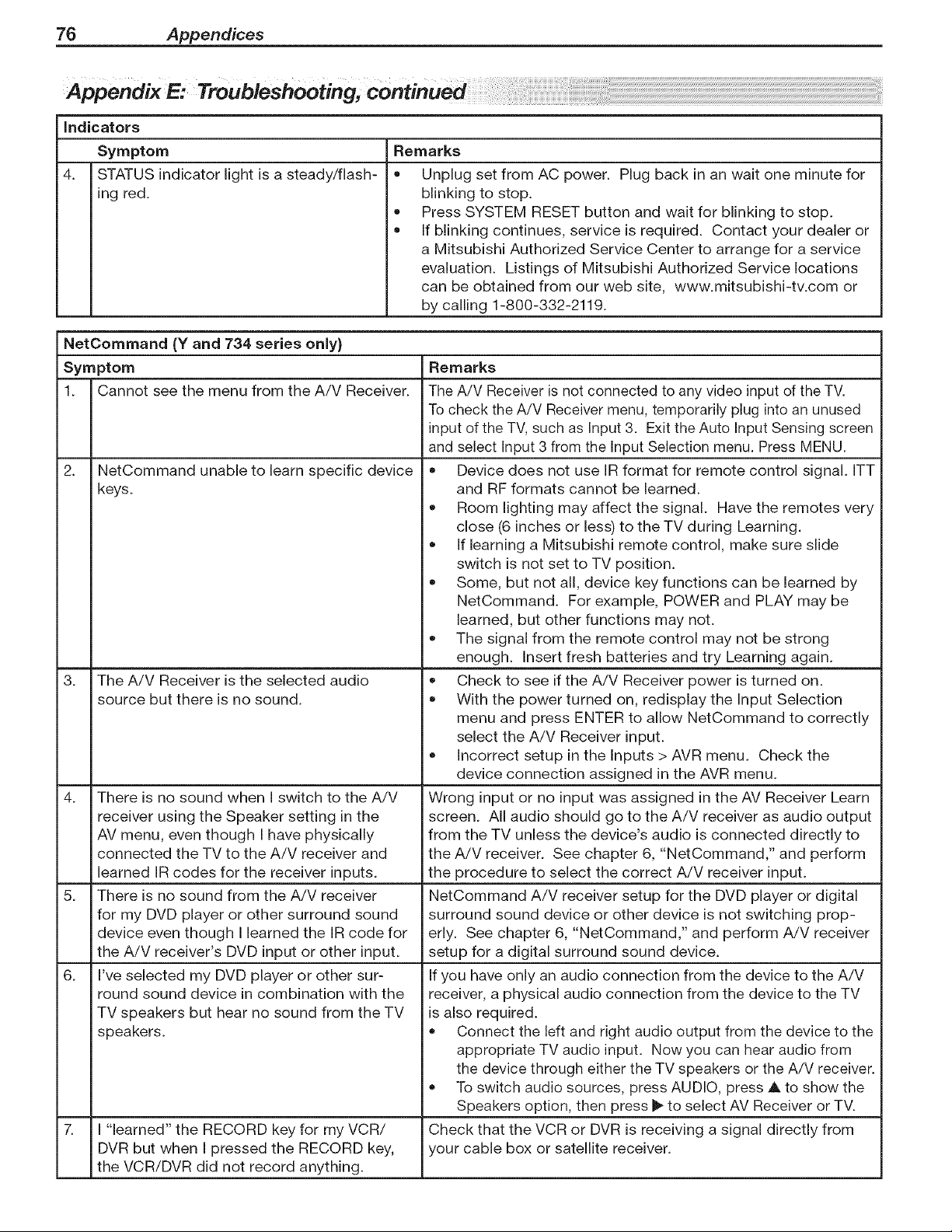
76 Appendices
indicators
Symptom
14. STATUS indicator light is a steady/flash-
ing red.
Remarks
• Unplug set from AC power. Plug back in an wait one minute for
blinking to stop.
Press SYSTEM RESET button and wait for blinking to stop.
If blinking continues, service is required. Contact your dealer or
a Mitsubishi Authorized Service Center to arrange for a service
evaluation. Listings of Mitsubishi Authorized Service locations
can be obtained from our web site, www.mitsubishi-tv.com or
by calling 1-800-332-2119.
NetCommand (Y and 734 series only)
Symptom
1. Cannot see the menu from the A/V Receiver.
2. NetCommand unable to learn specific device
keys.
3. The A/V Receiver is the selected audio
source but there is no sound.
4. There is no sound when I switch to the A!V
receiver using the Speaker setting in the
AV menu, even though I have physically
connected the TV to the A/V receiver and
learned IR codes for the receiver inputs.
5. There is no sound from the A/V receiver
for my DVD player or other surround sound
device even though I learned the IR code for
the A!V receiver's DVD input or other input.
6. I've selected my DVD player or other sur-
round sound device in combination with the
TV speakers but hear no sound from the TV
speakers.
7. I "learned" the RECORD key for my VCR/
DVR but when I pressed the RECORD key,
the VCR/DVR did not record anything.
Remarks
The A/V Receiver is not connected to any video input of the TV.
To check the A/V Receiver menu, temporarily plug into an unused
input of the TV, such as Input 3. Exit the Auto Input Sensing screen
and select Input 3 from the Input Selection menu. Press MENU.
Device does not use IR format for remote control signal. ITT
and RF formats cannot be learned.
Room lighting may affect the signal. Have the remotes very
close (6 inches or less) to the TV during Learning.
If learning a Mitsubishi remote control, make sure slide
switch is not set to TV position.
Some, but not all, device key functions can be learned by
NetCommand. For example, POWER and PLAY may be
learned, but other functions may not.
The signal from the remote control may not be strong
enough. Insert fresh batteries and try Learning again.
Check to see if the A/V Receiver power is turned on.
With the power turned on, redisplay the Input Selection
menu and press ENTER to allow NetCommand to correctly
select the A!V Receiver input.
Incorrect setup in the Inputs > AVR menu. Check the
device connection assigned in the AVR menu.
Wrong input or no input was assigned in the AV Receiver Learn
screen. All audio should go to the A/V receiver as audio output
from the TV unless the device's audio is connected directly to
the A/V receiver. See chapter 6, "NetCommand," and perform
the procedure to select the correct A/V receiver input.
NetCommand A/V receiver setup for the DVD player or digital
surround sound device or other device is not switching prop-
erly. See chapter 6, "NetCommand," and perform A!V receiver
setup for a digital surround sound device.
If you have only an audio connection from the device to the A/V
receiver, a physical audio connection from the device to the TV
is also required.
Connect the left and right audio output from the device to the
appropriate TV audio input. Now you can hear audio from
the device through either the TV speakers or the A/V receiver.
To switch audio sources, press AUDIO, press A to show the
Speakers option, then press _ to select AV Receiver or TV.
Check that the VCR or DVR is receiving a signal directly from
your cable box or satellite receiver.
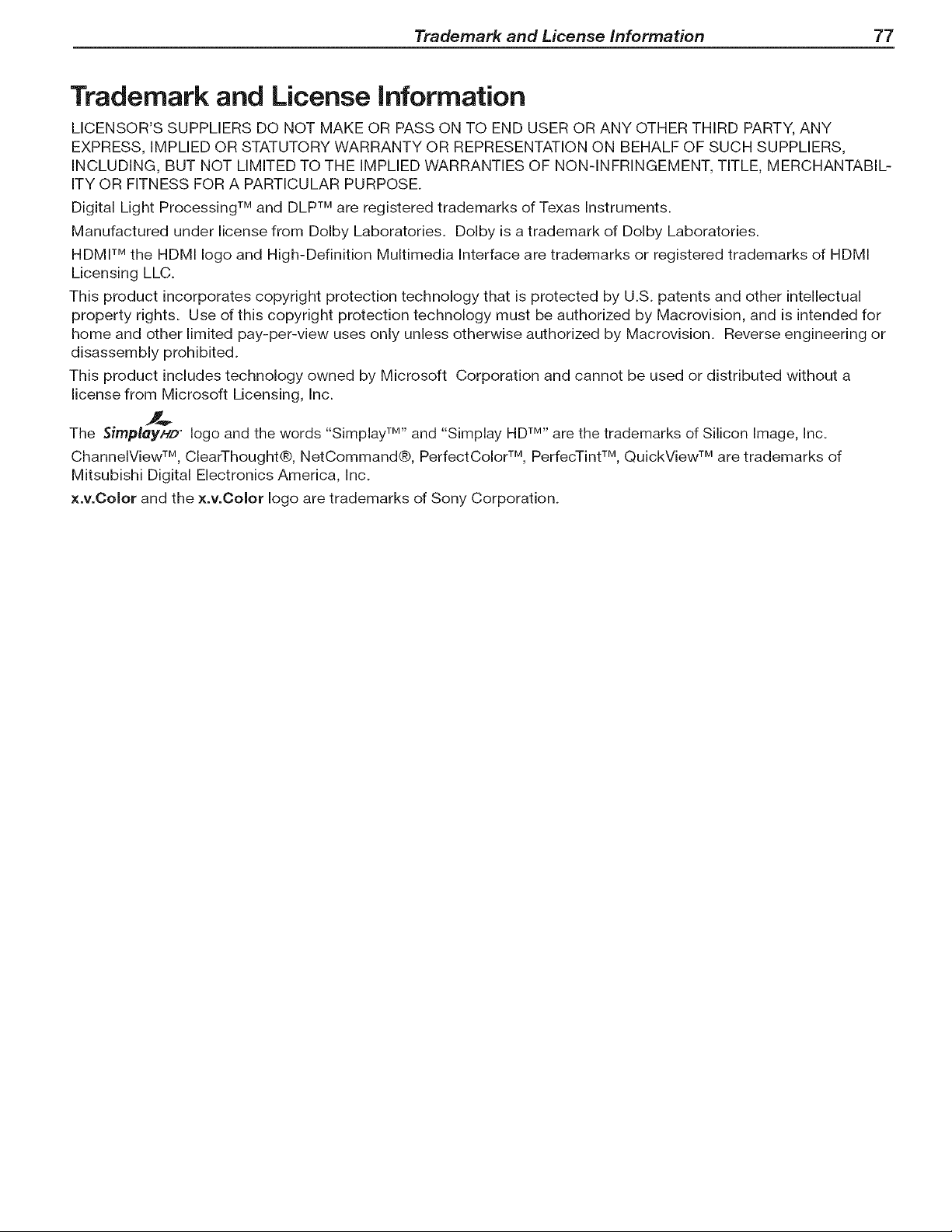
Trademark and License information 7T
Trademark and License information
LICENSOR'S SUPPLIERS DO NOT MAKE OR PASS ON TO END USER OR ANY OTHER THIRD PARTY, ANY
EXPRESS, IMPLIED OR STATUTORY WARRANTY OR REPRESENTATION ON BEHALF OF SUCH SUPPLIERS,
INCLUDING, BUT NOT LIMITED TO THE IMPLIED WARRANTIES OF NON-INFRINGEMENT, TITLE, MERCHANTABIL-
ITY OR FITNESS FOR A PARTICULAR PURPOSE.
Digital Light Processing TM and DLP TM are registered trademarks of Texas Instruments.
Manufactured under license from Dolby Laboratories. Doiby is a trademark of Dolby Laboratories.
HDMI TM the HDMI logo and High-Definition Multimedia Interface are trademarks or registered trademarks of HDMI
Licensing LLC.
This product incorporates copyright protection technology that is protected by U.S. patents and other intellectual
property rights. Use of this copyright protection technology must be authorized by Macrovision, and is intended for
home and other limited pay-per-view uses only unless otherwise authorized by Macrovision. Reverse engineering or
disassembly prohibited.
This product includes technology owned by Microsoft Corporation and cannot be used or distributed without a
license from Microsoft Licensing, Inc.
The Simplay/-/D logo and the words "Simplay TM''and "Simplay HDTM''are the trademarks of Silicon Image, Inc.
ChannelView TM, ClearThought®, NetCommand®, PerfectColor TM, PerfecTint TM, QuickView TM are trademarks of
Mitsubishi Digital Electronics America, Inc.
x.v.Oolor and the x.v.Oolor logo are trademarks of Sony Corporation.
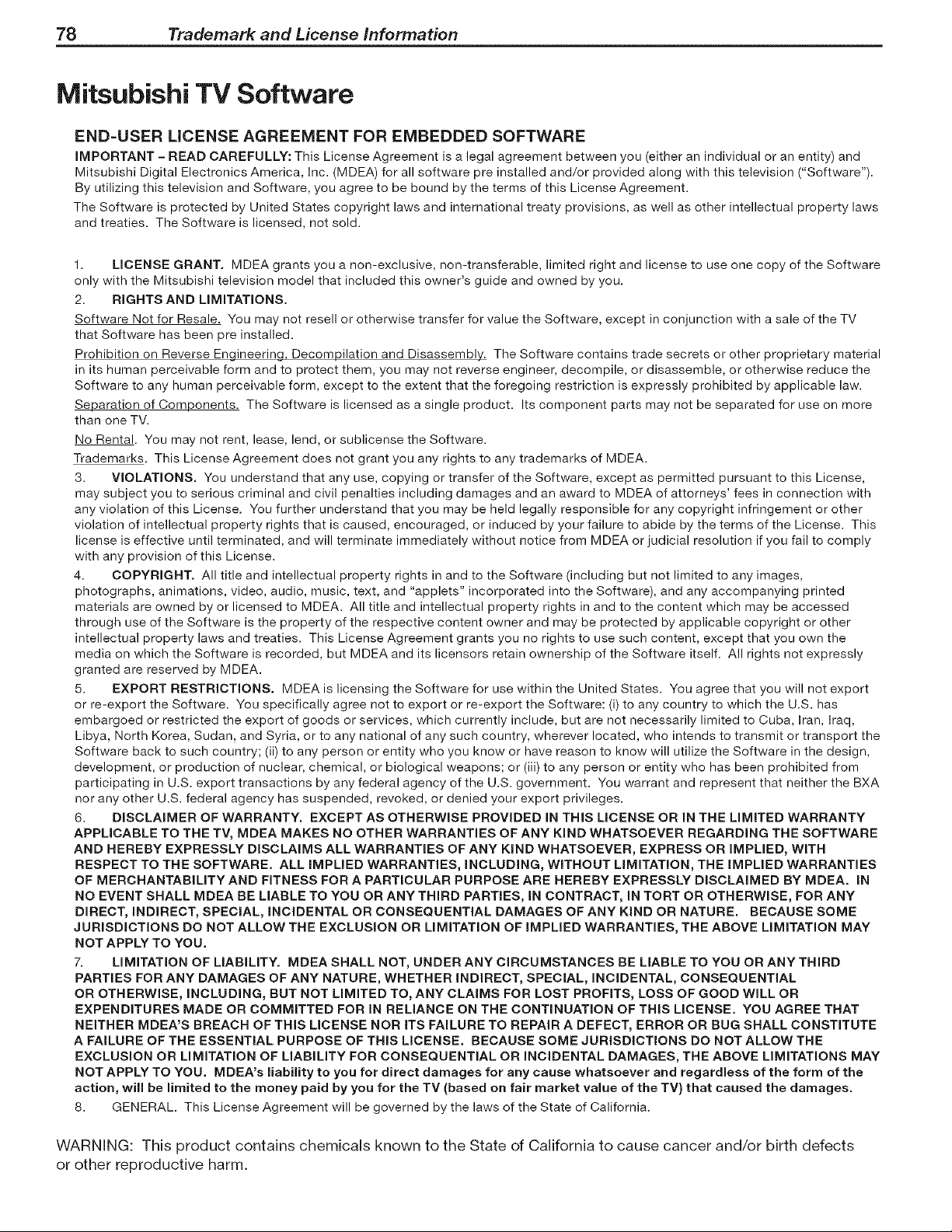
78 Trademark and License information
Mitsubishi TV Software
END-USER LICENSE AGREEMENT FOR EMBEDDED SOFTWARE
IMPORTANT - READ CAREFULLY: This License Agreement is a legal agreement between you (either an individual or an entity) and
Mitsubishi Digital Electronics America, Inc. (MDEA) for all software pre installed and/or provided along with this television ("Software").
By utilizing this television and Software, you agree to be bound by the terms of this License Agreement.
The Software is protected by United States copyright laws and international treaty provisions, as well as other intellectual property laws
and treaties. The Software is licensed, not sold.
1. LICENSE GRANT. MDEA grants you a non-exclusive, non-transferable, limited right and license to use one copy of the Software
only with the Mitsubishi television model that included this owner's guide and owned by you.
2. RIGHTS AND LIMITATIONS.
Software Not for Resale. You may not resell or otherwise transfer for value the Software, except in conjunction with a sale of the TV
that Software has been pre installed.
Prohibition on Reverse Engineering, Decompilation and Disassembly. The Software contains trade secrets or other proprietary material
in its human perceivable form and to protect them, you may not reverse engineer, decompile, or disassemble, or otherwise reduce the
Software to any human perceivable form, except to the extent that the foregoing restriction is expressly prohibited by applicable law.
Separation of Components. The Software is licensed as a single product. Its component parts may not be separated for use on more
than one TV.
No Rental. You may not rent, lease, lend, or sublicense the Software.
Trademarks. This License Agreement does not grant you any rights to any trademarks of MDEA.
3. VIOLATIONS. You understand that any use, copying or transfer of the Software, except as permitted pursuant to this License,
may subject you to serious criminal and civil penalties including damages and an award to MDEA of attorneys' fees in connection with
any violation of this License. You further understand that you may be held legally responsible for any copyright infringement or other
violation of intellectual property rights that is caused, encouraged, or induced by your failure to abide by the terms of the License. This
license is effective until terminated, and will terminate immediately without notice from MDEA or judicial resolution if you fail to comply
with any provision of this License.
4. COPYRIGHT. All title and intellectual property rights in and to the Software (including but not limited to any images,
photographs, animations, video, audio, music, text, and "applets" incorporated into the Software), and any accompanying printed
materials are owned by or licensed to MDEA. All title and intellectual property rights in and to the content which may be accessed
through use of the Software is the property of the respective content owner and may be protected by applicable copyright or other
intellectual property laws and treaties. This License Agreement grants you no rights to use such content, except that you own the
media on which the Software is recorded, but MDEA and its licensors retain ownership of the Software itself. All rights not expressly
granted are reserved by MDEA.
5. EXPORT RESTRICTIONS. MDEA is licensing the Software for use within the United States. You agree that you will not export
or re-export the Software. You specifically agree not to export or re-export the Software: (i) to any country to which the U.S. has
embargoed or restricted the export of goods or services, which currently include, but are not necessarily limited to Cuba, Iran, Iraq,
Libya, North Korea, Sudan, and Syria, or to any national of any such country, wherever located, who intends to transmit or transport the
Software back to such country; (ii) to any person or entity who you know or have reason to know will utilize the Software in the design,
development, or production of nuclear, chemical, or biological weapons; or (iii) to any person or entity who has been prohibited from
participating in U.S. export transactions by any federal agency of the U.S. government. You warrant and represent that neither the BXA
nor any other U.S. federal agency has suspended, revoked, or denied your export privileges.
6. DISCLAIMER OF WARRANTY. EXCEPT AS OTHERWISE PROVIDED IN THIS LICENSE OR IN THE LIMITED WARRANTY
APPLICABLE TO THE TV, MDEA MAKES NO OTHER WARRANTIES OF ANY KiND WHATSOEVER REGARDING THE SOFTWARE
AND HEREBY EXPRESSLY DISCLAIMS ALL WARRANTIES OF ANY KiND WHATSOEVER, EXPRESS OR IMPLIED, WITH
RESPECT TO THE SOFTWARE. ALL iMPLiED WARRANTIES, iNCLUDiNG, WITHOUT LiMiTATiON, THE iMPLIED WARRANTIES
OF MERCHANTABILITY AND FITNESS FOR A PARTICULAR PURPOSE ARE HEREBY EXPRESSLY DISCLAIMED BY MDEA. IN
NO EVENT SHALL MDEA BE LIABLE TO YOU OR ANY THIRD PARTIES, IN CONTRACT, iN TORT OR OTHERWISE, FOR ANY
DIRECT, INDIRECT, SPECIAL, iNCIDENTAL OR CONSEQUENTIAL DAMAGES OF ANY KIND OR NATURE. BECAUSE SOME
JURiSDiCTIONS DO NOT ALLOW THE EXCLUSION OR LIMITATION OF iMPLiED WARRANTIES, THE ABOVE LiMiTATION MAY
NOT APPLY TO YOU.
7. LIMITATION OF LIABILITY. MDEA SHALL NOT, UNDER ANY CIRCUMSTANCES BE LIABLE TO YOU OR ANY THIRD
PARTIES FOR ANY DAMAGES OF ANY NATURE, WHETHER iNDiRECT, SPECIAL, iNCiDENTAL, CONSEQUENTIAL
OR OTHERWISE, iNCLUDING, BUT NOT LIMITED TO, ANY CLAIMS FOR LOST PROFITS, LOSS OF GOOD WiLL OR
EXPENDITURES MADE OR COMMITTED FOR IN RELIANCE ON THE CONTINUATION OF THIS LICENSE. YOU AGREE THAT
NEITHER MDEA'S BREACH OF THIS LICENSE NOR ITS FAILURE TO REPAIR A DEFECT, ERROR OR BUG SHALL CONSTITUTE
A FAILURE OF THE ESSENTIAL PURPOSE OF THiS LICENSE. BECAUSE SOME JURISDICTIONS DO NOT ALLOW THE
EXCLUSION OR LIMITATION OF LIABILITY FOR CONSEQUENTIAL OR iNCiDENTAL DAMAGES, THE ABOVE LIMiTATiONS MAY
NOT APPLY TO YOU. MDEA's liabiJity to you for direct damages for any cause whatsoever and regardless of the form of the
action, wiJJ be limited to the money paid by you for the TV (based on fair market vamue of the TV) that caused the damages.
8. GENERAL. This License Agreement will be governed by the laws of the State of California.
WARNING: This product contains chemicals known to the State of California to cause cancer and/or birth defects
or other reproductive harm.
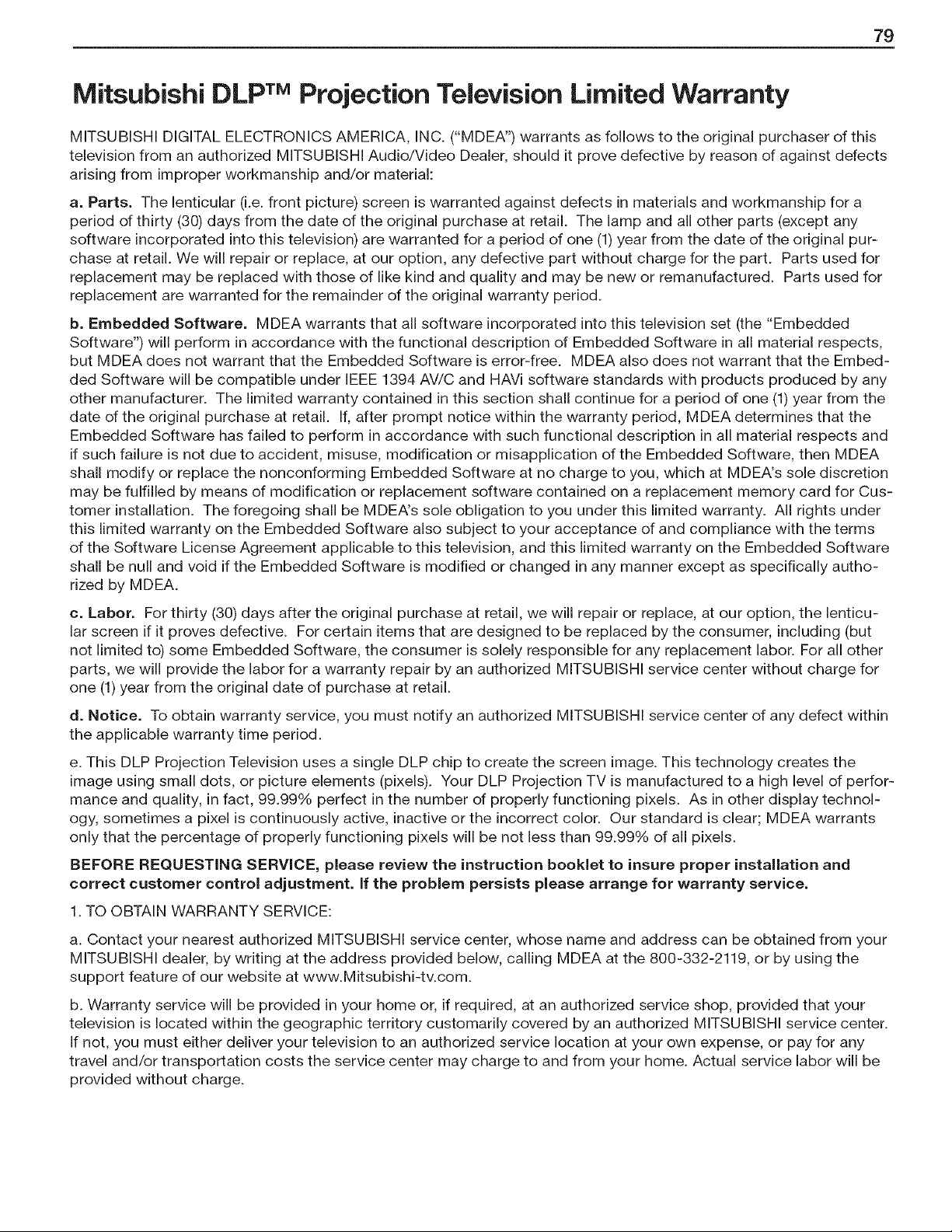
79
Mitsubishi DLP TMProjection Television Limited Warranty
MITSUBISHI DIGITAL ELECTRONICS AMERICA, INC. ("MDEA") warrants as follows to the original purchaser of this
television from an authorized MITSUBISHI Audio/Video Dealer, should it prove defective by reason of against defects
arising from improper workmanship and/or material:
a. Parts. The lenticular (i.e. front picture) screen is warranted against defects in materials and workmanship for a
period of thirty (30) days from the date of the original purchase at retail. The lamp and all other parts (except any
software incorporated into this television) are warranted for a period of one (1)year from the date of the original pur-
chase at retail. We will repair or replace, at our option, any defective part without charge for the part. Parts used for
replacement may be replaced with those of like kind and quality and may be new or remanufactured. Parts used for
replacement are warranted for the remainder of the original warranty period.
b. Embedded Software. MDEA warrants that all software incorporated into this television set (the "Embedded
Software") will perform in accordance with the functional description of Embedded Software in all material respects,
but MDEA does not warrant that the Embedded Software is error-free. MDEA also does not warrant that the Embed-
ded Software will be compatible under IEEE 1394 AV/C and HAVi software standards with products produced by any
other manufacturer. The limited warranty contained in this section shall continue for a period of one (1) year from the
date of the original purchase at retail. If, after prompt notice within the warranty period, MDEA determines that the
Embedded Software has failed to perform in accordance with such functional description in all material respects and
if such failure is not due to accident, misuse, modification or misapplication of the Embedded Software, then MDEA
shall modify or replace the nonconforming Embedded Software at no charge to you, which at MDEA's sole discretion
may be fulfilled by means of modification or replacement software contained on a replacement memory card for Cus-
tomer installation. The foregoing shall be MDEA's sole obligation to you under this limited warranty. All rights under
this limited warranty on the Embedded Software also subject to your acceptance of and compliance with the terms
of the Software License Agreement applicable to this television, and this limited warranty on the Embedded Software
shall be null and void if the Embedded Software is modified or changed in any manner except as specifically autho-
rized by MDEA.
c. Labor. For thirty (30) days after the original purchase at retail, we will repair or replace, at our option, the lenticu-
lar screen if it proves defective. For certain items that are designed to be replaced by the consumer, including (but
not limited to) some Embedded Software, the consumer is solely responsible for any replacement labor. For all other
parts, we will provide the labor for a warranty repair by an authorized MITSUBISHI service center without charge for
one (1) year from the original date of purchase at retail.
d. Notice. To obtain warranty service, you must notify an authorized MITSUBISHI service center of any defect within
the applicable warranty time period.
e. This DLP Projection Television uses a single DLP chip to create the screen image. This technology creates the
image using small dots, or picture elements (pixels). Your DLP Projection TV is manufactured to a high level of perfor-
mance and quality, in fact, 99.99% perfect in the number of properly functioning pixels. As in other display technol-
ogy, sometimes a pixel is continuously active, inactive or the incorrect color. Our standard is clear; MDEA warrants
only that the percentage of properly functioning pixels will be not less than 99.99% of all pixels.
BEFORE REQUESTING SERVICE, please review the instruction booklet to insure proper installation and
correct customer control adjustment, if the problem persists please arrange for warranty service.
1. TO OBTAIN WARRANTY SERVICE:
a. Contact your nearest authorized MITSUBISHI service center, whose name and address can be obtained from your
MITSUBISHI dealer, by writing at the address provided below, calling MDEA at the 800-332-2119, or by using the
support feature of our website at www.Mitsubishi-tv.com.
b. Warranty service will be provided in your home or, if required, at an authorized service shop, provided that your
television is located within the geographic territory customarily covered by an authorized MITSUBISHI service center.
If not, you must either deliver your television to an authorized service location at your own expense, or pay for any
travel and/or transportation costs the service center may charge to and from your home. Actual service labor will be
provided without charge.
8O
c. Proof of purchase date from an authorized MITSUBISHI dealer is required when requesting warranty service.
Present your sales receipt or other document which establishes proof and date of purchase. THE RETURN OF
THE OWNER REGISTRATION CARD IS NOT A CONDITION OF COVERAGE UNDER THIS LIMITED WARRANTY.
However, please return the Owner Registration Card so that we can contact you should a question of safety arise
which could affect you.
d. To obtain a replacement lamp, order the lamp directly from the MDEA Parts Department at (800) 553-7278.
2. THIS LIMITED WARRANTY DOES NOT COVER:
a. Up to .01% pixel outages (small dot picture elements that are dark or incorrectly illuminated).
b. Damage to the lenticular screen or Fresnel lens, screen frame, cosmetic damage or to any other damage where
such damage is caused by unauthorized modification, alteration, repairs to or service of the product by anyone
other than an authorized MITSUBISHI service center; physical abuse to or misuse of the product (including any
failure to carry out any maintenance as described in the Owner's Guide including air vent cleaning or any product
damaged by excessive physical or electrical stress); any products that have had a serial number or any part thereof
altered, defaced or removed; product use in any manner contrary to the Owner's Guide; freight damage; or any
damage caused by acts of God or other factors beyond the reasonable control of MDEA, such as power surge
damage caused by electrical system or lightning. This limited warranty also excludes service calls where no defect
in the product covered under this warranty is found, service calls related to unsatisfactory audio or visual reception
or signal unless caused by a defect in the product that is covered under this limited warranty, all costs, expenses or
any other damages arising from product installation, or set-ups, any adjustments of user controls (including con-
trast, brightness, color, tint, fine tuning, sharpness), other adjustment necessary to prepare the unit for display or
use, connection with any external audio receiver, antenna, cable or satellite systems, or service of products pur-
chased or serviced outside the U.S.A. Please consult the operating instructions contained in the Owner's Guide
furnished with the product for information regarding user controls.
3. ANY EXPRESS WARRANTY NOT PROVIDED HEREIN, AND ANY REMEDY WHICH, BUT FOR THIS PROVISION,
MIGHT ARISE BY IMPLICATION OR OPERATION OF LAW, IS HEREBY EXCLUDED AND DISCLAIMED. THE
IMPLIED WARRANTIES OF MERCHANTABILITY AND OF FITNESS FOR ANY PARTICULAR PURPOSE ARE
EXPRESSLY LIMITED TO A TERM OF ONE YEAR.
4. UNDER NO CIRCUMSTANCES SHALL MDEA BE LIABLE TO PURCHASER OR ANY OTHER PERSON FOR ANY
INCIDENTAL, SPECIAL OR CONSEQUENTIAL DAMAGES, WHETHER ARISING OUT OF BREACH OF WARRANTY,
BREACH OF CONTRACT, OR OTHERWISE.
5. Some states do not allow limitations on how long an implied warranty lasts, or the exclusion or limitation of inci-
dental, special, or consequential damages, so the above limitations or exclusions may not apply to you.
6. This limited warranty gives you specific legal rights, and you may also have other rights which vary from state to
state.
7. In the event of any dispute under this limited warranty, jurisdiction and venue for resolving that dispute will be in
the state where the television was purchased and the laws of such state will govern.
MITSLIBISI-II
MITSUBISHI DIGITAL ELECTRONICS AMERICA, INC.
9351 Jeronimo Road
Irvine, CA 92618-1904
Index 81
index
A
A/V Memory Reset 71
A/V Receiver
Adding NetCommand Control
53, 54, 55, 56
and the TV Speakers 37
and TV's Remote Control 53, 63
Audio Lock 64
Codes 65
Connecting 9, 10, 23, 54
Controlling Sound Volume 14
A/V Reset 7, 71
Adjust Keys (Up/Down/Left/Right)
26, 34
Air Filter 62
Anamorphic Picture Format 30
Antenna
Connecting 19
Antenna Inputs (ANT l/MAIN, ANT
2/AUX) 9
Audio Lock 64
Audio Menu 37
Auto-off. SeeSleep Timer
Auto-on. SeeTimer
Auto Input Sensing
Description 6
TV Setup 13
B
Back Panel (described) 9, 10
Batteries 12
Bright (Lamp Mode) 35
C
Cable Box
and TV's Remote Control 26, 63
Codes 66
Connecting 17, 18, 22, 23
Camcorder
Connecting (Analog) 24
Camera Files 32
Captions Menu 38
Channels. SeealsoFAV
Changing 25
ChannelView TM Listings 27
Channel Lock 40
Digital Channel Numbers 58
Memorizing 13
Naming 40
Physical/Virtual Channel Num-
bers 40
Scan (description) 39
Status Display 28
Troubleshooting 73
Cleaning 4
Clock, Set Date and Time 41
Closed Captions 38
Color Adjustments 35, 36
Reset Color 35, 71
Component Inputs (Y Pb Pr) 9
Computer
and Display Formats 16, 58
Connecting 15
D
Date. SeeClock
Defaults, Resetting 71
Digital Audio Out 10
Display Format Definitions 30
Dolby Digital 10, 23, 54, 58
DVD Player
and TV's Remote Control 27, 63
Codes 67
Connecting 20
DVl Device, Connecting 20
E
Energy Mode 42
F
F1-F4 Keys 26, 49
Fan Noise 4
Fast Power On 42
FAV (Favorite Channels) 29, 40
FORMAT Key 30, 31
Front Panel Lock 46
G
GUIDE Key 26, 63
ChannelView 27
H
HDMI
Changing Out an HDMI Device
14
Connecting an HDMI Device 18
Disconnecting and the Input
Selection Menu 43
HDMI Cable Categories 10
HDMI Jack 10
NetCommand for HDMI Devices
6, 27, 63
HDTV Cable Box or Satellite Receiver
with Component Video, Connect-
ing 17
HD (High-Definition) Signal) 30
I
INFO Key
ChannelView 27
in TV Menus 34
USB Photo Menu 32
Input Jacks (Standard Audio/Video)
10
Input Selection Menu
Choose Viewing Source 25
Icon Order 43
INPUT Key 26
IR (infrared) Emitter Placement
48
J
JPEG Photo Files 32
L
Lamp Cartridge Replacement 61
LAMP Indicator. SeeLED Indicator
Lights
Lamp Mode 35
Language
in Digital Programs 37
SAP (Second Audio Program) 37
Language Menu 39
Learn. SeeNetCommand®
LED Indicator Lights 8
Troubleshooting 75
Lock Menu. SeeLock TV
Lock TV
Bypassing the Lock 59
Lock by Channel 40
Lock by Ratings 45
Lock by Time 46
Lock Front Panel 46
Preset V-Chip Blocking 44
Low Power (Energy Mode) 42
M
Media Setup Menu 33
Memorizing Channels 13
Add Single Channel to Memory
39, 40
Mute
MUTE key 26
Video Mute 35
N
NetCommand®
A/V Receiver Control 53
Compared to Programming the
Remote Control 63
Description 47
Initial Setup for Most Devices 49
NetCommand for HDMI Devices
6, 27, 63
Operating 51, 52
Specialized Device Keys 50
Troubleshooting 76
Noise, Video 35
82 Index
P
Parent Menu 45
Pass Code
Resetting 59
Setting 44
PAUSE Key 26
PerfectColor 35
PerfectTint 35
Photo Viewing 33
Picture
AV Menu Controls 35
Format Displays 31
Picture Quality and Film Mode
35
Troubleshooting 74
Picture Mode 36
Power Consumption
Energy Mode 42
Specifications 58
Power On/Off 12, 25
Troubleshooting 74
Q
QV Key (QuickView TM) 26
and FAV Key 29
R
Remote Control
Keys and Functions 26, 27
Programming Codes (reference
chart) 65
Programming Instructions 64
Programming vs. NetCommand
"Learning" 63
Reset 27
Reset
A/V Reset (all settings) 7
AV Menu Reset (by input) 35
Color 71
Pass Code 59
Remote Control 27
Remote Control Audio Lock 64
System Reset 7
TV Reset Comparison Guide 71
S
S-Video 10
Connecting an S-Video Device
18
Safeguards 5
SAP (second audio program) 28, 37
Satellite Receiver
and the Remote Control 63
Connecting 17, 18
SD (Standard-Definition Signal) 30
Service and Support 72
Signal Definitions 30
Sleep Timer 25
Sound
Audio Settings 37
Controlling A/V Receiver Volume
14, 53
Simulated Stereo 37
Troubleshooting 75
Turn TV Speakers On/Off 37
Speakers Option
Auto Input Sensing 14
In Audio Menu 37
Specifications, TV 58
Standard-Definition Signal 30
Standard (Lamp Mode) 35
Stand Part Numbers 4
Status Display 28
STATUS Indicator. SeeLED Indicator
Lights
Stereo System. SeeA/V Receiver
Surround Sound 9, 10, 23, 55
Simulated 37
System Reset 7, 72
T
Time. SeeClock
Timer
Sleep Timer (auto-off) 25
TV Timer (auto-on) 42
Time Zone. SeeClock
Troubleshooting 71
V
V-Chip Ratings
Applying Restrictions 44
Definitions 45
In Status Display 28
VCR
Connecting 10, 21, 22
Troubleshooting 75
Video from a Digital Camera 33
Video Menu 36
Viewing Device. SeeInput Selection
Menu
W
Wall Outlet Cable 19
X
x.v.Oolor 10, 18, 36
;Hi
ELECTRIC
Website:
www.mitsu bishi=tv.com
E=mail:
For questions, call Consumer Relations at
800=332=2119
To order replacement or additional
remote controls, lamp cartridges, or Owner's Guides
Visit our website www.mitsuparts.com
or call
800=553=7278
SYSTEM RESET
If the TV does not respond to the remote control,
front panel controls, or will not power on/off, press
the SYSTEMRESETbutton on the front panel.
The green LED will flash quickly for about one
minute. When the green LED stops flashing, you
may turn on the TV. Settings changes you made
most recently, before using SYSTEMRESET,may be lost.
© 2007 Mitsubishi Digital Electronics America, Inc. Written and Printed in U.S.A.
853B542C20 V36, V36L, V37, V37L