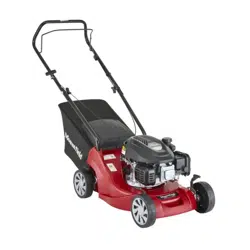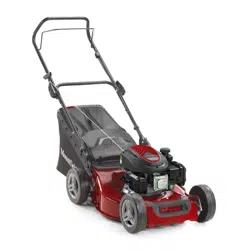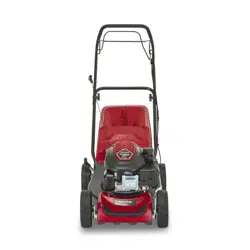

IT
Tosaerba con conducente a piedi -
MANUALE DI ISTRUZIONI
ATTENZIONE: prima di usare la macchina, leggere attentamente il presente libretto.
EN
Pedestrian controlled lawnmower
- OPERATOR’S MANUAL
WARNING: read thoroughly the instruction booklet before using the machine.
171506067/7EN 01/2020
MP2 504 Series
MP2 554 Series
MP2 504 Roller Series
MP2 554 Roller Series


ITALIANO - Istruzioni Originali ...................................................................................................
IT
ENGLISH - Translation of the original instruction ...........................................................................
EN
A
C
G FB
I
D
H
E
K
J
2
1
kW /min
- s/n
9
5
8 1
kg
2
3
6 4
7
Type:
Art.N.
3
B
A
A
A
A
4
A
A
A
I
II
Roller Series
A
B
A
A
B
A
76
5
8

C
CLICK
E
D
A
B
A
B
C
10
9
I
Roller Series
I
II

A
B
11
II
Roller Series
C
B
A
D
12
13
A
B

A
B
D
E
D
C
E
14
A
B
15
I
16
A
B
A.1
A.2
1
A.3
B
II
17
B
C
D
15
18 19
2
1
21
A
A
A
A
B
20
22
23
26
A
25
C
B
24

DATI TECNICI
MP2 504 Series
MP2 554
Series
Potenza nominale * kW 2,2 ÷ 3,30 2,58 ÷ 3,82
Velocità mass. di funzionamento motore * min
-1
2800 ± 100
2900 ± 100
2800 ± 100
2900 ± 100
Peso macchina * kg
Ampiezza di taglio cm 53
Codice dispositivo di taglio
Livello di pressione acustica (max.)
Incertezza di misura
dB(A)
dB(A)
83
1,01
85
2,06
Livello di potenza acustica misurato (max.)
Incertezza di misura
dB(A)
dB(A)
96
0,63
98
Livello di potenza acustica garantito dB(A) 96 98
Livello di vibrazioni (max.) **
Incertezza di misura
m/s
2
m/s
2
1,55
5
1,50
Livello di vibrazioni (max.)
Incertezza di misura
m/s
2
m/s
2
1,91
1,82
ACCESSORI A RICHIESTA
Kit "Mulching"
[
15
]
OPZIONI
[
16
]
Rimessaggio verticale, mod.
K
K
K
K
K
K
K
K
** con "Vibe Control System"

DATI TECNICI
MP2 504
Roller Series
MP2 554
Roller Series
Potenza nominale * kW 2,27 ÷ 3,30 2,58 ÷ 3,82
Velocità mass. di funzionamento motore * min
-1
2800 ± 100
2900 ± 100
2800 ± 100
2900 ± 100
Peso macchina * kg
Ampiezza di taglio cm 53
Codice dispositivo di taglio
Livello di pressione acustica (max.)
Incertezza di misura
dB(A)
dB(A)
86
0,99
86
0,63
Livello di potenza acustica misurato (max.)
Incertezza di misura
dB(A)
dB(A)
96
0,62
98
0,63
Livello di potenza acustica garantito dB(A) 96 98
Livello di vibrazioni (max.)
Incertezza di misura
m/s
2
m/s
2
1,21
8
2,73
Livello di vibrazioni (max.) **
Incertezza di misura
m/s
2
m/s
2
1,01
3,2
1,88
ACCESSORI A RICHIESTA
Kit "Mulching" - -
[
15
]
OPZIONI
[
16
]
Rimessaggio verticale, mod. - -
** con "Vibe Control System"

[1] EN - TECHNICAL DATA
[2] Nominal power
[3] Max. engine operation speed
Machine weight
[5] Cutting width cm
[7] Cutting means code
[8] Acoustic pressure level (max.)
[9] Measurement uncertainty
[10] Acoustic power level measured (max.)
[11] Acoustic power level guaranteed
[12] Vibration level (max.)
[13] OPTIONAL ACCESSORIES
Mulching kit
[15] OPTIONS
[16] Vertical storage
** with "Vibe Control System"

IT - 1
IT
ATTENZIONE: PRIMA DI USARE LA MACCHINA, LEGGERE ATTENTAMENTE IL PRESENTE LI-
BRETTO. Conservare per ogni futura necessità.
INDICE
1. GENERALITÀ
1.1 COME LEGGERE IL MANUALE
sicurezza o del funzionamento, sono evidenziati
NOTA OPPURE IMPORTANTE fornisce
precisazioni o altri elementi a quanto già
precedentemente indicato, nell’intento di non
danneggiare la macchina, o causare danni.
Il simbolo evidenzia un pericolo. Il mancato rispetto
dell’avvertenza comporta possibilità di lesioni personali o a
terzi e/o danni.
grigio indicano caratteristiche opzionali non presenti in
se la caratteristica è presente nel proprio modello.
Tutte le indicazioni “anteriore”, “posteriore”,
“destro” e “sinistro” si intendono riferite alla
posizione dell’operatore alla guida.
1.2 RIFERIMENTI
1.2.1 Figure
sono numerate 1, 2, 3, e così via.
contrassegnati con le lettere A, B, C, e così via.
2.C” o semplicemente “(Fig. 2.C)”.
1.2.2 Titoli
paragrafo “2.1 Addestramento” è un sottotitolo di “2.
sono segnalati con l’abbreviazione cap. o par. e il
2. NORME DI SICUREZZA
2.1 ADDESTRAMENTO
Prendere familiarità con i comandi e con un uso
appropriato della macchina. Imparare ad arrestare ra-
1. GENERALITÀ ............................................................... 1
1.1 Come leggere il manuale .................................... 1
1.2 Riferimenti ........................................................... 1
2. NORME DI SICUREZZA .............................................. 1
2.1 Addestramento .................................................... 1
2.2 Operazioni preliminari ......................................... 2
2.3 Durante l’utilizzo .................................................. 2
............. 3
2.5 Tutela ambientale ................................................ 3
3. CONOSCERE LA MACCHINA ..................................... 3
3.1 Descrizione macchina e uso previsto ................. 3
3.2 Segnaletica di sicurezza .....................................
..................................
.........................................
................................................................ 5
.............................. 5
........................................... 5
......................................... 5
5. COMANDI DI CONTROLLO ......................................... 5
5.1 Impugnatura di avviamento manuale ................. 5
5.2 Comando di avviamento elettrico a pulsante ..... 5
5.3 Comando acceleratore ....................................... 5
............................ 5
5.5 Leva freno motore / dispositivo di taglio ............. 6
5.6 Leva innesto trazione .......................................... 6
5.7 Regolazione dell’altezza di taglio ....................... 6
6. USO DELLA MACCHINA ............................................. 6
6.1 Operazioni preliminari ......................................... 6
6.2 Controlli di sicurezza ........................................... 7
6.3 Avviamento ......................................................... 8
.................................................................. 8
6.5 Arresto ................................................................. 9
6.6 Dopo l’utilizzo ...................................................... 9
7. MANUTENZIONE ORDINARIA .................................... 9
7.1 Generalità ............................................................ 9
7.2 Rifornimento di carburante ............................... 10
7.3 Controllo / rabbocco olio motore....................... 10
................................................................ 10
....................................... 10
7.6 Batteria .............................................................. 10
7.7 Regolazione del cavo del variatore ...................11
8. MANUTENZIONE STRAORDINARIA .........................11
8.1 Dispositivo di taglio ............................................11
9. RIMESSAGGIO ...........................................................11
9.1 Rimessaggio verticale .......................................11
10. MOVIMENTAZIONE E TRASPORTO .........................11
11. ASSISTENZA E RIPARAZIONE ................................. 12
12. COPERTURA DELLA GARANZIA ............................. 12
13. TABELLA MANUTENZIONI ....................................... 12
....................... 13
15. ACCESSORI A RICHIESTA ........................................
15.1 Kit per mulching ................................................

IT - 2
pidamente il motore. L’inosservanza delle avvertenze e
delle istruzioni può causare incendi e/o gravi lesioni.
• Non permettere mai che la macchina venga utilizzata da
bambini o da persone che non abbiano la necessaria
dimestichezza con le istruzioni. Le leggi locali
• Non utilizzare mai la macchina se l’utilizzatore è
in condizione di stanchezza o malessere, oppure
ha assunto farmaci, droghe, alcool o sostanze
• Non trasportare bambini o altri passeggeri.
• Ricordare che l’operatore o utilizzatore è responsabile
ad altre persone o alle loro proprietà. Rientra nella
responsabilità dell’utilizzatore la valutazione dei
rischi potenziali del terreno su cui si deve lavorare,
nonché prendere tutte le precauzioni necessarie
per garantire la sua e altrui sicurezza, in particolare
sui pendii, terreni accidentati, scivolosi o instabili.
• Nel caso si voglia cedere o prestare ad altri la macchina,
assicurarsi che l’utilizzatore prenda visione delle
istruzioni d’uso contenute nel presente manuale.
2.2 OPERAZIONI PRELIMINARI
Dispositivi protezione individuale (DPI)
• Indossare indumenti adeguati, calzature da lavoro
resistenti con suole antiscivolo, e pantaloni lunghi.
Non azionare la macchina a piedi scalzi o con sandali
• L’impiego di protezioni acustiche può ridurre la
capacità di sentire eventuali avvertenze (grida
o allarmi). Prestare la massima attenzione a
• Indossare guanti di lavoro in tutte le
situazioni di rischio per le mani.
• Non indossare sciarpe, camici, collane, braccialetti,
indumenti con parti svolazzanti, o provvisti di lacci
che potrebbero impigliarsi nella macchina o in
oggetti e materiali presenti sul luogo di lavoro.
• Raccogliere adeguatamente i capelli lunghi.
Area di lavoro / Macchina
• Ispezionare a fondo tutta l’area di lavoro e togliere
tutto ciò che potrebbe venire espulso dalla
macchina o danneggiare il dispositivo di taglio/
Motori a scoppio: carburante
PERICOLO!
• Conservare il carburante in appositi contenitori
omologati per tale utilizzo, in luoghi sicuri,
• Lasciare i contenitori liberi da residui
d’erba foglie o grasso eccessivo.
• Non lasciare i contenitori alla portata dei bambini.
• Non fumare durante il rifornimento o il rabbocco di
carburante e ogni volta che si maneggia il carburante.
• Rabboccare il carburante utilizzando
un imbuto, solo all’aperto.
• Evitare di inalare vapori del carburante.
• Non aggiungere carburante o togliere il tappo del
• Aprire lentamente il tappo del serbatoio lasciando
scaricare gradualmente la pressione interna.
•
• Se fuoriesce del carburante, non avviare il
motore, ma allontanare la macchina dall’area
che il carburante non sia evaporato ed i vapori
del carburante non si siano dissolti.
• Pulire immediatamente ogni traccia di carburante
versata sulla macchina o sul terreno.
• Rimettere sempre e serrare bene i tappi del
serbatoio e del contenitore del carburante.
• Non riavviare la macchina sul luogo ove è stato
operato il rifornimento; l’avviamento del motore deve
avvenire ad una distanza di almeno 3 metri dal luogo
• Evitare il contatto del carburante con gli
indumenti e, in tal caso, cambiarsi gli
indumenti prima di avviare il motore.
2.3 DURANTE L’UTILIZZO
Area di Lavoro
• Non azionare il motore in spazi chiusi, dove
possono accumularsi pericolosi fumi di monossido
di carbonio. Le operazioni di avviamento devono
avvenire all’aperto o in luogo ben aerato. Ricordare
sempre che i gas di scarico sono tossici.
• Durante l’avviamento della macchina non
• Non usare la macchina in ambienti a rischio di
o polvere. Gli utensili elettrici generano scintille
che possono incendiare la polvere o i vapori.
• Lavorare solamente alla luce del giorno o con buona
• Allontanare persone, bambini e animali
dall’area di lavoro. È necessario che i bambini
vengano sorvegliati da un altro adulto.
• Evitare di lavorare nell’erba bagnata,
sotto la pioggia e con rischio di temporali,
specialmente con probabilità di lampi.
• Prestare particolare attenzione alle irregolarità
del terreno (dossi, cunette), ai pendii, ai pericoli
nascosti e alla presenza di eventuali ostacoli
che potrebbero limitare la visibilità.
• Prestare molta attenzione in prossimità di dirupi,
fossi o argini. La macchina si può ribaltare se una
ruota oltrepassa un bordo o se il bordo cede.
• Lavorare nel senso trasversale del pendio e
mai nel senso salita/discesa, facendo molta
attenzione ai cambi di direzione, accertandosi
del proprio punto di appoggio e assicurandosi
che le ruote non incontrino ostacoli (sassi, rami,
radici, ecc) che potrebbero causare scivolamento
laterale o perdita di controllo della macchina.
•
• Per evitare il rischio di incendio, non lasciare
la macchina a motore caldo fra le foglie, l’erba
Comportamenti
•
o all’indietro. Guardare dietro di sè prima e durante la
retromarcia per assicurarsi che non vi siano ostacoli.

IT - 3
• Non correre mai, ma camminare.
• Evitare di farsi tirare dal raserba.
• Tenere sempre mani e piedi lontani dal
dispositivo di taglio sia durante l’avviamento
sia durante l’utilizzo della macchina.
•
disinnesto o dopo lo spegnimento del motore.
• Stare sempre lontani dall'apertura di scarico.
• Non toccare le parti del motore che, durante
l’uso, si riscaldano. Rischio di ustioni.
In caso di rotture o incidenti durante il lavoro,
arrestare immediatamente il motore e allontanare la
macchina in modo da non provocare ulteriori danni; nel
caso di incidenti con lesioni personali o a terzi, attivare
immediatamente le procedure di pronto soccorso più
adeguate alla situazione in atto e rivolgersi ad una
Struttura Sanitaria per le cure necessarie. Rimuovere
accuratamente eventuali detriti che potrebbero arreca-
re danni o lesioni a persone o a animali qualora rima-
nessero inosservati.
Limitazioni all’uso
• Non utilizzare mai la macchina con protezioni
danneggiate, mancanti o non correttamente
posizionate (sacco di raccolta, protezione di scarico
laterale, protezione di scarico posteriore).
• Non utilizzare la macchina se gli accessori/
utensili non sono installati nei punti previsti.
• Non disinserire, disattivare, rimuovere o manomettere
i sistemi di sicurezza/microinterruttori presenti.
• Non alterare le regolazioni del motore, né
portarlo a sovraregime. Se il motore viene fatto
funzionare ad un numero di giri eccessivo,
il rischio di lesioni personali aumenta.
• Non sottoporre la macchina a sforzi eccessivi e
non usare una macchina piccola per eseguire
lavori pesanti; l’uso di una macchina adeguata
2.4 MANUTENZIONE, RIMESSAGGIO
E TRASPORTO
corretto rimessaggio preserva la sicurezza della
macchina ed il livello delle sue prestazioni.
Manutenzione
• Non usare mai la macchina con parti usurate
o danneggiate. I pezzi guasti o deteriorati
devono essere sostituiti e mai riparati.
• Per ridurre il rischio di incendi, controllare regolarmente
che non vi siano perdite di olio e/o carburante.
• Durante le operazioni di regolazione della
macchina, prestare attenzione ad evitare che le dita
rimangano intrappolate fra il dispositivo di taglio
Il livello di rumorosità e di vibrazioni riportato
nelle presenti istruzioni, sono valori massimi di utilizzo
della macchina. L’impiego di un elemento di taglio sbi-
lanciato, l’eccessiva velocità di movimento, l’assenza
di manutenzione inuiscono in modo signicativo nelle
emissioni sonore e nelle vibrazioni. Di conseguenza
è necessario adottare delle misure preventive atte ad
eliminare possibili danni dovuti ad un rumore elevato e
alle sollecitazioni da vibrazioni; provvedere alla manu-
tenzione della macchina, indossare cue antirumore,
eettuare delle pause durante il lavoro.
Rimessaggio
• Non riporre la macchina con del carburante
nel serbatoio in un locale dove i vapori del
una scintilla o una forte fonte di calore.
• Per ridurre il rischio di incendio, non lasciare contenitori
con i materiali di risulta all’interno di un locale.
2.5 TUTELA AMBIENTALE
La tutela dell’ambiente deve essere un aspetto rilevante
convivenza civile e dell’ambiente in cui viviamo.
• Evitare di essere un elemento di disturbo nei confronti
del vicinato. Utilizzare la macchina solamente in orari
ragionevoli (non al mattino presto o alla sera tardi
• Seguire scrupolosamente le norme locali per lo
devono essere gettati nella spazzatura, ma devono
essere separati e conferiti agli appositi centri di raccolta,
che provvederanno al riciclaggio dei materiali.
• Seguire scrupolosamente le norme locali per
lo smaltimento dei materiali di risulta.
• Al momento della messa fuori servizio, non
abbandonare la macchina nell’ambiente, ma rivolgersi
a un centro di raccolta, secondo le norme locali vigenti.
3. CONOSCERE LA MACCHINA
3.1 DESCRIZIONE MACCHINA E USO PREVISTO
Questa macchina è un tosaerba
con conducente a piedi.
La macchina si compone essenzialmente di un
motore, che aziona un dispositivo di taglio racchiuso
in un carter, dotato di ruote e di un manico.
L’operatore è in grado di condurre la macchina
e di azionare i comandi principali mantenendosi
sicurezza dal dispositivo di taglio rotante.
L’allontanamento dell’operatore dalla
macchina provoca l’arresto del motore e del
dispositivo rotante entro alcuni secondi.
3.1.1 Uso previsto
(e la raccolta ) dell’erba in giardini e aree erbose,
di estensione rapportata alla capacità di taglio,
eseguita con la presenza di un operatore a piedi.
1. Tagliare l’erba e raccoglierla nel sacco di raccolta.
2. Tagliare l’erba e scaricarla a terra dalla
parte posteriore (se previsto).
3. Tagliare l’erba e scaricarla lateralmente (se previsto).
4. Tagliare l’erba, sminuzzarla e depositarla sul
L’utilizzo di particolari accessori, previsti dal

che accompagnano i singoli accessori.
3.1.2 Uso improprio
rivelarsi pericoloso e causare danni a persone e/o cose.
• Trasportare sulla macchina altre persone, bambini
o animali poiché potrebbero cadere e procurarsi
lesioni gravi o pregiudicare una guida sicura.
• Farsi trasportare dalla macchina.
• Usare la macchina per trainare o spingere carichi.
• Azionare il dispositivo di taglio nei tratti non erbosi.
• Utilizzare la macchina per la raccolta di foglie o detriti.
• Usare la macchina per regolarizzare siepi, o per
il taglio di vegetazione di tipo non erboso.
• Utilizzare la macchina in più di una persona.
IMPORTANTE L’uso improprio della macchina
comporta il decadimento della garanzia e il declino di ogni
responsabilità del Costruttore, riversando sull’utilizzatore
gli oneri derivanti da danni o lesioni proprie o a terzi.
3.1.3 Tipologia di utente
consumatori, cioè operatori non professionisti.
È destinata ad un “uso hobbistico”.
IMPORTANTE La macchina dev’essere
utilizzata da un solo operatore.
3.2 SEGNALETICA DI SICUREZZA
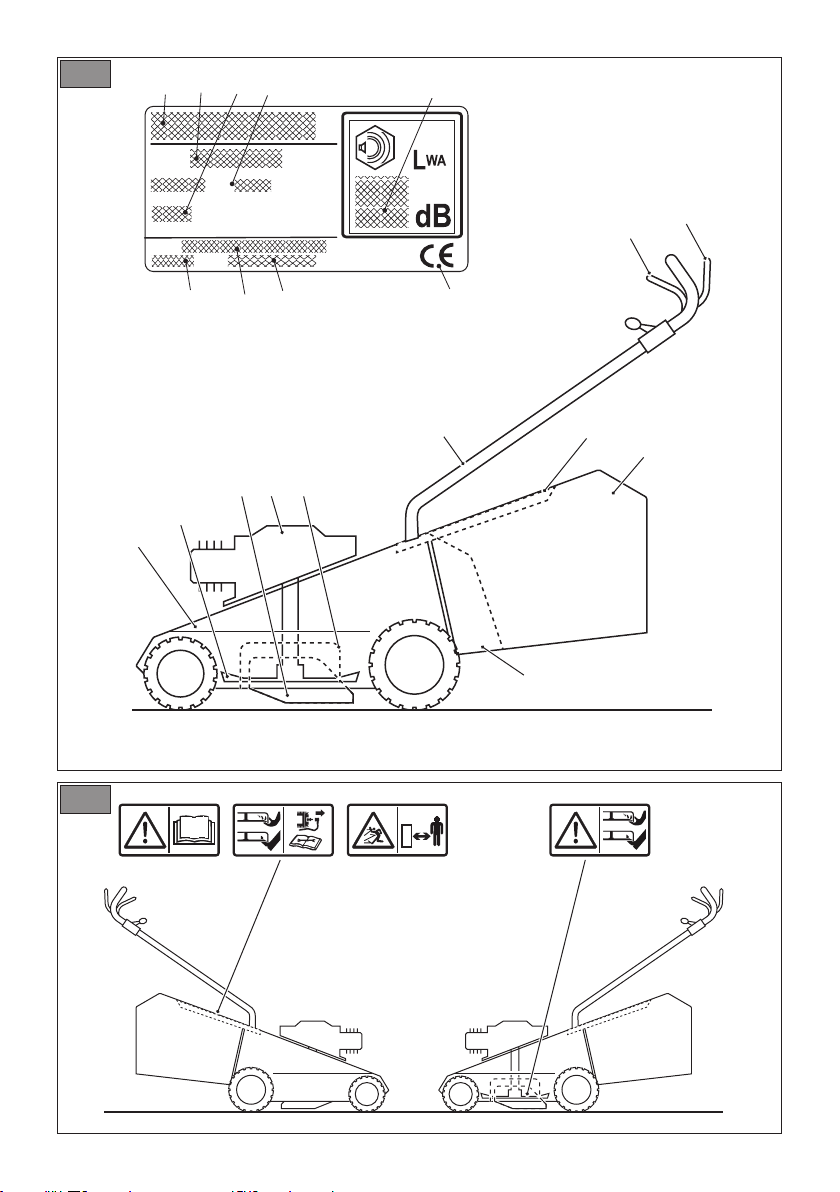
Sulla macchina compaiono vari simboli (Fig.2.0).
i comportamenti da seguire per utilizzarla
con l’attenzione e la cautela necessari.
Attenzione. Leggere le istruzioni
prima di usare la macchina.
Avvertenza! Non introdurre mani o
piedi all’interno dell’alloggiamento
del dispositivo di taglio. Scollegare il
cappuccio della candela e leggere le
operazione di manutenzione o riparazione.
Pericolo! Rischio di espulsione di
oggetti. Tenere le persone al di fuori
dell’area di lavoro, durante l’uso.
Pericolo! Rischio di tagli. Dispositivo
di taglio in movimento. Non introdurre
mani o piedi all’interno dell’alloggiamento
del dispositivo di taglio.
IMPORTANTE Le etichette adesive rovinate o divenute
illeggibili devono essere sostituite. Richiedere le nuove
etichette al proprio centro di assistenza autorizzato.
3.3 ETICHETTA DI IDENTIFICAZIONE
1. Livello potenza sonora.
2. Marchio di conformità CE.
3. Anno di fabbricazione.
4. Tipo di macchina.
5. Numero di matricola.
6. Nome e indirizzo del Costruttore.
7. Codice articolo.
8. Potenza nominale e velocità massima
di funzionamento motore.
9. Peso in kg.
macchina negli appositi spazi dell’etichetta
riportata nel retro della copertina.
IMPORTANTE Utilizzare i dati di identicazione
riportati sull’etichetta di identicazione prodotto
ogni volta che si contatta l’ocina autorizzata.
IMPORTANTE L’esempio della dichiarazione di
conformità si trova nelle ultime pagine del manuale.
3.4 COMPONENTI PRINCIPALI
La macchina è costituita dai seguenti
componenti principali, a cui corrispondono
A. Chassis: è il carter che racchiude
il dispositivo di taglio rotante.
B. Motore: fornisce il movimento sia del dispositivo
di taglio che della trazione alle ruote (se prevista).
C. Dispositivo di taglio: è l’elemento
preposto al taglio dell’erba.
D. Protezione di scarico posteriore: è una
protezione di sicurezza ed impedisce ad
eventuali oggetti raccolti dal dispositivo di taglio
di essere scagliati lontano dalla macchina.
E. Deettore di scarico posteriore (se
previsto): oltre alla funzione di scaricare
posteriormente l’erba sul terreno, costituisce
un elemento di sicurezza, impedendo ad
eventuali oggetti raccolti dal dispositivo di taglio
di essere scagliati lontano dalla macchina.
F. Protezione di scarico laterale (se previsto):
è una protezione di sicurezza ed impedisce ad
eventuali oggetti raccolti dal dispositivo di taglio
di essere scagliati lontano dalla macchina.
G. Deettore di scarico laterale (se previsto):
oltre alla funzione di scaricare lateralmente
l’erba sul terreno, costituisce un elemento
di sicurezza, impedendo ad eventuali
oggetti raccolti dal dispositivo di taglio di
essere scagliati lontano dalla macchina.
H. Sacco di raccolta: oltre alla funzione di
raccogliere l’erba tagliata, costituisce un
elemento di sicurezza, impedendo ad eventuali
oggetti raccolti dal dispositivo di taglio di
essere scagliati lontano dalla macchina.

IT - 5
I. Manico: è la postazione di lavoro dell’operatore.
La sua lunghezza fa si che l’operatore durante
il lavoro mantenga sempre la distanza di
sicurezza dal dispositivo di taglio rotante.
J. Leva freno motore / dispositivo di taglio:
è la leva che consente l’avvio e l’arresto del
motore e contemporaneamente innesta/
disinnesta il dispositivo di taglio.
K. Leva innesto trazione: è la leva che
innesta la trazione alle ruote e permette
l’avanzamento della macchina.
4. MONTAGGIO
Le norme di sicurezza da seguire sono descritte
al cap. 2. Rispettare scrupolosamente tali indicazioni
per non incorrere in gravi rischi o pericoli.
Per motivi di magazzinaggio e trasporto, alcuni
componenti della macchina non sono assemblati
direttamente in fabbrica, ma devono essere montati dopo
la rimozione dall’imballo, seguendo le istruzioni seguenti.
Lo sballaggio e il completamento del montaggio
devono essere eettuati su una supercie piana e so-
lida, con spazio suciente alla movimentazione della
macchina e degli imballi, avvalendosi sempre degli
attrezzi appropriati. Non utilizzare la macchina prima
di aver portato a termine le indicazioni della sezione
“MONTAGGIO”.
4.1 COMPONENTI PER IL MONTAGGIO
Nell’imballo sono compresi i componenti per il montaggio.
4.1.1 Disimballaggio
1. Aprire l’imballo con cautela, con attenzione
a non smarrire componenti.
2. Consultare la documentazione inclusa nella
scatola, comprese le presenti istruzioni.
3. Estrarre dalla scatola tutti i componenti non montati.
4. Estrarre la macchina dalla scatola.
5. Smaltire la scatola e gli imballi nel
rispetto delle normative locali.
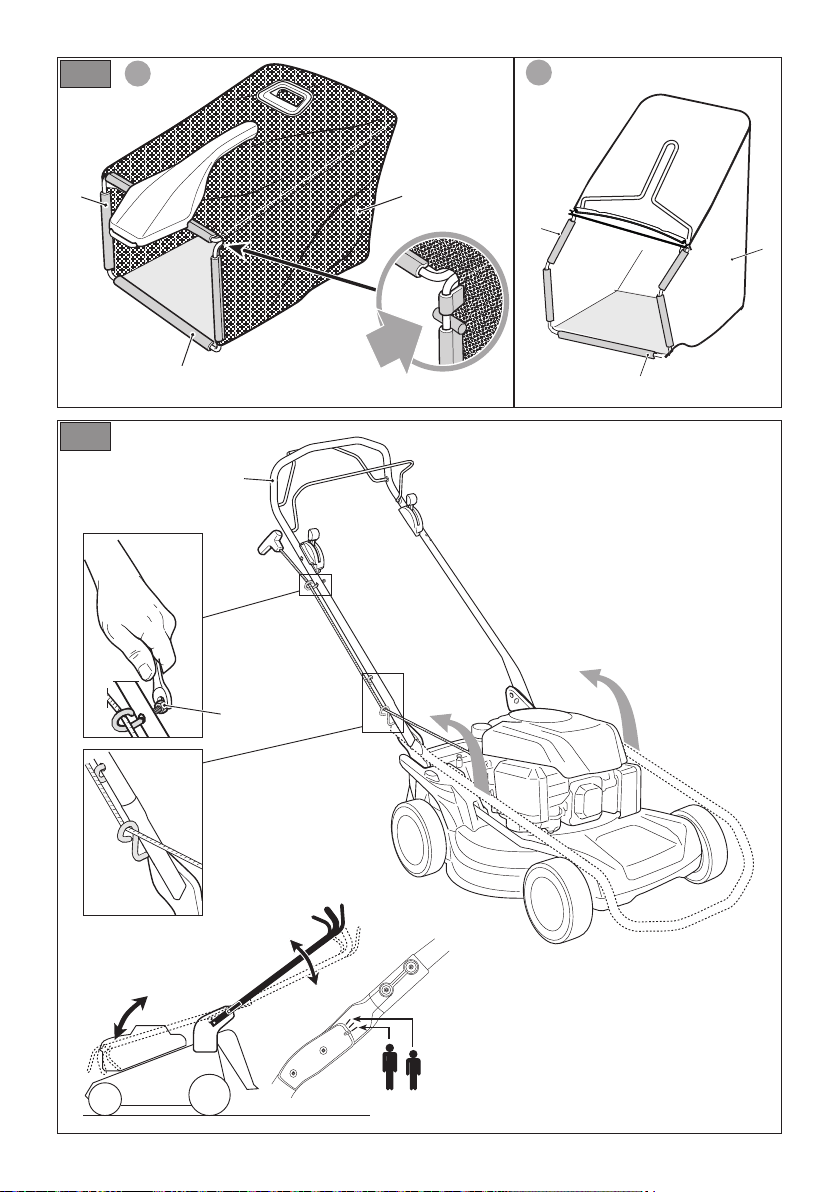
4.2 MONTAGGIO DEL SACCO
Il sacco viene fornito già assemblato.
Assicurarsi che i componenti siano correttamente
assemblati (Fig.3.A) (Tipo “I” - “II”).
4.3 MONTAGGIO DEL MANICO
Aprire con cautela il manico nella
Inserire la fune di avviamento nelle spirali inferiore
5. COMANDI DI CONTROLLO
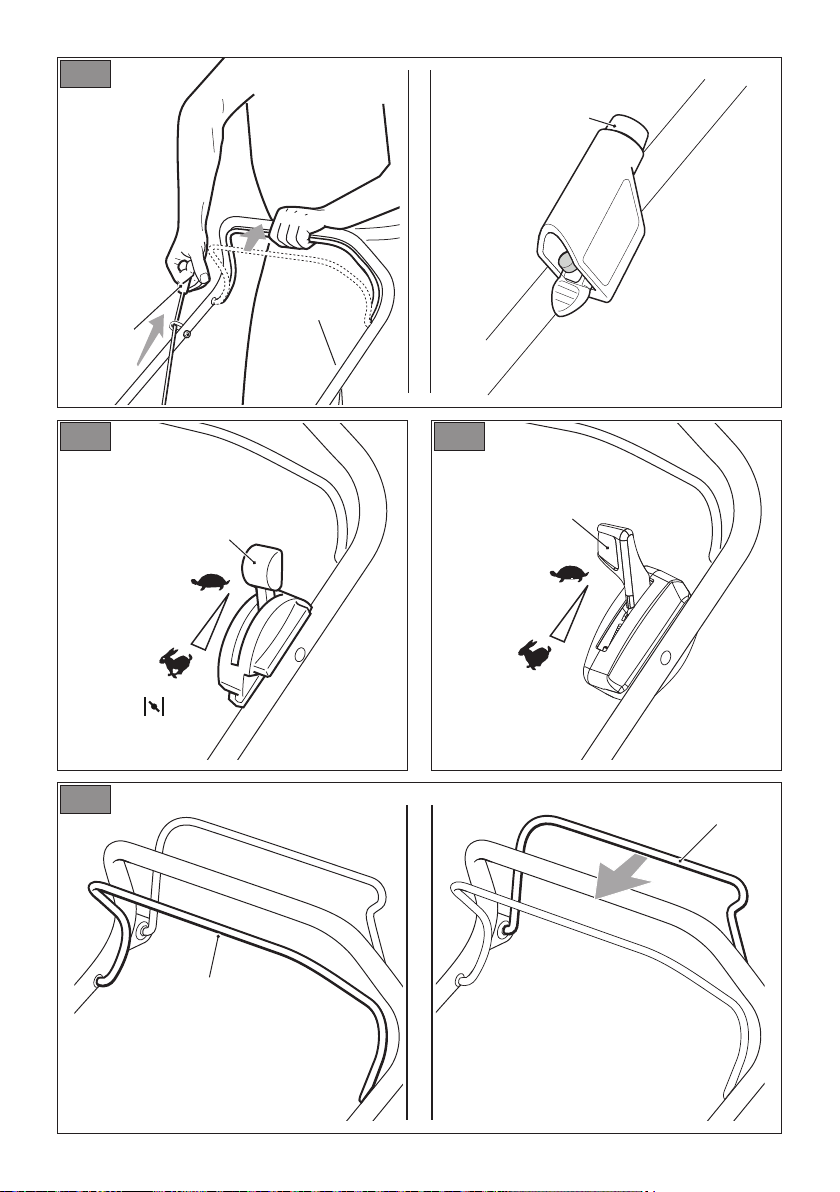
5.1 IMPUGNATURA DI AVVIAMENTO MANUALE
Consente l’avvio manuale del motore (Fig.5.A).
5.2 COMANDO DI AVVIAMENTO
ELETTRICO A PULSANTE
Consente l’avvio elettrico
del motore (Fig.5.B).
5.3 COMANDO ACCELERATORE
Regola il numero dei giri del motore (Fig.6.A).
1. Pieno regime. Da utilizzare sempre
durante il funzionamento della macchina.
2. Minimo.
le fasi di stazionamento.
3. “Choke” innestato. Si utilizza per
l’accensione del motore a freddo.
NOTA Per avviamento a freddo si intende
l’avviamento eettuato dopo almeno 5 minuti dall’arresto
del motore o dopo un rifornimento di carburante.
5.4 COMANDO VARIATORE DI VELOCITÀ
Il variatore di velocità permette di regolare
la velocità di avanzamento (Fig.7.A).
1. Velocità massima.
2. Velocità minima.
IMPORTANTE Il passaggio fra una velocità
e l’altra deve essere eseguito a motore acceso
e trazione inserita. Non toccare il comando del
variatore quando il motore è spento. Questa
operazione potrebbe danneggiare il variatore.

IT - 6
NOTA Se la macchina non avanza con il
comando in posizione « », è suciente
portare la leva di comando su « » e subito
dopo riportarla in posizione « ».
5.5 LEVA FRENO MOTORE /
DISPOSITIVO DI TAGLIO
È la leva che consente l’avvio e l’arresto del
motore e contemporaneamente innesta/
disinnesta il dispositivo di taglio (Fig.8.A).
5.6 LEVA INNESTO TRAZIONE
Innesta la trazione alle ruote e permette
l’avanzamento della macchina.
1. Trazione innestata. L’avanzamento
del rasaerba avviene con la leva spinta
contro il manico (Fig.8.B). Il rasaerba
smette di avanzare al rilascio della leva.
IMPORTANTE L’avviamento del motore deve
avvenire sempre con la trazione disinnestata.
IMPORTANTE Per evitare di danneggiare
la trasmissione, evitare di tirare all’indietro
la macchina con la trazione innestata.
5.7 REGOLAZIONE DELL’ALTEZZA DI TAGLIO
Tramite l’abbassamento o sollevamento dello chassis,
l’erba può essere tagliata a diverse altezze di taglio.
Eseguire l’operazione a dispositivo di taglio fer-
mo.
• Regolazione di Tipo “I”.
premendo il pulsante (Fig.9.A) e sollevando o
abbassando lo chassis, tramite l’impugnatura
• Regolazione di Tipo “II”.
mezzo dell' apposita leva (Fig.9.C) che solleva o
6. USO DELLA MACCHINA
Le norme di sicurezza da seguire sono descritte
al cap. 2. Rispettare scrupolosamente tali indicazioni
per non incorrere in gravi rischi o pericoli.
IMPORTANTE Per le istruzioni riguardanti il motore
e la batteria (se prevista), consultare i relativi libretti.
6.1 OPERAZIONI PRELIMINARI
Prima di iniziare a lavorare, è necessario
per assicurare che il lavoro si svolga in modo
Mettere la macchina in posizione orizzontale
e ben appoggiata sul terreno.
6.1.1 Rifornimento di olio e benzina
IMPORTANTE La macchina viene fornita
priva di olio motore e carburante.
Prima di utilizzare la macchina per la prima
di carburante e al rabbocco di olio secondo le
modalità e precauzioni indicate nel manuale
di Istruzioni del motore e ai par. 7.2/7.3.
Prima di ogni utilizzo
dell’olio seguendo le indicazioni contenute nel
manuale di Istruzioni del motore e nei par. 7.2/7.3.
6.1.2 Predisposizione della macchina al lavoro
NOTA Questa macchina permette di eettuare
la rasatura del prato in diverse modalità; prima di
iniziare il lavoro è opportuno predisporre la macchina
in base a come si intende eseguire la rasatura.
a. Predisposizione per il taglio e la raccolta
dell’erba nel sacco di raccolta:
• Tipo “I”
1.
accertarsi che la protezione di scarico
laterale (Fig.10.A) sia abbassata e bloccata
dalla leva di sicurezza (Fig.10.B).
2. Inserire il sacco di raccolta come indicato nella
nelle guide presenti alla base del manico,
a sentire un sonoro “click” (Fig.10.E).
• Tipo “II”
1. Sollevare la protezione di scarico posteriore
(Fig.11.A) e agganciare correttamente il sacco
di raccolta posizionando i piolini laterali nelle
guide presenti alla base del manico (Fig.11.B).
b. Predisposizione per il taglio e lo
scarico posteriore a terra dell’erba:
1. Rimuovere il sacco di raccolta.
2. Sollevare la protezione di scarico posteriore
scarico posteriore (Fig.12.B) nei fori
previsti, accertandosi della sua stabilità.
3. Nei modelli con possibilità di scarico
scarico laterale (Fig.12.C) sia abbassata e
bloccata dalla leva di sicurezza (Fig.12.D).
1. Sollevare la protezione di scarico
posteriore (Fig.12.A).
2.
sganciandolo dai fori (Fig.12.B).

IT - 7
c. Predisposizione per il taglio e la sminuzzatura
dell’erba (funzione “mulching”):
1. Sollevare la protezione di scarico posteriore
(Fig.13.B) nell’apertura di scarico.
2.
accertarsi che la protezione di scarico
laterale (Fig.12.C) sia abbassata e bloccata
dalla leva di sicurezza (Fig.12.D).
1. Sollevare la protezione di scarico
posteriore (Fig.13.A).
2.
d. Predisposizione per il taglio e lo
scarico laterale a terra dell’erba:
1. Sollevare la protezione di scarico posteriore
2. Spingere leggermente la leva di sicurezza
3.
Richiudere la protezione di scarico laterale
5. Spingere leggermente la leva di sicurezza
6.
1. Sollevare la protezione di scarico
2.
6.1.3 Regolazione dell’altezza di taglio
Regolare l’altezza di taglio come indicato al (par. 5.7).
6.1.4 Regolazione dell’altezza del manico
Eseguire l’operazione a dispositivo di taglio fer-
mo.
L’altezza del manico è regolabile in 3 diverse
posizioni, segnalate dall’indicatore presente
sulla base del manico (Fig.15.A).
Per variare l’altezza del manico azionare entrambe
le leve presenti sui lati del manico (Fig.15.B)
(Tipo “I”- “II”), e tenerle in posizione.
Portare con cautela il manico all’altezza
desiderata e rilasciare le due leve.
Dalla posizione di lavoro è anche possibile
ripiegare il manico in posizione chiusa.
6.2 CONTROLLI DI SICUREZZA
Eettuare sempre i controlli di sicurezza prima
dell’uso.
6.2.1 Controllo di sicurezza generale
Oggetto Risultato
Impugnature Pulite, asciutte.
Manico Fissato correttamente e
saldamente alla macchina.
Dispositivo di taglio Pulito, non danneggiato
o usurato.
Protezione di scarico
posteriore; sacco
di raccolta
Integri. Nessun danno.
Montati correttamente.
Protezione di scarico
scarico laterale
Integri. Nessun danno.
Montati correttamente.
Leva freno motore /
dispositivo di taglio
La leva deve avere un
movimento libero, non
forzato e al rilascio deve
tornare automaticamente
e rapidamente nella
posizione neutra.
Fune di avviamento La fune deve
essere integra.
Viti/dadi sulla macchina
e sul dispositivo di taglio
Ben serrati (non allentati).
Cavi elettrici e
cavo candela
Integri per evitare il
generarsi di scintille.
Cappuccio della candela Integro e correttamente
montato alla candela.
Macchina Nessun segno di
danneggiamento o usura.

IT - 8
6.2.2 Test di funzionamento della macchina
Azione Risultato
1. Avviare la macchina
(par. 6.3 ).
2. Rilasciare la leva
freno motore /
dispositivo di taglio.
1. Il dispositivo di taglio
deve muoversi.
2. Le leve devono tornare
automaticamente
e rapidamente
nella posizione
neutra, il motore
deve spegnersi e il
dispositivo di taglio
deve arrestarsi entro
alcuni secondi.
1. Avviare la macchina
(par. 6.3 ).
2. Azionare la leva
trazione.
3. Rilasciare la
leva trazione.
2. Le ruote fanno
avanzare la macchina.
3. Le ruote si arrestano
e la macchina smette
di avanzare.
Guida di prova Nessuna vibrazione
anomala.
Nessun suono anomalo.
Se uno qualsiasi dei risultati si discosta da quan-
to indicato nelle tabelle, non utilizzare la macchina!
Rivolgersi ad un centro di assistenza per i controlli del
caso e per la riparazione.
6.3 AVVIAMENTO
NOTA Eettuare l’avviamento su una supercie
piana e priva di ostacoli o erba alta.
6.3.1 Modelli con impugnatura di
avviamento manuale
1. Nel caso di avviamento a freddo:
portare l’acceleratore in posizione “Choke”
innestato (Fig.6.A) (se presente).
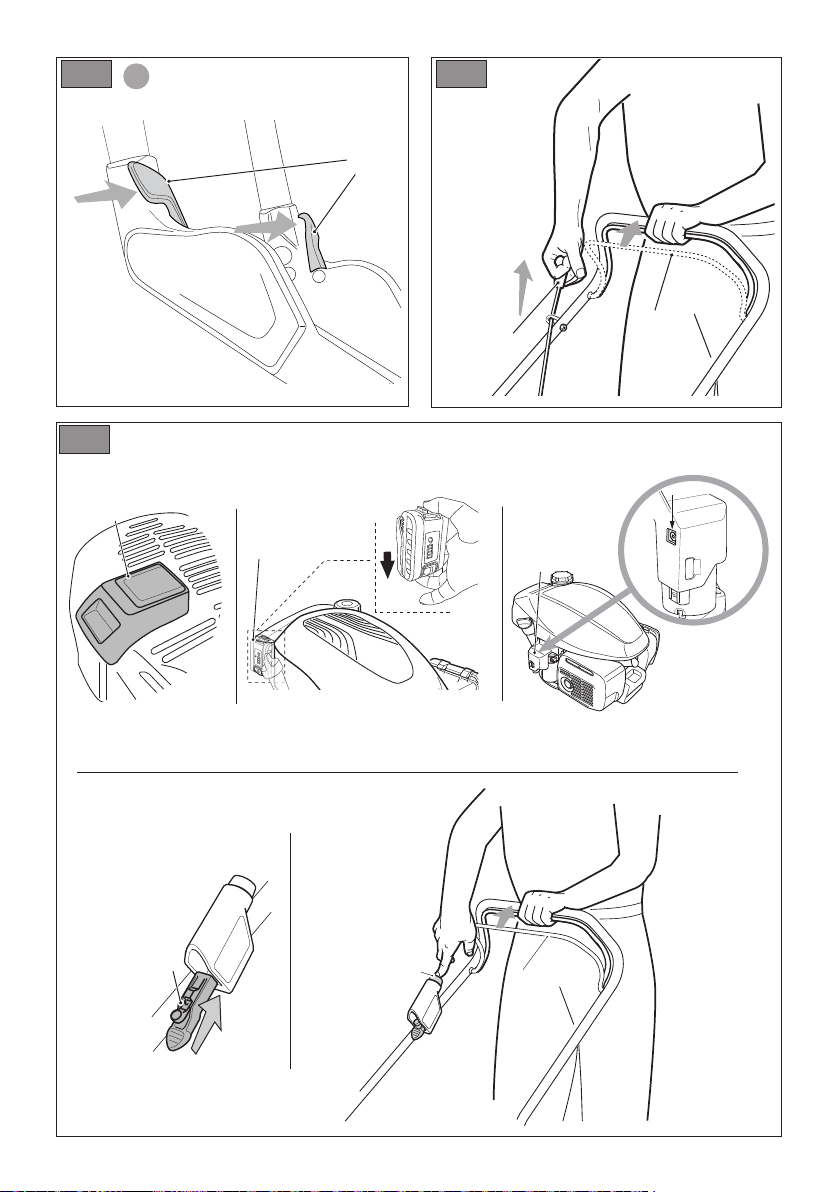
2. Tirare la leva freno motore / dispositivo
di taglio verso il manico (Fig.16.A).
NOTA La leva freno motore / dispositivo di taglio deve
essere mantenuta tirata per evitare l’arresto del motore.
3.
avviare il motore tirando con decisione
la fune di avviamento (Fig.16.B).
4. Dopo l’accensione portare l’acceleratore in
posizione pieno regime (se presente).
NOTA L’impiego del comando “Choke” a motore
già caldo può imbrattare la candela e causare
un funzionamento irregolare del motore.
6.3.2 Modelli con comando di avviamento
elettrico a pulsante
1. Inserire la batteria fornita nell’apposito
vano presente sul motore (Fig.17.A.1/
17.A.2) (seguire le istruzioni contenute
nel manuale istruzioni del motore).
Su alcuni modelli è previsto un motore con
batteria integrata non removibile (Fig.17.A.3).
2. Inserire a fondo la chiave (se presente) (Fig.17.B).
3. Tirare la leva freno motore / dispositivo
di taglio verso il manico (Fig.17.C).
Nei motori (
Fig.17.A.3),
l’indicatore dello stato di
carica della batteria (
1)
si accende o lampeggia per
•
Indicatore acceso = la batteria è abbastan-
za carica
•
-
si scarica
•
tutto scarica. Seguire le istruzioni contenu-
te nel manuale istruzioni del motore per la
ricarica di emergenza tramite dispositivo
di carica USB esterno (non fornito con la
macchina).
NOTA La leva freno motore / dispositivo di taglio deve
essere mantenuta tirata per evitare l’arresto del motore.
4. Premere il pulsante di avviamento e tenerlo
(Fig.17.D).
Nei motori (
Fig.17.A.3
) l’indicatore dello stato di carica del-
la batteria (
1
) si spegne.
Per ulteriori informazioni sul motore, seguire le indicazioni
del libretto del motore.
LAVORO
IMPORTANTE Durante il lavoro mantenere
sempre la distanza di sicurezza dal dispositivo
di taglio, data dalla lunghezza del manico.
6.3.3 Taglio dell’erba
1. Iniziare l’avanzamento ed il taglio nella zona erbosa.
2. Adeguare la velocità di avanzamento e
l’altezza di taglio (par. 5.7) alle condizioni del
prato (altezza, densità e umidità dell’erba)
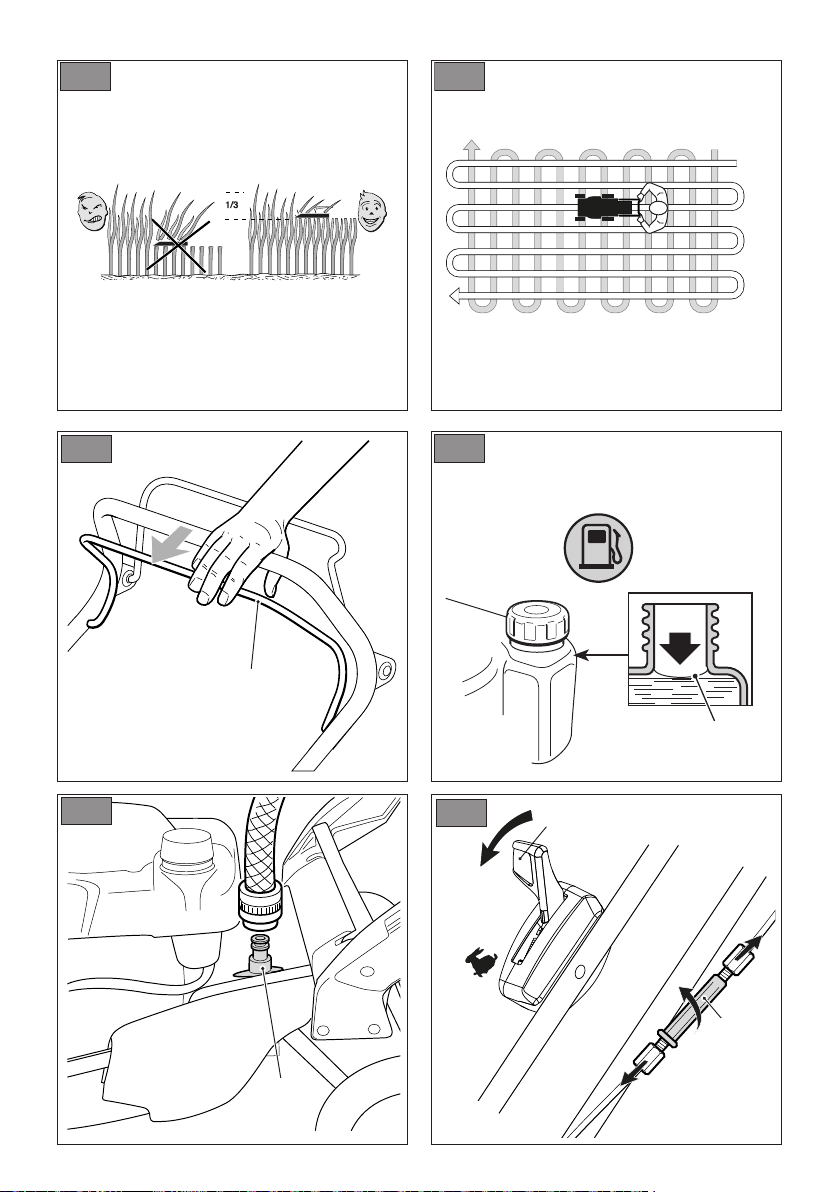
3. L’aspetto del prato sarà migliore se i tagli
alternativamente nelle due direzioni (Fig.19.0).
Nel caso di “mulching” o scarico
posteriore dell’erba:

IT - 9
•
d’erba. Non asportare mai più di un terzo dell’altezza
totale dell’erba in una sola passata (Fig.18.0).
•
Nel caso di scarico laterale: è consigliabile
tagliata dalla parte del prato ancora da tagliare.
6.3.4 Consigli per mantenere un bel prato
• Per mantenere un prato di bell’aspetto, verde e
Il prato può essere costituito da erbe di diverse
le erbe che sviluppano molte radici e formano
una solida coltre erbosa; al contrario, se i tagli
prevalentemente erbe alte e selvatiche (trifoglio.
essere rapportata alla crescita dell’erba, evitando
che tra un taglio e l’altro l’erba cresca troppo.
• L’altezza ottimale dell’erba di un prato ben curato è di
asportare più di un terzo dell’altezza totale. Se l’erba è
molto alta è meglio eseguire il taglio in due passate, a
distanza di un giorno; la prima con i dispositivi di taglio
ad altezza massima, e la seconda all’altezza desiderata.
• Un taglio troppo basso provoca strappi e diradamenti
nel tappeto erboso, con un aspetto “a macchie”.
• Nei periodi più caldi e secchi è opportuno
tenere l’erba leggermente più alta, per
ridurre il disseccamento del terreno.
• È sempre preferibile tagliare l’erba con il prato ben
vi si attacca e provocare strappi nel tappeto erboso.
•
in modo che la recisione sia netta e senza sfrangiature
che portano ad un ingiallimento delle punte.
6.3.5 Svuotamento del sacco di raccolta
troppo pieno, la raccolta dell’erba non è più
Nel caso di sacco di raccolta con
dispositivo segnalatore del contenuto:
Alzato = vuoto.
Abbassato = pieno.
Durante il lavoro, con il dispositivo di taglio in
che il sacco di raccolta è in grado di ricevere l’erba
di raccolta si è riempito e occorre svuotarlo.
1. Rilasciare la leva freno motore /
dispositivo di taglio (Fig.20.A).
2. Attendere l’arresto del dispositivo di taglio.
3.
• Sollevare la protezione di scarico posteriore
(Fig.11.B).
4.
raccolta mantenendolo in posizione eretta.
6.4 ARRESTO
1. Rilasciare la leva freno motore /
dispositivo di taglio (Fig.20.A).
2. Attendere l’arresto del dispositivo di taglio.
Dopo aver arrestato la macchina, occorrono di-
versi secondi prima che il dispositivo di taglio si arresti.
Il motore potrebbe essere molto caldo subito
dopo lo spegnimento. Non toccare. Vi è il pericolo di
ustioni.
IMPORTANTE Arrestare sempre la macchina:
• Durante gli spostamenti fra zone di lavoro.
• Nell’attraversamento di superci non erbose.
• Ogni volta che si rendesse necessario
superare un ostacolo.
• Prima di regolare l’altezza di taglio.
• Ogni volta che si toglie o si rimonta il sacco di raccolta.
• Ogni volta che si toglie o si rimonta il deettore
di scarico posteriore (se previsto).
• Ogni volta che si toglie o si rimonta il deettore
di scarico laterale (se previsto).
6.5 DOPO L’UTILIZZO
1. Arrestare la macchina (par. 6.5).
2.
3. Premere la linguetta () e rimuovere
la chiave di consenso () (modelli con
comando di avviamento elettrico a pulsante).
4.
5.
6. Controllare che non ci siano componenti allentati o
danneggiati. Se necessario, sostituire i componenti
danneggiati e serrare eventuali viti e bulloni allentati.
IMPORTANTE Ogni qualvolta si lasci la
macchina inutilizzata o incustodita:
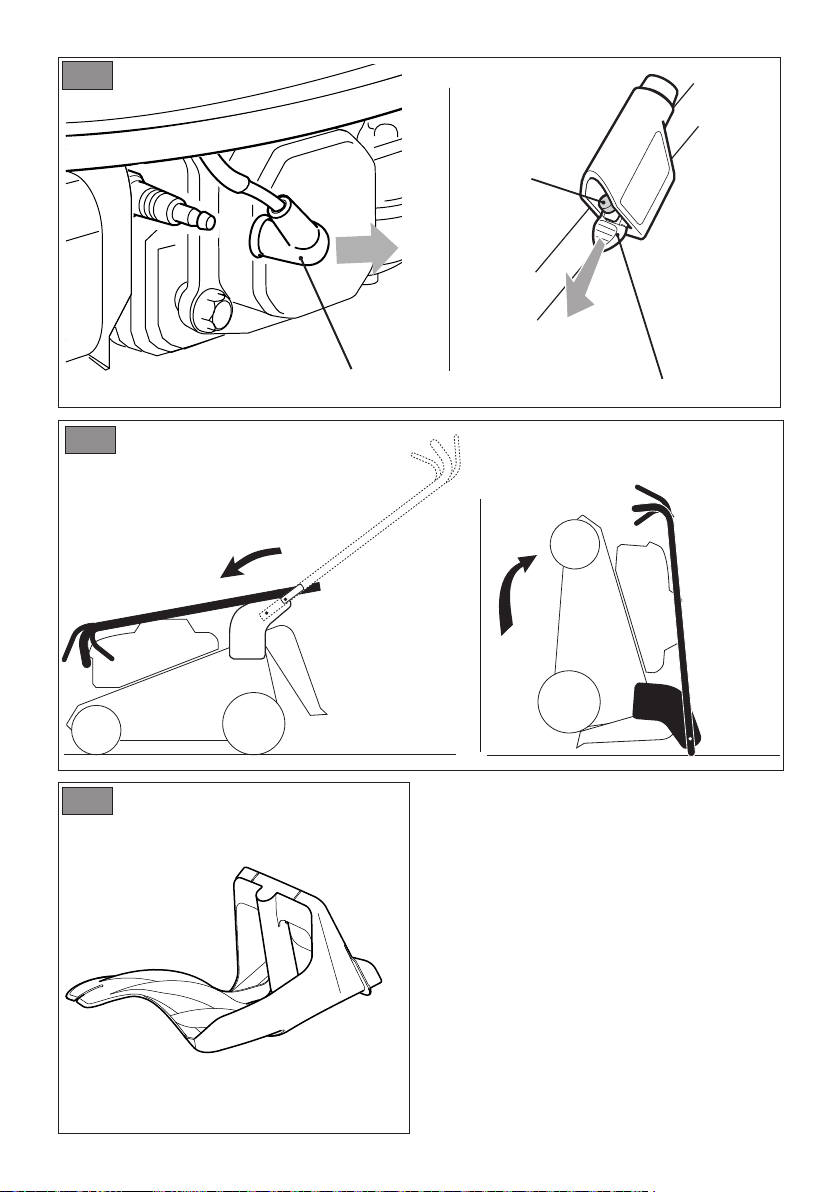
• Staccare il cappuccio della candela (Fig. 24.A).
• Rimuovere la chiave (Fig. 24.C) o la batteria (nei modelli
con comando di avviamento elettrico a pulsante).
7. MANUTENZIONE ORDINARIA
7.1 GENERALITÀ
Le norme di sicurezza da seguire sono descritte
al cap. 2. Rispettare scrupolosamente tali indicazioni
per non incorrere in gravi rischi o pericoli.

IT - 10
Prima di eettuare qualsiasi controllo, pulizia o
intervento di manutenzione/regolazione sulla macchi-
na:
• Arrestare la macchina.
• Accertarsi che tutte le parti in movimento
si siano completamente arrestate.
• Attendere che il motore sia
adeguatamente rareddato.
• Staccare il cappuccio della candela (Fig.24.A).
• Rimuovere la chiave (Fig.24.C) o la
batteria (nei modelli con comando di
avviamento elettrico a pulsante).
• Leggere le relative istruzioni.
• Indossare indumenti adeguati, guanti
da lavoro e occhiali di protezione.
•
nella “Tabella manutenzioni”. La tabella ha lo scopo
la vostra macchina. In essa sono richiamati i
principali interventi e la periodicità prevista per
ciascuno di essi. Eseguire la relativa azione a
• L’utilizzo di ricambi e accessori non originali e/o non
sul funzionamento e sulla sicurezza della macchina.
di danni, incidenti o lesioni causati da detti prodotti.
•
di assistenza e dai rivenditori autorizzati.
IMPORTANTE Tutte le operazioni di
manutenzione e di regolazione non descritte in
questo manuale devono essere eseguite dal vostro
Rivenditore o da un Centro specializzato.
7.2 RIFORNIMENTO DI CARBURANTE
Mettere la macchina in posizione orizzontale
e ben appoggiata sul terreno.
Il rifornimento di carburante deve avvenire a
macchina arrestata e con il cappuccio della candela
staccato.
Procedere al rifornimento di carburante
secondo le modalità e precauzioni indicate
nel manuale di Istruzioni del motore.
Le macchine con possibilità di rimessaggio
verticale (cap. 9.1) hanno un serbatoio di carburante
contenente un indicatore di livello di carburante. Non
riempire il serbatoio al di sopra del fondo dell’indica-
tore di livello (Fig.21.A).
IMPORTANTE Evitare di versare benzina sulle parti
in plastica del motore o della macchina per evitare di
danneggiarle, e ripulire immediatamente ogni traccia di
benzina eventualmente versata. La garanzia non copre
i danni alle parti in plastica causati dalla benzina.
NOTA Il carburante è deperibile e non deve rimanere
nel serbatoio per un periodo superiore a 30 giorni.
Prima del rimessaggio per un lungo periodo, caricare
nel serbatoio una quantità di carburante suciente
a portare a termine l’ultimo utilizzo (cap. 9).
7.3 CONTROLLO / RABBOCCO OLIO MOTORE
Procedere al controllo/rabbocco dell’olio motore
secondo le modalità e precauzioni indicate
nel manuale di Istruzioni del motore.
Per assicurare il buon funzionamento e la durata della
macchina, è buona norma sostituire periodicamente
l’olio del motore, secondo la periodicità indicata
nel Manuale di Istruzioni del motore stesso.
Accertarsi di aver ripristinato il livello dell’olio,
prima di usare nuovamente la macchina.
7.4 PULIZIA
attenendosi alle seguenti istruzioni.
7.4.1 Pulizia della macchina
• Assicurarsi sempre che le prese
d’aria siano libere da detriti.
•
la pulizia dello chassis.
• Per ridurre il rischio di incendio, mantenere la
macchina ed in particolare il motore liberi da
residui d’erba, foglie o grasso eccessivo.
• Lavare accuratamente la macchina
7.4.2 Pulizia dell’assieme dispositivo di taglio
• Rimuovere i detriti d’erba e il fango accumulati all’interno
dello chassis per evitare che, disseccandosi, possano
• Nel caso fosse necessario accedere alla parte
inferiore, inclinare la macchina esclusivamente dal lato
indicato sul libretto del motore, seguendo le relative
istruzioni, accertandosi della stabilità della macchina
Nel caso di scarico laterale o posteriore: se
Per il lavaggio interno dell’assieme dispositivo
1. Rimuovere il sacco di raccolta.
2.
all’apposito attacco (Fig.22.A).
3. Portare l’altezza di taglio in posizione
completamente abbassata.
4. Posizionarsi sempre dietro il manico del rasaerba.
5. Avviare il motore.
La verniciatura della parte interna dello chassis
può staccarsi nel tempo per l’azione abrasiva
tempestivamente ritoccando la verniciatura con una
pittura antiruggine, per prevenire la formazione di
ruggine che porterebbe alla corrosione del metallo.
7.4.3 Pulizia del sacco
IT - 11
1. Svuotare il sacco di raccolta.
2. Scuoterlo per ripulirlo dai residui d’erba e terriccio.
3.
da favorire una rapida asciugatura.
7.5 DADI E VITI DI FISSAGGIO
Mantenere serrati dadi e viti, per essere
certi che la macchina sia sempre in
condizioni sicure di funzionamento.
7.6 BATTERIA
La batteria viene fornita nei modelli con comando
di avviamento elettrico a pulsante. Per le istruzioni
riguardanti l’autonomia, la ricarica, il rimessaggio e
la manutenzione della batteria, seguire le istruzioni
contenute nel manuale istruzioni del motore.
Nei motori
(
Fig.17.A.3
)
, la batteria non necessita
di ricarica. Solo in casi di emergenza, può essere
ricaricata tramite un dispositivo di carica USB esterno
(non fornito con la macchina). Seguire le istruzioni
contenute nel manuale istruzioni del motore.
7.7 REGOLAZIONE DEL CAVO DEL VARIATORE
(Fig.23.A) tende a non rimanere nella posizione « ».
IMPORTANTE La regolazione deve
essere eseguita a motore spento.
Con la leva (Fig.23.A) in posizione « », ruotare
il registro (Fig.23.B) del cavo nel senso indicato
8. MANUTENZIONE STRAORDINARIA
Prima di eettuare qualsiasi controllo, pulizia o
intervento di manutenzione/regolazione sulla macchi-
na:
• Arrestare la macchina.
• Accertarsi che tutte le parti in movimento
si siano completamente arrestate.
• Attendere che il motore sia
adeguatamente rareddato.
• Staccare il cappuccio della candela (Fig.24.A).
• Rimuovere la chiave (Fig.24.C) o la
batteria (nei modelli con comando di
avviamento elettrico a pulsante).
• Leggere le relative istruzioni.
• Indossare indumenti adeguati, guanti
da lavoro e occhiali di protezione.
8.1 DISPOSITIVO DI TAGLIO
l’erba e provoca un ingiallimento del prato.
Non toccare il dispositivo di taglio ntanto che
non sia stata tolta la chiave e che il dispositivo di taglio
non sia completamente fermo.
Tutte le operazioni riguardanti i dispositivi di ta-
glio (smontaggio, alatura, equilibratura, riparazione,
rimontaggio e/o sostituzione) sono lavori impegnativi
che richiedono una specica competenza oltre all’im-
piego di apposite attrezzature; per ragioni di sicurezza,
occorre pertanto che siano sempre eseguite presso un
Centro Specializzato.
Far sostituire sempre il dispositivo di taglio dan-
neggiato, storto o usurato, assieme alle proprie viti, per
mantenere l’equilibratura.
IMPORTANTE Utilizzare sempre
dispositivi di taglio originali, riportanti il codice
indicato nella tabella “Dati Tecnici”.
Data l’evoluzione del prodotto, i dispositivi di taglio
citati nella tabella “Dati Tecnici” potrebbero essere
sostituiti nel tempo da altri, con caratteristiche analoghe
di intercambiabilità e sicurezza di funzionamento.
9. RIMESSAGGIO
1. Avviare il motore all’aperto e tenerlo in moto al
tutto il carburante rimasto nel carburatore.
2.
3.
4.
batteria (nei modelli con comando di
avviamento elettrico a pulsante).
5.
6.
danni. Se necessario, contattare il
centro di assistenza autorizzato.
7.
• In un ambiente asciutto.
• Al riparo dalle intemperie.
• Possibilmente ricoperta con un telo.
• In un luogo inaccessibile ai bambini.
• Assicurandosi di aver rimosso chiavi o utensili usati
per la manutenzione.
9.1 RIMESSAGGIO VERTICALE
In caso di necessità, alcuni modelli (vedi Tabella Dati
Tecnici) possono essere rimessati in verticale (Fig.25.0).
Non rimessare la macchina in posizione verti-
cale con il serbatoio riempito al di sopra del fondo
dell’indicatore di livello del carburante (Fig.21.A).
IT - 12
1.
all’altezza di taglio “3” (par. 5.7).
2. Dalla posizione di lavoro azionare entrambe
le leve presenti sui lati del manico, (Fig.15.B)
(Tipo “I”- “II”), e tenerle in posizione.
3. Ripiegare con cautela il manico in posizione chiusa
4. Sollevare la parte frontale della macchina (Fig.25.0).
Riporre la macchina in modo che il dispositivo
di taglio rimanga orientato verso una parete o ade-
guatamente coperto, in modo da non costituire peri-
colo in caso di contatto , anche accidentale o fortuito,
con persone, bambini o animali.
Non rimessare la macchina in una posizione
ad angolazione maggiore di quella verticale (90°); in
caso contrario la benzina potrebbe fuoriuscire dal
serbatoio di carburante.
Non tentare di predisporre il rimessaggio in ver-
ticale delle macchine che non sono state progettate
per questo scopo.
10. MOVIMENTAZIONE E TRASPORTO
Ogni volta che è necessario movimentare, sollevare,
• Arrestare la macchina (par. 6.5).
• Accertarsi che tutte le parti in movimento
si siano completamente arrestate.
•
•
con comando di avviamento elettrico a pulsante).
• Indossare robusti guanti da lavoro.
•
sicura, tenendo conto del peso e della sua ripartizione.
• Impiegare un numero di persone adeguato al peso della
macchina e alle caratteristiche del mezzo di trasporto o
• Assicurarsi che la movimentazione della
macchina non causi danni o lesioni.
• Utilizzare rampe di accesso di resistenza,
larghezza e lunghezza adeguate.
• Caricare la macchina con il motore spento, a spinta,
impiegando un numero adeguato di persone.
• Abbassare l’assieme dispositivo di taglio (par 5.7).
• Posizionarla in modo da non costituire
pericolo per nessuno.
• Bloccarla saldamente al mezzo di trasporto mediante
funi o catene per evitarne il ribaltamento.
Non trasportare in posizione verticale le mac-
chine con possibilità di rimessaggio verticale.
11. ASSISTENZA E RIPARAZIONE
per la conduzione della macchina e per una corretta
manutenzione di base eseguibile dall’utilizzatore. Tutti gli
interventi di regolazione e manutenzione non descritti in
Rivenditore o un Centro specializzato, che dispone delle
lavoro sia correttamente eseguito, mantenendo il grado
di sicurezza e le condizioni originali della macchina.
Operazioni eseguite presso strutture inadeguate
decadimento di ogni forma di Garanzia e di ogni
obbligo o responsabilità del Costruttore.
•
•
esclusivamente ricambi originali. I ricambi
e gli accessori originali sono stati sviluppati
appositamente per le macchine.
• I ricambi e gli accessori non originali non sono
approvati; l’impiego di ricambi ed accessori non
originali compromette la sicurezza della macchina e
solleva il Costruttore da ogni obbligo o responsabilità.
12. COPERTURA DELLA GARANZIA
Le condizioni di garanzia sono destinate solamente
ai consumatori, cioè operatori non professionisti.
fabbricazione, accertati durante il periodo della garanzia
dal vostro Rivenditore o da un Centro specializzato.
L’applicazione della garanzia si limita alla riparazione
o alla sostituzione del componente ritenuto difettoso.
autorizzata per la manutenzione, l’assistenza
e il controllo dei dispositivi di sicurezza.
L’applicazione della garanzia è subordinata ad
una manutenzione regolare della macchina.
L’utilizzatore dovrà seguire attentamente tutte le
istruzioni fornite nella documentazione allegata.
• Mancata familiarizzazione con la documentazione
di accompagnamento (Manuali di Istruzioni).
• Uso professionale.
• Disattenzione, negligenza.
• Causa esterna (fulmine, urti, presenza di corpi
estranei all’interno della macchina) o incidente.
• Uso e montaggio impropri o non
consentiti dal costruttore.
• Scarsa manutenzione.
•
• Utilizzo di pezzi di ricambio non
originali (pezzi adattabili).
• Utilizzo di accessori non forniti o non
approvati dal costruttore.
• Le operazioni di manutenzione ordinaria/
straordinaria (descritte nel manuale di istruzioni).
• La normale usura di materiali di consumo come
cinghie di trasmissione, dispositivi di taglio,
fari, ruote, bulloni di sicurezza e cablaggi.
• Normale usura.
• Deterioramento estetico della macchina
dovuto al suo utilizzo.
• Le sostanze, olio, benzina, grasso.
• I supporti dei dispositivi di taglio.
• Le spese accessorie eventualmente connesse
presso l’utilizzatore, il trasposto della macchina

IT - 13
verso il Rivenditore, noleggio di attrezzature
per la sostituzione o la chiamata ad una società
esterna per tutti i lavori di manutenzione.
Le garanzie dei motori termici, al di fuori dei
motori “ST.” sono coperti dalle garanzie del
costruttore del motore interessato, nei termini e
L’utilizzatore è protetto dalle proprie leggi nazionali. I diritti
dell’utilizzatore previsti dalle proprie leggi nazionali non
sono in alcun modo limitati dalla presente garanzia.
13. TABELLA MANUTENZIONI
Intervento Periodicità Note
MACCHINA
Prima di ogni uso par. 7.5
Prima di ogni uso par. 6.2
Prima di ogni uso par. 6.2.1
Prima di ogni uso par. 6.2.1
Prima di ogni uso par. 6.2.1
Pulizia generale e controllo Al termine di ogni uso
necessario, contattare il centro di assistenza autorizzato.
Al termine di ogni uso -
Regolazione del cavo del variatore ** par. 7.7
Sostituzione dispositivo di taglio - par. 8.1 ***
MOTORE
Controllo / rabbocco livello carburante Prima di ogni uso par. 6.1.1 / 7.2 *
Controllo / rabbocco olio motore Prima di ogni uso par. 6.1.1 / 7.3 *
* *
Controllo e pulizia contatti candela * *
Sostituzione candela * *
Carica della batteria * par. 7.6 *
* Consultare il manuale del motore.
** Operazione da eseguire ai primi cenni di malfunzionamento
*** Operazione che deve essere eseguita dal vostro Rivenditore o da un Centro specializzato
14. IDENTIFICAZIONE INCONVENIENTI
Se gli inconvenienti perdurano dopo aver applicato i rimedi descritti, contattare il vostro Rivenditore.
INCONVENIENTE CAUSA PROBABILE RIMEDIO
1. Il motore non si avvia o
non si mantiene in moto.
Procedura di avviamento non corretta. Seguire le istruzioni (vedi cap. 6.3).
Manca l’olio o la benzina nel motore. Procedere al controllo dei livelli
dell’olio e della benzina.
Candela sporca o distanza fra
gli elettrodi non corretta.
Controllare la candela (Consultare
il manuale del motore).
Filtro aria otturato.
il manuale del motore).
Problemi di carburazione. Contattare il centro di assistenza autorizzato.
Non è stata svuotata la benzina dal
Il galleggiante può essere bloccato.
Consultare il manuale del motore e contattare
il centro di assistenza autorizzato.

2. Il motore ha un
funzionamento
irregolare, non ha
potenza sotto carico, o si
arresta durante il lavoro.
Filtro aria otturato.
il manuale del motore).
Candela sporca o distanza fra
gli elettrodi non corretta.
Controllare la candela (Consultare
il manuale del motore).
Problemi di carburazione. Contattare il centro di assistenza autorizzato.
3. Ingolfamento del motore. L’impugnatura di avviamento manuale
è stata azionata ripetutamente
con lo starter inserito.
Consultare il manuale del motore.
L’impugnatura di avviamento manuale
è stata azionata ripetutamente con il
cappuccio della candela staccato.
Inserire il cappuccio della candela e
provare ad accendere il motore.
(Consultare il manuale del motore).
4. L’erba tagliata non
viene più raccolta nel
sacco di raccolta.
Il dispositivo di taglio ha colpito un
corpo estraneo e ha subito un colpo.
Arrestare il motore e staccare il
cappuccio della candela.
e Contattare un Centro Assistenza
per l’eventuale sostituzione del
dispositivo di taglio (par. 8.1).
L’interno dello chassis è sporco. Pulire l’interno dello chassis per
facilitare l’evacuazione dell’erba verso
5. L’erba si taglia
Il dispositivo di taglio non
è in buono stato.
o sostituzione del dispositivo di taglio.
6. Si avvertono rumori e/o
vibrazioni eccessive
durante il lavoro.
Danneggiamento o parti allentate.
Il piolino sul dispositivo di taglio
è uscito dalla sua sede.
Fermare la macchina e staccare il
Controllare se vi siano parti allentate e serrarle.
o riparazioni presso un il centro
di assistenza autorizzato.
Fissaggio del dispositivo di
taglio allentato o dispositivo
di taglio danneggiato.
Arrestare il motore e staccare il
Contattare un Centro Assistenza per
15. ACCESSORI A RICHIESTA
15.1 KIT PER MULCHING
sul prato, in alternativa alla raccolta nel sacco
(per macchine predisposte) (Fig.26.0).

EN - 1
EN
WARNING: READ THE INSTRUCTION BOOKLET THOROUGHLY BEFORE USING THE MACHINE.
Keep for future reference.
INDEX
1. GENERAL INFORMATION
1.1 HOW TO READ THE MANUAL
Some paragraphs in the manual contain important
information regarding safety and operation
NOTE OR IMPORTANT These give details or
further information on what has already been said,
and aim to prevent damage to the machine.
The symbol highlights danger. Failure to observe the
warning can lead to the risk of injury to oneself and others
and/or damage.
grey spots indicate the optional characteristics
not on all models documented in this manual.
Check if the characteristic is on this model.
Whenever reference is made to a position on the
machine such as "front”, "back”, "left” or "right”
hand side, this is determined from where the
operator is in normal operating position.
1.2 REFERENCES
1.2.1 Figures
use are numbered 1, 2, 3, etc.
1.2.2 Titles
The manual is divided into chapters and paragraphs.
The title of paragraph “2.1 Training” is a subtitle of “2.
Safety regulations". References to titles or paragraphs
are marked with the abbreviation chap. or par. and the
2. SAFETY REGULATIONS
2.1 TRAINING
Become acquainted with the controls and the pro-
per use of the machine. Learn how to stop the engine
quickly. Failure to follow the warnings and instructions
may result in re and/or serious injury.
1. GENERAL INFORMATION .......................................... 1
1.1 How to read the manual ...................................... 1
1.2 References .......................................................... 1
2. SAFETY REGULATIONS ............................................. 1
2.1 Training ................................................................ 1
2.2 Preliminary procedures ....................................... 2
2.3 During operation ................................................. 2
.................. 3
2.5 Environmental protection .................................... 3
3. GETTING TO KNOW THE MACHINE .......................... 3
3.1 Description of the machine and planned use ..... 3
3.2 Safety signs .........................................................
...............................................
................................................
...................................................................
....................................... 5
..................................... 5
................................................ 5
5. CONTROLS .................................................................. 5
5.1 Manual starter handgrip ...................................... 5
5.2 Electric push-button starter switch ..................... 5
5.3 Throttle control .................................................... 5
............................................. 5
5.5 Engine brake lever / cutting means ..................... 5
5.6 Drive engagement lever ...................................... 5
5.7 Cutting height adjustment ................................... 5
6. USING THE MACHINE ................................................. 6
6.1 Preliminary procedures ....................................... 6
6.2 Safety checks ...................................................... 7
6.3 Start-up ............................................................... 7
............................................................ 8
6.5 Stop 8
6.6 After operation..................................................... 8
7. ROUTINE MAINTENANCE .......................................... 9
7.1 General information ............................................ 9
7.2 Refuelling ............................................................ 9
7.3 Check/top-up engine oil ...................................... 9
.............................................................. 9
7.5 Nuts and bolts ................................................... 10
7.6 Batter y ............................................................... 10
7.7 Adjusting the converter cable ........................... 10
8. OCCASIONAL MAINTENANCE ................................. 10
8.1 Cutting means ................................................... 10
9. STORAGE................................................................... 10
9.1 Vertical storage ................................................. 10
10. HANDLING AND TRANSPORTATION .......................11
11. ASSISTANCE AND REPAIRS .....................................11
12. WARRANTY COVERAGE ...........................................11
13. MAINTENANCE TABLE ............................................. 12
..................................... 12
................................ 13
15.1 "Mulching" kit..................................................... 13

EN - 2
• Never allow children or persons unfamiliar with
these instructions to use the machine. Local
regulations may restrict the age of the operator.
• Never use the machine if the user is tired
or unwell, or has taken medicine, drugs,
alcohol or any substances which may slow his
• Do not allow children or other passengers
to ride on the machine.
• Bear in mind that the operator or user is responsible
for accidents or unexpected events occurring to other
people or their property. It is the user’s responsibility to
assess the potential risk of the area where work is to be
carried out and to take all the necessary precautions
to ensure his own safety and that of others, particularly
on slopes or rough, slippery and unstable ground.
• If the machine is sold or lent to others,
make sure that the operator reads the user
instructions contained in this manual.
2.2 PRELIMINARY PROCEDURES
Personal Protective Equipment (PPE)
• Always wear suitable work attire, hard-wearing safety
footwear with non-slip soles and long trousers. Do
not operate the machine when barefoot or wearing
open sandals. Wear hearing protection devices.
• Use of hearing protections can reduce the ability to
hear any warnings (shouting or alarms). Be careful
of what occurs around you in the work area.
• Wear protective gloves whenever your hands are at risk.
• Never wear scarves, shirts, necklaces, bracelets,
or in any objects or materials in the work area.
• Tie your hair back if it is long.
Work area/Machine
• Thoroughly inspect the entire work area and
remove anything that could be thrown by the
machine or damage the cutting means/rotating
units (stones, branches, iron wire, bones, etc.).
Internal combustion engines: fuel
DANGER!
• Keep the fuel in approved containers, in a safe place,
away from any naked lights or heat sources.
• Keep the containers free of grass cuttings,
leaves, or excessive grease.
• Keep the containers out of the reach of children.
•
or when handling the fuel.
• Use a funnel to top up with fuel only in the open air.
• Do not inhale fuel fumes.
• Never remove the tank cap or add fuel while the
engine is running or when the engine is hot.
• Open the fuel tank slowly to allow the
pressure inside to decrease gradually.
• Do not approach the tank opening with a
• if you have spilled some fuel, do not attempt to
start the engine but move the machine away
from the area of spillage and avoid creating any
source of ignition until the fuel has evaporated
and fuel vapours have dissipated.
• Immediately clean up all traces of fuel spilt
on the machine or on the ground.
• Replace caps of all fuel tanks and containers securely.
• Never start the machine in the same place in which
an area at least 3 metres from where you refuelled.
• If fuel is spilt on clothing, change clothing
before starting the engine.
2.3 DURING OPERATION
Work Area
•
where dangerous carbon monoxide fumes
can develop. All starting operations have to be
• When starting up the machine, do not direct
the silencer and therefore the exhaust
• Do not use the machine in environments at risk
sparks which may ignite the dust or fumes.
•
light in good visibility conditions.
• Keep persons, children and animals away
from the working area. Get another adult to
keep the children under supervision.
• Avoid working with wet grass, in the rain and when
there is a risk of a thunderstorm, especially lightening.
• Pay careful attention to uneven ground
(hills, dips), slopes, hidden hazards and
obstacles that could limit visibility.
• Be very careful near ravines, ditches or embankments.
The machine could overturn if a wheel slides
over the edge or if the earth gives way.
• Always mow across a slope and never up and down
it, being very careful when changing direction,
wheels do not hit any obstacles (such as stones,
branches, roots, etc.) that may cause the machine
to slide sideways or make you lose control of it.
•
machine near the road.
•
machine with the engine hot on leaves, dry
Behaviour
• Exercise caution when reversing or moving backwards.
Look behind you to make sure there are no obstacles
before and during operations in reverse gear.
• Never run, always walk.
• Do not allow the lawnmower to pull you along.
• Always keep hands and feet away from the cutting
means, when starting and when using the machine.
•
rotate for a few seconds after disengagement
• Keep away from the discharge opening.
• Do not touch the engine parts as they get
very hot when running. Danger of burns.
If something breaks or an accident occurs during
mowing, turn o the engine immediately and move the
machine away to prevent further damage; if an accident
occurs with injuries or third parties are injured, carry
out the rst aid measures most suitable for the situa-

EN - 3
tion immediately and contact the medical authorities
for any necessary health care. Carefully remove any
debris which could cause damage or injury to persons
or animals if ignored.
Use limitations
• Never operate the machine with damaged, missing
or incorrectly assembled guards (grass catcher,
side discharge guards rear discharge guards).
• Don’t use the machine if the attachments/
tools are not installed in their seats.
• Never disengage, deactivate, remove or tamper
with the safety systems/micro switches installed.
• Do not alter the engine adjustments, nor over-run it. If
the engine is forced to work with an excessive number
of rotations, the risk of personal injury increases.
• Do not strain the machine too much and do not
use a small machine for heavy-duty work. If you
use the right machine, you will reduce the risk of
2.4 MAINTENANCE, STORAGE AND TRANSPORT
Ensure regular maintenance and correct storage to
maintain machine safety and high performance levels.
Maintenance
• Never use the machine with worn or damaged
parts. Faulty or worn-out parts must always
be replaced and never repaired.
•
the machine for oil and/or fuel leaks.
• Be careful during adjustment of the machine to prevent
The noise and vibration levels shown in these
instructions are the maximum levels for use of the
machine. The use of an unbalanced cutting element,
the excessive speed of movement, or the absence of
maintenance have a signicant inuence on noise
emissions and vibrations. Consequently, it is necessary
to take preventive steps to eliminate possible damage
due to high levels of noise and stress from vibration.
Maintain the machine well, wear ear protection devices,
and take breaks while working.
Storage
• Do not store the machine with fuel in the tank
in an area where fuel vapours could reach a
naked light, a spark or a strong heat source.
•
with debris inside a room.
2.5 ENVIRONMENTAL PROTECTION
Safeguarding the environment must be a relevant
the community and the environment we live in.
• Avoid being a disturbance to the neighbourhood.
Use this machine at reasonable times of the
day only (not early morning or late evening
when the noise could cause disturbance).
• Scrupulously comply with local regulations for the
disposal of packaging, deteriorated parts or any
elements with a strong environmental impact; this
waste must not be disposed of as normal waste,
disposal centres where the material will be recycled.
• Scrupulously comply with local regulations
for the disposal of waste materials
• When the machine is withdrawn from service,
do not dispose of it in the environment, but take
it to a waste disposal facility in accordance
with the local regulations in force.
3. GETTING TO KNOW THE MACHINE
3.1 DESCRIPTION OF THE MACHINE
AND PLANNED USE
This machine is pedestrian controlled lawnmower.
The machine is essentially composed of an
engine which drives a cutting means enclosed in
The operator is able to operate the machine and use
the main controls, always staying behind the handle
at a safe distance from the rotating cutting means.
If the operator leaves the machine, the engine and
cutting means will stop within a few seconds.
3.1.1 Intended use
This machine was designed and manufactured
for cutting (and collecting) grass in gardens and
grassy areas, in proportion to its cutting capacity,
carried out by a pedestrian operator.
1. mow the grass and collect it in the grass catcher;
2. mow the grass and discharge it on the ground
from the rear section (if provided);
3. mow the grass and discharge it
from the side (if provided);
4. mow, chop and deposit the grass on the
The use of special attachments provided for by the
purchased separately, allows this work to be done in
various operating modes, illustrated in this manual or the
instructions that accompany the single attachments.
3.1.2 Improper use
Any other usage not in keeping with the afore-
mentioned ones may be hazardous and
harm persons and/or damage things.
Examples of improper use may
• Allowing children, animals or other passengers to
themselves or compromise safe driving by the operator;
• Letting oneself be transported by the machine;
• Using the machine to tow or push loads;
• Using the cutting means on surfaces other than grass;
• Using of the machine for leaf or debris collection;
• Using the machine to trim hedges, or for
cutting vegetation other than grass;
• Use of the machine by more than one person.

IMPORTANT Improper use of the machine will
invalidate the warranty, relieve the Manufacturer from
all liabilities, and the user will consequently be liable
for all and any damage or injury to himself or others.
3.1.3 User types
This machine is intended for use by consumers,
i.e. non-professional operators.
It is intended for "DIY" use only.
IMPORTANT The machine must
be used by one operator.
3.2 SAFETY SIGNS
The machine has various symbols on it (Fig.2.0). They
are used to remind the operator of the behaviour to follow
to use it with the necessary attention and caution.
Warning. Read the instructions
before operating the machine.
Warning! Do not put hands or feet
near or under the opening of the cutting
means. Disconnect the spark plug cap
and read the instructions before carrying
out any maintenance or repairs.
Danger! Risk of thrown objects.
Keep all persons away from the
work area whilst working.
Danger! Danger of cutting yourself.
Cutting means in motion. Do not
put hands or feet near or under the
opening of the cutting means.
IMPORTANT Any damaged or illegible
decals must be replaced. Order replacement
decals from an authorised service centre.
3.3 IDENTIFICATION LABEL
1. Sound power level.
2. CE conformity marking.
3. Year of manufacture.
4. Type of machine.
5. Serial number.
6. Name and address of Manufacturer.
7. Article code.
8. Engine nominal power and maximum operating speed
9. Weight in kg.
space on the label on the back of the cover page.
IMPORTANT Quote the information on
the product identication label whenever you
contact an authorised service workshop.
IMPORTANT The example of the Declaration of
Conformity is provided on the last pages of the manual.
3.4 MAIN COMPONENTS
The machine is composed of a series of main
A. Chassis: this is the casing that houses
the rotating cutting means.
B. Engine: the driving force for the cutting
means and wheel drive (if provided).
C. Cutting means: the element
designed to cut the grass.
D. Rear discharge guard: it is a safety device
which prevents objects drawn up by the blade
from being hurled away from the machine.
E. Rear discharge chute (if provided): as well as
discharging the grass cuttings onto the ground
at the back, this is also a safety element that
stops any objects drawn up by the cutting means
from being hurled away from the machine.
F. Side discharge guard (if provided): it is a safety
device which prevents objects drawn up by the
blade from being hurled away from the machine.
G. Side discharge chute (if provided): as well as
discharging the grass cuttings onto the ground
at the side, this is also a safety element that
stops any objects drawn up by the cutting means
from being hurled away from the machine.
H. Grass catcher: as well as collecting the grass
cuttings, this is also a safety element that stops
any objects drawn up by the cutting means
from being hurled away from the machine.
I. Handle: this is the operator’s work station.
It is long enough to ensure the operator
remains at a safe distance from the
rotary cutting means whilst working.
J. Engine brake lever / cutting means: the
lever that allows you to switch the engine on
K. Drive engagement lever: the lever
that engages the wheel drive and allows
the machine to move forward.
4. ASSEMBLY
The safety regulations to follow are described in
chap. 2. Strictly comply with these indications to avoid
serious risks or dangers.
For storage and transport purposes, some components of
the machine are not installed in the factory and have to be
assembled after unpacking. Follow the instructions below.
Unpacking and completing the assembly should
be done on a at and stable surface, with enough spa-
ce for moving the machine and its packaging, always
making use of suitable equipment. Do not use the ma-
chine until all the indications provided in the “ASSEM-
BLY” section have been carried out.

EN - 5
4.1 ASSEMBLY COMPONENTS
The packaging includes assembly components.
4.1.1 Unpacking
1. Carefully open the packaging, paying
attention not to lose components.
2. Consult the documentation in the box,
including these instructions.
3. Remove all the unassembled parts from the box.
4. Remove the machine from the box.
5. Dispose of the box and packaging in
compliance with local regulations.
4.2 GRASS CATCHER ASSEMBLY
The grass-catcher is supplied fully assembled.
Make sure all the components are correctly
assembled (Fig.3.A) (Type “I” - “II”).
4.3 HANDLE ASSEMBLY
Insert the starter cable in the lower and upper
5. CONTROLS
5.1 MANUAL STARTER HANDGRIP
Enables manual starting of the engine (Fig.5.A).
5.2 ELECTRIC PUSH-BUTTON
STARTER SWITCH
Enables electrical starting of
the engine (Fig.5.B).
5.3 THROTTLE CONTROL
Regulates the engine’s r.p.m. (Fig.6.A).
The positions are indicated on the plate
1. Full throttle. To be used always
when the machine is running.
2. Minimum. Used when the
stationary periods of operation.
3. "Choke" engaged. Used to turn
on the engine when cold.
NOTE A cold start of the engine means
starting it after at least 5 minutes from when
it was switched o or after refuelling.
5.4 SPEED CONTROL LEVER
The speed control lever allows the operator
to regulate forward gear speed (Fig.7.A).
The positions are indicated on the plate
1. Maximum speed.
2. Minimum speed.
IMPORTANT The engine must be running and
the drive engaged when switching from one speed to
another. Do not touch the converter control when the
engine is o. Doing this could damage the converter.
NOTE If the machine does not move
forward with the lever in the « » position,
simply move the lever to « » and then
immediately return to the « » position.
5.5 ENGINE BRAKE LEVER / CUTTING MEANS
The lever that allows you to switch the engine
disengaging the cutting means (Fig.8.A).
5.6 DRIVE ENGAGEMENT LEVER
This engages the wheel drive and allows
the machine to move forward.
1. Drive engaged. Push the lever toward
the handle for forward movement
(Fig.8.B). The lawnmower stops moving
forward when the lever is released.
IMPORTANT The engine must always
be running with the drive disengaged.
IMPORTANT To prevent damage to the transmission,
do not pull the machine backwards with the drive engaged.
5.7 CUTTING HEIGHT ADJUSTMENT
Lower or raise the chassis to cut the
Do this when the cutting means is stationary.
• “I” type adjustment.
The cutting height is adjusted by pressing the button
(Fig.9.A) and, using the handgrip (Fig.9.B), lifting
or lowering the chassis to the desired position.
• “Il” type adjustment.

EN - 6
The cutting height is adjusted by using the
designated lever (Fig.9.C) that lifts or lowers
the chassis to the desired position.
6. USING THE MACHINE
The safety regulations to follow are described in
chap. 2. Strictly comply with these indications to avoid
serious risks or dangers.
IMPORTANT For instructions regarding the engine
and the battery (if supplied), read the relevant manuals.
6.1 PRELIMINARY PROCEDURES
Before starting to work, it is necessary to carry
out several checks and operations to ensure you
Place the machine in a stable horizontal
position on the ground.
6.1.1 Filling with oil and fuel
IMPORTANT The machine is supplied
without engine oil or fuel.
the instructions and precautions provided in the
engine instruction manual and in par. 7.2/7.3.
Before each use
Check the fuel and oil levels following the instructions
provided in the engine manual and par. 7.2/7.3.
6.1.2 Preparing the machine before starting work
NOTE This machine can be used to mow lawns in a
number of dierent ways; before starting work, prepare
the machine based on how the lawn is to be mowed.
a. Preparation for grass cutting and
collection in the grass catcher:
• Type "I"
1.
the side discharge guard (Fig.10.A) is lowered
and blocked by the safety lever (Fig.10.B).
2. Insert the grass catcher as indicated in the diagram
(Fig.10.C). Position the side pins in the guides on
the base of the handle (Fig.10.D) and push the sack
forwards until you hear it click into place (Fig.10.E).
• Type "II"
1. Lift the rear discharge guard (Fig.11.A) and fasten
the grass catcher correctly, positioning the side pins
in the guides on the base of the handle (Fig.11.B).
b. Preparation for mowing and grass
rear discharge onto the ground:
1. Remove the grass catcher.
2. Lift the rear discharge guard (Fig.12.A)
(Fig.12.B) into the relative holes,
making sure it is securely in place.
3.
sure that the side discharge guard
(Fig.12.C) is lowered and blocked
by the safety lever (Fig.12.D).
1. Lift the rear discharge guard (Fig.12.A).
2. Lift the rear discharge chute and
release it from the holes (Fig.12.B).
c. Preparation for mowing and mulching:
1.
2.
the side discharge guard (Fig.12.C) is lowered
and blocked by the safety lever (Fig.12.D).
1. Lift the rear discharge guard (Fig.13.A).
2.
d. Preparation for mowing and grass
side discharge onto the ground:
1.
2.
3.
Close the side discharge guard
5.
6.
1.
2.
6.1.3 Cutting height adjustment
Adjust the cutting height as indicated in (par. 5.7).
6.1.4 Adjusting the handle height
Do this when the cutting means is stationary.
positions, as marked on the handle base (Fig.15.A).

EN - 7
To change the handle height, pull both levers on the handle
sides (Fig.15.B) (Type “I”- “II”), and hold them in position.
Move the handle carefully to the desired
height and release the two levers.
It is also possible to fold the handle to the
closed position from the working position.
6.2 SAFETY CHECKS
Run the following safety checks and check that the
results correspond to those outlined on the tables.
Always carry out the safety checks before use.
6.2.1 General safety check
Object Result
Grips Clean, dry.
Handle
Cutting means Clean, not damaged
or worn.
Rear discharge guard;
grass catcher
Good condition. No
damage. Properly installed.
Side discharge guard,
side discharge chute
Good condition. No
damage. Properly installed.
Engine brake lever
/ cutting means
The lever must move
freely, it must not need
forcing and should
return automatically
and rapidly back to
the neutral position.
Starter cable The cable must be intact.
Screws/nuts on the
machine and on the
cutting means
Correctly tightened
(not loose).
Electric cables and
spark plug cable
Intact to prevent sparks
from occurring
Spark plug cap
on the spark plug.
Machine No signs of damage
or wear.
6.2.2 Machine operating test
Action Result
1. Start the machine
(par. 6.3).
2. Release the engine
/ cutting means
brake lever.
1. The cutting means
should move.
2. The levers should
return automatically
and rapidly to the
neutral position, the
engine must switch
means must stop
within a few seconds.
1. Start the machine
(par. 6.3).
2. Engage the
drive lever.
3. Disengage the
drive lever.
2. The wheels
should move the
machine forward.
3. The wheels should
stop and the machine
stops moving forward.
Test driving No abnormal vibrations.
No abnormal sound.
If any of the results fail to match the indications
provided in the tables, do not use the machine! Contact
a service centre to have it checked and repaired if ne-
cessary.
6.3 START-UP
NOTE Start up the machine on a at
surface without obstacles or high grass.
6.3.1 Manual starter handgrip models
1. For cold starts: move the throttle to the “Choke”
engaged position (Fig.6.A) (if present).
2. Pull the engine cutting means brake
lever towards the handle (Fig.16.A).
NOTE Keep pulling the engine / cutting
means brake or the engine will stop.
3. Grab hold of the starter handgrip and tug the
4. When the engine has started, shift the
NOTE Using the choke when the engine
is already warm can foul the spark plugs and
cause the engine to run erratically.
6.3.2 Electric push-button starter
switch models

EN - 8
1. Insert the supplied battery in the relative engine
compartment (Fig.17.A.1 / 17.A.2). (follow the
instructions provided in the engine manual).
A motor with non-removable built-in battery
is included on some models (Fig.17.A.3).
2.
3. Pull the engine cutting means brake
lever towards the handle (Fig.17.C).
In (Fig.17.A.3) motors, the battery charge in-
• Indicator on = the battery is charged
•
•
the instructions in the motor instruction
manual for emergency charging using the
external USB charging device (not sup-
plied with the machine).
NOTE Keep pulling the engine / cutting
means brake or the engine will stop.
4. Press and hold the starter button
until the engine switches on.
(Fig.17.D).
(Fig.17.A.3) motors.
Follow the instructions in the engine manual for further
details on the engine.
6.4 OPERATION
IMPORTANT When working, always keep
a safe distance from the cutting means,
given by the length of the handle.
6.4.1 Grass cutting
1. Start moving forward and mowing in the grass area.
2. Regulate the forward speed and the cutting
height (par. 5.7) considering the conditions of
the lawn (the height, density and dampness of
the grass) and the amount of grass collected.
3. The appearance of the lawn will improve
if you alternate cutting in both directions
at the same height (Fig.19.0).
For mulching or rear grass discharge:
•
grass. Never cut more than one third of the
total grass height per single pass (Fig.18.0).
•
For side discharge: it is best to mow in a pattern where
cut grass is not discharged on the grass still to be cut.
6.4.2 Suggestions for maintaining a nice lawn
• To keep a lawn green and soft with a good appearance,
it should be cut regularly. A lawn can be composed of
grass and roots grow more vigorously, forming a solid
grass and weeds start growing (clover and daisies,
to the rate of growth of the grass, which should not be
left to grow too much between one cut and the next.
• The best height of the grass on a well-kept lawn
not need to remove more than a third of the total
height. If the grass is very tall, it should be cut
with the cutting means at maximum cutting height
and the second cut at the height desired.
• Cutting too low tears and uproots the grass,
giving it a “spotted” appearance.
• During hot and dry periods, the grass should be cut a
little higher to prevent the ground from drying out.
• It is always better to cut the grass when dry. Do
not cut wet grass; this could reduce cutting means
• The cutting means must be in good condition and well
sharpened so that the grass is cut straight without a
ragged edge that leads to yellowing at the ends.
6.4.3 Emptying the grass catcher
When the grass catcher (Fig.1.H) is too full,
the sound of the lawnmower changes.
For a grass catcher with contents indicator device:
Up = empty
Down = full
While working with the cutting means running, the
indicator remains raised for as long as the grass catcher
is able to hold cut grass; when it lowers, it means
that the grass catcher is full and must be emptied.
1. Release the engine / cutting means
brake lever (Fig.20.A).
2. Wait until the cutting means stops.
3. With “II” type grass catcher only
• Lift the rear discharge guard (Fig.11.B).
4. Grasp the handle and remove the grass
catcher keeping it in an erect position.
6.5 STOP
1. Release the engine / cutting means
brake lever (Fig.20.A).
2. Wait until the cutting means stops.
When you have stopped the machine, it will take a
few seconds for the cutting means to stop.

EN - 9
The engine could be very hot immediately after
switching o. Do not touch. This can cause burn injuri-
es.
IMPORTANT Always stop the machine:
• When moving between work areas.
• When driving on grass free surfaces.
• Every time it is necessary to overcome an obstacle.
• Before adjusting the cutting height.
• Whenever you remove or reattach the grass catcher.
• Whenever you remove or reattach the
rear discharge chute (if provided).
• Whenever you remove or reattach the
side discharge chute (if provided).
6.6 AFTER OPERATION
1. Stop the machine (par. 6.5).
2.
3.
button starter switch models).
4. Allow the engine to cool before
storing in an enclosed space.
5.
6. Check there are no loose or damaged components.
If necessary, replace the damaged components
and tighten any screws and loose bolts.
IMPORTANT Whenever you leave the
machine unused or unattended:
• Remove the spark plug cap (Fig.24.A).
• Remove the key (Fig.24.C) or battery (for electric
push-button starter switch models).
7. ROUTINE MAINTENANCE
7.1 GENERAL INFORMATION
The safety regulations to follow are described in
chap. 2. Strictly comply with these indications to avoid
serious risks or dangers.
Before conducting any inspections, cleaning or
maintenance/adjustment interventions on the machine:
• Stop the machine.
• Make sure that all moving parts have
come to a complete stop.
• Wait until the engine is suciently cold.
• Remove the spark plug cap (Fig.24.A).
• Remove the key (Fig.24.C) or battery (for
electric push-button starter switch models)
• Read the relevant instructions.
• Use suitable clothing, protective
gloves and goggles.
•
summarised in the "Maintenance Table". The
table will help you maintain your machine’s
safety and performance. It summarises the main
applicable to each of them. Carry out the relevant
• The use of non-genuine and/or incorrectly
assembled spare parts and attachments could
manufacturer shall decline all liability in the event
of injuries or damages caused by such parts.
• Genuine spare parts are supplied by authorised
assistance workshops and dealers.
IMPORTANT Any maintenance and adjustment
operations not described in this manual must be carried
out by your dealer or Authorised Service Centre.
7.2 REFUELLING
Place the machine in a stable horizontal
position on the ground.
Refuelling shall take place with the machine
switched o and the spark plug cable disconnected.
Continue to refuel following the instructions and
precautions provided in the engine manual.
Machines that can be stored vertically (chap.
9.1) have a fuel tank equipped with a fuel level indica-
tor. Do not ll the tank above the fuel level indicator
(Fig.21.A).
IMPORTANT Do not drip petrol onto the plastic parts of
the engine or the machine to prevent damaging them and
remove all traces of spilt petrol immediately. The warranty
does not cover damage to plastic parts caused by petrol.
NOTE Fuel is perishable and should not remain
in the tank for more than 30 days. Before storing for
a long period, ll the tank with a sucient amount
of fuel to reach nal destination (chap. 9).
7.3 CHECK/TOP-UP ENGINE OIL
Continue to check/top-up the engine oil
following the instructions and precautions
provided in the engine manual.
To ensure that the machine will function properly
over time, it is highly recommended to change
the engine oil regularly, following the timing
indicated in the engine's Instruction Manual.
Remember to top-up with oil before
using the machine again.
7.4 CLEANING
Clean thoroughly following the instructions
below every time it is used.
7.4.1 Cleaning the machine
• Always make sure the air intakes are free of debris.
•
•
and, in particular, the engine free of
grass, leaves, or excessive grease.
• Wash the machine thoroughly with water
after each cutting operation.
EN - 10
7.4.2 Cleaning the cutting-means assembly
• Remove grass debris and mud accumulated in
the chassis to prevent it from drying and causing
problems the next time the lawnmower is used.
• If accessing the lower part is necessary, only tilt
the machine on the side indicated in the engine
manual, following the relevant instructions,
making sure that the machine is perfectly stable
before performing any interventions.
For side and rear discharge:
remove the discharge chute.
To wash the inside of the cutting-means
1. Remove the grass catcher.
2.
attachment (Fig.22.A).
3. Lower the cutting height as far as possible.
4. Always stand behind the lawnmower handle.
5. Start the engine.
time due to the abrasive action of cut grass; if this
happens, promptly touch-up paint with rust-proof paint
to prevent rusting that could corrode the metal.
7.4.3 Cleaning the grass catcher;
1. Empty the grass catcher;
2. Shake it to remove grass cuttings and soil residue;
3. Wash and rinse it, then place it
7.5 NUTS AND BOLTS
Keep all nuts, bolts and screws tight to be sure
7.6 BATTERY
The battery is supplied for electric push-button starter
switch models. Read the engine instruction manual
for instructions regarding autonomy, recharging,
reinstating and maintenance of the battery.
(Fig.17.A.13). It can only be charged with an
external USB charging device (not supplied with
the machine) in emergency situations. Follow the
instructions provided in the engine manual.
7.7 ADJUSTING THE CONVERTER CABLE
This adjustment is necessary when the lever (Fig.23.A)
tends not to remain in the « » position.
IMPORTANT The adjustment must
be made when the engine is o.
With the lever (Fig.23.A) in the « » position, turn the
cable adjuster (Fig.23.B) in the direction indicated by the
arrow as needed to ensure the lever remains in position.
8. OCCASIONAL MAINTENANCE
Before conducting any inspections, cleaning or
maintenance/adjustment interventions on the machine:
• Stop the machine.
• Make sure that all moving parts have
come to a complete stop.
• Wait until the engine is suciently cold.
• Remove the spark plug cap (Fig.24.A).
• Remove the key (Fig.24.C) or battery (for
electric push-button starter switch models).
• Read the relevant instructions.
• Use suitable clothing, protective
gloves and goggles.
8.1 CUTTING MEANS
A badly sharpened cutting means pulls at the
grass and causes the lawn to turn yellow.
Do not touch the cutting means until the key has
been removed and the cutting means is completely sta-
tionary.
All work on the cutting means (disassembly, shar-
pening, balancing, repairing, reassembly and/or repla-
cing) are demanding jobs that require special skills as
well as special tools. For safety reasons, these jobs are
best carried out at a Specialised Centre.
Make sure damaged, misshapen or worn cutting-
means are replaced, together with its own screws in
place to preserve balance.
IMPORTANT Always use original cutting means
bearing the code indicated in the “Technical Data”.
Given product evolution, the cutting means
listed in the "Technical Data" table may be
replaced in time with others having similar
interchangeable and operating safety features.
9. STORAGE
1. Start the engine in the open air and run it
idle until it comes to a halt, so that it uses up
all the fuel that is left in the carburettor.
2. Wait for the engine to cool.
3.
4.
electric push-button starter switch models)
5.
6. Check the machine for any damage. If necessary,
contact the authorised service centre.
7.
• in a dry place;
• protected from inclement weather;
• covered with a sheet where possible;
• in a place where children cannot get to it.
• making sure that keys or tools used for maintenance
are removed.
EN - 11
9.1 VERTICAL STORAGE
If necessary, some models (see Technical Data
Chart) can be stored vertically (Fig.25.0).
Do not store the machine in a vertical position
with the fuel tank lled above the fuel level indicator
(Fig.21.A).
1. Lower the chassis to the 3rd cutting height (par. 5.7).
2. In the working position, pull both levers
on the handle sides, (Fig.15.B) (Tipo
“I”- “II”), and hold them in position.
3. Fold the handle to the closed position carefully
4. Lift the front part of the machine (Fig.25.0).
Store the machine so that the cutting means
faces a wall or is properly covered, so it is not dange-
rous in the event of accidental contact with persons,
children or animals.
Do not store the machine at an angle above the
foreseen vertical position (90°) as this could cause
the fuel to leak from the tank.
Do not attempt to vertically store machines that
were not designed for this purpose.
10. HANDLING AND TRANSPORTATION
Whenever the machine is to be handled,
• Stop the machine (par. 6.5).
• Make sure that all moving parts have
come to a complete stop.
•
•
electric push-button starter switch models).
• Wear heavy work gloves.
•
taking into account the weight and its division.
• Use an appropriate number of people for the weight
of the machine and the characteristics of the vehicle
or the place where it must be placed or collected.
• Make sure that machine movements do
not cause damage or injuries.
When transporting the machine on
• Use an access ramp of suitable
strength, width and length.
•
• Lower the cutting-means assembly (par. 5.7).
• Position it so that it can not cause a hazard for anybody.
•
ropes or chains to prevent it from tipping over.
Do not move or transport machines that can be
vertically stored when they are in a vertical position.
11. ASSISTANCE AND REPAIRS
This manual provides all the necessary information
to run the machine and for correct basic maintenance
operations which can be performed by the user. Any
regulations and maintenance operations not described
herein must be carried out by your Dealer or Authorised
Service Centre, which have the necessary knowledge
correctly, maintaining the correct degree of safety and
the original operating conditions of the machine.
Any operations performed in unauthorized centres or by
all obligations and responsibilities of the Manufacturer.
• Only authorized service workshops can carry
out guaranteed repairs and maintenance.
• The authorized service workshops only use genuine
spare parts. Genuine spare parts and accessories
• Non-original parts and attachments are not approved;
use of non-original spare parts and attachments
will jeopardize the safety of the machine and relieve
the Manufacturer from all obligations or liabilities.
12. WARRANTY COVERAGE
The warranty conditions are intended for consumers
only, i.e. non-professional operators.
manufacturing defects recognised during the warranty
period by your Dealer or Authorised Service Centre.
The warranty is restricted to the repair or replacement
of components recognised as faulty.
It is advisable to send your machine once a year
to an authorized service workshop for servicing,
assistance and safety device inspection.
The warranty only applies to machines
subjected to regular maintenance.
The user must follow all the instructions provided
in the accompanying documentation.
• Failure to become familiar with the documentation
accompanying the machine (Instruction manuals).
• Professional use.
• Carelessness, negligence.
• External causes (lightning, impact, presence of
foreign bodies inside the machine) or incidents.
• Incorrect use or assembly or prohibited
by the manufacturer.
• Poor maintenance.
•
• Use of non-genuine spare parts (adaptable parts).
• Use of accessories not supplied or
approved by the manufacturer.
• The routine/extraordinary maintenance operations
(described in the instruction manual).
• Normal wear and tear of consumables, such
as drive belts, cutting means, headlights,
wheels, safety bolts and cabling.
• Normal wear and tear.
• Deterioration in the appearance of
the machine due to use.
• The substances, oil, petrol, grease.
• Cutting means supports.

EN - 12
• Any ancillary expenses related to the enforcement
of the warranty, such as costs incurred to travel to
the user's location, transfer of the machine to the
independent enterprises to perform maintenance work.
The warranties covering thermal engines, except for
“ST” engines. These are covered by the warranties
provided by the engine manufacturers themselves,
with all terms and conditions indicated by the same.
The user is protected by his or her own national legislation.
The user’s rights under the national laws or his or her own
country are not in any way restricted by this warranty.
13. MAINTENANCE TABLE
Intervention Frequency Notes
MACHINE
Check all fasteners Before each use pa r. 7.5
Safety checks/check controls Before each use par. 6.2
Check the rear discharge / side discharge guards. Before each use par. 6.2.1
Check the grass catcher, side discharge chute. Before each use par. 6.2.1
Check the cutting means Before each use par. 6.2.1
General cleaning and inspection After each use
Checking for any damage to the machine. If necessary,
contact the authorised service centre.
After each use -
Adjusting the converter cable ** par. 7.7
Replacing the cutting-means - par. 8.1 ***
ENGINE
Checking/topping up fuel level Before each use par. 6.1.1 / 7.2 *
Check/top-up engine oil Before each use par. 6.1.1 / 7.3 *
* *
Spark plug points cleaning and check * *
Replace the spark plug * *
Battery power reserve * par. 7.6 *
* Check the engine manual.
*** The operation must be carried out by your Dealer or a specialized Service Centre
14. PROBLEM IDENTIFICATION
If problems persist after having performed the above operations, contact your dealer.
PROBLEM PROBABLE CAUSE SOLUTION

EN - 13
1. The engine will not start
or will not keep running.
Incorrect starting procedure. Follow the instructions (see chapter 6.3).
No oil or fuel in the engine. Check the oil and petrol levels.
Dirty spark plug or incorrect
distance between the electrodes.
Check the spark plug (Consult
the engine manual).
(Consult the engine manual).
Carburetion problems. Contact the authorised service centre.
The lawnmower's fuel tank
was not emptied at the end
of the previous season
Consult the engine manual and contact
the authorised service centre.
2. The engine runs
irregularly, lacks power
when revved or cuts
out whilst working.
(Consult the engine manual).
Dirty spark plug or incorrect
distance between the electrodes.
Check the spark plug (Consult
the engine manual).
Carburetion problems. Contact the authorised service centre.
3. The manual starter handgrip
has been used repeatedly
with the starter inserted.
Check the engine manual.
The manual starter handgrip
has been used repeatedly with
the spark plug cap removed.
Insert the spark plug cap and
try to start the engine.
(Check the engine manual).
4. The cut grass is
not collected in the
grass catcher.
The cutting means has collided with a
foreign object and received a knock.
the spark plug cap.
Inspect for damage and contact a Technical
service centre for the replacement of the
cutting means if necessary (par. 8.1).
The inside of the chassis is dirty. Clean the inside of the chassis to
ease the grass discharge towards
5. The cutting means is not
in good condition
Contact a Technical service centre
for the sharpening or replacement
of the cutting means.
6. Excessive noise and/or
vibration is experienced
whilst working.
Damaged or loose parts.
The pin on the cutting means
has slipped out of its seat.
Stop the machine and disconnect
Inspect for damage.
Check for and tighten any loose parts.
Have all checks, repair work and replacements
carried out by an Authorised Centre only.
the cutting means is damaged.
Contact an authorised Technical
Assistance Centre for checks,
replacements or repairs (par. 8.1).
15. ATTACHMENTS ON REQUEST
15.1 "MULCHING" KIT
the lawn, instead of collecting them in the grass
catcher (for compatible machines) (Fig.26.0).

doc_base r.15 – WBH-P_0
DICHIARAZIONE CE DI CONFORMITÁ
(Istruzioni Originali)
(Direttiva Macchine 2006/42/CE, Allegato II, parte A)
1. La Società: ST. S.p.A. – Via del Lavoro, 6 – 31033 Castelfranco Veneto (TV) – Italy
2. Dichiara sotto la propria responsabilità, che la macchina: Tosaerba con conducente a piedi / taglio erba
a) Tipo / Modello Base
MP2 504, MP2 504-R
b) Mese/Anno di costruzione
c) Matricola
d) Motore
a scoppio
3. É conforme alle specifiche delle direttive:
• MD: 2006/42/EC
e) Ente Certificatore: /
f) Esame CE del tipo: /
• OND: 2000/14/EC, ANNEX VI - 2005/88/EC
D. Lgs. 262/2002, ANNEX VI, proc. 1 (Italy)
e) Ente Certificatore: N°0197 – TÜV Rheinland LGA Products GmbH
Tillystrasse 2, 90431 Nürnberg – Germany
• EMCD: 2014/30/EU
• RoHS II: 2011/65/EU - 2015/863/EU
4. Riferimento alle Norme armonizzate:
EN ISO 5395-1:2013+A1:2018
EN ISO 5395-2:2013+A1:2016+A2:2017
EN 55012:2007+A1:2009
EN ISO 14982:2009
EN 50581:2012
g) Livello di potenza sonora misurato
96
dB(A)
h) Livello di potenza sonora garantito
96
dB(A)
i) Ampiezza di taglio
48
cm
n) Persona autorizzata a costituire il Fascicolo Tecnico: ST. S.p.A.
Via del Lavoro, 6
31033 Castelfranco Veneto (TV) - Italia
o) Castelfranco V.to, 01.09.2019 CEO Stiga Group
Sean Robinson
171514049_9
FR (
Traduction de la notice originale)
Déclaration CE de Conformité
(Directive Machines 2006/42/CE, Annexe II, partie
A)
1. La Société
2. Déclare sous sa propre responsabilité que la
machine : Tondeuse à gazon à conducteur a
pied / coupe du gazon
a) Type / Modèle de Base
b) Mois / Année de construction
c) Série
d) Moteur: moteur essence
3. Est conforme aux prescriptions des
directives :
e) Organisme de certification
f) Examen CE du Type
4. Renvoi aux Normes harmonisées
g) Niveau de puissance sonore mesuré
h) Niveau de puissance sonore garanti
i) Largeur de coupe
n) Personne habilitée à établir le Dossier
Technique :
o) Lieu et Date
EN (
Translation of the original instruction)
EC Declaration of Conformity
(Machine Directive 2006/42/EC, Annex II, part A)
1. The Company
2. Herby declares under its own responsibility
that the machine: Pedestrian controlled lawn
mower / Grass cutting
a) Type / Base Model
b) Month / Year of manufacture
c) Serial number
d) Motor: petrol
3. Conforms to directive specifications:
e) Certifying body
f) EC examination of Type
4. Reference to harmonised Standards
g) Sound power level measured
h) Sound power level guaranteed
i) Range of cut
n) Person authorised to create the Technical
Folder:
o) Place and Date
DE (
Übersetzung der Originalbetriebsanleitung
)
EG-Konformitätserklärung
(Maschinenrichtlinie 2006/42/EG, Anhang II, Teil
A)
1. Die Gesellschaft
2. Erklärt auf eigene Verantwortung, dass die
Maschine: Handgeführter Rasenmäher /
Rasenschnitt
a) Typ / Basismodell
b) Monat / Baujahr
c) Seriennummer
d) Motor: Verbrennungsmotor
3. Den Anforderungen der folgenden Richtlinien
entspricht:
e) Zertifizierungsstelle
f) EG-Baumusterprüfung
4. Bezugnahme auf die harmonisierten Normen
g) Gemessener Schallleistungspegel
h) Garantierter Schallleistungspegel
i) Schnittbreite
n) Zur Verfassung der technischen Unterlagen
befugte Person:
o) Ort und Datum
NL (
Vertaling van de oorspronkelijke gebruiksaanwijzing)
EG-verklaring van overeenstemming
(Richtlijn Machines 2006/42/CE, Bijlage II, deel A)
1. Het bedrijf
2. Verklaart onder zijn eigen
verantwoordelijkheid dat de machine: Lopend
bediende grasmaaier / grasmaaier
a) Type / Basismodel
b) Maand / Bouwjaar
c) Serienummer
d) Motor: benzinemotor
3. Voldoet aan de specificaties van de
richtlijnen:
e) Certificatie-instituut
f) EG-onderzoek van het Type
4. Verwijzing naar de Geharmoniseerde normen
g) Gemeten niveau van geluidsvermogen
h) Gegarandeerd niveau van geluidsvermogen
i) Snijbreedte
n) Bevoegd persoon voor het opstellen van het
Technisch Dossier
o) Plaats en Datum
ES (
Traducción del Manual Original)
Declaración de Conformidad CE
(Directiva Máquinas 2006/42/CE, Anexo II, parte
A)
1. La Empresa
2. Declara bajo su propia responsabilidad que la
máquina: Cortadora de pasto con operador de
pie / corte hierba
a) Tipo / Modelo Base
b) Mes / Año de fabricación
c) Matrícula
d) Motor: motor de explosión
3. Cumple con las especificaciones de las
directivas:
e) Ente certificador
f) Examen CE del Tipo
4. Referencia a las Normas armonizadas
g) Nivel de potencia sonora medido
h) Nivel de potencia sonora garantizado
i) Amplitud de corte
n) Persona autorizada a realizar el Manual
Técnico:
o) Lugar y Fecha
PT (
Tradução do manual original)
Declaração CE de Conformidade
(Diretiva de Máquinas 2006/42/CE, Anexo II,
parte A)
1. A Empresa
2. Declara sob a própria responsabilidade que a
máquina: Corta-relvas para operador apeado /
corte da relva
a) Tipo / Modelo Base
b) Mês / Ano de fabrico
c) Matrícula
d) Motor: motor a explosão
3. É conforme às especificações das diretivas:
e) Órgão certificador
f) Exame CE do Tipo
4. Referência às Normas harmonizadas
g) Nível medido de potência sonora
h) Nível garantido de potência sonora
i) Amplitude de corte
n) Pessoa autorizada a elaborar o Caderno
Técnico
o) Local e Data
EL (
Μετάφραση του πρωτοτύπου των οδηγιών
χρήσης)
EK-Δήλωση συμμόρφωσης
(Οδηγία Μηχανών 2006/42/CE, Παράρτημα II,
μέρος A)
1. Η Εταιρία
2. Δηλώνει υπεύθυνα ότι η μηχανή:
Χλοοκοπτική μηχανή με όρθιο χειριστή / κοπή
της χλόης
a) Τύπος / Βασικό Μοντέλο
b) Μήνας / Έτος κατασκευής
c) Αριθμός μητρώου
d) Κινητήρας: κινητήρας εσωτερικής ανάφλεξης
3. Συμμορφώνεται με τις προδιαγραφές της
οδηγίας:
e) Οργανισμός πιστοποίησης
f) Εξέταση CE του Τύπου
4. Αναφορά στους Κανονισμούς εναρμόνισης
g) Στάθμη μέτρησης ακουστικής ισχύος
h) Στάθμη εγγυημένης ακουστικής ισχύος
i) Εύρος κοπής
n) Εξουσιοδοτημένο άτομο για την κατάρτιση
του Τεχνικού Φυλλαδίου:
o) Τόπος και Χρόνος
TR (
Orijinal Talimatların Tercümesi)
AT Uygunluk Beyanı
(2006/42/CE Makine Direktifi, Ek II, bölüm A)
1. Şirket
2. Şahsi sorumluluğu altında aşağıdaki
makinenin: Ayak kumandalı çim biçme makinesi
/ çim kesimi
a) Tip / Standart model
b) Üretimin Ay / yıl
c) Sicil numarası
d) Motor: patlamalı motor
3. Aşağıdaki direktiflerin özelliklerine uygun
olduğunu beyan etmektedir:
e) Sertifikalandıran kurum
f) ... Tipi CE incelemesi
4. Harmonize standartlara atıf
g) Ölçülen ses güç seviyesi
h) Garanti edilen ses güç seviyesi
i) Kesim genişliği
n) Teknik Dosyayı oluşturmaya yetkili kişi:
o) Yer ve Tarih
MK (
Превод на оригиналните упатства)
Декларација за усогласеност со ЕУ
(Директива за машини 2006/42/CE, Анекс II,
дел A)
1. Компанијата
2. изјавува со целосна лична одговорност
дека следната машина: Тревокосачка со
оператор на нозе / косење трева
а) Тип / основен модел
б) Месец / Година на производство
в) етикета
г) мотор: мотор со согорување
3. Усогласено со спецификациите според
директивите:
д) тело за сертификација
ѓ) тест СЕ за типот
4. Референци за усогласени нормативи
е) Акустички притисок
ж) измерено ниво на звучна моќност
з) Ниво на гарантирана звучна моќност
н) овластено лице за составување на
Техничката брошура
o) место и датум
EXAMPLE

doc_base r.15 – WBH-P_0
DICHIARAZIONE CE DI CONFORMITÁ
(Istruzioni Originali)
(Direttiva Macchine 2006/42/CE, Allegato II, parte A)
1. La Società: ST. S.p.A. – Via del Lavoro, 6 – 31033 Castelfranco Veneto (TV) – Italy
2. Dichiara sotto la propria responsabilità, che la macchina: Tosaerba con conducente a piedi / taglio erba
a) Tipo / Modello Base
MP2 554, MP2 554-R
b) Mese/Anno di costruzione
c) Matricola
d) Motore
a scoppio
3. É conforme alle specifiche delle direttive:
• MD: 2006/42/EC
e) Ente Certificatore: /
f) Esame CE del tipo: /
• OND: 2000/14/EC, ANNEX VI - 2005/88/EC
D. Lgs. 262/2002, ANNEX VI, proc. 1 (Italy)
e) Ente Certificatore: N°0197 – TÜV Rheinland LGA Products GmbH
Tillystrasse 2, 90431 Nürnberg – Germany
• EMCD: 2014/30/EU
• RoHS II: 2011/65/EU - 2015/863/EU
4. Riferimento alle Norme armonizzate:
EN ISO 5395-1:2013+A1:2018
EN ISO 5395-2:2013+A1:2016+A2:2017
EN 55012:2007+A1:2009
EN ISO 14982:2009
EN 50581:2012
g) Livello di potenza sonora misurato
98
dB(A)
h) Livello di potenza sonora garantito
98
dB(A)
i) Ampiezza di taglio
53
cm
n) Persona autorizzata a costituire il Fascicolo Tecnico: ST. S.p.A.
Via del Lavoro, 6
31033 Castelfranco Veneto (TV) - Italia
o) Castelfranco V.to, 01.09.2019 CEO Stiga Group
Sean Robinson
171514050_9
FR (
Traduction de la notice originale)
Déclaration CE de Conformité
(Directive Machines 2006/42/CE, Annexe II, partie
A)
1. La Société
2. Déclare sous sa propre responsabilité que la
machine : Tondeuse à gazon à conducteur a
pied / coupe du gazon
a) Type / Modèle de Base
b) Mois / Année de construction
c) Série
d) Moteur: moteur essence
3. Est conforme aux prescriptions des
directives :
e) Organisme de certification
f) Examen CE du Type
4. Renvoi aux Normes harmonisées
g) Niveau de puissance sonore mesuré
h) Niveau de puissance sonore garanti
i) Largeur de coupe
n) Personne habilitée à établir le Dossier
Technique :
o) Lieu et Date
EN (
Translation of the original instruction)
EC Declaration of Conformity
(Machine Directive 2006/42/EC, Annex II, part A)
1. The Company
2. Herby declares under its own responsibility
that the machine: Pedestrian controlled lawn
mower / Grass cutting
a) Type / Base Model
b) Month / Year of manufacture
c) Serial number
d) Motor: petrol
3. Conforms to directive specifications:
e) Certifying body
f) EC examination of Type
4. Reference to harmonised Standards
g) Sound power level measured
h) Sound power level guaranteed
i) Range of cut
n) Person authorised to create the Technical
Folder:
o) Place and Date
DE (
Übersetzung der Originalbetriebsanleitung
)
EG-Konformitätserklärung
(Maschinenrichtlinie 2006/42/EG, Anhang II, Teil
A)
1. Die Gesellschaft
2. Erklärt auf eigene Verantwortung, dass die
Maschine: Handgeführter Rasenmäher /
Rasenschnitt
a) Typ / Basismodell
b) Monat / Baujahr
c) Seriennummer
d) Motor: Verbrennungsmotor
3. Den Anforderungen der folgenden Richtlinien
entspricht:
e) Zertifizierungsstelle
f) EG-Baumusterprüfung
4. Bezugnahme auf die harmonisierten Normen
g) Gemessener Schallleistungspegel
h) Garantierter Schallleistungspegel
i) Schnittbreite
n) Zur Verfassung der technischen Unterlagen
befugte Person:
o) Ort und Datum
NL (
Vertaling van de oorspronkelijke gebruiksaanwijzing)
EG-verklaring van overeenstemming
(Richtlijn Machines 2006/42/CE, Bijlage II, deel A)
1. Het bedrijf
2. Verklaart onder zijn eigen
verantwoordelijkheid dat de machine: Lopend
bediende grasmaaier / grasmaaier
a) Type / Basismodel
b) Maand / Bouwjaar
c) Serienummer
d) Motor: benzinemotor
3. Voldoet aan de specificaties van de
richtlijnen:
e) Certificatie-instituut
f) EG-onderzoek van het Type
4. Verwijzing naar de Geharmoniseerde normen
g) Gemeten niveau van geluidsvermogen
h) Gegarandeerd niveau van geluidsvermogen
i) Snijbreedte
n) Bevoegd persoon voor het opstellen van het
Technisch Dossier
o) Plaats en Datum
ES (
Traducción del Manual Original)
Declaración de Conformidad CE
(Directiva Máquinas 2006/42/CE, Anexo II, parte
A)
1. La Empresa
2. Declara bajo su propia responsabilidad que la
máquina: Cortadora de pasto con operador de
pie / corte hierba
a) Tipo / Modelo Base
b) Mes / Año de fabricación
c) Matrícula
d) Motor: motor de explosión
3. Cumple con las especificaciones de las
directivas:
e) Ente certificador
f) Examen CE del Tipo
4. Referencia a las Normas armonizadas
g) Nivel de potencia sonora medido
h) Nivel de potencia sonora garantizado
i) Amplitud de corte
n) Persona autorizada a realizar el Manual
Técnico:
o) Lugar y Fecha
PT (
Tradução do manual original)
Declaração CE de Conformidade
(Diretiva de Máquinas 2006/42/CE, Anexo II,
parte A)
1. A Empresa
2. Declara sob a própria responsabilidade que a
máquina: Corta-relvas para operador apeado /
corte da relva
a) Tipo / Modelo Base
b) Mês / Ano de fabrico
c) Matrícula
d) Motor: motor a explosão
3. É conforme às especificações das diretivas:
e) Órgão certificador
f) Exame CE do Tipo
4. Referência às Normas harmonizadas
g) Nível medido de potência sonora
h) Nível garantido de potência sonora
i) Amplitude de corte
n) Pessoa autorizada a elaborar o Caderno
Técnico
o) Local e Data
EL
(
Μετάφραση του πρωτοτύπου των οδηγιών
χρήσης)
EK-Δήλωση συμμόρφωσης
(Οδηγία Μηχανών 2006/42/CE, Παράρτημα II,
μέρος A)
1. Η Εταιρία
2. Δηλώνει υπεύθυνα ότι η μηχανή:
Χλοοκοπτική μηχανή με όρθιο χειριστή / κοπή
της χλόης
a) Τύπος / Βασικό Μοντέλο
b) Μήνας / Έτος κατασκευής
c) Αριθμός μητρώου
d) Κινητήρας: κινητήρας εσωτερικής ανάφλεξης
3. Συμμορφώνεται με τις προδιαγραφές της
οδηγίας:
e) Οργανισμός πιστοποίησης
f) Εξέταση CE του Τύπου
4. Αναφορά στους Κανονισμούς εναρμόνισης
g) Στάθμη μέτρησης ακουστικής ισχύος
h) Στάθμη εγγυημένης ακουστικής ισχύος
i) Εύρος κοπής
n) Εξουσιοδοτημένο άτομο για την κατάρτιση
του Τεχνικού Φυλλαδίου:
o) Τόπος και Χρόνος
TR
(Orijinal Talimatların Tercümesi)
AT Uygunluk Beyanı
(2006/42/CE Makine Direktifi, Ek II, bölüm A)
1. Şirket
2. Şahsi sorumluluğu altında aşağıdaki
makinenin: Ayak kumandalı çim biçme makinesi
/ çim kesimi
a) Tip / Standart model
b) Üretimin Ay / yıl
c) Sicil numarası
d) Motor: patlamalı motor
3. Aşağıdaki direktiflerin özelliklerine uygun
olduğunu beyan etmektedir:
e) Sertifikalandıran kurum
f) ... Tipi CE incelemesi
4. Harmonize standartlara atıf
g) Ölçülen ses güç seviyesi
h) Garanti edilen ses güç seviyesi
i) Kesim genişliği
n) Teknik Dosyayı oluşturmaya yetkili kişi:
o) Yer ve Tarih
MK
(Превод на оригиналните упатства)
Декларација за усогласеност со ЕУ
(Директива за машини 2006/42/CE, Анекс II,
дел A)
1. Компанијата
2. изјавува со целосна лична одговорност
дека следната машина: Тревокосачка со
оператор на нозе / косење трева
а) Тип / основен модел
б) Месец / Година на производство
в) етикета
г) мотор: мотор со согорување
3. Усогласено со спецификациите според
директивите:
д) тело за сертификација
ѓ) тест СЕ за типот
4. Референци за усогласени нормативи
е) Акустички притисок
ж) измерено ниво на звучна моќност
з) Ниво на гарантирана звучна моќност
н) овластено лице за составување на
Техничката брошура
o) место и датум
EXAMPLE

doc_base r. 15 – WBH-P_0
NO (Oversettelse av orginal bruksanvisning)
EF- Samsvarserklæring
(Maskindirektiv 2006/42/EF, Vedlegg II, del A)
1. Firmaet
2. Erklærer på eget ansvar at maskinen:
Håndført gressklipper/ gressklipping
a) Type / Modell
b) Måned / Byggeår
c) Serienummer
d) Motor: forbrenningsmotor
3. Oppfyller kravene i direktivene:
e) Sertifiseringsorgan
f) EF-typeprøving
4. Henvisning til harmoniserte standarder
g) Målt lydeffektnivå
h) Garantert lydeffektnivå
i) Klippebredde
n) Person som har fullmakt til å utferdige teknisk
dokumentasjon:
o) Sted og dato
SV (Översättning av bruksanvisning i original)
EG-försäkran om överensstämmelse
(Maskindirektiv 2006/42//EG, bilaga II, de la)
1. Företaget
2. Försäkrar på eget ansvar att maskinen:
Förarledd gräsklippare / gräsklippning
a) Typ / Basmodell
b) Månad / Tillverkningsår
c) Serienummer
d) Motor: förbränningsmotor
3. Överensstämmer med föreskrifterna i
direktivet
e) Intygsorgan_ Anmält organ
f) EG typgodkännande
4. Referens till harmoniserade standarder
g) Uppmätt ljudeffektnivå
h) Garanterad ljudeffektnivå
i) Skärbredd
n) Auktoriserad person för upprättandet av den
tekniska dokumentationen:
o) Ort och datum
DA (Oversættelse af den originale brugsanvisning)
EF-overensstemmelseserklæring
(Maskindirektiv 2006/42/EF, bilag II, del A)
1. Firmaet
2. Erklærer på eget ansvar, at maskinen:
Plæneklipper betjent af gående personer /
klipning af græsset
a) Type / Model
b) Måned / Konstruktionsår
c) Serienummer
d) Motor: forbrændingsmotor
3. Er i overensstemmelse med specifikationerne
ifølge direktiverne:
e) Certificeringsorgan
f) EF-typeafprøvning
4. Henvisning til harmoniserede standarder
g) Målt lydeffektniveau
h) Garanteret lydeffektniveau
i) Klippebredde
n) Person, der har bemyndigelse til at udarbejde
det tekniske dossier:
o) Sted og dato
FI (
Alkuperäisten ohjeiden käännös)
EY-VAATIMUSTENMUKAISUUSVAKUUTUS
(Konedirektiivi 2006/42/EY, Liite II, osa A)
1. Yritys
2. Vakuuttaa omalla vastuullaan, että kone:
Kävellen ohjattava ruohonleikkuri/
ruohonleikkuu
a) Tyyppi / Perusmalli
b) Kuukausi /Valmistusvuosi
c) Sarjanumero
d) Moottori : räjähdysmoottori
3. On yhdenmukainen seuraavien direktiivien
asettamien vaatimusten kanssa:
e) Sertifiointiyritys
f) EY-tyyppitarkastus
4. Viittaus harmonisoituihin standardeihin
g) Mitattu äänitehotaso
h) Taattu äänitehotaso
i) Leikkuuleveys
n) Teknisten asiakirjojen laatimiseen valtuutettu
henkilö:
o) Paikka ja päivämäärä
CS (
Překlad původního návodu k používání)
ES – Prohlášení o shodě
(Směrnice o Strojních zařízeních 2006/42/ES,
Příloha II, část A)
1. Společnost
2. Prohlašuje na vlastní odpovědnost, že stroj:
Sekačka se stojící obsluhou / sekačka na trávu
a) Typ / Základní model
b) Měsíc / Rok výroby
c) Výrobní číslo
d) Motor: spalovací motor
3. Je ve shodě s nařízeními směrnic:
e) Certifikační orgán
f) ES zkouška Typu
4. Odkazy na Harmonizované normy
g) Naměřená úroveň akustického výkonu
h) Zaručená úroveň akustického výkonu
i) Šířka řezání
n) Osoba autorizovaná pro vytvoření
Technického spisu:
o) Místo a Datum
PL (
Tłumaczenie instrukcji oryginalnej)
Deklaracja zgodności WE
(Dyrektywa maszynowa 2006/42/WE, Załącznik II,
część A)
1. Spółka
2. Oświadcza na własną odpowiedzialność, że
maszyna: Kosiarka prowadzona przez operatora
pieszego / cięcie trawy
a) Typ / Model podstawowy
b) Miesiąc / Rok produkcji
c) Numer seryjny
d) Silnik: silnik o zapłonie iskrowym
3. Spełnia podstawowe wymogi następujących
Dyrektyw:
e) Jednostka certyfikująca
f) Badanie typu WE
4. Odniesienie do Norm zharmonizowanych
g) Zmierzony poziom mocy akustycznej
h) Gwarantowany poziom mocy akustycznej
i) Szerokość cięcia
n) Osoba upoważniona do zredagowania
Dokumentacji technicznej:
o) Miejscowość i data
HU (
Eredeti használati utasítás fordítása)
EK-megfelelőségi nyilatkozata
(2006/42/EK gépirányelv, II. melléklet "A" rész)
1. Alulírott Vállalat
2. Felelősségének teljes tudatában kijelenti,
hogy az alábbi gép:
a) Típus / Alaptípus
b) Hónap / Gyártás éve
c) Gyártási szám
d) Motor: robbanómotor
3. Megfelel az alábbi irányelvek előírásainak:
e) Tanúsító szerv
f) CE vizsgálat típusa
4. Hivatkozás a harmonizált szabványokra
g) Mért zajteljesítmény szint
h) Garantált zajteljesítmény szint
i) Vágási szélesség
n) Műszaki Dosszié szerkesztésére
felhatalmazott személy:
o) Helye és ideje
RU (
Перевод оригинальных инструкций)
Декларация соответствия нормам ЕС
(Директива о машинном оборудовании
2006/42/ЕС, Приложение II, часть A)
1. Предприятие
2. Заявляет под собственную
ответственность, что машина:
a) Тип / Базовая модель
b) Месяц /Год изготовления
c) Паспорт
d) Двигатель: двигатель внутреннего
сгорания
3. Соответствует требованиям следующих
директив:
e) Сертифицирующий орган
f) Испытание ЕС типового образца
4. Ссылки на гармонизированные нормы
g) Измеренный уровень звуковой мощности
h) Гарантируемый уровень звуковой
мощности
i) Амплитуда кошения
n) Лицо, уполномоченное на подготовку
технической документации:
o) Место и дата
HR (
Prijevod originalnih uputa)
EK Izjava o sukladnosti
(Direktiva 2006/42/EZ o strojevima, dodatak II,
dio A)
1. Tvrtka:
2. pod vlastitom odgovornošću izjavljuje da je
stroj:
a) Vrsta / Osnovni model
b) Mjesec / Godina proizvodnje
c) Matični broj
d) Motor: motor s unutarnjim izgaranjem
3. sukladan s temeljnim zahtjevima direktiva:
e) Certifikacijsko tijelo
f) Tipsko ispitivanje EZ
4. Primijenjene su slijedeće harmonizirane
norme:
g) Izmjerena razina zvučne snage
h) Zajamčena razina zvučne snage
i) Širina rezanja
n) Osoba ovlaštena za pravljenje Tehničke
datoteke:
o) Mjesto i datum
SL (Prevod izvirnih navodil)
ES izjava o skladnosti
(Direktiva 2006/42/ES) , priloga II, del A)
1. Družba
2. pod lastno odgovornostjo izjavlja, da je stroj:
Kosilnica za stoječega delavca / košnja trave
a) Tip / osnovni model
b) Mesec /Leto izdelave
c) Serijska številka
d) Motor: motor z notranjim izgorevanjem
3. Skladen je z določili direktiv :
e) Ustanova, ki izda potrdilo
f) ES pregled tipa
4. Sklicevanje na usklajene predpise
g) Izmerjen nivo zvočne moči
h) Zagotovljen nivo zvočne moči
i) Obseg košnje
n) Oseba, pooblaščena za sestavo tehnične
knjižice:
o) Kraj in datum
BS (Prijevod originalnih uputa)
EZ izjava o sukladnosti
(Direktiva o mašinama 2006/42/EZ, Prilog II, deo
A)
1. Firma
2. Daje izjavu pod vlastitom odgovornošću da je
mašina: Kosilica na guranje / Košenje trave
a) Tip / Osnovni model
b) Mjesec / Godina proizvodnje
c) Serijski broj
d) Motor: motor s unutrašnjim izgaranjem
3. sukladna s osnovnim zahtjevima direktive:
e) Certifikaciono tijelo
f) EZ ispitivanje tipa
4. Pozivanje na usklađene norme
g) Izmjereni nivo zvučne snage
h) Garantovani nivo zvučne snage
i) Širina košenja
n) Osoba ovlaštena za izradu tehničke brošure:
o) Mjesto i datum
SK (Preklad pôvodného návodu na použitie)
ES vyhlásenie o zhode
(Smernica o Strojných zariadeniach 2006/42/ES,
Príloha II, časť A)
1. Spoločnosť
2. Vyhlasuje na vlastnú zodpovednosť, že stroj:
Kosačka so stojacou obsluhou / kosačka na
trávu
a) Typ / Základný model
b) Mesiac / Rok výroby
c) Výrobné číslo
d) Motor: spaľovací motor
3. Je v zhode s nariadeniami smerníc:
e) Certifikačný orgán
f) Skúška typu ES
4. Odkaz na Harmonizované normy
g) Nameraná úroveň akustického výkonu
h) Zaručená úroveň akustického výkonu
i) Šírka kosenia
j) Čistý inštalovaný výkon
n) Osoba autorizovaná na vytvorenie
Technického spisu:
o) Miesto a Dátum
RO (
Traducerea manualului fabricantului)
CE -Declaratie de Conformitate
(Directiva Maşini 2006/42/CE, Anexa II, partea A)
1. Societatea
2. Declară pe propria răspundere că maşina:
Maşină de tuns iarba cu conducător pedestru /
tăiat iarba
a) Tip / Model de bază
b) Luna /Anul de fabricație
c) Număr de serie
d) Motor: motor cu combustie
3. Este în conformitate cu specificaţiile
directivelor:
e) Organism de certificare
f) Examinare CE de Tip
4. Referinţă la Standardele armonizate
g) Nivel de putere sonoră măsurat
h) Nivel de putere sonoră garantat
i) Lăţimea de tăiere
n) Persoană autorizată să întocmească Dosarul
Tehnic
o) Locul şi Data
LT (
Originalių instrukcijų vertimas)
EB atitikties deklaracija
(Mašinų direktyva 2006/42/CE, Priedas II, dalis A)
1. Bendrovė
2. Prisiima atsakomybę, kad įrenginys: Pėsčio
operatoriaus valdoma vejapjovė/ žolės pjovimas
a) Tipas / Bazinis Modelis
b) Mėnuo / Pagaminimo metai
c) Serijos numeris
d) Variklis: vidaus degimo variklis
3. Atitinka direktyvose pateiktas specifikacijas:
e) Sertifikavimo įstaiga
f) CE tipo tyrimas
4. Nuoroda į suderintas Normas
g) Išmatuotas garso galios lygis
h) Užtikrinamas garso galios lygis
i) Pjovimo plotis
n) Autorizuotas asmuo sudaryti Techninę
Dokumentaciją:
o) Vieta ir Data
LV (
Instrukciju tulkojums no oriģinālvalodas)
EK atbilstības deklarācija
(Direktīva 2006/42/EK par mašīnām, pielikums II,
daļa A)
1. Uzņēmums
2. Uzņemoties par to pilnu atbildību, paziņo, ka
mašīna: Pėsčio operatoriaus valdoma vejapjovė/
zāles pļaušana
a) Tips / Bāzes modelis
b) Mēnesis / Ražošanas gads
c) Sērijas numurs
d) Motors: iekšdedzes motors
3. Atbilst šādu direktīvu prasībām:
e) Sertifikācijas iestāde
f) CE tipveida pārbaude
4. Atsauce uz harmonizētiem standartiem
g) Izmērītais skaņas intensitātes līmenis
h) Garantētais skaņas intensitātes līmenis
i) Pļaušanas platums
n) Pilnvarotais darbinieks, kas sagatavoja
tehnisko dokumentāciju:
o) Vieta un datums
SR (
Prevod originalnih uputstvaI)
EC deklaracija o usaglašenosti
(Direktiva o mašinama 2006/42/EC, Prilog II, deo
A)
1. Preduzeće
2. Daje izjavu pod vlastitom odgovornošću da je
mašina:
a) Tip / Osnovni model
b) Mesec /Godina proizvodnje
c) Serijski broj
d) Motor: motor s unutrašnjim sagorevanjem
3. u skladu s osnovnim zahtevima direktiva:
e) Sertifikaciono telo
f) EC ispitivanje tipa:
4. Pozivanje na usklađene norme
g) Izmereni nivo zvučne snage
h) Garantovani nivo zvučne snage
i) Širina košenja.....................
n) Osoba ovlašćena za sastavljanje tehničke
brošure
o) Mesto i datum
BG (
Превод на оригиналните инструкции)
ЕО декларация за съответствие
(Директива Машини 2006/42/ЕО, Приложение
II, част А)
1. Дружеството
2. На собствена отговорност декларира, че
машината: Косачка с изправен водач / рязане
на трева
а) Вид / Базисен модел
б) Месец / година на производство
в) Сериен номер
г) Мотор: мотор с вътрешно горене
3. Е в съответствие със спецификата на
директивите:
д) Сертифициращ орган
е) ЕО изследване на вида
4. Базирано на хармонизираните норми
ж) Ниво на измерена акустична мощност
и) Гарантирано ниво на акустична мощност
й) Широчина на косене
р) Лице, упълномощено да състави
Техническата Документация:
o) Място и дата
ET (
Algupärase kasutusjuhendi tõlge)
EÜ vastavusdeklaratsioon
(Masinadirektiiv 2006/42/EÜ, Lisa II, osa A)
1. Firma
2. Kinnitab omal vastutusel, et masin: Seisva
juhiga muruniitja / muruniitja
a) Tüüp / Põhimudel
b) Kuu aega / Tootmisaasta
c) Matrikkel
d) Mootor: Sisepõlemismootor
3. Vastab direktiivide nõuetele:
e) Kinnitav asutus
f) EÜ tüübihindamine
4. Viide ühtlustatud standarditele
g) Mõõdetud helivõimsuse tase
h) Garanteeritud helivõimsuse tase
i) Lõikelaius
n) Tehnilise Lehe autoriseeritud koostaja:
o) Koht ja Kuupäev
doc_base r. 15 – WBH-P_0
DICHIARAZIONE CE DI CONFORMITÁ
(Istruzioni Originali)
(Direttiva Macchine 2006/42/CE, Allegato II, parte A)
1. La Società: ST. S.p.A. – Via del Lavoro, 6 – 31033 Castelfranco Veneto (TV) – Italy
2. Dichiara sotto la propria responsabilità, che la macchina: Tosaerba con conducente a piedi / taglio erba
a) Tipo / Modello Base
MP2 504, MP2 504-R
b) Mese/Anno di costruzione
c) Matricola
d) Motore
a scoppio
3. É conforme alle specifiche delle direttive:
• MD: 2006/42/EC
e) Ente Certificatore: /
f) Esame CE del tipo: /
• OND: 2000/14/EC, ANNEX VI - 2005/88/EC
D. Lgs. 262/2002, ANNEX VI, proc. 1 (Italy)
e) Ente Certificatore: N°0197 – TÜV Rheinland LGA Products GmbH
Tillystrasse 2, 90431 Nürnberg – Germany
• EMCD: 2014/30/EU
• RoHS II: 2011/65/EU - 2015/863/EU
4. Riferimento alle Norme armonizzate:
EN ISO 5395-1:2013+A1:2018
EN ISO 5395-2:2013+A1:2016+A2:2017
EN 55012:2007+A1:2009
EN ISO 14982:2009
EN 50581:2012
g) Livello di potenza sonora misurato
96
dB(A)
h) Livello di potenza sonora garantito
96
dB(A)
i) Ampiezza di taglio
48
cm
n) Persona autorizzata a costituire il Fascicolo Tecnico: ST. S.p.A.
Via del Lavoro, 6
31033 Castelfranco Veneto (TV) - Italia
o) Castelfranco V.to, 01.09.2019 CEO Stiga Group
Sean Robinson
171514049_9
FR (
Traduction de la notice originale)
Déclaration CE de Conformité
(Directive Machines 2006/42/CE, Annexe II, partie
A)
1. La Société
2. Déclare sous sa propre responsabilité que la
machine : Tondeuse à gazon à conducteur a
pied / coupe du gazon
a) Type / Modèle de Base
b) Mois / Année de construction
c) Série
d) Moteur: moteur essence
3. Est conforme aux prescriptions des
directives :
e) Organisme de certification
f) Examen CE du Type
4. Renvoi aux Normes harmonisées
g) Niveau de puissance sonore mesuré
h) Niveau de puissance sonore garanti
i) Largeur de coupe
n) Personne habilitée à établir le Dossier
Technique :
o) Lieu et Date
EN (
Translation of the original instruction)
EC Declaration of Conformity
(Machine Directive 2006/42/EC, Annex II, part A)
1. The Company
2. Herby declares under its own responsibility
that the machine: Pedestrian controlled lawn
mower / Grass cutting
a) Type / Base Model
b) Month / Year of manufacture
c) Serial number
d) Motor: petrol
3. Conforms to directive specifications:
e) Certifying body
f) EC examination of Type
4. Reference to harmonised Standards
g) Sound power level measured
h) Sound power level guaranteed
i) Range of cut
n) Person authorised to create the Technical
Folder:
o) Place and Date
DE (
Übersetzung der Originalbetriebsanleitung
)
EG-Konformitätserklärung
(Maschinenrichtlinie 2006/42/EG, Anhang II, Teil
A)
1. Die Gesellschaft
2. Erklärt auf eigene Verantwortung, dass die
Maschine: Handgeführter Rasenmäher /
Rasenschnitt
a) Typ / Basismodell
b) Monat / Baujahr
c) Seriennummer
d) Motor: Verbrennungsmotor
3. Den Anforderungen der folgenden Richtlinien
entspricht:
e) Zertifizierungsstelle
f) EG-Baumusterprüfung
4. Bezugnahme auf die harmonisierten Normen
g) Gemessener Schallleistungspegel
h) Garantierter Schallleistungspegel
i) Schnittbreite
n) Zur Verfassung der technischen Unterlagen
befugte Person:
o) Ort und Datum
NL (
Vertaling van de oorspronkelijke gebruiksaanwijzing)
EG-verklaring van overeenstemming
(Richtlijn Machines 2006/42/CE, Bijlage II, deel A)
1. Het bedrijf
2. Verklaart onder zijn eigen
verantwoordelijkheid dat de machine: Lopend
bediende grasmaaier / grasmaaier
a) Type / Basismodel
b) Maand / Bouwjaar
c) Serienummer
d) Motor: benzinemotor
3. Voldoet aan de specificaties van de
richtlijnen:
e) Certificatie-instituut
f) EG-onderzoek van het Type
4. Verwijzing naar de Geharmoniseerde normen
g) Gemeten niveau van geluidsvermogen
h) Gegarandeerd niveau van geluidsvermogen
i) Snijbreedte
n) Bevoegd persoon voor het opstellen van het
Technisch Dossier
o) Plaats en Datum
ES (
Traducción del Manual Original)
Declaración de Conformidad CE
(Directiva Máquinas 2006/42/CE, Anexo II, parte
A)
1. La Empresa
2. Declara bajo su propia responsabilidad que la
máquina: Cortadora de pasto con operador de
pie / corte hierba
a) Tipo / Modelo Base
b) Mes / Año de fabricación
c) Matrícula
d) Motor: motor de explosión
3. Cumple con las especificaciones de las
directivas:
e) Ente certificador
f) Examen CE del Tipo
4. Referencia a las Normas armonizadas
g) Nivel de potencia sonora medido
h) Nivel de potencia sonora garantizado
i) Amplitud de corte
n) Persona autorizada a realizar el Manual
Técnico:
o) Lugar y Fecha
PT (
Tradução do manual original)
Declaração CE de Conformidade
(Diretiva de Máquinas 2006/42/CE, Anexo II,
parte A)
1. A Empresa
2. Declara sob a própria responsabilidade que a
máquina: Corta-relvas para operador apeado /
corte da relva
a) Tipo / Modelo Base
b) Mês / Ano de fabrico
c) Matrícula
d) Motor: motor a explosão
3. É conforme às especificações das diretivas:
e) Órgão certificador
f) Exame CE do Tipo
4. Referência às Normas harmonizadas
g) Nível medido de potência sonora
h) Nível garantido de potência sonora
i) Amplitude de corte
n) Pessoa autorizada a elaborar o Caderno
Técnico
o) Local e Data
EL (
Μετάφραση του πρωτοτύπου των οδηγιών
χρήσης)
EK-Δήλωση συμμόρφωσης
(Οδηγία Μηχανών 2006/42/CE, Παράρτημα II,
μέρος A)
1. Η Εταιρία
2. Δηλώνει υπεύθυνα ότι η μηχανή:
Χλοοκοπτική μηχανή με όρθιο χειριστή / κοπή
της χλόης
a) Τύπος / Βασικό Μοντέλο
b) Μήνας / Έτος κατασκευής
c) Αριθμός μητρώου
d) Κινητήρας: κινητήρας εσωτερικής ανάφλεξης
3. Συμμορφώνεται με τις προδιαγραφές της
οδηγίας:
e) Οργανισμός πιστοποίησης
f) Εξέταση CE του Τύπου
4. Αναφορά στους Κανονισμούς εναρμόνισης
g) Στάθμη μέτρησης ακουστικής ισχύος
h) Στάθμη εγγυημένης ακουστικής ισχύος
i) Εύρος κοπής
n) Εξουσιοδοτημένο άτομο για την κατάρτιση
του Τεχνικού Φυλλαδίου:
o) Τόπος και Χρόνος
TR (
Orijinal Talimatların Tercümesi)
AT Uygunluk Beyanı
(2006/42/CE Makine Direktifi, Ek II, bölüm A)
1. Şirket
2. Şahsi sorumluluğu altında aşağıdaki
makinenin: Ayak kumandalı çim biçme makinesi
/ çim kesimi
a) Tip / Standart model
b) Üretimin Ay / yıl
c) Sicil numarası
d) Motor: patlamalı motor
3. Aşağıdaki direktiflerin özelliklerine uygun
olduğunu beyan etmektedir:
e) Sertifikalandıran kurum
f) ... Tipi CE incelemesi
4. Harmonize standartlara atıf
g) Ölçülen ses güç seviyesi
h) Garanti edilen ses güç seviyesi
i) Kesim genişliği
n) Teknik Dosyayı oluşturmaya yetkili kişi:
o) Yer ve Tarih
MK (
Превод на оригиналните упатства)
Декларација за усогласеност со ЕУ
(Директива за машини 2006/42/CE, Анекс II,
дел A)
1. Компанијата
2. изјавува со целосна лична одговорност
дека следната машина: Тревокосачка со
оператор на нозе / косење трева
а) Тип / основен модел
б) Месец / Година на производство
в) етикета
г) мотор: мотор со согорување
3. Усогласено со спецификациите според
директивите:
д) тело за сертификација
ѓ) тест СЕ за типот
4. Референци за усогласени нормативи
е) Акустички притисок
ж) измерено ниво на звучна моќност
з) Ниво на гарантирана звучна моќност
н) овластено лице за составување на
Техничката брошура
o) место и датум
doc_bas e r.15 – WBH-P_0
NO (Oversettelse av orginal bruksanvisning)
EF- Samsvarserklæring
(Maskindirektiv 2006/42/EF, Vedlegg II, del A)
1. Firmaet
2. Erklærer på eget ansvar at maskinen:
Håndført gressklipper/ gressklipping
a) Type / Modell
b) Måned / Byggeår
c) Serienummer
d) Motor: forbrenningsmotor
3. Oppfyller kravene i direktivene:
e) Sertifiseringsorgan
f) EF-typeprøving
4. Henvisning til harmoniserte standarder
g) Målt lydeffektnivå
h) Garantert lydeffektnivå
i) Klippebredde
n) Person som har fullmakt til å utferdige teknisk
dokumentasjon:
o) Sted og dato
SV (Översättning av bruksanvisning i original)
EG-försäkran om överensstämmelse
(Maskindirektiv 2006/42//EG, bilaga II, de la)
1. Företaget
2. Försäkrar på eget ansvar att maskinen:
Förarledd gräsklippare / gräsklippning
a) Typ / Basmodell
b) Månad / Tillverkningsår
c) Serienummer
d) Motor: förbränningsmotor
3. Överensstämmer med föreskrifterna i
direktivet
e) Intygsorgan_ Anmält organ
f) EG typgodkännande
4. Referens till harmoniserade standarder
g) Uppmätt ljudeffektnivå
h) Garanterad ljudeffektnivå
i) Skärbredd
n) Auktoriserad person för upprättandet av den
tekniska dokumentationen:
o) Ort och datum
DA (Oversættelse af den originale brugsanvisning)
EF-overensstemmelseserklæring
(Maskindirektiv 2006/42/EF, bilag II, del A)
1. Firmaet
2. Erklærer på eget ansvar, at maskinen:
Plæneklipper betjent af gående personer /
klipning af græsset
a) Type / Model
b) Måned / Konstruktionsår
c) Serienummer
d) Motor: forbrændingsmotor
3. Er i overensstemmelse med specifikationerne
ifølge direktiverne:
e) Certificeringsorgan
f) EF-typeafprøvning
4. Henvisning til harmoniserede standarder
g) Målt lydeffektniveau
h) Garanteret lydeffektniveau
i) Klippebredde
n) Person, der har bemyndigelse til at udarbejde
det tekniske dossier:
o) Sted og dato
FI (
Alkuperäisten ohjeiden käännös)
EY-VAATIMUSTENMUKAISUUSVAKUUTUS
(Konedirektiivi 2006/42/EY, Liite II, osa A)
1. Yritys
2. Vakuuttaa omalla vastuullaan, että kone:
Kävellen ohjattava ruohonleikkuri/
ruohonleikkuu
a) Tyyppi / Perusmalli
b) Kuukausi /Valmistusvuosi
c) Sarjanumero
d) Moottori : räjähdysmoottori
3. On yhdenmukainen seuraavien direktiivien
asettamien vaatimusten kanssa:
e) Sertifiointiyritys
f) EY-tyyppitarkastus
4. Viittaus harmonisoituihin standardeihin
g) Mitattu äänitehotaso
h) Taattu äänitehotaso
i) Leikkuuleveys
n) Teknisten asiakirjojen laatimiseen valtuutettu
henkilö:
o) Paikka ja päivämäärä
CS (
Překlad původního návodu k používání)
ES – Prohlášení o shodě
(Směrnice o Strojních zařízeních 2006/42/ES,
Příloha II, část A)
1. Společnost
2. Prohlašuje na vlastní odpovědnost, že stroj:
Sekačka se stojící obsluhou / sekačka na trávu
a) Typ / Základní model
b) Měsíc / Rok výroby
c) Výrobní číslo
d) Motor: spalovací motor
3. Je ve shodě s nařízeními směrnic:
e) Certifikační orgán
f) ES zkouška Typu
4. Odkazy na Harmonizované normy
g) Naměřená úroveň akustického výkonu
h) Zaručená úroveň akustického výkonu
i) Šířka řezání
n) Osoba autorizovaná pro vytvoření
Technického spisu:
o) Místo a Datum
PL (
Tłumaczenie instrukcji oryginalnej)
Deklaracja zgodności WE
(Dyrektywa maszynowa 2006/42/WE, Załącznik II,
część A)
1. Spółka
2. Oświadcza na własną odpowiedzialność, że
maszyna: Kosiarka prowadzona przez operatora
pieszego / cięcie trawy
a) Typ / Model podstawowy
b) Miesiąc / Rok produkcji
c) Numer seryjny
d) Silnik: silnik o zapłonie iskrowym
3. Spełnia podstawowe wymogi następujących
Dyrektyw:
e) Jednostka certyfikująca
f) Badanie typu WE
4. Odniesienie do Norm zharmonizowanych
g) Zmierzony poziom mocy akustycznej
h) Gwarantowany poziom mocy akustycznej
i) Szerokość cięcia
n) Osoba upoważniona do zredagowania
Dokumentacji technicznej:
o) Miejscowość i data
HU (
Eredeti használati utasítás fordítása)
EK-megfelelőségi nyilatkozata
(2006/42/EK gépirányelv, II. melléklet "A" rész)
1. Alulírott Vállalat
2. Felelősségének teljes tudatában kijelenti,
hogy az alábbi gép:
a) Típus / Alaptípus
b) Hónap / Gyártás éve
c) Gyártási szám
d) Motor: robbanómotor
3. Megfelel az alábbi irányelvek előírásainak:
e) Tanúsító szerv
f) CE vizsgálat típusa
4. Hivatkozás a harmonizált szabványokra
g) Mért zajteljesítmény szint
h) Garantált zajteljesítmény szint
i) Vágási szélesség
n) Műszaki Dosszié szerkesztésére
felhatalmazott személy:
o) Helye és ideje
RU (
Перевод оригинальных инструкций)
Декларация соответствия нормам ЕС
(Директива о машинном оборудовании
2006/42/ЕС, Приложение II, часть A)
1. Предприятие
2. Заявляет под собственную
ответственность, что машина:
a) Тип / Базовая модель
b) Месяц /Год изготовления
c) Паспорт
d) Двигатель: двигатель внутреннего
сгорания
3. Соответствует требованиям следующих
директив:
e) Сертифицирующий орган
f) Испытание ЕС типового образца
4. Ссылки на гармонизированные нормы
g) Измеренный уровень звуковой мощности
h) Гарантируемый уровень звуковой
мощности
i) Амплитуда кошения
n) Лицо, уполномоченное на подготовку
технической документации:
o) Место и дата
HR (
Prijevod originalnih uputa)
EK Izjava o sukladnosti
(Direktiva 2006/42/EZ o strojevima, dodatak II,
dio A)
1. Tvrtka:
2. pod vlastitom odgovornošću izjavljuje da je
stroj:
a) Vrsta / Osnovni model
b) Mjesec / Godina proizvodnje
c) Matični broj
d) Motor: motor s unutarnjim izgaranjem
3. sukladan s temeljnim zahtjevima direktiva:
e) Certifikacijsko tijelo
f) Tipsko ispitivanje EZ
4. Primijenjene su slijedeće harmonizirane
norme:
g) Izmjerena razina zvučne snage
h) Zajamčena razina zvučne snage
i) Širina rezanja
n) Osoba ovlaštena za pravljenje Tehničke
datoteke:
o) Mjesto i datum
SL (Prevod izvirnih navodil)
ES izjava o skladnosti
(Direktiva 2006/42/ES) , priloga II, del A)
1. Družba
2. pod lastno odgovornostjo izjavlja, da je stroj:
Kosilnica za stoječega delavca / košnja trave
a) Tip / osnovni model
b) Mesec /Leto izdelave
c) Serijska številka
d) Motor: motor z notranjim izgorevanjem
3. Skladen je z določili direktiv :
e) Ustanova, ki izda potrdilo
f) ES pregled tipa
4. Sklicevanje na usklajene predpise
g) Izmerjen nivo zvočne moči
h) Zagotovljen nivo zvočne moči
i) Obseg košnje
n) Oseba, pooblaščena za sestavo tehnične
knjižice:
o) Kraj in datum
BS (Prijevod originalnih uputa)
EZ izjava o sukladnosti
(Direktiva o mašinama 2006/42/EZ, Prilog II, deo
A)
1. Firma
2. Daje izjavu pod vlastitom odgovornošću da je
mašina: Kosilica na guranje / Košenje trave
a) Tip / Osnovni model
b) Mjesec / Godina proizvodnje
c) Serijski broj
d) Motor: motor s unutrašnjim izgaranjem
3. sukladna s osnovnim zahtjevima direktive:
e) Certifikaciono tijelo
f) EZ ispitivanje tipa
4. Pozivanje na usklađene norme
g) Izmjereni nivo zvučne snage
h) Garantovani nivo zvučne snage
i) Širina košenja
n) Osoba ovlaštena za izradu tehničke brošure:
o) Mjesto i datum
SK (Preklad pôvodného návodu na použitie)
ES vyhlásenie o zhode
(Smernica o Strojných zariadeniach 2006/42/ES,
Príloha II, časť A)
1. Spoločnosť
2. Vyhlasuje na vlastnú zodpovednosť, že stroj:
Kosačka so stojacou obsluhou / kosačka na
trávu
a) Typ / Základný model
b) Mesiac / Rok výroby
c) Výrobné číslo
d) Motor: spaľovací motor
3. Je v zhode s nariadeniami smerníc:
e) Certifikačný orgán
f) Skúška typu ES
4. Odkaz na Harmonizované normy
g) Nameraná úroveň akustického výkonu
h) Zaručená úroveň akustického výkonu
i) Šírka kosenia
j) Čistý inštalovaný výkon
n) Osoba autorizovaná na vytvorenie
Technického spisu:
o) Miesto a Dátum
RO (
Traducerea manualului fabricantului)
CE -Declaratie de Conformitate
(Directiva Maşini 2006/42/CE, Anexa II, partea A)
1. Societatea
2. Declară pe propria răspundere că maşina:
Maşină de tuns iarba cu conducător pedestru /
tăiat iarba
a) Tip / Model de bază
b) Luna /Anul de fabricație
c) Număr de serie
d) Motor: motor cu combustie
3. Este în conformitate cu specificaţiile
directivelor:
e) Organism de certificare
f) Examinare CE de Tip
4. Referinţă la Standardele armonizate
g) Nivel de putere sonoră măsurat
h) Nivel de putere sonoră garantat
i) Lăţimea de tăiere
n) Persoană autorizată să întocmească Dosarul
Tehnic
o) Locul şi Data
LT (
Originalių instrukcijų vertimas)
EB atitikties deklaracija
(Mašinų direktyva 2006/42/CE, Priedas II, dalis A)
1. Bendrovė
2. Prisiima atsakomybę, kad įrenginys: Pėsčio
operatoriaus valdoma vejapjovė/ žolės pjovimas
a) Tipas / Bazinis Modelis
b) Mėnuo / Pagaminimo metai
c) Serijos numeris
d) Variklis: vidaus degimo variklis
3. Atitinka direktyvose pateiktas specifikacijas:
e) Sertifikavimo įstaiga
f) CE tipo tyrimas
4. Nuoroda į suderintas Normas
g) Išmatuotas garso galios lygis
h) Užtikrinamas garso galios lygis
i) Pjovimo plotis
n) Autorizuotas asmuo sudaryti Techninę
Dokumentaciją:
o) Vieta ir Data
LV (
Instrukciju tulkojums no oriģinālvalodas)
EK atbilstības deklarācija
(Direktīva 2006/42/EK par mašīnām, pielikums II,
daļa A)
1. Uzņēmums
2. Uzņemoties par to pilnu atbildību, paziņo, ka
mašīna: Pėsčio operatoriaus valdoma vejapjovė/
zāles pļaušana
a) Tips / Bāzes modelis
b) Mēnesis / Ražošanas gads
c) Sērijas numurs
d) Motors: iekšdedzes motors
3. Atbilst šādu direktīvu prasībām:
e) Sertifikācijas iestāde
f) CE tipveida pārbaude
4. Atsauce uz harmonizētiem standartiem
g) Izmērītais skaņas intensitātes līmenis
h) Garantētais skaņas intensitātes līmenis
i) Pļaušanas platums
n) Pilnvarotais darbinieks, kas sagatavoja
tehnisko dokumentāciju:
o) Vieta un datums
SR (
Prevod originalnih uputstvaI)
EC deklaracija o usaglašenosti
(Direktiva o mašinama 2006/42/EC, Prilog II, deo
A)
1. Preduzeće
2. Daje izjavu pod vlastitom odgovornošću da je
mašina:
a) Tip / Osnovni model
b) Mesec /Godina proizvodnje
c) Serijski broj
d) Motor: motor s unutrašnjim sagorevanjem
3. u skladu s osnovnim zahtevima direktiva:
e) Sertifikaciono telo
f) EC ispitivanje tipa:
4. Pozivanje na usklađene norme
g) Izmereni nivo zvučne snage
h) Garantovani nivo zvučne snage
i) Širina košenja.....................
n) Osoba ovlašćena za sastavljanje tehničke
brošure
o) Mesto i datum
BG (
Превод на оригиналните инструкции)
ЕО декларация за съответствие
(Директива Машини 2006/42/ЕО, Приложение
II, част А)
1. Дружеството
2. На собствена отговорност декларира, че
машината: Косачка с изправен водач / рязане
на трева
а) Вид / Базисен модел
б) Месец / година на производство
в) Сериен номер
г) Мотор: мотор с вътрешно горене
3. Е в съответствие със спецификата на
директивите:
д) Сертифициращ орган
е) ЕО изследване на вида
4. Базирано на хармонизираните норми
ж) Ниво на измерена акустична мощност
и) Гарантирано ниво на акустична мощност
й) Широчина на косене
р) Лице, упълномощено да състави
Техническата Документация:
o) Място и дата
ET (
Algupärase kasutusjuhendi tõlge)
EÜ vastavusdeklaratsioon
(Masinadirektiiv 2006/42/EÜ, Lisa II, osa A)
1. Firma
2. Kinnitab omal vastutusel, et masin: Seisva
juhiga muruniitja / muruniitja
a) Tüüp / Põhimudel
b) Kuu aega / Tootmisaasta
c) Matrikkel
d) Mootor: Sisepõlemismootor
3. Vastab direktiivide nõuetele:
e) Kinnitav asutus
f) EÜ tüübihindamine
4. Viide ühtlustatud standarditele
g) Mõõdetud helivõimsuse tase
h) Garanteeritud helivõimsuse tase
i) Lõikelaius
n) Tehnilise Lehe autoriseeritud koostaja:
o) Koht ja Kuupäev
EXAMPLE

© by ST. S.p.A.
IT • Il contenuto e le immagini del presente manuale d’uso sono stati realizzati per conto di ST. S.p.A. e sono tutelati da diritto d’autore – E’
vietata ogni riproduzione o alterazione anche parziale non autorizzata del documento.
EN • The content and images in this User Manual were produced expressly for ST. S.p.A. and are protected by copyright – any unauthori-
sed reproduction or modication to the document, either partially or in full, is prohibited.

ST. S.p.A.
Via del Lavoro, 6
31033 Castelfranco Veneto (TV) ITALY
dB
L
WA
Type:
................................
.................. -s/n ........................................
Art.N .......................................................