
INSTRUCTION AND RECIPE BOOKLET
Cuisinart
®
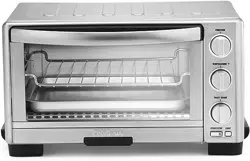
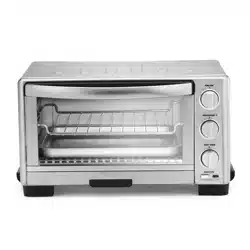
Convection Toaster Oven Broiler
TOB-60N1

2
CONTENTS
Important Safeguards...........................................2
Special Cord Set Instructions ....................................3
Features and Benefits ..........................................4
Before First Use ...............................................5
General Guidelines.............................................5
Operation ....................................................5
Cleaning and Maintenance ......................................6
Oven Rack and Pan Positions ....................................6
Troubleshooting ...............................................7
Warranty .....................................................7
Recipes......................................................8
IMPORTANT SAFEGUARDS
When using an electrical appliance, basic safety precautions should always be
followed, including the following:
1. Read all instructions.
2. UNPLUG FROM OUTLET WHEN NOT IN USE AND BEFORE CLEANING.
Allow to cool before cleaning or handling.
3. Do not touch hot surfaces. Use handles.
4. To protect against electrical shock, do not place any part of the toaster oven
broiler in water or other liquids. See instructions for cleaning.
5. This appliance should not be used by or near children or individuals with
certain disabilities.
6. Do not operate any appliance with a damaged cord or plug, or after the appli-
ance has malfunctioned or has been dropped or damaged in any way or is
not operating properly. Return the toaster oven broiler to the store or retailer
where purchased for examination or repair.
7. The use of accessory attachments not recommended by Cuisinart may cause
injury.
8. Do not use outdoors.
9. Do not let cord hang over the edge of the table or countertop, where it could
be pulled on inadvertently by children or pets, or touch hot surfaces, which
could damage the cord.
10. Do not place toaster oven broiler on or near a hot gas or electric burner or in
a heated oven.
11. Do not use this toaster oven broiler for anything other than its intended
purpose.
12. Extreme caution should be exercised when using containers constructed of
materials other than metal or glass in the toaster oven broiler.
13. To avoid burns, use extreme caution when removing tray or disposing of hot
grease.
14. When not in use, always unplug the unit. Do not store any materials other
than manufacturer’s recommended accessories in this oven.
15. Do not place any of the following materials in the oven: paper, cardboard,
plastic and similar products.
16. Do not cover crumb tray or any part of the oven with metal foil. This will cause
overheating of the oven.
17. Oversize foods, metal foil packages and utensils must not be inserted in the
toaster oven broiler, as they may involve a risk of fire or electric shock.
18. A fire may occur if the toaster oven broiler is covered or touching
flammable materials such as curtains, draperies or walls, when in operation.
Do not store any items on top of the appliance when in operation. Do not
operate under wall cabinets.
19. Do not clean with metal scouring pads. Pieces can break off the pad and
touch electrical parts, involving a risk of electric shock.
20. Do not attempt to dislodge food when the toaster oven broiler is plugged into
electrical outlet.
21. Warning: To avoid possibility of fire, NEVER leave toaster oven broiler
unattended during use.
22. Use recommended temperature settings for baking and roasting.
23. Do not rest cooking utensils or baking dishes on glass door.

3
24. Turn the ON/Toast Shade dial to the OFF position to turn off toaster oven
broiler.
25. Do not operate your appliance in an appliance garage or under a wall cabinet.
When storing in an appliance garage, always unplug the unit from the electri-
cal outlet. Not doing so could create a risk of fire, especially if the appliance
touches the walls of the garage or the door touches the unit as it closes.
SAVE THESE INSTRUCTIONS
Please read and keep these instructions handy. These instructions will help
you to use your Cuisinart
®
Convection Toaster Oven Broiler to its fullest so
that you will achieve consistent, professional results.
SPECIAL CORD SET INSTRUCTIONS
A short power-supply cord is provided to reduce the risks resulting from
becoming entangled in or tripping over a longer cord.
Extension cords are available and may be used if care is exercised
in their use.
If an extension cord is used, the marked electrical rating of the
extension cord must be at least as great as the electrical rating of the
appliance, and the longer cord should be arranged so that it will not
drape over the countertop or tabletop, where it can be tripped over or
pulled on by children.
NOTICE
This appliance has a polarized plug (one blade is wider than the other).
As a safety feature, this plug will fit in a polarized outlet only one way.
If the plug does not fit fully in the outlet, reverse the plug. If it still does
not fit, contact a qualified electrician. Do not attempt to defeat this
safety feature.
FOR HOUSEHOLD USE ONLY
NOT INTENDED
FOR COMMERCIAL USE
4
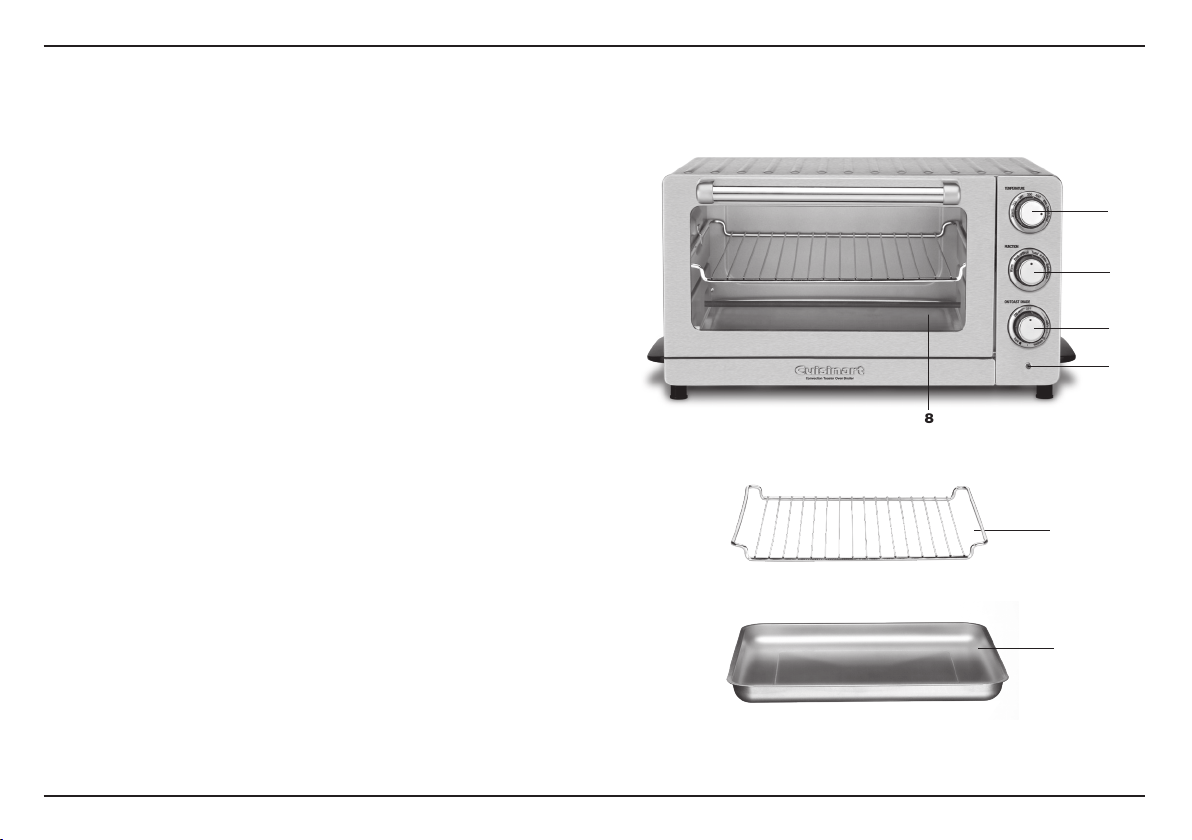
FEATURES AND BENEFITS
1. Temperature Dial
Select desired temperature for the baking, broiling or warm functions.
2. Function Dial
Select cooking method – Toast, Pizza/Bake, Broil, Convection Bake,
Convection Broil, or Warm.
3. ON/Toast Shade Control Dial
Set toast shade from light to dark. Or choose always ON feature so
that oven will continue to cook until you turn it off manually.
4. Oven On Indicator
Indicator light will remain lit when oven is in use.
5. Oven Rack
Has two positions. The top position has a 50% stop feature so
the rack stops halfway out of the oven. It can be removed by lifting
the front of the rack and sliding it out.
6. Slide-Out Crumb Tray (not shown)
The slide-out crumb tray comes already positioned in your oven. The
crumb tray slides out from the bottom of the toaster oven broiler, in
the front of the oven, for easy cleaning.
7. Cord Storage (not shown)
Take up excess cord and keep countertop neat.
8. Easy-Clean Interior
The sides of the oven are coated, providing an easy-to-clean surface.
9. Baking Pan/Drip Tray
A baking pan/drip tray is included for your convenience.
8
5
1
2
3
4
9

5
BEFORE FIRST USE
Place your oven on a flat surface.
Before using your oven, move it 2 to 4 inches away from the wall or from any
objects on the countertop. Do not use on heat-sensitive surfaces.
OBJECTS SHOULD NOT BE STORED ON THE TOP OF THE OVEN. IF THEY
ARE, REMOVE ALL OBJECTS BEFORE YOU TURN ON YOUR OVEN. THE
EXTERIOR WALLS GET VERY HOT WHEN IN USE. KEEP OUT OF REACH OF
CHILDREN.
GENERAL GUIDELINES
Pizza/Bake: This function can be used as you would normally use your kitchen
oven for roasting meats, including chicken, or for delicate baked goods like cakes
and custards.
Use the provided baking pan for making fresh pizza. When baking frozen pizza,
place directly on the rack.
Convection Bake: Convection baking uses a fan to circulate heated air around
food as it cooks. Use this function for baked goods that require even browning like
muffins, scones, cookies, pastry and bread.
Most baking recipes recommend reducing temperatures by 25 degrees when using
the convection feature. Always check doneness 10 minutes before suggested
cooking time.
Broiling: Broiling function can be used for beef, chicken, pork, fish and more. It
also can be used to top-brown casseroles and gratins. Convection broil is best
for meats and fish, while traditional broil should be reserved for top browning.
Caution: Aluminum foil is not recommended for covering the rack or tray. If cov-
ered, the foil prevents the fat from dripping into the drip tray. Grease will accumu-
late on the foil surface and may catch fire. If you choose to use foil to cover the
drip tray, be sure foil is tucked neatly around the pan and does not touch the wall
or heating elements.
Toasting: Always have the rack in the upper toasting position, as indicated in the
diagram on page 6, for even toasting. Always position your item/items in the mid-
dle of the rack.
WARNING: Placing the rack in the lower position or in the upper position with
the rack upward while toasting may result in a fire. Refer to rack position
diagram for proper use.
Turning off the toaster oven broiler: Turn the ON/Toast Shade dial to OFF. The
indicator light will turn off.
OPERATION
Unwind the power cord. Check that the crumb tray is in place and that there is
nothing in the oven. Plug power cord into the wall outlet.
Broil or Convection Broil
Set temperature dial to Broil. Then set the function dial to either Broil or Conv
Broil. Turn ON Toast Shade dial to the always ON position.
To stop Broil operation, turn ON/Toast Shade dial to OFF position.
Note: Never use glass oven dishes to broil.
Pizza/Bake
If making fresh pizza, place directly in the pan in the lower position. If making
frozen pizza, place directly on the rack in the lower position. For chicken or other
large items, the pan can be in the lower position. Turn the temperature dial to the
desired temperature, turn function dial to Bake position and turn ON/Toast Shade
dial to the always ON position. The oven indicator light will turn on. You will need
to turn off the oven manually by turning the ON/Toast Shade dial to the OFF posi-
tion. Preheat oven for five to 10 minutes (time will vary depending upon desired
temperature); then begin to bake.
Convection Bake
Place the pan in upper position for baking. For chicken or other large items, the
pan can be in the lower position. Turn the temperature dial to the desired tempera-
ture, turn function dial to Convection Bake and turn ON/Toast Shade dial to the
always ON position. The oven indicator light will turn on. You will need to turn off
the oven manually by turning the ON/Toast Shade dial to the OFF position. Preheat
oven for five to 10 minutes (time will vary depending upon desired temperature);
then begin to convection bake.
Most baking recipes recommend reducing temperatures by 25 degrees when using
the convection feature. Always check 10 minutes before suggested cooking time.
6
Warm
To keep food warm, turn the temperature dial to Warm; turn the function dial to
Warm and set the ON/Toast Shade dial to the always ON position. The
oven indicator light will turn on. Preheat oven for five minutes.
Toast
To toast, make sure the oven rack is in the upper position, as indicated in the dia-
gram. If toasting two items, center them in the middle of the rack. Four items should
be evenly spaced – two in front, two in back. Six items should be evenly spaced –
three in front, three in back.
Shade Selection
Turn temperature dial to Toast. Set function dial to Toast. Turn the ON/Toast Shade
dial to desired shade setting from light to dark within the marked settings on this
dial. This will turn on the toaster oven broiler and the oven indicator light will turn on.
Stop Toasting
When the toasting cycle is finished, the oven will ring once and turn off. If you wish
to stop the toasting cycle before it is finished, simply turn the ON/Toast Shade dial
to OFF. The toaster oven broiler will cancel your toast cycle.
Important Notes on Toasting
The oven rack must be in the upper position as indicated in the diagram on this
page.
CLEANING AND MAINTENANCE
Always allow the oven to cool completely before cleaning.
1. Always unplug the oven from the electrical outlet.
2. Do not use abrasive cleaners, as they will damage the finish. Simply
wipe the exterior with a clean, damp cloth and dry thoroughly. Apply the
cleansing agent to a cloth, not directly onto the toaster oven, before cleaning.
3. To clean interior walls, use a damp cloth and a mild liquid soap solution
or a spray solution on a sponge. Never use harsh abrasives or corrosive
products. These could damage the oven surface. Never use steel wool pads,
etc., on interior of oven.
4. To remove crumbs, slide out the crumb tray and discard crumbs. Wipe clean and
replace. To remove baked-on grease, soak the tray in hot, sudsy water or use
nonabrasive cleaners. Never operate the oven without the crumb tray in place.
5. Wire rack, baking pan and crumb tray should be handwashed in hot, sudsy water
or use a nylon scouring pad or nylon brush.
6. Never wrap the cord around the outside of the oven. Use the cord storage cleats
on the back of the oven.
7. Any other servicing should be performed by an authorized service representative.
IMPORTANT
After cooking greasy foods and after your oven has cooled, always clean top interior
of oven. If this is done on a regular basis, your oven will perform like new. Removing
the grease will help to keep toasting consistent, cycle after cycle.
All of our recipes have been tested in our kitchen and are specially developed to
work in the Cuisinart
®
Convection Toaster Oven Broiler. These mouth-watering
recipes are just a sampling of what this appliance can do.
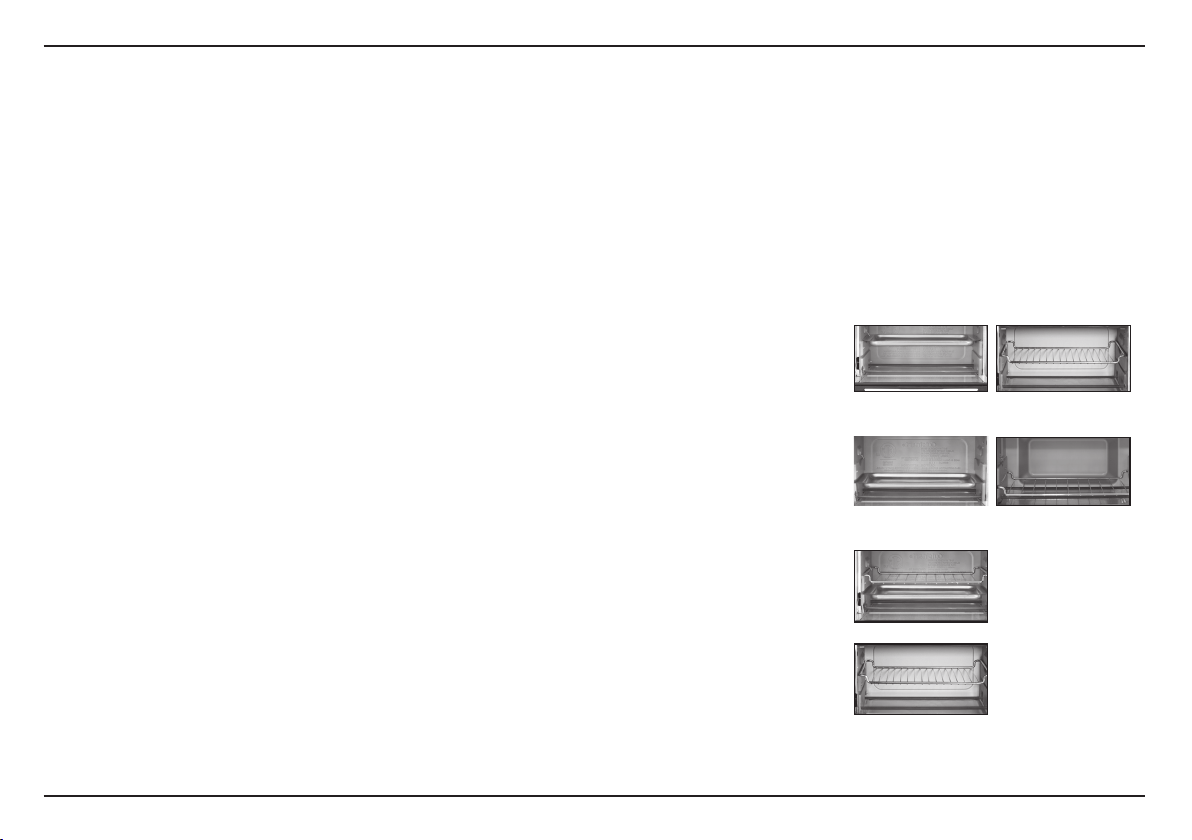
OVEN RACK AND PAN POSITION DIAGRAMS
Each recipe gives you step-by-step directions and will even tell you where the
oven rack and pan should be positioned for best results. Please refer to the
diagram below for oven rack positions.
UPPER POSITION FOR BAKING
NOTE: For chicken or other large
items the pan or rack can be in the
lower position.
LOWER POSITION FOR BAKING
POSITION FOR BROILING
POSITION FOR TOASTING
WARNING: Placing the rack in the bottom position or in the top
position with the rack upward while toasting may result in a fire. Refer
to rack position diagram for proper use.
Warm
To keep food warm, turn the temperature dial to Warm; turn the function dial to
Warm and set the ON/Toast Shade dial to the always ON position. The
oven indicator light will turn on. Preheat oven for five minutes.
Toast
To toast, make sure the oven rack is in the upper position, as indicated in the dia-
gram. If toasting two items, center them in the middle of the rack. Four items should
be evenly spaced – two in front, two in back. Six items should be evenly spaced –
three in front, three in back.
Shade Selection
Turn temperature dial to Toast. Set function dial to Toast. Turn the ON/Toast Shade
dial to desired shade setting from light to dark within the marked settings on this
dial. This will turn on the toaster oven broiler and the oven indicator light will turn on.
Stop Toasting
When the toasting cycle is finished, the oven will ring once and turn off. If you wish
to stop the toasting cycle before it is finished, simply turn the ON/Toast Shade dial
to OFF. The toaster oven broiler will cancel your toast cycle.
Important Notes on Toasting
The oven rack must be in the upper position as indicated in the diagram on this
page.
CLEANING AND MAINTENANCE
Always allow the oven to cool completely before cleaning.
1. Always unplug the oven from the electrical outlet.
2. Do not use abrasive cleaners, as they will damage the finish. Simply
wipe the exterior with a clean, damp cloth and dry thoroughly. Apply the
cleansing agent to a cloth, not directly onto the toaster oven, before cleaning.
3. To clean interior walls, use a damp cloth and a mild liquid soap solution
or a spray solution on a sponge. Never use harsh abrasives or corrosive
products. These could damage the oven surface. Never use steel wool pads,
etc., on interior of oven.
4. To remove crumbs, slide out the crumb tray and discard crumbs. Wipe clean and
replace. To remove baked-on grease, soak the tray in hot, sudsy water or use
nonabrasive cleaners. Never operate the oven without the crumb tray in place.
5. Wire rack, baking pan and crumb tray should be handwashed in hot, sudsy water
or use a nylon scouring pad or nylon brush.
6. Never wrap the cord around the outside of the oven. Use the cord storage cleats
on the back of the oven.
7. Any other servicing should be performed by an authorized service representative.
IMPORTANT
After cooking greasy foods and after your oven has cooled, always clean top interior
of oven. If this is done on a regular basis, your oven will perform like new. Removing
the grease will help to keep toasting consistent, cycle after cycle.
All of our recipes have been tested in our kitchen and are specially developed to
work in the Cuisinart
®
Convection Toaster Oven Broiler. These mouth-watering
recipes are just a sampling of what this appliance can do.
OVEN RACK AND PAN POSITION DIAGRAMS
Each recipe gives you step-by-step directions and will even tell you where the
oven rack and pan should be positioned for best results. Please refer to the
diagram below for oven rack positions.
UPPER POSITION FOR BAKING
NOTE: For chicken or other large
items the pan or rack can be in the
lower position.
LOWER POSITION FOR BAKING
POSITION FOR BROILING
POSITION FOR TOASTING
WARNING: Placing the rack in the bottom position or in the top
position with the rack upward while toasting may result in a fire. Refer
to rack position diagram for proper use.

7
QUESTION ANSWER
Why is my food burning?
a.
Check if you are in convection mode. Convection
can speed up cooking, so you should try less
time and/or lower the temperature.
b.
Adjust oven rack position. Food may be too
close to heating elements.
c.
Because of its smaller capacity, countertop
ovens heat up quicker than convectional
ovens and may require less time and/or lower
temperature for cooking. .
Why would I use convection?
a.
Convection uses a small fan to circulate hot air
around food for even cooking, often resulting in
quicker cook times.
Why is there condensation on the
oven door?
a.
This is normal, as moisture is created from
cooking high-moisture foods; it will dissipate
during the cooking process.
Why are the heating elements
going on and off, and/or aren’t all
on at the same time?
a.
Heating elements cycle on and off to achieve
temperature accuracy.
b.
Different functions utilize the heating elements
differently; for instance, Broil only uses the top
heating elements.
Why isn’t my oven heating up?
a.
Make sure your unit is securely plugged into a
wall outlet and the door is properly sealed.
b.
Make sure to turn knob to left ON position.
c.
Call Customer Service.
Why is there smoke/odor?
a.
Smoke and/or odor are normal during the first
use of your oven. It will not continue after the
initial heating period.
b.
If smoke and/or odor appear after first use, make
sure there is no food residue on the heating
elements (do not clean heating elements until
unit is turned off and has cooled down).
Why is only one side of my toast
toasting?
a.
The unit has a Bagel function, where the top is
meant to get darker than the bottom. Make sure
you are in the right Toast function.
TROUBLESHOOTING
WARRANTY
Limited Three-Year Warranty
(U.S. and Canada ONLY)
This warranty is available to consumers only. You are a consumer if you own a
Cuisinart
®
Toaster Oven Broiler that was purchased at retail for personal, family
or household use. Except as otherwise required under applicable law, this
warranty is not available to retailers or other commercial purchasers or owners.
We warrant that your Cuisinart
®
Toaster Oven Broiler will be free of defects in
materials and workmanship under normal home use for 3 years from the date
of original purchase.
We recommend that you visit our website, www.cuisinart.com for a fast,
efficient way to complete your product registration. However, product
registration does not eliminate the need for the consumer to maintain the
original proof of purchase in order to obtain the warranty benefits. In the event
that you do not have proof of purchase date, the purchase date for purposes of
this warranty will be the date of manufacture.
CALIFORNIA RESIDENTS ONLY
California law provides that for In-Warranty Service, California residents have
the option of returning a nonconforming product (A) to the store where it was
purchased or (B) to another retail store that sells Cuisinart
products of the
same type. The retail store shall then, according to its preference, either repair
the product, refer the consumer to an independent repair facility, replace the
product, or refund the purchase price less the amount directly attributable
to the consumer’s prior usage of the product. If neither of the above two
options results in the appropriate relief to the consumer, the consumer may
then take the product to an independent repair facility, if service or repair
can be economically accomplished. Cuisinart and not the consumer will be
responsible for the reasonable cost of such service, repair, replacement, or
refund of nonconforming products under warranty. California residents may
also, according to their preference, return nonconforming products directly to
Cuisinart for repair or, if necessary, replacement by calling our

8
BEFORE RETURNING YOUR CUISINART PRODUCT
If your Cuisinart
®
Convection Toaster Oven Broiler should prove to
be defective within the warranty period, we will repair or, if we think
necessary, replace it. To obtain warranty service, please call our
Consumer Service Center toll-free at 1-800-726-0190 or write to:
Cuisinart, 7475 North Glen Harbor Blvd., Glendale, AZ 85307. To facilitate
the speed and accuracy of your return, enclose $10.00 for shipping and
handling. (California residents need only supply a proof of purchase and
should call 1-800-726-0190 for shipping instructions.) Please be sure to
include your return address, phone number, description of the product’s
defect, product serial number, and any other information pertinent to the
return. Please pay by check or money order. NOTE: For added protection
and secure handling of any Cuisinart product that is being returned,
we recommend you use a traceable, insured delivery service. Cuisinart
cannot be held responsible for in-transit damage or for packages that are
not delivered to us. Lost and/or damaged products are not covered under
warranty.
Your Cuisinart
®
Convection Toaster Oven Broiler has been manufactured
to the strictest specications and has been designed for use only with
authorized accessories and replacement parts. This warranty expressly
excludes any defects or damages caused by accessories, replacement
parts or repair service other than those authorized by Cuisinart. This
warranty does not cover any damage caused by accident, misuse,
shipment or other than ordinary household use. This warranty excludes
all incidental or
consequential
damages. Some states do not allow the
exclusion or limitation of these damages, so these exclusions may not
apply to you. You may also have other rights, which vary from state to
state.
Important: If the nonconforming product is to be serviced by someone
other than Cuisinart’s Authorized Service Center, please remind the
servicer to call our Consumer Service Center at 1-800-726-0190 to
ensure that the problem is properly diagnosed, the product is serviced
with the correct parts, and to ensure that the product is still under
warranty.
RECIPES
Cranberry Bran Muffins
Makes 6 muffins
nonstick cooking spray
¾ cup unbleached, all-purpose flour
¼ cup whole-wheat flour
¾ teaspoon kosher salt
¼ teaspoon baking soda
½ teaspoon baking powder
½ teaspoon ground cinnamon
¼ cup unsalted butter, room temperature
¼ cup packed light brown sugar
1 large egg, lightly beaten
2½ tablespoons honey
1 teaspoon pure vanilla extract
2
/3 cup buttermilk
½ cup dried cranberries
¼ cup wheat germ
1. Preheat the Cuisinart
®
Convection Toaster Oven Broiler to 375°F on
Convection Bake with the rack in the lower position. Lightly coat a
6-cup muffin tin with nonstick cooking spray. Reserve.
2. In a small mixing bowl, add the flours, salt, baking soda, baking
powder and cinnamon. Whisk to combine; reserve.
3. Using a Cuisinart
®
Hand or Stand Mixer fitted with the paddle/beating
attachment(s), mix the butter until creamy. Add the brown sugar and
beat until light and fluffy. Add the egg, honey and vanilla and mix
until fully combined. While mixing, slowly add one-third of the dry
mixture, then follow with half of the buttermilk – adding when the
batter is still streaky with flour. Continue in that pattern – do not
overmix. Gently fold in the cranberries and wheat germ.

9
4. Pour evenly into prepared muffin tin. Bake for about 25 minutes, or
until muffin tops spring back when pressed and a cake tester comes out
clean.
Nutritional information per muffin:
Calories 228 (34% from fat) • carb. 34g • pro. 5g • fat 9g • sat. fat 5g • chol. 55mg
• sod. 380mg • calc. 53mg • fiber 3g
Sausage, Spinach and Fontina Quiche
Makes one 9-inch deep-dish quiche, 8 to 12 servings
½ recipe Pâte Brisée (see page 25)
6 ounces sweet Italian sausage, casings removed
2 tablespoons unsalted butter or olive oil
2 garlic cloves, finely chopped
2 cups packed baby spinach
½ teaspoon kosher salt, divided
½ teaspoon freshly ground black pepper, divided
1 cup whole milk
1 cup heavy cream
4 large eggs
½ cup shredded fontina (about 3 ounces)
1. Roll out the dough into a 10-inch disc about
1
⁄8-inch thick. Fit into
an ungreased 9-inch deep-dish pie plate. Chill in refrigerator for
about 20 minutes.
2. Preheat the Cuisinart
®
Convection Toaster Oven Broiler to 350°F on
Pizza/Bake with the rack in the lower position. Using a fork, prick the
dough evenly all over, but make sure not to go entirely through the
dough. Line the shell with parchment and weigh down with dried
beans or rice. Bake in preheated oven for 20 to 22 minutes, or until
the dough under the parchment is no longer wet. Remove the beans/
rice and parchment and continue baking until the shell is golden
brown, about an additional 15 minutes. Remove; reserve.
3. Heat a skillet over medium-high heat. Add the sausage, breaking it
up with a spatula or the back of a wooden spoon. Sauté until lightly
browned; reserve. Do not clean out pan.
4. Add the butter to the hot pan. When it has melted, add the garlic and
sauté until golden. Add the spinach, about a quarter-cup at a time,
and a pinch each of the salt and pepper. Sauté until bright and wilt-
ed; add to sausage and stir to combine; reserve.
5. In a medium bowl, mix the milk, cream, eggs and remaining salt and
pepper. Using a Cuisinart
®
Hand or Stand Mixer fitted with the whisk
attachment, whip the mixture until completely combined. Spread the
sausage/spinach mixture evenly on the bottom of the tart shell. Pour
in the liquid mixture and top with the fontina.
6. Bake about 40 to 60 minutes, or until the quiche has browned on top
and is just set.
Nutritional information per serving (based on 12 servings):
Calories 300 (75% from fat) • carb. 10g • pro. 9g • fat 25g • sat. fat 7g • chol. 110mg
• sod. 380mg • calc. 98mg • fiber 0g
French Toast Strata
Give your family a new twist on French toast this weekend. To save
time, prepare it the night before and then bake in the morning.
Makes 8 servings
nonstick cooking spray
4 large eggs
2 cups whole milk
1 cup heavy cream
1 tablespoon pure vanilla extract
1
⁄3 cup maple syrup
2 teaspoons ground cinnamon
1 teaspoon ground nutmeg
¼ teaspoon kosher salt
1 loaf (1 pound) challah bread, cut into ½-inch x 9-inch strips
2 tablespoons packed light brown sugar, divided
2 tablespoons unsalted butter, cut into ½-inch cubes

10
1. Lightly coat a 9-inch square pan with nonstick cooking spray;
reserve.
2. Add the eggs, milk, heavy cream, vanilla extract, syrup, spices and
salt to a medium mixing bowl. Using a Cuisinart
®
Hand Mixer fitted
with the chef’s whisk, beat the mixture until foamy.
3. Tightly fit half of the challah bread strips into the bottom of the pre-
pared pan. Pour half of the egg mixture on top and evenly sprinkle
with half of the brown sugar. Repeat with the remaining bread, layer-
ing in the opposite direction of the first layer of bread. Pour the
remaining egg mixture on top, sprinkle with the remaining brown
sugar. Cover and chill in the refrigerator for at least 2 hours, or
overnight.
4. Remove the strata from the refrigerator and bring to room tempera-
ture. Preheat the Cuisinart
®
Convection Toaster Oven Broiler to 350°F
on Convection Bake with the rack in the lower position. Dot the top
of the strata with the butter and loosely cover with aluminum foil.
Bake in preheated oven for about 15 minutes; remove foil and bake
for an additional 10 minutes, or until the internal temperature of the
strata reaches 160°F.
5. Remove and serve immediately.
Nutritional information per serving:
Calories 420 (47% from fat) • carb. 44g • pro. 11g • fat 22g • sat. fat 12g • chol. 190mg
• sod. 430mg • calc. 177mg • fiber 2g
Stuffed Mushrooms
Makes 16 servings
16 stuffing mushrooms (about 14 ounces)
½ cup panko (Japanese breadcrumbs)
¼ teaspoon dried basil
½ teaspoon dried oregano
1 tablespoon fresh parsley
¼ teaspoon kosher salt
½ teaspoon freshly ground black pepper
3 tablespoons olive oil, divided
1 garlic clove, finely chopped
2 tablespoons grated Parmesan
1. Clean the mushrooms and remove and reserve the stems.
2. In the bowl of a Cuisinart
®
Mini Chopper or Food Processor, add the
panko, basil, oregano, parsley, salt and pepper. Process until finely
ground. Add the mushroom stems and pulse to chop. Reserve.
3. Heat 1 tablespoon of the oil in a medium skillet over medium-low
heat. Add the garlic and sauté until softened and golden. Add the
panko mixture and sauté until mixture is very soft and toasted, add-
ing one tablespoon of oil halfway through cooking – this should take
about 5 minutes. Stir in the Parmesan and combine.
4. Preheat the Cuisinart
®
Convection Toaster Oven Broiler to 425°F on
Pizza/Bake.
5. Line the baking pan with aluminum foil. Place the mushroom caps on
the prepared pan and evenly divide the breadcrumb mixture among
the mushrooms, mounding the mixture in each mushroom. Drizzle
the remaining olive oil over the prepared mushrooms. Slide the pan
into the upper position and bake in preheated oven for about 5 to 7
minutes, or until the tops are browned.
6. Remove and let cool for 5 minutes. Serve warm or at room temperature.
Nutritional information per serving:
Calories 40 (65% from fat) • carb. 2g • pro. 1g • fat 3g • sat. fat 0g • chol. 0mg
• sod. 45mg • calc. 9mg • fiber 0g

11
Gorgonzola and Ricotta Bruschetta
Makes 12 bruschetta
12 slices (½-inch thick) French bread
1 garlic clove, smashed
1½ tablespoons extra virgin olive oil
1 cup ricotta, strained
2 tablespoons grated Parmesan
½ teaspoon kosher salt
½ teaspoon freshly ground black pepper
pinch ground nutmeg
½ cup crumbled Gorgonzola
½ to 1 tablespoon honey
1. Preheat the Cuisinart
®
Convection Toaster Oven Broiler to 375°F on
Pizza/Bake with the rack in the upper position and the pan in the
lower position.
2. Rub one side of each slice of bread with garlic and then brush with
olive oil. Carefully place on the rack and bake in the preheated oven
for about 2 to 3 minutes per side, or until lightly toasted.
3. While bread is toasting, prepare topping. In a small bowl, add the
ricotta, Parmesan, salt, pepper and nutmeg. Stir to combine.
Distribute evenly on the toasted bread slices, and then top with the
Gorgonzola. Return to rack and then set on Broil for about 3 minutes,
or until cheese is fully warmed.
4. Drizzle honey over bruschetta and serve immediately.
Nutritional information per bruschetta:
Calories 120 (46% from fat) • carb. 11g • pro. 5g • fat 6g • sat. fat 3g • chol. 10mg
• sod. 300mg • calc. 108mg • fiber 1g
Roasted Vegetable Quesadillas
Makes 2 quesadillas (4 servings)
¼ medium zucchini (approximately 2 ounces), cut into ½-inch
dice
½ red or yellow bell pepper (approximately 3 ounces), cut into
½-inch dice
½ jalapeño, seeded and finely chopped
¼ medium onion (approximately 2 ounces), sliced
1 garlic clove, smashed
1 teaspoon olive oil, plus ½ tablespoon for brushing
¼ teaspoon kosher salt
¼ teaspoon freshly ground black pepper
¼ cup frozen corn kernels
1 tablespoon cilantro, roughly chopped
1 ounce Monterey Jack, shredded
1 ounce goat cheese
2 10-inch flour tortillas
Nonstick cooking spray
1. Preheat the Cuisinart
®
Convection Toaster Oven Broiler to 400°F on
Pizza/Bake.
2. Toss the zucchini, peppers, onion, garlic, 1 teaspoon of the olive oil,
salt and pepper together in a mixing bowl. Line the baking pan with
aluminum foil and transfer the vegetables to the prepared pan.
Carefully slide the pan into the upper position. Bake in preheated
oven until vegetables are softened and browned, about 20 minutes.
Discard garlic and return remaining vegetables to mixing bowl; toss
with the corn and cilantro.
3. Assemble quesadillas: Lay the tortillas on a work surface. Place equal
amounts of the vegetable mixture on half of each tortilla, then place
even amounts of cheese on each. Fold each in half, making a half-
moon shape.

12
4. Spray prepared baking pan with cooking spray. Place the quesadillas
on baking pan and brush the tops lightly with oil. Bake quesadillas at
400°F for about 6 to 6½ minutes, until tops are golden and cheese is
melted.
5. Cut quesadillas in half and serve with salsa, guacamole, and/or sour
cream.
Nutritional information per serving:
Calories 190 (38% from fat) • carb. 23g • pro. 7g • fat 8g • sat. fat 4g • chol. 10mg
• sod. 860mg • calc. 123mg • fiber 2g
Twice-Baked Potatoes
Makes 8 servings
4 Idaho or russet potatoes (10 to 12 ounces each)
1 teaspoon olive oil, divided
2
⁄3 cup lowfat milk
2 tablespoons unsalted butter, plus 1 teaspoon for finishing
½ cup sour cream
½ teaspoon kosher salt
½ teaspoon freshly ground black pepper
¼ cup chopped fresh chives
1. Preheat the Cuisinart
®
Convection Toaster Oven Broiler to 400°F on
Pizza/Bake with the rack in the lower position.
2. Rub each potato with ¼ teaspoon of olive oil, and then evenly prick
about 6 to 8 times with a fork. Place potatoes directly on the rack
and bake for about 55 to 60 minutes. Remove and let cool slightly.
Carefully remove the rack and reduce oven temperature to 375°F.
3. When potatoes are cool enough to handle, cut off top quarter of each
potato and scoop out cooked potato, leaving a ¼-inch-thick potato
shell. Reserve cooked potato and skin shells.
4. In a medium bowl put cooked potato, milk and 2 tablespoons of the
butter. Using a potato masher or hand mixer, mash/beat until
smooth. Add sour cream, salt, pepper, and chives. Mash/beat to
combine completely. Generously fill the potato shells with sour cream
and chive-potato mixture. (Potatoes may be prepared a day ahead to
this point – cover and refrigerate. Bring to room temperature before
baking.) Place the potatoes on the baking pan. Melt remaining tea-
spoon of butter and drizzle on potatoes. Carefully slide the pan into
the lower position and bake for 35 to 45 minutes, until potatoes are
hot and golden on the tops.
Nutritional information per serving (½ potato):
Calories 180 (31% from fat) • carb. 27g • pro. 4g • fat 6g • sat. fat 4g • chol. 20mg
• sod. 160mg • calc. 58mg • fiber 3g
Oven-Roasted Steak Fries
Makes 2 servings
1 pound Idaho or russet potatoes (about 2 to 3 medium
potatoes), cut into ½-inch wedges
2 tablespoons olive oil
½ teaspoon kosher salt
¼ teaspoon freshly ground black pepper
pinch cayenne
1. Preheat the Cuisinart
®
Convection Toaster Oven Broiler to 425°F on
Pizza/Bake.
2. Place potatoes in a medium to large mixing bowl. Toss with the
remaining ingredients. Line the baking pan with aluminum foil and
arrange the potatoes, cut side down.
3. Carefully slide the pan into the lower position. Bake for about 30 min-
utes, turning the potatoes halfway through the cooking time.
4. Remove and adjust seasonings to taste. Serve immediately.
Nutritional information per serving (1 cup):
Calories 130 (91% from fat) • carb. 3g • pro. 0g • fat 14g • sat. fat 2g • chol. 0mg
• sod. 530mg • calc. 3mg • fiber 0g

13
Roasted Sweet Potatoes
Makes 4 servings
1¾ pounds (about 2 to 3 large) sweet potatoes, cut lengthwise
into quarters
4 tablespoons unsalted butter, melted
½ teaspoon kosher salt
2 tablespoons packed light brown sugar
1. Preheat the Cuisinart
®
Convection Toaster Oven Broiler to 375°F on
Pizza/Bake.
2. Place potatoes in a medium to large mixing bowl. Toss with the
remaining ingredients. Line the baking pan with aluminum foil and
arrange the potatoes cut-side down.
3. Carefully slide the pan into the lower position. Bake for about 35 min-
utes, turning the potatoes every 10 minutes.
4. Remove and serve immediately.
Nutritional information per serving (1 cup):
Calories 290 (34% from fat) • carb. 46g • pro. 3g • fat 11g • sat. fat 7g • chol. 30mg
• sod. 380mg • calc. 60mg • fiber 6g
Roasted Asparagus
Makes 4 servings
1 pound asparagus
1 teaspoon extra virgin olive oil
¼ teaspoon kosher salt
¼ teaspoon freshly ground black pepper
1. Preheat the Cuisinart
®
Convection Toaster Oven Broiler to 425°F on
Pizza/Bake.
2. Wash and thoroughly dry asparagus and trim the rough ends.
Place asparagus in a mixing bowl and toss with the olive oil, salt and
pepper.
3. Line the baking pan with aluminum foil and arrange asparagus on
the pan. Carefully slide the pan into the upper position and bake in
preheated oven for 10 to 15 minutes, until the asparagus is tender.
4. Serve immediately.
Nutritional information per serving:
Calories 36 (29% from fat) • carb. 4g • pro. 3g • fat 2g • sat. fat 0g • chol. 0mg
• sod. 135mg • calc. 28mg • fiber 2g
Roasted Fennel, Carrots and Parsnips
Makes 4 servings
2 fennel bulbs, quartered
3 medium carrots, cut into 1-inch pieces
1 large parsnip, cut into 1-inch pieces
1 garlic clove, smashed
3 tablespoons olive oil
1 teaspoon fresh thyme
½ teaspoon kosher salt
¼ teaspoon freshly ground black pepper
pinch ground cinnamon
1. Preheat the Cuisinart
®
Convection Toaster Oven Broiler to 450°F on
Pizza/Bake.
2. Place vegetables in a medium to large mixing bowl and toss with the
remaining ingredients.

14
3. Arrange the vegetables in the baking pan lined with aluminum foil.
Carefully slide the pan into the upper position and bake in preheated
oven for 45 minutes, tossing every 15 to 20 minutes.
Nutritional information per serving (½ cup):
Calories 170 (54% from fat) • carb. 18g • pro. 2g • fat 11g • sat. fat 2g • chol. 0mg
• sod. 360mg • calc. 85mg • fiber 6g
Broccoli and Cauliflower Gratin
Makes 8 servings
nonstick cooking spray
1½ pounds broccoli florets
1 pound cauliflower florets
1½ teaspoons olive oil
1 garlic clove, finely chopped
½ medium onion, finely chopped
½ teaspoon kosher salt
¾ teaspoon freshly ground black pepper
2 cups shredded Cheddar, divided
¾ cup panko (Japanese breadcrumbs), divided
¼ cup grated Parmesan, divided
1. Lightly and evenly coat a 9-inch square pan with nonstick cooking
spray; reserve.
2. In a large stockpot, bring salted water to a boil. Add broccoli and
cauliflower and cook 2 to 3 minutes, until bright and just tender.
Immediately put vegetables into a large bowl of ice water. Once
cooled, drain and reserve.
3. Heat the oil in a medium skillet set over medium-low heat. Once hot
and shimmering, add the garlic and onion and cook 2 to 3 minutes,
or until slightly softened.
4. Preheat the Cuisinart
®
Convection Toaster Oven Broiler to 400°F on
Pizza/Bake with the rack in the lower position.
5. Add the blanched vegetables, the garlic and onion, salt, pepper, half
of the Cheddar and half of the breadcrumbs to a large mixing bowl.
Stir to completely combine. Transfer mixture to the prepared pan and
then top with the reserved cheeses and breadcrumbs. Bake 15 min-
utes, or until the cheeses begin to brown.
6. Serve immediately.
Nutritional information per serving:
Calories 190 (49% from fat) • carb.13g • pro.12g • fat 11g • sat. fat 6g • chol. 30mg
• sod. 280mg • calc. 284mg • fiber 2g
White Pizza with Prosciutto, Arugula
and Tomatoes
Makes one 12-inch pizza (8 servings)
nonstick cooking spray
1
⁄3 recipe Pizza Dough (page 26)
1 tablespoon extra virgin olive oil
1–1½ ounces (about 4 to 6 slices) prosciutto, halved
3 medium garlic cloves, finely chopped, divided
1 cup halved grape tomatoes
2 cups packed arugula
1½ cups ricotta, strained
½ cup grated Parmesan (about 2 ounces)
pinch kosher salt
½ teaspoon freshly ground black pepper
1. Preheat the Cuisinart
®
Convection Toaster Oven Broiler to 425°F on
Pizza/Bake.

15
2. Lightly coat the baking pan with nonstick cooking spray. Roll out/
stretch the pizza dough into a 10x9-inch rectangle (to fit the pan). Fit
into the prepared pan. Brush the outer edge of the dough with olive
oil. Carefully slide into the lower position. Bake in preheated oven for
about 6 to 8 minutes, or until dough is lightly golden.
3. While dough is baking, put a medium skillet over medium-high heat.
Once the pan is hot, add the prosciutto. Sauté until crisp; remove
and reserve.
4. Add
2
⁄3 of the chopped garlic to the hot pan. Sauté until fragrant, and
then add the tomatoes. When tomatoes just begin to soften, stir in
the arugula, about ¼ cup at a time. Cook until the arugula is wilted;
remove and reserve.
5. In a medium bowl, mix the strained ricotta, Parmesan, remaining gar-
lic, salt and pepper until well combined. Reserve.
6. Spread the ricotta mixture evenly over the partially baked pizza
dough. Top the ricotta with the arugula mixture and then finish with
the prosciutto. Carefully slide the pan into the lower position. Bake in
preheated oven for about 10 to 12 minutes, or until the dough is
golden and crisp and the cheeses start to bubble and brown on top.
7. Remove the pizza from the oven. Cut into slices and serve immedi-
ately.
Nutritional information per serving:
Calories 160 (30% from fat) • carb. 19g • pro. 10g • fat 6g • sat. fat 3g • chol. 20mg
• sod. 400mg • calc. 167mg • fiber 2g
Tomato, Onion and Bacon Pizza
Makes one 12-inch pizza (8 servings)
3 slices bacon
nonstick cooking spray
1
⁄3 recipe Pizza Dough (page 26)
1 tablespoon extra virgin olive oil
1 cup hearty pizza sauce, strained
6 ounces fresh mozzarella, cubed
1 plum tomato, cut into ½-inch slices
¼ medium onion, thinly sliced
1 tablespoon thinly sliced basil leaves
1. Line the baking pan with aluminum foil. Lay the bacon on the pre-
pared pan and slide into the upper position of the Cuisinart
®
Convection Toaster Oven Broiler. Set to Broil and cook for about 8
minutes, or until bacon is almost crisp. Carefully remove pan and
transfer bacon to a separate dish and reserve. Wipe pan clean and
then lightly coat with nonstick cooking spray.
2. Preheat oven to 425°F on Pizza/Bake.
3. Roll out/stretch dough into a 10x9-inch rectangle (to fit the pan). Fit
into the prepared pan and brush the outer edge of the dough with
olive oil. Carefully slide pan into the lower position and bake in pre-
heated oven for about 6 to 8 minutes, or until dough is lightly golden.
4. Spread the sauce evenly over the baked dough. Top with the cheese,
and then finish with the tomatoes, onions, bacon and basil. Carefully
slide pan into the lower position. Bake in preheated oven for about
12 to 14 minutes, or until the dough is nicely browned and the
cheese is melted and bubbling on top.
5. Remove the pizza from the oven. Cut into slices and serve immedi-
ately.
Nutritional information per serving:
Calories 200 (47% from fat) • carb. 19g • pro. 7g• fat 11g • sat. fat 5g • chol. 25mg
• sod. 330mg • calc. 3mg • fiber 3g

16
Zucchini, Tomato and Onion Tart
Makes 10 servings
½ recipe Pâte Brisée (page 26)
3 small zucchini
2 small onions
4 tablespoons olive oil, divided
½ teaspoon kosher salt, divided
½ teaspoon freshly ground black pepper, divided
3 tablespoons grated Parmesan
3 plum tomatoes
½–¾ ounce soft goat cheese
5 small basil leaves, thinly sliced (chiffonade)
1. Roll and shape the pâte brisée into a 12x4-inch rectangle. Fold up
the edges to ¼-inch high. Refrigerate for about 30 minutes.
2. While dough is chilling, prepare the vegetables. Preheat the Cuisinart
®
Convection Toaster Oven Broiler to 425°F on Pizza/Bake. Line the
baking pan with aluminum foil.
3. Using a Cuisinart
®
Food Processor fitted with the 4mm/medium slic-
ing disc, slice the zucchini and onions. In a medium bowl, toss the
sliced vegetables with 3 tablespoons of the olive oil and ¼ teaspoon
each of the salt and pepper. Arrange in a single layer on the prepared
baking pan. Roast for about 20 minutes, or until vegetables begin to
brown and soften. Transfer the vegetables to a separate dish and
discard the foil. Wipe pan clean of any excess oil, if necessary.
4. Switch the oven to 350°F on Convection Bake.
5. Remove the tart shell from the refrigerator and place on the baking
pan. Using a fork, prick the dough evenly all over, but make sure not
to go entirely through the dough. Line the shell with parchment and
weigh down with dried beans or rice. Carefully slide pan into the
lower position and bake for about 20 minutes, or until the dough
under the parchment is no longer wet. Remove the beans/rice and
parchment and sprinkle with the Parmesan. Return to oven and con-
tinue baking until the shell is golden brown, an additional 2 to 3 min-
utes. Reserve.
6. While the tart shell is pre-baking, slice the tomatoes in the food pro-
cessor, using the same 4mm/medium slicing disc. Lay the slices on a
towel-lined plate; sprinkle with the remaining salt. Reserve until ready
to use.
7. Once the tart shell is baked, prepare the tart. Arrange the vegetables
and the tomatoes in the baked tart shell by tightly overlapping them
in rows (start with one vegetable, using a different vegetable in each
row). Drizzle with the remaining tablespoon of olive oil and sprinkle
with the remaining pepper. Dot the tart with pea-sized pieces of the
goat cheese (use more or less, according to taste).
8. Carefully slide the pan into the lower position of the hot oven. Bake
20 minutes or until crust is fully browned and the vegetables are ten-
der and golden. Remove from oven and sprinkle with the sliced basil.
9. Serve warm or at room temperature.
Nutritional information per serving:
Calories 180 (67% from fat) • carb. 13g • pro. 3g • fat 14g • sat. fat 7g • chol. 25mg
• sod. 200mg • calc. 30mg • fiber 1g
Chicken, Vegetable and Black Bean
Burritos
Makes 4 servings
½ large zucchini, diced
1 small onion, thinly sliced
1 large carrot, diced
3 garlic cloves, roughly chopped
½ jalapeño, finely chopped
½ red bell pepper, chopped
¼ medium sweet potato, peeled and diced
2½ teaspoons olive oil, divided

17
¼ teaspoon kosher salt, divided
2
⁄3 cup frozen corn kernels (not thawed)
1 cup shredded cooked chicken
2 cups canned/cooked black beans (drained and rinsed, if using
canned)
1
⁄3 cup chopped cilantro
2 tablespoons fresh lime juice (about 1 to 2 limes)
pinch ground cumin
pinch chili powder
pinch dried oregano
pinch freshly ground black pepper
1 cup shredded Monterey Jack (about 4 ounces)
4 10-inch flour tortillas
1. Preheat the Cuisinart
®
Convection Toaster Oven Broiler to 400ºF on
Pizza/Bake. Line the baking pan with aluminum foil.
2. In a large mixing bowl, toss the vegetables (except for the corn) with
2 teaspoons of the olive oil and a pinch of salt. Arrange evenly on the
prepared baking pan. Carefully slide the pan into the upper position
and roast in the preheated oven for about 18 to 20 minutes, or until
vegetables are softened and are beginning to brown. Transfer the
vegetables back to the mixing bowl and toss with the corn, chicken,
beans, cilantro, lime juice, spices, pepper and remaining salt.
3. Spread one-quarter of the vegetable mixture in a line just below the
center of each tortilla. Top each with one-quarter of the cheese. Roll
the burritos and place them seam-side down in the same baking tray
on which the vegetables were roasted. Brush the top of each rolled
burrito with the remaining olive oil.
4. Carefully slide the pan into the lower position. Bake burritos in the
hot oven (still at 400°F) for 8 to 10 minutes, or until the tortillas are
just crisp and browned. Serve with guacamole, salsa and sour cream
for garnish.
Nutritional information per serving:
Calories 620 (35% from fat) • carb. 71g • pro. 33g • fat 25g • sat. fat 8g • chol. 55mg
• sod. 1mg • calc. 373mg • fiber 12g
Baked Rigatoni with Chicken Sausage,
Broccolini and Peppers
Makes 6 to 8 servings
5 ounces broccolini, about half a bunch, ends trimmed
1 teaspoon extra virgin olive oil, divided
2 tablespoons dry white wine
2 tablespoons chicken stock
6 ounces Italian chicken sausage, fully cooked, cut into
½-inch rounds
½ red bell pepper, sliced
½ medium onion, sliced
2 garlic cloves, finely chopped
¼ teaspoon kosher salt, divided
¼ teaspoon freshly ground black pepper, divided
½ pound dried rigatoni pasta, cooked according to
manufacturer’s instructions
¾ cup ricotta
8 ounces mozzarella, shredded
¼ cup grated Parmesan (about 1 ounce)
4–6 basil leaves, roughly torn
nonstick cooking spray
1. Bring a pot of salted water to a boil. Set up a large bowl filled with
ice water. Add broccolini to boiling water and cover. Cook for about
4 to 6 minutes or until bright green. Plunge cooked broccolini into
prepared ice water. Once cool, discard ice water and cut broccolini
into 1-inch pieces.
2. Preheat a large skillet over medium-high heat; add oil. Once oil is hot
and shimmering, add the blanched broccolini. Sauté 2 to 3 minutes,
and then add the wine and stock. Raise temperature to high and
sauté until liquids have evaporated. Reserve.
3. Preheat the Cuisinart
®
Convection Toaster Oven Broiler to 400°F on
Pizza/Bake. Line the baking pan with aluminum foil.

18
4. Put the sausage, pepper, onion and garlic with a pinch each of the
salt and pepper on the prepared baking pan. Carefully slide the pan
into the upper position and roast in the preheated oven for about 15
minutes, or until sausage and vegetables have browned. Remove
and reduce temperature to 350°F and slide the rack into the lower
position.
5. In a large mixing bowl, toss the broccolini, roasted sausage and veg-
etables, and the remaining ingredients until well combined.
6. Lightly coat a 2-quart baking dish with nonstick cooking spray. Add
the pasta mixture. Bake in the preheated oven for about 30 to 35
minutes, or until cheeses are hot and bubbling.
Nutritional information per serving (based on 8 servings):
Calories 260 (53% from fat) • carb. 14g • pro. 17g • fat 16g • sat. fat 7g • chol. 40mg
• sod. 383mg • calc. 341mg • fiber 1g
Herb-Crusted Beef Tenderloin
Makes 6 servings
1½ pounds trimmed beef tenderloin roast (preferably top cut)
½ teaspoon kosher salt, divided
½ teaspoon freshly ground black pepper, divided
3 garlic cloves, peeled
2 sprigs fresh thyme, stems discarded
1 sprig fresh rosemary, stem discarded
1 sprig fresh oregano, stem discarded
½ teaspoon dried tarragon
3 tablespoons extra virgin olive oil
2 tablespoons Dijon mustard
1. Preheat the Cuisinart
®
Convection Toaster Oven Broiler to 375°F on
Convection Bake. Line the baking pan with aluminum foil. Rub the
beef with ¼ teaspoon each of the salt and pepper. Reserve.
2. In the bowl of a Cuisinart
®
Mini Chopper or Food Processor, process
the garlic, herbs and the reserved salt and pepper until well com-
bined. With the chopper/processor running, add the oil in a slow and
steady stream. Process until combined.
3. Rub the mustard on the tenderloin; evenly spread the herb/oil mixture
on top. Place beef on the prepared baking pan. Carefully slide the
pan into the lower position and roast for about 40 minutes, or until
the internal temperature reads 125°F. Let meat rest 10 to 15 minutes
before slicing.
Nutritional information per serving:
Calories 390 (77% from fat) • carb. 2g • pro. 20g • fat 33g • sat. fat 12g • chol. 80mg
• sod. 350mg • calc. 18mg • fiber 0g
Classic Roast Chicken
Makes 4 to 6 servings
1 3½- to 4-pound chicken
1 teaspoon kosher salt
½ teaspoon freshly ground black pepper
1 lemon, halved
1 teaspoon olive oil
2 teaspoons herbes de Provence or fines herbes
1 small bundle mixed fresh herbs
(i.e., thyme, rosemary, parsley, etc.)
3 garlic cloves, smashed
1 medium onion, quartered
1. Preheat the Cuisinart
®
Convection Toaster Oven Broiler to 375°F on
Convection Bake. Line baking pan with aluminum foil.
2. Sprinkle the salt and pepper all over the chicken, including in the
cavity. Squeeze the lemon juice all over the chicken and place the
juiced lemon in the cavity. Rub the olive oil on the chicken and sprin-

19
kle all over with the dried herbs. Place the fresh herbs, garlic cloves
and onion in the cavity and tie the legs together with butcher’s twine.
3. Place chicken on prepared baking pan and carefully slide the pan into
the lower position. Bake in the preheated oven for 30 minutes.
Reduce temperature to 350°F and continue to bake for an additional
30 to 40 minutes, or until the internal temperature registers at 160°F
for the light meat and 170°F for the dark meat.
4. Allow chicken to rest for 15 minutes; carve and serve.
Nutritional information per serving (based on 6 servings):
Calories 590 (62% from fat) • carb. 5g • pro. 49g • fat 40g • sat. fat 11g • chol. 240mg
• sod. 540mg • calc. 57mg • fiber 1g
Moroccan Spiced Baked Chicken
Makes about 4 servings
1½ pounds mixed chicken parts
1 tablespoon olive oil
1½ tablespoons fresh lemon juice (about ½ lemon)
1 teaspoon kosher salt
¾ teaspoon ground cumin
½ teaspoon ground cinnamon
pinch cayenne
2 shallots, quartered
1. Preheat the Cuisinart
®
Convection Toaster Oven Broiler to 375°F on
Convection Bake. Line the baking pan with aluminum foil.
2. Toss chicken in a large mixing bowl with the oil, lemon juice, salt and
spices. Lay the shallots on the prepared baking pan and place the
chicken on top of the shallots.
3. Carefully slide the pan into the lower position and bake for 30 to 40
minutes, depending on the size of the chicken pieces (internal tem-
perature should read 160°F for light meat and 170°F for dark meat).
Nutritional information per serving (based on 4 servings):
Calories 371 (53% from fat) • carb. 5g • pro. 32g • fat 24g • sat. fat 6g • chol. 141mg
• sod. 671mg • calc. 38mg • fiber 0g
Broiled Pork Chops with
Hot Cherry Peppers
Makes 4 servings
4 pork chops (each 1½ inches thick)
1 teaspoon kosher salt
1 teaspoon freshly ground black pepper
4 to 6 hot cherry peppers
2 to 3 garlic cloves, smashed
½ medium onion, cut into ½-inch pieces
1. Line the baking pan with aluminum foil. Rub the pork chops evenly
with salt and pepper. Lay the prepared chops on the prepared baking
pan; surround with the cherry peppers, garlic and onion.
2. Slide the pan into the upper position. Set to Convection Broil and
cook for about 20 minutes, flipping the chops halfway through the
cooking time. The internal temperature of the meat should be
between at 145° and 150°F.
Nutritional information per serving:
Calories 220 (17% from fat) • carb. 5g • pro. 34g • fat 7g • sat. fat 2g • chol. 76mg
• sod. 2mg • calc. 17mg • fiber 0g

20
Roasted Sole with Artichokes
and Capers
Makes 4 servings
2 medium artichokes, trimmed, choke removed,
and cut into wedges
3½ tablespoons fresh lemon juice, divided
3 tablespoons olive oil, divided
¾ teaspoon kosher salt, divided
½ teaspoon freshly ground black pepper, divided
1 pound fillet of sole, or other similar white fish
2 tablespoons drained capers
1. Preheat the Cuisinart
®
Convection Toaster Oven Broiler to 425°F on
Pizza/Bake. Line the baking pan with parchment paper.
2. Put the artichokes in a medium mixing bowl. Add enough cold water
to just cover and then stir in 2 tablespoons of the lemon juice.
Agitate artichokes in the water/lemon mixture with your fingers. Drain
and pat dry. Toss with 2 tablespoons of oil and ¼ teaspoon each of
the salt and pepper. Place on the prepared baking pan and slide the
pan into the lower position. Roast for about 20 minutes, or until light-
ly browned.
3. While artichokes are roasting, rinse and pat dry the fish. Rub with the
remaining olive oil, salt, pepper and lemon juice. Once artichokes
have been roasted, place the seasoned fish on top of the artichokes;
top with the capers. Carefully slide the pan back into the lower posi-
tion, keeping the temperature at 425°F. Roast until the fish is just
cooked through, about 15 minutes, depending on the thickness of
the fish.
4. Remove and serve immediately.
Nutritional information per serving:
Calories 290 (53% from fat) • carb. 10g • pro. 25g • fat 17g • sat. fat 3g • chol. 5mg
• sod. 660mg • calc. 74mg • fiber 5g
Rosemary Focaccia
Makes 18 servings
2¼ teaspoons active dry yeast
1
⁄8 teaspoon granulated sugar
1
⁄3 cup warm (105°F to 110°F) water
4 cups unbleached, all-purpose flour, plus more for dusting
3 teaspoons kosher salt, divided
1 cup cold water
¼ cup extra virgin olive oil, divided
nonstick cooking spray
2 tablespoons fresh rosemary
1. Dissolve the yeast and sugar in the warm water. Let stand 3 to 5
minutes, or until mixture is foamy.
2. Put the flour and 1 teaspoon of salt in the work bowl of a Cuisinart
®
Food Processor fitted with the dough blade; process 10 seconds to
combine. Add cold water and 2 tablespoons of oil to the yeast
mixture.
3. With the machine running, slowly pour the liquid yeast mixture
through the feed tube. Note: You may not need all of the liquid yeast
mixture. Process until a dough ball forms. Continue to let the
machine run another minute to knead.
4. Place the dough in a lightly floured sealable plastic bag. Let rise in a
warm place until doubled in size, about 45 minutes to 1 hour.
5. Lightly coat the baking pan with nonstick cooking spray.
6. Turn the dough out onto a floured surface. Roll out into a rectangle
and then fit into the prepared pan, stretching the ends of the dough
to meet the edges of the baking tray. Using your fingers, make inden-
tations in the dough over the entire surface. Brush the dough with
the remaining olive oil, and sprinkle the salt and rosemary to cover.
Cover with plastic wrap and let rise until puffy, about 20 minutes.
7. Preheat the Cuisinart
®
Convection Toaster Oven Broiler to 400°F on
Convection Bake. Remove the plastic wrap from the pan and then

21
carefully slide the pan into the lower position. Bake until golden and
crisp, about 20 to 25 minutes. Let cool slightly on wire rack.
Note: For another version of this Italian staple, sprinkle with some
chopped kalamata olives prior to baking.
Nutritional information per serving:
Calories 120 (24% from fat) • carb. 20g • pro. 3g • fat 3g • sat. fat 0g • chol. 0mg
• sod. 360mg • calc. 1mg • fiber 1g
Buttermilk Biscuits
Makes 8 biscuits
1½ cups unbleached, all-purpose flour
½ cup cake flour
2 teaspoons cream of tartar
1½ teaspoons baking soda
pinch granulated sugar
1½ teaspoons kosher salt
¼ teaspoon freshly ground black pepper
6 tablespoons unsalted butter, cold, cut into ¼-inch cubes
1 cup buttermilk
3 tablespoons unsalted butter, melted, for finishing
1. Preheat the Cuisinart
®
Convection Toaster Oven Broiler to 450°F on
Convection Bake. Line the baking pan with parchment paper.
2. Sift flours, cream of tartar and baking soda together. Put in the bowl
of a Cuisinart
®
Food Processor fitted with the chopping blade. Add
the sugar, salt and black pepper. Process for about 5 seconds to
combine. Add the 6 tablespoons of butter and pulse until the mixture
is crumb-like, about 6 to 8 pulses. Slowly add the buttermilk and
pulse 2 to 3 times, until a dough forms.
3. Turn the dough out onto a lightly floured surface. Gently and carefully
knead 2 to 3 times to ensure the dough is fully mixed. Divide the
dough into 8 equal pieces. Shape each piece, with floured hands,
into a ball (they do not have to be perfectly smooth – you do not
want to overwork or biscuits will be tough). Repeat with remaining
pieces and place on the prepared pan, leaving 1 inch between rolls.
4. Carefully slide pan into the lower position. Bake in preheated oven for
10 to 12 minutes, or until golden brown. Remove and brush liberally
with the melted butter. Serve immediately.
Nutritional information per biscuit:
Calories 230 (50% from fat) • carb. 25g • pro. 4g • fat 13g • sat. fat 8g • chol. 35mg
• sod. 600mg • calc. 37mg • fiber 1g
Multigrain Rolls
Makes 15 rolls
2¼ teaspoons active dry yeast
1
2
⁄3 cups warm (105°F to 110°F) water
1 tablespoon molasses
3½ cups whole-wheat flour
1¾ cups bread flour, divided
1½ tablespoons vital wheat gluten
2 teaspoons kosher salt
2 tablespoons flax seed oil
3 tablespoons flax seeds
1 cup golden raisins
1. Dissolve the yeast in the water mixed with the molasses. Let stand
4 to 6 minutes, or until mixture is foamy. Add the flours, vital wheat
gluten, salt and oil to the bowl of a Cuisinart
®
Stand Mixer fitted with
the dough hook. Mix on speed 3 to combine. With mixer on speed 1,
slowly add the yeast mixture. Let mixture come to a ball, add the flax
seeds and raisins, and then increase gradually to speed 3. Let dough
knead about 8 minutes.
2. Place dough in a 1-gallon sealable plastic bag with the air squeezed
out, or in a bowl covered with plastic wrap. Let rise in a warm place
until it has doubled, about 45 to 60 minutes.

22
3. Lightly butter a 10-inch round baking pan. Divide the dough into 15
equal pieces, about 2¼ ounces each. Roll into smooth rounds and
arrange in the prepared pan. Cover with plastic wrap and let rise until
about doubled, about 30 to 40 minutes.
4. Preheat the Cuisinart
®
Convection Toaster Oven Broiler to 450°F on
Convection Bake with the rack in the lower position.
5. Remove the plastic from the pan and put into the preheated oven and
bake until golden brown, about 20 to 25 minutes. Remove from pan
and let cool on a rack for about 10 minutes before serving.
Nutritional information per roll:
Calories 210 (13% from fat) • carb. 42g • pro. 7g • fat 4g • sat. fat 0g • chol. 0mg
• sod. 310mg • calc. 24mg • fiber 5g
Whole-Wheat Banana
Chocolate Chip Bread
Makes one 9x5x3-inch loaf
1 cup chopped walnuts
nonstick cooking spray
1 cup unbleached, all-purpose flour
1 cup whole-wheat flour
¾ teaspoon baking soda
¾ teaspoon kosher salt
½ cup granulated sugar
½ teaspoon ground cinnamon
½ cup semisweet chocolate chips
6 tablespoons unsalted butter, room temperature
2 large eggs
1 teaspoon pure vanilla extract
3 medium, very ripe bananas, mashed
¼ cup sour cream
1. Preheat the Cuisinart
®
Convection Toaster Oven Broiler to 400°F on
Pizza/Bake. Line the baking pan with aluminum foil. Arrange the wal-
nuts evenly on the prepared baking pan and carefully slide into the
upper position. Toast for about 3 minutes, or until fragrant and lightly
browned. Reserve. Switch the oven to 350°F on Convection Bake
with the rack in the lower position.
2. Lightly coat a loaf pan with nonstick cooking spray. Reserve.
3. In a small to medium bowl, mix the flours, baking soda, salt, sugar,
cinnamon, chocolate chips and toasted walnuts; reserve.
4. Add the butter, eggs, vanilla, bananas and sour cream to the mixing
bowl of a Cuisinart
®
Stand Mixer fitted with the flat paddle. Mix on
speed 1, gradually increasing to speed 4, for 20 seconds, or until
completely combined. Reduce the mixer to speed 1 and add the dry
ingredients. Mix until just combined. Pour batter into the prepared
pan.
5. Bake in the preheated oven for about 50 to 55 minutes, or until a
cake tester comes out clean.
Nutritional information per serving (based on 12 servings):
Calories 330 (41% from fat) • carb. 45g • pro. 6g • fat 16g • sat. fat 6g • chol. 50mg
• sod. 230mg • calc. 27mg • fiber 3g
Apple, Cherry and Raisin Crisp
Makes 8 servings
1 cup rolled oats
½ cup packed light brown sugar
1
⁄3 cup unbleached, all-purpose flour
1 teaspoon ground cinnamon
¼ teaspoon kosher salt
6 tablespoons unsalted butter, melted
1½ pounds apples, peeled, cored, quartered and cut into
1
⁄4-inch
slices*
1 tablespoon fresh lemon juice
½ cup dried cherries
¼ cup raisins

23
½ cup granulated sugar
2 tablespoons honey
1 teaspoon pure vanilla extract
1. Preheat the Cuisinart
®
Convection Toaster Oven Broiler to 350ºF on
Pizza/Bake with the rack in the lower position. Lightly coat a 9-inch
square baking pan with nonstick cooking spray.
2. In a medium bowl, combine the oats with the brown sugar, flour, cin-
namon and salt. Add the melted butter and stir until the mixture is
evenly moistened. Use your fingers to pinch the mixture into large
crumbs; reserve.
3. In a medium bowl, toss the sliced apples with the lemon juice, cher-
ries, raisins, granulated sugar, honey and vanilla. Spoon the apple
mixture evenly into the prepared baking pan. Sprinkle evenly with the
reserved crumb mixture.
4. Bake in the preheated oven for 35 to 40 minutes, until the apples are
tender and the filling is bubbling. Let rest for 20 to 30 minutes before
serving. Serve warm or at room temperature with vanilla ice cream,
frozen yogurt, or freshly whipped cream.
* For ease in slicing, use the Cuisinart
®
Food Processor fitted with the
4mm/medium slicing disc.
Nutritional information per serving:
Calories 360 (23% from fat) • carb. 67g • pro. 5g • fat 10g • sat. fat 6g • chol. 25mg
• sod. 75mg • calc. 25mg • fiber 5g
Bittersweet Espresso Brownies
Makes 16 brownies
½ cup chopped walnuts
nonstick cooking spray
¾ cup (1½ sticks) unsalted butter, cubed
4 ounces unsweetened chocolate, finely chopped
2 ounces bittersweet chocolate, finely chopped
3 large eggs
1 cup granulated sugar
½ cup packed light brown sugar
2 teaspoons instant espresso
2 teaspoons pure vanilla extract
¾ cup unbleached, all-purpose flour, plus more for dusting pan
¾ teaspoon kosher salt
1. Preheat the Cuisinart
®
Convection Toaster Oven Broiler to 400°F on
Pizza/Bake. Line the baking pan with aluminum foil. Spread the wal-
nuts on the prepared pan and carefully slide into the upper position.
Toast for 2 to 3 minutes, or until fragrant and lightly browned. Cool to
room temperature. Switch oven to 375°F on Convection Bake with
the rack in the lower position.
2. Lightly coat a 9-inch baking pan with nonstick cooking spray; lightly
dust with unbleached, all-purpose flour. Reserve.
3. Put the butter and chocolates into a heatproof bowl and place over a
pot of simmering water. Once both are almost completely melted, set
aside to cool to room temperature. Reserve.
4. In a large mixing bowl, beat eggs with a Cuisinart
®
Hand Mixer until
lightened, about 30 seconds. Add the sugars and beat until light and
thickened, another 30 seconds to 1 minute. Add instant espresso
and vanilla; beat until well combined. Add flour and salt; mix until just
incorporated. Gently fold in toasted walnuts.
5. Pour into prepared pan. Bake for about 35 minutes, or until edges are
dry. Cool before cutting into squares.
Nutritional information per brownie:
Calories 260 (54% from fat) • carb. 28g • pro. 3g • fat 17g • sat. fat 9g • chol. 60mg
• sod. 120mg • calc. 30mg • fiber 2g

24
Lemon Squares
Makes 16 servings
Crust:
nonstick cooking spray
½ cup whole almonds
1 cup unbleached, all-purpose flour
1
⁄3 cup confectioners’ sugar
½ teaspoon kosher salt
1 teaspoon grated lemon zest
¼ cup (½ stick) unsalted butter, cold and cubed
Lemon Filling:
5 large eggs
¾ cup granulated sugar
½ cup fresh lemon juice (about 3 lemons)
½ teaspoon pure vanilla extract
1 teaspoon grated lemon zest
½ teaspoon baking powder
½ teaspoon kosher salt
¼ cup unbleached, all-purpose flour
2 tablespoons heavy cream
1. Preheat the Cuisinart
®
Convection Toaster Oven Broiler to 400°F on
Pizza/Bake. Line the baking pan with aluminum foil. Spread the
almonds on the prepared pan and carefully slide into the upper posi-
tion. Toast for 2 to 3 minutes, or until fragrant and lightly browned.
Cool to room temperature. Switch oven to 350°F on Convection Bake
with the rack in the lower position.
2. Lightly coat a 9-inch baking pan with nonstick cooking spray; line
with 2 pieces of parchment, leaving a 1- to 2-inch overhang on each
side. Reserve.
3. Pulse cooled almonds in a Cuisinart
®
Food Processor fitted with the
chopping blade until ground. Add flour, confectioners’ sugar, ½ tea-
spoon salt and 1 teaspoon lemon zest. Process for about 5 seconds,
or until mixture is completely combined. Add the cold, cubed butter
and pulse until mixture resembles coarse crumbs. Press into pre-
pared baking pan. Bake in the preheated oven for about 16 to 18
minutes, or until lightly browned. Remove and reserve. Reduce tem-
perature to 300°F.
4. While the crust is baking, add the eggs to a medium mixing bowl.
Beat with a Cuisinart
®
Hand Mixer until lightened, about 30 seconds.
Add the sugar and beat until light and thickened, another 1 to 1½
minutes. Add the lemon juice, vanilla and lemon zest and mix to
incorporate. Add the baking powder, salt, flour and heavy cream and
mix until combined. Pour mixture on top of the warm, prepared crust.
Bake in the preheated oven for about 25 minutes, or until set.
5. Dust with confectioners’ sugar before serving.
Nutritional information per square:
Calories 160 (40% from fat) • carb. 21g • pro. 4g • fat 7g • sat. fat 3g • chol. 75mg
• sod. 180mg • calc. 30mg • fiber 1g
Cinnamon Cake with
White Chocolate Glaze
Makes 16 servings
Cake:
nonstick cooking spray
1¼ cups cake flour
1½ teaspoons ground cinnamon
1 teaspoon kosher salt
1 teaspoon cream of tartar
¼ teaspoon baking soda
½ cup (1 stick) unsalted butter, room temperature
¾ cup granulated sugar
¼ cup packed light brown sugar

25
3 large egg whites
2 teaspoons pure vanilla extract
½ cup whole milk
Glaze:
6 tablespoons heavy cream
¼ teaspoon pure vanilla extract
pinch kosher salt
1½ teaspoons light corn syrup
3 ounces white chocolate, chopped
1. Preheat the Cuisinart
®
Convection Toaster Oven Broiler to 350°F on
Convection Bake setting with the rack in the lower position. Lightly
coat a 9-inch cake pan with nonstick cooking spray; lightly dust with
flour. Reserve.
2. In a small bowl, stir together the flour, cinnamon, salt, cream of tartar
and baking soda; reserve. Add the butter to the bowl of a Cuisinart
®
Stand Mixer fitted with the flat mixing paddle. Beat until the butter is
softened and creamy. With the unit running, slowly add the sugars;
beat until light and fluffy. Add one-third of the egg whites at a time,
being sure not to add another one until the previous one is complete-
ly mixed. Add the vanilla and mix to combine. With the unit running
on the lowest speed, add half of the dry ingredients. Mix until the
batter is streaky with flour and then add half of the milk. Continue
with the remaining dry ingredients and carefully mix until no more
flour is visible.
3. Pour batter into prepared pan. Bake for about 25 to 30 minutes, or
until a cake tester comes out clean and the top of the cake springs
back to the touch. Cool in pan for 10 minutes; remove and then cool
completely on a wire rack.
4. Prepare the White Chocolate Glaze. In a small saucepan, add the
cream, vanilla, salt and corn syrup and set over medium-low heat.
Place the chopped chocolate in a small mixing bowl; reserve. Once
the cream mixture just comes to a boil, pour it over the chopped
chocolate. Let the mixture rest for a few minutes, and then whisk to
combine. Pour the glaze over the cooled cake and spread evenly
with a large offset spatula.
5. Transfer glazed cake to a refrigerator and let chill for at least 2 hours
to allow the glaze to set.
Nutritional information per serving:
Calories 200 (44% from fat) • carb. 25g • pro. 2g • fat 10g • sat. fat 6g • chol. 25mg
• sod. 200mg • calc. 25mg • fiber 0g
Caramel Walnut Tart with Raspberry
and Chocolate
Makes 16 servings
2½ cups chopped walnuts
½ recipe Pâte Sucrée (page 25)
1½ cups granulated sugar
1 cup water
3 tablespoons light corn syrup
pinch kosher salt
½ cup heavy cream
1
⁄3 cup raspberry preserves, strained
2 ounces bittersweet chocolate, chopped
1. Preheat the Cuisinart
®
Convection Toaster Oven Broiler to 400°F on
Pizza/Bake. Line the baking pan with aluminum foil. Spread the wal-
nuts on the prepared pan and carefully slide into the upper position.
Toast for 4 to 5 minutes, or until fragrant and lightly browned. Cool to
room temperature. 2. Roll out the dough into a 10-inch disc about
1
⁄8-
inch thick. Fit into an ungreased fluted tart pan. Chill in refrigerator
for about 20 minutes. A few minutes before the shell is done chilling,
preheat the oven on Convection Bake at 350°F with the rack in the
lower position. Using a fork, prick the dough evenly all over, but
make sure not to go entirely through the dough. Line the shell with
parchment and weigh down with dried beans or rice. Bake in pre-
heated oven for about 20 minutes, or until the dough underneath the
parchment is no longer wet. Remove the beans/rice and parchment

26
and continue baking until the shell is golden brown. Remove and
reserve.
3. While the shell is baking, add the sugar, water, corn syrup and salt to
a heavy-bottomed, medium saucepan. Wipe down the inside walls of
the pan with a wet pastry brush to be sure that there are no sugar
granules in the pan – if the walls of the pan are not clean, it will hin-
der the quality of the caramel. Cook the sugar mixture over medium
heat until it turns to an amber color. Once it achieves that color, take
off from heat and slowly stir in the cream. (Note: The mixture will
bubble quite a bit, so it is important to do this step slowly and off the
heat.) Then stir in the toasted walnuts.
4. While caramel is cooking, spread the raspberry jam on the cooled tart
shell. Pour the caramel-walnut mixture on top of the raspberry layer.
5. Put the chocolate in a bowl over a pot of simmering water. Once the
chocolate is almost fully melted, remove from heat and stir to cool to
room temperature. Drizzle chocolate over the caramel-nut tart. Chill
in refrigerator for 3 hours, or overnight.
Nutritional information per serving:
Calories 330 (54% from fat) • carb. 35g • pro. 4g • fat 21g • sat. fat 6g • chol. 35mg
• sod. 55mg • calc. 25mg • fiber 2g
Pizza Dough
Makes three 12-inch pizzas
2¼ teaspoons active dry yeast
½ cup warm (105°F to 110°F) water
1 teaspoon granulated sugar
4 cups unbleached, all-purpose flour, plus more for dusting
1½ teaspoons kosher salt
1 tablespoon extra virgin olive oil
1 cup cold water
1. Dissolve the yeast and sugar in the warm water. Let stand 3 to 5
minutes, or until the mixture gets foamy.
2. Place the flour, salt and olive oil in the work bowl of a Cuisinart
®
Food Processor fitted with the dough blade. Pulse about 5 times to
mix; scrape down the sides of the bowl.
3. Add the cold water to the yeast mixture. With the motor running,
slowly pour the liquid yeast mixture through the feed tube of the food
processor. Process until a ball forms. Let the machine run for an
additional minute to knead. Dough will be slightly sticky.
4. Lightly dust a sealable plastic bag with flour. Dust dough with flour.
Place the dough in the floured bag; squeeze out all of the air and
seal. Let rise in a warm place for 45 minutes to 1 hour. At this point
your dough is ready to use. Follow one of our pizza recipes on the
preceding pages, or a favorite of your own. If you are not using right
away, dough will keep in a refrigerator, in a plastic bag, for 1 to 2
days. To freeze, wrap dough well in wax paper and then in a freezer
bag – it can stay frozen for up to 3 months.
Nutritional information per serving (based on 24 servings):
Calories 98 (14% from fat) • carb. 20g • pro. 3g • fat 2g • sat. fat 0g • chol. 0mg
• sod. 178mg • calc. 1mg • fiber 3g
Pâte Brisée
Makes two 9-inch single-crust tarts/pies, or one double-crust pie
2 cups unbleached, all-purpose flour
1 teaspoon kosher salt
½ pound (2 sticks) unsalted butter, cold and cubed
4 tablespoons ice water
1. Put flour and salt in a Cuisinart
®
Food Processor fitted with the chop-
ping blade. Process for 10 seconds. Add butter to work bowl and
pulse until the mixture resembles coarse crumbs. Pour in water, 1
tablespoon at a time, and pulse until a dough just forms. (Note: You
may not need to use all the water.)

27
2. Form dough into 2 flat discs. Wrapped well in plastic wrap and in a
freezer bag, the dough can be frozen for up to 3 months.
Nutritional information per serving (based on 24 servings):
Calories 101 (67% from fat) • carb. 7g • pro. 1g • fat 7g • sat. fat 5g • chol. 20mg
• sod. 89mg • calc. 0mg • fiber 0g
Pâte Sucrée
Makes two 9-inch single-crust tarts
2 cups unbleached, all-purpose flour
2 tablespoons granulated sugar
½ teaspoon kosher salt
¾ cup (1½ sticks) unsalted butter, room temperature
2 large egg yolks
1 tablespoon ice water
½ teaspoon pure vanilla extract
1. Put flour, sugar and salt in a Cuisinart
®
Food Processor fitted with the
chopping blade. Process for 10 seconds. Add butter to work bowl
and process until combined. With the machine running, add the
yolks, one at a time, and process until incorporated. Add the water
and vanilla; pulse 3 to 5 times until combined.
2. Form dough into two flat discs. Wrap in plastic wrap and refrigerate
until ready to use. Wrapped well in plastic wrap and in a freezer bag,
the dough can be frozen for up to 3 months.
Nutritional information per serving (based on 32 servings):
Calories 70 (58% from fat) • carb. 6g • pro. 1g • fat 5g • sat. fat 3g • chol. 25mg
• sod. 35mg • calc. 1mg • fiber 0g

28
NOTES:

29
©2018 Cuisinart
150 Milford Road
East Windsor, NJ 08520
Printed in China
18CE057457
IB-14258-ESP-A
INSTRUCCIONES Y LIBRO DE RECETAS
Horno de convección tostador/asador Cuisinart
®
TOB-60N1

2
ÍNDICE
Medidas de seguridad importantes ................................2
Uso de extensiones ............................................3
Piezas y características ......................................... 4
Antes del primer uso ...........................................5
Pautas generales ..............................................5
Funcionamiento ...............................................5
Limpieza y mantenimiento ....................................... 6
Posiciones de la bandeja/rejilla ................................... 6
Resolución de problemas ....................................... 7
Garantía .....................................................8
Recetas ..................................................... 9
MEDIDAS DE SEGURIDAD
IMPORTANTES
Siempre que use aparatos eléctricos, debe tomar precauciones básicas de
seguridad, incluso las siguientes:
1. Lea todas las instrucciones.
2. DESCONECTE EL APARATO CUANDO NO ESTÉ EN USO Y ANTES
DE LIMPIARLO. Permita que el aparato se enfríe antes de limpiarlo o
manipularlo.
3. No toque las superficies calientes; Emplee las asas.
4. Para reducir el riesgo de electrocución, no sumerja el cable, la clavija o
el cuerpo del aparato en agua u otro líquido. Véase las instrucciones de
limpieza.
5. Este aparato no debería ser usado por o cerca de niños o personas con
alguna discapacidad.
6. No utilice este aparato si el cable o la clavija estuviesen dañados, después de
que hubiese funcionado mal o que se hubiese caído o si estuviese dañado.
Regrese el aparato al lugar donde lo compró para su revisión y reparación.
7. El uso de accesorios no recomendados por Cuisinart puede provocar heridas.
8. No lo utilice en exteriores.
9. No permita que el cable cuelgue del borde de la encimera o de la mesa,
donde niños o animales lo puedan jalar o tropezar, ni que haga contacto con
superficies calientes.
10. No coloque el aparato sobre o cerca de un quemador a gas o una hornilla
eléctrica caliente, ni en un horno caliente.
11. No utilice el aparato para ningún otro fin que no sea el indicado.
12. Tenga mucho cuidado al usar fuentes que no sean de metal o de cristal
adentro del horno.
13. Tenga mucho cuidado al sacar la bandeja del horno o eliminar la grasa
caliente.
14. Desenchufe el aparato cuando no lo está usando. Solamente guarde los
accesorios recomendados por el fabricante adentro del horno.
15. No ponga papel, cartón, plástico o materiales similares en el horno.
16. No cubra la bandeja recogemigas o la rejilla del horno con papel de aluminio.
Esto puede provocar un sobrecalentamiento.
17. No meta alimentos muy grandes, papel de aluminio o utensilios de metal al
horno. Esto podría provocar un incendio o una descarga eléctrica.
18. Podría ocurrir un incendio si el aparato estuviese cubierto, tocase, o se
encontrase cerca de materiales inflamables, como cortinas, colgaduras o
paredes. No guarde ningún artículo sobre el aparato cuando esté encendido
o mientras esté caliente. No guarde ningún artículo sobre el aparato cuando
esté encendido o mientras esté caliente. No haga funcionar el aparato bajo un
armario.
19. No use estropajos metálicos para limpiar el aparato. Partículas de metal
podrían depositarse sobre sus componentes eléctricos, presentando un
riesgo de electrocución.
20. No intente desalojar alimentos atascados mientras el aparato esté conectado.
21. Advertencia: a fin de prevenir los riesgos de incendio, NUNCA descuide ni
abandone el aparato mientras esté funcionando.
22. Utilice las temperaturas recomendadas para hornear y asar.
23. No apoye utensilios de cocina o fuentes contra la puerta de vidrio.

3
24. Ponga el botón ON/TOAST SHADE en la posición OFF para apagar el horno.
25. No haga funcionar el aparato bajo o adentro de un armario. Siempre
desconecte el aparato antes de guardarlo en un armario. Dejar el aparato
conectado presenta un riesgo de incendio, especialmente si éste toca las
paredes o la puerta del armario cuando cierra.
GUARDE ESTAS INSTRUCCIONES
Por favor, lea y conserva estas instrucciones en un lugar seguro. Estas
instrucciones le ayudarán a sacar máximo provecho de su horno de
convección tostador/asador Cuisinart
®
y siempre obtener resultados
consistentes y profesionales.
USO DE EXTENSIONES
El cable provisto con este aparato es corto para reducir el peligro de que alguien
se enganche o tropiece con un cable más largo.
Se podrá usar una extensión eléctrica, siempre que respete las precauciones
siguientes.
La clasificación nominal de la extensión debe ser por lo menos igual a la del
aparato. Es importante colocar la extensión sobre la encimera o la mesa de tal
forma que niños no puedan jalarla o tropezar con ella.
AVISO
El cable de este aparato está dotado de una clavija polarizada (una pata es más
ancha que otra).
Como medida de seguridad, se podrá enchufar de una sola manera en la toma de
corriente polarizada.
Si no entrara en la toma de corriente, inviértala. Si aún no entrara completamente,
comuníquese con un electricista. No intente ir en contra de esta función de
seguridad.
PARA USO DOMÉSTICO
SOLAMENTE
NO APROBADO PARA
USO COMERCIAL
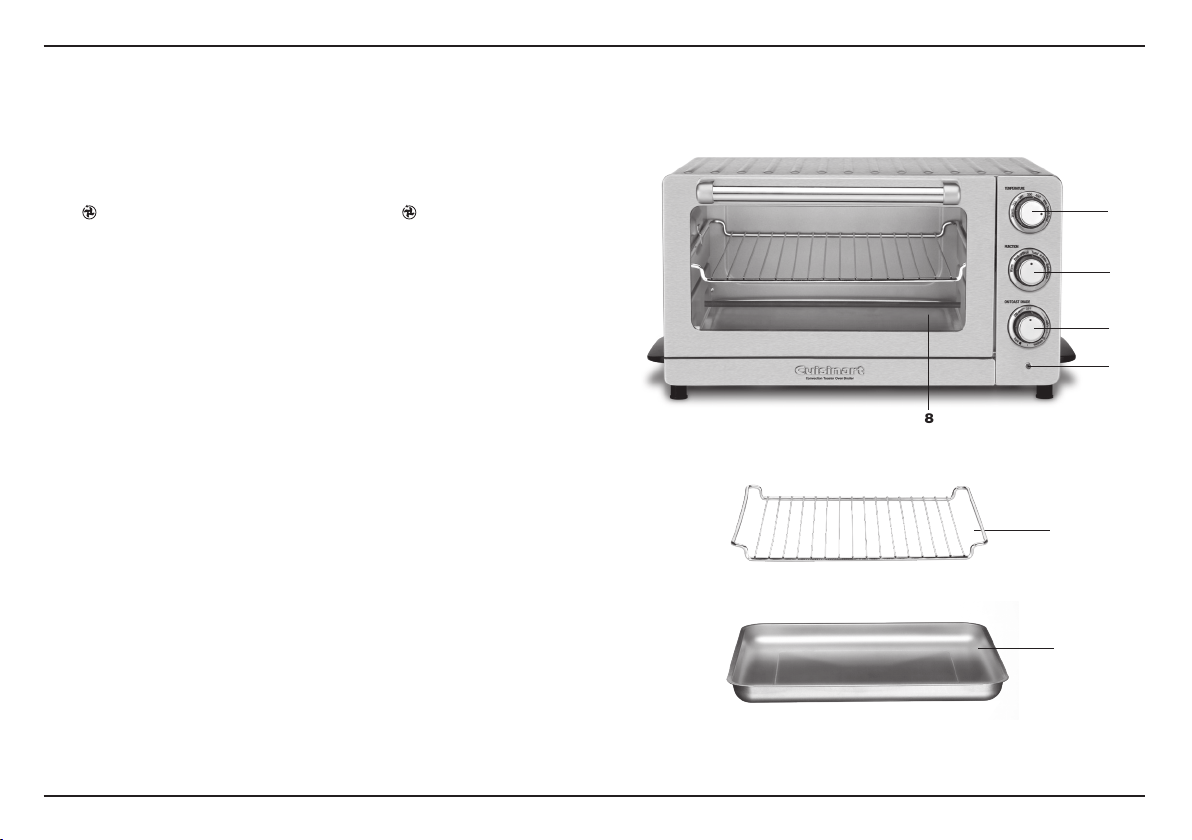
4
PIEZAS Y CARACTERÍSTICAS
1. Control de temperatura (TEMPERATURE)
Permite elegir la temperatura deseada para hornear o asar.
2. Selector de función (FUNCTION)
Permite elegir la función deseada: tostado (TOAST), horneado
(PIZZA/BAKE), asado/gratinado (BROIL), horneado por convección
( BAKE), asado/gratinado por convección ( BROIL), o mantener
caliente (WARM).
3. Encendido/Control del grado de tostado (ON/TOAST SHADE)
Permite elegir entre varios grados de tostado, desde ligeramente
tostado hasta muy tostado. La función de encendido "ON"
mantendrá el horno encendido hasta que lo apague manualmente.
4. Luz de encendido
Permanece encendida durante el uso.
5. Rejilla del horno
La rejilla puede posicionarse en dos niveles. En la posición superior,
se detendrá a la mitad al jalarse. Para retirarla del horno, deberá
alzar la parte delantera.
6. Bandeja recogemigas (no ilustrada)
La bandeja recogemigas está integrada al horno. Se desliza hacia
afuera, desde el frente del horno, para facilitar la limpieza.
7. Espacio para guardar el cable (no ilustrado) Mantiene la encimera
nítida.
8. Interior fácil de limpiar
Los paneles laterales del horno tienen un revestimiento especial que
facilita la limpieza.
9. Bandeja/Bandeja de goteo
Para su comodidad, una bandeja/bandeja de goteo está incluida.
10. Sin BPA (no ilustrado)
Ninguna de las piezas en contacto con los alimentos contiene
bisfenol A (BPA).
8
5
1
2
3
4
9

5
ANTES DEL PRIMER USO:
Coloque el horno sobre una superficie plana.
Deje un espacio libre de 2–4 pulgadas (5–10 cm) alrededor del aparato para
permitir que el aire circule libremente alrededor de éste. No lo coloque sobre una
superficie sensible al calor.
NO GUARDE NINGÚN OBJETO ENCIMA DEL HORNO. SI LO HACE,
QUÍTELOS ANTES DE ENCENDERLO. EL EXTERIOR DEL APARATO SE
VUELVE MUY CALIENTE DURANTE EL USO. MANTÉNGALO FUERA DEL
ALCANCE DE LOS NIÑOS.
PAUTAS GENERALES
Función PIZZA/BAKE (horneado): Esta función puede usarse como usaría
normalmente un horno de cocina para asar carne, incluso pollo, o cocer al horno
pasteles y mucho más.
Use la bandeja proveída con el horno para hornear pizza fresca. Para hornear
pizza congelada, coloque la pizza directamente sobre la rejilla del horno.
Función BAKE (horneado por convección): La función de horneado por
convección utiliza un ventilador que hace circular el aire alrededor de los alimentos
mientras se cocinan. Utilice esta función para hornear alimentos que necesitan
dorarse uniformemente tales como "muffins", bollos ingleses ("scones"), galletas,
hojaldres y panes, y cuando utiliza más de una rejilla.
Por lo general, se debe reducir la temperatura en 25°F/15°C (en comparación
con la temperatura aconsejada para el horneado tradicional) con la función
"horneado por convección". Siempre averigüe si la comida está lista unos 10
minutos antes del final del tiempo de cocción sugerido.
Función BROIL (asado/gratinado): La función de asado/gratinado puede usarse
para asar carne de res, pollo, puerco, pescado y mucho más. También es perfecta
para dorar cazuelas y gratenes. Utilice preferiblemente la función de asado/
gratinado por convección ( BROIL) para asar carne y pescado, y la función de
asado/gratinado tradicional (BROIL) para dorar/gratinar. Precaución: no cubra
la bandeja o la rejilla con papel de aluminio. Esto impide que la grasa caiga en la
bandeja de goteo, lo que puede causar un incendio. Si desea cubrir la bandeja de
goteo con papel de aluminio, asegúrese de que el papel no toque las paredes del
horno.
Función TOAST (tostado) Siempre ponga la rejilla en la posición superior para
tostar (véase la sección "Posiciones de la rejilla"). Siempre coloque los alimentos
en el centro de la rejilla.
ADVERTENCIA: colocar la rejilla al revés, ya sea en la posición inferior o
superior, puede causar un incendio. Consulte el diagrama para colocar la
rejilla debidamente.
Para apagar el horno: Ponga el botón ON/TOAST SHADE sobre OFF. La luz de
encendido se apagará.
FUNCIONAMIENTO
Desenrolle y enderece el cable. Asegúrese de que la bandeja recogemigas esté en
posición y de que el horno esté vacío. Enchufe el cable en una toma de corriente.
Para gratinar/dorar o asar par convección
Ajuste la temperatura a BROIL. Ponga el selector de función sobre BROIL (asar/
gratinar) o BROIL (asar/gratinar por convección). Ponga el control de tostado
en ON.
Para interrumpir el asado, ponga el botón ON/TOAST SHADE en OFF.
Nota: nunca utilice fuentes de cristal para asar/gratinar.
Para hornear/hornear pizza
Ponga la rejilla del horno en la posición inferior. Para hornear pizza fresca, ponga
la pizza en la bandeja y coloque la bandeja sobre la rejilla. Para hornear pizza
congelada, ponga la pizza directamente sobre la rejilla del horno. Para hornear
pollo o artículos grandes, la bandeja puede colocarse en el nivel inferior. Fije la
temperatura al nivel deseado y ponga el selector de función en BAKE. Ponga
el control de tostado en ON. La luz de encendido se encenderá. Para apagar el
horno después de la cocción, deberá poner el botón ON/TOAST SHADE en "OFF".
Precaliente el horno durante 5–10 minutos, según la temperatura elegida, antes de
poner la fuente en el horno.
Para hornear por convección
Coloque la rejilla del horno en la posición superior. Para hornear pollo o artículos
grandes, la bandeja puede colocarse en el nivel inferior. Fije la temperatura al nivel
deseado y ponga el selector de función en BAKE. Ponga el control de tostado
en ON. La luz de encendido se encenderá. Para apagar el horno después de la
cocción, deberá poner el botón ON/TOAST SHADE en "OFF". Precaliente
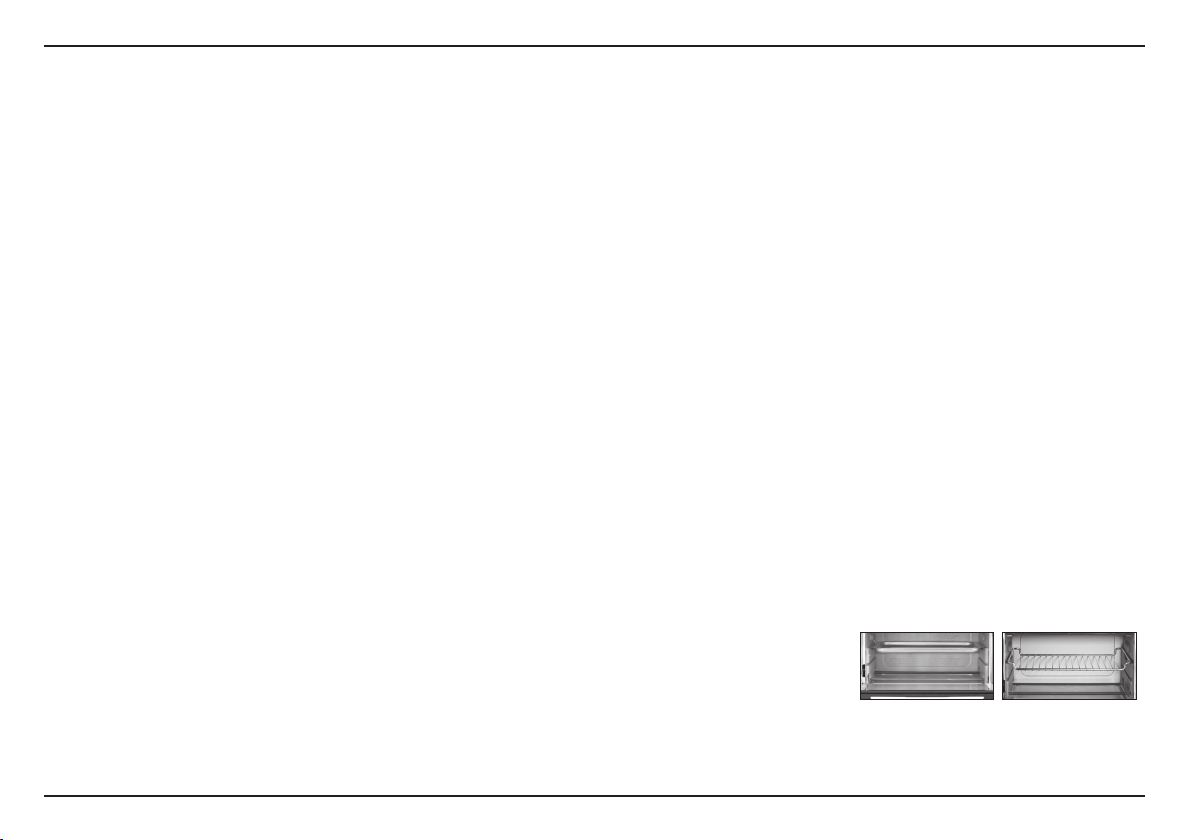
6
el horno durante 5–10 minutos, según la temperatura elegida, antes de poner la
fuente en el horno.
Por lo general, se debe reducir la temperatura en 25°F/15°C (en comparación
con la temperatura aconsejada para el horneado tradicional) con la función
"horneado por convección". Siempre averigüe si la comida está lista unos 10
minutos antes del final del tiempo sugerido.
Para mantener caliente
Para mantener los alimentos calientes, fije la temperatura en 200°F y ponga el
selector de función en WARM. Ponga el control de tostado en ON. La luz de
encendido se encenderá. Precaliente el horno por 5 minutos.
Para tostar
Antes de tostar, asegúrese de que la rejilla del horno esté en la posición superior
(véase la sección "Posiciones de la rejilla"). Ponga los alimentos en el centro de la
rejilla. Si tuesta más de dos artículos, espacie los alimentos uniformemente sobre la
rejilla, por ejemplo dos en frente y dos atrás cuando tuesta cuatro artículos, o tres
en frente y tres atrás cuando tuesta seis.
Control del grado de tostado
Ponga el control de temperatura en "TOAST". Ponga el selector de función en
"TOAST". Ponga el control de tostado en la posición deseada, desde ligeramente
tostado (LIGHT) hasta muy tostado (DARK). La luz de encendido se encenderá.
Interrupción del ciclo de tostado
El horno emitirá un pitido y se apagará. Para interrumpir el tostado antes del final
del ciclo, ponga el botón ON/TOAST SHADE en "OFF". Esto cancelará el ciclo de
tostado.
IMPORTANTE
Antes de tostar, asegúrese de que la rejilla del horno esté en la posición superior
(véase la sección "Posiciones de la rejilla").
LIMPIEZA Y MANTENIMIENTO
Permita que el aparato se enfríe completamente antes de limpiarlo.
1. Desconecte el cable de la toma de corriente.
2. No utilice limpiadores abrasivos. Esto podría dañar el acabado. Simplemente
limpie el cuerpo del aparato con un paño ligeramente humedecido y séquelo
bien. Si desea usar limpiador, aplique éste directamente sobre el paño, no sobre
el horno.
3. Para limpiar el interior del horno, utilice una esponja ligeramente humedecida
con agua jabonosa. Nunca utilice productos químicos fuertes o abrasivos. Esto
podría dañar la superficie del horno. Nunca use estropajos metálicos (por ej. lana
de acero) para limpiar el horno.
4. Para eliminar las migas, deslice la bandeja recogemigas hacia fuera. Limpie la
bandeja y regrésela en su puesto. Para eliminar la grasa de cocción, remoje la
bandeja en agua jabonosa caliente o use un limpiador no abrasivo. Nunca utilice
el aparato sin la bandeja recogemigas.
5. Lave la rejilla, la bandeja y la bandeja recogemigas en agua jabonosa caliente,
usando un estropajo o un cepillo de nailón.
6. Nunca enrolle el cable alrededor del aparato. Utilice el espacio para guardar el
cable, ubicado en la parte trasera del horno.
7. Cualquier otro servicio debe ser realizado por un técnico autorizado.
IMPORTANTE
Después de cocinar alimentos grasos, permita que el aparato se
enfríe y limpie el interior del horno. Si lo hace con regularidad, su horno rendirá
como si estuviera nuevo. Limpiar la grasa asegurará un tostado consistente, ciclo
tras ciclo.
Todas nuestras recetas han sido probadas en nuestra cocina y han sido
especialmente desarrolladas para prepararse con el horno de convección tostador/
asador Cuisinart
®
. Estas recetas, que le harán agua la boca, son sólo una muestra
de lo que este electrodoméstico puede hacer.
POSICIONES DE LA BANDEJA/REJILLA
Cada receta provee instrucciones de preparación paso a paso, incluso le
indicará dónde poner la rejilla del horno y la bandeja para obtener resultados
óptimos. Los diagramas a continuación le muestran las posiciones en que se
puede poner la rejilla.
POSICIÓN SUPERIOR PARA
HORNEAR
NOTA: Para hornear pollo o artículos
grandes, la bandeja puede colocarse
en el nivel inferior.
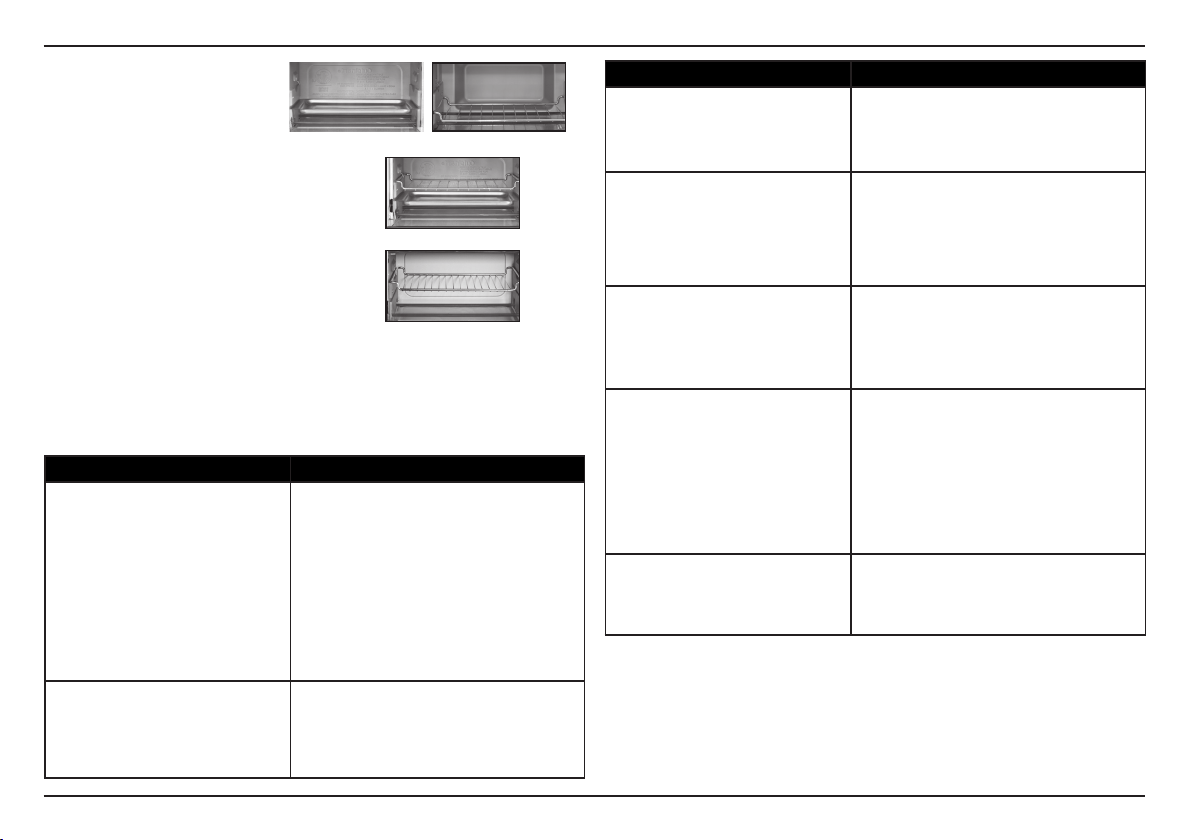
7
POSICIÓN INFERIOR PARA
HORNEAR
POSICIÓN PARA ASAR/GRATINAR/DORAR
POSICIÓN PARA TOSTAR
ADVERTENCIA: colocar la rejilla al revés, ya sea en la posición inferior
o superior, puede causar un incendio. Consulte el diagrama para
colocar la rejilla debidamente.
QUESTION ANSWER
¿Por qué se están quemando los
alimentos?
a.
Compruebe si la unidad está en el modo de
convección. La convección puede acelerar la
cocción, por lo que debe cocinar los alimentos
menos tiempo y/o bajar la temperatura.
b.
Ajuste la posición de la rejilla del horno. Los
alimentos pueden estar demasiado cerca de las
resistencias.
b.
Debido a su menor capacidad, los hornos de
encimera se calientan más rápido que los hornos
convencionales y pueden requerir menos tiempo
y/o temperaturas más bajas para cocinar.
¿Cuáles son las ventajas de la
convección?
a.
La convección utiliza un pequeño ventilador para
hacer circular el aire caliente alrededor de los
alimentos para cocinarlos de manera uniforme,
lo que a menudo resulta en tiempos de cocción
más rápidos.
RESOLUCION DE PROBLEMAS
QUESTION ANSWER
¿Por qué hay condensación en la
puerta del horno?
a.
Esto es normal. Cocinar alimentos altos en
humedad causa humedad en el horno, causando
condensación en la puerta. La condensación se
dispersará durante el proceso de cocción.
¿Por qué se encienden y se
apagan las resistencias, y/o no
se encienden todas al mismo
tiempo?
a.
Las resistencias se encienden y se apagan para
mantener temperaturas precisas.
b.
También, diferentes funciones utilizan las
resistencias de forma diferente. P. ej., la función
BROIL (dorar/gratinar) solo utiliza las resistencias
superiores.
¿Por qué no se calienta el horno?
a.
Cerciórese de que la unidad está bien enchufada
y de que puerta está bien cerrada.
b.
Gire la perilla de control hacia la izquierda,
poniéndola en “ON”.
c.
Llame a nuestro servicio de atención al cliente.
¿Por qué hay humo o un olor
anormal?
a.
Durante el primer uso, es normal que el horno
produzca humo o un olor anormal. Esto cesará
después del calentamiento inicial.
b.
Si la unidad produce humo o algún olor anormal
después del primer uso, compruebe que no
hay residuos de alimentos en las resistencias.
De haberlos, limpie las resistencias, después
de haber apagado la unidad y permitido que
se enfríe.
¿Por qué solo un lado de mi
tostada es tostado?
a.
Cuando usa la función BAGEL (tostar panecillos),
el horno tuesta más arriba que abajo. Cerciórese
de usar la función adecuada para tostar (TOAST).

8
GARANTÍA
GARANTÍA LIMITADA DE DOS AÑOS
Esta garantía es para los consumidores solamente. Usted es un
consumidor si ha comprado su aparato Cuisinart
®
en una tienda, para uso
personal o casero. A excepción de los estados donde la ley lo permita,
esta garantía no es para los detallistas u otros comerciantes. Cuisinart
garantiza este aparato contra todo defecto de materiales o fabricación
durante 2 años después de la fecha de compra original, siempre que el
aparato haya sido utilizado para uso doméstico y según las instrucciones.
Le aconsejamos que llene el formulario de registro disponible en
www.cuisinart.com a fin de facilitar la verificación de la fecha de compra
original. Sin embargo, registrar el producto no es necesario para recibir
servicio bajo esta garantía. En ausencia del recibo de compra, el período
de garantía será calculado a partir de la fecha de fabricación.
RESIDENTES DE CALIFORNIA SOLAMENTE
La ley del estado de California ofrece dos opciones bajo el período de
garantía. Los residentes del estado de California pueden (A) regresar el
producto defectuoso a la tienda donde lo compraron o (B) a otra tienda
que venda productos Cuisinart
®
de este tipo. La tienda, a su opción,
reparará el producto, referirá el consumidor a un centro de servicio
independiente, cambiará el producto o reembolsará el consumidor
por el precio original del producto, menos la cantidad imputable al
uso del producto por el consumidor hasta que éste se dañe. Si estas
dos opciones no satisfacen al consumidor, podrá llevar el aparato a
un centro de servicio independiente, siempre que se pueda ajustar o
reparar el aparato de manera económica. Cuisinart será responsable
por los gastos de servicio, reparación, reemplazo o reembolso de los
productos defectuosos durante el período de garantía. Los residentes de
California también pueden, si lo desean, mandar el aparato defectuoso
directamente a Cuisinart para que lo reparen o lo cambien. Para esto, se
debe llamar a nuestro servicio posventa al 1-800-726-0190. Cuisinart será
responsable por los gastos de reparación, reemplazo, manejo y envío de
los productos defectuosos durante el período de garantía.
ANTES DE HACER REPARAR SU APARATO
Si este aparato presentara algún defecto de materiales o fabricación
durante el período de garantía, la reparemos o reemplazaremos (a nuestra
opción). Para obtener servicio bajo esta garantía, llame a nuestra línea
directa gratuita al 1-800-726-0190 o regrese el aparato defectuoso a:
Cuisinart, 7475 North Glen Harbor Blvd. Glendale, AZ 85307. Regrese
el aparato defectuoso, junto con su recibo de compra y un cheque o
giro postal de US$10.00 por gastos de manejo y envío. Los residentes
de California sólo necesitan dar una prueba de compra y deben llamar
al 1-800-726-0190 para recibir instrucciones de envío. Recuerde incluir
su nombre, dirección y teléfono, la descripción del problema, así como
cualquier información pertinente. Sentimos no poder aceptar otras formas
de pago. NOTA: para más seguridad, le aconsejamos que mande su
paquete por un método de entrega con seguro y seguimiento. Cuisinart
no será responsable por los daños ocurridos durante el transporte o
por los paquetes mandados a una dirección equivocada. Los productos
perdidos y/o lastimados durante el envío no serán cubiertos bajo esta
garantía.
Este aparato satisface las más altas exigencias de fabricación y ha sido
diseñado para uso con accesorios y piezas de repuesto autorizados
solamente. Esta garantía excluye expresamente los daños causados por
accesorios, piezas o reparaciones no autorizados por Cuisinart. Esta
garantía no cubre el uso institucional o comercial del producto, y no es
válida en caso de daños causados por mal uso, negligencia o accidente.
Esta garantía excluye expresamente todos los daños incidentales o
consecuentes. Algunos Estados no permiten la exclusión o limitación
de daños incidentales o consecuentes, de modo que las limitaciones
mencionadas pueden no regir para usted. Usted puede tener otros
derechos que varían de un Estado a otro.
Importante: si debe llevar el aparato defectuoso a un centro de servicio
no autorizado, por favor informe al personal del centro de servicio que
deberían llamar al servicio posventa de Cuisinart al 1-800-726-0190 a fin
de diagnosticar el problema correctamente, usar las piezas correctas para
repararlo y asegurarse de que el producto esté bajo garantía.

9
RECETAS
"Muffins" de arándanos
con germen de trigo
Rinde 6 "muffins"
spray vegetal
¾ taza (95 g) de harina común
¼ taza (30 g) de harina de trigo integral
¾ cucharadita de sal kosher
¼ cucharadita de bicarbonato de sodio
½ cucharadita de polvo de hornear
½ cucharadita de canela en polvo
¼ taza (55 g) de mantequilla sin sal, a temperatura ambiente
¼ taza (50 g) de azúcar rubia
1 huevo grande, ligeramente batido
2½ cucharadas de miel
1 cucharadita de extracto natural de vainilla
2
/3 taza (160 g) de suero de mantequilla ("buttermilk")
½ taza (60 g) de arándanos agrios secos
¼ taza (55 g) de germen de trigo
1. Colocar la rejilla del horno en la posición inferior. Precalentar el horno a
375°F (220°C), usando la función BAKE. Engrasar levemente un
molde para "muffins" con spray vegetal. Reservar.
2. Combinar las harinas, la sal, el bicarbonato, el polvo de hornear y la
canela en un tazón pequeño. Batir para combinar; reservar.
3. Usando una batidora de pie o un batidor de mano Cuisinart
®
equipada
con batidores regulares o con un batidor plano, combinar los
ingredientes hasta obtener una mezcla cremosa. Agregar el azúcar
rubia y batir hasta obtener una mezcla ligera y cremosa. Agregar el
huevo, la miel y la vainilla; seguir batiendo hasta que los ingredientes
estén completamente combinados. Mientras sigue mezclando, agregar
lentamente un tercio de la mezcla de ingredientes secos, y luego la
mitad del suero de mantequilla (antes de que la harina hay sido
incorporada). Seguir agregando los ingredientes, alternándolos. No
mezclar demasiado. Incorporar delicadamente los arándanos y el
germen de trigo.
4. Echar la mezcla en los moldecitos. Meter al horno por
aproximadamente 25 minutos, hasta que un probador salga limpio.
Información nutricional por "muffin":
Calorías 228 (34% de grasa) • Carbohidratos 34g • Proteínas 5g • Grasa 9g
• Grasa saturada 5g • Colesterol 55mg • Sodio 380mg • Calcio 53mg • Fibra 3g
"Quiche" de salchicha, espinaca y
queso Fontina
Ideal para el desayuno-almuerzo, esto "quiche" rinde 8 a 12 porciones.
½ receta de masa quebrada (página 27)
6 onzas (175 g) de salchicha italiana dulce, sin tripa
2 cucharadas (30 g) de mantequilla sin sal o aceite de oliva
2 dientes de ajo, finamente picados
2 tazas (60 g) de espinaca tierna (espinaca "baby") fresca
½ cucharadita de sal kosher
½ cucharadita de pimienta negra recién molida
1 taza (235 ml) de leche entera
1 taza (235 ml) de crema líquida para batir ("heavy cream")
4 huevos grandes
½ taza (85 g) de queso Fontina rallado
1. Estirar la masa, formando un disco de aproximadamente 10 pulgadas
(25 cm) de diámetro. Colocar en un molde para tarta de 9 pulgadas (20
cm) de diámetro. Refrigerar durante aproximadamente 20 minutos.

10
2. Colocar la rejilla del horno en la posición inferior. Precalentar el horno a
350°F (220°C), usando la función PIZZA/BAKE. Picar el fondo de tarta
varias veces con los dientes de un tenedor, teniendo cuidado de no
perforar completamente la masa. Poner una hoja de papel sulfurizado
encima de la masa y llenar parcialmente el molde con arroz crudo o
frijoles secos. Meter al horno durante 20–22 minutos, o hasta que la
masa esté seca. Retirar el arroz crudo/los frijoles secos y el papel
sulfurizado y hornear el fondo de tarta durante 15 minutos adicionales,
hasta dorarse. Retirar del horno y reservar.
3. Poner una salteadora a calentar a fuego medio-alto. Agregar la
salchicha, rompiéndola con un cucharón de madera. Saltear hasta que
esté ligeramente dorada; reservar. No limpiar el sartén.
4. Agregar la mantequilla al sartén. Cuando esté derretida, agregar el ajo y
saltear hasta dorarse. Agregar la espinaca, poco a poco, y una pizca
de sal y pimienta. Saltear hasta que se marchite, y luego combinar con
la salchicha y reservar.
5. Combinar la leche, la crema, los huevos, la sal/pimienta remanente en
un tazón mediano. Usando una batidora de pie o un batidor de mano
Cuisinart
®
equipada con batidor, combinar los ingredientes hasta
obtener una mezcla homogénea. Esparcir la mezcla de salchicha/
espinaca sobre el fondo de tarta. Agregar la mezcla líquida y salpicar
con queso Fontina.
6. Meter al horno por 40–60 minutos, hasta que el "quiche" esté justo
cuajado.
Información nutricional por porción (basada en 12 porciones):
Calorías 300 (75% de grasa) • Carbohidratos 10g • Proteínas 9g • Grasa 25g
• Grasa saturada 7g • Colesterol 110mg • Sodio 380mg • Calcio 98mg • Fibra 0g
Budín de pan Jalá
Dele un nuevo giro a las tostadas francesas para el desayuno. Para
ahorrar tiempo, prepare el budín el día anterior y métalo al horno por la
mañana.
Rinde 8 porciones
spray vegetal
4 huevos grandes
2 tazas (475 ml) de leche entera
1 taza (235 ml) de crema líquida para batir ("heavy cream")
1 cucharada de extracto natural de vainilla
1
⁄3 taza (80 ml) de jarabe de arce ("maple syrup")
2 cucharaditas de canela en polvo
1 cucharadita de nuez moscada rallada
¼ cucharadita de sal kosher
1 libra (455 g) de pan Jalá ("Challah"), en tiras de ½ x 9 pulgadas
(1.5 x 22 cm)
2 cucharadas llenas de azúcar rubia
2 cucharadas (45 g) de mantequilla sin sal, en pedacitos
1. Engrasar un molde cuadrado de 9 x 9 pulgadas (22 x 22 cm) con spray
vegetal; reservar.
2. Colocar los huevos, la leche, la crema, la vainilla, el jarabe, las especias
y la sal en un tazón mediano. Batir, usando un batidor de mano
Cuisinart
®
equipado con batidor de chef, hasta que la mezcla se ponga
espumosa.
3. Disponer la mitad de las tiras de pan en el fondo del molde. Echar la
mitad de la mezcla encima y salpicar uniformemente la mitad del
azúcar rubia. Disponer el resto de las tiras de pan encima, en dirección
opuesta a la primera capa. Echar el resto de la mezcla encima y
salpicar uniformemente el azúcar rubia remanente. Cubrir y refrigerar
durante 2–12 horas.
4. Retirar el budín del refrigerador y dejar entibiar a temperatura ambiente
antes de hornear. Colocar la rejilla del horno en la posición inferior.
Precalentar el horno a 350°F (220°C), usando la función BAKE.
Salpicar la mantequilla encima del budín y cubrir sin apretar con papel
de aluminio. Hornear durante 15 minutos, y luego retirar el papel de
aluminio y hornear durante 10 minutos adicionales, hasta que la
temperatura interna del budín alcance 160°F (71°C).
5. Retirar del horno y servir inmediatamente.

11
Información nutricional por porción:
Calorías 420 (47% de grasa) • Carbohidratos 44g • Proteínas 11g • Grasa 22g
• Grasa saturada 12g • Colesterol 190mg • Sodio 430mg • Calcio 177mg • Fibra 2g
Champiñones rellenos
Rinde 16 porciones
16 champiñones para rellenar
½ taza (60 g) de pan rallado japonés "panko"
¼ cucharadita de albahaca seca
½ cucharadita de orégano seco
1 cucharada de perejil fresco
¼ cucharadita de sal kosher
½ cucharadita de pimienta negra recién molida
3 cucharadas de aceite de oliva
1 diente de ajo, finamente picado
2 cucharadas de queso Parmesano rallado
1. Limpiar los champiñones y reservar los tallos.
2. Colocar el pan rallado, las hierbas, la sal y la pimienta en el tazón de
una mini-procesadora de alimentos o picadora Cuisinart
®
. Procesar
hasta que estén finamente picados. Agregar los tallos de los
champiñones; pulsar para picar. Reservar.
3. Poner 1 cucharada de aceite a calentar a fuego medio-lento, en un
sartén mediano. Agregar el ajo y saltear hasta dorarse. Agregar la
mezcla de pan rallado y saltear durante aproximadamente 5 minutos,
hasta que esté muy suave y dorado, agregando una cucharada de
aceite a la mitad del tiempo. Agregar el queso Parmesano y revolver
para combinar.
4.
Precalentar el horno a 425°F (200°C), usando la función PIZZA/
BAKE.
5. Forrar la bandeja con papel de aluminio. Disponer los sombreros de los
champiñones en la bandeja y rellenar con la mezcla de pan rallado.
Rociar con el resto del aceite de oliva. Meter al horno (con la rejilla en
la posición superior) por 5–7 minutos, hasta dorarse.
6. Retirar del horno y dejar enfriar durante 5 minutos. Servir tibio o a
temperatura ambiente.
Información nutricional por porción:
Calorías 40 (65% de grasa) • Carbohidratos 2g • Proteínas 1g • Grasa 3g
• Grasa saturada 0g • Colesterol 0mg • Sodio 45mg • Calcio 9mg • Fibra 0g
"Bruschetta" de Gorgonzola y Ricotta
Rinde 12 "bruschettas"
12 rebanadas de pan francés
1 diente de ajo, machacado
1½ cucharada de aceite de oliva virgen extra
1 taza (245 g) de queso Ricotta, escurrido
2 cucharadas de queso Parmesano rallado
½ cucharadita de sal kosher
½ cucharadita de pimienta negra recién molida
1 pizca de nuez moscada rallada
½ taza (70 g) de queso Gorgonzola desmenuzado
½–1 cucharada de miel
1. Colocar la rejilla del horno en la posición inferior. Precalentar el horno a
375°F (220°C), usando la función PIZZA/BAKE.
2. Frotar un lado de cada rebanada de pan con ajo y cepillar con aceite
de oliva. Meter al horno durante 4–6 minutos (2–3 minutos por lado),
hasta tostarse ligeramente.
3. Mientras el pan está tostándose, preparar la cobertura. Combinar el
queso Ricotta, el queso Parmesano, la sal, la pimienta y la nuez
moscada en un tazón pequeño. Revolver. Esparcir la mezcla sobre las
rebanadas de pan tostadas, y luego añadir el queso Gorgonzola.
Gratinar (en BROIL) durante aproximadamente 3 minutos, hasta que el
queso esté caliente.
4. Rociar la miel sobre las "bruschettas" y servir inmediatamente.

12
Información nutricional por "bruschetta":
Calorías 120 (46% de grasa) • Carbohidratos 11g • Proteínas 5g • Grasa 6g
• Grasa saturada 3g • Colesterol 10mg • Sodio 300mg • Calcio 108mg • Fibra 1g
Quesadilla de vegetales asados
Rinde 4 porciones (2 quesadillas)
½ calabacín ("zucchini") mediano, en cubitos
½ pimiento dulce rojo o amarillo, en cubitos
½ jalapeño, sin semillas, finamente picado
¼ cebolla mediana, en rodajas
1 diente de ajo, machacado
1 cucharada de aceite de oliva + ½ cucharada para cepillar
¼ cucharadita de sal kosher
¼ cucharadita de pimienta negra recién molida
¼ taza (25 g) de maíz congelado
1 cucharada de cilantro picado grueso
1 onza (30 g) de queso Monterey Jack, rallado
1 onza (30 g) de queso de cabra
2 tortillas de trigo de 10 pulgadas (25 cm)
spray vegetal
1. Precalentar el horno a 400°F (200°C), usando la función PIZZA/BAKE.
2. Combinar el calabacín, los pimientos dulces, el jalapeño, la cebolla, el
ajo, 1 cucharada del aceite de oliva, la sal y la pimienta en un tazón
mediano. Forrar la bandeja con papel de aluminio y colocar los
vegetales adentro. Meter al horno, con la rejilla en la posición superior.
Hornear durante aproximadamente 20 minutos, hasta que los vegetales
estén suaves y dorados. Retirar del horno y combinar con el maíz y el
cilantro.
3. Para armar las quesadillas: Poner las tortillas sobre una superficie
plana. Esparcir la mezcla de vegetales, y luego el queso uniformemente
sobre la mitad inferior de cada tortilla. Doblar la mitad inferior de cada
tortilla sobre el relleno.
4. Engrasar ligeramente la bandeja con spray vegetal. Colocar las
quesadillas en la bandeja y cepillar la parte superior con el aceite
remanente. Meter al horno por 6–6½ minutos, hasta que el queso esté
derretido y que la quesadillas estén doradas.
5. Cortar las quesadillas a la mitad y servir con salsa, guacamole y/o
crema agria.
Información nutricional por porción:
Calorías 190 (38% de grasa) • Carbohidratos 23g • Proteínas 7g • Grasa 8g
• Grasa saturada 4g • Colesterol 10mg • Sodio 860mg • Calcio 123mg • Fibra 2g
Patatas asadas dos veces
Rinde 8 porciones
4 patatas "Idaho" o "Russet" grandes
1 cucharaditas de aceite de oliva
2
/3 taza (160 ml) de leche baja en grasa
2 cucharadas (30 g) de mantequilla sin sal + 1 cucharadita (5 g)
para rociar
½ taza (120 ml) de crema agria
½ cucharadita de sal kosher
½ cucharadita de pimienta negra recién molida
¼ taza (10 g) de cebollinos ("chives") frescos picados
1. Colocar la rejilla del horno en la posición inferior. Precalentar el horno a
400°F (220°C), usando la función PIZZA/BAKE.
2. Cepillar cada patata con ¼ cucharadita de aceite de oliva y perforar
6–8 veces con un tenedor. Colocar las patatas directamente sobre la
rejilla del horno y hornear durante 55–60 minutos. Retirar del horno y
dejar enfriar ligeramente. Retirar cuidadosamente la bandeja y ajustar
la temperatura a 375°F (190 °C).
3. Cuando las patatas estén tibias, cortar la parte superior y remover la
carne/pulpa, dejando "cáscaras" de ¼ pulgada (5 mm) de espesor.
Reservar la carne/pulpa y las cáscaras.

13
4. Combinar la pulpa, la leche y 2 cucharadas (30 g) de la mantequilla en
un tazón mediano. Hacer puré con un majador de patatas o un batidor
de mano. Agregar la crema agria, la sal, la pimienta y los cebollinos.
Seguir batiendo para combinar. Rellenar las cáscaras generosamente
con la mezcla. (Si está preparando las patatas el día anterior, cubrir y
refrigerar. Dejar entibiar a temperatura ambiente antes de hornear.)
Poner las patatas en una bandeja de hornear. Derretir la cucharadita de
mantequilla remanente y rociar sobre las patatas. Meter al horno
durante 35–45 minutos, hasta dorarse.
Información nutricional por porción (½ patata):
Calorías 180 (31% de grasa) • Carbohidratos 27g • Proteínas 4g • Grasa 6g
• Grasa saturada 4g • Colesterol 20mg • Sodio 160mg • Calcio 58mg • Fibra 3g
Patatas "fritas" asadas al horno
Rinde 2 porciones
1 libra (455 g) de patatas de Idaho o Russet, en bastones
gruesos
2 cucharadas de aceite de oliva
½ cucharadita de sal kosher
¼ cucharadita de pimienta negra recién molida
1 pizca de pimienta de Cayena
1. Precalentar el horno a 425°F (200°C), usando la función PIZZA/BAKE.
2. Colocar las patatas en un tazón grande. Agregar el resto de los
ingredientes y revolver suavemente. Forrar la bandeja con papel de
aluminio y disponer las patatas encima, el lado cortado apuntando
hacia abajo.
3. Meter al horno, con la rejilla en la posición inferior. Asar durante
aproximadamente 30 minutos, volteando las patatas a la mitad del
tiempo.
4. Retirar del horno y ajustar la sazón al gusto. Servir inmediatamente.
Información nutricional por porción (1 taza/250 g):
Calorías 130 (91% de grasa) • Carbohidratos 3g • Proteínas 0g • Grasa 14g
• Grasa saturada 2g • Colesterol 0mg • Sodio 530mg • Calcio 3mg • Fibra 0g
Batatas asadas
Rinde 4 porciones
1¾ libra (795 g) de batatas/camote, cortadas longitudinalmente en
cuartos
4 cucharadas (55 g) de mantequilla sin sal, derretida
½ cucharadita de sal kosher
2 cucharadas llenas de azúcar rubia
1. Precalentar el horno a 375°F (190°C), usando la función PIZZA/BAKE.
2. Colocar las batatas en un tazón grande. Agregar el resto de los
ingredientes y revolver suavemente. Forrar la bandeja con papel de
aluminio y disponer las batatas encima, el lado cortado apuntando
hacia abajo.
3. Meter al horno, con la rejilla en la posición inferior. Hornear durante
aproximadamente 35 minutos, volteando las batatas cada 10 minutos.
4. Retirar del horno y servir inmediatamente.
Información nutricional por porción (1 taza/250 g):
Calorías 290 (34% de grasa) • Carbohidratos 46g • Proteínas 3g • Grasa 11g
• Grasa saturada 7g • Colesterol 30mg • Sodio 380mg • Calcio 60mg • Fibra 6g
Espárragos asados
Rinde 4 porciones
1 libra (455 g) de espárragos
1 cucharadita de aceite de oliva virgen extra
¼ cucharadita de sal kosher
¼ cucharadita de pimienta negra recién molida

14
1. Precalentar el horno a 425°F (220°C), usando la función PIZZA/BAKE.
2. Lavar y secar los espárragos, y cortar la parte dura del tallo.
Colocar los espárragos, el aceite de oliva, la sal y la pimienta en un
tazón y revolver para combinar.
3. Forrar la bandeja con papel de aluminio y disponer los espárragos
encima. Meter al horno (con la rejilla en la posición superior) por 10–15
minutos, hasta que los espárragos estén tiernos.
4. Servir inmediatamente.
Información nutricional por porción:
Calorías 36 (29% de grasa) • Carbohidratos 4g • Proteínas 3g • Grasa 2g
• Grasa saturada 0g • Colesterol 0 mg • Sodio 135mg • Calcio 28mg • Fibra 2g
Hinojo, zanahorias y chirivía asados
Rinde 4 porciones
2 bulbos de hinojo, en cuartos
3 zanahorias medianas, en trozos
1 chirivía grande, en trozos
1 diente de ajo, machacado
3 cucharadas de aceite de oliva
1 cucharadita de tomillo fresco
½ cucharadita de sal kosher
¼ cucharadita de pimienta negra recién molida
1 pizca de canela en polvo
1. Precalentar el horno a 450°F (230°C), usando la función PIZZA/BAKE.
2. Colocar los vegetales en un tazón y agregar el resto de los ingredientes.
3. Disponer los vegetales en la bandeja forrada con papel de aluminio.
Meter al horno (con la rejilla en la posición superior) por 45 minutos,
hasta que los espárragos estén tiernos, revolviendo y dando vuelta
cada 15–20 minutos.
Información nutricional por porción (½ taza/120 ml):
Calorías 170 (54% de grasa) • Carbohidratos 18g • Proteínas 2g • Grasa 11g
• Grasa saturada 2g • Colesterol 0 mg • Sodio 360mg • Calcio 85mg • Fibra 6g
Brécol y coliflor al gratén
Rinde 8 porciones
spray vegetal
1½ libra (680 g) de cogollitos de brécol
1 libra (455 g) de cogollitos de coliflor
1½ cucharadita de aceite de oliva
1 diente de ajo, finamente picado
½ cebolla mediana, finamente picada
½ cucharadita de sal kosher
¾ cucharadita de pimienta negra recién molida
2 tazas (240 g) de queso Cheddar rallado
¾ taza (90 g) de pan rallado japonés "panko"
¼ taza (30 g) de queso Parmesano rallado
1. Engrasar levemente un molde cuadrado de 9 x 9 pulgadas (22 x 22 cm)
con spray vegetal; reservar.
2. Poner agua salada a hervir en una olla. Agregar el brécol y la coliflor y
cocer durante 2–3 minutos, hasta que estén tiernos. Colocar los
vegetales inmediatamente en un tazón de agua helada. Una vez fríos,
escurrir y reservar.
3. Calentar el aceite de oliva a fuego medio-lento, en un sartén mediano.
Cuando el aceite esté caliente, agregar el ajo y la cebolla y cocer 2–3
minutos, hasta suavizarse ligeramente.
4. Colocar la rejilla del horno en la posición inferior. Precalentar el horno a
400°F (220°C), usando la función PIZZA/BAKE.
5. Colocar los vegetales escaldados, el ajo, la cebolla, la sal, la pimienta,
la mitad del queso Cheddar y la mitad del pan rallado en un tazón

15
grande. Revolver. Colocar la mezcla en la bandeja y esparcir el resto
del queso y del pan rallado encima. Meter al horno por 15 minutos,
hasta que el queso empiece a dorarse.
6. Servir inmediatamente.
Información nutricional por porción:
Calorías 190 (49% de grasa) • Carbohidratos 14 g • Proteínas 11g • Grasa 2 g
• Grasa saturada 6g • Colesterol 30mg • Sodio 280mg • Calcio 284mg • Fibra 2g
Pizza blanca con jamón de Parma,
rúcula y tomates
Rinde 8 porciones (una pizza de 12 pulgadas/30 cm de diámetro)
spray vegetal
1
/3 receta de masa de pizza (página 26)
1 cucharada de aceite de oliva virgen extra
1–1½ onza (30–45 g) de lonchas de jamón de Parma (Prosciutto)
3 dientes medianos de ajo, finamente picados
1 taza (150 g) de tomates de pera, cortadas a la mitad
2 tazas llenas (60 g) de rúcula/rúgula/arúgula fresca
1½ taza (365 g) de queso Ricotta, escurrido
½ taza (60 g) de queso Parmesano rallado
1 pizca de sal kosher
½ cucharadita de pimienta negra recién molida
1. Precalentar el horno a 425°F (230°C), usando la función "PIZZA/
BAKE".
2. Engrasar ligeramente la bandeja con spray vegetal. Estirar la masa
hasta formar un rectángulo del tamaño de la bandeja. Colocar la masa
en la bandeja. Cepillar las orillas con aceite de oliva. Meter al horno,
con la rejilla en la posición inferior. Hornear durante 6–8 minutos, hasta
que la masa esté ligeramente dorada.
3. Precalentar un sartén mediano a fuego medio-alto. Cuando el sartén
esté caliente, agregar el jamón de Parma. Saltear hasta que esté
crujiente; reservar.
4. Agregar
2
⁄3 del ajo picado al sartén caliente. Saltear hasta que esté
fragante, y luego agregar los tomates. Cuando los tomates empiecen a
suavizarse, agregar la rúcula poco a poco. Cocer hasta que se
marchite y retirar del fuego; reservar.
5. En un tazón mediano, combinar el queso Ricotta, el queso Parmesano,
el ajo remanente, la sal y la pimienta. Reservar.
6. Esparcir la mezcla de queso sobre la masa parcialmente cocida. Añadir
la mezcla de rúcula, y luego el jamón de Parma. Meter al horno, con la
rejilla en la posición inferior. Meter al horno por 10–12 minutos, o hasta
que la masa esté dorada y crujiente y que el queso esté
completamente derretido.
7. Retirar del horno. Cortar y servir inmediatamente.
Información nutricional por porción:
Calorías 160 (30% de grasa) • Carbohidratos 19g • Proteínas 10g • Grasa 6g
• Grasa saturada 3g • Colesterol 20mg • Sodio 400mg • Calcio 167mg • Fibra 2g
Pizza de tomate, cebolla y tocino
Rinde 8 porciones (una pizza de 12 pulgadas/30 cm de diámetro)
3 lonjas de tocino
spray vegetal
1
/3 receta de masa de pizza (página 26)
1 cucharada de aceite de oliva virgen extra
1 taza (235 ml) de salsa para pizza con pedazos, escurrida
6 onzas (175 g) de queso Mozzarella fresco, en cubitos
1 tomate italiano, en rodajas gruesas
¼ cebolla pequeña, en rodajas finas
1 cucharada de hojas de albahaca fresca, finamente rebanadas

16
1. Forrar la bandeja con papel de aluminio. Disponer las lonjas de tocino
en la bandeja y meter al horno, con la rejilla en la posición superior.
Asar (en "BROIL") durante aproximadamente 8 minutos, hasta que el
tocino esté crujiente. Retirar del horno y reservar. Limpiar la bandeja
con papel absorbente y engrasar con spray vegetal.
2. Precalentar el horno a 425°F (220°C), usando la función PIZZA/BAKE.
3. Estirar la masa hasta formar un rectángulo del tamaño de la bandeja.
Colocar la masa en la bandeja y cepillar las orillas con aceite de oliva.
Meter al horno (con la rejilla en la posición inferior) por 6–8 minutos,
hasta dorarse ligeramente.
4. Esparcir la salsa uniformemente encima de la masa. Cubrir con queso,
y luego añadir con los tomates, las cebollas y la albahaca. Meter al
horno, con la rejilla en la posición inferior. Hornear por 12–14 minutos,
o hasta que la masa esté bien dorada y que el queso esté
completamente derretido.
5. Retirar del horno. Cortar y servir inmediatamente.
Información nutricional por porción:
Calorías 200 (47% de grasa) • Carbohidratos 19g • Proteínas 7g • Grasa 11g
• Grasa saturada 5g • Colesterol 25mg • Sodio 330mg • Calcio 3mg • Fibra 3g
Tarta de calabacín, tomate y cebolla
Rinde 10 porciones
½ receta de masa quebrada (página 27)
3 calabacines ("zucchini") pequeños
2 cebollas pequeñas
4 cucharadas de aceite de oliva
½ cucharadita de sal kosher
½ cucharadita de pimienta negra recién molida
3 cucharadas de queso Parmesano rallado
3 tomates italianos
½–¾ onza (15–20 g) de queso de cabra suave
5 hojas pequeñas de albahaca fresca, finamente rebanadas
1. Estirar la masa para formar un rectángulo de 12 x 4 pulgadas (30 x 10
cm). Doblar los bordes para formar un borde de ¼ pulgada (5 mm) de
alto. Refrigerar durante 30 minutos.
2. Mientras la masa está enfriándose, preparar los vegetales. Precalentar
el horno a 425°F (230°C), usando la función PIZZA/BAKE. Forrar la
bandeja con papel de aluminio.
3. Usando una procesadora de alimentos Cuisinart
®
equipada con disco
rebanador de 4 mm, cortar los calabacines y las cebollas en rodajas.
Combinar los vegetales rebanados, 3 cucharadas del aceite de oliva y
¼ cucharadita de sal y de pimienta en un tazón mediano. Disponer, en
una capa, en la bandeja preparada. Meter al horno por
aproximadamente 20 minutos, hasta que los vegetales empiecen a
dorarse y suavizarse. Retirar del horno, reservar los vegetales en un
tazón y tirar el aceite. Limpiar la bandeja con un papel absorbente si es
necesario.
4. Ajustar la temperatura del horno a 350°F (180°C), usando la función
CONV BAKE.
5. Retirar el fondo de tarta del refrigerador y colocarlo en la bandeja. Picar
el fondo de tarta varias veces con los dientes de un tenedor, teniendo
cuidado de no perforar completamente la masa. Poner una hoja de
papel sulfurizado encima de la masa y llenar parcialmente el molde con
arroz crudo o frijoles secos. Meter al horno (con la rejilla en la posición
inferior) por 20 minutos, o hasta que la masa esté seca. Retirar los
frijoles/el arroz y el papel sulfurizado del fondo de tarta y esparcir el
queso Parmesano encima. Volver a meter al horno por 2–3 minutos
adicionales, hasta dorarse. Reservar.
6. Cortar los tomates en rodajas, usando el mismo disco. Colocar las
rodajas sobre un plato forrado con papel absorbente y sazonar con la
sal remanente. Reservar.
7. Una vez que el fondo de tarta está listo, preparar la tarta. Disponer los
vegetales y los tomates sobre el fondo de tarta, superponiéndolos en
líneas rectas (empezar con un vegetal diferente en cada línea). Rociar
con el aceite de oliva remanente y sazonar con la sal y la pimienta

17
remanentes. Esparcir pedacitos del queso de cabra encima de la tarta
(usar más o menos, al gusto).
8. Meter al horno, con la rejilla en la posición inferior. Hornear durante 20
minutos, hasta que el fondo de tarta esté bien dorado y que los
vegetales estén tiernos y dorados. Retirar del horno y esparcir la
albahaca encima.
9. Servir tibio o a temperatura ambiente.
Información nutricional por porción:
Calorías 180 (67% de grasa) • Carbohidratos 13g • Proteínas 3g • Grasa 14g
• Grasa saturada 7g • Colesterol 25mg • Sodio 200mg • Calcio 30mg • Fibra 1g
Burritos de pollo, vegetales y frijoles
negros
Rinde 4 porciones
½ calabacín ("zucchini") grande, en cubitos
1 cebolla pequeña, en rodajas finas
1 zanahoria grande, en cubitos
3 dientes de ajo, picados
½ jalapeño, finamente picado
½ pimiento dulce rojo, picado
¼ batata/camote mediana, en cubitos
2½ cucharaditas de aceite de oliva
¼ cucharadita de sal kosher
2
⁄3 taza (170 g) de maíz en grano congelado
1 taza (125 g) de pollo cocido, triturado
2 tazas (500 g) de frijoles negros en lata (enjuagados y
escurridos) o de frijoles negros cocidos
1
⁄3 taza (20 g) de cilantro picado
2 cucharadas de jugo de lima/limón verde fresco
(aproximadamente 1–2 limones)
1 pizca de comino en polvo
1 pizca de chile en polvo
1 pizca de orégano seco
1 pizca de pimienta negra recién molida
1 taza (115 g) de queso Monterey Jack rallado
4 tortillas de trigo de 10 pulgadas (25 cm)
1. Precalentar el horno a 400°F (200°C), usando la función PIZZA/BAKE.
Forrar la bandeja con papel de aluminio.
2. Colocar los vegetales, excepto el maíz y los frijoles, en un tazón
grande, añadir 2 cucharaditas de aceite de oliva y una pizca de sal, y
revolver para combinar. Esparcir los vegetales en el fondo de la
bandeja. Disponer uniformemente en la bandeja y meter al horno por
18–20 minutos, hasta que los vegetales estén suaves y empiecen a
dorarse. Regresar los vegetales al tazón y agregar el maíz, el pollo, los
frijoles, el cilantro, el jugo de limón, las especias, la pimienta y la sal
remanente.
3. Esparcir un cuarto de la mezcla en una línea justo debajo del centro de
cada tortilla. Esparcir un cuarto del queso encima. Enrollar los burritos
y colocarlos en la bandeja, la unión apuntando hacia abajo. Cepillar la
parte de encima con el aceite remanente.
4. Meter al horno, con la rejilla en la posición inferior. Meter al horno por
8–10 minutos, hasta que las tortillas estén crujientes y doradas. Servir
con guacamole, salsa y crema agria.
Información nutricional por porción:
Calorías 620 (35% de grasa) • Carbohidratos 71g • Proteínas 33g • Grasa 25g
• Grasa saturada 8g • Colesterol 55mg • Sodio 1g • Calcio 373mg • Fibra 12g
Rigatoni al horno con salchicha de
pollo, broccolini y pimientos dulces
Rinde 6–8 porciones
5 onzas (145 g) de broccolini, las extremidades de los tallos
cortadas
1 cucharadita de aceite de oliva virgen extra

18
2 cucharadas de vino blanco seco
2 tazas (475 ml) de caldo de pollo
6 onzas (175 g) de salchicha de pollo italiana, cocida y cortada
en rodajas
½ pimiento dulce rojo, en rodajas
½ cebolla mediana, en rodajas
2 dientes de ajo, finamente picados
¼ cucharadita de sal kosher
¼ cucharadita de pimienta negra recién molida
½ libra (225 g) de pasta Rigatoni, cocida "al dente" de acuerdo a
las instrucciones
¾ taza (185 g) de queso Ricotta
8 onzas (115 g) de queso Mozzarella, rallado
¼ taza (30 g) de queso Parmesano rallado
4–6 hojas de albahaca fresca, rebanadas gruesas
spray vegetal
1. Poner agua salada a hervir en una olla. Llenar un tazón grande con
agua y hielo; reservar. Colocar el broccolini en el agua hirviendo y
cubrir. Cocer por 4–6 minutos, hasta que adquieran un color vivo.
Retirar del agua y colocar en el baño de hielo. Cuando esté frío, cortar
el broccolini en trozos de 1 pulgada (2.5 cm).
2. Calentar un sartén grande a fuego medio-alto; agregar el aceite.
Cuando el aceite esté caliente, agregar el broccolini escaldado. Saltear
durante 2–3 minutos, y luego agregar el vino y el caldo. Ajustar la
temperatura a fuego alto y saltear hasta que todo el líquido se haya
evaporado. Reservar.
3. Precalentar el horno a 400°F (200°C), usando la función PIZZA/BAKE.
Forrar la bandeja con papel de aluminio.
4. Colocar la salchicha, el pimiento, la cebolla y el ajo en la bandeja;
sazonar con una pizca de sal y de pimienta. Meter al horno (posición
superior) por aproximadamente 15 minutos, hasta que los vegetales
estén suaves y empiecen a dorarse. Ajustar la temperatura a 350°F
(180 °F) y colocar la rejilla en la posición inferior.
5. Colocar la salchicha asada, los vegetales y el resto de los ingredientes
en un tazón grande; revolver para combinar.
6. Engrasar levemente una fuente con spray vegetal. Agregar la mezcla de
pasta. Meter al horno por 30–35 minutos, hasta que el queso esté
completamente derretido.
Información nutricional por porción (basada en 8 porciones):
Calorías 260 (53% de grasa) • Carbohidratos 14g • Proteínas 17g • Grasa 16g
• Grasa saturada 7g • Colesterol 40mg • Sodio 383mg • Calcio 341mg • Fibra 1g
Filete de res con corteza de hierbas
Rinde 6 porciones
1½ libra (680 g) de filete de res para asar
½ cucharadita de sal kosher
½ cucharadita de pimienta negra recién molida
3 dientes de ajo
2 ramas de tomillo fresco (sin tallos)
1 rama de romero fresco (sin tallos)
1 rama de orégano fresco (sin tallos)
½ cucharadita de estragón seco
3 cucharadas de aceite de oliva virgen extra
2 cucharadas de mostaza de Dijon
1. Precalentar el horno a 375°F (190°C), usando la función BAKE.
Forrar la bandeja con papel de aluminio. Restregar con ¼ cucharadita
de sal y ¼ cucharadita de pimienta. Reservar.
2. Colocar el ajo, las hierbas y la sal remanente en el tazón de una mini-
procesadora de alimentos o picadora Cuisinart
®
. Procesar hasta que
los ingredientes estén combinados. Sin apagar la máquina, agregar
lentamente el aceite por la boca de llenado o el orificio en el
empujador. Procesar hasta obtener una mezcla homogénea.

19
3. Restregar la carne con la mostaza y cubrir con la mezcla de hierbas.
Esparcir los vegetales en el fondo de la bandeja. Meter al horno por
aproximadamente 40 minutos, o hasta que la temperatura interna
alcance 125°F (52 °C). Dejar reposar durante 10–15 minutos antes de
cortar.
Información nutricional por porción:
Calorías 390 (77% de grasa) • Carbohidratos 2g • Proteínas 20g • Grasa 33g
• Grasa saturada 12g • Colesterol 80mg • Sodio 350mg • Calcio 18mg • Fibra 0g
Pollo asado clásico
Rinde 4–6 porciones
1 pollo de 3½–4 libras (1.6–1.8 kg)
1 cucharadita de sal kosher
½ cucharadita de pimienta negra recién molida
1 limón, cortado a la mitad
1 cucharada de aceite de oliva
2 cucharaditas de hierbas de Provence o hierbas italianas
1 manojo de hierbas frescas (tomillo, romero, perejil, etc.)
3 dientes de ajo, machacados
1 cebolla mediana, en cuartos
1. Precalentar el horno a 375°F (190°C), usando la función BAKE.
Forrar la bandeja con papel de aluminio.
2. Espolvorear la sal y la pimienta sobre todo el pollo, incluso la cavidad.
Rociar el pollo con jugo de limón y coloque el limón exprimido en la
cavidad. Restregar el pollo con aceite de oliva y espolvorear con las
hierbas secas. Colocar las hierbas frescas, los dientes de ajo y la
cebolla en la cavidad y atar las piernas juntas con hilo de cocina.
3. Colocar el pollo en la bandeja y colocar la rejilla en la posición inferior.
Meter al horno durante 30 minutos. Ajustar la temperatura a 350°F (180
°C) y seguir horneando durante 30–40 minutos, o hasta que la
temperatura interna alcance 160°F/71°C (carne blanca) y 170°F/77°C
(carne oscura).
4. Dejar reposar durante 15 minutos antes de cortar y servir.
Información nutricional por porción (basada en 6 porciones):
Calorías 590 (62% de grasa) • Carbohidratos 5g • Proteínas 49g • Grasa 40g
• Grasa saturada 11g • Colesterol 240mg • Sodio 540mg • Calcio 57mg • Fibra 1g
Pollo al horno con especias al estilo
marroquí
Rinde aproximadamente 4 porciones
1½ libra (680 g) de presas mixtas de pollo
1 cucharada de aceite de oliva
1½ cucharada de jugo de limón fresco
(aproximadamente ½ limón)
1 cucharadita de sal kosher
¾ cucharadita de comino en polvo
½ cucharadita de canela en polvo
1 pizca de pimienta de Cayena
2 chalotes, en cuartos
1. Precalentar el horno a 375°F (190°C), usando la función BAKE.
Forrar la bandeja con papel de aluminio.
2. Combinar el pollo con el aceite, el jugo de limón, las especias y la sal
en un tazón grande. Colocar los chalotes en la bandeja y añadir el
pollo, encima de los chalotes.
3. Meter al horno por 30–40 minutos, hasta que la temperatura interna
alcance 160°F/71°C (carne blanca) y 170°F/77°C (carne oscura).
Información nutricional por porción (basada en 4 porciones):
Calorías 371 (53% de grasa) • Carbohidratos 5g • Proteínas 32g • Grasa 24g
• Grasa saturada 6g • Colesterol 141mg • Sodio 671mg • Calcio 38mg • Fibra 0g

20
Chuletas de cerdo al horno
con pimentón
Rinde 4 porciones
4 chuletas de cerdo gruesas
1 cucharadita de sal kosher
1 cucharadita de pimienta negra recién molida
4–6 pimentones
2–3 dientes de ajo, machacados
½ cebolla mediana, en pedazos
1. Forrar la bandeja con papel de aluminio. Restregar las chuletas con sal
y pimienta. Disponer las chuletas en la bandeja y rodear con los
pimentones, el ajo y la cebolla.
2. Meter al horno, con la rejilla en la posición superior. Asar por 20
minutos, en BROIL, volteando las chuletas a la mitad del tiempo. La
temperatura interna de la carne debería estar entre 145 °F y 150 °F.
(63–65 °C)
Información nutricional por porción:
Calorías 220 (17% de grasa) • Carbohidratos 5g • Proteínas 34g • Grasa 7g
• Grasa saturada 2g • Colesterol 76mg • Sodio 2 g • Calcio 17mg • Fibra 0g
Lenguado asado con alcachofas y
alcaparras
Rinde 4 porciones
2 alcachofas medianas, sin los pelitos, cortadas en pedazos
3½ cucharadas de jugo de limón fresco
3 cucharadas de aceite de oliva
¾ cucharadita de sal kosher
½ cucharadita de pimienta negra recién molida
1 libra (455 g) de filete de lenguado u otro pescado blanco
2 cucharadas de alcaparras, escurridas
1. Precalentar el horno a 425°F (200°C), usando la función PIZZA/BAKE.
Forrar la bandeja con papel sulfurizado.
2. Colocar las alcachofas en un tazón mediano. Cubrir con agua fría y
añadir 2 cucharadas de jugo de limón. Agitar con los dedos. Escurrir y
secar con papel absorbente. Combinar con 2 cucharadas del aceite y
¼ cucharadita de sal y pimienta, en un tazón. Colocar en la bandeja y
colocar la rejilla en la posición inferior. Asar durante aproximadamente
20 minutos, hasta dorarse ligeramente.
3. Mientras tanto, enjuagar y secar el pescado. Restregar con el aceite de
oliva, la sal, la pimienta y el jugo de limón remanentes. Cuando las
alcachofas estén asadas, colocar el pescado encima y esparcir las
alcaparras encima. Meter al horno, con la rejilla en la posición inferior.
Hornear durante aproximadamente 15 minutos, hasta que el pescado
esté cocido.
4. Retirar del horno y servir inmediatamente.
Información nutricional por porción:
Calorías 290 (53% de grasa) • Carbohidratos 10g • Proteínas 25g • Grasa 17g • Grasa
saturada 3g • Colesterol 5mg • Sodio 660mg • Calcio 74mg • Fibra 5g
Focaccia con romero
Rinde 18 porciones
2¼ cucharaditas de levadura seca activa
1
/8 cucharadita de azúcar granulada
1
/3 taza (80 ml) de agua tibia
4 tazas (500 g) de harina común (más si es necesario)
3 cucharaditas de sal kosher
1 taza (235 ml) de agua fría
¼ taza (60 ml) de aceite de oliva virgen extra
spray vegetal
2 cucharadas de romero fresco

21
1. Disolver la levadura y el azúcar en agua tibia. Dejar fermentar durante
3–5 minutos.
2. Colocar la harina y 1 cucharadita de sal en el bol de una procesadora
de alimentos Cuisinart
®
equipado con cuchilla amasadora y procesar
durante 10 segundos. Combinar la mezcla de levadura, el agua fría y 2
cucharadas de aceite.
3. Encender la máquina y echar el líquido lentamente por la boca de
llenado. Nota: puede que no necesite todo el líquido. Procesar los
ingredientes hasta formarse una bola de masa. Seguir amasando
durante un minuto adicional.
4. Poner la masa en una bolsa de plástico hermética ligeramente
enharinada. Dejar leudar al doble de su volumen, en un lugar templado,
durante 45–60 minutos.
5. Engrasar ligeramente la bandeja con spray vegetal.
6. Poner la masa sobre una superficie enharinada. Formar un rectángulo
de masa. Poner la masa en la bandeja y extenderla para cubrir el fondo
de ésta. Aplastar la superficie de la masa con la yema de los dedos.
Cepillar la masa con el aceite de oliva remanente y salpicar con la sal
remanente y el romero. Cubrir con una película de plástico y dejar
leudar durante aproximadamente 20 minutos.
7. Precalentar el horno a 400°F (200°C), usando la función BAKE.
Retirar el plástico y meter al horno, con la rejilla en la posición inferior.
Hornear por 20–25 minutos, hasta que esté dorado y crujiente. Dejar
enfriar ligeramente sobre una rejilla.
Nota: Disfrute este pan italiano clásico sin cobertura o con aceitunas
Kalamata picadas.
Información nutricional por porción:
Calorías 120 (24% de grasa) • Carbohidratos 20g • Proteínas 3g • Grasa 3g
• Grasa saturada 0g • Colesterol 0mg • Sodio 360mg • Calcio 1mg • Fibra 1g
Panecillos con suero de mantequilla
Rinde 8 panecillos
1½ taza (185 g) de harina común
½ taza (60 g) de harina de repostería
2 cucharaditas de crémor tártaro
1½ cucharadita de bicarbonato de sodio
1 pizca de azúcar granulada
1½ cucharaditas de sal kosher
¼ cucharadita de pimienta negra recién molida
6 cucharadas (85 g) de mantequilla sin sal, en pedacitos
1 taza (245 g) de suero de mantequilla ("buttermilk")
3 cucharadas (45 g) de mantequilla sin sal, derretida
1. Precalentar el horno a 450°F (200°C), usando la función BAKE.
Forrar la bandeja con papel sulfurizado.
2. Tamizar, juntos, la harina, el crémor tártaro y el bicarbonato. Poner en
el bol de una procesadora de alimentos Cuisinart
®
equipada con
cuchilla picadora. Agregar el azúcar, la sal y la pimienta. Procesar
durante 5 segundos. Agregar las 6 cucharadas (85 g) de mantequilla y
pulsar 6–8 veces. Agregar lentamente el suero de mantequilla y pulsar
2–3 veces, hasta obtener una masa.
3. Poner la masa sobre una superficie ligeramente enharinada. Amasar
suavemente 2–3 veces. Dividir la masa en 8 porciones iguales.
Enharinarse las manos y formar una bola con cada porción. Colocar las
bolas en la bandeja, dejando un espacio de una pulgada (2.5 cm) entre
las bolas.
4. Meter al horno, con la rejilla en la posición inferior. Meter al horno
durante 10–12 minutos, hasta dorarse. Retirar del horno y cepillar con
la mantequilla derretida. Servir inmediatamente.
Información nutricional por panecillo:
Calorías 230 (50% de grasa) • Carbohidratos 25g • Proteínas 4g • Grasa 13g
• Grasa saturada 8g • Colesterol 35mg • Sodio 600mg • Calcio 37mg • Fibra 1g

22
Pancitos multigranos
Rinde 15 pancitos
2¼ cucharaditas de levadura seca activa
1
2
⁄3 taza (80 ml) de agua tibia
1 cucharada de melaza
3½ tazas (435 g) de harina de trigo integral
1¾ tazas (220 g) de harina para hacer pan
1½ cucharada de gluten de trigo vital
2 cucharadita de sal kosher
2 cucharadas de aceite de linaza
3 cucharadas de semillas de linaza
1 taza (165 g) de pasas doradas
1. Disolver la levadura y la melaza en el agua. Dejar fermentar durante 4–6
minutos. Colocar la harina, el gluten, la sal y el aceite en el bol de una
batidora de pie Cuisinart
®
equipada con gancho amasador. Mezclar a
velocidad 3 para combinar. Encender la batidora a la velocidad 1 y
agregar la mezcla de levadura. Cuando la masa forme una bola,
agregar las semillas de linaza y las pasas, ajustando progresivamente
la velocidad al nivel 3. Amasar durante aproximadamente 8 minutos.
2. Colocar la masa en una bolsa de plástico hermética ligeramente
enharinada. Expulsar el aire y cerrar la bolsa. También puede poner la
masa en un recipiente y cubrir con una película de plástico. Dejar
leudar al doble de su volumen en un lugar templado, durante 45–60
minutos.
3. Engrasar levemente un molde redondo de 10 pulgadas (22 cm) de
diámetro con mantequilla. Dividir la masa en 15 porciones iguales.
Formar bolitas suaves y disponer en el molde. Cubrir sin apretar con
una película de plástico y dejar leudar durante 30–40 minutos.
4. Colocar la rejilla del horno en la posición inferior. Precalentar el horno a
450°F (220°C), usando la función BAKE.
5. Retirar el plástico y meter al horno durante 20–25 minutos, hasta
dorarse. Retirar del molde y dejar enfriar sobre una rejilla durante 10
minutos antes de servir.
Información nutricional por pancito:
Calorías 210 (13% de grasa) • Carbohidratos 42g • Proteínas 7g • Grasa 4g
• Grasa saturada 0g • Colesterol 0 mg • Sodio 310mg • Calcio 24mg • Fibra 5g
Bizcocho de banano, chispas
de chocolate y harina integral
Rinde una barra de 9 x 5 x 3 pulgadas (22 x 12 x 7 cm)
1 taza (150 g) de nueces picadas
spray vegetal
1 taza (125 g) de harina común
1 taza (125 g) de harina de trigo integral
¾ cucharadita de bicarbonato de sodio
¾ cucharadita de sal kosher
½ taza (100 g) de azúcar granulada
½ cucharadita de canela en polvo
½ taza (40 g) de chispas de chocolate
6 cucharadas (85 g) de mantequilla sin sal, a temperatura
ambiente
2 huevos grandes
1 cucharadita de extracto natural de vainilla
3 bananos medianos maduros, machacados
¼ taza (60 ml) de crema agria
1. Precalentar el horno a 400°F (200°C), usando la función PIZZA/BAKE.
Forrar la bandeja con papel de aluminio. Disponer las nueces en la
bandeja y meter al horno, con la rejilla en la posición superior. Asar
durante aproximadamente 3 minutos, hasta que estén fragantes y
ligeramente doradas. Reservar. Ajustar la temperatura a 350°F
(180°C), usando la función BAKE, y colocar la rejilla en la posición
inferior.
2. Engrasar ligeramente un molde de barra con spray vegetal. Reservar.

23
3. En un tazón pequeño a mediano, combinar la harina, el bicarbonato, la
sal, el azúcar, la canela, las chispas de chocolate y las nueces
tostadas; reservar.
4. Colocar la mantequilla, los huevos, la vainilla, los bananos y la crema
agria en el bol de una batidora de pie Cuisinart
®
equipada con gancho
amasador. Mezclar (empezando con la velocidad 1 y ajustando
progresivamente al nivel 4) durante 20 segundos, o hasta obtener una
mezcla suave. Ajustar la velocidad al nivel 1 y agregar lentamente los
ingredientes secos. Mezclar hasta combinar los ingredientes. Echar la
mezcla en la bandeja.
5. Meter al horno durante 50–55 minutos, hasta que un probador salga
limpio.
Información nutricional por porción (basada en 12 porciones):
Calorías 330 (41% de grasa) • Carbohidratos 45g • Proteínas 6g • Grasa 16g
• Grasa saturada 6g • Colesterol 50mg • Sodio 230mg • Calcio 27mg • Fibra 3g
Postre crujiente de manzana,
cereza y pasas
Rinde 8 porciones
1 taza (80 g) de copos de avena
½ taza (100 g) de azúcar rubia
1
⁄3 taza (95 g) de harina común
1 cucharadita de canela en polvo
¼ cucharadita de sal kosher
6 cucharadas (85 g) de mantequilla sin sal, derretida
1½ libra (680 g) de manzanas, cortadas en cuartos y luego
rebanadas*
1 cucharada de jugo de limón fresco
½ taza (60 g) de cerezas pasas
¼ taza (30 g) de pasas
½ taza (100 g) de azúcar granulada
2 cucharadas de miel
1 cucharadita de extracto natural de vainilla
1. Colocar la rejilla del horno en la posición inferior. Precalentar el horno a
350°F (180°C), usando la función PIZZA/BAKE. Engrasar levemente
un molde de 9 x 9 pulgadas (22 x 22 cm) con spray vegetal.
2. Combinar la avena, el azúcar rubia, la harina, la canela y la sal en un
tazón mediano. Agregar la mantequilla derretida y revolver hasta
obtener una mezcla homogénea. Formar migajas grandes con los
dedos; reservar.
3. Combinar las manzanas, el jugo de limón, las cerezas pasas, las pasas,
el azúcar granulada, la miel y la vainilla en un tazón mediano. Echar la
mezcla de manzanas en el molde. Esparcir la cobertura crujiente
encima.
4. Meter al horno por 35–40 minutos, hasta que las manzanas estén
tiernas. Dejar reposar durante 20–30 minutos antes de servir. Servir
tibio o a temperatura ambiente con helado o helado de yogur de
vainilla o crema batida fresca.
*Utilizar una procesadora de alimentos Cuisinart
®
equipada con disco
rebanador de 4 mm.
Información nutricional por porción:
Calorías 360 (23% de grasa) • Carbohidratos 67g • Proteínas 5g • Grasa 10g
• Grasa saturada 6g • Colesterol 25mg • Sodio 75mg • Calcio 25mg • Fibra 5g
"Brownies" expreso semi-amargos
Rinde 16 "brownies"
½ taza (60 g) de nueces picadas
spray vegetal
¾ taza (170 g) de mantequilla sin sal, en cubitos
4 onzas (180 g) de chocolate amargo finamente picado
2 onzas (55 g) de chocolate semi-amargo ("bittersweet")
finamente picado
3 huevos grandes
1 taza (200 g) de azúcar granulada

24
½ taza (100 g) de azúcar rubia
2 cucharaditas de café expreso instantáneo
2 cucharaditas de extracto natural de vainilla
¾ tazas (95 g) de harina común + un poco más para espolvorear
¾ cucharadita de sal kosher
1. Precalentar el horno a 400°F (200°C), usando la función PIZZA/BAKE.
Forrar la bandeja con papel de aluminio. Disponer las nueces en la
bandeja y meter al horno, con la rejilla en la posición superior. Asar
durante aproximadamente 3 minutos, hasta que estén fragantes y
ligeramente doradas. Dejar enfriar a temperatura ambiente. Ajustar la
temperatura a 375°F (190°C), usando la función BAKE, y colocar la
rejilla en la posición inferior.
2. Engrasar levemente un molde de 9 x 9 pulgadas (22 x 22 cm) con spray
vegetal; espolvorear con una pequeña cantidad de harina. Reservar.
3. Derretir la mantequilla y el chocolate picado a baño María. Cuando el
chocolate esté completamente derretido, dejar enfriar a temperatura
ambiente. Reservar.
4. Colocar los huevos en un tazón grande y batirlos con un batidor de
mano durante aproximadamente 30 segundos, hasta obtener una
mezcla ligera. Agregar el azúcar y batir durante 30–60 segundos más,
hasta obtener una mezcla clara y espesa. Agregar el café y la vainilla.
Batir hasta combinar. Agregar la harina y la sal, y mezclar justo hasta
que la harina esté incorporada. Incorporar delicadamente las nueces
tostadas.
5. Echar la mezcla en el molde. Meter al horno por aproximadamente 35
minutos, hasta que las orillas estén secas. Dejar enfriar antes de cortar.
Cortar en cuadritos.
Información nutricional por "brownie":
Calorías 260 (54% de grasa) • Carbohidratos 28g • Proteínas 3g • Grasa 17g
• Grasa saturada 9g • Colesterol 60mg • Sodio 120mg • Calcio 30mg • Fibra 2g
Tarta de limón
Rinde 16 porciones
Fondo de tarta:
spray vegetal
½ taza (100 g) de almendras enteras
1 taza (125 g) de harina común
1
⁄3 taza (40 g) de azúcar glasé
½ cucharadita de sal kosher
1 cucharadita de ralladura de limón
¼ taza (55 g) de mantequilla sin sal, en pedacitos
Crema de limón:
5 huevos grandes
¾ taza (150 g) de azúcar granulada
½ taza (120 ml) de jugo de limón fresco
½ cucharadita de extracto natural de vainilla
1 cucharadita de ralladura de limón
½ cucharadita de polvo de hornear
½ cucharadita de sal kosher
¼ taza (30 g) de harina común
2 cucharadas de crema líquida para batir ("heavy cream")
1. Precalentar el horno a 400°F (200°C), usando la función PIZZA/BAKE.
Forrar la bandeja con papel de aluminio. Disponer las nueces en la
bandeja y meter al horno, con la rejilla en la posición superior. Asar
durante aproximadamente 3 minutos, hasta que estén fragantes y
ligeramente doradas. Dejar enfriar a temperatura ambiente. Ajustar la
temperatura a 350°F (190°C), usando la función BAKE, y colocar la
rejilla en la posición inferior.
2. Engrasar un molde cuadrado con spray vegetal y forrar con 2 hojas de
papel sulfurizado, dejando 1–2 pulgadas (2.5–5 cm) de cada lado.
Reservar.

25
3. Poner las almendras enfriadas en el tazón de una procesadora de
alimentos Cuisinart
®
, equipada con cuchilla picadora; pulsar hasta que
estén finamente picadas. Agregar la harina, el azúcar glasé, ½
cucharadita de la sal y 1 cucharadita de ralladura. Procesar durante 5
segundos para combinar. Agregar la mantequilla fría y pulsar hasta
obtener una mezcla parecida a migajas gruesas. Comprimir la mezcla
en el molde. Meter al horno durante 16–18 minutos, hasta dorarse
ligeramente. Reservar. Ajustar la temperatura a 300°F (150°C).
4. Colocar los huevos en un tazón mediano. Batir durante
aproximadamente 30 segundos, usando una batidora de mano
Cuisinart
®
. Agregar el azúcar y batir durante 1–1½ minuto adicional,
hasta obtener una mezcla clara y espesa. Agregar el jugo de limón, la
vainilla y la ralladura; mezclar para incorporar. Agregar el polvo de
hornear, la sal, la harina y la crema líquida para batir; mezclar hasta
que todos los ingredientes estén bien combinados. Echar la mezcla
encima de la corteza tibia. Meter al horno durante aproximadamente 25
minutos, o hasta cuajarse.
5. Espolvorear con azúcar glasé antes de servir.
Información nutricional por porción:
Calorías 160 (40% de grasa) • Carbohidratos 21g • Proteínas 4g • Grasa 7g
• Grasa saturada 3g • Colesterol 75mg • Sodio 180mg • Calcio 30mg • Fibra 1g
Pastel de canela con
cobertura de chocolate blanco
Rinde 16 porciones
Pastel:
spray vegetal
1½ taza (155 g) de harina de repostería
1½ cucharadita de canela en polvo
1 cucharadita de sal kosher
1 cucharadita de crémor tártaro
¼ cucharadita de bicarbonato de sodio
½ taza (115 g) de mantequilla sin sal a temperatura ambiente
¾ taza (150 g) de azúcar granulada
¼ taza (50 g) de azúcar rubia
3 claras de huevo grande
2 cucharaditas de extracto natural de vainilla
½ taza (120 ml) de leche entera
Glaseado:
6 cucharadas de crema líquida para batir ("heavy cream")
¼ cucharadita de extracto natural de vainilla
1 pizca de sal kosher
1½ cucharada de jarabe de maíz claro
3 onzas (85 g) de chocolate blanco, picado
1. Colocar la rejilla del horno en la posición inferior. Precalentar el horno a
350°F (180°C), usando la función BAKE. Engrasar levemente un
molde de 9 x 9 pulgadas (22 x 22 cm) con spray vegetal; espolvorear
con una pequeña cantidad de harina. Reservar.
2. Combinar la harina, la canela, la sal y el polvo de hornear en un tazón
pequeño; reservar. Colocar la mantequilla en el bol de una batidora de
pie Cuisinart
®
equipada con un batidor plano. Batir hasta que esté
suave y cremosa. Agregar lentamente el azúcar y seguir batiendo hasta
conseguir una mezcla ligera. Agregar las claras, un tercio a la vez,
combinando bien después de cada adición. Agregar la vainilla y
revolver para combinar. Con la unidad encendida a la velocidad más
baja, agregar la mitad de los ingredientes secos. Mezclar hasta que la
harina esté parcialmente incorporada, y luego agregar la mitad de la
leche. Agregar los ingredientes secos remanentes y mezclar hasta que
la harina esté completamente incorporada.
3. Esparcir la mezcla en la bandeja preparada. Meter al horno durante
25–30 minutos, o hasta que un probador salga limpio. Dejar enfriar en
el molde durante 10 minutos, y luego desmoldar y dejar enfriar sobre
una rejilla.
4. Preparar la cobertura de chocolate blanco: Calentar a fuego medio-
lento la crema, la vainilla, la sal y el jarabe de maíz en una cacerola
pequeña. Colocar el chocolate picado en un tazón pequeño; reservar.

26
Cuando la mezcla empiece a hervir, echarla sobre el chocolate. Dejar
reposar durante varios minutos, y luego batir para combinar. Bañar el
pastel con la cobertura, usando una espátula larga.
5. Refrigerar durante 2 horas o más.
Información nutricional por porción:
Calorías 200 (44% de grasa) • Carbohidratos 25g • Proteínas 2g • Grasa 10g
• Grasa saturada 6g • Colesterol 25mg • Sodio 200mg • Calcio 25mg • Fibra 0g
Tarta de caramelo y nueces
con frambuesas y chocolate
Rinde 16 porciones
2½ tazas (425 g) de nueces picadas
½ receta de masa dulce (página 27)
1½ taza (300 g) de azúcar granulada
1 taza (235 ml) de agua
3 cucharadas de jarabe de maíz ligero
1 pizca de sal kosher
½ taza (120 ml) de crema líquida para batir ("heavy cream")
1
/3 taza (80 ml) de mermelada de frambuesa
2 onzas (55 g) de chocolate semi-amargo ("bittersweet"), picado
1. Precalentar el horno a 400°F (200°C), usando la función PIZZA/BAKE.
Forrar la bandeja con papel de aluminio. Disponer las nueces en la
bandeja y meter al horno, con la rejilla en la posición superior. Asar
durante aproximadamente 5 minutos, hasta que estén fragantes y
ligeramente doradas. Dejar enfriar a temperatura ambiente. 2. Estirar la
masa, formando un disco de aproximadamente 10 pulgadas (25 cm) de
diámetro. Colocar la masa en un molde de tarta acanalado. Refrigerar
durante aproximadamente 20 minutos. Unos minutos antes de retirar el
fondo de tarta del refrigerador, colocar la rejilla del horno en la posición
inferior y precalentar el horno a 375°F (190°C), usando la función
BAKE. Picar el fondo de tarta varias veces con los dientes de un
tenedor, teniendo cuidado de no perforar completamente la masa.
Poner una hoja de papel sulfurizado encima de la masa y llenar
parcialmente el molde con arroz crudo o frijoles secos. Meter al horno
por aproximadamente 20 minutos, o hasta que la masa esté seca.
Retirar el arroz crudo/los frijoles secos y el papel sulfurizado y regresar
el fondo de tarta al horno hasta dorarse. Reservar.
3. Colocar el azúcar, el agua, el jarabe de maíz y la sal en una cacerola
mediana de fondo pesado. Secar las paredes de la cacerola si es
necesario (usando una brocha), ya que residuos de agua o azúcar
puede afectar la calidad del caramelo. Cocer la mezcla a fuego medio
hasta que adquiera un color ambarino. Retirar del fuego y agregar
lentamente la crema. Nota: el caramelo estará muy caliente y es
importante que agregue la crema lentamente, fuera del fuego. Agregar
las nueces tostadas.
4. Esparcir la mermelada de frambuesa sobre el fondo de tarta. Echar la
mezcla de caramelo con nueces encima.
5. Colocar el chocolate en un tazón, en una cacerola de agua hirviendo a
fuego lento, y derretir el chocolate a baño María. Cuando el chocolate
esté casi completamente derretido, retirar del fuego y dejar enfriar a
temperatura ambiente, revolviendo. Rociar el chocolate sobre la tarta.
Refrigerar durante 3–12 horas.
Información nutricional por porción:
Calorías 330 (54% de grasa) • Carbohidratos 35g • Proteínas 4g • Grasa 21g
• Grasa saturada 6g • Colesterol 35mg • Sodio 55mg • Calcio 25mg • Fibra 2g
Masa de pizza
Rinde 3 pizzas de 12 pulgadas (30 cm)
2¼ cucharaditas de levadura seca activa
½ taza (120 ml) de agua tibia
1 cucharadita de azúcar granulada
4 tazas (500 g) de harina común (más si es necesario)
1½ cucharaditas de sal kosher
1 cucharada de aceite de oliva virgen extra
1 taza (235 ml) de agua fría

27
1. Disolver la levadura y el azúcar en agua tibia. Dejar fermentar durante
3–5 minutos, o hasta que la mezcla se ponga espumosa.
2. Colocar la harina, la sal y el aceite de oliva en el bol de una
procesadora de alimentos equipada con cuchilla amasadora. Pulsar 5
veces para combinar, raspando los lados del bol con una espátula.
3. Combinar el agua fría con la mezcla de levadura. Encender la máquina
y echar el líquido lentamente por la boca de llenado. Procesar los
ingredientes hasta formarse una bola de masa. Amasar durante un
minuto adicional. La masa estará ligeramente pegajosa.
4. Espolvorear levemente el interior de una bolsa hermética con harina.
Espolvorear la masa con harina. Colocar la masa en la bolsa
enharinada; expulsar el aire y cerrar la bolsa Dejar en un lugar
templado, durante 45–60 minutos. La masa está lista. Prepare la pizza
según la receta. Nota: la masa podrá conservarse en el refrigerador
durante 1–2 días, en una bolsa hermética, o en el congelador durante
hasta 3 meses, envuelta en papel encerado y en una bolsa de
congelación.
Información nutricional por porción (basada en 24 porciones):
Calorías 98 (14% de grasa) • Carbohidratos 20g • Proteínas 3g • Grasa 2g
• Grasa saturada 0g • Colesterol 0mg • Sodio 178mg • Calcio 1mg • Fibra 3g
"Pâte brisée" (masa quebrada)
Rinde 2 fondos de tarta de 9 pulgadas (22.5 cm)
2 tazas (250 g) de harina común
1 cucharadita de sal kosher
½ libra (225 g) de mantequilla sin sal fría, en pedacitos
4 cucharadas de agua helada
1. Colocar la harina y la sal en el tazón de una procesadora de alimentos
Cuisinart
®
, equipada con cuchilla picadora. Procesar durante 10
segundos. Agregar la mantequilla y seguir procesando hasta que se
formen migajas grandes. Agregar el agua, una cucharada a la vez y
pulsar hasta obtener una masa. Nota: puede que no necesite toda el
agua.
2. Dividir la masa en dos porciones iguales y formar un disco plano con
cada porción. La masa podrá conservarse en el congelador durante
hasta 3 meses, envuelta en plástico y metida en una bolsa de
congelación.
Información nutricional por porción (basada en 24 porciones):
Calorías 101 (67% de grasa) • Carbohidratos 7g • Proteínas 1g • Grasa 7g
• Grasa saturada 5g • Colesterol 20mg • Sodio 89mg • Calcio 0mg • Fibra 0g
"Pâte sucrée" (masa dulce)
Rinde 2 fondos de tarta de 9 pulgadas (22.5 cm)
2 tazas (250 g) de harina común
2 cucharadas de azúcar granulada
½ cucharadita de sal kosher
¾ taza (180 g) de mantequilla sin sal a temperatura ambiente
2 yemas de huevo grande
1 cucharada de agua helada
½ cucharadita de extracto natural de vainilla
1. Colocar la harina y la sal en el tazón de una procesadora de alimentos
Cuisinart
®
, equipada con cuchilla picadora. Procesar durante 10
segundos. Agregar la mantequilla y procesar hasta que esté
completamente combinada. Sin apagar la máquina, agregar las yemas
una por una y procesar hasta combinar todos los ingredientes. Agregar
el agua y la vainilla; pulsar 3–5 veces.
2. Dividir la masa en dos porciones iguales y formar un disco plano con
cada porción. Envolver los discos en una película de plástico y
refrigerar hasta el momento de usar. La masa podrá conservarse en el
congelador durante hasta 3 meses, envuelta en plástico y metida en
una bolsa de congelación.
Información nutricional por porción (basada en 32 porciones):
Calorías 70 (58% de grasa) • Carbohidratos 6g • Proteínas 1g • Grasa 5g
• Grasa saturada 3g • Colesterol 25mg • Sodio 35mg • Calcio 1mg • Fibra 0g

28
GARANTÍA
GARANTÍA LIMITADA DE DOS AÑOS
Esta garantía es para los consumidores solamente. Usted es un
consumidor si ha comprado su aparato Cuisinart
®
en una tienda, para uso
personal o casero. A excepción de los estados donde la ley lo permita,
esta garantía no es para los detallistas u otros comerciantes. Cuisinart
garantiza este aparato contra todo defecto de materiales o fabricación
durante 2 años después de la fecha de compra original, siempre que el
aparato haya sido utilizado para uso doméstico y según las instrucciones.
Le aconsejamos que llene el formulario de registro disponible en
www.cuisinart.com a fin de facilitar la verificación de la fecha de compra
original. Sin embargo, registrar el producto no es necesario para recibir
servicio bajo esta garantía. En ausencia del recibo de compra, el período
de garantía será calculado a partir de la fecha de fabricación.
RESIDENTES DE CALIFORNIA SOLAMENTE
La ley del estado de California ofrece dos opciones bajo el período de
garantía. Los residentes del estado de California pueden (A) regresar el
producto defectuoso a la tienda donde lo compraron o (B) a otra tienda
que venda productos Cuisinart
®
de este tipo. La tienda, a su opción,
reparará el producto, referirá el consumidor a un centro de servicio
independiente, cambiará el producto o reembolsará el consumidor
por el precio original del producto, menos la cantidad imputable al
uso del producto por el consumidor hasta que éste se dañe. Si estas
dos opciones no satisfacen al consumidor, podrá llevar el aparato a
un centro de servicio independiente, siempre que se pueda ajustar o
reparar el aparato de manera económica. Cuisinart será responsable
por los gastos de servicio, reparación, reemplazo o reembolso de los
productos defectuosos durante el período de garantía. Los residentes de
California también pueden, si lo desean, mandar el aparato defectuoso
directamente a Cuisinart para que lo reparen o lo cambien. Para esto, se
debe llamar a nuestro servicio posventa al 1-800-726-0190. Cuisinart será
responsable por los gastos de reparación, reemplazo, manejo y envío de
los productos defectuosos durante el período de garantía.
ANTES DE HACER REPARAR SU APARATO
Si este aparato presentara algún defecto de materiales o fabricación
durante el período de garantía, la reparemos o reemplazaremos (a nuestra
opción). Para obtener servicio bajo esta garantía, llame a nuestra línea
directa gratuita al 1-800-726-0190 o regrese el aparato defectuoso a:
Cuisinart, 7475 North Glen Harbor Blvd. Glendale, AZ 85307. Regrese
el aparato defectuoso, junto con su recibo de compra y un cheque o
giro postal de US$10.00 por gastos de manejo y envío. Los residentes
de California sólo necesitan dar una prueba de compra y deben llamar
al 1-800-726-0190 para recibir instrucciones de envío. Recuerde incluir
su nombre, dirección y teléfono, la descripción del problema, así como
cualquier información pertinente. Sentimos no poder aceptar otras formas
de pago. NOTA: para más seguridad, le aconsejamos que mande su
paquete por un método de entrega con seguro y seguimiento. Cuisinart
no será responsable por los daños ocurridos durante el transporte o
por los paquetes mandados a una dirección equivocada. Los productos
perdidos y/o lastimados durante el envío no serán cubiertos bajo esta
garantía.
Este aparato satisface las más altas exigencias de fabricación y ha sido
diseñado para uso con accesorios y piezas de repuesto autorizados
solamente. Esta garantía excluye expresamente los daños causados por
accesorios, piezas o reparaciones no autorizados por Cuisinart. Esta
garantía no cubre el uso institucional o comercial del producto, y no es
válida en caso de daños causados por mal uso, negligencia o accidente.
Esta garantía excluye expresamente todos los daños incidentales o
consecuentes. Algunos Estados no permiten la exclusión o limitación
de daños incidentales o consecuentes, de modo que las limitaciones
mencionadas pueden no regir para usted. Usted puede tener otros
derechos que varían de un Estado a otro.
Importante: si debe llevar el aparato defectuoso a un centro de servicio
no autorizado, por favor informe al personal del centro de servicio que
deberían llamar al servicio posventa de Cuisinart al 1-800-726-0190 a fin
de diagnosticar el problema correctamente, usar las piezas correctas para
repararlo y asegurarse de que el producto esté bajo garantía.

29
©2018 Cuisinart
150 Milford Road
East Windsor, NJ 08520
Impreso en la China
18CE057457
IB-14258-ESP-A