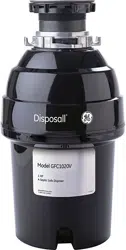
Use and Care of
®
food waste disposers
Continuous-feed models
INSTRUCTIONS PERTAINING TO A
RISK OF FIRE, ELECTRIC SHOCK OR
INJURY TO PERSONS.
IMPORTANT SAFETY
INSTRUCTIONS
WARNING—When using electric appliances, basic
precautions should always be followed, including the
following:
• Read all the instructions before using the appliance.
• To reduce the risk of injury, close supervision is
necessary when an appliance is used near children.
• Do not put fingers or hands into a waste disposer.
• Turn the power switch to the off position before
attempting to clear a jam or remove an object from
the disposer.
• When attempting to loosen a jam in a waste disposer,
use a long wooden object such as a wooden spoon or
the wooden handle of a broom or mop.
• When attempting to remove an object from a waste
disposer, use long-handled tongs or pliers. Only
nonmagnetic tools should be used.
• To reduce the risk of injury by materials that may
be expelled by a waste disposer, do not put the
following into a disposer:
• Clam or oyster shells.
• Drain cleaner.
• Glass, china or plastic.
• Large whole bones.
• Metal, such as bottle caps, tin cans or aluminum foil.
• Whole cornhusks.
• When not operating a disposer, leave the drain cover
in place to reduce the risk of an object falling into
the disposer.
• Do not operate disposer unless splash guard is in
place.
• Properly ground to conform with all governing codes
and ordinances. Follow details in Installation
Instructions.
SAVE THESE INSTRUCTIONS
Write down the model
and serial numbers.
You’ll find them on a label located on the side or bottom
of the disposer.
These numbers are also on the Consumer Product
Ownership Registration Card that came with your
disposer. Before sending in this card, please write these
numbers here:
Model Number
Serial Number
Use these numbers in any correspondence or service
calls concerning your disposer.
If you received a damaged disposer,
immediately
contact the dealer (or builder) that sold you the
disposer.
How the Disposer Works
Food wastes are fed into the disposer through the sink
drain opening. The wastes fall into the grinding
mechanism and are shredded into particles small
enough to be floated away by the cold water running
through holes in the flywheel and the strainer around
the flywheel. When the shredder impellers on the
flywheel strike hard objects such as bones, they will
swivel back to reduce the possibility of jamming.
What it Grinds
The disposer will grind almost all items of food waste.
Naturally, some items require less time to grind than
others. Items such as animal fat, skin and hard bones
take longer to grind than vegetable parings.
Mixing different types of waste will improve grinding
efficiency.
Turn the Page for Operation
and Maintenance Instructions.
GE Quality Product
GE Answer Center
®
800.626.2000
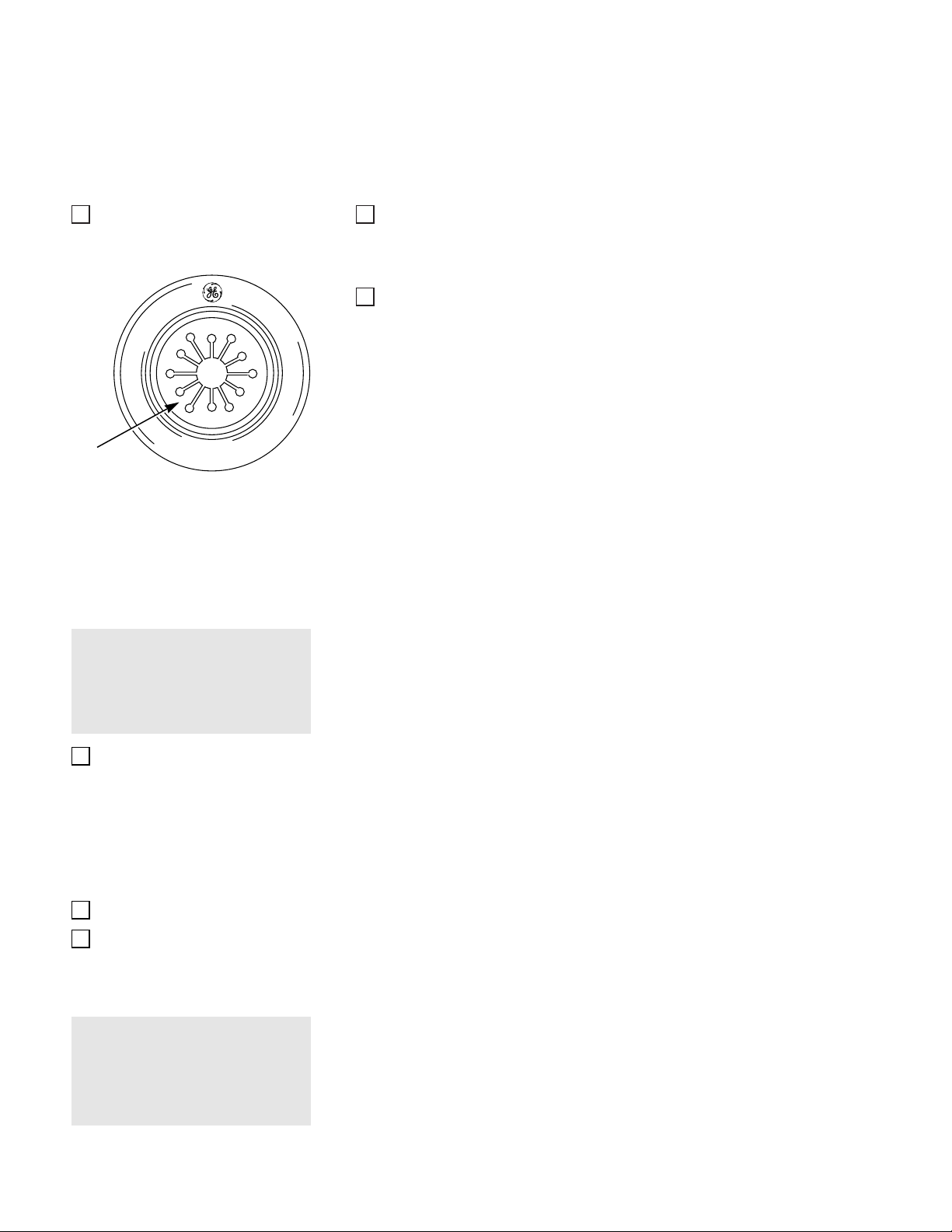
Remove the sink drain stopper.
This allows water to flow freely into
the disposer and down the drain.
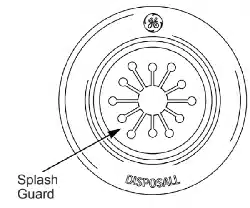
The splash guard in the sink
opening and water flowing into the
disposer form a shield to keep
flying particles inside the unit and
permit continuous feeding of food
waste when you are operating the
disposer.
Turn on
cold water to full flow.
Cold water hardens greases so they
can be ground up and floated away
through the drain. A rapid flow of
cold water assists grinding, cleans
out the disposer, carries food waste
through the drain lines and helps
keep pipes clean.
Flip wall switch to ‘‘ON.’’
While disposer is operating
and cold water is running, feed all
food waste down the sink drain
through the splash guard.
After the waste is gone, allow
the disposer to run for about a
half minute to flush all food
waste down the drain.
Flip wall switch to ‘‘OFF.’’
Wait about 30 seconds and turn
cold water off.
How to Speed Up Food
Waste Disposal
Cut up or break up large bones,
melon rinds, grapefruit skins, corn
cobs and fibrous materials such as
pineapple or vegetable stalks
before putting them into your
disposer.
Items such as large bones and
fibrous husks like lima bean pods
require considerable cutting time
in your disposer. You may prefer to
put them in the trash can or trash
compactor.
Do not put leather, cloth, string,
rubber, seafood shells, artichoke
leaves or corn husks into your
disposer. These items can cause
nuisance tripping of the motor
overload control.
Care and Cleaning
Your disposer is permanently
lubricated. No oiling is required
during the life of the unit.
Your disposer is self-cleaning
when used properly. Always use
a rapid flow of cold water and
allow the unit to run long enough
to do a thorough job of grinding
and flushing the food waste
throughout each operation.
To deodorize your disposer, should
an odor develop in the unit, run
orange or lemon rind through the
disposer. This will dispel unpleasant
odors and leave the sink with a
clean, sweet smell.
Grinding a dozen or so ice cubes
sprinkled with a generous amount
of regular household scouring
powder (not drain cleaner) also has
a cleaning, deodorizing effect.
Do not use water when grinding
ice cubes.
To keep drain lines clean, flush
out the disposer once a day as
follows:
1. Operate disposer to eliminate
any food waste in disposer.
2. Seal sink drain and run two to
three inches of water in the sink.
3. Remove sink drain stopper and
allow sink to drain naturally.
6
5
CAUTION:
NEVER PUSH FINGERS OR
WASTE FEEDING TOOLS
BEYOND SPLASH GUARD
WITH UNIT RUNNING.
4
3
2
DO NOT OPERATE THE
DISPOSER UNLESS THE
SPLASH GUARD IS IN
PLACE.
D
I
S
P
O
S
A
L
L
1
HOW TO OPERATE YOUR DISPOSER USER
MAINTENANCE
INSTRUCTIONS
2
Splash
Guard
WARNING—To reduce the risk of fire, electric shock, or injury
to persons, read the IMPORTANT SAFETY INSTRUCTIONS
on page 2 before operating this appliance.
Your disposer is equipped with
a thermoelectric control which
protects the motor when
overloading occurs. When
overloaded, the motor will
automatically stop.
If disposer stops during use:
• Flip wall switch to ‘‘OFF.’’
• Remove cause of overload. See
CAUTION below.
• Wait a few minutes for the
overload control to cool.
• Press reset button. On some
models, button is on front near
bottom of disposer; on other
models, on bottom of disposer.
• Turn wall switch on to restart
disposer.
Overloading can be caused by:
• Packing food waste into disposer
too rapidly.
• Metallic object falling into the
unit and jamming the flywheel.
• Putting items such as leather,
cloth, string, rubber, seafood
shells, artichoke leaves or corn
husks into your disposer.
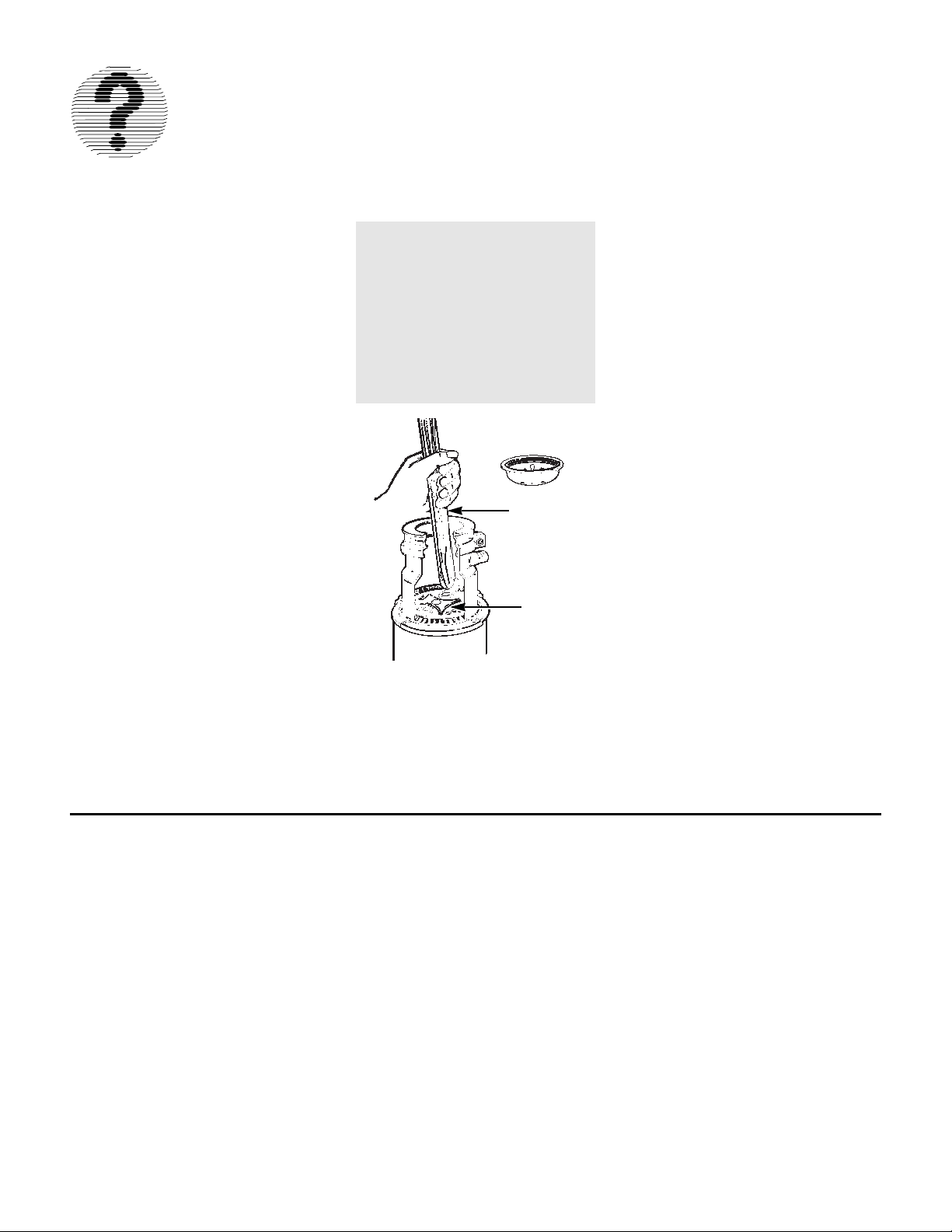
If the disposer will not restart after
you have removed the apparent
cause, remove the splash guard and
use a lever such as a wooden spoon
or wooden broom or mop handle to
turn the flywheel to free the jam.
If disposer will not start:
• Flip wall switch to ‘‘OFF.’’
• Remove splash guard.
• Use a large wooden spoon or
broom handle as a lever to rotate
flywheel.
If flywheel rotates freely:
• Depress reset button until it
clicks and remains depressed.
• If reset button is already
depressed, check for a tripped
circuit breaker or a burned-out
fuse.
If flywheel does not rotate freely:
• Check to see if a foreign object
such as a nail or a metal beverage-
can tab has lodged between the
flywheel and the shredding ring. If
so, dislodge the object by rotating
the flywheel with a lever such as a
broom handle or large wooden
spoon and remove the object.
If disposer makes an unusually
loud noise:
• This is normal when grinding
bones or fruit pits.
• Accidental entry of a spoon,
bottle cap or other similar objects
can result in unusually loud noise.
To correct:
• Turn wall switch off.
• Turn water off.
• Wait until flywheel stops.
• Remove splash guard.
• Remove object with tongs or a
long-handled wooden spoon.
CAUTION:
• NEVER PUT YOUR HAND
INTO THE DISPOSER.
• BE SURE TO TURN THE
WALL SWITCH OFF.
• ALWAYS USE TONGS
OR A LARGE SPOON
TO REMOVE OBJECTS
FROM DISPOSER.
Questions?
Use This Problem Solver
3
If you need more help...call, toll free:
GE Answer Center
®
800.626.2000
consumer information center
Remove
Splash Guard
Wooden
Broom or
Mop Handle
Turn
Flywheel
If You Need Service
To obtain service, see your
warranty in the back of this book.
We’re proud of our service and
want you to be pleased. If for some
reason you are not happy with the
service you receive, here are three
steps to follow for further help.
FIRST, contact the people who
serviced your appliance. Explain
why you are not pleased. In most
cases, this will solve the problem.
NEXT, if you are still not pleased,
write all the details—including
your phone number—to:
Manager, Consumer Relations
GE Appliances
Appliance Park
Louisville, Kentucky 40225
FINALLY, if your problem is still
not resolved, write:
Major Appliance Consumer
Action Panel
20 North Wacker Drive
Chicago, Illinois 60606
3-91 CG
YOUR DISPOSALL
®
FOOD WASTE DISPOSER
WARRANTY
Save proof of original purchase date such as your sales slip or cancelled check to establish warranty period.
WHAT IS COVERED
FULL ONE-YEAR WARRANTY
For one year from date of original
purchase, we will provide, free of
charge, parts and service labor
in your home to repair or replace
any part of the disposer
that fails
because of a manufacturing defect.
This warranty is extended to
the original purchaser and any
succeeding owner for products
purchased for ordinary home use
in the 48 mainland states, Hawaii
and Washington, D.C. In Alaska the
warranty is the same except that it
is LIMITED because you must pay
to ship the product to the service
shop or for the service technician’s
travel costs to your home.
All warranty service will be
provided by our Factory Service
Centers or by our authorized
Customer Care
®
servicers during
normal working hours.
Look in the White or Yellow Pages
of your telephone directory for
GENERAL ELECTRIC COMPANY,
GENERAL ELECTRIC FACTORY
SERVICE, GENERAL ELECTRIC-
HOTPOINT FACTORY SERVICE or
GENERAL ELECTRIC CUSTOMER
CARE
®
SERVICE.
WHAT IS NOT COVERED
• Service trips to your home to
teach you how to use the product.
Read your Use and Care material.
If you then have any questions
about operating the product,
please contact your dealer or our
Consumer Affairs office at the
address below, or call, toll free:
GE Answer Center
®
800.626.2000
consumer information service
• Improper installation.
If you have an installation problem,
contact your dealer or installer.
You are responsible for providing
adequate electrical, plumbing and
other connecting facilities.
• Replacement of house fuses or
resetting of circuit breakers.
• Failure of the product if it is used for
other than its intended purpose or
used commercially.
• Damage to product caused
by accident, fire, floods or acts
of God.
WARRANTOR IS
NOT
RESPONSIBLE
FOR CONSEQUENTIAL DAMAGES.
Some states do not allow the exclusion or limitation of incidental or consequential damages, so the above limitation or exclusion
may not apply to you. This warranty gives you specific legal rights, and you may also have other rights which vary from state to state.
To know what your legal rights are in your state, consult your local or state consumer affairs office or your state’s Attorney General.
Warrantor: General Electric Company
If further help is needed concerning this warranty, write:
Manager—Consumer Affairs, GE Appliances, Louisville, KY 40225
CONTINUOUS-FEED MODELS
Part No. 165D3080P201
Pub. No. 49-5505