
INSTALLATION and SERVICE INSTRUCTIONS
USE and CARE INSTRUCTIONS
BUILT-IN
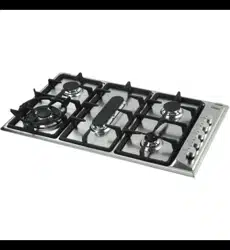
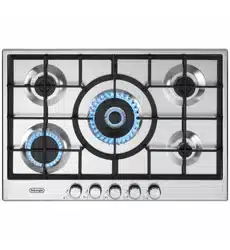
GAS ON GLASS HOBS
Models:
DEGH60BG - DEGH70BG - DEGH90BG
distributed by
DèLonghi
Pty Ltd

2

3
Dear Customer,
Thank you for having purchased and given your preference to
our product.
The safety precautions and recommendations reported below
are for your own safety and that of others. They will also provide
a means by which to make full use of the features offered by your
appliance.
Please keep this booklet in a safe place. It may be useful in fu-
ture, either to yourself or to others in the event that doubts should
arise relating to its operation.
This appliance must be used only for the task it has expli-
citly been designed for, that is for cooking foodstuffs. Any
other form of usage is to be considered as inappropriate and
therefore dangerous.
The manufacturer declines all responsibility in the event of
damage caused by improper, incorrect or illogical use of the
appliance or be faulty installation.
PRODUCT LABEL
This cooktop has been designed and constructed in accordance with the following codes
AGA101 (AS 4551) Approval Requirements for Domestic Gas cooking appliances
AS/NZS 60335.1 General Requirements for Domestic electrical appliances
AS/NSZ 60335.2.6 Particular Requirements for Domestic electrical cooking appliances
AS/NZS CISPR 14.1 Electromagnetic Compatibility Requirements

4
IMPORTANT PRECAUTIONS AND RECOMMENDATIONS FOR USE OF
ELECTRICAL APPLIANCES
Use of any electrical appliance implies the necessity to follow a series of fundamental rules.
In particular:
Never touch the appliance with wet hands or feet.
Do not operate the appliance barefooted.
supervision.
Young children should be supervised to ensure they do not play with the appliance.
The manufacturer cannot be held responsible for any damages caused by improper, incor-
rect or illogical use of the appliance.
IMPORTANT PRECAUTIONS AND RECOMMENDATIONS
After having unpacked the appliance, check to ensure that it is not damaged.
-
nician.
Packing elements (i.e. plastic bags, polystyrene foam, nails, packing straps, etc.) should
not be left around within easy reach of children, as these may cause serious injuries.
Do not attempt to modify the technical characteristics of the appliance as this may
become dangerous to use.
Do not carry out cleaning or maintenance operations on the appliance without having
previously disconnected it from the electric power supply.
After use, ensure that the knobs are in the off position.
During and after use of the appliance, certain parts will become very hot. Do not touch
hot parts.
Household appliances are not intended to be played with by children.
Keep children away from the appliance when it is in use.
Children, or persons with a disability which limits their ability to use the appliance,
should have a responsible person to instruct them in its use. The instructor should
surroundings.
WARNING: When correctly installed, your product meets all safety requirements laid
down for this type of product category. However special care should be taken around
the rear or the underneath of the appliance as these areas are not designed or inten-
ded to be touched and may contain sharp or rough edges, that may cause injury.
This appliance is for domestic use only.
Do not use the hob if the glass surface is broken or cracked in any way.
Please disconnect the hob from the mains and contact the After-Sales Service.
Do not scratch the hob with sharp objects. Don’t use the hob as a work surface.
The manufacturer declines all liability for injury to persons or damage to property cau-
sed by incorrect or improper use of the appliance.
IMPORTANT NOTE: This appliance shall not be used as a space heater, especial-
ly if installed in marine craft or caravans.

5
INSTALLATION
CAUTION:
This appliance must be installed in accordance with these installation instruc-
-
lations, electrical wiring regulations, - Gas Installations and ony other relevant
statutory regulations.
This appliance shall be only be serviced by authorized personnel.
This appliance is to be installed only by an authorised person.
Incorrect installation, for which the manufacturer accepts no responsibility, may
cause personal injury of damage.
Always disconnect the appliance from mains power supply before carrying out
any maintenance operations or repairs.
In the room where the appliance is installed, there must be enough air to allow
the gas to burn correctly, according to the current local regulations.
ELECTRICAL REQUIREMENTS
The appliance must be connected to the mains checking that the voltage correspon-
ds to the value given in the rating plate and that the electrical cable sections can
The plug must be connected to an earthed socket in compliance with safety standards.
power consumed by the appliance.
The wires in the power cable are coloured in accordance with the following code:
Green/Yellow = Earth, Blue = Neutral, Brown = Active.
If the colours of the wires in the power cable to the appliance do not correspond with
the coloured markings identifying the terminals in the junction terminal, proceed as
follows:
1. The wire which is coloured green and yellow must be connected to the terminal mar-
ked E (Earth) or coloured Green.
2. The wire which is coloured blue must be connected to the terminal marked N (Neutral)
or coloured Black.
3. The wire which is coloured brown must be connected to the terminal marked L (Live)
or A (Active) or coloured Red.
A suitable isolating switch providing full disconnection from the mains power supply
(under overvoltage category III conditions) shall be incorporated in the permanent
wiring, mounted and positioned to comply with the local wiring rules and regulations.
The isolating switch must be of an approved type and provide a 3 mm air gap contact
separation in all poles (or in all active [phase] conductors if the local wiring rules allow
for this variation of the requirements).
The power supply cable must not touch the hot parts and must be positioned so that it
does not exceed 50°C above ambient.
Once the appliance has been installed, the switch or socket must always be accessi-
ble.
If the supply cord is damaged it must be replaced by the manufacturer or it’s Service
6
N.B. The connection of the appliance to earth is mandatory.
-
trician.
He should also check that the socket cable section is suitable for the power drawn by the
appliance.
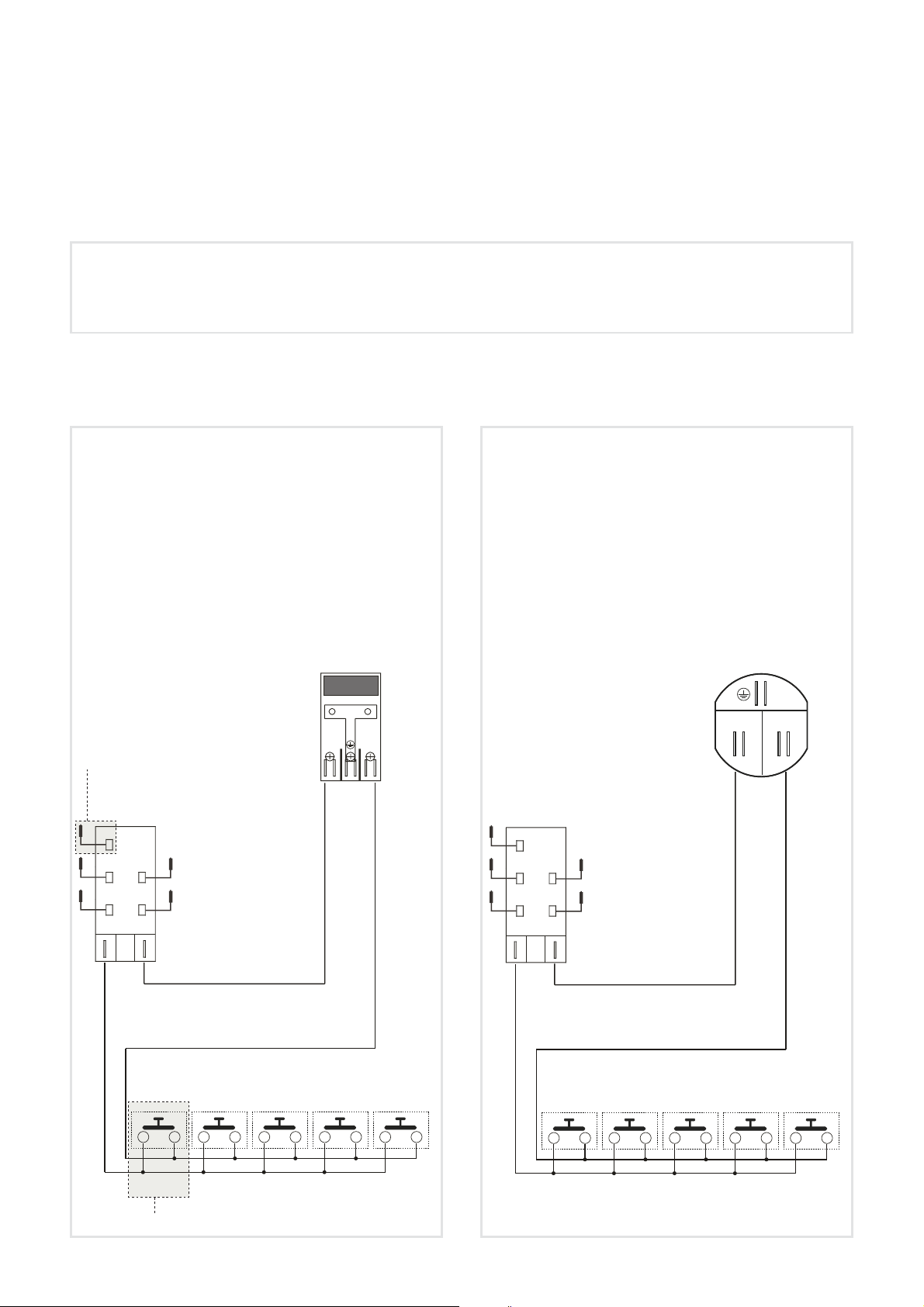
Figure 1 Figure 2
with the instructions supplied by the manufacturer and in compliance with esta-
blished electrical regulations.
Model: DEGH70BG
ELECTRIC DIAGRAM KEY
A Ignition coil
PA Ignition switches group
CA Spark electrodes
M Terminal block
Models: DEGH60BG,
DEGH90BG
ELECTRIC DIAGRAM KEY
A Ignition coil
PA Ignition switches group
CA Spark electrodes
M Terminal block
L N
NL
M
A
Only for the model
DEGH90BG
Only for the model
DEGH90BG
PA
CA
A
PA
CA
M
7
Model: DEGH60BG Model: DEGH70BG
Model: DEGH90BG
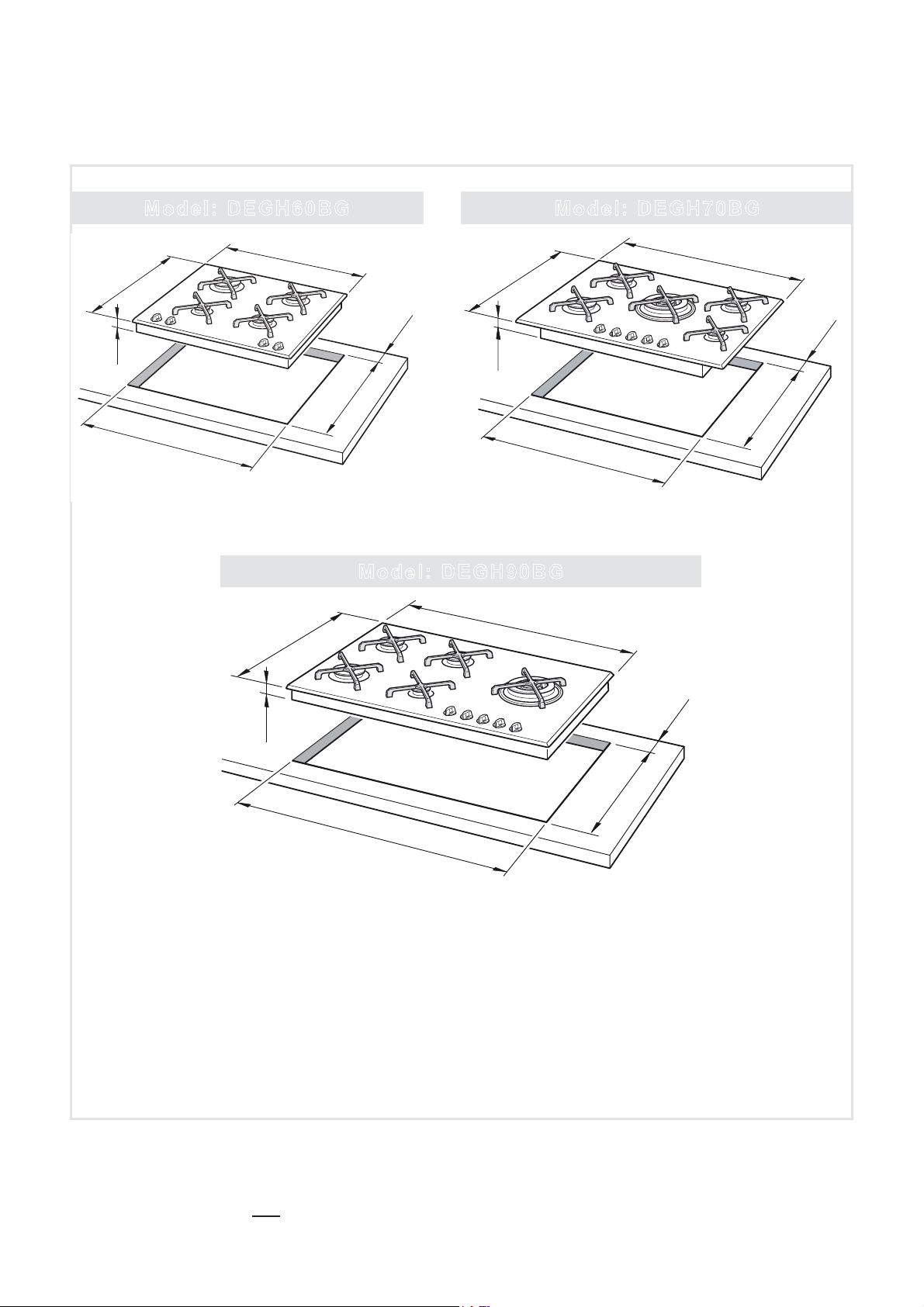
CLEARANCES
Installation clearances and protection of combustible surfaces shall comply with the current
local regulations e.g. AS/NZS5601 - Gas Installations code.
(1) 54 mm from top of countertop.
(2) At least 60 mm between the back side of the cut-out and the back of the countertop.
(3) At least 200 mm from the periphery of the nearest burner to any vertical combustible surface.
If the distance from the periphery of the nearest burner to any vertical combustible surface,
or vertical combustible surface with toughened glass or sheet metal, is less than 200 mm, the
surface shall be protected (in accordance with AS/NZS5601) to a height of not less than 150
mm above the hob for the full dimension (width or depth) of the cooking surface area.
480
60
(2) (3)
560
715
510
54
(1)
840
869
480
510
60
(2) (3)
54
(1)
480
60
(2) (3)
560
585
510
54
(1)
Important note:
This appliance shall not be used as a space heater, especially if installed in marine craft
or caravans.
Figure 3a
Figure 3b
Figure 3c
8
500 mm
650 mm
450 mm
6
0 mm minimum
e
tween the side
the cut-out
n
d the side wall
500
650
450
214
5
Model: DEGH60BG
Model: DEGH70BG
Model: DEGH90BG
500 mm
650 mm
450 mm
1
2,5 mm minimum
e
tween the side
f
the cut-out
n
d the side wall
A. 212.5 mm minimum between the side of
the cut-out and the side wall.
B. 260 mm minimum between the side of
the cut-out and the side wall.
C. 214.5 mm minimum between the side of
the cut-out and the side wall.
IMPORTANT: see also item (3) at page no.7.
Figure 4a
A
B
C
Figure 4b
Figure 4c
9
The installation shall comply with the dimensions in Figures 3a, 3b or 3c and 4a, 4b or 4c,
bearing in mind that:
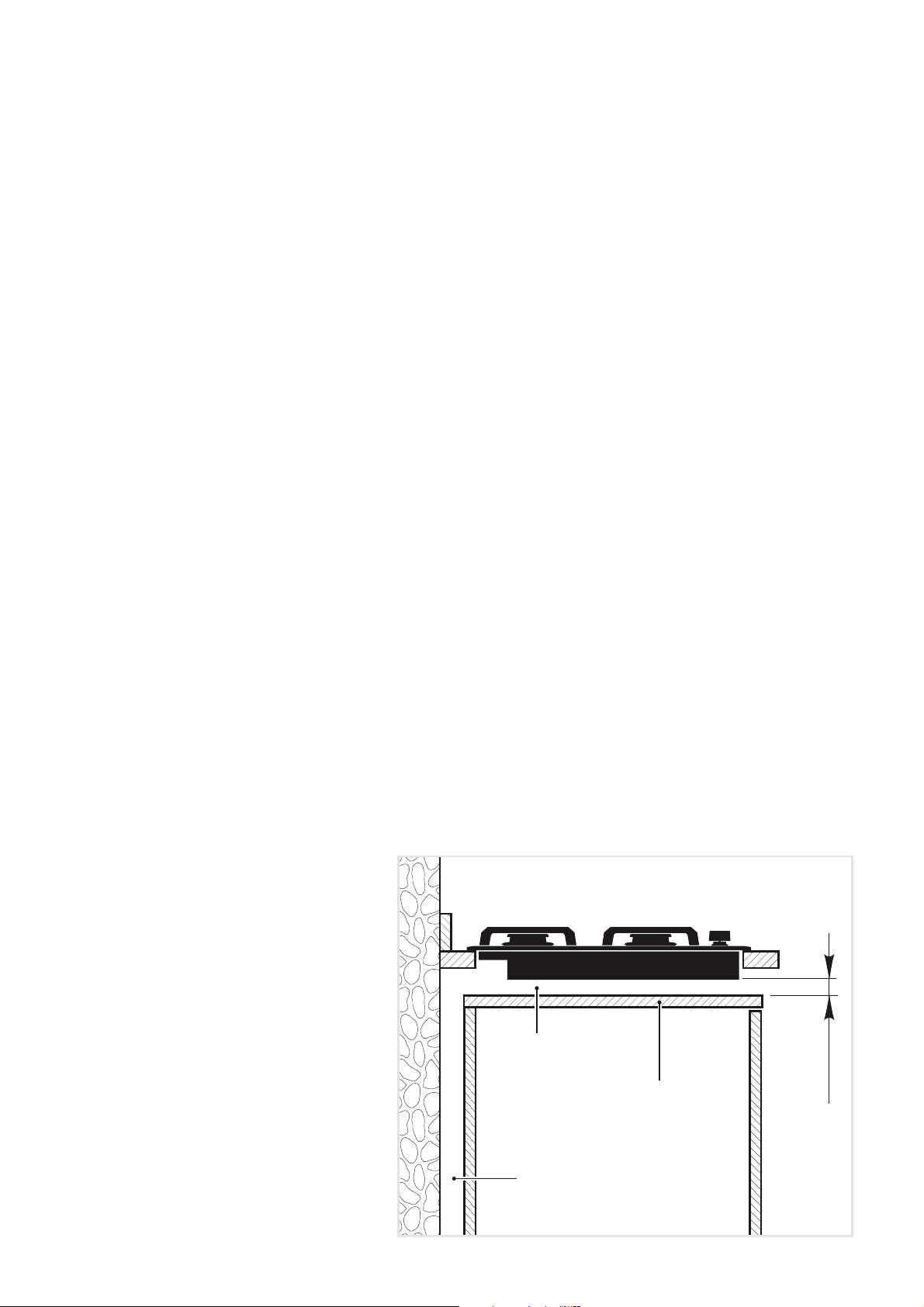
Apartition between the base of the hob and the cupboard below
mm below the workbench surface if the cupboard is to be used for storage.
If the hob is installed over a built-in oven, the oven shall be provided with cooling fan
motor. The two appliances shall be connected to the gas/electrical supply with inde-
pendent connections.
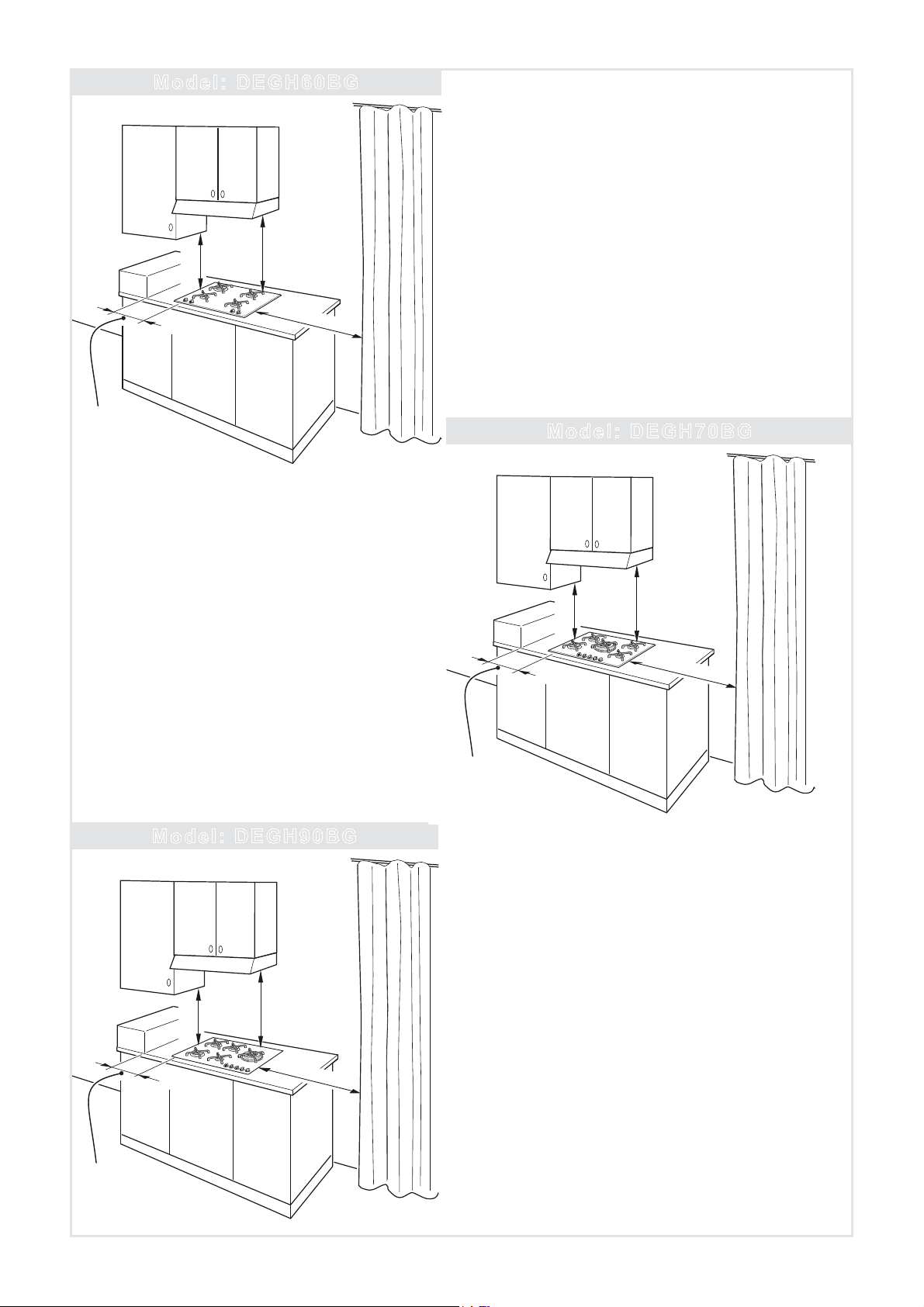
Overhead clearances - In no case shall the clearance between the highest part of the
hob and a range hood be less than 600 mm, or for an overhead exhaust fan 800 mm.
Any other downward facing combustible surface less than 600 mm above the highest
part of the hob shall be protected for the full width and depth of the cooking surface
area in accordance with local regulations inforce. However, in no case shall this clea-
rance to any surface be less than 450 mm.
Standards requirement
Temperature of nearby surfaces. Australian and New Zealand Gas Installation Stan-
dards (AS/NZS5601) require a cooktop to be installed so that the surface temperature of
any nearby combustible surface will not exceed 65°C above ambient.
This is typically achieved by:
AND
protecting the wall to a height of at least 150 mm along its length (minimum height of
non-combustible material when used on adjacent walls) with non-combustible surface
materials such as:
–
– tempered glass or sheetmetal, minimum thickness 0.4 mm (acceptable when used
INSTALLING THE SEPARA-
TOR BELOW THE BASE OF
THE COOKTOP
It is recommended that a 30 mm
clearance be left between to base
of the cooktop and the separator.
The separator shall be heat resi-
stant, made of low thermal con-
ductivity material and shall be re-
movable with the use of a tool for
installation and service.
30 mm
Space for
connections
Clearance
Separator
Figure 5
10
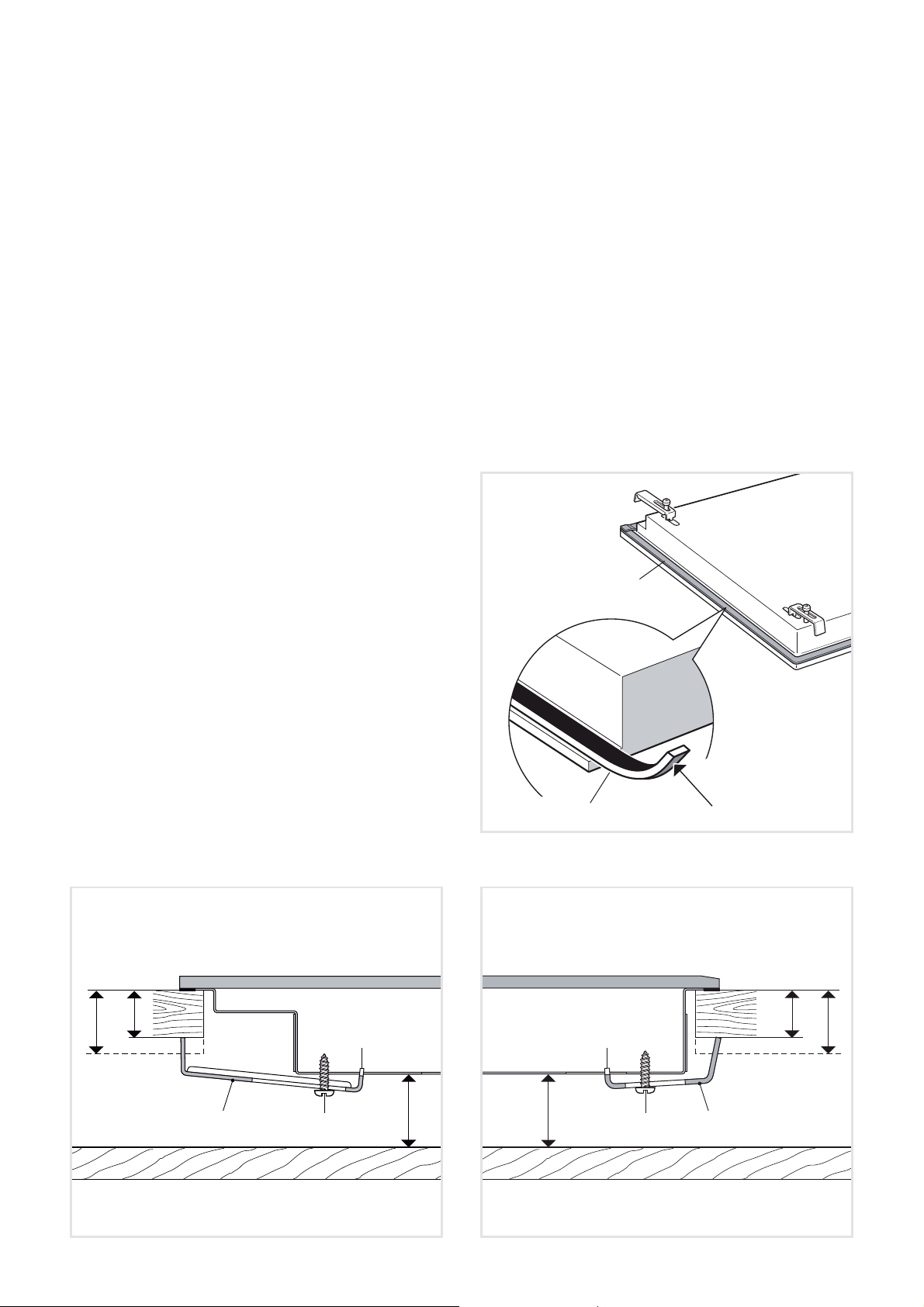
FASTENING THE COOKTOP
Each cooktop is provided with an installation kit including brackets and screws for fastening
the cooktop to benches from 30 to 40mm thick.
The kit includes two “F” type brackets (for the front of the cooktop), two “R” type brackets
(for the rear of the cooktop) and four self-threading screws “S
–
– Turn the hob upside down and rest the glass side on a soft surface.
– Spread the seal “G
– Fasten the brackets “F” and “R” to the appropriate socket holes, without tightening the
screws “S” for the moment. Make sure that the tabs are mounted correctly, as shown.
Rotate the tabs so that the cooktop can be put into the cutout.
– Put the cooktop into the cutout and position it correctly.
– Put the brackets “F” and “RA” of the brackets should go into the hole
(Figs. 7a and 7b).
– Tighten screws “S” until the cooktop is
completely secured to the bench.
– Using a sharp cutter or trimmer kni-
fe, trim the excess sealing material
around the edge of the cooktop.
Take care not to damage the
workbench.
3 cm
min
3 cm
4 cm
3 cm
min
3 cm
4 cm
Adhesive side
Rear Fixing Brackets Front Fixing Brackets
Figure 6
Figure 7a Figure 7b
11
GAS SUPPLY
This appliance is suitable for use with Natural Gas or ULPG (Check the “gas type”
sticker attached to the appliance).
For Natural Gas the gas supply must be regulated to obtain a pressure of 1 kPa with
the two semi-rapid (SR) burners operating at the maximum.
For ULPG models connect the gas supply directly to the appliance test point adaptor
(supplied with the conversion kit) and ensure that the supply pressure is regulated to
2.75 kPa.
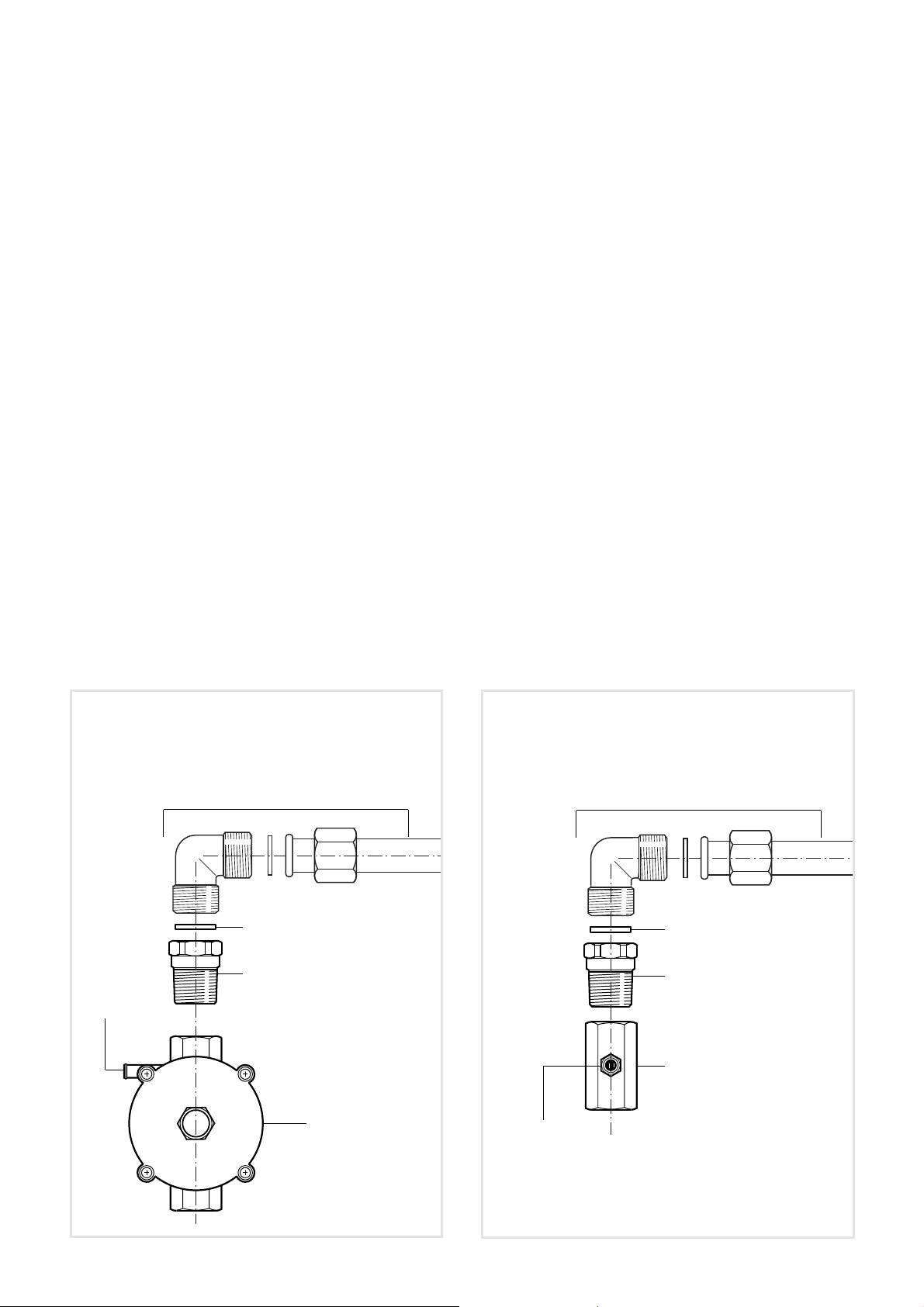
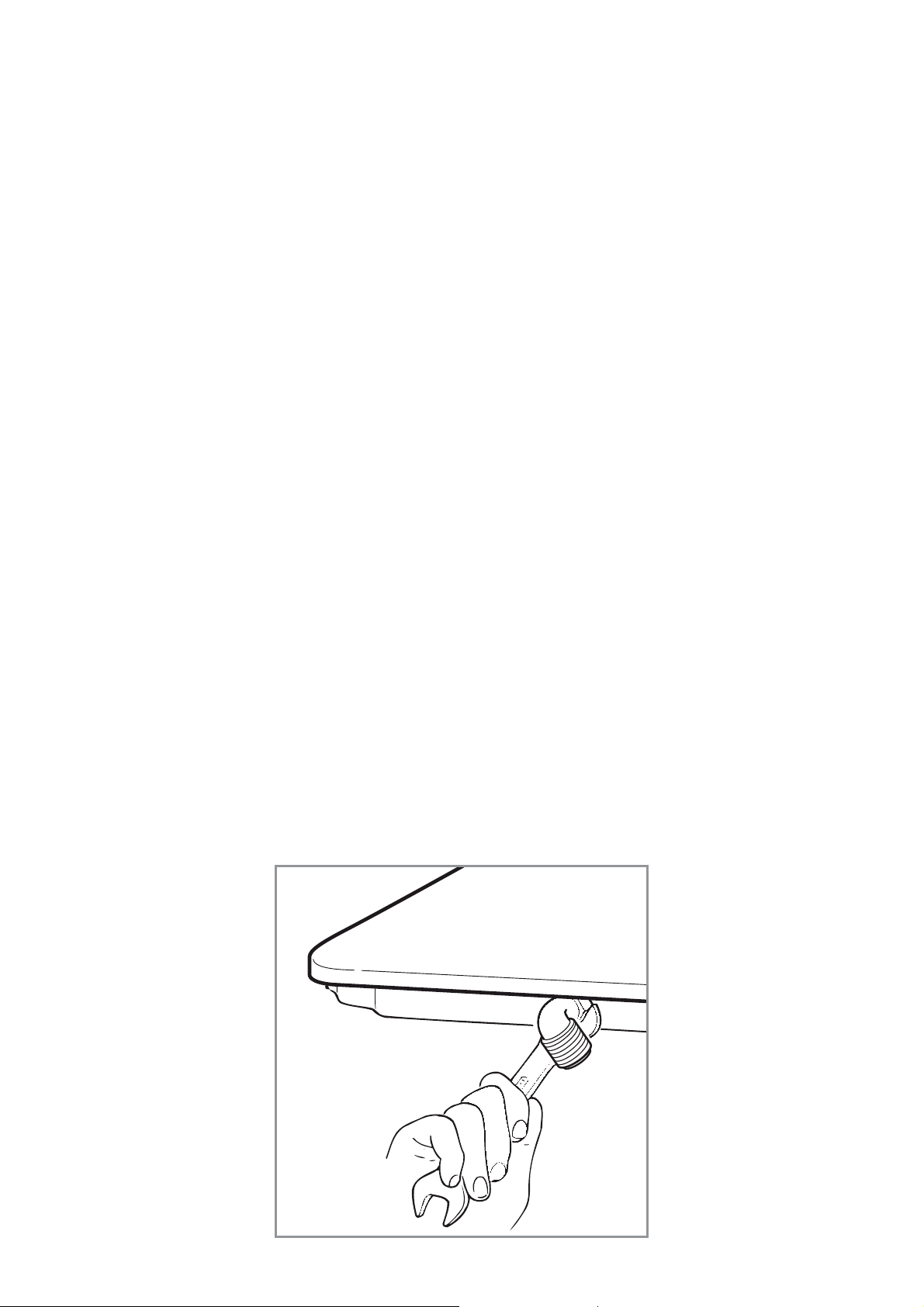
Do NOT force the ”elbow“ rotation prior to loosening nut.
Do NOT over tighten the nut at the ”elbow“.
1. After connecting the gas supply, check the piping and connections for leaks using a
soap and water solution. The presence of bubbles indicates a leak, tighten or replace
connections as appropriate.
Warning:
2. The operation of the appliance MUST be tested before leaving.
3. Adjust the test point pressure or supply pressure to the value which is appropriate for
the gas type.
4.
burner cap is located properly and the injector nipple is aligned correctly.
NL
(
)
L
Figure 8a Figure 8b
12
5. Check the minimum burner setting by quickly rotating the gas control knob from the
carry out the “minimum burner setting adjustment” procedure described below.
6. If satisfactory performance cannot be obtained, the installer shall check the installation
and notify the local gas supply authority for a gas supply problem, or if it is an ap-
pliance problem, our Customer Service Centre should be called to obtain the nearest
7. Where the appliance data plate cannot be easily read with the appliance in the instal-
led position the duplicate data plate must be attached to adjacent surface and the du-
plicate Natural gas / ULPG conversion label should also be included where a Natural
gas / ULPG conversion has been completed.
INSTALLATION WITH A FLEXIBLE HOSE ASSEMBLY
If this appliance has to be installed with a hose assembly, the installer shall refer to the
distance of 250 mm.
The supply connection point shall be accessible with the appliance installed.
The thread connection shall be Rp 1/2” (ISO 7-1) male.
IMPORTANT WARNING: After connection the installer must check that the hose is
not kinked, subjected to abrasion or permanently deformed. The installer must check
also that the hose is not near (or in contact) with any hot surfaces e.g. base of metal
hotplate, underbench oven etc.
The hose assembly shall be as short as practicable and comply with relevant
AS/NZS5601 requirements.
IMPORTANT WARNING: The installer shall ensure the hose assembly is restrained
Figure 9
13
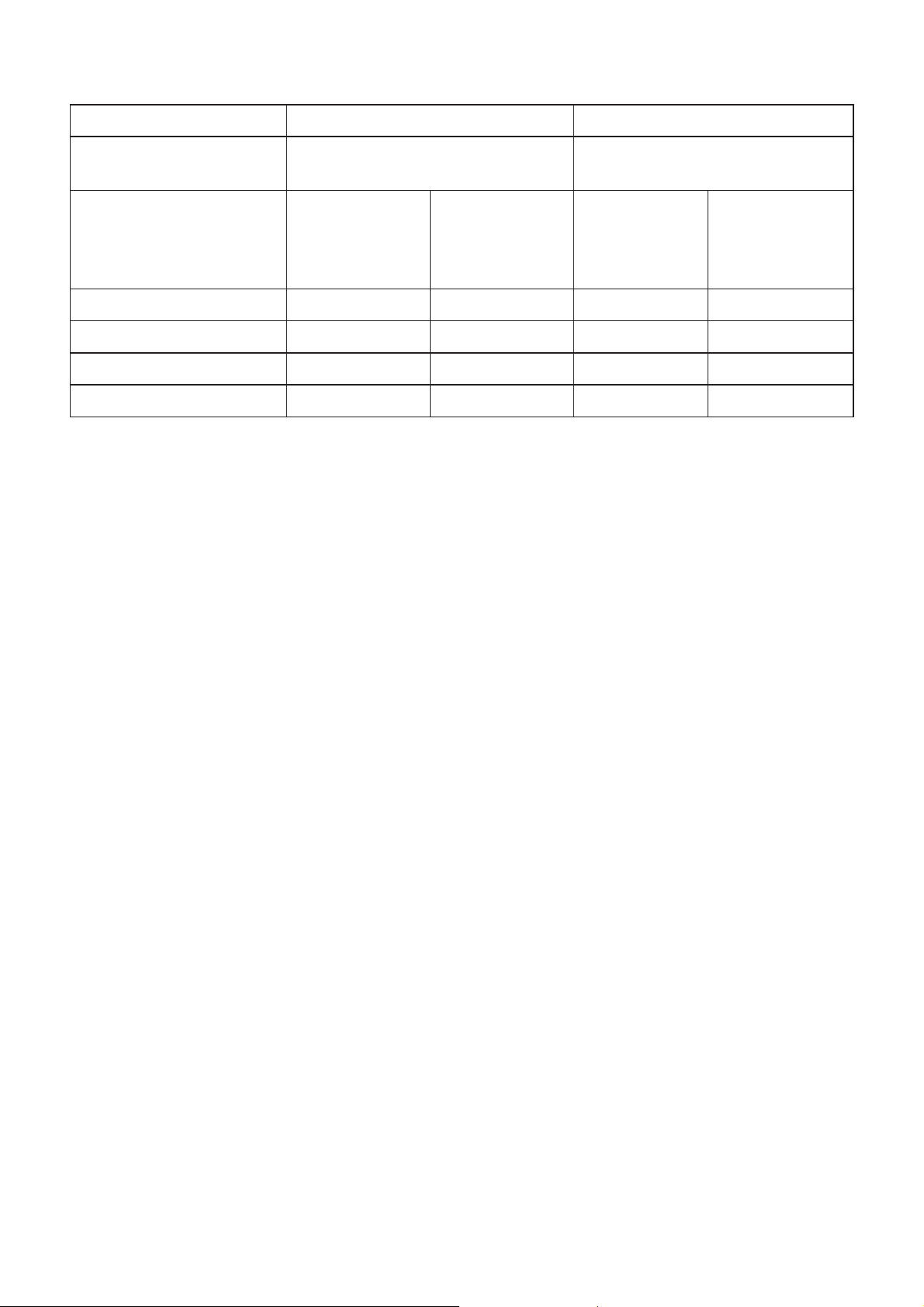
Natural Gas ULPG
Test Point Pressure
[kPa]
1.0 2.75
BURNER
Injector
Orifice Dia.
[mm]
Gas
Consumption
[MJ/h]
Injector
Orifice Dia.
[mm]
Gas
Consumption
[MJ/h]
Auxiliary (AUX) 0.85 3.60 0.53 3.60
Semi-rapid (SR) 1.12 6.30 0.70 6.30
Rapid (R) 1.45 10.40 0.91 10.80
Triple-ring (TR) (*) 1.60 12.70 0.95 11.90
TABLE FOR THE CHOICE OF THE INJECTORS
(*) Only for the models DEGH70BG, DEGH90BG
(Note: Gas type sticker and data plate are attached to the underside of the base of the
appliance.)
14
CONVERSION PROCEDURE (to convert to Natural gas or to ULPG)
REPLACING THE INJECTORS
The conversion procedure must be carried out only by an authorised person.
This appliance is suitable for use with Natural gas or Universal LPG (check the “gas type”
sticker attached to the appliance).
To replace the injectors proceed as follows:
Remove pan supports and burners from the cooktop.
Using a spanner, remove the injector “J-
ding to the gas type (see table - page 13).
for use with Natural gas/ULPG (supplied with the Natural gas/ULPG conversion kit).
surface along with the duplicate data plate.
IMPORTANT
If the cooktop is suitable for use with Natural gas and must be converted for use with
Universal LPG, before connecting to gas main remove the appliance gas regulator and
If the cooktop is suitable for use with Universal LPG and must be converted for use
with Natural gas, before connecting to the gas main remove the appliance test point
NOTE:
Gas regulator and test point adaptor are supplied with the appliance (packed with conver-
sion kit).
The burners are designed so that regulation of primary air is not required.
J
J
Figure 10a Figure 10b
Only for the models with triple-ring
burner (DEGH70BG, DEGH90BG)
15
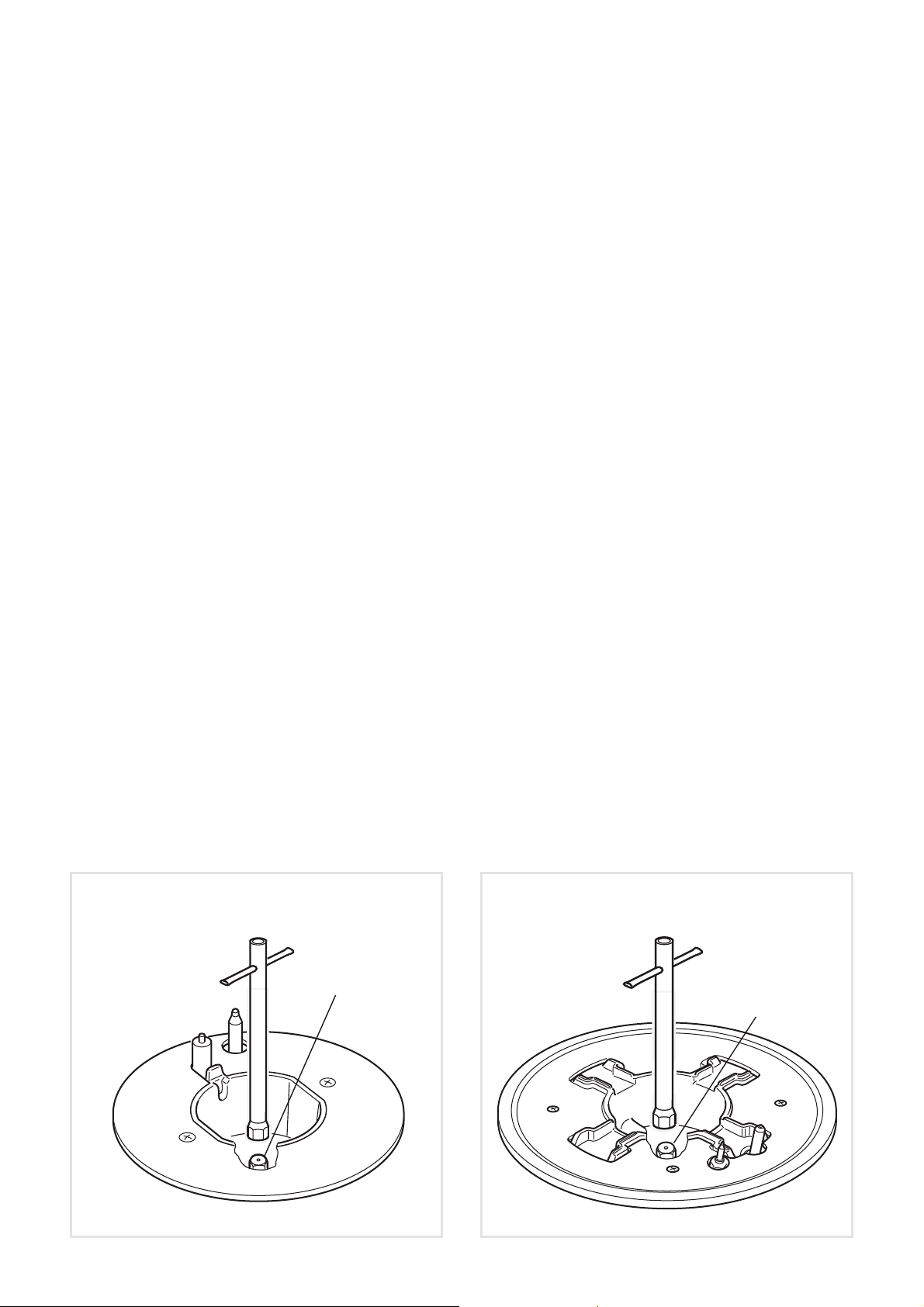
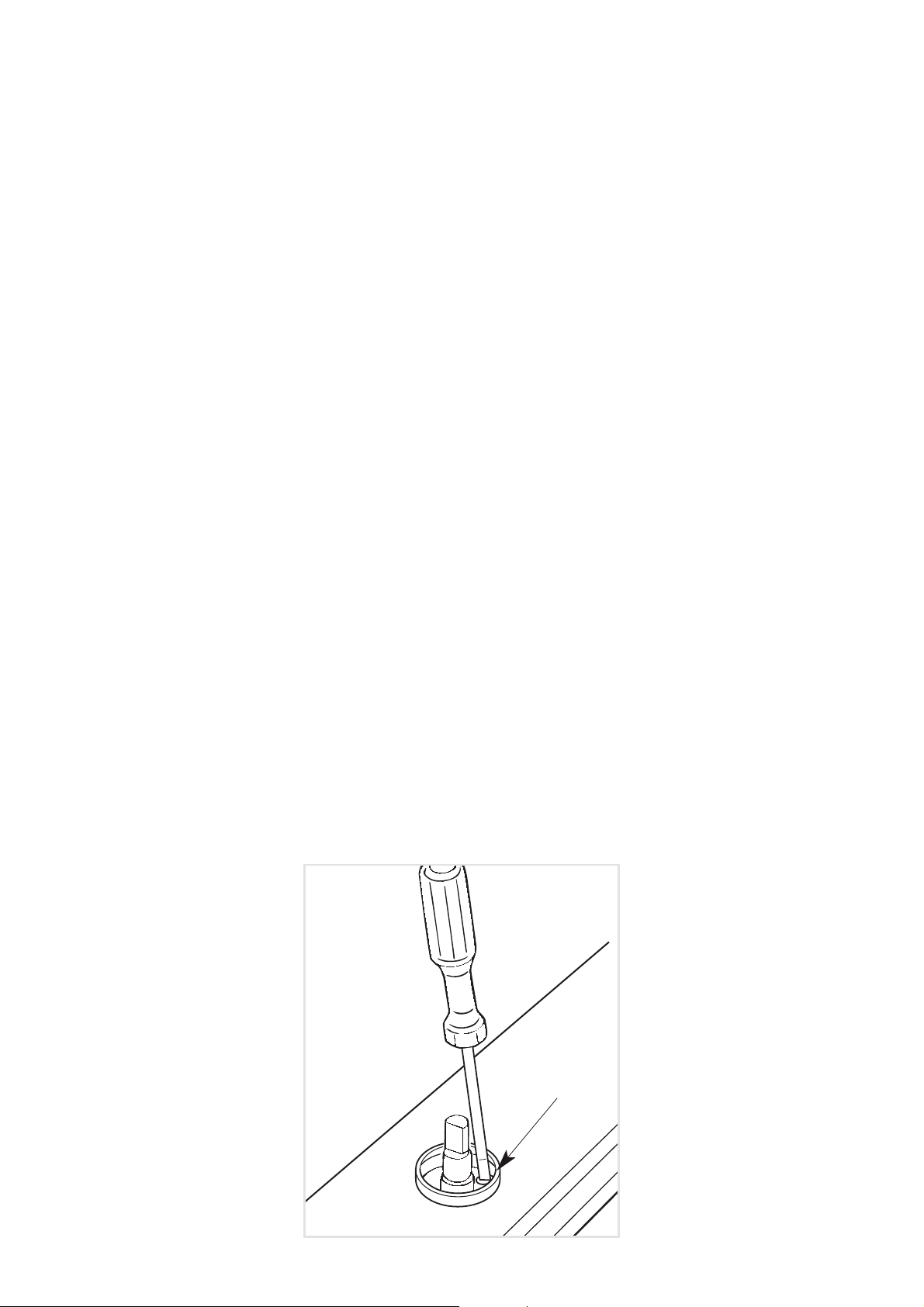
MINIMUM BURNER SETTING ADJUSTMENT
tap set to the minimum position. If some ports do not light, increase the minimum gas rate
setting.
Check whether the burner remains lit even when the gas tap is turned quickly from the
maximum to the minimum position. If the burner does not remain lit, increase the minimum
gas rate setting.
The procedure for adjusting the minimum gas rate setting is described below.
Auxiliary, Semi-rapid and Rapid burner
Normally for ULPG fully tighten the adjustment screw.
Triple-ring burner (only for the models DEGH70BG, DEGH90BG)
Normally for ULPG fully tighten the adjustment screw, then turn the screw 3/8 anti-
clockwise.
LUBRICATING THE GAS TAP
high-temperature-resistant grease on it.
Note: Servicing of this appliance is only to be carried out by Authorised Person.
A
Figure 11
16
USE and CARE
CAUTION:
This appliance must be used only for the task it has explicitly been designed for, that
is for domestic cooking of foodstuffs. Any other form of usage is to be considered as
inappropriate and therefore dangerous. Do not use this appliance as a space heater.
Do NOT place combustible materials or products on this appliance at any time. Do
Do NOT spray aerosols in the vicinity of this appliance while it is in use.
Do NOT modify this appliance.
IMPORTANT NOTE: This appliance shall not be used as a space heater, especial-
ly if installed in marine craft or caravans.
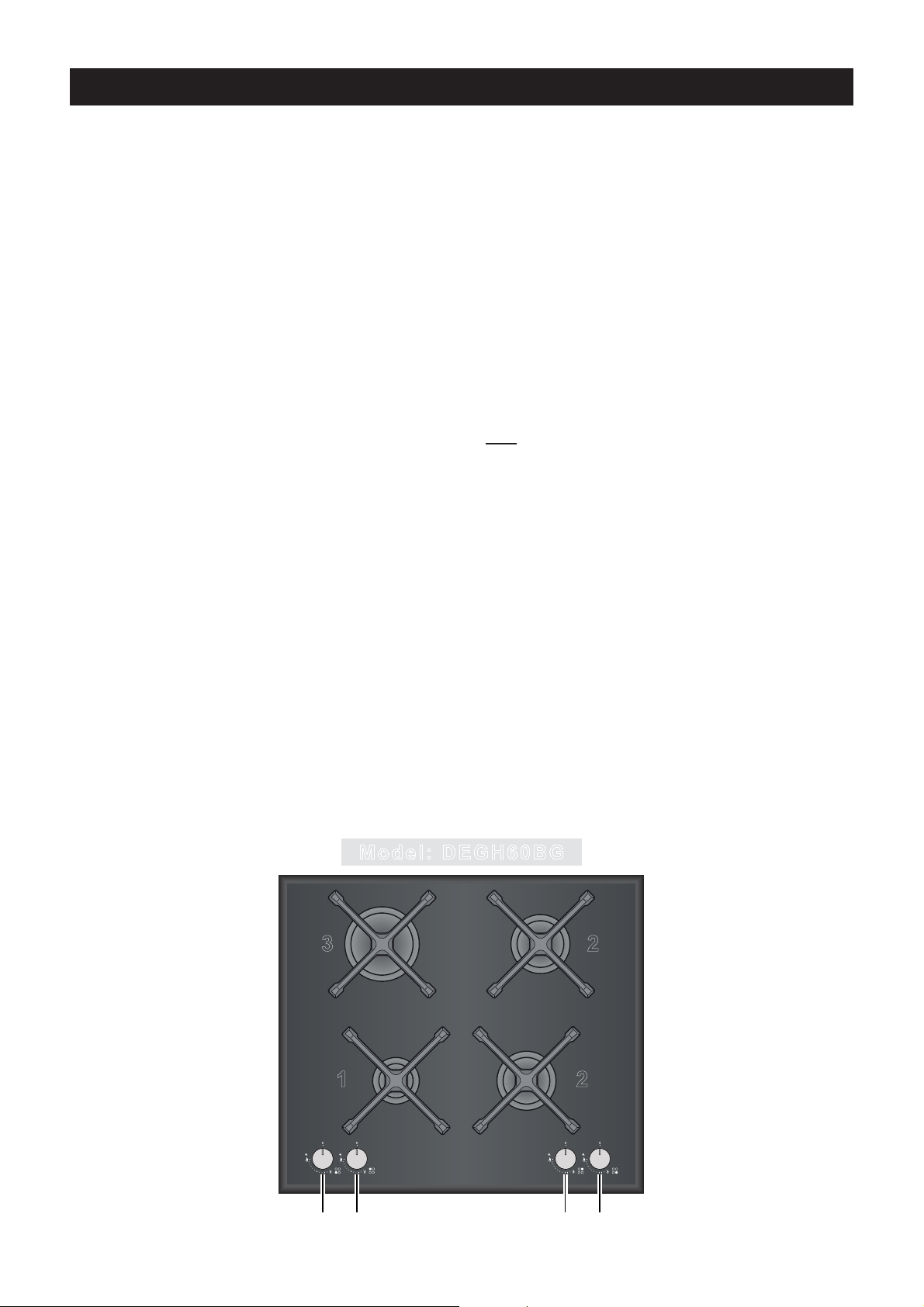
Model: DEGH60BG
Figure 12a
5 9 10 11
17
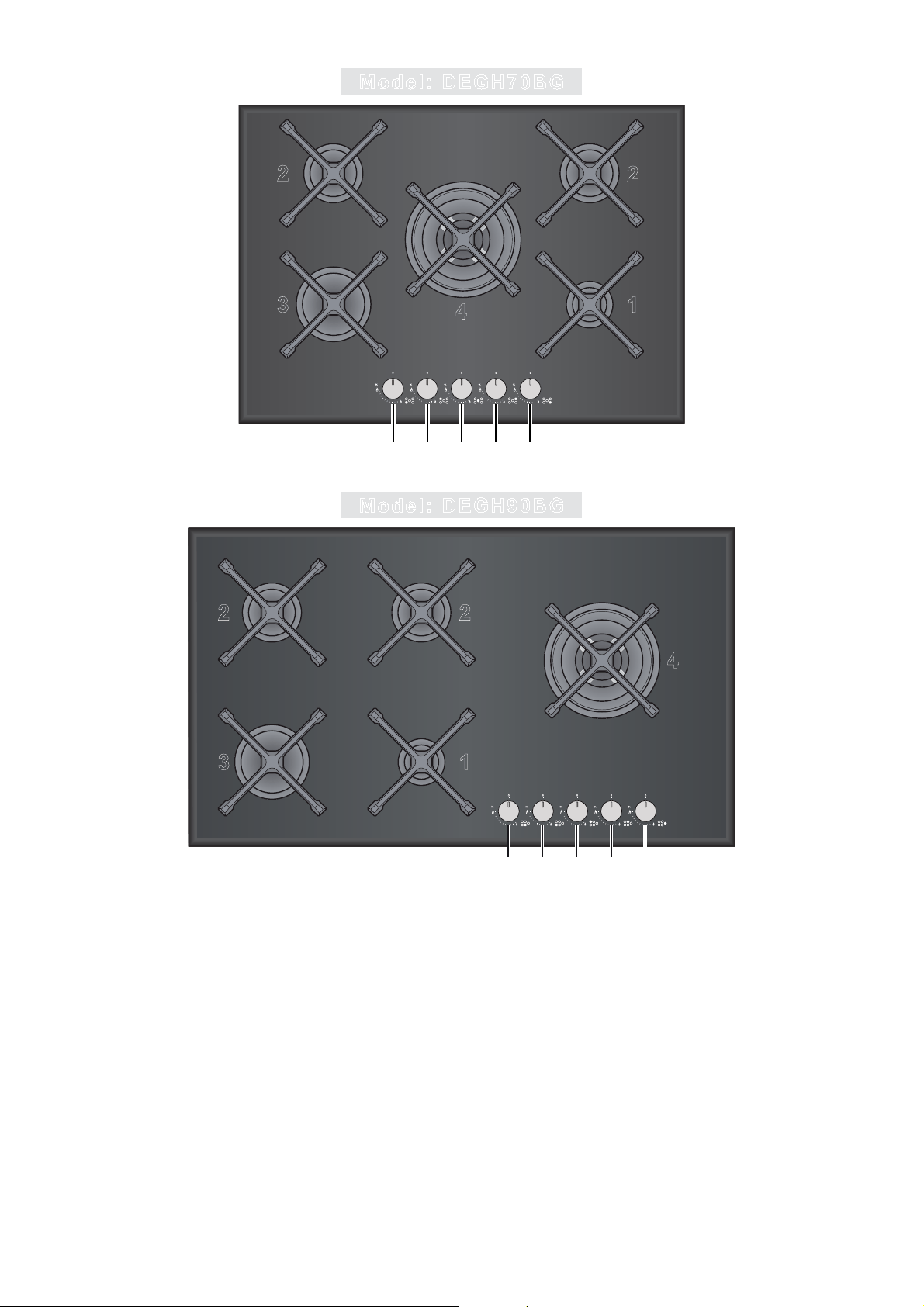
GAS BURNERS
1. Auxiliary (AUX) 3.60 MJ/h
2. Semi-rapid (SR) 6.30 MJ/h
3. Rapid (R) 10.40 MJ/h (NG)
10.80 MJ/h (ULPG)
4. Triple ring (TR) 12.70 MJ/h (NG)
11.90 MJ/h (ULPG)
CONTROL KNOBS
5. Burner 1 (Auxiliary)
6. Burner 2 (right Semi-rapid)
7. Burner 4 (Triple-ring)
8. Burner 2 (left Semi-rapid)
9. Burner 3 (Rapid)
10. Burner 2 (rear right Semi-rapid)
11. Burner 2 (front right Semi-rapid)
NOTE:
T
98 65
65
8
9
Model: DEGH70BG
Model: DEGH90BG
Figure 12b
Figure 12c
18
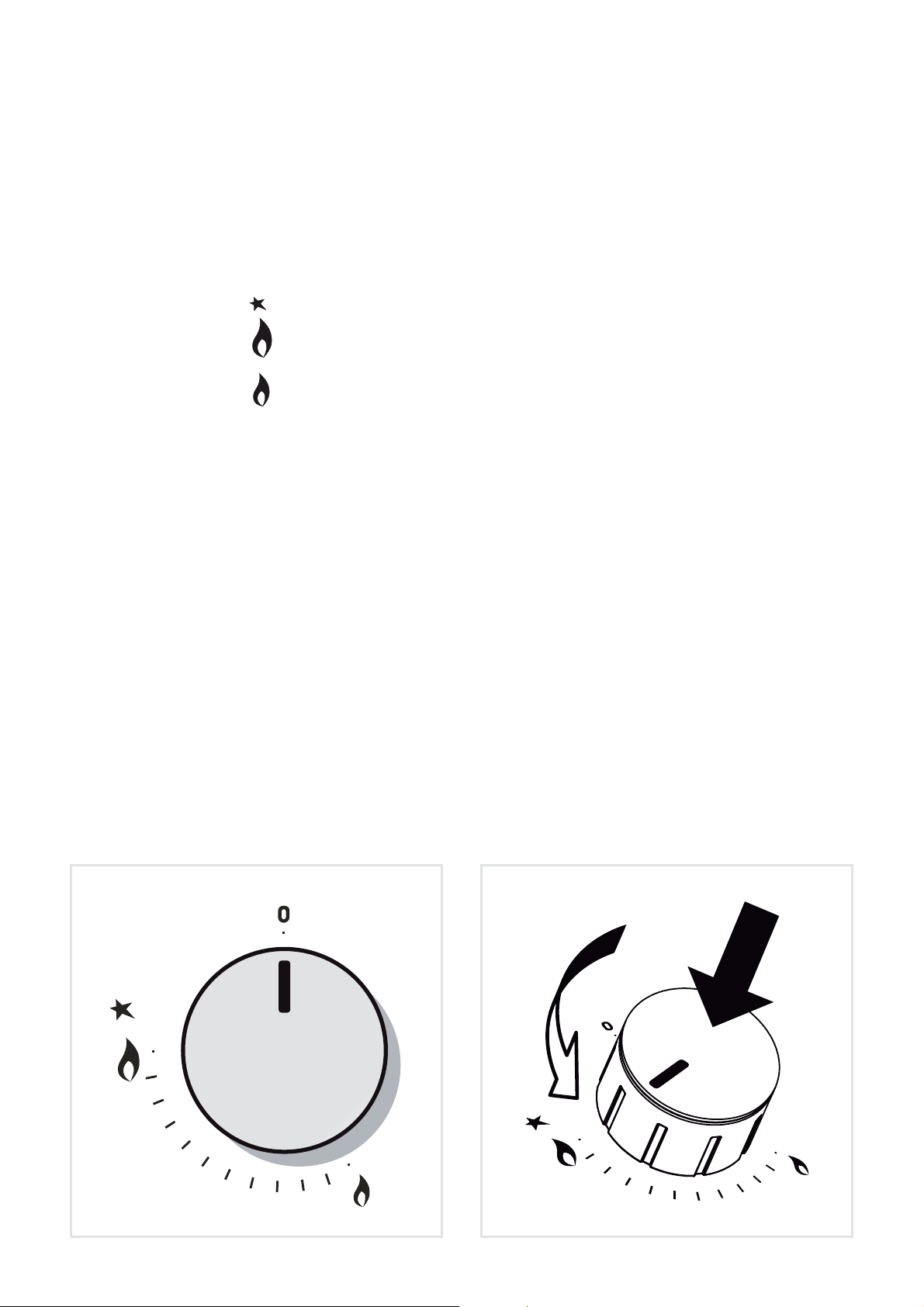
USING GAS BURNERS
Check that the electricity is switched on to allow spark ignition.
– Symbol
0 : tap closed (burner off)
– Symbol
: High (maximum)
– Symbol
: Low (minimum)
You can control the temperature by the knob to “High” (maximum) from “Low” “Minimum”.
To switch off, turn the knob clockwise until you hear the safety click.
Note that, if you are using a burner at the minimum setting, you turn the knob clockwi-
se past the maximum setting before reaching the off position.
off and relight using the minimum setting.
In the case of a mains failure light the burner with a match or lighted taper.
Note: When the cooker top is not being used, set the gas knobs to their closed posi-
tions and also close the cock valve on the gas bottle or the main gas supply line.
Figure 13a Figure 13b
19
LIGHTING GAS BURNERS FITTED WITH FLAME FAILURE SAFETY DEVICE
In order to light the burner, you must:
1.
(symbol
If there is no mains electrical supply, bring a lighted match close to the burner.
2. Wait for about ten seconds after the gas burner has been lit before letting go of the
knob (valve activation delay).
3. Adjust the gas valve to the desired position.
Important
To re-light the burner, return the knob to closed “
0” position (burner off), wait for at
least 1 minute and then repeat the lighting procedure.
N.B.
maximum, set the knob to minimum and repeat the operation.
COOKING HINTS FOR GAS HOBS
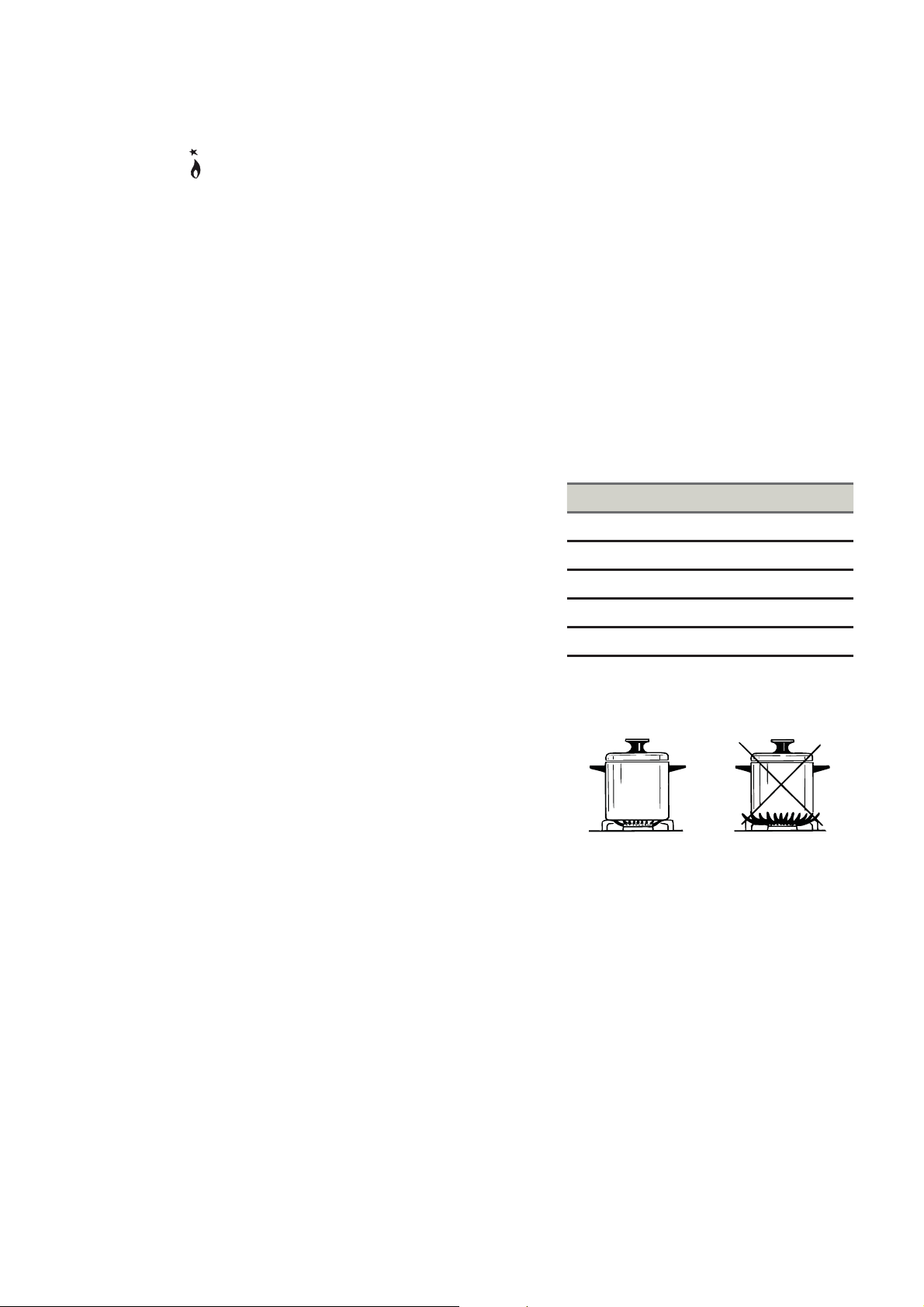
The burner must be chosen according to the dia-
meter of the pans and energy required.
The largest can be used for boiling, to seal meat
or foods that are cooked quickly, and the smallest
for stews and sauces.
saucepan.
the edge of the pan. Flames going up the side of
the pan means wasted heat and the contents of
the pan will take longer to boil.
-
ler than 230mm diameter.
Saucepans with handles which are excessively
heavy, in relationship to the weight of the pan, are
safer as they are less likely to tip.
Pans which are positioned centrally on burners are more stable than those which are offset.
It is far safer to position the pan handles in such a way that they cannot be accidentally
knocked.
DO NOT cover the pan with a lid and DO NOT leave the pan unattended.
DO NOT
Leave the pan to cool for at least 30 minutes.
WARNING - VERY IMPORTANT NOTICE
During use cooking vessels become hot. Pay special attention not to touch the hot
vessels positioned on the cooking hob especially when operating the control knobs.
Burners Pan Diameter
Auxiliary (AUX) 6 to 14 cm
Semi-rapid (SR) 16 to 24 cm
Rapid (R) 24 to 26 cm
Triple-ring (TR) (*) 26 to 28 cm
Wok pans max 36 cm
(*) Only for the models DEGH70BG,
DEGH90BG
do not use pans with
concave or convex bases
Figure 14
20
CORRECT USE OF TRIPLE-RING BURNER (ONLY FOR THE MODELS
DEGH70BG, DEGH90BG)
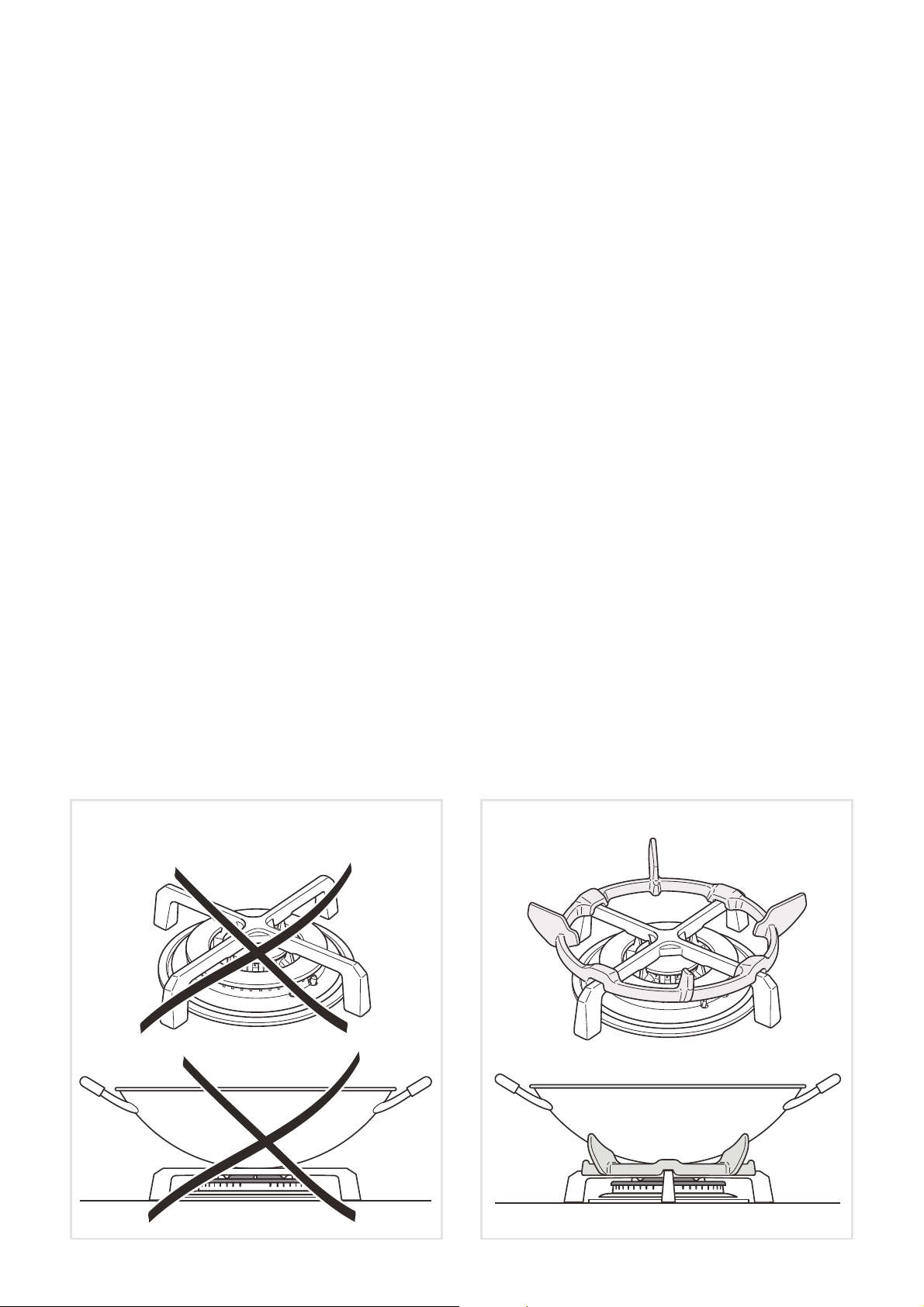
To use the WOK, you must place the wok stand in the CORRECT position as shown
IMPORTANT:
MUST BE PLACED ONLY over the pan-rest for
the triple-ring burner.
WRONG
CORRECT
Figure 15a Figure 15b
21
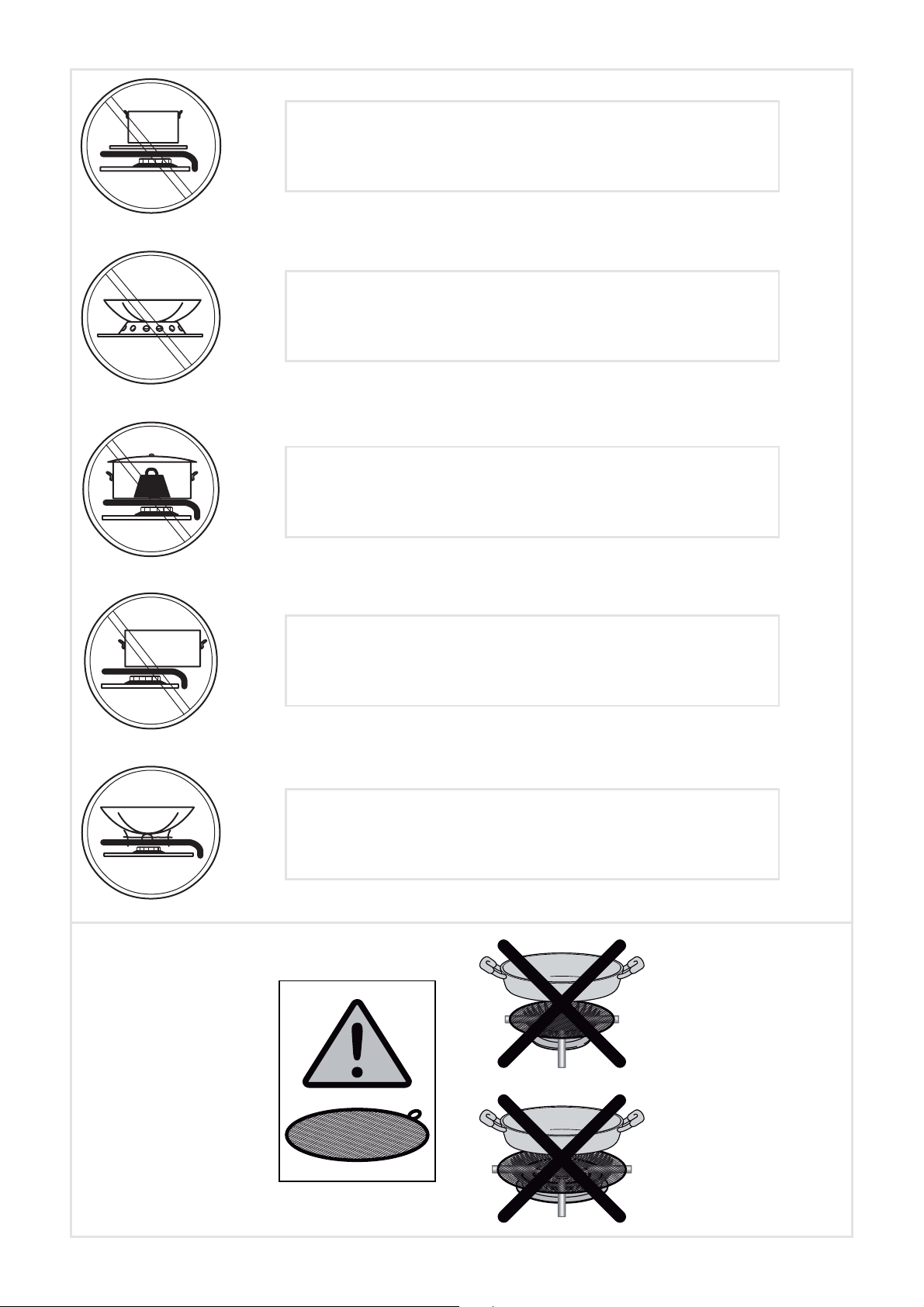
Figure 16
mat, between pan and pan support as serious da-
mage to the appliance may result.
Do not remove the pan support and enclose the
burner with a wok stand as this will concentrate
Do not use large pots or heavy weights which can
hotplate.
Locate pan centrally over the burner so that it is
stable and does not overhang the appliance.
Use only a wok support supplied or recommen-
ded by the manufacturer of the appliance.

22
CLEANING and MAINTENANCE
GENERAL ADVICE
Before you begin cleaning you must ensure that the hob is switched off.
It is advisable to clean when the appliance is cold and especially when cleaning the
enamelled parts.
All enamelled surfaces have to be washed with soapy water or some other non-abra-
sive product with a sponge and are to be dried preferably with a soft cloth.
Avoid leaving alkaline or acid substances (lemon juice, vinegar etc.) on the surfaces.
Do not use cleaning products with a chlorine or acidic base.
Do not use harsh abrasive cleaners or sharp metal scrapers to clean the glass
since they can scratch the surface, which may result in shattering of the glass.
WARNING: When correctly installed, your product meets all safety requirements
laid down for this type of product category. However special care should be taken
around the underneath of the appliance as this area is not designed or intended to
be touched and may contain sharp or rough edges, that may cause injury.
GLASS SURFACE
which do not contain abrasives or chlorine-based acids.
If you use a detergent, please make sure that it is not abrasive or scouring. Abrasive
or scouring powders can damage the glass surface of the hob.
All traces of the cleaner must be removed with a damp cloth.
Dust or food particles can be removed with a damp cloth.
Dust, fat and liquids from food that has boiled over must be removed as soon as possible.
especially true in the case of sugar/syrup mixtures which could permanently damage
the surface of the hob if left to burn on it.
Avoid using a knife or other sharp utensil as these may damage the glass surface.
Do not use steel wool or an abrasive sponge which could scratch the surface permanently.
Do not put articles on the hob which can melt: i.e plastic, aluminium foil, sugar, sugar
syrup mixtures etc.
ENAMELLED PARTS
All the enamelled parts must be cleaned with a sponge and soapy water only or other
non-abrasive products.
Dry preferably with a soft cloth.
If acid substances such as lemon juice, tomato conserve, vinegar etc. are left on the
enamel for a long time they will etch it, making it opaque.
GAS TAPS
Periodic lubrication of the gas taps must be carried out by specialist personnel only.
In the event of operating faults in the gas taps, call the Service Department.
CONTROL KNOB/S
The control knob/s may be removed for cleaning but care should be taken not to da-
mage the seal.
23
BURNERS AND GRIDS
These parts can be removed and cleaned with appropriate products.
replaced.
correctly positioned. Failure to do so can cause serious problems.
Check that the electrode “S-
sure trouble-free sparking.
Check that the probe “T
correct operation of the safety valves.
Both the probe and ignition plug must be very carefully cleaned.
Note: To avoid damage to the electric ignition do not use it when the burners are
not in place.
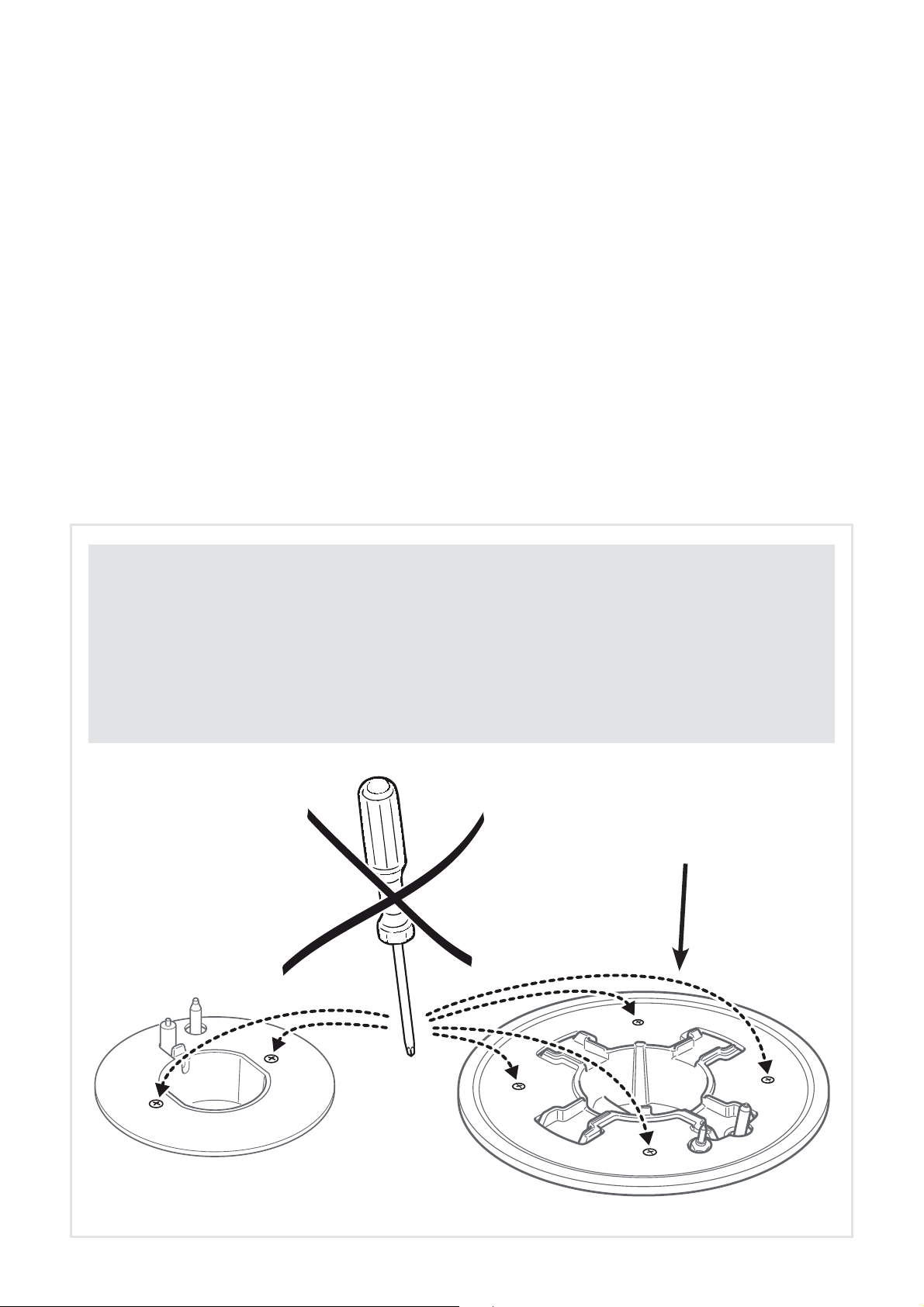
IMPORTANT WARNING
!"!#$%&'
The burner plates can be removed ONLY by an authorised service agent.
Damage to the appliance will occur if not observing this condition and this
may result in serious injury to the user.
The manufacturer declines every responsibility for any inconvenience resul-
ting from the inobservance of this condition.
Figure 17
Only for the models with triple-ring
burner (DEGH70BG, DEGH90BG)

24
F
C
Flame failure
probe “T”
Ignitor “ S”
CORRECT POSITIONING OF THE
AUXILIARY, SEMI-RAPID AND RA-
PID BURNERS
It is very important to check that the burner
F” and the cap “C” have been
They shall be level and must not ro-
tate.
Failure to do so can cause serious pro-
blems.
The pan supports shall be correctly positio-
The pan supports shall be level and
must not rotate.
Only for the models DEGH70BG, DE-
GH90BG:
Be sure NOT-
ner pan support on the auxiliary, semi-
rapid or rapid burners.
The triple-ring burner pan support IS
ONLY to be used on the triple-ring burner.
Figure 18
Figure 19
Figure 20
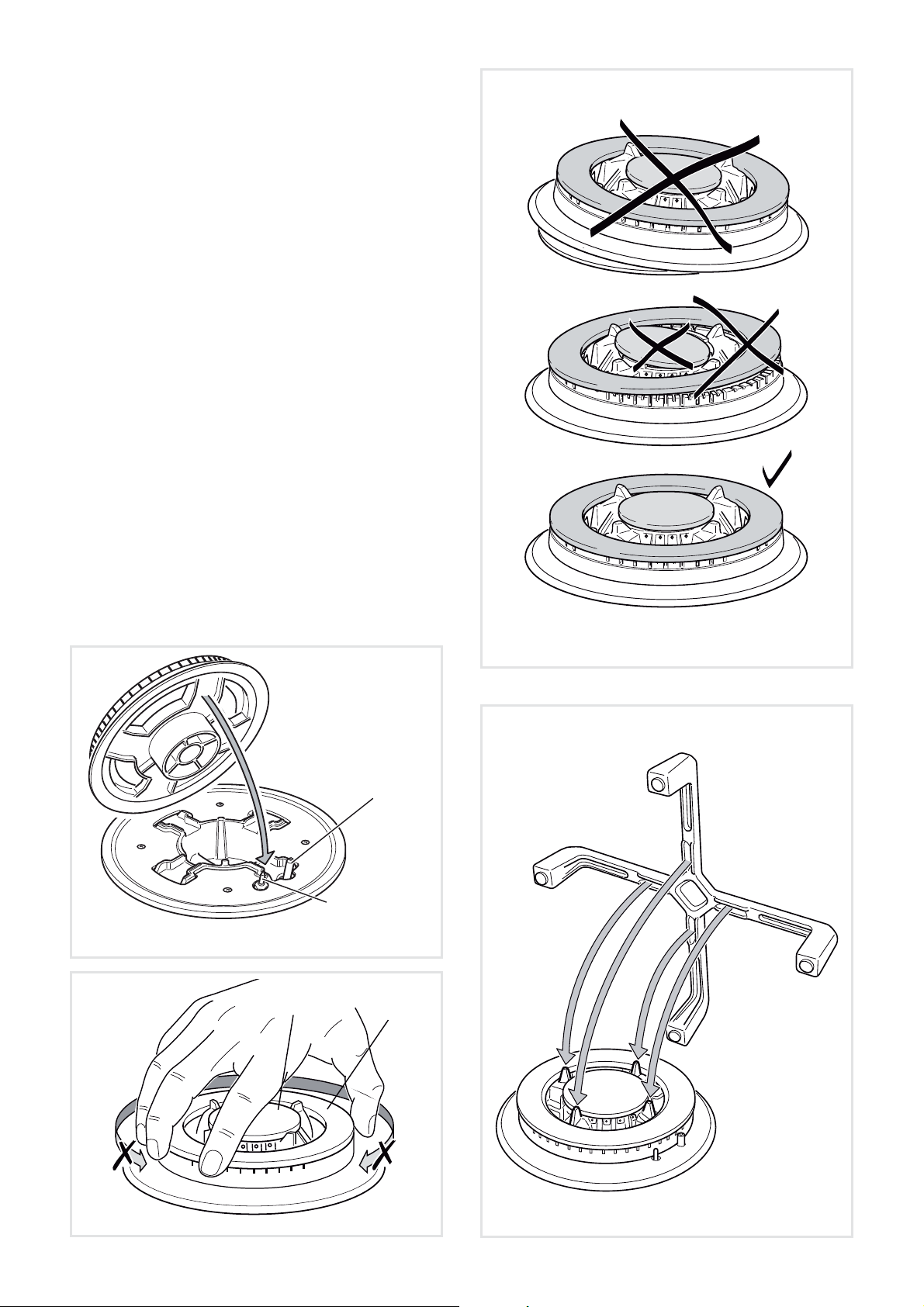
25
CORRECT POSITIONING OF THE
TRIPLE RING BURNER
(ONLY FOR
THE MODELS DEGH70BG, DE-
GH90BG)
The triple ring burner must be correctly po-
housing as shown by the arrow.
The burner correctly positioned must
not rotate.
Then position the cap “A” and the ring
“B”. They shall be level.
The pan support shall be correctly positio-
The pan support shall be level and
must not rotate.
Be sure NOT
rapid or rapid burner pan support on
the triple-ring burner.
The auxiliary, semi-rapid or rapid bur-
ner pan support IS ONLY to be used
on the auxiliary, semi-rapid or rapid
burners.
A
B
Flame
failure
probe “T”
Ignitor “ S”
Figure 21
Figure 22
Figure 23
Figure 24

26
SERVICE AND MAINTENANCE
If the ignition spark fails to ignite or does not light the gas, check the following items before
calling our Customer Service Centre to obtain the nearest Authorised Delonghi Service
Agent:
Burner is reassembled and located correctly.
Spark electrode and white ceramic are clean and dry.
230 or 240 VAC power supply is connected.
Contact the local gas utility or our Customer Service Centre to obtain the nearest Authori-
You can smell gas when all burners are turned on.
The burners do not remain alight at the minimum marked setting.
locate gas utility will ensure many years of trouble free operation of your appliance.
Servicing the appliance:
Service may be obtained by contacting our Customer Service Centre to locate the nearest
Authorised Delonghi Service Agent.
Servicing shall be carried out only by authorized personnel.
*
LUBRICATION OF THE GAS TAPS
If the gas tap becomes stiff, it is necessary to dismantle it carefully and clean it with petro-
leum spirit.
Specialist high temperature resistant grease should be used to lubricate the tap before
replacing.
Figure 25

27
Descriptions and illustrations in this booklet are given as simply indicative.
The manufacturer reserves the right, considering the characteristics of the models described here,
commercial needs.

Cod. 1104190 - ß1