us
Energy-Saving Tips
Important Cautions . .
Page
.
Inside
F.Ant
Cover
. . . . . . . . .
1
How to Connect Electricity. .. .1,2
Installation Requirements .. ....2
Operating Your Freezer .. ......2
Freezer Features . . . . . ........3
Food-Freezing
Suggestions. . . . . . . . . ........3
Suggested Storage Times. .. ...4
Freezing Meat, Fish,
Poultry &Game . . . . . . ........4
Freezing Vegetables . . ........5
Freezing Fruits. . . . . . . ........6
Freezing Dairy Products .. .....7
Freezing Prepared Foods .. ....7
Freezer Packaging. .
Defrosting . . . . . . . .
User Maintenance
Instructions . . . . . . .
In Case of Extended
Power Failure. . . . . .
The Problem Solver.
If You Need Service .
.
.
.
.
.
.
.
.
.
.
8
. . . . . . . . . .
9
. . . . . . . . .
10
. . . . . . . . .
10
. . . . . .
11,12
. . . . . . . . .
13
Warranty. . . . . . . . . . .
Back-r
*lp
help you...
Read this book carefully.
It is intended to help you operate
and maintain your new freezer
properly.
Keep it handy for answers to your
questions.
If you don’t understand something
or need more help, write (include
your phone number):
Consumer Affairs
Hotpoint
Appliance Park
Louisville, KY 40225
Keep proof of original purchase
date (such as your sales slip or
cancelled check) with this book to
establish the warranty period.
Write down the model
and serial numbers.
You’ll find them on a plate either at
the bottom, just inside the door, or
on the back of the cabinet.
These numbers are also on the
Consumer Product Ownership
Registration Card that came with
your freezer. Before sending in this
card, please write these numbers
here:
Model Number
Serial Number
Use these numbers in any
correspondence or service calls
concerning your freezer.
If you
weiveds
damaged freezer,
immediately contact the dealer (or
builder) that sold you the freezer.
Save time and money.
Before you call for service,
check
the Problem Solver on pages 11
and 12. It lists minor causes of
operating problems that you can
correct yourself. It could save you
an unnecessary service call.
Energy-Saving Tips
. Location of your freezer is
important. Don’t locate it in a warm,
unventilated
Iaundry area or storage
room. Avoid putting it next to your
range, a heating vent or where sun
will shine directly on it.
c
Try to arrange your frozen foods
systematically so you can find what
you want in the freezer quickly.
. Don’t open the freezer door more
often than necessary and close it
as soon as possible, particularly in
hot, humid weather.
● when
using
your
fr~zer,
~
careful not to leave the door open.
Always check to make sure the
freezer door is properly closed
before leaving the house or retiring
for the night.
. If you turn the temperature
control to the coldest position for
quick freezing, don’t forget to turn
it back to the
r~ular
setting.
.
-,.
.
Important
Read all instructions before using this appliance.
Safety Instructions
WARNING-When using this
appliance, always exercise basic
safety precautions, including the
following:
.
Use this
appliance
only
for its
intended purpose as described in
this Use and Care Book.
.
This
fr-zer
must be properly
installed in accordance with the
Installation instructions before it is
used. See
grounding instructions
below and on page 2.
. Never
unplug your freezer by
pulling on the power cord.
Always
grip plug firmly and pull straight
out from the receptacle.
.
Repair or replace immediately
all
electric service
cords
that have
-me
frayed or otherwise dam-
aged.
Do not use a cord that shows
cracks or abrasion damage along its
length or at either the plug or con-
nector end.
.
After your freezer is in operation,
do not touch
thecold
surfacea,
parti-
cularly when
hsndsare
damper
wet.
Skin mayadhereto these extremely
cold surfaces.
. D
C
not
operate your freezer in the
presence of explosive fum%
●
Don’t
refr-e
frozen
foods which
have
thawed
ccmpietdy.
You may safely refreeze frozen
foods that have thawed if they still
contain ice crystals or if they are
still cold—below
40°F. (Shellfish
cannot be kept above
10°F safely
because of bacteria growth.)
Thawed ground meats, poultry,
or fish that have
any off-odor or
off-color should not be refrozen
and should not be eaten. Thawed
ice cream should be discarded. If
the odor or color of any food is
poor or questionable, get rid of it.
The food may be dangerous to eat.
Even partial thawing and refreezing
reduce the eating quality of foods,
particularly fruits, vegetables, and
prepared foods. The eating quality of
red meats is affected less than that
of many other foods. Use refrozen
foods as soon as possible–they
won’t keep as long as foods frozen
only once, and the sooner they’re
used, the better their eating will be.
.
If your old freezer is still around
the house but not in use, be sure
to remove the lid or door.
This will
reduce the possibility of danger to
children.
@ution should be used when
removing the door of a freezer.
Particular caution should be used
when removing the lid of a chest
freezer, as most chest freezer lids
are under spring tension. Contact
the manufacturer’s representative
for a
method of safe removal.
. Unplug your freezer:
A. Before making any repairs.
Note: We strongly recommend
that
any servicing
be
performed
by a qualified individual.
B. Before cleaning.
C. Before replacing a burned-out
light bulb (on models with lamp),
the freezer should be unplugged
in order to avoid contact with a
live wire filament. (A burned-out
light bulb may break when being
replaced.)
Note: Turning control to OFF
position does not remove power
to the light circuit.
SAVE THESE
INSTRUCTIONS
Installation
Requirements– important... Please Read Carefully
How to connect
electricity
For personal safety,
this appliance must be
properly grounded.
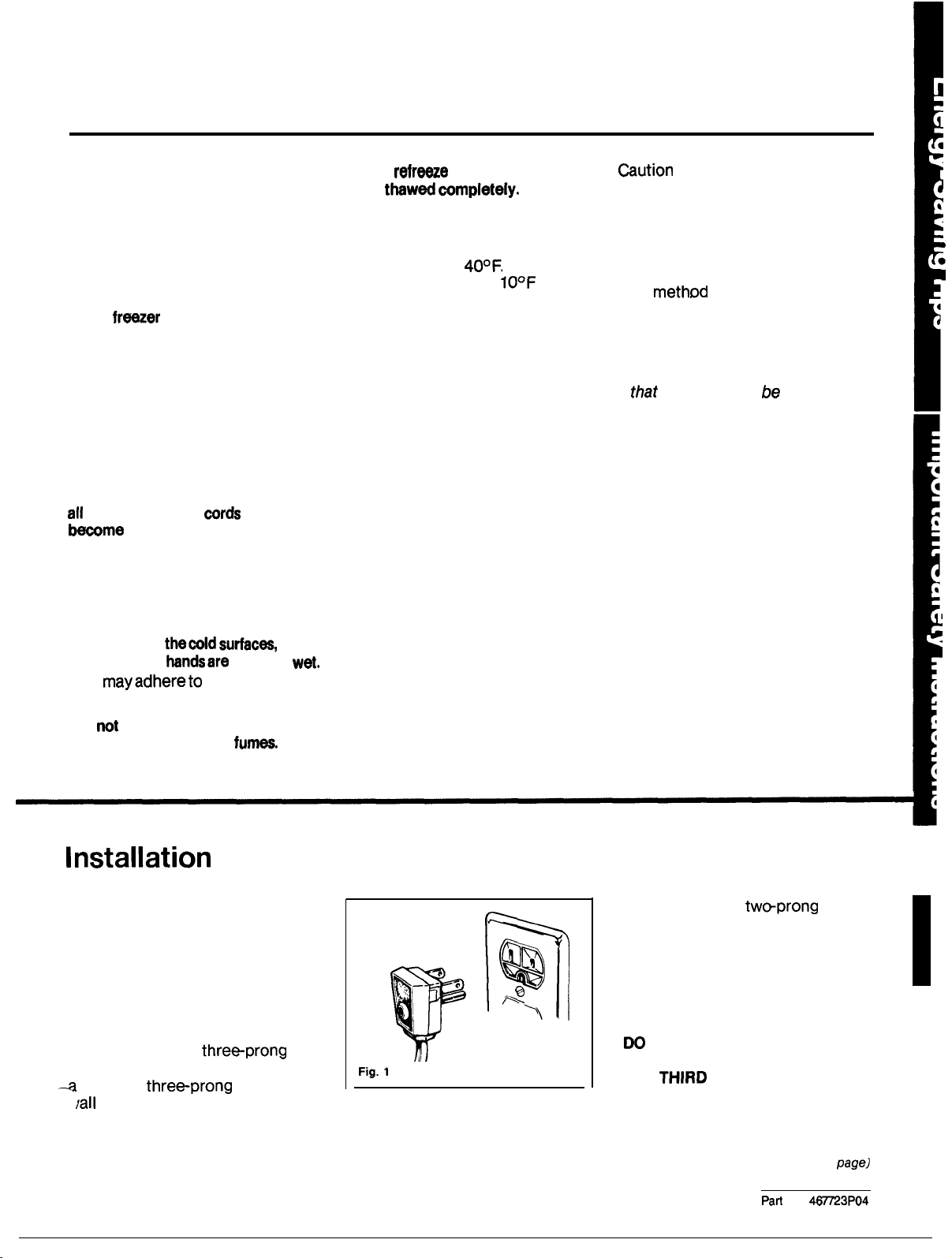
The power cord of this appliance
is equipped with a
threeprong
(grounding) plug which mates with
=
standard
threeprong
(grounding)
/all
receptacle (Fig. 1) to minimize
the possibility of electric shock
hazard from this appliance.
PREFERRED
METHOD
m
,
Q
Q
h
%
@
-\\
INSURE PROPER
GROUND EXISTS
BEFORE USE
Fig.1
/~
Have the wall receptacle and
circuit checked by a qualified
electrician to make sure the
receptacle is properly grounded.
1
Where a standard
twoprong
wall
receptacle is encountered, it is the
personal responsibility and obli-
gation of the customer to have it
replaced with a properly grounded
three-prong wall receptacle.
DO
NOT, UNDER ANY CIRCUM-
STANCES, CUT OR REMOVE
THE
THIRD
(GROUND) PRONG
FROM THE POWER CORD.
(continued next
page)
Pati
No.
4W3P04
b
installation Requirements
(continued)
–
IMPORTANT... Please Read Carefully
Use of adapter plug
Because of potential safety hazards
under
certa;n conditions, we strongly
recommend against use of an adapter
plug.
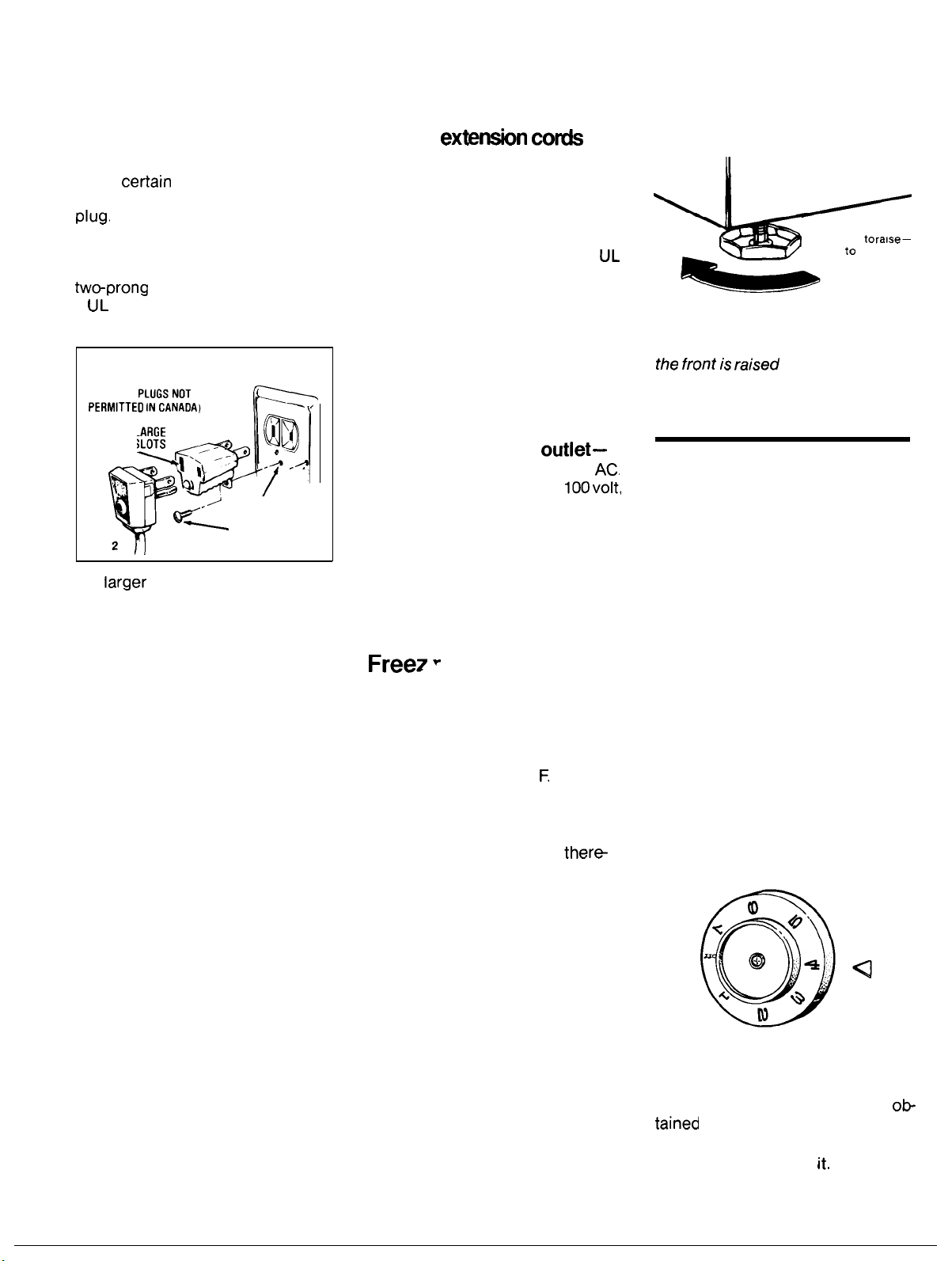
However, if you still elect to use
an adapter, where local codes permit,
a TEMPORARY CONNECTION may
be made to a properly grounded
tw~prong
wall receptacle by use of
a
UL
listed adapter (Fig. 2) available
at most local hardware stores.
TEMPORARY METHOD
a
(ADAPTER PLUGS NOT
PERMITTEO
IN CANADAI
-,
ALIGN LARGE
PRONGS/SLOTS
.
.
Q
‘\
T
*
I
‘
i
;,:’
0
->
“
,,,.
- -
.“
3
‘
/
->
INSURE PROPER
#
GROUND AND
~
FIRM CONNECTION
Fig. 2
BEFORE USE
The Iarger slot in the adapter must be
aligned with the larger slot in the wall
receptacle to provide proper polarity
in the connection of the power cord.
CAUTION:
Attaching adapter
ground terminal to wall receptacle
cover screw does not ground the
appliance unless cover screw is
metal, and not insulated, and wall
receptacle is grounded through
house wiring. Customer should
have the circuit checked by a qual-
ified electrician to make sure the
receptacle is properly grounded.
When disconnecting the power
cord from the adapter,
always hold
the adapter with one hand. If this
is not done, the adapter ground
terminal is very likely to break
with repeated use.
Should the adapter ground
terminal break, DO NOT USE the
appliance until a proper ground
has again been established.
Use of
ex&*n
cob
Because of potential safety hazards
under certain conditions, we strongly
recommend against the use of an
extension cord. However, if you still
elect to use an extension cord, it is
absolutely necessary that it be a
UL
listed 3-wire grounding type appliance
extension cord having a grounding
type plug and outlet and that the
electrical rating of the cord be 15
amperes (minimum) and 120 volts.
Such extension cords are obtainable
through your local service organization.
The freezer should always
be plugged into its own
individual electrical
outlet—
(115 volt, 60 Hertz, single phase
AC.
Some models are also rated
100volt,
50 Hertz. Check the model and serial
number plate. )
This is recommended for best perfor-
mance and to prevent overloading
house wiring circuits, which could
cause a possible fire hazard from
overheating wires.
Free7
r
Installation
Location
For most efficient operation, your
freezer should not be located where
air temperature around the freezer
is ever higher than 110°
F,
or colder
than 32° F.
Upright freezers take approxi-
mately half the floor space required
for chest type freezers and
there
fore can more readily be placed in
your kitchen. A location next to the
refrigerator often is ideal, with the
refrigerator on the side nearer the
sink and range.
Be sure to install your freezer on
a floor strong enough to support it
when it is fully loaded.
Also see Energy-Saving Tips
regarding location.
Clearances
Allow 4 inches on top and 3 inches
at sides and back for proper air
circulation.
Adjustable Legs
Turn left to
ralae–
right to lower
Legs at the front corners of the
freezer should beset so the freezer
is firmly positioned on the floor, and
the front
is
raised just enough so
the door closes easily when opened
about halfway.
Operating Your
Freezer
Starting
1.
Clean the inside of the freezer
—
with a mild solution of baking soda
and water (see page 10).
2. Connect cord to power outlet.
3. Turn temperature control to
No. 4. This is the normal setting
for safe long-term freezing. For
colder temperatures, turn to
higher numbers.
4. Allow freezer to operate for at
least two hours before placing food
inside.
Temperature Control
Freezing temperature selection is
made by setting control from No. 1
to No. 7 (coldest).
Normal safe freezing level is
ob
–
tained
by setting the control at No. 4.
OFF position permits turning freezer
off without unplugging
it.
2
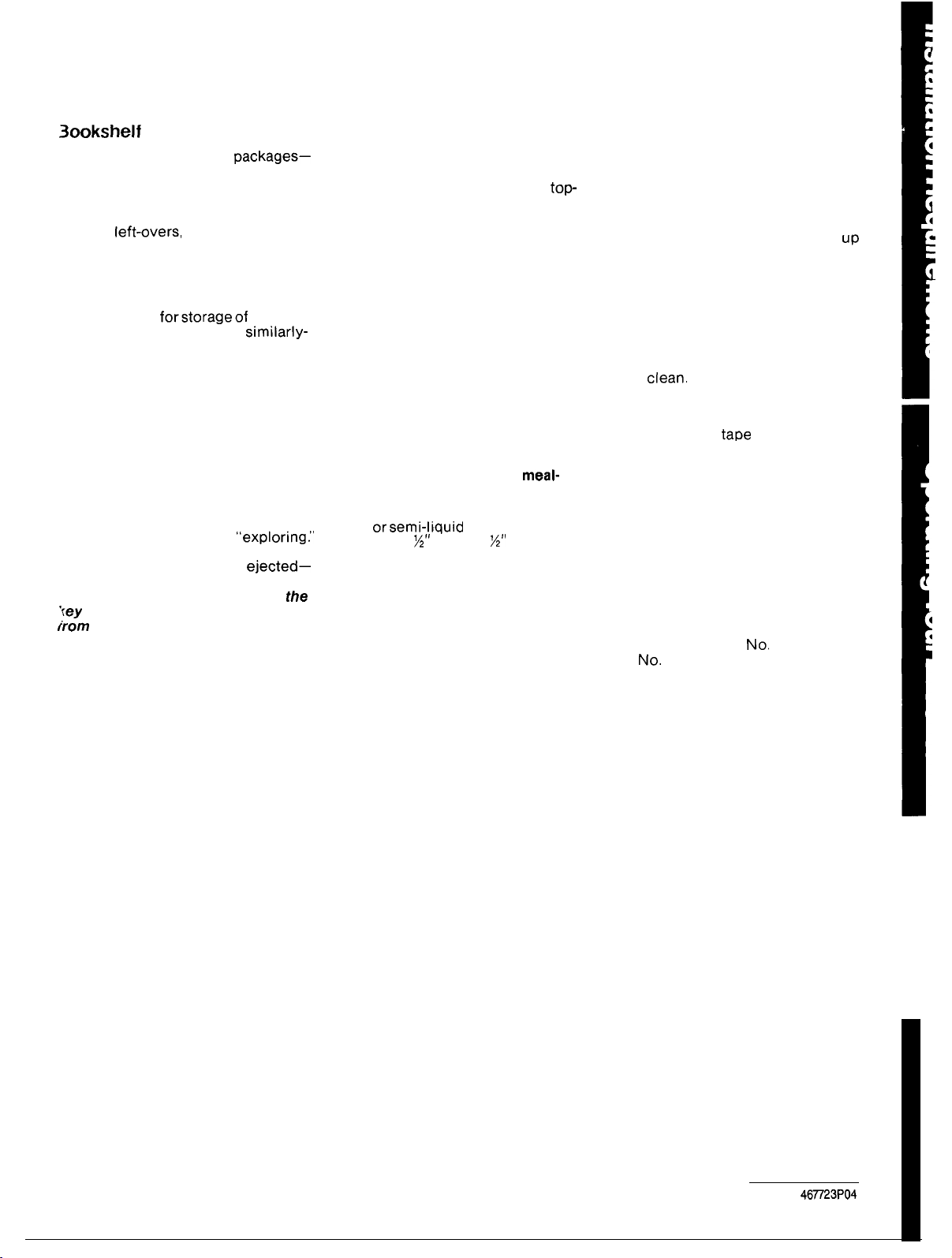
Freezer Features
3ookshelf door storage
Lets you store frozen food packages–
as conveniently as putting books on
a shelf—where they are easy to see,
identify and remove. Shelves are
roomy enough for storing home-frozen
items or
Ieft-overs, and are designed to
accommodate regular or odd-shaped
packages.
Juice-can door shelf
Specially sized
forstorageof
standard
frozen juice cans and other
similarly-
shaped containers. Some models have
two juice-can shelves.
Interior light
(on models so equipped)
Turns on automatically when door is
opened, turns off when door is closed.
Key-ejecting lock
(on models so equipped)
Keeps your frozen food supply secure,
discourages unauthorized
“exploring:’
The spring-loaded lock is designed so
that the key is automatically
ejected–
key will not remain in lock in either
the open or closed position. Keep
the
“fey
out of reach of children and away
irom freezer.
Refrigerated cabinet shelves
Cooling coils welded to these shelves
hasten freezing when food is placed
in direct contact with shelves.
10 Rules
for Successful
Food Freezing
1. Freeze the best. Freeze only
top-
quality foods. Freezing retains quality
and flavor; it cannot improve quality.
2. Keep work area clean.
3. Work quickly. The quicker fruits and
vegetables are frozen after picking,
the better the frozen product will be.
You’ll save time, too, because less
culling and sorting will be necessary.
4.
Choose
correct packaging materials.
Frozen foods will dry out if not prop-
erly wrapped or packaged. Both rigid
containers and flexible bags or wrap-
pers can be used. Make sure they are
especially designed for freezing.
5.
Follow reliable instructions for
freezing different types of food.
6.
Freeze foods in practical
meal-
sized packages.
7. Fill container properly. When placing
liquid
orseml-llquid
food in containers,
leave about
k“
at top (1
%“
for glass
containers) to allow for expansion dur-
ing freezing.
8. Freeze correct quantities. There is
an established maximum of food your
freezer is designed to freeze at one
time–approximately 3 pounds per
cubic foot of freezer capacity. In
normal position, your freezer’s con-
trol dial will maintain sufficiently low
temperatures in the freezer to freeze
recommended quantities of food.
If you have a large quantity of food
you wish to freeze, store part of it in
the fresh food compartment of your
refrigerator until the first quantity
is frozen.
9. Freeze foods quickly. Continually
rotate frozen foods to the front of the
freezer so the longest-frozen foods
are used first.
10. Store frozen foods immediately.
Commercially frozen food can be
stored any place in the freezer. These
foods should not be allowed to thaw
before being placed in the freezer.
Helpful Materials
You’ll find these materials helpful in
preparing foods for the freezer:
. Large kettle with close-fitting lid
for blanching vegetables and fruits
● Fine sieve or small colander to put
vegetables in for blanching
. Assortment of knives for cutting
up
meat, fruits and vegetables.
. Rolls of absorbent paper towels or
soft cloth towels for draining foods
● Proper freezer packaging materials
for various types of food [see page 8).
. Small loading funnel for fruit and
vegetable containers, to keep sealing
edge
clean.
● Glass marking pencil for labeling
packages.
● Roll of freezer
taDe
Quick-freezing
For quick-freezing small amounts of
food, simply place it in direct contact
with any refrigerated shelf.
For quick-freezing large amounts of
food, turn control to
No.
7, and return
it to
No.
4 after freezing is completed.
Never freeze more than three pounds
of food per cubic foot of freezer
capacity at one time.
3
Part No.
46V23P04
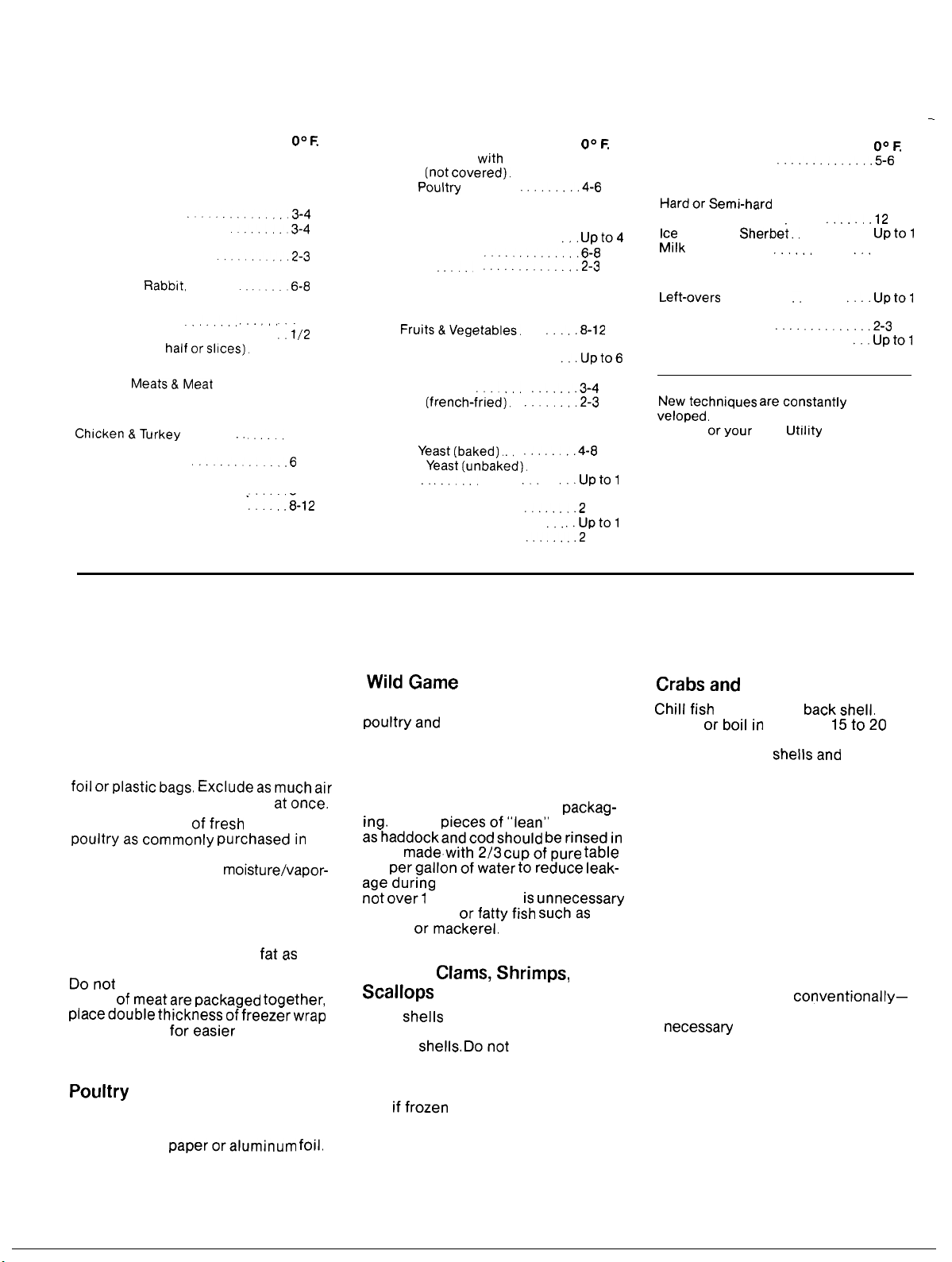
Suggested Storage Times
(Months)
FRESH MEATS
00
E
Roasts (Beef, Lamb, Venison). ., ..6-12
Roasts (Pork & Veal). . ...........4-8
Steaks (Beef). ... . . . . .. .6-12
Chops (Lamb). .6-9
Chops(Pork). .,
..,.,.,.,,,,,.,3-4
Ground &Stew Meats., .
...,..,..3-4
Variety Meats (Beef), . ..,.,..,...3-4
Variety Meats (Pork), .
.,,,.,,.,.,2-3
Sausage (Pork). ., ..,.,.,,..,,..1-2
Opossum,
Rabbi~
Squirrel
.,..,,..8-8
PROCESSED MEATS
Bacon, . ., .,, .,
..,.,.,.
.,.,,.
,1
Frankfurters. ,.,. . . . .
,1/2
Ham (whole, halforstices), . ..,.,.1-2
COOKED MEATS
Cooked Meats&Meat Dishes, .,.,2-3
Gravy& Meat Broth. . ....,,,,..,2-3
FRESH POULTRY
Chicken&Turkey
(whole), ,.
.,....
12
Chicken (pieces). . . . . . . . .......,9
Turkey(pieces). .
.....,...,..,,6
Duck &Goose (whole), . . ...,.,.,6
Giblets. . . . . . . . . . . . . .
.
,.
.,..,3
Game Birds. ,... . . . . . . .,,
..,.8-12
(Months)
COOKED POULTRY
oo~
Pieces (covered wtih broth). ..6...6
Pieces
(notcovered).
. ..,...,..,.1
Cooked
Poutiry Dishes. .
......,..4-6
Fried Chicken. . . . . . .,, . .....,..4
FISH
Shellfish. ,. ..,.,.. .. .. ... ...
,,.
Upto4
Lean Fish. .,..,. .
....,......,,.6-8
Fatty Fish.
..,..,
.
.....,......,.2-3
Shrimp (raw, unpeeled). . . ....,..12
Shrimp (cooked). . . . . . . . ., .,..,.3
PRODUCE
Most Fruits&Vegetables. . . .
...,.8-12
Asparagus. . ...................6-8
Mushrooms. ..,. .. ., ., .., ,..
Upto6to6
Onions. . ...................,..3-6
Citrus Fruits, . .,,
.,...,.
,
.....,.3-4
Potatoes flrench-fried). .,
..,...,,2-3
BAKERY GOODS
Breads, Quick (baked). , ..,..,..2
Breads,
Yeast(baked).
,,
.
..,..,,.4-8
Breads,
Yeast(unbaked).
. ........1/2
Cakes,
,.
.,,,.,.
.. .. ..
.,.
..,
uptoltol
Cookies. . . . . . . . . . . . . . . .....,..4
Pastry(unbaked). . . ., . . .
....,...2
Pies(baked). . . . ., .. .. .. ...
,..
.,uptol
Pies (unbaked).. . . . . . . . .
.....,..2
.
(Months)
DAIRY PRODUCTS
oo~
‘
Butter. .,....... .
...........,..5-6
Cottage Cheese, , . . ., . . ., ...,...1
Soft Cheese..,.. . . . . ., . ........4
HardorSemLhard Cheese, ., ,. .,6-12
Eggs. . . . . . . . . . .
.
. . . ., . .
.,.....12
lce
Cream, Sherbet,. .., ... ,.. .,.
Uptol
Mtik
.
,,,,,,
,,,
1
OTHER FOODS
Candies. . . . . . . . . . . . . . . . .......12
Left-overs (cooked).
,.
.. .,. ..
Uptolptol
Pizza . . . . . . . . . . . . . . . . . . ........1
Prepared Dishes. .
....,.........2-3
Sandwiches, . . . . .. .. .. .,. ..,
Uptoltol
Soups, Stews, Casseroles. . ....,,2-3
Newtechniques
areconstantiy
being de-
veloped, Consult the County Extension
Service
oryour
local Utflity Company for
the latest information on freezing and
storing foods.
Freezing Meat,
Preparation and
packaging
Fish, Poultry & Game
Package meat, poultry, fish and game
in moisture/vapor-proof material such
as aluminum foil, cellophane, freezer
foflorplasticbags,
Excludeasmuchair
as possible, Label and freeze
atonce.
NOTE: Packages
offresh
meats and
poultryascommonly
purchasedin
retail stores are not suitably wrapped
for freezing, Rewrap in
moisture/vapo~
proof material
Meat
Remove as much bone and
fatas
possible from meat before packaging,
Donot
salt meat When individual
pieces
ofmeatarepackaged
togetheL
placedoublethicknessoffreezerwrap
between them
foreasier
separation
during thawing,
Pouhry
Clean thoroughly before packaging,
Pad sharp or protruding bones with
folded freezer
paperoraluminum
fofl,
Wrap giblets separately.
WfldGame
The same methods suggested for
poultryand
meat may be used for
preparing and freezing wild game.
Fish
Clean fish thoroughly before packag-
ing.
Cut-up
piecesof”lean”
fish such
ashaddockandcodshould
berinsedin
brine madewith2/3c
upofpure
table
salt
pergallonofwater
toreduceleak-
ageduring
thawing. Keep insolation
notoverl
minute. Brine isunnecessary
for whole fish
orfattyfish
suchas
salmon
orrnackerel,
Oysters,
Clams,Shrimps,
ScaHops
Wash
sheHs
in running water (soak
clams) and shuck, working quickly.
Discard
sheHs.
Donot
wash clams o
r
oysters. Scallops maybe rinsed in
freshwater Pack in freezer carton
and freeze immediately. Shrimps are
best
iffrozen
uncooked. Remove and
discard heads and black vein. Wash
and package in freezer containers,
Crabsand Lobsters
Chfllfish
and remove backshen,
Steam
orboflin
water for
15t020
minutes, Cool thoroughly, then pick
edible meat from
she~sand package
in proper containers. Seal and freeze
immediately.
Thawing
Frozen meat, fish or poultry should be
left In the original package and thawed
in the refrigerator or cooked frozen,
Allow approximately 5 hours per
pound to thaw meat in the refrigerator.
When cooking frozen meat, increase
the cooking time by approximately
1/3 to 1/2 if cooking
conventionally–
much less if cooking with microwaves.
If
necessav
to thaw meat quickly, thaw
at room temperature—allowing only
2 hours per pound,
Don’t refreeze meat that has completely
thawed; meat, whether raw or cooked, –
can be frozen successfully only once
4
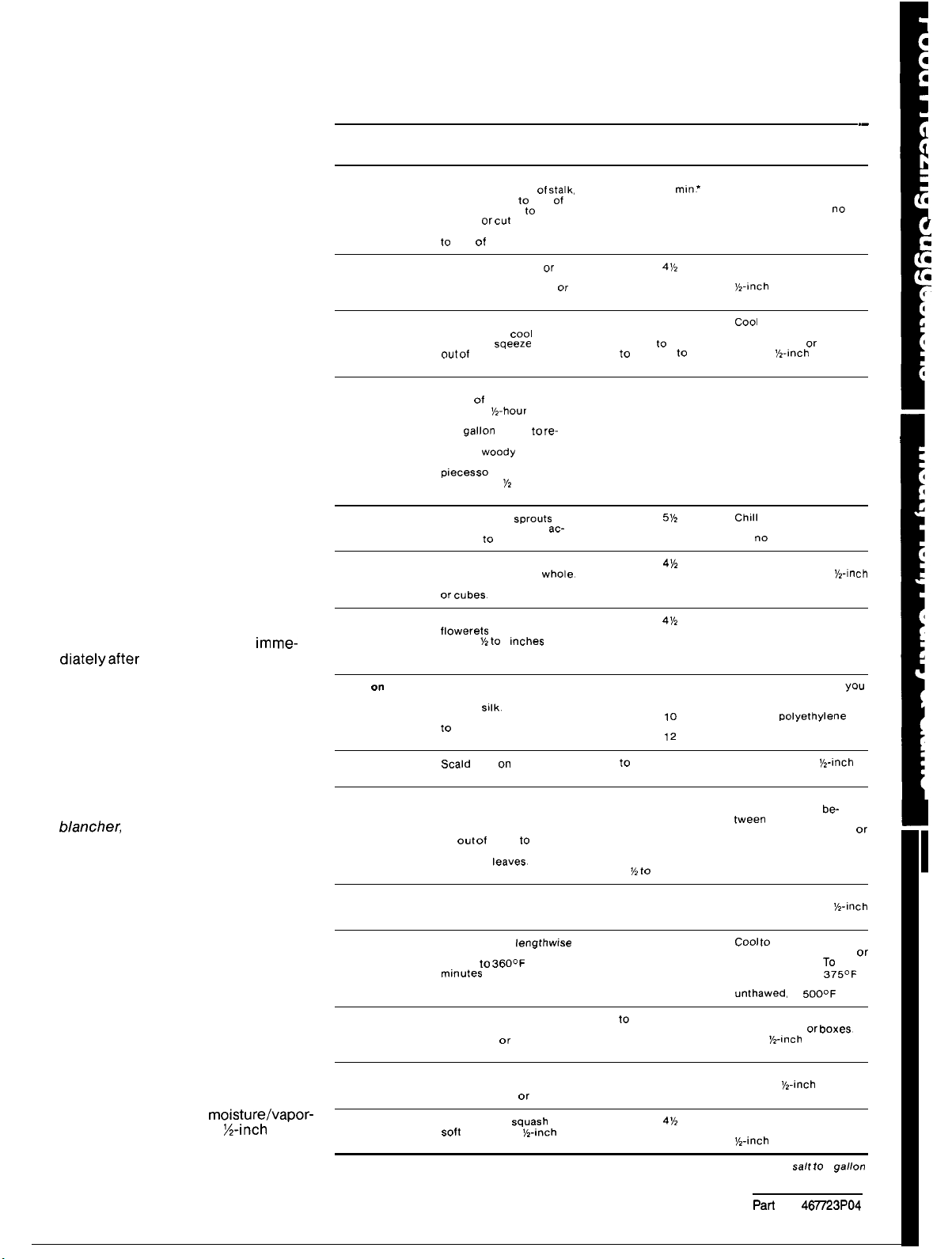
Freezing Vegetables
Preparation for freezing
1. Only vegetables at their peak of
maturity should be chosen for freez-
ing. Some varieties of vegetables
are better adapted for freezing than
others. For complete information,
contact your County Extension
Service.
2. Sort, clean and wash vegetables
in cold water. Keep those of the same
size all together. Large pieces take
longer blanching.
3. Work with small amounts, about
one pound, that can be packaged in
a short time.
4. Blanch all vegetables except
tomatoes, green peppers and herbs
before packaging. Proper blanching
stops the ripening process so vege-
tables are held at their peak of
freshness.
Boiling-water method
(a) Select large utensil of 4-or 5-quart
capacity and fill with one gallon of
water for each pound of vegetables
to be blanched at one time. Use two
gallons for each pound of leafy vege-
tables. Bring water to boiling.
(b) Blanch one pound of vegetables
at a time. Place vegetables in a wire
basket or colander. Immerse in boiling
water and cover. Count time
imme-
diatelyafter
boiling begins (see chart at
right). For high altitudes, add 1 minute
to blanching and chilling times.
(c) Chill vegetables quickly the same
length of time as for blanching by plung-
ing them into ice water. or under cold
running water. Remove from water
and drain on towels.
Steam method
Use pressure cooker, vegetable
blancher, or other large utensil.
(a) Fill utensil with 2 inches of water,
Bring to boiling point.
(b) Place vegetables in a wire basket
or rack above the boiling water. Cover
and begin timing immediately (refer to
chart at right for steaming times). Keep
heat on HIGH while vegetables are
steaming. If using a pressure cooker,
the petcock should be left open.
(c) Chill vegetables quickly the same
length of time as for steaming by plung-
ing them into ice water, or under cold
running water. Remove from water
and drain on towels.
- Packing
Package vegetables in moisture/vapor-
proof containers. Leave
X-inch head
space in package (1%-inch for glass
containers]. Freeze quickly.
VEGETABLE
PREPARATION
BLANCHING
PACKAGING
.-
Boiling
Steam
Water
ASPARAGUS
Wash in cold water,
remove tough part
of stalk,
sort according
to size of
stalk. Cut spears
to fit con-
tainers,
or cut in 2-inch
lengths. Scald according
to size of stalk.
BEANS
Cut snap beana in 1
or
Green 2-inch pieces. Leave
“French” beans whole
or
slice.
Small stalks
Chill immediately. Drain.
2 min. 3
min~
Pack whole stalks parallel
with heads in alternate
Medium stalks
directions, leaving
no
3 min.
4 rein! head space. Seal.
3 rein?
4V, min.
Chill and drain. Pack in
freezer carton leaving
y~-inch head space.
BEANS
Wash and sort pods in cold
Small
Lima
Cool promptly in cold
water. Scald,
cool in ice
1 rein?
4 min. water. Drain. Pack in
water and
sqeeze
beans
Medium
to large
cartons, bags
or boxes,
out of pods.
2
to 3
4
to 5 leaving Y,-inch head
min.
min. space. Seal.
BROCCOLI
Select tender uniform
3 min.
5 rein* Chill immediately. Drain.
heads
of dark green color.
Package in cartons in
Let stand
Y~-hour
in salted
alternate directions.
water (4 teaspoonfuls salt
leaving no head space.
in 1
gallon water) to re-
Seal.
move insects. Wash and
remove
woody stems.
Split lengthwise into
piecea so buds are not
more than 1
Yt
inches
across. Scald.
BRUSSELS
Clean and cut
aprouta
4 rein?
SPROUTS
5~/,
min. Chill and drain. Pack in
from main stem, sort
ac-
freezer containers, leav-
cording
to size and scald.
ing
no head space.
CARROTS Clean, wash and peel.
3 rein?
4Yz
min. Chill, drain and pack into
Leave small carrots
whole.
Cut others into slices
containers, leaving
y~-inch
head space.
or cubea.
CAULIFLOWER Trim and wash. Break into
3 rein**
4YZ
min.
Chill immediately. Drain,
flowerets
1 inch wide and
Package compactly, leav-
about 1
Y~
to 2 inchea long.
ing no head space. Seal.
Soak in salted water for
30 minutes. Drain.
CORN
on COB
Select young corn with
Small ears
Chill twice as long as
YOU
thin, sweet milk. Husk and
7 rei
n
=
9 min.
scald. Wrap several ears
remove
silk. Wash ears
Medium ears
together in freezer paper
carefully. Sort according
9 rein!
10 min. Place in
~olyethylene
to size.
Large ears
bag. Seal.
11 rein!
12 min.
CORN
Scsld corn on cob and
5
to
6
Whole Kernel
6 min. Package. Leave
Y,-inch
chill. Cut off whole kernels.
rein?
head space.
GREENS Beet greens, collards,
Beet greens, kale,
Chill in cold water and
kale, mustard greens, chard, mustard and
drain thoroughly
be-
spinach, Swiss chard, turnip greens
tween
absorbent towels.
turnip greens. Wash and
2 rein?
Pack in freezer cartons
or
lift
out of water to drain. Collards
bags and seal.
Remove tough stems and
3 min.
imperfect
Iesves. Cut in
Spinach
pieces, if desired. Scald.
t
%
to 2 rein!
PEAS
Shell and discard over-
2 rein!*
2 min.
Chill and drain. Package
mature peas.
compactly, leaving
Y~-inch
head space.
POTATOES Peel and slice
Iengthw;se
Cool
to room temperature.
French Fried
for frying. Fry in deep fat
Package in freezer bags
or
heated
to
360°F
for 4
cartons and seal.
To
aerve,
minutea until tender, but
thaw and cook in
375°F
not browned. Drain well.
fat until brown. Or cook,
unthawed, in
500°F
oven.
POTATOES Select smooth new pota-
3
to 5
Chill, drain, package in
Irish toes directly from garden.
min.
cartons, bags
or boxea.
Wash, peel
or scrape, and
Leave
Ys-inch
head space.
scald.
Seal.
POTATOES Wash. Cook until almost
Pack in freezer containers,
Sweet tender and cool. Peel; cut
allowing
Y*-inch head
in halves, slice
or mash.
space. Seal.
SQUASH
Select tender
squash with
3 rein!
4YZ
min.
Chill immediately, drain
aoft rind. Cut in
Y?-inch
and package. Leave
slices.
Yz-inch
head space. Seal
*Preferred method
● ’Use 4 teaspoons
salt
to a
gallon
5
Pati
No.
4~3P04
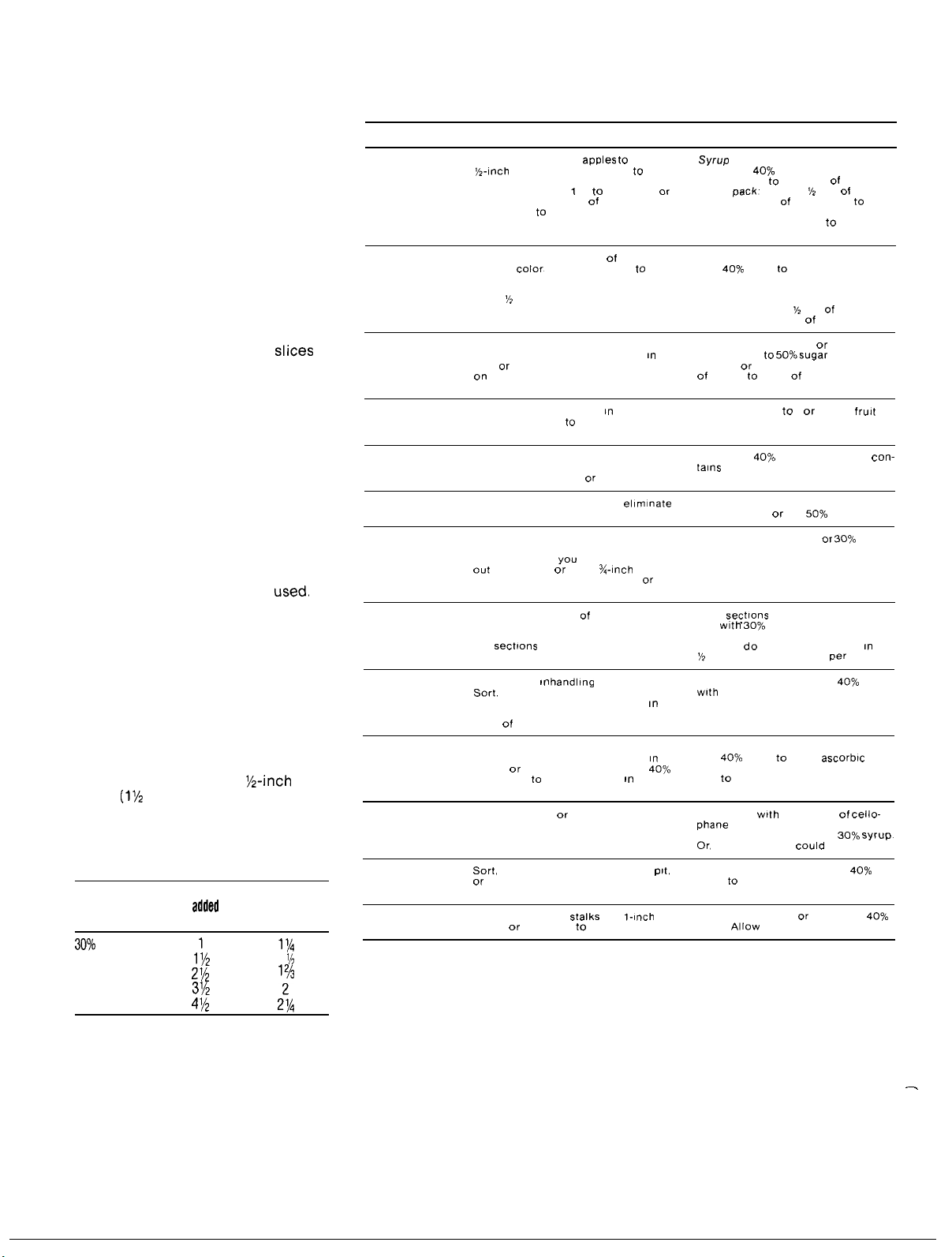
Freezing Fruits
Preparation for freezing
1.
Sort fruits for uniform ripeness,
quality and size.
2. Wash fruits thoroughly in cold water
and drain thoroughly,
3. Work with small quantities and
freeze quickly.
4. Pack in cartons, cutting or slicing
larger fruits, Add sugar or syrup.
5. To avoid discoloration of apples,
apricots, peaches and pears, (1) add
ascorbic acid mixture to syrup (1 tea-
spoon to 1 cup of syrup) following
directions on label, or (2) dip
slices of
fruit for 1 minute in solution of 3 table-
spoons lemon juice to 1 gallon water,
rinse in cold water, drain, and pack in
sugar or syrup. Place crumpled piece
of cello or waxed wrap on top of fruit
before closing to keep fruit in syrup.
Packing
Always allow head
space. Allow 72-inch
head space in pint containers (1 inch
for glass), l-inch head space in quart
containers (2 inches for glass).
Sweetening fruits helps retain flavor,
color and texture. The method of
sweetening depends on fruit
used.
See chart at right for recommended
method,
(a) Dry sugar pack. Suitable for fruits
that make their own juice when sugar
is added, Add dry sugar (see chart at
right) and stir gently until most of the
sugar has dissolved in the juice drawn
from the fruit, then pour into containers,
(b) Syrup pack. Suitable for fruits
which have comparatively little juice,
and those which darken readily. Add
syrup to cover fruit. Allow
yz-inch
head
space
(172
inch for glass containers).
(c)
Unsweetened pack. Suitable for
special diets.
Guide for making syrup
Cups of sugar
Percentage
to be
added
per Approximate
of syrup
pint of water yield in pints
30Y0
(light)*
l%
40% (light)*
1)2
1
B
50% (medium)
Zti
1%
60% (medium)
3Yz
65% (heavy)
4B
2$A
*Recommended for most fruits
Method: Dissolve sugar in boiling
water or mix thoroughly with cold water
until dissolved. Chill before using.
FRUIT
PREPARATION
PACKAGING
APPLES
Wash, peel and slice
applea to about
Yz-inch
thickness. If apples are to be
packed in sugar, prevent discoloration
by (1) steaming for
1
I/~ to 2 minutes, or
(2) dipping in solution
of 3 tablespoons
lemon juice
to 1 gallon water for 1
minute, rinsing in cold water, and
draining. Solution may be reused.
Syruo
pack: Slice into container,
cover with
4070 syrup. Add 1 teaspoon
ascorbic acid
to each cup of syrup.
Sugar
pack: Sprinkle
Yz
cup of sugar
over each quart
of apples. Stir to cover
all surfaces with sugar Seal. Adding
1 teaspoon ascorbic acid
to sugar is an
extra precaution
APRICOTS
Select firm, fully ripe fruit
of bright, Syrup pack: Pack in container; cover
uniform
color. Wash and sort as to size. with
407.
syrup to which ascorbic acid
Halve and remove pits. Peel and slice, has been added [1 teaspoon ascorbic
if desired. Heat unpeeled fruit in boiling acid to 1 cup syrup)
water
72
minute. Sugar pack: Mix 1 teaspoon crystalline
ascorbic acid with
YZ
cup of sugar and
sprinkle over 1 quart
of fruit. Stir
BERRIES
Proper maturity
IS important. Immature (1) May be packed dry, or (2) packed
berries should not be used. Wash
In
whole in a 40 to 507~sugar syrup. [3) For
cold
or iced water and drain thoroughly crushed or pureed berries, pack 4 parts
on absorbent paper towels of berries to 1 part of sugar. Stir until
sugar is dissolved. Seal
CHERRIES
Wash, sort and stem Chill
In
refrigerator
Sour
Mix 1 part sugar
to
4
or
5 parts fruit
until firm enough
to remove pits
by weight until sugar is dissolved
Pack. Seal.
CHERRIES Prepare quickly in same way as sour
Sweet
Cover with
407.
sugar syrup which con-
cherries However, sweet cherries may
ta[ns 1 teaspoon ascorbic acid per cup.
be frozen whole, with
or without pits.
CRANBERRIES
Wash in iced water, stem and
ellminate
Cranberries may be packed whole,
poor berries. Drain well.
without sugar,
or in a 5070 sugar syrup
MELONS
Cantaloupes
Honeydews
Watermelons
Select firm, well ripened fruit Cut in
half and remove seeds (remove water-
melon seeds as
YOU
cut balls) SCOOP
out melon balls or cut in %-inch cubes
These fruits may be frozen alone
or in
combination
Cover with orange juice
or
307.
sugar
syrup Seal and freeze
ORANGE and
GRAPEFRUIT
SECTIONS
Select firm fruit, free
of soft spots Peel
with sharp knife just below white
membrane Remove all membrane
Cut
sect!ons from divider-membranes.
Drain
Pack
secttons in layers Cover grape-
fruit
with. 30Y. syrup containing 1
teaspoon ascorbic acid per quart.
Oranges
do not need syrup. Stir
[n
YZ
teaspoon ascorbic acid Fer quart
PEACHES Promptness
!n
handltng IS important Pack immediately into cold 4070 syrup
Sort, peel [skins may be loosened by
w!th 1 teaspoon ascorbic acid per cup
scalding whole peach 30 seconds
In
in container; cover with more syrup
boiling water] and pit Peel and slice 1
Seal.
quart
of peaches at a time.
PEARS
Select pears which are fully tree-
Pack immediately in freezer carton.
ripened Wash, peel and core Cut
[n
Add
407.
syrup to which ascorbtc acid
halves
or quarters. Heat in boiling
407.
has been added (1 teaspoon ascorbic
syrup for 1
to 2 minutes Cool
In
syrup,
acid
to 1 cup syrup) Seal
then drain
PINEAPPLE Peel. core, slice
or cube.
Pack slices
wtth two circles of
cello-
phane paper between each slice Pack
without sugar or cover with
307.
syruF.
Or, pineapple juice could be used
PLUMS and
Sort, wash in iced water Halve and
p!t,
Pack in carton and cover with
407.
PRuNES or leave whole.
syrup
to which 1 teaspoon ascorbic
acid has been added per
CUP . Seal
RHUBARB Wash, trim and cut
stalks into I-anch
Pack without sugar
or cover with
407.
pieces or in lengths to fit package.
syrup.
Allow head space. Seal.
—
Serving frozen fruits
Place unopened containers in refriger-
ator. Serve while fruit is still slightly icy.
6
Freezing Dairy Products
Butter and Margarine
Overwrap original carton in moisture/
vapor-proof material or enclose in
moisture/vapor-proof containers.
Cheese
Freeze cheese in
Yz-
to l-pound
pieces. Wrap
in moisture/vapor-proof
material.
Uncreamed cottage and
Camembert cheese may be kept in
the freezer though there may be some
water separation on thawing, Cream
and processed cheese do not freeze
well as freezing affects their smooth
texture.
Cream
Ordinary household cream for table
use does not freeze well, but will be
suitable for cooking. Pasteurized heavy
cream containing not less than 40 per
cent butterfat may be frozen. Heavy
cream which has been whipped freezes
well, too. Drop mounds of whipped
cream on baking sheets. Freeze. Trans-
fer frozen mounds quickly to a rigid
container and seal, separating layers
with paper.
Ice Cream
Commercial ice creams can be stored
in the freezer in their original carton.
Home-made ice cream should be
packed in moisture/vapor-proof car-
tons. For best results, place ice cream
in the interior of the freezer rather
than on the door shelves.
Fine-qualiW ice cream, with high cream
content, will normally require slightly
lower temperatures than “airy”
already-
packaged brands with low cream con-
tent. Experiment to determine the
location in the freezer (the rear is
slightly colder than the front) and the
temperature control setting to keep
your favorite ice cream at the right
serving temperature.
Freezing Prepared Foods
Bread and Rolls
Bake, cool, wrap and freeze. To serve:
thaw in wrappings
at’room tempera-
ture. Or, heat or toast frozen. If desired,
wrap in foil and warm for 15 minutes in
250° to 300°F
oven. Note: most com-
mercially baked products should be
rewrapped in moisture/vapor-proof
material before freezing.
Biscuits
May be frozen baked or unbaked. To
serve baked biscuits: defrost in wrap-
pings at room temperature for one
hour. Reheat for 5 minutes in
425°F
oven. Or place frozen biscuits in
375°F
oven for 15 minutes. Unbaked biscuits
should be thawed, then baked as usual.
Cake
Bake and cool. If frosted, freeze before
wrapping to avoid sticking. To serve:
unwrap frosted cakes; thaw at room
temperature. Thaw
unfrosted cakes in
wrappings at room temperature. Allow
about two hours to thaw a large cake.
Icings made with egg white do not
freeze satisfactorily. Those made with
powdered sugar, butter, fudge or
_
whipped cream freeze well.
Cookies
If baked before freezing, cool and
package them carefully in moisture/
vapor-proof material. They will thaw in
about 15 minutes at room temperature
in wrappings. Refrigerator cookie
dough may be wrapped and frozen in
bars, Slice as needed, without defrost-
ing, and
bake.
Pies
Most pies except cream, custard or
meringue-topped pies freeze well,
baked or unbaked. Baked pies store
for a longer time. Omit steam vents
from pies to be frozen unbaked.
To serve unbaked pies: Cut steam
vents in top crust and place frozen pie
in oven at usual temperature. Increase
baking time 10 to 15 minutes. Thaw
frozen baked pies, wrapped, for 1 to
172
hours at
rOOrn
ternperatUre.
‘“
serve warm, unwrap without thawing
and heat in 300°F oven for 30 to 40
minutes.
Quick Breads and Muffins
Bake, cool and wrap at once. For
serving, thaw, unwrapped, at room
temperature or warm, unwrapped, in
300°F
oven.
Main Dishes
Such foods as chili, spaghetti sauce,
casseroles, etc., are
prepmed in the
same manner as for immediate serving
with the exception of seasoning. During
Eggs
Use only fresh eggs for freezing. Chill
before freezing. Whole eggs may be
frozen or the whites and yolks frozen
separately as follows:
Whole Eggs-Mix yolks and whites
thoroughly with a fork.
Do not beat in
air. Add 1 teaspoon salt to each 2
CUPS
of eggs.
Egg Whites–Separate and freeze in
recipe-sized amounts,
Egg Yolks–Separate and add 1 tea-
spoon of salt or 1 tablespoon of corn
syrup or sugar per cupful of yolks.
Blend with fork.
Pack eggs in freezer carton allowing
Yz-i
nch head space (1
Yz-i
nch for glass
containers). Thaw eggs in unopened
container in refrigerator or at room
temperature.
storage, onion flavor becomes less
noticeable and celery flavor more
pronounced. Spices also lose their
strength during long periods of stor-
age. Omit potatoes from stews and
SOUPS as they become mushy.
Cool main dishes after cooking; pack-
age in moisture/vapor-Proof material
and freeze. To serve these foods, thaw
gradually over low heat adding a little
liquid if necessary to prevent foods
from sticking to the pan. Or heat in a
300°F oven for about 1 hour or until
heated thoroughly.
Sandwich Tips
All varieties of breads can be frozen.
Spread softened butter on each slice,
then spread filling. It is not advisable
to use salad dressings for spreading
as they separate and soak into the bread.
Meat, fish, some cheeses, poultry and
peanut butter are recommended fillings
for freezing. Cooked eggs become
tough when frozen. Other fillings can
be moistened with milk, cream, pickle
relish, chili sauce, catsup, fruit juice,
a little mayonnaise or salad dressing.
Lettuce or other salad greens and raw
vegetables do not freeze well and
should be added just before serving.
Wrap sandwiches in
moisture/vapor-
proof material and freeze.
7
Part No.
4~23P04
Freezer Packaging
Proper packaging is essential for
successful freezing, Because solidly
frozen foods lose moisture in the dry
0° to
5°F
temperature of a freezer,
they must be properly protected by
top quality packaging materials that
are moisture/vapor-proof. Freezer
tape is used to seal wrappings and
for labeling.
Freezer packaging
materials
Materials
Uses
Cartons with Fruits,
moisture/vapor-
vegetables,
proof liners
some meats
Foil containers
Cooked foods
Polyethylene Baked foods,
bags
meats
Glass freezer jars Juices, fruits,
vegetables,
cooked foods
Plastic containers Sauces, fruits,
and boil-in bags vegetables,
cooked foods
Laminated paper Meats
Heavy-duty foil Meats, baked
goods, leftovers
Cellophane Baked goods,
sandwiches,
small meat cuts
Packaging instructions
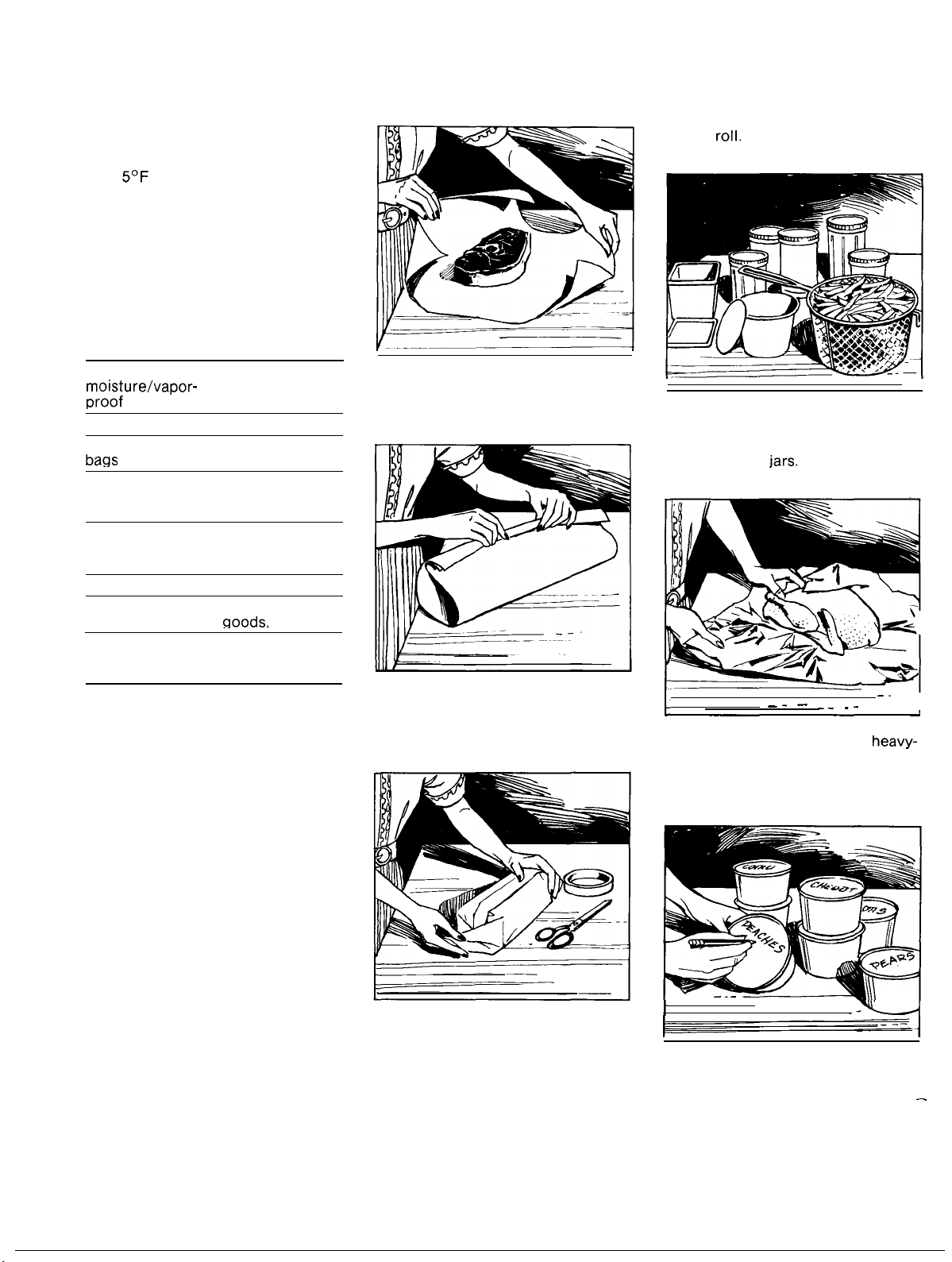
Drugstore Wrap
1. Place food in center of wrapping
paper.
2. Bring two parallel edges together.
Fold in lock seam, repeat until the
last fold rests firmly on food.
3. Fold ends, excluding as much air
as possible. Seal with tape or tie firmly
with heavy string.
Butchers’ Wrap
Place food diagonally on one corner
of paper. Roll paper and food together
diagonally, folding in extra material
-
as you roll, Seal with freezer tape.
I
1
— ---
Cartons and containers– Fruits,
vegetables and cooked foods may
be packaged in freezer cartons,
containers and
jars.
-.
—-
—
--
--
-1
Aluminum foil– Place food on heavy-
duty foil and mold foil to shape of the
food. Only one thickness is required.
No heat sealing or taping is necessary.
t
.-u
Labeling containers– Be sure to
label all containers and packages with
contents and date that it was placed
_
in the freezer.
8
Defrosting Instructions
n
most climates, defrosting will be
necessary only about twice a year.
To have your freezer operate most
efficiently, do not permit more than
1/2 inch of frost to accumulate on
the shelves.
To remove this light coating of frost
from the shelves, simply scrape with
a plastic or wood spatula or scraper.
Scrape the top and bottom surfaces
of the shelves and the refrigerated
surface at the top of the cabinet.
Never use an ice pick or metal
scraper. Any such instrument can
damage the freezer.
h
not use any
electrical device
in defrosting your freezer.
For complete defrosting:
1.
Turn temperature control to OFF.
2. Remove all food and place it in
corrugated boxes, insulated bags,
picnic coolers, etc. Use towels
and newspapers for insulation as
needed.
3. With door open, use pans of hot
water to speed loosening of frost.
Remove large pieces before they
melt.
@@
‘*
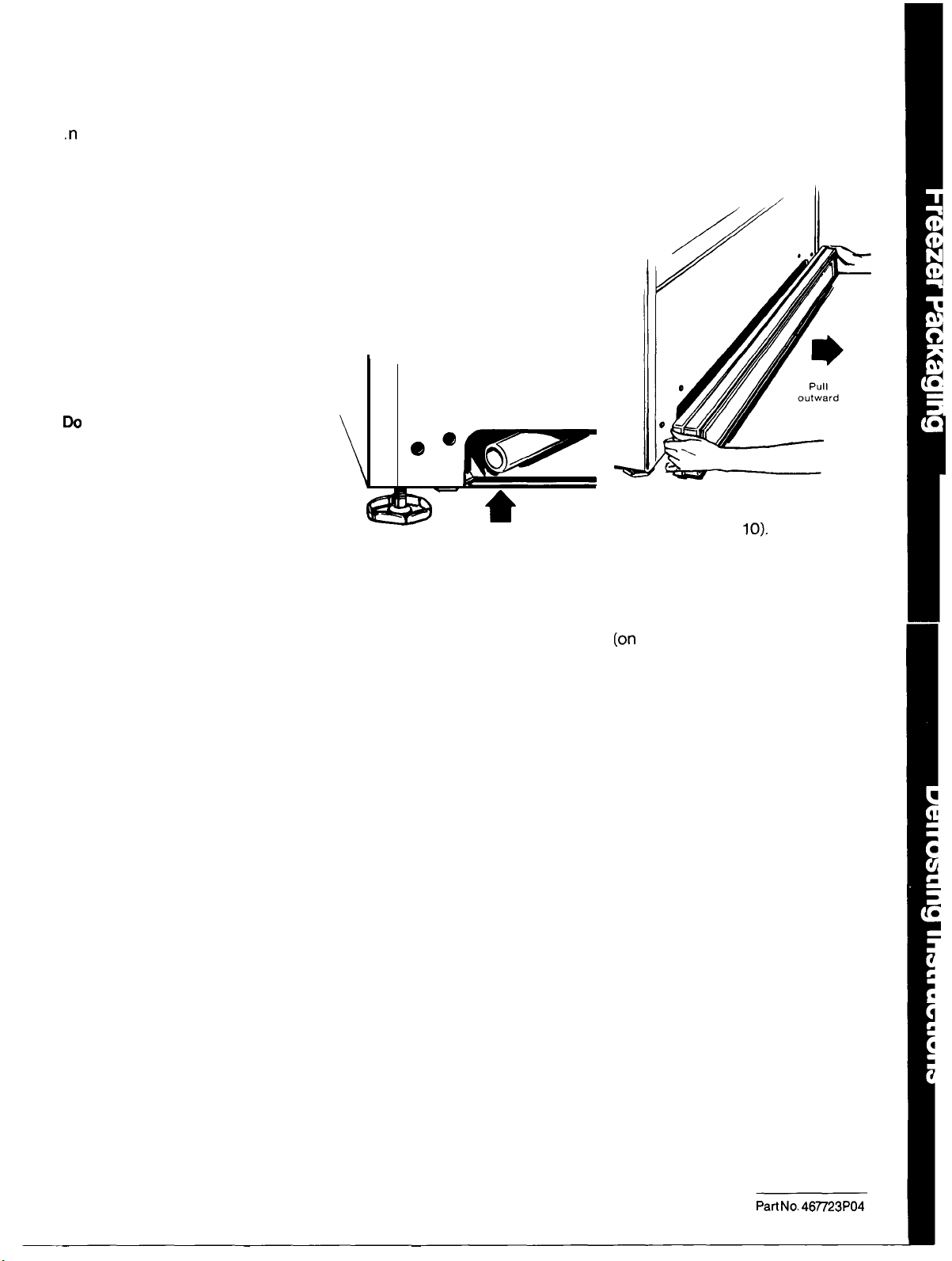
4. A drain hose (on models so
equipped) behind the base grille
carries the defrost water out from
the freezer. Remove the base grille;
then remove the drain plug and let
the defrost water drain into a pan.
Sponge excess water from bottom
of freezer as it collects to prevent
overflowing.
To remove the base grille
(on models
so equipped), grasp the grille at both
ends and pull outward.
5. After defrosting, clean inside of
freezer (see page
10)
6. Return temperature control to
regular position and return food
to freezer.
7.
Be
sure to replace drain plug
(on
models so equipped) and return
drain tube to its position.
8. Replace base grille by aligning
pins in grille with holes in cabinet
and gently pushing grille forward
until it snaps into place.
9
Pati
No.
46~23P04

User Maintenance Instructions
Cleaning your
freezer
Outside
Protect the paint finish.
The finish
on the outside of the freezer is a
high quality, baked-on paint finish.
With proper care, it will stay
new-
Iooking and rust-free for years. Apply
a coat of appliance polish wax when
the freezer is new and then at least
twice a year.
Appliance Polish Wax &
Cleaner
(Cat. No.
WR97X216)
is available
from Hotpoint Appliance Parts Marts.
Keep the finish clean.
Wipe with a
clean cloth lightly dampened with
appliance polish wax or mild liquid
dishwashing detergent. Dry and
polish with a clean, soft cloth.
Do
not
wipe the freezer with a soiled
dishwashing
cloth or wet towel.
~
not use scouring pads, powdered
cleaners, bleach, or cleaners con-
taining bleach.
Caution–Care should be taken in
moving the freezer away from the
wall. All types of floor coverings
can be damaged, particularly
cushioned coverings and those
with embossed surfaces.
Inside
Clean the inside of your freezer at
least once a
year.
It is recommended
that the freezer be unplugged before
cleaning. If this is not practical, wring
excess moisture out of sponge or
cloth when cleaning in the vicinity
of switches, lights or controls.
Use warm water and baking soda
solution—about a tablespoon of
baking soda to a quart of water.
Rinse thoroughly with water and
wipe dry
~
not use cleansing
powders or other abrasive cleaners.
When you goon
vacation
To maintain freezer in operation
during vacations,
besureyourhouse
power is not
turnedofl.
For sure
protection of freezer contents, you
may want to ask a neighbor to check
the power supply and freezer oper-
ation every 48 hours.
For extended vacations or absences,
you may prefer to move your frozen
foods to a storage
Iockertemporarily.
If freezer is to be left empty, turn
temperature control to OFF and dis-
connect power cord plug from wall
receptacle. To prevent formation of
odors, place open box of baking
soda in freezer and leave freezer
door open.
When freezer is not operating,
it
can be left in an unheated house or
room without damage to cabinet or
mechanism.
When you move
Disconnect power cord plug from
wall receptacle. Remove foods,
defrost and clean freezer.
Swure
all loose items
such as grille
and shelves by taping them securely
in place to prevent damage.
Be sure freezer stays in
upright
position
only
during actual moving
and in van. Freezer must be secured
in van to prevent movement. Protect
outside of freezer with blanket.
In case of extended
power failure:
1.
Keep freezer door closed. Your
freezer will keep food frozen for
24 hours provided warm air is not
admitted.
2. If freezer is out of operation for
24 hours or more, add dry ice. Leave
ice in large pieces and place it on
top of food on each shelf so cold air
will flow down over all the food. Add
more ice as required.
WARNING: Handling of dry ice can
cause freezing of the hands—gloves
or other protection is recommended.
3.
If
dv
ice is not available, move
food to a frozen food locker tempor-
arily—until power is restored.
10
-
~
,.
- Questions?
—
—-
Use This Problem Solver
~
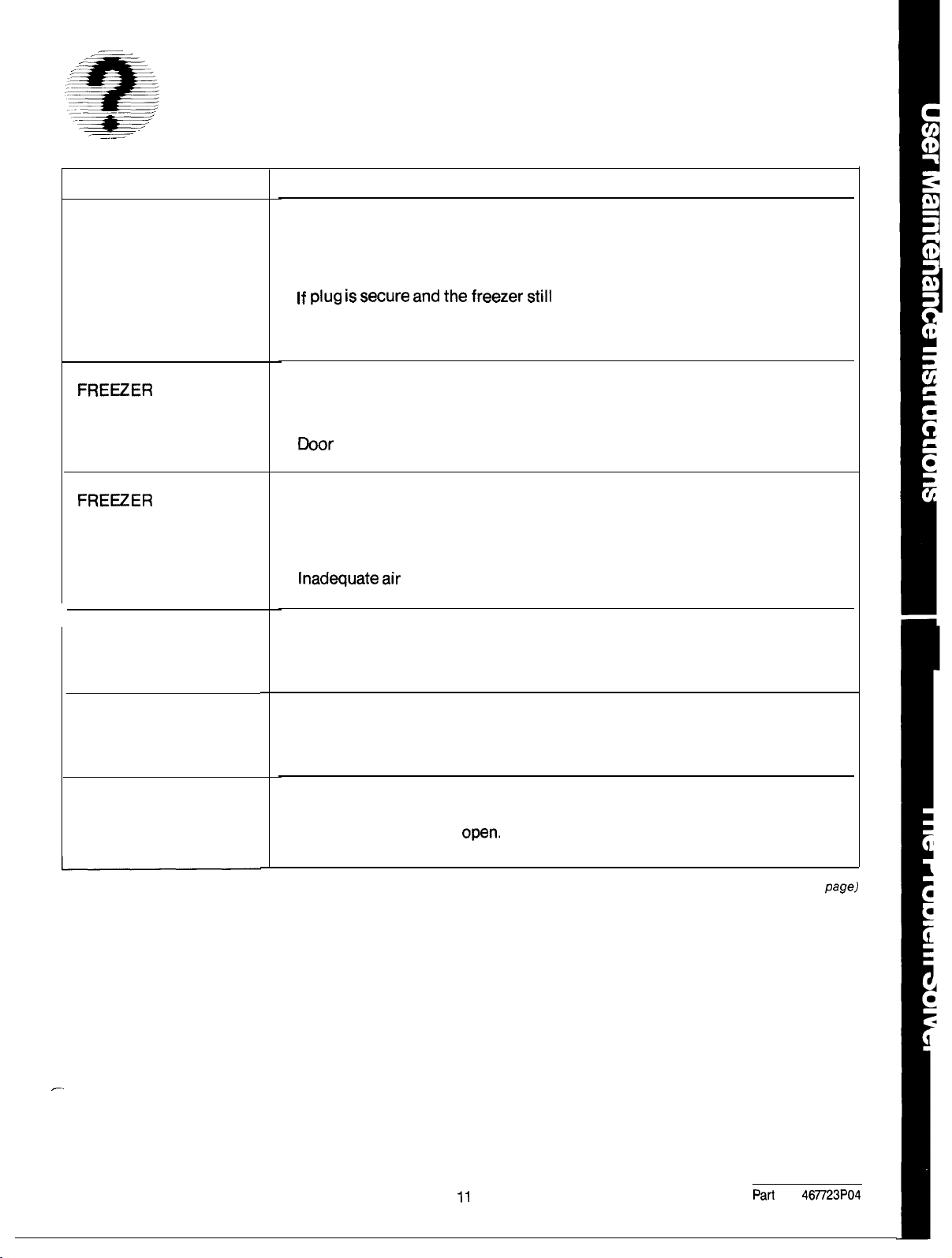
PROBLEM
FREEZER DOES NOT
OPERATE
FRE=ER
STARTS
TOO FREQUENTLY
FRE=ER
OPERATES
TOO
LONG
NOISY OPERATION
CABINETVIBRATES
FREEZER
TEMPERATURE
TOOWARM
POSSIBLE CAUSE AND REMEDY
.
Temperature control is in OFF position.
● If interior light (on models so equipped) is not on, freezer may not be
plugged in at wall receptacle.
●
If
p[ug
is
secure
and
the
freezer
still
fails to operate, plug a lamp or a small
appliance into the same outlet to determine if there is a tripped circuit breaker
or burned out fuse.
. Package holding door open.
. Temperature control set on too high a number.
●
~or
opened too frequently or too long.
.
Package
holding
door open.
. Door opened too frequently or too long.
. Temperature control set on too high a number.
●
Inadequate
air
circulation space around cabinet.
●
Weakness in
room
floor.
●
Legs
need adjusting.
. Weakness in room floor.
.
Legs
need adjusting.
. Door opened too frequently or too long.
. Package holding door
open.
(continued next
page)
—.
11
Pafl
No.
46~23P04
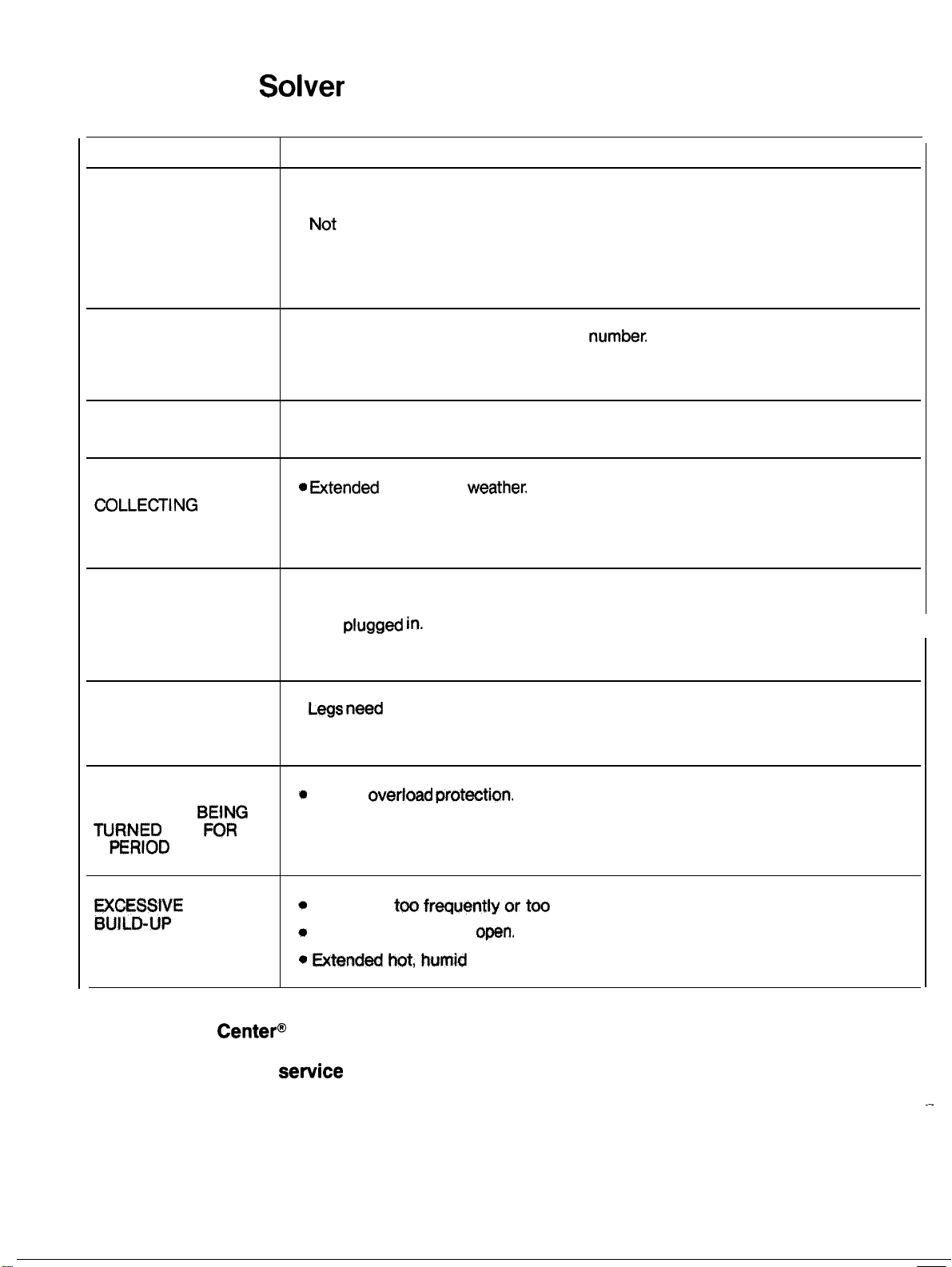
The Problem
Solver
(continued)
PROBLEM
POSSIBLE CAUSE AND REMEDY
FOODS DEFROSTING
. Blown fuse or tripped circuit breaker.
● Not plugged in.
● Temperature control in OFF position.
. Package holding door open.
FREEZER
● Temperature control set on too high a
numben
TEMPERATURE
TOO COLD
FOODS DRYING OUT
●
Packages not properly wrapped or sealed.
MOISTURE
*
&tended
hot, humid
weathec
~LLECTING
ON OUTSIDE
OF CABINET
INTERIOR LIGHT
. Blown fuse or circuit breaker.
DOES NOT LIGHT
(ON MODELS
● Not
p}ugg@
in.
SO EQUIPPED)
. Bulb burned out.
DOOR WON’T FULLY
●
Legs
need
adjusting.
CLOSE BY ITSELF
. Package holding door open.
SLOW STARTING
*
Built-in ovetioad
prot=tion.
TIME AFTER
BEING
TURNED
OFF
FOR
A
~RIOD
OF TIME
~“f:~:E
FROST
* browned
tm
frmuently or
tao
long.
.
*
Package holding door
Wn.
o
~tend~
hot,
humM
-thee
If you need more help.. call, toll free:
The GE Answer
Center@
800.626.2000
consumer information
sewice
—
12
If You Need
Semice
‘)
obtain service, see your warranty
on the back page of this book.
We’re proud of our service and
want you to be pleased. If for some
reason you are not happy with the
service you receive,
here are three
steps to follow for further help.
FIRST, contact the people who
serviced your appliance. Explain
why you are not pleased. In most
cases, this will solve the problem.
NEXT, if you are still not pleased,
write all the details—including your
phone number—to:
Manager, Consumer Relations
Hotpoint
Appliance Park
Louisville, Kentucky 40225
FINALLY, if your problem is still not
resolved, write:
Major Appliance
Consumer Action Panel
20 North
Wacker Drive
Chicago, Illinois 60606
13
Pati
No.4~3P04
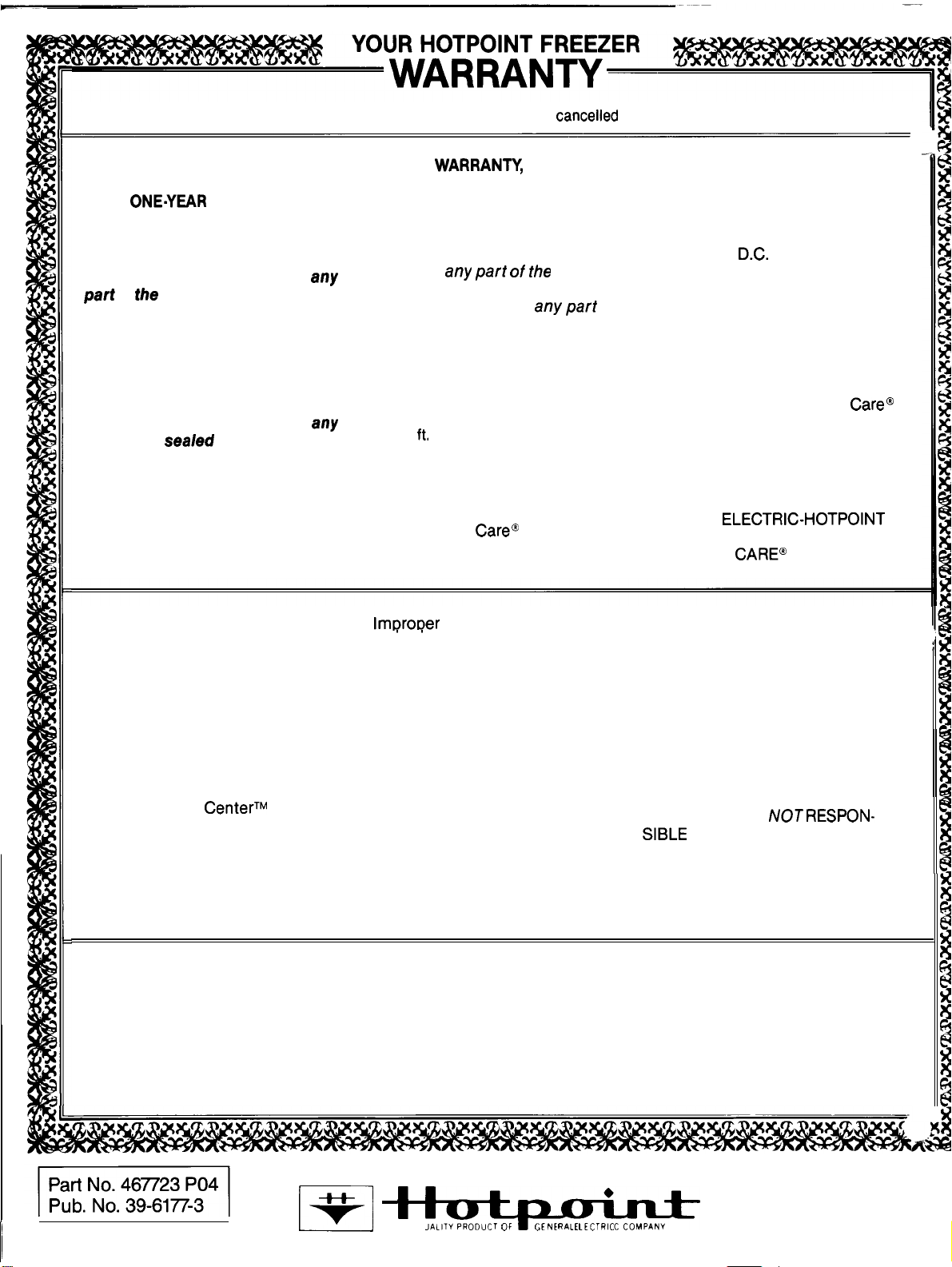
Save proof of original purchase date such as
your sales slip or
canceiled
check to establish warranty period.
WHAT IS COVERED
FULL
ONE.YEAR
WARRANTY
For one year from date of original
purchase, we will provide, free of
charge, parts and service labor in
your home to repair or replace
any
part
of the freezer that fails be-
cause of a manufacturing defect.
FULL FIVE-YEAR WARRANTY
For five years from date of original
purchase, we will provide, free of
charge, parts and service labor in
your home to repair or replace any
part of the
sealed
refrigerating
system
(the
compressor, conden-
ser, evaporator and all connecting
tubing) that fails because of a
manufacturing defect.
LIMITED
WARRANTY
FOOD SPOILAGE...
We will pay for food spoilage (not
to exceed the cumulative limit
specified below) that occurs
because of a manufacturing defect
either in: a)
any
part
of
the
freezer
within one year from date of
original purchase, or b)
any part
of the sealed refrigerating system
within five years from the date of
original purchase.
Cumulative
Freezer Capacity
Limit
14.9 cu. ft. and smaller
$100.00
15.0 cu.
ft.
and larger
$150.00
Within 30 days after food spoilage
occurs, you must provide satisfac-
tory proof of the spoilage to a
Factory Service Center, an author-
ized Customer
Care@
servicer or
the dealer from whom the freezer
was purchased.
FACTORY SERVICE or HOTPOINT
CUSTOMER
CARE”
SERVICE.
This warranty is extended to the
original purchaser and any succeed-
ing owner for products purchased
for ordinary home use in the 48
mainland states, Hawaii and
Washington,
D.C.
In Alaska the
warranty is the same except that it
is LIMITED because you must pay
to ship the product to the service
shop or for the service technician’s
travel costs to your home.
All warranty service will be provided
by our Factory Service Centers or
by our authorized Customer
Care@
servicers during normal working
hours.
Look in the White or Yellow Pages
of your telephone directory for
HOTPOINT FACTORY SERVICE,
GENERAL
ELECTRIC-HOTPOINT
WHAT IS NOT COVERED
● Service trips to your home to
teach you how to use the product.
Read your Use and Care material.
If you then have any questions
about operating the product,
please contact your dealer or our
Consumer Affairs office at the
address below, or call, toll free:
The GE Answer
CenterTM
800.626.2000
consumer information service
.
lmDroDer
installation.
. Replacement of house fuses
Ilg
,,
If you have an installation problem,
or resetting of circuit breakers.
contact your dealer or installer.
~
You are responsible for providing
. Failure of the product if it is
adequate electrical, plumbing and
used for other than its intended
8
other connecting facilities.
purpose or used commercially.
$
5
*.
. Food spoilage caused by:
. Damage to product caused
8
a) Power interruption from the
by accident, fire, floods or acts
9
utility.
of God.
g
b) Blown fuse, open circuit breaker
or other power disconnection on
WARRANTOR IS
NOT
RESPON-
$
the owner’s premises.
SIBLE FOR CONSEQUENTIAL
~
DAMAGES.
c) Freezer not operating because
8
of abnormally low electric power
voltage or inadequate house
~
wiring.
e
e
Some
states do not allow the exclusion or limitation of incidental or consequential damages, so the above limitation or exclusion
2
may not apply to you. This warranty gives you specific legal rights, and you may also have other rights
which vary from state to state.
@
To know what your legal rights are in your state, consult your local or state consumer affairs office or your state’s Attorney General.
9
8
Warrantor: General Electric Company
8
If further help is needed concerning this warranty, contact:
2
Manager–Consumer Affairs, General Electric Company, Appliance Park, Louisville, KY 40225
t
e
8-85
n
:
‘~
●
+
A QUALITY PRODUCT
Of
G[N[
RAL
E
lECTRIC
COMPANY

