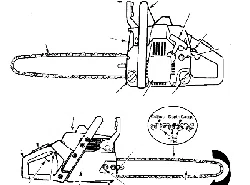

PoulanPRO
Instruction Manual
Manual de Instrucciones
Manuel d'lnstructions
330 / 380
For Occasional Use Only
WARNING:Read and follow all Safety Rules and Operating Instructions before
using this product. Failure to do so can result in serious injury.
ADVERTENCIA:
Lea el manual de instrucciones y siga todas las advertencias e en-
strucciones de seguridad. El no haceflo puede resultar en lesiones
graves.
AVERTISSEMENT:
Lire le manuel d'instructions et bien respecter tousles avertisse-
ments et toutes les instructions de s_curit_. Tout d_faut de le faire
pourrait entra_ner des blessures graves.
Electrolux Home Products, ]nc, Electrolux Canada Corporation
250 Bobby Jones Expressway 6150 McLaughlin Road
Augusta, GA 30907 Mississauga, Ontario L5R 4C2
[] From the Electrolux Group. The world's No.l choice.
Copynght/<>2002 Electrolux Home Products, 1no 530086536 1212102
B

----_ ARNING! This chain r_
saw can be dangerous! Care-
less orimproper use cancause
serious or even fatal injury.
Read and understand the
instruction manual before
using the chain saw.
Always wear appropriate ear protection, eye protection and head protection.
'"_' _ Always use two hands when operatthg the chain saw.
WARNING! Contacting the guide bar tip with any object
should be avoided; tip contact may cause the guide bar to
move suddenly upward and backward, which may cause se-
rious injury.
Measured maximum kickback value without chain brake for the bar
and chain combination on the label
,1_ WARNING: Always disconnect
spark plug wire and place wire where it can-
not contact spark plug to prevent accidental
starting when setting up, transporting, ad-
justing or making repairs except carburetor
adjustments.
Because a chain saw is a high-speed wood-
cutting toot, special safety precautions must
be observed to reduce the risk of accidents.
Careless or improper use of this tool can
cause serious injury.
PLAN AHEAD
• Read this manual carefully until you com-
pletely understand and can follow all safety
rules, precautions, and operating instruc-
tions before attempting to use the unit.
• Restrict the use of your saw to adult users
who understand and can follow safety
rules, precautions, and operating instruc-
tions found in this manual.
• Wear protective gear. Always use steel-
toed safety footwear with non-slip soles;
snug-fitting clothing; heaw-duty , non-slip
gloves; eye protection such as non-fogging,
vented goggles or face screen; an approved
safety hard hat; and sound barriers (ear
plugs or mufflers) to protect your hearing.
Regular users should have hearing checked
regularly as chain saw noise can damage
hearing. Secure hair above shoulder length.
Hearing Safety Hat
Protection _,/
_I_ Eye
Protection
Snug
Heavy Duty
Clothing Gloves
Safety Safety Chaps
Shoes
Keep all parts of your body away from the
chain when the engine is running.
Keep children, bystanders, and animals a
minim um of 30 feet (10 meters) away from
the work area. Do not allow other peopte or
animals to be near the chain saw when
starting or operating the chain saw.
Do not handle or operate a chain saw
when you are fatigued, ill, or upset, or if you
have taken alcohol, drugs, or medication.
You must be in good physical condition
and mentally alert. Chain saw work is
strenuous. If you have any condition that
might be aggravated by strenuous work,
check with your doctor before operating a
chain saw.
• Carefullyplanyoursawthgoperationinad-
vance.Donotstartcuttinguntilyouhavea
clearworkarea,securefooting,and,ifyou
arefellingtrees,aplannedretreatpath.
OPERATE YOUR SAW SAFELY
• Do not operate a chain saw with one hand.
Serious injury to the operator, helpers, by-
standers or any combination of these per-
sons may result from one-handed opera-
tion. A chain saw is intended for
two-handed use.
• Operate the chain saw only in a wetbventi-
lated outdoor area.
• Do not operate saw from a ladder or in a
tree.
• MakesurethechainwiH not makecontact
with any object while starting the engine.
Never try to start the saw when the guide
bar is in a cut.
• Do not put pressure on the saw at the end
of the cut. Applying pressure can cause
you to lose control when the cut is com-
pleted.
• Stop the engine before setting the saw
down.
• Do not operate a chain saw that is dam-
aged, improperly adjusted, or not com-
pletely and securely assembled. Always
replace bar, chain, hand guard, or chain
brake immediately if it becomes damaged,
broken or is otherwise removed.
• With the engine stopped, hand carry the
chain saw with the muffler away from your
body, and the guide bar and chain to the
rear, preferably covered with a scabbard.
MAINTAIN YOUR SAW IN GOOD
WORKING ORDER
• Have all chain saw service performed by a
qualified service dealer with the exception
of the items listed in the maintenance sec-
tion oftMs manual. For example, if improp-
er tools are used to remove or hold the fly-
wheel when servicing the clutch, structura]
damage to the flywheel can occur and
cause the flywheel to burst.
• Make certain the saw chain stops moving
when the throtfle trigger is released. For
correction, refer to CARBURETOR AD-
JUSTMENTS.
• Never modify your saw in any way.
• Keep the handles dry, clean, and free of oil
or fuel mixture.
• Keep fuel and oil caps, screws, and fas-
teners securely tightened.
• Use only Poulan PRO'_ accessories and
replacement parts as recommended.
HANDLE FUEL WITH CAUTION
• Do not smoke while handling fuel or while
operating the saw.
• Eliminate all sources of sparks or flame in
the areas where fuel is mixed or poured.
There should be no smoking, open flames,
orwork that could cause sparks. Allow en-
gine to cool before refueling.
• Mix and pour fuel in an outdoor area on
bare ground; store fuel in a cool, dry, well
ventilated place; and use an approved,
marked container for all fuel purposes.
Wipe up all fuel spills before starting saw.
• Move at least 10 feet (3 meters) from fuel-
ing site before starting engine.
• Turn the engine off and let saw coo] th a
non-combustible area, not on dry leaves,
straw, paper, etc. Slowly remove fuel cap
and refuel unit.
• Storethe unit and fuetin an area wherefuel
vapors cannot reach sparks or open
flames from water heaters, electric motors
or switches, furnaces, etc.
KICKBACK
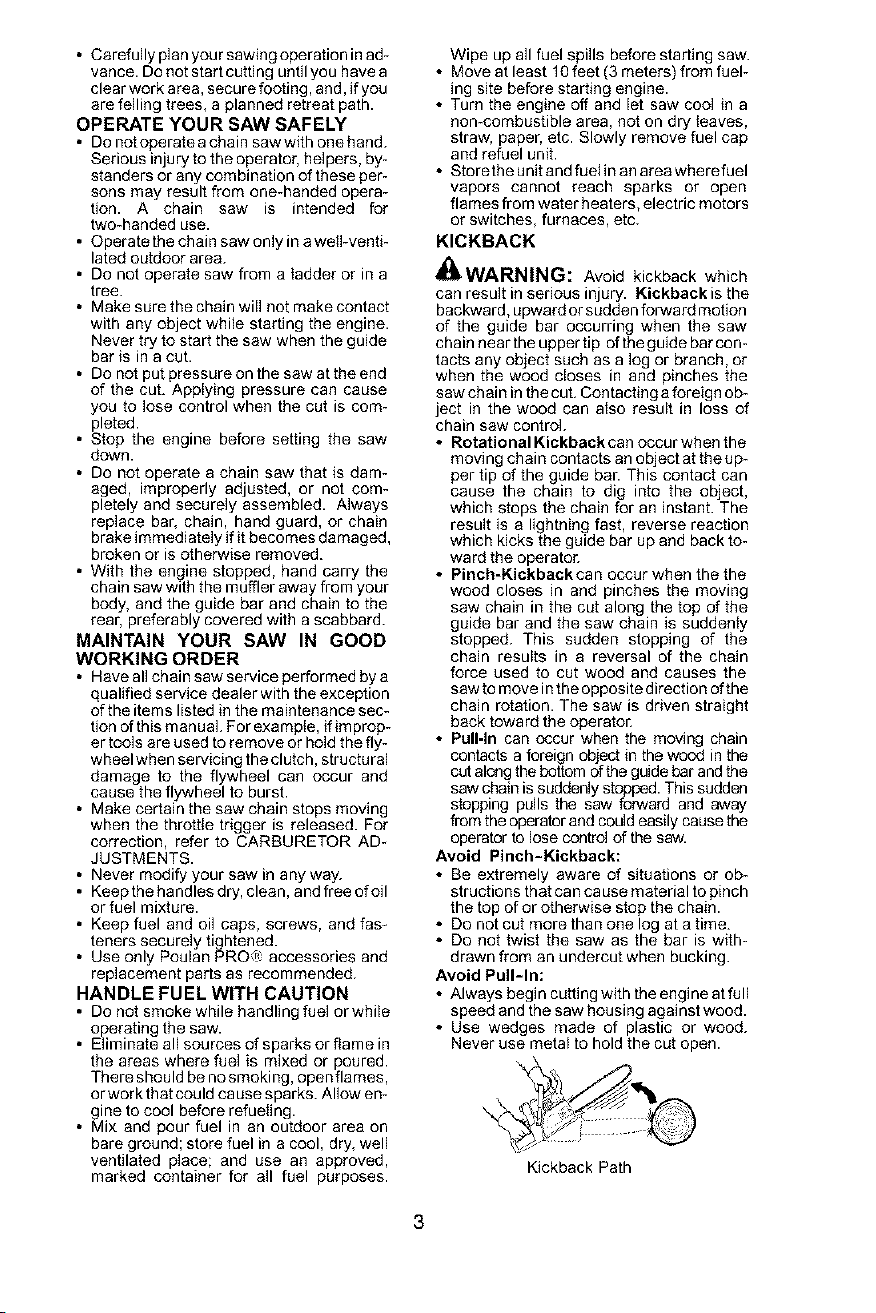
,_WARNING: Avoid kickback which
can result in serious injury. Kickback is the
backward, upward or sudden forward motion
of the guide bar occurring when the saw
cbain near the upper tip of the guide bar con-
tacts any object such as a Jogor branch, or
when the wood closes in and pinches the
saw chain in the cut. Contacting a foreign ob-
ject in the wood can also result in loss of
chain saw control
• Rotational Kickback can occur when the
moving chain contacts an object at the up-
per tip of the guide bar. This contact can
cause the chain to dig into the object,
which stops the chain for an instant. The
result is a lightning fast, reverse reaction
which kicks the guide bar up and back to-
ward the operator.
• Pinch-Kickbackcan occur when the the
wood closes in and pinches the moving
saw chain in the cut along the top of the
guide bar and the saw chain is suddenly
stopped. This sudden stopping of the
chain results in a reversal of the chain
force used to cut wood and causes the
saw to move in the opposite direction of the
chain rotation. The saw is driven straight
back toward the operator.
• Pull-In can occur when the moving chain
contacts a foreign object in the wood in the
cut along the bottom of'he guide bar and the
saw chain is suddenly stopped. This sudden
stopping pulls the saw forward and away
from the operator and could easily cause the
operator to lose contrc4 of the saw.
Avoid Pinch-Kickback:
• Be extremely aware of situations or ob-
structions that ca n ca use material to pinch
the top of or otherwise stop the chain.
• Do not cut more than one log at a time.
• Do not twist the saw as the bar is with-
drawn from an undercut when bucking.
Avoid Pull-In:
• Always begin cutting with the engine at full
speed and the saw housing against wood.
• Use wedges made of plastic or wood.
Never use metal to hold the cut open.
Kickback Path
AvoidObstructions_ _!
ClearTheWorkingArea
REDUCE THE CHANCE OF
KICKBACK
• Recognize that kickback can happen.
With a basic understanding of kickback,
you can reduce the element of surprise
which contributes to accidents.
• Never let the moving chath contact any ob_
ject at the tip of the guide bar.
• Keep the working area free from obstruc-
tions such as othertrees, branches, rocks,
fences, stumps, etc. Eliminate or avoid
any obstruction that your saw chain could
hit while you are cutting. When cutting a
branch, do not let the guide bar contact
branch or other objects around Jr.
• Keep your saw chain sharp and properly
tensioned. A loose or dull chain can in-
crease the chance of kickback occurring.
Follow manufacturer's chain sharpening
and maintenance instructions. Check ten-
sion at regular intervals with the engine
stopped, never with engine running. Make
sure the chain brake nuts are securely
tightened after tensioning the chain.
• Begin and continue cutting at full speed. If
cbain is moving at a slower speed, there is
greater chance of kickback occurring.
• Cut one log at a time.
• Use extreme caution when re-entering a
previous cut.
• Do not attempt cuts starting with the tip of
the bar (plunge cuts).
• Watch for shifting logs or other forces that
could close a cut and pinch or fall into chain.
• Use Reduced-Kickback Guide Bar and Low-
Kickback Chain specified for your saw.
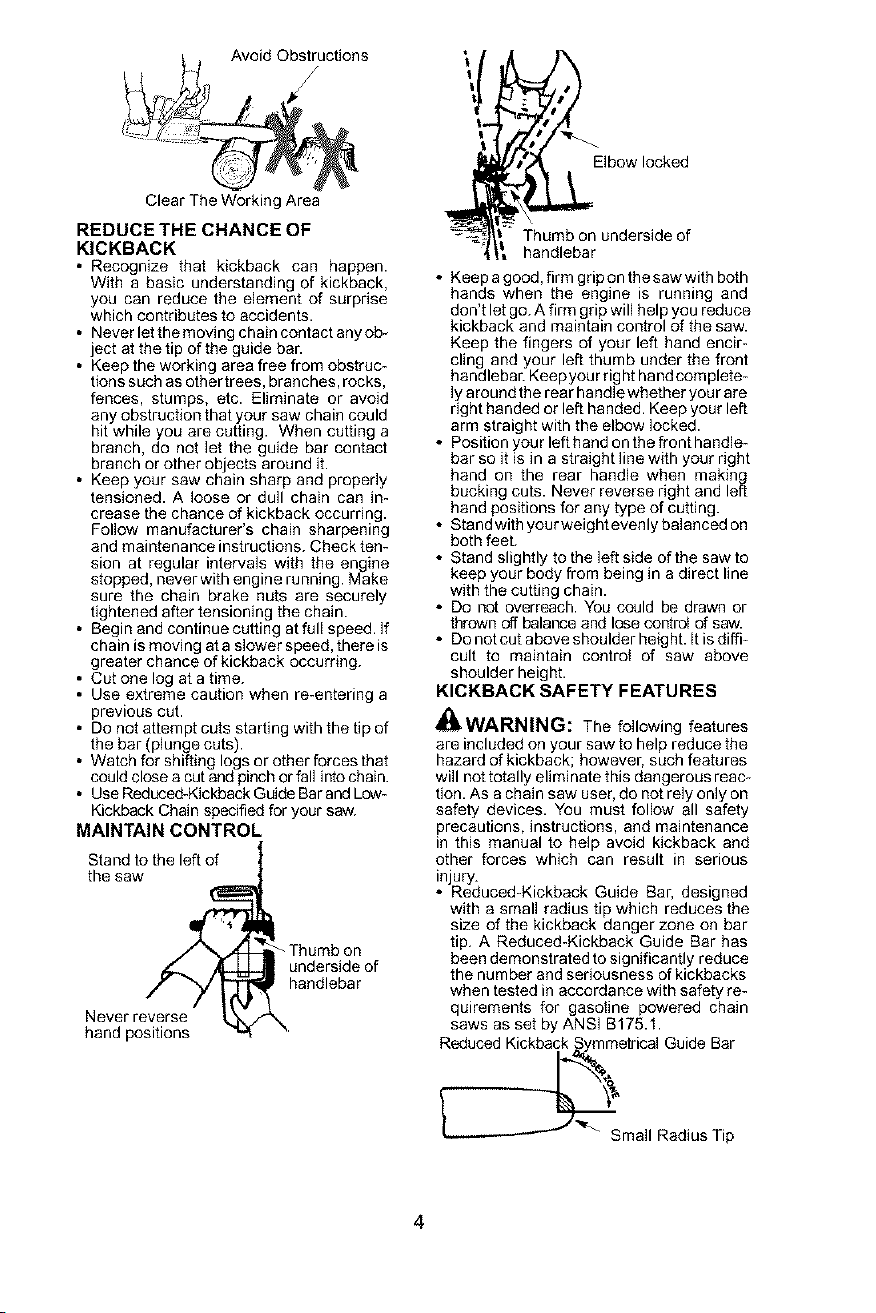
MAINTAIN CONTROL
Stand to the left of
the saw
_ _Thumb on
underside of
handlebar
Never reverse
hand pc
Elbow locked
Thumb on underside of
handlebar
• Keep a good, firm grip on the saw with both
hands when the engine is running and
don't let go. A firm grip will help you reduce
kickback and maintain control of the saw.
Keep the fingers of your left hand encir-
cling and your left thumb under the front
handlebar. Keepyour right hand complete-
ly around the rear handlewhether your are
dght handed or left handed. Keep your left
arm straight with the elbow locked.
• Position your left hand on the front handle-
bar so Jt is Jn a straight line with your dght
hand on the rear handle when making
bucking cuts. Never reverse dght and left
hand positions for any type of cutting.
• Stand with your weight evenly balanced on
both feet.
• Stand slightly to the left side of the saw to
keep your body from being Jn a direct line
with the cutting chain.
• Do not overreach. You could be drawn or
thrown off balance and lose cortrot of saw.
• Do not cut above shoulder height. It is diffi-
cult to mathtain control of saw above
shoulder height.
KICKBACK SAFETY FEATURES
_I_WARNING: The following features
are included on your saw to help reduce the
hazard of kickback; however, such features
will not totally eliminate this dangerous reac-
tion. As a chain saw user, do not rely only on
safety devices. You must follow all safety
precautions, instructions, and maintenance
in this manual to help avoid kickback and
other forces which can result in serious
injury.
• Reduced-Kickback Guide Bar, designed
with a small radius tip which reduces the
size of the kickback danger zone on bar
tip. A Reduced-Kickback Guide Bar has
been demonstrated to significantly reduce
the number and seriousness of kickbacks
when tested in accordance with safety re-
quirements for gasoilne powered chain
saws as set by ANSI B175.1.
Reduced Kickback Symmetrical Guide Bar
__r._ Small RadiusTip
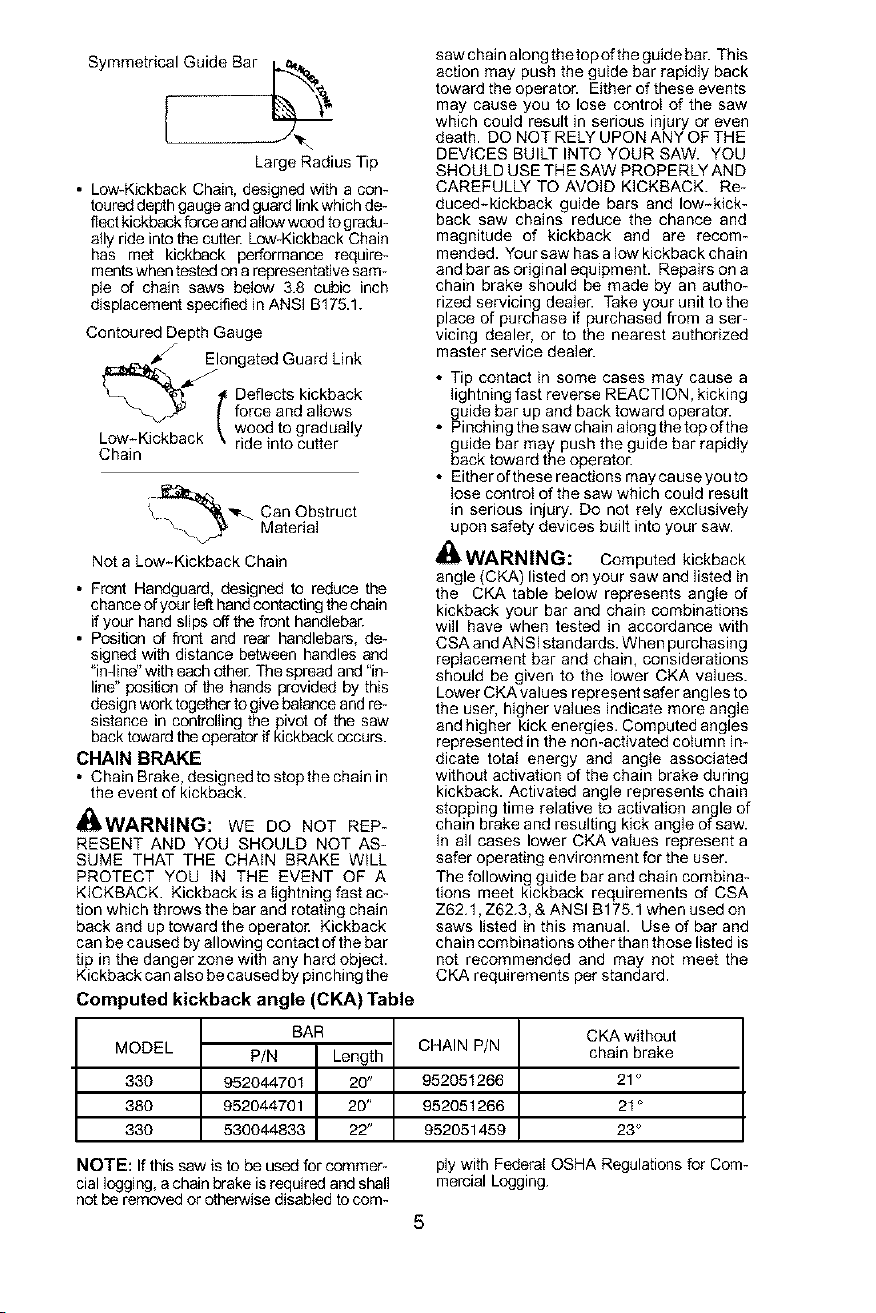
SymmetricalGuideBar_.e44,e_
LargeRadiusTip
• Low-KickbackChain,designedwithacon-
toureddepthgaugeandguardlinkwhichde-
flectkickbackforceandallowwoodtogradu-
allyrideintothecutte£Low-KickbackChain
hasmetkickbackperformancerequire-
mentswhentestedonarepresentativesam-
pieofchainsawsbelow3.8cubicinch
displacementspecifiedinANSiB175.1.
ContouredDepthGauge
EIongatedGuardLink
wooogreuay
Low-Kickback_krideintocutter
Chain
% Material
\.\ _. CanObstruct
NotaLow-KickbackChain
• FrontHandguard,designedtoreducethe
chanceofyourlefthandcontactingthechain
ifyourhandslipsoffthefronthandlebar.
• Positicnoffrontandrearhandlebars,de-
signedwithdistancebetweenhandlesand
"in-lind'witheachother.Thespreadand"in-
lind'positionofthehandsprovidedbythis
designworktogethertogivebatanceandre-
sistanceincontrollingthepivotofthesaw
backtowardtheoperatorifkickbackoccurs.
CHAINBRAKE
• Chain Brake, designed to stop the chain in
the event of kickback.
_I_WARNING: WE DO NOT REP-
RESENTAND YOU SHOULD NOT AS-
SUME THAT THE CHAIN BRAKE WiLL
PROTECT YOU IN THE EVENT OF A
KICKBACK. Kickback is a lightning fast ac-
tion which throws the bar and rotating chain
back and up toward the operatoE Kickback
can be ca used by allowing contact of the bar
tip in the danger zone with any hard object.
Kickback can also be caused by pinching the
Computed kickback angle (CKA) Table
saw chain along thetopof the guide bar. This
action may push the guide bar rapidly back
toward the operator. Either of these events
may cause you to lose controt of the saw
which could result in serious injury or even
death. DO NOT RELY UPON ANY OF THE
DEVICES BUILT INTO YOUR SAW. YOU
SHOULD USE THE SAW PROPERLY AND
CAREFULLY TO AVOID KICKBACK. Re-
duced-kickback guide bars and low-kick-
back saw chains reduce the chance and
magnitude of kickback and are recom-
mended. Your saw has a low kickback chain
and bar as original equipment. Repairs on a
chain brake should be made by an autho-
rized servicing dealer. Take your unit to the
place of purchase if purchased from a ser-
vicing dealer, or to the nearest authorized
master service dealer.
• Tip contact in some cases may cause a
lightning fast reverse REACTION, kicking
guide bar up and back toward operator.
• Pinching the saw chain along the top of the
guide bar may push the guide bar rapidly
back toward the operator.
• Either of these reactions may cause you to
lose controt of the saw which could result
in serious injury. Do not rely exclusively
upon safety devices built into your saw.
_k WARNING: Computed kickback
angle (CKA) listed on your saw and listed in
the CKA table below represents angie of
kickback your bar and chain combinations
will have when tested in accordance with
CSA and ANSI standards. When purchasing
replacement bar and chain, considerations
should be given to the lower CKA values.
Lower CKA values represent safer angles to
the user, higher values indicate more angle
and higher kick energies. Computed angles
represented in the non-activated cotumn in-
dicate total energy and angle associated
without activation of the chain brake during
kickback. Activated angle represents chain
stopping time relative to activation angle of
chain brake and resulting kick angle of saw.
In all cases lower CKA values represent a
safer operating environment for the user.
The following guide bar and chain combtha-
tions meet kickback requirements of CSA
Z62.1, Z62.3, & ANSI B175.1 when used on
saws listed in this manual. Use of bar and
chain combinations other than those listed is
not recommended and may not meet the
CKA requirements per standard.
MODEL
330
380
330
BAR
CHAIN P/N
P/N Length
952044701 20" 952051266
952044701 20" 952051266
530044833 22" 952051459
CKAwithout
chain brake
21 °
2t °
23 °
NOTE: If this saw is to be usedfor commer- ply with Federal OSHA Regulationsfor Com-
cial Ioggieg,a chain brake isrequired and shall mercial Legging.
not be removed or otherwise disabled to corn-
5
SAFETY NOTICE: Exposure to
vibrations through prolonged use of gasol(ne
powered hand tools could cause blood
vessel or nerve damage in the fingers,
hands, and joints of people prone to
circulation disorders or abnormal swellings.
Prolonged use in cold weather has been
linked to blood vessel damage in otherwise
healthy people. If symptoms occur such as
numbness, pain, loss of strength, change in
skin color or texture, or loss of feel(ng in the
fingers, hands, or joints, discontinue the use
of this tool and seek medical attention. An
a nti-vibration system does not guaranteethe
avoidance of these problems. Users who
operate power tools on a continua( and
regular basis must monitor closely their
physical condition and the condition of this
tool.
SPECIAL NOTICE: Your saw is equipped
with a temperaturel(m(ting muff(er and spark
arresting screen which meets the
requirements of California Codes 4442 and
4443. All U.S. forest land and the states of
California, (daho, Maine, Minnesota, New
Jersey, Oregon, and Washington require
many (nternal combustion engines to be
equipped with a spark arresting screen by
law. If you operate a chain saw in a state or
locale where such regulations exist, you are
legally responsible for maintaining the
operating condition of these parts. Failure to
do so is a violation of the law. Refer to the
SERVICE section for maintenance of the
spark arresting screen.
Failureto follow all Safety Rules and Precau-
tions can result in serious injury. If situations
occur which are not covered in this manual,
use care and good judgement. If you need
assistance, contact your authorized service
dealer.
STANDARDS: This saw is listed by Un-
derwdter's Laboratories, Inc., in accordance
with:
ANSI BI75.1-280g American National
Standard for Powered Toots ~ Gasoline
Powered Chain Saw ~ Safety Requirements
CSA Z62.1-1995 Chain Saws - Occupa-
tional Health and Safety
CSA Z62.3-1996 Chain Saw Kickback Oc-
cupational Health and Safety
Protective gloves (not provided) should be
worn dudng assembly.
ATTACHING THE BAR & CHAIN (If not
already attached)
_I_WARNING: if received assembled,
repeat all steps to ensure your saw is proper-
ly assembled and all fasteners are secure.
Always wear gloves when handling the
chain. The chain is sharp and can cut you
even when it is not moving!
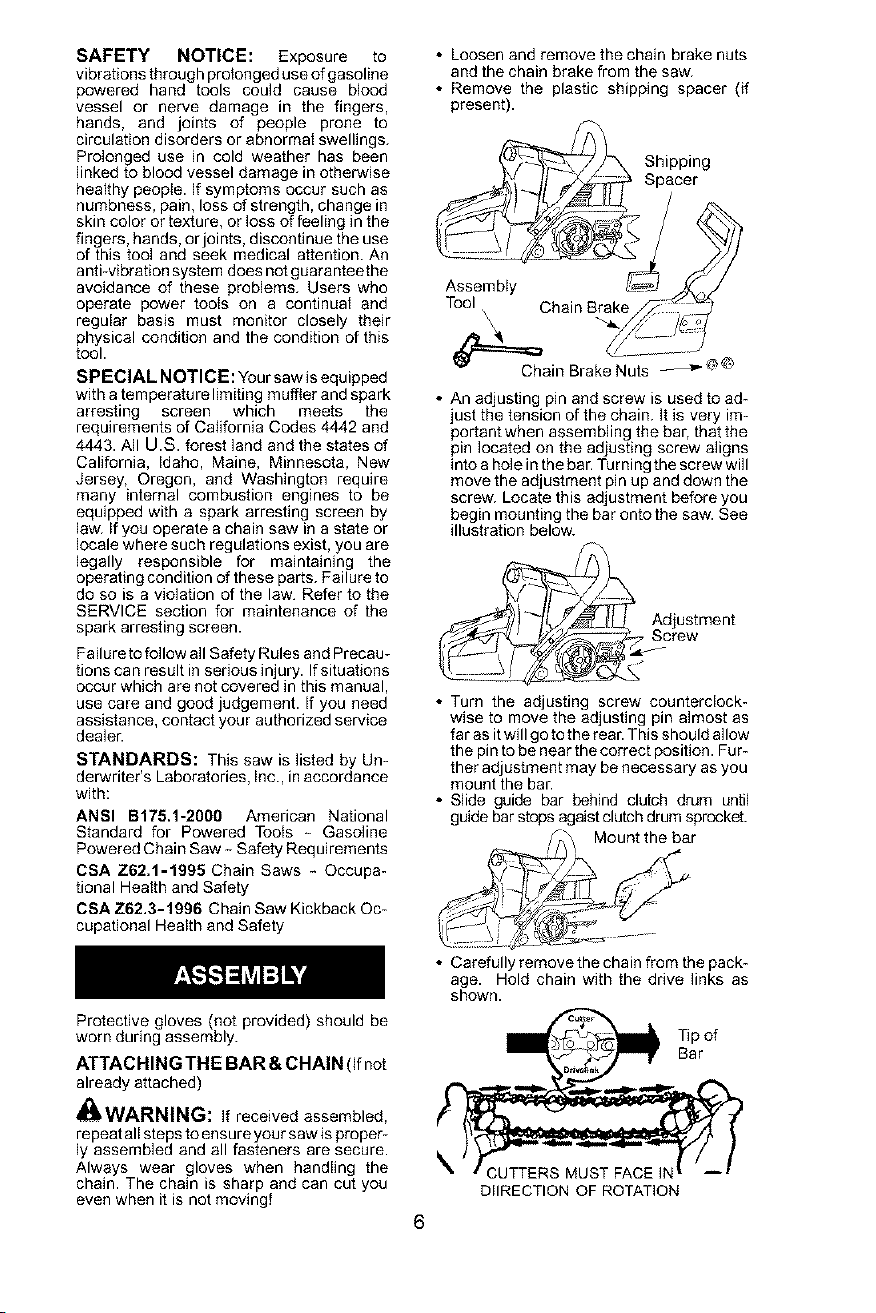
• Loosen and remove the chain brake nuts
and the chain brake from the saw.
• Remove the plastic shipping spacer (if
present).
_i_cer _shipping
Assembly
Tool Chain Brake :
• An adjusting pin and screw is used to ad-
just the tension of the chain. ]t is very im-
portant when assembling the bar, that the
pin located on the adjusting screw aligns
into a hole in the bar. Turning the screw will
move the adjustment pin up and down the
screw. Locate this adjustment before you
begin mounting the bar onto the saw. See
illustration below.
• Turn the adjusting screw counterclock-
wise to move the adjusting pin almost as
far as it will go to the rear. This should allow
the pin to be near the correct position. Fu r-
ther adjustment may be necessary as you
mount the bar.
• Slide guide bar behind clutch drum until
guide bar stops agaJst clutch drum sprocket.
• Carefully remove the chain from the pack-
age. Hold chain with the drive links as
showN.
Tip of
Bar
DIIRECTION OF ROTATION
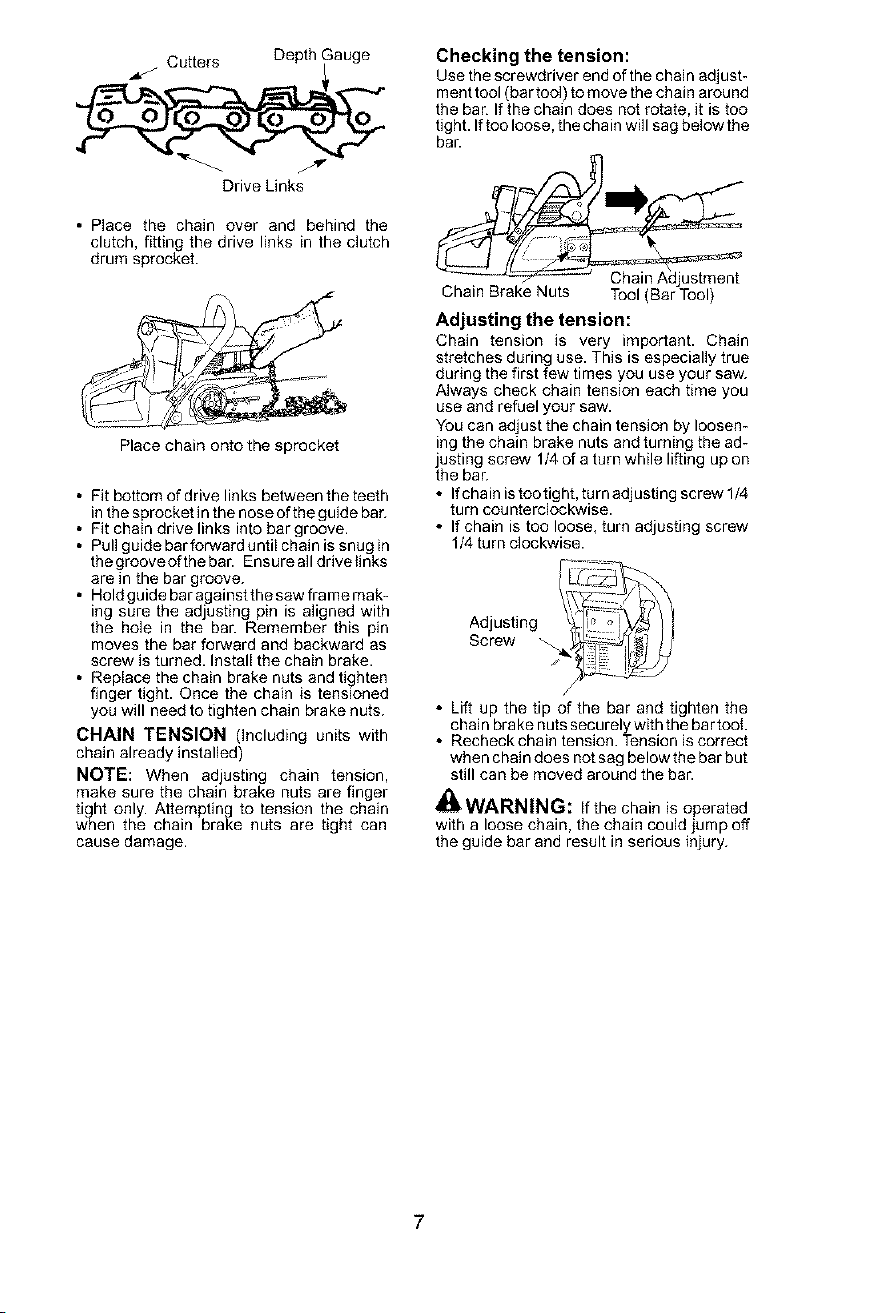
Cutters DepthGauge
DriveLinks
• Placethechainoverandbehindthe
clutch,fittingthedrivelinksintheclutch
drumsprocket.
Placechainontothesprocket
• Fitbottomofdrivelinksbetweentheteeth
inthesprocketinthenoseoftheguidebar.
• Fitchaindrivelinksintobargroove.
• Pullguidebarforwarduntilchainissnugin
thegrooveofthebar.Ensurealldbvetinks
areinthebargroove.
• Holdguidebaragainstthesawframemak-
ingsuretheadjustingpinisalignedwith
theholeinthebar.Rememberthispin
movesthebarforwardandbackwardas
screwisturned.Installthechainbrake.
• Replacethechainbrakenuts.andfighten
fingerfight.OncethechaEnistensioned
youwillneedtotightenchainbrakenuts.
CHAINTENSION(Includingunitswith
chainalreadyinstalled)
NOTE:Whenadjustingchaintension,
makesurethechainbrakenutsarefinger
tightonly.Attemptingtotensionthechain
whenthechainbrakenutsaretightcan
causedamage.
Checkingthetension:
Usethescrewdriverendofthechainadjust-
menttool(bartool)tomovethechainaround
thebar.Ifthechaindoesnotrotate,itistoo
tight.Iftooloose,thechainwillsagbelowthe
bar.
ChainBrakeNuts Tool(BarTool)
Adjusting the tension:
Chain tension is very important. Chain
stretches during use. This is especially true
during the first few times you use your saw.
Always check chain tension each time you
use and refuel your saw.
You can adjust the chain tension by loosen-
ing the chain brake nuts and turning the ad-
justing screw 1/4 of a turn while lifting up on
the bar.
• If chain is tootight, turn adjusfing screw 1/4
turn counterclockwise.
• If chain is too loose, turn adjusting screw
1/4 turn clockwise.
Adjusting
Screw
• Lift up the tip of the bar and tighten the
chain brake nuts securely with the bar toot.
• Recheck chain tension. Tension is correct
when chain does not sag below the bar but
still can be moved around the bar.
_IkWARNING: If the chain is operated
with a loose chain, the chain could jump off
the guide bar and result in serious injury.
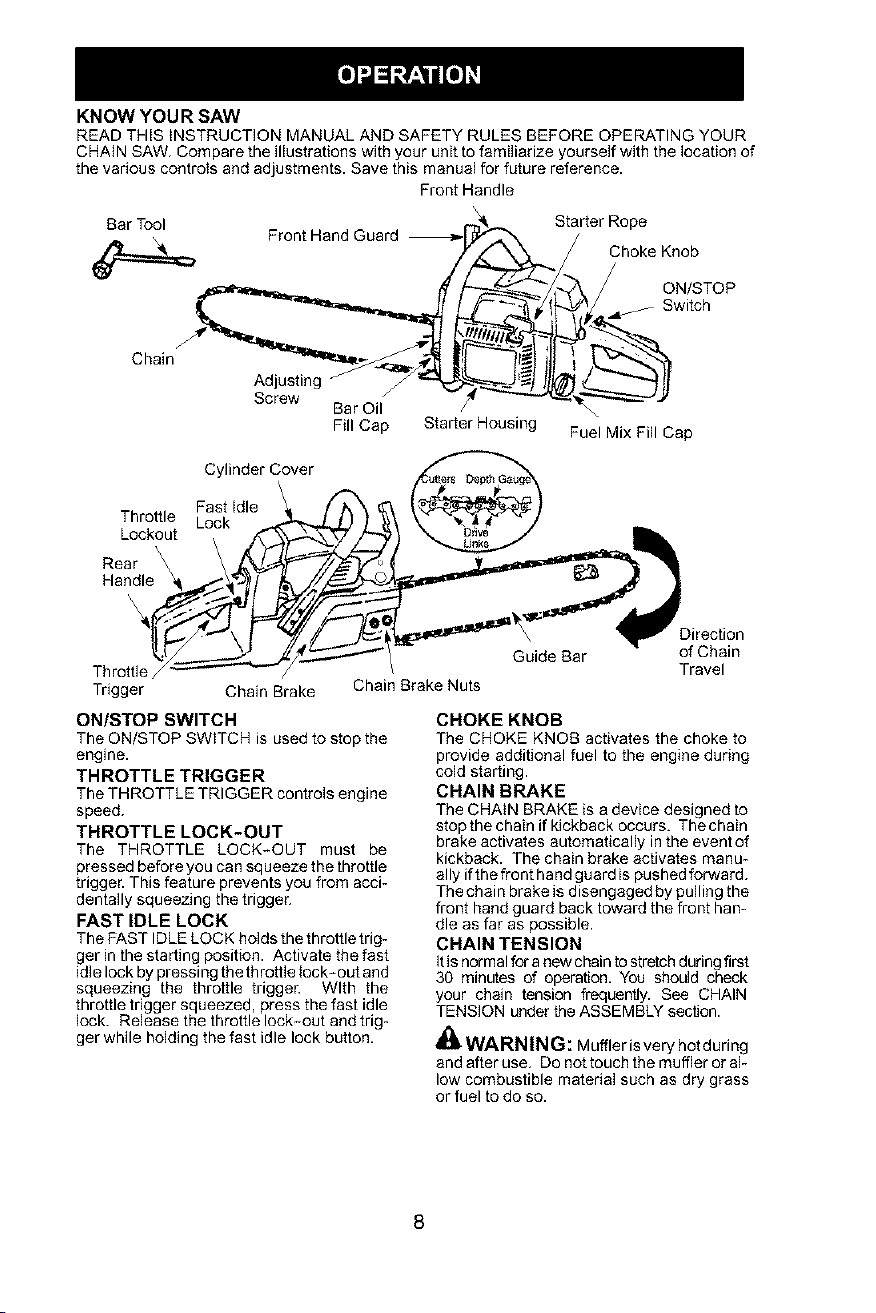
KNOW YOURSAW
READ THIS INSTRUCTION MANUAL AND SAFETY RULES BEFORE OPERATING YOUR
CHAIN SAW. Compare the illustrations with your unit to familiarize yourself with the location of
the various controls and adjustments. Save this manual for future reference.
Front Handle
Bar Tool X_ Starter Rope
-- Front Hand Guard _1 ¢-r._
" //_ Choke Knob
, Ow. & oP
Chain _ P .
Bar Oil /
Fill Cap Starter Housing Fuel Mix Fill Cap
Cylinder Cover
\
Fast Idle
Throttle
Lockout
\
Rear
Handle
,\
\
Throttle
Trigger Chain Brake
Chain Brake Nuts
Guide Bar
)irection
of Chain
Travel
ON/STOP SWITCH
The ON/STOP SWITCH is used to stop the
engine.
THROTTLE TRIGGER
The THROTTLE TRIGGER controls engine
speed.
THROTTLE LOCK-OUT
The THROTTLE LOCK-OUT must be
pressed before you can squeeze the throttle
trigger. This feature prevents you from acci-
dentally squeezing the trigger.
FAST IDLE LOCK
The FAST IDLE LOCK holds the throttle trig-
ger in the starting position. Activate the fast
idle lock by pressing the throttle lock-out and
squeezing the throttle trigger. With the
throttle trigger squeezed, press the fast idle
lock. Release the throttle lock-out and trig-
ger while holding the fast idle lock button.
CHOKE KNOB
The CHOKE KNOB activates the choke to
provide additional fuel to the engine during
cold starting.
CHAIN BRAKE
The CHAIN BRAKE is a device designed to
stop the chain if kickback occurs. The chain
brake activates automatically in the event of
kickback. The chain brake activates manu-
ally if the front hand guard is pushed forward.
The chain brake is disengaged by pulling the
front hand guard back toward the front han-
dle as far as possible.
CHAIN TENSION
it is normal for a new chain to stretch during first
30 minutes of operation. You should check
your chain tension frequently. See CHAIN
TENSION under the ASSEMBLY section.
,_ WARNING: Muffler is very hot during
and after use. Do not touch the muffler or ab
low combustible material such as dry grass
or fuel to do so.
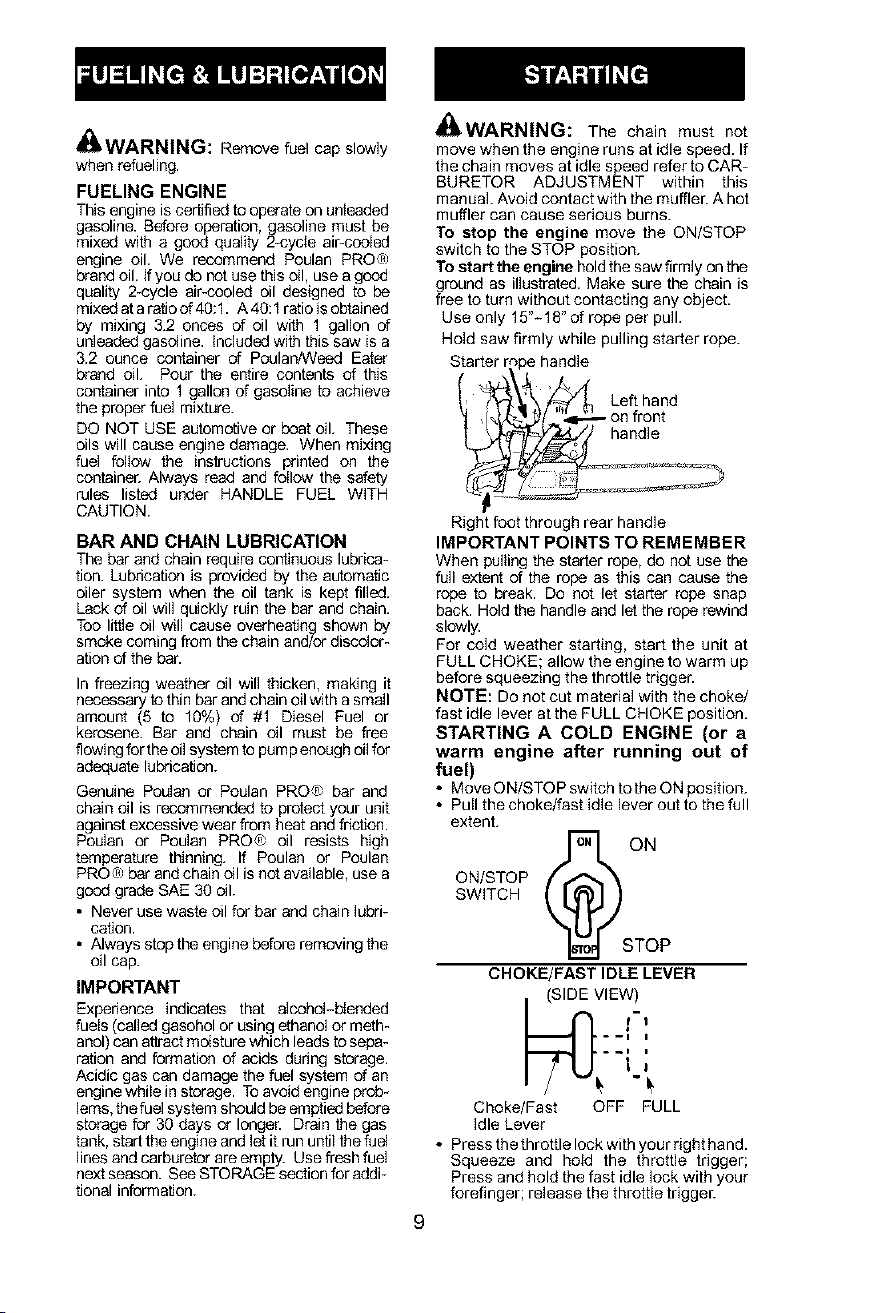
oWARNING: Remove fuel cap slowly
when refueling.
FUELING ENGINE
This engine is certified to operate on uateeded
gasoline. Before operation, ga_asoiinemust be
mixed with a good quality 2-cyble air-coefed
engine oil. We recommend Poulan PRO_;
brand oil. if you do not use this oil, use a good
quality 2-cycle aircooled oil designed to be
mixedataratioef40:l. A40:f ratioisobtained
by mixing 3+2 onces of oil with 1 gallon of
unleaded gasoline. Included with this saw is a
3.2 ounce container of Poulan/Weed Eater
brand oil. Pour the entire contents of this
container into 1 gallon of gasoline to achieve
the proper fuel mixture.
DO NOT USE automotive or peat oil. These
oils will cause engine damage. When mixing
fuel follow the instructions printed on the
container. Always read and follow the safety
rules listed under HANDLE FUEL WITH
CAUTION.
BAR AND CHAIN LUBRICATION
The bar and chain require continuous lubrica-
tion. Lubrication is provided by the automatic
oiler system when the oil tank is kept filled.
Lack of oil will quickly ruin the bar and chain.
Too little oil will cause overheating_shown by
smoke coming from the chain and/or discolor-
ation of the bar.
In freezing weather oil will thicken, making it
necessary to thin bar and chain oil with a small
amoun_ (5 to 10%) of #1 Diesel Fuel or
kerosene. Bar and chain <:41must be free
flowthg for the oil system to pump enough oil for
adequate lubrication.
Genuine Poulan or Poulan PRO_; bar and
chain oil is recommended to protect your unit
against excessive wear from heat and friction.
Poulan or Poulan PRO_; <:41resists high
temperature thinning. If Poulan or Poulan
PRO_; bar and chain oil is not available, use a
good grade SAE 30 oil.
• Never use waste oil for bar and chain lubri-
cation.
• Always stop the engine before removing the
oil cap.
IMPORTANT
Experience indicates that alcohol-blended
fuels (called gasohol or using ethanol or meth-
anol) can attract moisture which leads to sepa-
ration and formation of acids during storage.
Acidic gas can damage the fuel system of an
engine while in storage. To avoid engine prob+
lems, the fuel system should be emptied before
storage for 30 days or longer. Drain the gas
tank, start the engine and let it run until the fuel
lines and carburetor are empty. Use fresh fuel
next season. See STORAGE section for addi-
tional information.
_II, WAI_I_III_II, J: The chain must not
move when the engine runs at idle speed. If
the chain moves at idle speed refer to CAR-
BURETOR ADJUSTMENT within this
manual Avoid contact with the muffler. A hot
muffler can cause serious burrs.
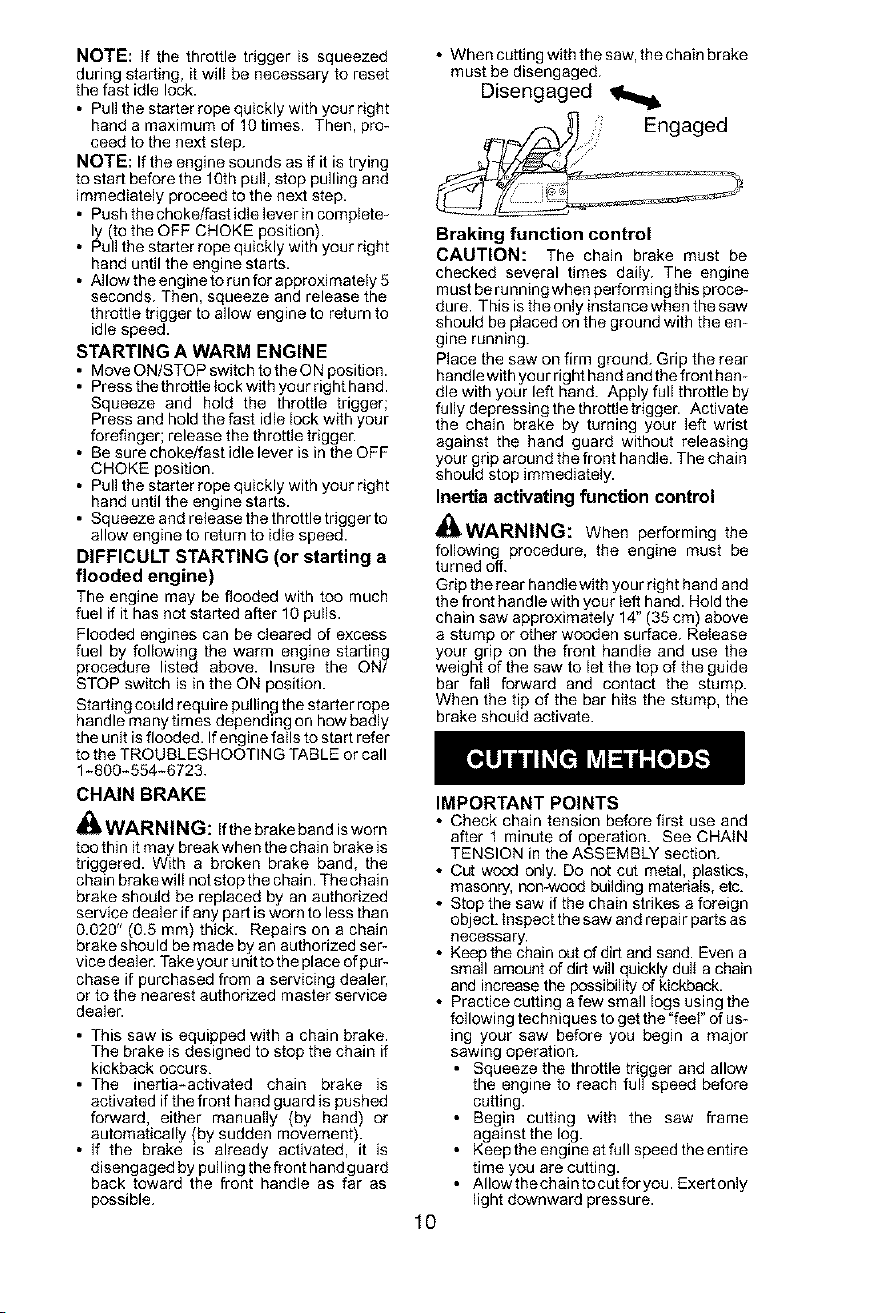
To stop the engine move the ON/STOP
switch to the STOP position.
To start the engine hold the saw firmly on the
ground as illustrated. Make sure the chain is
free to turn without contacting any object.
Use only 15"- 18" of rope per pull.
Hold saw firmly while pulling starter rope.
Starter rope handle
I _'_) _._,_.2.-- Left hand
on front
\ _ handle
Right foot through rear handle
IMPORTANT POINTS TO REMEMBER
When pulting the starter rope, do not use the
full extent of the rope as this can cause the
rope to break. Do not let starter rope snap
back. Hold the handle and let the rope rewind
slowly.
For cold weather starting, start the unit at
FULL CHOKE; allow the engine to warm up
before squeezing the throttle trigger.
NOTE: Do not cut matebal with the choke/
fast idle lever at the FULL CHOKE position.
STARTING A COLD ENGINE (or a
warm engine after running out of
fuel)
• Move ON/STOP swhoh to the ON position.
• POll the choke/fast idle lever out to the full
extent.
ON/STOP _ ON
SWITCH
STOP
CHOKE/FAST IDLE LEVER
(SlDE VIEW)
--!-',
-q;
' / -_ -_
Choke/Fast OFF FULL
Idle Lever
• Press the throttle lock with your right hand.
Squeeze and hold the throttle trigger;
Press and hold the fast idle lock with your
forefinger; release the throttle trigger.
NOTE: If the throttle trigger is squeezed
during startthg, it will be necessary to reset
the fast idle lock.
• Pull the starter rope quickly with your right
hand a maximum of 10 times. Then, pro-
ceed to the next step.
NOTE: If the engine sounds as if it is trying
to start before the 10th pull, stop pulling and
immediately proceed to the next step.
• Push the choke/fast idle ]ever in complete-
ly (to the OFF CHOKE position).
• Pull the starter rope quickly with your right
hand until the engine starts.
• Allow the engine to run for approximately 5
seconds. Then, squeeze and release the
throttle trigger to allow engine to return to
idle speed.
STARTING A WARM ENGINE
• Move ON/STOP switch to the ON posiflon.
• Press the throttle Jock with your right hand.
Squeeze and hold the throttle trigger;
Press and hold the fast idle lock with your
forefinger; release the throttle trigger.
• Be sure choke/fast idle lever is in the OFF
CHOKE position.
• Pull the starter rope quickly with your right
hand until the engine starts.
• Squeeze and re{ease the throttle trigger to
allow engine to return to idle speed.
DIFFICULT STARTING (or starting a
flooded engine)
The engine may be flooded with too much
fuel if it has not started after 10 pulls.
Flooded engines can be cleared of excess
fuel by followthg the warm engine starting
procedure listed above. Insure the ON/
STOP switch is in the ON position.
Startthg could require pulling the starter rope
handle many times depending on how badly
the unit is flooded. If engine fails to start refer
to the TROUBLESHOOTING TABLE or call
1-800-554-6723.
CHAIN BRAKE
_lk WARNING: If the brakeband isworn
too thin it may break when the ch ain brake is
triggered. With a broken brake band, the
chain brakewill not stopthe chain. Thechain
brake should be replaced by an authorized
service dealer if any part is worn to less than
0.020" (0.5 mm) thick. Repairs on a chain
brake should be made by an authorized seF
vice dealer. Take your unitto the place ofpuF
chase if purchased from a servicing dealer,
or to the nearest authorized master service
dealer.
• This saw is equipped with a chain brake.
The brake is designed to stop the chain if
kickback occurs.
• The inertia-activated chain brake is
activated if the front hand guard is pushed
forward, either manually (by hand) or
automatically (by sudden movement).
• If the brake is already activated, it is
disengaged by pulling the front hand guard
back toward the front handle as far as
possible.
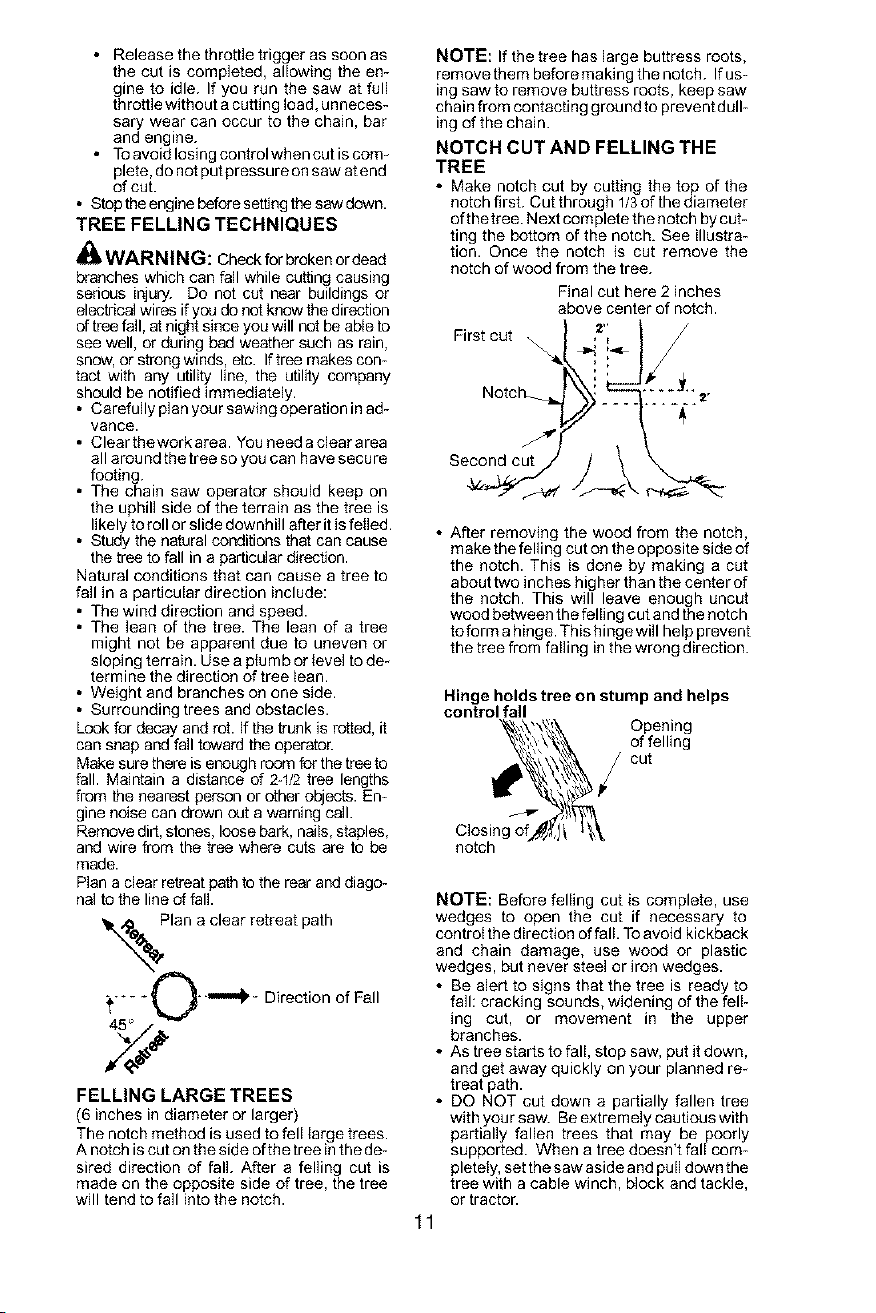
• When cutting with the saw, the chain brake
must be disengaged.
Disengaged
Engaged
Braking function control
CAUTION: The chain brake must be
checked several times daily. The engine
must be running when performing this proce-
dure. This is the only instance when the saw
should be placed on the ground with the en-
gine running.
Place the saw on firm ground. Grip the rear
handle with your right hand and the front han-
dle with your left hand. Apply full throttle by
fully depressing the throttle trigger. Activate
the chain brake by turning your ]eft wrist
against the hand guard without releasing
your grip around the front handle. The chain
should stop immediately.
Inertia activating function control
,I_kWARNING: When performing the
following procedure, the engine must be
turned off.
Grip the rear hand]ewith your right hand and
the front handle with your left hand. Hold the
chain saw approximately 14" (35 cm) above
a stump or other wooden surface. Release
your grip on the front handle and use the
weight of the saw to let the top of the guide
bar fall forward and contact the stump.
When the tip of the bar hits the stump, the
brake should activate.
IMPORTANT POINTS
• Check chain tension before first use and
after I minute of operation. See CHAIN
TENSION in the ASSEMBLY section.
• Cut wood only. Do not cut metal, plastics,
masonry, non-wood building materials, etc.
• Stop the saw if the chain strikes a foreign
object, thspect the saw and repair parts as
necessary.
• Keep the chain out of dirt and sand. Even a
small amount of dirt will quickly du]t a chain
and increase the possibility of k{ckback.
• Practice cutting a few small logs using the
following techniques to get the "feet" of us-
ing your saw before you begin a major
sawing operation.
• Squeeze the throttle trigger and allow
the engine to reach full speed before
cutting.
• Begin cutting with the saw frame
against the log.
• Keep the engine at full speed the entire
time you are cutting.
• Allow thechain to cut for you. Exert only
light downward pressure.
10
• Release the throttle trigger as soon as
the cut is completed, allowthg the en-
gine to idle. If you run the saw at full
throttle without a cutting load, unneces-
sary wear can occur to the chain, bar
and engine.
• To avoid losing controlwhen cut is com-
plete, do not put pressure on saw at end
of cut.
• Stop the engine before setting the saw down.
TREE FELLING TECHNIQUES
_kWARNING: Checkforbrokenordead
branches which can fail while cutting causing
serious injury. Do not cut near buildings or
electrical wires ifyou do not know the direction
of tree fall, at night since you will not be able to
see well, or during bad weather such as rain,
snow, or strong winds, etc. If tree makes con-
tact with any utility line, the utility company
should be notified immediately.
• Carefully plan your sawing operation in ad-
vance.
• Cleartheworkarea. You needac]eararea
all around the tree so you can have secure
footing.
• The chain saw operator should keep on
the uphill side of the terrain as the tree is
likely to roll or slide downhill after it is felled.
• Study the natural conditions that can cause
the tree to fall in a padicu]ar direction.
Natural conditions that can cause a tree to
fa]l Jn a particular direction include:
• The wind direction and speed.
• The ]ean of the tree. The lean of a tree
might not be apparent due to uneven or
sloping terrain. Use a plumb or leve] to de-
termine the direction of tree lean.
• Weight and branches on one side.
• Surrounding trees and obstacles.
Look for decay and rot. If the trunk is rotted, it
can snap and fail toward the operator.
Make sure there is enough room for the tree to
fall. Maintain a distance of 2-1/2 tree lengths
from the nearest person or other objects. En-
gine nc4se can drown out a warning call.
Remove dirt, stones, loose bark, nails, staples,
and wire from the tree where cuts are to be
made.
Plan a clear retreat path to the rear and diago-
nal to the line of fall.
Plan a clear retreat path
:t ÷- "£_" _ - Direction of Fall
FELLING LARGE TREES
(6 inches in diameter or larger)
The notch method is used to fell large trees.
A notch is cut on the side of the tree in the de-
sired direction of fall. After a felling cut is
made on the opposite side of tree, the tree
will tend to fall into the notch.
NOTE: If the tree has large buttress roots,
remove them before making the notch. If us-
ing saw to remove buttress roots, keep saw
chain from contacting ground to prevent dull-
ing of the chain.
NOTCH CUT AND FELLING THE
TREE
• Make notch cut by cutting the top of the
notch first. Cut through 1/3 of the diameter
ofthetree. Next complete the notch bycut-
ting the bottom of the notch. See illustra-
tion. Once the notch is cut remove the
notch of wood from the tree.
Final cut here 2 inches
above center of notch.
First cut _ ,2'I
Notch_h - ..... =
Second out
• After removing the wood from the notch,
make the felling cut on the opposite side of
the notch. This is done by making a cut
about two inches higher than the center of
the notch. This will leave enough uncut
wood between the fell] ng cut and the notch
toform a hinge. This hinge will help prevent
the tree from falling in the wrong direction.
Hinge holds tree on stump and helps
control fall
_\ \_'_ Opening
of felling
cut
Closing of_/_,J_ 1_
notch
NOTE: Before felling cut is complete, use
wedges to open the cut if necessary to
controt the direction of fall To avoid kickback
and chain damage, use wood or plastic
wedges, but never steel or iron wedges.
• Be alert to signs that the tree is ready to
fall: cracking sounds, widening of the fell-
ing cut, or movement in the upper
branches.
• As tree starts to fall, stop saw, put it down,
and get away quickly on your planned re-
treat path.
• DO NOT cut down a partially fallen tree
with your saw. Be extremely cautious with
partially fallen trees that may be poorly
supported. When a tree doesn't fall com-
pletely, set the saw aside and pull down the
tree with a cable winch, block and tackle,
or tractor.
11
CUTTING A FALLEN TREE
(BUCKING)
Bucking is the term used for cutting a fallen
tree to the desired log length.
,_WARNING: Do not stand on the log
being cut. Any portion can roll causing loss of
footing and control. Do not stand downhill of
the log being cut.
IMPORTANT POINTS
• Cut only one log at a time.
• Cut shattered wood very carefully; sharp
pieces of wood could be flung toward oper-
ator.
• Use a sawhorse to cut small logs. Never
allow another person to hold the log wMe
cutting and never hold the log with you r leg
or foot.
• Do not cut in an area where logs, limbs,
and roots are tangled. Drag the logs into a
clear area before cutting by pulling out ex-
posed and cleared logs first.
TYPES OF CUTTING USED FOR
BUCKING
,1_ WARNING: Ifsawbecomespinched
or hung in a tog, don't try to force it out. You
can lose control of the saw resulting in injury
and/or damage to the saw. Stop the saw,
drive a wedge of plastic or wood into the cut
until the saw can be removed easily. Restart
the saw and carefully reenter the cut. Do not
attempt to restartyour saw when it is pinched
or hung in a log.
Use a wedge to remove pinched saw
Turn saw OFF and use a plastic or
wooden wedge to force cut open.
Overcutting begins on thetop side of thelog
with the saw against the log. When overcut-
ring use light downward pressure.
Overcuttiag Undercutting
Undercutting involves cutting on the under-
side of the log with top of saw against the log.
When undercutting use light upward pres-
sure. Hold saw firmly and maintain control
The saw will tend to push back toward you.
IDIbWANNINB; Never turn saw upside
down to undercut. The saw cannot be con-
trolled in this position.
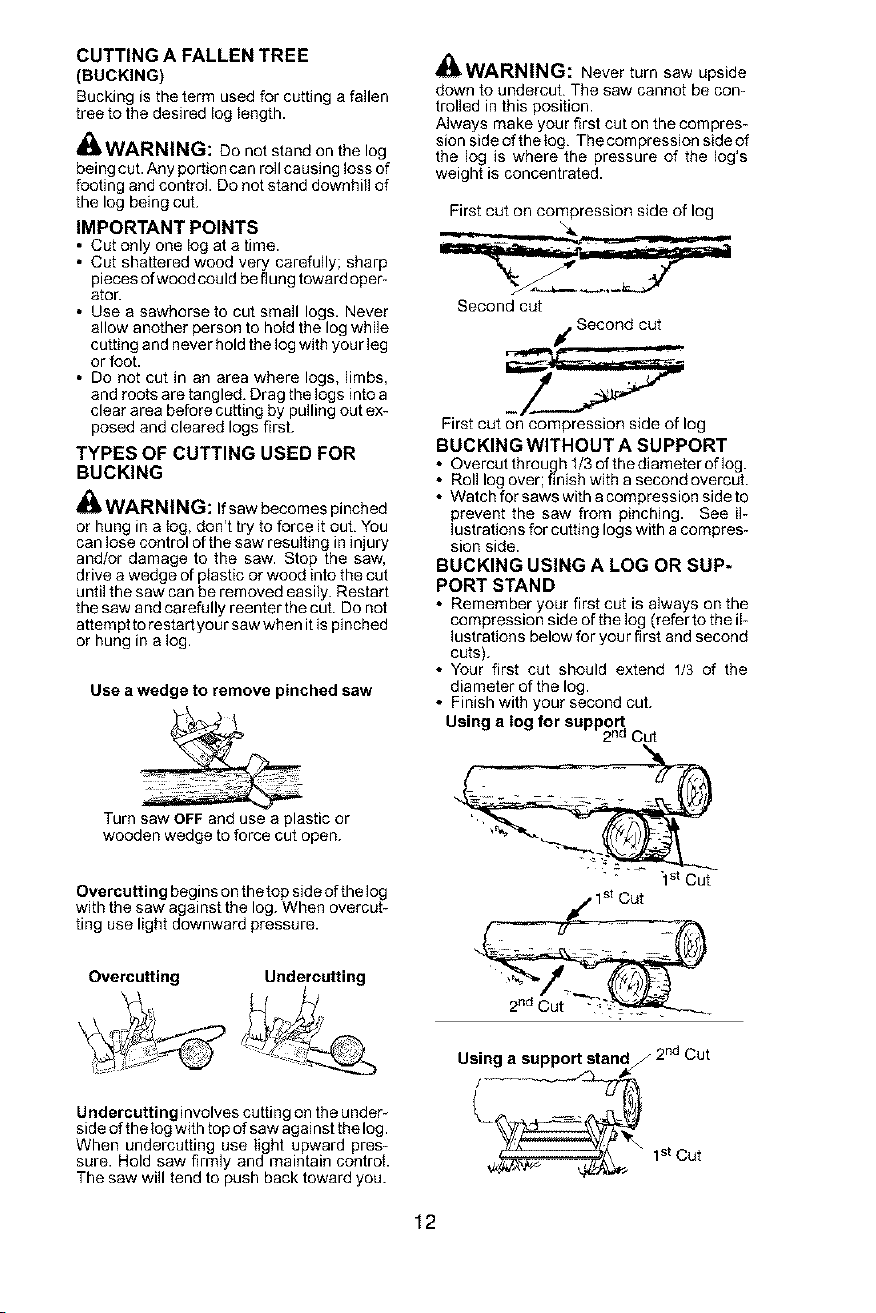
Always make your first cut on the compres-
sion side oftheiog. Thecompression side of
the log is where the pressure of the log's
weight is concentrated.
First cut on compression side of log
Second cut
j Second cut
First cut on compression side of log
BUCKING WITHOUT A SU PPORT
• Overcut through 1/3 of thediameter of log.
• Roll log over; finish with a second overcut.
• Watch for saws with a compression side to
prevent the saw from pinching. See il-
lustrations for cutting logs with a compres-
sion side.
BUCKING USING A LOG OR SUP-
PORT STAN D
• Remember your first cut is always on the
compression side of the log (refer to the il-
lustrations below for your first and second
cuts).
• Your first cut should extend 1/3 of the
diameter of the log.
• Finish with your second cut.
Using a log for support
2nd Cut
___% 1st Cut
Using a support stan_ 2nd Cut
12
LIMBING AND PRUNING
_I_WARNING: Be alert for and guard
against kickback. Do not allow the moving
chain to contact any other branches or ob-
jects at the nose of the guide bar when IJmb-
Jng or pruning. Allowing such contact can re-
sult in serious injury.
WARNING: Never climb into a tree to
limb or prune. Do not stand oil ladders, plat-
forms, a log, or in any position which can cause
you to lose your balance or control of the saw.
IMPORTANT POINTS
• Work slowly, keeping both hands firmly
gripped on saw. Maintain secure footing
and balance.
• Watch out for spdngpoles. Use extreme
caution when cutting small size limbs. Slen-
der material may catch saw chain and be
whipped toward you or pull you off balance.
• Be alert for spdngback. Watch out for
branches that are bent or under pressure.
Avoid being struck by the branch or the
saw when the tension in the wood fibers is
released.
• Keep a clear work area. Frequently clear
branches out of the way to avoid tripping
over them.
LIMBING
• Always limb a tree after d is cut down. Only
then can IJmbing be done safely and prop-
erly.
• Leave the larger limbs underneath the
felled tree to support the tree as you work.
• Start at base of the felled tree and work to-
ward the top, cutting branches and limbs.
Remove small limbs with one cut.
• Keep the tree between you and the chain
as much as possible. Cut from the side of
the tree opposite the branch your are cut-
ting.
• Remove larger, supporting branches with
the cutting techniques descdbed in BUCK_
]NG WITHOUT A SUPPORT.
• Always use an overcut to cut small and
freely hanging limbs. Undercutting could
cause limbs to fall and pinch saw.
PRUNING
d_J_WARNING: Limit pruning to lirnbs
shoulder height or below. Do not cut if
branches are higher than your shoulder. Get
a professional to do the job.
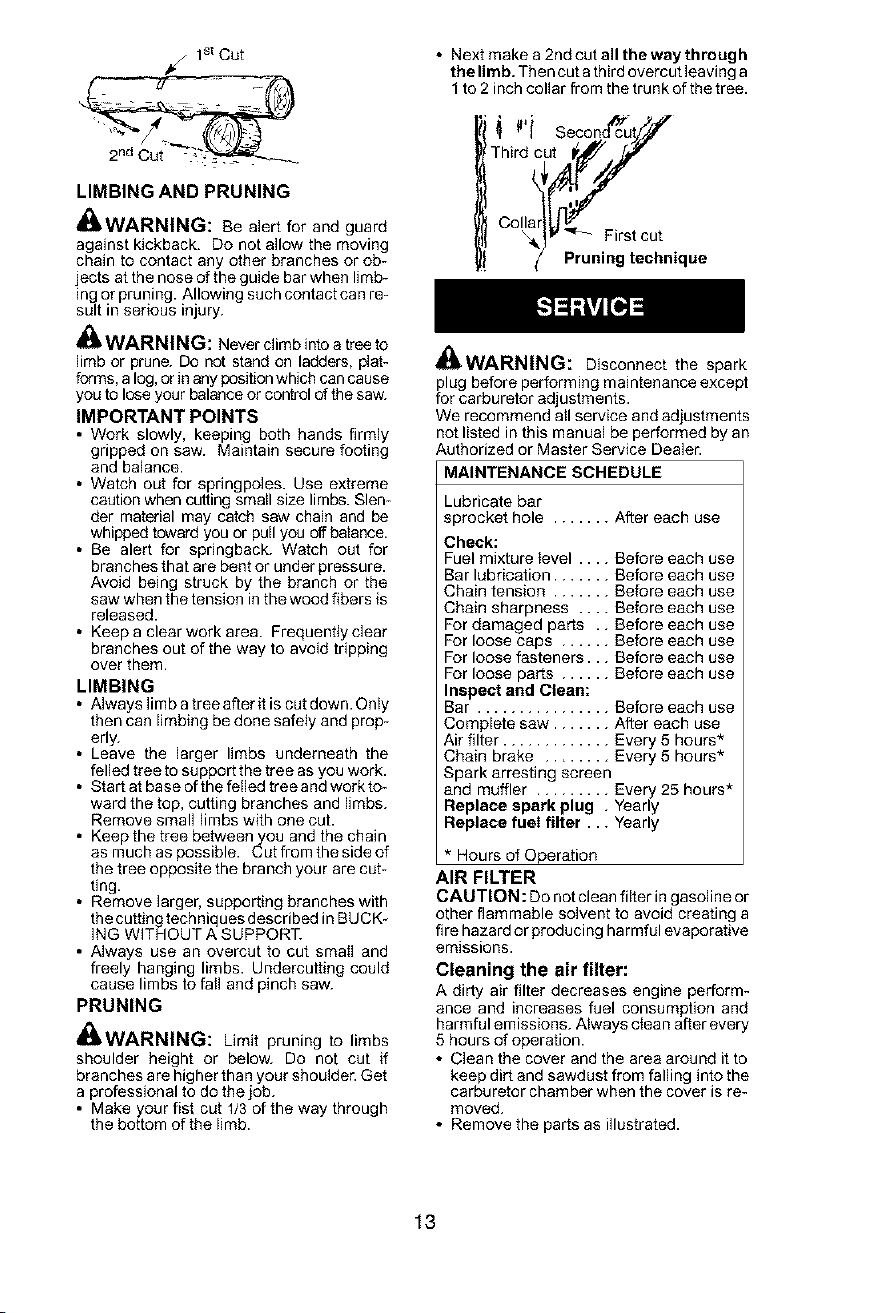
• Make your fist cut 1/3 of the way through
the bottom of the limb.
• Next make a 2nd cut all the way through
the limb. Then cut a third overcut leaving a
1 to 2 inch collar from the trunk of the tree.
lii i "i Secon_c_uy_//
Tbird
Collar
{_! / Pruning technique
ZI= ____....._
EIbWAI_MIN_: Disconnect the spark
plug before performing maintenance except
for carburetor adjustments.
We recommend all service and adjustments
not listed in this manual be performed by an
Authorized or Master Service Dealer.
MAINTENANCE SCHEDULE
Lubricate bar
sprocket hole ....... After each use
Check:
Fuel mixture tevel .... Before each use
Bar lubrication ....... Before each use
Chain tension ....... Before each use
Chain sharpness .... Before each use
For damaged parts .. Before each use
For loose caps ...... Before each use
For loose fasteners... Before each use
For loose parts ...... Before each use
Inspect and Clean:
Bar ................ Before each use
Complete saw ....... After each use
Air filter ............. Every 5 hours*
Chain brake ........ Every 5 hours*
Spark arresting screen
and muffler ......... Every 25 hours*
Replace spark plug . Yearly
Replace fuel filter... Yearly
* Hours of Operation
AIR FILTER
CAUTION: Do not clean filter in gasoline or
other flammable solvent to avoid creating a
fire hazard or producing harmful evaporative
emissions.
Cleaning the air filter:
A dirty air filter decreases engine perform-
ance and increases fuel consumption and
harmful emissions. Always clean after every
5 hours of operation.
• Clean the cover and the area around it to
keep dirt and sawdust from falling into the
carburetor chamber when the cover is re-
moved.
• Remove the parts as illustrated.
13
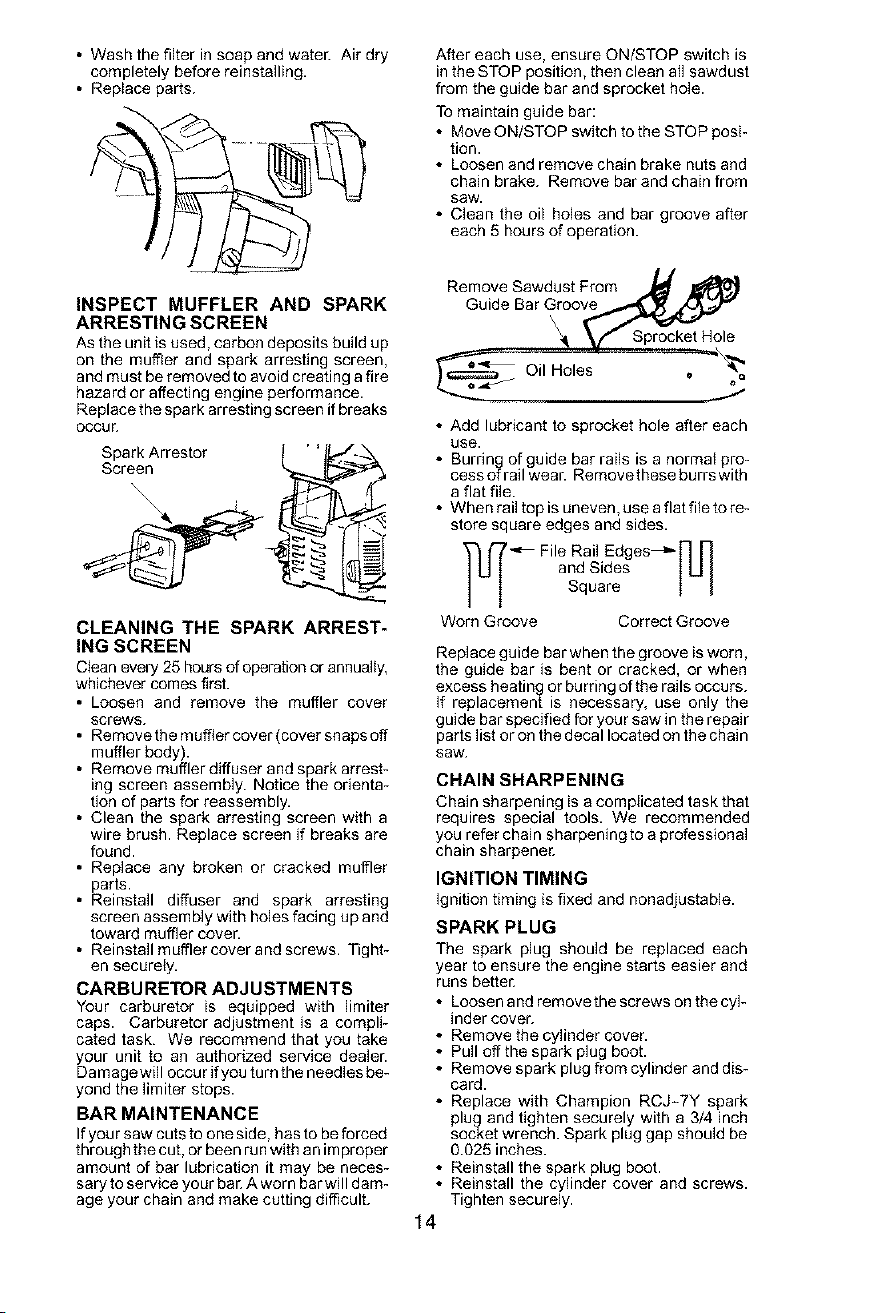
• Wash the filter in soap and water. Air dry
completely before reinstalling.
• Replace parts.
After each use, ensure ON/STOP switch is
in the STOP position, then clean all sawdust
from the guide bar and sprocket hole.
To maintain guide bar:
• Move ON/STOP switch to the STOP posi-
tion.
• Loosen and remove chain brake nuts and
chain brake. Remove bar and chain from
saw.
• Clean the oil holes and bar groove after
each 5 hours of operation.
INSPECT MUFFLER AND SPARK
ARRESTING SCREEN
As the unit is used, carbon deposits build up
on the muffter and spark arresting screen,
and must be removed to avoid creating a fire
hazard or affecting engine performance.
Replace the spark arresting screen if breaks
occur.
___sScPaereknArrest°r '' , ---
CLEANING THE SPARK ARREST-
ING SCREEN
Clean every 25 hours of operation or annually,
whichever comes first.
• Loosen and remove the muffler cover
screws.
• Remove the muffler cover (cover snaps off
muffler body).
• Remove muffler diffuser and spark arrest-
ing screen assembly. Notice the odenta_
tion of parts for reassembly.
• Clean the spark arresting screen with a
wire brush. Replace screen if breaks are
found.
• Replace any broken or cracked muffler
parts.
• Reinstall diffuser and spark arresting
screen assembly with holes facing up and
toward muffler cover.
• Reinstall muffler cover and screws. Tight-
en securely.
CARBURETOR ADJUSTMENTS
Your carburetor is equipped with ]imiter
caps. Carburetor adjustment is a compli-
cated task. We recommend that you take
your unit to an authorized service dealer.
Damagewill occur if you turn the needles be-
yond the limiter stops.
BAR MAINTENANCE
If your saw cuts to one side, has to be forced
through the cut, or been run with an improper
amount of bar lubrication it may be neces-
sary to service your bar. A worn bar will dam-
age your chain and make cutting difficult.
Remove Sawdust From
Guide Bar Groove
• Add lubricant to sprocket hole after each
use.
• Burring of guide bar rails is a normal pro-
cessof rail wean Removethese burrs with
a flat file.
• When rail top is uneven, use a flat file to re-
store square edges and sides.
'_ File Rail Edges_ _
and Sides
Square
Worn Groove Correct Groove
Replace guide bar when the groove is worn,
the guide bar is bent or cracked, or when
excess heating or burring of the rails occurs.
If replacement is necessary, use only the
guide bar specified for your saw in the repair
parts list or on the decal located on the chain
saw.
CHAIN SHARPENING
Chain sharpening is a complicated task that
requires special tools. We recommended
you refer chain sharpening to a professional
chain sharpener.
IGNITION TIMING
Ignition timing is fixed and nonadjustable.
SPARK PLUG
The spark plug should be replaced each
year to ensure the engine starts easier and
runs better.
• Loosen and removethe screws on the cyb
inder cover.
• Remove the cylinder cover.
• Pull off the spark plug boot.
• Remove spark plug from cylinder and dis-
card.
• Replace with Champion RCJ~TY spark
plug and tighten securely with a 3/4 inch
socket wrench. Spark plug gap should be
0.025 inches.
• Reinstall the spark plug boot.
• Reinstall the cylinder cover and screws.
Tighten securely.
14
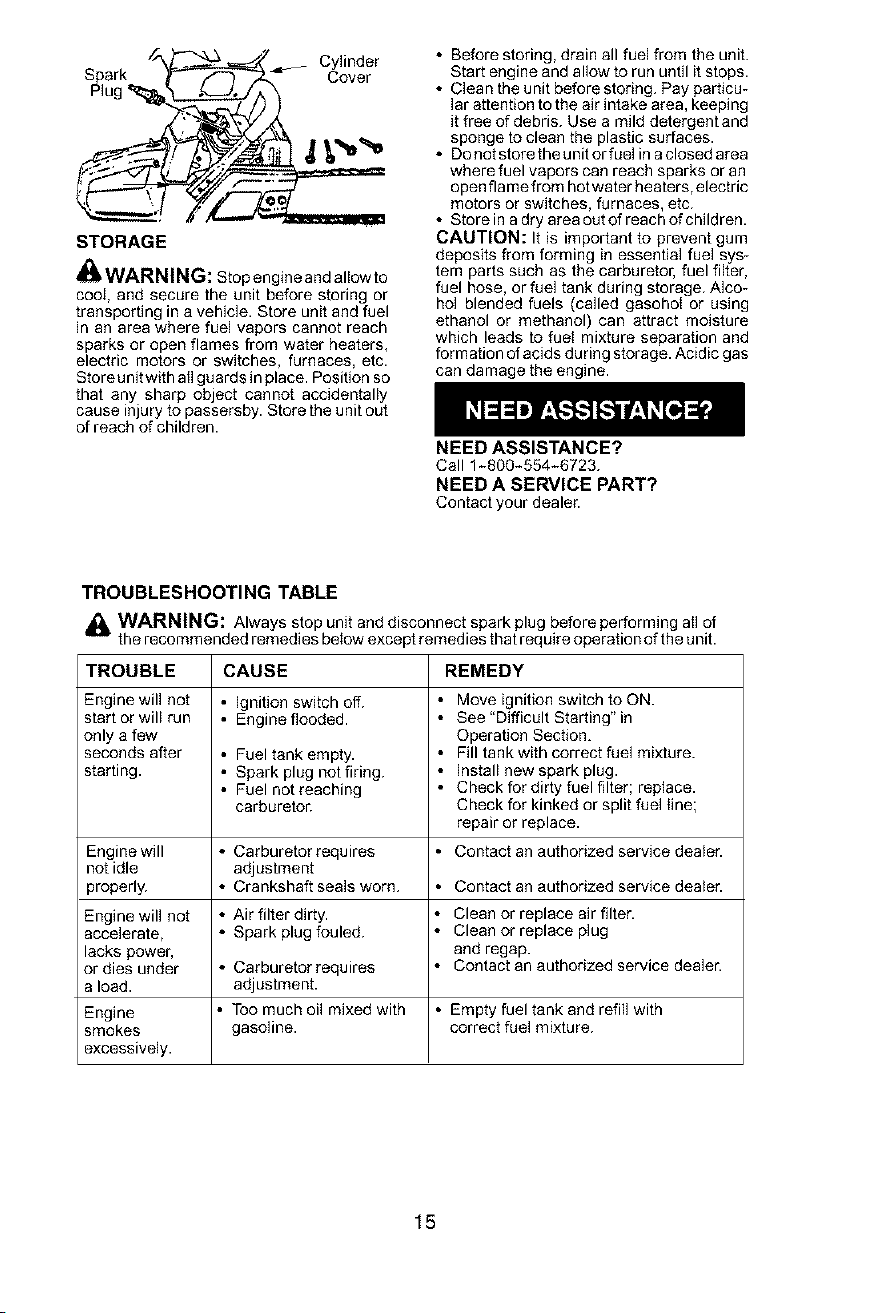
S0ark :Cover
i • Cylinder
STORAGE
_kWARNING: Stopengineandallowto
cool, and secure the unit before storing or
transporting in a vehicle. Store unit and fuel
in an area where fuel vapors cannot reach
sparks or open flames from water heaters,
electric motors or switches, furnaces, etc.
Storeunit with all guards in place. Position so
that any sharp object cannot accidentally
cause injury to passersby. Store the unit out
of reach of children.
• Before storing, drain all fuel from the unit.
Start engine and allow to run until it stops.
• Clean the unit before storing. Pay particu-
lar attention to the air intake area, keeping
it free of debris. Use a mild detergent and
sponge to clean the plastic surfaces.
• Do not store the unit or fuel in a closed area
where fuel vapors can reach sparks or an
open flamefrom hot water heaters, electric
motors or switches, furnaces, etc.
• Store in a dry area out of reach of children.
CAUTION: It is important to prevent gum
deposits from forming in essenfial fuel sys-
tem parts such as the carburetor, fuel filter,
fuel hose, or fuel tank during storage. Alco-
hol blended fuels (called gasoho( or using
ethanol or methanol) can attract moisture
which leads to fuel mixture separation and
form ation of acids du ring storage. Acidic gas
can damage the engine.
NEED ASSISTANCE?
Call 1-800-554-6723.
NEED A SERVICE PART?
Contact your dealer.
TROUBLESHOOTING TABLE
,l_k WARNING: Always stop unit and disconnect spark plug before performing all of
the recommended remedies below except remedies that req uire operation of the unit.
TROUBLE CAUSE REMEDY
Engine will not • Ignifion switch off. • Move ignition switch to ON.
start or will run • Engine flooded. * See "Difficult Starting" in
only a few Operation Section.
seconds after • Fuel tank empty. • Fill tank with correct rue( mixture.
starting. • Spark plug not firing. * Install new spark plug.
• Fuel not reaching • Check for dirty fuel filter; replace.
carburetor. Check for kinked or split fue( line;
repair or replace.
Engine will * Carburetor requires • Contact an authorized service dealer.
not idle adjustment
properly. * Crankshaft seals worn. • Contact an authorized service dealer.
Engine will not * Air filter dirty. * Clean or replace air filter.
accelerate, • Spark plug fouled. • Clean or replace plug
lacks power, and regap.
or dies under * Carburetor requires * Contact an authorized service dealer.
a load. adjustment.
Engine • Too much oi( mixed with • Empty fuel tank and refill with
smokes gasoline, correct fuel mixture.
excessively.
15

ELECTROLUX HOME PRODUCTS, INC,,
warrants to the original purchaser that each
new Poulan PRO® brand gasoline chain
saw is free from defects in material and
workmanship and agrees to repair or replace
under this warranty any defective gasoline
chain saw as follows from the odgin al date of
purchase.
2 YEARS - Parts and Labor, when used for
Household purposes.
60 DAYS - Parts and Labor, when used for
Commercial, Professional, or Income Pro-
ducing purposes.
30 DAYS - Parts and Labor, if used for rental
purposes.
This warranty is not transferable and does
not cover damage or liability caused by im-
proper handling, improper maintenance, or
the use of accessories and/or attachments
not specifically recommended by ELEC-
TROLUX HOME PRODUCTS, INC,, for this
chain saw. Additionally, this warranty does
not cover damage caused by improper han-
dling, improper maintenance, or if the saw is
altered in any waywhich in ourjudgementaf-
fects its condition or operation. This warranty
does not cover tune-up, spark plugs, filters,
starter ropes, starter spdngs, chain sharpen-
ing, bars, chains, and other parts which wear
and require replacement with reasonable
use during the warranty period. This warram
ty does not cover predelivery set-up, instal-
lation of guide bar and chain, and normal ad-
justments explained in the instruction
manual such as carburetor adjustments and
chain tension adjustments. This warranty
does not cover transportation costs.
THIS WARRANTY GIVES YOU SPECIFIC
LEGAL RIGHTS, AND YOU MAY HAVE
OTHER RIGHTS WHICH VARY FROM
STATE TO STATE.
NO CLAIMS FOR CONSEQUENTIAL OR
OTHER DAMAGES WILL BE ALLOWED,
AND THERE ARE NO OTHER EXPRESS
WARRANTIES EXCEPT THOSE EX-
PRESSLY STIPULATED HEREIN.
SOME STATES DO NOT ALLOW LIMITA-
TIONS ON HOW LONGAN IMPLIEDWAR-
RANTY LASTS OR THE EXCLUSION OR
LIMITATIONS OF INCIDENTAL OR CON-
SEQUENTIAL DAMAGES, SO THE
ABOVE LIMITATIONS OR EXCLUSION
MAY NOT APPLY TO YOU.
The policy of ELECTROLUX HOME PROD-
UCTS, INC., is to continuously improve its
products. Therefore, ELECTROLUX HOME
PRODUCTS, INC., reserves the right to
change, modify, or discontinue models, de-
signs, specifications, and accessories of all
prod ucts at any ti me without notice or obliga-
tion to any purchaser.
YOUR WARRANTY RIGHTS AND OB-
LIGATIONS: The U. S. Environmental
Protection Agency/Environment Canada
and ELECTROLUX HOME PRODUCTS,
INC., are pleased to exptain the emissions
control system warranty on your _awn and
garden equipment engine. Aft new utility and
lawn and garden equipment engines must be
designed, built, and equipped to meet the
stringent anti-smog standards. ELECTRO-
LUX HOME PRODUCTS, INC., must war-
rant the emission control system on your
lawn and garden equipment engine for the
periods of time listed below provided there
has been no abuse, neglect, or improper
maintenance of your lawn and garden equip-
ment engine. Your emission controt system
includes parts such as the carburetor and
the i_nition system. Where a warrantable
condition exits, ELECTROLUX HOME
PRODUCTS, INC., will repair your lawn and
garden equipment engine at no cost to you.
Expenses covered under warranty include
diagnosis, parts and labor. MANUFACTUR-
ER'S WARRANTY COVERAGE: If any
emissions related part on your engine (as
listed under Emissions Control Warranty
Parts List) is defective or a defect in the ma-
terials or workm anship of the engine causes
the failure of such an emission related part,
the part will be repaired or replaced by
ELECTROLUX HOME PRODUCTS, INC.
OWNER'S WARRANTY RESPONSIBILI-
TIES: As the lawn and garden equipmenten-
gine owner, you are responsible for the per-
formanceof the required maintenance listed
in your instruction manual. ELECTROLUX
HOME PRODUCTS, INC., recommends
that you retain all receipts covering mainte-
nance on your lawn and garden equipment
engine, but ELECTROLUX HOME PROD-
UCTS, INC., cannot deny warranty solely for
the lack of receipts or for your failure to en-
sure the performance of all scheduled main-
tenance. As the lawn and garden equip-
ment engine owner, you should be aware
that ELECTROLUX HOME PRODUCTS,
INC., may deny you warranty coverage if
your lawn and garden equipment engine or a
partof it has failed due to abuse, neglect, im-
proper maintenance, unapproved modifica-
tions, or the use of parts not made or ap-
proved by the original equipment
manufacturer. You are responsible for pres-
enting your lawn and garden equipment en-
gine to an ELECTROLUX HOME PROD-
UCTS, INC., authorized repair center as
soon as a problem exists. Warranty repairs
should be completed in a reasonable amount
of time, not to exceed 30 days. If you have
any questions regarding your warranty
rights and responsibilities, you should con-
16
tactyournearestauthorizedservicecenter
orcallELECTROLUXHOMEPRODUCTS,
INC.,at1-800-554-6723.WARRANTY
COMMENCEMENTDATE:Thewarranty
periodbeginsonthedatethelawnandgar-
denequipmentengineis purchased.
LENGTHOFCOVERAGE:Thiswarranty
shallbeforaperiodoftwoyearsfromtheinF
tialdateofpurchase.WHATISCOVERED:
REPAIR OR REPLACEMENT OF PARTS.
Repair or replacement of any warranted part
will be performed at no charge to the owner
at an approved ELECTROLUX HOME
PRODUCTS, INC., servicing center. If you
have any questions regarding your warranty
dghts and responsibilities, you should con-
tact your nearest authorized service center
or call ELECTROLUX HOME PRODUCTS,
INC., at 1-800-554-6723. WARRANTY
PERIOD: Any warranted part wMch is not
scheduled for replacement as required
maintenance, or wMch is scheduled only for
regular inspection to the effect of "repair or
replace as necessary" shatl be warrantedfor
2 years. Any warranted part which is sched-
uled for replacement as required mainte-
nance shatl be warranted for the period of
time up to the first scheduled replacement
point for that part. DIAGNOSIS: The owner
shatl not be charged for diagnostic labor
which leads to the determination that a war-
ranted part is defective if the diagnostic work
is performed at an approved ELECTROLUX
HOME PRODUCTS, INC., servicing center.
CONSEQUENTIAL DAMAGES: ELEC-
TROLUX HOME PRODUCTS, INC., may
be liable for damages to other engine com-
ponents caused by the failure of a warranted
part still under warranty. WHAT IS NOT
COVERED: All failures caused by abuse,
neglect, or improper maintenance are not
covered. ADD-ON OR MODIFIED PARTS:
The use of add-on or modified parts can be
grounds for disallowing a warranty claim.
ELECTROLUX HOME PRODUCTS, INC., is
not liable to cover failures of warranted parts
caused by the use of add-on or modified
parts. HOW TO FILE A CLAIM: If you have
any questions regarding your warranty
rights and responsibilities, you should con-
tact your nearest authorized service center
or call ELECTROLUX HOME PRODUCTS,
INC., at t -800-554-6723.WHERE TO GET
WARRANTY SERVICE: Warranty services
or repairs shall be provided at all ELECTRO-
LUX HOME PRODUCTS, INC., service cen-
ters. call: 1-800-554-6723. MAINTENANCE,
REPLACEMENT AND REPAIR OF EMIS-
SION RELATED PARTS: Any ELECTRO-
LUX HOME PRODUCTS, INC., approved
replacement part used in the performanceof
any warral/ty mail/ten alice or repair on emis-
sion related parts will be provided without
charge to the owner if the part is under war-
ranty. EMISSION CONTROLWARRANTY
PARTS LIST: Carburetor, Ignition System:
Spark Plug (covered up to maintenance
schedule), Ignition Module. MAINTE-
NANCE STATEMENT: The owner is re-
sponsible for the performance of all required
maintenance as defined in the instruction
manual.
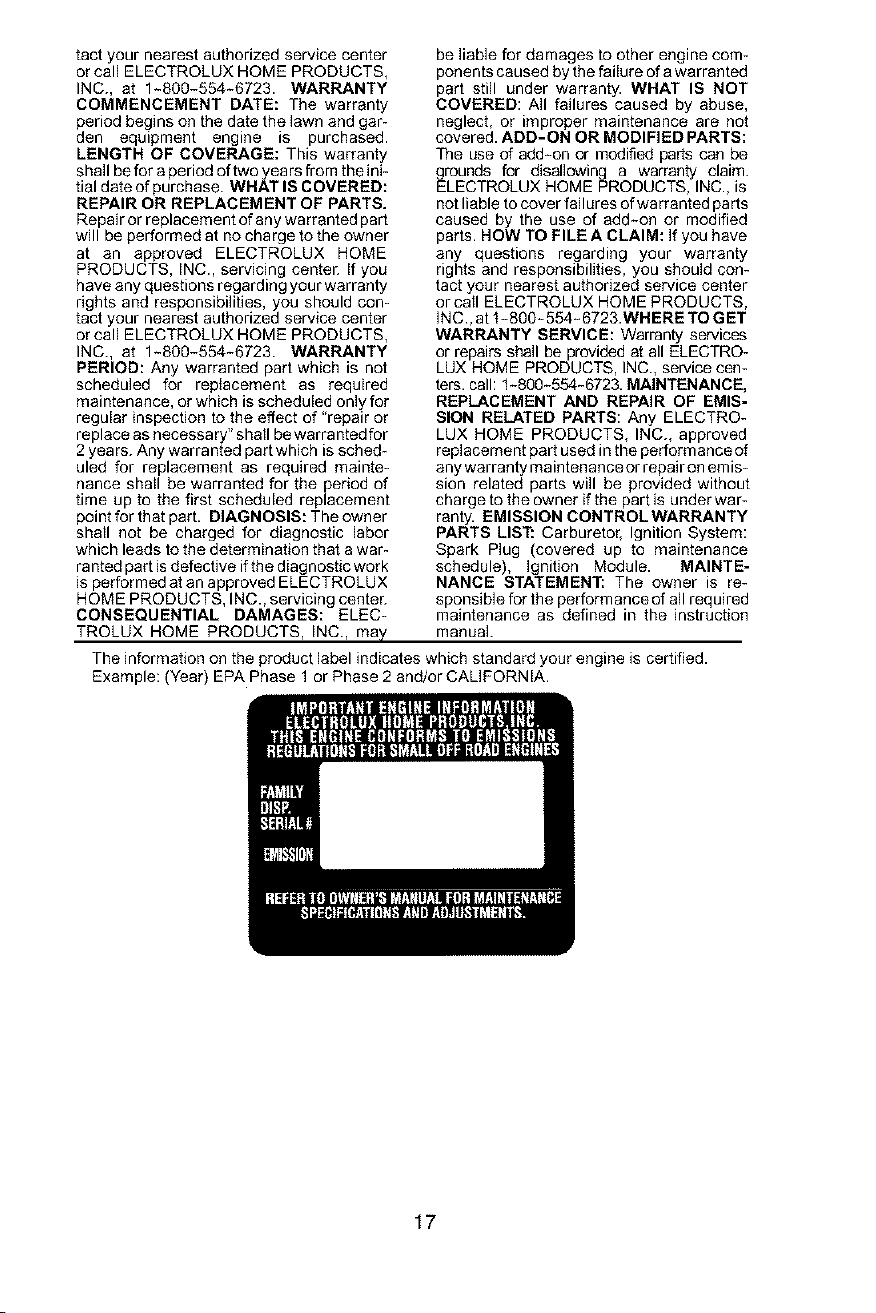
The information on the product label indicates which standard your engine is certified.
Example: (Year) EPA Phase 1 or Phase 2 and/or CALIFORNIA.
17
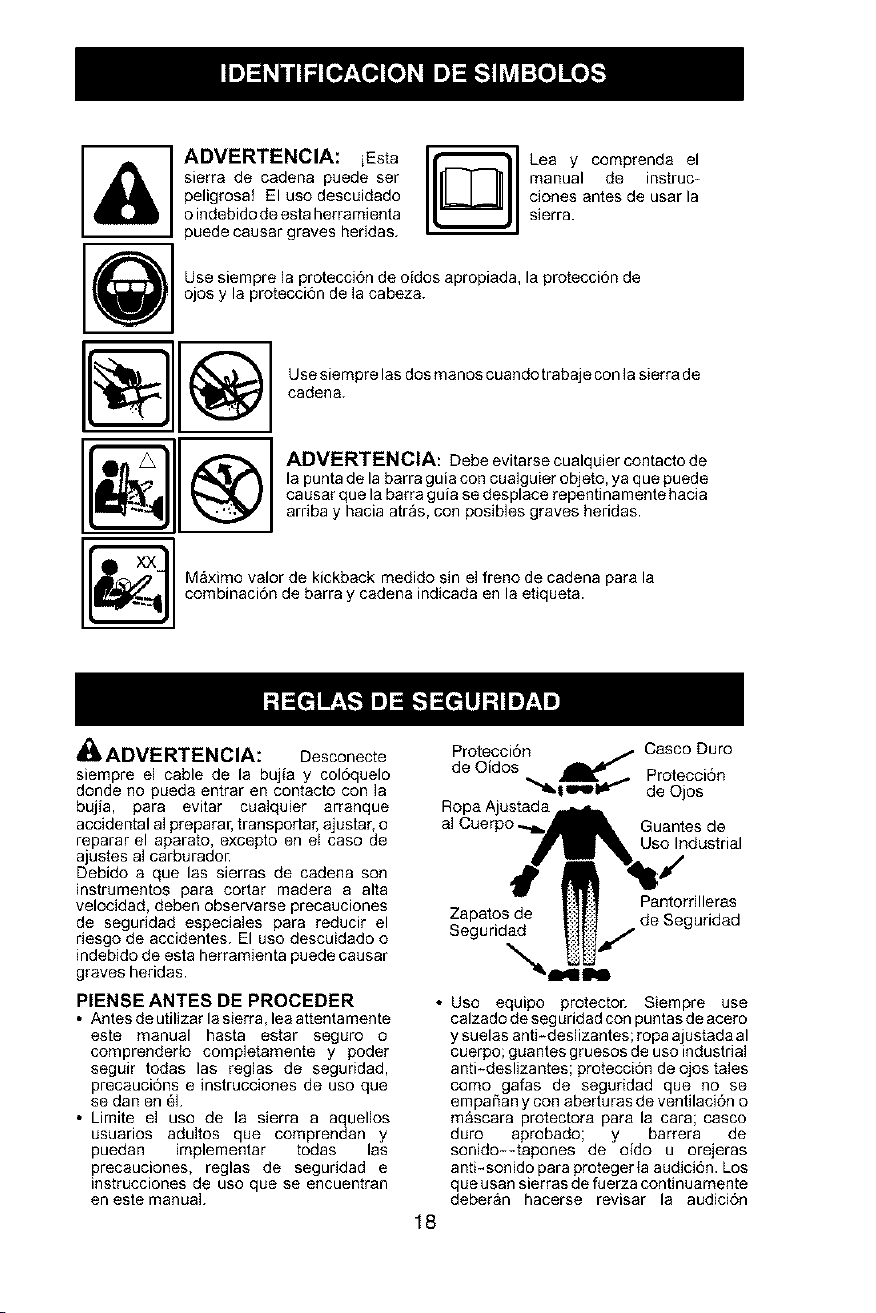
ADVERTENCIA: iEsta
sierra de cadena puede ser
peligrosa! El uso descuidado
o indebido de esta herramJenta
puede causar graves hendas.
r_ Lea y comprenda el
manual de instruc-
clones antes de usar la
sierra.
Use siempre la proteccJ6n de oidos apropiada, la proteccion de
ojos y la protecci6n de la cabeza.
Use siempre las dos manos cuandotrabaje con la sierra de
cadena.
ADVERTENClA: Debe evitarse cualquier contacto de
la punta de la barra guia con cualguier objeto, ya que puede
causar que la barra guia se desplace repentJnamente hacia
ardba y hacia atras, con posibles graves heridas.
--_ cM_lx_imnOvi_orddebHrCkLyack dmedaiidn_i_.cJnd_ fie ,rOedieqcatde.napara ,a
,I_ADVERTENCIA: Desconecte
siempre el cable de la bujia y col6quelo
donde no pueda entrar en contacto con Ja
bujia, para evitar cualquier arranque
accidental al preparar, transportar, ajustar, o
reparar el aparato, excepto en el caso de
ajustes al carburado£
Debido aque las sierras de cadena son
instrumentos para cortar madera a alta
velocidad, deben observarse precauciones
de seguddad especiales para reducir el
desgo de accidentes. El uso descuidado o
indebido de esta herramienta puede causar
graves heridas.
PIENSE ANTES DE PROCEDER
• Antes de utilizar la sierra Jea attentamente
este manual hasta estar seguro o
comprenderlo completamente y poder
seguir todas las reglas de seguridad,
precauci6ns e instrucciones de uso qua
se dan en 61.
• Limite el uso de la sierra a aquellos
usuarios adultos que comprendan y
puedan implementar todas las
precauciones, reglas de segurJdad e
instrucciones de uso que se encuentran
en este manual
Protecci6n Casco Duro
de Oidos Protecci6n
de Ojos
Ropa Ajustada
Guantes de
Uso Industrial
18
Pantordlleras
Zapatos de de Seguridad
Seguridad
Uso equipo protector. Siempre use
calzado de seguridad con puntas de acero
y suelas anti-deslizantes; ropa aj ustada al
cuerpo; guantes gruesos de uso industrial
anti-deslizantes; protecci6n de ojos tales
como gafas de seguridad que no se
empa_an y con aberturas de ventilaci6n o
rnascara protectora para la cara; casco
duro aprobado; y barrera de
sonido~-tapones de oido u orejeras
anti-sonido para proteger ta audici6n. Los
que usan sierras de fuerza continuamente
deberan hacerse revisar la audici6n
frecuentementeyaqueelruidodelas
sierrasdecadenapuededa_arlosoidos.
• Mantengatodaslaspartesdelcuerpo
alejadasdelacadenasiemprequeel
motorest6enfuncionamiento.
• Mantengaalosni6os,espectadoresy
animalesaunadistanciaminimade10
metros(30pies)del_readetrabajoo
cuandoest_haciendoarrancarelmotor.
• Nolevantenioperelassierrasdecadena
cuandoest_fatigado,enfermo,ansiosoo
sihatornadoalcohol,drogasoremedios.
Esimprescindiblequeud.esteenbuenas
condicionesfisciasyalertamentaimente.
Siud.sufredecualquiercondicionque
puedaempeorarcol/eltrabajoarduo,
ases6resecol/sumedico.
• Nopongaenmarchalasierrasintenerun
areadetrabajodespeada,superficie
estabeparapararsey,sest_derrubando
arboles,uncaminopredeterminadode
retrooeso.
USE LA SIERRA OBSERVANDO
TODOS LOS PROCEDIMIENTOS
DE SEGURIDAD
• Mantenga las dos manos en las manijas
siempre que el aparato este en marcha. El
uso del aparato con una sola mano puede
oausar graves heridas al usuario, a los
asistentes, o a los espectadores. Las
sierras de cadena est_n diseiiadas para
que se las use con las dos manos en todo
momento.
• Haga uso de la sierra de cadena
Onicamente en lugares exteRores bien
ventilados.
• No haga uso de la sierra desde las
escaleras portatiles ni de tos arboles.
• Aseggrese de que la cadena no vaya a
Racer contacto con ninggn objeto antes de
poner en marcha el motor. Nunca intente
Racer arrancar la sierra con la barra gu{a
en un corte.
• No aplique presi6n a la sierra al final de los
cortes. Aplicar presi6n puede Racer que
pierda el control al completarse el corte.
• Pare el motor antes de apoyar la sierra en
ning0n lado.
• No ponga en funcionamiento la sierra de
cadena si est_ da6ada, incorrectamente
ajustada, o si no est_ armada completa y
seguramente. Siempre cambie el
protector de mano inmediatamente si 6ste
queda da6ado, roto, o se sale pot
cualquier motivo.
• Cuando cargue la sierra de cadena en las
manos, h_galo con el motor parado, el
silenci ador alejado del cuerpo, y la cadena
hacia arras y cubierta con un estuche.
MANTENGA LA SIERRA EN
BUENAS CONDICIONES DE
FUNCIONAMIENTO
• Lleve la sierra de cadena a un distribuidor
autodzado del servicio para que haga todo
servicio menos aquellos procedimientos
listados en la secci6n de mantenimiento
de este manual. Pot ejempto, si se usan
herramientas que no corresponden para
retirar o sostener el volante al hater
servicio al embrague, pueden ocurrir
da6os estructurales al volante y causar
que reviente.
• AsegQrese de que la cadena se detenga
por completo cuando se suelta el gatillo.
Para Racer correcciones, yea los
AJUSTES AL CARBURADOR.
• Nunca haga modificaciones de ninguna
indole a su sierra.
• Mantenga las manijas secas, limpias y
libres de aceite o de mezcla de
combustible.
• Mantenga las tapas y los fijadores bien
fijos.
• Use exclusivamente los accesorios y
repuestos Poulan PRO_) recomendados.
MANEJE EL COMBUSTIBLE CON
EXTREMO CUIDADO
• No fume mientras trabaja con el
combustible ni cuando esta haciendo uso
de la sierra.
• Elimine todas las posibles fuentes de
chispas o llamas en las areas donde se
mezcla o vierte el combustible. No debe
haber el fumar, llamas abiertas, o trabajo que
podria causar chispas. Permita que el motor
es fdo antes de reaprovisionar de
combustible.
• Mezcle y vierta ei combustible afuera y use
recipiente aprobado para combustibles y
marcado como tal. Umpie todos los
derrames de combustible.
• Alejese a por Io mendos 3 metros (10 pies)
del lugar de abastecimiento antes de poner
el motor en marcha.
• Apague el motor y deje que la sierra se
enfde en un lugar libre de substancias
combustibles y no sobre hojas secas, paja,
papel, etc. Retire la tapa lentamente y
reabastezca el aparato.
• Guarde el aparato en un espaciuo fresco,
seco y bien ventilado donde {os vapores del
combustible no pueden entrar en contacto
con chispas ni llamas ablertas provenientes
de termotangues, motores o interruptores
el_ctricos, calefactores centrales, etc.
RECULADA
_k ADVERTENCIA: Evite reculada le
pueden causar graves heRdas. Reculada
es el movimiento hacia el frente, hacia atr_s
o r_pidamente hacia adelante, esto puede
ocu rrir cua ndo la punta de la barra guia de la
sierra de cadena entra en contacto con
cualquier objeto como puede ser otra rama o
tronco, o cuando la madera se cierra y
atasca mientras se Race el corte. El entrar
en contacto con alggn objeto extrafio a la
madera le puedecausar a lusuario la perdida
del controt de la sierra de cadena.
• La Reculada Rotational puede
acontecer cuando la cadena en
movimiento entra en contacto con algQn
objeto en la parte superior de la punta dela
barra guia puede causar que la cadena
entre al material y se detenga pot un
instante. El resultado es una reacci6n
inversa, a velocidad de relampago, que
19
hace recular la barra guia hacia arriba y
hacia atras hacia el usuario.
• La Reculada pot Atasco acontecen
cuaRdo la madera se cierra y atasca la
cadena en movimiento en el corte a Io
largo de la parte superior de la barra gu{a y
la cadena se detJene repentinamente.
Esta detencJ6n repentina de la cadena
tJene como resultado una JnversJ6n de la
fuerza de la caderla usada pare cortar
madera y cause que la sierra se mueva en
sentJdo opuesto al de la rotacJ6n de la
cadena. La sierra dJrectamente hacia
arras en direcci6n al usuario.
• La Reculada pot Impulsi6n puede
acontecer cuando la cadena en
movil'niento ent_a en contacto con aigQn
objeto extraSo ala madera en el corte a lo
largo de la parte inferior de la barra guia y
la cadena se detJene repentinamente.
Esta detencJ6n repentJna de la cadena tJra
de la sierra adelante y lejos del usuarJo y
podria hacer f_cilmente al usuarJo perder
el control de la sierra.
Pare Evitar la Reculada por Atasco:
• Mant6ngase compJetamente conciente de
toda situacipe u obstruccipe que pueda
hacer que el materiat presione la cadena en
la parte superior o que pueda parer la
cadena de cualquier otto mope.
• No corte m_s de un tronco ala vez.
• No retuerza la sierra ai retirar la perra de un
corte ascendiente cuando esta seccionando
troncos.
Para Evitar la Reculada por Impulsi6n:
• Empiecetodocortecon el motor aceleradoa
fondo y con la caja de la sierra apoyada
contra la madera.
• Use cuSas de plastico o de madera (nunca
de metal) pare mantener abJerto el corte.
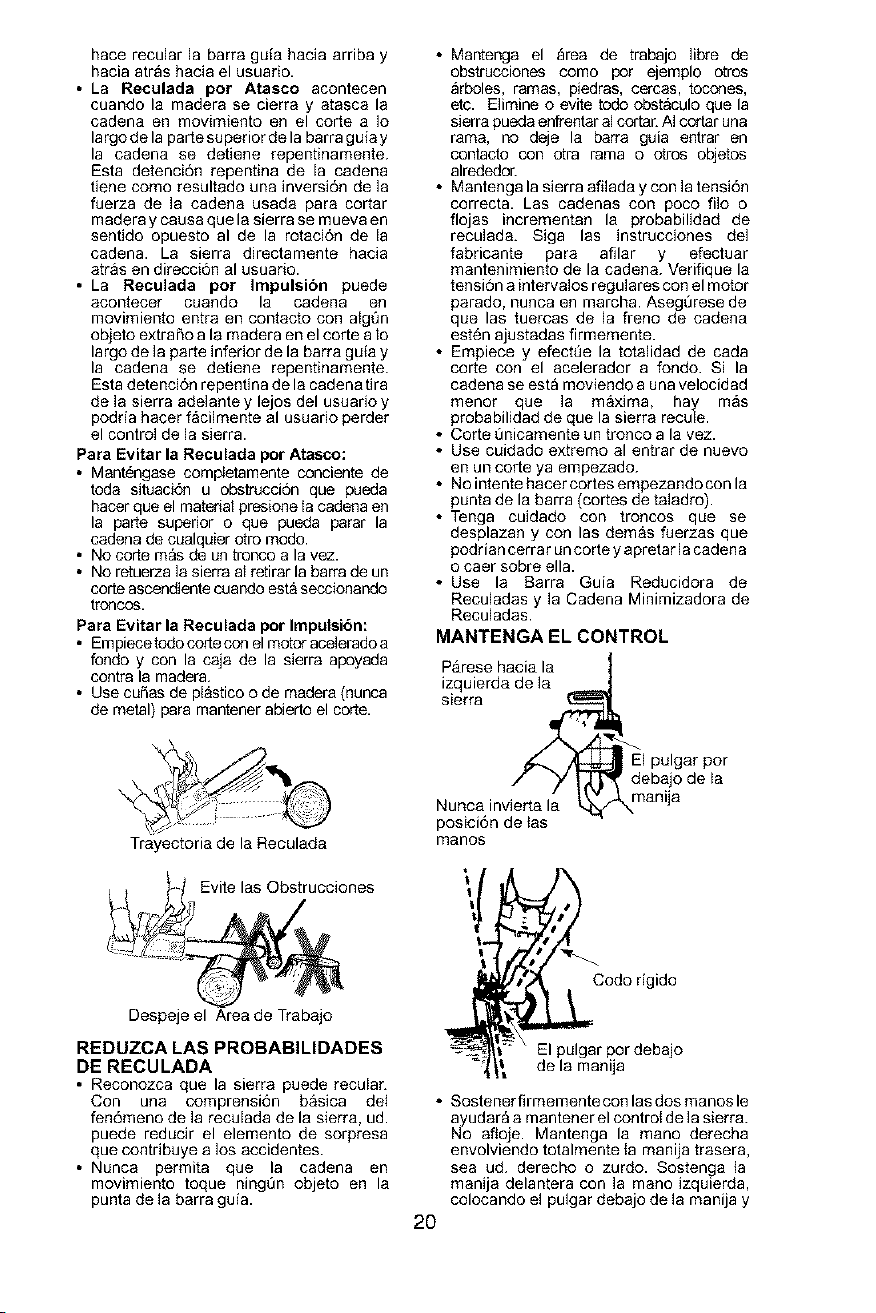
Trayectoria de la Reculada
i Evite las Obstrucciones
Despeje el Area de Trabajo
REDUZCA LAS PROBABILIDADES
DE RECULADA
• Reoonozca que la sierra puede regular.
Con una comprensi6n basica det
fen6meno de la reculada de la sierra, ud.
puede reducJr el elemento de sorpresa
que contrJbuye a los accidentes.
• Nunca permita que la cadena en
movimiento toque ningQn objeto en la
punta de la barra guia.
• Martenga el area de trabajo libre de
obstrucciones como per ejemplo otros
arboles, ramas, piedras, cercas, tocones,
etc. Elimine o evite todo obst_culo que la
sierra pueda enfrentar el cortar. AI codar una
ram& no deje la barra guia entrar en
coRtacto con otra rama o otros objetos
alrededor.
• Mantenga la sierra afllada y con la tensJ6n
correcta. Las cadenas con poco filo o
flojas incrementan la probabilJdad de
reculada. SJga las JnstruccJones del
fabricante pare afllar y efectuar
mantenimiento de la cadena. Verifique la
tensi6n a intervalos regulares con el motor
parado, nunca en march& AsegQrese de
que las tuercas de la franc de cadena
est6n ajustadas firmemente.
• Empiece y efectue la totalidad de cada
corte con el acelerador a rondo. SJ la
cadena se esta moviendo a una velocidad
menor que la maxima, hay m_s
probabilidad de que la sierra recule.
• Corte Qnical'nente un tronco a la vez.
• Use cuidado extremo el entrar de nuevo
eR uR corte ya empezado.
• No intente hacer cortes empezando con la
punta de la barra (cortes de taladro).
• Tenga cuJdado con troncos que se
desplazan y con las demas fuerzas que
podrian cerrar un corte y apretar la caden 8
o caer sobre ella.
• Use la Barra Guia Reducidora de
Reculadas y la Cadena Minimizadora de
Reculadas.
MANTENGA EL CONTROL
P_trese hacia la
izquierda de la
posicidn de Jas
manos
E] pulgar por
debajo de Ja
manija
Codo rigido
El pulgar por debajo
de la manija
• Sostener flrmementecon las dos manos le
ayudar_ a mantener el controt de la sierra.
No afloje. Mantenga la mano derecha
envolviendo totalmente ta manija trasera,
sea ud. derecho o zurdo. Sostenga {a
manija delantera con ]a mano izquierda,
colocando el pulgar debajo de la manija y
20
rodeando la manija con los dedos.
Mantenga el brazo izquierdo totalmente
extendido con el codo fijo.
• Coloque la mano Jzquierda en la manJja
delantera, de modo que quede en linea
recta con la mano derecha en la manija
trasera, cuando este hacJendo cortes de
seccionamiento. Parese levemente hacJa
la Jzquierda de la sierra para evJtar que el
cuerpo est6 en Iinea directa con la
cadena.
• Parese con el peso distbbuido igualmente
entre los dos pies.
• Parese levemente hacia [a Jzquierda de la
sierra para evJtar que el cuerpo est6 en
linea directa con la cadena.
• No se extJenda excesivamente. La sierra
puede impulsarlo o empujarto y ud. puede
perder el equilJbrJo y el control de la sierra.
• No corte ardba del nivel de los hombros.
Es dif{cil mantener el control de la sierra si
est_ pot encJma del nivel de los hombros.
DISPOSITIVOS DE SEGURIDAD
CONTRA LAS RECULADAS
_I_ADVERTENCIA: Los siguientes
dispositivos han sido incluidos en la sierra
para ayudar a reducir el riesgo de reculadas;
sin embargo, tales implementos no pueden
eliminar totalmente esta reacci6n peligrosa.
Como usuario de sierra de cadena, ud. no
deve confiarse solarnente en los
dispositivos de seguddad. Us. debe seguir
todas las precauciones de seguridad,
instrucciones y mantenimiento que se
encuentran en este manual para ayudar a
evitar las reculadas y otras fuerzas que
pueden causar graves heridas.
• Barra Guia Reducidora de Reculadas,
diseiiada con punta de radio pequeiio que
reduce el tamaiio de la zona de peligro en
la punta de la barra. Este tipo de barra ha
demostrado que reduce
significativamente la cantidad y la
seriedad de las reculadas cuando han
sido examinado de acuerdo con ANSI
(American National Standards Institute,
Inc.) B175.1.
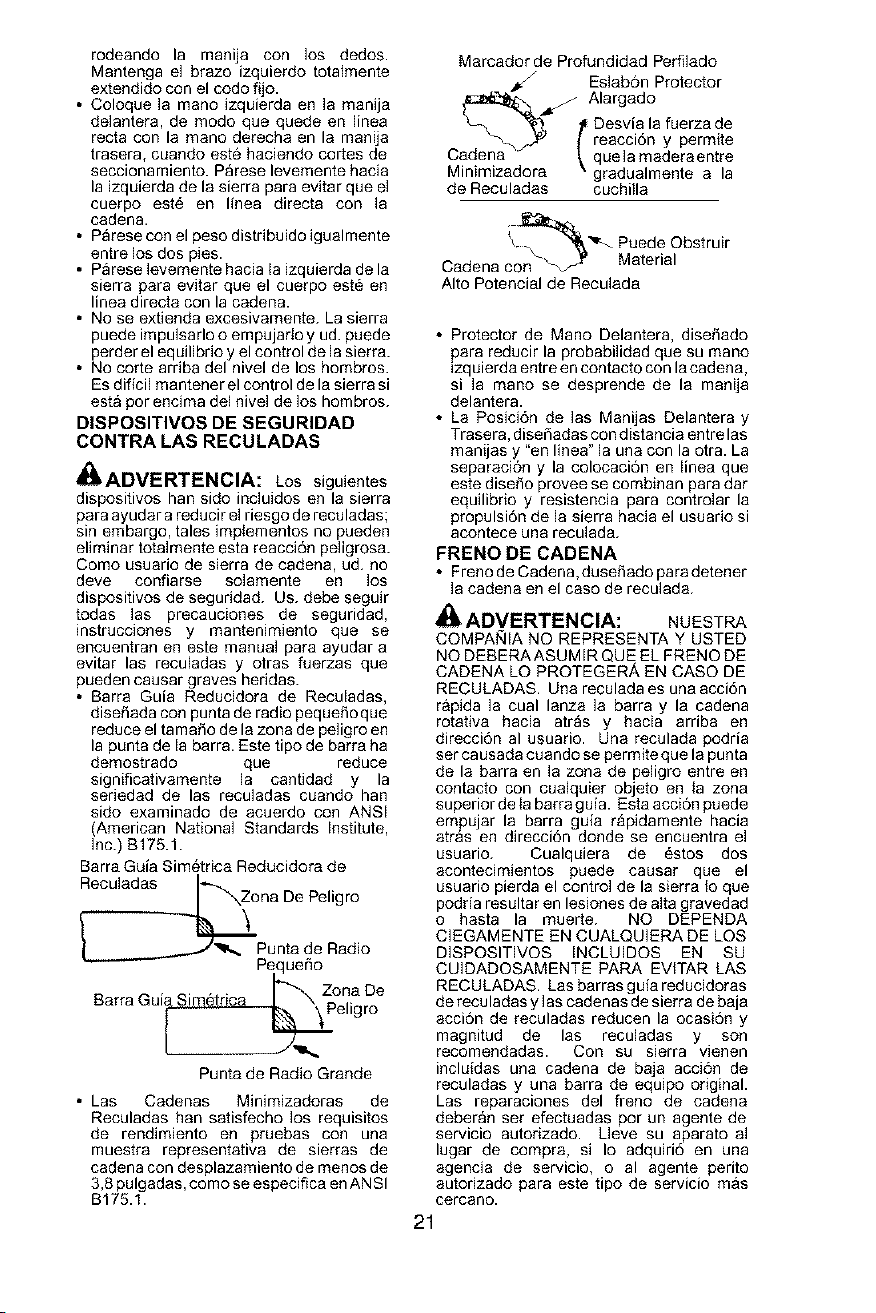
Barra Guia Sim_trica Reducidora de
Reculadas
na De Peligro
__'_ Punta .d.eRadio
Pequeno
.... Zona De
Barra Gul_ _eligro
Punta de Radio Grande
• Las Cadenas Minimizadoras de
Reculadas han satisfecho los requisitos
de rendimiento en pruebas col/ una
muestra representativa de sierras de
oadena con desplazamiento de menos de
3,8 pulgadas, como se especifica en AN Sl
B175.I.
Marcador de Profundidad Perfilado
Eslab6n Protector
j Alargado
Desvia la fuerza de
L_. _ f reacci6n y permite
Cadena _ quela maderaentre
Minimizadora _ gradualmente a la
de Reculadas cuchilla
Cadena 1o% Matenal
\. \ _-_ Pued? Obstruir
Alto Potencial de Reculada
• Protector de Mano Delantera, diseiiado
para reducir la probabilidad que su mano
izquierda entre en contacto con la cadena,
si la mano se desprende de la manija
delantera.
• La Posici6n de las Manijas Delantera y
Trasera, dise6adas con distancia entre las
manijas y "en linea" la una con la otra. La
separaci6n y la colocaci6n en linea que
este diseiio provee se combinan para dar
equilibrio y resistencia para controlar la
propulsi6n de la sierra hacia el usuabo si
acontece una reculada.
FRENO DE CADENA
• Freno de Cadena_duseiiado para detener
la cadena en el caso de reculada.
,1_ ADVERTENCIA: NUESTRA
COMPAi_IIA NO REPRESENTA Y USTED
NO DEBERA ASUMIR QUE EL FRENO DE
CADENA LO PROTEGERA EN CASO DE
RECULADAS. Una reculada es una acci6n
rapida la cual lanza la barra y la cadena
rotativa hacia atras y hacia arriba en
direcci6n al usuario. Una reculada podria
ser causada cuando se permite que la punta
de la barra en la zona de peligro entre en
contacto con cualquier objeto en la zona
superior de la barra guia. Esta acci6n puede
empujar la barra gu{a rapidamente hacia
arras en direccion donde se encuentra el
usuario. Cualquiera de 6stos dos
acontecimientos puede causar que el
usuario pierda el control de la sierra Io que
podria resultar en lesiones de alta gravedad
o hasta la muerte. NO DEPENDA
CIEGAMENTE EN CUALQUIERA DE LOS
DISPOSITIVOS INCLUIDOS EN SU
CUIDADOSAMENTE PARA EVITAR LAS
RECULADAS. Las barras guia reducidoras
de reculadas y las cadenas de sierra de baja
acci6n de reculadas reducen la ocasi6n y
magnitud de las reculadas y son
recomendadas. Con su sierra vienen
inclu{das una cadena de baja acci6n de
reculadas y una barra de equipo original.
Las reparaciones del freno de cadena
deber_n ser efectuadas por un agente de
servicio autorizado. Ueve su aparato al
lugar de compra, si Io adquiri6 en una
agencia de servicio, o al agente perito
autodzado para este tipo de servicio mas
cercano.
21
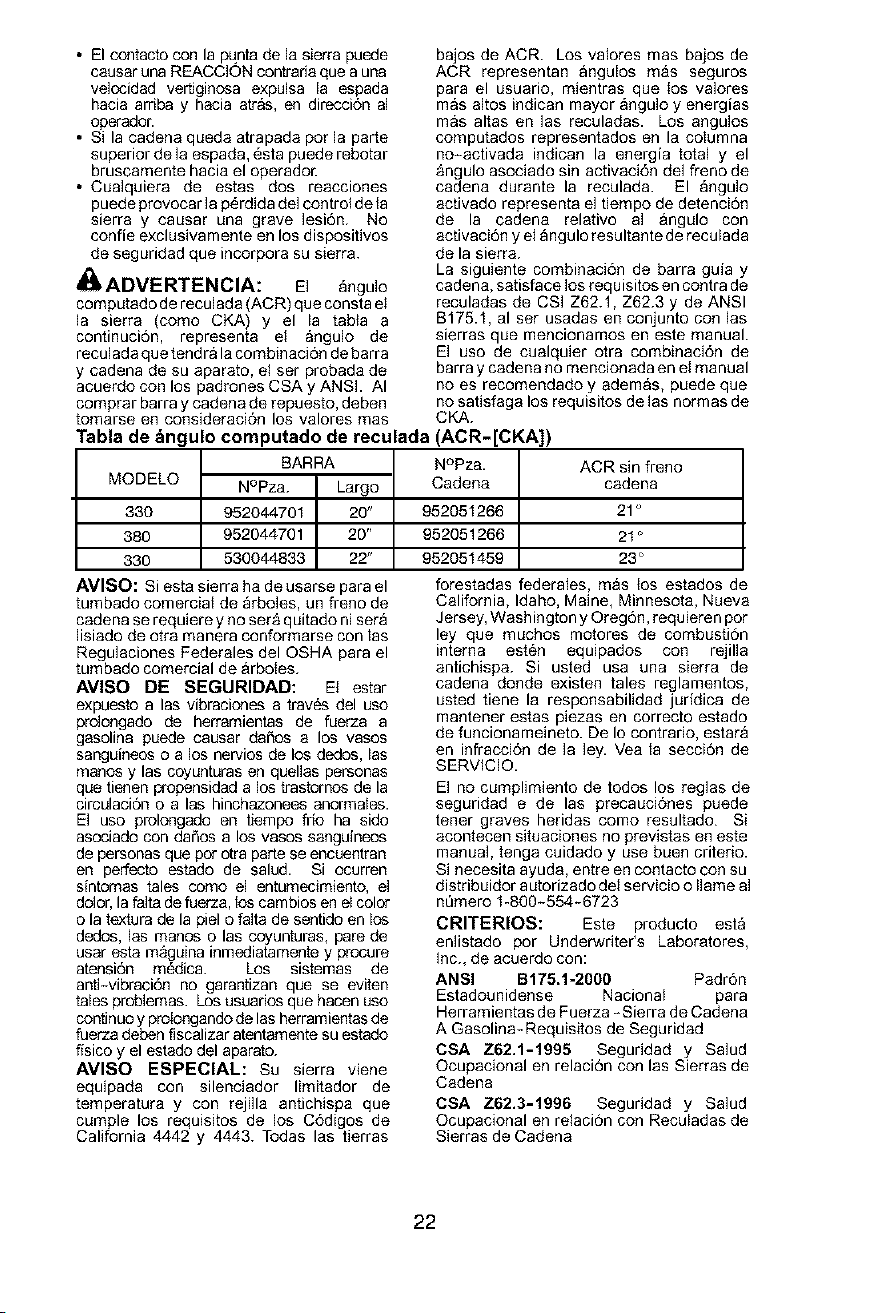
• Elcontactoconlapqnlade]a sierra puede
causar una REACC]ON contrada que a una
veIccidad vertiginosa expulsa la espada
hacia arriba y hacia atr_s, e/ direcci6n a]
operador.
• SJ la cadena queda atrapada por ]a parte
superior de ]a espada, _sta puede rebotar
bruscamente hacia el operadoc
• Cua]quiera de estas dos reacciones
puede provocar ]a p_rdida de] control de la
sierra y causar una grave ]esi6n. No
confie exclusivamente en los dispositivos
de seguridad que incorpora su sierra.
,I_ADVERTENCIA: E] _ngu]o
computado de recuIada (ACR) que consta eI
la sierra (como CKA) y el la tabla a
continuci6n, representa el _ngu(o de
recuIada que tend r_ la combinaci6n de barra
y cadena de su aparato, el set probada de
acuerdocon los padronesCSAyANS(. AI
comprar barra y cadena de repuesto, deben
tomarse en consideraci61/ los valores mas
Tabla de &ngulo computado de reculada (ACR-[CKA])
BARRA NOPza.
MODELO N°Pza. Largo Cadena
390 952044701 20" 952051266
980 952044701 20" 952051266
930 530044839 22" 952051459
bajos de ACR. Los valores mas bajos de
ACR representan angulos mas seguros
para el usuario, mientras que los va]ores
m_s altos indican mayor _ngu]o y energias
m_s altas en ]as reculadas. Los angu]os
computados representados en la cotumna
no-activada indican la energia total y el
angulo asociado sin activaci6n de( freno de
cadena durante la reculada. El _ngu]o
activado representa e] tiempo de detenci6n
de la cadena relativo a] angulo con
activaci6n y el angulo resultante de reculada
de la sierra.
La siguiente combinaci6n de barra guia y
cadena, satisface los req uisitos en contra de
reculadas de CSI Z62.1, Z62.3 y de ANSI
B175.1, al set usadas en conjunto con ]as
sierras que mencionamos en este manual.
E( uso de cualquier otra combinaci6n de
barra y cadena no menciol/ada en el manual
no es recomendado y adem_s, puede que
no satisfaga los requisitos de las normas de
CKA.
ACR sin freno
cadena
21 °
2t"
29"
AVISO: Siesta sierra ha de usarse para el
tumbado comercial de arboles, un freno de
cadena se requiere y no sera quitado ni sera
iisiado de otra manera conformarse con las
Reguiaciones Federales del OSHA para el
tumbado comercial de arbo(es.
AVISO DE SEGURIDAD: E( estar
expuesto alas vibraciones a tray,s del uso
prc4ongado de herramientas de fuerza a
gasolina puede causar daSos a los vasos
sanguineos o a los nervios de los dedos, las
l;qal/os y las coyunturas en quelIas personas
que tienen propensidad a los trastornos de la
circulaci6n o alas hinchazonees anormales.
E( uso prolongado en tiempo fdo ha sido
asociado con da6os a los vasos sangu(neos
de personas que per otra parte se encuentran
en perfecto estado de salud. Si ocurren
sintomas lales como e( entumecimiento, e(
dolor, la faIta de fuerza, los cambios en el color
o la textura de la piel o faIta de sentido en los
dedos, (as manos o las coyunturas, pare de
usar esta maguina inmediatamente y procure
atensi6n m6dica. Los sistemas de
anti-vibraci6n no garantizan que se eviten
tales problemas. Los usuarios que hacen uso
continuo y prolongando de las herramientas de
fuerza deben fiscalizar atentame{/te su estado
fisico y el estado del aparato.
AVlSO ESPECIAL: Su sierra viene
equipada con silenciador Iimitador de
temperatura y con rejiIla antichispa que
cumple los requisitos de los C6digos de
California 4442 y 4443. Todas las tierras
forestadas federales, mas tos estados de
California, Idaho, Maine, Minnesota, Nueva
Jersey, Washington y Oreg6n, requieren pot
ley que muchos motores de combusti6n
interna est6n equipados con rejilia
antichispa. Si usted usa una sierra de
cadena donde existen tales reglamentos,
usted tiene la responsabilidad juridica de
mantener estas piezas en correcto estado
de funcionameineto. De Io contrado, estara
en infracci6n de ]a ]ey. Vea la secci6n de
SERVlCiO.
E] no cumplimiento de todos los regias de
seguridad e de las precauci6nes puede
tener graves heridas como resultado. Si
acontecen s(tuac(ones no prev(stas en este
manual, tenga cuidado y use buen criterio.
Si necesita ayuda, entre en contacto col/su
distribuidor autorizado del servicio o IIame a(
n0mero 1-800-554~6723
CRITERIOS: Este producto est_
enfistado pot Underwdter's Laboratores,
(nc., de acuerdo con:
ANSI B175.1=2000 Padr6n
Estadounidense Nacional para
Herramientas de Fuerza -Sierra de Cadena
A Gasolina-Requisitos de Seguridad
CSA Z62.1-1995 Seguddad y Saiud
Ocupacional en relaci6n con las Sierras de
Cadena
CSA Z62.3-1996 Seguddad y Saiud
Ocupacional en relacion con Reculadas de
Sierras de Cadena
22
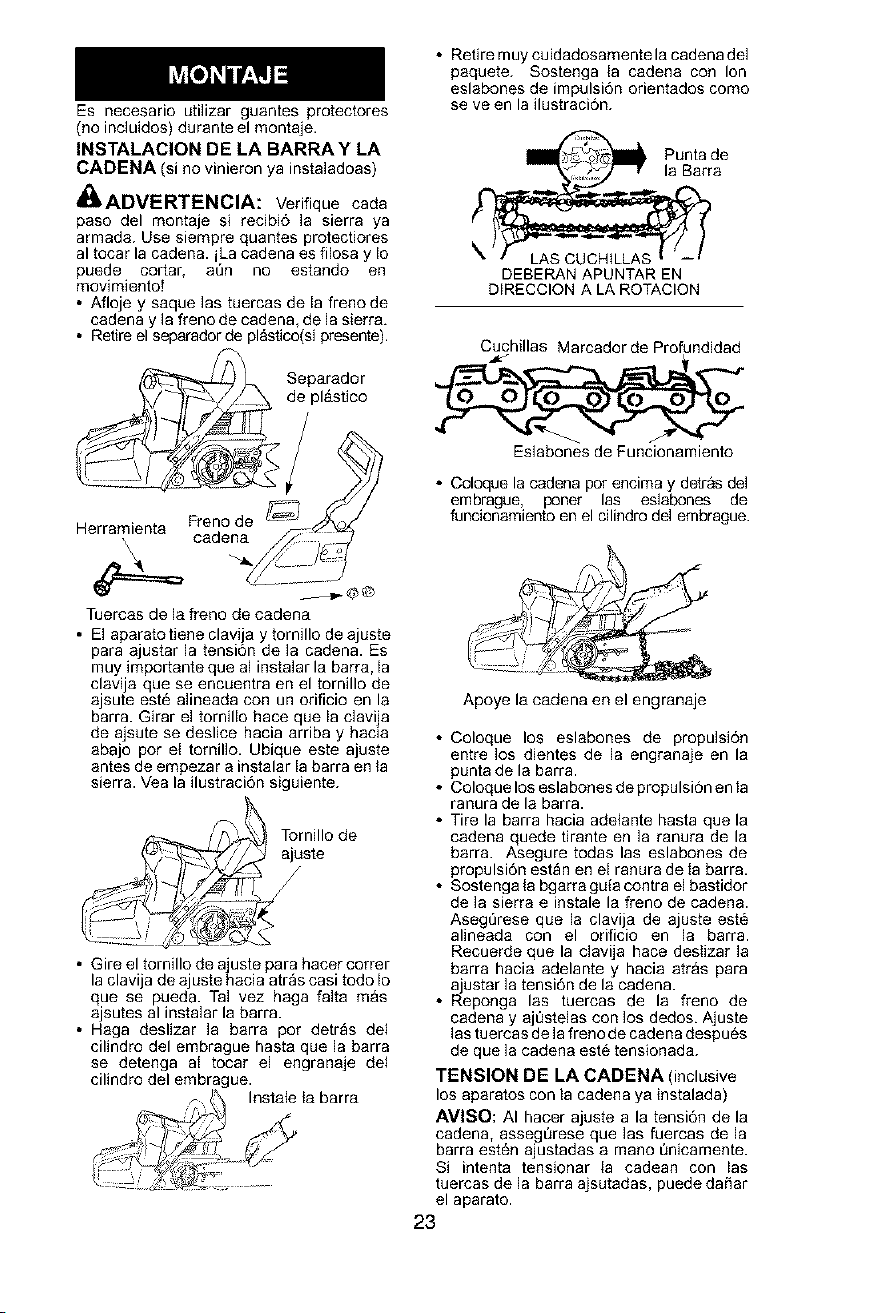
Es necesario uti]izar guantes protectores
(no induidos) durante el montaje.
INSTALACION DE LA BARRA Y LA
CADENA (si no vinieron ya insta]adoas)
,_ADVERTENCIA: Verifique cada
paso del montaje si recibi6 ]a sierra ya
armada. Use siempre quantes protectiores
al tocar la cadena, iLa cadena es filosa y Io
puede cortar, a0n no estando en
movJmJento!
• Afloje y saque ]as tuercas de la freno de
cadena y la freno de cadena, de ]a sierra.
• Retire el separador de pl_stJco(sJ presente).
Herramienta Freno de _
\ cadena
\
Tuercas de la freno de eadena
• El aparato tiene clavija y tomillo de Nuste
para Nustar la tensi6n de la cadena. Es
muy importante que al instalar la barra, la
clavi a que se encuentra en el tomillo de
asute este a neada con un orfco en a
barra. Girar el tornillo hace que la clavija
de ajsute se deslice hacia ardba y hacia
abajo por el tornillo. Ubique este ajuste
antes de empezar a instalar la barra en la
sierra. Vea la ilustraci6n siguiente.
• Gire el tornillo de ajuste para hacer correr
la clavija de ajuste hacia atras casi todo 1o
que se pueda. Ta] vez haga fa]ta mas
ajsutes al insta]ar la barra.
• Haga deslJzar ]a barra por detras deI
cilJndro del embrague hasta que ]a barra
se detenga al tocar e] engranaje del
cilindro del embrague.
la barra
• Retire muy cuidadosamentela cadena de]
paquete. Sostenga la cadena con Ion
eslabones de impulsi6n orientados como
se ve en la ilustraci6n.
Punta de
la Barra
DEBERAN APUNTAR EN
DIRECCION A LA ROTACION
Cuchillas Marcadorde Profundidad
Eslabones de Funcionamiento
• Coloque la cadena por encima y detras de]
embrague, poner las esJabones de
funcJonamiento en el cJlindro del embrague.
Apoye la cadena en el engranaje
• Coloque los eslabones de propu]si6n
entre los dientes de ]a engranaje en la
punta de la barra.
• Coloque los eslabones de propulsi6n en la
ranura de la barra.
• Tire la barra hacia adeiante hasta que la
cadena quede tirante en ]a ranura de la
barra. Asegure todas las eslabones de
propulsi6n estan en el ranura de la barra.
• Sostengala bgarragu{acontra e] bastidor
de ]a sierra e instale la freno de cadena.
AsegQrese que la clavija de ajuste est6
alineada con el orificio en ]a barra.
Recuerde que la c]avija hace deslizar ]a
barra hacia adelante y hacia atras para
a ustar ]a tensi6n de la cadena.
• Reponga as tuercas de a freno de
cadena y ajtiste]as con los dedos. Ajuste
las tuercas de ]afreno de cadena despues
de que ]a cadena este tensionada.
TENSION DE LA CADENA (inclusive
los aparatos con la cadena ya instalada)
AVISO: AI hacer ajuste a la tensi6n de la
cadena, assegt_rese que ]as fuercas de ]a
barra est6n ajustadas a mano t_nicamente.
Si intenta tensionar la cadean con las
tuercas de ]a barra ajsutadas, puede dafiar
el aparato.
23
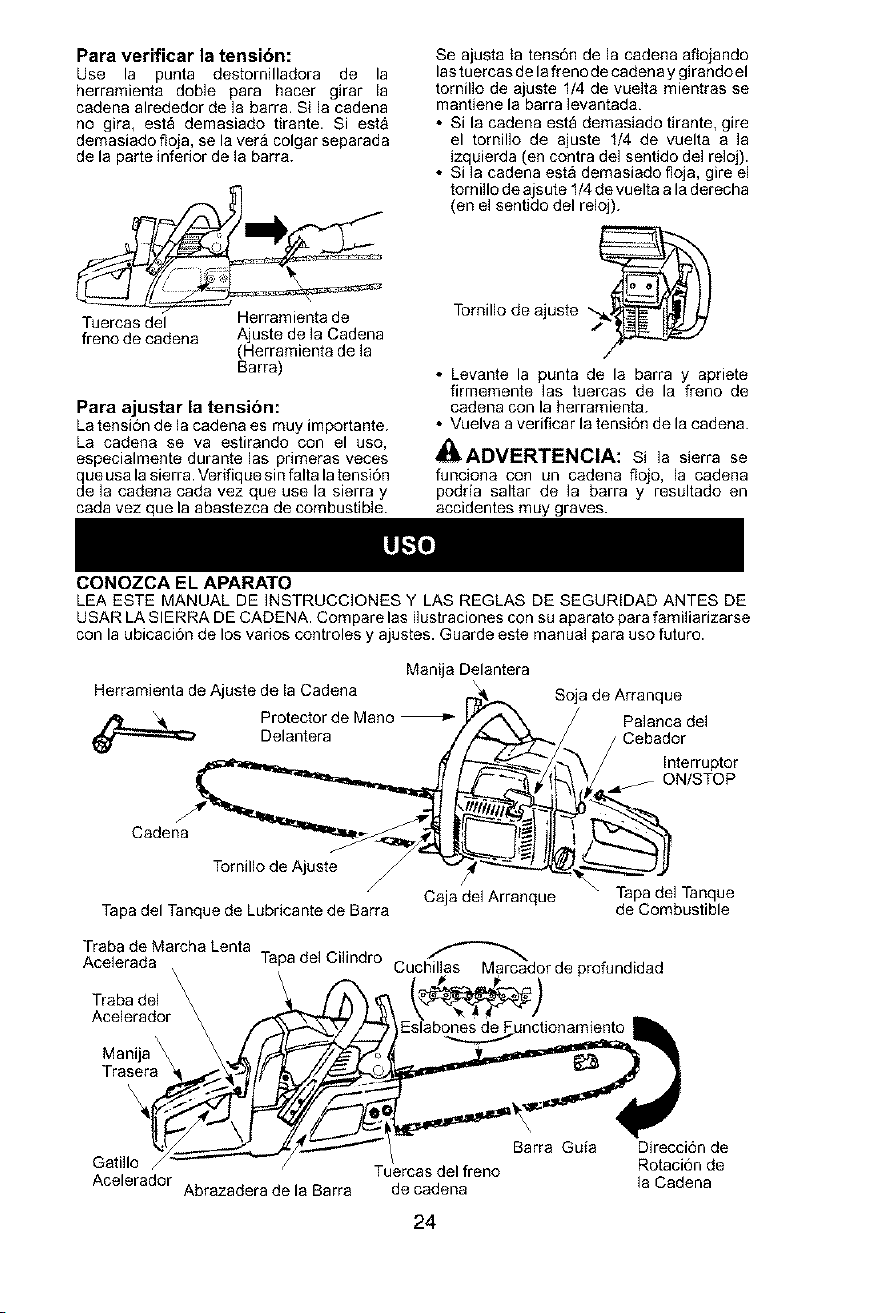
Para verificar la tensi6n:
Use la punta destornilladora de la
herramienta dob]e para hacer girar la
cadena alrededor de ]a barra. Si ]a cadena
no gira, est_ demasiado tirante. Siesta
demasiado floja, se la vera colgar separada
de la parte inferior de la barra.
Tuercas del Herramienta de
freno de cadena Ajuste de la Cadena
(Herramienta de la
Barra)
Para ajustar la tensibn:
La tensi6n de la cadena es muy importante.
La oadena se va estirando con el uso,
especialmente durante ]as pbmeras races
q ue usa la sierra. Verifiq ue sin falta la tensi6n
de ]a cadena cada vez que use la sierra y
cada vez que la abastezca de combustible.
CONOZCA EL APARATO
Se ajusta ta tens6n de ]a cadena aflojando
las tuercas de la freno de cadena y girando el
tornil]o de ajuste 1/4 de vue]ta mientras se
mantiene la barra ]evantada.
• Si la cadena esta demasiado tirante, gire
el tornil]o de ajuste 1/4 de vuelta a ]a
izquierda (en contra de] sentido de] re]oj).
• Si ]a cadena est_ demasiado floja, gire e]
tomi]lo de a sute 1/4 de vuelta a la derecha
ene sentdode reoj.
Tornillo de ajuste _
/-
• Levante la punta de la barra y apriete
firmemente ]as tuercas de la freno de
cadena con la herrarnienta.
• Vuelva a verificar la tensi6n de la cadena.
_IADVERTENCIA: Si la sierra se
furlcJona col/ un cadeRa flojo, la cadena
podria saltar de ]a barra y resultado en
accidentes muy graves.
LEA ESTE MANUAL DE INSTRUCCIONES Y LAS REGLAS DE SEGURIDAD ANTES DE
USAR LA SIERRA DE CADENA. Compare las i]ustraciones con su aparato para famifiarizarse
con la ubicaci6n de los vabos controles y ajustes. Guarde este manual para uso futuro.
Manija Delantera
Herramienta de Ajuste de la Cadena _ Soja de Arranque
Protector de Mano _ Pa]anca del
Delantera Cebador
_7/_)_ ON/SToplnterrupt°r
Tomillo de Aluste
/
Caja del Arranque Tapa del Tanque
Tapa del Tanque de Lubricante de Barra de Combustible
Traba de Marcha Lenta
Acelerada , Tapa del Cifindro
\
Traba del
Acelerador _
Manijaa_ I _ o
Traser
Gatillo_ €_
Acelerador
Cuchillas Marcador de profundidad
Barra Gufa Direccidn de
Tuercas del freno Rotacion de
Abrazadera de la Barra de cadena la Cadena
24

INTERRUPTOR ON/STOP
E] INTERRUPTOR ON/STOP est_
acostumbrado a detener la mgquina.
GATILLO DE ACELERADOR
E] GATILLO DE ACELERADOR contr(:4a
velocidad de m_quina.
TRABA DEL ACELERADOR
Es necesario apretar prti_qero la TRABA DEL
ACELERADOR para poder accionar el
aceJerado£ Este dispositivo previene d
acionamiento accidentaJ del ace]erador.
TRABA DE LA MARCHA LENTA
ACELERADA
La TRABA DE LA MARCHA LENTA
ACELERADA mantiene el gatil]o en ]a posicJ6n
de arranque. Active la traba de marcha lenta
ace]erada en la siguiente manera: prestone {a
traba del acelerador y luego apretando el gati]to
acelerado_ Con el acelerador apretado,
optima la traba de marcha lenta acelerada.
Suelte la traba del acelerador y el gatJllo
mientras manfleneoprimida la traba de marcha
]enta ace]erada.
PALANCA DEL CEBADOR
La PALANCA DEL CEBADOR provee
combustible adicionai al motoral arrancaren
frio.
FRENO DE CADENA
El FRENO DE CADENA esta diseSado para
detener ia cadena en caso de recuiada. El
freno de cadena se activa automaticamente en
caso de reculadas. Ei freno de cadena se
activa manualmente si empujan ai protector de
mano delantero adeiante. Para desactivar el
freno de cadena, tire Io m_s posible del
protector de mano detantero hacia la manija
delantera.
TENSION DE LA CADEI',L&.
ES Normal que las cadenas nuevas se estJr_/
durante los primeros 30 rninutos de uso.
Debera verificarse la tensi6n _Je la cadena
frecuentemente. Vea TENSION DE LA
CADENA en la secci6n de SERVlCIO Y
AJUSTES.
,1_ ADVERTENCIA: El silenciador es
extremadamente caliente durante et uso y
despues de usar el aparato. No toque et
silenciador ni permita que el material
combustible tal como gasolina o hierba seca
hagan contacto.
A%
_lb ADVERTENCIA: Remueva la tapa
del tanque de combustible lentamente al
reabastecer combustible.
ABASTECIMIENTO DEL MOTOR
Este motor esta habilitado para funcionar
con gasolina sin plomo. Antes de usar, se
debera mezctar la gasolina con un aceite de
buena calidad para motores de 2 tiempos
enfriados a aire. Recomendamos el aceite
marca Poulan/Weed Eater(_. Si no usa este
aceite, use un aceite de buena calidad para
motores de 2 tiempos enfbados a aire
diseSado para ser usado en una rnezcla col/
proporci6n de 40:1. Se obtiene una
proporci6n de 40:1 mezclando 3,2 onzas de
aciete con cada gal6n de gasolina sin plomo.
Se incluye con esta sierra un recipiente de
3,2 onzas de aceite de la marca
Poulan/Weed Eater. Adiera el contenido
entero de este recipiente en 1 gal6n de
gasolina para alcanzar le mezcla apropiada
del combustible.
NO USE aceite para autom6viles ni para
barcos. Estos aceites daSaran el motor. AI
mezclar combustible, siga las instrucciones
impresas en el recipiente. Lea siempre y
siga las reglas de segLuridad que se
encuientran bajo MANEJE EL
COMBUSTIBLE CON EXTREMO
CUIDADO.
LUBRICACION DE LA BARRA Y DE
LA CADENA
La barra y la cadena requieren ]ubricaci6n
constante. El sistema autom_tico de
lubricaci6n provee la lubricaci6n necesaria
mientras se mantenga Ileno e] tanque de
aceite. La falta de aceite arruinara la barra y
la cadena rapidamente. El uso de
dernasiado poco aciete causara exceso de
ca]entamiento que ser_ detectable pot e]
humo proveniente de la cadena y/o pot la
descoIoraci6n de la barra.
Cuando la temperaturea es inferior a O grados
centrigrados, el aceite se pone mas grueso,
tomando necesafia la adici6n de una peque6a
cantidad (de 5 a 10%) de Fuel Oil #I (#1 Diesel
Fuel) o querosen para diluir e] aceite de ]a barra
y la cadena. El aceite para barra y cadena fluir
libremente para que el sistema de lubricaci6n
pueda bombear suficiente aceite para lubficar
adecuadamente.
Se recomienda el aceite Poulan o Poulan
PROQ) genuino para barra y cadena para
proteger el aparato contra e] desgaste
excesivo provocado pot el ca]or y la fricci6n.
E] aceite Poulan o Poulan PRO(_ resiste la
p_rdida de espesura a altas temperaturas.
Si no nay disponibi]idad de aceite para barra
y cadena Poulan o Poulan PRO(_ use un
aceite de buena calidad tipo SAE 30.
• Nunca utilice aceite usado para la
lubricaci6n de la barra y de ta cadena.
• Pare siempre el motor antes de abbr la
tapa del tanque de aceite.
IMPORTANTE
La experiencJa india que los combustibles
mezclados con alcohol (los ]lamados gasohot
o los que conflenen etanol o los que contienen
etanot o metanol) pueden atraer humedad, lo
que puede causar la separaci6n y la formaci6n
de _cidos durante el almacenamiento. La
gasolina acidica puede daiiar el sistema de
combustible del motor durante el
almacenamiento. Para evitar prob]emas con e]
motor, debera vaciarse el sistema de
25
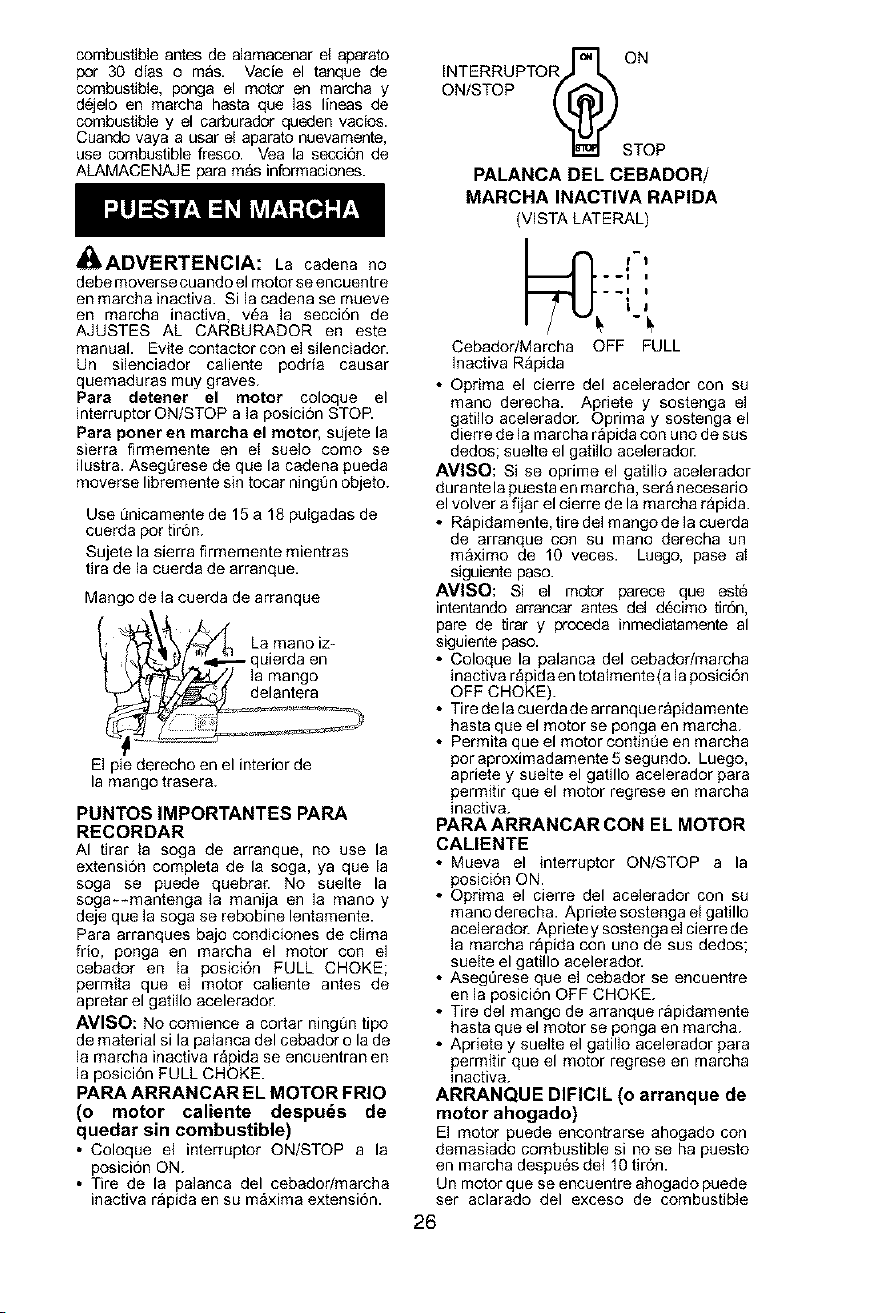
combustibleantesdealamacenarelaparato
por30diaso mas.Vacieeltanquede
combustible,pongaelmotorenmarchay
d6jeloenmarchahastaquelaslineasde
combustibley elcarburadorquedenvacios.
Cuandovayaausarelaparatonuevamente,
usecombustiblefresco.Vealasecci6nde
ALAMACENAJEparam_sinformae]ones.
_kADVERTENClA: La cadena no
debe moverse cuando el motor se encuentre
en marcha inactiva. Si la cadena se mueve
en marcha inactiva, yea la secci6n de
AJUSTES AL CARBURADOR en este
manual. Evite contactor con e] e]lenciador.
Un silenciador caliente podda causar
quemaduras muy graves.
Para detener el motor coloque el
interruptor ON/STOP a la posici6n STOR
Para poner en marcba el motor, sujete la
sierra firmemente en el suelo como se
ilustra. Aseg_rese de que la cadena pueda
moverse libremente sin tocar ningQn objeto.
Use Qnicamente de 15 a 18 pulgadas de
cuerda por tir6n.
Sujete la sierra firmemente mientras
tira de la cuerda de arranque.
Mango de la cuerda de arranque
I: _ Lamanoiz-
] '/_ _7_rad_en
El pie derecho en el interior de
la mango trasera.
PUNTOS IMPORTANTES PARA
RECORDAR
AI tirar la soga de arranque, no use la
extensi6n completa de la soga, ya que la
soga se puede quebrar. No suelte la
soga~-mantenga la manija en la mano y
deje que la soga se rebobine lentamente.
Para arranques bajo condie]ones de clima
frio, ponga en marcha el motor con el
cebador en la posici6n FULL CHOKE;
permita que el motor caliente antes de
apretar el gatillo acelerador.
AVISO: No comience a cortar ningDn tipo
de material si la palanca del cebador o la de
la marcha inactiva r_pida se encuentran en
la posici6n FULL CHOKE.
PARA ARRANCAR EL MOTOR FRIO
(o motor caliente despu_s de
quedar sin combustible)
• Coloque e{ interruptor ON/STOP a la
posicion ON.
• Tire de la palanca del cebador/marcha
inactiva rapida en su m_xima extension.
ON
INTERRUPTOR
ON/STOP
STOP
PALANCA DEL CEBADOR/
MARCHA INACTIVA RAPIDA
(VISTA LATERAL)
'i
Cebador/Marcha OFF FULL
g/activa Rapida
• Oprima el cierre del ace]erador con su
mano derecha. Apbete y sostenga e]
gati]lo acelerador. Optima y sostenga el
dierre de la marcha rapida con uno de sus
dedos; suelte el gati]lo acelerado_
AVISO: Si se oprime el gatil]o acelerador
duraRtela puesta en march& sera necesario
el volver a fijar el cierre de la marcha rapida.
• Rapidamente, tire del mango de ]a cuerda
de arranque col/ su mano derecha un
maximo de 10 veces. Luego, pase al
e]guiente paso.
AVISO: Si el motor parece que est_
intentando arrancar antes de] decimo tir6n,
pare de tirar y proceda inmediatamente al
siguiente paso.
• Coloque la palanca del cebador/marcha
inactiva r_pida en totalmente(a la poe]e]6n
OFF CHOKE).
• Tire dela cuerda de arranquerapidamente
hasta que el motor se ponga en marcha.
• Permita que el motor continL_e en marcha
pot aproximadamente 5 segundo. Luego,
apriete y sue]te el gatillo acelerador para
permitir que el motor regrese en marcha
inactiva.
PARA ARRANCAR CON EL MOTOR
CALIENTE
• Mueva el interruptor ON/STOP a la
poe]ci6n ON.
• Oprima el cierre del ace]erador con su
mano derecha. Apriete sostenga el gatillo
acelerador. Apriete y sostenga el cierre de
la marcha rapida con uno de sus dedos;
suelte el gatillo acelerador.
• Aseg_lrese que el cebador se encuentre
en la posici6n OFF CHOKE.
• Tire del mango de arranque rapidamente
hasta que el motor se ponga en marcha.
• Apbete y suelte el gatillo acelerador para
permitir que el motor regrese en marcha
inactiva.
ARRANQUE DIFICIL (o arranque de
motor ahogado)
El motor puede enoontrarse ahogado con
demasiado combustible si no se ha puesto
en marcha despu6s de{ 10 tir6n.
Un motor que se encuentre ahogado puede
ser aclarado del exceso de combustible
26
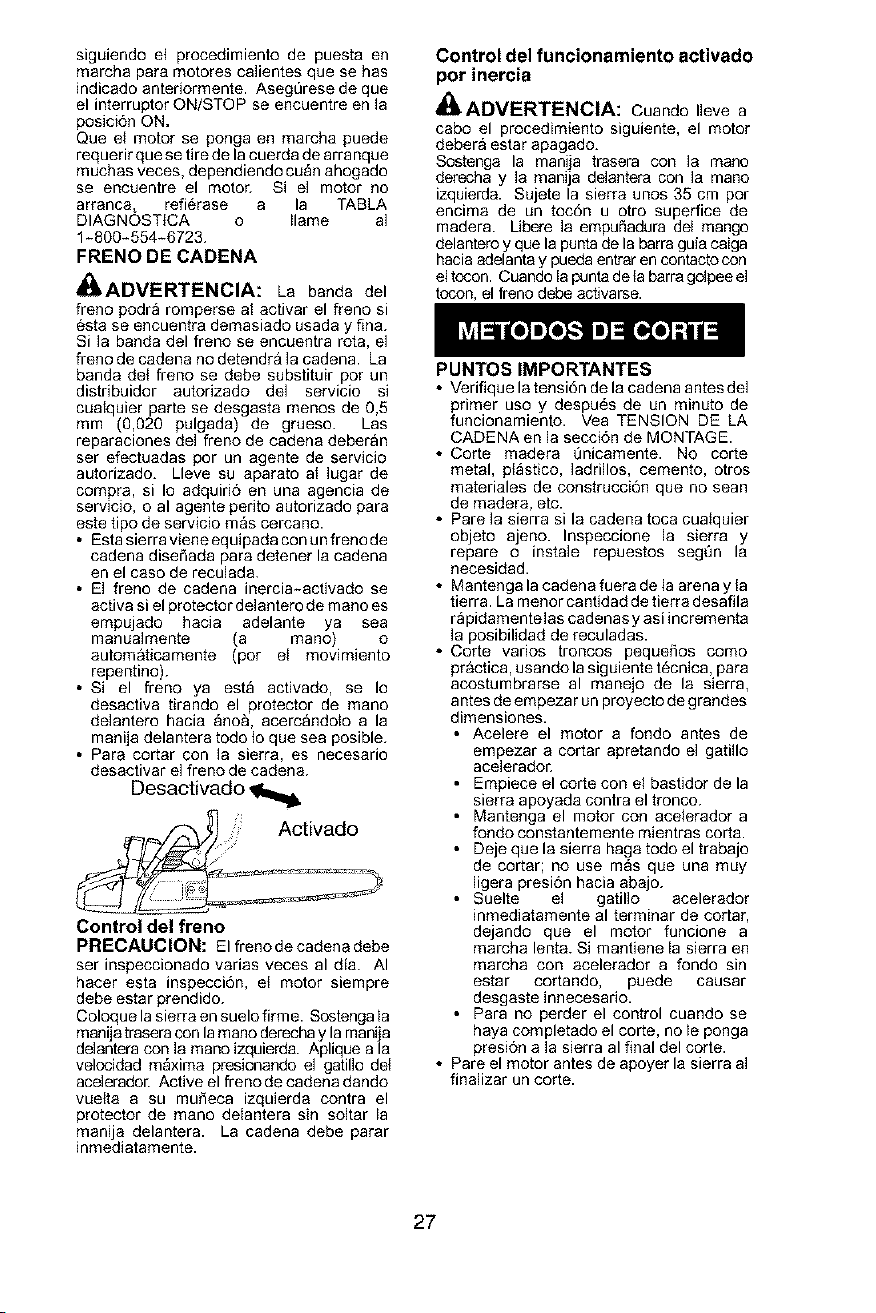
siguiendo et procedimiento de puesta en
marcha para motores oalientes que se has
indicado antefiormente. AsegQrese de que
el interruptor ON/STOP se encuentre en la
posici6n ON,
Que el motor se ponga en marcha puede
requerir que se tire de la cuerda de arra nque
muchas veces, dependiendo cu_n ahogado
se encuentre el motor. Si e] motor no
arranca, refierase a la TABLA
DIAGNOSTtCA o Ilame a]
1-800-554-6723.
FRENO DE CADENA
_kADVERTENCIA: La banda del
freno podra romperse al activar el freno si
esta se encuentra demasiado usada y fina.
Si ]a banda del freno se encuentra rota, e]
freno de cadena no detendra ]a cadena. La
banda del freno se debe substituir por un
distfibuidor autofizado de] servicio si
cualquier parte se desgasta menos de 0,5
mm (0,020 pulgada) de grueso. Las
reparaciones de] freno de cadena deberan
set efectuadas pot un agente de servicio
autorizado. Lleve su aparato al ]ugar de
compra, si Io adquid6 en una agencia de
servicio, o al agente pefito autorizado para
este tipo de servicio m_s cercano.
• Esta sierra viene equipada con un freno de
cadena dise6ada para detener la cadena
en el caso de recu]ada.
• E] freno de cadena inercia-activado se
activa si el protector de]antero de mano es
empujado hacia adelante ya sea
manua]mente (a mano) o
automaticamente (por el movimiento
repentino).
• Si el freno ya esta activado, se Io
desactiva tirando el protector de mano
de]antero hacia _noa, acercandoto a la
manija delantera todo to que sea posible.
• Para cortar con la sierra, es necesario
desactivar e] freno de cadena.
Desactivado _
Control del freno
PRECAUCION: El frenodecadenadebe
ser inspeccionado varias veces al d[a. AI
hacer esta inspecci6n, el motor siempre
debe estar prendido.
Coloque la sierra en suelo firm e. Sostenga la
manija trasera con la mano derecha y la manija
de]antera con ]a mano izquierda. Aplique a la
velccidad m_xima presionando el gatil]o del
ace]erado_ Active el freno de cadena dando
vueka a su muiieca izquierda contra el
protector de mano deiantera sin so]tar la
manija delantera. La cadena debe parar
inmediatamente.
Control del funcionamiento activado
pot inertia
_kADVERTENCIA: CuandoI]evea
cabo el procedimiento siguiente, el motor
deber_ estar apagado.
Sostenga la manija trasera con ]a mano
derecha y ]a manija delantera con ]a mano
izquierda. Sujete la sierra unos 35 cm por
encima de un toc6n u otto superfice de
madera. Libere la empu_adura del mango
delantero y que la punta de la barra guia caiga
hacia adelanta y pueda entrar en contacto con
el tocon. Cuando la punta de ta barra gc4pee e]
tocon, el freno debe activarse.
PUNTOS IMPORTANTES
• Verifique la tensi6n de la cadena antes del
primer uso y despu6s de un minuto de
funcionamiento. Vea TENSION DE LA
CADENA en ]a secci6n de MONTAGE.
• Corte madera Qnicamente. No corte
metal, ptastico, ]adri]los, cemento, otros
materiales de construcci6n que no sean
de madera, etc.
• Pare ]a sierra si la cadena toca cuaiquier
objeto ajeno. Inspeccione ]a sierra y
repare o insta]e repuestos segQn la
necesidad.
• Mantenga la cadena fuera de la arena y la
tierra. La menor ca ntidad de tierra desafila
rapidamente]as cadenas y asiincrementa
la posibilidad de reculadas.
• Corte varios troncos pequeiios como
practica, usando la siguiente tecnica, para
acostumbrarse al manejo de la sierra,
antes de empezar un proyecto de grandes
dimensiones.
• Acelere el motor a fondo antes de
empezar a cortar apretando e] gatillo
ace]erador.
• Empiece el corte con el bastidor de la
sierra apoyada contra el tronco.
• Mantenga el motor con acelerador a
rondo constantemente mientras corta.
• Deje que la sierra haga todo el trabajo
de cortar; no use m_s que una muy
]igera presi6n hacia abajo.
• Suelte el gatil]o acelerador
inmediatamente al terminar de cortar,
dejando que el motor funcione a
marcha lenta. Si mantiene la sierra en
marcha con acelerador a fondo sin
estar cortando, puede causar
desgaste innecesado.
• Para no perder el control cuando se
haya completado el corte, no le ponga
presi6n a ]a sierra al final del corte.
• Pare el motor antes de apoyer la sierra a]
fina]izar un corte.
27
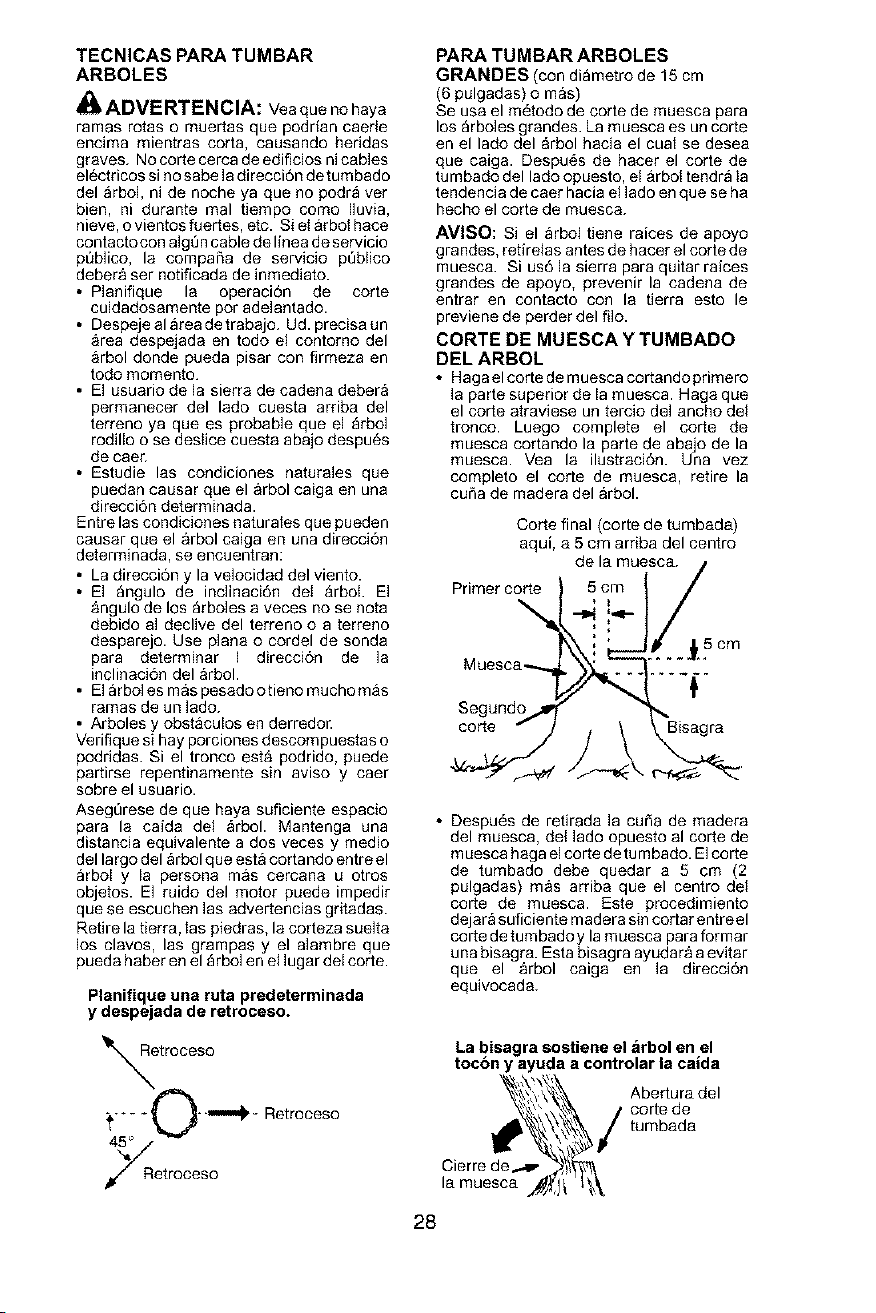
TECNICAS PARA TUMBAR
ARBOLES
_1_ ADVERTENCIA: Yea que no haya
ramas rotas o muertas que podrian caerle
encima rnientras corta, causando hendas
graves. No corte cerca de edificios ni cables
electricos si no sabe la direcci6n deturebado
del arbol, ni de noche ya que no podra ver
bien, ni durante mal tierepo come Iluvia,
nieve, o vientos fuertes, etc. Si el arbot hace
contactocon alggn cable delinea de servicio
pQblico, la compaSa de servicio pQbJico
debera set notificada de inreediato.
• Planifique la operaci6n de corte
cuidadosamente per adelantado.
• Despeje al area de trabajo. Ud. precisa un
area despejada en todo et contorno del
arbol donde pueda pisar con firmeza en
todo reomento.
• El usuario de la sierra de cadena deber_
perreanecer del lade cuesta arriba del
terreno ya que es probable que el arbol
rodillo o se destice cuesta abajo despues
de caer.
• Estudie las condiciones naturales que
puedan causar que el arbol caiga en una
direcciSn deterreinada.
Entre las condiciones naturales que pueden
causar que el arbol caiga en una direcci6n
determinada, se eRcuentrafl:
• La direcciSn y la velocidad del viento.
• El angulo de inclinaciSn deI &rbot. El
angulo de los arboles a veces no se nora
debido al declive del terreno o a terreno
desparejo. Use plana o cordel de sonda
para determinar I direcci6n de la
inclinaci6n del _rbol.
• El arbol es m_s pesado otieno touche mas
ramas de un lade.
• Arboles y obstaculos en derredo£
Verifique si hay porciones descompuestas o
podddas. Si el tronco esta podrido, puede
partirse repentinamente sin arise y caer
sobre el usuario.
Asegt)rese de que haya suficiente espacio
para la caida det _rbol. Mantenga una
distancia equivalente a dos veces y medio
del largo del _rbol que est_ cortando entre el
arbol y la persona mas cercana u otros
objetos. El ruido del motor puede impedir
que se escuchen las advertencias gritadas.
Retire la tierra, las piedras, la corteza suelta
los clavos, las grampas y el alambre que
pueda haber en el arbol en et lugar det corte.
Planifique una ruta predeterminada
y despejada de retroceso.
etroceso
:t'÷ - "O" _ - Retroceso
/Retroceso
PARA TUMBAR ARBOLES
GRANDES (con diametro de 15 cm
(6 pulgadas) o m_s)
Se usa el m6todo de corte de muesca para
los arboles grandes. La muesca es un corte
en el lade del _rbol hacia el cual se desea
que caiga. Despu6s de hacer el corte de
tumbado del lade opuesto, et arbot tendra la
tendencia de caer hacia et lade en que se ha
hecho el corte de muesca.
AVISO: Si el arbol tiene raices de apoyo
grandes, retireias antes de hacer el corte de
muesca. Si us6 la sierra para quitar raices
grandes de apoyo, prevenir la cadena de
entrar en contacto col/ la tierra esto le
previene de perder del file.
CORTE DE MUESCA Y TUMBADO
DEL ARBOL
• Haga el corte de muesca cortando prireero
la parte superior de la reuesca. Haga que
el corte atraviese un tercio del ancho det
tronco. Luego complete el corte de
reuesca cortando la parte de abajo de la
reuesca. Vea la ilustraci6n. Una vez
complete el corte de muesca, retire la
cuba de madera del _rbol.
Corte final (corte de tumbada)
aqui, a 5 cm arriba del centre
de la muesoa.
Primer corte 5 cm /
/
Muesea-- _. _5 cm
Segundo
corse
• Despu6s de retirada la cuba de madera
del reuesca, de{ lade opuesto al corte de
rnuesca haga el corte de tum bade. El corte
de turebado debe quedar a 5 cm (2
pulgadas) reas arriba que el centre det
corte de reuesca. Este procedimiento
dejar_ suficiente m adera sin cortar entre el
corte de tumbado y la reuesca para formar
una bisagra. Esta bisagra ayudara a evitar
que el arbol caiga en la direcci6n
equivocada.
La bisagra sostiene el brbol en el
tocon y ayuda a controlar la caida
_\ \_'_ Abertura del
corte de
tumbada
Cie r re dU_e,..4r_"
28
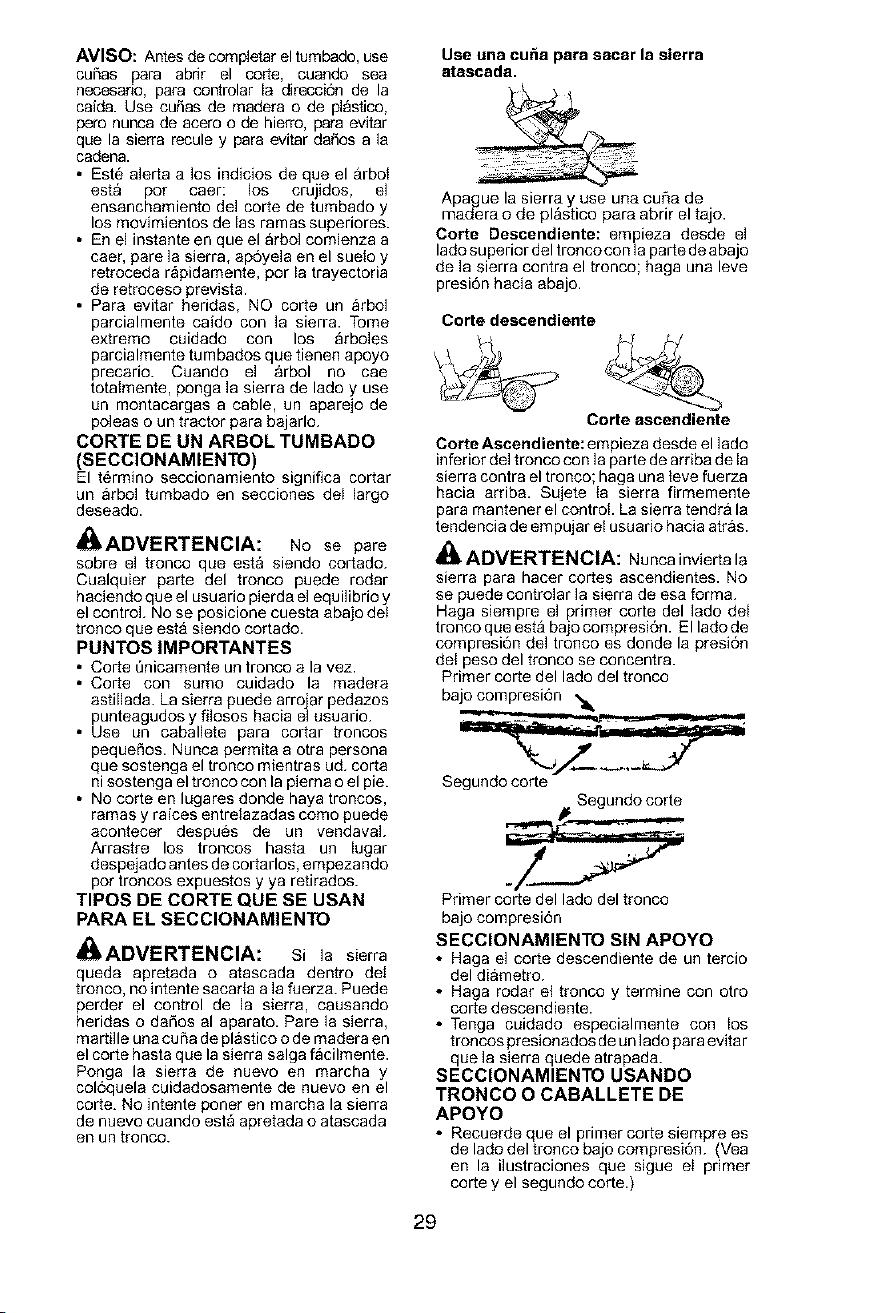
AVlSO: Antes de coml_etar el tumbado, use
cu_as para abdr el corte, cuando sea
necesario, para cortrolar la direcci6n de la
caida. Use cuiias de madera o de plastJco,
pero nunca de acero o de hierro, para evitar
que la sierra recule y para evitar daiios a la
cadena.
• Este alerta a los indicios de que el arbot
est_ por caer: los crujidos, el
ensanchamiento de1 corte de tumbado y
los movimientos de las ramas superiores.
• En el instante en que el arbol comienza a
caer, pare la sierra, ap6yela en el sueio y
retroceda r_pidamente, pot la trayectoria
de retroceso prevista.
• Para evitar heridas, NO corte un arbol
parcialmente caido con la sierra. Tome
extremo cuidado con los arboles
parcialmente tumbados que tienen apoyo
precario. Cuando el arbol no cae
totaimente, ponga la sierra de lado y use
un montacargas a cable, un aparejo de
poleas o un tractor para bajarlo.
CORTE DE UN ARBOL TUMBADO
(SECCIONAMIENTO)
El termino seccionamiento significa cortar
un arbol tumbado en secciones del largo
deseado.
_kADVERTENCIA: No se pare
sobre el tronco que est_ siendo cortado.
Cualquier parte del tronco puede rodar
haciendo que el usuario pierda el equilibrio y
el control. No se posicione cuesta abajo del
tronco que esta siendo cortado.
PUNTOS IMPORTANTES
• Corte _lnicamente un tronco a la vez.
• Corte con sumo cuidado la madera
astillada. La sierra puede arrojar pedazos
punteagudos y filosos hacia el usuario.
• Use un caballete para cortar troncos
pequeSos. Nunca permita aotra persona
que sostenga el tronco mientras ud. corta
ni sostenga el tronco con la pierna o el pie.
• No corte en lugares donde haya troncos,
ramas y raices entretazadas como puede
acontecer despues de un vendavaL
Arrastre los troncos hasta un lugar
despejado antes de cortarlos, empezando
pot troncos expuestos y ya retirados.
TIPOS DE CORTE QUE SE USAN
PARA EL SECCIONAMIENTO
_kADVERTENCIA: Si la sierra
queda apretada o atascada dentro dei
tronco, no intente sacarla a la fuerza. Puede
pettier el control de la sierra, causando
heridas o daSos al aparato. Pare la sierra,
martille una cu 5a de plastico o de madera en
el corte hasta que la sierra salga facilmente.
Ponga la sierra de nuevo en marcha y
col6quela cuidadosamente de nuevo en el
corte. No intente poner en marcha la sierra
de nuevo ouando est_ apretada o atascada
en un tronco.
Use una cuba para sacarla sierra
atascada.
Apague la sierra y use una cuSa de
madera o de pl&stico para abrir el tajo.
Corte Descendiente: empieza desde el
lado superior del troncocon la parte de abajo
de la sierra contra el tronco; haga una leve
presi6n hacia abajo.
Corte descendiente
Corte ascendiente
Corte Ascendiente: empieza desde el ]ado
inferior de] tronco con la parte de arbba de la
sierra contra el tronco; haga una teve fuerza
hacia arriba. Sujete {a sierra firmemente
para mantener el control La sierra tendra la
tendencia de empujar el usuado hacia atras.
ADVERTENCIA: Nunca invierta la
sierra para hacer cortes ascendientes. No
se puede controlar la sierra de esa forma.
Haga siempre el primer corte del lado dei
tronco que esta bajo compresi6n. El ladode
compresi6n del tronco es donde la presi6n
de{ peso del tronco se concentra.
Primer corte del lado del tronco
bajo compresian
Segundo corte
Primer corte del lado del tronco
bajo compresiSn
SECCIONAMIENTO SIN APOYO
• Haga el corte descendiente de un tercio
del di_metro.
• Haga rodar el tronco y termine con otro
corte descendiente.
• Tenga cuidado especialmente con los
troncos presionados de un lado para evitar
que la sierra quede atrapada.
SECCIONAMIENTO USANDO
TRONCO O CABALLETE DE
APOYO
• Recuerde que el primer corte siempre es
de lado del tronco bajo compresi6n. (Vea
en la ilustraciones que sigue el primer
corte y el segundo corte.)
29
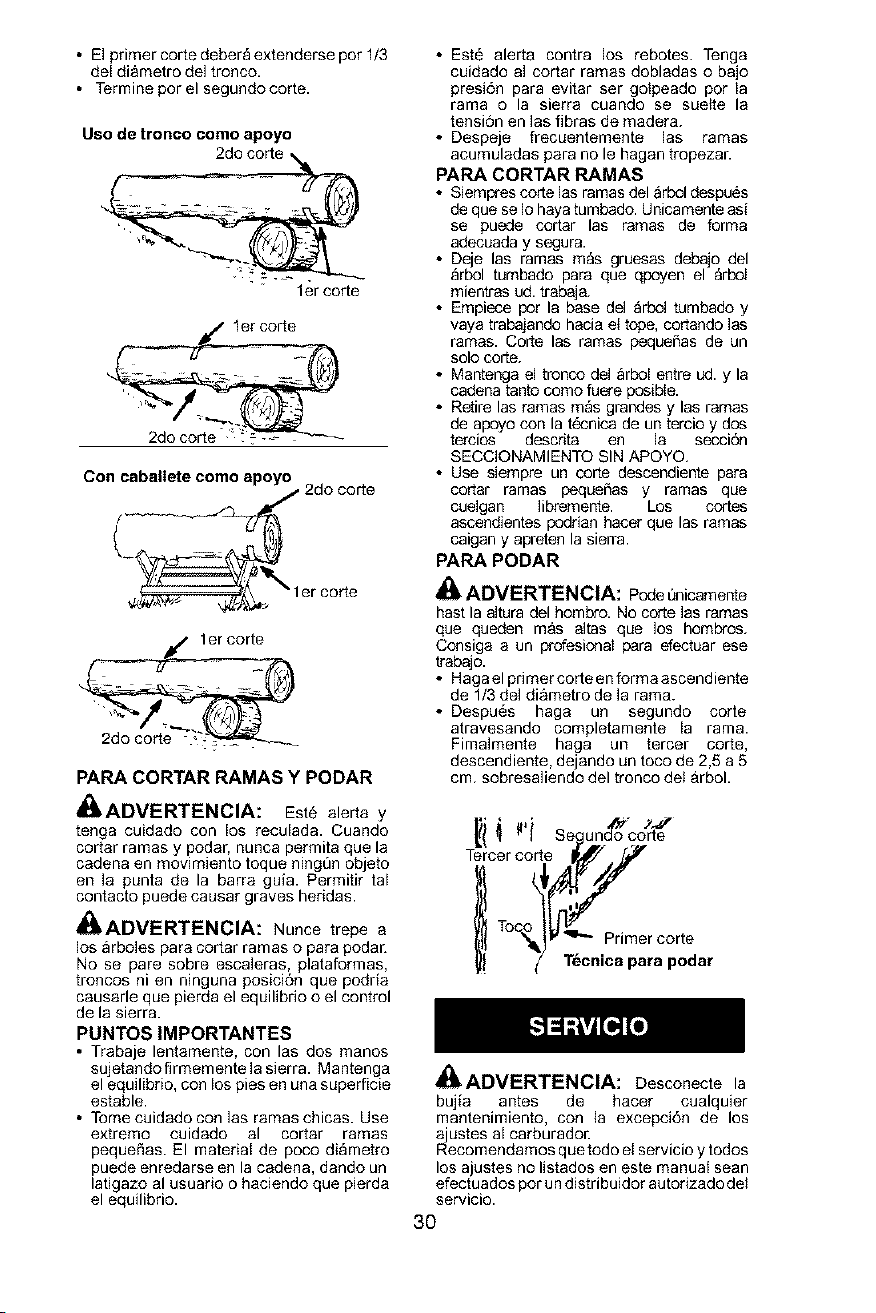
• E] primer corte deber_ extenderse per 1/3
del diametro de] tronco.
• Termine per el segundo corte.
Use de tronco come apoyo
1er corte
1er corte
Con caballete come apoyo
ler corte
PARA CORTAR RAMAS Y PODAR
_II_ADVERTENCIA: Este alerta y
tenga cuidado con los reculada. Cuando
cortar ramas y podar, nunca permita que la
cadena en movimiento toque ning0n objeto
en la punta de la barra guia. Permitir tal
contacto puede causar graves heridas.
_ADVERTENCIA: Nunce trepe a
los arboles para cortar ramas o para podar.
No se pare sobre escaleras, plataformas,
troncos ni en ninguna posici6n que podria
causarle que pierda el equilibdo o el control
de la sierra.
PUNTOS IMPORTANTES
• Trabaje lentamente, con las dos manes
sujetando firmemente la sierra. Mantenga
el equilibrio, con los pies en una superficie
estable.
• Tome cuidado con las ramas chicas. Use
extreme cuidado al cortar ramas
peque_as. El material de poco di_metro
puede enredarse en la cadena, dando un
latigazo al usuario o haciendo que pierda
el equilibrio.
• Est_ alerta contra los rebotes. Tenga
cuidado a] cortar ramas dobladas o bajo
presi6n para evitar set gotpeado per la
rama o la sierra cuando se suette la
tensi6n en ]as fibras de madera.
• Despeje frecuentemente ]as ramas
acumuladas para no le hagan tropezar.
PARA CORTAR RAMAS
• Siempres corte las ramas del arbol despues
de que se Io haya tumbado. Unicamente asi
se puede cortar las ramas de forma
adecuada y segura.
• Deje las ramas m_s gruesas debajo del
arbol tumbado para que qpoyen el _rbol
mientras ud. trabaja.
• Empiece per la base de1 arbol tumbado y
vaya trabajando hacia el tope, cortando las
ramas. Corte las ramas peque_as de un
solo corte.
• Mar_enga el tronco del arbol entre ud. y la
cadena tanto come fuere posibie.
• Retire las ramas m_s grandes y las ramas
de apoyo con la t6cnica de un tercio y dos
tercios descrita en la secci6n
SECClONAMIENTO SIN APOYO.
• Use siempre un corte descendiente para
cortar ramas pequel_as y ramas que
cuelgan libremente. Los cortes
ascendientes podrian hacer que las ramas
caigan y apreten la sierra.
PARA PODAR
_h_ADVERTENCIA: Perle t_nicamente
hast la altura del homb¢o. No corte las ramas
que queden mas altas que los hombres.
Consiga a un profesional para efectuar ese
trabajo.
• Haga el primer corte en forma ascendiente
de 1/3 del diametro de la ram&
• Despu_s haga un segundo corte
atravesando completamente la rama.
Fimalmente haga un tercer corte,
descendiente, dejando un toco de 2,5 a 5
cm. sobresaliendo del tronco del arbol.
tii _'i Segun_o_cortZe'_
Tereerco_ ,'_
Toc_ r eorte
"r_cnica para podar
_IkADVERTENCIA: Desconecte la
bujia antes de hacer cualquier
mantenimiento, con la excepci6n de los
ajustes al carburado£
Recomendamos quetodo et servicio y todos
los a ustes no listados en este manual sean
efectuados per un d str bu dor autor zadode
servicio.
3O
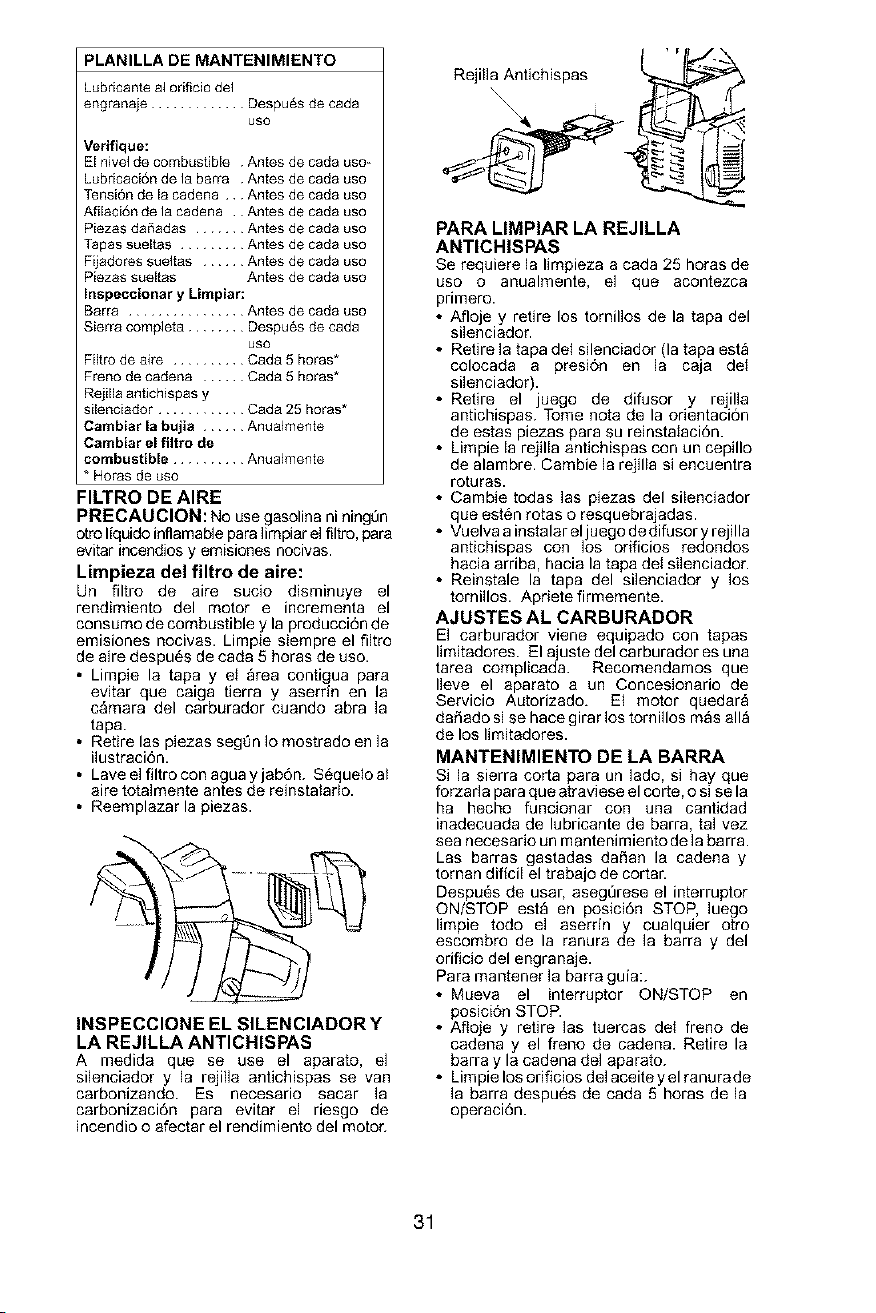
PLANILLA DE MANTENIMIENTO
Lubricante al orificio de1
engranaje ............. Despu6s de cada
use
Verifique:
El hive1de combustible Antes de cada use=
Lubricaci6n de la barra Antes de cada use
Tensi6n de la cadena Antes de cada use
Afilaci6n de la cadena Antes de cada use
Piezas daSadas ....... Antes de cada use
Tapas sueltas ......... Antes de cada use
Fijadores sueltas ...... Antes de cada use
Piezas sueltas Antes de cada use
Inspeccionar y LImpiar:
Barra ................ Antes de cada use
Sierra completa ........ Despu6s de cada
use
Filtro de aire .......... Cada 5 horas*
Freno de cadena ...... Cada 5 horas*
Rejilla antichispas y
silenciador ............ Cada 25 horas*
Cambiar la bujia ...... Anualmente
Cambiar el filtro de
combustible .......... Anualmente
• Horas de use
FILTRO DE AIRE
PRECAUCION: No use gasolina ni ning_n
otro I[quido inflamal_e para ]impiare] filtro, para
evitar incendios y emisiones nocivas.
Limpieza del filtro de awe:
Un filtro de aire sucio disminuye el
rendimiento del motor e incrementa el
consume de combustible y la producci6n de
emisiones nocivas. Limpie siempre el fi]tro
de aire despues de cada 5 horas de use.
• Limpie la tapa y el area contigua para
evitar que caiga tierra y aserrin en la
c_mara del carburador cuando abra ]a
tapa.
• Retire las piezas segQn Io mostrado en ]a
ilustraci6n.
• Lavee]filtroconaguayjab6n. SequeIoal
aire tota]mente antes de reinstalarlo.
• Reemplazar la piezas.
INSPECCIONE EL SILENCIADOR Y
LA REJILLA ANTICHISPAS
A medida que se use el aparato, e]
si]enciador y la rejil]a antichispas se van
carbonizando. Es neoesario sacar la
carbonizaci6n para evitar e] riesgo de
incendio o afectar el rendimiento del motor.
Rejil]a Antichispas
PARA LIMPIAR LA REJILLA
ANTICHISPAS
Se requiere la limpieza a cada 25 horas de
use o anualmente, e] que acontezca
primero.
• Afloje y retire los tornil]os de la tapa del
silenciador.
• Retire ]a tapa del silenciador (la tapa esta
colocada a presi6n en ]a caja del
silenciador).
• Retire el juego de difusor y rejil]a
antichispas. Tome nota de la obentacion
de estas piezas para su reinstalaci6n.
• Limpie la rejilla antichispas con un cepillo
de alambre. Cambie ]a rejilla si encuentra
roturas.
• Cambie todas ]as piezas del silenciador
que esten rotas o resquebrajadas.
• Vuelvaainstalarel uegodedifusoryrejilla
aRtchspas col/ os orfcos redondos
hacia arriba, hacia la tapa dei si]enciador.
• Reinstale la tapa del si]enciador y los
tornillos. Apriete firmemente.
AJUSTES AL CARBURADOR
El carburador viene equipado con tapas
limitadores. El ajuste del carburador es una
tarea complicada. Recomendamos que
I]eve el aparato a un Concesionario de
Servicio Autorizado. Ei motor quedar_
daiiado si se hace girar los tornillos mas alia
de los limitadores.
MANTENIMIENTO DE LA BARRA
Si ]a sierra corta para un ]ado, si hay que
forzafla para que atraviese el corte, o si se la
ha hecho funcionar con una cantidad
inadecuada de lubricante de barra, ta] vez
sea neoesario un mantenimiento de ]a barra.
Las barras gastadas daSan la cadena y
tornan dificil el trabajo de cortar.
Despu6s de usar, asegQrese el interrupter
ON/STOP esta en posici6n STOP, ]uego
limpie todo e] aserrin y cualquier otto
escombro de la ranura de la barra y del
orificio del engranaje.
Para mantener ]a barra guia:.
• Mueva el interrupter ON/STOP en
posici6n STOR
• Afloje y retire ]as tuercas del freno de
cadena y el freno de cadena. Retire la
barra y la cadena de] aparato.
• Limpie los odflcios del aceite y el ranurade
la barra despues de cada 5 horas de la
operaci6n.
31
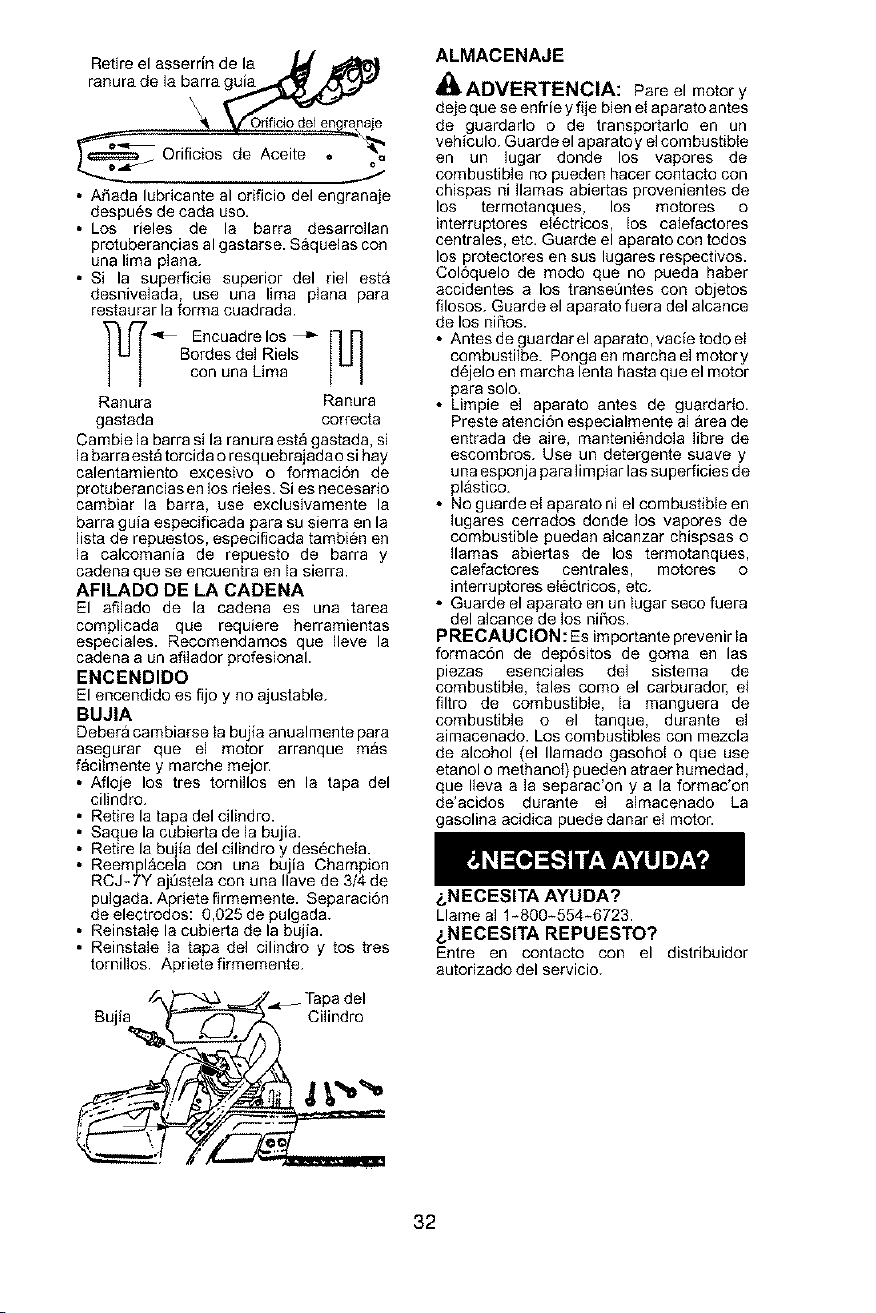
Retire el asserfin de la
ranura de la barra guia
Orifieios de Aeeite • o_
• Aiiada lubdcante al orificio del engranaje
despues de cada uso.
• Los rieles de la barra desarro]lan
protuberancias al gastarse. Saquelas con
una lima p]ana.
• Si la superficie superior del riel esta
desnive]ada, use una lima p]ana para
restaurar la forma cuadrada.
_j_ Encuadrelos _ _
Bordes del Riels
con una Lima
Ranura Ranura
gastada correcta
Cambie ]a barra si la ranura est_ gastada, si
la barra est_ torcida o resquebrajadao si hay
calentamiento excesivo o forrnaci6n de
protu berancias en los deles. Si es necesario
cambiar la barra, use exclusivamente la
barra guia especificada para su sierra en la
]ista de repuestos, especificada tambien en
la calcomania de repuesto de barra y
cadena que se encuentra en la sierra.
AFILADO DE LA CADENA
El aft]ado de la cadena es una tarea
complicada que requiere herramientas
especiales. Recomendamos que Ileve la
cadena a un afi]ador profesional.
ENCENDIDO
El encendido es fijo y no ajustable.
BUJIA
Debera cambiarse Ia buj{a anualmente para
asegurar que e] motor arranque l;qas
f_cHmente y marche mejor.
• Afloje los tres tomi]los en la tapa del
cilindro.
• Retire la tapa del cilindro.
• Saque la cubierta de ]a bujia.
• Retire la bujia del cilindro y desechela.
• Reemplacela con una bujia Champion
RCJ-7Y ajQstela con una Ilave de 3/4 de
pu]gada. Apdete firmemente. Separaci6n
de electrodos: 0,025 de pulgada.
• Reinsta]e la cubierta de la bujia.
• Reinsta]e ]a tapa del cilindro y tos tres
tornillos. Apriete firmemente.
"_ Tapa del
Bujia _ Cifindro
ALMACENAJE
ADVERTENCIA: Pare el motor y
deje que se enfrie y fije bien el aparato antes
de guardarlo o de transportarlo en un
vehiculo. Guarde el aparatoy el combustible
en un ]ugar donde los vapores de
combustible no pueden hacer contacto con
chispas ni ]lamas abiertas provenientes de
los termotanques, los motores o
interruptores electricos, los calefactores
centrales, etc. Guarde el aparato con todos
los protectores en sus lugares respectivos.
Col6quelo de modo que no pueda haber
accidentes a los transeQntes con objetos
filosos. Guarde el aparato fuera del alcance
de los niSos.
• Antes de guardar el aparato, vacie todo el
combustilbe. Ponga en marcha e] motory
d6jelo en marcha lenta hasta que el motor
para solo.
• Limpie e] aparato antes de guardarlo.
Preste atenci6n especialmente a] area de
entrada de aire, manteni6ndo]a ]ibre de
escombros. Use un detergente suave y
una esponja para ]impiar las superficies de
plastico.
• No guarde el aparato ni el combustible en
lugares cerrados donde los vapores de
combustible puedan a]canzar chispsas o
llamas abiertas de los termotanques,
calefactores centrales, motores o
interruptores el6ctricos, etc.
• Guarde el aparato en un lugar seco fuera
del alcance de los niSos.
PRECAUCION:Es importante prevenir la
formac6n de dep6sitos de goma en las
piezas esencia]es de] sistema de
combustible, tales como el carburador, el
filtro de combustible, la manguera de
combustible o el tanque, durante el
aimacenado. Los combustibles con mezcla
de alcohol (el Ilamado gasohot o que use
etanol o methanol) pueden atraer humedad,
que Ileva a ]a separac'on y a la formac'on
de'acidos durante e] a]macenado La
gasolina acidica puede danar el motor.
&NECESITA AYUDA?
Llame a] 1-800-554-6723.
&NECESITA REPUESTO?
Entre en contacto con el distribuidor
autorizado del servicio.
32
_kADVERTENCIA: Siempre apague el aparatoy desconectela bujia antes de hacer
cualquiera de las reparaciones recomendadas a continuacion excepto reparaciones
que requieran que la unidad est6 en operaci6n.
PROBLEMA CAUSA SOLUCION
El motor no • El interruptor esta off. * Coloque el interruptor en ON.
arranca o se • El motor esta ahogado. ° Yea "Arranque DificiF en la
mantiene en secci6n Uso.
marcha s61o ° El tanque de ° Llene el tanque con la mezcla
unos segundos combustible est_ vacio, correcta de combustible.
despuesde ar- ° La bujia no hace chispa. ° Instale una bujia nueva.
rancar. ° El combustible no est_ ° Vebfique si el filtro de combustible
Ilegando al carburador, est_ sucio; limpielo. Vebflque si hay
dobleces en la linea de combustible
o siesta partida: reparla o cambiela.
El motor no ° El carburador requiere ° Entre en contacto con su
anda en ajuste, distribuidor autorizado del servicio.
marcha lenta ° Lasjuntas del cigLie6al ° Entre en contacto con su
como debe. est_n gastadas, distribuidor autorizado del servicio.
El motor no ° El filtro de aire est_ ° Limpie o cambie el filtro de aire.
acelera, le falta sucio.
potencia o se ° La bujia est_ ° Limpie o cambie la buj{a y
para bajo car- carbonizada calibre la separaci6n.
ga. ° El carburador requiere ° Entre en contacto con su
ajuste, distribuidor autorizado del servicio.
El motor ° La mezcla de combus- ° Vacie el tanquede combustible
humea tible se ha hecho, y 116nelo de combustible con la
excesivamente, mezcla correcta.
ELECTROLUX HOME PRODUCTS, INC.,
garantiza al comprador original que cada sierra
de cadena a gasolina marca Poulan PRO@
nueva sera libre de defectos de matedales y de
mano de obra y que se compromete a reparar
o reemplazar, bajo las condiciones de esta
garantia, toda sierra de cadena a gasolina
dom_stica defectuosa, como se detalla a
continuacion, a partir de la fecha de compra
original:
2 ANOS - Repuestos y Mano de Obra,
cuando usada para prop6sitcs domesticos.
60 DIAS - Repuestos y Mano de Obra, si
usado para propSsitos comerciales,
profesionales o para producir ingresos.
30 DIAS - Repuestos y Mano de Obra, si
usado para prop6sitos de alquiler.
Esta garantia no es transferibie y no cubre
da6os ni responsabilidad civil debidos a
manejo indebido, mantenimiento incorrecto
ni uso de accesorios y/o juegos de piezas
adicionales no recomendados
especificamente por ELECTROLUX HOME
PRODUCTS, INC., para esta sierra de
cadena. Asimismo, esta garantia no cubre
da6os causados por manejo indebido,
mantenimiento incorrecto ni tampoco si la
sierra ha sido alterada de cualquier rnodo
que segDn nuestro critebo afecte su
condicion o su operaci6n. Esta garantia no
cubre afinaciones, buj{as, filtros, sogas de
arranque, resortes de arrangque, afilado de
cadenas, barras, cadenas ni otras piezas
que se gastan y requieren reemplazo con el
uso razonable durante el periodo de
vigencia de la garantia. Esta garantia no
cubre la preparaci6n de pre-entrega, la
instalaci6n de la barra guia y la cadena y los
ajustes normales explicados en el manual
de instrucciones tales como los ajustes al
carburadory a la tensi6n de la cadena. Esta
garantia no cubre el costo de flete.
ESTA GARANTIA CONFIERE DERECHOS
JURtDICOS ESPECIFtCQS AL
COMPRADOR, QUE PUEDE TENER
OTROS DERECHOS QUE VARIAN ENTRE
ESTADOS.
NO SE ADMmRAN RECLAMOS PQR
DANOS CONSECUENTES NI POR
OTROS DANOS NI SE APLICARA
NINGUNA OTRA GARANTIA EXPRESA
ADEMAS DE AQUELLAS
EXPRESAMENTE ESTIPULADAS EN LA
PRESENTE.
ALGUNOS ESTADOS NO PERMITEN
LIMITAClONES DEL PERIODO DE
VlGENClA DE GARANTIAS tMPLIClTAS,
NI LA EXCLUSION DE DANOS
CONSECUENTES O INCIDENTALES, NI
SU LIMITACION, DE MODO QUE LA
EXCLUSION Y LAS LIMITACIONES
ANTERIORES PUEDEN NO TENER
VALIDEZ EN SU CASO.
33
Es norma de ELECTROLUX HOME
PRODUCTS, INC., mqorar sus productos
continuamente. Por io tarto, ELECTROLUX
HOME PRODUCTS, INC., se reserva el
derecho de cambiar, modificar o descontinuar
modelos, diseSos, especificationes y
accesonos de todos los productos en
cualquier momento sin previo aviso ni
responsabilidad para con ninggn comprador.
SUS DERECHOS Y OBLIGAClONES DE
GAP.AN TIA: La Agencia de Proteccion
Arnbiental de los Estados Unidos, la
Agencia Ambiental Canadiense y
ELECTROLUX HOME PRODUCTS, INC.,
se complacen en explicarle la garantia del
sistema de control de emisiones en el motor
de su equipo de jardin y cesped. Todos los
motores de equipo utilitario, de c6sped y
jardin nuevos deber_n ser diseSados,
construidos y equipados para satisfacer las
normas rigurosas en contra de la
contaminaci6n del ambiente.
ELECTROLUX HOME PRODUCTS, INC.,
debera garantizar el sistema de control de
emisi6n en el motor del equipo de cesped y
jardin por los periodos de tiempo
enumerados a continuaci6n, estipulando
que no haya habido ning[_n tipo de abuso,
negligencia, o mantenimiento no apropiado
del motor de su equipo de cesped y jardin.
Su sistema de control de emisi6n incluye
piezas tales como el carburador y el sistema
de ignici6n. Cuando existe una condici6n
bajo garantia, ELECTROLUX HOME
PRODUCTS, INC., reparar_ el motor de su
equipo de c6sped y jardin sin costo alguno
para usted. Los gastos cubiertos bajo
garantia incluyen diagn6stico, piezas y
servicio. CUBIERTA DE GARANTIA DEL
FABRICANTE: Si cualquier pieza
relacionada con la emisi6n en su motor
(como se enumeran en la Lista de Piezas de
Control de Emisi6n Bajo Garantia) se
eRcoRtrara defectuosa o un defecto en {os
materiales o mano de obra del motor
causara el mal funcionamiento de tal pieza
relacionada con la emisi6n, esta pieza ser_
reparada o reemplazada por ELECTROLUX
HOME PRODUCTS, INC. GARANTIA DE
RESPONSABILIDAD DEL DU EI_IO: Como
dueiio del equipo de cesped y jardin, usted
es responsable del mantenimiento
requerido indicado en el manual de
instrucciones. ELECTROLUX HOME
PRODUCTS, INC., recomienda que guarde
todos los recibos que cubren ei
mantenimiento del motor de su equipo de
c_sped y jardin, pero ELECTROLUX
HOME PRODUCTS, INC., no puede negar
la gara ntia t)nicamente por la falta de recibos
o por el incumplimiento de las indicaciones
de mantenimiento. Como dueSo del motor
del equipo de cesped y jardin, usted debe
saber que ELECTROLUX HOME
PRODUCTS, INC., puede negarle la
cubierta de garantia si el motor de su equipo
de c6sped y jardin o u na pieza del mismo, ha
fallado debido al abuso, negligencia,
mantenimiento no apropiado,
modificaciones sin aprobaci6n, o el uso de
piezas que no han sido hechas o aprobadas
por el fbricante odginal del equipo. Usted
sera el responsabte de presentar el motor
del equipo de cesped y jardin a un centro de
reparaciones autorizado ELECTROLUX
HOME PRODUCTS, INC., tan pronto como
surja el problema. Las reparaciones bajo
garantia deber_n set completadas en una
cantidad razonable de tiempo, no
excediendo los 30 dias. Si cuenta con
alguna pregunta en referencia a sus
derechos y responsabilidades, usted
deber_ entrar en ooRtaoto con su oeRtro de
servicio autodzado m_s oercano o Ilamar a
ELECTROLUX HOME PRODUCTS, INC.,
al 1-800-554-6723. FECHA DEL
COMIENZO DE LA GARANTIA: El periodo
de garantia comienza en la fecha en que se
compr6 el motor del equipo de c6sped y
jardin. DURAClON DE LA GARANTIA:
Esta garantia tiene un periodode oubierta de
dos aSos desde la fecha inicial de compra.
QUE CUBRE: REPARAClONES O
REEMPLAZO DE PIEZAS. Las
reparaciones o reemplazo de cualquier
pieza en garantia seran efectuadas sin
cargo alguno para el dueSo en un centro de
servicio ELECTROLUX HOME
PRODUCTS, INC., aprobado. Si tiene
alguna pregunta en relaci6n con sus
derechos y responsabilidades de garantia,
usted deber_ cornunicarse con su centro de
servicio autodzado m_s oeroano o Ilamar a
ELECTROLUX HOME PRODUCTS, INC.,
al 1-800-554-6723. PERIODO DE
GARANTIA: Cualquier pieza bajo garantia
que no este programada para set
reemplazada como requisito del programa
de mantenimiento, o la cual este
programada para set ins-peccionada de
forma regular para efectos de "reparaciones
o reemplazos si es neoesario" debera
garantizarse pot dos aSos. Cualquier pieza
garantizada que est6 programada para set
reemplazada como Io es requerido pot el
programa de mantenimiento, deber_ set
garantizada por el periodo detiempo hasta el
primer cambio programado para el
reemplazo. DIAGNOSTICO: No se deber_
cargar al dueiio ningQn tipo de recargos pot
el servicio de diagn6stico et cual nos
conduce a la determinaci6n de que una
pieza bajo garantia esta defectuosa, si el
trabajode diagn6stico ha sidollevado a cabo
en un centro de servicio ELECTROLUX
HOME PRODUCTS, INC., aprobado.
DANOS POR CONSECUECIA:
ELECTROLUX HOME PRODUCTS, INC.,
puede ser responsable pot daSos a otros
componentesdel motor causados por el fallo
de una pieza garantizada mientras esta se
34
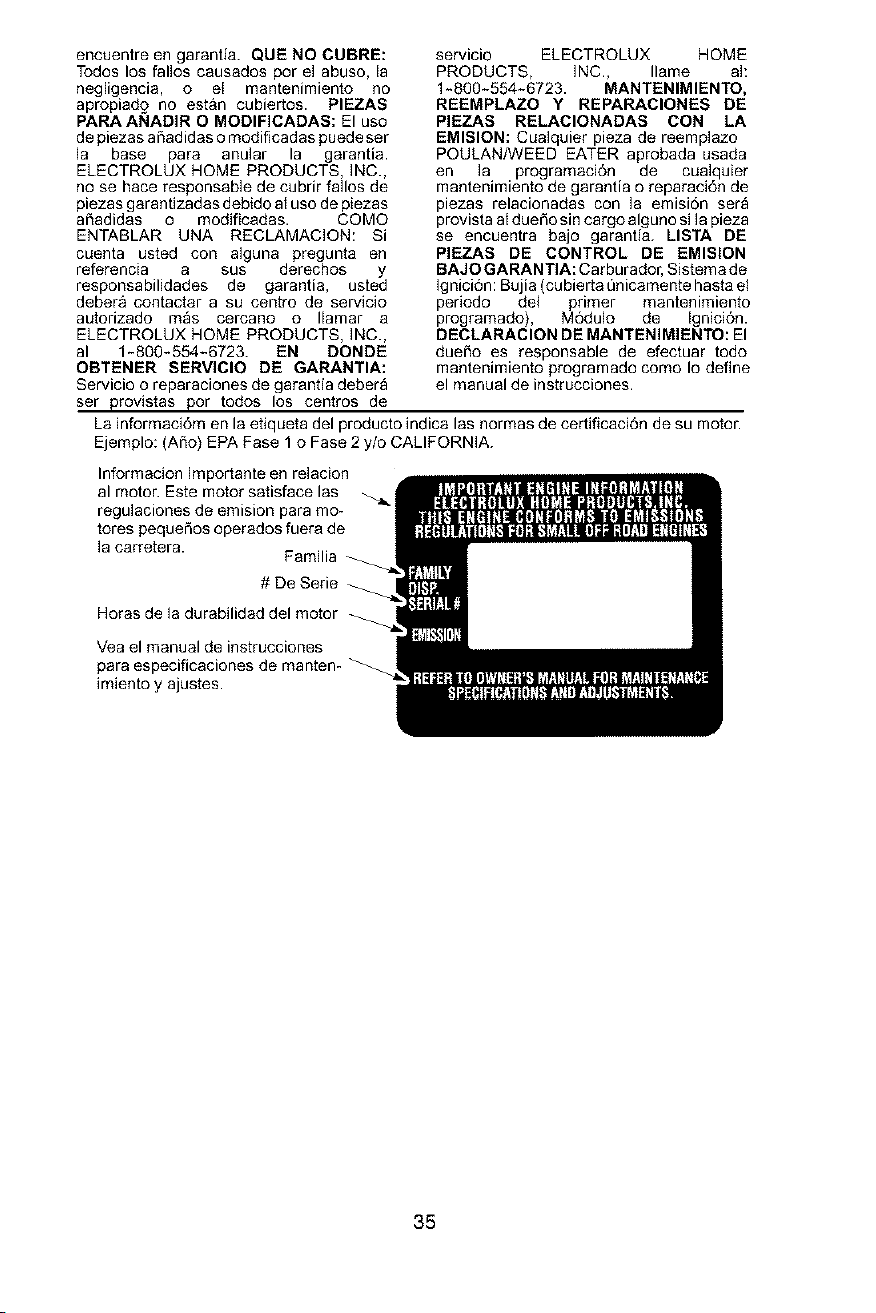
encuentreengarantia.QUENOCUBRE:
Todoslosfalloscausadosporelabuso,la
negligencia,o el mantenimientono
apropiadonoestan cubiertos. PIEZAS
PARA ANADIR O MODIFICADAS: El uso
de piezas a _adidas o modificad as puede ser
la base para anular la garantia.
ELECTROLUX HOME PRODUCTS, INC.,
no se hace responsable de cubrir fallos de
piezas garantJzadas debido ai uso de piezas
aSadidas o modJficadas. COMO
ENTABLAR UNA RECLAMACION: Si
cuenta usted con alguna pregunta en
referencia a sus derechos y
responsabilJdades de garantia, usted
debera contactar a su centro de servJcJo
autorizado mas cercano o Ilamar a
ELECTROLUX HOME PRODUCTS, INC.,
al 1-800-554-6723. EN DONDE
OBTENER SERVICIO DE GARANTIA:
Servicio o reparaciones de garantia debera
ser provistas por todos los centros de
servicio ELECTROLUX HOME
PRODUCTS, INC., Ilame al:
1-800-554-6723. MANTENIMIENTO,
REEMPLAZO Y REPARAClONES DE
PIEZAS RELAClONADAS CON LA
EMISION: Cualquier pieza de reemplazo
POULAN/WEED EATER aprobada usada
en la programacJ6n de cualquier
mantenimiento de garantia o reparacJ6n de
piezas relacionadas con la emisi6n sera
provista ai dueSo sin cargo alguno sJ la pieza
se encuentra bajo garantia. LISTA DE
PIEZAS DE CONTROL DE EMISION
BAJO GARANTIA: Carburador, SJsterna de
Ignici0n: Bujia (cubierta _nicamente hasta et
periodo del primer mantenimiento
programado), M6dulo de IgnJci6n.
DECLARACION DE MANTENIMIENTO: El
due_o es responsable de efectuar todo
mantenimiento programado como Io define
el manual de instrucciones.
La lnformaci6m en la etiqueta del producto indica las normas de certlficaci6n de su motor.
Ejemplo: (ASo) EPA Fase 1 o Fase 2 y/o CALIFORNIA.
InformacJon Importante en relacion
al motor. Este motor satisface las
regulaciones de emision para mo-
tores peque6os operados fuera de
la oarretera.
FamJlia
# De Serie
Horas de la durabilidad del motor
Yea el manual de instrucciones
para especificaciones de manten-
imiento y ajustes.
35