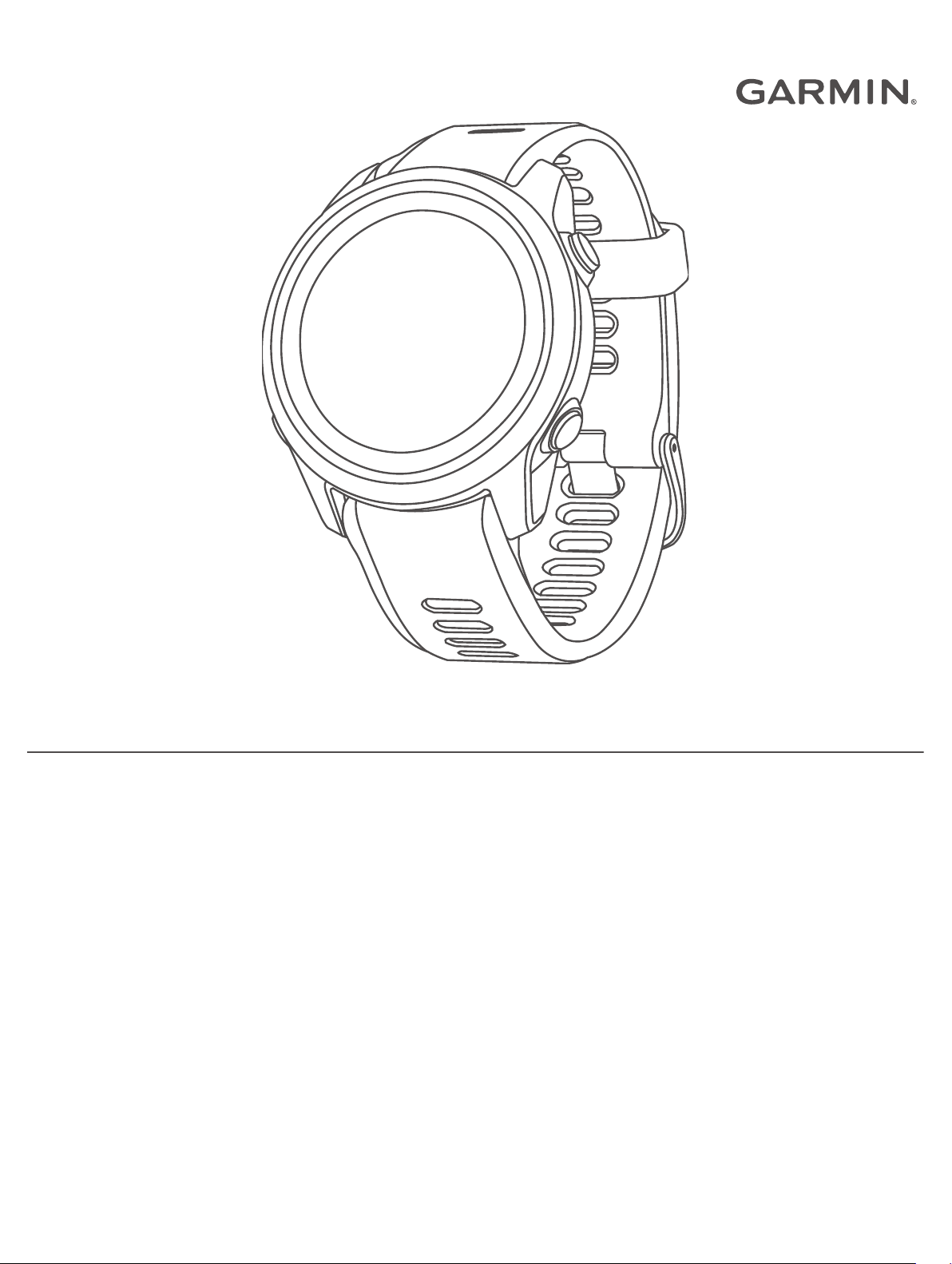
FORERUNNER
®
745
Owner’s Manual

© 2020 Garmin Ltd. or its subsidiaries
All rights reserved. Under the copyright laws, this manual may not be copied, in whole or in part, without the written consent of Garmin. Garmin reserves the right to change or
improve its products and to make changes in the content of this manual without obligation to notify any person or organization of such changes or improvements. Go to
www.garmin.com for current updates and supplemental information concerning the use of this product.
Garmin
®
, the Garmin logo, ANT+
®
, Auto Lap
®
, Auto Pause
®
, Edge
®
, Forerunner
®
, inReach
®
, QuickFit
®
, Rally
™
, TracBack
®
, Vector
™
, VIRB
®
, and Virtual Partner
®
are trademarks of Garmin
Ltd. or its subsidiaries, registered in the USA and other countries. Body Battery
™
, Connect IQ
™
, Firstbeat Analytics
™
, Garmin Connect
™
, Garmin Express
™
, Garmin Index
™
, Garmin
Move IQ
™
, Garmin Pay
™
, HRM-Pro
™
, HRM-Swim
™
, HRM-Tri
™
, tempe
™
, TrueUp
™
, and Varia
™
are trademarks of Garmin Ltd. or its subsidiaries. These trademarks may not be used
without the express permission of Garmin.
Android
™
is a trademark of Google Inc. Apple
®
, iPhone
®
, iTunes
®
, and Mac
®
are trademarks of Apple Inc., registered in the U.S. and other countries. The BLUETOOTH
®
word mark
and logos are owned by the Bluetooth SIG, Inc. and any use of such marks by Garmin is under license. The Cooper Institute
®
, as well as any related trademarks, are the property of
The Cooper Institute. Advance heartbeat analytics by Firstbeat. iOS
®
is a registered trademark of Cisco Systems, Inc. used under license by Apple Inc. Shimano
®
is a registered
trademark of Shimano, Inc. The Spotify
®
software is subject to third-party licenses found here: https://developer.spotify.com/legal/third-party-licenses. Strava
™
is a trademark of
Strava, Inc. Training Stress Score
™
, Intensity Factor
™
, and Normalized Power
™
are trademarks of Peaksware, LLC. Wi‑Fi
®
is a registered mark of Wi-Fi Alliance Corporation.
Windows
®
and Windows NT
®
are registered trademarks of Microsoft Corporation in the United States and other countries. Zwift
™
is a trademark of Zwift, Inc. Other trademarks and
trade names are those of their respective owners.
This product is ANT+
®
certified. Visit www.thisisant.com/directory for a list of compatible products and apps.
M/N: A03989

Table of Contents
Introduction..................................... 1
Device Overview...................................... 1
GPS Status and Status Icons............. 2
Setting Up Your Watch........................... 2
Activities and Apps.......................... 3
Going for a Run....................................... 3
Starting an Activity..................................4
Tips for Recording Activities.............. 4
Stopping an Activity................................ 4
Evaluating an Activity............................. 5
Adding an Activity................................... 5
Creating a Custom Activity.................... 5
Indoor Activities...................................... 5
Going for a Virtual Run........................6
Calibrating the Treadmill Distance.... 6
Recording a Strength Training
Activity................................................. 6
Recording an Indoor Climbing
Activity................................................. 7
Using an ANT+® Indoor Trainer.........8
Outdoor Activities................................... 8
Multisport............................................ 8
Going for a Track Run......................... 9
Recording an Ultra Run Activity..........9
Swimming............................................ 9
Skiing and Winter Sports.................. 12
Recording a Bouldering Activity....... 13
Playing Audio Prompts During Your
Activity................................................... 13
Training......................................... 14
Workouts............................................... 14
Following a Workout From Garmin
Connect............................................. 14
Creating a Custom Workout on
Garmin Connect................................ 14
Sending a Custom Workout to Your
Device................................................ 14
Starting a Workout............................ 15
Following a Daily Suggested
Workout............................................. 15
Following a Pool Swim Workout...... 15
About the Training Calendar............ 16
Interval Workouts.............................. 16
Using Virtual Partner®......................... 18
Setting a Training Target......................18
Cancelling a Training Target............ 18
Racing a Previous Activity....................19
PacePro Training.................................. 19
Creating a PacePro Plan on Your
Watch.................................................19
Starting a PacePro Plan................... 20
Stopping a PacePro Plan..................20
Personal Records................................. 20
Viewing Your Personal Records.......21
Restoring a Personal Record........... 21
Clearing a Personal Record.............. 21
Clearing All Personal Records..........21
Segments.............................................. 21
Strava™ Segments............................ 21
Racing a Segment............................. 22
Viewing Segment Details................. 22
Using the Metronome........................... 22
Extended Display Mode........................ 22
Setting Up Your User Profile................ 23
Fitness Goals.................................... 23
About Heart Rate Zones................... 23
Setting Your Cycling Power Zones.. 25
Pausing Your Training Status.............. 25
Resuming Your Paused Training
Status.................................................25
Activity Tracking............................ 26
Auto Goal...............................................26
Using the Move Alert............................ 26
Turning on the Move Alert................ 26
Sleep Tracking...................................... 26
Using Automated Sleep Tracking.... 27
Using Do Not Disturb Mode..............27
Intensity Minutes.................................. 27
Earning Intensity Minutes................. 27
Garmin Move IQ™ Events..................... 27
Activity Tracking Settings.................... 27
Turning Off Activity Tracking........... 28
Hydration Tracking............................... 28
Using the Hydration Tracking
Widget................................................28
Menstrual Cycle Tracking.................... 28
Heart Rate Features....................... 28
Wrist-based Heart Rate........................ 29
Table of Contents i

Wearing the Device........................... 29
Tips for Erratic Heart Rate Data....... 29
Viewing the Heart Rate Widget........ 30
Broadcasting Heart Rate Data to
Garmin® Devices.............................. 30
Broadcasting Heart Rate Data During
an Activity.......................................... 30
Setting an Abnormal Heart Rate
Alert................................................... 31
Turning Off the Wrist-based Heart
Rate Monitor......................................31
Chest Heart Rate While Swimming..... 31
HRM-Pro Accessory............................. 31
Putting On the Heart Rate Monitor.. 32
Heart Rate Storage for Timed
Activities............................................ 32
Accessing Stored Heart Rate Data.. 32
Pool Swimming................................. 33
Caring for the Heart Rate Monitor... 33
Tips for Erratic Heart Rate Data....... 33
HRM-Swim Accessory.......................... 33
Sizing the Heart Rate Monitor.......... 33
Putting On the Heart Rate Monitor.. 34
Tips for Using the HRM-Swim
Accessory.......................................... 34
Running Dynamics................................ 34
Training with Running Dynamics..... 35
Color Gauges and Running Dynamics
Data....................................................36
Tips for Missing Running Dynamics
Data....................................................37
Performance Measurements............... 38
Turning Off Performance
Notifications...................................... 38
Detecting Performance
Measurements Automatically.......... 38
Syncing Activities and Performance
Measurements.................................. 38
About VO2 Max. Estimates.............. 39
Viewing Your Fitness Age................ 40
Heat and Altitude Performance
Acclimation....................................... 40
Viewing Your Predicted Race
Times................................................. 41
About Training Effect........................41
Performance Condition.................... 42
Lactate Threshold............................. 42
Getting Your FTP Estimate............... 43
Training Status......................................44
Training Status Levels...................... 45
Tips for Getting Your Training
Status.................................................45
Training Load.................................... 45
Recovery Time.................................. 46
Pulse Oximeter......................................47
Getting Pulse Oximeter Readings.... 47
Turning On Pulse Oximeter Sleep
Tracking............................................. 48
Turning On All-Day Acclimation
Mode.................................................. 48
Tips for Erratic Pulse Oximeter
Data....................................................48
Viewing Your Heart Rate Variability
Stress Score.......................................... 48
Body Battery.......................................... 48
Viewing the Body Battery Widget.....49
Tips for Improved Body Battery
Data....................................................49
Using the Stress Level Widget............. 50
Smart Features.............................. 50
Pairing Your Smartphone with Your
Device.................................................... 50
Tips for Existing Garmin Connect
Users.................................................. 50
Enabling Bluetooth Notifications..... 51
Bluetooth Connected Features............ 52
Manually Syncing Data with Garmin
Connect............................................. 52
Updating the Software Using the
Garmin Connect App........................ 53
Locating a Lost Mobile Device......... 53
Widgets................................................. 54
Viewing the Widgets......................... 55
Customizing the My Day Widget...... 55
Viewing the Controls Menu.................. 55
Customizing the Controls Menu...... 56
Opening the Music Controls.............56
Connect IQ Features............................. 56
Downloading Connect IQ Features
Using Your Computer....................... 56
Wi‑Fi Connected Features.................... 56
Connecting to a Wi‑Fi Network........ 57
Safety and Tracking Features......... 57
Adding Emergency Contacts............... 57
ii Table of Contents

Requesting Assistance..................... 57
Turning Incident Detection On and
Off.......................................................... 58
Starting a GroupTrack Session............ 58
Tips for GroupTrack Sessions......... 58
Music............................................. 58
Connecting to a Third-Party Provider.. 59
Spotify®................................................ 59
Downloading Audio Content from
Spotify................................................59
Downloading Personal Audio
Content.................................................. 59
Listening to Music................................ 60
Music Playback Controls..................60
Controlling Music Playback on a
Connected Smartphone....................60
Changing the Audio Mode................ 61
Connecting Bluetooth Headphones.... 61
Garmin Pay.................................... 61
Setting Up Your Garmin Pay Wallet..... 61
Adding a Card to Your Garmin Pay
Wallet..................................................... 61
Managing Your Garmin Pay Cards.. 61
Paying for a Purchase Using Your
Watch.................................................... 62
Changing Your Garmin Pay
Passcode.............................................. 62
History........................................... 62
Using History.........................................63
Multisport History............................. 63
Viewing Your Time in Each Heart Rate
Zone................................................... 63
Viewing Data Totals............................. 63
Using the Odometer..............................63
Deleting History.................................... 64
Garmin Connect.................................... 64
Using Garmin Connect on Your
Computer........................................... 65
Data Management................................ 65
Deleting Files..................................... 65
Navigation......................................65
Courses................................................. 65
Following a Course on Your
Device................................................ 66
Creating a Course on Garmin
Connect............................................. 66
Saving Your Location........................... 67
Editing Your Saved Locations.......... 67
Deleting All Saved Locations........... 67
Navigating to Your Starting Point During
an Activity..............................................67
Navigating to the Starting Point of Your
Last Saved Activity............................... 68
Navigating to a Saved Location........... 68
Map........................................................ 68
Viewing the Map............................... 68
Panning and Zooming the Map........69
Map Settings..................................... 69
Altimeter and Barometer...................... 69
Navigation Settings.............................. 69
Customizing Map Features.............. 69
Setting Up a Heading Bug................ 69
Setting Navigation Alerts..................70
Wireless Sensors........................... 70
Pairing Your Wireless Sensors.............70
Foot Pod................................................ 70
Going for a Run Using a Foot Pod... 70
Foot Pod Calibration......................... 71
Setting Foot Pod Speed and
Distance.............................................71
Using an Optional Bike Speed or
Cadence Sensor.................................... 71
Training with Power Meters................. 72
Using Electronic Shifters...................... 72
Situational Awareness..........................72
tempe.................................................... 72
Customizing Your Device............... 72
Customizing Your Activity List............. 72
Customizing the Widget Loop............. 72
Activities and App Settings.................. 73
Customizing the Data Screens.........74
Adding a Map to an Activity............. 74
Alerts................................................. 75
Auto Lap............................................ 76
Enabling Auto Pause........................ 77
Enabling Auto Climb......................... 77
Enabling Self Evaluation................... 77
Table of Contents iii

3D Speed and Distance.................... 78
Using Auto Scroll.............................. 78
Changing the GPS Setting................ 78
Power Save Timeout Settings.......... 79
Removing an Activity or App................ 79
GroupTrack Settings.............................79
Watch Face Settings.............................79
Customizing the Watch Face........... 79
Sensors Settings...................................80
Altimeter Settings............................. 80
Barometer Settings........................... 80
System Settings.................................... 81
Time Settings.................................... 81
Changing the Backlight Settings......81
Customizing the Hot Keys................ 82
Changing the Units of Measure....... 82
Clocks.................................................... 82
Setting an Alarm............................... 82
Deleting an Alarm............................. 82
Starting the Countdown Timer......... 82
Using the Stopwatch.........................83
Syncing the Time with GPS.............. 83
Setting the Time Manually............... 83
VIRB Remote......................................... 83
Controlling a VIRB Action Camera... 84
Controlling a VIRB Action Camera
During an Activity.............................. 84
Device Information......................... 85
Viewing Device Information................. 85
Viewing E-label Regulatory and
Compliance Information...................85
Charging the Device............................. 85
Tips for Charging the Device............ 85
Wearing the Device............................... 86
Device Care........................................... 86
Cleaning the Device.......................... 86
Changing the Bands............................. 87
Forerunner Specifications.................... 89
Troubleshooting.............................89
Product Updates................................... 89
Setting Up Garmin Express.............. 89
Getting More Information.....................89
Activity Tracking................................... 90
My daily step count does not
appear................................................ 90
My step count does not seem
accurate.............................................90
The step counts on my device and my
Garmin Connect account don't
match................................................. 90
The floors climbed amount does not
seem accurate.................................. 90
My intensity minutes are flashing....90
Acquiring Satellite Signals................... 91
Improving GPS Satellite Reception.. 91
Restarting the Device........................... 91
Resetting All Default Settings.............. 91
Updating the Software Using the Garmin
Connect App......................................... 91
Updating the Software Using Garmin
Express.................................................. 92
My Device is in the Wrong Language.. 92
Is my smartphone compatible with my
device?.................................................. 92
My phone will not connect to the
device.................................................... 92
Maximizing Battery Life........................93
The temperature reading is not
accurate................................................ 93
How can I manually pair ANT+
sensors?................................................ 93
Can I use my Bluetooth sensor with my
watch?................................................... 94
My music cuts out or my headphones do
not stay connected............................... 94
Appendix........................................95
Data Fields............................................ 95
VO2 Max. Standard Ratings............... 101
FTP Ratings.........................................102
Wheel Size and Circumference..........103
Symbol Definitions............................. 104
Index............................................105
iv Table of Contents
Introduction
WARNING
See the Important Safety and Product Information guide in the product box for product warnings and other
important information.
Always consult your physician before you begin or modify any exercise program.
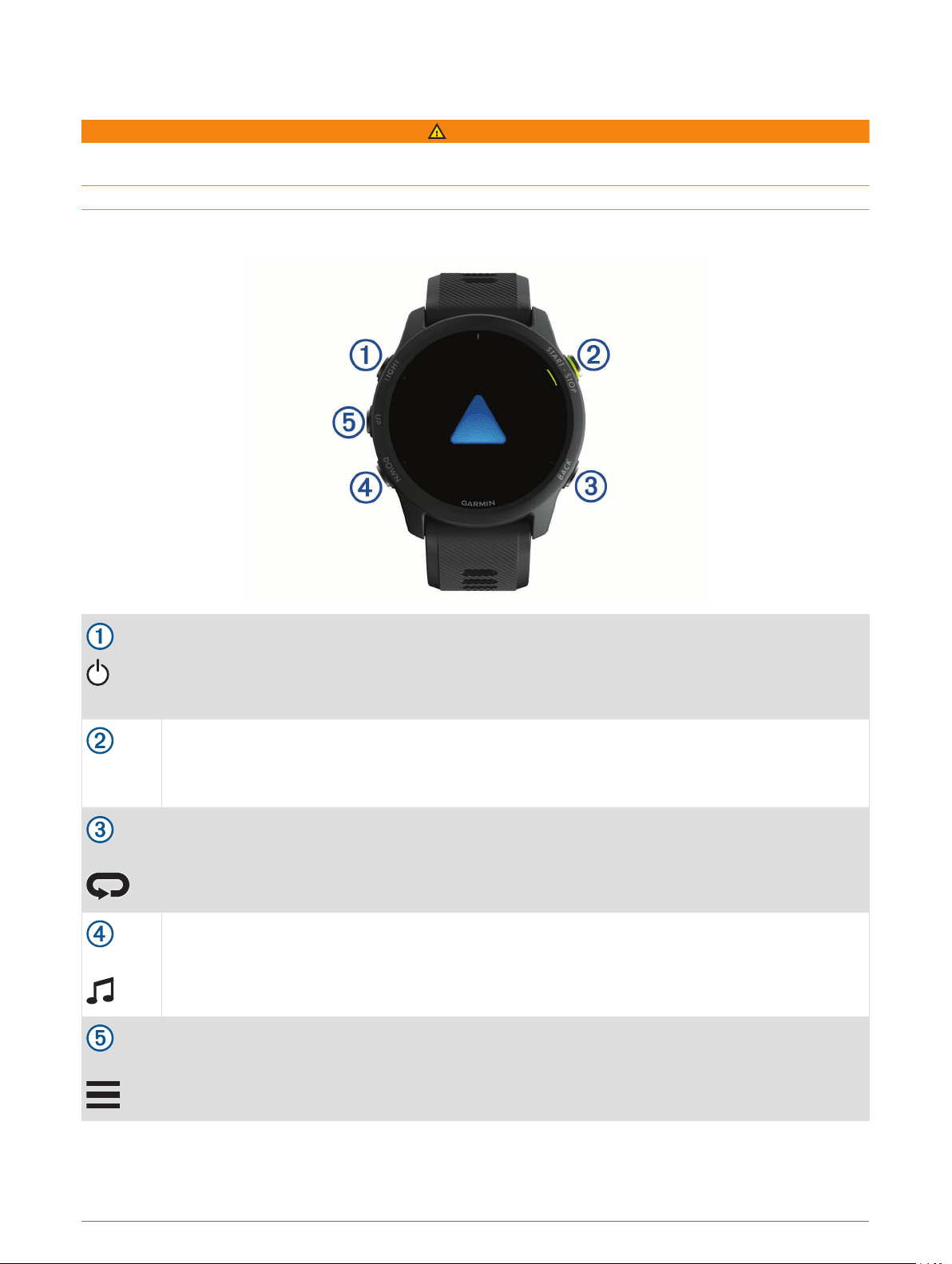
Device Overview
LIGHT
Select to turn the device on.
Select to turn the backlight on and off.
Hold to view the controls menu.
START
STOP
Select to start and stop the activity timer.
Select to choose an option or to acknowledge a message.
BACK
Select to return to the previous screen.
Select to record a lap, rest, or transition during an activity.
DOWN
Select to scroll through the widgets, data screens, options, and settings.
Hold to open the music controls (Music, page 58).
UP
Select to scroll through the widgets, data screens, options, and settings.
Hold to view the menu.
Hold to manually change sports during an activity.
Introduction 1
GPS Status and Status Icons
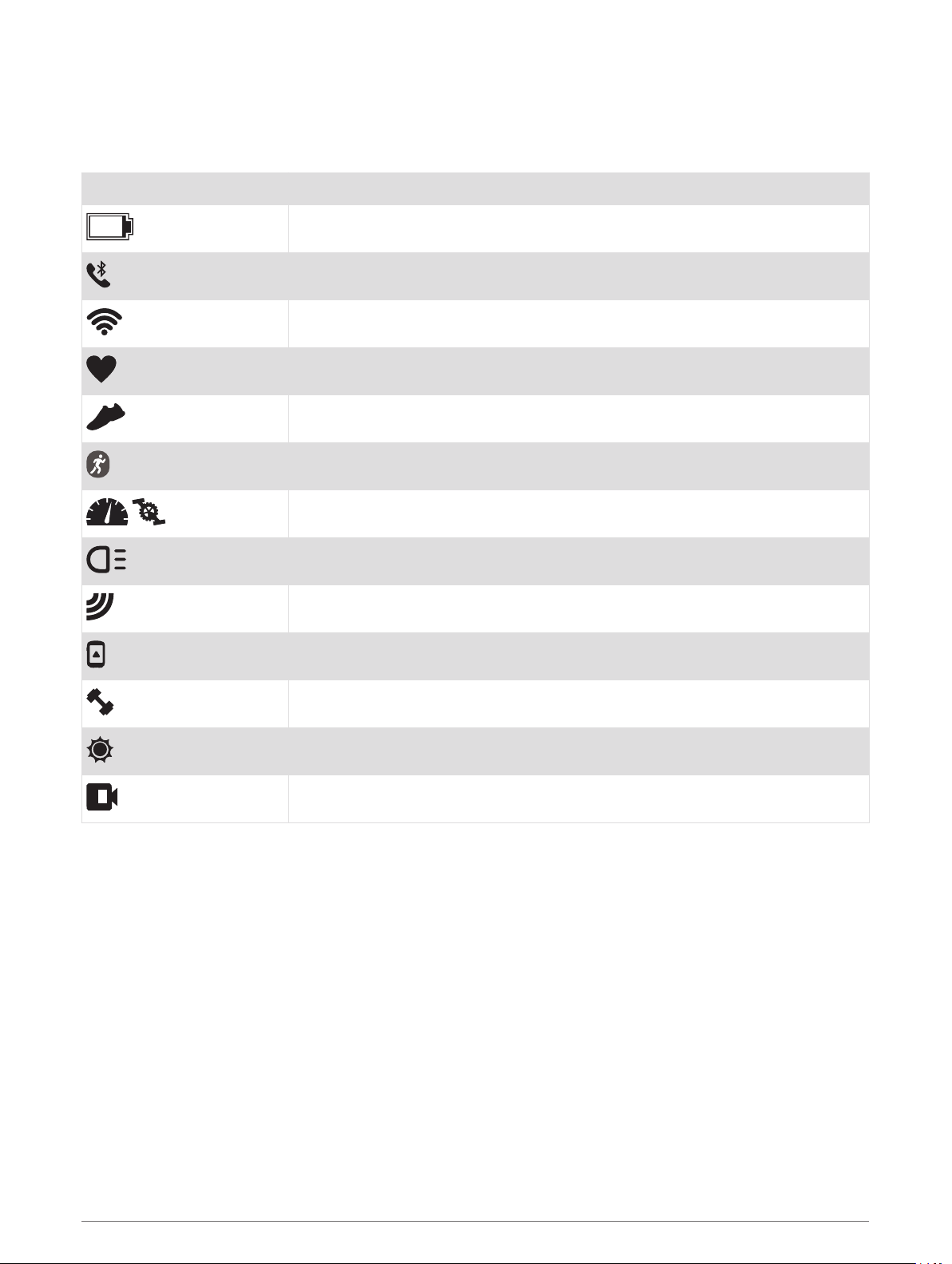
The GPS status ring and icons temporarily overlay each data screen. For outdoor activities, the status ring turns
green when GPS is ready. A flashing icon means the device is searching for a signal. A solid icon means the
signal was found or the sensor is connected.
GPS GPS status
Battery status
Smartphone connection status
Wi‑Fi
®
technology status
Heart rate status
Foot pod status
Running Dynamics Pod status
Speed and cadence sensor status
Bike lights status
Bike radar status
Extended display mode status
Power meter status
tempe
™
sensor status
VIRB
®
camera status
Setting Up Your Watch
To take full advantage of the Forerunner features, complete these tasks.
• Pair the Forerunner device with your smartphone using the Garmin Connect
™
app (Pairing Your Smartphone
with Your Device, page 50).
• Set up safety features (Safety and Tracking Features, page 57).
• Set up music (Music, page 58).
• Set up Wi‑Fi networks (Connecting to a Wi‑Fi Network, page 57).
• Set up your Garmin Pay
™
wallet (Setting Up Your Garmin Pay Wallet, page 61).
2 Introduction
Activities and Apps
Your device can be used for indoor, outdoor, athletic, and fitness activities. When you start an activity, the
device displays and records sensor data. You can save activities and share them with the Garmin Connect
community.
You can also add Connect IQ
™
activities and apps to your device using the Connect IQ app (Connect IQ Features,
page 56).
For more information about activity tracking and fitness metric accuracy, go to garmin.com/ataccuracy.
Going for a Run
The first fitness activity you record on your device can be a run, ride, or any outdoor activity. You may need to
charge the device before starting the activity (Charging the Device, page 85).
The device records activity data only while the activity timer is running.
1 Select START, and select an activity.
2 Go outside, and wait while the device locates satellites.
3 Select START.
4 Go for a run.
NOTE: On a Forerunner 745, hold DOWN while in an activity to open the music controls.
5 After you complete your run, select STOP.
6 Select an option:
• Select Resume to restart the activity timer.
• Select Save to save the run and reset the activity timer. You can select the run to view a summary.
NOTE: For more run options, see Stopping an Activity, page 4.
Activities and Apps 3
Starting an Activity
When you start an activity, GPS turns on automatically (if required). If you have an optional wireless sensor, you
can pair it to the Forerunner device (Pairing Your Wireless Sensors, page 70).
1 From the watch face, select START.
2 Select an activity.
NOTE: Activities set as favorites appear first in the list (Customizing Your Activity List, page 72).
3 Select an option:
• Select an activity from your favorites.
• Select , and select an activity from the extended activity list.
4 If the activity requires GPS signals, go outside to an area with a clear view of the sky.
5 Wait until GPS appears.
The device is ready after it establishes your heart rate, acquires GPS signals (if required), and connects to
your wireless sensors (if required).
6 Select START to start the activity timer.
The device records activity data only while the activity timer is running.
NOTE: You can hold DOWN while in an activity to open the music controls.
Tips for Recording Activities
• Charge the device before starting an activity (Charging the Device, page 85).
• Press to record laps, start a new set or pose, or advance to the next workout step.
• Press UP or DOWN to view additional data pages.
Stopping an Activity
1 Press STOP.
2 Select an option:
• To resume your activity, select Resume.
• To save the activity and return to watch mode, select Save > > Done.
NOTE: If self evaluation is enabled, you can enter your perceived effort for the activity (Enabling Self
Evaluation, page 77).
• To suspend your activity and resume it at a later time, select Resume Later.
• To mark a lap, select Lap.
• To navigate back to the starting point of your activity along the path you traveled, select Back to Start >
TracBack.
NOTE: This feature is available only for activities that use GPS.
• To navigate back to the starting point of your activity by the most direct path, select Back to Start >
Straight Line.
NOTE: This feature is available only for activities that use GPS.
• To measure the difference between your heart rate at the end of the activity and your heart rate two
minutes later, select Recovery HR, and wait while the timer counts down.
• To discard the activity and return to watch mode, select Discard > Yes.
NOTE: After stopping the activity, the device saves it automatically after 30 minutes.
4 Activities and Apps
Evaluating an Activity
Before you can evaluate an activity, you must enable the self-evaluation setting on your Forerunner device
(Enabling Self Evaluation, page 77).
You can record how you felt during a run, bike, or swim activity.
1 After you complete an activity, select Save (Stopping an Activity, page 4).
2 Select a number that corresponds with your perceived effort.
NOTE: You can select to skip the self evaluation.
3 Select how you felt during the activity.
You can view evaluations in the Garmin Connect app.
Adding an Activity
Your device comes preloaded with a number of common indoor and outdoor activities. You can add these
activities to your activity list.
1 Select START.
2 Select Add.
3 Select an activity from the list.
4 Select Yes to add the activity to your list of favorites.
5 Select a location in the activity list.
6 Press START.
Creating a Custom Activity
1 From the watch face, select START > Add.
2 Select an option:
• Select Copy Activity to create your custom activity starting from one of your saved activities.
• Select Other to create a new custom activity.
3 If necessary, select an activity type.
4 Select a name or enter a custom name.
Duplicate activity names include a number, for example: Bike(2).
5 Select an option:
• Select an option to customize specific activity settings. For example, you can customize the data screens
or auto features.
• Select Done to save and use the custom activity.
6 Select Yes to add the activity to your list of favorites.
Indoor Activities
The Forerunner device can be used for training indoors, such as running on an indoor track or using a stationary
bike or indoor trainer. GPS is turned off for indoor activities.
When running or walking with GPS turned off, speed, distance, and cadence are calculated using the
accelerometer in the device. The accelerometer is self-calibrating. The accuracy of the speed, distance, and
cadence data improves after a few outdoor runs or walks using GPS.
TIP: Holding the handrails of the treadmill reduces accuracy. You can use an optional foot pod to record pace,
distance, and cadence.
When cycling with GPS turned off, speed and distance data are not available unless you have an optional
sensor that sends speed and distance data to the device, such as a speed or cadence sensor.
Activities and Apps 5
Going for a Virtual Run
You can pair your Forerunner device with a compatible third-party app to transmit pace, heart rate, or cadence
data.
1 Select START > Virtual Run.
2 On your tablet, laptop, or smartphone, open the Zwift
™
app or another virtual training app.
3 Follow the on-screen instructions to start a running activity and pair the devices.
4 Select START to start the activity timer.
5 After you complete your run, select STOP to stop the activity timer.
Calibrating the Treadmill Distance
To record more accurate distances for your treadmill runs, you can calibrate the treadmill distance after you run
at least 1.5 km (1 mi.) on a treadmill. If you use different treadmills, you can manually update the calibration
each time you change treadmills.
1 Start a treadmill activity (Starting an Activity, page 4), and run at least 1.5 km (1 mi.) on the treadmill.
2 After you complete your run, select STOP.
3 Select an option:
• To calibrate the treadmill distance the first time, select Save.
The device prompts you to complete the treadmill calibration.
• To manually calibrate the treadmill distance after the first-time calibration, select Calibrate & Save > Yes.
4 Check the treadmill display for the distance traveled, and enter the distance on your device.
Recording a Strength Training Activity
You can record sets during a strength training activity. A set is multiple repetitions (reps) of a single move.
1 From the watch face, select START > Strength.
The first time you record a strength training activity, you must select which wrist your watch is on.
2 Select START to start the set timer.
3 Start your first set.
The device counts your reps. Your rep count appears when you complete at least four reps.
TIP: The device can only count reps of a single move for each set. When you want to change moves, you
should finish the set and start a new one.
4 Select to finish the set.
The watch displays the total reps for the set. After several seconds, the rest timer appears.
5 If necessary, select DOWN and edit the number of reps.
TIP: You can also add the weight used for the set.
6 When you are done resting, select to start your next set.
7 Repeat for each strength training set until your activity is complete.
8 After your last set, select START to stop the set timer.
9 Select Save.
6 Activities and Apps
Tips for Recording Strength Training Activities
• Do not look at the device while performing reps.
You should interact with the device at the beginning and end of each set, and during rests.
• Focus on your form while performing reps.
• Perform bodyweight or free weight exercises.
• Perform reps with a consistent, wide range of motion.
Each rep is counted when the arm wearing the device returns to the starting position.
NOTE: Leg exercises may not be counted.
• Turn on automatic set detection to start and stop your sets.
• Save and send your strength training activity to your Garmin Connect account.
You can use the tools in your Garmin Connect account to view and edit activity details.
Recording an Indoor Climbing Activity
You can record routes during an indoor climbing activity. A route is a climbing path along an indoor rock wall.
1 Press START.
2 Select Climb Indoor.
3 Select Yes to record route statistics.
4 Select a grading system.
NOTE: The next time you start an indoor climbing activity, the device uses this grading system. You can hold
, select the activity settings, and select Grading System to change the system.
5 Select the difficulty level for the route.
6 Press START.
7 Start your first route.
NOTE: When the route timer is running, the device automatically locks the buttons to prevent accidental
button presses. You can hold any button to unlock the watch.
8 When you finish the route, descend to the ground.
The rest timer starts automatically when you are on the ground.
NOTE: If necessary, you can press to finish the route.
9 Select an option:
• To save a successful route, select Completed.
• To save an unsuccessful route, select Attempted.
• To delete the route, select Discard.
10 Enter the number of falls for the route.
11 When you are done resting, press and begin your next route.
12 Repeat this process for each route until your activity is complete.
13 Press STOP.
14 Select Save.
Activities and Apps 7
Using an ANT+
®
Indoor Trainer
Before you can use a compatible ANT+ indoor trainer, you must mount your bike on the trainer and pair it with
your device (Pairing Your Wireless Sensors, page 70).
You can use your device with an indoor trainer to simulate resistance while following a course, ride, or workout.
While using an indoor trainer, GPS is turned off automatically.
1 Select START > Bike Indoor.
2 Select an option:
• Select Free Ride to go for a ride.
• Select Follow Course to follow a saved course (Courses, page 65).
• Select Follow Workout to follow a saved workout (Workouts, page 14).
• Select Set Power to set the target power value.
• Select Set Grade to set the simulated grade value.
• Select Set Resistance to set the resistance force applied by the trainer.
3 Select START to start the activity timer.
The trainer increases or decreases resistance based on the elevation information in the course or ride.
Outdoor Activities
The Forerunner device comes preloaded with outdoor activities, such as running and cycling. GPS is turned on
for outdoor activities. You can add new activities based on default activities, such as walking or rowing. You
can also add custom activities to your device (Creating a Custom Activity, page 5).
Multisport
Triathletes, duathletes, and other multisport competitors can take advantage of the multisport activities, such
as Triathlon or Swimrun. During a multisport activity, you can transition between activities and continue to view
your total time. For example, you can switch from biking to running and view your total time for biking and
running throughout the multisport activity.
You can customize a multisport activity, or you can use the default triathlon activity set up for a standard
triathlon.
Triathlon Training
When you participate in a triathlon, you can use the triathlon activity to quickly transition to each sport segment,
to time each segment, and to save the activity.
1 Select START > Triathlon.
2 Select START to start the timer.
3 Select at the beginning and end of each transition.
The transition feature can be turned on or off for the triathlon activity settings.
4 After you complete your activity, select STOP > Save.
Creating a Multisport Activity
1 From the watch face, select START > Add > Multisport.
2 Select a multisport activity type, or enter a custom name.
Duplicate activity names include a number. For example, Triathlon(2).
3 Select two or more activities.
4 Select an option:
• Select an option to customize specific activity settings. For example, you can select whether to include
transitions.
• Select Done to save and use the multisport activity.
5 Select Yes to add the activity to your list of favorites.
8 Activities and Apps
Tips for Triathlon Training or Using Multisport Activities
• Select START to start your first activity.
• Select to transition to the next activity.
If transitions are turned on, the transition time is recorded separately from the activity times.
• If necessary, select to start the next activity.
• Select UP or DOWN to view additional data pages.
Going for a Track Run
Before you go for a track run, make sure you are running on a standard-shape, 400 m track.
You can use the track run activity to record your outdoor track data, including distance in meters and lap splits.
1 Stand on the outdoor track.
2 Select START > Track Run.
3 Wait while the device locates satellites.
4 If you are running in lane 1, skip to step 10.
5 Hold .
6 Select the activity settings.
7 Select Lane Number.
8 Select a lane number.
9 Select BACK twice to return to the activity timer.
10 Select START.
11 Run around the track.
After you run 3 laps, your device records the track dimensions and calibrates your track distance.
12 After you complete your run, select STOP > Save.
Tips for Recording a Track Run
• Wait until the GPS status indicator turns green before starting a track run.
• During your first run on an unfamiliar track, run for a minimum of 3 laps to calibrate your track distance.
You should run slightly past your starting point to complete the lap.
• Run each lap in the same lane.
NOTE: The default Auto Lap
®
distance is 1600 m, or 4 laps around the track.
• If you are running in a lane other than lane 1, set the lane number in the activity settings.
Recording an Ultra Run Activity
Before you record an ultra run activity, you can disable VO2 max. recording if you do not want this run type to
affect your VO2 max. estimate (Turning Off VO2 Max. Recording, page 40).
1 Select START > Ultra Run.
2 Select START to start the activity timer.
3 Start running.
4 Select to record a lap and start the rest timer.
NOTE: You can enable the Lap Key setting to record a lap and start the rest timer, start the rest timer only, or
record a lap only (Activities and App Settings, page 73).
5 When you are done resting, select to resume running.
6 After you complete your run, select STOP > Save.
Swimming
NOTICE
The device is intended for surface swimming. Scuba diving with the device may damage the product and will
void the warranty.
Activities and Apps 9
Swimming in Open Water
You can record swim data including distance, pace, and stroke rate. You can add data screens to the default
open water swimming activity (Customizing the Data Screens, page 74).
1 Select START > Open Water.
2 Go outside and wait while the device locates satellites.
3 Select START to start the activity timer.
4 Start swimming.
5 Select UP or DOWN to view additional data pages (optional).
6 After you finish the activity, select STOP > Save.
Going for a Pool Swim
1 Select START > Pool Swim.
2 Select your pool size, or enter a custom size.
3 Select START.
The device records swim data only while the activity timer is running.
4 Start your activity.
The device automatically records swim intervals and lengths.
5 Select UP or DOWN to view additional data pages (optional).
6 When resting, select to pause the activity timer.
7 Select to restart the activity timer.
8 After you finish the activity, select STOP > Save.
Heart Rate While Swimming
NOTICE
The device is intended for surface swimming. Scuba diving with the device may damage the product and will
void the warranty.
The device has wrist-based heart rate enabled for swim activities. The device is also compatible with the HRM-
Pro
™
, HRM-Swim
™
, and HRM-Tri
™
accessories. If both wrist-based heart rate and chest heart rate data are
available, your device uses the chest heart rate data.
Distance Recording
The Forerunner device measures and records distance by completed pool lengths. The pool size must be
correct to display accurate distance (Setting the Pool Size, page 10).
TIP: For accurate results, swim the entire length, and use one stroke type for the entire length. Pause the timer
when resting.
TIP: To help the device count your lengths, use a strong push off the wall and glide before your first stroke.
TIP: When doing drills, you must either pause the timer or use the drill logging feature (Training with the Drill
Log, page 12).
Setting the Pool Size
1 From the watch face, select START > Pool Swim.
2 Hold .
3 Select Pool Swim Settings > Pool Size.
4 Select your pool size, or enter a custom size.
10 Activities and Apps
Swim Terminology
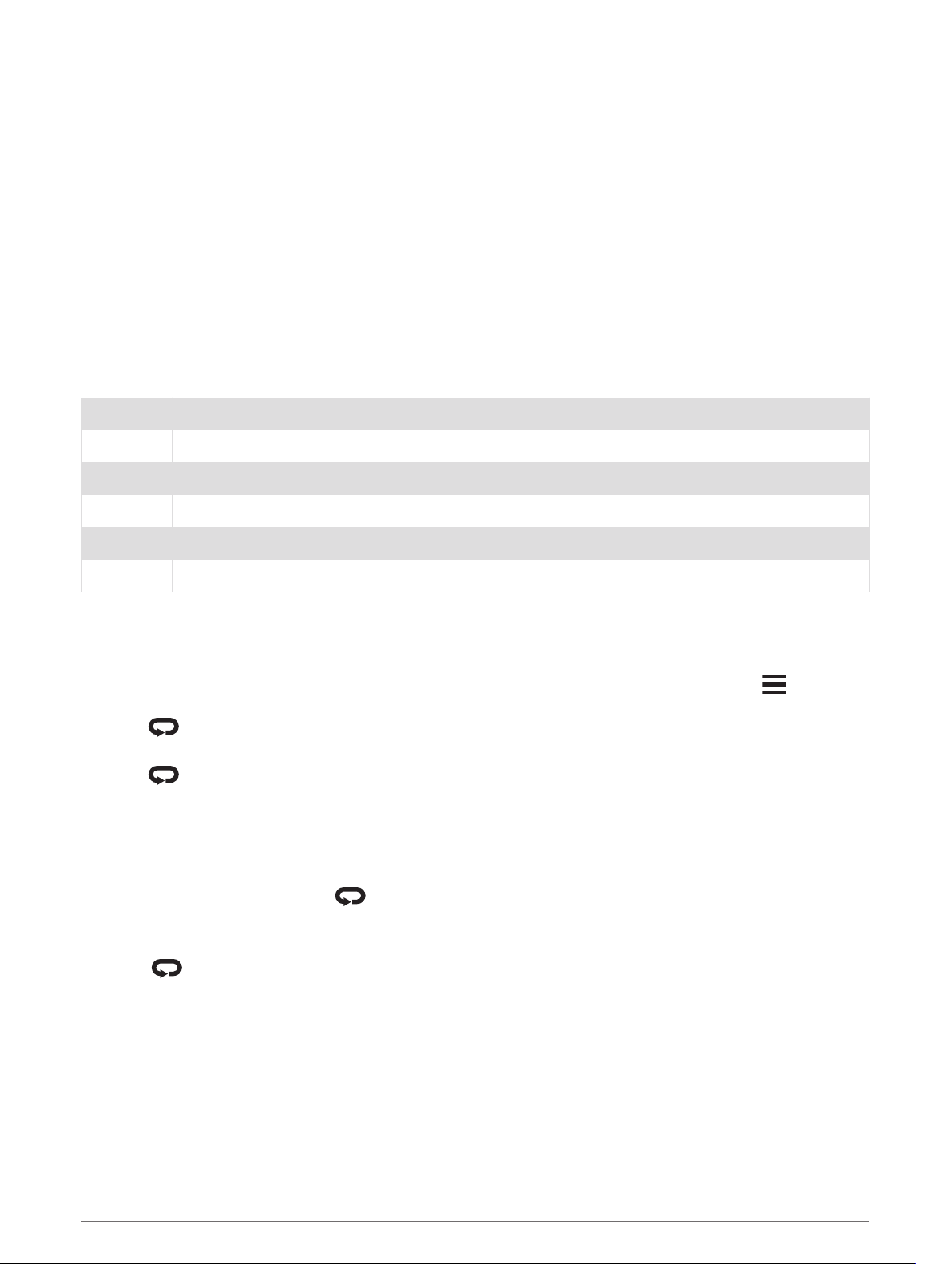
Length: One trip down the pool.
Interval: One or more consecutive lengths. A new interval starts after a rest.
Stroke: A stroke is counted every time your arm wearing the device completes a full cycle.
Swolf: Your swolf score is the sum of the time for one pool length and the number of strokes for that length.
For example, 30 seconds plus 15 strokes equals a swolf score of 45. For open water swimming, swolf is
calculated over 25 meters. Swolf is a measurement of swimming efficiency and, like golf, a lower score is
better.
Critical swim speed (CSS): Your CSS is the theoretical speed that you can maintain continuously without
exhaustion. You can use your CSS to guide your training pace and monitor your improvement.
Stroke Types
Stroke type identification is available only for pool swimming. Your stroke type is identified at the end of a
length. Stroke types appear in your swimming history and in your Garmin Connect account. You can also select
stroke type as a custom data field (Customizing the Data Screens, page 74).
Free Freestyle
Back Backstroke
Breast Breaststroke
Fly Butterfly
Mixed More than one stroke type in an interval
Drill Used with drill logging (Training with the Drill Log, page 12)
Tips for Swimming Activities
• Before starting a pool swimming activity, follow the on-screen instructions to select your pool size or enter a
custom size.
The next time you start a pool swimming activity, the device uses this pool size. You can hold , select the
activity settings, and select Pool Size to change the size.
• Select to record a rest during pool swimming.
The device automatically records swim intervals and lengths for pool swimming.
• Select to record an interval during open water swimming.
Resting During Pool Swimming
The default rest screen displays two rest timers. It also displays time and distance for the last completed
interval.
NOTE: Swim data is not recorded during a rest.
1 During your swim activity, select to start a rest.
The display reverses to white text on a black background, and the rest screen appears.
2 During a rest, select UP or DOWN to view other data screens (optional).
3 Select , and continue swimming.
4 Repeat for additional rest intervals.
Activities and Apps 11
Auto Rest
The auto rest feature is available only for pool swimming. Your device automatically detects when you are
resting, and the rest screen appears. If you rest for more than 15 seconds, the device automatically creates a
rest interval. When you resume swimming, the device automatically starts a new swim interval. You can turn on
the auto rest feature in the activity options (Activities and App Settings, page 73).
TIP: For best results using the auto rest feature, minimize your arm motions while resting.
If you do not want to use the auto rest feature, you can select to manually mark the beginning and end of
each rest interval.
Training with the Drill Log
The drill log feature is available only for pool swimming. You can use the drill log feature to manually record
kick sets, one-arm swimming, or any type of swimming that is not one of the four major strokes.
1 During your pool swim activity, select UP or DOWN to view the drill log screen.
2 Select to start the drill timer.
3 After you complete a drill interval, select .
The drill timer stops, but the activity timer continues to record the entire swim session.
4 Select a distance for the completed drill.
Distance increments are based on the pool size selected for the activity profile.
5 Select an option:
• To start another drill interval, select .
• To start a swim interval, select UP or DOWN to return to the swim training screens.
Skiing and Winter Sports
You can add skiing and snowboarding activities to your activity list (Customizing Your Activity List, page 72).
You can customize the data screens for each activity (Customizing the Data Screens, page 74).
Viewing Your Ski Runs
Your device records the details of each downhill skiing or snowboarding run using the auto run feature. This
feature is turned on by default for downhill skiing and snowboarding. It automatically records new ski runs
based on your movement. The timer pauses when you stop moving downhill and when you are on a chairlift.
The timer remains paused during the chairlift ride. You can start moving downhill to restart the timer. You can
view run details from the paused screen or while the timer is running.
1 Start a skiing or snowboarding activity.
2 Hold .
3 Select View Runs.
4 Select UP and DOWN to view details of your last run, your current run, and your total runs.
The run screens include time, distance traveled, maximum speed, average speed, and total descent.
12 Activities and Apps
Recording a Bouldering Activity
You can record routes during a bouldering activity. A route is a climbing path along a boulder or small rock
formation.
1 Press START.
2 Select Bouldering.
3 Select a grading system.
NOTE: The next time you start a bouldering activity, the device uses this grading system. You can hold ,
select the activity settings, and select Grading System to change the system.
4 Select the difficulty level for the route.
5 Press START to start the route timer.
6 Start your first route.
7 Press to finish the route.
8 Select an option:
• To save a successful route, select Completed.
• To save an unsuccessful route, select Attempted.
• To delete the route, select Discard.
The rest timer appears.
9 When you are done resting, press to start your next route.
10 Repeat this process for each route until your activity is complete.
11 After your last route, press STOP to stop the route timer.
12 Select Save.
Playing Audio Prompts During Your Activity
You can enable your Forerunner 745 device to play motivational status announcements during a run or other
activity. Audio prompts play on your connected headphones using Bluetooth
®
technology, if available.
Otherwise, audio prompts play on your smartphone paired through the Garmin Connect app. During an audio
prompt, the device or smartphone mutes the primary audio to play the announcement.
NOTE: This feature is not available for all activities.
1 From the watch face, hold .
2 Select > Audio Prompts.
3 Select an option:
• To hear a prompt for each lap, select Lap Alert.
NOTE: The Lap Alert audio prompt is enabled by default.
• To customize prompts with your pace and speed data, select Pace/Speed Alert.
• To customize prompts with your heart rate data, select Heart Rate Alert.
• To customize prompts with power data, select Power Alert.
• To hear prompts when you start and stop the timer, including the Auto Pause
®
feature, select Timer
Events.
• To hear activity alerts play as an audio prompt, select Activity Alerts.
• To hear a sound play right before an audio alert or prompt, select Audio Tones.
• To change the language or the dialect of the voice prompts, select Dialect.
Activities and Apps 13
Training
Workouts
You can create custom workouts that include goals for each workout step and for varied distances, times, and
calories. You can create and find more workouts using Garmin Connect or select a training plan that has built-in
workouts, and transfer them to your device.
You can schedule workouts using Garmin Connect. You can plan workouts in advance and store them on your
device.
Following a Workout From Garmin Connect
Before you can download a workout from Garmin Connect, you must have a Garmin Connect account (Garmin
Connect, page 64).
1 Select an option:
• Open the Garmin Connect app.
• Go to connect.garmin.com.
2 Select Training > Workouts.
3 Find a workout, or create and save a new workout.
4 Select or Send to Device.
5 Follow the on-screen instructions.
Creating a Custom Workout on Garmin Connect
Before you can create a workout on the Garmin Connect app, you must have a Garmin Connect account
(Garmin Connect, page 64).
1 From the Garmin Connect app, select or .
2 Select Training > Workouts > Create a Workout.
3 Select an activity.
4 Create your custom workout.
5 Select Save.
6 Enter a name for your workout, and select Save.
The new workout appears in your list of workouts.
NOTE: You can send this workout to your device (Sending a Custom Workout to Your Device, page 14).
Sending a Custom Workout to Your Device
You can send a custom workout you created with the Garmin Connect app to your device (Creating a Custom
Workout on Garmin Connect, page 14).
1 From the Garmin Connect app, select or .
2 Select Training > Workouts.
3 Select a workout from the list.
4 Select .
5 Select your compatible device.
6 Follow the on-screen instructions.
14 Training
Starting a Workout
Before you can start a workout, you must download the workout from your Garmin Connect account.
1 From the watch face, select START.
2 Select an activity.
3 Hold .
4 Select Training > Workouts.
5 Select a workout.
NOTE: Only workouts that are compatible with the selected activity appear in the list.
6 Select View to view a list of workout steps (optional).
7 Select Do Workout.
8 Select START to start the activity timer.
After you begin a workout, the device displays each step of the workout, step notes (optional), the target
(optional), and the current workout data.
Following a Daily Suggested Workout
Before the device can suggest a daily workout, you must have a training status and VO2 max. estimate
(Training Status, page 44).
1 From the watch face, select START.
2 Select Run or Bike.
The daily suggested workout appears.
3 Select START, and select an option:
• To do the workout, select Do Workout.
• To discard the workout, select Dismiss.
• To preview the workout steps, select Steps.
• To update the workout target setting, select Target Type.
• To turn off future workout notifications, select Disable Prompt.
The suggested workout updates automatically to changes in training habits, recovery time, and VO2 max.
Turning Daily Suggested Workout Prompts On and Off
Daily suggested workouts are recommended based on your previous activities saved to your Garmin Connect
account.
1 From the watch face, select START.
2 Select Run or Bike.
3 Hold .
4 Select Training > Workouts > Today's Suggestion.
5 Select START to disable or enable prompts.
Following a Pool Swim Workout
Your device can guide you through multiple steps in a swim workout. Creating and sending a pool swim
workout is similar to Workouts, page 14 and Following a Workout From Garmin Connect, page 14.
1 From the watch face, select START > Pool Swim > Options > Training.
2 Select an option:
• Select Workouts to do workouts downloaded from Garmin Connect.
• Select Training Calendar to do or view your scheduled workouts.
3 Follow the on-screen instructions.
Training 15
Recording a Critical Swim Speed Test
Your Critical Swim Speed (CSS) value is the result of a time-trial-based test. Your CSS is the theoretical speed
you can maintain continuously without exhaustion. You can use your CSS to guide your training pace and
monitor your improvement.
1 From the watch face, select START > Pool Swim > Options > Critical Swim Speed > Do Critical Swim Speed
Test.
2 Select DOWN to preview the workout steps.
3 Select OK > START.
4 Follow the on-screen instructions.
Editing Your Critical Swim Speed Result
You can manually edit or enter a new time for your CSS value.
1 From the watch face, select START > Pool Swim > Options > Critical Swim Speed > Critical Swim Speed.
2 Enter the minutes.
3 Enter the seconds.
About the Training Calendar
The training calendar on your device is an extension of the training calendar or schedule you set up in Garmin
Connect. After you have added a few workouts to the Garmin Connect calendar, you can send them to your
device. All scheduled workouts sent to the device appear in the calendar widget. When you select a day in the
calendar, you can view or do the workout. The scheduled workout stays on your device whether you complete it
or skip it. When you send scheduled workouts from Garmin Connect, they overwrite the existing training
calendar.
Using Garmin Connect Training Plans
Before you can download and use a training plan from Garmin Connect, you must have a Garmin Connect
account (Garmin Connect, page 64), and you must pair the Forerunner device with a compatible smartphone.
1 From the Garmin Connect app, select or .
2 Select Training > Training Plans.
3 Select and schedule a training plan.
4 Follow the on-screen instructions.
5 Review the training plan in your calendar.
Interval Workouts
You can create interval workouts based on distance or time. The device saves your custom interval workout
until you create another interval workout. You can use open intervals for track workouts and when you are
running a known distance.
16 Training
Creating an Interval Workout
1 From the watch face, select START.
2 Select an activity.
3 Hold .
4 Select Training > Intervals > Edit > Interval > Type.
5 Select Distance, Time, or Open.
TIP: You can create an open-ended interval by selecting the Open option.
6 If necessary, select Duration, enter a distance or time interval value for the workout, and select .
7 Select BACK.
8 Select Rest > Type.
9 Select Distance, Time, or Open.
10 If necessary, enter a distance or time value for the rest interval, and select .
11 Select BACK.
12 Select one or more options:
• To set the number of repetitions, select Repeat.
• To add an open-ended warm up to your workout, select Warm Up > On.
• To add an open-ended cool down to your workout, select Cool Down > On.
Starting an Interval Workout
1 From the watch face, select START.
2 Select an activity.
3 Hold .
4 Select Training > Intervals > Do Workout.
5 Select START to start the timer.
6 When your interval workout has a warm up, select to begin the first interval.
7 Follow the on-screen instructions.
After you complete all of the intervals, a message appears.
Stopping an Interval Workout
• At any time, select to stop the current interval or rest period and transition to the next interval or rest
period.
• After all intervals and rest periods are complete, select to end the interval workout and transition to a
timer that can be used for cool down.
• At any time, select STOP to stop the activity timer. You can resume the timer or end the interval workout.
Training 17
Using Virtual Partner
®
The Virtual Partner feature is a training tool designed to help you meet your goals. You can set a pace for the
Virtual Partner and race against it.
NOTE: This feature is not available for all activities.
1 From the watch face, select START.
2 Select an activity.
3 Hold .
4 Select the activity settings.
5 Select Data Screens > Add New > Virtual Partner.
6 Enter a pace or speed value.
7 Start your activity (Starting an Activity, page 4).
8 Select UP or DOWN to scroll to the Virtual Partner screen and see who is leading.
Setting a Training Target
The training target feature works with the Virtual Partner feature so you can train toward a set distance,
distance and time, distance and pace, or distance and speed goal. During your training activity, the device gives
you real-time feedback about how close you are to achieving your training target.
1 From the watch face, select START.
2 Select an activity.
3 Hold .
4 Select Training > Set a Target.
5 Select an option:
• Select Distance Only to select a preset distance or enter a custom distance.
• Select Distance and Time to select a distance and time target.
• Select Distance and Pace or Distance and Speed to select a distance and pace or speed target.
The training target screen appears and displays your estimated finish time. The estimated finish time is
based on your current performance and the time remaining.
6 Select START to start the timer.
Cancelling a Training Target
1 During an activity, hold .
2 Select Cancel Target > Yes.
18 Training
Racing a Previous Activity
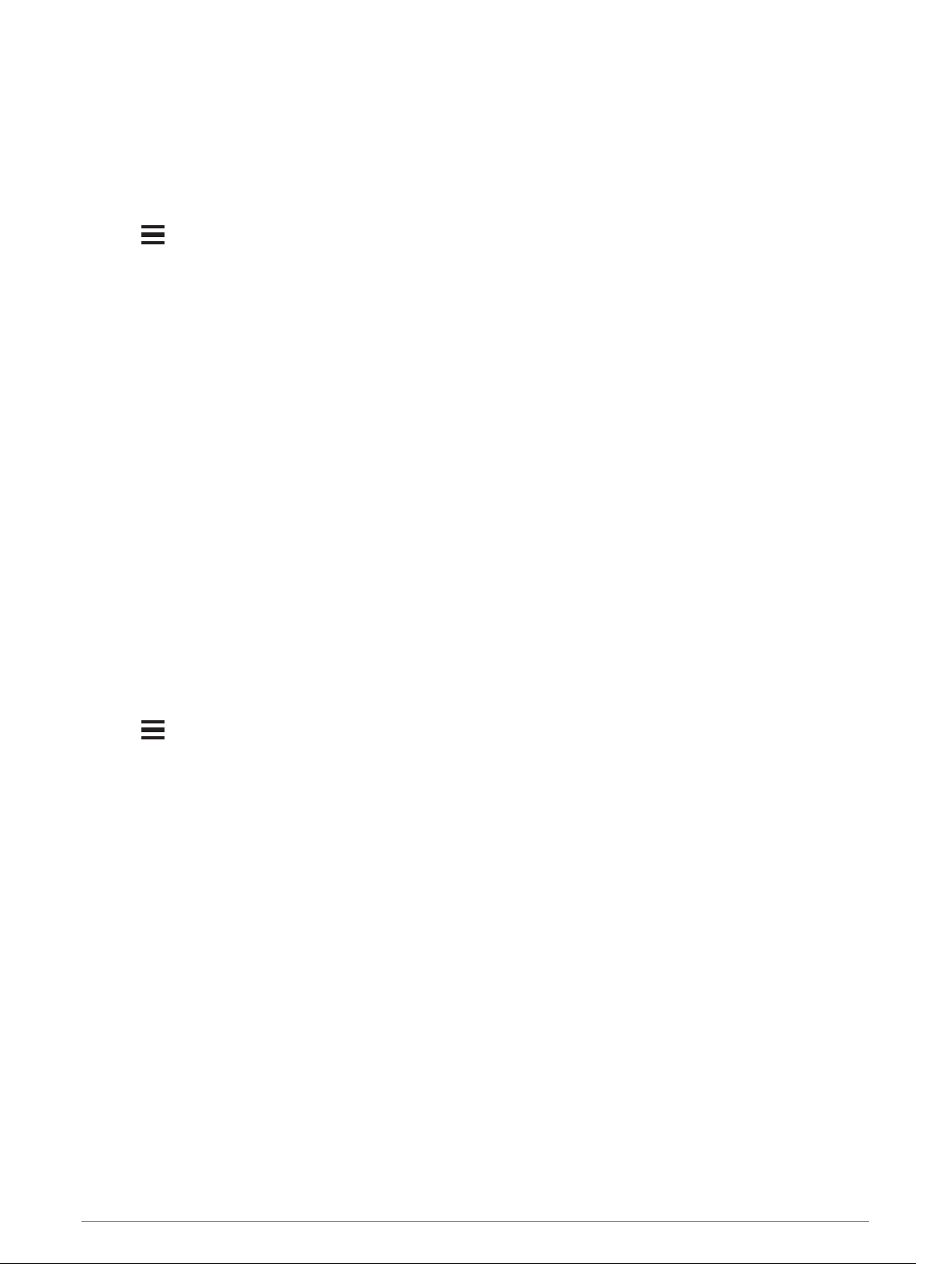
You can race a previously recorded or downloaded activity. This feature works with the Virtual Partner feature
so you can see how far ahead or behind you are during the activity.
NOTE: This feature is not available for all activities.
1 From the watch face, select START.
2 Select an activity.
3 Hold .
4 Select Training > Race an Activity.
5 Select an option:
• Select From History to select a previously recorded activity from your device.
• Select Downloaded to select an activity you downloaded from your Garmin Connect account.
6 Select the activity.
The Virtual Partner screen appears indicating your estimated finish time.
7 Select START to start the timer.
8 After you complete your activity, select START > Save.
PacePro Training
Many runners like to wear a pace band during a race to help achieve their race goal. The PacePro feature
allows you to create a custom pace band based on distance and pace or distance and time. You can also
create a pace band for a known course to optimize your pace effort based on elevation changes.
You can create a PacePro plan using the Garmin Connect app. You can preview the splits and elevation plot
before you run the course.
Creating a PacePro Plan on Your Watch
Before you can create a PacePro plan on your watch, you must create a course (Following a Course on Your
Device, page 66).
1 From the watch face, select START.
2 Select an outdoor running activity.
3 Hold .
4 Select Navigation > Courses.
5 Select a course.
6 Select PacePro > Create New.
7 Select an option:
• Select Goal Pace, and enter your target pace.
• Select Goal Time, and enter your target time.
The device displays your custom pace band.
TIP: You can press DOWN and select View Splits to preview the splits.
8 Select START to start the plan.
9 If necessary, select Yes to enable course navigation.
10 Select START to start the activity timer.
Training 19
Starting a PacePro Plan
1 From the watch face, select START.
2 Select an outdoor running activity.
3 Hold .
4 Select Training > PacePro Plans.
5 Select a plan.
TIP: You can select DOWN > View Splits to preview the splits.
6 Select START to start the plan.
7 If necessary, select Yes to enable course navigation.
8 Select START to start the activity timer.
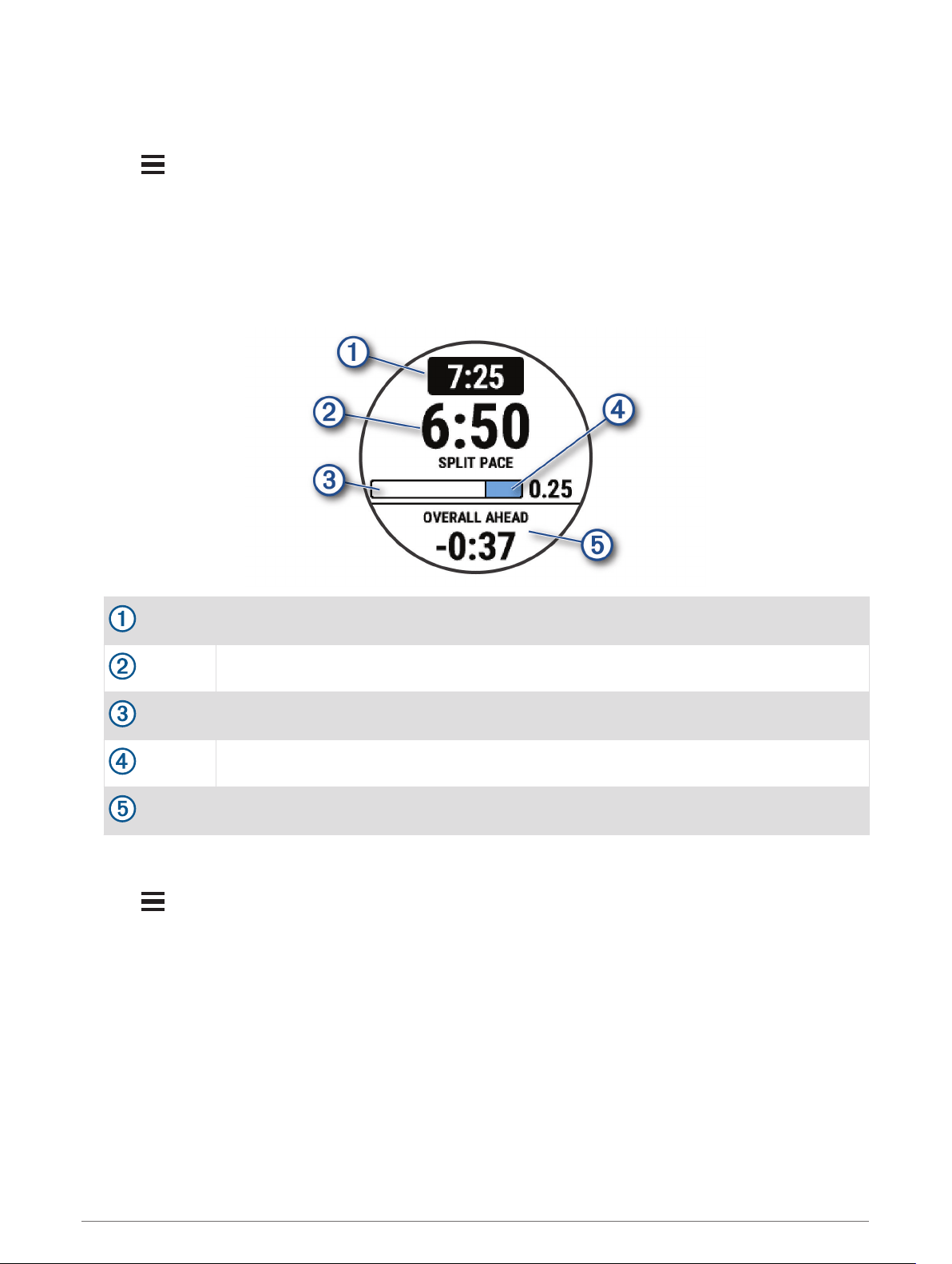
Target split pace
Current split pace
Completion progress for the split
Distance remaining in the split
Overall time ahead of or behind your target time
Stopping a PacePro Plan
1 Hold .
2 Select Stop PacePro > Yes.
The device stops the PacePro plan. The activity timer continues running.
Personal Records
When you complete an activity, the device displays any new personal records you achieved during that activity.
Personal records include your fastest time over several typical race distances and longest run, ride, or swim.
NOTE: For cycling, personal records also include most ascent and best power (power meter required).
20 Training
Viewing Your Personal Records
1 From the watch face, hold .
2 Select History > Records.
3 Select a sport.
4 Select a record.
5 Select View Record.
Restoring a Personal Record
You can set each personal record back to the one previously recorded.
1 From the watch face, hold .
2 Select History > Records.
3 Select a sport.
4 Select a record to restore.
5 Select Previous > Yes.
NOTE: This does not delete any saved activities.
Clearing a Personal Record
1 From the watch face, hold .
2 Select History > Records.
3 Select a sport.
4 Select a record to delete.
5 Select Clear Record > Yes.
NOTE: This does not delete any saved activities.
Clearing All Personal Records
1 From the watch face, hold .
2 Select History > Records.
3 Select a sport.
4 Select Clear All Records > Yes.
The records are deleted for that sport only.
NOTE: This does not delete any saved activities.
Segments
You can send running or cycling segments from your Garmin Connect account to your device. After a segment
is saved to your device, you can race a segment, trying to match or exceed your personal record or other
participants who have raced the segment.
NOTE: When you download a course from your Garmin Connect account, you can download all of the available
segments in the course.
Strava
™
Segments
You can download Strava segments to your Forerunner device. Follow Strava segments to compare your
performance with your past rides, friends, and pros who have ridden the same segment.
To sign up for a Strava membership, go to the segments widget in your Garmin Connect account. For more
information, go to www.strava.com.
The information in this manual applies to both Garmin Connect segments and Strava segments.
Training 21
Racing a Segment
Segments are virtual race courses. You can race a segment, and compare your performance to past activities,
others' performance, connections in your Garmin Connect account, or other members of the running or cycling
communities. You can upload your activity data to your Garmin Connect account to view your segment
position.
NOTE: If your Garmin Connect account and Strava account are linked, your activity is automatically sent to your
Strava account so you can review the segment position.
1 Select START.
2 Select an activity.
3 Go for a run or ride.
When you approach a segment, a message appears, and you can race the segment.
4 Start racing the segment.
A message appears when the segment is complete.
Viewing Segment Details
1 Select START.
2 Select an activity.
3 Hold .
4 Select Training > Segments.
5 Select a segment.
6 Select an option:
• Select Race Times to view the time and average speed or pace for the segment leader.
• Select Map to view the segment on the map.
• Select Elevation Plot to view an elevation plot of the segment.
Using the Metronome
The metronome feature plays tones at a steady rhythm to help you improve your performance by training at a
faster, slower, or more consistent cadence.
NOTE: This feature is not available for all activities.
1 From the watch face, select START.
2 Select an activity.
3 Hold .
4 Select the activity settings.
5 Select Metronome > Status > On.
6 Select an option:
• Select Beats / Minute to enter a value based on the cadence you want to maintain.
• Select Alert Frequency to customize the frequency of the beats.
• Select Sounds to customize the metronome tone and vibration.
7 If necessary, select Preview to listen to the metronome feature before you run.
8 Go for a run (Going for a Run, page 3).
The metronome starts automatically.
9 During your run, select UP or DOWN to view the metronome screen.
10 If necessary, hold to change the metronome settings.
Extended Display Mode
You can use Extended Display mode to display data screens from your Forerunner device on a compatible
Edge
®
device during a ride or triathlon. See your Edge owner's manual for more information.
22 Training
Setting Up Your User Profile
You can update your gender, birth year, height, weight, heart rate zone, and power zone settings. The device
uses this information to calculate accurate training data.
1 Hold .
2 Select > User Profile.
3 Select an option.
Fitness Goals
Knowing your heart rate zones can help you measure and improve your fitness by understanding and applying
these principles.
• Your heart rate is a good measure of exercise intensity.
• Training in certain heart rate zones can help you improve cardiovascular capacity and strength.
If you know your maximum heart rate, you can use the table (Heart Rate Zone Calculations, page 25) to
determine the best heart rate zone for your fitness objectives.
If you do not know your maximum heart rate, use one of the calculators available on the Internet. Some gyms
and health centers can provide a test that measures maximum heart rate. The default maximum heart rate is
220 minus your age.
About Heart Rate Zones
Many athletes use heart rate zones to measure and increase their cardiovascular strength and improve their
level of fitness. A heart rate zone is a set range of heartbeats per minute. The five commonly accepted heart
rate zones are numbered from 1 to 5 according to increasing intensity. Generally, heart rate zones are
calculated based on percentages of your maximum heart rate.
Training 23
Setting Your Heart Rate Zones
The device uses your user profile information from the initial setup to determine your default heart rate zones.
You can set separate heart rate zones for sport profiles, such as running, cycling, and swimming. For the most
accurate calorie data during your activity, set your maximum heart rate. You can also set each heart rate zone
and enter your resting heart rate manually. You can manually adjust your zones on the device or using your
Garmin Connect account.
1 From the watch face, hold .
2 Select > User Profile > Heart Rate.
3 Select Max. HR, and enter your maximum heart rate.
You can use the Auto Detection feature to automatically record your maximum heart rate during an activity
(Detecting Performance Measurements Automatically, page 38).
4 Select LTHR > Enter Manually, and enter your lactate threshold heart rate.
You can perform a guided test to estimate your lactate threshold (Lactate Threshold, page 42). You can use
the Auto Detection feature to automatically record your lactate threshold during an activity (Detecting
Performance Measurements Automatically, page 38).
5 Select Resting HR, and enter your resting heart rate.
You can use the average resting heart rate measured by your device, or you can set a custom resting heart
rate.
6 Select Zones > Based On.
7 Select an option:
• Select BPM to view and edit the zones in beats per minute.
• Select %Max. HR to view and edit the zones as a percentage of your maximum heart rate.
• Select %HRR to view and edit the zones as a percentage of your heart rate reserve (maximum heart rate
minus resting heart rate).
• Select %LTHR to view and edit the zones as a percentage of your lactate threshold heart rate.
8 Select a zone, and enter a value for each zone.
9 Select Sport Heart Rate, and select a sport profile to add separate heart rate zones (optional).
Letting the Device Set Your Heart Rate Zones
The default settings allow the device to detect your maximum heart rate and set your heart rate zones as a
percentage of your maximum heart rate.
• Verify that your user profile settings are accurate (Setting Up Your User Profile, page 23).
• Run often with the wrist or chest heart rate monitor.
• Try a few heart rate training plans, available from your Garmin Connect account.
• View your heart rate trends and time in zones using your Garmin Connect account.
24 Training
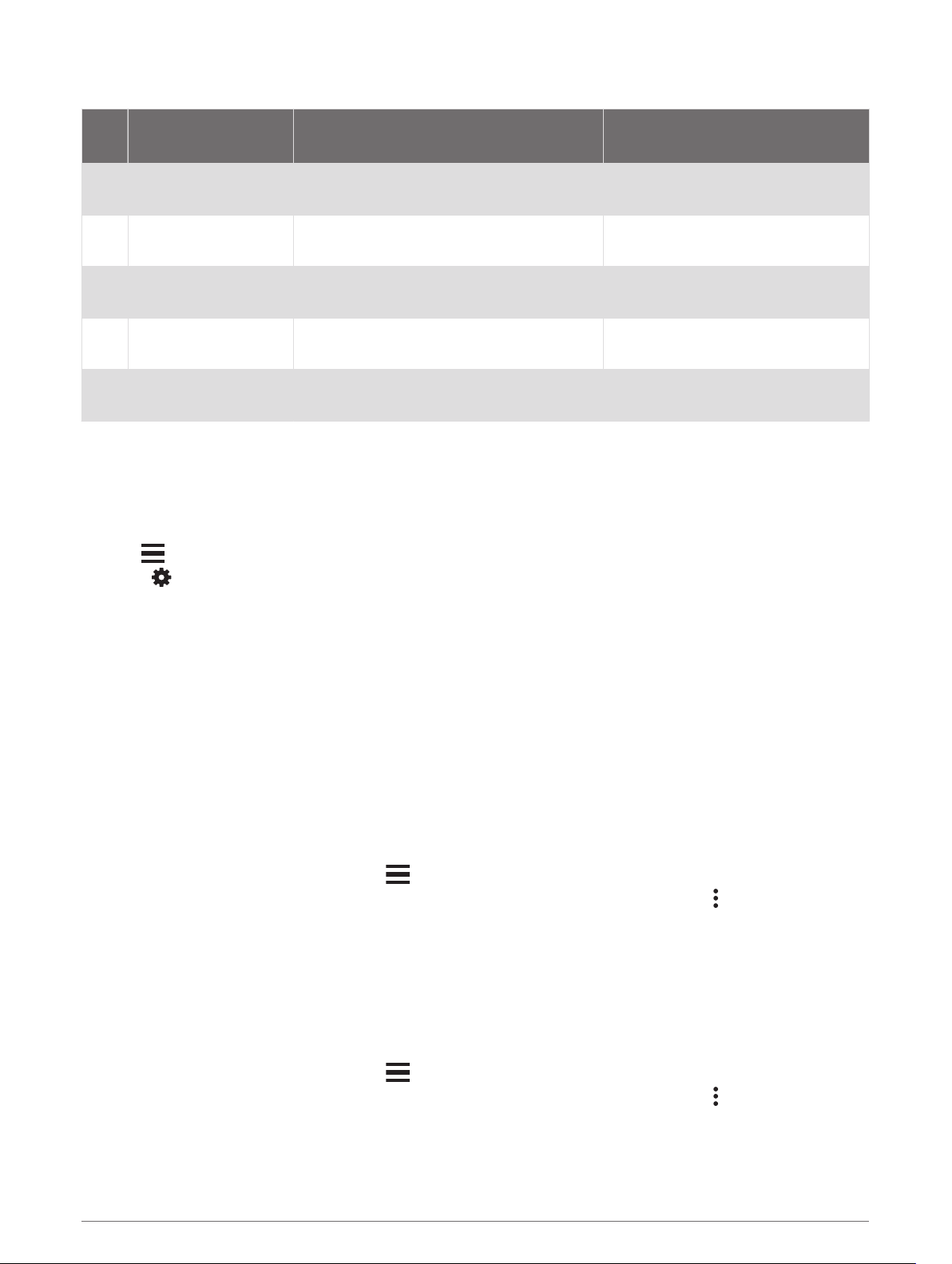
Heart Rate Zone Calculations
Zone
% of Maximum Heart
Rate
Perceived Exertion Benefits
1 50–60% Relaxed, easy pace, rhythmic breathing
Beginning-level aerobic training,
reduces stress
2 60–70%
Comfortable pace, slightly deeper
breathing, conversation possible
Basic cardiovascular training, good
recovery pace
3 70–80%
Moderate pace, more difficult to hold
conversation
Improved aerobic capacity, optimal
cardiovascular training
4 80–90%
Fast pace and a bit uncomfortable,
breathing forceful
Improved anaerobic capacity and
threshold, improved speed
5 90–100%
Sprinting pace, unsustainable for long
period of time, labored breathing
Anaerobic and muscular endurance,
increased power
Setting Your Cycling Power Zones
The values for the zones are default values based on gender, weight, and average ability, and may not match
your personal abilities. If you know your functional threshold power (FTP) value, you can enter it and allow the
software to calculate your zones automatically. You can manually adjust your zones on the device or using your
Garmin Connect account.
1 Hold .
2 Select > User Profile > Power Zones > Based On.
3 Select an option:
• Select Watts to view and edit the zones in watts.
• Select %FTP to view and edit the zones as a percentage of your functional threshold power.
4 Select FTP, and enter your FTP value.
5 Select a zone, and enter a value for each zone.
6 If necessary, select Minimum, and enter a minimum power value.
Pausing Your Training Status
If you are injured or sick, you can pause your training status. You can continue to record fitness activities, but
your training status, training load focus, recovery feedback, and workout recommendations are temporarily
disabled.
Select an option:
• From the training status widget, hold , and select Options > Pause Training Status.
• From your Garmin Connect settings, select Performance Stats > Training Status > > Pause Training
Status.
TIP: You should sync your device with your Garmin Connect account.
Resuming Your Paused Training Status
You can resume your training status when you are ready to start training again. For best results, you need at
least two VO2 max. measurements each week (About VO2 Max. Estimates, page 39).
Select an option:
• From the training status widget, hold , and select Options > Resume Training Status.
• From your Garmin Connect settings, select Performance Stats > Training Status >
> Resume Training
Status.
TIP: You should sync your device with your Garmin Connect account.
Training 25
Activity Tracking
The activity tracking feature records your daily step count, distance traveled, intensity minutes, floors climbed,
calories burned, and sleep statistics for each recorded day. Your calories burned includes your base
metabolism plus activity calories.
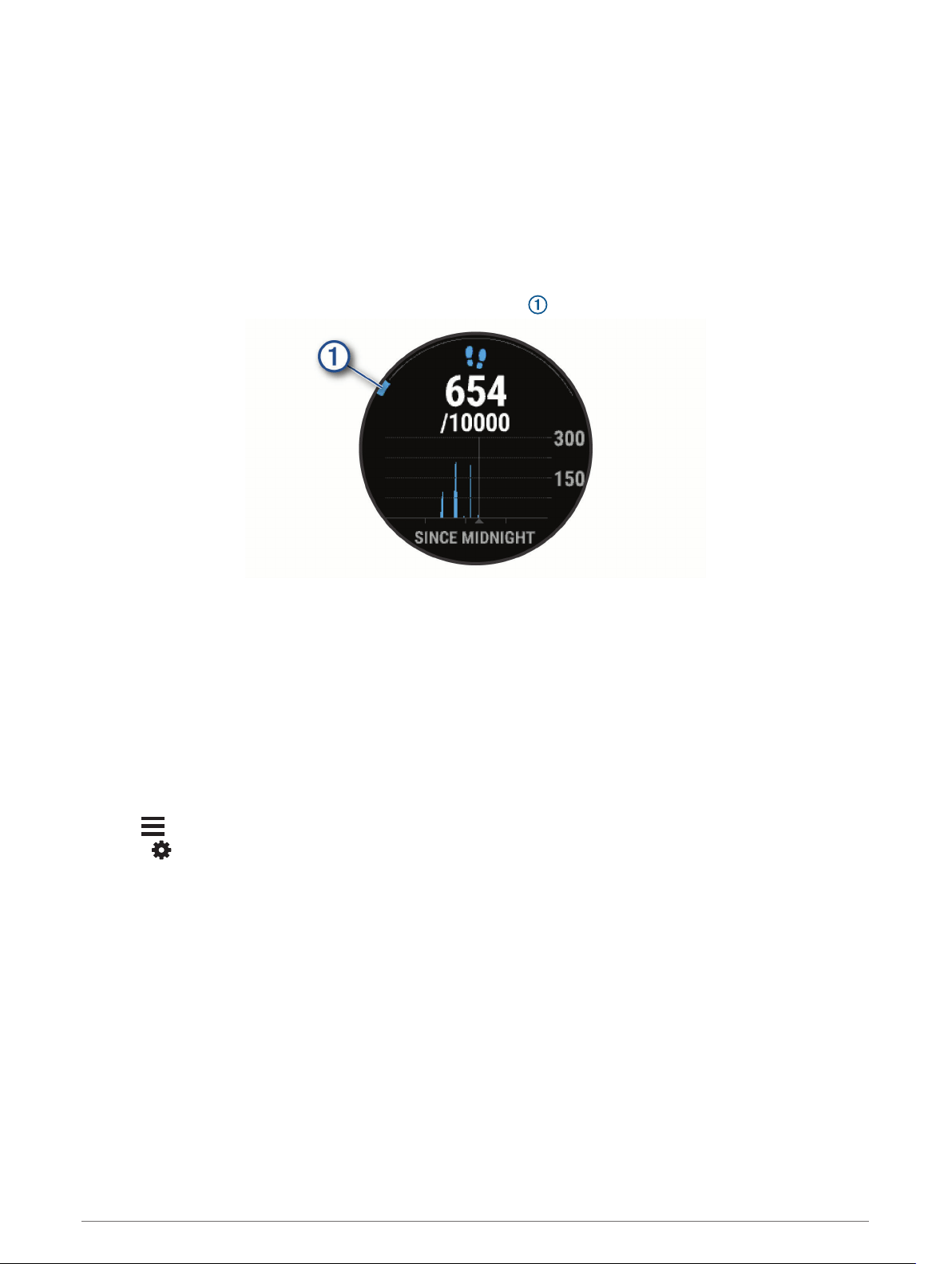
The number of steps taken during the day appears on the steps widget. The step count is updated periodically.
For more information about activity tracking and fitness metric accuracy, go to garmin.com/ataccuracy.
Auto Goal
Your device creates a daily step goal automatically, based on your previous activity levels. As you move during
the day, the device shows your progress toward your daily goal .
If you choose not to use the auto goal feature, you can set a personalized step goal on your Garmin Connect
account.
Using the Move Alert
Sitting for prolonged periods of time can trigger undesirable metabolic state changes. The move alert reminds
you to keep moving. After one hour of inactivity, Move! and the red bar appear. Additional segments appear
after every 15 minutes of inactivity. The device also beeps or vibrates if audible tones are turned on (System
Settings, page 81).
Go for a short walk (at least a couple of minutes) to reset the move alert.
Turning on the Move Alert
1 Hold .
2 Select > Activity Tracking > Move Alert > On.
Sleep Tracking
While you are sleeping, the device automatically detects your sleep and monitors your movement during your
normal sleep hours. You can set your normal sleep hours in the user settings on your Garmin Connect account.
Sleep statistics include total hours of sleep, sleep stages, and sleep movement. You can view your sleep
statistics on your Garmin Connect account.
NOTE: Naps are not added to your sleep statistics. You can use do not disturb mode to turn off notifications
and alerts, with the exception of alarms (Using Do Not Disturb Mode, page 27).
26 Activity Tracking
Using Automated Sleep Tracking
1 Wear your device while sleeping.
2 Upload your sleep tracking data to the Garmin Connect site (Manually Syncing Data with Garmin Connect,
page 52).
You can view your sleep statistics on your Garmin Connect account.
You can view sleep information from the previous night on your Forerunner device (Widgets, page 54).
Using Do Not Disturb Mode
You can use do not disturb mode to turn off the backlight, tone alerts, and vibration alerts. For example, you can
use this mode while sleeping or watching a movie.
NOTE: You can set your normal sleep hours in the user settings on your Garmin Connect account. You can
enable the During Sleep option in the system settings to automatically enter do not disturb mode during your
normal sleep hours (System Settings, page 81).
NOTE: You can add options to the controls menu (Customizing the Controls Menu, page 56).
1 Hold LIGHT.
2 Select Do Not Disturb.
Intensity Minutes
To improve your health, organizations such as the World Health Organization recommend at least 150 minutes
per week of moderate intensity activity, such as brisk walking, or 75 minutes per week of vigorous intensity
activity, such as running.
The device monitors your activity intensity and tracks your time spent participating in moderate to vigorous
intensity activities (heart rate data is required to quantify vigorous intensity). The device adds the amount of
moderate activity minutes with the amount of vigorous activity minutes. Your total vigorous intensity minutes
are doubled when added.
Earning Intensity Minutes
Your Forerunner device calculates intensity minutes by comparing your heart rate data to your average resting
heart rate. If heart rate is turned off, the device calculates moderate intensity minutes by analyzing your steps
per minute.
• Start a timed activity for the most accurate calculation of intensity minutes.
• Wear your device all day and night for the most accurate resting heart rate.
Garmin Move IQ
™
Events
The Move IQ feature automatically detects activity patterns, such as walking, running, biking, swimming, and
elliptical training, for at least 10 minutes. You can view the event type and duration on your Garmin Connect
timeline, but they do not appear in your activities list, snapshots, or newsfeed. For more detail and accuracy,
you can record a timed activity on your device.
Activity Tracking Settings
Hold , and select > Activity Tracking.
Status: Turns off the activity tracking features.
Move Alert: Displays a message and the move bar on the digital watch face and steps screen. The device also
beeps or vibrates if audible tones are turned on (System Settings, page 81).
Goal Alerts: Allows you to turn on and off goal alerts, or turn them off only during activities. Goal alerts appear
for your daily steps goal, daily floors climbed goal, and weekly intensity minutes goal.
Move IQ: Allows you to turn on and off Move IQ events.
Pulse Ox Mode: Sets your device to record pulse oximeter readings while you are inactive during the day or
continuously while you sleep.
Activity Tracking 27
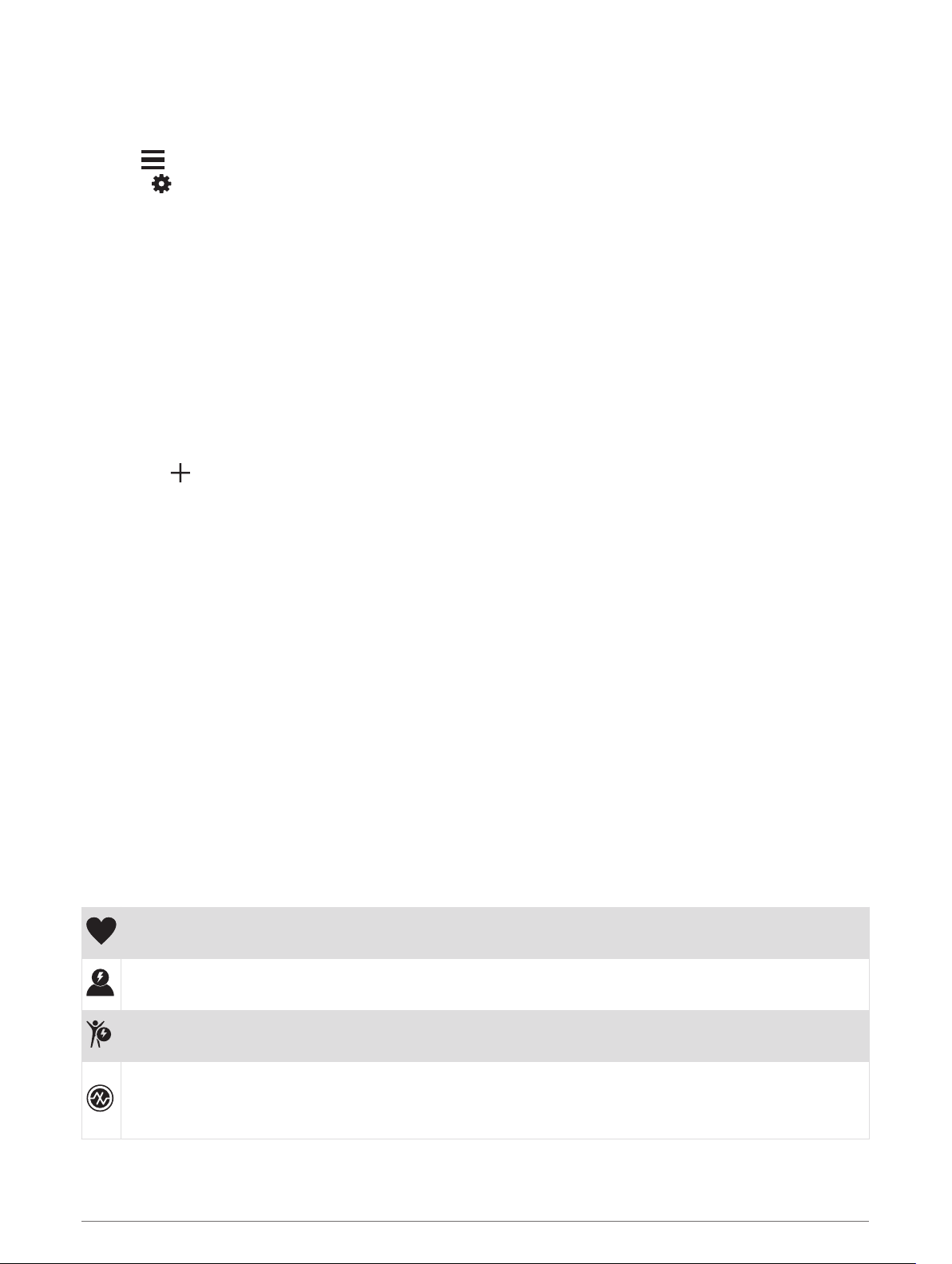
Turning Off Activity Tracking
When you turn off activity tracking, your steps, floors climbed, intensity minutes, sleep tracking, and Move IQ
events are not recorded.
1 Hold .
2 Select > Activity Tracking > Status > Off.
Hydration Tracking
You can track your daily fluid intake, turn on goals and alerts, and enter the container sizes you use most often.
If you enable automatic goals, your goal increases on the days when you record an activity. When you exercise,
you need more fluid to replace the sweat lost.
NOTE: You can use the Garmin Connect app to add and remove widgets.
Using the Hydration Tracking Widget
The hydration tracking widget displays your fluid intake and your daily hydration goal.
1 From the watch face, select UP or DOWN to view the hydration widget.
2 Select START.
3 Select an option:
• Select for each serving of fluid you consume.
• Select a container to increase your fluid intake by the volume of the container.
TIP: You can customize your hydration settings, such as units of measure and daily goal, on your Garmin
Connect account.
Menstrual Cycle Tracking
Your menstrual cycle is an important part of your health. You can learn more and set up this feature in the
Health Stats settings of the Garmin Connect app.
• Menstrual cycle tracking and details
• Physical and emotional symptoms
• Period and fertility predictions
• Health and nutrition information
NOTE: You can use the Garmin Connect app to add and remove widgets.
Heart Rate Features
The Forerunner device has a wrist-based heart rate monitor and is also compatible with chest heart rate
monitors. You can view heart rate data on the heart rate widget. If both wrist-based heart rate and chest heart
rate data are available, your device uses the chest heart rate data.
There are several heart rate-related features available in the default widget loop.
Your current heart rate in beats per minute (bpm). The widget also displays a graph of your heart rate for
the last four hours, highlighting your highest and lowest heart rate.
Your current stress level. The device measures your heart rate variability while you are inactive to
estimate your stress level. A lower number indicates a lower stress level.
Your current Body Battery
™
energy level. The device calculates your current energy reserves based on
sleep, stress, and activity data. A higher number indicates a higher energy reserve.
The current saturation of oxygen in your blood. Knowing your oxygen saturation can help you determine
how your body is adapting to exercise and stress.
NOTE: The pulse oximeter sensor is located on the back of the device.
28 Heart Rate Features
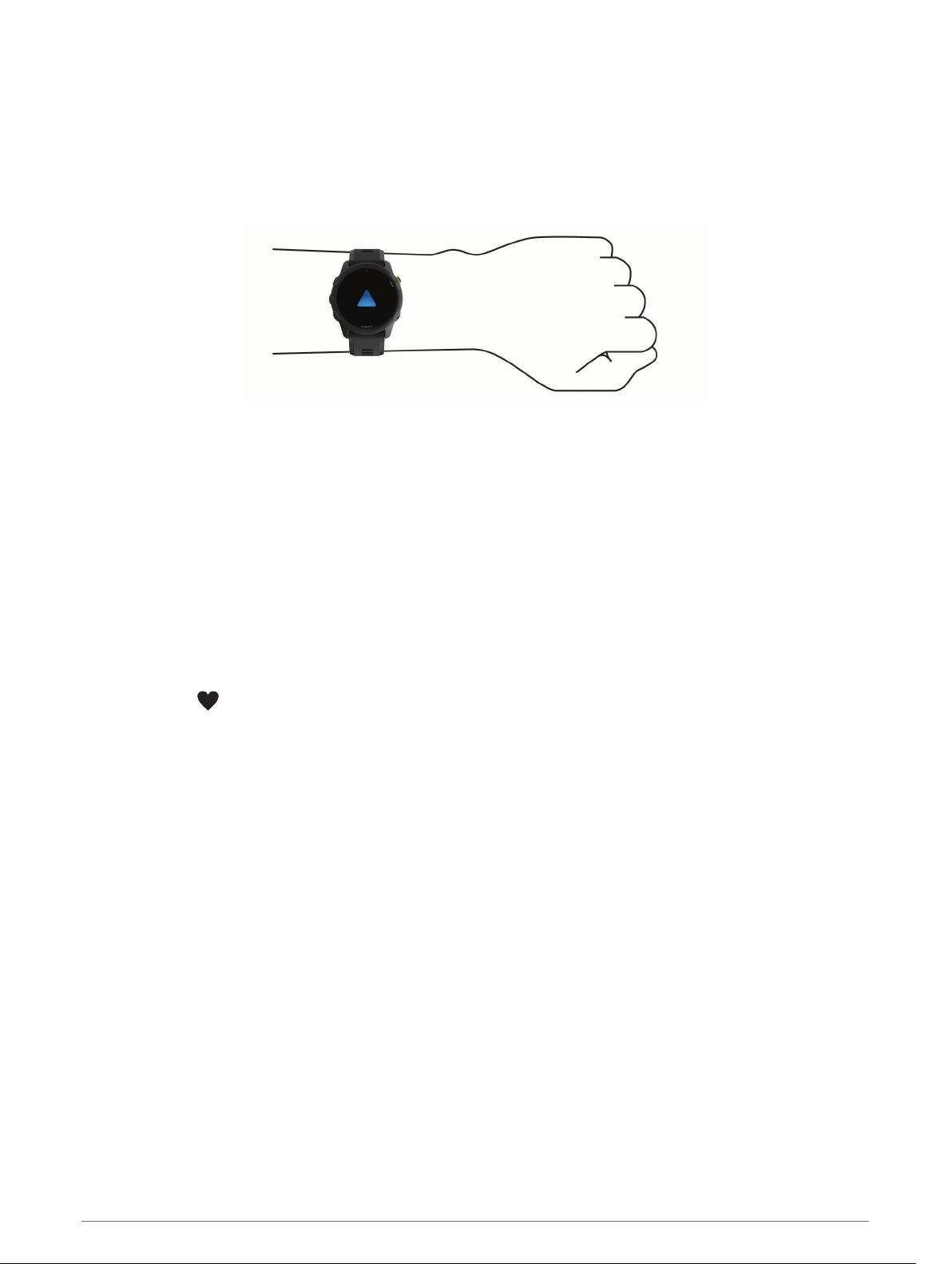
Wrist-based Heart Rate
Wearing the Device
• Wear the device above your wrist bone.
NOTE: The device should be snug but comfortable. For more accurate heart rate readings, the device should
not move while running or exercising. For pulse oximeter readings, you should remain motionless.
NOTE: The optical sensor is located on the back of the device.
• See Tips for Erratic Heart Rate Data, page 29 for more information about wrist-based heart rate.
• See Tips for Erratic Pulse Oximeter Data, page 48 for more information about the pulse oximeter sensor.
• For more information about accuracy, go to garmin.com/ataccuracy.
• For more information about device wear and care, go to www.garmin.com/fitandcare.
Tips for Erratic Heart Rate Data
If the heart rate data is erratic or does not appear, you can try these tips.
• Clean and dry your arm before putting on the device.
• Avoid wearing sunscreen, lotion, and insect repellent under the device.
• Avoid scratching the heart rate sensor on the back of the device.
• Wear the device above your wrist bone. The device should be snug but comfortable.
• Wait until the icon is solid before starting your activity.
• Warm up for 5 to 10 minutes and get a heart rate reading before starting your activity.
NOTE: In cold environments, warm up indoors.
• Rinse the device with fresh water after each workout.
Heart Rate Features 29
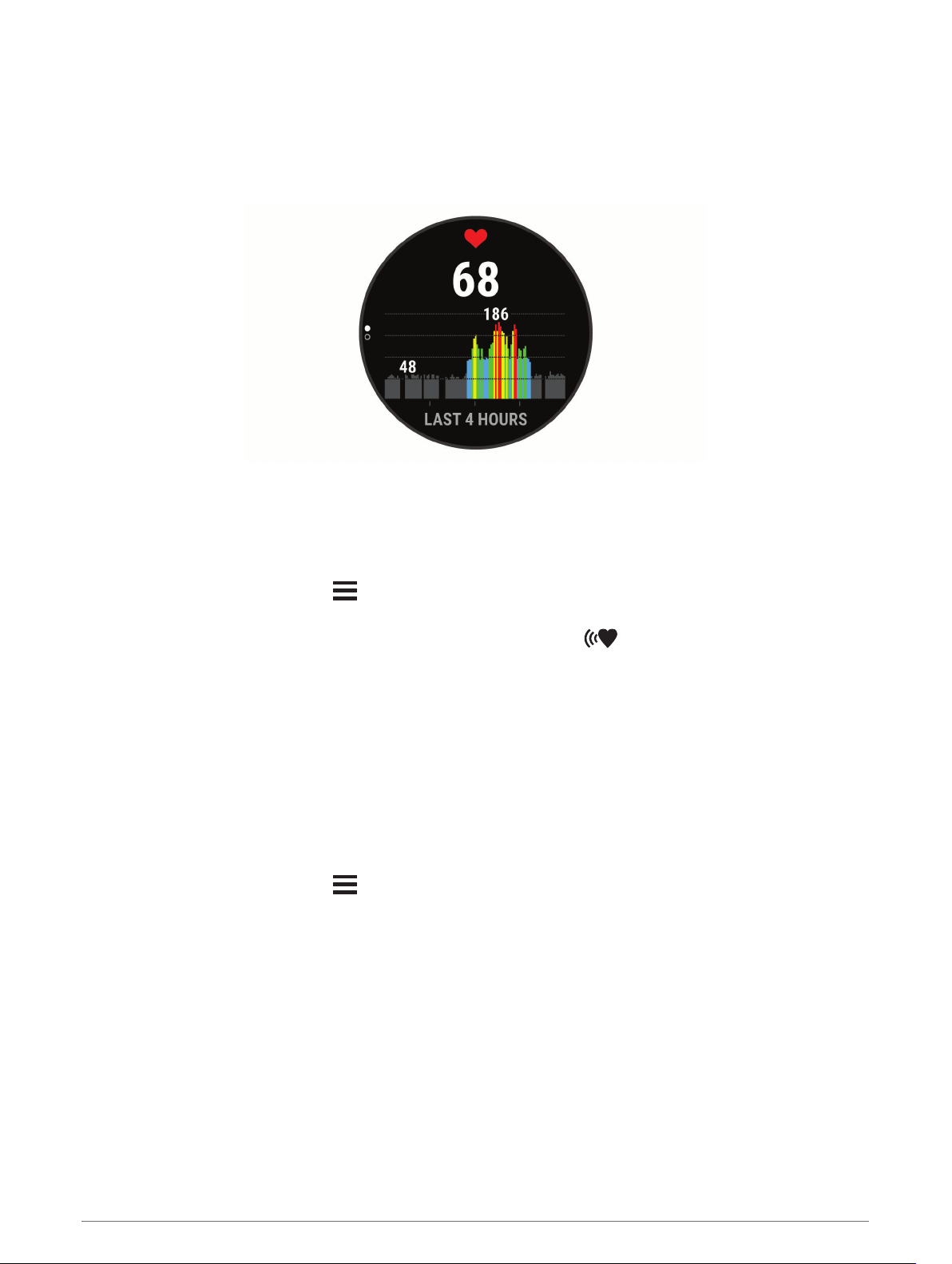
Viewing the Heart Rate Widget
1 From the watch face, press UP or DOWN to view the heart rate widget.
NOTE: You may need to add the widget to your widget loop (Customizing the Widget Loop, page 72).
2 Press START to view your current heart rate in beats per minute (bpm) and a graph of your heart rate for the
last 4 hours.
3 Press DOWN to view your average resting heart rate values for the last 7 days.
Broadcasting Heart Rate Data to Garmin
®
Devices
You can broadcast your heart rate data from your Forerunner device and view it on paired Garmin devices.
NOTE: Broadcasting heart rate data decreases battery life.
1 From the heart rate widget, hold .
2 Select Options > Broadcast Heart Rate.
The Forerunner device starts broadcasting your heart rate data, and appears.
NOTE: You can view only the heart rate widget while broadcasting heart rate data from the heart rate widget.
3 Pair your Forerunner device with your Garmin ANT+ compatible device.
NOTE: The pairing instructions differ for each Garmin compatible device. See your owner's manual.
TIP: To stop broadcasting your heart rate data, press any button, and select Yes.
Broadcasting Heart Rate Data During an Activity
You can set up your Forerunner device to broadcast your heart rate data automatically when you begin an
activity. For example, you can broadcast your heart rate data to an Edge device while cycling, or to a VIRB
action camera during an activity.
NOTE: Broadcasting heart rate data decreases battery life.
1 From the heart rate widget, hold .
2 Select Options > Broadcast During Activity.
3 Begin an activity (Starting an Activity, page 4).
The Forerunner device starts broadcasting your heart rate data in the background.
NOTE: There is no indication that the device is broadcasting your heart rate data during an activity.
4 Pair your Forerunner device with your Garmin ANT+ compatible device.
NOTE: The pairing instructions differ for each Garmin compatible device. See your owner's manual.
TIP: To stop broadcasting your heart rate data, stop the activity (Stopping an Activity, page 4).
30 Heart Rate Features
Setting an Abnormal Heart Rate Alert
CAUTION
This feature only alerts you when your heart rate exceeds or drops below a certain number of beats per minute,
as selected by the user, after a period of inactivity. This feature does not notify you of any potential heart
condition and is not intended to treat or diagnose any medical condition or disease. Always defer to your health
care provider for any heart-related issues.
You can set the heart rate threshold value.
1 From the heart rate widget, hold .
2 Select Options > Abnormal Heart Rate Alerts.
3 Select High Alert or Low Alert.
4 Set the heart rate threshold value.
Each time your heart rate exceeds or drops below the threshold value, a message appears and the device
vibrates.
Turning Off the Wrist-based Heart Rate Monitor
The default value for the Wrist Heart Rate setting is Auto. The device automatically uses the wrist-based heart
rate monitor unless you pair an ANT+ heart rate monitor to the device.
NOTE: Disabling the wrist-based heart rate monitor also disables the wrist-based pulse oximeter sensor. You
can perform a manual reading from the pulse oximeter widget.
1 From the heart rate widget, hold .
2 Select Options > Status > Off.
Chest Heart Rate While Swimming
The HRM-Pro, HRM-Swim, and HRM-Tri heart rate accessories record and store your heart rate data while you
are swimming. To view your heart rate data, you can add heart rate data fields (Customizing the Data Screens,
page 74).
NOTE: Chest heart rate data is not visible on compatible Forerunner devices while the heart rate monitor is
underwater.
You must start a timed activity on your paired Forerunner device to view stored heart rate data later. During rest
intervals when out of the water, the heart rate accessory sends your heart rate data to your Forerunner device.
Your Forerunner device automatically downloads stored heart rate data when you save your timed swim
activity. Your heart rate accessory must be out of the water, active, and within range of the device (3 m) while
data downloads. Your heart rate data can be reviewed in the device history and on your Garmin Connect
account.
If both wrist-based heart rate and chest heart rate data are available, your device uses the chest heart rate data.
HRM-Pro Accessory
The device can record heart rate during your swim (Chest Heart Rate While Swimming, page 31).
Heart Rate Features 31
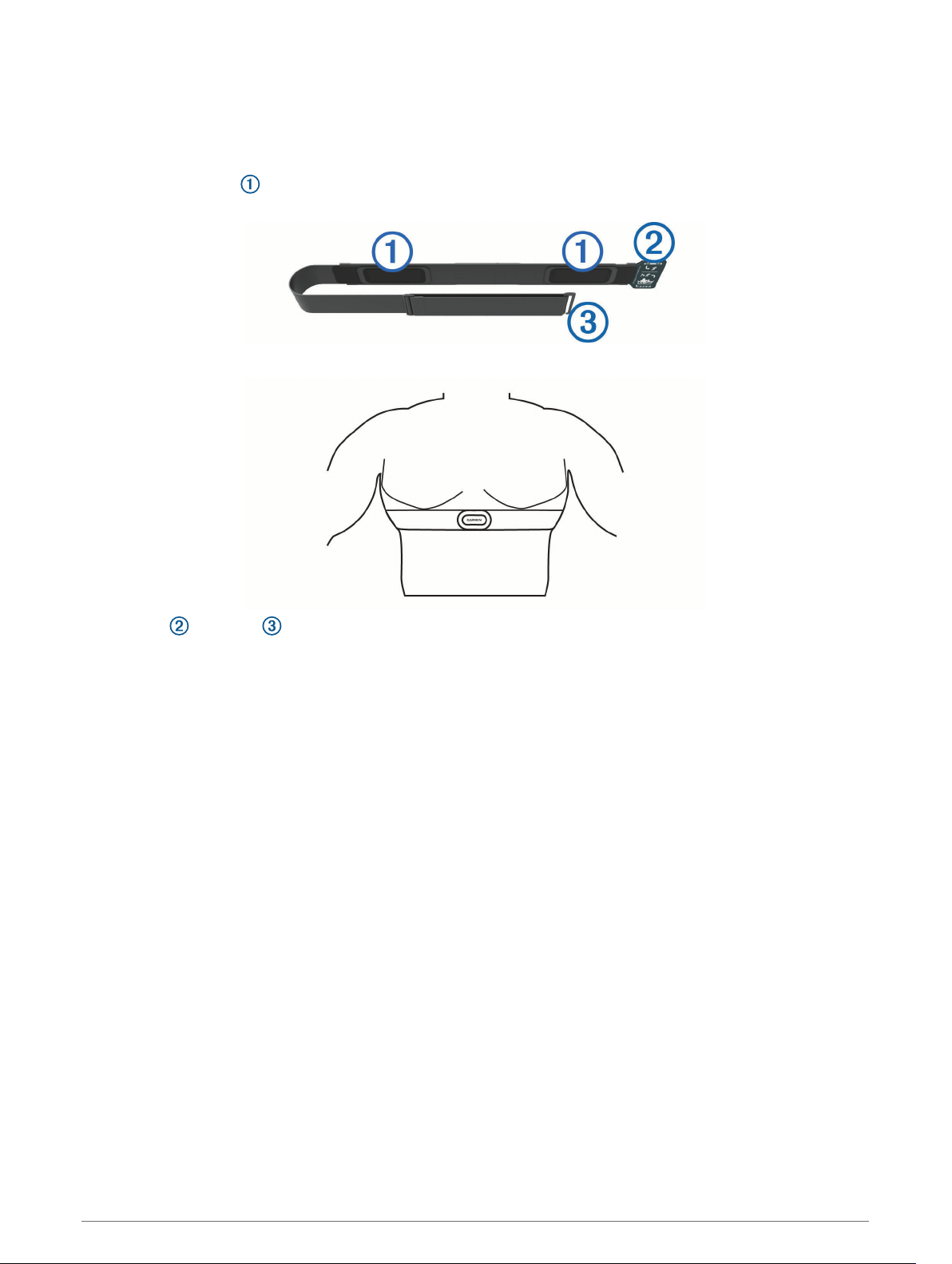
Putting On the Heart Rate Monitor
You should wear the heart rate monitor directly on your skin, just below your sternum. It should be snug enough
to stay in place during your activity.
1 If necessary, attach the strap extender to the heart rate monitor.
2 Wet the electrodes on the back of the heart rate monitor to create a strong connection between your
chest and the transmitter.
3 Wear the heart rate monitor with the Garmin logo facing right-side up.
The loop and hook connection should be on your right side.
4 Wrap the heart rate monitor around your chest, and connect the strap hook to the loop.
NOTE: Make sure the care tag does not fold over.
After you put on the heart rate monitor, it is active and sending data.
Heart Rate Storage for Timed Activities
You can start a timed activity on your paired Forerunner device, and the heart rate monitor records your heart
rate data even if you move away from your device. For example, you can record heart rate data during fitness
activities or team sports where watches cannot be worn.
Your heart rate monitor automatically sends your stored heart rate data to your Forerunner device when you
save your activity. Your heart rate monitor must be active and within range (3 m) of the device while data is
uploaded.
Accessing Stored Heart Rate Data
If you save a timed activity before you upload the stored heart rate data, you can download the data from the
HRM-Pro accessory.
NOTE: Your HRM-Pro accessory stores up to 18 hours of activity history. When the heart rate monitor memory
is full, your oldest data is overwritten.
1 Put on the heart rate monitor.
2 From your Garmin device, select the History menu.
3 Select the timed activity you saved while you were wearing the heart rate monitor
4 Select Download HR.
32 Heart Rate Features
Pool Swimming
NOTICE
Hand wash the heart rate monitor after exposure to chlorine or other pool chemicals. Prolonged exposure to
these substances can damage the heart rate monitor.
The HRM-Pro accessory is designed primarily for open water swimming, but it can be used occasionally for
pool swimming. The heart rate monitor should be worn under a swim suit or triathlon top during pool
swimming. Otherwise, it may slide down your chest when pushing off the pool wall.
Caring for the Heart Rate Monitor
NOTICE
A buildup of sweat and salt on the strap can decrease the ability of the heart rate monitor to report accurate
data.
• Rinse the heart rate monitor after every use.
• Hand wash the heart rate monitor after every seven uses or one pool swim, using a tiny amount of mild
detergent, such as dishwashing liquid.
NOTE: Using too much detergent may damage the heart rate monitor.
• Do not put the heart rate monitor in a washing machine or dryer.
• When drying the heart rate monitor, hang it up or lay it flat.
Tips for Erratic Heart Rate Data
If the heart rate data is erratic or does not appear, you can try these tips.
• Reapply water to the electrodes and contact patches (if applicable).
• Tighten the strap on your chest.
• Warm up for 5 to 10 minutes.
• Follow the care instructions (Caring for the Heart Rate Monitor, page 33).
• Wear a cotton shirt or thoroughly wet both sides of the strap.
Synthetic fabrics that rub or flap against the heart rate monitor can create static electricity that interferes
with heart rate signals.
• Move away from sources that can interfere with your heart rate monitor.
Sources of interference may include strong electromagnetic fields, some 2.4 GHz wireless sensors, high-
voltage power lines, electric motors, ovens, microwave ovens, 2.4 GHz cordless phones, and wireless LAN
access points.
HRM-Swim Accessory
The device can record heart rate during your swim (Chest Heart Rate While Swimming, page 31).
Sizing the Heart Rate Monitor
Before your first swim, take some time sizing the heart rate monitor. It should be tight enough to stay in place
when pushing off the pool wall.
• Select a strap extender, and attach it to the elastic end of the heart rate monitor.
The heart rate monitor comes with three extender straps to fit different chest sizes.
TIP: The medium strap extender works for most shirt sizes (from medium to extra-large).
• Put on the heart rate monitor backward to easily adjust the slider on the strap extender.
• Put on the heart rate monitor forward to easily adjust the slider on the heart rate monitor.
Heart Rate Features 33
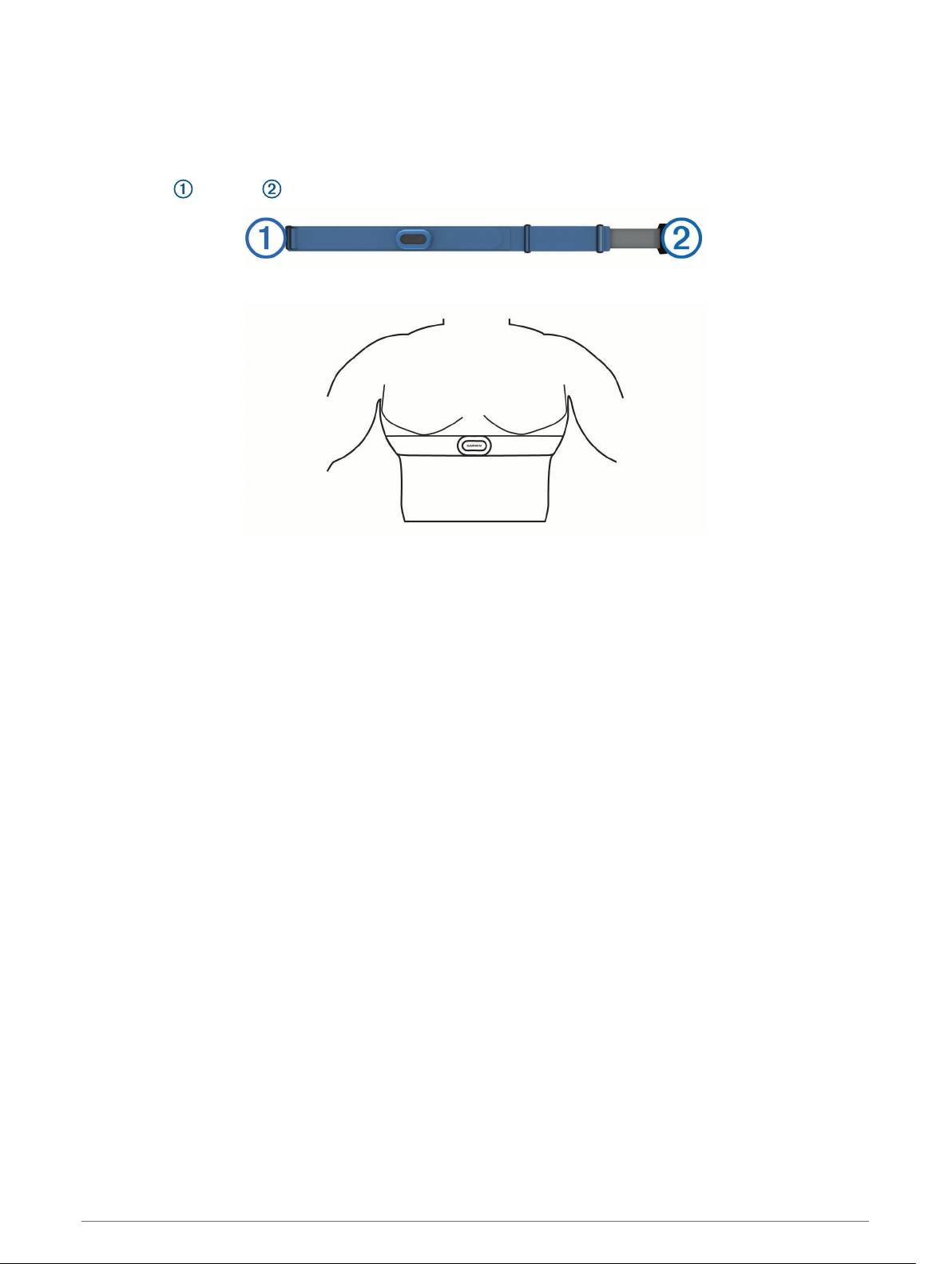
Putting On the Heart Rate Monitor
You should wear the heart rate monitor directly on your skin, just below your sternum.
1 Select a strap extender for the best fit.
2 Wear the heart rate monitor with the Garmin logo facing right-side up.
The hook and loop connection should be on your right side.
3 Wrap the heart rate monitor around your chest, and connect the strap hook to the loop.
NOTE: Make sure the care tag does not fold over.
4 Tighten the heart rate monitor so it is snug around your chest, but not restrictive.
After you put on the heart rate monitor, it is active, storing, and sending data.
Tips for Using the HRM-Swim Accessory
• Adjust the tightness of the heart rate monitor and strap extender if the heart rate monitor slides down your
chest when pushing off the pool wall.
• Stand up between intervals so that the heart rate monitor is out of the water to see your heart rate data.
Running Dynamics
You can use your compatible Forerunner device paired with the HRM-Pro accessory or other running dynamics
accessory to provide real-time feedback about your running form.
The running dynamics accessory has an accelerometer that measures torso movement in order to calculate six
running metrics.
Cadence: Cadence is the number of steps per minute. It displays the total steps (right and left combined).
Vertical oscillation: Vertical oscillation is your bounce while running. It displays the vertical motion of your
torso, measured in centimeters.
Ground contact time: Ground contact time is the amount of time in each step that you spend on the ground
while running. It is measured in milliseconds.
NOTE: Ground contact time and balance are not available while walking.
Ground contact time balance: Ground contact time balance displays the left/right balance of your ground
contact time while running. It displays a percentage. For example, 53.2 with an arrow pointing left or right.
Stride length: Stride length is the length of your stride from one footfall to the next. It is measured in meters.
Vertical ratio: Vertical ratio is the ratio of vertical oscillation to stride length. It displays a percentage. A lower
number typically indicates better running form.
34 Heart Rate Features
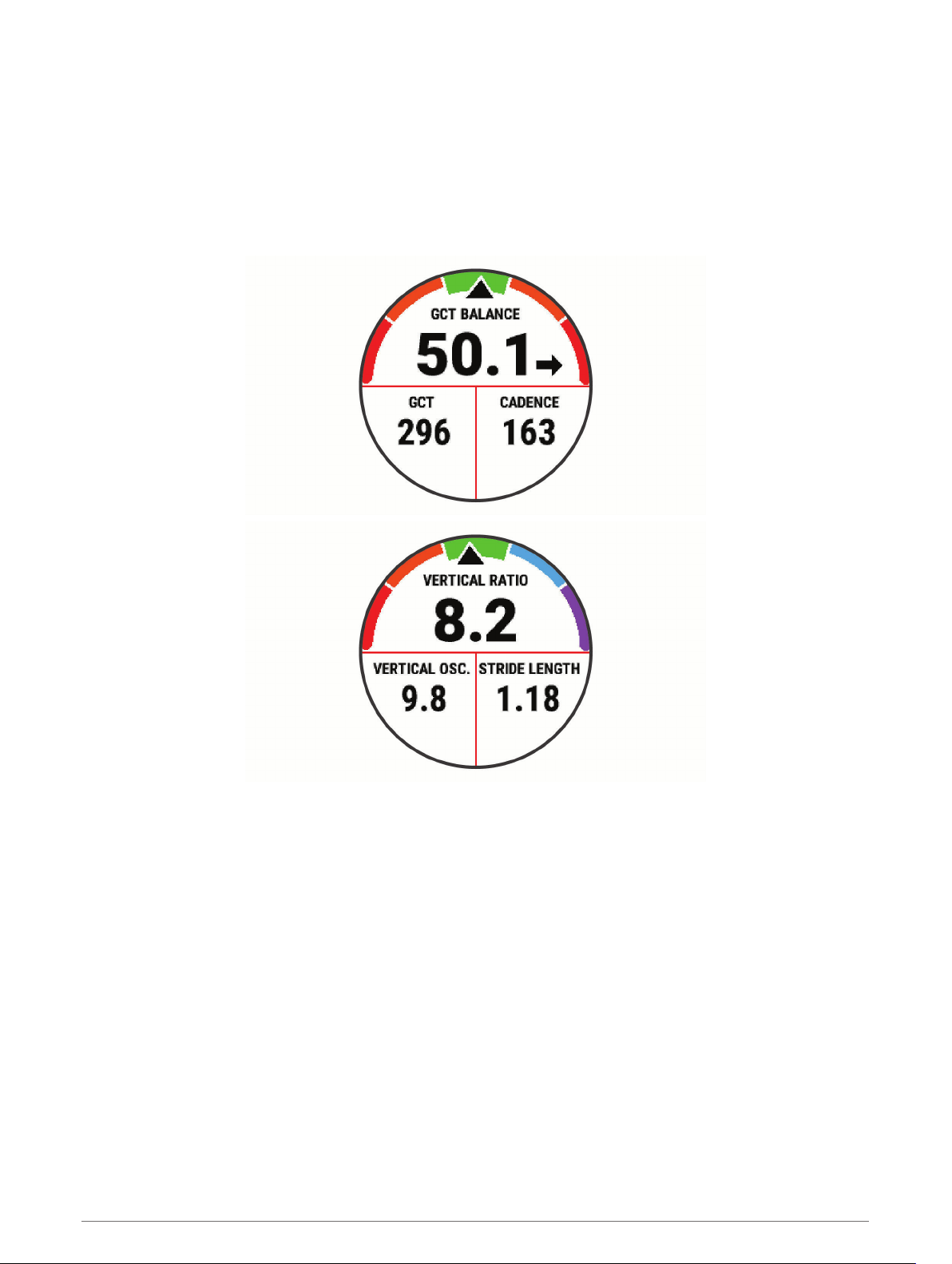
Training with Running Dynamics
Before you can view running dynamics, you must put on an HRM-Pro, HRM-Run
™
, or HRM-Tri accessory, or the
Running Dynamics Pod, and pair it with your device (Pairing Your Wireless Sensors, page 70).
1 Select START, and select a running activity.
2 Select START.
3 Go for a run.
4 Scroll to the running dynamics screens to view your metrics.
5 If necessary, hold UP to edit how the running dynamics data appears.
Heart Rate Features 35
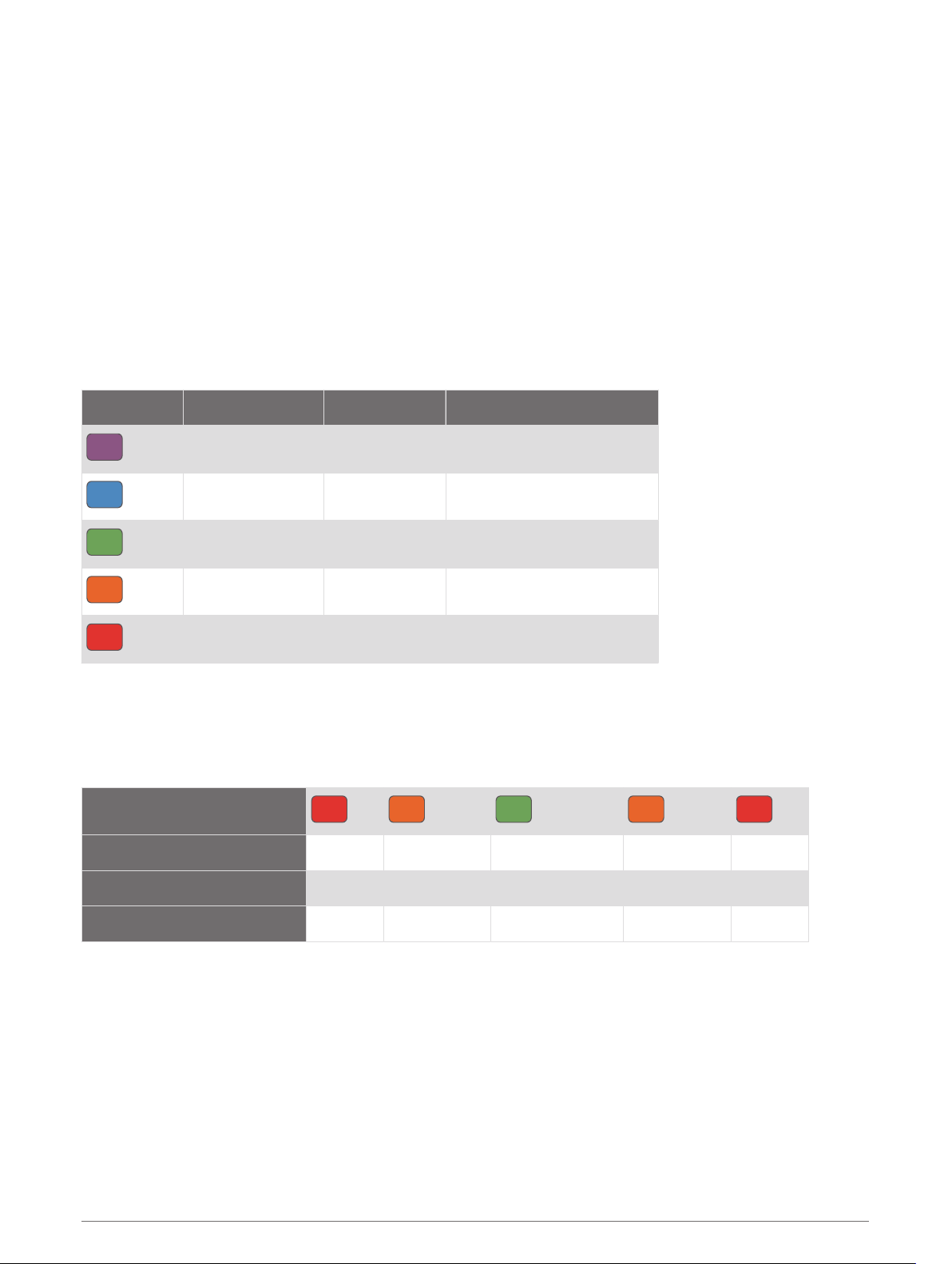
Color Gauges and Running Dynamics Data
The running dynamics screens display a color gauge for the primary metric. You can display cadence, vertical
oscillation, ground contact time, ground contact time balance, or vertical ratio as the primary metric. The color
gauge shows you how your running dynamics data compare to those of other runners. The color zones are
based on percentiles.
Garmin has researched many runners of all different levels. The data values in the red or orange zones are
typical for less experienced or slower runners. The data values in the green, blue, or purple zones are typical for
more experienced or faster runners. More experienced runners tend to exhibit shorter ground contact times,
lower vertical oscillation, lower vertical ratio, and higher cadence than less experienced runners. However, taller
runners typically have slightly slower cadences, longer strides, and slightly higher vertical oscillation. Vertical
ratio is your vertical oscillation divided by stride length. It is not correlated with height.
Go to www.garmin.com/performance-data/running/ for more information on running dynamics. For additional
theories and interpretations of running dynamics data, you can search reputable running publications and
websites.
Color Zone Percentile in Zone Cadence Range Ground Contact Time Range
Purple
>95 >183 spm <218 ms
Blue
70–95 174–183 spm 218–248 ms
Green
30–69 164–173 spm 249–277 ms
Orange
5–29 153–163 spm 278–308 ms
Red
<5 <153 spm >308 ms
Ground Contact Time Balance Data
Ground contact time balance measures your running symmetry and appears as a percentage of your total
ground contact time. For example, 51.3% with an arrow pointing left indicates the runner is spending more time
on the ground when on the left foot. If your data screen displays both numbers, for example 48–52, 48% is the
left foot and 52% is the right foot.
Color Zone
Red Orange Green Orange Red
Symmetry Poor Fair Good Fair Poor
Percent of Other Runners 5% 25% 40% 25% 5%
Ground Contact Time Balance >52.2% L 50.8–52.2% L 50.7% L–50.7% R 50.8–52.2% R >52.2% R
While developing and testing running dynamics, the Garmin team found correlations between injuries and
greater imbalances with certain runners. For many runners, ground contact time balance tends to deviate
further from 50–50 when running up or down hills. Most running coaches agree that a symmetrical running
form is good. Elite runners tend to have quick and balanced strides.
You can watch the color gauge or data field during your run or view the summary on your Garmin Connect
account after your run. As with the other running dynamics data, ground contact time balance is a quantitative
measurement to help you learn about your running form.
36 Heart Rate Features
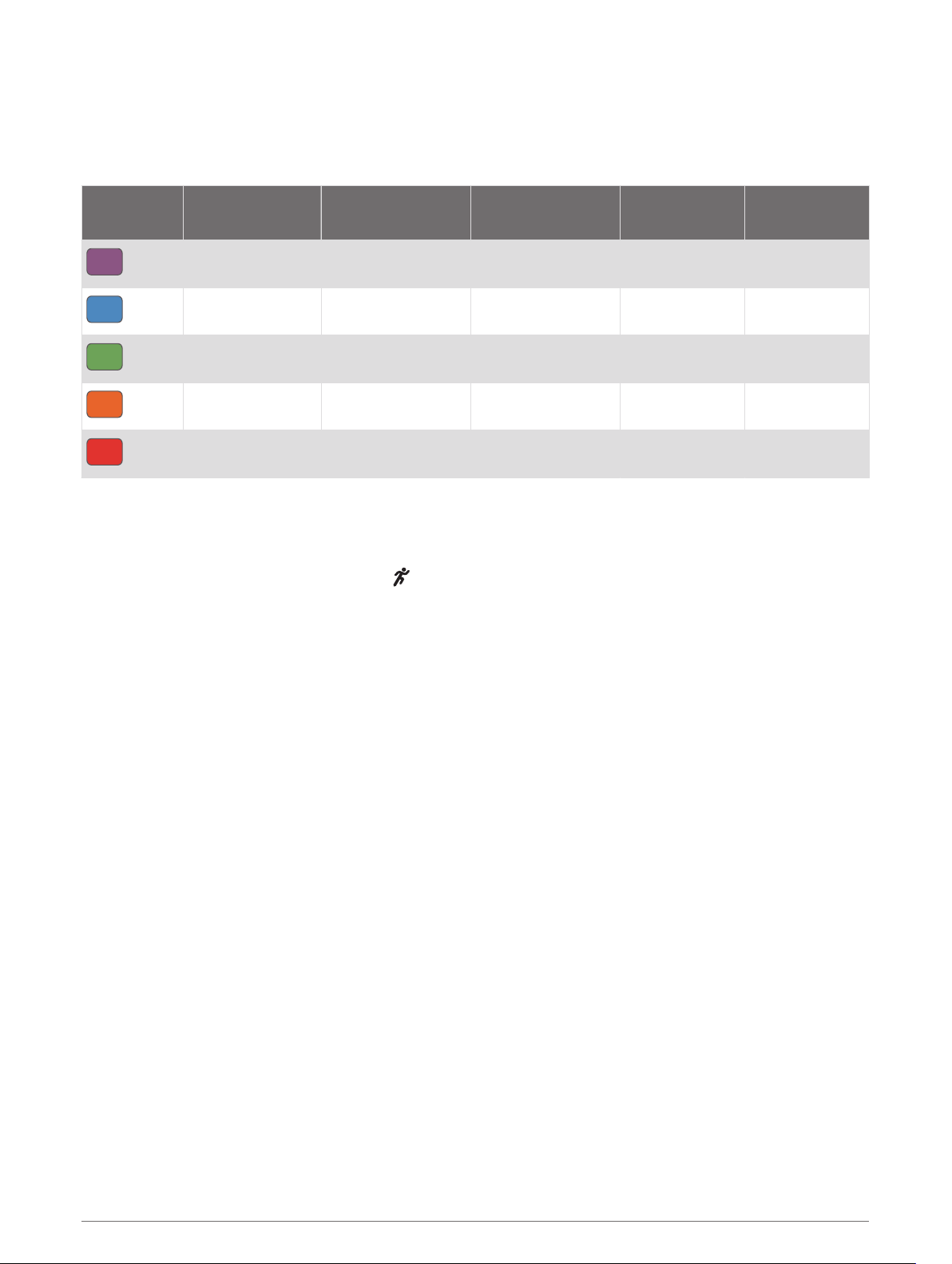
Vertical Oscillation and Vertical Ratio Data
The data ranges for vertical oscillation and vertical ratio are slightly different depending on the sensor and
whether it is positioned at the chest (HRM-Pro, HRM-Run, or HRM-Tri accessories) or at the waist (Running
Dynamics Pod accessory).
Color Zone
Percentile in
Zone
Vertical Oscillation
Range at Chest
Vertical Oscillation
Range at Waist
Vertical Ratio
at Chest
Vertical Ratio
at Waist
Purple
>95 <6.4 cm <6.8 cm <6.1% <6.5%
Blue
70–95 6.4–8.1 cm 6.8–8.9 cm 6.1–7.4% 6.5–8.3%
Green
30–69 8.2–9.7 cm 9.0–10.9 cm 7.5–8.6% 8.4–10.0%
Orange
5–29 9.8–11.5 cm 11.0–13.0 cm 8.7–10.1% 10.1–11.9%
Red
<5 >11.5 cm >13.0 cm >10.1% >11.9%
Tips for Missing Running Dynamics Data
If running dynamics data does not appear, you can try these tips.
• Make sure you have a running dynamics accessory, such as the HRM-Pro accessory.
Accessories with running dynamics have on the front of the module.
• Pair the running dynamics accessory with your Forerunner device again, according to the instructions.
• If you are using the HRM-Pro accessory, pair it with your Forerunner device using ANT+ technology, rather
than Bluetooth technology.
• If the running dynamics data display shows only zeros, make sure the accessory is worn right-side up.
NOTE: Ground contact time and balance appears only while running. It is not calculated while walking.
Heart Rate Features 37
Performance Measurements
These performance measurements are estimates that can help you track and understand your training
activities and race performances. The measurements require a few activities using wrist-based heart rate or a
compatible chest heart rate monitor. Cycling performance measurements require a heart rate monitor and a
power meter.
These estimates are provided and supported by Firstbeat. For more information, go to www.garmin.com
/performance-data/running/.
NOTE: The estimates may seem inaccurate at first. The device requires you to complete a few activities to
learn about your performance.
VO2 max.: VO2 max. is the maximum volume of oxygen (in milliliters) you can consume per minute per
kilogram of body weight at your maximum performance.
Predicted race times: Your device uses the VO2 max. estimate and your training history to provide a target race
time based on your current state of fitness.
HRV stress test: The heart rate variability (HRV) stress test requires a Garmin chest heart rate monitor. The
device records your heart rate variability while standing still for 3 minutes. It provides your overall stress
level. The scale is 1 to 100, and a lower score indicates a lower stress level.
Performance condition: Your performance condition is a real-time assessment after 6 to 20 minutes of activity.
It can be added as a data field so you can view your performance condition during the rest of your activity. It
compares your real-time condition to your average fitness level.
Functional threshold power (FTP): The device uses your user profile information from the initial setup to
estimate your FTP. For a more accurate rating, you can conduct a guided test.
Lactate threshold: Lactate threshold requires a chest heart rate monitor. Lactate threshold is the point where
your muscles start to rapidly fatigue. Your device measures your lactate threshold level using heart rate data
and pace.
Turning Off Performance Notifications
Some performance notifications appear upon completion of your activity. Some performance notifications
appear during an activity or when you achieve a new performance measurement, such as a new VO2 max.
estimate. You can turn off the performance condition feature to avoid some of these notifications.
1 Hold .
2 Select Physiological Metrics > Perf. Condition.
Detecting Performance Measurements Automatically
The Auto Detection feature is turned on by default. The device can automatically detect your maximum heart
rate, and lactate threshold during an activity. When paired with a compatible power meter, the device can
automatically detect your functional threshold power (FTP) during an activity.
NOTE: The device detects a maximum heart rate only when your heart rate is higher than the value set in your
user profile.
1 Hold .
2 Select > Physiological Metrics > Auto Detection.
3 Select an option.
Syncing Activities and Performance Measurements
You can sync activities, personal records, and performance measurements from other Garmin devices to your
Forerunner device using your Garmin Connect account. This allows your device to more accurately reflect your
training status and fitness. For example, you can record a ride with an Edge device, and view your activity
details and overall training load on your Forerunner device.
1 From the watch face, hold .
2 Select
> Physiological Metrics > TrueUp.
When you sync your device with your smartphone, recent activities, personal records, and performance
measurements from your other Garmin devices appear on your Forerunner device.
38 Heart Rate Features
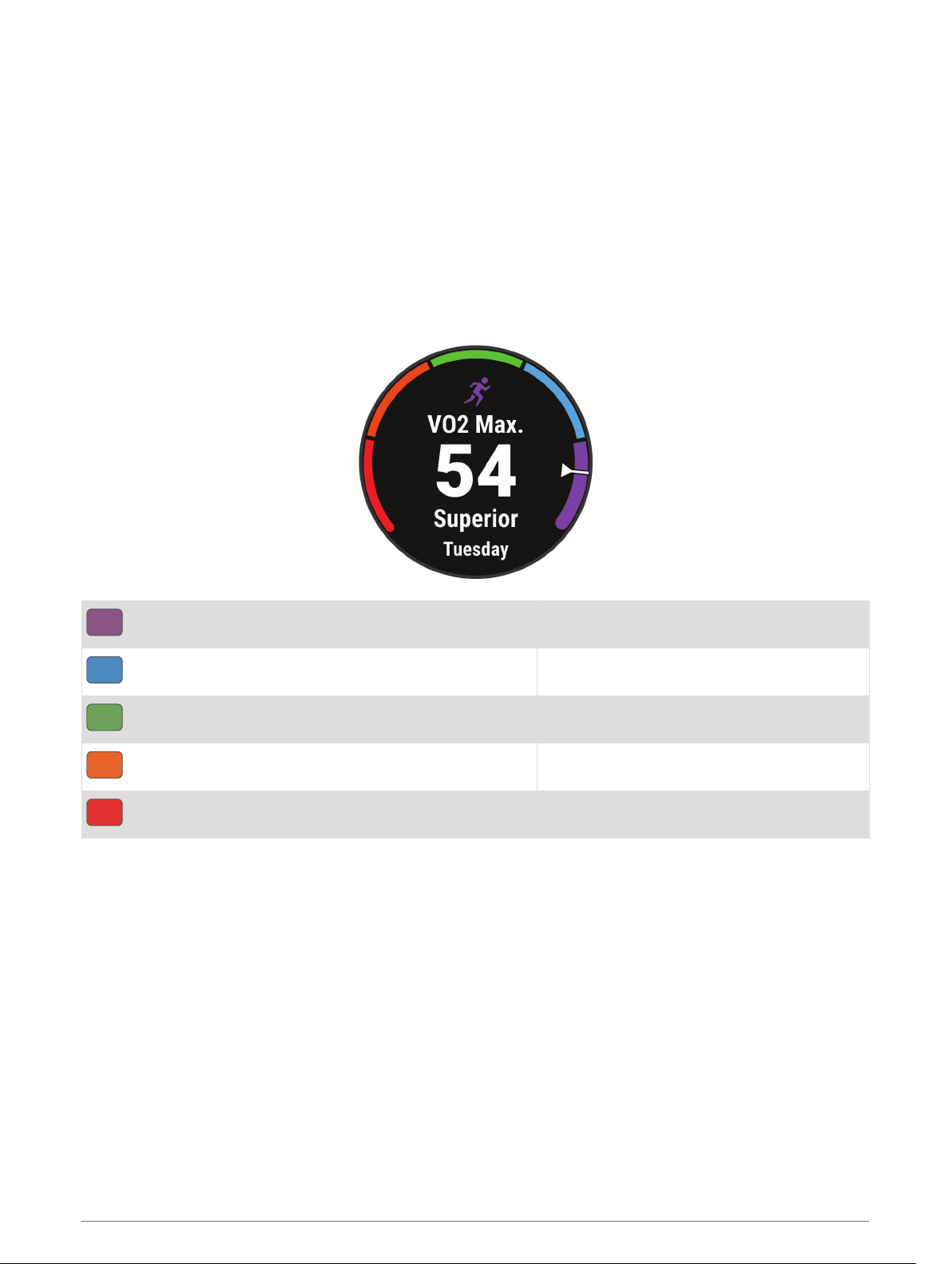
About VO2 Max. Estimates
VO2 max. is the maximum volume of oxygen (in milliliters) you can consume per minute per kilogram of body
weight at your maximum performance. In simple terms, VO2 max. is an indication of athletic performance and
should increase as your level of fitness improves. The Forerunner device requires wrist-based heart rate or a
compatible chest heart rate monitor to display your VO2 max. estimate. The device has separate VO2 max.
estimates for running and cycling. You must run either outside with GPS or ride with a compatible power meter
at a moderate level of intensity for several minutes to get an accurate VO2 max. estimate.
On the device, your VO2 max. estimate appears as a number, description, and position on the color gauge. On
your Garmin Connect account, you can view additional details about your VO2 max. estimate, including your
fitness age. Your fitness age gives you an idea of how your fitness compares with a person of the same gender
and different age. As you exercise, your fitness age can decrease over time (Viewing Your Fitness Age,
page 40).
Purple
Superior
Blue
Excellent
Green
Good
Orange
Fair
Red
Poor
VO2 max. data is provided by Firstbeat Analytics. VO2 max. analysis is provided with permission from The
Cooper Institute
®
. For more information, see the appendix (VO2 Max. Standard Ratings, page 101), and go to
www.CooperInstitute.org.
Getting Your VO2 Max. Estimate for Running
This feature requires wrist-based heart rate or a compatible chest heart rate monitor. If you are using a chest
heart rate monitor, you must put it on and pair it with your device (
Pairing Your Wireless Sensors, page 70).
For the most accurate estimate, complete the user profile setup (Setting Up Your User Profile, page 23), and set
your maximum heart rate (Setting Your Heart Rate Zones, page 24). The estimate may seem inaccurate at first.
The device requires a few runs to learn about your running performance. You can disable VO2 max. recording
for ultra run and trail run activities if you do not want those run types to affect your VO2 max. estimate (Turning
Off VO2 Max. Recording, page 40).
1 Run for at least 10 minutes outdoors.
2 After your run, select Save.
3 Select UP or DOWN to scroll through the performance measurements.
TIP: You can select START to view additional information.
Heart Rate Features 39
Getting Your VO2 Max. Estimate for Cycling
This feature requires a power meter and wrist-based heart rate or a compatible chest heart rate monitor. The
power meter must be paired with your Forerunner device (Pairing Your Wireless Sensors, page 70). If you are
using a chest heart rate monitor, you must put it on and pair it with your device.
For the most accurate estimate, complete the user profile setup (Setting Up Your User Profile, page 23) and set
your maximum heart rate (Setting Your Heart Rate Zones, page 24). The estimate may seem inaccurate at first.
The device requires a few rides to learn about your cycling performance.
1 Ride at a steady, high intensity for at least 20 minutes.
2 After your ride, select Save.
3 Select UP or DOWN to scroll through the performance measurements.
TIP: You can select START to view additional information.
Turning Off VO2 Max. Recording
You can disable VO2 max. recording for ultra run and trail run activities if you do not want these run types to
affect your VO2 max. estimate (About VO2 Max. Estimates, page 39).
1 Hold .
2 Select > Activities & Apps.
3 Select Trail Run or Ultra Run.
4 Select the activity settings.
5 Select Record VO2 Max. > Off.
Viewing Your Fitness Age
Your fitness age gives you an idea of how your fitness compares with a person of the same gender. Your
device uses information, such as your age, body mass index (BMI), resting heart rate data, and vigorous activity
history to provide a fitness age. If you have a Garmin Index
™
scale, your device uses the body fat percentage
metric instead of BMI to determine your fitness age. Exercise and lifestyle changes can impact your fitness
age.
NOTE: For the most accurate fitness age, complete the user profile setup (Setting Up Your User Profile,
page 23).
1 From the Garmin Connect app, select or .
2 Select Health Stats > Fitness Age.
Heat and Altitude Performance Acclimation
Environmental factors such as high temperature and altitude impact your training and performance. For
example, high altitude training can have a positive impact on your fitness, but you may notice a temporary VO2
max. decline while exposed to high altitudes. Your Forerunner device provides acclimation notifications and
corrections to your VO2 max. estimate and training status when the temperature is above 22ºC (72ºF) and
when the altitude is above 800 m (2625 ft.). You can keep track of your heat and altitude acclimation in the
training status widget.
NOTE: The heat acclimation feature is available only for GPS activities and requires weather data from your
connected smartphone.
40 Heart Rate Features
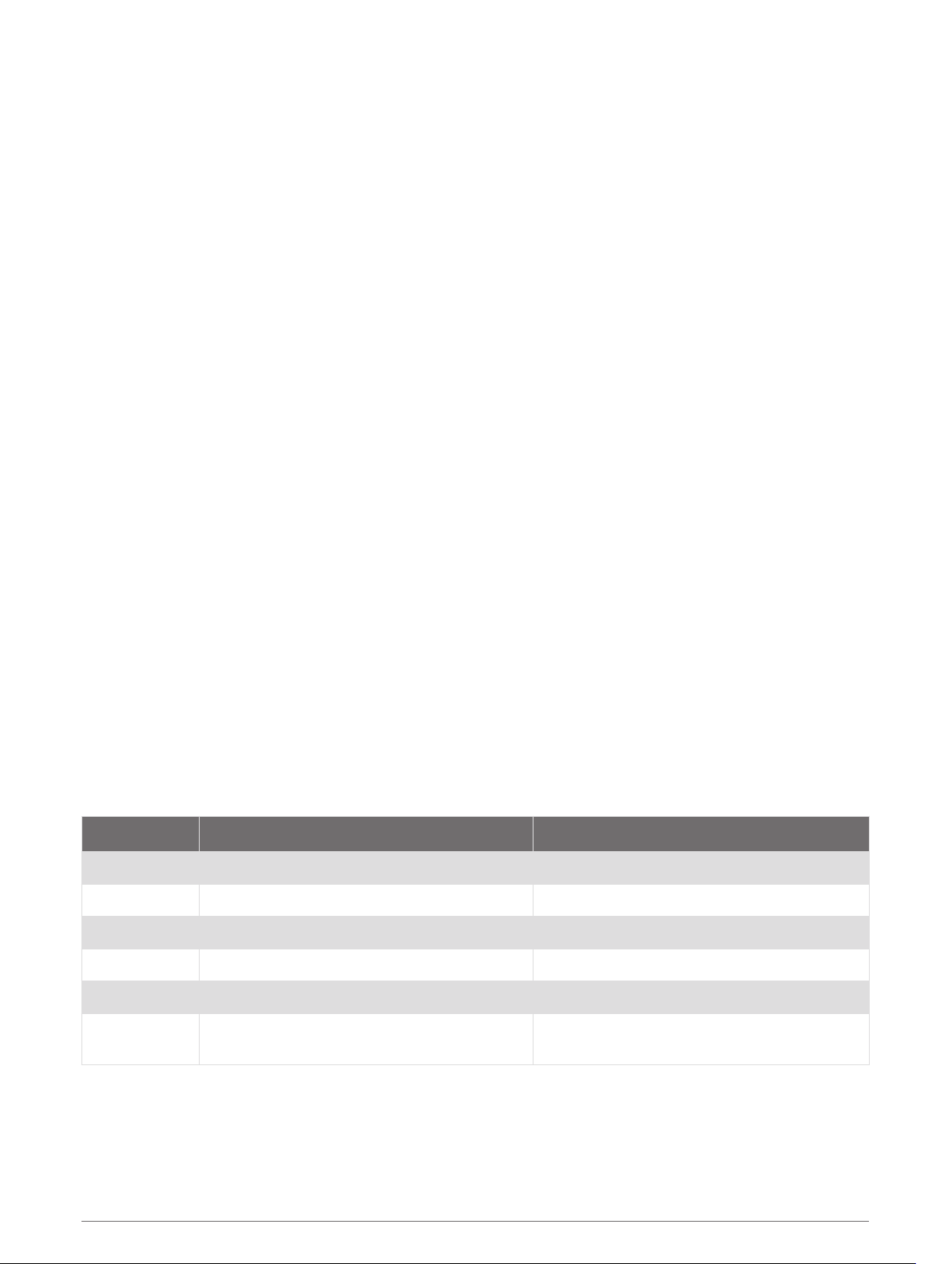
Viewing Your Predicted Race Times
For the most accurate estimate, complete the user profile setup (Setting Up Your User Profile, page 23), and set
your maximum heart rate (Setting Your Heart Rate Zones, page 24).
Your device uses the VO2 max. estimate (About VO2 Max. Estimates, page 39) and your training history to
provide a target race time. The device analyzes several weeks of your training data to refine the race time
estimates.
TIP: If you have more than one Garmin device, you can enable the Physio TrueUp
™
feature, which allows your
device to sync activities, history, and data from other devices (Syncing Activities and Performance
Measurements, page 38).
1 From the watch face, select UP or DOWN to view the performance widget.
2 Select START to scroll through the performance measurements.
Your projected race times appear for 5K, 10K, half marathon, and marathon distances.
NOTE: The projections may seem inaccurate at first. The device requires a few runs to learn about your
running performance.
About Training Effect
Training Effect measures the impact of an activity on your aerobic and anaerobic fitness. Training Effect
accumulates during the activity. As the activity progresses, the Training Effect value increases. Training Effect
is determined by your user profile information and training history, and heart rate, duration, and intensity of your
activity. There are seven different Training Effect labels to describe the primary benefit of your activity. Each
label is color coded and corresponds to your training load focus (Training Load Focus, page 46). Each
feedback phrase, for example, "Highly Impacting VO2 Max." has a corresponding description in your Garmin
Connect activity details.
Aerobic Training Effect uses your heart rate to measure how the accumulated intensity of an exercise affects
your aerobic fitness and indicates if the workout had a maintaining or improving effect on your fitness level.
Your excess post-exercise oxygen consumption (EPOC) accumulated during exercise is mapped to a range of
values that account for your fitness level and training habits. Steady workouts at moderate effort or workouts
involving longer intervals (>180 sec) have a positive impact on your aerobic metabolism and result in an
improved aerobic Training Effect.
Anaerobic Training Effect uses heart rate and speed (or power) to determine how a workout affects your ability
to perform at very high intensity. You receive a value based on the anaerobic contribution to EPOC and the type
of activity. Repeated high-intensity intervals of 10 to 120 seconds have a highly beneficial impact on your
anaerobic capability and result in an improved anaerobic Training Effect.
You can add Aerobic Training Effect and Anaerobic Training Effect as data fields to one of your training
screens to monitor your numbers throughout the activity.
Training Effect Aerobic Benefit Anaerobic Benefit
From 0.0 to 0.9 No benefit. No benefit.
From 1.0 to 1.9 Minor benefit. Minor benefit.
From 2.0 to 2.9 Maintains your aerobic fitness. Maintains your anaerobic fitness.
From 3.0 to 3.9 Impacts your aerobic fitness. Impacts your anaerobic fitness.
From 4.0 to 4.9 Highly impacts your aerobic fitness. Highly impacts your anaerobic fitness.
5.0
Overreaching and potentially harmful without
enough recovery time.
Overreaching and potentially harmful without
enough recovery time.
Training Effect technology is provided and supported by Firstbeat Technologies Ltd. For more information, go
to
www.firstbeat.com.
Heart Rate Features 41
Performance Condition
As you complete your activity, such as running or cycling, the performance condition feature analyzes your
pace, heart rate, and heart rate variability to make a real-time assessment of your ability to perform compared
to your average fitness level. It is approximately your real-time percentage deviation from your baseline VO2
max. estimate.
Performance condition values range from -20 to +20. After the first 6 to 20 minutes of your activity, the device
displays your performance condition score. For example, a score of +5 means that you are rested, fresh, and
capable of a good run or ride. You can add performance condition as a data field to one of your training
screens to monitor your ability throughout the activity. Performance condition can also be an indicator of
fatigue level, especially at the end of a long training run or ride.
NOTE: The device requires a few runs or rides with a heart rate monitor to get an accurate VO2 max. estimate
and learn about your running or riding ability (About VO2 Max. Estimates, page 39).
Viewing Your Performance Condition
This feature requires wrist-based heart rate or a compatible chest heart rate monitor.
1 Add Performance Condition to a data screen (Customizing the Data Screens, page 74).
2 Go for a run or ride.
After 6 to 20 minutes, your performance condition appears.
3 Scroll to the data screen to view your performance condition throughout the run or ride.
Lactate Threshold
Lactate threshold is the exercise intensity at which lactate (lactic acid) starts to accumulate in the
bloodstream. In running, it is the estimated level of effort or pace. When a runner exceeds the threshold, fatigue
starts to increase at an accelerating rate. For experienced runners, the threshold occurs at approximately 90%
of their maximum heart rate and between 10k and half-marathon race pace. For average runners, the lactate
threshold often occurs well below 90% of maximum heart rate. Knowing your lactate threshold can help you
determine how hard to train or when to push yourself during a race.
If you already know your lactate threshold heart rate value, you can enter it in your user profile settings (Setting
Your Heart Rate Zones, page 24).
Performing a Guided Test to Determine Your Lactate Threshold
This feature requires a Garmin chest heart rate monitor. Before you can perform the guided test, you must put
on a heart rate monitor and pair it with your device (Pairing Your Wireless Sensors, page 70).
The device uses your user profile information from the initial setup and your VO2 max. estimate to estimate
your lactate threshold. The device will automatically detect your lactate threshold during runs at a steady, high
intensity with heart rate.
TIP: The device requires a few runs with a chest heart rate monitor to get an accurate maximum heart rate
value and VO2 max. estimate. If you are having trouble getting a lactate threshold estimate, try manually
lowering your maximum heart rate value.
1 From the watch face, select START.
2 Select an outdoor running activity.
GPS is required to complete the test.
3 Hold .
4 Select Training > Lactate Threshold Guided Test.
5 Start the timer, and follow the on-screen instructions.
After you begin your run, the device displays each step duration, the target, and current heart rate data. A
message appears when the test is complete.
6 After you complete the guided test, stop the timer and save the activity.
If this is your first lactate threshold estimate, the device prompts you to update your heart rate zones based
on your lactate threshold heart rate. For each additional lactate threshold estimate, the device prompts you
to accept or decline the estimate.
42 Heart Rate Features
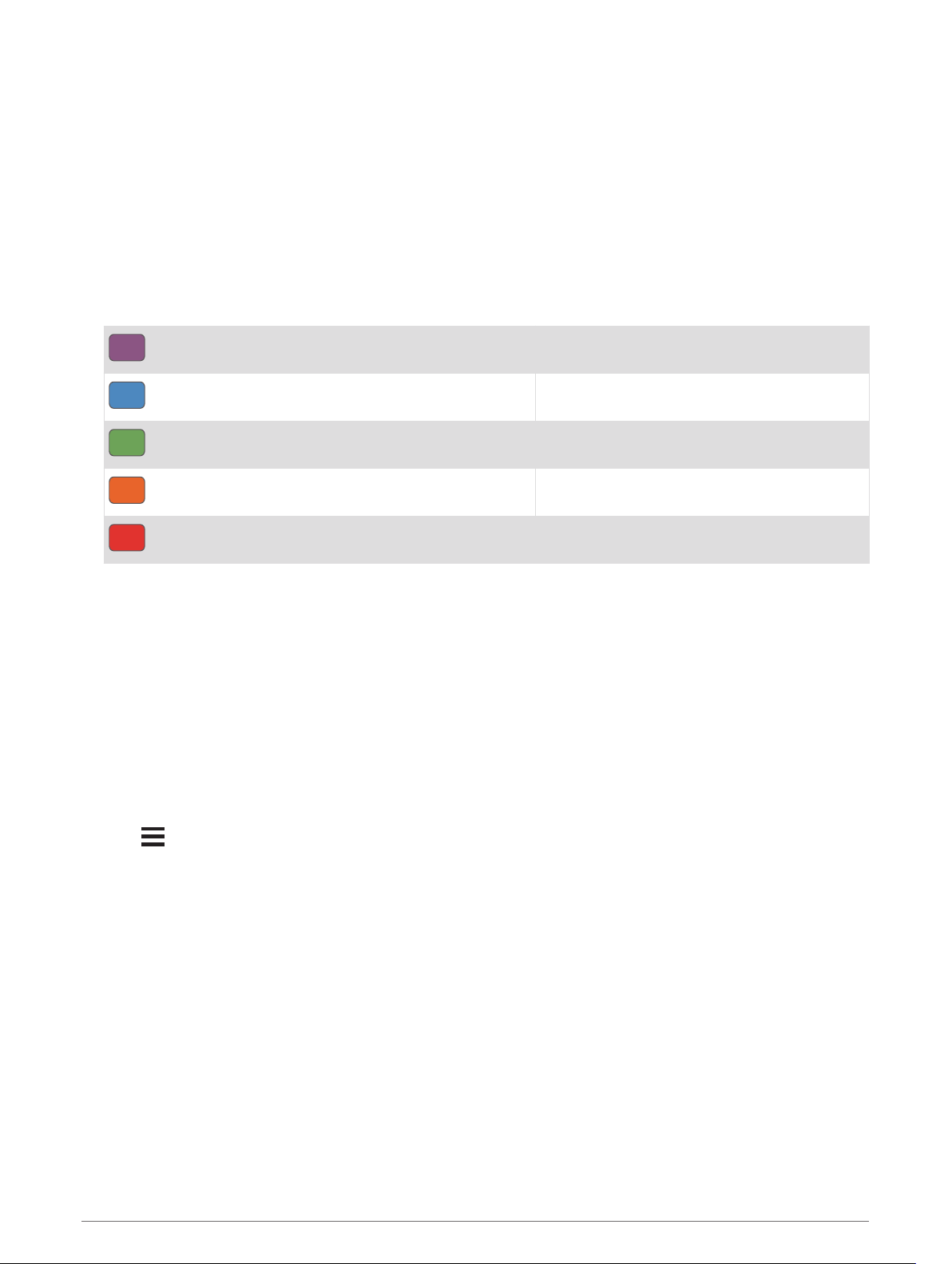
Getting Your FTP Estimate
Before you can get your functional threshold power (FTP) estimate, you must pair a chest heart rate monitor
and power meter with your device (Pairing Your Wireless Sensors, page 70), and you must get your VO2 max.
estimate (Getting Your VO2 Max. Estimate for Cycling, page 40).
The device uses your user profile information from the initial setup and your VO2 max. estimate to estimate
your FTP. The device will automatically detect your FTP during rides at a steady, high intensity with heart rate
and power.
1 Select UP or DOWN to view the performance widget.
2 Select START to scroll through the performance measurements.
Your FTP estimate appears as a value measured in watts per kilogram, your power output in watts, and a
position on the color gauge.
Purple
Superior
Blue
Excellent
Green
Good
Orange
Fair
Red
Untrained
For more information, see the appendix (FTP Ratings, page 102).
NOTE: When a performance notification alerts you to a new FTP, you can select Accept to save the new FTP,
or Decline to keep your current FTP.
Conducting an FTP Test
Before you can conduct a test to determine your functional threshold power (FTP), you must pair a chest heart
rate monitor and a power meter with your device (Pairing Your Wireless Sensors, page 70), and you must get
your VO2 max. estimate (Getting Your VO2 Max. Estimate for Cycling, page 40).
NOTE: The FTP test is a challenging workout that takes about 30 minutes to complete. Choose a practical and
mostly flat route that allows you to ride at a steadily increasing effort, similar to a time trial.
1 From the watch face, select START.
2 Select a cycling activity.
3 Hold .
4 Select Training > FTP Guided Test.
5 Follow the on-screen instructions.
After you begin your ride, the device displays each step duration, the target, and current power data. A
message appears when the test is complete.
6 After you complete the guided test, complete the cool down, stop the timer, and save the activity.
Your FTP appears as a value measured in watts per kilogram, your power output in watts, and a position on
the color gauge.
7 Select an option:
• Select Accept to save the new FTP.
• Select Decline to keep your current FTP.
Heart Rate Features 43
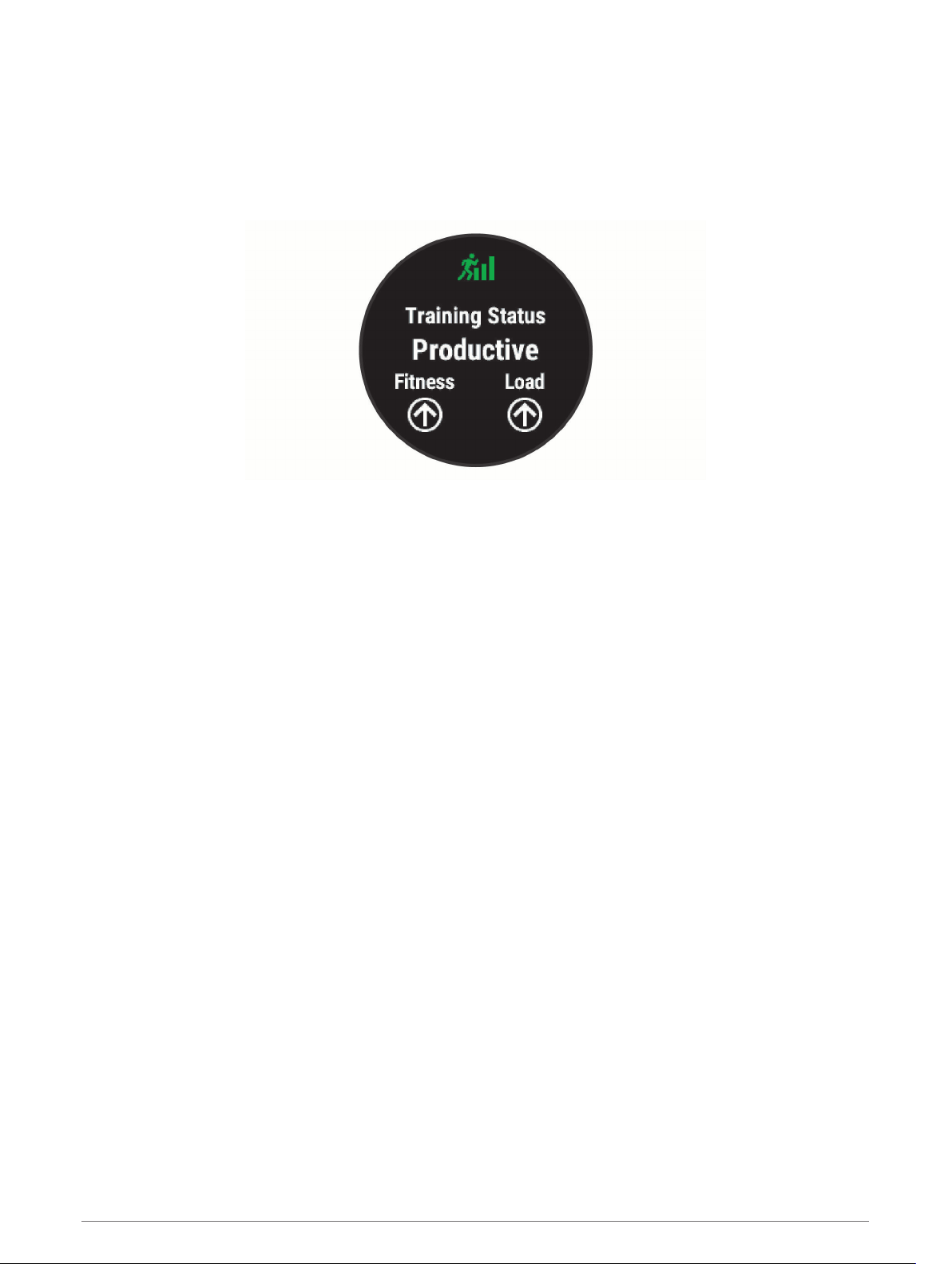
Training Status
These measurements are estimates that can help you track and understand your training activities. The
measurements require a few activities using wrist-based heart rate or a compatible chest heart rate monitor.
Cycling performance measurements require a heart rate monitor and a power meter.
These estimates are provided and supported by Firstbeat. For more information, go to www.garmin.com
/performance-data/running/.
NOTE: The estimates may seem inaccurate at first. The device requires you to complete a few activities to
learn about your performance.
Training status: Training status shows you how your training affects your fitness and performance. Your
training status is based on changes to your training load and VO2 max. over an extended time period.
VO2 max.: VO2 max. is the maximum volume of oxygen (in milliliters) you can consume per minute per
kilogram of body weight at your maximum performance. Your device displays heat and altitude corrected
VO2 max. values when you are acclimating to high heat environments or high altitude.
Training load: Training load is the sum of your excess post-exercise oxygen consumption (EPOC) over the last
7 days. EPOC is an estimate of how much energy it takes for your body to recover after exercise.
Training load focus: Your device analyzes and distributes your training load into different categories based on
the intensity and structure of each activity recorded. Training load focus includes the total load accumulated
per category, and the focus of the training. Your device displays your load distribution over the last 4 weeks.
Recovery time: The recovery time displays how much time remains before you are fully recovered and ready for
the next hard workout.
44 Heart Rate Features
Training Status Levels
Training status shows you how your training affects your fitness level and performance. Your training status is
based on changes to your training load and VO2 max. over an extended time period. You can use your training
status to help plan future training and continue improving your fitness level.
Peaking: Peaking means that you are in ideal race condition. Your recently reduced training load is allowing
your body to recover and fully compensate for earlier training. You should plan ahead, since this peak state
can only be maintained for a short time.
Productive: Your current training load is moving your fitness level and performance in the right direction. You
should plan recovery periods into your training to maintain your fitness level.
Maintaining: Your current training load is enough to maintain your fitness level. To see improvement, try adding
more variety to your workouts or increasing your training volume.
Recovery: Your lighter training load is allowing your body to recover, which is essential during extended periods
of hard training. You can return to a higher training load when you feel ready.
Unproductive: Your training load is at a good level, but your fitness is decreasing. Your body may be struggling
to recover, so you should pay attention to your overall health including stress, nutrition, and rest.
Detraining: Detraining occurs when you are training much less than usual for a week or more, and it is affecting
your fitness level. You can try increasing your training load to see improvement.
Overreaching: Your training load is very high and counterproductive. Your body needs a rest. You should give
yourself time to recover by adding lighter training to your schedule.
No Status: The device needs one or two weeks of training history, including activities with VO2 max. results
from running or cycling, to determine your training status.
Tips for Getting Your Training Status
The training status feature depends on updated assessments of your fitness level, including at least two VO2
max. measurements per week. Your VO2 max. estimate is updated after outdoor runs or rides with power
during which your heart rate reached at least 70% of your maximum heart rate for several minutes. Indoor run
activities do not generate a VO2 max. estimate in order to preserve the accuracy of your fitness level trend. You
can disable VO2 max. recording for ultra run and trail run activities if you do not want those run types to affect
your VO2 max. estimate (Turning Off VO2 Max. Recording, page 40).
To get the most out of the training status feature, you can try these tips.
• At least two times per week, run or ride outdoors with a power meter, and reach a heart rate higher than 70%
of your maximum heart rate for at least 10 minutes.
After using the device for one week, your training status should be available.
• Record all of your fitness activities on this device, or enable the Physio TrueUp feature, allowing your device
to learn about your performance (Syncing Activities and Performance Measurements, page 38).
Training Load
Training load is a measurement of your training volume over the last seven days. It is the sum of your excess
post-exercise oxygen consumption (EPOC) measurements for the last seven days. The gauge indicates
whether your current load is low, high, or within the optimal range to maintain or improve your fitness level. The
optimal range is determined based on your individual fitness level and training history. The range adjusts as
your training time and intensity increase or decrease.
Heart Rate Features 45
Training Load Focus
In order to maximize performance and fitness gains, training should be distributed across three categories: low
aerobic, high aerobic, and anaerobic. Training load focus shows you how much of your training is currently in
each category and provides training targets. Training load focus requires at least 7 days of training to
determine if your training load is low, optimal, or high. After 4 weeks of training history, your training load
estimate will have more detailed target information to help you balance your training activities.
Below targets: Your training load is lower than optimal in all intensity categories. Try increasing the duration or
frequency of your workouts.
Low aerobic shortage: Try adding more low aerobic activities to provide recovery and balance for your higher
intensity activities.
High aerobic shortage: Try adding more high aerobic activities to help improve your lactate threshold and VO2
max. over time.
Anaerobic shortage: Try adding a few more intense, anaerobic activities to improve your speed and anaerobic
capacity over time.
Balanced: Your training load is balanced and provides all-around fitness benefits as you continue training.
Low aerobic focus: Your training load is mostly low aerobic activity. This provides a solid foundation and
prepares you for adding more intense workouts.
High aerobic focus: Your training load is mostly high aerobic activity. These activities help to improve lactate
threshold, VO2 max., and endurance.
Anaerobic focus: Your training load is mostly intense activity. This leads to rapid fitness gains, but should be
balanced with low aerobic activities.
Above targets: Your training load is higher than optimal, and you should consider scaling back the duration and
frequency of your workouts.
Recovery Time
You can use your Garmin device with wrist-based heart rate or a compatible chest heart rate monitor to display
how much time remains before you are fully recovered and ready for the next hard workout.
NOTE: The recovery time recommendation uses your VO2 max. estimate and may seem inaccurate at first. The
device requires you to complete a few activities to learn about your performance.
The recovery time appears immediately following an activity. The time counts down until it is optimal for you to
attempt another hard workout. The device updates your recovery time throughout the day based on changes in
sleep, stress, relaxation, and physical activity.
Viewing Your Recovery Time
For the most accurate estimate, complete the user profile setup (Setting Up Your User Profile, page 23), and set
your maximum heart rate (Setting Your Heart Rate Zones, page 24).
1 Go for a run.
2 After your run, select Save.
The recovery time appears. The maximum time is 4 days.
NOTE: From the watch face, you can select UP or DOWN to view the training status widget, and select
START to scroll through the metrics to view your recovery time.
Recovery Heart Rate
If you are training with wrist-based heart rate or a compatible chest heart rate monitor, you can check your
recovery heart rate value after each activity. Recovery heart rate is the difference between your exercising heart
rate and your heart rate two minutes after the exercise has stopped. For example, after a typical training run,
you stop the timer. Your heart rate is 140 bpm. After two minutes of no activity or cool down, your heart rate is
90 bpm. Your recovery heart rate is 50 bpm (140 minus 90). Some studies have linked recovery heart rate to
cardiac health. Higher numbers generally indicate healthier hearts.
TIP: For best results, you should stop moving for two minutes while the device calculates your recovery heart
rate value.
46 Heart Rate Features
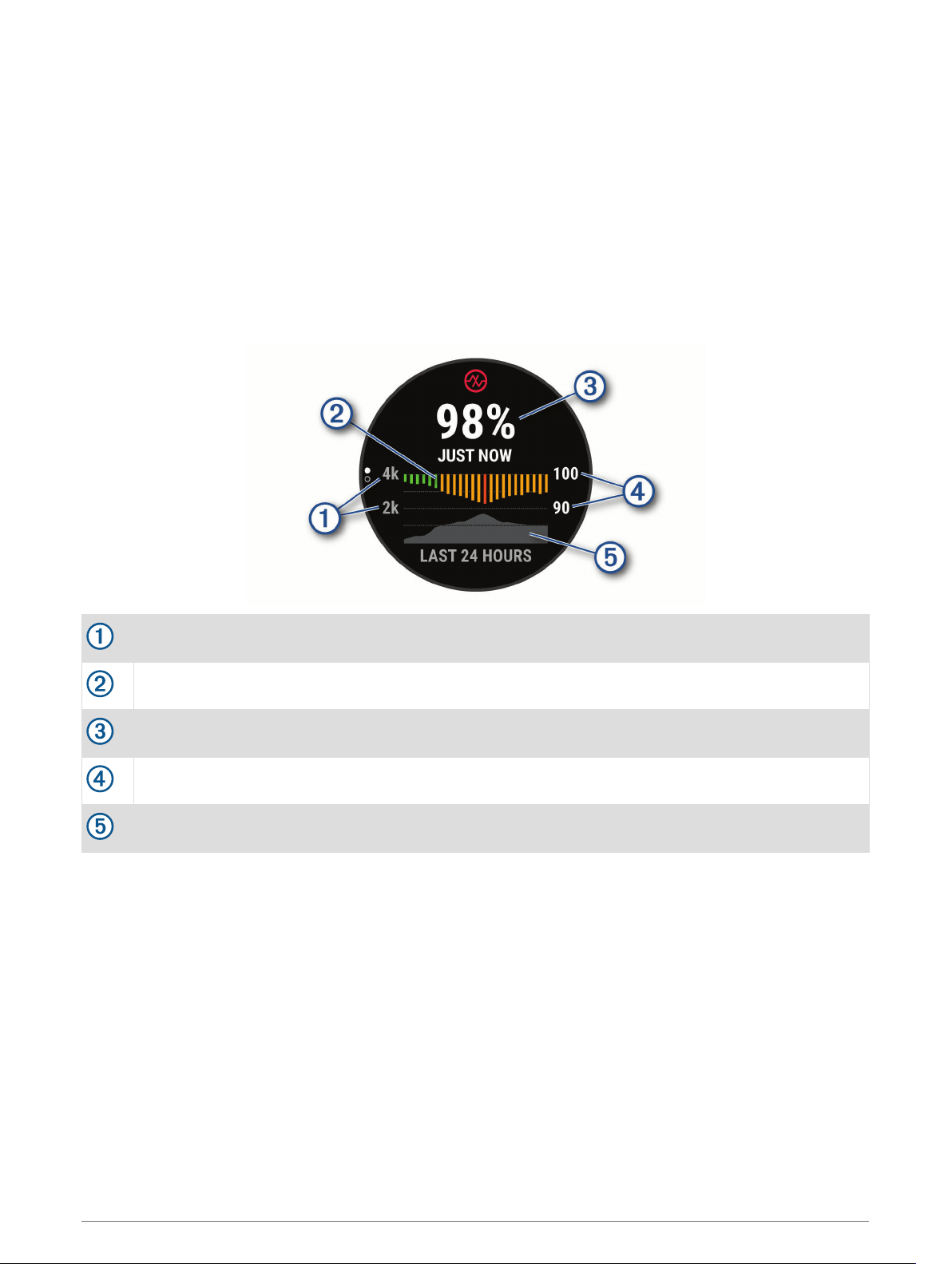
Pulse Oximeter
The Forerunner 745 device has a wrist-based pulse oximeter to gauge the peripheral saturation of oxygen in
your blood. Knowing your oxygen saturation can help you determine how your body is acclimating to high
altitudes for alpine sport and expedition.
You can manually begin a pulse oximeter reading by viewing the pulse oximeter widget (Getting Pulse Oximeter
Readings, page 47). You can also turn on all-day readings (Turning On All-Day Acclimation Mode, page 48).
When you remain motionless, your device analyzes your oxygen saturation and your elevation. The elevation
profile helps indicate how your pulse oximeter readings are changing, relative to your to elevation.
On the device, your pulse oximeter reading appears as an oxygen saturation percentage and color on the graph.
On your Garmin Connect account, you can view additional details about your pulse oximeter readings, including
trends over multiple days.
For more information about pulse oximeter accuracy, go to garmin.com/ataccuracy.
The elevation scale.
A graph of your average oxygen saturation readings for the last 24 hours.
Your most recent oxygen saturation reading.
The oxygen saturation percentage scale.
A graph of your elevation readings for the last 24 hours.
Getting Pulse Oximeter Readings
You can manually begin a pulse oximeter reading by viewing the pulse oximeter widget. The widget displays
your most recent blood oxygen saturation percentage, a graph of your hourly average readings for the last 24
hours, and a graph of your elevation for the last 24 hours.
NOTE: The first time you view the pulse oximeter widget, the device must acquire satellite signals to determine
your elevation. You should go outside, and wait while the device locates satellites.
1 While you are sitting or inactive, press UP or DOWN to view the pulse oximeter widget.
2 Press START to view widget details and begin a pulse oximeter reading.
3 Remain motionless for up to 30 seconds.
NOTE: If you are too active for the watch to get a pulse oximeter reading, a message appears instead of a
percentage. You can check again after several minutes of inactivity. For best results, hold the arm wearing
the device at heart level while the device reads your blood oxygen saturation.
4 Press DOWN to view a graph of your pulse oximeter readings for the last seven days.
Heart Rate Features 47
Turning On Pulse Oximeter Sleep Tracking
You can set your device to continuously measure your blood oxygen saturation while you sleep.
NOTE: Unusual sleep positions can cause abnormally low sleep-time SpO2 readings.
1 From the pulse oximeter widget, hold .
2 Select Options > Pulse Ox Mode > During Sleep.
Turning On All-Day Acclimation Mode
1 From the pulse oximeter widget, hold .
2 Select Options > Pulse Ox Mode > All Day.
The device automatically analyzes your oxygen saturation throughout the day, when you are not moving.
NOTE: Turning on all-day acclimation mode decreases battery life.
Tips for Erratic Pulse Oximeter Data
If the pulse oximeter data is erratic or does not appear, you can try these tips.
• Remain motionless while the device reads your blood oxygen saturation.
• Wear the device above your wrist bone. The device should be snug but comfortable.
• Hold the arm wearing the device at heart level while the device reads your blood oxygen saturation.
• Use a silicone band.
• Clean and dry your arm before putting on the device.
• Avoid wearing sunscreen, lotion, and insect repellent under the device.
• Avoid scratching the optical sensor on the back of the device.
• Rinse the device with fresh water after each workout.
Viewing Your Heart Rate Variability Stress Score
Before you can perform the heart rate variability (HRV) stress test, you must put on a Garmin chest heart rate
monitor and pair it with your device (Pairing Your Wireless Sensors, page 70).
Your HRV stress score is the result of a three-minute test performed while standing still, where the Forerunner
device analyzes heart rate variability to determine your overall stress. Training, sleep, nutrition, and general life
stress all impact how you perform. The stress score range is 1 to 100, where 1 is a very low stress state, and
100 is a very high stress state. Knowing your stress score can help you decide if your body is ready for a tough
training run or yoga.
TIP: Garmin recommends that you measure your stress score before you exercise, at approximately the same
time, and under the same conditions every day. You can view previous results on your Garmin Connect account.
1 Select START > DOWN > HRV Stress > START.
2 Follow the onscreen instructions.
Body Battery
Your device analyzes your heart rate variability, stress level, sleep quality, and activity data to determine your
overall Body Battery level. Like a gas gauge on a car, it indicates your amount of available reserve energy. The
Body Battery level range is from 0 to 100, where 0 to 25 is low reserve energy, 26 to 50 is medium reserve
energy, 51 to 75 is high reserve energy, and 76 to 100 is very high reserve energy.
You can sync your device with your Garmin Connect account to view your most up-to-date Body Battery level,
long-term trends, and additional details (Tips for Improved Body Battery Data, page 49).
48 Heart Rate Features
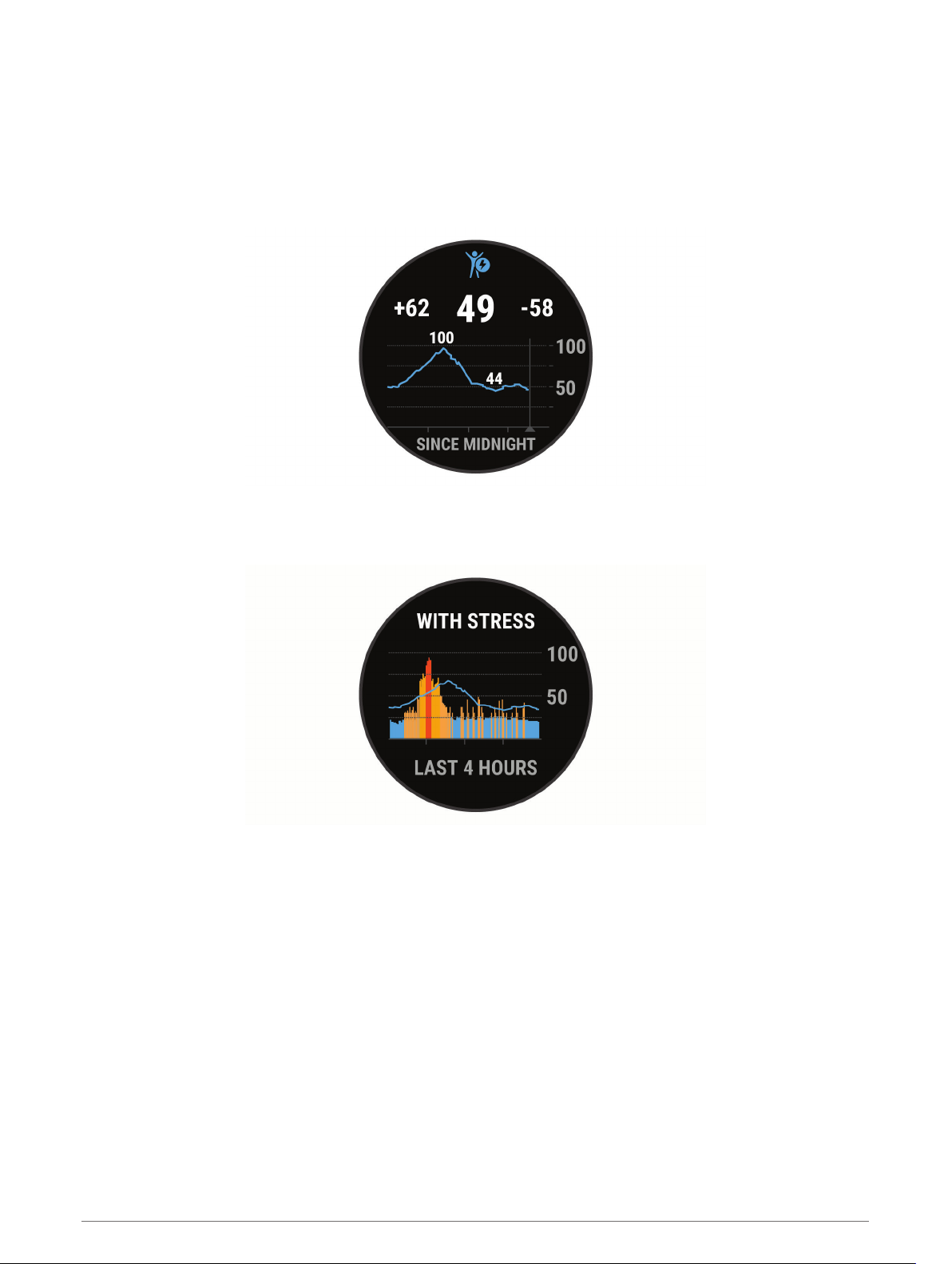
Viewing the Body Battery Widget
The Body Battery widget displays your current Body Battery level and a graph of your Body Battery level for the
last several hours.
1 Press UP or DOWN to view the Body Battery widget.
NOTE: You may need to add the widget to your widget loop (Customizing the Widget Loop, page 72).
2 Press START to view a graph of your body battery level since midnight.
3 Press DOWN to view a combined graph of your Body Battery and stress levels.
Blue bars indicate periods of rest. Orange bars indicate periods of stress. Gray bars indicate times when you
were too active to determine your stress level.
Tips for Improved Body Battery Data
• For more accurate results, wear the device while sleeping.
• Good sleep charges your Body Battery.
• Strenuous activity and high stress can cause your Body Battery to drain more quickly.
• Food intake, as well as stimulants like caffeine, has no impact on your Body Battery.
Heart Rate Features 49
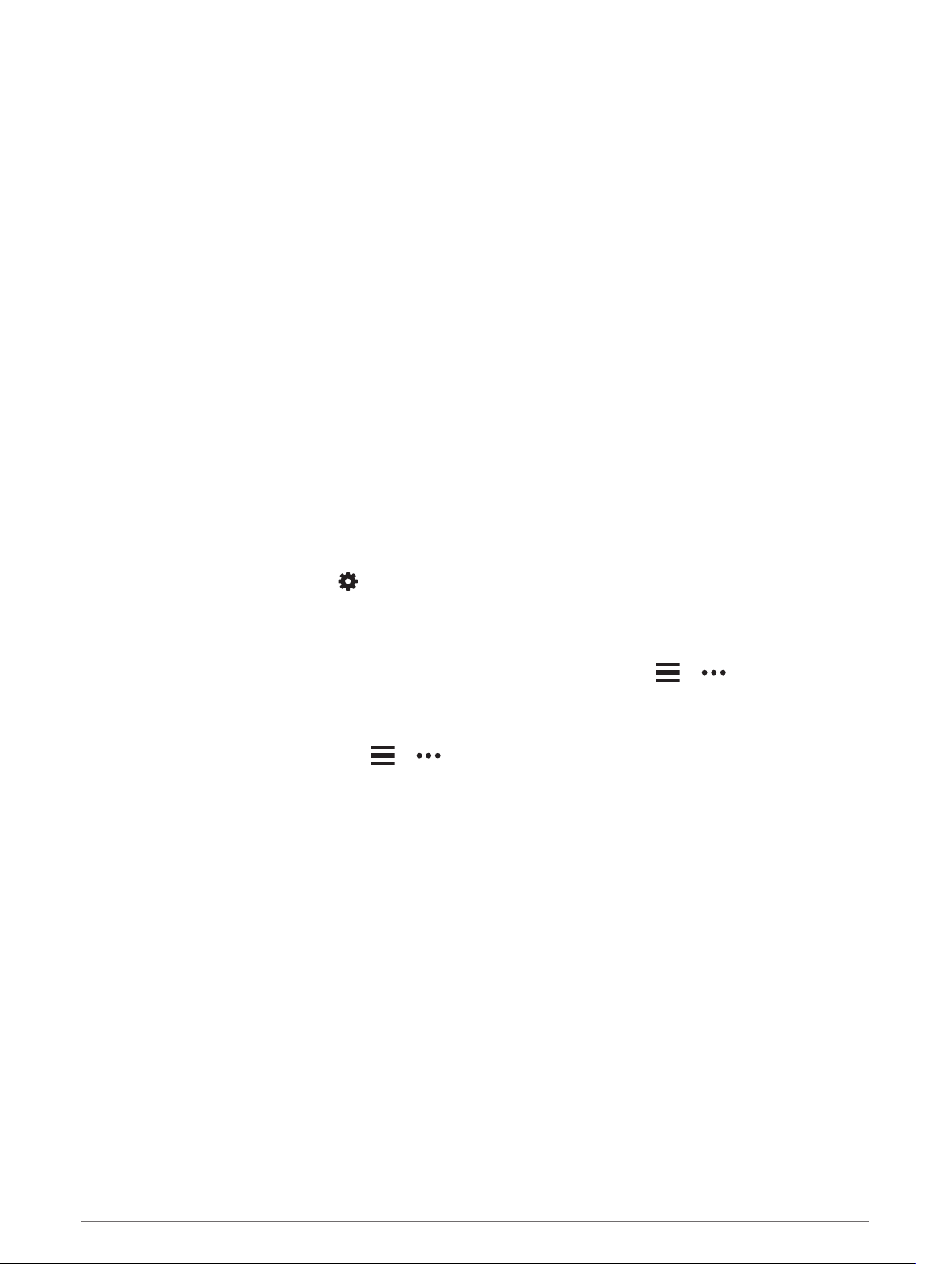
Using the Stress Level Widget
The stress level widget displays your current stress level and a graph of your stress level for the last several
hours. It can also guide you through a breathing activity to help you relax (Customizing the Widget Loop,
page 72).
1 While you are sitting or inactive, select UP or DOWN to view the stress level widget.
2 Select START.
3 Select an option:
• Select DOWN to view additional details.
TIP: Blue bars indicate periods of rest. Yellow bars indicate periods of stress. Gray bars indicate times
when you were too active to determine your stress level.
• Select START > DOWN to start a relaxation activity.
Smart Features
Pairing Your Smartphone with Your Device
To use the connected features of the Forerunner device, it must be paired directly through the Garmin Connect
app, instead of from the Bluetooth settings on your smartphone.
1 From the app store on your smartphone, install and open the Garmin Connect app.
2 Bring your smartphone within 10 m (33 ft.) of your device.
3 Select LIGHT to turn on the device.
The first time you turn on the device, it is in pairing mode.
TIP: You can hold UP, and select > Phone > Pair Phone to manually enter pairing mode.
4 Select an option to add your device to your Garmin Connect account:
• If this is the first time you are pairing a device with the Garmin Connect app, follow the on-screen
instructions.
• If you already paired another device with the Garmin Connect app, from the or menu, select
Garmin Devices > Add Device, and follow the on-screen instructions.
Tips for Existing Garmin Connect Users
1 From the Garmin Connect app, select or .
2 Select Garmin Devices > Add Device.
50 Smart Features
Enabling Bluetooth Notifications
Before you can enable notifications, you must pair the Forerunner device with a compatible mobile device
(Pairing Your Smartphone with Your Device, page 50).
1 Hold .
2 Select > Phone > Smart Notifications > Status > On.
3 Select During Activity.
4 Select a notification preference.
5 Select a sound preference.
6 Select Not During Activity.
7 Select a notification preference.
8 Select a sound preference.
9 Select Privacy.
10 Select a privacy preference.
11 Select Timeout.
12 Select the amount of time the alert for a new notification appears on the screen.
13 Select Signature to add a signature to your text message replies.
Viewing Notifications
1 From the watch face, select UP or DOWN to view the notifications widget.
2 Select START.
3 Select a notification.
4 Select DOWN for more options.
5 Select BACK to return to the previous screen.
Managing Notifications
You can use your compatible smartphone to manage notifications that appear on your Forerunner device.
Select an option:
• If you are using an iPhone
®
device, go to the iOS
®
notifications settings to select the items to show on the
device.
• If you are using an Android
™
smartphone, from the Garmin Connect app, select Settings > Notifications.
Playing Audio Prompts on Your Smartphone During Your Activity
Before you can set up audio prompts, you must have a smartphone with the Garmin Connect app paired to your
Forerunner device.
You can set the Garmin Connect app to play motivational status announcements on your smartphone during a
run or other activity. Audio prompts include the lap number and lap time, pace or speed, and heart rate data.
During an audio prompt, the Garmin Connect app mutes the primary audio of the smartphone to play the
announcement. You can customize the volume levels on the Garmin Connect app.
NOTE: If you have a Forerunner 745 device, you can enable audio prompts on the device through your
connected headphones, without using a connected smartphone (Playing Audio Prompts During Your Activity,
page 13).
NOTE: The Lap Alert audio prompt is enabled by default.
1 From the Garmin Connect app, select or .
2 Select Garmin Devices.
3 Select your device.
4 Select Activity Options > Audio Prompts.
Smart Features 51
Turning Off the Bluetooth Smartphone Connection
You can turn off the Bluetooth smartphone connection from the controls menu.
NOTE: You can add options to the controls menu (Customizing the Controls Menu, page 56).
1 Hold LIGHT to view the controls menu.
2 Select to turn off the Bluetooth smartphone connection on your Forerunner device.
Refer to the owner's manual for your mobile device to turn off Bluetooth technology on your mobile device.
Turning On and Off Smartphone Connection Alerts
You can set the Forerunner device to alert you when your paired smartphone connects and disconnects using
Bluetooth technology.
NOTE: Smartphone connection alerts are turned off by default.
1 Hold .
2 Select > Phone > Alerts.
Bluetooth Connected Features
The Forerunner device has several Bluetooth connected features for your compatible smartphone using the
Garmin Connect app.
Activity uploads: Automatically sends your activity to the Garmin Connect app as soon as you finish recording
the activity.
Audio prompts: Allows the Garmin Connect app to play status announcements, such as mile splits and other
data, on your smartphone during a run or other activity.
Bluetooth sensors: Allows you to connect Bluetooth compatible sensors, such as a heart rate monitor.
Connect IQ: Allows you to extend your device features with new watch faces, widgets, apps, and data fields.
Find my phone: Locates your lost smartphone that is paired with your Forerunner device and currently within
range.
Find my watch: Locates your lost Forerunner device that is paired with your smartphone and currently within
range.
GroupTrack: Allows you join a group using LiveTrack, so others can view your position directly on screen and in
real time.
Music controls: Allows you to control the music player on your smartphone.
PacePro downloads: Allows you to create and download PacePro strategies in the Garmin Connect app and
wirelessly send them to your device.
Phone notifications: Displays phone notifications and messages on your Forerunner device.
Safety and tracking features: Allows you to send messages and alerts to friends and family, as well as request
assistance from emergency contacts set up in the Garmin Connect app. For more information, go to (Safety
and Tracking Features, page 57).
Social media interactions: Allows you to post an update to your favorite social media website when you upload
an activity to the Garmin Connect app.
Software updates: Allows you to update your device software.
Weather updates: Sends real-time weather conditions and notifications to your device.
Workout and course downloads: Allows you to browse for workouts and courses in the Garmin Connect app
and wirelessly send them to your device.
Manually Syncing Data with Garmin Connect
NOTE: You can add options to the controls menu (Customizing the Controls Menu, page 56).
1 Hold LIGHT to view the controls menu.
2 Select
.
52 Smart Features
Updating the Sofware Using the Garmin Connect App
Before you can update your device software using the Garmin Connect app, you must have a Garmin Connect
account, and you must pair the device with a compatible smartphone (Pairing Your Smartphone with Your
Device, page 50).
Sync your device with the Garmin Connect app (Manually Syncing Data with Garmin Connect, page 52).
When new software is available, the Garmin Connect app automatically sends the update to your device.
Locating a Lost Mobile Device
You can use this feature to help locate a lost mobile device that is paired using Bluetooth wireless technology
and currently within range.
NOTE: You can add options to the controls menu (Customizing the Controls Menu, page 56).
1 Hold LIGHT to view the controls menu.
2 Select Find My Phone.
The Forerunner device begins searching for your paired mobile device. An audible alert sounds on your
mobile device, and the Bluetooth signal strength displays on the Forerunner device screen. The Bluetooth
signal strength increases as you move closer to your mobile device.
3 Select BACK to stop searching.
Smart Features 53
Widgets
Your device comes preloaded with widgets that provide at-a-glance information. Some widgets require a
Bluetooth connection to a compatible smartphone.
Some widgets are not visible by default. You can add them to the widget loop manually (Customizing the
Widget Loop, page 72).
ABC: Displays combined altimeter, barometer, and compass information.
Body Battery: With all day wear, displays your current Body Battery level and a graph of your level for the last
several hours.
Calendar: Displays upcoming meetings from your smartphone calendar.
Calories: Displays your calorie information for the current day.
Floors climbed: Tracks your floors climbed and progress toward your goal.
Garmin coach: Displays scheduled workouts when you select a Garmin coach training plan in your Garmin
Connect account.
Health stats: Displays a dynamic summary of your current health statistics. The measurements includes heart
rate, Body Battery level, stress, and more.
Heart rate: Displays your current heart rate in beats per minute (bpm) and a graph of your average resting heart
rate (RHR).
History: Displays your activity history and a graph of your recorded activities.
Hydration: Allows you to track the amount of water you consume and the progress toward your daily goal.
Intensity minutes: Tracks your time spent participating in moderate to vigorous activities, your weekly intensity
minutes goal, and progress toward your goal.
inReach
®
controls: Allows you to send messages on your paired inReach device.
Last activity: Displays a brief summary of your last recorded activity, such as your last run, last ride, or last
swim.
Last sport: Displays a brief summary of your last recorded sport.
Menstrual cycle tracking: Displays your current cycle. You can view and log your daily symptoms.
Music controls: Provides music player controls for your smartphone.
Music controls: Provides music player controls for your smartphone or on-device music.
My day: Displays a dynamic summary of your activity today. The metrics include timed activities, intensity
minutes, floors climbed, steps, calories burned, and more.
Notifications: Alerts you to incoming calls, texts, social network updates, and more, based on your smartphone
notification settings.
Performance: Displays performance measurements that help you track and understand your training activities
and race performances.
Pulse oximeter: Allows you to take a manual pulse oximeter reading.
Respiration: Your current respiration rate in breaths per minute and seven-day average. You can do a breathing
activity to help you relax.
Sleep: Displays total sleep time, a sleep score, and sleep stage information for the previous night.
Steps: Tracks your daily step count, step goal, and data for previous days.
Stress: Displays your current stress level and a graph of your stress level. You can do a breathing activity to
help you relax.
Sunrise and sunset: Displays sunrise, sunset, and civil twilight times.
Training status: Displays your current training status and training load, which shows you how your training
affects your fitness level and performance.
VIRB controls: Provides camera controls when you have a VIRB device paired with your Forerunner device.
Weather: Displays the current temperature and weather forecast.
54 Smart Features
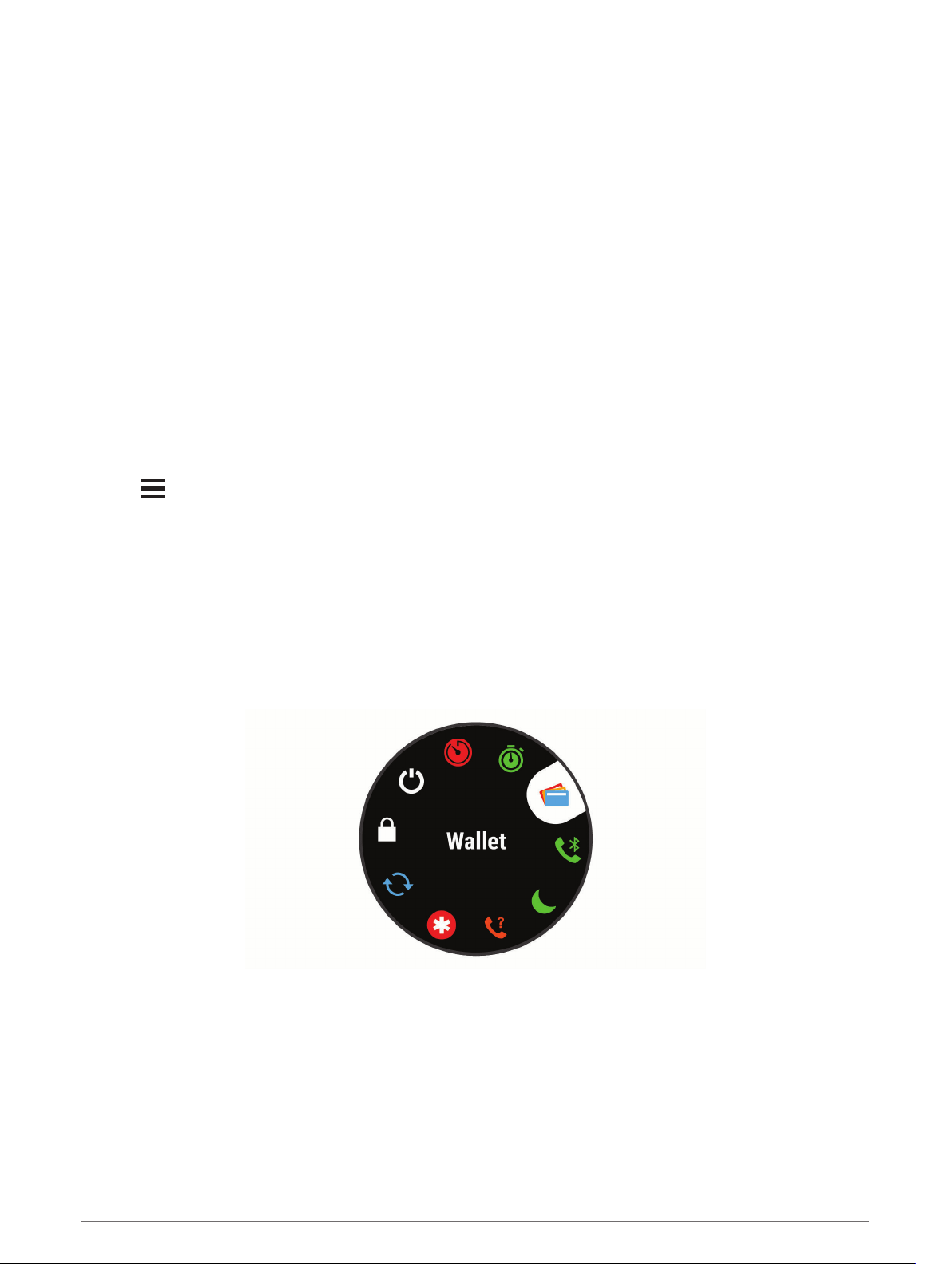
Viewing the Widgets
Your device comes preloaded with several widgets, and more are available when you pair your device with a
smartphone.
• From the watch face, select UP or DOWN.
The device scrolls through the widget loop and displays summary data for each widget. The performance
widget requires several activities with heart rate and outdoor runs with GPS.
• Select START to view widget details.
TIP: You can press DOWN to view additional screens for a widget.
Viewing the Weather Widget
Weather requires a Bluetooth connection to a compatible smartphone.
1 From the watch face, select UP or DOWN to view the weather widget.
2 Select START to view weather details.
3 Select UP or DOWN to view hourly, daily, and weather trend data.
Customizing the My Day Widget
You can customize the list of metrics displayed on the My Day widget.
1 From the watch face, press UP or DOWN to view the My Day widget.
2 Hold .
3 Select Options.
4 Select the toggle switches to show or hide each metric.
Viewing the Controls Menu
The controls menu contains options, such as turning on do not disturb mode, locking the keys, and turning the
device off. You can also open the Garmin Pay wallet.
NOTE: You can add, reorder, and remove the options in the controls menu (Customizing the Controls Menu,
page 56).
1 From any screen, hold LIGHT.
2 Press UP or DOWN to scroll through the options.
Smart Features 55
Customizing the Controls Menu
You can add, remove, and change the order of the shortcut menu options in the controls menu (Viewing the
Controls Menu, page 55).
1 From the watch face, hold .
2 Select > Controls.
3 Select a shortcut to customize.
4 Select an option:
• Select Reorder to change the location of the shortcut in the controls menu.
• Select Remove to remove the shortcut from the controls menu.
5 If necessary, select Add New to add an additional shortcut to the controls menu.
Opening the Music Controls
Music controls require a Bluetooth connection to a compatible smartphone.
1 From the watch face, hold LIGHT.
2 Select .
3 Select UP or DOWN to use the music controls.
Connect IQ Features
You can add Connect IQ features to your watch from Garmin and other providers using the Connect IQ app. You
can customize your device with watch faces, data fields, widgets, and device apps.
Watch Faces: Allow you to customize the appearance of the clock.
Data Fields: Allow you to download new data fields that present sensor, activity, and history data in new ways.
You can add Connect IQ data fields to built-in features and pages.
Widgets: Provide information at a glance, including sensor data and notifications.
Device Apps: Add interactive features to your watch, such as new outdoor and fitness activity types.
Downloading Connect IQ Features Using Your Computer
1 Connect the device to your computer using a USB cable.
2 Go to apps.garmin.com, and sign in.
3 Select a Connect IQ feature, and download it.
4 Follow the on-screen instructions.
Wi‑Fi Connected Features
Activity uploads to your Garmin Connect account: Automatically sends your activity to your Garmin Connect
account as soon as you finish recording the activity.
Audio content: Allows you to sync audio content from third-party providers.
Software updates: Your device downloads and installs the latest software update automatically when a Wi‑Fi
connection is available.
Workouts and training plans: You can browse for and select workouts and training plans on the Garmin
Connect site. The next time your device has a Wi‑Fi connection, the files are wirelessly sent to your device.
56 Smart Features
Connecting to a Wi‑Fi Network
You must connect your device to the Garmin Connect app on your smartphone or to the Garmin Express
™
application on your computer before you can connect to a Wi‑Fi network.
1 Hold .
2 Select > Wi-Fi > My Networks > Add Network.
The device displays a list of nearby Wi‑Fi networks.
3 Select a network.
4 If necessary, enter the password for the network.
The device connects to the network, and the network is added to the list of saved networks. The device
reconnects to this network automatically when it is within range.
Safety and Tracking Features
CAUTION
The safety and tracking features are supplemental features and should not be relied on as a primary method to
obtain emergency assistance. The Garmin Connect app does not contact emergency services on your behalf.
The Forerunner device has safety and tracking features that must be set up with the Garmin Connect app.
NOTICE
To use these features, your device must be connected to the Garmin Connect app using Bluetooth technology.
You can enter emergency contacts in your Garmin Connect account.
For more information about safety and tracking features, go to www.garmin.com/safety.
Assistance: Allows you to send a message with your name, LiveTrack link, and GPS location (if available) to
your emergency contacts.
Incident detection: When the Forerunner device detects an incident during an outdoor walk, run, or bike activity,
the device sends an automated message, LiveTrack link, and GPS location (if available) to your emergency
contacts.
LiveTrack: Allows friends and family to follow your races and training activities in real time. You can invite
followers using email or social media, allowing them to view your live data on a web page.
Live Event Sharing: Allows you to send messages to friends and family during an event, providing real-time
updates.
NOTE: This feature is available only if your device is connected to an Android smartphone.
GroupTrack: Allows you to keep track of your connections using LiveTrack directly on screen and in real time.
Adding Emergency Contacts
Emergency contact phone numbers are used for the safety and tracking features.
1 From the Garmin Connect app, select or .
2 Select Safety & Tracking > Safety Features > Add Emergency Contact.
3 Follow the on-screen instructions.
Requesting Assistance
Before you can request assistance, you must set up emergency contacts (Adding Emergency Contacts,
page 57).
1 Hold the key.
2 When you feel three vibrations, release the key to activate the assistance feature.
The countdown screen appears.
TIP: You can select Cancel before the countdown is complete to cancel the message.
Safety and Tracking Features 57
Turning Incident Detection On and Off
1 From the watch face, hold .
2 Select > Safety & Tracking > Incident Detection.
3 Select an activity.
NOTE: Incident detection is available only for outdoor walk, run, and bike activities.
When an incident is detected by your Forerunner device with GPS enabled, the Garmin Connect app can send
an automated text message and email with your name and GPS location to your emergency contacts. A
message appears indicating your contacts will be informed after 30 seconds have elapsed. You can select
Cancel before the countdown is complete to cancel the message.
Starting a GroupTrack Session
Before you can start a GroupTrack session, you must have a Garmin Connect account, a compatible
smartphone, and the Garmin Connect app.
These instructions are for starting a GroupTrack session with Forerunner devices. If your connections have
other compatible devices, you can see them on the map. The other devices may not be able to display
GroupTrack riders on the map.
1 Go outside, and turn on the Forerunner device.
2 Pair your smartphone with the Forerunner device (Pairing Your Smartphone with Your Device, page 50).
3 On the Forerunner device, hold , and select > Safety & Tracking > GroupTrack > Show on Map to
enable viewing connections on the map screen.
4 In the Garmin Connect app, from the settings menu, select Safety & Tracking > LiveTrack > > Settings >
GroupTrack.
5 Select All Connections.
6 Select Start LiveTrack.
7 On the Forerunner device, start an activity.
8 Scroll to the map to view your connections.
Tips for GroupTrack Sessions
The GroupTrack feature allows you to keep track of other connections in your group using LiveTrack directly on
the screen. All members of the group must be your connections in your Garmin Connect account.
• Start your activity outside using GPS.
• Pair your Forerunner device with your smartphone using Bluetooth technology.
• In the Garmin Connect app, from the settings menu, select Connections to update the list of connections for
your GroupTrack session.
• Make sure all of your connections pair to their smartphones and start a LiveTrack session in the Garmin
Connect app.
• Make sure all your connections are in range (40 km or 25 mi.).
• During a GroupTrack session, scroll to the map to view your connections (Adding a Map to an Activity,
page 74).
Music
You can download audio content to your device, so you can listen when your smartphone is not nearby. The
Garmin Connect app and Garmin Express application allow you to download audio content from a third-party
provider or your computer.
You can use the music controls to control music playback on your smartphone or to play music stored on your
device. To listen to audio content stored on your device, you must connect headphones with Bluetooth
technology.
58 Music
Connecting to a Third-Party Provider
Before you can download music or other audio files to your watch from a supported third-party provider, you
must connect the provider to your device.
Some third-party music provider options are already installed on your device. For more options, you can
download the Connect IQ app.
1 Hold DOWN from any screen to open the music controls.
2 Select .
NOTE: If you want to set up another provider, hold , and select Music Providers > Add Provider.
3 Select the name of the provider, and follow the on-screen instructions.
Spotify
®
Spotify is a digital music service that gives you access to millions of songs.
TIP: Spotify integration requires the Spotify application be installed on your mobile phone. A compatible mobile
digital device and premium subscription is required, where available. Go to www.garmin.com/.
This product incorporates Spotify software which is subject to third party licenses found here:
https://developer.spotify.com/legal/third-party-licenses. Soundtrack every journey with Spotify. Play songs and
artists you love, or let Spotify entertain you.
Downloading Audio Content from Spotify
Before you can download audio content from Spotify, you must connect to a Wi‑Fi network (Connecting to a
Wi‑Fi Network, page 57).
1 Hold DOWN from any screen to open the music controls.
2 Hold .
3 Select Music Providers > Spotify.
4 Select Add music & podcasts.
5 Select a playlist or other item to download to the device.
NOTE: Downloading audio content can drain the battery. You may need to connect the device to an external
power source if the remaining battery life is insufficient.
The selected playlists and other items are downloaded to the device.
Downloading Personal Audio Content
Before you can send your personal music to your device, you must install the Garmin Express application on
your computer (www.garmin.com/express).
You can load your personal audio files, such as .mp3 and .m4a files, to a Forerunner 745 device from your
computer. For more information, go to www.garmin.com/musicfiles.
1 Connect the device to your computer using the included USB cable.
2 On your computer, open the Garmin Express application, select your device, and select Music.
TIP: For Windows
®
computers, you can select and browse to the folder with your audio files. For Apple
®
computers, the Garmin Express application uses your iTunes
®
library.
3 In the My Music or iTunes Library list, select an audio file category, such as songs or playlists.
4 Select the checkboxes for the audio files, and select Send to Device.
5 If necessary, in the Forerunner 745 list, select a category, select the checkboxes, and select Remove From
Device to remove audio files.
Music 59
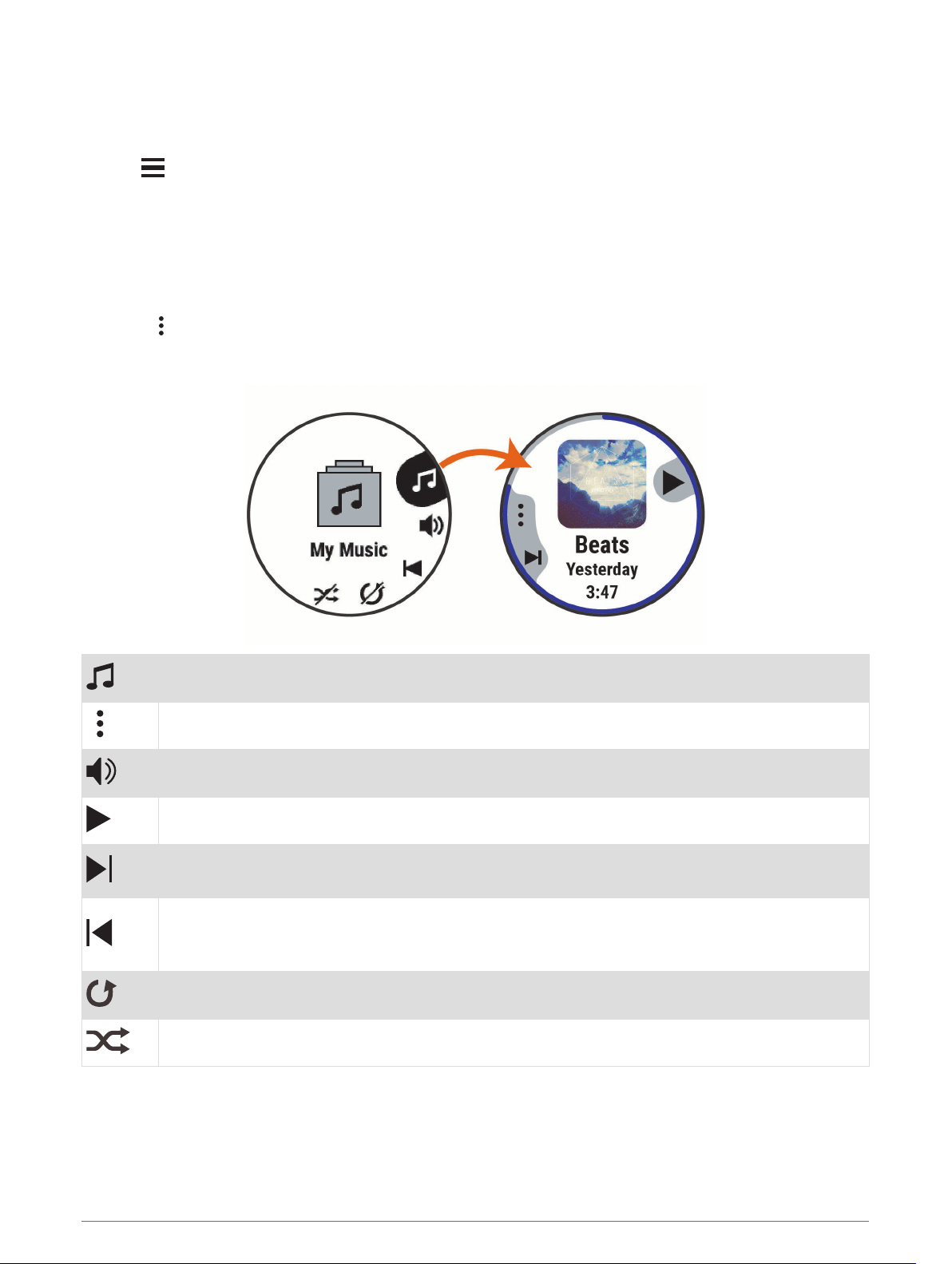
Listening to Music
1 Hold DOWN from any screen to open the music controls.
2 Connect your headphones with Bluetooth technology (Connecting Bluetooth Headphones, page 61).
3 Hold .
4 Select Music Providers, and select an option:
• To listen to music downloaded to the watch from your computer, select My Music (Downloading Personal
Audio Content, page 59).
• To control music playback on your smartphone, select Control Phone.
• To listen to music from a third-party provider, select the name of the provider and select a playlist to
download.
5 Select to open the music playback controls.
Music Playback Controls
Select to manage content from some third-party providers.
Select to browse the audio files and playlists for the selected source.
Select to adjust the volume.
Select to play and pause the current audio file.
Select to skip to the next audio file in the playlist.
Hold to fast forward through the current audio file.
Select to restart the current audio file.
Select twice to skip to the previous audio file in the playlist.
Hold to rewind through the current audio file.
Select to change the repeat mode.
Select to change the shuffle mode.
Controlling Music Playback on a Connected Smartphone
1 On your smartphone, start playing a song or playlist.
2 On your Forerunner 745 device, hold DOWN from any screen to open the music controls.
3 Select Music Providers > Control Phone.
60 Music
Changing the Audio Mode
You can change the music playback mode from stereo to mono.
1 Hold .
2 Select > Music > Audio.
3 Select an option.
Connecting Bluetooth Headphones
To listen to music loaded onto your Forerunner 745 device, you must connect headphones using Bluetooth
technology.
1 Bring the headphones within 2 m (6.6 ft.) of your device.
2 Enable pairing mode on the headphones.
3 Hold .
4 Select > Music > Headphones > Add New.
5 Select your headphones to complete the pairing process.
Garmin Pay
The Garmin Pay feature allows you to use your watch to pay for purchases in participating stores using credit
or debit cards from a participating financial institution.
Setting Up Your Garmin Pay Wallet
You can add one or more participating credit or debit cards to your Garmin Pay wallet. Go to garmin.com
/garminpay/banks to find participating financial institutions.
1 From the Garmin Connect app, select or .
2 Select Garmin Pay > Get Started.
3 Follow the on-screen instructions.
Adding a Card to Your Garmin Pay Wallet
You can add up to 10 credit or debit cards to your Garmin Pay wallet.
1 From the Garmin Connect app, select or .
2 Select Garmin Pay > > Add Card.
3 Follow the on-screen instructions.
After the card is added, you can select the card on your watch when you make a payment.
Managing Your Garmin Pay Cards
You can temporarily suspend or delete a card.
NOTE: In some countries, participating financial institutions may restrict the Garmin Pay features.
1 From the Garmin Connect app, select or .
2 Select Garmin Pay.
3 Select a card.
4 Select an option:
• To temporarily suspend or unsuspend the card, select Suspend Card.
The card must be active to make purchases using your Forerunner device.
• To delete the card, select .
Garmin Pay 61
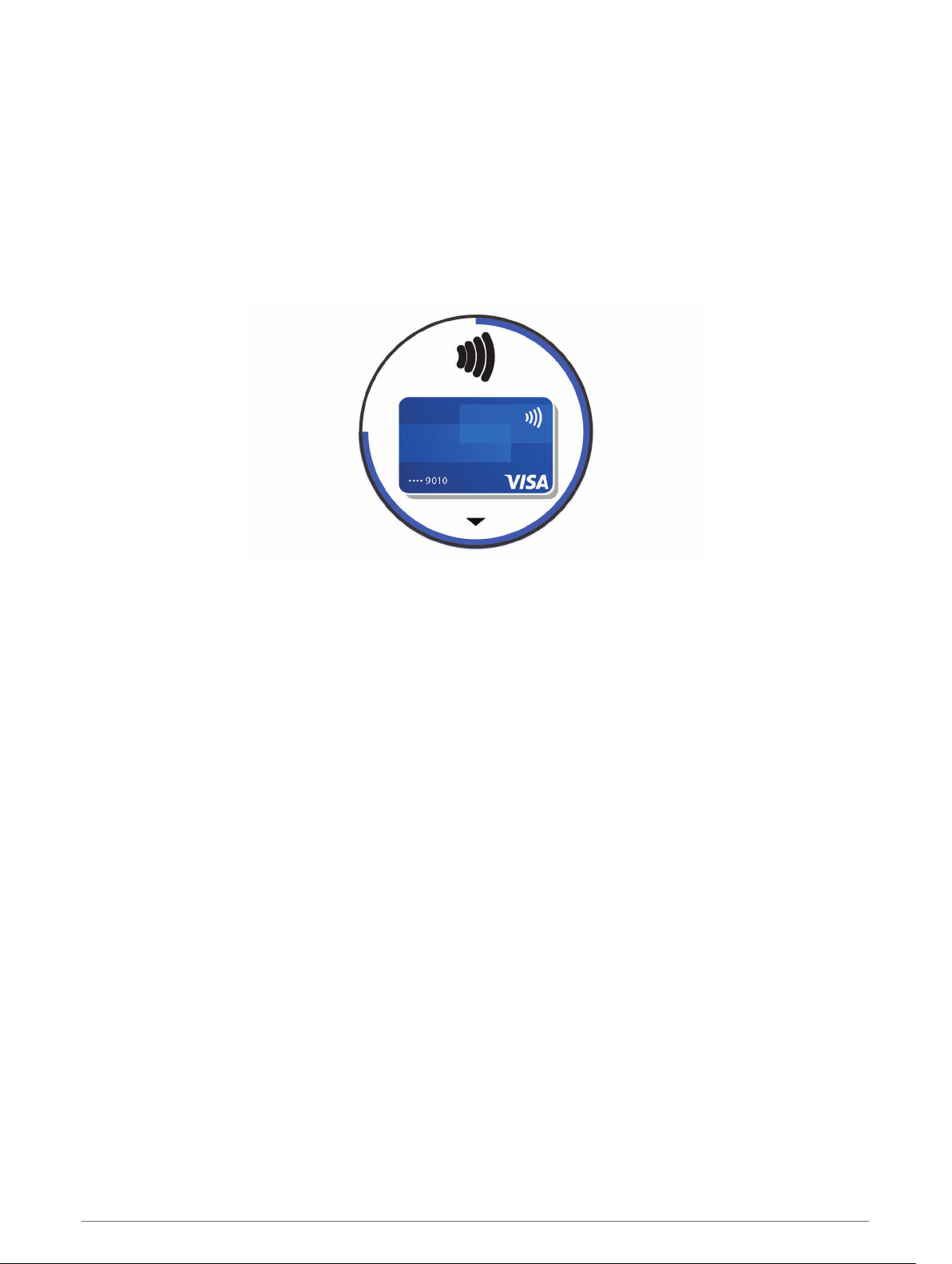
Paying for a Purchase Using Your Watch
Before you can use your watch to pay for purchases, you must set up at least one payment card.
You can use your watch to pay for purchases in a participating store.
1 Hold LIGHT.
2 Select Wallet.
3 Enter your four-digit passcode.
NOTE: If you enter your passcode incorrectly three times, your wallet locks, and you must reset your
passcode in the Garmin Connect app.
Your most recently used payment card appears.
4 If you have added multiple cards to your Garmin Pay wallet, select DOWN to change to another card
(optional).
5 Within 60 seconds, hold your watch near the payment reader, with the watch facing the reader.
The watch vibrates and displays a check mark when it is finished communicating with the reader.
6 If necessary, follow the instructions on the card reader to complete the transaction.
TIP: After you successfully enter your passcode, you can make payments without a passcode for 24 hours
while you continue to wear your watch. If you remove the watch from your wrist or disable heart rate
monitoring, you must enter the passcode again before making a payment.
Changing Your Garmin Pay Passcode
You must know your current passcode to change it. If you forget your passcode, you must reset the Garmin Pay
feature for your Forerunner device, create a new passcode, and reenter your card information.
1 From the Forerunner device page in the Garmin Connect app, select Garmin Pay > Change Passcode.
2 Follow the on-screen instructions.
The next time you pay using your Forerunner device, you must enter the new passcode.
History
History includes time, distance, calories, average pace or speed, lap data, and optional sensor information.
NOTE: When the device memory is full, your oldest data is overwritten.
62 History
Using History
History contains previous activities you have saved on your device.
The device has a history widget for quick access to your activity data (Widgets, page 54).
1 From the watch face, hold .
2 Select History > Activities.
3 Select an activity.
4 Press START.
5 Select an option:
• To view additional information about the activity, select All Stats.
• To view the impact of the activity on your aerobic and anaerobic fitness, select Training Effect (About
Training Effect, page 41).
• To view your time in each heart rate zone, select Heart Rate (Viewing Your Time in Each Heart Rate Zone,
page 63).
• To select a lap and view additional information about each lap, select Laps.
• To select a ski or snowboard run and view additional information about each run, select Runs.
• To select an exercise set and view additional information about each set, select Sets.
• To view the activity on a map, select Map.
• To view an elevation plot for the activity, select Elevation Plot.
• To delete the selected activity, select Delete.
Multisport History
Your device stores the overall multisport summary of the activity, including overall distance, time, calories, and
optional accessory data. Your device also separates the activity data for each sport segment and transition so
you can compare similar training activities and track how quickly you move through the transitions. Transition
history includes distance, time, average speed, and calories.
Viewing Your Time in Each Heart Rate Zone
Viewing your time in each heart rate zone can help you adjust your training intensity.
1 From the watch face, hold .
2 Select History > Activities.
3 Select an activity.
4 Select Heart Rate.
Viewing Data Totals
You can view the accumulated distance and time data saved to your device.
1 From the watch face, hold .
2 Select History > Totals.
3 If necessary, select an activity.
4 Select an option to view weekly or monthly totals.
Using the Odometer
The odometer automatically records the total distance traveled, elevation gained, and time in activities.
1 From the watch face, hold .
2 Select History > Totals > Odometer.
3 Select UP or DOWN to view odometer totals.
History 63
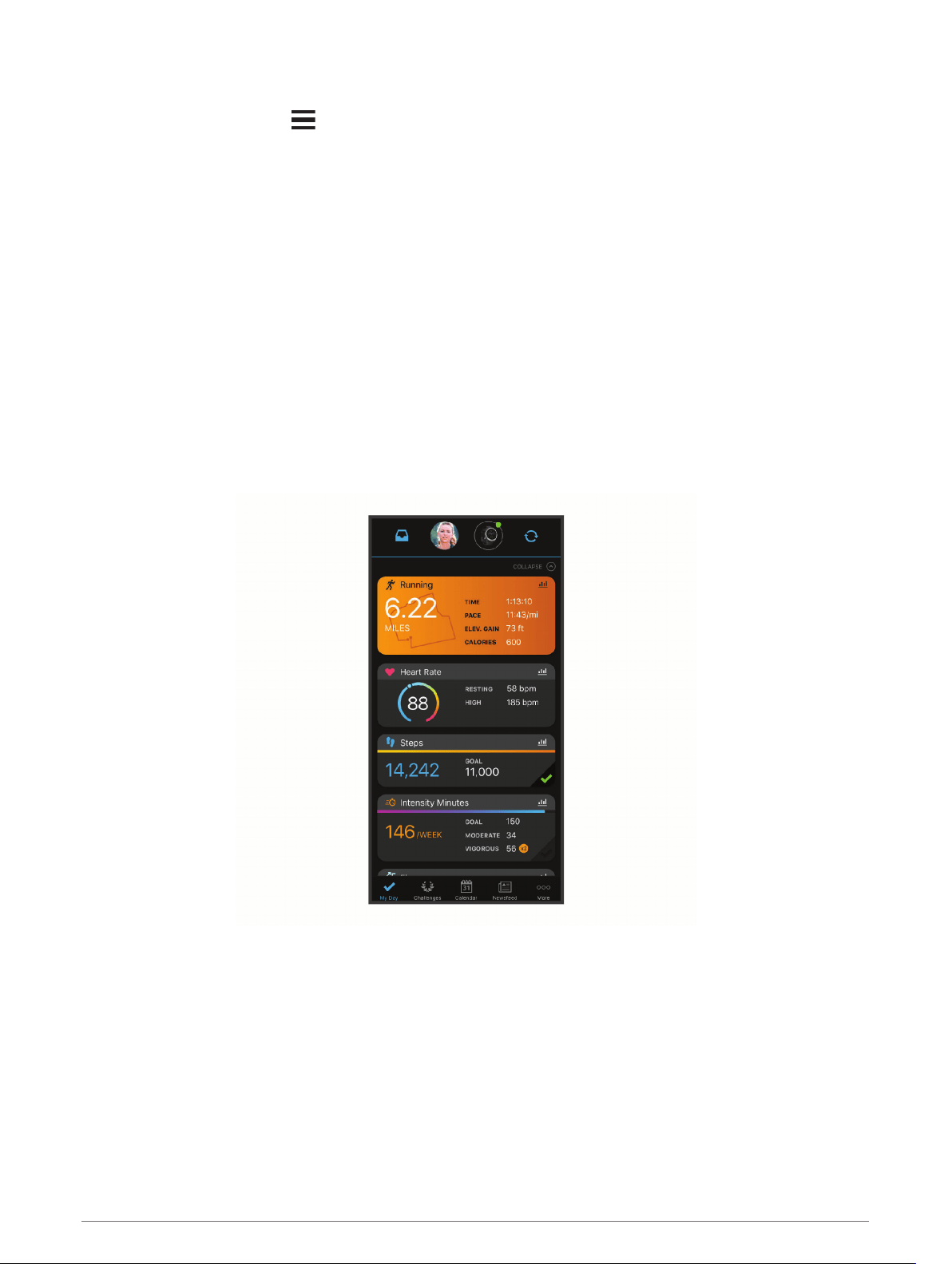
Deleting History
1 From the watch face, hold .
2 Select History > Options.
3 Select an option:
• Select Delete All Activities to delete all activities from the history.
• Select Reset Totals to reset all distance and time totals.
NOTE: This does not delete any saved activities.
Garmin Connect
You can connect with your friends on Garmin Connect. Garmin Connect gives you the tools to track, analyze,
share, and encourage each other. Record the events of your active lifestyle including runs, walks, rides, swims,
hikes, triathlons, and more. To sign up for a free account, go to connect.garmin.com.
Store your activities: After you complete and save an activity with your device, you can upload that activity to
your Garmin Connect account and keep it as long as you want.
Analyze your data: You can view more detailed information about your activity, including time, distance,
elevation, heart rate, calories burned, cadence, running dynamics, an overhead map view, pace and speed
charts, and customizable reports.
NOTE: Some data requires an optional accessory such as a heart rate monitor.
Plan your training: You can choose a fitness goal and load one of the day-by-day training plans.
Track your progress: You can track your daily steps, join a friendly competition with your connections, and
meet your goals.
Share your activities: You can connect with friends to follow each other's activities or post links to your
activities on your favorite social networking sites.
Manage your settings: You can customize your device and user settings on your Garmin Connect account.
Access the Connect IQ store: You can download apps, watch faces, data fields, and widgets.
64 History
Using Garmin Connect on Your Computer
The Garmin Express application connects your device to your Garmin Connect account using a computer. You
can use the Garmin Express application to upload your activity data to your Garmin Connect account and to
send data, such as workouts or training plans, from the Garmin Connect website to your device. You can also
add music to your device (Downloading Personal Audio Content, page 59). You can also install device software
updates and manage your Connect IQ apps.
1 Connect the device to your computer using the USB cable.
2 Go to www.garmin.com/express.
3 Download and install the Garmin Express application.
4 Open the Garmin Express application, and select Add Device.
5 Follow the on-screen instructions.
Data Management
NOTE: The device is not compatible with Windows 95, 98, Me, Windows NT
®
, and Mac
®
OS 10.3 and earlier.
Deleting Files
NOTICE
If you do not know the purpose of a file, do not delete it. Your device memory contains important system files
that should not be deleted.
1 Open the Garmin drive or volume.
2 If necessary, open a folder or volume.
3 Select a file.
4 Press the Delete key on your keyboard.
NOTE: Mac operating systems provide limited support for MTP file transfer mode. You must open the
Garmin drive on a Windows operating system. You should use the Garmin Express application to remove
music files from your device.
Navigation
You can use the GPS navigation features on your device to view your path on a map, save locations, and find
your way home.
Courses
You can send a course from your Garmin Connect account to your device. After it is saved to your device, you
can navigate the course on your device.
You can follow a saved course simply because it is a good route. For example, you can save and follow a bike
friendly commute to work.
You can also follow a saved course, trying to match or exceed previously set performance goals. For example,
if the original course was completed in 30 minutes, you can race against a Virtual Partner trying to complete
the course in under 30 minutes.
Navigation 65
Following a Course on Your Device
1 From the watch face, select START.
2 Select an activity.
3 Hold .
4 Select Navigation > Courses.
5 Select a course.
6 Select Do Course.
Navigation information appears.
7 Select START to begin navigation.
Creating a Course on Garmin Connect
Before you can create a course on the Garmin Connect app, you must have a Garmin Connect account (Garmin
Connect, page 64).
1 From the Garmin Connect app, select or .
2 Select Training > Courses > Create Course.
3 Select a course type.
4 Follow the on-screen instructions.
5 Select Done.
NOTE: You can send this course to your device (Sending a Course to Your Device, page 66).
Sending a Course to Your Device
You can send a course you created using the Garmin Connect app to your device (Creating a Course on Garmin
Connect, page 66).
1 From the Garmin Connect app, select or .
2 Select Training > Courses.
3 Select a course.
4 Select > Send to Device.
5 Select your compatible device.
6 Follow the on-screen instructions.
Viewing Course Details
You can view course details before you navigate a course.
1 From the watch face, select START.
2 Select an activity.
3 Hold .
4 Select Navigation > Courses.
5 Press START to select a course.
6 Select an option:
• To begin navigation, select Do Course.
• To create a custom pace band, select PacePro.
• To view the course on the map and pan or zoom the map, select Map.
• To begin the course in reverse, select Do Course in Reverse.
• To view an elevation plot of the course, select Elevation Plot.
• To change the course name, select Name.
• To view a list of ascents in the course, select View Climbs.
• To delete the course, select Delete.
66 Navigation
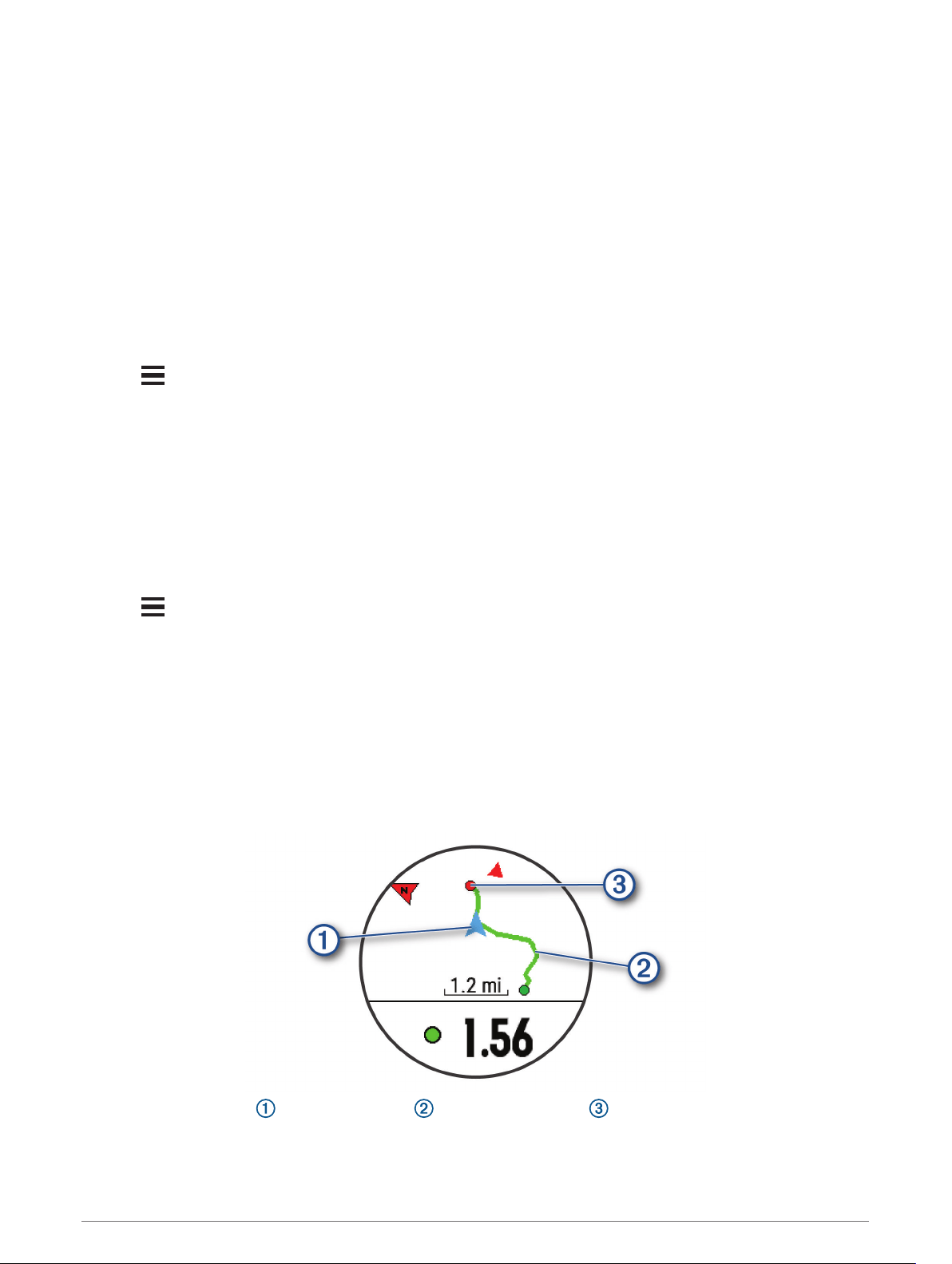
Saving Your Location
You can save your current location to navigate back to it later.
1 Hold LIGHT.
2 Select Save Location.
NOTE: You may need to add this item to the controls menu (Customizing the Controls Menu, page 56).
3 Follow the on-screen instructions.
Editing Your Saved Locations
You can delete a saved location or edit its name, elevation, and position information.
1 From the watch face, select START.
2 Select an activity.
NOTE: This feature is not available for all activities.
3 Hold .
4 Select Navigation > Saved Locations.
5 Select a saved location.
6 Select an option to edit the location.
Deleting All Saved Locations
You can delete all of your saved locations at once.
1 From the watch face, select START.
2 Select an activity.
NOTE: This feature is not available for all activities.
3 Hold .
4 Select Navigation > Saved Locations > Delete All.
Navigating to Your Starting Point During an Activity
You can navigate back to the starting point of your current activity in a straight line or along the path you
traveled. This feature is available only for activities that use GPS.
1 During an activity, press STOP.
2 Select Back to Start, and select an option:
• To navigate back to the starting point of your activity along the path you traveled, select TracBack.
• To navigate back to the starting point of your activity in a straight line, select Straight Line.
Your current location , the track to follow , and your destination appear on the map.
Navigation 67
Navigating to the Starting Point of Your Last Saved Activity
You can navigate back to the starting point of your last saved activity in a straight line or along the path you
traveled. This feature is available only for activities that use GPS.
1 Select START.
2 Hold .
3 Select Navigation > Activities.
4 Select your last saved activity.
5 Select Back to Start.
6 Select an option:
• To navigate back to the starting point of your activity along the path you traveled, select TracBack.
• To navigate back to the starting point of your activity in a straight line, select Straight Line.
7 Select DOWN to view the compass (optional).
The arrow points toward your starting point.
Navigating to a Saved Location
Before you can navigate to a saved location, your device must locate satellites.
1 From the watch face, select START.
2 Select an activity.
NOTE: This feature is not available for all activities.
3 Hold .
4 Select Navigation > Saved Locations.
5 Select a location, and select Go To.
6 Move forward.
The compass arrow points toward the saved location.
TIP: For more accurate navigation, orient the top of the screen toward the direction in which you are moving.
7 Select START to start the activity timer.
Map
represents your location on the map. Location names and symbols appear on the map. When you are
navigating to a destination, your route is marked with a line on the map.
• Map navigation (Panning and Zooming the Map, page 69)
• Map settings (Map Settings, page 69)
Viewing the Map
1 Start an outdoor activity.
2 Select UP or DOWN to scroll to the map screen.
3 Hold .
4 Select Pan/Zoom.
TIP: You can select START to toggle between panning up and down, panning left and right, or zooming.
68 Navigation
Panning and Zooming the Map
1 While navigating, select UP or DOWN to view the map.
2 Hold .
3 Select Pan/Zoom.
4 Select an option:
• To toggle between panning up and down, panning left and right, or zooming, select START.
• To pan or zoom the map, select UP and DOWN.
• To quit, select BACK.
Map Settings
You can customize how the map appears in the map app and data screens.
From the watch face, hold , and select > Map.
Orientation: Sets the orientation of the map. The North Up option shows north at the top of the screen. The
Track Up option shows your current direction of travel at the top of the screen.
User Locations: Shows or hides saved locations on the map.
Auto Zoom: Automatically selects the zoom level for optimal use of your map. When disabled, you must zoom
in or out manually.
Altimeter and Barometer
The device contains an internal altimeter and barometer. The device collects elevation and pressure data
continuously, even in low-power mode. The altimeter displays your approximate elevation based on pressure
changes. The barometer displays environmental pressure data based on the fixed elevation where the altimeter
was most recently calibrated (Altimeter Settings, page 80). You can press START from the altimeter or
barometer widgets to open the altimeter or barometer settings quickly.
Navigation Settings
You can customize the map features and appearance when navigating to a destination.
Customizing Map Features
1 Hold .
2 Select > Navigation > Data Screens.
3 Select an option:
• Select Map to turn on or off the map.
• Select Guide to turn on or off the guide screen that displays the compass bearing or course to follow
while navigating.
• Select Elevation Plot to turn on or off the elevation plot.
• Select a screen to add, remove, or customize.
Setting Up a Heading Bug
You can set up a heading indicator to display on your data pages while navigating. The indicator points to your
target heading.
1 Hold .
2 Select > Navigation > Heading Bug.
Navigation 69

Setting Navigation Alerts
You can set alerts to help you navigate to your destination.
1 Hold .
2 Select > Navigation > Alerts.
3 Select an option:
• To set an alert for a specified distance from your final destination, select Final Distance.
• To set an alert for the estimated time remaining until you reach your final destination, select Final ETE.
• To set an alert when you stray from the course, select Off Course.
• To enable turn-by-turn navigation prompts, select Turn Prompts.
4 If necessary, select Status to turn on the alert.
5 If necessary, enter a distance or time value, and select .
Wireless Sensors
Your device can be used with wireless ANT+ or Bluetooth sensors. For more information about compatibility
and purchasing optional sensors, go to buy.garmin.com.
Pairing Your Wireless Sensors
The first time you connect a wireless sensor to your device using ANT+ or Bluetooth technology, you must pair
the device and sensor. After they are paired, the device connects to the sensor automatically when you start an
activity and the sensor is active and within range.
1 If you are pairing a heart rate monitor, put on the heart rate monitor (Putting On the Heart Rate Monitor,
page 34, Putting On the Heart Rate Monitor, page 32).
The heart rate monitor does not send or receive data until you put it on.
2 Bring the device within 3 m (10 ft.) of the sensor.
NOTE: Stay 10 m (33 ft.) away from other wireless sensors while pairing.
3 Hold .
4 Select > Sensors & Accessories > Add New.
5 Select an option:
• Select Search All Sensors.
• Select your sensor type.
After the sensor is paired with your device, the sensor status changes from Searching to Connected. Sensor
data appears in the data screen loop or a custom data field.
Foot Pod
Your device is compatible with the foot pod. You can use the foot pod to record pace and distance instead of
using GPS when you are training indoors or when your GPS signal is weak. The foot pod is on standby and
ready to send data (like the heart rate monitor).
After 30 minutes of inactivity, the foot pod powers off to conserve the battery. When the battery is low, a
message appears on your device. Approximately five hours of battery life remain.
Going for a Run Using a Foot Pod
Before you go for a run, you must pair the foot pod with your Forerunner device (Pairing Your Wireless Sensors,
page 70).
You can run indoors using a foot pod to record pace, distance, and cadence. You can also run outdoors using a
foot pod to record cadence data with your GPS pace and distance.
1 Install your foot pod according to the accessory instructions.
2 Select a running activity.
3 Go for a run.
70 Wireless Sensors
Foot Pod Calibration
The foot pod is self-calibrating. The accuracy of the speed and distance data improves after a few outdoor runs
using GPS.
Improving Foot Pod Calibration
Before you can calibrate your device, you must acquire GPS signals and pair your device with the foot pod
(Pairing Your Wireless Sensors, page 70).
The foot pod is self-calibrating, but you can improve the accuracy of the speed and distance data with a few
outdoor runs using GPS.
1 Stand outside for 5 minutes with a clear view of the sky.
2 Start a running activity.
3 Run on a track without stopping for 10 minutes.
4 Stop your activity, and save it.
Based on the recorded data, the foot pod calibration value changes, if necessary. You should not need to
calibrate the foot pod again unless your running style changes.
Calibrating Your Foot Pod Manually
Before you can calibrate your device, you must pair your device with the foot pod sensor (Pairing Your Wireless
Sensors, page 70).
Manual calibration is recommended if you know your calibration factor. If you have calibrated a foot pod with
another Garmin product, you may know your calibration factor.
1 From the watch face, hold .
2 Select > Sensors & Accessories.
3 Select your foot pod.
4 Select Cal. Factor > Set Value.
5 Adjust the calibration factor:
• Increase the calibration factor if your distance is too low.
• Decrease the calibration factor if your distance is too high.
Setting Foot Pod Speed and Distance
Before you can customize the foot pod speed and distance, you must pair your device with the foot pod sensor
(Pairing Your Wireless Sensors, page 70).
You can set your device to calculate speed and distance using your foot pod data instead of GPS data.
1 From the watch face, hold .
2 Select > Sensors & Accessories.
3 Select your foot pod.
4 Select Speed or Distance.
5 Select an option:
• Select Indoor when you are training with GPS turned off, usually indoors.
• Select Always to use your foot pod data regardless of the GPS setting.
Using an Optional Bike Speed or Cadence Sensor
You can use a compatible bike speed or cadence sensor to send data to your device.
• Pair the sensor with your device (Pairing Your Wireless Sensors, page 70).
• Set your wheel size (Wheel Size and Circumference, page 103).
• Go for a ride (Starting an Activity, page 4).
Wireless Sensors 71
Training with Power Meters
• Go to buy.garmin.com for a list of ANT+ sensors that are compatible with your device (such as Rally
™
and
Vector
™
).
• For more information, see the owner's manual for your power meter.
• Adjust your power zones to match your goals and abilities (Setting Your Cycling Power Zones, page 25).
• Use range alerts to be notified when you reach a specified power zone (Setting an Alert, page 76).
• Customize the power data fields (Customizing the Data Screens, page 74).
Using Electronic Shifers
Before you can use compatible electronic shifters, such as Shimano
®
Di2
™
shifters, you must pair them with
your device (Pairing Your Wireless Sensors, page 70). You can customize the optional data fields (Customizing
the Data Screens, page 74). The Forerunner device displays current adjustment values when the sensor is in
adjustment mode.
Situational Awareness
Your Forerunner device can be used with the Varia
™
smart bike lights and rearview radar to improve situational
awareness. See the owner's manual for your Varia device for more information.
NOTE: You may need to update the Forerunner software before pairing Varia devices (Updating the Software
Using the Garmin Connect App, page 53).
tempe
Your device is compatible with the tempe temperature sensor. You can attach the sensor to a secure strap or
loop where it is exposed to ambient air, so it provides a consistent source of accurate temperature data. You
must pair the tempe sensor with your device to display temperature data. See the instructions for your tempe
sensor for more information (www.garmin.com/manuals/tempe).
Customizing Your Device
Customizing Your Activity List
1 From the watch face, hold .
2 Select > Activities & Apps.
3 Select an option:
• Select an activity to customize the settings, set the activity as a favorite, change the order of appearance,
and more.
• Select Add to add more activities or create custom activities.
Customizing the Widget Loop
You can change the order of widgets in the widget loop, remove widgets, and add new widgets.
1 Hold .
2 Select > Widgets.
3 Select a widget.
4 Select an option:
• Select UP or DOWN to change the location of the widget in the widget loop.
• Select to remove the widget from the widget loop.
5 Select Add.
6 Select a widget.
The widget is added to the widget loop.
72 Customizing Your Device
Activities and App Settings
These settings allow you to customize each preloaded activity app based on your needs. For example, you can
customize data pages and enable alerts and training features. Not all settings are available for all activity types.
From the watch face, hold , select > Activities & Apps, select an activity, and select the activity settings.
3D Distance: Calculates your distance traveled using your elevation change and your horizontal movement over
ground.
3D Speed: Calculates your speed using your elevation change and your horizontal movement over ground (3D
Speed and Distance, page 78).
Accent Color: Sets the accent color of each activity to help identify which activity is active.
Add Activity: Allows you to customize a multisport activity.
Alerts: Sets the training or navigation alerts for the activity.
Auto Climb: Enables the device to detect elevation changes automatically using the built-in altimeter (Enabling
Auto Climb, page 77).
Auto Lap: Sets the options for the Auto Lap feature (Auto Lap, page 76).
Auto Pause: Sets the device to stop recording data when you stop moving or when you drop below a specified
speed (Enabling Auto Pause, page 77).
Auto Rest: Enables the device to automatically detect when you are resting during a pool swim and create a
rest interval (Auto Rest, page 12).
Auto Run: Enables the device to detect ski runs automatically using the built-in accelerometer.
Auto Scroll: Enables you to move through all of the activity data screens automatically while the timer is
running (Using Auto Scroll, page 78).
Auto Set: Enables the device to start and stop exercise sets automatically during a strength training activity.
Background Color: Sets the background color of each activity to black or white.
ClimbPro: Displays ascent planning and monitoring screens while navigating.
Countdown Start: Enables a countdown timer for pool swimming intervals.
Data Screens: Enables you to customize data screens and add new data screens for the activity (Customizing
the Data Screens, page 74).
Edit Weight: Allows you to add the weight used for an exercise set during a strength training or cardio activity.
GPS: Sets the mode for the GPS antenna (Changing the GPS Setting, page 78).
Grading System: Sets the grading system for rating the route difficulty for rock climbing activities.
Lane Number: Enables you to select a lane number for a track run.
Lap Key: Enables you to record a lap or a rest during the activity.
Lock Keys: Locks the keys during multisport activities to prevent accidental key presses.
Metronome: Plays tones at a steady rhythm to help you improve your performance by training at a faster,
slower, or more consistent cadence (Using the Metronome, page 22).
Pool Size: Sets the pool length for pool swimming (Setting the Pool Size, page 10).
Power Averaging: Controls whether the device includes zero values for power data that occur when you are not
pedaling.
Power Save Timeout: Sets the power-save timeout options for the activity (Power Save Timeout Settings,
page 79).
Record VO2 Max.: Enables VO2 max. recording for trail run and ultra run activities (Turning Off VO2 Max.
Recording, page 40).
Rename: Sets the activity name.
Repeat: Enables the Repeat option for multisport activities. For example, you can use this option for activities
that include multiple transitions, such as a swimrun.
Restore Defaults: Allows you to reset the activity settings.
Route Stats: Enables route statistics tracking for indoor climbing activities.
Segment Alerts: Enables prompts that alert you to approaching segments.
Customizing Your Device 73
Self Evaluation: Sets how often you evaluate your perceived effort for the activity (Enabling Self Evaluation,
page 77).
Stroke Detect.: Enables stroke detection for pool swimming.
Swimrun Auto Sport Change: Allows you to automatically transition between the swim portion and the run
portion of a swimrun multisport activity.
Transitions: Enables transitions for multisport activities.
Vibration Alerts: Enables alerts that notify you to inhale or exhale during a breathwork activity.
Workout Videos: Enables instructive workout animations for a strength, cardio, yoga, or Pilates activity.
Animations are available for workouts downloaded from Garmin Connect.
Customizing the Data Screens
You can show, hide, and change the layout and content of data screens for each activity.
1 Hold .
2 Select > Activities & Apps.
3 Select the activity to customize.
4 Select the activity settings.
5 Select Data Screens.
6 Select a data screen to customize.
7 Select an option:
• Select Layout to adjust the number of data fields on the data screen.
• Select Data Fields to change the data that appears in the field.
• Select Reorder to change the location of the data screen in the loop.
• Select Remove to remove the data screen from the loop.
8 If necessary, select Add New to add a data screen to the loop.
You can add a custom data screen, or select one of the predefined data screens.
Adding a Map to an Activity
You can add the map to the data screens loop for an activity.
1 From the watch face, hold .
2 Select > Activities & Apps.
3 Select the activity to customize.
4 Select the activity settings.
5 Select Data Screens > Add New > Map.
74 Customizing Your Device
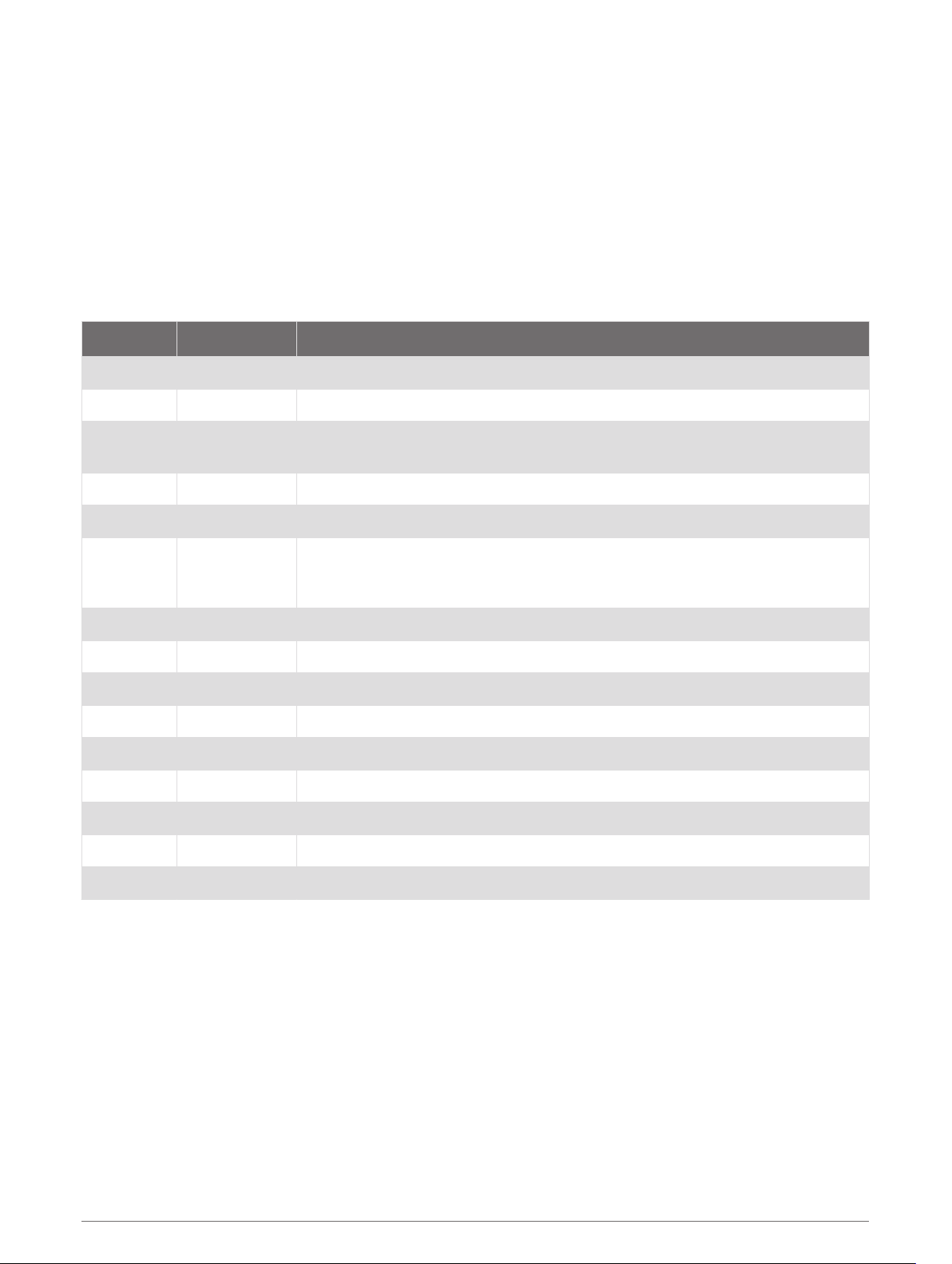
Alerts
You can set alerts for each activity, which can help you to train toward specific goals, to increase your
awareness of your environment, and to navigate to your destination. Some alerts are available only for specific
activities. There are three types of alerts: event alerts, range alerts, and recurring alerts.
Event alert: An event alert notifies you once. The event is a specific value. For example, you can set the device
to alert you when you reach a specified elevation.
Range alert: A range alert notifies you each time the device is above or below a specified range of values. For
example, you can set the device to alert you when your heart rate is below 60 beats per minute (bpm) and
over 210 bpm.
Recurring alert: A recurring alert notifies you each time the device records a specified value or interval. For
example, you can set the device to alert you every 30 minutes.
Alert Name Alert Type Description
Cadence Range You can set minimum and maximum cadence values.
Calories Event, recurring You can set the number of calories.
Custom Event, recurring
You can select an existing message or create a custom message and select an
alert type.
Distance Recurring You can set a distance interval.
Elevation Range You can set minimum and maximum elevation values.
Heart Rate Range
You can set minimum and maximum heart rate values or select zone changes.
See About Heart Rate Zones, page 23 and Heart Rate Zone Calculations,
page 25.
Pace Range You can set minimum and maximum pace values.
Pacing Recurring You can set a target swim pace.
Power Range You can set the high or low power level.
Proximity Event You can set a radius from a saved location.
Run/Walk Recurring You can set timed walking breaks at regular intervals.
Speed Range You can set minimum and maximum speed values.
Stroke Rate Range You can set high or low strokes per minute.
Time Event, recurring You can set a time interval.
Track Timer Recurring You can set a track time interval in seconds.
Customizing Your Device 75
Setting an Alert
1 Hold .
2 Select > Activities & Apps.
3 Select an activity.
NOTE: This feature is not available for all activities.
4 Select the activity settings.
5 Select Alerts.
6 Select an option:
• Select Add New to add a new alert for the activity.
• Select the alert name to edit an existing alert.
7 If necessary, select the type of alert.
8 Select a zone, enter the minimum and maximum values, or enter a custom value for the alert.
9 If necessary, turn on the alert.
For event and recurring alerts, a message appears each time you reach the alert value. For range alerts, a
message appears each time you exceed or drop below the specified range (minimum and maximum values).
Auto Lap
Marking Laps by Distance
You can use Auto Lap to mark a lap at a specific distance automatically. This feature is helpful for comparing
your performance over different parts of an activity (for example, every 1 mile or 5 kilometers).
1 Hold .
2 Select > Activities & Apps.
3 Select an activity.
NOTE: This feature is not available for all activities.
4 Select the activity settings.
5 Select Auto Lap.
6 Select an option:
• Select Auto Lap to turn Auto Lap on or off.
• Select Auto Distance to adjust the distance between laps.
Each time you complete a lap, a message appears that displays the time for that lap. The device also beeps or
vibrates if audible tones are turned on (System Settings, page 81).
If necessary, you can customize the data pages to display additional lap data (Customizing the Data Screens,
page 74).
Customizing the Lap Alert Message
You can customize one or two data fields that appear in the lap alert message.
1 Hold .
2 Select > Activities & Apps.
3 Select an activity.
NOTE: This feature is not available for all activities.
4 Select the activity settings.
5 Select Auto Lap > Lap Alert.
6 Select a data field to change it.
7 Select Preview (optional).
76 Customizing Your Device
Enabling Auto Pause
You can use the Auto Pause feature to pause the timer automatically when you stop moving. This feature is
helpful if your activity includes stop lights or other places where you must stop.
NOTE: History is not recorded while the timer is stopped or paused.
1 Hold .
2 Select > Activities & Apps.
3 Select an activity.
NOTE: This feature is not available for all activities.
4 Select the activity settings.
5 Select Auto Pause.
6 Select an option:
• To pause the timer automatically when you stop moving, select When Stopped.
• To pause the timer automatically when your pace or speed drops below a specified level, select Custom.
Enabling Auto Climb
You can use the auto climb feature to detect elevation changes automatically. You can use it during activities
such as climbing, hiking, running, or biking.
1 Hold .
2 Select > Activities & Apps.
3 Select an activity.
NOTE: This feature is not available for all activities.
4 Select the activity settings.
5 Select Auto Climb > Status.
6 Select Always or When Not Navigating.
7 Select an option:
• Select Run Screen to identify which data screen appears while running.
• Select Climb Screen to identify which data screen appears while climbing.
• Select Invert Colors to reverse the display colors when changing modes.
• Select Vertical Speed to set the rate of ascent over time.
• Select Mode Switch to set how quickly the device changes modes.
NOTE: The Current Screen option allows you to automatically switch to the last screen you were viewing
before the auto climb transition occurred.
Enabling Self Evaluation
When you save an activity, you can evaluate your perceived effort and how you felt during the activity
(Evaluating an Activity, page 5). You can view your evaluation information in your Garmin Connect account.
1 Hold .
2 Select > Activities & Apps.
3 Select an activity.
NOTE: This feature is not available for all activities.
4 Select the activity settings.
5 Select Self Evaluation.
6 Select an option:
• To evaluate only after following a structured workout or interval, select Workouts Only.
• To evaluate after every activity, select Always.
Customizing Your Device 77
3D Speed and Distance
You can set 3D speed and distance to calculate your speed or distance using both your elevation change and
your horizontal movement over ground. You can use it during activities such as skiing, climbing, navigating,
hiking, running, or biking.
Using Auto Scroll
You can use the auto scroll feature to cycle through all of the activity data screens automatically while the
timer is running.
1 Hold .
2 Select > Activities & Apps.
3 Select an activity.
NOTE: This feature is not available for all activities.
4 Select the activity settings.
5 Select Auto Scroll.
6 Select a display speed.
Changing the GPS Setting
For more information about GPS, go to www.garmin.com/aboutGPS.
1 Hold .
2 Select > Activities & Apps.
3 Select the activity to customize.
4 Select the activity settings.
5 Select GPS.
6 Select an option:
• Select GPS Only to enable the GPS satellite system.
• Select GPS + GLONASS (Russian satellite system) for more accurate position information in situations
with poor sky visibility.
• Select GPS + GALILEO (European Union satellite system) for more accurate position information in
situations with poor sky visibility.
• Select UltraTrac to record track points and sensor data less frequently (UltraTrac, page 78).
NOTE: Using GPS and another satellite together can reduce battery life more quickly than using GPS only
(GPS and Other Satellite Systems, page 78).
GPS and Other Satellite Systems
Using GPS and another satellite system together offers increased performance in challenging environments
and faster position acquisition than using GPS only. However, using multiple systems can reduce battery life
more quickly than using GPS only.
Your device can use these Global Navigation Satellite Systems (GNSS).
GPS: A satellite constellation built by the United States.
GLONASS: A satellite constellation built by Russia.
GALILEO: A satellite constellation built by the European Space Agency.
UltraTrac
The UltraTrac feature is a GPS setting that records track points and sensor data less frequently. Enabling the
UltraTrac feature increases battery life but decreases the quality of recorded activities. You should use the
UltraTrac feature for activities that demand longer battery life and for which frequent sensor data updates are
less important.
78 Customizing Your Device
Power Save Timeout Settings
The timeout settings affect how long your device stays in training mode, for example, when you are waiting for
a race to start. Hold , select > Activities & Apps, select an activity, and select the activity settings. Select
Power Save Timeout to adjust the timeout settings for the activity.
Normal: Sets the device to enter low-power watch mode after 5 minutes of inactivity.
Extended: Sets the device to enter low-power watch mode after 25 minutes of inactivity. The extended mode
can result in shorter battery life between charges.
Removing an Activity or App
1 From the watch face, hold .
2 Select > Activities & Apps.
3 Select an activity.
4 Select an option:
• To remove an activity from your list of favorites, select Remove from Favorites.
• To delete the activity from the apps list, select Remove from List.
GroupTrack Settings
Hold , and select > Safety & Tracking > GroupTrack.
Show on Map: Enables you to view connections on the map screen during a GroupTrack session.
Activity Types: Allows you to select which activity types appear on the map screen during a GroupTrack
session.
Watch Face Settings
You can customize the appearance of the watch face by selecting the layout, colors, and additional data. You
can also download custom watch faces from the Connect IQ store.
Customizing the Watch Face
Before you can activate a Connect IQ watch face, you must install a watch face from the Connect IQ store
(Connect IQ Features, page 56).
You can customize the watch face information and appearance, or activate an installed Connect IQ watch face.
1 From the watch face, hold .
2 Select Watch Face.
3 Select UP or DOWN to preview the watch face options.
4 Select Add New to scroll through additional pre-loaded watch faces.
5 Select START > Apply to activate a pre-loaded watch face or an installed Connect IQ watch face.
6 If using a pre-loaded watch face, select START > Customize.
7 Select an option:
• To change the style of the numbers for the analog watch face, select Dial.
• To change the style of the hands for the analog watch face, select Hands.
• To change the style of the numbers for the digital watch face, select Layout.
• To change the style of the seconds for the digital watch face, select Seconds.
• To change the data that appears on the watch face, select Data.
• To add or change an accent color for the watch face, select Accent Color.
• To change the background color, select Bkgd. Color.
• To save the changes, select Done.
Customizing Your Device 79
Sensors Settings
Altimeter Settings
Hold , and select > Sensors & Accessories > Altimeter.
Calibrate: Allows you to manually calibrate the altimeter sensor.
Auto Cal.: Allows the altimeter to self-calibrate each time you turn on GPS tracking.
Elevation: Sets the units of measure for elevation.
Calibrating the Barometric Altimeter
Your device was already calibrated at the factory, and the device uses automatic calibration at your GPS
starting point by default. You can manually calibrate the barometric altimeter if you know the correct elevation.
1 Hold .
2 Select > Sensors & Accessories > Altimeter.
3 Select an option:
• To calibrate automatically from your GPS starting point, select Auto Cal., and select an option.
• To enter the current elevation manually, select Calibrate > Yes.
• To enter the current elevation from your GPS starting point, select Calibrate > Use GPS.
Barometer Settings
Hold , and select > Sensors & Accessories > Barometer.
Calibrate: Allows you to manually calibrate the barometer sensor.
Plot: Sets the time scale for the chart in the barometer widget.
Storm Alert: Sets the rate of barometric pressure change that triggers a storm alert.
Watch Mode: Sets the sensor used in watch mode. The Auto option uses both the altimeter and barometer
according to your movement. You can use the Altimeter option when your activity involves changes in
altitude, or the Barometer option when your activity does not involve changes in altitude.
Pressure: Sets how the device displays pressure data.
Calibrating the Barometer
Your device was already calibrated at the factory, and the device uses automatic calibration at your GPS
starting point by default. You can manually calibrate the barometer if you know the correct elevation or the
correct sea level pressure.
1 Hold .
2 Select > Sensors & Accessories > Barometer > Calibrate.
3 Select an option:
• To enter the current elevation or sea level pressure, select Yes.
• To calibrate automatically from your GPS starting point, select Use GPS.
80 Customizing Your Device
System Settings
Hold , and select > System.
Language: Sets the language displayed on the device.
Time: Adjusts the time settings (Time Settings, page 81).
Backlight: Adjusts the backlight settings (Changing the Backlight Settings, page 81).
Sounds: Sets the device sounds, such as key tones, alerts, and vibrations.
Do Not Disturb: Turns on or off do not disturb mode. Use the During Sleep option to turn on do not disturb
mode automatically during your normal sleep hours. You can set your normal sleep hours on your Garmin
Connect account.
Hot Keys: Allows you to assign shortcuts to device keys (Customizing the Hot Keys, page 82).
Auto Lock: Allows you to lock the keys automatically to prevent accidental key presses. Use the During Activity
option to lock the keys during a timed activity. Use the Not During Activity option to lock the keys when you
are not recording a timed activity.
Units: Sets the units of measure used on the device (Changing the Units of Measure, page 82).
Format: Sets general format preferences, such as the pace and speed shown during activities, the start of the
week, and geographical position format and datum options.
Data Recording: Sets how the device records activity data. The Smart recording option (default) allows for
longer activity recordings. The Every Second recording option provides more detailed activity recordings, but
may not record entire activities that last for longer periods of time.
USB Mode: Sets the device to use MTP (media transfer protocol) or Garmin mode when connected to a
computer.
Reset: Allows you to reset user data and settings (Resetting All Default Settings, page 91).
Software Update: Allows you to install software updates downloaded using Garmin Express. Use the Auto
Update option to enable your device to download the latest software update when a Wi‑Fi connection is
available.
About: Displays device, software, license, and regulatory information.
Time Settings
Hold , and select > System > Time.
Time Format: Sets the device to show time in a 12-hour, 24-hour, or military format.
Set Time: Sets the time zone for the device. The Auto option sets the time zone automatically based on your
GPS position.
Time: Allows you to adjust the time if it is set to the Manual option.
Alerts: Allows you to set hourly alerts, as well as sunrise and sunset alerts that sound a specific number of
minutes or hours before the actual sunrise or sunset occurs.
Sync With GPS: Allows you to manually sync the time with GPS when you change time zones, and to update for
daylight saving time.
Changing the Backlight Settings
1 From the watch face, hold .
2 Select > System > Backlight.
3 Select During Activity or Not During Activity.
4 Select an option:
• Select Keys and Alerts to turn on the backlight for key presses and alerts.
• Select Gesture to turn on the backlight by raising and turning your arm to look at your wrist.
• Select Timeout to set the length of time before the backlight turns off.
• Select Brightness to set the brightness level of the backlight.
Customizing Your Device 81
Customizing the Hot Keys
You can customize the hold function of individual keys and combinations of keys.
1 From the watch face, hold .
2 Select > System > Hot Keys.
3 Select a key or combination of keys to customize.
4 Select a function.
Changing the Units of Measure
You can customize the units of measure displayed on the device.
1 From the watch face, hold .
2 Select > System > Units.
3 Select a measurement type.
4 Select a unit of measure.
Clocks
Setting an Alarm
You can set multiple alarms. You can set each alarm to sound once or to repeat regularly.
1 From the watch face, hold .
2 Select Alarm Clock > Add Alarm.
3 Select Time, and enter the alarm time.
4 Select Repeat, and select when the alarm should repeat (optional).
5 Select Sounds, and select a type of notification (optional).
6 Select Backlight > On to turn on the backlight with the alarm.
7 Select Label, and select a description for the alarm (optional).
Deleting an Alarm
1 From the watch face, hold .
2 Select Alarm Clock.
3 Select an alarm.
4 Select Delete.
Starting the Countdown Timer
1 From any screen, hold LIGHT.
2 Select Timers.
NOTE: You may need to add this item to the controls menu (Customizing the Controls Menu, page 56).
3 Enter the time.
4 If necessary, select an option:
• Select > Save Timer to save the countdown timer.
• Select > Restart > On to automatically restart the timer after it expires.
• Select > Sounds, and select a type of notification.
5 Select .
82 Customizing Your Device
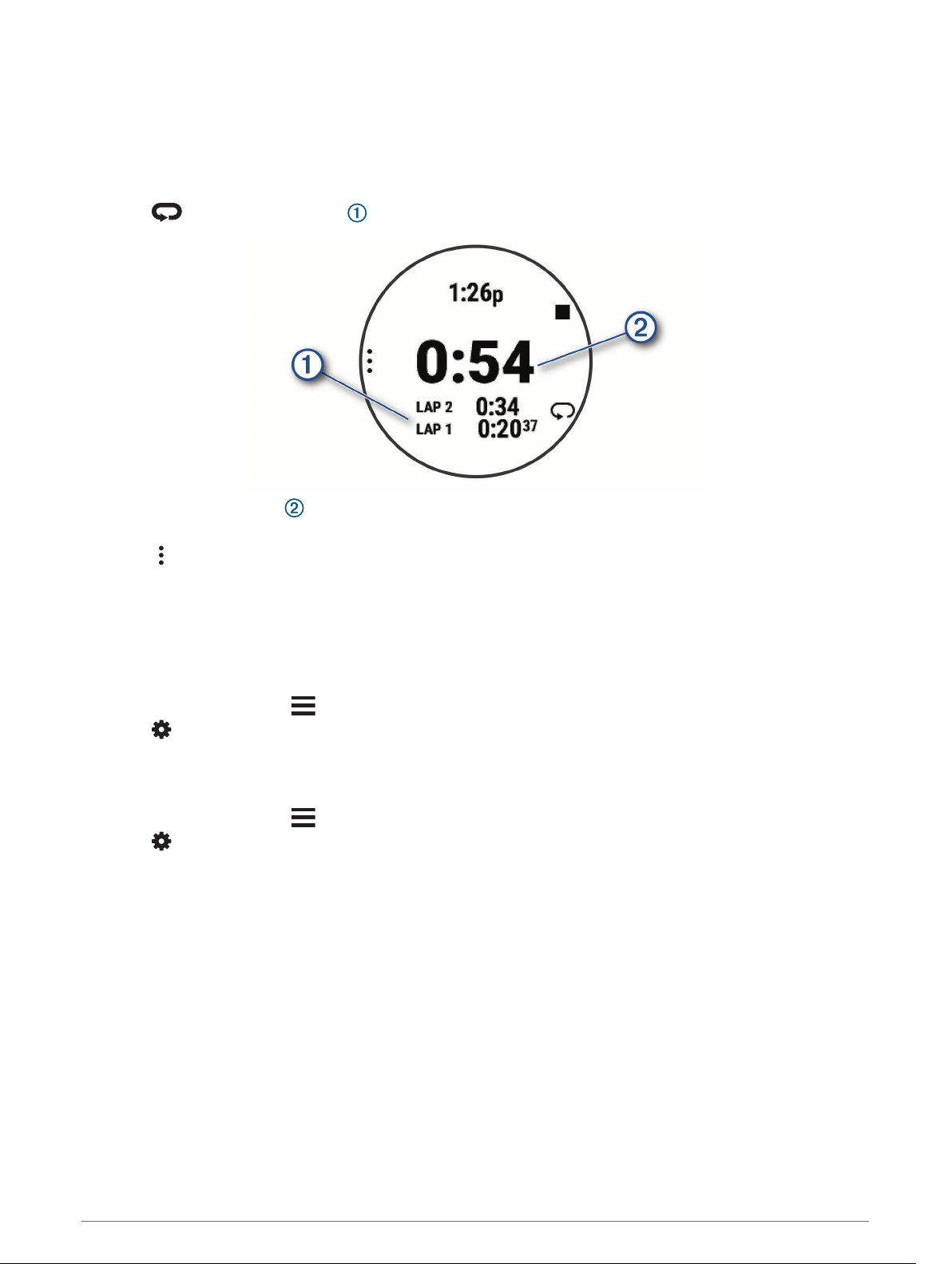
Using the Stopwatch
1 From any screen, hold LIGHT.
2 Select Stopwatch.
NOTE: You may need to add this item to the controls menu (Customizing the Controls Menu, page 56).
3 Select START to start the timer.
4 Select to restart the lap timer .
The total stopwatch time continues running.
5 Select START to stop both timers.
6 Select .
7 Save the recorded time as an activity in your history (optional).
Syncing the Time with GPS
Each time you turn on the device and acquire satellites, the device automatically detects your time zones and
the current time of day. You can also manually sync the time with GPS when you change time zones, and to
update for daylight saving time.
1 From the watch face, hold .
2 Select > System > Time > Sync With GPS.
3 Wait while the device locates satellites (Acquiring Satellite Signals, page 91).
Setting the Time Manually
1 From the watch face, hold .
2 Select > System > Time > Set Time > Manual.
3 Select Time, and enter the time of day.
VIRB Remote
The VIRB remote function allows you to control your VIRB action camera using your device.
Customizing Your Device 83
Controlling a VIRB Action Camera
Before you can use the VIRB remote function, you must enable the remote setting on your VIRB camera. See
the VIRB Series Owner's Manual for more information. You must also set the VIRB widget to be shown in the
widget loop (Customizing the Widget Loop, page 72).
1 Turn on your VIRB camera.
2 On your Forerunner watch, select UP or DOWN to view the VIRB widget.
3 If necessary, select START to pair your Forerunner watch with your VIRB camera.
4 Wait while your watch connects to your camera.
5 Select an option:
• To record video, select Start Recording.
The video counter appears on the Forerunner screen.
• To take a photo while recording video, select DOWN.
• To stop recording video, select STOP.
• To take a photo, select Take Photo.
• To take multiple photos in burst mode, select Take Burst.
• To send the camera to sleep mode, select Sleep Camera.
• To wake the camera from sleep mode, select Wake Camera.
• To change video and photo settings, select .
Controlling a VIRB Action Camera During an Activity
Before you can use the VIRB remote function, you must enable the remote setting on your VIRB camera. See
the VIRB Series Owner's Manual for more information. You must also set the VIRB widget to be shown in the
widget loop (Customizing the Widget Loop, page 72).
1 Turn on your VIRB camera.
2 On your Forerunner watch, select UP or DOWN to view the VIRB widget.
3 If necessary, select START to pair your Forerunner watch with your VIRB camera.
4 Wait while your watch connects to your camera.
When the camera is connected, a VIRB data screen is automatically added to the activity apps.
5 During an activity, select UP or DOWN to view the VIRB data screen.
6 Hold .
7 Select VIRB Remote.
8 Select an option:
• To control the camera using the activity timer, select > Recording Mode > Timer Start/Stop.
NOTE: Video recording automatically starts and stops when you start and stop an activity.
• To control the camera using the menu options, select > Recording Mode > Manual.
• To manually record video, select Start Recording.
The video counter appears on the Forerunner screen.
• To take a photo while recording video, select DOWN.
• To manually stop recording video, select STOP.
• To take multiple photos in burst mode, select Take Burst.
• To send the camera to sleep mode, select Sleep Camera.
• To wake the camera from sleep mode, select Wake Camera.
84 Customizing Your Device
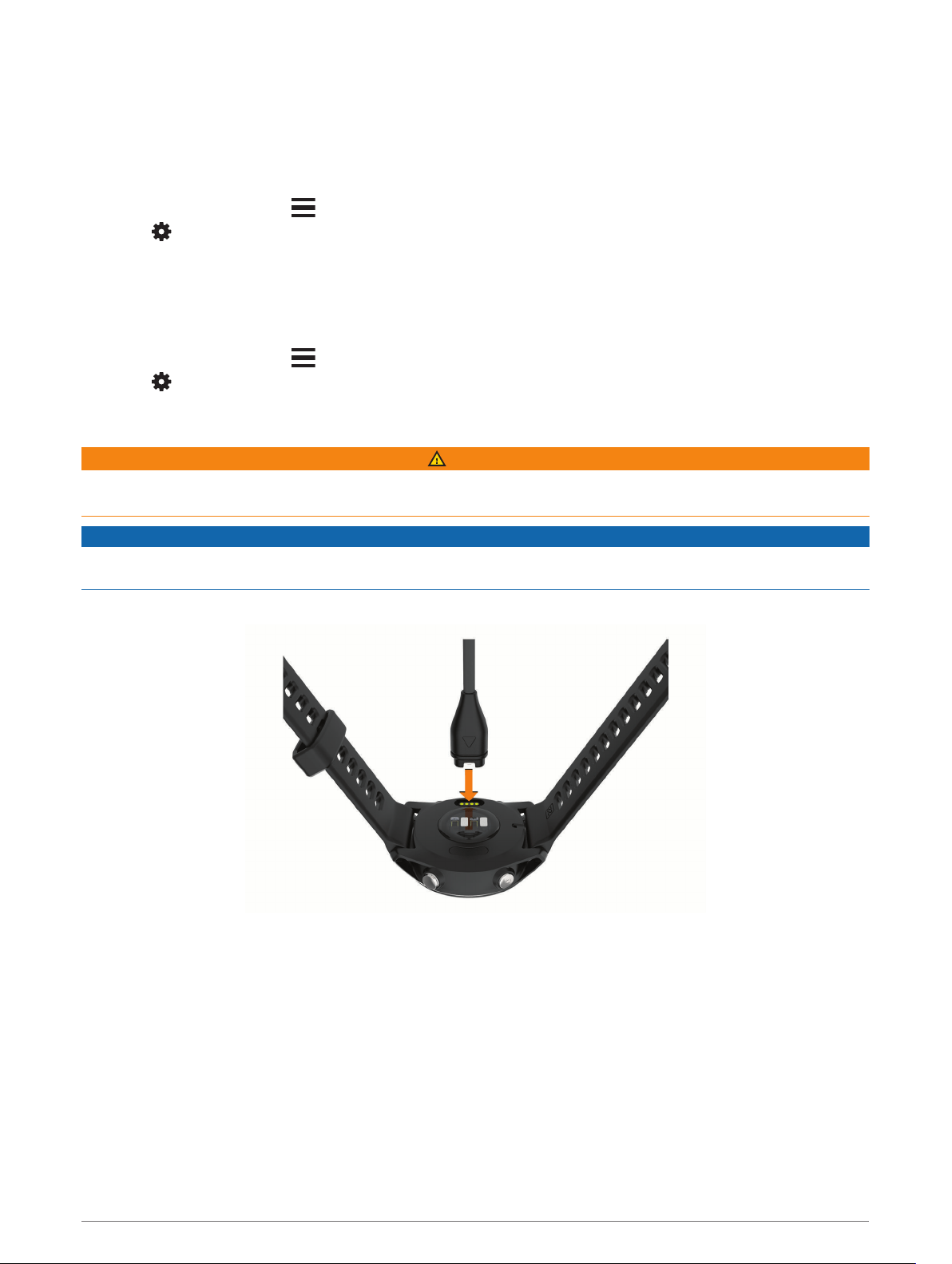
Device Information
Viewing Device Information
You can view device information, such as the unit ID, software version, regulatory information, and license
agreement.
1 From the watch face, hold .
2 Select > System > About.
Viewing E-label Regulatory and Compliance Information
The label for this device is provided electronically. The e-label may provide regulatory information, such as
identification numbers provided by the FCC or regional compliance markings, as well as applicable product and
licensing information.
1 From the watch face, hold .
2 Select > System > About.
Charging the Device
WARNING
This device contains a lithium-ion battery. See the Important Safety and Product Information guide in the
product box for product warnings and other important information.
NOTICE
To prevent corrosion, thoroughly clean and dry the contacts and the surrounding area before charging or
connecting to a computer. Refer to the cleaning instructions (Device Care, page 86).
1 Plug the small end of the USB cable into the charging port on your device.
2 Plug the large end of the USB cable into a USB charging port.
3 Charge the device completely.
Tips for Charging the Device
1 Connect the charger securely to the device to charge it using the USB cable (Charging the Device, page 85).
You can charge the device by plugging the USB cable into a Garmin approved AC adapter with a standard
wall outlet or a USB port on your computer. Charging a fully depleted battery takes up to two hours.
2 Remove the charger from the device after the battery charge level reaches 100%.
Device Information 85
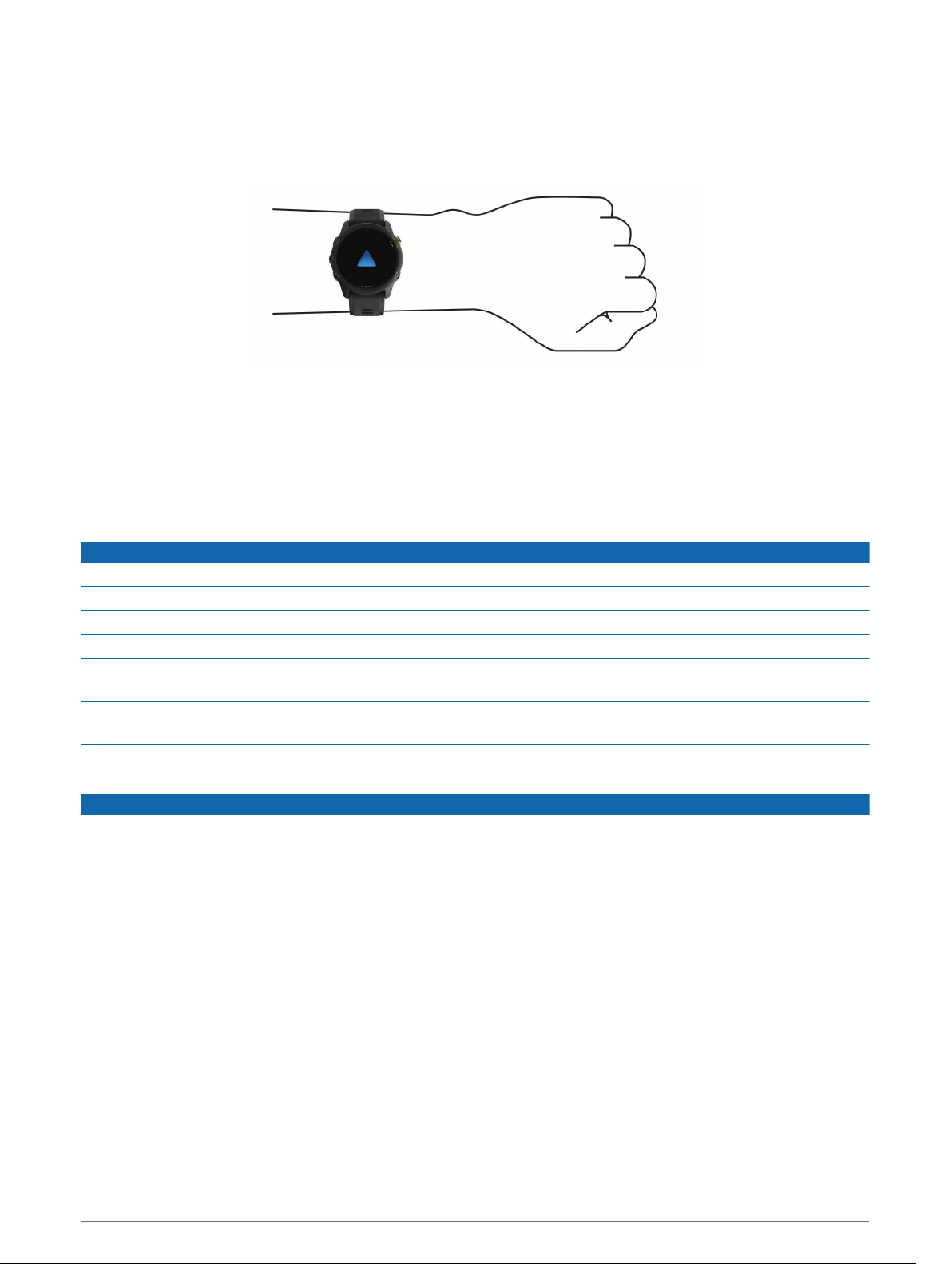
Wearing the Device
• Wear the device above your wrist bone.
NOTE: The device should be snug but comfortable. For more accurate heart rate readings, the device should
not move while running or exercising. For pulse oximeter readings, you should remain motionless.
NOTE: The optical sensor is located on the back of the device.
• See Tips for Erratic Heart Rate Data, page 29 for more information about wrist-based heart rate.
• See Tips for Erratic Pulse Oximeter Data, page 48 for more information about the pulse oximeter sensor.
• For more information about accuracy, go to garmin.com/ataccuracy.
• For more information about device wear and care, go to www.garmin.com/fitandcare.
Device Care
NOTICE
Avoid extreme shock and harsh treatment, because it can degrade the life of the product.
Avoid pressing the keys under water.
Do not use a sharp object to clean the device.
Avoid chemical cleaners, solvents, and insect repellents that can damage plastic components and finishes.
Thoroughly rinse the device with fresh water after exposure to chlorine, salt water, sunscreen, cosmetics,
alcohol, or other harsh chemicals. Prolonged exposure to these substances can damage the case.
Do not store the device where prolonged exposure to extreme temperatures can occur, because it can cause
permanent damage.
Cleaning the Device
NOTICE
Even small amounts of sweat or moisture can cause corrosion of the electrical contacts when connected to a
charger. Corrosion can prevent charging and data transfer.
1 Wipe the device using a cloth dampened with a mild detergent solution.
2 Wipe it dry.
After cleaning, allow the device to dry completely.
TIP: For more information, go to www.garmin.com/fitandcare.
86 Device Information
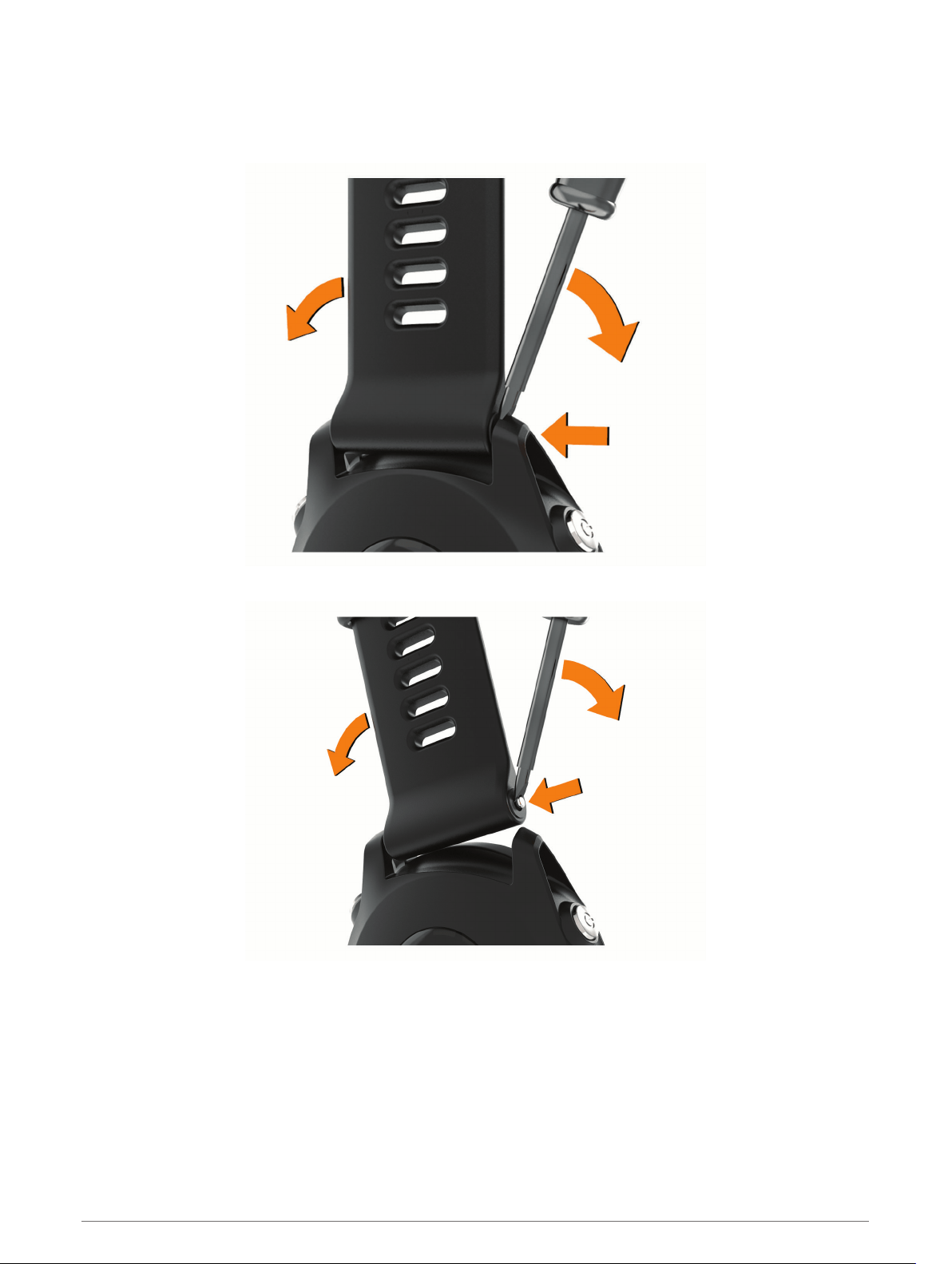
Changing the Bands
You can replace the bands with new Forerunner bands or compatible QuickFit
®
22 bands.
1 Use the pin tool to push in the watch pin.
2 Remove the band from the watch.
3 Select an option:
• To install Forerunner bands, align one side of the new band with the holes on the device, push in the
exposed watch pin, and press the band into place.
Device Information 87
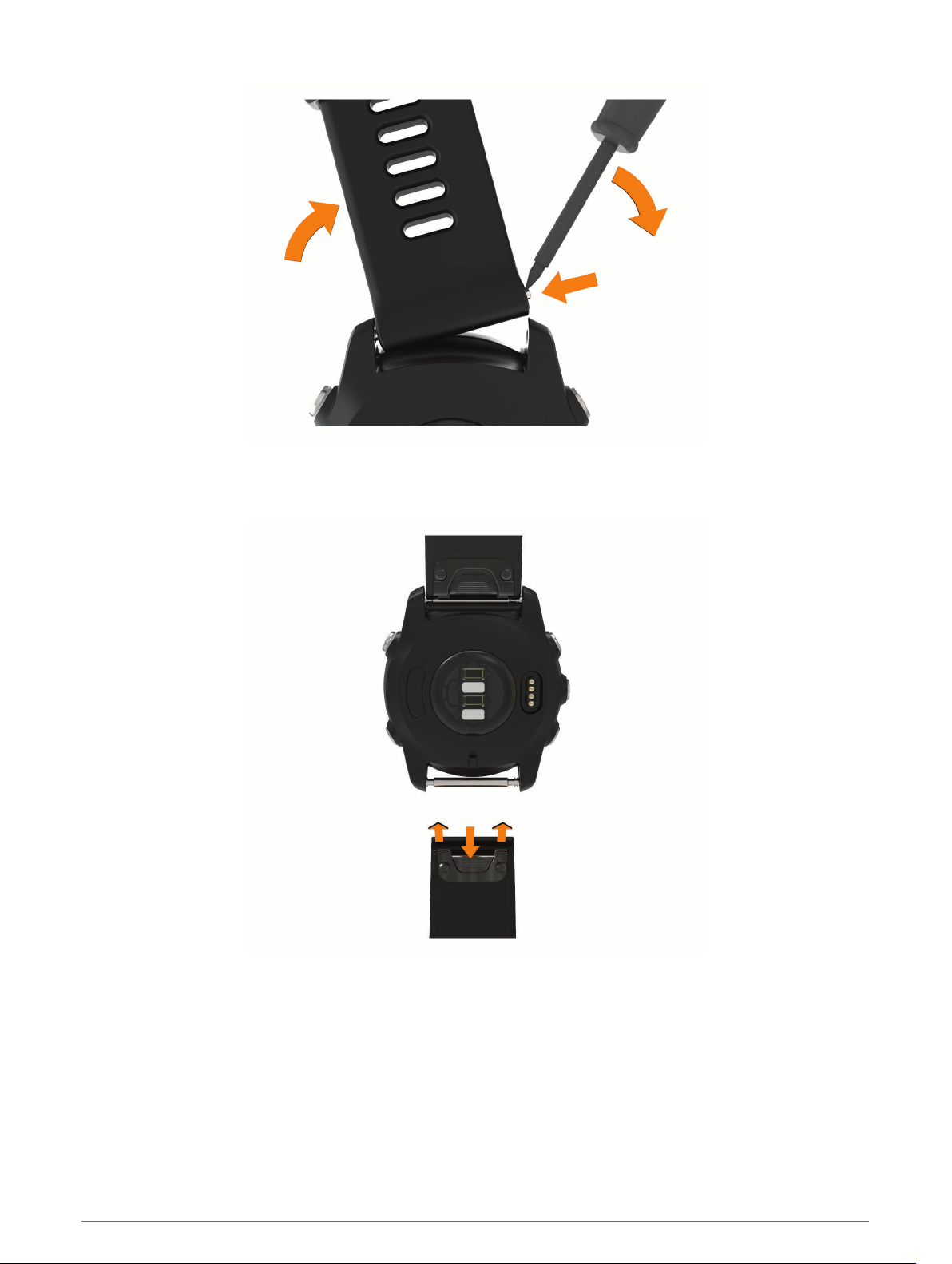
NOTE: Make sure the band is secure. The watch pin should align with the holes on the device.
• To install QuickFit 22 bands, remove the watch pin from the Forerunner band, replace the watch pin on
the device, and press the new band into place.
NOTE: Make sure the band is secure. The latch should close over the watch pin.
4 Repeat the steps to change the other band.
88 Device Information
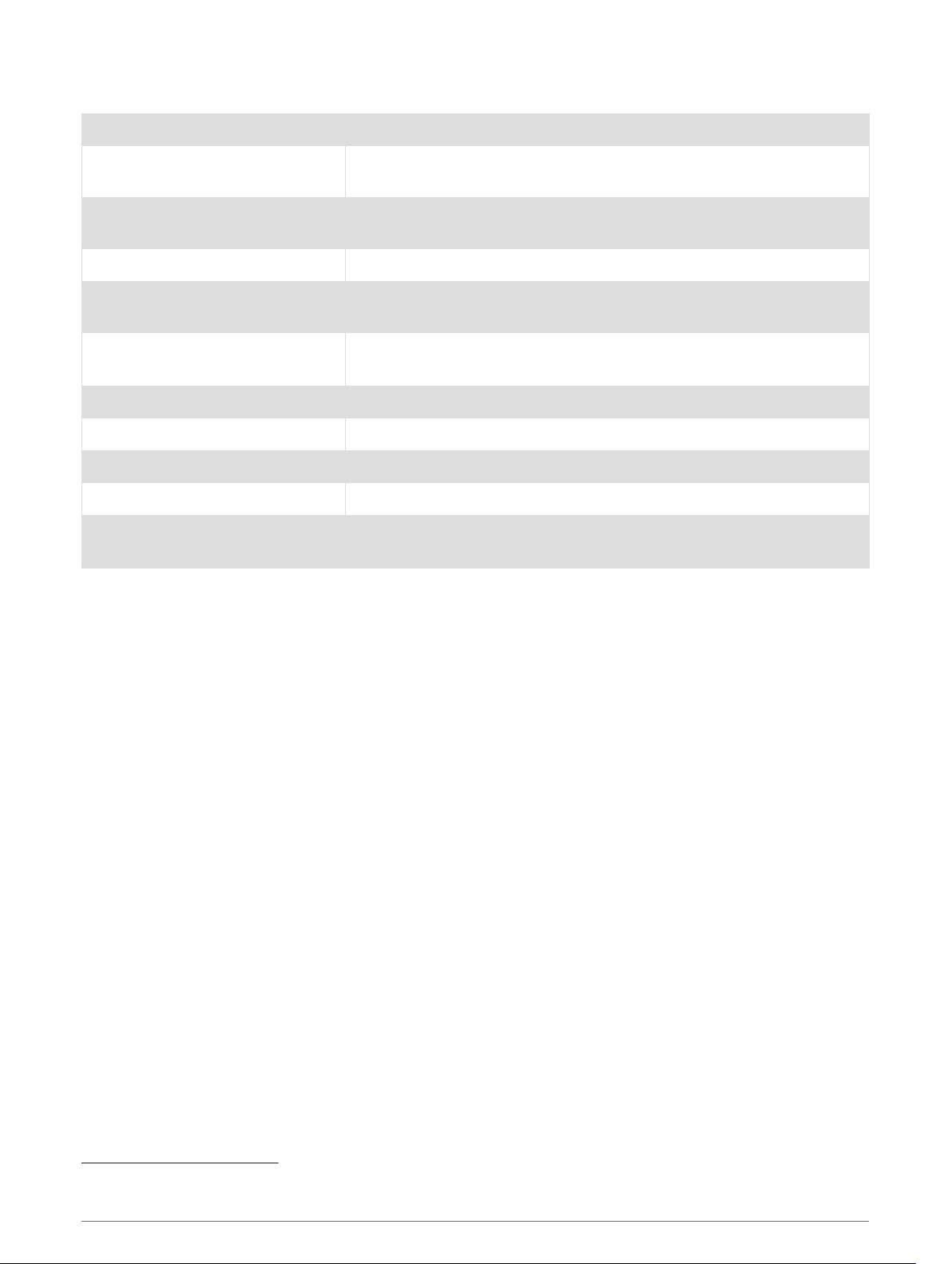
Forerunner Specifications
Battery type Rechargeable, built-in lithium-ion battery
Battery life, watch mode
Up to 1 wk. with activity tracking, smartphone notifications, and wrist-
based heart rate
Battery life, watch mode with music
Up to 11 hr. with activity tracking, smartphone notifications, wrist-based
heart rate, and music playback
Battery life, activity mode Up to 16 hr. in GPS mode with wrist-based heart rate
Battery life, activity mode with
music
Up to 6 hr. in GPS mode with wrist-based heart rate and music playback
Battery life, UltraTrac mode, no
music playback
Up to 23 hr.
Up to 21 hr. with wrist-based heart rate
Media storage Up to 500 songs
Water rating Swim, 5 ATM
1
Operating temperature range From -20º to 60ºC (from -4º to 140ºF)
Charging temperature range From 0º to 45ºC (from 32º to 113ºF)
Wireless frequencies
2.4 GHz @ +18 dBm nominal
13.56 MHz @ -37 dBm nominal
Troubleshooting
Product Updates
On your computer, install Garmin Express (www.garmin.com/express). On your smartphone, install the Garmin
Connect app.
This provides easy access to these services for Garmin devices:
• Software updates
• Course updates
• Data uploads to Garmin Connect
• Product registration
Setting Up Garmin Express
1 Connect the device to your computer using a USB cable.
2 Go to www.garmin.com/express.
3 Follow the on-screen instructions.
Getting More Information
• Go to support.garmin.com for additional manuals, articles, and software updates.
• Go to buy.garmin.com, or contact your Garmin dealer for information about optional accessories and
replacement parts.
• Go to www.garmin.com/ataccuracy.
This is not a medical device. The pulse oximeter feature is not available in all countries.
1
The device withstands pressure equivalent to a depth of 50 m. For more information, go to
www.garmin.com/waterrating.
Troubleshooting 89
Activity Tracking
For more information about activity tracking accuracy, go to garmin.com/ataccuracy.
My daily step count does not appear
The daily step count is reset every night at midnight.
If dashes appear instead of your step count, allow the device to acquire satellite signals and set the time
automatically.
My step count does not seem accurate
If your step count does not seem accurate, you can try these tips.
• Wear the device on your non-dominant wrist.
• Carry the device in your pocket when pushing a stroller or lawn mower.
• Carry the device in your pocket when actively using your hands or arms only.
NOTE: The device may interpret some repetitive motions, such as washing dishes, folding laundry, or
clapping your hands, as steps.
The step counts on my device and my Garmin Connect account don't match
The step count on your Garmin Connect account updates when you sync your device.
1 Select an option:
• Sync your step count with the Garmin Connect application (Using Garmin Connect on Your Computer,
page 65).
• Sync your step count with the Garmin Connect app (Manually Syncing Data with Garmin Connect,
page 52).
2 Wait while the device syncs your data.
Syncing can take several minutes.
NOTE: Refreshing the Garmin Connect app or the Garmin Connect application does not sync your data or
update your step count.
The floors climbed amount does not seem accurate
Your device uses an internal barometer to measure elevation changes as you climb floors. A floor climbed is
equal to 3 m (10 ft.).
• Locate the small barometer holes on the back of the device, near the charging contacts, and clean the area
around the charging contacts.
The barometer performance may be affected if the barometer holes are obstructed. You can rinse the device
with water to clean the area.
After cleaning, allow the device to dry completely.
• Avoid holding handrails or skipping steps while climbing stairs.
• In windy environments, cover the device with your sleeve or jacket as strong gusts can cause erratic
readings.
My intensity minutes are flashing
When you exercise at an intensity level that qualifies toward your intensity minutes goal, the intensity minutes
flash.
90 Troubleshooting
Acquiring Satellite Signals
The device may need a clear view of the sky to acquire satellite signals. The time and date are set automatically
based on the GPS position.
TIP: For more information about GPS, go to www.garmin.com/aboutGPS.
1 Go outdoors to an open area.
The front of the device should be oriented toward the sky.
2 Wait while the device locates satellites.
It may take 30–60 seconds to locate satellite signals.
Improving GPS Satellite Reception
• Frequently sync the device to your Garmin Connect account:
◦ Connect your device to a computer using the USB cable and the Garmin Express application.
◦ Sync your device to the Garmin Connect app using your Bluetooth enabled smartphone.
◦ Connect your device to your Garmin Connect account using a Wi‑Fi wireless network.
While connected to your Garmin Connect account, the device downloads several days of satellite data,
allowing it to quickly locate satellite signals.
• Take your device outside to an open area away from tall buildings and trees.
• Remain stationary for a few minutes.
Restarting the Device
If the device stops responding, you may need to restart it.
NOTE: Restarting the device may erase your data or settings.
1 Hold for 15 seconds.
The device turns off.
2 Hold for one second to turn on the device.
Resetting All Default Settings
Before you reset all default settings, you should sync the device with the Garmin Connect app to upload your
activity data.
NOTE: This deletes all user-entered information and activity history. If you have set up a Garmin Pay wallet,
restoring default settings also deletes the wallet from your device.
You can reset all of the device settings to the factory default values.
1 From the watch face, hold .
2 Select > System > Reset.
3 Select an option:
• To reset all of the device settings to the factory default values and save all activity information and stored
music, select Reset Default Settings.
• To delete all activities from your history, select Delete All Activities.
• To reset all distance and time totals, select Reset Totals.
• To reset the all of the device settings to the factory default values and delete all activity information and
stored music, select Delete Data and Reset Settings.
Updating the Sofware Using the Garmin Connect App
Before you can update your device software using the Garmin Connect app, you must have a Garmin Connect
account, and you must pair the device with a compatible smartphone (Pairing Your Smartphone with Your
Device, page 50
).
Sync your device with the Garmin Connect app (Manually Syncing Data with Garmin Connect, page 52).
When new software is available, the Garmin Connect app automatically sends the update to your device.
Troubleshooting 91
Updating the Sofware Using Garmin Express
Before you can update your device software, you must have a Garmin Connect account, and you must
download the Garmin Express application.
1 Connect the device to your computer using the USB cable.
When new software is available, Garmin Express sends it to your device.
2 Follow the on-screen instructions.
3 Do not disconnect your device from the computer during the update process.
NOTE: If you have already set up your device with Wi‑Fi connectivity, Garmin Connect can automatically
download available software updates to your device when it connects using Wi‑Fi.
My Device is in the Wrong Language
1 Hold .
2 Scroll down to the last item in the list, and select it.
3 Select the first item in the list.
4 Use UP and DOWN to select your language.
Is my smartphone compatible with my device?
The Forerunner device is compatible with smartphones using Bluetooth technology.
Go to www.garmin.com/ble for compatibility information.
My phone will not connect to the device
If your phone will not connect to the device, you can try these tips.
• Turn off your smartphone and your device, and turn them back on again.
• Enable Bluetooth technology on your smartphone.
• Update the Garmin Connect app to the latest version.
• Remove your device from the Garmin Connect app and the Bluetooth settings on your smartphone to retry
the pairing process.
• If you bought a new smartphone, remove your device from the Garmin Connect app on the smartphone you
intend to stop using.
• Bring your smartphone within 10 m (33 ft.) of the device.
• On your smartphone, open the Garmin Connect app, select or , and select Garmin Devices > Add
Device to enter pairing mode.
• On your device, hold LIGHT, and select to turn on Bluetooth technology and enter pairing mode.
92 Troubleshooting
Maximizing Battery Life
You can do several things to extend the life of the battery.
• Reduce the backlight timeout (Changing the Backlight Settings, page 81).
• Reduce the backlight brightness.
• Turn off Bluetooth wireless technology when you are not using connected features (Bluetooth Connected
Features, page 52).
• When pausing your activity for a longer period of time, use the Resume Later option (Stopping an Activity,
page 4).
• Turn off activity tracking (Turning Off Activity Tracking, page 28).
• Use a watch face that is not updated every second.
For example, use a watch face without a second hand (Customizing the Watch Face, page 79).
• Limit the smartphone notifications the device displays (Managing Notifications, page 51).
• Stop broadcasting heart rate data to paired Garmin devices (Broadcasting Heart Rate Data to Garmin
®
Devices, page 30).
• Turn off wrist-based heart rate monitoring (Turning Off the Wrist-based Heart Rate Monitor, page 31).
NOTE: Wrist-based heart rate monitoring is used to calculate vigorous intensity minutes and calories burned.
• Turn off the pulse oximeter feature (Turning Off the Wrist-based Heart Rate Monitor, page 31).
• Use UltraTrac GPS mode for your activity (UltraTrac, page 78).
• Select the Smart recording interval (System Settings, page 81).
The temperature reading is not accurate
Your body temperature affects the temperature reading for the internal temperature sensor. To get the most
accurate temperature reading, you should remove the watch from your wrist and wait 20 to 30 minutes.
You can also use an optional tempe external temperature sensor to view accurate ambient temperature
readings while wearing the watch.
How can I manually pair ANT+ sensors?
You can use the device settings to manually pair ANT+ sensors. The first time you connect a sensor to your
device using ANT+ wireless technology, you must pair the device and sensor. After they are paired, the device
connects to the sensor automatically when you start an activity and the sensor is active and within range.
1 Stay 10 m (33 ft.) away from other ANT+ sensors while pairing.
2 If you are pairing a heart rate monitor, put on the heart rate monitor.
The heart rate monitor does not send or receive data until you put it on.
3 Hold .
4 Select > Sensors & Accessories > Add New.
5 Select an option:
• Select Search All Sensors.
• Select your sensor type.
After the sensor is paired with your device, a message appears. Sensor data appears in the data page loop
or a custom data field.
Troubleshooting 93
Can I use my Bluetooth sensor with my watch?
The device is compatible with some Bluetooth sensors. The first time you connect a sensor to your Garmin
device, you must pair the device and sensor. After they are paired, the device connects to the sensor
automatically when you start an activity and the sensor is active and within range.
1 Hold .
2 Select > Sensors & Accessories > Add New.
3 Select an option:
• Select Search All Sensors.
• Select your sensor type.
You can customize the optional data fields (Customizing the Data Screens, page 74).
My music cuts out or my headphones do not stay connected
When using a Forerunner 745 device connected to headphones using Bluetooth technology, the signal is
strongest when there is a direct line of sight between the device and the antenna on the headphones.
• If the signal passes through your body, you may experience signal loss or your headphones may become
disconnected.
• It is recommended to wear your headphones with the antenna on the same side of your body as your
Forerunner 745 device.
• Since headphones vary by model, you can try moving the watch to your other wrist.
94 Troubleshooting
Appendix
Data Fields
Some data fields require ANT+ or Bluetooth accessories to display data.
%FTP: The current power output as a percentage of functional threshold power.
% Heart Rate Reserve: The percentage of heart rate reserve (maximum heart rate minus resting heart rate).
10s Balance: The 10-second moving average of the left/right power balance.
10s Power: The 10-second moving average of power output.
24-Hour Maximum: The maximum temperature recorded in the last 24 hours from a compatible temperature
sensor.
24-Hour Minimum: The minimum temperature recorded in the last 24 hours from a compatible temperature
sensor.
30s Balance: The 30-second moving average of the left/right power balance.
30s Power: The 30-second moving average of power output.
3s Balance: The three-second moving average of the left/right power balance.
3s Power: The 3-second moving average of power output.
500m Pace: The current rowing pace per 500 meters.
Aerobic Training Effect: The impact of the current activity on your aerobic fitness level.
Anaerobic Training Effect: The impact of the current activity on your anaerobic fitness level.
Average % Heart Rate Reserve: The average percentage of heart rate reserve (maximum heart rate minus
resting heart rate) for the current activity.
Average 500m Pace: The average rowing pace per 500 meters for the current activity.
Average Ascent: The average vertical distance of ascent since the last reset.
Average Balance: The average left/right power balance for the current activity.
Average Cadence: Cycling. The average cadence for the current activity.
Average Cadence: Running. The average cadence for the current activity.
Average Descent: The average vertical distance of descent since the last reset.
Average Distance Per Stroke: Swimming. The average distance traveled per stroke during the current activity.
Average Distance Per Stroke: Paddle sports. The average distance traveled per stroke during the current
activity.
Average GCT Balance: The average ground contact time balance for the current session.
Average Ground Contact Time: The average amount of ground contact time for the current activity.
Average Heart Rate: The average heart rate for the current activity.
Average Heart Rate %Max.: The average percentage of maximum heart rate for the current activity.
Average Lap Time: The average lap time for the current activity.
Average Left Power Phase: The average power phase angle for the left leg for the current activity.
Average Moving Speed: The average speed when moving for the current activity.
Average Nautical Speed: The average speed in knots for the current activity.
Average Overall Speed: The average speed for the current activity, including both moving and stopped speeds.
Average Pace: The average pace for the current activity.
Average Power: The average power output for the current activity.
Average Right Power Phase: The average power phase angle for the right leg for the current activity.
Average Speed: The average speed for the current activity.
Average Stride Length: The average stride length for the current session.
Average Stroke Rate: Paddle sports. The average number of strokes per minute (spm) during the current
activity.
Average Strokes Per Length: The average number of strokes per pool length during the current activity.
Appendix 95
Average Swolf: The average swolf score for the current activity. Your swolf score is the sum of the time for one
length plus the number of strokes for that length (Swim Terminology, page 11). In open water swimming, 25
meters is used to calculate your swolf score.
Average Vertical Oscillation: The average amount of vertical oscillation for the current activity.
Average Vertical Ratio: The average ratio of vertical oscillation to stride length for the current session.
Avg. Left Peak Power Phase: The average power phase peak angle for the left leg for the current activity.
Avg. Platform Center Offset: The average platform center offset for the current activity.
Avg. Right Peak Power Phase: The average power phase peak angle for the right leg for the current activity.
Balance: The current left/right power balance.
Battery Percentage: The percentage of the battery power remaining.
Bearing: The direction from your current location to a destination. You must be navigating for this data to
appear.
Cadence: Cycling. The number of revolutions of the crank arm. Your device must be connected to a cadence
accessory for this data to appear.
Cadence: Running. The steps per minute (right and left).
Cadence Gauge: Running. A color gauge showing your current cadence range.
Calories: The amount of total calories burned.
Course: The direction from your starting location to a destination. Course can be viewed as a planned or set
route. You must be navigating for this data to appear.
Destination Location: The position of your final destination.
Destination Waypoint: The last point on the route to the destination. You must be navigating for this data to
appear.
Di2 Battery: The remaining battery power of a Di2 sensor.
Distance: The distance traveled for the current track or activity.
Distance Per Stroke: Paddle sports. The distance traveled per stroke.
Distance Remaining: The remaining distance to the final destination. You must be navigating for this data to
appear.
Distance To Next: The remaining distance to the next waypoint on the route. You must be navigating for this
data to appear.
Elapsed Time: The total time recorded. For example, if you start the timer and run for 10 minutes, then stop the
timer for 5 minutes, then start the timer and run for 20 minutes, your elapsed time is 35 minutes.
Elevation: The altitude of your current location above or below sea level.
Estimated Total Distance: The estimated distance from the start to the final destination. You must be
navigating for this data to appear.
ETA: The estimated time of day when you will reach the final destination (adjusted to the local time of the
destination). You must be navigating for this data to appear.
ETA at Next: The estimated time of day when you will reach the next waypoint on the route (adjusted to the
local time of the waypoint). You must be navigating for this data to appear.
ETE: The estimated time remaining until you reach the final destination. You must be navigating for this data to
appear.
Floors Climbed: The total number of floors climbed up for the day.
Floors Descended: The total number of floors climbed down for the day.
Floors per Minute: The number of floors climbed up per minute.
Front: The front bike gear from a gear position sensor.
GCT Balance: The left/right balance of ground contact time while running.
GCT Balance Gauge: A color gauge showing the left/right balance of ground contact time while running.
Gear Battery: The battery status of a gear position sensor.
Gear Combo: The current gear combination from a gear position sensor.
96 Appendix
Gear Ratio: The number of teeth on the front and rear bike gears, as detected by a gear position sensor.
Gears: The front and rear bike gears from a gear position sensor.
Glide Ratio: The ratio of horizontal distance traveled to the change in vertical distance.
Glide Ratio to Destination: The glide ratio required to descend from your current position to the destination
elevation. You must be navigating for this data to appear.
GPS: The strength of the GPS satellite signal.
GPS Elevation: The altitude of your current location using GPS.
Grade: The calculation of rise (elevation) over run (distance). For example, if for every 3 m (10 ft.) you climb you
travel 60 m (200 ft.), the grade is 5%.
Ground Contact Time: The amount of time in each step that you spend on the ground while running, measured
in milliseconds. Ground contact time is not calculated while walking.
Ground Contact Time Gauge: A color gauge showing the amount of time in each step that you spend on the
ground while running, measured in milliseconds.
Heading: The direction you are moving.
Heart Rate: Your heart rate in beats per minute (bpm). Your device must have wrist-based heart rate or be
connected to a compatible heart rate monitor.
Heart Rate %Max.: The percentage of maximum heart rate.
Heart Rate Gauge: A color gauge showing your current heart rate zone.
Heart Rate Zone: The current range of your heart rate (1 to 5). The default zones are based on your user profile
and maximum heart rate (220 minus your age).
Intensity Factor: The Intensity Factor
™
for the current activity.
Interval Average %HRR: The average percentage of heart rate reserve (maximum heart rate minus resting heart
rate) for the current swim interval.
Interval Average %Max.: The average percentage of maximum heart rate for the current swim interval.
Interval Average Heart Rate: The average heart rate for the current swim interval.
Interval Distance: The distance traveled for the current interval.
Interval Lengths: The number of pool lengths completed during the current interval.
Interval Maximum %HRR: The maximum percentage of heart rate reserve (maximum heart rate minus resting
heart rate) for the current swim interval.
Interval Maximum %Max.: The maximum percentage of maximum heart rate for the current swim interval.
Interval Maximum Heart Rate: The maximum heart rate for the current swim interval.
Interval Pace: The average pace for the current interval.
Interval Stroke Rate: The average number of strokes per minute (spm) during the current interval.
Interval Strokes Per Length: The average number of strokes per pool length during the current interval.
Interval Stroke Type: The current stroke type for the interval.
Interval Swolf: The average swolf score for the current interval.
Interval Time: The stopwatch time for the current interval.
Lap % Heart Rate Reserve: The average percentage of heart rate reserve (maximum heart rate minus resting
heart rate) for the current lap.
Lap 500m Pace: The average rowing pace per 500 meters for the current lap.
Lap Ascent: The vertical distance of ascent for the current lap.
Lap Balance: The average left/right power balance for the current lap.
Lap Cadence: Cycling. The average cadence for the current lap.
Lap Cadence: Running. The average cadence for the current lap.
Lap Descent: The vertical distance of descent for the current lap.
Lap Distance: The distance traveled for the current lap.
Lap Distance Per Stroke: Swimming. The average distance traveled per stroke during the current lap.
Appendix 97
Lap Distance Per Stroke: Paddle sports. The average distance traveled per stroke during the current lap.
Lap GCT Balance: The average ground contact time balance for the current lap.
Lap Ground Contact Time: The average amount of ground contact time for the current lap.
Lap Heart Rate: The average heart rate for the current lap.
Lap Heart Rate %Max.: The average percentage of maximum heart rate for the current lap.
Lap Left Peak Power Phase: The average power phase peak angle for the left leg for the current lap.
Lap Left Power Phase: The average power phase angle for the left leg for the current lap.
Lap Normalized Power: The average Normalized Power for the current lap.
Lap Pace: The average pace for the current lap.
Lap Platform Center Offset: The average platform center offset for the current lap.
Lap Power: The average power output for the current lap.
Lap Right Peak Power Phase: The average power phase peak angle for the right leg for the current lap.
Lap Right Power Phase: The average power phase angle for the right leg for the current lap.
Laps: The number of laps completed for the current activity.
Lap Speed: The average speed for the current lap.
Lap Stride Length: The average stride length for the current lap.
Lap Stroke Rate: Swimming. The average number of strokes per minute (spm) during the current lap.
Lap Stroke Rate: Paddle sports. The average number of strokes per minute (spm) during the current lap.
Lap Strokes: Swimming. The total number of strokes for the current lap.
Lap Strokes: Paddle sports. The total number of strokes for the current lap.
Lap Swolf: The swolf score for the current lap.
Lap Time: The stopwatch time for the current lap.
Lap Vertical Oscillation: The average amount of vertical oscillation for the current lap.
Lap Vertical Ratio: The average ratio of vertical oscillation to stride length for the current lap.
Last Lap %HRR: The average percentage of heart rate reserve (maximum heart rate minus resting heart rate)
for the last completed lap.
Last Lap 500m Pace: The average rowing pace per 500 meters for the last lap.
Last Lap Ascent: The vertical distance of ascent for the last completed lap.
Last Lap Cadence: Cycling. The average cadence for the last completed lap.
Last Lap Cadence: Running. The average cadence for the last completed lap.
Last Lap Descent: The vertical distance of descent for the last completed lap.
Last Lap Distance: The distance traveled for the last completed lap.
Last Lap Distance Per Stroke: Swimming. The average distance traveled per stroke during the last completed
lap.
Last Lap Distance Per Stroke: Paddle sports. The average distance traveled per stroke during the last
completed lap.
Last Lap Heart Rate: The average heart rate for the last completed lap.
Last Lap Heart Rate %Max.: The average percentage of maximum heart rate for the last completed lap.
Last Lap Normalized Power: The average Normalized Power for the last completed lap.
Last Lap Pace: The average pace for the last completed lap.
Last Lap Power: The average power output for the last completed lap.
Last Lap Speed: The average speed for the last completed lap.
Last Lap Stroke Rate: Swimming. The average number of strokes per minute (spm) during the last completed
lap.
Last Lap Stroke Rate: Paddle sports. The average number of strokes per minute (spm) during the last
completed lap.
Last Lap Strokes: Swimming. The total number of strokes for the last completed lap.
98 Appendix
Last Lap Strokes: Paddle sports. The total number of strokes for the last completed lap.
Last Lap Swolf: The swolf score for the last completed lap.
Last Lap Time: The stopwatch time for the last completed lap.
Last Length Pace: The average pace for your last completed pool length.
Last Length Stroke Rate: The average number strokes per minute (spm) during the last completed pool length.
Last Length Strokes: The total number of strokes for the last completed pool length.
Last Length Stroke Type: The stroke type used during the last completed pool length.
Last Length Swolf: The swolf score for the last completed pool length.
Lat/Lon: The current position in latitude and longitude regardless of the selected position format setting.
Left Peak Power Phase: The current power phase peak angle for the left leg. Power phase peak is the angle
range over which the rider produces the peak portion of the driving force.
Left Power Phase: The current power phase angle for the left leg. Power phase is the pedal stroke region where
positive power is produced.
Lengths: The number of pool lengths completed during the current activity.
Load: The training load for the current activity. Training load is the amount of excess post-exercise oxygen
consumption (EPOC), which indicates the strenuousness of your workout.
Location: The current position using the selected position format setting.
Maximum Ascent: The maximum rate of ascent in feet per minute or meters per minute since the last reset.
Maximum Descent: The maximum rate of descent in meters per minute or feet per minute since the last reset.
Maximum Elevation: The highest elevation reached since the last reset.
Maximum Lap Power: The top power output for the current lap.
Maximum Nautical Speed: The maximum speed in knots for the current activity.
Maximum Power: The top power output for the current activity.
Maximum Speed: The top speed for the current activity.
Minimum Elevation: The lowest elevation reached since the last reset.
Moving Time: The total time moving for the current activity.
Multisport Time: The total time for all sports in a multisport activity, including transitions.
Muscle O2 Saturation %: The estimated muscle oxygen saturation percentage for the current activity.
Nautical Distance: The distance traveled in nautical meters or nautical feet.
Nautical Speed: The current speed in knots.
Next Split Distance: Running. The total distance of the next split.
Next Split Target Pace: Running. The target pace for the next split.
Next Waypoint: The next point on the route. You must be navigating for this data to appear.
Normalized Power: The Normalized Power
™
for the current activity.
Off Course: The distance to the left or right by which you have strayed from the original path of travel. You must
be navigating for this data to appear.
Overall Ahead/Behind: Running. The overall time ahead or behind of the target pace.
Pace: The current pace.
PacePro Gauge: Running. Your current split pace and your target split pace.
Pedal Smoothness: The measurement of how evenly a rider is applying force to the pedals throughout each
pedal stroke.
Performance Condition: The performance condition score is a real-time assessment of your ability to perform.
Platform Center Offset: The platform center offset. Platform center offset is the location on the pedal platform
where force is applied.
Power: The current power output in watts.
Power Gauge: A color gauge showing your current power zone.
Power to Weight: The current power measured in watts per kilogram.
Appendix 99
Power Zone: The current range of power output (1 to 7) based on your FTP or custom settings.
Rear: The rear bike gear from a gear position sensor.
Repeat On: The timer for the last interval plus the current rest (pool swimming).
Reps: During a strength training activity, the number of repetitions in a workout set.
Respiration Rate: Your respiration rate in breaths per minute (brpm).
Rest Timer: The timer for the current rest (pool swimming).
Right Peak Power Phase: The current power phase peak angle for the right leg. Power phase peak is the angle
range over which the rider produces the peak portion of the driving force.
Right Power Phase: The current power phase angle for the right leg. Power phase is the pedal stroke region
where positive power is produced.
Set Timer: During a strength training activity, the amount of time spent in the current workout set.
Speed: The current rate of travel.
Split Distance: Running. The total distance of the current split.
Split Distance Remaining: Running. The remaining distance of the current split.
Split Pace: Running. The pace for the current split.
Split Target Pace: Running. The target pace for the current split.
Steps: The number of steps taken during the current activity.
Stopped Time: The total time stopped for the current activity.
Stress: Your current stress level.
Stride Length: The length of your stride from one footfall to the next, measured in meters.
Stroke Rate: Swimming. The number of strokes per minute (spm).
Stroke Rate: Paddle sports. The number of strokes per minute (spm).
Strokes: Swimming. The total number of strokes for the current activity.
Strokes: Paddle sports. The total number of strokes for the current activity.
Sunrise: The time of sunrise based on your GPS position.
Sunset: The time of sunset based on your GPS position.
Swim Time: The swimming time for the current activity, not including rest time.
Temperature: The temperature of the air. Your body temperature affects the temperature sensor. You can pair
a tempe sensor with your device to provide a consistent source of accurate temperature data.
Time in Zone: The time elapsed in each heart rate or power zone.
Time of Day: The time of day based on your current location and time settings (format, time zone, daylight
saving time).
Timer: The current time of the countdown timer.
Time Seated: The time spent seated while pedaling for the current activity.
Time Seated Lap: The time spent seated while pedaling for the current lap.
Time Standing: The time spent standing while pedaling for the current activity.
Time Standing Lap: The time spent standing while pedaling for the current lap.
Time to Next: The estimated time remaining before you reach the next waypoint in the route. You must be
navigating for this data to appear.
Torque Efficiency: The measurement of how efficiently a rider is pedaling.
Total Ascent: The total elevation distance ascended since the last reset.
Total Ascent/Descent Gauge: The total elevation distances ascended and descended during the activity or
since the last reset.
Total Descent: The total elevation distance descended since the last reset.
Total Hemoglobin: The estimated total hemoglobin concentration in the muscle.
Trainer Grade: The simulated grade (elevation over distance) from resistance force applied by an indoor
trainer.
100 Appendix
Trainer Power: The simulated power from resistance force applied by an indoor trainer.
Trainer Resistance: The resistance force applied by an indoor trainer.
Training Effect Gauge: The impact of the current activity on your aerobic and anaerobic fitness levels.
Training Stress Score: The Training Stress Score
™
for the current activity.
Velocity Made Good: The speed at which you are closing on a destination along a route. You must be
navigating for this data to appear.
Vertical Dist. to Dest.: The elevation distance between your current position and the final destination. You must
be navigating for this data to appear.
Vertical Oscillation: The amount of bounce while you are running. The vertical motion of your torso, measured
in centimeters for each step.
Vertical Oscillation Gauge: A color gauge showing the amount of bounce while you are running.
Vertical Ratio: The ratio of vertical oscillation to stride length.
Vertical Ratio Gauge: A color gauge showing the ratio of vertical oscillation to stride length.
Vertical Speed: The rate of ascent or descent over time.
Vertical Speed to Target: The rate of ascent or descent to a predetermined altitude. You must be navigating for
this data to appear.
Work: The accumulated work performed (power output) in kilojoules.
VO2 Max. Standard Ratings
These tables include standardized classifications for VO2 max. estimates by age and gender.
Males Percentile 20–29 30–39 40–49 50–59 60–69 70–79
Superior 95 55.4 54 52.5 48.9 45.7 42.1
Excellent 80 51.1 48.3 46.4 43.4 39.5 36.7
Good 60 45.4 44 42.4 39.2 35.5 32.3
Fair 40 41.7 40.5 38.5 35.6 32.3 29.4
Poor 0–40 <41.7 <40.5 <38.5 <35.6 <32.3 <29.4
Females Percentile 20–29 30–39 40–49 50–59 60–69 70–79
Superior 95 49.6 47.4 45.3 41.1 37.8 36.7
Excellent 80 43.9 42.4 39.7 36.7 33 30.9
Good 60 39.5 37.8 36.3 33 30 28.1
Fair 40 36.1 34.4 33 30.1 27.5 25.9
Poor 0–40 <36.1 <34.4 <33 <30.1 <27.5 <25.9
Data reprinted with permission from The Cooper Institute. For more information, go to
www.CooperInstitute.org.
Appendix 101
FTP Ratings
These tables include classifications for functional threshold power (FTP) estimates by gender.
Males Watts per Kilogram (W/kg)
Superior 5.05 and greater
Excellent From 3.93 to 5.04
Good From 2.79 to 3.92
Fair From 2.23 to 2.78
Untrained Less than 2.23
Females Watts per Kilogram (W/kg)
Superior 4.30 and greater
Excellent From 3.33 to 4.29
Good From 2.36 to 3.32
Fair From 1.90 to 2.35
Untrained Less than 1.90
FTP ratings are based on research by Hunter Allen and Andrew Coggan, PhD, Training and Racing with a Power
Meter (Boulder, CO: VeloPress, 2010).
102 Appendix
Wheel Size and Circumference
Your speed sensor automatically detects your wheel size. If necessary, you can manually enter your wheel
circumference in the speed sensor settings.
The tire size is marked on both sides of the tire. This is not a comprehensive list. You can also measure the
circumference of your wheel or use one of the calculators available on the internet.
Tire Size Wheel Circumference (mm)
20 × 1.75 1515
20 × 1-3/8 1615
22 × 1-3/8 1770
22 × 1-1/2 1785
24 × 1 1753
24 × 3/4 Tubular 1785
24 × 1-1/8 1795
24 × 1.75 1890
24 × 1-1/4 1905
24 × 2.00 1925
24 × 2.125 1965
26 × 7/8 1920
26 × 1-1.0 1913
26 × 1 1952
26 × 1.25 1953
26 × 1-1/8 1970
26 × 1.40 2005
26 × 1.50 2010
26 × 1.75 2023
26 × 1.95 2050
26 × 2.00 2055
26 × 1-3/8 2068
26 × 2.10 2068
26 × 2.125 2070
26 × 2.35 2083
26 × 1-1/2 2100
26 × 3.00 2170
27 × 1 2145
27 × 1-1/8 2155
Appendix 103
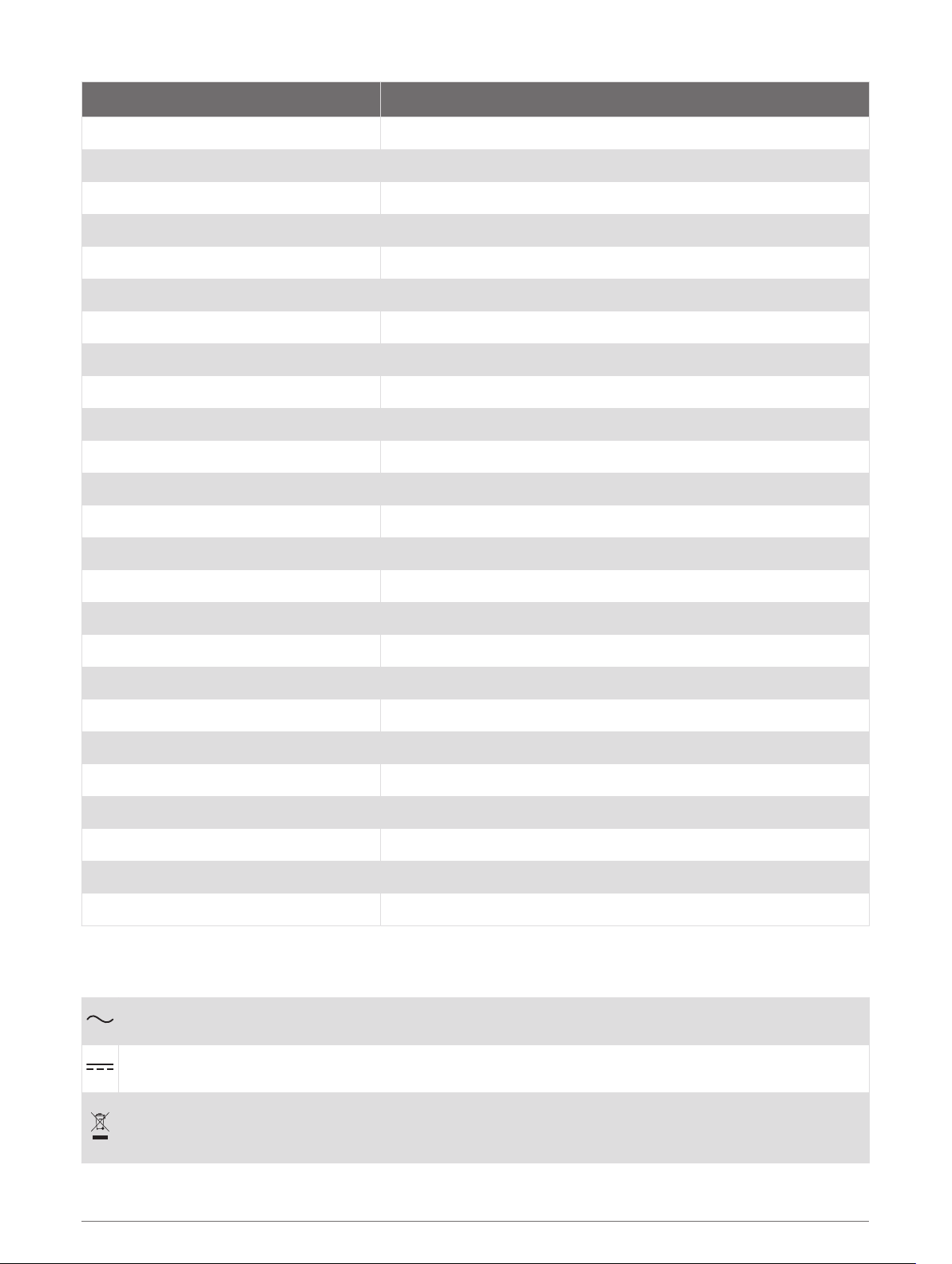
Tire Size Wheel Circumference (mm)
27 × 1-1/4 2161
27 × 1-3/8 2169
29 x 2.1 2288
29 x 2.2 2298
29 x 2.3 2326
650 x 20C 1938
650 x 23C 1944
650 × 35A 2090
650 × 38B 2105
650 × 38A 2125
700 × 18C 2070
700 × 19C 2080
700 × 20C 2086
700 × 23C 2096
700 × 25C 2105
700C Tubular 2130
700 × 28C 2136
700 × 30C 2146
700 × 32C 2155
700 × 35C 2168
700 × 38C 2180
700 × 40C 2200
700 × 44C 2235
700 × 45C 2242
700 × 47C 2268
Symbol Definitions
These symbols may appear on the device or accessory labels.
Alternating current. The device is suitable for alternating current.
Direct current. The device is suitable for direct current only.
WEEE disposal and recycling symbol. The WEEE symbol is attached to the product in compliance with
the EU directive 2012/19/EU on Waste Electrical and Electronic Equipment (WEEE). It is intended to deter
the improper disposal of this product and to promote reuse and recycling.
104 Appendix
Index
A
accessories 70, 72, 89, 93, 94
acclimation 40
activities 3–9, 13, 73, 79
custom 5, 8, 14, 66, 72
saving 4, 5, 32, 77
starting 4, 68
activity tracking 26–28, 32
alarms 75, 82
alert 13
alerts 27, 70, 75, 76
heart rate 13, 31
altimeter 69, 80
calibrating 80
altitude 40
ANT+ sensors 70, 72
fitness equipment 8
applications 52, 56, 57
smartphone 50
apps 6
assistance 57
auto climb 77
Auto Lap 76
Auto Pause 77
auto rest 12
auto scroll 78
B
back to start, navigation 68
backlight 1, 81
bands 87
barometer 69, 80
calibrating 80
battery
charging 85
maximizing 52, 79, 93
bike sensors 71
Bluetooth sensors 70
Bluetooth technology 2, 13, 51–53, 57, 92
headphones 61, 94
Body Battery 48, 49
C
cadence 22, 34–36
alerts 76
sensors 71
calendar 16
calibrating, altimeter 80
calorie, alerts 76
charging 85
cleaning the device 33, 86
clock 1, 82
compass 69
computer 59
Connect IQ 56
connecting 52, 57
contacts, adding 57
controls menu 55, 56
countdown timer 82
courses 65, 66
creating 66
editing 66
loading 66
customizing the device 56, 74, 82
D
data
pages 74
sharing 22
storing 32, 64, 65
transferring 64, 65
uploading 52
data fields 56, 95
deleting
all user data 65
history 64
personal records 21
distance 10, 78
alerts 70, 76
drills 10–12
E
elevation 19, 40
settings 80
emergency contacts 57
extended display 22
F
favorites 72
fitness 41
fitness age 40
foot pod 70, 71
G
Galileo 78
Garmin Connect 14, 16, 50–53, 56, 57, 64,
66, 91
storing data 65
Garmin Express 56, 89
updating software 89
Garmin Pay 61, 62
GLONASS 78, 81
goals 18, 19
GPS 2, 78, 81
settings 78
signal 4, 91
ground contact time 35, 36
GroupTrack 58, 79
H
heading setting 69
headphones
Bluetooth technology 61, 94
connecting 61
health stats 28
heart rate 2, 10, 28–30, 40, 86
alerts 31, 76
monitor 29, 31–34, 37, 39, 40, 46
pairing sensors 30
zones 23–25, 38, 63
history 10, 62, 63
deleting 64
sending to computer 64, 65
hydration 28
I
icons 2
incident detection 57, 58
indoor training 5, 6, 8, 70
intensity minutes 27, 40, 90
intervals 11, 12
workouts 16, 17
K
keys 1, 56, 81, 82, 86
L
lactate threshold 38, 42
language 81, 92
laps 1, 3, 9
lengths 11
LiveTrack 57, 58
locations 68
deleting 67
editing 67
saving 67
M
main menu, customizing 72
map 68, 69
maps 69, 74
browsing 69
navigating 67–69
menstrual cycle 28
menu 1
metronome 22
Move IQ 27
multisport 5, 8, 9, 63
music 2, 58, 61
loading 59
playing 60
services 59
music controls 56, 60
N
navigation 65, 68–70, 74
back to start 3, 68
NFC 62
notifications 51
O
odometer 63
oxygen saturation 47, 48
P
pace 19, 20
pairing 50
ANT+ sensors 30, 93
Bluetooth sensors 94
sensors 70
smartphone 50, 92
payments 61, 62
performance condition 3, 38, 42
personal records 20, 21
deleting 21
pool size 10
power (force) 38
alerts 76
meters 40, 43, 72, 102
zones 25
profiles 3
activity 3, 8, 9
user 23
projected finish time 41
pulse oximeter 27, 29, 47, 48, 86
R
race predictor 38
racing 19
recovery 38, 44, 46
resetting the device 91
running dynamics 34–37
S
safety information 57
satellite signals 78, 91
saving activities 3, 6–10, 13, 32
screen 81
segments 21, 22
settings 27, 48, 69, 72, 73, 79–82, 91
sharing data 22
shortcuts 55, 56
skiing
alpine 12
snowboarding 12
sleep mode 26, 27
smartphone 2, 54, 56, 57, 92
applications 52, 56
apps 51
pairing 50, 92
snowboarding 12
software
license
85
updating 53, 89, 91, 92
version 85
specifications 89
speed 78
Index 105
speed and cadence sensors 71
Spotify 59
stopwatch 83
stress level 38, 48–50
stress score 48, 49
stride length 34–36
strokes 11
swimming 10–12, 15, 16, 31, 33
swolf score 11
system settings 81
T
target 18
tempe 72, 93
temperature 40, 72, 93
time 83
alerts 76
settings 81
zones and formats 81
time zones 83
timer 1, 3, 6–10, 13, 62
countdown 82
tones 22, 82
TracBack 4, 67, 68
tracking 28, 48, 57
training 3, 6, 9, 15, 17–20, 40, 46, 52, 77
plans 14, 16
Training Effect 38, 41
training load 44, 45
training status 15, 25, 38, 44, 45
treadmill 6
triathlon training 8, 9
troubleshooting 7, 9, 29, 33, 34, 37, 48–50,
85, 89–92
U
UltraTrac 78
unit ID 85
units of measure 82
updates, software 53, 91, 92
uploading data 52
USB 92
user data, deleting 65
user profile 23, 40
V
vertical oscillation 34–37
vertical ratio 34–37
VIRB remote 83, 84
virtual course 6
Virtual Partner 18, 19
VO2 max. 15, 38–41, 44, 101
W
wallet 2, 62
watch faces 56, 79
watch mode 79, 93
weather 55
wheel sizes 103
Wi‑Fi 57, 92
connecting 56
widgets 28, 30, 31, 47–50, 54–56, 59
workouts 14–16
creating 14
loading 14
Z
zones
heart rate 24
power 25
time 83
106 Index

support.garmin.com
GUID-2492EDA1-1182-400B-8F43-D8B3211E4F3C v2May 2021