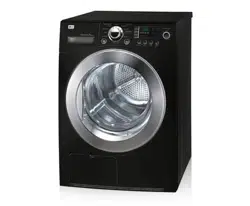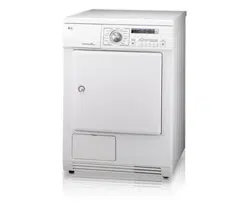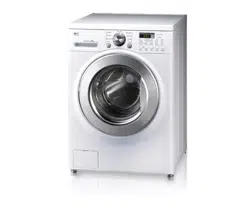
ElectricandGasDryer
DLE 5977W/D LG5988W
DLE 5977 B/D LG5988 B
DLE3777W/DLG3788W
Thank you for buying an LG dryer.
Pleaseread your owner's manual carefully, as it provides
instructions on safe installation, use,and maintenance.
Retain it for future reference and record the model and serial
numbers of your dryer.
P/No.: 3828EL3003A
OUTSTANDING PERFORMANCE
Not to mention unmatched big capacity, you can benefit from good
time efficiency, quiet operation and energy saving system.
STAINLESSSTEELDRUM
Stainless steel drum doesn't have any rust by nature so that
rust-free drum keeps clothes away from stain all time.
ARTISTICDESIGN
Modern front panel look and big crystal-clear glass door make your house look stylish.
DIGITALFABRICCARE
Multi-level temperature control heater takes a better care on your valued clothes.
EASYOF USE
A whole selection of user-friendly functions always make you comfortable with dryer operation.
PART1. SPECIFICATIONS ..................................................................................................................................... 3
PART2. IMPORTANT WARRANTY AND SAFETY INSTRUCTIONS ................................................................. 4-6
PART3. INITIAL STEPS FOR INSTALLING YOUR DRYER ............................................................................. 7-12
PART4. ELECTRICAL REQUIREMENTS FOR ELECTRIC DRYER ............................................................... 13-18
PART5. ELECTRICAL REQUIREMENTS FOR GAS DRYERS ............................................................................ 19
PART6. GAS REQUIREMENTS AND INSTRUCTIONS ........................................................................................ 20
PART7. EXHAUST REQUIREMENTS AND MAINTENANCE .......................................................................... 21-22
PART8. OPERATING YOUR DRYER ............................................................................................................... 23-28
PART9. TROUBLESHOOTING GUIDE ............................................................................................................ 29-31
LG DRYER LIMITED WARRANTY ........................................................................................................................ 32
2
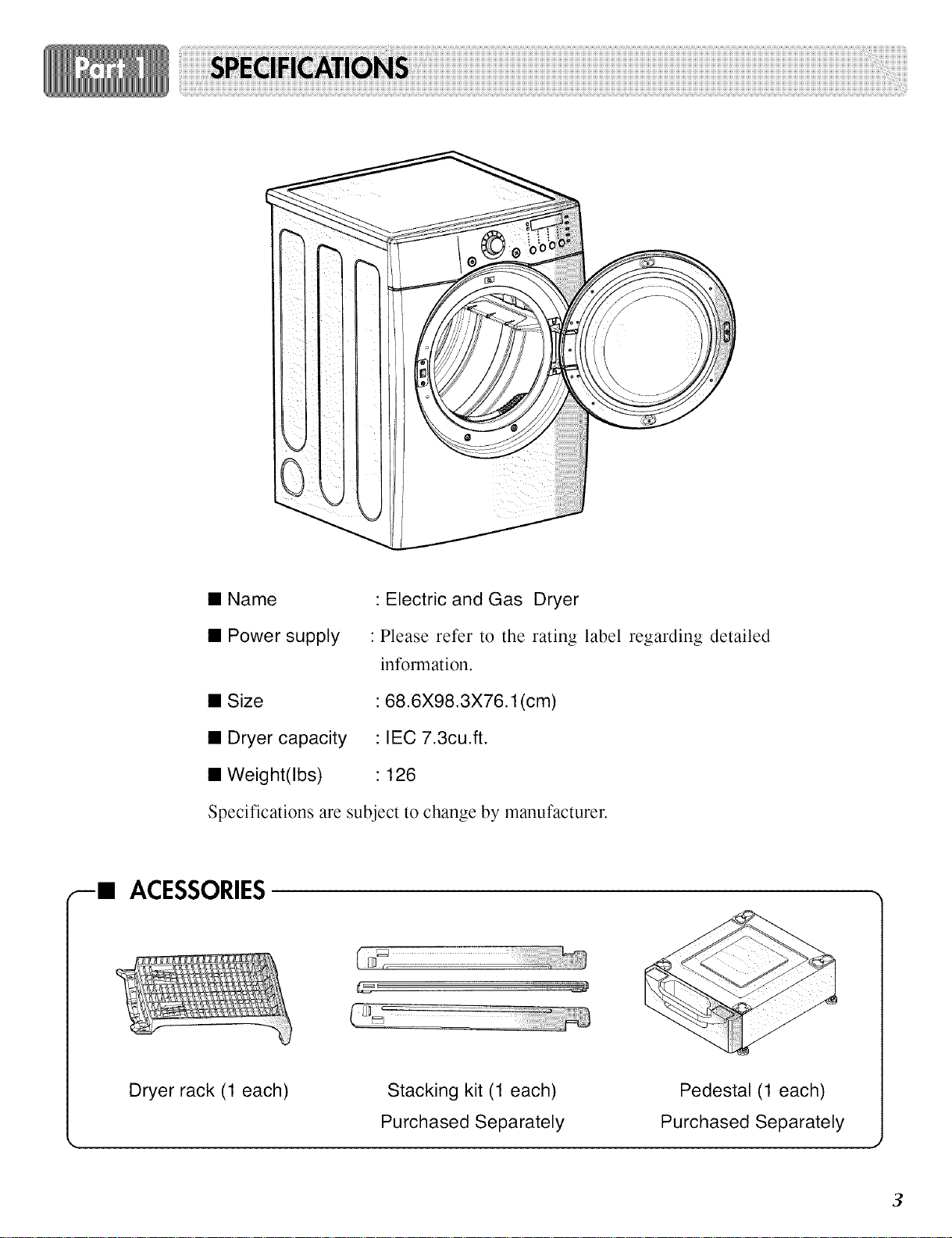
• Name : Electric and Gas Dryer
• Power supply : Please refer to the rating label regarding detailed
information.
: 68.6X98.3X76.1 (cm)
: IEC 7.3cu.ft.
: 126
Specifications are subject to change by manufacturer.
• Size
• Dryer capacity
• Weight(Ibs)
--II ACESSORIES
Dryer rack (1 each)
Stacking kit (1 each)
Purchased Separately
Pedestal (1 each)
Purchased Separately
3
SEEKING WARRANTY ASSISTANCE
Warranty Service. The warranty for your dryer is printed the end of this manual.
Warranty service is available by contacting your nearest LG Service Center and, for warranty period
from the date of purchase, if this dryer is installed and operated according to the instructions in this
manual, LG will repair or replace any of its mechanical or electrical parts if they are defective in
material or workmanship.
WARNINGS
For your safety, the recommendations in this manual must be followed. To reduce the risk
of fire or explosion, electric shock, or to prevent property damage, personal injury, or
death when using your appliance, follow basic precautions, including the following.
Warranty Restriction: If the dryer is subjected to other than private family use, all warranty
coverage is effective for only 90 days.
You will need the complete model and serial numbers when requesting information. We recommend
that you staple your sales slip or cancelled check here, because proof of original purchase date is
needed to obtain warranty service. Your dryer's model and serial numbers are located on the Model
and Serial Number Plate located on the front of the dryer behind the door.
Use the space below to record the model number and serial number of your new LG dryer.
Model No.
Serial No.
Date of Purchase
\t/
_:_Staple your receipt hear.
IMPORTANT SAFETY INSTRUCTIONS
1) Read all instructions before using the appliance.
2) Do not dry articles that have come into contact with
gasoline, dry-cleaning solvents, or other flammable
or explosive substances, as they give off vapors that
could ignite or explode.
3) Do not allow children to play on or in the appliance.
Close supervision of children is necessary when
using the appliance.
4) Before the appliance is removed from service or
discarded, remove the door to the drying
compartment.
5) Do not reach into the appliance if the drum is
moving.
6) Do not install or store this appliance where it will be
exposed to the weather.
7) Do not tamper with controls.
8) Do not repair or replace any part of the appliance or
attempt any servicing unless specifically
recommended in the user-maintenance instructions.
9) Do not use heat to dry articles containing foam
rubber or similarly textured rubber-like materials.
10)
11)
Clean lint screen before or after each load.
Keep area around the exhaust opening and adjacent
surrounding areas fiee fiom the accumulation of
lint, dust, and dirt.
12) The interior of the appliance and exhaust duct
should be cleaned periodically by qualified service
personnel.
13) Do not place items exposed to cooking oils in your
dryer. Items contaminated with cooking oils may
contribute to a chemical reaction that could cause a
load to catch fire.
14) Do not use fabric soflners or products to eliminate
static unless recommended by the manufacturer of
the fabric softner or product.
SAVETHESE INSTRUCTIONS
GROUNDING INSTRUCTIONS
This appliance must be grounded. In the event of
malfunction or breakdown, grounding will reduce the
risk of electric shock by providing a path of least
resistance t_r electric current. This appliance is
equipped with a cord having an equipment-grounding
conductor and a grounding plug. The plug must be
plugged into an appropriate outlet that is properly
installed and grounded in accordance with all local
codes and ordinances.
WARNING - hnproper connection of the equipment-
grounding conductor can result in a risk of electric
shock. Check with a qualified electrician or service
person if you are in doubt as to whether the appliance is
properly grounded.
Do not modify the plug provided with the appliance: if
it will not fit the outlet, have a proper outlet installed by
a qualified electrician.
This appliance must be connected to a grounded metal,
permanent wiring system or an equipment-grounding
conductor must be run with the circuit conductors and
connected to the equipment-grounding terminal or lead
on the appliance.
,_ WHAT TO DO IF YOU SMELL
GAS:
• Do not try to light a match or cigarette, or turn
on any gas or electrical appliance.
• Do not touch any electrical switches. Do not
use any phone in your building.
• Clear the room, building or area of all
occupants.
• Immediately call your gas supplier from a
neighbor's phone. Follow the gas supplier's
instructions carefully.
• If you cannot reach your gas supplier, call the
fire department.
WARNING!
• Keep flare mable materials and vapors, such
as gasoline, away from dryer.
• Place dryer at least 18 inches above the floor
for a garage installation.
• Failure to do so can result in death,
explosion or fire.
_Ik WARNING
To reduce the risk of fire or explosion, electric
shock, property damage, personal injury or death
when using this appliance, please follow all
instructions and information, including those in
this manual and instructions and information
provided by your gas supplier, including the
following:
• Do not store or use any gasoline, dry-cleaning
solvents any other flammable vapors or
liquids in the area surrounding this appliance.
• Do not dry anything that has ever had anything
flammable on it, even after washing.
• No washer can completely remove oil. Do not
dry any articles that have ever had any kind of
oil on them, including cooking oil.
• Articles containing foam, rubber, rubber-like
materials, plastic or similar materials should be
dried on a clothesline or by using an air cycle.
• Failure to follow these instructions can result in
fire, death or serious injury.
• A qualified service person or company must
perform installation and service of this
appliance.
California safe drinkinq water and
toxic enforcement act
This act requires the governor of California to
publish a list of substances known to the state to
cause cancer, birth defects or other reproductive
harm and requires businesses to warn customers
of potential exposure to such substances.
Gas appliances can cause minor exposure to four
of these substances, namely benzene, carbon
monoxide, formaldehyde and soot, caused
primarily by the incomplete combustion of
natural gas or LP fuels.
Properly adjusted dryers will minimize
combustion. Exposure to these substances can be
minimized further by properly venting the dryer
to the outdoors.
6
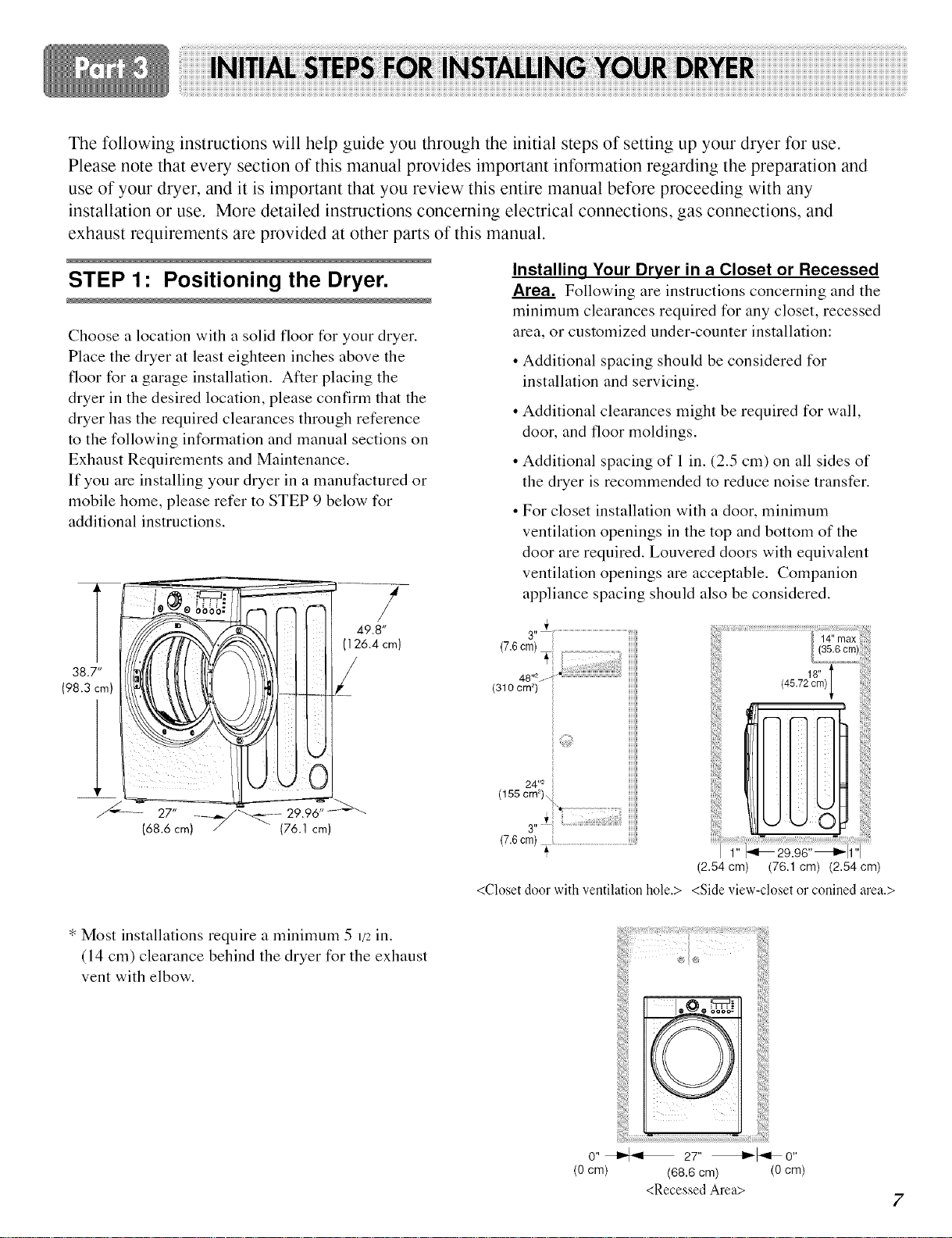
The following instructions will help guide you through the initial steps of setting up your dryer for use.
Please note that every section of this manual provides important information regarding the preparation and
use of your dryer, and it is important that you review this entire manual before proceeding with any
installation or use. More detailed instructions concerning electrical connections, gas connections, and
exhaust requirements are provided at other parts of this manual.
STEP 1" Positioning the Dryer.
Choose a location with a solid floor for your dryer.
Place the dryer at least eighteen inches above the
floor for a garage installation. After placing the
dryer in the desired location, please confirm that the
dryer has the required clearances through reference
to the following information and manual sections on
Exhaust Requirements and Maintenance.
If you are installing your dryer in a manufactured or
mobile home, please refer to STEP 9 below for
additional instructions.
_EZZZ]-
38.7" !
(98.3 crn)
1
(68.6cm) / -- (76.1cm)
Installing Your Dryer in a Closet or Recessed
Area. Following are instructions concerning and the
minimum clearances required for any closet, recessed
area, or customized under-counter installation:
• Additional spacing should be considered for
installation and servicing.
• Additional clearances might be required for wall,
door, and floor moldings.
• Additional spacing of 1in. (2.5 cm) on all sides of
the dryer is recommended to reduce noise transfer.
For closet installation with a door, minimum
ventilation openings in the top and bottom of the
door are required. Louvered doors with equivalent
ventilation openings are acceptable. Companion
appliance spacing should also be considered.
3" _¸
(7.6cm)
48"2 jJl
(310cm_)
18"
(45.72 crn)
24,,211!
(7.6cm)
_ 29196"_
(2.54 cm) (76.1 cm) (2.54 crn)
<Closet door with ventilation hole.> <Side view-closet or conined area.>
* Most installations require a minimum 5 1/2in.
(14 cm) clearance behind the dryer for the exhaust
vent with elbow.
=E::::::::3=
0 '__ 27" _'q_0"
(0 cm) (68.6 cm) (0 cm)
<Recessed Area>
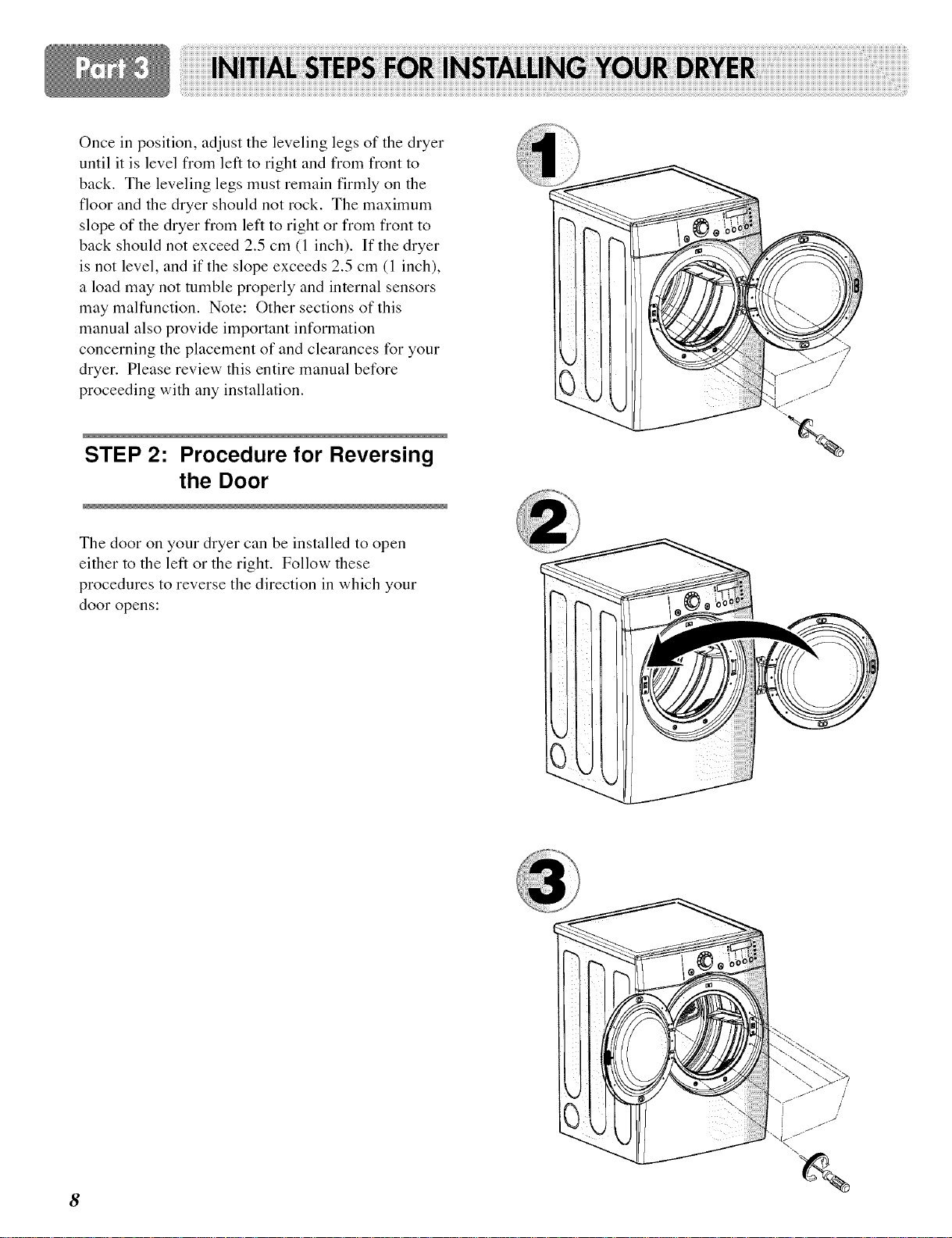
Oncein position,adjustthelevelinglegsofthedryer
untilitislevelfromlefttorightandfromfrontto
back.Thelevelinglegsmustremainfirmlyonthe
floorandthedryershouldnotrock.Themaximum
slopeofthedryerfromlefttorightorfromfrontto
backshouldnotexceed2.5cm(1inch).If thedryer
isnotlevel,andif theslopeexceeds2.5cm(1inch),
aloadmaynottumbleproperlyandinternalsensors
maymalfunction.Note:Othersectionsofthis
manualalsoprovideimportantinformation
concerningtheplacementofandclearancesforyour
dryer.Pleasereviewthisentiremanualbefore
proceedingwithanyinstallation.
STEP 2: Procedure for Reversing
the Door
The door on your dryer can be installed to open
either to the left or the right. Follow these
procedures to reverse the direction in which your
door opens:
STEP 3: Connecting the Exhaust
and Venting System.
In addition to the following warnings, please refer
to manual section on Exhaust Requirements and
Maintenance. IMPORTANT." To reduce the risk of
fire, combustion, and gas accumulation, the dryer
must be vented to the outdoors. Please follow the
instructions (and all others in this manual) very
carefully.
• Do not use thin plastic or foil ducting.
• Use 4" (10.2 cm) diameter rigid or flexible metal
duct (note: venting materials are not supplied with
the dryer, and you should obtain the venting
materials necessary for proper installation)
• Position the dryer where the exhaust duct is
shorter as possible
• Clean old ducts beJbre installing this dryer
• The male end of each section of exhaust duct must
point away from the dryer
• Use fewer elbow joints as possible
• Use duct tape on all duct joints
• Insulate ductwork that runs through unheated
areas in order to reduce condensation and lint
build-up on pipe walls; and
• PLEASE BE AWARE THAT FAILURE TO
EXHAUST THE DRYER CORRECTLY WILL
VOID THE DRYER'S WARRANTY.
WARNING!
• Use a heavy metal vent.
• Do not use a plastic vent.
• Do not use a metal foil vent.
• Failure to follow these instructions can
result in death or fire.
• Clean old ducts before installing this dryer
• ALTERNATE EXHAUST DIRECTIONS
1.Remove screw & exhaust duct.
'3
/_,, Detach and remove the bottom, left, or right
side knockout as desired.
(Right side vent not avitable on gas dryer.)
f PORTION A i "_
®
hol_)
\ (#
J
3, Reconnect the new duct[11 in(28cm)] to the
blower housing, and Fixing the duct to the
base.
4.Pre-assembte 4" elbow with 4" duct.
Wrap duct tape around joint.
DUCT
TAPE
5. Insert elbow duct assembly first, through the
side opening and connect the elbow to the
dryer internal duct.
J
STEP 4: Connection of Gas Supply
(Gas dryer only). In addition to the following,
please refer to manual section on Gas Requirements
and Instructions.
ii i
1. New stainless steel flexible connector. Use this type of
connector only if allowed by local codes. Use Design AGA
Certified Connector.
2. 1/8" NPT Pipe Plug (for checking inlet gas pressure)
3. Equipment Shut-Off Valve-
Installed within 6' ( 1.8 m) of dryer
4. Iron Pipe. Shorter than 20' (6,1 m)
Use 3/8" pipe. Longer than 20' (6.1 m) - Use 1/2" pipe.
5.3/8" N.P.T. Gas Conuection
1. Confirm that the type of gas available in your
laundry room is appropriate for the dryer. The
dryer is prepared for Natural Gas with a 3/8"
NPT gas connection.
2. Remove the shipping cap from the gas
connection at the back of the dryer. Make sure
that you don't damage the threads of the gas
connection pipe when you remove the shipping
cap.
3. Connect the dryer to your laundry room's gas
supply using a new flexible stainless steel
connector (as noted below, only use a new
stainless steel flexible connector if allowed by
your local codes).
4. Securely tighten all connections between the
dryer and your laundry room's gas supply. Turn
on your laundry room's gas supply and check all
pipe connections (both internal and external) for
gas leaks with a non-corrosive leak detection
fluid.
5. For LP (Liquefied Petroleum) gas connection,
refer to this manual's section entitled Gas
Requirements and Instructions.
10
STEP 5: Electrical Plug Connections
for Electric Dryer Only•
Following are several warnings and instructions
concerning making the electrical connection for
electric dryers. More detailed information
concerning the electrical connection is provided at
the manual section entitled Electrical Requirements
For Electric Dryer and it is important that you
thoroughly review that section, and the remainder of
this manual, before taking any steps to install or use
this dryer.
1. Use only a new U.L. listed No. 10 (copper wire
only) three conductor power supply cord kit rated
240 Volts (minimum) 30 Amperes and labeled as
suitable for use in a clothes dryer.
2. Four-wire cord is requited for manufactured
(mobile) home installations and use and where
local codes do not allow grounding of this
appliance through neutral.
3. Thc wiring diagram is providcd insidc thc drycr
control hood. Label all wires prior to
disconnection when servicing the dryer, because
wiring errors can cause serious injury to you and
your dryer.
4. For additional instruction on connecting the dryer
to an electrical power source, please refer to this
manual's section on Electrical Requirements and
Electric Dryer.
WARNING!
• Use a new UL approved 30 amp power
supply cord or 10 gauge solid copper wire.
• Use a UL approved strain relief.
• Disconnect power before making electrical
connections.
•Connect neutral wire(wh ite or center wire) to
center terminal.
• Ground wire(green or bare wire) must be
connected to green ground connector.
• Securely tighten all electrical connections
• See installation instructions for complete
instructions.
• Failure to do so can result in fire or electrical
shock.
STEP 6: Preparation of the Dryer.
Prior to the first use of this appliance, use all-
purpose cleaning products or a solution of detergent
and water, with damp clothes to remove from the
inside of the dryer drum/drying compartment any
dust or dirt that may have accumulated the inside of
the dryer. Plug in your dryer after reviewing the
following parts on your dryer's Electrical
Requirements.
STEP 7: Confirming Heat Source
Operation.
Confirming Heat Source in Gas Dryers
Close the door to the dryer drum/drying
compartment and, after completing all steps in this
manual for proper installation of this dryer, start the
dryer on a heat setting, as described more fully in
the operating instructions that accompany the dryer.
After the dryer starts, the igniter will glow red and
the main burner will ignite.
Warning: If all air is not pinged from the gas line,
the gas igniter may go off before the gas and the
main burner have ignited. If this happens, the
igniter will re-attempt gas ignition after
approximately two minutes.
Confirming Heat Source in Electric Dryers
Close the door to the dryer drum/drying
compartment and, after completing all steps in this
manual for proper installation of this dryer, start the
dryer on a heat setting, as described more fully in
the operating instructions that accompany the dryer.
The exhaust air or the exhaust pipe should be warm
after the dryer has been operating for three minutes.
STEP 8: Dryer Airflow.
Effective dryer operation requires appropriate dryer
airflow. The adequacy of the airflow can be
measured by evaluating the static pressure. Static
pressure in the exhaust duct can be measured with a
manometer, placed on the exhaust duct
approximately 2 ft. (60.9 cm) from the dryer. Static
pressure in the exhaust duct should not exceed 0.6
inches (1.5 cm). The dryer should be checked with
the dryer running with no load.
Measuring Static pressure
MAXIMUM STATIC
PRESSUREIN
WATER COLUMN
0.6 inches (1.5 cm)
1 Manometer
2 Exhaust Duct
II
STEP 9: Additional Instructions for 4)
Installation of Your Dryer 5)
in a Manufactured or
Mobile Home,
The following instructions are applicable to
installations of the dryer in a manufactured or
mobile home. Any installation in a manufactured or
mobile home must comply with the Manufactured
Home Construction and Safety Standards Title 24
CFR, Part 32-80 or Standard CAN/CSAOZ240 MH
and local codes and ordinances. If you are
uncertain whether your proposed installation will
comply with these standards, please contact a
service and installation professional for assistance.
The following instructions apply to any installation
of the dryer in a manufactured or mobile home:
1) The gas dryer must be permanently attached to
the floor.
2) The electrical connection for an electric dryer
must be a 4-wire connection. More detailed
information concerning the electrical connection
is provided at the manual section entitled
Electrical Requirements for Electric Dryer
3) To reduce the risk of combustion and fire, the
dryer must be vented to the outside.
6)
7)
8)
9)
Electric dryers may be vented to the outside
using the back, left, right, or bottom panel.
Gas dryers may be vented to the outside using the
back, left, or bottom panel. Gas dryer may not be
vented to the outside using the right side panel
because of the burner housing.
The dryer exhaust duct must be affixed securely
to the manufactured or mobile home structure,
and the exhaust duct must be made of a material
that will resist fire and combustion, and it is
recommended that you use a rigid or flexible
metal pipe.
DO NOT connect the exhaust duct with any other
duct, vent, chimney, or other exhaust duct.
Make sure the dryer has adequate access to
outside fresh air to ensure proper operation. The
opening for outside fresh air must be at least 25
iw' (163 cm_).
It is important that the clearance of the duct from
any combustible construction be at least 2 inches
(5 cm), and, when venting the dryer to the
outdoors, the dryer can be installed with a
clearances of 1 inch at the sides and back of the
dryer.
10) Please be aware that venting materials are not
supplied with the dryer. You should obtain the
venting materials necessary for proper
installation.
WARNING* WARNING*
DO NOT connect exhaust ducts with DO NOT vent the exhaust duct under the
metal screws or fasteners that extend manufactured or mobile home.
into the duct.
12
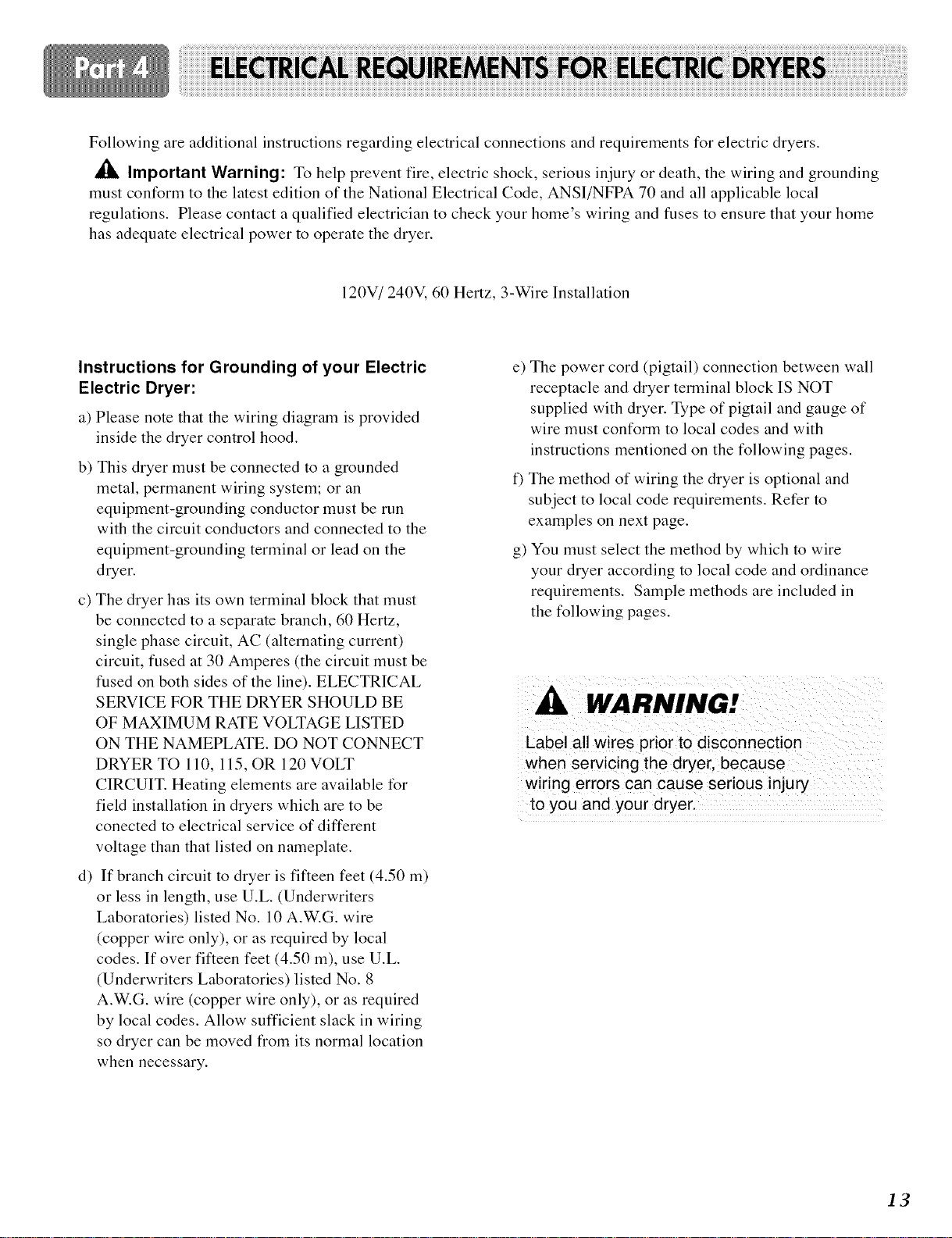
Following are additional instructions regarding electrical connections and requirements for electric dryers.
A_, Important Warning: To help prevent fire, electric shock, serious injury or death, the wiring and grounding
must conform to the latest edition of the National Electrical Code, ANSI/NFPA 70 and all applicable local
regulations. Please contact a qualified electrician to check your home's wiring and fuses to ensure that your home
has adequate electrical power to operate the dryer.
120V/240M 60 Hertz, 3-Wire Installation
Instructions for Grounding of your Electric
Electric Dryer:
a) Please note that the wiring diagram is provided
inside the dryer control hood.
b) This dryer must be connected to a grounded
metal, permanent wiring system; or an
equipment-grounding conductor must be run
with the circuit conductors and connected to the
equipment-grounding terminal or lead on the
dryer.
c) The dryer has its own terminal block that must
be connected to a separate branch, 60 Hertz,
single phase circuit, AC (alternating current)
circuit, fused at 30 Amperes (the circuit must be
fused on both sides of the line). ELECTRICAL
SERVICE FOR THE DRYER SHOULD BE
OF MAXIMUM RATE VOLTAGE LISTED
ON THE NAMEPLATE. DO NOT CONNECT
DRYER TO 110, 115, OR 120 VOLT
CIRCUIT. Heating elements are available for
field installation in dryers which are to be
conected to electrical service of different
voltage than that listed on nameplate.
d) If branch circuit to dryer is fifteen feet (4.50 m)
or less in length, use U.L. (Underwriters
Laboratories) listed No. 10 A.W.G. wire
(copper wire only), or as required by local
codes. If over fifteen feet (4.50 m), use U.L.
(Underwriters Laboratories) listed No. 8
A.W.G. wire (copper wire only), or as required
by local codes. Allow sufficient slack in wiring
so dryer can be moved from its normal location
when necessary.
e) The power cord (pigtail) connection between wall
receptacle and dryer terminal block IS NOT
supplied with dryer. Type of pigtail and gauge of
wire must conform to local codes and with
instructions mentioned on the following pages.
t) The method of wiring the dryer is optional and
subject to local code requirements. Refer to
examples on next page.
g) You must select the method by which to wire
your dryer according to local code and ordinance
requirements. Sample methods are included in
the following pages.
WARNING!
Label all wires prior to disconnection
when servicing the dryer, because
wiring errors can cause serious injury
to you and your dryer.
13
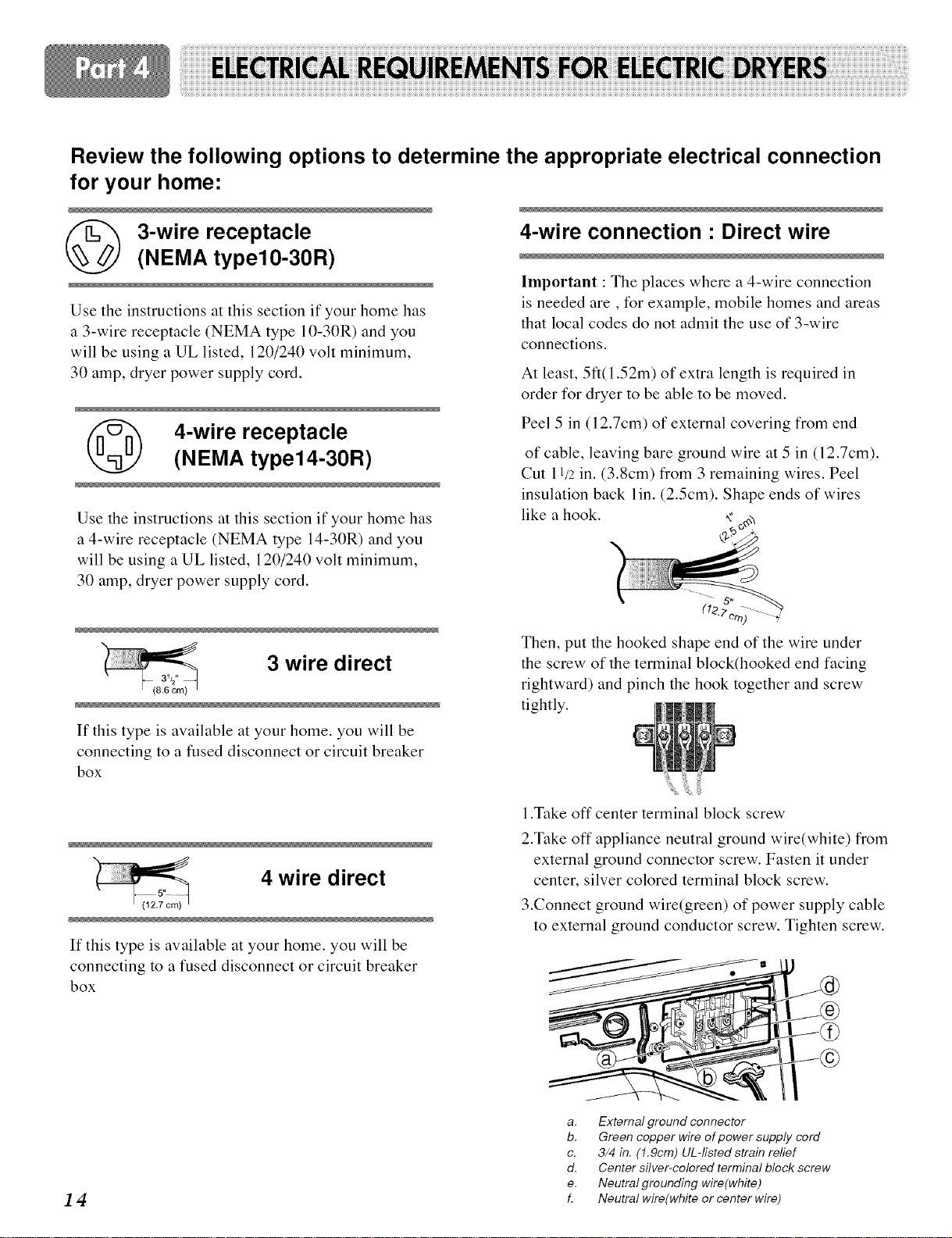
Review the following options to determine the appropriate electrical connection
for your home:
(_ 3-wire receptacle
(NEMA typel0-30R)
Use the instructions at this section if your home has
a 3-wire receptacle (NEMA type 10-30R) and you
will be using a UL listed, 120/240 volt minimum,
30 amp, dryer power supply cord.
4-wire receptacle
(NEMA type14-30R)
Use the instructions at this section if your home has
a 4-wire receptacle (NEMA type 14-30R) and you
will be using a UL listed, 120/240 volt minimum,
30 amp, dryer power supply cord.
4-wire connection : Direct wire
Important : The places where a 4-wire connection
is needed are, for example, mobile homes and areas
that local codes do not admit the use of 3-wire
connections.
At least, 5ft(l.52m) of extra length is required in
order for dryer to be able to be moved.
Peel 5 in (12.7cm) of external covering from end
of cable, leaving bare ground wire at 5 in (12.7cm).
Cut 11/2in. (3.8cm) from 3 remaining wires. Peel
insulation back lin. (2.5cm). Shape ends of wires
like a hook. _:"
3 wire direct
If this type is available at your home. you will be
connecting to a fused disconnect or circuit breaker
box
(72.Zer£)
Then, put the hooked shape end of the wire under
the screw of the terminal block(hooked end facing
rightward) and pinch the hook together and screw
tightly.
4 wire direct
If this type is available at your home. you will be
connecting to a fused disconnect or circuit breaker
box
1.Take off center terminal block screw
2.Take off appliance neutral ground wire(white) from
external ground connector screw. Fasten it under
center, silver colored terminal block screw.
3.Connect ground wire(green) of power supply cable
to external ground conductor screw. Tighten screw.
14
a. External ground connector
b. Green copper wire of power supply cord
c. 3/4 in. (!.9cm) UL-fisted strain relief
d. Center silver-colored terminal block screw
e. Neutral grounding wire(white)
f. Neutral wire(white or center wire)
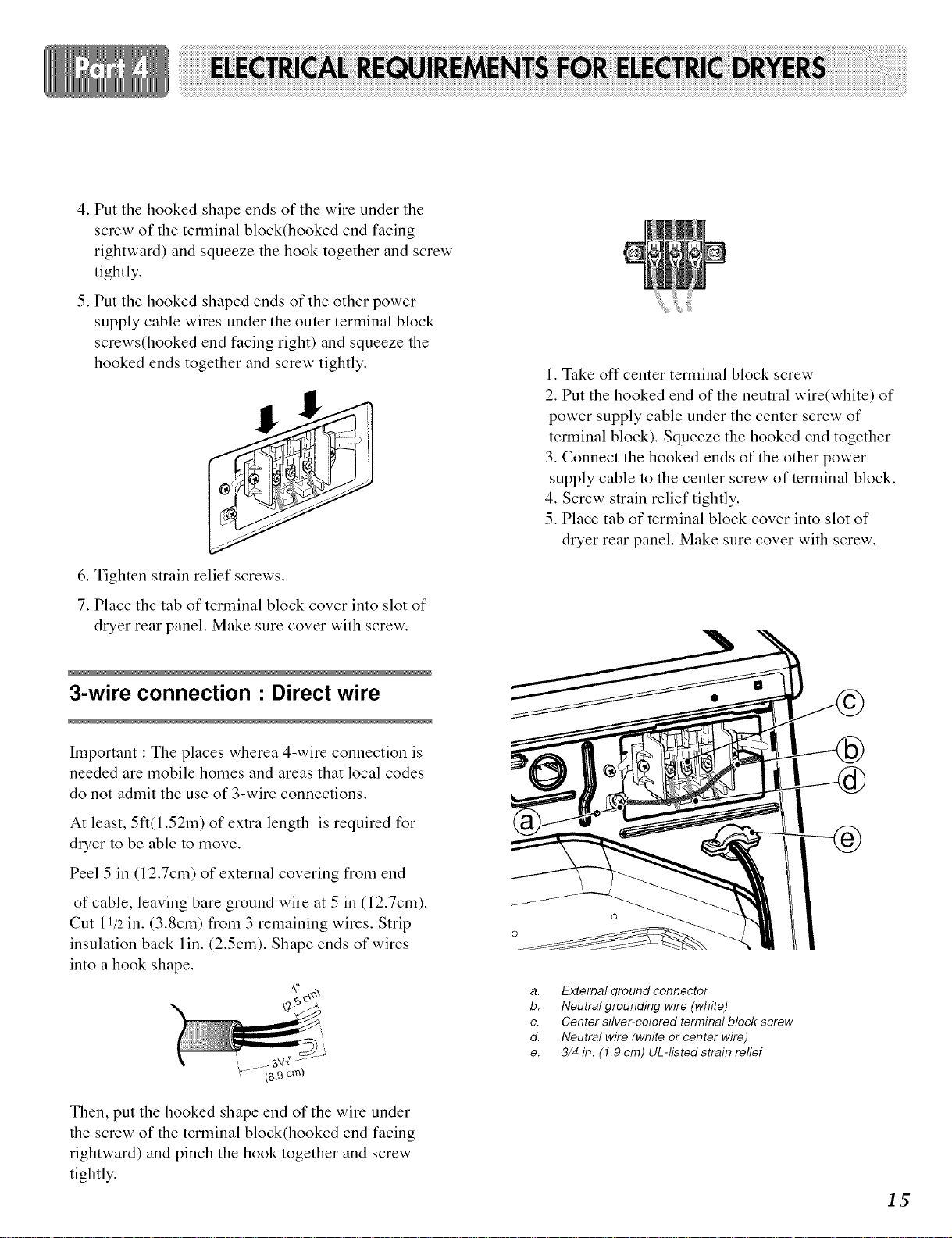
4. Put the hooked shape ends of the wire under the
screw of the terminal block(hooked end facing
rightward) and squeeze the hook together and screw
tightly.
5. Put the hooked shaped ends of the other power
supply cable wires under the outer terminal block
screws(hooked end facing right) and squeeze the
hooked ends together and screw tightly.
6. Tighten strain relief screws.
7. Place the tab of terminal block cover into slot of
dryer rear panel. Make sure cover with screw.
3-wire connection : Direct wire
Important : The places wherea 4-wire connection is
needed are mobile homes and areas that local codes
do not admit the use of 3-wire connections.
At least, 5ft(1.52m) of extra length is required for
dryer to be able to move.
Peel 5 in (12.7cm) of external covering from end
of cable, leaving bare ground wire at 5 in (12.7cm).
Cut 11/2in. (3.8cm) from 3 remaining wires. Strip
insulation back lin. (2.5cm). Shape ends of wires
into a hook shape.
Then, put the hooked shape end of the wire under
the screw of the terminal block(hooked end facing
rightward) and pinch the hook together and screw
tightly.
1. Take off center terminal block screw
2. Put the hooked end of the neutral wire(white) of
power supply cable under the center screw of
terminal block). Squeeze the hooked end together
3. Connect the hooked ends of the other power
supply cable to the center screw of terminal block.
4. Screw strain relief tightly.
5. Place tab of terminal block cover into slot of
dryer rear panel. Make sure cover with screw.
a. External ground connector
b. Neutral grounding wire (white)
c. Center silver-colored terminal block screw
d. Neutral wire (white or center wire)
e. 3/4in. (!.9cm) UL-listed strain relief
IS
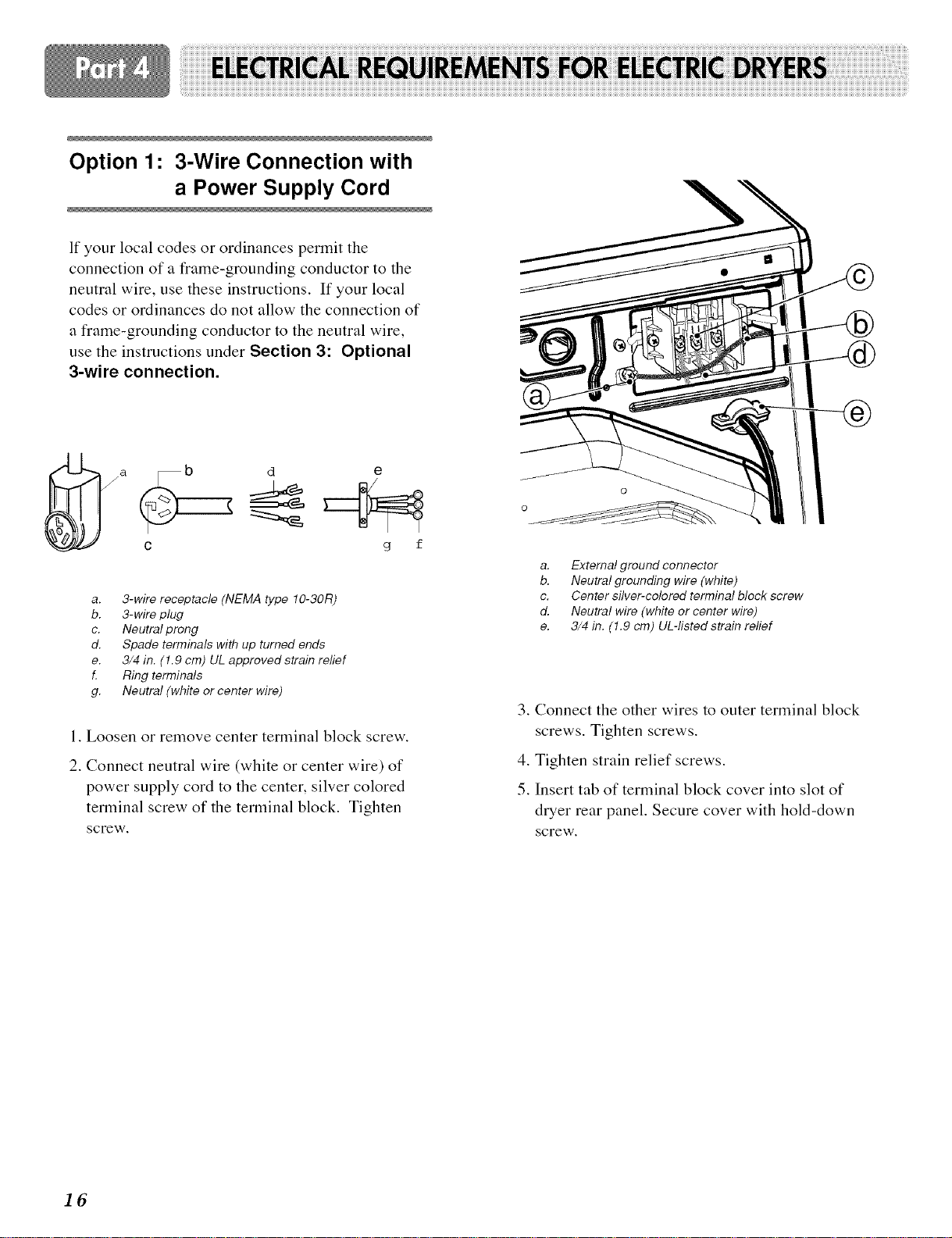
Option 1: 3-Wire Connection with
a Power Supply Cord
If your local codes or ordinances permit the
connection of a frame-grounding conductor to the
neutral wire, use these instructions. If your local
codes or ordinances do not allow the connection of
a frame-grounding conductor to the neutral wire,
use the instructions under Section 3: Optional
3-wire connection.
C g f
a. 3-wire receptacle (NEMA type !0-30R)
b. 3-wire plug
c. Neutral prong
d. Spade terminals with up turned ends
e. 3/4 in. ( !.9 cm) UL approved strain relief
f. Ring terminals
g. Neutral (white or center wire)
.
2.
Loosen or remove center terminal block screw.
Connect neutral wire (white or center wire) of
power supply cord to the center, silver colored
terminal screw of the terminal block. Tighten
screw.
O
O
a. External ground connector
b. Neutral grounding wire (white)
c. Center silver-colored terminal block screw
d. Neutral wire (white or center wire)
e. 3/4in. (!.9cm) UL-listed strain relief
3. Connect the other wires to outer terminal block
screws. Tighten screws.
4. Tighten strain relief screws.
5. Insert tab of terminal block cover into slot of
dryer rear panel. Secure cover with hold-down
screw.
16
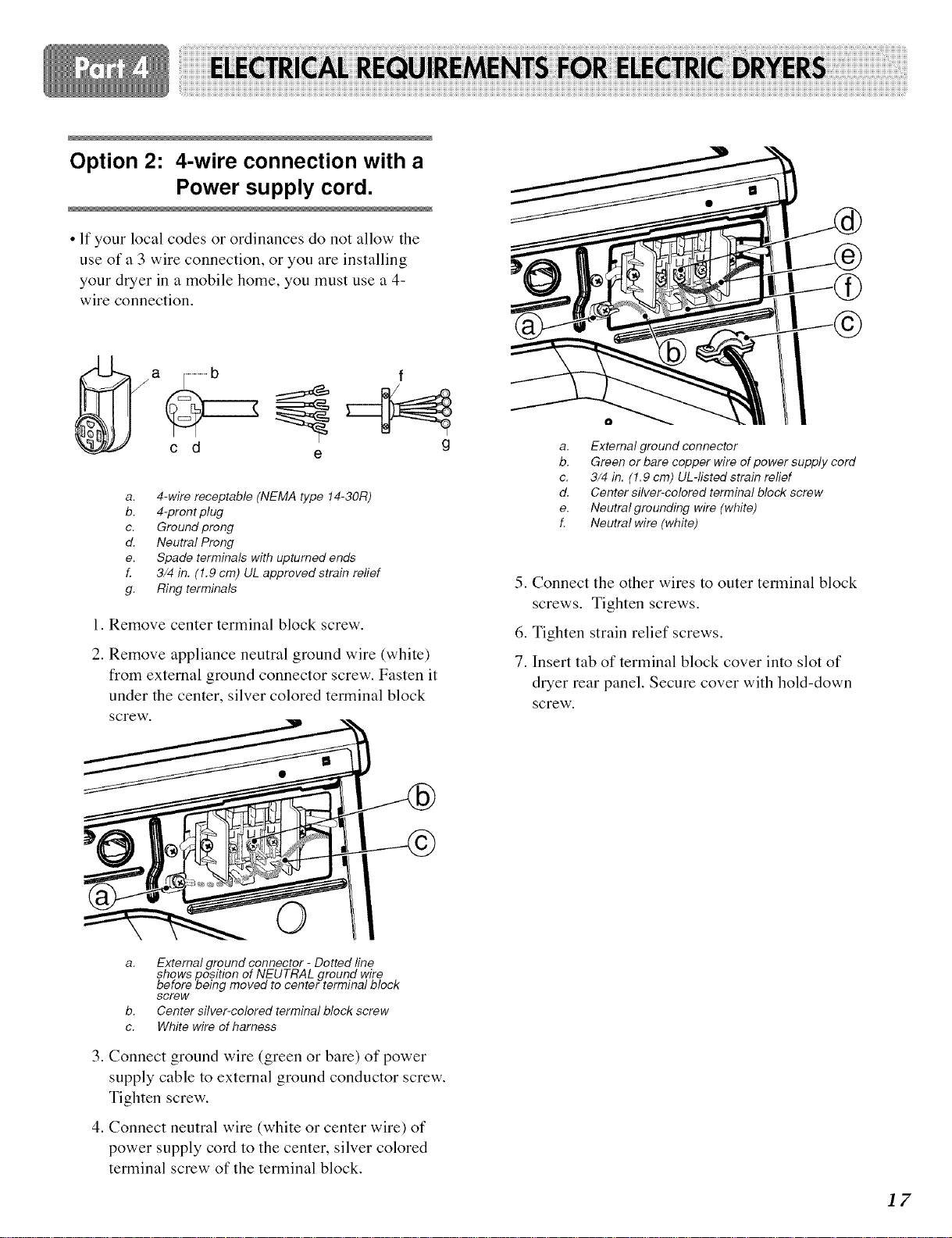
Option 2: 4-wire connection with a
Power supply cord.
• If your local codes or ordinances do not allow the
use of a 3 wire connection, or you are installing
your dryer in a mobile home, you must use a 4-
wire connection.
c d e g
a. 4-wire receptable (NEMA type !4-30R)
b. 4-pront plug
c. Ground prong
d. Neutral Prong
e. Spade terminals with upturned ends
f. 3/4 in. (!. 9 cm) UL approved strain relief
g. Ring terminals
1. Remove center terminal block screw.
2. Remove appliance neutral ground wire (white)
from external ground connector screw. Fasten it
under the center, silver colored terminal block
screw.
a. External ground connector
b. Green or bare copper wire of power supply cord
c. 3/4 in. (!. 9 cm) UL-listed strain relief
d. Center silver-colored terminal block screw
e. Neutral grounding wire (white)
f. Neutral wire (white)
5. Connect the other wires to outer terminal block
screws. Tighten screws.
6. Tighten strain relief screws.
7. Insert tab of terminal block cover into slot of
dryer rear panel. Secure cover with hold-down
screw.
a. External ground connector - Dotted line
shows p,osition of NEUTRAL ground wire ,
oerore oeing moved to center terminal block
screw
b. Center silver-colored terminal block screw
c. White wire of harness
3. Connect ground wire (green or bare) of power
supply cable to external ground conductor screw.
Tighten screw.
4. Connect neutral wire (white or center wire) of
power supply cord to the center, silver colored
terminal screw of the terminal block.
17
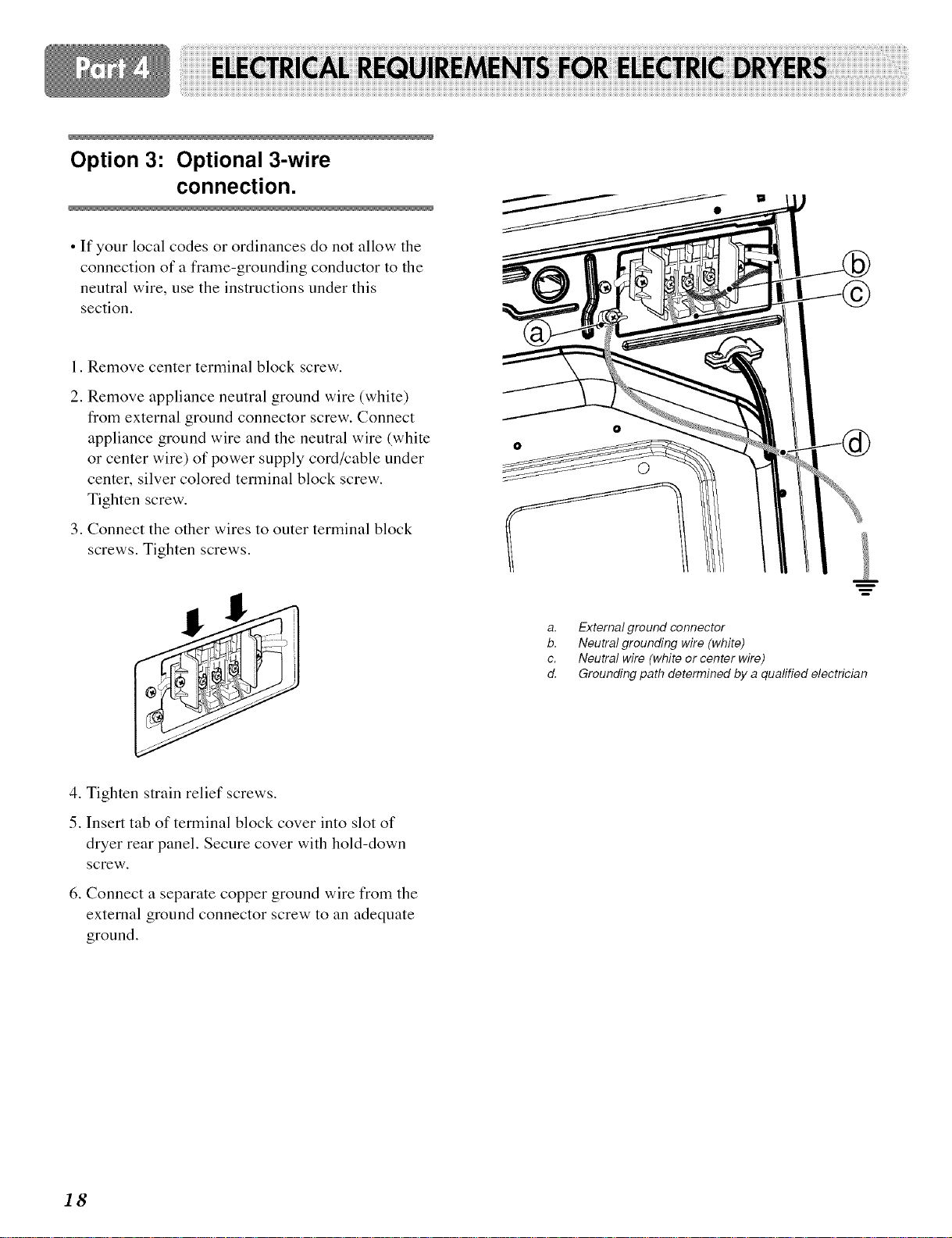
Option 3: Optional 3-wire
connection.
• If your local codes or ordinances do not allow the
connection of a frame-grounding conductor to the
neutral wire, use the instructions under this
section.
1. Remove center terminal block screw.
2. Remove appliance neutral ground wire (white)
from external ground connector screw. Connect
appliance ground wire and the neutral wire (white
or center wire) of power supply cord/cable under
center, silver colored terminal block screw.
Tighten screw.
3. Connect the other wires to outer terminal block
screws. Tighten screws.
o
o
©
a. External ground connector
b. Neutral grounding wire (white)
c. Neutral wire (white or center wire)
d. Grounding path determined by a qualified electrician
4. Tighten strain relief screws.
5. Insert tab of terminal block cover into slot of
dryer rear panel. Secure cover with hold-down
screw.
6. Connect a separate copper ground wire from the
external ground connector screw to an adequate
ground.
18
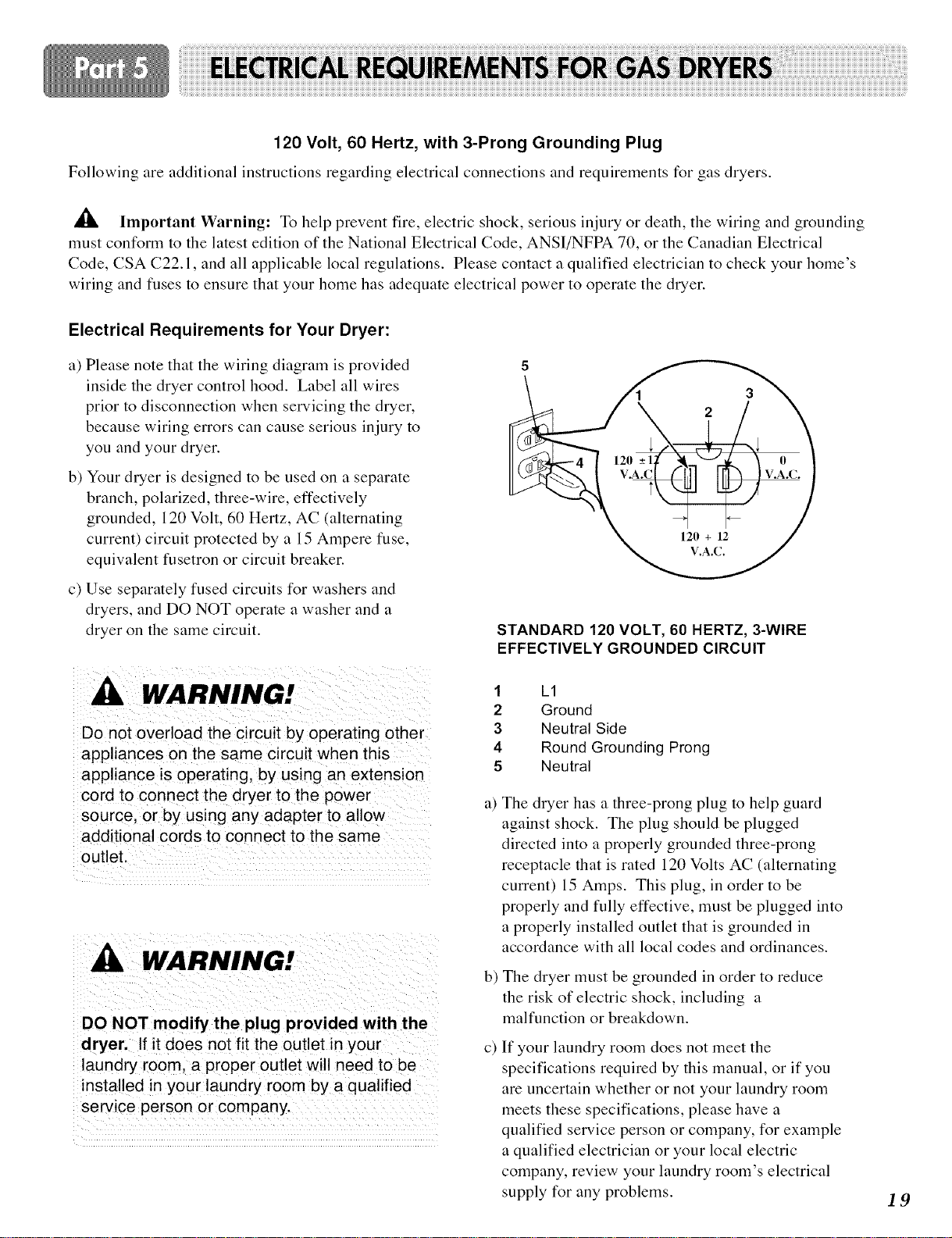
120 Volt, 60 Hertz, with 3-Prong Grounding Plug
Following are additional instructions regarding electrical connections and requirements for gas dryers.
Important Warning: To help prevent fire, electric shock, serious injury or death, the wiring and grounding
must conform to the latest edition of the National Electrical Code, ANSI/NFPA 70, or the Canadian Electrical
Code, CSA C22.1, and all applicable local regulations. Please contact a qualified electrician to check your home's
wiring and fuses to ensure that your home has adequate electrical power to operate the dryer.
Electrical Requirements for Your Dryer:
a) Please note that the wiring diagram is provided
inside the dryer control hood. Label all wires
prior to disconnection when servicing the dryer,
because wMng errors can cause serious injury to
you and your dryer.
b) Your dryer is designed to be used on a separate
branch, polarized, three-wire, effectively
grounded, 120 Volt, 60 Hertz, AC (alternating
current) circuit protected by a 15 Ampere fuse,
equivalent fusetron or circuit breaker.
c) Use separately fused circuits for washers and
dryers, and DO NOT operate a washer and a
dryer on the same circuit.
DO not overload the c!rcuit by operating other
appliances on the sam e circuit when this
appl!ance is operating, by using a n extensio n
cord to connect the dryer to the power
source, orby USing any adapter to allow
additional COrds to connect tOthe same
WARNING!
DO NOT modify the plug provided with the
dryer. If it does not fit the outlet in your
laundry room, a proper outlet will need to be
nstalled in your laundry room by a qualified
service person or company.
STANDARD 120 VOLT, 60 HERTZ, 3-WIRE
EFFECTIVELY GROUNDED CIRCUIT
1
2
3
4
5
L1
Ground
Neutral Side
Round Grounding Prong
Neutral
a)The dryer has a three-prong plug to help guard
against shock. The plug should be plugged
directed into a properly grounded three-prong
receptacle that is rated 120 Volts AC (alternating
current) 15 Amps. This plug, in order to be
properly and fully effective, must be plugged into
a properly installed outlet that is grounded in
accordance with all local codes and ordinances.
b) The dryer must be grounded in order to reduce
the risk of electric shock, including a
malfunction or breakdown.
c) If your laundry room does not meet the
specifications required by this manual, or if you
are uncertain whether or not your laundry room
meets these specifications, please have a
qualified service person or company, for example
a qualified electrician or your local electric
company, review your laundry room's electrical
supply for any problems.
19
Following are important instructions and information concerning the requirements for the gas supply and service for
gas dryers. _ Important Warning: The gas supply and service for a gas dryer must comply with all local codes
and ordinances. In the absence of any local codes or ordinances in your area, the gas supply and service for your gas
dryer must comply with the latest edition of the National Fuel Cas Code, ANSI Z223.1/NFPA 54.
1. Gas supply requirements: Liquefied Petroleum
(L.P.) Gas (2,500 Btu/ft3 (93.1 MJ/m3)) service
must be provided at 10 + 1.5 in. water column
pressure.
2. Important: DO NOT connect the dryer to the
Liquefied Petroleum (LP) Gas service without
converting the gas value.
3. A qualified technician must perform the LP Gas
conversion. Contact your local gas service branch
if you require additional assistance or
information.
4. Isolate the dryer from the gas supply piping
system by closing its individual manual shut-off
valve, during any pressure testing of the gas
supply system at test pressure equal to or less
than 2/1 psi (3.45 kPa).
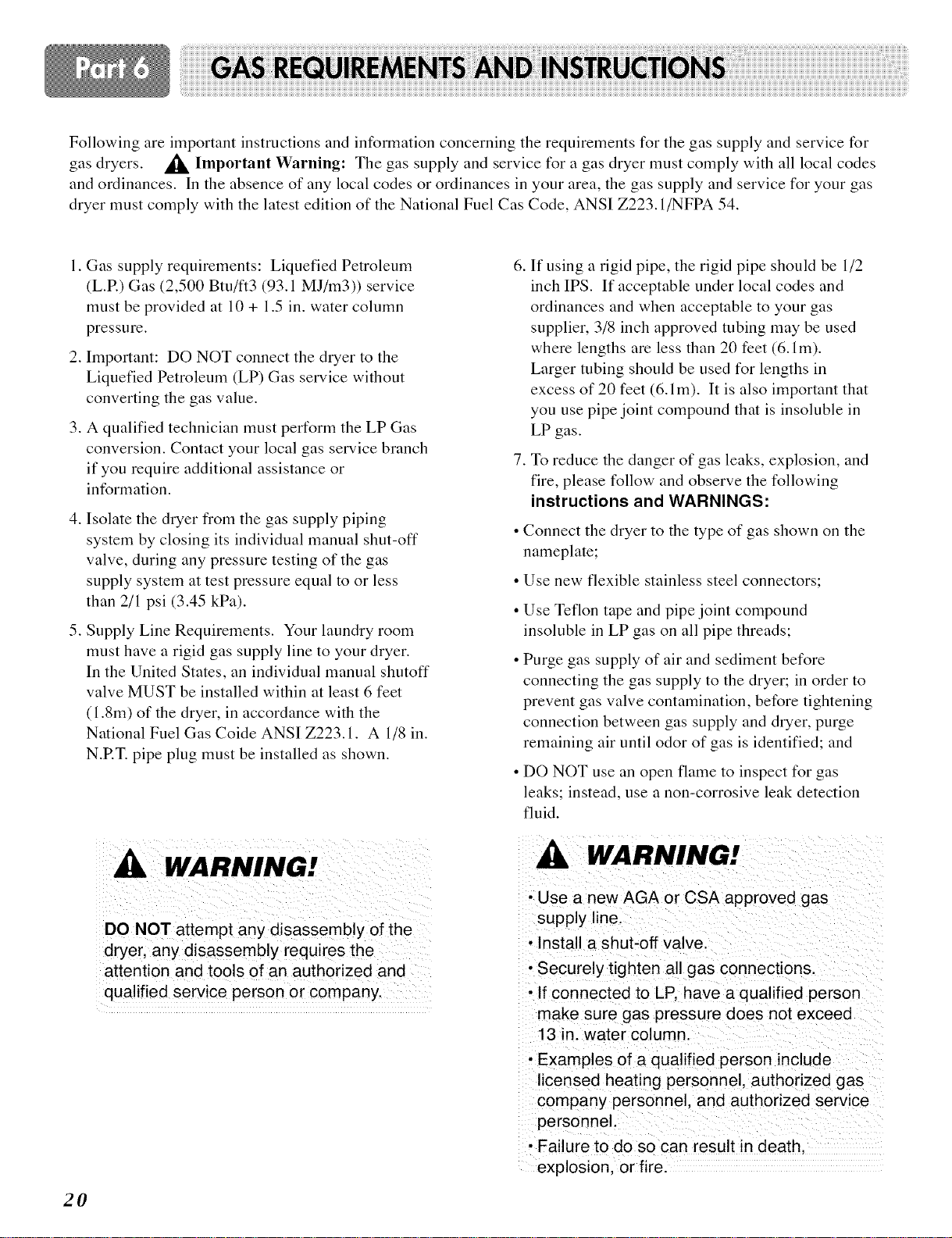
5. Supply Line Requirements. Your laundry room
must have a rigid gas supply line to your dryer.
In the United States, an individual manual shutoff
valve MUST be installed within at least 6 feet
(1.8m) of the dryer, in accordance with the
National Fuel Gas Coide ANSI Z223.1. A 1/8 in.
N.ET. pipe plug must be installed as shown.
DONOT attempt any disassembly of the
dryer, any disassembly requires the
attention and tools of an authorized and
qualified service person or company.
20
.
.
If using a rigid pipe, the rigid pipe should be 1/2
inch IPS. If acceptable under local codes and
ordinances and when acceptable to your gas
supplier, 3/8 inch approved tubing may be used
where lengths are less than 20 feet (6. lm).
Larger tubing should be used for lengths in
excess of 20 feet (6.1m). It is also important that
you use pipe joint compound that is insoluble in
LP gas.
To reduce the danger of gas leaks, explosion, and
fire, please follow and observe the following
instructions and WARNINGS:
Connect the dryer to the type of gas shown on the
nameplate;
Use new flexible stainless steel connectors;
Use Teflon tape and pipe joint compound
insoluble in LP gas on all pipe threads;
Purge gas supply of air and sediment before
connecting the gas supply to the dryer; in order to
prevent gas valve contamination, before tightening
connection between gas supply and dryer, pmge
remaining air until odor of gas is identified; and
DO NOT use an open flame to inspect for gas
leaks; instead, use a non-corrosive leak detection
fluid.
WARNING!
• Use a new AGA or CSA approved gas
supply line.
• Install a shut-off valve.
•Securely tighten all gas connections.
• If connected to LP. have a qualified person
make sure gas pressure does not exceed
13 in. water column.
• Examples of a qualified person include
licensed heating personnel, authorized gas
company personnel, and authorized service
personnel.
• Failure to do so can result in death
explosion, or fire.
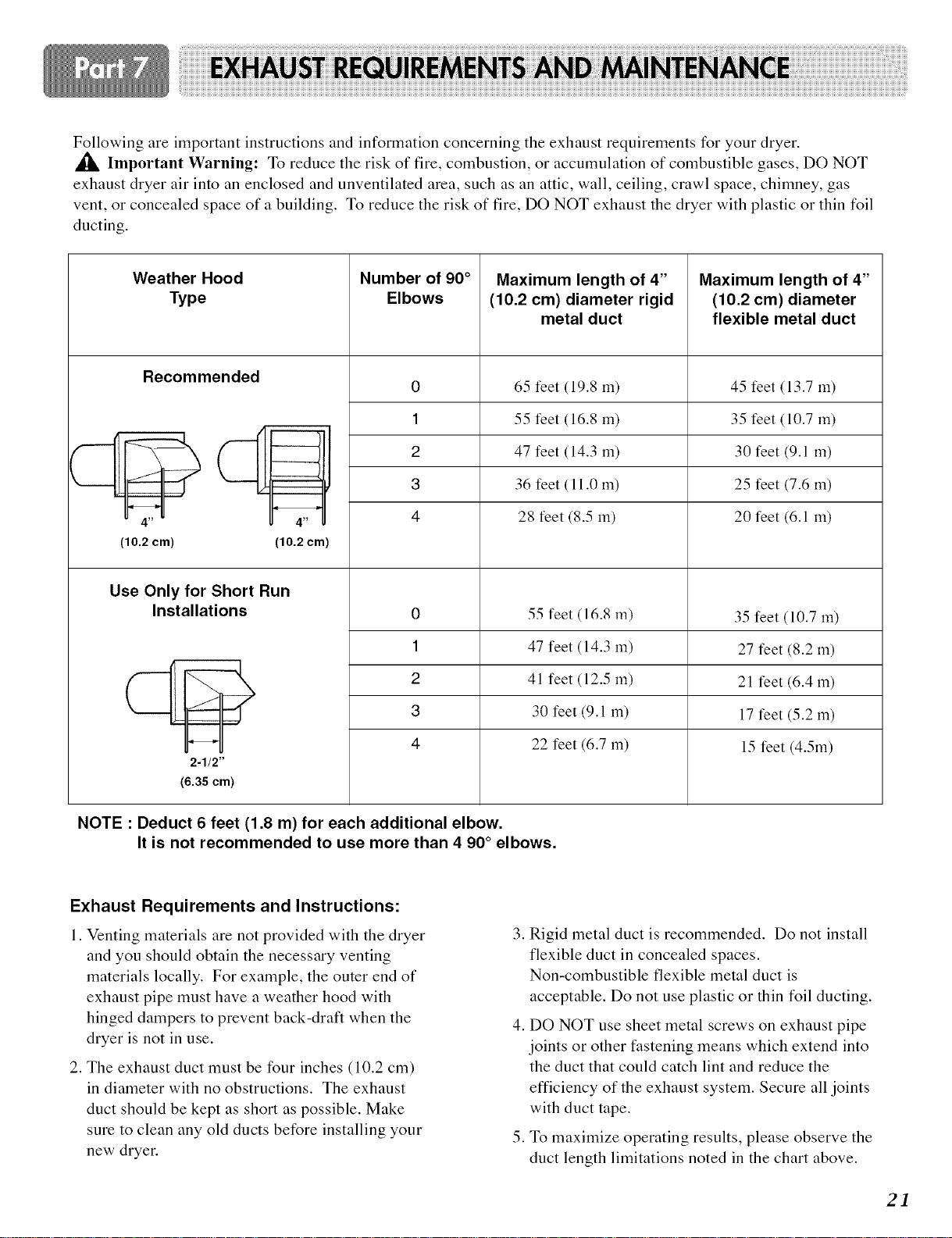
Following are important instructions and information concerning the exhaust requirements for your dryer.
,_t Important Warning: To reduce the risk of fire, combustion, or accumulation of combustible gases, DO NOT
exhaust dryer air into an enclosed and unventilated area, such as an attic, wall, ceiling, crawl space, chimney, gas
vent, or concealed space of a building. To reduce the risk of fire, DO NOT exhaust the dryer with plastic or thin foil
ducting.
Weather Hood
Type
Recommended
(10.2 cm)
C
H
4 _
(10.2 cm)
Use Only for Short Run
Installations
2-1/2"
(6.35 cm)
Number of 90 °
Elbows
Maximum length of 4"
(10.2 cm) diameter rigid
metal duct
Maximum length of 4"
(10.2 cm) diameter
flexible metal duct
0 65 feet (19.8 m) 45 feet (13.7 m)
1 55 feet (16.8 m) 35 feet (10.7 m)
2 47 feet (14.3 m) 30 feet (9.1 m)
3 36 feet (11.0 m) 25 feet (7.6 m)
4 28 feet (8.5 m) 20 feet (6.1 m)
55 feet ( 16.8 m)
47 feet (14.3 m)
41 feet (12.5 m)
30 feet (9.1 m)
22 feet (6.7 m)
0
1
2
3
4
35 feet (10.7 m)
27 feet (8.2 m)
21 feet (6.4 m)
17 feet (5.2 m)
15 feet (4.5m)
NOTE : Deduct 6 feet (1.8 m) for each additional elbow.
It is not recommended to use more than 4 90 ° elbows.
Exhaust Requirements and Instructions:
1. Venting materials are not provided with the dryer
and you should obtain the necessary venting
materials locally. For example, the outer end of
exhaust pipe must have a weather hood with
hinged dampers to prevent back-draft when the
dryer is not in use.
2. The exhaust duct must be four inches (10.2 cm)
in diameter with no obstructions. The exhaust
duct should be kept as short as possible. Make
sure to clean any old ducts before installing your
new dryer.
3. Rigid metal duct is recommended. Do not install
flexible duct in concealed spaces.
Non-combustible flexible metal duct is
acceptable. Do not use plastic or thin foil ducting.
4. DO NOT use sheet metal screws on exhaust pipe
joints or other fastening means which extend into
the duct that could catch lint and reduce the
efficiency of the exhaust system. Secure all joints
with duct tape.
5. To maximize operating results, please observe the
duct length limitations noted in the chart above.
21
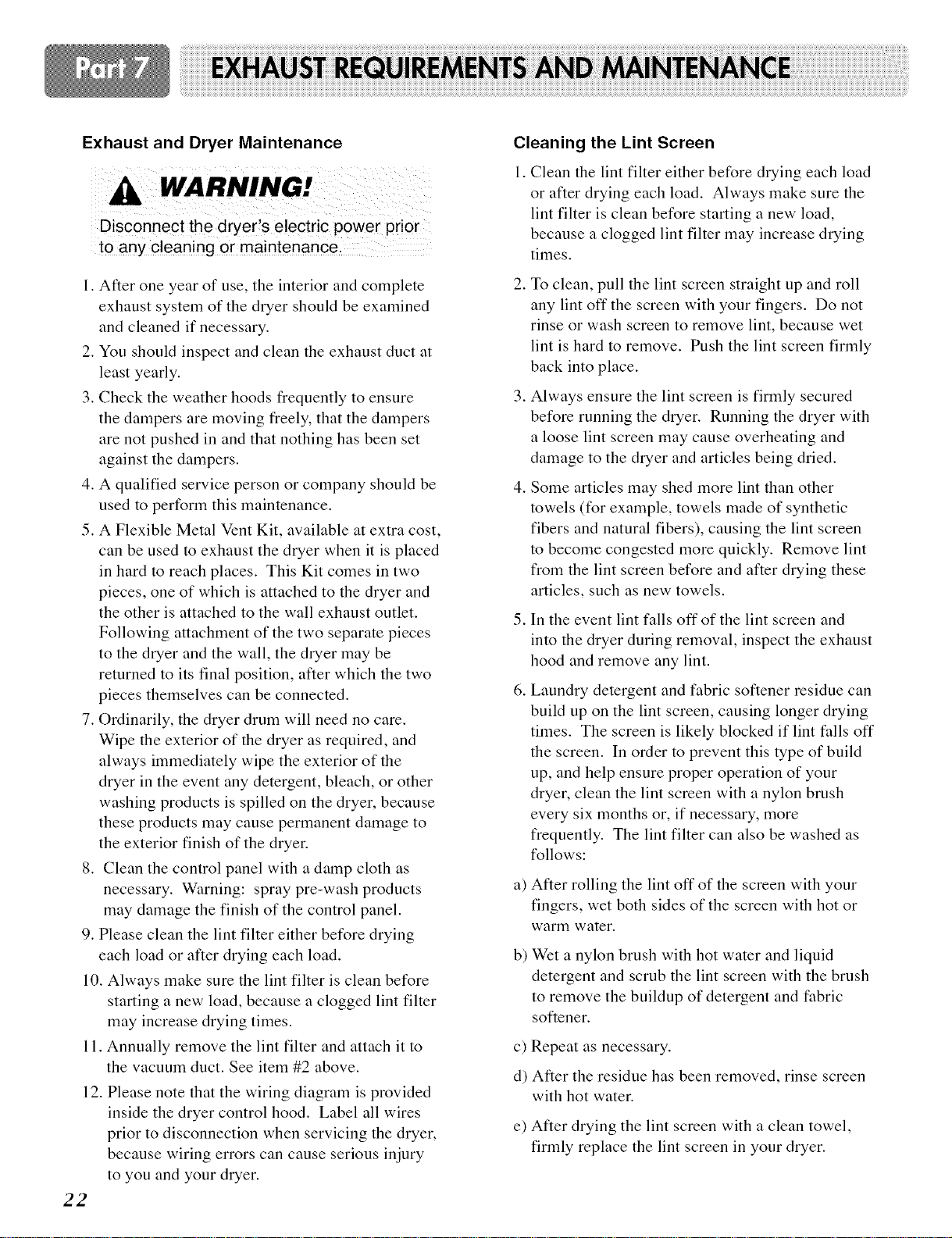
Exhaust and Dryer Maintenance
Disconnect the dryer,s electric power prior
to any cleaning or maintenance.
1. After one year of use, the interior and complete
exhaust system of the dryer should be examined
and cleaned if necessary.
2. You should inspect and clean the exhaust duct at
least yearly.
3. Check the weather hoods frequently to ensure
the dampers are moving freely, that the dampers
are not pushed in and that nothing has been set
against the dampers.
4. A qualified service person or company should be
used to perform this maintenance.
5. A Flexible Metal Vent Kit, available at extra cost,
can be used to exhaust the dryer when it is placed
in hard to reach places. This Kit comes in two
pieces, one of which is attached to the dryer and
the other is attached to the wall exhaust outlet.
Following attachment of the two separate pieces
to the dryer and the wall, the dryer may be
returned to its final position, after which the two
pieces themselves can be connected.
7. Ordinarily, the dryer drum will need no care.
Wipe the exterior of the dryer as required, and
always immediately wipe the exterior of the
dryer in the event any detergent, bleach, or other
washing products is spilled on the dryer, because
these products may cause permanent damage to
the exterior finish of the dryer.
8. Clean the control panel with a damp cloth as
necessary. Warning: spray pre-wash products
may damage the finish of the control panel.
9. Please clean the lint filter either before drying
each load or after drying each load.
10. Always make sure the lint filter is clean before
starting a new load, because a clogged lint filter
may increase drying times.
11. Annually remove the lint filter and attach it to
the vacuum duct. See item #2 above.
12. Please note that the wiring diagram is provided
inside the dryer control hood. Label all wires
prior to disconnection when servicing the dryer,
because wiring errors can cause serious injury
to you and your dryer.
22
Cleaning the Lint Screen
1. Clean the lint filter either before drying each load
or after drying each load. Always make sure the
lint filter is clean before starting a new load,
because a clogged lint filter may increase drying
times.
.
.
.
.
.
To clean, pull the lint screen straight up and roll
any lint off the screen with your fingers. Do not
rinse or wash screen to remove lint, because wet
lint is hard to remove. Push the lint screen firmly
back into place.
Always ensure the lint screen is firmly secured
before running the dryer. Running the dryer with
a loose lint screen may cause overheating and
damage to the dryer and articles being dried.
Some articles may shed more lint than other
towels (for example, towels made of synthetic
fibers and natural fibers), causing the lint screen
to become congested more quickly. Remove lint
from the lint screen before and after drying these
articles, such as new towels.
In the event lint falls off of the lint screen and
into the dryer during removal, inspect the exhaust
hood and remove any lint.
Laundry detergent and fabric softener residue can
build up on the lint screen, causing longer drying
times. The screen is likely blocked if lint falls off
the screen. In order to prevent this type of build
up, and help ensure proper operation of your
dryer, clean the lint screen with a nylon brush
every six months or, if necessary, more
frequently. The lint filter can also be washed as
follows:
a) After rolling the lint off of the screen with your
fingers, wet both sides of the screen with hot or
warm water.
b) Wet a nylon brush with hot water and liquid
detergent and scrub the lint screen with the brush
to remove the buildup of detergent and fabric
softener.
c) Repeat as necessary.
d) After the residue has been removed, rinse screen
with hot water.
e) After drying the lint screen with a clean towel,
firmly replace the lint screen in your dryer.
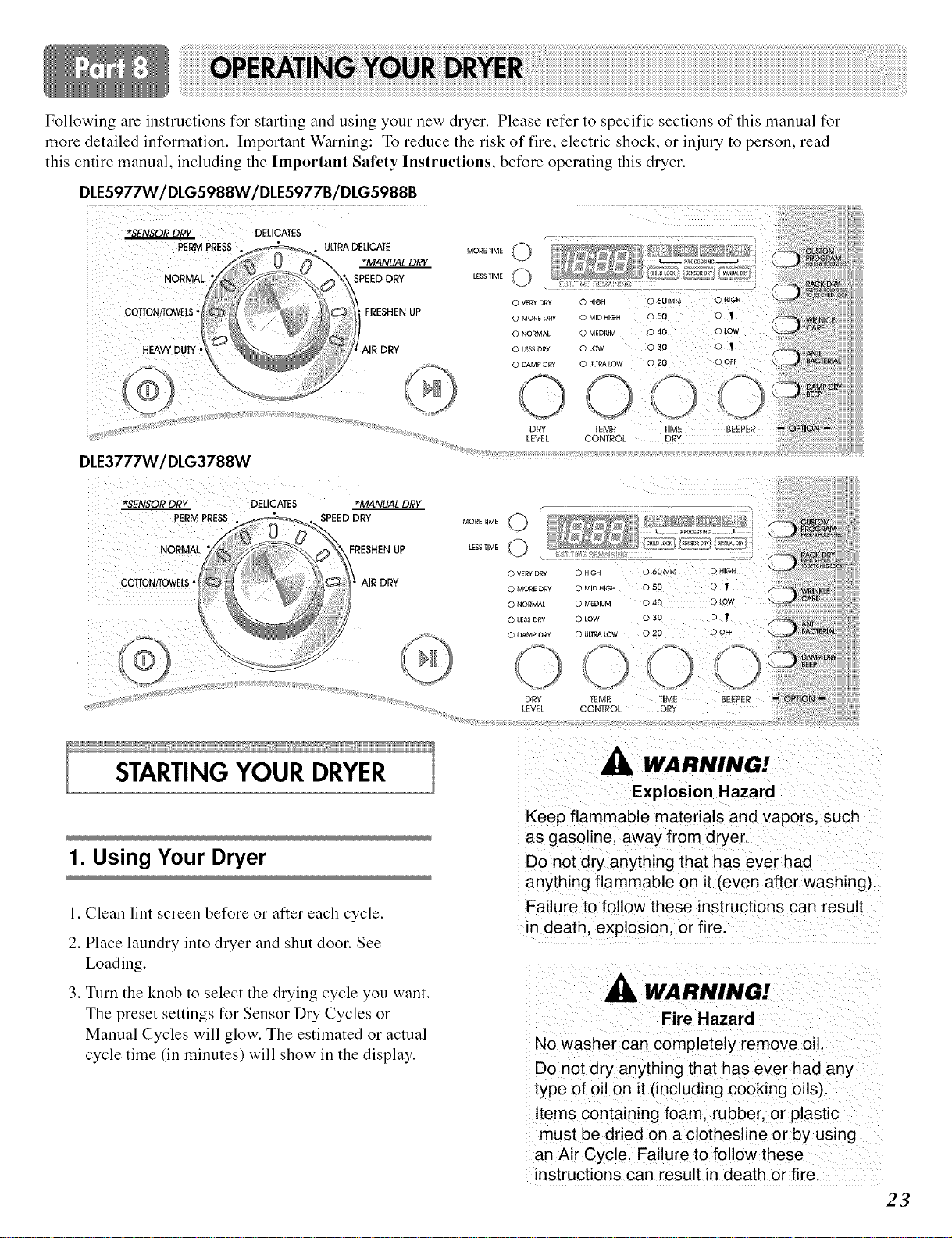
Following are instructions for starting and using your new dryer. Please refer to specific sections of this manual for
more detailed information. Important Warning: To reduce the risk of fire, electric shock, or injury to person, read
this entire manual, including the Important Safety Instructions, before operating this dryer.
DLE5977W/DLG5988W/DLE5977B/DLG5988B
*SENSOR DRY DELICATES
NORMAL
€OTTON_OWELSi
ULTRADELICATE
*MANUAL DRY
SPEED DRY
FRESHENUP
AIR DRY
DLE3777W/DLG3788W
*SENSOR DRY DELICATES *MANUAL DRY
PERMPRESS SPEEDDRY
NORMAL FRESHENUP
COTTONflOWELS• AIR DRY
MORE llME _0
LESS TIME 0
0 VERY DRY
O MORE DRY
0 NORMAL
0 LESS DRY
© DAMP DRY
O HIGH O 60(MIN} O
O MID HIGH O 50
O MEDIUM © 40 O LOW
O LOW
O ULTRALOW
DRY TEMR TIME BEEPER
LEVEL CONTROL
MORE TIME 0
LESSTIME
O VERY DRY O HIGH O 60 (MI_I O HIGH
o:: °,
O MORE DRY O MID HIGH oLow (
O NORMAL O MEDIUM O
0 LESS DRY 0 LOW 0 30 0
0 DAMP DRY 0 ULTRA LOW 0 20 0 OFF
,i ¸ i
........... DRY
.... LEVEL
STARTINGYOUR DRYER
1. Using Your Dryer
1. Clean lint screen before or after each cycle.
2. Place laundry into dryer and shut door. See
Loading.
3. Turn the knob to select the drying cycle you want.
The preset settings for Sensor Dry Cycles or
Manual Cycles will glow. The estimated or actual
cycle time (in minutes) will show in the display.
TEMP. T_ME BEEPER i
CONTROL DRy
WARNING!
Explosion Hazard
Keep flammable materials and vapors, such
as gasoline, away from dryer.
Do not dry anything that has ever had
anything flammable on it (even after washing).
Fail ure to follow these instructions can result
in death, explosion, or fire.
WARNING!
Fire Hazard
No washer can completely remove oil.
Do not dry anything that has ever had any
type of oil on it (including cooking oils).
Items containing foam, rubber, or plastic
must be dried on a clothesline or by using
an Air Cycle. Failure to follow these
instructions can result in death or fire.
23
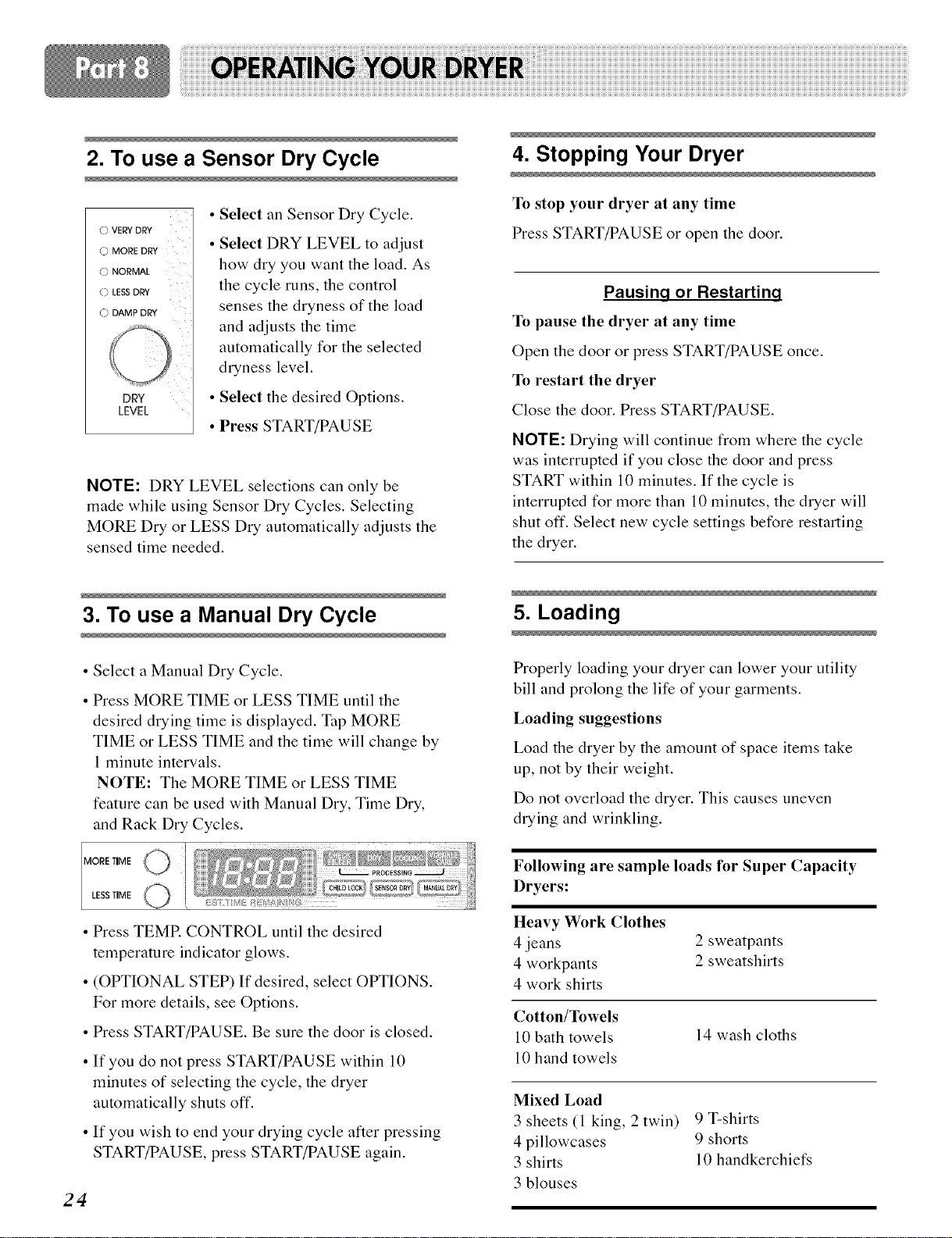
2. To use a Sensor Dry Cycle
¢) VERY DRY
(]) MORE DRY
0 NORMAL
r_ LESS DRY
O DAMP DRY
DRY
LEVEL
• Select an Sensor Dry Cycle.
• Select DRY LEVEL to adjust
how dry you want the load. As
the cycle runs, the control
senses the dryness of the load
and adjusts the time
automatically for the selected
dryness level.
• Select the desired Options.
• Press START/PAUSE
NOTE: DRY LEVEL selections can only be
made while using Sensor Dry Cycles. Selecting
MORE Dry or LESS Dry automatically adjusts the
sensed time needed.
4. Stopping Your Dryer
To stop your dryer at any time
Press START/PAUSE or open the door.
Pausing or Restarting
To pause the dryer at any time
Open the door or press START/PAUSE once.
To restart the dryer
Close the door. Press START/PAUSE.
NOTE: Drying will continue from where the cycle
was interrupted if you close the door and press
START within 10 minutes. If the cycle is
interrupted for more than 10 minutes, the dryer will
shut off. Select new cycle settings before restarting
the dryer.
3. To use a Manual Dry Cycle
• Select a Manual Dry Cycle.
• Press MORE TIME or LESS TIME until the
desired drying time is displayed. Tap MORE
TIME or LESS TIME and the time will change by
1minute intervals.
NOTE: The MORE TIME or LESS TIME
feature can be used with Manual Dry, Time Dry,
and Rack Dry Cycles.
MORE TIME O
LESSTIME
• Press TEMR CONTROL until the desired
temperature indicator glows.
• (OPTIONAL STEP) If desired, select OPTIONS.
For more details, see Options.
• Press START/PAUSE. Be sure the door is closed.
• If you do not press START/PAUSE within 10
minutes of selecting the cycle, the dryer
automatically shuts off.
• If you wish to end your drying cycle after pressing
START/PAUSE, press START/PAUSE again.
24
5. Loading
Properly loading your dryer can lower your utility
bill and prolong the life of your garments.
Loading suggestions
Load the dryer by the amount of space items take
up, not by their weight.
Do not overload the dryer. This causes uneven
drying and wrinkling.
Following are sample loads for Super Capacity
Dryers:
Heavy Work Clothes
4 jeans
4 workpants
4 work shirts
2 sweatpants
2 sweatshirts
Cotton!Towels
10 bath towels
10 hand towels
14 wash cloths
Mixed Load
3 sheets (1 king, 2 twin)
4 pillowcases
3 shirts
3 blouses
9 T-shirts
9 shorts
10 handkerchiefs
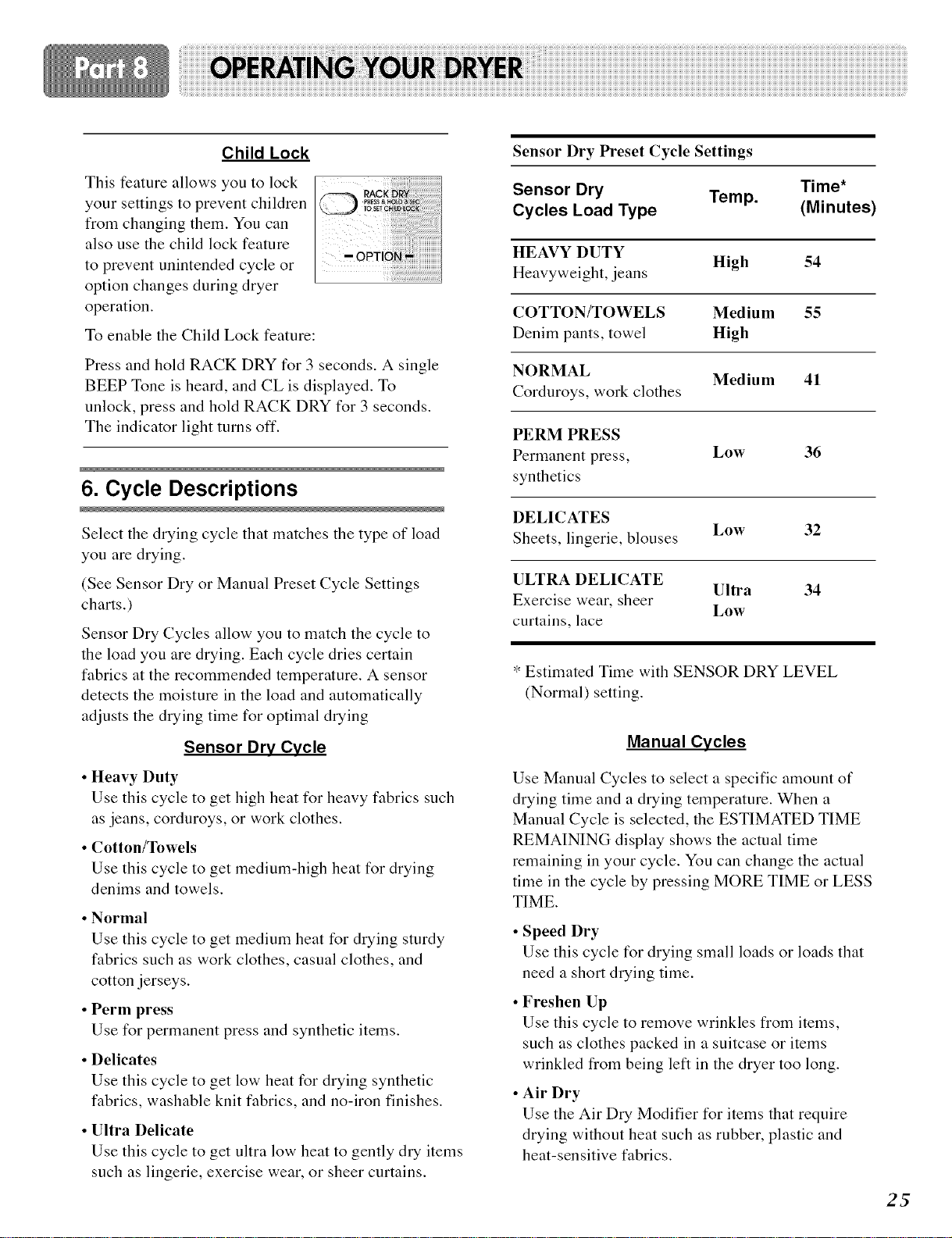
Child Lock
This feature allows you to lock
your settings to prevent children
from changing them. You can
also use the child lock feature
to prevent unintended cycle or
option changes during dryer
operation.
To enable the Child Lock feature:
Press and hold RACK DRY for 3 seconds. A single
BEEP Tone is heard, and CL is displayed. To
unlock, press and hold RACK DRY for 3 seconds.
The indicator light turns off.
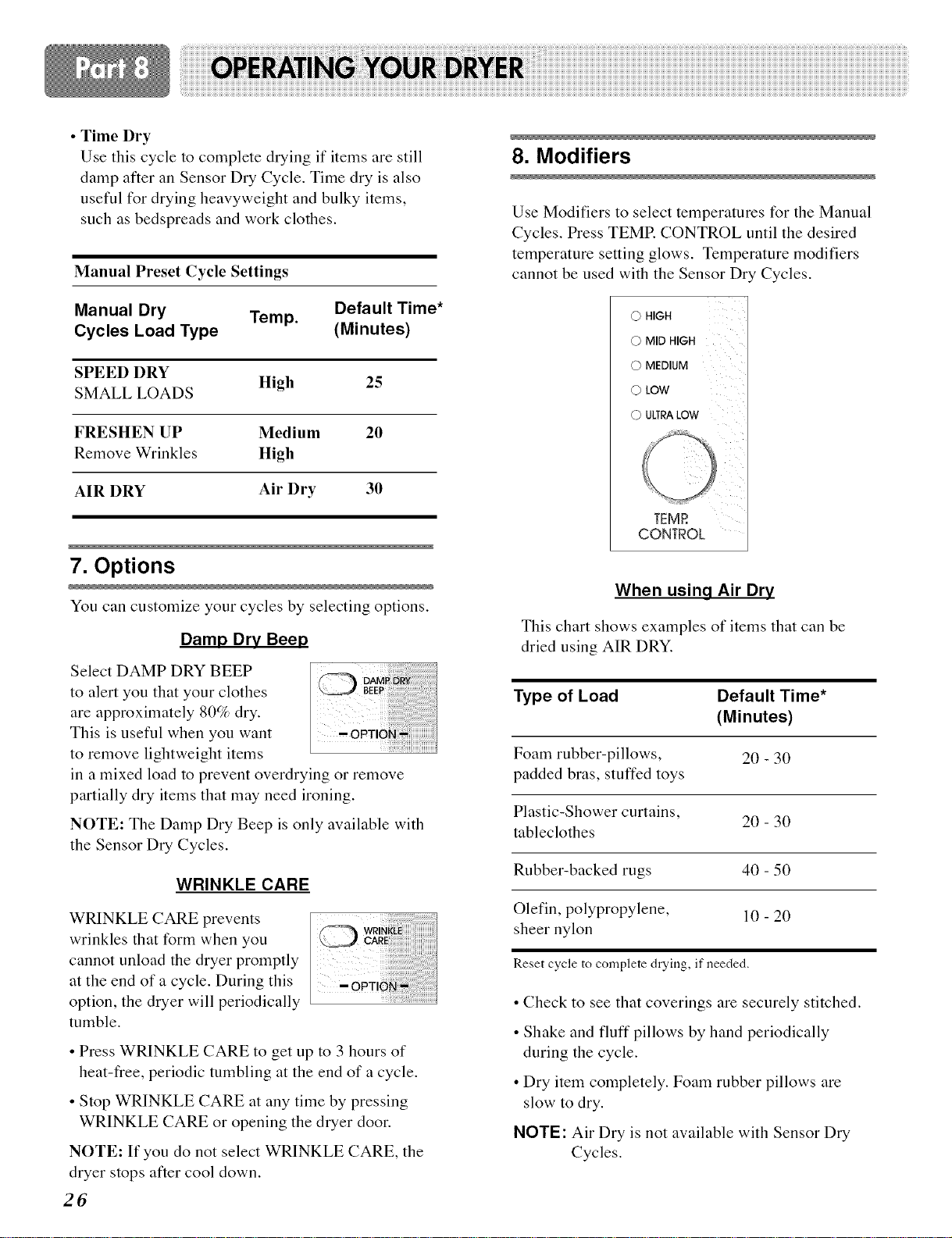
6. Cycle Descriptions
Select the drying cycle that matches the type of load
you are drying.
(See Sensor Dry or Manual Preset Cycle Settings
charts.)
Sensor Dry Cycles allow you to match the cycle to
the load you are drying. Each cycle dries certain
fabrics at the recommended temperature. A sensor
detects the moisture in the load and automatically
adjusts the drying time for optimal drying
Sensor Dry Cycle
• Heavy Duty
Use this cycle to get high heat for heavy fabrics such
as jeans, corduroys, or work clothes.
• Cotton!Towels
Use this cycle to get medium-high heat for drying
denims and towels.
• Normal
Use this cycle to get medium heat for drying sturdy
fabrics such as work clothes, casual clothes, and
cotton jerseys.
• Perm press
Use for permanent press and synthetic items.
• Delicates
Use this cycle to get low heat for drying synthetic
fabrics, washable knit fabrics, and no-iron finishes.
• Ultra Delicate
Use this cycle to get ultra low heat to gently dry items
such as lingerie, exercise wear, or sheer curtains.
Sensor Dry Preset Cycle Settings
Sensor Dry Temp. Time*
Cycles Load Type (Minutes)
HEAVY DUTY
High 54
Heavyweight, jeans
COTTON/TOWELS Medium 55
Denim pants, towel High
NORMAL
Medium 41
Corduroys, work clothes
PERM PRESS
Permanent press, Low 36
synthetics
DELICATES
Sheets, lingerie, blouses Low 32
ULTRA DELICATE
Ultra 34
Exercise wear, sheer
Low
curtains, lace
* Estimated Time with SENSOR DRY LEVEL
(Normal) setting.
Manual Cycles
Use Manual Cycles to select a specific amount of
drying time and a drying temperature. When a
Manual Cycle is selected, the ESTIMATED TIME
REMAINING display shows the actual time
remaining in your cycle. You can change the actual
time in the cycle by pressing MORE TIME or LESS
TIME.
• Speed Dry
Use this cycle for drying small loads or loads that
need a short drying time.
• Freshen Up
Use this cycle to remove wrinkles from items,
such as clothes packed in a suitcase or items
wrinkled from being left in the dryer too long.
• Air Dry
Use the Air Dry Modifier for items that require
drying without heat such as rubber, plastic and
heat-sensitive fabrics.
2_
• Time Dry
Use this cycle to complete drying if items are still
damp after an Sensor Dry Cycle. Time dry is also
useful for drying heavyweight and bulky items,
such as bedspreads and work clothes.
Manual Preset Cycle Settings
Manual Dry Temp. Default Time*
Cycles Load Type (Minutes)
SPEED DRY
SMALL LOADS High 25
FRESHEN UP Medium 20
Remove Wrinkles High
AIR DRY Air Dry 30
7. Options
You can customize your cycles by selecting options.
Damp Dry Beep
Select DAMP DRY BEEP
to alert you that your clothes
are approximately 80% dry.
This is useful when you want
to remove lightweight items
in a mixed load to prevent overdrying or remove
partially dry items that may need ironing.
NOTE: The Damp Dry Beep is only available with
the Sensor Dry Cycles.
WRINKLE CARE
WRINKLE CARE prevents
wrinkles that form when you
cannot unload the dryer promptly
at the end of a cycle. During this
option, the dryer will periodically
tumble.
• Press WRINKLE CARE to get up to 3 hours of
heat-free, periodic tumbling at the end of a cycle.
• Stop WRINKLE CARE at any time by pressing
WRINKLE CARE or opening the dryer door.
NOTE: If you do not select WRINKLE CARE, the
dryer stops after cool down.
26
8. Modifiers
Use Modifiers to select temperatures for the Manual
Cycles. Press TEMP. CONTROL until the desired
temperature setting glows. Temperature modifiers
cannot be used with the Sensor Dry Cycles.
0 HIGH
oM,DH,GH
© MEDIUM
0 LOW
C) ULTRALOW
TEMP.
CONTROL
When using Air Dry
This chart shows examples of items that can be
dried using AIR DRY.
Type of Load
Default Time*
(Minutes)
Foam rubber-pillows, 20 - 30
padded bras, stuffed toys
Plastic-Shower curtains, 20 - 30
tableclothes
Rubber-backed rugs 40 - 50
Olefin, polypropylene, 10 - 20
sheer nylon
Reset cycle to complete drying, if needed.
• Check to see that coverings are securely stitched.
• Shake and fluff pillows by hand periodically
during the cycle.
• Dry item completely. Foam rubber pillows ate
slow to dry.
NOTE: Air Dry is not available with Sensor Dry
Cycles.
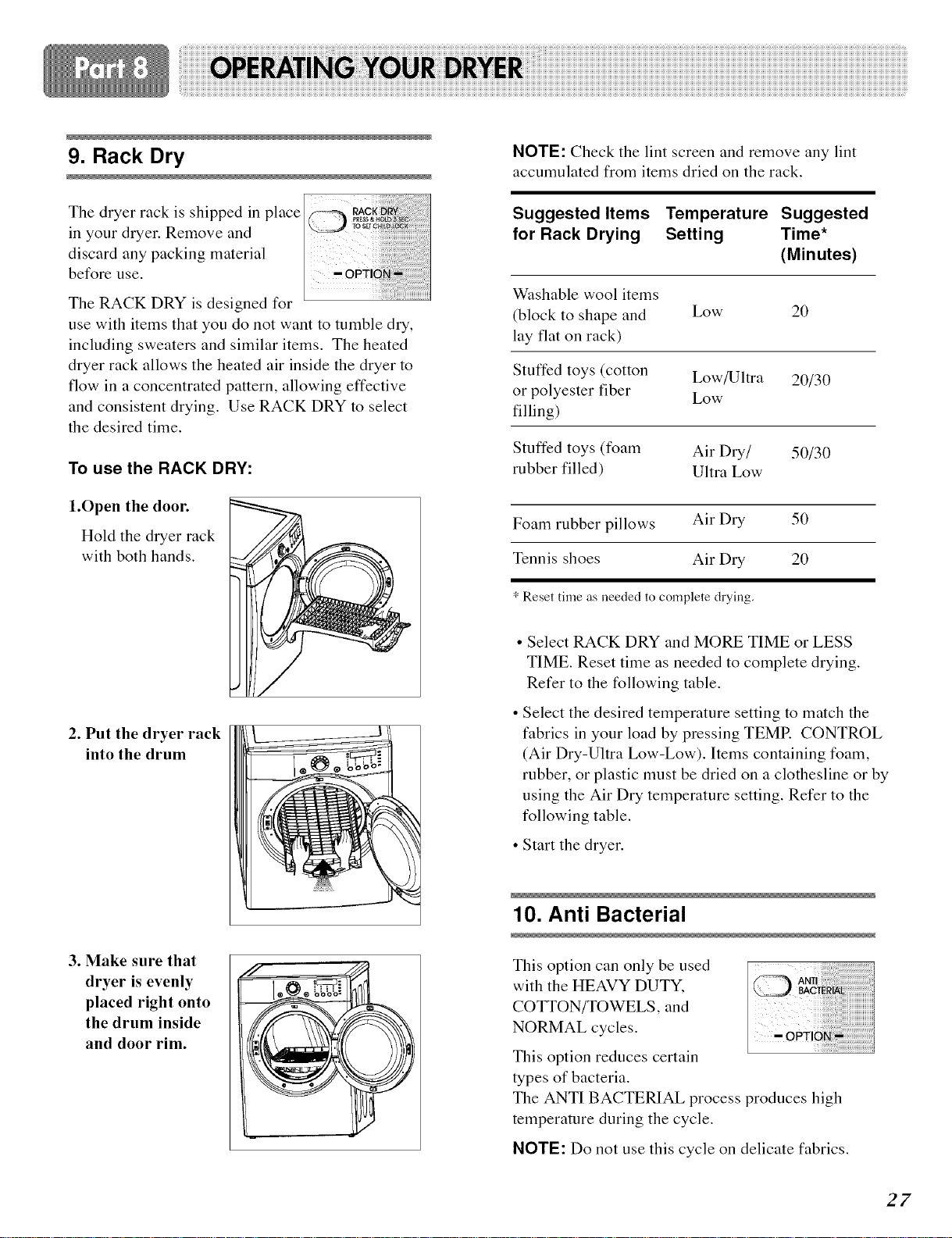
9. Rack Dry
use with items that you do not want to tumble dry,
including sweaters and similar items. The heated
dryer rack allows the heated air inside the dryer to
flow in a concentrated pattern, allowing effective
and consistent drying. Use RACK DRY to select
the desired time.
To use the RACK DRY:
1.Open the door.
Hold the dryer rack
with both hands.
2. Put the dryer rack
into the drum
3. Make sure that
dryer is evenly
placed right onto
the drum inside
and door rim.
NOTE: Check the lint screen and remove any lint
accumulated from items dried on the rack.
Suggested Items Temperature Suggested
for Rack Drying Setting Time*
(Minutes)
Washable wool items
(block to shape and Low 20
lay flat on rack)
Stuffed toys (cotton Low/Ultra 20/30
or polyester fiber Low
filling)
Stuffed toys (foam Air Dry/ 50/30
rubber filled) Ultra Low
Foam rubber pillows Air Dry 50
Tennis shoes Air Dry 20
* Reset time as needed to complete drying,
• Select RACK DRY and MORE TIME or LESS
TIME. Reset time as needed to complete drying.
Refer to the following table.
Select the desired temperature setting to match the
fabrics in your load by pressing TEMP. CONTROL
(Air Dry-Ultra Low-Low). Items containing foam,
rubber, or plastic must be dried on a clothesline or by
using the Air Dry temperature setting. Refer to the
following table.
• Start the dryer.
10. Anti Bacterial
This option can only be used
with the HEAVY DUTY,
COTTON/TOWELS, and
NORMAL cycles.
This option reduces certain
types of bacteria.
The ANTI BACTERIAL process produces high
temperature during the cycle.
NOTE: Do not use this cycle on delicate fabrics.
27
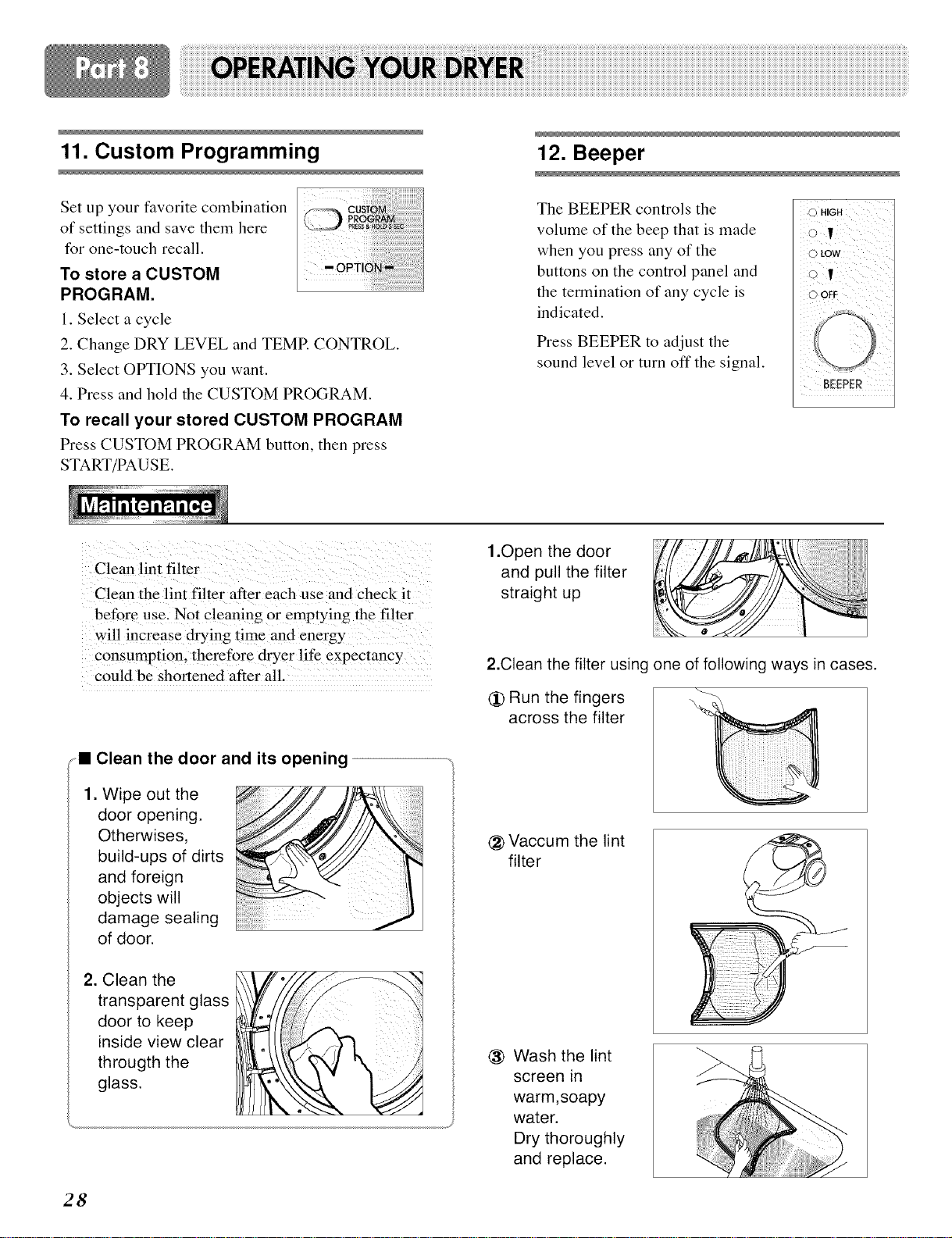
11. Custom Programming
Set up your favorite combination ]
l( }
of settings and save them here
for one-touch recall.
To store a CUSTOM
PROGRAM.
l. Select a cycle
2. Change DRY LEVEL and TEMP. CONTROL.
3. Select OPTIONS you want.
4. Press and hold the CUSTOM PROGRAM.
To recall your stored CUSTOM PROGRAM
Press CUSTOM PROGRAM button, then press
START/PAUSE.
12. Beeper
The BEEPER controls the
volume of the beep that is made
when you press any of the
buttons on the control panel and
the termination of any cycle is
indicated.
Press BEEPER to adjust the
sound level or turn off the signal.
0 HIGH
OLOW
BEEPER
Clean lint filter
Clean dm lint filter after each use and check it
before use. Not cleaning or emptying the filter
will increase drying time and energy
consumption, therefore dryer life expectancy
could be shortened after all.
-II Clean the door and its opening
1. Wipe out the
door opening.
Otherwises,
build-ups of dirts
and foreign
objects will
damage sealing
of door.
2. Clean the
transparent glass
door to keep
inside view clear
througth the
glass.
1.Open the door
and pull the filter
straight up
2.Clean the filter using one of following ways in cases.
_) Run the fingers
across the filter
(_ Vaccum the lint
filter
(_ Wash the lint
screen in
warm,soapy
water.
Dry thoroughly
and replace.
28
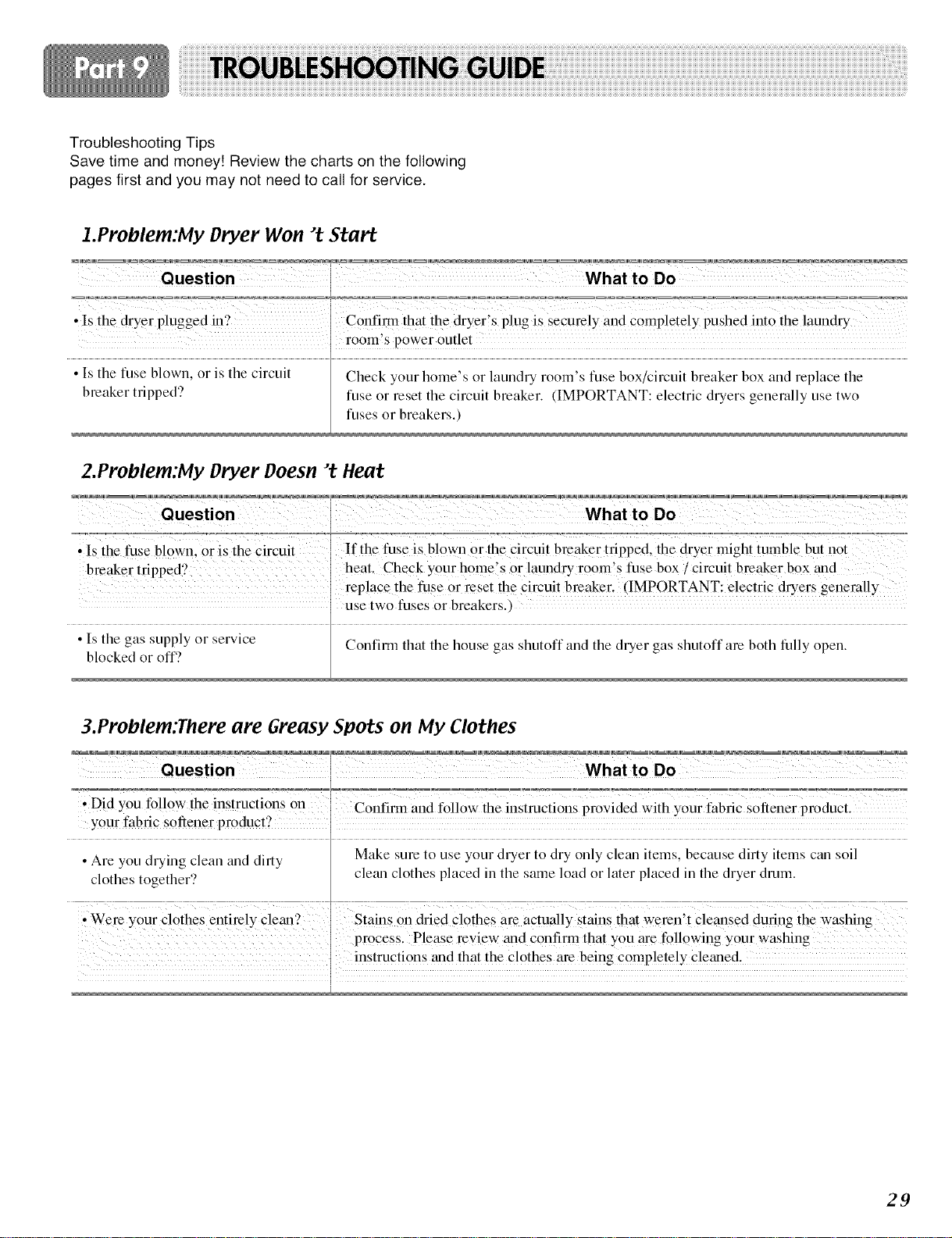
Troubleshooting Tips
Save time and money! Review the charts on the following
pages first and you may not need to call for service.
1.Problem:My Dryer Won "t Start
• Is the dryer.... plugged lug. Confirm that the dryer s plug is securely and completely pushed into the laundry
• Is the fuse blown, or is the circuit Check your home's or laundry room s ff se box/circuit breaker box and replace the
breaker tripped? fuse or reset the circuit breaker. (IMPORTANT: electric dryers generally use two
fuses or breakers.)
2.Problem:My Dryer Doesn "t Heat
_,!,,_o_!_,_o_=,_,.,=,_=_,,_,.,,_,_,o{_,=,,_,_ ....... _ _ ......... ,_........ .....
' Is the fuse blown Oris the circuit If the fuse is blown Or the circuit breaker tri ed the dr er mi ht tumble but not
' _ ' ' i * ' PP ' Y g
breaker tri ed'_ i heat Check your home's Orlaundry room's fuse box / circuit breaker box and
pp ....
i replace the fuseo r reset the circuit breaker, (IMPORTANT: electric dryers generally
I usetwo fuses or breakers.)
• Is the gas supply or service Confirm that the house gas shutoff and the dryer gas shutoff are both fully open.
blocked or off'?
3.Problem:Fhere are Greasy Spots on My Clothes
your fabric softener product '_ I
• Are you drying clean and dirty Make sure to use your dryer to dry only clean items, because dirty items can soil
clothes together? cle_m clothes placed in the same load or later placed in the dryer dram.
• Were your clothes entirely Clean? ! Stains on dried clothes are actually stains that weren't cleansed during the washing
process, Please reyiew and Confirm that yOUam following you r washing
!ns!mcfio!)s _d tha! !he c!o!hes are be!ng comp!e!e!y c!e_ed
29
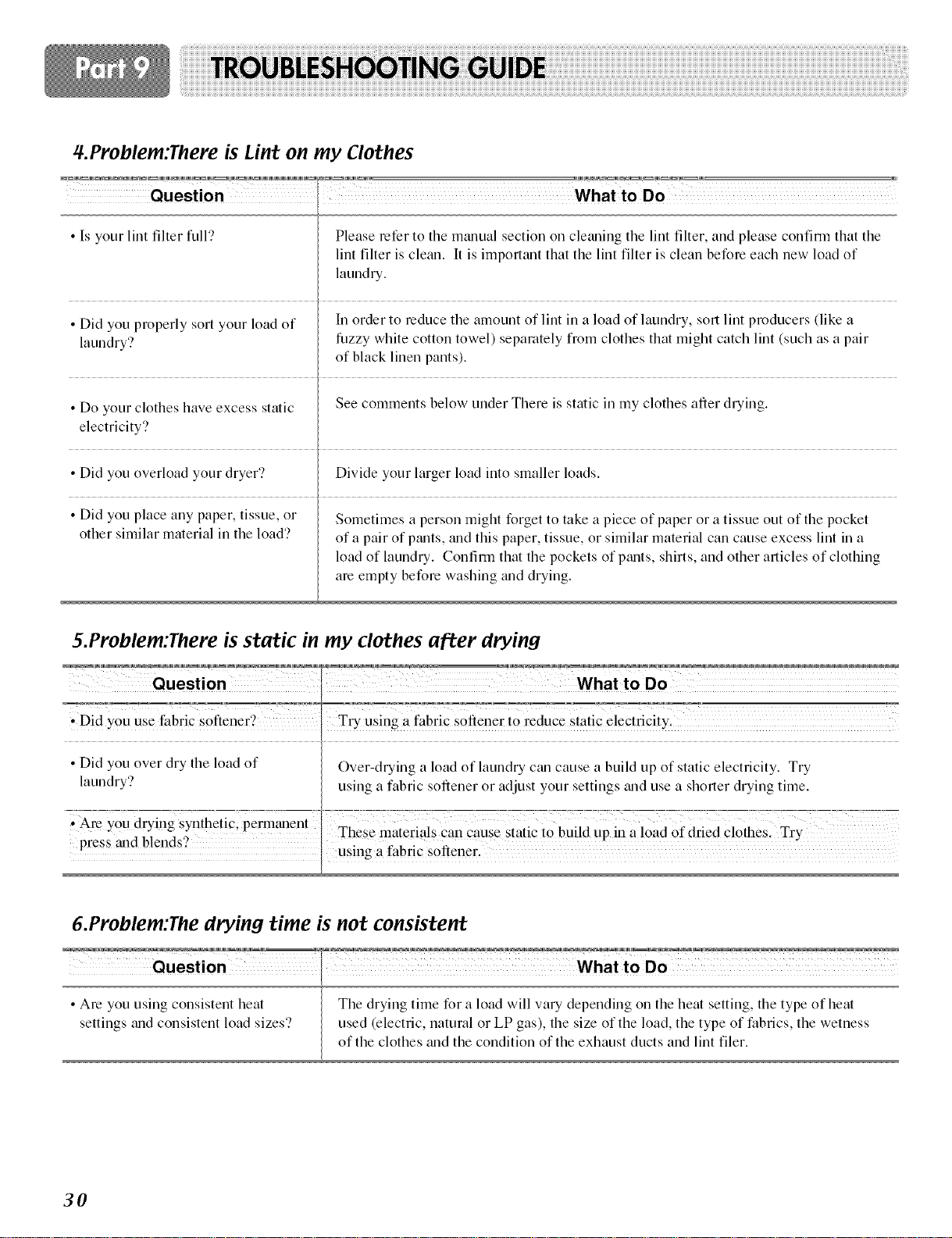
#.Problem:Fhere is Lint on my Clothes
• Is your lint filter full? Please refer to the mtmual section on cletming the lint filter, and please confirm that the
lint filter is clean. It is importzmt that the lint filter is clean before each new load of
laundry.
• Did you properly sort your load of In order to reduce the amount of lint in a load of laundry, sort lint producers (like a
laundry? fuzzy white cotton towel) separately from clothes that might catch lint (such as a pair
of black linen pants).
• Do your clothes have excess static See comments below under There is static in my clothes after drying.
electricity'?
• Did you overload your dryer? Divide your larger load into smaller loads.
• Did you place any paper, tissue, or Sometimes a person might forget to take a piece of paper or a tissue out of the pocket
other similar material in the load? of a pair of prints, trod this paper, tissue, or similar material can cause excess lint in a
load of laundry. Confirm that the pockets of prints, shirts, and other articles of clothing
are empty before washing and drying.
5.Problem:Fhere is static in my clothes after arying
J,!
• Did you use t:abric softener? [ Tr3_ using a fabric Softener to reduce static electricity.
6.Problem:Fhe arying time is not consistent
I What to Do
• Are you using consistent heat The drying time for a load will w_ry depending on the heat setting, the type of heat
settings mad consistent load sizes'? used (electric, natural or LP gas), the size of the load, the type of fabrics, the wetness
of the clothes mad the condition of the exhaust ducts and lint filer.
3O
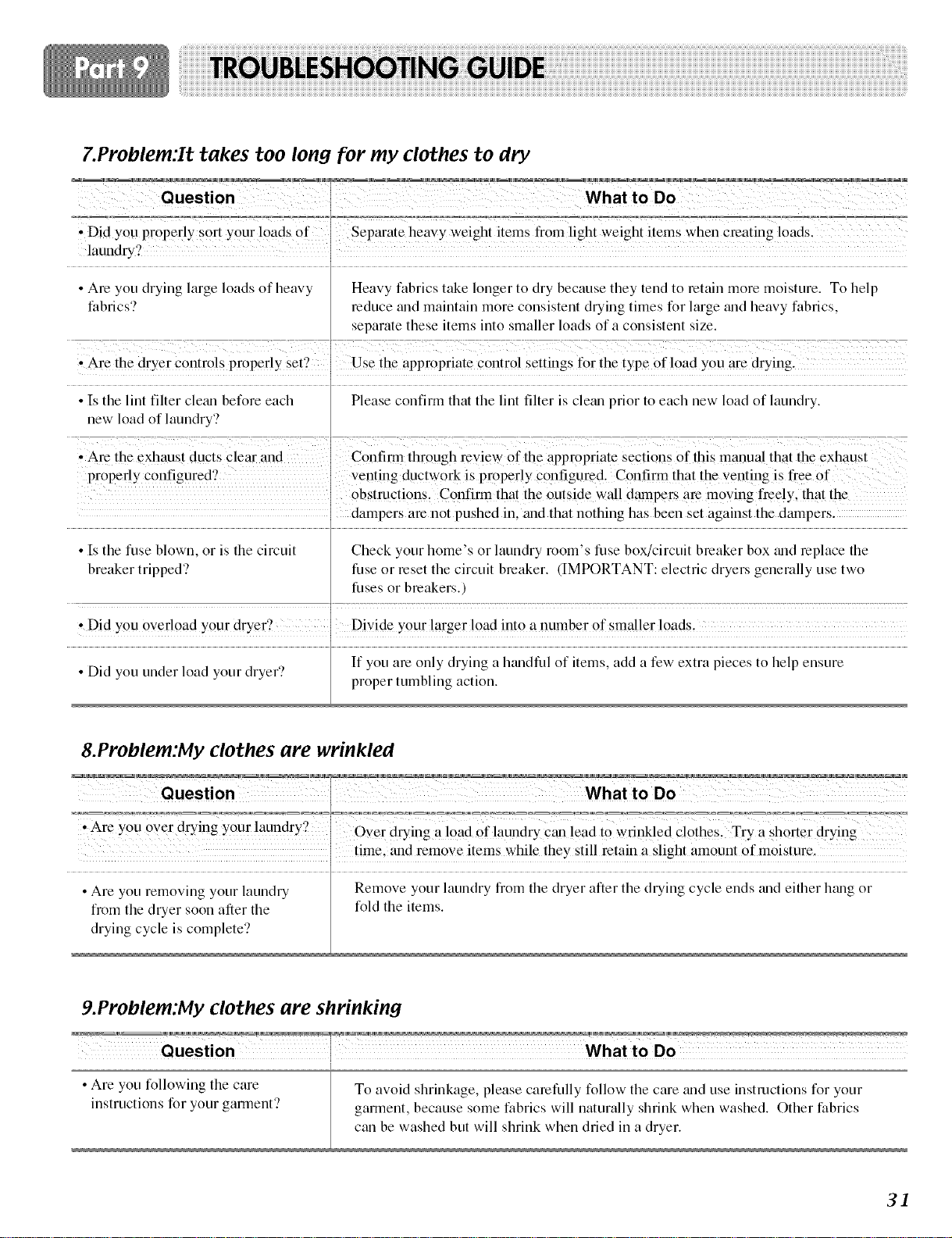
;'.Problem:It takes too long for my clothes to _lry
• Are you drying large loads of heavy Heavy fabrics take longer to dry because they tend to retain more moisture. To help
fabrics? reduce and maintain more consistent drying times for large and heavy fabrics,
separate these items into smaller loads of a consistent size.
' Are the dryer controls properly Set? Use the appropriate contro! settings l)r the type Of load you are dryingl
• Is the lint filter cle_m before each Please confirm that the lint filter is cle_m prior to each new load of laundry.
new load of laundry?
* Are the exhaust ducts clear and Confirm through review 0f the appropriat e Sections Of this manual that the exhaust
proper!y €0nfiguredi? , venting ductwor k is pmper!y configured. Confirm that th e vent!ng is IYeeOf
0bstmcti0ns, C0nfirm that the outside wa!! dtunpers aw moving lYee!y, that th e
dampers are not pushed in, and that nothing has been set against the dampers.
• Is the fuse blown, or is the circuit Check you r home s or la_ adry room's fuse box/circuit breaker box _md replace the
breaker tripped? ff_se or reset the circuit breaker. (IMPORTANT: electric dryers generally use two
ff_ses or breakers.)
, Did you Over!oad your dryer? Divide your larger !oad into a number of smaller loads,
• Did you under load your dryer? If you are only drying a hzmdffd of items, add a few extra pieces to help ensure
proper tumbling action.
8.Problem:My clothes are wrinkle l
• Are you over drying our laundry " o • " • • " • " o
Y - Over drying, a load ot laundry can lead to wnnkled clothes. Try a shorter drym_
I time, and rem0ve items while they still retain a slight amotnt of moisture
• Are you removing your laundry Remove your laundry from the dryer after the drying cycle ends and either hang or
from the dryer soon after the fold the items.
drying cycle is complete'?
9.Problem:My clothes are shrinking
Question What to Do
• Are you following the care To avoid shrinkage, please carefully t_>llow the care and use instructions for your
instructions for your garment? garment, because some fabrics will naturally shrink when washed. Other fabrics
can be washed but will shrink when dried in a dryer.
31
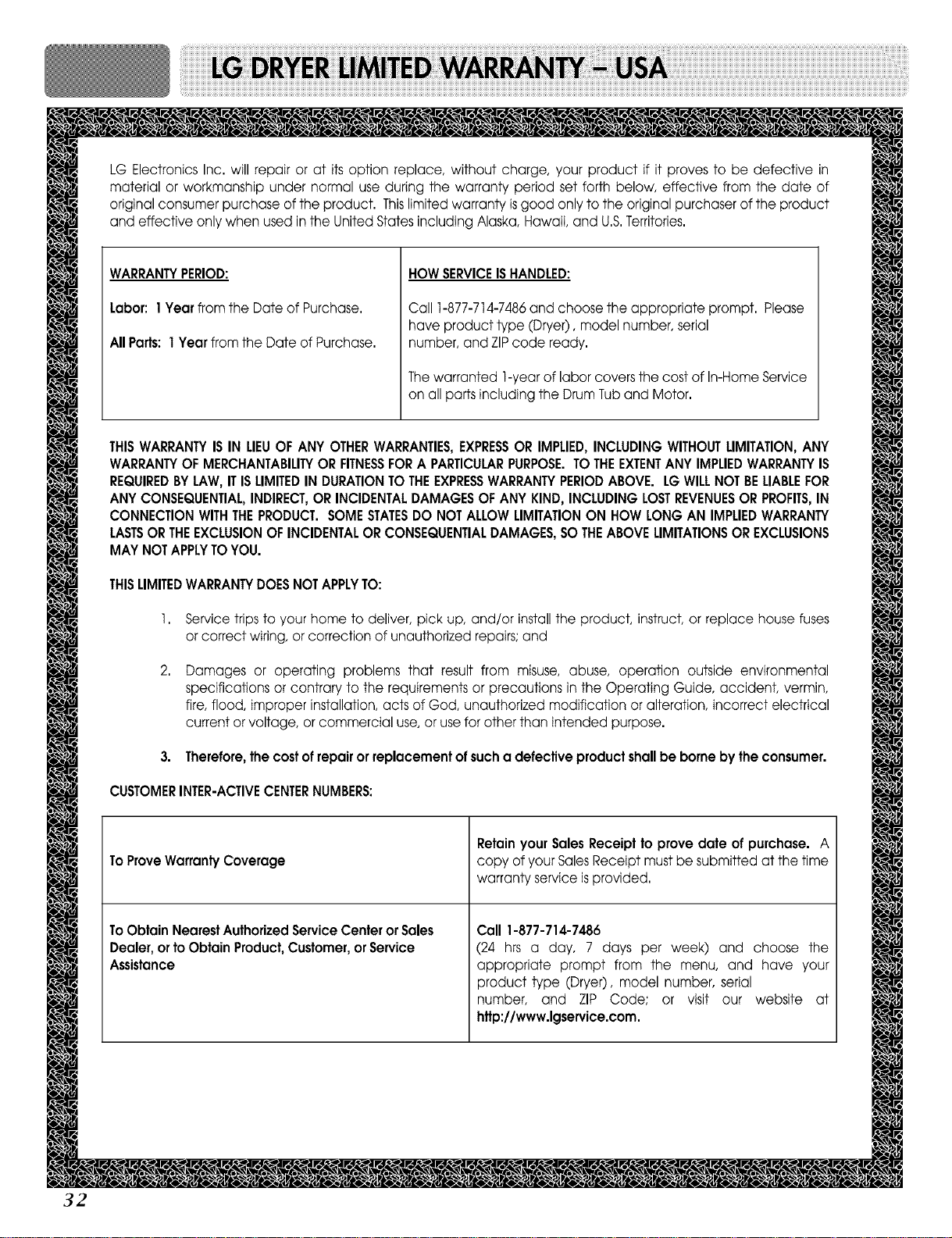
LG Electronics Inc. will repair or at its option replace, without charge, your product if it proves to be defective in
material or workmanship under normal use during the warranty period set forth below, effective from the date of
original consumer purchase of the product. Thislimited warranty isgood only to the original purchaser of the product
and effective only when used in the United States including Alaska, Hawaii, and U.S.Territories.
WARRANTYPERIOD:
Labor: 1Year from the Date of Purchase.
All Parts: I Year from the Date of Purchase.
HOW SERVICEIS HANDLED:
Call 1-877-714-7486 and choose the appropriate prompt. Please
have product type (Dryer), model number, serial
number, and ZIPcode ready.
The warranted 1-year of labor covers the cost of In-Home Service
on all parts including the Drum Tub and Motor.
THIS WARRANTYIS IN LIEUOF ANY OTHERWARRANTIES,EXPRESSOR IMPLIED,INCLUDING WITHOUTLIMITATION,ANY
WARRANTYOF MERCHANTABILITYOR FITNESSFORA PARTICULARPURPOSE.TO THEEXTENTANY IMPLIEDWARRANTYIS
REQUIREDBYLAW, IT ISLIMITEDIN DURATIONTO THEEXPRESSWARRANTYPERIODABOVE. LG WILLNOT BELIABLEFOR
ANY CONSEQUENTIAL,INDIRECT,OR INCIDENTALDAMAGES OF ANY KIND, INCLUDING LOSTREVENUESOR PROFITS,IN
CONNECTION WITHTHEPRODUCT. SOME STATESDO NOT ALLOW LIMITATIONON HOW LONG AN IMPLIEDWARRANTY
LASTSOR THEEXCLUSIONOF INCIDENTALOR CONSEQUENTIALDAMAGES, SO THEABOVE LIMITATIONSOR EXCLUSIONS
MAY NOTAPPLYTOYOU.
THISLIMITEDWARRANTYDOESNOTAPPLYTO:
1. Service trips to your home to deliver, pick up, and/or install the product, instruct, or replace house fuses
or correct wiring, or correction of unauthorized repairs; and
2,
Damages or operating problems that result from misuse, abuse, operation outside environmental
specifications or contrary to the requirements or precautions in the Operating Guide, accident, vermin,
fire, flood, improper installation, acts of God, unauthorized modification or alteration, incorrect electrical
current or voltage, or commercial use, or use for other than intended purpose.
3. Therefore, the cost of repair or replacement of sucha defective product shall be borne by the consumer.
CUSTOMERINTER-ACTIVECENTERNUMBERS:
To Prove Warranty Coverage
To Obtain Nearest Authorized Service Center or Sales
Dealer, or to Obtain Product, Customer, or Service
Assistance
Retain your Sales Receipt to prove date of purchase. A
copy of your Sales Receipt must be submiHed at the time
warranty service isprovided.
Call 1-877-714-7486
(24 hrs a day, 7 days per week) and choose the
appropriate prompt from the menu, and have your
product type (Dryer), model number, serial
number, and ZIP Code; or visit our website at
http://www.lgservice.com.
3Z