Refrigerator
user manual
imagine the possibilities
Thank you for purchasing this Samsung product.
To receive more complete service or accessory parts,
please register your product at or contact
www.samsung.com/register
1-800-SAMSUNG (726-7864)
Free Standing Appliance
English
RF261B*****
RF260B*****
RF26HFP***
2012.5.16 3:1:38 PM
02_ Safety information
safety information
SAFETY INFORMATION
Before using your new Samsung French Door
Refrigerator, please read this manual thoroughly to
ensure that you know how to operate the features
and functions that your new appliance offers safely
and effi ciently.
This appliance is not intended for use by persons
(including children) with reduced physical, sensory,
or mental capabilities, or those who lack experience
and knowledge, unless they have been given
supervision or instruction concerning the use of the
appliance by a person responsible for their safety.
Because the following instructions cover various
models, the characteristics of your refrigerator
may differ slightly from the refrigerator described in
this manual. If you have any question, contact us
at 1-800-SAMSUNG or fi nd help and information
online at www.samsung.com.
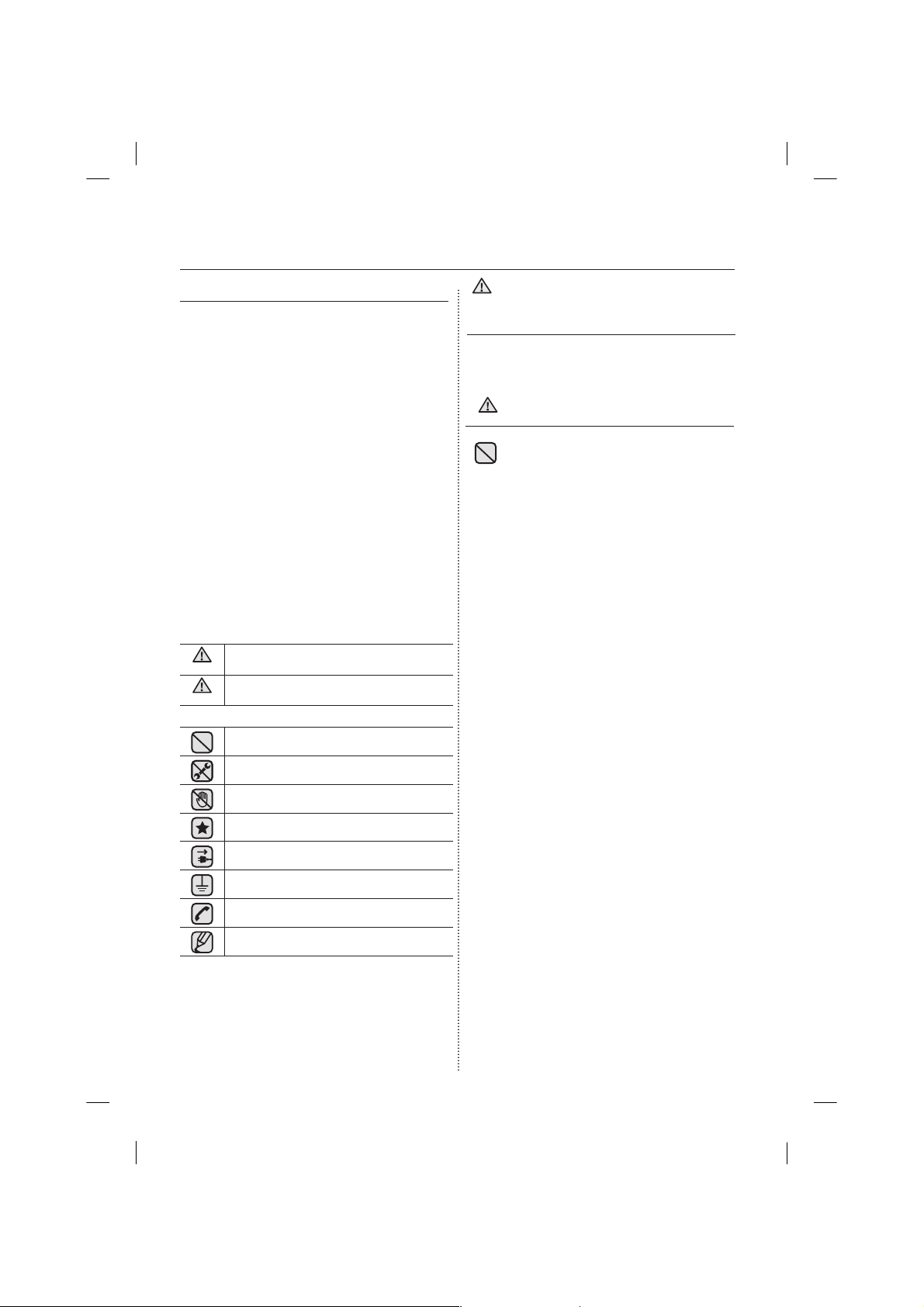
Important safety symbols and
precautions:
WARNING
Hazards or unsafe practices that may result in
severe personal injury or death.
CAUTION
Hazards or unsafe practices that may result in
minor personal injury or property damage.
Do NOT attempt.
Do NOT disassemble.
Do NOT touch.
Follow directions carefully.
Unplug the power plug from the wall socket.
Make sure the refrigerator is grounded to
prevent electric shock.
Call the contact center for help.
Note.
These warning signs are here to prevent
injury to you and others.
Please follow them carefully.
After reading this section, keep it in a safe
place for future reference.
SEVERE WARNING SIGNS
FOR INSTALLATION
Do not install the refrigerator in a damp •
place or place where it may come in
contact with water.
Deteriorated insulation of electrical parts may
-
cause an electric shock or fi re.
Do not place this refrigerator in direct sunlight •
or expose to the heat from stoves, room
heaters or other appliance.
Do not plug several appliances into the same
•
multiple power strip. The refrigerator should
always be plugged into its own individual electrical
outlet which has a voltage rating that matches
the voltage listed on the refrigerator’s rating plate.
This provides the best performance and also -
prevents overloading house wiring circuits, which
could cause a fi re hazard from overheated wires.
If the wall socket is loose, do not insert the power •
plug.
There is a risk of electric shock of fi re. -
Do not use a cord that shows cracks or abrasion •
damage along its length or at either end.
Do not bend the power cord excessively or •
place heavy articles on it.
Do not twist or tie the power cord.•
Do not hook the power cord over a metal object, •
place a heavy object on the power cord, insert
the power cord between objects, or push the
power cord into the space behind the appliance.
When moving the refrigerator, be careful not to -
roll over or damage the power cord
This may result in an electric shock or fi re. -
Never unplug your refrigerator by pulling on the •
power cord. Always grip plug fi rmly and pull
straight out from the outlet.
Damage to the cord may cause a short-circuit, -
fi re and/or electric shock.
Do not use aerosols near the refrigerator.•
Aerosols used near the refrigerator may cause -
an explosion or fi re.
Do not install this appliance near a heater, •
infl ammable material.
Do not install this appliance in a humid, oily or •
dusty location, in a location exposed to direct
WARNING
DA68-02601B.indb 022012.5.16 3:1:38 PM
STATE OF CALIFORNIA
PROPOSITION 65 WARNING
(US ONLY)
• This product contains chemicals known to the
State of California to cause cancer and birth
defects or other reproductive harm.
WARNING
Safety information _03
This may result in an electric shock or fi re. -
This refrigerator must be properly •
installed and located in accordance with
the manual before you use it.
Connect the power plug in the proper position •
with the cord hanging down.
If you connect the power plug upside down, the -
wire can get cut off and cause a fi re or electric
shock.
When moving the refrigerator, be careful not to •
roll over or damage the power cord.
This constitutes a fi re hazard. -
Make sure that the power plug is not squashed •
or damaged by the back of the refrigerator.
Keep the packing materials out of reach of •
children.
There is a risk of death from suffocation if a child -
puts the packing materials on his or her head.
The appliance must be positioned so that the •
plug is accessible after installation.
You need to remove all the protective plastic •
fi lm before you initially plug the product in.
The refrigerator must be safely grounded.•
Always make sure that you have grounded the
refrigerator before attempting to investigate or
repair any part of the appliance. Power leakages
can cause severe electric shock.
Never use gas pipes, telephone lines or other •
potential lightning attractors as an electrical
ground.
Improper use of the grounding plug can result in -
a risk of electric shock. If it is necessary to use
an extension cord, use only a 3-wire
extension cord that has a 3-blade grounding
plug and a 3-slot receptacle that will accept
the plug on the appliance. The marked rating
of the extension cord should be AC115-120 V,
10 A, or more. If a grounding adapter is used,
make sure the receptacle box is fully grounded.
If the power cord is damaged, have it •
replaced immediately by the manufacturer
or its service agent.
INSTALLATION CAUTIONS
Allow suffi cient space to install the •
refrigerator on a fl at surface.
If your refrigerator is not level, the internal -
cooling system may not work correctly.
Keep the ventilation space in the appliance •
enclosure or mounting structure clear of
obstruction.
Allow the appliance to stand for 2 hours after •
installation.
We recommend you have installed this refrigerator •
by a qualifi ed technician or service company.
Failing to do so may result in an electric shock,
-
fi re, explosion, problems with the product, or
injury.
CRITICAL USAGE WARNINGS
Do not insert the power plug with wet •
hands.
•
Do not store articles on the top of the appliance.
When you open or close the door, the articles -
may fall and cause personal injury and/or
material damage.
Do not put a container fi lled with water on the •
refrigerator.
If spilled, there is a risk of fi re or electric shock. -
Children should be supervised to ensure that •
they do not play with the appliance.
Keep fingers out of “pinch point” areas; -
clearances between the doors and cabinet are
necessarily small. Be careful when you open
the doors when children are in the area.
Do not let children hang on the door. A serious •
injury may occur.
Do not let children go inside the refrigerator.•
Children could become trapped.
Do not insert your hands into the bottom area •
under the appliance.
Any sharp edges may cause personal injury. -
Do not let children step on a drawer’s cover.•
The drawer may break and cause them to slip. -
Do not overfi ll the refrigerator with food.•
When you open the door, an item may fall out -
and cause personal injury or material damage.
Do not touch the inside walls of the freezer or •
products stored in the freezer with wet hands.
This may cause frostbite. -
Never put fi ngers or other objects into the water •
dispenser hole, ice chute, or ice maker bucket.
It may cause personal injury or material damage. -
Do not spray fl ammable gas near the refrigerator.•
There is a risk of explosion or fi re. -
Do not store volatile or fl ammable substances •
in the refrigerator.
The storage of benzene, thinner, alcohol, ether, -
LP gas and other such products may cause
explosions.
Do not store pharmaceuticals products, •
scientifi c materials, or temperature sensitive
products in the refrigerator.
Products that require strict temperature -
controls must not be stored in the refrigerator.
Do not place or use an electrical appliance •
inside the refrigerator, unless it is of a type
recommended by the manufacturer.
CAUTION
WARNING
DA68-02601B.indb 032012.5.16 3:1:39 PM
-
sunlight and water (rain drops).
Do not install this appliance in a location where •
gas may leak.
04_ Safety information
Do not stand on top of the appliance or place •
objects (such as laundry, lighted candles,
lighted cigarettes, dishes, chemicals, metal
objects, etc.) on the appliance. This may result
in an electric shock, fi re, problems with the
product, or injury. Do not put a container fi lled
with water on the appliance.
If spilled, there is a risk of fi re or electric shock. -
Do not use mechanical devices or any other •
means to accelerate the defrosting process, other
than those recommended by the manufacturer.
Do not damage the refrigerant circuit.•
Do not spray volatile material such as •
insecticide onto the surface of the appliance.
As well as being harmful to humans, it may -
also result in an electric shock, fi re or problems
with the product.
Never stare directly at the UV LED lamp for •
long periods of time.
This may result in eye strain due to the -
ultraviolet rays.
Do not disassemble or repair the •
refrigerator by yourself.
You run risk of causing a fi re, malfunction and/ -
or personal injury.
When the interior or exterior LED lamp has -
gone out, please contact your service agents.
Children should be supervised to ensure •
that they do not play with the appliance.
Keep fi ngers out of “pinch point” areas : -
clearances between the doors and cabinet are
necessarily small. Be careful when you open
the doors when children are in the area. Do not
let children hang on the door. If not, a serious
injury may occur. Risk of children entrapment.
Do not let children enter inside the refrigerator.
Bottles should be stored tightly together so •
that they do not fall out.
This product is intended only for the storage of •
food in a domestic environment.
If a gas leak is detected, avoid any naked •
fl ames or potential sources of ignition and air
the room in which the appliance is standing for
several minutes.
Do not touch the appliance or power cord. -
Do not use a ventilating fan. -
A spark may result in explosion or fi re. -
Use only the LED Lamps provided by •
manufacturer or service agents.
If there are burning smells or smoke, pull •
out power plug immediately and contact
your Samsung Electronics service center.
If you experience diffi culty when changing the •
light, contact a service agent.
If the product is equipped with LED Lamps, •
do not disassemble the Lamp Cover and LED
Lamp by yourself.
Please contact your service agents. -
If any dust or water is in refrigerator, pull out •
the power plug and contact your Samsung
Electronics service center.
Otherwise there is a risk of fi re. -
USAGE CAUTIONS
Do not re-freeze frozen foods that •
have thawed completely. Do not place
carbonated or fi zzy drinks in the freezer
compartment. Do not put bottles or
glass containers in the freezer.
When the contents freeze, the glass may break -
and cause personal injury.
Use only the ice maker provided with the •
refrigerator. The water supply to this refrigerator
must only be installed/connected by a suitably
qualifi ed person and connected to a potable
water supply only. In order to operate the
ice maker properly, water pressure of 20 ~
125psi is required. If you have a long vacation
or business trip and won’t use water or ice
dispensers, close the water valve.
Otherwise, water leakage may occur. -
Wipe excess moisture from the inside and •
leave the doors open.
Otherwise, odor and mold may develop. -
Service warranty and Modifi cation.•
Any changes or modifi cations performed -
by a 3rd party on this fi nished appliance
are not covered under Samsung
warranty service, nor can Samsung be
responsible for safety issues that result
from 3rd party modifi cations.
Do not block air holes.•
If the air holes are blocked, especially with a -
plastic bag, the refrigerator can be over cooled.
If this cooling period lasts too long, the water
fi lter may break and cause water leakage.
If the refrigerator is disconnected from the •
power supply, you should wait for at least fi ve
minutes before plugging it back in.
If you have a long vacation planned or the •
refrigerator is not to be used for a long period
of time, you must empty the refrigerator and
pull out the power plug.
Letting the refrigerator run for a long time -
without using it can cause the insulation to
deteriorate and may cause a fi re.
CAUTION
DA68-02601B.indb 04DA68-02601B.indb 042012.5.16 3:1:39 PM2012.5.16 3:1:39 PM
Safety information _05
Wipe excess moisture from the inside and -
leave the doors open. Otherwise, odor and
mold may develop.
To get the best performance from the product:
Do not place foods too close to the vents at -
the rear of the appliance as it can obstruct free
air circulation in the refrigerator compartment.
Wrap food up properly or place it in airtight -
containers before putting it into the refrigerator.
Fill the water tank, ice tray, and water cubes
only with potable water.
If the product is fl ooded, make sure to
contact your nearest service center.
There is a risk of electric shock or fi re. -
CLEANING CAUTIONS
Do not directly spray water on the inside
or outside the refrigerator.
There is a risk of fi re or electric shock. -
Do not use a hair dryer to dry the inside of the
refrigerator. Do not place a lighted candle in
the refrigerator to remove bad odors.
This may result in an electric shock or fi re. -
Remove any foreign matter or dust from
the power plug pins. Do not use a wet
or damp cloth when cleaning the plug.
Otherwise, there is a risk of fi re or electric shock. -
Unplug the refrigerator before cleaning
or making repairs.
CRITICAL DISPOSAL
WARNINGS
Risk of child entrapment. Before you
throw away your old refrigerator or freezer:
-
Leave the shelves in place so that children can -
not easily climb inside.
Please dispose of the packaging material from
this product in an environmentally friendly
manner.
Leave the shelves in place so that children
can not easily climb inside. Ensure that none
of the pipes on the back of the appliance are
damaged prior to disposal.
R600a or R134a is used as a refrigerant.
Check the compressor label on the rear of
the appliance or the rating label inside the
fridge to see which refrigerant is used for your
refrigerator. If this product contains fl ammable
gas (Refrigerant R600a), contact your local
authority in regard to safe disposal of this
product.
When disposing of this refrigerator, remove the
door/door seals and door latch so that small
children or animals cannot become trapped
inside. Children should be supervised to ensure
that they do not play with the appliance.
Cyclopentane is used in the insulation. The
gases in the insulation material require a special
disposal procedure. Please contact your local
authorities in regard to the environmentally safe
disposal of this product. Ensure that none of
the pipes on the back of the refrigerator are
damaged prior to disposal.
contents
SETTING UP YOUR FRENCH DOOR REFRIGERATOR ……………………………………………… 06
OPERATING YOUR FRENCH DOOR REFRIGERATOR ………………………………………………… 13
TROUBLESHOOTING ……………………………………………………………………………………… 24
WARNING
CAUTION
DA68-02601B.indb 052012.5.16 3:1:40 PM
06_
setting up
Setting up your French Door
Refrigerator
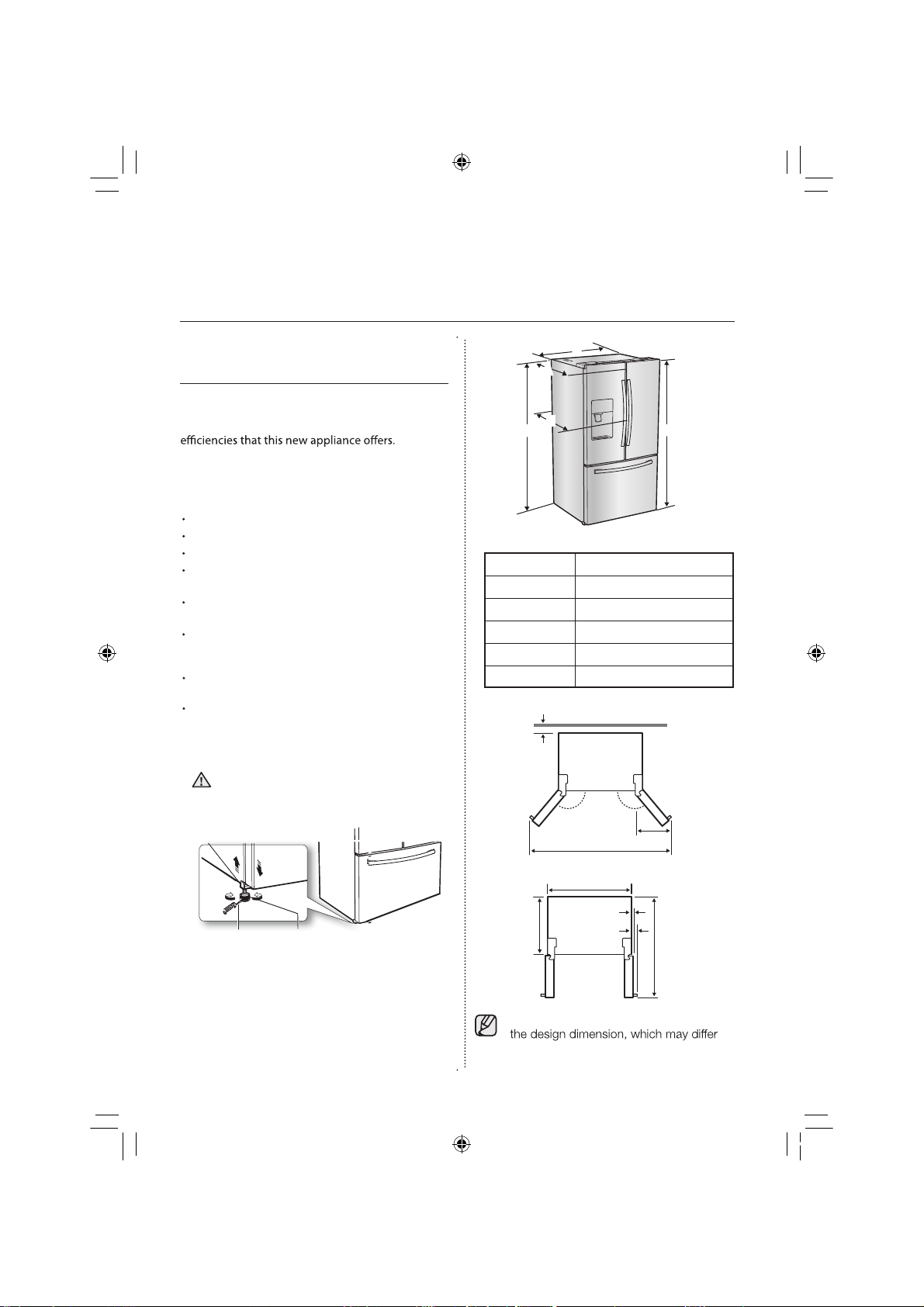
GETTING READY TO INSTALL
THE REFRIGERATOR
Congratulations on your purchase of this Samsung
French Door Refrigerator.
We hope you enjoy the state-of-art features and
A location with easy access to a water supply.
Choose:
A location without direct exposure to sunlight.
A location with a level floor.
A location with enough space for the
refrigerator doors to open easily.
A location that allows sufficient space to the
right, left, back and top for air circulation.
A location that allows you to move the
refrigerator easily if it needs maintenance or
service.
Do not install the refrigerator where the
temperature will go below 50ºF (10ºC).
When moving your refrigerator
To prevent floor damage, be sure the front
adjusting legs are in the up position (above
the floor). Refer to ‘Adjusting the Level’ in
the manual (on page 9).
B
A
C
E
D
B
A
C
E
D
Flat-blade screw
driver(-)
Control Lever
CAUTION
2012.3.31 9:49:31 AM
Model
Depth “A”
Width “B” 35 3/4” (909mm)
Height “C” 68 3/8” (1737mm)
Overall Height “D”
Depth “E”
35 3/4” (910mm)
The measurements here are based on
depending on the measuring method.
Do not locate the refrigerator where it may
become wet.
140
°
140
°
2”
(50 mm)
13 3/8”
(340 mm)
63 3/4”
(1620 mm)
1 5/8”
(40 mm)
3 3/4”
(95 mm)
29 1/4”
(745 mm)
48 ”
(1220 mm)
35 3/4”
(909 mm)
Selecting the best location for the refrigerator
70” (1778 mm)
RF263T**/ RF263B**
33 1/2” (850mm)
setting up
_07
01 SETTING UP
FLOORING
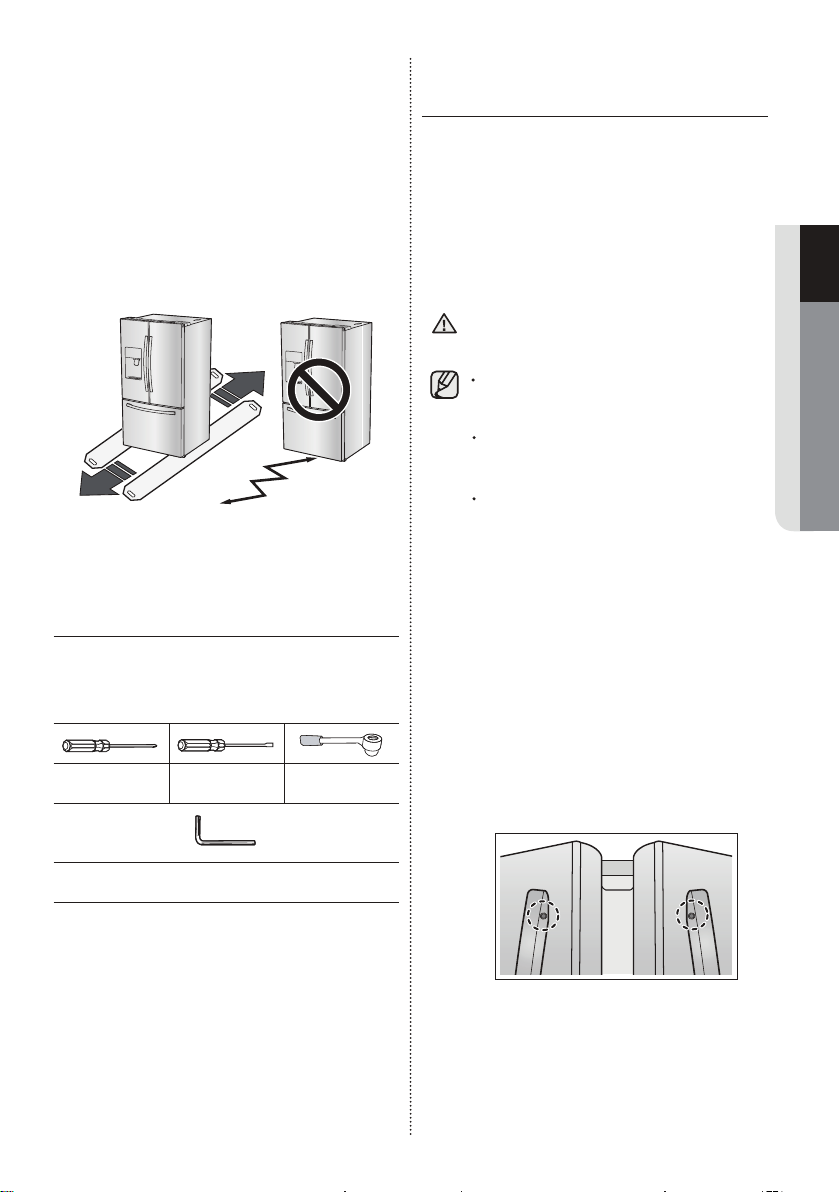
For proper installation, you must place this
refrigerator on a level, hard surface that is the
same height as the rest of the floor. This surface
should be strong enough to support a fully loaded
refrigerator, or approximately 335lbs (152kg).
To protect the finish of the flooring, cut a large
section of the cardboard carton and place it under
the refrigerator where you are working. When
moving the refrigerator, you need to pull and push
it straight forwards or back. Do not wiggle it from
side to side.
REQUIRED TOOLS
Required Tools (Not provided)
You need the following tools to complete the
installation of your refrigerator:
Philips
screwdriver(+)
Flat-blade screw
driver(-)
Socket wrench
(10mm)
Allen wrench
(3/16”) (5mm)
REMOVING THE
REFRIGERATOR DOORS
For some installations you need to remove the
fridge and freezer drawers so you can move the
refrigerator to its final location. Do not remove
the doors/drawer if you don’t need to.
If you do
not need to remove the refrigerator doors, go to
Adjusting the Level on page 9. If you need to
remove the doors. continue below.
Before removing the door/drawer, make sure you
read the following items:
Disconnect power to the refrigerator before
removing the door or drawer.
Be careful not to drop, damage or scratch
the door/drawer while removing them.
Reattach the doors/drawer properly to
avoid:
- Moisture from air leakage.
- Uneven door alignment.
- Wasting energy due to improper door
seal.
Use care when you remove the doors/
drawer. The
doors are heavy and you
could injure yourself.
WARNING
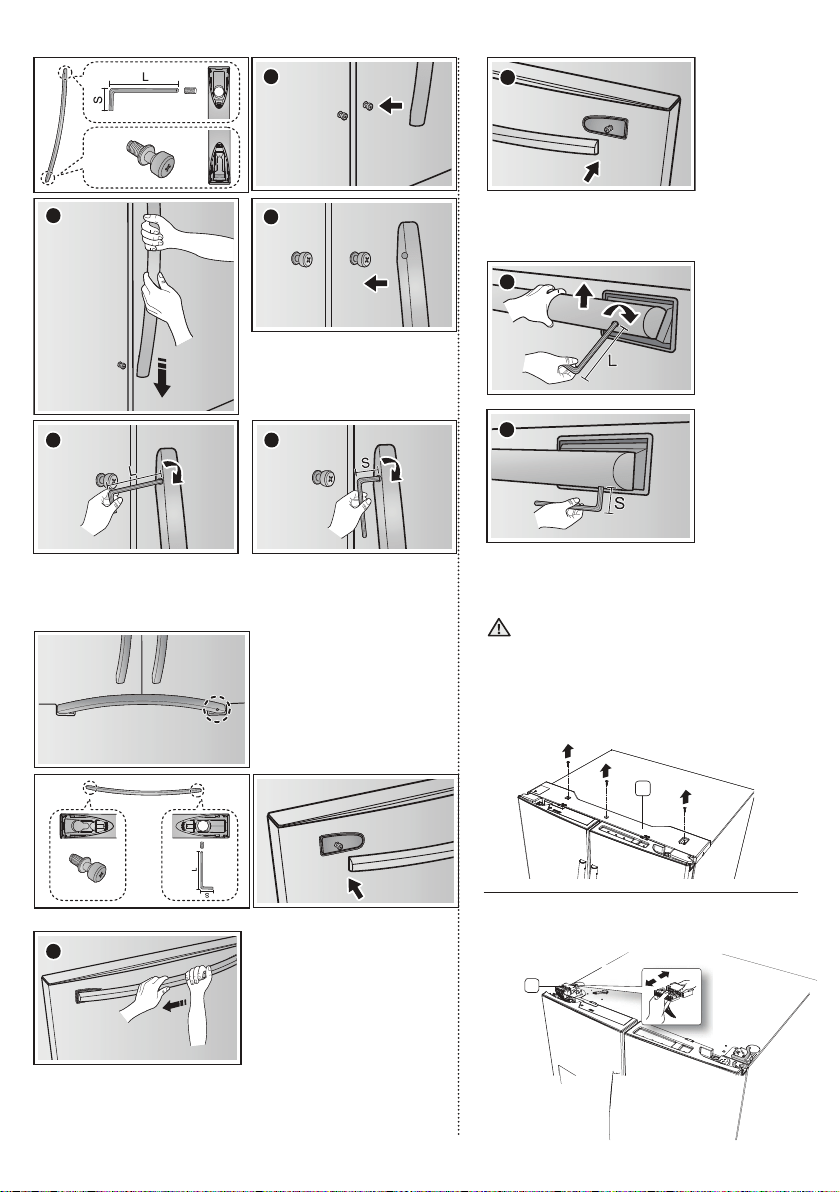
HOW TO ASSEMBLE THE HANDLE
Orient each handle so that the end with the sticker
attached is at the top and the holes with the
tightening screws are facing each other.
Then, follow the directions below to install each
handle.
By using Phillips screwdriver, fix the screw
(optional) and then put the handle on the fixer
by sliding them down firmly.
setting up
08_
Fix the handles to the doors by sliding them left
side firmly.
4
3
2
1
Fix the handles to the doors by
sliding them down firmly.
3
5
4
Tighten with wrench
Drawer door handle assembly
Check the direction of Handle
assembly.
1
2
Fix the handles to the doors by
sliding them left side firmly.
5
Tilt up the Handle bar and tighten with wrench
firmly.
Disassemble the refrigerator doors
Be careful not to drop and scratch the
doors while removing them.
With the door opened
Remove 3 screws holding down the TOP 1.
TABLE ( 1 ) and turn it with wires connected.
Disconnect two connector (
2
) on the left side
door. To remove the water coupler from the
WARNING
2
1
hinge, twist and pull it from the hinge.
screw
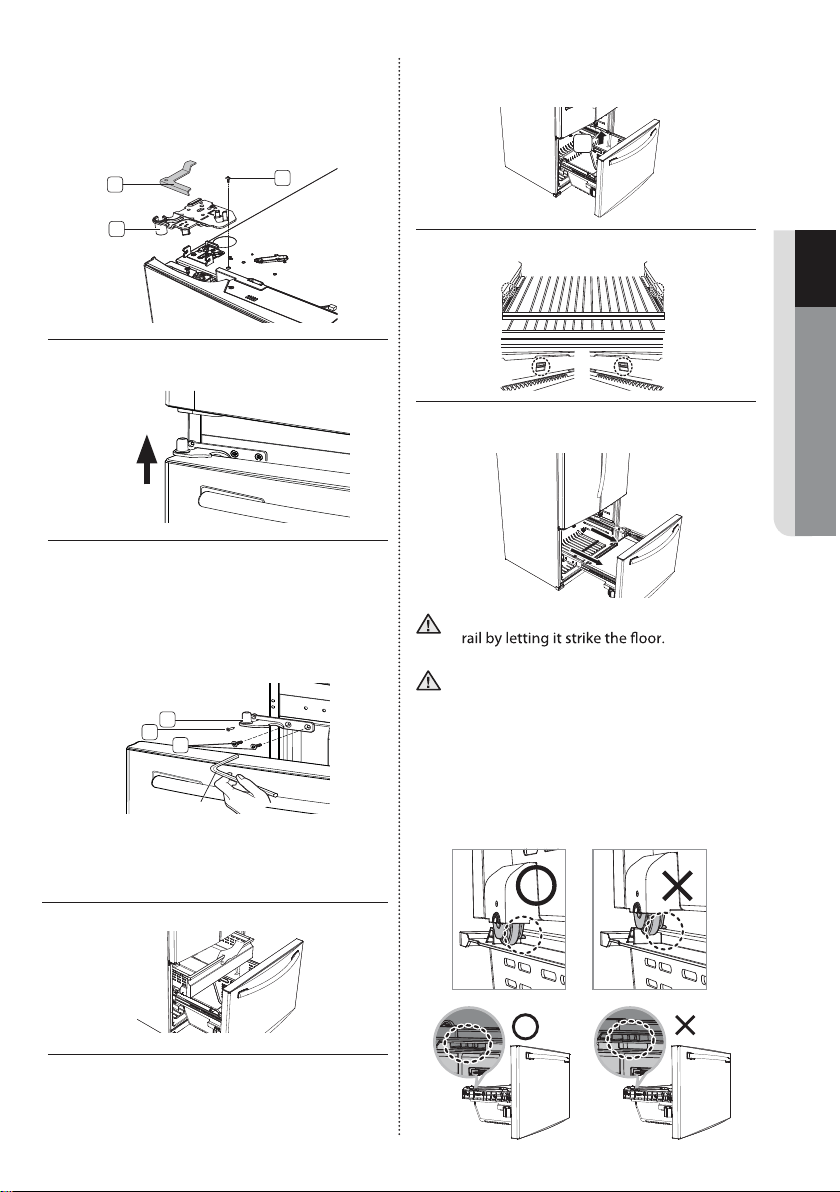
_09
setting up
Pull and remove the hinge lever ( 3
3.
) . Remove
the ground screw ( 4 ) attached to the upper
left door hinges with a philips screwdriver (+).
Remove the upper left and right door hinges
( 5 ).
Lift the door straight up to remove.4.
Remove the screw (5. 6 ) attached to the
lower left and right door hinges with a philips
screwdriver (+). Remove the 2 hex head bolts
( 7 ) attached to the lower left and right door
hinges with an allen wrench (3/16”). Remove
the lower left and right door hinges (
Take out the upper drawer by lifting it up.
8 ).
DISASSEMBLE THE FLEX DOOR
1.
Take out the lower basket ( 1
2.
) by lifting the
basket up from the rail system.
Press the fi xing hook of rail system. 3.
Holding the top of the Freezer Drawerpull it out all4.
the way and then remove it from the rail system.
Be careful not to scratch or dent the sliding
Make sure that you mount the freezer
basket in the right position when removing
/ installing the freezer door. Failing to do
so may result in the door not opening or
closing properly.
Do not overload the bottom basket or
the top drawer. Overloading prevents the
Freezer drawer from closing properly and
will eventually cause frost build-up.
3
4
5
Allen wrench
8
6
7
1
CAUTION
CAUTION
2012.5.16 3:1:46 PM
01 SETTING UP
setting up
10_
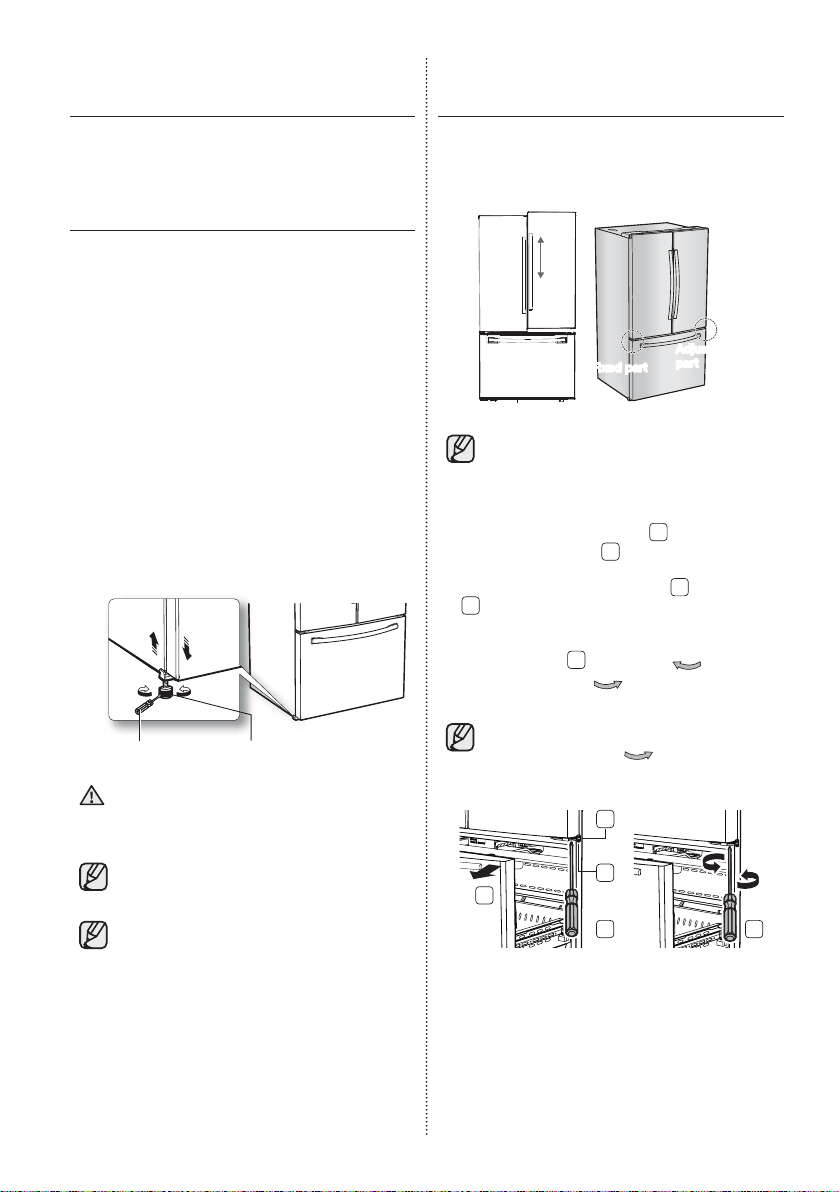
MAKING MINOR ADJUSTMENTS
BETWEEN DOORS
Remember, a leveled refrigerator is necessary
for getting the doors perfectly even. If you need
help, review the previous section on leveling the
refrigerator.
The left door is fi xed. To make minor
adjustments between doors, adjust only
the right door.
ASSEMBLE THE FREEZER
DRAWER
To reattach the drawer after you have moved
the fridge to its fi nal location, assemble the parts in
reverse order.
ADJUSTING THE LEVEL
Make sure the refrigerator is level so that you can
make fi nal adjustments. Use a level to test if the
refrigerator is level both side to side and back to
front. If the refrigerator is not level, it will not be
possible to get the doors perfectly even, which
may cause moisture condensation and increased
energy bills. Below is an example of how to level
the refrigerator if the left side of the refrigerator is
lower than the right side.
How to adjust the level
1.
Open the freezer drawer and remove the lower
basket.
2.
Insert a flat-blade screwdriver (-) into a notch
on the left control lever, and turn it counter
clockwise to level the refrigerator. (You turn the
lever clockwise to lower the refrigerator and
counterclockwise to raise it.)
Both control levers must be touching the
fl oor to avoid possible personal injury or
property damage because of tipping.
If the right side is lower, perform the same
procedure, but with the right control lever.
It is diffi cult to remove the cover leg
front from the refrigerator, so we do not
recommend making small adjustments
with the control lever. Instead, refer to the
next page for the best way to make minor
adjustments to the doors.
CAUTION
fl at-blade screwdriver(-)
Control Lever
Adjustment
part
Fixed part
2012.5.16 3:1:58 PM
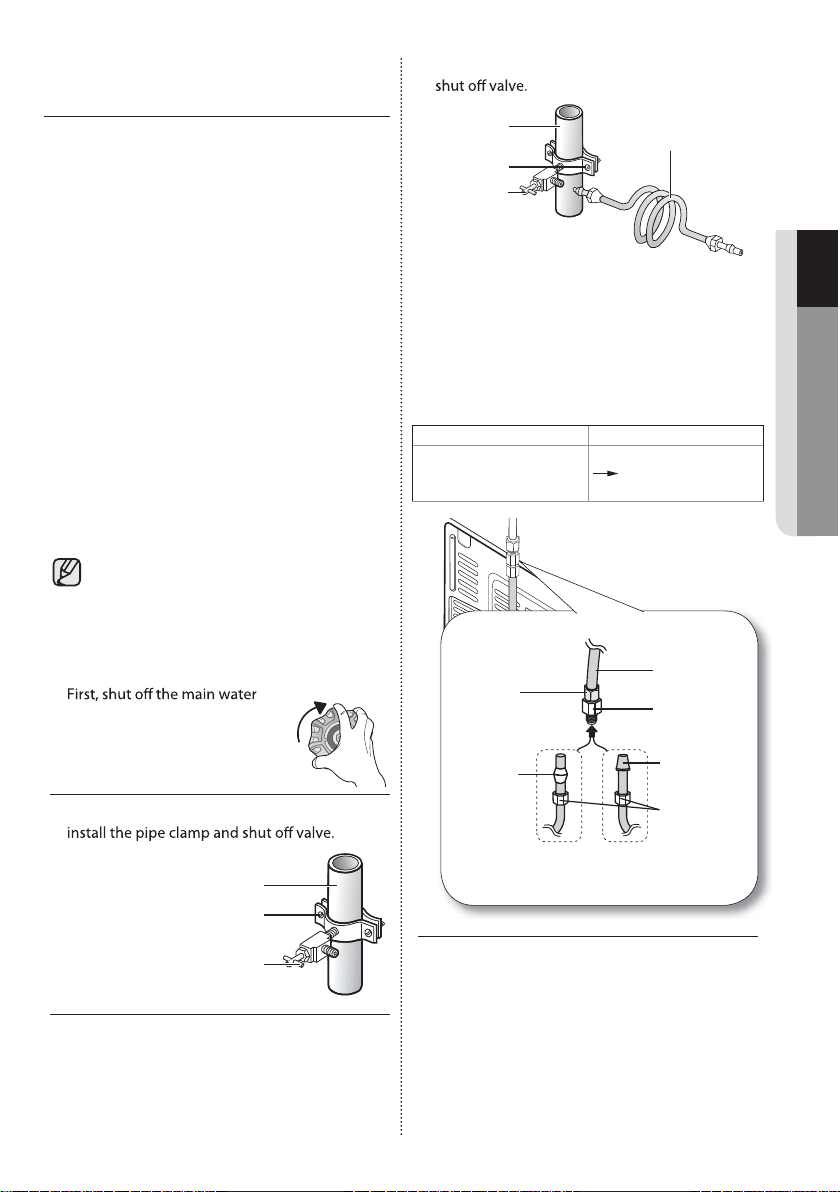
1. Pull out the freezer drawer ,then you can
see the lower hinge .
2.
3. Adjust the height by turning a philips
screwdriver (+) clockwise ( ) or
counterclockwise ( ).
1
2
3
4
Insert a philips screwdriver (+) into the shaft
of the lower hinge.
DOWN
UP
3
When you turn a philips screwdriver (+)
counterclockwise ( ), the door will
move up.
UP
1
2
3
4
3
_11
setting up
INSTALLING THE WATER
DISPENSER LINE
A water dispenser with a fi lter is one of the helpful
features on your new refrigerator. To help promote
better health, the water fi lter removes unwanted
particles from your water. However, it does not
sterilize or destroy microorganisms. You may need
to purchase a water purifying system to do that.
The water line also connects to the ice maker.
For the ice maker to operate properly, water pressure
of 20~125psi ( 138~862kPa) is
required.
If the refrigerator is installed in an area with low
water pressure (below 20psi), you can install
a booster pump to compensate for the low
pressure.
After you have connected the water line, make
sure the water storage tank inside the refrigerator
is properly fi lled. To do this, press the water
dispenser lever until the water runs from the water
outlet.
Water line installation kits are available at
extra cost from your dealer.
We recommend using a water line
installation kit that contains copper tubing
and ¼” compression nut.
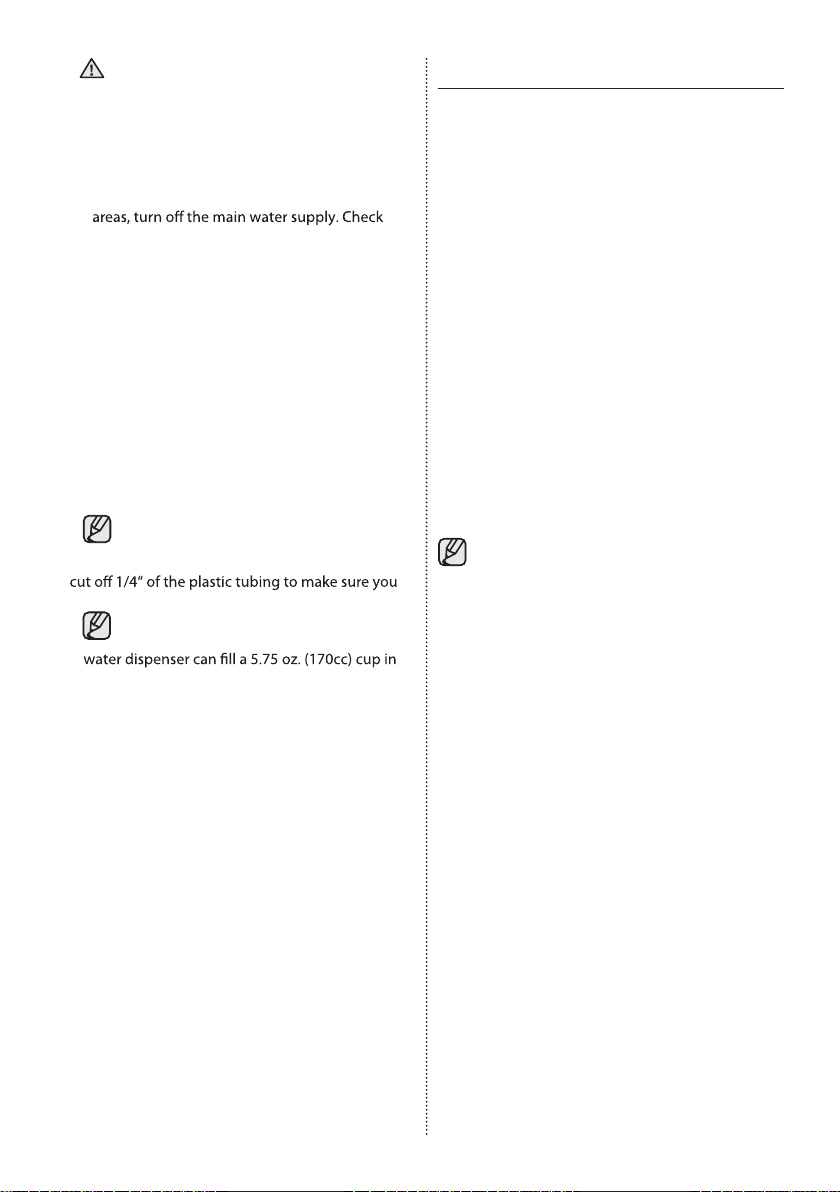
Connecting to the water supply line
1.
supply.
Locate the nearest cold water drinking line and 2.
Connect the water line installation kit to the 3.
Connecting the water supply line to
the refrigerator.
There are several items that you need to purchase
to complete this connection.
You may fi nd these items sold as a kit at your local
hardware store.
Use Copper Tubing Use Plastic Tubing
¼” copper tubingt
¼” compression nut (1pc)t
Ferrule (2pc)t
¼” plastic tubing t
Molded end(Bulb)
¼” compression nut (1pc)t
Connect the household water line to the 1.
assembled compression fi tting.
If you are using copper tubing, slip the -
compression nut ( B ) (not supplied) and
ferrule (not supplied) on the copper tubing (not
supplied) as shown.
If you are using plastic tubing ( - B ) , insert the
molded end (Bulb) of the plastic tubing ( B )
into the compression fi tting.
Pipe clamp
Cold water line
Shut off valve
Compression
Nut (1/4”)
(Assembled)
Ferrule
(Not supplied)
Plastic Tubing
(Assembled)
Compression
Fitting
(Assembled)
Molded
end(Bulb)
Compression
nut (B) (1/4”)
(Not supplied)
or
Copper tubing
(Not supplied)
Plastic tubing (B)
(Not supplied)
Household water supply line
Refrigerator
Shut off valve
Pipe clamp
Cold water line
Water line installation kit
2012.5.16 3:1:59 PM
01 SETTING UP
setting up
12_
Do not use without the molded end (Bulb)
of the plastic tubing ( B ).
Tighten the compression nut ( B ) onto the
compression fi tting.
Do not over-tighten the compression nut ( B ) .
Turn water on and check for any leakage. If you 2.
fi nd water drops or leakage in the connection
the connections and, if necessary, tighten.
Flush 1 gallon of water through the fi lter 3.
before drinking or using the water from the
refrigerator. (Flush approximately 6 minutes.)
To fl ush, press a large glass or cup against the
water dispenser lever. Fill the glass, empty it
into the kitchen sink after it is fi lled, and then
repeat.
After you turn on the refrigerator, let the ice 4.
maker make ice for 1 to 2 days. Over that
period of time, throw out the fi rst 1 or 2
buckets of ice the freezer makes to ensure all
impurities have been removed from the water
line.
Only connect the water line to a drinkable
water source.
If you have to repair or disassemble the water line,
get a snug, leak-free connection.
COMPLETING THE SET UP
Now that you have your new refrigerator installed
in place, you are ready to set up and enjoy the
features and functions of the appliance.
By completing the following steps, your refrigerator
should be fully operational.
Make sure your refrigerator is in an appropriate 1.
location with reasonable clearance between it
and the wall. Refer to installation instructions in
this manual.
Once the refrigerator is plugged in, make sure 2.
the interior light comes on when you open the
doors.
Set the Temperature control to the coldest 3.
temperature and wait for an hour. The freezer
will get slightly chilled and the motor will run
smoothly. Reset the refrigerator and freezer to
the temperatures you want.
After you plug the refrigerator in, it will 4.
take a few hours to reach the appropriate
temperature. You can store food and drinks
in the refrigerator after the temperature is
suffi ciently cool.
CAUTION
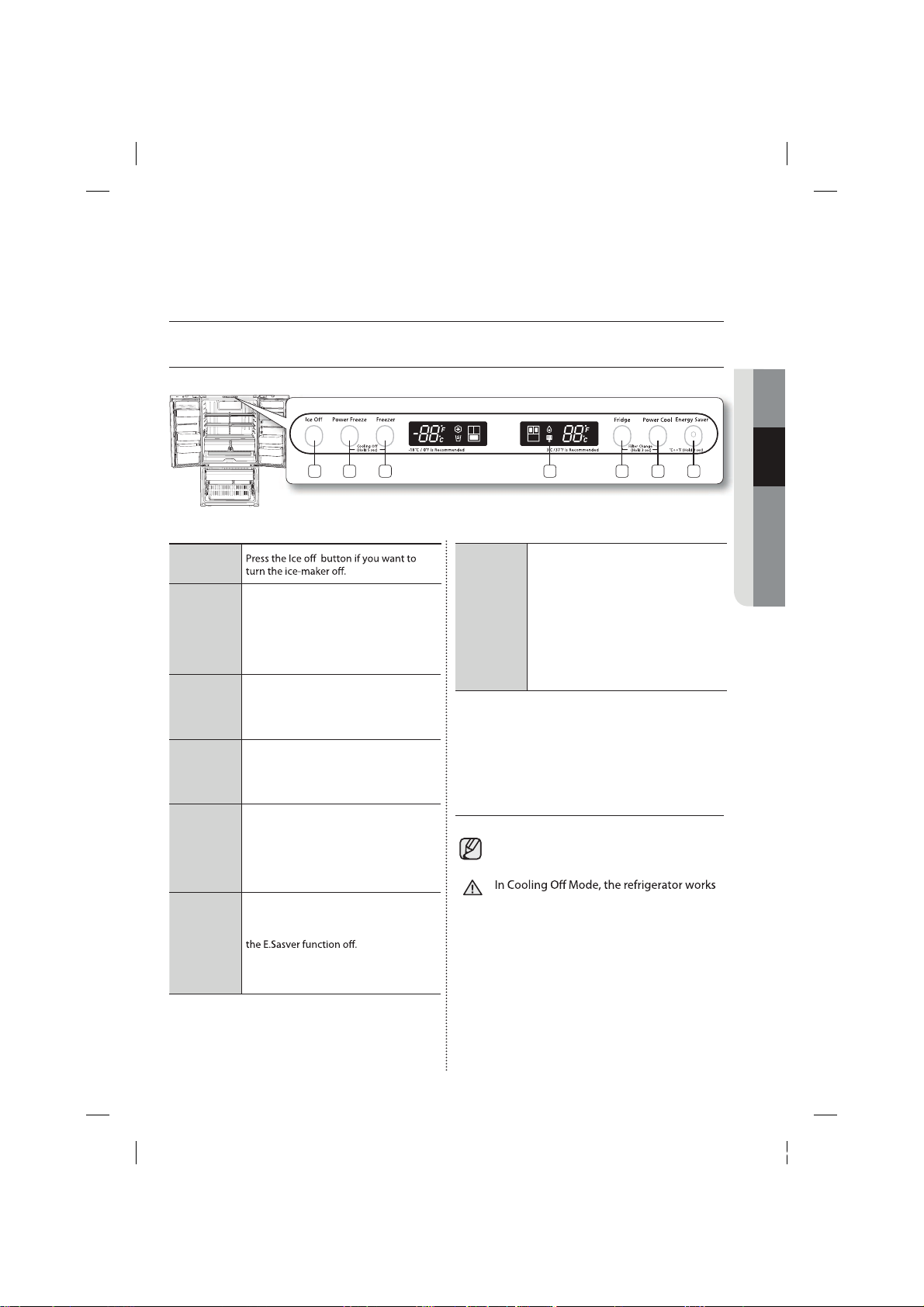
You can test the water line quickly using a
paper cup. Under normal conditions, the
about 10 seconds.
2012.5.16 3:2:1 PM
Under normal conditions, a 170 cc (5.75 oz.) cup
can be fi lled in about 10 seconds.
1.
_13
operating
Operating your French Door
Refrigerator
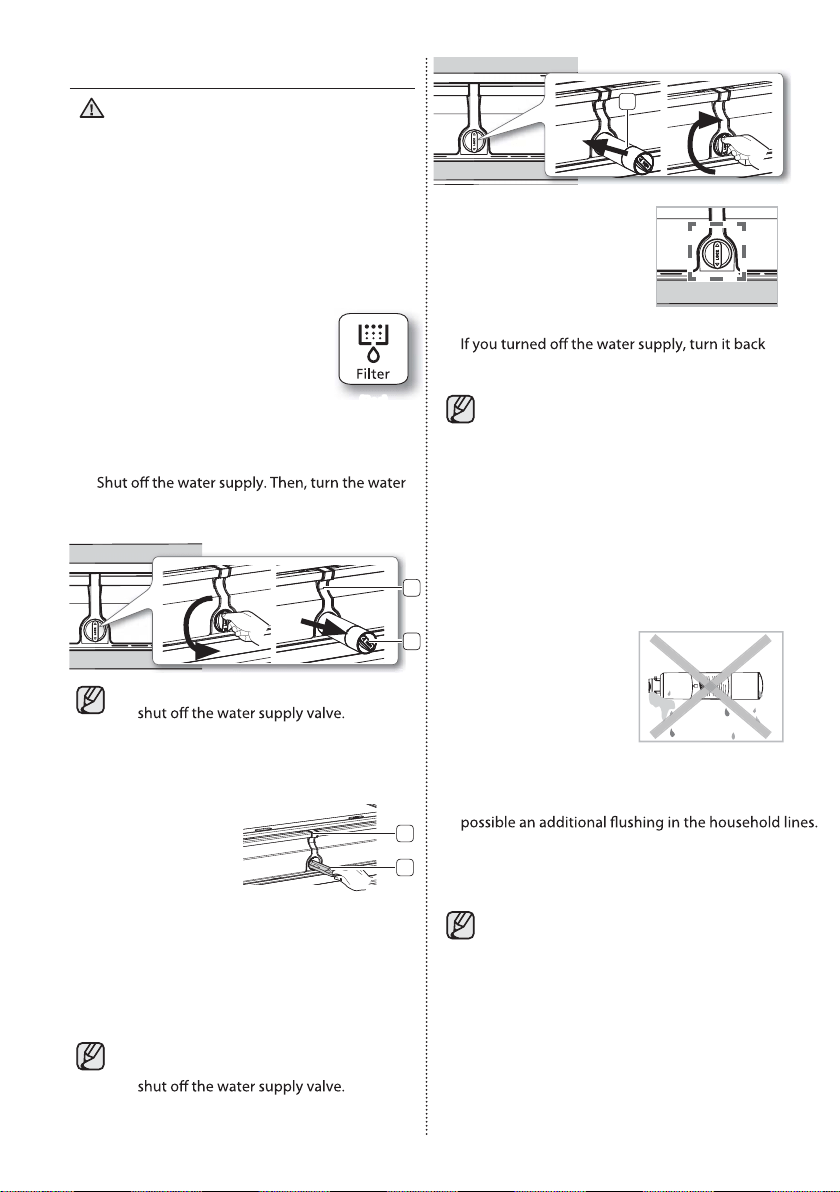
( 1 ) Ice Off
Button
( 2 ) Power
Freeze
Button
Speeds up the time needed to freeze
products in the Freezer. It can be helpful
if you need to quickly freeze easily
spoiled items or if the temperature in the
Freezer has warmed dramatically (for
example, if the door was left open).
( 3 )
Freezer
Button
Press the Freezer button to set the
Freezer to your desired temperature. You
can set the temperature between 5°F
(-15°C) and -8°F(-23°C) .
( 4 ) Fridge
Button
Press the Fridge button to set the fridge
to your desired temperature.
You can set temperature between
34°F(1°C) and 44°F(7°C) .
( 5 ) Power
Cool
Button
Speeds up the time needed to cool
products in the Refrigerator. It can be
helpful if you need to quickly cool easily
spoiled items or if the temperature in
the fridge has warmed dramatically (For
example, if the door was left open).
( 6 ) E.
Saver
Button
For better energy effi ciency,
press E.Saver button. However, if
condensation occurs on the door, turn
Press this button for 3 seconds to
switch the temperature units between
°C and °F.
( 7 ) Filter
Indicator
When the fi lter indicator light is on, it is
time to change the fi lter. Typically this
happens about every 6 months.
The fi lter Indicator will be Red when you
have used your water fi lter for 6 months.
COOLING OFF MODE
(“OF & OF” CODE ON THE DISPLAY)
This function is for store display
refrigerators. It is not for customer use.
but doesn’t make cool air. To cancel this
mode, press the Power Freeze and Freezer
buttons at the same time for 5 seconds
until a “Ding-dong” sound is heard and the
unit will now cool.
On
e
T
o
u
c
h
P
u
r
e
W
a
t
er
1 2 3 4 5 67
USING THE CONTROL PANEL
CAUTION
2012.5.16 3:2:1 PM
02 OPERATING
The icon will blink red for several
seconds when you open or close the
door.
The filter indicator will be Off when you
insert the new water filter.
operating
14_
CHANGING THE WATER FILTER
To reduce risk of water damage to your
property DO NOT use generic brands
of water fi lters in your SAMSUNG
Refrigerator.
USE ONLY SAMSUNG BRAND WATER FILTERS.
SAMSUNG will not be legally responsible for any
damage, including, but not limited to property
damage caused by water leakage from the use of a
generic water fi lter. SAMSUNG Refrigerators are
designed to work ONLY WITH SAMSUNG Water
Filter.
The Filter light turns red to let you
know when it is time to change your
water fi lter cartridge.
To give you time to get a new fi lter,
the red light comes on just before the
capacity of the current fi lter runs out.
Changing the fi lter on time provides you with the
freshest, cleanest water from your refrigerator.
1.
fi lter ( 1 ) about 1/4 turn, counter-clockwise.
Pull the water fi lter ( 2. 1 ) from the case fi lter ( 2 ).
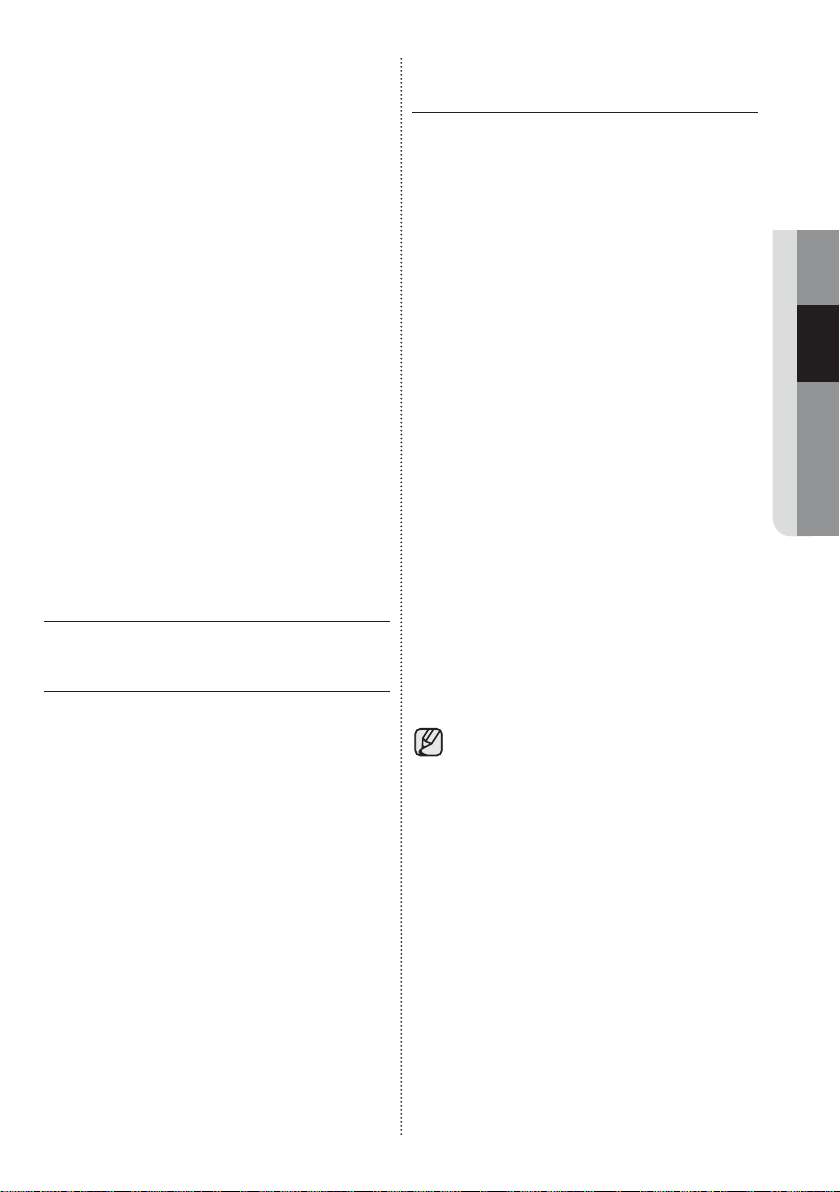
To change the water fi lter more easily, t
t
fi lter because impurities in the water cause it
to stick. If you are having diffi culties, grip the
water fi lter fi rmly and pull it hard.
t
When you pull the
water fi lter, a little
Sometimes it is hard to disassemble the water
water can leak from
the opening. This is
normal. To minimize
the water leaks, keep
the fi lter cartridge horizontal when you pull it.
yart retl fi retaw eht ytpme ,wo flrevo tneverp oTt
( 3 ) and dry around the fi lter case ( 2 ).
Insert the new fi lter into the fi lter case ( 4
3.
).
Push the fi lter, and then turn it clockwise until it 4.
locks.
t
fi lter because of high water pressure,
The locked symbol should be lined up
If you have trouble inserting the water
t
with the indicator line.
After removing the old 5.
water fi lter and installing
a new reset the indicator
by pressing the “Fridge”
and “Power Cool” button
simultaneously for about 3
seconds.
6.
on.
For a replacement water fi lter, you can
visit your local home Improvement center
or contact the Samsung Parts distributor.
Be sure the replacement water fi lter has
the SAMSUNG logo on the box and
on the water fi lter. Link : http://www.
samsungparts.com
Removing any residual matter inside
the water supply line after installing
the water fi lter.
Turn ON the main water 1.
supply and supply water
to the refrigerator.
Run 1 Gal of water through
the
2.
dispenser until the
water
runs clear (approx.
6 to 7 minutes). This will
clean
the water supply system and remove air
from the lines.
If after pour 1 Gal the water doesn’t turn clear is
3.
Open the Refrigerator door and make sure 4.
there are no water leaks coming from the
water fi lter.
Be sure to fl ush the dispenser system thoroughly,
otherwise water may drip fr om the
dispenser.
This means that there is still air in the line.
WARNING
(Red)
2
1
3
2
4
2012.5.16 3:2:3 PM
_15
operating
Reverse Osmosis Water Supply
IMPORTANT:
The pressure of the water supply coming out of a
reverse osmosis system going to the water inlet
valve of the refrigerator needs to be between 35
and 120 psi (241 and 827 kPa).
If a reverse osmosis water fi ltration system is
connected to your cold water supply, the water
pressure to the reverse osmosis system needs to
be a minimum of 40 to 60 psi (276 to 414 kPa.) If
the water pressure to the reverse osmosis system
is less than 40 to 60 psi (276 to 414 kPa):
Check to see whether the sediment fi lter in the t
reverse osmosis system is blocked. Replace
the fi lter if necessary.
Allow the storage tank on the reverse osmosis t
system to refi ll after heavy usage.
t
further reduce the water pressure when used
in conjunction with a reverse osmosis system.
Remove the water fi lter.
If you have questions about your water pressure,
call a licensed, qualifi ed plumber.
CONTROLLING THE
TEMPERATURE
Basic temperature of Freezer and
Refrigerator Compartments
The basic temperature and recommended
temperatures of the Freezer and Refrigerator
Compartments are 0°F and 37°F(or -18°C and
3°C) respectively. If the temperature of the Freezer
and Refrigerator Compartments are too high or
low, adjust the temperature manually.
CONTROLLING THE
TEMPERATURE
Controlling the Freezer temperature
The Freezer temperature can be set between
5°F(-15°C) and -8°F(-23°C) to suit your particular
needs. Press the Freezer button repeatedly
until the desired temperature is shown in the
temperature display. Keep in mind that foods like
ice cream may melt at 4°F(-15°C).
The temperature display will move sequentially
from -8°F(-23°C) to 5°F(-15°C). When the display
reaches 5°F, it will begin again at -8°F(-23°C).
Five seconds after the new temperature is set, the
display will again show the actual current freezer
temperature until the new temperature is reached.
Controlling the Refrigerator
temperature
The Refrigerator temperature can be set between
44°F(7°C) and 34°F(1°C) to suit your particular
needs. Press the Fridge button repeatedly until the
desired temperature is shown in the temperature
display.
The temperature control process for the Fridge
works just like the Freezer process.
Press the Fridge button to set your desired
temperature. After a few seconds, the Fridge
will begin adjusting towards the newly set
temperature. This will be refl ected in the digital
display.
The temperature of the Freezer or the
Refrigerator may rise from opening the
doors too frequently, or if a large amount of
warm or hot food is placed in either side.
This may cause the digital display to
blink. Once the Freezer and Refrigerator
temperature return to their normal set
temperatures, the blinking will stop.
If the blinking continues, you may need to
“reset” the Refrigerator. Try unplugging the
appliance, wait for around 10 minutes and
then plug the power cord back in.
2012.5.16 3:2:5 PM
02 OPERATING
If your refriegerator has a water lter, it may
operating
16_
USING THE COLD WATER
DISPENSER
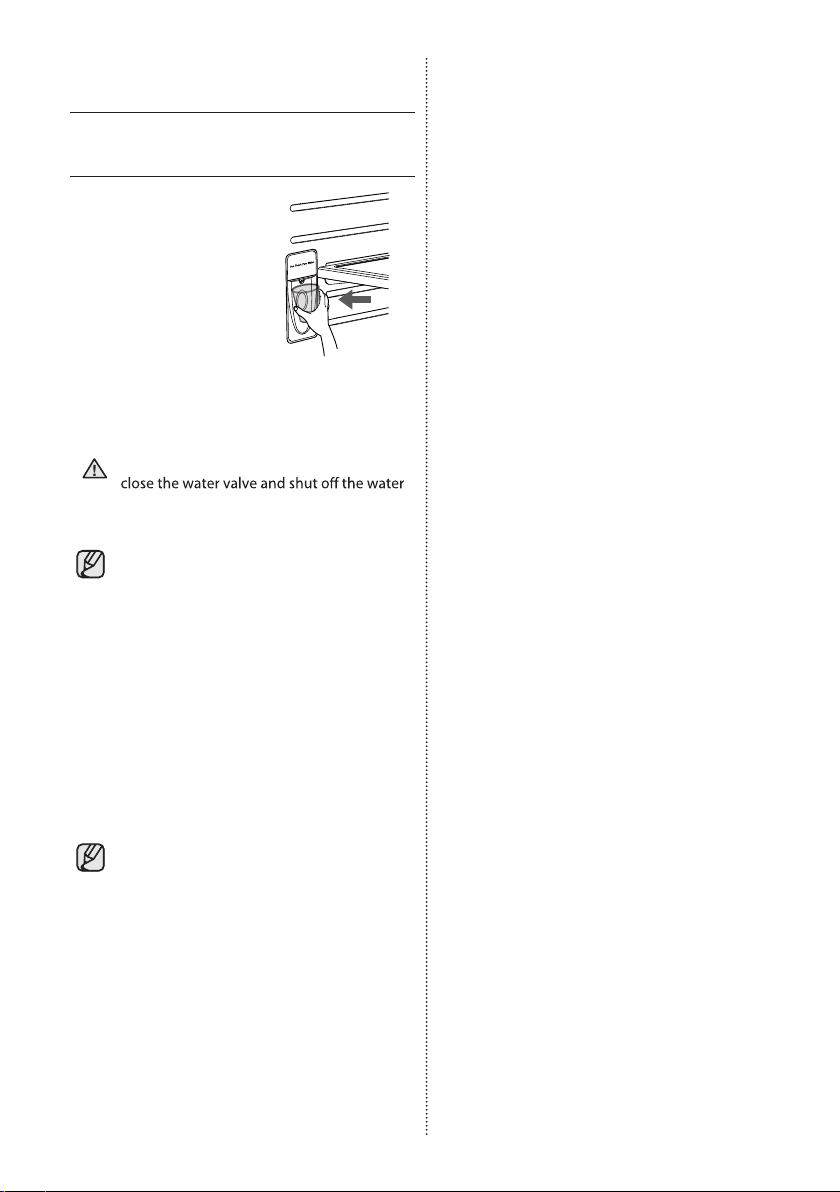
Using the Water dispenser
(RF261B, RF26H)
Place a glass underneath the
water outlet and push gently
against the water dispenser
lever with your glass. Make
sure the glass is in line with
the dispenser to prevent the
water from splashing out.
If you have just installed the
refrigerator or installed a new
water fi lter, Flush 3 gallons through fi lter before
use (fl ush approximately 6 minutes). Make sure
water fl ows cleanly before drinking.
If you have a long vacation or business trip,
supply to the Refrigerator. This will help
prevent accidental leakages.
Water clouding phenomenon
All water provided to refrigerators fl ows
through the core fi lter which is an alkaline
water fi lter. In this process, the pressure in
the water that has fl owed out of the fi lter
gets increased, and oxygen and nitrogen
become saturated. When this water fl ows
out in the air, the pressure plummets and
the oxygen and nitrogen get supersaturated
so that they turn into gas bubbles. The
water could look misty due to these oxygen
bubbles.The water may look temporarily
cloudy due to these oxygen bubbles. After
a few seconds, the water will look clear.
The water tank’s capacity is approximately
one third (1/3) of a gallon.
Please wait 1 second before removing the
cup after dispensing water to prevent spills.
PUSH
CAUTION
2012.5.16 3:2:5 PM
_17
operating
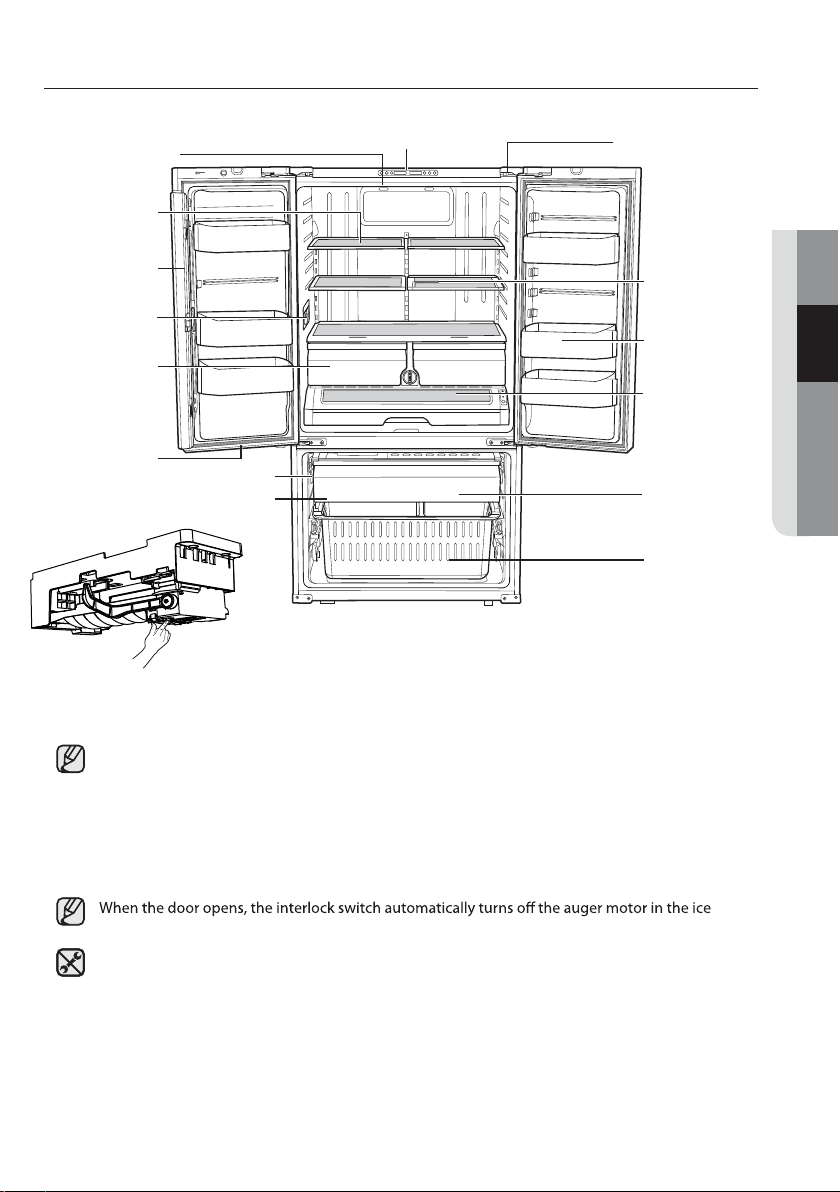
PARTS AND FEATURES
Use this page to become more familiar with the parts and features of the refrigerator
When closing the door, make sure the Vertical Hinged Section is in the correct position to avoid
scratching the other door.
If the Vertical Hinged Section is reversed, put it back to the right position and close the door.
Moisture may appear at times on the Vertical Hinged Section.
The door handle may become loose over time. If this happens, tighten the bolts found on the
inside of the door.
If you close one door with a lot of force, the other door may open.
maker for safety reasons.
When the interior or exterior LED lamp has gone out, please contact your service agents.
O
n
e
Tou
c
h
P
u
re
W
a
te
r
Door Bins
Cool Select
Pantry
Digital Sensor Control Auto Door
Closer
Light
Vertical Hinged
Section
Vegetable &
Fruit Drawers
Slide-Shelf
FZ Ice-Maker
Light
Ice Bucket
Auto Pull Out
Drawer
Freezer
Drawer Bin
Internal Water
Dispenser(RF261B)
Quick-Space
Glass Shelf
(on some models)
2012.5.16 3:2:6 PM
Ice Maker in Freezer
Test button
02 OPERATING
operating
18_
USING THE COOL SELECT
PANTRY
The Cool Select Pantry is a full-width drawer
with adjustable temperature control. This pantry
can be used for large party trays, deli items, pizza,
beverages or miscellaneous items.
There is a temperature control which can adjust
the amount of cold air allowed into the pantry.
The control is located on the right side of the
pantry.
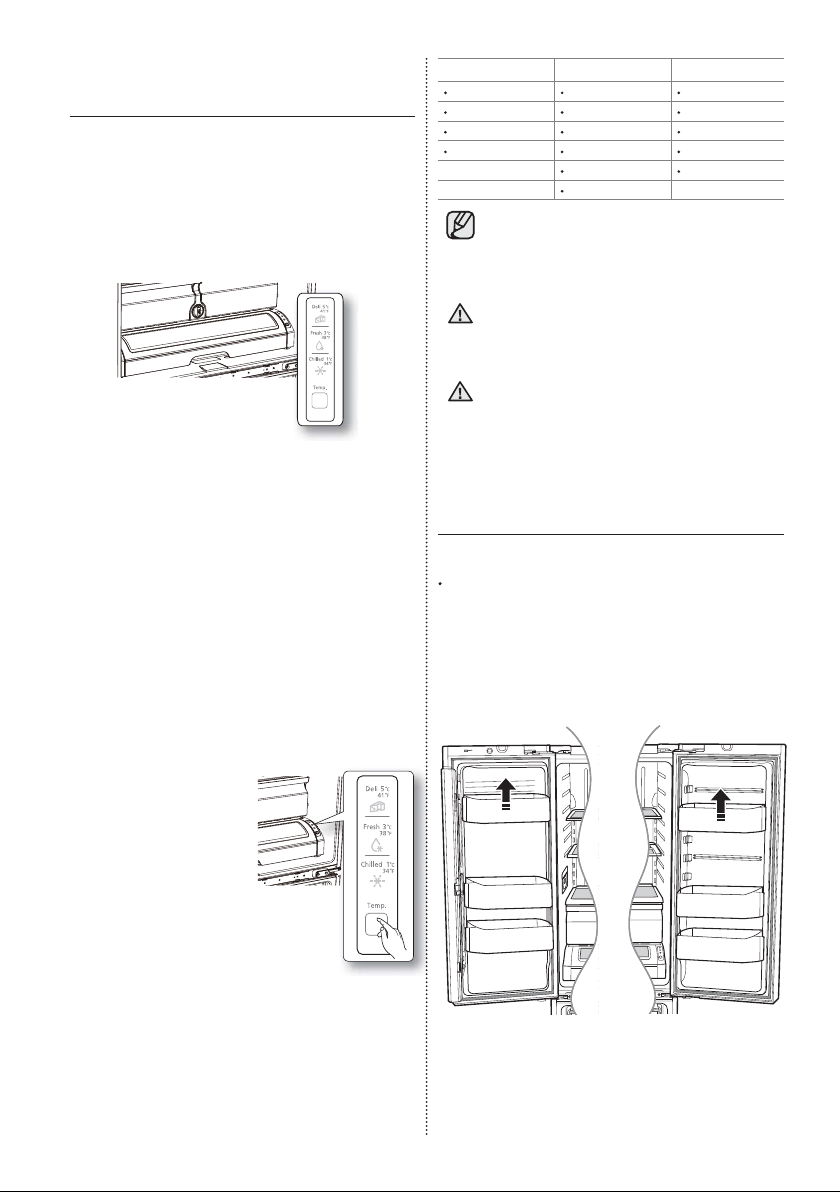
The Pantry has three modes: The Fresh mode, t
Chilled mode, and Deli mode. Fresh mode is
the default. Press the Temp button repeatedly
until the mode you want is lit. Once you select
a mode, the temperature will change to match
the mode you selected.
The Pantry temperature may change t
depending on the number of items inside
and where they are located, the ambient
temperature, and how often the door is
opened.
The Pantry Selection Button
When you select “Deli”, the temperature of the 1.
pantry will be kept around 41°F (or 5°C). This
feature helps keep food fresh for a long time.
When you select 2.
“Fresh”, the
temperature of the
pantry will be kept
around 38°F (or 3°C).
This feature helps keep
food fresh for a longer
time.
When you select 3.
“Chilled”, the
temperature of the
pantry will be kept around 34°F (or 1°C). This
feature also helps keep meat or fi sh fresh for a
longer time.
The table below lists the Pantry modes and
the kinds of foods that can be stored safely for
each mode.
Deli Fresh Chilled
Pineapple cucumbers steaks
lemon apples hard cheeses
avocado oranges cold cuts
potato grapes bacon
zucchinis hot dogs
corn
Fruits and vegetables may be damaged
when the “chilled” mode is set.
Do not store lettuce or other leafy produce in this
pantry.
Do not store glass bottles in this pantry. If
they are frozen, they can break and cause
personal injury.
In case you put a water bowl without its
ild into the pantry, condensation may form
around surrounding parts.
REMOVING THE REFRIGERATOR
ACCESSORIES
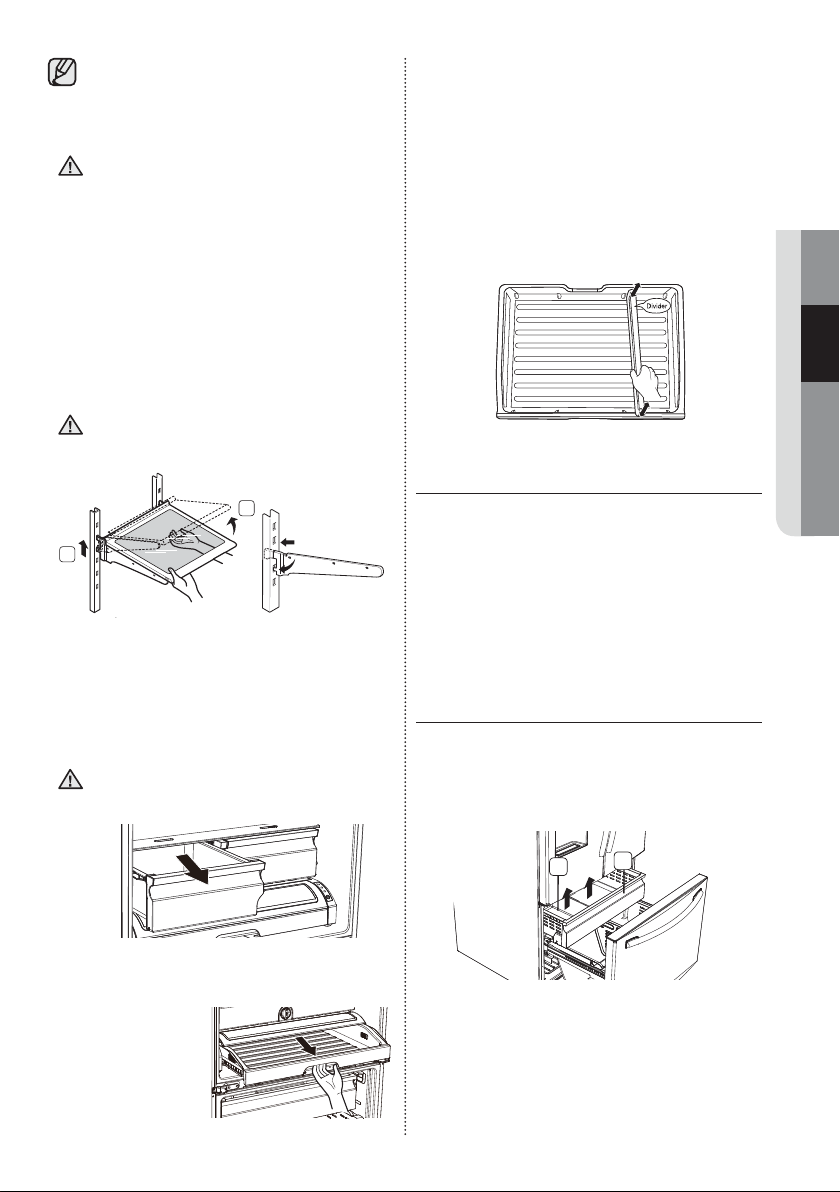
1. Door Bins & Dairy Compartment
Door Bins
To remove - Simply lift the bin up and pull straight
out.
To relocate
-Slide it in above the desires location and
push down until it stops.
One
T
ou
ch
P
ur
e
Wa
t
er
CAUTION
CAUTION
2012.5.16 3:2:6 PM
_19
operating
Injury may occur if the door bins are not
fi rmly assembled.
Do not allow children to play with the bins. Sharp
corners of the bins may cause injury.
Do not adjust a bin full of food. Remove
the food fi rst.
To remove dust from the bins - Remove the guard
and wash in water.
2. Tempered Glass shelves
To remove - Tilt up the front of the shelf in the
direction shown ( 1 ) and lift it up vertically ( 2 ).
Pull the shelf out.
To relocate - Tilt the front of the shelf up and
guide the shelf hooks into the slots at a desired
height. Then lower the front of the shelf so that the
hooks can drop into the slots.
The Tempered Glass shelves are heavy.
Use special care when removing them.
3. Vegetable & Fruit Drawers
To remove - Pull the drawer out to full extension.
Tilt up the front of the drawer and pull straight out.
To relocate - Insert the drawer into the frame rails
and push back into place.
The drawers need to be removed before
the glass shelf above them can be lifted
out.
4. Cool select pantry
To remove the Cool
select pantry –
Pull the pantry out
to full extension. Tilt
up the front side of
the pantry and pull
straight out.
To relocate the Cool select pantry – Push
the rails to the back of the refrigerator. Place the
drawer onto the rails and slide the pantry back
until it is in place.
To remove the divider – Pull the pantry
completely out to full extension and raise the front
side of the divider to unhook it from the rear wall
of the pantry, then lift the divider out.
To relocate the divider - Hook the back of the
divider over the rear wall of the pantry and push
the divider down.
Using the doors
Ensure that the doors close all the way and are
securely sealed.
When the refrigerator door is only partially open,
it will automatically close. But, the door will stay
open when opened more than the auto close
range and you must close it manually.
REMOVING THE REFRIGERATOR
ACCESSORIES
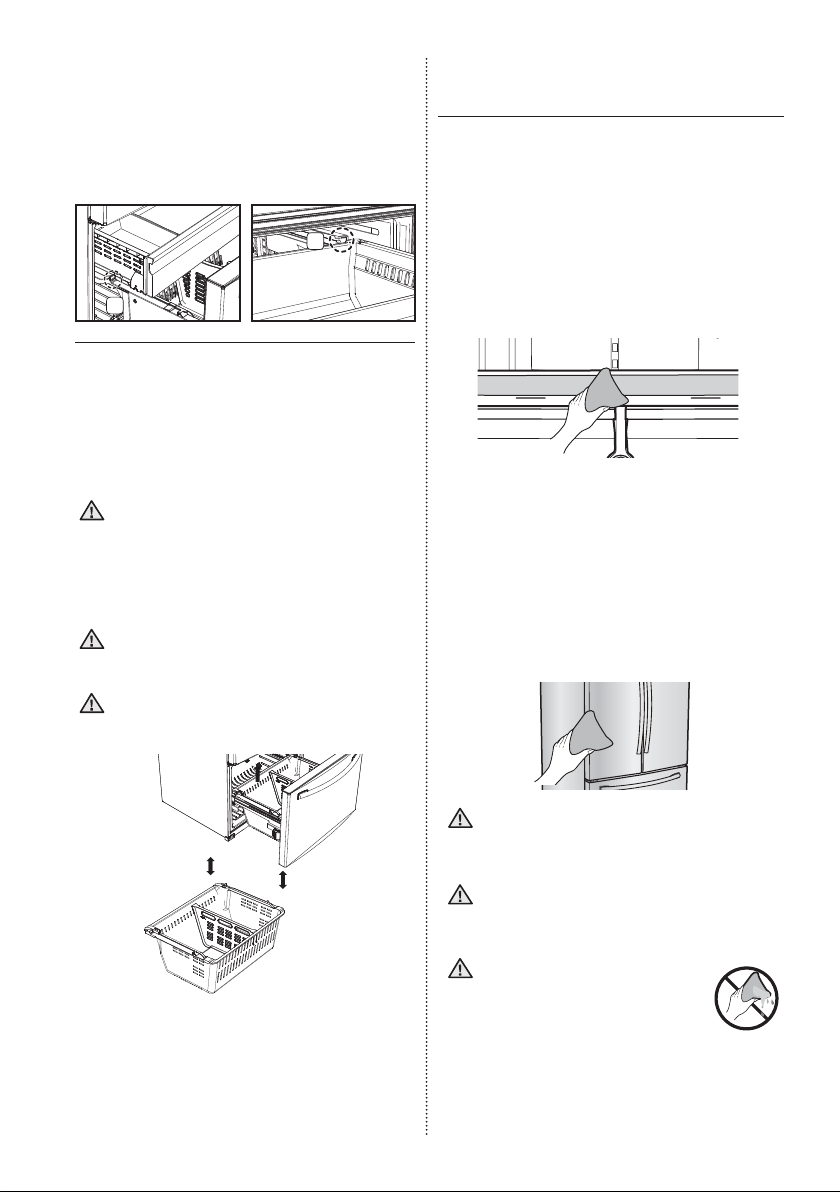
1. ICE BUCKET
To remove - Lift the ice bucket ( 1 ).
To relocate - Place the ice bucket into the Super
extended drawer ( 2 ).
CAUTION
CAUTION
CAUTION
1
2
1
2
2012.5.16 3:2:19 PM
02 OPERATING
operating
20_
2. Super Extended Drawer
To remove - Pull the drawer out to full extension.
Tilt up the rear of the drawer and lift straight out.
To relocate - Place the drawer onto the rails ( 4 )
by tilting it up. Lower the drawer into place until it
is horizontal and slide the Drawer ( 3 ) in.
3. Freezer Drawer
To remove the freezer drawer - Pull the freezer
drawer out fully. Tilt up the rear of the bin and lift it
out to remove.
To relocate the freezer drawer - Place the bin
into the rail assembly.
Do not allow babies or children go inside
the freezer drawer. They could damage the
refrigerator and seriously injure themselves.
Do not sit on the freezer door. The door
may break. Do not allow children to climb
into the freezer drawer.
Do not remove the divider.
If trapped inside, children may be injured
or suocate to death.
CLEANING THE
REFRIGERATOR
Caring for your Samsung French Door Refrigerator
prolongs the life of your appliance and helps keep
the refrigerator free of odor and germs.
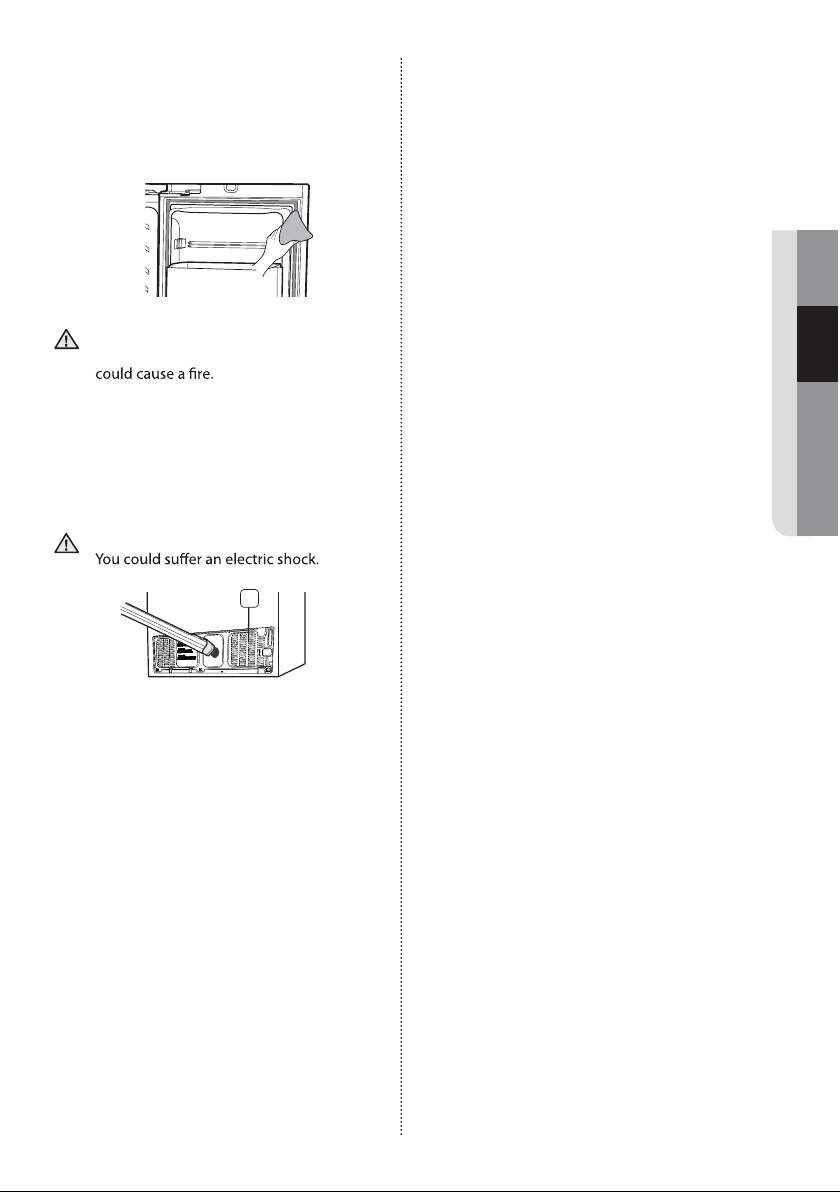
Cleaning the Interior
Clean the inside walls and accessories with a mild
detergent and then wipe dry with a soft cloth. You
can remove the drawers and shelves for a more
thorough cleaning. Just make sure to dry drawers
and shelves before putting them back into place.
Cleaning the Exterior
Wipe the control panel and digital display with
a damp, clean, soft cloth. Do not spray water
directly on the surface of the refrigerator.
The doors, handles and cabinet surfaces should
be cleaned with a mild detergent and then wiped
dry with a soft cloth. To keep your appliance
looking its best, polish the exterior once or twice a
year.
Do not spray water directly on the
refrigerator. Use a clean, damp cloth to
clean.
Do not use benzene, thinner, or Clorox for
cleaning. They may damage the surface of
the appliance and may cause a fi re.
You can erase the printed
letters on the display if you
apply stainless cleaner directly
to the area where the letters
are printed.
CAUTION
CAUTION
WARNING
CAUTION
CAUTION
CAUTION
4
3
2012.5.16 3:2:23 PM
_21
operating
If the rubber door seals are dirty, the doors may
not close properly, and the refrigerator will not
operate effi ciently. Keep the door seals free of
dust or stains by cleaning the doors with a mild
detergent and damp cloth. Wipe dry with a clean,
soft cloth.
Do not clean the refrigerator with benzene,
thinner or car detergent. These substances
Cleaning the rear side of the
refrigerator
To keep cords and exposed parts free of dust and
dirt accumulation.
Vacuum the rear side of the appliance once or
twice a year.
Do not remove the back cover ( 1 ).
CAUTION
CAUTION
1
2012.5.16 3:2:33 PM
02 OPERATING
operating
22_
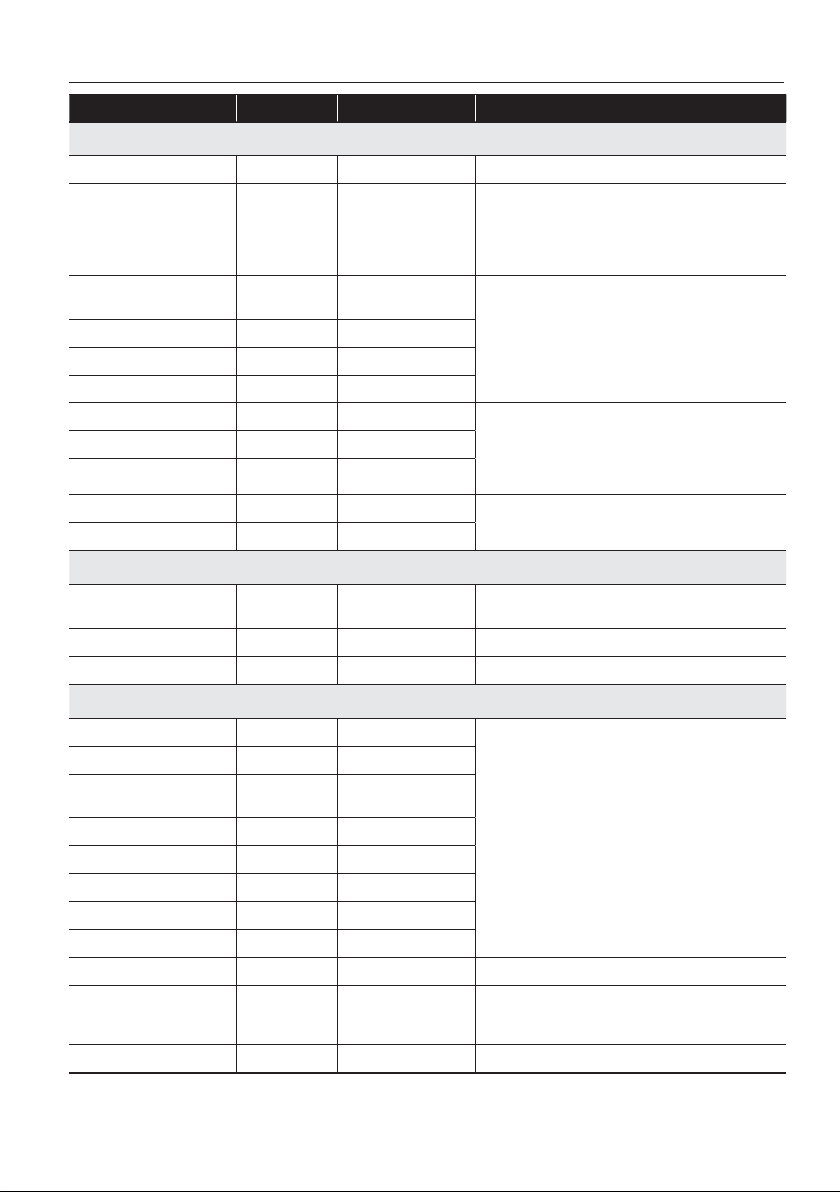
FOOD STORAGE TIPS
Foods Refrigerator Freezer Storage Tips
DAIRY PRODUCTS
Butter 2-3 Weeks 6-9 Months Wrap or cover tightly.
Milk 1-2 Weeks Not recommended
Check date code. Most milk and similar prod-
ucts are sold in date-coded cartons that indicate
a products’s peak freshness. Re-seal with cap
or wrap tightly. Do not return unused portions to
original container.
Cream Cheese, cheese
food, and cheese spread
2-4 Weeks Not recommended
Check date code. Keep all cheese tightly packed
in moisture proof wrap
Hard Cheese (unopened) 3-4 Months 6 Months
Hard Cheese (opened) 2 Months Not recommended
Cottage Cheese 10-15 Days Not recommended
Cream 7-10 Days 2 Months Check date code. Most yogurt, creams, and
similar products are sold in date-coded cartons
that indicate a product’s peak freshness. Re-seal
or cover tightly. Do not return unused portions to
original container.
Sour Cream 2 Weeks Not recommended
Cream Dips (opened) 1 Week Not recommended
Yogurt 10-14 Days Not recommended
Check date code. Keep covered.
Frozen Yogurt na 2 Months
EGGS
Eggs (uncooked) 3-4 Weeks Not recommended
Check date code. Store eggs in coldest part of
refrigerator and in their original container.
Eggs (cooked) 1 Week Not recommended Store in covered container
Leftover egg dishes 3-4 Days Not recommended Store in covered container
FRESH FRUITS
Apples 1 Month Not recommended
If storing in refrigerator, do not wash fruit before
storing. Store in moisture resistant bags or
containers. Wrap cut fruits. Some fruits darken
when refrigerated.
Bananas 2-4 Days Not recommended
Peaches, Melons, Pears,
Avocados
3-5 Days Not recommended
Berries and Cherries 2-3 Days 12 Months
Apricots 3-5 Days Not recommended
Grapes 2-5 Days na
Pineapple (un-cut) 2-3 Days Not recommended
Pineapple (cut) 5-7 Days 6-12 Months
Citrus 1-2 Weeks Not recommended Store uncovered.
Juice 6 Days Not recommended
Check date code and re-seal in original con-
tainer. Do not return unused portions to original
container.
Frozen Juice Thawing only 12 Months Check date code. Do not re-freeze.
2012.5.16 3:2:33 PM
_23
operating
Foods Refrigerator Freezer Storage Tips
FISH AND SHELLFISH
Fish
Fatty Fish (mack-
erel, trout, salmon)
1-2 Days 2-3 Months
Keep in original wrapper and store in coldest part of
refrigerator. Package in vapor-proof and moisture
proof wrap for freezer. Freeze at 0ºF(or -18°C ). Thaw
in refrigerator or check date code. Freeze in original
packaging.
Lean Fish (cod,
fl ounder, etc)
1-2 Days 6 Months
Frozen or Breaded na 3 Months
Shellfi sh
Shrimp (uncooked) 1-2 Days 12 Months
To freeze, package in vapor-proof and moisture-proof
container.
Crab 3-5 Days 10 Months
Cooked Fish or
Shellfi sh
2-3 Days 3 Months
MEAT
Fresh, Uncooked
Chops 2-4 Days 6-12 Months
Check date code for use. Store in coldest part of
refrigerator in original packaging. Package in moisture-
proof and vapor-proof container for freezing. Recom-
mended refrigerator temperature 33ºF to 36ºF (or 1°C
to 2°C ) and freezer temperature 0ºF to 2ºF (or -18°C
to -16°C )
Ground 1 Day 3-4 Months
Roast 2-4 Days 6-12 Months
Bacon 1-2 Weeks 1-2 Months
Sausage 1-2 Days 1-2 Months
Steak 2-4 Days 6-9 Months
Poultry 1 Day 12 Months
Lunch meat 3-5 Days 1 Month
Cooked
Meat 2-3 Days 2-3 Months
Check date code for use. Store in coldest part of
refrigerator in original packaging. Package in moisture-
proof and vapor-proof container for freezing.
Poultry 2-3 Days 4-5 Months
Ham 1-2 weeks 1-2 Months
Sources:
American Meat Institute Foundation. 1994. Yellow pages: answers to predictable questions consumers ask about
meat and poultry. American Meat Institute Food Marketing Institute. 1999. The food keeper. Food Marketing Institute,
Washington, D.C. Freeland-Graves, J.H. and G.C. Peckham. 1996. Foundations of food preparation, 6th ed. Prentice-
Hall, Inc. Englewood Clis, NJ. Hillers, V.N. 1993. Storing foods at home. Washington State University Cooperative
Extension, Pullman, WA. Publ. EB 1205.
National Restaurant Association. 2001. Be cool-chill out! Refrigerate promptly. National Restaurant Association
Education Foundation¼s International Food Safety Council, Washington, D.C. USDA. 1997. Basics for handling food
safely. U.S. Department of Agriculture, Food Safety and Inspection Service, Washington, D.C.
2012.5.16 3:2:33 PM
02 OPERATING
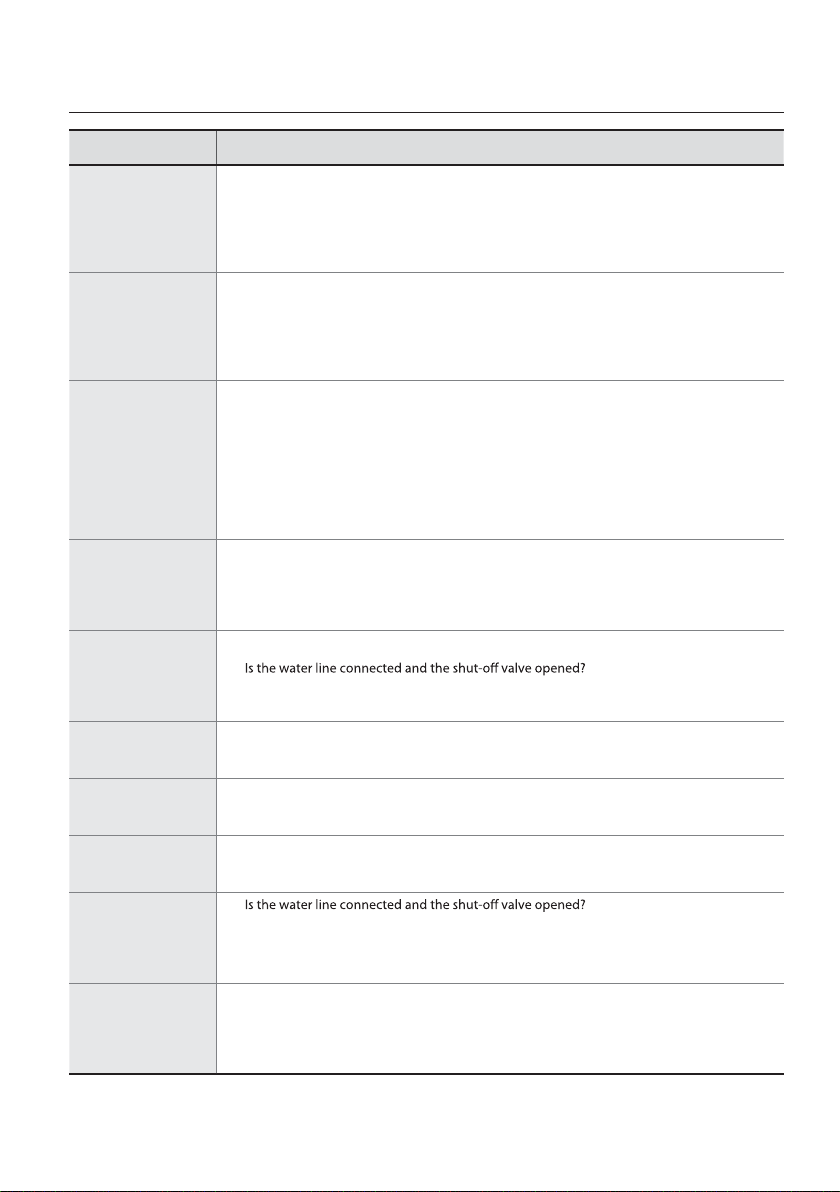
Troubleshooting
24_
Troubleshooting
PROBLEM SOLUTION
The refrigerator
does not work at
all or it does not
chill suffi ciently.
ŘCheck if the power plug is properly connected.
ŘCheck if the set temperature on the digital display is warmer than the freezer or fridge
inner temperature. If it is, set the refrigerator colder.
ŘIs the refrigerator in direct sunlight or located near a heat source?
ŘIs the back of the refrigerator too close to the wall, preventing proper ventilation?
The food in the
fridge is frozen.
ŘCheck if the set temperature on the digital display is too low.
ŘTry setting the refrigerator to a warmer temperature.
ŘIs the temperature in the room too low? Set the refrigerator warmer.
ŘDid you store the food which is juicy in the coldest part of the refrigerator? Try moving
those items to the other shelves in the fridge instead of keeping them in the colder
areas or bins.
You hear unusual
noise or sounds.
ŘCheck if the refrigerator is level and stable.
ŘIs the back of the refrigerator too close to the wall, preventing proper ventilation?
Try moving the back of the refrigerator at least 2 inches from the wall.
ŘWas anything dropped behind or under the refrigerator?
ŘA “ticking” sound is heard from inside the refrigerator. This is normal and occurs because
various accessories are contracting or expanding according to the temperature of the
refrigerator interior.
ŘIf it sounds as if something is hitting something else inside the refrigerator, this is normal.
The sound is caused by the compressor operating at high capacity.
The cabinet-door
sealing area of the
appliance is hot
and condensation
is occurring.
ŘSome heat is normal as anti-condensators are installed in the vertical hinged section of
the refrigerator to prevent condensation.
ŘIs the refrigerator door ajar? Condensation can occur when you leave the door open for
a long time.
Ice Maker is not
producing ice.
ŘDid you wait for 12 hours after installation of the water supply line before making ice?
Ř
ŘDid you manually stop the ice making function?
ŘIs the freezer temperature too warm? Try setting the freezer temperature lower.
You can hear
water bubbling in
the refrigerator.
ŘThis is normal. The bubbling comes from refrigerant circulating through the refrigerator.
There is a bad
smell in the
refrigerator.
ŘCheck for spoiled food.
ŘFoods with strong odors (for example, fi sh) should be tightly covered.
ŘClean out your freezer periodically and throw away any spoiled or suspicious food.
Frost forms on
the walls of the
freezer.
ŘIs the air vent blocked? Remove any obstructions so air can circulate freely.
ŘAllow suffi cient space between the stored foods for effi cient air circulation.
ŘIs the freezer drawer closed properly?
Water dispenser
is not functioning.
Ř
ŘHas the water supply line tubing been crushed or kinked?
ŘMake sure the tubing is free and clear of any obstruction.
ŘIs the water tank frozen because the fridge temperature is too low?
Try selecting a warmer setting on the Digital display.
Auto close
system does not
work with the
freezer door.
ŘIs there an imbalance between the right and left parts of the door?
ŘOpen and close the door smoothly 1~2 times. After you do this, the auto close system
usually works properly again.
ŘTry opening the door smoothly to avoid unbalancing the right part and the left part of
the door.
2012.5.16 3:2:33 PM
Warranty(USA)
WARRANTY ON SAMSUNG REFRIGERATOR
LIMITED WARRANTY TO ORIGINAL PURCHASER
This Samsung brand product, as supplied and distributed by Samsung Electronics America, Inc. (Samsung)
and delivered new, in the original carton to the original consumer purchaser, is warranted by Samsung against
manufacturing defects in materials and workmanship for a limited warranty period of:
One (1) year Parts and Labor on Refrigerator
Five (5) years Parts and Labor on sealed Refrigeration system only*
(* Compressor, evaporator, condenser, drier, connecting tubing)
This limited warranty begins on the original date of purchase, and is valid only on products purchased and
used in the United States. To receive warranty service, the purchaser must contact Samsung for problem
determination and service procedures. Warranty service can only be performed by a Samsung authorized
service center. The original dated bill of sale must be presented upon request as proof of purchase to Samsung
or Samsung authorized service center.
Samsung will repair or replace any part found to be defective, at our option and at no charge as stipulated
herein, with new or reconditioned parts during
the limited warranty period specifi ed above. All replaced parts
and products become the property of Samsung and must be returned to Samsung. Replacement parts and
products assume the remaining original warranty, or ninety (90) days, whichever is longer.
In-home service will be provided during the warranty labor period subject to availability within the contiguous
United States. In-home service is not available in all areas. To receive in-home service, the product must be
unobstructed and accessible from fl oor level to service personnel. If during in-home service repair cannot be
completed, it may be necessary to remove, repair and return the product. If in-home service is unavailable,
Samsung may elect, at our option, to provide for transportation of our choice to and from a Samsung authorized
service center. Otherwise, transportation to and from the Samsung authorized service center is the
responsib
ility
of the purchaser.
This limited warranty covers manufacturing defects in materials and workmanship encountered in normal,
noncommercial use of this product, and shall not apply to the following, including, but not limited to: damage
which occurs in shipment; delivery and installation; applications and uses for which this product was not
intended; altered product or serial numbers; cosmetic damage or exterior fi nish; accidents, abuse, neglect, fi re,
water, lightning or other acts of nature; use of products, equipment, systems, utilities, services, parts, supplies,
accessories, applications, installations, repairs, external plumbing and leaks, external wiring, circuit breakers,
fuses or connectors not supplied and authorized by Samsung, or which damage this product or result in service
problems; incorrect electrical line voltage, fl uctuations and surges; customer adjustments and failure to follow
operating instructions, cleaning, maintenance and environmental instructions that are covered and prescribed in
the instruction book; loss of food due to spoilage; consumable items including fi lters and light.
THERE ARE NO EXPRESS WARRANTIES OTHER THAN THOSE LISTED AND DESCRIBED ABOVE, AND
NO WARRANTIES WHETHER EXPRESS OR IMPLIED, INCLUDING, BUT NOT LIMITED TO, ANY IMPLIED
WARRANTIES OF MERCHANTABILITY OR FITNESS FOR A PARTICULAR PURPOSE, SHALL APPLY
AFTER THE EXPRESS WARRANTY PERIODS STATED ABOVE, AND NO OTHER EXPRESS WARRANTY
OR GUARANTY GIVEN BY ANY PERSON, FIRM OR CORPORATION WITH RESPECT TO THIS PRODUCT
SHALL BE BINDING ON SAMSUNG. SAMSUNG SHALL NOT BE LIABLE FOR LOSS OF REVENUE OR
PROFITS, FAILURE TO REALIZE SAVINGS OR OTHER BENEFITS, OR ANY OTHER SPECIAL, INCIDENTAL
OR CONSEQUENTIAL DAMAGES CAUSED BY THE USE, MISUSE OR INABILITY TO USE THIS PRODUCT,
REGARDLESS OF THE LEGAL THEORY ON WHICH THE CLAIM IS BASED, AND EVEN IF SAMSUNG
HAS BEEN ADVISED OF THE POSSIBILITY OF SUCH DAMAGES. NOR SHALL RECOVERY OF ANY KIND
AGAINST SAMSUNG BE GREATER IN AMOUNT THAN THE PURCHASE PRICE OF THE PRODUCT SOLD BY
SAMSUNG AND CAUSING THE ALLEGED DAMAGE. WITHOUT LIMITING THE FOREGOING, PURCHASER
ASSUMES ALL RISK AND LIABILITY FOR LOSS, DAMAGE OR INJURY TO PURCHASER AND PURCHASER’S
PROPERTY AND TO OTHERS AND THEIR PROPERTY ARISING OUT OF THE USE, MISUSE OR INABILITY TO
USE THIS PRODUCT SOLD BY SAMSUNG NOT CAUSED DIRECTLY BY THE NEGLIGENCE OF SAMSUNG.
THIS LIMITED WARRANTY SHALL NOT EXTEND TO ANYONE OTHER THAN THE ORIGINAL PURCHASER
OF THIS PRODUCT, IS NONTRANSFERABLE AND STATES YOUR EXCLUSIVE REMEDY.
Some states do not allow limitations on how long an implied warranty lasts, or the exclusion or
limitation of
incidental or consequential damages, so the above limitations or exclusions may not apply to you. This warranty
gives you specifi c legal rights, and you may also have other rights, which vary from state to state.
To obtain warranty service, please contact Samsung at:
SAMSUNG CUSTOMER CARE CENTER
Samsung Electronics America, Inc. 85 Challenger Road Ridgefi eld Park, NJ 07660
1-800-SAMSUNG (1-800-726-7864) and www.samsung.com
2012.5.16 3:2:34 PM
Ten (10) years Part and Five (5) years Labor on Digital Inverter Compressor.
In case the need for servicing arises
Do not hesitate to call any Samsung Authorized Service Center nearby giving them your name, address
and telephone number when your product is not functioning properly.
Warranty Information
(
CANADA
)
Limited Warranty for Original Purchaser
This Samsung product is warranted by Samsung Electronics Canada, Inc. (hereafter referred to as SECA)
against manufacturing defects in material or workmanship for the following periods:
Labor : 1 year (in-home)
Parts : 1 year
Inverter Compressor : 10 years (Part only)
SECA further warrants that if this product fails to operate properly within the specifi ed warranty period and
the failure is due to improper workmanship or defective material, SECA will repair or replace the product at
its option.
All warranty repairs or part replacements must be performed by a SECA Authorized Service Center. (To fi nd
the nearest SECA Service Center, call 1-800-SAMSUNG (7267864) or visit our web site at www.samsung.
com/ca)
Obligation to the Original Owner
The original dated sales receipt must be retained by the customer and is the only acceptable proof of purchase.
It must be presented to a SECA Authorized Service Center at the time service is requested before warranty
services are rendered. On all carry-in models, transportation to and from the Authorized Service Center is the
responsibility of the customer.
Exclusions of the Warranty
This warranty does not cover damage due to accident, fi re, fl ood, and/or other Acts of God, misuse, incorrect
line voltage, improper installation, improper or unauthorized repairs, commercial use, or damage that occurs
during shipping. Customer adjustments which are explained in this owners manual are not covered under the
terms of this warranty. This warranty will automatically be voided for any unit found with a missing or altered
serial number. This warranty is valid only on products purchased and used in the Canada.
SAMSUNG CUSTOMER CARE CENTER
Samsung Electronics Canada Inc. 2050 Derry Road West, Mississauga, Ontario L5N 0B9 Canada
1-800-SAMSUNG (726-7864)
www.samsung.com/ca/support (English)
www.samsung.com/ca_fr/support (French)
Memo
Scan the QR code* or visit
www.samsung.com/spsn
to view our helpful
How-to Videos and Live Shows
*
Requires reader to be installed on your
smartphone
COUNTRY CALL OR VISIT US ONLINE AT WRITE
U.S.A
1-800-SAMSUNG
(726-7864)
www.samsung.com/us/support
Samsung Electronics America, Inc.
85 Challenger Road Ridgefield Park,
NJ 07660
CANADA
1-800-SAMSUNG
(726-7864)
www.samsung.com/ca/support (English)
www.samsung.com/ca_fr/support (French)
0502 .cnI adanaC scinortcelE gnusmaS
Derry Road West, Mississauga, Ontario
L5N 0B9 Canada
Contact SAMSUNG WORLD WIDE
If you have any questions or comments relating to Samsung products, please contact the SAMSUNG
customer care center.
RF261B*****
RF260B*****
RF26HFP***
Refrigerador
manual del usuario
Imagine las posibilidades
Gracias por adquirir este producto Samsung.
Para recibir un servicio más completo o accesorios,
registre su producto o comuníquese con
www.samsung.com/register
1-800-SAMSUNG (726-7864)
Electrodoméstico independiente
Español
2012.5.16 3:2:34 PM
02_ información
información sobre seguridad
INFORMACIÓN SOBRE
SEGURIDAD
Antes de utilizar su nuevo refrigerador de puerta
francesa Samsung, lea detenidamente este
manual a fi n de aprender a usar las funciones que
ofrece de manera segura y efi ciente.
Este refrigerador no debe ser utilizado por
personas (incluidos niños) con capacidades
mentales, sensoriales o físicas reducidas o
por personas que carezcan de experiencia y
conocimientos, a menos que se encuentren bajo
la supervisión o hayan recibido instrucciones por
parte de un responsable de su seguridad sobre el
uso del refrigerador.
Debido a que las siguientes instrucciones
corresponden a diversos modelos, es posible
que las características de su refrigerador difi eran
ligeramente de las que se describen en este
manual. Si tiene alguna duda, comuníquese al
1-800-Samsung o encuentre ayuda e información
en línea en www.samsung.com.
Símbolos y advertencias de
seguridad importantes:
ADVERTENCIA
Riesgos o prácticas inseguras que pueden
causar graves lesiones personales o incluso
la muerte.
PRECAUCIÓN
Riesgos o prácticas inseguras que pueden
causar leves lesiones personales o daños
materiales.
NO lo intente.
NO lo desarme.
NO lo toque.
Siga atentamente las instrucciones.
Desconecte el enchufe de la pared.
Asegúrese de que el refrigerador esté
conectado a tierra para evitar una descarga
eléctrica.
Comuníquese con el centro de contacto para
obtener ayuda.
Nota.
Estas señales de advertencia se incluyen
aquí para evitar lesiones a usted y a terceros.
Sígalas atentamente.
Después de leer esta sección, consérvela en
un lugar seguro para referencia futura.
SEÑALES DE ADVERTENCIA
IMPORTANTES PARA LA
INSTALACIÓN
No instale el refrigerador en un lugar húmedo •
o que se encuentre en contacto con agua.
El aislamiento deteriorado de las piezas eñéctricas -
puede provocar un incendio o descarga eléctrica.
No exponga este refrigerador a la luz solar directa •
ni al calor de cocinas, calefactores u otros
artefactos.
No enchufe varios artefactos en el mismo toma •
múltiple. El refrigerador debe conectarse siempre
a una toma de corriente individual cuyo voltaje
nominal coincida con el que se especifi ca en la
placa de voltaje del refrigerador.
Este procedimiento brinda el mejor rendimiento -
y también impide que se sobrecarguen los
circuitos del cableado de la casa, lo cual podría
provocar un riesgo de incendio a causa de
cables recalentados.
Si el enchufe de pared está fl ojo, no conecte el cable.•
Existe el riesgo de que se produzca una -
descarga eléctrica y causar un incendio.
No utilice un cable que esté dañado o gastado en •
toda su extensión o en cualquiera de los extremos.
No doble excesivamente el cable de alimentación •
ni coloque elementos pesados sobre él.
No retuerza ni amarre el cable de alimentación.•
No coloque el cable de alimentación sobre un •
objeto metálico, no coloque sobre él ningún objeto
pesado, no lo coloque entre objetos ni lo empuje
hacia el espacio que hay detrás del aparato.
Al mover el refrigerador, tenga cuidado de no -
enroscar el cable de alimentación o dañarlo.
Esto podría causar una descarga eléctrica o un -
incendio.
Nunca desenchufe el refrigerador tirando del cable•
de alimentación. Siempre sostenga el enchufe con
fi rmeza y tire para extraerlo del toma de corriente.
Los daños al cable pueden provocar un -
cortocircuito, un incendio o una descarga eléctrica.
No utilice aerosoles cerca del refrigerador.•
Si se utilizan aerosoles cerca del refrigerador -
puede causar una explosión o un incendio.
No instale este refrigerador cerca de calefactores •
o materiales infl amables.
No instale este refrigerador en un lugar húmedo, •
engrasado o sucio, en una ubicación expuesta
directamente a la luz del sol o al agua (lluvia).
No instale el refrigerador en un lugar donde •
-
ADVERTENCIA
DA68-02601B.indb 022012.5.16 3:2:35 PM
ADVERTENCIA SOBRE LA
STATE OF CALIFORNIA
PROPOSITION 65 (SOLO EE.UU.)
• Este producto contiene productos químicos
reconocidos en el estado de California como
capaces de provocar cáncer y defectos de
nacimiento u otras afecciones reproductivas.
ADVERTENCIA
información _03
Este refrigerador debe instalarse de •
manera apropiada y ubicarse de acuerdo
con las instrucciones del manual antes de
usarse.
Conecte el enchufe en la posición correcta con •
el cable colgando hacia abajo.
Si conecta el enchufe al revés, el cable puede -
cortarse y provocar un incendio o una descarga
eléctrica.
Al mover el refrigerador, tenga cuidado de no •
enroscar el cable de alimentación o dañarlo.
Esto representa un riesgo de incendio. -
Asegúrese de que el enchufe no esté aplastado •
o dañado por la parte posterior del refrigerador.
Mantenga los materiales de embalaje fuera del •
alcance de los niños.
Existe el riesgo de muerte por asfi xia si un niño se -
coloca los materiales de embalaje en la cabeza.
El refrigerador debe colocarse de manera tal •
que se pueda acceder al enchufe después de la
instalación.
Es necesario quitar toda la película plástica •
protectora antes de enchufar el producto por
primera vez.
El refrigerador debe estar conectado a •
tierra de manera segura.
Siempre asegúrese de haber conectado -
el refrigerador a tierra antes de intentar
examinar o reparar alguna pieza. Las
fugas de energía pueden provocar una
descarga eléctrica grave.
Nunca utilice tubos de gas, líneas telefónicas o •
potenciales fuentes de atracción de rayos como
conexión a tierra.
El uso inapropiado de la conexión a tierra puede -
traer como consecuencia un riesgo de descarga
eléctrica. Si necesita usar un cable de extensión,
use sólo uno de tres hilos con un enchufe que
tenga una tercera punta para el polo a tierra;
el toma de corriente deberá tener 3 ranuras
para adaptarse al enchufe del refrigerador. La
potencia indicada en el cable de extensión debe
ser CA115-120 V, 10 A o superior. Si se utiliza
un adaptador de tierra, asegúrese de que el
receptáculo esté conectado correctamente a
tierra.
Si el cable de alimentación está dañado, •
solicite su reemplazo inmediato al
fabricante o al agente de servicios.
PRECAUCIONES PARA LA
INSTALACIÓN
Deje espacio sufi ciente para instalar el •
refrigerador sobre una superfi cie plana.
Si su refrigerador no está nivelado, es posible -
que el sistema de enfriamiento interno no
funcione correctamente.
El refrigerador debe permanecer en posición •
vertical durante dos horas después de la
instalación.
Recomendamos que este refrigerador lo instale un •
técnico califi cado o una compañía de servicios.
No seguir esta recomendación puede causar -
descargas eléctricas, incendio, explosión,
problemas con el producto o lesiones.
ADVERTENCIAS MUY
IMPORTANTES PARA EL USO
No conecte el enchufe con las manos •
mojadas.
•
No coloque elementos en la parte superior del
refrigerador.
Cada vez que abra o cierre la puerta, éstos -
pueden caerse y provocar lesiones personales o
daños materiales.
No coloque un recipiente con agua sobre el •
refrigerador.
Si se derrama, existe el riesgo de que se -
produzca un incendio o una descarga eléctrica.
Se deberá vigilar a los niños para asegurarse de •
que no jueguen con el refrigerador.
Aleje los dedos de los puntos de agarre; los -
espacios entre las puertas y el gabinete son
necesariamente pequeños. Abra las puertas con
cuidado si hay niños cerca.
No permita que los niños se cuelguen de la •
puerta. Pueden producirse lesiones graves.
No permita que los niños ingresen al refrigerador. •
Los niños podrían quedar atrapados.
No coloque las manos debajo del refrigerador.•
Es posible que algunas puntas fi losas le -
provoquen lesiones.
No permita que los niños se paren sobre la •
cubierta de un cajón.
El cajón se puede romper y los niños pueden -
caerse.
No sobrecargue el refrigerador con comida.•
Cuando abra la puerta, algún elemento puede -
caerse y provocar lesiones personales o daños
materiales.
No toque las paredes internas del congelador, •
ni los productos almacenados en éste con las
manos mojadas.
Puede provocar congelación. -
Nunca coloque los dedos u otros objetos en el •
hueco del dispensador de agua, en el recipiente
de hielo o en la cubeta de la fábrica de hielo.
Es posible que provoque lesiones personales o -
daños materiales.
No pulverice con gas infl amable cerca del refrigerador.•
Existe el riesgo de que se produzca una -
explosión o un incendio.
No almacene sustancias volátiles o infl amables •
en el refrigerador.
Si se almacena bencina, disolvente, alcohol, -
éter, gas licuado y otros productos similares, se
pueden provocar explosiones.
PRECAUCIÓN
ADVERTENCIA
DA68-02601B.indb 032012.5.16 3:2:35 PM
pueda haber pérdidas de gas.
Esto podría causar una descarga eléctrica o un
-
incendio.
Mantenga el espacio de ventilación en el •
gabinete o estructura de montaje del refrigerador
libre de obstáculos.
04_ información
No almacene en el refrigerador productos •
farmacéuticos, materiales científi cos ni productos
sensibles a la temperatura.
No se deben almacenar productos que requieran -
controles estrictos de temperatura.
No coloque ni utilice aparatos eléctricos dentro •
del refrigerador, a menos que sean del tipo
recomendado por el fabricante.
No se pare sobre el refrigerador ni coloque objetos •
(tales como ropa, velas o cigarrillos encendidos,
platos, productos químicos, objetos metálicos,
etc.) sobre el refrigerador. Esto podría causar
descargas eléctricas, incendios, problemas con el
producto o lesiones. No coloque un recipiente con
agua sobre el refrigerador.
Si se derrama, existe el riesgo de que se -
produzca un incendio o una descarga eléctrica.
No utilice dispositivos mecánicos ni cualquier •
otro medio para acelerar el proceso de
descongelamiento, que no sean aquellos
recomendados por el fabricante.
No dañe el circuito refrigerante.•
No pulverice material volátil tal como un •
insecticida sobre la superfi cie del refrigerador.
Además de ser perjudicial para los seres -
humanos, puede causar también descargas
eléctricas, incendio o problemas con el producto.
No mire fi jamente la lámpara de LED UV durante •
mucho tiempo.
Los rayos ultravioletas podrían dañarle la visión. -
No desarme ni repare el refrigerador •
usted mismo.
Corre el riesgo de provocar un incendio, -
funcionamiento incorrecto y/o lesiones personales.
Si el LED interior o exterior se ha apagado, -
comuníquese con los agentes de servicio técnico.
Se deberá vigilar a los niños para asegurarse •
de que no jueguen con el refrigerador.
Aleje los dedos de los puntos de agarre: los -
espacios entre las puertas y el gabinete son
necesariamente pequeños. Abra las puertas con
cuidado si hay niños cerca. No permita que los
niños se cuelguen de la puerta. De lo contrario,
es posible que se produzca una lesión grave.
Riesgo de que los niños se queden encerrados.
No permita que los niños ingresen al refrigerador.
Las botellas se deben almacenar una junto a •
otra de manera tal que no se caigan.
Este producto se debe utilizar sólo para •
almacenar alimentos en un entorno doméstico.
Si se detecta una fuga de gas, evite llamas o posibles •
fuentes de infl amación y ventile el ambiente en el que
se encuentra el refrigerador durante varios minutos.
No toque el electrodoméstico ni el cable de -
alimentación.
No utilice un ventilador. -
Una chispa puede provocar una explosión o un -
incendio.
Utilice solamente lámparas de LED •
proporcionadas por el fabricante o agentes de
servicios.
En caso de sentir olor a quemado o a •
humo, desenchufe el refrigerador de
inmediato y comuníquese con el Centro
de Servicio de Samsung Electronics.
Si le resulta difícil cambiar la luz, comuníquese •
con un agente de servicio.
Si el producto cuenta con lámparas de LED, no •
desarme la cubierta de la lámpara y la lámpara
de LED usted mismo.
Comuníquese con su agente de servicio. -
Si el refrigerador tiene polvo o agua, •
desenchúfelo y comuníquese con el Centro de
Servicio de Samsung Electronics.
Si no lo hace, existe el riesgo de que se -
produzca un incendio.
PRECAUCIONES DE USO
No vuelva a congelar alimentos que se hayan •
descongelado completamente. No coloque
bebidas carbonatadas o con gas en el
compartimento del congelador. No coloque
botellas ni recipientes de vidrio en el congelador.
Cuando el contenido se congela, el vidrio puede -
romperse y provocar lesiones personales.
Utilice solamente la fábrica de hielo del •
refrigerador. Sólo una persona adecuadamente
califi cada deberá instalar/conectar el suministro
de agua al refrigerador y solo deberá ser
conectado al suministro de agua potable.
A fi n de que la fábrica de hielo funcione
correctamente, se necesita una presión de
agua de 20 ~ 125 psi. Si viaja por vacaciones
o negocios y no utilizará los dispensadores de
agua o hielo, cierre la válvula de agua.
Si no lo hace, pueden producirse fugas de agua. -
Retire el exceso de humedad del interior del •
refrigerador y deje las puertas abiertas.
Si no lo hace, pueden aparecer olores y moho. -
Garantía de servicio y modifi cación.•
El servicio de garantía de Samsung no -
cubre los cambios o modifi caciones
realizados por un tercero a este
refrigerador; Samsung tampoco es
responsable de los problemas relacionados
con la seguridad que puedan surgir a causa
de modifi caciones hechas por terceros.
No obstruya las tomas de aire.•
Si las tomas de aire están bloqueadas, en particular -
con una bolsa de plástico, el
refrigerador se puede
sobrecongelar. Si el período de enfriamiento es
demasiado
prolongado, el fi ltro del agua puede
romperse y provocar fugas de agua.
Si se desconecta el refrigerador del suministro •
de energía, espere al menos cinco minutos antes
de volver a enchufarlo.
Si tiene planifi cado tomarse unas largas vacaciones •
o si el refrigerador no se utilizará durante mucho
tiempo, debe vaciarlo y desenchufarlo.
Si se deja el refrigerador encendido por mucho -
tiempo sin utilizarlo, se puede deteriorar el
aislamiento y provocar un incendio.
PRECAUCIÓN
DA68-02601B.indb 04DA68-02601B.indb 042012.5.16 3:2:35 PM2012.5.16 3:2:35 PM
información _05
contenido
PUESTA A PUNTO DEL REFRIGERADOR DE PUERTA FRANCESA ………………………………… 06
FUNCIONAMIENTO DEL REFRIGERADOR DE PUERTA FRANCESA ……………………………… 13
SOLUCIÓN DE PROBLEMAS …………………………………………………………………………… 24
- Retire el exceso de humedad del interior del
refrigerador y deje las puertas abiertas. Si no lo
hace, pueden aparecer olores y moho.
Para obtener el mejor rendimiento del producto:
- No coloque alimentos muy cerca de las rejillas de
ventilación de la parte posterior del refrigerador
ya que pueden obstruir la libre circulación del
aire en el refrigerador.
- Envuelva los alimentos adecuadamente o
colóquelos en recipientes herméticos antes de
almacenarlos en el refrigerador.
Llene el tanque de agua, la charola para el hielo y
los cubos de agua solamente con agua potable.
Si el producto está lleno de agua, comuníquese
con el Centro de Servicio más cercano.
- Existe el riesgo de que se produzca una
descarga eléctrica o un incendio.
PRECAUCIONES PARA LA
LIMPIEZA
No pulverice con agua directamente
dentro o fuera del refrigerador.
- Existe el riesgo de que se produzca un incendio
o una descarga eléctrica.
No utilice un secador de cabello dentro del
refrigerador. No coloque velas encendidas en el
refrigerador para quitar los malos olores.
- Esto podría causar una descarga eléctrica o un
incendio.
Retire cualquier sustancia extraña o polvo de
las clavijas del enchufe. No utilice un paño
mojado ni húmedo para limpiar el enchufe.
- De lo contrario, existe el riesgo de que se
produzca un incendio o una descarga eléctrica.
Desenchufe el refrigerador antes de
limpiarlo o repararlo.
ADVERTENCIAS MUY IMPORTANTES
PARA LA ELIMINACIÓN
Riesgo de que los niños se queden
encerrados. Antes de eliminar su antiguo
refrigerador o congelador:
- Retire las puertas.
Deje los estantes en su lugar de manera tal que los niños -
no puedan trepar dentro del refrigerador fácilmente.
Deseche el material de embalaje de este producto de
forma que no resulte nocivo para el medio ambiente.
Deje los estantes en su lugar de manera tal que
los niños no puedan trepar dentro del refrigerador
fácilmente. Asegúrese de que ninguno de los
tubos que se encuentran detrás del refrigerador
estén dañados antes de desecharlos.
Se utiliza R600a o R134a como refrigerante.
Controle la etiqueta del compresor en la parte
posterior del refrigerador o la etiqueta del voltaje
dentro del refrigerador para constatar qué
refrigerante fue utilizado en su refrigerador. Si este
producto contiene gas infl amable (Refrigerante
R600a), comuníquese con las autoridades locales
para desechar este producto en forma segura.
Cuando deseche este refrigerador, retire los
burletes y los pestillos de las puertas de manera
tal que los niños pequeños o los animales no
puedan quedarse atrapados en el interior. Se
deberá vigilar a los niños para asegurarse de
que no jueguen con el refrigerador.
Se utiliza ciclopentano como aislante. Los
gases del material de aislamiento requieren
un procedimiento especial de eliminación.
Comuníquese con las autoridades locales
para desechar este producto de manera que
no resulte nocivo para el medio ambiente.
Asegúrese de que ninguno de los tubos que se
encuentran en la parte trasera del refrigerador
estén dañados antes de desecharlos.
PRECAUCIÓN
ADVERTENCIA
DA68-02601B.indb 052012.5.16 3:2:36 PM
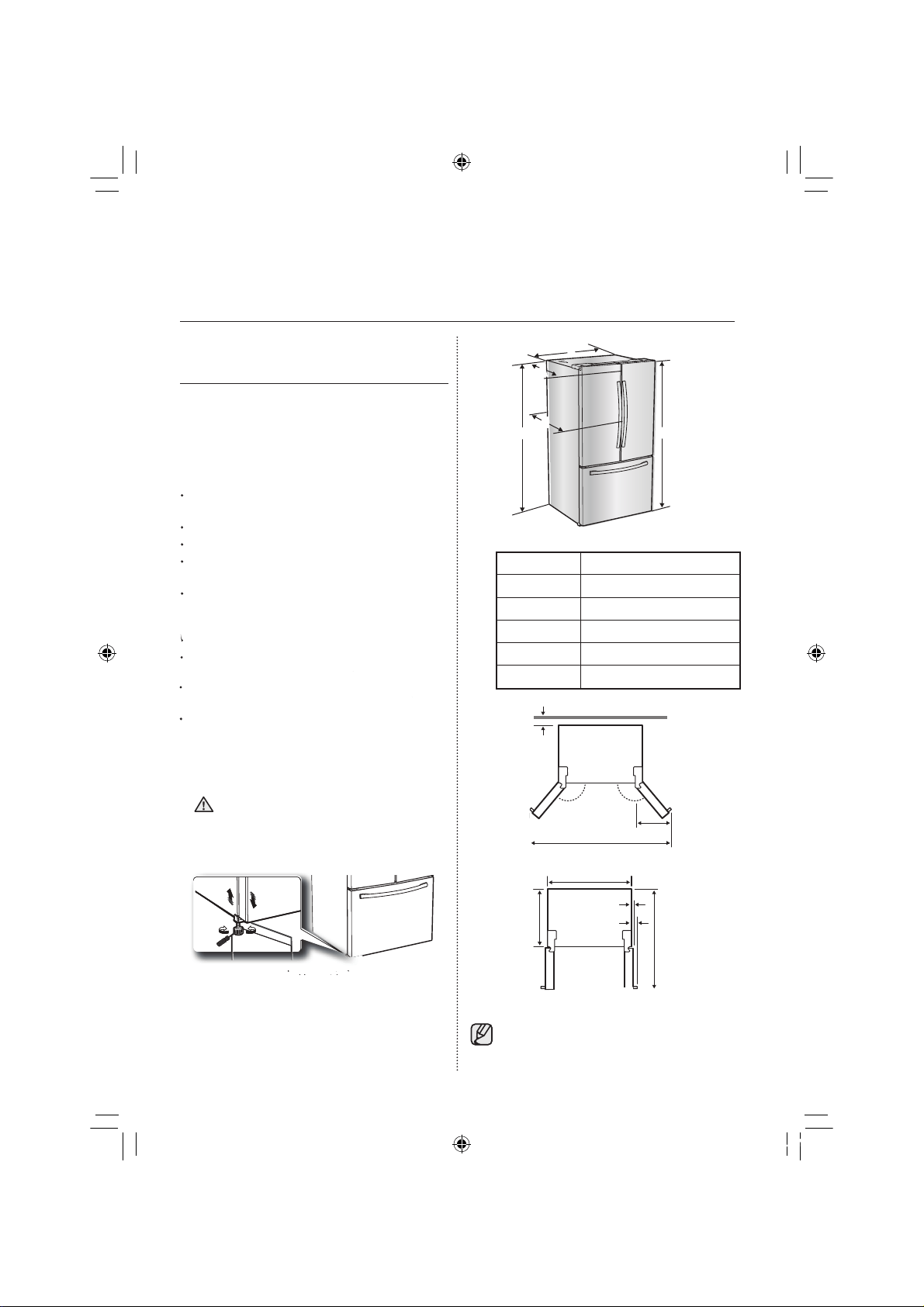
06_
Puesta a punto
Puesta a punto del refrigerador
de puerta francesa
PREPARACIÓN PARA LA
INSTALACIÓN DEL REFRIGERADOR
Felicitaciones por haber adquirido este
refrigerador de puerta francesa Samsung.
Esperamos que disfrute las funciones y ventajas
de vanguardia que ofrece este nuevo refrigerador.
Selección de la mejor ubicación para
el refrigerador
Una ubicación con fácil acceso a un suministro
de agua.
Una ubicación sin ex
posición directa a la luz solar.
Una ubicación en la que el piso esté nivelado.
Una ubicación con suficiente espacio para que
las puertas del refrigerador se abran fácilmente.
Una ubicación que deje el espacio libre
suficiente a la derecha, izquierda, atrás y arriba
del refrigerador para la circulación del aire.
Una ubicación que permita mover fácilmente el
refrigerador si necesita mantenimiento o
reparación.
No instale el refrigerador en un sitio donde la
temperatura sea inferior a 50 ºF (10 ºC).
No coloque el refrigerador en un lugar en el
que pueda mojarse.
Cuando mueva el refrigerador
Para evitar que se dañe el piso, asegúrese
de que las patas de ajuste delanteras estén
en posición vertical (sobre el piso). Consulte
‘Ajuste del nivel’ en el manual (página 9).
Destornillador de
punta chata (-)
Palanca de control
PRECAUCIÓN
2012.3.31 9:50:9 AM
r
t
o
a
c
D
l
d
t
t
l
Modelo
Profundidad “A”
Ancho “B” 35 3/4” (909mm)
Altura “C” 68 3/8” (1737mm)
Altura Total “D” 70” (1778mm)
140
°
140
°
Las mediciones aquí se basan en la dimensión
del diseño, que puede diferir dependiendo del
método de medición.
2”
(50 mm)
(340 mm)
(1620 mm)
(40 mm)
3 3/4”
(95 mm)
(745 mm)
(1220 mm)
B
A
C
E
D
B
A
C
E
D
35 3/4”
(909 mm)
RF263T** / RF263B**
35 3/4” (910mm)
29 1/4”
48 ”
33 1/2” (850mm)
Profundidad “E”
13 3/8”
63 3/4”
1 5/8”
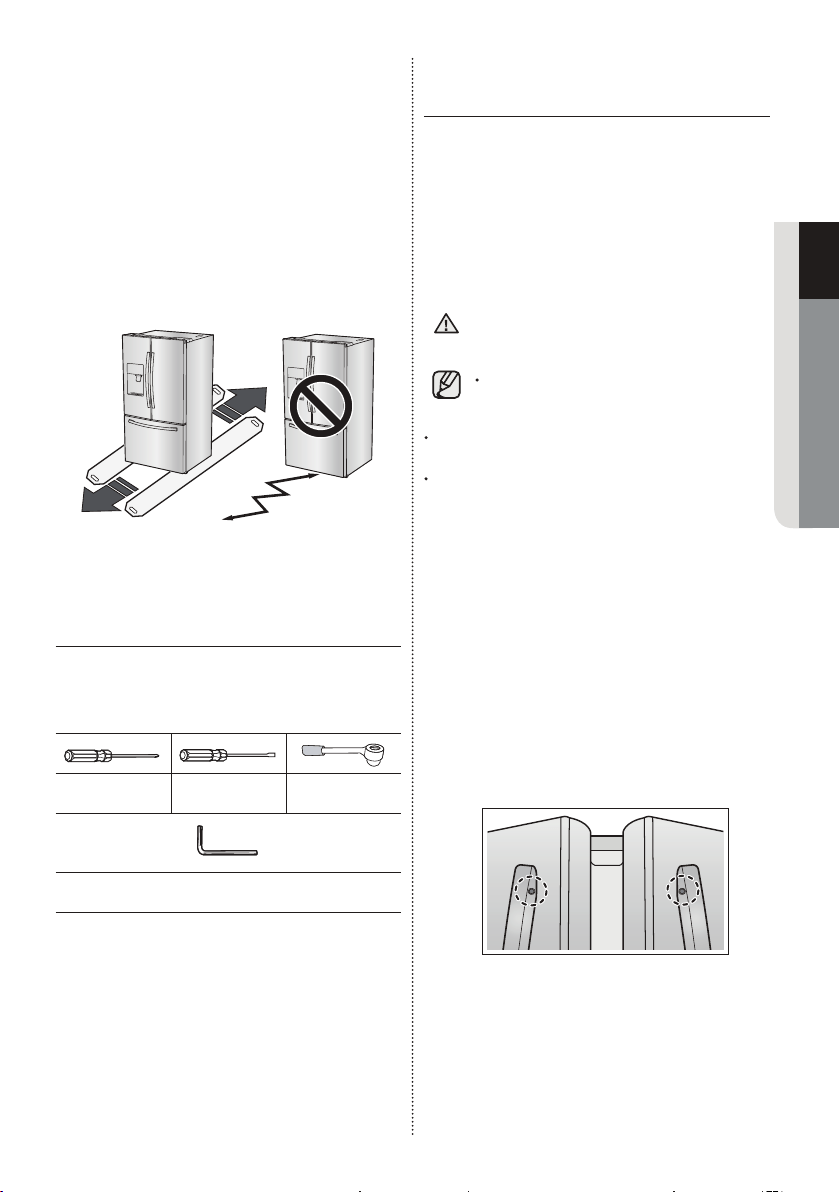
Puesta a punto
_07
PISO
Para realizar una instalación correcta, se debe
colocar el refrigerador sobre una superficie
nivelada de material rígido que tenga la misma
altura que la del resto del piso. Esta superficie
debe ser lo suficientemente resistente como para
soportar el peso de un refrigerador completamente
cargado o aproximadamente 335 lbs (152 kg).
Para proteger el acabado del piso, corte una
hoja grande del cartón y colóquela debajo del
refrigerador mientras trabaja. Cuando mueva el
refrigerador, tire y empuje en forma recta hacia
adelante o hacia atrás. No lo mueva de lado a lado.
HERRAMIENTAS NECESARIAS
Herramientas necesarias (No provistas)
Se necesitan las siguientes herramientas para
finalizar la instalación del refrigerador:
Destornillador
Philips (+)
Destornillador de
punta chata (-)
Llave de tubo
(10mm)
Llave Allen
(3/16”) (5 mm)
CÓMO RETIRAR LAS PUERTAS
DEL REFRIGERADOR
En algunas instalaciones se necesita retirar los
cajones del refrigerador y del congelador para
poder instalar el refrigerador en su ubicación final.
No retire las puertas/el cajón si no es necesario.
Si no necesita retirar las puertas del refrigerador,
diríjase a la sección Ajuste del nivel en la página 9.
Si debe retirar las puertas, continúe leyendo.
Antes de retirar la puerta/el cajón, asegúrese de
leer lo siguiente:
Desenchufe el refrigerador antes de retirar
la puerta o el cajón.
Tenga cuidado de no dejar caer la
puerta, ni dañar o rayar la puerta/el
cajón al retirarlos.
Las puertas son pesadas y podría lastimarse.
Tenga cuidado al retirar las puertas o los cajones.
Vuelva a colocar la puerta/el cajón
correctamente para evitar:
- Humedad por fuga de aire.
- Alineación incorrecta de la puerta.
- Pérdida de energía a causa de una puerta mal
cerrada.
ADVERTENCIA
ENSAMBLE DE JALADERAS
01 PUESTA A PUNTO
Oriente cada manija de manera que el extremo
de la etiqueta quede arriba y los orificios con los
tornillos de sujeción queden frente a frente.
Luego siga las indicaciones siguientes para instalar
cada manija.
Usando un desarmador de cruz, fijar los tornillos
(Opcional) luego colocar la jaladera sobre el tornillo
y deslizar hacia abajo.
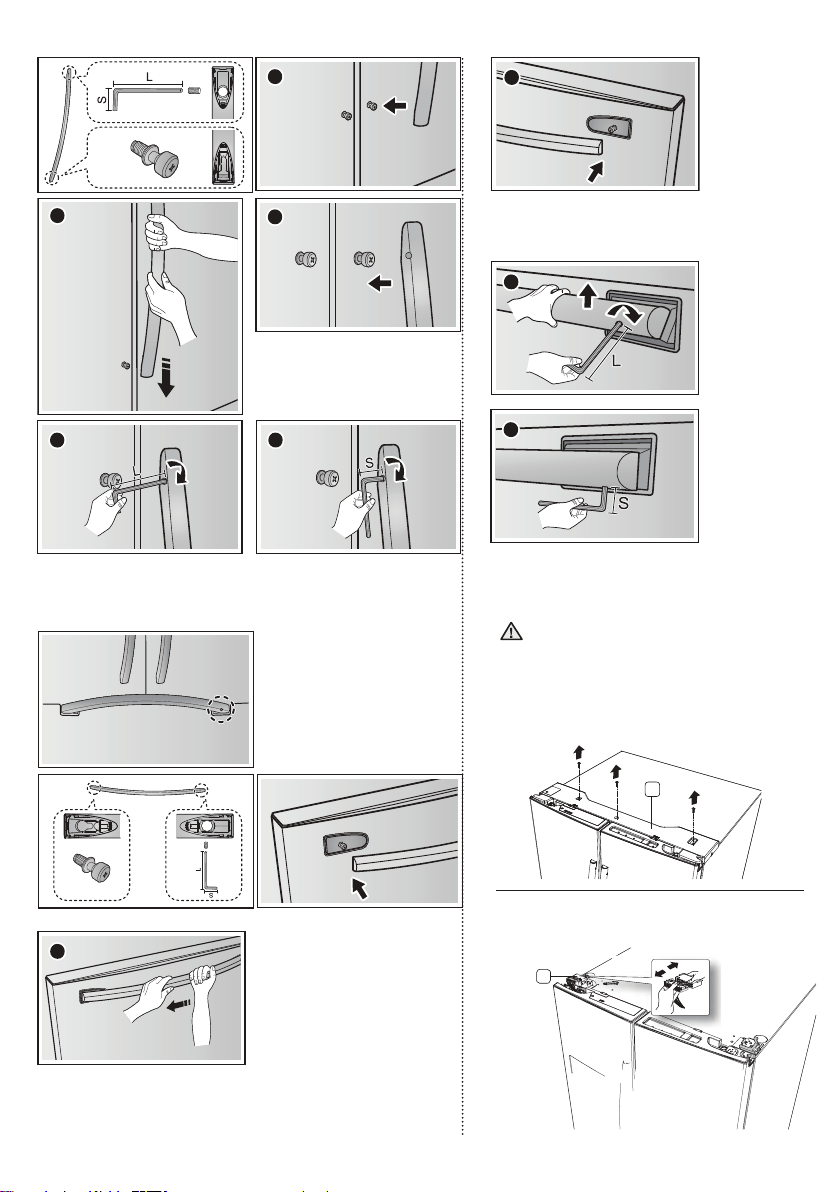
Puesta a punto
08_
4
3
2
1
Fije las jaladeras a las puertas
deslizándolas hacia abajo
firmemente.
3
5
4
Ajuste con la llave Allen
Ensamble de jaladeras en la puerta del congelador
Verifique la dirección del
ensamble de las jaladeras.
1
2
Fije las jaladeras a las puertas
deslizandolas firmemente hacia
el lado izquierdo.
5
Incline la jaladera y apriete con la llave
firmemente.
Desarmado de las puertas del refrigerador
Tenga cuidado de no dejar caer y rayar las
puertas cuando las retira.
Con la puerta abierta
Retire los 3 tornillos sosteniendo hacia abajo la 1.
PLACA SUPERIOR (
1
) y gírela con los cables
conectados.
Desconecte los dos conectores ( 2 . 2 ) de la puerta
izquierda. Para retirar el acoplador del agua de
la bisagra gire y tire de él desde la bisagra.
ADVERTENCIA
2
1
tornillo
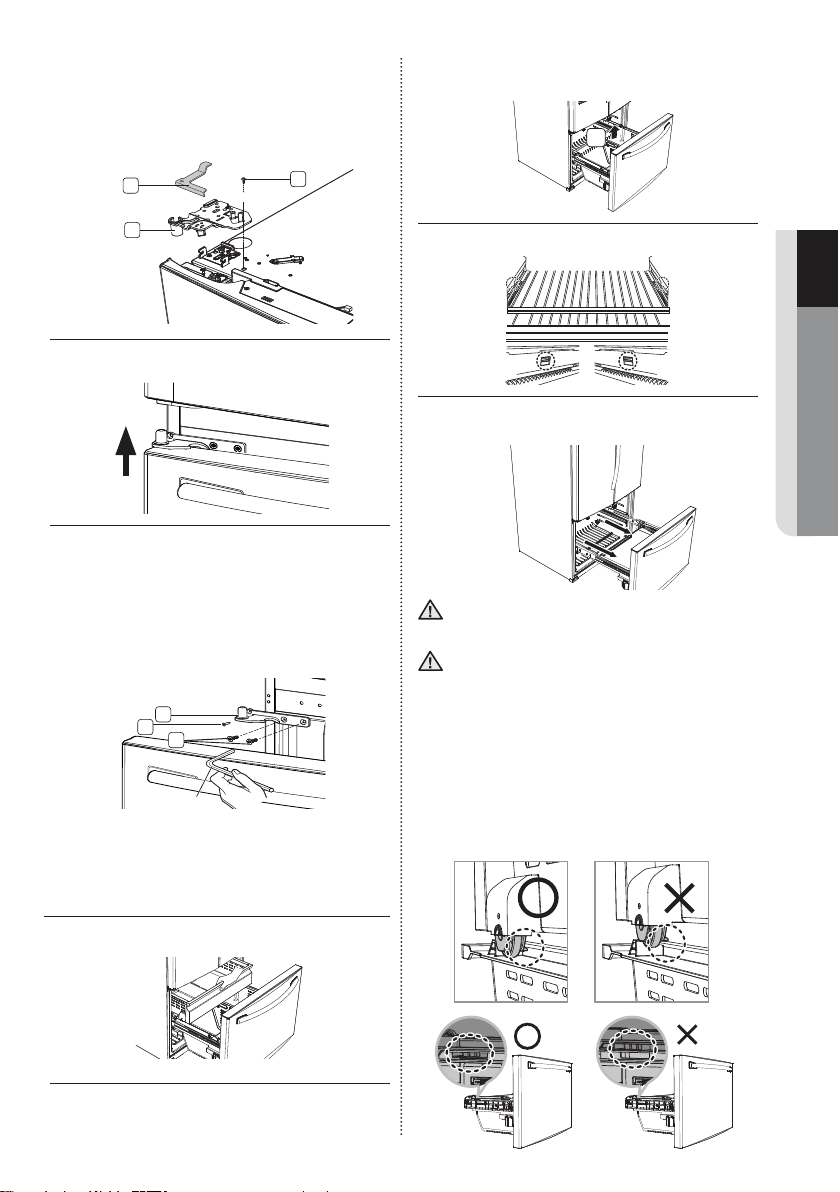
_09
Puesta a punto
01 PUESTA A PUNTO
Tire y retire la palanca de la bisagra ( 3 .3 ). Retire el
tornillo de conexión a tierra ( 4 ) conectado a las
bisagras superiores de la puerta izquierda con
un destornillador Philips (+). Retire las bisagras
superiores de las puertas izquierda y derecha ( 5 ).
Levante la puerta para retirarla.4.
Retire el tornillo ( 5. 6 ) conectado a las bisagras
inferiores de las puertas izquierda y derecha con
un destornillador Philips (+). Retire los 2 tornillos de
cabezal hexagonal ( 7 ) conectados a las bisagras
inferiores de las puertas izquierda y derecha con
una llave Allen (3/16”). Retire las bisagras inferiores
de las puertas izquierda y derecha ( 8 ).
DESARMADO DE LA PUERTA
DEL CAJÓN FLEX
.olodnátnavel roirepus nójac le eriteR 1.
Extraiga la cesta inferior ( 1 .2 ) levantándola de
los rieles.
Presione el gancho de fi jación de los rieles. 3.
Sostenga y jale la parte superior de la puerta 4.
del congelador y retírela de los rieles.
Asegúrese de que no se raye el extremo
del riel deslizante si golpea el suelo.
Asegúrese de instalar la cesta del
congelador en la posición correcta cuando
retire/instale la puerta del congelador.
No seguir esta recomendación puede
causar que la puerta no se abra o cierre
correctamente.
No cargue en exceso ni el cesto inferior
ni el cajón superior. Una carga excesiva
impide que el cajón del congelador se
cierre completamente, lo que podría
originar escarcha en el interior.
3
4
5
Llave Allen
8
6
7
1
PRECAUCIÓN
PRECAUCIÓN
2012.5.16 3:2:42 PM
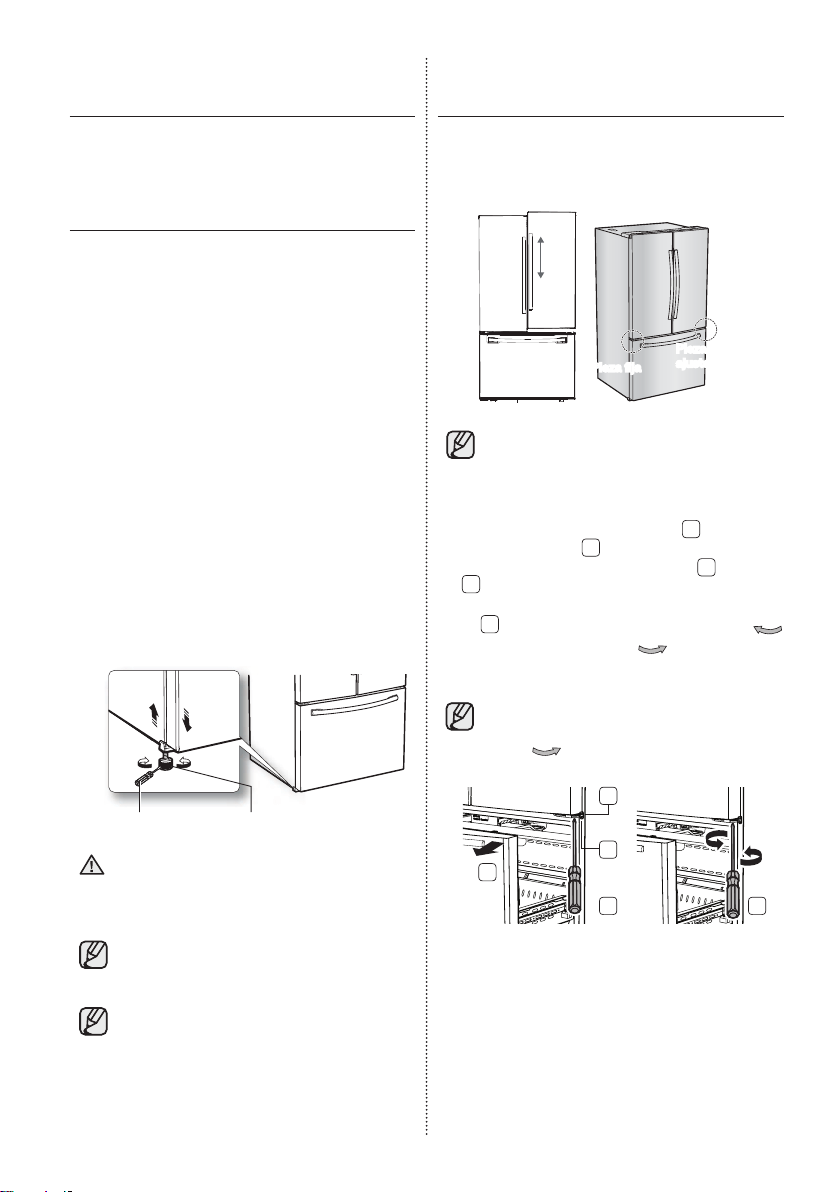
Puesta a punto
10_
MONTAJE DEL CAJÓN DEL
CONGELADOR
Para volver a colocar el cajón cuando el
refrigerador se encuentra en su ubicación fi nal,
monte las piezas en orden inverso.
AJUSTE DEL NIVEL
Asegúrese de que el refrigerador esté nivelado
antes de realizar los ajustes fi nales. Utilice
un nivelador para evaluar si el refrigerador se
encuentra nivelado tanto en los laterales como
en la parte trasera y delantera. Si el refrigerador
no está nivelado, las puertas no estarán
perfectamente alineadas, lo que podría provocar
condensación de humedad y costosas facturas
de energía. A continuación se explica cómo
nivelar el refrigerador si el lado izquierdo está a un
nivel inferior del lado derecho.
Cómo ajustar el nivel
Abra el cajón del congelador y extraiga la cesta 1.
inferior.
Inserte un destornillador de punta chata (-) en 2.
una muesca dentro de la palanca de control
izquierda y gírelo en el sentido contrario de las
agujas del reloj para nivelar el refrigerador. (Se
debe girar la palanca en el sentido de las agujas
del reloj para bajar el refrigerador y en el sentido
contrario de las agujas del reloj para elevarlo).
Ambas palancas de control deben tocar
el piso para impedir posibles lesiones
personales o daños materiales a causa de
la inclinación.
Si el lado derecho está más bajo, realice
el mismo proceso, pero con la palanca de
control derecha.
Es complicado quitar el frente de la
cubierta de las patas del refrigerador, por lo
tanto, no recomendamos realizar pequeños
ajustes con la palanca de control. Consulte
en la página siguiente la mejor manera de
realizar pequeños ajustes en las puertas.
CÓMO HACER PEQUEÑOS
AJUSTES ENTRE LAS PUERTAS
Recuerde que se necesita que el refrigerador esté
nivelado para que las puertas estén perfectamente
alineadas. Si necesita ayuda, revise la sección
anterior sobre la nivelación del refrigerador.
La puerta izquierda está fi ja. Para realizar
pequeños ajustes entre las puertas, ajuste
solamente la puerta derecha.
PRECAUCIÓN
destornillador de punta chata (-)
Palanca de control
Pieza de
ajuste
Pieza fi ja
2012.5.16 3:2:54 PM
ABAJO
ARRIBA
Cuando se gira un destornillador Philips (+)
en el sentido contrario al de las agujas del
reloj ( ), la puerta se levanta.
1
2
3
3
4
2. Inserte un destornillador Philips (+) en el eje
de la bisagra inferior.
3. Ajuste la altura girando un destornillador Philips
(+) en el sentido de las agujas del reloj ( )
o en el sentido contrario ( ).
ARRIBA
1. Extraiga el cajón del congelador ,podrá ver
la bisagra inferior .
1
2
3
4
3
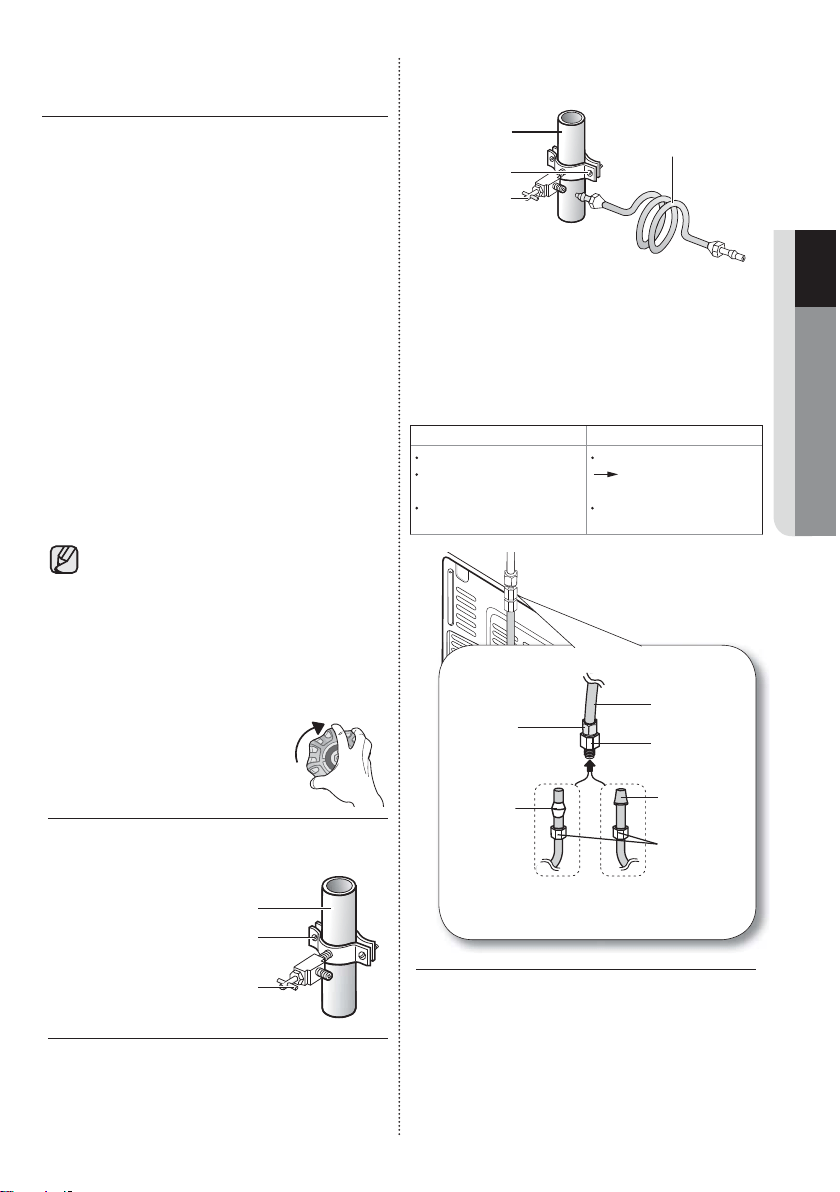
_11
Puesta a punto
01 PUESTA A PUNTO
INSTALACIÓN DE LA TUBERÍA
DEL DISPENSADOR DE AGUA
El dispensador de agua con fi ltro es una de
las funciones útiles de su nuevo refrigerador.
Con el fi n de promover la buena salud, el fi ltro
de agua elimina las partículas no deseadas del
agua. No obstante, no la esteriliza ni destruye los
microorganismos. Para eso, necesita adquirir un
sistema de purifi cación de agua.
La tubería tambien se conecta a la fábrica de hielos.
A fi n de que la fábrica de hielo funcione
correctamente, se necesita una presión de agua
de 20~125 psi (138~862 Kpa).
Si el refrigerador se instala en una zona de presión
de agua baja (debajo de los 20 psi), puede instalar
una bomba cebadora para compensar la baja
presión.
Una vez conectada la tubería de agua, asegúrese
de que el tanque de almacenamiento de agua
dentro del refrigerador esté lleno. Para hacerlo,
presione la palanca del dispensador hasta que
salga el agua.
Su distribuidor le podrá ofrecer los kits de
instalación de tuberías de agua disponibles
a un costo adicional. Recomendamos
utilizar un kit de instalación de tubería de
agua que contenga tubería de cobre y una
tuerca de compresión de ¼”.
Conexión a la tubería de suministro
de agua
En primer lugar, cierre el 1.
suministro de agua principal.
Ubique la tubería de agua potable fría más cercana 2.
e instale la abrazadera y la válvula de cierre.
Conecte el kit de instalación de la tubería de 3.
agua a la válvula de cierre.
Conexión de la tubería de suministro
de agua al refrigerador.
Para llevar a cabo la conexión, necesita adquirir
varios elementos.
Posiblemente su ferretería local los venda todos
juntos en un kit.
Uso de la tubería de cobre
Uso de la tubería de plástico
Tubería de cobre de ¼”
Tuerca de compresión de
¼” (1)
Férula (2)
Tubería de plástico de ¼”
Extremo moldeado
(lámpara)
Tuerca de compresión de
¼” (1)
Abrazadera
Tubería de agua fría
Válvula de cierre
Válvula de cierre
Abrazadera
Tubería de agua fría
Kit de instalación de tubería
Tuerca de
compresión
(1/4”) (armada)
Férula
(No provista)
Tubería de plástico
(armado)
Acople de
compresión
(armado)
Extremo moldeado
(lámpara)
Tuerca
de compresión (B) (1/4”)
(No provista)
o
Tubería de cobre
(No provista)
Tubería de plástico (B)
(No provista)
Tubería de suministro del agua corriente
Refrigerador
2012.5.16 3:2:55 PM
Puesta a punto
12_
Conecte la tubería del agua corriente al acople 1.
de compresión ensamblado.
Si utiliza una tubería de cobre, deslice la -
tuerca de compresión ( B ) (no suministrada)
y la férula (no suministrada) por la tubería de
cobre (no suministrada) como se muestra en el
gráfi co.
Si utiliza una tubería de plástico ( - B ), inserte el
extremo moldeado (lámpara) de la tubería de
plástico ( B ) en el acople de compresión.
No lo utilice sin el extremo moldeado
(lámpara) de la tubería de plástico ( B ).
Ajuste la tuerca de compresión ( B .2 ) sobre el
acople de compresión. No ajuste demasiado la
tuerca de compresión ( B ).
Abra el agua y verifi que si hay alguna fuga. Si 3.
encuentra gotas o fugas de agua en las zonas
de las conexiones, cierre el suministro de agua
principal. Compruebe las conexiones y, de ser
necesario, ajústelas.
led sévart a auga ed nólag 1 rerroc agaH 4.
fi ltro antes de beber o de utilizar el agua del
refrigerador. (El agua debe correr unos 6
minutos.) Para hacer correr el agua, presione la
palanca del dispensador de agua con un vaso
o una taza grandes. Llene el vaso, vacíelo en el
fregadero de la cocina y repita el proceso.
Tras poner en funcionamiento el refrigerador, 5.
deje que la fábrica de hielo haga hielo durante
1 o 2 días. Pasado este tiempo, deseche las 1
o 2 primeras cubetas de hielo para asegurarse
de que se hayan eliminado todas las impurezas
de la tubería de agua.
Solamente conecte la tubería de agua a
una fuente de agua potable.
Si debe reparar o desarmar la tubería de agua,
recorte 1/4” de la tubería de plástico para
asegurarse de que la conexión sea perfecta y libre
de pérdidas.
FINALIZACIÓN DE LA
INSTALACIÓN
Ahora que ya tiene el nuevo refrigerador instalado
en su lugar, puede confi gurarlo y disfrutar de sus
funciones.
Complete los siguientes pasos para poner el
refrigerador en funcionamiento.
Asegúrese de que el refrigerador se 1.
encuentre en una ubicación apropiada a una
distancia razonable de la pared. Consulte las
instrucciones de instalación de este manual.
Una vez enchufado, asegúrese de que la 2.
luz interior se encienda cuando se abran las
puertas.
Coloque el control de temperatura en la marca 3.
más fría y espere una hora. El congelador
comenzará a enfriarse y el motor funcionará
adecuadamente. Restablezca la temperatura
del refrigerador y del congelador que desee.
Después de enchufar el refrigerador, tardará 4.
algunas horas en alcanzar la temperatura
adecuada. Podrá almacenar alimentos y
bebidas en el refrigerador una vez que la
temperatura sea lo sufi cientemente baja.
PRECAUCIÓN
Puede probar el ujo de agua en las
tuberías usando un vaso de papel.
En condiciones normales el dispensador de agua
puede llenar un vaso de 5.75oz.(170cc) en
aproximadamente 10 segundos.
2012.5.16 3:2:57 PM
En condiciones normales, un vaso de 170 cc
(5,75 oz.) puede llenarse en unos 10 segundos.
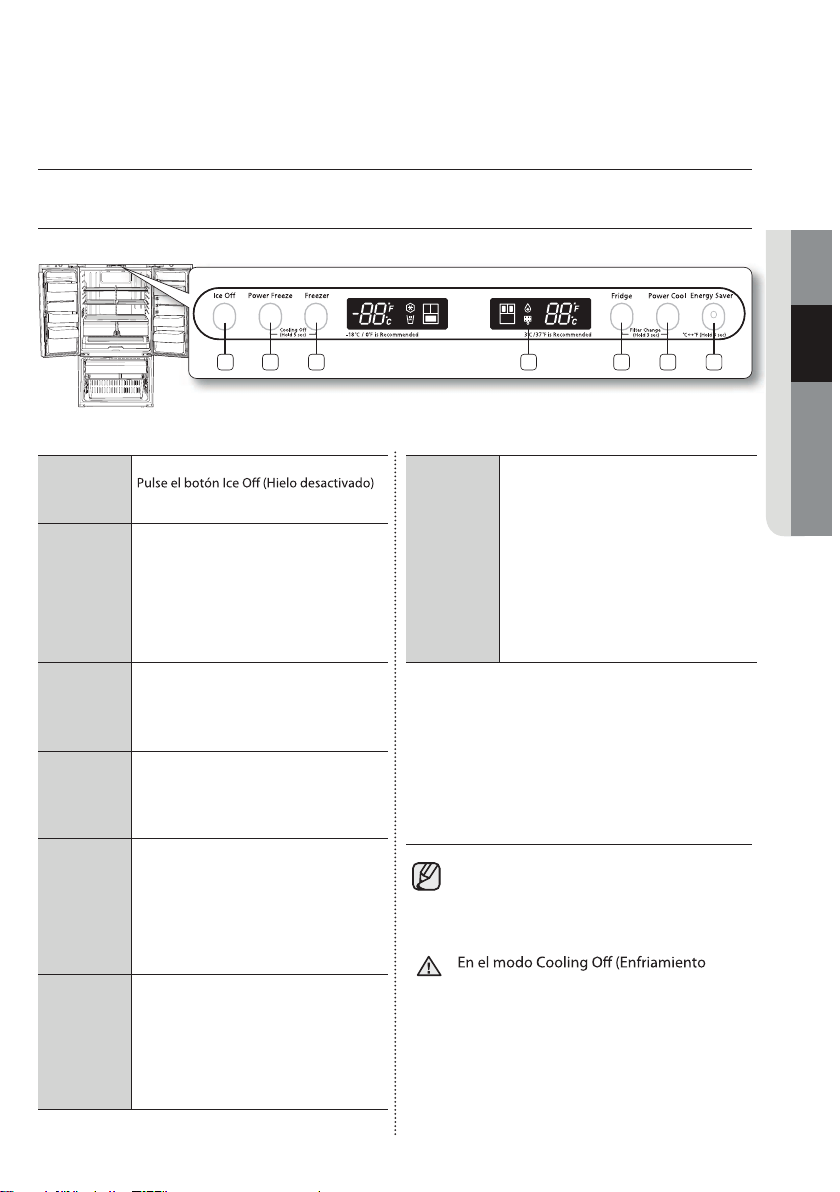
_13
Funcionamiento
02 FUNCIONAMIENTO
Funcionamiento del refrigerador
de puerta francesa
( 1 )
Botón
Ice Off (Hielo
desactivado)
si desea apagar la fábrica de hielo.
( 2 )
Botón
Power
Freeze
(Poder de
congelación)
Acelera el tiempo necesario para
congelar los productos que se
encuentran en el congelador. Puede ser
útil si necesita congelar rápidamente
alimentos que se degradan fácilmente
o si la temperatura del congelador ha
subido drásticamente (por ejemplo, si la
puerta quedó abierta).
( 3 )
Botón
Freezer
(Congelador)
Pulse el botón Freezer (Congelador)
para ajustar el congelador a la
temperatura deseada. Puede establecer
la temperatura entre 5°F (-15°C) y -8°F
(-23°C).
( 4 )
Botón
Fridge
(Refrigerador)
Pulse el botón Fridge (Refrigerador) para
ajustar el refrigerador a la temperatura
deseada.
Puede establecer la temperatura entre
34°F
(1°C)
y 44°F
(7°C)
.
( 5 )
Botón
Power Cool
(Poder de
enfriamiento)
Acelera el tiempo necesario para
refrigerar los productos que se
encuentran en el refrigerador. Puede
ser útil si necesita enfriar rápidamente
alimentos que se descomponen fácilmente
o si la temperatura del refrigerador ha
subido drásticamente (por ejemplo, si la
puerta quedó abierta).
( 6 ) Botón
E. Saver
(Ahorro de
energía)
Pulse el botón "Energy Saver" (Ahorro
de energía) para ahorrar energía. Sin
embargo, si la condensación se produce
en la puerta, apague la función Energy
Saver (Ahorro de energía).
Pulse este botón durante 3 segundos
para cambiar las unidades de
temperatura entre °C y °F.
( 7 )
Indicador
del fi ltro
Cuando se enciende el indicador quiere
decir que es necesario cambiar el fi ltro.
Por lo general, el cambio debe efectuarse
cada 6 meses
El indicador se apagará cuando se
inserte el nuevo fi ltro de agua.
El indicador se pondrá rojo cuando
haya utilizado el fi ltro de agua durante
6 meses.
MODO COOLING OFF
(ENFRIAMIENTO DESACTIVADO)
(SE MUESTRA “OF & OF” EN EL VISOR)
Esta función es para que la usen los
distribuidores cuando exhiben los
refrigeradores en las tiendas. El cliente no
la debe usar.
desactivado), el refrigerador funciona sin
aire frío. Para cancelar este modo, pulse
los botones Power Freeze (Poder de
congelación) y Freezer (Congelador) al
mismo tiempo durante 5 segundos hasta
que oiga un sonido (talán, talán); la unidad
enfriará nuevamente.
On
e
To
u
ch
P
u
r
e
W
a
t
e
r
1 2 3 4 5 67
USO DEL PANEL DE CONTROL
PRECAUCIÓN
2012.5.16 3:2:57 PM
El Ícono se pondrá de color rojo y
parpadeará durante varios segundos
cuando se abra o se cierre la puerta.
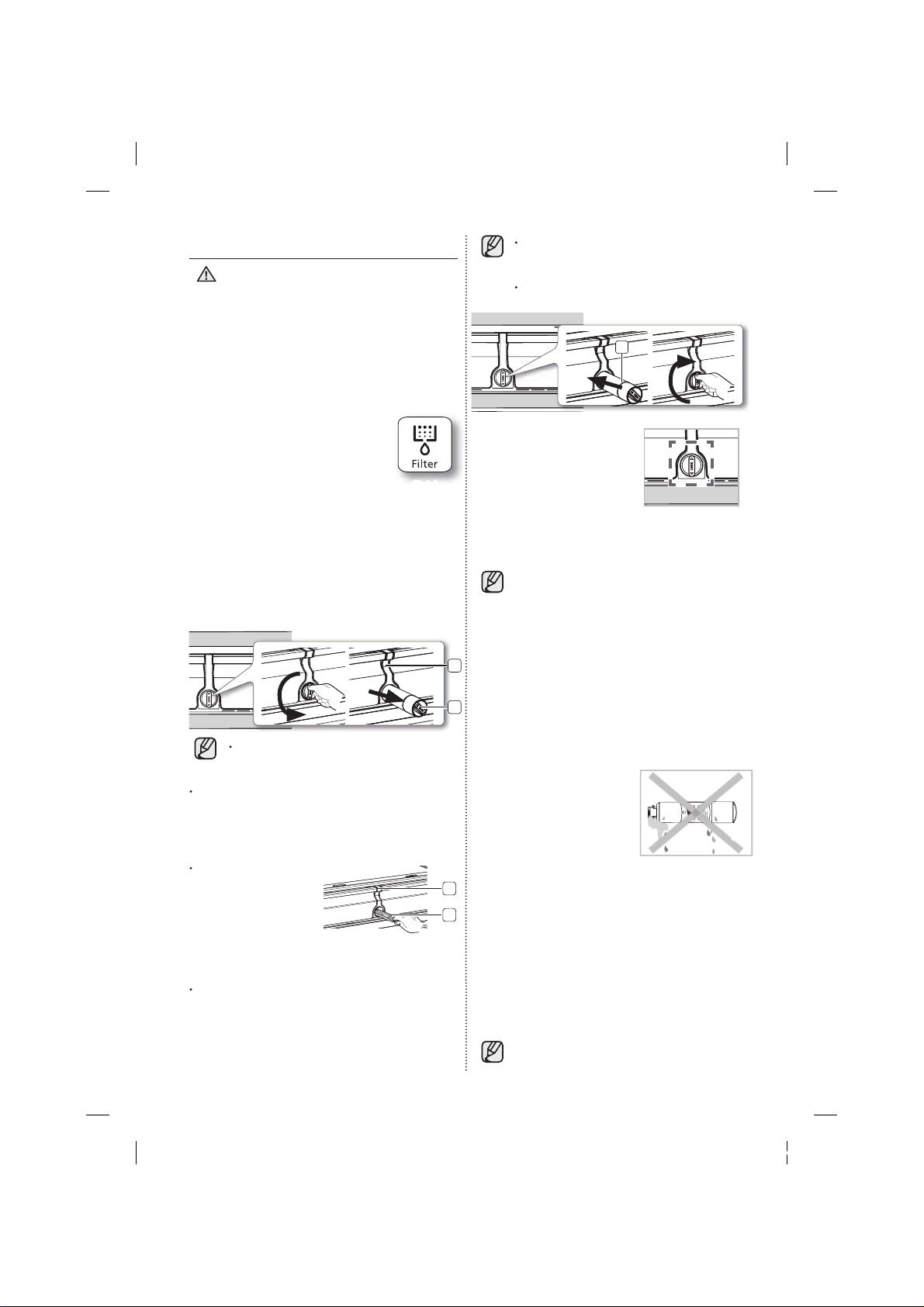
Funcionamiento
14_
CAMBIO DEL FILTRO DE AGUA
Para reducir el riesgo de daños ocasionados
por agua NO use marcas genéricas de fi ltros
de agua en su Refrigerador SAMSUNG.
SOLO USE FILTROS DE AGUA MARCA SAMSUNG.
SAMSUNG no será legalmente responsable por
cualquier daño, incluidos, entre otros, los daños
causados por pérdidas de agua debido al uso de
un fi ltro de agua genérico. Los Refrigeradores
SAMSUNG están diseñados para funcionar SOLO
CON Filtros de agua SAMSUNG.
La luz del fi ltro se pone roja para
indicar el momento en que hay que
cambiar el cartucho del fi ltro de agua.
Para darle tiempo hasta que consiga
un nuevo fi ltro, la luz roja se enciende
justo antes de que la capacidad del
fi ltro actual se acabe. Cambiar el fi ltro a tiempo le
provee agua más fresca y limpia de su refrigerador.
le erig ogeuL .auga ed ortsinimus le erreiC 1.
fi ltro de agua ( 1 ) aproximadamente un cuarto
de vuelta, en el sentido contrario al de las
agujas del reloj.
Extraiga el fi ltro de agua ( 12. ) del
compartimento ( 2 ).
Para cambiar más fácilmente el fi ltro del
agua, cierre la válvula de suministro de
agua.
ortl fi le ramrased licífid se ,secev sanuglA
de agua debido a que las impurezas en el
agua hacen que el mismo se pegue. Si tiene
difi cultades, sostenga fi rmemente el fi ltro de
agua y jale con fuerza.
Al jalar el filtro
de agua, puede
fi ltrarse algo de
agua de la abertura.
Esto es normal.
Para minimizar las
fi ltraciones de agua, mantenga el cartucho del
fi ltro de agua en forma horizontal al extraerlo.
Para impedir derrames, vacíe el fi ltro de
agua de la charola ( 3 ) y seque alrededor del
compartimento del fi ltro ( 2 ).
Inserte el nuevo fi ltro en el compartimento ( 43. ).
Presione el fi ltro y luego gírelo en el sentido de 4.
las agujas del reloj hasta que quede ajustado.
debido a la alta presión de agua, cierre
la válvula de suministro del agua.
El símbolo de bloqueo deberá estar
alineado con la línea del indicador.
Luego de retirar el fi ltro de 5.
agua antiguo e instalar uno
nuevo restablezca el indi-
cador pulsando los boto-
nes “Fridge (Refrigerador)”
y “Power Cool (Poder de
enfriamiento)” simultáneamente por 3 segundos.
Si desactivó el suministro de agua, actívelo 6.
nuevamente.
Para reemplazar su fi ltro de agua, puede
visitar su centro de pruebas local o
comunicarse con el distribuidor de piezas
Samsung. Asegúrese de que el fi ltro de agua
de reemplazo tenga el logotipo SAMSUNG
en la caja sobre el fi ltro de agua.
Vínculo : http://www.samsungparts.com
Remoción de los materiales residuales
que se encuentran dentro de la tubería
de suministro de agua después de
instalar el fi ltro de agua.
Abra el suministro de agua
de la casa para que sea
suministrada al refrigerador.
1.
Deje correr 1 Gal de agua
por el dispensador hasta
2.
que se vea incolora (aprox.
6 a 7 minutos). Este procedimiento limpiará el
sistema de suministro de agua y eliminará el
aire de las tuberías.
Es posible que se necesite realizar una limpieza
adicional en algunos hogares. Si después de
vertir 1Galón el agua no se torna incolora, es
posible que se necesite realizar una limpieza
adicional a la tubería del hogar.
3.
Abra la puerta del refrigerador y asegúrese de 4.
que no haya fi ltraciones de agua provenientes
del
fi ltro de agua
.
Limpie muy bien el sistema del dispensador
de lo
contrario puede fi ltrar agua. Esto signifi ca
que aún hay aire en la tubería.
ADVERTENCIA
(Rojo)
2
1
3
2
4
2012.5.16 3:2:59 PM
Si tiene dificultades para insertar el filtro
_15
Funcionamiento
02 FUNCIONAMIENTO
Suministro de agua por ósmosis
inversa IMPORTANTE:
La presión del suministro de agua que sale del
sistema por ósmosis inversa que va a la válvula
de entrada de agua del refrigerador necesita estar
entre 35 y 120 psi (241 y 827 kPa).
Si se conecta un sistema de fi ltración de agua por
ósmosis inversa al suministro de agua fría, la presión
de agua al sistema de ósmosis inversa debe tener
un mínimo de 40 a 60 psi (276 a 414 kPa). Si la
presión de agua al sistema de ósmosis inversa es
inferior a 40 hasta 60 psi (276 a 414 kPa):
Verifi que si el fi ltro de sedimentos en el t
sistema de ósmosis inversa está bloqueado.
Reemplácelo si es necesario.
Llene nuevamente el tanque de t
almacenamiento del sistema de ósmosis
inversa luego de mucho uso.
t
es posible que la presión de agua disminuya
aún más al usarlo con el sistema de ósmosis
inversa. Saque el fi ltro de agua
Si tiene dudas sobre la presión del agua, llame a
un plomero califi cado autorizado.
CONTROL DE LA
TEMPERATURA
Temperatura básica de los
compartimentos del congelador y
del refrigerador
Las temperaturas básicas y recomendadas de los
compartimentos del congelador y del refrigerador
son 0°F y 37°F (o -18°C y 3°C) respectivamente.
Si la temperatura de los compartimentos del
Congelador y del Refrigerador es muy alta o baja,
ajuste la temperatura manualmente.
CONTROL DE LA TEMPERATURA
Control de la temperatura del
congelador
La temperatura del congelador puede
establecerse entre 5°F (-15°C ) y -8°F (-23°C)
para cumplir con sus necesidades particulares.
Presione el botón Freezer (Congelador) varias
veces hasta que aparezca la temperatura
deseada en el visor. Tenga en cuenta que algunos
alimentos tales como el helado pueden derretirse
a 4°F (-15°C).
El visor de la temperatura cambiará de manera
secuencial desde -8°F (-23°C ) a 5°F (-15°C).
Cuando en el visor se muestre 5°F, se reiniciará
nuevamente desde -8°F (-23°C).
Cinco segundos después de que se estableció
la nueva temperatura, el visor mostrará la
temperatura actual real del congelador hasta que
se llegue a la temperatura deseada.
Control de la temperatura del
Refrigerador
La temperatura del refrigerador puede
establecerse entre 44°F (7°C) y 34°F (1°C)
para cumplir con sus necesidades particulares.
Presione el botón Fridge (Refrigerador) varias
veces hasta que aparezca la temperatura deseada
en el visor.
El proceso de control de temperatura para el
refrigerador es igual al del congelador.
Pulse el botón Fridge (Refrigerador) para
establecer la temperatura deseada. Luego
de unos pocos segundos, el Congelador
comenzará a ajustarse hacia la nueva temperatura
establecida. La misma se refl ejará en el visor
digital.
La temperatura del congelador o del
refrigerador puede subir cuando se abren
las puertas con frecuencia o si se coloca
una gran cantidad de alimentos calientes
dentro de ellos.
Esto puede hacer que el display
parpadee. Cuando las temperaturas del
congelador y del refrigerador vuelvan a las
temperaturas normales, el visor dejará de
parpadear.
Si continúa parpadeando, deberá
“restablecer” el Refrigerador. Intente
desenchufar el refrigerador, espere
aproximadamente 10 minutos y luego
enchúfelo nuevamente.
2012.5.16 3:3:2 PM
Si su refrigerador cuenta con un ltro de agua,
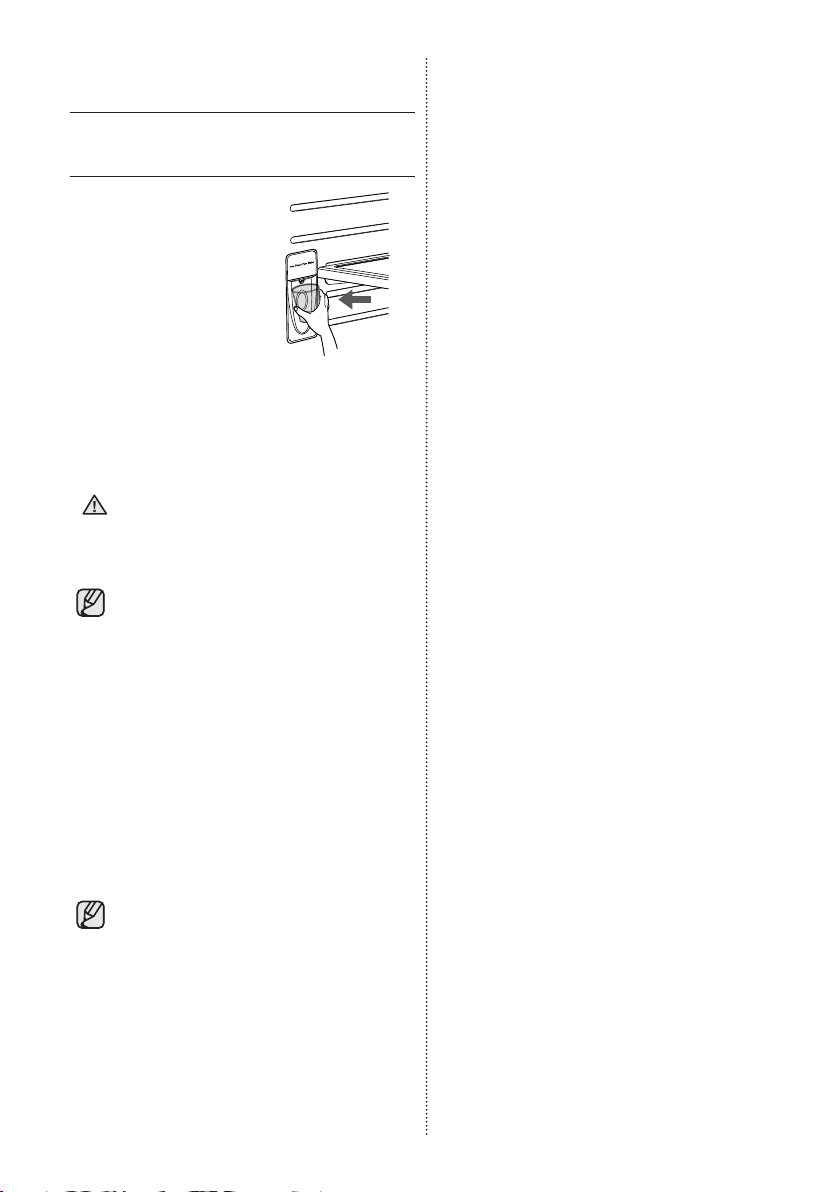
Funcionamiento
16_
USO DEL DISPENSADOR DE
AGUA
Uso del dispensador de agua
(RF261B, RF26H)
Coloque un vaso debajo de
la salida de agua y empuje
suavemente contra la
palanca del dispensador con
el vaso. Asegúrese de que
el vaso esté alineado con el
dispensador para evitar que
el agua salpique.
Si acaba de instalar el
refrigerador o montar un nuevo fi ltro de agua,
haga correr 3 galones de agua a través del fi ltro
antes de utilizarlo (durante aproximadamente 6
minutos). Asegúrese de que el agua vuelva a fl uir
limpia antes de beberla.
Si viaja por vacaciones o negocios por un
largo período cierre la válvula de suministro
de agua que va al Refrigerador. Esto evitará
pérdidas accidentales.
El fenómeno de turbidez del agua
El agua que ingresa al refrigerador circula a
través del fi ltro principal que es un fi ltro para
agua alcalina. En este proceso, la presión
de agua que sale del fi ltro aumenta, y el
oxígeno y el nitrógeno se saturan. Cuando
ésta se pone en contacto con el aire, la
presión desciende rápidamente y el oxígeno
y el nitrógeno se sobresaturan y generan
burbujas de gas. El agua puede tener una
apariencia turbia debido a estas burbujas
de oxígeno. Temporariamente, el agua
puede tener una apariencia turbia debido
a estas burbujas de oxígeno. Después de
unos segundos, el agua será incolora.
La capacidad del tanque de agua es
aproximadamente un tercio (1/3) de un
galón.
Espere 1 segundo antes de retirar el vaso
después de llenarlo de agua para evitar
derrames.
EMPUJE
PRECAUCIÓN
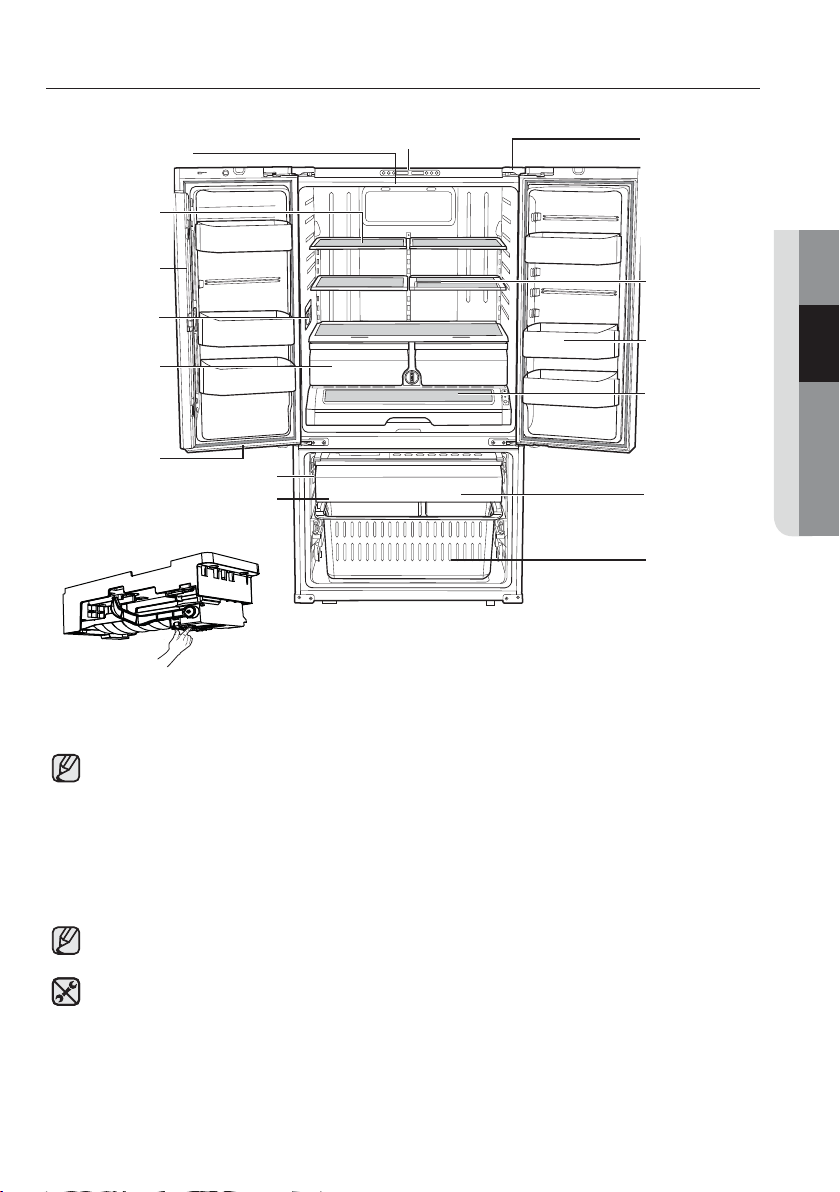
_17
Funcionamiento
02 FUNCIONAMIENTO
PIEZAS Y FUNCIONES
Utilice esta página para familiarizarse con las piezas y las funciones del refrigerador.
Al cerrar la puerta, asegúrese de que la sección de la bisagra vertical se encuentre en la posición
correcta para impedir que se raye con la otra puerta.
Si la sección de la bisagra vertical está invertida, colóquela en la posición correcta y cierre la
puerta.
Algunas veces puede aparecer humedad en esta sección.
La manija de la puerta puede afl ojarse con el tiempo. Si esto sucede, ajuste los tornillos que se
encuentran dentro de la puerta.
Si la cierra con mucha fuerza, la otra puerta puede abrirse.
Cuando se abre la puerta, el disyuntor apaga automáticamente el motor sinfín de la fábrica de
hielo por razones de seguridad.
Si el LED interior o exterior se ha apagado, comuníquese con los agentes de servicio técnico.
O
n
e
Tou
c
h
P
u
re
W
a
te
r
Compartimentos de
puertas
Cool Select
Pantry
Luz
Sección bisagra
vertical
Cajón de vegetales
y frutas
Estante corredizo
Control Digital
Cierre de la puerta
Fábrica de hielo del congelador
Luz
Cubeta de hielo
Cajón de
extracción
automática
Congelador
Cajón
Dispensador de agua
interno (RF261B)
Estante de vidrio
Quick-Space
(en algunos modelos)
2012.5.16 3:3:2 PM
Fabrica de hielos en congelador
Botón de Prueba
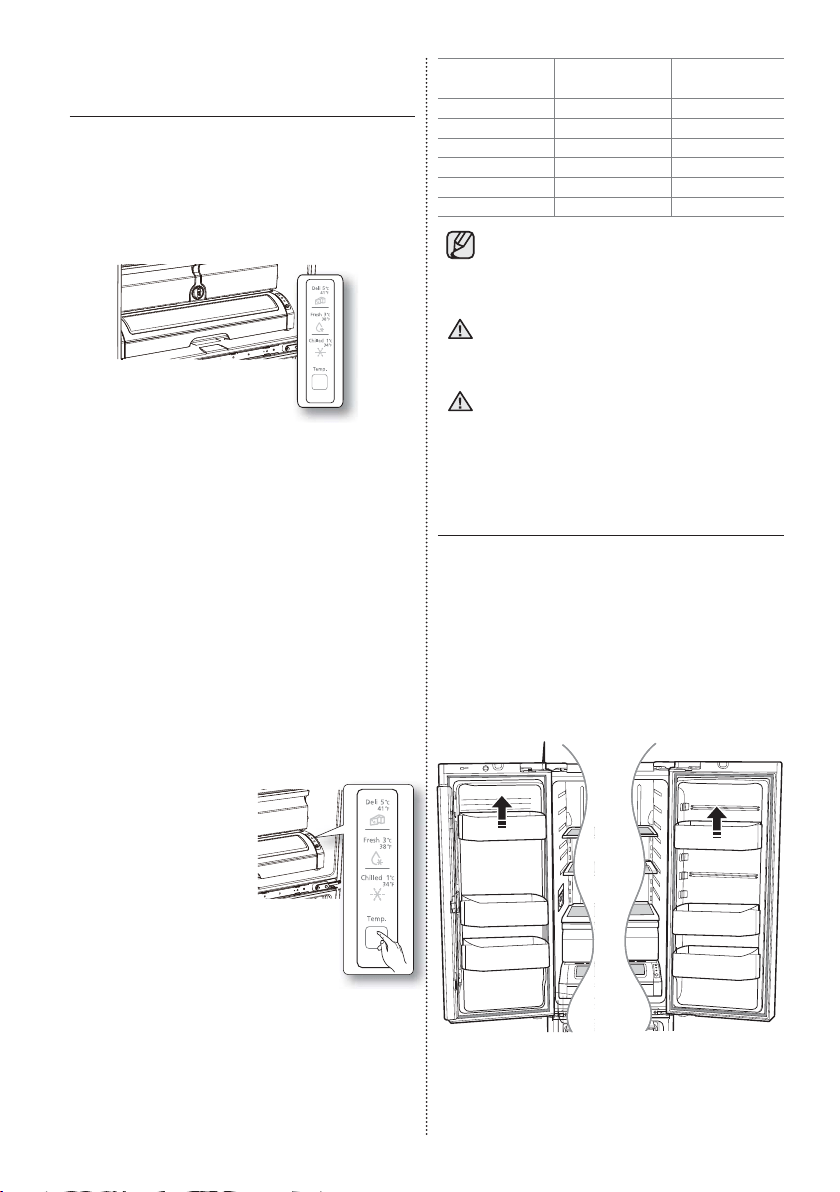
Funcionamiento
18_
Deli (Comidas
selectas)
Fresh (Fresco) Chilled (Frío)
piñat pepinost bistect
limonest manzanast quesos durost
aguacatest naranjast fi ambrest
patatast uvast tocinot
calabacines
maíz
t hot dogst
t
Las frutas y los vegetales pueden
descomponerse si se selecciona la opción
“chilled (frío)”. No almacene lechugas ni
otros vegetales de hoja en este cajón.
No almacene botellas de vidrio en este
cajón. Si se congelan, pueden romperse y
provocar lesiones personales.
Si pone un tazón de agua sin tapa en el
cajón, puede generarse condensación en
las piezas cercanas.
REMOCIÓN DE LOS ACCESORIOS
DEL REFRIGERADOR
1. Compartimentos de las puertas y
de los lácteos
tCom
partimentos de las puertas
Para retirarlos: simplemente levante la bandeja
y jale hacia afuera.
Para volver a colocarlos
:
deslícelos por encima de la
ubicación deseada y empuje hacia abajo hasta que se traben.
USO DE COOL SELECT
PANTRY
El Cool Select Pantry es un cajón completo con
control de temperatura regulable. Puede utilizarse
para grandes bandejas para fi estas, comidas
selectas, pizzas, bebidas o artículos varios.
Cuenta con un control de temperatura que permite
ajustar la cantidad de aire frío permitido en este cajón.
El control está ubicado en el lado derecho del cajón.
El cajón tiene tres modos: Fresh (Fresco), t
Chilled (Frío) y Deli (Comidas selectas). El modo
Fresh (Fresco) es el predeterminado. Presione
el botón Temp (Temperatura) varias veces hasta
que se ilumine el modo que desee. Luego de
seleccionar el modo, la temperatura cambia
para que coincida con el modo seleccionado.
La temperatura del cajón puede cambiar t
según la cantidad de artículos almacenados,
su ubicación, la temperatura ambiente y la
frecuencia con la que se abre la puerta.
Botón de selección del cajón
Cuando selecciona “Deli (Comidas selectas)”, 1.
la temperatura del cajón se mantiene alrededor
de 41°F (o 5°C). Esta función resulta útil para
mantener los alimentos frescos durante mucho
tiempo.
Cuando selecciona 2.
“Fresh (Fresco)”, la
temperatura del cajón
se mantiene alrededor
de 38 °F (o 3 °C). Esta
función resulta útil para
mantener los alimentos
frescos durante mucho
más tiempo.
Cuando selecciona 3.
“Chilled (Frío)”, la
temperatura del cajón se mantiene alrededor
de 34 °F (o 1 °C). Esta función resulta útil para
mantener la carne o el pescado fresco durante
mucho más tiempo.
En la tabla siguiente se muestran los modos del
cajón y los tipos de alimentos que se pueden
almacenar con seguridad en cada modo.
On
e
Tou
c
h
P
u
r
e
Wa
t
e
r
PRECAUCIÓN
PRECAUCIÓN
2012.5.16 3:3:3 PM
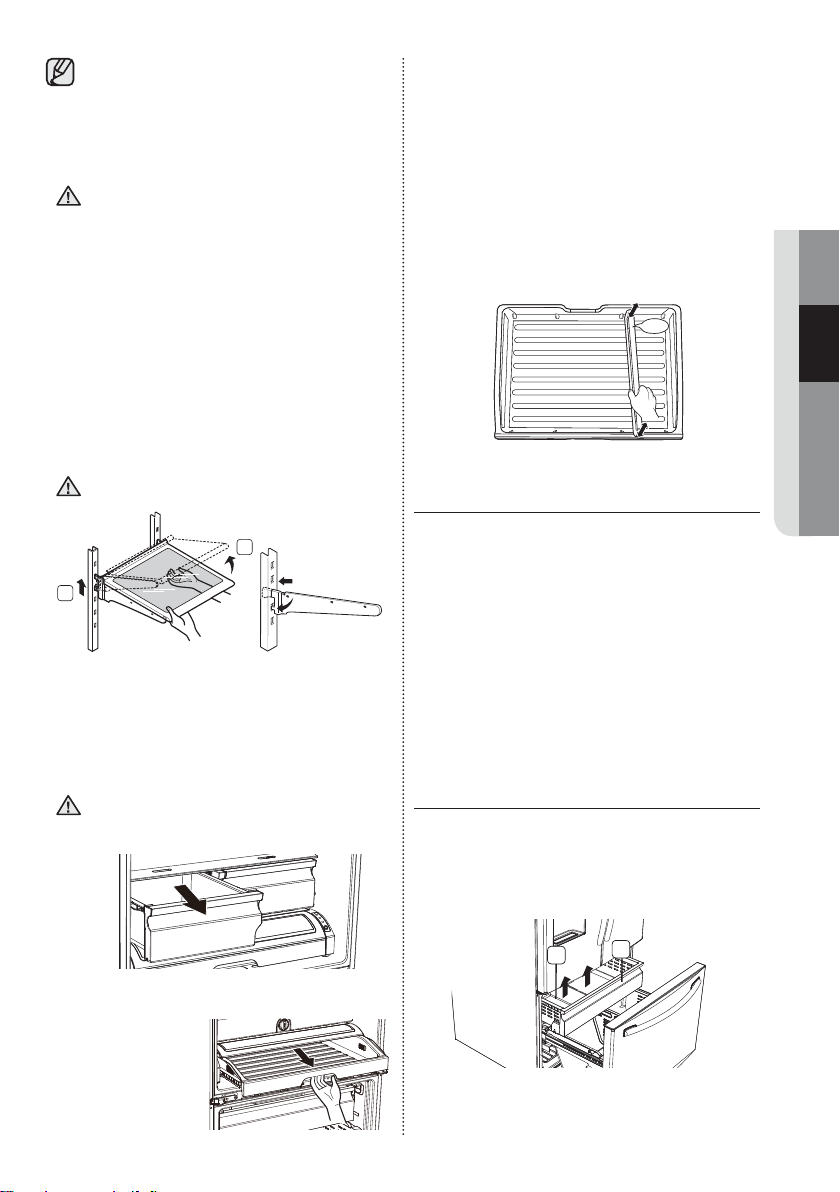
_19
Funcionamiento
Pueden producirse lesiones si los
compartimentos de las puertas no están
fi rmemente colocados.
No permita que los niños jueguen con los
compartimentos. Sus esquinas fi losas pueden
causar lesiones.
No ajuste un compartimento lleno de
alimentos. Primero retírelos.
Método para retirar el polvo: retire la guarda y
limpie con agua.
2. Estantes de vidrio templado
Para retirarlos: incline el frente del estante hacia
arriba en la dirección que se muestra en el gráfi co ( 1 )
y levántelo en forma vertical ( 2 ). Extraiga el estante.
Para volver a colocarlos: incline el frente del
estante hacia arriba y deslice los ganchos del
estante dentro de las ranuras a la altura deseada.
Luego baje el frente del estante de manera tal que
los ganchos caigan dentro de las ranuras.
Los estantes de vidrio templado son pesados.
Tenga mucho cuidado cuando los retire.
3. Cajones de vegetales y frutas
Para retirarlo: retire el cajón totalmente hacia afuera.
Incline el frente del cajón hacia arriba y retírelo.
Para volver a colocarlos: inserte el cajón
dentro de los rieles y empújelo hasta colocarlo
nuevamente en su lugar.
Se deben retirar los cajones antes de
levantar el estante de vidrio que se
encuentra sobre ellos.
4. Cool Select Pantry
Para retirar el cajón
Cool Select Pantry:
retire totalmente el
cajón. Incline el frente
del cajón hacia arriba
y retírelo.
Para volver a colocar el cajón Cool Select
Pantry: empuje hacia atrás los rieles del
refrigerador. Coloque el cajón en los rieles y
deslice el cajón hacia atrás hasta que esté en su
lugar.
Parar retirar el separador: extraiga
completamente el cajón, levante el lado frontal del
divisor para desengancharlo de la pared posterior
del cajón y retire el divisor.
Para volver a colocar el separador: Enganche
la parte posterior del divisor sobre la pared
posterior del cajón y empújelo hacia abajo.
Uso de las puertas
Asegúrese de que las puertas cierren
completamente y están bien selladas.
Cuando la puerta del refrigerador está
parcialmente abierta, se cerrará automáticamente.
Sin embargo, la puerta quedará abierta si su
ángulo de abertura está fuera del alcance del
cierre automático; en este caso deberá cerrarse
manualmente.
REMOCIÓN DE LOS
ACCESORIOS DEL
REFRIGERADOR
1. CUBETA DE HIELO
Para retirarla: levante la cubeta de hielo ( 1 ).
Para volver a colocarla: coloque la cubeta de
hielo en el cajón superextensible ( 2 ).
PRECAUCIÓN
PRECAUCIÓN
PRECAUCIÓN
1
2
1
2
2012.5.16 3:3:15 PM
Separador
02 FUNCIONAMIENTO
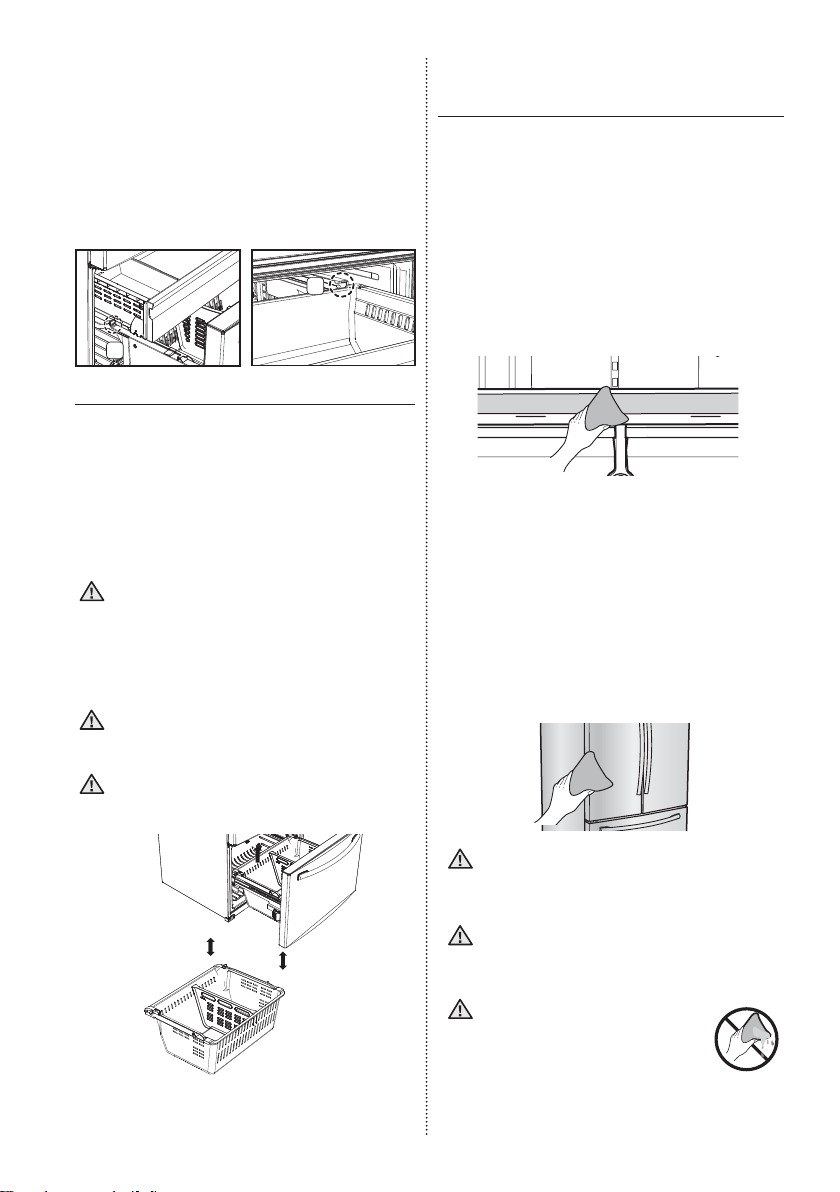
Funcionamiento
20_
2. Cajón superextensible
Para retirarlo: retire el cajón totalmente hacia
afuera. Incline la parte posterior del cajón hacia
arriba y levántelo.
Para volver a colocarlo: coloque el cajón sobre
los rieles ( 4 ) inclinándolo hacia arriba. Baje
el cajón y colóquelo en su lugar hasta que se
encuentre en posición horizontal, luego deslice el
cajón hasta el tope ( 3 ).
3. Cajón del congelador
Para retirar el cajón: extraiga el cajón del
congelador completamente. Incline la parte
posterior del compartimento hacia arriba y
levántelo para retirarlo.
Para volver a colocar el cajón: inserte la
bandeja en los rieles.
No permita que bebés o niños entren en
el cajón del congelador. Pueden dañar el
refrigerador y lesionarse gravemente. No
se siente en la puerta del congelador. La
puerta puede romperse. No permita que
los niños trepen al cajón del congelador.
No retire el divisor.
Si quedan atrapados dentro, los niños
pueden lesionarse o sofocarse hasta morir.
LIMPIEZA DEL
REFRIGERADOR
El cuidado del refrigerador de puerta francesa
Samsung prolonga su vida útil y ayuda a que no
se fi ltren olores ni gérmenes.
Limpieza del interior
Limpie las paredes internas y los accesorios con
un detergente suave, luego seque con un paño
suave. Puede retirar los cajones y estantes para
limpiar a fondo. Asegúrese de secar los cajones
y estantes antes de colocarlos nuevamente en su
lugar.
Limpieza del exterior
Limpie el panel de control y el visor digital con
un paño húmedo, limpio y suave. No pulverice
con agua directamente sobre la superfi cie del
refrigerador.
Las puertas, manijas y las superfi cies del gabinete
se deben limpiar con un detergente suave y luego
secar con un paño suave. Para que el refrigerador
luzca mejor que nunca, recomendamos pulir el
exterior una o dos veces al año.
No pulverice agua directamente sobre
el refrigerador. Utilice un paño limpio y
húmedo para la limpieza.
No utilice bencina, solvente o Clorox para
limpiarlo. Pueden dañar la superfi cie del
refrigerador y provocar un incendio.
Las letras impresas en el display
pueden borrarse si se aplica
directamente el limpiador de
acero inoxidable sobre la zona.
PRECAUCIÓN
PRECAUCIÓN
ADVERTENCIA
PRECAUCIÓN
PRECAUCIÓN
PRECAUCIÓN
4
3
2012.5.16 3:3:20 PM
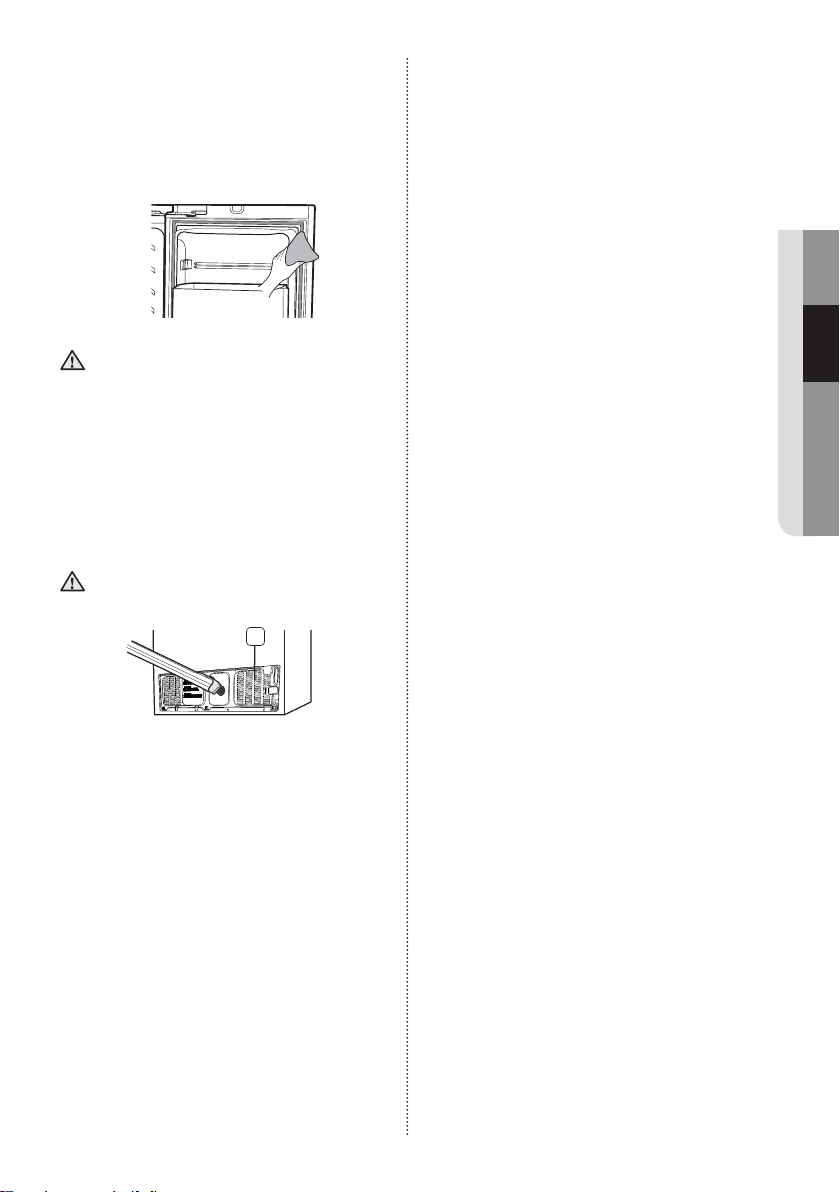
_21
Funcionamiento
Si los burletes de goma de la puerta están
sucios, es posible que las puertas no cierr en
correctamente, y el r efrigerador no funcionará
como corr esponde. Mantenga los burletes libr es
de polvo o manchas limpiando las puertas con un
detergente suave y un paño húmedo. Seque con
un paño limpio y suave.
No limpie el refrigerador con bencina,
solvente o detergente para automóviles ya
que puede pr ovocar un incendio.
Limpieza de la parte posterior del
refrigerador
Para mantener los cables y las partes expuestas
libres de polvo y suciedad
Aspire la parte posterior del r efrigerador una o dos
veces por año.
No retire la tapa posterior ( 1 ).
Podría sufrir una descarga eléctrica.
PRECAUCIÓN
PRECAUCIÓN
1
2012.5.16 3:3:29 PM
02 FUNCIONAMIENTO
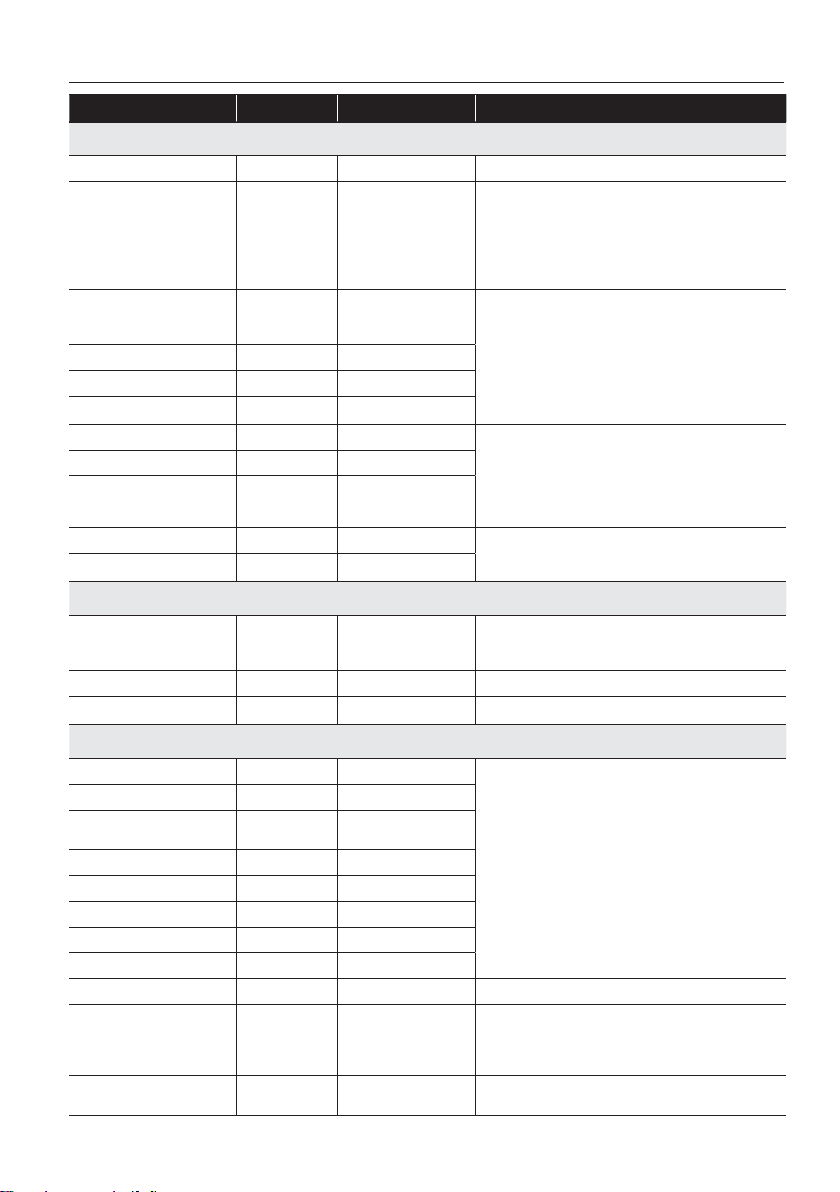
Funcionamiento
22_
RECOMENDACIONES DE ALMACENAMIENTO DE ALIMENTOS
Alimentos Refrigerador Congelador Recomendaciones de almacenamiento
LÁCTEOS
Mantequilla 2-3 semanas 6-9 meses Envolver o cubrir muy bien.
Leche 1-2 semanas No recomendado
Verifi car el código de fecha. La leche y casi todos
los productos derivados se venden en envases
de cartón con código de fecha de vencimiento
del producto. Cerrar con tapa o envolver muy
bien. No volver a colocar el producto que no se
ha ingerido en el envase original.
Queso crema, alimentos
que contienen queso y
queso untable
2-4 semanas No recomendado
Verifi car el código de fecha. Mantener el queso
envuelto fi rmemente evitando que se fi ltre la
humedad.
Queso duro (sin abrir) 3-4 meses 6 meses
Queso duro (abierto) 2 meses No recomendado
Requesón 10-15 días No recomendado
Crema 7-10 días 2 meses
Verifi car el código de fecha. La mayoría de los
yogures, cremas y productos similares se venden
en envases de cartón con código de fecha de
vencimiento del producto. Volver a cerrar o cubrir
muy bien. No volver a colocar el producto que no
se ha ingerido en el envase original.
Crema agria 2 semanas No recomendado
Salsas de crema
(abiertas)
1 semana No recomendado
Yogur 10-14 días No recomendado
Verifi car el código de fecha. Mantener tapado.
Yogur congelado N/A 2 meses
HUEVOS
Huevos (crudos) 3-4 semanas No recomendado
Verifi car el código de fecha. Almacenar los
huevos en el sector más frío del refrigerador y en
su recipiente original.
Huevos (cocidos) 1 semana No recomendado Almacenar en un recipiente tapado
Sobras de comidas con huevo
3-4 días No recomendado Almacenar en un recipiente tapado
FRUTAS FRESCAS
Manzanas 1 mes No recomendado
Si se almacena fruta en el refrigerador, no lavar
antes
de guardar. Almacenar en bolsas o recipientes
resistentes
a la humedad. Envolver las frutas cortadas. Al-
gunas frutas se oscurecen cuando se las enfría.
Plátanos 2-4 días No recomendado
Duraznos, melones,
peras, aguacates
3-5 días No recomendado
Moras y cerezas 2-3 días 12 meses
Chabacanos 3-5 días No recomendado
Uvas 2-5 días N/A
Piña (entera) 2-3 días No recomendado
Piña (cortada) 5-7 días 6-12 meses
Cítricos 1-2 semanas No recomendado Almacenar sin tapa.
Jugo 6 días No recomendado
Verifi car el código de fecha y volver a almacenar
cerrado en su recipiente original. No volver a
colocar el producto que no se ha ingerido en el
envase original.
Jugo congelado
Se descongela
solamente
12 meses Verifi car el código de fecha. No volver a congelar.
2012.5.16 3:3:30 PM
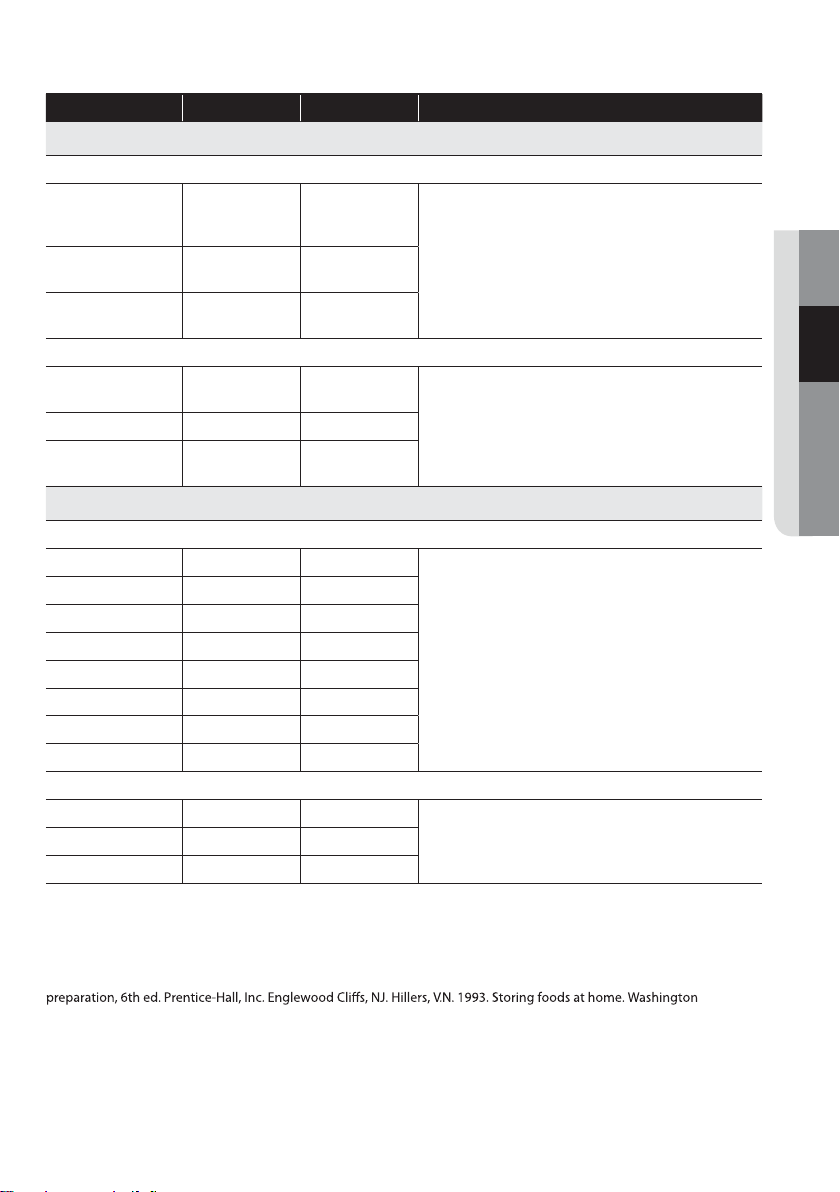
_23
Funcionamiento
Alimentos Refrigerador Congelador Recomendaciones de almacenamiento
PESCADOS Y MARISCOS
Pescados
Pescado graso
(caballa, trucha,
salmón)
1-2 días
2-3 meses
Mantener en el envoltorio original y almacenar en
el sector más frío del refrigerador. Envolver con un
material resistente a la humedad y al vapor para el
congelador. Congelar a 0 ºF (-18 °C ). Descongelar
en el refrigerador o verifi car el código de fecha.
Congelar en su envoltorio original.
Pescado magro
(bacalao, platija, etc.)
1-2 días 6 meses
Congelado o
empanado
N/A 3 meses
Mariscos
Camarones
(crudos)
1-2 días 12 meses
Para congelar, envolver en un recipiente resistente a la
humedad y al vapor.
Cangrejo 3-5 días 10 meses
Pescado o
mariscos cocidos
2-3 días 3 meses
CARNE
Fresca, cruda
Chuletas 2-4 días 6-12 meses
Verifi car el código de fecha antes de usar. Almacenar
en el sector más frío del refrigerador en su envoltorio
original. Colocar dentro de un recipiente resistente al
vapor y a la humedad para congelar. La temperatura
recomendada para el refrigerador es de 33 ºF a 36 ºF
(o 1 °C a 2 °C ) y para el congelador de 0 ºF a 2 ºF (o
-18 °C a -16 °C )
Molida 1 día 3-4 meses
Asada 2-4 días 6-12 meses
Tocino 1-2 semanas 1-2 meses
Salchichas 1-2 días 1-2 meses
Bistec 2-4 días 6-9 meses
Aves 1 día 12 meses
Fiambres 3-5 días 1 mes
Cocida
Carne 2-3 días 2-3 meses
Verifi car el código de fecha antes de usar. Almacenar
en el sector más frío del refrigerador en su envoltorio
original. Colocar dentro de un recipiente resistente al
vapor y a la humedad para congelar.
Aves 2-3 días 4-5 meses
Jamón 1-2 semanas 1-2 meses
Fuentes:
American Meat Institute Foundation. 1994. Páginas amarillas: respuestas a preguntas previsibles que los consumidores
realizan con respecto a la carne y a las aves. American Meat Institute Food Marketing Institute. 1999. The food keeper.
Food Marketing Institute, Washington, D.C. Freeland-Graves, J.H. y G.C. Peckham. 1996. Foundations of food
State University Cooperative Extension, Pullman, WA. Publ. EB 1205.
National Restaurant Association. 2001. Be cool-chill out! Refrigerate promptly. National Restaurant Association
Education Foundation¼s International Food Safety Council, Washington, D.C. USDA. 1997. Basics for handling food
safely. U.S. Department of Agriculture, Food Safety and Inspection Service, Washington, D.C.
2012.5.16 3:3:30 PM
02 FUNCIONAMIENTO
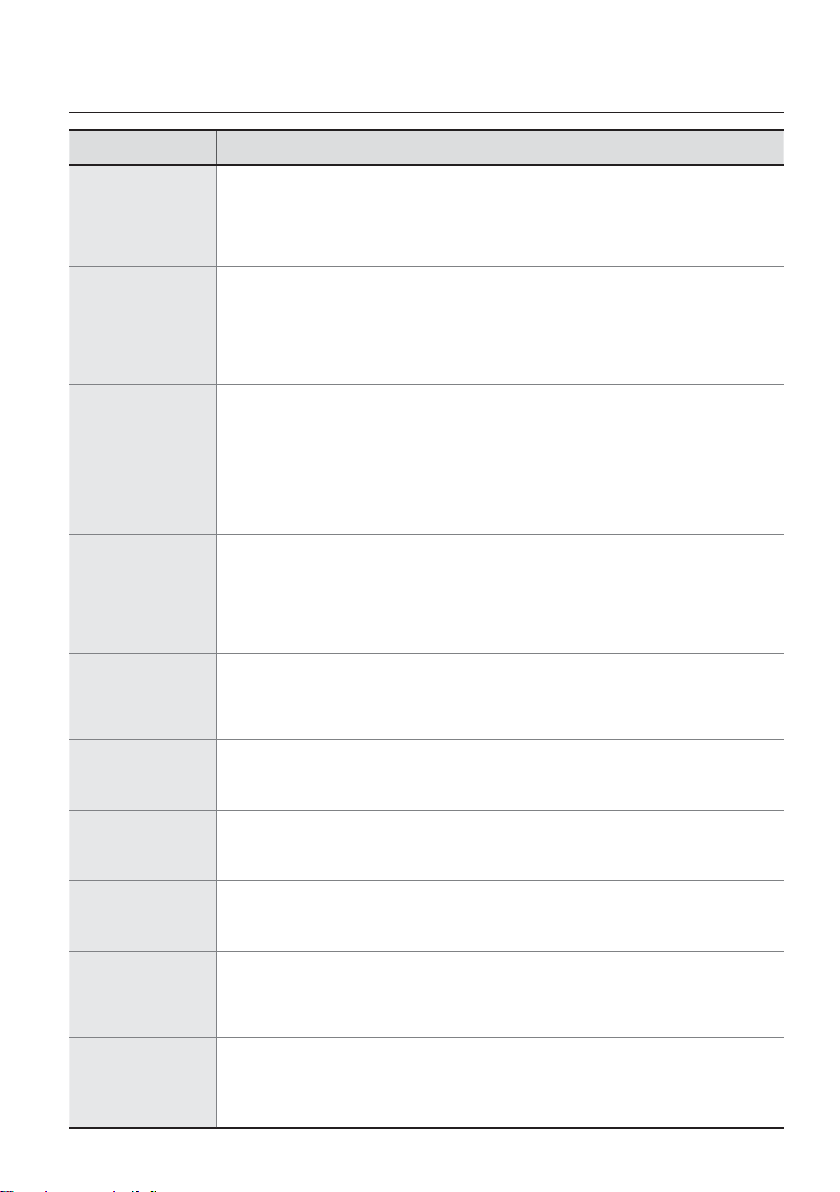
Solución de problemas
24_
Solución de problemas
PROBLEMA SOLUCIÓN
El refrigerador
no funciona para
nada o no enfría
lo sufi ciente.
ŘVerifi que que el enchufe esté correctamente conectado.
ŘVerifi que si la temperatura en el display es más alta que la temperatura interna del
refrigerador o congelador. Si es así, ajuste el refrigerador a una temperatura inferior.
Ř¿El refrigerador está ubicado directamente al sol o cerca de una fuente de calor?
Ř¿La parte posterior del refrigerador está demasiado cerca de una pared, evitando la
ventilación adecuada?
La comida en el
congelador está
congelada.
ŘVerifi que si la temperatura en el display está demasiado baja.
ŘIntente poner el refrigerador en una temperatura más alta.
Ř¿La temperatura de la habitación es demasiado baja? Ponga el refrigerador a una
temperatura más alta.
Ř¿Colocó el alimento con jugo en el sector más frío del refrigerador? Corra esos
alimentos a otros estantes en el congelador en lugar de guardarlos en las áreas más
frías o cajones.
Escucha ruidos o
sonidos fuera de
lo normal.
ŘVerifi que que el refrigerador esté nivelado y estable.
Ř¿La parte posterior del refrigerador está demasiado cerca de una pared, evitando la
ventilación adecuada?
Trate de separar el refrigerador al menos 2 pulgadas de la pared.
Ř¿Cayó algo detrás o debajo del refrigerador?
ŘSe oye un "tic" proveniente del interior del refrigerador. Es normal y ocurre porque varios
accesorios se contraen o expanden según la temperatura del interior del refrigerador.
ŘEs normal que se escuche como si algo golpeara algún elemento dentro del
refrigerador. El ruido se debe al compresor funcionando a alta capacidad.
El área de cierre
de la puerta del
gabinete del
refrigerador está
caliente y se
está generando
condensación.
ŘEs normal que se genere algo de calor ya que los anticondensadores están instalados
en la sección de la bisagra vertical del refrigerador para impedir la condensación.
Ř¿Está la puerta del refrigerador entreabierta? Puede producirse condensación cuando
deja la puerta abierta por mucho tiempo.
La fábrica de
hielo no funciona.
Ř¿Esperó 12 horas luego de haber instalado la tubería de suministro de agua antes de
hacer hielo?
Ř¿Está conectado el suministro de agua y abierta la válvula de cierre?
Ř¿Detuvo manualmente la función para hacer hielo?
Ř
¿Está demasiado alta la temperatura del congelador? Baje la temperatura del congelador.
Puede que se
generen burbujas
de agua dentro
del refrigerador.
ŘEsto es normal. Las burbujas pertenecen al refrigerante que circula a través del
refrigerador.
Hay mal olor en el
refrigerador.
ŘVerifi que si hay alimentos descompuestos.
ŘLos alimentos con olores fuertes (por ejemplo, pescado) se deberían tapar muy bien.
ŘLimpie su congelador periódicamente y deseche los alimentos descompuestos o que
considera que pueden descomponerse.
Se forma
escarcha en
las paredes del
congelador.
Ř¿Está bloqueada la ventilación de aire? Quite cualquier obstrucción de modo que el aire
pueda circular libremente
Ř
Deje espacio sufi ciente entre los alimentos guardados para la correcta circulación del aire.
Ř¿El cajón del congelador está correctamente cerrado?
El dispensador de
agua no funciona.
Ř¿Está conectado el suministro de agua y abierta la válvula de cierre?
Ř¿Está la tubería de suministro de agua aplastada o enroscada?
ŘAsegúrese de que la tubería esté libre y sin obstrucciones.
Ř¿Está congelado el tanque de agua porque la temperatura del congelador está
demasiado baja? Seleccione una temperatura más alta en el visor digital.
El sistema de
cierre automático
no funciona con
la puerta del
congelador.
Ř¿Están desequilibradas las partes derecha e izquierda de la puerta?
ŘAbra y cierre suavemente la puerta 1~2 veces. Luego de hacerlo en general el sistema
de cierre automático funciona correctamente.
ŘAbra la puerta suavemente para evitar desequilibrar la parte derecha y la parte izquierda
de la puerta.
2012.5.16 3:3:30 PM
garantía
(
USA
)
GARANTÍA DEL REFRIGERADOR SAMSUNG
GARANTÍA LIMITADA PARA EL COMPRADOR ORIGINAL
Este producto de marca Samsung, suministrado y distribuido por Samsung Electronics America, Inc. (Samsung)
y entregado nuevo, en su caja de fábrica al comprador original, está garantizado por Samsung ante defectos
de fabricación relacionados con los materiales y la mano de obra durante un período de garantía limitado a:
Un (1) año para las piezas y la mano de obra del refrigerador
Cinco (5) años para las piezas y la mano de obra exclusivamente del sistema hermético de
refrigeración*
(*Compresor, evaporador, condensador, deshumidifi cador, tuberías de conexión)
Esta garantía limitada entra en vigencia en la fecha original de compra y sólo es válida para productos
adquiridos y utilizados en los Estados Unidos. Para recibir el servicio técnico bajo garantía, el comprador debe
comunicarse con Samsung para determinar la naturaleza del problema y proceder a repararlo. El servicio de
garantía sólo puede realizarse a través de un Centro de Servicio autor
izado Samsung. Debe presentarse la
factura original de venta bajo solicitud de Samsung o del Centro de Servicio autorizado Samsung como prueba
de compra.
Samsung reparará o reemplazará cualquier pieza considerada defectuosa, a nuestra entera discreción y
sin cargo, según lo estipulado en este documento, por piezas nuevas o reparadas durante el período de
garantía limitada especifi cado anteriormente. Todas las piezas y productos reemplazados son de propiedad de
Samsung y deben devolverse a Samsung. Las piezas y los productos de repuesto quedarán bajo el período
restante de garantía original, o noventa (90) días, el que sea más extenso.
La prestación de servicios en el hogar se realizará durante el período de garantía de la mano de obra, sujeto
a disponibilidad dentro de los Estados Unidos. La prestación de servicios en el hogar no está disponible en
todas las zonas. Para
recibir la prestación de servicio en el hogar, el producto debe estar despejado y ser
accesible al nivel del piso para el personal de servicio técnico. Si durante la prestación de servicios en el
hogar, no pudiera llevarse a cabo la reparación, podría ser necesario realizar el traslado, reparación y posterior
devolución del producto. Si la prestación de servicios en el hogar no está disponible, Samsung podría escoger,
a nuestra entera discreción, proporcionar transporte a nuestra elección hasta y desde el Centro de Servicio
autorizado Samsung. De lo contrario, el transporte hasta y desde el Centro de Servicio autorizado Samsung
estará a cargo del comprador.
Esta garantía limitada cubre defectos de fabricación en materiales y mano de obra bajo condiciones de uso
normal, no comercial, del producto y no se aplicará en los
siguientes casos, incluidos, aunque no limitados a:
daños ocasionados durante el transporte; entrega e instalación; aplicaciones y usos para los que el producto
no fue diseñado; producto o números de serie alterados; daños externos o del acabado exterior; accidentes,
mal uso, negligencia, incendio, agua, rayos u otros fenómenos naturales; uso de productos, equipamiento,
sistemas, servicios públicos, servicios generales, piezas, suministros, accesorios, aplicaciones, instalaciones,
reparaciones, tuberías externas y fugas, cableado externo, disyuntores, fusibles o conectores no suministrados
ni autorizados por Samsung o que dañen este producto u ocasionen problemas de servicio; voltaje incorrecto,
cumplimiento de las instrucciones de funcionamiento, limpieza, mantenimiento y cuidado del medio ambiente
que se incluyen y establecen en el manual de instrucciones; pérdida de alimentos por descomposición;
consumibles incluyendo fi ltros y focos de iluminación.
NO EXISTEN OTRAS GARANTÍAS EXPLÍCITAS APARTE DE LAS MENCIONADAS Y DESCRITAS
ANTERIORMENTE, ASÍ COMO TAMPOCO EXISTEN OTRAS GARANTÍAS EXPLÍCITAS O IMPLÍCITAS,
INCLUYENDO SIN LIMITACIÓN A TODAS LAS GARANTÍAS IMPLÍCITAS DE COMERCIABILIDAD O
IDONEIDAD PARA UN FIN CONCRETO Y QUE SEAN PERTINENTES TRAS LOS PERÍODOS DE GARANTÍA
EXPLÍCITA INDICADOS CON ANTERIORIDAD, Y NINGUNA GARANTÍA EXPLÍCITA U OFRECIDA POR
PERSONAS, FIRMAS O EMPRESAS EN RELACIÓN A ESTE PRODUCTO SERÁN LEGALMENTE
VINCULANTES PARA SAMSUNG. SAMSUNG NO SERÁ LEGALMENTE RESPONSABLE DE LA PÉRDIDA
DE INGRESOS O BENEFICIOS, LA FALTA DE AHORROS U OTROS BENEFICIOS, O DE NINGÚN OTRO
DAÑO RESULTANTE ESPECIAL, ACCIDENTAL O INDIRECTO OCASIONADO POR EL USO, ABUSO O
INCAPACIDAD DE USO DE ESTE PRODUCTO, INDEPENDIENTEMENTE DE LA TEORÍA LEGAL SOBRE
LA QUE SE BASE EL RECLAMO, INCLUSO SI SAMSUNG HA SIDO ADVERTIDO DE LA POSIBILIDAD DE
TALES DAÑOS. ASIMISMO, CUALQUIER TIPO DE INDEMNIZACIÓN EXIGIDA A SAMSUNG NO SUPERARÁ
2012.5.16 3:3:30 PM
Diez (10) años para las piezas y Cinco (5) años para mano de obra de compresor Digital Inverter.
EL PRECIO DE COMPRA DEL PRODUCTO VENDIDO POR SAMSUNG Y QUE HAYA OCASIONADO EL
SUPUESTO DAÑO. SIN LIMITAR LO INDICADO ANTERIORMENTE, EL COMPRADOR ASUME TODO
EL RIESGO Y RESPONSABILIDAD DE CUALQUIER PÉRDIDA, DAÑO O LESIÓN AL SÍ MISMO O A SU
PROPIEDAD, ASÍ COMO A TERCEROS Y A SU PROPIEDAD, OCASIONADOS POR EL USO, ABUSO O
INCAPACIDAD DE USO DE ESTE PRODUCTO VENDIDO POR SAMSUNG QUE NO HAYAN SIDO CAUSADOS
DIRECTAMENTE POR NEGLIGENCIA DE SAMSUNG. ESTA GARANTÍA LIMITADA NO SERÁ VÁLIDA PARA
PERSONAS AJENAS AL COMPRADOR ORIGINAL DE ESTE PRODCUTO, ADEMÁS ES INTRANSFERIBLE Y
CONSTITUYE SU RECURSO EXCLUSIVO.
Ciertos estados no permiten limitaciones en cuanto a la vigencia de una garantía implícita o la exclusión o
limitación de daños accidentales o indirectos, de tal forma que las limitaciones o excepciones mencionadas tal
vez no se apliquen a usted en particular. Esta garantía
le otorga derechos legales específi cos, e incluso puede otorgarle otros derechos que varían de un estado a otro.
Para obtener el servicio de garantía, pónganse en contacto con Samsung en el:
CENTRO DE ASISTENCIA AL CLIENTE DE SAMSUNG
Samsung Electronics America, Inc. 85 Challenger Road Ridgefi eld Park, NJ 07660
1-800-SAMSUNG (1-800-726-7864) y www.samsung.com
PAÍS LLÁMENOS
O VISÍTENOS EN LÍNEA EN ESCRÍBANOS
ESTADOS
UNIDOS
1-800-SAMSUNG
(726-7864)
www.samsung.com/us/support
Samsung Electronics America, Inc.
85 Challenger Road Ridgefield Park,
NJ 07660
CANADA
1-800-SAMSUNG
(726-7864)
www.samsung.com/ca/support (Inglés)
www.samsung.com/ca_fr/support (Francés)
Samsung Electronics Canada Inc. 2050
Derry Road West, Mississauga, Ontario
L5N 0B9 Canada
Contacte con SAMSUNG WORLD WIDE
Si tiene alguna pregunta o comentario acerca de productos Samsung, por favor contacte con el servicio
de atención al cliente de SAMSUNG.