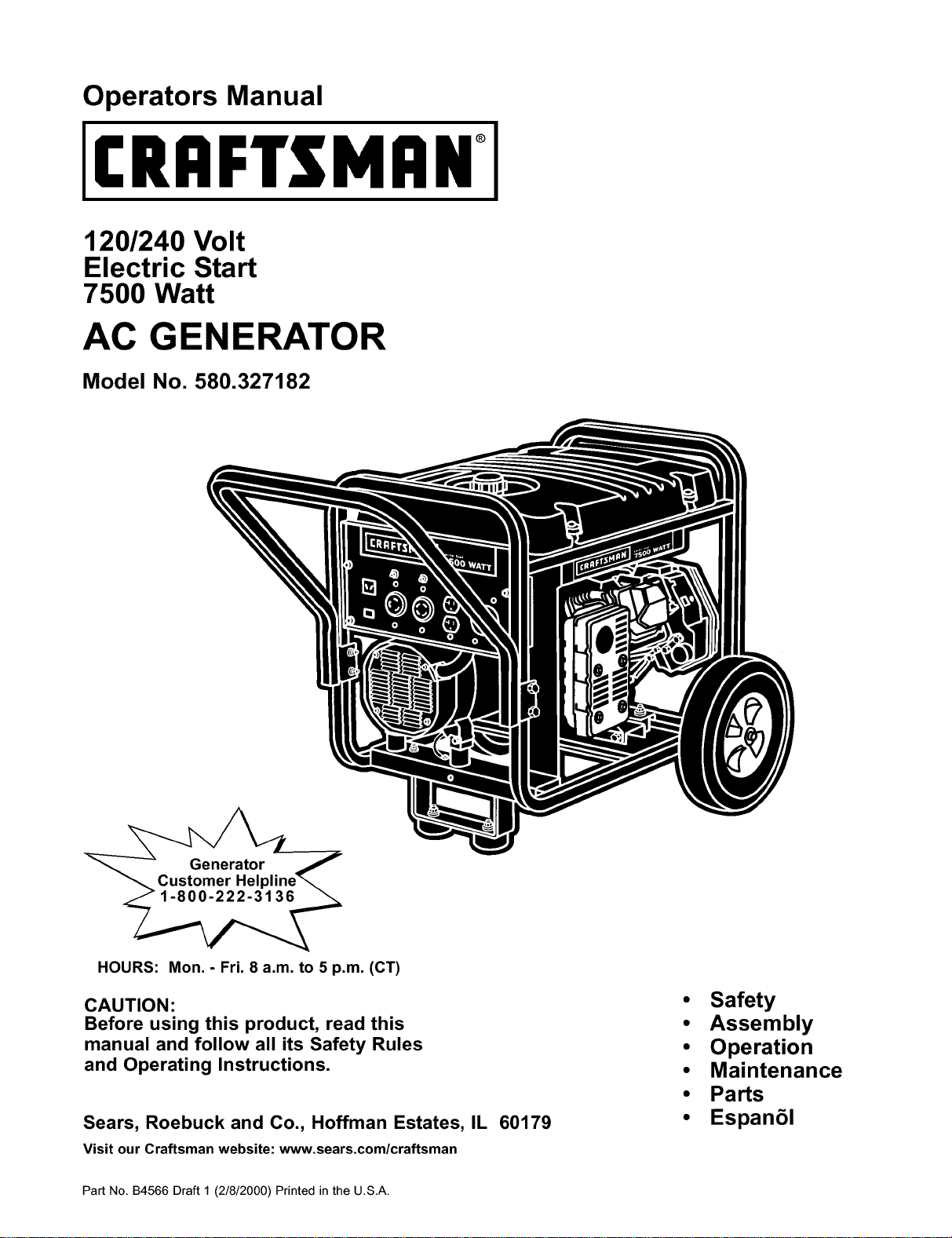
Operators Manual
[CRRFTSHRN°I
120/240 Volt
Electric Start
7500 Watt
AC GEN
Model No. 580.327182
R
CusGemnerat°lpline_ r
HOURS: Mon. - Fri. 8 a.m. to 5 p.m. (CT)
CAUTION:
Before using this product, read this
manual and follow all its Safety Rules
and Operating Instructions.
Sears, Roebuck and Co., Hoffman Estates, IL
Visit our Craftsman website: www.sears.com/craftsman
60179
• Safety
• Assembly
• Operation
• Maintenance
• Parts
• Espan61
Part No. B4566 Draft 1 (2/8/2000) Printed in the U.S.A.
Warranty .................................. 2
Safety Rules ............................... 3
Assembly ............................... 4-5
Operation .............................. 6-12
Product Specifications ....................... 13
Maintenance ........................... 13-16
Storage .................................. 17
Troubleshooting ............................ 18
Schematic/Wiring Diagram ................. 20-21
Replacement Parts ...................... 22-29
Emissions Warranty ......................... 30
EspaSol ............................... 31-51
How to Order Parts ................... Back Page
LIMITED WARRANTY FOR DELUXE PORTABLE GENERATORS
SEARS warrants to the original purchaser that the alternator and engine for its portable generator will be free
from defects in materials or workmanship for the items and period set forth below from the date of original
purchase. This warranty is not transferable and applies only to portable generators driven by the GN-Series
Sears warranted engine.
CONSUMER* COMMERCIAL*
Alternator 2 years (2nd year parts only) 1 year
Engine 2 years (2nd year parts only) 1 year
* NOTE: For the purpose of this warranty "Consumer Use" means personal residential household and
emergency use by original purchaser, not to be used as a primary source of power. "Commercial Use" means all
other uses, including rental, construction, commercial, and income producing purposes. Once a generator has
experienced commercial use, it shall thereafter be considered a commercial use generator for the purpose of
this warranty.
During said warranty period, SEARS will, at its option, repair or replace any part which, upon examination by
SEARS, is found to be defective under normal use and service**. Starting batteries are not warranted by
SEARS. All transportation costs under warranty, including return to the factory if necessary, are to be borne by
the purchaser and prepaid by him. This warranty does not cover normal maintenance and service and does not
apply to a generator set, alternator or engine, or parts which have been subjected to improper or unauthorized
installation or alteration, misuse, negligence, accident, overloading, overspeeding, improper maintenance, repair
or storage so as, in SEARS's judgment, to adversely affect its performance and reliability.
** NORMAL WEAR: As with all mechanical devices, engines need periodic parts service and replacement to
perform well. This warranty will not cover repair when normal use has exhausted the life of a part or engine.
THERE IS NO OTHER EXPRESS WARRANTY. SEARS HEREBY DISCLAIMS ANY AND ALL
IMPLIED WARRANTIES, INCLUDING BUT NOT LIMITED TO THOSE OF MERCHANTABILITY AND
FITNESS FOR A PARTICULAR PURPOSE TO THE EXTENT PERMITTED BY LAW. THE DURATION
OF ANY IMPLIED WARRANTIES WHICH CANNOT BE DISCLAIMED IS LIMITED TO THE TIME
PERIOD AS SPECIFIED IN THE EXPRESS WARRANTY. LIABILITY FOR CONSEQUENTIAL,
INCIDENTAL, OR SPECIAL DAMAGES UNDER ANY AND ALL WARRANTIES IS EXCLUDED.
Some states do not allow limitations on how long an implied warranty lasts, or the exclusion or limitation of
incidental or consequential damages, so the above limitations or exclusions may not apply to you. This warranty
gives you specific legal rights and you may also have other rights, which vary from state to state.
For service, see your nearest SEARS authorized warranty service facility. Warranty service can be performed
only by a SEARS authorized service facility. This warranty will not apply to service at any other facility. At the
time of requesting warranty service, evidence of original purchase date must be presented.
Sears, Roebuck and Co., D/817WA, Hoffman Estates, IL 60179
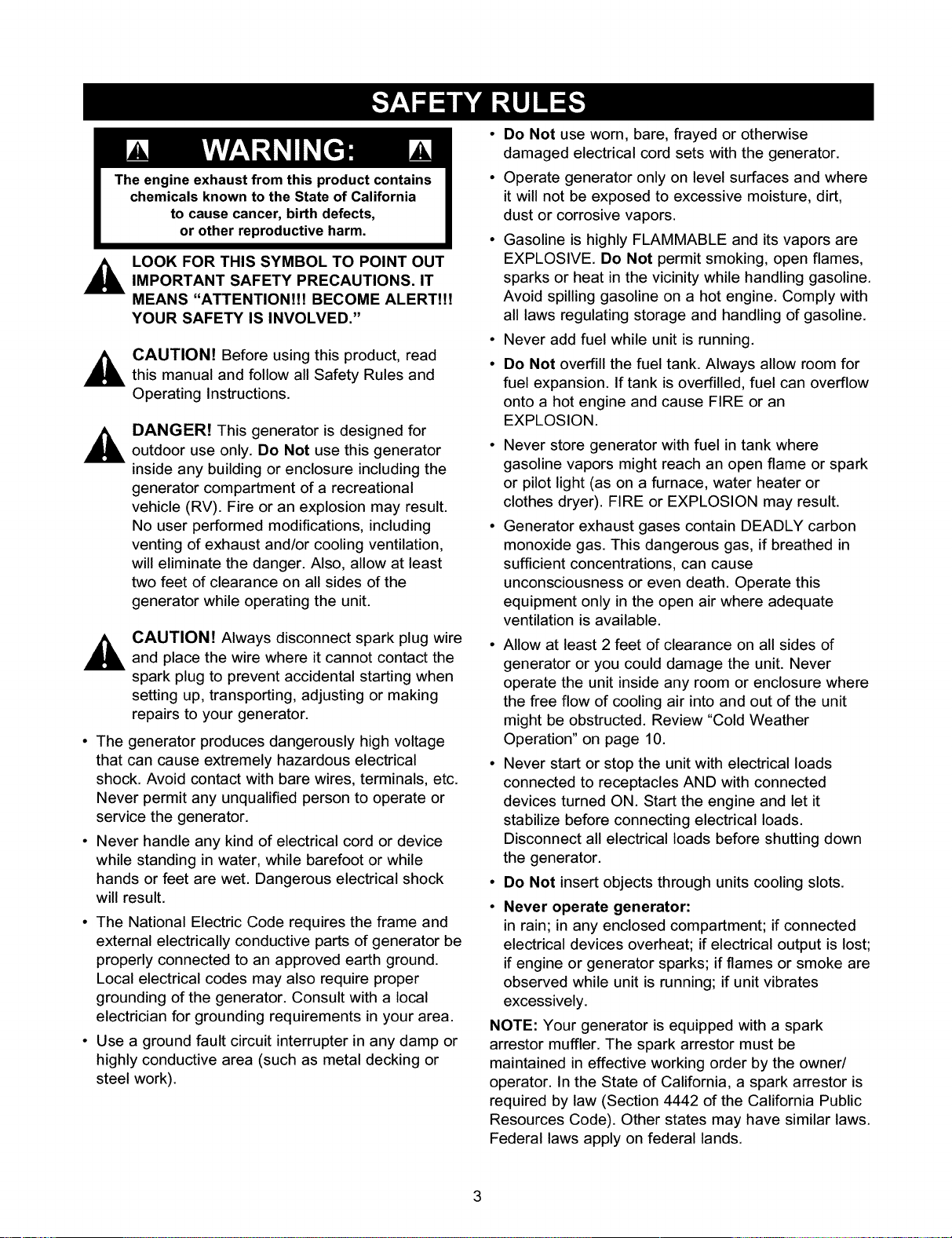
The engine exhaust from this product contains
chemicals known to the State of California
to cause cancer, birth defects,
or other reproductive harm.
LOOK FOR THIS SYMBOL TO POINT OUT
IMPORTANT SAFETY PRECAUTIONS. IT
MEANS "ATTENTION!!! BECOME ALERT!!!
YOUR SAFETY IS INVOLVED."
,_ CAUTION! Before using this product, read
this manual and follow all Safety Rules and
Operating Instructions.
DANGER! This generator is designed for
outdoor use only. Do Not use this generator
inside any building or enclosure including the
generator compartment of a recreational
vehicle (RV). Fire or an explosion may result.
No user performed modifications, including
venting of exhaust and/or cooling ventilation,
will eliminate the danger. Also, allow at least
two feet of clearance on all sides of the
generator while operating the unit.
CAUTION! Always disconnect spark plug wire
and place the wire where it cannot contact the
spark plug to prevent accidental starting when
setting up, transporting, adjusting or making
repairs to your generator.
• The generator produces dangerously high voltage
that can cause extremely hazardous electrical
shock. Avoid contact with bare wires, terminals, etc.
Never permit any unqualified person to operate or
service the generator.
• Never handle any kind of electrical cord or device
while standing in water, while barefoot or while
hands or feet are wet. Dangerous electrical shock
will result.
• The National Electric Code requires the frame and
external electrically conductive parts of generator be
properly connected to an approved earth ground.
Local electrical codes may also require proper
grounding of the generator. Consult with a local
electrician for grounding requirements in your area.
• Use a ground fault circuit interrupter in any damp or
highly conductive area (such as metal decking or
steel work).
• Do Not use worn, bare, frayed or otherwise
damaged electrical cord sets with the generator.
• Operate generator only on level surfaces and where
it will not be exposed to excessive moisture, dirt,
dust or corrosive vapors.
• Gasoline is highly FLAMMABLE and its vapors are
EXPLOSIVE. Do Not permit smoking, open flames,
sparks or heat in the vicinity while handling gasoline.
Avoid spilling gasoline on a hot engine. Comply with
all laws regulating storage and handling of gasoline.
• Never add fuel while unit is running.
• Do Not overfill the fuel tank. Always allow room for
fuel expansion. If tank is overfilled, fuel can overflow
onto a hot engine and cause FIRE or an
EXPLOSION.
Never store generator with fuel in tank where
gasoline vapors might reach an open flame or spark
or pilot light (as on a furnace, water heater or
clothes dryer). FIRE or EXPLOSION may result.
Generator exhaust gases contain DEADLY carbon
monoxide gas. This dangerous gas, if breathed in
sufficient concentrations, can cause
unconsciousness or even death. Operate this
equipment only in the open air where adequate
ventilation is available.
• Allow at least 2 feet of clearance on all sides of
generator or you could damage the unit. Never
operate the unit inside any room or enclosure where
the free flow of cooling air into and out of the unit
might be obstructed. Review "Cold Weather
Operation" on page 10.
• Never start or stop the unit with electrical loads
connected to receptacles AND with connected
devices turned ON. Start the engine and let it
stabilize before connecting electrical loads.
Disconnect all electrical loads before shutting down
the generator.
• Do Not insert objects through units cooling slots.
• Never operate generator:
in rain; in any enclosed compartment; if connected
electrical devices overheat; if electrical output is lost;
if engine or generator sparks; if flames or smoke are
observed while unit is running; if unit vibrates
excessively.
NOTE: Your generator is equipped with a spark
arrestor muffler. The spark arrestor must be
maintained in effective working order by the owner/
operator. In the State of California, a spark arrestor is
required by law (Section 4442 of the California Public
Resources Code). Other states may have similar laws.
Federal laws apply on federal lands.
Yourgeneratorrequiressomeassemblyandisready
foruseafterithasbeenproperlyservicedwiththe
recommendedoilandfuel.
If you have any problems with the assembly of
your generator, please call the generator helpline
at 1-800-222-3136.
IMPORTANT: Any attempt to run the engine before it
has been serviced with the recommended oil will result
in an engine failure.
TO REMOVE GENERATOR FROM
CARTON
• Slice two corners at end of carton from top to
bottom so the panel can be folded down flat.
• Remove all packing material, carton fillers, etc.
• Remove the generator from the shipping carton.
CARTON CONTENTS
• Generator
• Wheel kit
• Locking plugs
• Engine oil
• Tune-up components
• Battery tray components
• Battery charge cable
• Manual
Check all contents. If any parts are missing or
damaged, call the generator helpline at
1-800-222-3136.
INSTALLING TRAY AND BATTERY
NOTE: The generator can be started manually. If you
choose not to use the electric start feature of this
generator, you Do Not need to install the battery.
You must purchase and install a 12 Volt DC battery
(Sears p/n 28-27135). The battery should be serviced
with electrolyte fluid and fully charged prior to
installation.
• Find the battery tray and fasteners shipped loose in
the carton. Included are: one hold-down bracket, two
7" J bolts, two lock washers, two flat washers and
two hex nuts.
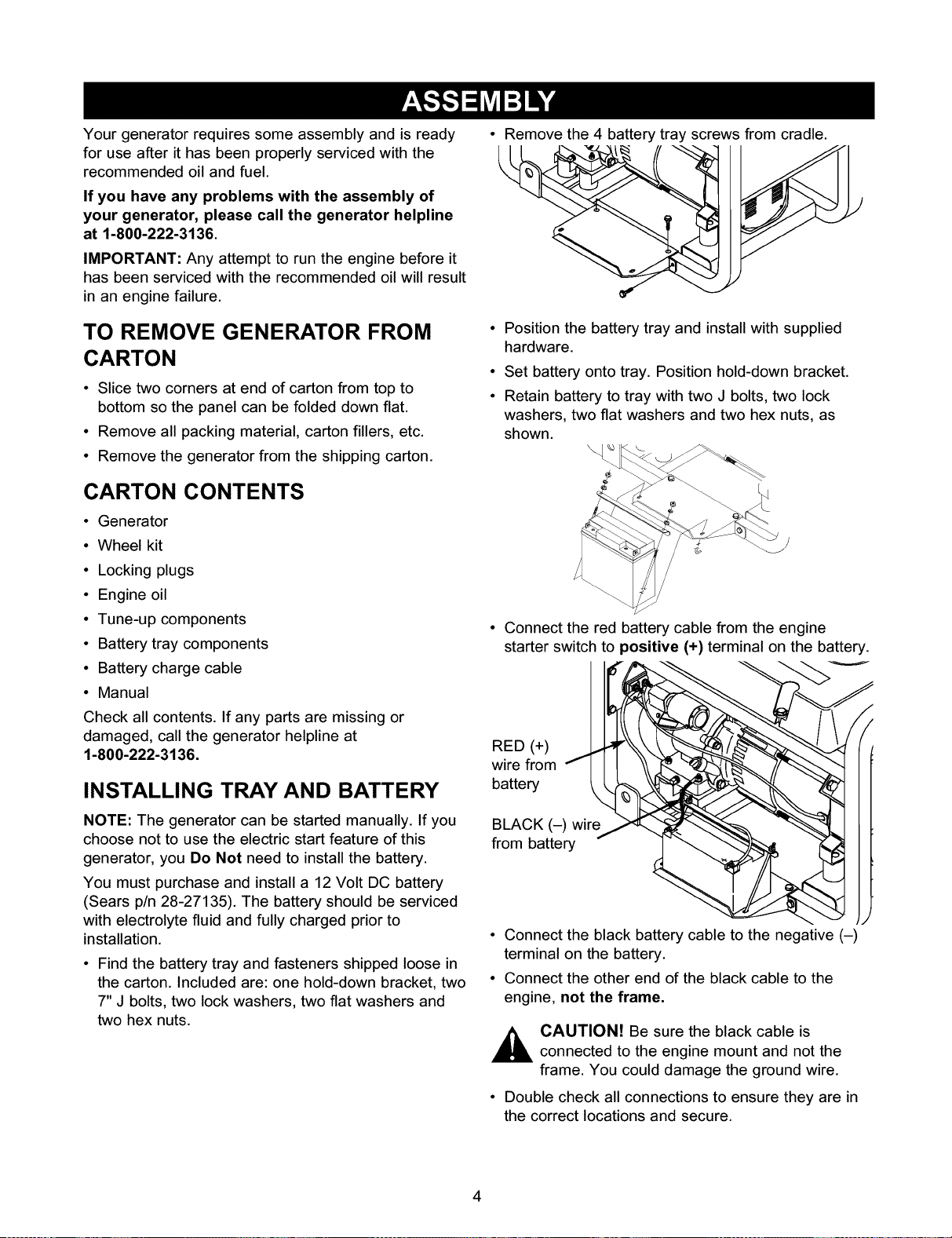
• Remove the 4 battery tray screws from cradle.
• Position the battery tray and install with supplied
hardware.
• Set battery onto tray. Position hold-down bracket.
• Retain battery to tray with two J bolts, two lock
washers, two flat washers and two hex nuts, as
shown.
• Connect the red battery cable from the engine
starter switch to _ositive (÷) terminal on the battery.
RED (+)
wire from J
battery
BLACK (-) wire
from battery
• Connect the black battery cable to the negative (-)
terminal on the battery.
• Connect the other end of the black cable to the
engine, not the frame.
,_ CAUTION! Be sure the black cable is
connected to the engine mount and not the
frame. You could damage the ground wire.
• Double check all connections to ensure they are in
the correct locations and secure.
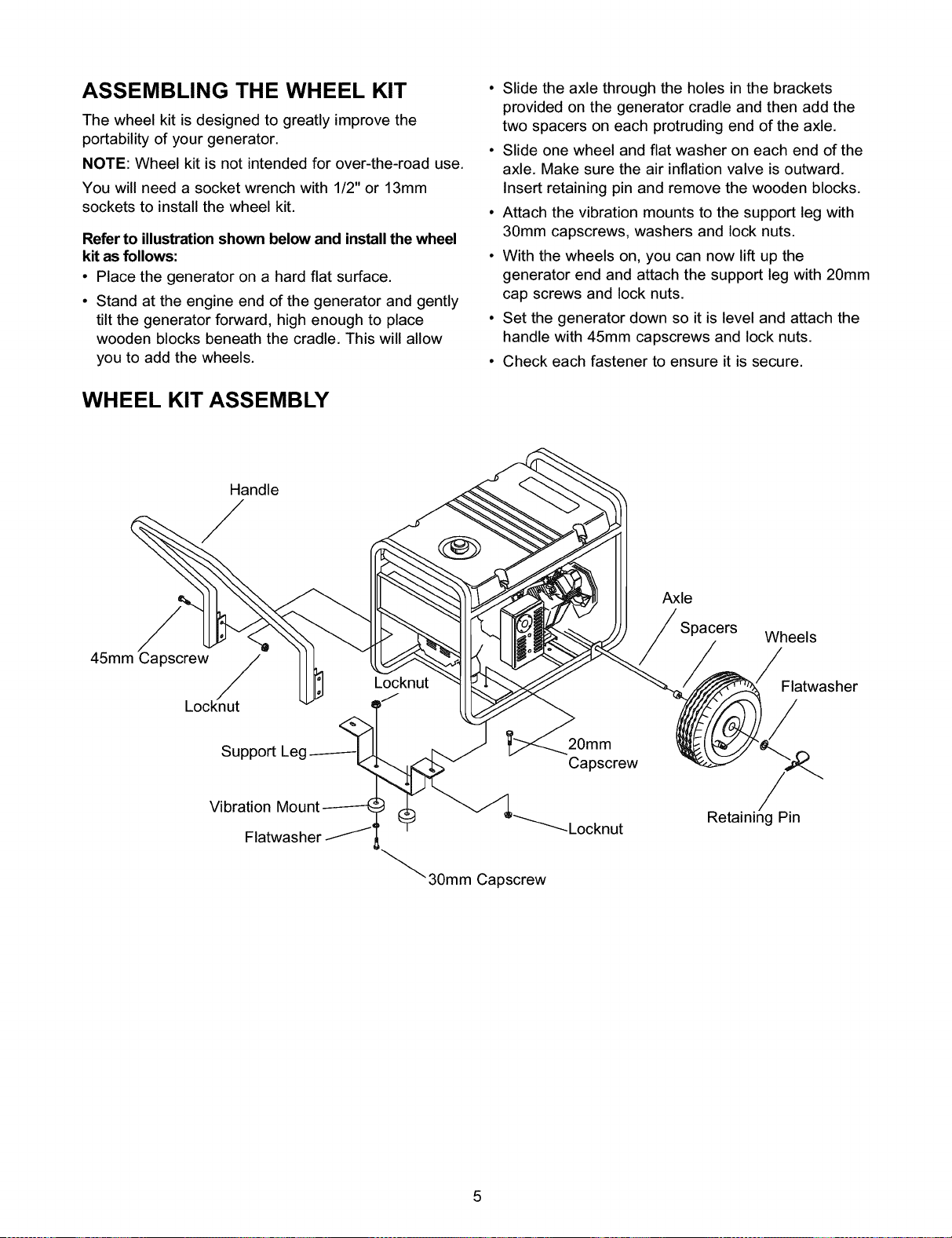
ASSEMBLING THE WHEEL KIT
The wheel kit is designed to greatly improve the
portability of your generator.
NOTE: Wheel kit is not intended for over-the-road use.
You will need a socket wrench with 1/2" or 13ram
sockets to install the wheel kit.
Refer to illustration shown below and install the wheel
kit as follows:
• Place the generator on a hard flat surface.
• Stand at the engine end of the generator and gently
tilt the generator forward, high enough to place
wooden blocks beneath the cradle. This will allow
you to add the wheels.
WHEEL KIT ASSEMBLY
• Slide the axle through the holes in the brackets
provided on the generator cradle and then add the
two spacers on each protruding end of the axle.
• Slide one wheel and flat washer on each end of the
axle. Make sure the air inflation valve is outward.
Insert retaining pin and remove the wooden blocks.
• Attach the vibration mounts to the support leg with
30mm capscrews, washers and lock nuts.
• With the wheels on, you can now lift up the
generator end and attach the support leg with 20mm
cap screws and lock nuts.
• Set the generator down so it is level and attach the
handle with 45mm capscrews and lock nuts.
• Check each fastener to ensure it is secure.
Handle
45mm Capscrew
Locknut
Locknut
Support
Vibration Mount
Flatwasher/'
_30mm Capscrew
20mm
Capscrew
Locknut
Axle
Spacers
Wheels
Flatwasher
/"
Retaining Pin
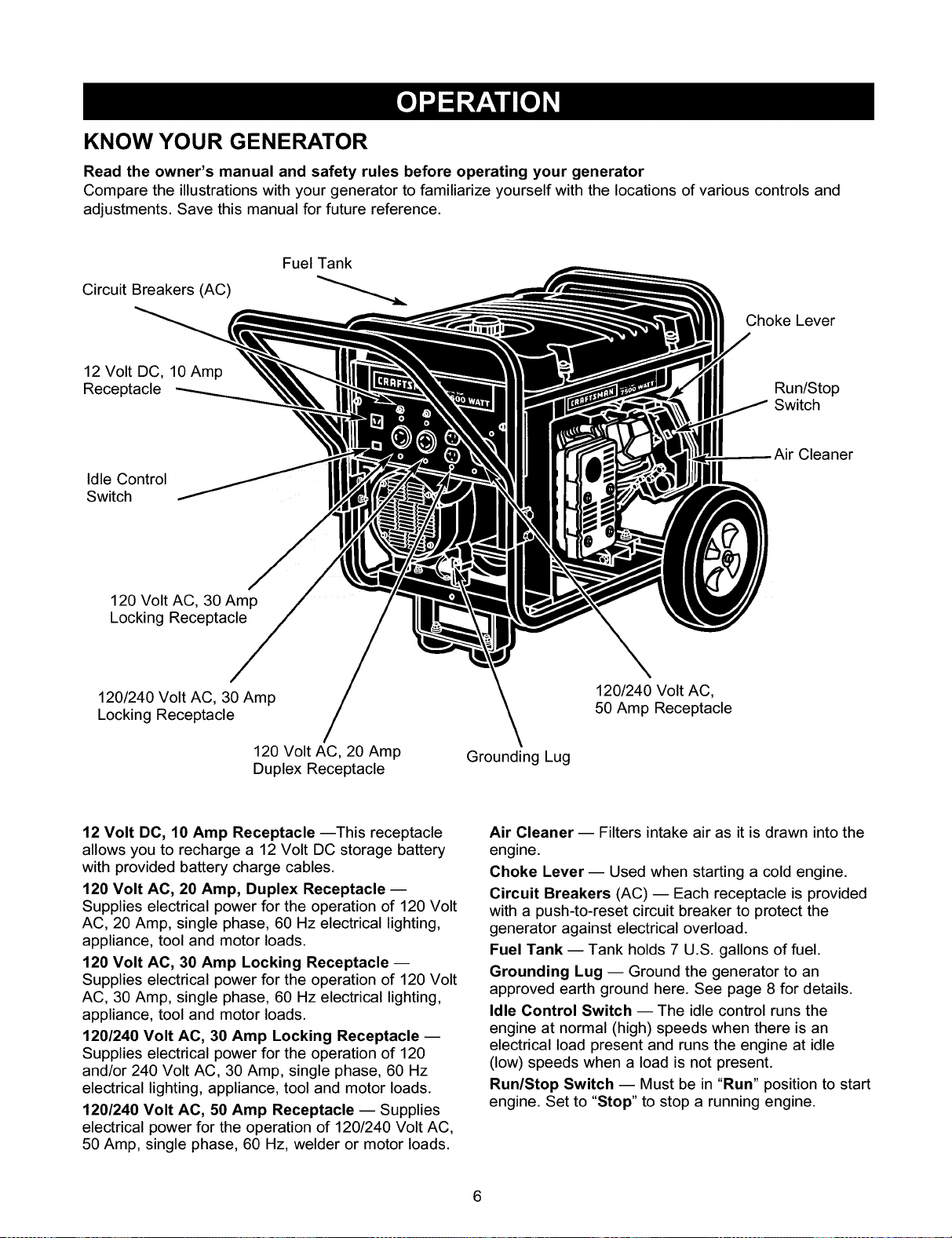
KNOW YOUR GENERATOR
Read the owner's manual and safety rules before operating your generator
Compare the illustrations with your generator to familiarize yourself with the locations of various controls and
adjustments. Save this manual for future reference.
Circuit Breakers (AC)
Fuel Tank
Choke Lever
12 Volt DC, 10 Amp
Receptacle
Idle Control
Switch
Run/Stop
Switch
Air Cleaner
120 Volt AC, 30 Amp
Locking Receptacle
120/240 Volt AC, 30 Amp
Locking Receptacle
120 Volt AC, 20 Amp
Duplex Receptacle
Grounding Lug
120/240 Volt AC,
50 Amp Receptacle
12 Volt DC, 10 Amp Receptacle --This receptacle
allows you to recharge a 12 Volt DC storage battery
with provided battery charge cables.
120 Volt AC, 20 Amp, Duplex Receptacle --
Supplies electrical power for the operation of 120 Volt
AC, 20 Amp, single phase, 60 Hz electrical lighting,
appliance, tool and motor loads.
120 Volt AC, 30 Amp Locking Receptacle --
Supplies electrical power for the operation of 120 Volt
AC, 30 Amp, single phase, 60 Hz electrical lighting,
appliance, tool and motor loads.
120/240 Volt AC, 30 Amp Locking Receptacle --
Supplies electrical power for the operation of 120
and/or 240 Volt AC, 30 Amp, single phase, 60 Hz
electrical lighting, appliance, tool and motor loads.
120/240 Volt AC, 50 Amp Receptacle -- Supplies
electrical power for the operation of 120/240 Volt AC,
50 Amp, single phase, 60 Hz, welder or motor loads.
Air Cleaner -- Filters intake air as it is drawn into the
engine.
Choke Lever-- Used when starting a cold engine.
Circuit Breakers (AC) -- Each receptacle is provided
with a push-to-reset circuit breaker to protect the
generator against electrical overload.
Fuel Tank -- Tank holds 7 U.S. gallons of fuel.
Grounding Lug -- Ground the generator to an
approved earth ground here. See page 8 for details.
Idle Control Switch -- The idle control runs the
engine at normal (high) speeds when there is an
electrical load present and runs the engine at idle
(low) speeds when a load is not present.
Run/Stop Switch -- Must be in "Run" position to start
engine. Set to "Stop" to stop a running engine.
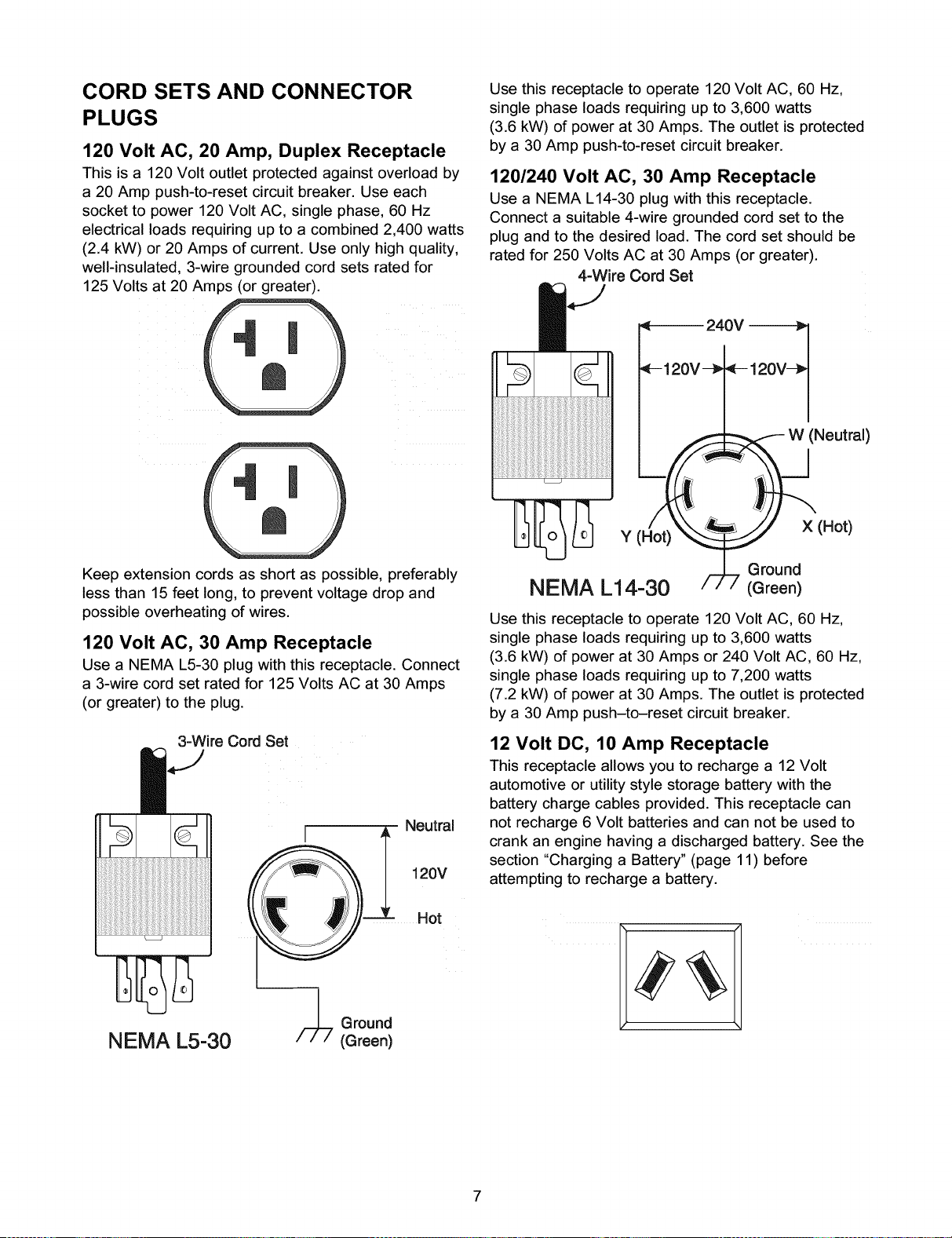
CORD SETS AND CONNECTOR
PLUGS
120 Volt AC, 20 Amp, Duplex Receptacle
This is a 120 Volt outlet protected against overload by
a 20 Amp push-to-reset circuit breaker. Use each
socket to power 120 Volt AC, single phase, 60 Hz
electrical loads requiring up to a combined 2,400 watts
(2.4 kW) or 20 Amps of current. Use only high quality,
well-insulated, 3-wire grounded cord sets rated for
125 Volts at 20 Amps (or greater).
Use this receptacle to operate 120 Volt AC, 60 Hz,
single phase loads requiring up to 3,600 watts
(3.6 kW) of power at 30 Amps. The outlet is protected
by a 30 Amp push-to-reset circuit breaker.
120/240 Volt AC, 30 Amp Receptacle
Use a NEMA L14-30 plug with this receptacle.
Connect a suitable 4-wire grounded cord set to the
plug and to the desired load. The cord set should be
rated for 250 Volts AC at 30 Amps (or greater).
4-Wire Cord Set
240V
Keep extension cords as short as possible, preferably
less than 15 feet long, to prevent voltage drop and
possible overheating of wires.
120 Volt AC, 30 Amp Receptacle
Use a NEMA L5-30 plug with this receptacle. Connect
a 3-wire cord set rated for 125 Volts AC at 30 Amps
(or greater) to the plug.
3-Wire Cord Set
NEMA L5-30
I I Neutral
/_ Ground
(Green)
Use this receptacle to operate 120 Volt AC, 60 Hz,
single phase loads requiring up to 3,600 watts
(3.6 kW) of power at 30 Amps or 240 Volt AC, 60 Hz,
single phase loads requiring up to 7,200 watts
(7.2 kW) of power at 30 Amps. The outlet is protected
by a 30 Amp push-to-reset circuit breaker.
12 Volt DC, 10 Amp Receptacle
This receptacle allows you to recharge a 12 Volt
automotive or utilitystyle storage battery with the
battery charge cables provided. This receptacle can
not recharge 6 Volt batteries and can not be used to
crank an engine having a discharged battery. See the
section "Charging a Battery" (page 11) before
attempting to recharge a battery.

120/240 Volt AC, 50 Amp Receptacle
Use a NEMA 14-50 plug with this receptacle. Connect
a 4-wire cord set rated for 250 Volts AC at 50 Arnps to
the plug.
Y (Hot)
240 Volts AC
Frame Ground
120 Volts
AC ------_
W (Neutral)
X (Hot)
AC
NEMA 14-50
Use this receptacle to operate 120/240 Volt AC, 60 Hz
electrical loads requiring up to 7,500 watts (7.5 kW) of
power.
,_ CAUTION! Although this outlet states it has a
240 Volt 50 Amp rating (up to 12,500 watts),
the generator is only rated for 7,500 watts.
Powering loads that exceed the wattage/
amperage capacity of the generator can
damage it and cause serious injuries.
HOW TO USE YOUR GENERATOR
If you have any problems operating your generator,
please call the generator helpline at 1-800-222-3136.
Grounding The Generator
The National Electrical Code requires that the
frame and external electrically conductive parts of
this generator be properly connected to an
approved earth ground. Local electrical codes may
also require proper grounding of the unit. For that
purpose, a grounding wing nut is provided on the
generator.
Grounding Wing Nut
Generally, connecting a No. 12 AWG (American Wire
Gauge) stranded copper wire to the grounding wing
nut and to an earth-driven copper or brass grounding
rod (electrode) provides adequate protection against
electrical shock. However, local codes may vary
widely. Consult with a local electrician for
grounding requirements in your area.
Proper grounding of the generator will help
prevent electrical shock in the event of a ground
fault condition in the generator or in connected
electrical devices. Proper grounding also helps
dissipate static electricity, which often builds up in
ungrounded devices.
Connecting Electrical Loads
• Do Not connect 240 Volt loads to 120 Volt
receptacles.
• Do Not connect 3-phase loads to the generator.
• Do Not connect 50 Hz loads to the generator.
• Let engine stabilize and warm up for a few minutes
after starting.
• Plug in and turn on the desired 120 or 240 Volt AC,
single phase, 60 Hz electrical loads.
• Add up the rated watts (or arnps) of all loads to be
connected at one time. This total should not be
greater than (a) the rated wattage/amperage
capacity of the generator or (b) circuit breaker rating
of the receptacle supplying the power. See "Don't
Overload the Generato¢' on page 12.
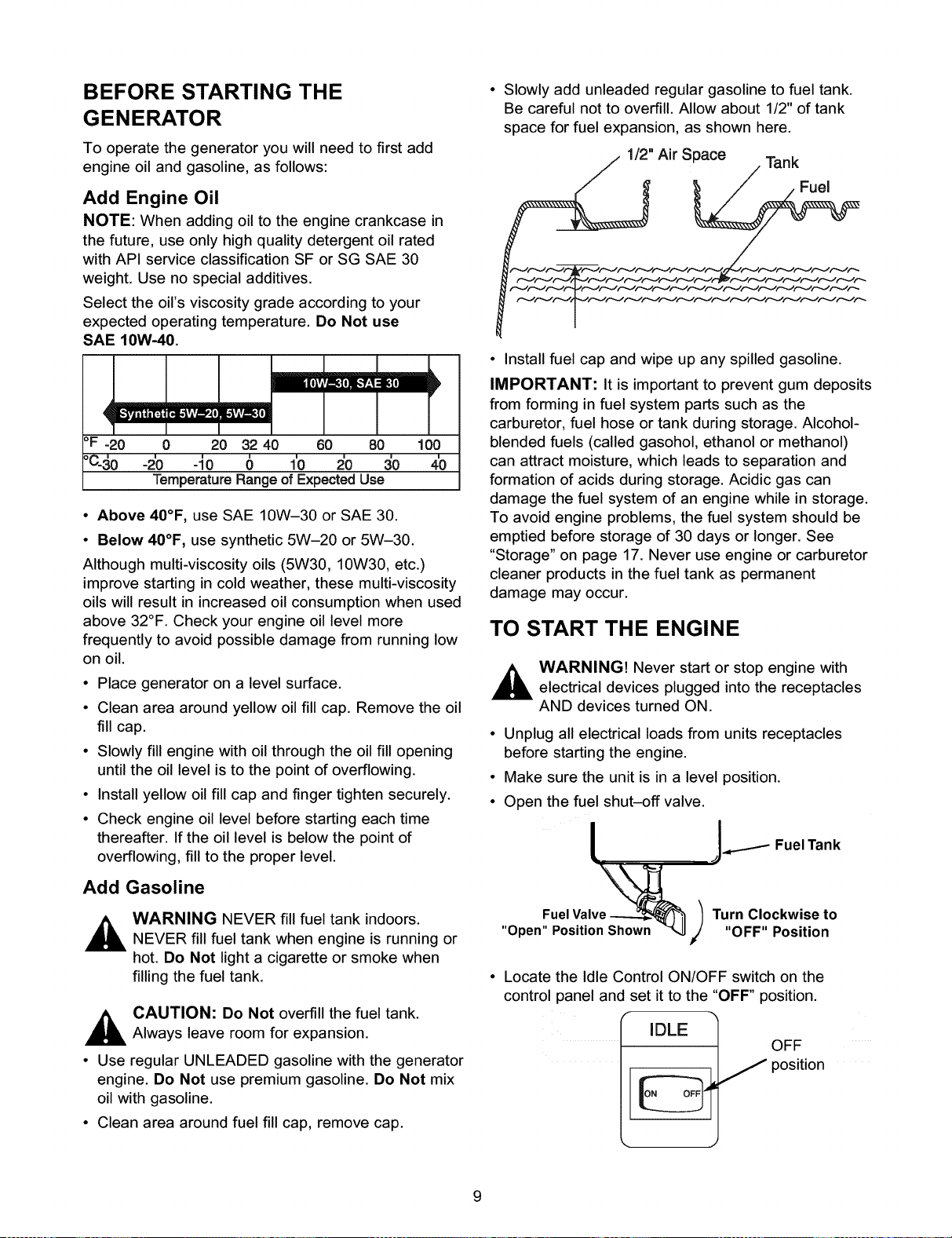
BEFORE STARTING THE
GENERATOR
To operate the generator you will need to first add
engine oil and gasoline, as follows:
Add Engine Oil
NOTE: When adding oil to the engine crankcase in
the future, use only high quality detergent oil rated
with API service classification SF or SG SAE 30
weight. Use no special additives.
Select the oil's viscosity grade according to your
expected operating temperature. Do Not use
SAE 10W-40.
m
m mm
°F -20 0 20 32 40 60 80 100
°C_ o -2'o Jo 6 i'o 2'0 4o 4'o
Temperature Range ofExpectedUse
• Above 40°F, use SAE 10W-30 or SAE 30.
• Below 40°F, use synthetic 5W-20 or 5W-30.
Although multi-viscosity oils (5W30, 10W30, etc.)
improve starting in cold weather, these multi-viscosity
oils will result in increased oil consumption when used
above 32°F. Check your engine oil level more
frequently to avoid possible damage from running low
on oil.
• Place generator on a level surface.
• Clean area around yellow oil fill cap. Remove the oil
fill cap.
• Slowly fill engine with oil through the oil fill opening
until the oil level is to the point of overflowing.
• Install yellow oil fill cap and finger tighten securely.
• Check engine oil level before starting each time
thereafter. If the oil level is below the point of
overflowing, fill to the proper level.
Add Gasoline
,_ WARNING NEVER fill fuel tank indoors.
NEVER fill fuel tank when engine is running or
hot. Do Not light a cigarette or smoke when
filling the fuel tank.
,_ CAUTION: Do Not overfill the fuel tank.
Always leave room for expansion.
• Use regular UNLEADED gasoline with the generator
engine. Do Not use premium gasoline. Do Not mix
oil with gasoline.
• Clean area around fuel fill cap, remove cap.
• Slowly add unleaded regular gasoline to fuel tank.
Be careful not to overfill. Allow about 1/2" of tank
space for fuel expansion, as shown here.
1/2" Air Space Tank
Fuel
• Install fuel cap and wipe up any spilled gasoline.
IMPORTANT: It is important to prevent gum deposits
from forming in fuel system parts such as the
carburetor, fuel hose or tank during storage. Alcohol-
blended fuels (called gasohol, ethanol or methanol)
can attract moisture, which leads to separation and
formation of acids during storage. Acidic gas can
damage the fuel system of an engine while in storage.
To avoid engine problems, the fuel system should be
emptied before storage of 30 days or longer. See
"Storage" on page 17. Never use engine or carburetor
cleaner products in the fuel tank as permanent
damage may occur.
TO START THE ENGINE
_ ARNING! Never start or stop engine with
electrical devices plugged into the receptacles
AND devices turned ON.
• Unplug all electrical loads from units receptacles
before starting the engine.
• Make sure the unit is in a level position.
• Open the fuel shut-off valve.
t .J.,_._.-----Fuel Tank
FueIValv__ _ Turn Clockwise to
"Open" PositionShown _/ "OFF" Position
• Locate the Idle Control ON/OFF switch on the
control panel and set it to the "OFF" position.
iDLE
OFF
/ position
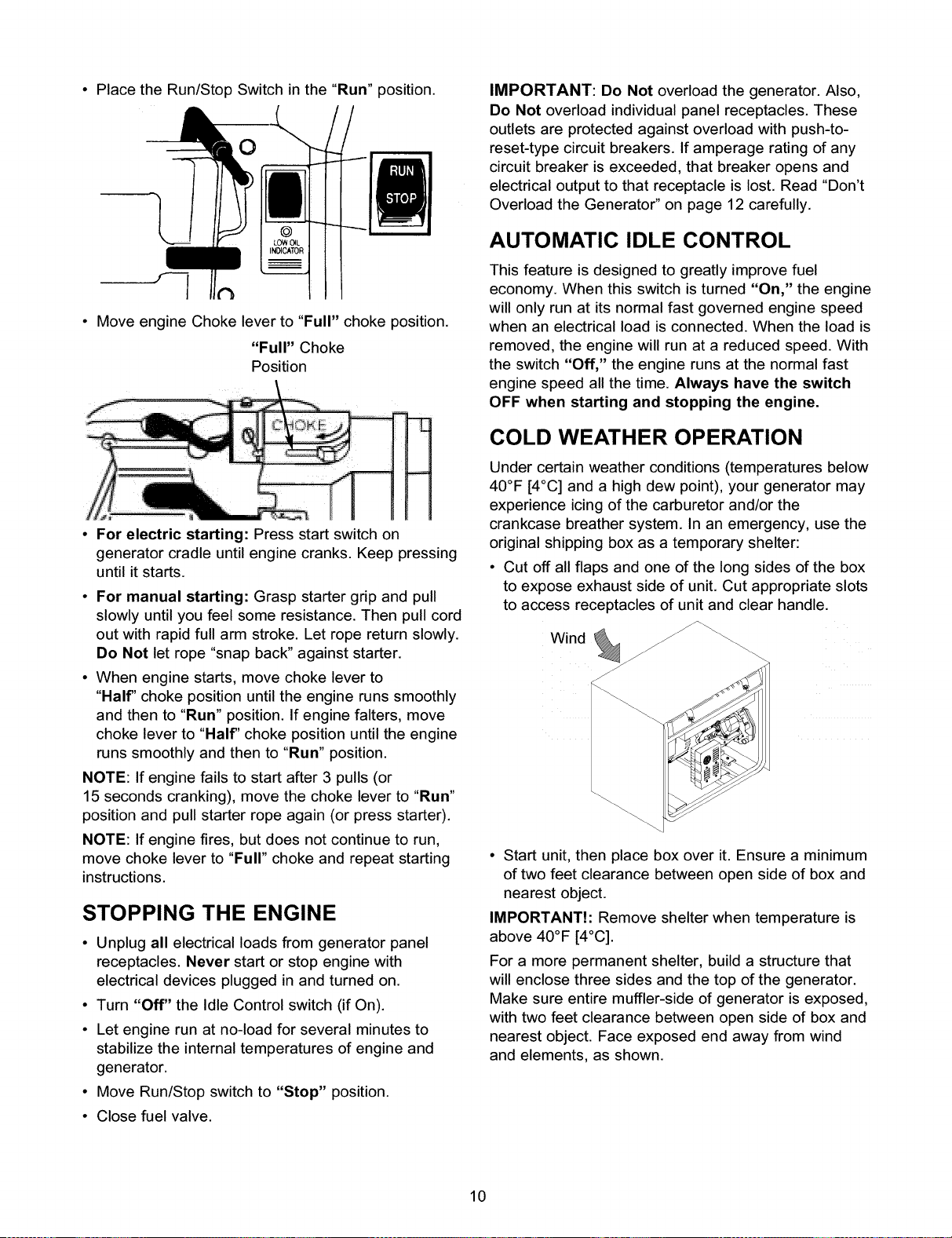
PlacetheRun/StopSwitchinthe"Run"position.
Move engine Choke lever to "Full" choke position.
"Full" Choke
Position
• For electric starting: Press start switch on
generator cradle until engine cranks. Keep pressing
until it starts.
• For manual starting: Grasp starter grip and pull
slowly until you feel some resistance. Then pull cord
out with rapid full arm stroke. Let rope return slowly.
Do Not let rope "snap back" against starter.
• When engine starts, move choke lever to
"Half" choke position until the engine runs smoothly
and then to "Run" position. If engine falters, move
choke lever to "Half" choke position until the engine
runs smoothly and then to "Run" position.
NOTE: If engine fails to start after 3 pulls (or
15 seconds cranking), move the choke lever to "Run"
position and pull starter rope again (or press starter).
NOTE: If engine fires, but does not continue to run,
move choke lever to "Full" choke and repeat starting
instructions.
STOPPING THE ENGINE
• Unplug all electrical loads from generator panel
receptacles. Never start or stop engine with
electrical devices plugged in and turned on.
• Turn "Off" the Idle Control switch (if On).
• Let engine run at no-load for several minutes to
stabilize the internal temperatures of engine and
generator.
• Move Run/Stop switch to "Stop" position.
• Close fuel valve.
IMPORTANT: Do Not overload the generator. Also,
Do Not overload individual panel receptacles. These
outlets are protected against overload with push-to-
reset-type circuit breakers. If amperage rating of any
circuit breaker is exceeded, that breaker opens and
electrical output to that receptacle is lost. Read "Don't
Overload the Generator" on page 12 carefully.
AUTOMATIC IDLE CONTROL
This feature is designed to greatly improve fuel
economy. When this switch is turned "On," the engine
will only run at its normal fast governed engine speed
when an electrical load is connected. When the load is
removed, the engine will run at a reduced speed. With
the switch "Off," the engine runs at the normal fast
engine speed all the time. Always have the switch
OFF when starting and stopping the engine.
COLD WEATHER OPERATION
Under certain weather conditions (temperatures below
40°F [4°C] and a high dew point), your generator may
experience icing of the carburetor and/or the
crankcase breather system. In an emergency, use the
original shipping box as a temporary shelter:
• Cut off all flaps and one of the long sides of the box
to expose exhaust side of unit. Cut appropriate slots
to access receptacles of unit and clear handle.
Wind
• Start unit, then place box over it. Ensure a minimum
of two feet clearance between open side of box and
nearest object.
IMPORTANT!: Remove shelter when temperature is
above 40°F [4°C].
For a more permanent shelter, build a structure that
will enclose three sides and the top of the generator.
Make sure entire muffler-side of generator is exposed,
with two feet clearance between open side of box and
nearest object. Face exposed end away from wind
and elements, as shown.
10
LOW OIL PRESSURE SHUTDOWN
SYSTEM
The engine is equipped with a low oil pressure sensor
that shuts down the engine automatically when the oil
pressure drops below 6 psi. If the engine shuts down
by itself and the fuel tank has enough gasoline, check
engine oil level.
Initial Start-up
A delay built into the low oil shutdown system allows
oil pressure to build during starting. The delay allows
the engine to run for about 10 seconds before sensing
oil pressure.
Sensing Low Pressure
Ifthe system senses low oil pressure during operation,
the engine shuts down.
Restarting
If you try to restart the engine within 10 seconds after
it shuts down, the engine may NOT start. The system
needs 5 to 10 seconds to reset.
If you do restart the engine after such a shutdown and
have not corrected the low oil pressure, the engine
runs for about 10 seconds as described above and
then stops.
CHARGING A BATTERY
DANGER! Storage batteries give off explosive
hydrogen gas while recharging. An explosive
mixture will remain around the battery for a
long time after it has been charged. The
slightest spark can ignite the hydrogen and
cause an explosion. Such an explosion can
shatter the battery and cause blindness or
other serious injury.
DANGER! Do Not permit smoking, open
flame, sparks or any other source of heat
around a battery. Wear protective goggles,
rubber apron and rubber gloves when working
around a battery. Battery electrolyte fluid is an
extremely caustic sulfuric acid solution that can
cause severe burns. If spill occurs, flush area
with clear water immediately.
Your generator has the capability of recharging a
discharged 12 Volt automotive or utility style storage
battery. Do Not use the unit to charge any 6 Volt
batteries. Do Not use the unit to crank an engine
having a discharged battery.
To recharge 12 Volt batteries, proceed as follows:
• Check fluid level in all battery cells. If necessary,
add ONLY distilled water to cover separators in
battery cells. Do Not use tap water.
• If the battery is equipped with vent caps, make sure
they are installed and are tight.
• If necessary, clean battery terminals.
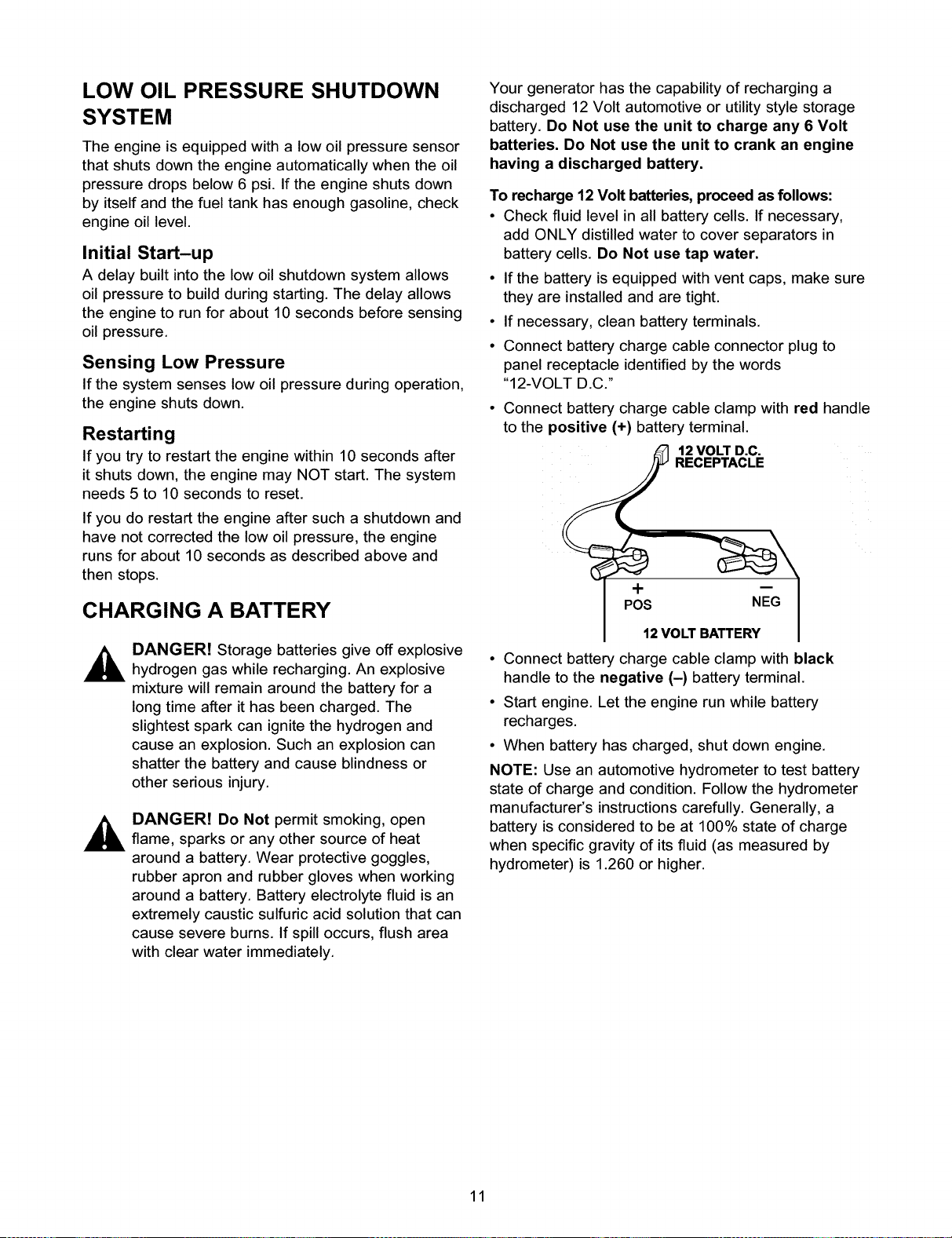
• Connect battery charge cable connector plug to
panel receptacle identified by the words
"12-VOLT D.C."
• Connect battery charge cable clamp with red handle
to the positive (+) battery terminal.
/_ 12 VOLTD.C.
_ RECEPTACLE
* -I
POS NEG
12VOLTBATTERY
• Connect battery charge cable clamp with black
handle to the negative (-) battery terminal.
• Start engine. Let the engine run while battery
recharges.
• When battery has charged, shut down engine.
NOTE: Use an automotive hydrometer to test battery
state of charge and condition. Follow the hydrometer
manufacturer's instructions carefully. Generally, a
battery is considered to be at 100% state of charge
when specific gravity of its fluid (as measured by
hydrometer) is 1.260 or higher.
11
DON'T OVERLOAD THE
GENERATOR
Overloading a generator in excess of its rated wattage
capacity can result in damage to the generator and to
connected electrical devices. Observe the following to
prevent overloading the unit:
• Add up the total wattage of all electrical devices to
be connected at one time. This total should NOT be
greater than the generator's wattage capacity.
• The rated wattage of lights can be taken from light
bulbs. The rated wattage of tools, appliances and
motors can usually be found on a data plate or decal
affixed to the device.
• If the appliance, tool or motor does not give wattage,
multiply volts times ampere rating to determine watts
(volts x amps = watts).
• Some electric motors, such as induction types,
require about three times more watts of power for
starting than for running. This surge of power lasts
only a few seconds when starting such motors.
Make sure you allow for this high starting wattage
when selecting electrical devices to connect to your
generator:
1. Figure the watts needed to start the largest
motor.
2. Add to that figure the running watts of all other
connected loads.
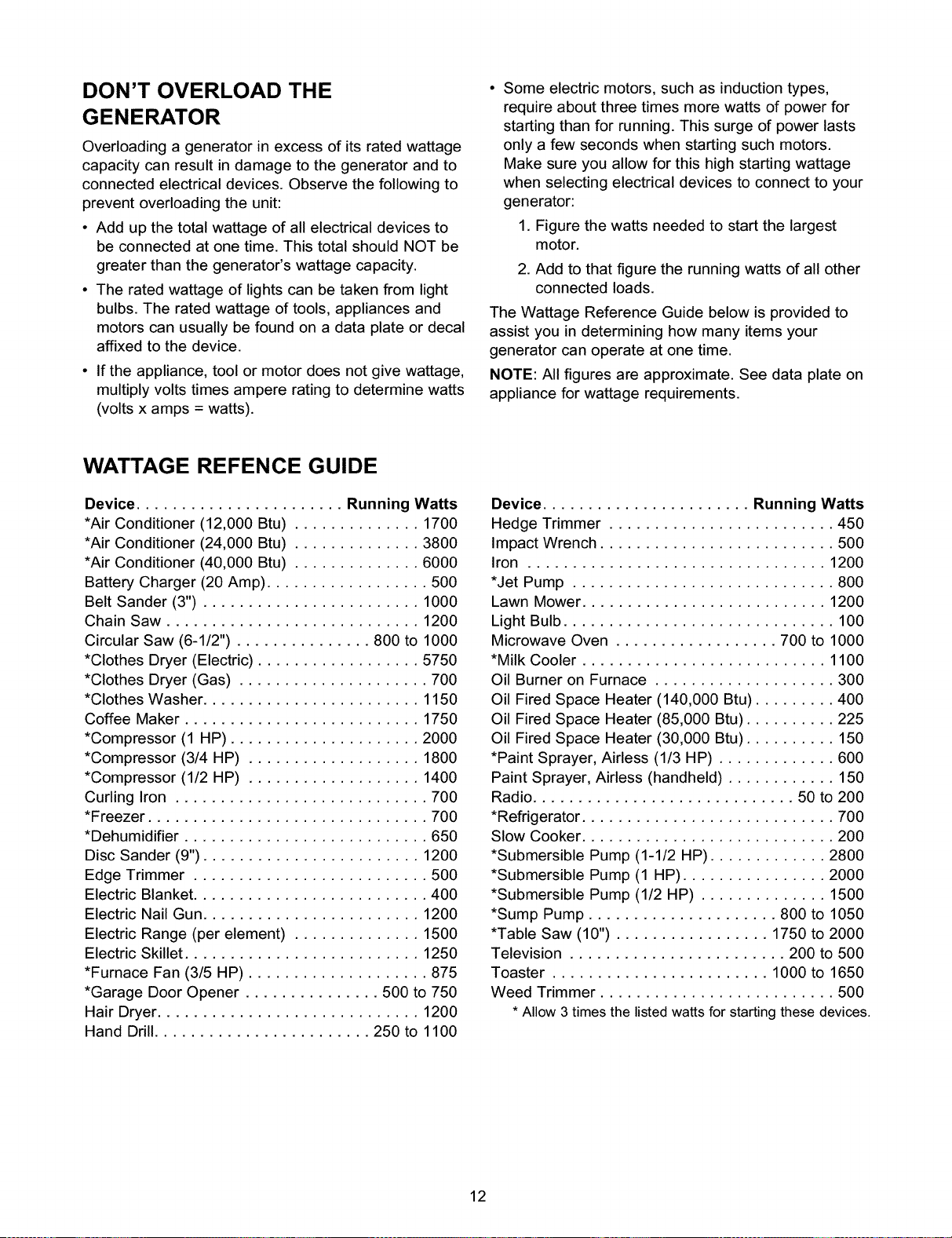
The Wattage Reference Guide below is provided to
assist you in determining how many items your
generator can operate at one time.
NOTE: All figures are approximate. See data plate on
appliance for wattage requirements.
WATTAGE REFENCE GUIDE
Device ....................... Running Watts
*Air Conditioner (12,000 Btu) .............. 1700
*Air Conditioner (24,000 Btu) .............. 3800
*Air Conditioner (40,000 Btu) .............. 6000
Battery Charger (20 Amp) .................. 500
Belt Sander (3") ........................ 1000
Chain Saw ............................ 1200
Circular Saw (6-1/2") ............... 800 to 1000
*Clothes Dryer (Electric) .................. 5750
*Clothes Dryer (Gas) ..................... 700
*Clothes Washer ........................ 1150
Coffee Maker .......................... 1750
*Compressor (1 liP) ..................... 2000
*Compressor (3/4 liP) ................... 1800
*Compressor (1/2 liP) ................... 1400
Curling Iron ............................ 700
*Freezer ............................... 700
*Dehumidifier ........................... 650
Disc Sander (9") ........................ 1200
Edge Trimmer .......................... 500
Electric Blanket.......................... 400
Electric Nail Gun ........................ 1200
Electric Range (per element) .............. 1500
Electric Skillet .......................... 1250
*Furnace Fan (3/5 liP) .................... 875
*Garage Door Opener ............... 500 to 750
Hair Dryer ............................. 1200
Hand Drill........................ 250 to 1100
Device ....................... Running Watts
Hedge Trimmer ......................... 450
Impact Wrench .......................... 500
Iron ................................. 1200
*Jet Pump ............................. 800
Lawn Mower ........................... 1200
Light Bulb.............................. 100
Microwave Oven .................. 700 to 1000
*Milk Cooler ........................... 1100
Oil Burner on Furnace .................... 300
Oil Fired Space Heater (140,000 Btu) ......... 400
Oil Fired Space Heater (85,000 Btu) .......... 225
Oil Fired Space Heater (30,000 Btu) .......... 150
*Paint Sprayer, Airless (1/3 liP) ............. 600
Paint Sprayer, Airless (handheld) ............ 150
Radio ............................. 50 to 200
*Refrigerator ............................ 700
Slow Cooker ............................ 200
*Submersible Pump (1-1/2 HP) ............. 2800
*Submersible Pump (1 HP) ................ 2000
*Submersible Pump (1/2 HP) .............. 1500
*Sump Pump ..................... 800 to 1050
*Table Saw (10") ................. 1750 to 2000
Television ........................ 200 to 500
Toaster ........................ 1000 to 1650
Weed Trimmer .......................... 500
* Allow 3 times the listed watts for starting these devices.
12
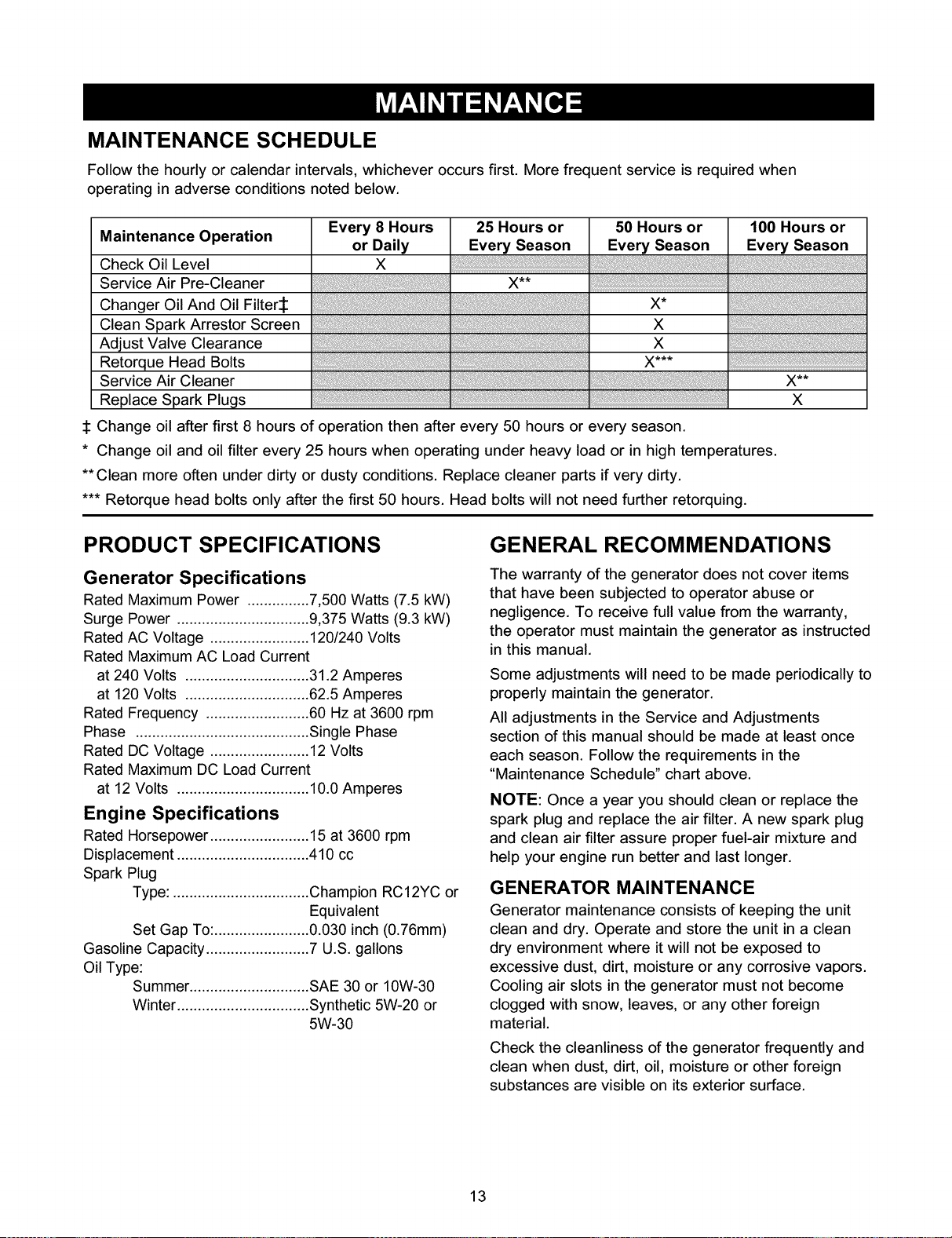
MAINTENANCE SCHEDULE
Follow the hourly or calendar intervals, whichever occurs first. More frequent service is required when
operating in adverse conditions noted below.
Maintenance Operation Every 8 Hours 50 Hours or 100 Hours or
or Daily Every Season Every Season
XCheck Oil Level
Service Air Pre-Cleaner
Changer Oil And Oil Filters
Clean Spark Arrestor Screen
Adjust Valve Clearance
Retorque Head Bolts
Service Air Cleaner
Replace Spark Plugs
25 Hours or
Every Season
X**
X*
X
X
X***
ii!i;iii!i_i!!i!i!i_:!i!iiiiiiiiilili%i!iiiii,i_ii!i!;!:!!ii_ili!_i_i_i¸_i!i_!_!!_iii!_!_!!_i_!_!!_!_!_iiii_i_!i_ii_i_ii_i!i!_!!_ii_!_!_!!_i_!_!!_!_!_iiii_i_!i_ii_i_ii_i!i!_!!_ii_!_!_!!_i_!_!!_!_!_iiii_i_!i_ii_i_ii_i!i!_!!_ii_!_!_!!_i_;_I_
X**
X
:1:Change oil after first 8 hours of operation then after every 50 hours or every season.
* Change oil and oil filter every 25 hours when operating under heavy load or in high temperatures.
**Clean more often under dirty or dusty conditions. Replace cleaner parts if very dirty.
*** Retorque head bolts only after the first 50 hours. Head bolts will not need further retorquing.
PRODUCT SPECIFICATIONS
Generator Specifications
Rated Maximum Power ...............7,500 Watts (7.5 kW)
Surge Power ................................ 9,375 Watts (9.3 kW)
Rated AC Voltage ........................ 120/240 Volts
Rated Maximum AC Load Current
at 240 Volts .............................. 31.2 Amperes
at 120 Volts .............................. 62.5 Amperes
Rated Frequency ......................... 60 Hz at 3600 rpm
Phase .......................................... Single Phase
Rated DC Voltage ........................ 12 Volts
Rated Maximum DC Load Current
at 12 Volts ................................ 10.0 Amperes
Engine Specifications
Rated Horsepower ........................ 15 at 3600 rpm
Displacement ................................ 410 cc
Spark Plug
Type: ................................. Champion RC12YC or
Equivalent
Set Gap To: ....................... 0.030 inch (0.76mm)
Gasoline Capacity ......................... 7 U.S. gallons
Oil Type:
Summer ............................. SAE 30 or 10W-30
Winter ................................ Synthetic 5W-20 or
5W-30
GENERAL RECOMMENDATIONS
The warranty of the generator does not cover items
that have been subjected to operator abuse or
negligence. To receive full value from the warranty,
the operator must maintain the generator as instructed
in this manual.
Some adjustments will need to be made periodically to
properly maintain the generator.
All adjustments in the Service and Adjustments
section of this manual should be made at least once
each season. Follow the requirements in the
"Maintenance Schedule" chart above.
NOTE: Once a year you should clean or replace the
spark plug and replace the air filter. A new spark plug
and clean air filter assure proper fuel-air mixture and
help your engine run better and last longer.
GENERATOR MAINTENANCE
Generator maintenance consists of keeping the unit
clean and dry. Operate and store the unit in a clean
dry environment where itwill not be exposed to
excessive dust, dirt, moisture or any corrosive vapors.
Cooling air slots in the generator must not become
clogged with snow, leaves, or any other foreign
material.
Check the cleanliness of the generator frequently and
clean when dust, dirt, oil, moisture or other foreign
substances are visible on its exterior surface.
13
_ AUTION!Neverinsertanyobjectortool
throughtheaircoolingslots,eveniftheengine
isnotrunning.
NOTE:DoNotuseagardenhosetocleangenerator.
Watercanentertheenginefuelsystemandcause
problems.Inaddition,ifwaterentersthegenerator
throughcoolingairslots,somewaterwillberetained
invoidsandcracksoftherotorandstatorwinding
insulation.Wateranddirtbuilduponthegenerator
internalwindingswilleventuallydecreasethe
insulationresistanceofthesewindings.
To Clean the Generator:
• Use a damp cloth to wipe exterior surfaces clean.
• A soft, bristle brush may be used to loosen caked on
dirt, oil, etc.
• A vacuum cleaner may be used to pick up loose dirt
and debris.
• Low pressure air (not to exceed 25 psi) may be
used to blow away dirt. Inspect cooling air slots and
openings on the generator. These openings must be
kept clean and unobstructed.
ENGINE MAINTENANCE
,_ DANGER! When working on the generator,
always disconnect negative cable from battery.
Also disconnect spark plug wires from spark
plug and keep wire away from spark plug.
Checking Oil Level
See the "BEFORE STARTING THE GENERATOR"
section on page 9 for information on checking the oil
level. The oil level should be checked before each
use, or at least every eight hours of operation. Keep
the oil level maintained.
Changing the Oil and Oil Filter
Change the oil and filter after the first eight hours of
operation. Change the oil every 50 hours
thereafter. If you are running this unit under dirty or
dusty conditions, or in extremely hot weather, change
the oil more often.
Use the following instructions to change the oil while
the engine is still warm:
• Clean area around oil drain plug.
• Remove oil drain plug and oil fill plug and drain oil
completely into a suitable container.
• When oil has completely drained, install oil drain
plug and tighten securely.
• Place a suitable container beneath the oil filter and
turn filter counterclockwise to remove. Discard
according to local regulations.
• Coat gasket of new filter with engine oil. Turn filter
clockwise until gasket contacts tightly with filter
adapter. Then tighten an additional 3/4 turn.
• Fill oil sump with recommended oil. (See "BEFORE
STARTING THE GENERATOR" on page 9 for oil
recommendations).
• Install the oil fill plug and tighten securely.
• Wipe up any spilled oil.
Replacing the Spark Plug
Use Champion RC12YC spark plug or equivalent. The
correct air gap is 0.76 mm (0.030 in.). Replace the
plug every 100 hours of operation or once each
year, whichever comes first. This will help your engine
start easier and run better.
1. Stop the engine and pull the spark plug wire off of
the spark plug.
2. Clean the area around the spark plug and remove
it from the cylinder head.
3. Set the spark plug's gap to 0.76 mm (0.030 in.).
Install the correctly gapped spark plug into the
cylinder head.
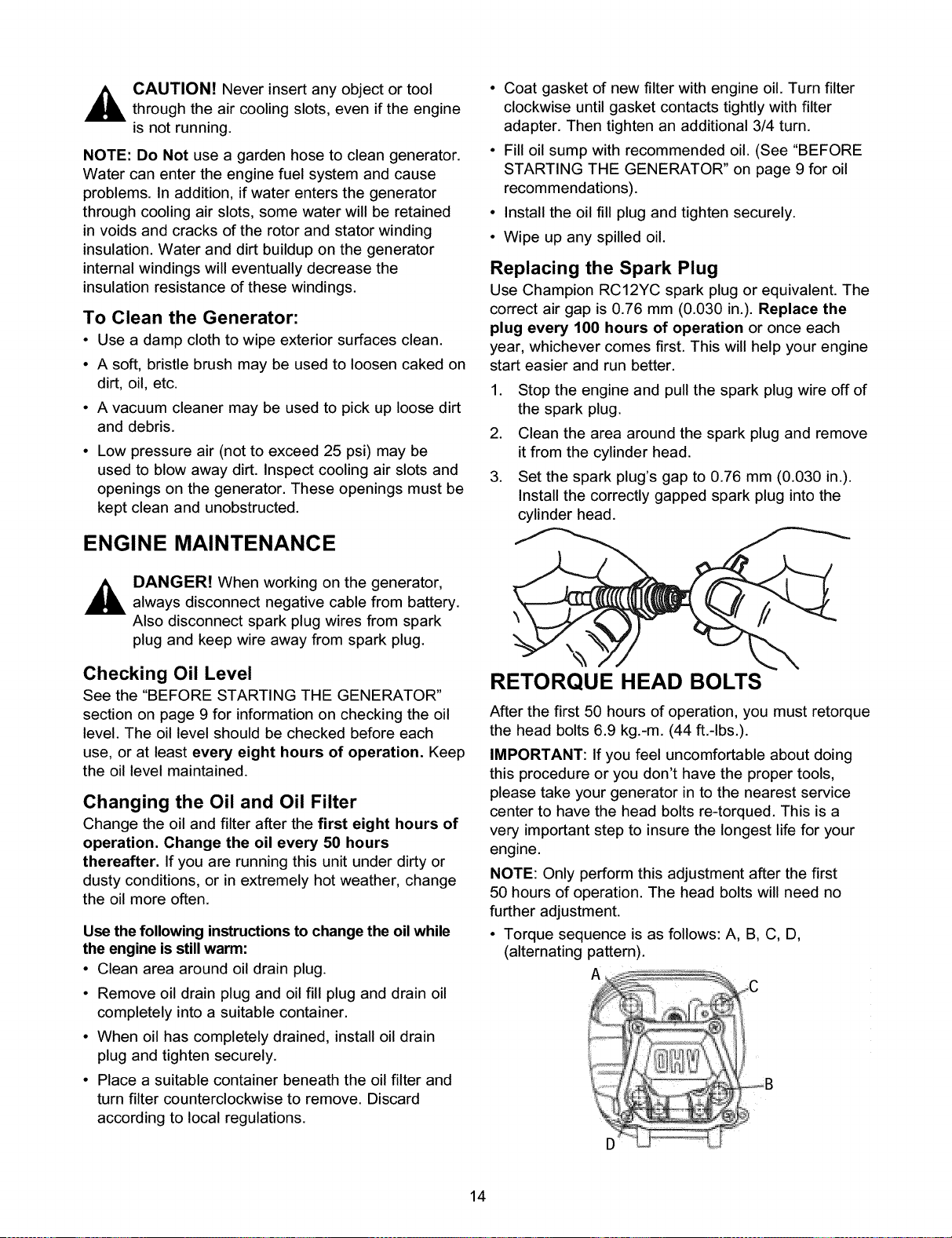
RETORQUE HEAD BOLTS
After the first 50 hours of operation, you must retorque
the head bolts 6.9 kg.-m. (44 ft.-Ibs.).
IMPORTANT: If you feel uncomfortable about doing
this procedure or you don't have the proper tools,
please take your generator in to the nearest service
center to have the head bolts re-torqued. This is a
very important step to insure the longest life for your
engine.
NOTE: Only perform this adjustment after the first
50 hours of operation. The head bolts will need no
further adjustment.
• Torque sequence is as follows: A, B, C, D,
(alternating pattern).
A
14
SERVICE AIR CLEANER
Your engine will not run properly and may be
damaged if you run it using a dirty air cleaner. Clean
or replace the air cleaner paper filter once every
50 hours of operation or once a year, whichever
comes first. Clean or replace more often if operating
under dusty conditions. Clean foam precleaner every
25 hours of operation or sooner under dusty
conditions.
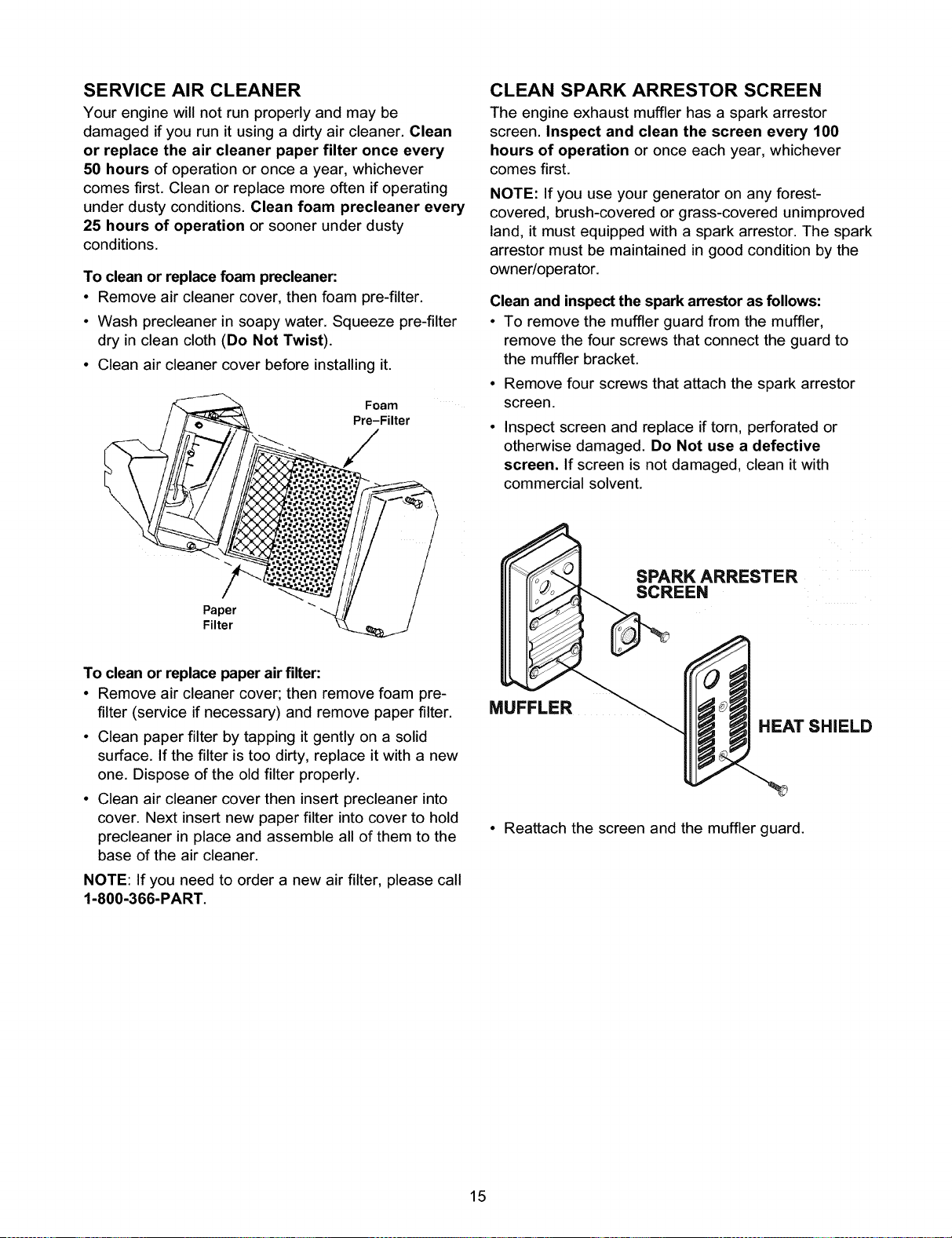
To clean or replace foam precleaner:
• Remove air cleaner cover, then foam pre-filter.
• Wash precleaner in soapy water. Squeeze pre-filter
dry in clean cloth (Do Not Twist).
• Clean air cleaner cover before installing it.
====°===,
-_. =%=%=%_%=%= '
Paper -_.
Filter
Foam
Filter
CLEAN SPARK ARRESTOR SCREEN
The engine exhaust muffler has a spark arrestor
screen. Inspect and clean the screen every 100
hours of operation or once each year, whichever
comes first.
NOTE: If you use your generator on any forest-
covered, brush-covered or grass-covered unimproved
land, it must equipped with a spark arrestor. The spark
arrestor must be maintained in good condition by the
owner/operator.
Clean and inspect the spark arrestor as follows:
• To remove the muffler guard from the muffler,
remove the four screws that connect the guard to
the muffler bracket.
• Remove four screws that attach the spark arrestor
screen.
• Inspect screen and replace if torn, perforated or
otherwise damaged. Do Not use a defective
screen. If screen is not damaged, clean it with
commercial solvent.
SPARK ARRESTER
SCREEN
To clean or replace paper air filter:
• Remove air cleaner cover; then remove foam pre-
filter (service if necessary) and remove paper filter.
• Clean paper filter by tapping it gently on a solid
surface. If the filter is too dirty, replace it with a new
one. Dispose of the old filter properly.
• Clean air cleaner cover then insert precleaner into
cover. Next insert new paper filter into cover to hold
precleaner in place and assemble all of them to the
base of the air cleaner.
NOTE: If you need to order a new air filter, please call
1-800-366-PART.
MUFFLER
HEAT SHIELD
• Reattach the screen and the muffler guard.
15
ADJUSTING VALVE CLEARANCE
After the first 50 hours of operation, you should
adjust the valve clearance in the engine.
IMPORTANT: If you feel uncomfortable about doing
this procedure or you don't have the proper tools,
please take your generator in to the nearest service
center to have the valve clearance adjusted. This isa
very important step to insure longest life for your
engine.
To adjusting valve clearance:
• Make sure the engine is at room temperature.
• Make sure that the spark plug wire is removed from
the spark plug and out of the way.
• Remove the breather tube from the valve cover.
• Remove the four screws attaching the valve cover
with a #2 or 3 phillips screwdriver.
• Make sure the piston is at Top Dead Center (TDC)
of its compression stroke (both valves closed). To
get the piston at TDC, pull on the recoil handle
slowly while watching the piston through the spark
plug hole. As you pull on the recoil handle, the
piston should move up and down. The piston is at
TDC when it is up as high as it can go.
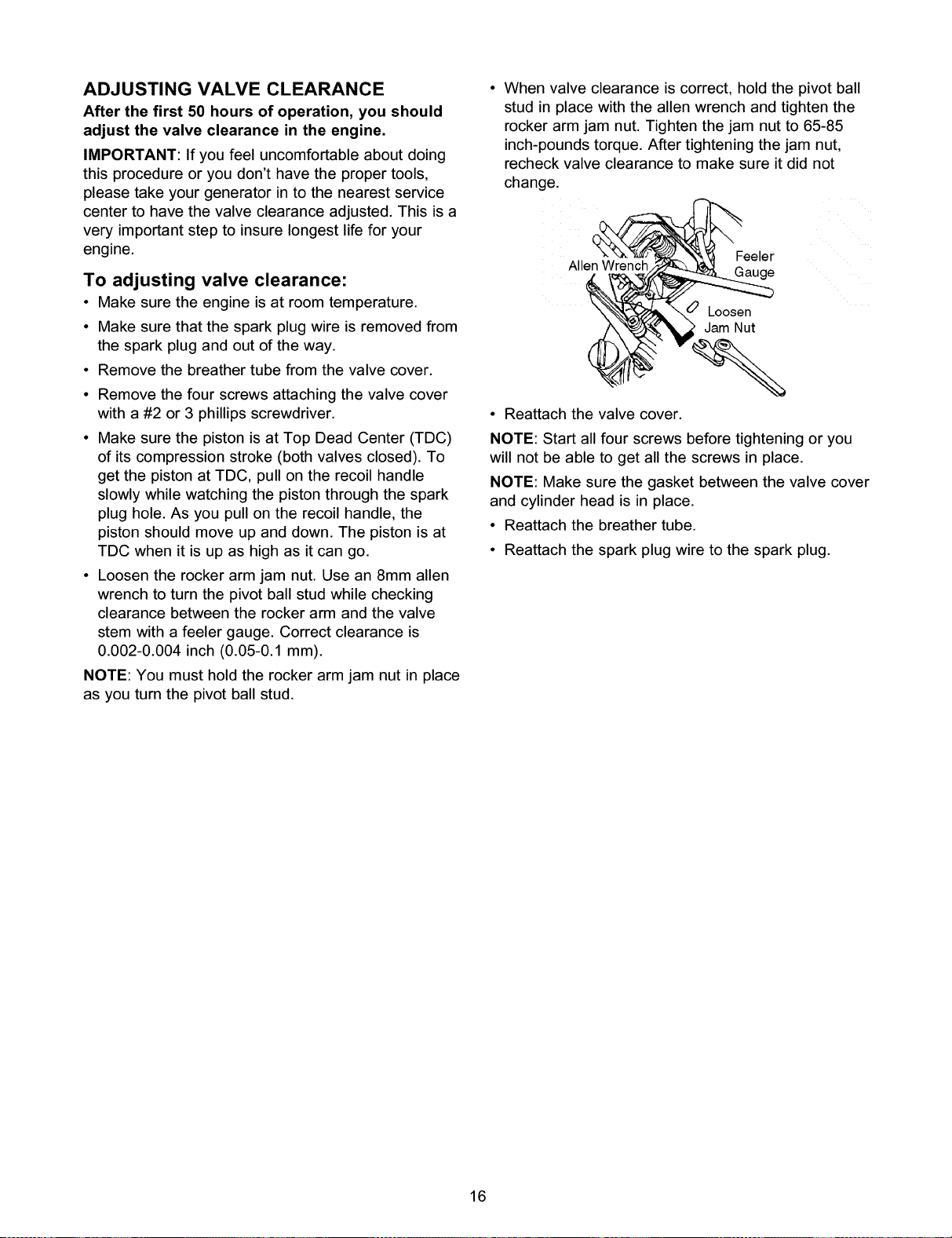
• Loosen the rocker arm jam nut. Use an 8mm allen
wrench to turn the pivot ball stud while checking
clearance between the rocker arm and the valve
stem with a feeler gauge. Correct clearance is
0.002-0.004 inch (0.05-0.1 mm).
NOTE: You must hold the rocker arm jam nut in place
as you turn the pivot ball stud.
• When valve clearance is correct, hold the pivot ball
stud in place with the allen wrench and tighten the
rocker arm jam nut. Tighten the jam nut to 65-85
inch-pounds torque. After tightening the jam nut,
recheck valve clearance to make sure it did not
change.
Feeler
Allen Wrench Gauge
Loosen
Jam Nut
• Reattach the valve cover.
NOTE: Start all four screws before tightening or you
will not be able to get all the screws in place.
NOTE: Make sure the gasket between the valve cover
and cylinder head is in place.
• Reattach the breather tube.
• Reattach the spark plug wire to the spark plug.
16
GENERAL
The generator should be started at least once
every seven days and allowed to run at least
30 minutes. If this cannot be done and you must store
the unit for more than 30 days, use the following
information as a guide to prepare it for storage.
,_ DANGER! NEVER store engine with fuel in
tank indoors or in enclosed, poorly ventilated
areas where fumes may reach an open flame,
spark or pilot light as on a furnace, water
heater, clothes dryer or other gas appliance.
LONG TERM STORAGE
It is important to prevent gum deposits from forming in
essential fuel system parts such as the carburetor, fuel
hose or tank during storage. Also, experience
indicates that alcohol-blended fuels (called gasohol,
ethanol or methanol) can attract moisture, which leads
to separation and formation of acids during storage.
Acidic gas can damage the fuel system of an engine
while in storage.
To avoid engine problems, the fuel system should be
emptied before storage of 30 days or longer, as
follows:
• Remove all gasoline from the fuel tank.
,_ DANGER! Drain fuel into approved container
outdoors, away from open flame. Be sure
engine is cool. Do Not smoke.
• Start and run engine until engine stops from lack of
fuel.
• While engine is still warm, drain oil from crankcase.
Refill with recommended grade.
• Remove spark plug and pour about 1/2 ounce
(15 ml) of engine oil into the cylinder. Cover spark
plug hole with rag. Pull recoil starter slowly to
distribute oil.
• Disconnect negative cable from battery terminal.
,_ CAUTION! Avoid spray from spark plug hole
when cranking engine.
• Install and tighten spark plug. Do Not connect spark
plug wire.
• Clean the generator outer surfaces. Check that
cooling air slots and openings on generator are
open and unobstructed.
• Store the unit in a clean, dry place.
OTHER STORAGE TIPS:
• Do Not store gasoline from one season to another.
• Replace your gasoline can if your can starts to rust.
Rust and/or dirt in your gasoline will cause
problems.
• If possible, store your unit indoors and cover it to
give protection from dust and dirt. BE SURE TO
EMPTY THE FUEL TANK.
Cover your unit with a suitable protective cover that
does not retain moisture.
,_ DANGER! NEVER cover your generator while
engine and exhaust area are warm.
17
Problem
Engine is running, but no
AC output is available.
Engine runs good but bogs
down when loads are
connected.
Cause
1. Circuit breaker is open.
2. Poor connection or defective
cord set.
3. Connected device is bad.
4. Fault in generator.
1. Short circuit in a connected load.
2. Generator is overloaded.
3. Engine speed is too slow.
4. Shorted generator circuit.
1. Run/Stop switch set to Stop.
2. Dirty air cleaner.
3. Out of gasoline.
4. Stale gasoline.
5. Spark plug wire not connected to
Solution
1. Reset circuit breaker.
2. Check and repair.
.
4.
1.
2.
3.
4.
Connect another device that is in
good condition.
Contact Sears service facility.
Disconnect shorted electrical load.
See "Don't Overload the
Generator" on page 12.
Contact Sears service facility.
Contact Sears service facility.
1. Set switch to Run.
2. Clean or replace air cleaner.
3. Fill fuel tank.
4. Drain gas tank and fill with fresh
fuel.
5. Connect wire to spark plug.
Engine will not start; or
starts and runs rough.
spark plug.
6. Bad spark plug.
7. Water in gasoline.
8. Overchoking.
9. Low oil level.
.
7.
8.
9.
Replace spark plug.
Drain gas tank; fill with fresh fuel.
Put choke lever to No Choke
position.
Fill crankcase to proper level.
10. Excessively rich fuel mixture.
11. Intake valve stuck open or
closed.
12. Engine has lost compression.
Engine shuts down during
operation.
Engine lacks power.
Engine "hunts" or falters.
No Battery Charge DC
output.
1. Out of gasoline.
2. Low oil level.
3. Fault in engine.
1. Load is too high.
2. Dirty air filter.
3. Engine needs to be serviced.
1. Choke is opened too soon.
.
Carburetor is running too rich or
too lean.
1. Battery posts are corroded.
2. Battery fluid level is low.
3. Battery cable is bad.
4. Battery is defective.
5. Receptacle is bad.
10. Contact Sears service facility.
11. Contact Sears service facility.
12. Contact Sears service facility.
1. Fill fuel tank.
2. Fill crankcase to proper level.
3. Contact Sears service facility.
1. See "Don't Overload the
Generator" on page 12.
2. Replace air filter.
3. Contact Sears service facility.
1. Move choke to halfway position till
engine runs smoothly.
2. Contact Sears service facility.
1. Clean battery posts.
2. Add distilled water to battery.
3. Replace cable.
4. Check battery condition; replace if
defective.
5. Contact Sears service facility.
18

19
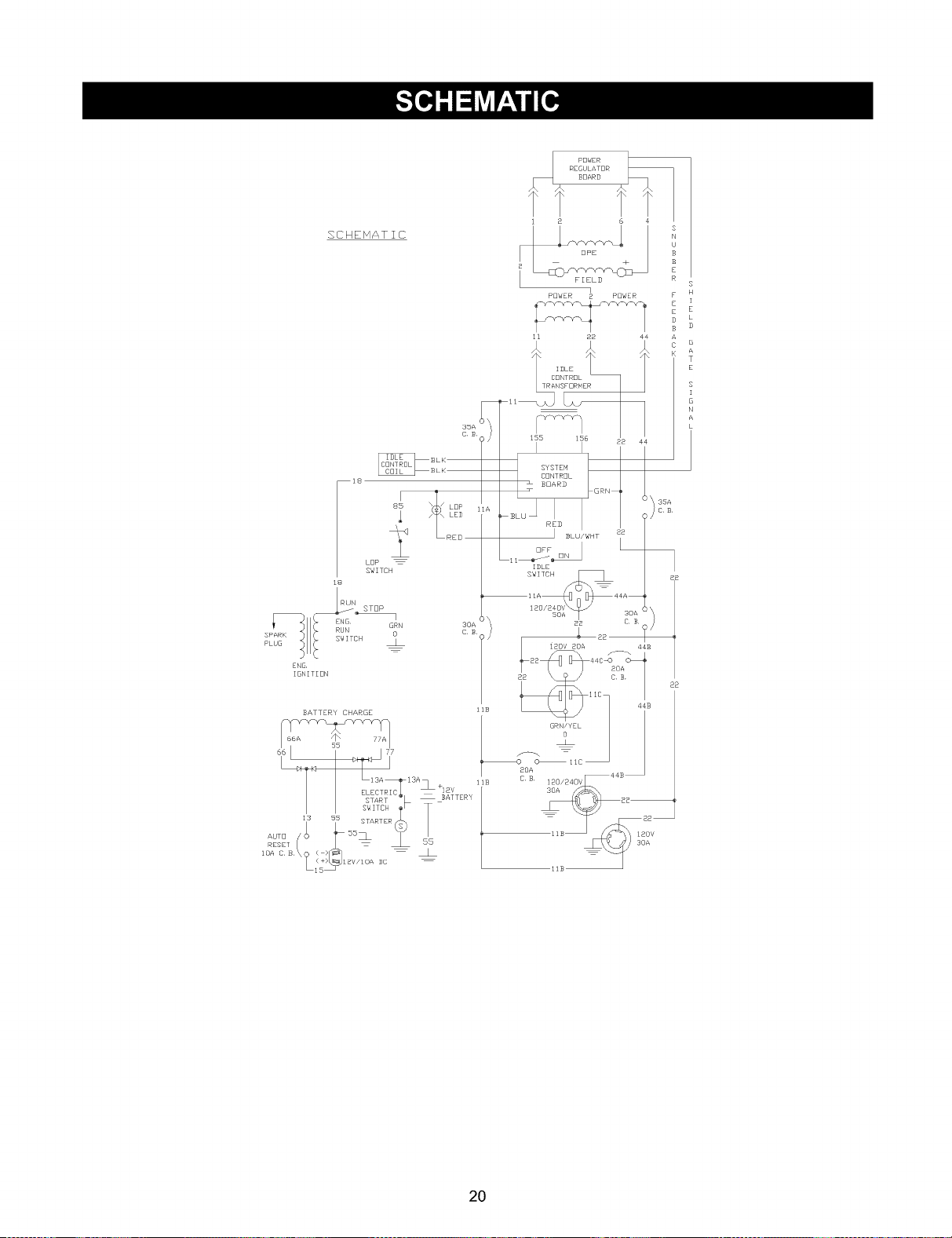
SCHEMATIC
REGULATOR
BOARD
i i 22 44
I
85
1
Y
LOP
SWITCH
IDLE
SWITCH
RUN
STOP 50A \
SPARK _SW TCH
P 120V 20A
44S
IGNITION 22 0 B, 22
llC
BATTERY CHARGE i IB 4L
6 7
_+I2vI3A 13A i
START BATTERY
_oAcs\ e c K_'I =
L/#_ ......... =
o
A
T
E
s
i
0
R
A
2O
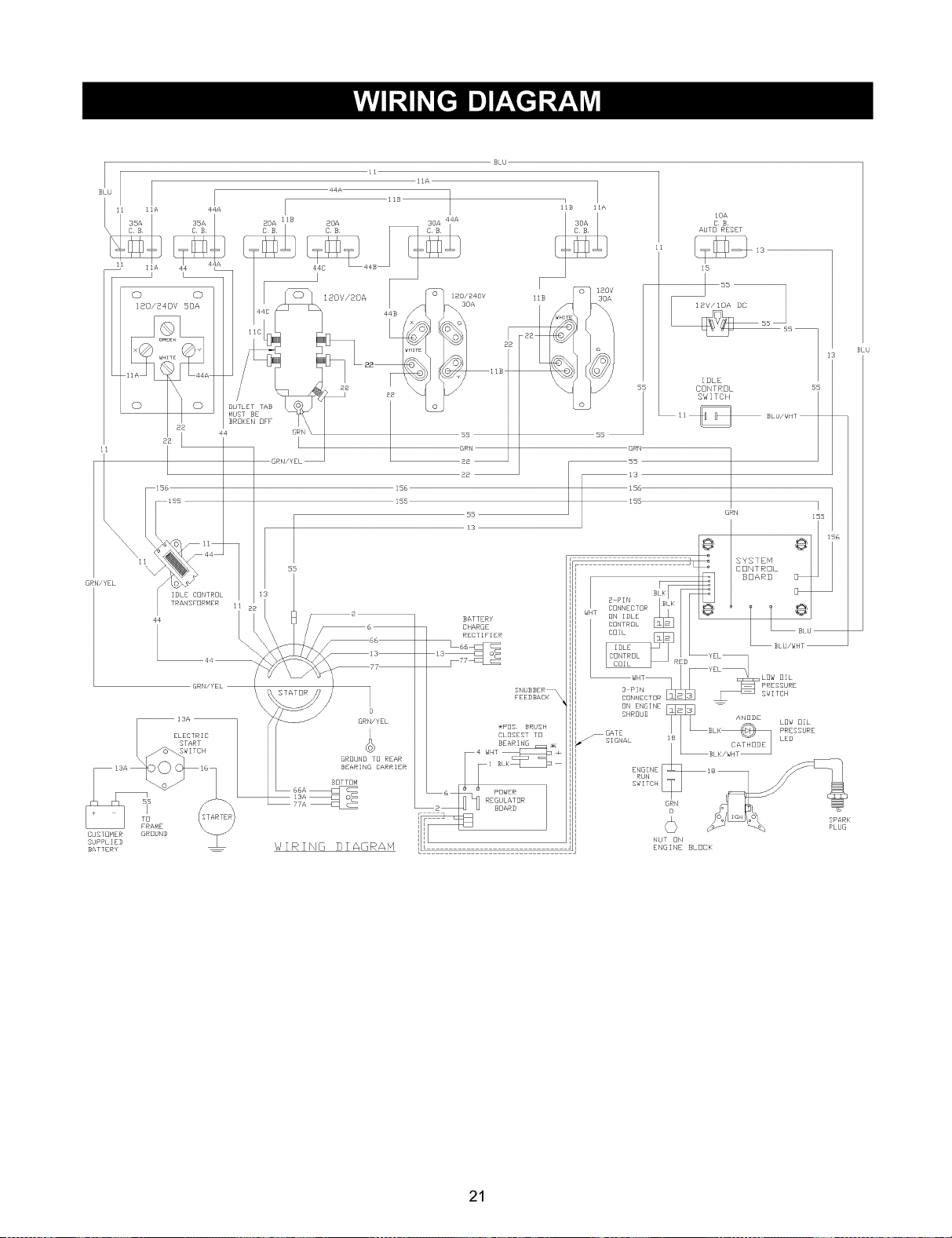
BLU
ii IIA 44A
35A 35A
__CB CB
] L
CD CD
120/240V 50A
GRN/YEL
I DLE CONTROL
TRANSFORMER
44
ii
IIA
44A
lIB
20A lib 20A BOA 44A
? CB CB
120V/20A
22
22
_OA
CB
AUTO RESET
15
12V/IOA DC
IDLE
CONTROL 55
SWITCH
22 55
_2 _13
156 ]
155 ]
o
J _ SYSTEM
CONTROL
BOARD
BLK
2 PIN BLK
CONNECTOR •
WHT ON IDLE _ _ | |
BATTERY I CONTROL 2L_2J l I
CHARGE
......... __COIL RB_LII_ ....... BLU
WHTcToR_ J LF_ _......SNUBBER 3 PIN RESSURE
FEEDBAC K CONNE WITCH
WIRING DIAGRAH
•POS BRUSH
CLOSEST TO
GATE
_SIGNAL
156
155
POWER
REGULATOR
BOARD
GRN
O
NUT ON
ENGINE BLOCK
LOW OIL
PRESSURE
21
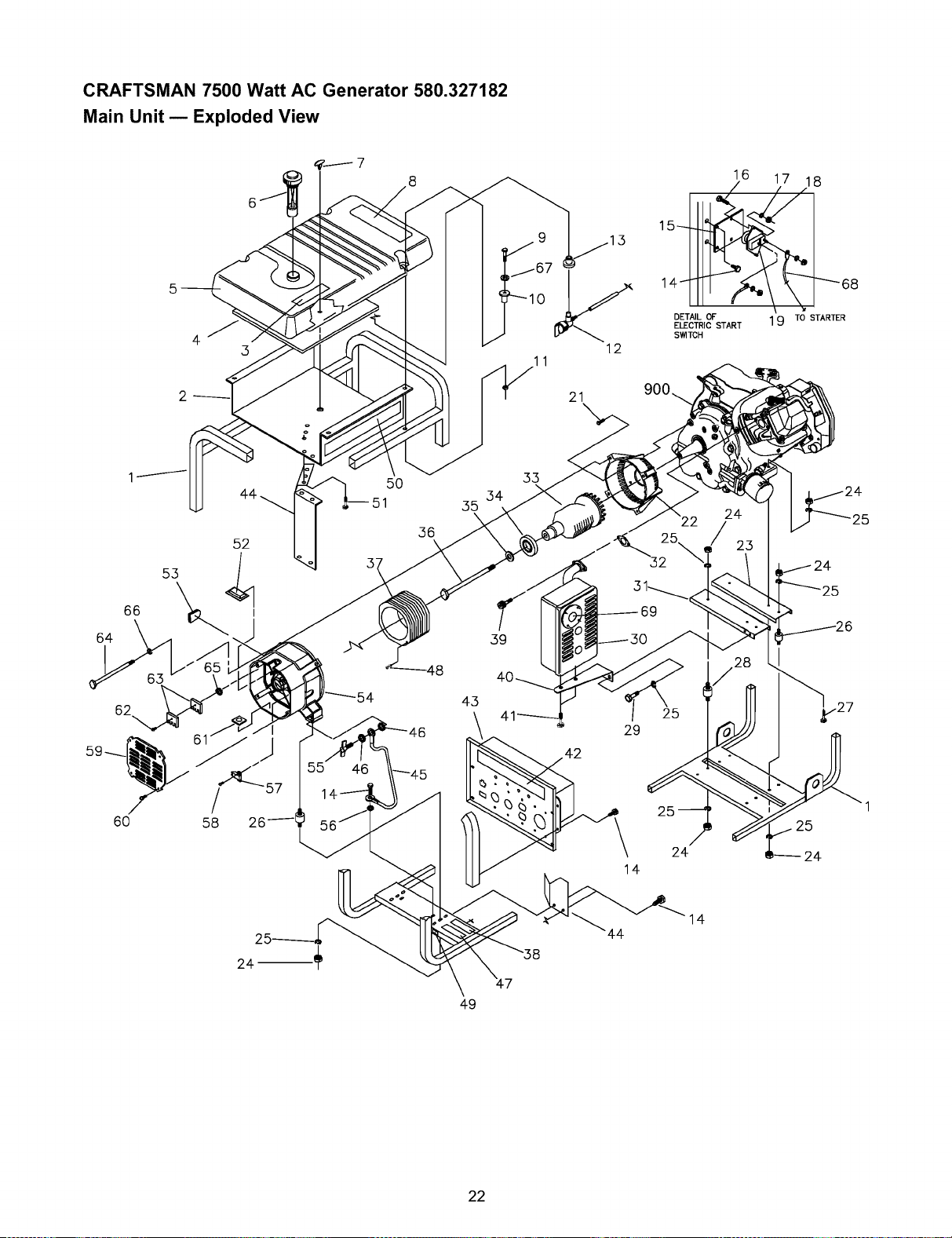
CRAFTSMAN 7500 Watt AC Generator 580.327182
Main Unit- Exploded View
q/7
11
3
12
21
16
DETAIL OF
ELECTRIC START
SWITCH
900_
9 TO STARTER
64
62
60
53
66
52
I
/
58 26_I
55
1
,3
46
50
I
36
35
33
t
39
69
44
14
.27
25
24
49
22
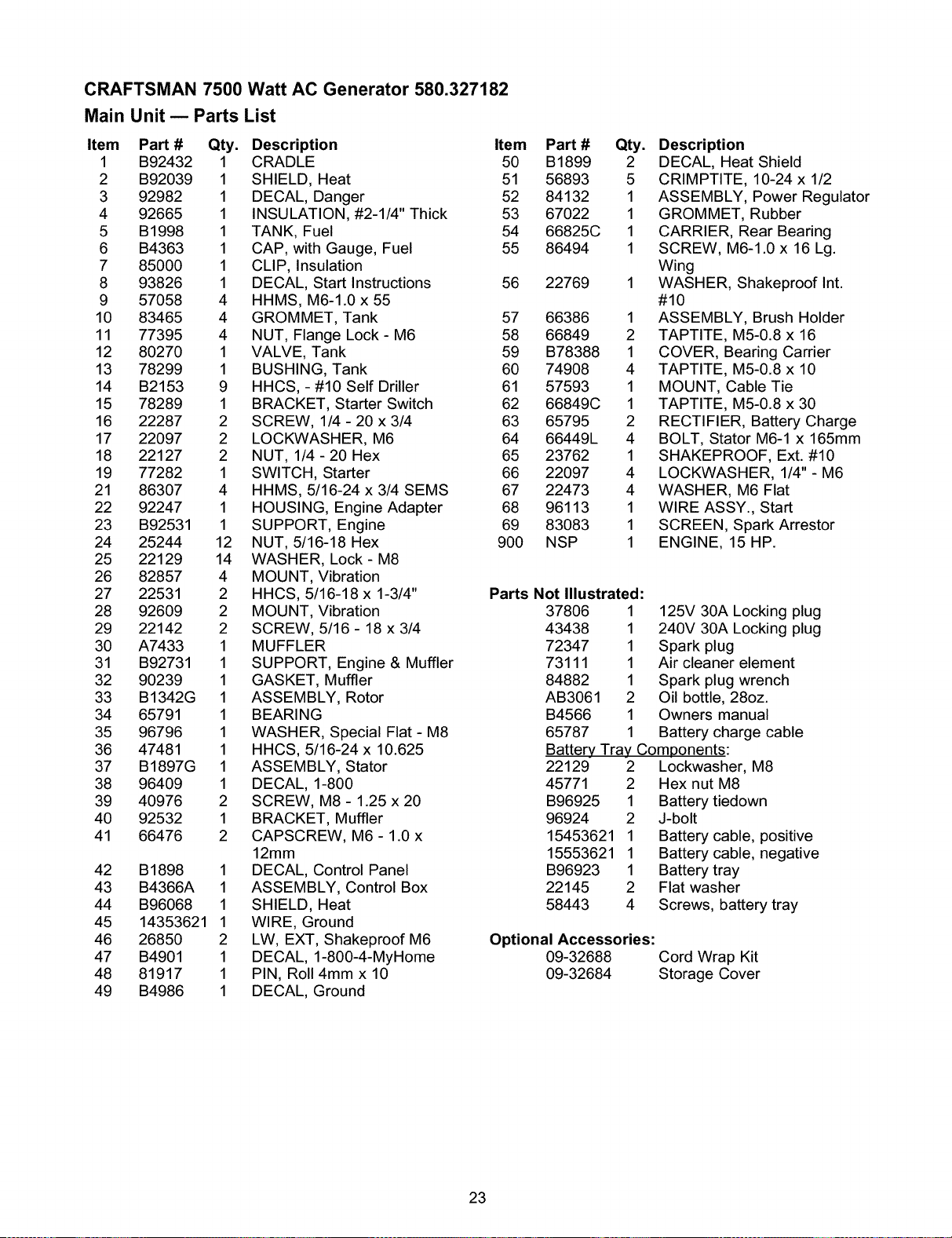
CRAFTSMAN 7500 Watt AC Generator 580.327182
Main Unit- Parts List
Item Pan # Qty.
1 B92432 1
2 B92039 1
3 92982 1
4 92665 1
5 B1998 1
6 B4363 1
7 85000 1
8 93826 1
9 57058 4
10 83465 4
11 77395 4
12 80270 1
13 78299 1
14 B2153 9
15 78289 1
16 22287 2
17 22097 2
18 22127 2
19 77282 1
21 86307 4
22 92247 1
23 B92531 1
24 25244 12
25 22129 14
26 82857 4
27 22531 2
28 92609 2
29 22142 2
30 A7433 1
31 B92731 1
32 90239 1
33 B1342G 1
34 65791 1
35 96796 1
36 47481 1
37 B1897G 1
38 96409 1
39 40976 2
40 92532 1
41 66476 2
42 B1898 1
43 B4366A 1
44 B96068 1
45 14353621 1
46 26850 2
47 B4901 1
48 81917 1
49 B4986 1
Description
CRADLE
SHIELD, Heat
DECAL, Danger
INSULATION, #2-1/4" Thick
TANK, Fuel
CAP, with Gauge, Fuel
CLIP, Insulation
DECAL, Start Instructions
HHMS, M6-1.0 x 55
GROMMET, Tank
NUT, Flange Lock - M6
VALVE, Tank
BUSHING, Tank
HHCS, - #10 Self Driller
BRACKET, Starter Switch
SCREW, 1/4 - 20 x 3/4
LOCKWASHER, M6
NUT, 1/4 - 20 Hex
SWITCH, Starter
HHMS, 5/16-24 x 3/4 SEMS
HOUSING, Engine Adapter
SUPPORT, Engine
NUT, 5/16-18 Hex
WASHER, Lock- M8
MOUNT, Vibration
HHCS, 5/16-18 x 1-3/4"
MOUNT, Vibration
SCREW, 5/16 - 18 x 3/4
MUFFLER
SUPPORT, Engine & Muffler
GASKET, Muffler
ASSEMBLY, Rotor
BEARING
WASHER, Special Flat - M8
HHCS, 5/16-24 x 10.625
ASSEMBLY, Stator
DECAL, 1-800
SCREW, M8 - 1.25 x 20
BRACKET, Muffler
CAPSCREW, M6 - 1.0 x
12mm
DECAL, Control Panel
ASSEMBLY, Control Box
SHIELD, Heat
WIRE, Ground
LW, EXT, Shakeproof M6
DECAL, 1-800-4-MyHome
PIN, Roll 4mm x 10
DECAL, Ground
Item Pan #
50 B1899
51 56893
52 84132
53 67022
54 66825C
55 86494
56 22769
57 66386
58 66849
59 B78388
60 74908
61 57593
62 66849C
63 65795
64 66449L
65 23762
66 22097
67 22473
68 96113
69 83083
900 NSP
Qty. Description
2 DECAL, Heat Shield
5 CRIMPTITE, 10-24 x 1/2
1 ASSEMBLY, Power Regulator
1 GROMMET, Rubber
1 CARRIER, Rear Bearing
1 SCREW, M6-1.0 x 16 Lg.
Wing
1 WASHER, Shakeproof Int.
#10
1 ASSEMBLY, Brush Holder
2 TAPTITE, M5-0.8 x 16
1 COVER, Bearing Carrier
4 TAPTITE, M5-0.8 x 10
1 MOUNT, Cable Tie
1 TAPTITE, M5-0.8 x 30
2 RECTIFIER, Battery Charge
4 BOLT, Stator M6-1 x 165mm
1 SHAKEPROOF, Ext. #10
4 LOCKWASHER, 1/4" - M6
4 WASHER, M6 Flat
1 WIRE ASSY., Start
1 SCREEN, Spark Arrestor
1 ENGINE, 15 HP.
Parts Not Illustrated:
37806 1 125V 30A Locking plug
43438 1 240V 30A Locking plug
72347 1 Spark plug
73111 1 Air cleaner element
84882 1 Spark plug wrench
AB3061 2 Oil bottle, 28oz.
B4566 1 Owners manual
65787 1 Battery charge cable
Battery Tray Components:
22129 2 Lockwasher, M8
45771 2 Hex nut M8
B96925 1 Battery tiedown
96924 2 J-bolt
15453621 1 Battery cable, positive
15553621 1 Battery cable, negative
B96923 1 Battery tray
22145 2 Flat washer
58443 4 Screws, battery tray
Optional Accessories:
09-32688 Cord Wrap Kit
09-32684 Storage Cover
23
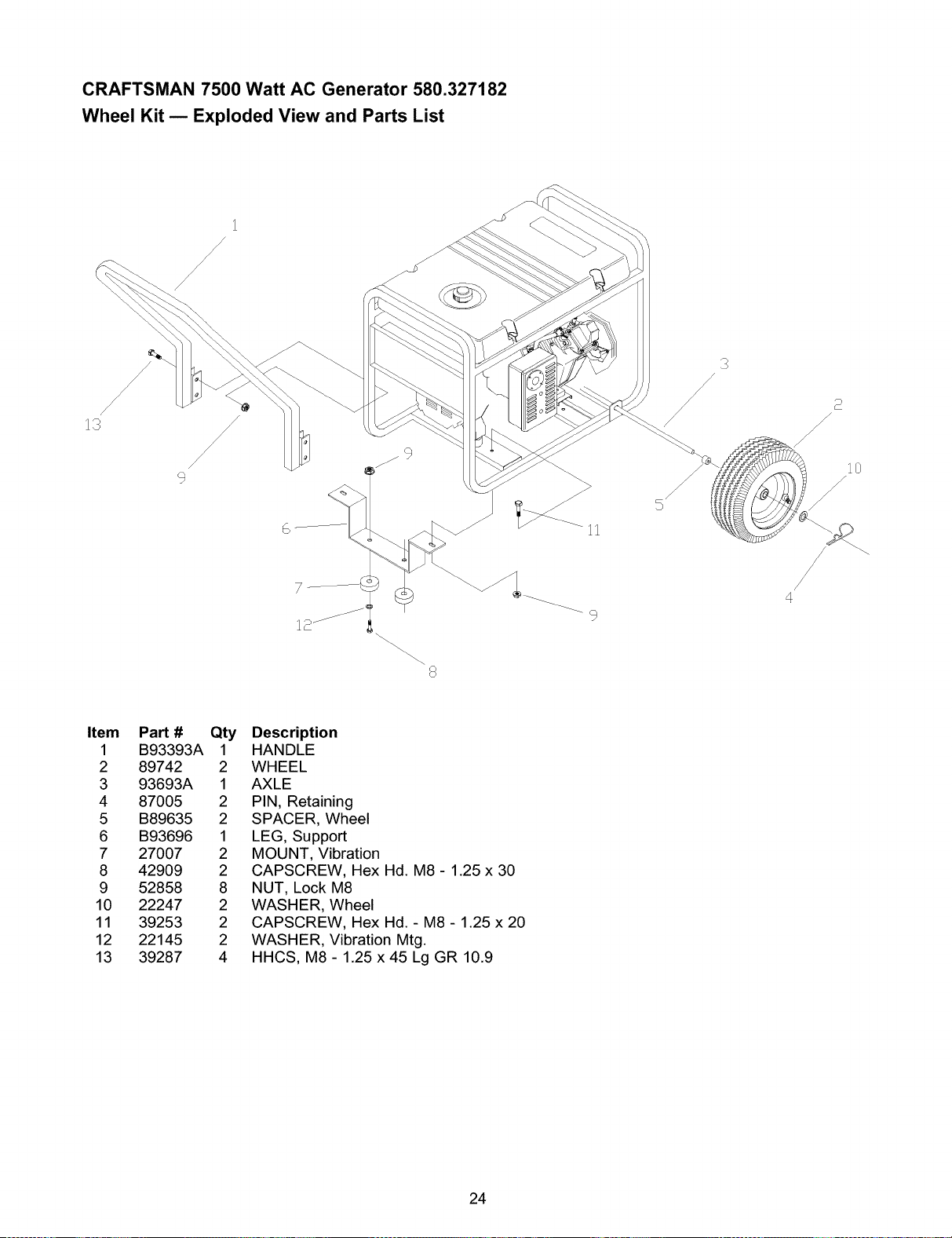
CRAFTSMAN 7500 Watt AC Generator 580.327182
Wheel Kit -- Exploded View and Parts List
Item
1
2
3
4
5
6
7
8
9
10
11
12
13
Pa_ #
B93393A
89742
93693A
87005
B89635
B93696
27007
42909
52858
22247
39253
22145
39287
Qty Description
1 HANDLE
2 WHEEL
1 AXLE
2 PIN, Retaining
2 SPACER, Wheel
1 LEG, Support
2 MOUNT, Vibration
2 CAPSCREW, Hex Hd. M8 - 1.25 x 30
8 NUT, Lock M8
2 WASHER, Wheel
2 CAPSCREW, Hex Hd. - M8 - 1.25 x 20
2 WASHER, Vibration Mtg.
4 HHCS, M8 - 1.25 x 45 Lg GR 10.9
24
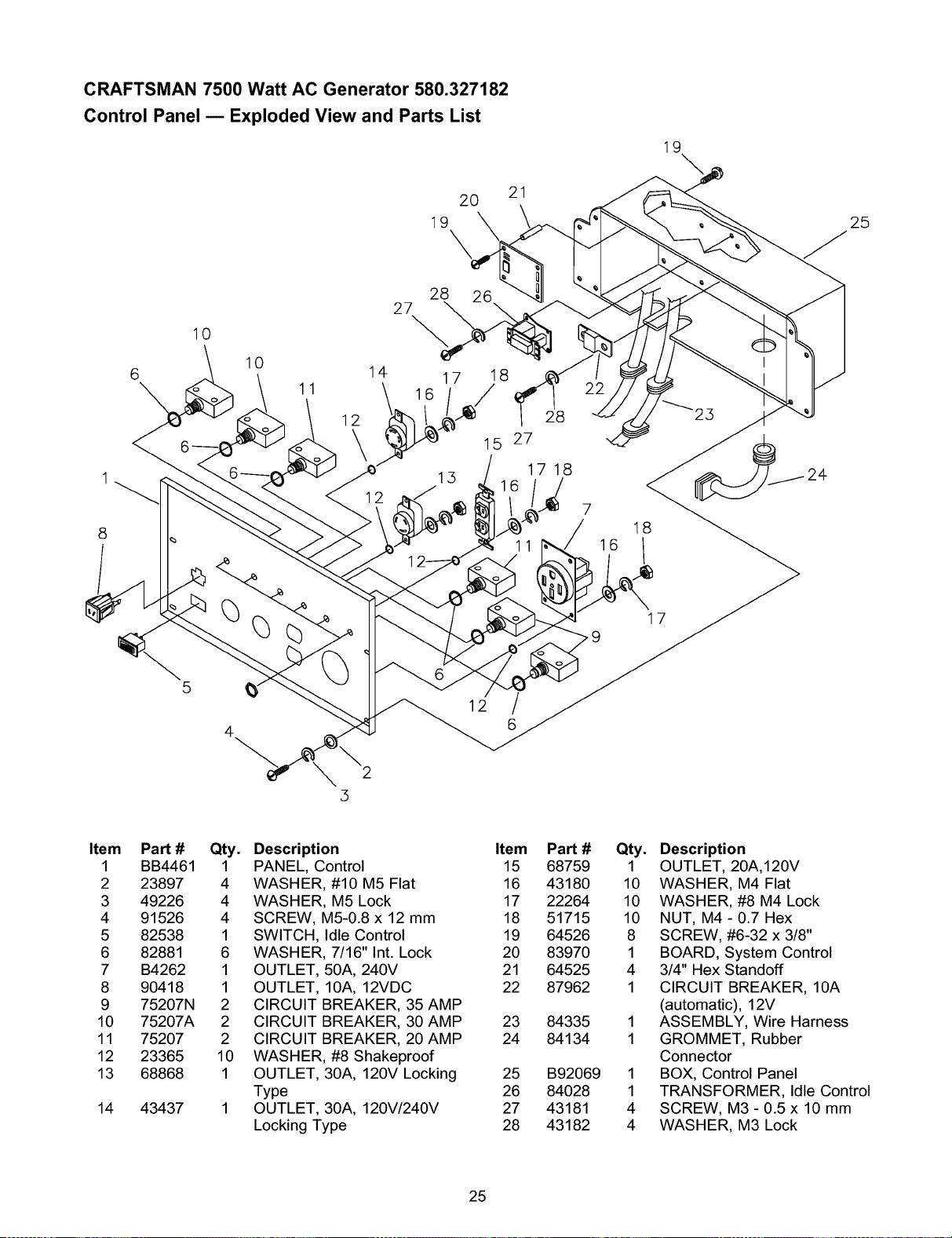
CRAFTSMAN 7500 Watt AC Generator 580.327182
Control Panel -- Exploded View and Parts List
19
8
5
lO
lO
4
11
27
14
12
2O
19
\
28
17
15
21
26
18
28
15 27
17 18
11
12 /
6
7
/ 16
18
17
24
25
Item
1
2
3
4
5
6
7
8
9
10
11
12
13
14
PaN #
BB4461
23897
49226
91526
82538
82881
B4262
90418
75207N
75207A
75207
23365
68868
43437
Qty.
1
4
4
4
1
6
1
1
2
2
2
10
1
Description
PANEL, Control
WASHER, #10 M5 Flat
WASHER, M5 Lock
SCREW, M5-0.8 x 12 mm
SWITCH, Idle Control
WASHER, 7/16" Int. Lock
OUTLET, 50A, 240V
OUTLET, 10A, 12VDC
CIRCUIT BREAKER, 35 AMP
CIRCUIT BREAKER, 30 AMP
CIRCUIT BREAKER, 20 AMP
WASHER, #8 Shakeproof
OUTLET, 30A, 120V Locking
Type
OUTLET, 30A, 120V/240V
Locking Type
Item
15
16
17
18
19
20
21
22
23
24
25
26
27
28
PaN #
68759
43180
22264
51715
64526
83970
64525
87962
84335
84134
B92069
84028
43181
43182
Qty.
1
10
10
10
8
1
4
1
1
1
1
1
4
4
Description
OUTLET, 20A,120V
WASHER, M4 Flat
WASHER, #8 M4 Lock
NUT, M4 - 0.7 Hex
SCREW, #6-32 x 3/8"
BOARD, System Control
3/4" Hex Standoff
CIRCUIT BREAKER, 10A
(automatic), 12V
ASSEMBLY, Wire Harness
GROMMET, Rubber
Connector
BOX, Control Panel
TRANSFORMER, Idle Control
SCREW, M3 - 0.5 x 10 mm
WASHER, M3 Lock
25
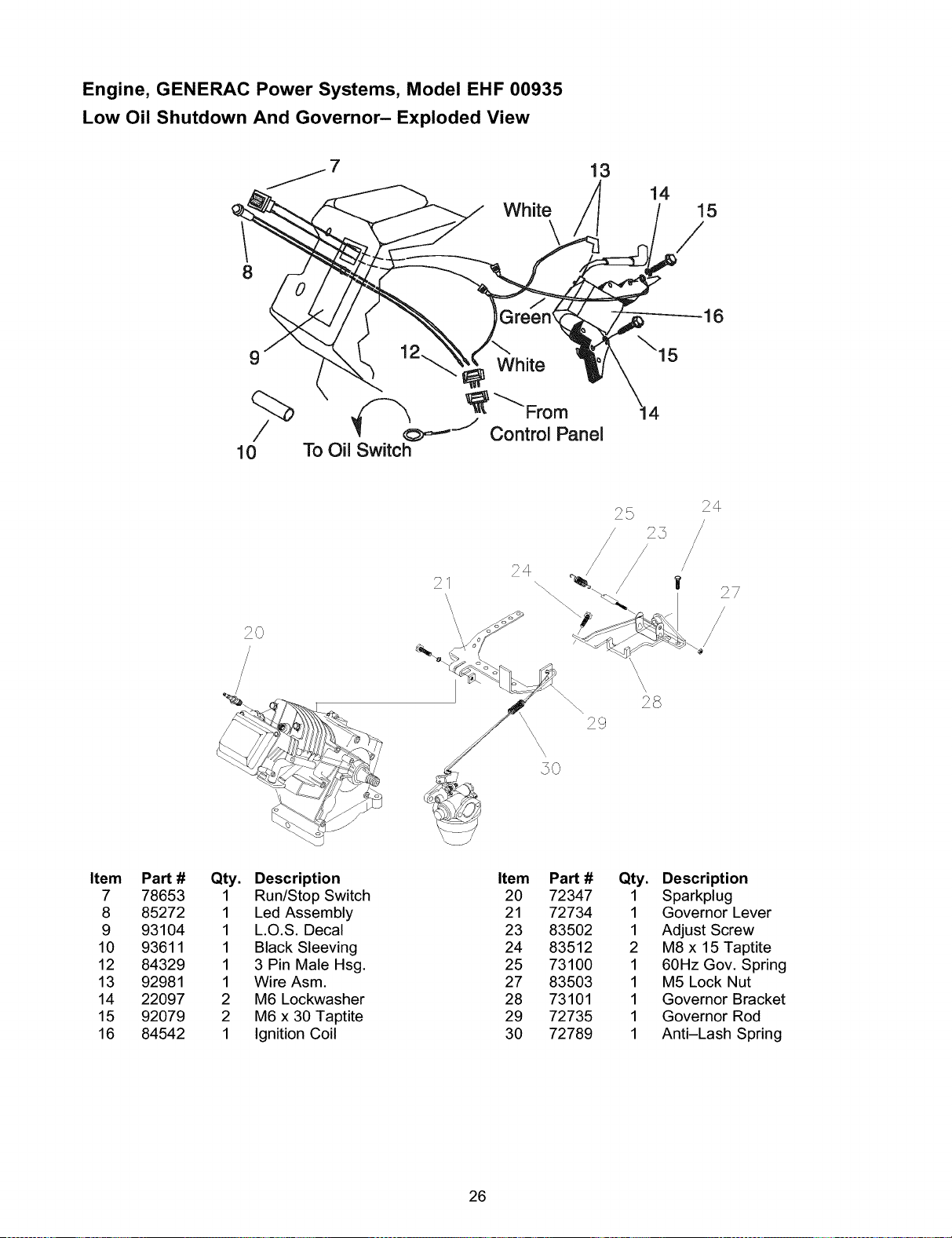
Engine, GENERAC Power Systems, Model EHF 00935
Low Oil Shutdown And Governor- Exploded View
8
g
/
10
White
\
1
White
13
14
\15
4
15
/
16
20
21
\
\
\
\
24
25
/ 23
27
Item
7
8
9
10
12
13
14
15
16
Pa_ #
78653
85272
93104
93611
84329
92981
22097
92079
84542
Qty.
1
1
1
1
1
1
2
2
1
Description
Run/Stop Switch
Led Assembly
L.O.S. Decal
Black Sleeving
3 Pin Male Hsg.
Wire Asm.
M6 Lockwasher
M6 x 30 Taptite
Ignition Coil
Item Pan # Qty.
20 72347 1
21 72734 1
23 83502 1
24 83512 2
25 73100 1
27 83503 1
28 73101 1
29 72735 1
30 72789 1
Description
Sparkplug
Governor Lever
Adjust Screw
M8 x 15 Taptite
60Hz Gov. Spring
M5 Lock Nut
Governor Bracket
Governor Rod
Anti-Lash Spring
26
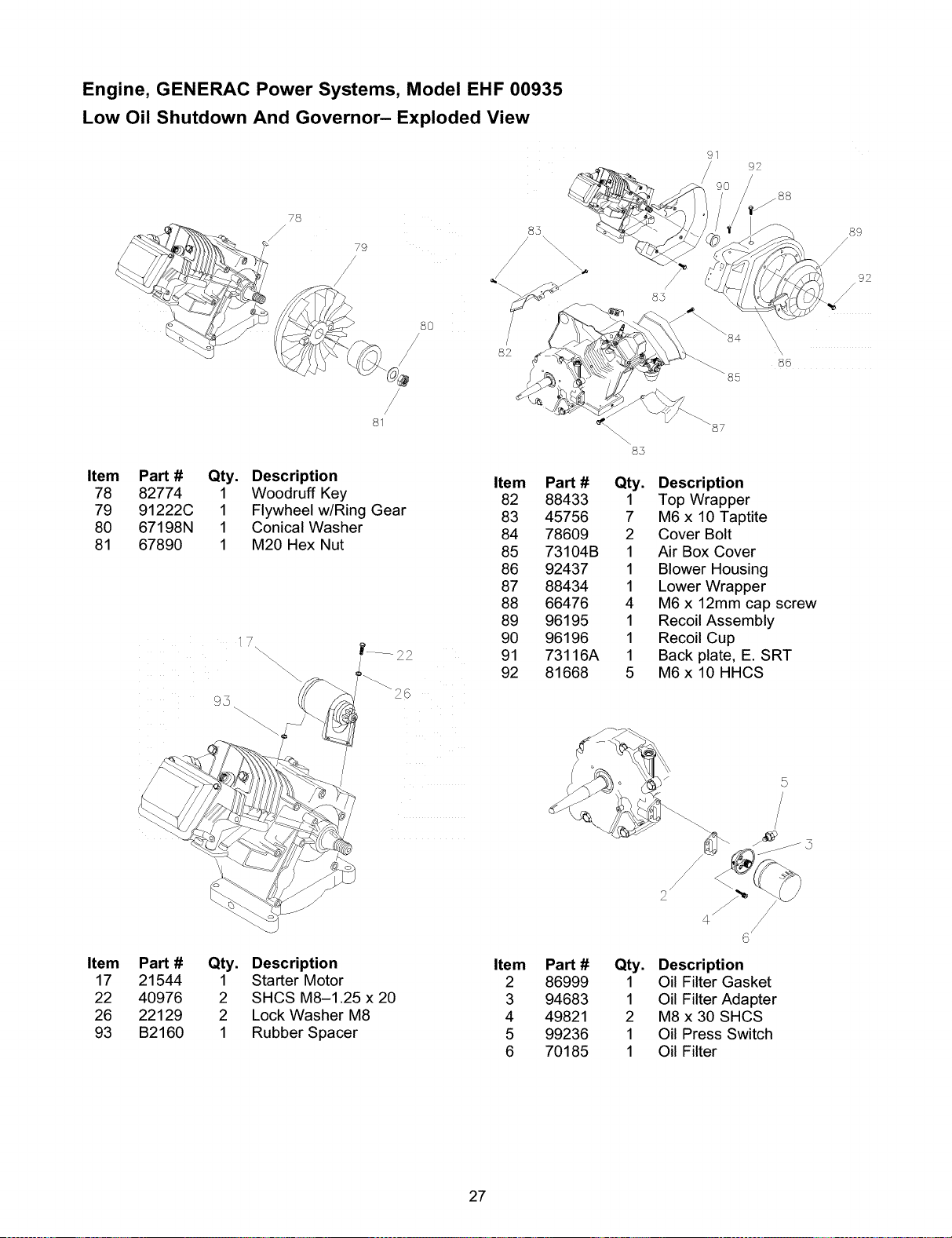
Engine, GENERAC Power Systems, Model EHF 00935
Low Oil Shutdown And Governor- Exploded View
78
/
79
/
/
/
8O
/
85
/
82
/
81
Item
78
79
80
81
Part #
82774
91222C
67198N
67890
Qty. Description
1 Woodruff Key
1 Flywheel w/Ring Gear
1 Conical Washer
1 M20 Hex Nut
\\
\.
85
Item Part # Qty.
82 88433 1
83 45756 7
84 78609 2
85 73104B 1
86 92437 1
87 88434 1
88 66476 4
89 96195 1
90 96196 1
91 73116A 1
92 81668 5
91
92
56
85
87
Description
Top Wrapper
M6 x 10 Taptite
Cover Bolt
Air Box Cover
Blower Housing
Lower Wrapper
M6 x 12mm cap screw
Recoil Assembly
Recoil Cup
Back plate, E. SRT
M6 x 10 HHCS
89
/
/
/
92
/
<
Item
17
22
26
93
Part #
21544
40976
22129
B2160
Qty. Description
1 Starter Motor
2 SHCS M8-1.25 x 20
2 Lock Washer M8
1 Rubber Spacer
Item
2
3
4
5
6
Part #
86999
94683
49821
99236
70185
2
/
/
Qty. Description
1 Oil Filter Gasket
1 Oil Filter Adapter
2 M8 x 30 SHCS
1 Oil Press Switch
1 Oil Filter
27
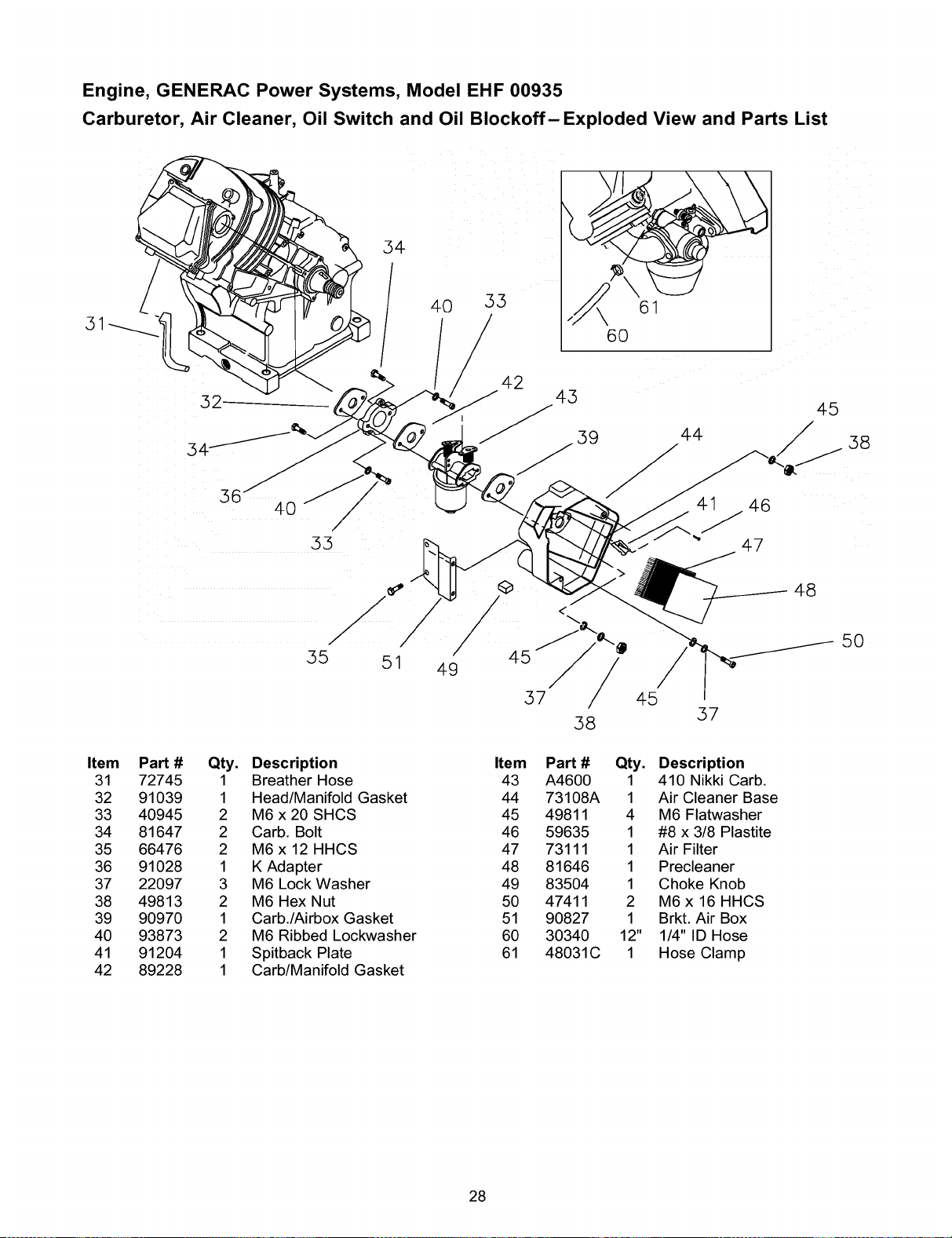
Engine, GENERAC Power Systems, Model EHF 00935
Carburetor, Air Cleaner, Oil Switch and Oil Blockoff-Exploded View and Parts List
31
32-
34
I
36
4O
35
51
4O
49
33
42
61
6O
43
44
38
45
37
45
48
38
5O
Item
31
32
33
34
35
36
37
38
39
40
41
42
Part # Qty. Description
72745 1 Breather Hose
91039 1 Head/Manifold Gasket
40945 2 M6 x 20 SHCS
81647 2 Carb. Bolt
66476 2 M6 x 12 HHCS
91028 1 K Adapter
22097 3 M6 Lock Washer
49813 2 M6 Hex Nut
90970 1 Carb./Airbox Gasket
93873 2 M6 Ribbed Lockwasher
91204 1 Spitback Plate
89228 1 Carb/Manifold Gasket
Item Part #
43 A4600
44 73108A
45 49811
46 59635
47 73111
48 81646
49 83504
50 47411
51 90827
60 30340
61 48031C
Qty. Description
1 410 Nikki Carb.
1 Air Cleaner Base
4 M6 Flatwasher
1 #8 x 3/8 Plastite
1 Air Filter
1 Precleaner
1 Choke Knob
2 M6 x 16 HHCS
1 Brkt. Air Box
12" 1/4" ID Hose
1 Hose Clamp
28
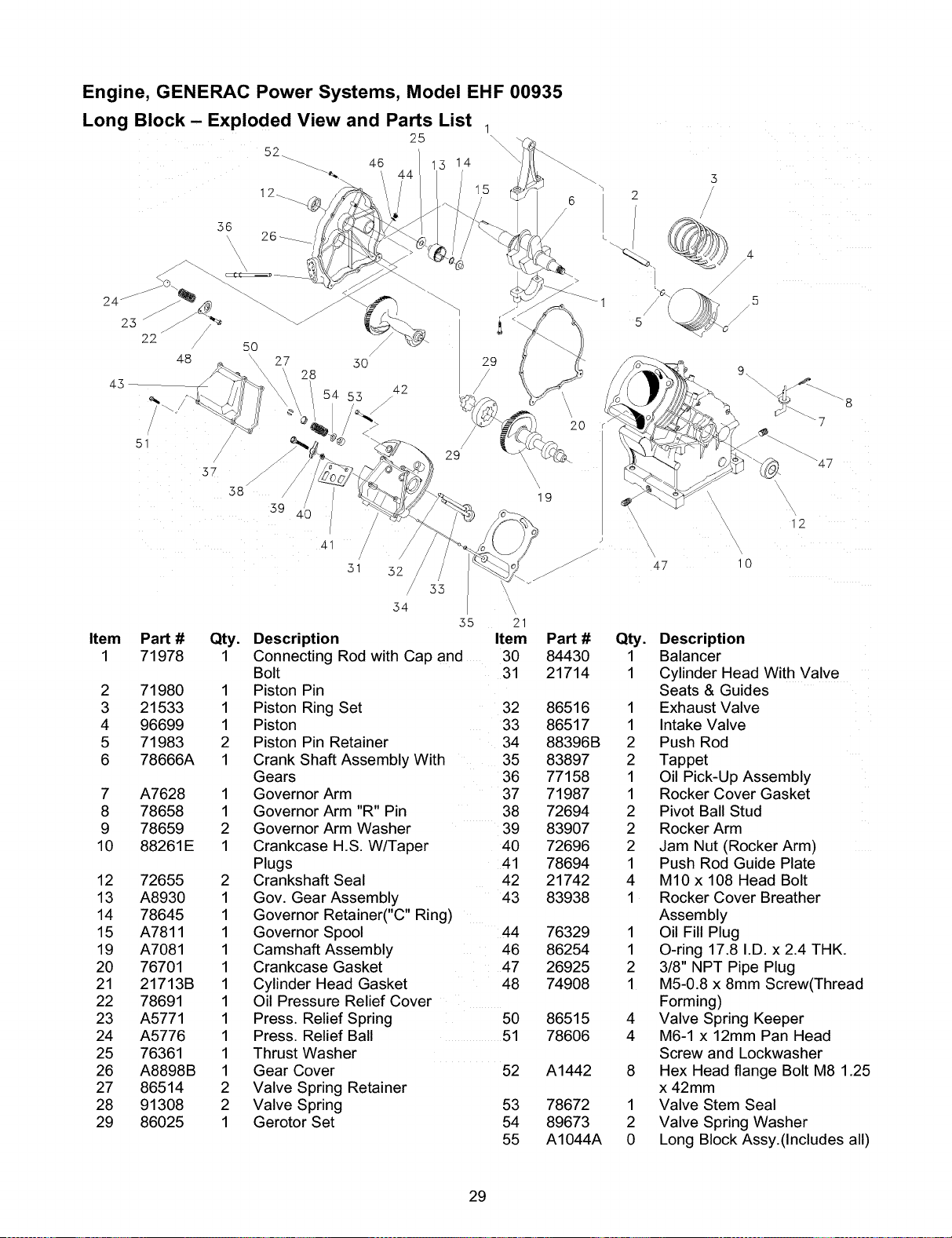
Engine, GENERAC Power Systems, Model EHF 00935
Long Block - Exploded View and Parts List
25
52.
_._. 46 15 14
36
h
6
24
25
22 / 50
48 27
<
/
30
28
42
54 53 /
5
51
Item
1
2
3
4
5
6
7
8
9
10
12
13
14
15
19
20
21
22
23
24
25
26
27
28
29
/
<
/
5
/
/
_0/
20 r_ 7
<
29 _47
5 7 \\\ '\
38 / '19 < "\
39 ',\ \
\\ 12
\
41 / J \\ ",,
51 .52 47 10
54
55 21
Part # Qty. Description Item Part # Qty. Description
71978 1 Connecting Rod with Cap and 30 84430 1 Balancer
Bolt 31 21714 1 Cylinder Head With Valve
71980 1 Piston Pin Seats & Guides
21533 1 Piston Ring Set 32 86516 1 Exhaust Valve
96699 1 Piston 33 86517 1 Intake Valve
71983 2 Piston Pin Retainer 34 88396B 2 Push Rod
78666A 1 Crank Shaft Assembly With 35 83897 2 Tappet
Gears 36 77158 1 Oil Pick-Up Assembly
A7628 1 Governor Arm 37 71987 1 Rocker Cover Gasket
78658 1 Governor Arm "R" Pin 38 72694 2 Pivot Ball Stud
78659 2 Governor Arm Washer 39 83907 2 Rocker Arm
88261E 1 Crankcase H.S. W/Taper 40 72696 2 Jam Nut (Rocker Arm)
Plugs 41 78694 1 Push Rod Guide Plate
72655 2 Crankshaft Seal 42 21742 4 M10 x 108 Head Bolt
A8930 1 Gov. Gear Assembly 43 83938 1 Rocker Cover Breather
78645 1 Governor Retainer("C" Ring) Assembly
A7811 1 Governor Spool 44 76329 1 Oil Fill Plug
A7081 1 Camshaft Assembly 46 86254 1 O-ring 17.8 I.D. x 2.4 THK.
76701 1 Crankcase Gasket 47 26925 2 3/8" NPT Pipe Plug
21713B 1 Cylinder Head Gasket 48 74908 1 M5-0.8 x 8mm Screw(Thread
78691 1 Oil Pressure Relief Cover Forming)
A5771 1 Press. Relief Spring 50 86515 4 Valve Spring Keeper
A5776 1 Press. Relief Ball 51 78606 4 M6-1 x 12mm Pan Head
76361 1 Thrust Washer Screw and Lockwasher
A8898B 1 Gear Cover 52 A1442 8 Hex Head flange Bolt M8 1.25
86514 2 Valve Spring Retainer x 42mm
91308 2 Valve Spring 53 78672 1 Valve Stem Seal
86025 1 Gerotor Set 54 89673 2 Valve Spring Washer
55 A1044A 0 Long Block Assy.(Includes all)
29

Your Warranty Rights and Obligations
The California Air Resources Board ("CARB") and Sears
Roebuck and Co., USA, are pleased to explain the Emission
Control System Warranty on your model year 2000 and later
small off-road engine (engine). In California, new engines
must be designed, built and equipped to meet the State's
stringent anti-smog standards. Sears must warrant the
emission control system on your engine for the periods of
time listed below provided there has been no abuse, neglect,
or improper maintenance of your engine.
Your emission control system includes parts such as the
carburetor and the ignition system.
Where a warrantable condition exists, Sears will repair your
engine at no cost to you. Expenses covered under under
warranty include diagnosis, parts, and labor.
Manufacturer's Warranty Coverage
The model year 2000 and later engines are warranted for
two years. If any emission related part on your engine (as
listed below) is defective, the part will be repaired or
replaced by Sears.
Owner's Warranty Responsibilities
As the engine owner, you are responsible for the
performance of the required maintenance listed in this
owners manual. Sears recommends that you retain all
receipts covering maintenance on your engine, but Sears
cannot deny warranty solely due for the lack of receipts or
for your failure to ensure the performance of all scheduled
maintenance.
As the engine owner, you should be aware that Sears may
deny you warranty coverage if your engine or a part of it has
failed due to abuse, neglect, improper maintenance,
unapproved modifications, or the use of parts not made or
approved by the original equipment manufacturer.
You are responsible for presenting your engine to a Sears
authorized repair center as soon as a problem exists.
Warranty repairs should be completed in a reasonable
amount of time, not to exceed 30 days.
If you have any questions regarding your warranty rights and
responsibilities, you should contact your nearest authorized
service center or call Sears at 1-800-473-7247.
Warranty Commencement Date
The warranty period begins on the date the engine is
delivered.
Length of Coverage
Sears warrants to the initial owner and each subsequent
purchaser that the engine is free from defects in materials
and workmanship which cause the failure of a warranted
part for a period of two years.
WHAT IS COVERED
Repair or Replacement of Parts
• Repair or replacement of any warranted part will be
performed at no charge to the owner at an approved
Sears service center.
If you have any questions regarding your warranty rights
and responsibilities, your should contact your nearest
authorized service center or call Sears at
1-800-473-7247.
Warranty Period
Any warranted part which is not scheduled for replacement
as required maintenance, or which is scheduled only for
regular inspection to the effect of "repair or replace as
necessary" shall be warranted for 2 years. Any warranted
part which is scheduled for replacement as required
maintenance shall be warranted for the period of time up to
the first scheduled replacement point for that part.
Diagnosis
The owner shall not be charged for diagnostic labor which
leads to the determination that the warranted part is
defective ifthe diagnostic work is performed at an approved
Sears service center.
Consequential Damages
Sears may be liable for damages to other engine
components caused by the failure of a warranted part still
under warranty.
WHAT IS NOT COVERED
All failures caused by abuse, neglect, or improper
maintenance are not covered.
Add-on or Modified Parts
The use of add-on or modified parts can be grounds for
disallowing a warranty claim. Sears is not liable to cover
failures of warranted parts caused by the use of add-on or
modified parts.
How to File a Claim
If you have any questions regarding your warranty rights and
responsibilities, you should contact your nearest authorized
service center or call Sears at 1-800-473-7247.
Where to Get Warranty Service
Warranty services or repairs shall be provided at all Sears
authorized service centers.
Maintenance, Replacement and Repair of
Emission Related Parts
Any Sears approved replacement part used in the
performance of any warranty maintenance or repair on
emission related parts will be provided without charge to the
owner if the part it under warranty.
Emission Control Warranty Parts List
1. Fuel Metering System:
a. Carburetor assembly
b. Fuel filter
2. Air Induction System:
a. Intake manifold
b. Air cleaner
3. Ca!alytic Muffler Assembly (if so equipped),
including:
a. Muffler gasket
b. Exhaust manifold
4. Ignition System
a. Spark plug
b. Ignition module
5. Crankcase Breather Tube
30
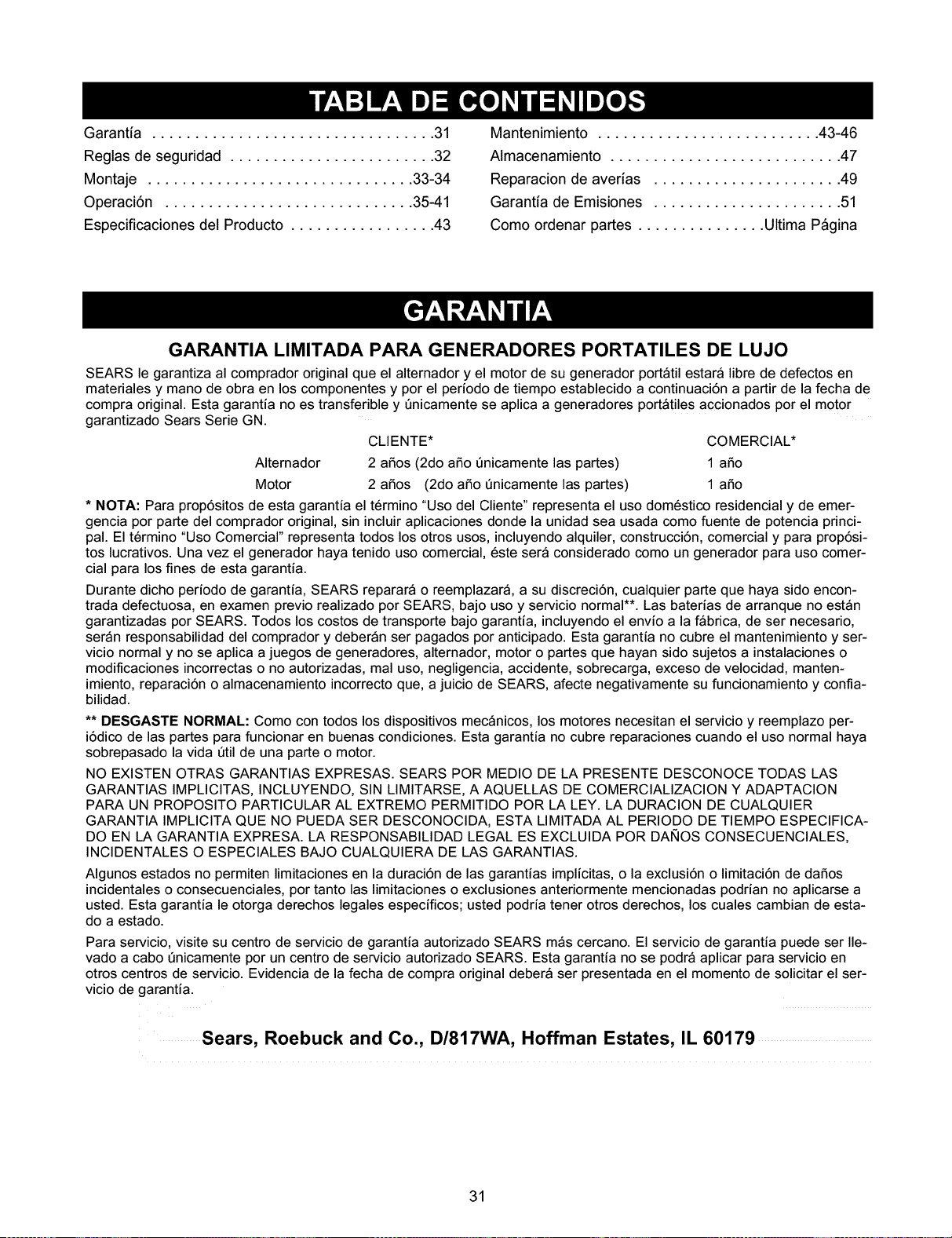
Garantia................................. 31
Reglasdeseguridad........................ 32
Montaje............................... 33-34
Operaci6n............................. 35-41
EspecificacionesdelProducto................. 43
Mantenimiento.......................... 43-46
Almacenamiento........................... 47
Reparaciondeaverias...................... 49
GarantiadeEmisiones...................... 51
Comoordenarpartes............... UltimaPagina
GARANTIA LIMITADA PARA GENERADORES PORTATILES DE LUJO
SEARS le garantiza al comprador original que el alternador y el motor de su generador port&til estar& libre de defectos en
materiales y mano de obra en los componentes y por el periodo de tiempo establecido a continuaci6n a partir de la fecha de
compra original. Esta garantia no es transferible y 6nicamente se aplica a generadores port&tiles accionados por el motor
garantizado Sears Serie GN.
CLIENTE* COMERCIAL*
Alternador 2 aSos (2do aSo 6nicamente las partes) 1 aSo
Motor 2 aSos (2do aSo 6nicamente las partes) 1 aSo
* NOTA: Para prop6sitos de esta garantia el t6rmino "Uso del Cliente" representa el uso dom6stico residencial y de emer-
gencia por parte del comprador original, sin incluir aplicaciones donde la unidad sea usada como fuente de potencia princi-
pal. El t6rmino "Uso Comerciar' representa todos los otros usos, incluyendo alquiler, construcci6n, comercial y para prop6si-
tos lucrativos. Una vez el generador haya tenido uso comercial, 6ste ser& considerado como un generador para uso comer-
cial para los fines de esta garantia.
Durante dicho periodo de garantia, SEARS reparar& o reemplazar&, a su discreci6n, cualquier parte que haya sido encon-
trada defectuosa, en examen previo realizado por SEARS, bajo uso y servicio normal**. Las baterias de arranque no est&n
garantizadas por SEARS. Todos los costos de transporte bajo garantia, incluyendo el envio a la f&brica, de ser necesario,
ser&n responsabilidad del comprador y deber&n ser pagados por anticipado. Esta garantia no cubre el mantenimiento y ser-
vicio normal y no se aplica a juegos de generadores, alternador, motor o partes que hayan sido sujetos a instalaciones o
modificaciones incorrectas o no autorizadas, mal uso, negligencia, accidente, sobrecarga, exceso de velocidad, manten-
imiento, reparaci6n o almacenamiento incorrecto que, a juicio de SEARS, afecte negativamente su funcionamiento y confia-
bilidad.
** DESGASTE NORMAL: Como con todos los dispositivos mec&nicos, los motores necesitan el servicio y reemplazo per-
i6dico de las partes para funcionar en buenas condiciones. Esta garantia no cubre reparaciones cuando el uso normal haya
sobrepasado la vida 6til de una parte o motor.
NO EXISTEN OTRAS GARANTIAS EXPRESAS. SEARS POR MEDIO DE LA PRESENTE DESCONOCE TODAS LAS
GARANTIAS IMPLICITAS, INCLUYENDO, SIN LIMITARSE, A AQUELLAS DE COMERCIALIZACION Y ADAPTACION
PARA UN PROPOSITO PARTICULAR AL EXTREMO PERMITIDO POR LA LEY. LA DURACION DE CUALQUIER
GARANTIA IMPLICITA QUE NO PUEDA SER DESCONOCIDA, ESTA LIMITADA AL PERIODO DE TIEMPO ESPECIFICA-
DO EN LA GARANTIA EXPRESA. LA RESPONSABILIDAD LEGAL ES EXCLUIDA POR DANOS CONSECUENCIALES,
INCIDENTALES O ESPECIALES BAJO CUALQUIERA DE LAS GARANTIAS.
Algunos estados no permiten limitaciones en la duraci6n de las garantias implicitas, o la exclusi6n o limitaci6n de daSos
incidentales o consecuenciales, por tanto las limitaciones o exclusiones anteriormente mencionadas podrian no aplicarse a
usted. Esta garantia le otorga derechos legales especificos; usted podria tener otros derechos, los cuales cambian de esta-
do a estado.
Para servicio, visite su centro de servicio de garantia autorizado SEARS m&s cercano. El servicio de garantia puede ser Ile-
vado a cabo 6nicamente por un centro de servicio autorizado SEARS. Esta garantia no se podr& aplicar para servicio en
otros centros de servicio. Evidencia de la fecha de compra original deber& ser presentada en el momento de solicitar el ser-
vicio de garantia.
Sears, Roebuck and Co., D/817WA, Hoffman Estates, IL 60179
31
BUSQUE ESTE SIMBOLO PARA SEI_IALAR
PRECAUCIONES DE SEGURIDAD
IMPORTANTES. ESTE SIGNIFICA "iATENCION!!!
iESTE ALERTA!!! SU SEGURIDAD ESTA EN
PELIGRO."
_ PRECAUCION! Lea este manual y siga todas lasReglas de Seguridad e Instrucciones de Operaci6n
antes de usar este producto.
iPELIGRO! Este generador est& disefiado para
uso en exteriores enicamente. No use este
generador en el interior de ninguna edificaci6n o
recinto cerrado, incluyendo el compartimiento para
generador de un vehiculo recreacional (VR). Podrfan
ocurrir incendios o explosiones. Las modificaciones
realizadas por el usuario, incluyendo ventilaci6n del
escape y/o ventilaci6n de enfriamiento, no
eliminar&n el peligro. Tambi6n, permita que exista al
menos dos pies de distancia alrededor del
generador, incluso cuando est6 operando la unidad
en exteriores.
iPRECAUCION! Siempre desconecte el alambre
de la bujfa y col6quelo donde no pueda entrar en
contacto con la bujfa, para evitar el arranque
accidental durante la instalaci6n, transporte, ajuste o
reparaci6n de su generador.
• El generador produce un voltaje muy alto, el cual puede
ocasionar descargas el6ctricas extremamente peligrosas.
Evite el contacto con terminales, alambres pelados o sin
recubrimiento, etc. Nunca permita que personas no
calificadas operen o proporcionen servicio al generador.
• Nunca manipule dispositivos o cordones el6ctricos cuando
se encuentre parado en agua, descalzo o con los pies o
las manos mojadas. Podrfan ocurrir descargas el6ctricas
peligrosas.
• El C6digo EI6ctrico Nacional exige que el bastidor y las
partes externas conductoras de electricidad del generador
est6n conectadas adecuadamente a una conexi6n a tierra
fisica. Los c6digos el6ctricos locales tambi6n pueden
exigir la conexi6n a tierra adecuada del generador.
Consulte con un electricista local para los requisitos de
conexi6n a tierra en su &rea.
Use un interruptor de circuito de falla a tierra en &reas
hemedas o de alta conductividad (como en pisos
met&licos o estructuras de acero).
No utilice en el generador juegos de cordones el6ctricos
que est6n desgastados, pelados, raidos o dafiados de
cualquier manera. El uso de juegos de cordones
el6ctricos defectuosos puede ocasionar descargas
el6ctricas o dafios al equipo y/o a la propiedad.
• Opere el generador enicamente en superficies niveladas y
donde no se vaya a exponer a humedad excesiva,
suciedad, polvo o vapores corrosivos.
• La gasolina es altamente INFLAMABLE y sus vapores
son EXPLOSIVOS. No permita que fumen, que existan
llamas abiertas, chispas o calor a su alrededor cuando
manipule gasolina. Evite regar gasolina sobre un motor
caliente. Cumpla con todas las regulaciones que
requieran almacenamiento y manejo de gasolina.
• No Ilene el tanque de combustible excesivamente.
Siempre permita que exista espacio para la expansi6n del
combustible. Si el tanque est& demasiado Ileno, el
combustible podrfa rebosarse y caer sobre el motor
caliente y ocasionar un INCENDIO o una EXPLOSION.
• Nunca almacene el generador con combustible en el
tanque, donde los vapores de la gasolina puedan entrar
en contacto con llamas abiertas, chispas o luces de piloto
(como en hornos, calentadores de agua o secadoras de
ropa). Podrfan ocurrir INCENDIOS o EXPLOSIONES.
• Los gases del escape del generador contienen gas de
mon6xido de carbono MORTAL. Este gas peligroso, si se
inhala en concentraciones suficientes, puede ocasionar
p6rdida de la consciencia o incluso la muerte. Unicamente
opere este equipo al aire libre donde exista ventilaci6n
adecuada.
• Deje por Io menos 2 pies de distancia alrededor del
generador, incluso cuando la unidad est6 funcionando en
exteriores, de otra forma podrfa dafiar la unidad. Nunca
opere la unidad en el interior de habitaciones o recintos
encerrados donde el flujo de aire que entra o sale de la
unidad pueda ser obstruido.
• Nunca arranque o detenga el motor-generador cuando
tenga cargas el6ctricas conectadas a los tomacorrientes y
los dispositivos conectados est6n ENCENDIDOS.
Arranque el motor y permita que se estabilice antes de
conectar las cargas el6ctricas. Desconecte todas las
cargas el6ctricas antes de apagar el generador.
• No introduzca objetos a trav6s de las ranuras de
enfriamiento del motor-generador.
• Nunca opere el generador (a) en la Iluvia; (b) en
compartimiento encerrados; (c) si se recalientan los
dispositivos el6ctricos conectados; (d) si se pierde la
salida el6ctrica; (e) si se presentan chispas en el motor o
generador; (f) si se observan llamas o humo cuando la
unidad est& funcionando; (g) si la unidad vibra
excesivamente.
NOTA: Su generador est& equipado con un silenciador
apagachispas. El apagachispas deber& ser mantenido en
buenas condiciones de trabajo por parte del
propietario/operador. La ley en el Estado de California exige
el uso del apagachispas (Secci6n 4442 del C6digo de
Recursos Peblicos de California). Otros estados pueden
tener leyes similares. Las leyes federales se aplican en
tierras federales.
32
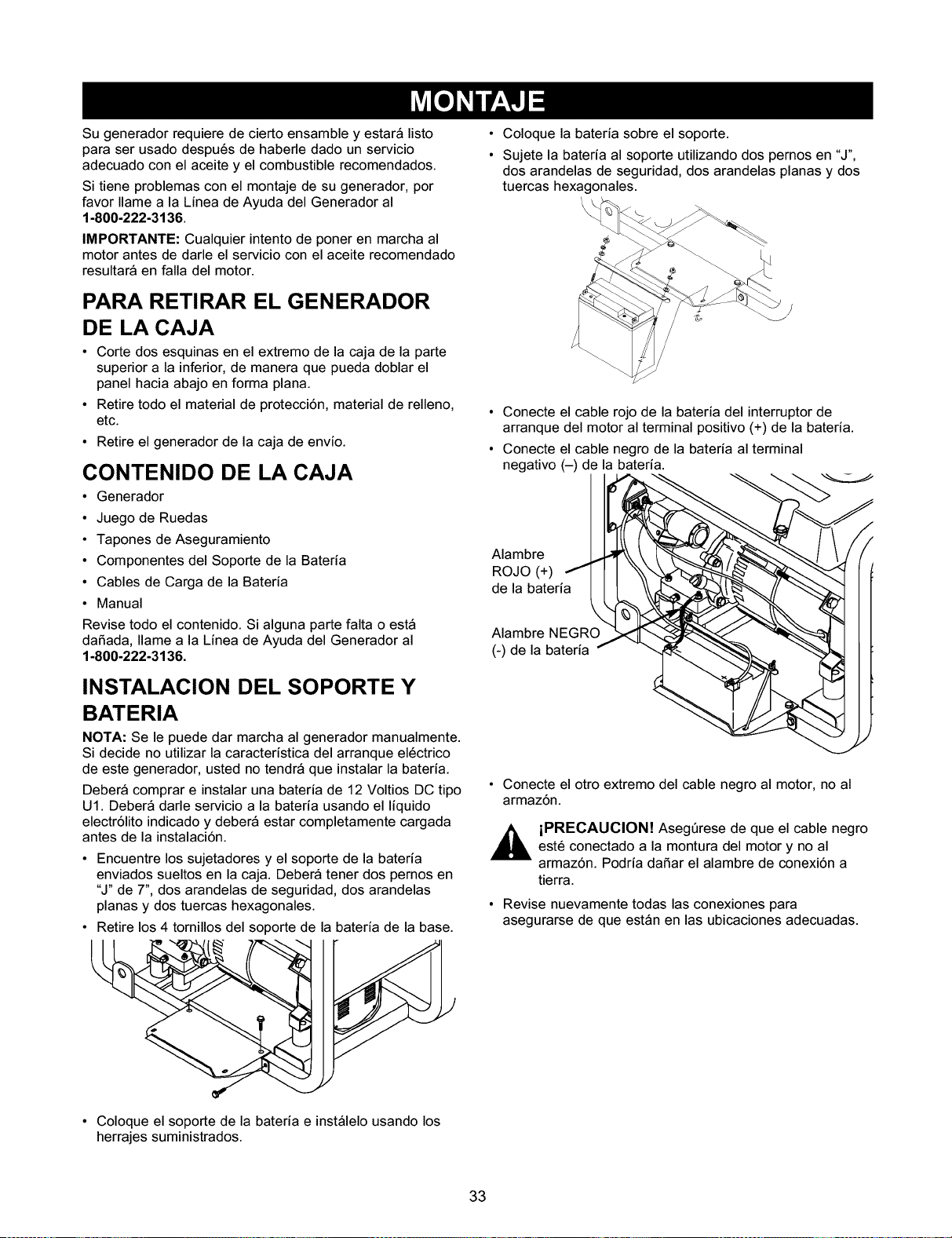
Su generador requiere de cierto ensamble y estar& listo
para ser usado despu6s de haberle dado un servicio
adecuado con el aceite y el combustible recomendados.
Si tiene problemas con el montaje de su generador, por
favor Ilame a la Linea de Ayuda del Generador al
1-800-222-3136.
IMPORTANTE: Cualquier intento de poner en marcha al
motor antes de darle el servicio con el aceite recomendado
resultar& en falla del motor.
PARA RETIRAR EL GENERADOR
DE LA CAJA
• Corte dos esquinas en el extremo de la caja de la parte
superior a la inferior, de manera que pueda doblar el
panel hacia abajo en forma plana.
• Retire todo el material de protecci6n, material de relleno,
etc.
• Retire el generador de la caja de envfo.
CONTENIDO DE LA CAJA
• Generador
• Juego de Ruedas
• Tapones de Aseguramiento
• Componentes del Soporte de la Bateria
• Cables de Carga de la Bateria
• Manual
Revise todo el contenido. Si alguna parte falta o est&
dafiada, Ilame a la Linea de Ayuda del Generador al
1-800-222-3136.
INSTALACION DEL SOPORTE Y
BATERIA
NOTA: Se le puede dar marcha al generador manualmente.
Si decide no utilizar la caracteristica del arranque el6ctrico
de este generador, usted no tendr& que instalar la bateria.
Deber& comprar e instalar una bateria de 12 Voltios DC tipo
U1. Deber_ darle servicio a la bateria usando el liquido
electr61ito indicado y deber& estar completamente cargada
antes de la instalaci6n.
• Encuentre los sujetadores y el soporte de la bateria
enviados sueltos en la caja. Deber& tener dos pernos en
"J" de 7", dos arandelas de seguridad, dos arandelas
planas y dos tuercas hexagonales.
• Retire los 4 tornillos del soporte de la bateria de la base.
• Coloque el soporte de la bateria e inst&lelo usando los
herrajes suministrados.
Coloque la bateria sobre el soporte.
Sujete la bateria al soporte utilizando dos pernos en "J",
dos arandelas de seguridad, dos arandelas planas y dos
tuercas hexagonales.
'\
• Conecte el cable rojo de la bateria del interruptor de
arranque del motor al terminal positivo (+) de la baterfa.
• Conecte el cable negro de la bateria al terminal
negativo (-) de la baterfa.
Alambre /
ROJO (+) J
de la baterfa
Alambre NEGRO
(-) de la baterfa
• Conecte el otro extremo del cable negro al motor, no al
armaz6n.
_ PRECAUCION! Aseg6rese de que el cable negroest6 conectado a la montura del motor y no al
armaz6n. Podria dafiar el alambre de conexi6n a
tierra.
• Revise nuevamente todas las conexiones para
asegurarse de que est&n en las ubicaciones adecuadas.
33
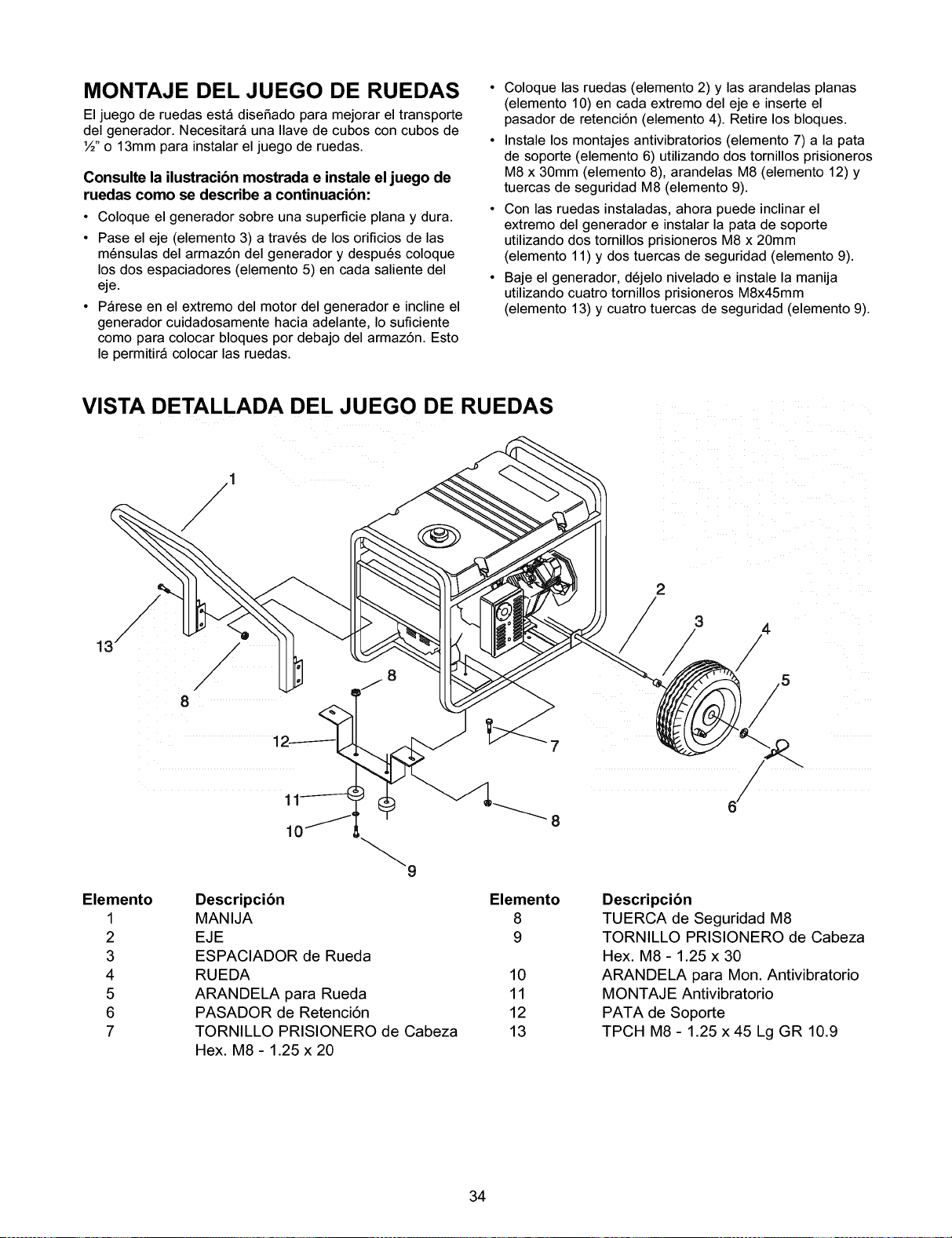
MONTAJE DEL JUEGO DE RUEDAS
El juego de ruedas est& disefiado para mejorar el transporte
del generador. Necesitar& una Ilave de cubos con cubos de
½" o 13mm para instalar el juego de ruedas.
Consulte la ilustracibn mostrada e instale el juego de
ruedas como se describe a continuacibn:
• Coloque el generador sobre una superficie plana y dura.
• Pase el eje (elemento 3) a trav6s de los orificios de las
m6nsulas del armaz6n del generador y despu6s coloque
los dos espaciadores (elemento 5) en cada saliente del
eje.
• P&rese en el extremo del motor del generador e incline el
generador cuidadosamente hacia adelante, Io suficiente
como para colocar bloques por debajo del armaz6n. Esto
le permitir& colocar las ruedas.
• Coloque las ruedas (elemento 2) y las arandelas planas
(elemento 10) en cada extremo del eje e inserte el
pasador de retenci6n (elemento 4). Retire los bloques.
• Instale los montajes antivibratorios (elemento 7) a la pata
de soporte (elemento 6) utilizando dos tornillos prisioneros
M8 x 30mm (elemento 8), arandelas M8 (elemento 12) y
tuercas de seguridad M8 (elemento 9).
• Con las ruedas instaladas, ahora puede inclinar el
extremo del generador e instalar la pata de soporte
utilizando dos tornillos prisioneros M8 x 20mm
(elemento 11) y dos tuercas de seguridad (elemento 9).
• Baje el generador, d6jelo nivelado e instale la manija
utilizando cuatro tornillos prisioneros M8x45mm
(elemento 13) y cuatro tuercas de seguridad (elemento 9).
VISTA DETALLADA DEL JUEGO DE RUEDAS
®
13
Elemento
1
2
3
4
5
6
7
8
8
10 j'
Descripcibn
MANIJA
EJE
ESPACIADOR de Rueda
RUEDA
ARANDELA para Rueda
PASADOR de Retenci6n
TORNILLO PRISIONERO de Cabeza
Hex. M8 - 1.25 x 20
Elemento
8
9
10
11
12
13
2
/
/
3
/
4
/
/
,5
/
/
/
/ _
/
6/
Descripcibn
TUERCA de Seguridad M8
TORNILLO PRISIONERO de Cabeza
Hex. M8 - 1.25 x 30
ARANDELA para Mon. Antivibratorio
MONTAJE Antivibratorio
PATA de Soporte
TPCH M8 - 1.25 x 45 Lg GR 10.9
34
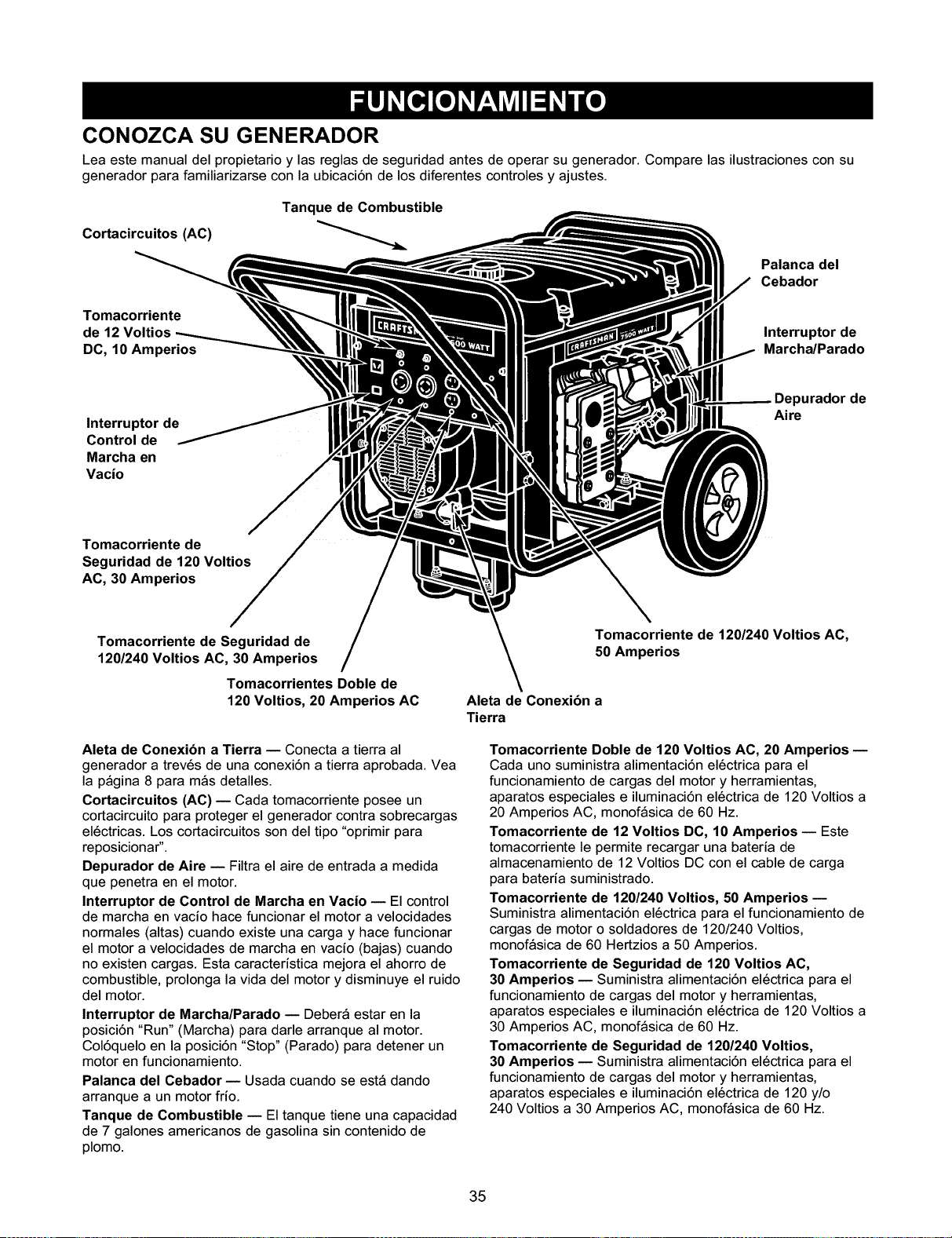
CONOZCA SU GENERADOR
Lea este manual del propietario y las reglas de seguridad antes de operar su generador. Compare las ilustraciones con su
generador para familiarizarse con la ubicaci6n de los diferentes controles y ajustes.
Tanque de Combustible
Cortacircuitos (AC)
Palanca del
Cebador
Tomacorriente
de 12 Voltios
DC, 10 Amperios
Interruptor de
Control de
Marcha en
Vacio
Tomacorriente de
Seguridad de 120 Voltios
AC, 30 Amperios
Interruptor de
Marcha/Parado
Depurador de
Aire
Tomacorriente de Seguridad de
1201240 Voltios AC, 30 Amperios
Tomacorrientes Doble de
120 Voltios, 20 Amperios AC
Aleta de Conexibn a Tierra -- Conecta a tierra al
generador a trev6s de una conexi6n a tierra aprobada. Vea
la p&gina 8 para m&s detalles.
Cortacircuitos (AC) -- Cada tomacorriente posee un
cortacircuito para proteger el generador contra sobrecargas
el6ctricas. Los cortacircuitos son del tipo "oprimir para
reposicionar".
Depurador de Aire -- Filtra el aire de entrada a medida
que penetra en el motor.
Interruptor de Control de Marcha en Vacio -- El control
de marcha en vacio hace funcionar el motor a velocidades
normales (altas) cuando existe una carga y hace funcionar
el motor a velocidades de marcha en vacio (bajas) cuando
no existen cargas. Esta caracteristica mejora el ahorro de
combustible, prolonga la vida del motor y disminuye el ruido
del motor.
Interruptor de Marcha/Parado _ Deber_ estar en la
posici6n "Run" (Marcha) para darle arranque al motor.
Col6quelo en la posici6n "Stop" (Parado) para detener un
motor en funcionamiento.
Palanca del Cebador- Usada cuando se est& dando
arranque a un motor frio.
Tanque de Combustible -- El tanque tiene una capacidad
de 7 galones americanos de gasolina sin contenido de
plomo.
Tomacorriente de 120/240 Voltios AC,
50 Amperios
Aleta de Conexibn a
Tierra
Tomacorriente Doble de 120 Voltios AC, 20 Amperios
Cada uno suministra alimentaci6n el6ctrica para el
funcionamiento de cargas del motor y herramientas,
aparatos especiales e iluminaci6n el6ctrica de 120 Voltios a
20 Amperios AC, monof&sica de 60 Hz.
Tomacorriente de 12 Voltios DC, 10 Amperios- Este
tomacorriente le permite recargar una bateria de
almacenamiento de 12 Voltios DC con el cable de carga
para bateria suministrado.
Tomacorriente de 120/240 Voltios, 50 Amperios
Suministra alimentaci6n el6ctrica para el funcionamiento de
cargas de motor o soldadores de 120/240 Voltios,
monof_sica de 60 Hertzios a 50 Amperios.
Tomacorriente de Seguridad de 120 Voltios AC,
30 Amperios _ Suministra alimentaci6n el6ctrica para el
funcionamiento de cargas del motor y herramientas,
aparatos especiales e iluminaci6n el6ctrica de 120 Voltios a
30 Amperios AC, monof&sica de 60 Hz.
Tomacorriente de Seguridad de 1201240 Voltios,
30 Amperios _ Suministra alimentaci6n el6ctrica para el
funcionamiento de cargas del motor y herramientas,
aparatos especiales e iluminaci6n el6ctrica de 120 y/o
240 Voltios a 30 Amperios AC, monof&sica de 60 Hz.
35
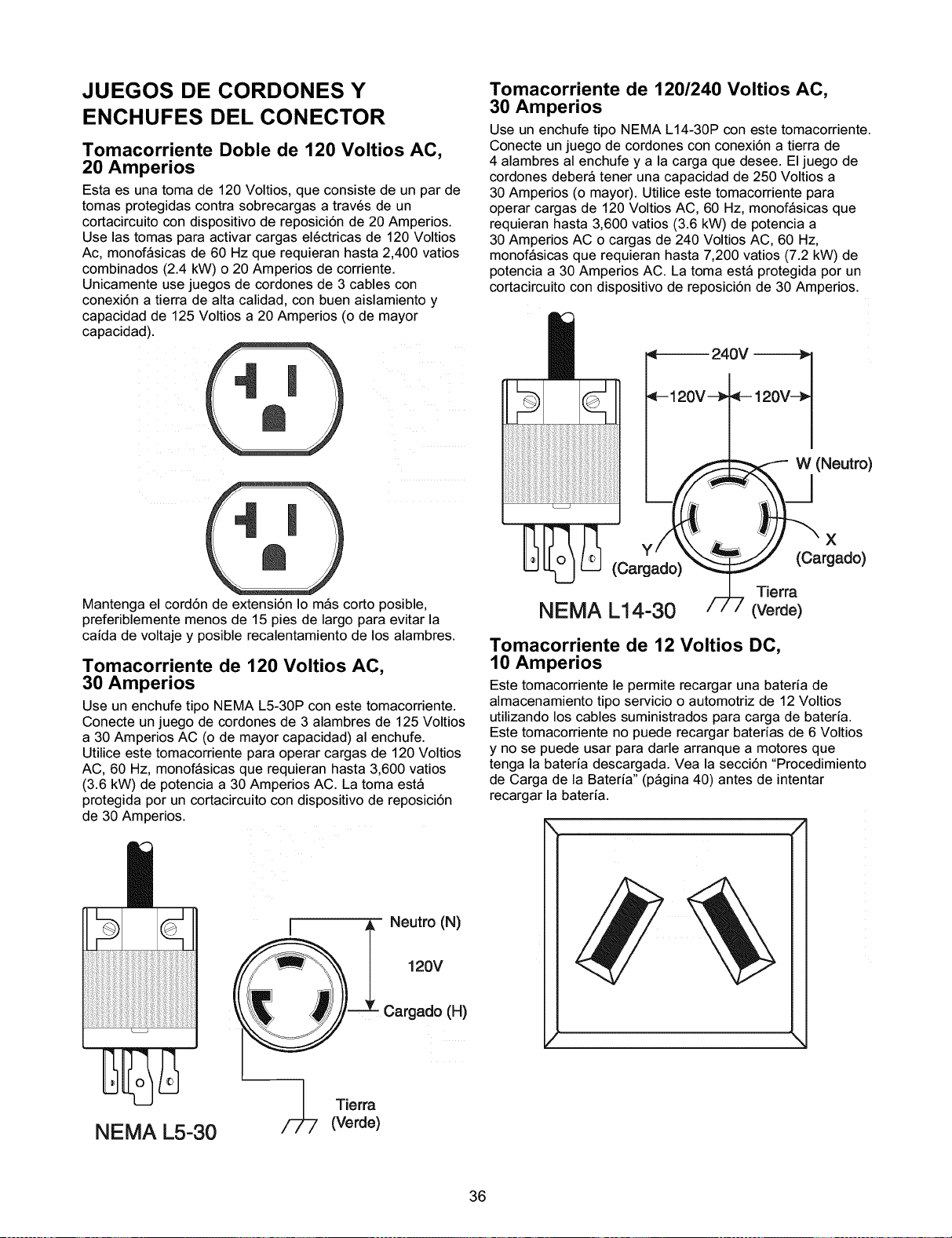
JUEGOS DE CORDONES Y
ENCHUFES DEL CONECTOR
Tomacorriente Doble de 120 Voltios AC,
20 Amperios
Esta es una toma de 120 Voltios, que consiste de un par de
tomas protegidas contra sobrecargas a trav6s de un
cortacircuito con dispositivo de reposici6n de 20 Amperios.
Use las tomas para activar cargas el6ctricas de 120 Voltios
Ac, monof&sicas de 60 Hz que requieran hasta 2,400 vatios
combinados (2.4 kW) o 20 Amperios de corriente.
Unicamente use juegos de cordones de 3 cables con
conexi6n a tierra de alta calidad, con buen aislamiento y
capacidad de 125 Voltios a 20 Amperios (o de mayor
capacidad).
Mantenga el cord6n de extensi6n Io m&s corto posible,
preferiblemente menos de 15 pies de largo para evitar la
caida de voltaje y posible recalentamiento de los alambres.
Tomacorriente de 120 Voltios AC,
30 Amperios
Use un enchufe tipo NEMA LS-30P con este tomacorriente.
Conecte unjuego de cordones de 3 alambres de 125 Voltios
a 30 Amperios AC (o de mayor capacidad) al enchufe.
Utilice este tomacorriente para operar cargas de 120 Voltios
AC, 60 Hz, monof&sicas que requieran hasta 3,600 vatios
(3.6 kW) de potencia a 30 Amperios AC. La toma est&
protegida por un cortacircuito con dispositivo de reposici6n
de 30 Amperios.
Tomacorriente de 120/240 Voltios AC,
30 Amperios
Use un enchufe tipo NEMA L14-30P con este tomacorriente.
Conecte un juego de cordones con conexi6n a tierra de
4 alambres al enchufe y a la carga que desee. Eljuego de
cordones deber& tener una capacidad de 250 Voltios a
30 Amperios (o mayor). Utilice este tomacorriente para
operar cargas de 120 Voltios AC, 60 Hz, monof&sicas que
requieran hasta 3,600 vatios (3.6 kW) de potencia a
30 Amperios AC o cargas de 240 Voltios AC, 60 Hz,
monof&sicas que requieran hasta 7,200 vatios (7.2 kW) de
potencia a 30 Amperios AC. La toma est& protegida por un
cortacircuito con dispositivo de reposici6n de 30 Amperios.
240V
Tomacorriente de 12 Voltios DC,
10 Amperios
Este tomacorriente le permite recargar una bateria de
almacenamiento tipo servicio o automotriz de 12 Voltios
utilizando los cables suministrados para carga de bated&
Este tomacorriente no puede recargar baterias de 6 Voltios
y no se puede usar para darle arranque a motores que
tenga la bateria descargada. Vea la secci6n "Procedimiento
de Carga de la Bateria" (p&gina 40) antes de intentar
recargar la bated&
oC
NEMA L5-30
[ _, Neutro (N)
_._ 120V
/
/_ Tierra
(Verde)
36

Tomacorriente de 120/240 Voltios AC,
50 Amperios
Utilice un enchufe NEMA 14-50P con este tomacorriente.
Conecte un juego de cordones de 4 alambres con
capacidad de 250 Voltios a 50 Amperios al enchufe. Utilice
este tomacorriente para operar cargas el6ctricas de
120/240 Voltios AC, 60 Hz, que requieran hasta 7,500 vatios
(7.5 kW) a 240 Voltios de potencia.
Y
240 Voltios AC .=
Conexiona Tierra
del Armaz6n
120 Voltios
AC -----I
W (Neutro)
AC
X (Vivo)
NEMA 14-50
,_ iPRECAUCION! A pesar de que esta toma tieneuna capacidad de 240 Voltios a 50 Amperios (hasta
12,500 vatios), el generador tan solo tiene una
capacidad de 7,500 vatios. Las cargas de potencia
que excedan la capacidad de vatiaje/amperaje del
generador pueden dafiarlo o causar lesiones
severas.
COMO USAR SU GENERADOR
Si tiene problemas operando su generador, por favor Ilame
a la linea de ayuda para generadores al 1-800-222-3136.
Conexibn a Tierra del Generador
El C6digo EI6ctrico Nacional exige que el bastidor y las
partes externas conductoras de electricidad de este
generador se encuentren conectadas adecuadamente a una
tierra fisica aprobada. Los cSdigos el6ctricos locales
tambi6n podrian exigir la conexi6n a tierra de la unidad.
Para tal propSsito, se ha suministrado una aleta de conexi6n
a tierra en la base del armaz6n.
Aleta de Conexi6n a Tierra
Por Io general, la conexi6n de un alambre de cobre
trenzado No. 12 AWG (American Wire Gauge) a la aleta de
conexi6n a tierra y a una barra de conexi6n a tierra de
cobre o bronce (electrodo) proporciona una protecci6n
adecuada contra las descargas el6ctricas. Sin embargo, los
cSdigos locales pueden variar substancialmente. Consulte
con un electricista local para conocer los requisitos de
conexi6n a tierra de su &rea.
La conexi6n a tierra adecuada del generador ayudar& a
evitar las descargas el6ctricas en el caso de que exista una
condici6n de falla a tierra en el generador o en los
dispositivos el6ctricos conectados. La conexi6n a tierra
adecuada tambi6n ayuda a disipar la electricidad est&tica, la
cual se acumula frecuentemente en dispositivos no
conectados a tierra.
Conexibn de Cargas Eldctricas
NO conecte cargas de 240 Voltios a tomacorrientes de
120 Voltios. NO conecte cargas trif&sicas al generador. NO
conecte cargas de 50 Hz al generador.
• Deje que el motor se estabilice y se caliente por unos
minutos despu6s del arranque.
• Enchufe y encienda las cargas el6ctricas AC de 120 o
240 Voltios, monof&sicas de 60 Hertzios.
Sume los vatios asignados (o amperios) de todas las
cargas que se van a conectar al mismo tiempo. Este total
no debe ser mayor que (a) la capacidad del
vatiaje/amperaje nominal del generador o (b) la capacidad
del cortacircuito del tomacorriente que suministre la
alimentaci6n. Vea "No Sobrecargue el Generador" en la
P&gina 41.
ANTES DE DARLE ARRANQUE AL
GENERADOR
Para operar el motor, deber_ Ilevar colocar gasolina y aceite
de motor en el generador:
Afiada Aceite al Motor
NOTA: Cuando afiada aceite a la caja del cigeefial del
motor en el futuro, enicamente use aceite detergente de alta
calidad con la clasificaci6n de servicio SF o SG de API, con
un peso de 30 SAE. No use aditivos especiales.
Seleccione el grado de viscosidad del aceite de acuerdo con
la temperatura de funcionamiento que espera tener. No use
10W-40.
_F =20 0 20 32 40 60 80 100
>C_ o -4o d 4'o
Temperaturasde Uso Esperadas
• Por encima de 40°F, use SAE 10W-30 o SAE 30.
• Por debajo de 40°F, use sint6tico 5W-20 o 5W-30.
A pesar de que los aceites de meltiple viscosidad (5W30,
10W30, etc.) mejoran el arranque en clima frio, estos
pueden producir un aumento en el consumo de aceite
cuando son usados por encima de 32°F. Revise el nivel de
aceite de su motor m&s frecuentemente para evitar el
posible dafio del motor debido al funcionamiento del mismo
con un bajo nivel de aceite.
37
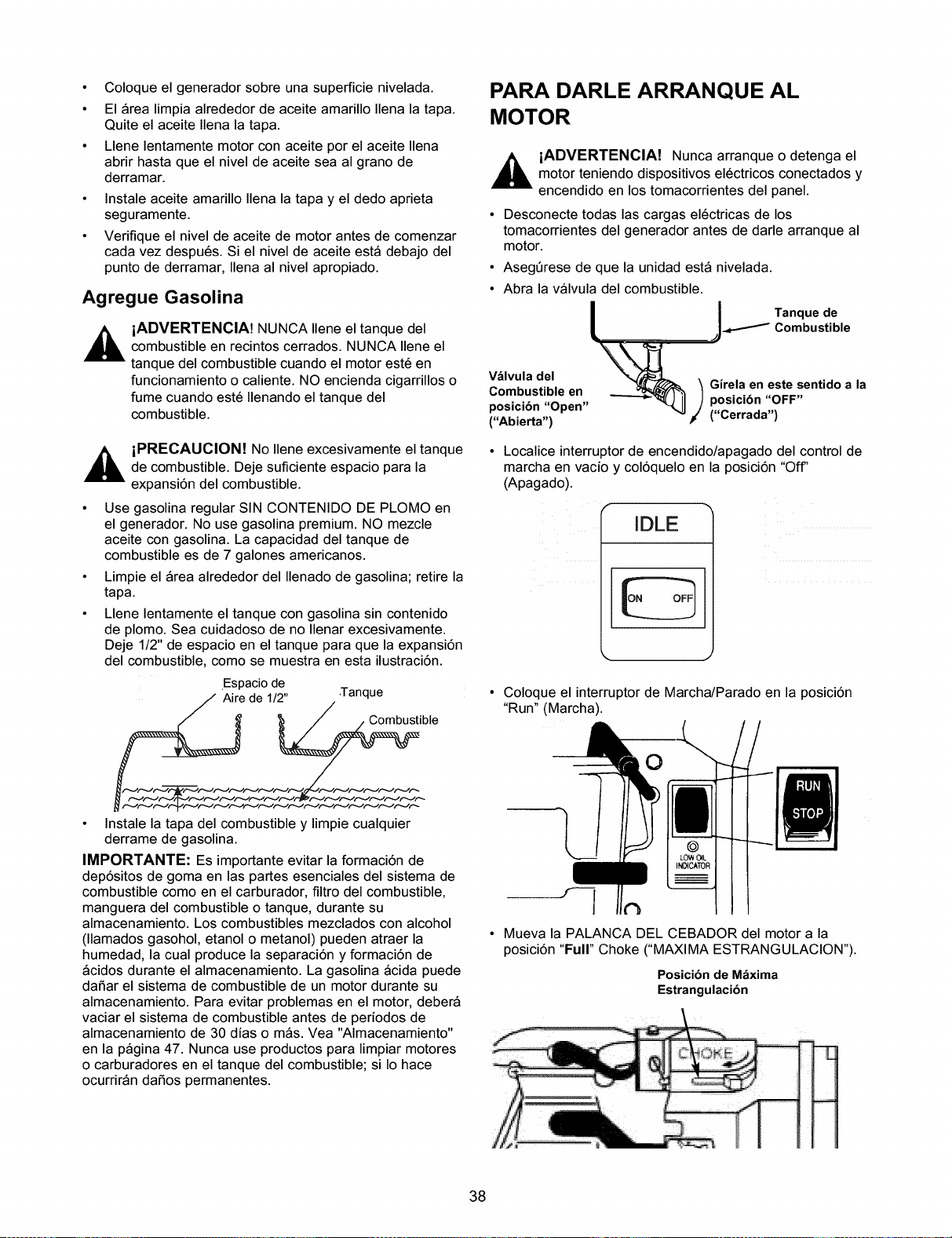
• Coloque el generador sobre una superficie nivelada.
• El &rea limpia alrededor de aceite amarillo Ilena la tapa.
Quite el aceite Ilena la tapa.
• Llene lentamente motor con aceite por el aceite Ilena
abrir hasta que el nivel de aceite sea al grano de
derramar.
• Instale aceite amarillo Ilena la tapa y el dedo aprieta
seguramente.
• Verifique el nivel de aceite de motor antes de comenzar
cada vez despu6s. Si el nivel de aceite est& debajo del
punto de derramar, Ilena al nivel apropiado.
Agregue Gasolina
iADVERTENCIA! NUNCA Ilene el tanque del
combustible en recintos cerrados. NUNCA Ilene el
tanque del combustible cuando el motor est6 en
funcionamiento o caliente. NO encienda cigarrillos o
fume cuando est6 Ilenando el tanque del
combustible.
_ PRECAUCION! No Ilene excesivamente el tanque
de combustible. Deje suficiente espacio para la
expansi6n del combustible.
• Use gasolina regular SIN CONTENIDO DE PLOMO en
el generador. No use gasolina premium. NO mezcle
aceite con gasolina. La capacidad del tanque de
combustible es de 7 galones americanos.
• Limpie el &rea alrededor del Ilenado de gasolina; retire la
tapa.
• Llene lentamente el tanque con gasolina sin contenido
de plomo. Sea cuidadoso de no Ilenar excesivamente.
Deje 1/2" de espacio en el tanque para que la expansi6n
del combustible, como se muestra en esta ilustraci6n.
,Espacio de
Aire de 1/2" ,Tanque
Combustible
• Instale la tapa del combustible y limpie cualquier
derrame de gasolina.
IMPORTANTE: Es importante evitar la formaci6n de
dep6sitos de goma en las partes esenciales del sistema de
combustible como en el carburador, filtro del combustible,
manguera del combustible o tanque, durante su
almacenamiento. Los combustibles mezclados con alcohol
(llamados gasohol, etanol o metanol) pueden atraer la
humedad, la cual produce la separaci6n y formaci6n de
&cidos durante el almacenamiento. La gasolina &cida puede
dafiar el sistema de combustible de un motor durante su
almacenamiento. Para evitar problemas en el motor, deber&
vaciar el sistema de combustible antes de perfodos de
almacenamiento de 30 dias o m&s. Vea "Almacenamiento"
en la p&gina 47. Nunca use productos para limpiar motores
o carburadores en el tanque del combustible; si Io hace
ocurrir&n dafios permanentes.
PARA DARLE ARRANQUE AL
MOTOR
_ iADVERTENClA! Nunca arranque o detenga el
motor teniendo dispositivos el6ctricos conectados y
encendido en los tomacorrientes del panel.
• Desconecte todas las cargas el6ctricas de los
tomacorrientes del generador antes de darle arranque al
motor.
• Aseg6rese de que la unidad est& nivelada.
• Abra la v&lvula del combustible.
t
Vdlvula del \_ j
Combustible en
posicibn "Open"
("Abierta")
jJ Tanque de
Combustible
Girela en este sentido a la
posicibn "OFF"
("Cerrada")
Localice interruptor de encendido/apagado del control de
marcha en vacio y col6quelo en la posiciSn "Off"
(Apagado).
f
IDLE
, ,J
Coloque el interruptor de Marcha/Parado en la posici6n
"Run" (Marcha).
Mueva la PALANCA DEL CEBADOR del motor a la
posici6n "Full" Choke ("MAXIMA ESTRANGULACION").
Posicibn de Mdxima
Estrangulacibn
38
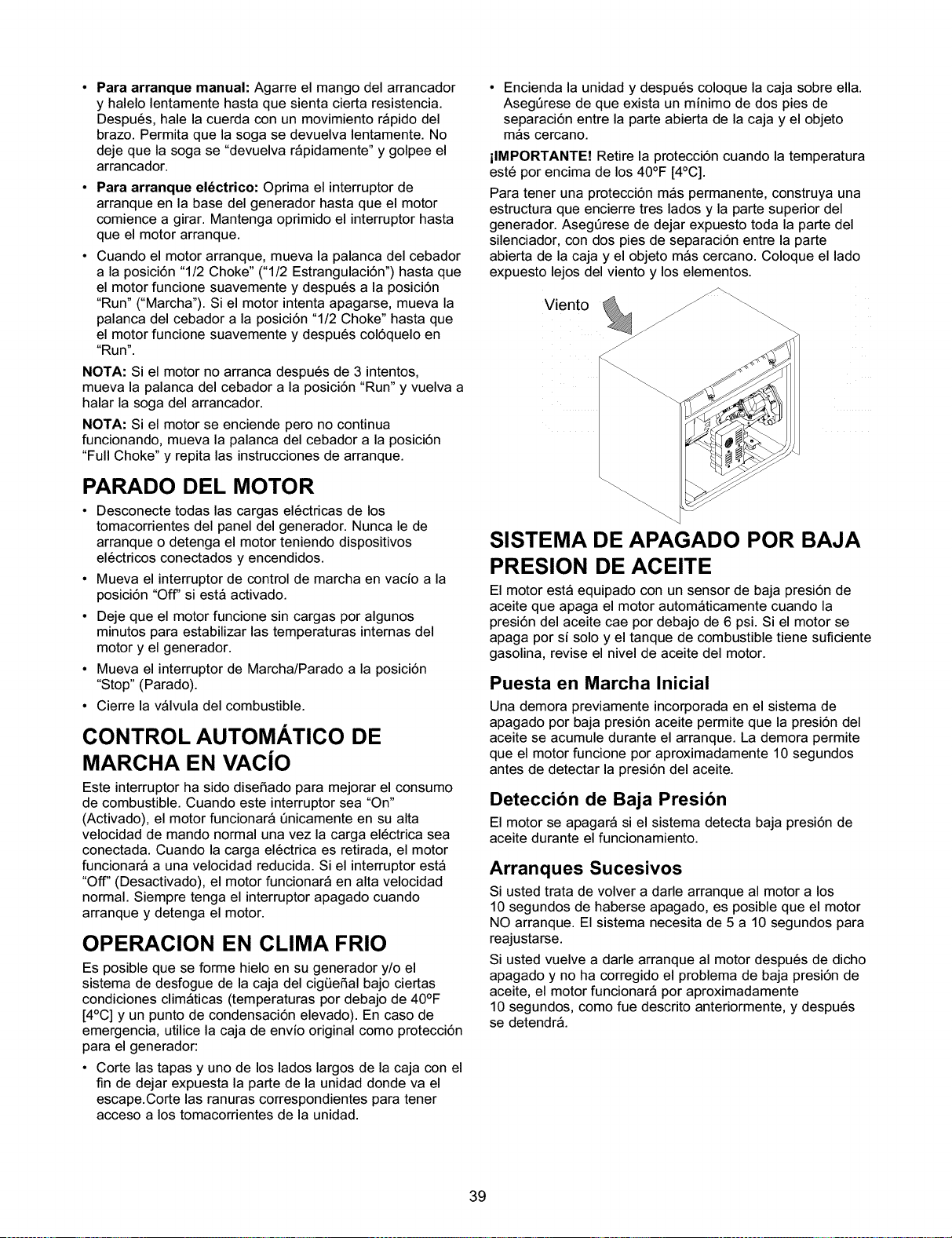
Para arranque manual: Agarre el mango del arrancador
y halelo lentamente hasta que sienta cierta resistencia.
Despu6s, hale la cuerda con un movimiento r&pido del
brazo. Permita que la soga se devuelva lentamente. No
deje que la soga se "devuelva r&pidamente" y golpee el
arrancador.
Para arranque el_ctrico: Oprima el interruptor de
arranque en la base del generador hasta que el motor
comience a girar. Mantenga oprimido el interruptor hasta
que el motor arranque.
Cuando el motor arranque, mueva la palanca del cebador
a la posici6n "1/2 Choke" ("1/2 Estrangulaci6n") hasta que
el motor funcione suavemente y despu6s a la posici6n
"Run" ("Marcha"). Si el motor intenta apagarse, mueva la
palanca del cebador a la posici6n "1/2 Choke" hasta que
el motor funcione suavemente y despu6s col6quelo en
"Run".
NOTA: Si el motor no arranca despu6s de 3 intentos,
mueva la palanca del cebador a la posici6n "Run" y vuelva a
halar la soga del arrancador.
NOTA: Si el motor se enciende pero no continua
funcionando, mueva la palanca del cebador a la posici6n
"Full Choke" y repita las instrucciones de arranque.
PARADO DEL MOTOR
• Desconecte todas las cargas el6ctricas de los
tomacorrientes del panel del generador. Nunca le de
arranque o detenga el motor teniendo dispositivos
el6ctricos conectados y encendidos.
• Mueva el interruptor de control de marcha en vacio a la
posici6n "Off' si est& activado.
• Deje que el motor funcione sin cargas por algunos
minutos para estabilizar las temperaturas internas del
motor y el generador.
• Mueva el interruptor de Marcha/Parado a la posici6n
"Stop" (Parado).
• Cierre la v&lvula del combustible.
CONTROL AUTOMATICO DE
MARCHA EN VACiO
Este interruptor ha sido disefiado para mejorar el consumo
de combustible. Cuando este interruptor sea "On"
(Activado), el motor funcionar& enicamente en su alta
velocidad de mando normal una vez la carga el6ctrica sea
conectada. Cuando la carga el6ctrica es retirada, el motor
funcionar& a una velocidad reducida. Si el interruptor est&
"Off" (Desactivado), el motor funcionar& en alta velocidad
normal. Siempre tenga el interruptor apagado cuando
arranque y detenga el motor.
OPERACION EN CLIMA FRIO
Es posible que se forme hielo en su generador y/o el
sistema de desfogue de la caja del cigLiefial bajo ciertas
condiciones clim&ticas (temperaturas por debajo de 40°F
[4°C] y un punto de condensaci6n elevado). En caso de
emergencia, utilice la caja de envfo original como protecci6n
para el generador:
• Corte las tapas y uno de los lados largos de la caja con el
fin de dejar expuesta la parte de la unidad donde va el
escape.Corte las ranuras correspondientes para tener
acceso a los tomacorrientes de la unidad.
Encienda la unidad y despu6s coloque la caja sobre ella.
Asegerese de que exista un mfnimo de dos pies de
separaci6n entre la parte abierta de la caja y el objeto
m_s cercano.
ilMPORTANTE! Retire la protecci6n cuando la temperatura
est6 por encima de los 40°F [4°C].
Para tener una protecci6n m&s permanente, construya una
estructura que encierre tres lados y la parte superior del
generador. Asegerese de dejar expuesto toda la parte del
silenciador, con dos pies de separaci6n entre la parte
abierta de la caja y el objeto m&s cercano. Coloque el lado
expuesto lejos del viento y los elementos.
Viento % _ .
SISTEMA DE APAGADO POR BAJA
PRESION DE ACEITE
El motor est& equipado con un sensor de baja presi6n de
aceite que apaga el motor autom&ticamente cuando la
presi6n del aceite cae por debajo de 6 psi. Si el motor se
apaga por si solo y el tanque de combustible tiene suficiente
gasolina, revise el nivel de aceite del motor.
Puesta en Marcha Inicial
Una demora previamente incorporada en el sistema de
apagado por baja presi6n aceite permite que la presi6n del
aceite se acumule durante el arranque. La demora permite
que el motor funcione por aproximadamente 10 segundos
antes de detectar la presi6n del aceite.
Deteccibn de Baja Presibn
El motor se apagar_ si el sistema detecta baja presi6n de
aceite durante el funcionamiento.
Arranques Sucesivos
Si usted trata de volver a darle arranque al motor a los
10 segundos de haberse apagado, es posible que el motor
NO arranque. El sistema necesita de 5 a 10 segundos para
reajustarse.
Si usted vuelve a darle arranque al motor despu6s de dicho
apagado y no ha corregido el problema de baja presi6n de
aceite, el motor funcionar& por aproximadamente
10 segundos, como fue descrito anteriormente, y despu6s
se detendr&.
39
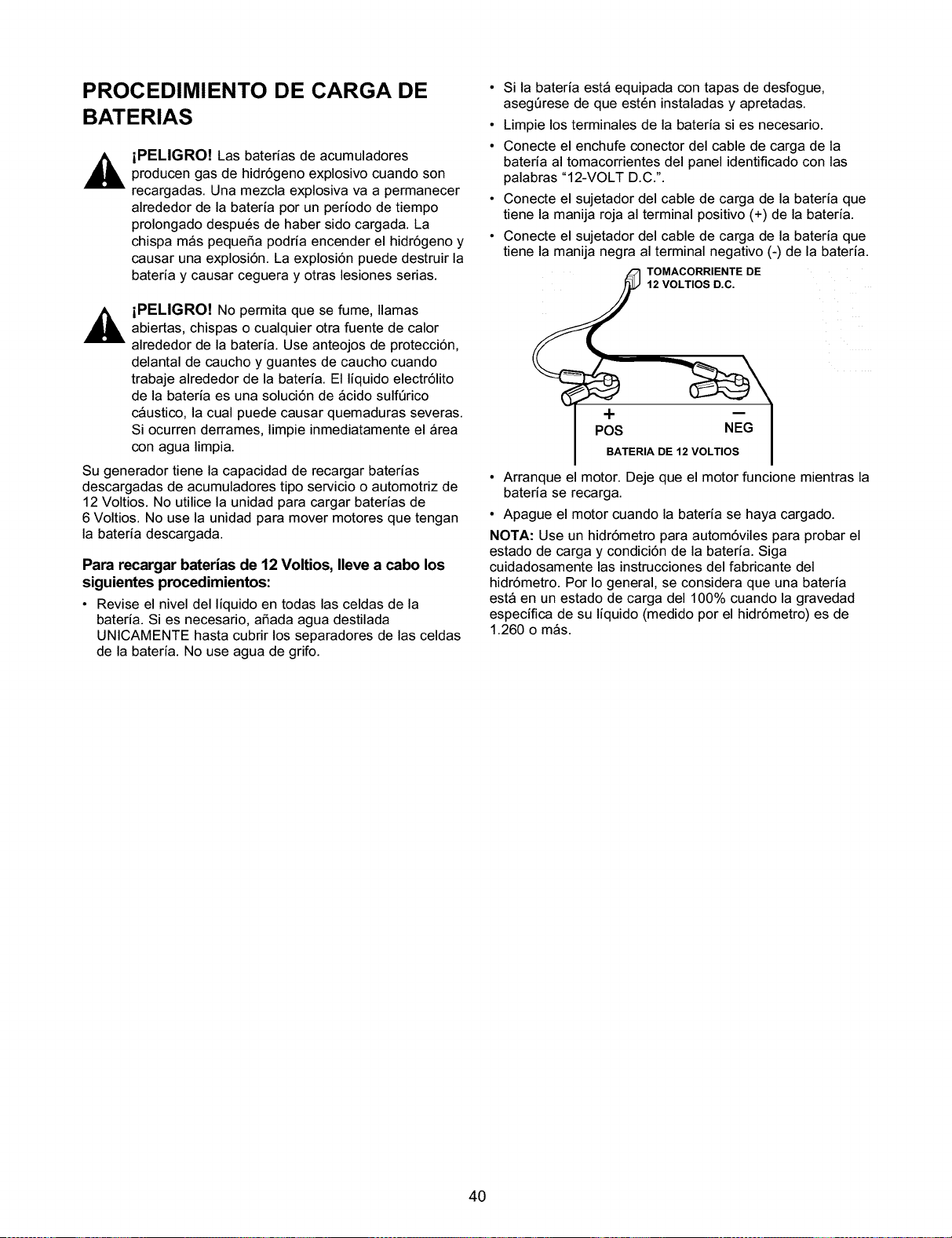
PROCEDIMIENTO DE CARGA DE
BATERIAS
iPELIGRO! Las baterfas de acumuladores
producen gas de hidr6geno explosivo cuando son
recargadas. Una mezcla explosiva va a permanecer
alrededor de la bateria por un periodo de tiempo
prolongado despu6s de haber sido cargada. La
chispa m&s pequefia podria encender el hidr6geno y
causar una explosi6n. La explosi6n puede destruir la
bateria y causar ceguera y otras lesiones serias.
,_ iPELIGRO! No permita que se fume, llamasabiertas, chispas o cualquier otra fuente de calor
alrededor de la baterfa. Use anteojos de protecci6n,
delantal de caucho y guantes de caucho cuando
trabaje alrededor de la bateria. El liquido electr61ito
de la bateria es una soluci6n de &cido sulfQrico
c&ustico, la cual puede causar quemaduras severas.
Si ocurren derrames, limpie inmediatamente el &rea
con agua limpia.
Su generador tiene la capacidad de recargar baterias
descargadas de acumuladores tipo servicio o automotriz de
12 Voltios. No utilice la unidad para cargar baterias de
6 Voltios. No use la unidad para mover motores que tengan
la bateria descargada.
Para recargar baterias de 12 Voltios, Ileve a cabo los
siguientes procedimientos:
• Revise el nivel del Ifquido en todas las celdas de la
baterfa. Si es necesario, afiada agua destilada
UNICAMENTE hasta cubrir los separadores de las celdas
de la baterfa. No use agua de grifo.
• Si la bateria est& equipada con tapas de desfogue,
asegQrese de que est6n instaladas y apretadas.
• Limpie los terminales de la baterfa si es necesario.
• Conecte el enchufe conector del cable de carga de la
baterfa al tomacorrientes del panel identificado con las
palabras "12-VOLT D.C.".
• Conecte el sujetador del cable de carga de la baterfa que
tiene la manija roja al terminal positivo (+) de la baterfa.
• Conecte el sujetador del cable de carga de la baterfa que
tiene la manija negra al terminal negativo (-) de la baterfa.
+
POS
TOMACORRIENTE DE
12 VOLTIOS D.C.
-I
NEG
BATERIA DE 12 VOLTIOS
• Arranque el motor. Deje que el motor funcione mientras la
baterfa se recarga.
• Apague el motor cuando la baterfa se haya cargado.
NOTA: Use un hidr6metro para autom6viles para probar el
estado de carga y condici6n de la baterfa. Siga
cuidadosamente las instrucciones del fabricante del
hidr6metro. Por Io general, se considera que una baterfa
est& en un estado de carga del 100% cuando la gravedad
especifica de su Ifquido (medido por el hidr6metro) es de
1.260 o m&s.
40
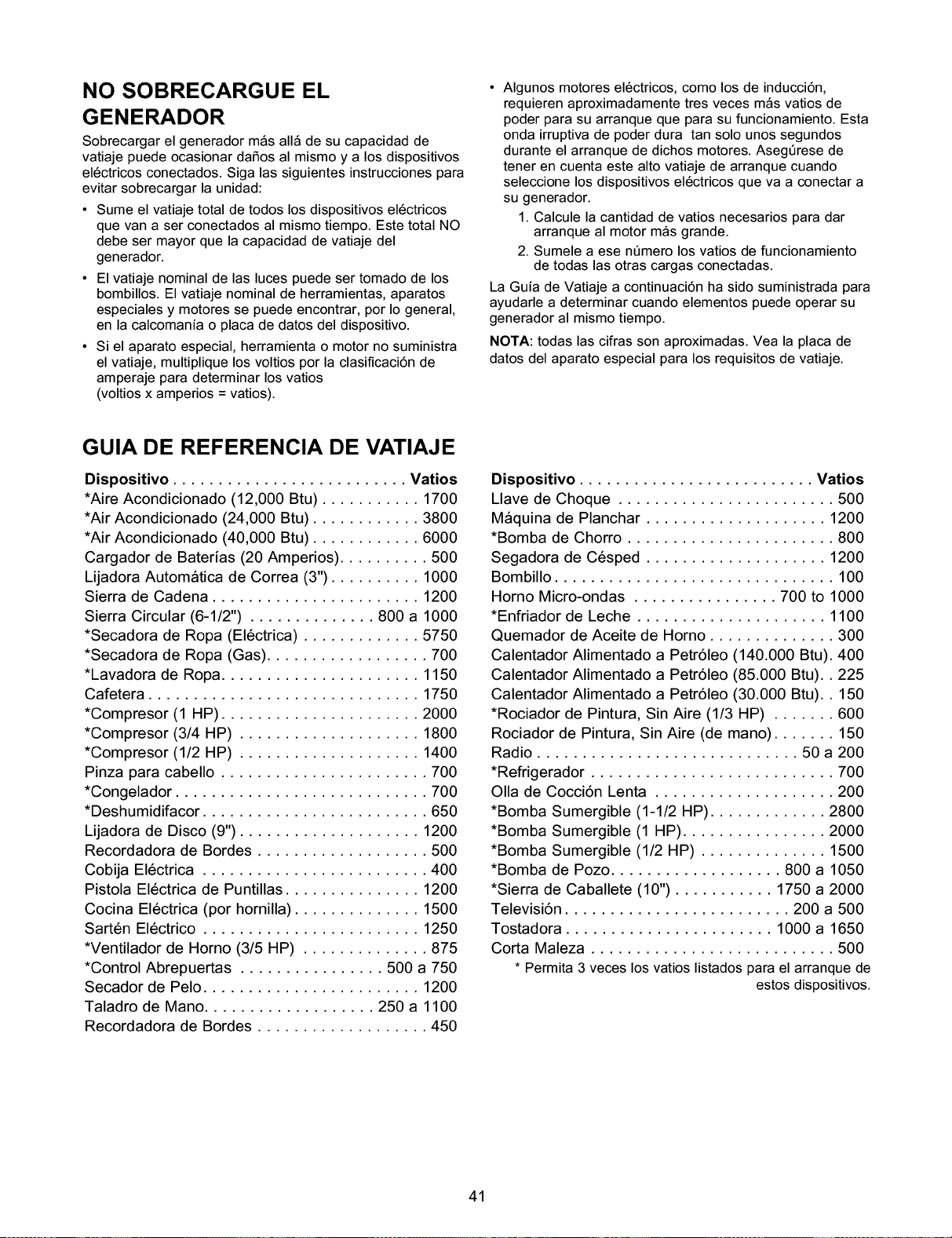
NO SOBRECARGUE EL
GENERADOR
Sobrecargar el generador m&s all& de su capacidad de
vatiaje puede ocasionar daSos al mismo y a los dispositivos
el6ctricos conectados. Siga las siguientes instrucciones para
evitar sobrecargar la unidad:
• Sume el vatiaje total de todos los dispositivos el6ctricos
que van a ser conectados al mismo tiempo. Este total NO
debe ser mayor que la capacidad de vatiaje del
generador.
• El vatiaje nominal de las luces puede ser tomado de los
bombillos. El vatiaje nominal de herramientas, aparatos
especiales y motores se puede encontrar, por Io general,
en la calcomania o placa de datos del dispositivo.
• Si el aparato especial, herramienta o motor no suministra
el vatiaje, multiplique los voltios por la clasificaci6n de
amperaje para determinar los vatios
(voltios x amperios = vatios).
• Algunos motores el6ctricos, como los de inducci6n,
requieren aproximadamente tres veces m&s vatios de
poder para su arranque que para su funcionamiento. Esta
onda irruptiva de poder dura tan solo unos segundos
durante el arranque de dichos motores. AsegQrese de
tener en cuenta este alto vatiaje de arranque cuando
seleccione los dispositivos el6ctricos que va a conectar a
su generador.
1. Calcule la cantidad de vatios necesarios para dar
arranque al motor m&s grande.
2. Sumele a ese nQmero los vatios de funcionamiento
de todas las otras cargas conectadas.
La Guia de Vatiaje a continuaci6n ha sido suministrada para
ayudarle a determinar cuando elementos puede operar su
generador al mismo tiempo.
NOTA: todas las cifras son aproximadas. Vea la placa de
datos del aparato especial para los requisitos de vatiaje.
GUIA DE REFERENCIA DE VATIAJE
Dispositivo .......................... Vatios
*Aire Acondicionado (12,000 Btu) ........... 1700
*Air Acondicionado (24,000 Btu) ............ 3800
*Air Acondicionado (40,000 Btu) ............ 6000
Cargador de Baterias (20 Amperios) .......... 500
Lijadora Autom&tica de Correa (3") .......... 1000
Sierra de Cadena ....................... 1200
Sierra Circular (6-1/2") .............. 800 a 1000
*Secadora de Ropa (El_ctrica) ............. 5750
*Secadora de Ropa (Gas) .................. 700
*Lavadora de Ropa...................... 1150
Cafetera .............................. 1750
*Compresor (1 HP) ...................... 2000
*Compresor (3/4 HP) .................... 1800
*Compresor (1/2 HP) .................... 1400
Pinza para cabello ....................... 700
*Congelador ............................ 700
*Deshumidifacor ......................... 650
Lijadora de Disco (9") .................... 1200
Recordadora de Bordes ................... 500
Cobija El_ctrica ......................... 400
Pistola El_ctrica de Puntillas............... 1200
Cocina EI6ctrica (por hornilla) .............. 1500
Sart6n El_ctrico ........................ 1250
*Ventilador de Homo (3/5 HP) .............. 875
*Control Abrepuertas ................ 500 a 750
Secador de Pelo ........................ 1200
Taladro de Mano................... 250 a 1100
Recordadora de Bordes ................... 450
Dispositivo .......................... Vatios
Llave de Choque ........................ 500
M&quina de Planchar .................... 1200
*Bomba de Chorro ....................... 800
Segadora de C_sped .................... 1200
Bombillo ............................... 100
Homo Micro-ondas ................ 700 to 1000
*Enfriador de Leche ..................... 1100
Quernador de Aceite de Horno .............. 300
Calentador Alimentado a Petr61eo (140.000 Btu). 400
Calentador Alimentado a Petr61eo (85.000 Btu).. 225
Calentador Alimentado a Petr61eo (30.000 Btu).. 150
*Rociador de Pintura, Sin Aire (1/3 HP) ....... 600
Rociador de Pintura, Sin Aire (de mano) ....... 150
Radio ............................. 50 a 200
*Refrigerador ........................... 700
Olla de Cocci6n Lenta .................... 200
*Bomba Sumergible (1-1/2 HP) ............. 2800
*Bomba Sumergible (1 HP) ................ 2000
*Bomba Sumergible (1/2 HP) .............. 1500
*Bomba de Pozo ................... 800 a 1050
*Sierra de Caballete (10") ........... 1750 a 2000
Televisi6n ......................... 200 a 500
Tostadora ....................... 1000 a 1650
Corta Maleza ........................... 500
* Permita3 veceslosvatioslistadospara el arranquede
estosdispositivos.
41

42
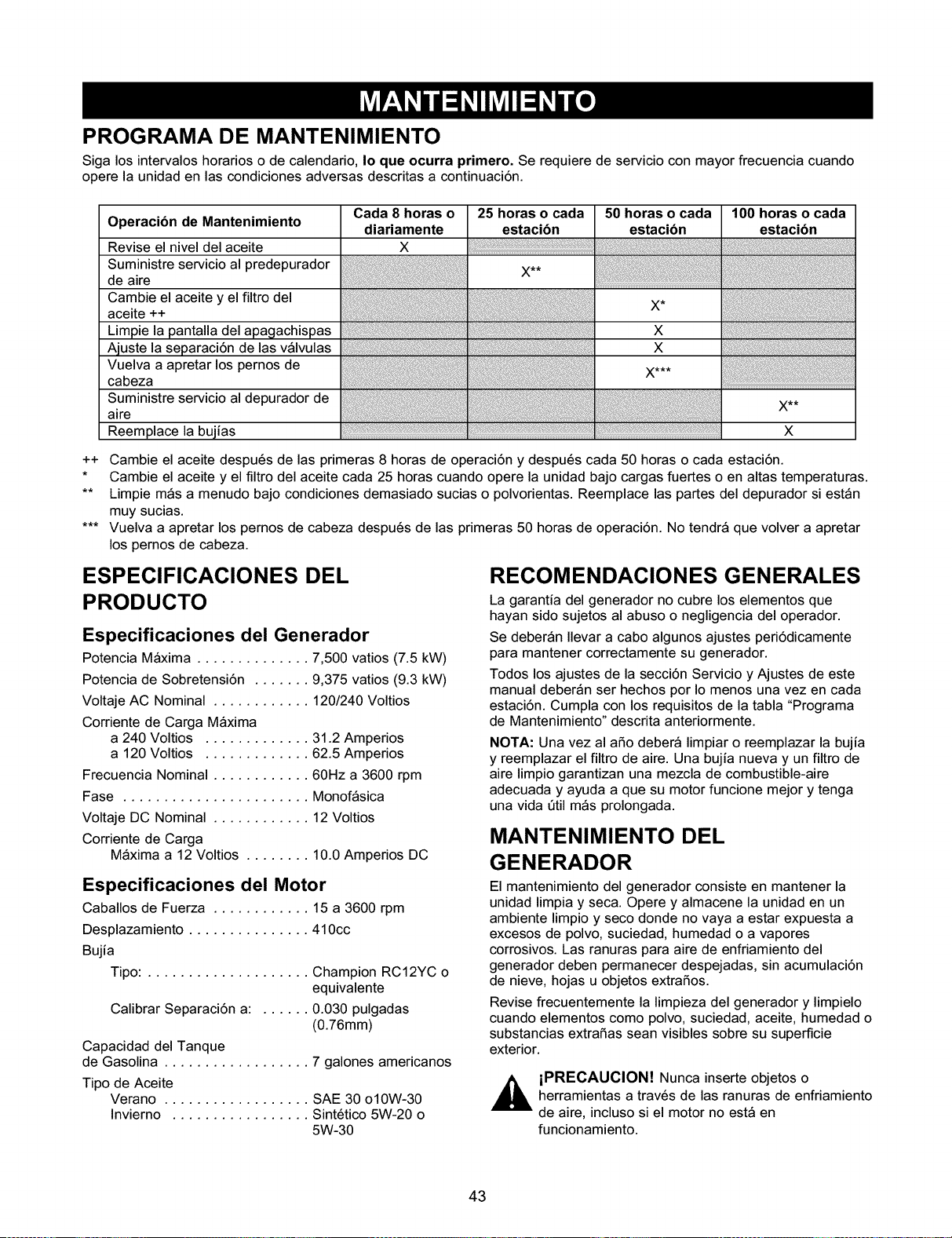
PROGRAMA DE MANTENIMIENTO
Siga los intervalos horarios o de calendario, Io que ocurra primero. Se requiere de servicio con mayor frecuencia cuando
opere la unidad en las condiciones adversas descritas a continuaci6n.
Operacibn de Mantenimiento
Revise el nivel del aceite
Suministre servicio al predepurador
de aire
Cambie el aceite y el filtro del
aceite ++
Limpie la pantalla del apagachispas
Ajuste la separaci6n de las v&lvulas
Vuelva a apretar los pernos de
cabeza
Suministre servicio al depurador de
aire
Reemplace la bujfas
Cada 8 horas o 25 horas o cada 50 horas o cada
diariamente estacibn estacibn
x ....
!ii!!iT:;ii!iilli_7!ii!i7!i_i!i!i!17!i7_i!izzili!7;;ii71{!_71!i7!i!;171!1711!!i'iiii!!_i7;ii!!;ii!:i7!i!;171!1711!!i,iiii!!_i7;ii!!;ii!:i7!i!;171!1711!!i,iiii!!_i7;ii!!;ii!:i7!i!;iii
X _
i!ii!!i:7711i17!!_717!_iii_i¸_i!7i7_i!7_;J{_i!]!_7_!i7!!_!i_i!ii_;7i!!;_!:i;7_!ii_;!!_!i_i!ii_;7i!!;_!:i;7_!ii_;!!_!i_i!ii_;7i!!;_!:i;7_!!_¸ii
X*
X
X
X _
100 horas o cada
estacibn
X**
X
++ Cambie el aceite despu_s de las primeras 8 horas de operaci6n y despu_s cada 50 horas o cada estaci6n.
* Cambie el aceite y el filtro del aceite cada 25 horas cuando opere la unidad bajo cargas fuertes o en altas temperaturas.
** Limpie m&s a menudo bajo condiciones demasiado sucias o polvorientas. Reemplace las partes del depurador si est&n
muy sucias.
*** Vuelva a apretar los pernos de cabeza despu_s de las primeras 50 horas de operaci6n. No tendr& que volver a apretar
los pernos de cabeza.
ESPECIFICACIONES DEL
PRODUCTO
Especificaciones del Generador
Potencia M_xima .............. 7,500 vatios (7.5 kW)
Potencia de Sobretensi6n ....... 9,375 vatios (9.3 kW)
Voltaje AC Nominal ............ 120/240 Voltios
Corriente de Carga M&xima
a 240 Voltios ............. 31.2 Amperios
a 120 Voltios ............. 62.5 Amperios
Frecuencia Nominal ............ 60Hz a 3600 rpm
Fase ....................... Monof&sica
Voltaje DC Nominal ............ 12 Voltios
Corriente de Carga
M&xima a 12 Voltios ........ 10.0 Amperios DC
Especificaciones del Motor
Caballos de Fuerza ............ 15 a 3600 rpm
Desplazamiento ............... 410cc
Bujfa
Tipo: .................... Champion RC12YC o
equivalente
Calibrar Separaci6n a: ...... 0.030 pulgadas
(0.76mm)
Capacidad del Tanque
de Gasolina .................. 7 galones americanos
Tipo de Aceite
Verano .................. SAE 30 o10W-30
Invierno ................. Sint_tico 5W-20 o
5W-30
RECOMENDACIONES GENERALES
La garantia del generador no cubre los elementos que
hayan sido sujetos al abuso o negligencia del operador.
Se deber&n Ilevar a cabo algunos ajustes peri6dicamente
para mantener correctamente su generador.
Todos los ajustes de la secci6n Servicio y Ajustes de este
manual deber&n ser hechos por Io menos una vez en cada
estaci6n. Cumpla con los requisitos de la tabla "Programa
de Mantenimiento" descrita anteriormente.
NOTA: Una vez al aSo deber& limpiar o reemplazar la bujia
y reemplazar el filtro de aire. Una bujia nueva y un filtro de
aire limpio garantizan una mezcla de combustible-aire
adecuada y ayuda a que su motor funcione mejor y tenga
una vida Qtil m&s prolongada.
MANTENIMIENTO DEL
GENERADOR
El mantenimiento del generador consiste en mantener la
unidad limpia y seca. Opere y almacene la unidad en un
ambiente limpio y seco donde no vaya a estar expuesta a
excesos de polvo, suciedad, humedad o a vapores
corrosivos. Las ranuras para aire de enfriamiento del
generador deben permanecer despejadas, sin acumulaci6n
de nieve, hojas u objetos extraSos.
Revise frecuentemente la limpieza del generador y limpielo
cuando elementos como polvo, suciedad, aceite, humedad o
substancias extraSas sean visibles sobre su superficie
exterior.
_ iPRECAUCION! Nunca inserte objetos o
herramientas a trav_s de las ranuras de enfriamiento
de aire, incluso si el motor no est& en
funcionamiento.
43
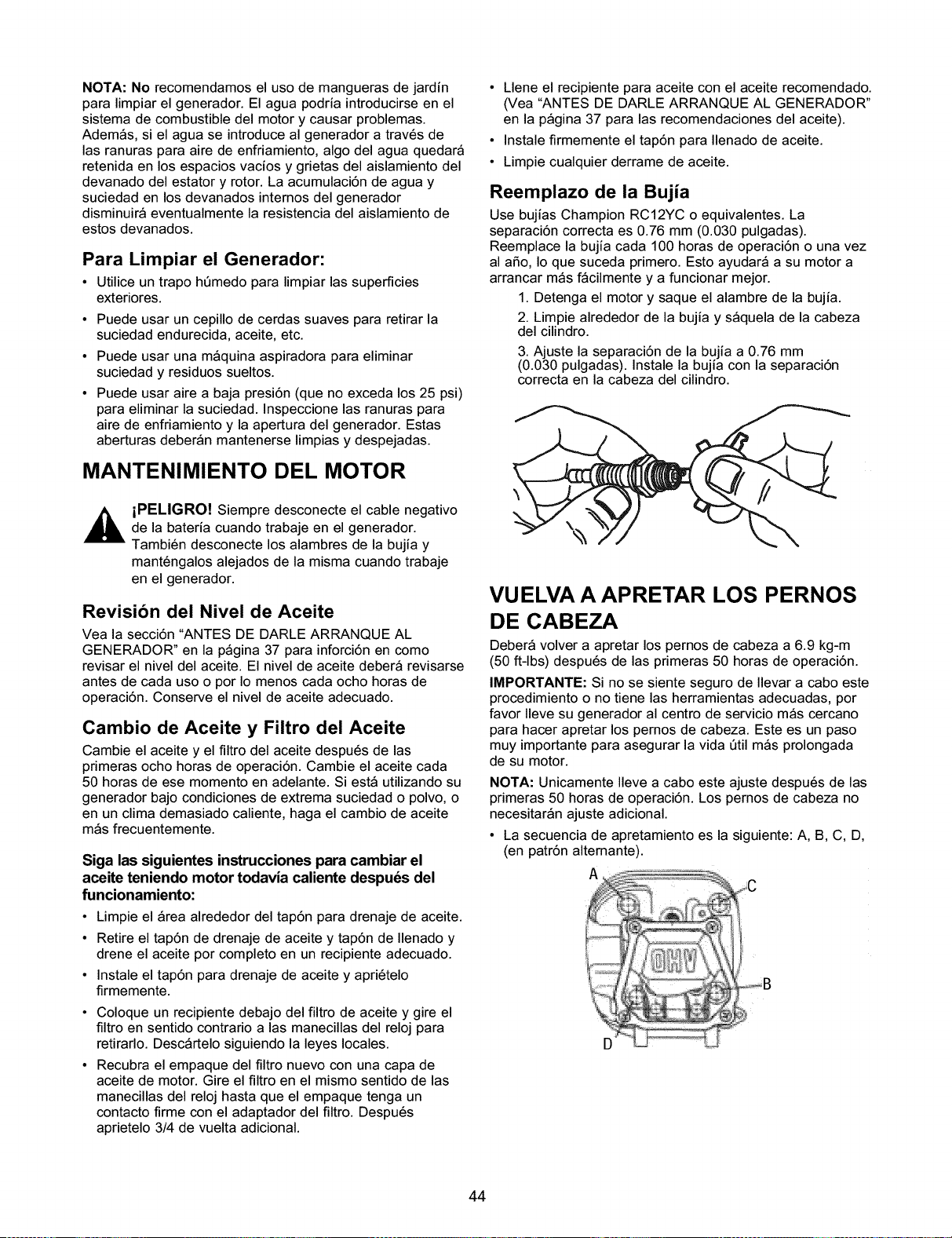
NOTA: No recomendamos el uso de mangueras de jardin
para limpiar el generador. El agua podria introducirse en el
sistema de combustible del motor y causar problemas.
Adem&s, si el agua se introduce al generador a trav6s de
las ranuras para aire de enfriamiento, algo del agua quedar&
retenida en los espacios vacios y grietas del aislamiento del
devanado del estator y rotor. La acumulaci6n de agua y
suciedad en los devanados internos del generador
disminuir& eventualmente la resistencia del aislamiento de
estos devanados.
Para Limpiar el Generador:
• Utilice un trapo h_medo para limpiar las superficies
exteriores.
• Puede usar un cepillo de cerdas suaves para retirar la
suciedad endurecida, aceite, etc.
• Puede usar una m&quina aspiradora para eliminar
suciedad y residuos sueltos.
• Puede usar aire a baja presi6n (que no exceda los 25 psi)
para eliminar la suciedad. Inspeccione las ranuras para
aire de enfriamiento y la apertura del generador. Estas
aberturas deber&n mantenerse limpias y despejadas.
MANTENIMIENTO DEL MOTOR
iPELIGRO! Siempre desconecte el cable negativo
de la baterfa cuando trabaje en el generador.
Tambi6n desconecte los alambres de la bujfa y
mant6ngalos alejados de la misma cuando trabaje
en el generador.
Revisibn del Nivel de Aceite
Vea la secci6n "ANTES DE DARLE ARRANQUE AL
GENERADOR" en la p&gina 37 para inforci6n en como
revisar el nivel del aceite. El nivel de aceite deber& revisarse
antes de cada uso o por Io menos cada ocho horas de
operaci6n. Conserve el nivel de aceite adecuado.
Cambio de Aceite y Filtro del Aceite
Cambie el aceite y el filtro del aceite despu6s de las
primeras ocho horas de operaci6n. Cambie el aceite cada
50 horas de ese momento en adelante. Si est& utilizando su
generador bajo condiciones de extrema suciedad o polvo, o
en un clima demasiado caliente, haga el cambio de aceite
m&s frecuentemente.
Siga las siguientes instrucciones para cambiar el
aceite teniendo motor todavia caliente despu_s del
funcionamiento:
• Limpie el &rea alrededor del tap6n para drenaje de aceite.
• Retire el tap6n de drenaje de aceite y tap6n de Ilenado y
drene el aceite por completo en un recipiente adecuado.
• Instale el tap6n para drenaje de aceite y apri6telo
firmemente.
Coloque un recipiente debajo del filtro de aceite y gire el
filtro en sentido contrario a las manecillas del reloj para
retirarlo. Desc&rtelo siguiendo la leyes locales.
Recubra el empaque del filtro nuevo con una capa de
aceite de motor. Gire el filtro en el mismo sentido de las
manecillas del reloj hasta que el empaque tenga un
contacto firme con el adaptador del filtro. Despu6s
aprietelo 3/4 de vuelta adicional.
• Llene el recipiente para aceite con el aceite recomendado.
(Vea "ANTES DE DARLE ARRANQUE AL GENERADOR"
en la p&gina 37 para las recomendaciones del aceite).
• Instale firmemente el tap6n para Ilenado de aceite.
• Limpie cualquier derrame de aceite.
Reemplazo de la Bujia
Use bujfas Champion RC12YC o equivalentes. La
separaci6n correcta es 0.76 mm (0.030 pulgadas).
Reemplace la bujfa cada 100 horas de operaci6n o una vez
al afio, Io que suceda primero. Esto ayudar& a su motor a
arrancar m&s f&cilmente y a funcionar mejor.
1. Detenga el motor y saque el alambre de la bujia.
2. Limpie alrededor de la bujfa y s&quela de la cabeza
del cilindro.
3. Ajuste la separaci6n de la bujfa a 0.76 mm
(0.030 pulgadas). Instale la bujfa con la separaci6n
correcta en la cabeza del cilindro.
VUELVA A APRETAR LOS PERNOS
DE CABEZA
Deber& volver a apretar los pernos de cabeza a 6.9 kg-m
(50 ft-lbs) despu6s de las primeras 50 horas de operaci6n.
IMPORTANTE: Si no se siente seguro de Ilevar a cabo este
procedimiento o no tiene las herramientas adecuadas, por
favor Ileve su generador al centro de servicio m&s cercano
para hacer apretar los pernos de cabeza. Este es un paso
muy importante para asegurar la vida Qtil m&s prolongada
de su motor.
NOTA: Unicamente Ileve a cabo este ajuste despu6s de las
primeras 50 horas de operaci6n. Los pernos de cabeza no
necesitar&n ajuste adicional.
• La secuencia de apretamiento es la siguiente: A, B, C, D,
(en patr6n alternante).
A
D
_C
_B
44
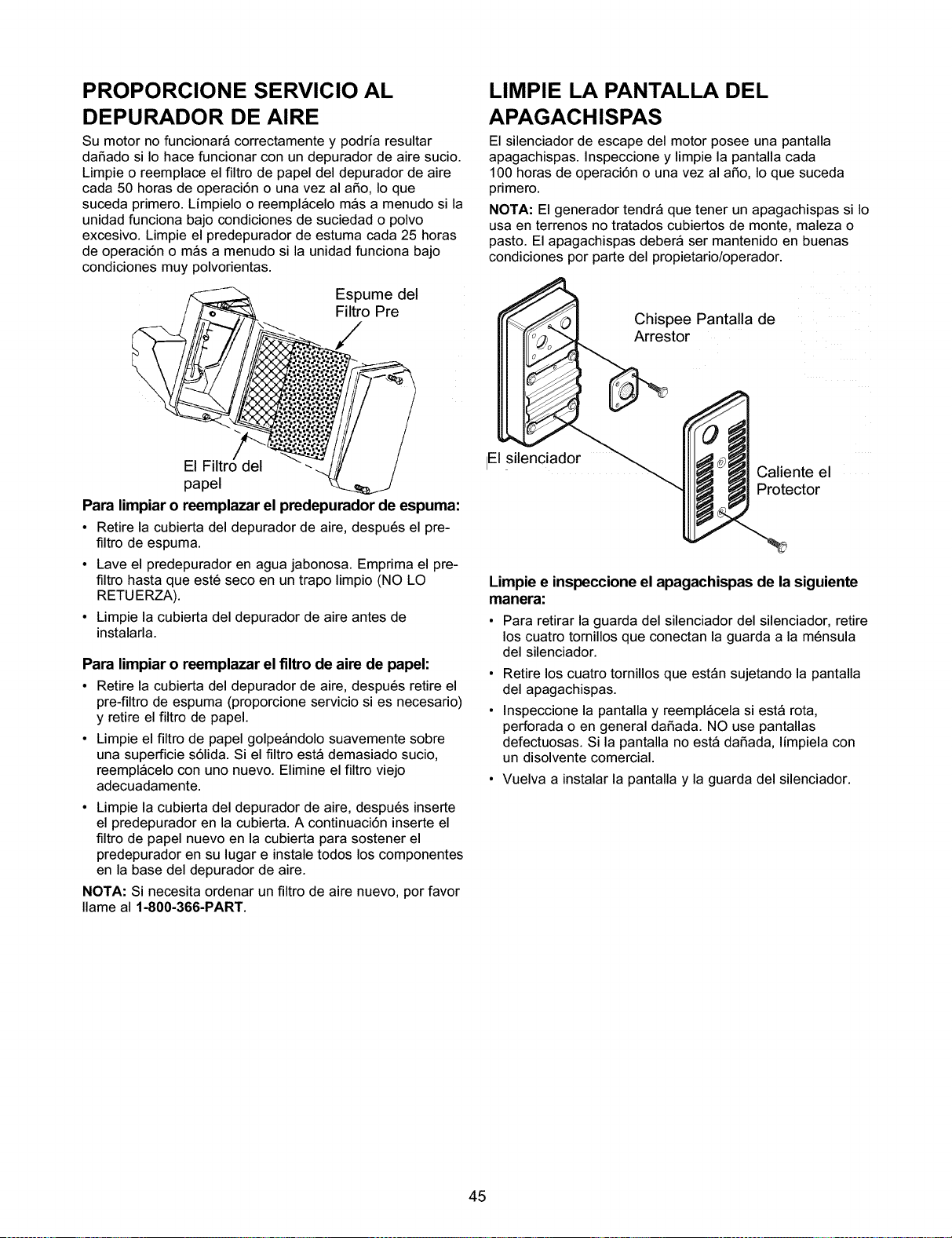
PROPORCIONE SERVICIO AL
DEPURADOR DE AIRE
Su motor no funcionar& correctamente y podria resultar
dafiado si Io hace funcionar con un depurador de aire sucio.
Limpie o reemplace el filtro de papel del depurador de aire
cada 50 horas de operaci6n o una vez al afio, Io que
suceda primero. Limpielo o reempl&celo m&s a menudo si la
unidad funciona bajo condiciones de suciedad o polvo
excesivo. Limpie el predepurador de estuma cada 25 horas
de operaci6n o m&s a menudo si la unidad funciona bajo
condiciones muy polvorientas.
Espume del
Filtro Pre
El Fill
papel
Para limpiar o reemplazar el predepurador de espuma:
• Retire la cubierta del depurador de aire, despu6s el pre-
filtro de espuma.
• Lave el predepurador en agua jabonosa. Emprima el pre-
filtro hasta que est6 seco en un trapo limpio (NO LO
RETUERZA).
• Limpie la cubierta del depurador de aire antes de
instalarla.
Para limpiar o reemplazar el filtro de aire de papel:
• Retire la cubierta del depurador de aire, despu6s retire el
pre-filtro de espuma (proporcione servicio si es necesario)
y retire el filtro de papel.
• Limpie el filtro de papel golpe&ndolo suavemente sobre
una superficie s61ida. Si el filtro est& demasiado sucio,
reempl&celo con uno nuevo. Elimine el filtro viejo
adecuadamente.
• Limpie la cubierta del depurador de aire, despu6s inserte
el predepurador en la cubierta. A continuaci6n inserte el
filtro de papel nuevo en la cubierta para sostener el
predepurador en su lugar e instale todos los componentes
en la base del depurador de aire.
NOTA: Si necesita ordenar un filtro de aire nuevo, por favor
Ilame al 1-800-366-PART.
LIMPIE LA PANTALLA DEL
APAGACHISPAS
El silenciador de escape del motor posee una pantalla
apagachispas. Inspeccione y limpie la pantalla cada
100 horas de operaci6n o una vez al afio, Io que suceda
primero.
NOTA: El generador tendr& que tener un apagachispas si Io
usa en terrenos no tratados cubiertos de monte, maleza o
pasto. El apagachispas deber& ser mantenido en buenas
condiciones por parte del propietario/operador.
Chispee Pantalla de
Arrestor
IEIsilenciador
Caliente el
Protector
Limpie e inspeccione el apagachispas de la siguiente
manera:
• Para retirar la guarda del silenciador del silenciador, retire
los cuatro tornillos que conectan la guarda a la m6nsula
del silenciador.
Retire los cuatro tornillos que est&n sujetando la pantalla
del apagachispas.
Inspeccione la pantalla y reempl&cela si est& rota,
perforada o en general dafiada. NO use pantallas
defectuosas. Si la pantalla no est& dafiada, limpiela con
un disolvente comercial.
• Vuelva a instalar la pantalla y la guarda del silenciador.
45
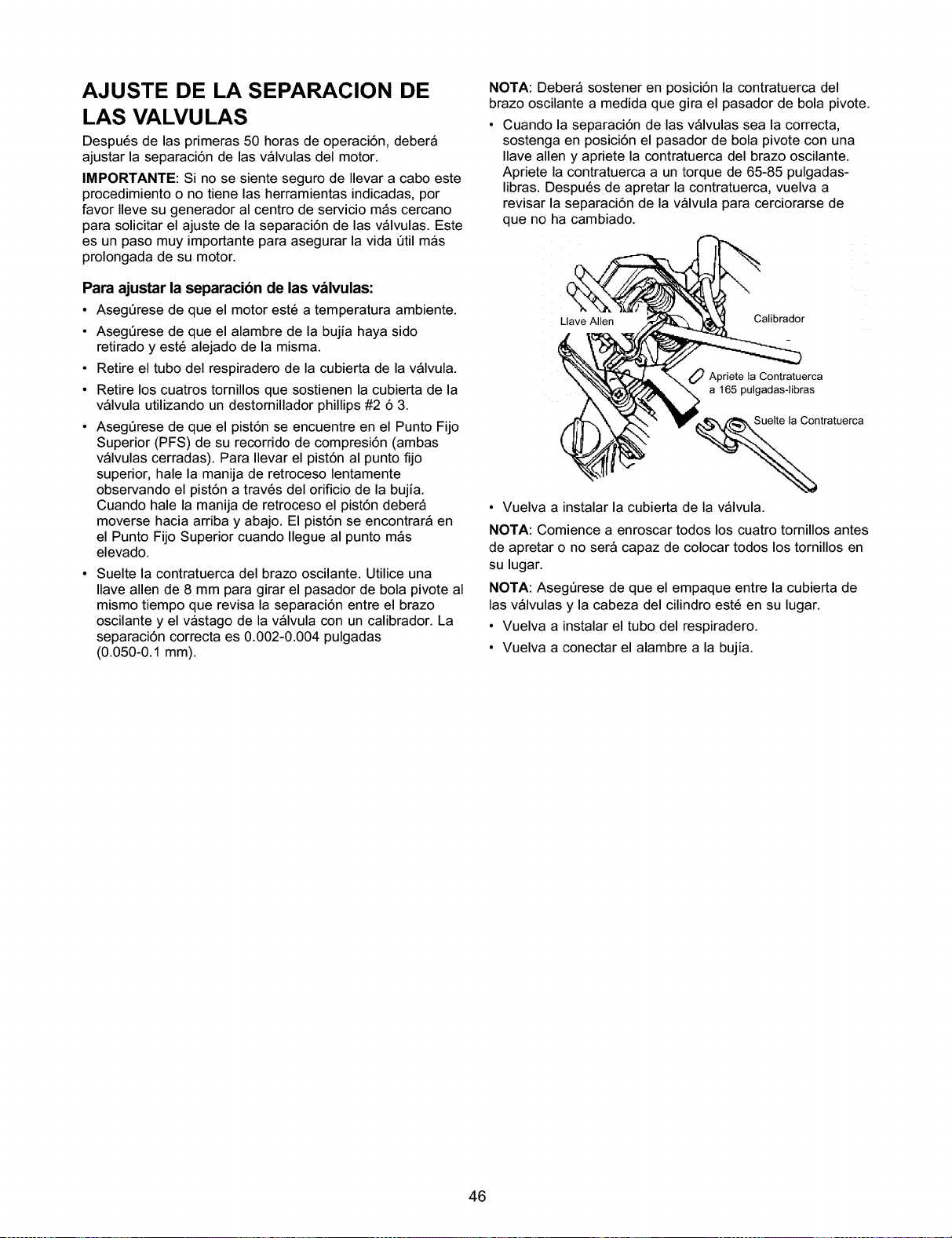
AJUSTE DE LA SEPARACION DE
LAS VALVU LAS
Despu6s de las primeras 50 horas de operaci6n, deber&
ajustar la separaci6n de las v&lvulas del motor.
IMPORTANTE: Si no se siente seguro de Ilevar a cabo este
procedimiento o no tiene las herramientas indicadas, por
favor Ileve su generador al centro de servicio m&s cercano
para solicitar el ajuste de la separaci6n de las v&lvulas. Este
es un paso muy importante para asegurar la vida etil m&s
prolongada de su motor.
Para ajustar la separacibn de las v&lvulas:
• Asegerese de que el motor est6 a temperatura ambiente.
• Asegerese de que el alambre de la bujfa haya sido
retirado y est6 alejado de la misma.
• Retire el tubo del respiradero de la cubierta de la v&lvula.
• Retire los cuatros tornillos que sostienen la cubierta de la
v&lvula utilizando un destornillador phillips #2 6 3.
• Asegerese de que el pist6n se encuentre en el Punto Fijo
Superior (PFS) de su recorrido de compresi6n (ambas
v&lvulas cerradas). Para Ilevar el pist6n al punto fijo
superior, hale la manija de retroceso lentamente
observando el pist6n a trav6s del orificio de la bujfa.
Cuando hale la manija de retroceso el pist6n deber&
moverse hacia arriba y abajo. El pist6n se encontrar& en
el Punto Fijo Superior cuando Ilegue al punto m&s
elevado.
Suelte la contratuerca del brazo oscilante. Utilice una
Ilave allen de 8 mm para girar el pasador de bola pivote al
mismo tiempo que revisa la separaci6n entre el brazo
oscilante y el v&stago de la v&lvula con un calibrador. La
separaci6n correcta es 0.002-0.004 pulgadas
(0.050-0.1 mm).
NOTA: Deber& sostener en posici6n la contratuerca del
brazo oscilante a medida que gira el pasador de bola pivote.
• Cuando la separaci6n de las v&lvulas sea la correcta,
sostenga en posici6n el pasador de bola pivote con una
Ilave allen y apriete la contratuerca del brazo oscilante.
Apriete la contratuerca a un torque de 65-85 pulgadas-
libras. Despu6s de apretar la contratuerca, vuelva a
revisar la separaci6n de la v&lvula para cerciorarse de
que no ha cambiado.
Llave Allen Calibrador
O Apriete la Contratuerca
a 165 pulgadas-libras
Suelte la Contratuerca
• Vuelva a instalar la cubierta de la v&lvula.
NOTA: Comience a enroscar todos los cuatro tornillos antes
de apretar o no ser& capaz de colocar todos los tornillos en
su lugar.
NOTA: AsegQrese de que el empaque entre la cubierta de
las v&lvulas y la cabeza del cilindro est6 en su lugar.
• Vuelva a instalar el tubo del respiradero.
• Vuelva a conectar el alambre a la bujfa.
46
GENERALIDADES
El generador deber& ser encendido al menos una vez
cada siete dias y deber& dejarlo funcionar al menos
durante 30 minutos. Si no puede hacer esto y debe
almacenar la unidad por m&s de 30 dias, siga las siguientes
instrucciones para preparar su unidad para almacenamiento. •
iADVERTENCIA! NUNCA almacene el motor con
combustible en el tanque en recintos cerrados o en
&reas encerradas con poca ventilaci6n donde los
vapores puedan alcanzar llamas abiertas, chispa o
luz de piloto como en un horno, calentador de agua,
secadora de ropa u otro aparato de gas.
ALMACENAMIENTO PARA
PERIODOS PROLONGADOS
Es importante evitar que se formen dep6sitos de goma en
las partes esenciales del sistema de combustible, como el
carburador, manguera o tanque de combustible, durante el
almacenamiento. Tambi6n, la experiencia indica que los
combustibles con mezclas de alcohol (llamados gasohol,
etanol o metanol) pueden atraer humedad, la cual Ileva a la
separaci6n y formaci6n de &cidos durante el
almacenamiento. La gasolina &cida puede dafiar el sistema
de combustible de un motor durante su almacenamiento.
Para evitar problemas con el motor, el sistema de
combustible deber& desocuparse antes de un
almacenamiento de 30 dias o m&s de la siguiente manera:
• Retire toda la gasolina del tanque de combustible.
_ iPELIGRO! Drene el combustible dentro de un
recipiente adecuado, lejos de llamas abiertas y en
lugares al aire libre. Asegerese de que el motor est6
frio. No fume.
Haga funcionar el motor hasta que se detenga por la falta
de combustible.
Con el motor todavia caliente, drene el aceite de la caja
del cigQefial. Vuelva a Ilenarlo con el grado de aceite
recomendado.
Retire la bujfa y rocie aproximadamente 1/2 onza (15 ml)
de aceite para motor dentro del cilindro. Cubra el orificio
de la bujfa con un trapo. Hale de la manija de retroceso
para hacer girar el motor lentamente y distribuir el aceite.
_ PRECAUCION! Evite el rociado del orificio de la
bujfa cuando est6 girando el motor lentamente.
• Instale y apriete la bujia. No conecte el alambre de la
bujia.
• Limpie las superficie externa del generador. Revise que
las ranuras de aire de enfriamiento y aberturas del
generador est6n abiertas y despejadas.
• Almacene la unidad en un lugar seco y limpio.
OTRAS SUGERENCIAS PARA EL
ALMACENAMIENTO:
• No almacene gasolina de una estaci6n a otra.
• Reemplace la caneca de gasolina si comienza a oxidarse.
El 6xido y/o la suciedad en la gasolina le causar&
problemas.
• Si es posible, almacene su unidad en un recinto
encerrado y cebrala para protegerla del polvo y la
suciedad. ASEGURESE DE VACIAR EL TANQUE DEL
COMBUSTIBLE.
• Cubra su unidad con una cubierta de protecci6n
adecuada que no retenga humedad.
_ PELIGRO! NUNCA cubra su Generador cuando elmotor y el &rea del escape est6n calientes.
47

48
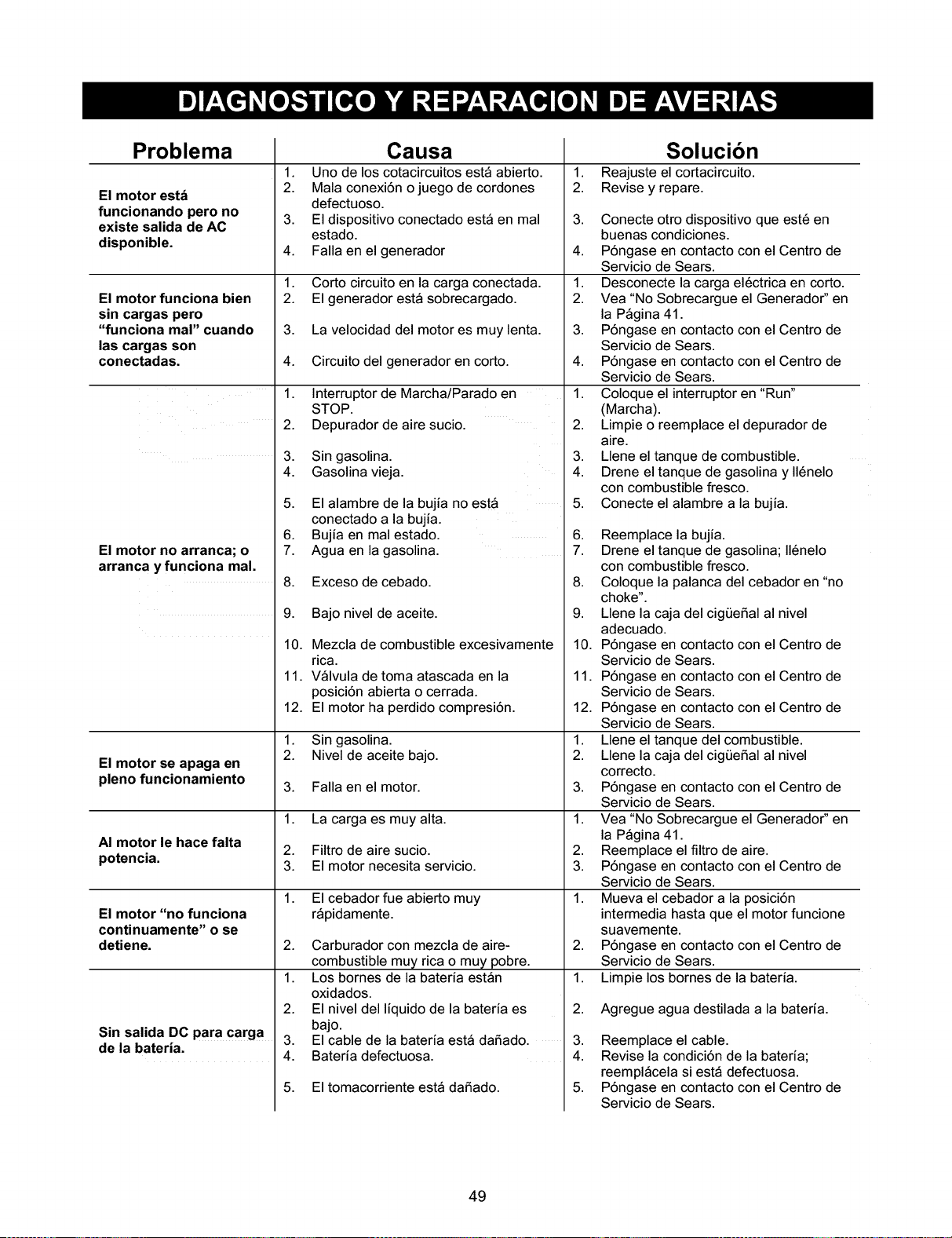
Problema
El motor estd
funcionando pero no
existe salida de AC
disponible.
El motor funciona bien
sin cargas pero
"funciona mal" cuando
las cargas son
conectadas.
1.
2.
3.
4.
1.
2.
3.
4.
1.
2.
Causa
Uno de los cotacircuitos est& abierto.
Mala conexi6n o juego de cordones
defectuoso.
El dispositivo conectado est& en mal
estado.
Falla en el generador
Corto circuito en la carga conectada.
El generador est& sobrecargado.
La velocidad del motor es muy lenta.
Circuito del generador en corto.
Interruptor de Marcha/Parado en
STOP.
Depurador de aire sucio.
Solucibn
1. Reajuste el cortacircuito.
2. Revise y repare.
3. Conecte otro dispositivo que est6 en
buenas condiciones.
4. P6ngase en contacto con el Centro de
Servicio de Sears.
1. Desconecte la carga el6ctrica en corto.
2. Vea "No Sobrecargue el Generador" en
la P&gina 41.
3. P6ngase en contacto con el Centro de
Servicio de Sears.
4. P6ngase en contacto con el Centro de
Servicio de Sears.
1. Coloque el interruptor en"Run"
(Marcha).
2. Limpie o reemplace el depurador de
3. Sin gasolina.
4. Gasolina vieja.
El motor no arranca; o
arranca y funciona mal.
5. El alambre de la bujia no est&
conectado a la bujia.
6. Bujia en mal estado.
7. Agua en la gasolina.
8. Exceso de cebado.
9. Bajo nivel de aceite.
3.
4.
5.
6.
7.
8.
9.
aire.
Llene el tanque de combustible.
Drene el tanque de gasolina y 116nelo
con combustible fresco.
Conecte el alambre a la bujia.
Reemplace la bujia.
Drene el tanque de gasolina; 116nelo
con combustible fresco.
Coloque la palanca del cebador en "no
choke".
Llene la caja del cigQeSal al nivel
adecuado.
El motor se apaga en
pleno funcionamiento
AI motor le hace falta
potencia.
El motor "no funciona
continuamente" o se
detiene.
Sin salida DC para carga
de la bateria.
10.
11.
12.
1.
2.
3.
1.
2.
3.
1.
Mezcla de combustible excesivamente
rica.
V&lvula de toma atascada en la
posici6n abierta o cerrada.
El motor ha perdido compresi6n.
Sin gasolina.
Nivel de aceite bajo.
Falla en el motor.
La carga es muy alta.
Filtro de aire sucio.
El motor necesita servicio.
El cebador fue abierto muy
r&pidamente.
2. Carburador con mezcla de aire-
combustible muy rica o muy pobre.
1. Los bornes de la bateria est&n
oxidados.
2. El nivel del liquido de la bateria es
bajo.
3. El cable de la bateria est& daSado.
4. Bateria defectuosa.
5. El tomacorriente est& daSado.
10. P6ngase en contacto con el Centro de
Servicio de Sears.
11. P6ngase en contacto con el Centro de
Servicio de Sears.
12. P6ngase en contacto con el Centro de
Servicio de Sears.
1. Llene el tanque del combustible.
2. Llene la caja del cigQeSal al nivel
correcto.
3. P6ngase en contacto con el Centro de
Servicio de Sears.
1. Vea "No Sobrecargue el Generador" en
la P&gina 41.
2. Reemplace el filtro de aire.
3. P6ngase en contacto con el Centro de
Servicio de Sears.
1. Mueva el cebador a la posici6n
intermedia hasta que el motor funcione
suavemente.
2. P6ngase en contacto con el Centro de
Servicio de Sears.
1. Limpie los bornes de la bated&
2.
3.
4.
5.
Agregue agua destilada a la bated&
Reemplace el cable.
Revise la condici6n de la bateria;
reempl_cela si est& defectuosa.
P6ngase en contacto con el Centro de
Servicio de Sears.
49

50
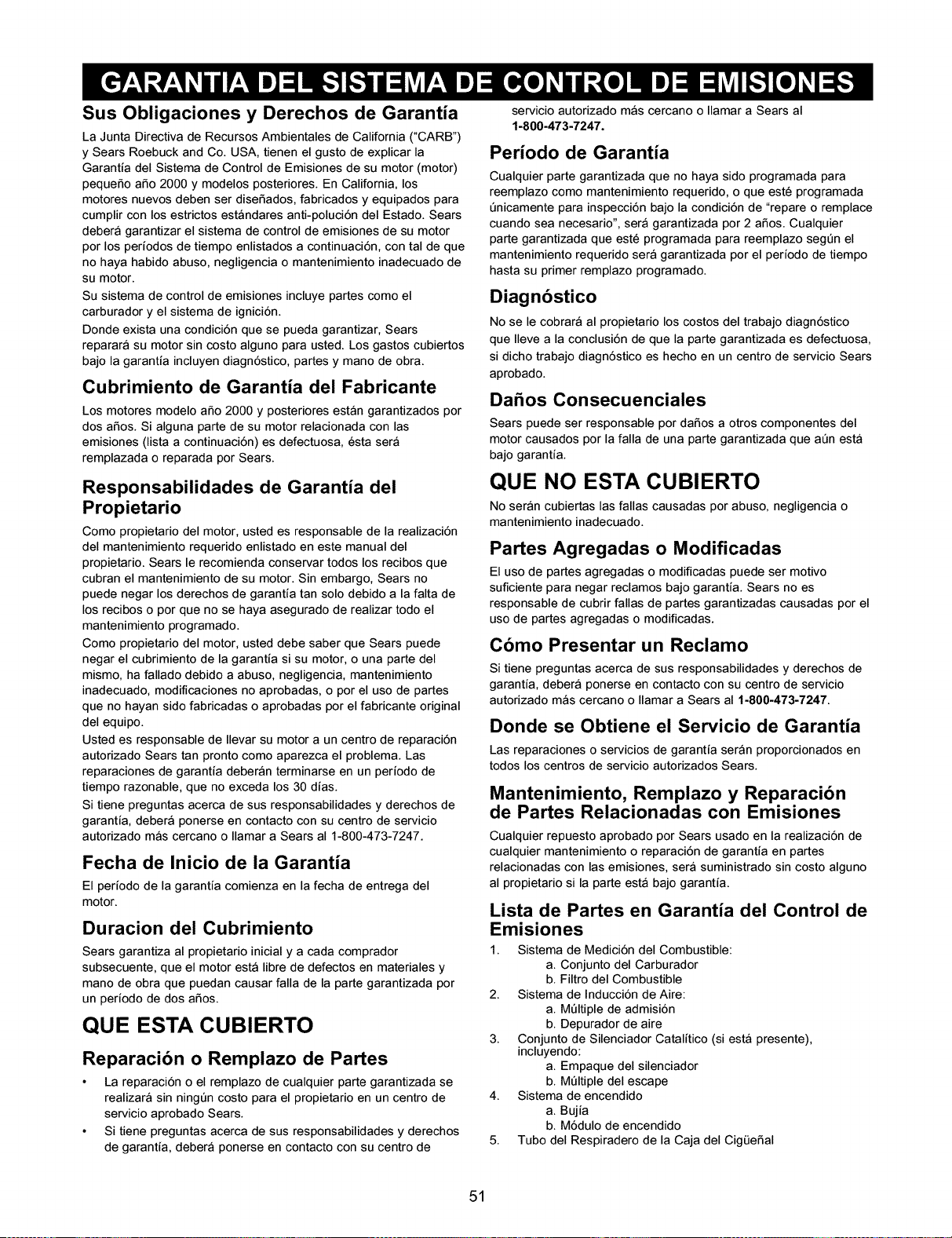
Sus Obligaciones y Derechos de Garantia
La Junta Directiva de Recursos Ambientales de California ("CARB")
y Sears Roebuck and Co. USA, tienen el gusto de explicar la
Garantfa del Sistema de Control de Emisiones de su motor (motor)
pequefio afio 2000 y modelos posteriores. En California, los
motores nuevos deben ser disefiados, fabricados y equipados para
cumplir con los estrictos estandares anti-poluci6n del Estado. Sears
debera garantizar el sistema de control de emisiones de su motor
por los perfodos de tiempo enlistados a continuaci6n, con tal de que
no haya habido abuso, negligencia o mantenimiento inadecuado de
su motor.
Su sistema de control de emisiones incluye partes como el
carburador y el sistema de ignici6n.
Donde exista una condici6n que se pueda garantizar, Sears
reparara su motor sin costo alguno para usted. Los gastos cubiertos
bajo la garantfa incluyen diagn6stico, partes y mano de obra.
Cubrimiento de Garantia del Fabricante
Los motores modelo afio 2000 y posteriores estan garantizados por
dos afios. Si alguna parte de su motor relacionada con las
emisiones (lista a continuaci6n) es defectuosa, 6sta sera
remplazada o reparada por Sears.
Responsabilidades de Garantia del
Propietario
Como propietario del motor, usted es responsable de la realizaci6n
del mantenimiento requerido enlistado en este manual del
propietario. Sears le recomienda conservar todos los recibos que
cubran el mantenimiento de su motor. Sin embargo, Sears no
puede negar los derechos de garantfa tan solo debido a la falta de
los recibos o por que no se haya asegurado de realizar todo el
mantenimiento programado.
Como propietario del motor, usted debe saber que Sears puede
negar el cubrimiento de la garantfa si su motor, o una parte del
mismo, ha fallado debido a abuso, negligencia, mantenimiento
inadecuado, modificaciones no aprobadas, o por el uso de partes
que no hayan sido fabricadas o aprobadas por el fabricante original
del equipo.
Usted es responsable de Ilevar su motor a un centro de reparaci6n
autorizado Sears tan pronto como aparezca el problema. Las
reparaciones de garantfa deberan terminarse en un perfodo de
tiempo razonable, que no exceda los 30 dfas.
Si tiene preguntas acerca de sus responsabilidades y derechos de
garantfa, debera ponerse en contacto con su centro de servicio
autorizado mas cercano o Ilamar a Sears al 1-800-473-7247.
Fecha de Inicio de la Garantia
El perfodo de la garantfa comienza en la fecha de entrega del
motor.
Duracion del Cubrimiento
Sears garantiza al propietario inicial y a cada comprador
subsecuente, que el motor esta fibre de defectos en materiales y
mano de obra que puedan causar falla de la parte garantizada por
un perfodo de dos afios.
QUE ESTA CUBIERTO
Reparacibn o Remplazo de Partes
• La reparaci6n o el remplazo de cualquier parte garantizada se
realizara sin ningSn costo para el propietario en un centro de
servicio aprobado Sears.
• Si tiene preguntas acerca de sus responsabilidades y derechos
de garantfa, debera ponerse en contacto con su centro de
servicio autorizado mas cercano o Ilamar a Sears al
1-800-473-7247.
Periodo de Garantia
Cualquier parte garantizada que no haya sido programada para
reemplazo como mantenimiento requerido, o que est6 programada
Qnicamente para inspecci6n bajo la condici6n de "repare o remplace
cuando sea necesario", sera garantizada por 2 afios. Cualquier
parte garantizada que est6 programada para reemplazo segQn el
mantenimiento requerido sera garantizada por el perfodo de tiempo
hasta su primer remplazo programado.
Diagnbstico
No se le cobrara al propietario los costos del trabajo diagn6stico
que Ileve a la conclusi6n de que la parte garantizada es defectuosa,
si dicho trabajo diagn6stico es hecho en un centro de servicio Sears
aprobado.
DaSos Consecuenciales
Sears puede ser responsable por dafios a otros componentes del
motor causados por la falla de una parte garantizada que aQn esta
bajo garantfa.
QUE NO ESTA CUBIERTO
No seran cubiertas las fallas causadas por abuso, negligencia o
mantenimiento inadecuado.
Partes Agregadas o Modificadas
El uso de partes agregadas o modificadas puede ser motivo
suficiente para negar reclamos bajo garantfa. Sears no es
responsable de cubrir fallas de partes garantizadas causadas por el
uso de partes agregadas o modificadas.
Cbmo Presentar un Reclamo
Si tiene preguntas acerca de sus responsabilidades y derechos de
garantfa, debera ponerse en contacto con su centro de servicio
autorizado mas cercano o Ilamar a Sears al 1-800-473-7247.
Donde se Obtiene el Servicio de Garantia
Las reparaciones o servicios de garantfa seran proporcionados en
todos los centros de servicio autorizados Sears.
Mantenimiento, Remplazo y Reparacibn
de Partes Relacionadas con Emisiones
Cualquier repuesto aprobado por Sears usado en la realizaci6n de
cualquier mantenimiento o reparaci6n de garantfa en partes
relacionadas con las emisiones, sera suministrado sin costo alguno
al propietario si la parte esta bajo garantfa.
Lista de Partes en Garantia del Control de
Emisiones
1. Sistema de Medici6n del Combustible:
a. Conjunto del Carburador
b. Filtro del Combustible
2. Sistema de Inducci6n de Aire:
a. MSItiple de admisi6n
b. Depurador de aire
3. Conjunto de Silenciador Catalitico (si esta presente),
incluyendo:
a. Empaque del silenciador
b. MSItiple del escape
4. Sistema de encendido
a. Bujfa
b. M6dulo de encendido
5. Tubo del Respiradero de la Caja del Cig_efial
51
For in-home major brand repair service:
Call 24 hours a day, 7 days a week
1-800-4-MY-HOME sM(1-800-469-4663)
Para pedir servicio de reparacibn a domicilio - 1-800-676-5811
In Canada for all your service and parts needs call
Au Canada pour tout le service ou les pieces
- 1-800-665-4455
For the repair or replacement parts you need:
Call 7 am - 7 pm, 7 days a week
1-800-366-PART (1-800-366-7278)
Para ordenar piezas con entrega a domicilio - 1-800-659-7084
For the location of a Sears Parts and Repair Center in your area:
. Call 24 hours a day, 7 days a week
1-800-488-1222
For information on purchasing a Sears Maintenance Agreement
or to inquire about an existing Agreement:
Call 9 am - 5 pm, Monday- Saturday
1-800-827-6655
TheServiceSideof Sears"