Part Number 550-142-302/0520
DO NOT USE BOILER DURING CONSTRUCTION unless you provide dust-free air to the boiler area or follow
the requirements given on page 9. Failure to comply could result in severe personal injury, death or substantial property
damage.
This manual must only be used by a qualified heating installer/service technician. Before installing,
read all instructions, including this manual, and any related supplements. Perform steps in the order
given. Failure to comply could result in severe personal injury, death or substantial property damage.
Now With Built In
Low Water Cut Off Functionality
*
Blower cover on sizes CGi 25-6 only
*
Series 4
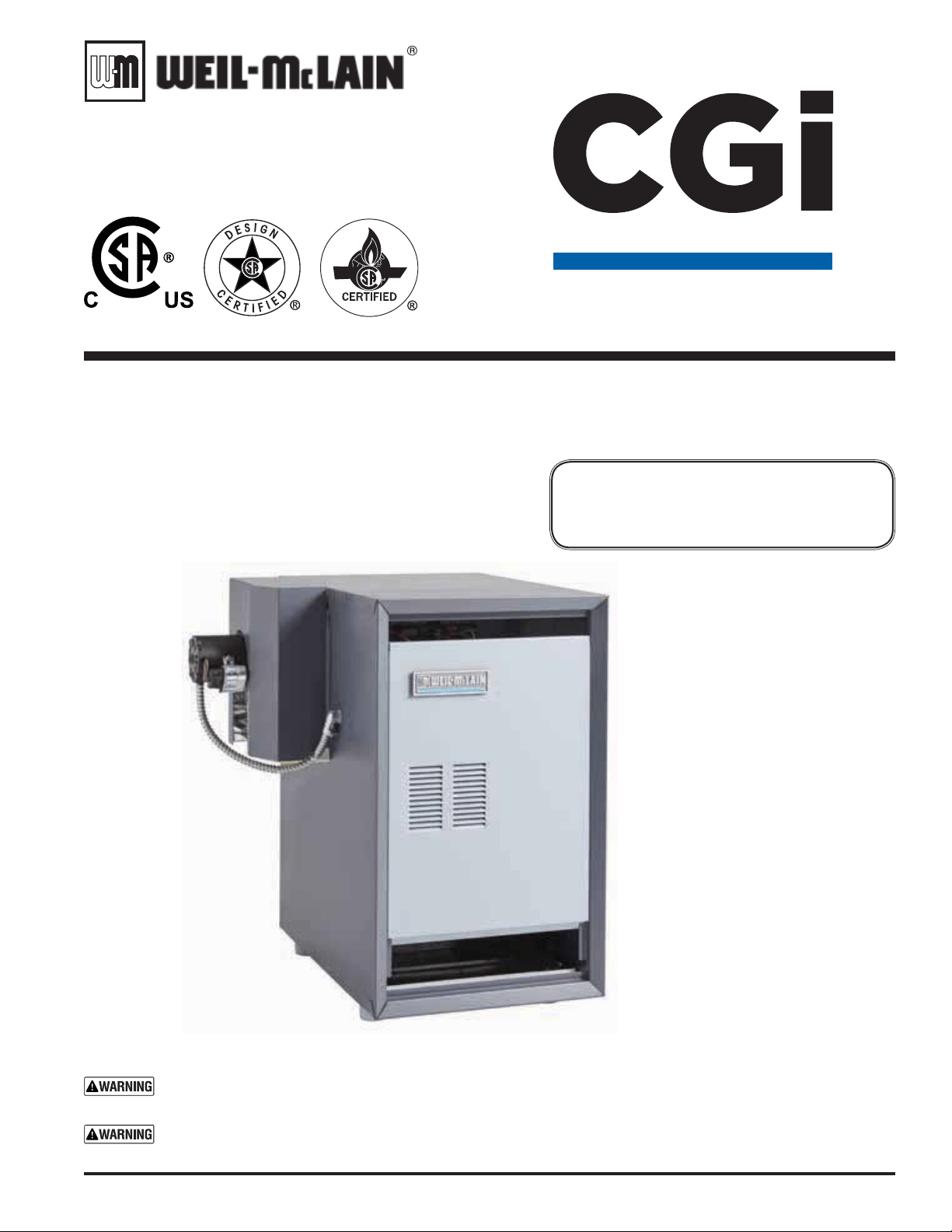
Gas-Fired Water Boilers
Boiler Manual
• Maintenance
• Parts
• Installation
• Startup

Part Number 550-142-302/0520
CGi
SERIES 4 — GAS-FIRED WATER BOILER — Boiler Manual
2
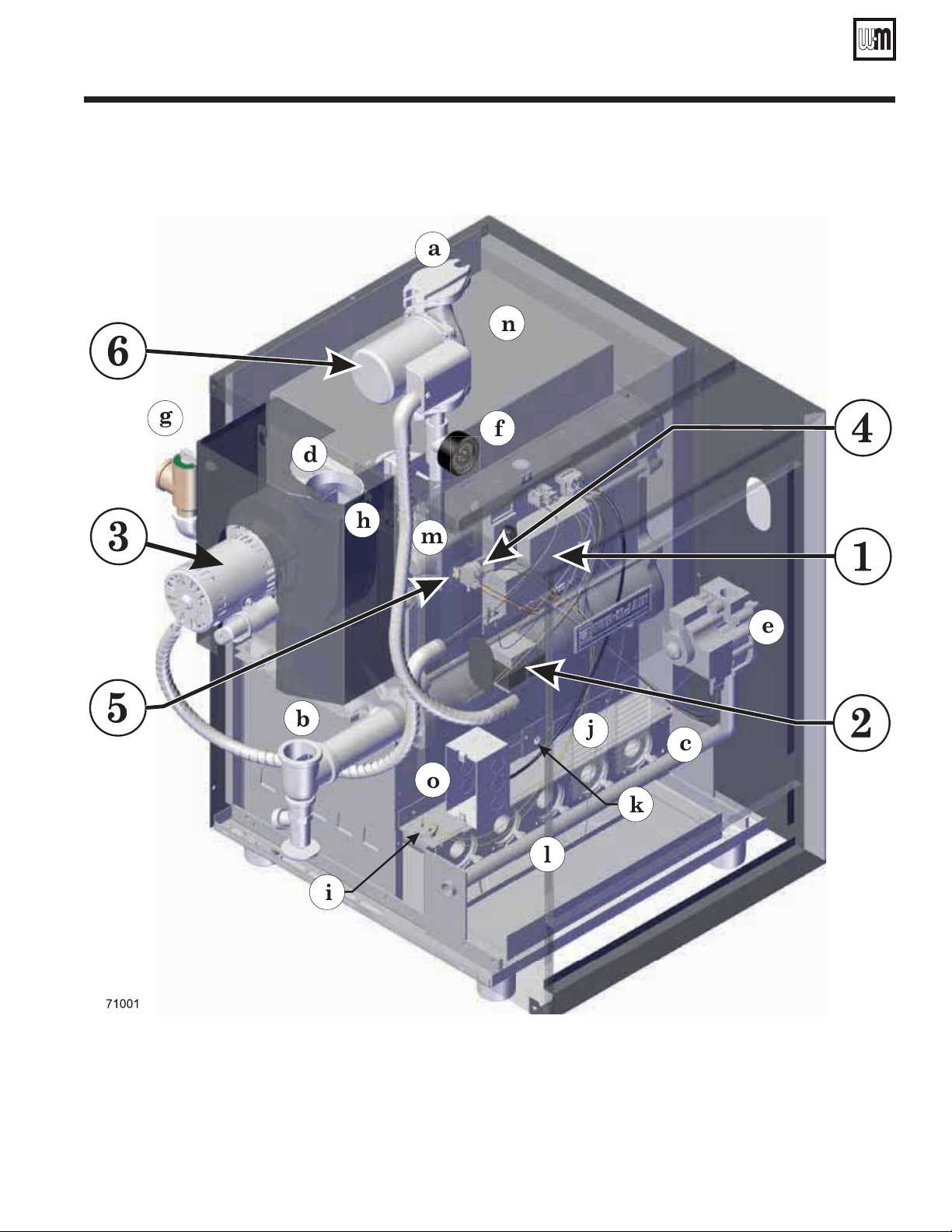
How it works . . .
①
Control module
The control module responds to signals from the room thermostat, air pressure switch and boiler limit circuit to operate
the boiler circulator, pilot burner, gas valve and inducer. When room thermostat calls for heat, the control module starts the
system circulator and inducer.
The control module runs the inducer long enough to purge the boiler flue passages, then opens the pilot valve and activates
pilot ignition spark.
The control module allows up to 15 seconds to establish pilot flame. If flame is not sensed within 15 seconds, the control
module will turn off the gas valve, flash the Flame light, and then enter a 15-second postpurge. The control module will then
start a new cycle. This will continue indefinitely until pilot flame is established or power is interrupted. Once pilot flame is
proven, the control module opens the gas valve to allow main burner flame.
When the room thermostat is satisfied, the control module turns off the gas valve, operates the inducer for a 15-second
postpurge and waits for the next heat call.
The control module indicator lights show normal sequence when the lights are on steady. When a problem occurs, the control
module flashes combinations of lights to indicate the most likely reason for the problem (see page 49).
②
Transformer
The control transformer reduces line voltage to 24 volts for the gas valve and limit circuit.
③
Inducer
The inducer pulls flue gases through the boiler, causing air to be pulled in through the boiler air openings. The inducer pushes
the flue gases through the vent pipe as well.
④
Air pressure switch
The air pressure switch signals the control module, telling the control module whether the inducer is working correctly or
the vent is blocked.
⑤
Water temperature/LWCO sensor
The water temperature/LWCO sensor provides a signal to the control module to turn off the gas valve if the temperature in
the boiler goes above its setting or if a low water condition is sensed. (The circulator will continue to run as long as there is
a call for heat.)
⑥
Boiler circulator
The boiler circulator circulates water through the external (system) piping. The circulator is shipped loose, and can be mounted
on either the boiler supply or return piping. The factory-installed circulator wiring harness provides ample length for either
location.
NOTE — The control module provides a pump exercising routine. If the boiler is not operated for 30 days, the
control module will power the circulator for 30 seconds, then turn off.
a supply to system
b return from system
c stainless steel burners
d flue outlet
e gas valve
f pressure/temperature gauge
g relief valve
h air vent connection
i flame rollout thermal fuse element
(TFE)
j burner shield
k pilot burner and bracket
l gas manifold
m cast iron boiler sections
n flue collector
o junction box
Other boiler components:
Part Number 550-142-302/0520
CGi
SERIES 4 — GAS-FIRED WATER BOILER — Boiler Manual
3
CGi Series 4 Gas-Fired Induced-Draft Water Boiler
Part Number 550-142-302/0520
CGi
SERIES 4 — GAS-FIRED WATER BOILER — Boiler Manual
4
Contents
How it works . . . ................................................. 2
Hazard definitions ............................................... 4
Please read before proceeding ............................ 5
1 Prepare boiler location ...................................6–11
2 Prepare boiler ...............................................12–13
3 Venting ......................................................... 14-19
4 Water piping ................................................. 20-29
5 Gas piping ......................................................... 30
6 Field wiring ....................................................... 31
7 Start-up ........................................................ 32-35
8 Check-out procedure — checklist ...................... 36
9
Department of Energy Compliance ................... 37
9a Operation ..................................................... 38-43
10 Service and maintenance ............................. 44-48
11 Troubleshooting ............................................ 49-58
12 Replacement parts ....................................... 60-66
13 Dimensions and ratings ................................ 67-68
Handling ceramic fiber and fiberglass materials .............. 69
Hazard definitions
The following defined terms are used throughout this manual to bring attention to the presence of hazards of various
risk levels or to important information concerning the life of the product.
Indicates presence of hazards that will cause severe personal injury, death or substantial property
damage.
Indicates presence of hazards that can cause severe personal injury, death or substantial property
damage.
Indicates presence of hazards that will or can cause minor personal injury or property damage.
Indicates special instructions on installation, operation or maintenance that are important but
not related to personal injury or property damage.
Part Number 550-142-302/0520
CGi
SERIES 4 — GAS-FIRED WATER BOILER — Boiler Manual
5
Please read before proceeding
Installer
Read all instructions before installing. Fol-
low all instructions in proper order to prevent
personal injury or death.
• Consider
piping and installation when determining boiler
location.
• Any
claims for damage or shortage in shipment must be
filed immediately against the transportation company by the
consignee.
User
• This manual is for use only by your qualified heating
installer/service technician.
• Please refer to the User’s Information Manual for your refer-
ence.
• We recommend regular
service by a qualified service
technician, at least annually
.
The boiler contains ceramic fiber and fiberglass materials. Use care when handling these materials per instructions on
of this manual. Failure to comply could result in severe personal injury.
When calling or writing about the boiler— Please have the boiler model number from the boiler rating label and the
CP number from the boiler jacket. You may list the CP number in the space provided on the Installation and service
certificate
found on page 36.
other potential ignition source, a fire can develop. In order to
prevent potential severe personal injury, death or substantial
property damage from fire and/or structural damage:
• Never store glycol of any kind near the boiler or any po-
tential ignition source.
• Monitor and inspect the system and boiler regularly for
leakage. Repair any leaks immediately to prevent possible
accumulation of glycol.
• Never use automotive antifreeze or ethylene glycol in the
system. Using these glycols can lead to hazardous leakage
of glycol in the boiler system.
Saltwater Damage — The exposure of boiler components
to saltwater can have both immediate and long-term effects.
While the immediate effects of saltwater damage are similar
to those of freshwater (shorting out of electrical components,
washing out of critical lubricants, etc.), the salt and other con-
taminants left behind can lead to longer term issues after the
water is gone due to the conductive and corrosive nature of the
salt residue. Therefore, Weil-McLain equipment contaminated
with saltwater or polluted water will no longer be covered under
warranty and should be replaced.
Electrical Damage — If any electrical component or wir-
ing
came into contact with water, or was suspected to have
come into contact with water, replace the boiler with a new
Weil-McLain boiler.
Frozen Water Damage Hazard
Residences or buildings that are unattended in severely cold
weather, boiler system components failures, power outages, or
other electrical system failures could result in frozen plumbing
and water damage in a matter of hours. For your protection,
take preventative actions such as having a security system
installed that operates during power outages, senses low tem-
perature, and initiates an effective action. Consult with your
boiler contractor or a home security agency.
When servicing boiler —
• To avoid electric shock, disconnect electrical supply before
performing maintenance.
• To avoid severe burns, allow boiler to cool before perform-
ing maintenance.
Boiler operation —
• Do not block flow of combustion or ventilation air to boiler.
• Should overheating occur or gas supply fail to shut off, do
not turn off or disconnect electrical supply to circulator.
Instead, shut off the gas supply at a location external to the
appliance.
• Do not use this boiler if any part has been under water.
Immediately call a qualified service technician to inspect
the boiler and to replace any part of the control system and
any gas control that has been under water.
Boiler water —
• Do not use petroleum-based cleaning or sealing com-
pounds in boiler system. Water seal deterioration will
occur, causing leakage between sections. This can result
in substantial property damage.
• Do not use “homemade cures” or “boiler patent medicines”.
Serious damage to boiler, personnel and/or property may
result.
• Continual fresh makeup water will reduce boiler life. Min-
eral buildup in sections reduces heat transfer, overheats cast
iron, and causes section failure. Addition of oxygen and
other gases can cause internal corrosion. Leaks in boiler or
piping must be repaired at once to prevent makeup water.
• Do not add cold water to hot boiler. Thermal shock can
cause sections to crack.
Glycol — potential fire hazard —
All glycol is flammable when exposed to high temperatures. If
glycol is allowed to accumulate in or around the boiler or any
Failure to adhere to the guidelines on this page can result in severe personal injury, death or substantial
property damage.

Part Number 550-142-302/0520
CGi
SERIES 4 — GAS-FIRED WATER BOILER — Boiler Manual
6
Prepare boiler location — codes & checklist
1a
Installations must follow these codes:
• Local, state, provincial, and national codes, laws, regulations and ordinances.
• National Fuel Gas Code, ANSI Z223.1/NFPA 54 – latest edition.
• Where required by the authority having jurisdiction, the installation must conform
to the Standard for Controls and Safety Devices for Automatically Fired Boilers,
ANSI/ASME CSD-1 –– latest edition.
• National Electrical Code, ANSI /NFPA 70 – latest edition.
• For Canada only: Natural Gas and Propane Installation Code, CAN/CSA B149.1
or B149.2 Installation Code, CSA C22.1 Canadian Electrical Code Part 1 and any
local codes.
The CGi boiler gas manifold and controls meet safe operating and other
performance criteria when boiler underwent tests specified in ANSI
Z21.13 – latest edition.
For the Commonwealth of Massachusetts, read and follow the special
instructions located on page 15 of this manual.
Before locating the boiler,
check the following:
• Check for nearby connection to:
• System water piping
• Venting connections
• Gas supply piping
• Electrical power
• Check area around boiler. Remove any combustible materials, gasoline
and other flammable liquids, or other contaminants.
Failure to keep boiler area clear and free of combustible materials,
gasoline and other flammable liquids and vapors
can result in
severe personal injury, death or substantial property damage.
•
Boiler must be installed so that gas control system components are protected from
dripping or spraying water or rain during operation or service.
• If new boiler will replace existing boiler, check for and correct system problems,
such as:
1. System leaks causing oxygen corrosion or section cracks from hard water
deposits.
2. Incorrectly-sized expansion tank.
3. Lack of antifreeze in boiler water causing system and boiler to freeze and
leak.
Part Number 550-142-302/0520
CGi
SERIES 4 — GAS-FIRED WATER BOILER — Boiler Manual
7
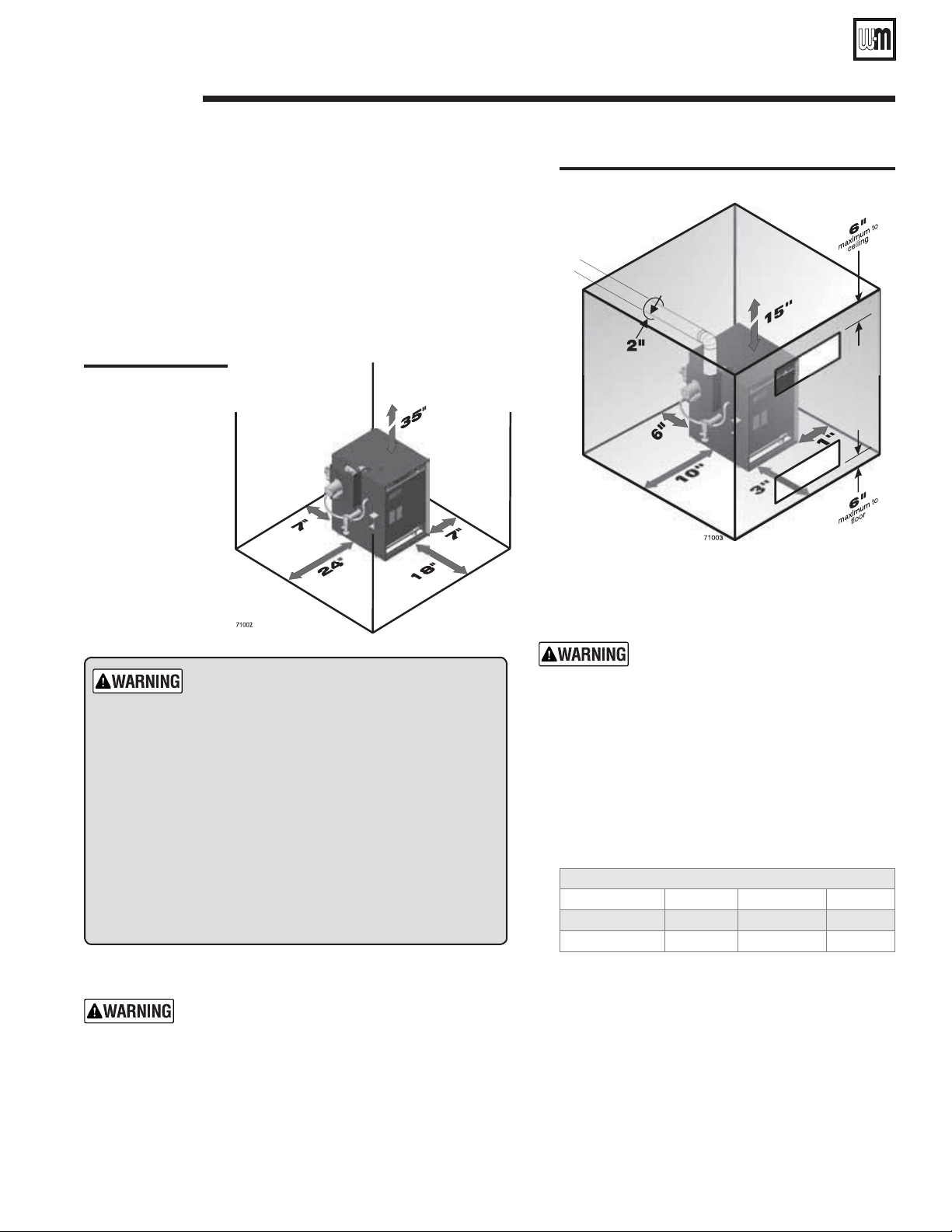
Prepare boiler location — clearances
1b
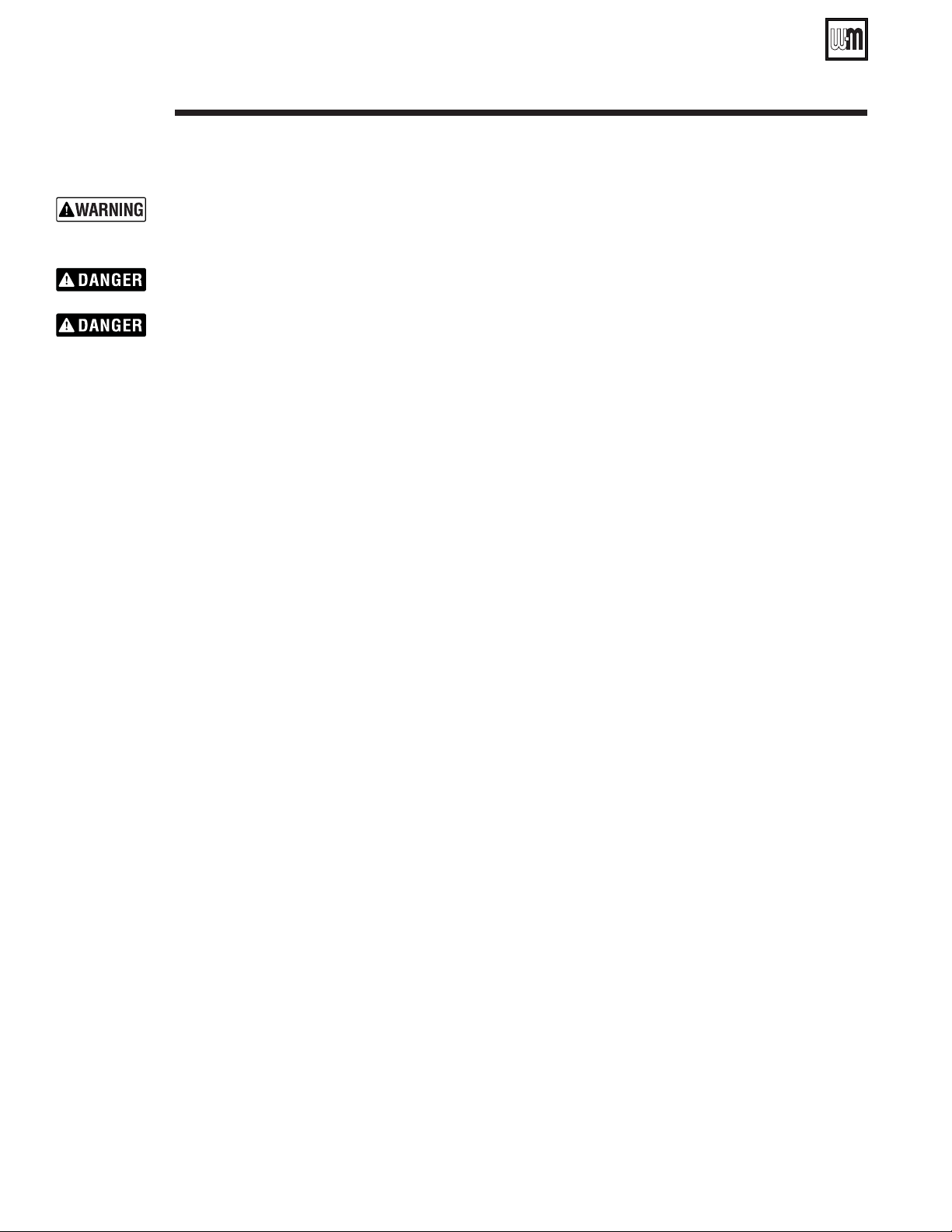
If any clearance is less than in Figure 1a, pro-
vide openings for combustion and ventilation
air located on the wall or door opposite the
boiler FRONT (see Figure 1b)
.
These openings must be located as shown in Figure 1b to provide
proper air flow around the boiler. The free area of each opening
(after deducting for louvers) must be at least one square inch per
1,000 Btuh
of boiler input. If the building is of unusually tight
construction (see page 11 for definition), the air openings must
connect directly to outside or the building must have air openings
to the outside as specified on page 11.
If clearances are equal to or greater than Figure 1a, see pages 10
and 11 for location and sizing of combustion air openings.
Failure to comply can result in severe personal injury, death or
substantial property damage and reduced boiler life.
Flooring
The CGi boiler is approved for installation on combustible
flooring, but must never be installed on carpeting.
Do not install boiler on carpeting even
if foundation is used. Fire can result,
causing severe personal injury, death
or substantial property damage.
Foundation
1. Provide a solid brick or minimum 2-inch thick concrete
foundation pad if any of the following is true:
• floor can become flooded.
• the boiler mounting area is not level.
2. Minimum dimensions are
25 inch length by:
Minimum foundation width:
CGi-25/3
12”
CGi-6
21”
CGi-4
15”
CGi-7
24”
CGi-5
18”
CGi-8
27”
Recommended SERVICE clearances
(Fig. 1a)
1. Provide clearances for cleaning and servicing the boiler and for
access to controls and components. See Figure 1a for recommen-
dations.
2. Provide at least screwdriver clearance to jacket front panel screws
for removal of front panel for inspection and minor service. If
unable to provide at least screwdriver clearance, install unions and
shutoff valves in system so boiler can be moved for servicing.
Required MINIMUM clearances (Fig. 1b)
Never install the boiler in a space with clear-
ances less than the minimum clearances shown
in Figure 1b
. Failure to comply can result in severe
personal injury, death or substantial property dam-
age and reduced boiler life.
1.
Hot water pipes: at least ¹⁄₂ inch from combustible material.
2.
Single-wall vent pipe: at least 6 inches from combustible mate-
rial.
3.
Type B double-wall metal vent pipe: refer to vent manufacturer’s
recommendation for clearances to combustible material.
Residential garage installations
Take the following special precautions when installing the
boiler in a residential garage. If the boiler is located in a resi-
dential garage, per ANSI Z223.1/NFPA 54 - latest edition:
• Mount the boiler a minimum of
18 inches above the
floor
of the garage to assure the burner and ignition
devices will be no less than 18 inches above the floor.
• Locate or
protect the boiler so it cannot be damaged
by a moving vehicle.
Figure 1b Required MINIMUM clearances
Figure 1a
Recommended
SERVICE clearances
(see WARNING
below)
Part Number 550-142-302/0520
CGi
SERIES 4 — GAS-FIRED WATER BOILER — Boiler Manual
8
Prepare boiler location — vent system
1c
Failure to follow all instructions can result in flue gas spillage and carbon monoxide emissions, causing severe
personal injury or death.
When removing boiler from an
existing common vent system:
At the time of removal of an existing boiler, the following
steps shall be followed with each appliance remaining con-
nected to the common venting system placed in operation,
while the other appliances remaining connected to the
common venting system are not in operation.
a.
Seal any unused openings in the common venting
system.
b.
Visually inspect the venting system for proper size
and horizontal pitch and determine there is no blockage
or restriction, leakage, corrosion or other deficiencies
which could cause an unsafe condition.
c.
Test vent system — Insofar as is practical, close all
building doors and windows and all doors between
the space in which the appliances remaining connected
to the common venting system are located and other
spaces of the building. Turn on clothes dryers and any
appliance not connected to the common venting system.
Turn on any exhaust fans, such as range hoods and
bathroom exhausts, so they will operate at maximum
speed. Do not operate a summer exhaust fan. Close
fireplace dampers.
d.
Place in operation the appliance being inspected.
Follow the operating instructions. Adjust thermostat
so appliance will operate continuously.
e.
Test for spillage at draft hood relief opening after 5
minutes of main burner operation. Use the flame of a
match or candle.
f. After it has been determined that
each appliance
remaining connected to the common venting system
properly vents when tested as outlined above, return
doors, windows, exhaust fans, fireplace dampers, and
any other gas-burning appliance to their previous con-
ditions of use.
Any improper operation of common venting system should
be corrected so the installation conforms with the National
Fuel Gas Code, ANSI Z223.1/NFPA 54 – latest edition.
Correct by resizing to approach the minimum size as deter-
mined using the appropriate tables in Part 13 of that code.
Canadian installations must comply with B149.1 or B149.2
Natural Gas and Propane Installation Code.
Chimney or vent
requirements
1. Venting must be installed according to Part 7,
Venting of Equipment, of National Fuel Gas
Code, ANSI Z223.1/NFPA 54 – latest edition and
applicable building codes. Canadian installations
must comply with B149.1 or B149.2 Natural Gas
and Propane Installation Code.
2. See Ratings table on page 66 for minimum chim-
ney or vent sizes. A chimney or vent
without a
listed cap
should extend at least 3 feet above
the highest point
where it passes through a roof
of a building and at least 2 feet higher than
any portion of a building within a horizontal
distance of 10 feet
. A chimney or vent must not
extend less than the distances stated above.
3. A lined chimney is preferred and must be used
when required by local, state, provincial and
national codes, laws, regulations and ordinances.
Vitreous tile linings with joints that prevent
retention of moisture and linings made of non-
corrosive materials are best. Advice for flue con-
nections and chimney linings can be obtained
from local gas utility.
Type B double-wall metal
vent pipe or single-wall vent pipe may be used
as a liner.
4. Cold masonry chimneys, also known as outside
chimneys, typically have one or more walls ex-
posed to outside air. When any atmospheric gas-
fired boiler with automatic vent damper is vented
through this type of chimney, the potential
exists for condensation to occur. Condensation
can damage a masonry chimney. Weil-McLain
recommends the following to prevent possible
damage.
a. Line chimney with corrosion-resistant
metal liner such as AL29-4C® single-wall
stainless steel or B-vent. Size liner per Na-
tional Fuel Gas Code ANSI Z223.1 /NFPA
54 – latest edition.
b. Provide drain trap to remove any conden-
sate.
Direct exhaust venting (Category III) — DO NOT COMMON vent the CGi in a direct exhaust system (Category
III). Connecting more than one appliance to a direct exhaust system will cause flue gas spillage or appliance
malfunction, resulting in possible severe personal injury, death or substantial property damage.
Inspect existing chimney before installing boiler. Failure to clean or replace perforated pipe or tile lining will cause
severe personal injury or death.
Part Number 550-142-302/0520
CGi
SERIES 4 — GAS-FIRED WATER BOILER — Boiler Manual
9
Prepare boiler location — air contamination
1d
Table 1 Corrosive or destructive contaminants and likely locations
Please review the following information on potential
combustion air contamination problems.
Refer to
Table 1 for products and areas which may cause
contaminated combustion air.
CONSTRUCTION DUST HAZARD — Airborne particulates, such as drywall dust
or fiberglass dust, will cause blockage of the CGi burners, resulting in carbon monoxide
production, a fire hazard, or building freeze damage. If the boiler is operated during
construction, you must isolate the boiler to provide clean air for combustion. If you are
unable to ensure uncontaminated air in the boiler vicinity at all times, you must
inspect the boiler at least once weekly
. When inspecting, clean the burners if necessary
using the procedure given on page 45. Failure to follow these guidelines could result in
severe personal injury, death or substantial property damage.
To prevent potential of severe personal injury or death, check for products or areas listed
below before installing boiler. If any of these contaminants are found:
• remove contaminants permanently
— OR —
• isolate boiler and provide outside combustion air. See national, provincial or local codes
for further information.
Products to avoid Areas likely to have contaminants
Spray cans containing chloro/fluorocarbons Dry cleaning/laundry areas and establishments
Permanent wave solutions Swimming pools
Chlorinated waxes/cleaners Metal fabrication plants
Chlorine-based swimming pool chemicals Beauty shops
Calcium chloride used for thawing Refrigeration repair shops
Sodium chloride used for water softening Photo processing plants
Refrigerant leaks Auto body shops
Paint or varnish removers Plastic manufacturing plants
Hydrochloric acid/muriatic acid Furniture refinishing areas and establishments
Cements and glues New building construction
Antistatic fabric softeners used in clothes dryers Remodeling areas
Chlorine-type bleaches, detergents, and cleaning
solvents found in household laundry rooms
Garages with workshops
Adhesives used to fasten building products and
other similar products
Buildings under construction (where air is
contaminated with particulates)
Airborne particulates (drywall dust, fiberglass
particles, road or gravel dust, lint, etc.)
Part Number 550-142-302/0520
CGi
SERIES 4 — GAS-FIRED WATER BOILER — Boiler Manual
10
Prepare boiler location — air openings
1e
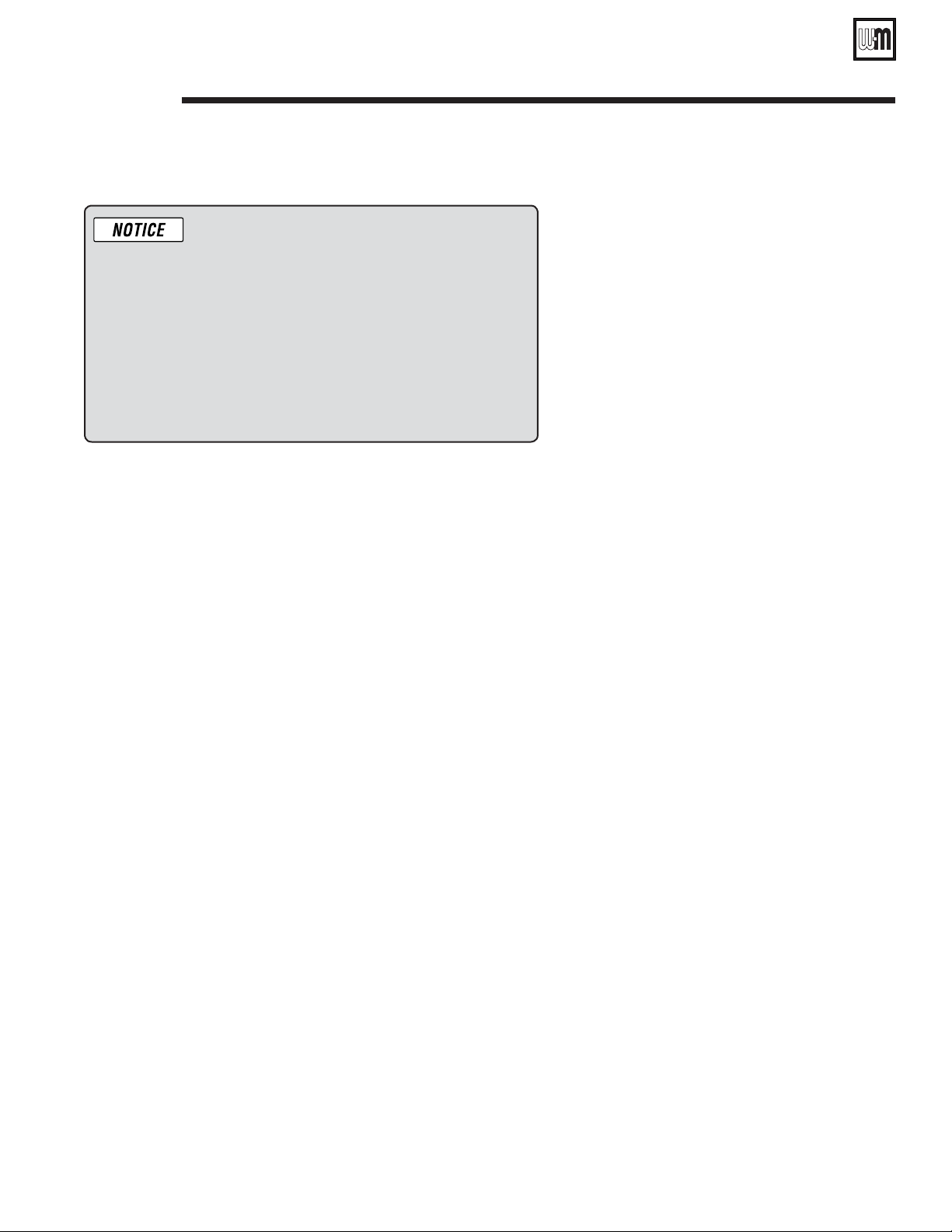
Figure 5 Air from outdoors — horizontal ducts
Figure 4 Air from outdoors — vertical ducts
Figure 2 Air openings to interior spaces
Figure 3 Air directly through outside wall
Air opening options
Two openings — Air supply from inside the building
✷
1. If the building is of unusually tight construction (see definition, next
page), the building must also be provided with air openings directly
to the outside
, sized and located per Figure 3, Figure 4 or Figure 5.
2. Buildings of typical construction should provide adequate combustion
air from natural infiltration, so additional air openings to the building
are not required.
3. See Figure 2. Provide
two openings through the interior wall, within
12 inches of the ceiling and the floor, sized per Figure 2.
Two openings — Air supply directly from outside
✷
1. Air openings must be directly through an outside wall, or into a space
that connects directly to the outside (such as a ventilated attic or crawl
space, for example).
2. See Figure 3 —
Openings directly through an outside wall — provide
two openings within 12 inches of the ceiling and the floor, sized per
Figure 3.
3. See Figure 4 —
Air supplied through vertical ducts — provide two
openings
terminated within 12 inches of the ceiling and the floor, sized
per Figure 4.
4. See Figure 5 —
Air supplied through horizontal ducts — provide
two openings within 12 inches of the floor and the ceiling, sized per
Figure 5.
Air openings must be provided
Combustion and ventilation air openings to be in accordance with
the section “Air for Combustion and Ventilation,” of the National
Fuel Gas Code, ANSI Z223.1/NFPA 54 – latest edition, or applicable
provisions of the local building codes.
Provide adequate combustion and ventilation air to
assure proper combustion and reduce the risk of severe
personal injury, death or substantial property damage
caused by flue gas spillage and carbon monoxide
emissions.
Combustion air opening location and sizing
requirements depend on the clearances around
the boiler.
Check the boiler placement compared to
Figure 1a, page 7.
If all clearances are at least equal to Figure 1a,
page 7
, apply the sizing and placement of openings
given on pages 10 and 11.
If ANY clearance is less than Figure 1a, page 7,
you must provide air openings sized and located as
shown in Figure 1b, page 7. DO NOT apply the sizing
and location information shown on page 10 or 11.
✷
✷
✷
✷
✷
Part Number 550-142-302/0520
CGi
SERIES 4 — GAS-FIRED WATER BOILER — Boiler Manual
11
Prepare boiler location — air openings
1e
Unusually tight construction
Unusually tight construction means (per ANSI Z223.1/
NFPA 54) buildings in which:
a. Walls and ceilings exposed to the outside atmo-
sphere have a continuous water vapor retarder with
a rating of 1 perm or less with openings gasketed,
and . . .
b. Weather-stripping has been added on openable
windows and doors, and . . .
c. Caulking or sealants are applied to areas such as
joints around windows and door frames, between
sole plates and floors, between wall-ceiling joints,
between wall panels, at penetrations for plumbing,
electrical, and gas lines, and in other openings.
For such construction cases, if appliances use inside air
for combustion,
provide air openings into the building
from outside
. Size and locate these openings per the
appropriate case in Figure 3, 4 or 5 on page 10.
Motorized air dampers
If the air openings are fitted with motorized dampers,
electrically interlock the damper to:
• Prevent the boiler from firing if the damper is not
fully open.
• Shut the boiler down should the damper close dur-
ing boiler operation.
To accomplish this interlock, wire an
isolated contact
(proving the damper open) in series with the thermo-
stat input to the boiler. The boiler will not start if this
contact is open, and will shut down should it open
during operation.
Exhaust fans and air movers
The appliance space must never be under a negative
pressure, even if the appliance(s) are installed as di-
rect vent. Always provide air openings sized not only
to the dimensions required for the firing rate of all
appliances, but also to handle the air movement rate
of the exhaust fans or air movers using air from the
building or space.
Single air opening option
✷
A single combustion air opening can be used in lieu of the two-opening
options on page 10, provided:
Clearances from boiler to walls
• The boiler must have clearances of at least those shown in Figure 1a,
page 7.
Opening must be directly to outside
• The opening must connect directly to the outdoors or to a space that
communicates directly to the outdoors (not to an interior space).
• The air can be provided through a direct opening or through a horizontal
or vertical duct.
Opening placement
• The top of the air opening must be within 12 inches of the ceiling.
Opening size
• The free area of the opening must be at least equal to the sum of the
areas of all equipment vent connectors in the space, and . . .
• The free area of the opening must be at least 1 square inch per 3,000
Btu/hr input rating of all equipment located in the space.
FREE AREA of openings — the minimum areas
given in this manual are free area (equals the area,
length times width of opening, after deduction for
louver obstruction).
Use the free area information provided by the louver manufacturer.
When this information is not available, assume:
• Wood louvers — assume free area is 20% of total; so the actual area
of each opening with wood louvers would be 5 times the required
free area.
• Metal louvers — assume free area is 60% of actual area; so, for wood
louvers, the actual area of each opening must be 1.67 times the re-
quired free area.
Exception for large spaces
✷
No combustion air openings are needed when the boiler (and other ap-
pliances) are installed in a space with a volume at least 50 cubic feet per
1,000 Btuh
of all installed appliances, provided:
• the building must not have unusually tight construction
(see definition, this page).
• all clearances around the boiler must be no less than shown in Figure 1a,
page 7.
To determine if the space is large enough to qualify:
• Add the total input of all appliances in MBH (1,000’s of Btuh).
• Multiply this number times 50 to determine minimum room volume.
• Example: For a total input of 100 MBH (100,000 Btuh), minimum
volume is 50 x 100 = 5,000 cubic feet. At a ceiling height of 8 feet, the
space must have at least 5,000 ÷ 8 = 625 square feet (25 feet x 25 feet,
for instance).
Part Number 550-142-302/0520
CGi
SERIES 4 — GAS-FIRED WATER BOILER — Boiler Manual
12
Prepare boiler — placement & setup
2a
Table 2 Manifold orifice sizing at sea level and altitudes to 4,500 feet
Place boiler/crate near
position
1. Leave boiler in shipping carton and on pallet until
installation site is ready.
2. Move entire shipping carton and pallet next to selected
location.
3. Remove shipping carton.
4. Remove boiler from pallet.
Do not drop boiler or bump jacket on
floor or pallet. Damage to boiler can
result.
a. Tilt left side of boiler up and place a board under
left legs.
b. Tilt boiler the other way and place a board under
right legs.
c. Slide boiler backward off pallet and into position.
5. Check level.
a. Shim legs, if necessary.
b. Do not alter legs.
Inspect orifices and burners
1. Remove front jacket door. Remove burner shield (see
Figure 40, item 4, page 64).
2. Check for correctly-sized manifold orifices. See
Table 2
for sizing. (The orifice size is stamped on the orifice
spud barrel.)
Correctly-sized manifold orifices must
be used. Failure to do so will result in
severe personal injury, death or sub-
stantial property damage.
3. Reinstall burner shield.
Do not operate boiler without
burner shield in place. Failure
to do so could result in severe
personal injury, death or sub-
stantial property damage.
Orifice replacement
procedure
(when required)
1. Remove the screws securing the burner shield
and remove burner shield.
2. Using a
7
/
16
” open-end wrench, remove the
burner orifices from the manifold.
3. Apply a small amount of pipe dope to each of
the new orifices and install in the manifold us-
ing a
7
/
16
” open-end wrench. Make sure the ori-
fices are aligned correctly, not cross-threaded
in the manifold tappings.
Use only pipe dope compatible
with propane gas, even if boiler
is to be operated on natural
gas. Failure to comply could
result in severe personal injury,
death or substantial property
damage.
4. Carefully replace the burner shield.
5. Follow the check-out procedure, Section
8
page 36, to assure the boiler is now operating
properly after orifices are replaced.
Location Boiler model
number
Natural gas Propane gas
0-2,000 ft. over 2,000 ft. 0-2,000 ft. over 2,000 ft.
U. S.
CGi-25 2.30 mm
(Note 1)
#54
(Note 1)
CGi-3 and CGi-5 2.55 mm 1.60 mm
CGi-4, CGi-6 - CGi-8 2.70 mm 1.65 mm
Canada
0-2,000 ft. 2,000-4,500 0-2,000 ft. 2,000-4,500
CGi-25 2.30 mm #44 #54 #55
CGi-3 and CGi-5 2.55 mm #41 1.60 mm 1.45 mm
CGi-4, CGi-6 - CGi-8 2.70 mm #38 1.65 mm #53
Note 1:
For elevations above 2,000 feet, contact your local Weil-McLain sales office for details.
Part Number 550-142-302/0520
CGi
SERIES 4 — GAS-FIRED WATER BOILER — Boiler Manual
13
Prepare boiler — pressure test
2b
Hydrostatic pressure test
Pressure test boiler before attaching water or gas piping
(except as noted below) or electrical supply.
Prepare boiler for test
1. Remove the shipping nipple (from CGi supply tap-
ping) and remove the boiler relief valve. Temporarily
plug the relief valve tapping with a ¾” NPT pipe
plug.
2. Remove 1¼” nipple, reducing tee and drain valve
from circulator hardware and pressure/temperature
gauge carton. Install in boiler return connection as
shown on page 3 and
Figure 42, page 67. Install
circulator on either the return or supply.
3. Remove 1¼” nipple, 1¼” x 1¼” x ½” tee and pres-
sure/temperature gauge from circulator hardware
and pressure/temperature gauge carton. Pipe to
boiler supply connection as shown on page 3 and
Figure 42, page 67. (Use pipe dope sparingly.)
4. Connect a hose to boiler drain valve, the other end
connected to a fresh water supply. Make sure hose
can also be used to drain boiler after test.
5. Connect a nipple and shutoff valve to system supply
connection on the 1¼” tee. This valve will be used
to bleed air during the fill. (Valve and nipple are not
included with boiler.)
6. Connect a nipple and shutoff valve to system re-
turn connection (at circulator flange if circulator
installed on return). This valve will be used to bleed
air during the fill. (Valve and nipple are not included
with boiler.)
Fill and pressure test
1. Open the shutoff valves you installed on supply and
return connections.
2. Slowly open boiler drain valve and fresh water sup-
ply to fill boiler with water.
3. When water flows from shutoff valves, close boiler
drain valve.
4. Close shutoff valves.
5. Slowly reopen boiler drain valve until test pressure
on the pressure/temperature gauge reaches no more
than:
•
45 psig for boilers with 30 psig relief valve.
•
75 psig for boilers with 50 psig relief valve.
6.
Test for no more than 10 minutes at:
• 45 psig for boilers with 30 psig relief valve.
•
75 psig for boilers with 50 psig relief valve.
Do not leave boiler unattended.
A cold water fill could expand and
cause excessive pressure, resulting
in severe personal injury, death or
substantial property damage.
7. Make sure constant gauge pressure has been main-
tained throughout test. Check for leaks. Repair if
found.
Leaks must be repaired at once.
Failure to do so can damage boiler,
resulting in substantial property
damage.
Do not use petroleum-based clean-
ing or sealing compounds in boiler
system. Severe damage to boiler
will occur, resulting in substantial
property damage.
Drain and remove fittings
1. Disconnect fill water hose from water source.
2. Drain boiler at drain valve or out hose, whichever
provides best access to drain. Remove hose after
draining if used to drain boiler.
3. Remove nipples and valves unless they will remain
for use in the system piping.
4. Remove plug from relief valve tapping. See page 20
to replace relief valve.
Part Number 550-142-302/0520
CGi
SERIES 4 — GAS-FIRED WATER BOILER — Boiler Manual
14
Venting — general information3a
Chimney draft venting
Chimney draft venting uses the natural draft provided
by a vertical vent or chimney. Category I appliance (non-
positive vent static pressure and vent gas temperature
that avoids excessive condensate production in vent).
See Section
3b. Chimney draft installations use:
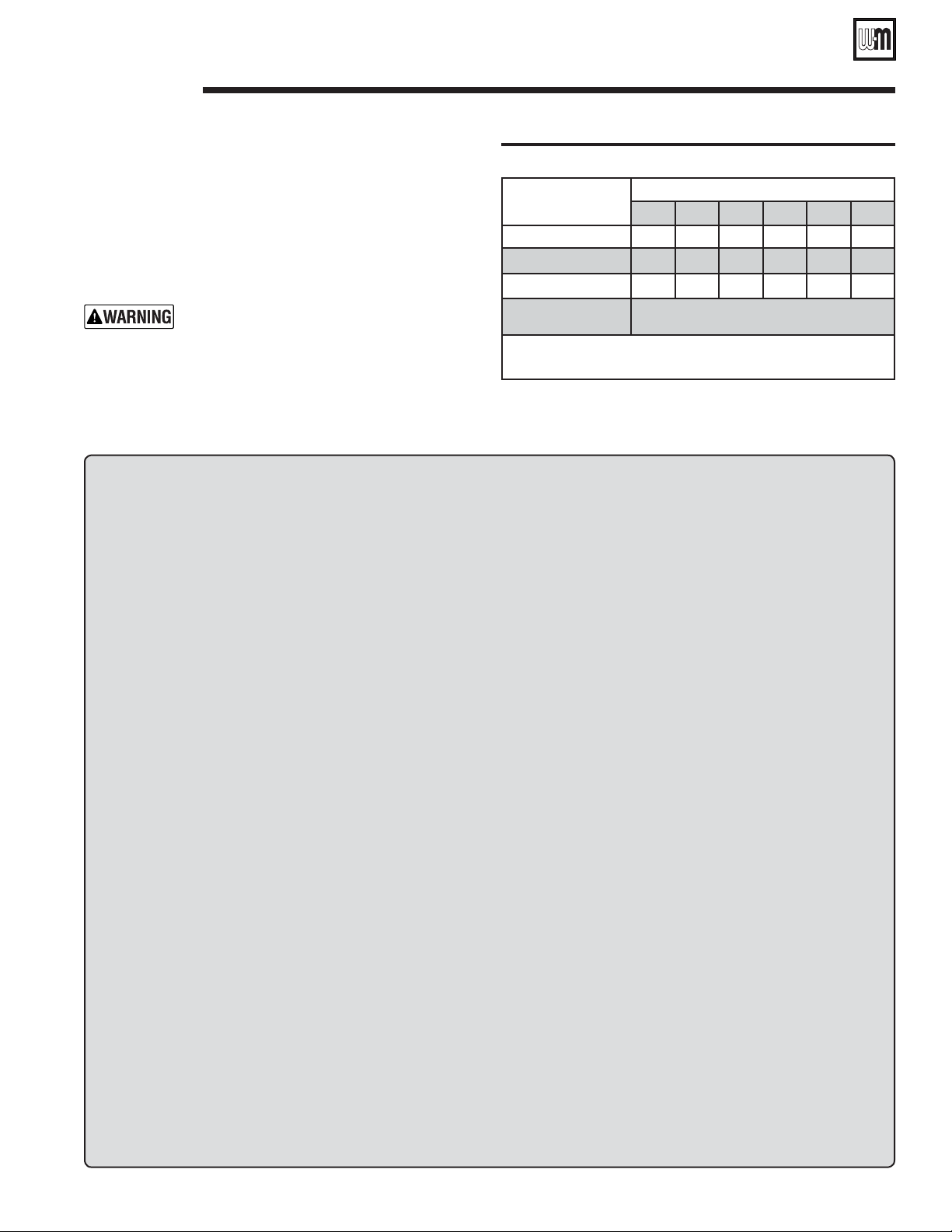
1. Vent connector (single or double wall) sized to
eliminate positive pressure in vent system. Diameter
increases immediately at boiler.
2. Double wall metal vent (B-vent) or chimney with
liner approved by the National Fuel Gas Code,
ANSI Z223.1/NFPA 54 – latest edition, or in Canada
B149.1 or B149.2 Natural Gas and Propane Instal-
lation Code.
Direct exhaust — vertical or sidewall
Direct exhaust venting uses inside combustion air with
no combustion air connector piping. All CGi flue gas
vents are pressurized, requiring careful sealing of all
joints. Category III appliance (positive vent static pres-
sure and vent gas temperature that avoids excessive
condensate production in vent). See pages 15-19.
Direct exhaust installations use:
1. Vent pipe specified in this manual.
2. Vent termination through outside wall, roof or un-
used chimney. Tight chimney areas will make vent
joint construction very difficult.
Venting — chimney draft venting
3b
1. Use double wall metal vent (B-vent) or chimney with liner
as required by the National Fuel Gas Code, ANSI Z223.1
/
NFPA 54
–latest edition, or in Canada, B149.1 or B149.2
Natural Gas and Propane Installation Code
.
2. To prevent downdrafts, chimney should extend at least 3 feet
above the highest point where it passes through a roof and
at least 2 feet higher than any portion of a building within
a horizontal distance of 10 feet.
3. To vent with another appliance, see National Fuel Gas Code,
ANSI Z223.1
/NFPA 54
–latest edition or in Canada B149.2
or B149.2
Natural Gas and Propane Installation Code.
4. Do not connect breeching to any portion of a mechanical
draft system that can operate under positive pressure.
5. Maintain minimum 2” clearance from combustible materials
to vent pipe.
6. Do not use chimney with an open fireplace.
7. Make horizontal runs as short as possible. Long runs can
cause condensation.
8. When longer runs are used, support pipe with appropriate
hangers.
9. To prevent blockage, do not vent into bottom of chimney.
10. Vent pipe must not go beyond inside wall of chimney.
11. Vent passing through floors or ceilings must be firestopped.
12. See
Figure 7 and Table 3 to connect boiler to venting system.
Inspect existing chimney before installing boiler. Failure to
clean or replace perforated pipe or lining will cause severe
personal injury or death.
Table 3
Vent
connector
diameter
Vent sizing given in Table 3 is only a general guideline. The
vent connector and chimney must be designed, sized and
constructed in compliance with all applicable codes. Failure
to correctly size and install the vent system could result in
severe personal injury, death or substantial property damage.
Figure 7
Chimney
draft
venting
Boiler
model
number
“D” Minimum
vent connector
diameter
CGi-25 & CGi-3
4”
CGi-4 to CGi-6
5”
CGi-7 & -8
6”
CGi venting methods — Chimney draft or Direct exhaust
Part Number 550-142-302/0520
CGi
SERIES 4 — GAS-FIRED WATER BOILER — Boiler Manual
15
Venting — Direct exhaust — components3c
Obtain vent system components
1. The following special gas vent systems comply with UL-1738
and ULC-S636 standards and are certified by CSA as the only
systems suitable for use with CGi boilers (all 3” diameter):
• Heat-Fab, Inc.
Saf-T Vent
®
• Flex-L International, Inc. StaR-34
• Z-Flex®, Inc. Z-Vent II
• ProTech Systems FasNSeal™
Use only the vent starter of the same manu-
facturer as the vent components. Do not mix
components from different systems. The vent
system could fail, causing flue gas spillage,
resulting in severe personal injury or death.
2.
Select vent method based on page 14 and installation requirements.
3. Refer to Table 4 for maximum vent run lengths and number
of elbows. Do not exceed data in Table 4.
4. Select vent components from separate
CGi, & GV Vent
Component Supplement
. All components, including the
vent starter, must be of the same vent manufacturer. Do not
mix components.
Massachusetts installations
(a) For all side wall horizontally vented gas fueled equipment installed
in every dwelling, building or structure used in whole or in part
for residential purposes, including those owned or operated by the
Commonwealth and where the side wall exhaust vent termination is
less than seven (7) feet above finished grade in the area of the vent-
ing, including but not limited to decks and porches, the following
requirements shall be satisfied:
1. INSTALLATION OF CARBON MONOXIDE DETECTORS.
At the time of installation of the side wall horizontal vented gas
fueled equipment, the installing plumber or gas fitter shall ob-
serve that a hard wired carbon monoxide detector with an alarm
and battery back-up is installed on the floor level where the gas
equipment is to be installed. In addition, the installing plumber
or gas fitter shall observe that a battery operated or hard wired
carbon monoxide detector with an alarm is installed on each
additional level of the dwelling, building or structure served by
the side wall horizontal vented gas fueled equipment. It shall be
the responsibility of the property owner to secure the services of
qualified licensed professionals for the installation of hard wired
carbon monoxide detectors
a. In the event that the side wall horizontally vented gas
fueled equipment is installed in a crawl space or an attic,
the hard wired carbon monoxide detector with alarm
and battery back-up may be installed on the next adja-
cent floor level.
b. In the event that the requirements of this subdivision
can not be met at the time of completion of installa-
tion, the owner shall have a period of thirty (30) days to
comply with the above requirements; provided, however,
that during said thirty (30) day period, a battery oper-
ated carbon monoxide detector with an alarm shall be
installed.
2. APPROVED CARBON MONOXIDE DETECTORS. Each
carbon monoxide detector as required in accordance with the
above provisions shall comply with NFPA 720 and be ANSI/
UL 2034 listed and IAS certified.
3. SIGNAGE. A metal or plastic identification plate shall be perma-
nently mounted to the exterior of the building at a minimum
height of eight (8) feet above grade directly in line with the ex-
haust vent terminal for the horizontally vented gas fueled heating
appliance or equipment. The sign shall read, in print size no less
than one-half (1/2) inch in size, “GAS VENT DIRECTLY BELOW.
KEEP CLEAR OF ALL OBSTRUCTIONS.”
4. INSPECTION. The state or local gas inspector of the side
wall horizontally vented gas fueled equipment shall not ap-
prove the
installation unless, upon inspection, the inspector observes
carbon monoxide detectors and signage installed in accor-
dance with the provisions of 248 CMR 5.08(2)(a) 1 through 4.
(b) EXEMPTIONS: The following equipment is exempt from
248 CMR 5.08(2)(a)1 through 4:
1. The equipment listed in Chapter 10 entitled “Equipment Not
Required To Be Vented” in the most current edition of NFPA 54
as adopted by the Board; and
2. Product Approved side wall horizontally vented gas fueled
equipment installed in a room or structure separate from the
dwelling, building or structure used in whole or in part for
residential purposes.
(c) MANUFACTURER REQUIREMENTS — GAS EQUIPMENT
VENTING SYSTEM PROVIDED. When the manufacturer of
Product Approved side wall horizontally vented gas equipment pro-
vides a venting system design or venting system components with
the equipment, the instructions provided by the manufacturer for
installation of the equipment and the venting system shall include:
1. Detailed instructions for the installation of the venting sys-
tem design or the venting system components; and
2. A complete parts list for the venting system design or venting
system.
(d) MANUFACTURER REQUIREMENTS — GAS EQUIPMENT
VENTING SYSTEM NOT PROVIDED. When the manufacturer
of a Product Approved side wall horizontally vented gas fueled
equipment does not provide the parts for venting the flue gases,
but identifies “special venting systems”, the following requirements
shall be satisfied by the manufacturer:
1. The referenced “special venting system” instructions shall
be included with the appliance or equipment installation
instructions; and
2. The “special venting systems” shall be Product Approved by
the Board, and the instructions for that system shall include
a parts list and detailed installation instructions.
(e) A copy of all installation instructions for all Product Approved side
wall horizontally vented gas fueled equipment, all venting instruc-
tions, all parts lists for venting instructions, and/or all venting design
instructions shall remain with the appliance or equipment at the
completion of the installation.
Max. vent
length (feet)
Total number of elbows (Note 1)
123456
CGi-25 to CGi-6 55 48 41 34 27 20
CGi-7 35 28 21 14 7 --
CGi-8 28 21 14 7 -- --
Note 1:
*
Table 4 Maximum vent length
Part Number 550-142-302/0520
CGi
SERIES 4 — GAS-FIRED WATER BOILER — Boiler Manual
16
Venting — direct exhaust — vent starter3d
1. Select a vent pipe manufacturer and obtain all vent
components needed, based on boiler location and
venting method.
2. You must use the vent starter made by the vent
pipe manufacturer. See separate
CGi, & GV Vent
Component Supplement
, for part number of each
component, listed by vent manufacturer.
Use only the vent starter of the same
manufacturer as the vent compo-
nents. Do not mix components from
different systems. The vent system
could fail, causing flue gas spillage,
resulting in severe personal injury
or death.
3. Follow all applicable national, state, local or provin-
cial codes when venting the CGi boiler.
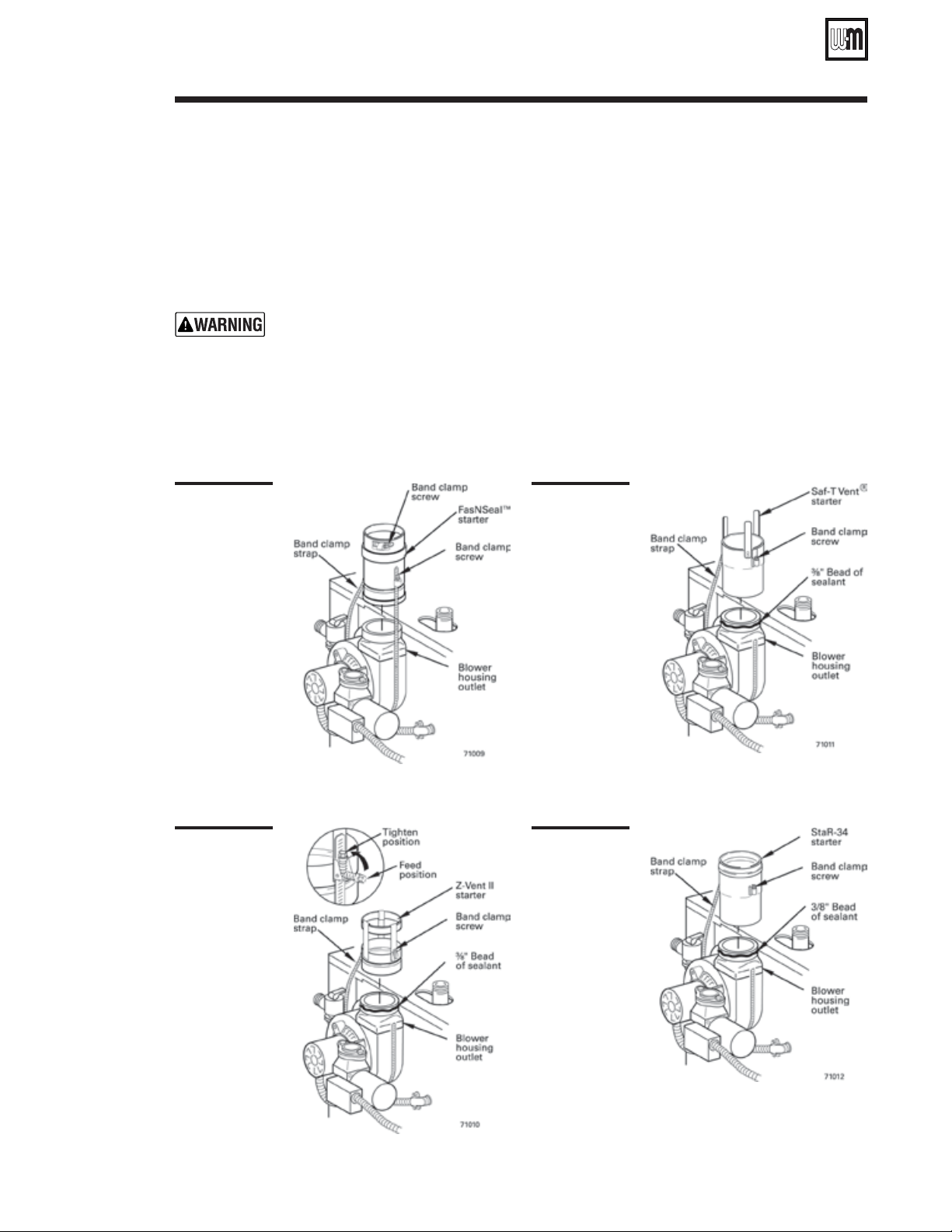
4. Connect vent starter to blower housing outlet as
shown in the
Figures 8 through 11.
a. Do not mix components from different vent
manufacturers.
b. Maintain minimum 2" clearance from com-
bustible materials to vent pipe.
c. Seal with sealant specified by vent pipe
manufacturer, using ³⁄₈" bead (not required for
FasNSeal™).
d. Tighten strap at band clamp screw until strap
is snug around blower housing.
e. Place blower cover over blower and fasten
with four (4) screws. (Blower cover not shown
for clarity).
Figure 8
FasNSeal™
vent starter
Figure 9
Z-Vent II
vent starter
Figure 11
StaR-34
vent starter
Figure 10
Saf-T Vent®
vent starter
Part Number 550-142-302/0520
CGi
SERIES 4 — GAS-FIRED WATER BOILER — Boiler Manual
17
Venting — direct exhaust — termination3e
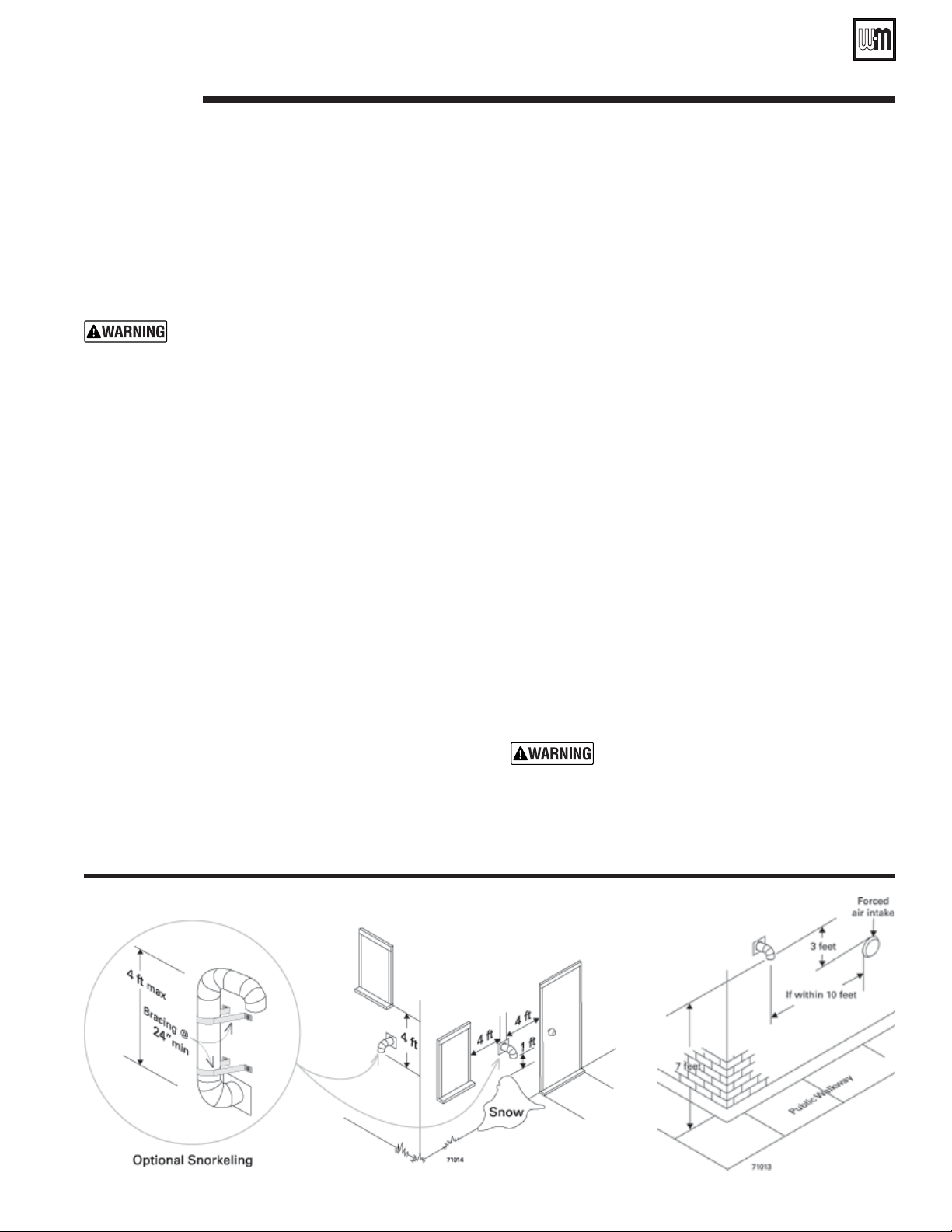
Figure 12 Vent termination minimum clearances
Follow instructions on this page when determin-
ing vent location to avoid possibility of severe
personal injury, death or substantial property
damage.
1. Locate the boiler and vent penetration through the wall so
all requirements on this page and in Figure 12 will be met.
Also follow vent manufacturer’s instructions.
2. Gases will form white plume in winter. Plume could obstruct
window view.
3. Prevailing winds could cause freezing of condensate and wa-
ter/ice buildup on vent termination, building, plants or roof.
Ice buildup on vent termination can cause boiler shutdown
and building freeze up.
4. Winds over 31 mph can cause nuisance boiler shutdown if
boiler is sidewall vented. This could result in loss of heat to
building, causing freeze up.
5. Locate or guard vent termination to prevent condensate from
damaging exterior surfaces.
6. Locate the vent termination well away from trees, shrubs, and
decorative items.
7. Locate or guard vent to prevent accidental contact by people
or pets.
8. Do not terminate vent in window well, stairwell, alcove,
courtyard, or other recessed areas.
9. Do not wrap or insulate vent pipe or fittings.
10. Do not terminate vent above any door or window. Condensate
can freeze, causing ice formations.
11. Do not connect:
• Any other appliance to vent pipe.
• Multiple boilers to a common vent pipe.
The vent termination must be located to meet all requirements below (also applies to vertical vent terminations). The minimum
distance from adjacent public walkways, adjacent buildings, openable windows and building in the National Fuel Gas Code, ANSI
Z223.1/NFPA 54 – latest edition and/or the Natural Gas and Propane Installation Code, CAN/CSA B149.1. The vent termination
clearances below are for U.S.A., for Canadian vent termination clearances please refer to the requirements of CSA B149.1 Natural Gas
and Propane Installation Code. Consideration should be given to avoid possible damage caused by vent plumes and condensate when
choosing a venting configuration and location. Maintain a minimum clearance of 4 ft. (1.22m) horizontally from, and in no case above
or below, unless a 4 ft. (1.22m) horizontal distance is maintained, from electrical meters, gas meters, regulators, and relief equipment.
12. Canadian installations — See B149.1 or B149.2 Natural
Gas and Propane Installation Code. Terminate vent no less
than 6 feet from another combustion air inlet, 3 feet from
any other building opening, and 3 feet from any gas service
regulator.
13. See
Figure 12, showing that the vent must terminate:
• more than 4 feet below or to side of all doors or windows.
• more than 1 foot above grade or anticipated snow line.
• at least 7 feet above public walkway.
• 3 feet above any forced air intake within 10 feet.
14. Vent must also terminate:
• at least 6 feet away from adjacent walls.
• no closer than 5 feet below roof overhang.
• at minimum of 4 feet horizontally (and in no case
above or below unless a 4 foot horizontal distance is
maintained) from electric meters, gas meters, regula-
tors, relief valves, and other equipment.
15. Site conditions may dictate greater clearances.
16. Do not extend exposed vent pipe outside of building more
than 4 feet.
Condensate could freeze and block vent pipe.
A gas vent extending through an exterior
wall shall not terminate adjacent to the wall
or below building extensions such as eaves,
parapets, balconies or decks. Failure to comply
could result in severe personal injury, death or
substantial property damage.
Part Number 550-142-302/0520
CGi
SERIES 4 — GAS-FIRED WATER BOILER — Boiler Manual
18
Venting — direct exhaust — installation
3f
1. Do not mix types or manufacturers of vent materi-
als.
2. Clean all joints before sealing. See vent manufac-
turer’s instructions for cleaning and sealing joints.
Use their specified sealant. Do not use screws.
3. Install vent pipe with seams on top of vent horizon-
tal runs. Follow requirements in Section
3e for vent
termination.
4. Maintain minimum 2” clearance from combustible
materials to vent pipe.
5.
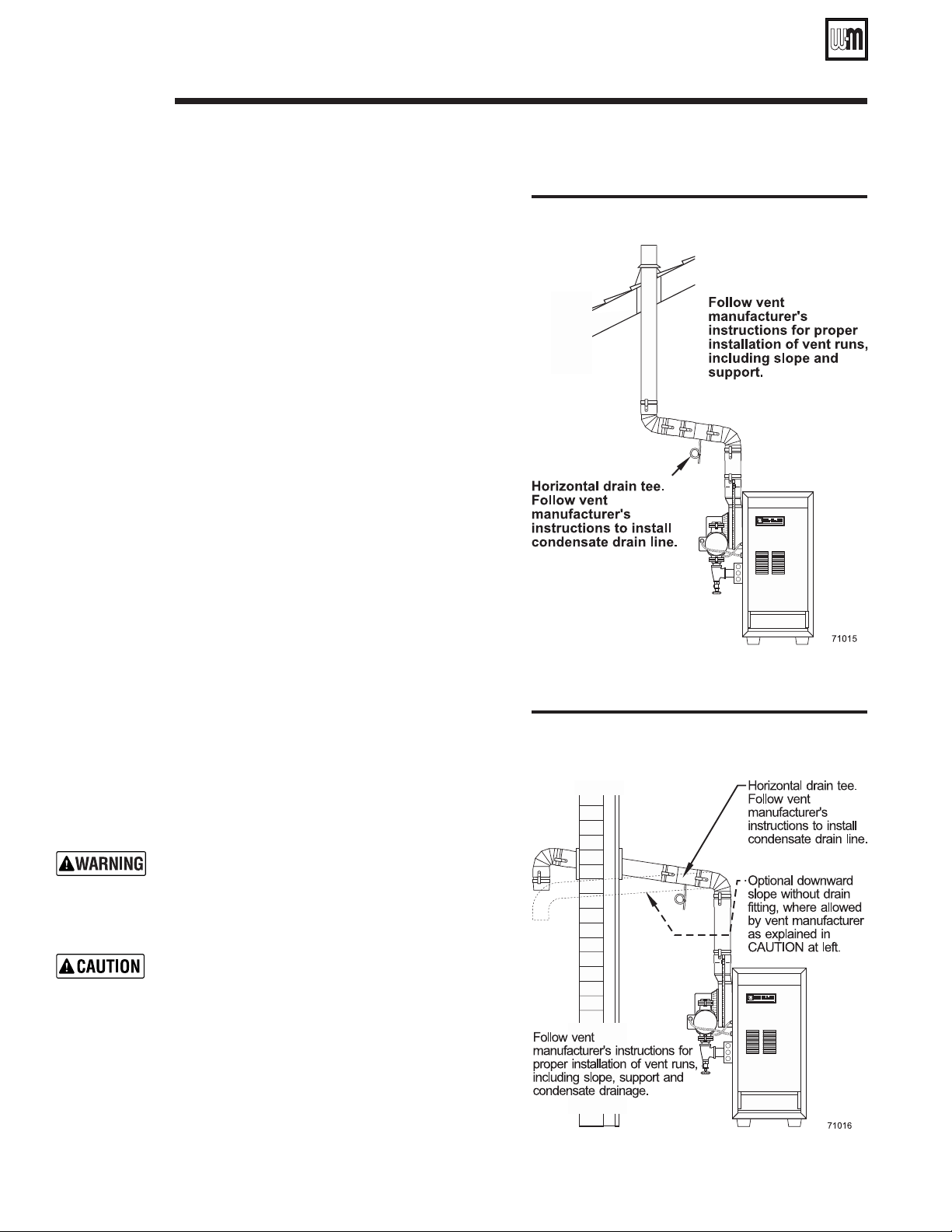
Vertical venting — See Figure 13. Follow vent
manufacturer’s instructions for venting through
roof.
• Vent pipe must extend through roof flashing,
jacket or thimble.
• Vent may pass through floor, inside wall or
concealed space when installed according to
vent manufacturer’s instructions.
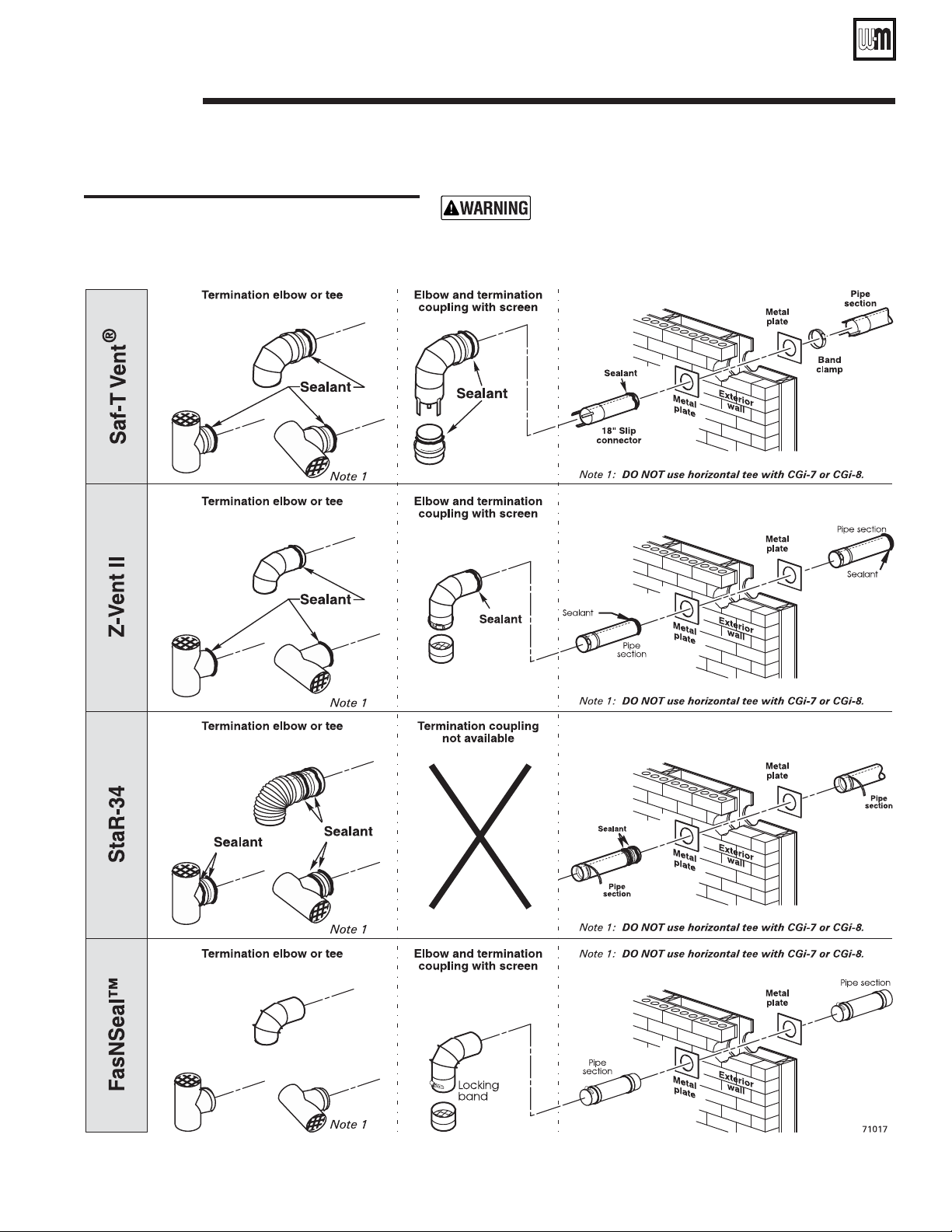
Sidewall venting — See Figures 14 and 15.
Vent must terminate at least one foot above
anticipated snow line. Vent must be termi-
nated only with:
• Tee or elbow with integral screen. (Tee may be
mounted either vertically or horizontally.
DO
NOT
use horizontal tee with CGi-7 or CGi-8.)
• Elbow and termination coupling with screen
(not available for StaR-34).
6. Do not seal vent pipe (slip connector for Saf-T Vent)
to inside or outside plate.
7. If passing through noncombustible wall, provide
hole diameter large enough to insert the vent pipe
(slip connector for Saf-T Vent).
8. Install horizontal drain tee as close as possible to
boiler, in first horizontal run. See
Figures 13 and 14.
9. Do not exceed the maximum vent system length
given in Table 4, page 15.
Condensate drain line — use only silicone tubing rated
for at least 400°F for the first 18” of condensate drain
line, then other non-metallic tubing may be used. Us-
ing any other material could cause flue gas leakage,
potentially resulting in severe personal injury, death or
substantial property damage.
On some installations, the condensate drain fitting may
be omitted, provided:
• Vent manufacturer shows this option in their instruc-
tions.
• Vent is sloped toward termination as shown in dotted
lines in
Figure 14.
• The vent is installed per Weil-McLain and vent
manufacturer’s instructions.
• Condensate drip page from such vents may accumu-
late on the ground below. Consider traffic in the area
to avoid hazard due to ice accumulation.
Figure 13 Direct exhaust vertical venting
Figure 14 Direct exhaust sidewall venting
Part Number 550-142-302/0520
CGi
SERIES 4 — GAS-FIRED WATER BOILER — Boiler Manual
19
Venting — direct exhaust — installation (cont.)
3f
Figure 15 Sidewall termination
Using any termination other than one of those shown
could cause nuisance outages and loss of heat, resulting
in substantial property damage.
Part Number 550-142-302/0520
CGi
SERIES 4 — GAS-FIRED WATER BOILER — Boiler Manual
20
Water piping — general information
4a
General piping information
If installation is to comply with ASME or Canadian requirements, an ad-
ditional high temperature limit maybe needed. Install control in supply piping
between boiler and isolation valve. Set second control to minimum 20°F
above setpoint of first control. Maximum allowable setpoint is 240°F. See
Section
9b for wiring.
Use backflow check valve in cold water supply as required by local codes.
Water temperature/LWCO sensor
A low water cutoff device is required when boiler is installed above radiation
level or by certain state or local codes or insurance companies. The boiler
has a pre-installed water temperature/LWCO sensor.
Pressure/temperature gauge
Install pressure/temperature gauge in tee on supply piping (as shown in
drawing on page 3).
Isolation valves
Isolation valves are required to enable servicing of the boiler’s temperature
sensor. Install as shown in appropriate piping diagram.
Relief valve
Install relief valve vertically in ¾” tapping on side of boiler. See Figure 16
or 17, page 21, and the tag attached to the relief valve for manufacturer’s
instructions.
Table 6 Water pipe size (based on 20°F rise)
Circulator
The circulator is shipped loose (wiring pre-attached to
boiler) to allow you to locate it either in the return or
supply piping, as desired. See page 3 for a typical instal-
lation. Pipe the expansion tank to the suction side of the
circulator whenever possible. Install an air separator in
the supply piping. Connect the expansion tank to the air
separator only if the separator is on the suction side of
the circulator. Always install the system fill connection
at the same point as the expansion tank connection to
the system.
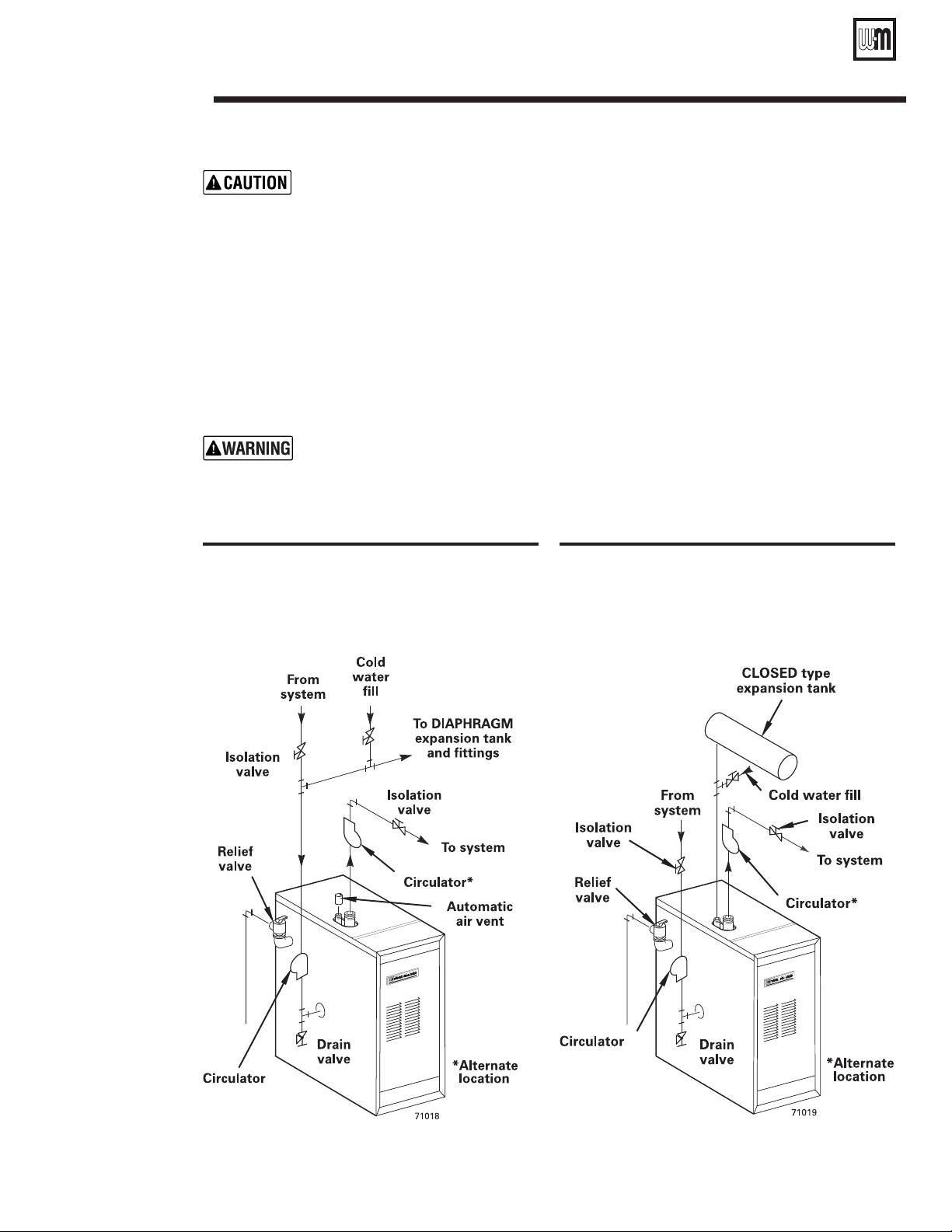
Figures 16 and 17 show typical near-boiler
piping connections.
System water piping
See Figure 16 (diaphragm-type or bladder-type expan-
sion tank) or Figure 17 (closed-type expansion tank)
and Table 6, for near-boiler and single-zone systems
designed for return water at least 130°F.
See pages 22-23 to complete multiple-zone piping or
pages 24-29 to complete piping for radiant heating
systems or converted gravity systems (large-volume
systems originally designed for circulation by natural
convection rather than a pump). See page 29 for boilers
used with refrigeration systems.
Chillers or air handling units:
Install boiler such that —
• Chilled medium, if used, is piped in parallel with
heating boiler. Use appropriate valves to prevent
chilled medium from entering boiler. Consult AHRI
Installation and Piping Guides.
• If boiler is connected to heating coils located in
air handling units where they can be exposed to
refrigerated air, use flow control valves or other au-
tomatic means to prevent gravity circulation during
cooling cycle. Circulation of cold water through the
boiler could result in damage to the heat exchanger,
causing possible severe personal injury, death or
substantial property damage.
To avoid water damage or scalding due to relief valve
operation:
• Discharge line must be connected to relief valve outlet and run to
a safe place of disposal
. Terminate the discharge line to eliminate
possibility of severe burns should the valve discharge.
• Discharge line must be as short as possible and be the same size as
the valve discharge connection
throughout its entire length.
• Discharge line must
pitch downward from the valve and terminate
at least 6” above the floor drain where any discharge will be clearly
visible.
• The discharge line shall
terminate plain, not threaded, with a mate-
rial serviceable for temperatures of 375°F or greater.
• Do not pipe the discharge to any place where freezing could
occur.
• No shutoff valve shall be installed between the relief valve and boiler,
or in the discharge line. Do not plug or place any obstruction in the
discharge line.
• Failure to comply with the above guidelines could result in failure of
the relief valve to operate, resulting in possibility of severe personal
injury, death or substantial property damage.
•
Test the operation of the valve after filling and pressurizing system
by lifting the lever. Make sure the valve discharges freely. If the valve
fails to operate correctly, replace it with a new relief valve.
Boiler
model number
To
system
From
system
CGi-25
¾” ¾”
CGi-3, 4, 5
1” 1”
CGi-6, 7
1¼”1¼”
CGi-8
1½”1½”
Note: The boiler supply and return connections, the
return/ drain tee and the supply/gauge tee
supplied with the boiler are 1¼” NPT. One of
the circulator flanges supplied with the boiler is
1¼”. The other circulator flange is the size of the
recommended system piping shown above.
Part Number 550-142-302/0520
CGi
SERIES 4 — GAS-FIRED WATER BOILER — Boiler Manual
21
Water piping — single-zone system
4b
Diaphragm-type or bladder-
type expansion tank (Figure 16)
1. Ensure expansion tank size will handle boiler and
system water volume and temperature. Tank must
be located in boiler return piping as close to boiler
as possible, before inlet side of circulator. See tank
manufacturer’s instructions for details.
2. Install an
automatic air vent as shown.
Figure 16 Diaphragm- or bladder-type expansion
tank — Piping to single-zone system
using diaphragm-type or bladder-type
expansion tank. See Table 6 for piping
sizes.
Figure 17 Closed-type expansion tank — Piping
to single-zone system using closed-
type expansion tank. See Table 6 for
piping sizes.
Closed-type expansion tank
(Figure 17)
1. Ensure expansion tank size will handle boiler and
system water volume and temperature. See tank
manufacturer’s instructions for details.
2. Connect tank to ½” NPT tapping located behind
supply outlet, using ½” NPT piping. Pitch any
horizontal piping up towards tank 1 inch per 5 feet
of piping.
Use Figure 16 or Figure 17 only for single-zone systems designed for return water at least 130°F.
For systems with low return water temperature possible, such as converted gravity systems
and radiant heating systems, refer to the special piping suggestions of pages 24-29. Failure to
prevent low return water temperature to the boiler could cause corrosion of the boiler sections
or burners, resulting in severe personal injury, death or substantial property damage.
Undersized expansion tanks cause system water to be lost from relief valve and makeup water
to be added through fill valve. Eventual section failure can result.
Part Number 550-142-302/0520
CGi
SERIES 4 — GAS-FIRED WATER BOILER — Boiler Manual
22
4c
Piping multiple zones
Follow instructions on pages 20 and 21 to install near-
boiler or single-zone piping. (Also refer to Piping for
radiant heating systems or converted gravity sys-
tems
, below, if applicable.)
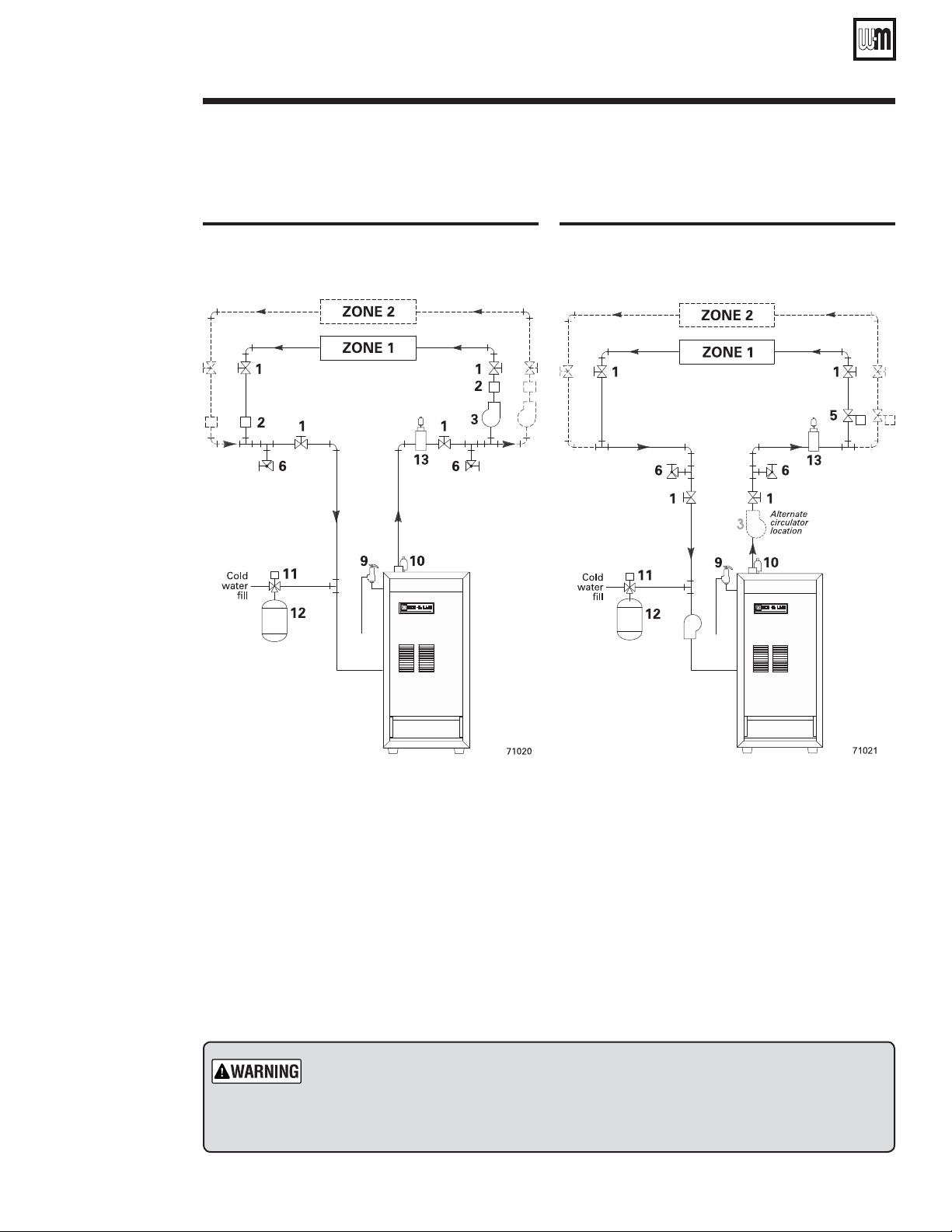
See Figure 18 or Figure 19 to complete installation.
Zoning with circulators (Figure 18)
(return temp over 130°F)
1. Size each circulator to individual circuit require-
ments.
2. Do not install circulator on boiler (except for
primary/secondary piping).
3. Install isolation (balancing) valves to adjust flow
to distribute heat to all zones.
4. Install and wire a separate relay for each zone
circulator.
Zoning with zone valves (Figure 19)
(return temp over 130°F)
1. Install isolation (balancing) valves to adjust flow to
distribute heat to all zones.
2. Provide a separate 24-volt transformer to power the
zone valves. Size the transformer to handle the total
rated load of all connected zone valves.
DO NOT connect directly from
3-wire zone valves to the T-T termi-
nals on the boiler
. When using 3-wire
zone valves, install an isolation relay.
Connect the zone valve end switch wires
to the isolation relay coil. Connect the
isolation relay contact across the boiler
T-T terminals. Failure to comply can
result in damage to boiler components
or cause unreliable operation, resulting
in severe property damage.
Piping for radiant heating
systems or converted gravity
systems
Converted gravity (or steam) systems
Whenever possible, use the primary/secondary piping
shown in Figures 20 or 21 on page 25. This piping de-
sign allows changing boiler flow rate without affecting
primary circuit flow rate.
If Figures 20 or 21 cannot be used, use the boiler-by-
pass piping shown in Figure 22 or Figure 23 on page 27.
You can also use the piping shown in
Figure 24 on
page 29 (system-bypass), if the reduced flow rate in
the heating system will not cause heat distribution
problems.
Failure to prevent low return water
temperature to the boiler could
cause corrosion of the boiler sec-
tions or burners, resulting in severe
personal injury, death or substantial
property damage.
Radiant heating systems
Preferably, use primary/secondary piping, as shown
in Figures 20 or 21 on page 25. Alternatively, use the
method of either
Figure 22 or Figure 23 on page 27.
Do not use the piping of Figure 24 (system-bypass),
because this method does not control radiant system
supply temperature.
If radiant system tubing has no oxygen barrier, a
heat
exchanger
must be used.
Radiant heating system piping should include a means of regulating the boiler return water
temperature and the system supply temperature (such as provided by an injection pumping
control). Boiler return water temperature will be adequately controlled using the methods
shown in this manual provided the system supply temperature is relatively constant.
DO NOT apply the methods in this manual if the system is equipped with an outdoor reset
control
. Instead, provide controls and piping which can regulate the boiler return water
temperature at no less than 130°F regardless of system supply temperature. Contact your
Weil-McLain representative for suggested piping and control methods. Failure to prevent
cold return water temperature to the boiler could cause corrosion damage to the sections
or burners, resulting in possible severe personal injury, death or substantial property damage.
Water piping — multiple zones
Part Number 550-142-302/0520
CGi
SERIES 4 — GAS-FIRED WATER BOILER — Boiler Manual
23
Water piping — multiple zones (continued)
4c
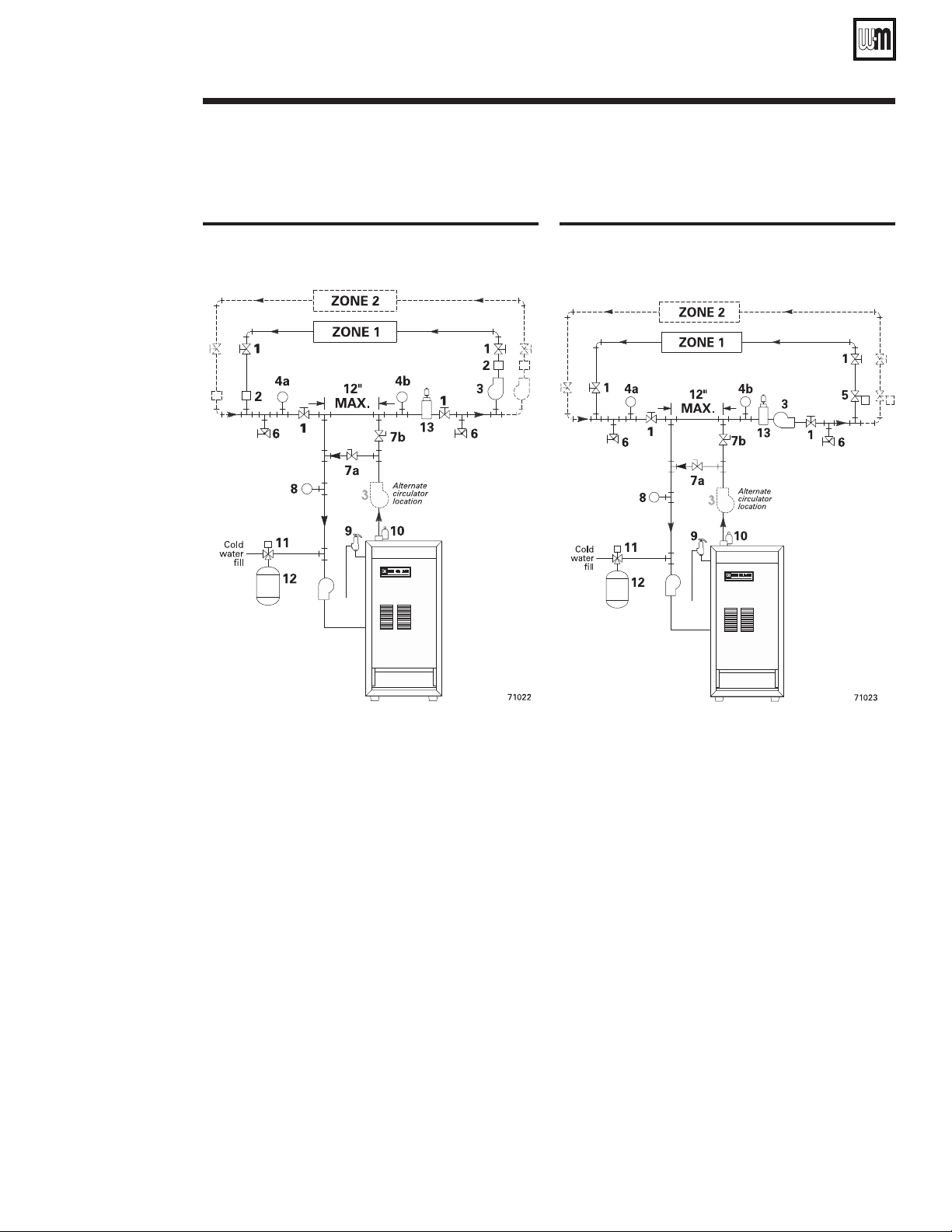
Figure 18 Zoning with circulators
— return water 130°F or higher.
Figure 19 Zoning with zone valves
— return water 130°F or higher.
1 Boiler isolation (balancing) valves
2 Flow/check valve
3 System or zone circulator
5 Zone valve
6 Drain valve
9 Relief valve
10 Automatic air vent (with diaphragm-type expansion tank), or con-
nect to tank fitting (closed-type expansion tank). DO NOT use an
automatic air vent when using closed-type expansion tank. It would
allow air to leave the system, causing waterlogging of the expansion
tank.
11 Fill valve
12 Diaphragm-type or bladder-type expansion tank, if used (For
closed-type expansion tank, pipe from top of air separator to tank
fitting as in Figure 17.)
13 Air separator and automatic vent, if used (Note that the fill valve
must always be connected to the expansion tank, regardless of loca-
tion of expansion tank circulator or air separator.
For systems with possible low return-water temperature (such as converted gravity systems,
radiant heating systems and heat pump systems), refer to the special piping suggestions of
Figures 20 – 24, as applies. Failure to prevent sustained low return water temperature to
the boiler could cause corrosion of the boiler sections, resulting in severe personal injury,
death or substantial property damage.
Part Number 550-142-302/0520
CGi
SERIES 4 — GAS-FIRED WATER BOILER — Boiler Manual
24
4d
Piping — low temperature systems
Failure to prevent low return water temperature to the boiler could cause corrosion
of the boiler sections or burners, resulting in severe personal injury, death or substantial
property damage.
Radiant heating system piping should include a means of
regulating the boiler return
water temperature
and the system supply temperature (such as provided by an injec-
tion pumping control
).
Boiler return water temperature will be adequately controlled using the methods shown
in this manual provided the system supply temperature is relatively constant.
DO NOT apply the methods of this manual if the system is equipped with an outdoor
reset control.
Instead, provide controls and piping which can regulate the boiler re-
turn water temperature
at no less than 130°F regardless of system supply temperature.
Contact your Weil-McLain representative for suggested piping and control methods.
Failure to prevent cold return water temperature to the boiler could cause corrosion
damage to the sections or burners, resulting in possible severe personal injury, death or
substantial property damage.
Primary/secondary (preferred)
bypass piping method
Primary/secondary bypass piping is preferred because
the flow rate and temperature drop in the heating
circuit(s) is determined only by the heating circuit
circulator(s). So adjustment of the bypass valves in
the boiler circuit will not cause a change in the heating
circuit rate and temperature distribution.
Figures 20 and 21 show suggested bypass arrangements
using primary/secondary bypass piping (preferred)
for low temperature systems such as radiant heating
systems
or converted gravity systems. For alterna-
tives, see pages 26 through 29.
The bypass valves (items
7a and 7b) provide mixing of
hot boiler outlet water with cooler system return water
— set to assure a minimum return water temperature
(at least 130°F) to the boiler. Set the valves as explained
below.
Temperature gauges
Gauge 4a is suggested, but optional on any system.
Gauge
4b is optional on converted gravity systems,
but required on radiant heating systems — to display
the water temperature being supplied to the radiant
tubing.
Gauge
8 is required on all systems to assure the return
water temperature is accurately set for a minimum of
130°F. If this gauge is not available however, adjust the
valves such that the boiler-mounted temperature/pres-
sure gauge reads at least 150°F when the system return
water is cold (approximately 60°F water temperature).
Valve adjustment
(Figures 20 and 21 only)
1. Set the valves while the system is cool, setting for the
coldest expected water temperature (usually 60°F
since the system will often drop to room tempera-
ture between cycles).
2. Start with valve
7a fully closed and 7b fully open.
3. Gradually open valve
7a while closing valve 7b until
the temperature at gauge 8 reads 130°F when gauge
4a reads 60°F.
4. Note that valve
7a regulates the amount of hot wa-
ter from the boiler supply which mixes with return
water. Valve
7b regulates the amount of system water
flowing through the boiler secondary loop.
Part Number 550-142-302/0520
CGi
SERIES 4 — GAS-FIRED WATER BOILER — Boiler Manual
25
4d
Piping — low temperature systems (continued)
1 Boiler isolation (balancing) valves
2 Flow/check valve
3 System or zone circulator
4 System temperature gauges
5 Zone valve
6 Drain valve
7 System temperature valves (see instruc-
tions to the left for adjusting valves)
8 Blend temperature gauge
9 Relief valve
10 Automatic air vent (with diaphragm-type expansion tank), or
connect to tank fitting (closed-type expansion tank).
DO NOT
use an automatic air vent when using closed-type expansion tank.
It would allow air to leave the system, causing waterlogging of
the expansion tank.
11 Fill valve
12 Diaphragm-type or bladder-type expansion tank, if used (For
closed-type expansion tank, pipe from top of air separator to
tank fitting as in Figure 17.)
13 Air separator and automatic vent, if used (Note that the fill valve
must always be connected to the expansion tank, regardless of
location of expansion tank, circulator or air separator.)
Figure 20 Primary/secondary piping
Zoning with circulators
Figure 21 Primary/secondary piping
Zoning with zone valves
Part Number 550-142-302/0520
CGi
SERIES 4 — GAS-FIRED WATER BOILER — Boiler Manual
26
Piping — low temperature systems (continued)
4d
BOILER-bypass piping
method
This piping method (Figure 22 or 23) is called a boiler-
bypass
because part of the circulator flow is bypassed
around the boiler (through valve 7a). This method
reduces the flow rate throughout the boiler, in order to
raise the average water temperature in the boiler enough
to prevent flue gas condensation. Boiler-bypass piping
is effective for some boilers — including the CGi —
provided the flow rates are adjusted according to the
instructions following.
Figures 22 and 23 are alternative piping suggestions
for converted gravity (large water content or steam
systems) or radiant heating system — for use when
primary/secondary piping can’t be applied. (Figure 24
is another alternative, using system bypass in place of
boiler-bypass piping.
Figure 24 however, is not suitable
for radiant heating applications because it does not
protect the radiant system from possible high water
temperature.)
Boiler-bypass piping keeps system flow rate as high as
possible and temperature drop as low as possible, help-
ing to equalize the building heat distribution.
Temperature gauges
Gauge 4a is optional if the bypass valves will be ad-
justed using cold (or room temperature) return water
to the boiler. (When setting the valves without gauge
4a installed — using cold or room temperature water
— assume the return water temperature to be 60°F. Set
the valves so gauge
8 reads at least 120°F.
Gauge
4b is optional on converted gravity systems, but
required on radiant heating systems — to display the
water temperature being supplied to the radiant tubing.
Gauge
8 is required on all systems to assure reliable
adjustment of the bypass valves. The boiler-mounted
temperature/pressure gauge can be used if a separate
temperature gauge is not installed.
Valve adjustment
1. Start with valve 7a fully closed and 7b fully open.
2. Gradually open valve
7a while closing valve 7b
until the temperature at gauge 8 reads 60 °F higher
than gauge 4a. A minimum 60°F temperature rise
through the boiler assures a low enough flow rate
and high enough average temperature to prevent
condensation even with low system return water
temperature.
3. Valve
7a regulates the system flow rate, while valve
7b regulates the boiler flow rate.
4. The boiler-mounted temperature/pressure gauge
may be used in place of a separate gauge
8.
Failure to prevent low return water temperature to the boiler could cause corrosion
of the boiler sections or burners, resulting in severe personal injury, death or substantial
property damage.
Radiant heating system piping should include a means of regulating the boiler return
water temperature
and the system supply temperature (such as provided by an injec-
tion pumping control
).
Boiler return water temperature will be adequately controlled using the methods shown
in this manual provided the
system supply temperature is relatively constant.
DO NOT apply the methods of this manual if the system is equipped with an outdoor
reset control.
Instead, provide controls and piping which can regulate the boiler re-
turn water temperature
at no less than 130°F regardless of system supply temperature.
Contact your Weil-McLain representative for suggested piping and control methods.
Failure to
prevent cold return water temperature to the boiler could cause corrosion
damage to the sections or burners, resulting in possible severe personal injury, death or
substantial property damage.
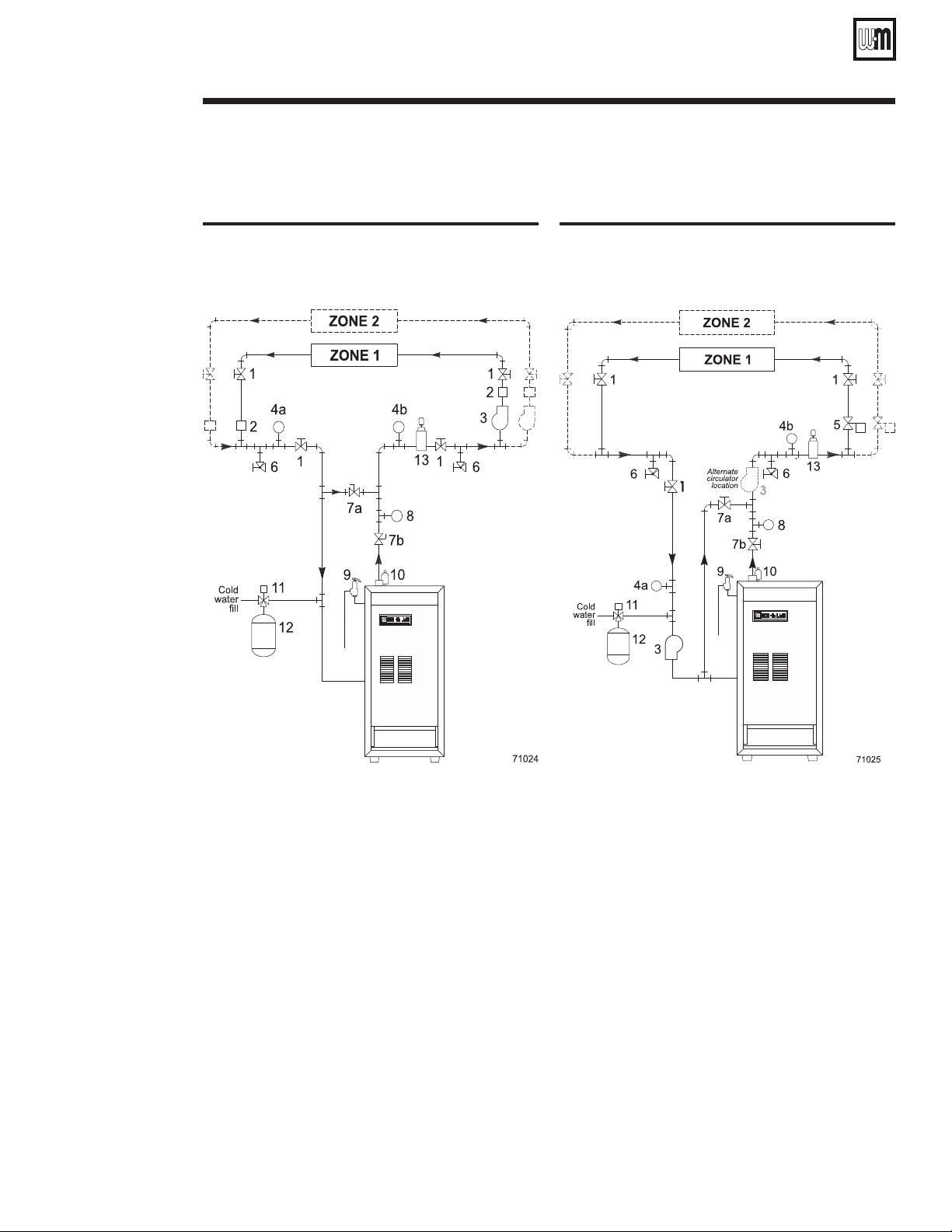
Part Number 550-142-302/0520
CGi
SERIES 4 — GAS-FIRED WATER BOILER — Boiler Manual
27
Piping — low temperature systems (continued)
4d
1 Boiler isolation (balancing) valves
2 Flow/check valve
3 System or zone circulator
4 System temperature gauges
5 Zone valve
6 Drain valve
7 System temperature valves (see in-
structions to the left for adjusting
valves)
8 Blend temperature gauge
9 Relief valve
10 Automatic air vent (with diaphragm-type expansion tank), or
connect to tank fitting (closed-type expansion tank). DO NOT use
an automatic air vent when using closed-type expansion tank. It
would allow air to leave the system, causing waterlogging of the
expansion tank.
11 Fill valve
12 Diaphragm-type or bladder-type expansion tank, if used (For
closed-type expansion tank, pipe from top of air separator to
tank fitting as in
Figure 17, page 21).
13 Air separator and automatic vent, if used (Note that the fill valve
must always be connected to the expansion tank, regardless of
location of expansion tank, circulator or air separator.)
Figure 22 Boiler-bypass piping — Zoning with
circulators — (Alternative to primary/
secondary piping Figures 20 and 21)
Figure 23 Boiler-bypass piping — Zoning with
zone valves — (Alternative to primary/
secondary piping Figures 20 and 21)
Part Number 550-142-302/0520
CGi
SERIES 4 — GAS-FIRED WATER BOILER — Boiler Manual
28
Piping — low temperature systems (continued)
4d
SYSTEM-bypass piping
method
This piping method is called a system-bypass because
part of the circulator flow bypasses the system (through
valve 7a). This bypassed hot water from the boiler outlet
mixes with cooler system return water temperature in
order to provide minimum 130°F return water to the
boiler. Valve
7b will most often be full open, but may
need to be slightly closed on some low pressure drop
systems in order to cause enough flow through valve
7a.
Figure 24 is an alternative piping method that provides
return water temperature control for boilers installed
on
converted gravity systems (large water content or
steam systems).
Do not apply the piping of Figure 24 on radiant heat-
ing systems
. It provides no method regulating the water
temperature provided to the system and could result in
excessive water temperature in the radiant tubing.
System-bypass piping as shown in
Figure 24 can be used
with either zone valve or circulator zoning. When used
with circulator zoning however, the boiler circulator
(item
3), must be piped as shown. It cannot be used as
one of the zoning circulators.
Do not apply system-bypass piping if the reduced flow
in the system could cause poor heat distribution. That
is, system-bypass piping reduces the flow in the system
and increases the water temperature supplied to the
system. This can cause increased heat from radiators
at the beginning of the system and reduced heat from
radiators near the end of the system.
Valve adjustment
1. Start with valve 7a fully closed and 7b fully open.
2. Gradually open valve
7a while closing valve 7b until
the temperature at gauge 8 reads at least 130°F at all
times.
3. Valve
7a regulates the amount of boiler supply water
mixed with return water. Valve 7b causes a pressure
drop in the system needed to balance flow through
valve 7a and the system.
4. The valve adjustment should be done with the
system at the coldest expected temperature (60°F
for converted gravity systems or high mass radiant
systems).
Failure to prevent low return water temperature to the boiler could cause corrosion
of the boiler sections or burners, resulting in severe personal injury, death or substantial
property damage.
Radiant heating system piping should include a means of
regulating the boiler return
water temperature
and the system supply temperature (such as provided by an injec-
tion pumping control
).
Boiler return water temperature will be adequately controlled using the methods shown
in this manual provided the system supply temperature is relatively constant.
DO NOT apply the methods of this manual if the system is equipped with an outdoor
reset control.
Instead, provide controls and piping which can regulate the boiler re-
turn water temperature
at no less than 130°F regardless of system supply temperature.
Contact your Weil-McLain representative for suggested piping and control methods.
Failure to prevent cold return water temperature to the boiler could cause corrosion
damage to the sections or burners, resulting in possible severe personal injury, death or
substantial property damage.
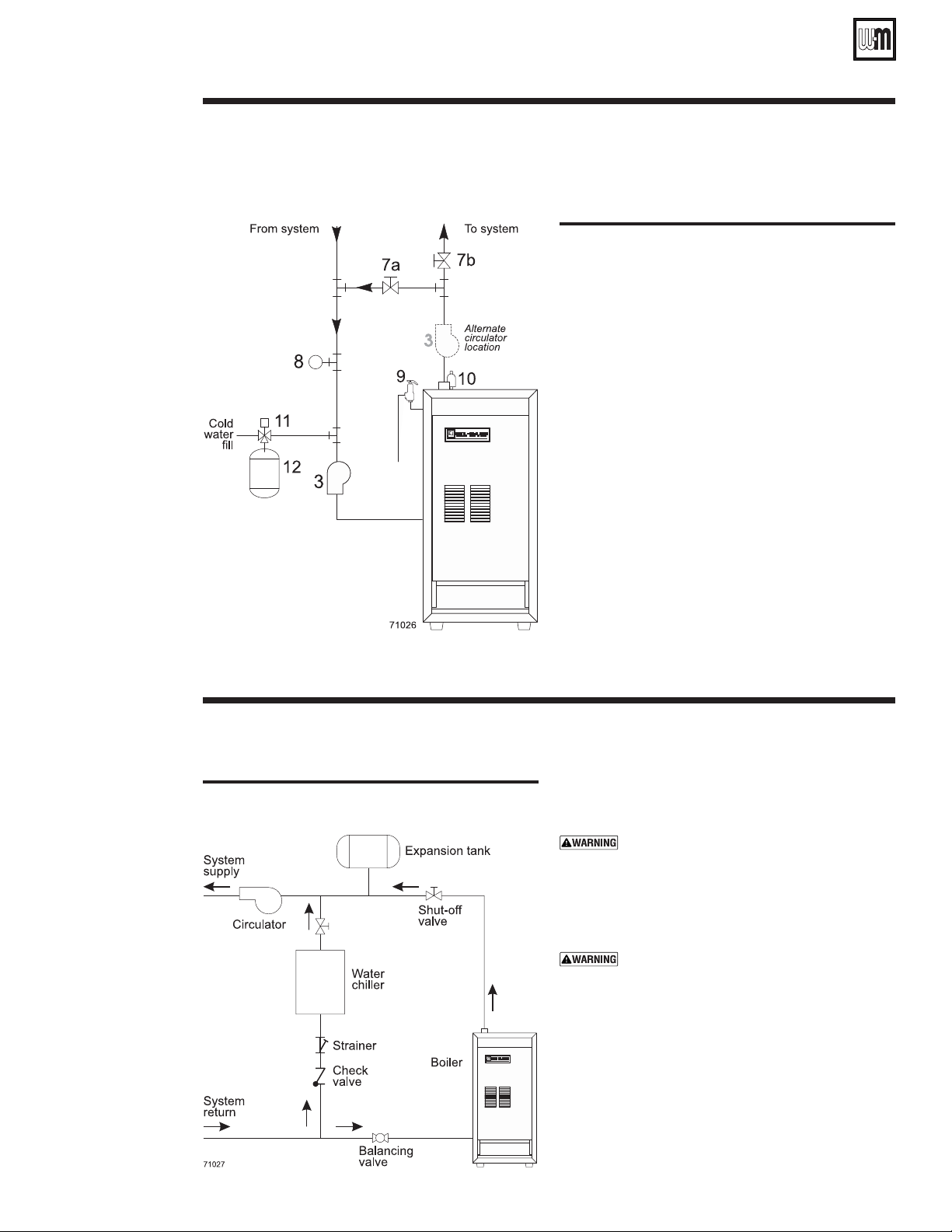
Part Number 550-142-302/0520
CGi
SERIES 4 — GAS-FIRED WATER BOILER — Boiler Manual
29
Piping — low temperature systems (continued)
4d
3 System or zone circulator
7 System temperature valves (see instructions to the
left for adjusting valves)
8 Blend temperature gauge
9 Relief valve
10 Automatic air vent (with diaphragm-type expan-
sion tank), or connect to tank fitting (closed-type
expansion tank). DO NOT use an automatic air vent
when using closed-type expansion tank. It would
allow air to leave the system, causing waterlogging
of the expansion tank.
11 Fill valve
12 Diaphragm-type or bladder-type expansion tank,
if used (For closed-type expansion tank, pipe from
top of air separator to tank fitting as in Figure 17,
page 21.)
Figure 24 System-bypass piping — Zoning with
zone valve or circulators, return water
130°F or higher — (Alternative to boiler-
bypass piping Figures 22 and 23)
Figure 25 Piping refrigeration systems
4e
Water piping — refrigeration system
Prevent chilled water from
entering boiler
Install boiler so that chilled medium is piped
in parallel with the heating boiler. Use ap-
propriate valves to prevent chilled medium
from entering boiler. See Figure 18 for typi-
cal installation of balancing valve and check
valve.
If boiler is connected to heating coils located
in air handling units where they can be ex-
posed to refrigerated air, use flow control
valves (see Figure 25) or other automatic
means to prevent gravity circulation during
cooling cycle.
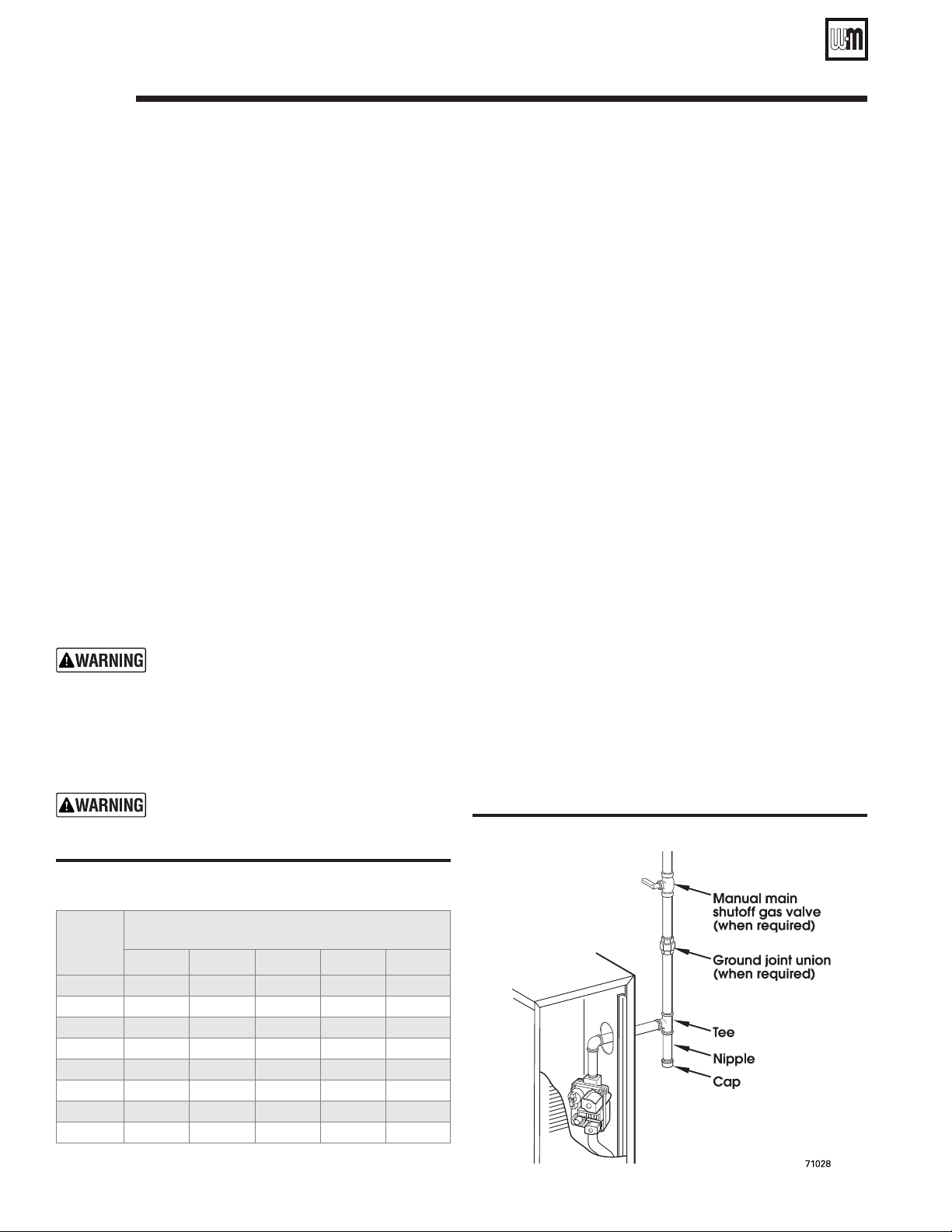
Part Number 550-142-302/0520
CGi
SERIES 4 — GAS-FIRED WATER BOILER — Boiler Manual
30
Gas piping5
Table 7 Pipe capacity for 0.60 specific gravity natural gas
Natural Gas:
1. Refer to Table 7 for pipe length and diameter. Base on rated
boiler input (divide by 1,000 to obtain cubic feet per hour).
Table 7 is only for gas with specific gravity 0.60, with a
pressure drop through the gas piping of 0.30” w.c.
For
additional gas pipe sizing information, refer to ANSI Z223.1/
NFPA 54 – latest edition (or B149.1 or B149.2 for Canadian
Natural Gas and Propane Installation Code).
2. Inlet pressure required at gas valve inlet:
• Maximum: 13” w.c.
• Minimum: 5” w.c.
• Manifold gas pressure: 3.5” w.c.
3. Install 100% lockup gas pressure regulator in supply line
if
inlet pressure exceeds 13” w.c.
Adjust for 13” w.c. maxi-
mum.
Propane Gas:
1. Contact gas supplier to size pipes, tanks and 100% lockup
gas pressure regulator.
2. Adjust propane supply regulator provided by gas supplier for
13” w.c. maximum pressure.
3. Inlet pressure required at gas valve inlet:
• Maximum: 13” w.c.
• Minimum: 11” w.c.
• Manifold gas pressure: 10” w.c.
Connecting gas supply piping to
boiler
1. Remove jacket front panel and refer to Figure 26 to pipe gas
to boiler.
a.
Install drip leg at inlet of gas connection to boiler.
Where local utility requires drip leg to be extended to
the floor, use appropriate length of pipe between cap
and tee.
b.
Install ground joint union for servicing, when re-
quired.
c.
Install manual shutoff valve in gas supply piping out-
side boiler jacket when required by local codes or utility
requirements.
d.
In Canada — When using manual main shutoff valve, it
must be identified by the installer.
2.
Support piping with hangers, not by boiler or its accessories.
3. Purge all air from gas supply piping.
4. Before placing boiler in operation,
check boiler and its gas
connection for leaks
.
a.
Close manual main shutoff valve during any pressure
testing at less than 13” w.c.
b.
Disconnect boiler and gas valve from gas supply
piping
during any pressure testing greater than 13” w.c.
Do not check for gas leaks with an open
flame
— use bubble test. Failure to use bubble
test or check for gas leaks can cause severe
personal injury, death or substantial property
damage.
5.
Use pipe dope compatible with propane gases. Apply
sparingly only to male threads of pipe joints so that pipe dope
does not block gas flow.
Failure to apply pipe dope as detailed above
can result in severe personal injury, death or
substantial property damage.
Figure 26 Gas supply piping
Gas pipe
length
(feet)
Capacity of pipe for pipe size of:
(Capacity in cubic feet gas per hour)
½” ¾” 1” 1¼” 1½”
10 132 278 520 1050 1600
20 92 190 350 730 1100
30 73 152 285 590 860
40 63 130 245 500 760
50 56 115 215 440 670
75 45 93 175 360 545
100 38 79 150 305 460
150 31 64 120 250 380
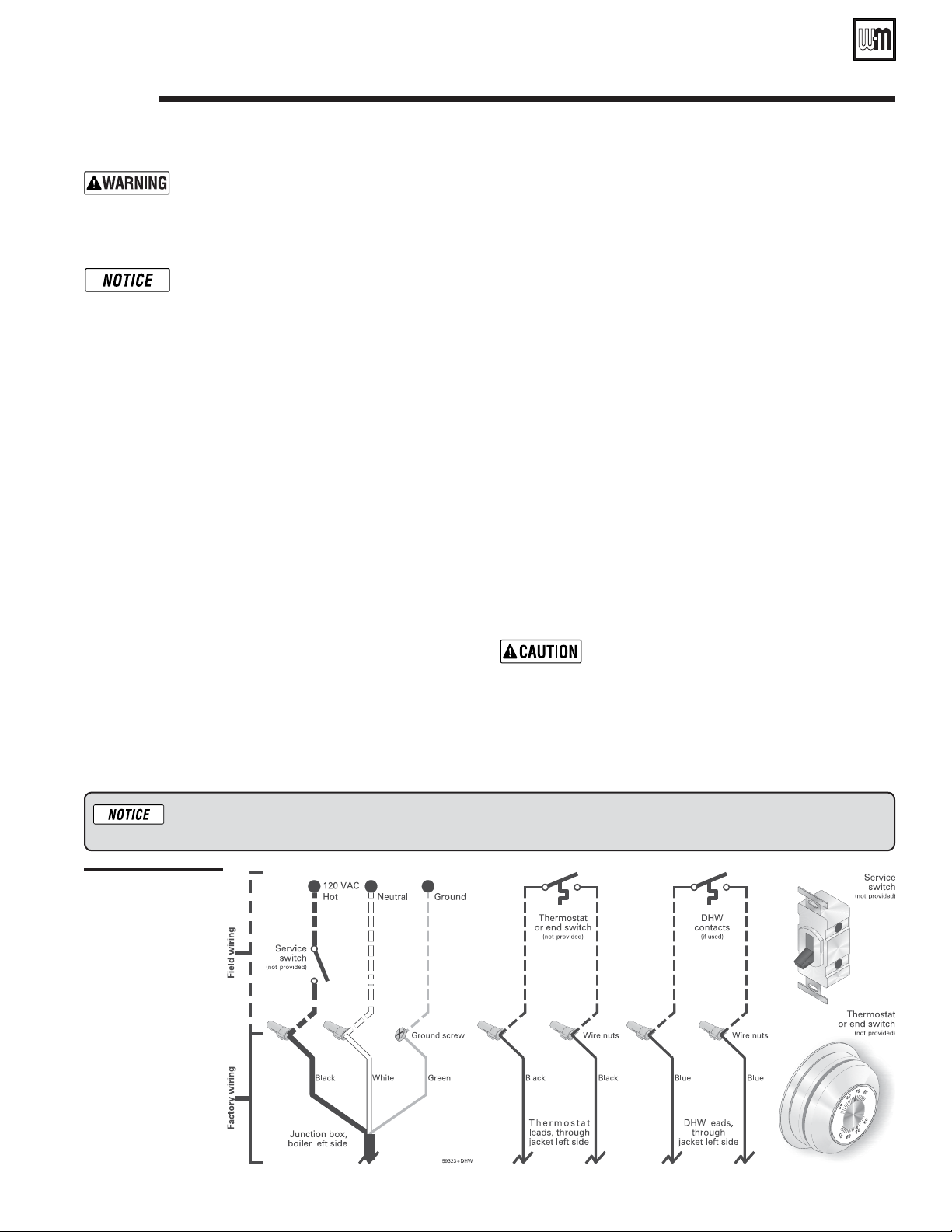
Part Number 550-142-302/0520
CGi
SERIES 4 — GAS-FIRED WATER BOILER — Boiler Manual
31
Field wiring
6
Figure 27
Field wiring connec-
tions —
service switch,
DHW
(if used) and
thermostat
(or end switch)
provided by installer
For your safety, turn off electrical power supply
at service entrance panel before making any
electrical connections
to avoid possible electric
shock hazard. Failure to do so can cause severe
personal injury or death.
Wiring must be N.E.C. Class 1.
If original rollout thermal fuse element wire as
supplied with boiler must be replaced, use only
type
200°C wire or equivalent. If other original
wiring as supplied with boiler must be replaced,
type 105°C wire or equivalent must be used.
Boiler must be
electrically grounded as required
by National Electrical Code ANSI/NFPA 70 –latest
edition.
Electrical installation must comply
with:
1. National Electrical Code ANSI/NFPA 70 – latest edition
and any other national, state, provincial or local codes
or regulations.
2. In Canada, CSA C22.1 Canadian Electrical Code Part 1, and
any local codes.
Wiring connections
Boiler is shipped with controls completely wired.
Thermostat
1. Connect thermostat as shown on wiring diagram on boiler.
2. Install on inside wall away from influences of drafts, hot
or cold water pipes, lighting fixtures, television, sun rays,
or fireplaces.
3. If thermostat has a heat anticipator, set heat anticipator in
thermostat to match power requirements of equipment con-
nected to it. If connected directly to boiler, set for 0.1 amps
plus gas valve current. See information on wiring diagram
as shown in
Figure 32, page 39. For other devices, refer to
manufacturer’s specifications. Wiring diagram on boiler gives
setting for control module and gas valve. Also see instructions
with thermostat.
DHW
Connect DHW aquastat as shown in wiring below. Economy
function isn’t utilized with DHW input.
Junction Box (furnished)
1. Connect 120 VAC power wiring as shown in Figure 27.
2. Fused disconnect or service switch (15 amp. recommended)
may be mounted on this box. For those installations with
local codes which prohibit installation of fused disconnect
or service switch on boiler, install a 2 x 4 cover plate on the
boiler junction box and mount the service switch remotely
as required by the code.
Wiring multiple zones
Refer to zone valve manufacturer’s literature for wiring and ap-
plication. A separate transformer is required to power zone valves.
Zoning with circulators requires a relay for each circulator.
DO NOT connect directly from 3-wire zone
valves to the T-T terminals on the boiler
.
When using 3-wire zone valves, install an isolation
relay. Connect the zone valve end switch wires to
the isolation relay coil. Connect the isolation relay
contact across the boiler T-T terminals. Failure to
comply can result in damage to boiler components
or cause unreliable operation, resulting in severe
property damage.
The CGi control module is polarity-sensitive. The hot and neutral wires must be connected to the correct leads.
A flashing POWER light usually indicates reversed polarity of 120 VAC lead wires.

Part Number 550-142-302/0520
CGi
SERIES 4 — GAS-FIRED WATER BOILER — Boiler Manual
32
Check for gas leaks
Before starting the boiler, and dur-
ing initial operation, smell near the
floor and around the boiler for gas
odorant or any unusual odor. Do
not proceed with start-up if there is
any indication of a gas leak. Repair
any leak at once.
Propane boilers only — Your pro-
pane supplier mixes an odorant with
the propane to make its presence
detectable. In some instances, the
odorant can fade and the gas may
no longer have an odor.
• Propane gas can accumulate at
floor level. Smell near the floor
for the gas odorant or any un-
usual odor. If you suspect a leak,
do not attempt to light the pilot.
• Use caution when attempting
to light the propane pilot. This
should be done by a qualified
service technician, particularly
if pilot outages are common.
• Periodically check the odorant
level of your gas.
• Inspect boiler and system at least
yearly to make sure all gas piping
is leak-tight.
• Consult your propane supplier
regarding installation of a gas
leak detector. There are some
products on the market intended
for this purpose. Your supplier
may be able to suggest an appro-
priate device.
Determine if water treatment is needed
Do not use petroleum-based cleaning or sealing
compounds
in boiler system. Severe damage to boiler
will occur, resulting in substantial property damage.
Eliminate all system leaks. Continual fresh makeup
water will reduce boiler life. Minerals can build up in
sections, reducing heat transfer, overheating cast iron,
and causing section failure.
Verify water chemistry
Consult local water treatment companies for unusually hard water areas
(above 7 grains hardness) or low pH water conditions (below 7.0). Boiler
water pH of 7.0 to 8.5 is recommended.
Freeze protection (when used)
Use antifreeze made especially for hydronic systems. Inhibited propylene
glycol is recommended.
Do not use ethylene glycol, automotive or undiluted
antifreeze
. Severe personal injury or death can result.
1. Determine
antifreeze quantity according to system water content.
Boiler water content is listed on page 70. Remember to include expan-
sion tank water content.
2. Follow antifreeze manufacturer’s instructions.
3. A 50% solution of propylene glycol/water provides maximum protec-
tion to about -30°F.
4. Local codes may require
back flow preventer or actual disconnect from
city water supply.
5. When using antifreeze in a system with automatic fill, install a water
meter to monitor water makeup. Glycol will leak before the water be-
gins to leak, causing glycol level to drop. Added water will dilute the
antifreeze, reducing the freeze protection level.
Start-up — preparation
7a
Part Number 550-142-302/0520
CGi
SERIES 4 — GAS-FIRED WATER BOILER — Boiler Manual
33
Start-up — preparation (continued)
7a
Fill the system with water
1. Close manual and automatic air vents and boiler drain cock.
2.
Fill to correct system pressure. Correct pressure will vary with each
application. Typical cold water fill pressure for a residential system is
12 psi.
3.
Purge air from system:
a. Connect a hose to the purge valve (see drain valves, item
6, in
suggested piping diagrams on pages 23 through 27, Figure 18
through Figure 23). Route hose to an area where water can drain
and be seen.
b. Close the boiler or system isolation valve between the purge
valve and fill connection to the system.
c. Close zone isolation valves.
d. Open quick-fill valve on cold water makeup line.
e. Open purge valve.
f. One zone at a time, open the isolation valves. Allow water to run
through the zone, pushing out the air. Run until no noticeable
air flow is present. Close the zone isolation valves and proceed
with the next zone. Follow this procedure until all zones are
purged.
g. Close the quick-fill water valve and purge valve and remove the
hose. Open all isolation valves. Watch that system pressure rises
to correct cold-fill pressure.
h. After the system has operated for a while, eliminate any residual
air by using the manual air vents located throughout the system.
i. If purge valves are not installed in system, open manual air vents
in system one at a time, beginning with lowest floor. Close vent
when water squirts out. Repeat with remaining vents.
4. Open
automatic air vent (diaphragm-type or bladder-type expansion
tank systems only) one turn.
5. Open other vents:
a. Starting on the lowest floor, open air vents one at a time until
water squirts out.
b. Repeat with remaining vents.
6. Refill to correct pressure.
Inspect system water piping
After filling the boiler and system with water, inspect all
piping
throughout the system for leaks. If found, repair
immediately. Repeat this inspection after the boiler has
been started and the system has heated up.
Leaks must be repaired at once.
Failure to do so can damage the
boiler, resulting in substantial prop-
erty damage.
Do not use petroleum-based
cleaning or sealing compounds
in boiler system. Severe damage to
boiler will occur, resulting in sub-
stantial property damage.
Inspect base insulation
The boiler contains ceramic fiber
and fiberglass materials. Use care
when handling these materials
per instructions on page 71 of this
manual. Failure to comply could
result in severe personal injury.
Failure to replace damaged insu-
lation or reposition insulation can
result in a fire hazard, causing severe
personal injury, death or substantial
property damage.
Check to make sure
base insulation is secure against
all four sides of the base. If insulation is damaged or
displaced,
do not operate boiler. Replace or reposition
insulation.
Part Number 550-142-302/0520
CGi
SERIES 4 — GAS-FIRED WATER BOILER — Boiler Manual
34
Start-up — operate boiler
7b
If you discover evidence of any gas
leak, shut down the boiler at once. Find
the leak source with bubble test and
repair immediately. Do not start boiler
again until corrected. Failure to comply
could result in severe personal injury,
death or substantial property damage.
Eliminate all system leaks. Continual
fresh makeup water will reduce boiler life.
Minerals can build up in sections, reducing
heat transfer, overheating cast iron, and
causing section failure.
Glycol or antifreeze leaks around the
boiler may result in fire, causing severe per-
sonal injury, death or substantial property
damage.
Do not use petroleum-based cleaning
or sealing compounds
in boiler system.
Severe damage to boiler will occur, result-
ing in substantial property damage.
DO NOT proceed with boiler operation unless boiler and system have been filled with water and all instructions
and procedures of previous manual sections have been completed. Failure to do so could result in severe personal
injury, death or substantial property damage. Before starting the boiler, do the following:
• Read manual Section 9 and the Operating instruction procedure applicable for the gas valve supplied on
the boiler (Section
9c).
• Verify the boiler and system are full of water.
• Verify the Start-up preparation procedures of Section 7 have been completed.
Adjust boiler control settings
BOILER OPERATING TEMPERATURE
With power turned on, control module receives a signal from
the temperature/LWCO sensor and displays boiler temperature.
The control knob labeled BOILER TEMP is used to adjust the
operating temperature setpoint, turning clockwise to increase
temperature setting and counterclockwise to decrease. When the
knob is turned to adjust temperature the display will brighten to
indicate adjustment mode. After temperature is set to desired
value, display will dim after approximately 5 seconds to indicate
measurement mode.
• ADJUST BOILER OPERATING TEMPERATURE TO
DESIRED SETPOINT.
BOILER ECONOMY SETTING
To comply with Department of Energy regulations, the control
module circulates available hot water before turning on the boiler
to attempt to satisfy a call for heat. While attempting to satisfy the
heat demand, the control also monitors the boiler temperature
changes via the temperature/LWCO sensor. It then determines
whether the available hot water will satisfy the demand and
adjusts the time delay to turn on the boiler until it determines
that additional heat will be needed. The knob labeled ECONOMY
ADJUST provides an adjustment between maximize (MAX) and
minimize (MIN) time delay. The maximum (MAX) adjustment
position should be used to maximize energy savings. Turning the
knob counterclockwise decreases the delay time and should only
be used in the event that the heated space becomes uncomfortable.
• ADJUST ECONOMY TO DESIRED POSITION.
IMPORTANT
In accordance with Section 325 (f) (3) of the Energy Policy
and Conservation Act, this boiler is equipped with a feature
that saves energy by reducing the boiler water temperature
as the heating load decreases. This feature is equipped with
an override which is provided primarily to permit the use of
an external energy management system that serves the same
function.
THIS OVERRIDE MUST NOT BE USED UNLESS AT LEAST
ONE OF THE FOLLOWING CONDITIONS IS TRUE:
• An external energy management system is installed that
reduces the boiler water temperature as the heating load
decreases.
• This boiler is part of a modular or multiple boiler system
having a total input of 300,000 BTU/hr or greater.
• This boiler is equipped with a tankless coil.
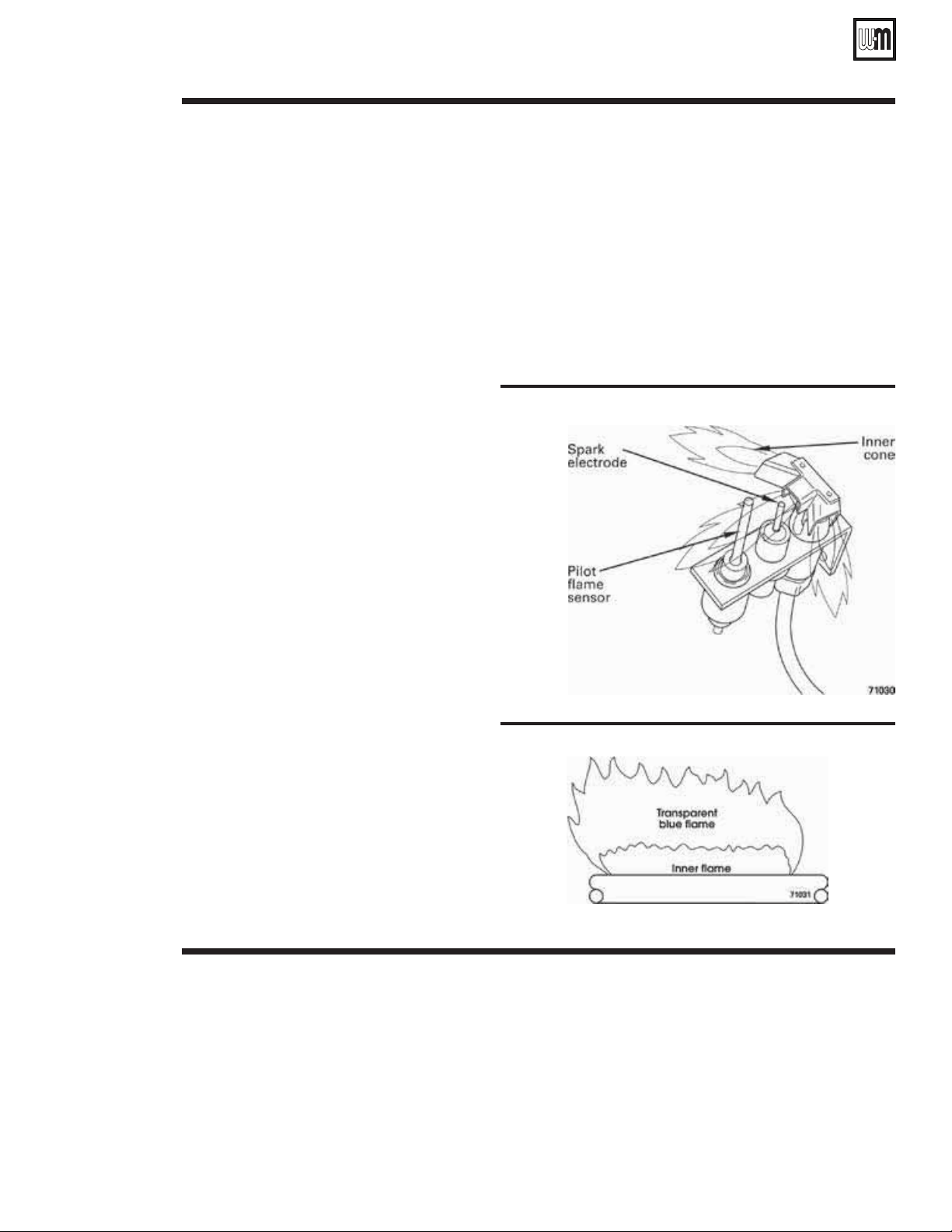
Part Number 550-142-302/0520
CGi
SERIES 4 — GAS-FIRED WATER BOILER — Boiler Manual
35
Start the boiler
• Follow the Operating instructions from Section 9c to start
the boiler.
• See Section 7c if boiler fails to start.
Check system and boiler
1. Check system piping for leaks. If found, shut down boiler
and repair immediately.
2.
Vent air from system using manual vents. Air in the system
will interfere with circulation and cause heat distribution
problems and noise.
3. Inspect vent system thoroughly for signs of deterioration
from corrosion, physical damage or sagging. In addition —
Check for gas-tight seal at every connection and seam.
Venting system must be sealed gas-tight to prevent flue gas
spillage and carbon monoxide emissions which
will result in severe personal injury or death.
4.
Check around the boiler for gas odor following the procedure
of Section 7a of this manual.
5. Verify operation per Section 7b. Perform check-out pro-
cedure in Section 8, and fill in the Installation and service
certificate
on the same page.
Start-up — operate boiler (continued)
7b
Check burner flames
View pilot and main flames through the inspection port in the
base burner shield.
Pilot burner flame (Figure 28)
PROPER pilot flame characteristics
1. Blue flame.
2. Inner cone engulfing pilot flame sensor.
3. Pilot flame sensor glowing cherry red.
IMPROPER pilot flame characteristics
1. Overfired — Large flame lifting or blowing past pilot
flame sensor.
2. Underfired — Small flame. Inner cone not engulfing
pilot flame sensor.
3. Lack of primary air — Yellow flame tip.
4. Incorrectly heated pilot flame sensor.
Figure 28 Typical pilot burner flame
Figure 29 Typical main burner flame
Main burner flame (Figure 29)
PROPER main burner flame characteristics
1. Yellow-orange streaks may appear (caused by dust).
IMPROPER main burner flame characteristics
1. Overfired — Large flames.
2. Underfired — Small flames.
3. Lack of primary air — Yellow tipping on flames
(sooting will occur).
Check for:
7c
4. Gas not turned on at meter or boiler?
5. Incoming gas pressure less than:
5” w.c. for natural gas? 11” w.c. for propane gas?
6. If none of the above corrects the problem, refer to
Troubleshoot-
ing
, section 11 of this manual.
1. Loose connections, blown fuse or ser-
vice switch off?
2. High limit switch set below boiler water
temperature?
3. Thermostat set below room tempera-
ture?
Start-up — if boiler doesn’t start . . .
Part Number 550-142-302/0520
CGi
SERIES 4 — GAS-FIRED WATER BOILER — Boiler Manual
36
Check-out procedure — checklist
8
❏ Boiler and heat distribution units filled with water?
❏ Automatic air vent, if used, open one full turn?
❏ Air purged from system?
❏ Air purged from gas piping? Piping checked for leaks?
❏ Correctly sized manifold orifices installed? Refer to
Table 2,
page 12, to check size and fuel type.
Correctly sized manifold orifices must be used.
Failure to do so will cause severe personal injury,
death or substantial property damage.
❏ Followed operating instructions on boiler or in manual
Section
9 for proper start-up?
❏ Proper burner flame observed? Refer to Check burner flame,
manual Section 7b.
❏
Test temperature limit — While burners are operating, turn
Boiler Temp adjustment knob counterclockwise until display
reading is below actual boiler water temperature. Burners
should go off while circulator continues to operate. Turn
Boiler Temp adjustment knob clockwise until display read-
ing is above boiler water temperature and ignition sequence
should resume.
❏ Test low water cut off – While burners are operating, press
and hold “LWCO TEST” button on control. Burners should
go off while circulator continues to operate and LWCO light
should turn ON. Release “LWCO TEST” button and ignition
sequence should resume.
❏ Test field-installed controls — If the boiler has an additional
low water cutoff, additional high limit or other controls, test
for operation as outlined by manufacturer. Burners should
be operating and should go off when controls are tested.
When controls are restored, burners should reignite.
❏ Test ignition system safety device:
a. Connect manometer to outlet side of gas valve.
b. Start boiler, allowing for normal start-up cycle to
occur and main burners to ignite.
c. With main burners on, manually shut off gas supply at
manual main shutoff gas valve. Burners should go off.
d. Open manual main shutoff gas valve. Manometer
should confirm there is no gas flow.
e. Pilot will relight, flame sensing element will sense pilot
flame and main burners will reignite.
❏ Set limit control(s) to system temperature requirements.
Adjust balancing valves and controls to provide design
temperature to system.
❏ Set Economy mode.
❏ For multiple zones, adjust flow so it is about the same in
each zone.
❏ Verify thermostat heat anticipator (if available) set
properly? Refer to
Field wiring, manual Section 6, page 31,
Thermostat(s).
❏ Cycle boiler with thermostat — Raise to highest setting and
verify boiler goes through normal start-up cycle. Lower to
lowest setting and verify boiler goes off.
❏ Cycle DHW Aquastat if used.
❏ Measure natural gas input:
a. Operate boiler 10 minutes.
b. Turn off other appliances.
c. At natural gas meter, measure time (in seconds) re-
quired to use one cubic foot of gas.
d. Calculate gas input:
3600 x 1000
number of seconds from step c
= Btuh
e. Btuh calculated should approximate input rating on
boiler rating label.
❏ Check manifold gas pressure by connecting manometer to
downstream test tapping on main gas valve. Manifold pres-
sure for natural gas should be 3.5" w.c. and for propane gas
should be 10" w.c.
❏ Observe several operating cycles for proper operation.
❏ Set room thermostat to desired room temperature.
❏ Fill in Installation and service certificate below?
❏ Review all instructions shipped with this boiler with owner
or maintenance person. Return instructions to envelope and
give to owner or place in pocket inside front panel in boiler.
Installation and service certificate
Boiler model ______________ Series ________ Consumer Protection number ___________ Date installed ___________
Measured Btuh input ____________________
Installer ________________________ ________________________________ ________________________
(company) (address) (phone)
Installer’s signature: _____________________________________
❏ Installation instructions have been followed.
❏ Check out sequence has been performed.
❏ Above information is certified to be correct.
❏ Information received and left with owner/maintenance person

Part Number 550-142-302/0520
CGi
SERIES 4 — GAS-FIRED WATER BOILER — Boiler Manual
37
Operation — sequence
9a
Department of Energy – Compliance
9
1. Read Operating instructions on page 41. This information
is also located on a label on the inside of the boiler jacket door
panel.
2. Raise room thermostat to call for heat.
a. While attempting to satisfy the heat demand, the
control module monitors the boiler temperature
changes via the water temperature sensor and deter-
mines whether or not the available hot water will
satisfy the demand, only running the circulator.
If additional heat is needed, the sequence continues.
When DHW (if used) calls for heat, sequence above
is bypassed.
3. Circulator energizes. If limit circuit is closed, the inducer
starts. After pressure switch proves proper airflow, control
module initiates 10-second prepurge.
4. Control module sparks the pilot and opens pilot valve in
main gas valve.
a. If pilot does not light within 15 seconds, pilot valve
is closed and spark generator is turned off. Control
module initiates a 15-second postpurge, then starts a
new cycle.
b. If pilot does light and control module senses flame
current, spark generator is turned off and main valve
opens.
5. During main burner operation:
a. Control module monitors pilot flame current. If signal
is lost, main valve closes, spark generator activates and
sequence returns to step 4.
b. If power is interrupted, control system shuts off pilot
and main gas valves and restarts at step 1 when power
is restored.
6. In the event the
limit control shuts down the boiler — The
control module closes the pilot and main gas valves, but keeps
the inducer operating for 15-second postpurge.
This boiler is equipped with a control system that automatically adjusts a time delay period to turn on the boiler
during a call for heat. This is accomplished by circulating available hot water in the system while measuring water
boiler water temperature changes. The control calculates a suitable delay based on temperature measurements
and turns the boiler on only after it determines that the demand for heat cannot be satisfied with the available hot
water.
Due to the wide variety of controls used in boiler installations, this control is also equipped with an adjustment
for the calculated time delay period (ECONOMY ADJUST). In the MIN position, the time delay is zero and the
IMPORTANT notice below must be observed:
IMPORTANT
In accordance with Section 325 (f) (3) of the Energy Policy and Conservation Act, this boiler is equipped with
a feature that saves energy by reducing the boiler water temperature as the heating load decreases. This feature
is equipped with an override which is provided primarily to permit the use of an external energy management
system that serves the same function.
THIS OVERRIDE MUST NOT BE USED UNLESS AT LEAST ONE OF THE FOLLOWING CONDITIONS IS TRUE:
• An external energy management system is installed that reduces the boiler water temperature as the heating load
decreases.
• This boiler is part of a modular or multiple boiler system having a total input of 300,000 BTU/hr or greater.
• This boiler is equipped with a tankless coil.
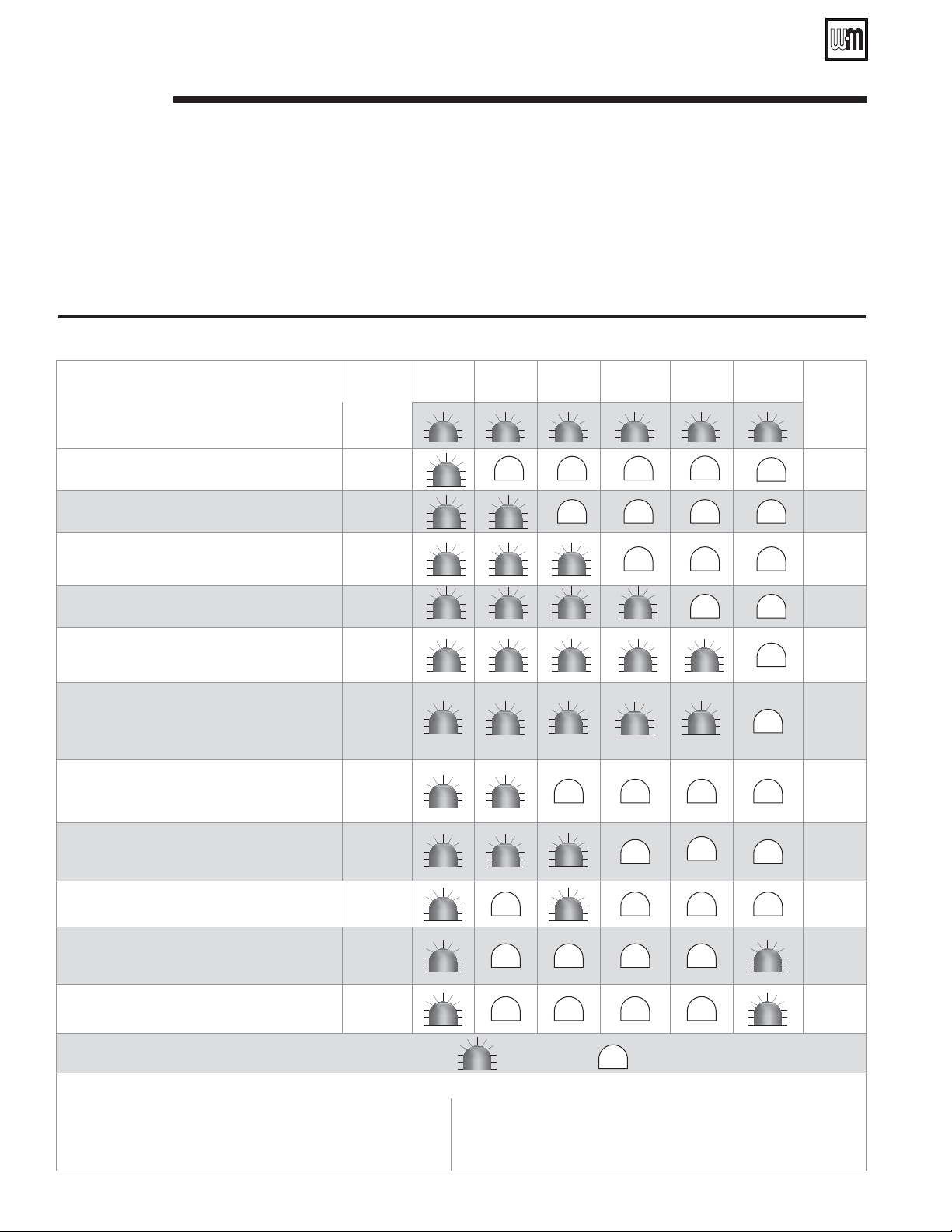
Part Number 550-142-302/0520
CGi
SERIES 4 — GAS-FIRED WATER BOILER — Boiler Manual
38
Operation — sequence (continued)
9a
— The circulator continues to operate.
7.
Lower room thermostat setting to stop call for heat. Thermostat is satisfied — Pilot and main gas valves are
closed — Inducer operates for 15-second postpurge — Circulator is shut off.
8. Boiler is now in the off cycle.
9. Repeat steps 1 through 6 several times to verify operation.
10.
Return the thermostat to normal setting.
11. Set thermostat heat anticipator setting as instructed in Figure 32, page 40.
Figure 30
STEPS
Call for
Heat?
POWER TSTAT
CIRC
LIMIT PURGE FLAME LWCO
Timing
1. Standby
• Waiting for call for heat
NO —
2. Call for heat
• Circulator on
YES —
3. Limit circuit
• Limit controls closed
• Rollout TFE contacts closed
YES
—
4. Inducer
• Inducer turns on
YES
—
5. Pressure circuit
• Pressure switch contacts closed
• Prepurge for 10 seconds
YES
35
sec
6. Flame proven *
• Gas valve open
• Ignitor remains on
• Boiler producing heat
YES
15
sec
7. Limit cycle
• Limit circuit open
• Gas valve closed
YES
—
8. Flame outage *
• Flame out
• Boiler recycles
YES
—
9. Thermostat satisfied
• Circulator off
NO
15
sec
10. Circulator exercise routine
• Circulator turns on for 30 seconds if
boiler not operated for 30 days
NO
30
sec
11. LWCO circuit
• LWCO circuit open
YES/NO —
= ON
= OFF
•
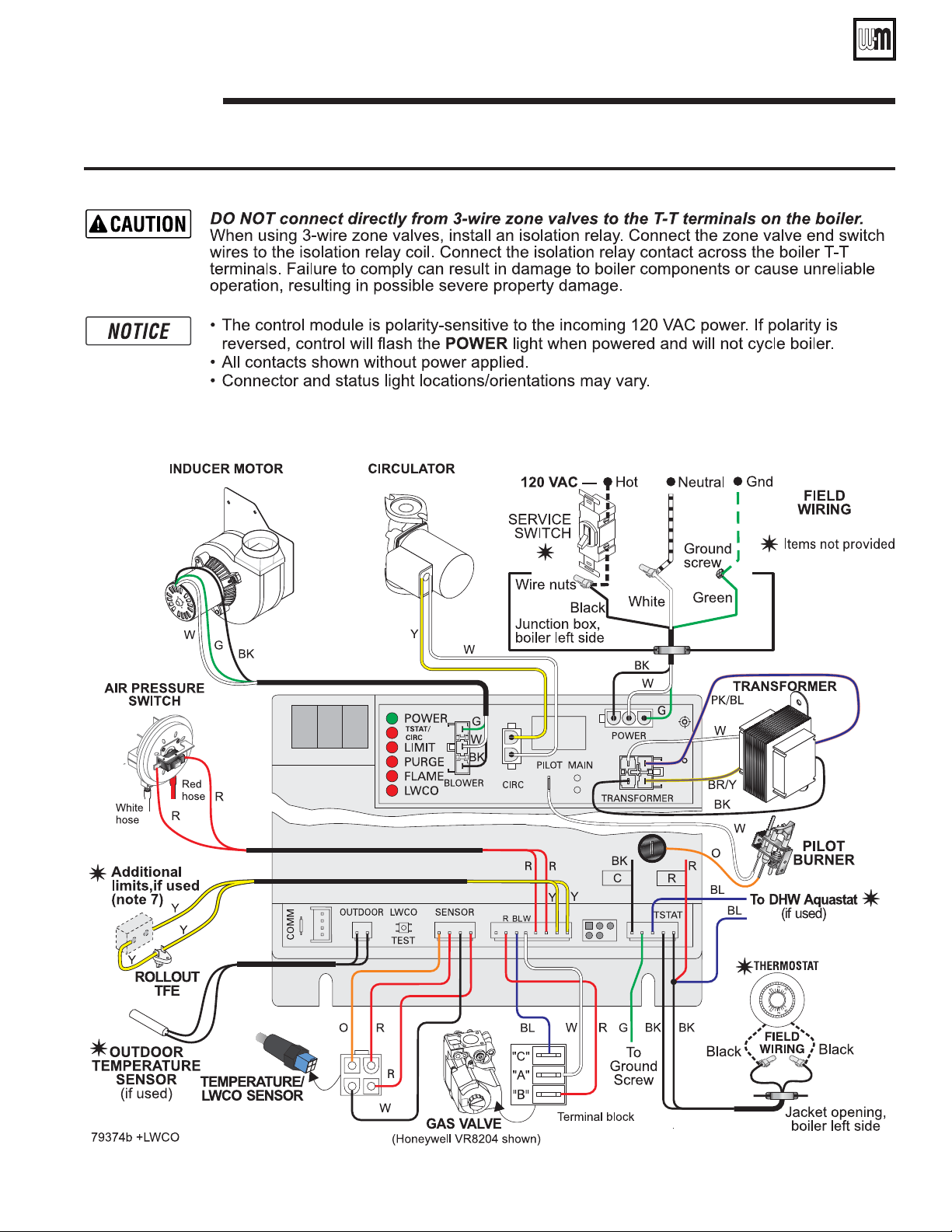
Part Number 550-142-302/0520
CGi
SERIES 4 — GAS-FIRED WATER BOILER — Boiler Manual
39
Operation — wiring diagrams
9b
Figure 31 Schematic wiring diagram
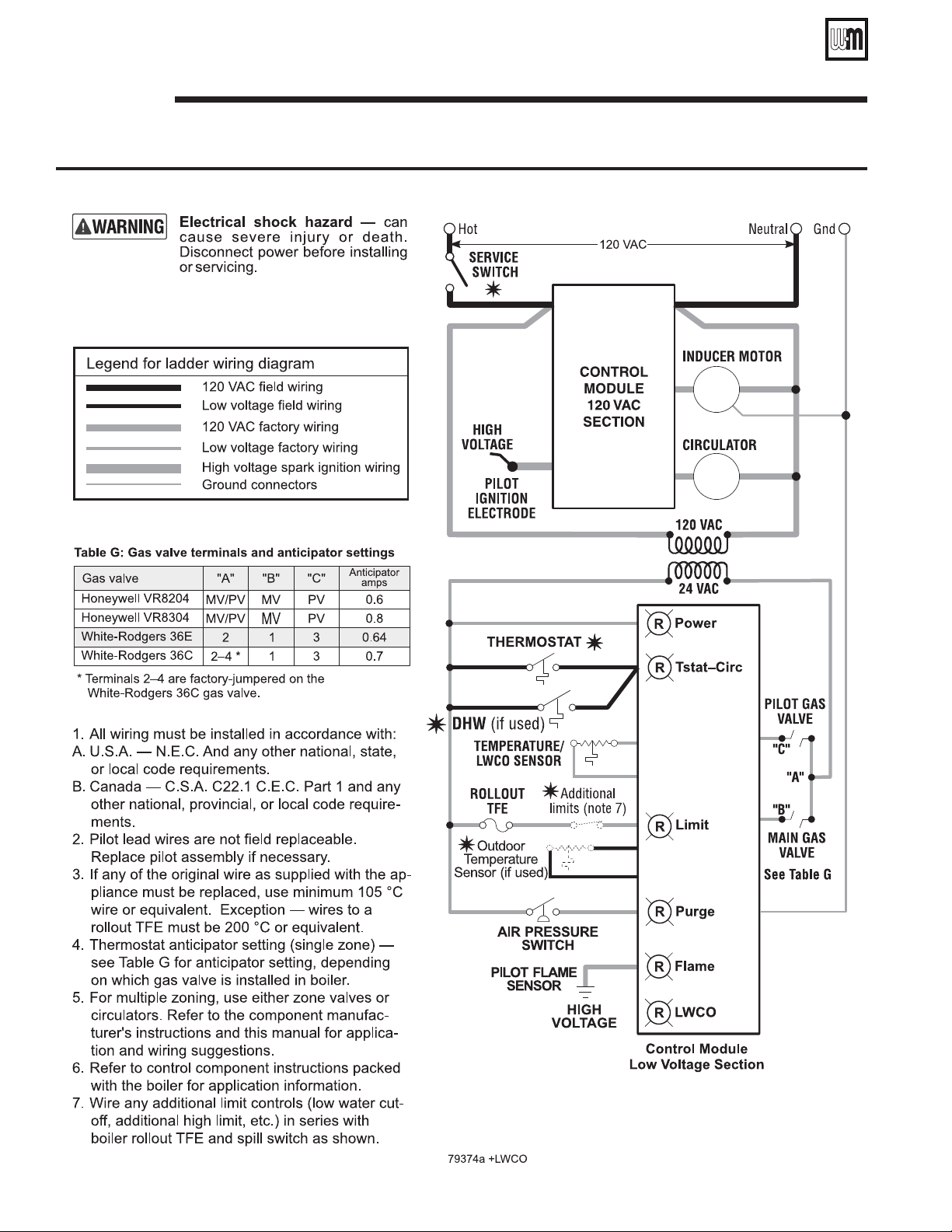
Part Number 550-142-302/0520
CGi
SERIES 4 — GAS-FIRED WATER BOILER — Boiler Manual
40
Operation — wiring diagrams (continued)
9b
Figure 32 Ladder wiring diagram
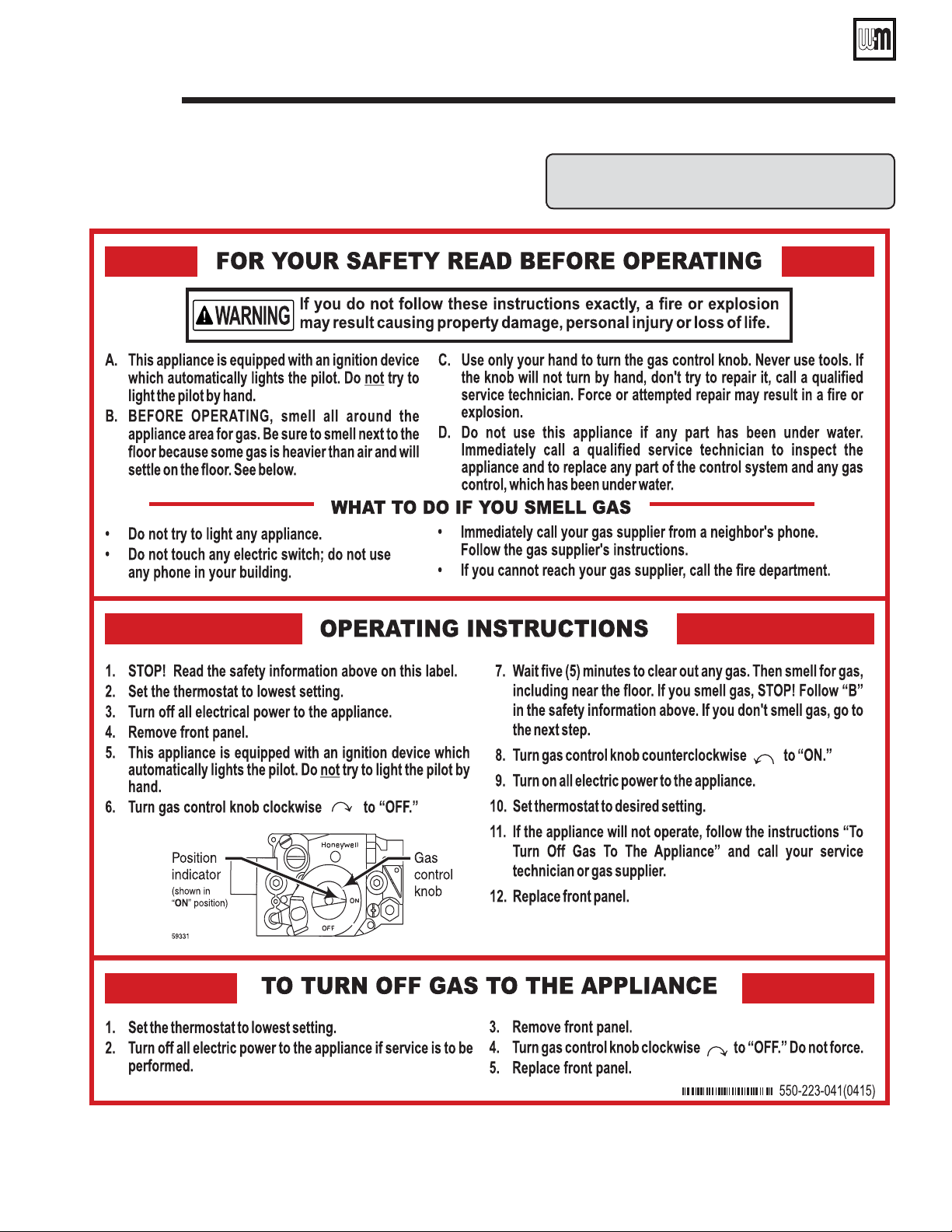
Part Number 550-142-302/0520
CGi
SERIES 4 — GAS-FIRED WATER BOILER — Boiler Manual
41
9c
Operating instructions
CGi-25 thru -6
• Spark pilot • Natural or propane gas
• Gas valve: Honeywell VR8204/VR8304
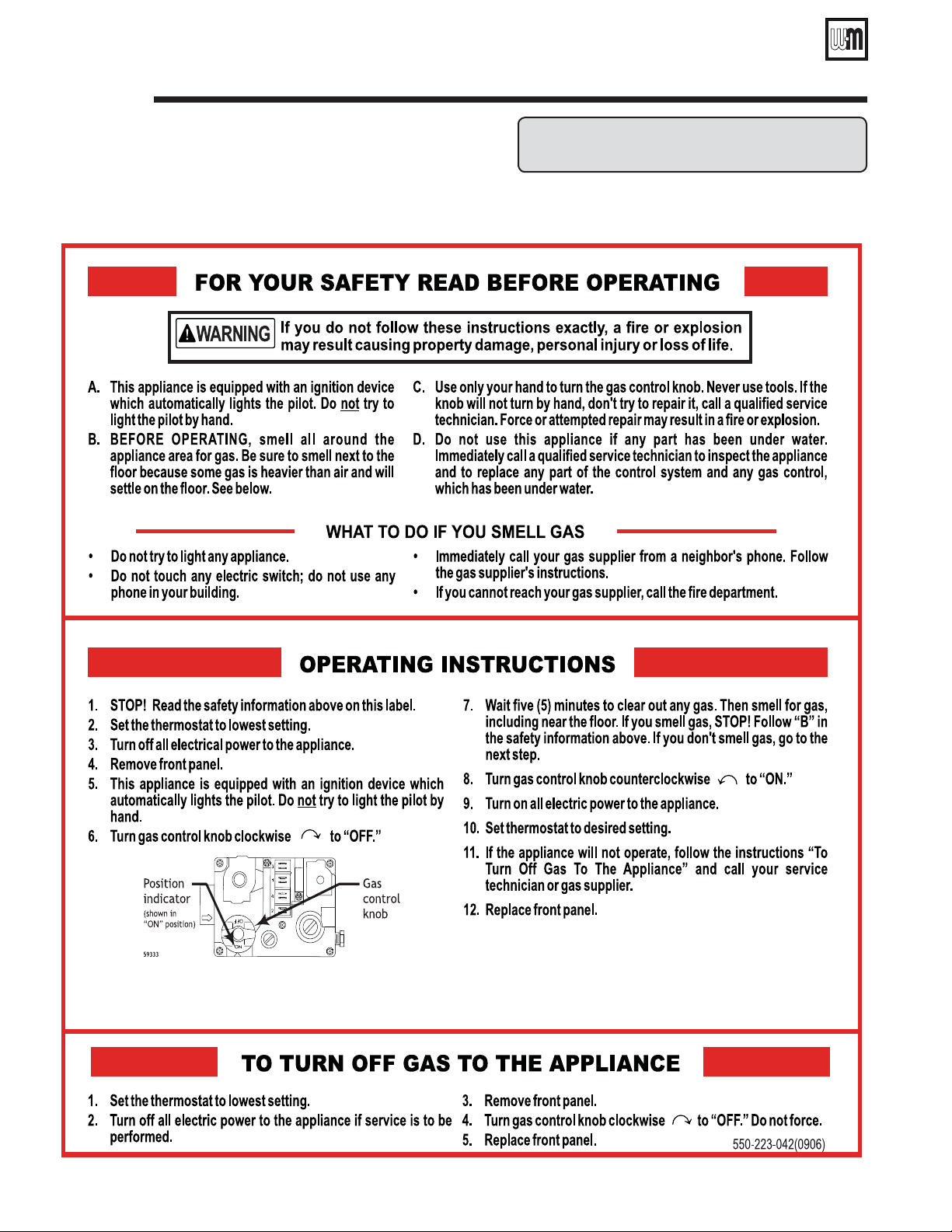
Part Number 550-142-302/0520
CGi
SERIES 4 — GAS-FIRED WATER BOILER — Boiler Manual
42
9c
Operating instructions
CGi-25 thru -6
• Spark pilot • Natural or propane gas
• Gas valve: White-Rodgers 36E
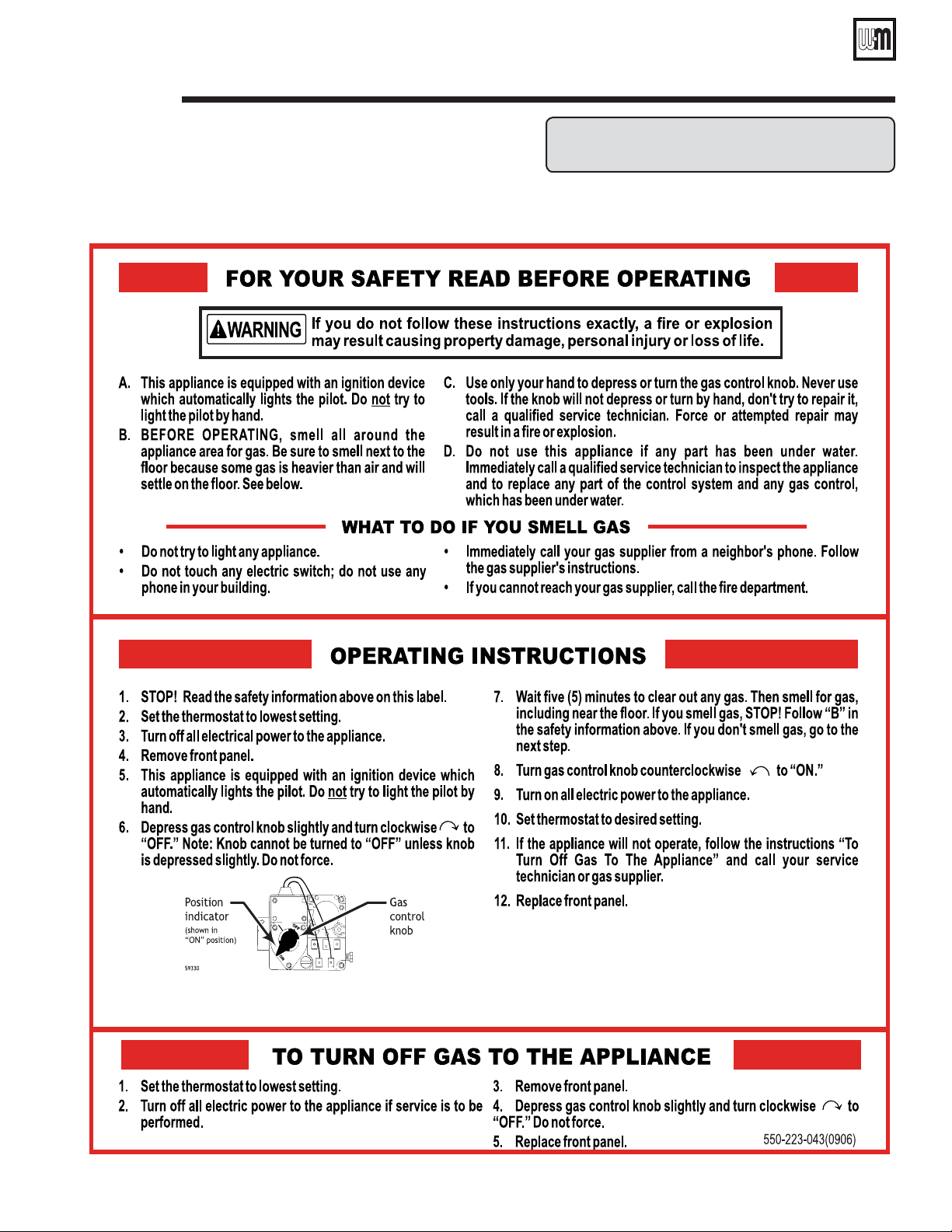
Part Number 550-142-302/0520
CGi
SERIES 4 — GAS-FIRED WATER BOILER — Boiler Manual
43
9c
Operating instructions
CGi-25 thru -8
• Spark pilot • Natural or propane gas
• Gas valve: White-Rodgers 36C
Part Number 550-142-302/0520
CGi
SERIES 4 — GAS-FIRED WATER BOILER — Boiler Manual
44
Service and maintenance — schedule
10a
Follow the Service and maintenance procedures given throughout this manual and in component
literature shipped with the boiler. Failure to perform the service and maintenance could result in
damage to the boiler or system. Failure to follow the directions in this manual and component
literature could result in severe personal injury, death or substantial property damage.
VERIFY PROPER OPERATION AFTER SERVICING
Service technician
(see following pages for instructions)
Owner maintenance
(see CGi User’s Information Manual for instructions)
A
NNUAL
START
-
UP
Inspect:
• Reported problems
• Boiler area
• Air openings
• Flue gas vent system (and air piping)
• Pilot and main burner flames
• Water piping
• Boiler heating surfaces
• Burners, base and inlet air box
• Condensate drain system
Service:
• Inducer motor
• Temperature/LWCO sensor
Start-up:
• Perform start-up per manual
Check/test:
• Gas piping
• Cold fill and operating pressures
• Air vents and air elimination
• Limit controls and cutoffs
• Expansion tank
• Boiler relief valve
Review:
• Review with owner
Daily
• Check boiler area
• Check air openings
• Check boiler pressure
temperature gauge
Monthly
• Check boiler interior piping
• Check venting system
• Check air vents
• Check boiler relief valve
• Check condensate drain system
• Check automatic air vents (if
used)
Periodically
• Test low water cutoff
Every 6 months
• Oil inducer motor
• Operate relief valve
End of season
• Shut down procedure
Table 8 Service and maintenance schedules
Part Number 550-142-302/0520
CGi
SERIES 4 — GAS-FIRED WATER BOILER — Boiler Manual
45
10b
Service and maintenance — annual start-up
2. Verify that boiler vent discharge is clean and free
of obstructions
.
Flue gas vent system
1. Visually inspect entire flue gas venting system
for blockage, deterioration or leakage. Repair any
joints that show signs of leakage in accordance with
vent manufacturer’s instructions.
Failure to inspect for the above
conditions and have them repaired
can result in severe personal injury
or death.
Pilot and main burner flames
1. Visually inspect pilot burner and main burner
flames as directed under
Start-up, Section 7 of this
manual.
Water piping
1. Check the boiler interior piping and all system pip-
ing for signs of leaks.
2. Repair any leaks before proceeding.
Boiler heating surfaces
1. Disconnect the vent pipe at the boiler inducer outlet
connection after turning off power to the boiler.
2. Use a bright light to inspect the flue pipe interior
and inducer interior.
3. Inspect the boiler vent outlet area and heating sur-
faces by looking through the opening.
4. If the vent pipe or inducer interior show evidence
of soot, follow
Cleaning boiler heating surfaces
on page 48 to remove the flue collector and clean
the boiler if necessary after close inspection of boiler
heating surfaces. If there is evidence of rusty scale
deposits, check the water piping and control system
to make sure the boiler return water temperature is
properly maintained (per this manual).
5. Reconnect vent to inducer outlet and replace all
boiler components before returning to service.
6. Check inside and around boiler for evidence of any
leaks from the boiler. If found, locate source of leaks
and repair.
❏ Inspect . . .
Reported problems
Inspect any problems reported by owner and correct before proceeding.
Boiler area
1. Verify that boiler area is free of any combustible materials, gasoline
and other flammable vapors and liquids.
2. Verify that boiler area (and air intake) is free of any of the
contaminants
listed in Table 1 on page 9 of this manual. If any of these are present
in the boiler intake air vicinity, they must be removed. If they cannot
be removed, isolate the boiler and provide outside combustion air. See
national, provincial or local codes for further information.
Air openings
1. Verify that combustion and ventilation air openings to the boiler room
and/or building are open and unobstructed.
The boiler should be inspected and started annu-
ally
, at the beginning of the heating season, only by a
qualified service technician
. In addition, the main-
tenance and care of the boiler designated in Table 8,
page 44, and explained on the following pages must
be performed to assure maximum boiler efficiency
and reliability. Failure to service and maintain the
boiler and system could result in equipment failure.
Eliminate all system or boiler leaks. Continual
fresh makeup water will reduce boiler life. Minerals
can build up in sections, reducing heat transfer, over-
heating cast iron, and causing section failure. Leaking
water may also cause severe property damage.
Do not use petroleum-based cleaning or sealing
compounds
in boiler system. Severe damage to
boiler will occur, resulting in substantial property
damage.
Electrical shock hazard — Turn off power to the
boiler before any service operation
on the boiler
except as noted otherwise in this instruction manual.
Failure to turn off electrical power could result in
electrical shock, causing severe personal injury or
death.
Part Number 550-142-302/0520
CGi
SERIES 4 — GAS-FIRED WATER BOILER — Boiler Manual
46
10b
Service & maintenance – annual start-up (cont.)
❏ Inspect . . .
Burners and base
The boiler contains ceramic fiber and fi-
berglass materials. Use care when han-
dling these materials per instructions
on page 71 of this manual. Failure to
comply could result in severe personal
injury.
If insulation is damaged or displaced,
do not operate the boiler. Replace or
reposition insulation as necessary. Fail-
ure to replace damaged insulation can
result in a fire hazard, causing severe
personal injury, death or substantial
property damage.
1. After turning off power to the boiler, remove the base
burner shield (Figure 40, item 4, page 64).
2. Inspect burners and all other components in the boiler
base.
3. If burners must be cleaned see
Burner cleaning in-
structions
below.
4. Inspect the slotted jacket cooling openings in the bot-
tom left and right of the base pan (
Figure 40, item 7,
page 64).
5. Inspect the base insulation. Pay attention to the WARN-
ING
on page 71 regarding working with insulation
materials. Verify that the insulation is intact and secure
against all four sides of the base.
Burner cleaning instructions
Airborne materials, such as fiberglass and
dust, are present during construction
and remodeling. These materials can be
drawn in with the combustion air and
obstruct burner ports, resulting in carbon
monoxide production, a fire hazard, or
building freeze damage. Read and fol-
low the
WARNING on page 9. Failure to
inspect and clear gas burner ports could
result in severe personal injury, death or
substantial property damage.
1. Remove burner shield and the base pan air baffle. Next
remove the pilot bracket assembly. Then remove the
four screws securing the burner tray to the manifold
and slide the burner tray out under the manifold.
2. Inspect each burner to insure that every port is com-
pletely open.
3. If any port is not completely clear, run a vacuum at
the burner inlet while cleaning the burner ports with a
wire brush. The vacuum will help to draw any airborne
material out of the burner.
4. Reinstall components, starting with the burner tray, then the pilot
bracket assembly, burner baffle, and air inlet top and front panels.
5. Follow the start-up procedure in the boiler manual.
Condensate drain system
1. Inspect condensate drain fittings and tubing. Verify that condensate
can flow freely to drain.
❏ Service . . .
Inducer motor
1. With boiler power off, place a few drops of SAE 20 motor oil in each
of the two oil cups.
Use only SAE 20 motor oil to lubricate the inducer
motor. Do not use universal household oils. Motor
could be damaged, resulting in possible severe property
damage.
Oiled-bearing circulators
1. The circulator shipped with the CGi boiler is water-lubricated. No
oiling is required.
2. Check other circulators in the system. Oil any circulators requiring
oil, following circulator manufacturer’s instructions. Over-oiling
will damage the circulator.
Temperature/LWCO sensor
1. The temperature/LWCO sensor may accumulate deposits on the
probe surface. Annual inspection and cleaning of the probe will
improve boiler performance.
Disconnect power, unplug harness from sensor.
a. Drain boiler water to a level below the sensor.
b. Remove sensor from boiler.
c. Wipe any built up contaminates from probe and insulator
surfaces.
d. Reinstall sensor into boiler using appropriate thread sealant. Do
not overtighten.
e. Refill boiler.
❏ Start-up . . .
1. Perform all start-up procedures in Section 7 of this manual.
2. Verify cold fill pressure is correct and that fill system is working
properly.
3. Verify
antifreeze level (if used) is at the right concentration and
that inhibitor level is correct.
4. Check gas piping per manual Sections 5 and 7a, verifying no
indications of leakage and all piping and connections are in good
condition.
5. Read the appropriate
Operating instructions (Section 9c of this
manual or on boiler label) applying to the boiler.
6. Start the boiler following the appropriate
Operating instructions
(Section 9c of this manual or on boiler label).
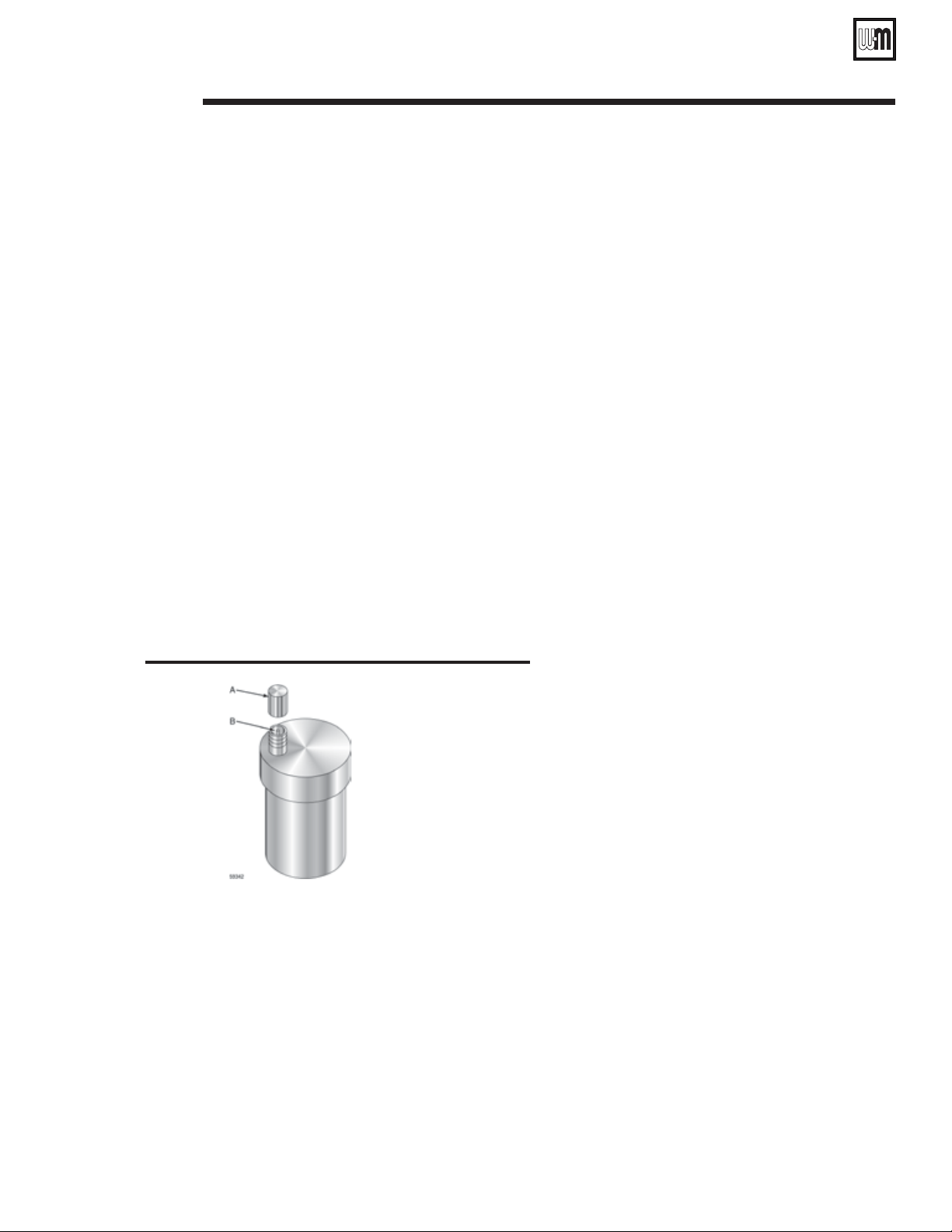
Part Number 550-142-302/0520
CGi
SERIES 4 — GAS-FIRED WATER BOILER — Boiler Manual
47
10b
Service & maintenance – annual start-up (cont.)
❏ Check/test . . .
Gas piping
1. Sniff near floor and around boiler area for any indication
of a gas leak.
2.
Test gas piping using bubble test, per Section 5 of this
manual, if there is any indication of a leak.
Cold fill and operating pressures
1. While the system is cold, note the pressure reading on
the boiler pressure/temperature gauge. Verify that cold fill
pressure is correct.
2.
Watch the pressure as the boiler and system heat up to
ensure pressure rise is normal. Too high a rise would indicate
a waterlogged or undersized expansion tank.
Air vents and air elimination
1. Inspect automatic air vents (if used). Also inspect air separa-
tors to ensure they are operational.
2. The cap must be unscrewed one turn to allow air to escape.
3. See
Figure 34. If the air vent is leaking, remove cap A and
briefly push valve B and then release to clean the valve seat.
4. Replace cap
A by twisting all the way onto valve B and then
unscrewing one turn.
Figure 34 Automatic air vent, typical
Limit controls and cutoffs
1. Inspect and test the boiler limit control. Verify operation by
turning control set point below boiler temperature. Boiler
should cycle off. Return dial to original setting.
2. Inspect and test additional limit controls or low water cutoffs
installed on system.
Expansion tank
1. Expansion tanks provide space for water to move in an out
as the heating system water expands due to temperature
increase or contracts as the water cools. Tanks may be open,
closed or diaphragm or bladder type. See Section
4 of this
manual for suggested best location of expansion tanks and
air eliminators.
Open-type — located above highest radiator or
baseboard unit, usually in the attic or closet. Has a
gauge glass and overflow pipe to a drain.
Closed-type — welded gas tight and located above
boiler. Tank is partially filled with water, leaving an
air cushion for expansion.
• Make sure this type of tank is fitted with a
tank
fitting
, such as the B & G Tank-Trol or Taco Ta c o -
Tro l. This fitting reduces gravity circulation of
air-saturated tank water back to the system and
prevents the air from bubbling up through the
water as it returns from the system.
•
Do not use automatic air vents in systems
with closed-type tanks.
The air will escape
from the system instead of returning to the tank.
Eventually, the tank will waterlog and no longer
control pressurization. The boiler relief valve will
weep frequently.
Diaphragm- or bladder-type — welded gas tight
with a rubber membrane to separate the tank pres-
surizing air and the water. May be located at any point
in the system, but most often found near the boiler.
• Systems with this type of expansion tank require
at least one
automatic air vent, preferably lo-
cated on top of an air eliminator, as shown in
examples in manual Section
4.
2. If relief valve has tended to weep frequently, the
expansion tank may be waterlogged or undersized.
Closed-type tank — tank is most likely waterlogged.
Install a tank fitting if not already installed. Then
check fill level per fitting manufacturer’s instruc-
tions. If fill level is correct, check tank size against
manufacturer’s instructions. Replace with a larger
tank if necessary.
Diaphragm- or bladder-type — first, check tank
size to be sure it is large enough for the system. If
size is too small, add additional tank(s) as necessary
to provide sufficient expansion. If tank size is large
enough, remove tank from system and check charge
pressure (usually 12 psig for residential applications).
If tank won’t hold pressure, membrane has been
damaged. Replace tank.
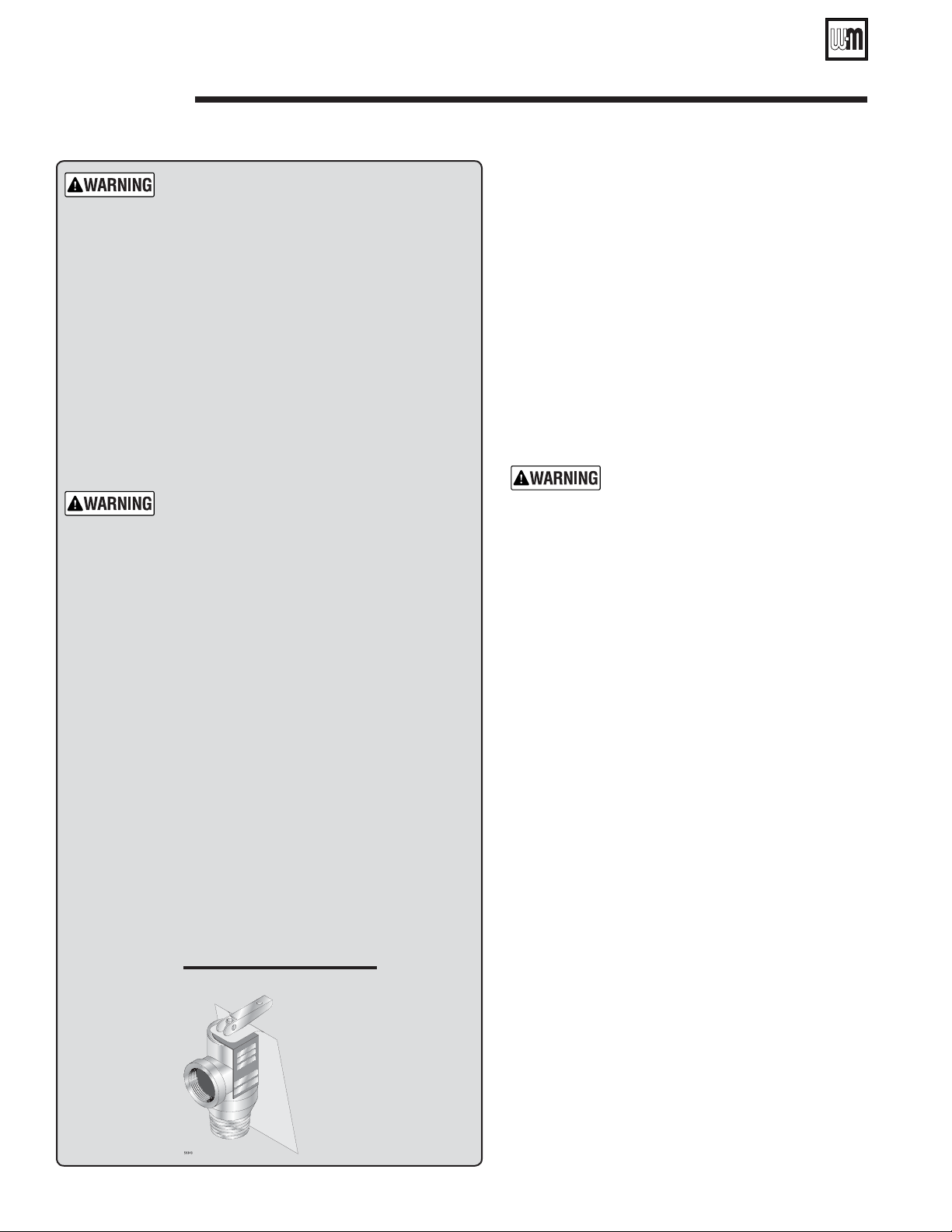
Part Number 550-142-302/0520
CGi
SERIES 4 — GAS-FIRED WATER BOILER — Boiler Manual
48
10b
Service & maintenance – annual start-up (cont.)
❏ Review with owner
1. Review the User’s Information Manual with the owner.
2. Emphasize the need to perform the maintenance sched-
ule specified in the
User’s Information Manual (and
in this manual as well).
3. Remind the owner of the need to call in a licensed con-
tractor should the boiler or system exhibit any unusual
behavior.
4. Remind the owner to follow the proper shutdown
procedure and to schedule an annual start-up at the
beginning of the next heating season.
❏ Cleaning boiler
heating surfaces
The boiler contains ceramic fiber and
fiberglass materials. Use care when han-
dling these materials per instructions on
page 71 of this manual. Failure to comply
could result in severe personal injury.
1. Shut down boiler:
• Follow “To Turn Off Gas to Appliance”
instructions on boiler and Operating instruc-
tions.
• Do not drain boiler unless it will be exposed to
freezing temperatures. If using antifreeze in sys-
tem, do not drain.
2. Follow shutdown procedure.
3. Remove venting system connection to boiler.
4. Remove top jacket panel. Turn back insulation.
5. Remove collector box/transition assembly. Clean sealant
from assembly and sections.
6. Remove radiation plates hanging between sections.
7. Remove burners from base. Brush and vacuum burners
to remove all dust and lint. Verify that all burner ports
are free of debris.
8. Place newspapers in base of boiler to collect soot.
9. Clean between sections with wire flue brush.
10. Remove newspaper and soot. Vacuum or brush base
and surrounding area.
11. Reinstall radiation plates.
12. Replace collector box/transition assembly. Seal with
sealant. Obtain gas-tight seal to prevent flue gas spill-
age and carbon monoxide emissions, resulting in severe
personal injury or death.
13. Replace insulation and jacket top panel.
14. Start up boiler following Section 7, pages 32-35 of
this manual and the boiler Operating instructions.
Excessive sooting indicates improper gas combustion.
If found check for proper combustion and make any
necessary adjustments.
Safety relief valves should be reinspected AT
LEAST ONCE EVERY THREE YEARS
, by a
licensed plumbing contractor or authorized
inspection agency, to ensure that the product has
not been affected by corrosive water conditions
and to ensure that the valve and discharge line
have not been altered or tampered with illegally.
Certain naturally occurring conditions may
corrode the valve or its components over time,
rendering the valve inoperative. Such conditions
are not detectable unless the valve and its com-
ponents are physically removed and inspected.
This inspection must only be conducted by a
plumbing contractor or authorized inspection
agency — not by the owner. Failure to reinspect
the boiler relief valve as directed could result
in unsafe pressure buildup, which can result
in severe personal injury, death or substantial
property damage.
Following installation, the valve lever must
be operated AT LEAST ONCE A YEAR
to en-
sure that waterways are clear. Certain naturally
occurring mineral deposits may adhere to the
valve, rendering it inoperative. When manually
operating the lever, water will discharge and
precautions must be taken to avoid contact with
hot water and to avoid water damage. Before
operating lever, check to see that a discharge
line is connected to this valve directing the flow
of hot water from the valve to a proper place of
disposal otherwise severe personal injury may
result.
If no water flows, valve is inoperative.
Shut down boiler until a new relief valve has
been installed.
Boiler relief valve
1. Inspect the relief valve and lift the lever to verify flow as in the
following warnings, excerpted from a relief valve manufacturer’s
warning label. Before operating any relief valve, ensure that it
is piped with its discharge in a safe area to avoid severe scald
potential. Read manual Section
4 before proceeding further.
2. After following the above warning directions, if the relief valve
weeps or will not seat properly, replace the relief valve. Ensure
that the reason for relief valve weeping is the valve and not over-
pressurization of the system due to expansion tank waterlogging
or under sizing.
Figure 35 Relief valve, typical
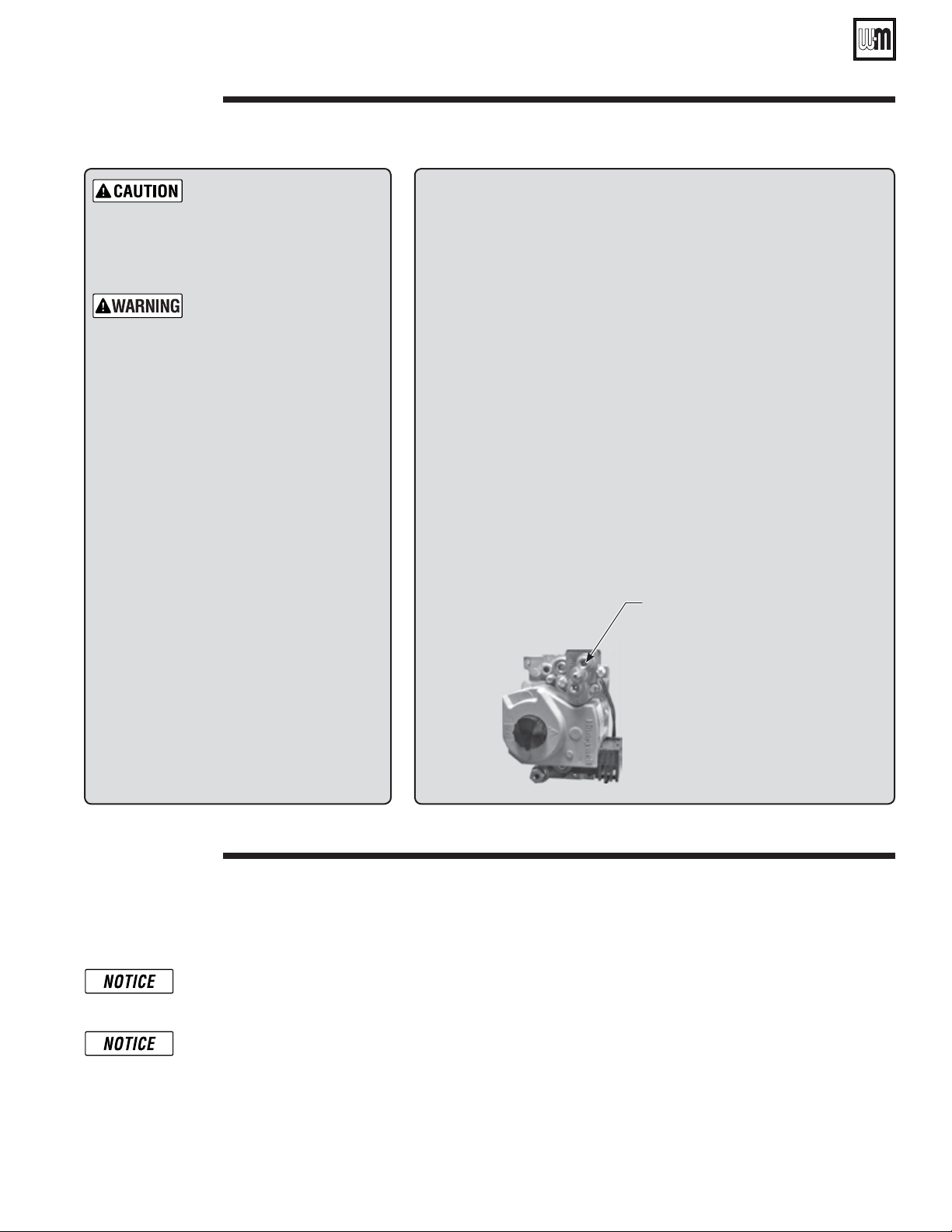
Part Number 550-142-302/0520
CGi
SERIES 4 — GAS-FIRED WATER BOILER — Boiler Manual
49
Troubleshooting — procedure
11a
Air pressure switch
Make sure boiler water temperature is 100 °F
or cooler before starting procedure to obtain
appropriate readings.
The boiler will not operate correctly unless
pressure switch hoses are correctly located.
The red hose connects from the right side
(negative) hose barb to the fl ue collector. The
white hose connects from the left side (posi-
tive) hose barb of the switch to the connector
box (between fl ue collector and inducer) as
shown in Figure 36, page 50 .
Check pressure switch setting
1. See Figure 36, page 50 , and Table 9.
2. Remove both air pressure switch hoses from air pressure
switch.
3. Install tees and tubing as shown in Figure 36, page 50 , to
inclined manometer.
4. Turn off gas valve and set thermostat to call for heat. Inducer
will run but burners will not ignite.
5. Check for 24 VAC between both air pressure switch terminals.
Troubleshooting — components
11b
Label all wires prior to dis-
connection when servicing
controls. Wiring errors can
cause improper and dangerous
operation.
Never jumper (bypass) rollout
thermal fuse element or any
other device except for mo-
mentary testing as outlined
in
Troubleshooting Charts.
Severe personal injury, death
or substantial property dam-
age can result.
Before troubleshooting:
1. Have the following items:
a. Voltmeter that can check 120VAC and
24VAC.
b. Microammeter with a minimum scale
range of 0-25.
c. Continuity checker.
d. U-tube manometer.
2. Check for 120VAC (minimum 102VAC to
maximum 132VAC) to boiler.
3. Make sure thermostat is calling for heat and
contacts (including appropriate zone con-
trols) are closed. Check for 24VAC between
thermostat wire nuts and ground.
Check the following:
1. Wire connectors to control module are securely plugged in at module
and originating control.
2. Air pressure switch hoses are properly and securely plugged in and are
not damaged.
3. Gas pressures:
a. With boiler off — 13” w.c. maximum natural or propane gas
pressure upstream of gas valve.
b. With boiler on:
• 5” w.c. minimum natural gas pressure or 11” w.c. propane
gas pressure upstream of gas valve.
• 3 ½” w.c. minimum natural gas pressure or 10” w.c. propane
gas pressure downstream of gas valve — Can be adjusted by
regulator on gas valve.
4. Verify gas manifold pressure (downstream of gas valve):
a. Natural gas:
Manifold pressure, high fi re: 3.50” w.c.
b. Propane gas:
Manifold pressure, high fi re: 10.0” w.c.
c. If necessary, adjust gas pressure on the gas valve as shown below. After
adjustments, refer to page 35 to check the fl ame.
Gas pressure adjustment
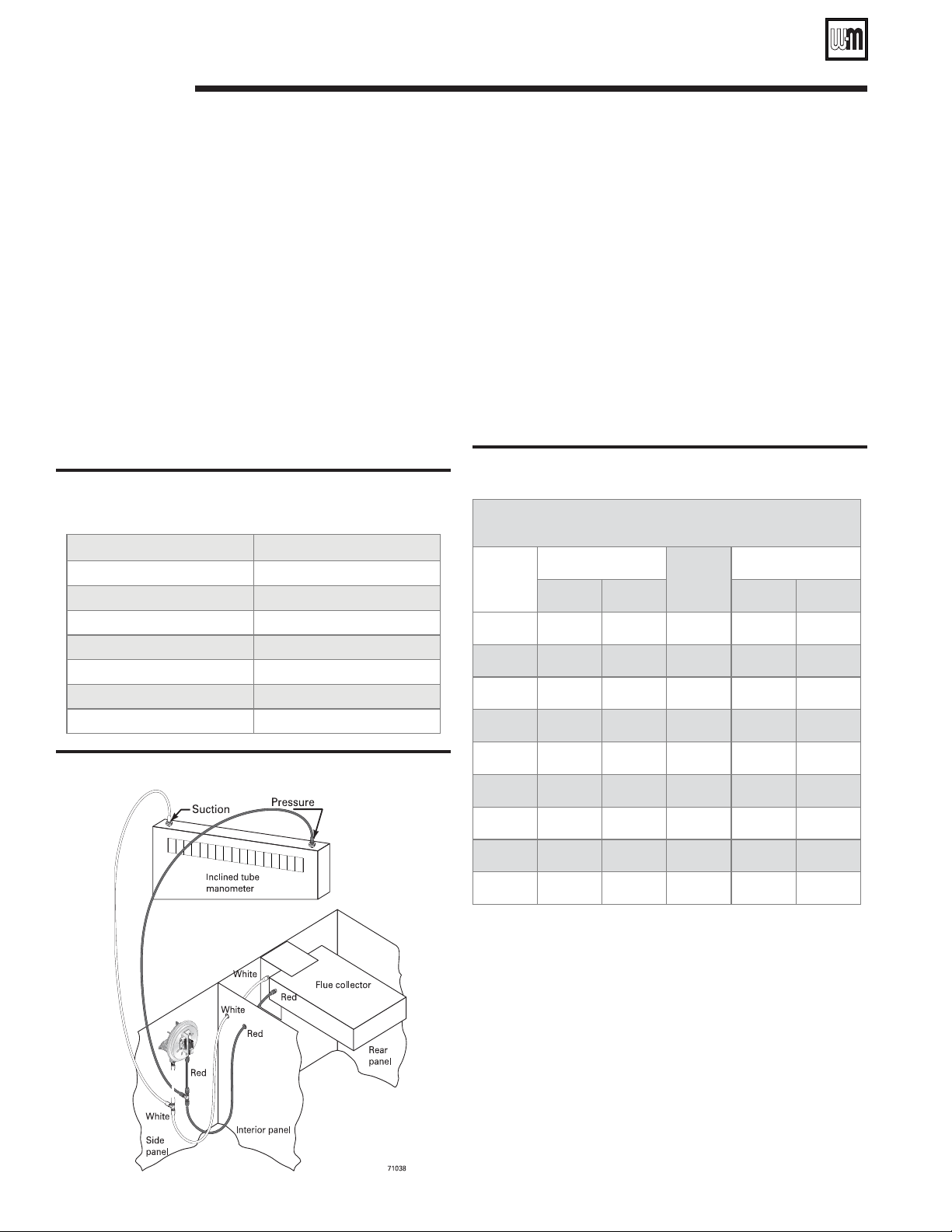
Part Number 550-142-302/0520
CGi
SERIES 4 — GAS-FIRED WATER BOILER — Boiler Manual
50
Troubleshooting — components (continued)
11a
Sensor resistance values
Temp.
(°F)
Sensor ohms
Temp.
(°F)
Sensor ohms
Min. Max. Min. Max.
32
34265 37871
120
4517 4992
40
27834 30764
130
3698 4088
50
21630 23907
140
3043 3364
60
16944 18727
150
2517 2782
70
13372 14780
160
2091 2311
80
10629 11747
170
1744 1928
90
8504 9399
180
1461 1615
100
6847 7568
190
1229 1359
110
5545 6129
200
1038 1147
Temperature/LWCO sensor
1. The boiler temperature/LWCO sensor is a resistance-type
device.
2. The Table 10, below shows the correct value for the sensor at
various temperatures.
3. Use the resistance values at 32°F, 60°F, 70°F and 212°F to
measure the sensor resistance at known temperatures (ice
point, room temperature and sea level boiling point). For ice
point and boiling point, insert the sensor in water at that tem-
perature. Use an ohmmeter to read resistance value between
thermistor # and thermistor common. See Figure 38, page 52,
for sensor plug details.
Table 10 Temperature/LWCO sensor resistance values
Troubleshooting air pressure reading
1. If manometer reading is lower than the setpoint of the switch (see
Table 9
) — check for possible causes:
• blockage in hoses
• obstruction in inducer housing outlet
• loose inducer wheel on motor shaft
• inducer motor not in proper rpm
• inducer back plate not sealed properly
• blockage in block assembly
2. If manometer reading is above the setpoint of the switch (see
Table 9), but there is not 24 VAC between both air pressure switch
terminals — replace air pressure switch.
Return to normal operation
When pressure reading is correct and air pressure switch is oper-
ating properly — remove tees and reinstall hoses to air pressure
switch.
Figure 36 Manometer connections
Table 9 Pressure switch setpoint (for elevations above
2,000 ft., contact your local Weil-McLain Technical
Service office for details.)
Boiler model number Inches W.C.
CGi-25 2.10
CGi-3
2.10
CGi-4 1.40
CGi-5 1.65
CGi-6 1.20
CGi-7 1.35
CGi-8 1.45
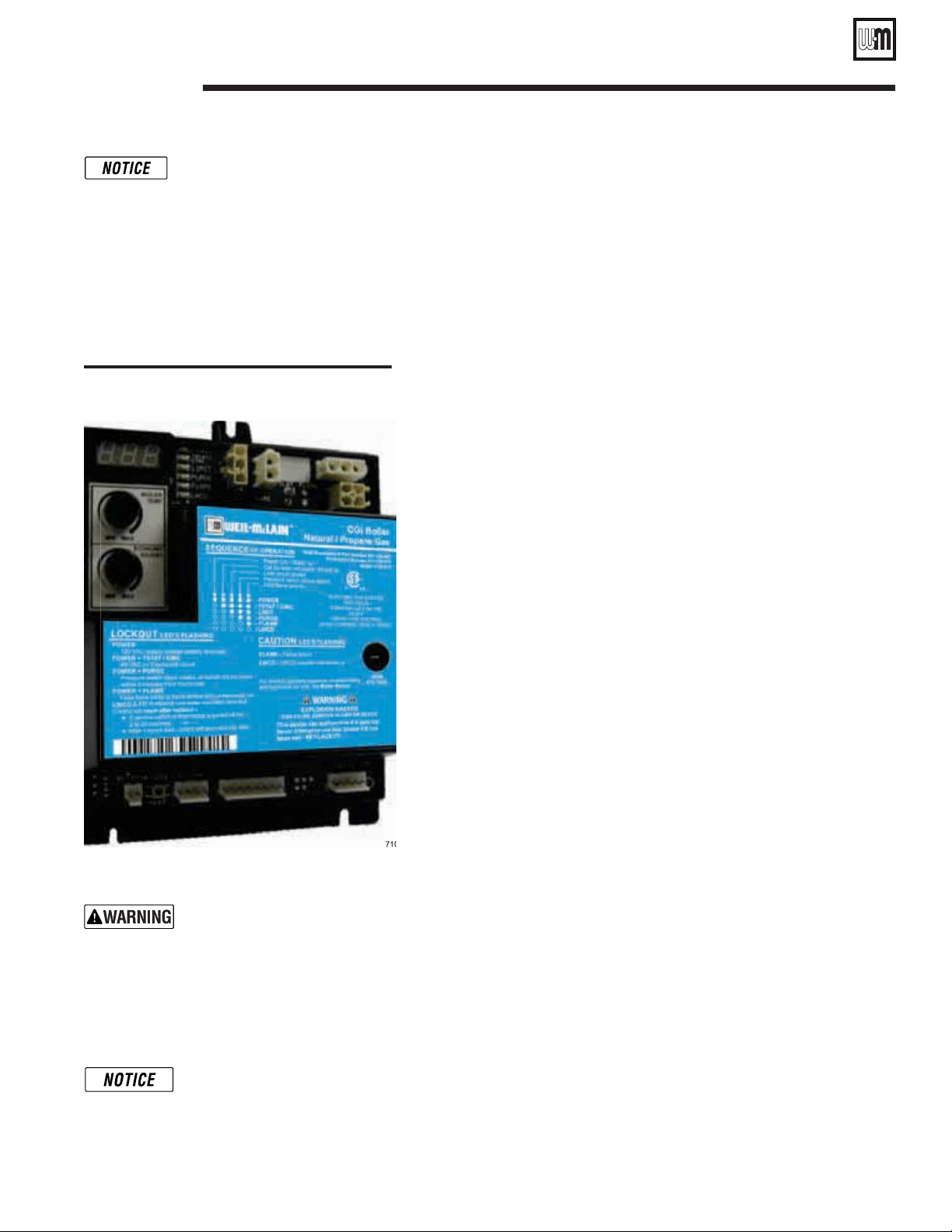
Part Number 550-142-302/0520
CGi
SERIES 4 — GAS-FIRED WATER BOILER — Boiler Manual
51
Troubleshooting — components (continued)
11b
Figure 37 Control module
Control module
Solder or water splatter be-
tween plugs and circuit board
can cause improper operation
of control module. Place a
shield over the boiler inter-
nal controls and components
during installation. Failure to
comply could result in severe
personal injury, death or sub-
stantial property damage.
Make sure ground wiring is
installed per wiring diagram.
Good grounding is extremely
important for proper opera-
tion.
The information on this page and
pages 52 through 60 apply only to
spark-ignited pilot CGi boilers.
These boilers are equipped with
an ignition control module that
has indicator lights to show control
status. Charts
1 through 8, pages
53-60, help you identify problems
based on indicator light condi-
tions.
Control indicator lights —
LOCKOUT modes
See Charts 1 through 8 in this section for detailed troubleshoot-
ing procedures.
Control indicator lights —
HARD LOCKOUT Summary (Flashing LED’s)
MAY remove 120VAC power for more than 2 seconds to clear
lockout OR ignition control will automatically restart sequence of
operation after 1 hour waiting period after fault condition is cleared
INDICATOR LIGHT CONDITION
POWER
SOFT LOCKOUT Summary (Flashing LED’s)
MAY remove 120VAC power for more than 2 seconds, cycle thermostat
for between 2 and 20 seconds, OR ignition control will automatically
restart sequence of operation after 1 hour waiting period.
INDICATOR LIGHT CONDITION
POWER + TSTAT/CIRC
POWER + PURGE
POWER + FLAME
CAUTION Summary (Flashing LED’s)
INDICATOR LIGHT CONDITION
PURGE
LIMIT
FLAME
LWCO
Troubleshooting the control module
See Figure 38, for location of harness plug receptacles and plugs on the
control module.
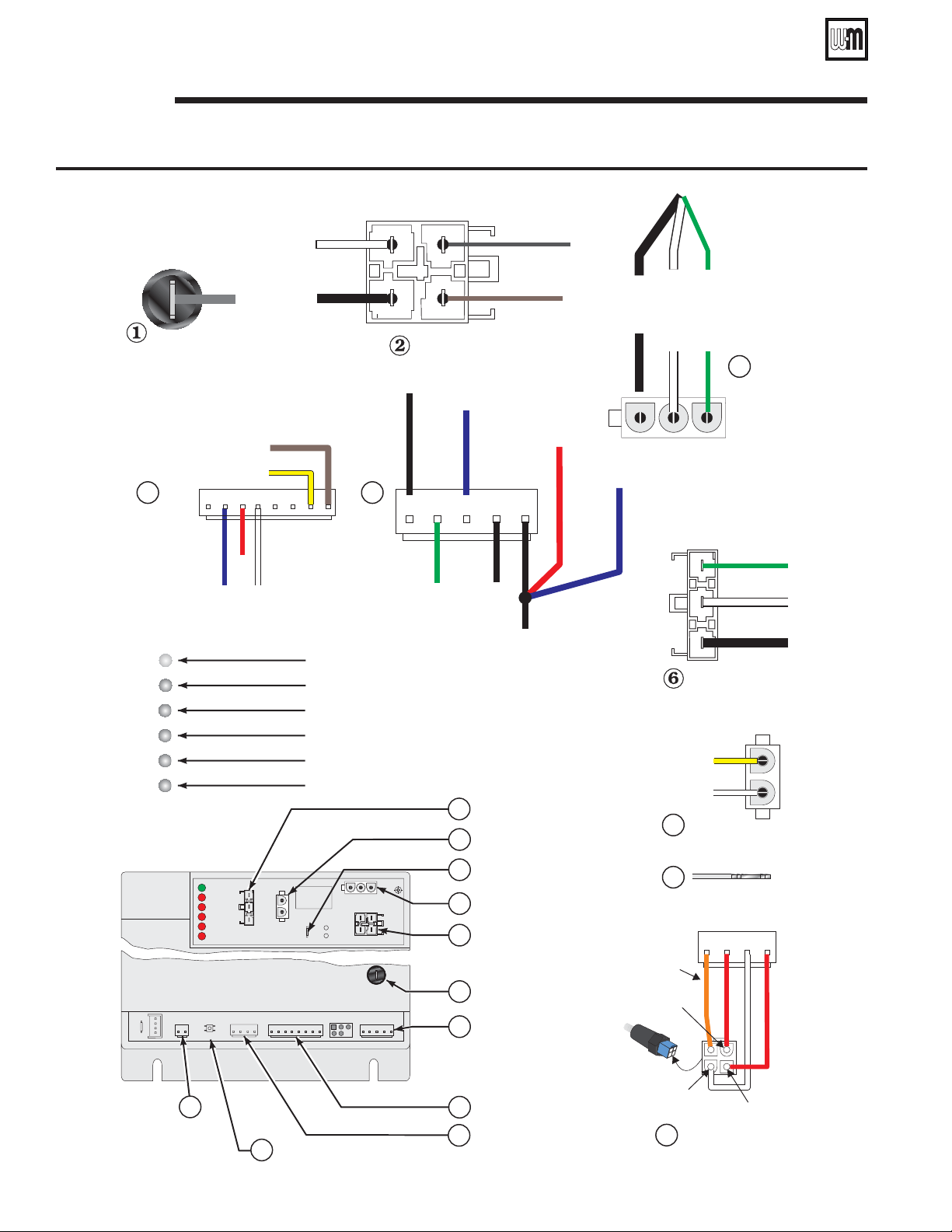
Part Number 550-142-302/0520
CGi
SERIES 4 — GAS-FIRED WATER BOILER — Boiler Manual
52
Troubleshooting — components (continued)
11b
Figure 38 Control module connections
9$&,1
9$&WRWUDQVIRUPHU
+LJKYROWDJHWRVSDUNHOHFWURGH
7UDQVIRUPHU
9$&WRFRQWUROFLUFXLWV
6HQVHZLUHWRIODPHVHQVRU
9$&WR,QGXFHUPRWRU
/:&2
75$16)250(5
32:(5
&,5&
%/2:(5
767$7
6(1625
/:&2
7(67
287'225
32:(5
/,0,7
385*(
)/$0(
/:&2
767$7
&,5&
3,/27 0$,1
+LJKYROWDJHWR
SLORWVSDUNHOHFWURGH
,QGLFDWRUOLJKWV
32:(5
767$7&,5&
/,0,7
385*(
/:&2
)/$0(
9$&+
9$&1
9$&WRFLUFXODWRU
:KLWH
<HOORZ
7KHUPRVWDW
9$&,1
9$&+
%ODFN
9$&1
:KLWH
(QWUDQFH
JURXQG
*UHHQ
%ODFN
%ODFN
*UHHQ
WR*URXQG
%OXHWR'+:
LIXVHG
767$7
%OXHWR'+:
LIXVHG
%ODFNWR7UDQVIRUPHU
&RPPRQ
5HGWR7UDQVIRUPHU
+RW
5HGZLUHWR
JDVYDOYH09
%OXHZLUHWR
JDVYDOYH39
%URZQ
:KLWHZLUHWR
JDVYDOYH0939
9$&
FRQWURO
FLUFXLWV
WR6SLOO6ZLWFKDQGWR
$GGLWLRQDOOLPLWVLIXVHG
<HOORZ
)ODPHVHQVHZLUHWRSLORW
9$&WRLQGXFHUPRWRU
9$&+
9$&1
*URXQG
:KLWH
*UHHQ
%ODFN
9$&+
9$&1
7UDQVIRUPHU
%ODFN
:KLWH
9$&
%URZQRU<HOORZ
3LQNRU%OXH
&200
7HPSHUDWXUH/:&26HQVRU
2XWGRRU6HQVRU
LIXVHG
7HVW%XWWRQIRU/3,JQLWLRQUHVHW
7KHUPLVWRU
7KHUPLVWRU
7KHUPLVWRU
&RPPRQ
7HPSHUDWXUH/:&2
VHQVRU
/:&2
5HG
5HG
:KLWH
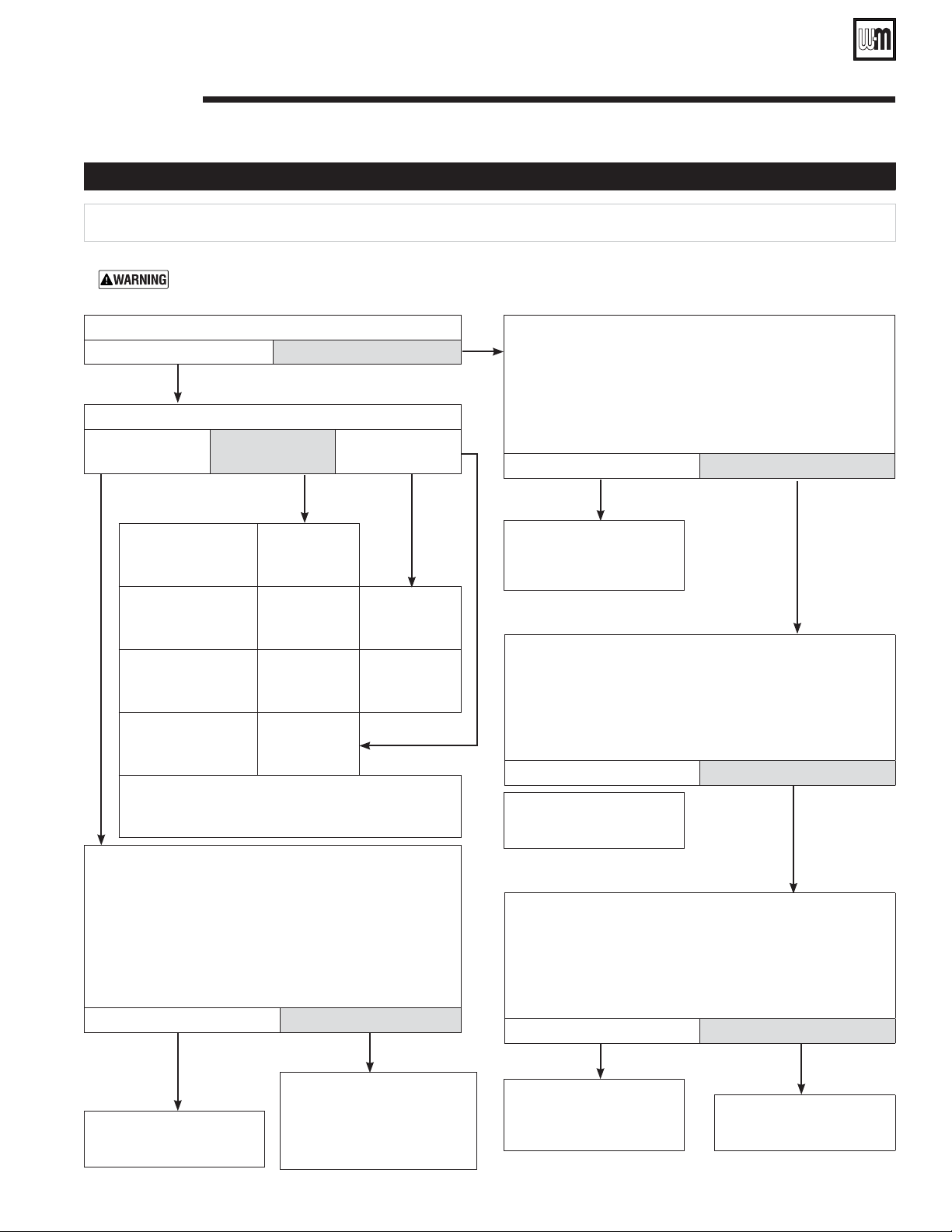
Part Number 550-142-302/0520
CGi
SERIES 4 — GAS-FIRED WATER BOILER — Boiler Manual
53
Troubleshooting — control module lights
11c
CHART 1 –– Troubleshooting POWER light status
––!"!#–– 120
Electrical shock hazardTURN OFF POWER
Replace
control module
.
Retest.
Boiler should now
operate normally.
Problem is with incoming
electricity. Have licensed
electrician repair circuit.
Have system checked by a
licensed electrician.
If problem persists, contact
your Weil-McLain Technical
support.
TSTAT/CIRC
light flashing
CHART
2
PURGE
light flashing
CHART
3
CHART
5
FLAME
light flashing
CHART
4
CHART
6
LWCO
light solid
CHART
7
For insufficient heat or no heat problem, go to
CHART 8 if POWER light is on steady, with no other
light is flashing.
Is POWER light off?
No Yes
• Make sure service switch or circuit breaker is on or
fuses are good.
• Remove 120 VAC IN plug (Figure 38, Item 3, page 52)
on control module.
• Using voltmeter, check across black and white wire pins of
120 VAC IN plug.
Does voltmeter indicate 120 VAC?
No Yes
• Reconnect 120 VAC IN plug.
• Remove transformer plug (Figure 38, Item 2, page 52)
on control module.
• Using voltmeter, check across left side top and bottom
pins of transformer receptacle.
Does voltmeter indicate 120 VAC?
No Yes
• Reinstall 120 VAC transformer plug.
• Remove TSTAT transformer plug (Figure 38, Item 5,
page 52) on control module.
• Using voltmeter, check pins of plug.
Does voltmeter indicate 24 VAC?
No Yes
Replace transformer.
Retest and check for back
feed of voltage from
system wiring.
Replace
control module
.
Retest.
• Usually indicates polarity on incoming 120 VAC power
line is wrong or has insufficient earth ground.
•
•
TURN OFF POWER
at service switch or breaker,
then reverse the HOT and NEUTRAL wires entering the
boiler in the J-box.
• Restore POWER at service switch or breaker.
Is POWER
No Yes
Is POWER light . . .
Flashing
alone?
Flashing with
another light?
On steady
(NOT flashing)?
Part Number 550-142-302/0520
CGi
SERIES 4 — GAS-FIRED WATER BOILER — Boiler Manual
54
Troubleshooting — control module lights (cont.)
11c
CHART 2 –– TSTAT CIRC & POWER light flashing
–– Usually indicates 48 VAC on thermostat circuit (stray voltage) –– 120
Electrical shock hazardTURN OFF POWER
• If no voltage is found under any condition of the
external thermostat circuit, connect the two boiler
thermostat
connection leads together (or jumper the boiler aqua-
stat T-T terminals).
• Turn off power to the boiler for 1 minute.
• Turn on power and allow boiler to cycle.
Does the TSTAT and POWER
No Yes
• Disconnect the two external wires connected to the boiler
thermostat leads (two black low voltage leads in J-box).
• Connect a voltmeter across these two incoming wires.
Close each thermostat, zone valve and relay in the external
circuit one at a time and check the voltmeter reading
across the wires.
• There should NEVER be a voltage reading.
• If a voltage does occur under any condition, check and
correct the external wiring. (This is a common problem
when using 3-wire zone valves.)
• Once the external thermostat circuit wiring is checked and
corrected if necessary, reconnect the external thermostat
circuit wires to the boiler thermostat wires and allow the
boiler to cycle.
Yes No
• Boiler should now operate per the normal sequence of
operation (Figure 30, page 38).
• Leave external boiler thermostat connection wires
disconnected from boiler.
• Troubleshoot the external thermostat circuit until you
find
the source of the stray voltage. (Pay close attention to
the wiring connections to 3-wire zone valves.)
• Correct the problem and repeat the voltmeter test
above,
verifying there is no longer a voltage reading under
any
condition in the external thermostat circuit.
• An isolating relay may be required.
Replace
control module
.
Retest.
Part Number 550-142-302/0520
CGi
SERIES 4 — GAS-FIRED WATER BOILER — Boiler Manual
55
Troubleshooting — control module lights (cont.)
11c
CHART 3 –– PURGE & POWER light flashing
–– Usually indicates pressure switch stuck closed or failed to make within 5 minutes –– 120
Electrical shock hazardTURN OFF POWER
• Reset boiler control by turning off power at service switch or turning down thermostat for at least 45 seconds.
• Thermostat should call for heat and appropriate zone valves open.
Does inducer motor operate?
No Yes
• Replace
control module.
• Retest.
• Check air pressure switch
per manual Section 11b.
• Replace if necessary.
• Retest.
• Clear passages and recycle boiler.
• Recheck boiler operation.
• Try reseating plug in
module receptacle and
restart.
• If inducer still does not
work, replace inducer
assembly.
• Retest.
• Boiler should be in
normal operating
sequence.
• Observe operation until
thermostat is satisfied
and inducer has
completed its post-purge
cycle.
• Remove INDUCER plug (Figure 38, Item 6, page 52) from
plug receptacle of control module.
• Place voltmeter leads across the 120 VAC N and 120 VAC
H pins of the INDUCER receptacle (middle and bottom
pins).
Does the voltmeter indicate 120 VAC?
No Yes
• Remove one of the wires connected to the pressure
switch.
• Check continuity across the switch terminals.
No Yes
• Wait 5 minutes.
Is PURGE
No Yes
• Wait 45 seconds.
Does Inducer motor operate?
No Yes
Are vent or combustion air
passages blocked?
No Yes
Part Number 550-142-302/0520
CGi
SERIES 4 — GAS-FIRED WATER BOILER — Boiler Manual
56
Troubleshooting — control module lights (cont.)
11c
CHART 4 –– FLAME & POWER light flashing
$$"%&!!'#!$$120
Electrical shock hazardTURN OFF POWER
•
TURN OFF POWER
to boiler at service
switch or breaker.
• Open main manual gas
valve.
• Turn on power
to boiler
at service switch or
breaker.
• Restart boiler per operating
instructions.
• Perform start-up
procedures in boiler
manual to verify proper
operation.
• Boiler may now be
operating
normally.
• Perform start-up
procedures in
boiler manual to
verify proper
operation.
• Replace control module.
• Retest.
Are manual main shutoff valve and gas valve open?
No Yes
• Replace gas valve.
• Retest boiler.
Are FLAME & POWER
No Yes
• Replace
control
module.
• Retest.
• Boiler should now
operate normally.
• Original flashing
FLAME light
caused by gas
valve not
operating properly.
• See normal
sequence of
operation,
Figure 30,
page 38.
• Turn off power to the boiler at service switch or
breaker.
• Wait at least 45 seconds.
• Turn on power to boiler.
• Restart boiler, following Operating instructions in this
manual (Section 9c).
• Look through the pilot inspection port to see if the pilot
is burning during the prepurge period (first 30 seconds
of operation).
Is pilot burning during prepurge period?
No Yes
• Replace
control
module.
• Retest.
• Leave main manual gas valve closed.
• Turn off power to boiler at service switch or breaker.
• Wait at least 45 seconds.
• Turn on power to boiler.
• Restart boiler, following Operating instructions in this
manual (Section 9c).
Do FLAME and POWER
No Yes
• Allow boiler to continue cycling.
Are FLAME & POWER
No Yes
Part Number 550-142-302/0520
CGi
SERIES 4 — GAS-FIRED WATER BOILER — Boiler Manual
57
Troubleshooting — control module lights (cont.)
11c
CHART 5 –– PURGE light flashing and POWER light on steady
–– Usually indicates pressure switch opened during run cycle ––
–– May also be caused by wind gusts in excess of 31 mph for non-direct vent sidewall-vented boilers ––
Electrical shock hazardTURN OFF POWER
• Reset boiler control by turning off power at service switch or turning down thermostat for at least 45 seconds.
• Thermostat should call for heat and appropriate zone valves open.
Does inducer motor operate?
No Yes
• Inspect and check wire
harness from control
module to pressure
switch.
• Reseat connector in
control
module receptacle.
• If harness is intact and
properly seated, but
problem persists, replace
control module.
• Retest.
• Check air pressure switch per manual Section 11b.
• Replace if necessary. Retest.
• Clear vent and recycle boiler.
• Recheck boiler operation.
• Replace inducer
assembly.
• Retest.
• Boiler should be in
normal operating
sequence.
• Observe operation until
thermostat is satisfied
and inducer has
completed its post-
purge cycle.
• Remove INDUCER plug (Figure 38, Item 6, page 52)
from plug receptacle of control module.
• Place voltmeter leads across the 120VAC N and
120VAC H pins of the INDUCER receptacle (middle
and bottom pins).
Does the voltmeter indicate 120 VAC?
No Yes
• Remove one of the wires connected to the pressure
switch.
• Check continuity across the switch terminals.
No Yes
• Wait 5 minutes.
Is PURGE
No Yes
Is vent blocked?
No Yes
Part Number 550-142-302/0520
CGi
SERIES 4 — GAS-FIRED WATER BOILER — Boiler Manual
58
Troubleshooting — control module lights (cont.)
11c
CHART 6 –– FLAME light flashing and Power light on steady
Also –– Troubleshooting failure to establish main flame.
Electrical shock hazardTURN OFF POWER
• Is pilot flame visible through inspection port ?
No Yes
Are main manual shutoff valve and gas valve open?
No Yes
•
to
boiler at service switch or
breaker.
• Remove burner shield (see
Figure 40, item 4, page 64
for location.
• Contact gas supplier to cor-
rect
pressure or gas supply.
• Check the voltage
across terminals PV and
C of the gas valve.
Is 24VAC present there?
Yes No
• Make sure ground wire
terminal is securely
fastened to control module
mounting screw.
• Verify inlet gas pressure at gas valve:
Natural gas – 5.0” w.c. min/14.0” w.c. max
Propane – 11.0” w.c. min/14.0” w.c. max
No Yes
• Check the voltage
across terminals of MV
and C
of the gas valve.
Is 24VAC present there?
No Yes
• If the wiring from the
control module to gas
valve is intact, replace the
control module.
• Retest.
• Verify inlet gas pressure at gas
valve:
Natural gas – 5.0” w.c. min/14.0”
w.c. max
Propane – 11.0” w.c. min/14.0”
w.c. max
Is gas present at gas valve inlet and
Yes No
• Boiler should be in
normal operating
sequence.
• Observe operation
until thermostat is
satisfied and blower
has completed its
post-purge cycle.
• Verify pilot gas line is not
kinked, obstructed or
damaged and is correctly
attached to pilot and gas
valve.
• Verify pilot ignition electrode,
electrode ceramic and spark
lead wire from control are in
good condition. Spark gap
should be approximately 1/8”.
• Correct any above problems,
replacing pilot if burner or
wiring is damaged.
• Reinstall burner shield to
operate boiler for retest after
any changes or corrections.
• If none of the above corrects
problems, then replace the
control module and retest.
•
to boiler at service switch or
breaker.
• Remove burner shield (see
Figure 40, item 4, page 64
for location.
• If none of the previous steps
(including replacing pilot)
corrects problem, then replace
the control module, reinstall
burner shield and retest.
• If the wiring from the
control module to gas
valve is intact, replace the
control module and retest.
•
to boiler at service switch or breaker.
• Open main manual shutoff valve and boiler gas valve (per
Operating instructions in this manual). Wait at least 45 seconds.
• Turn on power at service switch or breaker. Allow boiler to
cycle .
Does FLAME
No Yes
•
to boiler at service switch or breaker.
• Check flame signal – Detach sense lead from ignition control
(Figure 38, Item 8, page 52)
.
• Connect negative lead of MICROAMMETER to control
sense terminal
(Figure 38, Item 8, page 52)
. Connect
positive lead of MICROAMMETER to sense wire.
• DISCONNECT red wire connected to terminal MV of the gas
valve.
• Turn on power to boiler and allow to cycle. As soon as pilot
is burning, the MICROAMMETER should read at least 1.0
microamp.
No Yes
• Verify pilot burner is securely
attached to pilot bracket, brack-
et is securely attached to cross
tie, and there is no corrosion on
the parts which would affect the
ground path for flame sense.
• Verify that pilot flame rod, flame
rod ceramic and lead wire from
control module to flame rod are
in good condition.
• Correct any above problems,
replacing pilot if burner or wir-
ing is damaged.
Part Number 550-142-302/0520
CGi
SERIES 4 — GAS-FIRED WATER BOILER — Boiler Manual
59
Troubleshooting — control module lights (cont.)
11c
CHART 7 –– Troubleshooting LWCO and POWER light Solid
and/or “LCO” shown on display
Electrical shock hazardTURN OFF POWER
• System is losing water.
• Repair leak and retest.
Is boiler pressurized?
Ye s N o
• System was low on water.
• Check system fill piping for
leaks or damage.
• Pressurize boiler to system design pressure.
Are lights still solid?
No Yes
• Check system for leaks.
Is system leaking or not
maintaining pressure?
No Yes
• LWCO sensor is bad or fouled.
• Clean LWCO sensor
•
Retest.
Are lights still solid?
No Yes
• Sensor is bad. Replace sensor.
• Retest.
• Sensor was fouled.
• Check water quality and
maintenance schedule.
Part Number 550-142-302/0520
CGi
SERIES 4 — GAS-FIRED WATER BOILER — Boiler Manual
60
Troubleshooting — control module lights (cont.)
11c
CHART 8 –– Insufficient heat or no heat to system (POWER light on steady)
Electrical shock hazardTURN OFF POWER
• Has it been at least 5 minutes since setting thermostat to
call for heat? If not, wait 5 minutes. Is system heating?
• Is thermostat set to call for heat? Remove thermostat
wires at boiler and check continuity across the two wires.
If circuit isn't closed, check external thermostat (zone
valve, relay, etc.) wiring. Correct problems and retry.
• Reconnect external thermostat wiring at boiler.
!"
No Yes
Is boiler System circulator operating?
No Yes
• Wait 5 minutes.
Is FLAME light on?
Yes No
Is LIMIT light on?
No Yes
Are all red lights off?
No Yes
• Wait 30 seconds.
Are all red lights off?
No Yes
• Replace rollout switch.
If rollout thermal fuse element has
opened, determine cause and
correct condition. Failure to do so
will cause severe personal injury,
death or substantial property
damage.
• Check temperature
sensor for correct
resistance.
Are resistance values
correct?
No Yes
• Replace control
module.
• Retest.
• Replace control
module.
• Retest.
• Repair/replace
circulator. Retest.
• Repair/replace
wiring. Retest.
• Check any other
limit controls wired
into the limit
circuit. If all are
OK, then replace
control module.
• Retest.
• Correct conditions and
recheck operation.
• See Figure 30, page 38
for normal sequence of
operation.
• Boiler is in standby.
• Set thermostat to call for
heat and recheck operation.
• Verify Sequence of
operation, Figure 30,
page 38.
• Remove CIRCULATOR harness plug from
CIRCULATOR plug receptacle (Figure 38, Item
7, page 52). Check with voltmeter across pins of
control module receptacle.
120 VAC across pins?
No Yes
• Replace control module.
• Retest.
• If you have sufficient heat – boiler should be in normal
operating sequence. (See normal sequence of operation,
Figure 30, page 38.
• If you have less than sufficient heat –
Is vent piping free of blockage?
No Yes
• Contact Weil-McLain
Technical support or
replace gas valve.
• Replace temperature
sensor.
• Retest.
• Check heat loss calculation
versus boiler size.
• Clock gas input.
No
Is manifold pressure:
3.50” w.c. on natural gas?
10.0” w.c. on propane?
Yes No
#$
continuity –
No Yes
Part Number 550-142-302/0520
CGi
SERIES 4 — GAS-FIRED WATER BOILER — Boiler Manual
61
Notes
Part Number 550-142-302/0520
CGi
SERIES 4 — GAS-FIRED WATER BOILER — Boiler Manual
62
Replacement parts
12a
Section assembly ............................................................... 63
Base .................................................................................................. 64
Jacket .............................................................................................. 66
Trim ................................................................................................. 67
Controls .......................................................................................... 68
Replacement parts must be purchased through a local Weil-McLain distributor. When ordering, specify boiler
model and size and include description and part number of replacement part. Results from using modified
or other manufactured parts will not be covered by warranty and may damage boiler or impair operation.
Weil-McLain part numbers are found in Weil-McLain Boilers and Controls Repair Parts Lists.
The boiler contains ceramic fiber and fiberglass materials. Use care when handling these materials per
instructions on page 71 of this manual. Failure to comply could result in severe personal injury.
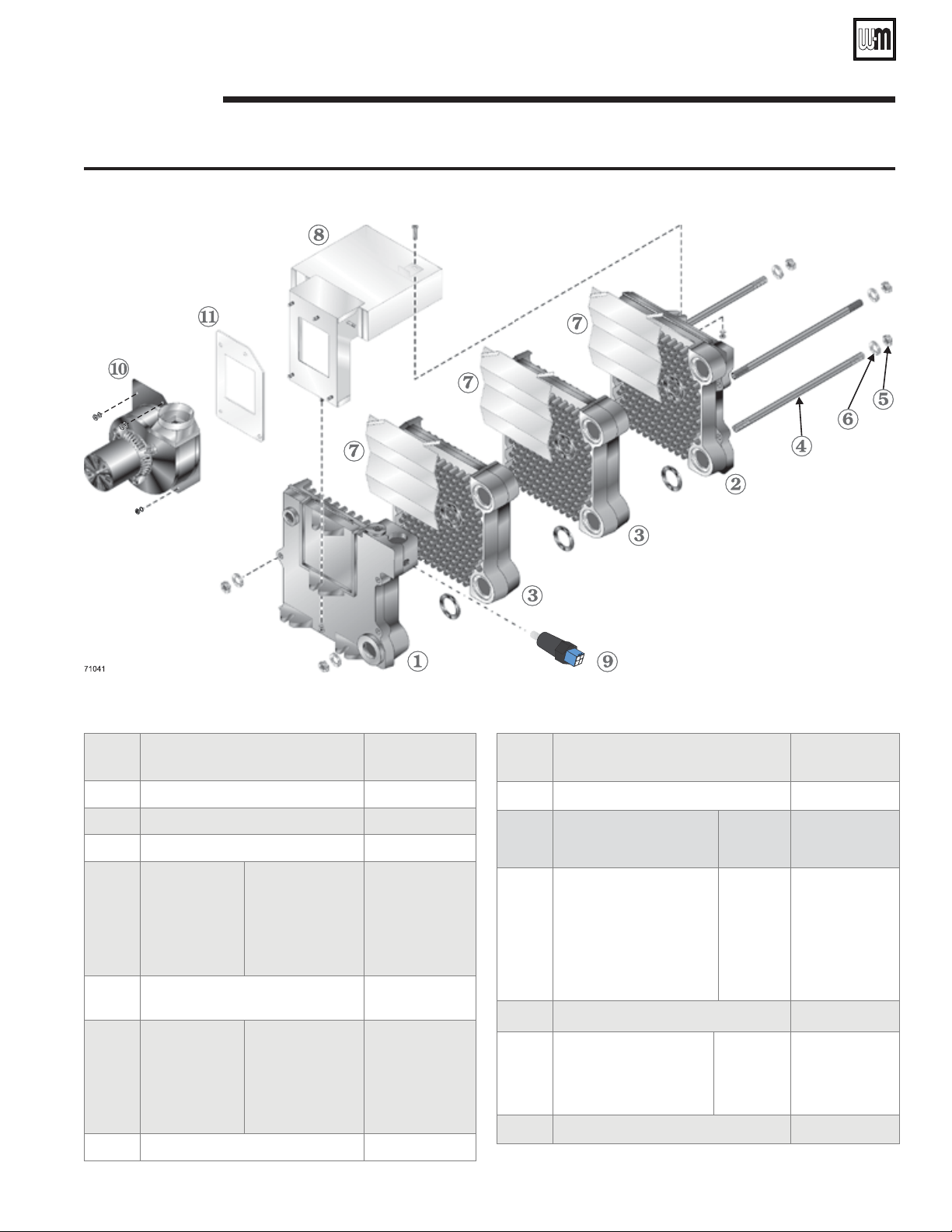
Part Number 550-142-302/0520
CGi
SERIES 4 — GAS-FIRED WATER BOILER — Boiler Manual
63
Replacement parts — section assembly
12b
Figure 39 Section assembly
Item Description Weil-McLain
part number
1 End section, left hand, 51124 311-103-851
2 End section, right hand 51128 311-103-821
3 Intermediate section, 51127 311-103-845
not
shown
Replacement
section
assembly
CGi-25 and CGi-3
CGi-4
CGi-5
CGi-6
CGi-7
CGi-8
321-114-360
321-114-361
321-114-362
321-114-363
321-114-364
321-114-365
not
shown
Section replacement kit, includes
seals and sealant for 1 joint
381-354-527
4
Tie rod, ⁷⁄₁₆”
without nut (3
per boiler):
CGi-25 and CGi-3
CGi-4
CGi-5
CGi-6
CGi-7
CGi-8
560-234-500
560-234-501
560-234-502
560-234-503
560-234-504
560-234-505
5
Nut, ⁷⁄₁₆” (2 per tie rod)
561-928-235
Item Description Weil-McLain
part number
6
Washer, ⁷⁄₁₆” (1 per tie rod)
562-248-684
7
CGi 4-8 460-003-017
8 Collector hood and
transition assembly
CGi-25
CGi-3
CGi-4
CGi-5
CGi-6
CGi-7
CGi-8
381-359-286
381-354-595
381-359-288
381-359-289
381-359-290
381-359-291
381-359-292
9
Temperature/LWCO Sensor
511-724-305
10 Inducer fan assembly
kit, includes inducer fan
assembly, gasket and
nuts
CGi 25 & 3
CGi 4-6
CGi 7 & 8
381-354-588
381-359-293
381-359-294
11 Gasket, inducer 590-317-627
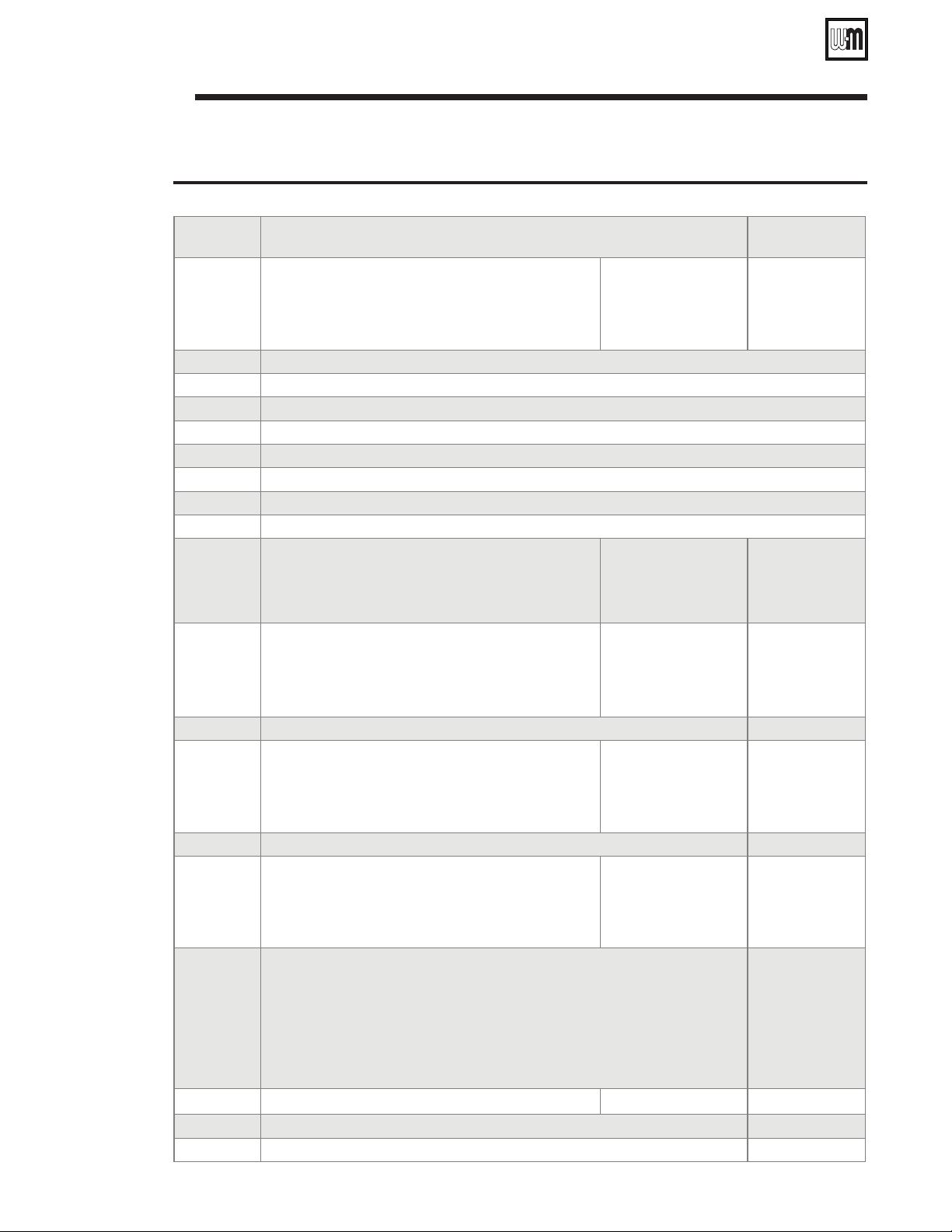
Part Number 550-142-302/0520
CGi
SERIES 4 — GAS-FIRED WATER BOILER — Boiler Manual
64
Replacement parts — base
12c
Figure 40 Base assembly
Item Description
Weil-McLain
part number
Base assembly kit
(includes base panels items 1, 2, 3, 4, 5, 6 and 7)
CGi-25 & CGi-3
CGi-4
CGi-5
CGi-6
CGi-7
CGi-8
381-354-337
381-354-338
381-354-339
381-354-340
381-354-341
381-354-342
1
Base side panel (in Base assembly)
2
Base front cross-tie assembly (in Base assembly)
3
Base back cross-tie assembly (in Base assembly)
4
Burner shield (in Base assembly)
5
Base pan angle, left side (in Base assembly)
6
Base pan angle, right side (in Base assembly)
7
Base pan (in Base assembly)
7a
Base pan air baffle (in Base assembly)
8a
Burner mounting plate
CGi-25 & CGi-3
CGi-4
CGi-5
CGi-6
CGi-7
CGi-8
450-003-690
450-003-691
450-003-692
450-003-693
450-003-795
450-003-796
8b
Rear spacing strip
CGi-25 & CGi-3
CGi-4
CGi-5
CGi-6
CGi-7
CGi-8
550-320-160
550-320-161
550-320-162
550-320-163
550-320-164
550-320-165
8c
Nut, hex 5mm Zp
550-320-170
9
Base insulation kit
CGi-25 & CGi-3
CGi-4
CGi-5
CGi-6
CGi-7
CGi-8
381-354-330
381-354-331
381-354-332
381-354-333
381-354-334
381-354-335
10
Boiler leg kit
550-320-219
11
Manifold
CGi-25 & CGi-3
CGi-4
CGi-5
CGi-6
CGi-7
CGi-8
591-126-735
591-126-736
591-126-737
591-126-738
591-126-739
591-126-740
12
Main burner orifice — Natural gas, sea level (see Table 2, page 12 for
orifice size) CGi-25
CGi-3 - CGi-5
CGi-6 - CGi-8
Main burner orifice — Liquefied Petroleum (Propane) gas, sea level
(see Table 2, page 12 for orifice size)
CGi-25
CGi-3 - CGi-5
CGi-6 - CGi-8
560-529-090
560-529-126
560-529-077
560-529-084
560-529-111
560-529-078
13
Burner
512-200-076
14
Screw, 10-32 x
.
0.38 STP type 23 hex, washer head slot
562-135-710
15
Rollout thermal fuse element
512-050-230
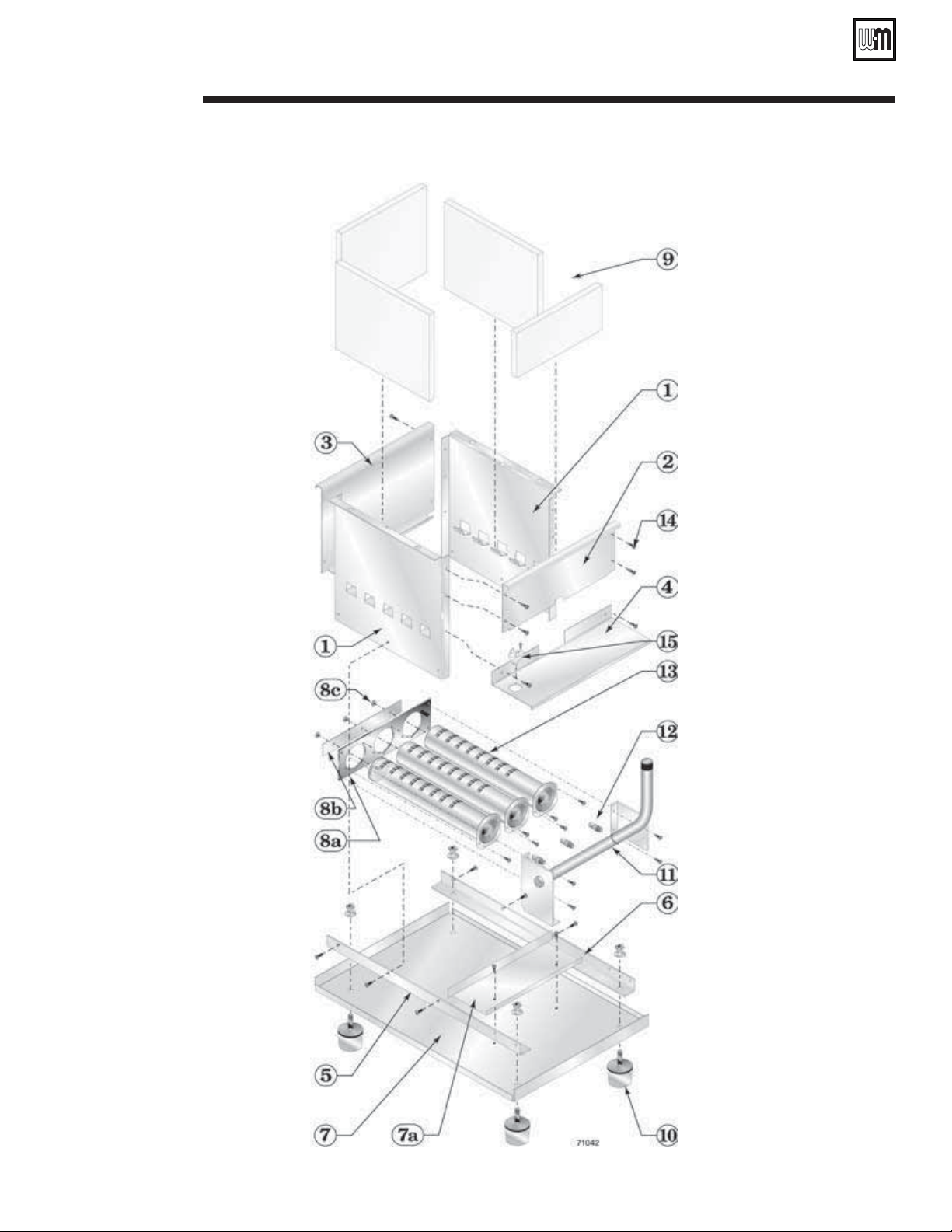
Part Number 550-142-302/0520
CGi
SERIES 4 — GAS-FIRED WATER BOILER — Boiler Manual
65
Replacement parts — base (continued)
12c
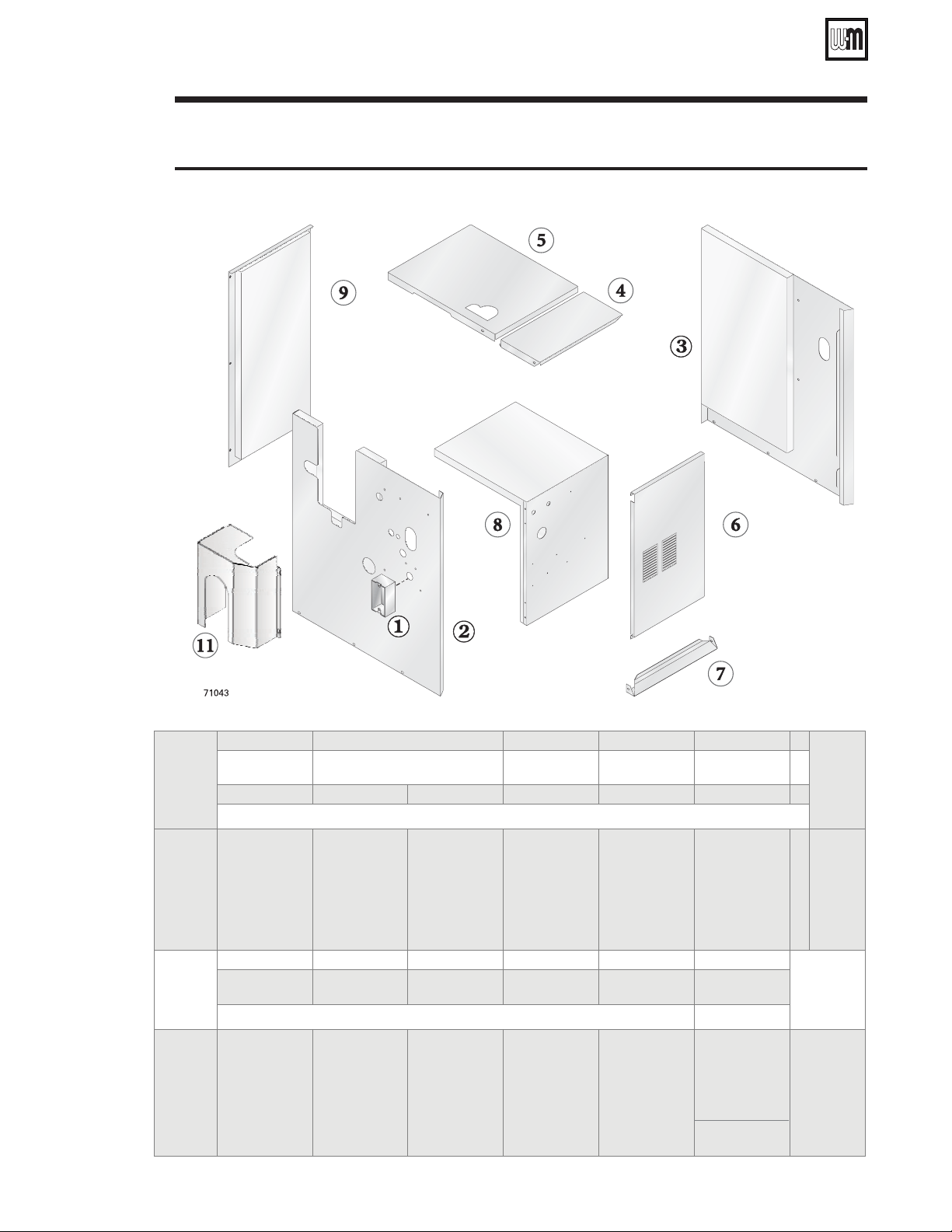
Part Number 550-142-302/0520
CGi
SERIES 4 — GAS-FIRED WATER BOILER — Boiler Manual
66
Figure 41 Jacket assembly
Replacement parts — jacket
12d
Boiler
Model
12345
Boiler
Model
2 x 4
eft side
right side
top front
top rear
Weil-McLain part number
CGi-25
CGi-3
CGi-4
CGi-5
CGi-6
CGi-7
CGi-8
381-359-215
381-359-216
381-359-217
381-359-218
381-359-219
381-359-220
381-359-221
381-359-222
381-359-223
381-359-224
381-359-225
381-359-226
381-359-227
381-359-228
381-359-229
381-359-229
381-359-229
381-359-229
381-359-229
381-359-229
381-359-229
381-359-230
381-359-230
381-359-231
381-359-232
381-359-233
381-359-234
381-359-235
381-359-242
381-359-242
381-359-243
381-359-244
381-359-245
381-359-246
381-359-247
CGi-25
CGi-3
CGi-4
CGi-5
CGi-6
CGi-7
CGi-8
Boiler
Model
67891011
Boiler
Model
bottom front
interior
rear
touch-up paint
Weil-McLain part number
CGi-25
CGi-3
CGi-4
CGi-5
CGi-6
CGi-7
CGi-8
381-359-254
381-359-254
381-359-255
381-359-256
381-359-257
381-359-258
381-359-259
381-359-260
381-359-260
381-359-261
381-359-262
381-359-263
381-359-264
381-359-265
381-359-266
381-359-266
381-359-267
381-359-268
381-359-269
381-359-270
381-359-271
381-359-272
381-359-272
381-359-273
381-359-274
381-359-275
381-359-276
381-359-277
381-359-278
Cloud
384-000-141
Slate
381-359-200
CGi-25
CGi-3
CGi-4
CGi-5
CGi-6
CGi-7
CGi-8
Optional
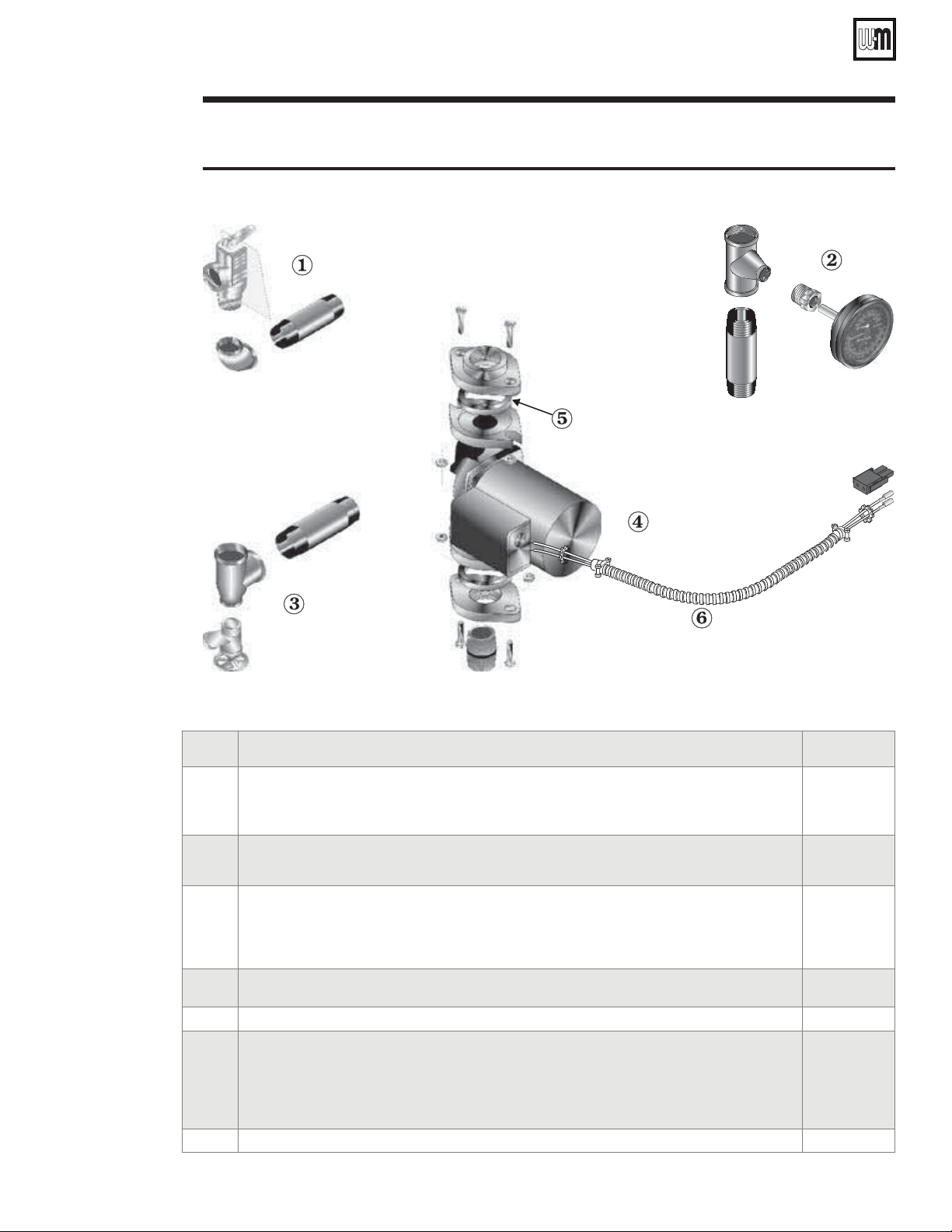
Part Number 550-142-302/0520
CGi
SERIES 4 — GAS-FIRED WATER BOILER — Boiler Manual
67
Replacement parts — trim
12e
Figure 42 Trim assembly
Item
number
Description Weil-McLain
part number
1 Pressure relief valve, ASME, 30 PSIG, ¾” male inlet
Pressure relief valve, ASME, 30 PSIG, ¾” female inlet
!%'("
511-546-920
511-546-924
2 Combination pressure-temperature gauge, 3¹⁄₈” diameter, short shank
!%"
380-000-000
3 Drain valve, ¾”
!%"
511-210-423
511-246-392
511-246-392
511-246-392
4 Circulator
!%"
CGi-25 through CGi-5
CGi-6 through CGi-8
511-405-153
511-405-113
5 Circulator gasket, universal (2 per boiler) 590-317-535
not
shown
Circulator hardware kit, includes:
1 fl ange, 2 nuts, 2 screws, 1 gasket —
¾” NPT — CGi-25
1” NPT — CGi-3 through CGi-5
1¼” NPT — CGi-6 and CGi-7
½” NPT — CGi-8
381-354-530
381-354-525
381-354-526
381-354-531
6 Circulator wiring harness kit, with Molex !" 381-356-528
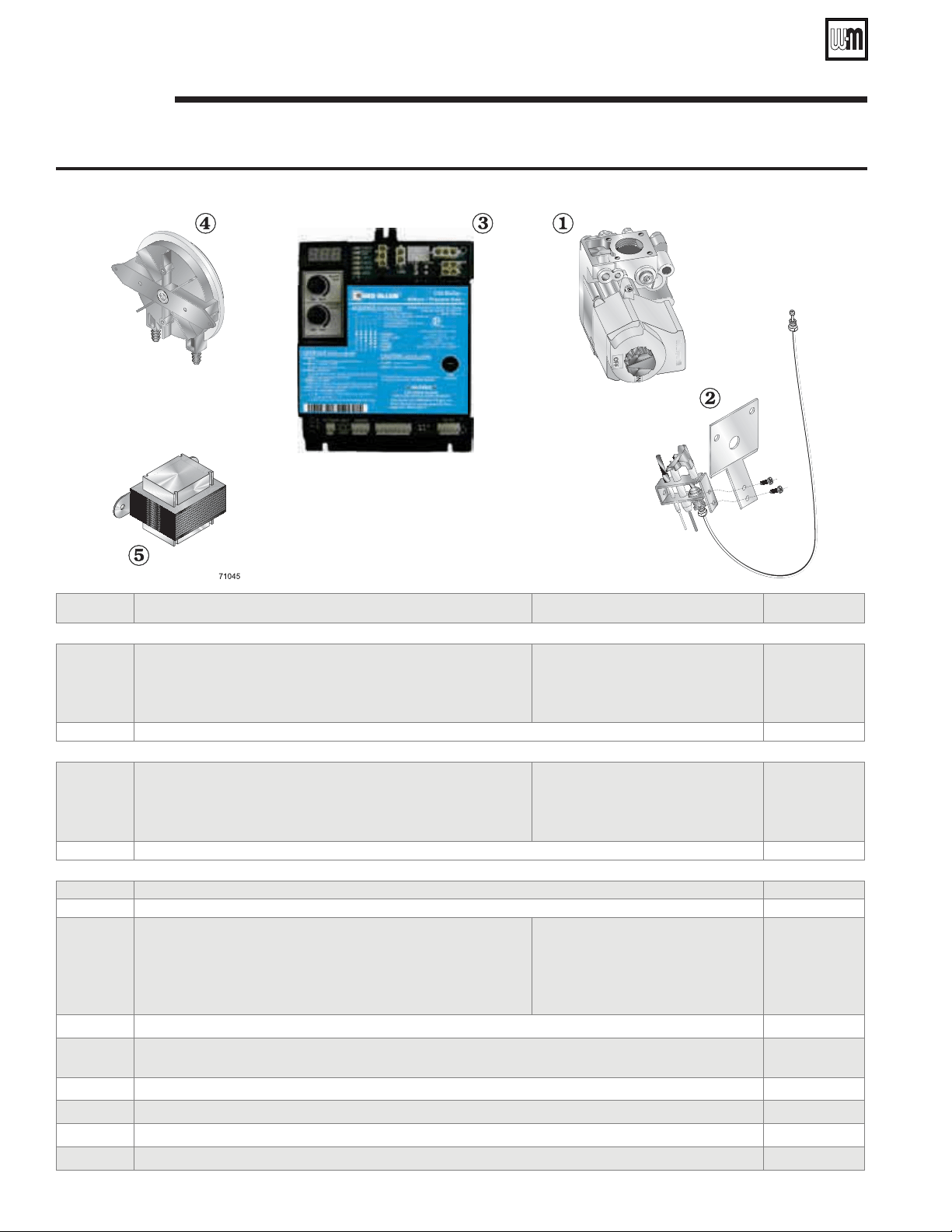
Part Number 550-142-302/0520
CGi
SERIES 4 — GAS-FIRED WATER BOILER — Boiler Manual
68
12f
Figure 43 Gas control assembly
Replacement parts — controls
Item
number
Description Boiler model Weil-McLain
part number
Natural gas components
1 Gas valve, ½” x ½”
Gas valve,
¾
” x
¾
”
CGi-25 thru -6
CGi-7 & CGi-8
511-044-381
511-044-381
511-044-353
511-044-353
2 Pilot kit w/orifice & aluminum pilot gas tubing 511-330-080
Propane gas components
1 Gas valve, ½” x ½”
Gas valve,
¾
” x
¾
”
CGi-25 thru -6
CGi-7 & CGi-8
511-044-354
511-044-354
511-044-355
511-044-355
2 Pilot kit w/orifice & aluminum pilot gas tubing 511-330-081
Natural gas and propane gas components
3 Control module 381-330-040
not shown
Wiring harness - Controls to control module 591-391-978
4 Air pressure switch
CGi-25
CGi-3
CGi-4
CGi-5
CGi-6
CGi-7
CGi-8
381-359-280
381-359-280
381-359-281
381-359-282
381-359-283
381-359-284
381-359-285
5 Control transformer 381-356-578
not shown
Tubing, air pressure switch, 0.12 I.D. silicone
red, to collector hood
white, to transition
590-317-650
590-317-651
not shown
Wiring harness - J-box to control module 591-391-975
not shown
Wiring harness - Thermostat 591-392-006
not shown
Wiring harness - Water Temperature Sensor 591-391-995
not shown
Wiring harness - Inducer motor to control module 591-391-980
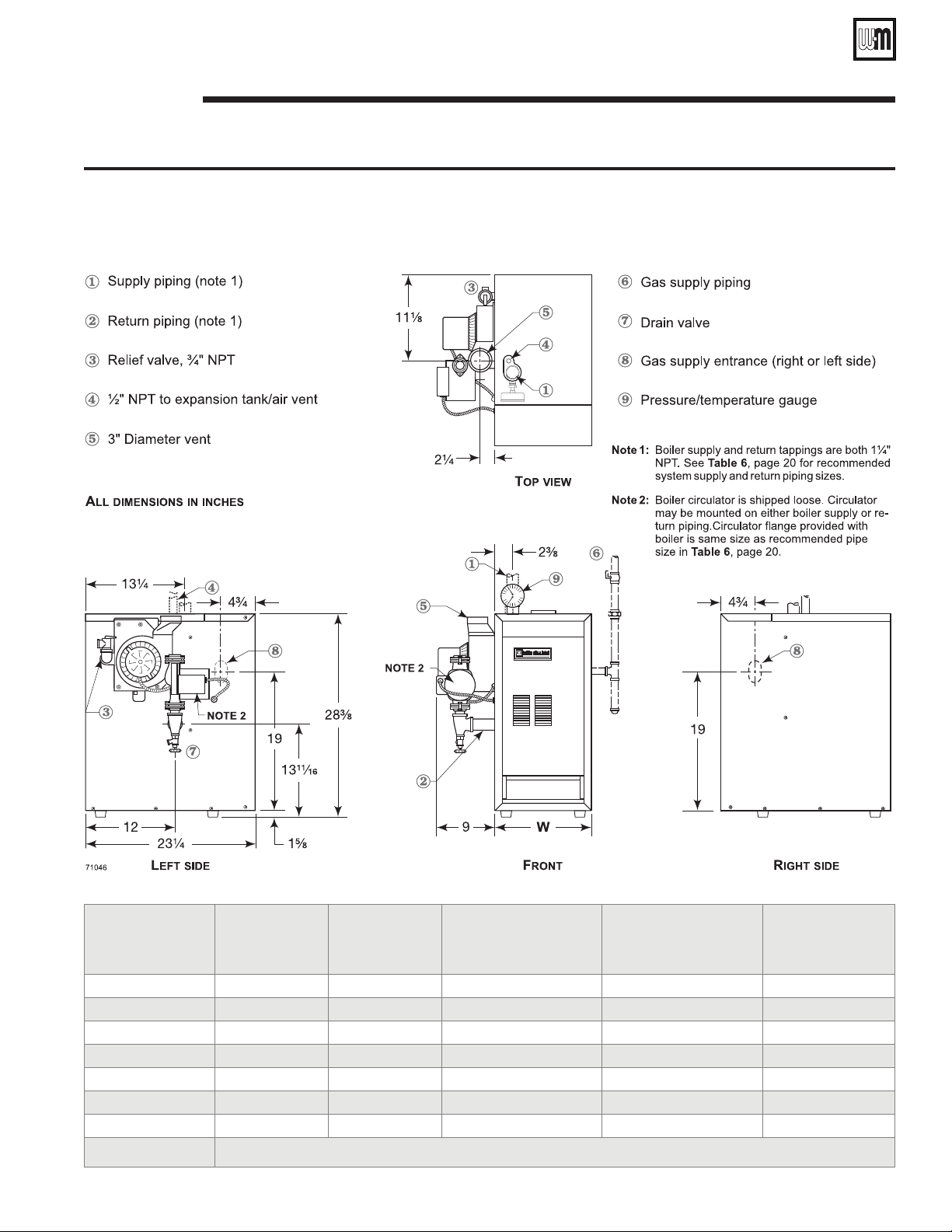
Part Number 550-142-302/0520
CGi
SERIES 4 — GAS-FIRED WATER BOILER — Boiler Manual
69
Dimensions
13a
Figure 44 Dimensional drawing
Boiler
model
number
Supply
tapping
(inches NPT)
Return
tapping
(inches NPT)
Gas
connection size
Note 3
(inches NPT)
Gas
manifold size
Note 3
(inches NPT)
“W”
Jacket
width
(inches)
CGi-25 1 ¼ 1 ¼ ½ ½ 10
CGi-3 1 ¼ 1 ¼ ½ ½ 10
CGi-4 1 ¼ 1 ¼ ½ ½ 13
CGi-5 1 ¼ 1 ¼ ½ ½ 16
CGi-6 1 ¼ 1 ¼ ½ ½ 19
CGi-7 1 ¼ 1 ¼ ¾ ¾ 22
CGi-8 1 ¼ 1 ¼ ¾ ¾ 25
Note 3:
Gas piping from meter to boiler to be sized per local utility requirements.
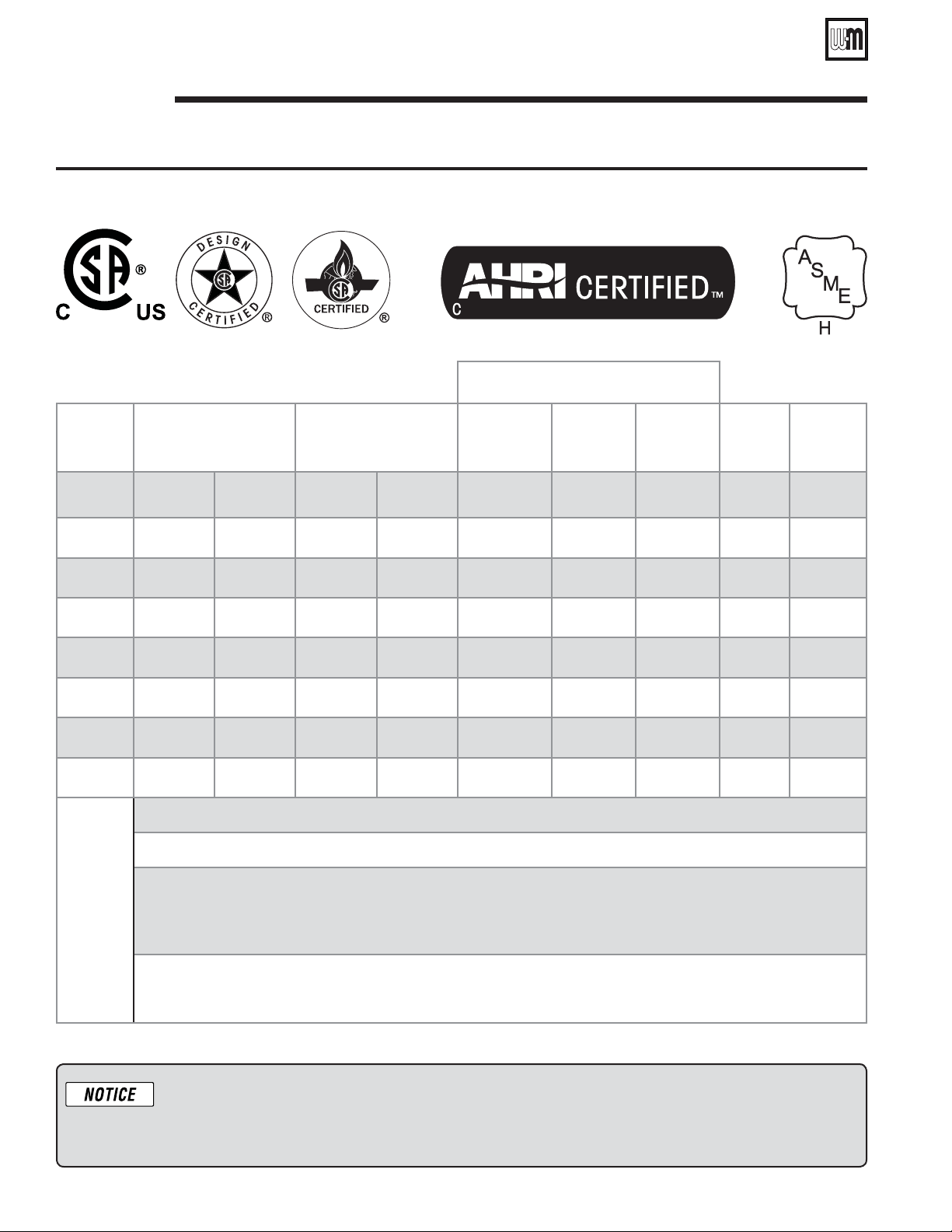
Part Number 550-142-302/0520
CGi
SERIES 4 — GAS-FIRED WATER BOILER — Boiler Manual
70
Ratings
13b
AHRI Certified Ratings
Boiler
model
number
0 - 2,000 feet
Altitude
2,000 - 4,500 feet
Altitude
Heating
Capacity
Seasonal
Efficiency
Net
Ratings
(water)
Boiler
water
content
Vent
size
(Note 1)
Input
(Btuh)
Output
(Btuh)
Input
(Btuh)
Output
(Btuh)
Btuh
(Note 2)
AFUE %
Btuh
(Note
3)
Gallons
Inches
(Note 4)
CGi-25
48,000 40,000 43,000 36,000 41,000 84.0 35,000 1.5 3"
CGi-3
58,000 49,000 52,000 43,000 49,000 84.0 42,000 1.5 3”
CGi-4
90,000 76,000 81,000 68,000 77,000 84.0 66,000 2.1 3”
CGi-5
119,000 100,000 107,000 90,000 102,000 84.0 88,000 2.7 3”
CGi-6
158,000 133,000 142,000 119,000 135,000 84.0 117,000 3.3 3”
CGi-7
190,000 160,000 171,000 143,000 162,000 84.0 140,000 3.8 3”
CGi-8
222,000 186,000 200,000 168,000 189,000 84.0 164,000 4.4 3”
Notes
1. Add “PIN” for Natural gas boiler - “PIL” for Liquefied Petroleum (propane) gas boiler.
2. Based on standard test procedures prescribed by the United States Department of Energy.
3. Net AHRI ratings are based on net installed radiation of sufficient quantity for the requirements
of the building and nothing need be added for normal piping and pickup. Ratings are based on
a piping and pickup allowance of 1.15. An additional allowance should be made for unusual piping
and pickup loads.
4. CGi boilers require special venting, consistent with Category I, or III boilers. Use only the vent materials
and methods specified in this manual. Vent diameter shown above is for direct exhaust venting.
See Table 3, page 14, for vent diameter when chimney draft venting.
CGi boilers for residential radiant panel systems, converted gravity heating systems or other low water
temperature applications should be installed with balancing valves and bypass piping equal to the supply
and return size to avoid excessive flue gas condensation due to lower operating water temperatures. CSA
design certified for installation on combustible flooring. Tested for 50 psi working pressure.
Table 11 Boiler ratings

Part Number 550-142-302/0520
CGi
SERIES 4 — GAS-FIRED WATER BOILER — Boiler Manual
71
Handling ceramic fiber and fiberglass materials
REMOVAL OF COMBUSTION CHAMBER
LINING OR BASE PANELS
The combustion chamber lining or base
insulation panels in this product con-
tain ceramic fiber
materials that have
been identified as carcinogenic, or possibly
carcinogenic, to humans
. Ceramic fibers
can be converted to cristobalite in very
high temperature applications. The
International Agency for Research on
Cancer (IARC) has concluded, “Crystal-
line silica inhaled in the form of quartz
or cristobalite from occupational sources
is carcinogenic to humans (Group 1).”:
Precautionary measures
❏ Avoid breathing fiberglass dust and contact with skin or
eyes.
• Use NIOSH certified dust respirator (N95).
This type of respirator is based on the
OSHA requirements for fiberglass wool at the
time this document was written. Other types of
respirators may be needed depending on the
job site conditions. Current NIOSH recommen-
dations can be found on the NIOSH web site
at http://www.cdc.gov/niosh/homepage.html.
NIOSH approved respirators, manufacturers, and
phone numbers are also listed on this web site.
• Wear long-sleeved, loose fitting clothing, gloves,
and eye protection.
❏ Apply enough water to the combustion chamber lining
or base insulation to prevent airborne dust.
❏ Remove combustion chamber lining or base insulation
from the boiler and place it in a plastic bag for disposal.
❏ Wash potentially contaminated clothes separately from
other clothing. Rinse clothes washer thoroughly.
NIOSH stated First Aid.
❏ Eye: Irrigate immediately.
❏ Breathing: Fresh air.
REMOVAL OF FIBERGLASS WOOL
or
INSTALLATION OF FIBERGLASS WOOL,
COMBUSTION CHAMBER LINING OR
BASE PANELS:
This product contains fiberglass jacket
insulation and ceramic fiber materi-
als in combustion chamber lining or
base panels in gas fired products. Air-
borne fibers from these materials have
been listed by the State of California
as a possible cause of cancer through
inhalation.
Precautionary measures
❏ Avoid breathing fiberglass dust and contact with skin
or eyes.
• Use NIOSH certified dust respirator (N95).
This type of respirator is based on the
OSHA requirements for fiberglass wool at the
time this document was written. Other types of
respirators may be needed depending on the
job site conditions. Current NIOSH recommen-
dations can be found on the NIOSH web site
at http://www.cdc.gov/niosh/homepage.html.
NIOSH approved respirators, manufacturers,
and phone numbers are also listed on this web
site.
• Wear long-sleeved, loose fitting clothing, gloves,
and eye protection.
❏ Operations such as sawing, blowing, tear out, and
spraying may generate airborne fiber concentration
requiring additional protection.
❏ Wash potentially contaminated clothes separately
from other clothing. Rinse clothes washer thoroughly.
NIOSH stated First Aid.
❏ Eye: Irrigate immediately.
❏ Breathing: Fresh air.
Part Number 550-142-302/0520
72
CGi
SERIES 4 — GAS-FIRED WATER BOILER — Boiler Manual