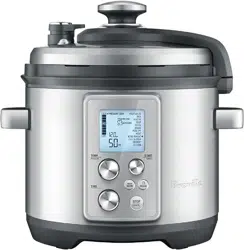
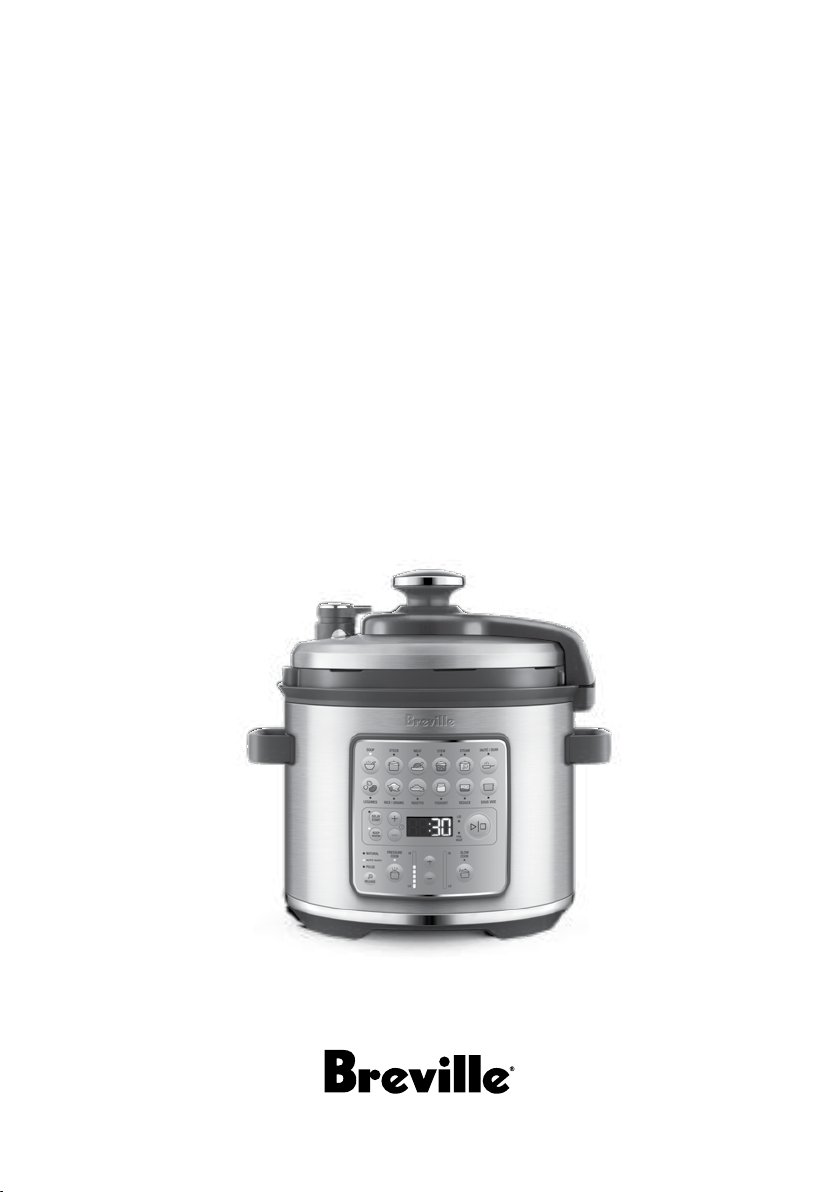
the Fast Slow GO
™
Instruction Book - BPR680

2
BREVILLE
RECOMMENDS
SAFETY FIRST
At Breville
®
we are very
safety conscious. We design
and manufacture consumer
products with the safety of you,
our valued customer, foremost
in mind. In addition, we ask
that you exercise a degree of
care when using any electrical
appliance and adhere to the
following precautions.
IMPORTANT
SAFEGUARDS
READ ALL INSTRUCTIONS
BEFORE USE AND SAVE
FOR FUTURE REFERENCE
• Remove and safely discard
any packing materials and
promotional labels before
using the pressure cooker for
the first time.
• To eliminate a choking hazard
for young children, remove and
safely discard the protective
cover fitted to the power plug
of this appliance.
• Always ensure the appliance
is properly assembled before
use. Follow the instructions
provided in this book.
• Always insert the connector
end of the power cord into
the appliance inlet before
inserting power plug into the
power outlet and switching on
appliance. Ensure the appliance
inlet is completely dry before
inserting the connector end of
the power cord.
• Take care to avoid spillage on
the connector.
2 Breville Recommends
Safety First
7 Components
8 Control Panel
9 Food Presets
10 Cooking Presets
11 Functions
20 Care & Cleaning
22 Troubleshooting
Contents

3
WARNING
Only use the cooking bowl
intended for this appliance;
using cooking vessels not
provided will result in a
non-resettable issue.
• Do not touch hot surfaces.
Appliance surfaces are hot
during and after operation.
To prevent burns or personal
injury, always use protective
hot pads or insulated oven
mitts, or use handles or knobs
where available.
• Do not place the appliance near
the edge of a bench or table
during operation. Ensure that
the surface is dry, level, clean
and free of any liquid and other
substances.
• Always operate the appliance
on a stable and heat resistant
surface. Do not use on a cloth-
covered surface and position
the appliance at a minimum
distance of 20cm away from
walls, curtains, cloths and other
heat sensitive materials.
• Do not place this appliance
on or near a hot gas or electric
burner, or where it could touch
a heated oven.
• Do not operate the appliance
on a sink drain board.
• We recommend not to place
the cooker on a stone bench
top when it’s cooking. This
is due to bench tops being
sensitive to uneven heat and
may crack if heated locally. If
you would like to cook with the
slow cooker on the bench top,
place a chopping board or heat
proof mat underneath
the cooker.
• Cooking appliances should
be positioned in a stable
situation with the handles (if
any) properly secured to avoid
spillage of the hot liquids.
• Do not place anything, other
than lid, on top of the cooker
when assembled, when in use
and when stored.
• Extreme caution must be used
when the cooker contains hot
food and liquids and/or is under
pressure. Improper use may
result in injury. When using this
appliance for pressure cook,
slow cook and steam, ensure the
lid is properly assembled and
locked into position before use.
• Do not move the cooker when
in use.
• Do not use the lid handle to
carry the appliance.
• Before placing removable
cooking bowl into the base
ensure the base of bowl and the
base of the appliance is dry by
wiping with a dry soft cloth.

4
• Do not use a damaged
removable cooking bowl.
Replace before using.
• Do not place food or liquid
directly into the base. Only
the removable cooking bowl
is designed to contain food or
liquid.
• Never operate the cooker
without food and liquid in
the removable cooking bowl.
Ensure a combined minimum
of 4 cups (1 litre) of food and/
or liquid when cooking. Using
less than 4 cups can result in
a reduction of pressurisation.
This minimum quantity
level does not apply for
the LEGUMES and RICE |
GRAINS settings.
• Always ensure there is enough
liquid in the removable
cooking bowl when steaming.
At least 4 cups (1 litre) of liquid
is required when steaming.
• Do not exceed maximum fill
level. Some foods expand
during pressure cooking
such as rice, diced vegetables.
Over filling may cause a risk
of clogging pressure release
valve and safety locking pin
and develop excess pressure.
Always follow the maximum
and minimum quantities of
liquid stated in instructions
and recipes.
• Some food to avoid when
pressure cooking are: apple
sauce, cranberries, pearl
barley, oatmeal and other
cereals, noodles and pasta, and
rhubarb; these foods can foam,
froth and splatter and clog
the pressure release valve and
safety locking pin.
• Before use, always check
pressure release valve and
safety locking pin for clogging
and clean if necessary. Check
to make sure the safety locking
pin moves freely from under
the lid.
• Do not attempt to open the
cooker lid after pressure
cooking until all internal
pressure has been released
and is slightly cooled. If the
lid will not turn to unlock, this
indicates that appliance is
still under pressure – do not
force lid open. Any pressure
remaining can be hazardous.
See operating instructions for
STEAM RELEASE directions
in this instruction book.
• The container must not be
opened until the pressure has
decreased sufficiently.
• Do not touch the pressure
release valve whilst in use.
• The surface heating element
is subject to residual heat after
use.

5
• Use only recommended
STEAM RELEASE button to
depressurise cooker after use.
• Do not use this appliance for
deep frying.
• Do not sauté or shallow fry
under pressure.
• Do not attempt to operate
the appliance by any method
other than those described in
this booklet. Do not leave the
appliance unattended when
in use.
IMPORTANT SAFEGUARDS
FOR ALL ELECTRICAL
APPLIANCES
• Unwind the power cord fully
before use.
• Do not let the power cord hang
over the edge of a bench or
table, touch hot surfaces or
become knotted.
• Connect only to a 230V or
240V power outlet.
• To protect against electric
shock, do not immerse the
power cord, power plug or
appliance in water or any other
liquid.
• Always turn the appliance OFF,
switch off at the power outlet,
remove the plug and allow all
parts to cool before attempting
to move the appliance, when
the appliance is not in use,
before cleaning and when
storing.
• This appliance is not to be used
by persons (including children)
with reduced physical, sensory
or mental capabilities, or lack
of experience and knowledge,
unless they have been given
supervision or instruction by
a person responsible for their
safety who understands the
hazards involved.
• Children shall not play with the
appliance.
• Cleaning and user
maintenance shall not be made
by children unless they are
older than 8 and supervised.
• Keep the appliance and its cord
out of reach of children less
than 8 years.
• It is recommended to regularly
inspect the appliance. Do not
use the appliance if the power
cord, power plug or appliance
becomes damaged in any way.
Return the entire appliance to
the nearest authorised Breville
Service Centre for examination
and/or repair.
• Any maintenance, other than
cleaning, should be performed
at an authorised Breville
Service Centre.

6
• The use of attachments
not sold or recommended
by Breville may cause fire,
electric shock or injury.
• This appliance is for
household use only. Do not
use this appliance for other
than its intended use. Do not
use in moving vehicles or
boats. Do not use outdoors.
Misuse may cause injury.
• The appliance is not intended
to be operated by means of
an external timer or separate
remote control system.
• The installation of a residual
current device (safety switch)
is recommended to provide
additional safety protection
when using electrical
appliances. It is advisable that
a safety switch with a rated
residual operating current not
exceeding 30mA be installed
in the electrical circuit
supplying the appliance.
See your electrician for
professional advice.
FOR HOUSEHOLD USE ONLY
SAVE THESE INSTRUCTIONS
7
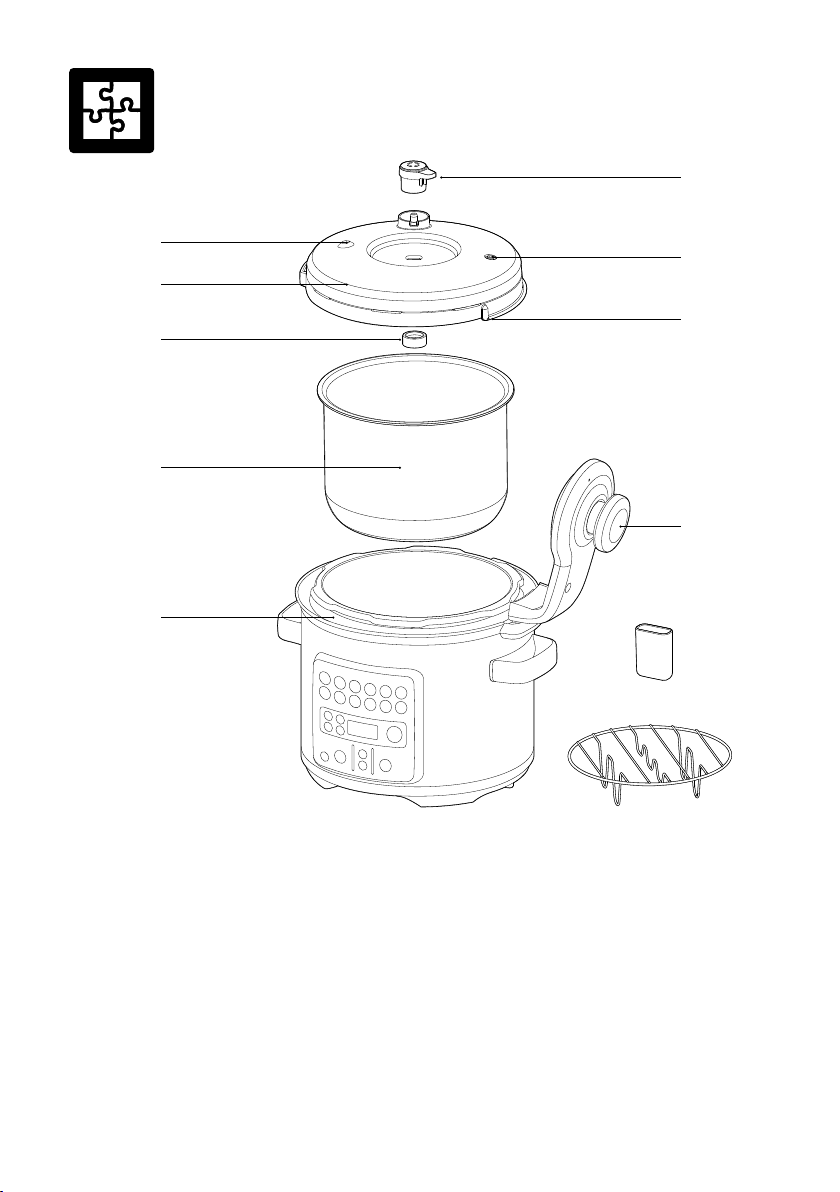
Components
A. Pressure Release Valve
Automatically controls the rate at which
steam is released from the cooker
B. Pressure Safety Valve
C. Dishwasher Safe Removable Lid
D. Safety Locking Pin
Pin pops up once pressure is reached acting
as a safety locking device
E. Silicone Lid Seal
Easy fitting for hassle free assembly and
cleaning
A
D
E
H
B
C
F
G
I
K
J
F. Sealing Nut
G. 6L Removable Cooking Bowl
H. Lid Arm
I. Easy Clean Moat
Catches condensation drips for a mess-free
clean up.
J. Condensation drip Cup
K. Stainless Trivet
Raises food out of liquid for roasting and
steaming.
8
CONTROL PANEL
PRESSURE
COOK
SLOW
COOK
HI
LO
HI
LO
NATURAL
AUTO QUICK
PULSE
RELEASE
STOCK MEAT STEW STEAM SAUTÉ | SEARSOUP
RICE | GRAINS RISOTTO YOGHURT REDUCE SOUS VIDE LEGUMES
DELAY
START
KEEP
WARM
C
H
G
I
F
K ML
D
J
E
A B
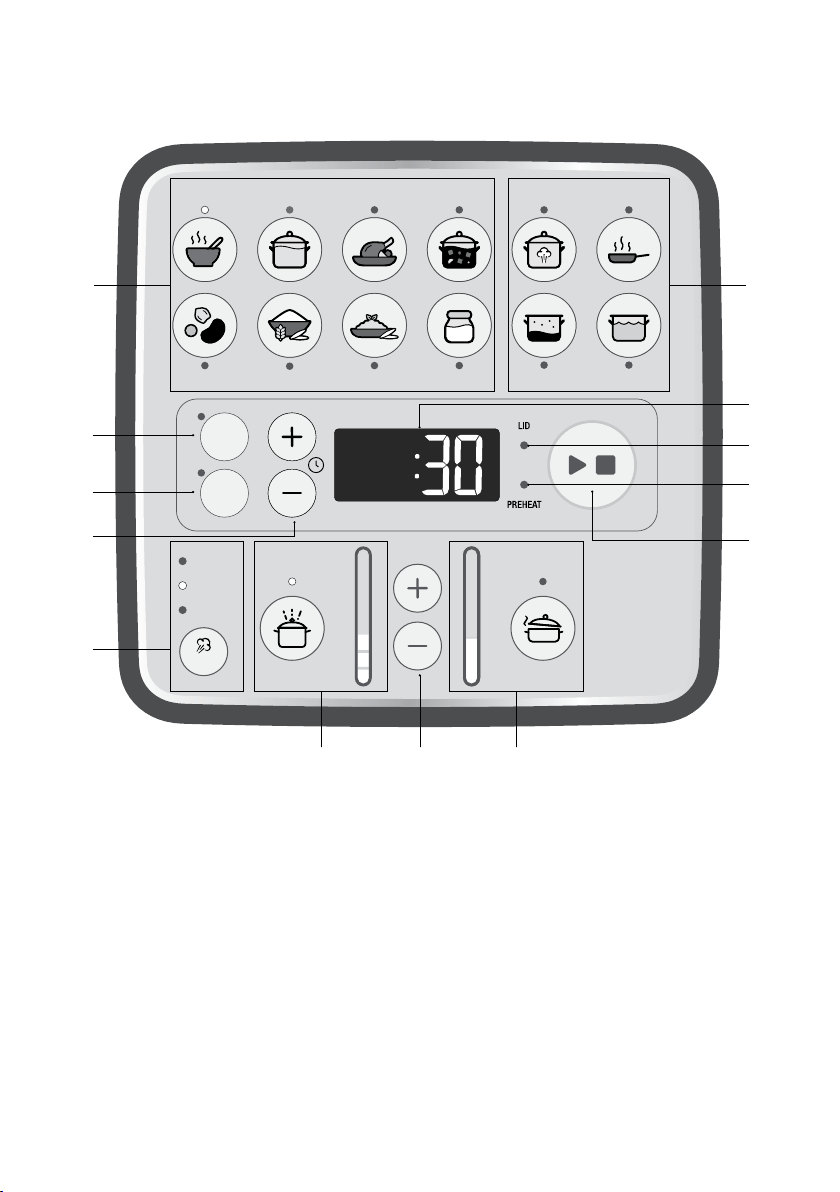
A. Food Presets with light indicators
B. Cooking Presets with light
indicators
C. DELAY START
D. KEEP WARM
E. TIME (+ / -) adjustment buttons
F. LED display
G. Lid Lock / Unlock Warning Light
Indicator
H. Preheat Light Indicator
I. START/CANCEL Button
J. Pressure Release button with modes
selection indicator
K. PRESSURE COOK with light indicator
Pressure Level Indicator for Pressure
Cooking Mode
L. PRESSURE / TEMPERATURE (+ / -)
adjustment buttons
M. SLOW COOK with light indicator
Temperature Indicator for Slow Cooking
Mode
9
FOOD PRESETS
SETTING: PRESSURE COOK
FOOD MENU DEFAULT PRESET RANGE
Soup
50 kPa
30 MINS
AUTO QUICK
10 kPA – 80 kPa
Up to 2:00 HRS
Stock
80 kPa
1:00 HR
NATURAL
10 kPA – 80 kPa
Up to 2:00 HRS
Meat
80 kPa
1:00 HR
AUTO QUICK
10 kPA – 80 kPa
Up to 2:00 HRS
Stew
60 kPa
1:00 HR
AUTO QUICK
10 kPA – 80 kPa
Up to 2:00 HRS
Legumes
80 kPa
30 MINS
NATURAL
10 kPA – 80 kPa
Up to 2:00 HRS
Rice | Grains
50 kPa
10 MINS
AUTO PULSE
10 kPA – 80 kPa
Up to 2:00 HRS
Risotto
40 kPa
7 MINS
AUTO QUICK
10 kPA – 80 kPa
Up to 2:00 HRS
SETTING: SLOW COOK
FOOD MENU DEFAULT PRESET RANGE
Soup
HIGH
4:00 HRS
KEEP WARM
Time: 2 – 12 HRS
Temp: High - Low
Keep warm: on / off
Stock
HIGH
4:00 HRS
KEEP WARM
Time: 2 – 12 HRS
Temp: High - Low
Keep warm: on / off
Meat
LOW
8:00 HRS
Time: 2 – 12 HRS
Temp: High - Low
Keep warm: on / off
Stew
LOW
8:00 HRS
Time: 2 – 12 HRS
Temp: High - Low
Keep warm: on / off
Legumes
HIGH
6:00 HRS
Time: 2 – 12 HRS
Temp: High - Low
Keep warm: on / off
YOGURT Stage 1
Scalding
10 MIN
Temp: 83°C
KEEP WARM OFF
Stage 2
Cooling*
Up to 3 hours
Temp: from 83°C to 43°C
KEEP WARM OFF
Stage 3
Incubating
8 hours
Temp: 43°C
KEEP WARM OFF
Time: 8 - 16 HRS
Temp: n / a
Keep warm: n / a
*Cool down time if the lid is open (for 2 litres of milk):
It can take up to 1hr 20mins to lower the temperature from 83°C to 43°C
Lid must be open during the cooling process.

10
COOKING PRESETS
SETTING TIME / TEMP PRESET RANGE
SAUTE / SEAR
COUNT UP TIME Temp: Sear – Med - Low Time: n/a
Keep warm: off only
REDUCE
HIGH
10 MINS
Temp:
Low - 105°C
Med - 115°C
High - 130°C
Time: 1 MIN – 2 HRS
Keep warm: on / off
STEAM
15 MIN Temp: 100°C Time: 1 MIN – 1 HR
Temp: n/a
Keep warm: off only
SOUS VIDE
57°C
1:00 HR
Temp: 57°C Time: 1 MIN – 24 HRS
Temp: 30°C - 90°C
Keep warm: n / a
KEEP WARM
2:00 HRS
COUNT UP TIME
Temp: 70°C
11
BEFORE FIRST USE
1. Remove and safety discard any packaging
material, promotional labels and tape from
the cooker.
2. Open the lid by turning the lid knob
counter clockwise and lifting lid up and off
the appliance until it is in the hinged open
position. Unscrew and remove the sealing
nut from the centre of the lid and pull the lid
away to remove from the lid arm.
3. Wash the lid, removable cooking bowl and
silicone lid seal in hot, soapy water, rinse
and dry thoroughly. Wipe the inside and
outside of the base with a soft, damp cloth
and dry thoroughly.
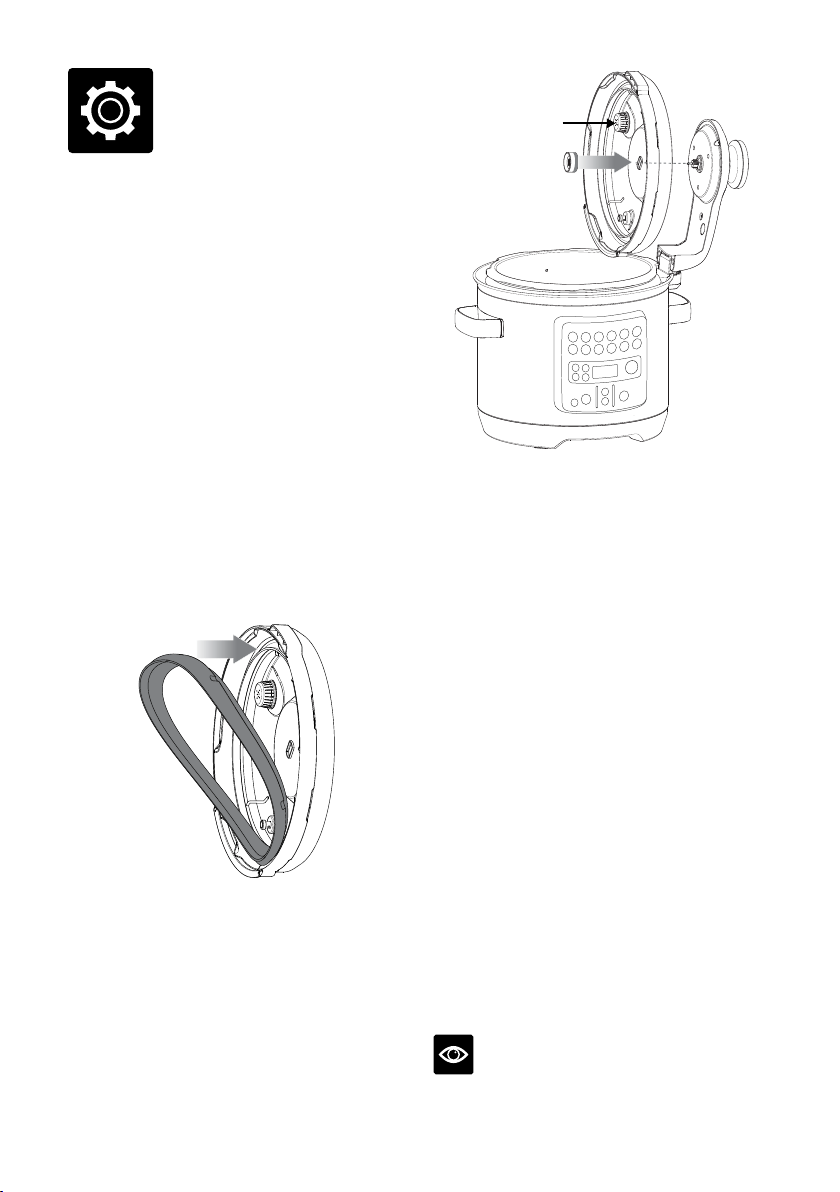
4. Attach the clean silicone lid seal securely
around the wire ring on the underside of
the lid. Adjust position if necessary, so that
it sits comfortably and is free from any
distortions.
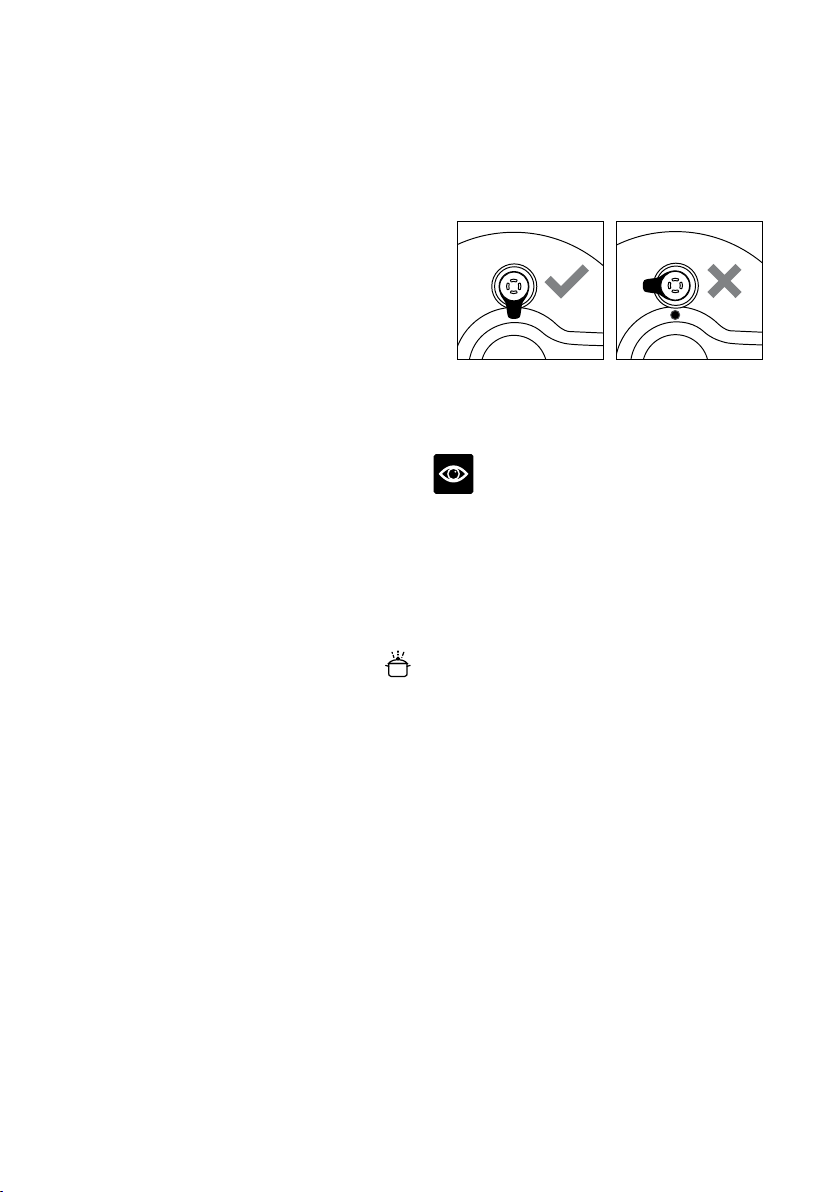
5. To reattach the lid, orient the lid so that the
steam release valve housing is to the rear of
the unit, and then align the centre of the lid
with the bolt on the underside of the lid arm
and push into position to expose the screw
thread. Secure the lid by screwing on the
sealing nut so that the red seal touches the
lid surface.
Pressure
Release Valve
Cover towards
rear of cooker
6. Clean and dry the bottom of the removable
cooking bowl and the temperature
sensor, making sure there are no
unwanted materials on the surface. The
removable cooking bowl must sit flat on
the temperature sensor to ensure proper
contact.
7. Click condensation drip cup into place.
8. Insert the connector end of the power
cord into the cooker base, ensuring it is
completely dry. Insert the power plug in to a
230/240 volt (grounded) power outlet.
• Set altitude level (above sea level) -
machine will display Set - Alt -
(distance) - meters
• Press the TIME (+/-) buttons to adjust
to the closest altitude from 0 to 2000
meters.
• Press START to confirm
9. The cooker alert will sound, and the LED
will illuminate.
10. We recommend running a 15 minute
cooking cycle with water to get rid of any
protective substances in the bowl and on
the heating element.
NOTE
The pressure cooker should not be used at
altitudes above 2,000 meters.
Functions
12
Longer cooking times are needed at higher alti-
tudes to achieve the best food results. For these
high altitude areas, it is recommended to use the
greater cooking time.
WARNING
Only use the cooking bowl intended for this
appliance; using vessels not provided will result
in a non-resettable issue.
CONTROL PANEL SETTINGS
The Fast Slow GO™ features 6 Preset Settings;
Pressure Cook, Slow Cook, Reduce, SAUTÉ/
SEAR Steam and Sous Vide. It also features
8 food shortcuts: Soup, Stock, Meat, Stew,
Legumes, Rice/Grains, Risotto and Yoghurt.
FOOD PRESETS
The control panel displays 8 available food
presets for easy selection.
Pressing any of the 8 food presets will use the
default settings to achieve the best food results
for that particular type of food. This includes
changing to ‘PRESSURE COOK’ or ‘SLOW
COOK’ mode.
Depending on the cooking mode, pressing a
food preset button will adjust the PRESSURE or
TEMPERATURE levels, the cooking time, and
the pressure release mode, as well as turning on
and off the KEEP WARM button.
The cooking time, KEEP WARM or DELAY
START, can all be adjusted while remaining
in selected food preset. However, any change
to pressure or temperature levels, or pressure
release setting (depending what mode the
product is in) will change the unit to custom
mode.
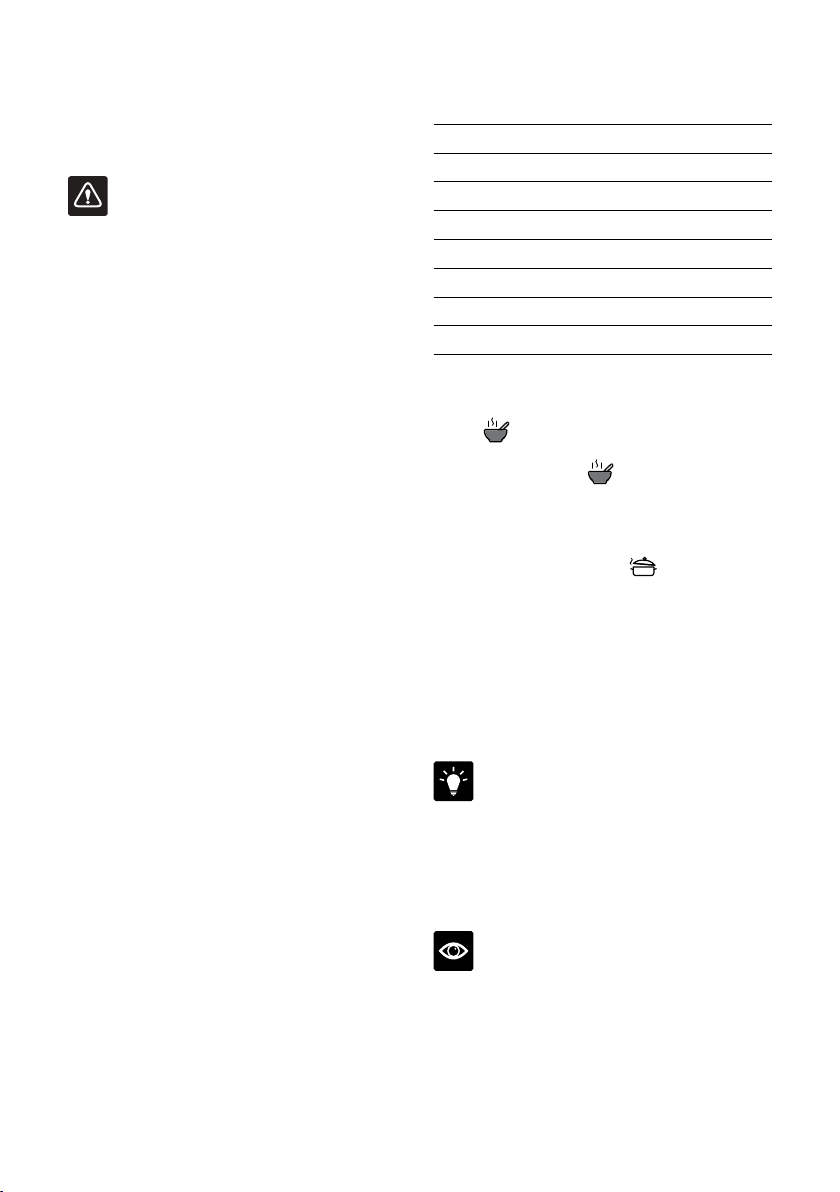
The table below shows, when selecting food
menu, certain food can be cooked by either
pressing ‘PRESSURE COOK’ or ‘SLOW COOK’.
Food Menu Pressure
Cook
Slow
Cook
Soup
✔ ✔
Stock
✔ ✔
Meat
✔ ✔
Stew
✔ ✔
Legumes
✔ ✔
Rice / Grains
✔ ✘
Risotto
✔ ✘
Yoghurt
✘ ✔
SIMPLE PRESET STEPS
E.g.
SOUP
• Press the soup icon on the interface.
• The interface will automatically suggest
a Pressure Cooking function (if relevant).
To select a slow cooking function, press
the SLOW COOK button
• The interface will automatically display the
accurate cooking time and pressure level
for soup.
• The cooking time can be modified by
pressing the arrows up or down.
• After ingredients are added, press START
to begin cooking.
TIP
If desired, it is possible to sauté vegetables
or sear meat with the SAUTÉ/SEAR function
prior to cooking. When finished, press STOP to
cancel the SAUTÉ/SEAR function and select
the next cooking preset.
NOTE
• For first timers using pressure cooking
method, pressure release can be
overwhelming. As it releases big bold steam,
always keep hands and face clear of the
pressure release. (refer to page 14 for the
variable steam release description
and caution).
13
• Refer to ‘Food Presets’ and ‘Cooking Presets’
section for preset settings recommendations.
• If there is no visible light on any of the food
preset indicators, then the product is in manual
mode. Press a food preset button to return to
its default settings.
• The steam or pressure release mode
programmed into the preset cooking modes
are selected for best results. Any changes
to the steam release mode may lead to food
spillage.
MANUAL PRESSURE COOK MODE
Pressure Cooking is a method of cooking
food in a small amount of liquid with a gasket
sealed lid that retains steam inside and builds
pressure. It is the increase in pressure that
raises temperature of the liquid and steam
inside to well above boiling point and therefore
allows food to be cooked up to 70% faster. This
means less energy is consumed and you will
enjoy substantial savings in both time and cost.
Because pressure cooked foods require very
little cooking liquid, more vitamins, minerals,
and other nutrients are retained, and the natural
flavours are enhanced.
1. To select the manual pressure cook mode,
press and hold the Pressure Cook button
for 2 seconds.
2. Adjust the cooking pressure by using the
PRESSURE/TEMPERATURE (+/-) buttons.
Pressure can be adjusted from 10 kPa (LOW)
to 80 kPa (HIGH).
3. The figure on the LED screen indicates the
preset cooking time for the selected setting.
Adjust the cooking time by using the TIME
(+ / -) buttons (next to the 4 digit display)
to reduce the cooking time or increase the
cooking time. Time can be adjusted up to 2
hours.
4. Press the STEAM RELEASE button to select
between ‘NATURAL’ , ‘AUTO QUICK’, and
PULSE steam release.
5. Place food into the removable cooking bowl
Ensure there is at least 1L of combined food
and liquid in the bowl.
6. Close the lid and turn the lid knob
clockwise to lock into place. The cooker
alert will sound when the lid has been
locked.
7. Ensure the pressure release valve is placed
on the lid in the closed position.
8. Press the START button to commence
cooking. The START/CANCEL button will
illuminate orange, ’PREHEAT’ will be lit.
NOTE
It is normal for the cooker to release small
bursts of steam as it stabilises.
9. If the lid has not been locked correctly, ‘LID’
indicator will flash and the audio alert will
beep, cooking will be paused until the lid
is in the correct position. Turn the lid knob
clockwise to lock the lid and commence
cooking.
10. Once the cooker has reached pressure, the
“PREHEAT’ indicator light will disappear,
the cooker alert will sound, the timer will
start counting down.
11. The time can be adjusted during the
pressure cook cycle by pressing the TIME
(+ / -) buttons. The cycle can be paused at
any time by pressing the START/CANCEL
button. To end the cycle press and hold
START/CANCEL for 2 seconds. If there
is already pressure in the vessel it will go
immediately to the steam release cycle.
12. At the end of the pressure cook cycle, the
cooker alert will sound, and steam will
be automatically released through the
pressure release valve. The steam icon will
blink, the timer will start counting up.
13. If NATURAL steam release is selected,
pressure will naturally subside in the vessel
without forcing steam through the pressure
14
release valve. The steam release setting can
be changed during the steam release cycle
by pressing the STEAM RELEASE button.
14. At the end of the steam release cycle, the
cooker alert will sound, the display will flash,
and if ‘KEEP WARM’ is on, display timer
will start counting up.
15. Open the lid by turning the lid knob
counter clockwise and carefully lift the lid
into the hinged open position.
16. After 5 minutes of inactivity, standby mode
will be activated. The LED will no longer
illuminate.
CAUTION
To avoid scalding from escaping steam, never
place your face or hands over the cooker when
removing the lid.
WARNING
If the lid will not unlock this indicates the
appliance is still under pressure. Do not force
the lid open as any remaining pressure can be
hazardous.
MANUAL STEAM RELEASE
Press and hold the STEAM RELEASE button
to manually release steam.
NOTE
Pressing and holding the steam release button
during or after a cooking cycle will open the
pressure release valve.
HANDS- FREE VARIABLE STEAM
RELEASE
The Fast Slow GO™ features 3 steam release
methods:
Auto Quick
Pressure is released quickly to minimise
overcooking of foods or recipes with short
cook times.
This is recommended only for food types that
do not expand or foam when boiling.
Pulse
Pressure is released in bursts to reduce
disturbance to the food inside.
This is recommended for food types that
generate small amount of foam or do not foam
at all when boiling.
Natural
Pressure naturally subsides inside without
releasing steam through the vent to prevent
the disturbance of or breaking apart of
sensitive ingredients like stocks and beans
during pressure release.
Natural pressure release mode is suitable for all
types of food recipes.
NOTE
Some food type (e.g. legumes) that are known
to generate excessive foam can only use
'Natural' Pressure release to prevent food
spillage.
These can be selected using the Steam Release
button
on the control panel during the set
up and steam release cycles. Once selected,
the pressure release valve will automatically
release the steam at the end of the pressure
cooking cycle.
NOTE
The steam or pressure release mode
programmed into each preset cooking modes
are selected for best results. Any changes
to the steam release mode may lead to food
spillage.
CAUTION
Always keep hands and face clear of the
pressure release valve when pressure cooking
as hot steam and water may be emitted during
operation.
MANUAL SLOW COOK MODE
The SLOW COOK setting is designed for long
cook times at low temperatures. It is also ideal
for breaking down tough cuts of meat and
developing deep flavours.
15
1. Select the Slow Cook
on the interface.
2. The LED screen indicates the preset
temperature for the selected food.
But you may press the PRESSURE/
TEMPERATURE (+/-) buttons to reduce
the temperature or to increase temperature.
Temperature can be adjusted to three preset
temperatures: HI–LO.
3. The LED screen indicates the preset
cooking time for the selected food. You may
adjust the TIME (+/ -) to reduce or increase
the cooking time. Time can be adjusted
between 2 and 12 hours.
4. ‘KEEP WARM’ indicator will automatically
switch on after the SLOW COOK cycle.
Press the ‘KEEP WARM’ button on the
control panel to select or deselect the
function.
5. Place food into the removable cooking bowl.
Ensure there is at least 1L of combined food
and liquid in the bowl.
6. Close the lid and rotate to locked position.
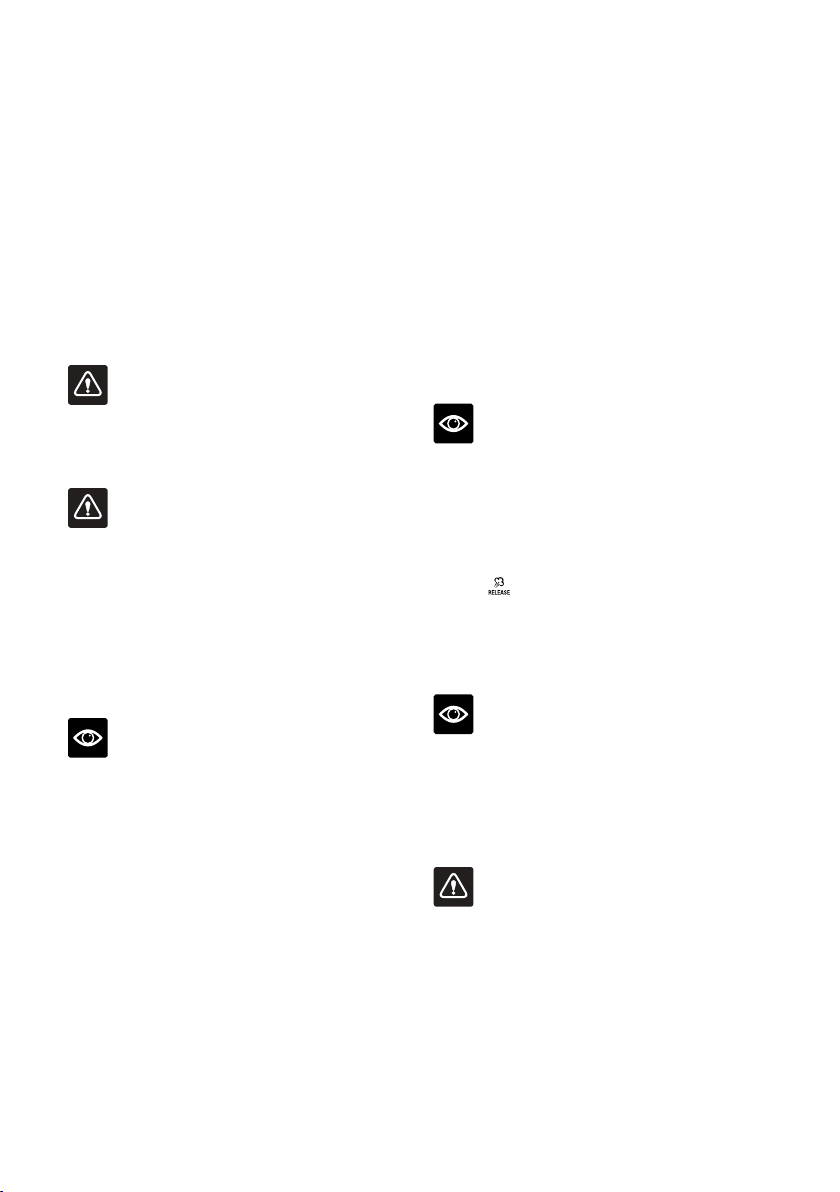
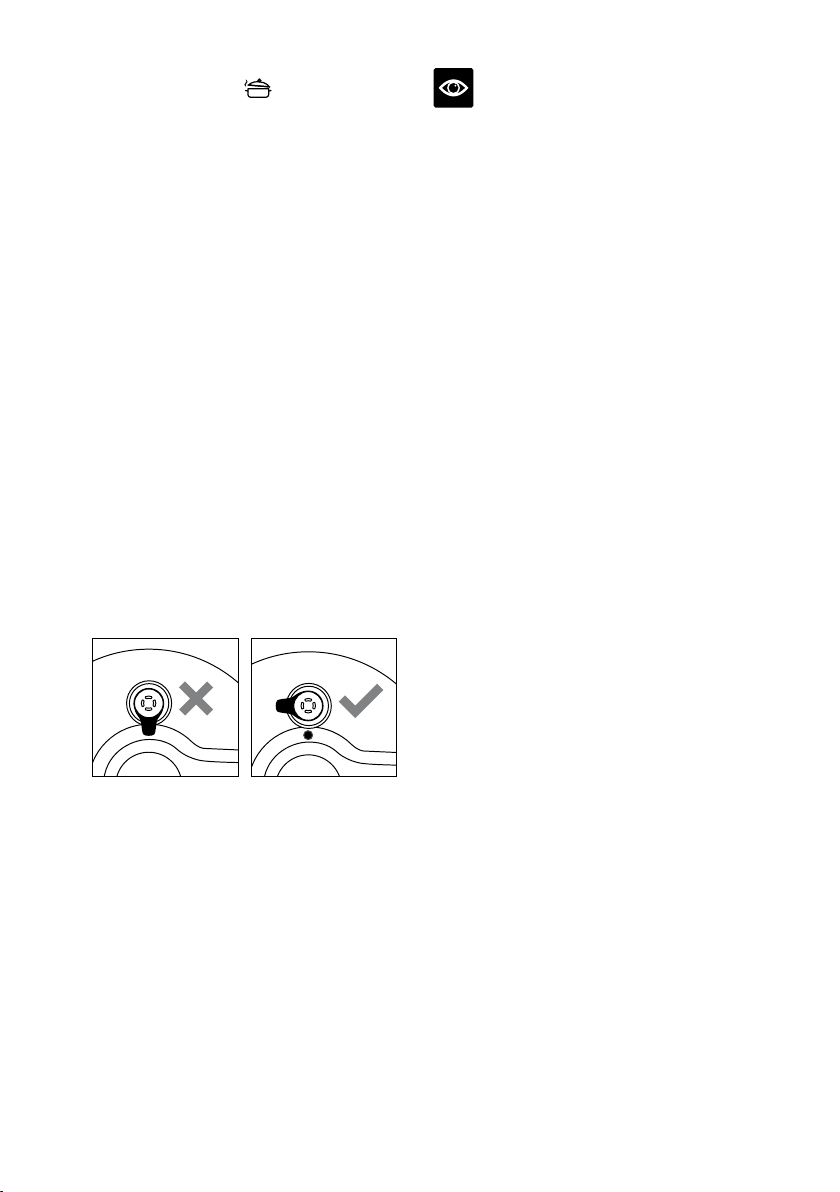
7. Turn the pressure release valve to the open
position.
Press the START button to commence
cooking. The START/CANCEL button will
illuminate orange.
8. The timer will be displayed and
automatically begin to count down. The
time can be adjusted during the slow cook
cycle by pressing the TIME (+ / -) button.
The cycle can be paused at any time by
pressing the START/CANCEL button.
While paused, cooking settings can be
adjusted. Pressing START/CANCEL button
again, will continue cooking using the
newly adjusted settings.
NOTE
During slow cooking, there may be some
pressure build up that makes the lid difficult
to open. If this occurs, press the STEAM
RELEASE button until all internal pressure
is released, and the cooker can be opened. .
9. At the end of the slow cook cycle, the
cooker will automatically switch to the
KEEP WARM function. The KEEP WARM
indicator will be lit, and the timer will start
counting up to a maximum of 6 hours. The
keep warm cycle can be paused at any time
by pressing the START/CANCEL button.
10. If KEEP WARM has not been selected,
the cooker alert will sound, the START/
CANCEL orange illumination will turn off.
11. After 5 minutes of inactivity, standby mode
will be activated. The light will go out.
TIPS FOR PRESSURE & SLOW
COOKING
Soup
• The PRESSURE & SLOW COOK SOUP
setting is suitable for cooking a variety of
soups from light broths to hearty minestrone
to pureed vegetable soups.
• Use the SAUTÉ/SEAR settings to brown
meat and soften aromatics prior to cooking.
• To shorten the pressurizing time, add cold
water/stock to bowl while still in the SAUTÉ/
SEAR setting and allow the water to come to
a simmer before pressure cooking.
• Do not overfill the cooking bowl. The total
volume of soup should not exceed the
‘MAX’ level marking inside the removable
cooking bowl.
Stock
• The PRESSURE & SLOW COOK STOCK
setting is suitable for making all kinds of
stock, including chicken, beef and vegetable.
• To make a brown stock, use the SAUTÉ/
SEAR setting to brown bones and vegetables
prior to pressure or slow cooking.

16
• Vegetables such as onions, carrots and celery
should be cut into large pieces. This will help
keep the stock clear and make it easier to
strain at the end of cooking.
• To shorten the pressurizing time, add cold
water to bowl while still in the SAUTÉ/SEAR
setting and allow the water to come to a
simmer before pressure cooking.
• Do not overfill the cooking bowl. The total
volume of water, bones and/or aromatics
should not exceed the ‘MAX’ level marking
inside the removable cooking bowl.
Meat
• The PRESSURE & SLOW COOK MEAT
setting uses high temperature/pressure to
dissolve connective tissue, producing fork-
tender, succulent results. Sauces become
thick and well developed.
• Choose well-marbled cuts of meat for the best
flavour and texture.
• Cut larger pieces of meat into 2 or 3 pieces to
better fit the cooking bowl.
• Use the SAUTÉ/SEAR setting to brown meat
prior to cooking.
• Unlike traditional stewing or braising,
pressure and slow cooking have almost no
evaporation. For deeply flavoured dishes,
use less liquid than called for in traditional
recipes, 1 – 1½ cups (250-375ml) maximum.
• Do not overfill the cooking bowl. The total
volume of uncooked ingredients should not
exceed the ‘MAX’ level marking inside the
removable cooking bowl.
Stew
• The PRESSURE & SLOW COOK STEW
setting is ideal for cooking ground meat, meat
sauces and hearty stews.
• Use the SAUTÉ/SEAR setting to brown meat
and soften aromatics prior to cooking.
• Unlike traditional stovetop methods,
pressure and slow cooking have almost no
evaporation. For thick, rich chillies and stews
use less liquid than called for in traditional
recipes. Use the REDUCE setting after
cooking to thicken foods that are too soupy.
• Do not overfill the cooking bowl. The total
volume of uncooked stew ingredients should
not exceed the ‘MAX’ level marking inside
the removable cooking bowl.
Legumes
• The PRESSURE & SLOW COOK LEGUMES
setting is suitable for cooking all types of
legumes , lentils and dried beans.
• Legumes and other beans can produce
a lot of foam during cooking. The preset
NATURAL steam release setting ensures
foam does not interfere with the steam
release valve.
• Cooking times are based on unsoaked
dried beans. To shorten the cooking time,
soak beans in cold water overnight. Discard
soaking water and cook with fresh cold water
for half of the preset cooking time.
• Use a ratio of 1-part beans to 3 parts water.
• Beans and legumes swell and double in size
after cooking. Do not overfill the cooking
bowl. The total volume of uncooked legumes
and water should not exceed the ‘½’ level
marking inside the removable cooking bowl.
Rice | Grains
• The PRESSURE COOK RICE setting is
designed to cook rice and grains, so they
remain separate and tender. It is suitable for
all types of rice such as long grain, jasmine,
basmati and brown rice.
• When pressure cooking brown rice, increase
the cooking time to 20 minutes.
• Measure or weigh dry rice accurately and
wash well with cold water until water runs
clear. Drain well and place into the removable
cooking bowl.
• Add corresponding water amount. For white
rice use 1.25 parts water to 1-part rice. For
brown rice use 1.5 parts water to 1-part rice.
Refer to the table on the next page for more
information.
• After cooking, allow rice to stand in bowl for 5
minutes before stirring and serving.
• Rice will swell and double in size after
cooking. Do not overfill the cooking bowl.
17
The total volume of uncooked rice and liquid
should not exceed the ‘½’ level marking
inside the removable cooking bowl.
Rice Measurements:
White Rice Water Servings
2 cups 2.5 cups 4-6
3 cups 3.75 cups 6-8
4 cups 5 cups 8-12
Brown Rice Water Servings
2 cups 3 cups 4-6
3 cups 4.5 cups 6-8
4 cups 6 cups 8-12
Risotto
• The PRESSURE COOK RISOTTO setting is
ideal for making creamy risotto, without all
the stirring and in a fraction of the time.
• Use the SAUTÉ/SEAR setting to soften
onions and other aromatics, as well as
deglaze the cooking bowl with wine.
• The key to creamy risotto is toasting the
rice grains before the liquid is added. Use
the SAUTÉ/SEAR setting to toast the rice,
stirring frequently, for 3–5 minutes or until
the edges become transparent and then turn
white.
• With little or no evaporation during pressure
cooking, it is important to keep to the ratio
of 1-part rice to 3 parts stock. If adding a lot
of vegetables to the risotto, reduce stock by
a third.
• Rice will swell and double or triple in size
after cooking. Do not overfill the cooking
bowl. The total volume of uncooked rice and
stock should not exceed the ‘½’ level marking
inside the removable cooking bowl.
OTHER PRESET SETTINGS:
SAUTÉ/SEAR - Lid Position: OPEN
This preset has three levels: low sauté, medium
sauté and sear.
The SAUTÉ setting is ideal for softening and
caramelizing garlic, onions or vegetables prior
to pressure or slow cooking.
The SEAR setting is designed to enhance and
deepen the taste of meals by using the same
cooking bowl for caramelizing and browning
foods before pressure or slow cooking.
REDUCE - Lid Position: OPEN
This preset has three levels: low, medium and
high.
The REDUCE function is ideal for thickening
and intensifying the flavour of sauces, syrups
and stocks.
STEAM -Lid Position: CLOSE
and rotate to locked position.
The STEAM setting is ideal for steaming food
such as vegetables, fish fillets and dumplings.
When steaming for more than 30 minutes, it
is recommended to add 1 cup warm water into
the cooking bowl at 30 minute increments to
ensure consistent steaming performance.
To reduce condensation forming on the
outside surfaces of the lid and handle, it is
recommended to remove the pressure
release valve.
WARNING
If the lid will not unlock, this indicates the
appliance is still under pressure. Do not force
the lid open as any remaining pressure can
be hazardous. Press and hold the STEAM
RELEASE button to manually release steam
(refer to page 14 for manual and variable steam
release).
SOUS VIDE
The SOUS VIDE setting is ideal for cooking
food to a very precise temperature in a
water bath.
What is Sous Vide?
Sous Vide is a cooking technique that allows
you to cook food to the doneness you desire by
heating water to a set temperature. Food items
are placed in a heat-proof food safe plastic bag,
that is submerged and cooked to your preferred
doneness without the risk of drying out through
over cooking.

18
What do you need to cook food with the Sous
Vide function?
Thick heat-proof food safe plastic bags.
Resealable bags will also work if the cooking
temperature is under 70°C.
Do I need to vacuum seal?
You do not need to vacuum seal bags for
SOUS VIDE, however, as much air as
possible needs to be removed from the bag,
and water prevented from entering the bag
to provide accurate food results. To use the
water displacement method, place food in a
resealable bag with a double seal, then lower
the bagged food into a water filled container.
Once most of the air is out of the bag, carefully
seal just above the water line.
Is the lid open or closed?
To ensure consistent cooking temperatures,
the lid must be closed and in the locked
position during the sous vide function. Turn
the pressure release valve to the open position.
When do I sear?
You can sear items before or after cooking
with the SAUTÉ/SEAR function. If searing
prior to using the SOUS VIDE function, allow
time for resting and cooling overnight in the
refrigerator.
SOUS VIDE steps:
1. Fill cooking bowl with cool water until it has
reached the MAX line.
2. To reduce preheat time, start with water
close to your target temperature.
3. Press SOUS VIDE and set temperature and
time as desired. Close the lid and rotate to
locked position. START to begin heating
water.
4. Place the food item or the produce in
a plastic Sous Vide bag. If you do not
have specific Sous Vide sealed bag,
we recommend using a double-sealed
resealable bag. Add aromatics like bay
leaves, rosemary, lemon slices or rind and
oil as desired.
5. When water has reached desired
temperature (machine will beep once),
carefully place bag into the water bath.
If bag floats, place stainless trivet upside
down over the bag to keep it fully
submerged.
6. Close the lid and rotate to locked position,
but ensuring the pressure release valve is in
the open position.
7. When cooking time is completed, remove
bag from water bath.
Temperature and Time:
• BEEF FILLET (2.5cm thick) – Medium rare –
54°C for 1 ½ hours
• CHICKEN FILLET (2.5cm thick) – Tender –
65°C for 2 hours
• SALMON FILLET (2.5cm thick) – Medium –
50°C for 1 hour
• EGGS – poached egg - 64°C for 1 hour
YOGHURT
How to use the yoghurt shortcut
auto program:
Natural Yoghurt
Prep time: 10 minutes / Incubating: 5-8 hours
(plus up to 1 hour 30 minutes cooling)
1 litre full-cream homogenised milk
2 tbsp full-cream natural yoghurt with live and
active cultures
STEP 1 – Scald the Milk
Place the cooking bowl in the Fast Slow GO.
Add the milk. Close and lock the lid. Press
YOGHURT then press START. The milk will
heat to 83°C and hold at the temperature for
10 minutes.
STEP 2 – Cool the Milk
Open the lid and do not press any controls.
The cooling phase will automatically cool
the milk to 43°C. First, the word ‘COOL’ will
appear on the cooker screen.
At the end of cooling time, the cooker will
sound an alert when it has reached the correct
temperature, about 1 hour 30 minutes.

19
TIP
Cooling the milk with the lid open will result
in a skin forming on top. Removing this skin
before adding the starter will help to ensure a
smoother texture to the yoghurt.
STEP 3 – Incubate the Yoghurt
At the end of STEP 2, the word ‘ADD’ will
appear on the cooker screen. Place the yoghurt
starter in a bowl. Add ½ cup of the cooled
milk and whisk until smooth. Whisk the milk
mixture into the cooled milk in the cooking
bowl. Close the lid and rotate to locked
position, press START to incubate for 5-8
hours. The longer it is incubated the tangier
the yoghurt will be.
STEP 4 – Refrigerate
When the cooker sounds an alert that the
yoghurt has finished incubating, remove
the cooking bowl, cover with plastic wrap
and refrigerate until cold. Once the yoghurt
is completely cold, transfer to an airtight
container and refrigerate for up to 2 weeks.
TIPS
• Using homogenised milk will produce a
smoother yoghurt. If your result is slightly
lumpy and separated, whisk the cooled
yogurt gently to combine.
• To cool scalded milk faster, place cooking
bowl in a large bowl of iced water, check the
temperature with a thermometer. When the
milk has reached 43°C, add ½ cup of the
cooled milk to the yoghurt starter, whisk until
smooth, then whisk in the mixture and return
the cooking bowl to the pressure cooker.
• To increase tanginess of the yoghurt, increase
the incubation time.
KEEP WARM
The keep warm function maintains hot food at
safe serving temperature (60 °C or above) for
up to 6 hours at the end of a cooking cycle. If
using the keep warm function as a standalone,
hot food is at safe serving temperature up to
24 hours.
• To use KEEP WARM as a standalone
function, press and hold the keep warm
button on the control panel.
• The KEEP WARM function can be toggled
on and off in both PRESSURE COOK and
SLOW COOK using the KEEP WARM
button on the control panel. The ‘KEEP
WARM’ light is lit, and the timer will start
counting up to a maximum of 6 hours at the
end of a cooking cycle.
NOTE
To not compromise food quality, it is
recommended to use KEEP WARM function
no longer than 1–2 hours.
DELAY START
The Fast Slow GO™ has a timer function to
delay the start of cooking for up to 24 hours.
This timer function does not apply to the keep
warm and steam functions.
The DELAY START function is disabled for the
MEAT food preset.
CAUTION
Never allow meat, poultry, seafood, eggs
or other goods that require refrigeration to
sit at room temperature for more than two
hours. Bacteria quickly multiplies on warm
temperature between 4°C and 60°C.
The following steps shows how to program for
delayed cooking:
• Adjust cooking cycle time and temperature/
pressure level as desired.
• Press ‘DELAY START’ button to enable
DELAY START function.
• The screen will show the delay start time in
hours and minutes.
• Use the TIME (+ / -) buttons to adjust the
time delay in 10-minute intervals for up to 24
hours.
• Press DELAY START again at any time to
exit without saving the delay start setting.
• Press START/CANCEL to activate the
current cooking settings with a delayed
starting time.

20
Before cleaning, ensure the cooker is turned off.
Remove the power plug from the power outlet
and remove the connector end of the power
cord from the cooker base. Allow the cooker
and all accessories to cool completely before
disassembling and cleaning.
Wash removable cooking bowl with warm
soapy water and a clean soft cloth or sponge.
Rinse with clean water and dry thoroughly.
If limescale deposits develop over time,
combine 2 tablespoons of white vinegar and
1 cup hot water in the cooking bowl and heat
using the steam function for 10 minutes before
cooling and cleaning with a scrubbing brush.
NOTE
Removable cooking bowl can be washed in
dishwasher, but it is recommended to wash
cooking bowl in hot, soapy water using a
mild household detergent. Rinse and dry
thoroughly.
WARNING
• Do not use abrasive cleaners, steel wool or
scouring pads on the outer and inner body of
the appliance.
• Do not immerse metal base or power cord in
water or any other liquid as they may cause
electrocution.
• Ensure removable cooking bowl is correctly
positioned in the base before you commence
cooking.
Care & Cleaning
• Time will start counting down and preheat
LED will not be illuminated during DELAY
START.
ALTITUDE ADJUST
Pressure builds and increases when the
temperature inside the cooking bowl exceeds
boiling point. As altitude increases, the
temperature at which water boils decreases as
a result of the drop in air pressure. This creates
very different conditions for cooking when
using a pressure cooker.
In order to maintain consistent cooking results
at various altitudes, the Fast Slow GO™ has an
Altitude Adjust feature that adjusts the settings
based on the altitude of your current location.
1. To enter Altitude press and hold both the
DELAY START and KEEP WARM buttons
for 2 seconds.
2. Press the TIME (+/-) buttons or the
PRESSURE/TEMPERATURE (+/-) buttons
to adjust altitude.
3. Four-digit display shows ‘Alt’ and number,
switching every 1 second.
4. Press START button to confirm and a beep
will sound.
5. The cooker’s settings have now been
adjusted for your current altitude. Pressing
any button or quitting after timeout will
save the current set altitude value. To
change altitude to factory settings, adjust
the altitude back to 0 metre.
NOTE
Exact altitude can be found at
www.elevationmap.net or by contacting
Breville Customer Service Centre.
SETTING THE UNIT MEASURE
The unit measure default is in Celsius (C). To
change between metric and imperial units,
press the PRESSURE/TEMPERATURE (+/-)
buttons for 5 seconds and the display will
show F for Fahrenheit. Press the PRESSURE/
TEMPERATURE (+/-) buttons again for 5
seconds to revert to Celsius and the display will
show C.
21
DISASSEMBLE LID:
• Gently pull the silicone rubber gasket
out from under the gasket holder. Check
periodically that it is clean, flexible and not
cracked or torn. If damaged do not use the
appliance.
• Wash the inside of the lid with a wet, soapy
sponge or cloth. Use a brush to remove oil
residue if necessary. Wipe dry with a clean,
damp cloth.
• Regularly inspect that Pressure Release
Valve Cover is clean and free of liquid/food.
Remove pressure release valve cover from the
lid and wipe over with a soapy cloth and dry
clean. Rinse well and replace by clipping back
in place.
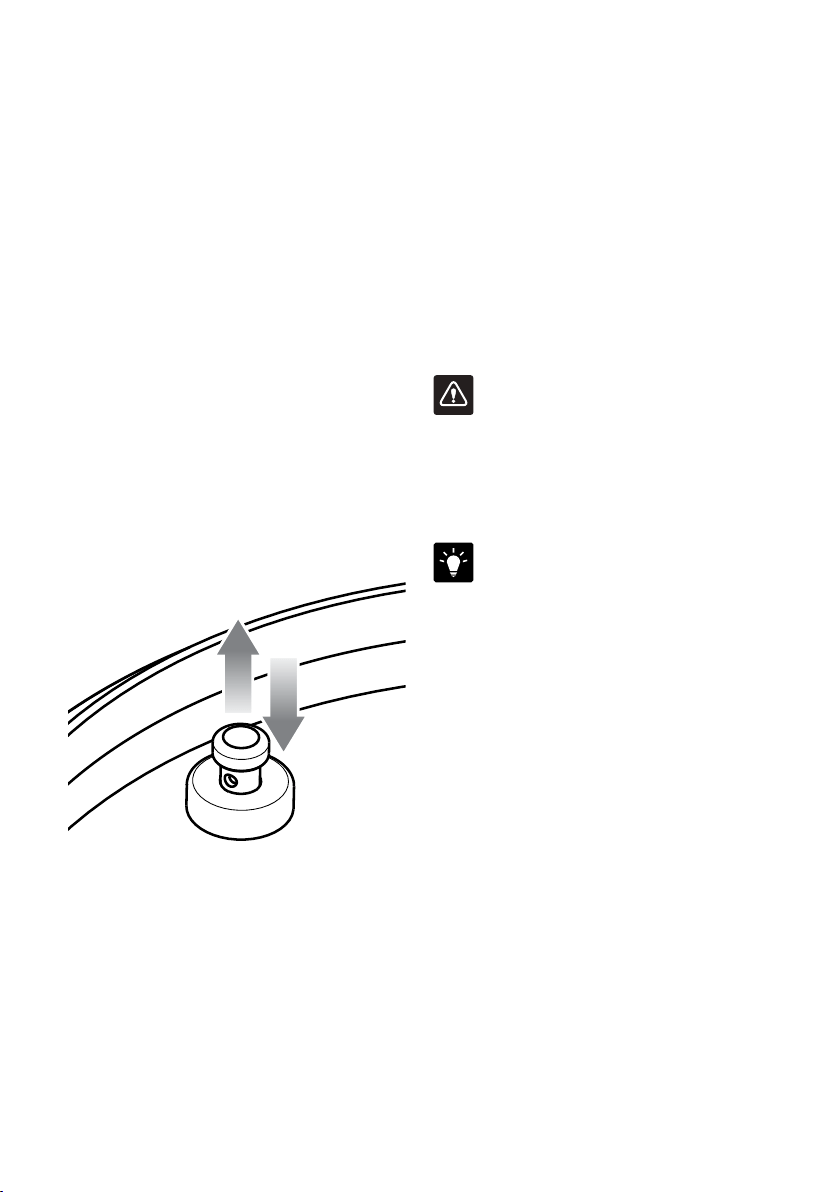
• Pressure Safety Valve will need to be
regularly checked and cleaned in order to
avoid any clogging which could result in
blocking the safety valve. Wash and clean any
oil or food residue. Ensure the valve moves in
and out smoothly after cleaning
SILICONE RUBBER GASKET:
• Replace silicone rubber gasket every 1–2
years (see your nearest Breville Service
Centre).
• Wash gasket in warm, soapy water. Rinse with
clean water, dry thoroughly and place back in
their original position.
• The silicone rubber gasket can be washed
in the top rack of a dishwasher to eliminate
odour from spices.
• Soak the silicone rubber gasket in a mixture
of bicarbonate soda and water to help
eliminate odours before cleaning.
WARNING
If the silicone rubber gasket is not fitted
correctly into the holder, the lid will not seal
properly. This may cause the appliance to
malfunction and leak steam or hot liquid which
can cause burns or scalding.
TIP
A mixture of ½ cup lemon juice, 1 tablespoon
lemon rind plus 500ml hot water cooked
at HIGH pressure for 5 minutes can help
eliminate food odours.
STORAGE:
• Ensure the cooker is turned off. The cooker is
off when all lights are off on the display.
• Remove the power plug from the power
outlet. Allow the cooker and all accessories
to cool completely before disassembling and
cleaning.
• Ensure the cooker and all accessories are
clean and dry.
• Ensure the bowl is inserted into the cooker.
• Ensure the lid is closed and in the locked
position.
• Store the appliance in an upright position
standing level on its support legs. Do not
store anything on top.
22
PROBLEM EASY SOLUTION
The lid cannot be opened
at the end of the cooking
cycle
• Press the STEAM RELEASE button until all internal pressure is released,
and the cooker can be opened.
• If this occurs frequently, the cooker may need to be adjusted to suit your
current altitude. Follow “Altitude Adjust” instructions on page 20.
• NOTE: The safety locking pin will drop when the lid can be opened.
• Using the lid knob, wiggle the lid up and down and then twist open and
close to reduce any friction caused by water or food.
The LID led is flashing and
the buzzer is sounding.
• Turn the lid to the correct position for pressure cooking or slow cooking.
Steam is escaping from
the lid
OR
Safety locking pin does
not rise
OR
Cooker is not getting to
pressure
OR
Timer will not count down.
OR
The screen displays ‘SEAL’
• Assemble the lid correctly ensuring there is no gap between lid arm and
the stainless steel lid. Make sure to secure the lid by screwing on the
sealing nut so that the red seal touches the lid surface; and should be
screwed on tightly.
• Ensure the silicone lid seal is clean, free from damage or cracks and is
properly inserted.
• Ensure that the safety locking pin can move freely up and down.
• When the lid is locked, ensure the safety locking pin is properly aligned
within the opening of the lid arm.
• Ensure that the pressure release valve is properly seated in position and
facing the lid knob.
• Add more liquid/food to the bowl. There should be a minimum of 1 litre
combined food and liquid.
• If problem persists, call Breville Customer Service.
The cooker automatically
switches to keep warm
without going through a
complete cooking cycle
• Add more water to the cooking bowl and restart the cycle.
Water is collecting on the
benchtop
• Ensure the cooker is on a flat level surface and that the condensation
drip cup is installed on the back of the cooker. Follow “Before First Use”
instructions on page 11.
• Empty the condensation drip cup.
The screen displays “Err” • The screen will display “Err” when there is a non-resettable issue with the
appliance. Should this occur, immediately remove the power cord from the
power outlet and contact Breville Consumer Support.
Factory Reset • Press and hold 'soup' and 'sous vide' buttons for three seconds to clear
settings including altitude level.
Troubleshooting

23
Notes

Breville, the Breville logo, Master Every Moment, and Fast Slow GO
are trademarks of Breville Pty. Ltd. A.B.N. 98 000 092 928.
Copyright Breville Pty. Ltd. 2021.
Due to continued product improvement, the products illustrated/photographed
in this brochure may vary slightly from the actual product.
BPR680 ANZ – J21
Web: www.breville.comWeb: www.breville.com
Australian Customers
Phone:
1300 139 798
New Zealand Customers
Phone:
0800 273 845
Breville Customer Service Centre