SpacemakeP
Microwave
Oven
Safe*
instructions ....................3-5
Precautions to Avoid Possible Exposure
to Excessive Microwave Energy .............2
Operating Instructions, Tips
Add 30 Seconds . . . . . . . . . . . . . . . . . . . . . . . . . . . . . . . . . . . . . . . . . .
.
12
Aluminum Foil ...........................4, 15,22,24
Auto Defrost ..........................................14, 15
Automatic Fan Feature .................................8
Auto Roast
..............................................2O,
21
Auto Simmer
.................................................2
1
Auto Start/Reminder . . . . . . . . . . . . . . . . . . . . . . . . . . . . . . . . . . 12
Clock
..................................................................8
Control Panel ...............................................8, 9
Cooking by Time . . . . . . . . . . . . . . . . . . . . . . . . . . . . . . . . . . . . 11, 12
Cooking Complete Reminder ......................7
Cooking Guide ..............................................25
Defrosting by Time ...............................16, 17
Defrosting Guide ..........................................24
Delayed Cooking . . . . . . . . . . . . . . . . . . . . . . . . . . . . . . . . . . . . . . . . .
.
10
Exhaust
Fan......................................................9
Express Cook Feature .................................1 2
Features
............................................................7
Glossary of Microwave Terms .............22
Heating or Reheating Guide ......................23
Hold Time . . . . . . . . . . . . . . . . . . . . . . . . . . . . . . . . . . . . . . . . . . . . . . . . . . . . . .
.
10
Microwaving Tips ...........................................6
Minute/Second Timer . . . . . . . . . . . . . . . . . . . . . . . . . . . . . . . . 10
Oven Shelf .....................................4, 5,26,27
Popcorn . . . . . . . . . . . . . . . . . . . . . . . . . . . . . . . . . . . . . . . . . . . . . . . .
.
.........13
Power Levels
...............8, 10, 11, 14, 16-18,20,23-25
Quick Reheat . . . . . . . . . . . . . . . . . . . . . . . . . . . . . . . . . . . . . . . . . . . . . . . .
.
19
Temperature Cook . . . . . . . . . . . . . . . . . . . . . . . . . . . . . . . . 17, 18
Temperature
Probe..4,
8, 10, 17, 18,20,21
Problem
Solver...............................32
More questions
?...call
GE Answer Center” 800.626.2000
Care and Cleaning
....................28-3l
Exhaust Fan
...................................................3O
Grease Filter
..................................................3O
Light Bulb Replacement.............................29
Oven Shelf
.....................................................2
8
Temperature Probe .....................................28
Installation ..........................................3
1
Adapter Plugs . . . . . . . . . . . . . . . . . . . . . . . . . . . . . . . . . . . . . . . . . . . . . .
.
31
Extension Cords ...........................................31
Grounding instructions ...............................3 1
Consumer Services ...................35
Appliance Registration ..................................2
Important Phone Numbers .......................35
Model and Serial Number Location ...........2
Warranty ........................................Back Cover
Modek
JVM140K
M;crowavepowerou@ut
JVM141K
of this oven is
750
watts.
I
I
JVM142K
(IEC-705
kst
Procedure)
GE Appliances
~LP
US
mLP
YOU...
Before using your oven,
read this book carefully.
It is intended to help you operate
and maintain your new microwave
oven properly.
Keep it handy for answers to your
questions.
If you don’t understand something
or need more help, write (include
your phone number):
Consumer Affairs
GE Appliances
Appliance Park
Louisville, KY 40225
Write down the model and
serial numbers.
You’ll find them on a label inside
the oven.
These numbers are also on the
Consumer Product Ownership
Registration Card that came with
your microwave oven. Before
sending in this card, please write
these numbers here:
Model Number
Be sure your microwave
oven is registered.
It is important that we know the
location of your microwave oven
should a need occur for
adjustments.
Your supplier is responsible for
registering you as the owner.
Please check with your supplier
to be sure he has done so; also
send in your Consumer Product
Ownership Registration Card. If
you move, or if you are not the
original purchaser, please write
to us, stating model and serial
numbers.
This appliance must be registered.
Please be certain that it is.
Write to:
GE Appliances
Range Product Service
Appliance Park
Louisville. KY 40225
If you received a
damaged oven...
Immediately contact the dealer
(or builder) that sold you the oven.
Save time and money.
Before you request service...
Check the Problem Solver in the
back of this book. It lists causes of
minor operating problems that you
can correct yourself.
All these things are normal
with your microwave oven.
● Steam or vapor escaping from
around the door.
● Light reflection around door or
outer case.
● Dimming oven light and change
in blower sound may occur while
operating at power levels other
than high.
“
Dull thumping sound while oven
is operating.
● Some TV-Radio interference
might be noticed while using
your microwave oven. It’s
similar to the interference
caused by other small
appliances and does not
indicate a problem with
your oven.
Serial Number
Use these numbers in any
correspondence or service calls
concerning your microwave oven.
PRECAUTIONS TO AVOID POSSIBLE EXPOSURE
TO EXCESSIVE MICROWAVE ENERGY
I
(a)
DoNotAttempttooperate~is oven with
(c)
Do Not
O~erate
the oven if it is
dama~ed.
It is
the door open since open-door operation can
result in harmful exposure to microwave
energy. It is important not to defeat or
tamper
with the safety interlocks.
(b) Do Not
Place
any object between the oven
front face and the door or allow soil or cleaner
particular important that the oven do;r close
properly and that there is no damage to the:
(1) door (bent)
(2) hinges and latches (broken or loosened)
(3) door seals and sealing surfaces.
residue to accumulate on sealing surfaces.
(d) The Oven Should Not
be
adjusted or repaired
by anyone except properly qualified service
personnel.
2
MORTANT
SAFE~
~STRUCTIONS
Rmd
~
titictiom
befo~
whg
ttis
apphmce.
L
!
When using electrical appliances, basic safety
precautions should
be
followed, including
the
following:
A
WA~lNG-Toreducetietiskof
burns, electric shock, fire, injury to persons
or exposure to excessive
rnicrowav~
energy:
c
Read and
fo~ow
the specific “Precautions to
Avoid Possible Exposure to Excessive Microwave
Energy” on the previous page.
●
This
apptiance
must be grounded. Connect
only to properly grounded outlet. See Grounding
Instmctions
section in the back of this book.
●
Use this appliance only for its intended use as
described in this manual. Do not use corrosive
chemicals or vapors in this appliance. This
microwave oven is specifically designed to heat
or cook food, and is not intended for laboratory
or industrial use.
●
This over-the-range oven was designed for
use over ranges no wider than 42 inches.
It maybe installed over both gas and electric
cooking equipment,
●
For best operation, plug this appliance into
ib
own electrical outlet, to prevent
Rickering
of lights, blowing of fuse or tripping of circuit
breaker.
●
Do not mount this appliance over a sink. Install
or locate this appliance
ody
in accordance with
the provided
hstallation
Instructions.
●
Do
not
cover
or
block any openings on the
apptiance.
●
Do not store this appliance outdoors. Do not
use this product near water—for example, in a wet
basement, near a swimming pool or near a sink.
●
This microwave is not approved or tested for
marine use.
●
Do not store anything directly on top of the
microwave oven surface when the oven is in
operation.
●
Do not immerse power cord or plug in
water.
c
Keep power cord
away
from
heated
surfaces,
●
Do not let power cord
hang
over edge of table
or counter.
. Do not operate this appliance if it has a
damaged power cord or plug, if it is
not
working properly, or if it has been damaged
or dropped.
●
See door surface cleaning instructions in the
Care and Cleaning section(s) of your book.
●
This appliance
shodd
be serviced only by
quatified
service personnel. Contact nearest
authorized service facility for examination,
repair or adjustment.
●
As
with any
apphance,
close supervision is
necessary when used by children.
●
To reduce
the
risk of fire in the oven cavity:
—Do not overcook food. Carefully attend
appliance if paper, plastic or other combustible
materials are placed inside the oven to facilitate
cooking,
—Remove wire twist-ties from paper or plastic
bags before placing bags in
oven.
—Do not use your microwave oven to
dry
newspapers.
—Do not use recycled paper products. Recycled
paper towels, napkins and waxed paper can
contain metal flecks which may cause arcing
or ignite. Paper products containing nylon or
nylon filaments should be avoided, as they
may dso ignite.
—Do not pop popcorn in your microwave oven
unless in a special microwave popcorn accessory
or unless you use popcorn labeled for use in
microwave ovens.
—Do not overcook potitoes. They could
dehydrate and catch fire, causing damage
to your oven.
—Do not operate the oven while empty to avoid
damage to the oven and the danger of fire.
If
by accident the oven should run empty a minute
or 2, no harm is done. However, try to avoid
operating the oven empty at all times—it saves
energy and prolongs the life of the oven.
(continued nextpage)
3
J
!
MORTANT
SAFETY ~STRUCTIONS
(continued)
—Do not use the oven for storage purposes.
Do not leave paper products, cooking utensils
or food
in
the oven when not in use.
—If materials inside oven should ignite, keep
oven door closed, turn oven off, and disconnect
power cord, or shut off power at the fuse or
circuit breaker panel.
●
Some
products such as whole eggs and sealed
containebfor
example, closed jars-will
explode and should not be heated in this
microwave oven. Such use of the microwave
oven could result in injury,
●
Avoid heating baby food in glass jars, even
without their lids; especially meat and egg
mixtures.
●
Don’t
defrost frozen beverages in narrow
necked bottles (especially carbonated beverages).
Even if the container is opened, pressure can build
up. This can cause the container to burst, possibly
resulting in injury,
●
Use metal only as directed in this book. TV
dinners may be microwaved in foil trays less than
3/4” high; remove top foil cover and return tray
to box. When using metal in the microwave oven,
keep metal (other than metal
shel~
at least
1 inch away from sides of oven.
●
Cookware may become hot because
of heat transferred from the heated
food. Pot holders may be needed to
handle the cookware.
●
Foods cooked in liquids (such as pasta) may tend
to boil over more rapidly than foods containing
less moisture. Should this occur, refer to the Care
and Cleaning section(s) for instructions on how to
clean the inside of the oven.
●
Thermometer—Do not use a thermometer in
food you are microwaving unless the thermometer
is designed or recommended for use in the
microwave oven.
●
Remove the temperature probe from the oven
when not using it to cook with. If you leave the
probe inside the oven without inserting it in food
or liquid, and turn on microwave energy, it can
create electrical arcing in the oven and damage
oven walls.
●
Plastic
cookwar~Plastic
cookware designed
for microwave cooking is very useful, but should
be used carefully. Even microwave-safe plastic
may not be as tolerant of overcooking conditions
&s
are glass or ceramic materials and may soften
or char if subjected to
shoti
periods of
overcooking. In longer exposures to overcooking,
the food and cookware could ignite. For these
reasons: 1) Use microwave-safe plastics only and
use them in strict compliance with the cookware
manufacturer’s recommendations. 2) Do not
subject empty cookware to microwaving.
3) Do not permit children to use plastic
cookware without complete supervision,
●
When cooking pork, follow the directions
exactly and always cook the meat to an internal
temperature of at least
170°F.
This assures that, in
the remote possibility that trichina may be present
in the meat, it will be killed and meat will be safe
to eat.
. Do not boil eggs in a microwave oven. Pressure
will build up inside
egg
yolk and will cause it to
burst, possibly resulting in injury.
●
Foods with unbroken outer
“skin”
such as potatoes, sausages, tomatoes,
apples, chicken
fivers
and other
giblets, and egg
yoks
(see previous
caution) should be pierced to allow
steam to escape during cooking.
●
Not
dl
plastic wrap is suitable for use in
microwave ovens. Check the package for
proper use.
w
●
Spontaneous boiling—Under
certain special circumstances,
liquids may start to boil during
or shortly after removal from the
microwave oven. To prevent bums
from splashing liquid, stir the
liquid briefly before removing the
container from the microwave oven.
4
●
~~Boflable”
cooking pouches and tightly
closed
plastic bags
should be slit, pierced or vented as
directed by package. If they are not, plastic
could burst
duting
or immediately after cooking,
possibly resulting in injury. Also, plastic storage
containers should beat least partially uncovered
because they form a tight
seal.
When
coo~ng
with containers tightly covered with
plastlc
wrap,
remove covering carefully and direct steam away
from hands and face.
‘
/
~
*
●
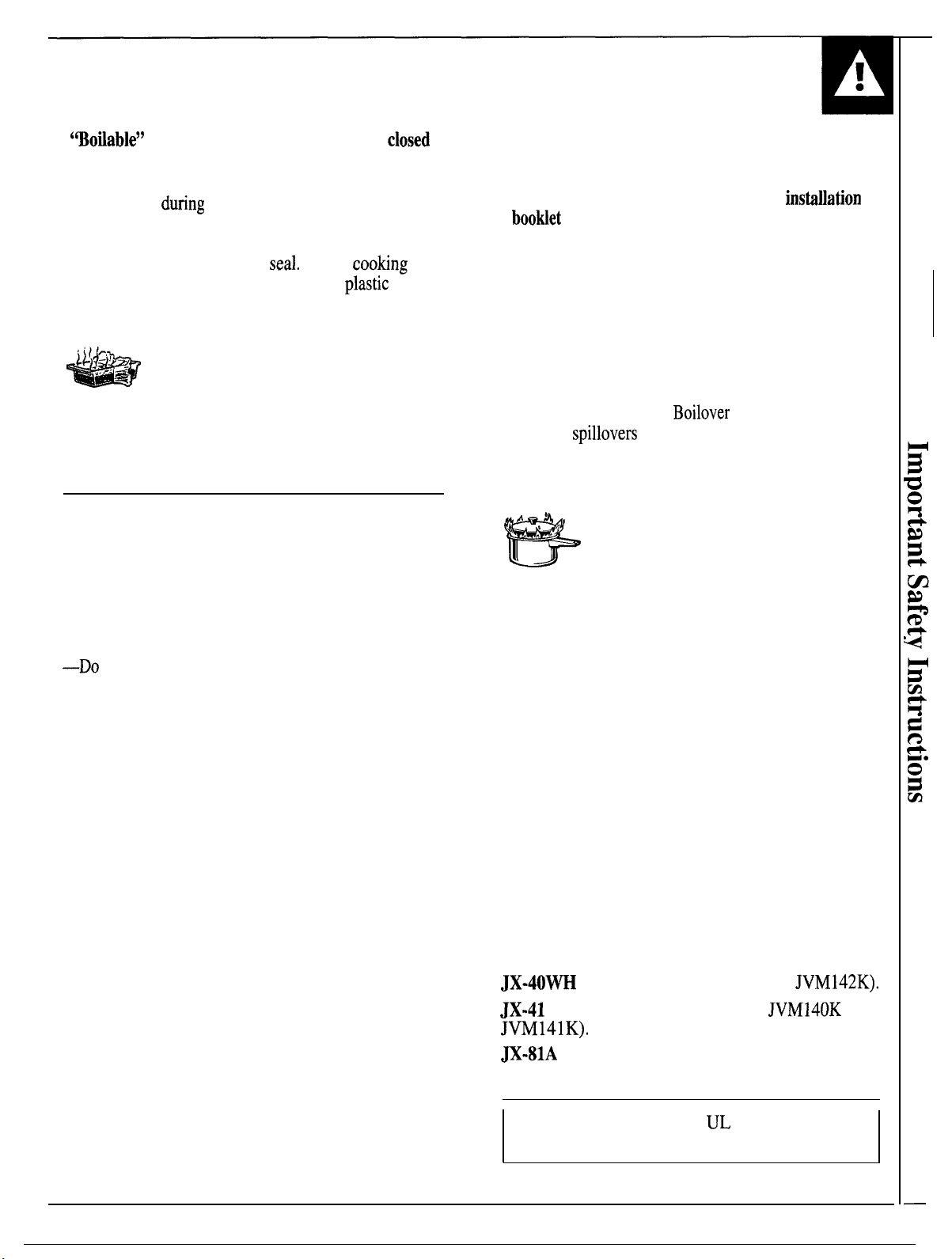
Hot
foods and steam can cause
-----
%
burns. Be careful when opening
any containers of hot food, including
popcorn bags, cooking pouches and
boxes. To prevent possible injury,
direct steam away from hands
and face.
. Use of the shelf accessory.
—Remove the shelf from oven when not in use.
—Do not store or cook with shelf on floor of oven.
Product damage may result.
—Use pot holders when handling the shelf and
cookware. They may be hot.
—Do
not use microwave browning dish on shelf.
The shelf could overheat.
—Use the shelf only when cooking on 2 levels.
—Be sure that the shelf is positioned properly
inside the oven to prevent product damage,
Use of shelf with Popcorn feature is not
recommended (see the Popcorn section).
The Exhaust Hood
●
Have it installed and properly grounded by a
qualified installer. See the special
inshllation
booMet
packed with the microwave oven.
●
The exhaust fan in the oven will operate
automatically under certain conditions
(see Automatic Fan Feature). While the fan
is operating, caution is required to prevent
the starting and spreading of accidental
cooking fires while the exhaust fan is in
use. For this reason:
—Never leave surface units unattended at
high heat settings.
Boilover
causes smoking and
greasy
spillovers
that may ignite and spread if
exhaust fan is operating. To minimize automatic
fan operation, use adequate sized cookware and
use high heat only when necessary.
e
4~,
—In the event of a grease fire,
smother flaming pan on surface
unit by covering pan completely
with well-fitting lid, cookie sheet
or flat tray.
—Clean the vent hood often.
Do not allow grease
to buildup on the hood or the filter.
—Use care
when cleaning the vent hood filter.
Corrosive
cleaning agents, such as lye-based
oven cleaners, may damage the filter.
—When flaming foods under the hood, turn
the fan off, The fan, if operating, may spread
the flame.
SAVE THESE
INSTRUCTIONS
Optional Accessories
Available at extra cost from your GE supplier.
JX-40WH
Filler Panel Kit (for model
JVM142K).
JX-41
Filler Panel Kit (for models
JVM140K
and
JVM141K).
JX-81A
Charcoal Filter Kit for non-vented
installation.
This microwave oven is
UL
listed for
installation over electric and gas ranges.
5
MICROWAVING TIPS
● Make sure all cookware used in your microwave
● Paper towels, waxed paper and plastic wrap
oven is suitable for microwaving. Most glass
can be used to cover dishes in order to retain
casseroles, cooking dishes, measuring cups, custard
moisture and prevent spattering. Be sure to vent
cups, pottery or china dinnerware which does not
plastic wrap so steam can escape.
have
rnetalllc
trim or glaze with a metallic sheen
● Some microwaved foods require stirring, rotating
can be used. Some cookware is labeled “suitable
for microwaving.”
or rearranging. Check the Cooking Guide.
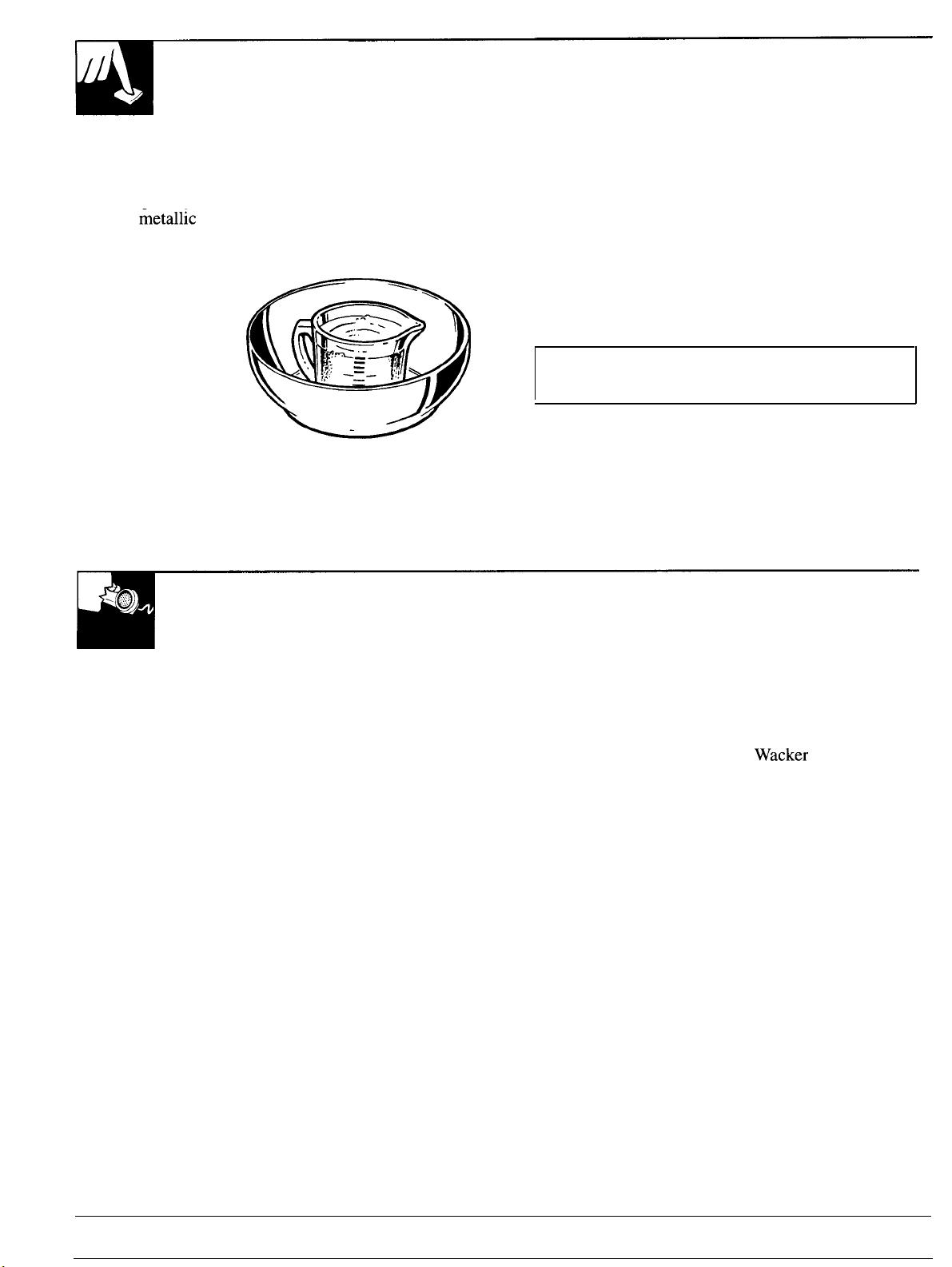
● If you are not
sure if a dish is
microwave-safe,
use this test:
Place in the oven
both the dish you
are testing and a
glass measuring
cup filled with
1 cup water—set
the measuring cup either in or next to the dish.
Microwave 1 minute at high. If the dish heats, it
should not be used for microwaving. If the dish
remains cool and only the water in the cup heats,
then the dish is microwave-safe.
● Steam builds up pressure in foods which are
tightly covered by a skin or membrane. Pierce
potatoes, egg yolks and chicken livers to prevent
bursting.
If you use a meat thermometer while cooking, make
sure it is safe for use in microwave ovens.
IF YOU NEED SERVICE...
To obtain service, see the
Consumer Services page in the
back of this book.
We’re proud of our service and
want you to be pleased. If for
some reason you are not happy
with the service you receive,
here are 3 steps to follow for
further help.
FIRST, contact the people who
FINALLY, if your problem is still
serviced your appliance. Explain
not resolved, write:
why you are not pleased. In most
Major Appliance Consumer
cases, this will solve the problem.
Action Panel
NEXT, if you are still not pleased,
20 North
Wacker
Drive
write all the details—including
Chicago, IL 60606
your phone number—to:
Manager, Consumer Relations
GE Appliances
Appliance Park
Louisville, KY 40225
6
1.
2.
3.
4.
5.
FEATURES OF YOUR
OWN
?
??
?
,
II
J
.
a
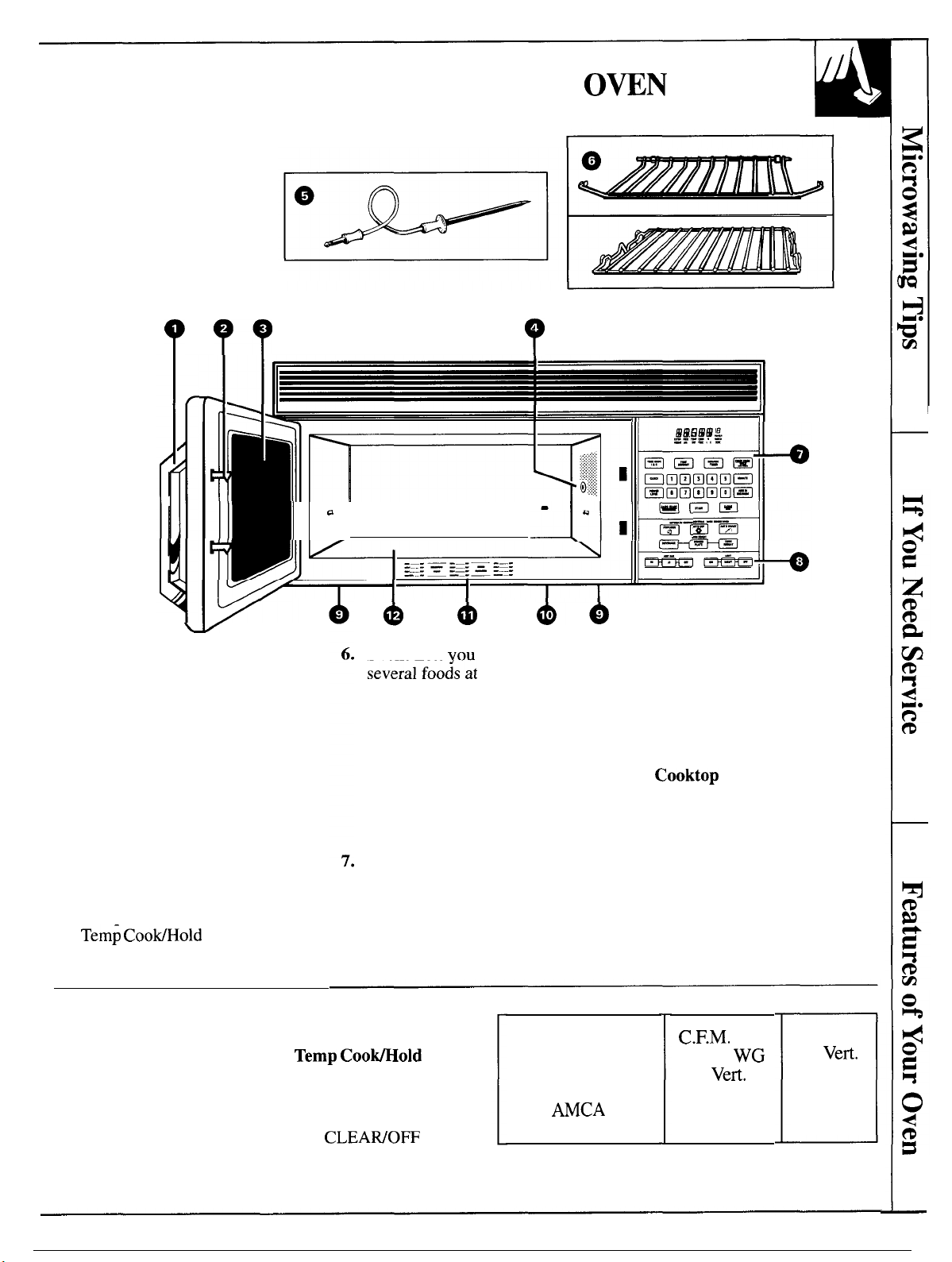
Door Handle. Pull to open
door. Door must be securely
latched for oven to operate.
Door Latches.
Window with Metal Shield.
Screen allows cooking to
be viewed while keeping
microwaves confined in oven.
Receptacle for Temperature
Probe. Probe must be securely
inserted into receptacle before
oven will start any temperature
or Auto Roast cooking.
Temperature Probe. Use with
Temp
CooWHold
and Auto
Roast functions only.
@
&
&@
Shelf. Lets
vou
microwave
8. Hood Controls.
several–foo~s”at
once. NOTE:
Your oven is equipped with
1 of 2 types of oven shelves.
Use this shelf only when
cooking foods on 2 levels.
Food microwaves best when
placed directly on the oven
floor. (See Safety Instructions
and Oven Shelf section for
special instructions.)
Touch Control Panel and
Digital Display. For detailed
information on each feature,
see Your Touch Control Panel
section.
Vent Fan. Press HI, LO or
OFF.
Light. Press ON, NIGHT or
OFF.
9. Grease Filters.
10.
Cooktop Light.
11. Auto Defrost and Auto Roast
Guide.
12. Oven Floor.
NOTE: Rating plate, oven vent(s)
and oven light are located on the
inside walls of the microwave
oven.
Cooking Complete Reminder
(For all cooking features except
Temp
Coo~old
and
Auto Roast code 4)
To remind you that you have food in the oven, the oven
will display “End” and beep once a minute until you
either open the oven door or touch the
CLEAWOFF pad.
This is to
certify
that this unit has
been tested in
conformance
with
AMCA
Bulletin No. 210.
C.F.M.
at 0.10
WG
215
Vert.
224 Her.
Sores
6.3
Vert.
5.9 Her.
●
●
●
7
-—
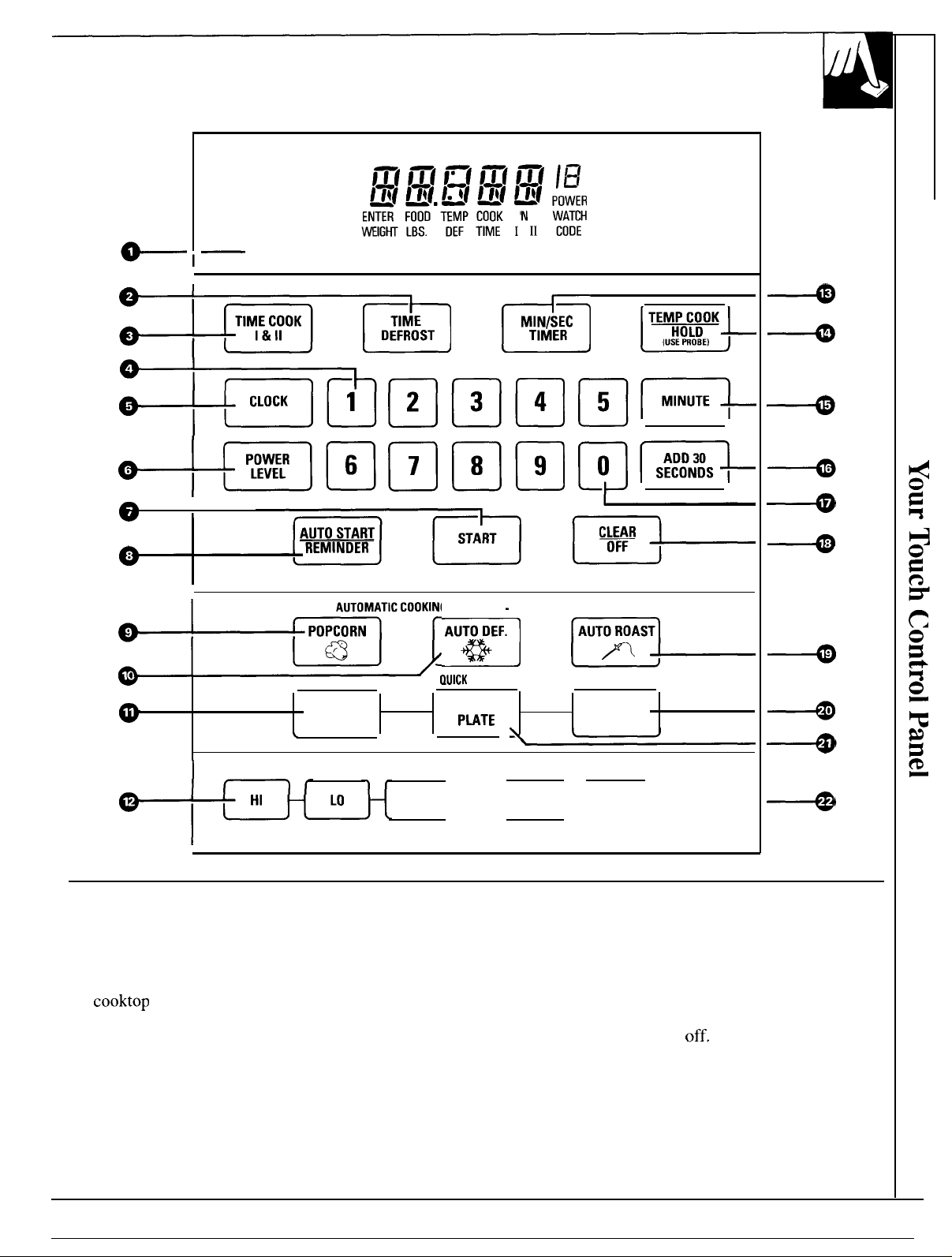
YOUR TOUCH CONTROL PANEL
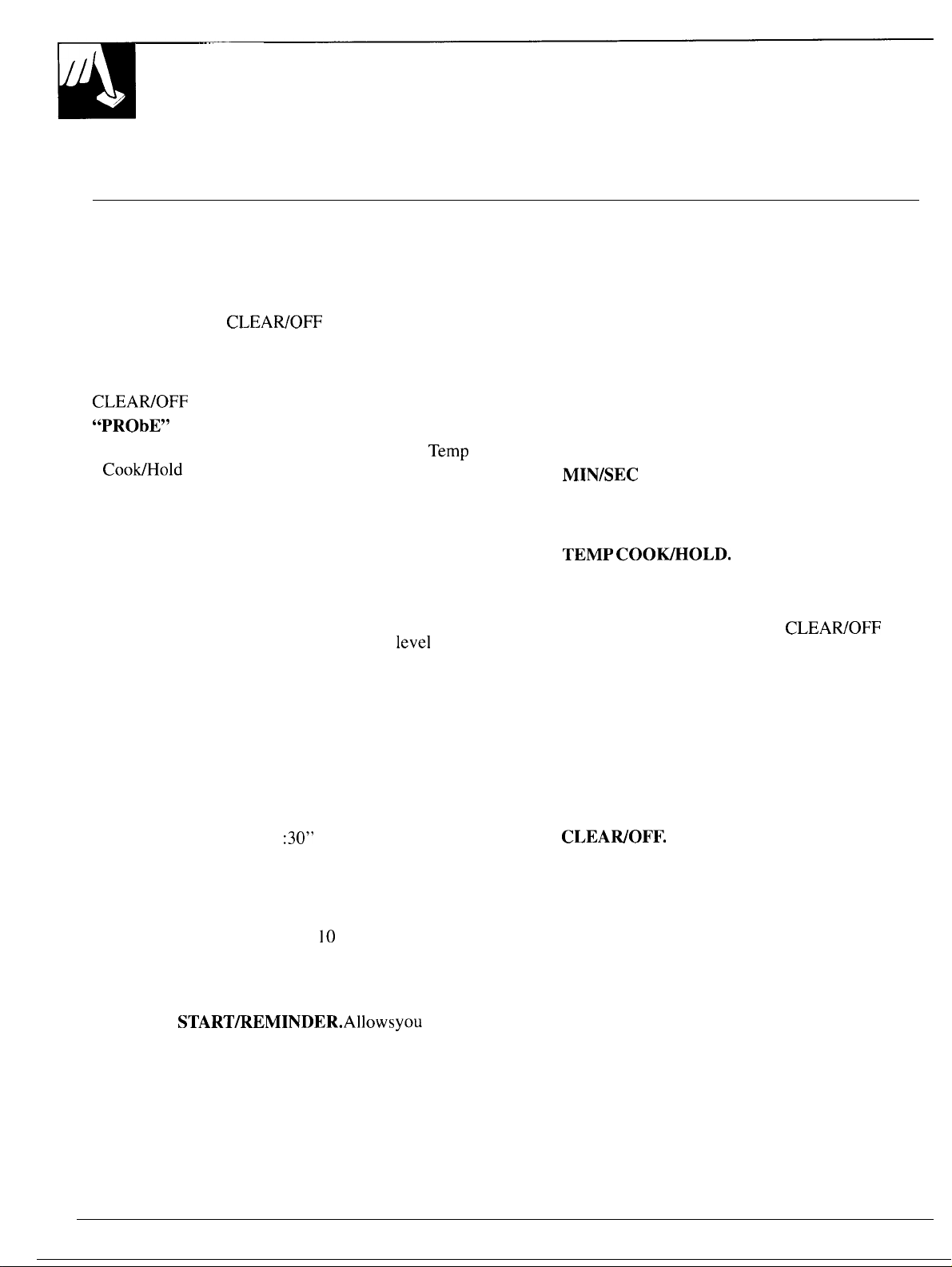
The Touch Control Panel allows you to set the oven controls with
the touch of a finger. It’s designed to be easy to use and understand.
When You Plug in the Oven
The display panel displays “88888”, “18 POWER”
and all of the oven functions. After 15 seconds, all
lights disappear and “RESET” appears in the upper
portion. Touch the
CLEAWOFF pad, set the Clock
and oven is ready for use.
If power is disrupted at any time, the above sequence
recurs, and you must reset Clock after touching the
CLEAWOFF
pad.
“PRObE” Appears on the Display
● Probe has been forgotten when Auto Roast or
Temp
CooMHold
function is being used.
● Probe is not securely seated in oven wall receptacle.
1.
2.
3.
4.
5.
6.
7.
8.
DISPLAY. Displays time of day, time or
temperature during cooking functions, power level
being used, cooking mode and instructions.
TIME DEFROST. Gentle thawing at automatic
power level 3 (Low).
TIME COOK I & II. Microwave for a selected
amount of time using automatic power
level
10 (High).
EXPRESS COOK. Touch the number 1 through
5 pads for 1 to 5 minutes of cooking at power
level 10. For example, touch 2 then START for
2 minutes at power level 10.
CLOCK. Touch this pad to enter time of day
or check time of day while microwaving. To set
clock, first touch CLOCK pad and then enter time
of day. For example, if time is 1:30, touch number
pads 1, 3 and O and “ 1
:30”
will appear in display.
Then touch START or CLOCK pad. To reset or
change time, simply repeat above process.
POWER LEVEL. Touch this pad before entering
another power level number if you want to change
from automatic power level
10
(High) for cooking
or power level 3 (Low) for defrosting.
START. After all selections are made, touch this
pad to start the oven.
AUTO START~EMINDER. A1]OWS YOU to
program your oven to begin cooking at a preset
time of day—up to a 12-hour delay. The Reminder
feature can be used like an alarm clock.
9. POPCORN. Touch this pad, then START to
cook prepackaged microwave popcorn weighing
3.0 to 3.7 ounces.
10. AUTO DEFROST. Touch this pad and food
weight, then START. The oven automatically
sets power levels and defrosting time.
11. BEVERAGE. Touch this pad, then START to
reheat a beverage.
12. VENT FAN. Press HI, LO or OFF for the
different fan speeds.
13. MIN/SEC TIMER. This feature uses no
microwave energy. It functions as either a kitchen
timer, as a holding period after defrost or as a
delay timer before time or temperature cooking.
14.
TEMP
COO~OLD.
Use the temperature
probe to cook by using a preset temperature.
Once food reaches preset temperature, oven
switches to HOLD setting and maintains that
temperature until you touch the
CLEAWOFF pad.
15. MINUTE. Use with number pads to enter whole
minutes. For example, for 4 minutes touch 4 and
MINUTE.
16. ADD 30 SECONDS. Press this pad to add 30
seconds to the cook time as it’s counting down.
17. NUMBER PADS. Touch these pads to enter
cooking time, defrosting time, time of day,
temperature, power level, or food weights for
Auto Defrost.
18. CLEAWOFF. When touched, it shuts off the
oven and erases all settings (except time of day).
19. AUTO ROAST. Insert probe. Touch this pad, the
desired number pad for code, then START. The
oven slow-cooks meat with the automatic preset
program.
20. CODE REHEAT. Use Code Reheat for quick
reheating of a variety of foods using different
times and power levels.
21. DINNER PLATE. Touch this pad, then START
to reheat a plate of leftovers.
22. LIGHT. Touch ON to turn on hood light. Touch
NIGHT to turn on night light.
8
‘+-
?E
J
:{:
MIN/SEC
DEFROST
TIMER
Bmm
Bmm
I
I
;
-~
AUTOMATIC COOKING CONTROLS
-
GUIDE BEHIND DOOR
‘“GEF”:
-
I
OUICK
REHEAT
BEVERAGE
DINNER
CODE
PWTE
REHEAT
\
.
VENT FAN
LIGHT
1
[
OFF
ON
Automatic Fan Feature
This microwave oven has an
If you have turned the fan on you
The fan will automatically turn
automatic fan feature to protect
may find that you cannot turn it
off when the internal parts are
it from too much heat rising from
off. This is because the automatic
cool. It may stay on for 30 minutes
the
cooktop
or range beneath it.
fan has come onto protect the or more after the range and
It automatically turns on at a low
internal parts of the microwave.
microwave controls have been
speed if it senses too much heat.
turned
off,
9

HOW TO USE THE
M~UTE/SECO~
T~ER
The Minute/Second Timer
Using a Holding Time
The Minute/Second Timer has 3 timing functions:
The Minute/Second Timer can also be used to
● It operates as a minute timer.
program a “holding time” between microwave
cooking functions. The time can range from 1 second
● It can be set to delay cooking.
to 99 minutes and 99 seconds. A holding or standing
● It can be used as a hold setting after defrosting.
time may be found in some of your own recipes or in
The Minute/Second Timer operates without
a cookbook.
microwave energy.
How to Time a 3-Minute Phone Call
Programming Delayed Cooking
Step 1: Touch MIN/SEC TIMER pad.
To delay cooking up to 99 minutes and 99 seconds,
Step 2: Touch number pad 3 and MINUTE pad (for
touch either TIME COOK I & II,
TEMP COOW
3 minutes and no seconds).
HOLD or AUTO ROAST and enter cook time,
Step 3: Touch START. Display shows time counting
temperature or code. Touch MIN/SEC TIMER
down. The timer signals when time is up.
and enter number of minutes to delay cooking.
When delaying
Temp
Coo~old
or Auto Roast
cooking, be sure probe is in food.
Touch START.
Timer will count down to O and cooking will begin.
How to Defrost, Hold and Time Cook
Let’s say you want to defrost a frozen casserole for
15
minutes, hold for 10 minutes and then Time Cook
for 25 minutes. Here’s how to do it:
Step 1: Take casserole from freezer and place in oven.
n
TIME
DEFROST
H
Step 2: Touch TIME
DEFROST pad.
Step 3: Touch pads 1,5
and MINUTE for 15 minutes
defrosting time. (Defrosting
is automatically set on power
level 3 but can be changed by
touching the POWER LEVEL
pad and the desired power
level.)
MIN/SEC
TIMER
Step 4: Set standing or hold
time by touching MIN/SEC
TIMER pad.
Step 5: Touch 1,0 and MINUTE to hold for
10 minutes.
TIME COOK
I &II
Step 6: Touch TIME
COOK I &11 pad.
Step 7: Touch 2, 5 and MINUTE for 25 minutes of
cooking time.
I
START
Step
8: Touch START. As
each function is automatically
performed, oven display shows
instructions entered and the
function. When time is up,
the oven signals and flashes
“End.”
10
Time Cook I
Time Cook allows you to microwave for a preset
amount of time.
Power level 10 (High) is recommended for most
cooking, but you may change this for more flexibility.
See the Cooking Guide.
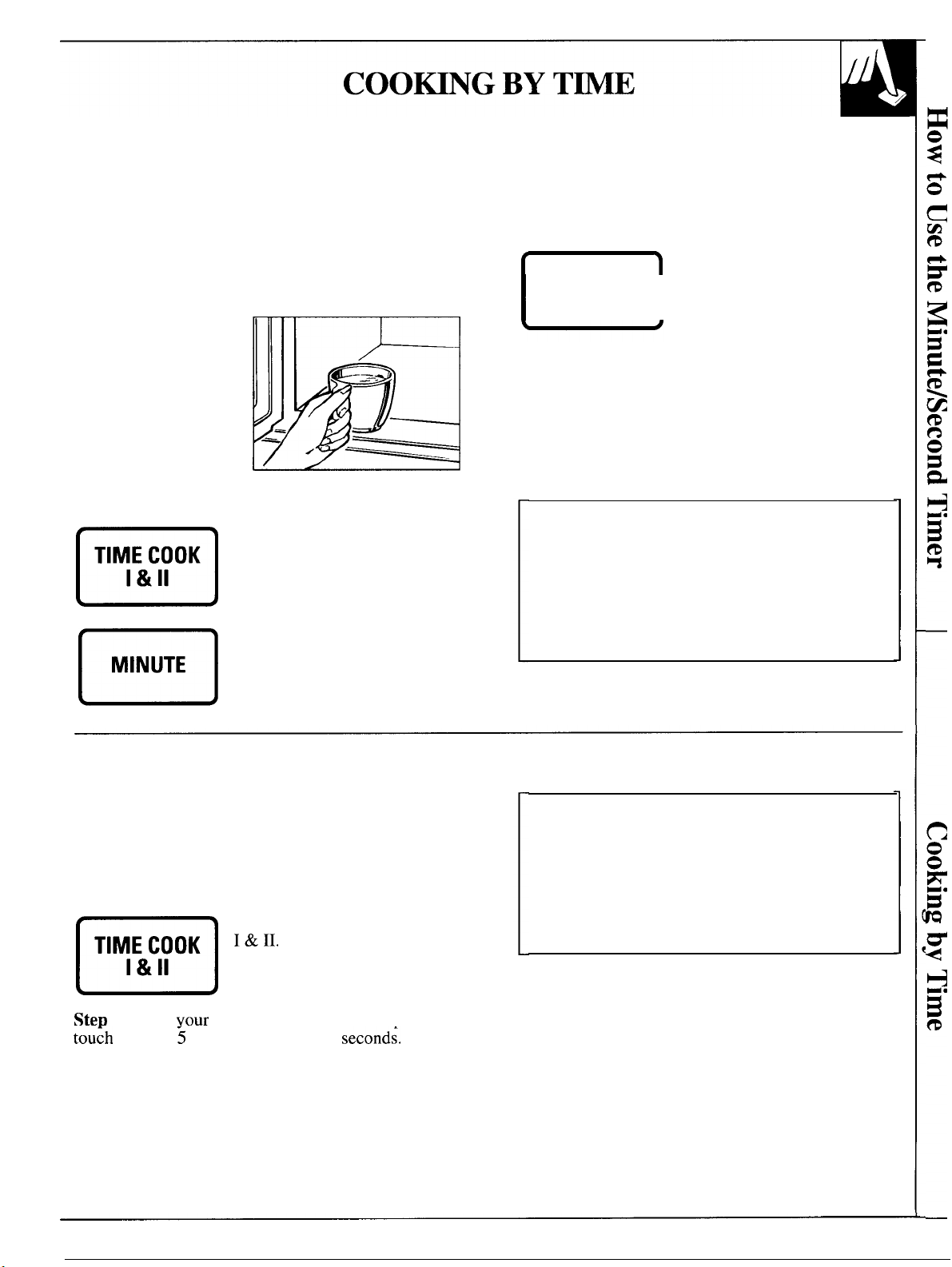
To become better acquainted with time cooking, make
a cup of coffee by following the steps below.
Step 1: Fill a cup
2/3 full of water, add
1 teaspoon of instant
coffee and stir to
dissolve. Use a cup
that has no metal
decoration and is
microwave-safe (refer
to Microwaving Tips
section). Place cup in
oven and close door.
n
TIME COOK
I &II
n
MINUTE
Step 2: Touch TIME
COOK I &II pad.
Step 3: Select your time.
Touch 1 and MINUTE pad for
1 minute.
Because automatic power level 10 is recommended
for this cup of coffee, there is no need to change the
power level. (If power level 10 is not appropriate, see
“How to Change Power Level” below.)
Step 4: Touch the START pad.
1
(
I
START
I
Step 5: When time is up, the oven signals and flashes
“End.” The oven, light and fan shut off.
Step 6:
Open the door.
If you interrupt Time Cook to check the food, simply
close the door and press START to resume cooking.
If there is not time remaining on the timer you must
reset the timer to resume cooking.
How to Change Power Level
1. Press TIME COOK I & II.
2. Select cooking time.
3. Press POWER LEVEL.
4. Select power.
5. Press START.
Using the Time Cook II Feature
The Time Cook II feature lets you set 2 time cooking
functions within 1 program. This is ideal if you want
to change power levels during your cooking
operations. Here’s how to do it.
Step 1: Place food in oven in microwave-safe
container and close the door.
Step 2: Touch TIME COOK
m
l&ll
How to Change Power Level
1. Press TIME COOK I & II.
2. Select cooking time.
3. Press POWER LEVEL.
4. Select power.
5. Press START.
w
Step 7: At the end of “COOK TIME I,” the second
power level is displayed and “COOK TIME II” is
Steu 3: Select
vour
first cook time. For example,
shown counting down.
tou~h
2, 1 and
~
for 2 minutes and 15 second;.
Step 8: When time is up, the oven signals and flashes
Step 4: Touch TIME COOK I & II.
“End.” The oven, light and fan shut off.
Step 5: Set your second cook time.
Step 9: Open the door.
Step 6: Change the power level.
If you interrupt Time Cook to check the food, simply
close the door and press START to resume cooking.
If there is not time remaining on the timer you must
reset the timer to resume cooking.
11
1
COOmG
BY
T~E
(continued)
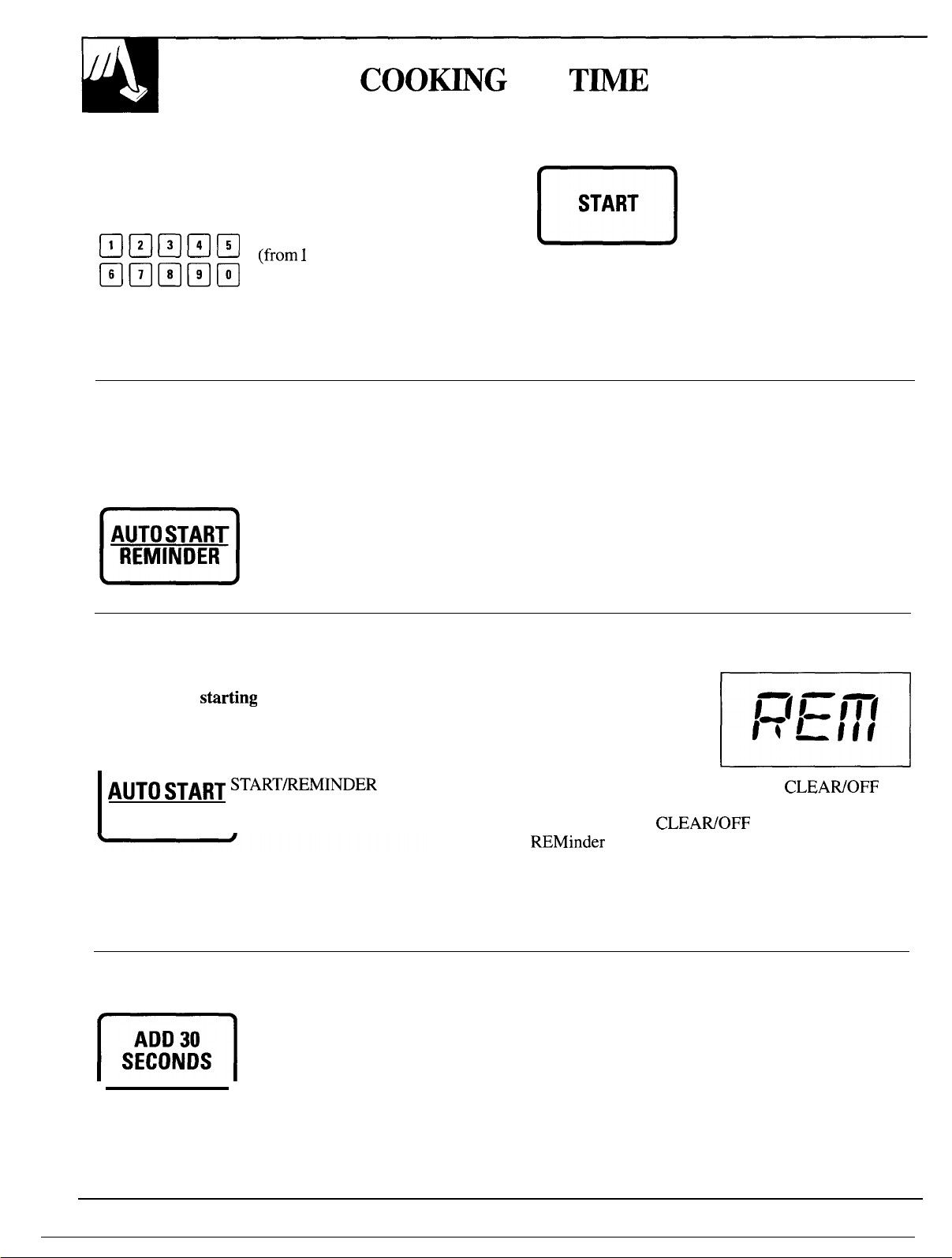
The Express Cook Feature
The Express Cook feature is a short-cut method to set
time for 1-5 minutes.
To Express Cook your food or beverage:
mmmmm
Step 1: Touch a number pad
n
Step 2: Touch the START pad.
START
(from
1
to 5) that corresponds
Emmmm
with the amount of your
The oven will automatically signal, flash “End” and
desired cooking time (in
shut off at the end of the programmed time.
minutes). For example, touch
the 2 pad for 2 minutes of
cooking time.
How to Use Auto Start
The Auto Start feature allows you to program your
Step 2: Enter the time you want the oven to start.
oven to begin cooking at a preset time of day—up (Be sure your microwave oven clock shows the
to a 12-hour delay.
correct time of day.)
n
Step 1: Touch AUTO
Step 3: Enter your desired cooking program.
AUTO
START
STARTREMINDER pad.
Step 4: Touch START pad. The oven will
REMINDER
automatically start at the desired time.
How to Use Reminder
The Reminder feature can be used like an alarm
clock, without
stirting
the oven.
Example: It is 7 a.m. and you must remember to
leave for a dentist appointment at 10 a.m.
1
Step 1:
Touch AUTO
AUTO
START
START~EMINDER pad.
REMINDER
Step 2:
Enter the time you want the oven to remind
you. (Be sure your microwave oven clock shows the
correct time of day. The reminder time can be setup
to 12 hours later).
Step 3:
Touch START
pad. The reminder is
now set at the time you
programmed, and will
signal you at that time
E
with a beeping sound
until you open the door or touch the
CLEAWOFF
pad. The display will show “REM” until the oven
door is opened or
CLEAWOFF is touched. The
REMinder time maybe displayed by touching the
AUTO START/ REMINDER pad. The time-of-day
may be displayed by touching the CLOCK pad.
Add 30 Seconds
m
The Add 30 Seconds feature provides a convenient
way to extend cooking time by 30 seconds while the
oven timer is counting down. It will add 30 seconds
to the time shown each time the pad is touched.
12
Light Microwave Popcorn
NOTE:
Use
of the metil
sheti
with the Popcorn program
is NOT recommended.
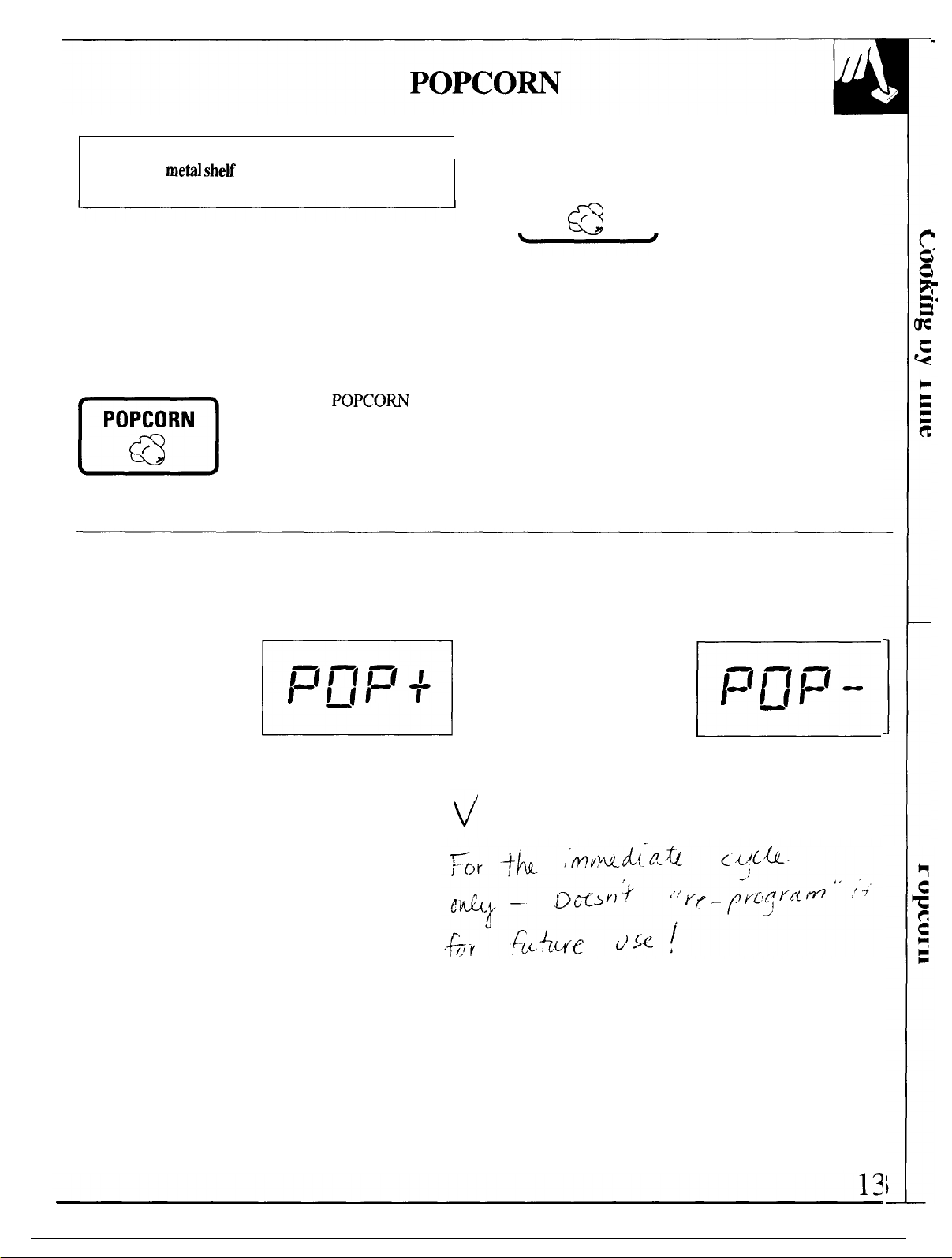
The Popcorn feature is designed to be used only
with prepackaged microwave popcorn weighing 3.0
to 3.7 ounces.
n
Step 1:
Touch POPCORN pad.
POPCORN
a
f
Step
2:
Touch number pad 2.
Step 1: Remove the outer wrapper from the
Step 3: Touch START pad.
microwave popcorn.
Step 2: Open oven door and place package of
popcorn in the center of the oven floor as directed
by the package instructions. Close oven door.
n
Step 3:
Touch
POPCO~
pad.
POPCORN
a
f
Step
4: Touch START pad,
How to Adjust the Popcorn Program to Provide a Shorter or Longer Cook Time
If your favorite popcorn is not completely popped,
If your favorite popcorn is overcooked, there is
there is a simple adjustment you can make.
another adjustment you can make.
Touch the POPCORN
pad and then touch
number pad 9. The
word “POP” will
appear on the display
with a plus sign beside
E
Touch the POPCORN
1=(1-(1=1+
pad and then touch
I
~fl
number pad 1. The
word “POP” will
appear on the display
with a minus sign beside
E
/=(1—11=(
-
)
~[1
it. The plus sign indicates 20 seconds more cooking
it. The minus sign indicates 20 seconds less cooking
time is being provided.
time is being provided.
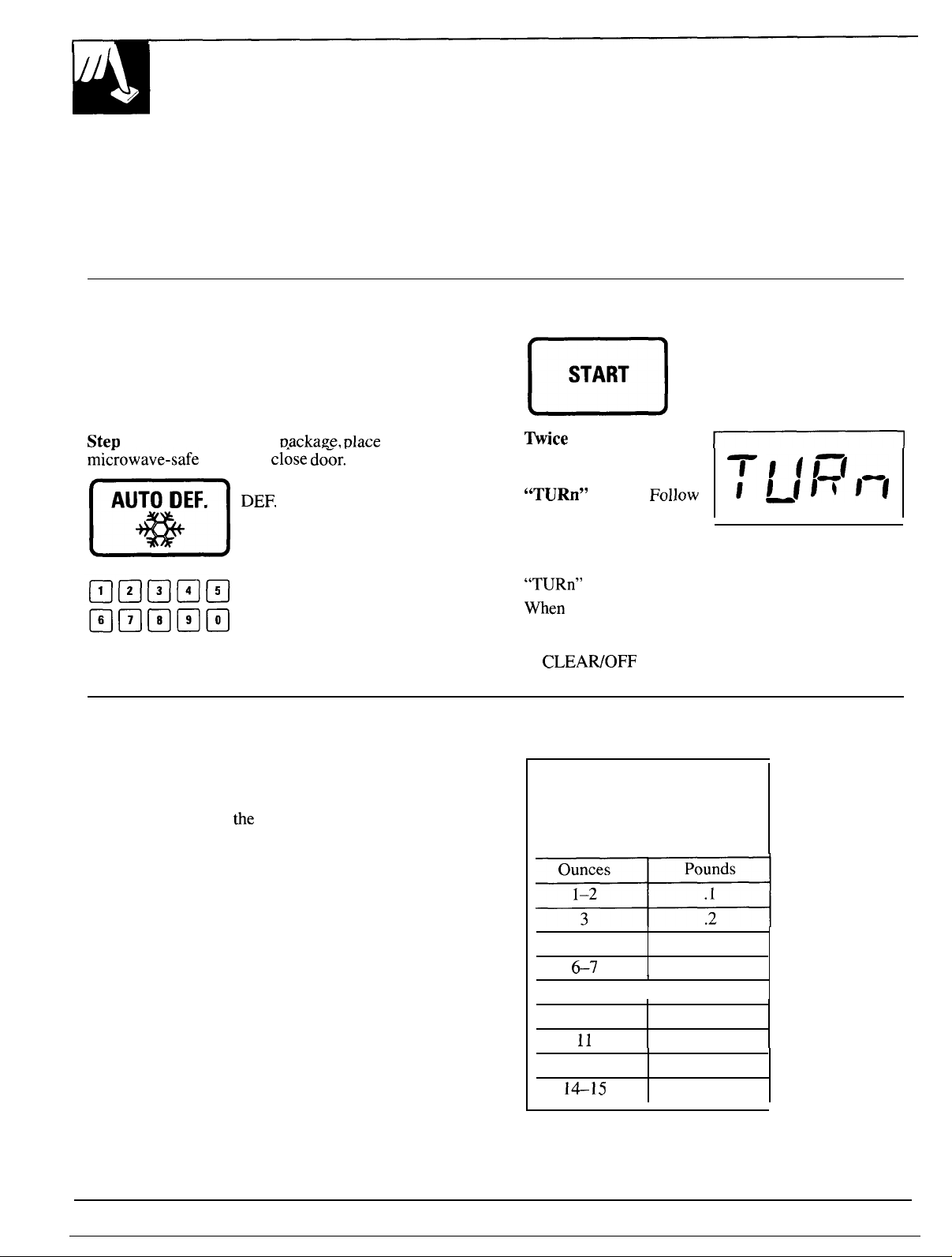
AUTO DEFROST
Auto Defrost
With the Auto Defrost feature,
Use the Auto Defrost guide on the
The oven calculates defrosting
the oven automatically sets the
next page. Enter the food weight in
time and changes power levels
defrosting times and power
pounds and tenths of a pound (see
during defrosting to give even
levels for you.
Conversion Guide below). Then
defrosting results.
touch START pad.
How to Set Auto Defrost
Before you begin, check the guide located at front
of oven when you open the door. It shows minimum
and maximum food weights for a variety of foods.
You will need to know your food weight before setting
Auto Defrost.
n
Step 4: Touch START pad.
START
Display shows defrost time
counting down.
Ste~ 1: Remove food from
Package,
place
in oven on
Nice
during defrosting
~1
mi;rowave-safe dish and
cl~se
do~r.
-
defrosting, the oven
n
Step 2: Touch the AUTO
beeps 4 times and
AUTO
DEF.
DEF.
pad.
“TURn” flashes. Follow
@
the directions in the Auto
I
I
Defrost Guide for what
to do at the first and second signal. Then close the
door and touch START. (Defrosting continues during
Step 3: Enter weight. For
“TURn” display.)
example, touch number pads 1
men
defrosting time is completed, “End” flashes
and 2 for weight of 1.2 pounds
(1 pound, 3 ounces. See
and oven beeps 4 times.
“End” remains on display
Conversion Guide below.)
and oven beeps every minute until door is opened
or
CLEAWOFF pad is touched.
Stand Time
After Auto Defrosting, meat needs to stand in order to
let the inside defrost. You may take the food out of the
oven if you wish. Stand time recommendations are
given in the guide on
tie
next page.
Conversion Guide
If the weight of food is stated in
pounds and ounces, the ounces
must be converted to tenths
(.1) of a pound.
4-5
.3
67
.4
,
I
8
.5
9-1o
.6
11
.7
12–13
.8
1415
.9
1A
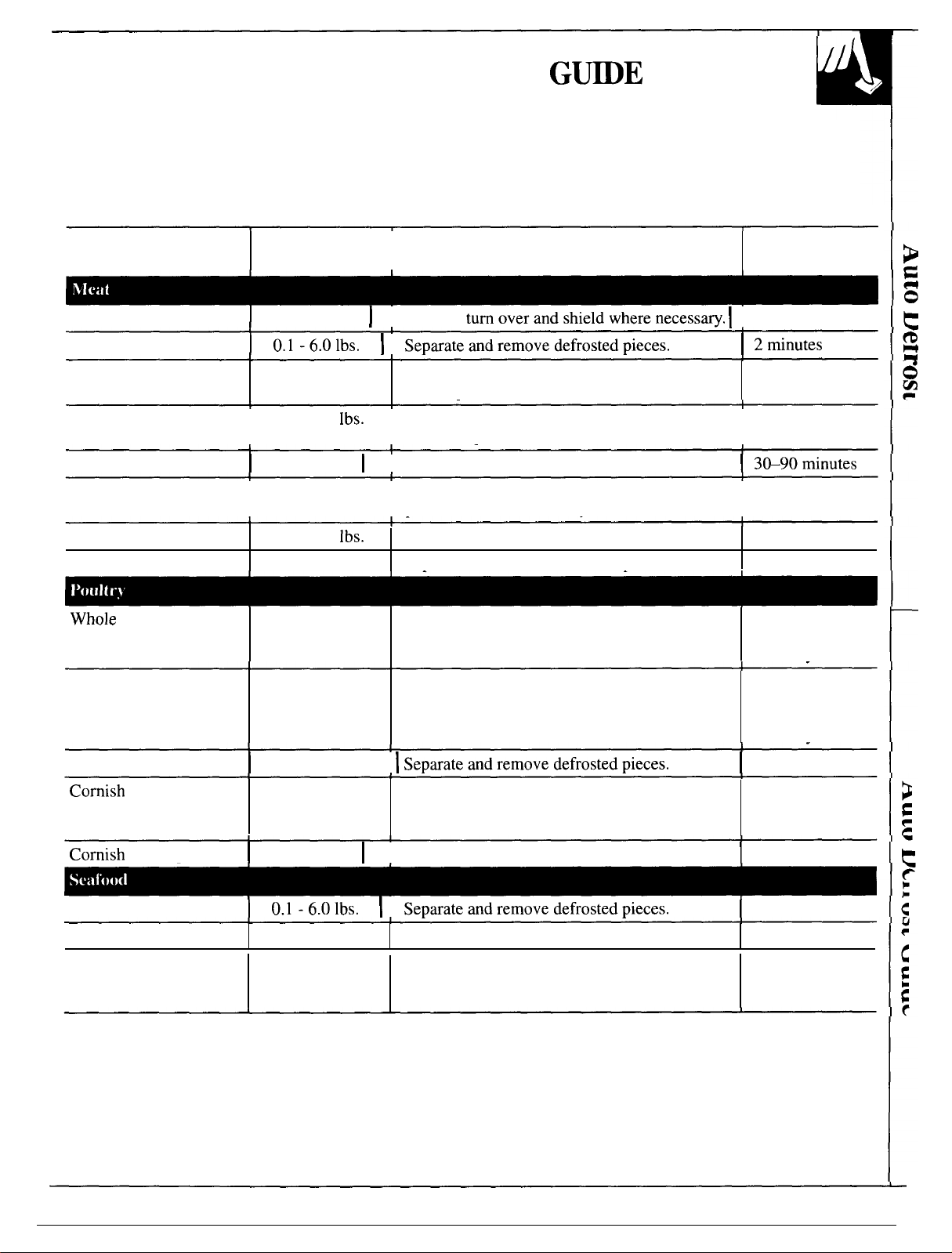
AUTO DEFROST
GU~E
1. Unwrap item being defrosted.
2. Place roasts and whole poultry on trivet in microwave-safe dish. Check
food for warm spots halfway through defrosting, and shield these areas
with small pieces of foil.
I
RECOMMENDED
MIN.-MAX.
FOODS
WEIGHT
INSTRUCTIONS
STAND TIME
Chops
I
0.1 -6.Olbs.
]
Separate,
turnoverandshieldwherenecessary.
I
5minutes
Frankfurters, Sausage
]
0.1-6.Olbs.
I
Separateandremovedefrostedpieces.
I
2minutes
Ground Meat 0.1 -6.0 lbs.
Turn over, remove defrosted areas and
5 minutes
break apart.
I
I I
Beef Patties
0.1 -6.0
Ibs.
Turn over and separate patties. Remove
5 minutes
defrosted pieces.
Roast
I
0.1 -6.0 lbs.
I
Turn over and shield.
I
3@90minutes
I I
I
Ribs
0.1 -6.0 lbs. Separate, turn over and remove defrosted
5 minutes
pieces. Shield if necessary.
Steak
0.1 -6.0
Ibs.
Turn over and shield. 5 minutes
Stew
0.1 -6.0 lbs.
Separate and remove defrosted pieces.
5 minutes
Whole
Chicken
0.1 -6.0 lbs.
Turn over and shield.
10 minutes;
run cold water
in cavity.
Turkey Breast
0.1 -6.0 lbs.
Turn over and shield.
20 minutes
(breast side up)
in refrigerator;
add cold water
in cavity.
Chicken Pieces
I
0.1 -6.Olbs.
I
Separateandrernovedefrostedpieces.
1
5minutes
Cornish
hens (whole) 0.1 -6.0 lbs.
Turn over and shield where necessary.
10 minutes;
run cold water
in cavity.
Comish hens (split)
I
0.1- 6.Olbs.
I
Turnover and shield.
I
5minutes
Fish fillets
I
0.1-6.Olbs.
I
Separateandremovedefrostedpieces.
1
5minutes
Shrimp, scallops
0.1 -6.0 lbs.
Separate and remove defrosted pieces.
5 minutes
Whole fish
0.1 -6.0 lbs.
Turn over and shield tail and head.
5 minutes;
hold under cold
running water.
Edges or thin areas of meat will defrost more rapidly than other areas.
After first or second signal, shield warm areas with small pieces of foil.
15
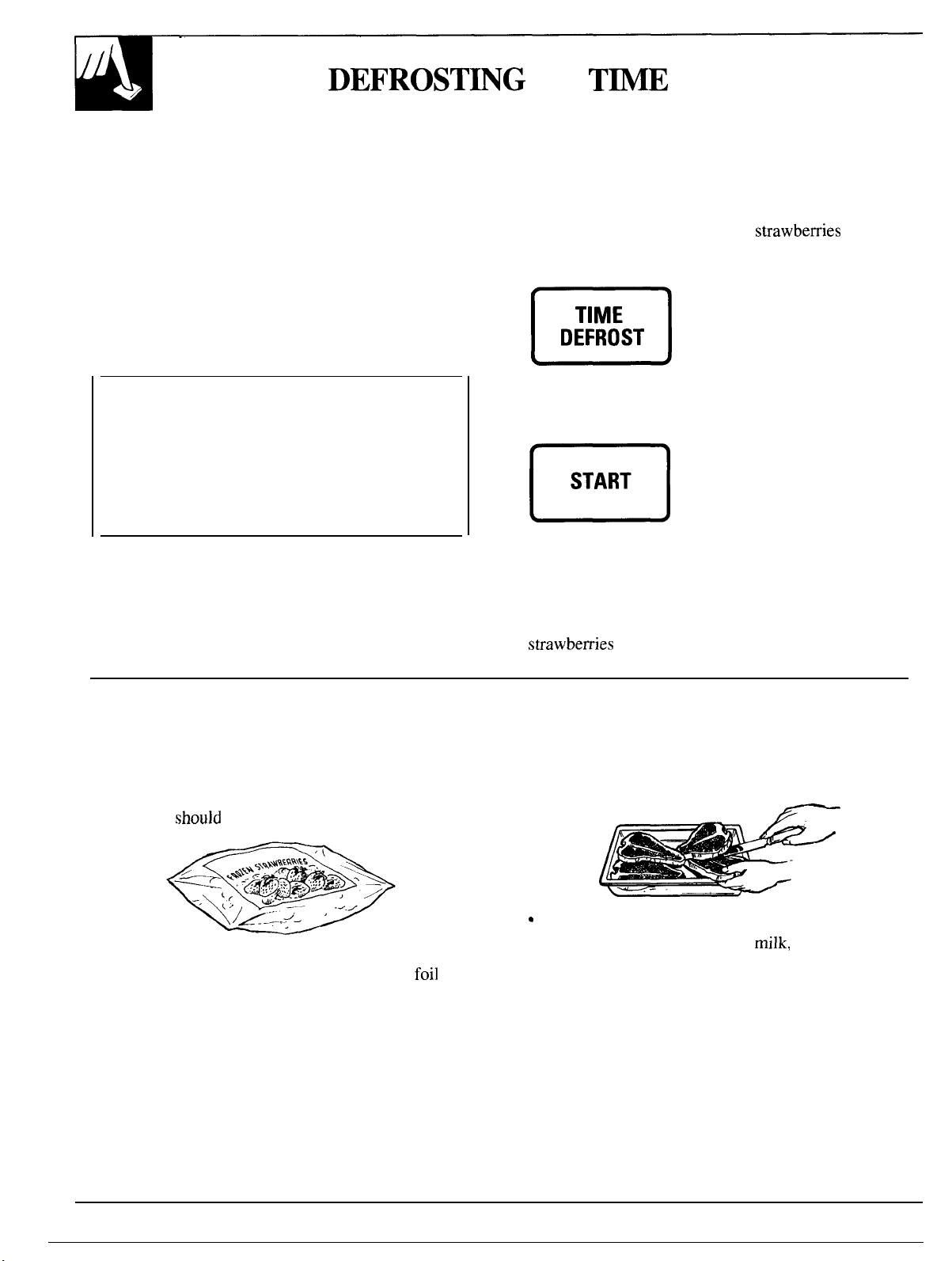
DEFROST~G
BY
T~E
Time Defrost (Power Level 3)
Time Defrost is designed for speedy thawing of
frozen food and is 1 of the great advantages of
a microwave oven.
Use the Time Defrost setting to quickly thaw foods
such as bread, rolls, vegetables, fruits and frozen
dinners.
● Power level 3 is automatically set when you press
the TIME DEFROST pad, but you may change this
for more flexibility.
● See the Defrosting Guide for defrosting help.
How to Change Power Level
1. Press TIME DEFROST.
2. Select defrosting time.
3. Press POWER LEVEL.
4. Select power.
5. Press START.
To become better acquainted with the defrost
function, defrost a 10 oz. package of frozen
strawberries by following the steps below.
Step 1: Place package of frozen
strawbemies
in the
oven and close door. Be sure package contains no
metal.
n
Step 2: Touch TIME
TIME
DEFROST.
DEFROST
Step 3: Select one half of the total defrosting time
recommended in the Defrosting Guide. For example,
touch 4 and MINUTE pad for 4 minutes.
n
Step
4: Touch START. When
START
the cycle is completed, the
oven signals and flashes “End,”
then automatically shuts off.
Step 5: Turn the package over, close the door and
repeat Steps 2 and 3 to set remaining half of
defrosting time and touch START.
Step 6: When the oven signals and flashes “End,”
open the door, remove the package and separate
strawbemies
to finish defrosting,
Defrosting Tips
● Foods frozen in paper or plastic can be defrosted
in the package. Tightly closed packages should be
slit, pierced or vented, AFTER food has partially
defrosted, as directed by package. Plastic storage
containers
should
be at least partially uncovered.
● Family-size, pre-packaged frozen dinners can be
defrosted and microwaved. If the food is in a
foil
container, transfer it to a microwave-safe dish.
● For even defrosting, some foods need to be broken
up or separated part of the way through the
defrosting time.
Q
Check the Defrosting Guide for other defrosting tips.
●
Foods that spoil easily, such as
milk,
eggs, fish,
stuffings, poultry and pork should not be allowed to
sit out for more than 1 hour after defrosting. Room
temperature promotes the growth of harmful bacteria.
16
Questions and Answers
Q. When I press START, I hear a dull, thumping Q. Can I defrost small items in a hurry?
noise. What is it?
A. Yes, but they will need more frequent attention
A. This sound is normal. It is letting you know the
than usual. Raise the power level after entering the
oven is using a power level lower than 10 (High).
time by touching the desired power level pad.
Power level 7 cuts the total defrosting time in
about 1/2; Power level 10 cuts the total defrosting
time to approximately 1/3. During either, rotate or
stir food frequently.
COO~G
BY
TE~EWTU~
Internal temperature is the best test of doneness
for many foods.
Use Temp
Coo~old
to cook a variety of foods to
the desired finished food temperature. The Time
Cook I & II setting is recommended for batters,
doughs, frozen foods and foods which are difficult
to cook precisely with the probe.
Temp
Coo~old
takes the guesswork out of cooking,
because the oven automatically switches to “Hold”
setting after reaching the preset food temperature
and maintains that temperature until you touch the
CLEAWOFF
pad.
NOTE: Oven automatically switches to “Hold”
when preset food temperature is reached.
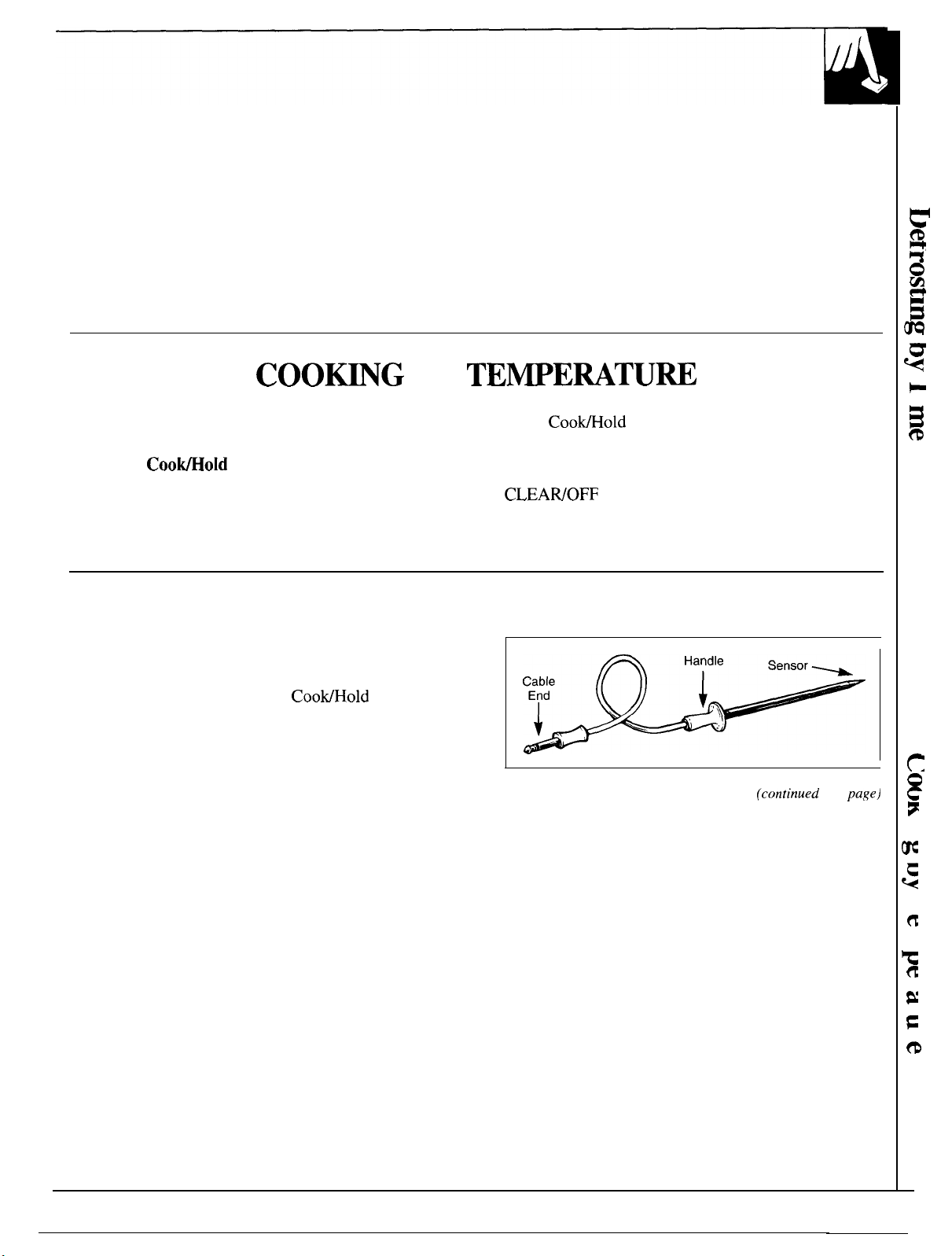
The Temperature Probe
The temperature probe is a food thermometer that
gauges the internal temperature of your food. (Its
appearance may vary from picture at right.) The probe
must be used when using Temp
CooUHold or Auto
Roast. To use the probe properly, follow directions in
the Automatic Roasting section.
(continued
next
page)
17
COO~G
BY
TE~EWTU~
(continued)
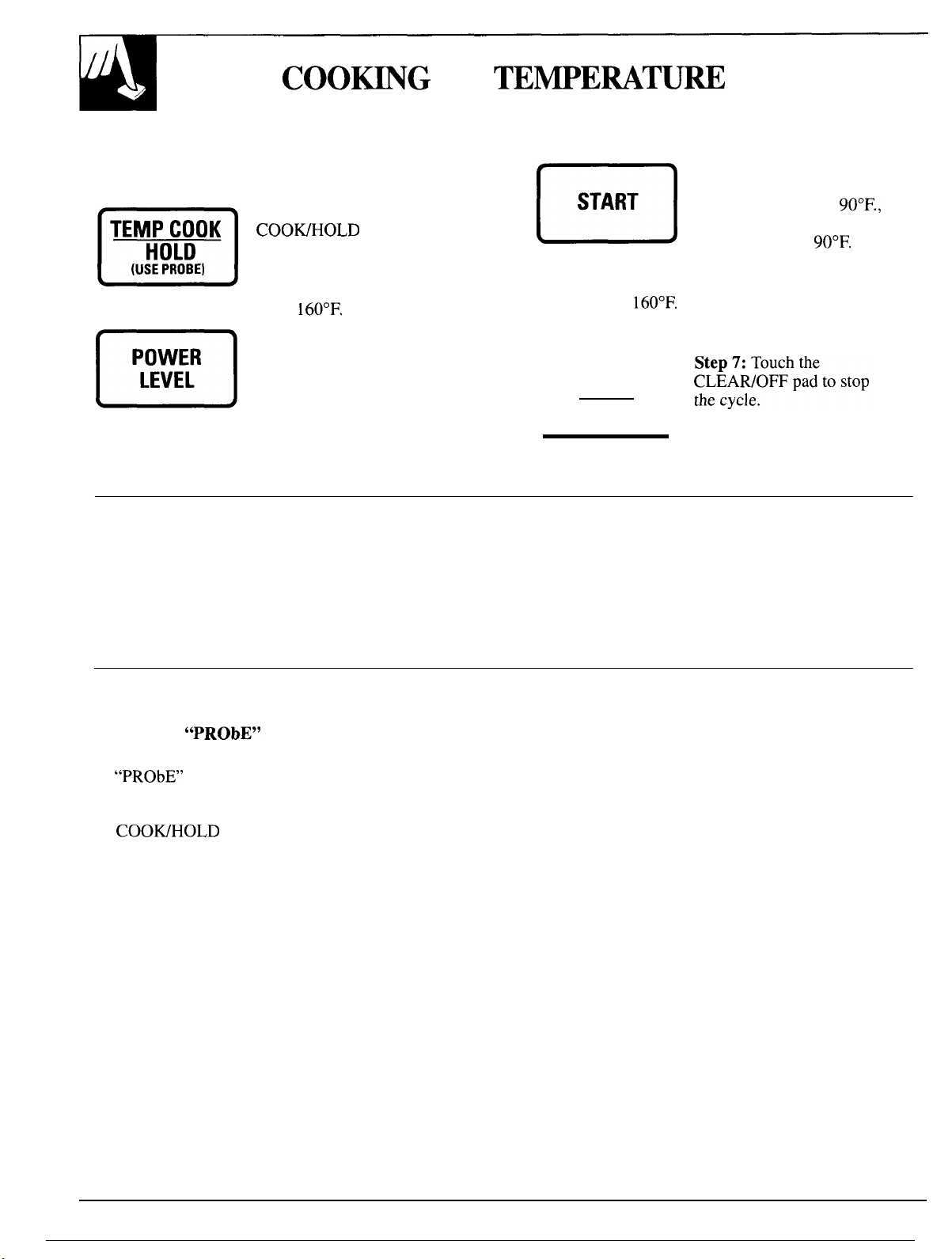
How to Temp Cook a Rolled Beef Rib Roast to Medium
Step
1:
Insert temperature probe and attach probe
securely in oven wall. Close the door.
n
Step 2: Touch TEMP
TEMP COOK
COO~OLD
pad.
n
Step 5: Touch the START pad.
If internal temperature of
START
the roast is less than
90°F.,
display will show “COOL”;
~“#p~gE,
if temperature is
90°F.
or
above, display shows
temperature counting up.
Step 3: Touch 1,6 and O for
160°F.
Step 6: When
160°F.
is reached, the oven will sound
n
Step 4: Touch POWER
and display “Hold.” The oven will then hold the
temperature.
POWER
LEVEL pad. Touch 5 for
LEVEL
medium power.
m
~EI~~s$J$~tostoP
Step 8: Remove probe and food from the oven.
Cooking Tips
● Use a lower power level; foods
● Be sure frozen food has been
● Cover foods loosely for moisture
will heat more evenly though
completely defrosted before control and quick, even heating.
requiring more time. inserting probe. Probe may
break off if used in frozen
foods.
Questions and Answers
Q. Why did “PRObE” flash on the display after I Q. Can I leave my probe in the oven if it’s not
touched the START pad?
inserted in food?
A.
“PRObE” will flash if you don’t seat the cable A. No, if it touches the oven wall, it may damage
end of the probe securely into the receptacle
the oven.
in the oven wall or if you touch the TEMP
COOWHOLD pad and forget to use the probe.
18
QUICK
~~AT
The Quick Reheat feature is a short-term program to Touch just 3 pads to use Code Reheat codes 1 to 6
automatically reheat a beverage or previously cooked
to reheat many popular foods. See the guide at bottom
food. The oven turns off automatically after a preset
of page. Or touch just 2 pads to use the Beverage or
amount of time.
Dinner Plate programs with the oven automatically
setting the code for you.
Beverage
Dinner Plate
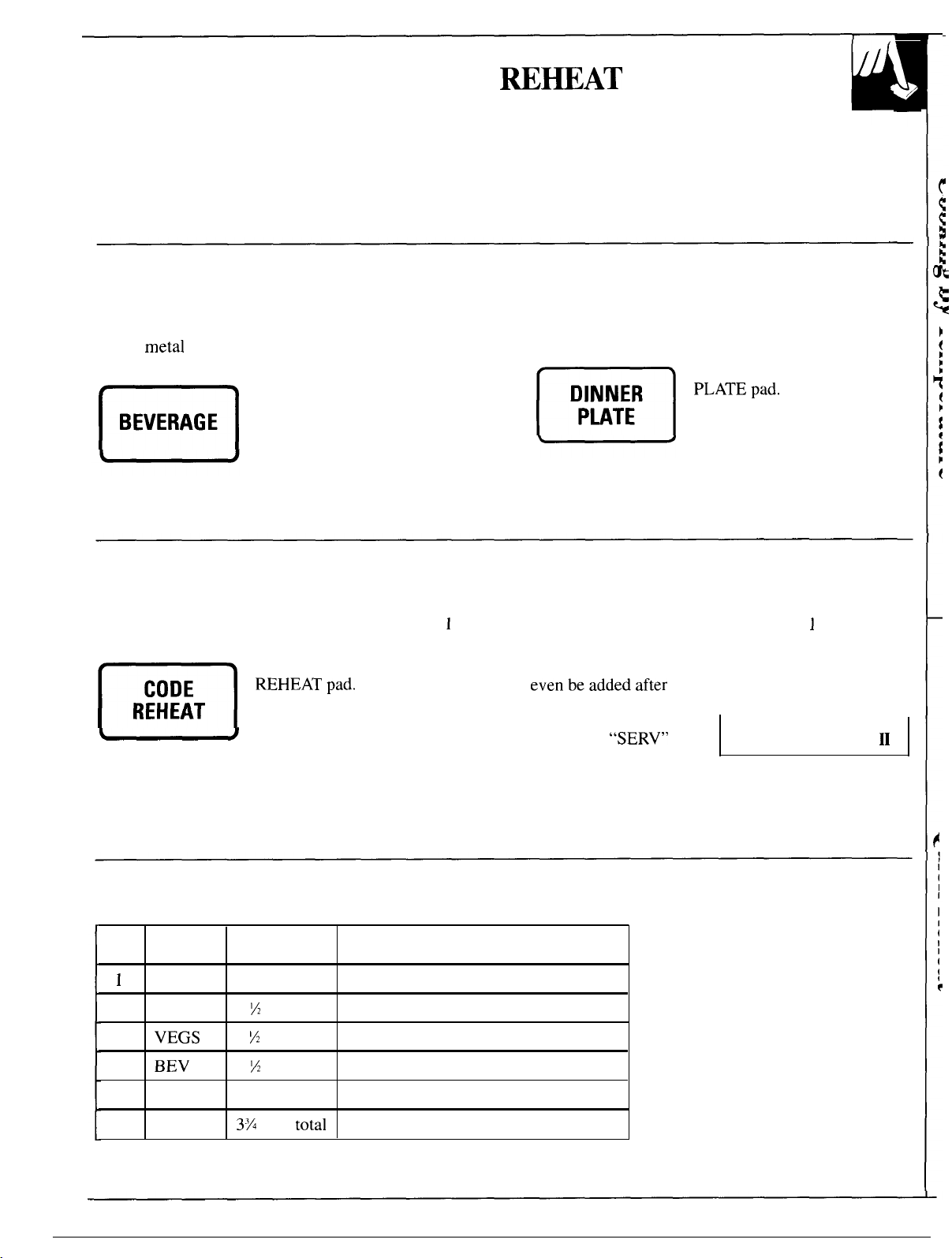
The Beverage program makes it simple to reheat a
cup of hot chocolate or other beverage. Use a cup that
has no
metal
decoration and is microwave-safe (refer
to Microwaving Tips section).
Step 1: Touch BEVERAGE
m
‘ad
Step 2:
Touch START. Oven will signal and display
remaining time counting down shortly before shut off.
The Dinner Plate program makes it easy to reheat
a plate of leftovers or reheat a previously prepared
meal for a guest who arrived late for dinner.
Step 1: Touch DINNER
m
‘LATEpad
Step 2: Touch START. Oven will signal and display
remaining time counting down shortly before shut off.
Code Reheat
To Reheat More Than 1 Serving
The Code Reheat program makes it a snap to reheat
many popular foods. Choose a code number from
1
to 6 (see Code Reheat Guide below).
Step 1: Touch CODE
m
‘EHEATpad
Step 2: Touch a number pad from 1 to 6 to select
a food group.
Step 3: Touch START. Oven will signal and display
remaining time counting down shortly before shut off.
Quick Reheat codes 1 through 5 and Beverage let you
heat up to 3 servings. To add more than
1
serving, just
touch number pad 2 or 3 right before touching START.
The serving size may
‘Venbeaddedafter
m
touching START.
Just touch number
pad 2 or 3.
“SERV”
I
11
and a number will be
displayed briefly to show that serving size has
been changed.
Code Reheat Guide
Time
Code Display
per serving
Foods Recommended
1
BREAD
20 sec.
Breads, pastries, pies, bakery goods
2
MEATS
1
M
min.
Meats, casseroles, pizza, solid foods
3
VEGS
1
X
min.
Fruits and vegetables
4
BEV
1
%
min.
Beverages
5
SAUCE
2 min.
Soups, stews, sauces
6
PLATE
3Y4 min.
total
2 to 3 foods; 4 oz. each
19
AUTO~TIC
ROAST~G
Auto Roast uses the temperature probe to cook
Just as in regular roasting, only tender roasts should
to the desired serving temperature. Unlike
Temp
be roasted until specified internal temperatures are
Coo~old,
which uses a single power level, Auto
reached. Less tender roasts should be microwaved
Roast uses up to 3 power settings which
by time.
automatically switch during roasting, thus
providing even, tender cooking results without
overcooking.
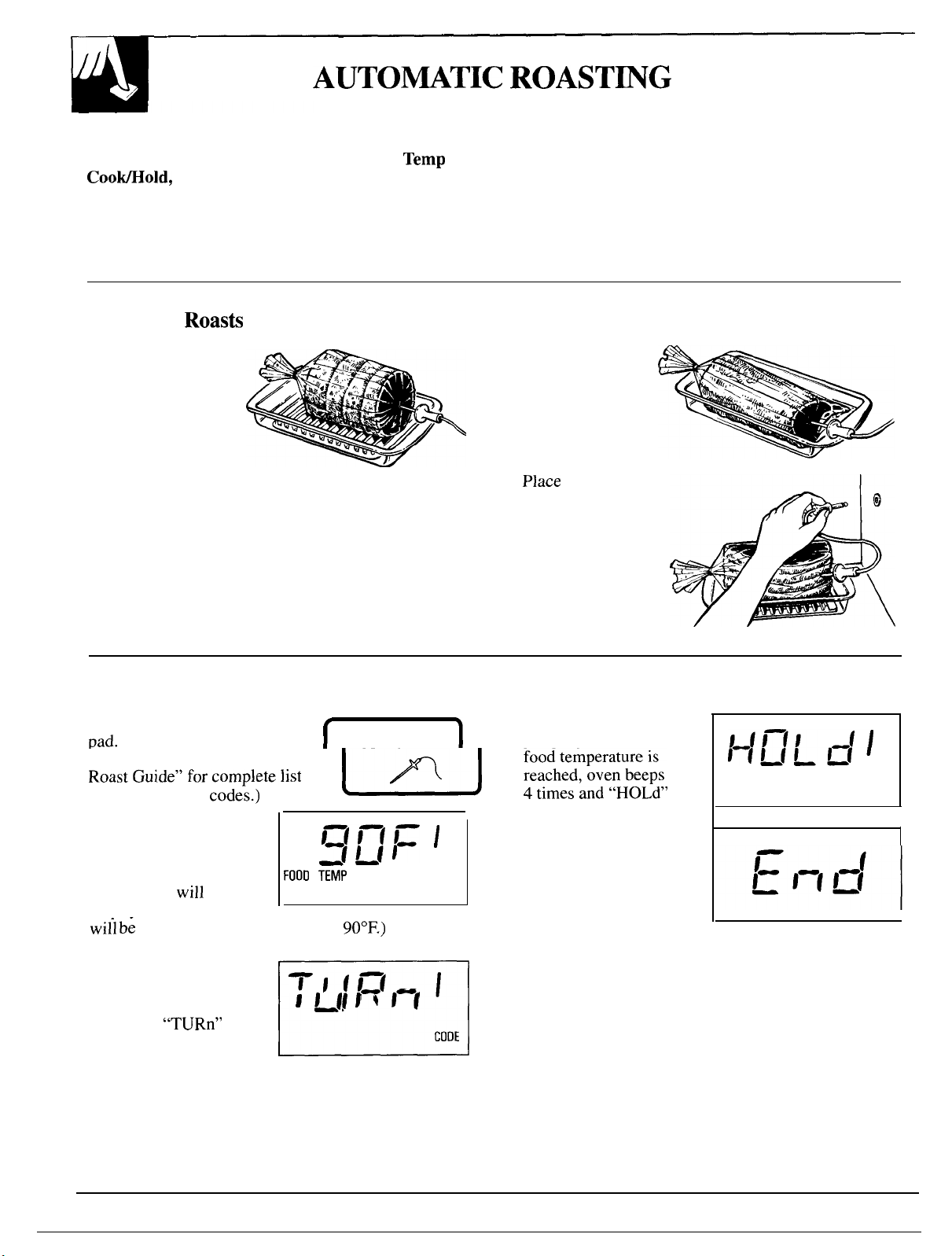
Preparing Roask for Auto Roasting
Place tender beef
Place pork roast
roast in cooking
in cooking bag
bag on trivet in
and place in
microwave-safe
microwave-safe
dish. (Refer
dish.
to package
instructions for
proper use of
cooking bag.) Insert probe through cooking bag
horizontally into the center meaty area not touching
bone or fat. Make sure the handle does not touch the
food or top or sides of the oven.
Place
meat in
oven with probe
to the right.
Insert cable end
of probe firmly
into receptacle
on oven wall.
How to Roast Beef to Medium
Step 1: Touch AUTO ROAST
Step 3: After a
pad.
Touch number pad 1.
AUTO ROAST
pre-programmed
‘oastGuide’’forcomplete]ist
w
;is;~?g;;:
Touch START. (See-the “Auto
of recommended
code~.)
NOTE: By touching
the AUTO ROAST
pad during cooking, the
meat’s internal
temperature
will
be
displayed. (“COOL”
appears on the display.
1
l;(f~ff=
/
Step 4: Food will be
——
held at this temperature
FOOO
TEMP
for 60 minutes. The
COOE
oven then beeps 4 times
and “End” appears.
wiil
b;
displayed until meat reaches
90°F.)
When pad
is released, doneness code reappears on the display.
Step 2: When you select
Auto Roast codes 1 or 2,
the oven signals with 4
beeps and
“TURn”
flashes on the display
E
71
(1=(
I
~f
I
~
1-[
I
COOE
when it’s time to turn the
roast over. After you turn the roast, close the door and
touch START. (NOTE: Oven continues to cook after
the signal whether or not roast is turned over.)
COOE
20

Auto Roast Guide
● Place meats in a cooking bag in microwave-safe
● Insert probe as described in the Automatic Roasting
dish. (Refer to package instructions for proper use
section.
of cooking bag.)
I
I
Minimum End
Food
Code
Temp.
Beef (5 lb. max.)
Tender Roast
Medium
1
160°F.
Well
2
170°F.
I
I
Pork (5 lb. max.)
Loin Roast
2
170°F.
Poultry (6 lb. max.)
Turkey Breast
3
185°F.
(Insert probe horizontally
into meatiest
area.)
*Recommended standing time before serving.
Approx.
Time
Hold* Doneness
(minutes per pound)
Minutes
Display
I
I
13-15
0
MEd
15-17
5-1o
WELL
15-19
I
I
10
WELL
17-20
I
10-15
I
WELL
Automatic
Simmer
(Auto Roast Code 4)
Total time includes time to bring food to 180°F., and
hold
at that temperature until done.
Set Auto Simmer like
Auto Roast as explained
in the Automatic
Roasting section.
Display shows
“SIM’”
and “CODE 4.”
E
);/
\;t
‘j
COOE
Oven switches to Hold
at
180°F.,
and continues
holding at 180°F. until
you remove food and
touch
CLEAWOFF
pad.
If stirring is
E
I’+
\-/LfL
~[
CODE
recommended, you can restart oven by touching
the START pad again. Touch
CLEAWOFF pad to
turn off oven.
Automatic
Simmer
Guide
(Auto Roast Code 4)
Food
Beef
Pot Roast
Chili
Chicken
Stewing
Broiler~~er
Haflork
Roast
soup
StocWegetable
Split Pea
Final Approx.
Doneness
Temp.
Time~ours
Display
180°F.
5-7
SIM
180°F.
5-8
SIM
180°F.
4-6
SIM
1800F.
3-4
SIM
180°F.
4-6
SIM
180°F.
7-10 SIM
180°F.
5-7
SIM
Comments
Add enough liquid to just cover meat. If adding vegetables,
make sure they are completely covered by liquid.
Precook meat. Place probe 1 inch from top surface. Stir after
3 hours, if possible.
Add 4 cups liquid. Insert probe into meatiest area of inner thigh
from below end and parallel to leg. Turn over after
1/2
of time.
Same
~rocedure
as above.
Add 4 cups liquid.
Make sure that vegetables and meat are covered by liquid. Stir
every 3 hours.
Add enough liquid to cover peas at least 2 inches. Stir after
3 hours.
21
GLOSSARY OF MICROWAVE TERMS
When adapting recipes for the microwave, it is best
to start with a familiar recipe. Knowing how the
food should look and taste will help when adapting
recipes for microwaving. Foods that require
browning or crisp, dry surfaces will cook better
in regular ovens.
“
Moist foods, such as vegetables, fruits, poultry and
seafood, microwave well.
● Rich foods, such as bar cookies, moist cakes and
candies, are suitable for microwaving because of
their high fat and sugar content.
c
Reduce regular oven cooking times by 1/2 to 1/3.
Check food after minimum time to avoid overcooking.
● Small amounts of butter or oil can be used for
flavoring, but are not needed to prevent sticking.
● Seasonings may need to be reduced. Salt meats and
vegetables after cooking.
Covering.
In both regular baking and microwave
cooking, covers hold in moisture, allow for more
even heating and reduce cooking time. In regular ovens,
partial covering allows excess steam to escape. Venting
plastic wrap or covering with wax paper serves the
same purpose when microwaving.
Venting.
After covering a dish with plastic wrap, you
vent the plastic wrap by turning back
1
comer so excess
steam can escape.
Arranging Food in Oven. When baking in regular
ovens, you position foods, such as cake layers or
potatoes, so hot air can flow around them. When
microwaving, you arrange foods in a ring, so that
all sides are exposed to microwave energy.
Stirring.
In range-top cooking, you stir foods up from
the bottom to heat them evenly. When microwaving,
you stir cooked portions from the outside to the center.
Foods that require constant stirring will need only
occasional stirring when microwaving.
~rning
Over.
In range-top cooking, you turn over
foods, such as hamburgers, so both sides can directly
contact the hot pan. When microwaving, turning is
often needed during defrosting or when cooking certain
foods, such as frozen hamburgers.
Standing Time.
When you cook with regular ovens,
foods such as roasts or cakes are allowed to stand to
finish cooking or to set. Standing time is especially
important in microwave cooking. Note that a
microwaved cake is not placed on a cooling rack.
Shielding.
In a regular oven, you shield chicken
breasts or baked foods to prevent over-browning.
When microwaving, you use small strips of foil to
shield thin parts, such as the tips of wings and legs
on poultry, which would cook before larger parts.
Arcing.
Sparks caused by too much metal in the
microwave oven or metal touching the side of the
oven or foil that is not molded to food.
Prick Foods to Release Pressure. Steam builds up
pressure in foods that are tightly covered by a skin or
membrane. Prick foods, such as potatoes (as you do
before regular oven cooking), egg yolks and chicken
livers, to prevent bursting.
Rotating.
Occasionally, repositioning a dish in the oven
helps food cook more evenly. To rotate 1/2 turn, turn
the dish until the side that was to the back of the oven
is
to
the front. To rotate 1/4 turn, turn the dish until the
side that was to the back of the oven is to the side.
Basic Microwave Guidelines
Density of Food. In both regular baking and
Piece Size.
Small pieces cook faster than large ones.
microwave cooking, dense foods, such as potatoes, Pieces that are similar in size and shape cook more
take longer to cook than light, porous foods, such evenly. With large pieces of food, reduce the power
as rolls, bread or pieces of cake.
setting for even cooking.
Round Shapes. Since microwaves penetrate foods to
Shape of Food.
In both types of cooking, thin areas
about
1
inch from top, bottom and sides, round shapes
cook faster than thick areas. This can be controlled in
and rings cook more evenly. Corners receive more microwaving by placing thick pieces near the outside
energy and may overcook. This may also happen when
edge and thin pieces in the center.
cooking in a regular oven.
Starting Temperature.
Foods taken from the freezer
Delicacy. Foods with a delicate texture, such as or refrigerator take longer to cook than foods at room
custards, are best cooked at lower power settings to temperature. Timings in our recipes are based on the
avoid toughening.
temperatures at which you normally store the foods.
Natural Moisture of food affects how it cooks. Very
Quantity of Food.
In both types of cooking, small
moist foods cook evenly because microwave energy
amounts usually take less time than large amounts.
is attracted to water molecules. Food that is uneven
This is most apparent in microwave cooking, where
in moisture should be covered or allowed to stand
time is directly related to the number of servings.
so it heats evenly.
Shelf.
(on models so equipped). Use the shelf to heat
more than 1 dish at a time. Take the shelf out when you
22
are not using it.
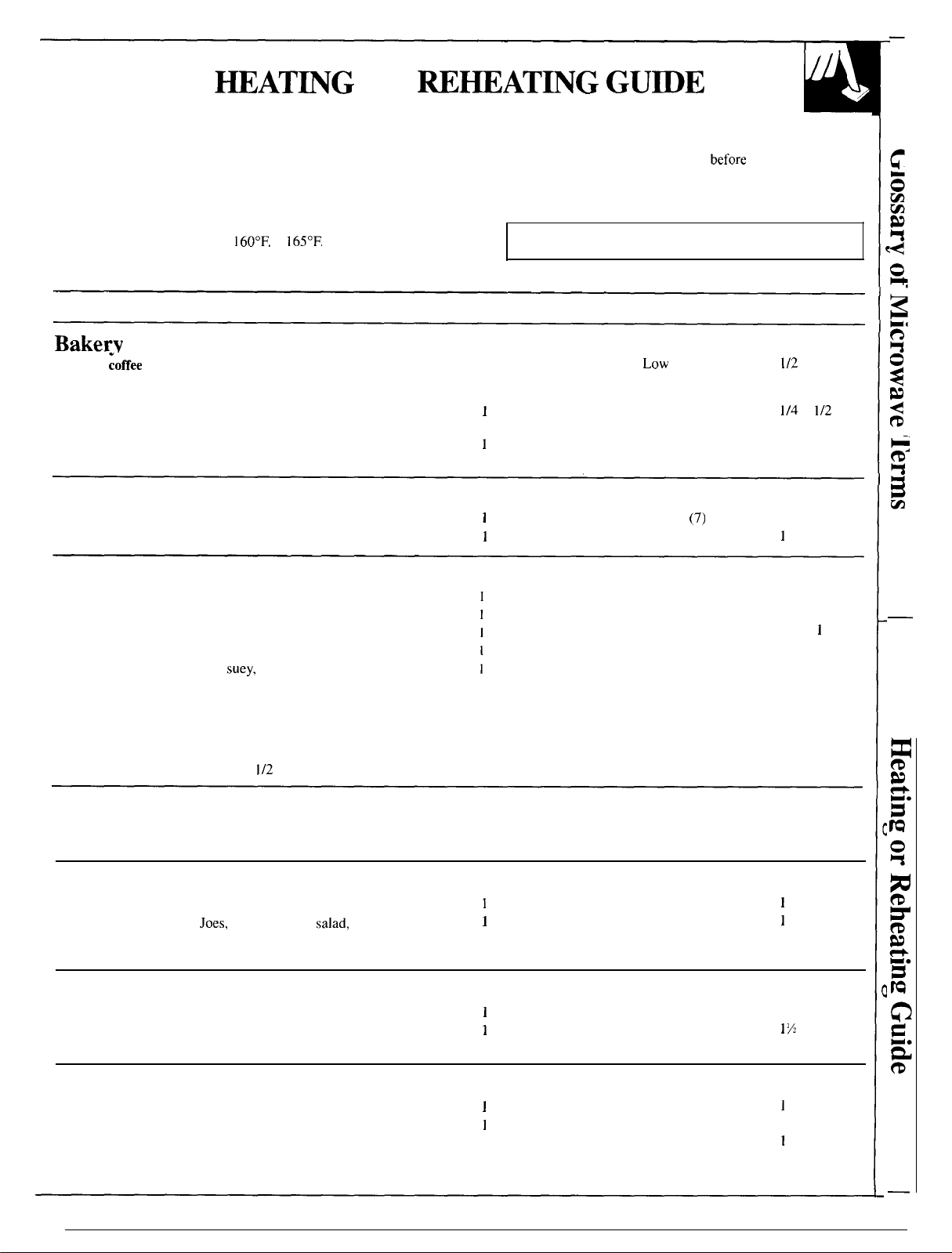
~ATmG
OR
~~AT~G
GU~E
NOTE: Use Power Level High (10) unless otherwise noted.
1.
Directions below are for heating or reheating already-cooked
foods stored in refrigerator or at room temperature. Use
palatable results. Adjust temperatures to suit your personal
taste. Let foods stand a few minutes
before
serving.
microwave-safe cookware.
4. Be sure foods are heated throughout before serving. Steaming
2. Cover most foods for fastest heating. Exceptions are some
or bubbling around edges of dish does not necessarily mean
sandwiches, griddle foods and baked items.
food is heated throughout.
3. Bubbling around edges of dish is normal, since the center is the
last to heat. Foods heated to
160°F.
to
165°F.
will provide safe,
If you use a meat thermometer while cooking, make sure
it is safe for use in microwave ovens.
Item
Amount Power Level
Time
Bakerv
Foods
Cake,
;offee
cake,
doughnuts, sweet rolls,
1
piece
Low
(3)
1/2
to 1 min.
nut or fruit bread
9 inch cake or
Low (3)
2 to 4 min.
12 rolls or doughnuts
Dinner rolls, muffins
1
Medium (5)
1/4
to
1/2
min.
6 to 8 Medium (5)
1 to 2 min.
Pie: fruit, nut or custard; 1 slice= l/8 of 9 inch pie
1
slice
1/2 to 1 min
(use minimum time for custard)
9 inch pie
Meal-High (7) 5 to 7 min.
Beverages
Cocoa, other milk based drinks (6 oz. per cup)
1
to 2 cups
Meal-High
(7)
3 to 6 min.
Coffee, other water-based drinks (6 oz. per cup)
1
to 2 cups
1
to 3 min.
Meats and Main Dishes
Chicken pieces
Hamburgers or meatloaf (4 oz. per serving)
Hot dogs and sausages
Rice and pasta (2/3-3/4 cup per serving)
Saucy, main dishes: chop
suey,
spaghetti, creamed chicken,
chili, stew, macaroni and cheese, etc. (3/4- I
cup per serving)
to 2 pieces
2 to 3 min.
to 2 servings
2 to 3 min.
to 2
1/2 to
1
min
to 2 servings
I to 3 min.
to 2 servings
3 to 5 min.
Steaks, chops, ribs, meat pieces
I to 2 servings
2 to 4 min.
Thinly-sliced meat (3 to 4 oz. per serving)
1 to 2 servings
1 to 3 min.
Topped or mixed with sauce (2/3-3/4 cup per serving)
1 to 2 servings
3 to 5 min.
Tip: Cover saucy main dishes with plastic wrap. Cover other main dishes and meats with wax paper. When heating or reheating 3 to 4 servings
of meat slices or pieces, rotate dish
I/2
turn after half of cooking time,
Plate of Leftovers
Meat plus 2 vegetables
1 plate
3 to 4 min.
Tip: Cover plate of food with wax paper or plastic wrap.
Sandwiches
Meat-cheese filling: with 2 slices of bread
1
to 2 servings
Meal-High (7)
I
to 3 min.
Moist filling: Sloppy
Joes, barbecue, ham
salad,
1
to 2 servings
Meal-High (7)
1
to 2 min.
etc. in bun (1/3 cup per serving)
Tip: Use paper towel or napkin to cover sandwiches,
soups
Milk-based (6 oz. per serving)
1
to 2 servings
Meal-High (7)
2 to 3 min.
Water-based (6 oz. per serving)
1
to 2 servings
1
X
to 3 min.
Tip: Cover soups with wax paper or plastic wrap.
Vegetables
Large pieces or whole: asparagus spears, corn on the cob, etc.
I
to 2 servings
1
to 2 min.
Mashed (l/2 cup per serving)
I
to 2 servings
1 to 2 min.
Small pieces: peas, beans, corn, etc. (1/2 cup per serving)
t to
2 servings
1
to 2 min.
Tip: Cover vegetables for most even heating.
23
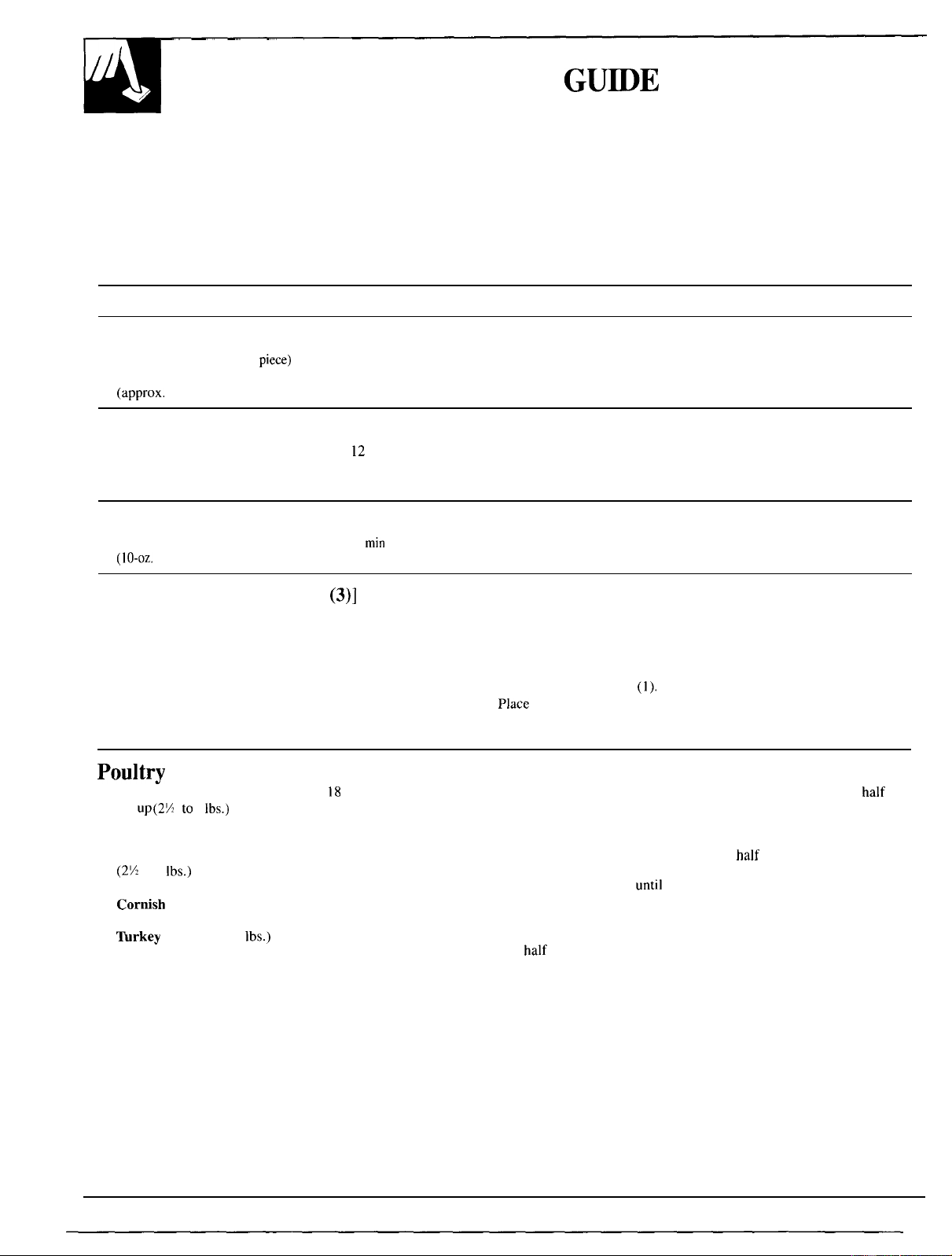
DEFROSTING
GU~E
1. Food packaged in paper or plastic maybe defrosted without 3. Be sure large meats are completely defrosted before cooking.
unwrapping. If food is foil wrapped, remove foil and place
food
4.
When defrosted, food should be cool but softened in all areas.
in cooking dish for defrosting. Most
food defrosts well
using
Defrost (3). For more even defrosting of larger foods, such as
If still slightly icy, return to microwave oven very briefly, or let
beef, lamb and veal roasts, use Warm (1).
stand a few minutes.
2. After first half of defrosting time, unwrap package and check
food. Turn food over, if necessary; break apart or separate food
if possible. Shield any warm areas with small pieces of foil.
Food
Time
Comments
Breads, Cakes [Power Level: Defrost (3)]
Bread, buns or rolls (1
piece)
I min.
Sweet rolls
4 to 6
min.
Rearrange after half of time.
(approx.
12 oz.)
Fish and Seafood
[Power Level: Defrost (3)]
Fillets, frozen (1 lb.)
9 to
12
min.
Shellfish, small pieces
6 to 8 min.
Place block in casserole. Turn over and breakup after first half
(1 lb.)
of time.
Fruit [Power Level: Defrost (3)]
Plastic pouch—1 to 2
4 to 7
min
(10-oz.
package)
Meat
[Power Level: Defrost
(3)]
Bacon (1 lb.)
4 to 6 min. per lb.
Franks (1 lb.)
4 to 6 min.
Ground meat (1 lb.)
6 to 8
min.
Roast: beef, lamb, veal, pork
12 to 16 min. per lb.
Steaks, chops and cutlets
6 to 10 min. per lb.
Place unopened package in oven. Let stand 5 minutes after defrosting.
Place unopened package in oven. Microwave just until franks can be
separated. Let stand 5 minutes, if necessary, to complete defrosting.
Turn meat over after first half of time.
Use Power Level Warm
(1).
Place unwrapped meat in cooking dish. Turn over after first half
of time and shield warm areas with foil. After second half of time,
separate pieces with table knife. Let stand to complete defrosting.
Poultry
[Power Level: Defrost (3)]
Chicken, broiler-fryer,
18
to 22
cut
Up
(2fi
to
3
lbs.)
Chicken, whole
24 to 28
(2fi to 3
Ibs.)
Cornish
hen
10
to 16 min. per lb.
~rkey
breast (4 to 6
Ibs.)
6 to 10 min.
per
lb.
Place wrapped chicken in dish. Unwrap and turn over after first half
of time. After second half of time, separate pieces and place in cooking
dish. Microwave 2 to 4 minutes more, if necessary. Let stand a few
minutes to finish defrosting.
Place wrapped chicken in dish. After first
half of time, unwrap and
turn chicken over. Shield warm areas with foil. To complete defrosting,
run cool water in cavity
until
giblets can be removed.
Place unwrapped hen in oven breast-side-up. Turn over after first half
of time. Run cool water in cavity until giblets can be removed.
Place unwrapped breast in microwave-safe dish breast-side-down. After
first
half of time, turn breast-side-up and shield warm areas with foil.
Defrost for second half of time. Let stand I to 2 hours in refrigerator
to complete defrosting.
24

Vegetables
Vegetible
Amount
Time Comments
AsparaWs
(frozen spears)
1
lb.
8 to 10 min.,
Meal-High (7)
6 to 8 min.
In 1
fi-qt.
oblong glass baking dish, place l/4 cup water,
Rotate dish after half of time.
In l-qt. casserole.
In 1
fi-qt.
casserole, place
1/2
cup water.
In l-qt. casserole, place 2 tablespoons water.
In
1
-qt. casserole, place 1/4 cup water.
(frozen spears)
Beans
(fresh
green)
(frozen green)
(frozen lima)
10-oz. package
I
lb.
cut in half
1O-OZ. package
10-oz. package
13 to 17 min.
7 to 9 min.
7 to 9 min.
Beets
(fresh, whole)
1 bunch
20 to 25 min.
In 2-qt. casserole, place 1/2 cup water
Broccoli
(fresh cut)
(fresh spears)
In 2-qt. casserole, place
1/2
cup water.
In 2-qt. oblong glass baking dish, place l/4 cup water.
Rotate dish after half of time.
In
I-qt.
casserole.
In
I-qt.
casserole, place 3 tablespoons water,
1 bunch (
1
X to 1 X lbs.)
I
bunch ( 1
M
to
1
K
lbs.)
8 to 10 min.
10 to 13 min.
(frozen, chopped)
(frozen spears)
10-oz. package
10-oz. package
6 to 8 min.
6 to 8 min.
Cabbage
(fresh)
(wedges)
1 medium head (about 2 lbs.)
9 to
1
I
min.
8 to 10 min.
In 1
k- or 2-qt. casserole, place 1/4 cup water.
In 2- or
3-qt.
casserole, place 1/4 cup water.
Carrofi
(fresh,
sliced)
(frozen)
1 lb.
10-oz. package
7 to 9 min.
6 to 8 min.
In 1
X-qt.
casserole, place 1/4 cup water.
In
1
-qt. casserole, place 2 tablespoons water.
Cauliflower
(flowerets)
(fresh, whole)
(frozen)
1
medium head
I medium head
1O-OZ. package
10 to 14 min.
10
to
17
min.
6 to 8 min.
In 2-qt. casserole, place
1/2
cup water.
In 2-qt. casserole, place 1/2 cup water.
In l-qt. casserole, place 2 tablespoons water.
Corn
(frozen kernel)
1O-OZ. package
5 to 8 min.
In 1 -qt. casserole, place 2 tablespoons water.
Corn on the cob
(fresh)
I
to 5 ears
4 to 5 min.
per
em
In 2-qt. oblong glass baking dish, place corn. If com
is in husk, use no water; if com has been husked, add
1/4 cup water. Rearrange after half of time.
Place in 2-qt. oblong glass baking dish.
Cover with vented plastic wrap. Rearrange after
half of time.
(frozen)
1 ear
2 to 6 ears
6 to 7 min.
3 to 4 min. per
em
Mixed, vegetables
(frozen)
1O-OZ. package
5
to
8
min.
In
I-qt. casserole, place 3 tablespoons water.
Peas
(fresh, shelled)
(frozen)
2 lbs. unshelled
10-oz. package
10 to 12 min.
5 to 8 min.
In l-qt. casserole, place 1/4 cup water.
In l-qt. casserole, place 2 tablespoons water.
Potatoes
(fresh, cubed,
white)
(fresh, whole,
sweet or white)
4 potatoes
(6 to 8 oz. each)
1
(6 to 8 oz. each)
12
to 14 min.
3 to 5 min.
Peel and cut into
I
inch cubes. Place in 2-qt.
casserole with
1/2
cup water. Stir after half of time.
Pierce with cooking fork. Place on paper towel
on oven floor, I inch apart in
circulm arrangement.
Let stand 5 minutes.
Spinach
(fresh)
(frozen, chopped
and
Ieafi
In 2-qt. casserole, place washed spinach.
In l-qt. casserole, place 3 tablespoons water.
10
to 16 OZ.
10-oz. package
6 to 8 min.
6 to 8 min.
Squash
(fresh, summer
and yellow)
(winter, acorn
or butternut)
1 lb.
sliced
5 to 7 min.
8 to 1
I
rein,
In 1
fi-qt.
casserole, place 1/4 cup water.
Cut in
half
and remove fibrous membranes. In 2-qt.
oblong glass baking dish, place squash cut-side-down.
Turn cut-side-up after 4 minutes.
25
I
to 2 squash
(about
I
lb.
each)
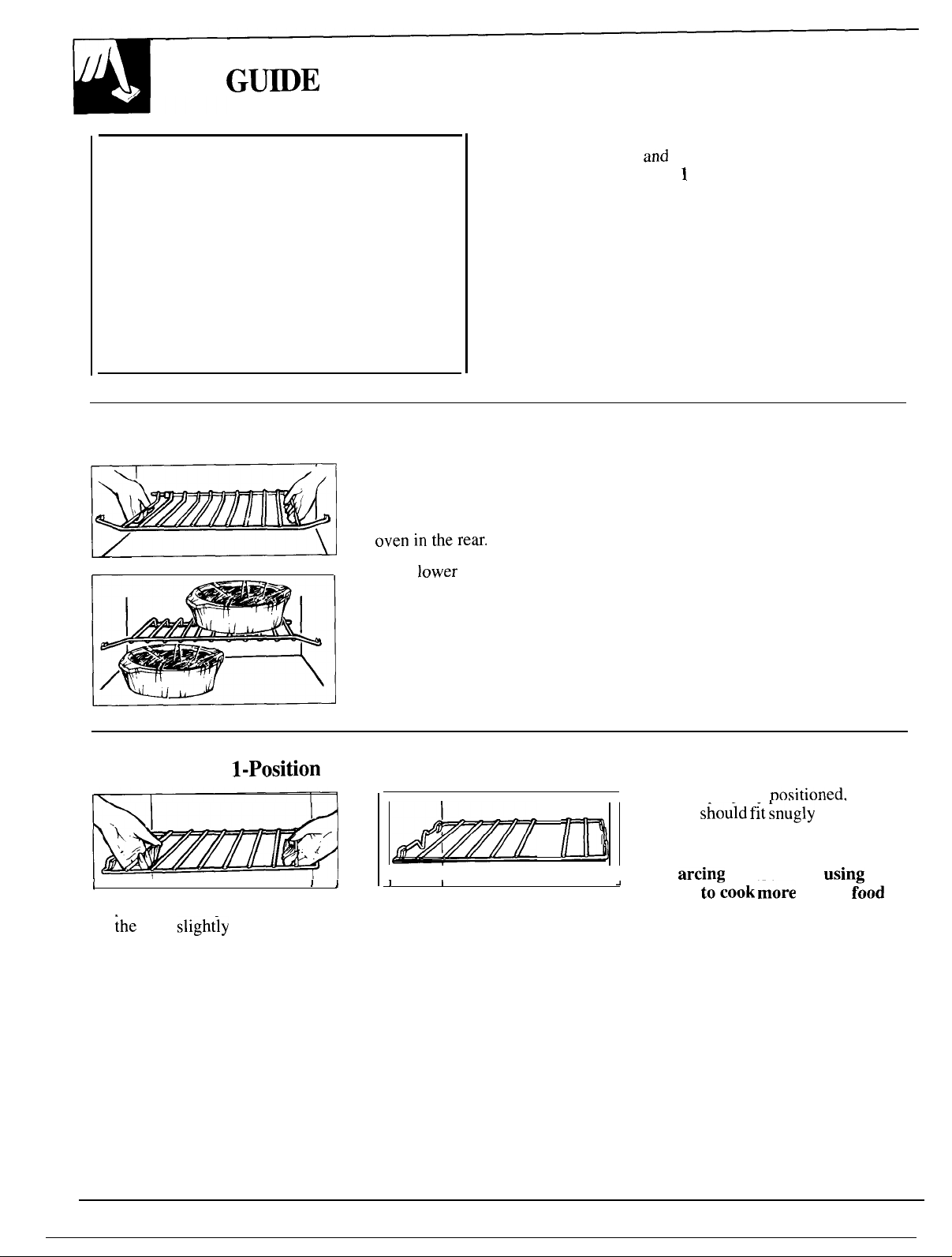
GU~E
TO USE OF THE OVEN SHELF
● Use the shelf only when cooking food on 2
levels. Food microwaves best when placed
directly on the oven floor.
● Do not store or cook with metal shelf on floor
of oven. Product damage may result.
● Use pot holders when handling metal shelf
and cookware. They may be hot.
● Do not store microwave browning dish on
metal shelf.
● Use of shelf with the Quick Reheat or
Popcorn program is not recommended.
The wire shelf is specifically designed for added
capacity heating
and
reheating in your microwave
oven. Now more than
1
food may be heated or
reheated and ready to serve at the same time.
Batters and dough foods and also uncooked foods
which need to be prepared from scratch should be
cooked without the oven shelf.
NOTE: Your model is equipped with 1 of 2 types
of oven shelves.
Positioning the 2-Position Shelf
(on models so equipped)
To
position the 2-position shelf, tip
the back slightly and fit the shelf
support guides
onto
the support
guides located on each side of the
~
‘Veninthere”
Next. lower the front until the shelf
support guides fit onto the support
guides located at each side of the
oven in the front.
When properly positioned, the
shelf should fit snugly in place,
be level and not touch the back
or side wall of the oven.
If arcing occurs when using the
shelf to cook more than 1 food
at the same time, turn the oven
off. Make sure the shelf is not
touching oven walls. To prevent
arcing, remove the shelf when
you are not using it.
Positioning the l-position Shelf
(on models so equipped)
I
I
I
J
Ill
I
When properly
~ositioned.
the
I
I
shelf
should
fit
~nugly
in place,
in
be level and not touch the back
or side wall of the oven.
II
Ill
If
arcing
occurs when
using
the
I
I
,
To position the l-position shelf,
Next, lower the front until the shelf
shelf
to;ook
~ore
than 1 f;od
at the same time. turn the oven
tip
~he
back
slighfiy
and fit the
support guides fit onto the support
shelf support guides onto the
off. Make sure the shelf is not
guides located at each side of the
touching oven walls. To prevent
support guides located on each
oven in the front.
side of the oven in the rear.
arcing, remove the shelf when
you are not using it.
26

How to Reheat Several Different
~pes
of
When heating several different types of food together,
foods which should be served hot must be placed on
the oven floor, while foods which need only to be
warmed should be placed on the shelf. This is
because microwave energy enters the oven from the
bottom only. Also, it is important to remember that
foods absorb microwave energy at different rates.
Rates can be affected by the size of the food, and its
starting temperature.
Because of the varying rates, you may need to start
reheating a large or dense food a few minutes ahead
of time, then add other smaller or less dense foods.
Alternately, if 1 of the foods you are heating seems
undercooked but the others are heated satisfactorily,
let the
underheated food continue cooking.
Heat or reheat different types of food at High ( 10).
To determine heating times, add times for all foods
together. After half of time, stir or rearrange foods
(do not reverse positions). Check foods (especially
those on the oven floor) after 3/4 of total time and
remove any which are done. Continue cooking others.
Foods Together
Place on the
floor larger
or more dense
foods,
which
need the most
heating, such
as leftover
fried chicken,
casseroles of
NOTE: Appearance of shelf may vay.
I
1
canned or leftover vegetables, rice or pasta. Place
on the oven shelf those foods which need only be
warmed, such as bakery pies, rolls, muffins or breads.
Pop popcorn on the microwave oven floor only.
Popcorn placed on the oven shelf will not pop
properly. Use a special microwave popcorn
accessory or prepackaged popcorn labeled for
use in microwave ovens.
27
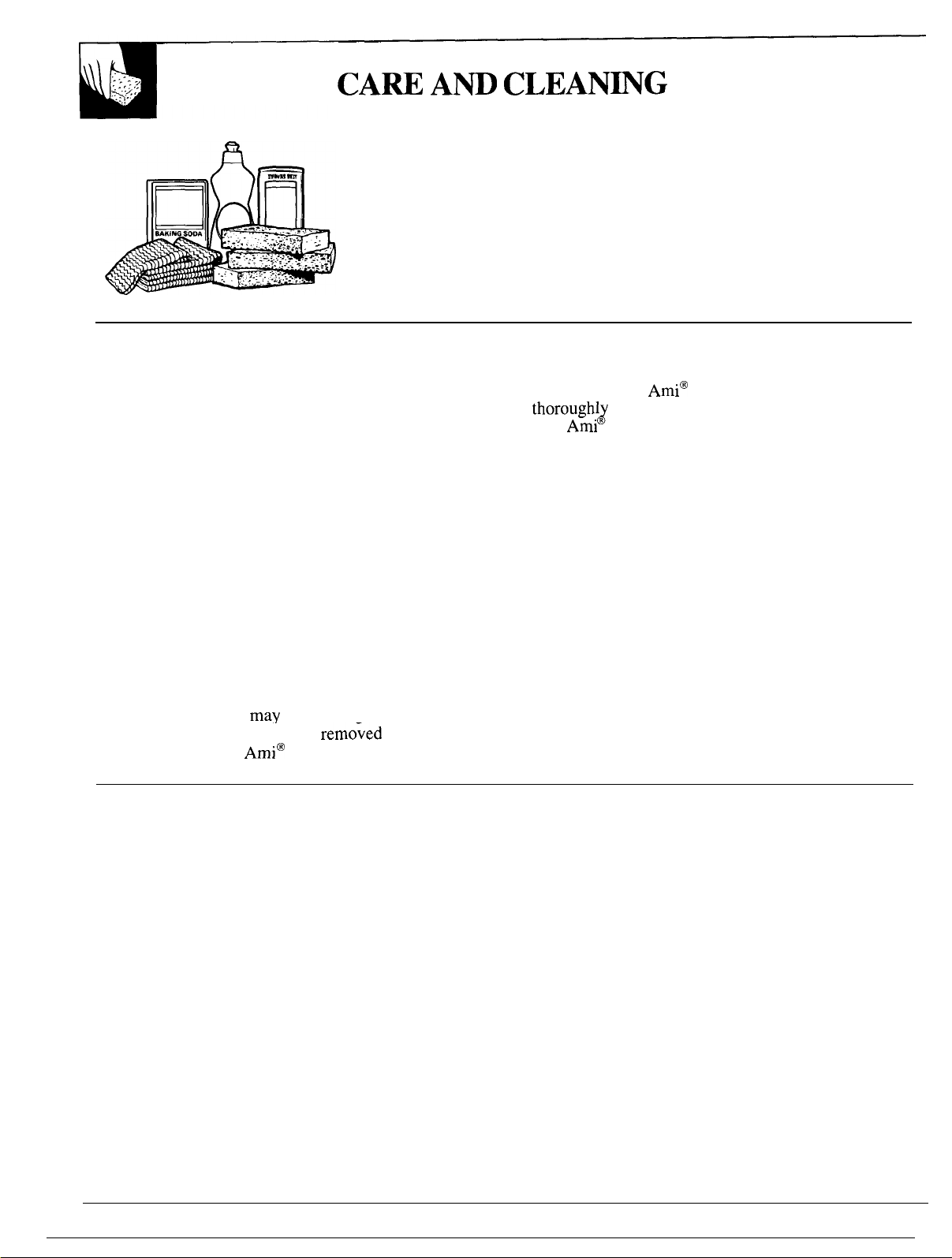
CA~
Am
CLEAN~G
Keep your oven clean and sweet-
Don’t use sharp-edged utensils
smelling. Opening the oven door
on your oven. The inside and
a few minutes after cooking helps
outside oven walls can be
air out the inside. An occasional
scratched. The control panel
thorough wiping with a solution
can be damaged.
of baking soda and water keeps
BE CERTAIN POWER IS OFF
the inside fresh.
BEFORE CLEANING ANY
PART OF THIS OVEN.
How to Clean the Inside
Walls and floor. Some spatters can be removed
with a paper towel, others may require a damp cloth.
Remove greasy spatters with a sudsy cloth, then rinse
with a damp cloth. Do not use abrasive cleaners on
oven walls. NEVER USE A COMMERCIAL OVEN
CLEANER ON ANY PART OF YOUR
MICROWAVE OVEN.
Door (inside). Window: Wipe up spatters daily and
wash when soiled with a damp cloth. Rinse
thoroughly and dry.
Metal and plastic parts on door: Wipe frequently
with a damp cloth to remove all soil. DO NOT USE
ABRASIVES, SUCH AS CLEANING POWDERS
OR STEEL AND PLASTIC PADS. THEY WILL
DAMAGE THE SURFACE.
After using Bon
Ami@
brand cleanser, rinse and dry
thoroughl
, following instructions on can. Do not use
.J
Bon
Aml
brand cleanser on the painted surfaces such
as the walls. It may scratch the paint.
Automatic Temperature Probe. Probe is sturdy,
but care should be taken in handling. Do not twist
or bend; avoid dropping temperature probe.
Clean as soon after using as possible. To clean, wipe
with sudsy cloth, then rub lightly with plastic scouring
ball if necessary. Rinse and dry or wash in
dishwasher.
Shelf. Your shelf accessory is designed for use in a
microwave oven only; do not use in a regular oven.
Do not use a browning dish with the shelf. Arcing
could occur.
Special note when using Brown ‘N Sear Dish: If
grease is present, high heat generated on bottom of
Clean shelf with mild soap and water or in the
a Brown ‘N Sear dish
may
cause the grease to burn
dishwasher. Do not clean in a self-cleaning oven.
onto the oven tray. This may be
remo~ed
with a
cleanser such as Bon
Ami@
brand cleanser.
How to Clean the Outside
Case. Clean the outside of your oven with soap
and damp cloth, rinse with a damp cloth and then
dry. Wipe the window clean with a damp cloth.
Chrome trim is best wiped with a damp cloth
and then with a dry towel.
Control Panel. Wipe with a damp cloth. Dry
thoroughly. Do not use cleaning sprays, large amounts
of soap and water, abrasives or sharp objects on the
panel—they can damage it.
Door Surface. When cleaning surfaces of door and
oven that come together on closing the door, use only
mild, non-abrasive soaps or detergents applied with a
sponge or soft cloth.
Power Cord. If the cord becomes soiled, unplug and
wash with a damp cloth. For stubborn spots, sudsy
water may be used, but be certain to rinse with a
damp cloth and dry thoroughly before plugging cord
into outlet.
28
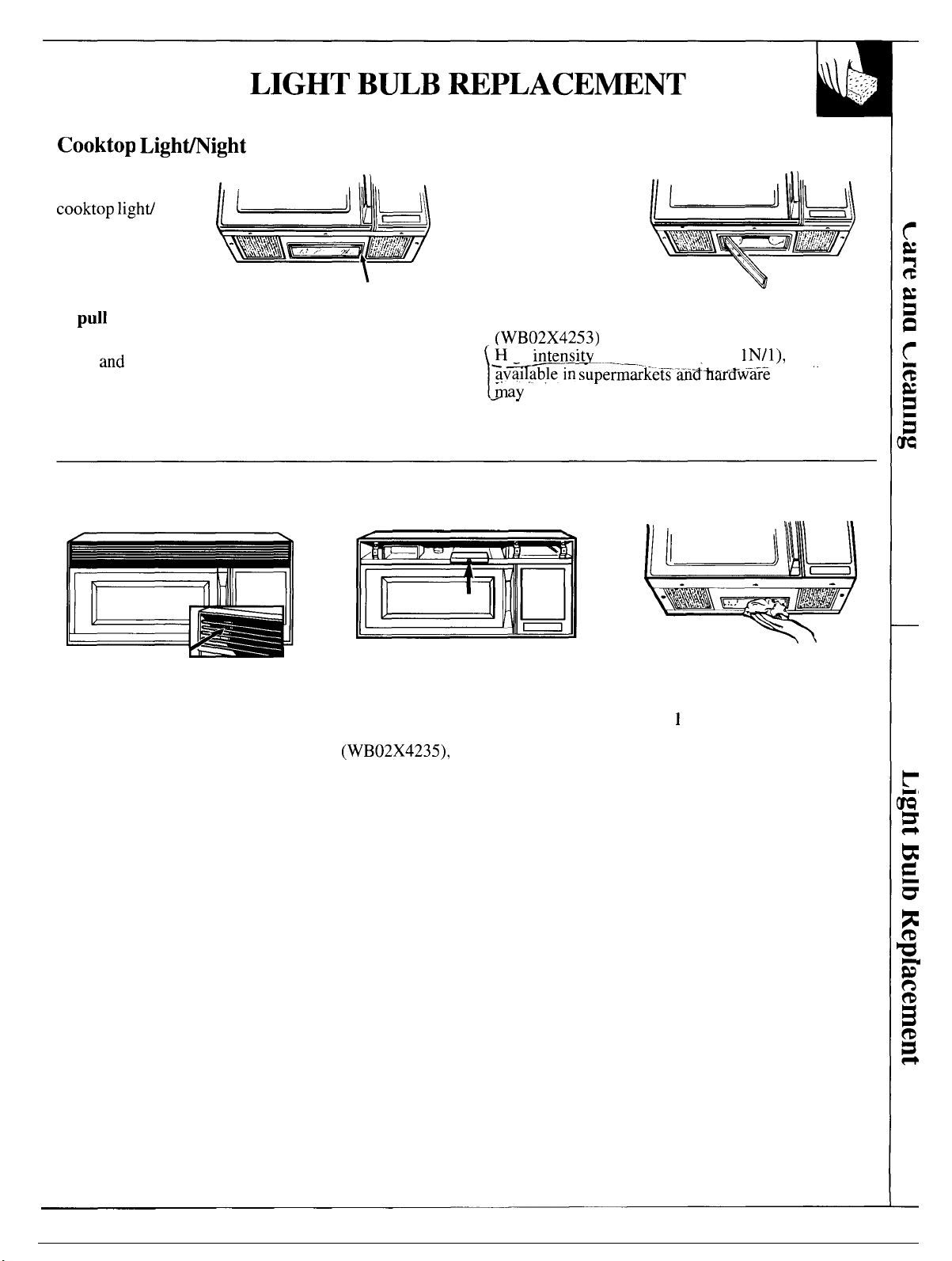
Cooktop
Ligh~ight
Light
To replace
combination
cooktop
lighti
night light, first
disconnect
power at main
fuse or circuit
breaker panel
or
pull
plug.
REMOVE SCREW
Remove screw on right side of light compartment
cover
and
lower cover until it stops.
Be sure bulbs
to be replaced
are cool before
removing.
Break the
adhesive seal
by gently
\
unscrewing the
bulbs. Replace with 40-watt incandescent bulbs
(WB02X4253)
available from your GE supplier.
L
High
intensitv
40-watt bulbs (40S1 lN/1), which are
. . ----
..
~v~a~in
s-upelm—tike”K”a-n-dtiar&w-tie
stores,
ay
also be used for replacements. Raise light
compartment cover and replace screw. Connect
electrical power to microwave oven.
Oven Light
To replace your oven light, first
disconnect power at main fuse
or circuit breaker panel or pull
plug. Remove the top grill by
taking out the 2 screws that hold
it in place.
Next, remove the single screw
located above door near center of
oven that secures light housing.
Replace burned-out bulb with a
30-watt incandescent bulb
(WB02X4235),
available from
your GE supplier.
Clean off the grease and dust on
hood surfaces often. Use a solution
of warm water and detergent.
About
1
tablespoon of ammonia
may be added to the water. Take
care not to touch the filters and
enamel surfaces with this solution;
ammonia will darken metal.
29
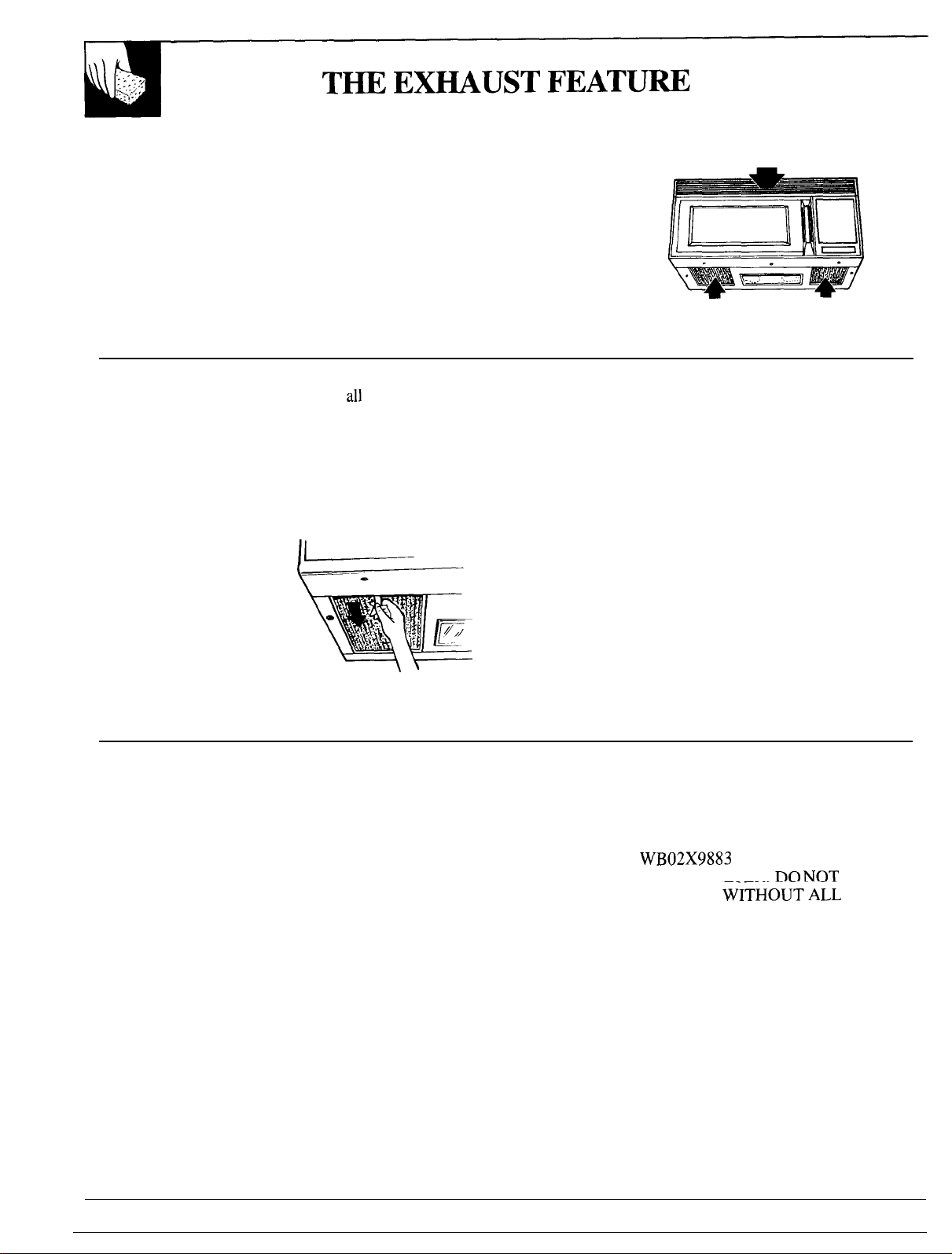
The exhaust hood feature on your microwave oven is equipped with 2
CHARCOAL FILTER
metal filters which collect grease. When the fan is operated, air is drawn
(on some models)
up through the filters. Depending on your model, it is either discharged
through the provided venting to the outside or drawn through a charcoal
filter and recirculated.
REUSABLE GREASE FILTERS
(on all models)
Reusable Grease Filters
(on
all
models)
The grease filters should be cleaned at least once a month. Never
operate the microwave without the filters in place. In situations where
flaming might occur on surfaces below hood, filters will stop the entry
of flames into the unit.
To Remove Grease Filter
To Clean and Replace Grease Filter
To remove grease filter,
To clean grease filter, soak it and then agitate filter
grasp the “finger hold”
in solution of hot water and detergent. Don’t use
on the filter and slide to
ammonia or ammonia products because they will
the rear. Then pull filter
darken the metal. Light brushing can be used to
downward and to the
remove embedded dirt.
front. The filter will
drop out.
Rinse, shake and remove moisture before replacing.
To replace grease filter, slide the filter in the frame
slot on the back of the opening.
Pull filter upward and to the front to lock into place.
Charcoal Filter
(on some models)
Some models are not vented to the outdoors; they
The disposable charcoal filter should be replaced
recirculate the air instead. These models are equipped
when it is noticeably dirty or discolored (usually
with a disposable charcoal filter that helps remove
after 6 to 12 months, depending on hood usage).
smoke and odors caused by cooking on your range.
Order Part No.
WB02X9883
from your GE supplier.
DO NOT CLEAN THIS FILTER.
DO
NOT
OPERATE YOUR HOOD
WITH”OU-T-ALL
3 FILTERS IN PLACE.
30
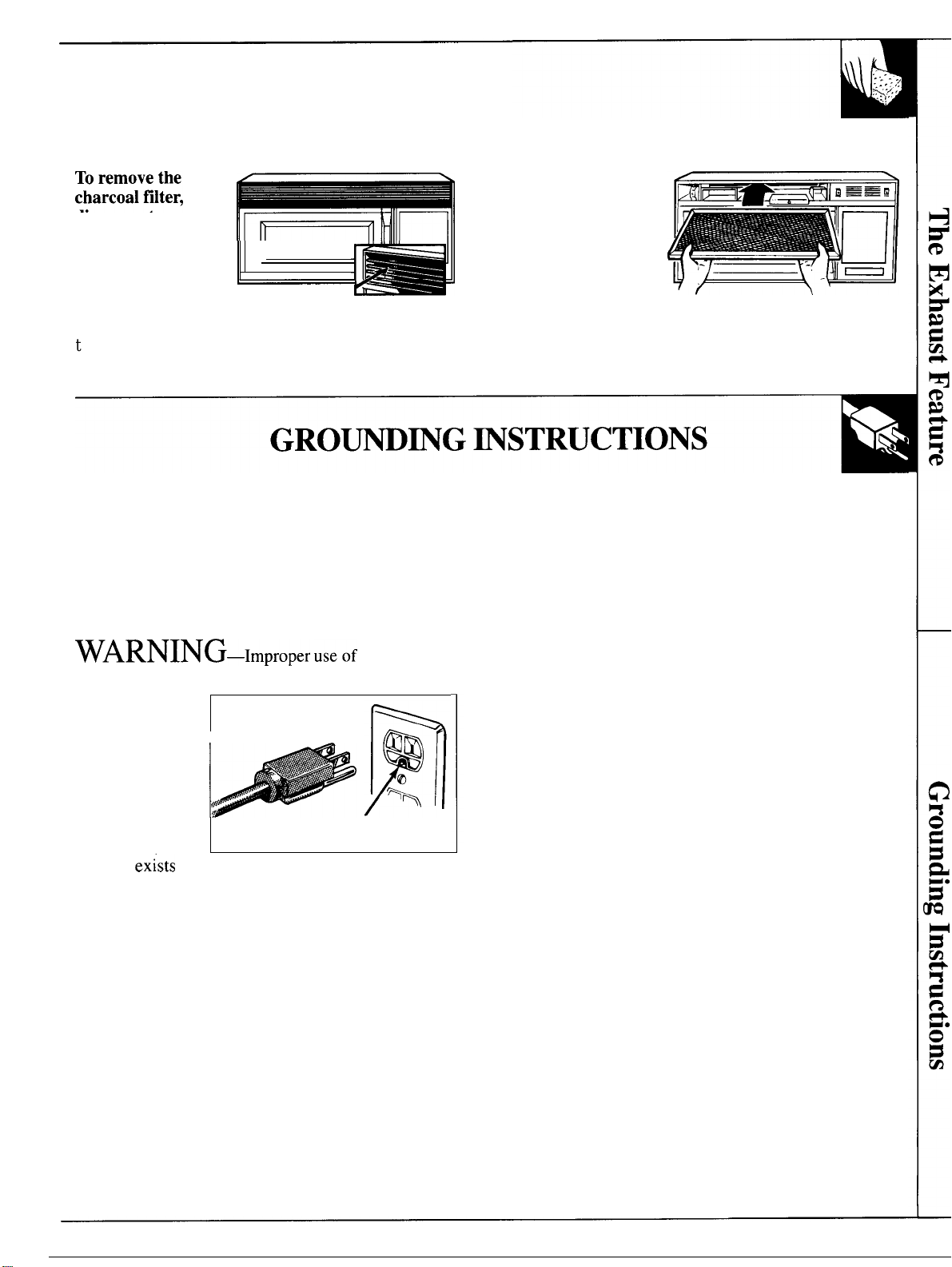
To Remove Charcoal Filter
‘;’’’’’’’’”
m
disconnect power
at main fuse or
u
circuit breaker
panel or pull plug.
Remove the top
grille by taking off
2 screws which hold it in place. Grasp filter and slide
toward front of oven. It will slide right out.
To Install Charcoal Filter
To install a new
filter,
remove
plastic and other
outer wrapping
from the new
filter. Insert filter
into top opening
of oven as shown.
It will rest at an angle on 2 side support tabs and
in front of right rear tab. Replace grill and secure
with 2 screws.
This appliance must be grounded. In the event of an
electrical short circuit, grounding reduces the risk of
electric shock by providing an escape wire for the
electric current. This appliance is equipped with a
power cord having a grounding wire with a grounding
plug. The plug must be plugged into an outlet that is
properly installed and grounded. (Fig. 1)
WARNING–Improper
useof
the grounding
plug can result in a risk of electric shock.
Consult a
PREFERRED
qualified
METHOD
I
electrician
or service
technician if
the grounding
instructions are
not completely
Ensure proper ground
understood, or
Fig. 1
exists before use
if doubt
exists
as to whether the appliance is
properly grounded.
Where a standard 2-prong wall receptacle is
encountered, it is your personal responsibility
and obligation to have it replaced with a properly
grounded 3-prong wall receptacle.
Do not under any circumstance cut or remove the
third (ground) prong from the power cord.
Do not use an adapter plug with this appliance.
Do not use an extension cord with this appliance.
31
QUESTIONS?
USE THIS PROBLEM SOLVER
PROBLEM
OVEN
W~L
NOT COME
ON
CONTROL PANEL
LIGHTED,~T
OVEN
WILL NOT START
“PRObE” APPEARS
ON DISPLAY
FLOOR OF THE
OVEN IS WARM,
EVEN WHEN THE
OVEN HAS NOT
BEEN USED
POSSIBLE CAUSE
● A fuse in your home may be blown or the circuit breaker tripped. Replace fuse
or reset circuit breaker.
●
Unplug your microwave
oven,
then plug it back in.
G
Make sure 3-prong plug
on
oven is fully inserted into
wdl
receptacle.
●
Door not securely closed.
●
START pad must be touched after entering cooking selection.
●
Another selection entered already in oven and CLEANOFF pad not touched
to cancel it.
●
Make sure you have entered cooking time after touching TIME COOK I &
11
pad.
●
CLEAWOFF
pad was touched accidentally. Reset cooking program and touch
START pad.
●
Make sure you have entered a temperature after touching
TEMP
COO~OLD
pad.
●
Make sure you have entered a code number after touching AUTO ROAST pad.
●
Probe has been forgotten or not seated properly in oven wall
when
using
Temp
Coo~old
or Auto Roast function.
●
The
cooktop
lamp is located directly below the oven floor. When the lamp
is on, the heat it produces makes the oven floor get warm. This is
norrnd.
All
these things are normal with your microwave oven:
● Steam or vapor escaping from around the door.
● Dull thumping sound while oven is operating.
●
Light
reflection around door or outer case.
● Some TV-Radio interference might be noticed
● Dimming oven light and change in blower sound
may
occur while operating at power levels other
than high.
while using your microwave oven. It’s similar to
the interference caused by other
small
appliances
and does not indicate a problem with your oven.
If you need more help...call, toll free: GE Answer Center
@
/ 800.626.2000/ consumer information service
32
NOTES
~

NOTES
34
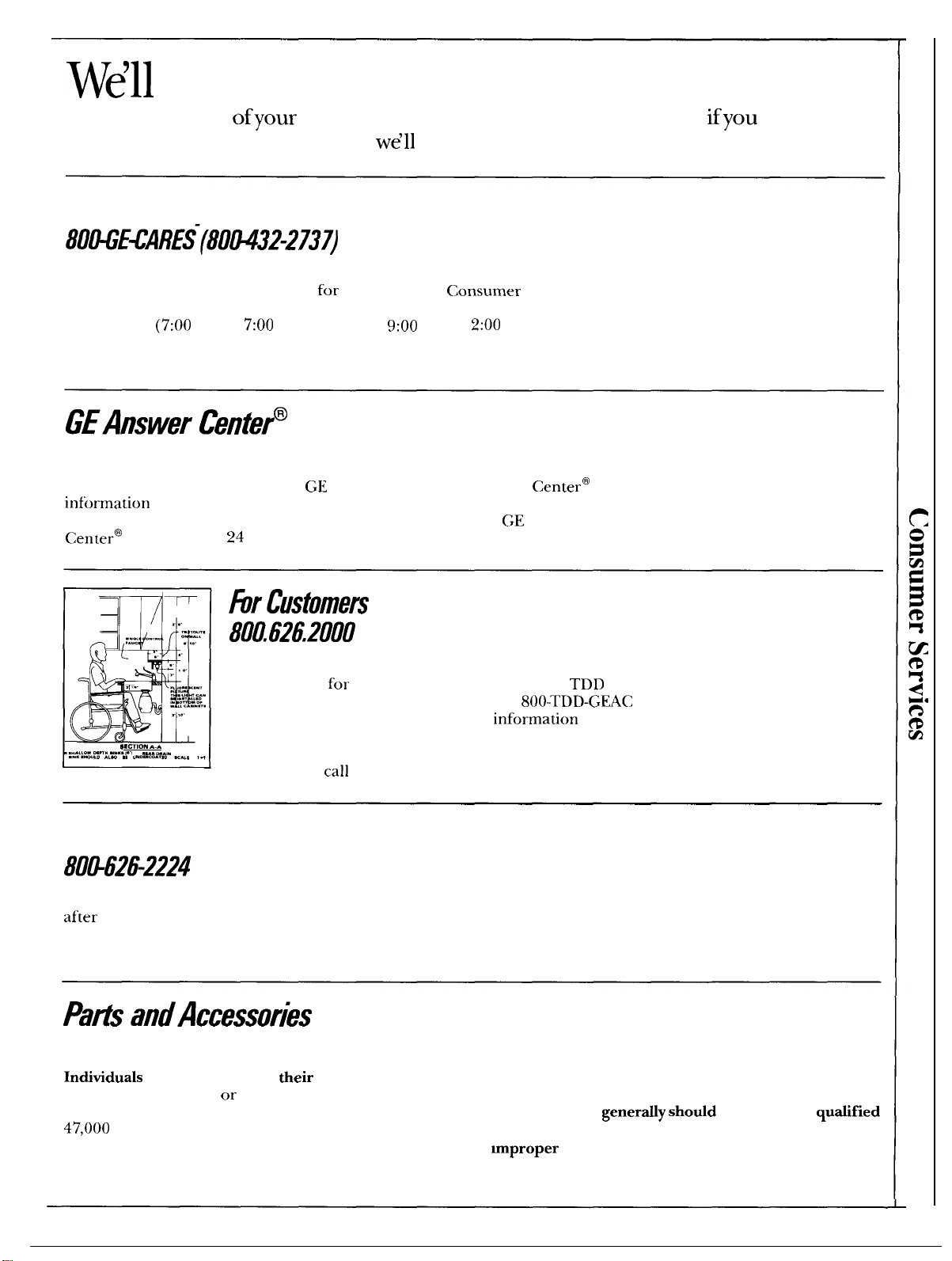
Wdll
Be There
With the purchase
ofyour
new GE appliance, receive the assurance that
ifyou
ever need
information or assistance from GE,
wdll be there. All you have to do is call—toll-free!
In-Home Repair Service
80MEXARES(80M32-2737)
A GE consumer service professional will provide expert repair service,
scheduled at a time that’s convenient
for
you. Many GE
C,onsumer
Service
company-operated locations offer you service today or tomorrow, or at your
convenience
(7:00
a.m. to 7:00 p.m. weekdays,
9:00
a.m. to 2:00 p.m. Saturdays).
Our factory-trained technicians know your appliance inside and out-so most
repairs can be handled in just 1 visit.
GEAnswer
Centera
8086262000
Whatever your question about any
GE
major appliance, GE Answer Center@
infi~rmation service is available to help. Your call—and your question-will be
answered promptly and courteously. And you can call any time.
C,E
Answer
Center@ service is open
24
hours a day, 7 days a week.
..mlo.
A.A
,,,..
-”.
...s,..,
-.
....-.,.
“.-,.
.,,
.”
o”,--..,.
s.,.
,.,
krCustomers
With Special Needs...
80~6262000
Upon request, GE will provide Consumers with impaired hearing or speech who have
Braille controls
fc~r
a variety of GE access to a TDD or a conventional teletypewriter may
appliances, and a brochure to call
800-TDD-GEAC (800-833-4322) to request
assist in planning a barrier-free
inf’ormatiort or service.
kitchen for persons with limited
mobility. To obtain these items,
free of charge,
call 800.626.2000.
Service Contracts
80@626-2224
You can have the secure feeling that GE Consumer Service will still be there
after
your warranty expires. Purchase a GE contract while your warranty is still
in effect and you’ll receive a substantial discount. With a multiple-year contract,
you’re assured of future service at today’s prices.
Pafis
andAccessories
80&62&2002
Individuds
qualified to service
their
own appliances User maintenance instructions contained in this booklet
can have needed parts
or
accessories sent directly to
cover procedures intended to be performed by any user.
their home.
The GE parts system provides access to over
Other servicing
generdy
shodd
be referred to
qutified
47,000
parts... and all GE Genuine Renewal Parts are
service personnel. Caution must be exercised, since
fully warranted. VISA, MasterCard and Discover cards .
are accepted.
~proper
servicing may cause unsafe operation.
I
II
YOUR GE MICROWAVE OVEN
WARRANTY
Staple sales slip or
cancelled
check
here. Proof of original
purchase
date
is needed to obtain service
under warranty.
I
II
WHAT IS COVERED
FULL ONE-YEAR WARRANTY
For one year from date of original
purchase, we will provide, free of
charge, parts and service labor in
your home to repair or replace any
pafl
of the microwave oven
that
fails because of a manufacturing
defect.
LIMITED ADDITIONAL
NINE-YEAR WARRANTY
For the second through tenth year
from date of original purchase, we
will provide, free of charge, a
replacement
magnetron tube
if the
magnetron tube fails because of a
manufacturing defect. You pay for
the service trip to your home and
sewice
labor charges.
This warranty is extended to
the original purchaser and any
succeeding owner
for products
purchased for ordinary home use in
the 48 mainland states,
Hawaii and
Washington, D.C. In Alaska the
warranty is the same except that it is
LIMITED because you must pay to
ship the product to the service shop
or for the service technician’s travel
costs to your home.
All warranty service will be provided
by our Facto~ Service Centers or
by our authorized Customer
Care”
servicers during normal working
hours.
Should your appliance need
sewice,
during warranty period
or beyond, call 800-GE-CARES
(800-432-2737).
I
II
WHAT IS NOT COVERED
●
Service trips to your home to teach
●
Replacement of house fuses or
you how to use the product.
resetting of circuit breakers.
Read your Use and Care
material.
If you then have any questions
about operating the product,
please contact your dealer or our
Consumer Affairs office at the
address below, or call, toll free:
GE Answer
Center@
800.626.2000
●
Failure of the product if it
is used
fol
other than its intended purpose or
used commercially.
●
Damage to product caused by
accident, fire, floods or acts of God.
WARRANTOR IS
NOT
RESPONSIBLE FOR
CONSEQUENTIAL DAMAGES.
II
consumer information service
II
● Improper installation.
If you have an installation problem,
contact your dealer or installer.
You are responsible for providing
adequate electrical, gas,
exhausting and other
connecting facilities.
Some states do not allow the exclusion or limitation of Incidental or consequential damages, so the above limitation or exclusion
may not apply to you. This warranty gives you specific legal rights, and you may also have other rights which
va~
from state to state.
To know what your legal rights are in your state, consult your local or state consumer affairs office or your state’s Attorney General.
I
Warrantor: General Electric Company
If further help is needed concerning this warranty, write:
Manager—Consumer Affairs, GE Appliances, Louisville, KY 40225
PaR
No. 164 D2588P226
Pub.
No.
49-8427
2-93
CG
JVM1
JVM1
JVM1
.——

