12/2019
- 1 -
Copyright © 2019, Fast ČR, a.s.
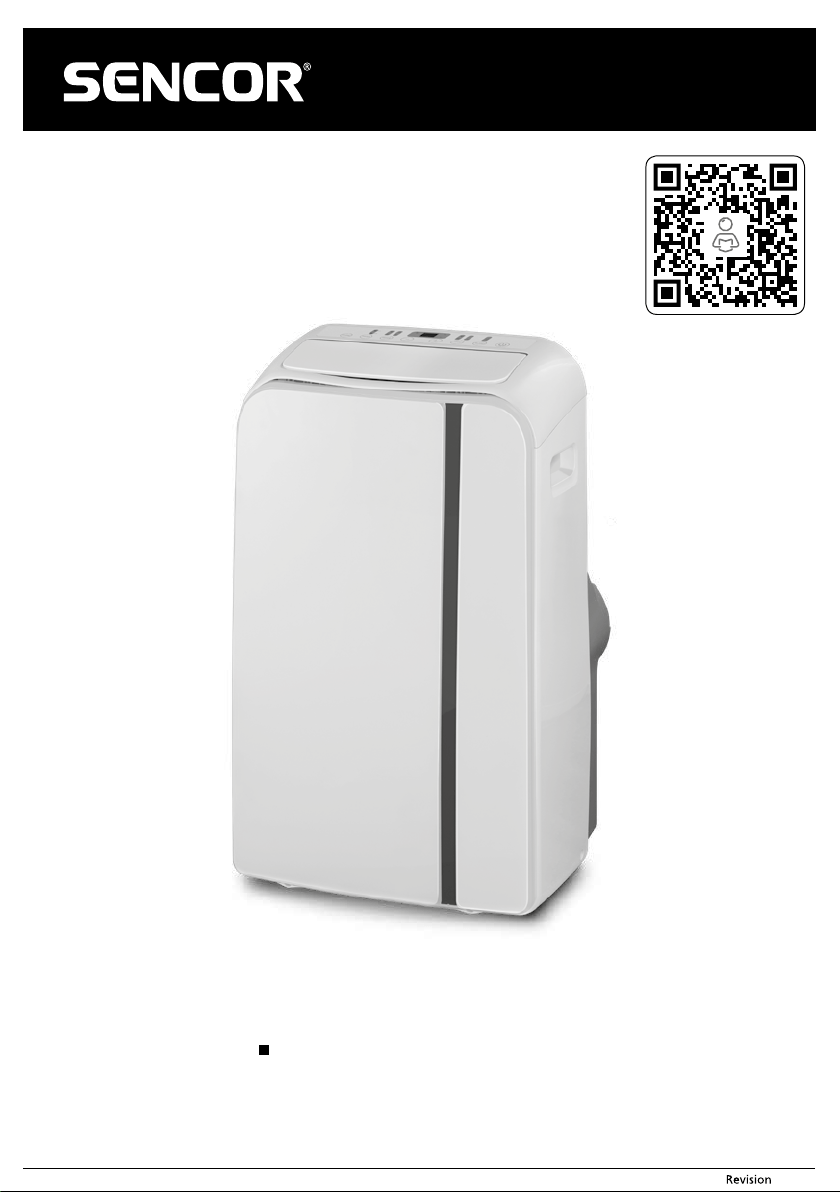
EN Portable air conditioner
Translation of the original manual
SAC MT1230C
SAC MT1231C

12/2019
- 2 -
Copyright © 2019, Fast ČR, a.s.
EN
Portable air conditioner
Important safety instructions
READ CAREFULLY AND STORE FOR FUTURE USE.
■ This appliance may be used by children 8 years of age and older and by persons with physical or mental
impairments or by inexperienced persons, if they are properly supervised or have been informed about
how to use the product in asafe manner and understand the potential dangers. Cleaning and maintenance
performed by the user must not be performed by unsupervised children. Children must not play with the
appliance.
■ If the power cord is damaged, it must be replaced by an authorised service centre or by another similarly
qualified person, this will prevent the creation of adangerous situation. It is forbidden to use the appliance if
it has adamaged power cord.
■ The appliance must be stored in amanner that prevents its mechanical damage.
■ The appliance must be stored in awell ventilated location, where the dimensions of the room correspond to
the dimensions specified for its operation.
■ The appliance must be stored in aroom where an open flame is not continuously in use (e.g. running gas
appliance) or where there are sources of ignition (e.g. running electrical heating element).
■ Before connecting the appliance to apower socket, check that the rated voltage on its rating label matches
the electrical voltage in the power socket.
■ Connect the appliance only to aproperly grounded socket.
■ The power socket must be freely accessible so that it is possible to quickly disconnect the power cord from
the power source if necessary.
■ The appliance is designed for use at home, in offices and similar types of areas. Do not use it in very dusty or
humid rooms such as laundries or bathrooms, in areas where chemical or explosive substances are stored, in
industrial surroundings or outdoors!
■ Do not place the appliance in the vicinity of an open flame or appliances that are sources of heat.
■ Do not place the appliance on unstable surfaces such as carpets with very long and thick fibres.
■ The appliance may only be used on adry, stable, smooth and horizontal surface.
■ The appliance is equipped with travel wheels, so pay extra attention when handling it so that it does not fall
down stairs or travel down from sloped areas. If necessary secure the wheels using the stoppers.
■ Only use original parts to assemble the appliance. Before starting to assemble the appliance, make sure that
it is turned off and disconnected from the power socket.
■ Prior to connecting the appliance to apower socket, make sure that the appliance is correctly assembled
according to the instructions in this user’smanual.
■ Do not touch the appliance with wet or damp hands. This applies especially when it is connected to apower
socket.
■ Do not expose the appliance to dripping or spraying water or submerge it in water or another liquid.
■ Do not cover or insert anything into the air inlet or air outlet openings. Otherwise, this could damage the
appliance.

12/2019
- 3 -
Copyright © 2019, Fast ČR, a.s.
■ During operation there needs to be sufficient space for air circulation of at least 30 cm on all sides of the
appliance.
■ Do not expose yourself to acold air current for along time. This could have anegative effect on your health.
■ To turn the appliance on or off, always use the appropriate buttons on the control panel or the remote control.
Do not turn off the appliance by disconnecting the power cord from the power socket.
■ Always turn off the appliance and disconnect it from the power socket when leaving it without supervision,
when not using it and before moving, disassembling or cleaning it.
■ Do not attempt to remove the outer case of the appliance.
■ Disconnect the appliance from the power socket by pulling on the plug, never pulling on the power cord.
Otherwise, this could damage the power cord or the socket.
■ In the event that the power cord or power plug are damaged in any way, do not use the appliance.
■ Store the appliance in avertical position. It may be transported in avertical position or tilted on the sided. If
you have already used the appliance, check that all the condensate has been drained. After transporting it,
wait at least 1 hour before using the appliance.
■ Do not use the appliance if it is not working correctly, if it has been damaged or has been submerged in water.
To avoid ahazardous situation arising, do not repair the appliance yourself or modify it in any way. Have all
repairs performed at an authorised service centre. By tampering with the appliance, you risk voiding your
legal rights arising from unsatisfactory performance or quality warranty.
■ Installation must be performed in accordance with the installation instructions. Incorrect installation may
result in awater leak, injury by electrical shock or fire.
■ To prevent the risk of fire or injury by electrical shock, do not use this appliance with atimer or any another
similar device that could spontaneously start this appliance.
■ The appliance must be installed in accordance with national electrical codes.
■ Only use this product for the purposes that are described in this user’smanual. Otherwise, this may result in
damage or excessive noise and vibrations.
■ Use only the accessories and components that are supplied together with the appliance and the tools explicitly
intended for its installation. The use of non-standard parts and accessories may result in awater leak, injury by
electrical shock, fire, injury or damage to property.
■ DO NOT ADJUST the length of the power cord of the unit and do not use an extension cord for its power
supply.
■ DO NOT CONNECT the unit to apower socket to which other electrical appliances are already connected. The
incorrect selection of an electrical power supply may result in afire or injury by electrical shock.
■ Do not cover the cable with acarpet. Do not place carpets, fillets or any other floor coverings on the power
cord. Do not locate the cable underneath furniture or appliances. Lead the cable where nothing will ride over
it and where nobody can trip over it. If this occurs, immediately disconnect the unit from the power socket.
■ In the event that the unit is tipped over during use, turn it off and immediately disconnect it from the main
power supply. Visually check that the unit has not been damaged in any way. In the event of any doubts that
the unit has been damaged in any way, seek assistance from atechnician or customer service.
■ The power supply must be disconnected during athunder storm to prevent damage to the appliance in the
event of alightning strike.
■ Disconnect the power supply to the appliance if it makes astrange noise or if an odour or smoke is emitted.
12/2019
- 4 -
Copyright © 2019, Fast ČR, a.s.
Read this user'smanual.
Warning:
Fire hazard.
SPECIFIC INFORMATION FOR APPLIANCES USING REFRIGERANT GAS R290
■
Carefully study any warnings.
■ For defrosting and cleaning, do not use any other tools than those recommended by the
manufacturer.
■ This appliance must be located in an environment that has no continuously running fire sources (for
example an open fire, agas appliance or electrical appliances).
■ Do not perform any drilling and do not burn it.
■ Refrigerant gases may be odourless.
■ This appliance must be located in rooms with an area greater than 11 m
2
.
■ This appliance contains approx. 220 g of refrigerant gas R290.
■ R290 is arefrigerant gas that meets European environmental protection directives. Do not make
holes or drill into any part of the cooling circuit.
■ The room in which this appliance is installed, operated or stored must prevent the accumulation
of such leaked refrigerants, that could be the cause of explosion or fire as aresult of the refrigerant
igniting following the start up of electrical heaters, cookers or other sources of ignition.
■ The appliance must be stored in such amanner that its mechanical damage is prevented.
■ Persons working with or repairing cooling circuits must have appropriate authorisation issued by an
authorised institution that certifies this person’scompetence to work with refrigerants in accordance
with the specific assessment of the association for this sector.
■ Maintenance tasks must be performed solely on the basis of the recommendations of this
appliance’s manufacturer. Maintenance and repair tasks that required the contribution of other
qualified expert personnel may only be performed under the supervision of specialised experts in
the flammable refrigerants sector.
■ Check the rating label for the type of refrigerant gas used in your appliance.
■ Do not cover the vents.
■ Adhere to national codes relating to gas.
12/2019
- 5 -
Copyright © 2019, Fast ČR, a.s.
SAC MT1230C
SAC MT1231C
A
1
2
6
3
7
4
8
9
10
11
12
13
5
14
15
16
12/2019
- 6 -
Copyright © 2019, Fast ČR, a.s.
B
1 2 3
4 5 6
7 8 9
10 11 12
13 14 15
C
1 2 3 4 5 6 7 8
9101415 1113 12
12/2019
- 7 -
Copyright © 2019, Fast ČR, a.s.
ON/OFF
TEMP
SHORT
CUT
TIMER
ON
TIMER
OFF
MODE
FAN
SLEEP
FOLLO W
SWING
LED
ME
1
2
3
4
6
5
7
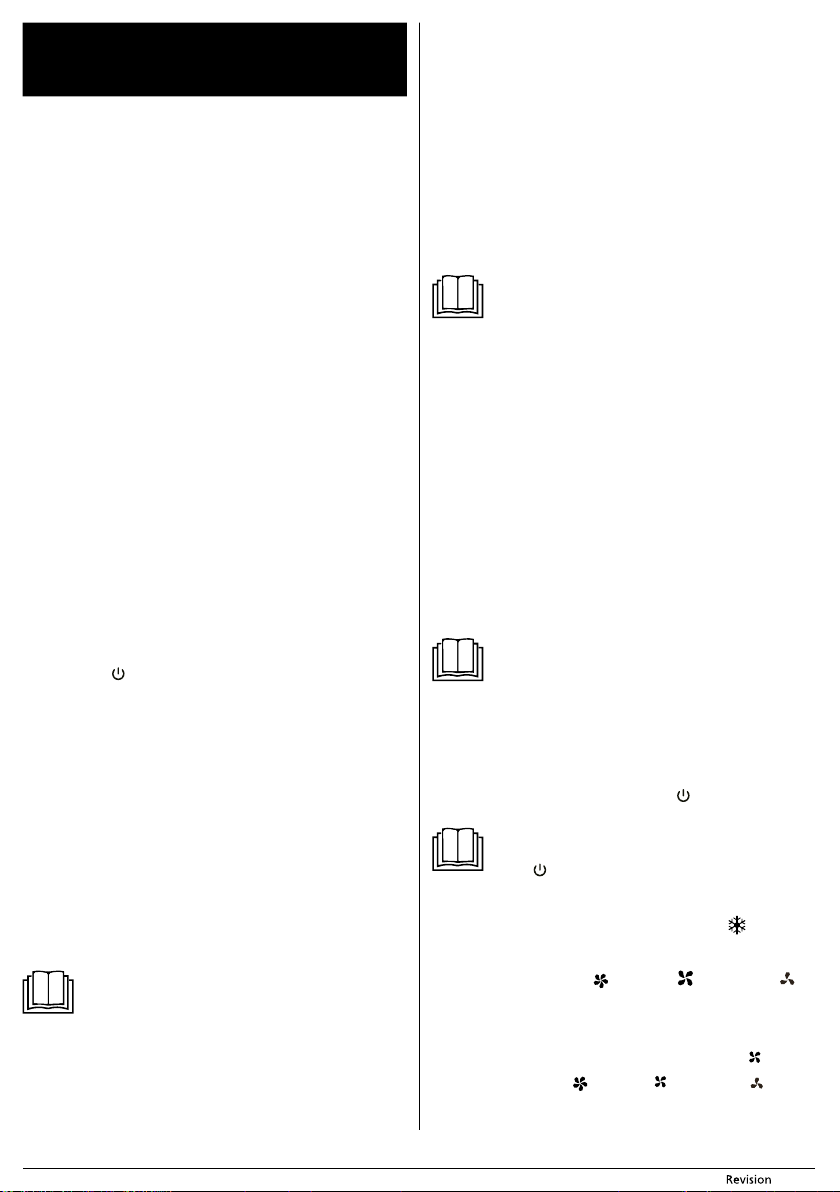
D
11
10
9
8
12
- 8 -
12/2019
Copyright © 2019, Fast ČR, a.s.
EN
Portable air conditioner
■ Prior to using this appliance, please read the user’smanual thoroughly, even in cases,
when one has already familiarised themselves with previous use of similar types of
appliances. Only use the appliance in the manner described in this user’smanual.
Keep this user’smanual in asafe place where it can be easily retrieved for future use.
■ We recommend saving the original cardboard box, packaging material, purchase
receipt and responsibility statement of the vendor or warranty card for at least the
duration of the legal liability for unsatisfactory performance or quality. In the event
of transportation, we recommend that you pack the appliance in the original box
from the manufacturer.
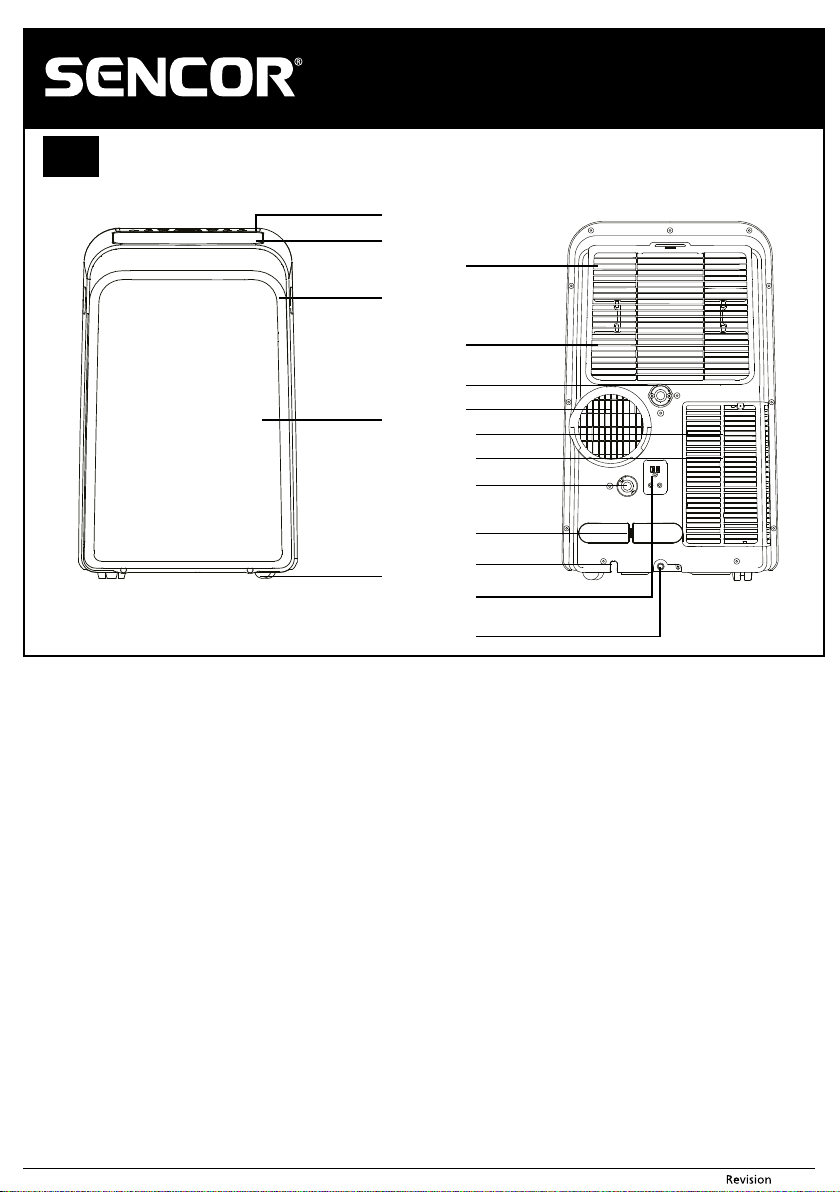
DESCRIPTION OF THE APPLIANCE
A1 Control panel
A2 Horizontal flap
A3 Handles (located along both sides)
A4 Front panel
A5 Travel wheels
A6 Top air filter (behind aprotective
grille)
A7 Top air inlet
A8 Top drain outlet
A9 Air outlet
A10 Bottom air filter (behind aprotective
grille)
A11 Bottom air inlet
A12 Bottom drain outlet (only on models
with heating mode)
A13 Power cord holder
A14 Power cord outlet
A15 Power plug storage compartment
A16 Condensate drain hole
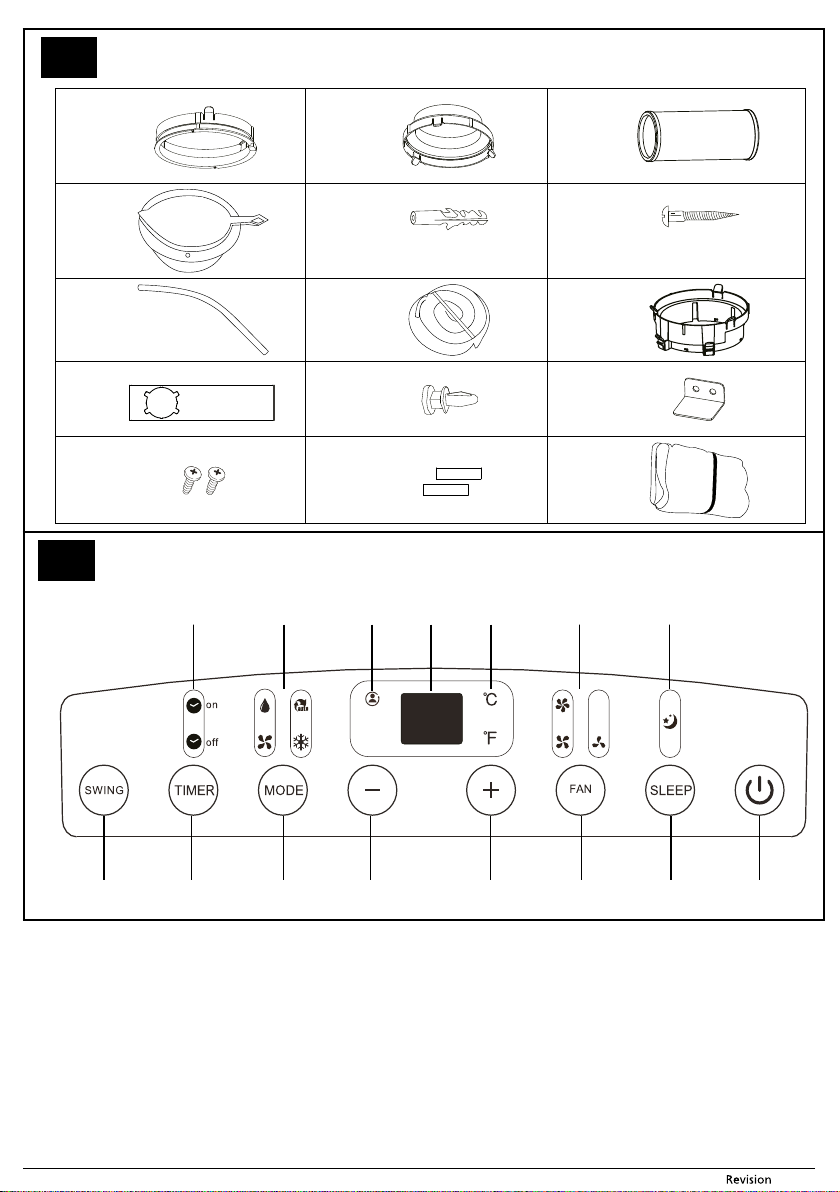
DESCRIPTION OF ACCESSORIES
B1 Adapter Afor connection to the
back panel of the portable air
conditioner
B2 Round adapter
B3 Flexible air exhaust hose
B4 Flange with plug
B5 Dowels (4 pcs)
B6 Screws (4 pcs)
B7 Drain hose
B8 Gasket seal
B9 Window connection adapter
B10 Window insert
B11 Window insert plug
B12 „L” bracket
B13 Threaded screws (2 pcs)
B14 Foam strips
B15 Textile window gasket seal
DESCRIPTION OF THE CONTROL PANEL
C1 SWING button for moving the flaps
C2 TIMER button for setting the timer
C3 MODE button for selecting an
operating mode
C4 Minus (–) button
C5 Plus (+) button
C6 FAN button for setting the fan speed
C7 SLEEP button for setting the sleep
mode
C8 On/Off button
C9 Sleep mode indicator
C10 Fan speed indicators (high /
medium / low)
C11 Temperature unit icons°C / °F
C12 Display
C13 Follow Me indicator
C14 Operating mode indicators
C15 Timer on/off indicators
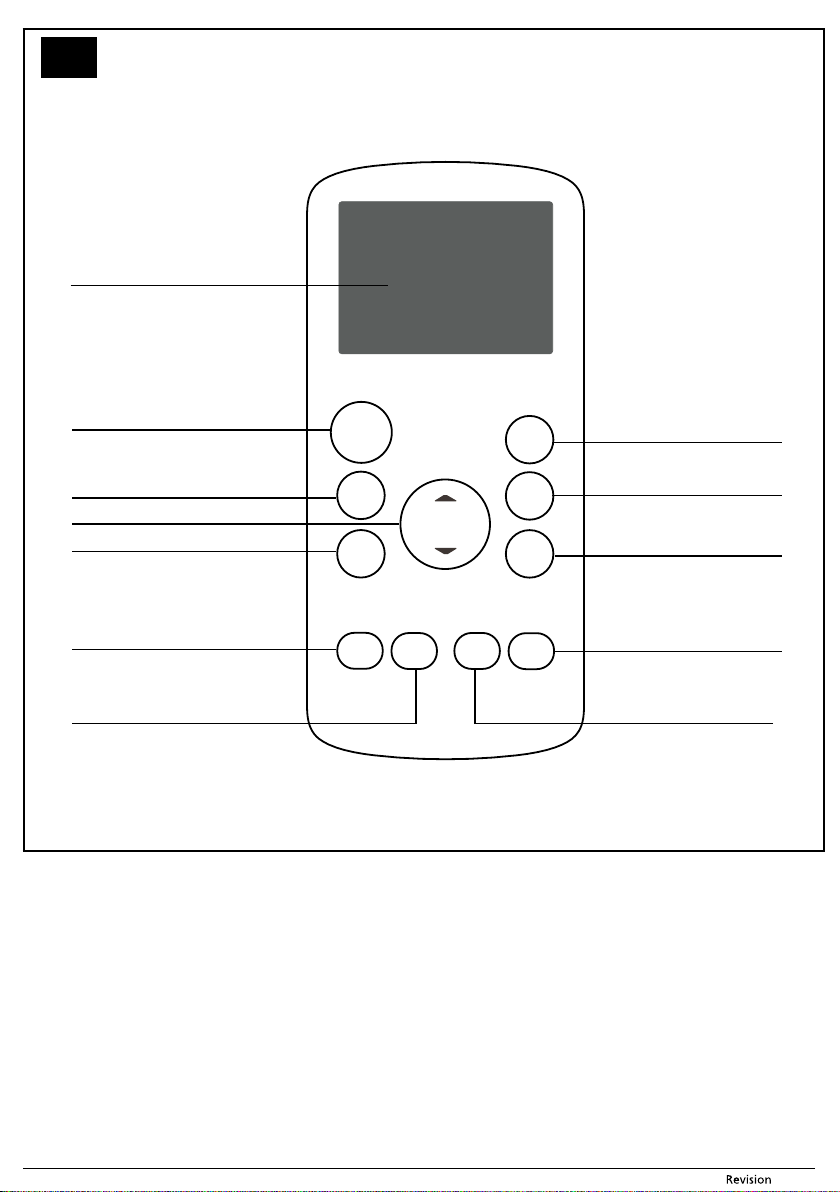
REMOTE CONTROL
D1 Display
D2 On/Off button
D3 MODE button for selecting an
operating mode
D4 TEMP button ▲ / ▼
D5 FAN button for setting the fan speed
D6 SLEEP buttons for setting the sleep
mode
D7 SWING button
D8 LED button
D9 TIMER OFF button for turning off
the timer
D10 TIMER ON button for turning on the
timer
D11 SHORTCUT button
D12 FOLLOW ME button
INSTALLATION
Installation location for the portable air conditioner
■ Locate the portable air conditioner on an even, dry and stable surface and within
reach of agrounded power socket.
■ For easier handling, the portable air conditioner is equipped with travel wheels A5.
Do not use the travel wheels A5 when you need to move the air conditioner over
carpets or similar surfaces. Avoid riding over objects.
■ To achieve optimal efficiency, maintain adistance of at least 50 cm from the wall
or other obstacles.
Note:
Do not use the portable air conditioner to cool aroom where computer
servers, etc. are located.
Installation, adjustment, maintenance and repairs must only be
performed by aqualified person.
Installing the flexible hose on to the portable air conditioner
■ The flexible hose B3 must be connected to the portable air conditioner and installed
into awindow in accordance with the operating modes that you wish to set. Install
the flexible hose B3 when you wish to select the operating modes: cooling or
automatic mode. It is not necessary to install the flexible hose B3 when you wish to
select the fan or dehumidification mode.
■ Extend the flexible hose B3 to the required length. Put adapter AB1 on to the end
of the flexible hose B3. Insert the flexible hose B3 into the air outlet A9 so that the
tab in the bottom part of adapter AB1 fits into the cut-out in the air outlet A9. At the
same time, check that the hook in the top part of adapter AB1 fits into the cut-out in
the air outlet A9. Turn it in the direction of the arrow to secure the hose B3 in place.
■ Put the round adapter B2 on to the free end of the flexible hose B3.
Installing the flexible hose into aslide window
■ The window insert B10 is designed to be compatible with the majority of sliding
windows (vertical and horizontal). Nevertheless, for certain types of slide windows it
may be necessary to modify the installation procedure described below.
■ Open the sliding window sash and stick on the gasket seal B8 along the entire
perimeter of the area where the window insert B10 will be located. Place the
window insert B10 into the window. Adjust the dimensions of the window insert
B10 to the width of the window (on avertical slide window) / height of the window
(on ahorizontal slide window). If necessary, cut away apart of the window insert B10
if the window is too small. To prevent the entry of hot air or insects into the room, cut
off the foam strip B14 so that it fits into the area between the windows. If necessary,
screw on the “L” brackets B12 using the threaded screws B13 to secure the position
of the window in which the window insert B10 is installed. Insert the flexible hose
hose B3 with the attached adapter B9 into the hole in the window insert B10.
Note:
Avoid excessive bending of the hose. To ensure proper operation of
the portable air conditioner, it is important not to overload the hose
or to bend it unnecessarily. Excessive loading or bending may damage
the hose.
Installing the flexible hose using the textile gasket seal
■ The textile gasket seal B15 is suitable for tilt-open, sash and roof windows. The textile
gasket seal B15 is fitted with aVelcro zip tape to make its installation in the window
easier. Open the window and into the created crevice install the textile gasket seal
B15. We recommend that you thoroughly degrease the location where you will be
attaching the textile gasket seal B15 using an appropriate cleaning agent. Remove
the protective paper strip and stick the tape on to the window frame.
■ In order to be able to insert the flexible hose B3, the gasket seal is fitted with an
integrated zip. Open the zip in such alocation that will enable you to easily insert
the flexible hose B3.
■ It is not necessary to remove the textile gasket seal B15 from the window when not
using the portable air conditioner. The window can be closed even with the gasket
seal installed.
Installing the flexible hose into awall
■ It is important that the installation into awall is performed by aqualified technician.
■ Drill ahole into the wall with ahole diameter of 125 mm at aheight between 30 cm
and 120 cm from floor. Insert the flange with plug B4 into the hole and secure it to
the wall using the set of screws B6 and dowels B5.
■ Extend out the flexible hose B3, open the plug of the flange B4 and insert the
flexible hose B3 into the flange. Avoid excessive bending of the hose.
■ When not using the portable air conditioner, close the plug on the flange B4.
Note:
To ensure proper operation of the portable air conditioner, it is
important not to overload the hose or to bend it unnecessarily.
Excessive loading or bending may damage the hose.
CONTROLS OF THE PORTABLE AIR CONDITIONER
A.CONTROL PANEL
■ Insert the power plug into apower socket. Now the portable air conditioner sets
itself to the stand-by mode.
Turning the portable air conditioner on and off
■ To turn on the portable air conditioner, press button
C8. Press it again to turn the
portable air conditioner off.
Note:
Never turn off the portable air conditioner by pulling the power cord
out of the power socket. Turn off the portable air conditioner using
button
C8, wait afew minutes and then pull out the power cord.
OPERATING MODES
1. Cooling mode
■ Repeatedly press button MODE C3 until the cooling indicator
is lit. Using the
–/+ buttons, set the desired temperature. You can set the temperature in the range
from 17 to 30 °C.
■ Using button FAN C6, set the fan speed. Repeatedly press button FAN C6 to switch
the speed in the following order:
(high speed) – (medium speed) – (low
speed) – automatic speed (depending on the model, all indicator lights are either
lit or not lit). Each time the button is pressed, the respective indicator will be lit on
the control panel.
2. Fan mode
■ Repeatedly press button MODE C3 until the fan mode indicator is lit. Using
button FAN C6, set the fan speed. Repeatedly press button FAN C6 to switch the
speed in the following order: (high speed) – (medium speed) – (low speed)
– automatic speed (depending on the model, all indicator lights are either lit or not
lit). Each time the button is pressed, the respective indicator will be lit on the control
panel. In this mode, it is not possible to set the temperature, nor is it necessary to
connect the flexible hose B3 to the portable air conditioner.
- 9 -
12/2019
Copyright © 2019, Fast ČR, a.s.
3. Dehumidification mode
■ Make sure that the flexible hose B3 is disconnected from the air conditioner.
Repeatedly press button MODE C3 until the dehumidification indicator is lit. It
is not possible to set the temperature or fan speed in this mode. The fan speed is
automatically set.
4. Automatic mode
■ In the automatic mode, the portable air conditioner will automatically set
the operating mode (cooling / fan / dehumidification) depending on the set
temperature and the temperature in the room. The portable air conditioner will
automatically control the temperature in the room based on the temperature that
you set. It is not possible to set the fan speed in the automatic mode.
■ Repeatedly press button MODE C3 until the automatic mode indicator is lit. In
the automatic mode both the automatic mode indicatoras well as the indicator of
the selected operating mode will be lit.
FUNCTIONS OF THE PORTABLE AIR CONDITIONER
1. Timer functions
■ While the portable air conditioner is turned on, press the Timer C2 button. You will
enter the automatic shut-off mode and “TIMER OFF” will be shown on the display
C12. Use the – / + buttons to set the desired duration. Press the TIMER C2 button
within 5 seconds to enter the automatic start mode. “TIMER ON” will be shown on the
display C12. Use the – / + buttons to set the desired duration.
■ While the portable air conditioner is turned off, press the TIMER C2 button and
use the – / + buttons to set the desired duration. Press the TIMER C2 button within
5 seconds to enter the automatic shut-off mode. Use the – / + buttons to set the
desired duration.
■ The desired start / shut-off duration can be set in 30-minute increments (up to 10
hours) and in 1-hour increments (up to 24 hours). The portable air conditioner will
automatically countdown the set duration.
■ The portable air conditioner will automatically switch to the previously set
temperature if no button is pressed within 5 seconds.
■ If you need to turn off the timer, turn the portable air conditioner on or off, or
alternatively set the timer to 0 hours.
2. Sleep function
■ The sleep function is used to reduce overnight power consumption.
■ Press the SLEEP C7 button. The temperature will increase by1 °C within 30 minutes.
Within the next 30 minutes the temperature will increase by another 1 °C. The
portable air conditioner will maintain this new temperature for afurther 7 hours. The
temperature setting will then return to the initially set temperature and the sleep
function will be automatically cancelled.
Note:
This function cannot be set in the fan and dehumidification modes.
3. Flap swing function
■ Press the SWING C1 button to automatically start the swinging motion of the flap.
While the flap is swinging, press the SWING C1 button again to stop the flap at
acertain angle.
Note:
When the portable air conditioner stops its operation, it will not be
possible to start it again for approximately 3 minutes. This is astandard
protection feature. It can be put back into operation after 3 minutes.
B. REMOTE CONTROL
Inserting and replacing batteries
■ Slide out the battery compartment cover, which is located on the rear side of the
remote control. Place two AAA/LR03 (2x 1.5V) alkaline batteries into the battery
compartment and close the cover.
■ When inserting the batteries ensure the correct polarity as shown in the battery
compartment.
■ When replacing the batteries, always use batteries of the same type, never combine
old and new batteries or batteries of various types.
Note:
Removing the batteries from the remote control will delete all the
settings. After new batteries are inserted the default remote control
settings as programmed by the manufacturer will be renewed.
If you will not be using the remote control for longer than 2 months,
remove the batteries.
Using the remote control
■ For the remote control to work correctly, ensure that the maximum distance of the
remote control from the portable air conditioner is not greater than 7 m and that
there is no obstacle between the remote control and the portable air conditioner
that could prevent the transmission of the signal.
■ Point the remote control directly at the portable air conditioner. The transmission of
the signal is confirmed by ashort sound signal.
■ Do not expose the remote control to direct sunlight or high temperatures. Otherwise
the signal may not be transmitted.
Note:
Do not combine old and new batteries or batteries of various types.
Never put the batteries in afire, short circuit them or damage them in
any way. Dispose of them ecologically at the end of their lifetime. Never
throw batteries out with communal waste.
Turning the portable air conditioner on and off
To turn on the portable air conditioner, press button D2 once. Press button D2 again to
turn the portable air conditioner off.
OPERATING MODES
1. Cooling mode
■ Repeatedly press button MODE D3 until the cooling indicator
is lit. Using the
▲/▼ buttons, set the desired temperature. You can set the temperature in the range
from 17 to 30°C.
■ Repeatedly press the FAN D5 button to set the fan speed: high speed – medium
speed – low speed – automatic speed.
■ Press button D2 to turn the portable air conditioner on in the cooling mode.
2. Fan mode
■ Repeatedly press button MODE D3 until the fan mode indicator
is lit.
■ Repeatedly press the FAN D5 button to set the fan speed: high speed – medium
speed – low speed – automatic speed.
■ Press button D2 to turn the portable air conditioner on in the fan mode.
■ Note: In the fan mode, it is not possible to set the temperature, therefore no
temperature information will be shown on the display D1.
3. Dehumidification mode
■ Repeatedly press button MODE D3 until the dehumidification indicator
is lit.
■ It is not possible to set the temperature or fan speed in this mode. The fan speed is
automatically set.
■ Press button D2 to turn the portable air conditioner on in the dehumidification
mode.
4. Automatic mode
■ If you select an automatic mode, the portable air conditioner will automatically
select an operating mode based on the temperature in the room.
■ Repeatedly press button MODE D3 until the automatic mode indicator is lit.
■ Press button D2 to turn the portable air conditioner on in the automatic mode.
FUNCTIONS OF THE PORTABLE AIR CONDITIONER
1. Automatic start and shut-off function
Automatic start
■ The automatic start function makes it possible to set atime after which the portable
air conditioner will start automatically.
■ Press the TIMER ON D10 button. The last set time and “h” (hours) will start flashing
on the display D1.
■ Repeatedly press the TIMER ON D10 button and set the time in hours after which
the portable air conditioner will turn on automatically. The digits on the display D1
represent the time in hours.
■ Wait approximately 2 seconds and the automatic start function will be activated. The
set temperature is then shown on the then display D1.
Automatic shut-off
■ The automatic shut-off function makes it possible to set a time after which the
portable air conditioner will shut off automatically.
■ Press the TIMER OFF D9 button. The last set time and “h” (hours) will start flashing
on the display D1.
■ Repeatedly press the TIMER OFF D9 button and set the time in hours after which
the portable air conditioner will turn off automatically. The digits on the display D1
represent the time in hours.
■ Wait approximately 2 seconds and the automatic start function will be activated. The
set temperature is then shown on the then display D1.
Note:
The automatic shut-off or start time can be set in the range between 30
minutes and 24 hours (set in 30 minute intervals until 10 hours, and one
hour intervals until 24 hours).
In the event that you need to cancel the automatic shut-off or start function, set the
time to “0.0”.
Setting automatic start and shut-off at the same time
■ When setting the automatic start and shut-off, it is necessary to take into
consideration the current time since the start and shut-off time will be counted
down from it.
■ Press the TIMER ON D10 button. The last set time and “h” (hours) will start flashing
on the display D1. Repeatedly press the TIMER ON D10 button and set the time
in hours after which the portable air conditioner will turn on automatically. Wait
approximately 3 seconds and the automatic start function will be activated.
■ Now press the TIMER OFF D9 button. The last set time and “h” (hours) will start
flashing on the display D1. Repeatedly press the TIMER OFF D9 button and set the
time in hours after which the portable air conditioner will turn off automatically. Wait
approximately 3 seconds and the automatic start function will be activated.
2. Sleep function
The sleep function is used to reduce overnight power consumption.
Press button D6, and the
symbol will appear on the display D1. The portable air
conditioner will run in the last selected mode, however, this function cannot be set in
the fan and dehumidification modes.
- 10 -
12/2019
Copyright © 2019, Fast ČR, a.s.
3. Flap angle setting function
■ Button D7 serves to start or stop the motion of the flap. The flap can be set to 6
different angles. Adifferent angle is set each time the button is pressed. Holding
down button D7 activates the automatic motion of the flap.
4. SHORTCUT function
■ This function serves to restore the current settings or to restore the previous settings.
■ While the remote control is turned on, press the button SHORTCUT D11 to
automatically switch to the previous settings, including the operating mode, set
temperatures, fan speed and the sleep function, if it was activated.
■ When the button SHORTCUT D11 is held down for approximately 2 seconds, the
original settings will automatically be restored, including the operating mode, set
temperatures, fan speed and the sleep function, if it was activated.
5. Follow Me function
The remote control serves as aremote thermostat allowing for the precise temperature
control at its location.
To activate the Follow Me feature, point the remote control towards the unit and press
the FOLLOW ME D12. The remote control will send this signal to the air conditioner
until press the FOLLOW ME D12 again. If the unit does not receive the Follow Me signal
during any 7 minutes interval, the unit will exit the Follow Me mode.
Note:
This feature can be activated from the remote control only. This feature
is unavailable under FAN or DRY mode.
MAINTENANCE AND CLEANING
■ Before cleaning the portable air conditioner, turn it off and wait afew minutes, and
then pull the power cord out of the power socket.
Cleaning the air filters
■ When the portable air conditioner is used regularly, it is necessary to clean the air
filters (A6 and A10) located behind the protective grille of the top and bottom air
inlets A7 and A11 at least once every 14 days to prevent the fan from being clogged
by dust.
■ Carefully remove the protective grilles and remove the filters (A6 and A10). To
remove the dust, use avacuum cleaner. In the event of greater soiling, wash the
filters (A6 and A10) in a solution of lukewarm water (max. 40 °C) and neutral
detergent. Then thoroughly rinse under running water and allow to dry naturally. Do
not dry it in aclothes dryer or in direct sunlight. Once the filters (A6 and A10) are dry,
you can install them back in their place.
Note:
Do not use the portable air conditioner without the air filters (A6 and
A10) properly installed and do not use it with wet or damp air filters
(A6 and A10).
Condensate tank
■ The condensate tank must be drained immediately when the error message P1
appears on the display C12 and also before this appliance is stored in order to
prevent the formation of moulds.
Cleaning the outer case
■ To clean the outer case, use asoft wiping cloth dipped in asolution of lukewarm
water and neutral detergent. Then wipe the surface dry.
■ When cleaning it, do not spray the portable air conditioner with water or any other
liquid, do not pour water on it or submerge it in water or in any other liquid.
■ Do not use abrasive cleaning products, solvents, petrol, etc. for cleaning.
Note:
In households with pets, it is necessary to wipe the grille regularly to
prevent it from becoming clogged by animal fur.
Storing the portable air conditioner
■ In order to dry it and to prevent the formation of moulds, leave the portable air
conditioner running in awarm room in the fan mode for approximately 12 hours.
■ Disconnect the flexible hose B3 and store it in a safe place out of the reach of
children.
■ Drain all the condensate from the water tank – see chapter “Condensate drain
outlet”.
■ Clean the air filters (A6 and A10) and reinstall them. Wipe the outer case of the
portable air conditioner. Remove the batteries from the remote control.
■ Store the air conditioner in acool, dry and dark location.
Condensate drain outlet
If the water level inside the water tank reaches apredetermined level, the portable air
conditioner will show the error message P1 on the display C12. In order to drain the
condensate from the air conditioner, proceed as follows:
1. Disconnect the power plug from the power socket.
2. Carefully re-locate the portable air conditioner to alocation where the water may be
drained.
3. Underneath the drain outlet A16, place acontainer into which the condensate will
flow. Carefully remove the plug of the drain outlet A16. Connect the drain hose B7
and allow the condensate to flow out.
4. Once the water tank is empty (condensate has stopped flowing), disconnect the
drain hose B7 and put the plug back into the drain outlet A16.
5. Insert the power plug into apower socket and turn on the portable air conditioner.
If you need to ensure the condensate to be continuously drained from the portable
air conditioner, it is possible to connect the drain hose B7 to awaste water drain.
Proceed as follows:
1. Disconnect the power plug from the power socket.
2. Remove the plug of the drain outlet A16. Connect the drain hose B7. If the length of
the drain hose B7 is insufficient, then it is necessary to purchase alonger hose of the
same type. Never extend the length of the drain hose B7 using extensions.
3. Connect the end of the drain hose B7 to the waste water drain.
4. Insert the power plug into apower socket and turn on the portable air conditioner.
Note:
The drain hose B7 should be installed at the same height or lower
than the top drain outlet A16. Otherwise, the condensate will not be
properly drained from the water tank.
Putting into operation again
■ Check that the power cord and plug are not damaged and that the air filters are
clean. Insert a new set of batteries into the remote control. Proceed according to
the instructions in section “Inserting and replacing batteries”. Install the portable
air conditioner according to the instructions contained in the preceding part of this
user’smanual “Installation”.
TROUBLESHOOTING
Before contacting an authorised service centre, please check the appliance according
to the following instructions:
Problem Cause Solution
The portable air
conditioner does not
turn on when the
ON/OFF button is
pressed.
Error message P1. The condensate tank is
full. Turn off the portable
air conditioner and drain
the condensate from the
condensate tank according
to the instructions in the
section "Condensate drain
outlet" in the preceding
part of this user'smanual.
In the cooling mode: the
temperature in the room is
lower than the set temperature.
Adjust the set temperature.
The portable air
conditioner does not
cool sufficiently.
The air filter is clogged with
dust and animal fur.
Turn off the portable air
conditioner and clean out
the filter according to the
instructions in chapter
"Maintenance and
cleaning".
The flexible air exhaust hose is
not connected or it is clogged.
Turn off the portable air
conditioner and check
the hose connection, or
if necessary, remove any
material inside the hose.
There is an insufficient amount
of refrigerant gas in the
portable air conditioner.
Contact an authorised
service centre.
You set atemperature that is
too high.
Lower the set temperature.
Windows or doors are open. Close any windows or doors.
The room is too large. Check recommended
room area.
Aheat source is turned on in
the room.
Turn off the heat source.
The portable air
conditioner is too
noisy and vibrates
too much.
The portable air conditioner is
located on an uneven surface.
Move the portable air
conditioner to an even and
level surface.
The air filter is clogged with
dust and animal fur.
Turn off the portable air
conditioner and clean out
the filter according to the
instructions in chapter
"Maintenance and
cleaning".
The portable air
conditioner is
emitting gurgling
sounds.
The noise is caused by the
movement of the refrigerant
inside the portable air
conditioner.
This is normal.
Note:
In the event that one of the aforementioned faults occurs, turn off the
portable air conditioner and check for the cause of the fault. Turn it on
again, and if the fault reoccurs, turn it off, disconnect the power cord
from the power socket and contact the manufacturer, an authorised
service centre or a person with relevant qualifications and have the
unit repaired.
- 11 -
12/2019
Copyright © 2019, Fast ČR, a.s.
Error messages
Error messages may appear on the display C12 during operation:
Error
message
Meaning Solution
E1 Heat sensor error Contact an authorised service centre.
E2 Evaporation temperature
sensor error
Contact an authorised service centre.
E3 Condensate temperature
sensor error
Contact an authorised service centre.
E4 Display panel error Contact an authorised service centre.
EC Refrigerant leak Contact an authorised service centre.
P1 The condensate tank is full. Connect the drain hose – proceed
according to the instructions in
section "Condensate drain outlet".
TECHNICAL SPECIFICATIONS
SAC MT1230C / SAC MT1231C
Power supply 220 – 240 V~ / 50 Hz
Cooling power output 12 kBtu/hour
Power input: 1,600 W
Current consumption 8 A
EER cooling factor 2.6 W/W
Dehumidification capacity 3.516 l / hour
Capacity of the built-in condensate tank 1 l
Refrigerant type and weight R290/220 g
Air flow volume 420 / 370 / 355 (Hi / Mi / Lo)
Noise level 63 dB (A)
Maximum permitted value of excess operating pressure:
Suction/exhaust part of the cooling circuit
2.6 / 1.0 MPa
Dimensions of the portable air conditioner (wx d x h) 467 x 397 x 765 mm
Weight 33 kg (net)
Operating temperature (cooling) 17 – 30 °C
Recommended room area 16 - 23 m
2
The declared noise emission level of the appliance is 63 dB(A), which represents alevel
Aof sound power with respect to areference sound power of 1 pW.
Note:
The efficiency of the portable air conditioner may be reduced in
the event that it is used outside the above described operating
temperature range.
We reserve the right to change text and technical specifications.
INSTRUCTIONS AND INFORMATION REGARDING THE
DISPOSAL OF USED PACKAGING MATERIALS
Dispose of used packaging material at asite designated for waste in your municipality.
DISPOSAL OF USED ELECTRICAL AND ELECTRONIC EQUIPMENT
This symbol on products or original documents means that used
electric or electronic products must not be added to ordinary
municipal waste. For proper disposal, renewal and recycling hand over
these appliances to determined collection points. Alternatively, in
some European Union states or other European countries you may
return your appliances to the local retailer when buying an equivalent
new appliance.
Correct disposal of this product helps save valuable natural resources
and prevents potential negative effects on the environment and human health, which
could result from improper waste disposal. Ask your local authorities or collection
facility for more details.
In accordance with national regulations penalties may be imposed for the incorrect
disposal of this type of waste.
For business entities in European Union states
If you want to dispose of electric or electronic appliances, ask your retailer or supplier
for the necessary information.
Disposal in other countries outside the European Union.
This symbol is valid in the European Union. If you wish to dispose of this product,
request the necessary information about the correct disposal method from the local
council or from your retailer.
This product meets all the basic requirements of EU directives related to
it.