Dishwasher
Instruction
InstructionInstruction
Instruction Manual
Manual Manual
Manual

CONTENTS
Getting familiar with your machine …………………………………………… 4
• Technical specifications ……………………………………………………..
6
• Conformity with the standards and Test data ……………………………..
6
Safety information and Recommendations…………………………………..
6
• Recycling .......……………………….........................................................
6
• Safety information ……………………………………………………………
6
• Recommendations …...………………………………………………………
7
• Items not suitable for dishwashing …………………………………………
8
Installing the machine ………………………………………………………….. 8
• Positioning the machine ……………………………………………………..
8
• Water connections …………………...............................................................
8
• Water inlet hose ….…………………………………………………………..
9
• Water outlet hose …..………………..............................................................
9
• Electrical connection…………………………………………………………
9
• Fitting the machine undercounter ………………………………………….
10
• Prior to using the machine ………………………………………………….
12
• Detergent usage ……………………........................................................
12
• Filling the detergent compartment………………………………………….
12
• Combined detergent….………………………………………………………
12
• Filling with rinse aid and making the setting……………………………….
13
1
Preparing the machine for use ………………………………………………… 12

Loading your dishwasher .……………………………………………………. 14
• Alternative basket loads …………………………………………………...
19
• Standard loading and Test data ………………………………………….. 20
Programme descriptions .…………………………………………………….. 21
• Programme items …………………………………………………………..
21
Switching on the machine and selecting a programme……………........ 22
• Switching on the machine………………………………………………….
22
• Programme follow-up ………………………………………………………
22
• Changing a programme ……………………………………………………
22
• Changing a programme with resetting …………………………………...
23
• Switching the machine off ….……………………………………………...
23
Maintenance and Cleaning ........................................................................ 24
• Filters ..………………………………………………………………………
24
• Spray arms ………………………………………………………………….
25
• Hose filter ……………………………………………………………………
25
Failure codes and what to do in case of failure ………………………… 26
Practical and useful information……......................................................... 28
2
3
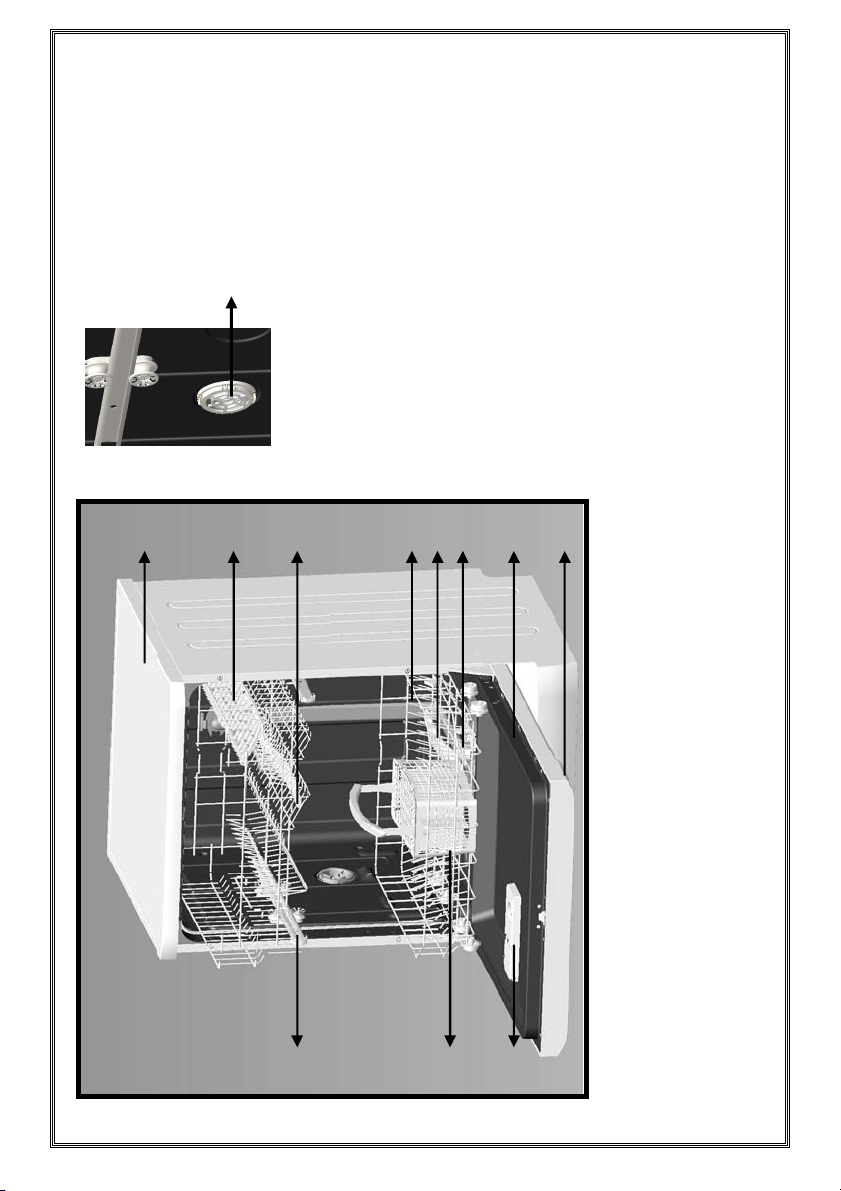
1
2
3
5
6
7
8
9
10
4
7.
Rating plate
2.
Upper basket with racks
8.
Control Panel
3.
Upper spray arm
9.
Detergent and rinse-aid dispenser
4.
Lower basket
10.
Cutlery basket
5.
Lower spray arm
11.
6.
Filters
Upper basket track latch
1.
Worktop
1
1
12
Active Drying Unit: This system provides
better drying performance for your dishes.
GETTING FAMILIAR WITH YOUR MACHINE
4
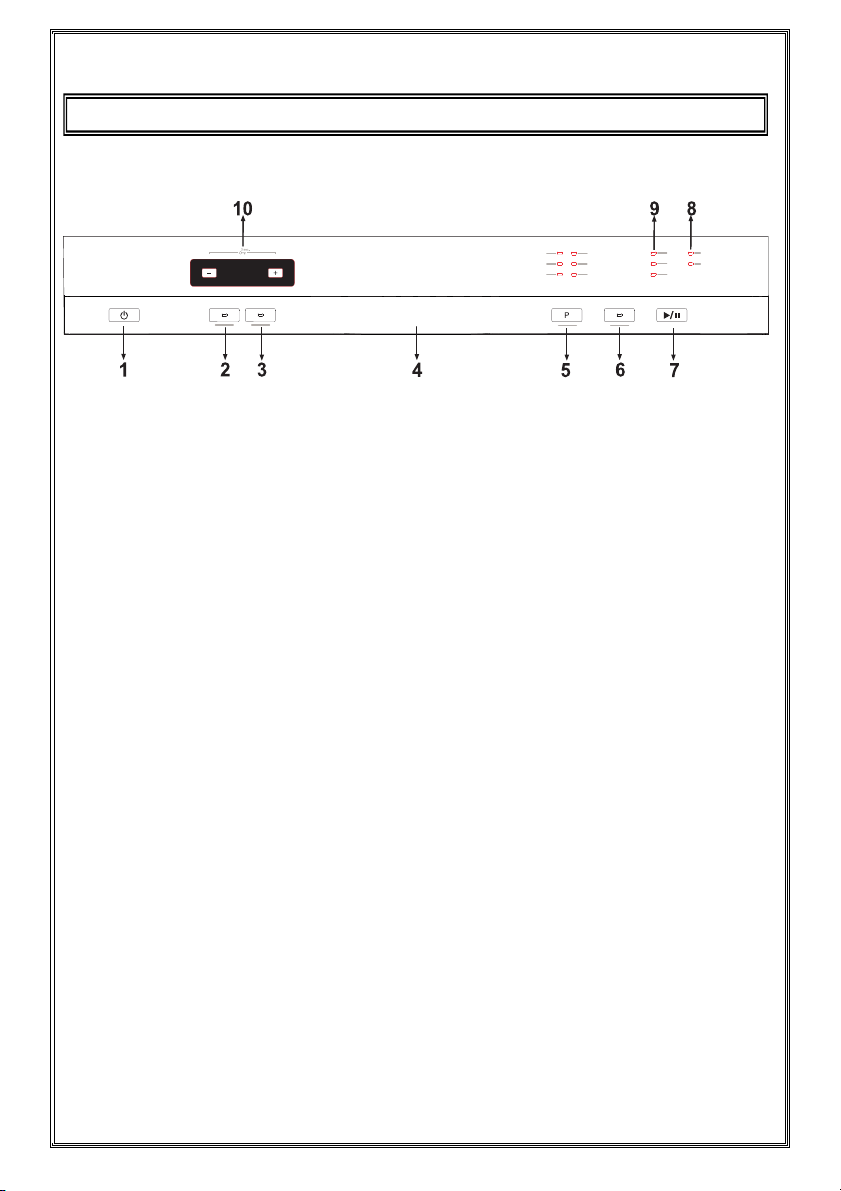
1.) ON/OFF Button
When one presses the on/off button, the machine is energized and
the light on Start/Standby button goes on.
3
.
2.) Extra Hygiene Button
By using this option, washing temperature and periods during respective
cycles may be changed, which ensures more hygienic washing.
3.) Tablet Detergent Button
Push Tablet Detergent button when using combined detergent that
contains rinse aid and extra functions.
4.) Door Handle
Use door handle to open-close the door of the machine.
5.) Program 6election Button
With the program selector button, you can select a suitable
program for your dishes.
6.) Upper Basket 2ption
By using the 'upper basket' feature of your dishwasher, you can reduce
the duration of your selected programs, and decrease your power
and water consumption by using less electricity and water.
4
1
2
3 4
5
6 7
8
9
10

9.) Program Monitor Lights
Program flow can be monitored via program monitor lights on
control panel.
• Wash
• Dry
• End
10.) Remaining Time Indicator
Remaining Time Indicator displays the program time and the
remaining time the program will be operating
. In addition, you can
adjust program delay time by pressing the buttons on the
indicator before program starts. If you want to change delay time,
you can set the time by pressing Start/Pause button and using
buttons on the indicator. Press Start/Pause button again in order
to activate.
Child Lock Operation
In order to activate child lock, press “+” and “–” buttons on
Remaining time indicator simultaneously for 3 seconds. At this
time, "CL" appears for 2 seconds on remaining time indicator. To
deactive the child lock, press “+” and “–” buttons again
simultaneously for 3 seconds. "CL" will blink once
.
.) Start/Pause Button
Once you press the Start/Pause button, the programme you
selected w th the programme selector button w ll start runn ng and
the status indicator lamp “wash” will light up. In the stop
condition while wash led light is On, Start/Pause led will blink.
8.)
Rinse $id Lack Warning ,ndicator
In order to check that there is sufficient rinse aid in your machine
check rinse aid lack warning light on the d
isplay.When rinse aid
warning light starts coming on, fill in rinse aid chamber.
Note : If you have used an extra feature on the latest washing
program, this feature will remain active also on the next washing
program. If you do not want to use this feature on the newly
selected washing program, press the selected feature button
again, and check that the light on the button goes off.
5
Technical specifications
Capacity …………………………
Height ……………………………
Height (without worktop) ……….
Width ……………………………..
Depth …………………………….
Net Weight ……………………...
Elec
tricity input ……………........
Total Power …
…………………..
Heating Power …………………..
Pump P
ower …………………….
Drain Pump Power ……………..
Wa
ter supply pressure...............
Current …………………………..
15 place settings
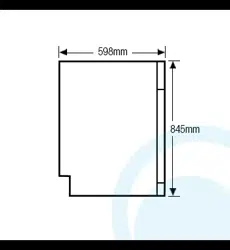
845 mm
815 mm
596 mm
598 mm
46 kg
220-240
V, 50 Hz
2200 W
2000 W
100 W
30 W
0.03 MPa (0,3 bar) - 1 MPa (10 bar)
10 A
• Producer company has its right to amend design and technical specifications reserved.
Conformity with the standards and Test data / EC Declaration of Conformity
All stages related to the machine are executed in accordance with the safety rules provided in all
relevant directives of the European Community.
2004/108/EC, 2006/95/EC,IEC 436/DIN 44990,AS/NZS 2007.1/2:2005
Recycling
• Certain components and the packaging of your machine have been produced from recyclable
materials.
• Plastic parts are marked with international abbreviations:
(>PE< , >PS< , >POM<, >PP<, ….)
• Cardboard parts have been produced from recycled paper and they should be disposed of into
waste paper collection containers for recycling.
• Contact relevant centres in order to obtain information on methods and points of disposal.
Safety Information
When you take delivery of your machine
• Check for any damage to your machine or to its packaging. Never start a machine damaged in
any way, make sure to contact an authorised service.
• Unwrap the packaging materials as indicated and dispose of them in accordance with the rules.
Please note the following before installing this machine
• Choose a suitable, safe and level place to install your machine.
• Carry out the installation and connection of your machine by following the instructions.
• This machine should be installed and repaired by an authorised person only.
• Only original spare parts should be used with the machine.
• Before installing, be sure that the machine is unplugged.
• Check whether the indoor electrical fuse system is connected according to the regulations.
SAFETY INFORMATION AND RECOMMENDATIONS
6
•
If the appliance is installed on a carpet floor, take care that the openings in its base are not
obstructed.
•
The dishwasher must always be connected to the water system using new hose sets.

• All electrical connections must match the values indicated on the rating plate.
• Pay special attention and be sure that the machine does not stand on the electricity supply cable.
• Never use an extension cord or a multiple socket for making a connection. The plug should be
comfortably accessible after the machine has been installed.
• After installing the machine to a suitable place, run it unloaded for the first time.
In daily use
• 7KLVDSSOLDQFHLVLQWHQGHGWREHXVHGLQKRXVHKROGDQGVLPLODUDSSOLFDWLRQVVXFKDV
• Do not get up, sit or place a load on the open door of the dishwasher, it may fall over.
• Never put into the detergent and rinse aid dispensers of your machine anything other than those
detergents and rinse aids which are produced specifically for dishwashers. Our company will not
be responsible for any damage that might occur in your machine otherwise.
•
• Due to danger of explosion, do not put into the machine’s washing section any chemical
dissolving agents such as solvents.
• Check whether plastic items are heat-resistant before washing them in the machine.
• Do not put into your machine those items which are not suitable for dishwashing. Also, do not fill
any basket above its capacity. Our company will not be responsible for any scratch or rust to
form on the inner frame of your machine due to basket movements otherwise.
• Especially because hot water may flow out, the machine door should not be opened under any
circumstances while the machine is in operation. In any case, a safety devices ensures that the
machine stops if the door is opened.
•
• Place knives and other sharp-ended objects in the cutlery basket in blade-down position.
• This appliance is not intended for use by persons (including children) with reduced physical,
sensory or mental capabilities, or lack of experience and knowledge, unless they have been
given supervision or instruction concerning use of the appliance by a person responsible for their
safety.
For your children’s safety
• After removing the machine’s packaging, make sure that the packaging material is out of reach of
children.
•
Keep your children away from detergents and rinse aids.
•
In case of malfunctioning
• Any malfunction in the machine should be repaired by qualified persons. Any repair
work performed by anyone other than the authorised service personnel will 9RLG\RXU:DUUDQW\
• Prior to any repair work on the machine, be sure that the machine is cut off from the mains.
Switch off the fuse or unplug the machine. Do not pull by the cable when unplugging. Make sure
to turn off the water tap.
5HFRPPHQGDWLRQV
• For energy and water saving, remove coarse residues on your dishes before placing the dishes
into the machine. Start your machine after having fully loaded it
• Use the pre-wash programme only whenever necessary.
• Place such hollow items as bowls, glasses and pots into the machine in such a way that they will
face down.
7
The water in this machine is not drinking water.
Please do not leave the door open as this will cause a tripping hazard.
Young Children should be supervised to ensure they do not play with the appliance.
•
•
WARNINGS: Some dİshwasher detergents are strongly alkaline. They can be extremely
dangerous if swallowed, avoid contact with skin and eyes and keep children away from the
dishwasher when the door is open.
6WDIINLWFKHQDUHDVLQVKRSVRIILFHVDQGRWKHUZRUNLQJHQYLURQPHQWV
)DUPKRXVHV
%\FOLHQWVLQKRWHOVPRWHOVDQGRWKHUUHVLGHQWLDOW\SHHQYLURQPHQWV
%HGDQG%UHDNIDVWW\SHHQYLURQPHQWV
• You are recommended not to load into your machine any dishes different or more than indicated.
Items not suitable for dishwashing:
• Cigarette ashes, candle leftovers, polish, paint, chemical substances, iron-alloy materials;
• Forks, spoons and knives with wooden or bone, or ivory or nacre-coated handles; glued items,
items soiled with abrasive, acidic or base chemicals
• Plastic items that are not heat-resistant, copper or tin-coated containers;
• Aluminium and silver objects (they may discolour, become dull)
• Certain delicate glass types, porcelains
patterns as they fade even after the first wash; certain crystal items as they lose their transparency
over time, adhered cutlery that is not heat-resistant, lead crystal glasses, cutting boards, items
manufactured with synthetic fibre;
• Absorbent items as sponges or kitchen rags are not suitable for dishwashing.
Warning: Take care to buy dishwasher-proof sets in your future purchases.
Positioning the machine
When determining the place to put your machine on, take care to choose a place where you can
easily load and unload your dishes.
Do not put your machine in any location where there is the probability for the room temperature to fall
below 0°C.
Before positioning, take the machine out of its packaging by following the warnings located on the
package.
Position the machine close to a water tap or drain. You need to site your machine, taking into
consideration that its connections will not be altered once they are made.
Do not grip the machine by its door or panel in order to move it.
Take care to leave a certain clearance from all sides of the machine so that you can comfortably move
it back and forth during cleaning.
Make sure that the water inlet and outlet hoses do not get squeezed while positioning the machine.
Also, make sure that the machine does not stand on the electrical cable.
Adjust the machine’s adjustable feet so that it can stand level and balanced. Proper positioning of the
machine ensures problem-free opening and closing of its door.
If the door of you machine does not close properly, check if the machine is stable on the floor it
stands; if not, adjust the adjustable feet and ensure its stable position.
Water connection
Be sure that the indoor plumbing is suitable for installing a dishwasher. Also, we recommend that you
fit a filter at the entrance of your place or apartment so as to avoid any damage to your machine
because of any contamination (sand, clay, rust etc.) that might be occasionally carried in through the
mains water supply or the indoor plumbing, and to forestall such complaints as yellowing and
formation of deposits after washing.
INSTALLING THE MACHINE
8
such as sponges or kitchen rags with ornamental printed
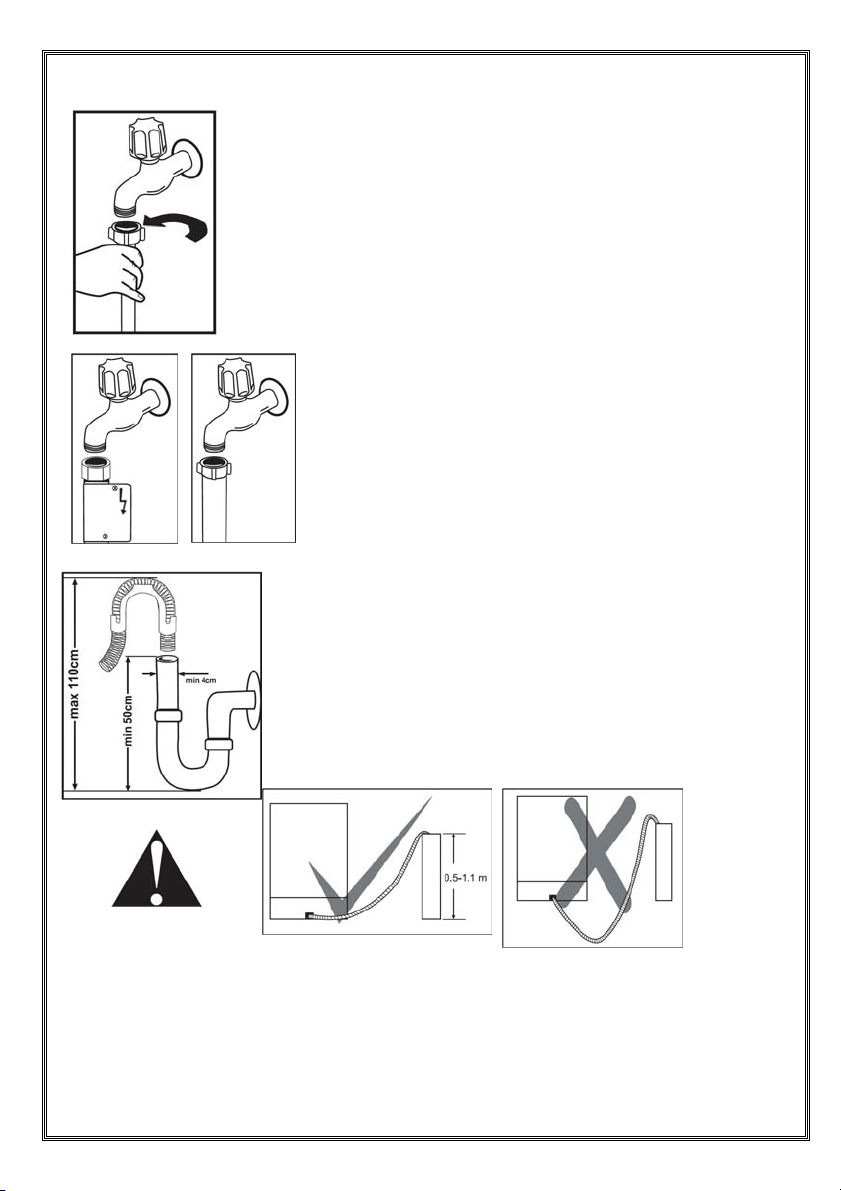
Water inlet hose
Do not use the water inlet hose of your old machine, if any. Use the new water
inlet hose supplied with your machine instead. If you are going to connect a
new or long-unused water inlet hose to your machine, run water through it for a
while before making the connection. Connect the water inlet hose directly to
the water inlet tap. The pressure supplied by the tap should be at a minimum
of 0.03 Mpa and and at a maximum of 1 Mpa. If the water pressure is above 1
Mpa, a pressure-relief valve should be fitted inbetween.
After the connections are made, the tap should be turned on fully and checked
for water tightness.
For the safety of your machine, make sure to always turn off the water inlet tap
after each wash programme is finished.
NOTE: Aquastop water spout is used in
this
model. In case
of using Aquastop, a dangerous tension exists. Do not cut
Aquastop water spout. Do not let it get folded or twisted.
Water outlet hose
The water drain hose can be connected either directly to the water drain
hole or to the sink outlet spigot. Using a special bent pipe (if available),
the water can be drained directly into the sink via hooking the bent pipe
over the edge of the sink.
This connection should be at a minimum of 50cm and at a
maximum of
110 cm from the floor plane.
Warning: When a drain hose longer than 4m is used, the dishes might
remain dirty. In that case, our company will not accept responsibility.
Electrical connection
The earthed plug of your machine should be connected to an earthed outlet supplied by suitable
voltage and current. If there is no earthing installation, have a competent electrician carry out an
earthing installation. In case of usage without earthing installed, our company will not be responsible
for any loss of usage that might occur.
The indoor fuse current value should be 10-16 A.
9
Your machine is set according to 220-240 V. If the mains voltage in your location is 110 V, connect a
transformer of 110/220 V and 3000 W in between. The machine should not be plugged in during
positioning.
Always use the coated plug supplied with your machine.
Running in low voltage will cause a decline in washing quality.
The machine’s electrical cable should be replaced by an authorised
person
or an authorised
electrician only. Failure to do so may lead to accidents.
For safety purposes, always make sure to disconnect the plug when a wash programme is finished.
In order not to cause an electric shock, do not unplug when your hands are wet.
When disconnecting your machine from the mains supply, always pull from the plug. Never pull the
cord itself.
Fitting the machine undercounter
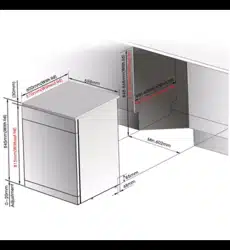
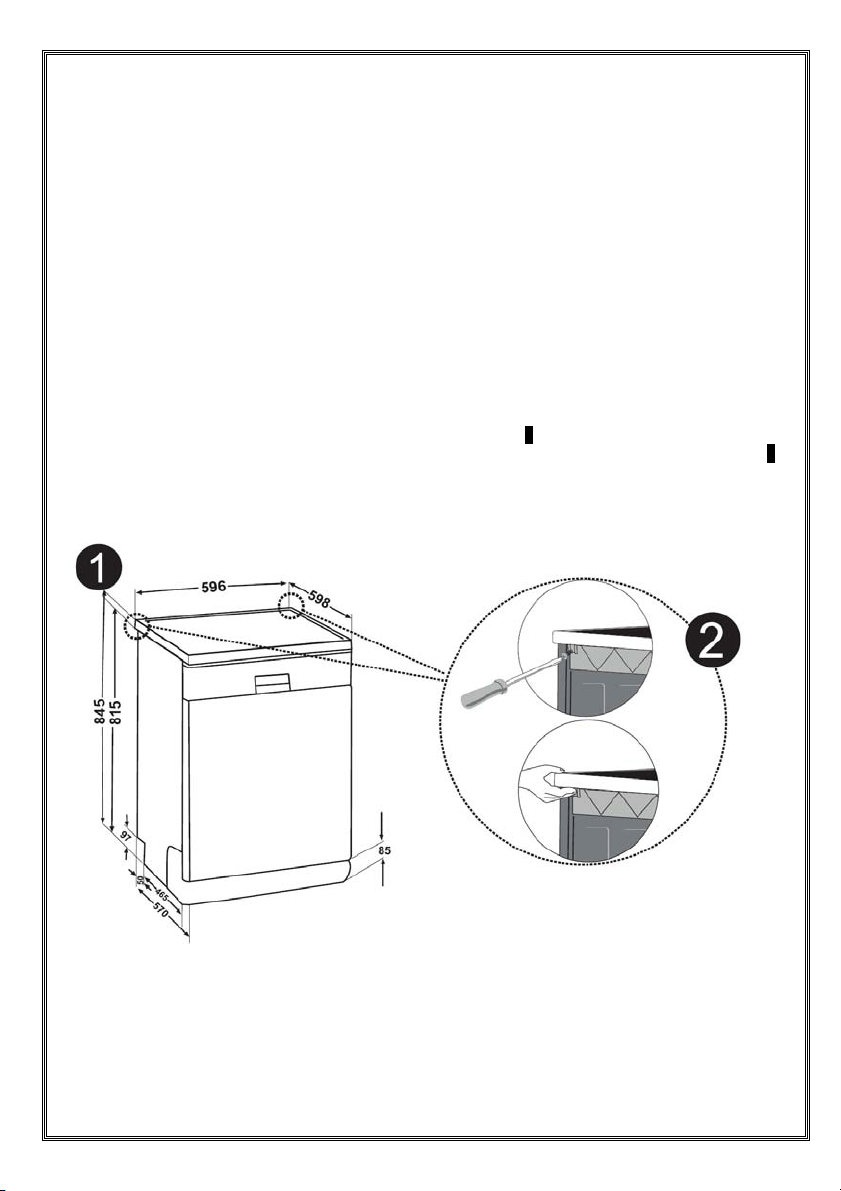
If you wish to fit your machine undercounter, check whether you have sufficient space under your
countertop and whether the wiring-plumbing is suitable to do so.1 If you decide that the space under
the countertop is suitable for fitting your machine, remove the worktop as shown in the illustration. 2
To remove the worktop, remove the screws that hold the worktop which are located at the rear of the
machine; then push the front panel 1cm from the front side towards the rear and lift it.
10
Warning:The stand part which we will settle our machine under it by removing its worktop has
to be stable in such a way not to allow balance disorder.
10
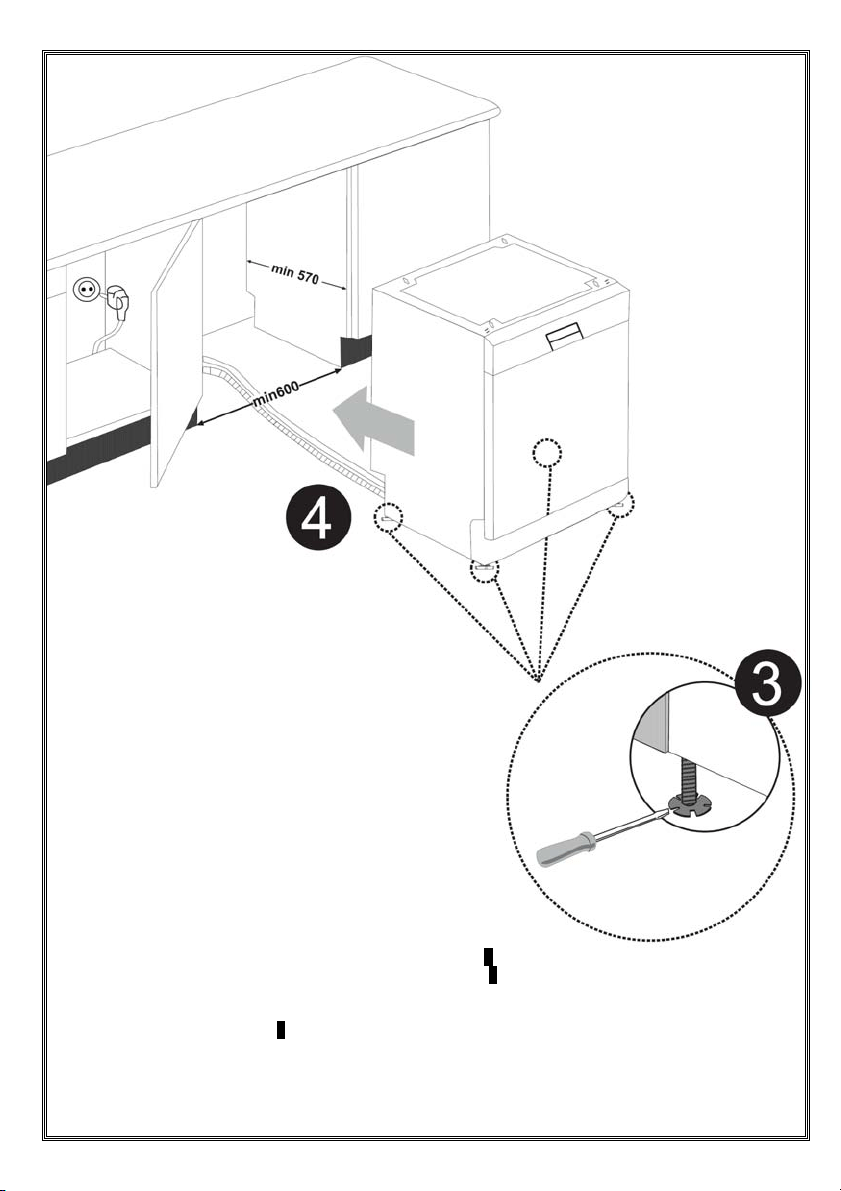
Adjust the machine feet according to the slope of the floor.3 Fit your machine by pushing it
undercounter without letting the hoses get crushed or bent.4
Warning: After removal of worktop, the machine should be placed in such a closed place of which
dimensions are shown at fig.
11
4
Prior to using the machine for the first time
• Check whether the electricity and supply water specifications match the values indicated by the
installation instructions for the machine.
• Remove all packaging materials inside the machine.
• Fill the rinse aid compartment.
12
Detergent usage
Use a detergent specifically designed for use in domestic dishwashers.
You can find powder,gel,and tablet detergents in the market that have been designed for
household dishwashers.
Detergent should be put into the compartment prior to starting the machine. Keep your
detergents in cool, dry places out of reach of your children.
Do not fill detergent into the detergent compartment more than required; otherwise it may cause
scratches on your glasses as well as lead to a poorly dissolved detergent.
Should you need more information concerning the detergent you will use, contact detergent
manufacturers directly.
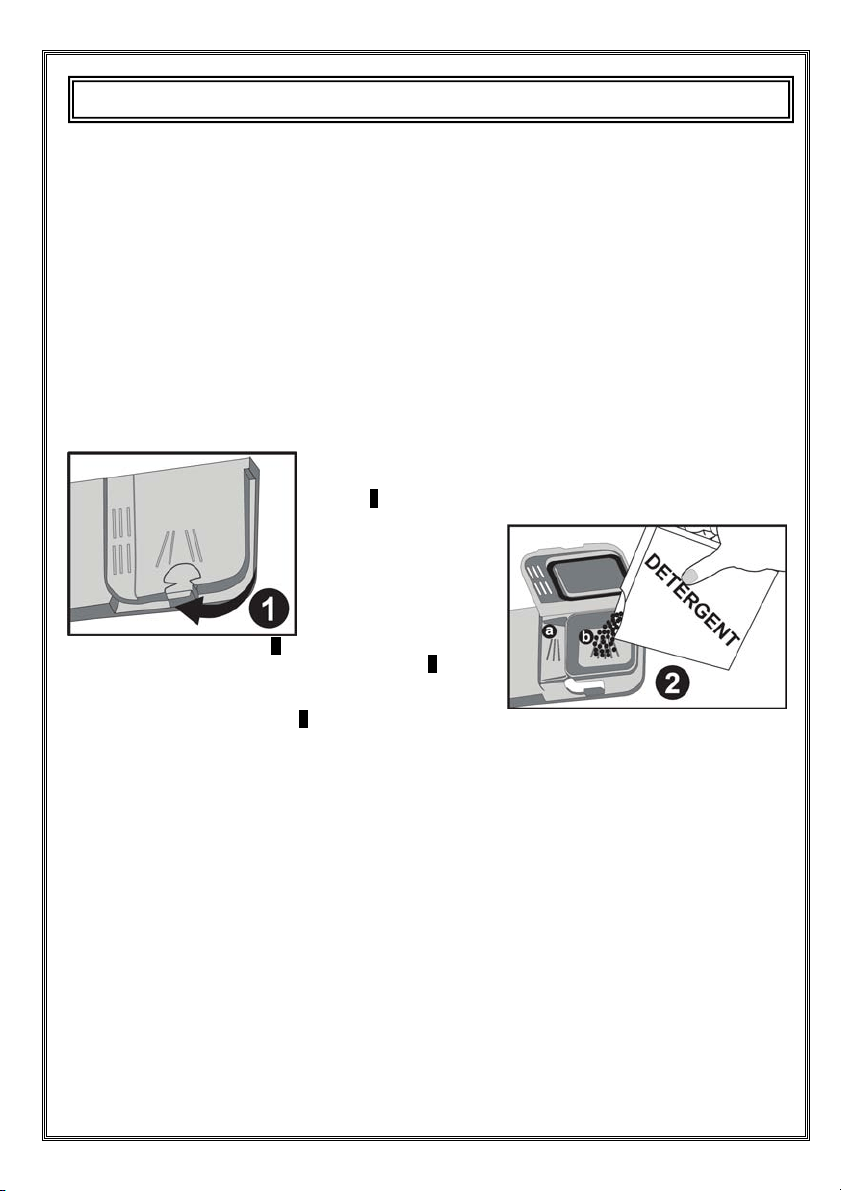
Filling the detergent compartment
Push the latch to open the detergent container as shown in the
image. 1 Detergent pod has level lines inside. It is possible to
measure the right
detergent amount using
these lines. Detergent
pod can take totally 40
cm
3
detergent.
Open the dishwasher
detergent and pour into
the larger compartment b 25cm
3
if your dishes are
heavily soiled or 15 cm
3
if they are less soiled.2 If your
dishes have been kept dirty for a very long time, if there
are dried food wastes on them, and if you have
a overly
loaded the dishwasher, pour a 5cm
3
detergent into the pre-wash compartment and start your
machine.
You may have to add more detergent into your machine, depending on the degree of soil.
Combined detergent
Detergent manufacturers also produce combined detergents called “2 in 1”, “3 in 1” or “5 in 1”
etc.
“2 in 1” detergents contain detergent or rinse aid. When u
sing “2 in 1” detergents make
sure to check the specifications of the tablet.
Other tablet detergents contain detergent + rinse aid + various extra functions.
Generally
,
combined detergents produce sufficient results under certain usage conditions only.
Such detergents contain rinse aid in preset amounts.
Points to consider when using this type of products:
• Always make sure to check the s
pecifications of the product you will use or whether or not
it is a combined product.
• Observe the instructions on packagings when using such products.
• If such detergents are in the form of tablets, never put them into the interior section or the
cutlery basket of the dishwasher. Always put the tablets into the detergent compartment in
the detergent dispenser.
PREPARING THE MACHINE FOR USE
• They produce good results for certain types of usage only. If you are using this type of
detergents, you need to contact the manufacturers and find out about the suitable
conditions of use.
• When the conditions of use of such products and the machine settings are appropriate,
they ensure savings in rinse aid consumption.
• Contact the detergent manufacturers if you are not obtaining good wash results (if your
dishes stay calcareous and wet) after having used 2 in 1 or 3 in 1 detergents. The scope of
warranty for your machine does not cover any complaints caused by the use of these types
of detergents.
Recommended usage: If you want to obtain better results while using combined detergents,
add rinse aid into your machine and adjust the rinse aid setting to the lowest position.
Solubility of the tablet detergents produced by different companies can vary
depending on the temperature and time. Therefore, it is not recommended to use such
detergents in short programs. It is more suitable to use powder detergents in such
programs.
Warning: Should any problem, which you have not encountered before, arise with the use of
this type of detergents, contact the detergent manufacturers directly.
When you give up using combined detergents
• Fill the rinse aid compartments.
• Make the suitable rinse aid setting.
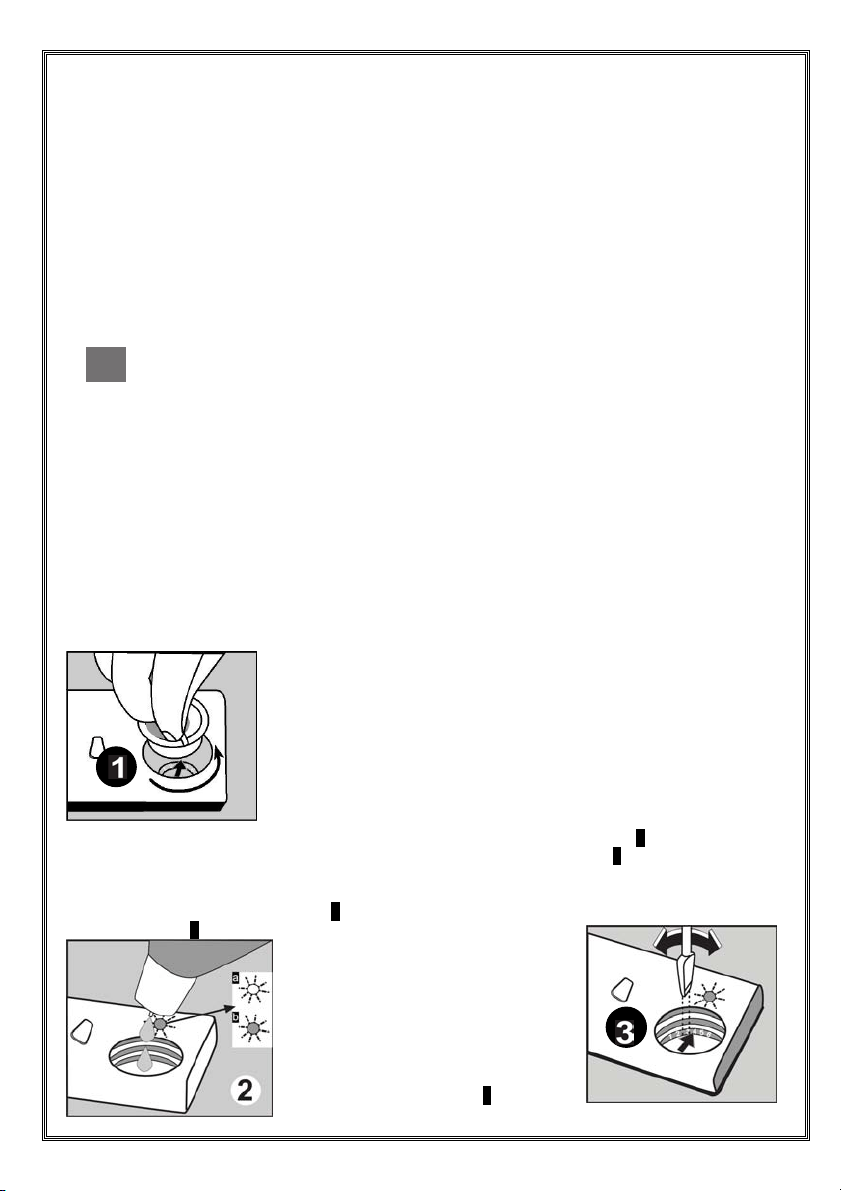
Filling with rinse aid and making the setting
Rinse aid is used to prevent the stay of white water drops, lime
stains, white film strip-shaped stains that may form on the dishes, as
well as to increase the drying performance. Contrary to the popular
beliefs, it is used not only for obtaining shinier dishes but also for
obtaining sufficiently dried dishes. For this reason, care should be
taken that there is adequate amount of rinse aid in the rinse aid
compartment and only polishing material produced for use at
dishwashers should be used.
If the rinse aid lamp on the control panel becomes on fill the rinse aid
compartment with rinse.
To put rinse aid in, remove the rinse aid compartment cap by turning it.1 Fill the rinse aid
compartment with rinse aid until the rinse aid level indicator comes dark;2 refit the cap and
close it by turning it in a way that the nails will correspond to one another. By checking the rinse
aid level indicator on the detergent dispenser, you can understand whether or not your machine
needs rinse aid. A dark indicator b means that there is rinse aid in the compartment, while a
light indicator a shows that you need to fill the compartment with
rinse aid.
The rinse aid level adjuster can be set
to a position between 1 and 6. Factory
setting for rinse aid is the position 3.
You need to increase the degree of the
adjuster if water stains form on your
dishes after a wash, whereas you need
to decrease the degree if a blue stain
is left when wiped by hand.3
13
Warning: Use only those rinse aid materials which are allowed for use in the machine. As rinse
aid residues left as a result of overflowing will create extremely high amounts of foam and thus
reduce the washing performance, remove the excess amount of rinse aid by wiping it with a rag.
If you properly place your dishes into the machine, you will be using it in the best way in terms
of energy consumption, washing and drying performance.
There are two separate baskets for you to load your dishes into your machine. You can load into
the lower basket such round and deep items as pots with long handles, pot lids, plates, salad
plates, cutlery sets.
The upper basket has been designed for tea plates, dessert plates, salad bowls, cups and
glasses. When placing long-stem glasses and goblets, lean them against the basket edge, rack
or glass supporter wire and not against other items. Do not lean long glasses against one
another as they cannot remain steady and may receive damage.
It is more appropriate to locate the thin narrow parts into the middle sections of baskets.
You can place spoons among the other cutlery sets in order to prevent them from sticking to
one another. You are recommended to use the cutlery grid in order to obtain the best result.
To avoid any possible injuries, always place such long-handle and sharp-pointed dishes as
serving fork, bread knife etc. with their sharp points facing down or horizontally on the baskets.
Warning: Place your dishes into your machine in a way that they will not prevent the upper and
lower spray arms from spinning.
LOADING YOUR DISHWASHER
14
Top basket
Height Adjustable Rack
These racks are designed to increase the capacity of the
top basket. You can place your glasses and cups on the
racks. You can adjust the height of these racks. Thanks to
this feature, you can place different sizes of glasses under
these racks.
Thanks to height adjustment plastics mounted on the
basket, you can use your racks in
3
different heights. In
addition, you can place long forks, knives and spoons on
these racks laterally, so that they do not block the
revolution of propeller.
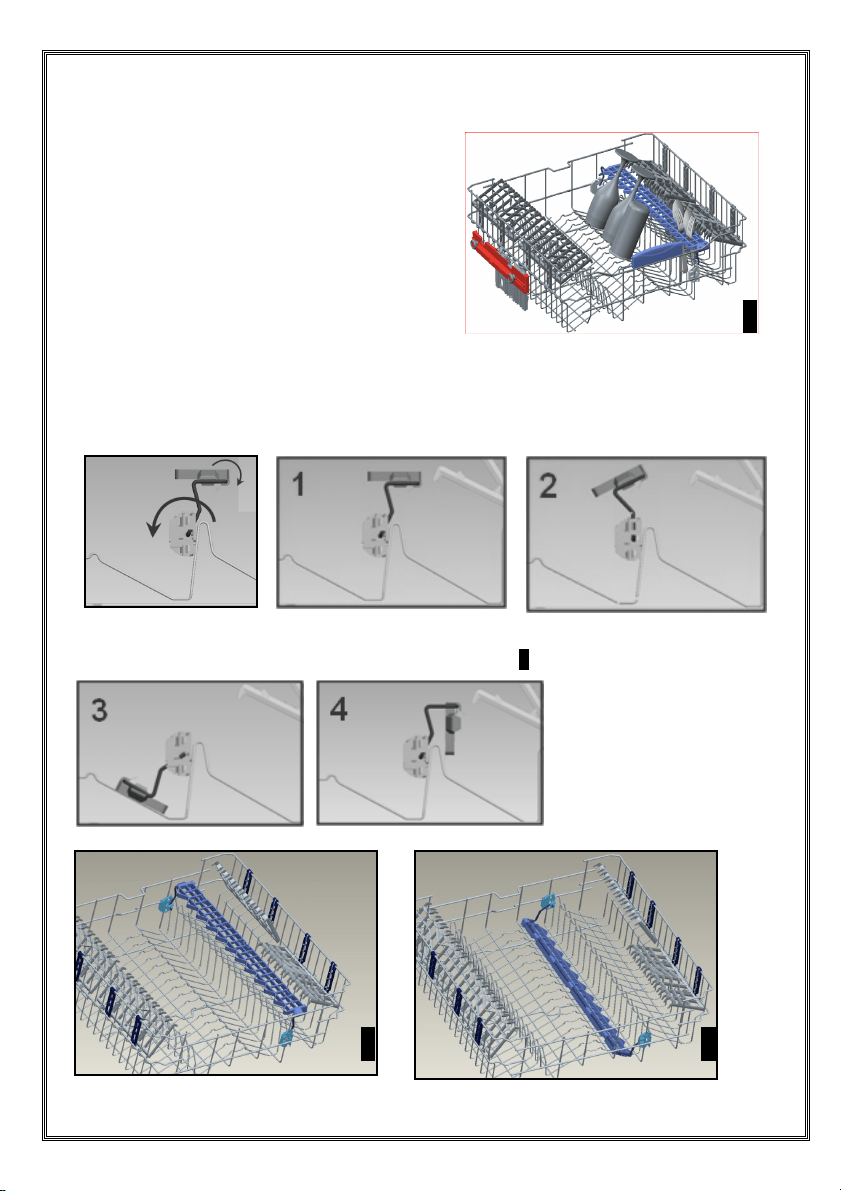
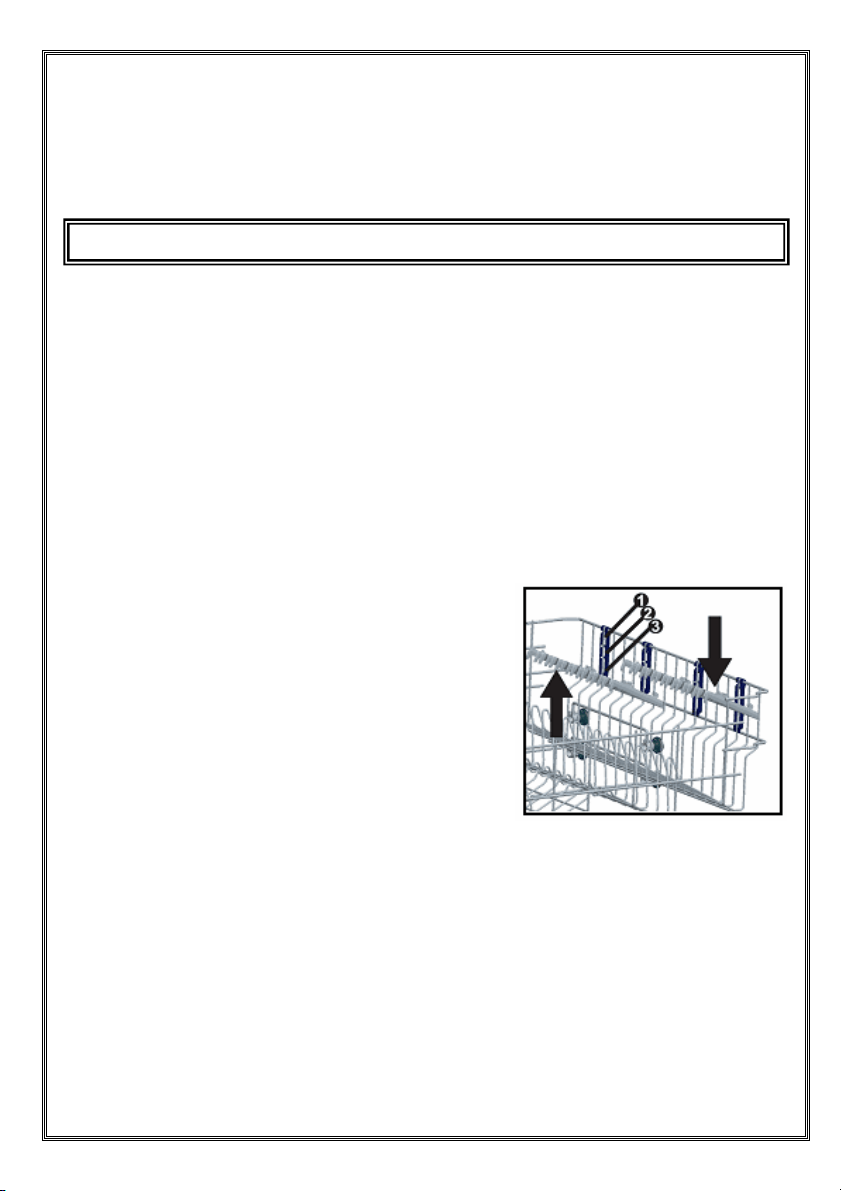
Spoon rack
It allows your long-stemmed goblets to be
washed safely a
s well as it is a part to
provide your spoons and forks put easily to
spoon rack. Do not lean your long-stemmed
goblets and glasses against each other but
spoon rack, thus during the washing it is
ensured your glasses and goblets stay in
place and a safe washing by preventing
contact each other.
There are 4 different positions for your spoon
rack.
According to the status of your goblets and glasses, you can set your spoon rack to
the positions number 1 and 2.
Use it for your spoons and forks
while it was in position 1.
If you do not want to use spoon rack, you can bring it to the positions 3 or 4, so that
you can form larger-volume areas in the upper basket b.
a
b
18
a
15
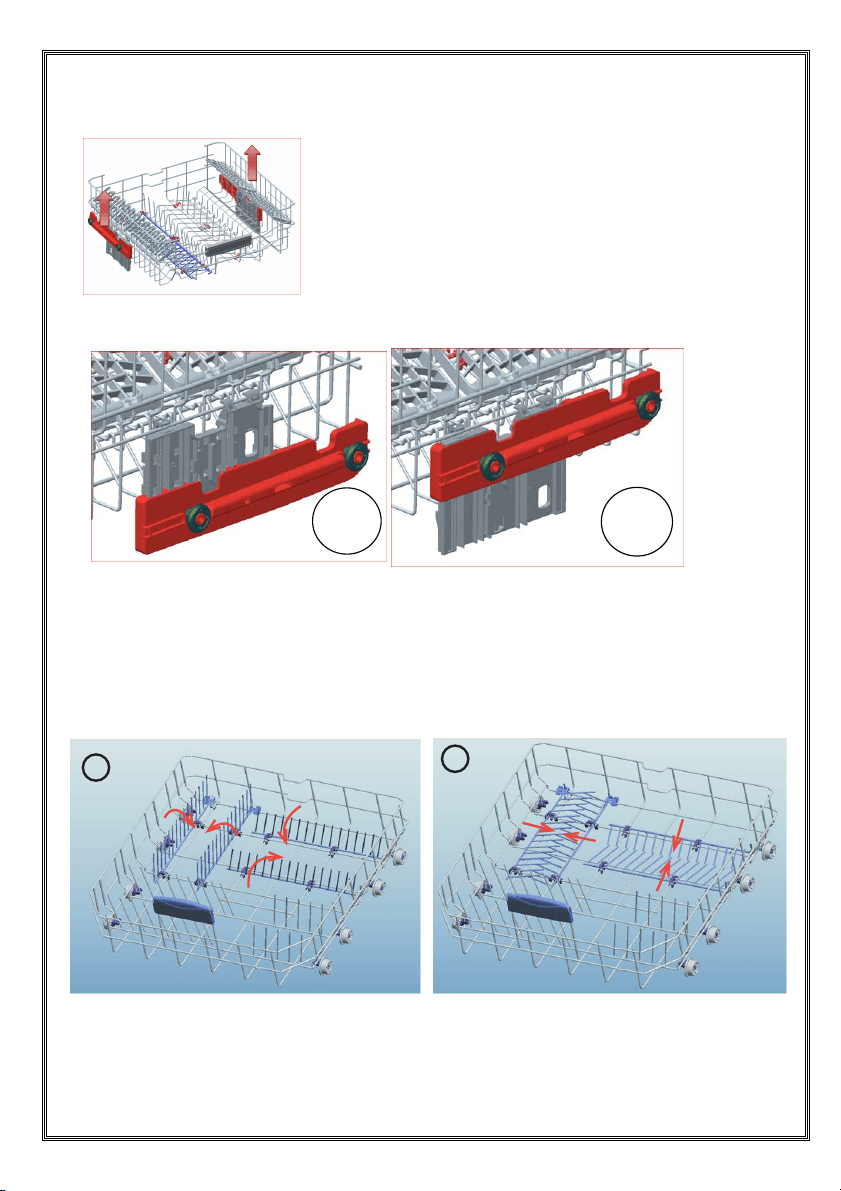
Top basket height adjustment while it is full
Basket height adjustment mechanism on the top basket of your
machine is designed to let you adjust the height of your top
basket upwards or downwards, without removing it from your
machine when it is full, and create large spaces at the top or
bottom area of your machine as needed. Basket of your machine
is set to upper position in factory settings.
In order to raise your basket, hold it from both sides and pull it
upwards. In order to lower it, hold it from both sides again, and
leave it.
In loaded basket adjustment mechanism, make sure that both sides are in the same position (up
or down).
1
2
Lower Basket
Folding Racks
Folding racks consisting of four parts that are located on the lower basket of your machine are
designed in order to let you place big items easier such as pots, pans, etc. If requested, each
part can be folded separately, or all of them can be folded and larger spaces can be obtained.
You can use folding racks by raising them upwards, or by folding.
1
2
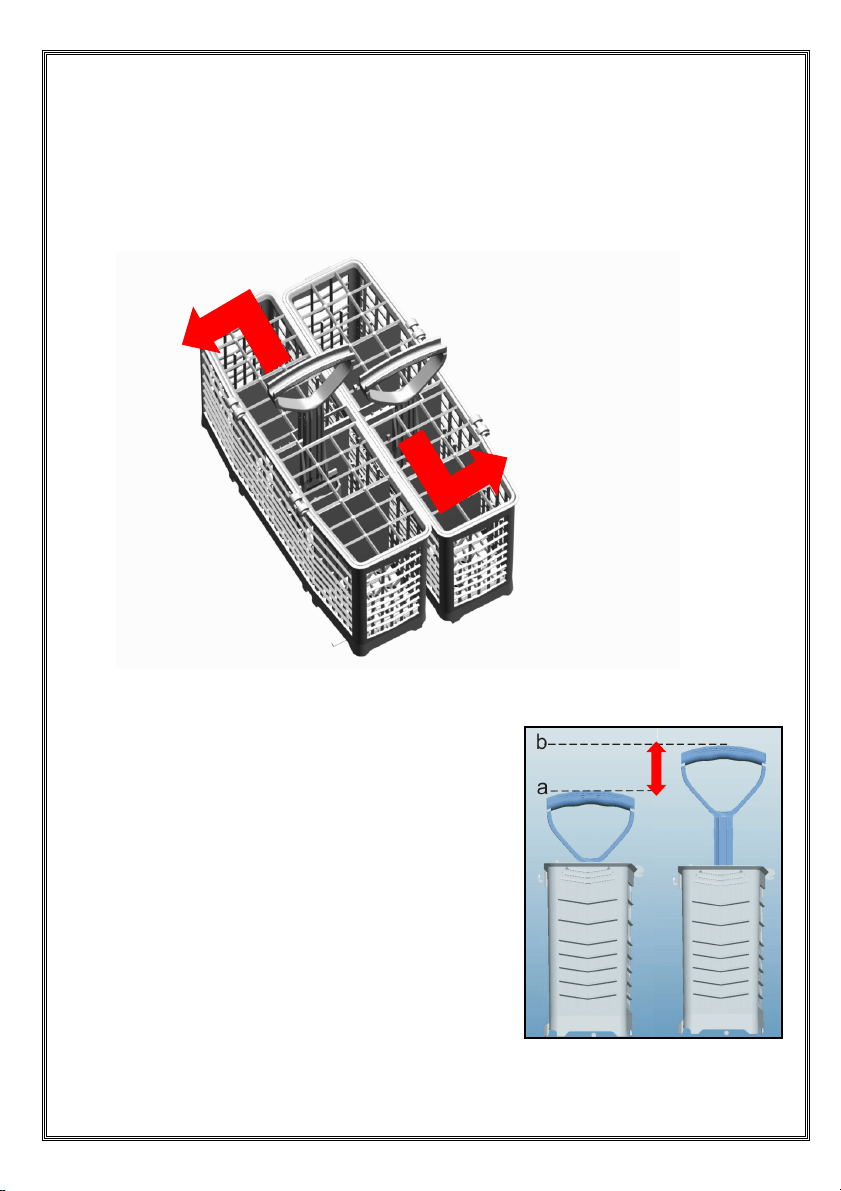
Modular fork spoon
According to the number of your dirty for
ks, spoons and knives, you can separate
your basket of modular fork and spoon into two separate parts. Hold your basket from
both sides to separate it and you can separate your basket into two separate parts by
moving the one side forward while moving the other side back. To combine your
basket back to the same, make the inverse of the same movement.
Modular basket handle has a feature of adjustable
height. Once you have separated your modular
basket into two parts, you can place your upper
basket. Depending on the sub-top position of your
upper basket, you can use handle level of the
modular basket by bringing to the positions a or b.
20
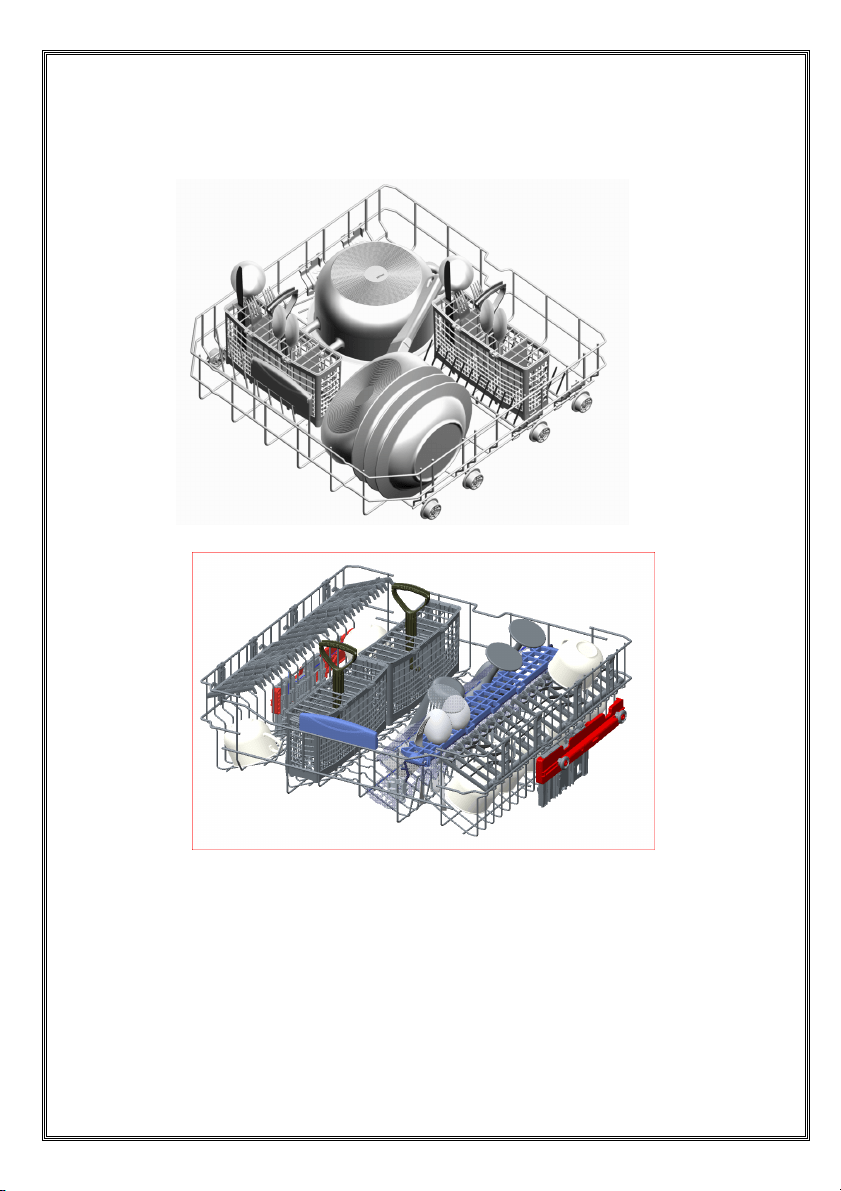
By placing your modular fork spoon basket in different places at upper or lower
basket, you ca
n form appropriate fields for your other dishes.
Below you can see several recommended settlements.
21
.
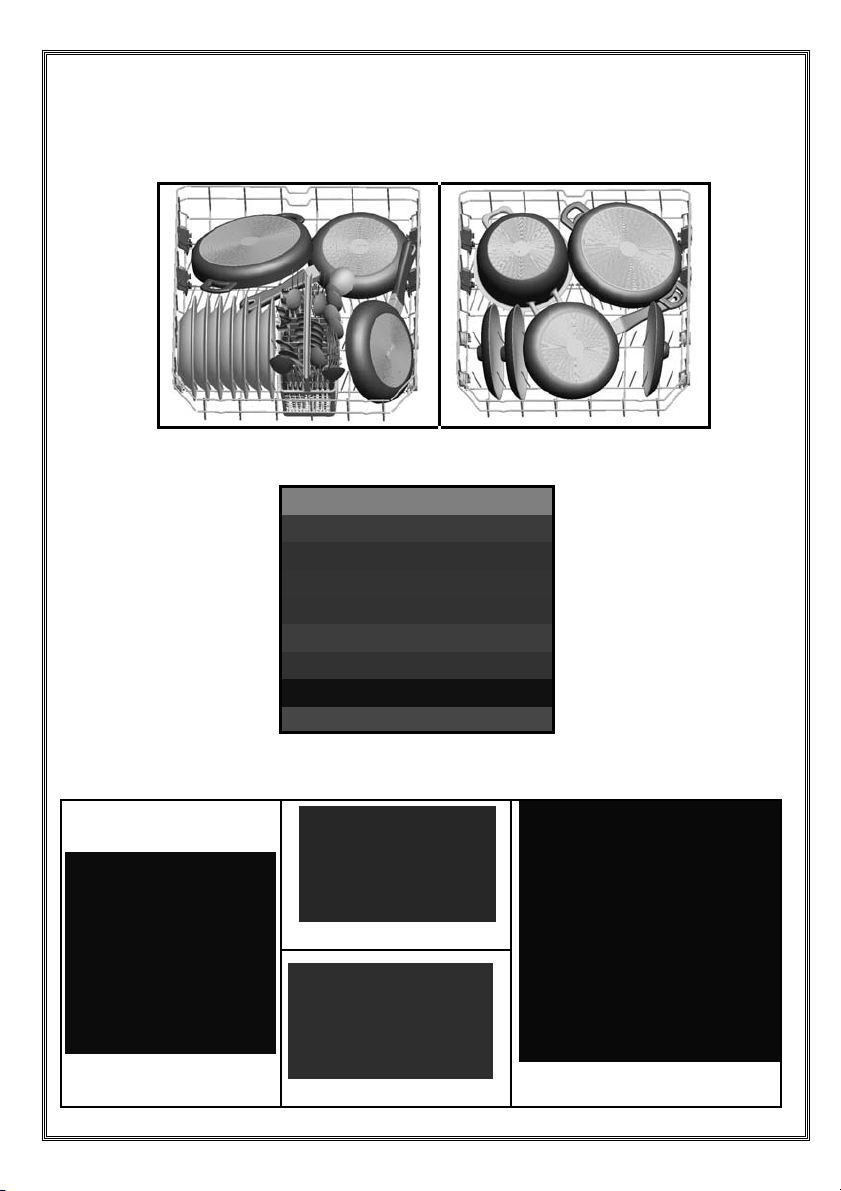
Lower Basket
Top Basket
Faulty loads
19
Alternative basket loads
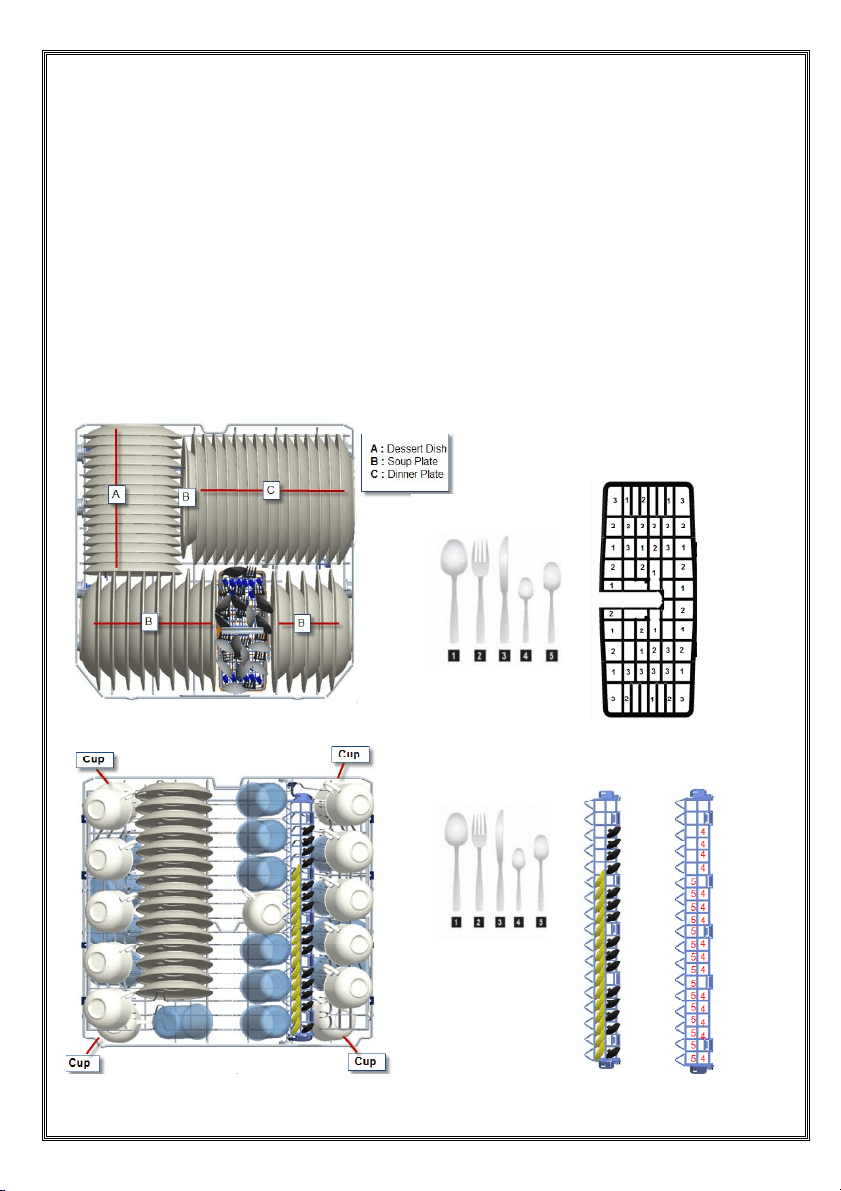
Standard loading and test data
Capacity:
Upper and lower baskets: 15 place settings. The upper basket should be adjusted to lower position
Cups should be placed on to the dish rack pins.
Detergent / Rinse aid
5+25 cm
3
, in accordance with AS/NZS 2007.1/2:2005 (international norms) / Rinse aid dosage
adjustment: 4
Programme Test
Economic 50°C, in accordance with AS/NZS 2007.1/2:2005 & AS/NZS 6400:2005
(international norms) At the end of the drying cycle for drying performance test the door should
be opened approximately 50 mm.
LOWERBASKET
UPPERBASKET
SPOONRACKINUPPERBASKET
CUTLERYBASKET
20
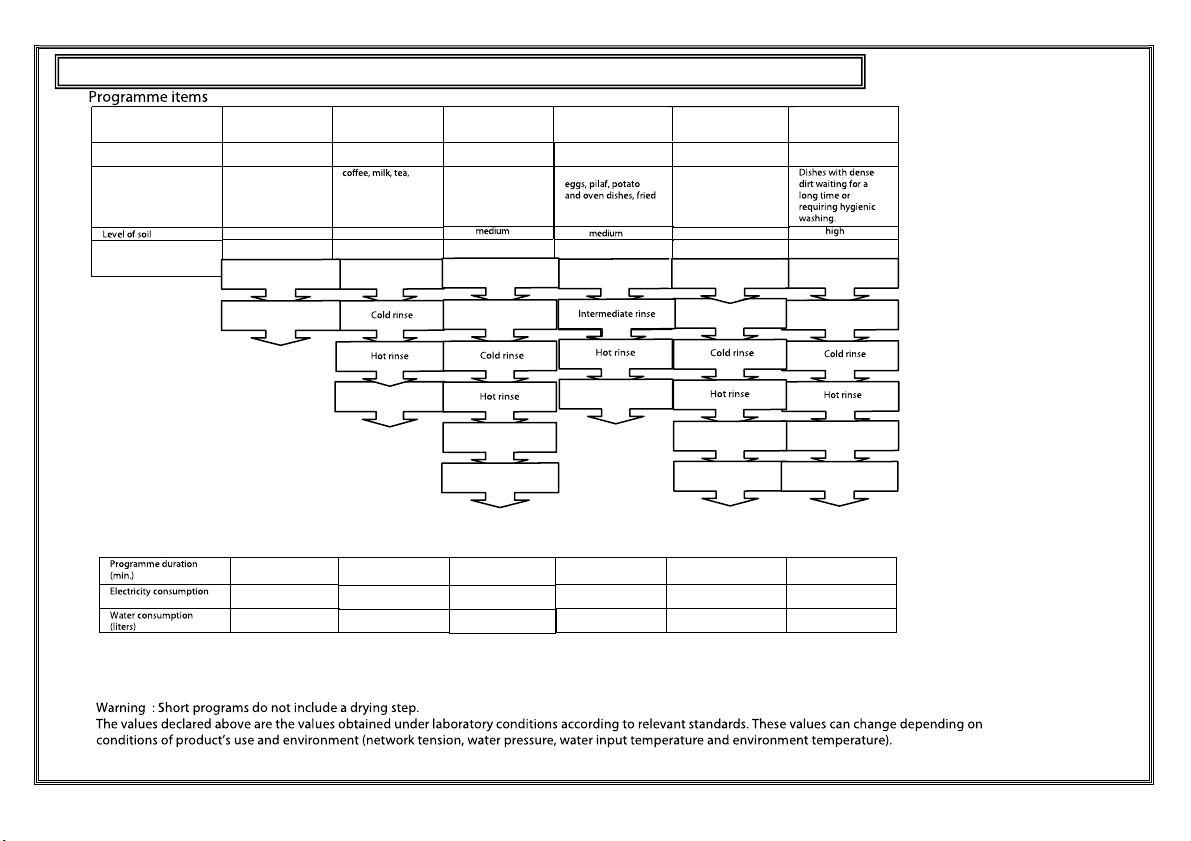
DESCRIPTIONS
21
PROGRAMME
Programme names and
temperatures
50° C
65° C 65° C
Type of food waste
cold meats,
vegetables, not kept
for long
soups, sauces, pasta,
foods
small
Detergent amount
A: 25 cm
3
/ 15 cm
3
B: 5 cm
3
A
A
A+B
A+B
15
30
122
90
177
(kW hours)
0,02
0,84
0,95
1,34
1,73
4,2
13,5
14,4
Programme No
Prewash
A+B
50
1,21
10,7
40° C
24,6
10,9
Prewash
End
Quick 40
° C 30 min.
Intensive
***Super 50 min. 65 ° C
Prewash
** Only powder detergent should be used in cycle of prewash programme.
Dry
65° C Wash
65°
C Wash
End
C Wash
Dry
End
40° C Wash
40°
End
End
Normally
soiled load at
reated capacity
Economic 50°C
Daily
60° C
cold meats,
vegetables, not kept
for long
small
Prewash
Prewash
End
Prewash
rewash
Prewash 1
50°
C Wash
End
Dry
-
Pre-wash to rinse
and loosen residue-
awaiting full load-
then select a
program
-
-
1.
3.
2.
4.
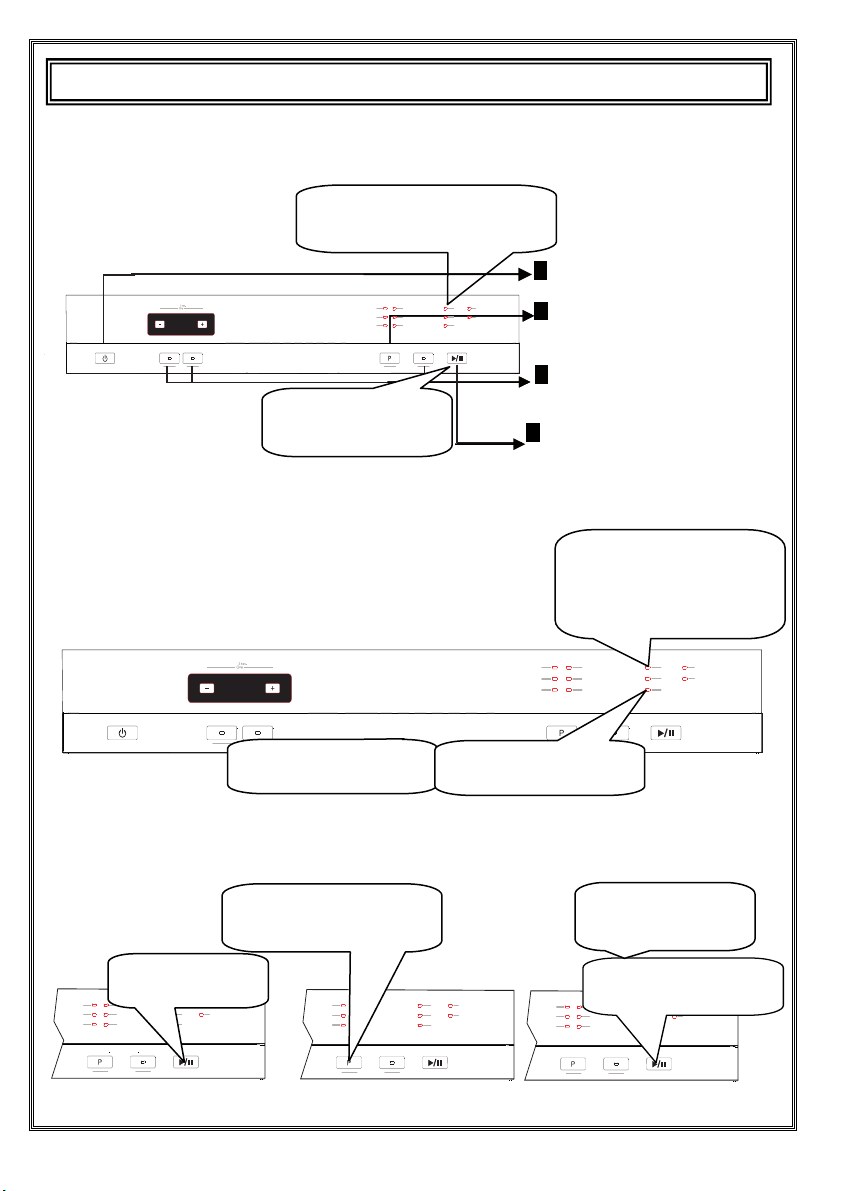
4 Start the program pressing
the Power Start/Pause key.
Switching on the machine
Program follow-up
You can follow the program flow using the program follow-up lamps located on the control panel.
Changing a programme
If you would like to change programs while a washing program is continuing.
SWITCHING ON THE MACHINE AND SELECTING A PROGRAMME
Press the Power On/Off key.
Select the program suiting your
dishes via the Program Selector
button.
If you prefer or wish to prefer,
you can choose additional
function.
The lamp on Program Start/Pause key
goes off once the Program starts and
the washing lamp is highlighted.
The lamp on Program Start/Pause key
goes off once the Program starts and
the washing lamp is highlighted.
22
22
Once the Power On/Off key
is pressed, the lamp Power
Start/Pause is highlighted.
The lamp on Program Start/Pause key
goes off once the Program starts and
the washing lamp is highlighted.
As long as washing continues, the
lights of washing and
drying are on respectively.
Machine remains silent for about
40-50 minutes when the drying
lamp is on.
Once the program is over, the
End light is illuminated.
Do not open the door before
the End light is on.
Start the program you have
newly selected by pressing
again the Start/Pause key.
The new program started
will resume the course of
the old program.
After the program stops, select
your desired program via the
Program selector button.
Press once the Power
Start/Pause key.
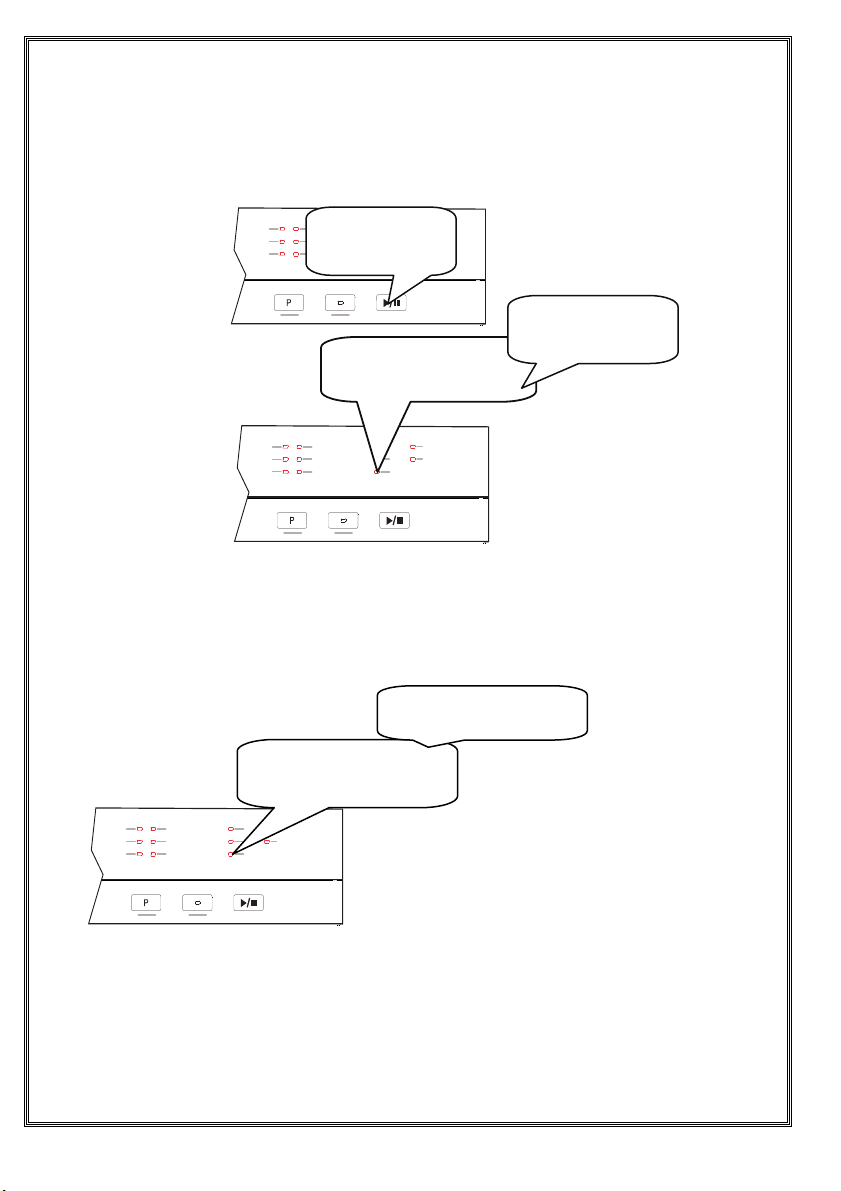
Changing a programme with resetting
If you would like to cancel a program while a washing program is resumed.
Switching the machine off
Note: You can slightly open the door in order for the machine to perform a faster dry operation after
the wash programme is finished.
Note: If the machine door opens during washing or the power is cut off, the machine will go on to the
program in case the door is shut or the power is back.
23
Hold Start/Pause button
pressed for approx. 3 sec.
until Finish light blinks.
After Finish light starts blinking,
discharges the water
inside for approx. 30sec.
Once Finish light comes on,
it means that the cycle
has been cancelled.
When the lamp “Finish” lights up,
switch your machine off by using
the Power On/Off button.
Pull the plug out of the outlet.
Turn of the water tap. f
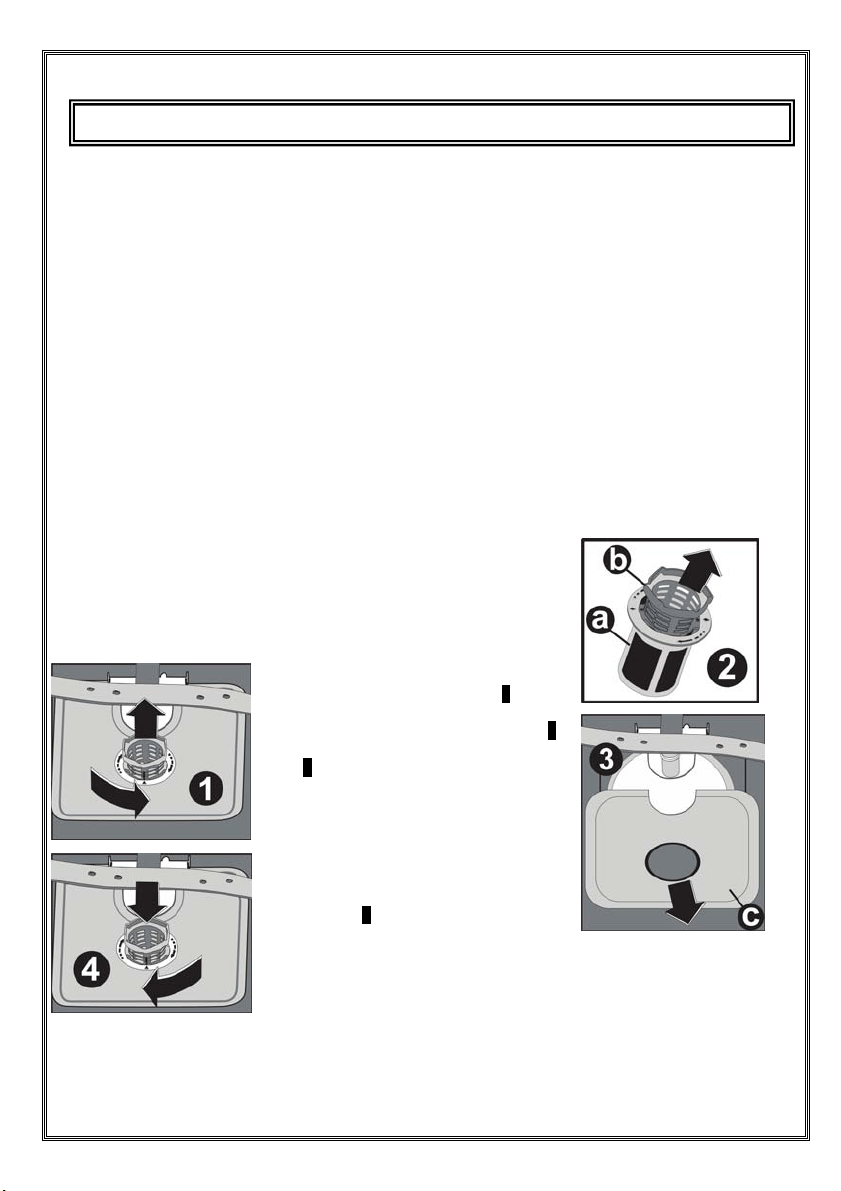
Cleaning the machine in regular intervals prolongs the machine’s service l
ife.
Oil and lime may accumulate in the machine’s washing section. In case of such accumulation;
-Fill the detergent compartment without loading any dishes into the machine, select a programme that
runs at high temperature, and start the machine. In case of insufficiency, use special cleansing
material available in the market. (Cleansing material produced special to machines by detergent
producers.)
Cleaning the seals in the machine door,
-To clean any accumulated residues in the door seals, wipe the seals regularly by using a dampened
cloth.
Cleaning the machine,
Clean the filters and spray arms at least once a week.
Unplug your machine and turn off its tap before starting the cleaning.
Do not use hard materials when cleaning your machine. Wipe with a fine cleaning material and a
dampened cloth.
Filters
Check if any food wastes have remained on the coarse and fine filters.
If any food wastes are left, remove the filters and clean them
thoroughly under the water tap.
a. Micro Filter
b. Coarse Filter
c. Metal/Plastic Filter
To remove and clean the filter
combination, turn it counter clockwise
and take it out by lifting upwards.1
Pull and remove the metal/plastic filter. 3
Then pull the coarse filter out of the micro
filter.2 Rinse it with lots of water under
the tap. Refit the metal/plastic filter. Insert
the coarse filter into the
micro filter in a
way that the marks will correspond to one
another. Attach micro filter into the
metal/plastic filter and turn to the
direction of arrow and it is locked when
the arrow on micro filter can be seen
from across. 4
• Never use your dishwasher without any filter.
• Incorrect fitting of the fil
ter will reduce the washing effectiveness.
• Clean filters are very important in terms of the proper running of the
machine.
MAINTENANCE AND CLEANING
24
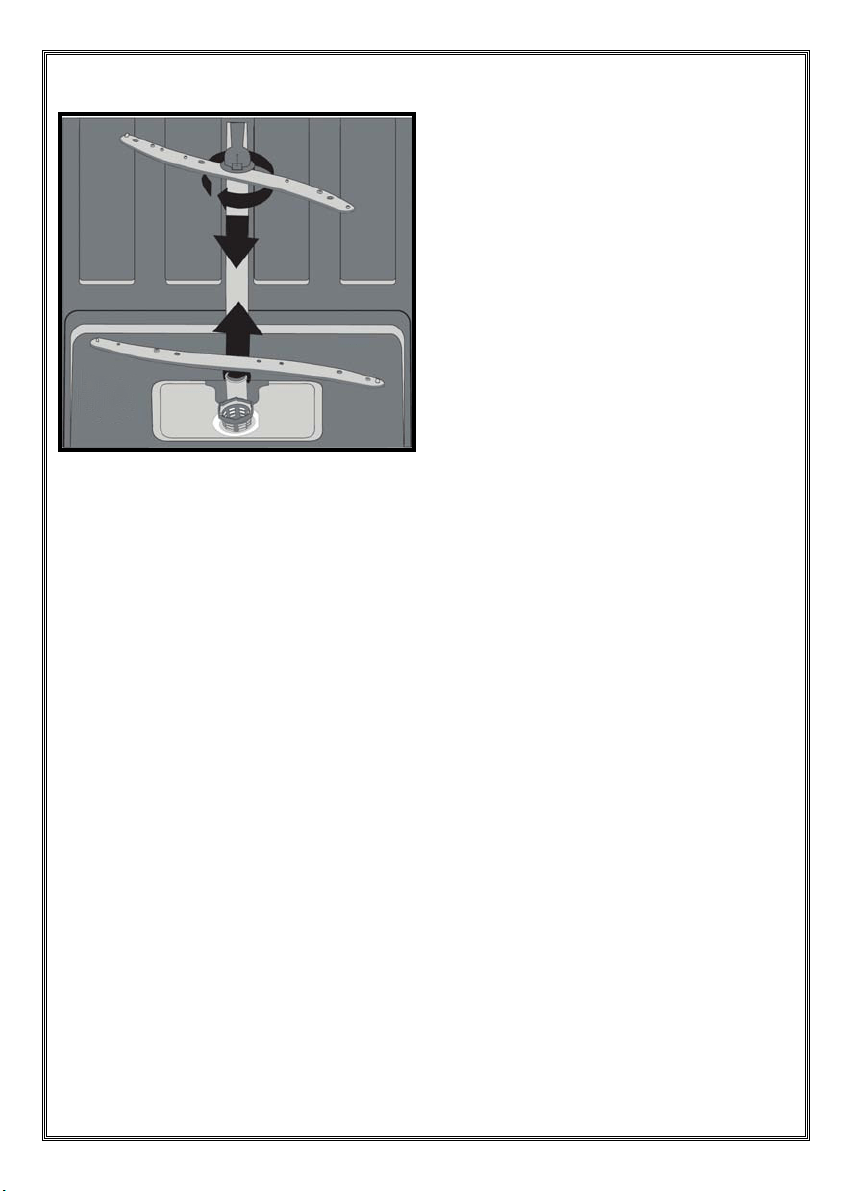
Spray arms
Check whether or not the holes for the upper and
lower spray arms a
re clogged. If there is any
clogging, remove the spray arms and clean them
under water.
You can remove the lower spray arm by pulling it
upwards, while the upper spray arm nut can be
removed by turning the nut to the left.
Be sure that the nut is perfectly tightened when
refitting the upper spray arm.
Hose filter
Water is prevented by the inlet hose filter so as to avoid any damage to your machine because of any
contamination (sand, clay, rust etc.) that might be occasionally carried in through the mains water
supply or the indoor plumbing, and to forestall such complaints as yellowing and formation of deposits
after washing. Check the filter and the hose from time to time and clean them if necessary. To clean
the filter, first turn off your tap and then remove the hose. After removing the filter from the hose, clean
it under the tap. Insert the cleaned filter back into its place inside the hose. Refit the hose.
25
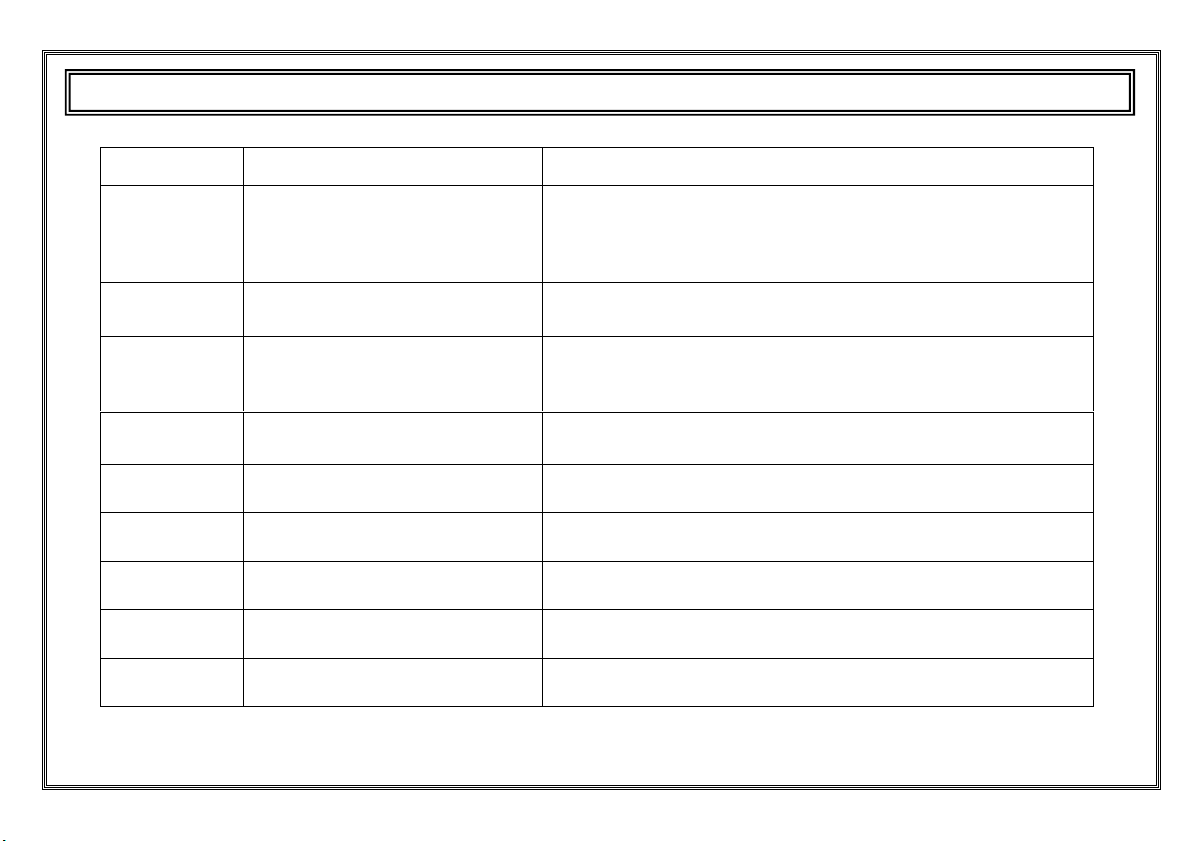
FAILURE CODES AND
WHAT TO DO IN CASE OF
FAILURE
26
ERROR CODE ERROR DESCRIPTION CONTROL
F5
Inadequate water supply
• Make sure the water input tap is totally open and that there is no water cut.
• Close the water input tap, separate the water input hose from the tap and clean the filter at
the connection end of the hose.
• Restart your machine, contact the service person if the error resumes.
F3
Error of continuous water input
• Close the tap.
• Contact the service person.
F2
The waste water in the machine cannot be
discharged.
• Water discharge hose is clogged.
• The filters of your machine might be clogged.
• Power off-on your machine and activate the program cancellation command.
• If the error continues, contact the service person.
F8
Heater error
Contact the service person.
F1
Alarm is active against water overflow
• Power off your machine and close the tap.
• Contact the service person.
FE
Faulty electronic card
Contact the service person.
F7
Overheating error (temperature in the machine is
too high)
Contact the service person.
F9
Divisor position error
Contact the service person.
F6
Faulty heater sensor
Contact the service person.

If one of program monitor lights is on and start/Pause light is on and off,
Your machine’s door is open, shut the door.
If the programme won’t start
• Check if the plug is connected.
• Check your indoor fuses.
• Be sure that the water inlet tap is turned on.
• Be sure that you have closed the machine door.
• Be sure that you switched off the machine by pressing the Power On / Off button.
• Be sure that the water inlet filter and the machine filters are not clogged.
If the control lamps won’t go out after a wash operation
Check if the Power
On/Off button is released yet.
If deter
gent residues are left in the detergent compartment
Detergent has been added when the detergent compartment was wet.
If water is left inside the machine at the end of the programme
• The water drain hose is clogged or twisted.
• The filters are clogged.
• The programme is not finished yet.
If the machine stops during a wash operation
• Power failure.
• Water inlet failure.
• Program can be on standby mode.
If shaking and hitting noises are heard during a wash operation
• Dishes placed incorrectly.
• Spray arm hitting the dishes.
If there are partial food wastes left on the dishes
• Dishes placed incorrectly into the machine, sprayed water did not reach related places.
• Basket overly loaded.
• Dishes leaning against one another.
• Very small amount of detergent added.
• An unsuitable, rather weak wash programme selected.
• Spray arm clogged with food wastes.
• Filters clogged.
• Filters incorrectly fitted.
• Water drain pump clogged.
If there are whitish stains on the dishes
• A very small amount of detergent is being used.
• Rinse aid dosage setting at a very low level.
27
Call an authorised person if the problem still persists after the controls or in case of any
malfunction not described above.
1. Whenever you will not be operating your machine
• Unplug the machine and then turn the water off.
• Leave the door slightly ajar in order to prevent the formation of unpleasant smells.
• Keep the machine interior clean.
2. Eliminating water droplets
• Wash the dishes with the intensive programme.
• Take all of the metal containers in the machine out.
• Do not add detergent.
3. If you properly place your dishes into the machine, you will be using it in the best way in terms
of energy consumption, washing and drying performance.
4. Clean all rough waste before you place dirty dishes to the machine.
5. Operate the machine after it is completely full.
6. Use pre-washing program only when necessary.
7. Observe program information and average consumption values table when selecting a
program.
8. Since the machine will reach high temperatures, it should not be mounted near refrigerator.
PRACTICAL AND USEFUL INFORMATION
28
9. If the appliance is located in a place where the risk of freezing exists, you must completely drain
the water that has remained in the machine. Turn off the water tap, disconnect the water inlet hose
from the tap and allow the interior water to drain
.
AUSTRALIAN CUSTOMERS
Our goods come with guarantees that cannot be excluded under the Australian Consumer Law. You are entitled to a replacement or
refund for a major failure and for compensation for any other reasonably foreseeable loss or damage. You are also entitled to have the
goods repaired or replaced if the goods fail to be of acceptable quality and the failure does not amount to a major failure.
NEW ZEALAND CUSTOMERS
Nothing herein contained shall be construed in any way as excluding or limiting your rights under the Consumer Guarantee Act 1993.
OUR WARRANTY
This product is also covered by the manufacturer's warranty set out in this document (Our Warranty).
Our Warranty is for a period of twenty four (24) months from the date of purchase and for dishwasher & refrigeration appliances will
have an additional thirty six (36) months after the first twenty four (24) months on the wash motor for dishwashers & on the Sealed
System (PARTS only Compressor & condenser etc) for refrigeration appliances. The labour cost to replace these parts is the
responsibility of the customer.
This is in addition to (and does not exclude, restrict or modify) any rights or remedies to which you may already be entitled under the
Australian consumer Law or the New Zealand Consumer Guarantee Act 1993 relating to this product.
Our Warranty (which is subject to the conditions below) covers rectification free of charge of any fault arising from defective materials
or components, or faulty workmanship. The product will be repaired or replaced at the option of Blanco, and all costs of installation,
removal, cartage, freight travelling expenses and insurance are to be paid by the customer.
Our Warranty is subject to the following conditions:
1. That the purchaser contact Blanco prior to any product repair.
2. That the purchaser carefully follows all instructions provided with the product and complies with all relevant electrical & plumbing
regulations in their State when installing the product.
3. That the purchaser carefully follows the instructions provided in the owner’s handbook relating to the proper use and care of the
product and does not use the product for any purpose other than the DOMESTIC use for which it has been designed. If the
appliance is used in commercial applications or for rental purposes, Our Warranty is limited to a warranty of Twelve (12) months
covering all parts with Three (3) months on any labour cost of service or repair.
SERVICE AREA
The provision of service under Our Warranty is limited by the boundary / territory area of the nearest service centre. Travelling cost
incurred for service outside this area is not covered by Our Warranty and service will incur commercial cost to be paid by the customer
regulated by the number of kilometres travelled beyond the service area. These costs will be disclosed to you for acceptance by you
prior to your claim being processed.
Microwave ovens must be returned to your nearest Authorised Service Centre for repair as they are a carry in serviceable appliance.
WHAT IS COVERED: By Our Warranty
During the warranty period, Blanco or its authorised Service Centre will at no extra charge, if your appliance is readily accessible without
the need of special equipment and subject to the terms and conditions of this warranty, repair or replace any parts which it considers
defective.
WHAT IS NOT COVERED: By Our Warranty
1. Products installed damaged or incomplete or not in compliance with the relevant electrical & plumbing regulations in their State.
2. Normal wear and tear e.g. cleaning, light globes, filters etc.
3. Failure resulting from power surges and electrical storms.
4. Insect or vermin infestation.
5. Unauthorised repairs or use of non genuine Blanco parts.
6. Any failure caused by the product not being used in accordance with the instruction and the installation manual provided with the
product.
7. Misuse or abuse, including failure to properly maintain or service.
8. The clearing of blockages in pumps and hoses.
9. Damage which occurs during delivery or installation.
10. Claims to product surface coating due to liquid or solid spill-overs, accidental damage or damage caused from cleaning products not
recommended by Blanco.
HOW TO CLAIM OUR WARRANTY
You will need to contact Blanco in Australia or New Zealand by using the contact details below.
IN AUSTRALIA IN NEW ZEALAND
Blanco is distributed by Shriro Australia Pty Ltd Blanco is distributed by Monaco Corporation
(Member of Shriro Australia Pty Ltd)
Locked Bag 5002, Kingsgrove, NSW, 2208 PO Box 4399, Shortland St, Auckland, 1140
Phone: 1300 795 572 Fax: 1800 686 413 Phone: 09 415 6000 Fax: 09 415 7060
Email: [email protected]m.au Email: [email protected]m.au
Web: http://www.blanco-australia.com/ Web: http://www.blanco-australia.com/
Note: Please complete the following details when you have unpacked the product and staple this card with the purchase
invoice or sales docket.
Model No………………………………………… Serial No………………………………………
Date of Purchase……………………………..… Retailer……………………………………….…
WBA2Y 9/2012
AUSTRALIAN & NEW ZEALAND PRODUCT WARRANTY
ST
ATEMENT OF STANDARD WARRANTY CONDITIONS