Owner's Manual
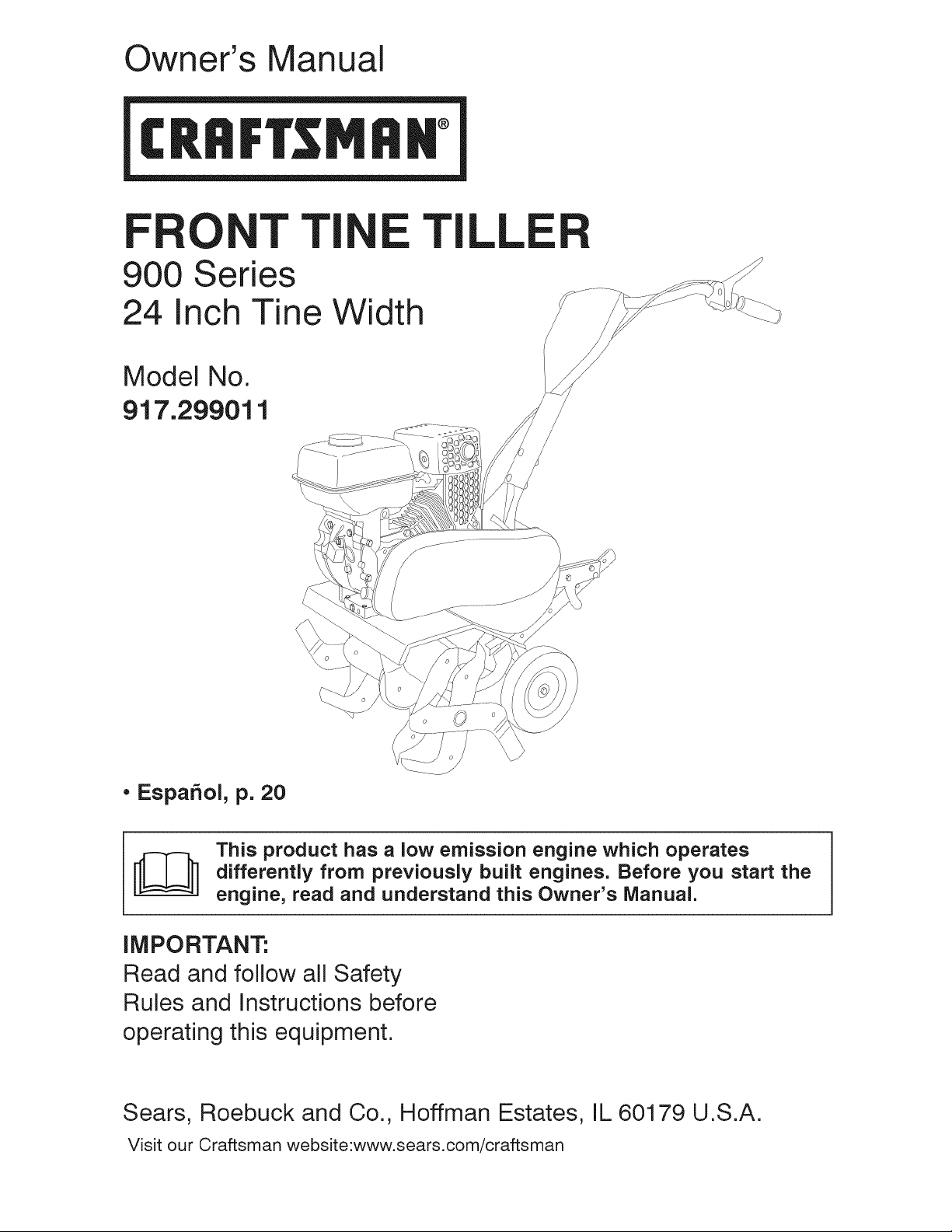
CRRFTSMRN°
F 0 T T TILLE
900 Series
24 inch Tine Width
Model No.
917.299011
• EspaSol, p. 20
This product has a low emission engine which operates
differently from previously built engines. Before you start the
engine, read and understand this Owner's Manual.
IMPORTANT:
Read and follow all Safety
Rules and Instructions before
operating this equipment.
Sears, Roebuck and Co., Hoffman Estates, IL 60179 U.S.A.
Visit our Craftsman website:www.sears.com/craftsman

Warranty................................................2
Safety Rules..........................................2
Product Specifications...........................4
Assembly/Pre-Operation.......................6
Operation...............................................7
MaintenanceSchedule........................12
Manintenance......................................12
Service and Adjustments.....................15
Storage................................................17
Troubleshooting...................................18
Illustrated Parts List.............................38
Sears Service........................Back Cover
LIMITED ONE YEAR WARRANTYON CRAFTSMANTILLER
For one (1)year from date of purchase,when this CraftsmanTiller is maintained,
lubricated, and tuned up accordingto the operating and maintenanceinstructionsin the
owner's manual, Sears will repairfree of charge any defect in material or workmanship.
This Warrantydoes not cover:
• Expendableitems which becomeworn during normal use, such as tines, spark plugs,
air cleaners and belts.
• Repairs necessary because of operator abuse or negligence,including bent crank-
shafts and the failure to maintain the equipmentaccordingto the instructionscon-
tained in the owner's manual.
• If this CraftsmanTiller is used for commercial or rental purposes,this Warranty ap-
pliesfor only thirty (30) days from the date of purchase.
Warranty service is available by returningthe craftsman power mowerto the nearest
sears service center/departmentin the united states. This warranty applies only while
this product is in use in the united states.
This Warrantygives you specific legal rights, and you may also have other rights which
vary from state to state.
SEARS, ROEBUCKAND CO., D/817WA,HOFFMAN ESTATES,IL 60179 U.S.A.
IMPORTANT:This cutting machine is capable of amputating handsand feet and throw-
ing objects. Failureto observethe following safety instructionscould result in serious
injury or death.
TRAINING
• Read the Owner's Manual carefully. Be
thoroughly familiar with the controls and
the proper use of the equipment. Know
how to stop the unit and disengage the
controls quickly.
• Never allow children to operate the
equipment. Never allow adults to op-
erate the equipment without proper
instruction.
• Keep the area of operation clear of all
persons, particularly small children, and
pets.
PREPARATION
• Thoroughly inspect the area where the
equipment is to be used and remove all
foreign objects.
• Disengage all clutches and shift into
neutral before starting the engine (mo-
tor).
• Do not operate the equipment without
wearing adequate outer garments. Wear
footwear that will improve footing on
slippery surfaces.
• Handle fuel with care; it is highly flam-
mable.
• Use an approved fuel container.
• Never add fuel to a running engine or
hot engine.
• Fill fue! tank outdoors with extreme
care. Never fill fuel tank indoors.
• Replace gasoline cap securely and
clean up spilled fuel before restarting.
2
• Use extension cords and receptacles
as specified by the manufacturer for all
units with electric drive motors or elec-
tric starting motors.
• Never attempt to make any adjustments
while the engine (motor) is running (ex-
cept where specifically recommended
by manufacturer).
OPERATION
• Do not put hands or feet near or under
rotating parts.
• Exercise extreme caution when operat-
ing on or crossing gravel drives, walks,
or roads. Stay alert for hidden hazards
or traffic. Do not carry passengers.
• After striking a foreign object, stop the
engine (motor), remove the wire from
the spark plug, thoroughly inspect the
tiller for any damage, and repair the
damage before restarting and operating
the tiller.
• Exercise caution to avoid slipping or fall-
ing.
• If the unit should start to vibrate ab-
normally, stop the engine (motor) and
check immediately for the cause. Vibra-
tion is generally a warning of trouble.
• Stop the engine (motor) when leaving
the operating position.
• Take all possible precautions when
leaving the machine unattended. Dis-
engage the tines, shift into neutral, and
stop the engine.
• Before cleaning, repairing, or inspecting,
shut off the engine and make certain all
moving parts have stopped. Disconnect
the spark plug wire, and keep the wire
away from the plug to prevent acci-
dental starting. Disconnect the cord on
electric motors.
• Do not run the engine indoors; exhaust
fumes are dangerous.
• Never operate the tiller without proper
guards, plates, or other safety protective
devices in place.
• Keep children and pets away.
• Do not overload the machine capacity
by attempting to till too deep at too fast
a rate.
• Never operate the machine at high
speeds on slippery surfaces. Look be-
hind and use care when backing.
• Never allow bystanders near the unit.
• Use only attachments and accessories
approved by the manufacturer of the
tiller.
• Never operate the tiller without good
visibility or light.
• Be careful when tilling in hard ground.
The tines may catch in the ground and
propel the tiller forward. If this occurs,
let go of the handlebars and do not
restrain the machine.
MAINTENANCE AND STORAGE
• Keep machine, attachments, and ac-
cessories in safe working condition.
• Check shear pins, engine mounting
bolts, and other bolts at frequent inter-
vals for proper tightness to be sure the
equipment is in safe working condition.
• Never store the machine with fuel in the
fuel tank inside a building where ignition
sources are present, such as hot water
and space heaters, clothes dryers, and
the like. Allow the engine to cool before
storing in any enclosure.
• Always refer to the operator's guide in-
structions for important details if the tiller
is to be stored for an extended period.
_Look for this symbol to point out
important safety precautions. It means
CAUTION!!! BECOME ALERT!!! YOUR
SAFETY IS INVOLVED.
&CAUTION: Always disconnect spark
plug wire and place wire where it cannot
contact spark plug in order to prevent acci-
dental starting when setting up, transport-
ing, adjusting or making repairs.
_WARNING: Engine exhaust, some of its
constituents, and certain vehicle compo-
nents contain or emit chemicals known to
the State of California to cause cancer and
birth defects or other reproductive harm.
3

PRODUCT SPECIFICATIONS
Gasoline
Capacity:
OiI(API-SG-SL):
(Capacity: 16 oz.)
Spark Plug :
(Gap: .030")
3 Qts
Unleaded Regular
SAE 30
(Above 32° F)
SAE 5w-30
(Below 32°F)
NGK-BPR6ES
TORCN-F6RTO
CONGRATULATIONS on your purchase
of a Sears Tiller. It has been designed,
engineered and manufactured to give you
the best possible dependability and per-
formance.
Should you experience any problems you
cannot easily remedy, please contact a
Sears or other qualified Service Center.
We have competent, well-trained techni-
cians and the proper tools to service or
repair this unit.
Please read and retain this manual. The
instructions will enable you to assemble
and maintain your tiller properly. Always
observe the "SAFETY RULES".
Your new tiller has been assembled at the
factory with exception of those parts left
unassembled for shipping purposes. To
ensure safe and proper operation of your
tiller all parts and hardware you assemble
must be tightened securely. Use the cor-
rect tools as necessary to insure proper
tightness.
CUSTOMER RESPONSIBILITIES
• Read and observe the safety rules.
• Follow a regular schedule in main-
taining, caring for and using your tiller.
• Follow the instructions under the "Main-
tenance" and "Storage" sections of this
Owner's Manual.
,4_WARNING: This unit is equipped with
an internal combustion engine and should
not be used on or near any unimproved
forest-covered, brush-covered or grass
covered land unless the engine's exhaust
system is equipped with a spark arrester
meeting applicable local or state laws (if
any). If a spark arrester is used, it should
be maintained in effective working order
by the operator.
In the state of California the above is
required by law (Section 4442 of the
California Public Resources Code). Other
states may have similar laws. Federal
laws apply on federal lands. A spark at-
rester for the muffler is available through
your nearest Sears service center (See
REPAIR PARTS section of this manual).
REPAIR PROTECTION
AGREEMENTS
Congratulations on making a smart pur-
chase. Your new Craftsman® product is
designed and manufactured for years of
dependable operation. But like all products,
it may require repair from time to time. That's
when having a Repair Protection Agreement
can save you money and aggravation.
Purchase a Repair Protection Agreement
now and protect yourseff from unexpected
hassle and expense.
Here's what's included in the Agreement:
• Expert service by our 12,000 profe-
sional repair specialists.
• Unlimited service and no charge for
parts and labor on all covered repairs.
• Product replacement if your covered
product can't be fixed.
• Discount of 10% from regular price of
service and service-related parts not
covered by the agreement; also, 10%
off regular price of preventive mainte-
nance check.
• Fast help by phone- phone support
from a Sears technician on products
requiring in-home repair, plus conve-
nient repair scheduling.
Once you purchase the Agreement, a
simple phone call is all that it takes for you
to schedule service. You can call anytime
day or night, or schedule a service ap-
pointment online.
Sears has over 12,000 professional repair
specialists, who have access to over 4.5
million quality parts and accessories.
That's the kind of professionalism you can
count on to help prolong the life of your
new purchase for years to come. Pur-
chase your Repair Protection Agreement
today!
Some limitations and exclusions apply.
For prices and additional information
call 1-800=827=6655.
SEARS INSTALLATION SERVICE
For Sears professional installation of home
appliances, garage door openers, water
heaters, and other major home items,
in the U.S.A. call 1=800=4-MY=HOME®
4
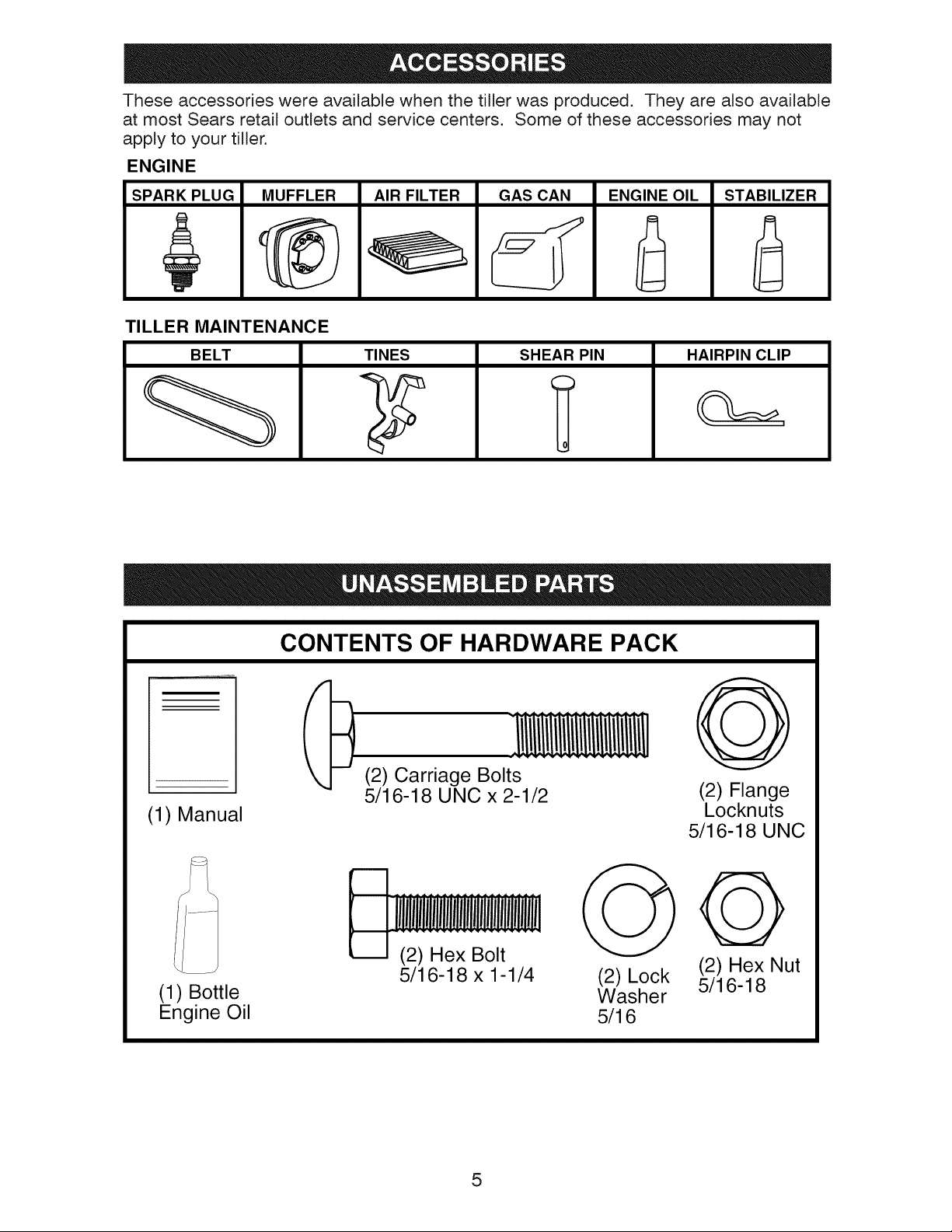
These accessories were available when the tiller was produced. They are also available
at most Sears retail outlets and service centers. Some of these accessories may not
apply to your tiller.
ENGINE
SPARK PLUG MUFFLER AIR FILTER GAS CAN ENGINE OIL STABILIZER
SHEAR PIN
O
TILLER MAINTENANCE
BELT TINES
i
HAIRPIN CLIP
(1) Manual
(1) Bottle
Engine Oil
CONTENTS OF HARDWARE PACK
(2) Carriage Bolts
5/16-18 UNC x 2-1/2
(2) Hex Bolt
5/16-18 x 1-1/4
(2) Flange
Locknuts
5/16-18 UNC
(2) Hex Nut
(2) Lock 5/16-18
Washer
5/16
5
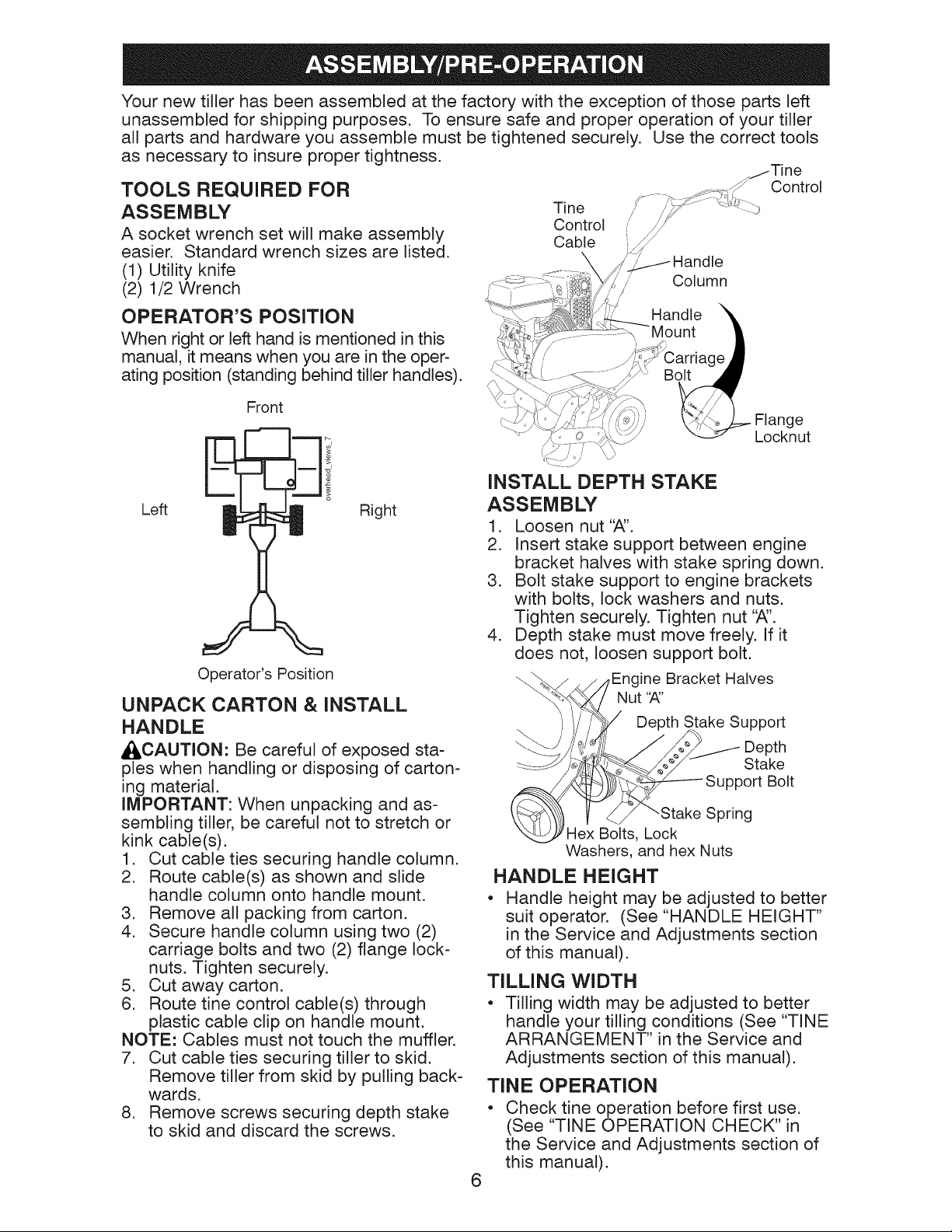
Your new tiller has been assembled at the factory with the exception of those parts left
unassembled for shipping purposes. To ensure safe and proper operation of your tiller
all parts and hardware you assemble must be tightened securely. Use the correct tools
as necessary to insure proper tightness.
TOOLS REQUIRED FOR
ASSEMBLY
A socket wrench set will make assembly
easier. Standard wrench sizes are listed.
(1) Utility knife
(2) 1/2 Wrench
OPERATOR'S POSITION
When right or left hand is mentioned in this
manual, it means when you are in the oper-
ating position (standing behind tiller handles).
Front
Left
Right
Operator's Position
UNPACK CARTON & INSTALL
HANDLE
_;:_CAUTION: Be careful of exposed sta-
ples when handling or disposing of carton-
ing material.
IMPORTANT: When unpacking and as-
sembling tiller, be careful not to stretch or
kink cable(s).
1. Cut cable ties securing handle column.
2. Route cable(s) as shown and slide
handle column onto handle mount.
3. Remove all packing from carton.
4. Secure handle column using two (2)
carriage bolts and two (2) flange lock-
nuts. Tighten securely.
5. Cut away carton.
6. Route tine control cable(s) through
plastic cable clip on handle mount.
NOTE: Cables must not touch the muffler.
7. Cut cable ties securing tiller to skid.
Remove tiller from skid by pulling back-
wards.
8. Remove screws securing depth stake
to skid and discard the screws.
6
Tine
Control
Cable
/ Column
/
Handle "N
INSTALL DEPTH STAKE
ASSEMBLY
1. Loosen nut'S'.
I
_..Flange
Locknut
2. Insert stake support between engine
bracket halves with stake spring down.
3. Bolt stake support to engine brackets
with bolts, lock washers and nuts.
Tighten securely. Tighten nut '_'.
4. Depth stake must move freely. If it
does not, loosen support bolt.
Engine Bracket Halves
Nut 'A"
Depth Stake Support
Depth
Stake
pport Bolt
Spring
Hex Bolts, Lock
Washers, and hex Nuts
HANDLE HEIGHT
• Handle height may be adjusted to better
suit operator. (See "HANDLE HEIGHT"
in the Service and Adjustments section
of this manual).
TILLING WIDTH
• Tilling width may be adjusted to better
handle your tilling conditions (See "TINE
ARRANGEMENT" in the Service and
Adjustments section of this manual).
TINE OPERATION
• Check tine operation before first use.
(See "TINE OPERATION CHECK" in
the Service and Adjustments section of
this manual).
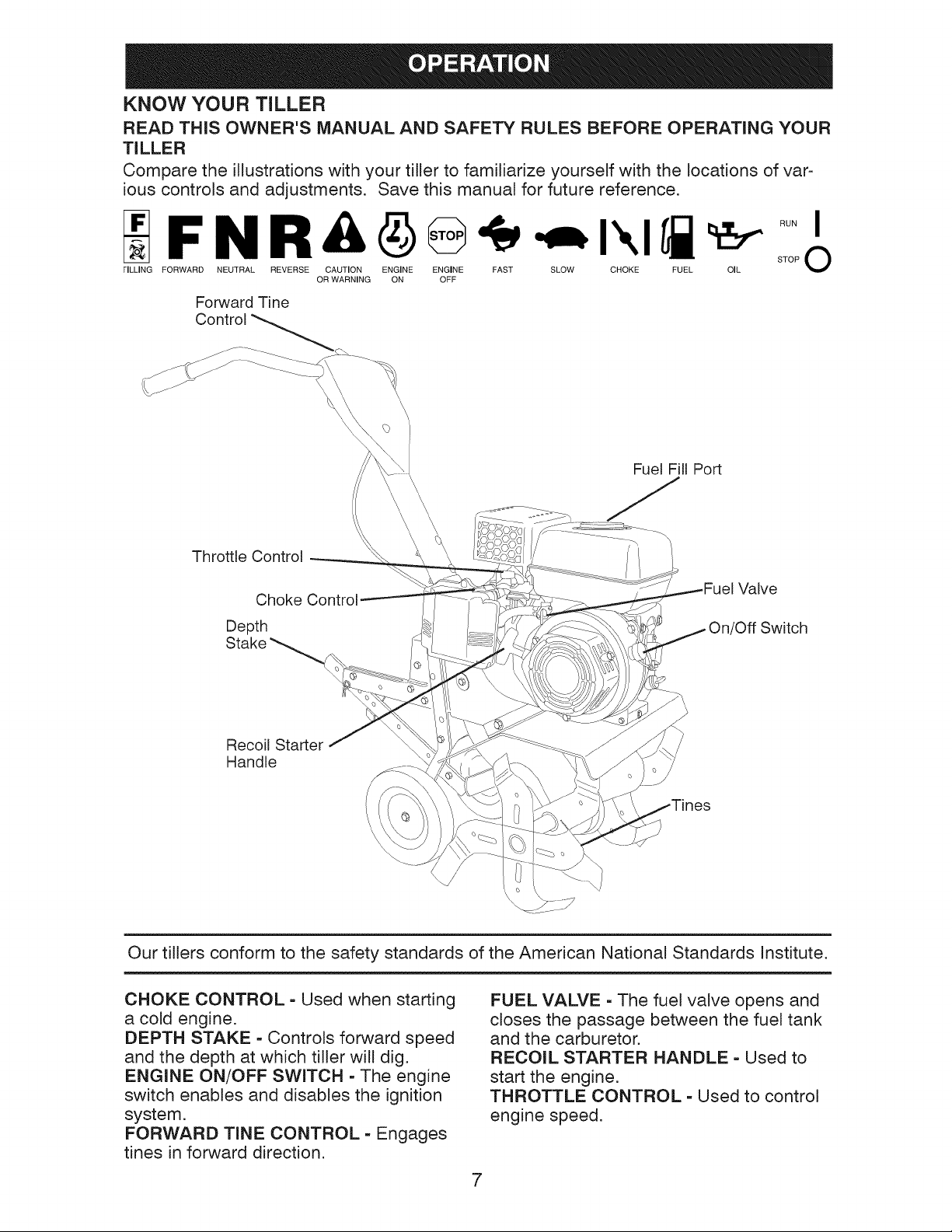
KNOW YOUR TILLER
READ THIS OWNER'S MANUAL AND SAFETY RULES BEFORE OPERATING YOUR
TILLER
Compare the illustrations with your tiller to familiarize yourself with the locations of var-
ious controls and adjustments. Save this manual for future reference.
FNRA ,
FILLING FORWARD NEUTRAL REVERSE CAUTION ENGINE ENGINE FAST SLOW CHOKE FUEL OIL STOP
OR WARNING ON OFF
Forward Tine
Control
Fuel Fill Port
Throttle Control
Choke Control
Depth
Stake
Valve
Recoil Starter
Handle
Our tillers conform to the safety standards of the American National Standards Institute.
CHOKE CONTROL - Used when starting
a cold engine.
DEPTH STAKE - Controls forward speed
and the depth at which tiller will dig.
ENGINE ON/OFF SWITCH - The engine
switch enables and disables the ignition
system.
FORWARD TINE CONTROL - Engages
tines in forward direction.
FUEL VALVE - The fuel valve opens and
closes the passage between the fuel tank
and the carburetor.
RECOIL STARTER HANDLE - Used to
start the engine.
THROTTLE CONTROL - Used to control
engine speed.
7
The operation of any tiller can result in foreign objects thrown into the eyes,
which can result in severe eye damage. Always wear safety glasses or eye
shields before starting your tiller and while tilling. We recommend standard
safety glasses or a wide vision safety mask worn over spectacles.
HOW TO USE YOUR TILLER
Know how to operate all controls before
adding fuel and oil or attempting to start
engine.
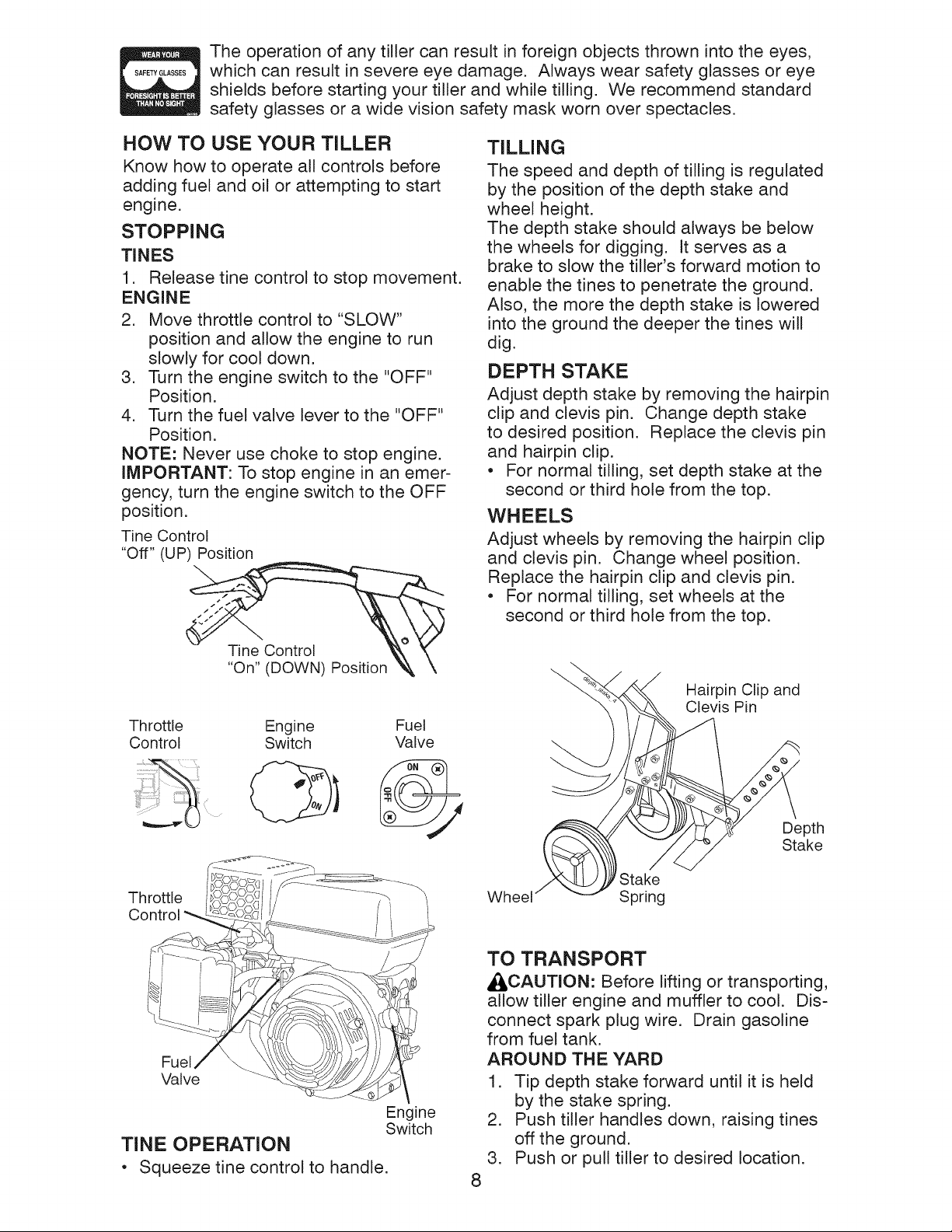
STOPPING
TINES
1. Release tine control to stop movement.
ENGINE
2. Move throttle control to "SLOW"
position and allow the engine to run
slowly for cool down.
3. Turn the engine switch to the "OFF"
Position.
4. Turn the fuel valve lever to the "OFF"
Position.
NOTE: Never use choke to stop engine.
IMPORTANT: To stop engine in an emer-
gency, turn the engine switch to the OFF
position.
Tine Control
"Off" (UP) Position
Throttle
Control
Engine Fuel
Switch Valve
TILLING
The speed and depth of tilling is regulated
by the position of the depth stake and
wheel height.
The depth stake should always be below
the wheels for digging. It serves as a
brake to slow the tiller's forward motion to
enable the tines to penetrate the ground.
Also, the more the depth stake is lowered
into the ground the deeper the tines will
dig.
DEPTH STAKE
Adjust depth stake by removing the hairpin
clip and clevis pin. Change depth stake
to desired position. Replace the clevis pin
and hairpin clip.
• For normal tilling, set depth stake at the
second or third hole from the top.
WHEELS
Adjust wheels by removing the hairpin clip
and clevis pin. Change wheel position.
Replace the hairpin clip and clevis pin.
• For normal tilling, set wheels at the
second or third hole from the top.
Hairpin Clip and
Clevis Pin
Depth
Stake
Throttle
Control
Fuel
Valve
Engine
Switch
TINE OPERATION
• Squeeze tine control to handle.
Wheel Spring
8
TO TRANSPORT
_I:_CAUTION: Before lifting or transporting,
allow tiller engine and muffler to cool. Dis-
connect spark plug wire. Drain gasoline
from fuel tank.
AROUND THE YARD
1. Tip depth stake forward until it is held
by the stake spring.
2. Push tiller handles down, raising tines
off the ground.
3. Push or pull tiller to desired location.
AROUND TOWN
1. Disconnect spark plug wire.
2. Drain fuel tank.
3. Transport in upright position to prevent
oil leakage.
BEFORE STARTING ENGINE
IMPORTANT: Be very careful not to allow
dirt to enter the engine when checking or
adding oil or fuel. Use clean oil and fuel
and store in approved, clean, covered
containers, use clean fill funnels.
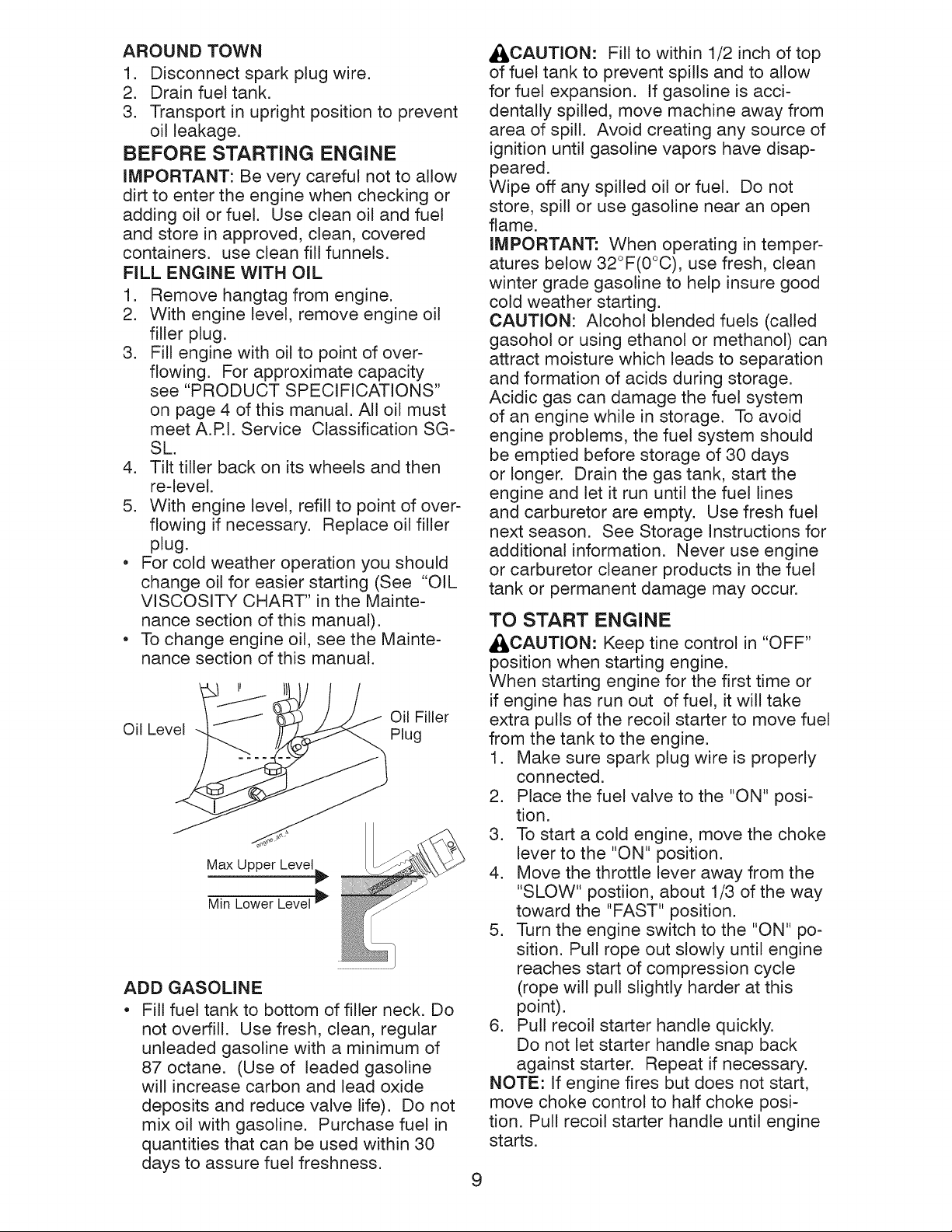
FILL ENGINE WITH OIL
1. Remove hangtag from engine.
2. With engine level, remove engine oil
filler plug.
3. Fill engine with oil to point of over-
flowing. For approximate capacity
see "PRODUCT SPECIFICATIONS"
on page 4 of this manual. All oil must
meet A.RI. Service Classification SG-
SL.
4. Tilt tiller back on its wheels and then
re-level.
5. With engine level, refill to point of over-
flowing if necessary. Replace oil filler
plug.
• For cold weather operation you should
change oil for easier starting (See "OIL
VISCOSITY CHART" in the Mainte-
nance section of this manual).
• To change engine oil, see the Mainte-
nance section of this manual.
Oil Filler
Oil Level Plug
Max Upper Level_
Min Lower Level _"
ADD GASOLINE
Fill fuel tank to bottom of filler neck. Do
not overfill. Use fresh, clean, regular
unleaded gasoline with a minimum of
87 octane. (Use of leaded gasoline
will increase carbon and lead oxide
deposits and reduce valve life). Do not
mix oil with gasoline. Purchase fuel in
quantities that can be used within 30
days to assure fuel freshness.
_f_CAUTION: Fill to within 1/2 inch of top
of fuel tank to prevent spills and to allow
for fuel expansion. If gasoline is acci-
dentally spilled, move machine away from
area of spill. Avoid creating any source of
ignition until gasoline vapors have disap-
peared.
Wipe off any spilled oil or fuel. Do not
store, spill or use gasoline near an open
flame.
IMPORTANT: When operating in temper-
atures below 32°F(0°C), use fresh, clean
winter grade gasoline to help insure good
cold weather starting.
CAUTION: Alcohol blended fuels (called
gasohol or using ethanol or methanol) can
attract moisture which leads to separation
and formation of acids during storage.
Acidic gas can damage the fuel system
of an engine while in storage. To avoid
engine problems, the fuel system should
be emptied before storage of 30 days
or longer. Drain the gas tank, start the
engine and let it run until the fuel lines
and carburetor are empty. Use fresh fuel
next season. See Storage Instructions for
additional information. Never use engine
or carburetor cleaner products in the fuel
tank or permanent damage may occur.
TO START ENGINE
_CAUTION: Keep tine control in "OFF"
position when starting engine.
When starting engine for the first time or
if engine has run out of fuel, it will take
extra pulls of the recoil starter to move fuel
from the tank to the engine.
1. Make sure spark plug wire is properly
connected.
2. Place the fuel valve to the "ON" posi-
tion.
3. To start a cold engine, move the choke
lever to the "ON" position.
4. Move the throttle lever away from the
"SLOW" postiion, about 1/3 of the way
toward the "FAST" position.
5. Turn the engine switch to the "ON" po-
sition. Pull rope out slowly until engine
reaches start of compression cycle
(rope will pull slightly harder at this
point).
6. Pull recoil starter handle quickly.
Do not let starter handle snap back
against starter. Repeat if necessary.
NOTE: If engine fires but does not start,
move choke control to half choke posi-
tion. Pull recoil starter handle until engine
starts.
9
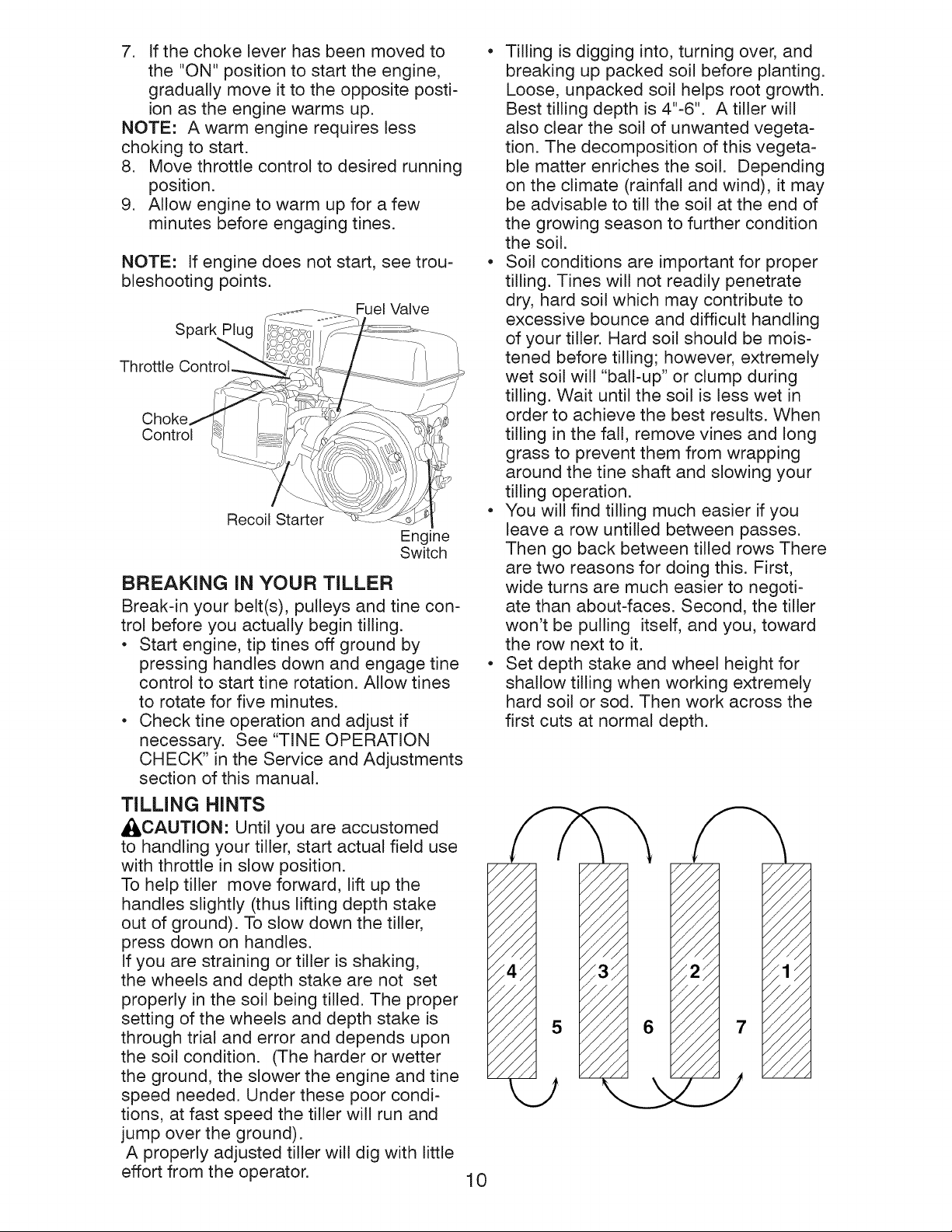
7. If the choke lever has been moved to
the "ON" position to start the engine,
gradually move it to the opposite posti-
ion as the engine warms up.
NOTE: A warm engine requires less
choking to start.
8. Move throttle control to desired running
position.
9. Allow engine to warm up for a few
minutes before engaging tines.
NOTE: If engine does not start, see trou-
bleshooting points.
Fuel Valve
Spark
Throttle
Choke
Control
Recoil Starter
Engine
Switch
BREAKING IN YOUR TILLER
Break-in your belt(s), pulleys and tine con-
trol before you actually begin tilling.
• Start engine, tip tines off ground by
pressing handles down and engage tine
control to start tine rotation. Allow tines
to rotate for five minutes.
• Check tine operation and adjust if
necessary. See "TINE OPERATION
CHECK" in the Service and Adjustments
section of this manual.
TILLING HINTS
_I_,CAUTION: Until you are accustomed
to handling your tiller, start actual field use
with throttle in slow position.
To help tiller move forward, lift up the
handles slightly (thus lifting depth stake
out of ground). To slow down the tiller,
press down on handles.
If you are straining or tiller is shaking,
the wheels and depth stake are not set
properly in the soil being tilled. The proper
setting of the wheels and depth stake is
through trial and error and depends upon
the soil condition. (The harder or wetter
the ground, the slower the engine and tine
speed needed. Under these poor condi-
tions, at fast speed the tiller will run and
jump over the ground).
A properly adjusted tiller will dig with little
effort from the operator.
10
• Tilling is digging into, turning over, and
breaking up packed soil before planting.
Loose, unpacked soil helps root growth.
Best tilling depth is 4"-6". A tiller will
also clear the soil of unwanted vegeta-
tion. The decomposition of this vegeta-
ble matter enriches the soil. Depending
on the climate (rainfall and wind), it may
be advisable to till the soil at the end of
the growing season to further condition
the soil.
• Soil conditions are important for proper
tilling. Tines will not readily penetrate
dry, hard soil which may contribute to
excessive bounce and difficult handling
of your tiller. Hard soil should be mois-
tened before tilling; however, extremely
wet soil will "ball-up" or clump during
tilling. Wait until the soil is less wet in
order to achieve the best results. When
tilling in the fall, remove vines and long
grass to prevent them from wrapping
around the tine shaft and slowing your
tilling operation.
• You will find tilling much easier if you
leave a row untilled between passes.
Then go back between tilled rows There
are two reasons for doing this. First,
wide turns are much easier to negoti-
ate than about-faces. Second, the tiller
won't be pulling itself, and you, toward
the row next to it.
• Set depth stake and wheel height for
shallow tilling when working extremely
hard soil or sod. Then work across the
first cuts at normal depth.
//
//
//i
//
//
//
7
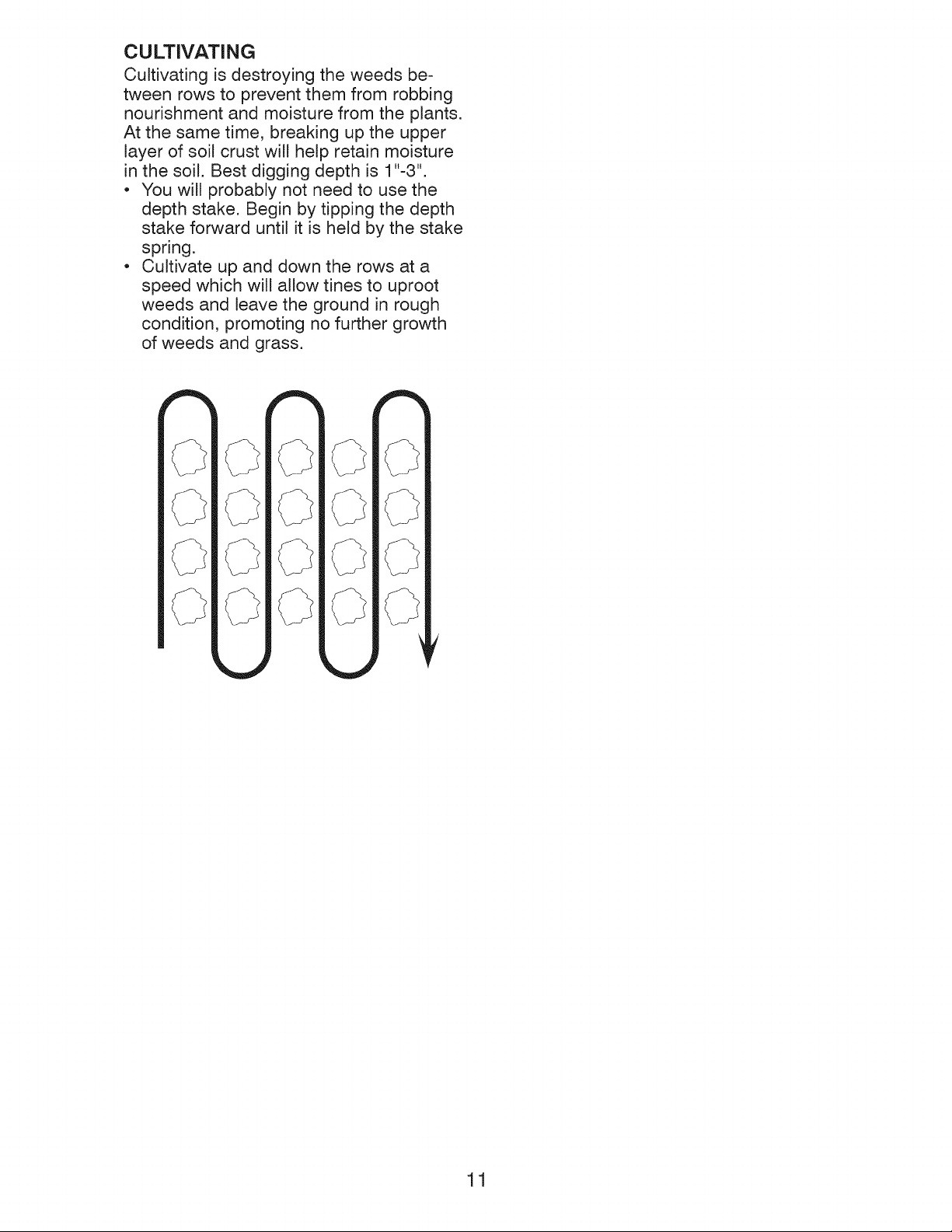
CULTiVATiNG
Cultivating is destroying the weeds be-
tween rows to prevent them from robbing
nourishment and moisture from the plants.
At the same time, breaking up the upper
layer of soil crust will help retain moisture
in the soil. Best digging depth is 1"-3".
• You will probably not need to use the
depth stake. Begin by tipping the depth
stake forward until it is held by the stake
spring.
• Cultivate up and down the rows at a
speed which will allow tines to uproot
weeds and leave the ground in rough
condition, promoting no further growth
of weeds and grass.
\ J
\ J
\ y
\ J
\ J
\ J
11
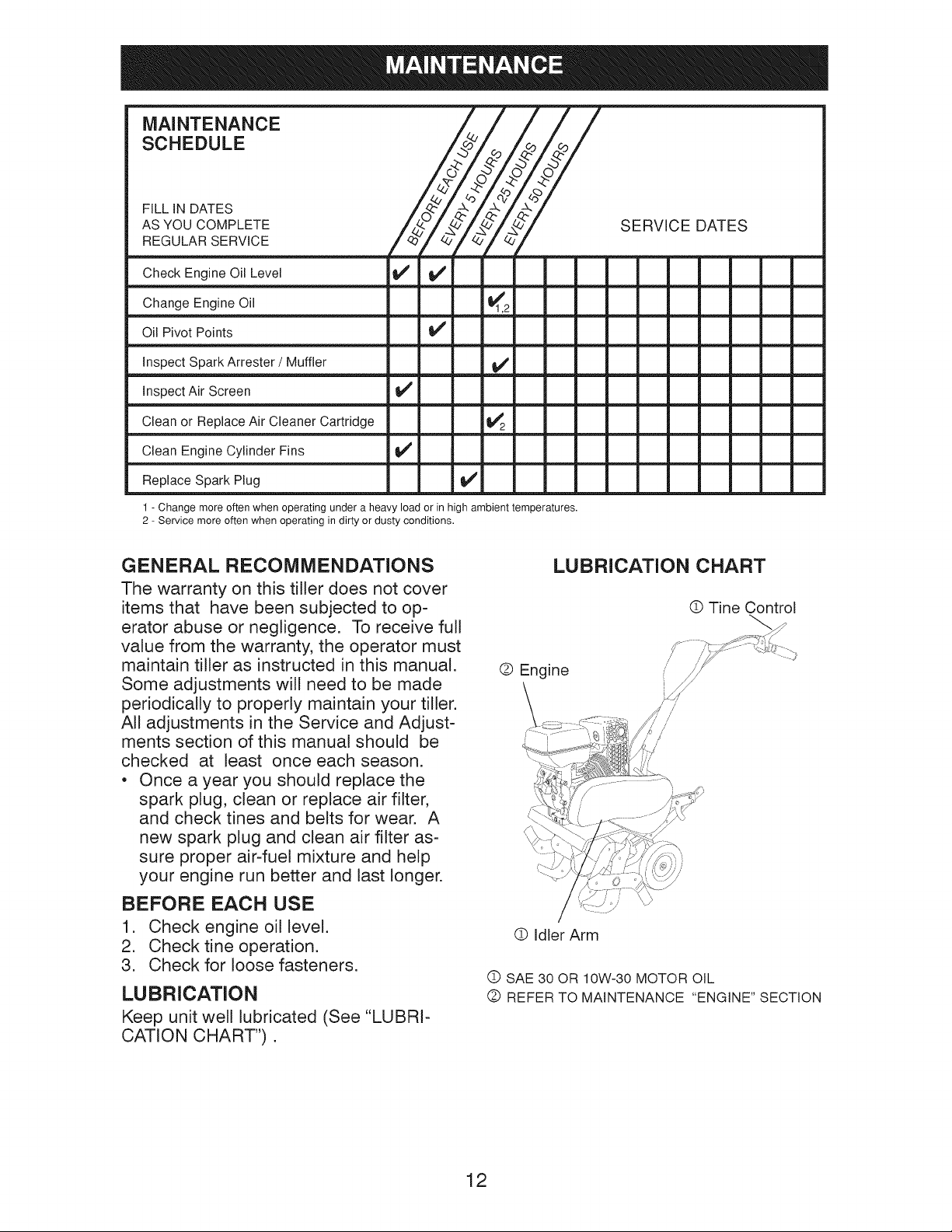
MAINTENANCE / / / / /
REGULAR SERVICE _ _'_'_'_ _'_'_#_'/ M M M
Check Engine 0il Level _
Change Engine Oil _1,2
Oil Pivot Points V _'
Inspect Spark Arrester / Muffler
Inspect Air Screen _/
Clean or Replace Air Cleaner Cartridge _2
Clean Engine Cylinder Fins
Replace Spark Plug
1 - Change more often when operating under a heavy load or in high ambient temperatures.
2 - Service more often when operating in dirty or dusty conditions.
SERVICE DATES
GENERAL RECOMMENDATIONS
The warranty on this tiller does not cover
items that have been subjected to op-
erator abuse or negligence. To receive full
value from the warranty, the operator must
maintain tiller as instructed in this manual.
Some adjustments will need to be made
periodically to properly maintain your tiller.
All adjustments in the Service and Adjust-
ments section of this manual should be
checked at least once each season.
• Once a year you should replace the
spark plug, clean or replace air filter,
and check tines and belts for wear. A
new spark plug and clean air filter as-
sure proper air-fuel mixture and help
your engine run better and last longer.
BEFORE EACH USE
1. Check engine oil level.
2. Check tine operation.
3. Check for loose fasteners.
LUBRICATION
Keep unit well lubricated (See "LUBRI-
CATION CHART").
LUBRICATION CHART
O Tine Control
Q Engine
O Idler Arm
O SAE 30 OR 10W-30 MOTOR OIL
(_) REFER TO MAINTENANCE "ENGINE" SECTION
12
Al:_CAUTION:Disconnect spark plug wire
before performing any maintenance to
prevent accidental starting of engine.
Prevent fires! Keep the engine free of
grass, leaves, spilled oil, or fuel. Remove
fuel from tank before tipping unit for main-
tenance. Clean muffler area of all grass,
dirt, and debris.
Do not touch hot muffler or cylinder fins as
contact may cause burns.
ENGINE
LUBRICATION
Use only high quality detergent oil rated
with API service classification SG-SL
Select the oil's SAE viscosity grade ac-
cording to your expected temperature.
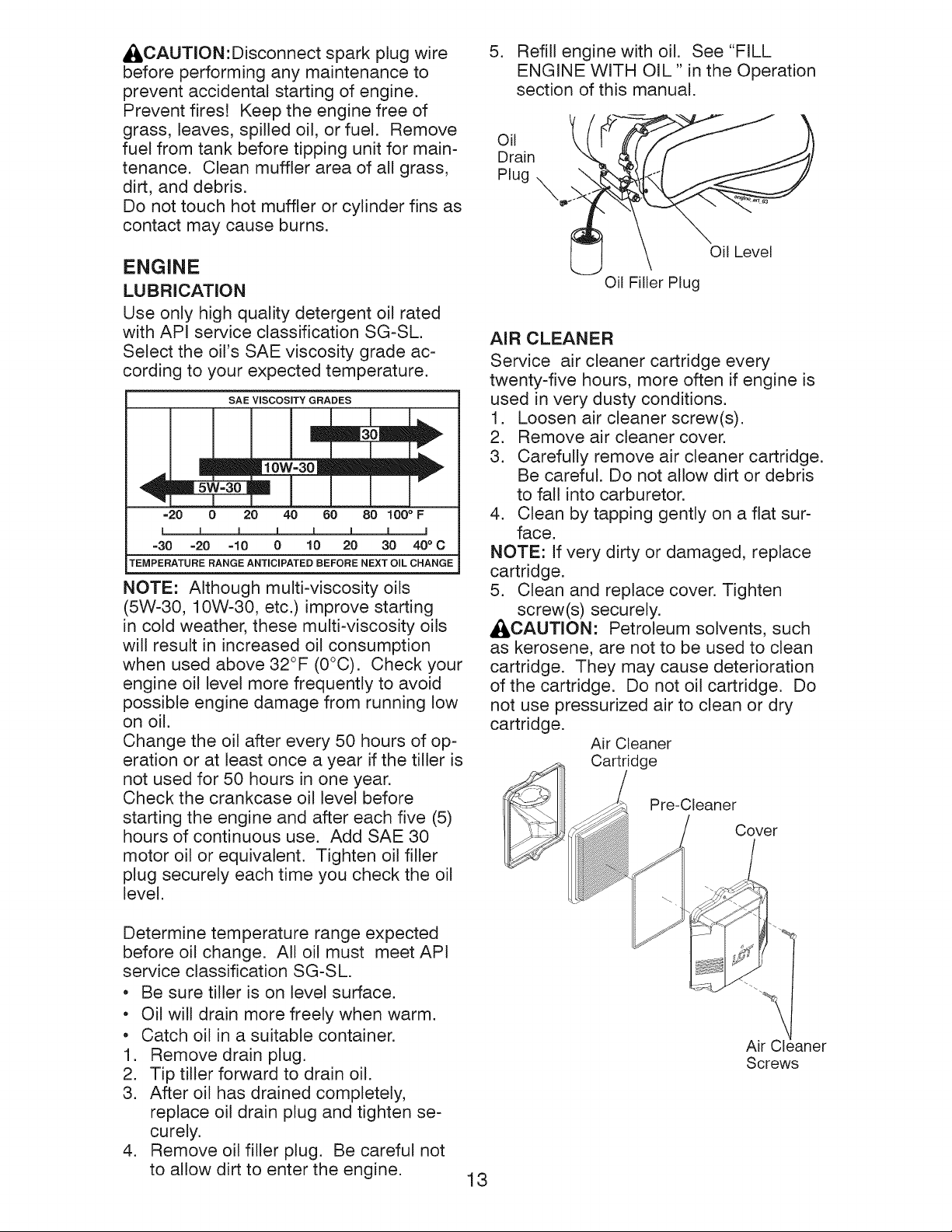
SAE VISCOSITY GRADES
m w-3o m i
=20 0 20 40 60 80 100°F
=30 =20 =10 0 10 20 30 40 ° C
TEMPERATURE RANGE ANTICIPATED BEFORE NEXT OIL CHANGE
NOTE: Although multi-viscosity oils
(5W-30, 10W-30, etc.) improve starting
in cold weather, these multi-viscosity oils
will result in increased oil consumption
when used above 32°F (0°C). Check your
engine oil level more frequently to avoid
possible engine damage from running low
on oil.
Change the oil after every 50 hours of op-
eration or at least once a year if the tiller is
not used for 50 hours in one year,
Check the crankcase oil level before
starting the engine and after each five (5)
hours of continuous use. Add SAE 30
motor oil or equivalent. Tighten oil filler
plug securely each time you check the oil
level.
5. Refill engine with oil. See "FILL
ENGINE WITH OIL" in the Operation
section of this manual.
Oil
Drain
Plug
Oil Level
Oil Filler Plug
AIR CLEANER
Service air cleaner cartridge every
twenty-five hours, more often if engine is
used in very dusty conditions.
1. Loosen air cleaner screw(s).
2. Remove air cleaner cover.
3. Carefully remove air cleaner cartridge.
Be careful. Do not allow dirt or debris
to fall into carburetor.
4. Clean by tapping gently on a flat sur-
face.
NOTE: If very dirty or damaged, replace
cartridge.
5. Clean and replace cover. Tighten
screw(s) securely.
,ACAUTION: Petroleum solvents, such
as kerosene, are not to be used to clean
cartridge. They may cause deterioration
of the cartridge. Do not oil cartridge. Do
not use pressurized air to clean or dry
cartridge.
Air Cleaner
Cartridge
Pre-Cleaner
Cover
Determine temperature range expected
before oil change. All oil must meet API
service classification SG-SL.
• Be sure tiller is on level surface.
• Oil will drain more freely when warm.
• Catch oil in a suitable container.
1. Remove drain plug.
2. Tip tiller forward to drain oil.
3. After oil has drained completely,
replace oil drain plug and tighten se-
curely.
4. Remove oil filler plug. Be careful not
to allow dirt to enter the engine.
13
Air ner
Screws
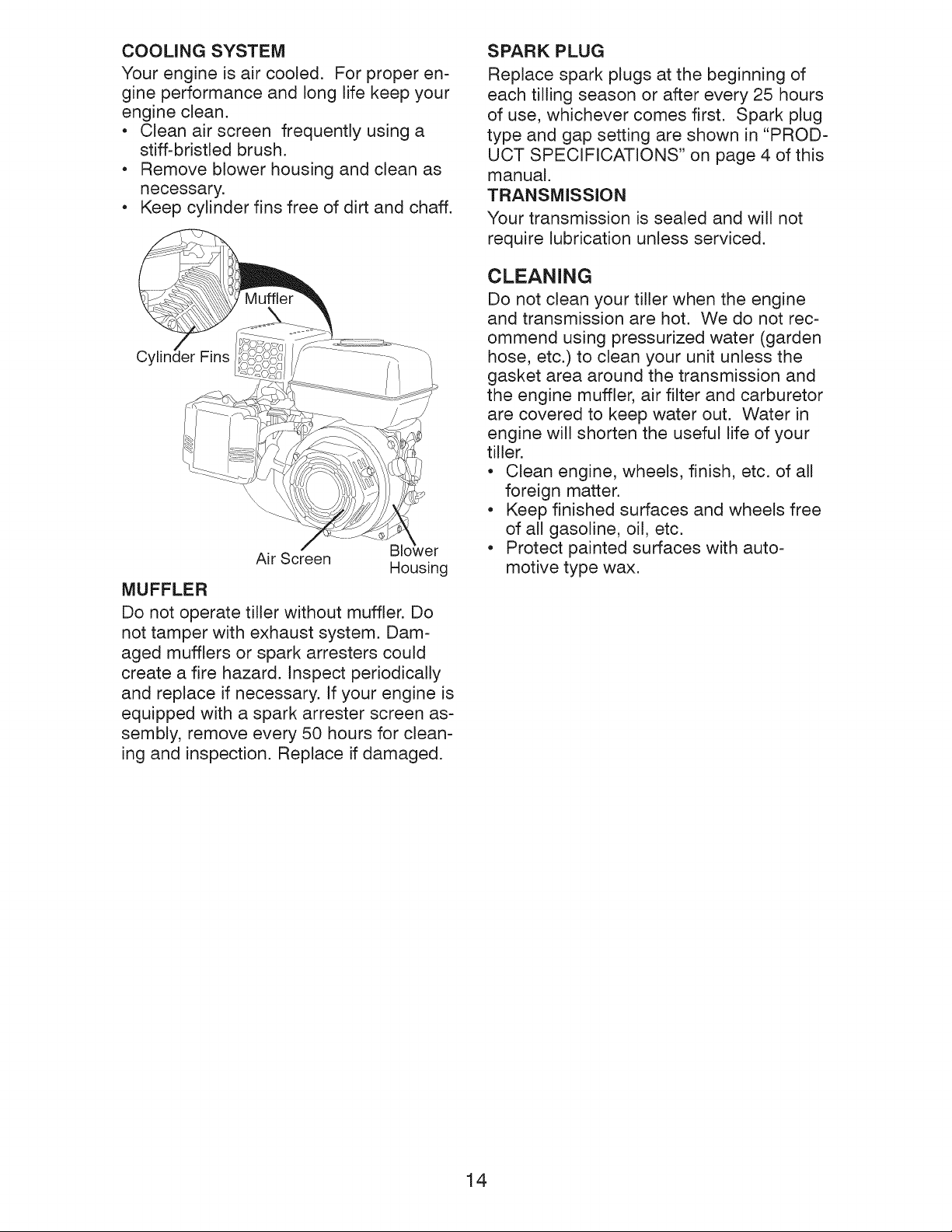
COOLING SYSTEM
Your engine is air cooled. For proper en-
gine performance and long life keep your
engine clean.
• Clean air screen frequently using a
stiff-bristled brush.
• Remove blower housing and clean as
necessary.
• Keep cylinder fins free of dirt and chaff.
Air Screen BIo_ver
Housing
MUFFLER
Do not operate tiller without muffler. Do
not tamper with exhaust system. Dam-
aged mufflers or spark arresters could
create a fire hazard. Inspect periodically
and replace if necessary. If your engine is
equipped with a spark arrester screen as-
sembly, remove every 50 hours for clean-
ing and inspection. Replace if damaged.
SPARK PLUG
Replace spark plugs at the beginning of
each tilling season or after every 25 hours
of use, whichever comes first. Spark plug
type and gap setting are shown in "PROD-
UCT SPECIFICATIONS" on page 4 of this
manual.
TRANSMISSION
Your transmission is sealed and will not
require lubrication unless serviced.
CLEANING
Do not clean your tiller when the engine
and transmission are hot. We do not rec-
ommend using pressurized water (garden
hose, etc.) to clean your unit unless the
gasket area around the transmission and
the engine muffler, air filter and carburetor
are covered to keep water out. Water in
engine will shorten the useful life of your
tiller.
• Clean engine, wheels, finish, etc. of all
foreign matter.
• Keep finished surfaces and wheels free
of all gasoline, oil, etc.
• Protect painted surfaces with auto-
motive type wax.
14
_CAUTION: Disconnect spark plug wire
from spark plug and place wire where it
cannot come into contact with plug.
TILLER
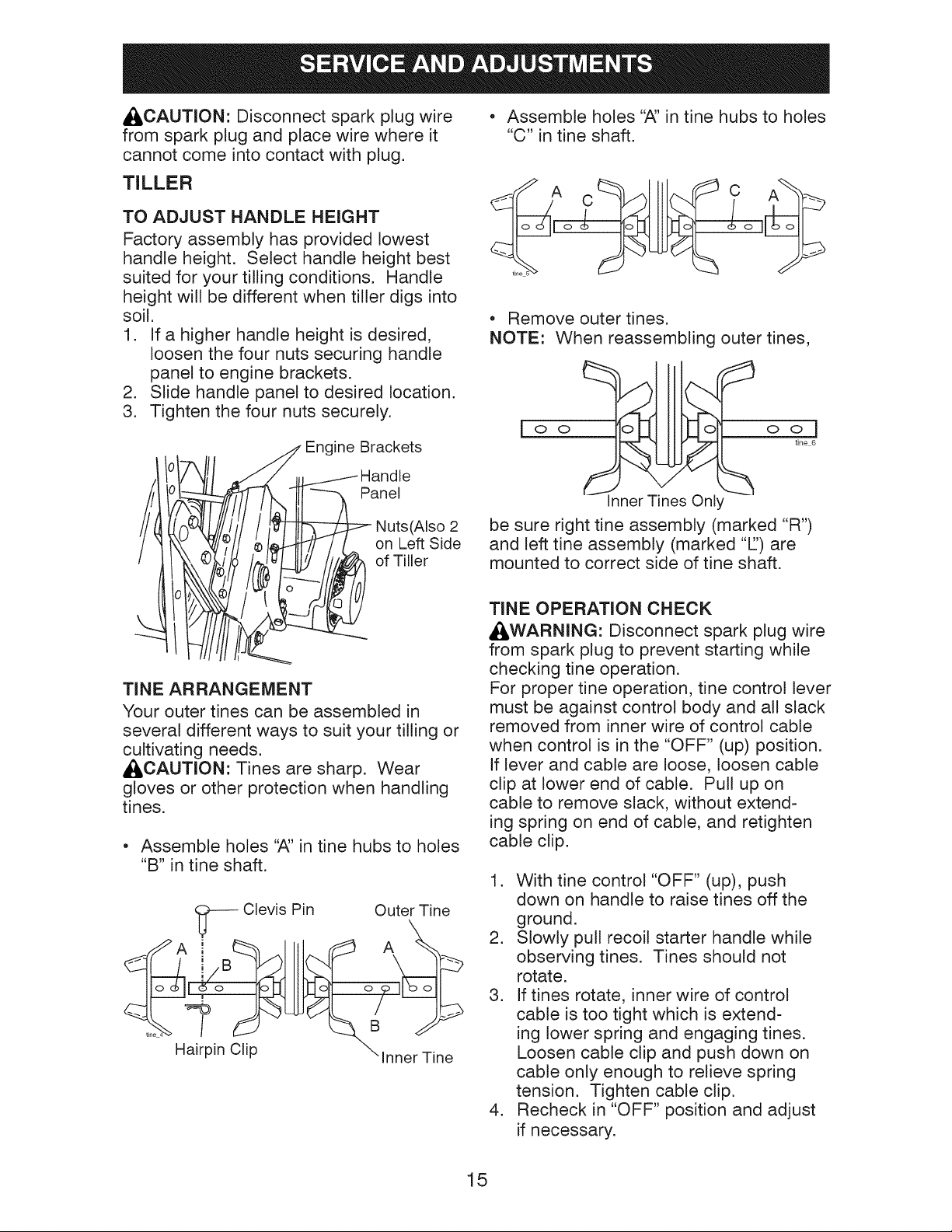
TO ADJUST HANDLE HEIGHT
Factory assembly has provided lowest
handle height. Select handle height best
suited for your tilling conditions. Handle
height will be different when tiller digs into
soil.
1. If a higher handle height is desired,
loosen the four nuts securing handle
panel to engine brackets.
2. Slide handle panel to desired location.
3. Tighten the four nuts securely.
L.
Engine Brackets
_ Panel
e
__ of Tiller
TINE ARRANGEMENT
Your outer tines can be assembled in
several different ways to suit your tilling or
cultivating needs,
_CAUTION: Tines are sharp, Wear
gloves or other protection when handling
tines.
• Assemble holes '_' in tine hubs to holes
"B" in tine shaft.
-- Clevis Pin Outer Tine
J A _ A _.
o
_%i__l inCIi_]-JJ-r_airpinClip "_lnn_
• Assemble holes '_' in tine hubs to holes
"C" in tine shaft.
-Ac CA-.
Io® o ®o I
• Remove outer tines.
NOTE: When reassembling outer tines,
9
OO
Inner Tines Only
be sure right tine assembly (marked "R")
and left tine assembly (marked '%) are
mounted to correct side of tine shaft.
ooj
tine6
TINE OPERATION CHECK
_WARNING: Disconnect spark plug wire
from spark plug to prevent starting while
checking tine operation.
For proper tine operation, tine control lever
must be against control body and all slack
removed from inner wire of control cable
when control is in the "OFF" (up) position.
If lever and cable are loose, loosen cable
clip at lower end of cable. Pull up on
cable to remove slack, without extend-
ing spring on end of cable, and retighten
cable clip.
1. With tine control "OFF" (up), push
down on handle to raise tines off the
ground.
2. Slowly pull recoil starter handle while
observing tines. Tines should not
rotate.
3. If tines rotate, inner wire of control
cable is too tight which is extend-
ing lower spring and engaging tines.
Loosen cable clip and push down on
cable only enough to relieve spring
tension. Tighten cable clip.
4. Recheck in "OFF" position and adjust
if necessary.
15
5. With tine control "ON" (held downto
handle) push down on handle to raise
tines off the ground.
6. Slowlypull recoil starter handle while
observingtines. Tines should rotate
forward.
7. Iftines do not rotate, inner wire of con-
trol cable is too loose. Loosen cable
clip and pull cable up to remove slack
and retightenclip.
8. Recheckin "ON" position and adjust if
necessary.
NOTE: If "ON" position check required
adjustment,recheck "OFF" position ad-
justment to insuretines do not rotatewhen
control is "OFF" (up).
Tine Control "OFF" Position
y
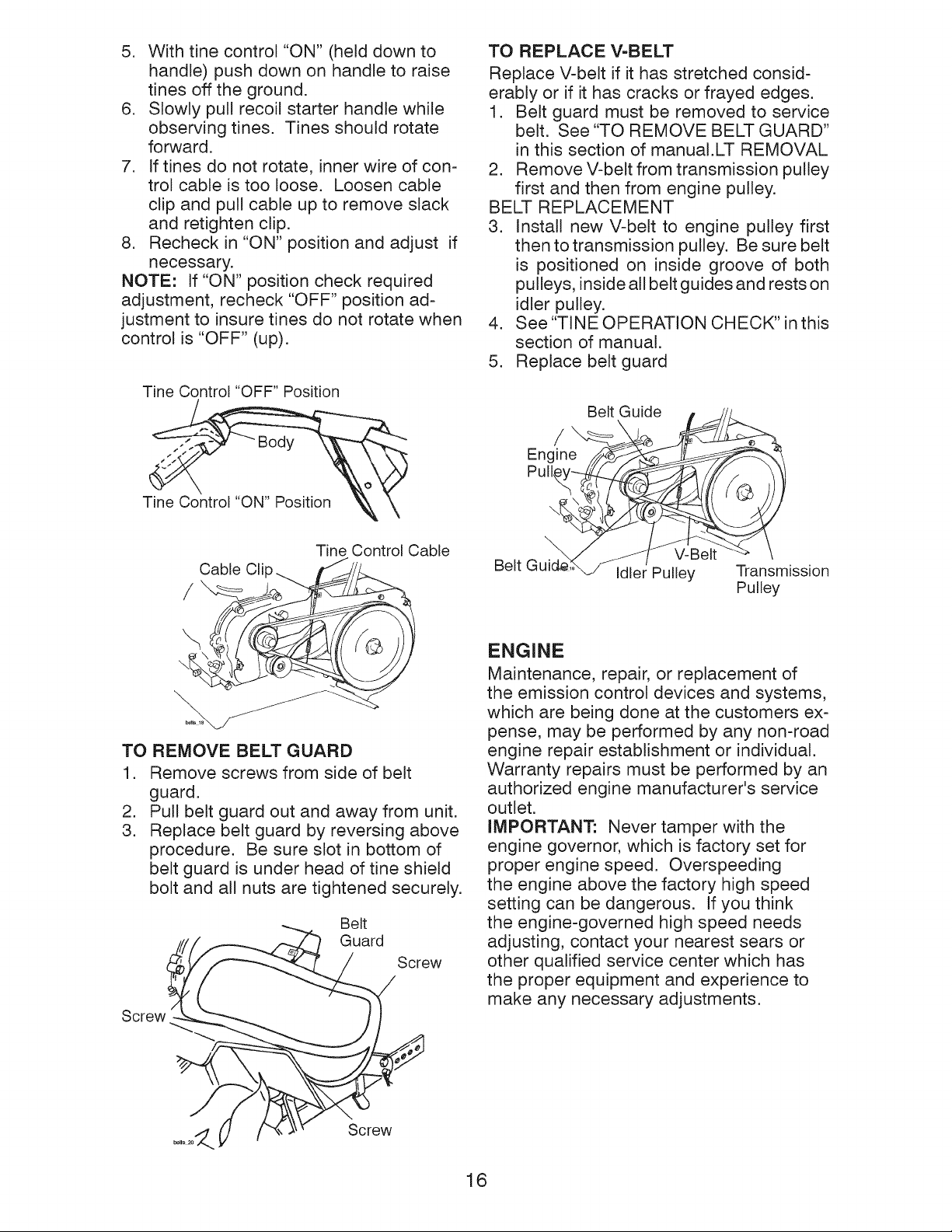
TO REPLACE V-BELT
Replace V-belt if it has stretched consid-
erably or if it has cracks or frayed edges.
1. Belt guard must be removed to service
belt. See "TO REMOVE BELT GUARD"
in this section of manuaI.LT REMOVAL
2. Remove V-belt from transmission pulley
first and then from engine pulley.
BELT REPLACEMENT
3. Install new V-belt to engine pulley first
then to transmission pulley. Be sure belt
is positioned on inside groove of both
pulleys, inside all belt guides and rests on
idler pulley.
4. See "TINE OPERATION CHECK" in this
section of manual.
5. Replace belt guard
Belt Guide
/
Engine
Tine Control "ON" Position
Cable
Tine Control Cable
TO REMOVE BELT GUARD
1. Remove screws from side of belt
guard.
2. Pull belt guard out and away from unit.
3. Replace belt guard by reversing above
procedure. Be sure slot in bottom of
belt guard is under head of tine shield
bolt and all nuts are tightened securely.
Belt
Guard
Screw
Screw
V-Belt
Belt Idler Pulley Transmission
Pulley
ENGINE
Maintenance, repair, or replacement of
the emission control devices and systems,
which are being done at the customers ex-
pense, may be performed by any non-road
engine repair establishment or individual.
Warranty repairs must be performed by an
authorized engine manufacturer's service
outlet.
IMPORTANT: Never tamper with the
engine governor, which is factory set for
proper engine speed. Overspeeding
the engine above the factory high speed
setting can be dangerous. If you think
the engine-governed high speed needs
adjusting, contact your nearest sears or
other qualified service center which has
the proper equipment and experience to
make any necessary adjustments.
Screw
16
Immediately prepare your tiller for storage
at the end of the season or if the unit will
not be used for 30 days or more.
_Waming: Never store the tiller with gas-
oline in the tank inside a building where
fumes may reach an open flame or spark.
Allow the engine to cool before storing in
any enclosure.
TILLER
1. Clean entire tiller (See "CLEANING" in
the Maintenance section of this man-
ual).
2. Inspect and replace belts, if necessary
(See belt replacement instructions in
the Service and Adjustments section of
this manual).
3. Lubricate as shown in the Maintenance
section of this manual.
4. Be sure that all nuts, bolts and screws
are securely fastened. Inspect moving
parts for damage, breakage and wear.
Replace if necessary.
5. Touch up all rusted or chipped paint
surfaces; sand lightly before painting.
ENGINE
FUEL SYSTEM
IMPORTANT: It is important to prevent
gum deposits from forming in essential
fuel system parts such as the carburetor,
fuel filter, fuel hose, or tank during stor-
age. Also, alcohol blended fuels (called
gasohol or using ethanol or methanol) can
attract moisture which leads to separation
and formation of acids during storage.
Acidic gas can damage the fuel system of
an engine while in storage.
, Empty the fuel tank by starting the en-
gine and letting it run until the fuel lines
and carburetor are empty.
, Never use engine or carburetor cleaner
products in the fuel tank or permanent
damage may occur.
, Use fresh fuel next season.
NOTE: Fuel stabilizer is an acceptable
alternative in minimizing the formation of
fuel gum deposits during storage. Add
stabilizer to gasoline in fuel tank or stor-
age container. Always follow the mix ratio
found on stabilizer container. Run engine
at least 10 minutes after adding stabilizer
to allow the stabilizer to reach the carbu-
retor. Do not empty the gas tank and
carburetor if using fuel stabilizer.
ENGINE OIL
Drain oil (with engine warm) and replace
with clean oil. (See "ENGINE" in the
Maintenance section of this manual).
CYLINDER
1. Remove spark plug.
2. Pour 1 ounce (29 ml) of oil through
spark plug hole into cylinder.
3. Pull starter handle slowly several times
to distribute oil.
4. Replace with new spark plug.
OTHER
, Do not store gasoline from one season
to another.
, Replace your gasoline can if your can
starts to rust. Rust and/or dirt in your
gasoline will cause problems.
, If possible, store your unit indoors and
cover it to give protection from dust and
dirt.
, Cover your unit with a suitable protec-
tive cover that does not retain moisture.
Do not use plastic. Plastic cannot
breathe which allows condensation to
form and will cause your unit to rust.
IMPORTANT: Never cover tiller while en-
gine and exhaust areas are still warm.
17
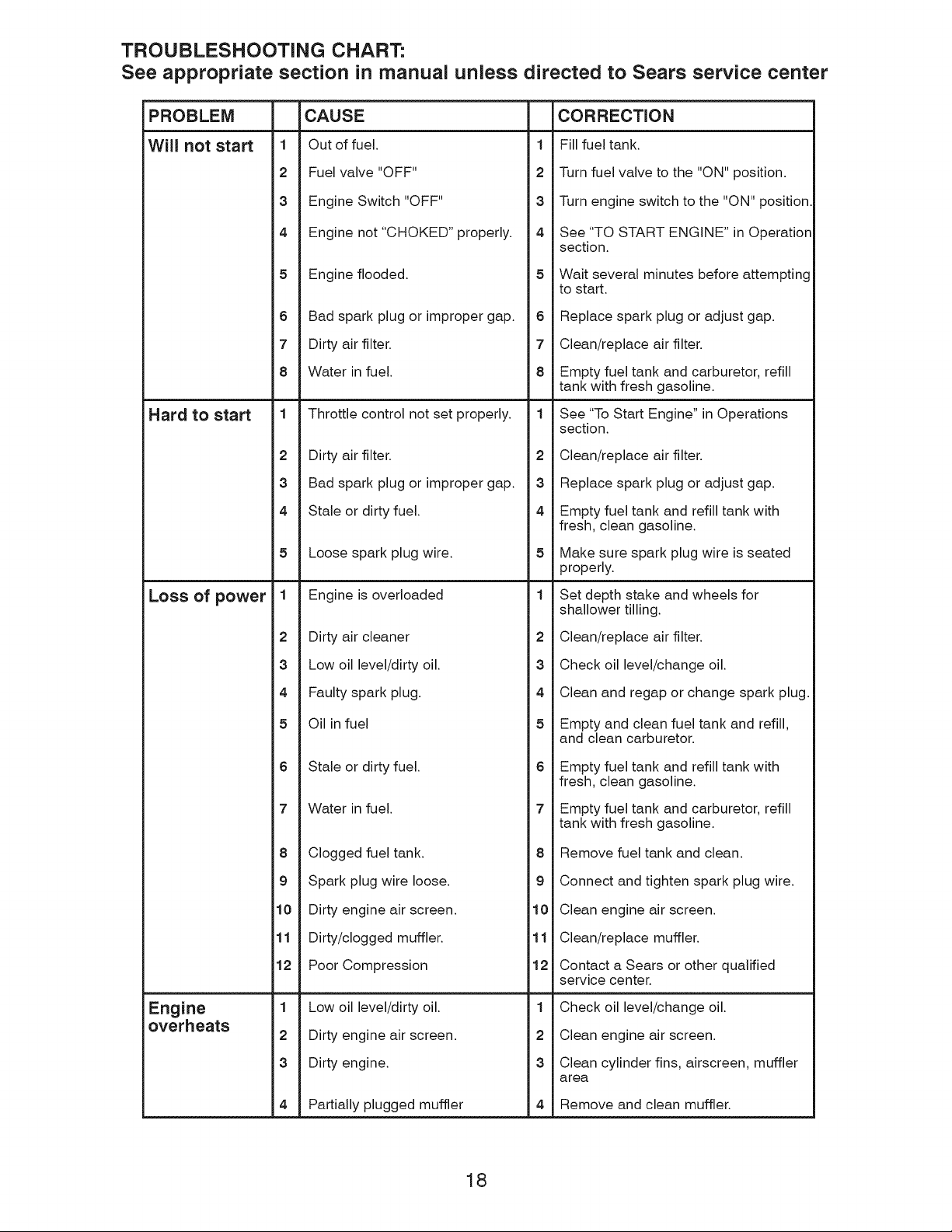
TROUBLESHOOTING CHART:
See appropriate section in manual unless directed to Sears service center
PROBLEM CAUSE
Will not start 1 Out of fuel.
2 Fuel valve "OFF"
3 Engine Switch "OFF"
4 Engine not "CHOKED" properly.
5 Engine flooded.
6 Bad spark plug or improper gap.
7 Dirty air filter.
8 Water in fuel.
Hard to start 1 Throttle control not set properly.
2 Dirty air filter.
3 Bad spark plug or improper gap.
4 Stale or dirty fuel.
5 Loose spark plug wire.
Loss of power 1 Engine is overloaded
2 Dirty air cleaner
3 Low oil level/dirty oil.
4 Faulty spark plug.
5 Oil in fuel
6 Stale or dirty fuel.
7 Water in fuel.
8 Clogged fuel tank.
9 Spark plug wire loose.
10 Dirty engine air screen.
11 Dirty/clogged muffler.
12 Poor Compression
Engine 1 Low oil level/dirty oil.
overheats
2 Dirty engine air screen.
3 Dirty engine.
4 Partially plugged muffler
CORRECTION
1 Fill fuel tank.
2 Turn fuel valve to the "ON" position.
3 Turn engine switch to the "ON" position.
4 See"TO START ENGINE" in Operation
section.
5 Wait several minutes before attempting
to start.
6 Replace spark plug or adjust gap.
7 Clean/replace air filter.
8 Empty fuel tank and carburetor, refill
tank with fresh gasoline.
1 See"To Start Engine" in Operations
section.
2 Clean/replace air filter.
3 Replace spark plug or adjust gap.
4 Empty fuel tank and refill tank with
fresh, clean gasoline.
5 Make sure spark plug wire is seated
properly.
1 Set depth stake and wheels for
shallower tilling.
2 Clean/replace air filter.
3 Check oil level/change oil.
4 Clean and regap or change spark plug.
5 Empty and clean fuel tank and refill,
and clean carburetor.
6 Empty fuel tank and refill tank with
fresh, clean gasoline.
7 Empty fuel tank and carburetor, refill
tank with fresh gasoline.
8 Remove fuel tank and clean.
9 Connect and tighten spark plug wire.
10 Clean engine air screen.
11 Clean/replace muffler.
12 Contact a Sears or other qualified
service center.
1 Check oil level/change oil.
2 Clean engine air screen.
3 Clean cylinder fins, airscreen, muffler
area
4 Remove and clean muffler.
18
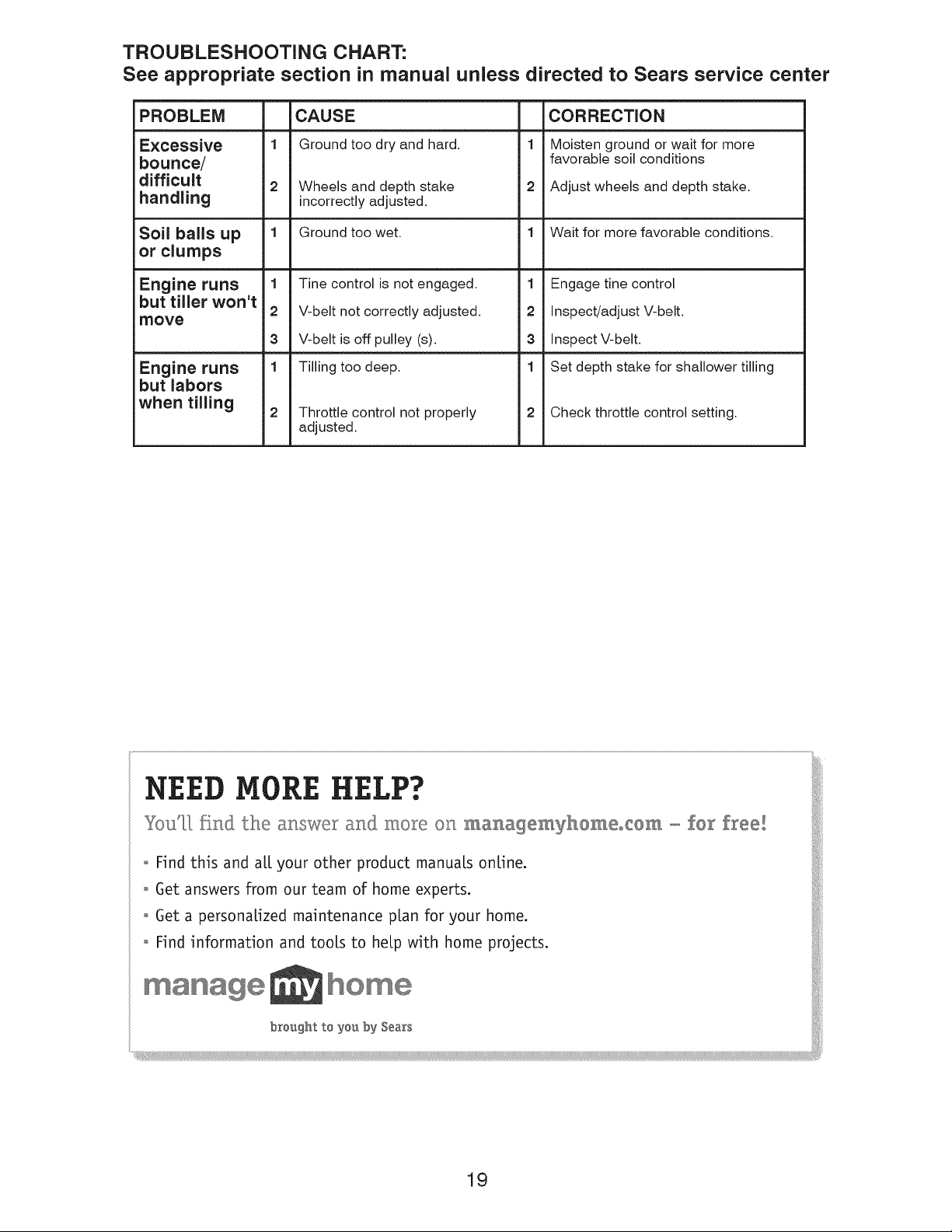
TROUBLESHOOTING CHART:
See appropriate section in manual unless directed to Sears service center
PROBLEM CAUSE CORRECTION
Excessive
bounce/
difficult
handling
1 Ground too dry and hard.
2 Wheels and depth stake
incorrectly adjusted.
1
2
Moisten ground or wait for more
favorable soil conditions
Adjust wheels and depth stake.
Soil bails up
or clumps
1 Ground too wet. 1 Wait for more favorable conditions.
Engine runs
buttiller won't
move
1 Tine control is not engaged.
2 V-belt not correctly adjusted.
3 V-belt is off pulley (s).
1 Engage tine control
2 Inspect/adjust V-belt.
3 Inspect V-belt.
Engine runs 1 Tilling too deep.
but labors
when tilling 2 Throttle control not properly
adjusted.
1 Set depth stake for shallower tilling
2 Check throttle control setting.
iiiii !i
NEED MORE HELP?
19
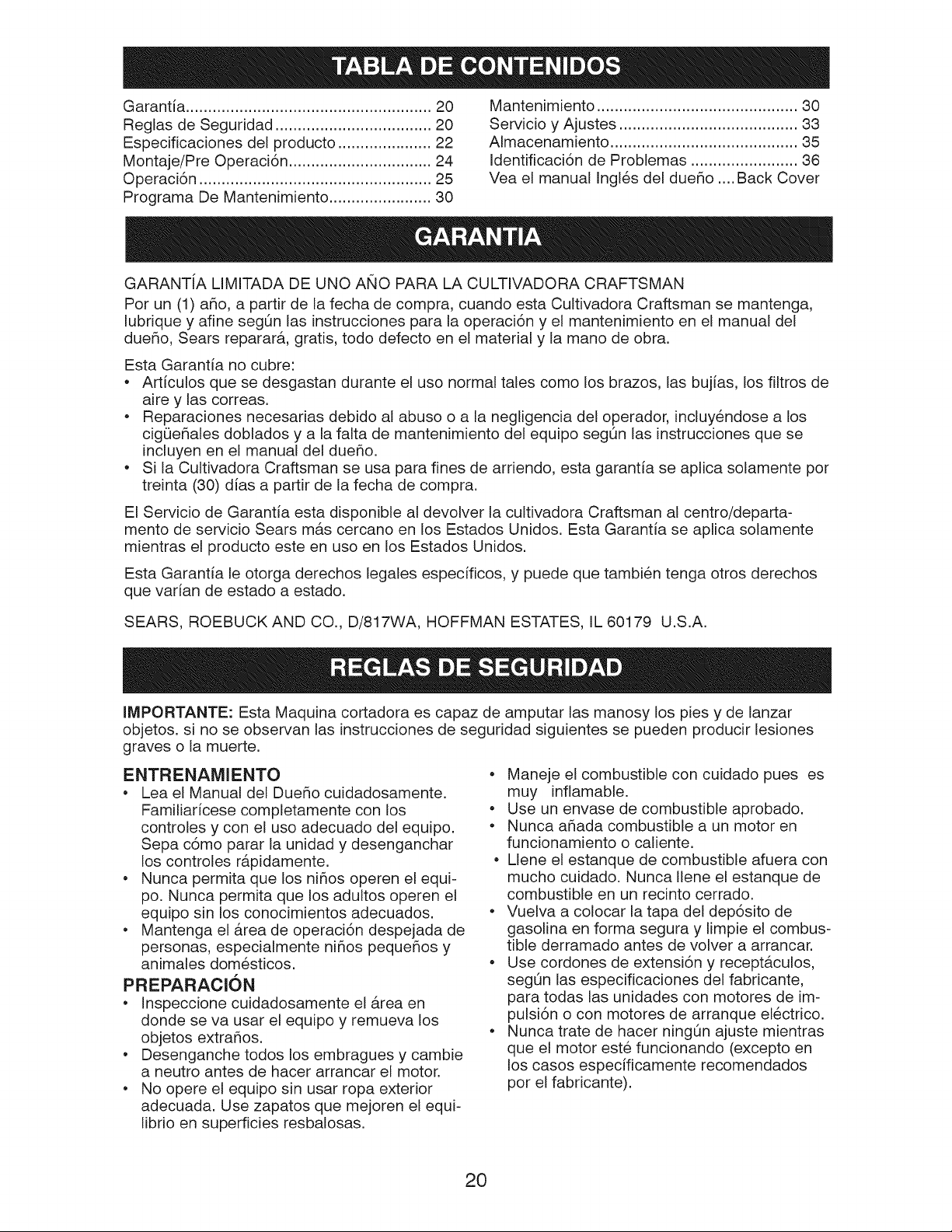
Garantia ....................................................... 20
Reglas de Seguridad ................................... 20
Especificaciones del producto ..................... 22
Montaje/Pre Operaci6n ................................ 24
Operaci6n .................................................... 25
Programa De Mantenimiento ....................... 30
Mantenimiento ............................................. 30
Servicio y Ajustes ........................................ 33
AImacenamiento .......................................... 35
Identificaci6n de Problemas ........................ 36
Vea el manual Ingles del dueflo .... Back Cover
GARANTiA LIMITADA DE UNO ANO PARA LA CULTIVADORA CRAFTSMAN
Por un (1) aflo, a partir de la fecha de compra, cuando esta Cultivadora Craftsman se mantenga,
lubrique y afine segOn las instrucciones para la operaci6n y el mantenimiento en el manual del
dueflo, Sears reparara, gratis, todo defecto en el material y la mano de obra.
Esta Garantia no cubre:
• Articulos que se desgastan durante el uso normal tales como los brazos, las bujias, los filtros de
aire y las correas.
• Reparaciones necesarias debido al abuso o a la negligencia del operador, incluyendose a los
cigOeflales doblados y a la falta de mantenimiento del equipo segOn las instrucciones que se
incluyen en el manual del dueflo.
• Si la Cultivadora Craftsman se usa para fines de arriendo, esta garanfia se aplica solamente por
treinta (30) dias a partir de la fecha de compra.
El Servicio de Garantia esta disponible al devolver la cultivadora Craftsman al centro/departa-
mento de servicio Sears m_.s cercano en los Estados Unidos. Esta Garanfia se aplica solamente
mientras el producto este en uso en los Estados Unidos.
Esta Garantia le otorga derechos legales especificos, y puede que tambien tenga otros derechos
que varian de estado a estado.
SEARS, ROEBUCK AND CO., D/817WA, HOFFMAN ESTATES, IL 60179 U.S.A.
IMPORTANTE: Esta Maquina cortadora es capaz de amputar las manosy los pies y de lanzar
objetos, si no se observan las instrucciones de seguridad siguientes se pueden producir lesiones
graves o la muerte.
ENTRENAMIENTO
• Lea el Manual del Dueflo cuidadosamente.
Familiaricese completamente con los
controles y con el uso adecuado del equipo.
Sepa c6mo parar la unidad y desenganchar
los controles rapidamente.
• Nunca permita que los niflos operen el equi-
po. Nunca permita que los adultos operen el
equipo sin los conocimientos adecuados.
• Mantenga el area de operaci6n despejada de
personas, especialmente niflos pequeflos y
animales domesticos.
PREPARACION
• Inspeccione cuidadosamente el &tea en
donde se va usar el equipo y remueva los
objetos extraflos.
• Desenganche todos los embragues y cambie
a neutro antes de hacer arrancar el motor.
• No opere el equipo sin usar ropa exterior
adecuada. Use zapatos que mejoren el equi-
librio en superficies resbalosas.
• Maneje el combustible con cuidado pues es
muy inflamable.
• Use un envase de combustible aprobado.
• Nunca aflada combustible a un motor en
funcionamiento o caliente.
• Llene el estanque de combustible afuera con
mucho cuidado. Nunca Ilene el estanque de
combustible en un recinto cerrado.
• Vuelva a colocar la tapa del dep6sito de
gasolina en forma segura y limpie el combus-
tible derramado antes de volver a arrancar.
• Use cordones de extensi6n y receptaculos,
segOn las especificaciones del fabricante,
para todas las unidades con motores de im-
pulsi6n o con motores de arranque electrico.
• Nunca trate de hacer ningOn ajuste mientras
que el motor este funcionando (excepto en
los casos especificamente recomendados
por el fabricante).
20
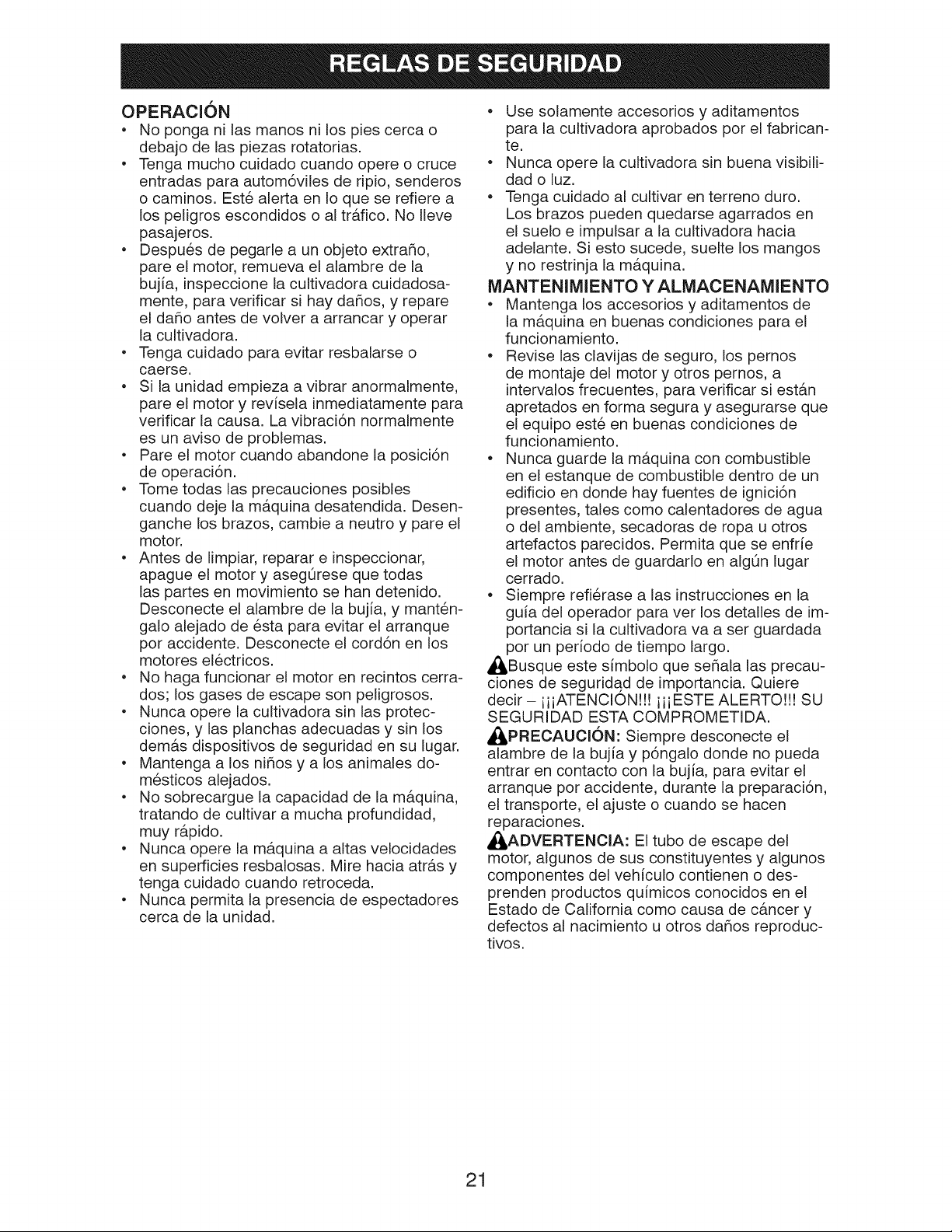
OPERACION
• No ponga ni las manos ni los pies cerca o
debajo de las piezas rotatorias.
• Tenga mucho cuidado cuando opere o cruce
entradas para autom6viles de ripio, senderos
o caminos. Este alerta en Io que se refiere a
los peligros escondidos o al tr&fico. No Ileve
pasajeros.
• Despues de pegarle a un objeto extraflo,
pare el motor, remueva el alambre de la
bujia, inspeccione la cultivadora cuidadosa-
mente, para verificar si hay daflos, y repare
el daflo antes de volver a arrancar y operar
la cultivadora.
• Tenga cuidado para evitar resbalarse o
caerse.
• Si la unidad empieza a vibrar anormalmente,
pare el motor y revisela inmediatamente para
verificar la causa. La vibraci6n normalmente
es un aviso de problemas.
• Pare el motor cuando abandone la posici6n
de operaci6n.
• Tome todas las precauciones posibles
cuando deje la m&quina desatendida. Desen-
ganche los brazos, cambie a neutro y pare el
motor.
• Antes de limpiar, reparar e inspeccionar,
apague el motor y aseg0rese que todas
las partes en movimiento se han detenido.
Desconecte el alambre de la bujia, y manten-
galo alejado de esta para evitar el arranque
pot accidente. Desconecte el cord6n en los
motores electricos.
• No haga funcionar el motor en recintos cerra-
dos; los gases de escape son peligrosos.
• Nunca opere la cultivadora sin las protec-
ciones, y las planchas adecuadas y sin los
dem&s dispositivos de seguridad en su lugar.
• Mantenga a los niflos y a los animales do-
mesticos alejados.
• No sobrecargue la capacidad de la m&quina,
tratando de cultivar a mucha profundidad,
muy r&pido.
• Nunca opere la m&quina a altas velocidades
en superficies resbalosas. Mire hacia atr&s y
tenga cuidado cuando retroceda.
• Nunca permita la presencia de espectadores
cerca de la unidad.
• Use solamente accesorios y aditamentos
para la cultivadora aprobados por el fabrican-
te.
• Nunca opere la cultivadora sin buena visibili-
dad o luz.
• Tenga cuidado al cultivar en terreno duro.
Los brazos pueden quedarse agarrados en
el suelo e impulsar a la cultivadora hacia
adelante. Si esto sucede, suelte los mangos
y no restrinja la m&quina.
MANTENIMIENTO Y ALMACENAMIENTO
• Mantenga los accesorios y aditamentos de
la m&quina en buenas condiciones para el
funcionamiento.
• Revise las clavijas de seguro, los pernos
de montaje del motor y otros pernos, a
intervalos frecuentes, para verificar si est&n
apretados en forma segura y asegurarse que
el equipo este en buenas condiciones de
funcionamiento.
• Nunca guarde la m&quina con combustible
en el estanque de combustible dentro de un
edificio en donde hay fuentes de ignici6n
presentes, tales como calentadores de agua
o del ambiente, secadoras de ropa u otros
artefactos parecidos. Permita que se enfrie
el motor antes de guardarlo en alg0n lugar
cerrado.
• Siempre refierase a las instrucciones en la
guia del operador para ver los detalles de im-
portancia si la cultivadora va a ser guardada
por un periodo de tiempo largo.
_i_Busque este simbolo que seflala las precau-
ciones de seguridad de importancia. Quiere
decir - iiiATENCION!!! iiiESTE ALERTO!!! SU
SEGURIDAD ESTA COMPROMETIDA.
_PREOAUClON: Siempre desconecte el
alambre de la bujia y p6ngalo donde no pueda
entrar en contacto con la bujia, para evitar el
arranque pot accidente, durante la preparaci6n,
el transporte, el ajuste o cuando se hacen
reparaciones.
_DVERTENCIA: El tubo de escape del
motor, algunos de sus constituyentes y algunos
componentes del vehiculo contienen o des-
prenden productos quimicos conocidos en el
Estado de California como causa de c&ncer y
defectos al nacimiento u otros daflos reproduc-
tivos.
21
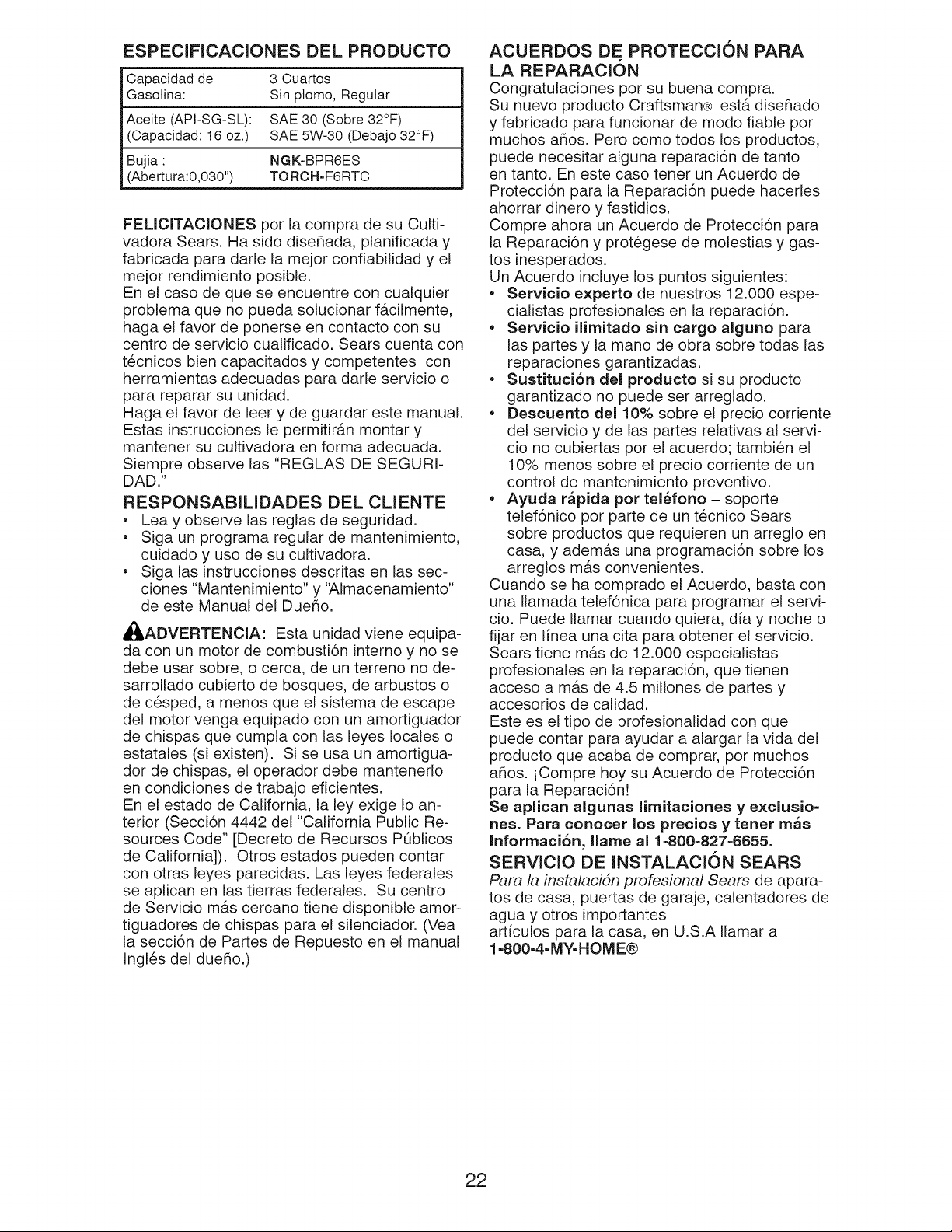
ESPECIFICACIONES DEL PRODUCTO
Capacidad de 3 Cuartos
Gasotina: Sin ptomo, Regular
Aceite (API-SG-SL): SAE 30 (Sobre 32°F)
(Capacidad: 16 oz.) SAE 5W-30 (Debajo 32°F)
Bujia : NGK-BPR6ES
(Abertura:0,030") TORCH-F6RTC
FELICITAClONES pot la compra de su Culti-
vadora Sears. Ha sido diseSada, planificada y
fabricada para darle la mejor confiabilidad y el
mejor rendimiento posible.
En el caso de que se encuentre con cualquier
problema que no pueda solucionar f&cilmente,
haga el favor de ponerse en contacto con su
centro de servicio cualificado. Sears cuenta con
tecnicos bien capacitados y competentes con
herramientas adecuadas para darle servicio o
para reparar su unidad.
Haga el favor de leer y de guardar este manual.
Estas instrucciones le permitir&n montar y
mantener su cultivadora en forma adecuada.
Siempre observe las "REGLAS DE SEGURI-
DAD."
RESPONSABILIDADES DEL CLIENTE
• Lea y observe las reglas de seguridad.
• Siga un programa regular de mantenimiento,
cuidado y uso de su cultivadora.
• Siga las instrucciones descritas en las sec-
ciones "Mantenimiento" y '_,lmacenamiento"
de este Manual del DueSo.
_,ADVERTENCIA: Esta unidad viene equipa-
da con un motor de combusti6n interno y no se
debe usar sobre, o cerca, de un terreno no de-
sarrollado cubierto de bosques, de arbustos o
de cesped, a menos que el sistema de escape
del motor venga equipado con un amortiguador
de chispas que cumpla con las leyes locales o
estatales (si existen). Si se usa un amortigua-
dor de chispas, el operador debe mantenerlo
en condiciones de trabajo eficientes.
En el estado de California, la ley exige Io an-
terior (Secci6n 4442 del "California Public Re-
sources Code" [Decreto de Recursos PQblicos
de California]). Otros estados pueden contar
con otras leyes parecidas. Las leyes federales
se aplican en las tierras federales. Su centro
de Servicio m&s cercano tiene disponible amor-
tiguadores de chispas para el silenciador. (Vea
la secci6n de Partes de Repuesto en el manual
Ingles del dueSo.)
ACUERDOS DE PROTECCION PARA
LA REPARACI6N
Congratulaciones por su buena compra.
Su nuevo producto Craftsman® est& diseSado
y fabricado para funcionar de modo fiable por
muchos aSos. Pero como todos los productos,
puede necesitar alguna reparaci6n de tanto
en tanto. En este caso tenet un Acuerdo de
Protecci6n para la Reparaci6n puede hacerles
ahorrar dinero y fastidios.
Compre ahora un Acuerdo de Protecci6n para
la Reparaci6n y protegese de molestias y gas-
tos inesperados.
Un Acuerdo incluye los puntos siguientes:
• Servicio experto de nuestros 12.000 espe-
cialistas profesionales en la reparaci6n.
• Servicio ilimitado sin cargo alguno para
las partes y la mano de obra sobre todas las
reparaciones garantizadas.
• Sustituci6n del producto si su producto
garantizado no puede set arreglado.
• Deseuento del 10% sobre el precio corriente
del servicio y de las partes relativas al servi-
cio no cubiertas pot el acuerdo; tambien el
10% menos sobre el precio corriente de un
control de mantenimiento preventivo.
• Ayuda r_pida pot telefono - soporte
telef6nico por parte de un tecnico Sears
sobre productos que requieren un arreglo en
casa, y adem&s una programaci6n sobre los
arreglos m&s convenientes.
Cuando se ha comprado el Acuerdo, basta con
una Ilamada telef6nica para programar el servi-
cio. Puede Ilamar cuando quiera, dia y noche o
fijar en linea una cita para obtener el servicio.
Sears tiene m&s de 12.000 especialistas
profesionales en la reparaci6n, que tienen
acceso a m&s de 4.5 millones de partes y
accesorios de calidad.
Este es el tipo de profesionalidad con que
puede contar para ayudar a alargar la vida del
producto que acaba de comprar, por muchos
aSos. iCompre hoy su Acuerdo de Protecci6n
para la Reparaci6n!
Se apliean algunas limitaciones y exclusio-
nes. Para conocer los precios y tenet mas
Informaci6n, Ilarne al 1=800=827=6655.
SERVlClO DE INSTALAClON SEARS
Para la instalacidn profesional Sears de apara-
tos de casa, puertas de garaje, calentadores de
agua y otros importantes
articulos para la casa, en U.S.A Ilamar a
1=800=4=MY=HOME®
22
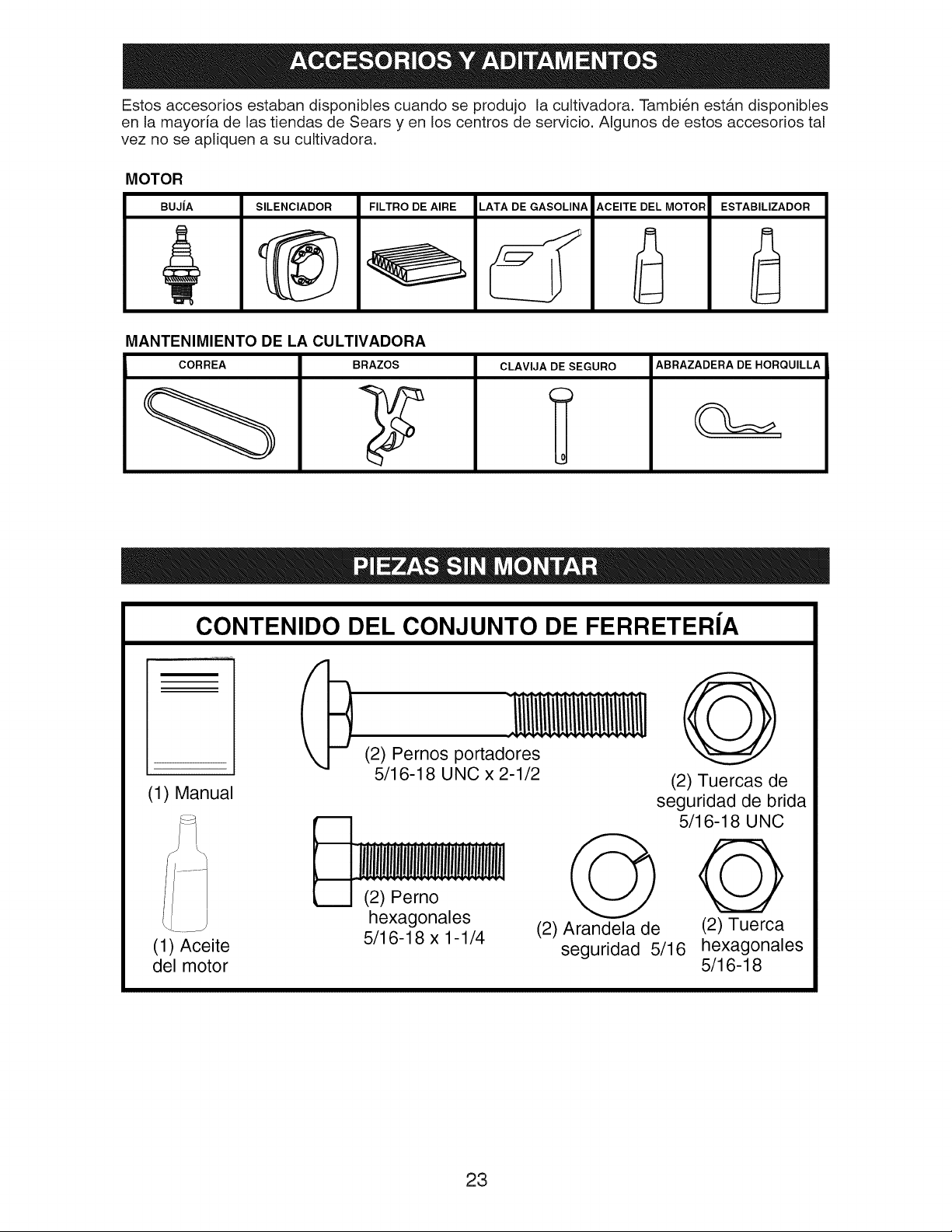
Estos accesorios estaban disponibles cuando se produjo la cultivadora. Tambien estan disponibles
en la mayoria de las tiendas de Sears yen los centros de servicio. Algunos de estos accesorios tal
vez no se apliquen a su cultivadora.
MOTOR
BUJIA
SILENCIADOR FILTRO DE AIRE LATA DE GASOLINA ACEITE DEL MOTOR ESTABILIZADOR
MANTENIMIENTO DE LA CULTIVADORA
ABRAZADERA DE HORQUILLACORREA BRAZOS
CLAVIJA DE SEGURO
0
CONTENIDO DEL CONJUNTO DE FERRETERiA
(1) Manual
(1) Aceite
del motor
(2) Pernos portadores
5/16-18 UNC x 2-1/2 (2) Tuercas de
seguridad de brida
5/16-18 UNC
(2) Perno
hexagonales
5/16-18 x 1-1/4
(2) Arandela de
seguridad 5/16
Q
(2) Tuerca
hexagonales
5/16-18
23
Su cultivadora nueva ha sido montada en la f&brica, con la excepci6n de aquellas partes que se
dejaron sin montar pot razones de envio. Para asegurarse que la cultivadora operara en forma
segura y adecuada, todas las partes y los articulos de ferreteria que monte tienen que estar apre-
tados en forma segura. Use las herramientas correctas segQn sea necesario, para asegurarse de
que queden apretadas en forma segura.
HERRAMIENTAS NECESARIAS PARA
EL MONTAJE
Se le facilitar& el montaje si cuenta con un
juego de Ilaves de tubo. Se han enumerado los
tama_os estandar de las Ilaves.
(1) Cuchillo para todo uso
(2) Llave de 1/2"
POSICION DEL OPERADOR
Cuando en este manual se mencionan los
terminos "lado derecho" o "lado izquierdo"
se refiere a cuando usted se encuentra en la
posici6n de operaci6n (parado/a detr&s de los
mangos de la cultivadora).
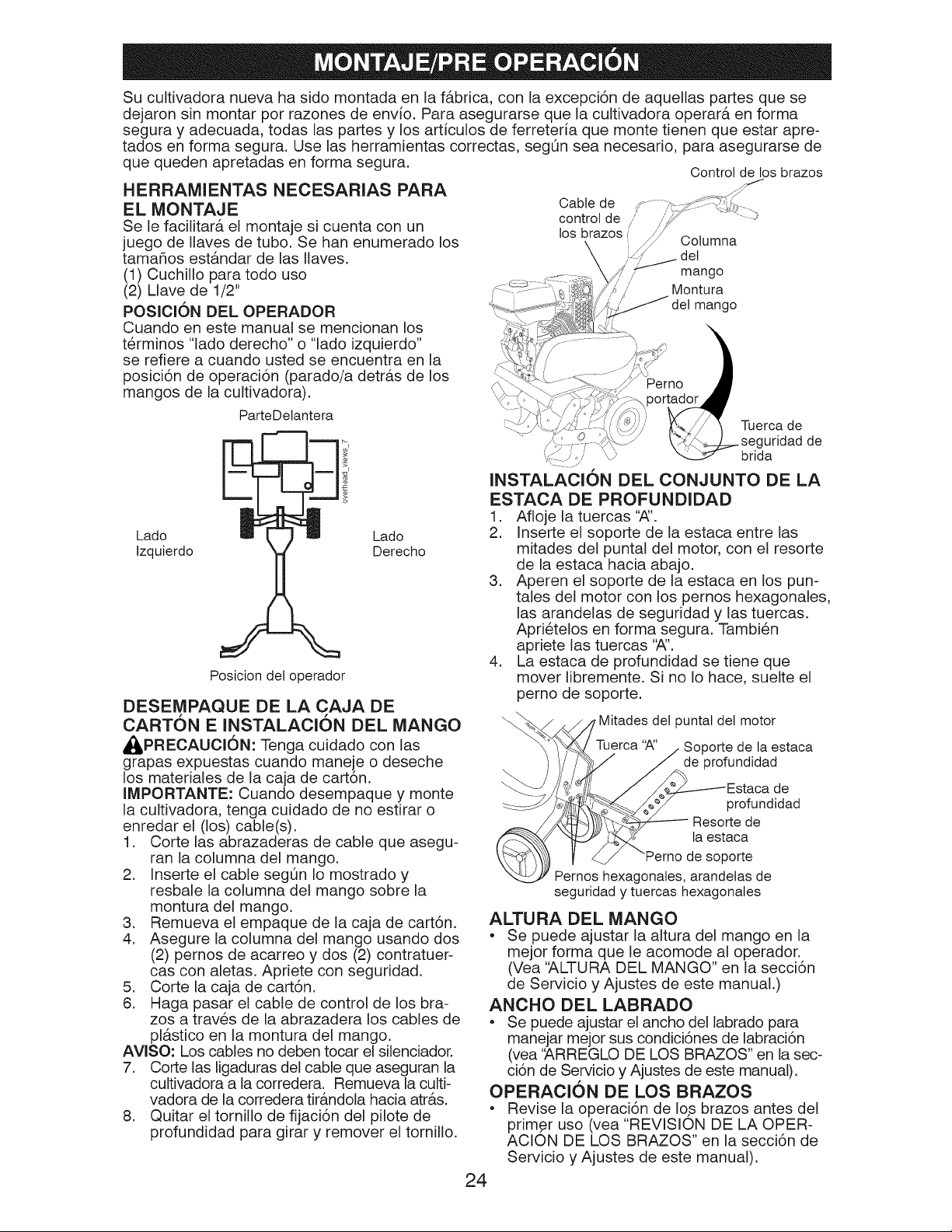
Control de los brazos
Cable de
control de
los brazos '
Cotumna
I det
mango
Montura
del mango
ParteDetantera
Lado
Izquierdo
Lado
Derecho
Posicion del operador
DESEMPAQUE DE LA CAJA DE
CARTON E INSTALACI6N DEL MANGO
_PRECAUCI6N: Tenga cuidado con las
grapas expuestas cuando maneje o deseche
los materiales de la caja de cart6n.
IMPORTANTE: Cuando desempaque y monte
la cultivadora, tenga cuidado de no estirar o
enredar el (los) cable(s).
1. Corte las abrazaderas de cable que asegu-
ran la columna del mango.
2. Inserte el cable segQn Io mostrado y
resbale la columna del mango sobre la
montura del mango.
3. Remueva el empaque de la caja de cart6n.
4. Asegure la columna del mango usando dos
(2) pernos de acarreo y dos (2) contratuer-
cas con aletas. Apriete con seguridad.
5. Corte la caja de cart6n.
6. Haga pasar el cable de control de los bra-
zos a traves de la abrazadera los cables de
plastico en la montura del mango.
AVlSO: Los cables no deben tocar el silenciador.
7. Corte las ligaduras del cable que aseguran la
cultivadora a la corredera. Remueva la culti-
vadora de la corredera tirandola hacia atras.
8. Quitar el tornillo de fijaci6n del pilote de
profundidad para girar y remover el tornillo.
Tuerca de
uridad de
brida
INSTALACION DEL CONJUNTO DE LA
ESTACA DE PROFUNDIDAD
1. Afloje la tuercas 'i/_'.
2. Inserte el soporte de la estaca entre las
mitades del puntal del motor, con el resorte
de la estaca hacia abajo.
3. Aperen el soporte de la estaca en los pun-
tales del motor con los pernos hexagonales,
las arandelas de seguridad y las tuercas.
Aprietelos en forma segura. Tambien
apriete las tuercas 'A".
4. La estaca de profundidad se tiene que
mover libremente. Si no Io hace, suelte el
perno de soporte.
___,//_ / Mitades del puntal del motor
____/ Tuerca'_' /Soporte de laestaca
I !/ /_JJ _ de profundidad
_-J _/_' _#/_ J/_____Estaca de
_/_ ___ profundidad
/_/_ :_//)))_Z--_-_ z-_ aesorte de
_'_/ ":_#_ laestaca
\_'_) r /_ "Perno de soporte
x._zC# Pernos hexagonales, arandetas de
seguridad y tuercas hexagonales
ALTURA DEL MANGO
• Se puede ajustar la altura del mango en la
mejor forma que le acomode al operador.
(Vea '_,LTURA DEL MANGO" en la secci6n
de Servicio y Ajustes de este manual.)
ANCHO DEL LABRADO
• Se puede ajustar el ancho del labrado para
manejar mejor sus condici6nes de labraci6n
(vea 'ARREGLO DE LOS BRAZOS" en la sec-
ci6n de Servicio y Ajustes de este manual).
OPERACION DE LOS BRAZOS
• Revise la operaci6n de los brazos antes del
primer uso (vea "REVISION DE LA OPER-
ACION DE LOS BRAZOS" en la secci6n de
Servicio y Ajustes de este manual).
24
CONOZCA SU CULTIVADORA
LEA ESTE MANUAL DEL DUEllO Y LAS REGLAS DE SEGURIDAD ANTES DE OPERAR SU
CUTIVADORA
Compare las ilustraciones con su cultivadora para familiarizarse con la ubicaci6n de los diversos
controles y ajustes. Guarde este manual para referencia en el futuro.
Estos simbolos pueden apareser sobre su cultivadora en la literatura proporcionada con el
producto. Aprenda y comprenda sus significados.
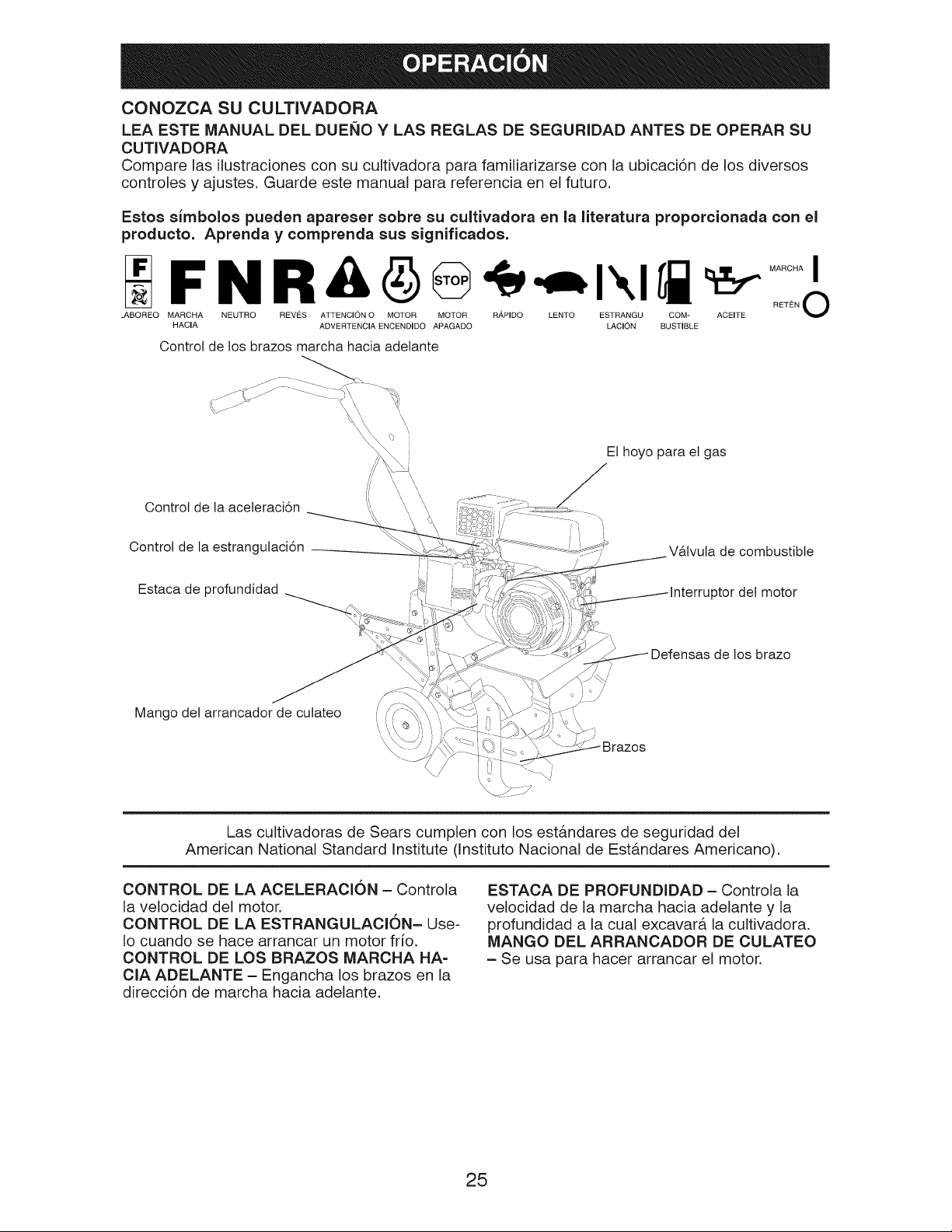
_ABOREO MARCHA NEUTRO REVES ATq'ENCI6N O MOTOR MOTOR RAPIDO LENTO ESTRANGU COM- ACEITE
HACIA ADVERTENCIA ENCENDIDO APAGADO LACION BUSTIBLE
MARCHA i
RETEN O
Control de los brazos marcha hacia adelante
Control de la aceleraci6n "i,
Control de la estrangutaci6n
Estaca de profundidad
\
\\ \\
\
El hoyo para el gas
V&Ivuta de combustible
ptor del motor
Defensas de los brazo
Mango del arrancador de cutateo
Las cultivadoras de Sears cumplen con los est&ndares de seguridad del
American National Standard Institute (Instituto Nacional de Est&ndares Americano).
CONTROL DE LA ACELERACION = Controla
la velocidad del motor.
CONTROL DE LA ESTRANGULACK)N= Use-
Io cuando se hace arrancar un motor frio.
CONTROL DE LOS BRAZOS MARCHA HA=
ClA ADELANTE = Engancha los brazos en la
direcci6n de marcha hacia adelante.
ESTACA DE PROFUNDIDAD = Controla la
velocidad de la marcha hacia adelante y la
profundidad a la cual excavar& la cultivadora.
MANGO DEL ARRANCADOR DE CULATEO
= Se usa para hacer arrancar el motor.
25
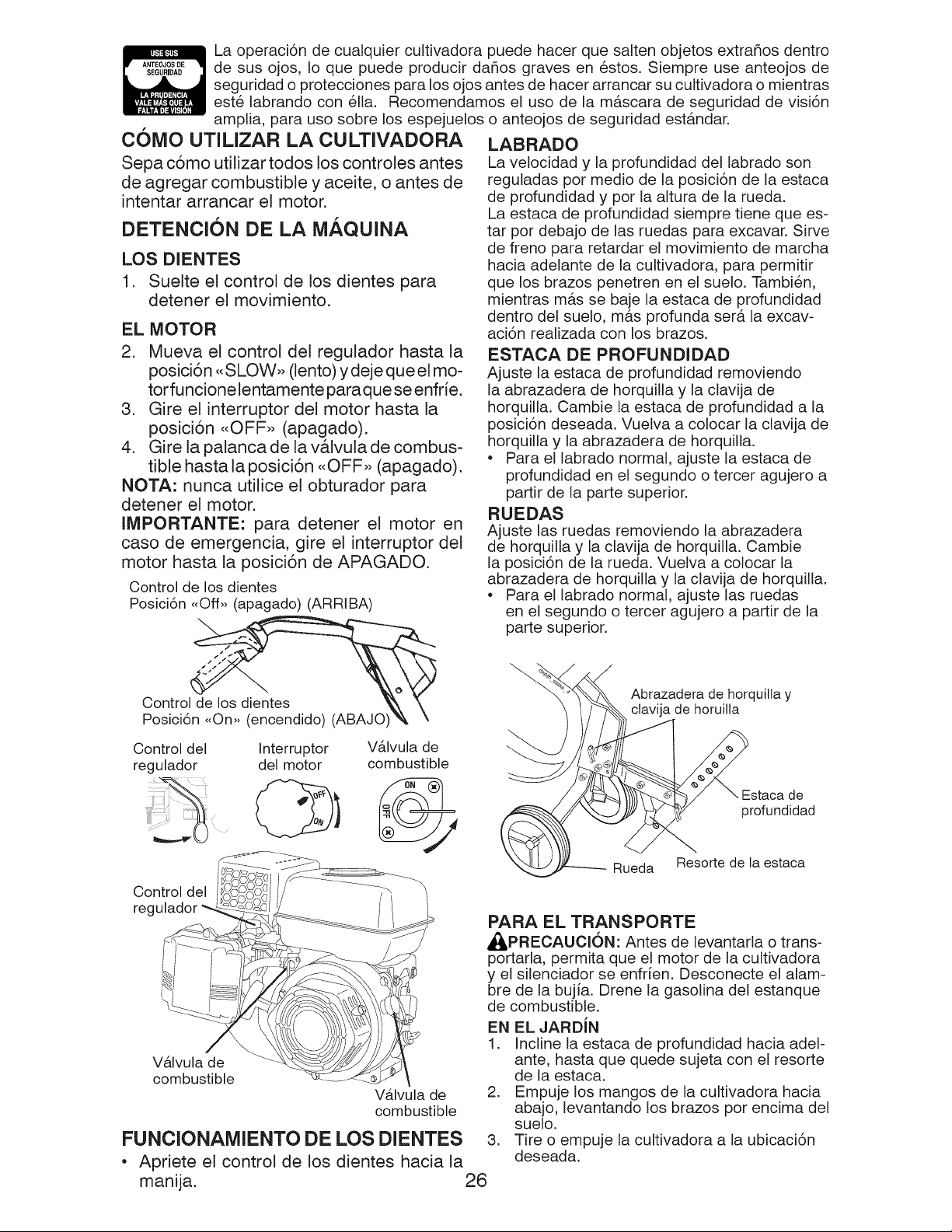
La operaci6n de cualquier cultivadora puede hacer que salten objetos extranos dentro
de sus ojos, Io que puede producir da_os graves en estos. Siempre use anteojos de
seguridad o protecciones para los ojos antes de hacer arrancar su cultivadora o mientras
este labrando con ella. Recomendamos el uso de la m&scara de seguridad de visi6n
amplia, para uso sobre los espejuelos o anteojos de seguridad est_.ndar.
COMO UTILIZAR LA CULTIVADORA LABRADO
Sepa c6mo utilizar todos los controles antes
de agregar combustible y aceite, o antes de
intentar arrancar el motor.
DETENCION DE LA MAQUINA
LOS DIENTES
1. Suelte el control de los dientes para
detener el movimiento.
EL MOTOR
2. Mueva el control de! regulador hasta la
posici6n ,_SLOW,_ (lento) y deje que el mo-
tor funcione lentamente para que se enfrie.
3. Gire el interruptor del motor hasta la
posici6n ,_OFF_ (apagado).
4. Gire la palancade lav&lvulade combus-
tible hasta la posici6n ,,OFF>_ (apagado).
NOTA: nunca utilice el obturador para
detener el motor.
IMPORTANTE: para detener el motor en
caso de emergencia, gire el interruptor del
motor hasta la posici6n de APAGADO.
Control de los dientes
Posici6n ,,Off,, (apagado) (ARRIBA)
. p/
Control_
Posicidn _dido) (ABAJO)",k ',
Control del Interruptor
regulador del motor
V&lvula de
combustible
La velocidad y la profundidad del labrado son
reguladas pot medio de la posici6n de la estaca
de profundidad y pot la altura de la rueda.
La estaca de profundidad siempre tiene que es-
tar por debajo de las ruedas para excavar. Sirve
de freno para retardar el movimiento de marcha
hacia adelante de la cultivadora, para permitir
que los brazos penetren en el suelo. Tambien,
mientras mas se baje la estaca de profundidad
dentro del suelo, mas profunda sera la excav-
aci6n realizada con los brazos.
ESTACA DE PROFUNDIDAD
Ajuste la estaca de profundidad removiendo
la abrazadera de horquilla y la clavija de
horquilla. Cambie la estaca de profundidad a la
posici6n deseada. Vuelva a colocar la clavija de
horqui!la y la abrazadera de horquilla.
* Para el labrado normal, ajuste la estaca de
profundidad en el segundo o tercer agujero a
partir de la parte superior.
RUEDAS
Ajuste las ruedas removiendo la abrazadera
de horquilla y la clavija de horquilla. Cambie
la poslci6n de la rueda. Vuelva a colocar la
abrazadera de horquilla y la clavija de horquilla.
. Para el labrado normal, ajuste las ruedas
en el segundo o tercer agujero a partir de la
parte superior.
_:"_ Abrazadera de horquilla y
/ //%c1_ dehOruilla
Rueda n_ou, _ _
combustible
V&lvula de
combustible
FUNCIONAMIENTODELOSDIENTES 3.
• AprJete el control de los dientes hacia la
manija. 26
PARA EL TRANSPORTE
,_PRECAUCI6N: Antes de levantarla o trans-
portarla, permita que el motor de la cultivadora
y el silenciador se enfrien. Desconecte el alam-
bre de la bujia. Drene la gasolina del estanque
de combustible.
EN EL JARDJN
1. Incline la estaca de profundidad hacia adel-
ante, hasta que quede sujeta con el resorte
de la estaca.
2. Empuje los mangos de la cultivadora hacia
abajo, levantando los brazos por encima del
suelo.
Tire o empuje la cultivadora a la ubicaci6n
deseada.
ENLA ClUDAD
1. Desconecteel alambrede labujia.
2. Dreneel estanquedecombustible.
3. Transp6rtelaen la posiciSnderechahacia
arribaparaevitarlafugadelaceite.
ANTES DEARRANCAR EL MOTOR
IMPORTANTE: tenga mucho cuidado y evite
que ingrese suciedad en el motor al controlar
o agregar aceite o combustible. Utilice aceite y
combustible limpios, y almac@nelos en recipi-
entes con tapa, limpios y aprobados. Utilice
embudos limpios.
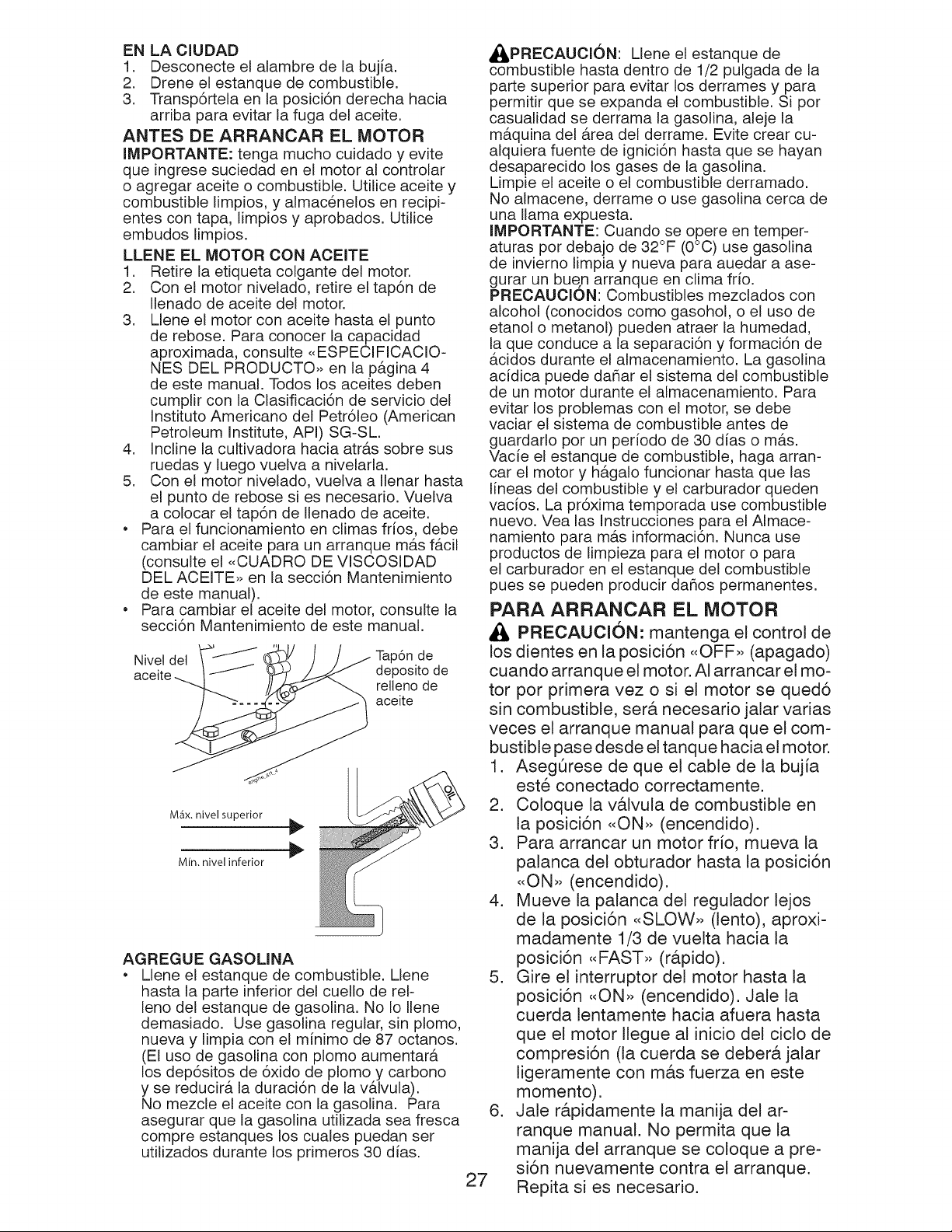
LLENE EL MOTOR CON ACEITE
1. Retire la etiqueta colgante del motor.
2. Con el motor nivelado, retire el tap6n de
Ilenado de aceite del motor.
3. Llene el motor con aceite hasta el punto
de rebose. Para conocer la capacidad
aproximada, consulte ,, ES PECI FICACIO-
NES DEL PRODUCTO,_ en la p&gina 4
de este manual. Todos los aceites deben
cumplir con la Clasificaci6n de servicio del
Instituto Americano del Petr61eo (American
Petroleum Institute, API) SG-SL.
4. Incline la cultivadora hacia atr&s sobre sus
ruedas y luego vuelva a nivelarla.
5. Con el motor nivelado, vuelva a Ilenar hasta
el punto de rebose si es necesario. Vuelva
a colocar el tap6n de Ilenado de aceite.
• Para el funcionamiento en climas frios, debe
cambiar el aceite para un arranque m&s f&cil
(consulte el ,,CUADRO DE VISCOSIDAD
DEL ACEITE>> en la secci6n Mantenimiento
de este manual).
• Para cambiar el aceite del motor, consulte la
secci6n Mantenimiento de este manual.
Nivet det
Tap6n de
depositode
rellenode
aceite
M_x, nivel superior
Min. nivel inferior
AGREGUE GASOLINA
• Llene el estanque de combustible. Llene
hasta la parte inferior del cuello de rel-
leno del estanque de gasolina. No Io Ilene
demasiado. Use gasolina regular, sin plomo,
nueva y limpia con el m{nimo de 87 octanos.
(El uso de gasolina con plomo aumentar&
los dep6sitos de 6xido de plomo y carbono
y se reducir& la duraci6n de la v&lvula).
No mezcle el aceite con la gasolina. Para
asegurar que la gasolina utilizada sea fresca
compre estanques los cuales puedan ser
utilizados durante los primeros 30 dias.
_i_PRECAUCl6N: Llene el estanque de
combustible hasta dentro de 1/2 pulgada de la
parte superior para evitar los derrames y para
permitir que se expanda el combustible. Si por
casualidad se derrama la gasolina, aleje la
m6.quina del 6.rea del derrame. Evite crear cu-
alquiera fuente de ignici6n hasta que se hayan
desaparecido los gases de la gasolina.
Limpie el aceite o el combustible derramado.
No almacene, derrame o use gasolina cerca de
una llama expuesta.
IMPORTANTE: Cuando se opere en temper-
aturas por debajo de 32°F (0°C) use gasolina
de invierno limpia y nueva para auedar a ase-
gurar un bue,n arranque en clima frio.
PRECAUClON: Combustibles mezclados con
alcohol (conocidos como gasohol, o el uso de
etanol o metanol) pueden atraer la humedad,
la que conduce a la separaci6n y formaci6n de
_tcidos durante el almacenamiento. La gasolina
acidica puede dahar el sistema del combustible
de un motor durante el almacenamiento. Para
evitar los problemas con el motor, se debe
vaciar el sistema de combustible antes de
guardarlo por un periodo de 30 dias o mgts.
Vacie el estanque de combustible, haga arran-
car el motor y hagalo funcionar hasta que las
lineas del combustible y el carburador queden
vacios. La pr6xima temporada use combustible
nuevo. Vea las Instrucciones para el Almace-
namiento para mas informaci6n. Nunca use
productos de limpieza para el motor o para
el carburador en el estanque del combustible
pues se pueden producir dahos permanentes.
PARA ARRANCAR EL MOTOR
PRECAUCION: mantenga el control de
los dientes en la posici6n ,_OFF,, (apagado)
cuando arranque el motor. AI arrancar el mo-
tor por primera vez o si el motor se qued6
sin combustible, ser& necesario jalar varias
veces el arranque manual para que el com-
bustible pase desde el tanque hacia el motor.
1. AsegOrese de que el cable de la bujia
est@ conectado correctamente.
2. Coloque la v&lvula de combustible en
la posici6n ,_ON_ (encendido).
3. Para arrancar un motor frio, mueva la
palanca del obturador hasta la posici6n
,<ON>> (encendido).
4. Mueve la palanca del regulador lejos
de la posici6n ,<SLOW,> (lento), aproxi-
madamente 1/3 de vuelta hacia la
posici6n ,_FAST>> (r_.pido).
5. Gire el interruptor del motor hasta la
posici6n ,<ONe> (encendido). Jale la
cuerda lentamente hacia afuera hasta
que el motor Ilegue al inicio del ciclo de
compresi6n (la cuerda se debera jalar
ligeramente con mas fuerza en este
momento).
6. Jale r&pidamente la manija del ar-
ranque manual. No permita que la
manija del arranque se coloque a pre-
si6n nuevamente contra el arranque.
Repita si es necesario.
27
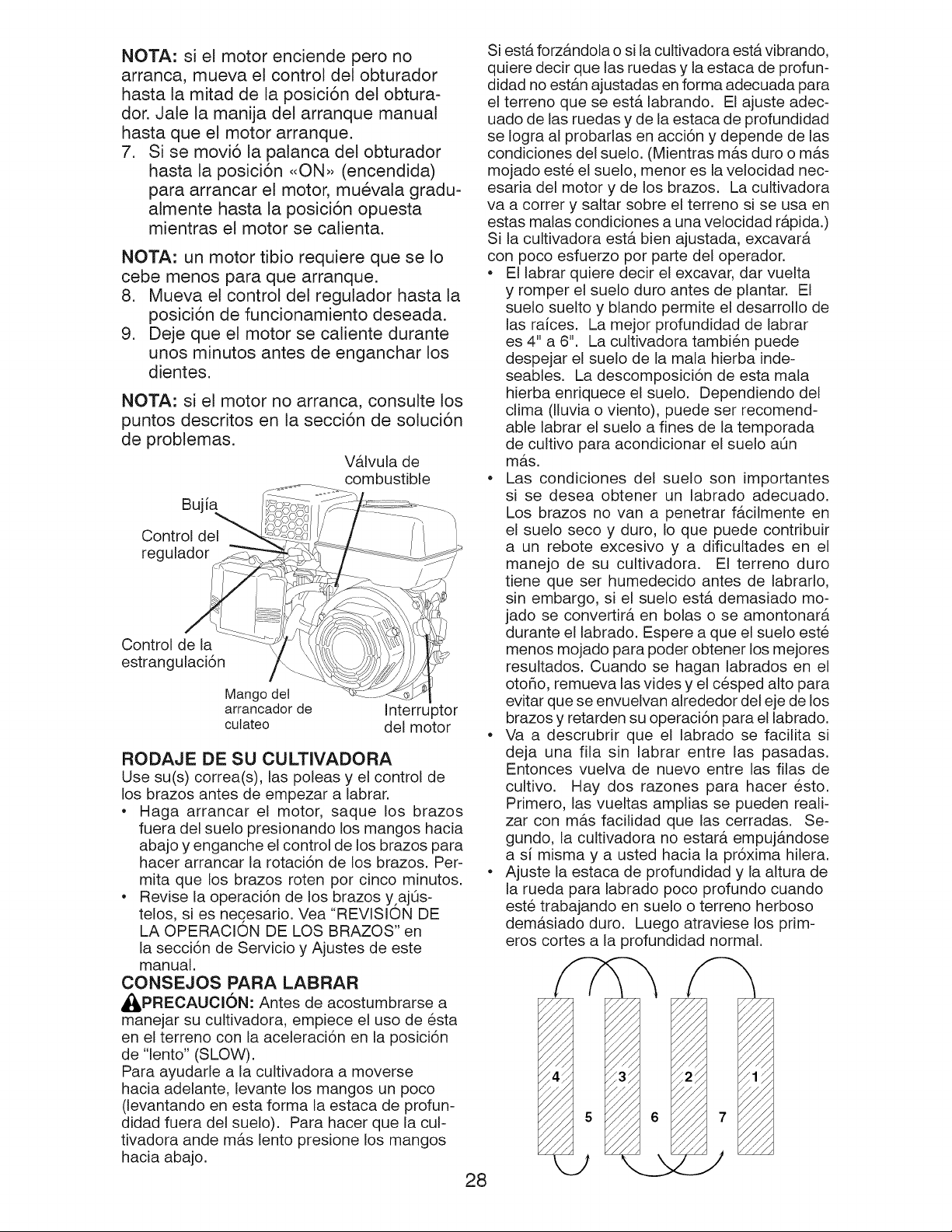
NOTA: si el motor enciende pero no
arranca, mueva el control del obturador
hasta la mitad de la posici6n de! obtura-
dot. Jale la manija del arranque manual
hasta que el motorarranque.
7. Si se movi6 la palanca del obturador
hasta la posici6n ,,ON>, (encendida)
para arrancar e! motor, muevala gradu-
almente hasta la posici6n opuesta
mientras el motor se calienta.
NOTA: un motor tibio requiere que se Io
cebe menos para que arranque.
8. Mueva el control de! regulador hasta la
posici6n de funcionamiento deseada.
9. Deje que el motor se caliente durante
unos minutos antes de enganchar los
dientes.
NOTA: si el motor no arranca, consulte los
puntos descdtos en la secci6n de soluci6n
de problemas.
V&lvula de
combustible
Buji_
Control del
regulador
Control de la
estrangulaci6n
Mango det
arrancador de Interruptor
cutateo del motor
RODAJE DE SU CULTIVADORA
Use su(s) correa(s), las poleas y el control de
los brazos antes de empezar a labrar.
• Haga arrancar el motor, saque los brazos
fuera del suelo presionando los mangos hacia
abajo y enganche el control de los brazos para
hacer arrancar la rotaci6n de los brazos. Per-
mita que los brazos roten por cinco minutos.
• Revise la operaci6n de los brazos y aj_s-
telos, si es necesario. Vea "REVISION DE
LA OPERACION DE LOS BRAZOS" en
la secci6n de Servicio y Ajustes de este
manual.
CONSEJOS PARA LABRAR
_IPREOAUCI6N: Antes de acostumbrarse a
manejar su cultivadora, empiece el uso de esta
en el terreno con la aceleraci6n en la posici6n
de "lento" (SLOW).
Para ayudarle a la cultivadora a moverse
hacia adelante, levante los mangos un poco
(levantando en esta forma la estaca de profun-
didad fuera del suelo). Para hacer que la cul-
tivadora ande m&s lento presione los mangos
hacia abajo.
Si est& forzandola o si la cultivadora esta vibrando,
quiere decir que las ruedas y la estaca de profun-
didad no estan ajustadas en forma adecuada para
el terreno que se esta labrando. El ajuste adec-
uado de las ruedas y de la estaca de profundidad
se Iogra al probarlas en acci6n y depende de las
condiciones del suelo. (Mientras mas duro o m&s
mojado este el suelo, menor es la velocidad nec-
esaria del motor y de los brazos. La cultivadora
va a correr y saltar sobre el terreno si se usa en
estas malas condiciones a una velocidad rapida.)
Si la cultivadora est& bien ajustada, excavara
con poco esfuerzo pot parte del operador.
• El labrar quiere decir el excavar, dar vuelta
y romper el suelo duro antes de plantar. El
suelo suelto y blando permite el desarrollo de
las raices. La mejor profundidad de labrar
es 4" a 6". La cultivadora tambien puede
despejar el suelo de la mala hierba inde-
seables. La descomposici6n de esta mala
hierba enriquece el suelo. Dependiendo del
clima (lluvia o viento), puede set recomend-
able labrar el suelo a fines de la temporada
de cultivo para acondicionar el suelo ann
m&s.
• Las condiciones del suelo son importantes
si se desea obtener un labrado adecuado.
Los brazos no van a penetrar fgtcilmente en
el suelo seco y duro, Io que puede contribuir
a un rebote excesivo y a dificultades en el
manejo de su cultivadora. El terreno duro
tiene que set humedecido antes de labrarlo,
sin embargo, si el suelo esta demasiado mo-
jado se convertir& en bolas o se amontonara
durante el labrado. Espere a que el sue!o este
menos mojado para poder obtener los mejores
resultados. Cuando se hagan labrados en e!
oto_o, remueva las vides y el cesped alto para
evitar que se envuelvan alrededor del eje de los
brazos y retarden su operaci6n para el labrado.
• Va a descrubrir que e! labrado se facilita si
deja una fila sin labrar entre las pasadas.
Entonces vuelva de nuevo entre las filas de
cultivo. Hay dos razones para hacer esto.
Primero, las vueltas amplias se pueden reali-
zar con m&s facilidad que las cerradas. Se-
gundo, la cultivadora no estara empuj&ndose
a si misma y a usted hacia la pr6xima hilera.
• Ajuste la estaca de profundidad y la altura de
la rueda para labrado poco profundo cuando
este trabajando en suelo o terreno herboso
demasiado duro. Luego atraviese los prim-
eros cortes a la profundidad normal.
//
//
//
//
//
/,
//
//
//
//
28
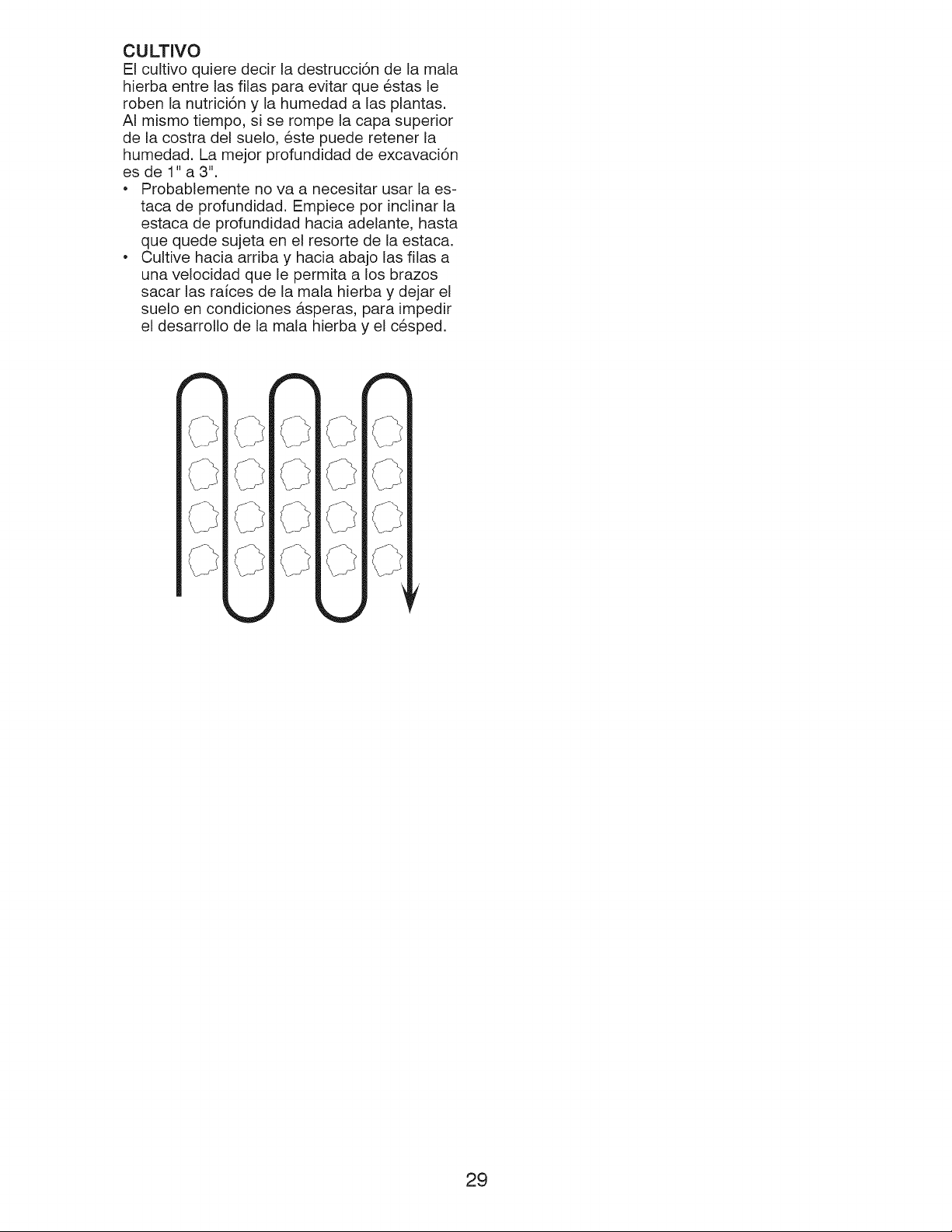
CULTIVO
El cultivo quiere decir la destrucci6n de la mala
hierba entre las filas para evitar que estas le
roben la nutrici6n y la humedad alas plantas.
AI mismo tiempo, si se rompe la capa superior
de la costra del suelo, este puede retener la
humedad. La mejor profundidad de excavaci6n
es de 1" a 3".
• Probablemente no va a necesitar usar la es-
taca de profundidad. Empiece por inclinar la
estaca de profundidad hacia adelante, hasta
que quede sujeta en el resorte de la estaca.
• Cultive hacia arriba y hacia abajo las filas a
una velocidad que le permita a los brazos
sacar las raices de la mala hierba y dejar el
suelo en condiciones asperas, para impedir
el desarrollo de la mala hierba y el cesped.
_J
%.J
_J
_J
C;
C
O
S\
29
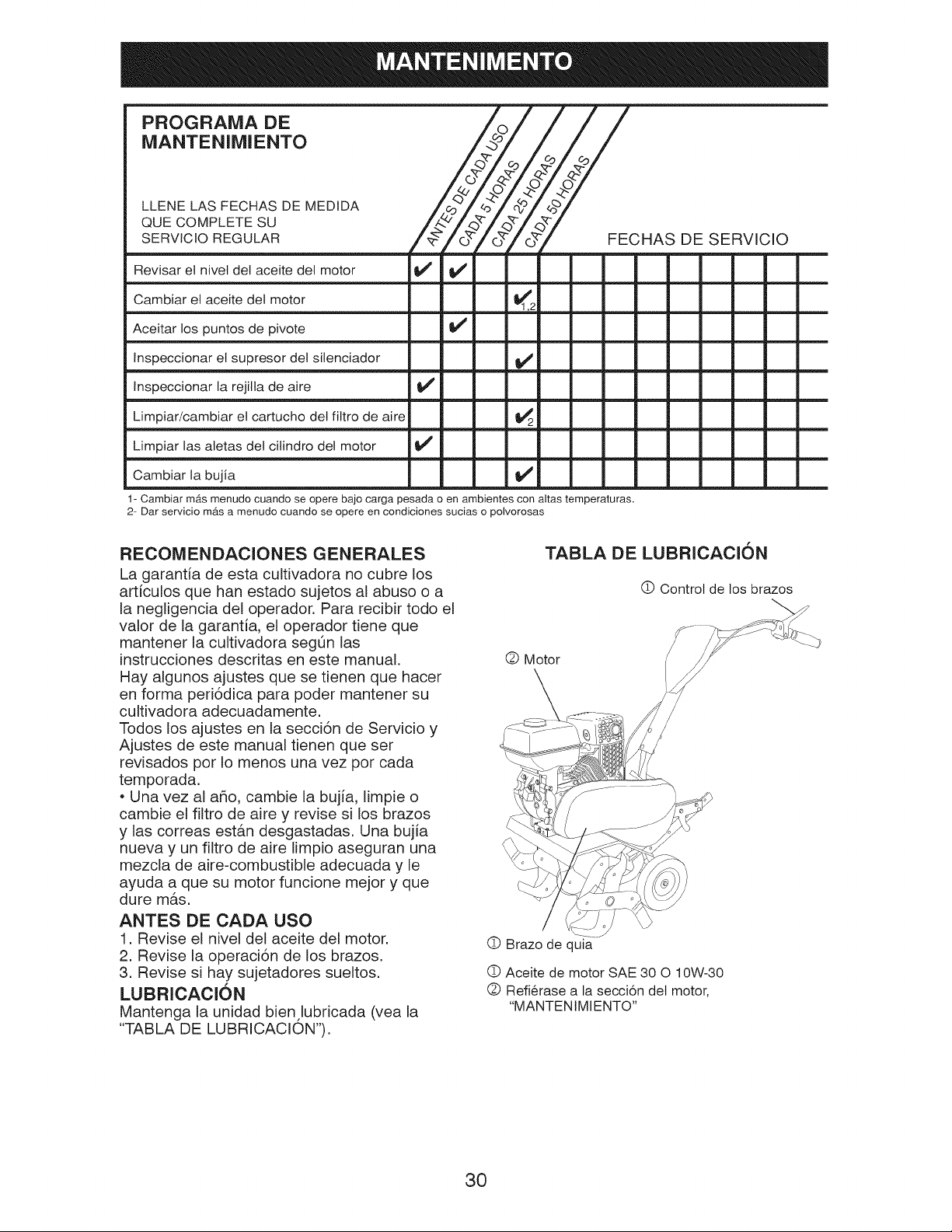
PROGRAMA DE
MANTENIMIENTO
LLENE LAS FECHAS DE MEDIDA
QUE COMPLETE SU
SERVICIO REGULAR
Revisar et nivet del aceite del motor
Cambiar et aceite del motor
Aceitar los puntos de pivote
lnspeccionar et supresor del sitenciador
lnspeccionar la rejitta de aire
Limpiar/cambiar et cartucho del fittro de aire
Limpiar las aletas del citindro del motor
Cambiar la bujia
FECHAS DE SERVICIO
1- Cambiar mAs menudo cuando se opere bajo carga pesada o en ambientes con altas temperaturas.
2- Dar servicio m_ts a menudo cuando se opere en condiciones sucias o polvorosas
RECOMENDACIONES GENERALES
La garantia de esta cultivadora no cubre los
articulos que han estado sujetos al abuso o a
la negligencia del operador. Para recibir todo el
valor de la garantia, el operador tiene que
mantener la cultivadora segQn las
instrucciones descritas en este manual.
Hay algunos ajustes que se tienen que hacer
en forma peri6dica para poder mantener su
cultivadora adecuadamente.
Todos los ajustes en la secci6n de Servicio y
Ajustes de este manual tienen que set
revisados por Io menos una vez por cada
temporada.
• Una vez al aflo, cambie la bujia, limpie o
cambie el filtro de aire y revise si los brazos
y las correas est_.n desgastadas. Una bujia
nueva y un filtro de aire limpio aseguran una
mezcla de aire-combustible adecuada y le
ayuda a que su motor funcione mejor y que
dure m&s.
ANTES DE CADA USO
1. Revise el nivel del aceite del motor.
2. Revise la operaci6n de los brazos.
3. Revise si hay sujetadores sueltos.
LUBRICACION
Mantenga la unidad bien lubricada (vea la
"TABLA DE LUBRICACION").
TABLA DE LUBRICACION
O Control de los brazos
Q Motor
O Brazo de quia
O Aceite de motor SAE 30 O 10W-30
(_) Refi@ase a la secci6n del motor,
"MANTENIMIENTO"
30
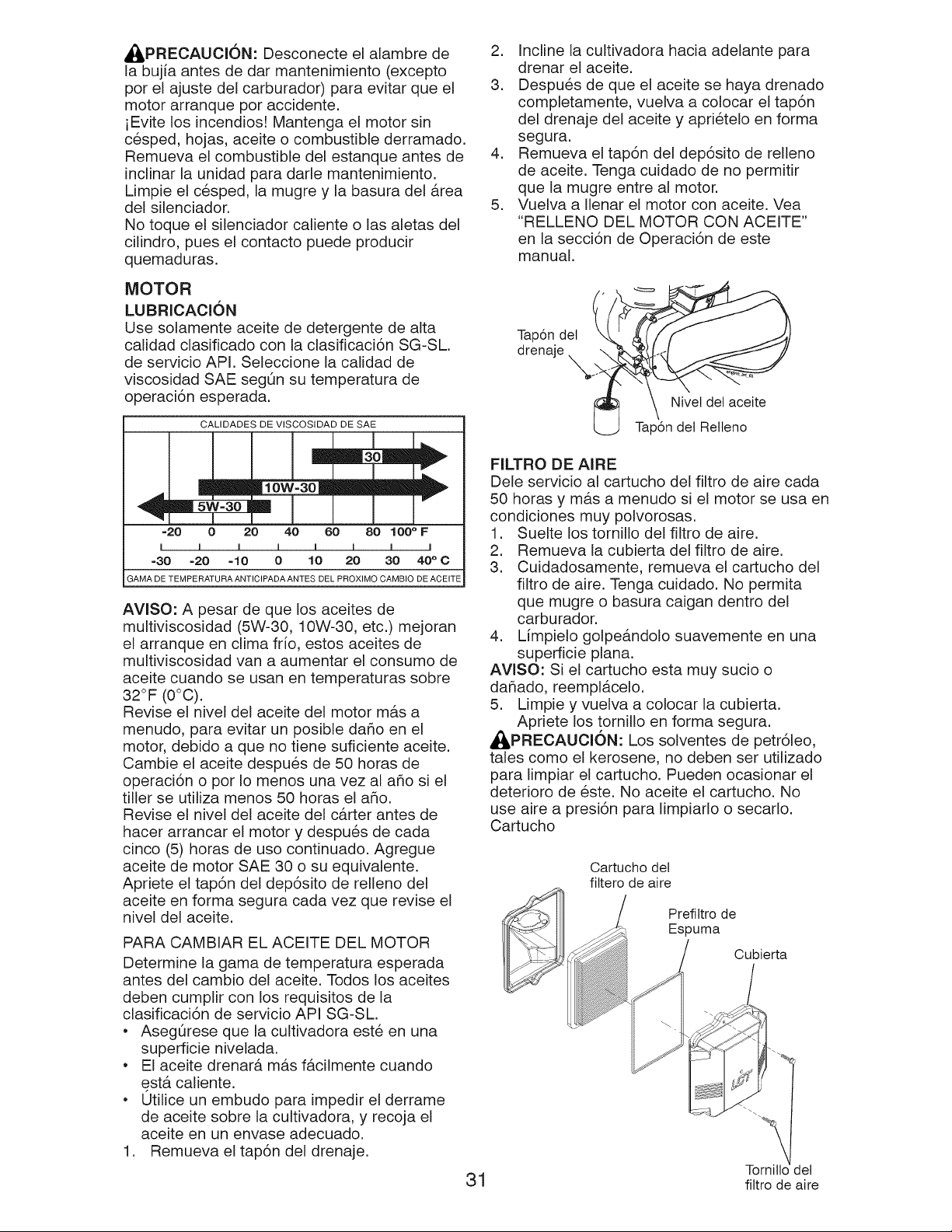
_,PRECAUCl6N: Desconecte el alambre de
la bujia antes de dar mantenimiento (excepto
pot el ajuste del carburador) para evitar que el
motor arranque por accidente.
lEvite los incendios! Mantenga el motor sin
cesped, hojas, aceite o combustible derramado.
Remueva el combustible del estanque antes de
inclinar la unidad para darle mantenimiento.
Limpie el cesped, la mugre y la basura del &tea
del silenciador.
No toque el silenciador caliente o las aletas del
cilindro, pues el contacto puede producir
quemaduras.
MOTOR
LUBRICACI()N
Use solamente aceite de detergente de alta
calidad clasificado con la clasificaci6n SG-SL.
de servicio API. Seleccione la calidad de
viscosidad SAE segOn su temperatura de
operaci6n esperada.
CALIDADES DE VISCOSIDAD DE SAE
__lOW-3Om_ _ _1_"
_.5W-30|.1 !
=20 0 20 40 60 80 IO0°F
I ! I I ! I I I
=30 =20 =10 0 10 20 30 40 ° C
GAMA DE TEMPERATURA ANTICIPADA ANTES DEL PROXIMO CAMBIO DE ACEITE
AVlSO: A pesar de que los aceites de
multiviscosidad (5W-30, 10W-30, etc.) mejoran
el arranque en clima frio, estos aceites de
multiviscosidad van a aumentar el consumo de
aceite cuando se usan en temperaturas sobre
32°F (0°C).
Revise el nivel del aceite del motor m&s a
menudo, para evitar un posible daflo en el
motor, debido a que no tiene suficiente aceite.
Cambie el aceite despues de 50 horas de
operaci6n o por Io menos una vez al aflo si el
tiller se utiliza menos 50 horas e! aflo.
Revise el nivel del aceite del c&rter antes de
hacer arrancar el motor y despues de cada
cinco (5) horas de uso continuado. Agregue
aceite de motor SAE 30 o su equivalente.
Apriete el tap6n del dep6sito de relleno del
aceite en forma segura cada vez que revise el
nivel del aceite.
PARA CAMBIAR EL ACEITE DEL MOTOR
Determine la gama de temperatura esperada
antes del cambio del aceite. Todos los aceites
deben cumplir con los requisitos de la
clasificaci6n de servicio API SG-SL.
• AsegQrese que la cultivadora este en una
superficie nivelada.
• El aceite drenar& m&s f&cilmente cuando
est& caliente.
• Utilice un embudo para impedir el derrame
de aceite sobre la cultivadora, y recoja el
aceite en un envase adecuado.
1. Remueva eltap6n del drenaje.
31
2. Incline la cultivadora hacia adelante para
drenar el aceite.
3. Despues de que el aceite se haya drenado
completamente, vuelva a colocar el tap6n
del drenaje del aceite y aprietelo en forma
segura.
4. Remueva el tap6n del dep6sito de relleno
de aceite. Tenga cuidado de no permitir
que la mugre entre al motor.
5. Vuelva a Ilenar el motor con aceite. Vea
"RELLENO DEL MOTOR CON ACEITE"
en la secci6n de Operaci6n de este
manual.
Tap6ndel
drenaje
\
Nivet det aceite
Tap6n del Relleno
FILTRO DE AIRE
Dele servicio al cartucho del filtro de aire cada
50 horas y m&s a menudo si el motor se usa en
condiciones muy polvorosas.
1. Suelte los tornillo del filtro de aire.
2. Remueva la cubierta del filtro de aire.
3. Cuidadosamente, remueva el cartucho del
filtro de aire. Tenga cuidado. No permita
que mugre o basura caigan dentro del
carburador.
4. Limpielo golpeandolo suavemente en una
superficie plana.
AVlSO: Si el cartucho esta muy sucio o
daflado, reemplacelo.
5. Limpie y vuelva a colocar la cubierta.
Apriete los tornillo en forma segura.
_I_PRECAUCl0N: Los solventes de petr61eo,
tales como el kerosene, no deben set utilizado
para limpiar el cartucho. Pueden ocasionar el
deterioro de este. No aceite el cartucho. No
use aire a presi6n para limpiarlo o secarlo.
Cartucho
Cartucho det
filtero de aire
Prefiltro de
Espuma
Cubierta
Tornillo Jet
filtro de aire

SISTEMADE ENFRIAMIENTO
Su motor se enfria con aire. Para obtener el
rendimiento del motor adecuado y larga
duraci6n mantenga su motor limpio.
• Limpie la rejilla de aire frecuentemente
usando un cepillo de cerdas duras.
• Remueva la caja del ventilador y limpiela si
es necesario.
• Mantenga las aletas del cilindro sin mugre o
paja.
Atetas del cilindor
BUJiA
Cambie las bujias al comienzo de cada
temporada de cultivo, o despues de 50 horas
de uso, Io que suceda primero. El tipo de bujia
y la abertura aparece en las
"ESPECIFICACIONES DEL PRODUCTO" en
la p&gina 21 de este manual.
TRANSMISION
Su transmisi6n est& sellada y no va a necesitar
lubricaci6n.
LIMPIEZA
No limpie su cultivadora cuando el motor y la
transmisi6n esten calientes. No recomendamos
el uso de agua presurizada (manguera del
jardin, etc.) para limpiar su unidad a menos que
el &tea de la junta alrededor de la transmisi6n y
del silenciador del motor, del filtro de aire y del
carburador se cubran ara protejerlos del agua.
El agua en la transmisi6n y/o el motor acortar&
la vida de su cultivadora.
• Limpie todo material extraflo del motor, las
ruedas, el pulido, etc.
• Mantenga las superficies pulidas y las
ruedas sin derrames de gasolina, aceite,
etc.
• Proteja las superficies pintadas con cera
tipo automotriz.
Rejilla de aire
Ca det
ventilador
SILENCIADOR
No opere la cultivadora sin el silenciador. No
manipulee el sistema de escape. Los
silenciadores o los amortiguadores de chispas
daflados pueden crear un peligro de incendio.
Inspecci6nelos peri6dicamente y c&mbielos si
es necesario. Si su motor viene equipado con
un conjunto de rejilla para el amortiguador de
chispas, remuevalo cada 50 horas para
limpiarlo e inspeccionarlo. C&mbielo si es
necesario.
32
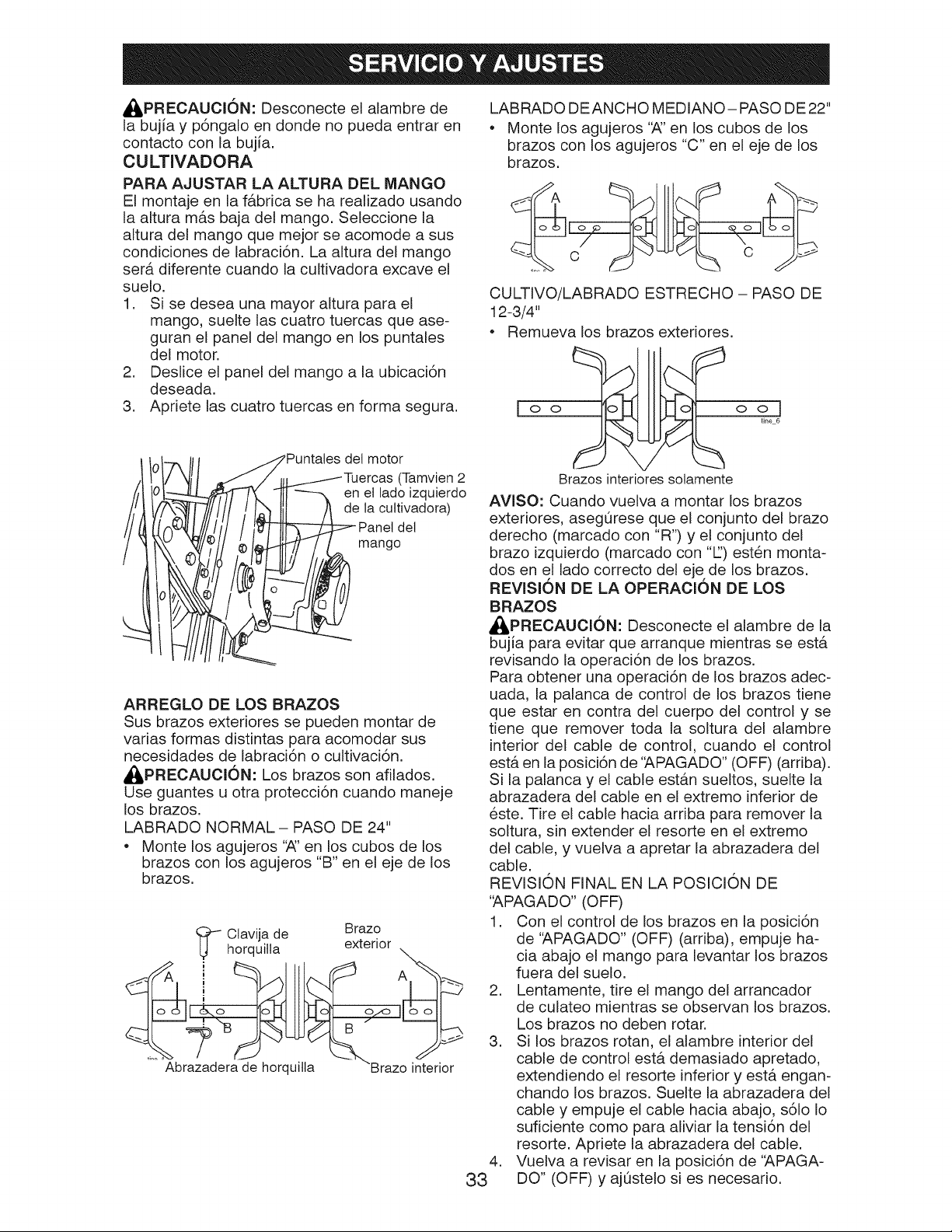
_IPRECAUCl6N: Desconecte el alambre de
la bujia y p6ngalo en donde no pueda entrar en
contacto con la bujia.
CU LTIVADO RA
PARA AJUSTAR LA ALTURA DEL MANGO
El montaje en la f&brica se ha realizado usando
la altura m&s baja del mango. Seleccione la
altura del mango que mejor se acomode a sus
condiciones de labraci6n. La altura del mango
set& diferente cuando la cultivadora excave el
suelo.
1. Si se desea una mayor altura para el
mango, suelte las cuatro tuercas que ase-
guran el panel del mango en los puntales
de! motor.
2. Deslice el panel del mango a la ubicaci6n
deseada.
3. Apriete las cuatro tuercas en forma segura.
delmotor
(Tamvien 2
en et lado izquierdo
de la cuttivadora)
del
mango
ARREGLO DE LOS BRAZOS
Sus brazos exteriores se pueden montar de
varias formas distintas para acomodar sus
necesidades de labraci6n o cultivaci6n.
_IPRECAUCl6N: Los brazos son afilados.
Use guantes u otra protecci6n cuando maneje
los brazos.
LABRADO NORMAL- PASO DE 24"
• Monte los agujeros '_' en los cubos de los
brazos con los agujeros "B" en el eje de los
brazos.
- Clavija de Brazohorquilla exterior
_ A i A
o B?_!
raza era e orqui a Brazo interior
LABRADO DEANCHO MEDIANO-PASO DE 22"
• Monte los agujeros '_' en los cubos de los
brazos con los agujeros "C" en el eje de los
brazos.
o
CULTIVO/LABRADO ESTRECHO - PASO DE
12-3/4"
• Remueva los brazos exteriores.
o o
ooJ
tine6
Brazos interiores solamente
AVlSO" Cuando vuelva a montar los brazos
exteriores, asegOrese que el conjunto del brazo
derecho (marcado con "R") y el conjunto del
brazo izquierdo (marcado con "lL') esten monta-
dos en el lado correcto del eje de los brazos.
REVISION DE LA OPERAClON DE LOS
BRAZOS
_IbPRECAUClON: Desconecte el alambre de la
bujia para evitar que arranque mientras se est&
revisando la operaci6n de los brazos.
Para obtener una operaci6n de los brazos adec-
uada, la palanca de control de los brazos tiene
que estar en contra del cuerpo del control y se
tiene que remover toda la soltura del alambre
interior del cable de control, cuando el control
est& en la posici6n de '_PAGADO" (OFF) (arriba).
Si la palanca y el cable est&n sueltos, suelte la
abrazadera del cable en el extremo inferior de
este. Tire el cable hacia arriba para remover la
soltura, sin extender el resorte en el extremo
del cable, y vuelva a apretar la abrazadera del
cable.
REVISION FINAL EN LA POSICION DE
'_,PAGADO" (OFF)
1. Con el control de los brazos en la posici6n
de 'APAGADO" (OFF) (arriba), empuje ha-
cia abajo el mango para levantar los brazos
fuera del suelo.
2. Lentamente, tire el mango del arrancador
de culateo mientras se observan los brazos.
Los brazos no deben rotar.
3. Si los brazos rotan, e! alambre interior del
cable de control est& demasiado apretado,
extendiendo el resorte inferior y est& engan-
chando los brazos. Suelte la abrazadera del
cable y empuje el cable hacia abajo, s61o Io
suficiente como para aliviar la tensi6n del
resorte. Apriete la abrazadera del cable.
Vuelva a revisar en la posici6n de '_,PAGA-
DO" (OFF) y ajOstelo si es necesario.
.
33
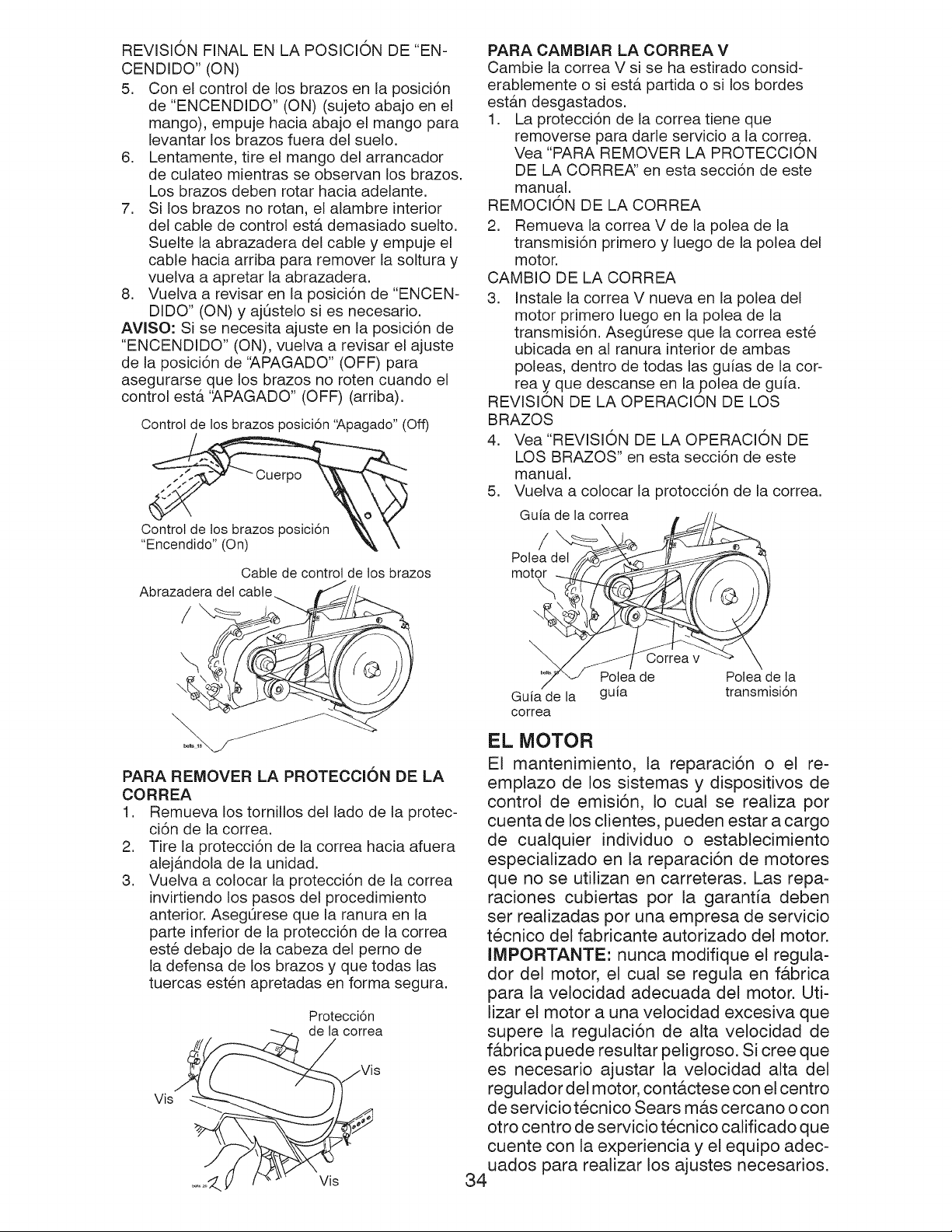
REVISION FINAL EN LA POSICION DE "EN-
CENDIDO" (ON)
5. Con el control de los brazos en la posiciSn
de "ENCENDIDO" (ON) (sujeto abajo en el
mango), empuje hacia abajo el mango para
levantar los brazos fuera del suelo.
6. Lentamente, tire el mango del arrancador
de culateo mientras se observan los brazos.
Los brazos deben rotar hacia adelante.
7. Si los brazos no rotan, el alambre interior
del cable de control est,. demasiado suelto.
Suelte la abrazadera del cable y empuje el
cable hacia arriba para remover la soltura y
vuelva a apretar la abrazadera.
8. Vuelva a revisar en la posici6n de "ENCEN-
DIDO" (ON) y aj0stelo si es necesario.
AVlSO: Si se necesita ajuste en la posici6n de
"ENCENDIDO" (ON), vuelva a revisar el ajuste
de la posici6n de 'APAGADO" (OFF) para
asegurarse que los brazos no roten cuando el
control est,. 'APAGADO" (OFF) (arriba).
Control de los brazos posici6n 'Apagado" (Off)
.;, po
Control de los brazos posici6n
"Encendido" (On)
Cable de control de los brazos
Abrazadera det cable
PARA REMOVER LA PROTECCION DE LA
CORREA
1. Remueva los tornillos del lado de la protec-
ci6n de la correa.
2. Tire la protecci6n de la correa hacia afuera
alej&ndola de la unidad.
3. Vuelva a colocar la protecci6n de la correa
invirtiendo los pasos del procedimiento
anterior. Aseg0rese que la ranura en la
parte inferior de la protecci6n de la correa
este debajo de la cabeza del perno de
la defensa de los brazos y que todas las
tuercas esten apretadas en forma segura.
Protecci6n
de la correa
Vis
Vis
PARA CAMBIAR LA CORREA V
Cambie la correa V si se ha estirado consid-
erablemente o si est& partida o si los bordes
est&n desgastados.
1. La protecci6n de la correa tiene que
removerse para darle servicio a la correa.
Vea "PARA REMOVER LA PROTECCION
DE LA CORREA" en esta secci6n de este
manual.
REMOCION DE LA CORREA
2. Remueva la correa V de la polea de la
transmisi6n primero y luego de la polea del
motor.
CAMBIO DE LA CORREA
3. Instale la correa V nueva en la polea del
motor primero luego en la polea de la
transmisi6n. AsegOrese que la correa este
ubicada en al ranura interior de ambas
poleas, dentro de todas las guias de la cor-
rea y. que descanse en la polea de guia.
REVISION DE LA OPERACION DE LOS
BRAZOS
4. Vea"REVlSl0N DE LA OPERACION DE
LOS BRAZOS" en esta secci6n de este
manual.
5. Vuelva a colocar la protocci6n de la correa.
Guia de la correa
/
Potea det
motor
\.
Correa v
Polea de
Guia de la guia
correa
Potea de ta
transmisi6n
EL MOTOR
El mantenimiento, la reparaci6n o el re-
emplazo de los sistemas y dispositivos de
control de emisi6n, Io cual se realiza por
cuenta de los clientes, pueden estar a cargo
de cualquier individuo o establecimiento
especializado en la reparaci6n de motores
que no se utilizan en carreteras. Las repa-
raciones cubiertas por la garantia deben
ser realizadas por una empresa de servicio
t6cnico del fabricante autorizado del motor.
IMPORTANTE: nunca modifique el regula-
dor del motor, el cual se regula en f&brica
para la velocidad adecuada del motor. Uti-
lizar el motor a una velocidad excesiva que
supere la regulaci6n de alta velocidad de
f&brica puede resultar peligroso. Si cree que
es necesario ajustar la velocidad alta del
regulador del motor, cont_.ctese con el centro
de servicio t6cnico Sears m&s cercano o con
otro centro de servicio tecnico calificado que
cuente con la experiencia y el equipo adec-
uados para realizar los ajustes necesarios.
34
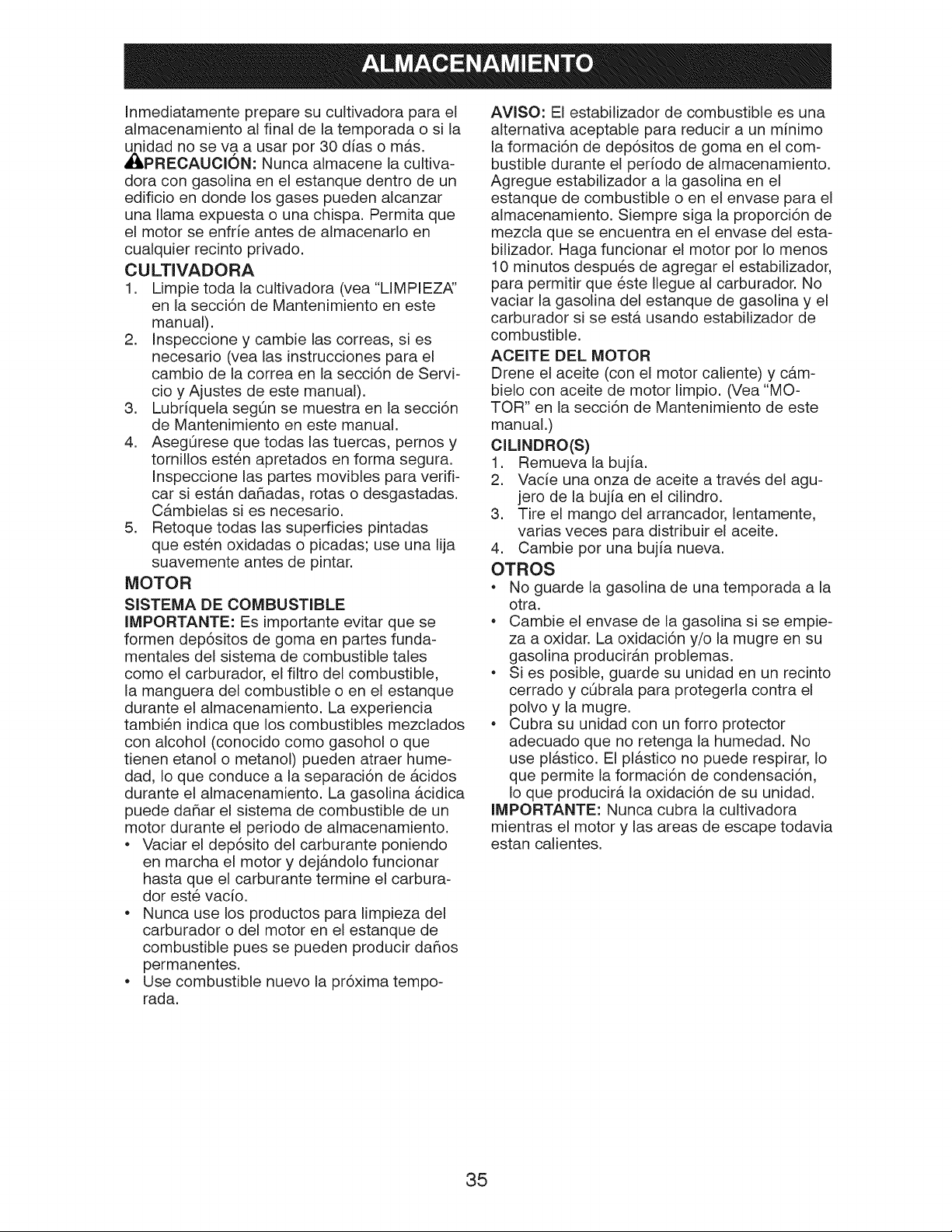
Inmediatamente prepare su cultivadora para el
almacenamiento al final de la temporada o si la
unidad no se va a usar pot 30 dias o m&s.
_PRECAUCI6N: Nunca almacene la cultiva-
dora con gasolina en el estanque dentro de un
edificio en donde los gases pueden alcanzar
una llama expuesta o una chispa. Permita que
el motor se enfrie antes de almacenarlo en
cualquier recinto privado.
CULTIVADORA
1. Limpie toda la cultivadora (vea "LIMPIEZA'
en la secci6n de Mantenimiento en este
manual).
2. Inspeccione y cambie las correas, si es
necesario (vea las instrucciones para el
cambio de la correa en la secci6n de Servi-
cioy Ajustes de este manual).
3. Lubriquela seg0n se muestra en la secci6n
de Mantenimiento en este manual.
4. Aseg0rese que todas las tuercas, pernos y
tornillos esten apretados en forma segura.
Inspeccione las partes movibles para verifi-
car si est&n dafladas, rotas o desgastadas.
C&mbielas si es necesario.
5. Retoque todas las superficies pintadas
que esten oxidadas o picadas; use una lija
suavemente antes de pintar.
MOTOR
SISTEMA DE COMBUSTIBLE
IMPORTANTE: Es importante evitar que se
formen dep6sitos de goma en partes funda-
mentales del sistema de combustible tales
como el carburador, el filtro del combustible,
la manguera del combustible o en e! estanque
durante el almacenamiento. La experiencia
tambien indica que los combustibles mezclados
con alcohol (conocido como gasohol o que
tienen etanol o metanol) pueden atraer hume-
dad, Io que conduce a la separaci6n de acidos
durante el almacenamiento. La gasolina acidica
puede daflar el sistema de combustible de un
motor durante el periodo de almacenamiento.
• Vaciar el dep6sito del carburante poniendo
en marcha el motor y dejandolo funcionar
hasta que el carburante termine el carbura-
dor este vacio.
• Nunca use los productos para limpieza del
carburador o del motor en el estanque de
combustible pues se pueden producir daflos
permanentes.
• Use combustible nuevo la pr6xima tempo-
rada.
AVlSO: El estabilizador de combustible es una
alternativa aceptable para reducir a un minimo
la formaci6n de dep6sitos de goma en el com-
bustible durante el periodo de almacenamiento.
Agregue estabilizador a la gasolina en el
estanque de combustible o en el envase para el
almacenamiento. Siempre siga la proporci6n de
mezcla que se encuentra en el envase del esta-
bilizador. Haga funcionar el motor por Io menos
10 minutos despues de agregar el estabilizador,
para permitir que este Ilegue al carburador. No
vaciar la gasolina del estanque de gasolina y el
carburador si se est& usando estabilizador de
combustible.
ACEITE DEL MOTOR
Drene el aceite (con el motor caliente) y c&m-
bielo con aceite de motor limpio. (Vea "MO-
TOR" en la secci6n de Mantenimiento de este
manual.)
CILINDRO(S)
1. Remueva la bujia.
2. Vacie una onza de aceite a traves del agu-
jero de la bujia en el cilindro.
3. Tire el mango del arrancador, lentamente,
varias veces para distribuir el aceite.
4. Cambie por una bujia nueva.
OTROS
• No guarde la gasolina de una temporada a la
otra.
• Cambie el envase de la gasolina si se empie-
za a oxidar. La oxidaci6n y/o la mugre en su
gasolina producir&n problemas.
• Si es posible, guarde su unidad en un recinto
cerrado y cObrala para protegerla contra el
polvo y la mugre.
• Cubra su unidad con un forro protector
adecuado que no retenga la humedad. No
use pl&stico. El pl&stico no puede respirar, Io
que permite la formaci6n de condensaci6n,
Io que producir& la oxidaci6n de su unidad.
IMPORTANTE: Nunca cubra la cultivadora
mientras el motor y las areas de escape todavia
estan calientes.
35
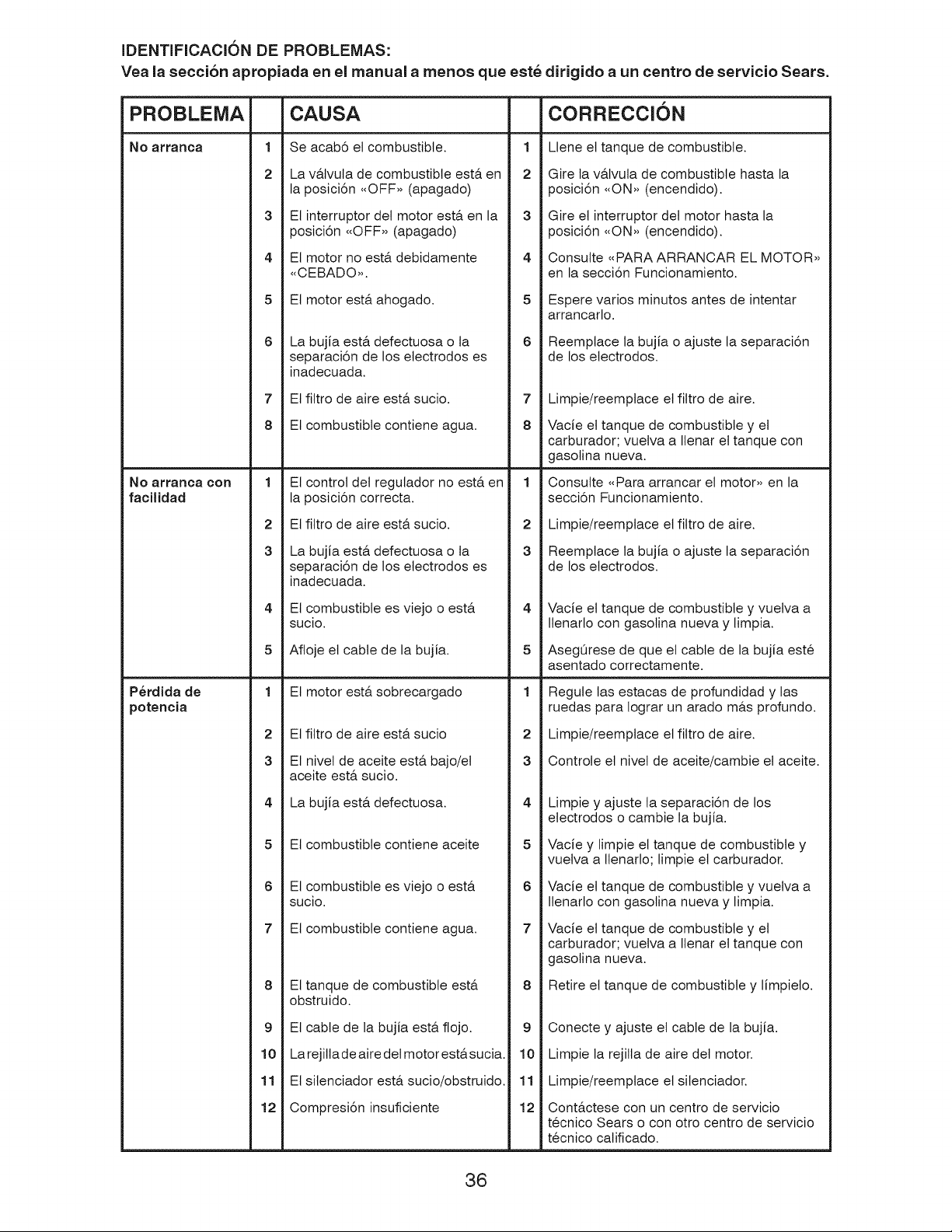
IDENTIFICACION DE PROBLEMAS:
Yea la secci6n apropiada en el manual a menos que este dirigido a un centro de servicio Sears.
PROBLEMA CAUSA
CORRECCION
No arranca 1 Se acab6 el combustible.
2 La v&tvuta de combustible est& en
la posici6n -OFF,, (apagado)
3 El interruptor del motor est& en la
posici6n -OFF,, (apagado)
4 El motor no est& debidamente
-CEBADO,,.
1 Llene el tanque de combustible.
2 Gire ta v&tvuta de combustible hasta la
posici6n-ON>, (encendido).
3 Gire et interruptor det motor hasta la
posici6n-ON>, (encendido).
4 Consutte -PARAARRANCAR EL MOTOR>,
en la secci6n Funcionamiento.
5 Et motor est& ahogado. 5 Espere varios minutos antes de intentar
arrancarlo.
6 La bujia est& defectuosa o ta
separaci6n de los electrodos es
inadecuada.
6 Reemplace la bujia o ajuste la separaci6n
de los electrodos.
No arranca con
facilidad
7 Et filtro de aire est& sucio.
7 Limpie/reemptace et filtro de aire.
8 Et combustible contiene agua. 8 Vacie el tanque de combustible y el
carburador; vuetva a Ilenar el tanque con
gasotina nueva.
1 El control det regutador no est& en 1 Consutte -Para arrancar el motop, en la
la posici6n correcta, secci6n Funcionamiento.
2 Et filtro de aire est& sucio.
2 Limpie/reemptace el filtro de aire.
3 La bujia est& defectuosa o ta
separaci6n de los electrodos es
inadecuada.
3 Reemplace la bujia o ajuste la separaci6n
de los electrodos.
4
5
Et combustible es viejo o est&
sucio.
Afloje el cable de la bujia.
4
5
Vacie el tanque de combustible y vuelva a
Ilenarlo con gasolina nueva y limpia.
AsegOrese de que et cable de la bujia este
asentado correctamente.
P_rdida de
potencia
1 Et motor est& sobrecargado
2 Et filtro de aire est& sucio
3 El nivet de aceite est& bajo/el
aceite est& sucio.
1 Regute las estacas de profundidad y las
ruedas para Iograr un arado m&s profundo.
2 Limpie/reemptace et filtro de aire.
3 Controle el nivel de aceite/cambie el aceite.
4
5
6
7
La bujia est& defectuosa.
Et combustible contiene aceite
El combustible es viejo o est&
sucio.
Et combustible contiene agua.
El tanque de combustible est&
obstruido.
4
5
6
7
Limpie y ajuste la separaci6n de los
electrodos o cambie la bujia.
Vacie y limpie et tanque de combustible y
vuelva a Ilenarlo; limpie et carburador.
Vacie et tanque de combustible y vuetva a
Ilenarlo con gasotina nueva y limpia.
Vacie el tanque de combustible y el
carburador; vuetva a Ilenar el tanque con
gasotina nueva.
8 Retire el tanque de combustible y limpielo.
9 Et cable de la bujia est& flojo.
10 La rejilla de aire del motor est&sucia.
11 Et silenciador est& sucio/obstruido.
12 Compresi6n insuficiente
9 Oonecte y ajuste et cable de la bujia.
10 Limpie la rejilla de aire del motor.
11 Limpie/reemplace el silenciador.
12 Cont&ctese con un centro de servicio
tecnico Sears o con otto centro de servicio
tecnico calificado.
36

IDENTIFICACION DE PROBLEMAS:
Yea la secci6n apropiada en el manual a menos que este dirigido a un centro de servicio Sears.
PROBLEMA CAUSA
CORRECCION
El motor 1 El nivet de aceite esta bajo/el
recalienta aceJte esta sucio.
1 Controte el nivel de aceite/cambie el aceite.
2 La rejilla de aire del motor esta
sucia.
2 Limpie la rejilla de aire del motor.
Rebote excesivo/
manipulaci6n
dificultosa
3 Et motor esta sucio. 3
El sitenciador esta parcialmente
tapado
El terreno esta demasiado seco
y duro.
Limpie las atetas det cilindro, la rejilla de aire
y el Area del silenciador
4 Retire el silenciador y limpielo.
Humedezca et terreno o espere hasta
que las condiciones del sueto sean mas
favorables
2 Las ruedas y la estaca de
profundidad estan regutadas de
manera incorrecta.
2 Regute las ruedas y la estaca de
profundidad.
El suelo forma 1 El terreno esta demasiado
acumulaciones o hOmedo.
terroRes
1 Espere hasta que las condiciones sean mas
favorables.
El motor
funciona pero la
cultivadora no se
m Ueve
El motor
funciona pero se
ahoga al afar
1 El control de los dientes no esta
enganchado.
1 Enganche el control de los dientes
2 La correa trapezoidal no esta
ajustada correctamente.
2 Inspeccione/ajuste la correa trapezoidal.
La correa trapezoidal esta fuera
de la o las poteas.
1 Et arado es demasiado profundo.
3 Inspeccione la correa trapezoidal.
1 Cotoque la estaca de profundidad para
Iograr un arado mas profundo
2 El control det regutador no esta 2 Controte ta posici6n del control del
ajustado correctamente, regutador.
37
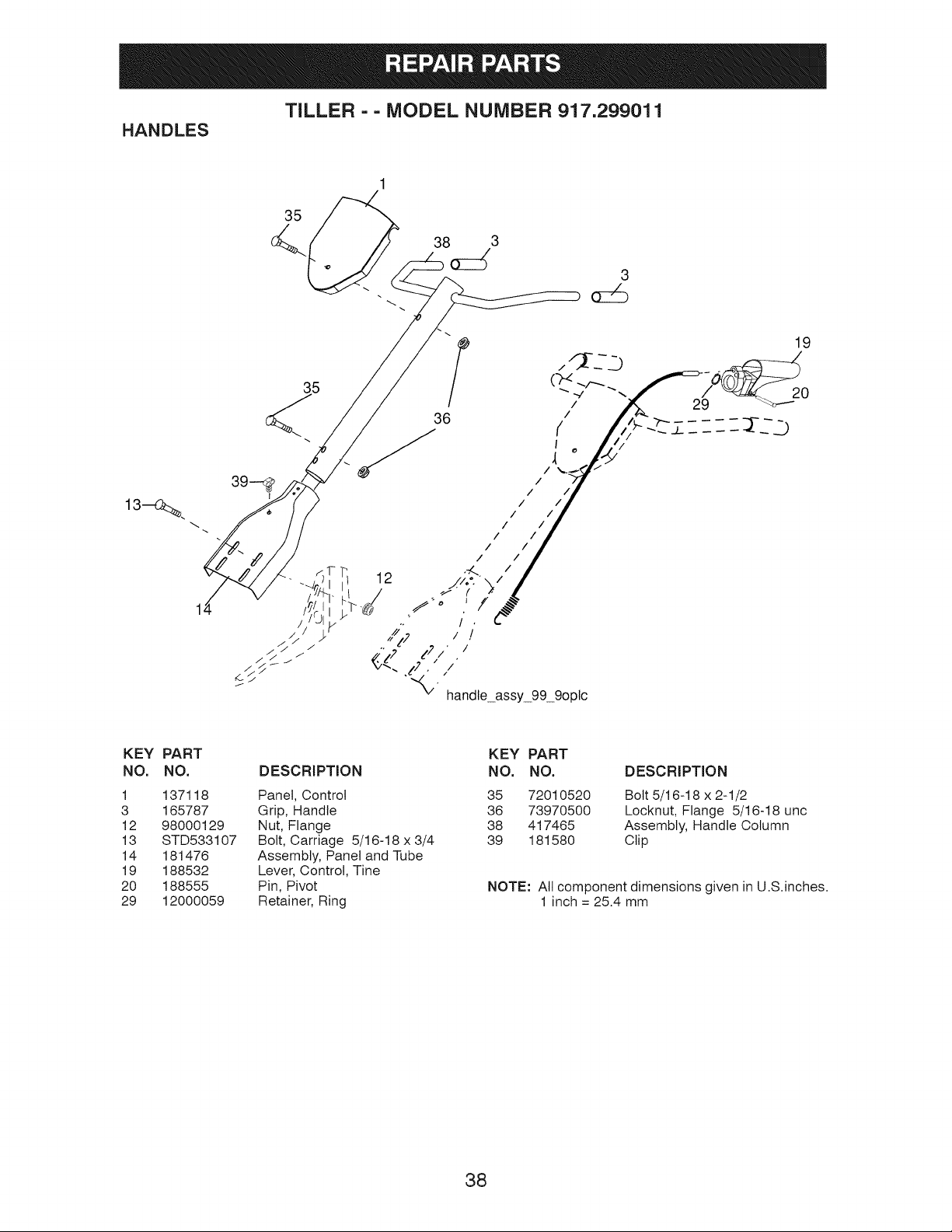
TILLER - - MODEL NUMBER 917.299011
HANDLES
35
38
35
/
36 /
f
/
/
/
/ /
/ /
/ /
/ /
/ /
/ /
29
19
20
KEY PART
NO. NO.
1 137118
3 165787
12 98000129
13 STD533107
14 181476
19 188532
20 188555
29 12000059
KEY PART
DESCRIPTION NO. NO.
Panel, Control 35 72010520
Grip, Handle 36 73970500
Nut, Flange 38 417465
Bolt, Carriage 5/16-18 x 3/4 39 181580
Assembly, Panel and Tube
Lever, Control, Tine
Pin, Pivot
Retainer, Ring
DESCRIPTION
Bott 5/16-18 x 2-1/2
Locknut, Flange 5/16-18 unc
Assembly, Handle Column
Clip
NOTE: All component dimensions given in U.S.inches.
1 inch = 25.4 mm
38
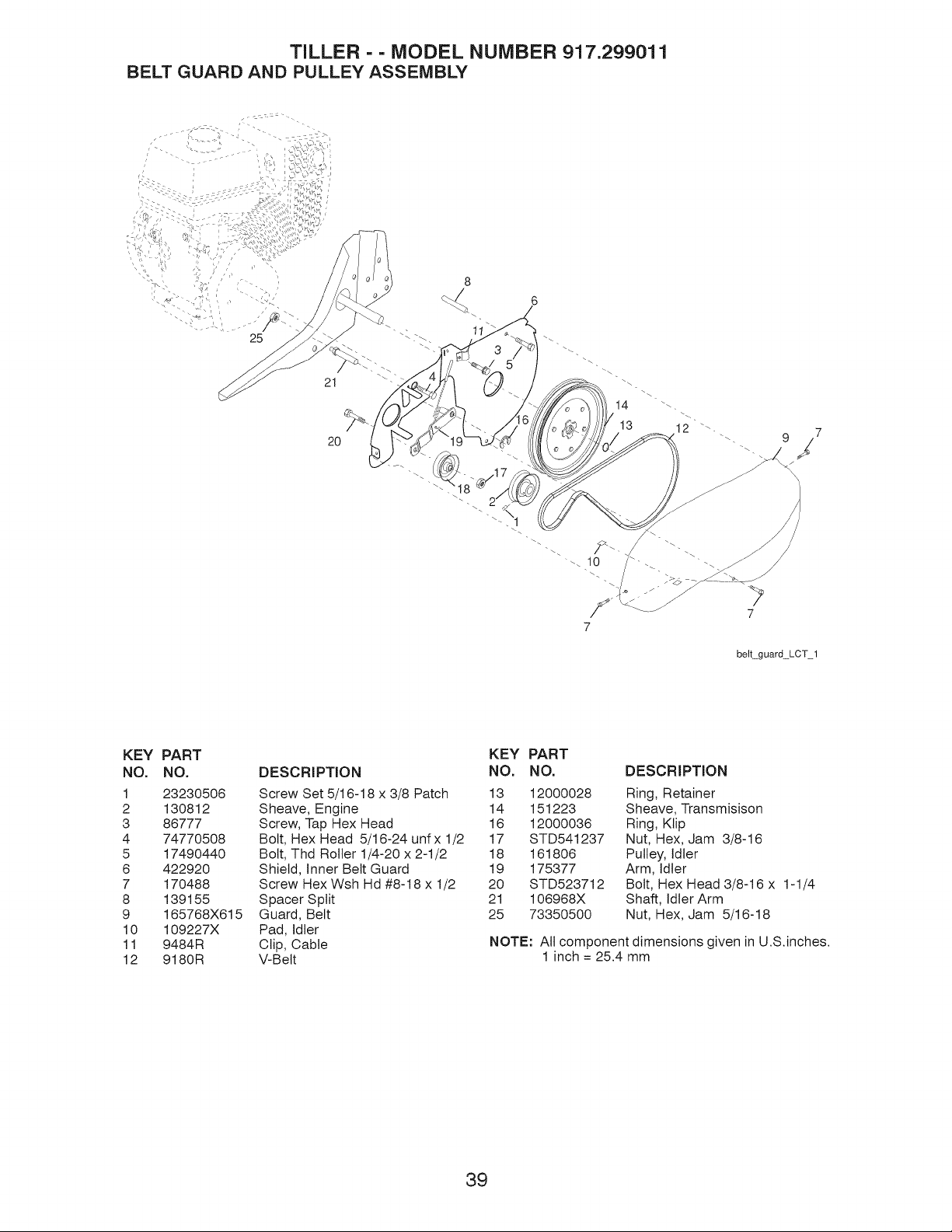
TILLER - - MODEL NUMBER 917.299011
BELT GUARD AND PULLEY ASSEMBLY
25
21
2O
8
6
14
13
7
beltguard LCT 1
KEY PART
NO. NO.
1 23230506
2 130812
3 86777
4 74770508
5 17490440
6 422920
7 170488
8 139155
9 165768X615
10 109227X
11 9484R
12 9180R
KEY
DESCRIPTION NO.
Screw Set 5/16-18 x 3/8 Patch 13
Sheave, Engine 14
Screw, Tap Hex Head 16
Bolt, Hex Head 5/16-24 unfx 1/2 17
Bolt, Thd Roller 1/4-20 x 2-1/2 18
Shield, Inner Belt Guard 19
Screw Hex Wsh Hd #8-18 x 1/2 20
Spacer Split 21
Guard, Belt 25
Pad, Idler
Clip, Cable
V-Belt
PART
NO. DESCRIPTION
12000028 Ring, Retainer
151223 Sheave, Transmisison
12000036 Ring, Klip
STD541237 Nut, Hex, Jam 3/8-16
161806 Pulley, Idler
175377 Arm, Idler
STD523712 Bolt, Hex Head 3/8-16 x 1-1/4
106968X Shaft, Idler Arm
73350500 Nut, Hex, Jam 5/16-18
NOTE: All component dimensions given in U.S.inches.
1 inch = 25.4 mm
39
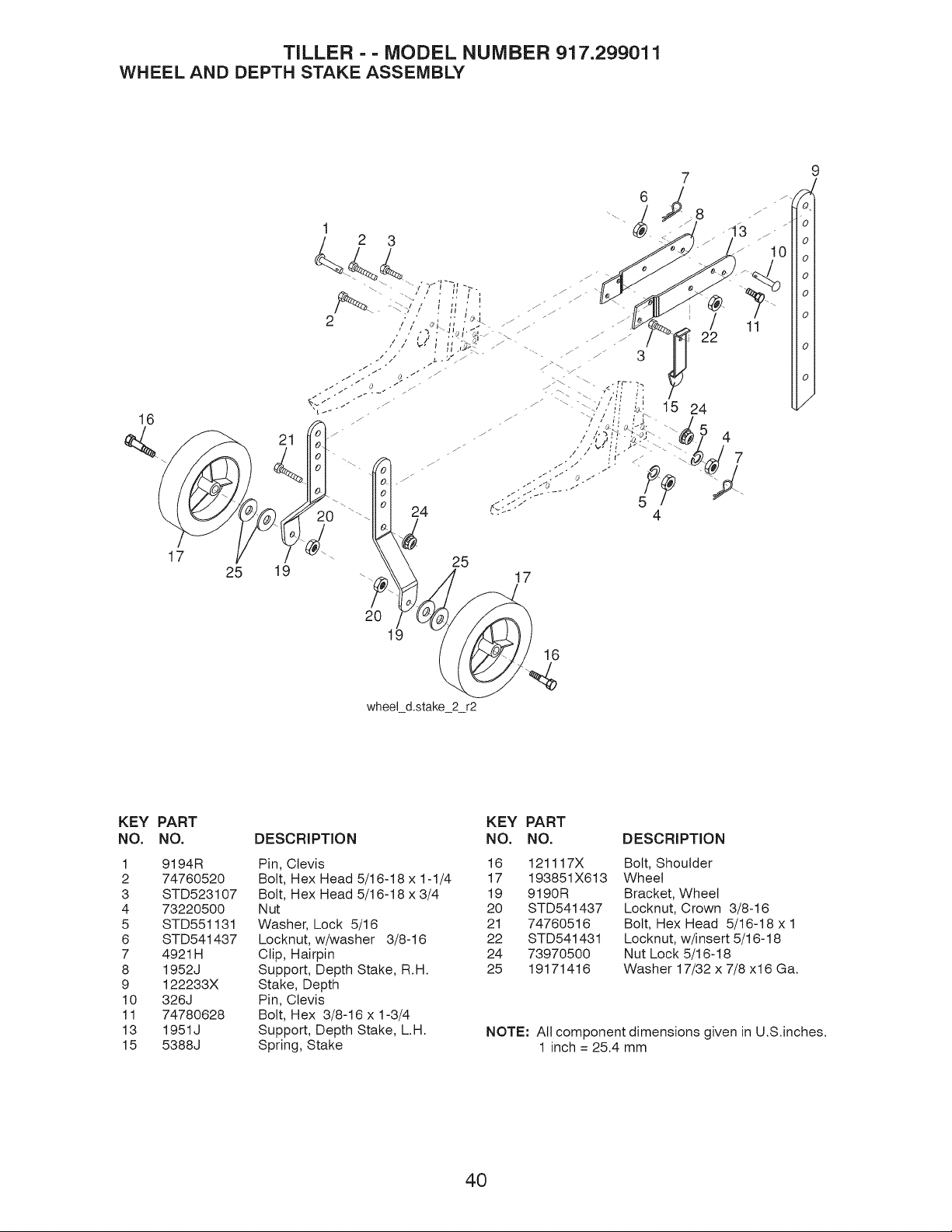
TILLER - - MODEL NUMBER 917.299011
WHEEL AND DEPTH STAKE ASSEMBLY
16
21
6
24
11
9
17
25
19
25
17
20
19
16
wheehd.stake 2 r2
KEY PART
NO. NO.
1 9194R
2 74760520
3 STD523107
4 73220500
5 STD551131
6 STD541437
7 4921H
8 1952J
9 122233X
10 326J
11 74780628
13 1951J
15 5388J
DESCRIPTION
Pin, Clevis
Bolt, Hex Head 5/16-18 x 1-1/4
Bolt, Hex Head 5/16-18 x 3/4
Nut
Washer, Lock 5/16
Locknut, w/washer 3/8-16
Clip, Hairpin
Support, Depth Stake, R.H.
Stake, Depth
Pin, Clevis
Bolt, Hex 3/8-16 x 1-3/4
Support, Depth Stake, L.H.
Spring, Stake
KEY PART
NO. NO. DESCRIPTION
16 121117X Bolt, Shoulder
17 193851X613 Wheel
19 9190R Bracket, Wheel
20 STD541437 Locknut, Crown 3/8-16
21 74760516 Bolt, Hex Head 5/16-18 x 1
22 STD541431 Locknut, w/insert 5/16-18
24 73970500 Nut Lock 5/16-18
25 19171416 Washer 17/32 x 7/8 x16 Ga.
NOTE: All component dimensions given in U.S.inches.
1 inch = 25.4 mm
40
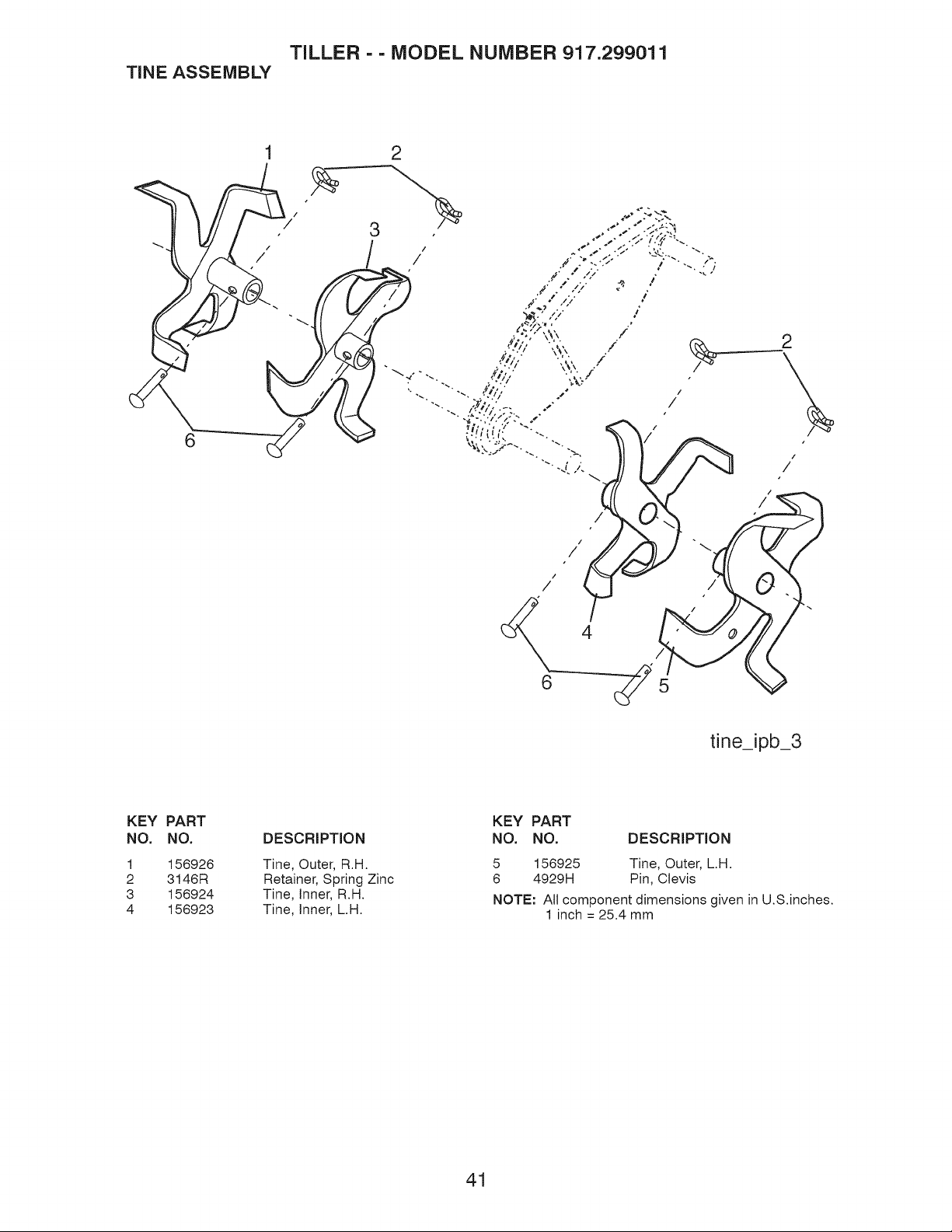
TILLER - - MODEL NUMBER 917.299011
TINE ASSEMBLY
6
/
/
2
/
/
tine_ipb_3
KEY PART
NO. NO.
1 156926
2 3146R
3 156924
4 156923
DESCRIPTION
Tine, Outer, R.H.
Retainer, Spring Zinc
Tine, Inner, R.H.
Tine, Inner, LH.
KEY PART
NO. NO. DESCRIPTION
5 156925 Tine, Outer, LH.
6 4929H Pin, Clevis
NOTE: All component dimensions given in U.S.inches.
1 inch = 25.4 mm
41
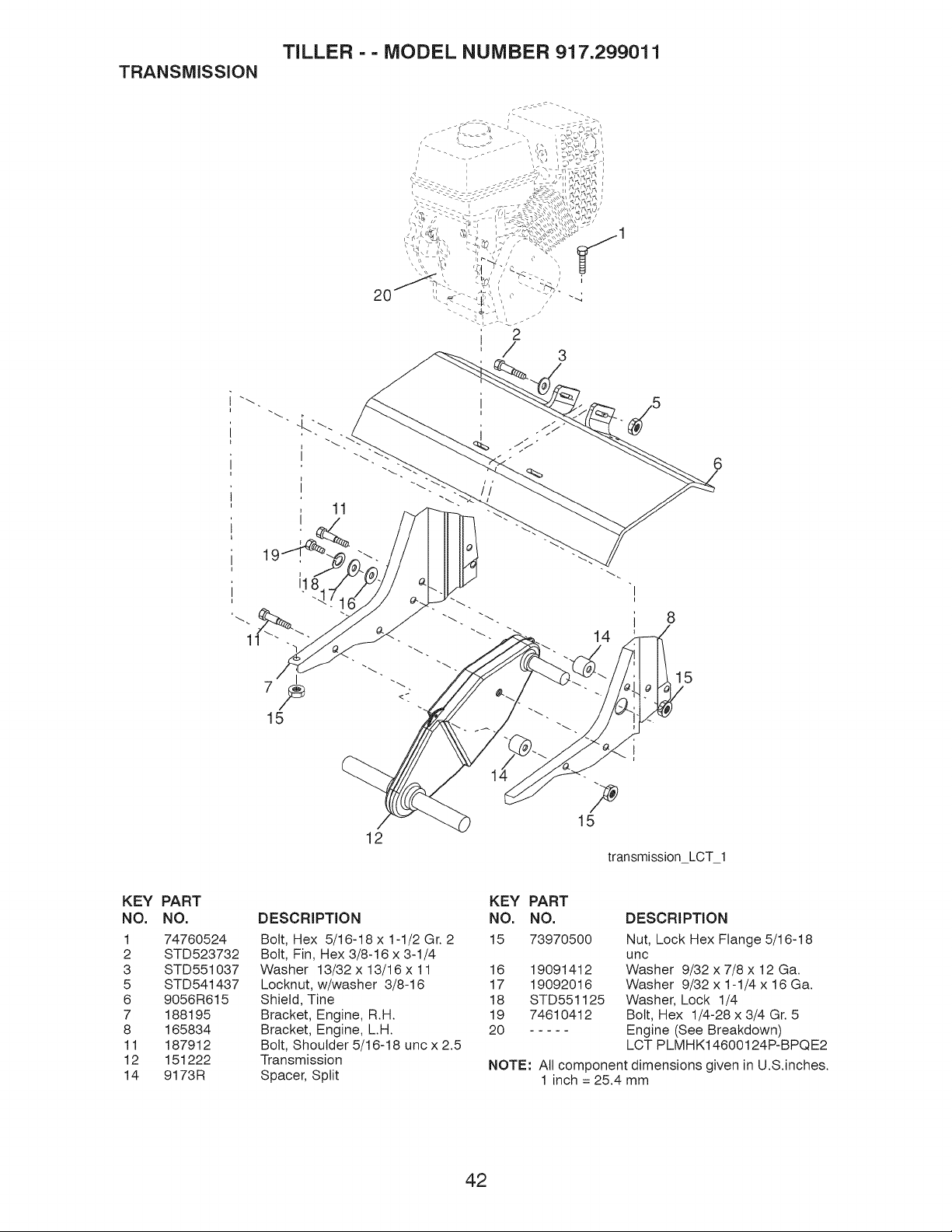
TRANSMISSION
TILLER - - MODEL NUMBER 917.299011
2O
2
' / 3
8
14
15
12
15
transmission LCT 1
KEY
NO.
1
2
3
5
6
7
8
11
12
14
PART
NO.
74760524
STD523732
STD551037
STD541437
9056R615
188195
165834
187912
151222
9173R
DESCRIPTION
Bolt, Hex 5/16-18 x 1-1/2 Gr. 2
Bolt, Fin, Hex 3/8-16 × 3-1/4
Washer 13/32 x 13/16 x 11
Locknut, w/washer 3/8-16
Shield, Tine
Bracket, Engine, R.H.
Bracket, Engine, L.H.
Bolt, Shoulder 5/16-18 uric x 2.5
Transmission
Spacer, Split
KEY PART
NO. NO.
15 73970500
16 19091412
17 19092016
18 STD551125
19 74610412
20
DESCRIPTION
Nut, Lock Hex Flange 5/16-18
unc
Washer 9/32 x 7/8 x 12 Ga.
Washer 9/32 x 1-1/4 x 16 Ga.
Washer, Lock 1/4
Bolt, Hex 1/4-28 x 3/4 Gr. 5
Engine (See Breakdown)
LCT PLMHK14600124P-BPQE2
NOTE: All component dimensions given in U.S.inches.
1 inch = 25.4 mm
42
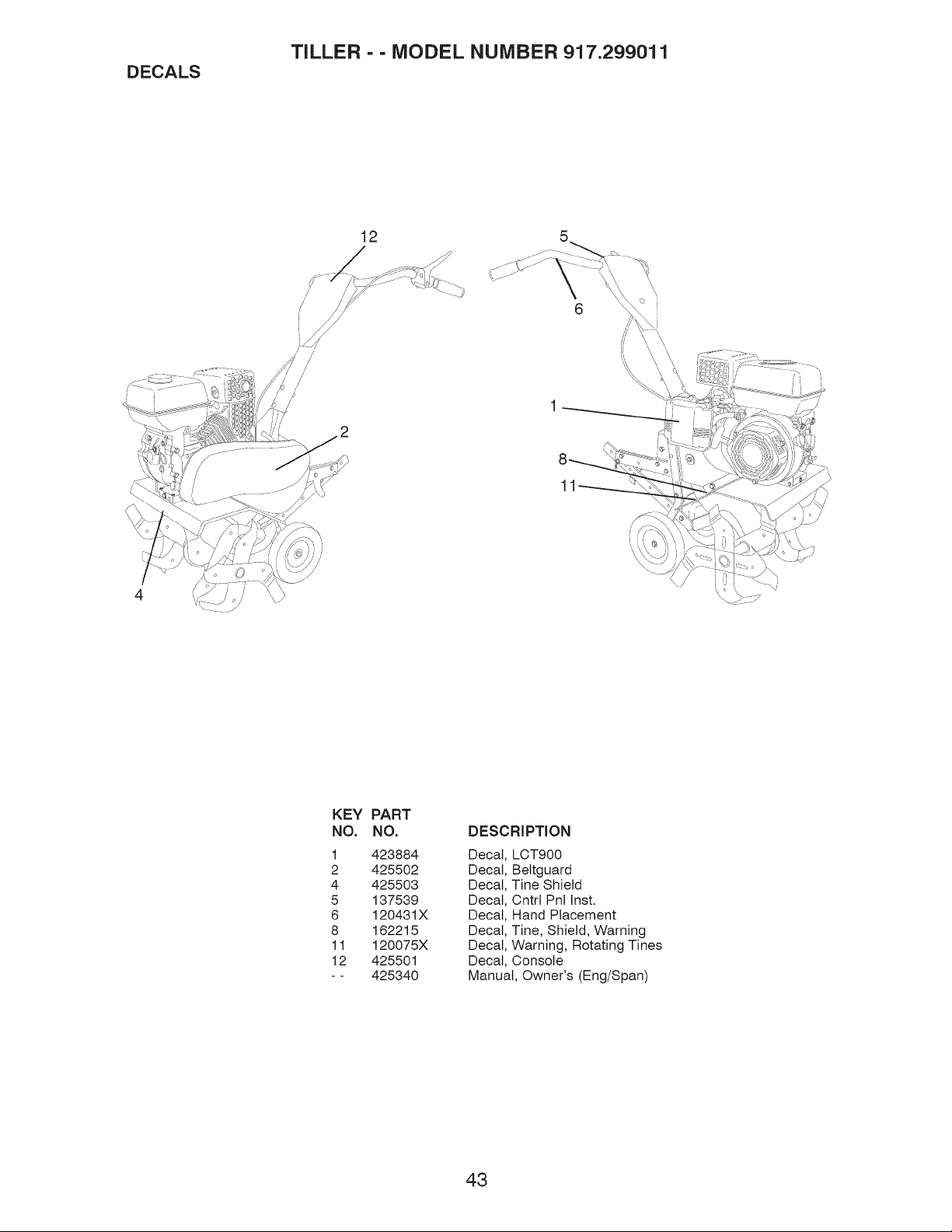
DECALS
TILLER - - MODEL NUMBER 917.299011
12
/
/
/
/!
L
KEY
NO.
1
2
4
5
6
8
11
12
- -
PART
NO.
423884
425502
425503
137539
120431X
162215
120075×
425501
425340
DESCRIPTION
Decal, LCT900
Decal, Bettguard
Decal, Tine Shield
Decal, Cntrl Pnt Inst.
Decal, Hand Placement
Decal, Tine, Shield, Warning
Decal, Warning, Rotating Tines
Decal, Console
Manual, Owner's (Eng/Span)
43

TILLER = - MODEL NUMBER 917.299011
ENGINE, LCT ==MODEL NUMBER PLMHK14600124P=BPQE2
14
2O
11
qncluded with part #11
8 29
28
44

TILLER = - MODEL NUMBER 917.299011
ENGINE, LCT -- MODEL NUMBER PLMHK14600124P-BPQE2
KEY PART
NO. NO. DESCRIPTION
1 420578
2 420579
3 420580
4 437294
5 420582
6 420583
7 420584
8 420585
9 420586
10 420587
11 420588
12 437285
13 437287
14 420591
15 437289
16 420593
17 437290
18 420595
19 420596
20 437291
21 420598
23 420638
24 420599
25 420600
26 420601
27 420602
28 420603
29 420604
30 420605
31 437292
32 420607
34 420608
36 436902
37 436906
38 436907
39 436908
40 436909
41 436910
42 437293
- - 420614
Cylinder Head Service Kit Sk208-1000
Push Rod Service Kit Sk208-1001
Valve Cover Service Kit Sk4500
Cylinder Service Kit Sk208-1301
Piston Service Kit Sk208-1400
Connecting Rod Service Kit Sk208-1500
Camshaft Service Kit Sk208-1600
Flywheel Service Kit Sk208-1700
Cooling Fan Service Kit Sk208-4000
Crankshaft Service Kit Sk208-1800
Air Filter Assembly Service Kit Sk208-2002
Paper Filter Service Kit Sk208-2012
49 State Fuel Muffler Service Kit Sk208-2101
49 State Fuel Tank Service Kit Sk208-2200
Fuel Tank Petcock Service Kit Sk208-2221
49 State Fuel Tank Cap Service Kit Sk208-2300
Carburetor Service Kit Sk208-2401
Ignition Coil Service Kit Sk208-2500
Ignition Module Service Kit Sk208-2750
Spark Plug Service Kit Sk208-3810
Engine On/off Switch Service Kit Sk208-2600
1/4" fuel hose kit Sk208-6000
Throttle Control Service Kit Sk208-2800
Governor Gear Service Kit Sk208-2900
Governor Arm Service Kit Sk208-3000
Governor Crank Service Kit Sk208-3100
Recoil Starter Service Kit Sk208-3200
Starter Cup Service Kit Sk208-3300
Blower Housing Service Kit Sk208-3400
Pto Cover Service Kit Sk208-3601
Seat Service Kit Sk208-3900
Spark Plug Boot Service Kit Sk208-3800
Gasket Kit Sk208-4300
Small Black Dipstick Sk208-3711
Rocker Arm Assembly Sk208-1100
Choke Lever, Carburetor Sk208-2120
Non-Removable Oil Plug Sk208-3705
Foam Pre-Filter Sk208-9001
Oil Drain Plug Kit Sk208-9911
Engine Replacement Service Kit
PLMHK14600124P-BPQE2
45

46

47

o Find this and aLLyour other product manuals onLine.
o Get answers from our team of home experts.
o Get a personalized maintenance plan for your home.
o Find information and tools to help with home projects.
Your Home
For repair - in your home - of all major brand appliances,
lawn and garden equipment, or heating and cooling systems,
no matter who made it, no matter who sold it!
For the replacement parts, accessories and
owner's manuals that you need to do-it-yourself.
For Sears professional installation of home appliances
and items like garage door openers and water heaters.
1-800-4-MY-HOME ® Anytime, day or night
(1-800-469-4663) (U.S.A. and Canada)
www.sears.com www.sears.ca
Our Home
For repair of carry-in products like vacuums, lawn equipment,
and electronics, call or go on-line for the nearest
Sears Parts and Repair Center.
1=800=488=1222 Anytime, day or night (U.S.A. only)
www.sears.com
To purchase a protection agreement (U.S.A.)
or maintenance agreement (Canada) on a product serviced by Sears:
1-800-827-6655 (U.S.A.) 1-800-361-6665 (Canada)
Para pedir servicio de reparaci6n
a domicilio, y para ordenar piezas:
1-888_U=HOGAR ®
(1-888-784-6427)
Au Canada pour service en frangais:
1-800-LE-FOYER Mc
(1-800-533-6937)
www.sears.ca
© Sears Brands, LLC
® Registered Trademark / TMTrademark / SM Service Mark of Sears Brands, LLC
® Marca Registrada / TMMarca de F_brica / SMMarca de Servicio de Sears Brands, LLC
MCMarque de commerce / MDMarque d&posee de Sears Brands, LLC
425340 Rev. 3 07.21.10 JA Printed in U.S.A.