“-7
How to
get
the best from
Your
Drver
Contents
Use
and
Care
Appliance Registration
2
Care and Cleaning
10
of Models
Consumer Services
15
Controls Setting Guide
8,9
Dryer Exhaust
10
Energy-Saving Tips
5
Knits Drying Tips
6, 12
Lint Filter
6, 10
Loading
6,7
Model and Serial Numbers
2
Operating the Dryer
6
Perm.
Press Drying Tips 6, 12, 13
Problem Solver
11-13
Safety
Instructions
3-5
Sorting
6,7
Storing Dryer
10
User Maintenance Instructions 10
Warranty
Back Cover
GE Answer
Center@
800.626.2000
Dm1550R
550R
~LP
US
~LP
YOU...
Read this book carefully.
Save time and money.
Write down the model
It is intended to help you
Before you request service . . .
and
serial
1iUmberS.
operate and maintain your
check the Problem Solver
You’ll find them on a label on the
new dryer properly.
section. It lists causes of minor
front of the dryer behind the door.
Keep it handy for answers to
operating problems that you can
correct yourself.
These numbers are also on the
your questions.
Consumer Product Ownership
If you don’t understand something
Registration Card that came with
or need more help, write (include
If you received a
your dryer. Before sending in
your phone number)
damaged dryer...
this card, please write these
Consumer Affairs
Immediately contact the dealer (or
numbers here:
Hotpoint
builder) that sold you the dryer.
Appliance Park
Model Number
Louisville, KY 40225
Serial Number
Use these numbers in any
correspondence or service
calls concerning your dryer.
WA~ING:
For your safety the information in this manual must be
foHowed
to
minitie
the risk of fire or explosion or to prevent property damage, personal injury or loss of
Me.
—Do not store or use gasoline or other
fl
arnmable
vapors
and
fiquids
in the
vicinity of this or
any
other appliance.
—W~T
TO DO
~
YOU
S~LL
GAS
●
Do not try to light any appliance.
s
Do not touch any electrical switch;
do not use any phone in your btiding.
●
Clear the room,
b@ding
or area of
dl
Occupanti.
●
tiediately
CW
your gas supplier from a
neighbor’s phone.
FOHOW
the gas
suppfier’s
instructions.
s
E
you
annot
reach your gas
supplier?
can
the fire department.
—Instigation and service must be performed
by a qualified
insta~er,
service agency or
the
gas
suppher.
All drying instruction terms in this book conform to the Care
Labeling Rule established by the Federal Trade Commission, January 1984.
If you need service
To obtain service, see the
First, contact the people who
FINALLY, if your problem
Consumer Services page
serviced your appliance. Explain
is still not resolved, write:
in the back of this book.
why you are not pleased. In most
Major Appliance Consumer
We’re proud of our service and
cases, this will solve the problem.
Action Panel
want you to be pleased. If for some
NEXT, if you are still not pleased,
20 North
Wacker
Drive
reason you are not happy with the
write all the details—including
Chicago, IL 60606
service you receive, here are three
your phone number—to:
steps to follow for further help.
Manager, Consumer Relations
Hotpoint
Appliance Park
Louisville, KY 40225
2
WORTANT
SAFETY NOTICE
The
California Safe Drinking Water and
Toxic
Enforcement Act requires the governor of
California to
publish
a list of substances known
to the state to cause cancer,
birth
defects or other
reproductive harm and requires businesses to warn
customers of potential exposure to such substances.
Gas
appliances can cause minor exposure
to four of these substances, namely benzene,
carbon monoxide, formaldehyde and soot,
caused
primarily by the incomplete combustion
of natural gas or
LP
fuels.
Properly adjusted dryers will minimize incomplete
combustion. Exposure to these substances can be
minimized further by properly venting the dryers
to the outdoors.
A
Warning-To reduce the risk
of
fire,
electric
shock,
or
i~ury
to persons
when using your appliance, follow basic
precautions, including the following:
●
Use this
apptiance
ody for its intended
purpose
as described
in
this Use and Care Book.
●
This dryer must be properly
‘.Q.i{~
*
installed and located in accordance
--. -=
with the Installation Instructions
before it is used.
If you
did
not receive an
Installation Instructions sheet
with
your
dryer, you can obtain one
by
calling, toll
free, the GE Answer Center”, 800.626.2000.
—Properly ground to conform with
dl
governing codes and ordinances.
Follow
detils
in Installation Instructions.
—hcate
where the temperature is above
50°F.
(10*C.) for satisfactory operation of the dryer
control system. Do not install or store the
dryer where it
fil
be exposed to the weather.
<onnect
to a properly rated, protected
and sized power supply circuit
to avoid
electrical overload.
—Efiausting
to the outside is STRONGLY
~COMMENDED
to prevent large amounts
. .
of moisture and
lint
from being blown
into
the
room. Carefully follow the Exhausting
Details
in
the Installation Instructions.
●
Do not repair or replace any
part of the
app~ance
or attempt
any servicing
uniess
specifically
recommended in this Use and Care Book or
in published user-repair instructions that you
understand and have the
stils
to carry out.
w
●
When disconnecting this
appfiance
@
PU1l
by
the
plug rather than the
cord
to avoid damage to
the
cord
or
junction
of cord and
plug.
Make sure that
the cord is located so that
it
will
not be stepped
on, tripped over or otherwise subjected to
damage or stress.
To
Mti@ze
the Possibility
of a Fire Hazard
●
Exhaust
DuctAee
Installation Instructions.
Use
ody rigid metal or
flefible
metal
4“
diameter ductwork inside the dryer cabinet
or for exhausting to the outside.
USE OF
PLAS~C
OR OTHER COMBUSTIBLE
DUCTWORK
CAN CAUSE A
~.
FO~
OR
OTHER
EASEY
PUNCTURED DUCTWORK
CAN CAUSE A
~
IF
~
COLLAPSES OR
BECOMES OTHERWISE
RES~CTED
IN
USE OR
DURWG INSTALLATION.
Q
Do
not use heat
to
dry articles containing
rubber~
plastic,
or
simtiar
materials
(such
as padded
bras,
tennis
shoes, galoshes, bath mats, rugs, bibs,
baby pants,
plastic
bags, etc.) as these materials
may melt or
burn.
Also, some rubber materials,
when heated, can under
certain
circumstances
produce fire by spontaneous combustion.
●
Do not store
items
that may burn or melt
(such as clothing, paper material, plastics
or plastic containers, etc.) on top of the dryer
during the operation.
{continued next page)
WORTANT
SAFEH
~STRUCTIONS
(continued)
●
Garmenb
labeled “Dry Away from Heat”
(such as life
jackeh
containing Kapok)
must not be put in your dryer.
4‘~
h
●
Do not wash or dry articles
that have been cleaned in,
J
~
washed in, soaked in,
orspotted
with combustible or explosive
substances (such as wax, paint, gasoline,
degreasers,
dry-cleaning
solvenb,
kerosene,
etc.) which may ignite or explode. Do not add
these substances to the wash water. Do not use
these substances around your washer and/or
dryer during operation.
●
Any article on which you have used a cleaning
solvent, or which contains flammable materials
(such as cleaning cloths, mops, towels used in
beauty salons, restaurants or barber shops, etc.)
must not be placed in or near the dryer until all
traces of these flammable liquids or solids and
their fumes have been removed. There are many
highly flammable items used in homes such as:
acetone, denatured alcohol, gasoline, kerosene,
some household cleaners, some spot removers,
turpentines, waxes, wax removers and products
containing petroleum distillates.
a
●
Clean the lint filter before each load
‘ii===’<
to prevent lint accumulation inside
the dryer or in the room.
DO NOT
OPERATE THE DRYER WITHOUT THE LINT
FILTER IN PLACE.
●
Keep the area around and underneath your
appliances free from the accumulation of
combustible materials,
such as lint, paper, rags,
chemicals, etc.
●
The interior of the machine and the exhaust
duct connection inside the dryer should be
cleaned periodically by a qualified individual.
To Minimize the Possibility of Injury
●
Never reach into the dryer while the
drum is moving.
Before loading, unloading
or adding clothes, wait until
tie
dmm
has
completely stopped.
●
Do not dry
fiber~ass
articles in your dryer.
Skin irritation could result from the remaining
glass particles that may be picked up by clothing
during subsequent dryer uses.
The laundry process can reduce
the flame
retardancy
of fabrics.
To avoid such a result, the garment
manufacturer’s care instructions
should be followed very carefully.
@
.
Close supervision is necessary
k
>
if this appliance is used by or
f
near children. Do not allow
children to play inside, on, or
with this appliance or any discarded
appliance. Dispose of discarded appliances and
shipping or packing materials properly. Before
discarding a dryer, or removing from service,
remove the door of the dryer compartment.
m
●
Keep all laundry aids (such
.
[
as detergents, bleaches, fabric
m
softeners, etc.) out of the reach
T
of children,
preferably in a locked
cabinet. Observe
all
warnings on
container labels to avoid personal injury.
●
Keep the floor around your appliances clean
and dry to reduce the possibility of slipping.
9
●
To minimize the possibility of electric
shock,
unplug this appliance from the
power supply before attempting any
maintenance or cleaning (except the removal
and cleaning of the lint filter).
*
NOTE:
Turning the Cycle Selector
, \
knob to an OFF position does NOT
/
disconnect the appliance from the
power supply.
●
Do not tamper with the controls.
4
Q
Do not operate this appliance if it is damaged,
malfunctioning,
parti~y
disassembled, or has
missing or broken parts, including a damaged
cord or plug.
●
Never climb on or
stind
on the dryer top.
●
If yours is a gas d~er, it is equipped with an
automatic electric ignition and does not have
a pilot light.
DO NOT
A~EM~
TO LIGHT
WITH A MATCH. Burns may result from having
your hand in the vicinity of the burner when the
automatic ignition may turn on.
D~er-applied
Fabric Softeners or
Anti-s@tic
Conditioned
You may wish to soften your laundered
fabrics or reduce the static electricity in them.
We recommend you use either a fabric softener
in the wash cycle, according to the manufacturer’s
instructions for those products, or try a dryer-added
product for which the manufacturer gives written
assurance on the package that their product can be
safely used in your dryer.
Service or performance problems caused by
the use of these products are the responsibility
of the manufacturers of those products and are
not covered under the warranty of this appliance.
SAVE
T~SE
~STRUCTIONs
ENERGY-SAVING
T~S
●
Sort
clothes by weight so you won’t have to run an extra cycle for one
or two heavier, slower-drying items.
●
Do not
overload
your dryer. For efficient drying, clothes need
to tumble freely.
● To help prevent ironing, use the Permanent Press or Knits cycle. Remove
garments promptly at end of drying cycle and place on hangers.
● Dry your clothes in consecutive loads. Using a “warm” dryer
will save energy.
● Clean the dryer lint filter each time you dry.
● Clean the dryer exhaust
ducting
at least once a year. A partially clogged
exhaust can lengthen drying time.
5
HOW TO
OPEMTE
YOUR DRYER
WARNIN&To
reduce the risk of fire, electric shock, or injury
to
persons when using your appliance, read the IMPORTANT SAFETY
INSTRUCTIONS before operating this appliance.
Check the Lint Filter
Clean the lint filter each time the dryer is used.
Always be sure the lint filter is in place. Don’t use the dryer without it.
Sort and Load the Clothes
Good sorting for the dryer begins at the washer. Generally, if clothes are
sorted right for washing, they’re sorted right for drying. See the How to
Sort the Clothes section. If you do mix various types of fabrics in your load,
set the controls for the lighter-weight fabrics and remove when dry. Reset
controls for the remaining heavier fabrics.
Set the Controls
See the Controls Setting Guide.
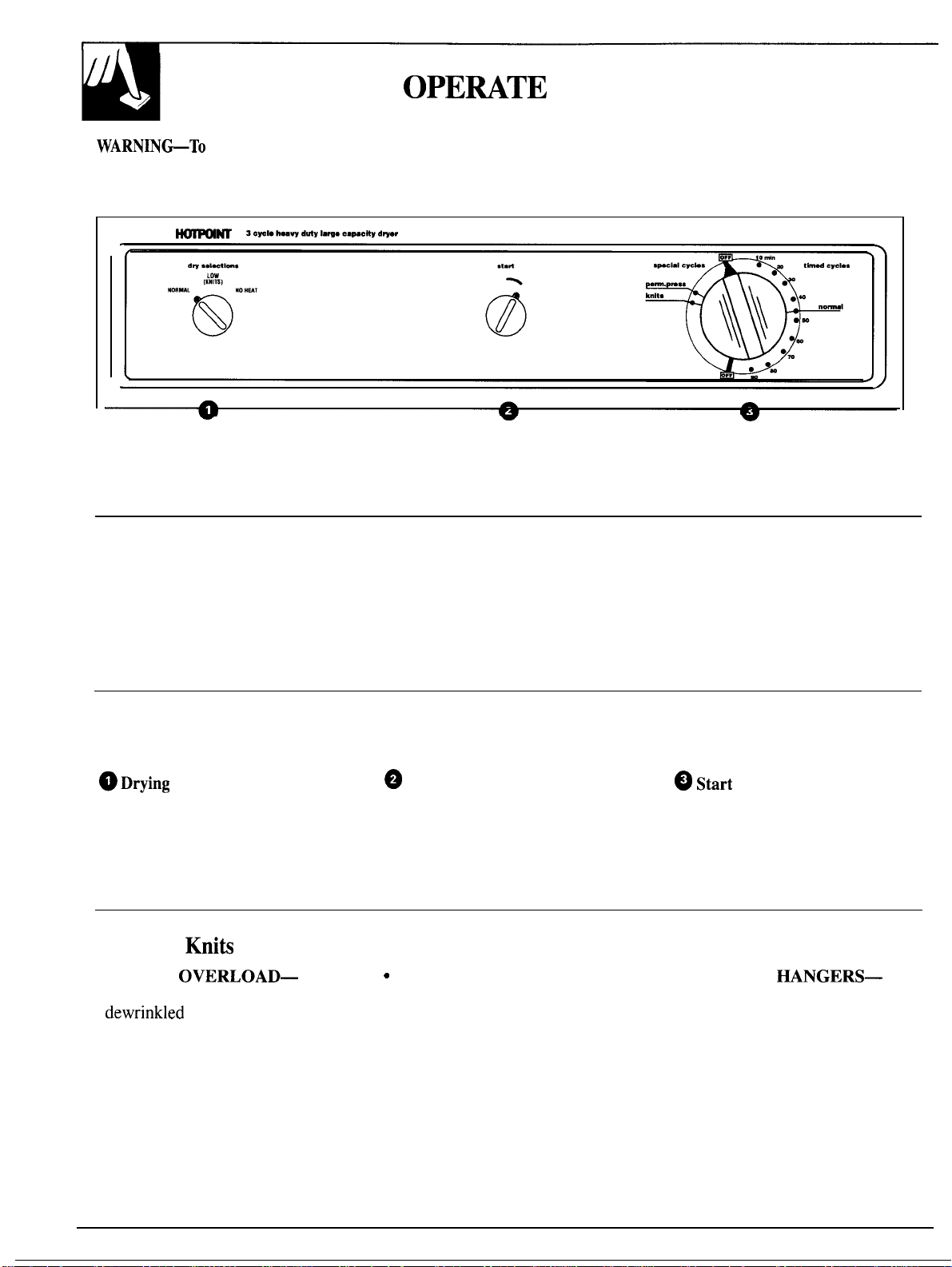
~Drying
Selections.
0
Cycle Selector.
@
Start
Knob.
Select the proper heat for
Turn the Cycle Selector to
Turn the Start knob to start
your load.
the desired cycle setting.
the dryer. (Opening the door
The selector may be turned
during operation stops the
in either direction.
dryer. To restart, close the
door and turn the Start knob).
Polyester
Kni@
& Permanent Press Drying Tips
● DO NOT OVERLOAD—
“
REMOVE CLOTHES ● PLACE ON HANGERS—
Garments being dried or
PROMPTLY—To help prevent Permanent press and polyester
dewrinkled should tumble freely.
wrinkling, remove clothes from knit garments look best if placed
the dryer promptly at the end of
on hangers after drying.
the drying cycles.
6
HOW TO SORT CLOTHES
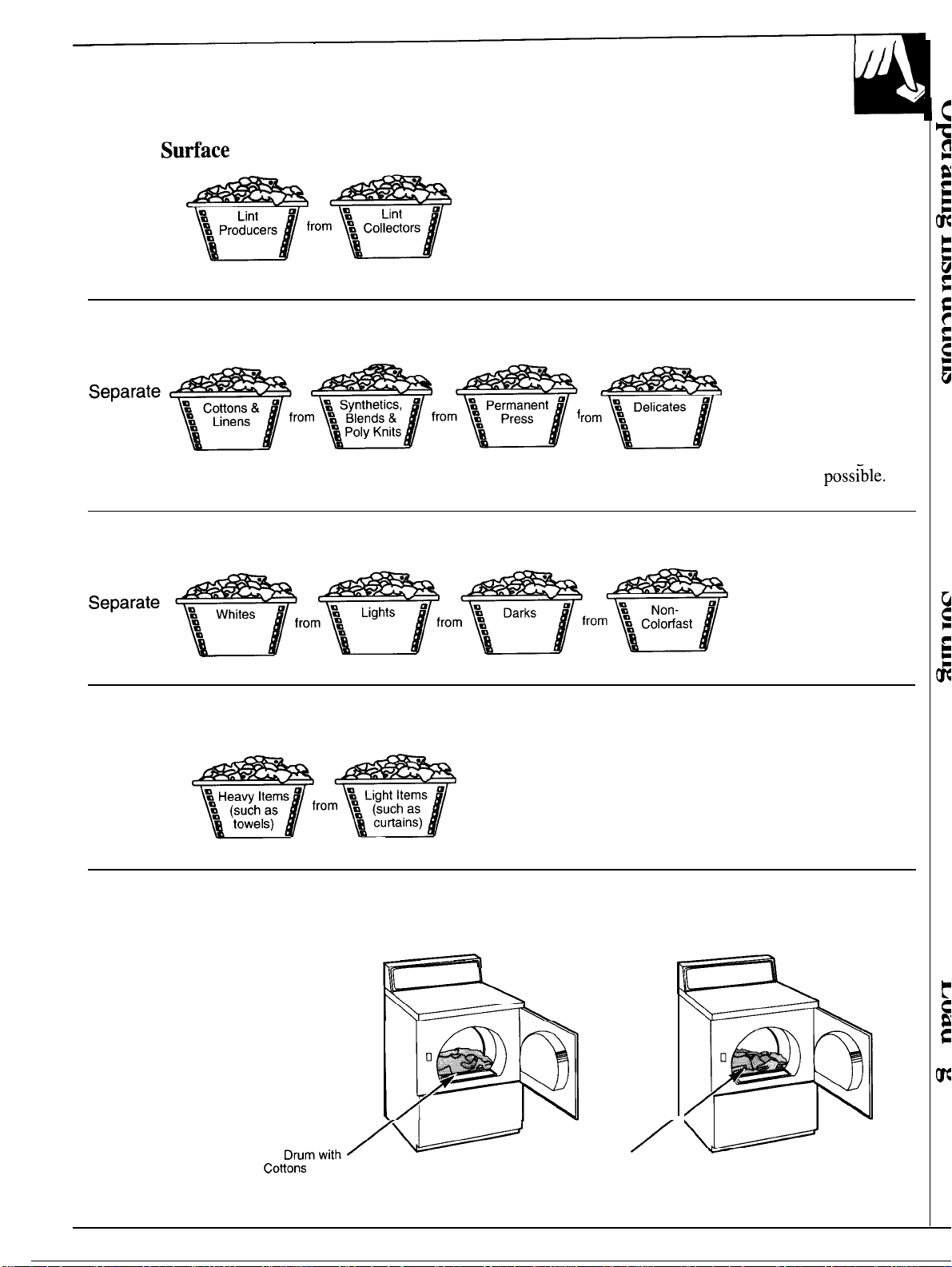
Sort by
Sufiace
Texture
Separate
LINT PRODUCERS—such as terry toweling and
chenille—give up lint.
LINT COLLECTORS—such as man-made fibers and
napped fabrics like velveteen and corduroy—attract
lint. These must be dried separately.
Sort by Fabric
In addition to
sorting to reduce
lint collection, we
recommend that you
wash fabrics of similar
construction together
whenever
poss;ble.
Sort by Color
Sort by Weight
Separate
For information on tumble drying extra large
items and different fabrics and loads, see the
Controls Setting Guide.
HOW TO LOAD THE CLOTHES
Don’t overload
your dryer.
Crowded loads don’t dry
efficiently and clothes may
be unnecessarily wrinkled.
Loads should look like this:
.r”mwi,h/~
/
Drum with
Cotions
& Linens
Permanent Press Load
7
CONTROLS SETTING GUIDE
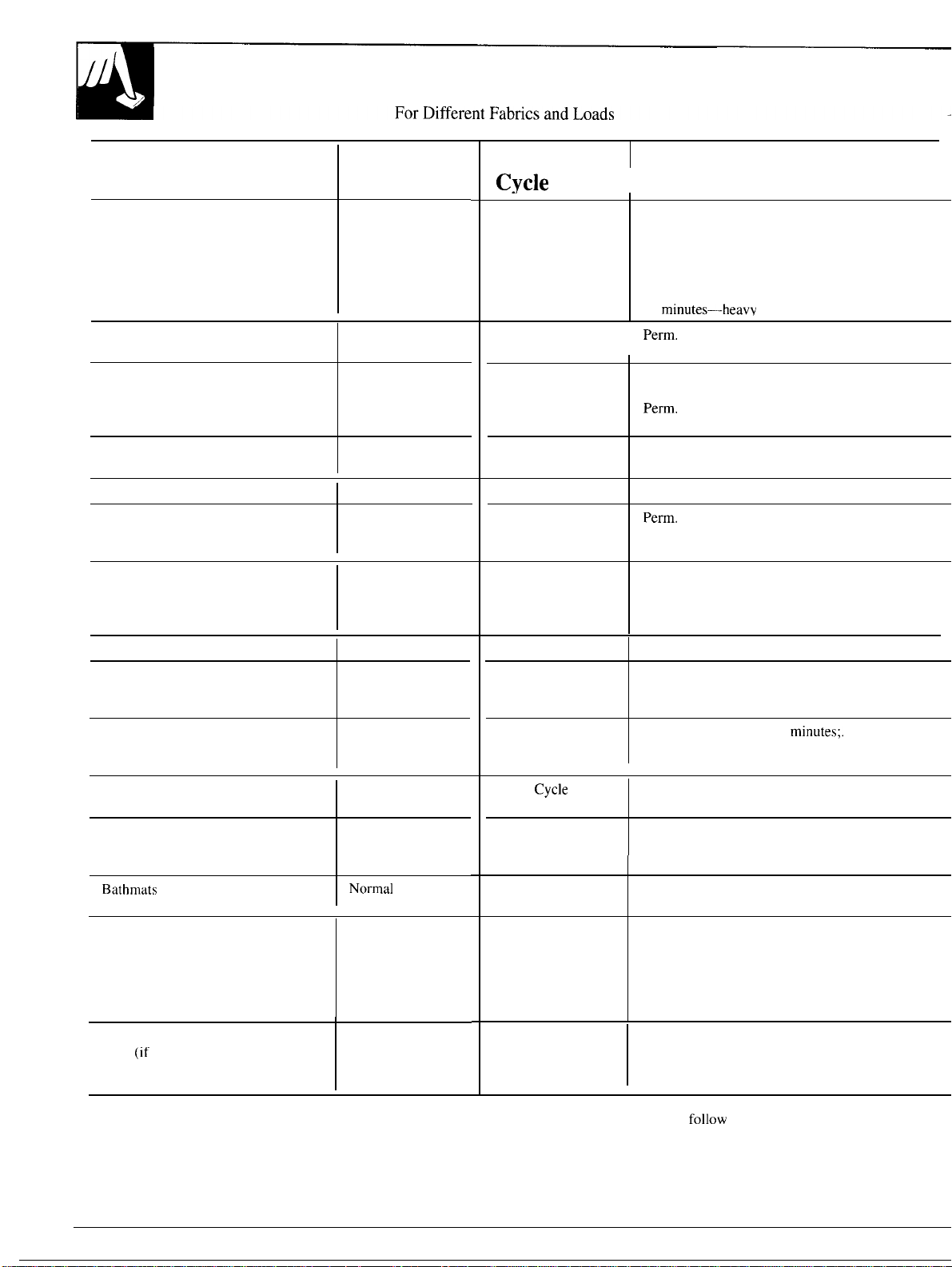
Drying
Load Selection
Cottons & Linens
Normal
Permanent Press. Treated Cottons,
Normal
Blends with Cotton
Synthetics—Polyester, Nylon,
Acrylic Knits and Woven Fabrics
Sturdy Normal
Delicate
Low/Knits
Silks and Wools, Blends
Low/Knits
including Silks and Wools
Rayon and Acetate
Low/Knits
Down-filled garments,
Normal
if machine washing and drying
are recommended.
Baby Clothes—Sturdy: Diapers,
Normal
Nightgowns, Shirts, Pads, Sheets,
Receiving Blankets, Coveralls.
See Special Instructions.
Baby Clothes—Delicate
Low/Knits
Blankets—Wool, Part Wool,
Normal
Cotton, Electric, Synthetic. See
below under “Extra-large Items. ”
Curtains, Slipcovers, Draperies
Normal
DO NOT MACHINE DRY
FIBERGLASS.
Chenille Bedspreads, Robes. See
Normal
below under “Extra-large Items. ”
Rubber-coated Items, Laminated No Heat
Fabrics, Vinyl, Plastics and
Articles with Plastic Trim.
Bathmats and Rugs
Norma]
Extra-large Items—Queen or King
Low/Knits
Size Sheets, Blankets or Spreads,
Sleeping Bags, Insulated Jackets or
Suits, Mattress Covers (Pads),
Quilted Bedspreads.
Pillows—Feather and Polyester-
Normal
filled (if manufacturer recommends
they be dried in a dryer). See
Special Instructions.
Cycle
I
Cycle Setting
Timed Cycle
40 to 50 minutes setting for average-weight loads;
50 to 60 minutes setting for work clothes and thick
knitted cottons.
Damp Dry for ironing:
20 minutes—lightweight cottons;
25 minutes—medium weight;
30
minutes—heavv cottons.
Special Cycle
I
Perm.
Press setting
Special Cycle
Perm.
Press setting
Knits setting
Special Cycle Knits setting
Special Cycle
Knits setting
Special Cycle
Perm.
Press setting
Timed Cycle
45 minutes
Special Cycle Knits setting
Timed Cycle
20 to 25 minutes.
Timed Cycle
For first setting, set at 20
minutes;.
for second setting, set at 15 minutes.
Timed
Cycle
First setting—20 minutes;
additional settings—5 minutes.
Timed Cycle
Set for time desired.
Timed Cycle
Timed Cycle
First setting—20 minutes;
additional settings—5 minutes.
First setting—20 minutes;
second setting—1 5 minutes;
additional settings—5 minutes.
Timed Cycle 90 minutes.
*The terms High, Medium and Low Heat are those usually found on fabric care labels. For best results,
follow
your fabric care labels
NOTE: The Cycle Selector settings indicated above are to be used as a guide.
You may find that best results are obtained by setting the Cycle Selector to either side of the recommended settings.
8
—
—
Special
Instructions
.
Do not dry non-colorfast items with whites or light-colored items.
Do
not overload dryer; clothes should tumble freely. Remove promptly as soon as dryer stops; place clothes on hangers to
minimize wrinkling.
Do not overload dryer; clothes should tumble freely. Remove promptly as soon as dryer stops, place clothes on hangers to
minimize wrinkling.
Dry silks and wools in your dryer only if recommended by the garment manufacturer. Follow instructions carefully.
Tumble drying is mandatory. Down must be thoroughly dried to remove odor and prevent mildewing. Place two large, dry towels in the
dryer to improve tumbling and shorten drying time. Be sure to dry thoroughly.
IMPORTANT. If children’s
sleepwear is made of
Modacrylic,
tumble dry only on Low/Knits temperature. Normal Heat can damage these
fabrics. Check manufacturer’s drying instructions.
—
See above instructions.
Place in dryer with 3 or 4 dry towels which have been heated for 5 minutes. Set timer for 20 to 25 minutes. Do not set control for more than
25 minutes. Do only one blanket at a time. Remove blanket at end of cycle and block blanket back to original shape. Press binding with
warm iron. Allow to dry before storing.
Use dry towels as buffers. Set timer for 20 minutes. If items are still wet, reset for 15 minutes and check again. Items should be removed while
still damp. Place slipcovers on furniture immediately. Hang draperies and curtains so that creases will fall out. Stop dryer periodically and
check filter for excess lint. Remove and restart dryer.
Tumble dry on No Heat setting as heat may cause alteration in shape, color and appearance of such articles.
Stop dryer periodically and check
filter
for
excess lint. Remove and restart dryer.
Spe(icllprecclutions
must be taken to dry
extra-lage
items. Set dryer for 20
minutes then check
carefilly.
Set 15 minutes for second setting, check
a&ain;
and 5 minutes for each additional setting. Make sure that article does not fill drum. Many large articles, when wet, have ample room in
dryer, but as they dry and
tluff up may not have room to tumble. Check carefully every few minutes and if article is still wet or damp and fills
dryer, finish drying on line. Do not, under any circumstances operate dryer for longer times without checking. CAUTION: If large items do not
have room to tumble, the air flow may be blocked which could result in scorching your valuable items. Many large items, like shag rugs,
cannot be dried in home size dryers.
DO NOT tumble
dr}’
jackets containing Kapok. (See filter cleaning instructions above. )
Check ticking for holes or weak seams where feathers or filling could escape. Dry no more than one pillow at a time and set dryer for
maximum time. Stop dryer occasionally and shake pillows to redistribute filling for more even drying. Check pillows at end of drying time.
If they are not completely dry, return them to dryer and reset for more drying time. Feather pillows dry very slowly and must be dried
completely to prevent mildewing. DO NOT tumble
dr) pillows
c<mtaining
Kapok.
Refer to Garment Manufacturers’ Care Labels
For more information on care labeling, send for “What’s New About CARE LABELS.”
For sale by the Superintendent of Documents, U.S. Government Printing Office, Washington,
D.C.
20402.
9
CAm
Am
CLEAN~G
User Maintenance Instructions
CAUTION:
If yours is an electric dryer, before you have
it connected in your new residence, be sure your licensed electrician
confirms that the supply voltage matches the voltage specified on the
rating plate.
Dryer Exterior
Wipe off any spills or washing
Dryer control panel and Apply these pretreatment products
compounds. Wipe or dust with
finishes may be damaged by
away from the dryer.
The fabric
a damp cloth. Try not to strike
some laundry pretreatment soil
may then be washed and dried
the surface with sharp objects.
and stain remover products if normally. Damage to your dryer
such products
are
sprayed on or caused by pretreatment products
have direct contact with the dryer.
is not covered by your warranty.
Dryer Drum
Dryer Exhaust Dryer Storage
The porcelain enamel dmm
Inspect and clean the dryer
To store your dryer for a
is rust-resistant and requires exhaust
ducting
at least once a year.
short period of time, disconnect
no special care.
the power supply and clean the
lint filter.
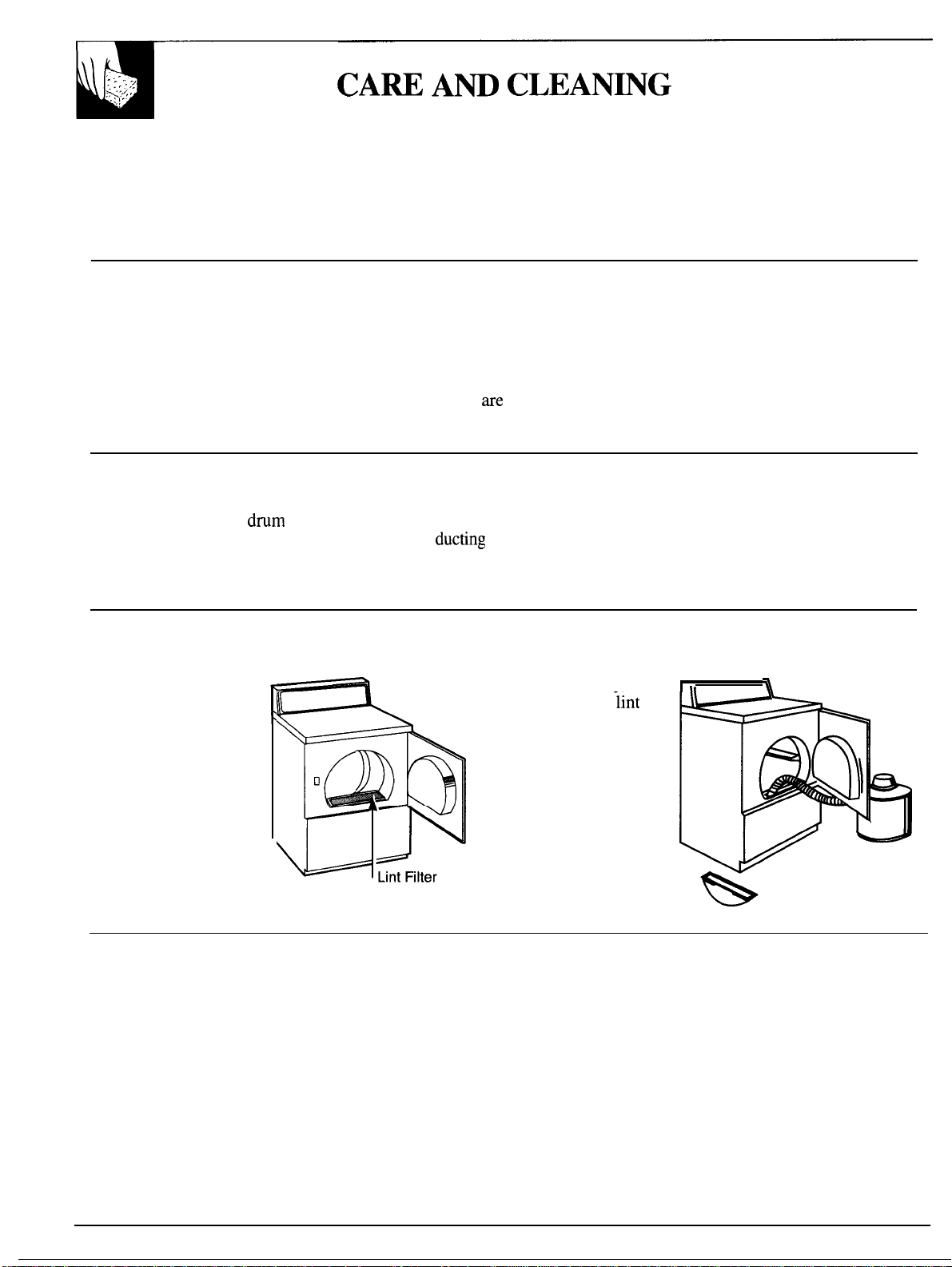
Lint Filter
Before every dryer
use,
clean the lint
filter. Put your
moistened fingers
at the corner of the
filter and wipe in a
downward motion all
the way across to the
other corner.
Periodically,
)
II
i
3
remove the
lint
\
filter and insert
the suction hose
Q
from your vacuum
cleaner into
the opening.
Air Circulation
Do not obstruct the flow of
combustion and ventilating air.
10
QUESTIONS?
●
USE THIS PROBLEM SOLVER
PROBLEM
DRYER
WON’T START
CLOTHES
TA~
TOO
LONG TO DRY
—
SHRINWGE, GENERAL
POSSIBLE CAUSE
“
Dryer unplugged. Make sure power cord is plugged in.
●
No power to dryer. Check fuses and circuit breakers to make sure dryer is
getting current. Most electric dryers use two.
●
Controls improperly set. Make sure controls are set and Start knob is turned.
Opening the door during operation stops the dryer. To restart, close the door
and turn the Start knob.
●
Dryer door is open. Close door
securely~ryer
will not run with door open.
●
Circuit is overloaded. Do not operate other appliances on the same electrical
outlet or circuit while the
@er
is
o~eratin~.
.
.
●
Controls improperly set. Check all controls
to make sure they are correctly
set for the load you want to dry. See the How to Operate Your Dryer section.
● Clogged lint filter. Remove and clean filter before every load. Periodically clean
area under
lint filer with vacuum cleaner. See the Care and Cleaning section.
● Improper
ducting.
Make sure dryer is ducted in accordance with the
Installation Instructions.
● Obstruction in exhaust
ducting.
Make sure
ducting
is clean and free of
obstruction; make sure damper in outside wall cap operates easily. If flexible
ducting
is used, be sure it is not kinked and is properly installed according to
the Installation Instructions.
● Blown fuses or tripped circuit breakers. Check household fuses or circuit
breakers. Most electric dryers use two. It is possible for one to be blown or
tripped and the dryer still tumble without heat.
● Improper sorting. Do not mix heavy, hard-to dry items with lightweight articles.
● Large loads of moisture-holding fabrics, such as beach towels, take a long
time to remove moisture.
● Too many items in dryer. Dry only one washer load at a time. Do not combine
loads.
● Too few items in dryer. If drying only one article, add two more similar articles,
even if dry, to insure
pro~er
tumbling.
L
● Some fabrics will shrink whether machine washed and tumble dried or
washed by hand and drip dried; others may be safely washed but will shrink
in a dryer. Follow Garment Manufacturers’ Care Labels exactly. If in doubt,
do not machine wash or tumble dry.
(continued next page)
11
●
T~
PROBLEM
SOL~R
(continued)
PROBLEM
SHR~WGE,
~ITS
W~WING
~
PERMANENT
PWSS
AND
“NO-IRON”
I~MS
POSSIBLE CAUSE
●
Relaxation shrinkage can
occur in knit fabrics that have
been
improperly
stretched and elongated by the manufacturer.
When
this occurs, garment may
be pressed back
into
shape after each wash and dry cycle.
●
Progrmsive
or delayed shrinkage is
caused when starch or
sizing
(in some
fabrics) is
gradudly
removed by laundering. Maybe noticed in older garments
that have been laundered many times without previous shrinkage. Treat
as
for
Relaxation Shrinkage above.
●
Shrinkage caused by overheating
occurs in certain knit fabrics
that
have
been heat-shaped. When washing, drying or ironing temperatures exceed
the
temperatures used to shape set, shrinkage may occur. This
can~ot
be corrected,
but it can be prevented by washing in cold or warm water; drying on low heat.
●
Leaving clothes in dryer after tumbling stops. Remove clothes promptly and
hang them immediately.
●
Too many items in dryer. Dry only
one
washer load at a time. Do not
combine loads.
●
Too few items in dryer. If drying only one article, add two or more similar
articles, even if dry, to insure proper tumbling.
o
Improper loads. Avoid laundering heavy Permanent Press items, such as work
clothes, with lighter Permanent Press items, such as shirts or blouses. Do not
wash or dry Permanent Press with regular laundry.
●
Too many clothes in washer. Items must have room to move freely.
Permanent Press loads should always be smaller than regular loads . . .
no more than medium loads.
●
Use of incorrect wash and dry cycles. Use Permanent Press wash cycle
which provides a
cooldown
rinse to minimize wrinkling. Also, use Permanent
Press drying cycle.
● Incorrect water level. Use high water level for medium
load;
medium level
for small load.
● Washing repeatedly in too hot water. Wash in cool or warm water with
plenty of detergent.
● Accumulation of lime scale due to use of carbonate detergents. If you must
use a non-phosphate detergent, avoid
the
use of a high-carbonate detergent.
● Failure to use fabric softener. Proper use of fabric softener will
minimize wrinkling.
12
PROBLEM
WWNKLING
IN
PERMANENT
P~SS
AND
“NO-IRON ITEMS”
(continued)
POSSIBLE CAUSE
TO REMOVE WRINKLES:
●
Retumble
on Permanent Press setting.
●
Rerinse
and dry on Permanent Press setting.
●
If unsuccessful,
retumble
on normal temperature for 10–12 minutes
and hang immediately.
● Iron
cmefully.
●
Send to Dry Cleaners for pressing.
● Some
wfinkles
may remain which cannot be removed. *
*
NOTE: If
you
follow
good
laund~
procedures
and
permanent
preSS
clothes still come out wrinkled, the finish may not be good quality. Also, in
permanent press synthetic/cotton blends, the cotton portion of the fabric can
eventually wear away leaving only the synthetic. Since its the cotton portion
which is treated for Permanent Press, a loss or decrease of Permanent Press
performance will result.
If you need more help... call, toll free:
GE Answer
Center”
800.626.2000
consumer information service
13

NOTES
14
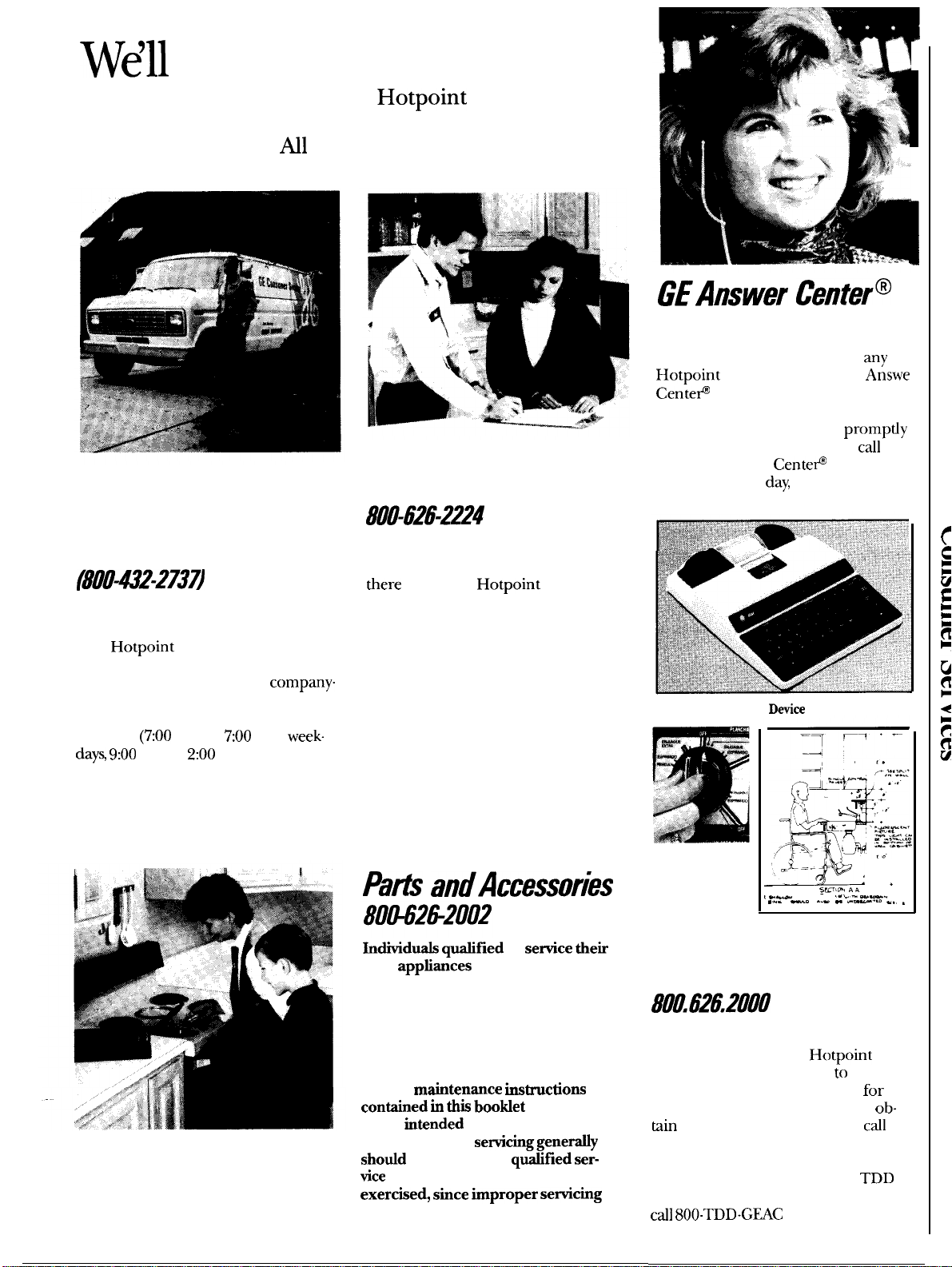
Wdll
Be There
With the purchase of your new
Hotpoint
appliance, receive
the assurance
that if you ever need information or assis-
tance, we’ll be there.
Ml
you have to do is cdl—toll-free!
GEAnswer
Center@
In-Home Repair
Service
800-GE-CARES
(800-UZ-273Z
Our consumer service professionals
will provide expert repair service on
your
Hotpoint appliance, scheduled
at a time that’s convenient for you.
Many GE Consumer Service
company-
operated locations offer you service
today or tomorrow, or at your con-
venience
(7:00
a.m. to
7:00
p.m.
week-
day~
9:00
a.m. to
2:00
p.m. Saturdays).
Our factory-trained technicians know
your appliance inside and out—so
most repairs can be handled in just
one visit.
Service Contracts
800-626-2Z4
800.626.2000
What.ever your question about
any
Hotpoint major appliance, GE
Answe
Cente@
information service is avail-
able to help. Your cdl—and your
question—will be answered
prornpdy
and courteously And you can
cdl
any
time. GE Answer
Cente@ service is
open 24 hours a
day
7 days a week.
You can have the secure feeling that
GE Consumer Service will still be
there
after your Hotpoint product
warranty expires. Purchase a GE
contract while your warranty is still in
effect and you’ll receive a substantial
discount. With a multiple-year con-
tract, you’re assured of future service
at today’s prices.
Telecommunication
Dtice
for the Deaf
Pa&
andAccessories
h&duA
q~fied
to
setice
thek
own
appfiauces
can have needed
parts or accessories sent directly to
their home. Our parts system pro-
vides access to over 47,000 Genuine
Renewal Parts... and all are fully war-
ranted. VISA, MasterCard and
Discover cards are accepted.
User
mtitenmce
btructions
contied
h
ti
boo~et
cover proce-
dures
htended
to be performed by
any user. Other
seficfiggenedy
shotdd
be referred to
qdfied
ser-
tice
personnel. Caution must be
exer&ed,
sbce
fiproper
setichg
may cause unsafe operation.
-
Sm!m
A.
“
‘
,-—
— ..-.
,.!
----
-.
.,-.
—.
.-
“
-—-..
~..
.
For Customers With
Special Needs...
80~6262000
Upon request, we will provide Braille
controls for a variety of
Hotpoint
appliances, and a brochure
to
assist in
planning a barrier-free kitchen
for
persons with limited mobility To
ob-
hin these items, free of charge,
cdl
800.626.2000.
Consumers with impaired hearing
or speech who have access to a
TDD
or a conventional teletypewriter may
Cd]
800-TDD-GEAC
(800-833-4322)
to request information or service.
YOUR HOTPOINT AUTOMATIC CLOTHES DRYER
WARRANTY
II
Save
proof of original purchase date such as your sales slip or
cancelled
check to establish warranty period
1’
WHAT IS COVERED
FULL ONE-YEAR WARRANTY
This warranty is extended to
For one year from date of original
the original purchaser and any
purchase, we will provide, free of
succeeding owner for products
charge,
patis and service labor in
purchased for ordinary home use
your home to repair or replace
in the 48 mainland states, Hawaii
any
pati
of
the
dryer that fails
and Washington,
D.C.
In Alaska the
because of a manufacturing defect.
warranty is the same except that it
is LIMITED because you must pay
to ship the product to the
sewice
shop or for the service technician’s
travel costs to your home.
All warranty service will be
provided by our Factory Service
Centers or by our authorized
Customer
Care@
servicers during
normal working hours.
Should your appliance need
service, during warranty period or
beyond, call 800-GE-CARES
(800-432-2737).
WHAT IS NOT COVERED
● Service trips to your home to teach
● Replacement of house fuses or
you how to use the product.
resetting of circuit breakers.
Read your Use and Care material.
● Failure of the product if it is used
If you then have any questions
for other than its intended purpose
about operating the product, please
or used commercially.
contact your dealer or our Consumer
Affairs
office
at the address below,
● Damage to product caused by
or call, toll free:
accident, fire, floods or acts of God.
GE Answer
Center@
WARRANTOR IS NOT
800.626.2000
RESPONSIBLE FOR
CONSEQUENTIAL DAMAGES.
consumer information service
● Improper installation.
If you have an installation problem,
contact your dealer or installer.
You are responsible for providing
adequate electrical, exhausting
and other connecting facilities.
Some states do not allow the exclusion or limitation of incidental or consequential damages, so the above limitation or exclusion
may not apply to you. This warranty gives you specific legal rights, and you may also have other rights which vary from state to state.
To know what your legal rights are in your state, consult your local or state consumer affairs office or your state’s Attorney General.
Warrantor: General Electric Company
If further help is needed concerning this warranty, write:
Manager—Consumer Affairs, GE Appliances, Louisville, KY 40225
This book is printed on recycled
pape~
I
Part No. 113 D5497P216
Pub
No.
39-9304
I
DLBI
550R
DLL1550R
6-92
CG

