
Before Using Your Range .. .....2
Safety Instructions . .........3,4
Energy-Saving Tips . . . ........5
Installing
theRange . . . ........5
LevelingtheRange. . . . ........5
Surface Cooking . . . . . ........6
HomeCanningTips . . . ........7
Surface Cooking Guide .. ....8,9
The3-in-l Unit . ..........10, 13
Griddle .
..........,.....10,
13
Automatic Surface Unit .. .....11
Automatic Surface Unit Guide ..12
Automatic Timerand Clock ....14
UsingYourOven . . . . . .......15
Baking . . . . . . . . . . . . . .......16
Baking Guide . . . . . . . . .......17
Roasting . . . . . . . . . . . . .......18
Meat Thermometer . . . .......19
Roasting Guide.. . . . . . .......20
Broiling . . . . . . . . . . . . .......21
Broiling with
Meat Thermometer . .......22
Broiling Guide . . . . . . . .......23
Rotisserie . . . . . . . . . . . .......24
Rotisserie Time and
Temperature Guide. . .......25
Operating the
Self-CleaningOven . .....26,27
Continuous-Cleaning
Oven Care..... . . . . .......28
CareandCleaning. . . . . ....29-31
Cleaning Guide . .........32,33
IfYouNeedService . . . .......33
Exhaust System . . . . . . .......34
TheProblem Solver. . . .......35
Warranty .. .. .. ...
..BackCover
Beforeusingyourrange,
readthis bookcarefully.
Itisintendedtohelpyouoperate and
maintainyournewrangeproperly.
Keepithandyforanswerstoyour
questions.
Ifyoudon’tunderstandsomething
orneedmorehelp, write (include
yourphonenumber):
Consumer Affairs
General ElectricCompany
AppliancePark
Louisville, KY40225
Write down the model
and serial numbers.
You’ll find them on a label located
on the front of the range behind the
oven door.
These numbers are also on the
Consumer Product Ownership
Registration Card that came with
your range. Before sending in this
card, please write these numbers
here:
Model Number
Serial Number
Use these numbers in any
correspondence or service calls
concerning your range.
2
If you received
a damaged range...
Immediately contact the dealer (or
builder) that sold you the range.
Save time and money.
Before you request
service...
Check the Problem Solver on
page 35. It lists minor causes of
operating problems that you can
correct yourself.
Read all instructions before using this appliance.
when using electrical appliances,
basic safety precautions should be
followed, including the following:
● Use this appliance only for its
intended use as described
in
this
manual.
● Be sure your appliance
is
properly installed and grounded
by a qualified technician
in
accordance with the provided
installation instructions.
● Don’t attempt to repair or
replace any part of your range
unless it is specifically
recommended in this book. All
other servicing should be referred
to a qualified technician.
● Before performing any service,
DISCONNE~
THE RANGE
POWER SUPPLY AT THE
HOUSEHOLD DISTRIBUTION
PANEL BY REMOVING THE
lZUSE
OR SWITCHING OFF
lHE
CIRCUIT BREAKER.
●
Do not leave children
alone—
Children should not be left alone
or unattended
in
area where
appliance is in use. They should
never be allowed to sit or stand on
any part of the appliance.
●
Don’t allow anyone to climb,
stand or hang on the door,
drawer or range top. They
could damage the range and
even tip it over, causing severe
personal injury.
●
CAUTION: ITEMS OF
INTEREST TO CHILDREN
SHOULD NOT BE STORED
IN CABINETS ABOVE A
RANGE OR ON THE
BACKSPLASH OF A
RANGE–
CHILDREN CLIMBING ON
THE RANGE TO REACH
ITEMS COULD BE SERIOUSLY
INJURED.
●
Wear proper clothing.
Loose
fitting or hanging garments should
never be worn while
using the
appliance. Flammable material
could be ignited if brought in
contact with hot heating elements
and may cause severe burns.
●
Use only dry
potholders—
Moist or damp potholders on hot
surfaces may result in burns from
steam. Do not let potholders touch
hot heating elements. Do not use
a towel or other bulky cloth.
●
Never use your appliance for
warming or heating the room.
●
Storage in or on
appliance—
Flammable materials should not
be stored in an oven or near
surface units.
●
Keep hood and grease filters
clean
to maintain good venting
and to avoid grease fires.
●
Do not let cooking grease
or other flammable materials
accumulate in the range or
near it.
●
Do not use water on grease
fires. Never pick up a flaming
pan. Smother flaming pan on
surface unit by covering pan
completely with well fitting lid,
cookie sheet or flat tray. Flaming
grease outside a pan can be put
out by covering with baking
soda or, if available, a multi-
purpose dry chemical or foam.
●
DO NOT TOUCH HEATING
ELEMENTS OR INTERIOR
SURFACE OF OVEN. DO NOT
TOUCH SURFACE UNITS OR
AREAS NEAR SURFACE UNITS.
Surface units and oven heating
elements—also areas
nearby—
may be hot enough to burn even
though they are dark in color.
During and after use, do not
touch, or let clothing or other
flammable materials contact
surface units, areas nearby
surface units or any interior area
of oven until all of these areas
have had sufficient time to cool.
Potentially hot surfaces included
are:
—Around surface units:
the
cooktop and areas facing the
cooktop.
—Around oven:
oven vent
openings and surfaces near the
openings, crevices around the
oven door, and the edges of the
door window.
●
When cooking pork,
follow
our directions exactly and always
cook the meat to at least
170°F.
This assures that, in the remote
possibility that trichina may be
present in the meat, it will be
killed and meat will be safe to eat.
-
3
——
.—-———-——.
-.————
—
--

(continued)
Oven:
Surface Cooking Units:
●
Stand away from the range
when opening oven door. The
hot air or steam which escapes
can cause burns to hands, face
and/or eyes.
●
Don’t heat unopened food
containers in the oven. Pressure
could build up and the container
could burst, causing an injury.
● Keep oven vent ducts
unobstructed.
● Keep oven free from grease
buildup.
● Place oven shelves in desired
position while oven
is
cool. If
shelves must be handled when
hot, do not let potholder contact
heating units in the oven.
Q
Pulling out shelf to the shelf
stop is a convenience in lifting
heavy foods. It is also a precaution
against burns from touching hot
surfaces of the door or oven walls.
● When using cooking or roasting
bags in the oven, follow the
manufacturer’s directions.
●
Do not use your oven to dry
newspapers. If overheated, they
can catch fire.
Self-Cleaning Oven:
●
Do not clean door gasket.
The
door gasket is essential for a good
seal. Care should be taken not to
rub, damage or move the gasket.
●
Do not use oven cleaners. No
commercial oven cleaner or oven
liner protective coating of any
kind should be used in or around
any part of the oven.
●
Clean only parts listed in this
Use and Care Book.
s
Before self-cleaning the oven,
remove broiler pan and other
utensils.
s
Use Proper Pan Size—This
appliance is equipped with one or
more surface units of different
size. Select utensils having flat
bottoms large enough to cover the
surface unit heating element. The
use of undersized utensils will
expose a portion of the heating
element to direct contact and may
result in ignition of clothing.
Proper relationship of utensil to
burner will also improve efficiency.
●
Never leave surface units
unattended at high heat settings.
Boilover causes smoking and
greasy spillovers that may catch
on fire.
●
Be sure drip pans and vent ducts
are not covered and are in place.
Their absence during cooking
could damage range parts and
wiring.
●
Don’t use aluminum foil to
line drip pans
or anywhere in the
oven except as described in this
book. Misuse could result in a
shock, fire hazard, or damage to
the range.
●
Only certain types of glass,
glass/ceramic, ceramic, earthenware,
or other glazed containers are
suitable for range-top service;
others may break because of the
sudden change in temperature.
(See Section on “Surface
Cooking” for suggestions.)
●
To minimize burns,
ignition of
flammable materials, and
spillage; the handle of a container
should be positioned so that it is
turned toward the center of the
range without extending over
nearby surface units.
●
Don’t immerse or soak
removable surface units. Don’t
put them in a dishwasher.
●
Always turn surface unit to
OFF before removing utensil.
●
Keep an eye on foods being
fried at HIGH or MEDIUM
HIGH heats.
●
To avoid the possibility of a
burn or electric shock, always be
certain that the controls for all
surface units are at OFF position
and all coils are cool before
attempting to remove the unit.
●
When flaming foods under
the hood, turn the fan off. The
fan, if operating, may spread
the flame.
●
Foods for frying should be as
dry as possible.
Frost on frozen
foods or moisture on fresh foods
can cause hot fat to bubble up and
over sides of pan.
●
Use little fat for effective
shallow or deep-fat frying. Filling
the pan too full of fat can cause
spillovers when food is added.
●
If a combination of oils or fats
will be used in frying, stir together
before heating, or as fats melt
slowly.
●
Always heat fat slowly,
and
watch as it heats,
●
Use deep fat thermometer
whenever possible to prevent
overheating fat beyond the
smoking point.
4

Your range, like many other
household items, is heavy and
can settle into soft floor coverings
such as cushioned vinyl or
carpeting.
When moving the range
on this type of flooring, use care,
and it is recommended that these
simple and inexpensive instructions
be followed.
Unless it is a built-in off-the-floor
model, the range
should
be installed
on a sheet of plywood (or similar
material) as follows:
When the
jloor
covering ends at the front of
the range,
the area that the range
will rest on should be built up with
plywood to the same level or higher
than the floor covering. This will
allow the range to be moved for
cleaning or servicing.
On models with bottom storage
drawer, leveling screws may be
located on the front two corners of
the base of the range or on all four
corners. Remove the bottom drawer
and you can level the range on
an uneven floor with the use of
a nutdriver.
To remove drawer, pull drawer
out
all
the way, tilt up the front
and take it out. To replace
drawer,
insert glides at back of
drawer beyond stop on range glides.
Lift drawer if necessary to insert
easily. Let front of drawer down,
then push in to close.
Surface Cooking
●
Use cookware of medium weight
aluminum, with tight-fitting covers
and flat bottoms which completely
cover the heated portion of the
surface unit.
●
Cook fresh vegetables with a
minimum amount of water in a
covered pan.
●
Watch foods when bringing them
quickly to cooking temperatures at
HIGH heat. When food reaches
cooking temperature, reduce heat
immediately to lowest setting that
will keep it cooking.
● Use residual heat with surface
cooking whenever possible. For
example, when cooking eggs in the
shell, bring water to boil, then turn
to OFF position to complete the
cooking.
●
Use correct heat for cooking task:
HIGH—to start cooking (if time
allows, do not use HIGH heat to
start).
MEDIUM HI—quick browning.
MEDIUM—slow frying.
LOW—finish cooking most
quantities, simmer—double boiler
heat, and special for small quantities.
●
When boiling water for tea or
coffee, heat only the amount
needed. It is not economical to boil
a container full of water for one or
two cups.
5
Oven Cooking
●
Preheat oven only when
necessary. Most foods will cook
satisfactorily without preheating. If
you find preheating is necessary,
watch the indicator light, and put
food in the oven promptly after the
light goes out.
●
Always turn oven OFF before
removing food.
Q
During baking, avoid frequent
door openings. Keep door open as
short a time as possible when it is
opened.
●
Cook complete oven meals
instead of just one food item.
Potatoes, other vegetables, and
some desserts will cook together
with a main-dish casserole, meat
loaf, chicken or roast. Choose
foods that cook at the same
temperature and in approximately
the same time.
●
Use residual heat in the oven
whenever possible to finish
cooking casseroles, oven meals,
etc. Also add rolls or precooked
desserts to warm oven, using
residual heat to warm them.
—
————._.————...———-
See Surface Cooking Guide on pages 8-9.
Your
surface units and controls are
designed to give you
an
infinite
choice of
heat
sctt
ings
for
surfiace
unit
cook
ing.
At both OFF and HIGH positions,
there is
a
slight niche
so
control
“cl icks”
at
those positions; “click”
on HIGH marks the highest setting;
the lowest setting is between the
words LOW and OFF. In
a
quiet
kitchen, you may hear
S1
ight
“cl
icking”
sounds during cooking,
indicating heat settings selected
arc
being maintained.
Switching heats to h
igher
settings
always show
a
quicker
change
than
switching to lower settings.
Step 1:
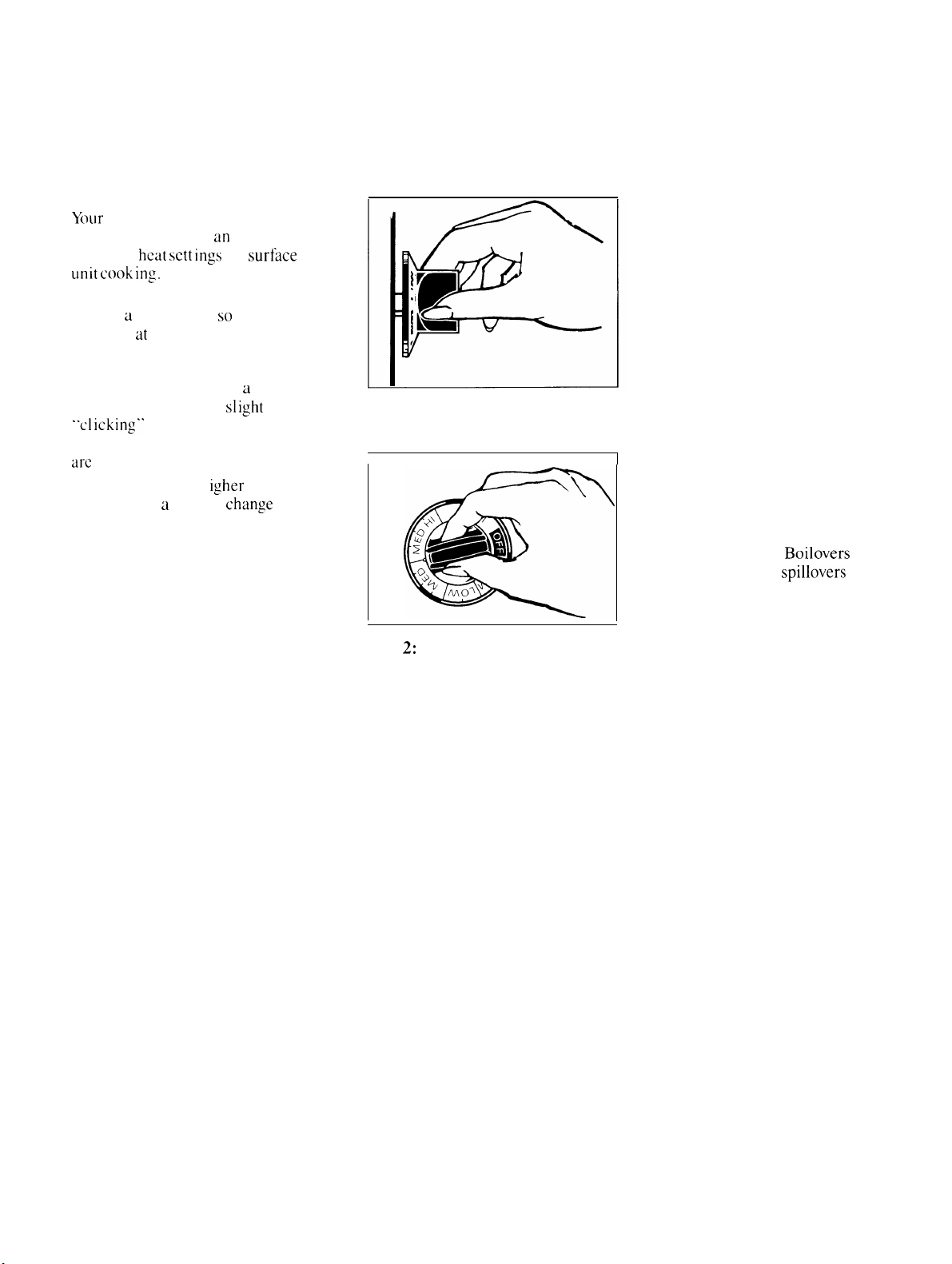
Grasp control knob and push in.
Step
2:
Turn either clockwise or counter-
clockwise to desired heat setting.
Control must be pushed in to set
only from OFF position. When
control is in any position other
than OFF, it maybe rotated
without pushing in.
HI
Quick start for cooking;
bring water to boil.
MED
Fast fry, pan broil; maintain
HI
fast boil on large amount of
food.
MED
Saute and brown; maintain
slow boil on large amount
of food.
LOW
Cook after starting at HIGH;
cook with little water in
covered pan.
WM Steam rice, cereal; maintain
serving temperature of most
foods.
NOTE:
1.
At HIGH, MED HI, never leave
food unattended.
Boilovers
cause
smoking; greasy
spillovers
may
catch fire.
2. At WARM, LOW, melt
chocolate, butter on small unit.
Be sure you turn control to OFF
when you finish cooking. An
indicator light will glow when ANY
heat on any surface unit is on.
6
3
May I can foods and preserves
on my surface units?
A. Yes,
but only use utensils
designed for canning purposes. Check
the manufacturer’s instructions and
recipes for preserving foods. Be
sure canner is flat-bottomed and
fits over the center of your
Calrod@
unit. Since canning generates large
amounts of steam, be careful to
avoid burns from steam or heat.
Canning should only be done on
surface units.
Q. Can I cover
my
drip pans with
.
foil?
A. No. Clean as recommended in
Cleaning Guide.
Q. Can I use special cooking
equipment, like an oriental wok,
on any surface units?
A. Utensils without
flat
surfaces
are not recommended. The life of
your surface unit can be shortened
and the range top can be damaged
from the high heat needed for this
type of cooking.
Q. Why am I not getting the heat
I need from my units even though
I have the knobs on the right
setting?
A. After turning surface unit off
and making sure it is cool, check to
make sure that your plug-in units
(on models so equipped) are securely
fastened into the surface connection.
Q. Why do my utensils tilt when I
place them on the surface unit?
A. Because the surface unit is
not
flat.
Make sure that the “feet”
on your
Calrod@’
units are sitting
tightly in the range top indentation
and the reflector ring is
flat
on
the
range surface.
Q. Why is the porcelain finish on
my containers coming
of’f?
A. If you set your
Calrod(’
unit
higher than required
for
the
container material, and
lcm
e
it,
the
finish may smoke, crack, pop.
t}r
burn depending on the pot or pan.
Also,
a
too high heat
fbr
long
periods. and small amounts
of
dry
food, may damage the finish.
Canning should be done on
cooktop only.
In surface cooking of foods other
than canning, the use of
large-
diameter utensils (extending more
than l-inch beyond edge of trim ring)
is not recommended. However,
when canning with water-bath or
pressure canner, large-diameter
utensils may be used. This is
because boiling water temperatures
(even under pressure) are not
harmful to cooktop surfaces
surrounding heating unit.
HOWEVER, DO NOT USE
LARGE DIAMETER CANNERS
OR OTHER LARGE DIAMETER
UTENSILS FOR FRYING OR
BOILING FOODS OTHER
THAN WATER. Most syrup or
sauce mixtures—and all types of
frying—cook at temperatures much
higher than boiling water. Such
temperatures could eventually
harm cooktop surfaces surrounding
,ating
units.
1.
Bring water to boil on HIGH
heat, then after boiling has begun.
adjust heat to lowest setting to
maintain boil (saves energy and
best uses surface unit. )
2. Be sure canner fits over center
of surface unit. If your range does
not allow canner to be centered on
surface unit, use smal
Ier-diameter
containers for good canning results.
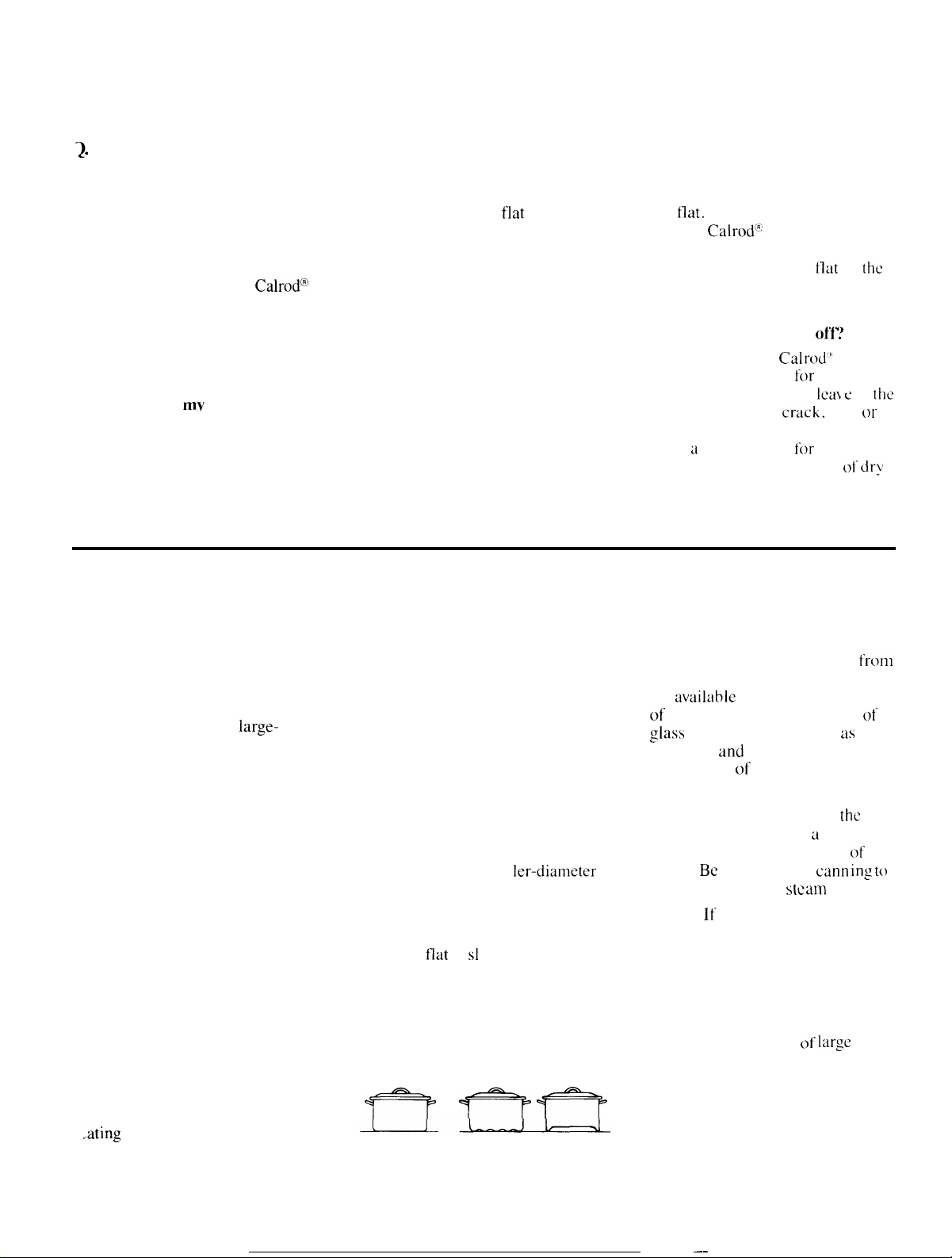
3. Flat-bottomed canners give best
canning results. Be sure bottom of
canner is
flat
or
S1
ight indentation
fits snugly over surface unit.
Canners with flanged or rippled
bottoms (often found in enamelware)
are not recommended.
RIGHT
WRONG
m
T-’r*
4. When canning, use recipes
from
reputable sources. Reliable recipes
are
avaikible
from the manufacturer
of
your canner: manufacturers
0(
glass
jars for canning, such
as
Ball
and Kerr;
and
the United States
Department
of
Agriculture
Extension Service.
5. Remember, in following
the
recipes. that canning is
a
process
that generates large amounts
of
steam.
Be
careful while
uann
ing
to
prevent burns from
steam
or heat.
NOTE:
If your range is being
operated on low power (voltage).
canning may take longer than
expected. even though directions
have been carefully followed. The
process may be improved by:
(1)
using a pressure canner, and
(2) for fastest heating
of
large
water quantities, begin with
HOT tap water.
7
—.
- — —
——
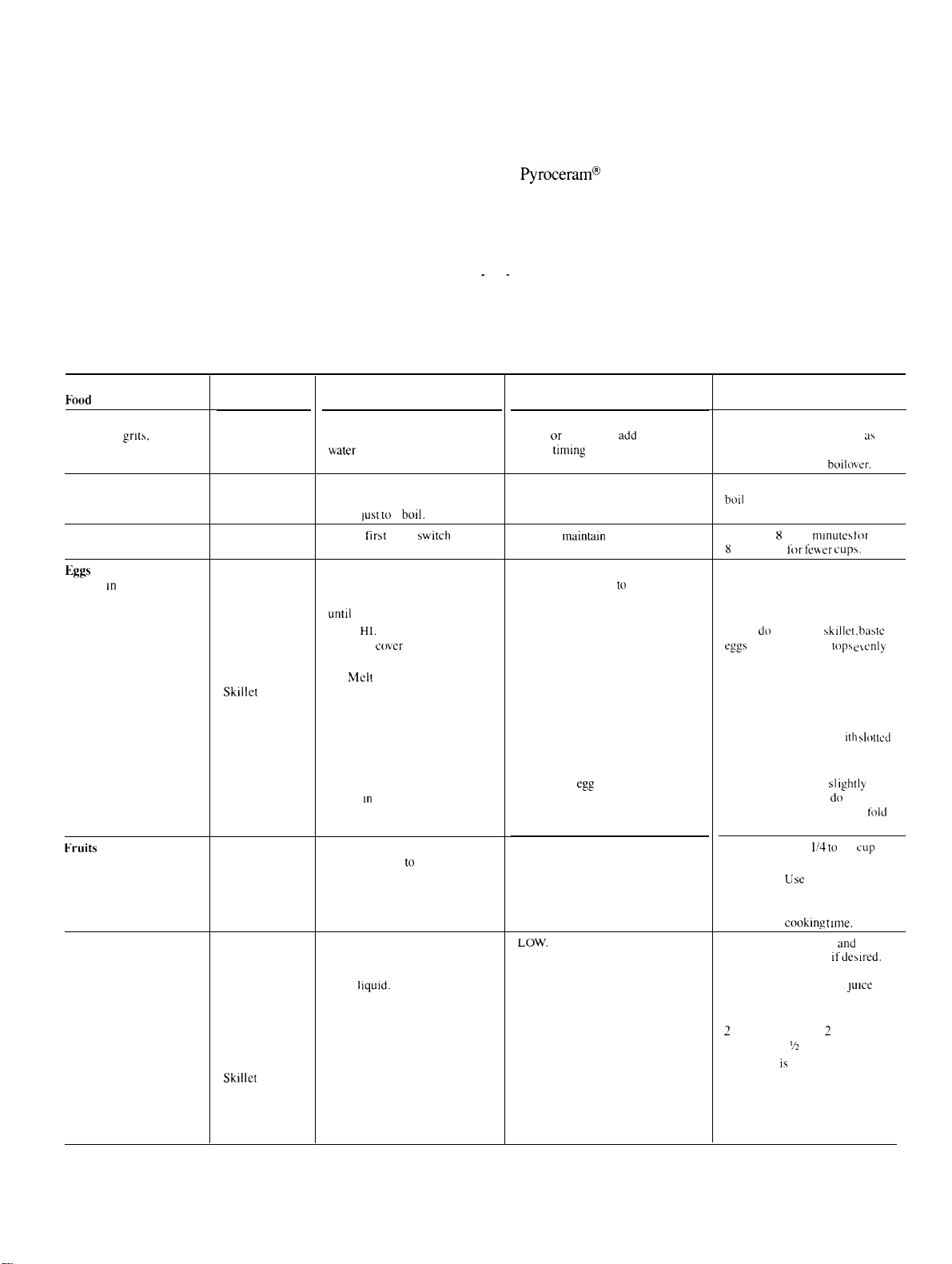
Use non-stick or coated metal fitting lids. Match the size of the
cookware. Flat ground
Pyroceram@
saucepan to the size of the surface
saucepans or skillets coated on the unit. A pan that extends more than
bottom with aluminum generally an inch beyond the edge of the trim
cook evenly. Use glass saucepans
ring traps heat which causes
with heat-spreading trivets “crazing” (fine hairline cracks) on
available for that purpose.
porcelain, and discoloration
1. Use medium-or heavy-weight
cookware. Aluminum cookware
conducts heat faster than other
metals. Cast iron and coated cast
iron cookware is slow to absorb
heat, but generally cooks evenly at
.-
ranging from blue to dark gray on
chrome trim rings.
LOW or MEDIUM settings. Steel
2.
To conserve the most cooking
energy, pans should be flat on the
bottom, have straight sides and tight
pans may cook unevenly if not
combined with other metals.
Directions and Setting
to Start Cooking
Setting to Complete
Cooking
LOW
or
WM, then
add
cereal.
Finish
timmg
according
to package directions.
F’ood
Cookware
Comments
Cereal
Cornmeal,
.gr]ts,
oatmeal
Covered
Saucepan
HI. In covered pan bring
water
to boil before adding
cereal.
Cereals bubble and expand
ai
they cook; use large enough
saucepan to prevent
boilover.
Cocoa
Uncovered
Saucepan
HI. Stir together water or
milk, cocoa ingredients.
Bring
lust
to
a
boll.
MED. to cook 1 or 2 minutes
to completely blend ingredients
Milk boils over rapidly. Watch as
bolt
ing point approaches.
Coffee
Percolator
H]. At
first
perk,
$witch
heat to LOW.
LOW to
maintmn
gentle but
steady perk.
Percolate
8
to 10
m]nutes
tf)r
8
cups, less
ii)r
fewer
cups.
Eggs
Cooked
in
shell
LOW. Cook only 3
to
4
minutes for soft cooked;
15 minutes for- hard cooked.
Continue cooking at MED HI
until whites are just set, about
3 to 5 more minutes.
LOW, then
add eggs. When
bottoms of’ eggs have just set,
carefully turn over to cook
other side.
LOW. Carefully add eggs.
Cook uncovered about 5
minutes at MED HI.
MED. Add
egg
mixture.
Cook, stirring to desired
doneness.
LOW. Stir occasionally and
check for sticking,
Covered
Saucepan
HI. Cover eggs with COOI
water. Cover pan. cook
unt]l
steaming.
MED
HI,
Melt butter, add
eggs and
cover
skillet,
If you
do
not cover sk]llet,
ba~te
eggs
with fat to cook
top~
m
en],
Fried sunny-side-up
Covered
Skillet
Fried over easy Uncovered
Skillet
HI.
Melt
butter
Poached
Covered
Skillet
HI. In covered pan bring
water to a boil.
Remove cooked eggs w
Ith
slotted
spoon or pancake turner.
Scrambled or omelets Uncovered
Skillet
HI. Heat butter until light
golden
In
color-.
Eggs continue to set
SI
ightly
after
cooking. For omelet
(io
not stir
last few minutes. When set,
told
in half.
Fresh fruit: Use
1/4
to
l/2
cup
water per pound of fruit.
E’rui&
Covered
Saucepan
HI. In covered pan bring
fruit and water
to
boll.
Dried fruit:
Use
water as package
directs. Time depends on whether
fruit has been presoaked. If not.
allow more
cook]ng
tmle.
Meats, Poultry
Braised: Pot roasts of
beef, lamb or veal;
pork steaks and
chops
Covered
Skillet
HI. Melt fat, then add meat.
Switch to MED HI to
brown meat. Add water or
other
llquld.
LOW’.
Simmer until fork
tender.
Meat can be seasoned
and
floured
before it is browned,
If
cleslred.
Liquid variations for flavor could
be wine, fruit or tomato
Ju]ce
or
meat broth.
Timing: Steaks 1 to 2-inches: I to
2
hours. Beef Stew:
2
to 3 hours.
Pot Roast: 2
Y2
to 4 hours.
Pan frying
is
best for thin steaks
and chops. If rare is desired, pre-
heat skillet before adding meat,
Pan-fried: Tender
chops; thin steaks up
to 3/4-inch; minute
steaks; hamburgers;
franks and sausage;
thin fish fillets
Uncovered
Sk]llet
HI. Preheat skillet, then
grease lightly.
MED HI or MED. Brown and
cook to desired doneness,
turning over as needed.
8
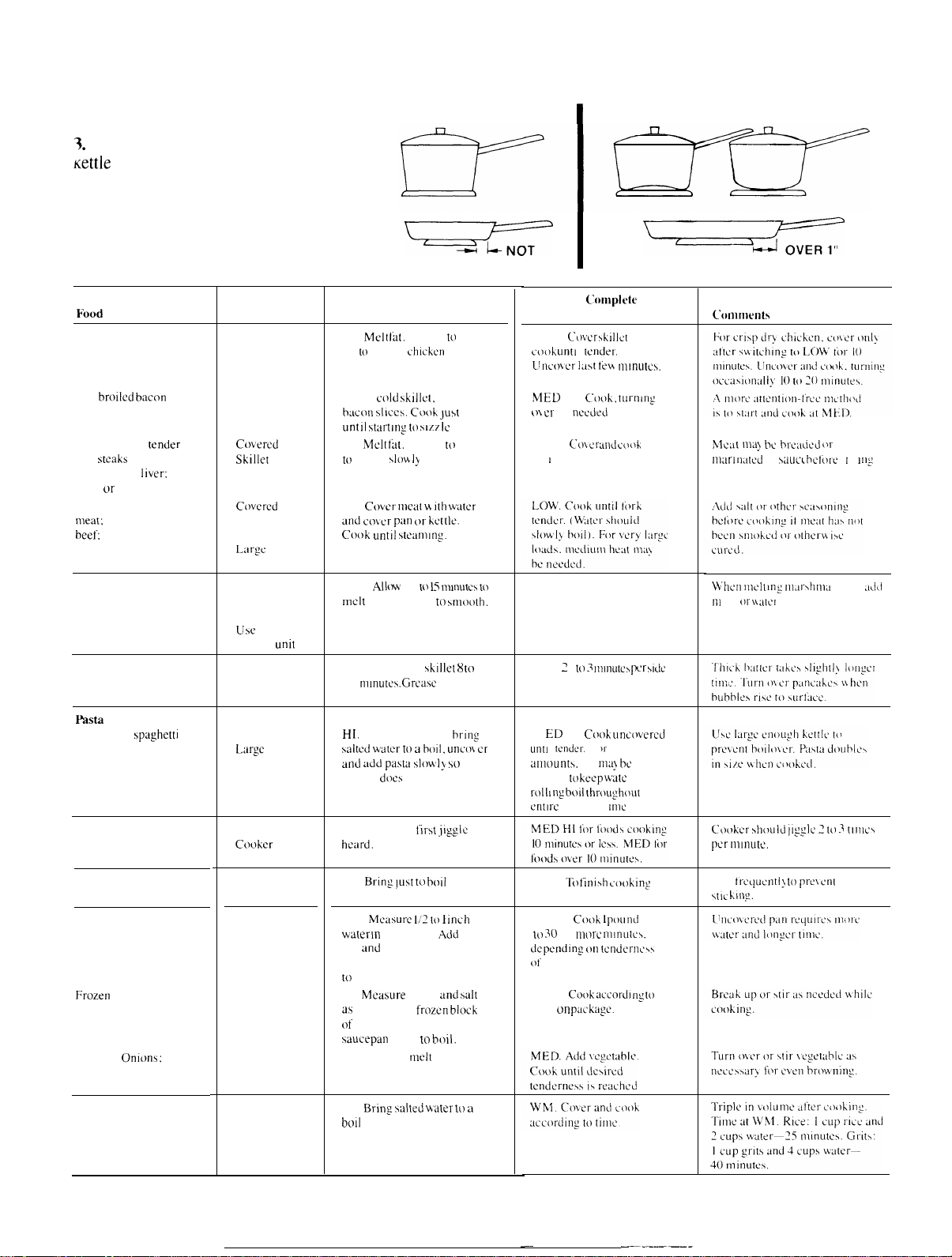
RIGHT
I
WRONG
3.
Deep Fat Frying. Do not overfill
Kettle
with fat that may spill over
when adding food. Frosty foods
bubble vigorously. Watch foods
frying at HIGH temperatures and
keep range and hood clean from
accumulated grease.
OVER 1“
Setting to
L’omplcte
Cooking
LOW.
C~J\cr
\hillct and
cook”
untl
I
tcnde[.
l~nc(l\cr
lcI\t
few
mlnute~.
Directions and Setting
to Start Cooking
HI.
Melt
Itit.
Switch
to
MED
HI
(()
brown
chlchcn
Food
Cookware
C’omrnents
Fried Chicken
Covered
Skillet
Pan
brollcd
bacon
Uncovered
Skillet
HI. In
C(JICI
sk]llet,
arrange
bacon
Sllces.
cook”
JU\t
unt]l
\tartlng
to
J1Z7
k
HI.
Melt
firt.
Switch
to
MED
to
brown
\l(w+
ly
MEL)
HI.
C(mh,
turning
(n
cl” ii\
nwdlai
Sauteed: Less tender
thin
steaks
(chuck,
round, etc. );
1
iver:
thick
or
whole fish
Simmered or stewed
CoYered
SIiillet
LO\+’
Cc)\cr
am!
c(K)L
unt
I
I tender,
Mc:it
m,q
k
breaded
or
m:ir]
Il<ihxl I n
\JLIL’L
hclore
t
[
\
1
11:
Covered
Dutch Oven.
Kettle or
Large
Saucepan
HI.
C(wcr
me:it
w
]th
water
and
c(>\cr
pan
or
kettle.
Cook
until
$tetin]lng.
meat;
chicken; corned
beef:
smoked pork;
stewing beef; tongue;
etc.
When rncl[tn:
iI).II\tIIll.il
lo\\..
J,i({
n]
I
I h or
M
.i[cr
Melting chocolate,
butter, marshmallows
Small
Covered
Saucepan.
Use
small
surface
unit
WM.
AII(Rv
10
to
15
nmutc\
to
melt
through. Stir
to
\nlooth,
Pancakes or
French toast
Skillet or
Griddle
MED H 1. Heat
\h]llet
8
to
10 nllnute\. Grea\e lightly
Cook
2
to
3
nunute\
pcr
w-k
Rista
Noodles or
~paghett] Covered
Large
kettle
or Pot
HI.
In covered kettle.
brln.g
wlted
water
to
a
boll,
uncxn
er
and
add
ptista
~l(mly
so
boiling
docs
not stop.
M
ED
HI.
C(N~k
unc(wered
unt]
I
tender.
F
-
(
J!-
1 urge
titnou
nt\.
HI
rmq
bc
needed
to
keep
watc
r at
ml
I
I
n:
hoi
I
thr(wgh(lut
cn[l
rc
cooking t
[me
Pressure Cooking
Pressure
Cooker
or
Canner
HI. Heat until
first
jlgglc
i\
heard.
C(x}ker
\!loLlid
/lg:lL? 2 to
3
tlIllc\
per
nllnutc,
Puddings, Sauces,
Candies, Frostings
Vegetables
Fresh
Uncovered
Saucepan
Covered
Saucepan
HI.
Bring
lust
to
boil
LOW.
To
i’ini\h
coohinp
Stir
trcqucntl>
to
prmcnl
\tlc
Aing.
HI.
Measure
1/2
to
1
Inch
wtiter
In
saucepan
Acid
salt
and
prepared vegetable,
In covered saucepan bring
to
boil.
HI.
Measure
water
and
salt
as
above. Add
frozen
block
of
vegetable. In covered
\aucepan
bring
to
boll.
HI. In skillet
melt
lat.
MED.
cook”
1
poUIld
]()
to
30
or
m(wc
nlinutc\.
depcndlng
on
(cndern~’\\
of
vegetable
Frozen
Covered
Saucepan
LOW.
Cook
accord]
ng
to
time
on
ptickage.
Sauteed:
Onmn~:
green peppers;
mushrooms; celery: etc.
Rice and Grits
Uncovered
Skillet
Covered
Saucepan
HI.
Bring
\alted
water
to
a
boll
9
—. ———..————
(on models so equipped)
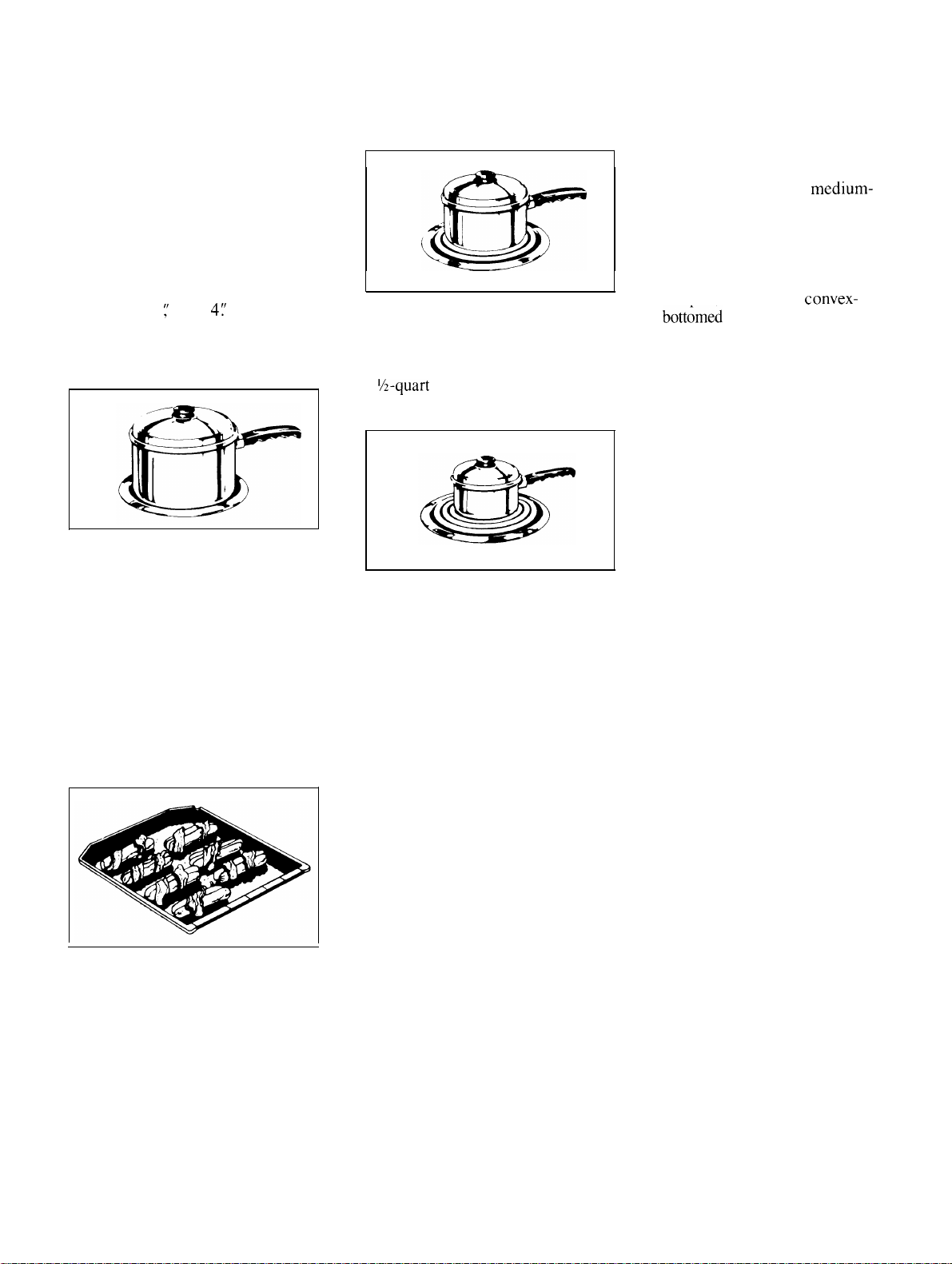
The 3-in-1 Tilt-Lock surface heating
unit offers the convenience of three
units in one. The unit may be used
as a 4-inch, 6-inch or 8-inch unit,
to accommodate different sizes of
utensils.
Push or turn the size selector
switch, next to the surface unit
controls, to 8
~
6“ or
4?
Then turn
surface unit control to desired heat
setting. Match unit size selection to
size of utensil as follows.
LARGE—8-inch unit. Select 8“
size when using large utensils that
completely cover the unit (3-quart
● Use flat-bottomed,
medium-
weight aluminum utensils, in
relation to size of unit in use. Use
tight-fitting lids with foods which
require a cover; loose lids or no
cover lengthen cooking time.
Warped, concave or
convex-
MEDIUM—6-inch unit. Select
6“ size when using medium-sized
cooking utensils that do not
completely cover the unit (2 to
2
~2-quart
saucepans or 6 to 7-inch
skillets). Select desired heat setting.
SMALL—4-inch unit. Select 4“
to 6-quart saucepans or 8 to 10-inch
size when using small cooking
skillet). Select desired heat setting.
utensils about 4 inches in diameter
(as a l-quart saucepan). Select
desired heat setting.
1.
Place griddle on 3-in-1 Unit;
move it back and forth until it falls
into place over unit. The griddle is
designed for easy positioning; it
must be correctly placed to work
properly.
2. Push or turn surface unit
selector to GRIDDLE.
L
I
. .
3. Turn surface control knob to
Your griddle has an easy-clean,
desired heat setting.
nonstick cooking surface. Avoid
using utensils with sharp or rough
4. When cooking is finished, turn
points or edges. Do not cut foods
surface control knob to OFF.
on the griddle. If preferred, foods
may be cooked without greasing
griddle. Use as follows:
bott;med pans are not recommended.
● Use MINUTE TIMER to time
TOTAL cooking. Include time
usually required to bring food to
boil, switching heats, etc. Do not
judge cooking time by visible
steaming only. Food will cook in
covered utensils even though no
steam may be apparent during the
cooking process.
5. Let griddle cool on range, or
protect hands with heavy, dry pot
holders before handling. To clean,
see Cleaning Guide, page 33.
To avoid marring nonstick finish,
store griddle upright, or store flat,
but with no other pans or utensils
on top of the griddle.
10

(on models so equipped)
The automatic surface unit
controls
the
temperature
of
your cookware
to
give the same
~Jpe
of automatic
cooking that you may have
experienced with a well-controlled
electric skillet or saucepan.
The spring-mounted sensor,
located in the center of the surface
unit, measures and controls the
heat to the pan on the unit.
1. Set pan on unit. Use a cover
on cookware when suggested on
Automatic Unit Cooking Guide
on next page.
2. Turn Automatic Unit Selector
knob to select unit size.
The unit
may be used as an 8-inch, 6-inch or
4-inch unit to accommodate large,
medium-sized or small cookware.
Match unit size selection to size
of cookware as shown on page 10.
3. Select heat setting as
recommended on the
Automatic
Unit Cooking Guide.
(Settings were
chosen using medium-weight
aluminum pans. )
c
For cooking with liquids, use
settings anywhere in the area
marked HI, MED, LOW BOIL,
SIM
or setting in between to obtain
desired rate of cooking.
●
For frying operations use settings
anywhere in area numbered 200
to
500.
●
For warming operations use
settings marked 200 and the line
just below 200.
4. When cooking is finished, turn
Automatic Unit control dial to OFF.
●
Use flat-bottomed, medium-weight
aluminum cookware, in relation to
size of unit in use. Use tight-fitting
lids with foods which require a
cover; loose lids or no cover
lengthen cooking time. Warped,
concave or convex-bottomed pans
may not touch sensor in center of
Automatic Unit; if not, sensor
cannot control heat supplied to pan.
●
Use amount of water suggested
on Automatic Unit Guide; if more is
used, higher heat setting and longer
cooking time may be required.
c
Cookware of other materials
may require different heat settings
and/or cooking time.
●
Use a minute timer to time
TOTAL cooking. Include time
usually required to bring food to
boil, switching heats, etc. Do not
judge cooking time by visible
steaming only. Food will cook in
covered cookware even though no
steam may be apparent during the
cooking process.
11
—
-—.
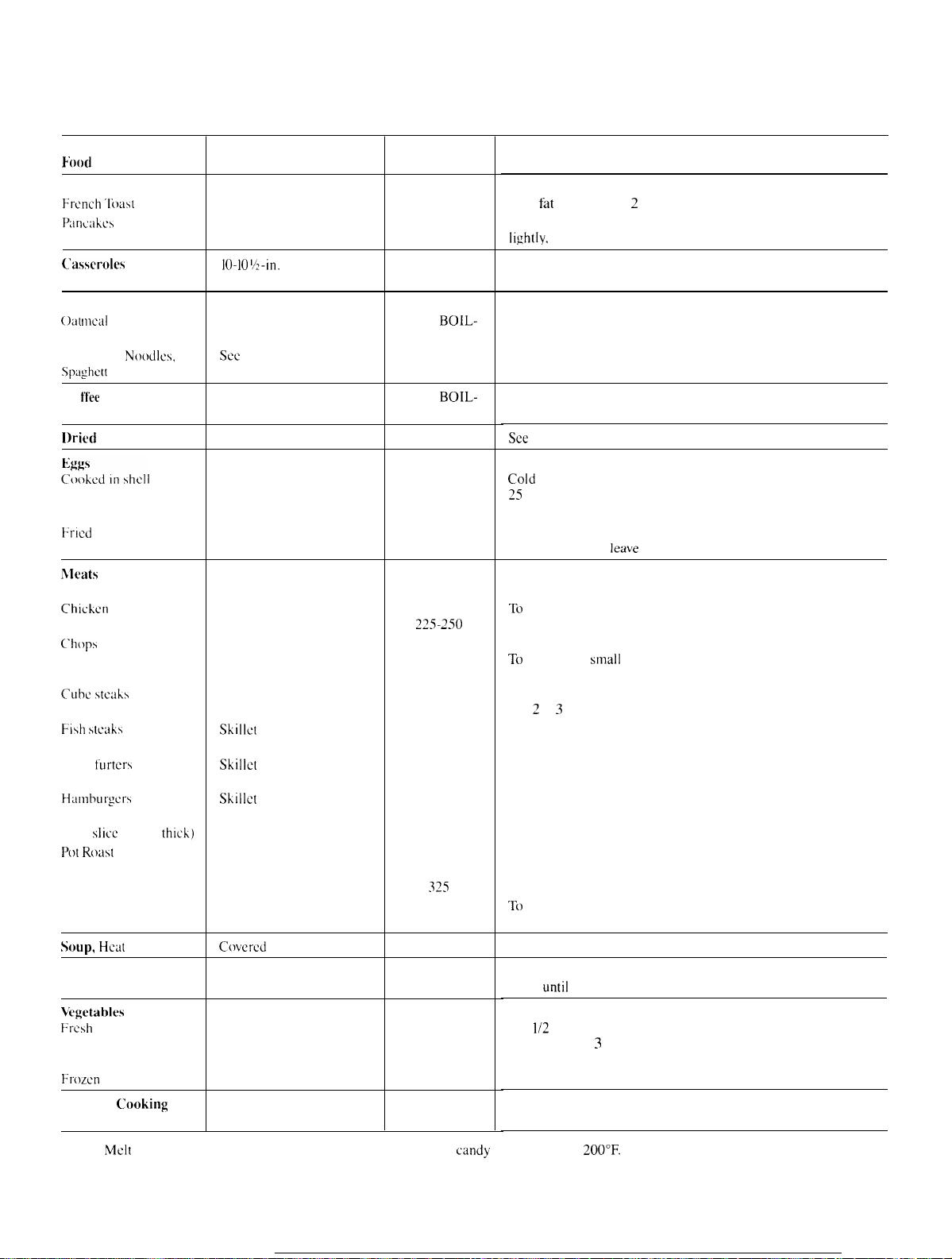
Heat Setting
(Degrees F.)
l’oocl
Utensil General Directions
Melt
fat
and heat 1 to
2
minutes before adding bread.
Heat skillet until drops of water dance violently. Grease skillet
ii~htly,
then start pancakes.
Breads
French
Toa~t
Skillet
Skillet
350-375
425-450
Pancahcs
C’asser-oles
K)-lO1~-in.
covered skillet
200-250
Place ingredients of casserole in aluminum skillet. Cover and cook
until hot and bubbly in center.
Cereal, Pasta
oat
IIlcal
See package directions.
See
General Directions.
HIGH
BC)lL-
MED. BOIL
HIGH BOIL
See package directions for cooking method.
Cover kettle to bring water to boil before and after adding
spaghetti. Remove cover to complete cooking.
Macaroni. Noodles,
Spti:hett
i
CO
ff”ee
Percolator
HIGH
BOIL-
MED. BOIL
See
package directions for cooking method.I)ried Fruit
Covered saucepan
SIMMER
Cold
water to cover. Cook 10 to 12 minutes for soft cooked and
25
to 30 minutes for hard cooked. (Water should
not
boil. )
Melt butter and heat 1 to 2 minutes before adding eggs.
Allow butter to melt. Break eggs into skillet. Cover skillet, cook
3 to 4 minutes, or
leave
uncovered and baste with fat.
Covered saucepan
SIMMER
Scrambled
F’rled
Skillet
Skillet
275-300
200-225
hleats
Bacon
Chichcn
Skillet
Skillet
350-375
400
7?5_750
---
A.
325-375
225-250
Start in cold skillet.
T(J
brown.
Covered. to cook.
To brown.
T()
braise (add
small
amount of water, cover skillet and finish
cooking).
Preheat skillet 3 minutes. Melt 1 tablespoon butter, then add steaks.
Fry
2
to
3
minutes per side.
Melt 2 tablespoons fat, add breaded or floured fish and cook about
15 minutes per side for l-inch steaks.
Start in cold, ungreased skillet. When sizzling begins, turn
frankfurters frequently to brown evenly.
Melt 1 tablespoon fat, then add hamburgers. Cook 6 to 8 minutes
per side.
Start in cold, ungreased skillet. Cook 7 to 8 minutes per side.
To brown meat.
Add liquid; cover to finish cooking. If desired, add vegetables.
Cook according to package directions.
T(J
brown meat.
Covered, to finish cooking.
[’hops
Skillet
425-450
Skillet
Fiih
stcahs Skillet
350-375
Fran
hturtcri
Skillet
350-400
Shillct
300-325
Hanlburgcr~
350-400
325-375
SIMMER
325
350-375
LO BOIL
Ham
SIICC
( Y-in.
thick)
Pot
Roast
Skillet
Skillet or Kettle
sausage
Stew
Skillet
Covered saucepan
soup,
Heat Covered
saucepan
SIMMER
Heat 15 to 20 minutes or to desired serving temperature.
Popcorn
5-6 quart covered kettle
450
Place 1/2 cup cooking oil, 1 cup popping corn in kettle, cover.
Cook
until
popping stops. Remove, season with butter and salt.
Use
1/2
inch salted water in bottom of pan. Add vegetables, cover
saucepan. Add
3
to 5 minutes of cooking time normally used in
standard unit.
Same as above.
Follow manufacturer’s directions for amounts of liquid and
cooking time.
Wgetables
Fresh Covered saucepan
Covered saucepan
LO BOIL
LO BOIL
Fl”omn
Pressure
(hking
Pressure saucepan 300-350
NOTE:
Melt
butter, cooking or semi-sweet chocolate, or butterscotch
candy
pieces in pan at
200”F.
setting. Use covered pan for faster melting.
12
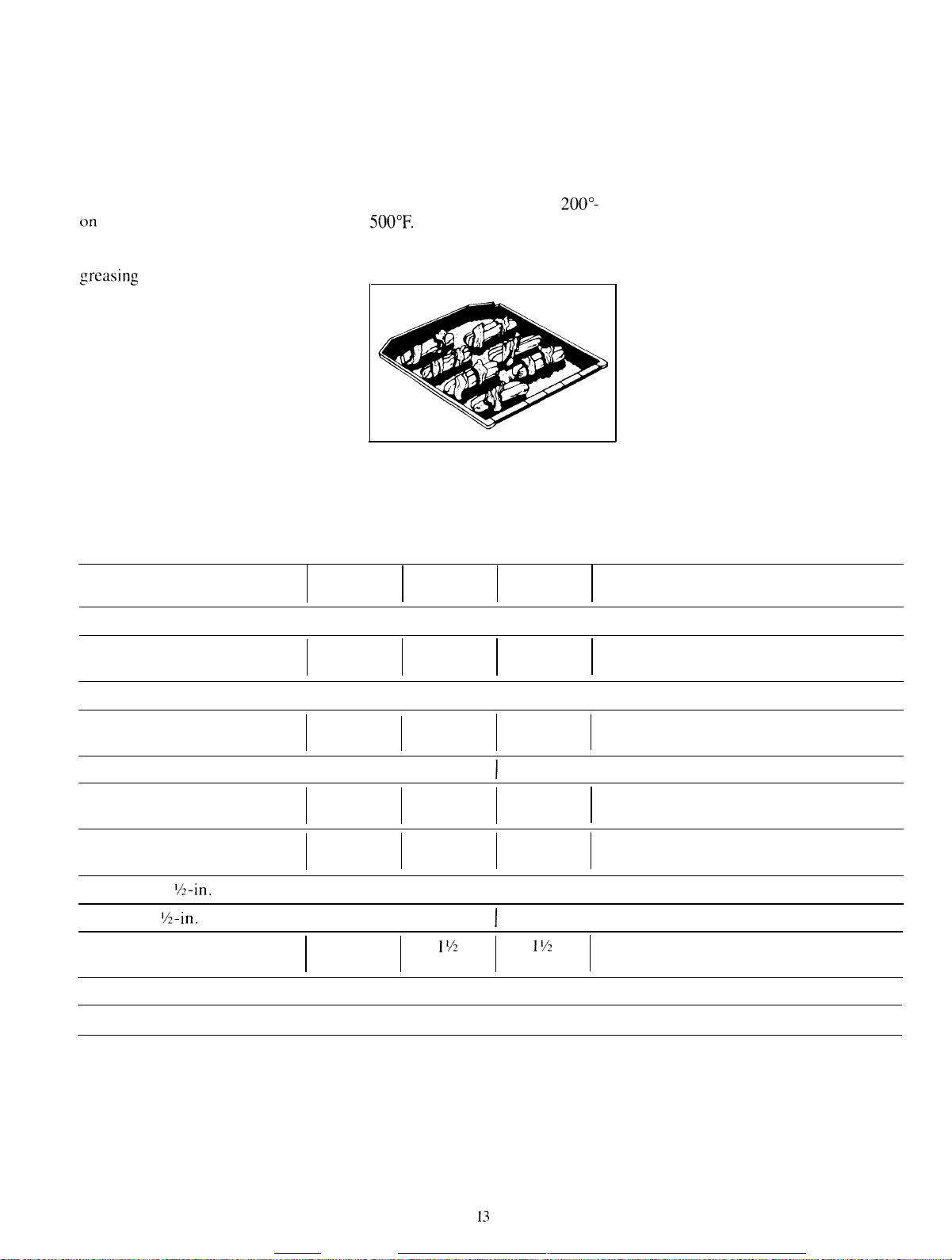
(on models so equipped)
Your griddle has an easy-clean,
nonstick cooking surface. Avoid
using utensils with sharp or rough
points or edges. Do not cut foods
on
the griddle. See guide for
cooking directions. If preferred,
foods may be cooked without
greasing
griddle.
1.
Place griddle on Automatic Unit;
move it back and forth until it falls
into place over unit. The griddle is
designed for easy positioning. It
must be correctly placed to work
properly.
2. Push or turn Automatic Unit
selector to GRIDDLE.
3. Select heat on Automatic Unit
control dial. Use settings listed on
griddle or on guide. For griddle
cooking, use heats between
200°-
500”F.
Other markings are for
boiling operations and should not
be used with GRIDDLE settings.
4. When
cooking is finished, turn
Automatic Unit control dial to OFF.
5.
Let
griddle cool on cooktop,
or protect hands with heavy, dry
pot holders before handling.
To
clean, see Cleaning Guide, page 33.
To avoid marring nonstick finish,
store griddle upright, or store flat
but no other pans or utensils on top.
Note: For Automatic Unit model
that does not include the griddle as
standard equipment, an accessory
is available at extra cost. Order
single-unit griddle WB49X262
from your GE dealer.
Setting
First Side
Second Side
Food
(Degrees F.) (Minutes)
(Minutes) Special Instructions
Bacon
I
I
375-425
I
I
Preheat, if desired. Brown each side.
Chops
350-400
Preheat and grease lightly, if desired.
Brown each side.
Cubed Steaks
I
I
I
I
425-500
2-3 2-3
Preheat 10 minutes.
Eggs, fried
275
2-3 2-3
Preheat 10 minutes. Grease lightly,
if desired.
Fish Steaks, l-in.
I
I
375-425
15
I
15
I
Preheat 10 minutes.
Franks
400-450
Preheat and grease lightly, if desired.
Turn, brown evenly.
French Toast
350-375
5-6
5-6
Preheat 10 minutes. Grease lightly,
if desired.
Hamburgers,
~~-in.
I
I
I
I
300-350
6-8 6-8
Preheat 10 minutes.
Ham Slice,
~~-in.
I
I
I
I
375-425
7-8 7-8
Preheat, if desired.
Pancakes 425-450
1
I/j
1Y2
Preheat 10 minutes. Grease lightly.
if desired.
Rolls, Sandwiches
I
I
375-425
I
I
Preheat 10 minutes. Brown each side.
Sausage
I
I
350-400
I
I
Preheat, if desired. Turn, brown evenly.
13
-— —
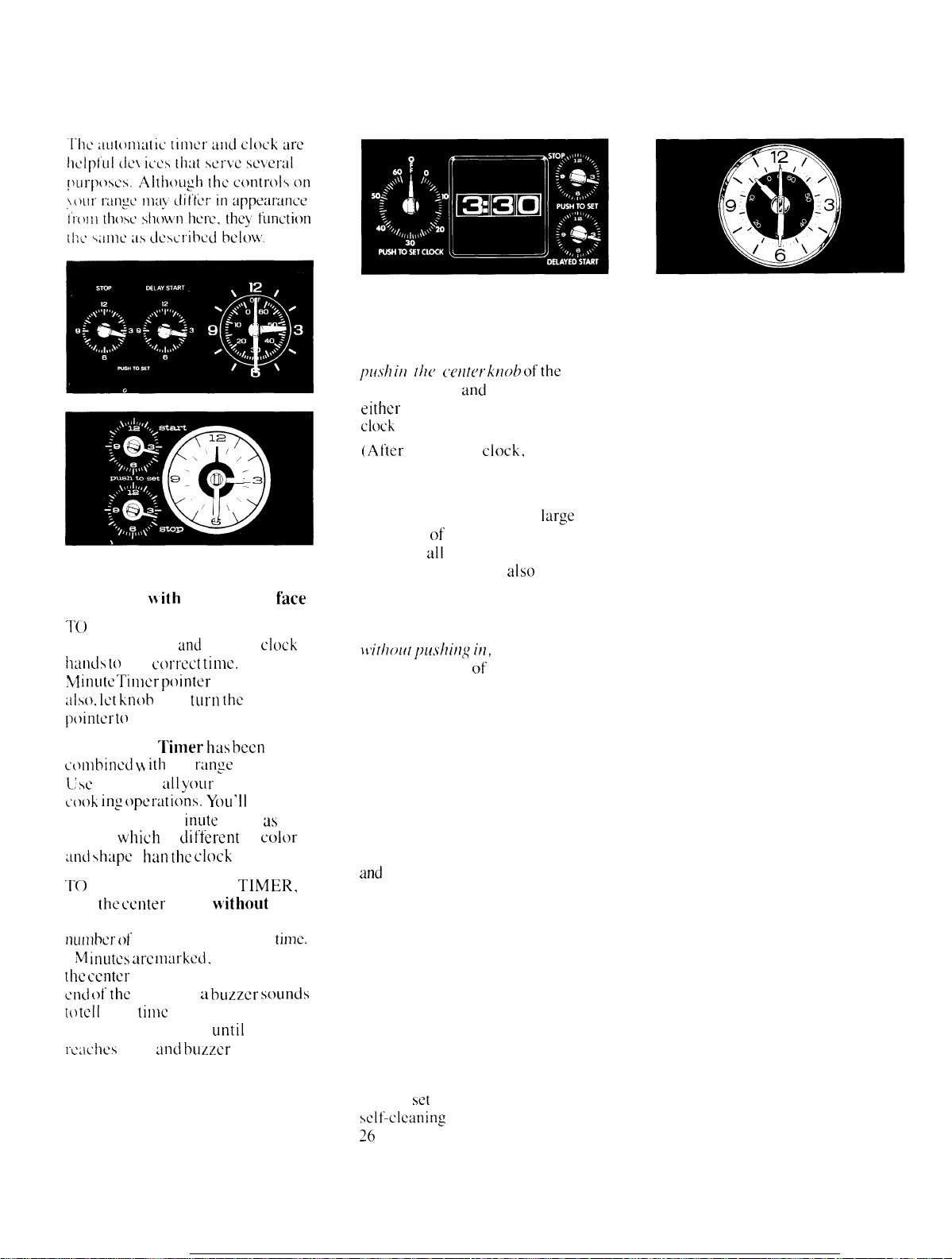
(on
models so equipped)
TO SET THE CLOCK,
push
in
the
c(~tttet-
k~zob
of
the
Minute Timer
and
turn knob in
either direction to set the digital
clock
numerals to the correct time.
for models
with
round clock
f’mx
T()
SET THE CLOCK, push the
center- knob
in
and
turn the
clock
ll~iids
t~~
the
cc~rrect
time.
(The
M
inlitc
Tiiner
pt~inter
will move
:ilso.
IN
knt~b
out,
tLirn
the
Timer
p~~intcr
I()
OFF. )
The Minute
‘1’imer
hm
imcn
c(~inbincd
w
ith
the
range
clock.
Usc
it to time
;ill
yo~ir
precise
c~N~k
in:
operations.
You’ll
recognize the M
inLite
Timer as the
pointer
which
is
dil’ferent
in
color
LiiId
\h:ipc
t
h:iil
the
clock
hands.
m
SET T HE MINUTE TIMER,
turn
the
ceilter
knob,
without
pushing in,
until pointer reaches
nunlbcr
of”
minutes you wish to
time.
(
M
inutcs
arc
mirkd.
up to 60, in
the
center ring on the clock. ) At the
ci~d
t~f
the
set time.
a
buzzer
souncis
t~~
tell
yoLi
ti]nc
is up. Turn knob.
without pushing in,
until
pointer
Icac>}les
OFF
tinci
blizzcr
stops.
(Afler setting the clock, iet the
knob out, and turn the Minute
Timer pointer to OFF. )
The Minute Timer is
the
iarge
dial
to the left
of
the digital clock. Use
it to time
all
your precise cooking
operations. This dial
aiso
sets or
changes the digital clock.
TO SET THE MINUTE TIMER,
turn the center knob clockwise,
}~’ith(ml
pu.fhin~
in,
until pointer
reaches number
of
minutes you
wish to time (up to 60).
Using Automatic Timer, you can
TIME BAKE with the oven starting
immediately and turning off at the
Stop Time set or set both DELAY
START (some models say START)
and
STOP dials to automatically start
and stop oven at a later time of day.
Setting the dials for TIME BAKE
is explained on page 16.
The self-cleaning function (on
models so equipped) uses the
Automatic Timer to set the length
of time needed to clean the oven.
How to
set
Start and Stop dials for
scli~clcaning
is described on pages
26
and 27.
Note: Some models have a time of
day clock and minute timer but do
not have START and STOP dials
needed for Time Bake function.
Q. How can I use my Minute
Timer to make my surface
cooking easier?
A.
Your Minute Timer will help
time total cooking which includes
time to boil food and change
temperatures. Do not judge cooking
time by visible steam only. Food
will cook in covered containers
even though you can’t see any
steam.
Q. Must the Clock be set on
correct time of day when I wish
to use the Automatic Timer for
baking?
A. Yes,
if you wish to set the
DELAY START or STOP dials to
turn on and off at set times during
timed functions.
Q. Can I use the Minute Timer
during oven cooking?
A. The Minute Timer can be used
during any cooking function. The
Automatic Timers (DELAY
START and STOP dials) are used
with TIME BAKE function only.
Q. Can I change the clock while
I’m Time Cooking in the oven?
A. No. Theclockcannot be changed
during any program that uses the
oven timer. You must either stop
those programs or wait until they
are finished before changing time.
M
1. Look
at
the controls. Be sure
you understand how to set them
properly. Read over the directions
for the Automatic Oven Timer so
you understand its use with the
controls.
2. Check oven interior. Look
at
the shelves. Take
a
practice run at
removing and replacing them.
3. Read over information and tips
that follow.
4.
Keep this book handy so you
can
refer to it, especially during the
first few weeks.
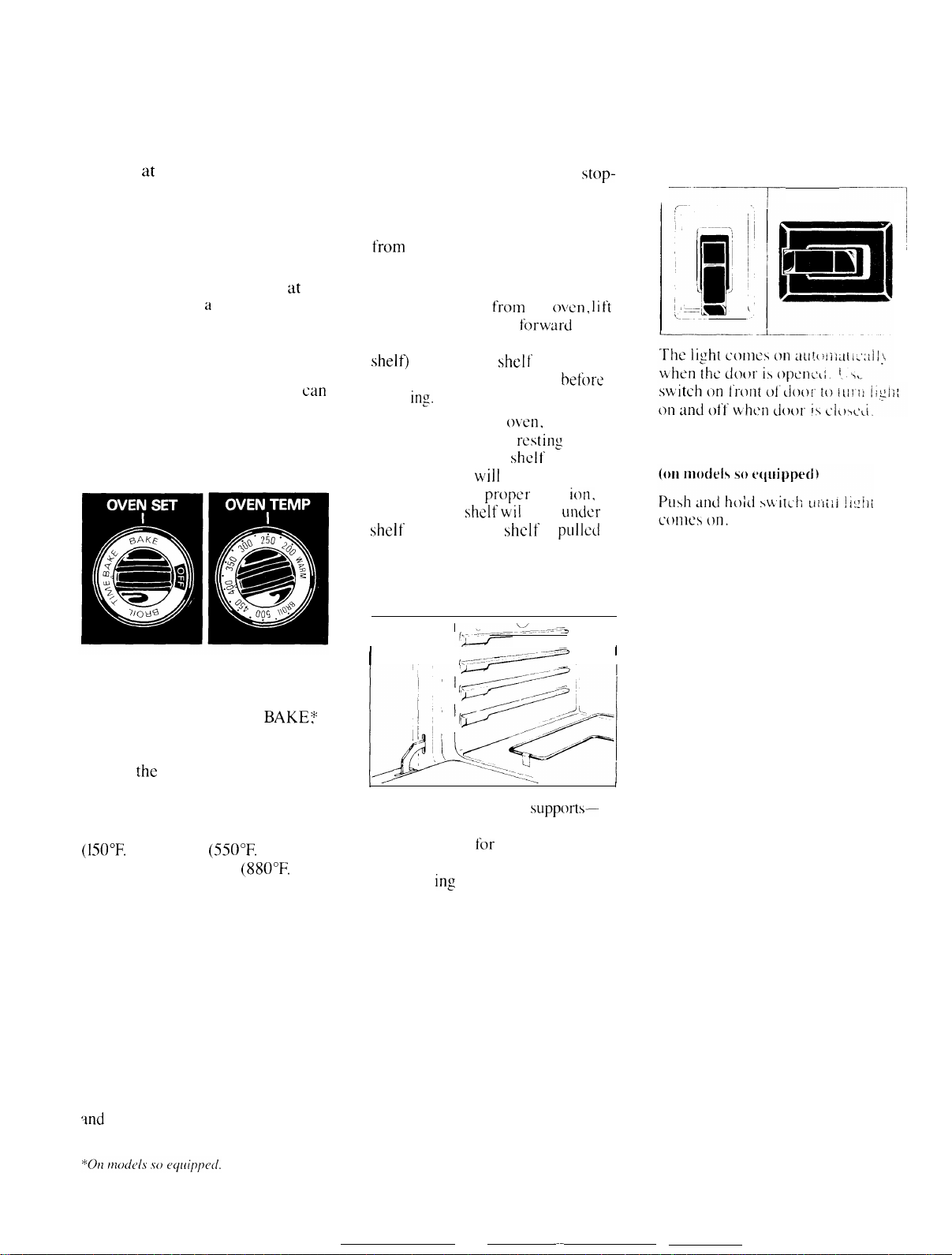
The controls for the oven are
marked OVEN SET and OVEN
TEMP. The OVEN SET control has
settings for BAKE, TIME
BAKEY
BROIL, CLEAN* and OFF. When
you turn the knob to the desired
setting,
(he
proper heating units are
then activated for that operation.
The OVEN TEMP control maintains
the temperature you set, from WARM
(150°F.
) to BROIL
(550°F.
) and on
some models, CLEAN
(880°F.
).
The Oven Cycling Light glows
until the oven reaches selected
temperature,
then goes off and on
with the oven unit(s) during cooking.
PREHEATING the oven, even to
high temperature settings, is speedy
—rarely more than about 10 minutes.
Preheat the oven only when
necessary. Most foods will cook
satisfactorily without preheating.
If you find preheating is necessary,
keep an eye on the indicator light
and
put food in the oven promptly
after the light goes out.
The shelves are designed with
stop-
locks so that when placed
correctly
on the shelf supports, they (a) will
stop before coming completely
from
the oven, and (b) will
not tilt
when removing food from or
placing food on them.
To remove shelf
fro~m
the
oven,
lift
up
rear
of shelf, pull
forward
with
stop-locks (curved extension under
shelf]
along
top
of
shel
f
supports.
Be certain that shelf is coo]
before
touch
ing.
To replace
shelf in
men,
insert
shelf with stop-locks
resting
on
shelf supports. Push
she]f toward
rear of oven: it
will
fall into place.
When shelf is in
proper posit
ic~rl,
stop-locks on
shelf
wil
1 run
under
shelf support when shelf is
pLIl]ed
forward.
I
.Y-–=-.-=. ,
I
I
I
,-~
I
1
The oven has four shelf
supports—
A (bottom), B, C and D (top).
Shelf positions
fbr
cooking food
are suggested on Baking, Roasting
and Broil
ing
pages.
(on models so equipped)
r
—--”~
——–-]
15
—.
Note:
Althou!l:
controls
w
>v[ir
raflgc
ma},
dlfler
in
appeurmlce
than
thos;~
.shown
here,
1}70’
(I11
jimctiofl
as d(scritxvi
Lvloit:
When cooking a food for the first
time in your new oven,
use the time
:
iven
on
re~
ipes
as
a
guide.
Oven
thermostats may “drift”
from
the
factory setting over the years,
and
5-
to lo-minute differences in timing
between
an
old
and
new oven are not
unusual. You might think your new
oven is not performing correctly;
however, it has been set correctly at
the factory and is more likely to be
accurate than the oven it replaced.
1.
Place food in oven, being sure to
leave about 1“ between pans and
twen
walls
for
good circulation of
heat. Close oven door, and avoid
frequent door openings during
baking to prevent undesirable
results.
2. Turn OVEN SET knob to
BAKE
and
OVEN TEMP knob
to temperature on
recipe
or
Baking
Guide.
3.
Check
food
for doneness
at
minimum time on recipe. Cook
longer
if
necessary. Switch
off
heat
and
remove
foods.
(on models so equipped)
The oven timer controls are
designed to turn the oven on and
off
automatically at specific times
you want baking to start and stop.
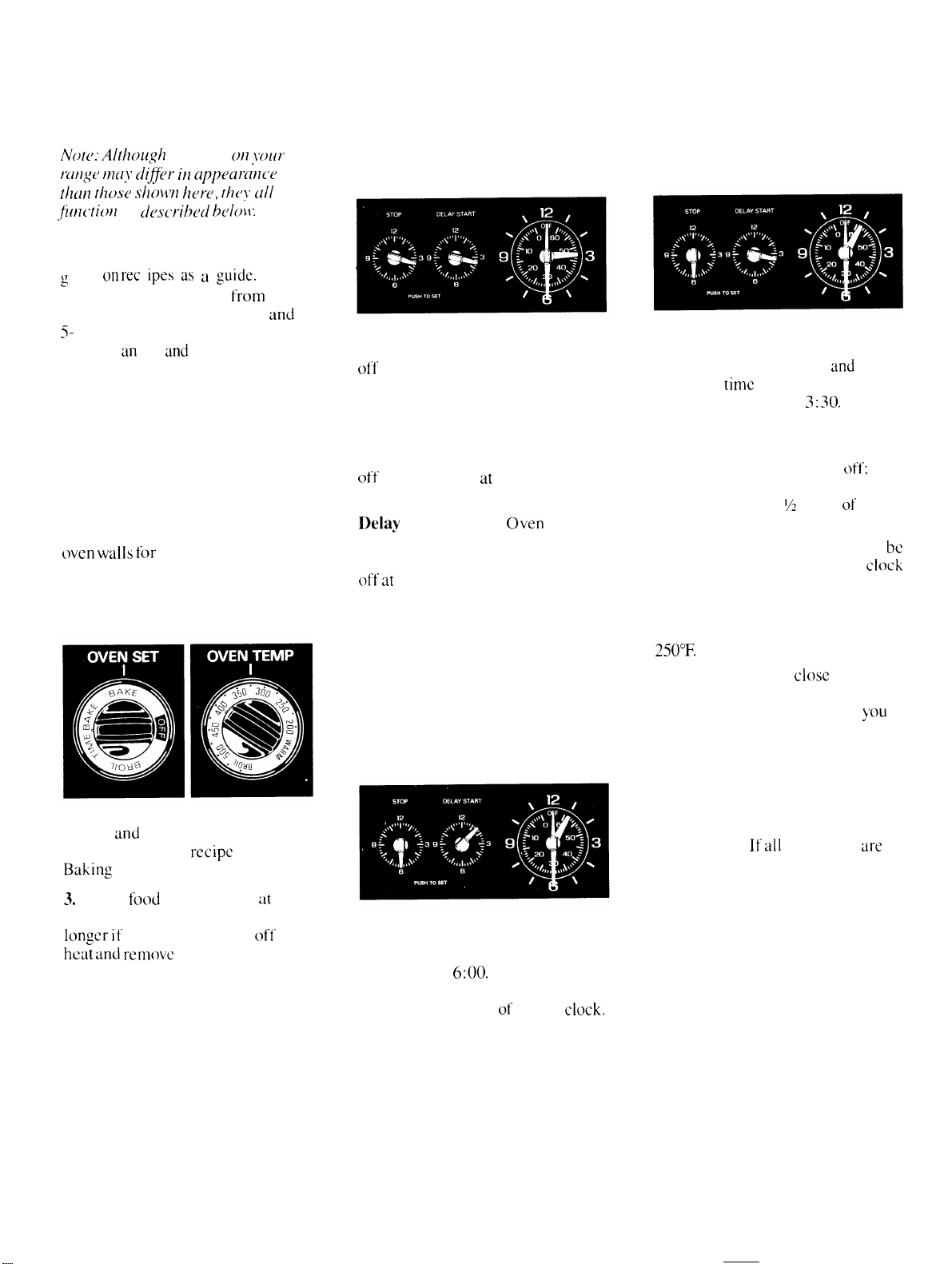
Your Time Bake options:
immediate Start & Automatic Stop.
Oven turns on right away and turns
off automatically
at
your preset
stop time.
~~]a~
Start & Stop.
Oven
automatically turns on later at
your preset start time and turns
oft
at
your preset stop time.
Remember when setting stop time
that time-baked foods will continue
cooking after the oven turns off.
Before beginning, make sure the
range clock shows the correct time
of day.
1.
To set Stop Time, push in knob
on Stop dial and turn pointer to
time you want oven to turn off:
for example,
6:00.
The DELAY
START dial should be at the same
position as the time
of
day on
clock.
2.
Turn OVEN SET knob to
TIME BAKE. Turn OVEN TEMP
knob to desired oven temperature.
1.
To set Start Time, push in knob
on DELAY START dial (some
models may say START)
and
turn
pointer to
time
you want oven to
turn on: for example,
3
:30.
2. To set Stop Time, push in knob
on Stop dial and turn pointer to
time you want oven to turn
off;
for
example, 6:00. This means your
recipe called for 2
1/2
hours
of
baking time.
NOTE: Time on STOP dial must
be
later than time shown on range
clock
and DELAY START dial.
3. Turn OVEN SET knob to TIME
BAKE. Turn OVEN TEMP knob to
250”F.
or recommended temperature.
Place food in oven,
close
the door
and the oven will be turned on and
off automatically at the times
}OU
have set. Turn OVEN SET to OFF
and remove food from oven.
OVEN INDICATOR LIGHT(s)
at TIME BAKE setting may work
differently than they do at BAKE
setting. Carefully recheck the steps
given above.
If
all
operations
are
done as explained, the oven will
operate as it should.
16
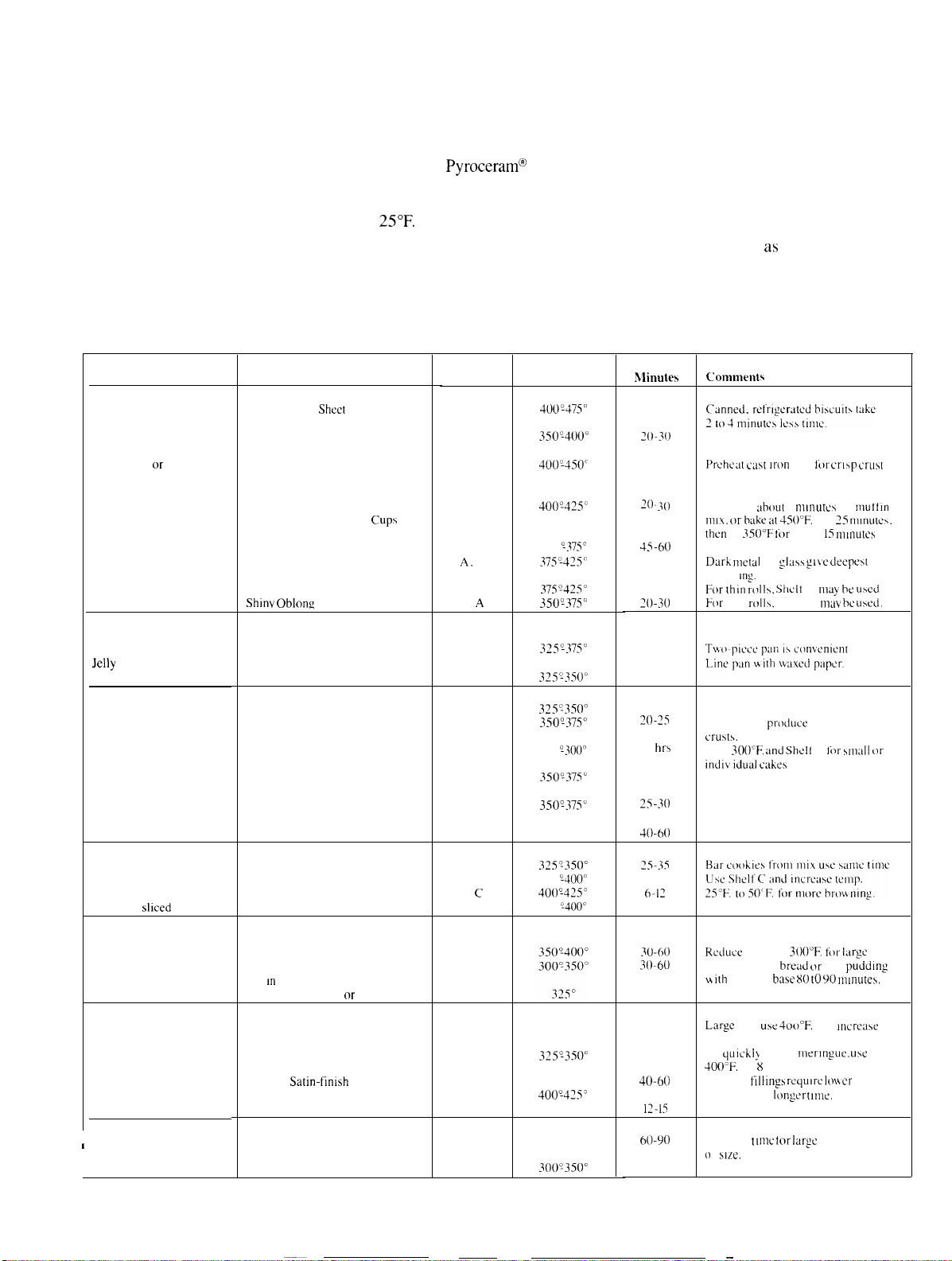
1.
Aluminum pans conduct heat
quickly. For most conventional
baking, light, shiny finishes generally
give best results. They prevent
overbrowning in the time it takes
for heat to cook the center areas.
Dull (satin-finish) bottom surfaces
of pans are recommended for cake
pans and pie plates to be sure those
areas brown completely.
2.
Dark or non-shiny finishes,
glass and
Pyroceram@
utensils often
absorb heat, which may result in
dry, crisp crusts. Reduce oven heat
25”F.
if lighter crusts are desired.
Preheat cast iron for baking some
foods for rapid browning when
food is added.
which cook longer than 30 to 40
minutes. For food with short
cooking times, preheating gives
best appearance and crispness.
4.
Open the oven door to check
food as little
as
possible to prevent
uneven heating and to save energy.
3.
Preheating the oven is not always
necessary, especially for foods
Shelf
Position
B, C
B, A
B
B
A, B
B
B
A.
B
A. B
B,
A
Oven
Temperature
Time,
hlinutes
Food
Bread
Biscuits (‘A-in.
thick)
Coffee cake
Corn bread
or
muffins
Gingerbread
Muffins
Popovers
Quick loaf bread
Yeast bread (2 loaves)
Plain rolls
Sweet rolls
Container Comments
Shiny Cookie
Sheet
400:475°
350:400°
400W50C
3500
-$ooQ425°
375°
350
Q375°
375?4?5°
375~425°
350~375°
15-20
20-30”
20-40
45-55
~o.
-30
45-60
45-60
45-60
10-25
~()-~()
30-55
10-15
45-60
Shiny Metal Pan with
satin-finish bottom
Cast Iron or Glass
Shiny Metal Pan with
satin-finish bottom
Shiny Metal Muffin Pans
Deep Glass or Cast Iron
Cups
Prche:it
CUS[
Iron
pan
h)r
crl\p
crLl\[
Decrease
abfmt
5
m}nutc\
tor
muttln
ml<.
(jr
btike
at
450°F.
for
25
mlnuw\.
then
at
.3500F
tbr
10 to
15
mlnutc~
Metal or Glass Loaf Pans
Metal or Glass Loaf Pans
Dark
metal
or gIa\\
gL\c
deepe\[
brow n
Ing.
For
thin
rt~ll~,
Shclt
B
may
be
uwci
Eor
thin
r{]ll\.
Shelf B
mm
be
used,
Shiny Oblong or Muffin Pans
Shinv
Oblomz
or Muffin Pans
Cakes
(without shortening)
Angel
food
Jelly
roll
Sponge
Cakes
Bundt cakes
Cupcakes
Fruit cakes
Layer
Layer, chocolate
Loaf
3~52-375”
37594000
325:350°
Aluminum Tube Pan
Metal Jelly Roll Pan
Metal or Ceramic Pan
A
B
A
Metal or Ceramic Pan
Shiny Metal Muffin Pans
A, B
B
A. B
B
B
B
325~350°
350~375°
275
Q300”
350~375°
350~375”
3500
45-65
~o.~5
&$
hr$
20-35
25.30
40-60
Paper liner\
pr(lduce
more moist
c.ru\t\.
Use
300CF.
and
Shell
B
Ii>r
jmall
or
indlv
iciual
cakes
Metal or Glass Loaf’ or
Tube Pan
Shiny Metal Pan with
satin-finish bottom
Shiny Metal Pan with
satin-finish bottom
Metal or Glass Loaf Pans
Cookies
Brownies
Drop
Refrigerator
Rolled or
sl]ced
Metal or Glass Pans
Cookie Sheet
Cookie Sheet
Cookie Sheet
B, C
B. C
B,
C
B, C
325~350°
350
Q400°
4oo~425°
375
Q400°
~5-35
10-20
6-12
7-12
Fruits,
Other Desserts
Baked apples
Custard
Puddings, Rice
and Custard
Glass or Metal Pan
Glass Custard Cups or Casserole
(set
In
pan of hot water)
Glass Custard C
UPS
or
Casserole
A, B, C
B
B
.70-60
30-60
50-90
Reduce
temp. to
300°F.
Ii)r
I.irgc
custard. Cook
bred
(>r
rice
pucidln:
w
lth
custard
base
80
tO
90
minutes,
Pies
Frozen
Meringue
One crust
Two crust
Pastry shell
Miscellaneous
Baked potatoes
I
Foil Pan on Cookie Sheet
40094250
3~593500
40094250”
400:425”
450’
45-70
15-25
40-t)o
40-60
12-15
Large
pies
uw
400°F.
and
lncrea\e
time.
To
qul~kly
brown
merlnguc.
uw
-lOO°F.
for
8
to 10 minute\.
Custard
filllngs
requlrc
lower
temperature,
longer
t]me.
A
B. A
A. B
B
B
Spread to crust edges
Glass or
Satin-fimsh
Metal
Glass or Satin-finish Metal
Glass or Satin-finish Metal
A, B, C
A. B, C
B
3259’4000
3259375”
300~3500
60-90
30-60
30-75
Increase
t
Imc
Ior
large
amount
o
r
size.
Set on Oven Shelf
Glass or Metal Pan
Glass
I
Scalloped dishes
Souffles
17
—.
—
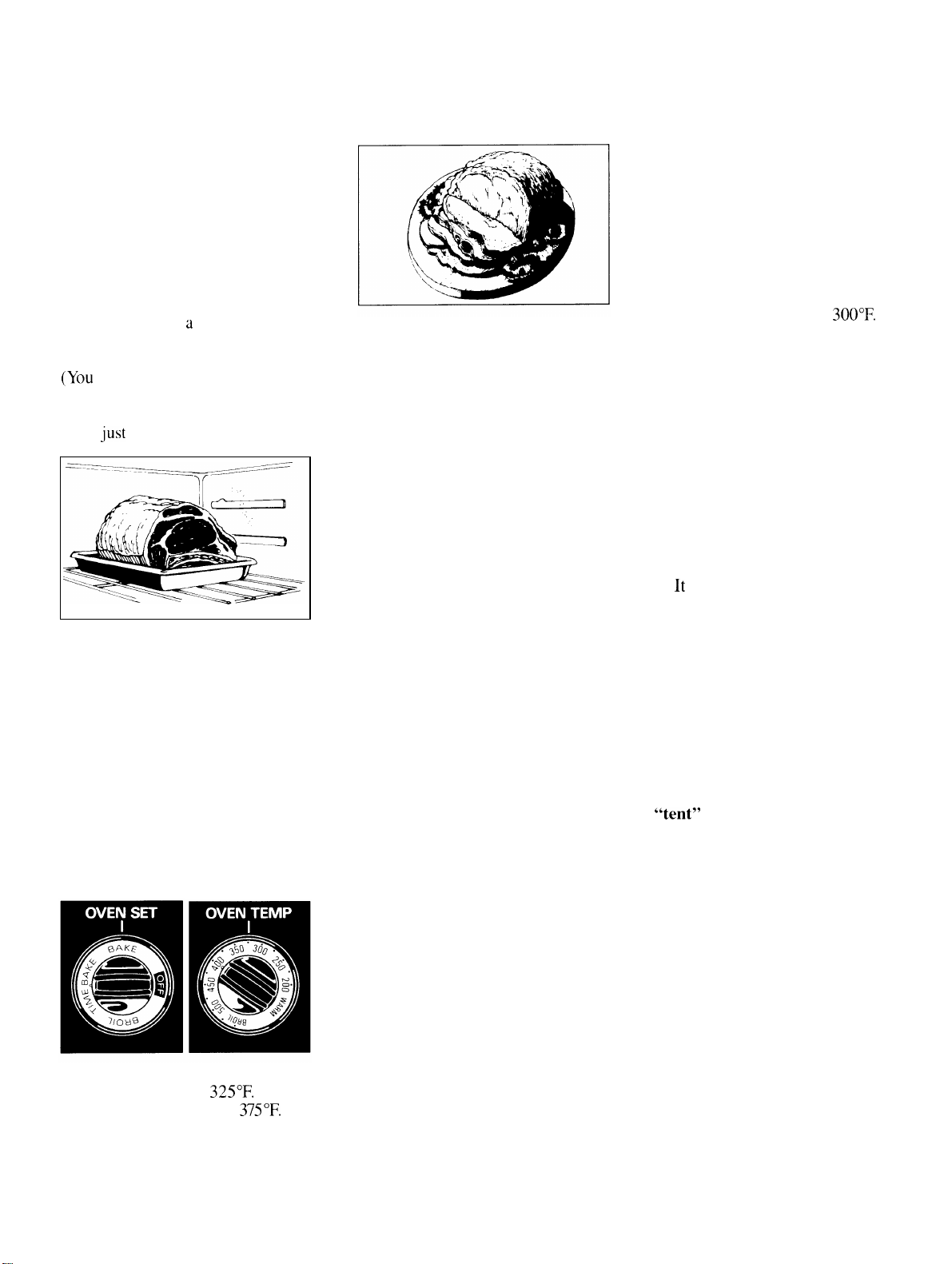
Roasting is cooking by dry heat.
Tender meat or poultry can be
roasted uncovered in your oven.
Roasting temperatures, which
should be low and steady, keep
spattering to a minimum. When
roasting, it is not necessary to
sear, baste, cover or add water
to your meat.
Roasting is really
a
baking
procedure used for meats. Therefore.
oven controls are set to BAKE.
(Ybu
may hear a slight clicking
sound, indicating the oven is
working properly. ) Roasting is
easy;
just
follow these steps:
Step 1:
Check weight of meat, and
place, fat side up, on roasting rack
in a shallow pan. (Broiler pan with
rack is a good pan for this. ) Line
broiler pan with aluminum foil when
using pan for marinating, cooking
with fruits, cooking heavily cured
meats, or for basting food during
cooking. Avoid spilling these
materials on oven 1 iner or door.
Step
2:
Place in oven on shelf in
A or B position. No preheating is
necessary.
Step
3: Turn OVEN SET to BAKE
and OVEN TEMP to
325”F.
Small
poultry may be cooked at
375”F.
for best browning.
Step
4: Most meats continue to
cook slightly while standing, after
being removed from the oven. For
rare or medium internal doneness,
if meat is to stand 10 to 20 minutes
while making gravy, or for easier
carving, you may wish to remove
meat from oven when internal
temperature is 5 to 10”F. below
temperature suggested in guide.
If no standing is planned, cook
meat to suggested temperature in
guide on page 20.
NOTE: You
may
wish
to use TIME
BAKE, as described on page 16, to
turn oven on and off automatically y
if your Oven Set control has a Time
Bake setting.
Remember that food will continue
to cook in the hot oven and therefore
should be removed when the desired
internal temperature has been
reached.
● Frozen roasts of beef, pork,
lamb, etc., can be started without
thawing, but allow 10 to 25 minutes
per pound additional time (10
minutes per pound for roasts under
5 pounds, more time for larger
roasts).
. Thaw most frozen poultry before
roasting to ensure even doneness.
Some commercial frozen poultry
can be cooked successfully without
thawing. Follow directions given
on packer’s label.
Q. Is it necessary to check for
doneness with a meat thermometer?
A.
Checking the finished internal
temperature at the completion of
cooking time is recommended.
Temperatures are shown in Roasting
Guide on opposite page. For roasts
over 8 pounds, cooked at
300”F.
with reduced time, check with
thermometer at half-hour intervals
after half the time has passed.
Q.
Why is my roast crumbling
when I try to carve it?
A.
Roasts are easier to slice if
allowed to cool 10 to 20 minutes
after removing from oven. Be sure
to cut across the grain of the meat.
Q.
Do I need to preheat my
oven each time I cook a roast
or poultry?
A.
It
is rarely necessary to preheat
your oven, only for very small
roasts, which cook a short length
of time.
Q.
When buying a roast, are
there any special tips that would
help me cook it more evenly?
A. Yes.
Buy a roast as even in
thickness as possible, or buy rolled
roasts.
Q.
Can I seal the sides of my foil
‘lent”
when roasting a turkey?
A. Sealing the foil
will steam the
meat. Leaving it unsealed allows the
air to circulate and brown the meat.
18
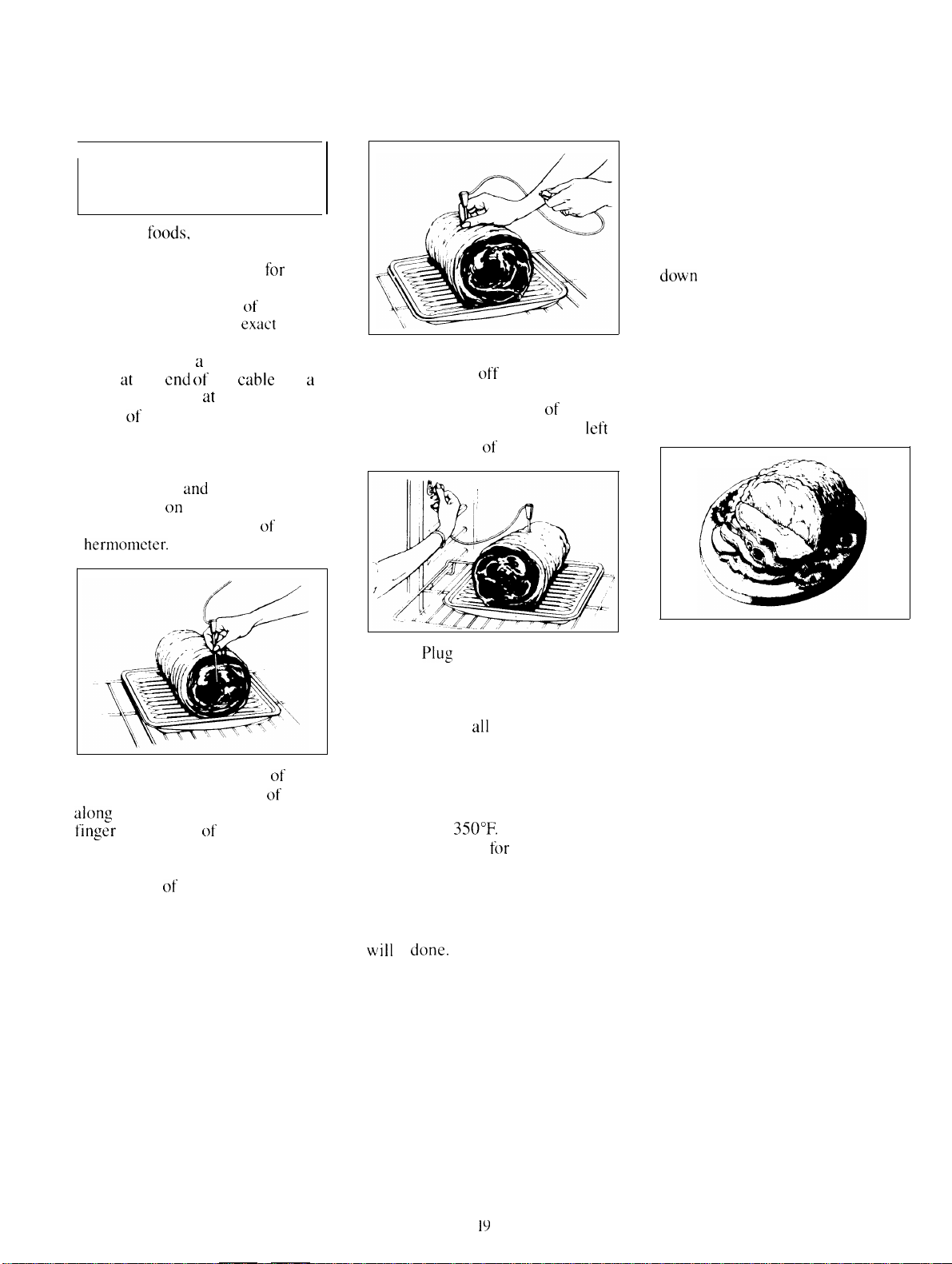
(on models so equipped)
DO NOT USE THE MEAT
THERMOMETER WITH THE
ROTISSERIE.
For many
foods,
especially
roasts and poultry, internal food
temperature is the best test
for
doneness. The meat thermometer
takes the guesswork out
of
roasting
by cooking foods to the
exact
doneness you want. The meat
thermometer has
a
skewer-like
probe
at
one
cnd
of
the
cable
and
a
two-pronged plug
at
the other. Use
handle
of
plug and probe. rather
than cable, when inserting and
removing these parts from meat
and/or oven wall receptacle. After
preparing meat
and
placing in
roasting pan
on
rack, follow the
steps below for proper use
of
meat
t
hermorneter.
Step 1:
To gauge placement
of
probe, lay probe on outside
of
meat
along
top or side and mark with
finger
where edge
of
meat comes
on probe. Probe should be placed
so point rests in center of’ the
thickest part
of
roast.
Step
2:
Insert probe into meat up
to point marked
off
w ith fingers.
Point should not touch bone, fat or
gristle. Not more than 2”
of
probe,
not counting handle, should be
left
exposed outside
of
meat.
Step
3:
Plug
cable into receptacle
on oven wall. The prongs are
especially designed to only plug in
one way. Be certain to insert plug
into receptacle
all
the way. Close
oven door.
Step
4: Turn OVEN SET knob to
BAKE and OVEN TEMP knob to
recommended oven temperature,
for example
350°F.
See Roasting
Guide on page 18
for-
oven
temperature.
Step
5: Refer to guide near Meat
Thermometer Dial to determine
at what internal temperature meat
~,ill
b
e
dc)ne.
Then turn knob next
to dial to move pointer to correct
number (internal temperature)
on dial.
Step
6: When internal temperature
of roast reaches number you have
set, a buzzer sounds. To stop
buzzer, turn pointer to SIGNAL
OFF. Internal temperature of meat
can be determined at any time
during cooking by turning pointer
down
until buzzer sounds.
Step
7: When roast is done,
use care in removing plug from
receptacle. DO NOT PULL ON
CABLE. Remove meat from oven.
Since most meat continues cooking,
you may wish to remove the roast
5° to 10° sooner.
Step
8: Remove probe from meat,
using handle of probe
not
cable. Most
meats carve more easily if let stand
5 to 10 minutes. Let thermometer
cool and clean as directed in Cleaning
Guide on page 32. Do not leave
in oven.
See
Roasting Guide on page 20.
19
—
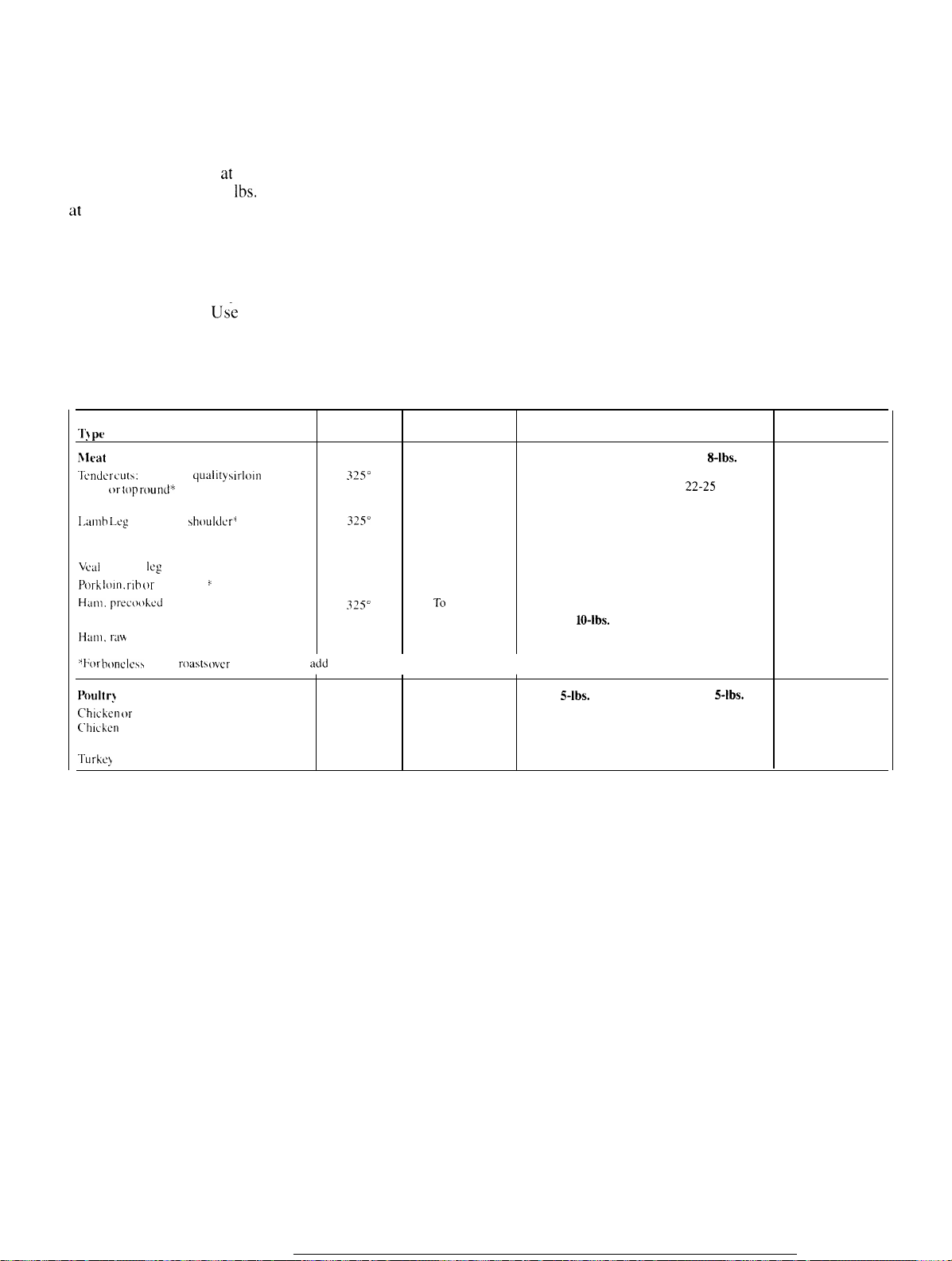
1.
Position oven shelf
at
B for
3. Remove fat and drippings as 5.
Frozen roasts can be
small-size roasts (3 to 7
lbs.
) and
necessary.
Baste as desired. conventionally roasted by adding
at
A for larger roasts. 10 to 25 minutes per pound more
4.
Standing time recommended for
2.
Place meat fat-side up, or poultry
time than given in guide for
roasts is 10to 20 minutes to allow roast
breast-side up, on broiler pan or
to firm up and make it easier to
refrigerated roasts. (10 minutes
per pound for roasts under 5 pounds.)
other shallow pan with trivet. Do
carve. Internal temperature will rise
Defrost poultry before roasting.
not cover. Do not stuff poultry until
about 5° to 10”F.; to compensate for
just before roasting.
Use
meat
temperature rise, if desired, remove
probe for more accurate doneness.
roast from oven at 5° to 10”F. less
Control signals when food has
than temperature on guide.
reached set temperature. (Do not
place probe in stuffing. )
Oven Approximate Roasting Time,
Internal
T>
pe
Temperature
Doneness in Minutes per Pound
Temperature “F
Itleat
3 to 5-lbs. 6 to
t%-lbs.
‘render
cuts:
rib, high
quallty
slrloln
tip,
325”
Rare: 24-30
18-22
130°-1400
rump
(Jr
tt)p
rtwnd%
Medium: 30-35
22-25
150°- 160°
Well
Done:
35-45
28-33
170°-1850
I.amh
Leg
or borw-in
}ht)uldur:
325°
Rare: 21-25 20-23
130°-1400
Medium: 25-30
24-28
150°-1600
Well Done:
30-35
28-33
170°-1850
Veal shoulder,
leg
or loin*
325° Well Done: 35-45
30-40
1700-1 80°
Pork
Ic)]n,
rlh
or
shoulder
L
325° Well Done: 35-45
30-40
170°-1800
Htinl.
pl”e~OOhC?d
3z50
To
Warm: 10 minutes per pound (any weight)
125°- 130°
Under
10-lbs. 10 to 15-lbs.
Hanl,
raw
325°
Well Done: 20-30
17-20
160°
+
l-or
b\)nele\\ rolled masts
twer
6-inches thick.
add
5 to 10 minutes per pound to times given above.
Poultr~
3 to 54bs. Over
$lbs.
Chlchen
or
Duck
325°
Well Done: 35-40
30-35
185°-1900
~’hlckcn
pieces
375°
Well Done: 35-40
185°-1900
10 to 15-lbs.
Over 15-lbs.
In thigh:
Turkey
325°
Well Done: 20-25
15-20
185°-1900
20
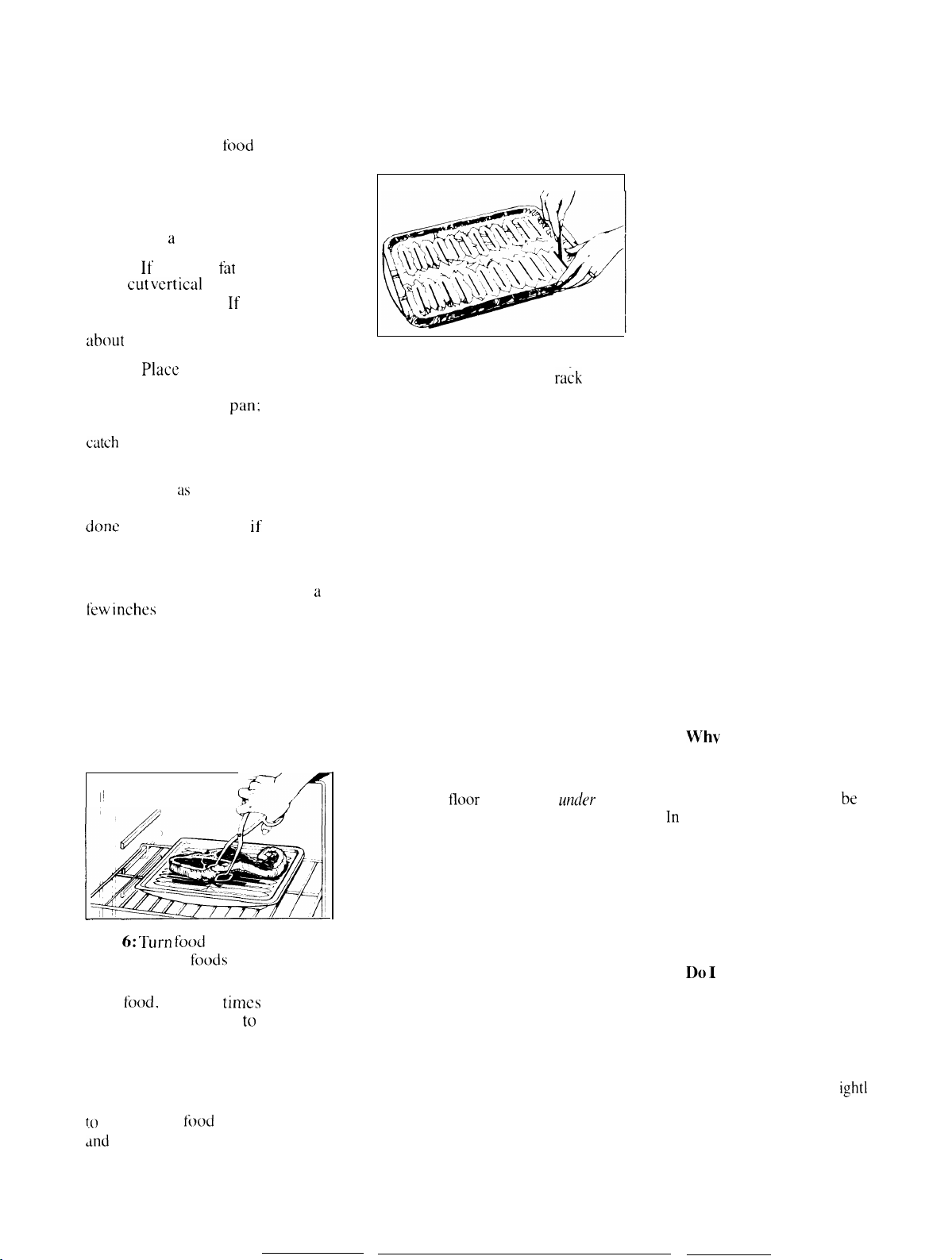
Broiling is cooking
food
by intense
radiant heat from the upper unit in
the oven. Most fish and tender cuts
of meat can be broiled. Follow
these steps to keep spattering and
smoking to
a
minimum.
Step 1:
If
meat has
fat
or gristle near
edge,
cut
vertical
slashes through
both about 2“ apart.
If
desired, fat
may be trimmed, leaving layer
about
1/8” thick.
Step 2:
Place meat on broiler rack
in broiler pan. Always use rack so
fat drips into broiler
pan:
otherwise
juices may become hot enough to
catch
fire.
Step 3: Position shelf on recommended
shelf position
as
suggested in Broiling
Guide on page 23. Most broiling is
done
on C position, but
if
your
oven is connected to 208 volts, you
may wish to use higher position.
Step
4: Leave the oven door ajar
a
t’ew
inches
(except when broiling
chicken). The door stays open by
itself, yet the proper temperature
is maintained in the oven.
Step
5: Turn both OVEN SET and
OVEN TEMP knobs to BROIL.
Preheating units is not necessary.
(See notes in Broiling Guide. )
Ffi
II
Step
6:
‘1’urn
food
only once during
cooking. Time
foods
for first side
per Broiling Guide.
Turn
food.
then use
times
given for
second side as a guide
to
preferred
doneness. (Where two thicknesses
and times are given together, use
first times given for thinnest food. )
Step
7: Turn OVEN SET knob
to
OFF. Serve
fc)od
immediately,
md
leave pan outside oven to cool
during meal for easiest cleaning.
1.
If desired, broiler pan maybe
1 ined with foil and broiler
ra~k
may
be covered w ith foil for broiling.
ALWAYS BE CERTAIN TO MOLD
FOIL THOROUGHLY TO
BROILER RACK, AND SLIT
FOIL TO CONFORM WITH
SLITS IN RACK. Broiler racks are
designed to minimize smoking and
spattering, and to keep drippings
cool during broiling. Stopping fat
and meat juices from draining to
the broiler pan prevents rack from
serving its purpose. and juices may
become hot enough to catch fire.
2. DO NOT place a sheet of
aluminum foil on shelf. To do so
may result in improperly cooked
foods. damage to oven finish and
increase in heat on outside surfaces
of the oven.
3.
On all except self-cleaning
ovens, a sheet of aluminum foil may
be used on
tloor
of the oven
under
the
bake unit, if desired. BE CERTAIN
FOIL DOES NOT TOUCH BAKE
UNIT. Aluminum foil used in this
way may slightly affect the browning
of some foods. Change foil when it
becomes soiled.
Q. Why should I leave the door
closed when broiling chicken?
A. Chicken is the only food
recommended
for closed-door
broiling. This is because chicken is
relatively thicker than other foods
you broil. Closed door holds more
heat in oven, so chicken maybe
broiled but well-done inside.
Q.
When broiling, is it necessarv
to always use a rack in the pan?”
A. Yes. Using the rack suspends
the meat over the pan.
As the meat
cooks, the juices fall into the pan,
thus keeping meat drier. Juices
are protected by the rack and stay
cooler, thus preventing excessive
spatter and smoking.
Q.
Should I salt the meat before
broiling?
A. No. Salt draws out the juices
and allows them to evaporate.
Always salt after cooking. Turn
meat with tongs: piercing meat
with a fork also allows juices to
escape. When broiling poultry
or fish, brush each side often
with butter.
Q.
Whv
are my meats not turning
out as brown as they should?
A. In some areas, the power
(voltage) to the oven may
be
low.
ln
these cases, preheat the broil
unit
for 10 minutes before placing
broiler pan with food in oven.
Check to see if you are using the
recommended shelf position. Broil
for longest period of time indicated
in the Broiling Guide. Turn food
only once during broiling.
Q.
Do
I
need to grease mv broiler
rack to prevent meat from-sticking?
A. No. The broiler rack is designed
to reflect broiler heat, thus keeping
the surface cool enough to prevent
meat sticking to the surface. However,
spray ing the broiler rack 1
ightl
y with
a vegetable cooking spray before
cooking will make cleanup easier.
21
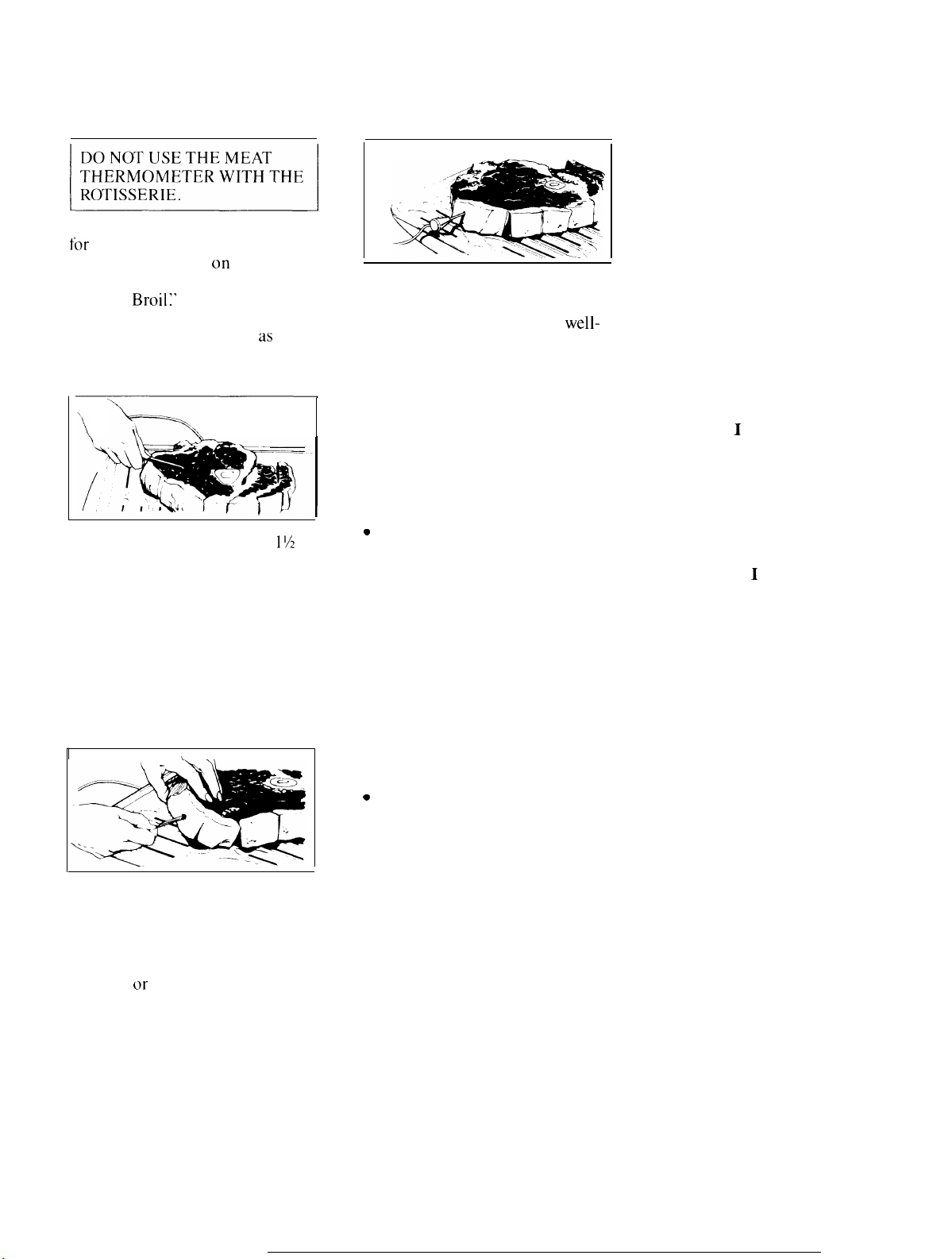
(on models so equipped)
=
You may use the meat thermometer
for
broiling, such as steak or ham
slices. Prepare meat
on
broiler rack
and pan as explained on page 21,
“How to
Broil:’
Set both OVEN
SET and OVEN TEMP knobs to
BROIL and leave door ajar
as
recommended, after placing probe
in meat and oven as directed below.
‘,
h.
Step 1:
Use steak at least 1 to
172
inches thick. Lay probe on top of
steak to determine the position
probe is to be inserted. Gauge
distance from edge to center of
largest muscle; mark with thumb
where edge of meat or fat meets
probe. Be certain NOT MORE
THAN 2 inches of probe, not
counting handle, is left exposed
outside of meat.
\
\\
Step 2: Lift probe from meat
keeping thumb in place
on
probe.
Insert probe as near as possible to
center of thickness of steak. Push
probe into steak to where thumb
meets fat
or
meat.
Step
3: For rare steaks, cook first
side to 90 on meat thermometer
dial; for medium, to 100; for
well-
done, 110. Set Meat Thermometer
Dial to preferred doneness.
Step
4:
At sound of buzzer, turn
steak; check probe to be certain it
has not moved out of position.
Reset pointer on Meat Thermometer
and cook second side. See guide on
oven near Meat Thermometer Dial.
NOTES:
s
If there is a question about
whether probe has moved out of
position during
cooking, turn knob
so pointer moves down on dial until
buzzer sounds. Note indicated
temperature and reset pointer to
SIGNAL OFF. Push probe farther
down into roast, about 1 inch, then
after a few minutes redetermine
internal temperature as above. If
new temperature is lower, the probe
was probably out of position. If so,
allow meat to cook to proper
internal temperature.
c
Let meat thaw enough to allow
inserting probe. The probe is
sturdy but take care not to force it
too hard into roast.
●
Do not disconnect probe during
cooking. Use hot pads when
removing probe at end of cooking.
Do not use tongs to pull on cable
since they may damage it.
Q. Can the meat thermometer
remain in the oven if it’s not
inserted in food?
A. No.
Remove probe from
receptacle when not in use. You
could damage the probe by leaving
it in during cooking operations that
do not require the probe.
Q.
May I insert the meat
thermometer into frozen foods?
A. No.
Foods must be completely
defrosted before inserting probe.
Q. Should
I
line broiler pan with
aluminum foil when roasting?
A. Yes,
when using pan for
marinating, cooking with fruits or
heavily cured meats, or for basting
during cooking. Avoid spilling these
materials on oven liner or door.
Q.
How may
I
be sure that my
roast will cook the same each time?
A.
When using the meat
thermometer in roasting, the probe
must be inserted properly. Check
the position of the probe during
cooking. Sometimes the probe slips
or is touching bone, fat or gristle.
Reposition probe correctly and set
oven again to finish roasting.
22
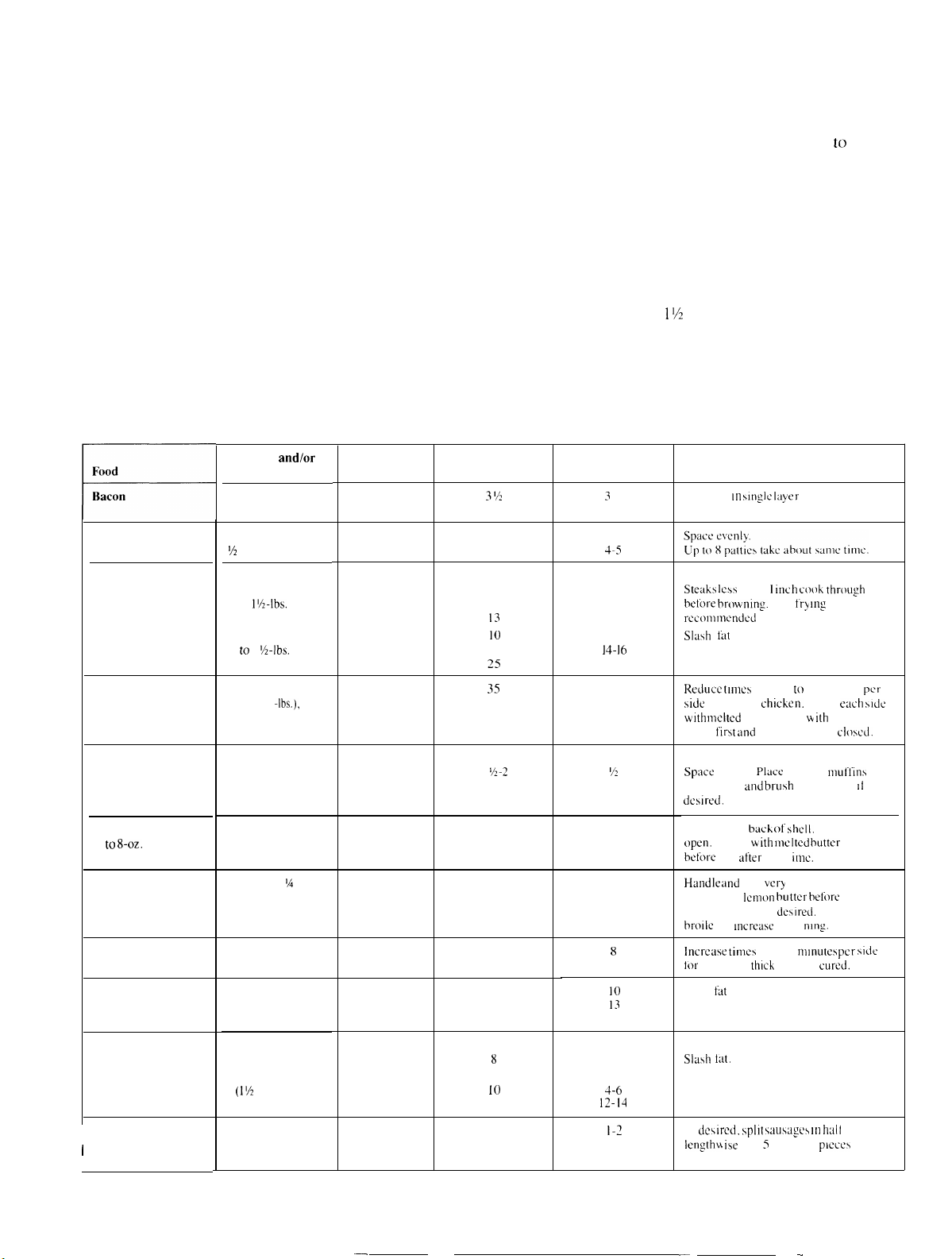
To slash, cut crosswise through
outer fat surface just to the edge of
the meat. Use tongs to turn meat
over to prevent piercing meat and
losing juices.
6. Broiler does not need
to
be
preheated. However, for very thin
foods, or to increase browning,
preheat if desired.
7.
Frozen Steaks
can be
conventionally broiled by
positioning the oven shelf at next
lowest shelf position and increasing
cooking time given in this guide
11A
times per side.
8. If your range is connected to
208 Volts, rare steaks may be broiled
1.
Always use broiler pan and rack
that comes with your oven. It is
designed to minimize smoking and
spattering by trapping juices in the
shielded lower part of the pan.
4. If desired, marinate meats or
chicken before broiling. Or brush
with barbecue sauce last 5 to 10
minutes only.
2. Oven door should be ajar for
most foods; there is a special
position on door which holds door
open correctly.
3.
For steaks and chops, slash fat
evenly around outside edges of meat.
5.
When arranging food on pan,
do not let fatty edges hang over
sides, which could soil oven with
fat dripping.
by preheating broil heater and
positioning the oven shelf one
position higher.
F
Food
Bacon
Quantity
andlor
Thickness
%-lb.
(about 8
thin slices)
Shelf
Position
First Side
Time, Minutes
Second Side
Time, Minutes Comments
3
l/2
Arrange
In
\]nglc
layer
c
Ground Beef
Well Done
Beef Steaks
Rare
Medium
Well Done
Rare
l-lb.
(4
patties)
1/2
to 3
A
-in. thick
l-inch thick
(1 to
l’h-lbs.
)
lyz-in. thick
(2
tO
2 ti-lbs. )
c
7
4-5
c
c
c
c
c
c
7
9
13
10
15
25
7
9
13
7-8
14-16
20-25
Steah\
les\
than
I
Inch
ccxlh
thrtmgh
belore
br(wnmg.
Pan
try
lng
I\
rccommcncitx!
Sla\h
tht
Medium
Well Done
Reduce
tlmcs
about 5
[()
10 minute\
per
side
for cut-up
chichen.
Brush
each
SICIC
w]th
melted
butter. Broil
w
Ith
\!-.ln
down
t’ir\t
and
broil with door
CI(RX1.
Chicken
1 whole
(2 to 2 Y-l
bs.),
split lengthwise
A
35
10-15
Bakery Products
Bread (Toast) or
Toaster Pastries
English Muffins
Lobster Tails
(6
to
8-oz.
each)
Space
evenly.
Place
English
mufllns
cut-side-up
and
bru$h
with butter,
I
I
dcslrtxi.
Cut through
back
of
shell.
Spread
open.
Brush
with
melted
butter
before
and
after
half t
imc.
2 to 4 slices
1 pkg. (2)
2 (split)
c
c
1
Y2-2
3-4
‘/2
2-4
B
13-16
Do not
turn over
5
Handle
and
turn
very
caret’ull}.
Brush with
lemon
butter
before
and
during cooking if’
Limlred.
Preheat
brolie
r to
Increase
brow
nlng.
Fish
l-lb. fillets
%
to
%-in. thick
c
5
8
8
Increa\e
timm
5 to 10
rnlnutes
per
\Ide
tor
1 ‘/~-inch
thich
or home
cured.
Ham Slices
(precooked)
l-in. thick
B
10
13
Slash
fat
Pork Chops
Well Done
2 (Y2 inch)
2 (l-in. thick)
about 1 lb.
2 (1 inch)
about 10 to 12 oz.
2
(1M
inch)
about 1 lb.
c
B
10
13
Lamb Chops
Medium
Well Done
Medium
Well Done
8
10
10
17
4-7
10
4-6
12.14
Sla\h
tat
c
c
c
B
If de\lred.
\pllt
wwwgm
In
hull
Iengthw
iw
into
5
to 6-inch
plcce\
l-lb. pkg. (10)
c
6
Wieners
and similar
1
precooked sausages,
1
bratwurst
23
—
—
—
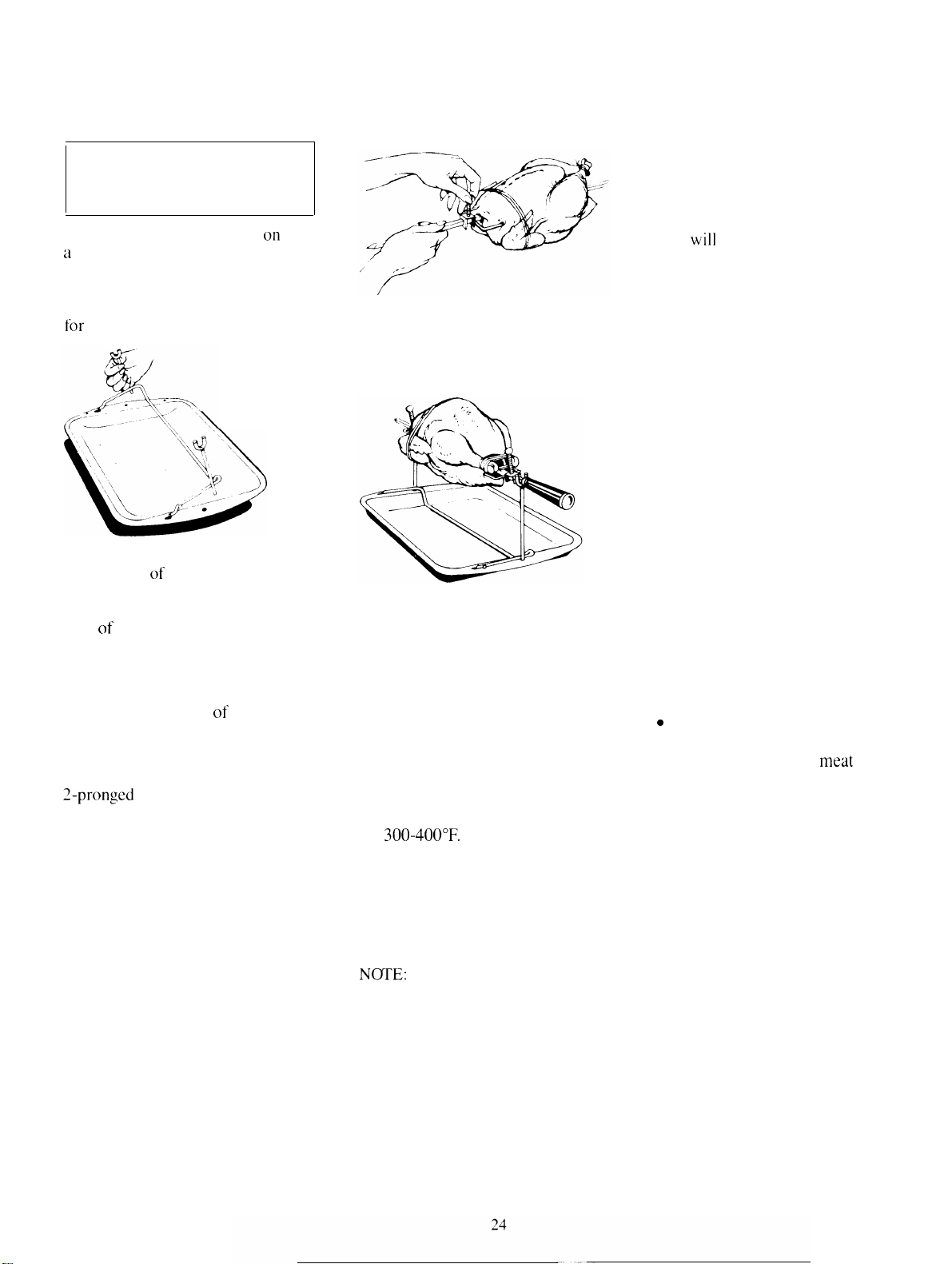
(on models so equipped)
DO NOT USE THE MEAT
THERMOMETER WITH THE
ROTISSERIE.
Food is cooked by revolving
on
a
spit under the (upper) broil unit.
As food turns, it bastes itself to
produce a succulent brown and
tender roast. Meat tender enough
for
roasting may be rotissed.
1. Assemble rotisserie. Insert
curved ends
of
frame into large
holes of broiler pan handles. Lock
frame in place by fitting straight
ends
of
support into holes in center
handles.
2. Secure food on spit. When
secured correctly, food will be
located in center area
of spit
leaving 4 inches free at the pointed
end (this part goes into motor).
3.
To secure food on spit: Push
~.pronged fork onto spit near
handle end. Tighten with screw.
Push spit through food (tie food
securely and compactly), distributing
weight evenly on each side of spit.
To check weight distribution on
spit, hold spit (and food) between
hands, palms up; spit should roll
smoothly from palms to fingertips
when palms are tipped forward.
Finish securing food on spit by
gliding second 2-pronged fork onto
spit with prongs toward food. Tighten
screws to a flat surface on spit.
4. Place spit on frame so handle end
is in narrow support, and pointed
end is in wide U-shaped support.
1.
Put oven shelf in lowest position
in oven. With food on spit, place
spit on oven shelf.
2. Set OVEN TEMP knob as
suggested on Rotisserie Time and
Temperature Guide at right. Settings
are
300-400”F.
to get foods juicy
and done without overbrowning.
3.
Switch OVEN SET knob to
ROTISSERIE. This starts broil unit
and rotisserie motor operating. Spit
can be inserted and removed more
easily when motor is operating.
NOI’E:
Make certain when touching
spit that no part of body or pot
holder touches coils of broil unit.
4. Insert spit into motor: Grasp
handle on spit. Using point of spit.
move to one side the cover over
motor outlet in rear of oven; push
spit firmly into motor outlet as far
as it
will
go. Remove handle.
5.
Check rotation of food. Tighten
or adjust forks if necessary. During
cooking, forks may need tightening
due to normal meat shrinkage.
6. As food cooks, leave door ajar in
“Broil” position; door stays open
by itself.
7. Baste food if desired. Baste with
long-handled brush as food revolves.
● A regular, nonelectric meat
thermometer may be used while
rotissing providing it doesn’t touch
the oven, frame or pan while meat
revolves. (Or, if desired, cook to
estimated doneness then pull
meat from oven to insert meat
thermometer. Wait about 2 minutes
for temperature to register. If meat
is not done, remove thermometer
and continue cooking if necessary. )
c
If rotissing turkey, let stand in
warm oven 10 to 20 minutes after
cooking to assure juicy
meat
and
complete doneness.
●
At end of cooking pull out pan
and shelf together, using pot
holders. Turn OVEN SET to OFF.
Remove food from spit. Cool pan
outside oven; soak forks and screws
for easiest cleanup.
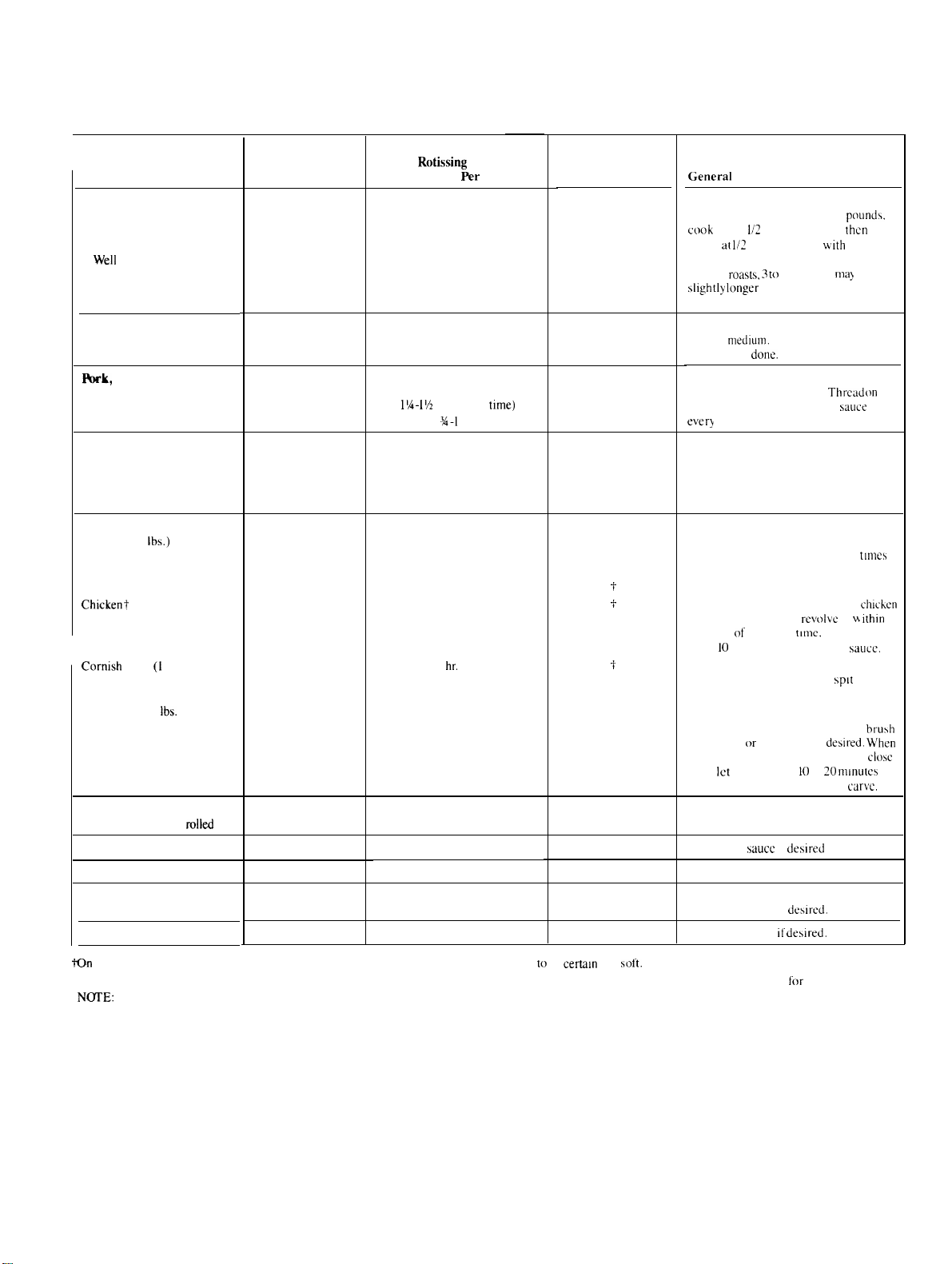
Approximate
Rotissing Time
Minutes
I%r
Lb.
Meat
Thermometer
Temperatures
Oven Temp.
Setting
Food
General Directions
Beef
Rolled Rib
Rare
Medium
Well
Done
NOTE:
1. For roast\ OVER 10
pound$,
cook
about
1/2
estimated time.
then
check
at
1/2
hour intervals
with
meat
thermometer for internal doneness.
2. Thin
roas~s,
3
to
4 pounds.
ma)
require
sllghtly
longer
times per pound than
those given on guide.
325
325
325
22-29
27-31
32-42
130-140
150-160
170-185
Lamb
Leg, boned and rolled 350
24-27
175-185
175 for
mcdlum.
185 for well
done.
lbrk, fresh
Loin
Spareribs (barbecued)
Spareribs (plain)
170-195
Buy ribs spilt down center. Thread
c~n
spit. To barbecue, brush with
sauce
every
15 minutes.
350
350
400
25-34
lIA-IIA
hrs. (total
time)
3A-1
hr.
Pork,
cured
Ham
Cook-Before-Eating
bone in
Fully Cooked
325
325
17-20
14-18
160
130
Poultry
Capon* (6-8
Ibs.)
375
26-30
185-190
Brush with melted butter or margarine.
basting or barbecue sauce several
tmms
during cooking.
Chicken* (2-3 lbs.)
Chicken~
(1%-2 lbs.)
400
400
33-42
48-62
t
t
Same as above
If desired, thread 4 to 5 of this size
chlchen
crosswise on spit. Let
rew~lvc
to
w
ithln
1/2 hour
of
doneness
tlmc,
then brush
every
10
minutes with barbecue
sauce.
Cornish Hen*
(1
lb. )
400
About 1
hr.
(total time)
-1
Brush with butter, or butter and lemon
juice mixed. Thread hens on \plt either
lengthwise or crosswise.
Duckling* (4-5
Ibs.
)
Turkey* (8-12 lbs.)
350
350
31-35
17-27
185-190
180-185
Do not brush with fat.
Cook without brushing with fat. or
bru\h
with butter
or
margarine as
dcslred.
JVhen
cooked, switch OVEN SET to OFF.
CIOSC
door,
let
turkey stand
10
to
20
mlnute~
IN
OVEN. Remove from oven and
carve.
Veal
Shoulder, boned and
rolled
350
30-33
180
180
Brush with
\auce
if
desired
Bologna
350
23-25
23-27
Canadian Bacon
350
160
Luncheon Meat
(12-02. can)
23-32 (total time)
Brush with sauce if
cieslrcd.
350
Brush with sauce
if
deslreci.
Wieners,
large
350
23-32 (total time)
KM small poultry, test doneness by moving leg gently back and forth, and press leg muscle
to
be
certmn
it is
soft.
*Ready-to-cook weight. IMPORTANT: Tie legs and wings close to body to make doneness of bird as uniform as possible. All times given are
for
unstuffed birds
N(YTE:
Spillage of marinades, fruit juices and basting materials containing acids may cause discoloration on oven liner or door so should be wiped up immediate}
with a paper towel. When surface is cool, clean and rinse.
25
.—
—
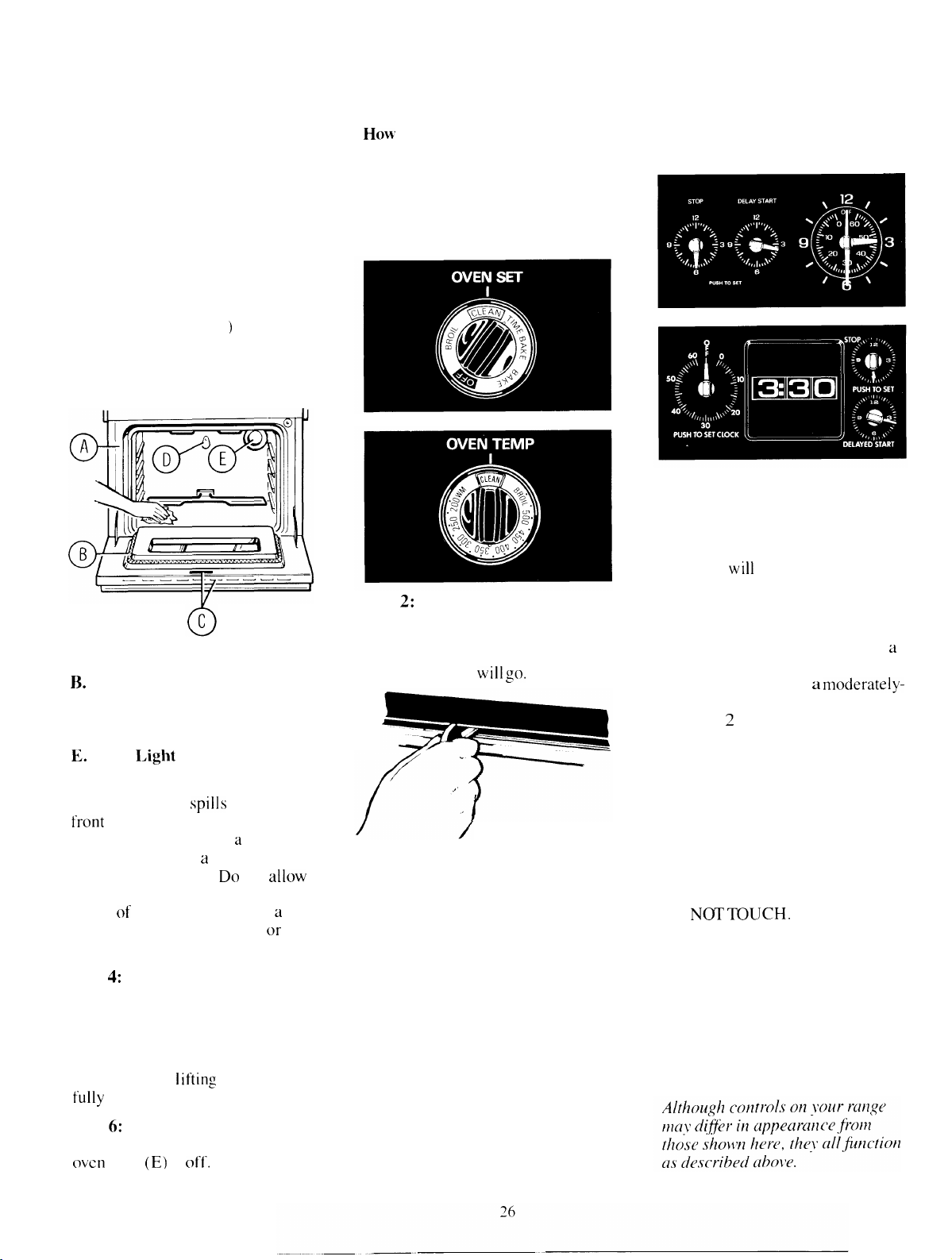
Before Setting Oven Controls,
Check These Things:
Step 1:
Remove broiler pan, broiler rack
and other cookware from the oven.
(Oven shelves may be left in oven.
Note: Shelves may become gray
after several cleanings.
)
Step 2:
Wipe
up heavy soil on oven
bottom .
A. Oven Front Frame
B.
Oven Door Gasket
C. Openings in Door
D. Rotisserie Receptacle
E.
Oven
I.ight
Step 3:
Clean spatters or
spills
on oven
front
frame (A) and oven door
outside gasket (B) with
a
dampened
cloth. Po] ish with
a
dry cloth. Do
not clean gasket (B).
Do
not
allow
water to run down through openings
in top
of
door (C). Never use
a
commercial oven cleaner in
or
around self-cleaning oven.
Step
4:
Close rotisserie receptacle (D) on
models so equipped.
Step 5:
On models so equipped, raise the
window shield
1
ifting
handles to
fully
raised position.
Step
6:
Close oven door and make sure
oven
light
(E)
is
off-.
How7
to Set Oven for Cleaning
Step 1:
Turn OVEN SET and OVEN
TEMP knobs to CLEAN. Controls
will snap into final position when
the CLEAN location is reached.
step
2:
Push and hold in LATCH
RELEASE BUTTON
while
sliding LATCH HANDLE to the
right as far as it
will
go.
Step3:
Set the automatic oven timer:
●
Make sure
both the range clock
and the DELAY START dial show
the correct time of day (some dials
read START). When the DELAY
START knob is pushed in and
turned, it
will
“pop” into place
when the time
shown on the range
clock is reached.
●
Decide on cleaning hours necessary
Recommended cleaning time for
a
heavily-soiled oven with heavy, greasy
spatter is 3 hours: for
a
moderately-
soiled oven with thin spills and light
spatter is
2
hours.
●
Add these hours to present time
of day, then push in and turn STOP
dial clockwise to this desired stop
time. CLEANING light glows,
showing cleaning is starting.
The LOCKED light will glow,
indicating oven is hot and door
cannot be opened. Oven door and
window get hot during self-cleaning.
DO
N~
10UCH.
NOTE: If you wish to start and stop
cleaning at a later time than
shown
on clock, push in and turn DELAY
START dial to time you wish to start.
Add the hours needed for cleaning
to this “start” time, then push in
and turn STOP dial to this desired
stop time. Oven will automatically
turn on and off at the set times.
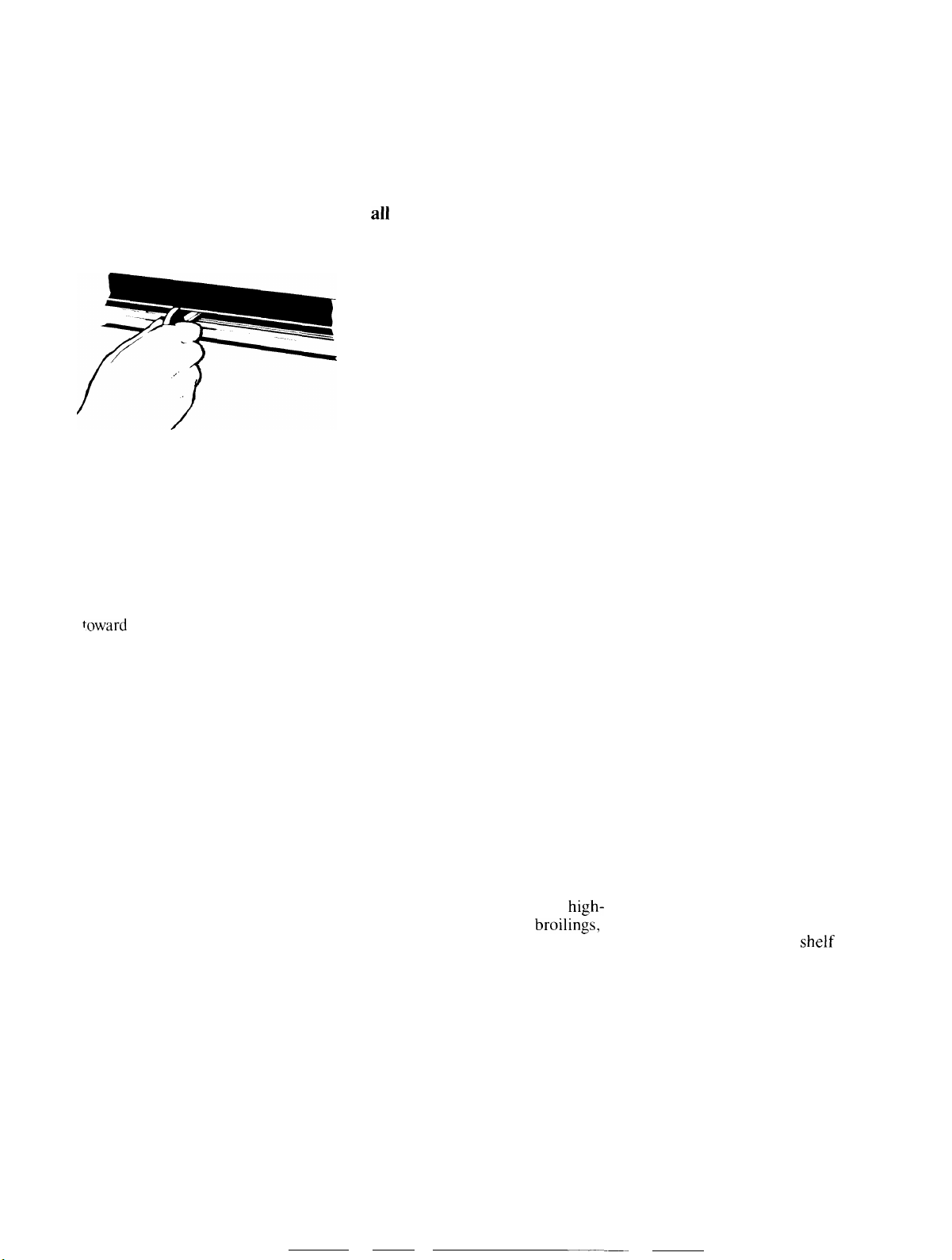
After cleaning is complete, the
door will stay locked until the oven
cools and the LOCKED light goes
off. This takes about 30 minutes.
Step 1:
When LOCKED light is off, push
and hold in LATCH RELEASE
BUTTON while sliding LATCH
HANDLE to the left as far as it
will go and open the door.
Step 2:
On models so equipped, lower the
window shield by pushing handles
toward
bottom of window.
Step 3:
Turn OVEN SET knob to OFF.
Step 4:
Turn OVEN TEMP knob to WARM.
Q. Why won’t my oven clean
immediately even though I set
all
the time and clean knobs
correctly?
A. Check to be sure your DELAY
START dial is set to the same time
as the range clock. Also check to
be sure LATCH HANDLE is
moved to the right.
Q. If my oven clock is not working,
can I still self-clean my oven?
A. No.
Your Automatic Oven
Timer uses the range clock to help
start and stop your self-cleaning
cycle.
Q. Can I use commercial oven
cleaners on any part of my
self-cleaning oven?
A. No cleaners or coatings should
be used around any part of this
oven. If you do use them and do not
wipe the oven absolutely clean, the
residue can scar the oven surface
and damage metal parts the next
time the oven is automatically
cleaned.
Q. Can I clean the Woven Gasket
around the oven door?
A. No, this gasket is essential for
a good oven seal, and care must be
taken not to rub, damage or move
this gasket.
Q. After having just used the
oven, the LOCKED light came
on and I could not move the
LATCH HANDLE. Why?
A. After several continuous
high-
temperature bakings or
broilings,
the LOCKED light may come on.
The oven door can’t be latched for
self-cleaning while the LOCKED
light is on. If this happens, let the
oven cool until the LOCKED light
goes off. Then the oven door can
be latched for self-cleaning.
Q. What should I do if excessive
smoking occurs during cleaning?
A.
This is caused by excessive soil,
and you should switch the OVEN
27
SET knob to OFF. Open windows
to rid room of smoke. Allow the
oven to cool for
at least one hour
before opening the door. Wipe up
the excess soil and reset the clean
cycle.
Q. Is the “crackling” sound I
hear during cleaning normal?
A. Yes.
This is the metal heating
and cooling during both the
cooking and cleaning functions.
Q. Should there be any odor
during the cleaning?
A. Yes, there maybe a slight odor
during the first few cleanings.
Failure to wipe out excessive soil
might also cause an odor when
cleaning.
Q. What causes the hair-like
lines on the enameled surface
of my oven?
A. This is a normal condition
resulting from heating and cooling
during cleaning. They do not affect
how your oven performs.
Q. Why do I have ash left in my
oven after cleaning?
A.
Some types of soil will leave a
deposit which is ash. It can be
removed with a damp sponge or
cloth.
Q. My oven shelves do not slide
easily. What is the matter?
A. After many cleanings, oven
shelves may become so clean they
do not slide easily. If you wish
shelves to slide more easily,
dampen fingers with a small
amount of cooking oil and rub
lightly over sides of
shelf where
they contact shelf supports.
Q. My oven shelves have become
gray after several cleanings. Is
this normal?
A. Yes. After many cleanings, the
shelves may lose some luster and
discolor to a deep gray color.
———
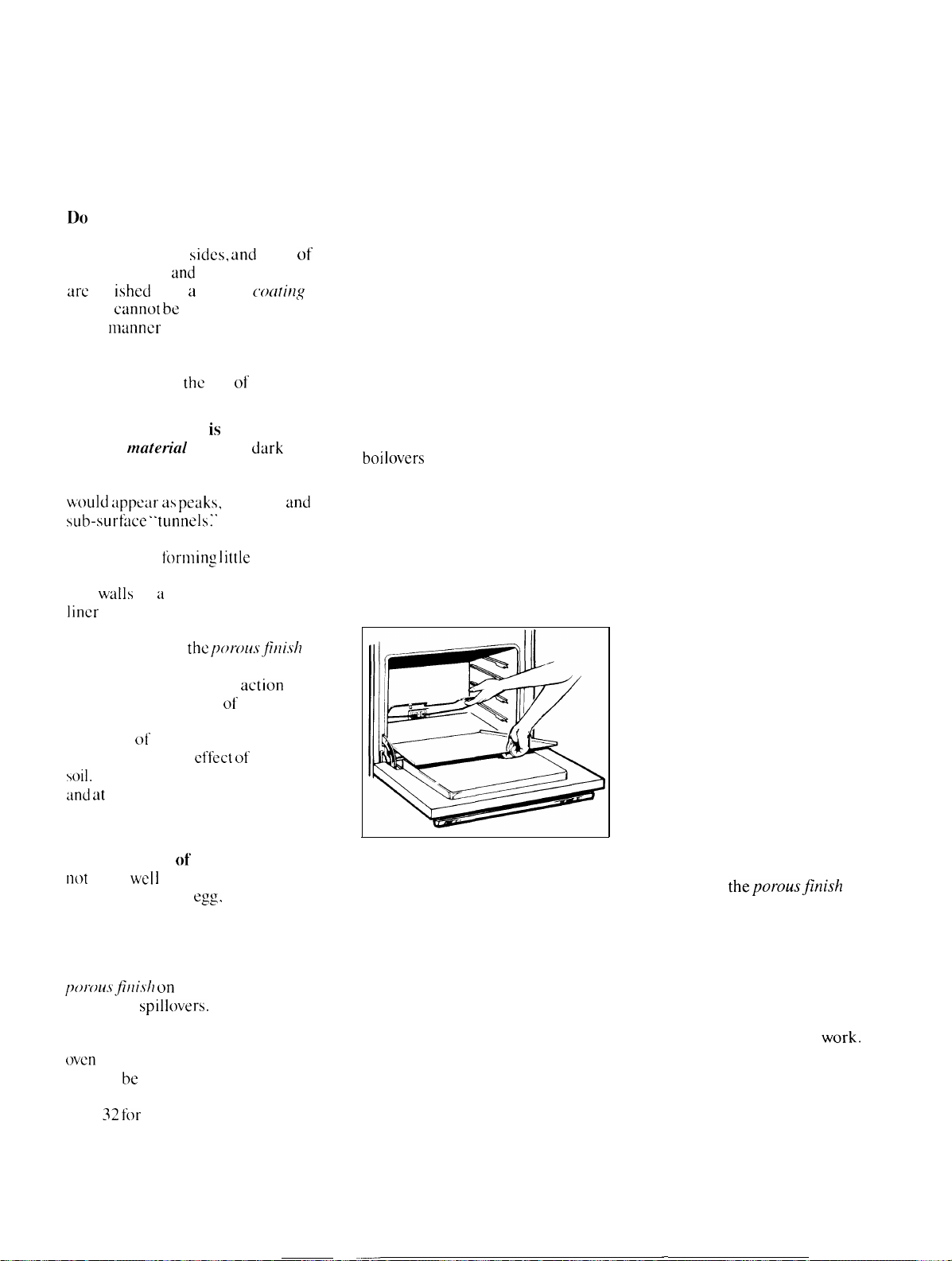
(for models so equipped)
Do
not attempt to clean the oven
until you have read this section.
The top. bottom.
sicics,
and
back
of
the oven liner.
and
door inner liner
arc
fin
ished
with
a
special
couting
which
cannot
be
cleaned in the
usual manner with soap, detergents,
commercial oven cleaners, coarse
abrasive pads or coat-se brushes.
Their use and/or
the
use
of
oven
sprays will cause pertinent damage.
The
special coating
is
a
porous
ceramic
maten”al
which is dark in
color and feels slightly rough to the
touch. It’ magnified, the surface
would
appear
as
peaks,
valleys,
and
sub-surftice
“tunnels:’
This rough
finish tends to prevent grease
spatters from
forming
1
ittle
beads
or droplets which run down the
side
walls
of’
a
hard-surface oven
liner
leaving unsightly streaks that
require hand cleaning. Instead,
when spatter hits
the
[)orol~.~’<ji~zi.s}?”
it is
dispersed and is partially
absorbed. This dispersal
action
increases the exposure
of
oven soil
to heated air, which results in
oxidation
of soil. This finish also
reduces the visual
effect
of
residual
soil.
It may not disappear completely
and
at
some time after extended
usage. stains may appear.
The
special coating
works best on
small amounts
of
spatter.
It does
nt)t
work
wel
1
with larger spills,
especially sugars.
egg.
or dairy
mixtures. For this reason, the oven
is equipped with a removable,
replaceable aluminum foil oven
bottom liner which protects the
/)()).()L/.\jrzi,\/z
on
the bottom of the
oven from
spillovers.
Avoid spills
on inside surface of the oven door.
This special finish is not used on
oven
shelves. Shelves are removable
and can
be
taken to the sink for
cleaning. See “Cleaning Guide” on
page
32
for
cleaning directions.
To Clean Oven:
Use the following steps when
cleaning your Continuous-Clean
Oven.
1. Let range parts cool before
handling. It is recommended that
rubber gloves be worn when
cleaning range parts manually.
2.
Remove all cooking utensils
including the broiler pan and rack.
3.
Remove oven shelves and clean
them manually with scouring pads
or mild abrasive.
4. Remove excess spills and
boilovers
from aluminum foil oven
bottom liner before removing liner
from oven. This is to prevent
excess liquids from spilling onto
the porous finish. Then remove
aluminum foil bottom liner and
clean manually. (Before cleaning or
removing the aluminum foil liner,
lift bake unit out of the way. )
5. Clean oven window. Use mild,
non-scratching cleanser and damp
cloth. Avoid spilling water or cleaner
on porous surface.
6. Soil visibility maybe reduced
by operating oven at 400”F. Close
door, set oven temperature control
to 400”F. Time for at least 4 hours.
Repeated cycles may be necessary
before improvement in appearance
is apparent, particularly on oven
door. For moderate to heavy soiling
of the oven door, use the method
described in item (7) at right before
running the 400°F. cycle. The oven
timer can be used to control the cycle
28
automatically at a time convenient
for you. Some slight smoking may
occur, similar
to
that which may
occur during Time Bake cooking.
REMEMBER: DURING THE
OPERATION OF THE OVEN,
THE DOOR, WINDOW AND
OTHER RANGE SURFACES
WILL GET HOT ENOUGH TO
CAUSE BURNS.
DO NOT
TOUCH. LET THE RANGE
COOL BEFORE REPLACING
ALUMINUM FOIL OVEN
BOTTOM AND OVEN SHELVES
IF THEY WERE REMOVED.
7. If a spillover or heavy soiling
occurs on the
porous surface,
as
soon as the oven has cooled,
remove as much of the soil as
possible using a small amount
of water and a stiff-bristle nylon
brush. When using water, use it
sparingly and change it frequently,
keeping it as clean as possible, and
be sure to blot it up with paper
towels, cloths, or sponges.
Do not
rub or scrub
with paper towels,
cloths or sponges, since these will
leave unsightly lint on the oven
finish. If water leaves a white ring
on the finish as it dries, apply water
again and
blot
it with a clean sponge,
starting at the edge of the ring and
working toward the center.
Use care in removing and replacing
aluminum foil oven bottom liner
and shelves and in placing and
removing dishes and food to avoid
scratching, rubbing or otherwise
damaging
theporousfinish
on the
oven walls and door.
Do not use soap, detergent,
commercial oven cleaner, silicone
oven sprays, coarse steel pads or
coarse brushes on the
porous
surface.
These products will spot,
clog, and mar
the porous surface
and reduce its ability to
work,
————
—
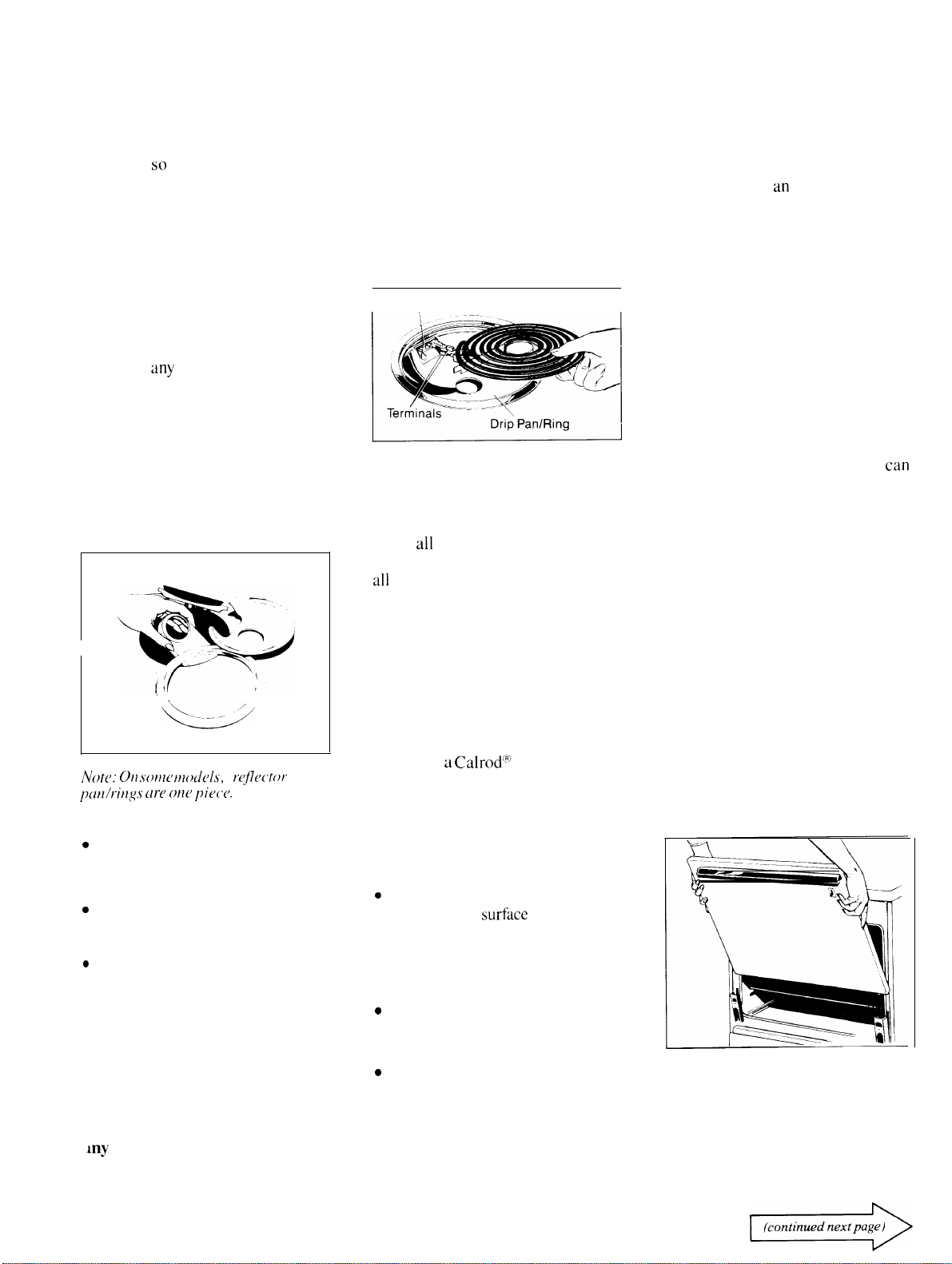
Proper care and cleaning are
important
so
your range will give
you efficient and satisfactory service.
Follow these directions carefully in
caring for your range to assure safe
and proper maintenance.
(on
models so equipped)
Clean the area under the drip pans
often. Built-up soil, especially
grease, may catch fire. To make
cleaning easier, the plug-in surface
units are removable.
The porcelain enamel finish is
sturdy but breakable if misused.
This finish is acid-resistant.
However.
any
acid foods spilled
(such as fruit juices, tomato, or
vinegar) should not be permitted
to remain on the finish.
Your range is vented through a duct
located under the right rear surface
unit. Clean the duct often.
Note:
oil
.$()[)1(’ t?l(M/t’!.Y,
t“ejlt’ctol-
pa)l/ri~lg.v
are
o~le
pitw.
To remove:
Q
Make sure unit is cool.
● Lift up right rear surface unit.
●
Remove trim ring and drip pan.
s
Lift out oven vent duct.
To replace:
s
Place the part over the oven vent
located below the cooktop with the
opening of the duct under the round
opening in the drip pan. It is
important that the duct is in the
correct position so moisture and
vapors from the oven can be
released during oven use. NOTE:
Never cover the hole in the oven
vent duct with aluminum foil or
my
other material. This prevents
the oven vent from working
properly during any cooking cycle.
I
I
Receptacle
To clean:
●
Wipe around the edges of the
surface unit opening in the range
top. Clean the area below the unit.
Rinse
all
washed areas with a damp
cloth or sponge. Caution: Be sure
all
controls are turned OFF before
attempting to clean under the cooktop
or removing the surface units.
To remove:
●
Raise the unit coil opposite the
receptacle. Lift about one inch
above the trim ring and pull away
from the receptacle. Caution: Be
sure the coils are cool before
removing
a
Calrod@)
unit.
●
After removing the plug-in
surface unit, lift the trim ring and
drip pan (or one-piece pan/ring) to
clean under the unit.
To replace:
c
Place the drip pan (or one-piece
pan/ring) in the
surfhce
unit opening
in the range top. Line up the pan so
the unit receptacle can be seen. If
the trim ring is separate, put it in
place over the drip pan.
c
Insert the terminals of the plug-in
unit through the opening in the pan
and into the receptacle.
c
Guide the surface unit into place
so it fits evenly and fits snugly into
the trim ring.
NOTE: If trim ring and drip pan
are separate, the drip pan
must
be
under the trim ring.
29
CAUTION
●
Do not attempt to clean plug-in
surface units in
an
automatic
dishwasher.
●
Do not immerse plug-in surface
units in liquids of any kind.
●
Do not bend the plug-in surface
unit plug terminals.
● Do not attempt to clean, adjust
or in any way repair the plug-in
receptacle.
(on models so equipped)
This unit cannot be removed. It
Can
be lifted upward and locked in that
position for cleaning under the
unit.
Be certain the unit is cool
before lifting the coil.
After lifting coil unit, remove trim
ring and drip pan (or one-piece
pan/ring) to clean under unit.
To reposition tilt-lock unit:
● Replace drip pan (or one-piece
pan/ring) into recess in cooktop. If
trim ring is separate, put it in place
over drip pan.
●
Guide surface unit so it fits
evenly and snugly into place.
(on models so equipped)
To REMOVE door, open to BROIL
position, or where you feel hinge
catch slightly. Grasp door at sides:
life door up and away from hinges.
To REPLACE, grasp door at sides,
line up door with hinges and push
door firmly into place.
e
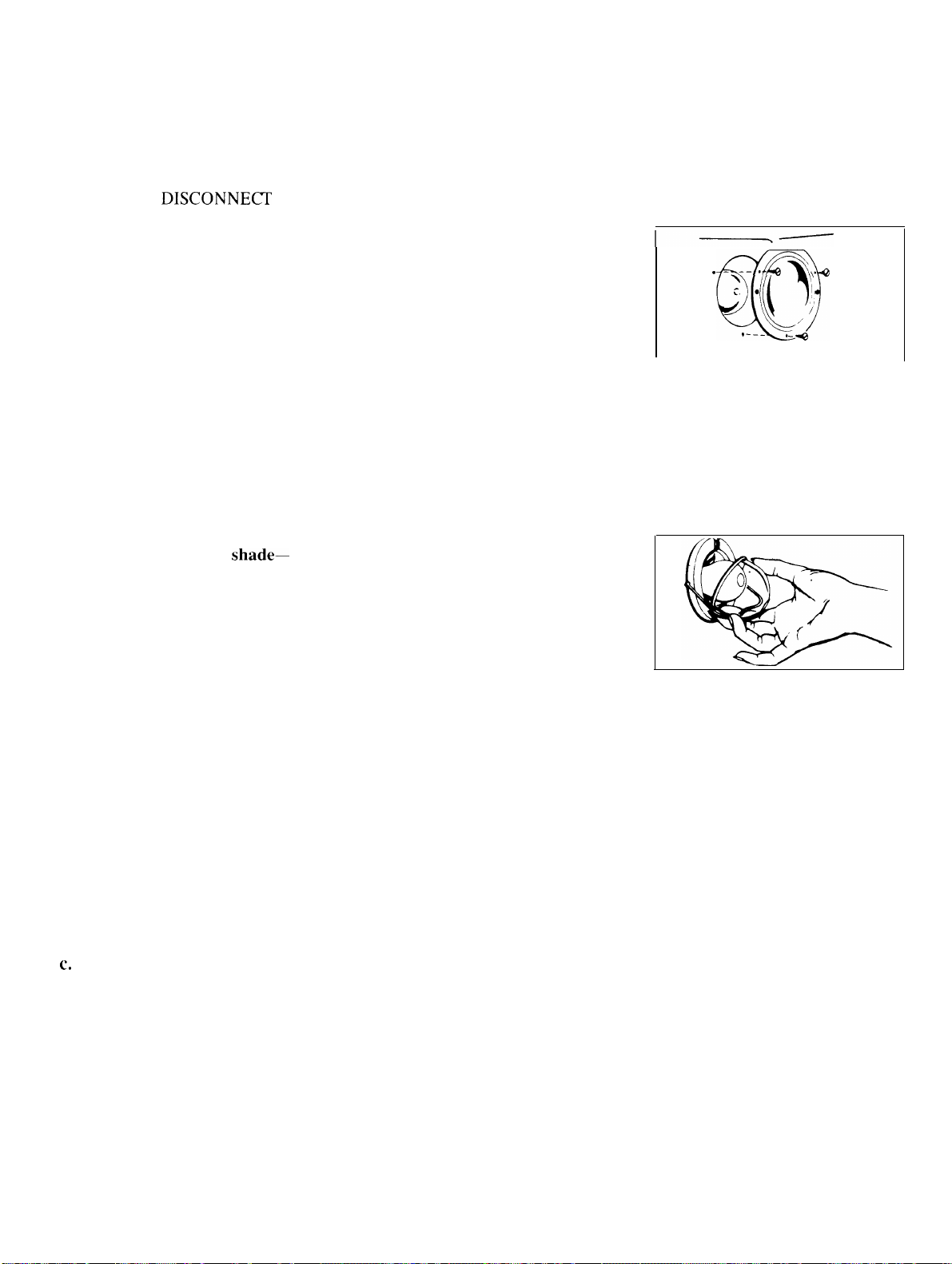
(continued)
CAUTION: BEFORE REPLACING
ANY LAMP,
DISCONNE~
ELECTRIC POWER TO RANGE
AT THE MAIN FUSE OR
CIRCUIT BREAKER PANEL.
LET LAMP (OR BULB) AND
LAMP COVER COOL
COMPLETELY.
WHEN CHANGING A
FLUORESCENT COOKTOP
LAMP, DO NOT TOUCH THE
METAL AT ENDS OF LAMP.
(on models so equipped)
One of the lamp-replacement
methods described below and at
right applies to your model.
Model with open lamp
shade—
lamp is visible without removing
the cover; cover does not need to be
raised or removed to change lamp.
a. Place fingers under lamp near
each end. Press up and roll bottom
of lamp away from you; lamp will
fall into palms of your hands; remove.
b. Check type and wattage of lamp
and replace with same kind. Hold
lamp near each end and insert
prongs into sockets. Gently roll
bottom of lamp toward front of
range until it stops.
Model with screws holding cover
a.
Remove screws; swing cover
toward you from rear.
b.
Place fingers on top of lamp and
roll toward front of range until it
stops. Remove.
c.
Check type and wattage of lamp
and replace with same kind. Hold
lamp near each end and insert
prongs into sockets. Gently roll
bottom of lamp toward front of
range until it stops.
d.
Close cover. Replace screws.
Model with bright lift-up cover
and snap-on shield
a. Lift up front of cover over lamp
to its open position.
b.
Pull straight out on plastic
shield over fluorescent lamp. (It is
a snap-fit. )
c. Place thumbs on bottom near
each end of lamp. Press and roll
bottom of lamp gently toward front
of range until it stops. Remove.
d.
Check type and wattage of lamp;
replace with same kind. Hold lamp
near each end and insert prongs into
sockets. Gently roll bottom of lamp
toward rear of range until it stops.
Model with woodgrain cover
hinged at back
a. Place fingers under ends of
cover. Lift forward then up so cover
is in open position.
b.
Remove bulb, check type and
wattage; replace with same kind.
Hold lamp near each end and insert
prongs into sockets. Gently roll
bottom of lamp toward rear of
range until it stops.
c. Swing down lamp cover so it
snaps into closed position.
Hi/Low model
a. Hold glass panel assembly and
remove the 3 screws from frame
that holds top of assembly in place.
b.
Hold assembly in both hands,
and remove. Remove lamps and
replace with bulbs of the same
wattage. Lift glass panel assembly
into place by first positioning
bottom edge of assembly over the
top of the back splasher panel;
replace screws in top of assembly
to hold it in place.
Hi/Low model
with swing-down glass cover
a.
Push buttons on sides of glass
cover. Allow glass to swing down.
b. Place fingers under each end of
lamp, rotate toward you until it
stops. Remove.
c. Check type and wattage of lamp;
replace with same kind. Hold lamp
near each end and insert prongs into
sockets. Gently roll bottom of lamp
toward rear of range until it stops.
d.
Snap glass cover in place.
(on models so equipped)
Self-Cleaning Oven
~!
‘
‘\
--
“
:.
●
-A
)
\.
/’
/
.-——
“-
-0
1
a.
Remove the three slotted screws
in lamp cover; see diagram. Remove
cover; replace lamp with 40-watt
appliance lamp.
b.
Replace lamp cover with three
screws.
Non Self-Cleaning Oven
The oven lamp (bulb) has a
removable glass cover which is
held in place with a bail-shaped
wire. Remove oven door, if desired
to reach cover easily.
a.
To remove, hold hand under
cover so it doesn’t fall when
released. With fingers of same
hand, firmly push down wire bail
until it clears cover. Lift off cover.
DO NOT REMOVE ANY
SCREWS TO REMOVE THIS
TYPE OF COVER.
b.
Replace lamp with 40-watt
home appliance bulb.
c. To replace cover,
place it into
groove of lamp receptacle. Lift
wire bail up to center of cover until
it snaps into place. When in place,
wire holds cover firmly, but be
certain wire bail is not below
depression in center of cover.
———
—-—
30
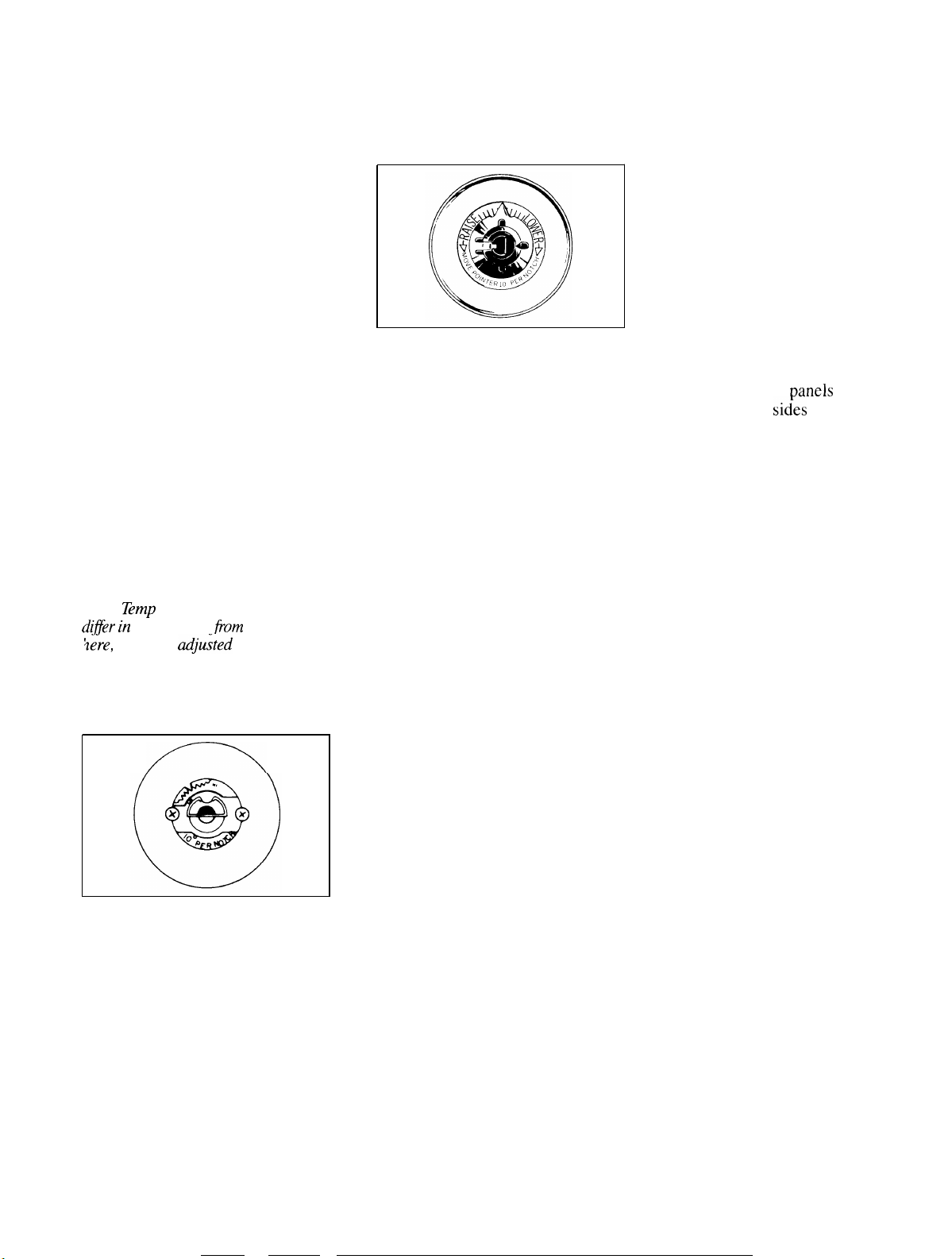
To adjust oven thermostat:
Use time given on recipe when
cooking for first time. Oven
thermostats may “drift” from the
factory setting over the years, and
5 to 10-minute differences in timing
between an old and a new oven are
not unusual. Your oven has been set
correctly at the factory and is more
apt to be accurate than the oven
which it replaced. However, if you
find that your foods consistently
brown too little or too much, you
may make a simple adjustment in
the OVEN TEMP thermostat knob.
PULL KNOB OFF SHAFT. LOOK
AT BACK OF KNOB AND NOTE
CURRENT SETTING BEFORE
MAKING ANY ADJUSTMENT.
To increase temperature, turn
toward HI or RAISE; to decrease,
turn toward LO or LOWER. Each
notch changes temperature 10”F.
Note: Although the back of the
Oven
12mp
knob on your range may
differ
in
appearance
horn
those shown
ie>e,
it can be
dju;ted
by following
the appropriate instructions below
and at right.
To adjust oven thermostat:
1.
Pull off knob. Loosen both
screws on back of knob.
2. Move pointer one notch in
desired direction. Tighten screws.
3.
Return knob to oven, matching
flat area of knob to shaft. Recheck
oven performance before making
an additional adjustment.
1.
Remove knob, and hold so
pointer is at top of knob. Using a
To clean in self-cleaning oven:
Place shelf from upper oven on a
shelf of the self-clean oven. (The
shelf may have to be shifted slightly
so shelf stops do not interfere with
placement of panels. )
Slide out oven bottom; lifting bake
unit slightly makes this easier to do.
Lift back panel and remove. Place
pot holder or similar material, hold
bottom and back
~anels
back-to-
“skirt” of knob firmly in one hand.
Grasp handle of knob in other
hand. Note position of pointer and
turn handle to move pointer toward
Raise or Lower. Pointer is designed
not to move easily. If it is seated so
it is difficult to move, pointer may
be loosened slightly. Insert a thin
screwdriver, knife blade or similar
instrument and lift up end of
pointer slightly.
2. After adjustment is made, press
pointer firmly against knob. Return
knob to range, matching flat area
on knob and shaft.
Recheck oven performance before
making an additional adjustment.
back so soiled
sides
face outward.
It is important that panels lay flat
on shelf.
Lift side panels up and out of oven.
Place back-to-back on remaining
self-clean shelf.
To replace panels
in self-cleaning oven:
Replace panels in any order desired.
Be certain oven bottom is replaced
so notch is at right, and “feet” on
bake unit rest in depressions in
panel. Replace broiler reflector so
“open side” is toward bottom of oven.
31
—
Note: Let
range/oven parts cool before touching or handling.
MATERIALS TO USE
GENERAL DIRECTIONS
Do not clean the bake unit or broil unit. Any soil will burn off when the unit is
heated. NOTE: The bake unit is hinged
and
can
be
lifted gently to
clean
the oven
floor.
If spillover. residue or ash accumulates around the bake unit, gently
wipe
around the unit with warm water.
● Soap and
Water
Drain fat, cool pan and
rack
slightly. (Do not let
w>iled
pan and rack stand in
● Soap-Filled Scouring Pad
oven to cool.) Sprinkle on detergent.
Fil
I
pan with warm water and spread cloth
● Plastic Scouring Pad
or
paper towel over rach. Let pan and rack stand for a
few
minutes. Wash:
wour
if necessary. Rinse and dry. OITION: The broiler pan and rack may also
be
cleaned in a dishwasher.
PART
Rake Unit
and Broil Unit
Broiler Pan and Rack
Control Knobs:
Range Top and Oven
. Mild Soap and Water
Pull off knobs. Wash
gently
but
do
not soak. Dry and return controls to range,
making sure to match
ilat
area on knob and shaft.
Wash
all
glass
with cloth dampened in soapy water. Rinse
and
polish with a dr)
cloth.
If knobs are removed, do not allow water to run down inside surface
of
Elass
while
cleanin~.
Outside Glass Finish ● Soap and Water
Porcelain Enamel
Surface*
c
Paper
Tbwe]
● Dry Cloth
● Soap and Water
Avoid cleaning powders or harsh abrasives which may scratch the enamel.
If acids should spill on the range while it is hot, usc a dry paper towel or
cloth
to wipe them up right away. When the surface has cooled, wash and rinse.
For other spills, such
as
fat smatterings. etc., wash with soap and water
when
cooled and then rinse. Polish with a drv cloth.
Inside Oven Door* ● Soap and Water On self-cleaning oven, clean ONLY the door liner outside the gasket. The door
is automatically cleaned if the oven is in the self-cleaning cycle. If spillover or
spattering should occur in cooking function, wipe the door with soap and water.
DO NOT rub or damage gasket. Avoid getting soap and water on the gasket or in
the slots on the door.
oven Gasket*
Avoid getting ANY cleaning materials
on
the gasket.
● Soap and Water
Cool before cleaning. Frequent wiping with mild soap and water will prolong
the time between major cleanings.
Bc
sure to rinse thoroughly.
● Soap and Water
Remove the Oven Vent Duct found under the right rear
wrface
unit. Wash in
hot. soapy water, dry and replace.
owen Liner
Oven Vent Duct
Chrome-Plated
Trim Rings
(around surface
units)
Chrome-Plated
Drip Pan/Rings
● Soap and Water
● Stiff-Bristled Brush
● Soap-Filled Scouring Pad
( Non-metal 1 ic)
Clean as described below or in dishwasher. DO NOT CLEAN IN SELF-
CLEANING OVEN.
Rings will discolor. Wipe all rings after each cooking so
unnoticed spatter will not “burn on” next time you cook.
To
remove ‘6 burned-
on” spatters, use any or all cleaning materials mentioned. Rub
Iig}zfl)’
with
scouring pad to prevent scratching of the surface.
Porcelain Enamel or
Aluminum Drip Pans
● Soap and Water
● Soap-Filled Scouring Pad
c
Plastic Scouring
Pad
Drip pans can be cleaned in self-cleaning oven or dishwasher or by hand
after pans cool
s]
ightly,
sprinkle on detergent, wash
or
scour with hot water,
rinse and dry.
Nleat Thermometer ● Soap and
Water
Cool
befbre
cleaning. DO NOT IMMERSE IN WATER. Scour stubborn spots
Q
Soap-Filled Scouring Pad
with soapy scouring pad, rinse and dry. DO NOT STORE IN OVEN.
Shel~es**
(See
Self-Cletining
Oven Directions)
● Soap and Water
Shelves can be cleaned in Self-Cleaning oven or dishwasher, or by hand, uiing
soap and water. Rinse thoroughly to remove soap after cleaning.
Calrod ’ Surface
Unit Coils
Spatters and spills burn away when coils are heated. After meal, remove all
cookware from surface units and
heat
soiled units at HI. Let soil burn off about
a
minute and switch units to OFF. Try not to get cleaning materials on coils. If you
do, wipe off with damp paper towel
bejbrc
heating surface unit.
DO NOT handle the unit before completely cooled.
DO NOT self-clean plug-in units.
DO
N“OT
immerse plug-in units in any kind
of
liquid.
DO NOT wash in dishwasher.
*Spillage
of
marinades. fruit juices, and basting materials containing acids may cause discoloration. Spillovers should be wiped up immediately
(or blotted up it’ continuous-cleaning oven). with care being taken to not touch any hot portion
of
the oven. When the surface is cool, clean and rinse.
‘~*W’hen
using Commercial
Oven
Cleaner on Broiler Pan and Rack or Shelves of Continuous-Cleaning Oven, be sure to remove them from the
men
first,
because
such cleaners
can
damage the special ceramic coat in: in
this
oven.
-.
—
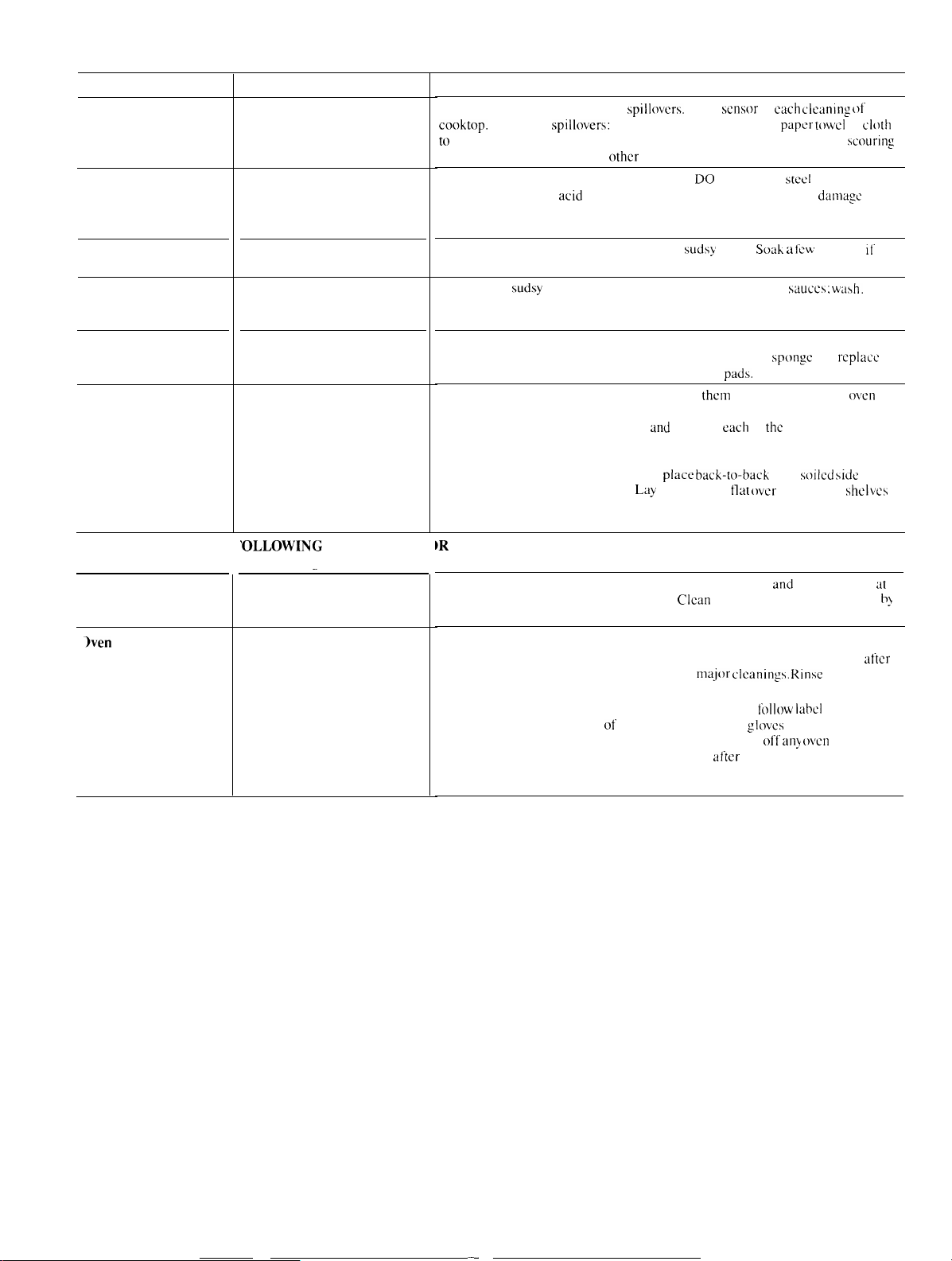
PART
Automatic
Unit Sensor
Metal,
including Chrome
Side Trims
and Trim Strips
Griddle
Rotisserie
Spit, Forks
Screws, Frame
Storage Drawer
Companion Oven
Removable Oven
Panels, Shelves,
Broil Reflector
MATERIALS TO USE
● Water, Plastic Scouring Ball
●
Soap
and Water
● Soap and Water
●
Soap
and Water
● Commercial Oven Cleaner
●
Soap
and Water
GENERAL DIRECTIONS
Keep sensor free from grease or
spillovm-s.
Wipe
sensor
at
each
cleaning
~Jf
cooktop.
For major
spillovers:
when cool, cover with moist paper
tt~wcl
or
cl~~th
to
soften soil; additional light scouring may be done with plastic or nylon
scourin:
ball. Do not use steel wool or
other
harsh materials.
Wash, rinse and then polish with a dry
cloth.
DO
NOT USE
steel
wool.
abrasives, ammonia,
acid
or commercial oven cleaners which may
damage
the finish.
Let griddle cool. Pour off grease. Wash in
suds>
water.
Soak
a
tcw
minutes
If
necessary to remove food stuck on surface.
Soak in hot.
sudsy
water: scour to remove cooked-on food or
sauces:
w~ish.
For cleaning. remove drawer by pulling it all the way open, tilting up the front
and then lifting the drawer out. Wipe with a damp cloth or
sponge
and
rcplacc
the drawer. Never use harsh abrasives or scouring
pads.
Take removable items from upper oven. Place
thcm
in the Self-Cleaning men in
this manner:
1.
Companion Oven Shelves—invert
and
place on each of
the
Self-Cleaning
oven shelves with their stops facing forward.
2. Broil Reflector-place soiled side down on lower shelf.
3. Bottom oven panel and back panels:
place
back-tt]-back
with
s~~ilccl
side
facing out on Self-Cleaning shelf.
Lay
these panels
flat
(wer
companion
shelves
that were placed in Self-Cleaning oven.
4. Side panel—lay back-to-back on remaining Self-Clean panel.
USE THE E‘OLLOWING DIRECTIONS FC
)R
STANDARD OVEN ONLY. For Continuous-Cleaning Oven,
refer to “Continuous-Cleaning
Oven Care” Section on page 28 for directions on care of special porous ceramic coating.
Inside Oven Door**
(Liner)
>ven Liner**
(CAUTION: When in
use, light bulbs can
become warm enough
to break if touched with
moist cloth or towel.
When cleaning, avoid
warm lamps with
cleaning cloths if lamp
cover is removed.
—
● Soap and Water
● Soap-Filled Scouring Pad
● Commercial Oven Cleaner
● Soap and Water
● Soap-Filled Scouring Pad
● Commercial Oven Cleaner
To obtain service, see your
warranty on the back of this book.
We’re proud of our service and
want you to be pleased. If for some
reason you are not happy with the
service you receive, here are three
steps to follow for further help.
FIRST, contact the people who
serviced your appliance. Explain
why you are not pleased. In most
cases, this will solve the problem.
To clean oven door, remove by opening to BROIL position
and
grasping door
at
sides. Lift door up and away from hinges.
Clean
with soap and water. Replace
b}
grasping door at sides and lining up door with hinges. Push door firmly into place.
Cool before cleaning.
FOR LIGHT SOIL: Frequent wiping with mild soap and water (especially after
cooking meat) will prolong the time between
ma<ior
cletinings.
Rinse
thoroughly.
NOTE: Soap left on liner causes additional stains when oven is reheated.
FOR HEAVY SOIL: Choose a nonabrasive cleaner and
fb]low
label
instructions, using thin layer
of
cleaner. Use of rubber
gloves
is recommended.
Wipe or rub lightly on stubborn spots. Rinse well. Wipe
off
any
oven
cleaner
that gets on thermostat bulb. When rinsing oven
after cleaning. also wipe
thermostat bulb.
NEXT, if you are still not pleased,
write all the details—including
your phone number—to:
Manager, Consumer Relations
General Electric Company
Appliance Park
Louisville, Kentucky 40225
FINALLY, if your problem is still
not resolved, write:
Major Appliance
Consumer Action Panel
20 North Wacker Drive
Chicago, Illinois 60606
33
—
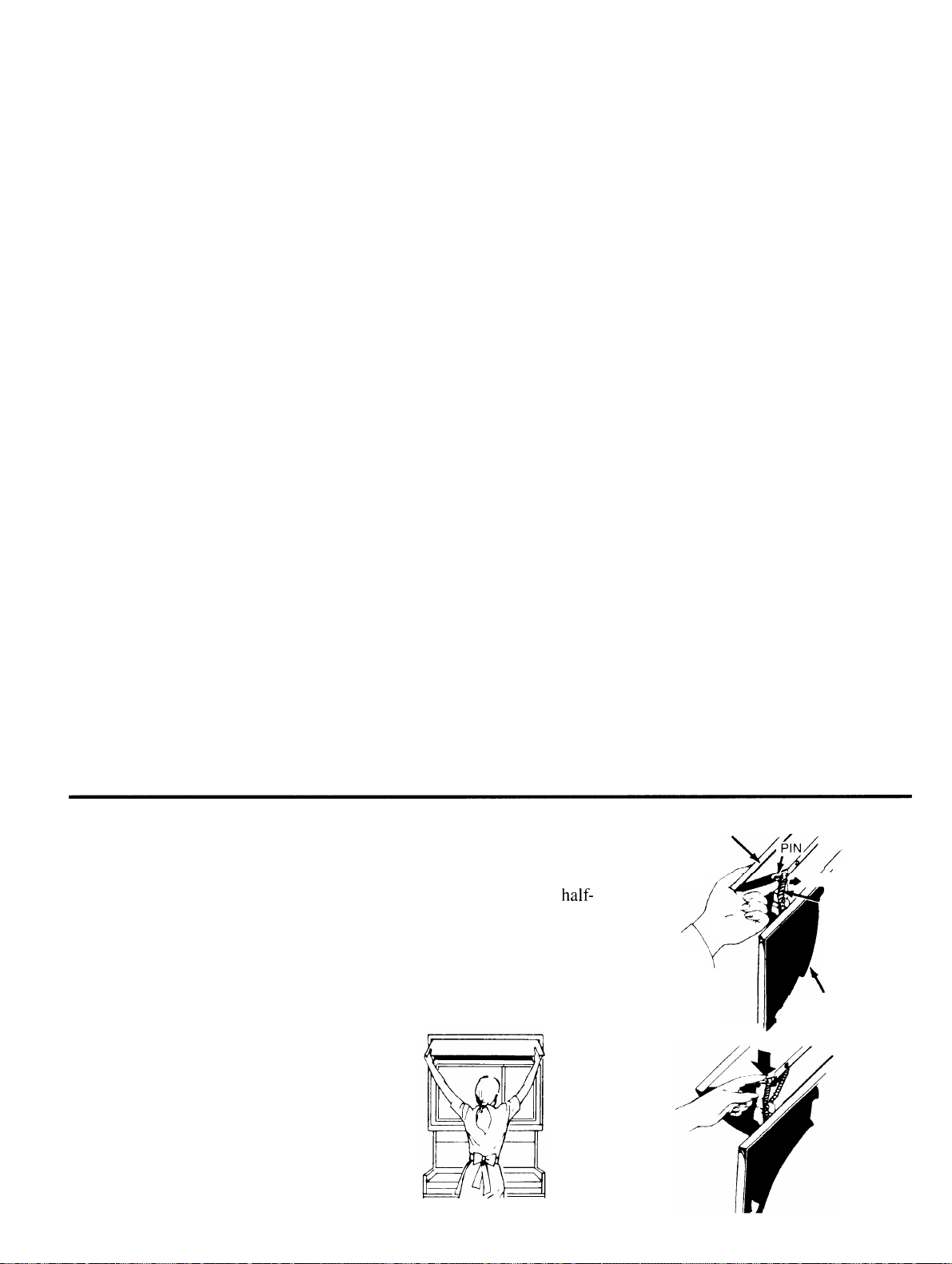
(on models so equipped)
Some Cooking Centers share a
built-in exhaust system equipped
with a damper, a two-speed exhaust
blower and removable filters.
Exhaust openings are located over
cooking top and in hood over oven.
The exhaust system functions only
when the blower is operating. The
switch for the exhaust system is
beneath the control panel. For high
speed, push switch once; for low
speed, push switch twice; and to
stop blower, push switch once
in sequence.
When blower is operating and hood
over oven is closed, it exhausts over
surface units only. When blower
operates with hood in open position,
it exhausts through openings over
surface units and over oven at the
same time.
THE EXHAUST SYSTEM
SHOULD BE OPERATED
WHENEVER ODORS, VAPORS
OR SMOKE ARE EXPECTED
TO BE THE RESULT OF A
COOKING OPERATION.
START FAN AT BEGINNING
OF COOKING.
To open hood above the oven, lift
up handle at center of hood; to
close, push down on handle. Use
hood in its fully extended position
whenever vapor or smoke results
from cooking, such as when pan
broiling or frying on the surface
units. See information on use of
surface units.
Two filters are located over cooking
top and one behind hood extension.
Filters are removable for cleaning.
Filters become soiled over a period
of time. The efficiency of your
exhaust system depends on how
clean the filters are. Frequency of
cleaning, or replacing, depends on
the type of cooking you do, but
filters should be cleaned AT LEAST
ONCE A MONTH. Also, frequently
clean the grease-laden surfaces
adjacent to the filters.
To clean,
agitate in hot detergent
solution. Light brushing may be
used to help remove imbedded soil
and dust. With careful use and
handling, filters will last for years.
However, if replacement becomes
necessary, obtain a filter from
your dealer.
Remove and Replace Filters
1.
Cooking top: Place finger in
recess at front edge of filter; push
filter to rear until front edge clears
the exhaust opening; lower the
front and remove. When clean,
replace. Place edge of filter against
spring at rear of exhaust opening.
Push to rear, lift front edge, and let
spring push filter forward into place
under edge of exhaust opening.
2. Hood: Extend hood as far as
possible, or remove hood extension
if desired; see illustration below.
Place fingers on each side at
bottom of filter. Press filter to left
until it clears the holder on right
side, then remove. When clean,
replace. Push filter against clip at
left and press left until filter clears
holder at right side. Push filter
toward opening and release so it
slips behind holder.
The blower motor is permanently
lubricated; it does not need oiling.
1. To remove,
extend hood as far
as it will open.
With thumbs curved around edge
of hood extension, hook a finger
between spring and bracket at each
side and push toward center of hood.
This moves pins out of holes in
bracket and hood extension can
be removed.
2. To clean, wash with hot
detergent solution. Rinse and dry
with soft cloth.
3.
To replace,
fit bottom of
half-
circle flanges into side of hood.
Secure one side at a time. Align
pin with holes in bracket and hood
extension, then push pin through
holes. This secures hood extension
so it cannot be removed by mistake.
HOOD EXTENSION
/
/
b BRACKET
P
SPRING
7
UPPER
OVEN
I
IF
DOOR
-—
34
PROBLEM
POSSIBLE CAUSE AND REMEDY
OVEN WILL NOT WORK
Plug on range is not completely inserted in the electrical outlet.
The circuit breaker in your house has been tripped or a fuse has been blown.
Oven controls are not properly set.
Door left in locked position after cleaning.
OVEN LIGHT
Light bulb is loose.
DOES NOT WORK
Bulb is defective. Replace.
Switch which operates oven light is broken. Call for service.
FOOD DOES NOT
OVEN SET or OVEN TEMP knob not set
at
BROIL.
BROIL PROPERLY
Door not left ajar as recommended.
Improper shelf position being used. Check Broiling Guide.
Necessary preheating was not done.
Food is being cooked on hot pan.
Utensils are not suited for broiling.
Aluminum foil used on the broil pan rack has not been fitted properly or slit as
recommended.
FOOD DOES NOT ROAST
OVEN SET knob not set on BAKE.
OR BAKE PROPERLY
OVEN TEMP knob not set correctly.
Shelf position is incorrect. Check Roasting or Baking Guides.
Oven shelf is not level.
Wrong cookware is being used. When roasting, pan is too small.
A foil tent was not used when needed to slow down browning during roasting.
CALROD@
SURFACE Surface units are not plugged in solidly.
UNITS NOT
Trim rings and drip pans are not set securely in the range top.
FUNCI’IONING
Surface unit controls are not properly set.
PROPERLY
OVEN WILL NOT
Automatic timer dials not set or not set properly. The STOP dial must be set and
SELF CLEAN
advanced beyond the time noted on oven clock.
The STOP dial was not advanced for a long enough time.
Both OVEN SET and OVEN
TE~MP
knobs must be set at CLEAN setting.
A thick pile of spillover when cleaned leaves a heavy layer of ash in spots
which could have insulated the area from further heat.
Latch not moved to the right.
OVEN DOOR
Turn OVEN SET knob to CLEAN. Glowing Locked Light after knob is turned
WON’T LATCH
indicates oven is too hot from previous use and door won’t latch. To cool oven,
open door wide; then latch can be moved.
OVEN SET knob must beat CLEAN or OFF before Latch can be moved.
Latch Release Button not pushed when moving Latch.
If you need more help.. call, toll free:
The GE Answer Center”
J.626.2000
consumer information service
35
—
—
—
Save proof of original purchase date such as your sales slip or
cancelled
check to establish warranty period.
FULL ONE-YEAR WARRANTY
This warranty is extended to
For one year from date of original
purchase, we will provide, free of
charge, parts and service labor
in your home to repair or replace
any part of the range
t
hat fails
because of a manufacturing defect.
the original purchaser and any
succeeding owner for products
purchased for ordinary home use
in the 48 mainland states, Hawaii
and Washington,
D.C.
In Alaska the
warranty is the same except that it is
LIMITED because you must pay to
ship the product to the service shop
or for the service technician’s travel
costs to your home.
All warranty service will be provided
by our Factory Service Centers or
by our authorized Customer Care’
servicers during normal working
hours.
Look in the White or Yellow Pages
of your telephone directory for
GENERAL ELECTRIC COMPANY,
GENERAL ELECTRIC FACTORY
SERVICE, GENERAL
ELECTRIC-
HOTPOINT FACTORY SERVICE or
GENERAL ELECTRIC CUSTOMER
CARE” SERVICE.
—
—-
● Service trips to your home to ● Replacement of house fuses or
teach you how to use the product. resetting of circuit breakers.
Read your Use and Care material.
If you then have any questions
● Failure of the product if it is used
for other than its intended purpose
about operating the product,
or used commercially.
please contact your dealer or our
Consumer
Affairs
office at the
● Damage to product caused
address below, or call, toll free:
by accident, fire, floods or acts
The GE Answer
Center@
of God.
800.626.2000
consumer information service
WARRANTOR IS
NOT
RESPONSIBLE
FOR CONSEQUENTIAL DAMAGES.
● Improper installation.
If you have an installation problem,
contact your dealer or installer.
You are responsible for providing
adequate electrical, gas, exhausting
and other connecting facilities.
lr—
Some states do not allow the
excluslon
or limitation of incidental or consequential damages, so the above limitation or exclusion
may not apply to you.
This
warranty gives you specific legal rights, and you may also have other rights which vary from
$;tate
to state.
To know what your legal rights are in your state, consult your local or state consumer affairs office or your state’s Attorney General.
Warrantor: General Electric Company
If further help is needed concerning this warranty, contact:
Manager—Consumer Affairs, General Electric Company, Appliance Park, Louisville, KY 40225
Pub.
No.
49-4751
GENERAL
@
ELECTRIC
5-86

