Owner's Manual and
installation instructions
®
27-inch Wide
ELECTRIC DRYERS
mmml
IMPORTANT:
Read and follow all safety
and operating instructions
before first use of this product.
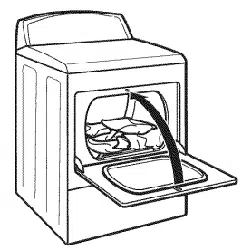
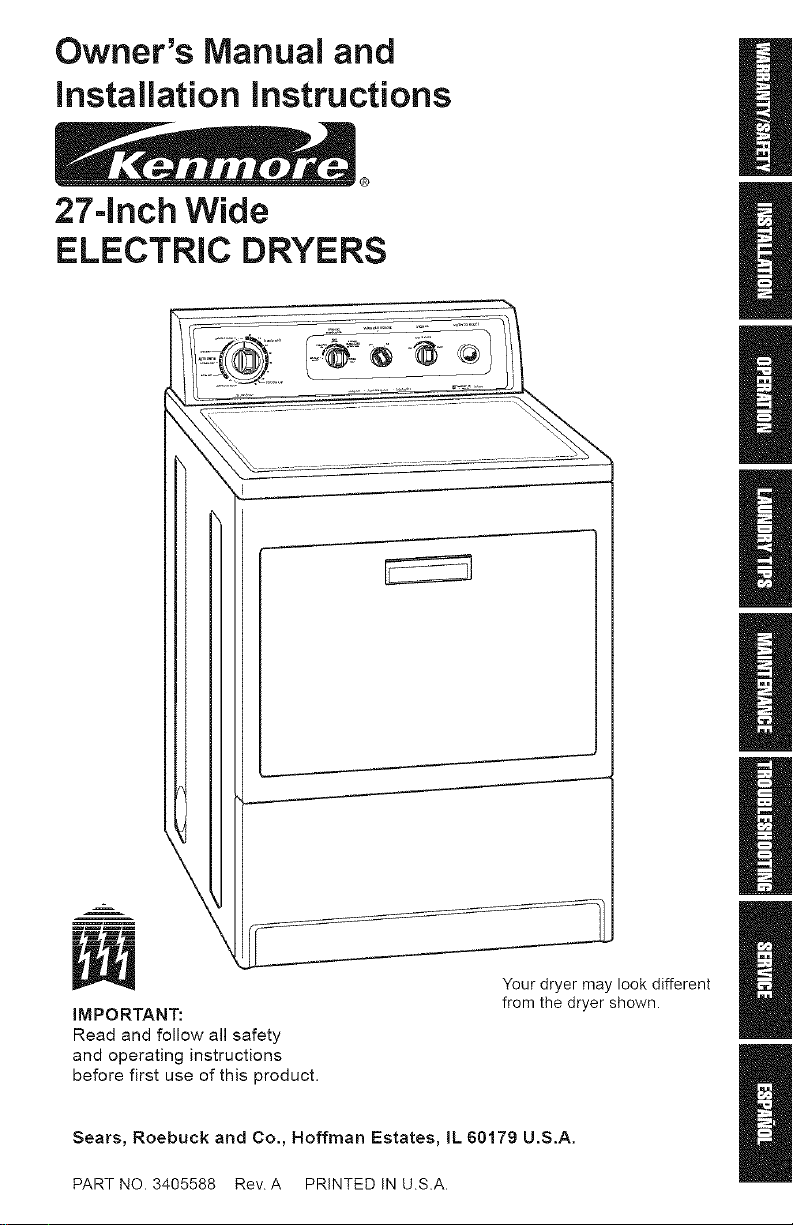
Your dryer may look different
from the dryer shown.
Sears, Roebuck and Co., Noffman Estates, IL 60179 U.S.A.
PART NO 3405588 Rev. A PRINTED IN U.S.A
BEFOREUSINGYOURNEWDRYER
SEARSELECTRICDRYERWARRANTY
iMPORTANT SAFETY iNSTRUCTiONS
iNSTALLATiON iNSTRUCTiONS
OPERATING YOUR DRYER
LAUNDRY TIPS
CARING FOR YOUR DRYER
TROUBLESHOOTING
SEARS MAINTENANCE AGREEMENT
2
3
4
5
25
32
34
38
4O
Please read this manual. It will help
you install and operate your new
Kenmore dryer in the safest and most
economical way.
For more information about the care
and operation of Kenmore appliances
call your nearest Sears store. You will
need the complete model and serial
numbers when requesting information.
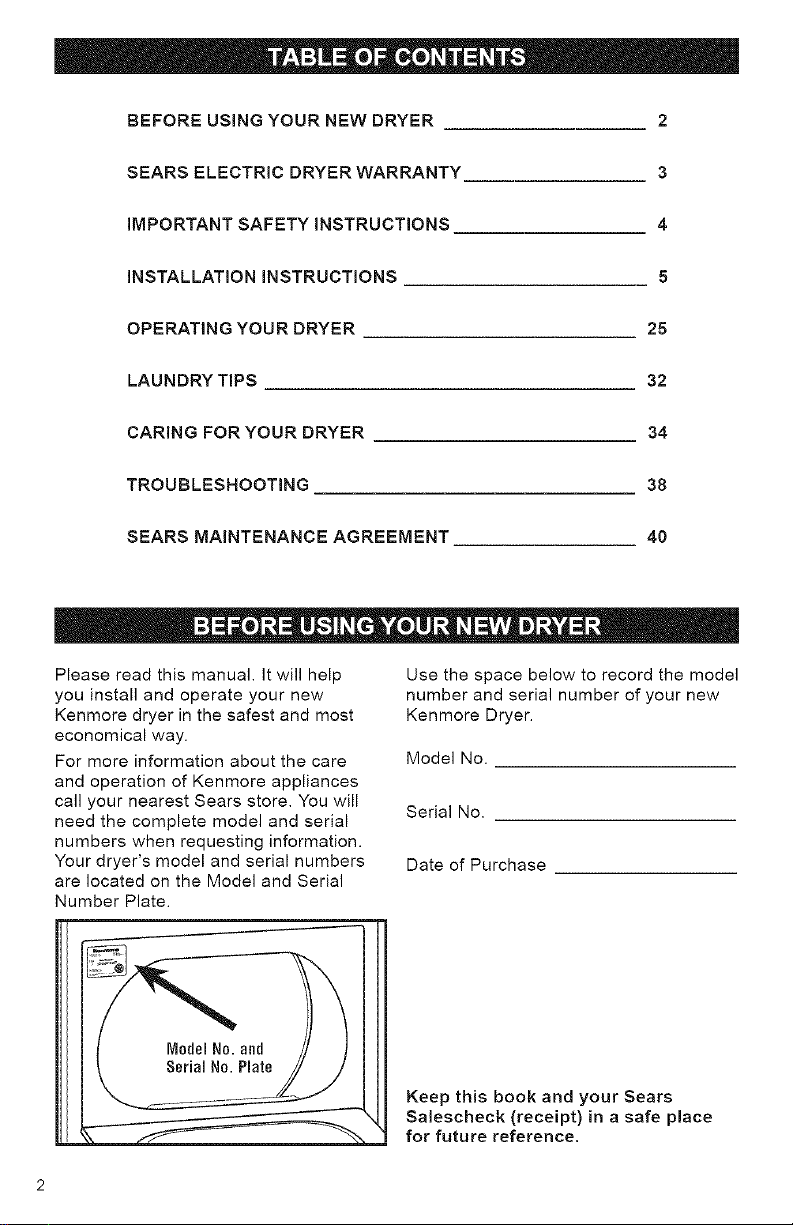
Your dryer's model and serial numbers
are located on the Model and Serial
Number Plate.
Use the space below to record the model
number and serial number of your new
Kenmore Dryer.
Model No.
Serial No.
Date of Purchase
Keep this book and your Sears
Salescheck (receipt) in a safe place
for future reference.
FULLI-YEAR WARRANTY
ON MECHANICAL AND
ELECTRICAL PARTS
For one year from the date of purchase,
when this dryer is installed and operated
according to the instructions in the Owner's
Manual, Sears will repair or replace any
mechanical or electrical parts in this dryer,
if defective in material or workmanship.
This warranty does not cover service
calls to correct improper installation,
including dryers that have been vented
with plastic or flexible foil.
If the dryer is subjected to other than
private family use, the above warranty
coverage is effective for only 90 days.
WARRANTY SERVICE IS AVAILABLE
BY CONTACTING THE NEAREST
SEARS SERVICE CENTER IN THE
UNITED STATES.
This warranty applies only while this
product is in use in the United States.
This warranty gives you specific legal
rights, and you may also have other
rights which vary from state to state.
Sears Roebuck and Co., Dept. 817WA,
Hoffman Estates, IL 60179.
NOTE: Proper installation to comply
with the dryer's warranty is found in
the Installation Instructions of this
Owner's Manual.
Your safety and the safety of others is very important.
We have provided many important safety messages in this manual
and on your appliance. Always read and obey all safety messages.
This is the safety alert symbol. This symbol alerts
you to hazards that can kill or hurt you and others.
All safety messages will be preceded by the safety
alert symbol and the word "DANGER" or "WARNING?
These words mean:
You will be killed or seriously
injured if you don't follow
instructions.
You can be killed or seriously
injured if you don't follow
instructions.
All safety messages will identify the hazard, tell you how to reduce the
chance of injury, and tell you what can happen if the instructions are
not followed.
YOUR SAFETY IS IMPORTANT TO US.
WARNING: To reduce the risk of fire,
electric shock, or injury to persons
when using your dryer, follow basic
precautions, including the following:
• Read all instructions before using
the dryer.
• Do not dry articles that have been
previously cleaned in, washed in, soaked
in, or spotted with gasoline, dry-cleaning
solvents, other flammable or explosive
substances as they give off vapors that
could ignite or explode.
• Do not allow children to play on or in
the dryer. Close supervision of children
is necessary when the dryer is used
near children.
• Before the dryer is removed from
service or discarded, remove the door
to the drying compartment.
• Do not reach into the dryer if the drum
is moving.
• Do not install or store this dryer where
it will be exposed to the weather.
• Do not tamper with controls.
• Do not repair or replace any part of the
dryer or attempt any servicing unless
specifically recommended in the Owner's
Manual or in published user-repair
instructions that you understand and
have the skills to carry out.
• Do not use fabric softeners or products
to eliminate static unless recommended
by the manufacturer of the fabric softener
or product.
• Do not use heat to dry articles containing
foam rubber or similarly textured rubber-
like materials.
• Clean lint screen before or after each
load.
• Keep area around the exhaust opening
and adjacent surrounding areas free from
the accumulation of lint, dust, and dirt.
• The interior of the machine and exhaust
duct should be cleaned periodically by
qualified service personnel.
SAVE THESE INSTRUCTIONS
IMPORTANT: Observe all governing codes and ordinances.
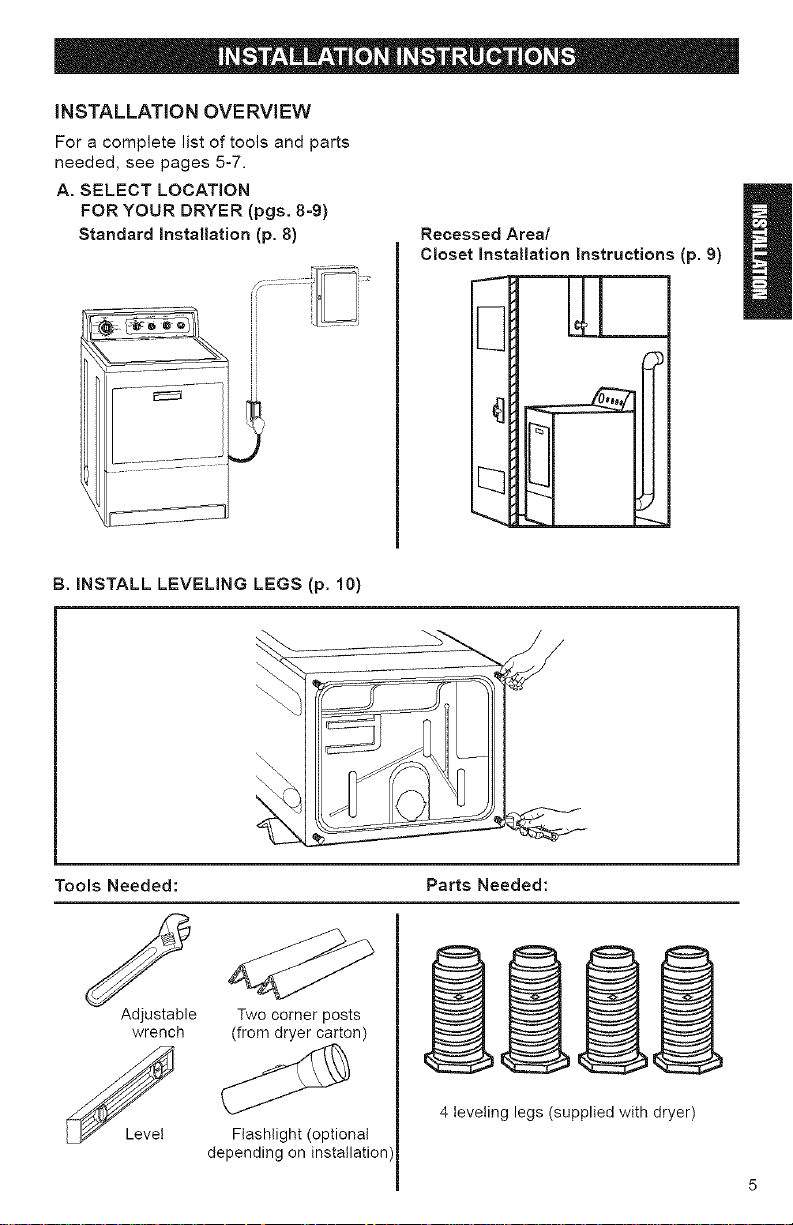
INSTALLATION OVERVIEW
For a complete list of tools and parts
needed, see pages 5-7.
A, SELECT LOCATION
FOR YOUR DRYER (pgs. 8=9)
Standard Installation (p. 8)
J
Recessed Areal
Closet Installation instructions (p. 9)
B. INSTALL LEVELING LEGS (p. 10)
\\\
\
Tools Needed: Parts Needed:
Adjustable
wrench
Two corner posts
(from dryer carton)
Flashlight (optional
depending on installation
4 leveling legs (supplied with dryer)
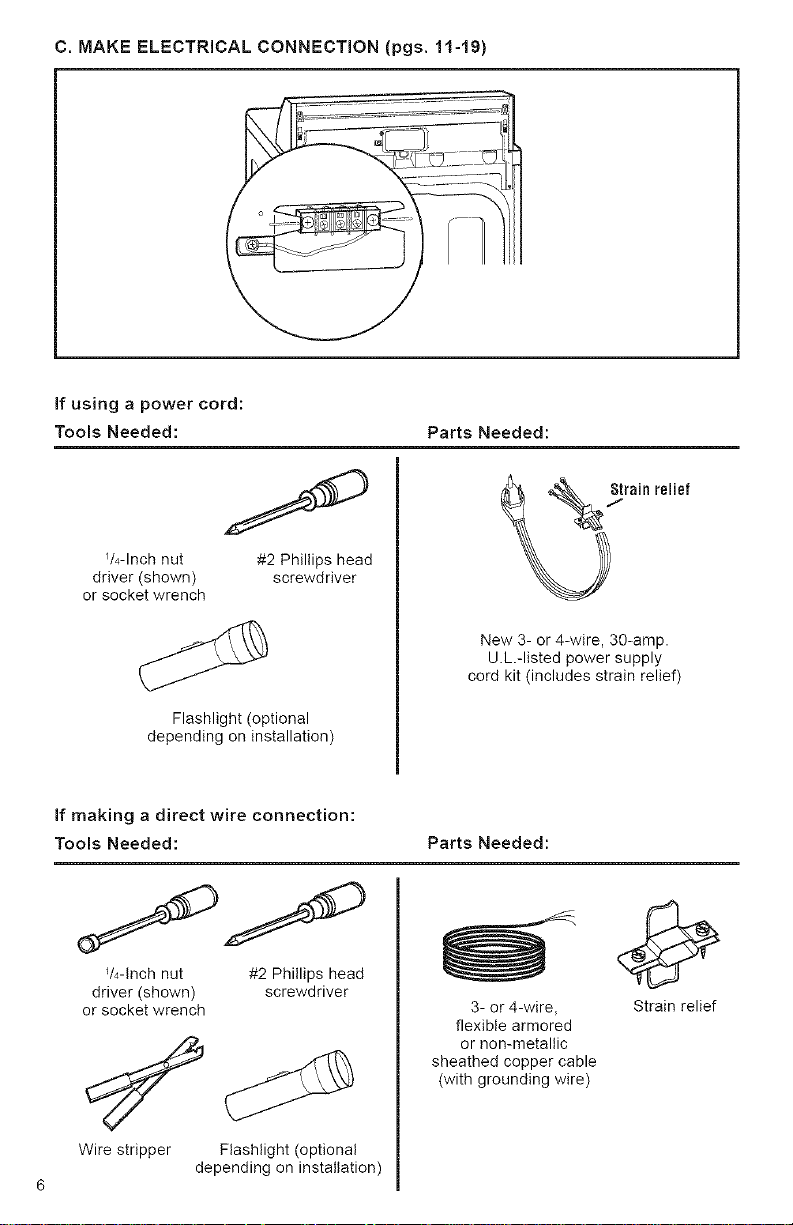
C,MAKE ELECTRICAL CONNECTION (pgs. 11-19)
If using a power cord:
Tools Needed:
V4-1nchnut
driver (shown)
or socket wrench
Parts Needed:
#2 Phillips head
screwdriver
Flashlight (optional
depending on installation)
Strain relief
New 3- or 4-wire, 30-amp.
U.L-listed power supply
cord kit (includes strain relief)
If making a direct wire connection:
Tools Needed: Parts Needed:
V4-lnch nut #2 Phillips head
driver (shown) screwdriver
or socket wrench
U
Wire stripper Flashlight (optional
depending on installation)
3- or 4-wire,
flexible armored
or non-metallic
sheathed copper cable
(with grounding wire)
Strain relief
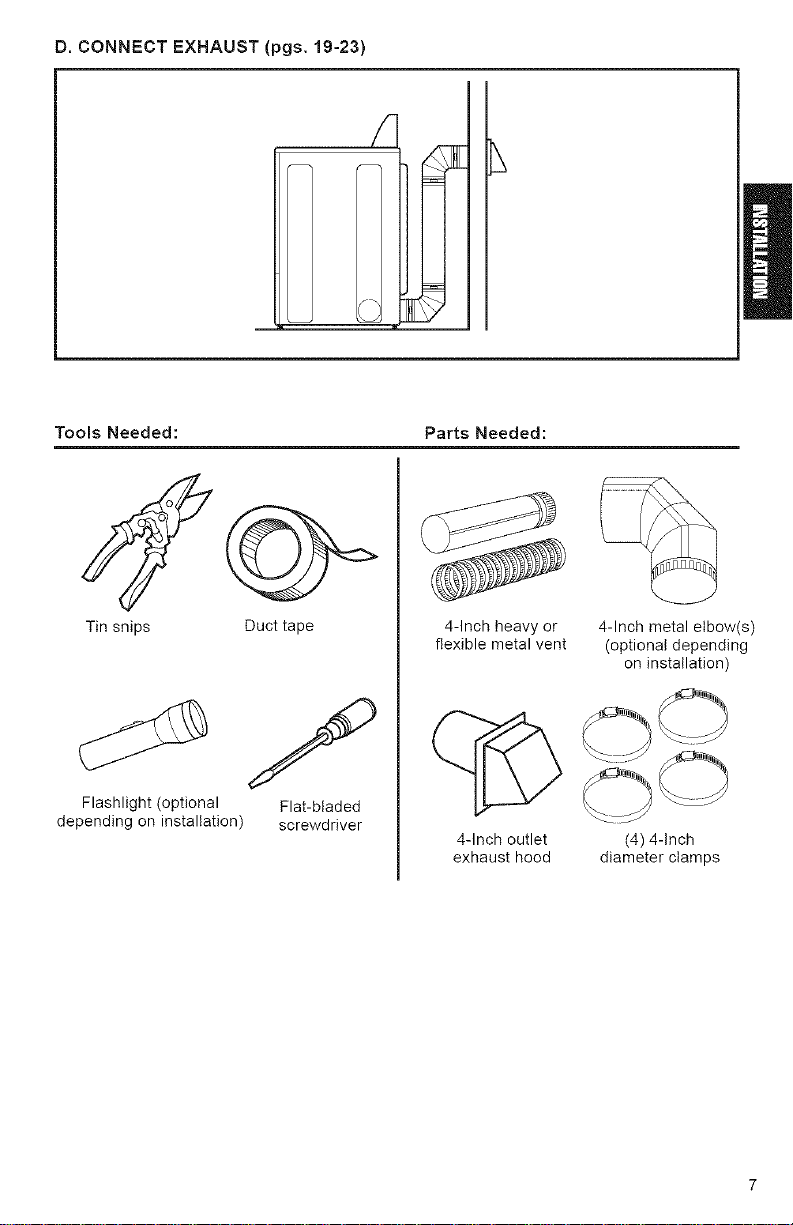
D, CONNECT EXHAUST (pgs. i9-23)
Tools Needed: Parts Needed:
Tin snips Duct tape
Flashlight (optional Flat-bladed
depending on installation) screwdriver
4-Inch heavy or
flexible metal vent
4-Inch outlet
exhaust hood
4-Inch metal elbow(s)
(optional depending
on installation)
O0
(4) 4-Inch
diameter clamps
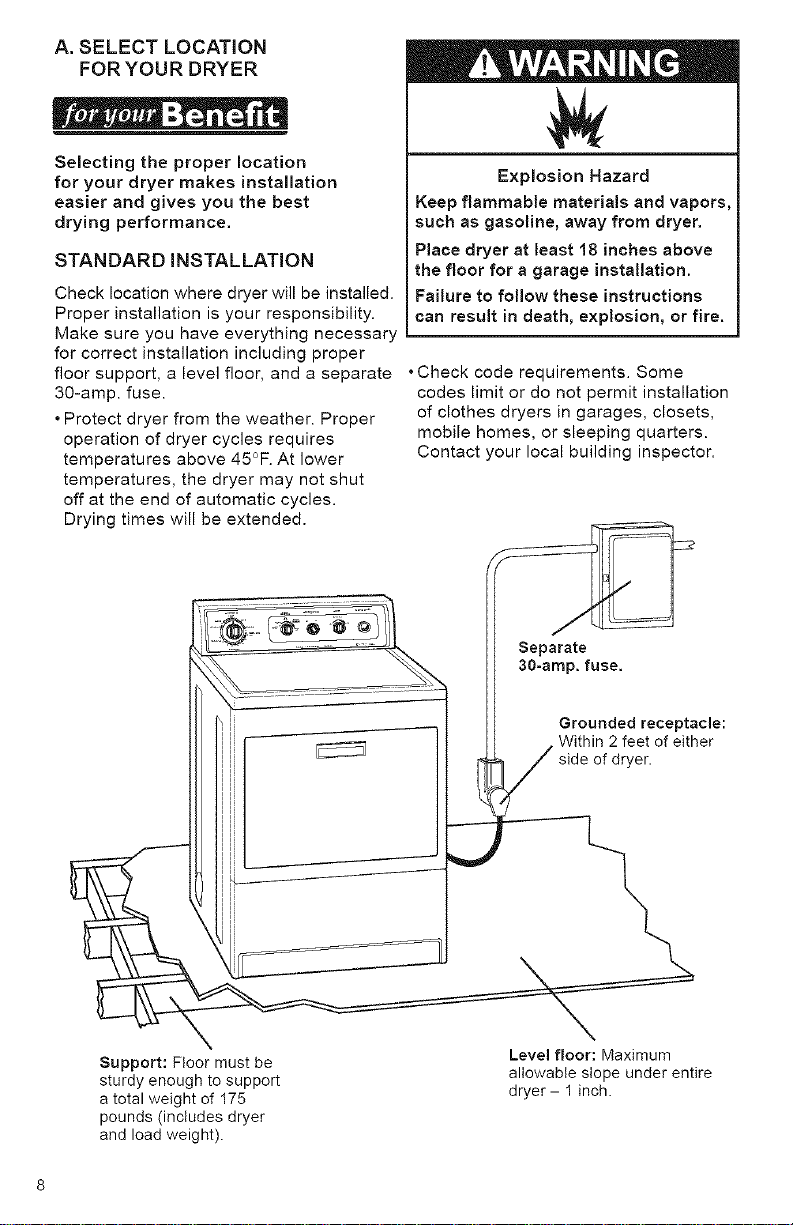
A, SELECT LOCATION
FOR YOUR DRYER
Selecting the proper location
for your dryer makes installation
easier and gives you the best
drying performance.
STANDARD INSTALLATION
Check location where dryer will be installed.
Proper installation is your responsibility.
Make sure you have everything necessary
for correct installation including proper
Explosion Hazard
Keep flammable materials and vapors,
such as gasoline, away from dryer.
Place dryer at least 18 inches above
the floor for a garage installation.
Failure to follow these instructions
can result in death, explosion, or fire.
floor support, a level floor, and a separate • Check code requirements. Some
30-amp. fuse.
• Protect dryer from the weather. Proper
operation of dryer cycles requires
temperatures above 45°F. At lower
temperatures, the dryer may not shut
off at the end of automatic cycles.
Drying times will be extended.
codes limit or do not permit installation
of clothes dryers in garages, closets,
mobile homes, or sleeping quarters.
Contact your local building inspector.
J
Separate
30-amp. fuse.
Grounded receptacle:
Within 2 feet of either
side of dryer.
\
Support: Floor must be
sturdy enough to support
a total weight of 175
pounds (includes dryer
and load weight).
Level floor: Maximum
allowable slope under entire
dryer- I inch.
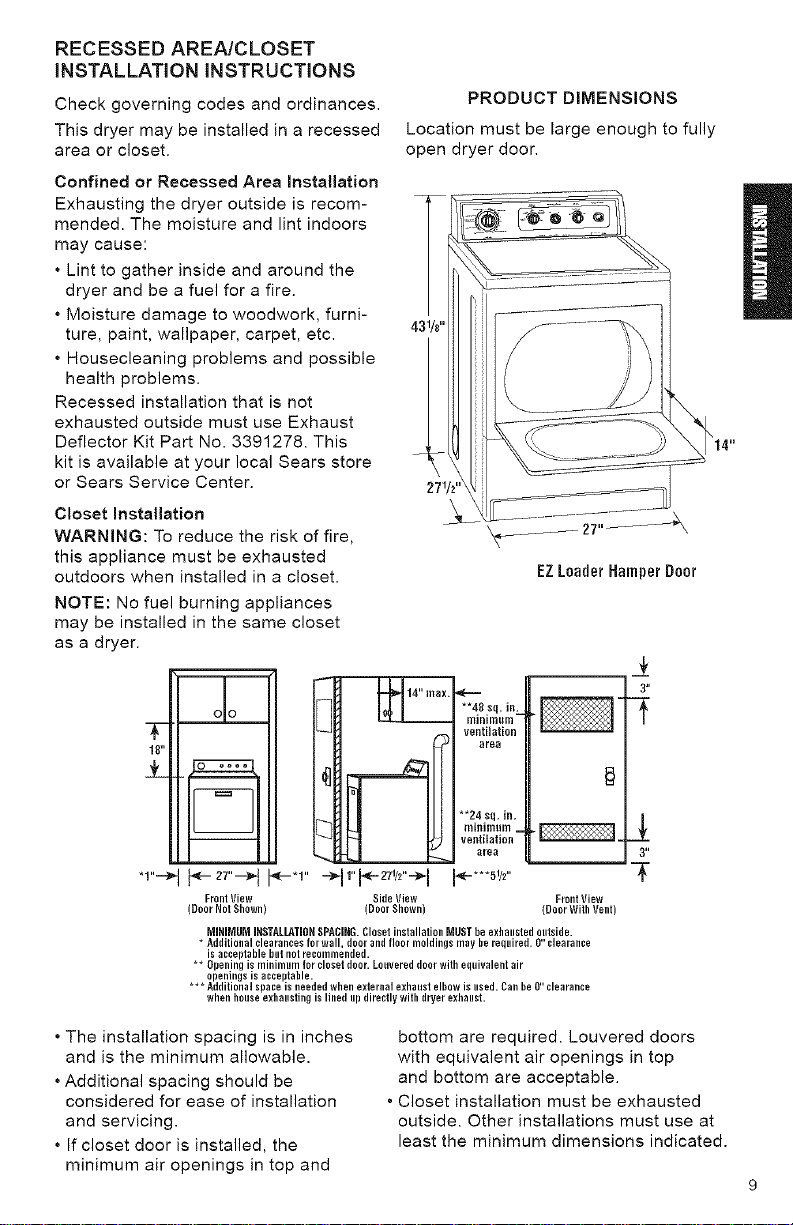
RECESSED AREA/CLOSET
INSTALLATION INSTRUCTIONS
Check governing codes and ordinances.
This dryer may be installed in a recessed
area or closet.
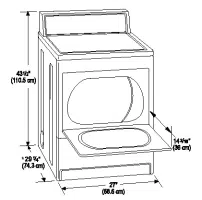
PRODUCT DIMENSIONS
Location must be large enough to fully
open dryer door.
Confined or Recessed Area Installation
Exhausting the dryer outside is recom- -_
mended. The moisture and lint indoors
may cause:
* Lint to gather inside and around the
dryer and be a fuel for a fire.
* Moisture damage to woodwork, furni-
ture, paint, wallpaper, carpet, etc. 431/8"
* Housecleaning problems and possible
health problems.
Recessed installation that is not
exhausted outside must use Exhaust
Deflector Kit Part No. 3391278. This
r
kit is available at your local Sears store --_-
\
or Sears Service Center.
\14"
Closet Installation
WARNING: To reduce the risk of fire,
this appliance must be exhausted
outdoors when installed in a closet.
EZLoader Hamper Door
NOTE: No fuel burning appliances
may be installed in the same closet
as a dryer.
7-
18"
±
J¢-_414"
*'48sq.in=
rfllnlmufil
ventilation
l area
**24sq.in.
inlnllflg rll =
ventilation
ai'ea
m
F-2T,-_t I<--1,,-_11,,1<--_,/2,,-_11÷***_,/2,,
FrontView SideView FrontView
(DoorNot Shown) (DoorShown) (Door With Vent)
MINIMUMiNSTALLATIONSPADING.ClosetinstallationMUST beexhansted ontside.
* Additionalclearancesfor wall, doorandfloor moldings may bereqnired.O"clearance
isacceptable bntnot recommended.
** Openingisminimumforcloset door.Louvereddoorwith equivalentair
openingsis acceptable.
** *Additionalspaceis neededwhen externalexhaustelbowis ilsed. CanbeS" clearance
whenhouseexhanstingislinedlip directlywith dryerexhanst.
* The installation spacing is in inches
and is the minimum allowable.
* Additional spacing should be
considered for ease of installation
and servicing.
* If closet door is installed, the
minimum air openings in top and
bottom are required. Louvered doors
with equivalent air openings in top
and bottom are acceptable.
* Closet installation must be exhausted
outside. Other installations must use at
least the minimum dimensions indicated.
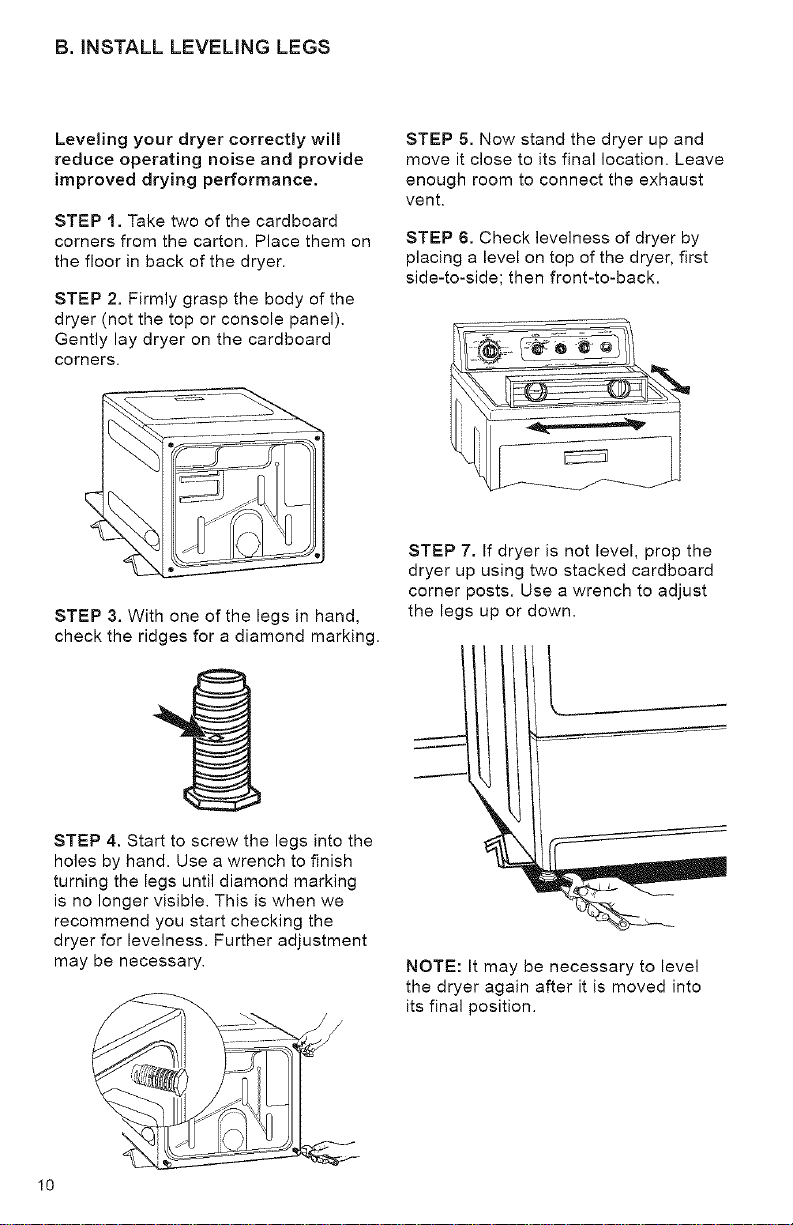
B. iNSTALL LEVELING LEGS
Leveling your dryer correctly will
reduce operating noise and provide
improved drying performance.
STEP 1. Take two of the cardboard
corners from the carton. Place them on
the floor in back of the dryer.
STEP 2. Firmly grasp the body of the
dryer (not the top or console panel).
Gently lay dryer on the cardboard
corners.
STEP 3. With one of the legs in hand,
check the ridges for a diamond marking.
STEP 5. Now stand the dryer up and
move it close to its final location. Leave
enough room to connect the exhaust
vent.
STEP 6. Check levelness of dryer by
placing a level on top of the dryer, first
side-to-side; then front-to-back.
STEP 7. If dryer is not level, prop the
dryer up using two stacked cardboard
corner posts. Use a wrench to adjust
the legs up or down.
I
i
STEP 4. Start to screw the legs into the
holes by hand. Use a wrench to finish
turning the legs until diamond marking
is no longer visible. This is when we
recommend you start checking the
dryer for levelness. Further adjustment
may be necessary.
NOTE: It may be necessary to level
the dryer again after it is moved into
its final position.
I0
C.MAKE ELECTRICAL
CONNECTION
It is your responsibility:
• To contact a qualified electrical installer.
• To assure that the electrical installation
is adequate and in conformance with
the National Electrical Code, ANSI/
NFPA 70-latest edition and all local
codes and ordinances.
Copies of the code standards listed
above may be obtained from:
National Fire Protection Association
Batterymarch Park
Quincy, Massachusetts 02269
ELECTRICAL REQUIREMENTS
The proper electrical connection
ensures a safe installation that
meets local code requirements,
A three-wire or four-wire, single
phase 120/240-volt, 60-Hz., AC-only,
electrical supply (or three-wire or
four-wire, 120/208-volt if specified on
serial/rating plate) is required on a
separate 30-ampere circuit, fused on
both sides of the line. A time-delay fuse
or circuit breaker is recommended.
This dryer is manufactured with the
3-wire, frame-grounding conductor
connected to the NEUTRAL (center)
of the wiring harness of the terminal
block. Do not have a fuse in the
neutral or grounding circuit. A fuse
in the neutral or grounding circuit
could result in an electrical shock.
Use a 4-conductor cord when the
dryer is installed in a mobile home or
an area where local codes do not
permit grounding through the neutral.
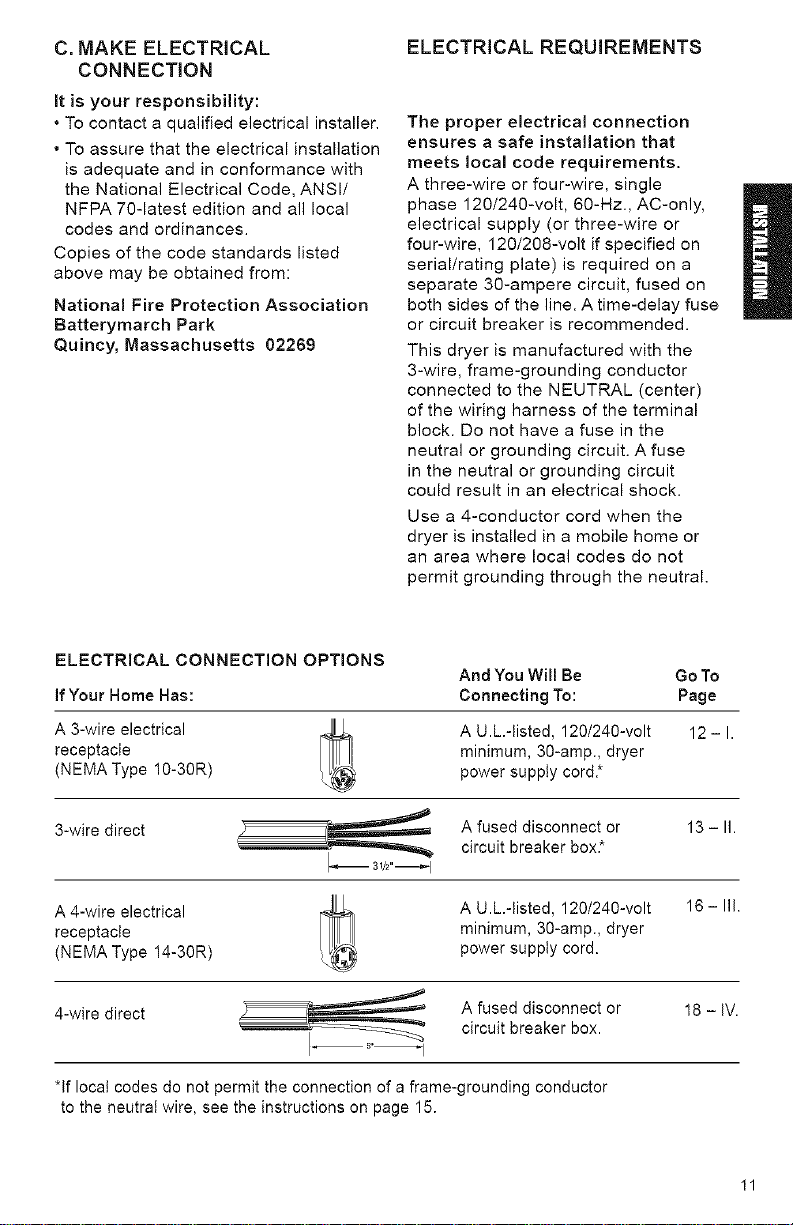
ELECTRICAL CONNECTION OPTIONS
If Your Home Has:
A 3-wire electrical
receptacle
(NEMA Type 10-30R)
And You Will Be Go To
Connecting To: Page
A U.L.-tisted, 120/240-volt
minimum, 30-amp., dryer
power supply cord.*
12-1.
3-wire direct A fused disconnect or 13 - II.
circuit breaker box*
A 4-wire electrical
receptacle
(NEMA Type 14-30R)
A U.L.-tisted, 120/240-volt
minimum, 30-amp., dryer
power supply cord.
16- III.
4-wire direct A fused disconnect or 18 - IV.
circuit breaker box.
*If local codes do not permit the connection of a frame-grounding conductor
to the neutral wire, see the instructions on page 15.
I1
I. THREE-WIRE ELECTRICAL
CONNECTION TO RECEPTACLE
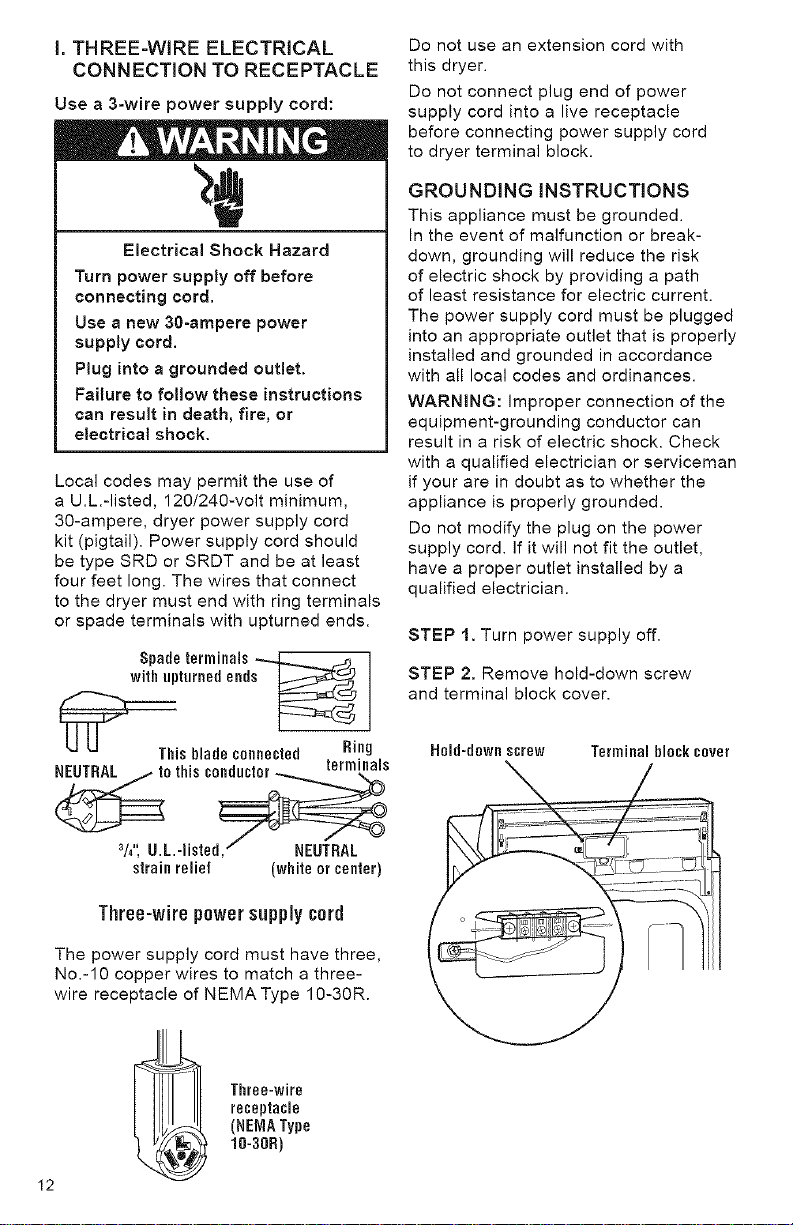
Use a 3-wire power supply cord:
Electrical Shock Hazard
Turn power supply off before
connecting cord,
Use a new 30-ampere power
suppty cord,
Plug into a grounded outlet.
Failure to follow these instructions
can result in death, fire, or
electrical shock.
Local codes may permit the use of
a U.L-listed, 120/240-volt minimum,
30-ampere, dryer power supply cord
kit (pigtail). Power supply cord should
be type SRD or SRDT and be at least
four feet long. The wires that connect
to the dryer must end with ring terminals
or spade terminals with upturned ends.
Spade terminals ...-...._...= __
with upturned ends
This blade connected Ring
ah' U L listed," NEUTRAL
, • .- ,
strain relief (white or center)
Do not use an extension cord with
this dryer.
Do not connect plug end of power
supply cord into a live receptacle
before connecting power supply cord
to dryer terminal block.
GROUNDING INSTRUCTIONS
This appliance must be grounded.
In the event of malfunction or break-
down, grounding will reduce the risk
of electric shock by providing a path
of least resistance for electric current.
The power supply cord must be plugged
into an appropriate outlet that is properly
installed and grounded in accordance
with all local codes and ordinances.
WARNING: Improper connection of the
equipment-grounding conductor can
result in a risk of electric shock. Check
with a qualified electrician or serviceman
if your are in doubt as to whether the
appliance is properly grounded.
Do not modify the plug on the power
supply cord. If it will not fit the outlet,
have a proper outlet installed by a
qualified electrician.
STEP 1. Turn power supply off.
STEP 2. Remove hold-down screw
and terminal block cover.
Held-downscrew Terminalblockcover
Three-wire powersupply cord
The power supply cord must have three,
No.-10 copper wires to match a three-
wire receptacle of NEMA Type 10-30R.
I2
Three-wire
receptacle
(NEMAType
10-30R)
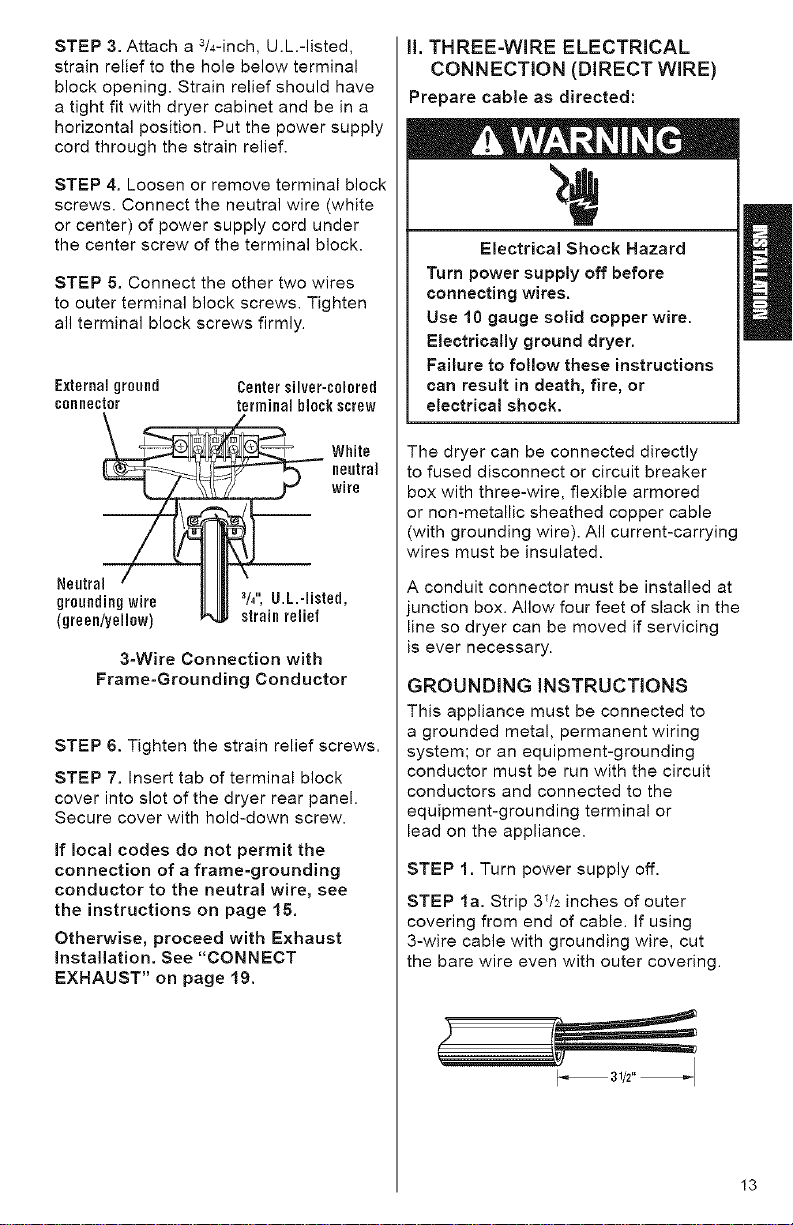
STEP3.Attacha3/4-inch,U.L.-listed,
strainrelieftotheholebelowterminal
blockopening.Strainreliefshouldhave
atightfitwithdryercabinetandbeina
horizontalposition.Putthepowersupply
cordthroughthestrainrelief.
STEP4.Loosenorremoveterminalblock
screws.Connecttheneutralwire(white
orcenter)ofpowersupplycordunder
thecenterscrewoftheterminalblock.
STEP5.Connecttheothertwowires
toouterterminalblockscrews.Tighten
allterminalblockscrewsfirmly.
Externalground
connector
Neutral_
Center silver-colored
terminal block screw
_ White
-- _.'-) neutral
wire
3/4",&L-listed,
strainrelief
3-Wire Connection with
Frame-Grounding Conductor
STEP 6. Tighten the strain relief screws.
STEP 7. Insert tab of terminal block
cover into slot of the dryer rear panel.
Secure cover with hold-down screw.
if local codes do not permit the
connection of a frame-grounding
conductor to the neutral wire, see
the instructions on page 15.
Otherwise, proceed with Exhaust
installation. See "CONNECT
EXHAUST" on page 19.
II. THREE-WIRE ELECTRICAL
CONNECTION (DIRECT WIRE)
Prepare cable as directed:
Electrical Shock Hazard
Turn power supply off before
connecting wires.
Use 10 gauge solid copper wire.
Electrically ground dryer.
Failure to follow these instructions
can result in death, fire, or
electrical shock.
The dryer can be connected directly
to fused disconnect or circuit breaker
box with three-wire, flexible armored
or non-metallic sheathed copper cable
(with grounding wire). All current-carrying
wires must be insulated.
A conduit connector must be installed at
junction box. Allow four feet of slack in the
line so dryer can be moved if servicing
is ever necessary.
GROUNDING INSTRUCTIONS
This appliance must be connected to
a grounded metal, permanent wiring
system; or an equipment-grounding
conductor must be run with the circuit
conductors and connected to the
equipment-grounding terminal or
lead on the appliance.
STEP 1. Turn power supply off.
STEP la. Strip 31/2 inches of outer
covering from end of cable. If using
3-wire cable with grounding wire, cut
the bare wire even with outer covering.
_31/2" I
I3
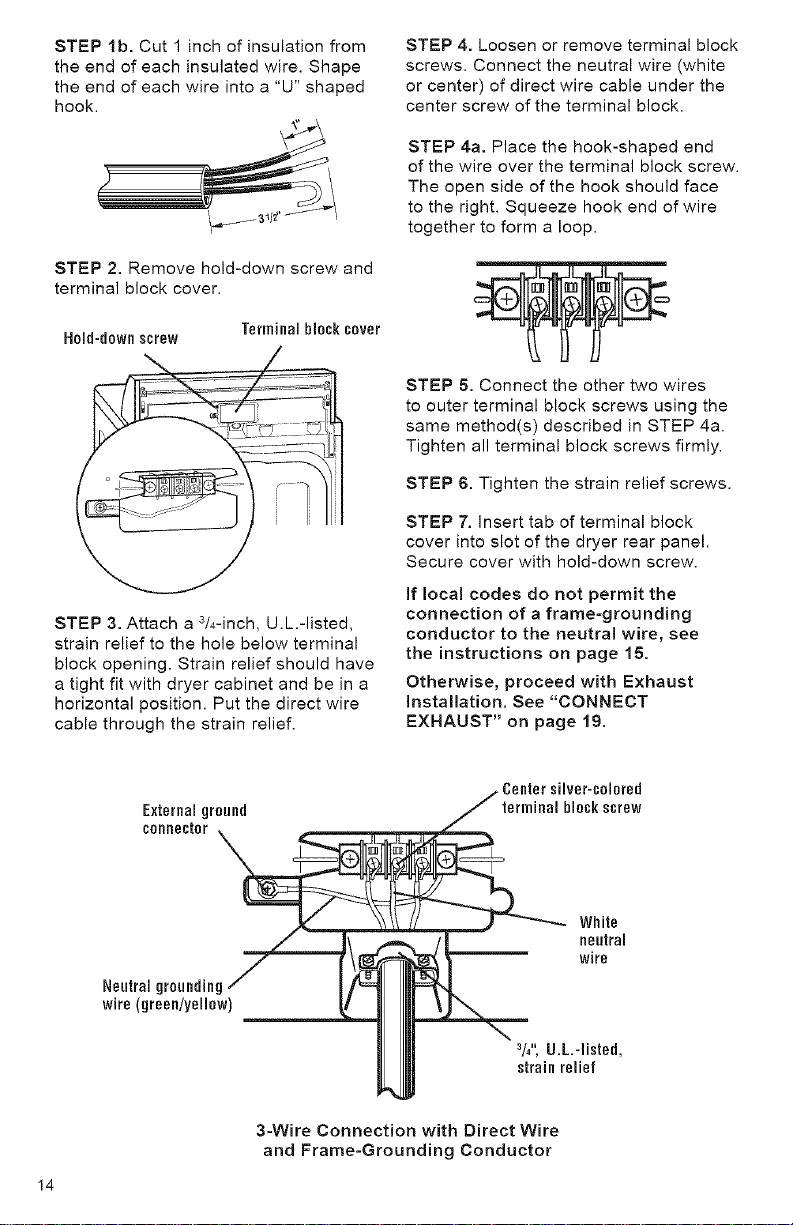
STEPlb.Cut1inchofinsulationfrom
theendofeachinsulatedwire.Shape
theendofeachwireintoa"U"shaped
hook.
J3_/€'
STEP 2, Remove hold-down screw and
terminal block cover.
Terminal block cover
Hold-down screw
STEP 3. Attach a 3/4-inch, U.L.-listed,
strain relief to the hole below terminal
block opening. Strain relief should have
a tight fit with dryer cabinet and be in a
horizontal position. Put the direct wire
cable through the strain relief.
STEP 4. Loosen or remove terminal block
screws. Connect the neutral wire (white
or center) of direct wire cable under the
center screw of the terminal block.
STEP 4a. Place the hook-shaped end
of the wire over the terminal block screw.
The open side of the hook should face
to the right. Squeeze hook end of wire
together to form a loop.
STEP 5. Connect the other two wires
to outer terminal block screws using the
same method(s) described in STEP 4a.
Tighten all terminal block screws firmly.
STEP 6. Tighten the strain relief screws.
STEP 7. Insert tab of terminal block
cover into slot of the dryer rear panel.
Secure cover with hold-down screw.
if local codes do not permit the
connection of a frame-grounding
conductor to the neutral wire, see
the instructions on page 15.
Otherwise, proceed with Exhaust
Installation. See "CONNECT
EXHAUST" on page 19.
Externalground
connector
Centersilver-colored
blockscrew
Neutralgrounding
wire(green/yell0w)
White
neutral
wire
3/4'_U.L.-listed,
strain relief
I4
3-Wire Connection with Direct Wire
and Frame-Grounding Conductor
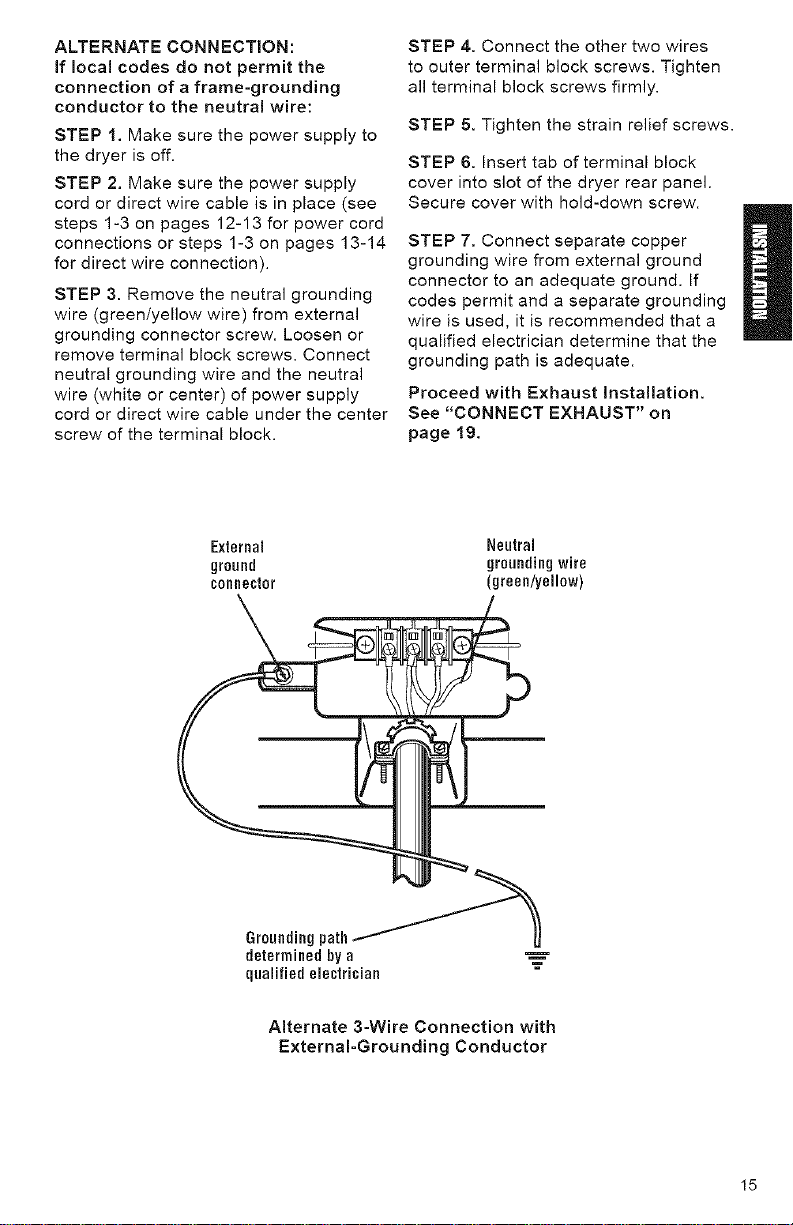
ALTERNATE CONNECTION:
If local codes do not permit the
connection of a frame-grounding
conductor to the neutral wire:
STEP 1. Make sure the power supply to
the dryer is off.
STEP 2. Make sure the power supply
cord or direct wire cable is in place (see
steps 1-3 on pages 12-13 for power cord
connections or steps 1-3 on pages 13-14
for direct wire connection).
STEP 3. Remove the neutral grounding
wire (green/yellow wire) from external
grounding connector screw. Loosen or
remove terminal block screws. Connect
neutral grounding wire and the neutral
wire (white or center) of power supply
cord or direct wire cable under the center
screw of the terminal block.
STEP 4. Connect the other two wires
to outer terminal block screws. Tighten
all terminal block screws firmly.
STEP 5. Tighten the strain relief screws.
STEP 6. Insert tab of terminal block
cover into slot of the dryer rear panel.
Secure cover with hold-down screw.
STEP 7. Connect separate copper
grounding wire from external ground
connector to an adequate ground. If
codes permit and a separate grounding
wire is used, it is recommended that a
qualified electrician determine that the
grounding path is adequate.
Proceed with Exhaust Installation.
See "CONNECT EXHAUST" on
page 19.
External Neutral
ground grounding wire
connector (green/yellow)
Gr0unding path
determined by a
qualified elentrinian
Alternate 3-Wire Connection with
External=Grounding Conductor
I5
Ill. MAKE FOUR-WIRE
ELECTRICAL CONNECTION
TO RECEPTACLE
Use a 4-wire power supply cord:
Electrical Shock Hazard
Turn power supply off before
connecting cord.
Use a new 30-ampere power
supply cord.
Plug into a grounded outlet.
Failure to follow these instructions
can result in death, fire, or
electrical shock.
Local codes may permit the use of
a U.L-listed, 120/240-volt minimum,
30-ampere, dryer power supply cord
kit (pigtail). Power supply cord should
be type SRD or SRDT and be at least
four feet long. The wires that connect
to the dryer must end with ring terminals
or spade terminals with upturned ends.
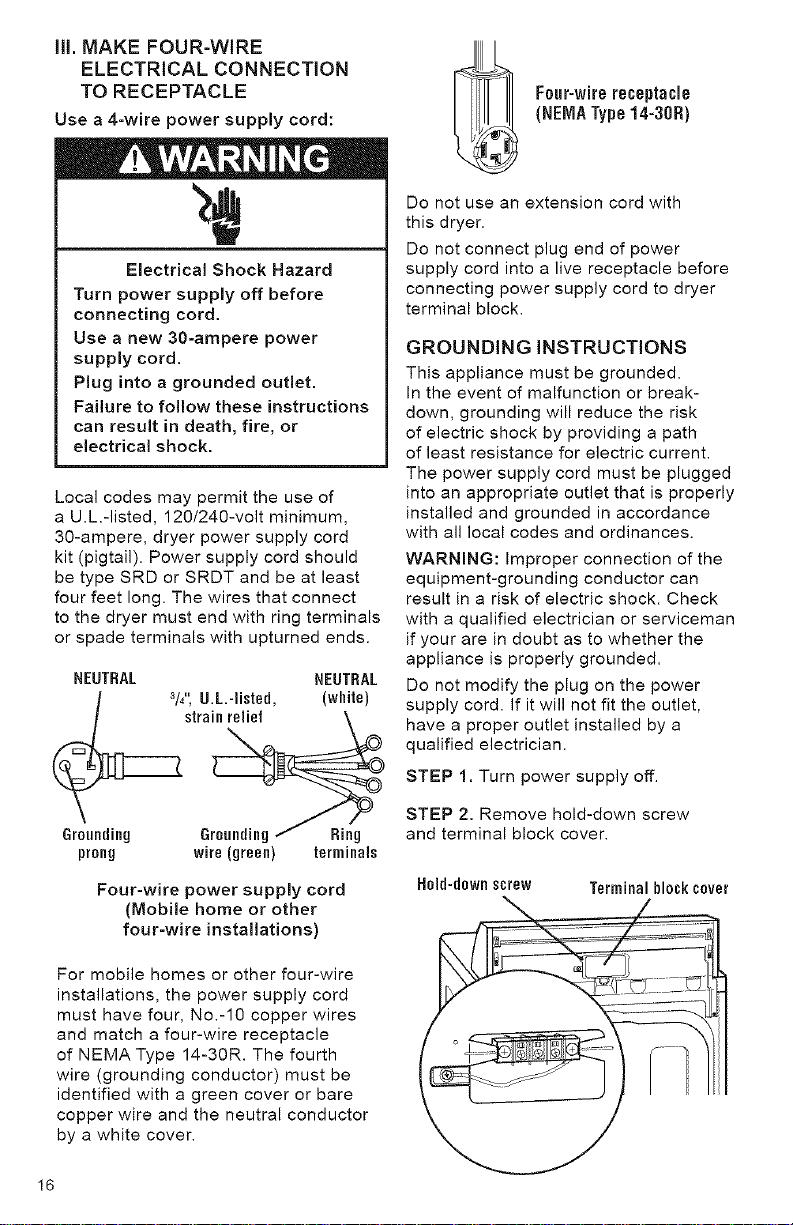
NEUTRAL NEUTRAL
3/4",U.L.-listed, (white)
strainGrelie_
prong wire (green) terminals
Four-wire power supply cord
(Mobile home or other
four-wire installations)
Four-wire receptacle
(NEIMIAType14-30R)
Do not use an extension cord with
this dryer.
Do not connect plug end of power
supply cord into a live receptacle before
connecting power supply cord to dryer
terminal block.
GROUNDING INSTRUCTIONS
This appliance must be grounded.
In the event of malfunction or break-
down, grounding will reduce the risk
of electric shock by providing a path
of least resistance for electric current.
The power supply cord must be plugged
into an appropriate outlet that is properly
installed and grounded in accordance
with all local codes and ordinances.
WARNING: Improper connection of the
equipment-grounding conductor can
result in a risk of electric shock. Check
with a qualified electrician or serviceman
if your are in doubt as to whether the
appliance is properly grounded.
Do not modify the plug on the power
supply cord. If it will not fit the outlet,
have a proper outlet installed by a
qualified electrician.
STEP 1. Turn power supply off.
STEP 2. Remove hold-down screw
and terminal block cover.
Bold-downscrew Terminalblockcover
For mobile homes or other four-wire
installations, the power supply cord
must have four, No.-lg copper wires
and match a four-wire receptacle
of NEMAType 14-30R. The fourth
wire (grounding conductor) must be
identified with a green cover or bare
copper wire and the neutral conductor
by a white cover.
I6
STEP3.Attacha3/4-inch,U.L-listed,
strainrelieftotheholebelowterminal
blockopening.Strainreliefshouldhave
atightfitwithdryercabinetandbeina
horizontalposition.Putthepowersupply
cordthroughthestrainrelief.
STEP4.Removethecenterterminal
blockscrew.Removetheneutralground-
ingwire(green/yellowwire)fromexternal
groundingscrew.
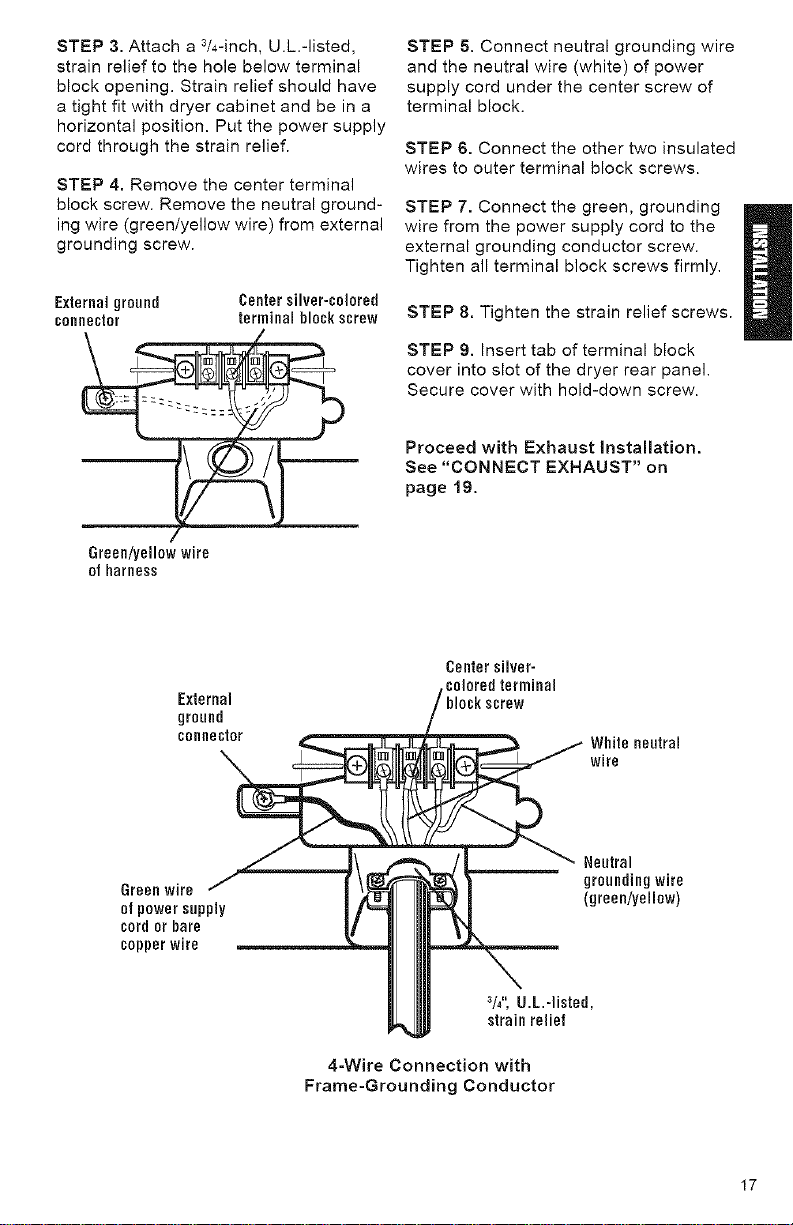
External ground
connector
/
Green/yellow wire
o! harness
Center silver-c01ored
terminal block screw
STEP 5. Connect neutral grounding wire
and the neutral wire (white) of power
supply cord under the center screw of
terminal block.
STEP 6. Connect the other two insulated
wires to outer terminal block screws.
STEP 7. Connect the green, grounding
wire from the power supply cord to the
external grounding conductor screw.
Tighten all terminal block screws firmly.
STEP 8. Tighten the strain relief screws.
STEP 9. Insert tab of terminal block
cover into slot of the dryer rear panel.
Secure cover with hold-down screw.
Proceed with Exhaust Installation.
See "CONNECT EXHAUST" on
page 19.
External
ground
connector
-\,
Centersilver-
coloredterminal
Whiteneutral
wire
Green wire
01power supply
cord or bare
copperwire
Neutral
grounding wire
(green/yellow)
3/4",EL-listed,
strain relief
4=Wire Connection with
Frame-Grounding Conductor
I7
IV. FOUR-WIRE ELECTRICAL
CONNECTION (DIRECT WIRE)
Prepare cable as directed:
Electrical Shock Hazard
Turn power supply off before
connecting wires.
Use 10 gauge solid copper wire.
Electrically ground dryer.
Failure to follow these instructions
can result in death, fire, or electrical
shock.
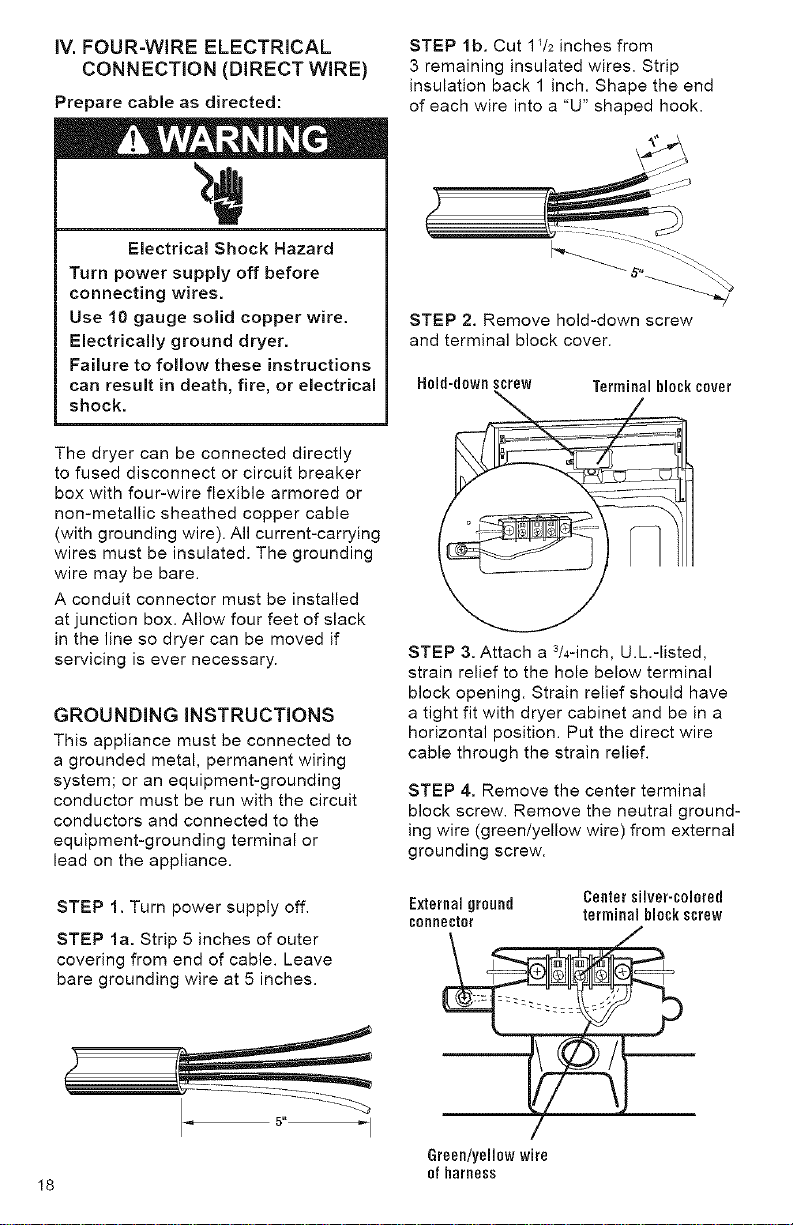
STEP lb. Cut 11/2 inches from
3 remaining insulated wires. Strip
insulation back 1 inch. Shape the end
of each wire into a "U" shaped hook.
STEP 2. Remove hold-down screw
and terminal block cover.
Hold-down screw Terminal block cover
The dryer can be connected directly
to fused disconnect or circuit breaker
box with four-wire flexible armored or
non-metallic sheathed copper cable
(with grounding wire). All current-carrying
wires must be insulated. The grounding
wire may be bare.
A conduit connector must be installed
at junction box. Allow four feet of slack
in the line so dryer can be moved if
servicing is ever necessary.
GROUNDING INSTRUCTIONS
This appliance must be connected to
a grounded metal, permanent wiring
system; or an equipment-grounding
conductor must be run with the circuit
conductors and connected to the
equipment-grounding terminal or
lead on the appliance.
STEP 1. Turn power supply off.
STEP la. Strip 5 inches of outer
covering from end of cable. Leave
bare grounding wire at 5 inches.
I8
STEP 3. Attach a 3/4-inch, U.L.-listed,
strain relief to the hole below terminal
block opening. Strain relief should have
a tight fit with dryer cabinet and be in a
horizontal position. Put the direct wire
cable through the strain relief.
STEP 4. Remove the center terminal
block screw. Remove the neutral ground-
ing wire (green/yellow wire) from external
grounding screw.
External ground Center silver-colored
connector terminal block screw
/
Green/yellow wire
of harness
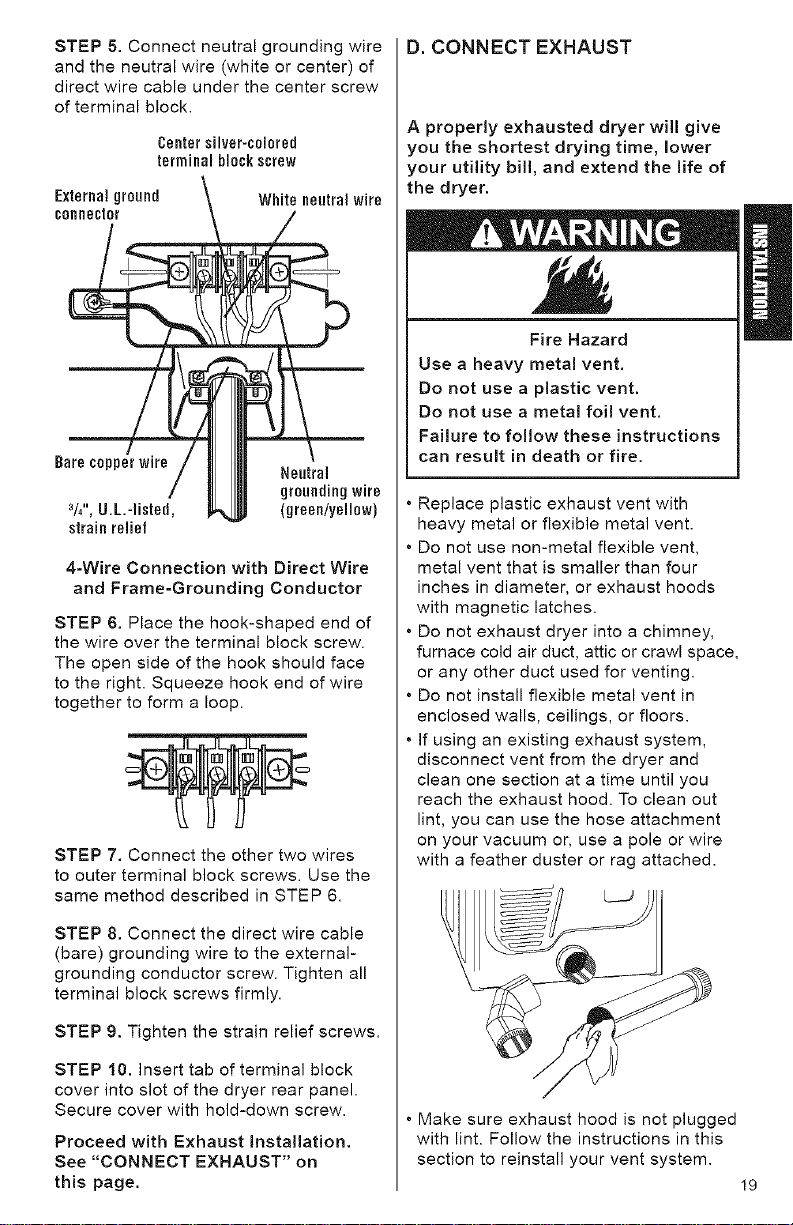
STEP 5. Connect neutral grounding wire
and the neutral wire (white or center) of
direct wire cable under the center screw
of terminal block.
Centersilver-colored
terminal blockscrew
Externalground WNte neutralwire
connector
Bare copper wire
Neutral
grounding wire
3/4",U.L.-listed, (green/yellow)
strain relief
4=Wire Connection with Direct Wire
and Frame-Grounding Conductor
STEP 6. Place the hook-shaped end of
the wire over the terminal block screw.
The open side of the hook should face
to the right. Squeeze hook end of wire
together to form a loop.
STEP 7. Connect the other two wires
to outer terminal block screws. Use the
same method described in STEP 6.
STEP 8. Connect the direct wire cable
(bare) grounding wire to the external-
grounding conductor screw. Tighten all
terminal block screws firmly.
STEP 9. Tighten the strain relief screws.
STEP 10. Insert tab of terminal block
cover into slot of the dryer rear panel.
Secure cover with hold-down screw.
Proceed with Exhaust Installation.
See "CONNECT EXHAUST" on
this page.
D. CONNECTEXHAUST
A properly exhausted dryer will give
you the shortest drying time, lower
your utility bill, and extend the life of
the dryer.
Fire Hazard
Use a heavy metal vent.
Do not use a plastic vent.
Do not use a metal foil vent.
Failure to follow these instructions
can result in death or fire.
Replace plastic exhaust vent with
heavy metal or flexible metal vent.
Do not use non-metal flexible vent,
metal vent that is smaller than four
inches in diameter, or exhaust hoods
with magnetic latches.
Do not exhaust dryer into a chimney,
furnace cold air duct, attic or crawl space,
or any other duct used for venting.
Do not install flexible metal vent in
enclosed walls, ceilings, or floors.
If using an existing exhaust system,
disconnect vent from the dryer and
clean one section at a time until you
reach the exhaust hood. To clean out
lint, you can use the hose attachment
on your vacuum or, use a pole or wire
with a feather duster or rag attached.
Make sure exhaust hood is not plugged
with lint. Follow the instructions in this
section to reinstall your vent system.
I9
ROUTE THE VENT
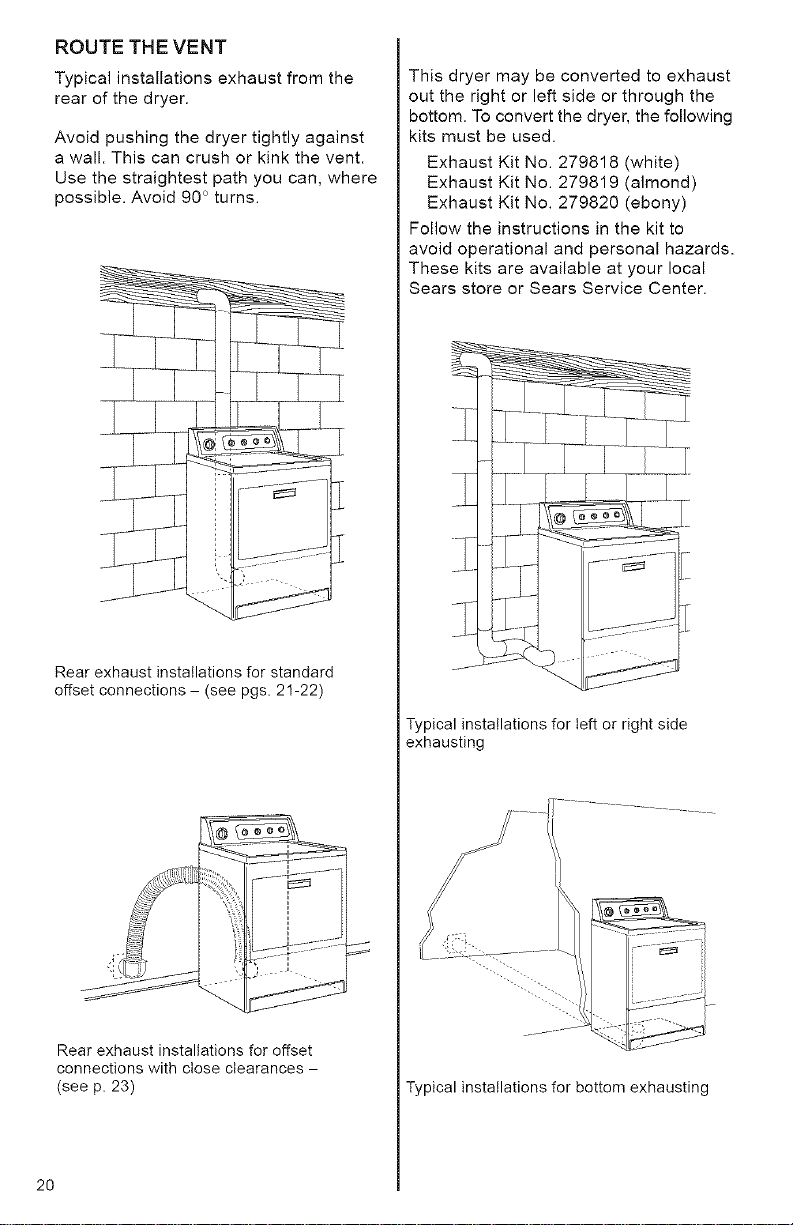
Typical installations exhaust from the
rear of the dryer.
Avoid pushing the dryer tightly against
a wall. This can crush or kink the vent.
Use the straightest path you can, where
possible. Avoid 90 ° turns.
Rear exhaust installations for standard
offset connections - (see pgs. 21-22)
!
I
J
Rear exhaust installations for offset
connections with close clearances -
(see p. 23)
2O
This dryer may be converted to exhaust
out the right or left side or through the
bottom. To convert the dryer, the following
kits must be used.
Exhaust Kit No. 279818 (white)
Exhaust Kit No. 279819 (almond)
Exhaust Kit No. 279820 (ebony)
Follow the instructions in the kit to
avoid operational and personal hazards.
These kits are available at your local
Sears store or Sears Service Center.
Typical installations for left or right side
exhausting
Typical installations for bottom exhausting
DETERMINEVENTLENGTH
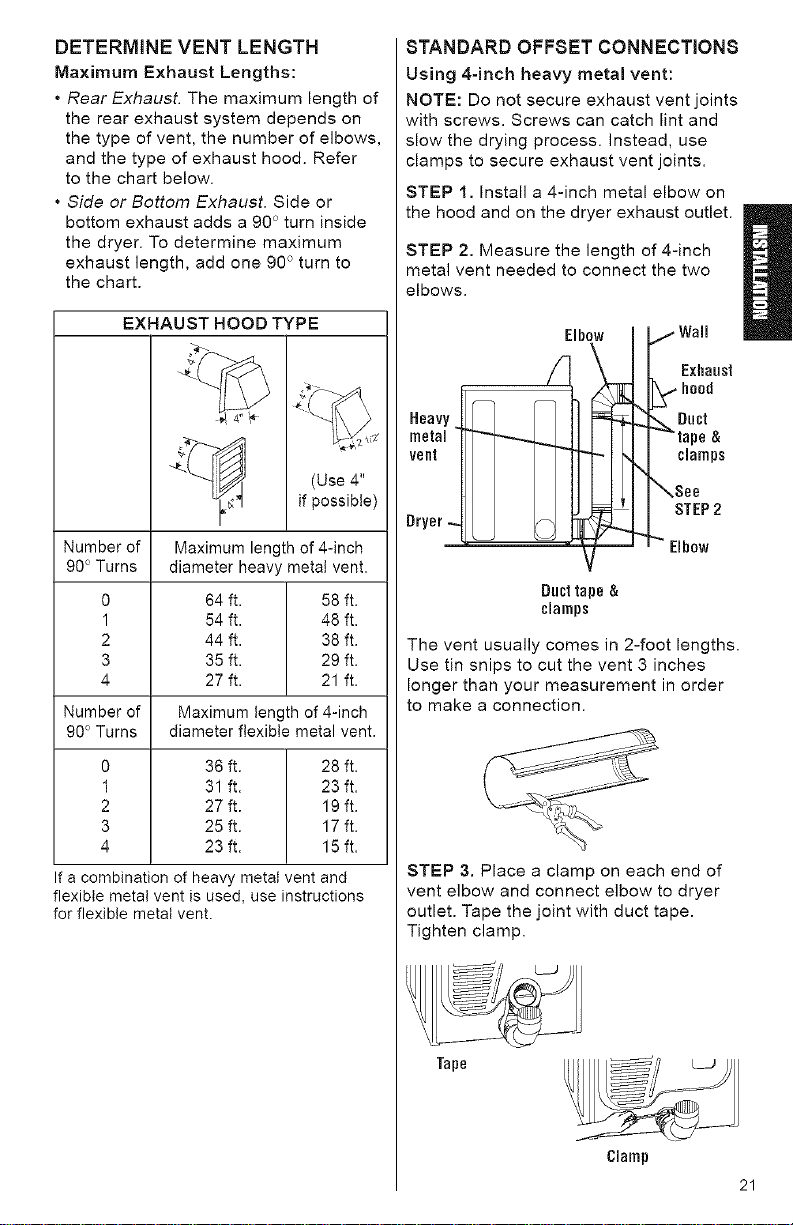
Maximum Exhaust Lengths:
* Rear Exhaust. The maximum length of
the rear exhaust system depends on
the type of vent, the number of elbows,
and the type of exhaust hood. Refer
to the chart below.
* Side or Bottom Exhaust. Side or
bottom exhaust adds a 90 ° turn inside
the dryer. To determine maximum
exhaust length, add one 90 ° turn to
the chart.
EXHAUST HOOD TYPE
(Uae4"
if possible)
Maximum length of 4-inch
diameter heavy metal vent.
64 ft. 58 ft.
54 ft. 48 ft.
44 ft. 38 ft.
35 ft. 29 ft.
27 ft. 21 ft.
Number of
90oTurns
0
1
2
3
4
Number of Maximum length of 4-inch
900 Turns diameter flexible metal vent.
0 36 ft. 28 ft.
1 31 ft. 23 ft.
2 27 ft. 19 ft.
3 25 ft. 17 ft.
4 23 ft. 15 ft.
If a combination of heavy metal vent and
flexible metal vent is used, use instructions
for flexible metal vent.
STANDARD OFFSET CONNECTIONS
Using 4-inch heavy metal vent:
NOTE: Do not secure exhaust vent joints
with screws. Screws can catch lint and
slow the drying process. Instead, use
clamps to secure exhaust vent joints.
STEP 1. Install a 4-inch metal elbow on
the hood and on the dryer exhaust outlet.
STEP 2. Measure the length of 4-inch
metal vent needed to connect the two
elbows.
Elbow j Wall
Exhaust
_t hood
_.Dust
tape&
clamps
NNSee
STEP2
Elbow
Ducttape&
clamps
The vent usually comes in 2-foot lengths.
Use tin snips to cut the vent 3 inches
longer than your measurement in order
to make a connection.
STEP 3. Place a clamp on each end of
vent elbow and connect elbow to dryer
outlet. Tape the joint with duct tape.
Tighten clamp.
Tape
Clamp
21
STEP4.Connectheavymetalventto
elbow.Tapethejointwithducttape.
Tightenclamp.
STEP5.Installoneend of elbow on
heavy metal vent, the other end to the
exhaust hood. Tape joints and tighten
clamps.
Finish Installation. See "REVIEW
INSTALLATION" on page 24.
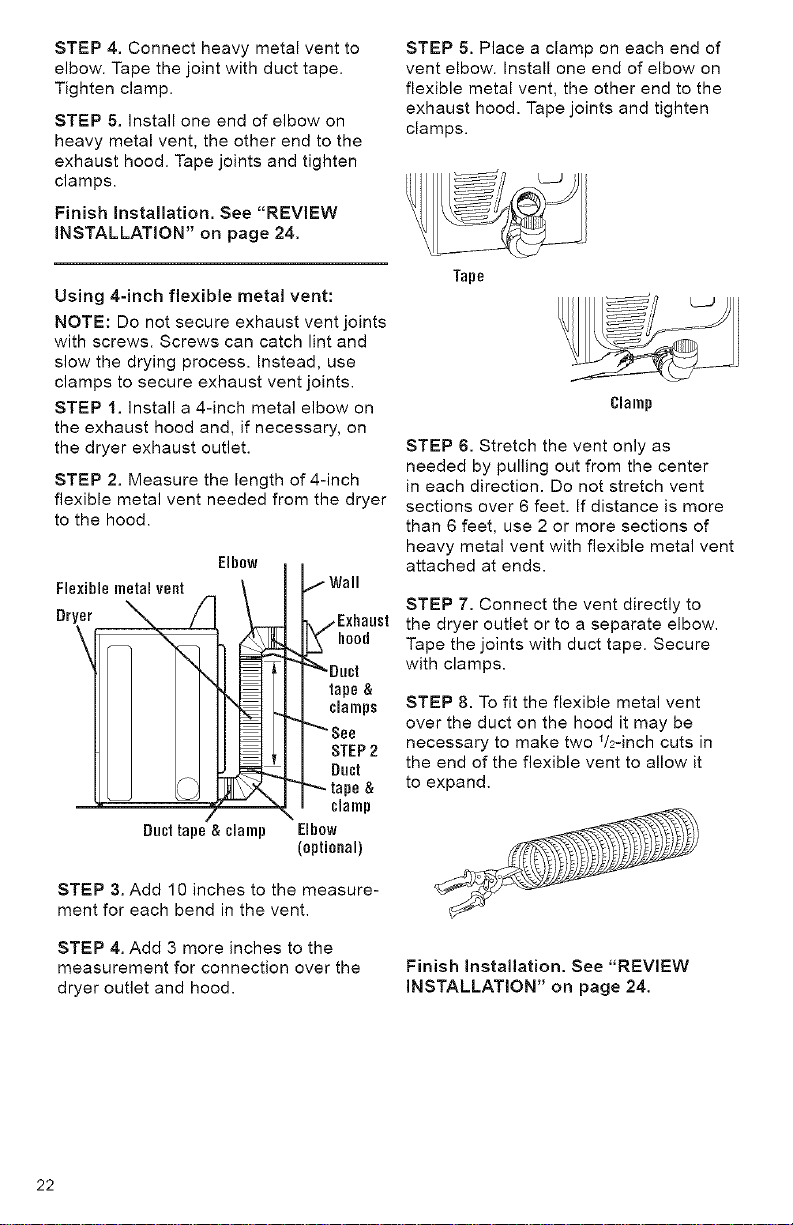
STEP 5. Place a clamp on each end of
vent elbow. Install one end of elbow on
flexible metal vent, the other end to the
exhaust hood. Tape joints and tighten
clamps.
Using 4=inch flexible metal vent:
NOTE: Do not secure exhaust vent joints
with screws. Screws can catch lint and
slow the drying process. Instead, use
clamps to secure exhaust vent joints.
STEP 1. Install a 4-inch metal elbow on
the exhaust hood and, if necessary, on
the dryer exhaust outlet.
STEP 2. Measure the length of 4-inch
flexible metal vent needed from the dryer
to the hood.
Elbow
Fle:dble metal vent
Dryer
\
Duct tape & clamp
,._Wall
_/Exhaust
hood
"_ _'Duct
tape &
clamps
_'_ See
STEP2
Duct
tape &
clamp
Elbow
(optional)
STEP 3. Add 10 inches to the measure-
ment for each bend in the vent.
STEP 4. Add 3 more inches to the
measurement for connection over the
dryer outlet and hood.
Tape
Clamp
STEP 6. Stretch the vent only as
needed by pulling out from the center
in each direction. Do not stretch vent
sections over 6 feet. If distance is more
than 6 feet, use 2 or more sections of
heavy metal vent with flexible metal vent
attached at ends.
STEP 7. Connect the vent directly to
the dryer outlet or to a separate elbow.
Tape the joints with duct tape. Secure
with clamps.
STEP 8. To fit the flexible metal vent
over the duct on the hood it may be
necessary to make two 1/2-inch cuts in
the end of the flexible vent to allow it
to expand.
Finish installation. See "REVIEW
iNSTALLATION" on page 24.
22
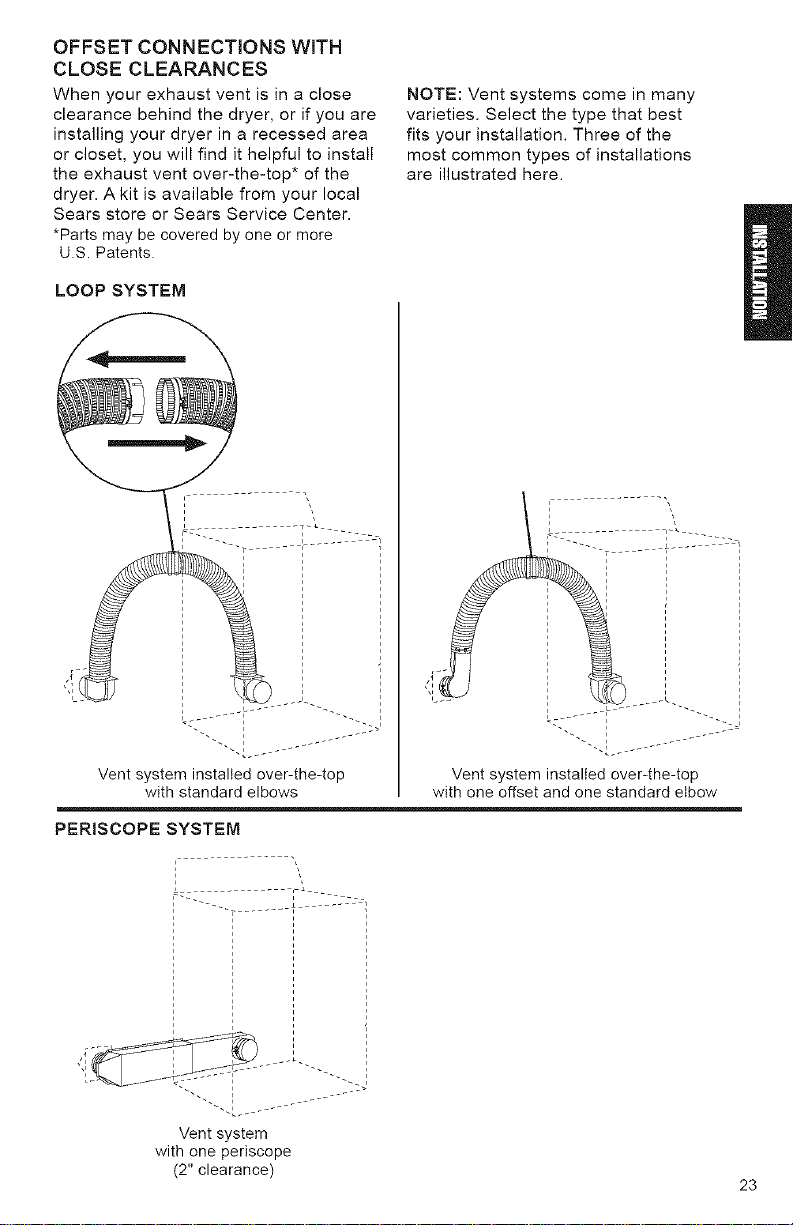
OFFSET CONNECTIONS WITH
CLOSE CLEARANCES
When your exhaust vent is in a close
clearance behind the dryer, or if you are
installing your dryer in a recessed area
or closet, you will find it helpful to install
the exhaust vent over-the-top* of the
dryer. A kit is available from your local
Sears store or Sears Service Center.
*Parts may be covered by one or more
U.S. Patents.
LOOP SYSTEM
NOTE: Vent systems come in many
varieties. Select the type that best
fits your installation. Three of the
most common types of installations
are illustrated here.
Vent system installed over-the-top
with standard elbows
Vent system installed over-the-top
with one offset and one standard elbow
PERISCOPE SYSTEM
Vent system
with one periscope
(2" clearance)
23
REVIEW INSTALLATION
Take a few minutes to complete
this checklist. It will help assure you
that you have a proper installation
and increase your satisfaction with
your Kenmore dryer.
[] Check that all parts you removed
from the parts packages are now
installed.
[] Ensure that dryer is positioned in
its final location. Make sure vent is
not crushed or kinked.
[] Ensure that dryer is level by placing
a level on top of the dryer, first side-
to-side; then front-to-back. If dryer is
not level, adjust the legs up or down.
[] Check to make sure you have all
the tools you started with.
FINAL STEPS
[] Plug the power supply cord into the
grounded outlet or connect direct
wire to power supply.
[] Turn power supply on.
[] Wipe the interior of the drum
thoroughly with a damp cloth to
remove any dust.
[] Remove the blue protective film on
the console and any tape remaining
on dryer.
[] Read the rest of this manual to fully
understand your new dryer. Start the
dryer and allow it to complete a full
heat cycle (not the air cycle). You
may notice a burning odor. This smell
is common when the heating element
is first used. The smell will go away.
After five minutes, open dryer door.
You should feel heat inside the dryer.
If you do not feel heat, see Trouble-
shooting information on pages 38-39.
24
STARTING YOUR DRYER
Explosion Hazard
Keep flammable materials and
vapors, such as gasoline, away
from dryer.
Do not dry anything that has ever
had anything flammable on it (even
after washing),
Failure to follow these instructions
can result in death, explosion,
or fire.
Fire Hazard
No washer can completely
remove oil,
Do not dry anything that has ever
had any type of oil on it (including
cooking oils).
items containing foam, rubber,
or plastic must be dried on a
clothesline or by using an Air Cycle.
Failure to follow these instructions
can resutt in death or fire,
To get the best drying results, you must
operate your dryer properly. This section
gives you this important information.
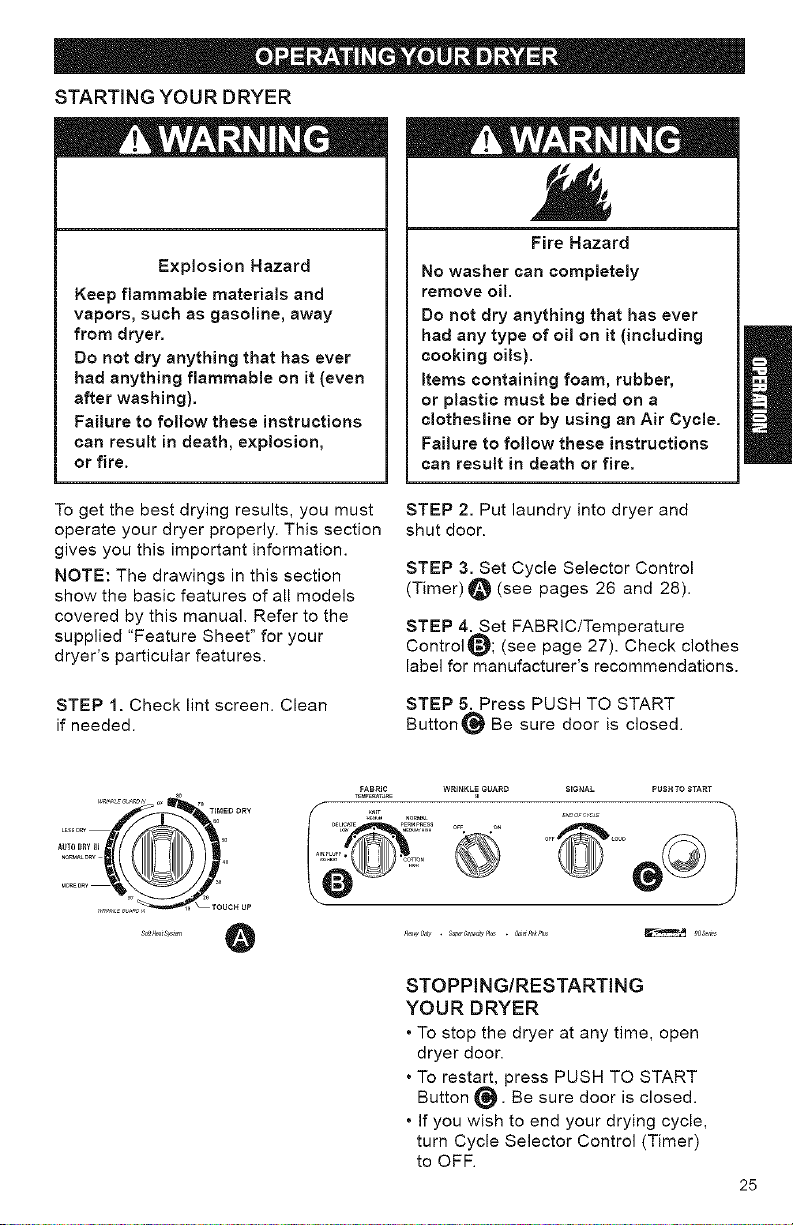
NOTE: The drawings in this section
show the basic features of all models
covered by this manual. Refer to the
supplied "Feature Sheet" for your
dryer's particular features.
STEP 2. Put laundry into dryer and
shut door.
STEP 3. Set Cycle Selector Control
(Timer) O (see pages 26 and 28).
STEP 4. Set FABRIC/Temperature
ControlO; (see page 27). Check clothes
label for manufacturer's recommendations.
STEP 1. Check lint screen. Clean
if needed.
STEP 5. Press PUSH TO START
Button_ Be sure door is closed.
_,,_s _ ,,,¸ _0
7o TIMEDDRY
AUTODRYIll _0
FABRIC WRINKLEOUARD SEGNAL PUS_tTO START
J
STOPPING/RESTARTING
YOUR DRYER
• To stop the dryer at any time, open
dryer door.
• To restart, press PUSH TO START
Button _. Be sure door is closed.
• If you wish to end your drying cycle,
turn Cycle Selector Control (Timer)
to OFF.
25
CYCLE DESCRIPTION
The AUTO DRY Cycle saves you time
by providing the best drying results
in the shortest time. This can help
you save money on utility bills and
reduce the risk of fabric damage,
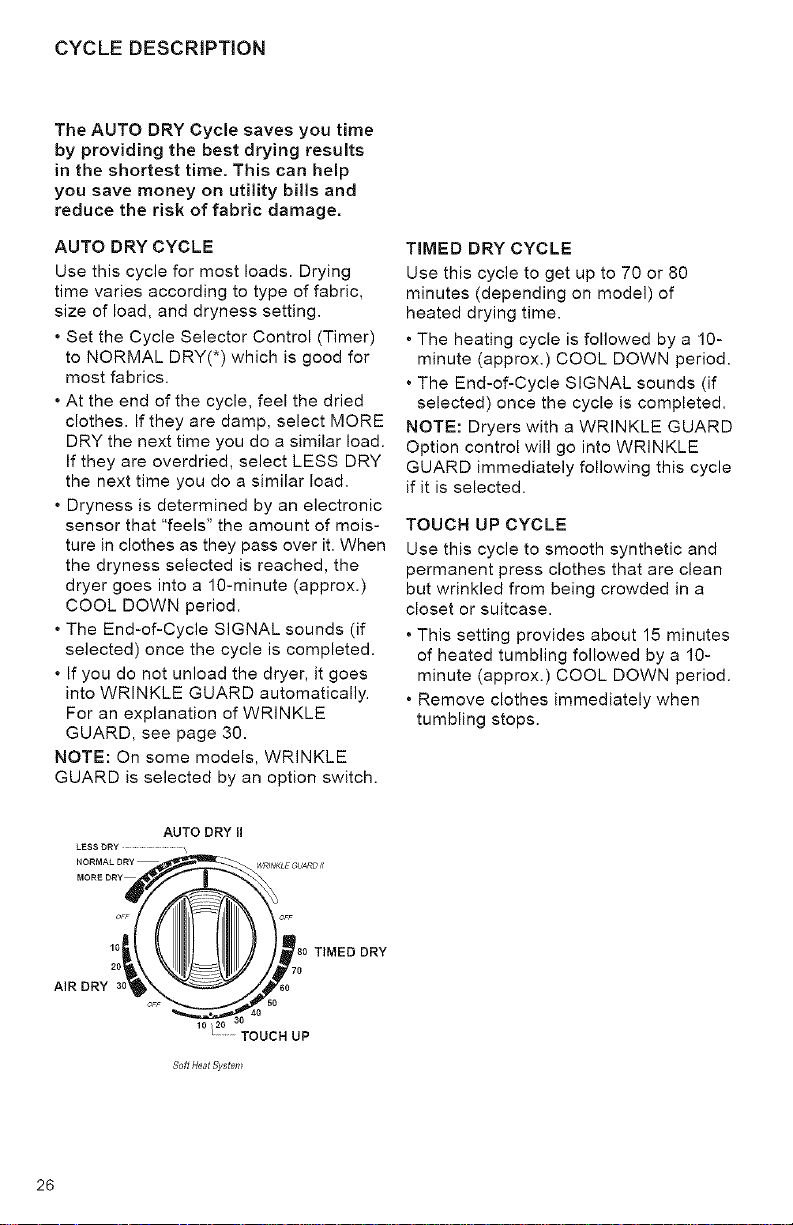
AUTO DRY CYCLE
Use this cycle for most loads. Drying
time varies according to type of fabric,
size of load, and dryness setting.
• Set the Cycle Selector Control (Timer)
to NORMAL DRY(*) which is good for
most fabrics.
• At the end of the cycle, feel the dried
clothes. If they are damp, select MORE
DRY the next time you do a similar load.
If they are overdried, select LESS DRY
the next time you do a similar load.
• Dryness is determined by an electronic
sensor that "feels" the amount of mois-
ture in clothes as they pass over it. When
the dryness selected is reached, the
dryer goes into a 10-minute (approx.)
COOL DOWN period.
• The End-of-Cycle SIGNAL sounds (if
selected) once the cycle is completed.
• If you do not unload the dryer, it goes
into WRINKLE GUARD automatically.
For an explanation of WRINKLE
GUARD, see page 30.
NOTE: On some models, WRINKLE
GUARD is selected by an option switch.
TIMED DRY CYCLE
Use this cycle to get up to 70 or 80
minutes (depending on model) of
heated drying time.
• The heating cycle is followed by a 10-
minute (approx.) COOL DOWN period.
• The End-of-Cycle SIGNAL sounds (if
selected) once the cycle is completed.
NOTE: Dryers with a WRINKLE GUARD
Option control will go into WRINKLE
GUARD immediately following this cycle
if it is selected.
TOUCH UP CYCLE
Use this cycle to smooth synthetic and
permanent press clothes that are clean
but wrinkled from being crowded in a
closet or suitcase.
• This setting provides about 15 minutes
of heated tumbling followed by a 10-
minute (approx.) COOL DOWN period.
• Remove clothes immediately when
tumbling stops.
AUTO DRYII
LESS DRY .......................... \
OFF OFF
120o 2° T'MED DRY
AIRDRY 3o_,_ "_--_J _1,8V6o
10 20 30
TOUCH UP
SoftHeatSystem
26
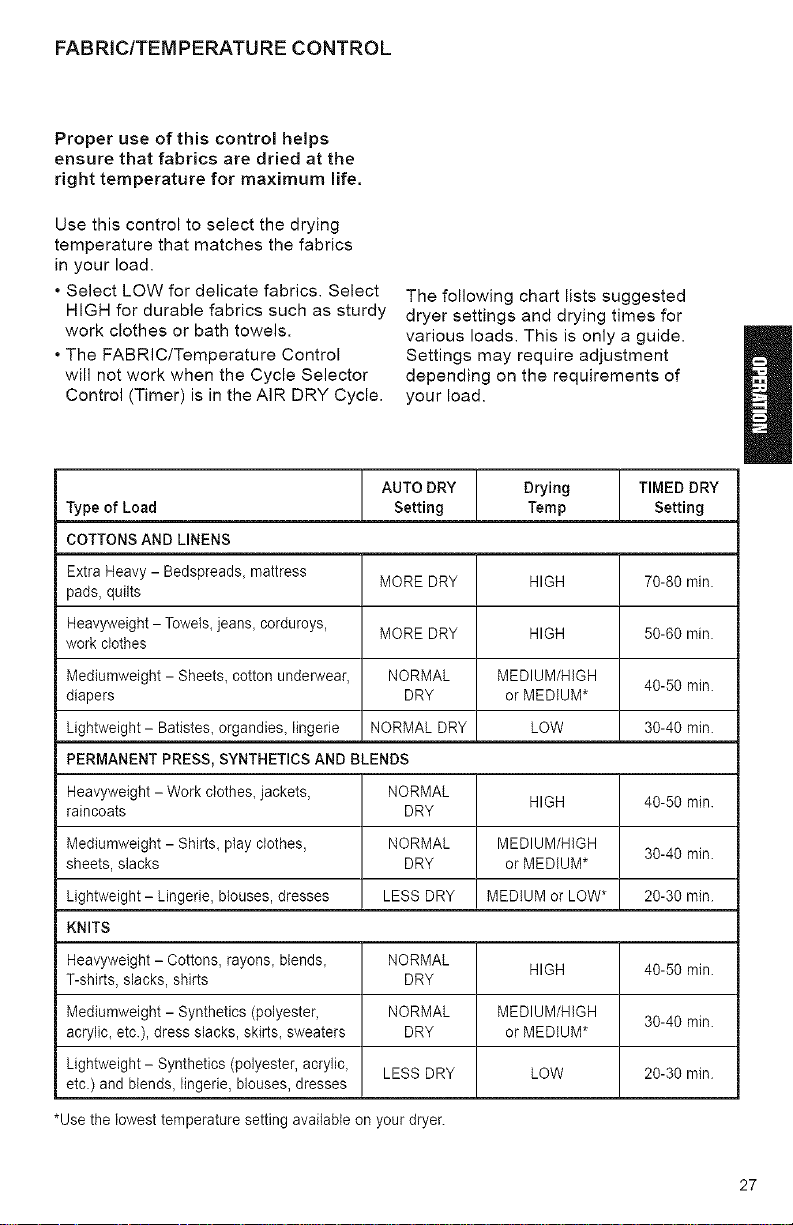
FABRIC/TEMPERATURE CONTROL
Proper use of this control helps
ensure that fabrics are dried at the
right temperature for maximum life,
Use this control to select the drying
temperature that matches the fabrics
in your load.
• Select LOW for delicate fabrics. Select
HIGH for durable fabrics such as sturdy
work clothes or bath towels.
• The FABRIC/Temperature Control
will not work when the Cycle Selector
Control (Timer) is in the AIR DRY Cycle.
The following chart lists suggested
dryer settings and drying times for
various loads. This is only a guide.
Settings may require adjustment
depending on the requirements of
your load.
AUTO DRY Drying TIMED DRY
Type of Load Setting Temp Setting
COTTONS AND LINENS
Extra Heavy - Bedspreads, mattress
MORE DRY HIGH 70-80 rain.
pads, quilts
Heavyweight -Towels, jeans, corduroys, MORE DRY HIGH 50-60 min.
work clothes
Mediumweight - Sheets, cotton underwear, NORMAL MEDIUM/HIGH
40-50 rain.
diapers DRY or MEDIUM*
Lightweight - Batistes, organdies, lingerie NORMAL DRY LOW 30-40 rain.
PERMANENT PRESS, SYNTHETICS AND BLENDS
Heavyweight - Work clothes, jackets, NORMAL
HIGH 40-50 rain.
raincoats DRY
Mediumweight - Shirts, play clothes, NORMAL MEDIUM/HIGH
30-40 rain.
sheets, slacks DRY or MEDIUM*
Lightweight - Lingerie, blouses, dresses LESS DRY MEDIUM or LOW* 20-30 min.
KNITS
Heavyweight - Cottons, rayons, blends, NORMAL
HIGH 40-50 rain.
T-shirts, slacks, shirts DRY
Mediumweight - Synthetics (polyester, NORMAL MEDIUM/HIGH
30-40 rain.
acrylic, etc.), dress slacks, skirts, sweaters DRY or MEDIUM*
Lightweight - Synthetics (polyester, acrylic, LESS DRY LOW 20-30 min.
etc.) and blends, lingerie, blouses, dresses
*Use the lowest temperature setting available on your dryer.
27
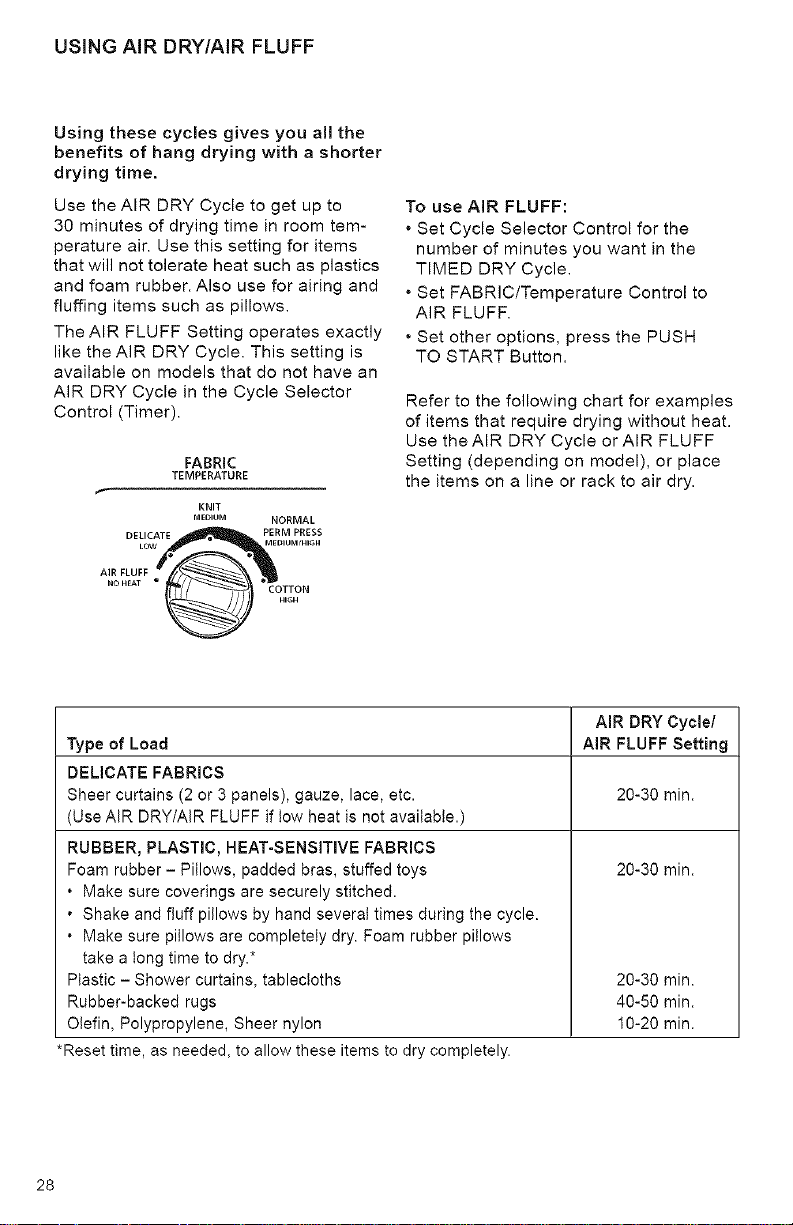
USING AiR DRY/AIR FLUFF
Using these cycles gives you all the
benefits of hang drying with a shorter
drying time.
Use the AIR DRY Cycle to get up to
30 minutes of drying time in room tem-
perature air. Use this setting for items
that will not tolerate heat such as plastics
and foam rubber. Also use for airing and
fluffing items such as pillows.
The AIR FLUFF Setting operates exactly
like the AIR DRY Cycle. This setting is
available on models that do not have an
AIR DRY Cycle in the Cycle Selector
Control (Timer).
FABRIC
TEMPERATURE
KNIT
MEdiUM NORMAL
DELICATE PERM PRESS
LOW
AIR FLUFF
NO HEAT ° i COTTON
I
To use AIR FLUFF:
* Set Cycle Selector Control for the
number of minutes you want in the
TIMED DRY Cycle.
* Set FABRIC/Temperature Control to
AIR FLUFF.
* Set other options, press the PUSH
TO START Button.
Refer to the following chart for examples
of items that require drying without heat.
Use theAIR DRY Cycle orAIR FLUFF
Setting (depending on model), or place
the items on a line or rack to air dry.
Type of Load
DELICATE FABRICS
Sheer curtains (2 or 3 panels), gauze, lace, etc.
(Use AIR DRY/AIR FLUFF if tow heat is not available.)
RUBBER, PLASTIC, HEAT-SENSITIVE FABRICS
Foam rubber - Pillows, padded bras, stuffed toys
• Make sure coverings are securely stitched.
• Shake and fluff pillows by hand several times during the cycle.
• Make sure pillows are completely dry. Foam rubber pillows
take a tong time to dry.*
Plastic - Shower curtains, tablecloths
Rubber-backed rugs
Otefin, Polypropylene, Sheer nylon
•Reset time, as needed, to allow these items to dry completely.
AIR DRY Cycle/
AIR FLUFF Setting
20-30 min.
20-30 rain.
20-30 rain.
40-50 rain.
10-20 rain.
28
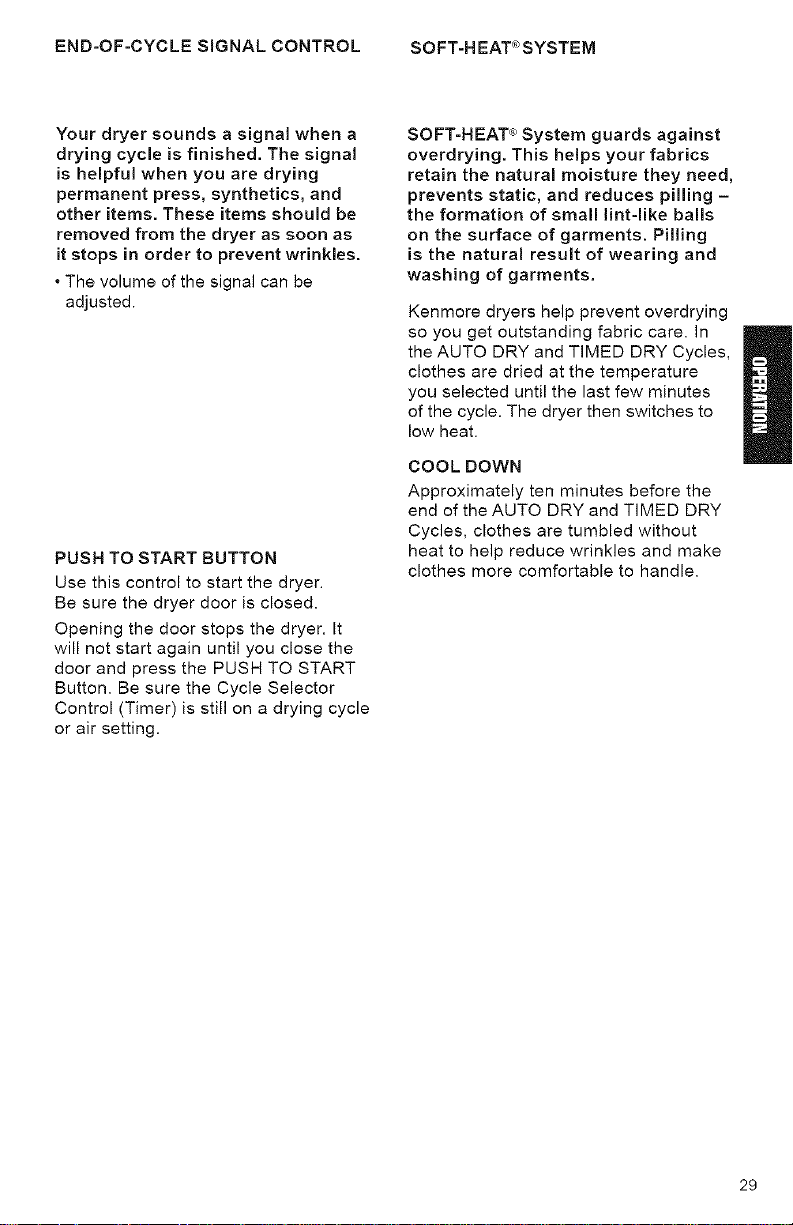
END-OF-CYCLESIGNAL CONTROL SOFT-HEAT_SYSTEM
Your dryer sounds a signal when a
drying cycle is finished. The signal
is helpful when you are drying
permanent press, synthetics, and
other items. These items should be
removed from the dryer as soon as
it stops in order to prevent wrinkles.
• The volume of the signal can be
adjusted.
PUSH TO START BUTTON
Use this control to start the dryer.
Be sure the dryer door is closed.
Opening the door stops the dryer. It
will not start again until you close the
door and press the PUSH TO START
Button. Be sure the Cycle Selector
Control (Timer) is still on a drying cycle
or air setting.
SOFT-NEAT ®System guards against
overdrying. This helps your fabrics
retain the natural moisture they need,
prevents static, and reduces pilling -
the formation of small lint-like balls
on the surface of garments. Pilling
is the natural result of wearing and
washing of garments.
Kenmore dryers help prevent overdrying
so you get outstanding fabric care. In
the AUTO DRY and TIMED DRY Cycles,
clothes are dried at the temperature
you selected until the last few minutes
of the cycle. The dryer then switches to
low heat.
COOL DOWN
Approximately ten minutes before the
end of the AUTO DRY and TIMED DRY
Cycles, clothes are tumbled without
heat to help reduce wrinkles and make
clothes more comfortable to handle.
29
USING WRINKLE GUARD LiNT ALERT
WRINKLE GUARD helps keep your
permanent press items wrinkle free
when you don't unload the dryer
promptly at the end of the AUTO DRY
Cycle.
if you do not open the door at the end
of the AUTO DRY Cycle, WRINKLE
GUARD will tumble the clothes without
heat for about 15 seconds every 5 minutes.
• On dryers with WRINKLE GUARD II,
periodic tumbling will continue for
about 40 minutes unless you open the
dryer door.
• On dryers with WRINKLE GUARD Ill,
periodic tumbling will continue for
about 21/: hours unless you open the
dryer door.
• WRINKLE GUARD III has a select-
able ON/OFF option. When WRINKLE
GUARD III is set at OFF, the dryer
stops after COOL DOWN and may be
unloaded.
The End-of-Cycle SIGNAL will sound
after each period of tumbling, unless it
is off.
A properly cleaned lint screen will
allow your dryer to operate at peak
efficiency. This can reduce your utility
bills and extend the life of your dryer.
Clean the lint screen before each load.
If you do not, your dryer may not operate
properly. On some models, a continuous
whistle (lint alert) will sound if too much
lint is allowed to accumulate on the lint
screen. When this happens, remove the
lint screen, clean, and replace. When
the dryer is restarted, the sound will
stop.
3O
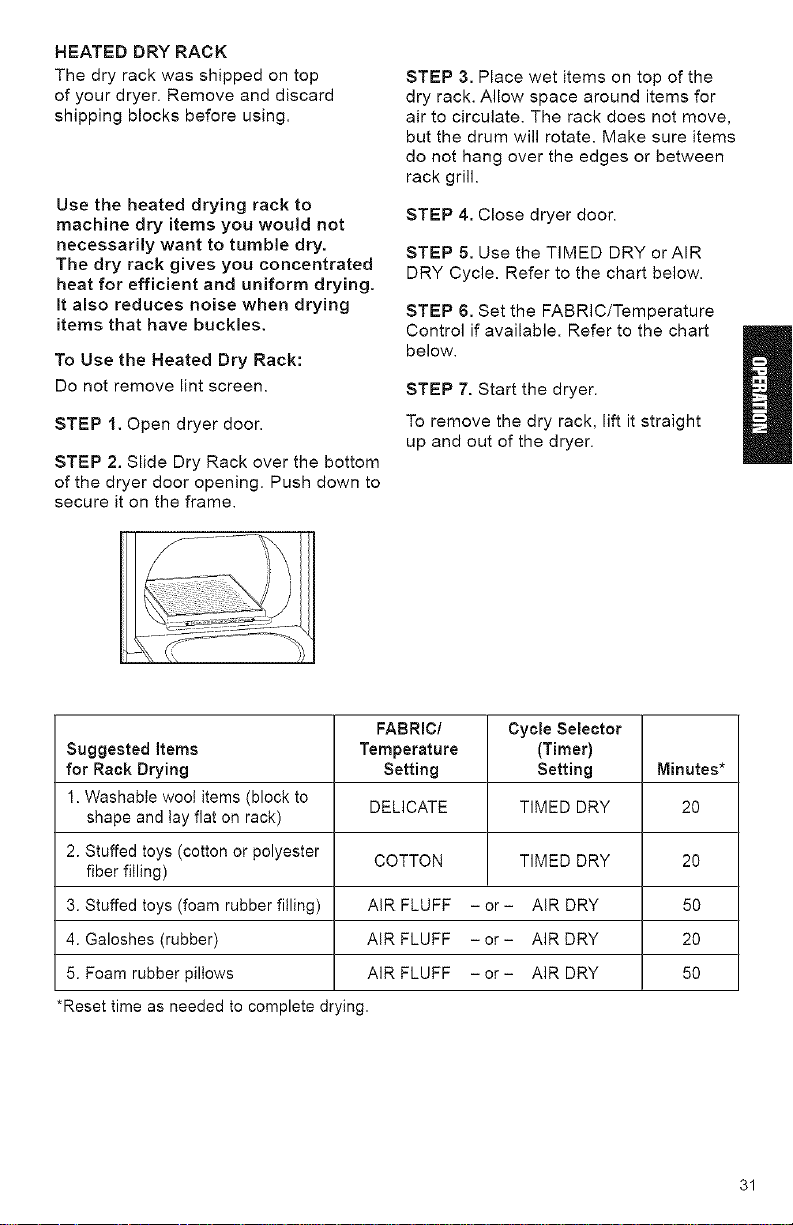
HEATED DRY RACK
The dry rack was shipped on top
of your dryer. Remove and discard
shipping blocks before using.
Use the heated drying rack to
machine dry items you would not
necessarily want to tumble dry.
The dry rack gives you concentrated
heat for efficient and uniform drying.
It also reduces noise when drying
items that have buckles.
To Use the Heated Dry Rack:
Do not remove lint screen.
STEP 1. Open dryer door.
STEP 2. Slide Dry Rack over the bottom
of the dryer door opening. Push down to
secure it on the frame.
STEP 3. Place wet items on top of the
dry rack. Allow space around items for
air to circulate. The rack does not move,
but the drum will rotate. Make sure items
do not hang over the edges or between
rack grill.
STEP 4. Close dryer door.
STEP 5. Use the TIMED DRY orAIR
DRY Cycle. Refer to the chart below.
STEP 6. Set the FABRIC/Temperature
Control if available. Refer to the chart
below.
STEP 7. Start the dryer.
To remove the dry rack, lift it straight
up and out of the dryer.
FABRIC/ Cycle Selector
Suggested items Temperature (Timer)
for Rack Drying Setting Setting Minutes*
1. Washable wool items (block to DELICATE TIMED DRY 20
shape and lay flat on rack)
2. Stuffed toys (cotton or polyester COTTON TIMED DRY 20
fiber filling)
3. Stuffed toys (foam rubber filling) AIR FLUFF - or- AIR DRY 50
4. Galoshes (rubber) AIR FLUFF - or- AIR DRY 20
5. Foam rubber pillows AIR FLUFF - or- AIR DRY 50
*Reset time as needed to complete drying.
31
Followtheserecommendationsto
helpsaveonutilitybillsandprolong
the life of your garments.
PREPARING CLOTHES
FOR DRYING
• Refer to your Washer Owner's Manual
for proper washing techniques and
additional laundry tips.
• See page 4 of this book for Important
Safety Instructions.
SORTING CLOTHES
• Separate dark colors from light colors;
colorfast from non-colorfast. Items
properly sorted by color for washing
are usually properly sorted for drying.
• Separate heavy fabrics (denim,
towels) from light fabrics (synthetics,
permanent press).
• Separate lint givers (towels, chenille)
from lint takers (corduroy, synthetics,
permanent press). When possible,
turn lint takers inside out.
CHOOSING LOAD SIZES
• Mix large items with smaller items.
Load the dryer by the amount of space
items take up, not by their weight. Do
not overload the dryer. Overcrowding
causes uneven drying and wrinkling,
and can cause items to wear out faster
(because of pilling).
• You may need to rearrange large items
(sheets, blankets, tablecloths) during a
cycle to reduce bailing or rolling up.
• For better tumbling action, when drying
only a few small items, add one or two
lint-free towels. This also prevents
small lightweight items from blocking
airflow.
SUPER CAPACITY PLUS DRYERS
Heavy Work
Clothes
4 jeans
4 workpants
4 workshirts
2 sweatshirts
2 sweatpants
Towels Mixed Load
10 bath towels 3 sheets
10 hand towels (1 king, 2 twin)
14 wash cloths 4 pillowcases
3 shirts
3 blouses
9 T-shirts
9 shorts
10 handkerchiefs
32
DRYING TIPS
• Close zippers, snaps, and hooks to
avoid snagging other items. Remove
heat-sensitive trim that can be damaged
by drying. Tie strings and sashes so
they will not tangle.
• Check garments for spots and stains
left after washing. Do not tumble these
items. Heat may permanently set stains.
• Check pockets before drying. Sharp or
metal objects can damage your dryer.
Do not lay these objects on your dryer,
they can damage the finish. Turn
pockets of heavy garments inside out
for even drying.
• Place small items such as baby socks
or hankies in laundry bag for easier
removal.
• Articles to be ironed should be
removed while still damp.
USING DRYER
FABRIC SOFTENERS
Dryer fabric softeners are recommended
for reducing static cling. Always follow
package instructions carefully.
• Put one fabric softener sheet on top
of the load before starting the dryer.
Do not add a fabric softener sheet after
the drying cycle has started. Instant
heat can cause the fabric softener to
spot fabrics.
• Remove fabric softener stains by wet-
ting the stains and rubbing them with
liquid detergent or bar soap and rewash.
• Some fabric softeners can clog the lint
screen and slow drying. Use fabric soft-
eners labeled as dryer safe.
SAVING ENERGY
• Use the AUTO DRY Cycle to dry
most loads.
• Dry full loads only. Do not overdry.
• Avoid overloading dryer, adding wet
items to a partly dried load, or opening
the door unnecessarily.
• Shorten drying times by exhausting
dryer properly and cleaning exhaust
vent and outside exhaust hood as
needed.
• Keep the lint screen clean.
• Use dryer where room air temperature
is above 45°F.
• Sort loads by fabric weight and type.
33
This section explains how to care for
your dryer properly and safely.
Proper care of your dryer can extend
its life and help you avoid costly
service calls.
EXTERIOR
Use a soft, damp cloth to clean the
cabinet and console. Avoid using harsh
abrasives. Do not put sharp metal
objects on or in your dryer. They can
damage the finish.
INTERIOR
Explosion Hazard
Use nonflammable cleaners.
Failure to do so can result in death,
explosion, or fire.
CLEANING YOUR DRYER
Garments that contain unstable dyes,
such as denim blue jeans or brightly
colored cotton items, may discolor the
drum interior.
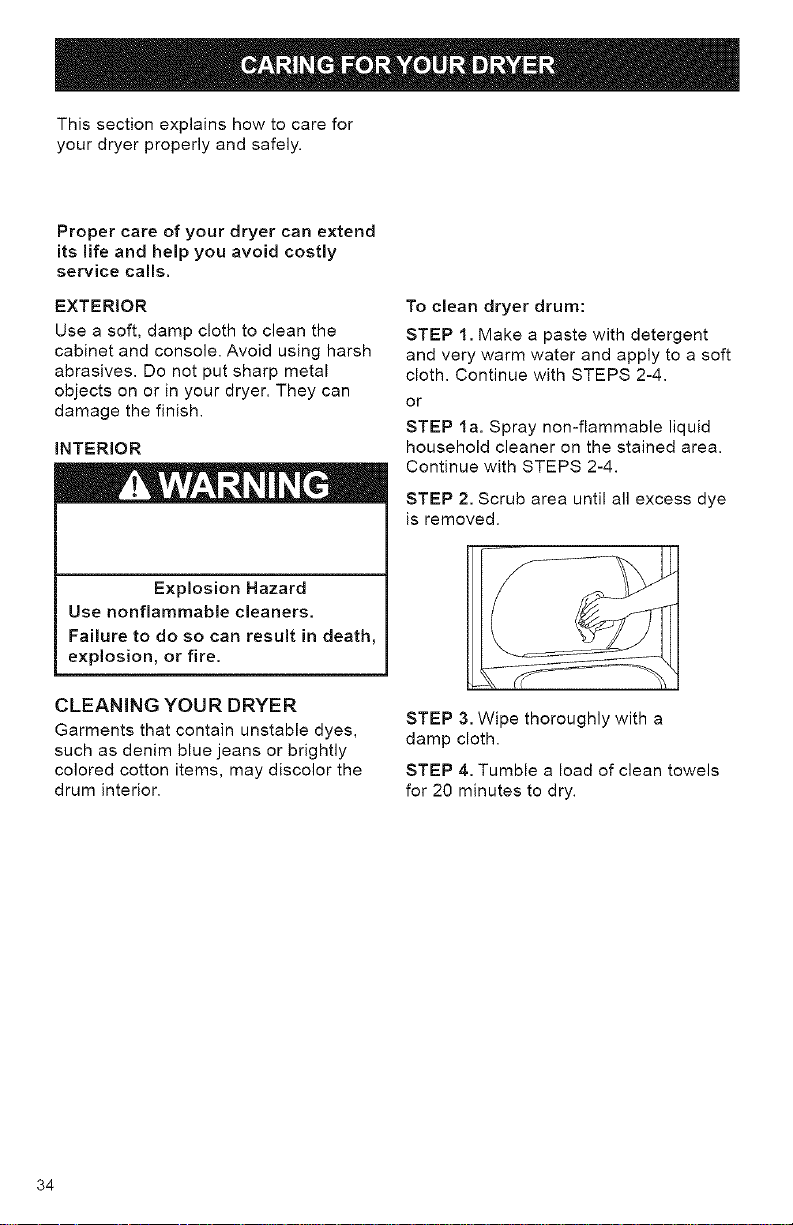
To clean dryer drum:
STEP 1. Make a paste with detergent
and very warm water and apply to a soft
cloth. Continue with STEPS 2-4.
or
STEP la. Spray non-flammable liquid
household cleaner on the stained area.
Continue with STEPS 2-4.
STEP 2. Scrub area until all excess dye
is removed.
STEP 3. Wipe thoroughly with a
damp cloth.
STEP 4. Tumble a load of clean towels
for 20 minutes to dry.
34
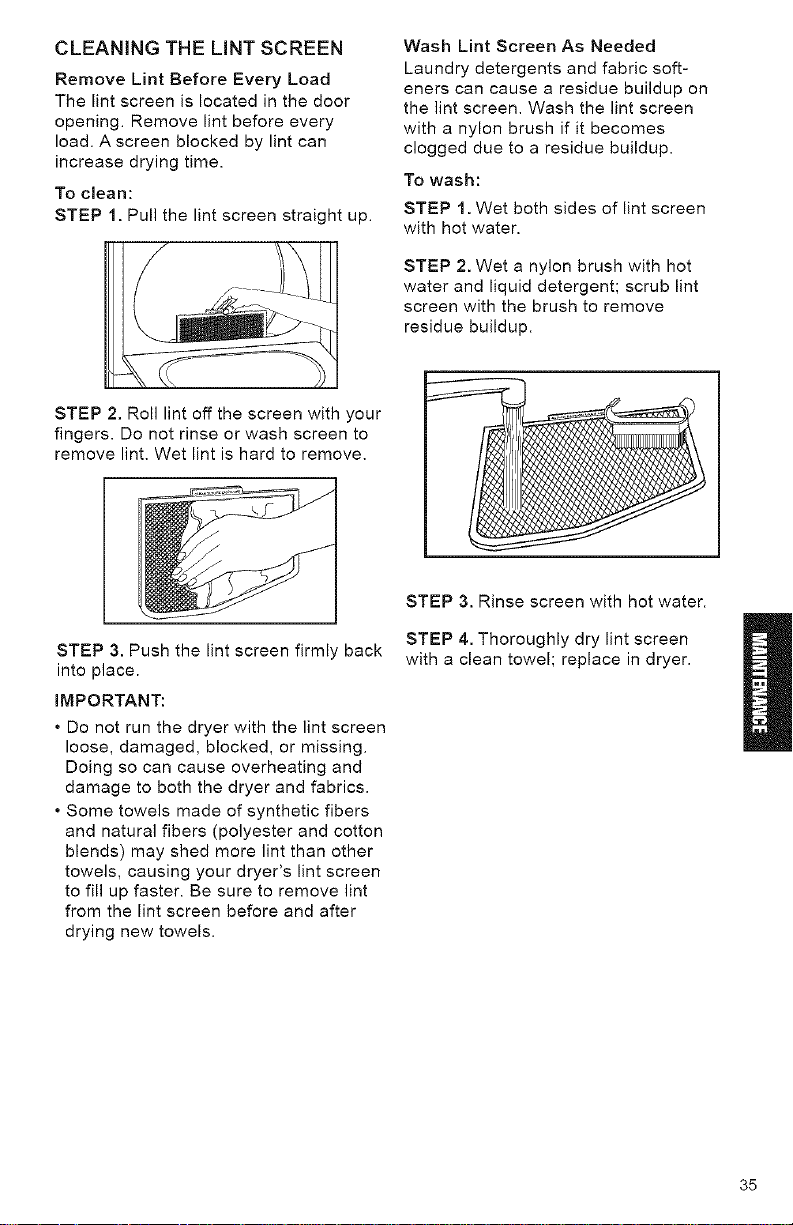
CLEANINGTHELINTSCREEN
RemoveLintBeforeEveryLoad
Thelintscreenislocatedinthedoor
opening.Removelintbeforeevery
load. A screen blocked by lint can
increase drying time,
To clean:
STEP 1, Pull the lint screen straight up.
Wash Lint Screen As Needed
Laundry detergents and fabric soft-
eners can cause a residue buildup on
the lint screen. Wash the lint screen
with a nylon brush if it becomes
clogged due to a residue buildup.
To wash:
STEP 1. Wet both sides of lint screen
with hot water.
STEP 2. Wet a nylon brush with hot
water and liquid detergent; scrub lint
screen with the brush to remove
residue buildup.
STEP 2. Roll lint off the screen with your
fingers. Do not rinse or wash screen to
remove lint. Wet lint is hard to remove.
STEP 3. Push the lint screen firmly back
into place.
IMPORTANT:
• Do not run the dryer with the lint screen
loose, damaged, blocked, or missing.
Doing so can cause overheating and
damage to both the dryer and fabrics.
• Some towels made of synthetic fibers
and natural fibers (polyester and cotton
blends) may shed more lint than other
towels, causing your dryer's lint screen
to fill up faster. Be sure to remove lint
from the lint screen before and after
drying new towels.
STEP 3. Rinse screen with hot water.
STEP 4. Thoroughly dry lint screen
with a clean towel; replace in dryer.
35
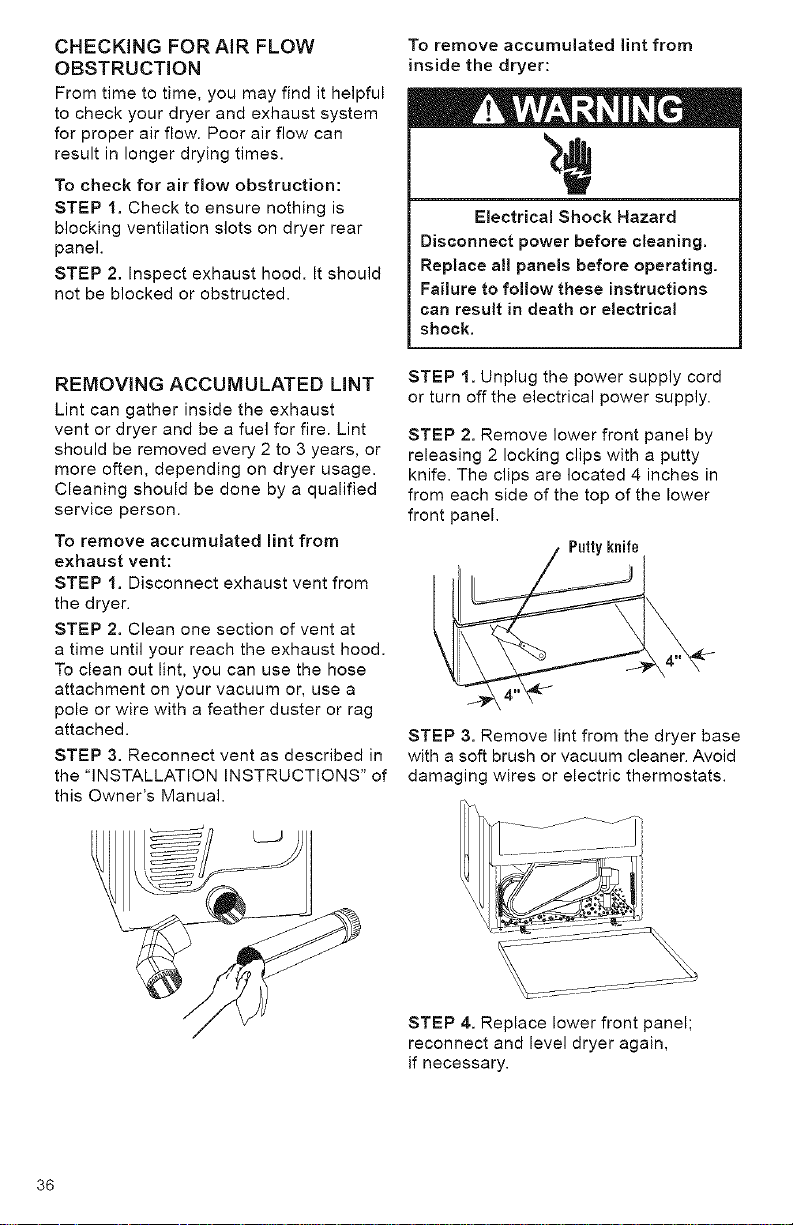
CHECKINGFORAIRFLOW
OBSTRUCTION
Fromtimetotime,youmayfindithelpful
tocheckyourdryerandexhaust system
for proper air flow. Poor air flow can
result in longer drying times.
To check for air flow obstruction:
STEP 1. Check to ensure nothing is
blocking ventilation slots on dryer rear
panel.
STEP 2. inspect exhaust hood. it should
not be blocked or obstructed.
REMOVING ACCUMULATED LINT
Lint can gather inside the exhaust
vent or dryer and be a fuel for fire. Lint
should be removed every 2 to 3 years, or
more often, depending on dryer usage.
Cleaning should be done by a qualified
service person.
To remove accumulated lint from
exhaust vent:
STEP 1. Disconnect exhaust vent from
the dryer.
STEP 2. Clean one section of vent at
a time until your reach the exhaust hood.
To clean out lint, you can use the hose
attachment on your vacuum or, use a
pole or wire with a feather duster or rag
attached.
STEP 3. Reconnect vent as described in
the "INSTALLATION INSTRUCTIONS" of
this Owner's Manual.
To remove accumulated lint from
inside the dryer:
Electrical Shock Hazard
Disconnect power before cleaning.
Replace all panels before operating.
Failure to follow these instructions
can result in death or electrical
shock.
STEP 1. Unplug the power supply cord
or turn off the electrical power supply.
STEP 2. Remove lower front panel by
releasing 2 locking clips with a putty
knife. The clips are located 4 inches in
from each side of the top of the lower
front panel.
P°,,yk.,,0
STEP 3. Remove lint from the dryer base
with a soft brush or vacuum cleaner. Avoid
damaging wires or electric thermostats.
STEP 4. Replace lower front panel;
reconnect and level dryer again,
if necessary.
36
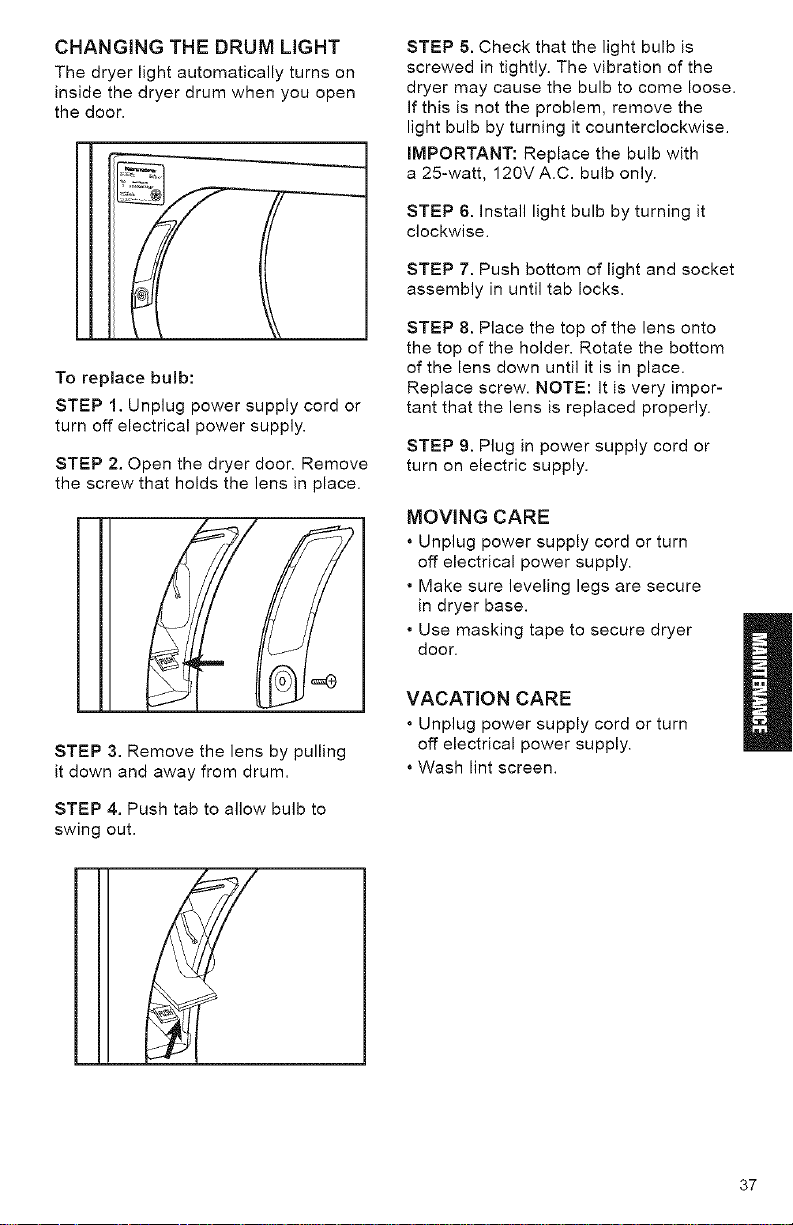
CHANGING THE DRUM LIGHT
The dryer light automatically turns on
inside the dryer drum when you open
the door.
To replace bulb:
STEP 1. Unplug power supply cord or
turn off electrical power supply.
STEP 2. Open the dryer door. Remove
the screw that holds the lens in place.
STEP 3. Remove the lens by pulling
it down and away from drum.
STEP 4. Push tab to allow bulb to
swing out.
STEP 5. Check that the light bulb is
screwed in tightly. The vibration of the
dryer may cause the bulb to come loose.
If this is not the problem, remove the
light bulb by turning it counterclockwise.
IMPORTANT: Replace the bulb with
a 25-watt, 120V A.C. bulb only.
STEP 6. Install light bulb by turning it
clockwise.
STEP 7. Push bottom of light and socket
assembly in until tab locks.
STEP 8. Place the top of the lens onto
the top of the holder. Rotate the bottom
of the lens down until it is in place.
Replace screw. NOTE: It is very impor-
tant that the lens is replaced properly.
STEP 9. Plug in power supply cord or
turn on electric supply.
MOVING CARE
• Unplug power supply cord or turn
off electrical power supply.
• Make sure leveling legs are secure
in dryer base.
• Use masking tape to secure dryer
door.
VACATION CARE
• Unplug power supply cord or turn
off electrical power supply.
• Wash lint screen.
37
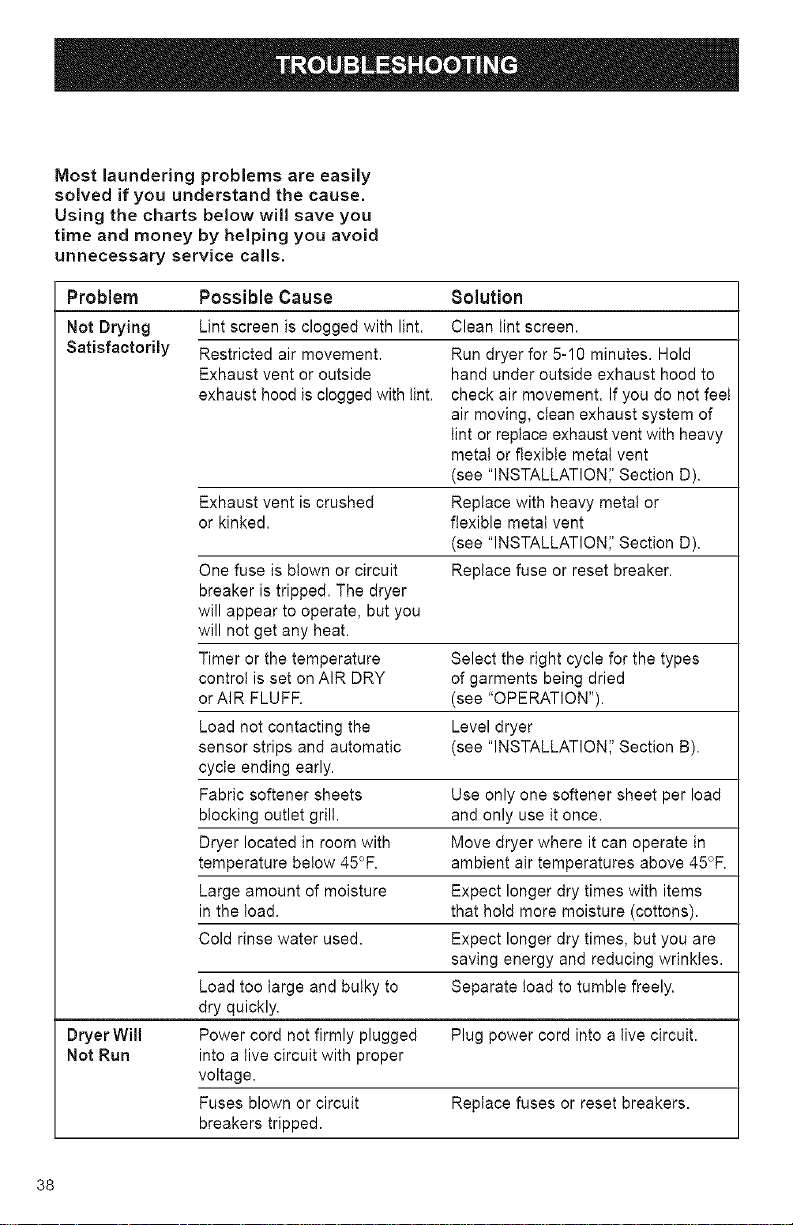
Most laundering problems are easily
solved if you understand the cause.
Using the charts below wil! save you
time and money by helping you avoid
unnecessary service calls.
Problem
Not Drying
Satisfactorily
8olution
Clean tint screen.
Run dryer for 5-10 minutes. Hold
hand under outside exhaust hood to
check air movement. If you do not feet
air moving, clean exhaust system of
tint or replace exhaust vent with heavy
metal or flexible metal vent
(see "INSTALLATION',' Section D).
Exhaust vent is crushed Replace with heavy metal or
or kinked, flexible metal vent
(see "INSTALLATION',' Section D).
One fuse is blown or circuit Replace fuse or reset breaker.
breaker is tripped. The dryer
will appear to operate, but you
will not get any heat.
Timer or the temperature Select the right cycle for the types
control is set on AIR DRY of garments being dried
orAIR FLUFF. (see "OPERATION").
Load not contacting the Level dryer
sensor strips and automatic (see "INSTALLATION',' Section B).
cycle ending early.
Fabric softener sheets Use only one softener sheet per load
blocking outlet grill, and only use it once.
Dryer located in room with Move dryer where it can operate in
temperature below 45°F. ambient air temperatures above 45°F.
Large amount of moisture Expect longer dry times with items
in the toad. that hold more moisture (cottons).
Cold rinse water used. Expect longer dry times, but you are
saving energy and reducing wrinkles.
Load too large and bulky to Separate toad to tumble freely.
dry quickly.
Dryer Will Power cord not firmly plugged Plug power cord into a live circuit.
Not Run into a live circuit with proper
voltage.
Fuses blown or circuit Replace fuses or reset breakers.
breakers tripped.
Possible Cause
Lint screen is clogged with lint.
Restricted air movement.
Exhaust vent or outside
exhaust hood is clogged with tint.
38
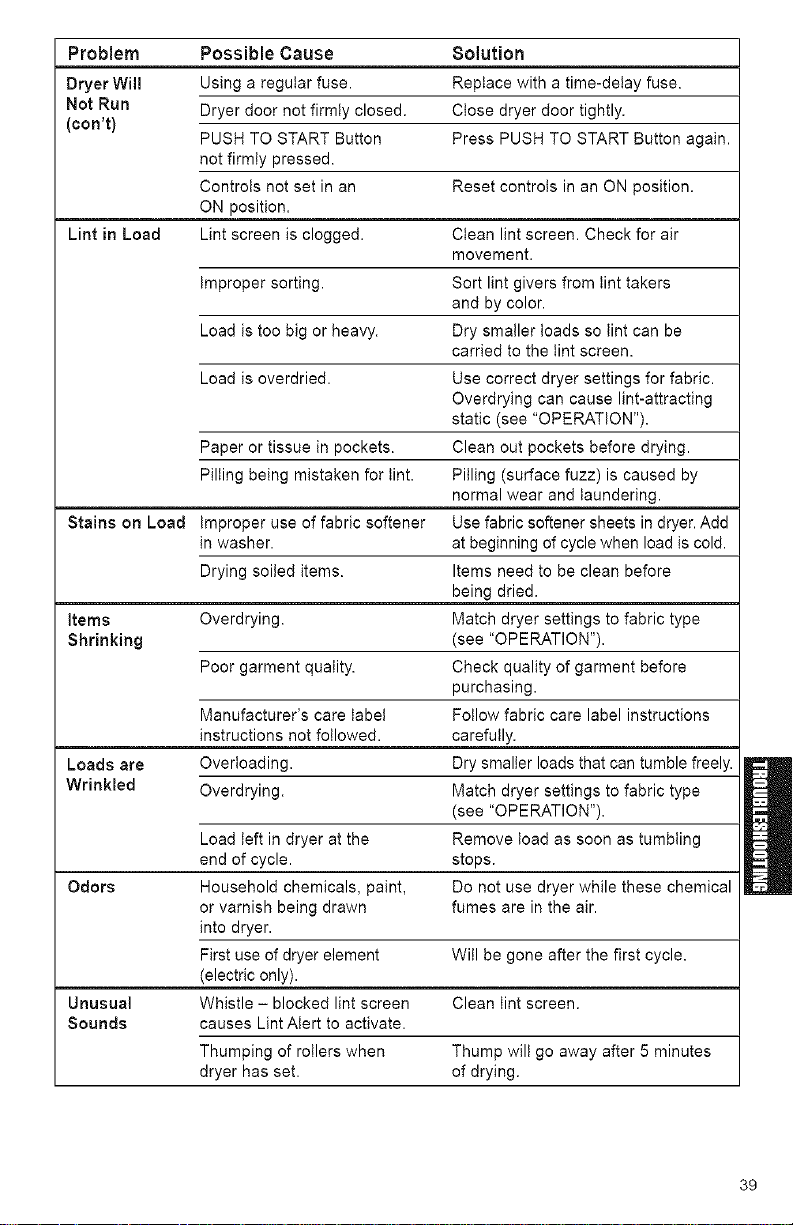
Problem Possible Cause 8olution
Dryer Will Using a regular fuse. Replace with a time-delay fuse.
Not Run Dryer door not firmly closed. Close dryer door tightly.
(con't)
PUSH TO START Button Press PUSH TO START Button again.
not firmly pressed.
Controls not set in an Reset controls in an ON position.
ON position.
Lint in Load Lint screen is clogged. Clean lint screen. Check for air
movement.
Improper sorting. Sort lint givers from tint takers
and by color.
Load is too big or heavy. Dry smaller loads so tint can be
carried to the tint screen.
Load is overdried. Use correct dryer settings for fabric.
Overdrying can cause lint-attracting
static (see "OPERATION").
Paper or tissue in pockets. Clean out pockets before drying.
Pilling being mistaken for tint. Pilling (surface fuzz) is caused by
normal wear and laundering.
Stains on Load Improper use of fabric softener Use fabric softener sheets in dryer. Add
in washer, at beginning of cycle when load is cold.
Drying soiled items. Items need to be clean before
being dried.
Items Overdrying. Match dryer settings to fabric type
Shrinking (see "OPERATION").
Poor garment quality. Check quality of garment before
purchasing.
Manufacturer's care labet Fotlow fabric care label instructions
instructions not followed, carefully.
Loads are Overloading. Dry smaller loads that can tumble freely.
Wrinkled Overdrying. Match dryer settings to fabric type
(see "OPERATION").
Load left in dryer at the Remove toad as soon as tumbling
end of cycle, stops.
Odors Household chemicals, paint, Do not use dryer while these chemical
or varnish being drawn fumes are in the air.
into dryer.
First use of dryer element Will be gone after the first cycle.
(electric only).
Unusua! Whistle - blocked lint screen Clean tint screen.
Sounds causes Lint Atert to activate.
Thumping of rollers when Thump wilt go away after 5 minutes
dryer has set. of drying.
39
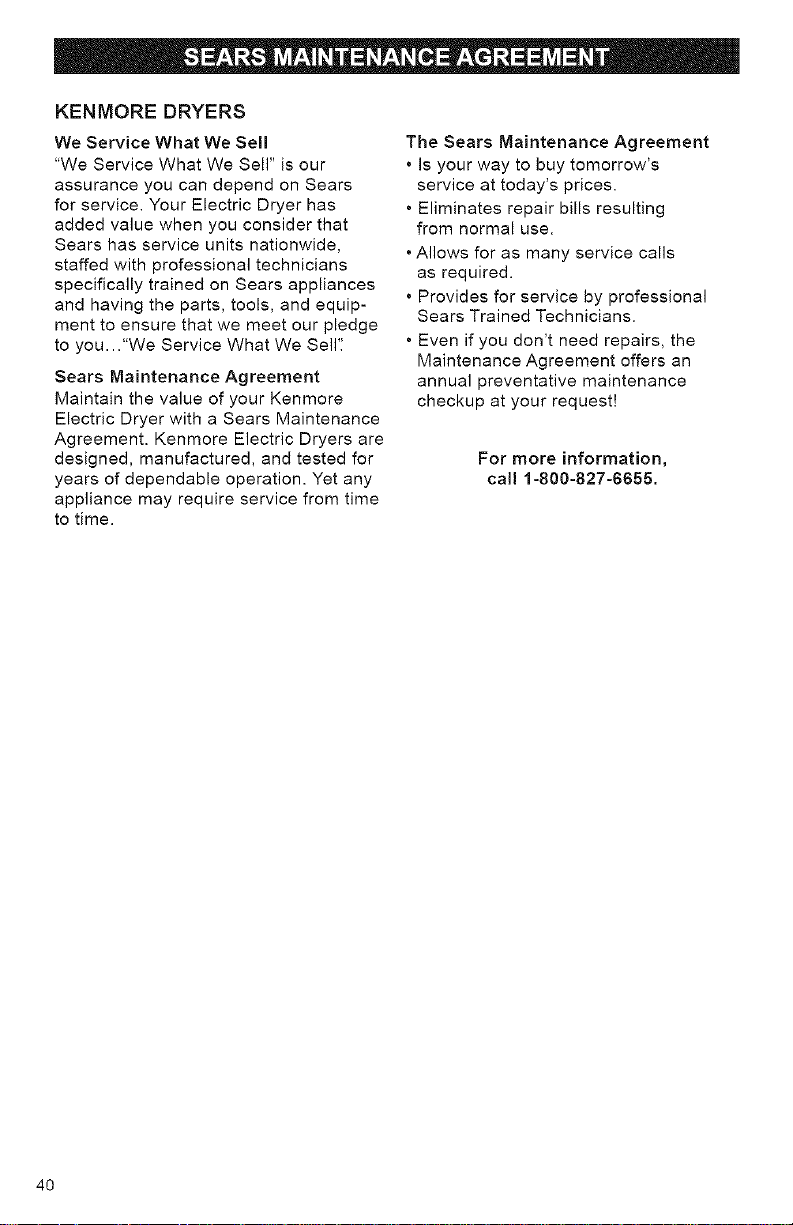
KENMORE DRYERS
We Service What We Sell
"We Service What We Sell" is our
assurance you can depend on Sears
for service. Your Electric Dryer has
added value when you consider that
Sears has service units nationwide,
staffed with professional technicians
specifically trained on Sears appliances
and having the parts, tools, and equip-
ment to ensure that we meet our pledge
to you..."We Service What We 8ell'_
Sears Maintenance Agreement
Maintain the value of your Kenmore
Electric Dryer with a Sears Maintenance
Agreement. Kenmore Electric Dryers are
designed, manufactured, and tested for
years of dependable operation. Yet any
appliance may require service from time
to time.
The Sears Maintenance Agreement
• is your way to buy tomorrow's
service at today's prices.
• Eliminates repair bills resulting
from normal use.
• Allows for as many service calls
as required.
• Provides for service by professional
Sears Trained Technicians.
• Even if you don't need repairs, the
Maintenance Agreement offers an
annual preventative maintenance
checkup at your request!
For more information,
call 1-800-827-6655,
4O
Forthe repair or replacement partsyou
needdelivered directly to your home
Call7 am - 7 pro,7 daysa week
1-800=366-PART
(1-800-366-7278)
Forin-homemajor brand repair service
Call24 hours a day,7 daysa week
1-800-4=REPAIR
(1-800-473-7247)
Forthe locationof a Sears Parts and
Repair Center in your area
Call24 hours a day,7 daysa week
1-800-488-1222
Forinformationon purchasinga Sears
MaintenanceAgreementor to inquire
about an existingAgreement
Call9 am - 5 pro, Monday- Saturday
1-800-827-6655
Whenrequesting serviceor ordering
parts, always givethe following
information:
• ProductName • Part Name
• Model Number ,,Part Number America'sRepairSpecialists
41